AB 1129: Birth conditions monitoring.
- Session Year: 2025-2026
- House: Assembly
- Latest Version Date: 2026-09-30
Current Status:
Passed
(2026-09-30: Chaptered by Secretary of State - Chapter 874, Statutes of 2026.)
Introduced
In Committee
Awaiting First Chamber Vote
Passed First Chamber
In Committee
Awaiting Second Chamber Vote
Passed Second Chamber
Enacted
Existing law states that it is the intent of the Legislature to maintain an ongoing program of birth defects monitoring statewide, and requires the State Public Health Officer to maintain a system for the collection of information related to birth defects, as specified. Existing law requires the officer to require general acute care hospitals and physician-owned or physician-operated clinics that regularly provide services for the diagnosis or treatment of birth defects, genetic counseling, or prenatal diagnostic services to make available to the department the medical records of children suspected or diagnosed as having birth defects, as specified. Existing law authorizes the department to enter into a contract for the establishment and implementation of the birth defects monitoring program.
This bill would state that it is additionally the intent of the Legislature to authorize local health jurisdictions to initiate and maintain programs to monitor birth conditions, as defined, that are present during the 12-month period after an individuals birth in their local health jurisdictions. The bill would authorize a local health officer to maintain a system for the collection of specified information within their local health jurisdiction related to birth conditions. The bill would authorize a local health officer to issue a written order to providers and laboratories, as specified, in addition to the facilities listed above, within their local health jurisdiction to either make available or to report to the local health department information related to birth conditions, as specified.
Existing law limits access to confidential information related to birth defects to authorized program staff and persons with a valid scientific interest, as specified, and prohibits that information from being admissible, disclosed, discoverable, or compelled to be produced in any civil, criminal, administrative, or other proceeding, as specified. Existing law provides that, except as otherwise provided by statute, all relevant evidence is admissible. The California Constitution provides for the Right to Truth-In-Evidence, which requires a 2/3 vote of the Legislature to exclude any relevant evidence from any criminal proceeding, as specified.
This bill would expand the scope of the confidentiality provisions described above to include additional conditions, thereby prohibiting the use of additional information in criminal proceedings. Because that prohibition would affect the admissibility of relevant evidence in criminal proceedings, the bill would require a 2/3 vote of the Legislature.
Existing law states that it is the intent of the Legislature to maintain an ongoing program of birth defects monitoring statewide, and requires the State Public Health Officer to maintain a system for the collection of information related to birth defects, as specified. Existing law requires the officer to require general acute care hospitals and physician-owned or physician-operated clinics that regularly provide services for the diagnosis or treatment of birth defects, genetic counseling, or prenatal diagnostic services to make available to the department the medical records of children suspected or diagnosed as having birth defects, as specified. Existing law authorizes the department to enter into a contract for the establishment and implementation of the birth defects monitoring program.
This bill would state that it is additionally the intent of the Legislature to enable and maintain an ongoing program to monitor conditions, as defined, that occur authorize local health jurisdictions to initiate and maintain programs to monitor birth conditions, as defined, that are present during the 12-month period after an individuals birth statewide. in their local health jurisdictions. The bill would authorize a local health officer to maintain a system for the collection of specified information within the their local health jurisdiction related to birth defects and conditions. The bill would authorize a local health officer to require issue a written order to providers and laboratories, as specified, in addition to the facilities listed above, within the their local health jurisdiction to either make available or to transmit report to the local health department information related to birth defects and conditions, as specified. The bill would authorize a local health officer to enter into contracts for implementation of programs to collect information regarding, and to monitor, birth defects and conditions in their jurisdiction.
Existing law limits access to confidential information related to birth defects to authorized program staff and persons with a valid scientific interest, as specified, and prohibits that information from being admissible, disclosed, discoverable, or compelled to be produced in any civil, criminal, administrative, or other proceeding, as specified. Existing law provides that, except as otherwise provided by statute, all relevant evidence is admissible. The California Constitution provides for the Right to Truth-In-Evidence, which requires a 2/3 vote of the Legislature to exclude any relevant evidence from any criminal proceeding, as specified.
This bill would expand the scope of the confidentiality provisions described above to include additional conditions, thereby prohibiting the use of additional information in criminal proceedings. Because that prohibition would affect the admissibility of relevant evidence in criminal proceedings, the bill would require a 2/3 vote of the Legislature.
Existing law requires the State Department of Public Health to collect and store any umbilical cord blood samples it receives from hospitals for storage and research and states the intent of the Legislature that pregnancy blood samples be stored and made available to any researcher who is approved by the department for specified purposes.This bill would exempt umbilical cord and pregnancy blood samples collected under the supervision of a local health officer in a local health jurisdiction for the purpose of monitoring birth defects or conditions or for other purposes from the provisions described above.Existing law states that it is the intent of the Legislature to maintain an ongoing program of birth defects monitoring statewide, and requires the State Public Health Officer to maintain a system for the collection of information related to birth defects, as specified. Existing law requires the officer to require general acute care hospitals and physician-owned or physician-operated clinics that regularly provide services for the diagnosis or treatment of birth defects, genetic counseling, or prenatal diagnostic services to make available to the department the medical records of children suspected or diagnosed as having birth defects, as specified. Existing law authorizes the department to enter into a contract for the establishment and implementation of the birth defects monitoring program.
This bill would state that it is additionally the intent of the Legislature to enable and maintain an ongoing program to monitor conditions, as defined, that occur during the 12-month period after an individuals birth statewide. The bill would authorize a local health officer to maintain a system for the collection of specified information within the local health jurisdiction related to birth defects and conditions. The bill would authorize a local health officer to require providers and laboratories, as specified, in addition to the facilities listed above, within the local health jurisdiction to either make available or to transmit to the local health department information related to birth defects and conditions, as specified. The bill would authorize a local health officer to enter into contracts for implementation of programs to collect information regarding, and to monitor, birth defects and conditions in their jurisdiction.
Existing law limits access to confidential information related to birth defects to authorized program staff and persons with a valid scientific interest, as specified, and prohibits that information from being admissible, disclosed, discoverable, or compelled to be produced in any civil, criminal, administrative, or other proceeding, as specified. Existing law provides that, except as otherwise provided by statute, all relevant evidence is admissible. The California Constitution provides for the Right to Truth-In-Evidence, which requires a 2/3 vote of the Legislature to exclude any relevant evidence from any criminal proceeding, as specified.
This bill would expand the scope of the confidentiality provisions described above to include additional conditions, thereby prohibiting the use of additional information in criminal proceedings. Because that prohibition would affect the admissibility of relevant evidence in criminal proceedings, the bill would require a 2/3 vote of the Legislature.
Existing law requires the State Department of Public Health to collect and store any umbilical cord blood samples it receives from hospitals for storage and research and states the intent of the Legislature that pregnancy blood samples be stored and made available to any researcher who is approved by the department for specified purposes.
This bill would exempt umbilical cord and pregnancy blood samples collected under the supervision of a local health officer in a local health jurisdiction for the purpose of monitoring birth defects or conditions or for other purposes from the provisions described above.
Existing law states that it is the intent of the Legislature to maintain an ongoing program of birth defects monitoring statewide, and requires the State Public Health Officer to maintain a system for the collection of information related to birth defects, as specified. Existing law requires the officer to require general acute care hospitals and physician-owned or physician-operated clinics that regularly provide services for the diagnosis or treatment of birth defects, genetic counseling, or prenatal diagnostic services to make available to the department the medical records of children suspected or diagnosed as having birth defects, as specified. Existing law authorizes the department to enter into a contract for the establishment and implementation of the birth defects monitoring program.
This bill would state that it is additionally the intent of the Legislature to enable and maintain an ongoing program to monitor conditions, as defined, that occur during the 12-month period after an individuals birth statewide. The bill would authorize a local health officer to maintain a system for the collection of specified information related to birth defects and conditions. The bill would authorize a local health officer to require providers and laboratories, as specified, in addition to the facilities listed above, to either make available or to transmit to the local health department information related to birth defects and conditions, as specified. The bill would authorize a local health officer to enter into contracts for implementation of programs to collect information regarding, and to monitor, birth defects and conditions in their jurisdiction.
Existing law limits access to confidential information related to birth defects to authorized program staff and persons with a valid scientific interest, as specified, and prohibits that information from being admissible, disclosed, discoverable, or compelled to be produced in any civil, criminal, administrative, or other proceeding, as specified. Existing law provides that, except as otherwise provided by statute, all relevant evidence is admissible. The California Constitution provides for the Right to Truth-In-Evidence, which requires a 2/3 vote of the Legislature to exclude any relevant evidence from any criminal proceeding, as specified.
This bill would expand the scope of the confidentiality provisions described above to include additional conditions, thereby prohibiting the use of additional information in criminal proceedings. Because that prohibition would affect the admissibility of relevant evidence in criminal proceedings, the bill would require a 2/3 vote of the Legislature.
Existing law requires the State Department of Public Health to collect and store any umbilical cord blood samples it receives from hospitals for storage and research and states the intent of the Legislature that pregnancy blood samples be stored and made available to any researcher who is approved by the department for specified purposes.
This bill would exempt umbilical cord and pregnancy blood samples collected under the supervision of a local health officer in a local health jurisdiction for the purpose of monitoring birth defects or conditions or for other purposes from the provisions described above.
Existing law states that it is the intent of the Legislature to maintain an ongoing program of birth defects monitoring statewide, and requires the State Public Health Officer to maintain a system for the collection of information related to birth defects, as specified. Existing law requires the officer to require general acute care hospitals and physician-owned or physician-operated clinics that regularly provide services for the diagnosis or treatment of birth defects, genetic counseling, or prenatal diagnostic services to make available to the department the medical records of children suspected or diagnosed as having birth defects, as specified. Existing law requires the officer to use the birth defects information described above to conduct studies to investigate the causes of birth defects, stillbirths, and miscarriages, as specified. Existing law authorizes the department to enter into a contract for the establishment and implementation of the birth defects monitoring program.
This bill would state that it is additionally the intent of the Legislature to enable and maintain an ongoing program to monitor conditions, as defined, that occur during the 12-month period after an individuals birth statewide. The bill would authorize a local health officer to maintain a system for the collection of specified information related to birth defects and conditions, as defined, that occur during the 12-month period after an individuals birth. conditions. The bill would authorize a local health officer to require providers and laboratories, as specified, in addition to the facilities listed above, to either make available or to transmit to the local health department information related to birth defects and conditions, as specified. The bill would additionally require the officer to use birth defects and conditions information gathered by local health officers to conduct the studies described above. The bill would authorize a local health officer to enter into contracts for implementation of programs to collect information regarding, and to monitor, birth defects and conditions in their jurisdiction.
Existing law limits access to confidential information related to birth defects to authorized program staff and persons with a valid scientific interest, as specified, and prohibits that information from being admissible, disclosed, discoverable, or compelled to be produced in any civil, criminal, administrative, or other proceeding, as specified. Existing law provides that, except as otherwise provided by statute, all relevant evidence is admissible. The California Constitution provides for the Right to Truth-In-Evidence, which requires a 2/3 vote of the Legislature to exclude any relevant evidence from any criminal proceeding, as specified.
This bill would expand the scope of the confidentiality provisions described above to include additional conditions, thereby prohibiting the use of additional information in criminal proceedings. Because that prohibition would affect the admissibility of relevant evidence in criminal proceedings, the bill would require a 2/3 vote of the Legislature.
Existing law requires the State Department of Public Health to collect and store any umbilical cord blood samples it receives from hospitals for storage and research and states the intent of the Legislature that pregnancy blood samples be stored and made available to any researcher who is approved by the department for specified purposes.
This bill would exempt umbilical cord and pregnancy blood samples collected under the supervision of a local health officer in a local health jurisdiction for the purpose of monitoring birth defects or conditions or for other purposes from the provisions described above.
Existing law requires the State Public Health Officer to maintain a system for the collection of information related to birth defects, as specified. Existing law requires the officer to require general acute care hospitals and physician-owned or physician-operated clinics that regularly provide services for the diagnosis or treatment of birth defects, genetic counseling, or prenatal diagnostic services to make available to the department the medical records of children suspected or diagnosed as having birth defects, as specified. Existing law requires the officer to use the birth defects information described above to conduct studies to investigate the causes of birth defects, stillbirths, and miscarriages, as specified. Existing law authorizes the department to enter into a contract for the establishment and implementation of the birth defects monitoring program.
This bill would authorize a local health officer to maintain a system for the collection of information related to birth defects and other birth anomalies. conditions, as defined, that occur during the 12-month period after an individuals birth. The bill would authorize a local health officer to require providers and laboratories, as specified, in addition to the facilities listed above, to either make available or to transmit to the local health department information related to birth defects and other birth anomalies information, conditions, as specified. The bill would additionally require the officer to use birth defects and conditions information gathered by local health officers to conduct the studies described above. The bill would authorize a local health officer to enter into contracts for implementation of programs to collect and monitor birth anomalies information regarding, and to monitor, birth defects and conditions in their jurisdiction.
Existing law limits access to confidential information related to birth defects to authorized program staff and persons with a valid scientific interest, as specified, and prohibits that information from being admissible, disclosed, discoverable, or compelled to be produced in any civil, criminal, administrative, or other proceeding, as specified. Existing law provides that, except as otherwise provided by statute, all relevant evidence is admissible. The California Constitution provides for the Right to Truth-In-Evidence, which requires a 2/3 vote of the Legislature to exclude any relevant evidence from any criminal proceeding, as specified.
This bill would expand the scope of the confidentiality provisions described above to include additional conditions, thereby prohibiting the use of additional information in criminal proceedings. Because that prohibition would affect the admissibility of relevant evidence in criminal proceedings, the bill would require a 2/3 vote of the Legislature.
Existing law requires the State Department of Public Health to collect and store any umbilical cord blood samples it receives from hospitals for storage and research and states the intent of the Legislature that pregnancy blood samples be stored and made available to any researcher who is approved by the department for specified purposes.
This bill would exempt umbilical cord and pregnancy blood samples collected under the supervision of a local health officer in a local health jurisdiction for the purpose of monitoring birth defects or other birth anomalies conditions or for other purposes from the provisions described above.
Existing law requires the State Public Health Officer to maintain a system for the collection of information related to birth defects, as specified. Existing law requires the officer to require general acute care hospitals and physician-owned or physician-operated clinics that regularly provide services for the diagnosis or treatment of birth defects, genetic counseling, or prenatal diagnostic services to make available to the department the medical records of children suspected or diagnosed as having birth defects, as specified. Existing law authorizes the department to enter into a contract for the establishment and implementation of the birth defects monitoring program.
This bill would authorize a local health officer to maintain a system for the collection of information related to birth defects and other birth anomalies. The bill would authorize a local health officer to require laboratories, as specified, in addition to the facilities listed above, to either make available or to transmit to the local health department birth defects and other birth anomalies information, as specified. The bill would authorize a local health officer to enter into contracts for implementation of programs to collect and monitor birth anomalies in their jurisdiction.
Existing law requires the State Department of Public Health to collect and store any umbilical cord blood samples it receives from hospitals for storage and research and states the intent of the Legislature that pregnancy blood samples be stored and made available to any researcher who is approved by the department for specified purposes.
This bill would exempt umbilical cord and pregnancy blood samples collected under the supervision of a local health officer in a local health jurisdiction for the purpose of monitoring birth defects or other birth anomalies or for other purposes from the provisions described above.
The Legislature finds and declares that in addition to the findings and declarations in Section 103825, conditions and disorders affecting an individual that occur during the 12-month period after an individuals birth additionally represent problems of public health importance about which too little is known and that these conditions and disorders lead to severe mental anguish on the part of parents and relatives and frequently to high medical care costs, and that a system to obtain more information about these conditions and disorders could result in development of preventive measures to decrease their incidence in the future. Therefore, it is the intent of the Legislature in adding this article to accomplish all of the following:
(a)To authorize local health jurisdictions to initiate and maintain programs to monitor birth conditions in their local health jurisdictions.
(b)To provide information gathered at the local level on the incidence, prevalence, and trends of birth conditions.
(c)To provide information gathered at the local level to determine whether environmental hazards are associated with birth conditions.
(d)To provide information gathered at the local level as to other possible causes of birth conditions.
(e)To develop prevention strategies for reducing the incidence of birth conditions.
(f)To conduct interview studies at the local level about the causes of birth conditions.
(g)To affirm the authority of local health officers to monitor the prevalence and incidence of birth conditions in their local health jurisdictions.
101071.1.For the purposes of this article, the following terms have the following meanings:
(a)Condition means a condition or disorder affecting an individual that is present at an individuals birth or during the 12-month period after the birth or is later diagnosed to have been present at the individuals birth or during the 12-month period after the birth in conformity with either of the following:
(1)Medical eligibility for the California Childrens Services Program or its High Risk Infant Follow-Up (HRIF) program.
(2)As dictated by the needs of, and response to, a local public health or environmental emergency declared by the county.
(b)Reporting institutions means health facilities, as that term is defined in Section 103830, providers, and laboratories that regularly provide services for the diagnosis or treatment of birth conditions, genetic counseling, or prenatal or general diagnostic services.
101071.2.(a)A local health officer may maintain a system for the collection of information within their local health jurisdiction that is necessary to accomplish the purposes of this article, subject to adequate funding.
(b)Information about birth conditions may be reported using either of the following systems at the discretion of the local health officer:
(1)A system that requires reporting institutions within the local health jurisdiction to make their records available for review and information collection by designated staff of the local program to monitor birth conditions.
(2)A system that requires reporting institutions within the local health jurisdiction, including, but not limited to, providers and laboratories, to transmit specified data manually or electronically to the local health officer.
(c)(1)A local health officer may issue a written order to reporting institutions within their local health jurisdiction that, consistent with Section 103830, requires institutions to do any of the following:
(A)Make their related records available to authorized local program staff pursuant to paragraph (1) of subdivision (b).
(B)Report selected information about birth conditions to the local public health program pursuant to paragraph (2) of subdivision (b).
(C)Implement a hybrid of the systems described in subparagraphs (A) and (B).
(2)A local health officer shall not impede or contradict activities of the state birth defects monitoring program in their local health jurisdiction.
(d)(1)The birth conditions to be reported in a local health jurisdiction shall be at the direction of and at the discretion of the local health officer, subject to adequate funding.
(2)Local health jurisdictions shall consider implementing the same reporting requirements and workflows currently used by reporting institutions and shall consider less costly alternative methods if current reporting requirements and workflows would impose additional costs compared to alternative reporting requirements and workflows.
(e)(1)A local health officer may only collect information as described in this section if it is unique demographic, diagnostic, or health data directly related to a birth condition unless the patient or their parent or guardian gives consent to the reporting institution to collect additional data to report to the local health officer.
(2)A local health officer shall use collected data consistently with the purposes described in Section 101071, 101071.4, or 103825 or for the purpose of facilitating access to care for an individual with a birth condition as described in this article.
(f)The state is not responsible for any aspect of birth condition monitoring and reporting conducted at the local level consistent with this article.
101071.3.A local health officer may require reporting institutions within their local health jurisdiction to participate in the reporting of birth conditions, as needed, to assess and address the needs of the local health jurisdiction.
101071.4.(a)A local health officer may require the reporting of birth conditions in their jurisdiction and may use that information to conduct studies to investigate the causes of birth conditions and to determine and evaluate measures designed to prevent their occurrence.
(b)A local health officers investigation of poor reproductive outcomes shall not be limited to geographic, temporal, or occupational associations, and may include investigation of past exposures within the local jurisdiction.
101071.5.A local health officer may use resources, subject to their availability, from their local health program or jurisdiction representing the disciplines described in Section 103845 and others, as necessary, to formulate sound policy and health orders for information collected regarding birth conditions.
101071.6.(a)For purposes of Section 103850, a local health officer may also grant access to confidential information to, and may determine the qualifications of, authorized program staff and persons with a valid scientific interest in the data described in this article for purposes of having access to confidential information if the staff or persons are engaged in demographic, epidemiological, or other similar studies related to health and who agree, in writing, to maintain confidentiality.
(b)(1)The local health officer shall maintain an accurate record of all persons who are given access to confidential information. The record shall include all of the following:
(A)The name of the person authorizing access.
(B)The name, title, address, and organizational affiliation of persons given access.
(C)The dates of access.
(D)The specific purpose for which information is to be used.
(2)The record of access shall be open to public inspection during normal operating hours of the department.
(c)(1)Prior to any research proposed to be conducted by persons other than program staff that use confidential information in the system, the institutional review board in the local health jurisdiction shall review and approve the proposal.
(2)Satisfaction of the terms of the local health officers rules for data access establish a valid scientific interest for purposes of subdivision (a) and entitle the researcher to review records collected pursuant to Section 101071.2 and to contact case subjects and controls.
(3)Before confidential information is disclosed pursuant to this section to any other person, agency, or organization, the requesting entity shall demonstrate to the local health officer that the entity has established the procedures and ability to maintain the confidentiality of the information.
(d)Notwithstanding any other law, disclosure authorized by this section shall include only the information necessary for the stated purpose of the requested disclosure, and shall be made only upon written agreement that the information will be kept confidential, used for the approved purpose, and not be further disclosed.
(e)The furnishing of confidential information to the local health officer or their authorized representative in accordance with this section shall not expose any person, agency, or entity furnishing the information to liability, and is not a waiver of any privilege or a violation of a confidential relationship.
(f)Notwithstanding any other law, the confidential information shall not be available for subpoena, nor shall it be disclosed, discoverable, or compelled to be produced in any civil, criminal, administrative, or other proceeding, nor shall the information be admissible as evidence in any civil, criminal, administrative, or other tribunal or court for any reason. This section does not prohibit the publishing by a local jurisdiction of reports and statistical compilations relating to birth conditions that do not in any way identify individual cases or individual sources of information.
(g)A person who, in violation of a written agreement to maintain confidentiality, discloses any information provided pursuant to this section, or who uses information provided pursuant to this section in a manner other than as approved pursuant to this section, may be denied further access to any confidential information maintained by the local health officer. The person shall also be subject to a civil penalty of five hundred dollars ($500). The penalty provided in this section does not restrict any remedy, provisional or otherwise, provided by law for the benefit of a local jurisdiction or any person.
(h)Notwithstanding the restrictions in this section, an individual to whom the information pertains shall have access to their own information in accordance with Chapter 1 (commencing with Section 1798) of Title 1.8 of Part 4 of Division 3 of the Civil Code.
101071.7.Notwithstanding any state law, a local health officer may enter into contracts for the implementation of programs to monitor birth conditions and to collect information regarding those conditions in their jurisdiction.
101071.8.The state genetic disease testing program funds described in Section 124977 shall not be used to support information collection or research of birth conditions in a local health jurisdiction initiated by the jurisdictions health officer.
101071.9.(a)This article does not apply to the administration of the Birth Defects Monitoring Program (Chapter 1 (commencing with Section 103825) of Part 2 of Division 102) or Genetic Prevention Services (Chapter 1 (commencing with Section 124975) of Part 5 of Division 106).
(b)The Birth Defects Monitoring Program (Chapter 1 (commencing with Section 103825) of Part 2 of Division 102) and Genetic Prevention Services (Chapter 1 (commencing with Section 124975) of Part 5 of Division 106) do not apply to the administration of local birth conditions monitoring and reporting programs described in this article.
All matter omitted in this version of the bill appears in the bill as amended in the Senate, July 17, 2025. (JR11)The Legislature finds and declares that birth defects, conditions, stillbirths, and miscarriages represent problems of public health importance about which too little is known, that birth defects, conditions, stillbirths, and miscarriages lead to severe mental anguish on the part of parents and relatives and frequently to high medical care costs, and that a system to obtain more information about birth defects, conditions, stillbirths, and miscarriages could result in development of preventive measures to decrease their incidence in the future. Therefore, it is the intent of the Legislature in amending this chapter to accomplish all of the following:
(a)To enable and maintain an ongoing program to monitor birth defects and conditions statewide.
(b)To provide information on the incidence, prevalence, and trends of birth defects, conditions, stillbirths, and miscarriages.
(c)To provide information to determine whether environmental hazards are associated with birth defects, conditions, stillbirths, and miscarriages.
(d)To provide information as to other possible causes of birth defects, conditions, stillbirths, and miscarriages.
(e)To develop prevention strategies for reducing the incidence of birth defects, conditions, stillbirths, and miscarriages.
(f)To conduct interview studies about the causes of birth defects and conditions.
(g)To affirm the authority of the state department to contract with a qualified entity to operate the program to monitor birth defects and conditions statewide.
(h)To affirm the authority of local health officers to monitor the prevalence and incidence of birth defects and conditions in their local health jurisdictions in order to supplement state efforts or in the absence of state efforts in their jurisdiction.
SEC. 2.Section 103827 is added to the Health and Safety Code, to read:103827.For the purposes of this chapter, the following terms have the following meanings:
(a)Conditions means conditions or disorders affecting an individual that occur during the 12-month period after an individuals birth or are later diagnosed to have occurred during the 12-month period after the individuals birth, in conformity with one or more of the following:
(1)The list of Birth Defects Descriptions for National Birth Defects Prevention Network (NBDPN) Core, Recommended, and Extended Conditions issued by the federal Centers for Disease Control and Prevention (CDC).
(2)Medical eligibility for the California Childrens Services Program or its High-Risk Infant Follow-Up (HRIF) program.
(3)As dictated by the needs of, and response to, a local public health or environmental emergency. emergency declared by the county.
(b)Birth defect means any medical problem of organ structure, function, or chemistry of possible genetic or prenatal origin.
(c)Reporting institutions means health facilities, as that term is defined in Section 103830, providers, and laboratories that regularly provide services for the diagnosis or treatment of birth defects or conditions, genetic counseling, or prenatal or general diagnostic services.
SEC. 3.Section 103832 is added to the Health and Safety Code, to read:103832.(a)A local health officer may maintain a system for the collection of information within the local health jurisdiction that is necessary to accomplish the purposes of this chapter, subject to adequate funding.
(b)Information about birth defects and conditions may be reported using either of the following systems at the discretion of the director or the local health officer:
(1)A system that requires reporting institutions within the local health jurisdiction to make their records available for review and information collection by designated staff of the local program to monitor birth defects and conditions.
(2)A system that requires reporting institutions, institutions within the local health jurisdiction, including, but not limited to, providers and laboratories, to transmit specified data manually or electronically to the local health officer.
(c)A local health officer may require reporting institutions within the local health jurisdiction to make their related records available to authorized local program staff pursuant to paragraph (1) of subdivision (b), require reporting of selected information about birth defects and conditions to the local public health program pursuant to paragraph (2) of subdivision (b), or implement a hybrid of the two systems. A local health officer shall not impede or contradict activities of the state birth defects monitoring program in their jurisdiction, but may supplement the activities for local uses and purposes.
(d)(1)The birth defects and conditions to be reported in a local health jurisdiction shall be at the direction of and at the discretion of the local health officer, subject to adequate funding.
(2)Jurisdictions shall consider implementing the same reporting requirements and workflows currently used by reporting institutions and shall consider less costly alternative methods if current reporting requirements and workflows would impose additional costs compared to alternative reporting requirements and workflows.
(e)(1)A local health officer may only collect information as described in this section if it is unique demographic, diagnostic, or health data directly related to a birth defect or condition unless the patient or their parent or guardian gives consent to the officer for the collection of additional data.
(2)A local health officer shall use collected data consistently with the purposes described in Section 103825 or 103840 or for the purpose of facilitating access to care for an individual with a birth defect or condition as described in this chapter.
SEC. 4.Section 103835 of the Health and Safety Code is amended to read:103835.(a)The state birth defects monitoring program shall operate statewide. It is the intent of the Legislature that the adequacy of program resources to support the state birth defects monitoring program shall be assessed annually to determine where and in which jurisdictions the state will offer its program. The annual assessment shall include a consideration of at least all the following factors:
(1)The numbers of births in the state.
(2)The scope of program activities.
(3)Any urgent situation requiring extraordinary commitment of present or planned program staff or resources.
(b)A local health officer may require reporting institution participation institutions within the local health jurisdiction to participate in reporting of birth defects and conditions, as needed, to assess and address the needs of the local health jurisdiction, to supplement the state birth defects monitoring program in jurisdictions where it is conducted, if needed, or for reporting of birth defects and conditions in a local health jurisdiction where there are no state birth defects monitoring activities.
SEC. 5.Section 103840 of the Health and Safety Code is amended to read:103840.(a)The director shall use the information collected pursuant to Section 103830 and information available from other reporting systems and health providers to conduct studies to investigate the causes of birth defects, stillbirths, and miscarriages and to determine and evaluate measures designed to prevent their occurrence.
(b)A local health officer may require reporting of birth defects and conditions in their jurisdiction and may use that information for similar purposes.
(c)The departments and local health officers investigation of poor reproductive outcomes shall not be limited to geographic, temporal, or occupational associations, but may include investigation of past exposures.
SEC. 6.Section 103845 of the Health and Safety Code is amended to read:103845.(a)For the statewide program, the director shall appoint an advisory committee to advise on the implementation of this chapter. Each of the disciplines of epidemiology, hospital administration, biostatistics, maternal and child health, and public health shall be represented on the committee. At least one of the members shall be a representative of the manufacturing industry.
(b)A local health officer may use resources, subject to their availability, from their local health program or jurisdiction representing the disciplines listed in subdivision (a), and others as necessary, to formulate sound policy and health orders for information collected regarding birth defects and conditions.
SEC. 7.Section 103850 of the Health and Safety Code is amended to read:103850.(a)(1)All information collected pursuant to this chapter shall be confidential and shall be used solely for the purposes provided in this chapter.
(2)For the purposes of this chapter, this information shall be referred to as confidential information.
(3)Access to confidential information shall be limited to authorized program staff, and persons with a valid scientific interest, who meet qualifications as determined by the director or the local health officer, who are engaged in demographic, epidemiological, or other similar studies related to health, and who agree, in writing, to maintain confidentiality.
(b)The department or the local health officer, as appropriate, shall maintain an accurate record of all persons who are given access to confidential information. The record shall include: the name of the person authorizing access; name, title, address, and organizational affiliation of persons given access; dates of access; and the specific purpose for which information is to be used. The record of access shall be open to public inspection during normal operating hours of the state department.
(c)All research proposed to be conducted by persons other than program staff, using confidential information in the system, shall first be reviewed and approved by the director and the State Committee for the Protection of Human Subjects, or the institutional review board in the local health jurisdiction if the research is conducted at the direction of the local health officer. Satisfaction of the terms of the directors rules for data access shall be deemed to establish a valid scientific interest for purposes of subdivision (a), entitling the researcher to review records collected pursuant to Section 103830 or 103832 and to contact case subjects and controls. Before confidential information is disclosed pursuant to this section to any other person, agency, or organization, the requesting entity shall demonstrate to the department or the local health officer, as appropriate, that the entity has established the procedures and ability to maintain the confidentiality of the information.
(d)Notwithstanding any other law, disclosure authorized by this section shall include only the information necessary for the stated purpose of the requested disclosure, and shall be made only upon written agreement that the information will be kept confidential, used for the approved purpose, and not be further disclosed.
(e)The furnishing of confidential information to the department, the local health officer, or their authorized representative in accordance with this section shall not expose any person, agency, or entity furnishing the information to liability, and shall not be considered a waiver of any privilege or a violation of a confidential relationship.
(f)When state program staff, pursuing program objectives, deems it necessary to contact case subjects and controls, program staff shall submit a protocol describing the research to the director and to the State Committee for the Protection of Human Subjects. Once a protocol is approved by that committee, program staff shall be deemed to have established a bona fide research purpose, and shall be entitled to complete the approved project and contact case subjects and controls without securing any additional approvals or waivers from any entity.
(g)Notwithstanding any other law, no part of the confidential information shall be available for subpoena, nor shall it be disclosed, discoverable, or compelled to be produced in any civil, criminal, administrative, or other proceeding, nor shall this information be deemed admissible as evidence in any civil, criminal, administrative, or other tribunal or court for any reason. This section does not prohibit the publishing by the department or by a local jurisdiction of reports and statistical compilations relating to birth defects, stillbirth, or miscarriage that do not in any way identify individual cases or individual sources of information.
(h)Any person who, in violation of a written agreement to maintain confidentiality, discloses any information provided pursuant to this section, or who uses information provided pursuant to this section in a manner other than as approved pursuant to this section may be denied further access to any confidential information maintained by the department or the local health officer. That person shall also be subject to a civil penalty of five hundred dollars ($500). The penalty provided in this section shall not be construed as restricting any remedy, provisional or otherwise, provided by law for the benefit of the department, a local jurisdiction, or any person.
(i)Notwithstanding the restrictions in this section, an individual to whom the information pertains shall have access to their own information in accordance with Chapter 1 (commencing with Section 1798) of Title 1.8 of the Civil Code.
SEC. 8.Section 103855 of the Health and Safety Code is amended to read:103855.(a)The department may enter into a contract for the establishment and implementation of the birth defects monitoring program. The contract shall include provisions requiring full compliance with all the requirements of this chapter. The term of the contract may be in excess of one year, but no longer than three years. Funds shall be allocated in accordance with the state Budget Act. Funds withheld from the contractor at the conclusion of a fiscal year until specified tasks are completed shall be released promptly on proof of substantial completion, and shall not be offset against any funding for the subsequent fiscal year.
(b)Notwithstanding any state law, a local health officer may enter into contracts for the implementation of programs to monitor birth defects or conditions and to collect information regarding those defects or conditions in their jurisdiction.
SEC. 9.Section 124977 of the Health and Safety Code is amended to read:124977.(a)It is the intent of the Legislature that, unless otherwise specified, the state genetic disease testing program carried out pursuant to this chapter be fully supported from fees collected for services provided by the program.
(b)(1)The department shall charge a fee to all payers for any test or activity performed pursuant to this chapter. The amount of the fee shall be established by regulation and periodically adjusted by the director in order to meet the costs of this chapter. Notwithstanding any other law, any fee charged for prenatal screening and followup services provided to a person enrolled in the Medi-Cal program, health care service plan enrollee, or person covered by a health insurance policy shall be paid in full and deposited in the Genetic Disease Testing Fund or the Birth Defects Monitoring Program Fund consistent with this section.
(2)The department shall expeditiously undertake all steps necessary to implement the fee collection process, including personnel, contracts, and data processing, to initiate the fee collection process at the earliest opportunity.
(3)Effective for services provided on and after July 1, 2002, the department shall charge a fee to the hospital of birth or, for births not occurring in a hospital, to families of the newborn for newborn screening and followup services. The hospital of birth and families of newborns born outside the hospital shall make payment in full to the Genetic Disease Testing Fund. The department shall not charge or bill Medi-Cal beneficiaries for services provided pursuant to this chapter.
(4)(A)The department shall charge a fee for prenatal screening to support the pregnancy blood sample storage, testing, and research activities of the Birth Defects Monitoring Program.
(B)The prenatal screening fee for activities of the Birth Defects Monitoring Program shall be ten dollars ($10).
(5)The department shall set guidelines for invoicing, charging, and collecting from approved researchers the amount necessary to cover all expenses associated with research application requests made pursuant to this section, data linkage, retrieval, data processing, data entry, reinventory, reporting, and shipping of blood samples or their components, and related data management.
(6)The only funds from the Genetic Disease Testing Fund that may be used for the purpose of supporting the pregnancy blood sample storage, testing, and research activities of the statewide Birth Defects Monitoring Program are those prenatal screening fees assessed and collected prior to the creation of the Birth Defects Monitoring Program Fund specifically to support those Birth Defects Monitoring Program activities. The funds shall not be used to support information collection or research of birth defects or conditions in a local health jurisdiction initiated by the jurisdictions health officer.
(7)(A)The Birth Defects Monitoring Program Fund is hereby created as a special fund in the State Treasury. Fee revenues that are collected pursuant to paragraph (4) shall be deposited into the fund and shall be available upon appropriation by the Legislature to support the pregnancy blood sample storage, testing, and research activities, including reporting, of the Birth Defects Monitoring Program.
(B)Notwithstanding Section 16305.7 of the Government Code, interest earned on funds in the Birth Defects Monitoring Program Fund shall be deposited as revenue into the fund to support the Birth Defects Monitoring Program.
(c)(1)The Legislature finds that timely implementation of changes in genetic screening programs and continuous maintenance of quality statewide services requires expeditious regulatory and administrative procedures to obtain the most cost-effective electronic data processing, hardware, software services, testing equipment, and testing and followup services.
(2)The expenditure of funds from the Genetic Disease Testing Fund for these purposes is not subject to Section 12102 of, and Chapter 2 (commencing with Section 10290) of Part 2 of Division 2 of, the Public Contract Code or to Division 25.2 (commencing with Section 38070) of this code. The department shall provide the Department of Finance with documentation that equipment and services have been obtained at the lowest cost consistent with technical requirements for a comprehensive high-quality program.
(3)The expenditure of funds from the Genetic Disease Testing Fund for implementation of the Tandem Mass Spectrometry screening for fatty acid oxidation, amino acid, and organic acid disorders, and screening for congenital adrenal hyperplasia, may be implemented through the amendment of the Genetic Disease Branch Screening Information System contracts and is not subject to Chapter 3 (commencing with Section 12100) of Part 2 of Division 2 of the Public Contract Code, Article 4 (commencing with Section 19130) of Chapter 5 of Part 2 of Division 5 of Title 2 of the Government Code, and any policy, procedure, regulation, or manual authorized by those laws.
(4)(A)The expenditure of funds from the Genetic Disease Testing Fund for the expansion of the Genetic Disease Branch Screening Information System to include cystic fibrosis, biotinidase, severe combined immunodeficiency (SCID), adrenoleukodystrophy (ALD), and any other disease that is detectable in blood samples, as specified in subdivision (d) of Section 125001, may be implemented through the amendment of the Genetic Disease Branch Screening Information System contracts and shall not be subject to Chapter 2 (commencing with Section 10290) or Chapter 3 (commencing with Section 12100) of Part 2 of Division 2 of the Public Contract Code, Article 4 (commencing with Section 19130) of Chapter 5 of Part 2 of Division 5 of Title 2 of the Government Code, or Sections 4800 to 5180, inclusive, of the State Administrative Manual as they relate to approval of information technology projects or approval of increases in the duration or costs of information technology projects.
(B)This paragraph shall apply to the design, development, and implementation of the expansion and to the maintenance and operation of the Genetic Disease Branch Screening Information System, including change requests, once the expansion is implemented.
(d)(1)(A)The department may adopt emergency regulations to implement and make specific this chapter in accordance with Chapter 3.5 (commencing with Section 11340) of Part 1 of Division 3 of Title 2 of the Government Code.
(B)For the purposes of the Administrative Procedure Act, the adoption of regulations shall be deemed an emergency and necessary for the immediate preservation of the public peace, health and safety, or general welfare.
(C)Notwithstanding Chapter 3.5 (commencing with Section 11340) of Part 1 of Division 3 of Title 2 of the Government Code, these emergency regulations shall not be subject to the review and approval of the Office of Administrative Law.
(D)Notwithstanding Sections 11346.1 and 11349.6 of the Government Code, the department shall submit these regulations directly to the Secretary of State for filing.
(E)The regulations shall become effective immediately upon filing by the Secretary of State.
(F)Regulations shall be subject to public hearing within 120 days of filing with the Secretary of State and shall comply with Sections 11346.8 and 11346.9 of the Government Code or shall be repealed.
(2)(A)The Office of Administrative Law shall provide for the printing and publication of these regulations in the California Code of Regulations.
(B)Notwithstanding Chapter 3.5 (commencing with Section 11340) of Part 1 of Division 3 of Title 2 of the Government Code, the regulations adopted pursuant to this chapter shall not be repealed by the Office of Administrative Law and shall remain in effect until revised or repealed by the department.
(3)The Legislature finds and declares that the health and safety of California newborns is in part dependent on an effective and adequately staffed genetic disease program, the cost of which shall be supported by the fees generated by the program.
SEC. 10.Section 124991 of the Health and Safety Code is amended to read:124991.(a)(1)The Birth Defects Monitoring Program, within the State Department of Public Health, shall collect and store any umbilical cord blood samples it receives from hospitals for storage and research. For purposes of ensuring financial stability, the Birth Defects Monitoring Program shall ensure that the following conditions, alone or in combination, are met:
(A)The fees paid by researchers pursuant to subdivision (c) shall be used for, and be sufficient to cover the cost of, collecting and storing blood samples, including umbilical cord blood samples.
(B)The department receives confirmation that a researcher has requested umbilical cord blood samples from the Birth Defects Monitoring Program for research or has requested umbilical cord blood samples to be included within a request for pregnancy or newborn blood samples through the program and has provided satisfactory evidence that adequate funding will be provided to the department from the fees paid by the researcher for the request.
(C)The department receives federal grant moneys to pay for initial startup costs for the collection and storage of umbilical cord blood samples.
(2)The department may limit the number of umbilical cord blood samples the program collects each year.
(3)This subdivision does not apply to umbilical cord blood samples collected under the supervision of a local health officer in a local health jurisdiction for the purpose of monitoring birth defects or conditions or for other purposes.
(b)(1)All information relating to umbilical cord blood samples collected and utilized by the department shall be confidential, and shall be used solely for the purposes of the program, or, if approved by the department, research. Access to confidential information shall be limited to authorized persons who agree, in writing, to maintain the confidentiality of that information. Notwithstanding any other law, when the blood samples specified in subdivision (c), including those samples with any information identifying the person from whom the samples were obtained, are stored, processed, analyzed, or otherwise shared for research purposes with nondepartment staff, those samples may be shared by the program with department-authorized researchers for research purposes, and department representatives approved by the department, subject to the confidentiality and security requirements for confidential information established in this section and in Section 103850.
(2)The department shall maintain an accurate record of all persons who are given confidential information pursuant to this section, and any disclosure of confidential information shall be made only upon written agreement that the information will be kept confidential, used for its approved purpose, and not be further disclosed.
(3)A person who, in violation of a written agreement to maintain confidentiality, discloses information provided pursuant to this section, or who uses information provided pursuant to this section in a manner other than as approved pursuant to this section may be denied further access to confidential information maintained by the department, and shall be subject to a civil penalty not exceeding one thousand dollars ($1,000). The penalty provided in this section does not limit or otherwise restrict a remedy, provisional or otherwise, provided by law for the benefit of the department or a person covered by this section.
(c)In order to implement this section, the department shall establish fees in an amount that shall not exceed the costs of administering the program and the collection and storage of these samples, which the department shall collect from researchers who have been approved by the department and who seek to use the following types of blood samples for research:
(1)Umbilical cord blood.
(2)Pregnancy blood collected by the Genetic Disease Screening Program, and stored by the Birth Defects Monitoring Program.
(3)Newborn blood collected by the Genetic Disease Screening Program.
(d)Fees collected pursuant to subdivision (c) shall be collected by the department and deposited into the Birth Defects Monitoring Program Fund, the Genetic Disease Testing Fund, created pursuant to Section 124996, or the Cord Blood Banking Fund, which is hereby created as a special fund in the State Treasury. The amount of fees deposited into each of these funds shall be based on the program that is providing those pregnancy blood samples, and the purpose for which the blood sample was obtained. Notwithstanding any other law, the moneys in the Birth Defects Monitoring Program Fund, the Genetic Disease Testing Fund, and the Cord Blood Banking Fund that are collected pursuant to subdivision (c), may be used by the department, upon appropriation by the Legislature, for the purposes specified in subdivision (e).
(e)Moneys in those funds shall be used for the costs related to reporting, data management, including data linkage and entry, and blood collection, storage, retrieval, processing, inventory, and shipping.
(f)The department shall comply with the existing requirements in the Birth Defects Monitoring Program, as set forth in Chapter 1 (commencing with Section 103825) of Part 2 of Division 102.
(g)The department, any entities approved by the department, and researchers shall maintain the confidentiality of patient information and blood samples in accordance with existing law and in the same manner as other medical record information with patient identification that they possess, and shall use the information only for the following purposes:
(1)Research to identify risk factors for childrens and womens diseases.
(2)Research to develop and evaluate screening tests.
(3)Research to develop and evaluate prevention strategies.
(4)Research to develop and evaluate treatments.
(h)(1)For purposes of ensuring the security of a donors personal information, before any blood samples are released pursuant to this section for research purposes, the State Committee for the Protection of Human Subjects (CPHS) shall determine if all of the following criteria have been met:
(A)The department, contractors, researchers, or other entities approved by the department have provided a plan sufficient to protect personal information from improper use and disclosures, including sufficient administrative, physical, and technical safeguards to protect personal information from reasonable anticipated threats to the security or confidentiality of the information.
(B)The department, contractors, researchers, or other entities approved by the department have provided a sufficient plan to destroy or return all personal information as soon as it is no longer needed for the research activity, unless the program contractors, researchers, or other entities approved by the department have demonstrated an ongoing need for the personal information for the research activity and have provided a long-term plan sufficient to protect the confidentiality of that information.
(C)The department, contractors, researchers, or other entities approved by the department have provided sufficient written assurances that the personal information will not be reused or disclosed to a person or entity, or used in a manner not approved in the research protocol, except as required by law or for authorized oversight of the research activity.
(2)As part of its review and approval of the research activity for the purpose of protecting personal information held in agency databases, CPHS shall accomplish at least all of the following:
(A)Determine whether the requested personal information is needed to conduct the research.
(B)Permit access to personal information only if it is needed for the research activity.
(C)Permit access only to the minimum personal information necessary for the research activity.
(D)Require the assignment of unique subject codes that are not derived from personal information in lieu of social security numbers if the research can be conducted without social security numbers.
(E)If feasible, and if cost, time, and technical expertise permit, require the agency to conduct a portion of the data processing for the researcher to minimize the release of personal information.
(i)In addition to the fees described in subdivision (c), the department may bill a researcher for the costs associated with the departments process of protecting personal information, including, but not limited to, the departments costs for conducting a portion of the data processing for the researcher, removing personal information, encrypting or otherwise securing personal information, or assigning subject codes.
(j)This section does not prohibit the department from using its existing authority to enter into written agreements to enable other institutional review boards to approve research activities, projects, or classes of projects for the department, provided that the data security requirements set forth in this section are satisfied.
SEC. 11.Section 125002 of the Health and Safety Code is amended to read:125002.(a)(1)In order to align closely related programs and in order to facilitate research into the causes of, and treatment for, birth defects, the Birth Defects Monitoring Program provided for pursuant to Chapter 1 (commencing with Section 103825) of Part 2 of Division 102 shall become part of the Maternal, Child, and Adolescent Health program provided for in Article 1 (commencing with Section 123225) of Chapter 1 of Part 2 of Division 106.
(2)This subdivision does not apply to umbilical cord blood samples collected under the supervision of a local health officer in a local health jurisdiction for the purpose of monitoring birth defects or conditions or for other purposes.
(b)It is the intent of the Legislature that pregnancy blood samples, taken for prenatal screening, shall be stored and made available to any researcher who is approved by the department for the following purposes:
(1)Research to identify risk factors for childrens and womens diseases.
(2)Research to develop and evaluate screening tests.
(3)Research to develop and evaluate prevention strategies.
(4)Research to develop and evaluate treatments.
(c)Before any pregnancy blood samples are released for research purposes, all of the following conditions must be met:
(1)Individual consent at the time the sample is drawn to allow confidential use of the sample for research purposes by the department or the departments approved researchers.
(2)Protocol review for scientific merit by the department or another entity authorized by the department.
(3)Protocol review by the State Committee for the Protection of Human Subjects.
(d)Since the pregnancy blood samples described in this section will be stored by the California Birth Defects Monitoring Program or another entity authorized by the department, the storage, analysis, and sharing of pregnancy blood samples for research purposes shall be done in compliance with Section 103850, pertaining to confidentiality of information.
(e)The department shall adopt regulations specifying the protocols and conditions under which blood samples will be released for research purposes, in accordance with the procedures set forth in subdivision (d) of Section 124977.
(f)Until regulations are adopted by the department pursuant to subdivision (e), the Genetic Disease Screening Program and the Birth Defects Monitoring Program shall release blood samples to only those researchers who meet the requirements of this section, including all of the following:
(1)The research project was approved by the State Committee for the Protection of Human Subjects.
(2)The research projects protocol was approved by the State Committee for the Protection of Human Subjects, and specifically included a description of the number and type of blood samples requested from the Genetic Disease Screening Program or the Maternal, Child, and Adolescent Health Program, including the Birth Defects Monitoring Program for the project.
(3)There is written documentation that the Genetic Disease Screening Program or the Maternal, Child, and Adolescent Health Program, including the Birth Defects Monitoring Program, approved a request for the blood samples for the research project approved by the State Committee for the Protection of Human Subjects.
(4)The researcher has agreed to pay fees to the department to pay reasonable costs for processing the samples and information, including, but not limited to, costs of data management, including data linkage and entry, and costs of blood collection, storage, retrieval, inventory, and shipping.
(g)Subdivision (f) shall become inoperative on the date that the department adopts regulations specifying the protocols and conditions for release of the blood samples for research purposes.
The Legislature finds and declares that birth defects, conditions, stillbirths, and miscarriages represent problems of public health importance about which too little is known, that birth defects, conditions, stillbirths, and miscarriages lead to severe mental anguish on the part of parents and relatives and frequently to high medical care costs, and that a system to obtain more information about birth defects, conditions, stillbirths, and miscarriages could result in development of preventive measures to decrease their incidence in the future. Therefore, it is the intent of the Legislature in amending this chapter to accomplish all of the following:
(a)To enable and maintain an ongoing program to monitor birth defects and conditions statewide.
(b)To provide information on the incidence, prevalence, and trends of birth defects, conditions, stillbirths, and miscarriages.
(c)To provide information to determine whether environmental hazards are associated with birth defects, conditions, stillbirths, and miscarriages.
(d)To provide information as to other possible causes of birth defects, conditions, stillbirths, and miscarriages.
(e)To develop prevention strategies for reducing the incidence of birth defects, conditions, stillbirths, and miscarriages.
(f)To conduct interview studies about the causes of birth defects and conditions.
(g)To affirm the authority of the state department to contract with a qualified entity to operate the program to monitor birth defects and conditions statewide.
(h)To affirm the authority of local health officers to monitor the prevalence and incidence of birth defects and conditions in their local health jurisdictions in order to supplement state efforts or in the absence of state efforts in their jurisdiction.
SEC. 2.Section 103827 is added to the Health and Safety Code, to read:103827.For the purposes of this chapter, the following terms have the following meanings:
(a)Conditions means conditions or disorders affecting an individual that occur during the 12-month period after an individuals birth or are later diagnosed to have occurred during the 12-month period after the individuals birth, in conformity with one or more of the following:
(1)The list of Birth Defects Descriptions for National Birth Defects Prevention Network (NBDPN) Core, Recommended, and Extended Conditions issued by the federal Centers for Disease Control and Prevention (CDC).
(2)Medical eligibility for the California Childrens Services Program or its High-Risk Infant Follow-Up (HRIF) program.
(3)As dictated by the needs of, and response to, a public health or environmental emergency.
(b)Birth defect means any medical problem of organ structure, function, or chemistry of possible genetic or prenatal origin.
(c)Reporting institutions means health facilities, as that term is defined in Section 103830, providers, and laboratories that regularly provide services for the diagnosis or treatment of birth defects or conditions, genetic counseling, or prenatal or general diagnostic services.
SEC. 3.Section 103832 is added to the Health and Safety Code, to read:103832.(a)A local health officer may maintain a system for the collection of information necessary to accomplish the purposes of this chapter, subject to adequate funding.
(b)Information about birth defects and conditions may be reported using either of the following systems at the discretion of the director or the local health officer:
(1)A system that requires reporting institutions to make their records available for review and information collection by designated staff of the local program to monitor birth defects and conditions.
(2)A system that requires reporting institutions, including, but not limited to, providers and laboratories, to transmit specified data manually or electronically to the local health officer.
(c)A local health officer may require reporting institutions to make their related records available to authorized local program staff pursuant to paragraph (1) of subdivision (b), require reporting of selected information about birth defects and conditions to the local public health program pursuant to paragraph (2) of subdivision (b), or implement a hybrid of the two systems. A local health officer shall not impede or contradict activities of the state birth defects monitoring program in their jurisdiction, but may supplement the activities for local uses and purposes.
(d)(1)The birth defects and conditions to be reported in a local health jurisdiction shall be at the direction of and at the discretion of the local health officer, subject to adequate funding.
(2)Jurisdictions shall consider implementing the same reporting requirements and workflows currently used by reporting institutions and shall consider less costly alternative methods if current reporting requirements and workflows would impose additional costs compared to alternative reporting requirements and workflows.
(e)(1)A local health officer may only collect information as described in this section if it is unique demographic, diagnostic, or health data directly related to a birth defect or condition unless the patient or their parent or guardian gives consent to the officer for the collection of additional data.
(2)A local health officer shall use collected data consistently with the purposes described in Section 103825 or 103840 or for the purpose of facilitating access to care for an individual with a birth defect or condition as described in this chapter.
SEC. 4.Section 103835 of the Health and Safety Code is amended to read:103835.(a)The state birth defects monitoring program shall operate statewide. It is the intent of the Legislature that the adequacy of program resources to support the state birth defects monitoring program shall be assessed annually to determine where and in which jurisdictions the state will offer its program. The annual assessment shall include a consideration of at least all the following factors:
(1)The numbers of births in the state.
(2)The scope of program activities.
(3)Any urgent situation requiring extraordinary commitment of present or planned program staff or resources.
(b)A local health officer may require reporting institution participation in reporting of birth defects and conditions, as needed, to assess and address the needs of the local health jurisdiction, to supplement the state birth defects monitoring program in jurisdictions where it is conducted, if needed, or for reporting of birth defects and conditions in a local health jurisdiction where there are no state birth defects monitoring activities.
SEC. 5.Section 103840 of the Health and Safety Code is amended to read:103840.(a)The director shall use the information collected pursuant to Section 103830 and information available from other reporting systems and health providers to conduct studies to investigate the causes of birth defects, stillbirths, and miscarriages and to determine and evaluate measures designed to prevent their occurrence.
(b)A local health officer may require reporting of birth defects and conditions in their jurisdiction and may use that information for similar purposes.
(c)The departments and local health officers investigation of poor reproductive outcomes shall not be limited to geographic, temporal, or occupational associations, but may include investigation of past exposures.
SEC. 6.Section 103845 of the Health and Safety Code is amended to read:103845.(a)For the statewide program, the director shall appoint an advisory committee to advise on the implementation of this chapter. Each of the disciplines of epidemiology, hospital administration, biostatistics, maternal and child health, and public health shall be represented on the committee. At least one of the members shall be a representative of the manufacturing industry.
(b)A local health officer may use resources, subject to their availability, from their local health program or jurisdiction representing the disciplines listed in subdivision (a), and others as necessary, to formulate sound policy and health orders for information collected regarding birth defects and conditions.
SEC. 7.Section 103850 of the Health and Safety Code is amended to read:103850.(a)(1)All information collected pursuant to this chapter shall be confidential and shall be used solely for the purposes provided in this chapter.
(2)For the purposes of this chapter, this information shall be referred to as confidential information.
(3)Access to confidential information shall be limited to authorized program staff, and persons with a valid scientific interest, who meet qualifications as determined by the director or the local health officer, who are engaged in demographic, epidemiological, or other similar studies related to health, and who agree, in writing, to maintain confidentiality.
(b)The department or the local health officer, as appropriate, shall maintain an accurate record of all persons who are given access to confidential information. The record shall include: the name of the person authorizing access; name, title, address, and organizational affiliation of persons given access; dates of access; and the specific purpose for which information is to be used. The record of access shall be open to public inspection during normal operating hours of the state department.
(c)All research proposed to be conducted by persons other than program staff, using confidential information in the system, shall first be reviewed and approved by the director and the State Committee for the Protection of Human Subjects, or the institutional review board in the local health jurisdiction if the research is conducted at the direction of the local health officer. Satisfaction of the terms of the directors rules for data access shall be deemed to establish a valid scientific interest for purposes of subdivision (a), entitling the researcher to review records collected pursuant to Section 103830 or 103832 and to contact case subjects and controls. Before confidential information is disclosed pursuant to this section to any other person, agency, or organization, the requesting entity shall demonstrate to the department or the local health officer, as appropriate, that the entity has established the procedures and ability to maintain the confidentiality of the information.
(d)Notwithstanding any other law, disclosure authorized by this section shall include only the information necessary for the stated purpose of the requested disclosure, and shall be made only upon written agreement that the information will be kept confidential, used for the approved purpose, and not be further disclosed.
(e)The furnishing of confidential information to the department, the local health officer, or their authorized representative in accordance with this section shall not expose any person, agency, or entity furnishing the information to liability, and shall not be considered a waiver of any privilege or a violation of a confidential relationship.
(f)When state program staff, pursuing program objectives, deems it necessary to contact case subjects and controls, program staff shall submit a protocol describing the research to the director and to the State Committee for the Protection of Human Subjects. Once a protocol is approved by that committee, program staff shall be deemed to have established a bona fide research purpose, and shall be entitled to complete the approved project and contact case subjects and controls without securing any additional approvals or waivers from any entity.
(g)Notwithstanding any other law, no part of the confidential information shall be available for subpoena, nor shall it be disclosed, discoverable, or compelled to be produced in any civil, criminal, administrative, or other proceeding, nor shall this information be deemed admissible as evidence in any civil, criminal, administrative, or other tribunal or court for any reason. This section does not prohibit the publishing by the department or by a local jurisdiction of reports and statistical compilations relating to birth defects, stillbirth, or miscarriage that do not in any way identify individual cases or individual sources of information.
(h)Any person who, in violation of a written agreement to maintain confidentiality, discloses any information provided pursuant to this section, or who uses information provided pursuant to this section in a manner other than as approved pursuant to this section may be denied further access to any confidential information maintained by the department or the local health officer. That person shall also be subject to a civil penalty of five hundred dollars ($500). The penalty provided in this section shall not be construed as restricting any remedy, provisional or otherwise, provided by law for the benefit of the department, a local jurisdiction, or any person.
(i)Notwithstanding the restrictions in this section, an individual to whom the information pertains shall have access to their own information in accordance with Chapter 1 (commencing with Section 1798) of Title 1.8 of the Civil Code.
SEC. 8.Section 103855 of the Health and Safety Code is amended to read:103855.(a)The department may enter into a contract for the establishment and implementation of the birth defects monitoring program. The contract shall include provisions requiring full compliance with all the requirements of this chapter. The term of the contract may be in excess of one year, but no longer than three years. Funds shall be allocated in accordance with the state Budget Act. Funds withheld from the contractor at the conclusion of a fiscal year until specified tasks are completed shall be released promptly on proof of substantial completion, and shall not be offset against any funding for the subsequent fiscal year.
(b)Notwithstanding any state law, a local health officer may enter into contracts for the implementation of programs to monitor birth defects or conditions and to collect information regarding those defects or conditions in their jurisdiction.
SEC. 9.Section 124977 of the Health and Safety Code is amended to read:124977.(a)It is the intent of the Legislature that, unless otherwise specified, the state genetic disease testing program carried out pursuant to this chapter be fully supported from fees collected for services provided by the program.
(b)(1)The department shall charge a fee to all payers for any test or activity performed pursuant to this chapter. The amount of the fee shall be established by regulation and periodically adjusted by the director in order to meet the costs of this chapter. Notwithstanding any other law, any fee charged for prenatal screening and followup services provided to a person enrolled in the Medi-Cal program, health care service plan enrollee, or person covered by a health insurance policy shall be paid in full and deposited in the Genetic Disease Testing Fund or the Birth Defects Monitoring Program Fund consistent with this section.
(2)The department shall expeditiously undertake all steps necessary to implement the fee collection process, including personnel, contracts, and data processing, to initiate the fee collection process at the earliest opportunity.
(3)Effective for services provided on and after July 1, 2002, the department shall charge a fee to the hospital of birth or, for births not occurring in a hospital, to families of the newborn for newborn screening and followup services. The hospital of birth and families of newborns born outside the hospital shall make payment in full to the Genetic Disease Testing Fund. The department shall not charge or bill Medi-Cal beneficiaries for services provided pursuant to this chapter.
(4)(A)The department shall charge a fee for prenatal screening to support the pregnancy blood sample storage, testing, and research activities of the Birth Defects Monitoring Program.
(B)The prenatal screening fee for activities of the Birth Defects Monitoring Program shall be ten dollars ($10).
(5)The department shall set guidelines for invoicing, charging, and collecting from approved researchers the amount necessary to cover all expenses associated with research application requests made pursuant to this section, data linkage, retrieval, data processing, data entry, reinventory, reporting, and shipping of blood samples or their components, and related data management.
(6)The only funds from the Genetic Disease Testing Fund that may be used for the purpose of supporting the pregnancy blood sample storage, testing, and research activities of the statewide Birth Defects Monitoring Program are those prenatal screening fees assessed and collected prior to the creation of the Birth Defects Monitoring Program Fund specifically to support those Birth Defects Monitoring Program activities. The funds shall not be used to support information collection or research of birth defects or conditions in a local health jurisdiction initiated by the jurisdictions health officer.
(7)(A)The Birth Defects Monitoring Program Fund is hereby created as a special fund in the State Treasury. Fee revenues that are collected pursuant to paragraph (4) shall be deposited into the fund and shall be available upon appropriation by the Legislature to support the pregnancy blood sample storage, testing, and research activities, including reporting, of the Birth Defects Monitoring Program.
(B)Notwithstanding Section 16305.7 of the Government Code, interest earned on funds in the Birth Defects Monitoring Program Fund shall be deposited as revenue into the fund to support the Birth Defects Monitoring Program.
(c)(1)The Legislature finds that timely implementation of changes in genetic screening programs and continuous maintenance of quality statewide services requires expeditious regulatory and administrative procedures to obtain the most cost-effective electronic data processing, hardware, software services, testing equipment, and testing and followup services.
(2)The expenditure of funds from the Genetic Disease Testing Fund for these purposes is not subject to Section 12102 of, and Chapter 2 (commencing with Section 10290) of Part 2 of Division 2 of, the Public Contract Code or to Division 25.2 (commencing with Section 38070) of this code. The department shall provide the Department of Finance with documentation that equipment and services have been obtained at the lowest cost consistent with technical requirements for a comprehensive high-quality program.
(3)The expenditure of funds from the Genetic Disease Testing Fund for implementation of the Tandem Mass Spectrometry screening for fatty acid oxidation, amino acid, and organic acid disorders, and screening for congenital adrenal hyperplasia, may be implemented through the amendment of the Genetic Disease Branch Screening Information System contracts and is not subject to Chapter 3 (commencing with Section 12100) of Part 2 of Division 2 of the Public Contract Code, Article 4 (commencing with Section 19130) of Chapter 5 of Part 2 of Division 5 of Title 2 of the Government Code, and any policy, procedure, regulation, or manual authorized by those laws.
(4)(A)The expenditure of funds from the Genetic Disease Testing Fund for the expansion of the Genetic Disease Branch Screening Information System to include cystic fibrosis, biotinidase, severe combined immunodeficiency (SCID), adrenoleukodystrophy (ALD), and any other disease that is detectable in blood samples, as specified in subdivision (d) of Section 125001, may be implemented through the amendment of the Genetic Disease Branch Screening Information System contracts and shall not be subject to Chapter 2 (commencing with Section 10290) or Chapter 3 (commencing with Section 12100) of Part 2 of Division 2 of the Public Contract Code, Article 4 (commencing with Section 19130) of Chapter 5 of Part 2 of Division 5 of Title 2 of the Government Code, or Sections 4800 to 5180, inclusive, of the State Administrative Manual as they relate to approval of information technology projects or approval of increases in the duration or costs of information technology projects.
(B)This paragraph shall apply to the design, development, and implementation of the expansion and to the maintenance and operation of the Genetic Disease Branch Screening Information System, including change requests, once the expansion is implemented.
(d)(1)(A)The department may adopt emergency regulations to implement and make specific this chapter in accordance with Chapter 3.5 (commencing with Section 11340) of Part 1 of Division 3 of Title 2 of the Government Code.
(B)For the purposes of the Administrative Procedure Act, the adoption of regulations shall be deemed an emergency and necessary for the immediate preservation of the public peace, health and safety, or general welfare.
(C)Notwithstanding Chapter 3.5 (commencing with Section 11340) of Part 1 of Division 3 of Title 2 of the Government Code, these emergency regulations shall not be subject to the review and approval of the Office of Administrative Law.
(D)Notwithstanding Sections 11346.1 and 11349.6 of the Government Code, the department shall submit these regulations directly to the Secretary of State for filing.
(E)The regulations shall become effective immediately upon filing by the Secretary of State.
(F)Regulations shall be subject to public hearing within 120 days of filing with the Secretary of State and shall comply with Sections 11346.8 and 11346.9 of the Government Code or shall be repealed.
(2)(A)The Office of Administrative Law shall provide for the printing and publication of these regulations in the California Code of Regulations.
(B)Notwithstanding Chapter 3.5 (commencing with Section 11340) of Part 1 of Division 3 of Title 2 of the Government Code, the regulations adopted pursuant to this chapter shall not be repealed by the Office of Administrative Law and shall remain in effect until revised or repealed by the department.
(3)The Legislature finds and declares that the health and safety of California newborns is in part dependent on an effective and adequately staffed genetic disease program, the cost of which shall be supported by the fees generated by the program.
SEC. 10.Section 124991 of the Health and Safety Code is amended to read:124991.(a)(1)The Birth Defects Monitoring Program, within the State Department of Public Health, shall collect and store any umbilical cord blood samples it receives from hospitals for storage and research. For purposes of ensuring financial stability, the Birth Defects Monitoring Program shall ensure that the following conditions, alone or in combination, are met:
(A)The fees paid by researchers pursuant to subdivision (c) shall be used for, and be sufficient to cover the cost of, collecting and storing blood samples, including umbilical cord blood samples.
(B)The department receives confirmation that a researcher has requested umbilical cord blood samples from the Birth Defects Monitoring Program for research or has requested umbilical cord blood samples to be included within a request for pregnancy or newborn blood samples through the program and has provided satisfactory evidence that adequate funding will be provided to the department from the fees paid by the researcher for the request.
(C)The department receives federal grant moneys to pay for initial startup costs for the collection and storage of umbilical cord blood samples.
(2)The department may limit the number of umbilical cord blood samples the program collects each year.
(3)This subdivision does not apply to umbilical cord blood samples collected under the supervision of a local health officer in a local health jurisdiction for the purpose of monitoring birth defects or conditions or for other purposes.
(b)(1)All information relating to umbilical cord blood samples collected and utilized by the department shall be confidential, and shall be used solely for the purposes of the program, or, if approved by the department, research. Access to confidential information shall be limited to authorized persons who agree, in writing, to maintain the confidentiality of that information. Notwithstanding any other law, when the blood samples specified in subdivision (c), including those samples with any information identifying the person from whom the samples were obtained, are stored, processed, analyzed, or otherwise shared for research purposes with nondepartment staff, those samples may be shared by the program with department-authorized researchers for research purposes, and department representatives approved by the department, subject to the confidentiality and security requirements for confidential information established in this section and in Section 103850.
(2)The department shall maintain an accurate record of all persons who are given confidential information pursuant to this section, and any disclosure of confidential information shall be made only upon written agreement that the information will be kept confidential, used for its approved purpose, and not be further disclosed.
(3)A person who, in violation of a written agreement to maintain confidentiality, discloses information provided pursuant to this section, or who uses information provided pursuant to this section in a manner other than as approved pursuant to this section may be denied further access to confidential information maintained by the department, and shall be subject to a civil penalty not exceeding one thousand dollars ($1,000). The penalty provided in this section does not limit or otherwise restrict a remedy, provisional or otherwise, provided by law for the benefit of the department or a person covered by this section.
(c)In order to implement this section, the department shall establish fees in an amount that shall not exceed the costs of administering the program and the collection and storage of these samples, which the department shall collect from researchers who have been approved by the department and who seek to use the following types of blood samples for research:
(1)Umbilical cord blood.
(2)Pregnancy blood collected by the Genetic Disease Screening Program, and stored by the Birth Defects Monitoring Program.
(3)Newborn blood collected by the Genetic Disease Screening Program.
(d)Fees collected pursuant to subdivision (c) shall be collected by the department and deposited into the Birth Defects Monitoring Program Fund, the Genetic Disease Testing Fund, created pursuant to Section 124996, or the Cord Blood Banking Fund, which is hereby created as a special fund in the State Treasury. The amount of fees deposited into each of these funds shall be based on the program that is providing those pregnancy blood samples, and the purpose for which the blood sample was obtained. Notwithstanding any other law, the moneys in the Birth Defects Monitoring Program Fund, the Genetic Disease Testing Fund, and the Cord Blood Banking Fund that are collected pursuant to subdivision (c), may be used by the department, upon appropriation by the Legislature, for the purposes specified in subdivision (e).
(e)Moneys in those funds shall be used for the costs related to reporting, data management, including data linkage and entry, and blood collection, storage, retrieval, processing, inventory, and shipping.
(f)The department shall comply with the existing requirements in the Birth Defects Monitoring Program, as set forth in Chapter 1 (commencing with Section 103825) of Part 2 of Division 102.
(g)The department, any entities approved by the department, and researchers shall maintain the confidentiality of patient information and blood samples in accordance with existing law and in the same manner as other medical record information with patient identification that they possess, and shall use the information only for the following purposes:
(1)Research to identify risk factors for childrens and womens diseases.
(2)Research to develop and evaluate screening tests.
(3)Research to develop and evaluate prevention strategies.
(4)Research to develop and evaluate treatments.
(h)(1)For purposes of ensuring the security of a donors personal information, before any blood samples are released pursuant to this section for research purposes, the State Committee for the Protection of Human Subjects (CPHS) shall determine if all of the following criteria have been met:
(A)The department, contractors, researchers, or other entities approved by the department have provided a plan sufficient to protect personal information from improper use and disclosures, including sufficient administrative, physical, and technical safeguards to protect personal information from reasonable anticipated threats to the security or confidentiality of the information.
(B)The department, contractors, researchers, or other entities approved by the department have provided a sufficient plan to destroy or return all personal information as soon as it is no longer needed for the research activity, unless the program contractors, researchers, or other entities approved by the department have demonstrated an ongoing need for the personal information for the research activity and have provided a long-term plan sufficient to protect the confidentiality of that information.
(C)The department, contractors, researchers, or other entities approved by the department have provided sufficient written assurances that the personal information will not be reused or disclosed to a person or entity, or used in a manner not approved in the research protocol, except as required by law or for authorized oversight of the research activity.
(2)As part of its review and approval of the research activity for the purpose of protecting personal information held in agency databases, CPHS shall accomplish at least all of the following:
(A)Determine whether the requested personal information is needed to conduct the research.
(B)Permit access to personal information only if it is needed for the research activity.
(C)Permit access only to the minimum personal information necessary for the research activity.
(D)Require the assignment of unique subject codes that are not derived from personal information in lieu of social security numbers if the research can be conducted without social security numbers.
(E)If feasible, and if cost, time, and technical expertise permit, require the agency to conduct a portion of the data processing for the researcher to minimize the release of personal information.
(i)In addition to the fees described in subdivision (c), the department may bill a researcher for the costs associated with the departments process of protecting personal information, including, but not limited to, the departments costs for conducting a portion of the data processing for the researcher, removing personal information, encrypting or otherwise securing personal information, or assigning subject codes.
(j)This section does not prohibit the department from using its existing authority to enter into written agreements to enable other institutional review boards to approve research activities, projects, or classes of projects for the department, provided that the data security requirements set forth in this section are satisfied.
SEC. 11.Section 125002 of the Health and Safety Code is amended to read:125002.(a)(1)In order to align closely related programs and in order to facilitate research into the causes of, and treatment for, birth defects, the Birth Defects Monitoring Program provided for pursuant to Chapter 1 (commencing with Section 103825) of Part 2 of Division 102 shall become part of the Maternal, Child, and Adolescent Health program provided for in Article 1 (commencing with Section 123225) of Chapter 1 of Part 2 of Division 106.
(2)This subdivision does not apply to umbilical cord blood samples collected under the supervision of a local health officer in a local health jurisdiction for the purpose of monitoring birth defects or conditions or for other purposes.
(b)It is the intent of the Legislature that pregnancy blood samples, taken for prenatal screening, shall be stored and made available to any researcher who is approved by the department for the following purposes:
(1)Research to identify risk factors for childrens and womens diseases.
(2)Research to develop and evaluate screening tests.
(3)Research to develop and evaluate prevention strategies.
(4)Research to develop and evaluate treatments.
(c)Before any pregnancy blood samples are released for research purposes, all of the following conditions must be met:
(1)Individual consent at the time the sample is drawn to allow confidential use of the sample for research purposes by the department or the departments approved researchers.
(2)Protocol review for scientific merit by the department or another entity authorized by the department.
(3)Protocol review by the State Committee for the Protection of Human Subjects.
(d)Since the pregnancy blood samples described in this section will be stored by the California Birth Defects Monitoring Program or another entity authorized by the department, the storage, analysis, and sharing of pregnancy blood samples for research purposes shall be done in compliance with Section 103850, pertaining to confidentiality of information.
(e)The department shall adopt regulations specifying the protocols and conditions under which blood samples will be released for research purposes, in accordance with the procedures set forth in subdivision (d) of Section 124977.
(f)Until regulations are adopted by the department pursuant to subdivision (e), the Genetic Disease Screening Program and the Birth Defects Monitoring Program shall release blood samples to only those researchers who meet the requirements of this section, including all of the following:
(1)The research project was approved by the State Committee for the Protection of Human Subjects.
(2)The research projects protocol was approved by the State Committee for the Protection of Human Subjects, and specifically included a description of the number and type of blood samples requested from the Genetic Disease Screening Program or the Maternal, Child, and Adolescent Health Program, including the Birth Defects Monitoring Program for the project.
(3)There is written documentation that the Genetic Disease Screening Program or the Maternal, Child, and Adolescent Health Program, including the Birth Defects Monitoring Program, approved a request for the blood samples for the research project approved by the State Committee for the Protection of Human Subjects.
(4)The researcher has agreed to pay fees to the department to pay reasonable costs for processing the samples and information, including, but not limited to, costs of data management, including data linkage and entry, and costs of blood collection, storage, retrieval, inventory, and shipping.
(g)Subdivision (f) shall become inoperative on the date that the department adopts regulations specifying the protocols and conditions for release of the blood samples for research purposes.
The Legislature finds and declares that birth defects, conditions, stillbirths, and miscarriages represent problems of public health importance about which too little is known, that these conditions birth defects, conditions, stillbirths, and miscarriages lead to severe mental anguish on the part of parents and relatives and frequently to high medical care costs, and that a system to obtain more information about these conditions birth defects, conditions, stillbirths, and miscarriages could result in development of preventive measures to decrease their incidence in the future. Therefore, it is the intent of the Legislature in amending this chapter to accomplish all of the following:
(a)To enable and maintain an ongoing program to monitor birth defects and conditions statewide.
(b)To provide information on the incidence, prevalence, and trends of birth defects, conditions, stillbirths, and miscarriages.
(c)To provide information to determine whether environmental hazards are associated with birth defects, conditions, stillbirths, and miscarriages.
(d)To provide information as to other possible causes of birth defects, conditions, stillbirths, and miscarriages.
(e)To develop prevention strategies for reducing the incidence of birth defects, conditions, stillbirths, and miscarriages.
(f)To conduct interview studies about the causes of birth defects and conditions.
(g)To affirm the authority of the state department to contract with a qualified entity to operate the program to monitor birth defects and conditions statewide.
(h)To affirm the authority of local health officers to monitor the prevalence and incidence of birth defects and conditions in their local health jurisdictions in order to supplement state efforts or in the absence of state efforts in their jurisdiction.
SEC. 2.Section 103827 is added to the Health and Safety Code, to read:103827.For the purposes of this chapter, the following terms have the following meanings:
(a)Conditions means conditions or disorders affecting an individual that occur during the 12-month period after an individuals birth or are later diagnosed to have occurred during the 12-month period after the individuals birth, in conformity with one or more of the following:
(1)The list of Birth Defects Descriptions for National Birth Defects Prevention Network (NBDPN) Core, Recommended, and Extended Conditions issued by the federal Centers for Disease Control and Prevention (CDC).
(2)Medical eligibility for the California Childrens Services Program or its High-Risk Infant Follow-Up (HRIF) program.
(3)As dictated by the needs of, and response to, a public health or environmental emergency.
(b)Birth defect means any medical problem of organ structure, function, or chemistry of possible genetic or prenatal origin.
(c)Reporting institutions means health facilities, as that term is defined in Section 103830, providers, and laboratories that regularly provide services for the diagnosis or treatment of birth defects or conditions, genetic counseling, or prenatal or general diagnostic services.
SEC. 3.Section 103832 is added to the Health and Safety Code, to read:103832.(a)A local health officer may maintain a system for the collection of information necessary to accomplish the purposes of this chapter, subject to adequate funding.
(b)Information about birth defects and conditions may be reported using either of the following systems at the discretion of the director or the local health officer:
(1)A system that requires reporting institutions to make their records available for review and information collection by designated staff of the local program to monitor birth defects and conditions.
(2)A system that requires reporting institutions, including, but not limited to, providers and laboratories, to transmit specified data manually or electronically to the local health officer.
(c)A local health officer may require reporting institutions to make their related records available to authorized local program staff pursuant to paragraph (1) of subdivision (b), require reporting of selected information about birth defects and conditions to the local public health program pursuant to paragraph (2) of subdivision (b), or implement a hybrid of the two systems. A local health officer shall not impede or contradict activities of the state birth defects monitoring program in their jurisdiction, but may supplement the activities for local uses and purposes.
(d)Birth The birth defects and conditions to be reported in a local health jurisdiction shall be at the direction of and at the discretion of the local health officer, subject to adequate funding.
(e)(1)A local health officer may only collect information as described in this section if it is unique demographic, diagnostic, or health data directly related to a birth defect or condition unless the patient or their parent or guardian gives consent to the officer for the collection of additional data.
(2)A local health officer shall use collected data consistently with the purposes described in Section 103825 or 103840 or for the purpose of facilitating access to care for an individual with a birth defect or condition as described in this chapter.
SEC. 4.Section 103835 of the Health and Safety Code is amended to read:103835.(a)The state birth defects monitoring program shall operate statewide. It is the intent of the Legislature that the adequacy of program resources to support the state birth defects monitoring program shall be assessed annually to determine where and in which jurisdictions the state will offer its program. The annual assessment shall include a consideration of at least all the following factors:
(1)The numbers of births in the state.
(2)The scope of program activities.
(3)Any urgent situation requiring extraordinary commitment of present or planned program staff or resources.
(b)A local health officer may require reporting institution participation in reporting of birth defects and conditions, as needed, to assess and address the needs of the local health jurisdiction, to supplement the state birth defects monitoring program in jurisdictions where it is conducted, if needed, or for reporting of birth defects and conditions in a local health jurisdiction where there are no state birth defects monitoring activities.
SEC. 5.Section 103840 of the Health and Safety Code is amended to read:103840.(a)The director shall use the information collected pursuant to Sections Section 103830 and 103832 and information available from other reporting systems and health providers to conduct studies to investigate the causes of birth defects, conditions, stillbirths, and miscarriages and to determine and evaluate measures designed to prevent their occurrence.
(b)A local health officer may require reporting of birth defects and conditions in their jurisdiction and may use that information for similar purposes.
(c)The departments and local health officers investigation of poor reproductive outcomes shall not be limited to geographic, temporal, or occupational associations, but may include investigation of past exposures.
SEC. 6.Section 103845 of the Health and Safety Code is amended to read:103845.(a)For the statewide program, the director shall appoint an advisory committee to advise on the implementation of this chapter. Each of the disciplines of epidemiology, hospital administration, biostatistics, maternal and child health, and public health shall be represented on the committee. At least one of the members shall be a representative of the manufacturing industry.
(b)A local health officer may use resources, subject to their availability, from their local health program or jurisdiction representing the disciplines listed in subdivision (a), and others as necessary, to formulate sound policy and health orders for information collected regarding birth defects and conditions.
SEC. 7.Section 103850 of the Health and Safety Code is amended to read:103850.(a)(1)All information collected pursuant to this chapter shall be confidential and shall be used solely for the purposes provided in this chapter.
(2)For the purposes of this chapter, this information shall be referred to as confidential information.
(3)Access to confidential information shall be limited to authorized program staff, and persons with a valid scientific interest, who meet qualifications as determined by the director or the local health officer, who are engaged in demographic, epidemiological, or other similar studies related to health, and who agree, in writing, to maintain confidentiality.
(b)The department or the local health officer, as appropriate, shall maintain an accurate record of all persons who are given access to confidential information. The record shall include: the name of the person authorizing access; name, title, address, and organizational affiliation of persons given access; dates of access; and the specific purpose for which information is to be used. The record of access shall be open to public inspection during normal operating hours of the state department.
(c)All research proposed to be conducted by persons other than program staff, using confidential information in the system, shall first be reviewed and approved by the director and the State Committee for the Protection of Human Subjects, or the institutional review board in the local health jurisdiction if the research is conducted at the direction of the local health officer. Satisfaction of the terms of the directors rules for data access shall be deemed to establish a valid scientific interest for purposes of subdivision (a), entitling the researcher to review records collected pursuant to Section 103830 or 103832 and to contact case subjects and controls. Before confidential information is disclosed pursuant to this section to any other person, agency, or organization, the requesting entity shall demonstrate to the department or the local health officer, as appropriate, that the entity has established the procedures and ability to maintain the confidentiality of the information.
(d)Notwithstanding any other law, disclosure authorized by this section shall include only the information necessary for the stated purpose of the requested disclosure, and shall be made only upon written agreement that the information will be kept confidential, used for the approved purpose, and not be further disclosed.
(e)The furnishing of confidential information to the department, the local health officer, or their authorized representative in accordance with this section shall not expose any person, agency, or entity furnishing the information to liability, and shall not be considered a waiver of any privilege or a violation of a confidential relationship.
(f)When state program staff, pursuing program objectives, deems it necessary to contact case subjects and controls, program staff shall submit a protocol describing the research to the director and to the State Committee for the Protection of Human Subjects. Once a protocol is approved by that committee, program staff shall be deemed to have established a bona fide research purpose, and shall be entitled to complete the approved project and contact case subjects and controls without securing any additional approvals or waivers from any entity.
(g)Notwithstanding any other law, no part of the confidential information shall be available for subpoena, nor shall it be disclosed, discoverable, or compelled to be produced in any civil, criminal, administrative, or other proceeding, nor shall this information be deemed admissible as evidence in any civil, criminal, administrative, or other tribunal or court for any reason. This section does not prohibit the publishing by the department or by a local jurisdiction of reports and statistical compilations relating to birth defects, stillbirth, or miscarriage that do not in any way identify individual cases or individual sources of information.
(h)Any person who, in violation of a written agreement to maintain confidentiality, discloses any information provided pursuant to this section, or who uses information provided pursuant to this section in a manner other than as approved pursuant to this section may be denied further access to any confidential information maintained by the department or the local health officer. That person shall also be subject to a civil penalty of five hundred dollars ($500). The penalty provided in this section shall not be construed as restricting any remedy, provisional or otherwise, provided by law for the benefit of the department, a local jurisdiction, or any person.
(i)Notwithstanding the restrictions in this section, an individual to whom the information pertains shall have access to their own information in accordance with Chapter 1 (commencing with Section 1798) of Title 1.8 of the Civil Code.
SEC. 8.Section 103855 of the Health and Safety Code is amended to read:103855.(a)The department may enter into a contract for the establishment and implementation of the birth defects monitoring program. The contract shall include provisions requiring full compliance with all the requirements of this chapter. The term of the contract may be in excess of one year, but no longer than three years. Funds shall be allocated in accordance with the state Budget Act. Funds withheld from the contractor at the conclusion of a fiscal year until specified tasks are completed shall be released promptly on proof of substantial completion, and shall not be offset against any funding for the subsequent fiscal year.
(b)Notwithstanding any state law, a local health officer may enter into contracts for the implementation of programs to monitor birth defects or conditions and to collect information regarding those defects or conditions in their jurisdiction.
SEC. 9.Section 124977 of the Health and Safety Code is amended to read:124977.(a)It is the intent of the Legislature that, unless otherwise specified, the state genetic disease testing program carried out pursuant to this chapter be fully supported from fees collected for services provided by the program.
(b)(1)The department shall charge a fee to all payers for any test or activity performed pursuant to this chapter. The amount of the fee shall be established by regulation and periodically adjusted by the director in order to meet the costs of this chapter. Notwithstanding any other law, any fee charged for prenatal screening and followup services provided to a person enrolled in the Medi-Cal program, health care service plan enrollee, or person covered by a health insurance policy shall be paid in full and deposited in the Genetic Disease Testing Fund or the Birth Defects Monitoring Program Fund consistent with this section.
(2)The department shall expeditiously undertake all steps necessary to implement the fee collection process, including personnel, contracts, and data processing, to initiate the fee collection process at the earliest opportunity.
(3)Effective for services provided on and after July 1, 2002, the department shall charge a fee to the hospital of birth or, for births not occurring in a hospital, to families of the newborn for newborn screening and followup services. The hospital of birth and families of newborns born outside the hospital shall make payment in full to the Genetic Disease Testing Fund. The department shall not charge or bill Medi-Cal beneficiaries for services provided pursuant to this chapter.
(4)(A)The department shall charge a fee for prenatal screening to support the pregnancy blood sample storage, testing, and research activities of the Birth Defects Monitoring Program.
(B)The prenatal screening fee for activities of the Birth Defects Monitoring Program shall be ten dollars ($10).
(5)The department shall set guidelines for invoicing, charging, and collecting from approved researchers the amount necessary to cover all expenses associated with research application requests made pursuant to this section, data linkage, retrieval, data processing, data entry, reinventory, reporting, and shipping of blood samples or their components, and related data management.
(6)The only funds from the Genetic Disease Testing Fund that may be used for the purpose of supporting the pregnancy blood sample storage, testing, and research activities of the statewide Birth Defects Monitoring Program are those prenatal screening fees assessed and collected prior to the creation of the Birth Defects Monitoring Program Fund specifically to support those Birth Defects Monitoring Program activities. The funds shall not be used to support information collection or research of birth defects or conditions in a local health jurisdiction initiated by the jurisdictions health officer.
(7)(A)The Birth Defects Monitoring Program Fund is hereby created as a special fund in the State Treasury. Fee revenues that are collected pursuant to paragraph (4) shall be deposited into the fund and shall be available upon appropriation by the Legislature to support the pregnancy blood sample storage, testing, and research activities, including reporting, of the Birth Defects Monitoring Program.
(B)Notwithstanding Section 16305.7 of the Government Code, interest earned on funds in the Birth Defects Monitoring Program Fund shall be deposited as revenue into the fund to support the Birth Defects Monitoring Program.
(c)(1)The Legislature finds that timely implementation of changes in genetic screening programs and continuous maintenance of quality statewide services requires expeditious regulatory and administrative procedures to obtain the most cost-effective electronic data processing, hardware, software services, testing equipment, and testing and followup services.
(2)The expenditure of funds from the Genetic Disease Testing Fund for these purposes is not subject to Section 12102 of, and Chapter 2 (commencing with Section 10290) of Part 2 of Division 2 of, the Public Contract Code or to Division 25.2 (commencing with Section 38070) of this code. The department shall provide the Department of Finance with documentation that equipment and services have been obtained at the lowest cost consistent with technical requirements for a comprehensive high-quality program.
(3)The expenditure of funds from the Genetic Disease Testing Fund for implementation of the Tandem Mass Spectrometry screening for fatty acid oxidation, amino acid, and organic acid disorders, and screening for congenital adrenal hyperplasia, may be implemented through the amendment of the Genetic Disease Branch Screening Information System contracts and is not subject to Chapter 3 (commencing with Section 12100) of Part 2 of Division 2 of the Public Contract Code, Article 4 (commencing with Section 19130) of Chapter 5 of Part 2 of Division 5 of Title 2 of the Government Code, and any policy, procedure, regulation, or manual authorized by those laws.
(4)(A)The expenditure of funds from the Genetic Disease Testing Fund for the expansion of the Genetic Disease Branch Screening Information System to include cystic fibrosis, biotinidase, severe combined immunodeficiency (SCID), adrenoleukodystrophy (ALD), and any other disease that is detectable in blood samples, as specified in subdivision (d) of Section 125001, may be implemented through the amendment of the Genetic Disease Branch Screening Information System contracts and shall not be subject to Chapter 2 (commencing with Section 10290) or Chapter 3 (commencing with Section 12100) of Part 2 of Division 2 of the Public Contract Code, Article 4 (commencing with Section 19130) of Chapter 5 of Part 2 of Division 5 of Title 2 of the Government Code, or Sections 4800 to 5180, inclusive, of the State Administrative Manual as they relate to approval of information technology projects or approval of increases in the duration or costs of information technology projects.
(B)This paragraph shall apply to the design, development, and implementation of the expansion and to the maintenance and operation of the Genetic Disease Branch Screening Information System, including change requests, once the expansion is implemented.
(d)(1)(A)The department may adopt emergency regulations to implement and make specific this chapter in accordance with Chapter 3.5 (commencing with Section 11340) of Part 1 of Division 3 of Title 2 of the Government Code.
(B)For the purposes of the Administrative Procedure Act, the adoption of regulations shall be deemed an emergency and necessary for the immediate preservation of the public peace, health and safety, or general welfare.
(C)Notwithstanding Chapter 3.5 (commencing with Section 11340) of Part 1 of Division 3 of Title 2 of the Government Code, these emergency regulations shall not be subject to the review and approval of the Office of Administrative Law.
(D)Notwithstanding Sections 11346.1 and 11349.6 of the Government Code, the department shall submit these regulations directly to the Secretary of State for filing.
(E)The regulations shall become effective immediately upon filing by the Secretary of State.
(F)Regulations shall be subject to public hearing within 120 days of filing with the Secretary of State and shall comply with Sections 11346.8 and 11346.9 of the Government Code or shall be repealed.
(2)(A)The Office of Administrative Law shall provide for the printing and publication of these regulations in the California Code of Regulations.
(B)Notwithstanding Chapter 3.5 (commencing with Section 11340) of Part 1 of Division 3 of Title 2 of the Government Code, the regulations adopted pursuant to this chapter shall not be repealed by the Office of Administrative Law and shall remain in effect until revised or repealed by the department.
(3)The Legislature finds and declares that the health and safety of California newborns is in part dependent on an effective and adequately staffed genetic disease program, the cost of which shall be supported by the fees generated by the program.
SEC. 10.Section 124991 of the Health and Safety Code is amended to read:124991.(a)(1)The Birth Defects Monitoring Program, within the State Department of Public Health, shall collect and store any umbilical cord blood samples it receives from hospitals for storage and research. For purposes of ensuring financial stability, the Birth Defects Monitoring Program shall ensure that the following conditions, alone or in combination, are met:
(A)The fees paid by researchers pursuant to subdivision (c) shall be used for, and be sufficient to cover the cost of, collecting and storing blood samples, including umbilical cord blood samples.
(B)The department receives confirmation that a researcher has requested umbilical cord blood samples from the Birth Defects Monitoring Program for research or has requested umbilical cord blood samples to be included within a request for pregnancy or newborn blood samples through the program and has provided satisfactory evidence that adequate funding will be provided to the department from the fees paid by the researcher for the request.
(C)The department receives federal grant moneys to pay for initial startup costs for the collection and storage of umbilical cord blood samples.
(2)The department may limit the number of umbilical cord blood samples the program collects each year.
(3)This subdivision does not apply to umbilical cord blood samples collected under the supervision of a local health officer in a local health jurisdiction for the purpose of monitoring birth defects or conditions or for other purposes.
(b)(1)All information relating to umbilical cord blood samples collected and utilized by the department shall be confidential, and shall be used solely for the purposes of the program, or, if approved by the department, research. Access to confidential information shall be limited to authorized persons who agree, in writing, to maintain the confidentiality of that information. Notwithstanding any other law, when the blood samples specified in subdivision (c), including those samples with any information identifying the person from whom the samples were obtained, are stored, processed, analyzed, or otherwise shared for research purposes with nondepartment staff, those samples may be shared by the program with department-authorized researchers for research purposes, and department representatives approved by the department, subject to the confidentiality and security requirements for confidential information established in this section and in Section 103850.
(2)The department shall maintain an accurate record of all persons who are given confidential information pursuant to this section, and any disclosure of confidential information shall be made only upon written agreement that the information will be kept confidential, used for its approved purpose, and not be further disclosed.
(3)A person who, in violation of a written agreement to maintain confidentiality, discloses information provided pursuant to this section, or who uses information provided pursuant to this section in a manner other than as approved pursuant to this section may be denied further access to confidential information maintained by the department, and shall be subject to a civil penalty not exceeding one thousand dollars ($1,000). The penalty provided in this section does not limit or otherwise restrict a remedy, provisional or otherwise, provided by law for the benefit of the department or a person covered by this section.
(c)In order to implement this section, the department shall establish fees in an amount that shall not exceed the costs of administering the program and the collection and storage of these samples, which the department shall collect from researchers who have been approved by the department and who seek to use the following types of blood samples for research:
(1)Umbilical cord blood.
(2)Pregnancy blood collected by the Genetic Disease Screening Program, and stored by the Birth Defects Monitoring Program.
(3)Newborn blood collected by the Genetic Disease Screening Program.
(d)Fees collected pursuant to subdivision (c) shall be collected by the department and deposited into the Birth Defects Monitoring Program Fund, the Genetic Disease Testing Fund, created pursuant to Section 124996, or the Cord Blood Banking Fund, which is hereby created as a special fund in the State Treasury. The amount of fees deposited into each of these funds shall be based on the program that is providing those pregnancy blood samples, and the purpose for which the blood sample was obtained. Notwithstanding any other law, the moneys in the Birth Defects Monitoring Program Fund, the Genetic Disease Testing Fund, and the Cord Blood Banking Fund that are collected pursuant to subdivision (c), may be used by the department, upon appropriation by the Legislature, for the purposes specified in subdivision (e).
(e)Moneys in those funds shall be used for the costs related to reporting, data management, including data linkage and entry, and blood collection, storage, retrieval, processing, inventory, and shipping.
(f)The department shall comply with the existing requirements in the Birth Defects Monitoring Program, as set forth in Chapter 1 (commencing with Section 103825) of Part 2 of Division 102.
(g)The department, any entities approved by the department, and researchers shall maintain the confidentiality of patient information and blood samples in accordance with existing law and in the same manner as other medical record information with patient identification that they possess, and shall use the information only for the following purposes:
(1)Research to identify risk factors for childrens and womens diseases.
(2)Research to develop and evaluate screening tests.
(3)Research to develop and evaluate prevention strategies.
(4)Research to develop and evaluate treatments.
(h)(1)For purposes of ensuring the security of a donors personal information, before any blood samples are released pursuant to this section for research purposes, the State Committee for the Protection of Human Subjects (CPHS) shall determine if all of the following criteria have been met:
(A)The department, contractors, researchers, or other entities approved by the department have provided a plan sufficient to protect personal information from improper use and disclosures, including sufficient administrative, physical, and technical safeguards to protect personal information from reasonable anticipated threats to the security or confidentiality of the information.
(B)The department, contractors, researchers, or other entities approved by the department have provided a sufficient plan to destroy or return all personal information as soon as it is no longer needed for the research activity, unless the program contractors, researchers, or other entities approved by the department have demonstrated an ongoing need for the personal information for the research activity and have provided a long-term plan sufficient to protect the confidentiality of that information.
(C)The department, contractors, researchers, or other entities approved by the department have provided sufficient written assurances that the personal information will not be reused or disclosed to a person or entity, or used in a manner not approved in the research protocol, except as required by law or for authorized oversight of the research activity.
(2)As part of its review and approval of the research activity for the purpose of protecting personal information held in agency databases, CPHS shall accomplish at least all of the following:
(A)Determine whether the requested personal information is needed to conduct the research.
(B)Permit access to personal information only if it is needed for the research activity.
(C)Permit access only to the minimum personal information necessary for the research activity.
(D)Require the assignment of unique subject codes that are not derived from personal information in lieu of social security numbers if the research can be conducted without social security numbers.
(E)If feasible, and if cost, time, and technical expertise permit, require the agency to conduct a portion of the data processing for the researcher to minimize the release of personal information.
(i)In addition to the fees described in subdivision (c), the department may bill a researcher for the costs associated with the departments process of protecting personal information, including, but not limited to, the departments costs for conducting a portion of the data processing for the researcher, removing personal information, encrypting or otherwise securing personal information, or assigning subject codes.
(j)This section does not prohibit the department from using its existing authority to enter into written agreements to enable other institutional review boards to approve research activities, projects, or classes of projects for the department, provided that the data security requirements set forth in this section are satisfied.
SEC. 11.Section 125002 of the Health and Safety Code is amended to read:125002.(a)(1)In order to align closely related programs and in order to facilitate research into the causes of, and treatment for, birth defects, the Birth Defects Monitoring Program provided for pursuant to Chapter 1 (commencing with Section 103825) of Part 2 of Division 102 shall become part of the Maternal, Child, and Adolescent Health program provided for in Article 1 (commencing with Section 123225) of Chapter 1 of Part 2 of Division 106.
(2)This subdivision does not apply to umbilical cord blood samples collected under the supervision of a local health officer in a local health jurisdiction for the purpose of monitoring birth defects or conditions or for other purposes.
(b)It is the intent of the Legislature that pregnancy blood samples, taken for prenatal screening, shall be stored and made available to any researcher who is approved by the department for the following purposes:
(1)Research to identify risk factors for childrens and womens diseases.
(2)Research to develop and evaluate screening tests.
(3)Research to develop and evaluate prevention strategies.
(4)Research to develop and evaluate treatments.
(c)Before any pregnancy blood samples are released for research purposes, all of the following conditions must be met:
(1)Individual consent at the time the sample is drawn to allow confidential use of the sample for research purposes by the department or the departments approved researchers.
(2)Protocol review for scientific merit by the department or another entity authorized by the department.
(3)Protocol review by the State Committee for the Protection of Human Subjects.
(d)Since the pregnancy blood samples described in this section will be stored by the California Birth Defects Monitoring Program or another entity authorized by the department, the storage, analysis, and sharing of pregnancy blood samples for research purposes shall be done in compliance with Section 103850, pertaining to confidentiality of information.
(e)The department shall adopt regulations specifying the protocols and conditions under which blood samples will be released for research purposes, in accordance with the procedures set forth in subdivision (d) of Section 124977.
(f)Until regulations are adopted by the department pursuant to subdivision (e), the Genetic Disease Screening Program and the Birth Defects Monitoring Program shall release blood samples to only those researchers who meet the requirements of this section, including all of the following:
(1)The research project was approved by the State Committee for the Protection of Human Subjects.
(2)The research projects protocol was approved by the State Committee for the Protection of Human Subjects, and specifically included a description of the number and type of blood samples requested from the Genetic Disease Screening Program or the Maternal, Child, and Adolescent Health Program, including the Birth Defects Monitoring Program for the project.
(3)There is written documentation that the Genetic Disease Screening Program or the Maternal, Child, and Adolescent Health Program, including the Birth Defects Monitoring Program, approved a request for the blood samples for the research project approved by the State Committee for the Protection of Human Subjects.
(4)The researcher has agreed to pay fees to the department to pay reasonable costs for processing the samples and information, including, but not limited to, costs of data management, including data linkage and entry, and costs of blood collection, storage, retrieval, inventory, and shipping.
(g)Subdivision (f) shall become inoperative on the date that the department adopts regulations specifying the protocols and conditions for release of the blood samples for research purposes.
The Legislature finds and declares that birth defects and other anomalies present at, or caused by, birth, defects, conditions, stillbirths, and miscarriages represent problems of public health importance about which too little is known; known, that these conditions lead to severe mental anguish on the part of parents and relatives and frequently to high medical care costs; costs, and that a system to obtain more information about these conditions could result in development of preventive measures to decrease their incidence in the future. Therefore, it is the intent of the Legislature in enacting this section amending this chapter to accomplish all of the following:
(a)To enable and maintain an ongoing program of to monitor birth defects and other birth anomalies monitoring conditions statewide.
(b)To provide information on the incidence, prevalence, and trends of birth defects and other birth anomalies, defects, conditions, stillbirths, and miscarriages.
(c)To provide information to determine whether environmental hazards are associated with birth defects and other birth anomalies, defects, conditions, stillbirths, and miscarriages.
(d)To provide information as to other possible causes of birth defects and other birth anomalies, birth defects, conditions, stillbirths, and miscarriages.
(e)To develop prevention strategies for reducing the incidence of birth defects and other birth anomalies, defects, conditions, stillbirths, and miscarriages.
(f)To conduct interview studies about the causes of birth defects and other birth anomalies. defects and conditions.
(g)To affirm the authority of the state department to contract with a qualified entity to operate the program to monitor birth defects and other birth anomalies monitoring program conditions statewide.
(h)To affirm the authority of local health officers to monitor the prevalence and incidence of birth defects and other birth anomalies conditions in their local health jurisdiction jurisdictions in order to supplement state efforts or in the absence of state efforts in their jurisdiction.
SEC. 2.Section 103827 is added to the Health and Safety Code, to read:103827.For the purposes of this chapter, the following terms have the following meanings:
(a)Birth anomalies means defects, conditions, or disorders affecting a fetus, a newborn, or an infant that result congenitally, at the birth event, or that are suspected to be caused by, or related to, the pregnancy, the birth event, or the birthing process, Conditions means conditions or disorders affecting an individual that occur during the 12-month period after an individuals birth or are later diagnosed to have occurred during the 12-month period after the individuals birth, in conformity with one or more of the following:
(1)The list of Birth Defects Descriptions for National Birth Defects Prevention Network (NBDPN) Core, Recommended, and Extended Conditions issued by the federal Centers for Disease Control and Prevention (CDC).
(2)Medical eligibility for the California Childrens Services Program or its High-Risk Infant Follow-Up (HRIF) program.
(3)As dictated by the needs of, and response to, a public health or environmental emergency.
(b)Birth defect means any medical problem of organ structure, function, or chemistry of possible genetic or prenatal origin.
(c)Reporting institutions means health facilities, as that term is defined in Section 103830, and providers, and laboratories that regularly provide services for the diagnosis or treatment of birth defects, defects or conditions, genetic counseling, or prenatal or general diagnostic services.
SEC. 3.Section 103832 is added to the Health and Safety Code, to read:103832.(a)A local health officer may maintain a system for the collection of information necessary to accomplish the purposes of this chapter. chapter, subject to adequate funding.
(b)Information about birth defects and other birth anomalies conditions may be reported using either of the following systems at the discretion of the director or the local health officer:
(1)A system that requires reporting institutions to make their records available for review and information collection by designated staff of the local program to monitor birth defects and other birth anomalies monitoring program. conditions.
(2)A system that requires reporting institutions, including, but not limited to, providers and laboratories, to transmit specified data manually or electronically to the local health officer.
(c)A local health officer may require reporting institutions to make their records available to authorized local program staff pursuant to paragraph (1) of subdivision (b), require reporting of selected information about birth defects and other birth anomalies information conditions to the local public health program pursuant to paragraph (2) of subdivision (b), or implement a hybrid of the two systems. A local health officer shall not impede or contradict activities of the state birth defects monitoring program in their jurisdiction, but may supplement the activities for local uses and purposes.
(d)Birth defects and other birth anomalies conditions to be reported in a local health jurisdiction at the direction of the local health officer are determined at and at the discretion of the local health officer. officer, subject to adequate funding.
SEC. 4.Section 103835 of the Health and Safety Code is amended to read:103835.(a)The state birth defects monitoring program shall operate statewide. It is the intent of the Legislature that the adequacy of program resources to support the state birth defects monitoring program shall be assessed annually to determine where and in which jurisdictions the state will offer its program. The annual assessment shall include a consideration of at least all the following factors:
(1)The numbers of births in the state.
(2)The scope of program activities.
(3)Any urgent situation requiring extraordinary commitment of present or planned program staff or resources.
(b)A local health officer may require reporting institution participation in reporting of birth defects and other birth anomalies reporting, conditions, as needed, to assess and address the needs of the local health jurisdiction, to supplement the state birth defects monitoring program in jurisdictions where it is conducted, if needed, or for reporting of birth defects and other birth anomalies reporting conditions in a local health jurisdiction where there are no state birth defects monitoring activities.
SEC. 5.Section 103840 of the Health and Safety Code is amended to read:103840.(a)The director shall use the information collected pursuant to Sections 103830 and 103832 and information available from other reporting systems and health providers to conduct studies to investigate the causes of birth defects and other birth anomalies, defects, conditions, stillbirths, and miscarriages and to determine and evaluate measures designed to prevent their occurrence.
(b)A local health officer may require reporting of birth defects and other birth anomalies reporting conditions in their jurisdiction and may use that information for similar purposes.
(c)The departments and local health officers investigation of poor reproductive outcomes shall not be limited to geographic, temporal, or occupational associations, but may include investigation of past exposures.
SEC. 6.Section 103845 of the Health and Safety Code is amended to read:103845.(a)For the statewide program, the director shall appoint an advisory committee to advise on the implementation of this chapter. Each of the disciplines of epidemiology, hospital administration, biostatistics, maternal and child health, and public health shall be represented on the committee. At least one of the members shall be a representative of the manufacturing industry.
(b)A local health officer may use resources resources, subject to their availability, from their local health program or jurisdiction representing the disciplines listed in subdivision (a), and others as necessary, to formulate sound policy and health orders for information collected regarding birth defects and other birth anomalies information collection. conditions.
SEC. 7.Section 103850 of the Health and Safety Code is amended to read:103850.(a)(1)All information collected pursuant to this chapter shall be confidential and shall be used solely for the purposes provided in this chapter.
(2)For the purposes of this chapter, this information shall be referred to as confidential information.
(3)Access to confidential information shall be limited to authorized program staff, and persons with a valid scientific interest, who meet qualifications as determined by the director or the local health officer, who are engaged in demographic, epidemiological epidemiological, or other similar studies related to health, and who agree, in writing, to maintain confidentiality.
(b)The department or the local health officer, as appropriate, shall maintain an accurate record of all persons who are given access to confidential information. The record shall include: the name of the person authorizing access; name, title, address, and organizational affiliation of persons given access; dates of access; and the specific purpose for which information is to be used. The record of access shall be open to public inspection during normal operating hours of the state department.
(c)All research proposed to be conducted by persons other than program staff, using confidential information in the system, shall first be reviewed and approved by the director and the State Committee for the Protection of Human Subjects, or the institutional review board in the local health jurisdiction if the research is conducted at the direction of the local health officer. Satisfaction of the terms of the directors rules for data access shall be deemed to establish a valid scientific interest for purposes of subdivision (a), entitling the researcher to review records collected pursuant to Section 103830 or 103832 and to contact case subjects and controls. Before confidential information is disclosed pursuant to this section to any other person, agency, or organization, the requesting entity shall demonstrate to the department or the local health officer, as appropriate, that the entity has established the procedures and ability to maintain the confidentiality of the information.
(d)Notwithstanding any other law, disclosure authorized by this section shall include only the information necessary for the stated purpose of the requested disclosure, and shall be made only upon written agreement that the information will be kept confidential, used for the approved purpose, and not be further disclosed.
(e)The furnishing of confidential information to the department, the local health officer, or their authorized representative in accordance with this section shall not expose any person, agency, or entity furnishing the information to liability, and shall not be considered a waiver of any privilege or a violation of a confidential relationship.
(f)When state program staff, pursuing program objectives, deems it necessary to contact case subjects and controls, program staff shall submit a protocol describing the research to the director and to the State Committee for the Protection of Human Subjects. Once a protocol is approved by that committee, program staff shall be deemed to have established a bona fide research purpose, and shall be entitled to complete the approved project and contact case subjects and controls without securing any additional approvals or waivers from any entity.
(g)Notwithstanding any other law, no part of the confidential information shall be available for subpoena, nor shall it be disclosed, discoverable, or compelled to be produced in any civil, criminal, administrative, or other proceeding, nor shall this information be deemed admissible as evidence in any civil, criminal, administrative, or other tribunal or court for any reason. This section does not prohibit the publishing by the department or by a local jurisdiction of reports and statistical compilations relating to birth defects, stillbirth, or miscarriage that do not in any way identify individual cases or individual sources of information.
(h)Any person who, in violation of a written agreement to maintain confidentiality, discloses any information provided pursuant to this section, or who uses information provided pursuant to this section in a manner other than as approved pursuant to this section may be denied further access to any confidential information maintained by the department or the local health officer. That person shall also be subject to a civil penalty of five hundred dollars ($500). The penalty provided in this section shall not be construed as restricting any remedy, provisional or otherwise, provided by law for the benefit of the department, a local jurisdiction, or any person.
(i)Notwithstanding the restrictions in this section, an individual to whom the information pertains shall have access to their own information in accordance with Chapter 1 (commencing with Section 1798) of Title 1.8 of the Civil Code.
SEC. 8.Section 103855 of the Health and Safety Code is amended to read:103855.(a)The department may enter into a contract for the establishment and implementation of the birth defects monitoring program. The contract shall include provisions requiring full compliance with all the requirements of this chapter. The term of the contract may be in excess of one year, but no longer than three years. Funds shall be allocated in accordance with the state Budget Act. Funds withheld from the contractor at the conclusion of a fiscal year until specified tasks are completed shall be released promptly on proof of substantial completion, and shall not be offset against any funding for the subsequent fiscal year.
(b)Notwithstanding any state law, a local health officer may enter into contracts for the implementation of programs to collect and monitor birth anomalies defects or conditions and to collect information regarding those defects or conditions in their jurisdiction.
SEC. 9.Section 124977 of the Health and Safety Code is amended to read:124977.(a)It is the intent of the Legislature that, unless otherwise specified, the state genetic disease testing program carried out pursuant to this chapter be fully supported from fees collected for services provided by the program.
(b)(1)The department shall charge a fee to all payers for any test or activity performed pursuant to this chapter. The amount of the fee shall be established by regulation and periodically adjusted by the director in order to meet the costs of this chapter. Notwithstanding any other law, any fee charged for prenatal screening and followup services provided to a person enrolled in the Medi-Cal program, health care service plan enrollee, or person covered by a health insurance policy shall be paid in full and deposited in the Genetic Disease Testing Fund or the Birth Defects Monitoring Program Fund consistent with this section.
(2)The department shall expeditiously undertake all steps necessary to implement the fee collection process, including personnel, contracts, and data processing, to initiate the fee collection process at the earliest opportunity.
(3)Effective for services provided on and after July 1, 2002, the department shall charge a fee to the hospital of birth or, for births not occurring in a hospital, to families of the newborn for newborn screening and followup services. The hospital of birth and families of newborns born outside the hospital shall make payment in full to the Genetic Disease Testing Fund. The department shall not charge or bill Medi-Cal beneficiaries for services provided pursuant to this chapter.
(4)(A)The department shall charge a fee for prenatal screening to support the pregnancy blood sample storage, testing, and research activities of the Birth Defects Monitoring Program.
(B)The prenatal screening fee for activities of the Birth Defects Monitoring Program shall be ten dollars ($10).
(5)The department shall set guidelines for invoicing, charging, and collecting from approved researchers the amount necessary to cover all expenses associated with research application requests made pursuant to this section, data linkage, retrieval, data processing, data entry, reinventory, reporting, and shipping of blood samples or their components, and related data management.
(6)The only funds from the Genetic Disease Testing Fund that may be used for the purpose of supporting the pregnancy blood sample storage, testing, and research activities of the statewide Birth Defects Monitoring Program are those prenatal screening fees assessed and collected prior to the creation of the Birth Defects Monitoring Program Fund specifically to support those Birth Defects Monitoring Program activities. The funds shall not be used to support information collection or research of birth defects and other birth anomalies information collection or research activities or conditions in a local health jurisdiction initiated by the jurisdictions health officer.
(7)(A)The Birth Defects Monitoring Program Fund is hereby created as a special fund in the State Treasury. Fee revenues that are collected pursuant to paragraph (4) shall be deposited into the fund and shall be available upon appropriation by the Legislature to support the pregnancy blood sample storage, testing, and research activities, including reporting, of the Birth Defects Monitoring Program.
(B)Notwithstanding Section 16305.7 of the Government Code, interest earned on funds in the Birth Defects Monitoring Program Fund shall be deposited as revenue into the fund to support the Birth Defects Monitoring Program.
(c)(1)The Legislature finds that timely implementation of changes in genetic screening programs and continuous maintenance of quality statewide services requires expeditious regulatory and administrative procedures to obtain the most cost-effective electronic data processing, hardware, software services, testing equipment, and testing and followup services.
(2)The expenditure of funds from the Genetic Disease Testing Fund for these purposes is not subject to Section 12102 of, and Chapter 2 (commencing with Section 10290) of Part 2 of Division 2 of, the Public Contract Code or to Division 25.2 (commencing with Section 38070) of this code. The department shall provide the Department of Finance with documentation that equipment and services have been obtained at the lowest cost consistent with technical requirements for a comprehensive high-quality program.
(3)The expenditure of funds from the Genetic Disease Testing Fund for implementation of the Tandem Mass Spectrometry screening for fatty acid oxidation, amino acid, and organic acid disorders, and screening for congenital adrenal hyperplasia, may be implemented through the amendment of the Genetic Disease Branch Screening Information System contracts and is not subject to Chapter 3 (commencing with Section 12100) of Part 2 of Division 2 of the Public Contract Code, Article 4 (commencing with Section 19130) of Chapter 5 of Part 2 of Division 5 of Title 2 of the Government Code, and any policy, procedure, regulation, or manual authorized by those laws.
(4)(A)The expenditure of funds from the Genetic Disease Testing Fund for the expansion of the Genetic Disease Branch Screening Information System to include cystic fibrosis, biotinidase, severe combined immunodeficiency (SCID), adrenoleukodystrophy (ALD), and any other disease that is detectable in blood samples, as specified in subdivision (d) of Section 125001, may be implemented through the amendment of the Genetic Disease Branch Screening Information System contracts and shall not be subject to Chapter 2 (commencing with Section 10290) or Chapter 3 (commencing with Section 12100) of Part 2 of Division 2 of the Public Contract Code, Article 4 (commencing with Section 19130) of Chapter 5 of Part 2 of Division 5 of Title 2 of the Government Code, or Sections 4800 to 5180, inclusive, of the State Administrative Manual as they relate to approval of information technology projects or approval of increases in the duration or costs of information technology projects.
(B)This paragraph shall apply to the design, development, and implementation of the expansion and to the maintenance and operation of the Genetic Disease Branch Screening Information System, including change requests, once the expansion is implemented.
(d)(1)(A)The department may adopt emergency regulations to implement and make specific this chapter in accordance with Chapter 3.5 (commencing with Section 11340) of Part 1 of Division 3 of Title 2 of the Government Code.
(B)For the purposes of the Administrative Procedure Act, the adoption of regulations shall be deemed an emergency and necessary for the immediate preservation of the public peace, health and safety, or general welfare.
(C)Notwithstanding Chapter 3.5 (commencing with Section 11340) of Part 1 of Division 3 of Title 2 of the Government Code, these emergency regulations shall not be subject to the review and approval of the Office of Administrative Law.
(D)Notwithstanding Sections 11346.1 and 11349.6 of the Government Code, the department shall submit these regulations directly to the Secretary of State for filing.
(E)The regulations shall become effective immediately upon filing by the Secretary of State.
(F)Regulations shall be subject to public hearing within 120 days of filing with the Secretary of State and shall comply with Sections 11346.8 and 11346.9 of the Government Code or shall be repealed.
(2)(A)The Office of Administrative Law shall provide for the printing and publication of these regulations in the California Code of Regulations.
(B)Notwithstanding Chapter 3.5 (commencing with Section 11340) of Part 1 of Division 3 of Title 2 of the Government Code, the regulations adopted pursuant to this chapter shall not be repealed by the Office of Administrative Law and shall remain in effect until revised or repealed by the department.
(3)The Legislature finds and declares that the health and safety of California newborns is in part dependent on an effective and adequately staffed genetic disease program, the cost of which shall be supported by the fees generated by the program.
SEC. 10.Section 124991 of the Health and Safety Code is amended to read:124991.(a)(1)The Birth Defects Monitoring Program, within the State Department of Public Health, shall collect and store any umbilical cord blood samples it receives from hospitals for storage and research. For purposes of ensuring financial stability, the Birth Defects Monitoring Program shall ensure that the following conditions, alone or in combination, are met:
(A)The fees paid by researchers pursuant to subdivision (c) shall be used for, and be sufficient to cover the cost of, collecting and storing blood samples, including umbilical cord blood samples.
(B)The department receives confirmation that a researcher has requested umbilical cord blood samples from the Birth Defects Monitoring Program for research or has requested umbilical cord blood samples to be included within a request for pregnancy or newborn blood samples through the program and has provided satisfactory evidence that adequate funding will be provided to the department from the fees paid by the researcher for the request.
(C)The department receives federal grant moneys to pay for initial startup costs for the collection and storage of umbilical cord blood samples.
(2)The department may limit the number of umbilical cord blood samples the program collects each year.
(3)This subdivision does not apply to umbilical cord blood samples collected under the supervision of a local health officer in a local health jurisdiction for the purpose of monitoring birth defects or other birth anomalies conditions or for other purposes.
(b)(1)All information relating to umbilical cord blood samples collected and utilized by the department shall be confidential, and shall be used solely for the purposes of the program, or, if approved by the department, research. Access to confidential information shall be limited to authorized persons who agree, in writing, to maintain the confidentiality of that information. Notwithstanding any other law, when the blood samples specified in subdivision (c), including those samples with any information identifying the person from whom the samples were obtained, are stored, processed, analyzed, or otherwise shared for research purposes with nondepartment staff, those samples may be shared by the program with department-authorized researchers for research purposes, and department representatives approved by the department, subject to the confidentiality and security requirements for confidential information established in this section and in Section 103850.
(2)The department shall maintain an accurate record of all persons who are given confidential information pursuant to this section, and any disclosure of confidential information shall be made only upon written agreement that the information will be kept confidential, used for its approved purpose, and not be further disclosed.
(3)A person who, in violation of a written agreement to maintain confidentiality, discloses information provided pursuant to this section, or who uses information provided pursuant to this section in a manner other than as approved pursuant to this section may be denied further access to confidential information maintained by the department, and shall be subject to a civil penalty not exceeding one thousand dollars ($1,000). The penalty provided in this section does not limit or otherwise restrict a remedy, provisional or otherwise, provided by law for the benefit of the department or a person covered by this section.
(c)In order to implement this section, the department shall establish fees in an amount that shall not exceed the costs of administering the program and the collection and storage of these samples, which the department shall collect from researchers who have been approved by the department and who seek to use the following types of blood samples for research:
(1)Umbilical cord blood.
(2)Pregnancy blood collected by the Genetic Disease Screening Program, and stored by the Birth Defects Monitoring Program.
(3)Newborn blood collected by the Genetic Disease Screening Program.
(d)Fees collected pursuant to subdivision (c) shall be collected by the department and deposited into the Birth Defects Monitoring Program Fund, the Genetic Disease Testing Fund, created pursuant to Section 124996, or the Cord Blood Banking Fund, which is hereby created as a special fund in the State Treasury. The amount of fees deposited into each of these funds shall be based on the program that is providing those pregnancy blood samples, and the purpose for which the blood sample was obtained. Notwithstanding any other law, the moneys in the Birth Defects Monitoring Program Fund, the Genetic Disease Testing Fund, and the Cord Blood Banking Fund that are collected pursuant to subdivision (c), may be used by the department, upon appropriation by the Legislature, for the purposes specified in subdivision (e).
(e)Moneys in those funds shall be used for the costs related to reporting, data management, including data linkage and entry, and blood collection, storage, retrieval, processing, inventory, and shipping.
(f)The department shall comply with the existing requirements in the Birth Defects Monitoring Program, as set forth in Chapter 1 (commencing with Section 103825) of Part 2 of Division 102.
(g)The department, any entities approved by the department, and researchers shall maintain the confidentiality of patient information and blood samples in accordance with existing law and in the same manner as other medical record information with patient identification that they possess, and shall use the information only for the following purposes:
(1)Research to identify risk factors for childrens and womens diseases.
(2)Research to develop and evaluate screening tests.
(3)Research to develop and evaluate prevention strategies.
(4)Research to develop and evaluate treatments.
(h)(1)For purposes of ensuring the security of a donors personal information, before any blood samples are released pursuant to this section for research purposes, the State Committee for the Protection of Human Subjects (CPHS) shall determine if all of the following criteria have been met:
(A)The department, contractors, researchers, or other entities approved by the department have provided a plan sufficient to protect personal information from improper use and disclosures, including sufficient administrative, physical, and technical safeguards to protect personal information from reasonable anticipated threats to the security or confidentiality of the information.
(B)The department, contractors, researchers, or other entities approved by the department have provided a sufficient plan to destroy or return all personal information as soon as it is no longer needed for the research activity, unless the program contractors, researchers, or other entities approved by the department have demonstrated an ongoing need for the personal information for the research activity and have provided a long-term plan sufficient to protect the confidentiality of that information.
(C)The department, contractors, researchers, or other entities approved by the department have provided sufficient written assurances that the personal information will not be reused or disclosed to a person or entity, or used in a manner not approved in the research protocol, except as required by law or for authorized oversight of the research activity.
(2)As part of its review and approval of the research activity for the purpose of protecting personal information held in agency databases, CPHS shall accomplish at least all of the following:
(A)Determine whether the requested personal information is needed to conduct the research.
(B)Permit access to personal information only if it is needed for the research activity.
(C)Permit access only to the minimum personal information necessary for the research activity.
(D)Require the assignment of unique subject codes that are not derived from personal information in lieu of social security numbers if the research can be conducted without social security numbers.
(E)If feasible, and if cost, time, and technical expertise permit, require the agency to conduct a portion of the data processing for the researcher to minimize the release of personal information.
(i)In addition to the fees described in subdivision (c), the department may bill a researcher for the costs associated with the departments process of protecting personal information, including, but not limited to, the departments costs for conducting a portion of the data processing for the researcher, removing personal information, encrypting or otherwise securing personal information, or assigning subject codes.
(j)This section does not prohibit the department from using its existing authority to enter into written agreements to enable other institutional review boards to approve research activities, projects projects, or classes of projects for the department, provided that the data security requirements set forth in this section are satisfied.
SEC. 11.Section 125002 of the Health and Safety Code is amended to read:125002.(a)(1)In order to align closely related programs and in order to facilitate research into the causes of, and treatment for, birth defects, the Birth Defects Monitoring Program provided for pursuant to Chapter 1 (commencing with Section 103825) of Part 2 of Division 102 shall become part of the Maternal, Child, and Adolescent Health program provided for in Article 1 (commencing with Section 123225) of Chapter 1 of Part 2 of Division 106.
(2)This subdivision does not apply to umbilical cord blood samples collected under the supervision of a local health officer in a local health jurisdiction for the purpose of monitoring birth defects or other birth anomalies conditions or for other purposes.
(b)It is the intent of the Legislature that pregnancy blood samples, taken for prenatal screening, shall be stored and made available to any researcher who is approved by the department for the following purposes:
(1)Research to identify risk factors for childrens and womens diseases.
(2)Research to develop and evaluate screening tests.
(3)Research to develop and evaluate prevention strategies.
(4)Research to develop and evaluate treatments.
(c)Before any pregnancy blood samples are released for research purposes, all of the following conditions must be met:
(1)Individual consent at the time the sample is drawn to allow confidential use of the sample for research purposes by the department or the departments approved researchers.
(2)Protocol review for scientific merit by the department or another entity authorized by the department.
(3)Protocol review by the State Committee for the Protection of Human Subjects.
(d)Since the pregnancy blood samples described in this section will be stored by the California Birth Defects Monitoring Program or another entity authorized by the department, the storage, analysis, and sharing of pregnancy blood samples for research purposes shall be done in compliance with Section 103850, pertaining to confidentiality of information.
(e)The department shall adopt regulations specifying the protocols and conditions under which blood samples will be released for research purposes, in accordance with the procedures set forth in subdivision (d) of Section 124977.
(f)Until regulations are adopted by the department pursuant to subdivision (e), the Genetic Disease Screening Program and the Birth Defects Monitoring Program shall release blood samples to only those researchers who meet the requirements of this section, including all of the following:
(1)The research project was approved by the State Committee for the Protection of Human Subjects.
(2)The research projects protocol was approved by the State Committee for the Protection of Human Subjects, and specifically included a description of the number and type of blood samples requested from the Genetic Disease Screening Program or the Maternal, Child, and Adolescent Health Program, including the Birth Defects Monitoring Program for the project.
(3)There is written documentation that the Genetic Disease Screening Program or the Maternal, Child, and Adolescent Health Program, including the Birth Defects Monitoring Program, approved a request for the blood samples for the research project approved by the State Committee for the Protection of Human Subjects.
(4)The researcher has agreed to pay fees to the department to pay reasonable costs for processing the samples and information, including, but not limited to, costs of data management, including data linkage and entry, and costs of blood collection, storage, retrieval, inventory, and shipping.
(g)Subdivision (f) shall become inoperative on the date that the department adopts regulations specifying the protocols and conditions for release of the blood samples for research purposes.
The Legislature hereby finds and declares that birth defects, defects and other anomalies present at, or caused by, birth, stillbirths, and miscarriages represent problems of public health importance about which too little is known; that these conditions lead to severe mental anguish on the part of parents and relatives and frequently to high medical care costs; and that a system to obtain more information about these conditions could result in development of preventive measures to decrease their incidence in the future. Therefore, it is the intent of the Legislature in enacting this section to accomplish all of the following:
(a)To enable and maintain an ongoing program of birth defects and other birth anomalies monitoring statewide. Birth defect as used in this chapter means any medical problem of organ structure, function, or chemistry of possible genetic or prenatal origin.
(b)To provide information on the incidence, prevalence, and trends of birth defects, defects and other birth anomalies, stillbirths, and miscarriages.
(c)To provide information to determine whether environmental hazards are associated with birth defects, defects and other birth anomalies, stillbirths, and miscarriages.
(d)To provide information as to other possible causes of birth defects, defects and other birth anomalies, stillbirths, and miscarriages.
(e)To develop prevention strategies for reducing the incidence of birth defects, defects and other birth anomalies, stillbirths, and miscarriages.
(f)To conduct interview studies about the causes of birth defects. defects and other birth anomalies.
(g)To affirm the authority of the state department to contract with a qualified entity to operate the birth defects defects and other birth anomalies monitoring program statewide.
(h)To affirm the authority of local health officers to monitor the prevalence and incidence of birth defects and other birth anomalies in their local health jurisdiction in order to supplement state efforts or in the absence of state efforts in their jurisdiction.
SEC. 2.Section 103827 is added to the Health and Safety Code, to read:103827.For the purposes of this chapter, the following terms have the following meanings:
(a)Birth anomalies means defects, conditions, or disorders affecting a fetus, a newborn, or an infant that result congenitally, at the birth event, or that are suspected to be caused by, or related to, the pregnancy, the birth event, or the birthing process, in conformity with one or more of the following:
(1)The list of Birth Defects Descriptions for National Birth Defects Prevention Network (NBDPN) Core, Recommended, and Extended Conditions issued by the federal Centers for Disease Control and Prevention (CDC).
(2)Medical eligibility for the California Childrens Services Program or its High-Risk Infant Follow-Up (HRIF) program.
(3)As dictated by the needs of, and response to, a public health or environmental emergency.
(b)Birth defect means any medical problem of organ structure, function, or chemistry of possible genetic or prenatal origin.
(c)Reporting institutions means health facilities, as that term is defined in Section 103830, and laboratories that regularly provide services for the diagnosis or treatment of birth defects, genetic counseling, or prenatal diagnostic services.
SEC. 3.Section 103832 is added to the Health and Safety Code, to read:103832.(a)A local health officer may maintain a system for the collection of information necessary to accomplish the purposes of this chapter.
(b)Information about birth defects and other birth anomalies may be reported using either of the following systems at the discretion of the director or the local health officer:
(1)A system that requires reporting institutions to make their records available for review and information collection by designated staff of the local birth defects and other birth anomalies monitoring program.
(2)A system that requires reporting institutions, including, but not limited to, providers and laboratories, to transmit specified data manually or electronically to the local health officer.
(c)A local health officer may require reporting institutions to make their records available to authorized local program staff pursuant to paragraph (1) of subdivision (b), require reporting of selected birth defects and other birth anomalies information to the local public health program pursuant to paragraph (2) of subdivision (b), or implement a hybrid of the two systems. A local health officer shall not impede or contradict activities of the state birth defects monitoring program in their jurisdiction, but may supplement the activities for local uses and purposes.
(d)Birth defects and other birth anomalies to be reported in a local health jurisdiction at the direction of the local health officer are determined at the discretion of the local health officer.
SEC. 4.Section 103835 of the Health and Safety Code is amended to read:103835.(a)The state birth defects monitoring program shall operate statewide. It is the intent of the Legislature that the adequacy of program resources to support the state birth defects monitoring program shall be assessed annually, and that the annually to determine where and in which jurisdictions the state will offer its program. The annual assessment shall include a consideration of at least all the following factors:
(a)(1)The numbers of births in the state.
(b)(2)The scope of program activities.
(c)(3)Any urgent situation requiring extraordinary commitment of present or planned program staff or resources.
(b)A local health officer may require reporting institution participation in birth defects and other birth anomalies reporting, as needed, to assess and address the needs of the local health jurisdiction, to supplement the state birth defects monitoring program in jurisdictions where it is conducted, if needed, or for birth defects and other birth anomalies reporting in a local health jurisdiction where there are no state birth defects monitoring activities.
SEC. 5.Section 103840 of the Health and Safety Code is amended to read:103840.(a)The director shall use the information collected pursuant to Section 103830 Sections 103830 and 103832 and information available from other reporting systems and health providers to conduct studies to investigate the causes of birth defects, defects and other birth anomalies, stillbirths, and miscarriages and to determine and evaluate measures designed to prevent their occurrence. The
(b)A local health officer may require birth defects and other birth anomalies reporting in their jurisdiction and may use that information for similar purposes.
(c)The departments and local health officers investigation of poor reproductive outcomes shall not be limited to geographic, temporal, or occupational associations, but may include investigation of past exposures.
SEC. 6.Section 103845 of the Health and Safety Code is amended to read:103845.The (a)For the statewide program, the director shall appoint an advisory committee to advise on the implementation of this chapter. Each of the disciplines of epidemiology, hospital administration, biostatistics, maternal and child health health, and public health shall be represented on the committee. At least one of the members shall be a representative of the manufacturing industry.
(b)A local health officer may use resources from their local health program or jurisdiction representing the disciplines listed in subdivision (a), and others as necessary, to formulate sound policy and health orders for birth defects and other birth anomalies information collection.
SEC. 7.Section 103850 of the Health and Safety Code is amended to read:103850.(a)(1)All information collected pursuant to this chapter shall be confidential and shall be used solely for the purposes provided in this chapter. For
(2)For the purposes of this chapter, this information shall be referred to as confidential information. Access
(3)Access to confidential information shall be limited to authorized program staff, and persons with a valid scientific interest, who meet qualifications as determined by the director, director or the local health officer, who are engaged in demographic, epidemiological or other similar studies related to health, and who agree, in writing, to maintain confidentiality.
(b)The department or the local health officer, as appropriate, shall maintain an accurate record of all persons who are given access to confidential information. The record shall include: the name of the person authorizing access; name, title, address, and organizational affiliation of persons given access; dates of access; and the specific purpose for which information is to be used. The record of access shall be open to public inspection during normal operating hours of the state department.
(c)All research proposed to be conducted by persons other than program staff, using confidential information in the system, shall first be reviewed and approved by the director and the State Committee for the Protection of Human Subjects. Subjects, or the institutional review board in the local health jurisdiction if the research is conducted at the direction of the local health officer. Satisfaction of the terms of the directors rules for data access shall be deemed to establish a valid scientific interest for purposes of subdivision (a), entitling the researcher to review records collected pursuant to Section 103830 or 103832 and to contact case subjects and controls. Before confidential information is disclosed pursuant to this section to any other person, agency, or organization, the requesting entity shall demonstrate to the department or the local health officer, as appropriate, that the entity has established the procedures and ability to maintain the confidentiality of the information.
(d)Notwithstanding any other provision of law, any disclosure authorized by this section shall include only the information necessary for the stated purpose of the requested disclosure, and shall be made only upon written agreement that the information will be kept confidential, used for the approved purpose, and not be further disclosed.
(e)The furnishing of confidential information to the department or its department, the local health officer, or their authorized representative in accordance with this section shall not expose any person, agency, or entity furnishing the information to liability, and shall not be considered a waiver of any privilege or a violation of a confidential relationship.
(f)Whenever When state program staff, pursuing program objectives, deems it necessary to contact case subjects and controls, program staff shall submit a protocol describing the research to the director and to the State Committee for the Protection of Human Subjects. Once a protocol is approved by that committee, program staff shall be deemed to have established a bona fide research purpose, and shall be entitled to complete the approved project and contact case subjects and controls without securing any additional approvals or waivers from any entity.
(g)Notwithstanding any other provision of law, no part of the confidential information shall be available for subpoena, nor shall it be disclosed, discoverable, or compelled to be produced in any civil, criminal, administrative, or other proceeding, nor shall this information be deemed admissible as evidence in any civil, criminal, administrative, or other tribunal or court for any reason. Nothing in this section shall This section does not prohibit the publishing by the department or by a local jurisdiction of reports and statistical compilations relating to birth defects, stillbirth, or miscarriage that do not in any way identify individual cases or individual sources of information.
(h)Any person who, in violation of a written agreement to maintain confidentiality, discloses any information provided pursuant to this section, or who uses information provided pursuant to this section in a manner other than as approved pursuant to this section may be denied further access to any confidential information maintained by the department. department or the local health officer. That person shall also be subject to a civil penalty of five hundred dollars ($500). The penalty provided in this section shall not be construed as restricting any remedy, provisional or otherwise, provided by law for the benefit of the department department, a local jurisdiction, or any person.
(i)Notwithstanding the restrictions in this section, an individual to whom the information pertains shall have access to his or her their own information in accordance with Chapter 1 (commencing with Section 1798) of Title 1.8 of the Civil Code.
SEC. 8.Section 103855 of the Health and Safety Code is amended to read:103855.(a)The department may enter into a contract for the establishment and implementation of the birth defects monitoring program. The contract shall include provisions requiring full compliance with all the requirements of this chapter. The term of the contract may be in excess of one year, but no longer than three years. Funds shall be allocated in accordance with the state Budget Act. Funds withheld from the contractor at the conclusion of a fiscal year until specified tasks are completed shall be released promptly on proof of substantial completion, and shall not be offset against any funding for the subsequent fiscal year.
(b)Notwithstanding any state law, a local health officer may enter into contracts for implementation of programs to collect and monitor birth anomalies in their jurisdiction.
SEC. 9.Section 124977 of the Health and Safety Code is amended to read:124977.(a)It is the intent of the Legislature that, unless otherwise specified, the state genetic disease testing program carried out pursuant to this chapter be fully supported from fees collected for services provided by the program.
(b)(1)The department shall charge a fee to all payers for any test or activity performed pursuant to this chapter. The amount of the fee shall be established by regulation and periodically adjusted by the director in order to meet the costs of this chapter. Notwithstanding any other law, any fee charged for prenatal screening and followup services provided to a person enrolled in the Medi-Cal program, health care service plan enrollee, or person covered by a health insurance policy shall be paid in full and deposited in the Genetic Disease Testing Fund or the Birth Defects Monitoring Program Fund consistent with this section.
(2)The department shall expeditiously undertake all steps necessary to implement the fee collection process, including personnel, contracts, and data processing, to initiate the fee collection process at the earliest opportunity.
(3)Effective for services provided on and after July 1, 2002, the department shall charge a fee to the hospital of birth or, for births not occurring in a hospital, to families of the newborn for newborn screening and followup services. The hospital of birth and families of newborns born outside the hospital shall make payment in full to the Genetic Disease Testing Fund. The department shall not charge or bill Medi-Cal beneficiaries for services provided pursuant to this chapter.
(4)(A)The department shall charge a fee for prenatal screening to support the pregnancy blood sample storage, testing, and research activities of the Birth Defects Monitoring Program.
(B)The prenatal screening fee for activities of the Birth Defects Monitoring Program shall be ten dollars ($10).
(5)The department shall set guidelines for invoicing, charging, and collecting from approved researchers the amount necessary to cover all expenses associated with research application requests made pursuant to this section, data linkage, retrieval, data processing, data entry, reinventory, reporting, and shipping of blood samples or their components, and related data management.
(6)The only funds from the Genetic Disease Testing Fund that may be used for the purpose of supporting the pregnancy blood sample storage, testing, and research activities of the statewide Birth Defects Monitoring Program are those prenatal screening fees assessed and collected prior to the creation of the Birth Defects Monitoring Program Fund specifically to support those Birth Defects Monitoring Program activities. The funds shall not be used to support birth defects and other birth anomalies information collection or research activities in a local health jurisdiction initiated by the jurisdictions health officer.
(7)(A)The Birth Defects Monitoring Program Fund is hereby created as a special fund in the State Treasury. Fee revenues that are collected pursuant to paragraph (4) shall be deposited into the fund and shall be available upon appropriation by the Legislature to support the pregnancy blood sample storage, testing, and research activities, including reporting, of the Birth Defects Monitoring Program.
(B)Notwithstanding Section 16305.7 of the Government Code, interest earned on funds in the Birth Defects Monitoring Program Fund shall be deposited as revenue into the fund to support the Birth Defects Monitoring Program.
(c)(1)The Legislature finds that timely implementation of changes in genetic screening programs and continuous maintenance of quality statewide services requires expeditious regulatory and administrative procedures to obtain the most cost-effective electronic data processing, hardware, software services, testing equipment, and testing and followup services.
(2)The expenditure of funds from the Genetic Disease Testing Fund for these purposes is not subject to Section 12102 of, and Chapter 2 (commencing with Section 10290) of Part 2 of Division 2 of, the Public Contract Code or to Division 25.2 (commencing with Section 38070) of this code. The department shall provide the Department of Finance with documentation that equipment and services have been obtained at the lowest cost consistent with technical requirements for a comprehensive high-quality program.
(3)The expenditure of funds from the Genetic Disease Testing Fund for implementation of the Tandem Mass Spectrometry screening for fatty acid oxidation, amino acid, and organic acid disorders, and screening for congenital adrenal hyperplasia, may be implemented through the amendment of the Genetic Disease Branch Screening Information System contracts and is not subject to Chapter 3 (commencing with Section 12100) of Part 2 of Division 2 of the Public Contract Code, Article 4 (commencing with Section 19130) of Chapter 5 of Part 2 of Division 5 of Title 2 of the Government Code, and any policy, procedure, regulation, or manual authorized by those laws.
(4)(A)The expenditure of funds from the Genetic Disease Testing Fund for the expansion of the Genetic Disease Branch Screening Information System to include cystic fibrosis, biotinidase, severe combined immunodeficiency (SCID), adrenoleukodystrophy (ALD), and any other disease that is detectable in blood samples, as specified in subdivision (d) of Section 125001, may be implemented through the amendment of the Genetic Disease Branch Screening Information System contracts and shall not be subject to Chapter 2 (commencing with Section 10290) or Chapter 3 (commencing with Section 12100) of Part 2 of Division 2 of the Public Contract Code, Article 4 (commencing with Section 19130) of Chapter 5 of Part 2 of Division 5 of Title 2 of the Government Code, or Sections 4800 to 5180, inclusive, of the State Administrative Manual as they relate to approval of information technology projects or approval of increases in the duration or costs of information technology projects.
(B)This paragraph shall apply to the design, development, and implementation of the expansion and to the maintenance and operation of the Genetic Disease Branch Screening Information System, including change requests, once the expansion is implemented.
(d)(1)(A)The department may adopt emergency regulations to implement and make specific this chapter in accordance with Chapter 3.5 (commencing with Section 11340) of Part 1 of Division 3 of Title 2 of the Government Code.
(B)For the purposes of the Administrative Procedure Act, the adoption of regulations shall be deemed an emergency and necessary for the immediate preservation of the public peace, health and safety, or general welfare.
(C)Notwithstanding Chapter 3.5 (commencing with Section 11340) of Part 1 of Division 3 of Title 2 of the Government Code, these emergency regulations shall not be subject to the review and approval of the Office of Administrative Law.
(D)Notwithstanding Sections 11346.1 and 11349.6 of the Government Code, the department shall submit these regulations directly to the Secretary of State for filing.
(E)The regulations shall become effective immediately upon filing by the Secretary of State.
(F)Regulations shall be subject to public hearing within 120 days of filing with the Secretary of State and shall comply with Sections 11346.8 and 11346.9 of the Government Code or shall be repealed.
(2)(A)The Office of Administrative Law shall provide for the printing and publication of these regulations in the California Code of Regulations.
(B)Notwithstanding Chapter 3.5 (commencing with Section 11340) of Part 1 of Division 3 of Title 2 of the Government Code, the regulations adopted pursuant to this chapter shall not be repealed by the Office of Administrative Law and shall remain in effect until revised or repealed by the department.
(3)The Legislature finds and declares that the health and safety of California newborns is in part dependent on an effective and adequately staffed genetic disease program, the cost of which shall be supported by the fees generated by the program.
SEC. 10.Section 124991 of the Health and Safety Code is amended to read:124991.(a)(1)The Birth Defects Monitoring Program, within the State Department of Public Health, shall collect and store any umbilical cord blood samples it receives from hospitals for storage and research. For purposes of ensuring financial stability, the Birth Defects Monitoring Program shall ensure that the following conditions, alone or in combination, are met:
(A)The fees paid by researchers pursuant to subdivision (c) shall be used for, and be sufficient to cover the cost of, collecting and storing blood samples, including umbilical cord blood samples.
(B)The department receives confirmation that a researcher has requested umbilical cord blood samples from the Birth Defects Monitoring Program for research or has requested umbilical cord blood samples to be included within a request for pregnancy or newborn blood samples through the program and has provided satisfactory evidence that adequate funding will be provided to the department from the fees paid by the researcher for the request.
(C)The department receives federal grant moneys to pay for initial startup costs for the collection and storage of umbilical cord blood samples.
(2)The department may limit the number of umbilical cord blood samples the program collects each year.
(3)This subdivision does not apply to umbilical cord blood samples collected under the supervision of a local health officer in a local health jurisdiction for the purpose of monitoring birth defects or other birth anomalies or for other purposes.
(b)(1)All information relating to umbilical cord blood samples collected and utilized by the department shall be confidential, and shall be used solely for the purposes of the program, or, if approved by the department, research. Access to confidential information shall be limited to authorized persons who agree, in writing, to maintain the confidentiality of that information. Notwithstanding any other provision of law, when the blood samples specified in subdivision (c), including those samples with any information identifying the person from whom the samples were obtained, are stored, processed, analyzed, or otherwise shared for research purposes with nondepartment staff, those samples may be shared by the program with department-authorized researchers for research purposes, and department representatives approved by the department, subject to the confidentiality and security requirements for confidential information established in this section and in Section 103850.
(2)The department shall maintain an accurate record of all persons who are given confidential information pursuant to this section, and any disclosure of confidential information shall be made only upon written agreement that the information will be kept confidential, used for its approved purpose, and not be further disclosed.
(3)A person who, in violation of a written agreement to maintain confidentiality, discloses information provided pursuant to this section, or who uses information provided pursuant to this section in a manner other than as approved pursuant to this section may be denied further access to confidential information maintained by the department, and shall be subject to a civil penalty not exceeding one thousand dollars ($1,000). The penalty provided in this section does not limit or otherwise restrict a remedy, provisional or otherwise, provided by law for the benefit of the department or a person covered by this section.
(c)In order to implement this section, the department shall establish fees in an amount that shall not exceed the costs of administering the program and the collection and storage of these samples, which the department shall collect from researchers who have been approved by the department and who seek to use the following types of blood samples for research:
(1)Umbilical cord blood.
(2)Pregnancy blood collected by the Genetic Disease Screening Program, and stored by the Birth Defects Monitoring Program.
(3)Newborn blood collected by the Genetic Disease Screening Program.
(d)Fees collected pursuant to subdivision (c) shall be collected by the department and deposited into the Birth Defects Monitoring Program Fund, the Genetic Disease Testing Fund, created pursuant to Section 124996, or the Cord Blood Banking Fund, which is hereby created as a special fund in the State Treasury. The amount of fees deposited into each of these funds shall be based on the program that is providing those pregnancy blood samples, and the purpose for which the blood sample was obtained. Notwithstanding any other provision of law, the moneys in the Birth Defects Monitoring Program Fund, the Genetic Disease Testing Fund, and the Cord Blood Banking Fund that are collected pursuant to subdivision (c), may be used by the department, upon appropriation by the Legislature, for the purposes specified in subdivision (e).
(e)Moneys in those funds shall be used for the costs related to reporting, data management, including data linkage and entry, and blood collection, storage, retrieval, processing, inventory, and shipping.
(f)The department shall comply with the existing requirements in the Birth Defects Monitoring Program, as set forth in Chapter 1 (commencing with Section 103825) of Part 2 of Division 102.
(g)The department, any entities approved by the department, and researchers shall maintain the confidentiality of patient information and blood samples in accordance with existing law and in the same manner as other medical record information with patient identification that they possess, and shall use the information only for the following purposes:
(1)Research to identify risk factors for childrens and womens diseases.
(2)Research to develop and evaluate screening tests.
(3)Research to develop and evaluate prevention strategies.
(4)Research to develop and evaluate treatments.
(h)(1)For purposes of ensuring the security of a donors personal information, before any blood samples are released pursuant to this section for research purposes, the State Committee for the Protection of Human Subjects (CPHS) shall determine if all of the following criteria have been met:
(A)The department, contractors, researchers, or other entities approved by the department have provided a plan sufficient to protect personal information from improper use and disclosures, including sufficient administrative, physical, and technical safeguards to protect personal information from reasonable anticipated threats to the security or confidentiality of the information.
(B)The department, contractors, researchers, or other entities approved by the department have provided a sufficient plan to destroy or return all personal information as soon as it is no longer needed for the research activity, unless the program contractors, researchers, or other entities approved by the department have demonstrated an ongoing need for the personal information for the research activity and have provided a long-term plan sufficient to protect the confidentiality of that information.
(C)The department, contractors, researchers, or other entities approved by the department have provided sufficient written assurances that the personal information will not be reused or disclosed to a person or entity, or used in a manner not approved in the research protocol, except as required by law or for authorized oversight of the research activity.
(2)As part of its review and approval of the research activity for the purpose of protecting personal information held in agency databases, CPHS shall accomplish at least all of the following:
(A)Determine whether the requested personal information is needed to conduct the research.
(B)Permit access to personal information only if it is needed for the research activity.
(C)Permit access only to the minimum personal information necessary for the research activity.
(D)Require the assignment of unique subject codes that are not derived from personal information in lieu of social security numbers if the research can be conducted without social security numbers.
(E)If feasible, and if cost, time, and technical expertise permit, require the agency to conduct a portion of the data processing for the researcher to minimize the release of personal information.
(i)In addition to the fees described in subdivision (c), the department may bill a researcher for the costs associated with the departments process of protecting personal information, including, but not limited to, the departments costs for conducting a portion of the data processing for the researcher, removing personal information, encrypting or otherwise securing personal information, or assigning subject codes.
(j)This section does not prohibit the department from using its existing authority to enter into written agreements to enable other institutional review boards to approve research activities, projects or classes of projects for the department, provided that the data security requirements set forth in this section are satisfied.
SEC. 11.Section 125002 of the Health and Safety Code is amended to read:125002.(a)(1)In order to align closely related programs and in order to facilitate research into the causes of, and treatment for, birth defects, the Birth Defects Monitoring Program provided for pursuant to Chapter 1 (commencing with Section 103825) of Part 2 of Division 102 shall become part of the Maternal, Child, and Adolescent Health program provided for in Article 1 (commencing with Section 123225) of Chapter 1 of Part 2 of Division 106.
(2)This subdivision does not apply to umbilical cord blood samples collected under the supervision of a local health officer in a local health jurisdiction for the purpose of monitoring birth defects or other birth anomalies or for other purposes.
(b)It is the intent of the Legislature that pregnancy blood samples, taken for prenatal screening, shall be stored and made available to any researcher who is approved by the department for the following purposes:
(1)Research to identify risk factors for childrens and womens diseases.
(2)Research to develop and evaluate screening tests.
(3)Research to develop and evaluate prevention strategies.
(4)Research to develop and evaluate treatments.
(c)Before any pregnancy blood samples are released for research purposes, all of the following conditions must be met:
(1)Individual consent at the time the sample is drawn to allow confidential use of the sample for research purposes by the department or the departments approved researchers.
(2)Protocol review for scientific merit by the department or another entity authorized by the department.
(3)Protocol review by the State Committee for the Protection of Human Subjects.
(d)Since the pregnancy blood samples described in this section will be stored by the California Birth Defects Monitoring Program or another entity authorized by the department, the storage, analysis, and sharing of pregnancy blood samples for research purposes shall be done in compliance with Section 103850, pertaining to confidentiality of information.
(e)The department shall adopt regulations specifying the protocols and conditions under which blood samples will be released for research purposes, in accordance with the procedures set forth in subdivision (d) of Section 124977.
(f)Until such time that regulations are adopted by the department pursuant to subdivision (e), the Genetic Disease Screening Program and the Birth Defects Monitoring Program shall release blood samples to only those researchers who meet the requirements of this section, including all of the following:
(1)The research project was approved by the State Committee for the Protection of Human Subjects.
(2)The research projects protocol was approved by the State Committee for the Protection of Human Subjects, and specifically included a description of the number and type of blood samples requested from the Genetic Disease Screening Program or the Maternal, Child, and Adolescent Health Program, including the Birth Defects Monitoring Program for the project.
(3)There is written documentation that the Genetic Disease Screening Program or the Maternal, Child, and Adolescent Health Program, including the Birth Defects Monitoring Program, approved a request for the blood samples for the research project approved by the State Committee for the Protection of Human Subjects.
(4)The researcher has agreed to pay fees to the department to pay reasonable costs for processing the samples and information, including, but not limited to, costs of data management, including data linkage and entry, and costs of blood collection, storage, retrieval, inventory, and shipping.
(g)Subdivision (f) shall become inoperative on the date that the department adopts regulations specifying the protocols and conditions for release of the blood samples for research purposes.
|
Date
|
Status
|
|---|---|
| Sep 30, 2026 | Chaptered by Secretary of State - Chapter 874, Statutes of 2026. |
| Sep 30, 2026 | Approved by the Governor. |
| Sep 9, 2026 | Enrolled and presented to the Governor at 1 p.m. |
| Aug 30, 2026 | Senate amendments concurred in. To Engrossing and Enrolling. (Ayes 78. Noes 0.). |
| Aug 30, 2026 | Senate amendments concurred in. To Engrossing and Enrolling. (Ayes 78. Noes 0. Page 6912.). |
| Aug 30, 2026 | Senate amendments concurred in. To Engrossing and Enrolling. |
| Aug 30, 2026 | In Assembly. Concurrence in Senate amendments pending. |
| Aug 30, 2026 | Ordered to special consent calendar. |
| Aug 30, 2026 | Read third time. Passed. Ordered to the Assembly. (Ayes 40. Noes 0.). |
| Aug 24, 2026 | Read second time. Ordered to third reading. |
| Aug 21, 2026 | Read second time and amended. Ordered returned to second reading. |
| Aug 21, 2026 | Ordered to second reading. |
| Aug 21, 2026 | From inactive file. |
| Sep 9, 2025 | Ordered to inactive file at the request of Senator Gonzalez. |
| Aug 18, 2025 | Ordered to third reading. |
| Aug 18, 2025 | From Consent Calendar. |
| Jul 17, 2025 | Read second time and amended. Ordered to consent calendar. |
| Jul 16, 2025 | From committee: Amend, and do pass as amended. To Consent Calendar. (Ayes 13. Noes 0.) (July 15). |
| Jul 10, 2025 | From committee: Do pass and re-refer to Com. on JUD. with recommendation: To Consent Calendar. (Ayes 11. Noes 0.) (July 9). Re-referred to Com. on JUD. |
| Jun 30, 2025 | From committee chair, with author's amendments: Amend, and re-refer to committee. Read second time, amended, and re-referred to Com. on HEALTH. |
| Jun 18, 2025 | Referred to Coms. on HEALTH and JUD. |
| Jun 9, 2025 | In Senate. Read first time. To Com. on RLS. for assignment. |
| Jun 5, 2025 | Read third time. Passed. Ordered to the Senate. (Ayes 77. Noes 0. Page 2103.) |
| Jun 2, 2025 | Read third time and amended. Ordered to third reading. (Page 1952.) |
| May 22, 2025 | Read second time. Ordered to third reading. |
| May 21, 2025 | From committee: Do pass. (Ayes 12. Noes 0.) (May 21). |
| May 14, 2025 | In committee: Hearing postponed by committee. |
| Apr 30, 2025 | From committee: Do pass and re-refer to Com. on APPR. (Ayes 13. Noes 0.) (April 29). Re-referred to Com. on APPR. |
| Apr 23, 2025 | Re-referred to Com. on HEALTH. |
| Apr 22, 2025 | From committee chair, with author's amendments: Amend, and re-refer to Com. on HEALTH. Read second time and amended. |
| Mar 10, 2025 | Referred to Com. on HEALTH. |
| Feb 21, 2025 | From printer. May be heard in committee March 23. |
| Feb 20, 2025 | Read first time. To print. |
|
Date
|
Description
|
Location
|
Votes
|
|
|---|---|---|---|---|
| Aug 30, 2026 | AB 1129 Celeste Rodriguez Concurrence in Senate Amendments | Assembly Floor |
Passed |
|
| Aug 30, 2026 | Assembly 3rd Reading AB1129 Celeste Rodriguez By Smallwood-Cuevas | Senate Floor |
Passed |
|
| Jul 15, 2025 | Do pass as amended, and be ordered to the Consent Calendar | Senate Standing Committee on Judiciary |
Passed |
|
| Jul 9, 2025 | Do pass, but first be re-referred to the Committee on [Judiciary] with the recommendation: To Consent Calendar | Senate Standing Committee on Health |
Passed |
|
| Jun 5, 2025 | AB 1129 Celeste Rodriguez Assembly Third Reading | Assembly Floor |
Passed |
|
| May 21, 2025 | Do pass. | Assembly Standing Committee on Appropriations |
Passed |
|
| Apr 29, 2025 | Do pass and be re-referred to the Committee on [Appropriations] | Assembly Standing Committee on Health |
Passed |
This list shows positions taken on this bill by organizations on the date displayed, which is linked to the original source.
Positions by individuals are not included.
|
Organization
|
Position
|
Date
|
|---|---|---|
| American Academy Of Pediatrics, California | ** Support | |
| Children Now | ** Support | |
| CleanEarthForKids.org | ** Support | |
| County Of Los Angeles | ** Support | |
| County of Los Angeles Board of Supervisors | ** Support | |
| First 5 Association Of California | ** Support | |
| Health Officers Association Of California | ** Support | |
| Los Angeles County Department of Public Health | ** Support | |
| March of Dimes | ** Support |
CONCURRENCE IN SENATE AMENDMENTS
CSA1 Bill Id:AB 1129
Author:(Celeste Rodriguez)
As Amended Ver:August 21, 2026
2/3 vote
SUMMARY
Authorizes a local health jurisdiction (LHJ) to initiate and maintain programs to monitor birth conditions, as defined, that are present during the 12-month period after an individual's birth in their local health jurisdictions. Authorizes a local health officer (LHO) to collect information only if the information is unique demographic, diagnostic, or health data directly related to a birth condition unless the patient or their parent or guardian gives consent to the reporting institution to collect additional data to report to the LHO. Requires an LHO to use collected data consistent with maintaining a system for the collection of information related to birth conditions and to determine and evaluate measures designed to prevent their occurrence.
Senate Amendments
Recast and revise the provisions of this bill in a new section of code; narrow the provisions of the bill to only apply to birth conditions, not birth defects; clarify that the provisions of this bill do not apply to the California Birth Defects Monitoring Program; and maintain existing privacy and data collection practices.
COMMENTS
Background on birth defects and conditions. According to the Eunice Kennedy Shriver National Institute of Child Health and Human Development, congenital conditions, also known as birth defects, are structural (how the body is built) or functional (how the body works) conditions present at birth that can cause physical disability, intellectual and developmental disorders, and other health problems. According to the Centers for Disease Control, birth defects can vary from mild to severe. Health outcomes and life expectancy depend on which body part is involved and how it is affected. Birth defects can occur during any stage of pregnancy. Most birth defects occur in the first three months of pregnancy, when the organs of the baby are forming. However, some birth defects do occur later in pregnancy as tissues and organs continue to develop.
Background on California Birth Defects Monitoring Program (CBDMP). According to the Department of Public Health (DPH), CBDMP is a population-based registry. It has been an active ascertainment registry since 1982 when the California State Legislature authorized it to collect data on birth defects, stillbirths, and miscarriages. CBDMP currently monitors over 150,000 births in 10 counties, approximately 30% of the births in California. The geographic coverage of the CBDMP includes: Fresno; Kern; Kings; Madera; Merced; Orange; San Diego; San Joaquin; Stanislaus; and, Tulare.
According to DPH, these births are representative of the state's population. The program objectives of CBDMP are to: increase the quality and quantity of California-based birth defect data available for purposes of public health monitoring and investigator-led research; increase communication of birth defects information; and, monitor public health and safety concerns relating to birth defects. CBDMP provides ongoing surveillance on rates and trends of select birth defects and periodically publishes non-identifiable data from these surveillance efforts as a public health practice.
This bill is sponsored by the County of Los Angeles, which seeks to include monitoring of birth defects and conditions as part of its public health measures. According to information provided by the Los Angeles County Department of Public Health, surveillance of birth defects and other birth conditions is vitally important to healthcare decision-making because it can help to:
- Identify and assess impact of environmental and communicable disease exposures leading to birth anomalies;
- Signal unsafe products, liabilities and/or manufacturing processes that impact local populations;
- Discern if there are challenges contributing to low-quality care in neighborhoods, geographies or institutions;
- Ascertain potential disparities in health care quality and access that may be adversely affecting the maternal and child health (MCH) populations;
- Provide case finding and intervention support for programs like the California Children's Services Program, a state program which provides health care and services to children with certain diseases or health problems up to 21 years old, and Enhanced Care Management (ECM), a statewide Medi-Cal managed care plan benefit which addresses the clinical and non-clinical needs through the coordination of services and comprehensive care management;
- Guide how science and practice need to focus their efforts to reduce chronic disease and disability; and,
- Direct where public health may need to invest resources, programmatic problem-solving and birth anomalies prevention strategies.
According to the Author
Healthy communities start with understanding the health challenges families face and ensuring our local health professionals have the tools to respond. The author states that this bill gives local health jurisdictions the option to collect data on birth conditions in their communities to better understand where families need additional care or support. When we collect better health data, we can identify gaps in care, spot potential health concerns earlier, and connect families with the services they need. Every family deserves the opportunity to raise a healthy child -- by giving local communities the ability to better understand their own health needs, we can make smarter decisions about how to protect families and improve access to care.
Arguments in Support
The County of Los Angeles (LAC) is the sponsor of this bill and states that current law creates the infrastructure for the collection of data related to birth defects, as defined in Health and Safety Code section 103825: "[A]ny medical problem of organ structure, function, or chemistry of possible genetic or prenatal origin." Existing law authorizes only the CBDMP to monitor birth defects. Current law limits this data collection to 14 specific kinds of data in 10 specific counties: Fresno, Kern, Kings, Madera, Merced, Orange, San Diego, San Joaquin, Stanislaus, and Tulare.
In contrast, this bill will permit, but not require, any LHJ to mandate the collection of birth conditions as part of the LHJ's public health services. For the LHJs that elect to do so, monitoring birth conditions will be an indispensable tool for local health programs to identify newborns and infants with select health conditions and connect them with necessary care. This will, then, enable the LHJ to determine the best prevention strategies and allocate resources more effectively. Depending on findings in a local jurisdiction, the information may highlight areas for further research, address care gaps or care quality issues, and implicate the need for evaluating underperforming practices or products. Perhaps most acutely, the collection of birth condition data could help local public health experts respond to environmental, industrial, and other public health emergencies that may pose risks to newborns and infants.
Arguments in Opposition
None on file.
FISCAL COMMENTS
According to the Assembly Committee on Appropriations, this bill has no state costs.
VOTES:
ASM HEALTH: 13-0-3
YES: Bonta, Addis, Aguiar-Curry, Arambula, Carrillo, Mark González, Krell, Patel, Patterson, Celeste Rodriguez, Schiavo, Sharp-Collins, Stefani
ABS, ABST OR NV: Chen, Flora, Sanchez
ASM APPROPRIATIONS: 12-0-3
YES: Wicks, Arambula, Calderon, Caloza, Elhawary, Fong, Mark González, Hart, Pacheco, Pellerin, Solache, Tangipa
ABS, ABST OR NV: Sanchez, Dixon, Ta
ASSEMBLY FLOOR: 77-0-2
YES: Addis, Aguiar-Curry, Ahrens, Alanis, Alvarez, Arambula, Ávila Farías, Bains, Bauer-Kahan, Bennett, Berman, Boerner, Bonta, Bryan, Calderon, Caloza, Carrillo, Castillo, Chen, Connolly, Davies, DeMaio, Dixon, Elhawary, Ellis, Flora, Fong, Gabriel, Gallagher, Garcia, Gipson, Jeff Gonzalez, Mark González, Hadwick, Haney, Harabedian, Hart, Hoover, Irwin, Jackson, Kalra, Krell, Lee, Lowenthal, Macedo, McKinnor, Muratsuchi, Nguyen, Pacheco, Papan, Patel, Patterson, Pellerin, Petrie-Norris, Quirk-Silva, Ramos, Ransom, Celeste Rodriguez, Michelle Rodriguez, Rogers, Blanca Rubio, Sanchez, Schiavo, Schultz, Sharp-Collins, Solache, Soria, Stefani, Ta, Tangipa, Valencia, Wallis, Ward, Wicks, Wilson, Zbur, Rivas
ABS, ABST OR NV: Lackey, Ortega
UPDATED
VERSION: August 21, 2026
CONSULTANT: Lara Flynn / HEALTH / (916) 319-2097 FN: 0004127
SENATE RULES COMMITTEE Office of Senate Floor Analyses (916) 651-4171 | AB 1129 |
THIRD READING
Bill No: AB 1129
Author: Celeste Rodriguez (D), et al.
Amended: 8/21/26 in Senate
Vote: 27
SENATE HEALTH COMMITTEE: 11-0, 7/9/25
AYES: Menjivar, Valladares, Durazo, Gonzalez, Grove, Limón, Padilla, Richardson, Rubio, Weber Pierson, Wiener
SENATE JUDICIARY COMMITTEE: 13-0, 7/15/25
AYES: Umberg, Niello, Allen, Arreguín, Ashby, Caballero, Durazo, Laird, Stern, Valladares, Wahab, Weber Pierson, Wiener
ASSEMBLY FLOOR: 77-0, 6/5/25 - See last page for vote
SUBJECT: Birth conditions monitoring
SOURCE: County of Los Angeles
March of Dimes
DIGEST:
This bill permits a local health officer to maintain a system for the collection of information on birth conditions necessary to accomplish a local-level monitoring and reporting program similar to, but independent of, the state-level birth defects monitoring program, subject to adequate funding. Makes conforming changes in existing law to facilitate a local-level monitoring and reporting program.
Senate Floor Amendments of 8/21/26 incorporate the California Department of Public Health’s (CDPH) technical assistance to refine provisions in this bill as follows:
- Remove provisions of this bill from, and any mention of, CDPH’s statewide Birth Defects Monitoring Program (BDMP)
- Create new sections in law that permit local health jurisdictions to monitor and report birth conditions within their jurisdictions with similar privacy and health information protections, as well as program administration provisions, as those provided in the BDMP.
- Clarify that local health jurisdictions’ birth conditions monitoring and reporting programs are separate from the state’s BDMP and Genetic Prevention Services (GPS).
ANALYSIS:
Existing law:
- Establishes the California Department of Public Health (CDPH) to be vested with all the specified duties, powers, purposes, functions, responsibilities, and jurisdiction as they relate to public health. [Health and Safety Code (HSC) § 131050]
- States Legislative intent to accomplish all of the following in relation to birth defects, stillbirths, and miscarriages that represent problems of public health importance; the severe mental anguish they have on parents and relatives; associated high medical care costs; and, how more information about these conditions could result in preventive measures to decrease their incidence:
- Maintain an ongoing program of “birth defects” monitoring (BDMP) statewide. “Birth defect” means any medical problem of organ structure, function, or chemistry of possible genetic or prenatal origin;
- Provide information on the incidence, prevalence, and trends of birth defects, stillbirths, and miscarriages, and information on whether they are associated with environmental hazards, or other possible causes;
- Develop prevention strategies for reducing the incidence;
- Conduct interview studies about the causes of birth defects; and,
- Affirm CDPH’s authority to contract with a qualified entity to operate the BDMP statewide. [HSC §103825]
- Requires CDPH’s Director to maintain a system to collect information necessary to accomplish statewide monitoring through the BDMP, including requiring specified health facilities to make available medical records of children suspected or diagnosed as having birth defects, including the medical records of their mothers; and, to make available medical records of mothers suspected or diagnosed with stillbirths or miscarriages, and other records of persons who may serve as controls for interview studies about the causes of birth defects. [HSC §103830]
- Requires the BDMP to operate statewide. States Legislative intent to assess annually the adequacy of program resources, and that the annual assessment include a consideration of at least the numbers of births in the state; the scope of program activities; and, any urgent situation requiring extraordinary commitment of present or planned program staff or resources. [HSC §103835]
- Requires CDPH’s Director to use the information collected through the system it maintains and information available from other reporting systems and health providers to conduct studies to investigate the causes of birth defects, stillbirths, and miscarriages and to determine and evaluate measures designed to prevent their occurrence. [HSC §103840]
- Requires CDPH’s Director to appoint an advisory committee to advise on the implementation of the BDMP. Requires that representatives from epidemiology, hospital administration, biostatistics, maternal and child health, and public health be on the committee and at least one representative to be from the manufacturing industry. [HSC §103845]
- Requires all information collected to be confidential and used solely for the BDMP. Limits access to this information to authorized program staff and persons with a valid scientific interest, who have specified qualifications; are engaged in demographic, epidemiological, or other similar studies related to health; and, agree in writing to maintain confidentiality. Requires, among other things, CDPH to maintain accurate records of all persons given access to this information; processes for when research is conducted other than by program staff; and, requirements before this information is disclosed. [HSC §103850]
- Permits CDPH to enter into a contract for the establishment and implementation of the BDMP, with the authority to establish criteria for the contract. [HSC §103855]
- Requires CDPH to charge a fee to all payers for any test or activity for genetic prevention services. Creates the BDMP Fund as a special fund in the State Treasury. Requires the fee revenues that are collected to be deposited into the fund to support BDMP activities. [HSC §124977]
- Requires the BDMP to collect and store any umbilical cord blood samples received from hospitals for storage and research. Requires the BDMP, for purposes of ensuring financial stability, to ensure: fees paid by researchers be used for, and be sufficient to cover the cost of, collecting and storing blood samples; a researcher provides satisfactory evidence that adequate funding will be provided to CDPH from the fees paid by the researcher for the request; and, CDPH receives federal grant moneys to pay for initial startup costs for the collection and storage of umbilical cord blood samples. [HSC §124991(a)]
This bill:
- Permits a local health officer to maintain a system for the collection of information within the local health jurisdiction, and to require reporting institutions within their jurisdictions to participate, that is necessary to accomplish a local-level monitoring and reporting program similar to, but independent of, the state-level BDMP, subject to adequate funding.
- Permits information about birth conditions to be reported using either of the following systems at the discretion of the public health director or the local health officer:
- A system that requires reporting institutions within the local health jurisdiction to make their records available for review and information collection by designated staff of the local program to monitor birth conditions; or,
- A system that requires reporting institutions within the local health jurisdiction, including, but not limited to, providers and laboratories, to transmit specified data manually or electronically to the local health officer.
- Permits a local health officer to use the required reporting of birth conditions to conduct studies to investigate the causes of conditions and determine and evaluate measures designed to prevent their occurrence. Permits the granting of reported information to authorized program staff and persons with valid scientific interest in the data if the staff or other persons are engaged in demographic, epidemiological, or other similar studies related to health and who agree, in writing, to maintain confidentiality.
- Permits a local health officer to issue a written order to reporting institutions within the local health jurisdiction that requires them to make their related records available to authorized local program staff; report selected information about birth conditions to the local public health program; or, implement a hybrid of the two systems. Prohibits a local health officer from impeding or contradicting activities of the state-level BDMP in their jurisdiction.
- Requires birth conditions reported in a local health jurisdiction to be at the direction and discretion of the local health officer, subject to adequate funding. Requires a local health jurisdiction to consider implementing the same reporting requirements and workflows currently used by the reporting institutions and to consider less costly alternative methods if current requirements and workflows would impose additional costs compared to the alternatives.
- Permits a local health officer only to collect information if it is a unique demographic, diagnostic, or health data directly related to a birth condition, unless the patient or their parent or guardian gives consent to the reporting institution to collect additional data to report to the local health officer.
- Permits a local health officer to require reporting institutions within the local health jurisdiction to report birth conditions, as needed, to assess and address the needs of the local health jurisdiction; to supplement the state BDMP in jurisdictions where it is conducted, if needed; or, for reporting of birth conditions in a local health jurisdiction where there is no state BDMP.
- Prohibits genetic disease testing program funds to be used to support the provisions in this bill. Specifies that the provisions in this bill do not apply to the CDPH’s BDMP or GSP.
- Specifies that the state is not responsible for any aspect of birth condition monitoring and reporting conducted by locals.
Background
According to the author of this bill:
Achieving healthy communities is a multifaceted approach. Medical and public health professionals play a vital role in making sure our communities are healthy, protected, and have access to care. Whenever possible, we must expand resources to support their roles in achieving healthy communities. Making improvements to our health care needs and ensuring our communities are safe from environmental hazards entail evaluating the health data we collect and making sure we identify gaps. One way CDPH is doing so is by monitoring birth defects in the state through the BDMP. However, this program is restricted to just ten counties. This bill expands on this program, specifically, by giving local health jurisdictions the ability to implement a local birth conditions reporting program should they choose to do so. This allows a local health jurisdiction to collect their own data and improve services for families facing health care challenges. It builds upon the work that CDPH is doing and allows all counties to have the option to do monitoring.
Birth defects. According to the Centers for Disease Control and Prevention (CDC) website, every 4.5 minutes a baby is born with a condition that affects the structure or function of their body, affecting one in every 33 babies born in the United States each year. They are also the leading cause of infant deaths, accounting for one in five (20%) of all infant deaths. Birth defects can occur during any stage of pregnancy with most occurring in the first three months of pregnancy, when the organs of the baby are forming. However, some birth defects do occur later in pregnancy as tissues and organs continue to develop. While medical advancements have greatly improved health and survival, many of these conditions are lifelong and require lifelong care. Birth defects can vary from mild to severe, and health outcomes and life expectancy depend on which body part is involved and how it is affected.
Exposures and risk factors. CDPH’s website states when discussing exposures and risk factors in regards to birth defects it means anything the fetus is exposed to, as well as anything that may alter conditions within the womb, which includes everything the mother may come into contact with during pregnancy. Because most structural development of the fetus occurs during early pregnancy, CDPH focuses on the “periconceptional” period—the month before and first three months after conception. Studies cannot always provide a definitive answer about whether a particular exposure or risk factor, or both, caused a birth defect. Instead, results are reported as changes in birth defects risk for exposed pregnancies compared to unexposed. The following are general guidelines BDMP uses:
- Exposures – anything that comes into direct contact with the mother or fetus;
- Risk factors – such as social or economic conditions, may provide clues that can help pinpoint causes;
- Higher risks – a doubling or more, suggests an association between the exposure and the condition in question. This may mean the studied exposure/risk factor contributes to the birth defect;
- Decreased risks – one-half or less, indicates a protective effect. The exposure appears to prevent the birth defect from occurring; and,
- No change in risk – implies that the exposure and the defect are not closely related.
Studies that are conducted in order to discover the role of exposures and risk factors on birth defects must validate biologically plausible pathways of exposure—meaning ways the mother could have been exposed. Proximity is not enough. If a pregnant woman lives near a source of environmental concern, for example, things like whether she could have inhaled, ingested or otherwise been exposed to harmful conditions must also be considered. The following exposures and risk factors may have some impact on a fetus if the mother was exposed during pregnancy: air pollution; alcohol; chemicals, pesticides, and solvents; diet and nutrition; drinking water; drugs; folic acid/vitamins; and, medications.
BDMP. According to CDPH’s website, the California BDMP is a population-based registry that has been an active ascertainment registry since 1982 when the California State Legislature authorized it to collect data on birth defects, stillbirths, and miscarriages. BDMP currently monitors over 150,000 births in 10 counties (Fresno, Kern, Kings, Madera, Merced, Orange, San Diego, San Joaquin, Stanislaus, and Tulare)—approximately 30% of the births in California, representative of the state’s population. BDMP registry data provide ongoing tracking (also called surveillance) to monitor rates and trends of select birth defects. The data also provides pregnancy outcome data for the pregnancy blood samples included in the California Biobank Program. BDMP’s objectives are to: increase the quality and quantity of California-based birth defect data available for purposes of public health monitoring and investigator-led research; increase communication of birth defects information; and, monitor public health and safety concerns relating to birth defects.
Information is collected on specific congenital and inherited disorders to provide the public, researchers, and the medical community with accurate data on birth defects. BDMP sets procedures for identifying children with birth defects, reviews medical records, and links cases with state and national agencies. Data collection focuses on structural malformations including major heart defects, oral clefts, neural tube defects, hypospadias, abdominal wall defects, Down syndrome and other chromosomal defects. BDMP monitors the rates of birth defects by geographic and demographic attributes, and focuses on common birth defects with substantial public health impact. BDMP responds to inquiries from the public, and research and medical communities. It provides data for public health reports, needs assessments, and program evaluation, and also works to communicate relevant information and identify appropriate resources specifically for California families concerned about birth defects.
The author’s office provided information stating that current law does not authorize local health jurisdictions to implement birth defects reporting in their respective jurisdictions, and limits their reporting programs to infectious/communicable diseases and/or food- or vector-borne conditions. Likewise, some of the largest and most diverse counties (Alameda, Los Angeles, Sacramento, San Francisco, and San Jose) are not represented in the statewide BDMP.
FISCAL EFFECT: Appropriation: No Fiscal Com.: No Local: No
SUPPORT: (Verified 8/21/26)
County of Los Angeles (co-source)
March of Dimes (co-source)
American Academy of Pediatrics, California
Children Now
CleanEarthforKids.org
First 5 Association of California
Health Officers Association of California
OPPOSITION: (Verified 8/21/26)
None received
ARGUMENTS IN SUPPORT: Los Angeles County (LAC) and the March of Dimes, as cosponsors, and other supporters of this bill state that monitoring birth anomalies can be an indispensable tool for local health programs to identify newborns and infants with select health conditions and connect them with necessary care (case finding); determine the best prevention strategies and allocate resources more effectively; highlight areas for further research, address care gaps or quality issues, and evaluate underperforming practices or products; and, respond to environmental or public health emergencies that may pose risks. For instance, if this authority were currently available in LAC, it could be utilized to monitor the effects of the recent fires on births in the coming years to identify possible impacts of exposure to after-fire toxicity in air, water, or soil. Likewise, LAC states it could track birth-related incidents of cerebral palsy, an area of particular concern to their Board of Supervisors. Finally, they could monitor the incidence of Sickle Cell Disease (SCD) to ensure that families of infants diagnosed with SCD are enrolling in appropriate specialty care.
ASSEMBLY FLOOR: 77-0, 6/5/25
AYES: Addis, Aguiar-Curry, Ahrens, Alanis, Alvarez, Arambula, Ávila Farías, Bains, Bauer-Kahan, Bennett, Berman, Boerner, Bonta, Bryan, Calderon, Caloza, Carrillo, Castillo, Chen, Connolly, Davies, DeMaio, Dixon, Elhawary, Ellis, Flora, Fong, Gabriel, Gallagher, Garcia, Gipson, Jeff Gonzalez, Mark González, Hadwick, Haney, Harabedian, Hart, Hoover, Irwin, Jackson, Kalra, Krell, Lee, Lowenthal, Macedo, McKinnor, Muratsuchi, Nguyen, Pacheco, Papan, Patel, Patterson, Pellerin, Petrie-Norris, Quirk-Silva, Ramos, Ransom, Celeste Rodriguez, Michelle Rodriguez, Rogers, Blanca Rubio, Sanchez, Schiavo, Schultz, Sharp-Collins, Solache, Soria, Stefani, Ta, Tangipa, Valencia, Wallis, Ward, Wicks, Wilson, Zbur, Rivas
NO VOTE RECORDED: Lackey, Ortega
Prepared by: Reyes Diaz / HEALTH / (916) 651-4111
8/24/26 11:05:58
**** END ****
SENATE RULES COMMITTEE Office of Senate Floor Analyses (916) 651-1520 Fax: (916) 327-4478 | AB 1129 |
THIRD READING
Bill No: AB 1129
Author: Celeste Rodriguez (D), et al.
Amended: 7/17/25 in Senate
Vote: 27
SENATE HEALTH COMMITTEE: 11-0, 7/9/25
AYES: Menjivar, Valladares, Durazo, Gonzalez, Grove, Limón, Padilla, Richardson, Rubio, Weber Pierson, Wiener
SENATE JUDICIARY COMMITTEE: 13-0, 7/15/25
AYES: Umberg, Niello, Allen, Arreguín, Ashby, Caballero, Durazo, Laird, Stern, Valladares, Wahab, Weber Pierson, Wiener
ASSEMBLY FLOOR: 77-0, 6/5/25 - See last page for vote
SUBJECT: Birth defects monitoring
SOURCE: County of Los Angeles
March of Dimes
DIGEST:
This bill permits a local health officer to maintain a system for the collection of information necessary to accomplish a local-level monitoring and reporting program similar to, and independent of, the state-level birth defects monitoring program, subject to adequate funding. Makes conforming changes in existing law to facilitate a local-level monitoring and reporting program.
ANALYSIS:
Existing law:
- Establishes the California Department of Public Health (CDPH) to be vested with all the specified duties, powers, purposes, functions, responsibilities, and jurisdiction as they relate to public health. [Health and Safety Code (HSC) § 131050]
- States Legislative intent to accomplish all of the following in relation to birth defects, stillbirths, and miscarriages that represent problems of public health importance; the severe mental anguish they have on parents and relatives; associated high medical care costs; and, how more information about these conditions could result in preventive measures to decrease their incidence:
- Maintain an ongoing program of “birth defects” monitoring (BDMP) statewide. “Birth defect” means any medical problem of organ structure, function, or chemistry of possible genetic or prenatal origin;
- Provide information on the incidence, prevalence, and trends of birth defects, stillbirths, and miscarriages, and information on whether they are associated with environmental hazards, or other possible causes;
- Develop prevention strategies for reducing the incidence;
- Conduct interview studies about the causes of birth defects; and,
- Affirm CDPH’s authority to contract with a qualified entity to operate the BDMP statewide. [HSC §103825]
- Requires CDPH’s Director to maintain a system to collect information necessary to accomplish statewide monitoring through the BDMP, including requiring specified health facilities to make available medical records of children suspected or diagnosed as having birth defects, including the medical records of their mothers; and, to make available medical records of mothers suspected or diagnosed with stillbirths or miscarriages, and other records of persons who may serve as controls for interview studies about the causes of birth defects. [HSC §103830]
- Requires the BDMP to operate statewide. States Legislative intent to assess annually the adequacy of program resources, and that the annual assessment include a consideration of at least the numbers of births in the state; the scope of program activities; and, any urgent situation requiring extraordinary commitment of present or planned program staff or resources. [HSC §103835]
- Requires CDPH’s Director to use the information collected through the system it maintains and information available from other reporting systems and health providers to conduct studies to investigate the causes of birth defects, stillbirths, and miscarriages and to determine and evaluate measures designed to prevent their occurrence. [HSC §103840]
- Requires CDPH’s Director to appoint an advisory committee to advise on the implementation of the BDMP. Requires that representatives from epidemiology, hospital administration, biostatistics, maternal and child health, and public health be on the committee and at least one representative to be from the manufacturing industry. [HSC §103845]
- Requires all information collected to be confidential and used solely for the BDMP. Limits access to this information to authorized program staff and persons with a valid scientific interest, who have specified qualifications; are engaged in demographic, epidemiological, or other similar studies related to health; and, agree in writing to maintain confidentiality. Requires, among other things, CDPH to maintain accurate records of all persons given access to this information; processes for when research is conducted other than by program staff; and, requirements before this information is disclosed. [HSC §103850]
- Permits CDPH to enter into a contract for the establishment and implementation of the BDMP, with the authority to establish criteria for the contract. [HSC §103855]
- Requires CDPH to charge a fee to all payers for any test or activity for genetic prevention services. Creates the BDMP Fund as a special fund in the State Treasury. Requires the fee revenues that are collected to be deposited into the fund to support BDMP activities. [HSC §124977]
- Requires the BDMP to collect and store any umbilical cord blood samples received from hospitals for storage and research. Requires the BDMP, for purposes of ensuring financial stability, to ensure: fees paid by researchers be used for, and be sufficient to cover the cost of, collecting and storing blood samples; a researcher provides satisfactory evidence that adequate funding will be provided to CDPH from the fees paid by the researcher for the request; and, CDPH receives federal grant moneys to pay for initial startup costs for the collection and storage of umbilical cord blood samples. [HSC §124991(a)]
This bill:
- Permits a local health officer to maintain a system for the collection of information within the local health jurisdiction that is necessary to accomplish a local-level monitoring and reporting program similar to, and independent of, the state-level BDMP, subject to adequate funding.
- Permits information about birth defects and conditions to be reported using either of the following systems at the discretion of the public health director or the local health officer:
- A system that requires reporting institutions within the local health jurisdiction to make their records available for review and information collection by designated staff of the local program to monitor birth defects and conditions; or,
- A system that requires reporting institutions within the local health jurisdiction, including, but not limited to, providers and laboratories, to transmit specified data manually or electronically to the local health officer.
- Permits a local health officer to require reporting institutions within the local health jurisdiction to make their related records available to authorized local program staff; require reporting of selected information about birth defects and conditions to the local public health program; or, implement a hybrid of the two systems. Prohibits a local health officer from impeding or contradicting activities of the state-level BDMP in their jurisdiction, but may supplement the activities for local uses and purposes.
- Requires birth defects and conditions reported in a local health jurisdiction to be at the direction of and at the discretion of the local health officer, subject to adequate funding. Permits a local health officer only to collect information if it is a unique demographic, diagnostic, or health data directly related to a birth defect or condition, and consistent with purposes of the monitoring program to facilitate access to care, unless the patient or their parent or guardian gives consent to the officer for the collection of additional data.
- Permits a local health officer to require reporting institutions within the local health jurisdiction to report birth defects and conditions, as needed, to assess and address the needs of the local health jurisdiction; to supplement the state BDMP in jurisdictions where it is conducted, if needed; or, for reporting of birth defects and conditions in a local health jurisdiction where there is no state BDMP.
- Makes conforming changes in existing BDMP law to facilitate local-level birth defect and conditions monitoring and reporting program implementation; authorize the use of existing local resources; permit contracting to support the local program; and, clarify that existing state-level BDMP fees deposited into the associated program fund are prohibited from supporting the local-level programs in jurisdictions that opt to implement the provisions in this bill.
Comments
According to the author of this bill:
Achieving healthy communities is a multifaceted approach. Medical and public health professionals play a vital role in making sure our communities are healthy, protected, and have access to care. Whenever possible, we must expand resources to support their roles in achieving healthy communities. Making improvements to our health care needs and ensuring our communities are safe from environmental hazards entail evaluating the health data we collect and making sure we identify gaps. One way CDPH is doing so is by monitoring birth defects in the state through the BDMP. However, this program is restricted to just ten counties. This bill expands on this program, specifically, by giving local health jurisdictions the ability to implement a local birth defects and conditions reporting program should they choose to do so. This allows a local health jurisdiction to collect their own data and improve services for families facing health care challenges. It builds upon the work that CDPH is doing and allows all counties to have the option to do monitoring.
Background
Birth defects. According to the Centers for Disease Control and Prevention (CDC) website, every 4.5 minutes a baby is born with a condition that affects the structure or function of their body, affecting one in every 33 babies born in the United States each year. They are also the leading cause of infant deaths, accounting for one in five (20%) of all infant deaths. Birth defects can occur during any stage of pregnancy with most occurring in the first three months of pregnancy, when the organs of the baby are forming. However, some birth defects do occur later in pregnancy as tissues and organs continue to develop. While medical advancements have greatly improved health and survival, many of these conditions are lifelong and require lifelong care. Birth defects can vary from mild to severe, and health outcomes and life expectancy depend on which body part is involved and how it is affected.
Exposures and risk factors. CDPH’s website states when discussing exposures and risk factors in regards to birth defects it means anything the fetus is exposed to, as well as anything that may alter conditions within the womb, which includes everything the mother may come into contact with during pregnancy. Because most structural development of the fetus occurs during early pregnancy, CDPH focuses on the “periconceptional” period—the month before and first three months after conception. Studies cannot always provide a definitive answer about whether a particular exposure or risk factor, or both, caused a birth defect. Instead, results are reported as changes in birth defects risk for exposed pregnancies compared to unexposed. The following are general guidelines BDMP uses:
- Exposures – anything that comes into direct contact with the mother or fetus;
- Risk factors – such as social or economic conditions, may provide clues that can help pinpoint causes;
- Higher risks – a doubling or more, suggests an association between the exposure and the condition in question. This may mean the studied exposure/risk factor contributes to the birth defect;
- Decreased risks – one-half or less, indicates a protective effect. The exposure appears to prevent the birth defect from occurring; and,
- No change in risk – implies that the exposure and the defect are not closely related.
Studies that are conducted in order to discover the role of exposures and risk factors on birth defects must validate biologically plausible pathways of exposure—meaning ways the mother could have been exposed. Proximity is not enough. If a pregnant woman lives near a source of environmental concern, for example, things like whether she could have inhaled, ingested or otherwise been exposed to harmful conditions must also be considered. The following exposures and risk factors may have some impact on a fetus if the mother was exposed during pregnancy: air pollution; alcohol; chemicals, pesticides, and solvents; diet and nutrition; drinking water; drugs; folic acid/vitamins; and, medications.
BDMP. According to CDPH’s website, the California BDMP is a population-based registry that has been an active ascertainment registry since 1982 when the California State Legislature authorized it to collect data on birth defects, stillbirths, and miscarriages. BDMP currently monitors over 150,000 births in 10 counties (Fresno, Kern, Kings, Madera, Merced, Orange, San Diego, San Joaquin, Stanislaus, and Tulare)—approximately 30% of the births in California, representative of the state’s population. BDMP registry data provide ongoing tracking (also called surveillance) to monitor rates and trends of select birth defects. The data also provides pregnancy outcome data for the pregnancy blood samples included in the California Biobank Program. BDMP’s objectives are to: increase the quality and quantity of California-based birth defect data available for purposes of public health monitoring and investigator-led research; increase communication of birth defects information; and, monitor public health and safety concerns relating to birth defects.
Information is collected on specific congenital and inherited disorders to provide the public, researchers, and the medical community with accurate data on birth defects. BDMP sets procedures for identifying children with birth defects, reviews medical records, and links cases with state and national agencies. Data collection focuses on structural malformations including major heart defects, oral clefts, neural tube defects, hypospadias, abdominal wall defects, Down syndrome and other chromosomal defects. BDMP monitors the rates of birth defects by geographic and demographic attributes, and focuses on common birth defects with substantial public health impact. BDMP responds to inquiries from the public, and research and medical communities. It provides data for public health reports, needs assessments, and program evaluation, and also works to communicate relevant information and identify appropriate resources specifically for California families concerned about birth defects.
The author’s office provided information stating that current law does not authorize local health jurisdictions to implement birth defects reporting in their respective jurisdictions, and limits their reporting programs to infectious/communicable diseases and/or food- or vector-borne conditions. Likewise, some of the largest and most diverse counties (Alameda, Los Angeles, Sacramento, San Francisco, and San Jose) are not represented in the statewide BDMP.
FISCAL EFFECT: Appropriation: No Fiscal Com.: No Local: No
SUPPORT: (Verified 8/14/25)
County of Los Angeles (co-source)
March of Dimes (co-source)
American Academy of Pediatrics, California
Children Now
First 5 Association of California
Health Officers Association of California
OPPOSITION: (Verified 8/14/25)
None received
ARGUMENTS IN SUPPORT: Los Angeles County (LAC) and the March of Dimes, as cosponsors, and other supporters of this bill state that monitoring birth anomalies can be an indispensable tool for local health programs to identify newborns and infants with select health conditions and connect them with necessary care (case finding); determine the best prevention strategies and allocate resources more effectively; highlight areas for further research, address care gaps or quality issues, and evaluate underperforming practices or products; and, respond to environmental or public health emergencies that may pose risks. For instance, if this authority were currently available in LAC, it could be utilized to monitor the effects of the recent fires on births in the coming years to identify possible impacts of exposure to after-fire toxicity in air, water, or soil. Likewise, LAC states it could track birth-related incidents of cerebral palsy, an area of particular concern to their Board of Supervisors. Finally, they could monitor the incidence of Sickle Cell Disease (SCD) to ensure that families of infants diagnosed with SCD are enrolling in appropriate specialty care.
ASSEMBLY FLOOR: 77-0, 6/5/25
AYES: Addis, Aguiar-Curry, Ahrens, Alanis, Alvarez, Arambula, Ávila Farías, Bains, Bauer-Kahan, Bennett, Berman, Boerner, Bonta, Bryan, Calderon, Caloza, Carrillo, Castillo, Chen, Connolly, Davies, DeMaio, Dixon, Elhawary, Ellis, Flora, Fong, Gabriel, Gallagher, Garcia, Gipson, Jeff Gonzalez, Mark González, Hadwick, Haney, Harabedian, Hart, Hoover, Irwin, Jackson, Kalra, Krell, Lee, Lowenthal, Macedo, McKinnor, Muratsuchi, Nguyen, Pacheco, Papan, Patel, Patterson, Pellerin, Petrie-Norris, Quirk-Silva, Ramos, Ransom, Celeste Rodriguez, Michelle Rodriguez, Rogers, Blanca Rubio, Sanchez, Schiavo, Schultz, Sharp-Collins, Solache, Soria, Stefani, Ta, Tangipa, Valencia, Wallis, Ward, Wicks, Wilson, Zbur, Rivas
NO VOTE RECORDED: Lackey, Ortega
Prepared by: Reyes Diaz / HEALTH / (916) 651-4111
8/20/25 23:28:49
**** END ****
Senator Thomas Umberg, Chair
2025-2026 Regular Session
Bill No: AB 1129 (Author:Celeste Rodriguez)
Version: June 30, 2025
Hearing Date: July 15, 2025
Fiscal: No
Urgency: No
Consultant: AWM
SUBJECT
Birth defects monitoring
DIGEST
This bill authorizes a county to establish a birth defects monitoring program under largely the same terms as the California Birth Defects Monitoring Program (CBDMP), and permits the CBDMP or a county monitoring program to collect data related to conditions that manifest within the first year after birth, as defined.
EXECUTIVE SUMMARY
Current law establishes the CBDMP within the California Department of Public Health (CDPH). The CBDMP currently operates within ten counties to collect information relating to babies born with birth defects, stillbirths, and miscarriages, for purposes of determining the causes of these issues, assisting research to prevent them, and connecting the families of babies born with birth defects to services. The CBDMP is subject to strict privacy controls, including provisions making all information collected under the program confidential, not subject to subpoena, and not admissible at trial.
This bill, sponsored by the County of Los Angeles and the March of Dimes, is intended to allow counties to develop their own countywide birth defects monitoring programs. The bill also permits the CBDMP or a county monitoring program to collect data relating to “conditions,” which are defined as conditions affecting a person’s health that occur during the first year after the person’s birth. A county monitoring program developed under this bill would be limited to collecting information relating to births within the county, and would be subject to more stringent privacy restrictions than the CBDMP. The author has agreed to minor amendments to clarify the scope of a county program and the definition of “condition.”
This bill is sponsored by the County of Los Angeles and the March of Dimes, and is supported by the American Academy of Pediatrics, California; Children Now; the First 5 Association of California; and the Health Officers Association of California. The Committee has not received timely opposition to this bill. The Senate Health Committee passed this bill with a vote of 11-0.
PROPOSED CHANGES TO THE LAW
Existing law:
- Establishes the State Birth Defects Monitoring Program (CBDMP). (Health & Saf. Code, div. 102, pt. 2, ch. 1, §§ 103825 et seq.)
- States that the Legislature finds and declares the following:
- That birth defects, stillbirths, and miscarriages represent problems of public health importance about which too little is known.
- That these conditions lead to severe mental anguish on the part of parents and relatives and frequently to high medical care costs.
- That a system to obtain more information about these conditions could result in development of preventive measures to decrease their incidence in the future. (Health & Saf. Code, § 103825.)
- States that it the intent of the Legislature, in enacting the CBDMP, to accomplish all of the following:
- To maintain an ongoing program of birth defects monitoring statewide; “birth defect” is defined as any medical problem of organ structure, function, or chemistry of possible genetic or prenatal origin.
- To provide information on the incidence, prevalence, and trends of birth defects, stillbirths, and miscarriages.
- To provide information to determine whether environmental hazards are associated with birth defects, stillbirths, and miscarriages.
- To provide information as to other possible causes of birth defects, stillbirths, and miscarriages.
- To develop prevention strategies for reducing the incidence of birth defects, stillbirths, and miscarriages.
- To conduct interview studies about the causes of birth defects.
- To affirm the authority of the CDPH to contract with a qualified entity to operate the birth defects monitoring program statewide. (Health & Saf. Code, § 103825.)
- Requires the Director of the CDPH (Director) to maintain a system for the collection of information necessary to accomplish the purposes of the CBDMP, including requiring health facilities, with 15 days’ notice, to make available to authorized program staff the medical records of children suspected or diagnosed as having birth defects, including the medical records of their mothers, and the medical records of mothers suspected or diagnosed with stillbirths or miscarriages, and other records of persons who may serve as controls for interview studies about the causes of birth defects. (Health & Saf. Code, § 103830.)
- Provides that the CBDMP shall operate statewide, and that it is the intent of the Legislature that the adequacy of program resources shall be assessed annually, with the assessment including a consideration of at least all of the following factors:
- The number of births in the state.
- The scope of program activities.
- Any urgent situation requiring extraordinary commitment of present or planned program staff or resources. (Health & Saf. Code, § 103835.)
- Requires the Director to use the information collected pursuant to 4), and information available from other reporting systems and health providers, to conduct studies to investigate the causes of birth defects, stillbirths, and miscarriages and to determine and evaluate measures designed to prevent their occurrence; the CDPH’s investigation of poor reproductive outcomes shall not be limited to geographic, temporal, or occupational associations, but may include investigation of past exposures. (Health & Saf. Code, § 103840.)
- Requires the Director to appoint an advisory committee to advise on the implementation of the CBDMP; each of the disciplines of epidemiology, hospital administration, biostatistics, maternal and child health, and public health shall be represented on the committee, and at least one member shall be a representative of the manufacturing industry. (Health & Saf. Code, § 103845.)
- Provides that all information collected pursuant to the CBDMP shall be confidential and used solely for the purposes of the program, as follows:
- Information collected is referred to as “confidential information.”
- Access to confidential information is limited to authorized program staff, and persons with a valid scientific interest, who meet qualifications as determined by the Director, who are engaged in demographic, epidemiological, or other similar studies related to health, and who agree, in writing, to maintain confidentiality.
- The CDPH shall maintain an accurate record of all persons given access to confidential information, containing specified information; the record of access shall be open to public inspection during normal operating hours of the CDPH.
- Requires all research proposed to be conducted by persons other than program staff, using confidential information, shall first be reviewed and approved by the Director and the State Committee for the Protection of Human Subjects; a project that satisfies the Director’s requirements permits the researcher to review the records collected pursuant to 4) and to contact case subjects and controls.
- Before confidential information is disclosed, the requesting entity shall demonstrate that the entity has established the procedures and ability to maintain the confidentiality of the information.
- Notwithstanding any other law, any authorized disclosure shall include only the information necessary for the stated purpose of the requested disclosure.
- The furnishing of confidential information to the CDPH or its authorized representative shall not expose any person, agency, or entity furnishing the information to liability, and shall not be considered a waiver of any privilege or a violation of a confidential relationship.
- Whenever the CBDMP, pursuing program objectives, deems it necessary to contact case subjects and controls, program staff shall submit a protocol describing the research to the Director and the State Committee for the Protection of Human Subjects; once the protocol is approved, program staff are entitled to contact case subjects and controls without securing additional approvals or waivers from any entity.
- Notwithstanding any other provision of law, no part of the confidential information shall be available for subpoena, nor shall it be disclosed, discoverable, or compelled to be produced in any civil, criminal, or administrative, or other proceeding, nor shall the information be deemed admissible in any proceeding for any reason.
- The CDPH may publish reports and statistical compilations relating to birth defects, stillbirth, or miscarriage that do not in any way identify individual cases or individual sources of information. (Health & Saf. Code, § 103850(a)-(g).)
- Provides that any person who violates a written confidentiality agreement, discloses any information provided pursuant to 8), or who uses information provided pursuant to 8) other than as approved may be denied further access to confidential information maintained by the CDPH and shall be subject to a civil penalty of $500; this penalty does not restrict any other remedy, provisional or otherwise, provided by law for the benefit of the CDPH or any person. (Health & Saf. Code, § 103850(h).)
- Provides that a person to whom confidential information pertains has access to their own information pursuant to the Information Practices Act of 1977 (Civ. Code, div. 3, pt. 4, tit. 1.8, ch. 1, §§ 1798 et seq.). (Health & Saf. Code, § 103850(i).)
- Permits the CDPH to enter into a contract for the establishment and implementation of the CBDMP, pursuant to the following:
- The contract shall include provisions requiring full compliance with all the requirements of the CBDMP.
- The terms of the contract may be in excess of one year, but no longer than three years.
- Funds for the contract shall be allocated in accordance with the state Budget Act. (Health & Saf. Code, § 103855.)
- Provides that the only funds from the Genetic Disease Testing Fund that may be used for the purpose of supporting the pregnancy blood sample storage, testing, and research activities of the CBDMP are those prenatal screening fees assessed and collected prior to the creation of the CBDMP specifically to support the program’s activities. (Health & Saf. Code, § 124977.)
- Requires the CBDMP to collect and store any umbilical cord blood samples it receives from hospitals for storage and research, which shall be funded with fees collected from researchers who have been approved by CDPH to conduct specified types of research. (Health & Saf. Code, § 124991.)
- Provides that the CBDMP is part of the Maternal, Child, and Adolescent Health program (Health & Saf. Code, div. 106, pt. 2, ch. 1, art. 1, §§ 123225 et seq.). (Health & Saf. Code, § 125002.)
This bill:
- Adds, to the scope of the CBDMP and the definition of “birth defect,” “conditions,” defined as conditions or disorders affecting an individual that occur during the 12-month period after an individual’s birth or are later diagnosed to have occurred during the 12-month period after the individual’s birth, in conformity with one or more of the following:
- The list of Birth Defect Descriptions for National Birth Defects Prevention Network Core, Recommended, and Extended Conditions issued by the federal Centers for Disease Control and Prevention (CDC).
- Medical eligibility for the California Children’s Services Program or its High-Risk Infant Follow-Up (HRIF) Program.
- As dictated by the needs of, and response to, a public health or environmental emergency.
- Defines, within the CBDMO, “reporting institutions” as health facilities, providers, and laboratories that regularly provide services for the diagnosis or treatment of birth defects or conditions, genetic counseling, or prenatal or general diagnostic services.
- Adds, to the statement of intent relating to the CBDMP, a statement that it is the intent of the Legislature to affirm the authority of local health officers to monitor the prevalence and incidence of birth defects and conditions in their local health jurisdictions in order to supplement state efforts or in the absence of state efforts in their jurisdiction.
- Permits a local health officer (LHO) to maintain a system for the collection of information necessary to accomplish the purposes of the CBDMP, subject to adequate funding.
- Provides that information about birth defects and conditions may be reported using either of the following systems at the discretion of the Director or the LHO:
- A system that requires reporting institutions to make their records available for review and information collection by designated staff of the local program to monitor birth defects and conditions.
- A system that requires reporting institutions, including, but not limited to, providers and laboratories, to transmit specified data manually or electronically to the LHO.
- Permits an LHO to require reporting through one of the methods under 5) or a hybrid of those systems; an LHO may not impede or contradict activities of the CBDMP in the LHO’s jurisdiction, but may supplement the activities for local uses and purposes.
- Provides that the birth defects and conditions to be reported in a local health jurisdiction shall be at the direction and the discretion of the LHO, subject to adequate funding; jurisdictions shall consider implementing the same reporting requirements and workflows currently used by reporting institutions and shall consider less-costly alternative methods if current reporting requirements and workflows would impose additional costs in comparison to alternative methods.
- Provides that an LHO may collect information as described in 4)-7) only if it is unique demographic, diagnostic, or health data directly related to a birth defect or condition, unless the patient or their parent or guardian gives consent to the LHO for the collection of data; collected data shall be used consistently with existing purposes for the CBDMP or for the purpose of facilitating access to care for an individual with a birth defect or condition.
- Permits an LHO to require reporting institution participation in reporting of birth defects and conditions, as needed, to address the needs of the local health jurisdiction, to supplement the CBDMP in jurisdictions where it is conducted, if needed, or for reporting of birth defects or conditions where there are no state birth defects monitoring activities.
- Provides that an LHO may use reported information for similar purposes as the Director’s authorized uses, and that the LHO’s investigation of poor reproductive outcomes shall not be limited to geographic, temporal, or occupational associations, but may include investigation or past exposures.
- Permits an LHO to use resources, subject to their availability, from their local health program representing the disciplines that must be represented in the CBDMP’s advisory committee, to formulate sound policy and health orders for information collected regarding birth defects and conditions.
- Applies the CBDMP’s privacy requirements to an LHO engaging in a birth defects or conditioning monitoring program.
- Provides that, notwithstanding any other law, an LHO may enter into contracts for the implementation of programs to monitor birth defects or conditions and to collect information regarding those defects or conditions in their jurisdiction.
- Provides that funds from the Genetic Disease Testing Fund shall not be used to support information collection or research of birth defects or conditions in a local health jurisdiction initiated by the LHO.
- Provides that the statute placing the CBDMP in the Maternal, Child, and Adolescent Health program does not apply to umbilical cord blood samples under the supervision of an LHO in a local health jurisdiction for the purpose of monitoring birth defects or conditions or for other purposes.
COMMENTS
- Author’s comment
According to the author:
Achieving healthy communities is a multifaceted approach. Public health professionals and medical professionals play a vital role in making sure our communities are healthy, protected, and have access to care. Whenever possible, we must expand resources to support their roles in achieving healthy communities. Making improvements to healthcare needs and ensuring our communities are safe from environmental hazards entails evaluating the health data we collect and making sure we identify needs or gaps. One way The California Department of Public Health (CDPH) is doing so is by monitoring birth defects in the state through the California Birth Defects Monitoring Program (CBDMP). However, this program is restricted to just ten counties.
AB 1129 expands on this program. Specifically, it gives local health jurisdictions the ability to implement a local birth defects and conditions reporting program should they choose to do so. This allows local health jurisdiction to collect their own data and improve services for families facing healthcare challenges. It builds upon the work that CDPH is doing and allows all counties to have the option to do monitoring
2. Background on the CBDMP
As explained by the Senate Health Committee’s analysis of this bill:
According to the Centers for Disease Control and Prevention (CDC) website, every 4.5 minutes a baby is born with a condition that affects the structure or function of their body, affecting one in every 33 babies born in the United States each year. They are also the leading cause of infant deaths, accounting for one in five (20%) of all infant deaths. Birth defects can occur during any stage of pregnancy with most occurring in the first three months of pregnancy, when the organs of the baby are forming. However, some birth defects do occur later in pregnancy as tissues and organs continue to develop. While medical advancements have greatly improved health and survival, many of these conditions are lifelong and require lifelong care. Birth defects can vary from mild to severe, and health outcomes and life expectancy depend on which body part is involved and how it is affected
The CBDMP was established to learn more about, and help prevent, birth defects. According to the CDPH:
In 1982, California established a groundbreaking program for birth defects monitoring. CBDMP has since become a model for surveillance in other states and a worldwide leader in providing data for birth defects research. CBDMP's Registry database has information amassed from surveillance of over 25 years and 6.25 million births. We strive to gather data on a core group of conditions in a large representative sample of births.[1]
While the CBDMP is intended to be statewide, the program currently monitors ten counties—Fresno, Kern, Kings, Madera, Merced, Orange, San Diego, San Joaquin, Stanislaus, and Tulare[2]—which have approximately 30 percent of the births in California.[3] The CBDMP tracks birth defects with genetic and environmental causes,[4] and provides pregnancy outcome data for the pregnancy blood samples included in the California Biobank Program.[5]
3. The CBDMP’s data collection and usage
Under the CBDMP, the Director of CDPH can require health facilities—which includes general acute care hospitals and physician-owned or operated clinics that regularly provide services for the diagnosis and treatment of birth defects, genetic counseling, or prenatal diagnostic services—to make health records available to CBDMP staff with 15 days’ notice.[6] The specific records available to CBDMP staff include the medical records of children suspected or diagnosed as having a birth defect; the medical records of those children’s mothers; the medical records of mothers suspected or diagnosed with stillbirths or miscarriages; and other records of persons who may serve as controls for interview studies about the causes of birth defects.[7]
The Director is required to use this information, as well as information available from other reporting systems and health providers, “to conduct studies to investigate the causes of birth defects, stillbirths, and miscarriages and to determine and evaluate measures designed to prevent their occurrence.”[8] Additionally, the Director, in concert with the State Committee for the Protection of Human Subjects, may approve information collected by the CBDMP to be shared with persons conducting scientific research.[9] Any person or entity wishing to gain access to information collected by the CBDMP must agree to keep the information confidential, to use it only for the approved purpose, and to not disclose it further.[10]
Outside of these designated purposes, information collected by the CBDMP cannot be disclosed for any other purpose. CBDMP information is even exempted from disclosure pursuant to a subpoena, and is inadmissible as evidence in any civil, criminal, administrative, or other proceeding.[11] These provisions make the CBDMP an exception to California’s Right to Truth-in-Evidence provision, which was put into place by the voters in 1982 and modified by the voters in 2008.[12] The Right to Truth-in-Evidence provision states that relevant evidence shall not be excluded in any criminal proceeding, except as provided by statute enacted by a two-thirds vote of the Legislature.[13]
4. This bill authorizes a county health officer to conduct a countywide birth defects monitoring program and expands the types of conditions that may be monitored by the CBDMP or a county
This bill, sponsored by the County of Los Angeles and the March of Dimes, is intended to allow counties to develop their own countywide birth defects monitoring programs. The bill also permits the CBDMP or a county monitoring program to collect data relating to “conditions,” as defined.
- County birth defect monitoring programs
As noted above, 48 of California’s 58 counties are not currently covered by the CBDMP. This bill would enable those excluded counties—as well as the covered 10, if they so choose—to collect data about birth defects in their own counties, including data relating to region-specific issues that may be caused by region-specific natural disasters or other emergencies. If a county local health official elects to establish such a program, the county can obtain health records from hospitals and other medical facilities within its jurisdiction under largely, but not identically, the same terms as the CBDMP. The author has agreed to minor amendments to clarify that a county program can access only those records generated within the county.
The bill’s authorization for county programs is slightly more restrictive than the CBDMP’s authorization. The distinctions include:
- If a local health officer wants to collect information about a patient with a birth defect or condition, but the information is not directly related to the birth defect or condition, the local health officer must obtain the consent of the patient or their parent or guardian.
- A local health officer establishing a county program need not establish an advisory committee to advise on the implementation of its monitoring program, but may use resources to work with persons in relevant disciplines to formulate sound policy and health orders for the information collected.
- A county program cannot contact individuals whose information was collected for research purposes.
Information collected by a county monitoring program, like information collected by the CBDMP, would not be producible pursuant to a subpoena and would not be admissible in court. Because this bill exempts information from the Right to Truth-in-Evidence provision, it requires a two-thirds vote.[14]
- Monitoring for “conditions”
This bill permits the CBDMP or a county monitoring program to monitor—in addition to birth defects, stillbirths, and miscarriage—“conditions,” which is defined to include conditions or disorders affecting an individual that occur during the 12-month period after an individual’s birth or are later diagnosed to have occurred during the 12-month period after the individual’s birth, in conformity with one of the following:
- The list of Birth Defects Descriptions for National Birth Defects Prevention Network (NBDPN) Core, Recommended, and Extended Conditions issued by the CDC.
- Medical eligibility for the California Children’s Services Program (CCSP) or its High-Risk Infant Follow-Up (HRIF) program.
- As dictated by the needs of, and response to, a public health or environmental emergency.
The current version of the NBDPN list of conditions includes conditions in nine categories: central nervous system, eye, ear, cardiovascular, orofacial, gastrointestinal, genitourinary, musculoskeletal, and chromosomal.[15] Medical eligibility for the CCSP and HRIF programs includes a number of types of diseases, disorders, and congenital anomalies.[16] According to information provided by the author, the birth defects listed in the NBDPN, CCSP, and HRIF have significant overlap. As currently in print, coverage for conditions arising from a public health or environmental emergency could encompass any event, whether or not declared; the author has agreed to amend the bill to clarify that the public health or environmental emergency must be an officially declared emergency by county officials.
According to the County of Los Angeles, one of the sponsors of the bill, this expanded definition is essential to help them track the full range of conditions that its population may face, including those arising from increasingly frequent environmental disasters:
For instance, if this authority were currently available in Los Angeles County, we could utilize it to monitor the effects of the recent Los Angeles fires on births in the coming years to identify possible impacts of exposure to after-fire toxicity in air, water, or soil. Likewise, we could track birth-related incidents of cerebral palsy, an area of particular concern to our Board of Supervisors. Finally, we could monitor the incidence of Sickle Cell Disease (SCD) to ensure that families of infants diagnosed with SCD are enrolling in appropriate specialty care.
5. Privacy questions
This bill permits a county to collect the private health data of a child and the birthing parent. As with the CBDMP, there is no opt-out right that would allow a parent to decline to allow their information to be collected and stored by the county.
In the past, this Committee has taken a broadly favorable stance in favor of provisions that allow the collection of health data for public health purposes. In light of current events at the national level, however—including the federal government’s data collection activities and the federal Secretary of Health and Human Service’s eugenics-adjacent rhetoric— the collection of information related to birth defects merits extra scrutiny.
To be clear, there is no question that the sponsors have anything but the best intentions. Moreover, the bill imposes more privacy protections on a county birth defects monitoring program than are in place for the CBDMP. The parties involved are also further constrained under federal and state privacy laws. Accordingly, on balance, it appears that the benefit to the community from added data collection and research outweighs the risk posed by the chance that the federal government could use this information for unintended purposes.
6. Amendments
As noted above, the author has agreed to minor amendments to clarify the scope of a county birth defects monitoring project and the nature of conditions that may be monitored. The amendments are set forth below, subject to any nonsubstantive changes the Office of Legislative Counsel may make.
Amendment 1
On page 4, in line 12, insert “local” after “a”
Amendment 2
On page 4, in line 13, after “emergency” insert “declared by the county”
Amendment 3
On page 4, in line 24, after “information” insert “within the local health jurisdiction”
Amendment 4
On page 4, in line 29, after “institutions” insert “within the local health jurisdiction”
Amendment 5
On page 4, in line 33, after “institutions” insert “within the local health jurisdiction”
Amendment 6
On page 5, in lines 36-37, delete “institution participation” and insert “institutions within the local health jurisdiction to participate”
6. Arguments in support
According to the California Health Officers Association of California:
This bill would allow, but not require, local health officers (LHOs) to make birth
anomalies reportable in their jurisdictions and to monitor those conditions.
While protecting patient privacy, assuring access to these data when
appropriate would improve our awareness of these conditions and allow early
intervention in the factors that contribute to birth anomalies. These data could
also be used to inform policy to deliver equitable maternal and child health
care statewide.
SUPPORT
County of Los Angeles (sponsor)
March of Dimes (sponsor)
American Academy of Pediatrics, California
Children Now
First 5 Association of California
Health Officers Association of California
OPPOSITION
None received
RELATED LEGISLATION
Pending legislation:
AB 1063 (Dixon, 2025) authorizes the CDPH to release a physical blood test taken from a newborn to law enforcement in response to a search warrant only if the objective of the warrant is to obtain the DNA of a missing person suspected to be the victim of a homicide, child abuse resulting in death, or manslaughter in order to compare the DNA to other samples in the Department of Justice Missing Persons DNA Database and to upload the sample for future identification of that person. AB 1063 is pending before the Assembly Health Committee.
AB 242 (Boerner, 2025) requires the CDPH to expand statewide screening of newborns to include screening for Duchenne muscular dystrophy no later than January 1, 2027. AB 242 is pending before the Assembly Appropriations Committee.
Prior legislation:
SB 1099 (Nguyen, Ch. 598, Stats. 2024) required the CDPH, beginning July 1, 2026, to provide five annual reports to the Legislature on its research activities, including the number of research projects utilizing residual screening samples from the CBDMP and the number of inheritable conditions identified by the original screening tests during the previous calendar year.
SB 625 (Nguyen, 2023) would have required the CDPH to provide information about its genetic disease testing program and to permit a parent or legal guardian to opt out of the retention or use of the newborn child’s blood sample for medical research or to request the destruction of a residual screening specimen. SB 625 died in the Senate Appropriations Committee.
SB 883 (Roth, Ch. 604, Stats. 2022) extended the Umbilical Cord Blood Collection Program until January 1, 2027.
SB 41 (Umberg, Ch. 596, Stats. 2021) established the Genetic Information Privacy Act, providing additional protections for genetic data by regulating the collection, use, maintenance, and disclosure of such data.
PRIOR VOTES:
Senate Health Committee (Ayes 11, Noes 0)
Assembly Floor (Ayes 77, Noes 0)
Assembly Appropriations Committee (Ayes 12, Noes 0)
Assembly Health Committee (Ayes 13, Noes 0)
**************
CDPH, California Birth Defects Monitoring Program: About Us (Dec. 23, 2024) https://www.cdph.ca.gov/Programs/CFH/DGDS/Pages/cbdmp/about.aspx. All links in this analysis are current as of July 10, 2025. ↑
CDPH, California Birth Defects Monitoring Program Birth Defects Report Summary (Aug 29, 2024) https://www.cdph.ca.gov/Programs/CFH/DGDS/Pages/cbdmp/Birth-Defects-Report.aspx. ↑
CDPH, California Birth Defects Monitoring Program (Jun. 24, 2024) https://www.cdph.ca.gov/Programs/CFH/DGDS/Pages/cbdmp/default.aspx. ↑
CDPH: California Birth Defects Monitoring Program: Genetic and Environmental Factors (Nov. 17, 2021) https://www.cdph.ca.gov/Programs/CFH/DGDS/Pages/cbdmp/geneenvironmentinteraction.aspx. ↑
CDPH, California Birth Defects Monitoring Program (Jun. 24, 2024) https://www.cdph.ca.gov/Programs/CFH/DGDS/Pages/cbdmp/default.aspx. ↑
Health & Saf. Code, § 103830. ↑
Ibid. The statute, which has not been amended since its 1995 enactment date, refers specifically to “mothers”; presumably it is interpreted to apply to any birthing parent. (See ibid.) ↑
Id., § 103840. ↑
Id., § 103850. ↑
Id., § 103850(d). ↑
Id., § 103850(g). ↑
See Cal. Const., art. I, § 28, added by Prop. 8, as approved by voters, Primary Elec. (Jun. 8, 1982) and amended by Prop. 9, as approved by voters, Gen Elec. (Nov. 4, 2008). ↑
Cal. Const., art. I, § 28(f)(2). ↑
See Cal. Const., art. I, § 28. ↑
NBDPN, Birth Defects Descriptions (updated Mar. 21, 2021) pp. i-ii, available at https://nbdpn.org/wp-content/uploads/2024/07/Appendix_3_1_BirthDefectsDescriptions_2021MAR12_Rev.pdf. ↑
See Cal. Code Regs., tit. 22, §§ 41515.1-41515.9. ↑
SENATE COMMITTEE ON HEALTH
Senator Caroline Menjivar, Chair
BILL NO: AB 1129
AUTHOR: | Celeste Rodriguez | ||
VERSION: | June 30, 2025 | ||
HEARING DATE: | July 9, 2025 | ||
CONSULTANT: | Reyes Diaz | ||
SUBJECT: Birth defects monitoring
SUMMARY:
Permits a local health officer to maintain a system for the collection of information necessary to accomplish a local-level monitoring and reporting program similar to, and independent of, the state-level birth defects monitoring program, subject to adequate funding. Makes conforming changes in existing law to facilitate a local-level monitoring and reporting program.
Existing law:
- Establishes the California Department of Public Health (CDPH) to be vested with all the specified duties, powers, purposes, functions, responsibilities, and jurisdiction as they relate to public health. [HSC §131050]
- States Legislative intent to accomplish all of the following in relation to birth defects, stillbirths, and miscarriages that represent problems of public health importance; the severe mental anguish they have on parents and relatives; associated high medical care costs; and, how more information about these conditions could result in preventive measures to decrease their incidence:
- Maintain an ongoing program of “birth defects” monitoring (BDMP) statewide. “Birth defect” means any medical problem of organ structure, function, or chemistry of possible genetic or prenatal origin;
- Provide information on the incidence, prevalence, and trends of birth defects, stillbirths, and miscarriages, and information on whether they are associated with environmental hazards, or other possible causes;
- Develop prevention strategies for reducing the incidence;
- Conduct interview studies about the causes of birth defects; and,
- Affirm CDPH’s authority to contract with a qualified entity to operate the BDMP statewide. [HSC §103825]
- Requires CDPH’s Director to maintain a system to collect information necessary to accomplish statewide monitoring through the BDMP, including requiring specified health facilities to make available medical records of children suspected or diagnosed as having birth defects, including the medical records of their mothers; and, to make available medical records of mothers suspected or diagnosed with stillbirths or miscarriages, and other records of persons who may serve as controls for interview studies about the causes of birth defects. [HSC §103830]
- Requires the BDMP to operate statewide. States Legislative intent to assess annually the adequacy of program resources, and that the annual assessment include a consideration of at least the numbers of births in the state; the scope of program activities; and, any urgent situation requiring extraordinary commitment of present or planned program staff or resources. [HSC §103835]
- Requires CDPH’s Director to use the information collected through the system it maintains and information available from other reporting systems and health providers to conduct studies to investigate the causes of birth defects, stillbirths, and miscarriages and to determine and evaluate measures designed to prevent their occurrence. [HSC §103840]
- Requires CDPH’s Director to appoint an advisory committee to advise on the implementation of the BDMP. Requires that representatives from epidemiology, hospital administration, biostatistics, maternal and child health, and public health be on the committee and at least one representative to be from the manufacturing industry. [HSC §103845]
- Requires all information collected to be confidential and used solely for the BDMP. Limits access to this information to authorized program staff and persons with a valid scientific interest, who have specified qualifications; are engaged in demographic, epidemiological, or other similar studies related to health; and, agree in writing to maintain confidentiality. Requires, among other things, CDPH to maintain accurate records of all persons given access to this information; processes for when research is conducted other than by program staff; and, requirements before this information is disclosed. [HSC §103850]
- Permits CDPH to enter into a contract for the establishment and implementation of the BDMP, with the authority to establish criteria for the contract. [HSC §103855]
- Requires CDPH to charge a fee to all payers for any test or activity for genetic prevention services. Creates the BDMP Fund as a special fund in the State Treasury. Requires the fee revenues that are collected to be deposited into the fund to support BDMP activities. [HSC §124977]
- Requires the BDMP to collect and store any umbilical cord blood samples received from hospitals for storage and research. Requires the BDMP, for purposes of ensuring financial stability, to ensure: fees paid by researchers be used for, and be sufficient to cover the cost of, collecting and storing blood samples; a researcher provides satisfactory evidence that adequate funding will be provided to CDPH from the fees paid by the researcher for the request; and, CDPH receives federal grant moneys to pay for initial startup costs for the collection and storage of umbilical cord blood samples. [HSC §124991(a)]
This bill:
- Permits a local health officer to maintain a system for the collection of information necessary to accomplish a local-level monitoring and reporting program similar to, and independent of, the state-level BDMP, subject to adequate funding.
- Permits information about birth defects and conditions to be reported using either of the following systems at the discretion of the public health director or the local health officer:
- A system that requires reporting institutions to make their records available for review and information collection by designated staff of the local program to monitor birth defects and conditions; or,
- A system that requires reporting institutions, including, but not limited to, providers and laboratories, to transmit specified data manually or electronically to the local health officer.
- Permits a local health officer to require reporting institutions to make their related records available to authorized local program staff; require reporting of selected information about birth defects and conditions to the local public health program; or, implement a hybrid of the two systems. Prohibits a local health officer from impeding or contradicting activities of the state-level BDMP in their jurisdiction, but may supplement the activities for local uses and purposes.
- Requires birth defects and conditions reported in a local health jurisdiction to be at the direction of and at the discretion of the local health officer, subject to adequate funding. Permits a local health officer only to collect information if it is a unique demographic, diagnostic, or health data directly related to a birth defect or condition, and consistent with purposes of the monitoring program to facilitate access to care, unless the patient or their parent or guardian gives consent to the officer for the collection of additional data.
- Permits a local health officer to require reporting institutions to report birth defects and conditions, as needed, to assess and address the needs of the local health jurisdiction; to supplement the state BDMP in jurisdictions where it is conducted, if needed; or, for reporting of birth defects and conditions in a local health jurisdiction where there is no state BDMP.
- Makes conforming changes in existing BDMP law to facilitate local-level birth defect and conditions monitoring and reporting program implementation; authorize the use of existing local resources; permit contracting to support the local program; and, clarify that existing state-level BDMP fees deposited into the associated program fund are prohibited from supporting the local-level programs in jurisdictions that opt to implement the provisions in this bill.
FISCAL EFFECT:
According to the Assembly Committee on Appropriations, this bill has no state costs.
PRIOR VOTES:
Assembly Floor: | 77 - 0 |
Assembly Appropriations Committee: | 12 - 0 |
Assembly Health Committee: | 13 - 0 |
COMMENTS:
- Author’s statement. According to the author, achieving healthy communities is a multifaceted approach. Medical and public health professionals play a vital role in making sure our communities are healthy, protected, and have access to care. Whenever possible, we must expand resources to support their roles in achieving healthy communities. Making improvements to our health care needs and ensuring our communities are safe from environmental hazards entail evaluating the health data we collect and making sure we identify gaps. One way CDPH is doing so is by monitoring birth defects in the state through the BDMP. However, this program is restricted to just ten counties. This bill expands on this program, specifically, by giving local health jurisdictions the ability to implement a local birth defects and conditions reporting program should they choose to do so. This allows a local health jurisdiction to collect their own data and improve services for families facing health care challenges. It builds upon the work that CDPH is doing and allows all counties to have the option to do monitoring.
- Birth defects. According to the Centers for Disease Control and Prevention (CDC) website, every 4.5 minutes a baby is born with a condition that affects the structure or function of their body, affecting one in every 33 babies born in the United States each year. They are also the leading cause of infant deaths, accounting for one in five (20%) of all infant deaths. Birth defects can occur during any stage of pregnancy with most occurring in the first three months of pregnancy, when the organs of the baby are forming. However, some birth defects do occur later in pregnancy as tissues and organs continue to develop. While medical advancements have greatly improved health and survival, many of these conditions are lifelong and require lifelong care. Birth defects can vary from mild to severe, and health outcomes and life expectancy depend on which body part is involved and how it is affected.
- Exposures and risk factors. CDPH’s website states when discussing exposures and risk factors in regards to birth defects it means anything the fetus is exposed to, as well as anything that may alter conditions within the womb, which includes everything the mother may come into contact with during pregnancy. Because most structural development of the fetus occurs during early pregnancy, CDPH focuses on the “periconceptional” period—the month before and first three months after conception. Studies cannot always provide a definitive answer about whether a particular exposure or risk factor, or both, caused a birth defect. Instead, results are reported as changes in birth defects risk for exposed pregnancies compared to unexposed. The following are general guidelines BDMP uses:
- Exposures – anything that comes into direct contact with the mother or fetus;
- Risk factors – such as social or economic conditions, may provide clues that can help pinpoint causes;
- Higher risks – a doubling or more, suggests an association between the exposure and the condition in question. This may mean the studied exposure/risk factor contributes to the birth defect;
- Decreased risks – one-half or less, indicates a protective effect. The exposure appears to prevent the birth defect from occurring; and,
- No change in risk – implies that the exposure and the defect are not closely related.
Studies that are conducted in order to discover the role of exposures and risk factors on birth defects must validate biologically plausible pathways of exposure—meaning ways the mother could have been exposed. Proximity is not enough. If a pregnant woman lives near a source of environmental concern, for example, things like whether she could have inhaled, ingested or otherwise been exposed to harmful conditions must also be considered. The following exposures and risk factors may have some impact on a fetus if the mother was exposed during pregnancy: air pollution; alcohol; chemicals, pesticides, and solvents; diet and nutrition; drinking water; drugs; folic acid/vitamins; and, medications.
- BDMP. According to CDPH’s website, the California BDMP is a population-based registry that has been an active ascertainment registry since 1982 when the California State Legislature authorized it to collect data on birth defects, stillbirths, and miscarriages. BDMP currently monitors over 150,000 births in 10 counties (Fresno, Kern, Kings, Madera, Merced, Orange, San Diego, San Joaquin, Stanislaus, and Tulare)—approximately 30% of the births in California, representative of the state’s population. BDMP registry data provide ongoing tracking (also called surveillance) to monitor rates and trends of select birth defects. The data also provides pregnancy outcome data for the pregnancy blood samples included in the California Biobank Program. BDMP’s objectives are to: increase the quality and quantity of California-based birth defect data available for purposes of public health monitoring and investigator-led research; increase communication of birth defects information; and, monitor public health and safety concerns relating to birth defects.
Information is collected on specific congenital and inherited disorders to provide the public, researchers, and the medical community with accurate data on birth defects. BDMP sets procedures for identifying children with birth defects, reviews medical records, and links cases with state and national agencies. Data collection focuses on structural malformations including major heart defects, oral clefts, neural tube defects, hypospadias, abdominal wall defects, Down syndrome and other chromosomal defects. BDMP monitors the rates of birth defects by geographic and demographic attributes, and focuses on common birth defects with substantial public health impact. BDMP responds to inquiries from the public, and research and medical communities. It provides data for public health reports, needs assessments, and program evaluation, and also works to communicate relevant information and identify appropriate resources specifically for California families concerned about birth defects.
The author’s office provided information stating that current law does not authorize local health jurisdictions to implement birth defects reporting in their respective jurisdictions, and limits their reporting programs to infectious/communicable diseases and/or food- or vector-borne conditions. Likewise, some of the largest and most diverse counties (Alameda, Los Angeles, Sacramento, San Francisco, and San Jose) are not represented in the statewide BDMP.
- Double referral. This bill is double referred. Should it pass out of this Committee, it will be referred to the Senate Judiciary Committee.
- Prior legislation. AB 242 (Boerner of 2025) would have required CDPH to expand statewide screening of newborns to include screening for Duchenne muscular dystrophy as soon as possible, but no later than January 1, 2027. AB 242 was held on the Assembly Appropriations Committee suspense file.
SB 1099 (Nguyen, Chapter 598, Statutes of 2024) requires CDPH, commencing July 1, 2026, and each July 1 thereafter, to provide a report to the Legislature that includes specified information regarding the collection of residual screening specimens stored at the California Biobank. Requires CDPH to make the report available on its website.
SB 625 (Nguyen of 2023) would have, in part, required CDPH to permit the parent or legal guardian to opt out of the retention or use of the newborn child’s blood sample for medical research. SB 625 would have authorized a parent or guardian of a minor child, and the child, once they are at least 18 years of age, to request that CDPH destroy the residual screening specimen or retain the specimen, but not use it for research purposes. SB 625 was held on the Senate Appropriations Committee suspense file.
AB 170 (Gatto of 2015) would have required CDPH to provide information about genetic
testing and to obtain a signed form, as specified, from a parent or guardian of a newborn
child regarding the collection of blood samples, as specified. AB 170 would have allowed
parents and guardians, and individuals at least 18 years of age, to request, as specified, that
blood samples not be used for medical research, or to be destroyed, or both, as specified.
AB 170 was heard for testimony in this Committee, but no vote was taken.
- Support. Los Angeles County (LAC) and the March of Dimes, as cosponsors, and other supporters of this bill state that monitoring birth anomalies can be an indispensable tool for local health programs to identify newborns and infants with select health conditions and connect them with necessary care (case finding); determine the best prevention strategies and allocate resources more effectively; highlight areas for further research, address care gaps or quality issues, and evaluate underperforming practices or products; and, respond to environmental or public health emergencies that may pose risks. For instance, if this authority were currently available in LAC, it could be utilized to monitor the effects of the recent fires on births in the coming years to identify possible impacts of exposure to after-fire toxicity in air, water, or soil. Likewise, LAC states it could track birth-related incidents of cerebral palsy, an area of particular concern to their Board of Supervisors. Finally, they could monitor the incidence of Sickle Cell Disease (SCD) to ensure that families of infants diagnosed with SCD are enrolling in appropriate specialty care.
SUPPORT AND OPPOSITION:
Support: County of Los Angeles (co-sponsor)
March of Dimes (co-sponsor)
American Academy of Pediatrics, California
Children Now
First 5 Association of California
Health Officers Association of California
Oppose: None received
-- END --
ASSEMBLY THIRD READING
ATR Bill Id:AB 1129
Author:(Celeste Rodriguez)
As Amended Ver:June 2, 2025
2/3 vote
SUMMARY
Authorizes a local health officer (LHO) to maintain a system for the collection of information related to birth defects and other birth conditions and authorizes an LHO to require reporting institutions, to either make available or to transmit to the local health department information related to birth defects and other birth conditions. Authorizes an LHO to collect information only if the information is unique demographic, diagnostic, or health data directly related to a birth defect or condition unless the patient or their parent or guardian gives consent to the officer for the collection of additional data. Requires an LHO to use collected data consistent with maintaining a system for the collection of information related to birth defects and other conditions, the LHO's investigation of poor reproductive outcomes, or for the purpose of facilitating access to care for an individual with a birth defect or condition.
Major Provisions
COMMENTS
Background on birth defects and conditions. According to the Eunice Kennedy Shriver National Institute of Child Health and Human Development, congenital conditions, also known as birth defects, are structural (how the body is built) or functional (how the body works) conditions present at birth that can cause physical disability, intellectual and developmental disorders, and other health problems. According to the Centers for Disease Control, birth defects can vary from mild to severe. Health outcomes and life expectancy depend on which body part is involved and how it is affected. Birth defects can occur during any stage of pregnancy. Most birth defects occur in the first 3 months of pregnancy, when the organs of the baby are forming. However, some birth defects do occur later in pregnancy as tissues and organs continue to develop. Birth defects are common, affecting 1 in every 33 babies born in the United States each year. They are also the leading cause of infant deaths, accounting for 1 in 5 of all infant deaths.
Background on California Birth Defects Monitoring Program (CBDMP). According to the Department of Public Health (DPH), CBDMP is a population-based registry. It has been an active ascertainment registry since 1982 when the California State Legislature authorized it to collect data on birth defects, stillbirths, and miscarriages. CBDMP currently monitors over 150,000 births in 10 counties—approximately 30% of the births in California. The geographic coverage of the CBDMP includes: Fresno; Kern; Kings; Madera; Merced; Orange; San Diego; San Joaquin; Stanislaus; and, Tulare.
According to DPH, these births are representative of the state's population. The program objectives of CBDMP are to: increase the quality and quantity of California-based birth defect data available for purposes of public health monitoring and investigator-led research; increase communication of birth defects information; and, monitor public health and safety concerns relating to birth defects. CBDMP provides ongoing surveillance on rates and trends of select birth defects and periodically publishes non-identifiable data from these surveillance efforts as a public health practice.
This bill is sponsored by the County of Los Angeles, which seeks to include monitoring of birth defects and conditions as part of its public health measures. According to information provided by the Los Angeles County Department of Public Health, surveillance of birth defects and other birth conditions is vitally important to healthcare decision-making because it can help to:
- Identify and assess impact of environmental and communicable disease exposures leading to birth anomalies;
- Signal unsafe products, liabilities and/or manufacturing processes that impact local populations;
- Discern if there are challenges contributing to low-quality care in neighborhoods, geographies or institutions;
- Ascertain potential disparities in health care quality and access that may be adversely affecting the maternal and child health (MCH) populations;
- Provide case finding and intervention support for programs like the California Children's Services Program, a state program which provides health care and services to children with certain diseases or health problems up to 21 years old, and Enhanced Care Management (ECM), a statewide Medi-Cal managed care plan benefit which addresses the clinical and non-clinical needs through the coordination of services and comprehensive care management;
- Guide how science and practice need to focus their efforts to reduce chronic disease and disability; and,
- Direct where public health may need to invest resources, programmatic problem-solving and birth anomalies prevention strategies.
The author notes that this bill could create an opportunity for earlier intervention, along with revealing possible adverse health trends that the LHO would want to address more directly.
Please see the Assembly Health Committee analysis for additional background.
According to the Author
Achieving healthy communities is a multifaceted approach. Public health professionals and medical professionals play a vital role in making sure our communities are healthy, protected, and have access to care. Whenever possible, we must expand resources to support their roles in achieving healthy communities. Making improvements to healthcare needs and ensuring our communities are safe from environmental hazards entails evaluating the health data we collect and making sure we identify needs or gaps. One way DPH is doing so is by monitoring birth defects in the state through CBDMP. This program is restricted to just ten counties, but this bill expands on this program as it gives local health jurisdictions the ability to implement a local birth conditions reporting program should they choose to do so. This allows local health jurisdiction to collect their own data and improve services for families facing healthcare challenges. This bill builds upon the work that DPH is doing and allows all counties to have the option to do monitoring.
Arguments in Support
The County of Los Angeles (LAC) is the sponsor of this bill and states, current law authorizes the DPH Birth Defects Monitoring Program (CBDMP) to monitor fourteen conditions, but only in 10 counties: Fresno, Kern, Kings, Madera, Merced, Orange, San Diego, San Joaquin, Stanislaus, and Tulare. LAC continues that LAC seeks to include birth conditions reporting as part of their public health measures. LAC continues that current statute limits birth defects reporting to CBDMP activities or to birth disorders caused by communicable diseases or foodborne illnesses. LAC continues that this bill seeks to address this gap for local health programs by allowing local health jurisdictions to develop their own birth conditions monitoring systems, without interfering with or duplicating the work of the CBDMP. LAC continues that monitoring birth conditions can be an indispensable tool for local health programs to: identify newborns and infants with select health conditions and connect them with necessary care; determine the best prevention strategies and allocate resources more effectively; highlight areas for further research, address care gaps or quality issues, and evaluate underperforming practices or products; and, respond to environmental or public health emergencies that may pose risks. LAC concludes with multiple examples of how they propose to use the authority granted under this bill, including monitoring the effects of the recent Los Angeles fires on births in the coming years to identify possible impacts of exposure to after-fire toxicity in air, water, or soil.
Arguments in Opposition
None.
FISCAL COMMENTS
According to the Assembly Committee on Appropriations, this bill has no state costs.
VOTES
ASM HEALTH: 13-0-3
YES: Bonta, Addis, Aguiar-Curry, Arambula, Carrillo, Mark González, Krell, Patel, Patterson, Celeste Rodriguez, Schiavo, Sharp-Collins, Stefani
ABS, ABST OR NV: Chen, Flora, Sanchez
ASM APPROPRIATIONS: 12-0-3
YES: Wicks, Arambula, Calderon, Caloza, Elhawary, Fong, Mark González, Hart, Pacheco, Pellerin, Solache, Tangipa
ABS, ABST OR NV: Sanchez, Dixon, Ta
UPDATED
VERSION: June 2, 2025
CONSULTANT: Eliza Brooks / HEALTH / (916) 319-2097 FN: 0000964
ASSEMBLY THIRD READING
ATR Bill Id:AB 1129
Author:(Celeste Rodriguez)
As Amended Ver:April 22, 2025
2/3 vote
SUMMARY
Authorizes a local health officer (LHO) to maintain a system for the collection of information related to birth defects and other birth conditions. Authorizes an LHO to require laboratories, as specified, in addition to the facilities listed above, to either make available or to transmit to the local health department birth defects and other birth conditions information, as specified. Authorizes an LHO to enter into contracts for implementation of programs to collect and monitor birth conditions in their jurisdiction. Exempts umbilical cord and pregnancy blood samples collected under the supervision of an LHO in a local health jurisdiction for the purpose of monitoring birth defects or other birth conditions or for other purposes from the provisions described above.
Major Provisions
COMMENTS
Background on birth defects and conditions. According to the Eunice Kennedy Shriver National Institute of Child Health and Human Development, congenital conditions, also known as birth defects, are structural (how the body is built) or functional (how the body works) conditions present at birth that can cause physical disability, intellectual and developmental disorders, and other health problems. According to the Centers for Disease Control, birth defects can vary from mild to severe. Health outcomes and life expectancy depend on which body part is involved and how it is affected. Birth defects can occur during any stage of pregnancy. Most birth defects occur in the first 3 months of pregnancy, when the organs of the baby are forming. However, some birth defects do occur later in pregnancy as tissues and organs continue to develop. Birth defects are common, affecting 1 in every 33 babies born in the United States each year. They are also the leading cause of infant deaths, accounting for 1 in 5 of all infant deaths.
Background on California Birth Defects Monitoring Program (CBDMP). According to the Department of Public Health (DPH), CBDMP is a population-based registry. It has been an active ascertainment registry since 1982 when the California State Legislature authorized it to collect data on birth defects, stillbirths, and miscarriages. CBDMP currently monitors over 150,000 births in 10 counties—approximately 30% of the births in California. The geographic coverage of the CBDMP includes: Fresno; Kern; Kings; Madera; Merced; Orange; San Diego; San Joaquin; Stanislaus; and, Tulare.
According to DPH, these births are representative of the state's population. The program objectives of CBDMP are to: increase the quality and quantity of California-based birth defect data available for purposes of public health monitoring and investigator-led research; increase communication of birth defects information; and, monitor public health and safety concerns relating to birth defects. CBDMP provides ongoing surveillance on rates and trends of select birth defects and periodically publishes non-identifiable data from these surveillance efforts as a public health practice.
What does this bill do? Currently, local health jurisdictions are able to implement disease reporting programs for infectious and communicable diseases or food or vector borne conditions. This bill authorizes local health jurisdictions to implement birth defect and birth conditions reporting in their respective jurisdictions, subject to adequate funding.
This bill establishes a definition in state law for birth conditions as conditions or disorders affecting an individual that occur during the 12-month period after an individual's birth or are later diagnosed to have occurred during the 12-month period after the individual's birth. The definition of conditions requires conformity with one the three as follows: the list of Birth Defects Descriptions for National Birth Defects Prevention Network (NBDPN) Core, Recommended, and Extended Conditions issued by the federal Centers for Disease Control and Prevention (CDC); Medical eligibility for the California Children's Services Program or its High-Risk Infant Follow-Up (HRIF) program; and, as dictated by the needs of, and response to, a public health or environmental emergency.
Additionally, this bill authorizes an LHO to require providers and laboratories, as specified, in addition to the facilities listed above, to either make available or to transmit to the local health department information related to birth defects and other birth anomalies information, conditions, as specified. This bill authorizes an LHO to enter into contracts for implementation of programs to collect and monitor birth anomalies information regarding, and to monitor, birth defects and conditions in their jurisdiction. Further, this bill authorizes an LHO to use the information birth defects and conditions information gathered by LHOs to conduct studies to investigate the causes of birth defects and conditions.
According to information provided by the Los Angeles County Department of Public Health, surveillance of birth defects and other birth conditions is vitally important to healthcare decision-making because it can help to:
- Identify and assess impact of environmental and communicable disease exposures leading to birth anomalies;
- Signal unsafe products, liabilities and/or manufacturing processes that impact local populations;
- Discern if there are challenges contributing to low-quality care in neighborhoods, geographies or institutions;
- Ascertain potential disparities in health care quality and access that may be adversely affecting the maternal and child health (MCH) populations;
- Provide case finding and intervention support for programs like the California Children’s Services Program, a state program which provides health care and services to children with certain diseases or health problems up to 21 years old, and Enhanced Care Management (ECM), a statewide Medi-Cal managed care plan benefit which addresses the clinical and non-clinical needs through the coordination of services and comprehensive care management;
- Guide how science and practice need to focus their efforts to reduce chronic disease and disability; and,
- Direct where public health may need to invest resources, programmatic problem-solving and birth anomalies prevention strategies.
The author notes that this bill could create an opportunity for earlier intervention, along with revealing possible adverse health trends that the LHO would want to address more directly.
According to the Assembly Committee on Public Safety (ACOPS), this bill amends HSC Section 103850 related to the confidentiality of birth defect information to allow an LHO access to birth defect information for demographic, epidemiological or other similar studies related to health, as specified.
In 1982, California voters approved Proposition 8, which included a provision known as the "Right to Truth-in-Evidence." The Right to Truth-In-Evidence is codified in the California Constitution, and stands for the principle that no relevant evidence may be excluded from a criminal proceeding, with specific exceptions that were already in place at the time Proposition 8 was adopted.
Consistent with that provision, this bill has been marked as a two-thirds vote because it could potentially exclude relevant evidence from being presented in a criminal proceeding.
ACOPS notes that it is difficult to imagine what sort of criminal prosecution would rely on information related to birth defects. For instance, existing law prohibits evidence of birth defects as a basis to charge child abuse based on mother's use of a controlled substance. Generally, only the defendant may seek to admit evidence of a birth or genetic defect in a criminal proceeding or otherwise put their genetic defect at issue in a criminal proceeding. (Sharp v. Superior Court (People) (2012) 54 Cal.4th 168, 172.)
ACOPS notes that while Proposition 8 requires admission of relevant evidence, federal constitutional protections still require exclusion of evidence if required. (In re Tyrell J. (1994), 8 Cal. 4th 68; People v. Ewoldt (1994) 7 Cal.4th 380 ["Even if adoption of 'Truth in Evidence' provision abrogated evidentiary statute which prohibits use of character evidence to prove conduct on specific occasion, the Legislature reenacted [relevant portions of the Evidence Code] in 1986 by more than two-thirds vote"].) Therefore, while this bill requires a two-thirds vote, it likely will have no impact on criminal proceedings.
According to the Author
Achieving healthy communities is a multifaceted approach. Public health professionals and medical professionals play a vital role in making sure our communities are healthy, protected, and have access to care. Whenever possible, we must expand resources to support their roles in achieving healthy communities. Making improvements to healthcare needs and ensuring our communities are safe from environmental hazards entails evaluating the health data we collect and making sure we identify needs or gaps. One way DPH is doing so is by monitoring birth defects in the state through CBDMP. This program is restricted to just ten counties, but this bill expands on this program as it gives local health jurisdictions the ability to implement a local birth conditions reporting program should they choose to do so. This allows local health jurisdiction to collect their own data and improve services for families facing healthcare challenges. This bill builds upon the work that DPH is doing and allows all counties to have the option to do monitoring.
Arguments in Support
The County of Los Angeles (LAC) is the sponsor of this bill and states, current law authorizes the DPH Birth Defects Monitoring Program (CBDMP) to monitor fourteen conditions, but only in 10 counties: Fresno, Kern, Kings, Madera, Merced, Orange, San Diego, San Joaquin, Stanislaus, and Tulare. LAC continues that LAC seeks to include birth conditions reporting as part of their public health measures. LAC continues that current statute limits birth defects reporting to CBDMP activities or to birth disorders caused by communicable diseases or foodborne illnesses. LAC continues that this bill seeks to address this gap for local health programs by allowing local health jurisdictions to develop their own birth conditions monitoring systems, without interfering with or duplicating the work of the CBDMP. LAC continues that monitoring birth conditions can be an indispensable tool for local health programs to: identify newborns and infants with select health conditions and connect them with necessary care; determine the best prevention strategies and allocate resources more effectively; highlight areas for further research, address care gaps or quality issues, and evaluate underperforming practices or products; and, respond to environmental or public health emergencies that may pose risks. LAC concludes with multiple examples of how they propose to use the authority granted under this bill, including monitoring the effects of the recent Los Angeles fires on births in the coming years to identify possible impacts of exposure to after-fire toxicity in air, water, or soil.
Arguments in Opposition
None.
FISCAL COMMENTS
According to the Assembly Committee on Appropriations, this bill has no state costs.
VOTES
ASM HEALTH: 13-0-3
YES: Bonta, Addis, Aguiar-Curry, Arambula, Carrillo, Mark González, Krell, Patel, Patterson, Celeste Rodriguez, Schiavo, Sharp-Collins, Stefani
ABS, ABST OR NV: Chen, Flora, Sanchez
ASM APPROPRIATIONS: 12-0-3
YES: Wicks, Arambula, Calderon, Caloza, Elhawary, Fong, Mark González, Hart, Pacheco, Pellerin, Solache, Tangipa
ABS, ABST OR NV: Sanchez, Dixon, Ta
UPDATED
VERSION: April 22, 2025
CONSULTANT: Eliza Brooks / HEALTH / (916) 319-2097 FN: 0000470
Date of Hearing: May 21, 2025
ASSEMBLY COMMITTEE ON APPROPRIATIONS
Buffy Wicks, Chair
ABPCA Bill Id:AB 1129
Author:(Celeste Rodriguez) – As Amended Ver:April 22, 2025
Policy Committee: | Health | Vote: | 13 - 0 |
|
| ||
|
|
Urgency: No State Mandated Local Program: No Reimbursable: No
SUMMARY:
This bill authorizes a local health officer (LHO) to maintain a system for collecting information necessary to monitor birth defects and conditions statewide, subject to adequate funding. The bill specifies the system will require reporting institutions such as health facilities, health care providers, and laboratories, either (1) make their records available for review and collection by local program staff, or (2) transmit specified data to the local health officer. The bill further authorizes an LHO to require reporting institutions to report birth defects and conditions, and authorizes the LHO to use the collected information to study causes and potential prevention of such conditions.
FISCAL EFFECT:
No state costs.
COMMENTS:
This bill is sponsored by the County of Los Angeles. According to the author, there is no statute that authorizes local health jurisdictions (LHJs) to implement birth defects or anomalies reporting. The author notes statute enables LHJs to implement disease reporting programs for infectious diseases and food- or vector-borne conditions, and enables the state’s Birth Defects Monitoring Program (CBDMP). The author states that, due to the high cost of active reporting, CBDMP conducts birth defects monitoring in only 10 California counties, [not including] some of the largest and diverse counties (Los Angeles, Alameda, San Jose, San Francisco).
Additionally, the sponsor argues, statute does not allow CBDMP to delegate its authority to LHJs in which it does not conduct its own birth defects reporting activities. AB 1129 seeks to remedy that gap by authorizing LHJs to make birth anomalies, as defined, reportable, which would enable them to implement their own disease reporting program(s) for birth anomalies. The author states this bill does not require any action by the State, nor does it impede the work of CBDMP.
Analysis Prepared by: Allegra Kim / APPR. / (916) 319-2081
Date of Hearing: April 29, 2025
ASSEMBLY COMMITTEE ON HEALTH
Mia Bonta, Chair
ABPCA Bill Id:AB 1129
Author:(Celeste Rodriguez) – As Amended Ver: April 22, 2025
SUBJECT: Birth defects monitoring.
SUMMARY: Authorizes a local health officer (LHO) to maintain a system for the collection of information related to birth defects and other birth conditions. Authorize an LHO to require laboratories, as specified, in addition to the facilities listed above, to either make available or to transmit to the local health department birth defects and other birth conditions information, as specified. Authorizes an LHO to enter into contracts for implementation of programs to collect and monitor birth conditions in their jurisdiction. Exempts umbilical cord and pregnancy blood samples collected under the supervision of an LHO in a local health jurisdiction for the purpose of monitoring birth defects or other birth conditions or for other purposes from the provisions described above. Specifically, this bill:
- Includes “birth conditions” as defined in 25) below within the scope of the existing legislative authority held by the State Department of Public Health (DPH) to operate the statewide birth defects monitoring program.
- Affirms the authority of LHOs to monitor the prevalence and incidence of birth defects and conditions in their local health jurisdictions in order to supplement state efforts or in the absence of state efforts in their jurisdiction.
- Authorizes an LHO to maintain a system for the collection of information necessary to accomplish the purposes of this bill, subject to adequate funding.
- Authorizes information about birth defects and conditions to be reported using either of the following systems at the discretion of the director or the LHO:
- A system that requires reporting institutions to make their records available for review and information collection by designated staff of the local program to monitor birth defects and conditions; and,
- A system that requires reporting institutions, including, but not limited to, providers and laboratories, to transmit specified data manually or electronically to the LHO.
- Authorizes an LHO to require reporting institutions to make their records available to authorized local program staff pursuant to 4) a) above, require reporting of selected information about birth defects and conditions to the local public health program pursuant to 4) b) above, or implement a hybrid of the two systems.
- Prohibits an LHO from impeding or contradicting activities of the state birth defects monitoring program (CBDMP) in their jurisdiction, but authorizes an LHO to supplement the activities for local uses and purposes.
- Provides that birth defects and conditions are to be reported in a local health jurisdiction at the direction of and at the discretion of the LHO, subject to adequate funding.
- Specifies legislative intent that the adequacy of program resources to support the state birth defects monitoring program is to be assessed annually to determine where and in which jurisdictions the state will offer its program.
- Authorizes an LHO to require reporting institution participation in reporting of birth defects and conditions, as needed, to assess and address the needs of the local health jurisdiction, to supplement the state birth defects monitoring program in jurisdictions where it is conducted, if needed, or for reporting of birth defects and conditions in a local health jurisdiction where there are no state birth defect monitoring activities.
- Authorizes the director of DPH to use information collected pursuant to 4) above to conduct studies to investigate the causes of birth defects and conditions.
- Authorizes an LHO to require reporting of birth defects and conditions in their jurisdiction and may use that information for similar purposes described in 10) above.
- Prohibits the LHO’s investigation of poor reproductive outcomes shall not be limited to geographic, temporal, or occupational associations, but may include investigation of past exposures.
- Authorizes an LHO to use resources, subject to their availability, from their local health program or jurisdiction representing the epidemiology, hospital administration, biostatistics, maternal and child health, and public health and others as necessary, to formulate sound policy and health orders for information collected regarding birth defects and condition.
- Requires the LHO, as appropriate, to maintain an accurate record of all persons who are given access to confidential information.
- Requires all research proposed to be conducted by persons other than program staff, using confidential information in the system to be reviewed by the institutional review board in the local health jurisdiction if the research is conducted at the direction of the LHO.
- Requires, before confidential information is disclosed, the requesting entity to demonstrate to the LHO as appropriate that the entity has established the procedures and ability to maintain the confidentiality of this section.
- Prohibits the furnishing of confidential information to the LHO or their authorized representative to not expose any person, agency, or entity furnishing the information to liability and from being considered a waiver of any privilege or a violation of the confidential relationship.
- Specifies that this bill does not prohibit the publishing by a local jurisdiction of reports and statistical compilations relating to birth defects, still birth, or miscarriage that do not in any way identify individual cases.
- Specifies any person who, in violation of a written agreement to maintain confidentiality, discloses any information provided pursuant to this section, or who uses information provided pursuant to this section in a manner other than as approved pursuant to this section may be denied further access to any confidential information maintained the LHO.
- Specifies that person is required to be subject to a civil penalty of $500.
- Prohibits the penalty described in 20) above from being construed as restricting any remedy, provisional or otherwise, provided by law for the benefit of DPH, a local jurisdiction, or any person.
- Authorizes an LHO to enter into contracts for implementation of programs to collect and monitor birth conditions and to collect information regarding those defects or conditions in their jurisdiction.
- Prohibits funds from the Genetic Disease Testing Fund from being used to support birth defects and other birth conditions information collection or research activities in a local health jurisdiction initiated by the jurisdiction’s health office.
- Exempts umbilical cord and pregnancy blood samples collected under the supervision of an LHO in a local health jurisdiction from the requirements with regard to the statewide Birth Defects Monitoring Program.
Definitions
- Defines “Conditions” to mean conditions or disorders affecting an individual that occur during the 12-month period after an individual’s birth or are later diagnosed to have occurred during the 12-month period after the individual’s birth, in conformity with one or more of the following:
- The list of Birth Defects Descriptions for National Birth Defects Prevention Network (NBDPN) Core, Recommended, and Extended Conditions issued by the federal Centers for Disease Control and Prevention (CDC);
- Medical eligibility for the California Children’s Services Program or its High-Risk Infant Follow-Up (HRIF) program; and,
- As dictated by the needs of, and response to, a public health or environmental emergency.
- “Birth defect” to mean any medical problem of organ structure, function, or chemistry of possible genetic or prenatal origin.
- “Reporting institutions” to mean health facilities, as that term is defined in existing law 3) below, providers, and laboratories that regularly provide services for the diagnosis or treatment of birth defects or conditions, genetic counseling, or prenatal or general diagnostic services.
EXISTING LAW:
- Requires the State Public Health Officer (SPHO) to maintain a system for the collection of information related to birth defects, as specified. [Health and Safety Code (HSC) § 103830]
- Requires the SPHO to require health facilities to make available to the State Department of Public Health (DPH) the medical records of children suspected or diagnosed as having birth defects, as specified. [Ibid.]
- Defines a “health facility” to mean general acute care hospitals, and physician-owned or operated clinics, as specified, that regularly provide services for the diagnosis or treatment of birth defects, genetic counseling, or prenatal diagnostic services. [Ibid.]
- Requires the Director of DPH to use the information collected pursuant to 1) above and information available from other reporting systems and health providers to conduct studies to investigate the causes of birth defects, stillbirths, and miscarriages and to determine and evaluate measures designed to prevent their occurrence. Prohibits DPH’s investigation of poor reproductive outcomes from being limited to geographic, temporal, or occupational associations, but may include investigation of past exposures. [HSC § 103835]
- Requires the California Birth Defects Monitoring Program (CBDMP) to operate statewide. States legislative intent that the adequacy of program resources to be assessed annually, and requires that the annual assessment to include a consideration of at least all the following factors:
- The numbers of births in the state;
- The scope of program activities; and,
- Any urgent situation requiring extraordinary commitment of present or planned program staff or resources. [HSC § 103835]
- All information collected pursuant to this chapter shall be confidential and shall be used solely for the purposes provided in this chapter. [HSC § 103850]
- Authorizes DPH to enter into a contract for the establishment and implementation of the birth defects monitoring program. [HSC § 103850]
- Requires DPH to collect and store any umbilical cord blood samples it receives from hospitals for storage and research and states the intent of the Legislature that pregnancy blood samples be stored and made available to any researcher who is approved by DPH for specified purposes. [HSC § 124991]
- Prohibits, except as provided by statute hereafter enacted by a two-thirds vote of the membership in each house of the Legislature, relevant evidence from being excluded in any criminal proceeding, including pretrial and post-conviction motions and hearings, or in any trial or hearing of a juvenile for a criminal offense, whether heard in juvenile or adult court. Prohibits this prevision from affecting any existing statutory rule of evidence relating to privilege or hearsay, or Evidence Code § 352, 782 or 1103. Prohibits this section from affecting any existing statutory or constitutional right of the press. [California Constitution, Article I, § 28, subdivision (f)(2)]
FISCAL EFFECT: Unknown. This bill has not been analyzed by a fiscal committee.
COMMENTS:
- PURPOSE OF THIS BILL. According to the author, achieving healthy communities is a multifaceted approach. The author continues that public health professionals and medical professionals play a vital role in making sure our communities are healthy, protected, and have access to care. The author contends that whenever possible, we must expand resources to support their roles in achieving healthy communities. The author states that making improvements to healthcare needs and ensuring our communities are safe from environmental hazards entails evaluating the health data we collect and making sure we identify needs or gaps. The author continues that one way DPH is doing so is by monitoring birth defects in the state through CBDMP. The author notes that this program is restricted to just ten counties. The author states that this bill expands on this program. The author continues that specifically, this bill gives local health jurisdictions the ability to implement a local birth conditions reporting program should they choose to do so. The author states that this allows local health jurisdiction to collect their own data and improve services for families facing healthcare challenges. The author concludes that this bill builds upon the work that DPH is doing and allows all counties to have the option to do monitoring.
- BACKGROUND.
- Background on birth defects and conditions. According to the Eunice Kennedy Shriver National Institute of Child Health and Human Development, congenital conditions, also known as birth defects, are structural (how the body is built) or functional (how the body works) conditions present at birth that can cause physical disability, intellectual and developmental disorders, and other health problems. According to the Centers for Disease Control, birth defects can vary from mild to severe. Health outcomes and life expectancy depend on which body part is involved and how it is affected. Birth defects can occur during any stage of pregnancy. Most birth defects occur in the first 3 months of pregnancy, when the organs of the baby are forming. However, some birth defects do occur later in pregnancy as tissues and organs continue to develop. Birth defects are common, affecting 1 in every 33 babies born in the United States each year. They are also the leading cause of infant deaths, accounting for 20%, or 1 in 5, of all infant deaths. According to an article titled “The Association Between Race/Ethnicity and Major Birth Defects in the United States, 1999-1997,” the American Indiana/Alaska Native (AIAN) population had significantly higher prevalence of seven birth defects compared to non-Hispanic white population studied.
- Importance of early detection. According to a study titled, “Inpatient Hospitalizations Costs Associated with Birth Defects Among Persons Aged less than 65 Years, United States, 2019”, the estimated cost of these birth defect-associated hospitalizations in the United States was $22.2 billion. Birth defect-associated hospitalizations bore disproportionately high costs, constituting 4.1% of all hospitalizations among persons aged less than 65 years and 7.7% of related inpatient medical costs.
- Background on CBDMP. According to DPH, CBDMP is a population-based registry. It has been an active ascertainment registry since 1982 when the California State Legislature authorized it to collect data on birth defects, stillbirths, and miscarriages. CBDMP currently monitors over 150,000 births in 10 counties—approximately 30% of the births in California. The geographic coverage of the CBDMP includes: Fresno; Kern; Kings; Madera; Merced; Orange; San Diego; San Joaquin; Stanislaus; and, Tulare.
According to DPH, these births are representative of the state's population. The CBDMP registry data are used for ongoing tracking (also called surveillance) to monitor rates and trends of select birth defects. The data are also used to provide pregnancy outcome data for the pregnancy blood samples included in the California Biobank Program, which makes specimens and data available to researchers for the following approved purposes: to identify risk factors for children's and women's diseases; to develop and evaluate screening tests; to develop and evaluate screening strategies; and, to develop and evaluate treatments.
The program objectives of CBDMP are to: increase the quality and quantity of California-based birth defect data available for purposes of public health monitoring and investigator-led research; Increase communication of birth defects information; and, monitor public health and safety concerns relating to birth defects.
CBDMP provides ongoing surveillance on rates and trends of select birth defects and periodically publishes non-identifiable data from these surveillance efforts as a public health practice.
- What does this bill do? Currently, local health jurisdictions are able to implement disease reporting programs for infectious and communicable diseases or food or vector borne conditions. This bill authorizes local health jurisdictions to implement birth defect and birth conditions reporting in their respective jurisdictions, subject to adequate funding.
The bill establishes a definition in state law for birth conditions as conditions or disorders affecting an individual that occur during the 12-month period after an individual’s birth or are later diagnosed to have occurred during the 12-month period after the individual’s birth. The definition of conditions requires conformity with one the three as follows: the list of Birth Defects Descriptions for National Birth Defects Prevention Network (NBDPN) Core, Recommended, and Extended Conditions issued by the federal Centers for Disease Control and Prevention (CDC); Medical eligibility for the California Children’s Services Program or its High-Risk Infant Follow-Up (HRIF) program; and, as dictated by the needs of, and response to, a public health or environmental emergency.
According to information provided by the Los Angeles Department of Public Health (LADPH), the sponsor of this bill, there are over 80 conditions on the NBDPN list and within the scope of the medically eligible conditions for the California Children’s Services Program. The third definition could capture multiple consequences of public health and/or environmental disasters, following are some examples from events where a health jurisdiction may want to monitor birth conditions temporarily or long-term:
- In the aftermath of the LA wildfires, perhaps respiratory conditions that are emerging in newborns in wildfire areas;
- Possible unknown health consequences in infants from landfill, trash removal or debris collection activities;
- Newborn exposure to environmental smoke, pollutions, adverse weather conditions;
- Potential early stage physical or developmental delays or impairments from toxic leakage, spills or groundwater contamination; and,
- Immediate after-effects of beach or coastal water erosion or contamination, or water pollution and release of particulates and contaminants.
Additionally, the bill authorizes an LHO to require providers and laboratories, as specified, in addition to the facilities listed above, to either make available or to transmit to the local health department information related to birth defects and other birth anomalies information, conditions, as specified. The bill would authorize an LHO to enter into contracts for implementation of programs to collect and monitor birth anomalies information regarding, and to monitor, birth defects and conditions in their jurisdiction. Further, this bill authorizes an LHO to use the information birth defects and conditions information gathered by LHOs to conduct studies to investigate the causes of birth defects and conditions.
According to information provided by LADPH, surveillance of birth defects and other birth conditions is vitally important to healthcare decision-making because it can help to:
- Identify and assess impact of environmental and communicable disease exposures leading to birth anomalies;
- Signal unsafe products, liabilities and/or manufacturing processes that impact local populations;
- Discern if there are challenges contributing to low-quality care in neighborhoods, geographies or institutions;
- Ascertain potential disparities in health care quality and access that may be adversely affecting the maternal and child health (MCH) populations;
- Provide case finding and intervention support for programs like the California Children’s Services Program, a state program which provides health care and services to children with certain diseases or health problems up to 21 years old, and Enhanced Care Management (ECM), a statewide Medi-Cal managed care plan benefit which addresses the clinical and non-clinical needs through the coordination of services and comprehensive care management;
- Guide how science and practice need to focus their efforts to reduce chronic disease and disability; and,
- Direct where public health may need to invest resources, programmatic problem-solving and birth anomalies prevention strategies.
The author notes that this bill could create an opportunity for earlier intervention, along with revealing possible adverse health trends that the LHO would want to address more directly.
According to the Assembly Committee on Public Safety (ACOPS), this bill amends HSC § 103850 related to the confidentiality of birth defect information to allow an LHO access to birth defect information for demographic, epidemiological or other similar studies related to health, as specified.
In 1982, California voters approved Proposition 8, which included a provision known as the "Right to Truth-in-Evidence." The Right to Truth-In-Evidence is codified in the California Constitution, and stands for the principle that no relevant evidence may be excluded from a criminal proceeding, with specific exceptions that were already in place at the time Proposition 8 was adopted.
Consistent with that provision, this bill has been marked as a 2/3 vote because it could potentially exclude relevant evidence from being presented in a criminal proceeding.
ACOPS notes that it is difficult to imagine what sort of criminal prosecution would rely on information related to birth defects. For instance, existing law prohibits evidence of birth defects as a basis to charge child abuse based on mother’s use of a controlled substance. Generally, only the defendant may seek to admit evidence of a birth or genetic defect in a criminal proceeding or otherwise put their genetic defect at issue in a criminal proceeding. (Sharp v. Superior Court (People) (2012) 54 Cal.4th 168, 172.)
ACOPS notes that while Proposition 8 requires admission of relevant evidence, federal constitutional protections still require exclusion of evidence if required. (In re Tyrell J. (1994), 8 Cal. 4th 68; People v. Ewoldt (1994) 7 Cal.4th 380 [“Even if adoption of ‘Truth in Evidence’ provision abrogated evidentiary statute which prohibits use of character evidence to prove conduct on specific occasion, the Legislature reenacted [relevant portions of the Evidence Code] in 1986 by more than two-thirds vote”].) Therefore, while this may require 2/3 vote, it likely will have no impact on criminal proceedings.
- SUPPORT. The County of Los Angeles Board of Supervisors (LACBOS) is the sponsor of this bill and states, current law authorizes the DPH Birth Defects Monitoring Program (CBDMP) to monitor fourteen conditions, but only in 10 counties: Fresno, Kern, Kings, Madera, Merced, Orange, San Diego, San Joaquin, Stanislaus, and Tulare. LACBOS continues that LA County seeks to include birth conditions reporting as part of their public health measures. LACBOS continues that current statute limits birth defects reporting to CBDMP activities or to birth disorders caused by communicable diseases or foodborne illnesses. LACBOS continues that this bill seeks to address this gap for local health programs by allowing LHJs to develop their own birth conditions monitoring systems, without interfering with or duplicating the work of the CBDMP. LACBOS continues that monitoring birth conditions can be an indispensable tool for local health programs to: identify newborns and infants with select health conditions and connect them with necessary care; determine the best prevention strategies and allocate resources more effectively; highlight areas for further research, address care gaps or quality issues, and evaluate underperforming practices or products; and, respond to environmental or public health emergencies that may pose risks. LACBOS concludes with multiple examples of how they propose to use the authority granted under this bill, including monitoring the effects of the recent Los Angeles fires on births in the coming years to identify possible impacts of exposure to after-fire toxicity in air, water, or soil.
- OPPOSE UNLESS AMENDED. The American College of Obstetricians and Gynecologists (ACOG) opposes the bill unless amended on the grounds that ACOG believes more clarity and improvement is needed, including with the new definition of postnatal “conditions” and its required conformity to birth defects. ACOG notes that ensuring clarity around medical terminology is essential when designing public health surveillance systems with significant implications for both patients and provider.
- PREVIOUS LEGISLATION. SB 1099 (Nguyen), Chapter 598, Statutes of 2024 requires DPH, commencing July 1, 2026, and each July 1 thereafter, to provide a report to the Legislature that includes specified information regarding the collection of residual screening specimens stored at the California Biobank. Requires DPH to make the report available on its website.
- POLICY COMMENT. As this bill moves forward, the author and sponsors may wish to work with stakeholders to further clarify how birth conditions are defined within the bill.
REGISTERED SUPPORT / OPPOSITION:
Support
County of Los Angeles Board of Supervisors (sponsor)
Children Now
Health Officers Association of California
March of Dimes
Opposition
None on file
Analysis Prepared by: Eliza Brooks / HEALTH / (916) 319-2097
Discussed in Hearing
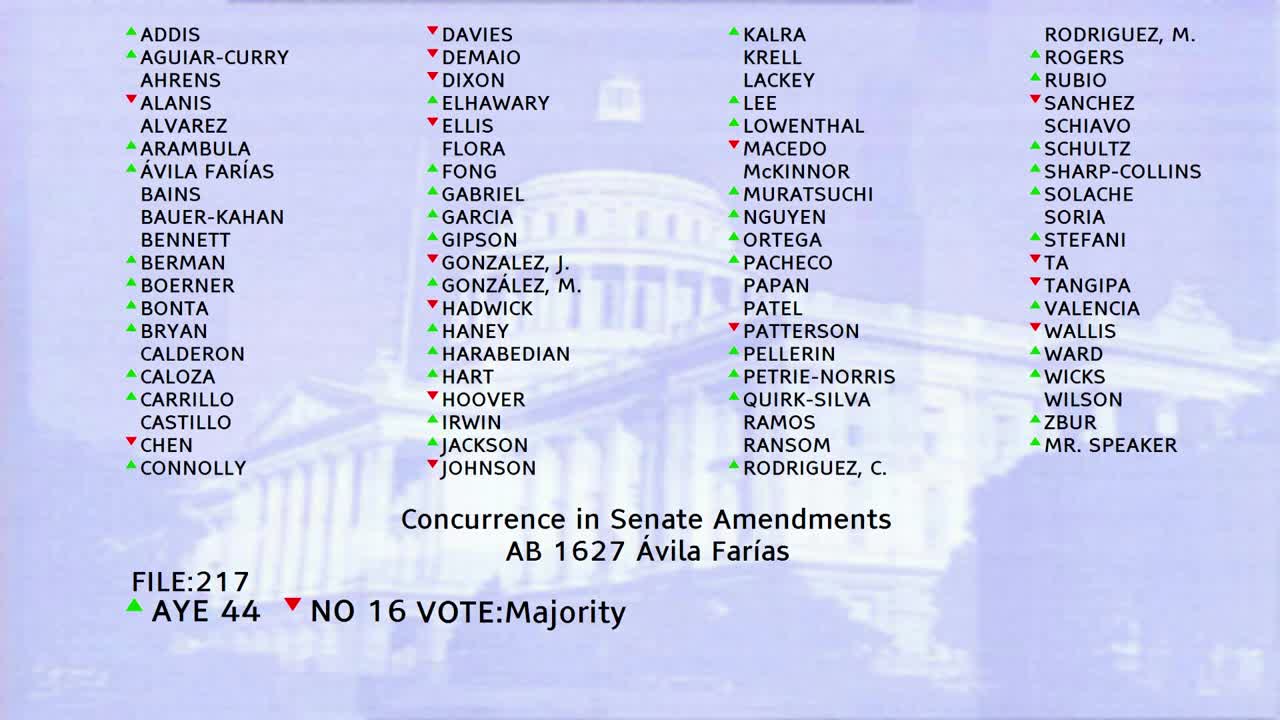 55SEC
Assembly Floor
 1MIN
Assembly Floor
 3MIN
Assembly Standing Committee on Appropriations
 10MIN
Assembly Standing Committee on Health
Bill Author

Bill Co-Author(s):
