AB 1207: Climate change: market-based compliance mechanism: extension.
- Session Year: 2025-2026
- House: Assembly
- Latest Version Date: 2025-09-19
Current Status:
Passed
(2025-09-19: Chaptered by Secretary of State - Chapter 117, Statutes of 2025.)
Introduced
In Committee
Awaiting First Chamber Vote
Passed First Chamber
In Committee
Awaiting Second Chamber Vote
Passed Second Chamber
Enacted
What does this bill do?
This bill extends California’s market-based greenhouse gas program (the California Cap-and-Invest Program) through 2045 and requires the Air Resources Board to update rules to meet state emissions targets while shifting support from gas companies to electric distribution utilities to limit rate impacts. It also sets limits on the use of offset credits, creates a California Climate Mitigation Fund to receive revenue from high‑price allowance sales for household energy rebates, changes how utility allowance revenues are credited to customers (up to four high‑bill months), requires a temporary 5% transfer for transmission investment, and increases reporting by utilities and the state.
The summary is provided by generative AI which can make mistakes. For original language, please view the details in the table below.
The California Global Warming Solutions Act of 2006 requires the State Air Resources Board to adopt regulations for greenhouse gas emissions limits and emissions reduction measures to achieve the maximum technologically feasible and cost-effective reductions in greenhouse gas emissions in furtherance of achieving the statewide greenhouse gas emissions limit, as defined. The act authorizes the state board to revise regulations or adopt additional regulations to further the act. The act authorizes that state board to include in those regulations the use of a market-based compliance mechanism to comply with those regulations.
This bill would require the state board to adopt regulations for greenhouse gas emissions limits and emissions reduction measures to achieve the maximum technologically feasible and cost-effective reductions in greenhouse gas emissions to instead achieve certain emissions reductions goals and the purposes of the act. The bill would require the state board, in adopting regulations, to design the regulations in a manner that transitions support from gas corporations to electrical distribution utilities to minimize ratepayer impacts and meet the emissions reduction goals of the act. The bill would require the state board to consider the effects of the regulations on affordability, cost-effectiveness, minimization of leakage in California, and achieving the emissions reduction goals of the act. The bill would state the intent of the Legislature that the market-based compliance mechanism be known as the California Cap-and-Invest Program.
The act, until January 1, 2031, authorizes the state board to adopt a regulation establishing a market-based compliance mechanism that is a system of market-based declining aggregate emissions limits for sources or categories of sources that emit greenhouse gases meeting certain requirements, including the establishment of a price ceiling, as provide, the allowance price containment reserve, and a requirement for state board, if the allowance from the allowance price containment reserve is exhausted, to offer covered entities additional allowances at the price ceiling if need for compliance. The act requires that moneys generated by the sale of those additional allowances be expended by the state board to achieve emissions reductions, as provided. The act, until January 1, 2031, establishes the Compliance Offsets Protocol Task Force to provide guidance to the state board in approving new offset protocols for the market-based compliance mechanism for purposes of increasing offset projects, as provided. The act, until January 1, 2031, establishes the Independent Emissions Market Advisory Committee within the California Environmental Protection Agency and requires the committee to annually report to the state board and the Joint Legislative Committee on Climate Change Policies on the environmental and economic performance of the regulation establishing the market-based compliance mechanism and other relevant climate change policies. The act, until January 1, 2031, requires the state board to designate the market-based compliance mechanism as the rule for petroleum refineries and oil and gas production facilities to achieve their greenhouse gas emissions reductions. The act provides that a violation of any rule, regulation, order, emissions limitation, emissions reduction measure, or other measure adopted by the state board under the act is a crime.
Existing law requires moneys collected by the state board from the auction or sale of allowances as part of a market-based compliance mechanism to be deposited in the Greenhouse Gas Reduction Fund and continuously appropriates a portion of the moneys in the fund for various purposes.
This bill would extend the above-described provisions until January 1, 2046. The bill would require the state board, in adopting those regulations, to additionally do certain things, including establish offset credit limits from January 1, 2026, to December 31, 2045, inclusive, as provided. The bill would require that moneys generated from the sale of additional allowances at the price ceiling be deposited into the California Climate Mitigation Fund, which the bill would create in the State Treasury. The bill would require moneys in the California Climate Mitigation Fund be available, upon appropriation by the Legislature, for purposes of providing direct rebates and investments to reduce household energy costs. Because a violation of the market-based compliance mechanism whose operation would be extended by the bill would be a crime, the bill would impose a state-mandated local program. By extending the operation of the market-based compliance mechanism, thereby extending the deposit of moneys from that market-based compliance mechanism into the fund, the bill would make an appropriation. This bill would specify that the members of the Independent Emissions Market Advisory Committee are to be considered designated employees of the California Environmental Protection Agency for purposes of the Political Reform Act of 1974.
This bill would, if the state board initiates a regulatory process to update those regulations that is expected to be a major regulation for purposes of the Administrative Procedure Act, require the chairperson of the state board, until January 1, 2046, to present to the Joint Legislative Committee on Climate Change Policies and other relevant policy committees of the Legislature on the current state of the market-based compliance mechanism and provide the rationale for updating the regulations, as provided, and to transmit certain information to the joint legislative committee and the relevant budget subcommittees, including the economic analysis required by the Administrative Procedure Act of the proposed amendments to the regulations. The bill would require the state board and other state agencies implementing programs that are funded by the Greenhouse Gas Reduction Fund, upon request, to appear annually before the Joint Legislative Committee on Climate Change Policies and the relevant budget subcommittees to give a presentation on the expenditures of those moneys.
The act requires the state board, on or before January 1, 2009, to prepare and adopt a scoping plan for achieving the maximum technologically feasible and cost-effective reductions in greenhouse gas emissions and to update the scoping plan at least once every 5 years.
This bill would require the state board, until January 1, 2046, to include in the updates to the scoping plan the progress towards meeting certain greenhouse gas emissions reduction targets and recommendations to the Legislature on necessary statutory changes to the market-based compliance mechanism to further cost-effectively reduce emissions of greenhouse gases.
Existing law authorizes the Public Utilities Commission to allocate 15% of the revenues received by electrical corporations as a result of the direct allocation of greenhouse gas allowances to electric corporations for clean energy and energy efficiency projects that are administered by the electrical corporations or a qualified third-party administrator and that are not otherwise funded by other funding sources. Existing law requires the commission to require the balance of those revenues to be credited directly to the residential, small business, and emissions-intensive, trade-exposed retail customers of the electrical corporations. Existing law requires the commission to require the adoption and implementation of a customer outreach plan for each electrical corporation for purposes of obtaining the maximum feasible public awareness of the crediting of greenhouse gas allowance revenues.
This bill would require the credits provided to residential customers to be provided on the bills of those customers in no more than 4 high-billed months of each year to maximize customer electric bill affordability or as otherwise directed by the commission to address extreme, unforeseen, and temporary circumstances. The bill would instead authorize the commission to require those revenues to be credited to small businesses and emission-intensive trade-exposed retail customers of the electrical corporations. The bill would require the commission, not later than January 1, 2027, to require each electrical corporation to update its customer outreach plan, as provided.
This bill would make the 15% allocation for clean energy and energy efficiency projects inoperative on July 1, 2026. The bill would require, from July 1, 2026, to January 1, 2031, inclusive, 5% of those revenues be remitted to the State Treasury for deposit into the California Transmission Accelerator Revolving Fund and be available to California Infrastructure and Economic Development Bank for purposes of the California Transmission Accelerator Revolving Fund Program.
Under existing law, a violation of the Public Utilities Act or an order, decision, rule, direction, demand, or requirement of the commission is a crime.
Because certain provisions of the bill would be part of the Public Utilities Act and a violation of a commission action implementing the bills requirements would be a crime, this bill would impose a state-mandated local program.
This bill would require local publicly owned electric utilities receiving a direct allocation of greenhouse gas allowances in addition to the greenhouse gas allowance totals specified in the regulations implementing the market-based compliance mechanism to provide a credit, as provided. The bill would require local publicly owned electric utilities to report to the state board on the uses of all revenues received by those utilities as a result of the direct allocation of greenhouse gas allowances under those regulations and would require the state board to annually submit a report to the Legislature on the uses of those revenues. By imposing additional duties on local publicly owned electric utilities, the bill would impose a state-mandated local program.
The California Constitution requires the state to reimburse local agencies and school districts for certain costs mandated by the state. Statutory provisions establish procedures for making that reimbursement.
This bill would provide that no reimbursement is required by this act for specified reasons.
This bill would declare that it is to take effect immediately as an urgency statute.
The California Global Warming Solutions Act of 2006 designates the State Air Resources Board as the state agency charged with monitoring and regulating sources of emissions of greenhouse gases and requires the state board to ensure that statewide greenhouse gas emissions are reduced to at least 40% below the 1990 level by 2030. The act, until January 1, 2031, authorizes the state board to adopt a regulation establishing a system of market-based declining aggregate emissions limits for sources or categories of sources that emit greenhouse gases (market-based compliance mechanism) that meets certain requirements. Existing law requires the state board, in adopting the regulation to, among other things, establish a price ceiling for emission allowances sold by the state board. Existing law requires the state board, in establishing the price ceiling, to consider specified factors, including the full social cost associated with emitting a metric ton of greenhouse gases.This bill would require the state board to instead consider the full social cost associated with emitting a metric ton of greenhouse gases, as determined by the United States Environmental Protection Agency in November 2023.The California Global Warming Solutions Act of 2006 designates the State Air Resources Board as the state agency charged with monitoring and regulating sources of emissions of greenhouse gases and requires the state board to ensure that statewide greenhouse gas emissions are reduced to at least 40% below the 1990 level by 2030. The act, until January 1, 2031, authorizes the state board to adopt a regulation establishing a system of market-based declining aggregate emissions limits for sources or categories of sources that emit greenhouse gases (market-based compliance mechanism) that meets certain requirements. Pursuant to this authority, the state board adopted the California Greenhouse Gas Cap-and-Trade Program. Existing law requires the state board, in adopting the regulation to, among other things, establish a price ceiling for emission allowances sold by the state board. Existing law requires the state board, in establishing the price ceiling, to consider specified factors, including the full social cost associated with emitting a metric ton of greenhouse gases.
This bill would require the state board to instead consider the full social cost associated with emitting a metric ton of greenhouse gases, as determined by the United States Environmental Protection Agency in November 2023.
This bill would state the intent of the Legislature to enact subsequent legislation to reauthorize the California Greenhouse Gas Cap-and-Trade Program.The California Global Warming Solutions Act of 2006 designates the State Air Resources Board as the state agency charged with monitoring and regulating sources of emissions of greenhouse gases and requires the state board to ensure that statewide greenhouse gas emissions are reduced to at least 40% below the 1990 level by 2030. The act, until January 1, 2031, authorizes the state board to adopt a regulation establishing a system of market-based declining aggregate emissions limits for sources or categories of sources that emit greenhouse gases (market-based compliance mechanism) that meets certain requirements. Pursuant to this authority, the state board adopted the California Greenhouse Gas Cap-and-Trade Program.
This bill would state the intent of the Legislature to enact subsequent legislation to reauthorize the California Greenhouse Gas Cap-and-Trade Program.
(a)The Legislature finds and declares all of the following:
(1)Global warming poses a serious threat to the economic well-being, public health, natural resources, and the environment of California. The potential adverse impacts of global warming include the exacerbation of air quality problems, a reduction in the quality and supply of water to the state from the Sierra snowpack, a rise in sea levels resulting in the displacement of thousands of coastal businesses and residences, damage to marine ecosystems and the natural environment, and an increase in the incidences of infectious diseases, asthma, and other human health-related problems.
(2)Global warming will have detrimental effects on some of Californias largest industries, including agriculture, wine, tourism, skiing, recreational and commercial fishing, and forestry. It will also increase the strain on electricity supplies necessary to meet the demand for summer air-conditioning in the hottest parts of the state.
(3)California has long been a national and international leader on energy conservation and environmental stewardship efforts, including the areas of air quality protections, energy efficiency requirements, renewable and clean energy standards, natural resource conservation, and greenhouse gas emission standards for vehicles. The program established by this division will continue this tradition of environmental leadership by placing California at the forefront of national and international efforts to reduce emissions of greenhouse gases.
(4)National and international actions are necessary to fully address the issue of global warming. However, action taken by California to reduce emissions of greenhouse gases will have far-reaching effects by encouraging other states, the federal government, and other countries to act.
(5)California has positioned its economy, technology centers, financial institutions, and businesses to benefit from national and international efforts to reduce emissions of greenhouse gases. More importantly, investing in the development of innovative and pioneering technologies will continue to assist California in achieving statewide greenhouse gas emissions targets established by this division and will continue to provide an opportunity for the state to take a global economic and technological leadership role in reducing emissions of greenhouse gases.
(b)(1)It is the intent of the Legislature that the State Air Resources Board coordinate with state agencies, as well as consult with the environmental justice community, industry sectors, business groups, academic institutions, environmental organizations, and other stakeholders in implementing this division.
(2)It is the intent of the Legislature that the State Air Resources Board consult with the Public Utilities Commission in the development of emissions reduction measures, including limits on emissions of greenhouse gases applied to electricity and natural gas providers regulated by the Public Utilities Commission, in order to ensure that electricity and natural gas providers are not required to meet duplicative or inconsistent regulatory requirements.
(3)It is the intent of the Legislature that the State Air Resources Board design emissions reduction measures to meet the statewide emissions limits for greenhouse gases established pursuant to this division in a manner that minimizes costs and maximizes benefits for Californias economy, improves and modernizes Californias energy infrastructure and maintains a safe, clean, affordable, resilient, and reliable electric system, maximizes additional environmental and economic cobenefits for California, and complements the states efforts to improve air quality.
(4)It is the intent of the Legislature that the State Air Resources Board extend the market-based compliance mechanism adopted pursuant to subdivision (c) of Section 38562 from January 1, 2021, to December 31, 2045, inclusive, in a manner that effectively reduces greenhouse gas emissions; minimizes any adverse impacts on state consumers, businesses, and the economy; and continues elements of the current program that protect state utility ratepayers, encourages decarbonization of the states economic sectors, and further enables Californians to affordably decarbonize and power their end uses.
(5)It is the intent of the Legislature that the Climate Action Team established by the Governor to coordinate the efforts set forth under Executive Order No. S-3-05 continue its role in coordinating overall climate policy.
(6)It is the intent of the Legislature that the market-based compliance mechanism be known as the California Cap-and-Invest Program in recognition of its cost-effective, market-based approach to reduce emissions of greenhouse gases and the direct and indirect investments the mechanism has demonstrated, and should continue to demonstrate, in cost-effective emission reduction measures.
(c)This section shall remain in effect only until January 1, 2046, and as of that date is repealed.
SEC. 2.Section 38501 of the Health and Safety Code, as added by Section 2 of Chapter 135 of the Statutes of 2017, is amended to read:38501.(a)The Legislature finds and declares all of the following:
(1)Global warming poses a serious threat to the economic well-being, public health, natural resources, and the environment of California. The potential adverse impacts of global warming include the exacerbation of air quality problems, a reduction in the quality and supply of water to the state from the Sierra snowpack, a rise in sea levels resulting in the displacement of thousands of coastal businesses and residences, damage to marine ecosystems and the natural environment, and an increase in the incidences of infectious diseases, asthma, and other human health-related problems.
(2)Global warming will have detrimental effects on some of Californias largest industries, including agriculture, wine, tourism, skiing, recreational and commercial fishing, and forestry. It will also increase the strain on electricity supplies necessary to meet the demand for summer air-conditioning in the hottest parts of the state.
(3)California has long been a national and international leader on energy conservation and environmental stewardship efforts, including the areas of air quality protections, energy efficiency requirements, renewable energy standards, natural resource conservation, and greenhouse gas emission standards for passenger vehicles. The program established by this division will continue this tradition of environmental leadership by placing California at the forefront of national and international efforts to reduce emissions of greenhouse gases.
(4)National and international actions are necessary to fully address the issue of global warming. However, action taken by California to reduce emissions of greenhouse gases will have far-reaching effects by encouraging other states, the federal government, and other countries to act.
(5)California has positioned its economy, technology centers, financial institutions, and businesses to benefit from national and international efforts to reduce emissions of greenhouse gases. More importantly, investing in the development of innovative and pioneering technologies will continue to assist California in achieving the 2020 statewide limit on emissions of greenhouse gases established by this division and will continue to provide an opportunity for the state to take a global economic and technological leadership role in reducing emissions of greenhouse gases.
(b)(1)It is the intent of the Legislature that the State Air Resources Board coordinate with state agencies, as well as consult with the environmental justice community, industry sectors, business groups, academic institutions, environmental organizations, and other stakeholders in implementing this division.
(2)It is the intent of the Legislature that the State Air Resources Board consult with the Public Utilities Commission in the development of emissions reduction measures, including limits on emissions of greenhouse gases applied to electricity and natural gas providers regulated by the Public Utilities Commission, in order to ensure that electricity and natural gas providers are not required to meet duplicative or inconsistent regulatory requirements.
(3)It is the intent of the Legislature that the State Air Resources Board design emissions reduction measures to meet the statewide emissions limits for greenhouse gases established pursuant to this division in a manner that minimizes costs and maximizes benefits for Californias economy, improves and modernizes Californias energy infrastructure and maintains a clean, safe, affordable, resilient, and reliable electric system, maximizes additional environmental and economic cobenefits for California, and complements the states efforts to improve air quality.
(4)It is the intent of the Legislature that the Climate Action Team established by the Governor to coordinate the efforts set forth under Executive Order No. S-3-05 continue its role in coordinating overall climate policy.
(5)It is the intent of the Legislature that the market-based compliance mechanism be known as the California Cap-and-Invest Program in recognition of its cost-effective, market-based approach to reduce emissions of greenhouse gases and the direct and indirect investments the mechanism has demonstrated, and should continue to demonstrate, in cost-effective emission reduction measures.
(c)This section shall become operative on January 1, 2046.
SEC. 3.Section 38562 of the Health and Safety Code, as amended by Section 4 of Chapter 135 of the Statutes of 2017, is amended to read:38562.(a)The state board shall adopt greenhouse gas emissions limits and emissions reduction measures by regulation to achieve the maximum technologically feasible and cost-effective reductions in greenhouse gas emissions to achieve the requirements of Sections 38562.2 and 38566 and the purposes of this division.
(b)In adopting regulations pursuant to this section and Part 5 (commencing with Section 38570), to the extent feasible, to achieve the requirements of Sections 38562.2 and 38566 and the purposes of this division, the state board shall do all of the following:
(1)(A)Design the regulations, including distribution of emissions allowances where appropriate, in a manner that is equitable, seeks to minimize costs and maximize the total benefits to California, and encourages early action to reduce greenhouse gas emissions.
(B)(i)Design the regulations, including distribution of emissions allowances where appropriate, in a manner that transitions support from gas corporations to electrical distribution utilities, as defined in Section 95802 of Title 17 of the California Code of Regulations, on or before January 1, 2031, to minimize ratepayer impacts and achieve the requirements of Sections 38562.2 and 38566 and the purposes of this division.
(ii)For purposes of this subparagraph, gas corporation has the same meaning as set forth in Section 222 of the Public Utilities Code.
(iii)Except as provided in clause (i), this subparagraph shall not be construed to impact the distribution of emissions allowances to emissions-intensive, trade-exposed industrial sectors.
(2)Ensure that activities undertaken to comply with the regulations do not disproportionately impact low-income communities.
(3)Ensure that entities that have voluntarily reduced their greenhouse gas emissions before the implementation of this section receive appropriate credit for early voluntary reductions.
(4)Ensure that activities undertaken pursuant to the regulations complement, and do not interfere with, efforts to achieve and maintain federal and state ambient air quality standards and to reduce toxic air contaminant emissions.
(5)Consider cost-effectiveness of these regulations.
(6)Consider overall societal benefits, including reductions in other air pollutants, diversification of energy sources, and other benefits to the economy, environment, and public health.
(7)Consider the effect of these regulations on affordability, cost effectiveness, minimization of leakage in California, and achieving the requirements of Sections 38562.2 and 38566 and the purposes of this division.
(8)Minimize the administrative burden of implementing and complying with these regulations.
(9)Minimize leakage.
(10)Consider the significance of the contribution of each source or category of sources to statewide emissions of greenhouse gases.
(c)(1)Unless otherwise required by context, terms in this subdivision shall have the definitions that apply pursuant to Section 95802 of Title 17 of the California Code of Regulations, as they read on January 1, 2017.
(2)To achieve the requirements of Sections 38562.2 and 38566 and the purposes of this division, the state board shall adopt a regulation that establishes a system of market-based declining annual aggregate emissions limits for sources or categories of sources that emit greenhouse gases, applicable from January 1, 2012, to December 31, 2045, inclusive, that the state board determines will achieve the maximum technologically feasible and cost-effective reductions in greenhouse gas emissions, in the aggregate, from those sources or categories of sources, and ensures that programwide aggregate emissions from covered sources, at a minimum, decline with the requirements of Sections 38562.2 and 38566. In adopting a regulation applicable from January 1, 2021, to December 31, 2045, inclusive, pursuant to this subdivision, the state board shall do all of the following:
(A)(i)Establish a price ceiling. In establishing the price ceiling, the state board shall consider, using the best available science, all of the following:
(I)The need to avoid adverse impacts on resident households, businesses, and the states economy.
(II)The 2020 tier prices of the allowance price containment reserve.
(III)The full social cost associated with emitting a metric ton of greenhouse gases.
(IV)The auction reserve price.
(V)The potential for environmental and economic leakage.
(VI)The cost per metric ton of greenhouse gas emissions reductions to achieve the statewide emissions targets established in Sections 38550 and 38566.
(ii)To implement the price ceiling, the state board shall develop a mechanism that consists of both of the following:
(I)Allowances remaining in the allowance price containment reserve as of December 31, 2020, shall be used solely for the purpose of sale at the price ceiling established by this section.
(II)If the allowances from the allowance price containment reserve are exhausted, the state board shall offer covered entities additional metric tons at the price ceiling if needed for compliance. Notwithstanding any other law, all moneys generated pursuant to this clause shall be deposited into the California Climate Mitigation Fund, which is hereby created in the State Treasury. Moneys in that fund shall be available, upon appropriation by the Legislature, for purposes, including, but not limited to, providing direct rebates and investments to reduce household energy costs, including incentives to transition to zero-emission vehicles and energy efficient housing.
(iii)If the state board finds that the price containment reserve or the price ceiling, or both the price containment reserve and price ceiling do not adequately protect California consumers, the state board shall consider additional actions to ensure consumers are protected. Those actions may include, but are not limited to, adjustment to the allowance price containment reserve or the price ceiling, or both the allowance price containment reserve and the price ceiling.
(B)Establish two price containment points at levels below the price ceiling. The state board shall offer to covered entities nontradable allowances for sale at these price containment points. The price containment points shall be established using two-thirds, divided equally, of the allowances in the allowance price containment reserve as of December 31, 2017.
(C)Require that current vintage allowances designated by the state board for auction that remain unsold in the auction holding account for more than 24 months to be transferred to the allowance price containment reserve.
(D)Evaluate and address concerns related to overallocation in the state boards determination of the number of available allowances for years 2021 to 2030, inclusive, as appropriate.
(E)(i)Establish offset credit limits according to the following:
(I)From January 1, 2021, to December 31, 2025, inclusive, a total of 4 percent of a covered entitys compliance obligation may be met by surrendering offset credits of which no more than one-half may be sourced from projects that do not provide direct environmental benefits in state.
(II)From January 1, 2026, to December 31, 2045, inclusive, no greater than a total of 6 percent of a covered entitys compliance obligation may be met by surrendering offset credits of which no more than one-half may be sourced from projects that do not provide direct environmental benefits in the state.
(ii)For purposes of this subparagraph, direct environmental benefits in the state are the reduction or avoidance of emissions of any air pollutant in the state or the reduction or avoidance of any pollutant that could have an adverse impact on waters of the state.
(iii)A number of allowances equal to the total number of offset credits used for compliance obligations in the prior year shall be removed from the next years annual allowance budget and retired.
(F)Develop approaches to increase offset projects in the state considering guidance provided by the Compliance Offsets Protocol Task Force, established pursuant to Section 38591.1.
(G)Set industry assistance factors for allowance allocation commencing in 2021 through 2030 at the levels applicable in the compliance period of 2015 to 2017, inclusive. Commencing January 1, 2031, the state board shall distribute industrial sector allowances in a manner that minimizes emissions leakage risk to cost-effectively achieve the requirements of Sections 38562.2 and 38566 and the purposes of this division.
(H)Consider developing additional compliance offset protocols to address sectors that are not covered by the market-based compliance mechanism but are identified in the scoping plan prepared pursuant to Section 38561, including carbon dioxide removal, or the targets established pursuant to Section 38561.5.
(I)Establish allowance banking rules that discourage speculation, avoid financial windfalls, and consider the impact on complying entities and volatility in the market.
(J)Report to the Legislature, by December 31, 2025, on the progress toward meeting the greenhouse gas emissions reduction targets established pursuant to Sections 38550 and 38566 and the leakage risk posed by the regulation. The state board shall include recommendations to the Legislature on necessary statutory changes to the program to reduce leakage, including the potential for a border carbon adjustment, while maintaining the states ability to reach its targets.
(K)(i)Report to the Legislature, in consultation with the Independent Emissions Market Advisory Committee, established pursuant to Section 38591.2, if two consecutive auctions exceed the lower of the price containment levels established pursuant to subparagraph (B). The report shall assess the potential for allowance prices to reach the price ceiling for multiple auctions.
(ii)A report submitted to the Legislature pursuant to this section shall be submitted in compliance with Section 9795 of the Government Code.
(L)Report to the relevant fiscal and policy committees of the Legislature, including the Joint Committee on Climate Change Policies, on all of the following:
(i)Updates to the scoping plan prepared pursuant to Section 38561 before adopting the update.
(ii)Updates on the implementation of the scoping plan prepared pursuant to Section 38561.
(iii)Updates on the implementation of the market-based compliance mechanism adopted pursuant to this subdivision.
(d)Any regulation adopted by the state board pursuant to this part or Part 5 (commencing with Section 38570) shall ensure all of the following:
(1)The greenhouse gas emission reductions achieved are real, permanent, quantifiable, verifiable, and enforceable by the state board.
(2)For regulations pursuant to Part 5 (commencing with Section 38570), the reduction is in addition to any greenhouse gas emission reduction otherwise required by law or regulation, and any other greenhouse gas emission reduction that otherwise would occur.
(3)If applicable, the greenhouse gas emission reduction occurs over the same time period and is equivalent in amount to any direct emission reduction required pursuant to this division.
(e)The state board shall rely upon the best available economic and scientific information and its assessment of existing and projected technological capabilities when adopting the regulations required by this section.
(f)The state board shall consult with the Public Utilities Commission in the development of the regulations as they affect electricity and natural gas providers in order to minimize duplicative or inconsistent regulatory requirements.
(g)The state board may revise regulations adopted pursuant to this section and adopt additional regulations to further the provisions of this division.
(h)In the updates to the scoping plan prepared pursuant to Section 38561, the state board shall include the progress toward meeting the greenhouse gas emissions reduction targets established pursuant to Section 38562.2. The state board shall include recommendations to the Legislature on necessary statutory changes to the market-based compliance mechanism to further cost-effectively reduce emissions.
(i)The state board shall evaluate the cost impact of the market-based compliance mechanism on California consumers when it revises regulations implementing that mechanism pursuant to this section.
(j)This section shall remain in effect only until January 1, 2046, and as of that date is repealed.
SEC. 4.Section 38562 of the Health and Safety Code, as added by Section 5 of Chapter 135 of the Statutes of 2017, is amended to read:38562.(a)The state board shall adopt greenhouse gas emissions limits and emissions reduction measures by regulation to achieve the maximum technologically feasible and cost-effective reductions in greenhouse gas emissions to achieve the purposes of this division.
(b)In adopting regulations pursuant to this section and Part 5 (commencing with Section 38570), to the extent feasible, to achieve the purposes of this division, the state board shall do all of the following:
(1)(A)Design the regulations, including distribution of emissions allowances where appropriate, in a manner that is equitable, seeks to minimize costs and maximize the total benefits to California, and encourages early action to reduce greenhouse gas emissions.
(B)(i)Design the regulations, including distribution of emissions allowances where appropriate, in a manner that transitions support from gas corporations to electrical distribution utilities, as defined in Section 95802 of Title 17 of the California Code of Regulations, on or before January 1, 2031, to minimize ratepayer impacts and achieve the purposes of this division.
(ii)For purposes of this subparagraph, gas corporation has the same meaning as set forth in Section 222 of the Public Utilities Code.
(iii)Except as provided in clause (i), this subparagraph shall not be construed to impact the distribution of emissions allowances to emissions-intensive, trade-exposed industrial sectors.
(2)Ensure that activities undertaken to comply with the regulations do not disproportionately impact low-income communities.
(3)Ensure that entities that have voluntarily reduced their greenhouse gas emissions before the implementation of this section receive appropriate credit for early voluntary reductions.
(4)Ensure that activities undertaken pursuant to the regulations complement, and do not interfere with, efforts to achieve and maintain federal and state ambient air quality standards and to reduce toxic air contaminant emissions.
(5)Consider cost-effectiveness of these regulations.
(6)Consider overall societal benefits, including reductions in other air pollutants, diversification of energy sources, and other benefits to the economy, environment, and public health.
(7)Consider the effect of these regulations on affordability, cost-effectiveness, minimization of leakage in California, and achieving the purposes of this division.
(8)Minimize the administrative burden of implementing and complying with these regulations.
(9)Minimize leakage.
(10)Consider the significance of the contribution of each source or category of sources to statewide emissions of greenhouse gases.
(c)To achieve the purposes of this division, the state board shall adopt a regulation that establishes a system of market-based declining annual aggregate emissions limits for sources or categories of sources that emit greenhouse gases, applicable from January 1, 2012, to December 31, 2045, inclusive, that the state board determines will achieve the maximum technologically feasible and cost-effective reductions in greenhouse gas emissions, in the aggregate, from those sources or categories of sources, and ensures that programwide aggregate emissions from covered sources, at a minimum, decline in line with the purposes of this division.
(d)Any regulation adopted by the state board pursuant to this part or Part 5 (commencing with Section 38570) shall ensure all of the following:
(1)The greenhouse gas emission reductions achieved are real, permanent, quantifiable, verifiable, and enforceable by the state board.
(2)For regulations pursuant to Part 5 (commencing with Section 38570), the reduction is in addition to any greenhouse gas emission reduction otherwise required by law or regulation, and any other greenhouse gas emission reduction that otherwise would occur.
(3)If applicable, the greenhouse gas emission reduction occurs over the same time period and is equivalent in amount to any direct emission reduction required pursuant to this division.
(e)The state board shall rely upon the best available economic and scientific information and its assessment of existing and projected technological capabilities when adopting the regulations required by this section.
(f)The state board shall consult with the Public Utilities Commission in the development of the regulations as they affect electricity and natural gas providers in order to minimize duplicative or inconsistent regulatory requirements.
(g)The state board may revise regulations adopted pursuant to this section and adopt additional regulations to further the provisions of this division.
(h)This section shall become operative on January 1, 2046.
SEC. 5.Section 38562.1 is added to the Health and Safety Code, to read:38562.1.(a)If the state board initiates a regulatory process to update the market-based compliance mechanism, consistent with Section 38562, that is expected to be a major regulation as defined in Section 11342.548 of the Government Code, the chairperson of the state board shall present to the Joint Legislative Committee on Climate Change Policies and other relevant policy committees of the Legislature on the current state of the market-based compliance mechanism and provide the rationale for updating the market-based compliance mechanism, including the specific issues that the update is meant to address. The presentation by the chairperson of the state board pursuant to this section shall satisfy the requirements of subdivision (b) of Section 9147.10 of the Government Code and subdivision (b) of Section 38531 of this code for the year in which the presentation occurs.
(b)The state board shall transmit the economic analyses required by Chapter 3.5 (commencing with Section 11340) of Part 1 of Division 3 of Title 2 of the Government Code for a regulatory process subject to subdivision (a) to the Joint Legislative Committee on Climate Change Policies and the relevant budget subcommittees. Within 30 days of that transmittal, if requested by the chair of the Joint Legislative Committee on Climate Change Policies or the chairs of the relevant policy committees or budget subcommittees of the Legislature, the chairperson of the state board shall make themselves available for a hearing on the proposed regulatory amendments.
(c)The state board shall transmit to the Joint Legislative Committee on Climate Change Policies and other relevant policy committees of the Legislature the public agenda, when it is available, for the board meeting at which the amendments for a rulemaking under the regulatory process subject to subdivision (a) will be considered by the state board. If requested by the chair of the Joint Legislative Committee on Climate Change Policies or the chairs of the relevant policy committees or budget subcommittees of the Legislature, the chairperson of the state board shall make themselves available for a hearing on the amendments.
(d)The legislative hearings and notifications in this section shall not delay the state boards rulemaking process pursuant to Chapter 3.5 (commencing with Section 11340) of Part 1 of Division 3 of Title 2 of the Government Code.
(e)This section shall remain in effect only until January 1, 2046, and as of that date is repealed.
SEC. 6.Section 38590.1 of the Health and Safety Code is amended to read:38590.1.(a)It is the intent of the Legislature that moneys collected from the auction or sale of allowances pursuant to a market-based compliance mechanism established pursuant to this division shall be appropriated to include, but need not be limited to, the following priorities at the time an expenditure plan is adopted:
(1)Air toxic and criteria air pollutants from stationary and mobile sources.
(2)Low- and zero-carbon transportation alternatives.
(3)Sustainable agricultural practices that promote the transitions to clean technology, water efficiency, and improved air quality.
(4)Healthy forests and urban greening.
(5)Nature-based climate solutions, as defined in Section 38561.5.
(6)Short-lived climate pollutants.
(7)Climate adaptation and resiliency.
(8)Climate and clean energy research.
(b)Upon request of the chair of the Joint Legislative Committee on Climate Change Policies or the chair of the relevant budget subcommittees, the state board and any other agencies that have implemented programs funded using moneys collected from the auction or sale of allowances pursuant to a market-based compliance mechanism established pursuant to this division shall annually appear before the Joint Legislative Committee on Climate Change Policies and the relevant budget subcommittees of the Legislature to give a presentation on the expenditures of those moneys.
(c)This section shall remain in effect only until January 1, 2046, and as of that date is repealed.
SEC. 7.Section 38591.1 of the Health and Safety Code is amended to read:38591.1.(a)The Compliance Offsets Protocol Task Force is hereby established to provide guidance to the state board in approving new offset protocols for a market-based compliance mechanism for the purposes of increasing offset projects with direct environmental benefits in the state while prioritizing disadvantaged communities, Native American or tribal lands, and rural and agricultural regions. The state board shall appoint members to the Compliance Offsets Protocol Task Force to include a representative from each stakeholder group, including, but not limited to, all of the following:
(1)Scientists.
(2)Air pollution control and air quality management districts.
(3)Carbon market experts.
(4)Tribal representatives.
(5)Environmental justice advocates.
(6)Labor and workforce representatives.
(7)Forestry experts.
(8)Agriculture experts.
(9)Environmental advocates.
(10)Conservation advocates.
(11)Dairy experts.
(b)The Compliance Offsets Protocol Task Force shall consider the development of additional offset protocols, including, but not limited to, protocols for the enhanced management or conservation of agricultural and natural lands, and for the enhancement and restoration of wetlands.
(c)The Compliance Offsets Protocol Task Force shall develop recommendations for the state board on the inclusion of methodologies to allow groups of landowners to jointly develop natural and working lands offset projects under the approved offset protocols. The recommendations shall address how to lower project transaction costs for participants and enable a greater number of landowners to participate in those projects while protecting the integrity and transparency of those projects.
(d)This section shall remain in effect only until January 1, 2046, and as of that date is repealed.
SEC. 8.Section 38591.2 of the Health and Safety Code is amended to read:38591.2.(a)The Independent Emissions Market Advisory Committee is hereby established within the California Environmental Protection Agency.
(b)(1)(A)The committee shall be composed of at least five experts on emissions trading market design appointed according to the following:
(i)Three members appointed by the Governor.
(ii)One member appointed by the Senate Committee on Rules.
(iii)One member appointed by the Speaker of the Assembly.
(B)(i)The committee shall include a representative from the Legislative Analysts Office.
(ii)The representative from the Legislative Analysts Office shall be a nonvoting committee member.
(2)The committee members shall meet all of the following requirements:
(A)Have academic, nonprofit, and other relevant backgrounds.
(B)Lack financial conflicts of interest with entities subject to the regulation adopted by the state board pursuant to subdivision (c) of Section 38562.
(3)Notwithstanding any other law, committee members shall be considered designated employees, as defined in Section 82019 of the Government Code, of the California Environmental Protection Agency for the purposes of Section 82019 of the Government Code.
(c)The committee, at least annually, shall hold a public meeting and report to both the state board and the Joint Legislative Committee on Climate Change Policies on the environmental and economic performance of the regulation adopted by the state board pursuant to subdivision (c) of Section 38562 and other relevant climate policies.
(d)The activities of the committee pursuant to this section shall not be subject to subdivision (b) of Section 11122.5 of the Government Code.
(e)This section shall remain in effect only until January 1, 2046, and as of that date is repealed.
SEC. 9.Section 38592.5 of the Health and Safety Code is amended to read:38592.5.(a)(1)No later than January 1, 2018, the state board shall update the scoping plan, prepared pursuant to Section 38561, to achieve the greenhouse gas emissions reductions required pursuant to Section 38562.2 or 38566. The state board shall designate the market-based compliance mechanism adopted pursuant to subdivision (c) of Section 38562 as the rule for petroleum refineries and oil and gas production facilities to achieve their greenhouse gas emissions reductions.
(2)All greenhouse gas rules and regulations adopted by the state board shall be consistent with the updated scoping plan.
(3)This section does not limit the state boards authority to adopt, maintain, or revise any other measure, including, but not limited to, any of the following:
(A)Measures governing methane and fugitive emissions at refineries and oil and gas facilities.
(B)Advanced clean cars program adopted by the state board.
(C)Low-Carbon Fuel Standard regulations (Subarticle 7 (commencing with Section 95480) of Article 4 of Subchapter 10 of Chapter 1 of Division 3 of Title 17 of the California Code of Regulations).
(D)Regulations addressing short-lived climate pollutants.
(E)Implementation of the sustainable freight action plan released in July 2015 pursuant to Executive Order B-32-15.
(b)This section shall remain in effect only until January 1, 2046, and as of that date is repealed.
SEC. 10.Section 38592.6 of the Health and Safety Code is amended to read:38592.6.(a)The Legislative Analysts Office shall, until January 1, 2046, annually report to the Legislature on the economic impacts and benefits of the greenhouse gas emissions targets established pursuant to Sections 38550, 38562.2, and 38566.
(b)This section shall remain in effect only until January 1, 2046, and as of that date is repealed.
SEC. 11.Section 38594 of the Health and Safety Code, as amended by Section 12 of Chapter 135 of the Statutes of 2017, is amended to read:38594.(a)Except as provided in subdivision (b), nothing in this division shall limit or expand the existing authority of any district.
(b)A district shall not adopt or implement an emission reduction rule for carbon dioxide from stationary sources that are also subject to a market-based compliance mechanism adopted by the state board pursuant to subdivision (c) of Section 38562.
(c)Nothing in this section affects in any manner the authority of a district to adopt or implement, as applicable, any of the following:
(1)A rule, regulation, standard, or requirement authorized or required for a district to adopt under Division 26 (commencing with Section 39000) for purposes other than to reduce carbon dioxide from sources subject to a market-based compliance mechanism adopted by the state board pursuant to subdivision (c) of Section 38562.
(2)A rule, regulation, standard, or requirement authorized pursuant to a law affecting emissions associated with landfills, refrigerants, natural gas or methane, volatile organic compounds, or a rule required to comply with the federal Clean Air Act (42 U.S.C. Sec. 7401 et seq.) or regulations implementing that act.
(3)A rule, regulation, standard, or requirement authorized pursuant to a law to reduce vehicle trips, vehicle miles traveled, parking, or vehicular air emissions, including, but not limited to, a rule adopted pursuant to Chapter 728 of the Statutes of 2008.
(4)A rule, regulation, standard, or requirement established pursuant to the California Environmental Quality Act (Division 13 (commencing with Section 21000) of the Public Resources Code).
(5)A rule, regulation, standard, or requirement adopted by any state agency.
(d)This section shall become inoperative if the state board repeals the market-based compliance mechanism adopted by the state board pursuant to subdivision (c) of Section 38562. The state board shall notify the Secretary of State if this section becomes inoperative.
(e)This section shall remain in effect only until January 1, 2046, and as of that date is repealed.
SEC. 12.Section 38594 of the Health and Safety Code, as added by Section 13 of Chapter 135 of the Statutes of 2017, is amended to read:38594.(a)Nothing in this division shall limit or expand the existing authority of any district, as defined in Section 39025.
(b)This section shall become operative on January 1, 2046.
SEC. 13.Section 748.5 of the Public Utilities Code is amended to read:748.5.(a)(1)Except as provided in subdivisions (c), (d), and (e), the commission shall require revenues, including any accrued interest, received by an electrical corporation as a result of the direct allocation of greenhouse gas allowances to electric utilities pursuant to subdivision (b) of Section 95890 of Title 17 of the California Code of Regulations to be credited directly to the residential customers of the electrical corporation.
(2)Small business, emissions-intensive, trade-exposed retail customers of the electrical corporation that are covered entities under the regulations adopted pursuant to Section 38562 of the Health and Safety Code, and emissions-intensive, trade-exposed retail customers of the electrical corporation that are not covered entities under the regulations adopted pursuant to Section 38562 of the Health and Safety Code, may also be credited from the revenues in paragraph (1), as determined by the commission.
(3)The credits provided to residential customers of an electrical corporation shall be provided on the bills of those customers in no more than four high-billed months of each year to maximize customer electric bill affordability, or as otherwise directed by the commission to address extreme, unforeseen, and temporary circumstances.
(b)(1)Not later than January 1, 2013, the commission shall require the adoption and implementation of a customer outreach plan for each electrical corporation, including, but not limited to, such measures as notices in bills and through media outlets, for purposes of obtaining the maximum feasible public awareness of the crediting of greenhouse gas allowance revenues. Costs associated with the implementation of this plan are subject to recovery in rates pursuant to Section 454.
(2)Not later than January 1, 2027, the commission shall require each electrical corporation to update the customer outreach plan developed pursuant to paragraph (1) to include a statement at the top of customer bills in applicable months specifying the amount of money saved on a utility bill in that month and attributing those savings to the climate credit and the California Cap-and-Invest Program.
(c)The commission may allocate up to 15 percent of the revenues, including any accrued interest, received by an electrical corporation as a result of the direct allocation of greenhouse gas allowances to electrical distribution utilities pursuant to subdivision (b) of Section 95890 of Title 17 of the California Code of Regulations, for clean energy and energy efficiency projects established pursuant to statute that are administered by the electrical corporation, or a qualified third-party administrator as approved by the commission, and that are not otherwise funded by another funding source. This subdivision shall become inoperative on July 1, 2026.
(d)(1)The commission shall require an electrical corporation to annually remit to the State Treasury 5 percent of the revenues, including any accrued interest, received by the electrical corporation as a result of the direct allocation of greenhouse gas allowances to electrical distribution utilities pursuant to subdivision (b) of Section 95890 of Title 17 of the California Code of Regulations for deposit in the California Transmission Accelerator Revolving Fund, pursuant to Section 63049.72 of the Government Code. This paragraph shall become operative on July 1, 2026, and shall become inoperative on July 1, 2031.
(2)The revenues deposited in the fund shall be available to the California Infrastructure and Economic Development Bank for purposes of the California Transmission Accelerator Revolving Fund Program established pursuant to Sections 63049.71 to 63049.73, inclusive, of the Government Code.
SEC. 14.Section 748.5.5 is added to the Public Utilities Code, to read:748.5.5.(a)A local publicly owned electric utility that receives an allowance allocation in addition to the allowance totals specified in Section 95892 of Title 17 of the California Code of Regulations pursuant to subparagraph (B) of paragraph (1) of subdivision (b) of Section 38562 of the Health and Safety Code shall provide a credit in an amount equal to the total value of that additional allocation directly to ratepayers. This section does not limit the acceptable uses, as specified in paragraph (3) of subdivision (d) of Section 95892 of Title 17 of the California Code of Regulations, of other allowances allocated to local publicly owned electric utilities.
(b)A local publicly owned electric utility shall report to the State Air Resources Board on the uses of all revenues, including any accrued interest, received by that local publicly owned electric utility as a result of the direct allocation of greenhouse gas allowances to electric utilities pursuant to subdivision (b) of Section 95890 of Title 17 of the California Code of Regulations.
(c)Notwithstanding Section 10231.5 of the Government Code, the State Air Resources Board shall annually submit a report to the Legislature on the uses of revenues specified in subdivision (b) in accordance with Section 9795 of the Government Code.
SEC. 15.No reimbursement is required by this act pursuant to Section 6 of Article XIIIB of the California Constitution because a local agency or school district has the authority to levy service charges, fees, or assessments sufficient to pay for the program or level of service mandated by this act or because costs that may be incurred by a local agency or school district will be incurred because this act creates a new crime or infraction, eliminates a crime or infraction, or changes the penalty for a crime or infraction, within the meaning of Section 17556 of the Government Code, or changes the definition of a crime within the meaning of Section 6 of Article XIIIB of the California Constitution.
SEC. 16.This act is an urgency statute necessary for the immediate preservation of the public peace, health, or safety within the meaning of Article IV of the California Constitution and shall go into immediate effect. The facts constituting the necessity are:
To secure a greater reduction in greenhouse gas emissions to prevent catastrophic climate change, it is necessary for this act to take effect immediately.
(a)The Legislature finds and declares all of the following:
(a)(1)Global warming poses a serious threat to the economic well-being, public health, natural resources, and the environment of California. The potential adverse impacts of global warming include the exacerbation of air quality problems, a reduction in the quality and supply of water to the state from the Sierra snowpack, a rise in sea levels resulting in the displacement of thousands of coastal businesses and residences, damage to marine ecosystems and the natural environment, and an increase in the incidences of infectious diseases, asthma, and other human health-related problems.
(b)(2)Global warming will have detrimental effects on some of Californias largest industries, including agriculture, wine, tourism, skiing, recreational and commercial fishing, and forestry. It will also increase the strain on electricity supplies necessary to meet the demand for summer air-conditioning in the hottest parts of the state.
(c)(3)California has long been a national and international leader on energy conservation and environmental stewardship efforts, including the areas of air quality protections, energy efficiency requirements, renewable and clean energy standards, natural resource conservation, and greenhouse gas emission standards for passenger vehicles. The program established by this division will continue this tradition of environmental leadership by placing California at the forefront of national and international efforts to reduce emissions of greenhouse gases.
(d)(4)National and international actions are necessary to fully address the issue of global warming. However, action taken by California to reduce emissions of greenhouse gases will have far-reaching effects by encouraging other states, the federal government, and other countries to act.
(e)By exercising a global leadership role, California will also position(5)California has positioned its economy, technology centers, financial institutions, and businesses to benefit from national and international efforts to reduce emissions of greenhouse gases. More importantly, investing in the development of innovative and pioneering technologies will continue to assist California in achieving statewide greenhouse gas emissions targets established by this division and will continue to provide an opportunity for the state to take a global economic and technological leadership role in reducing emissions of greenhouse gases.
(f)(b)(1)It is the intent of the Legislature that the State Air Resources Board coordinate with state agencies, as well as consult with the environmental justice community, industry sectors, business groups, academic institutions, environmental organizations, and other stakeholders in implementing this division.
(g)(2)It is the intent of the Legislature that the State Air Resources Board consult with the Public Utilities Commission in the development of emissions reduction measures, including limits on emissions of greenhouse gases applied to electricity and natural gas providers regulated by the Public Utilities Commission Commission, in order to ensure that electricity and natural gas providers are not required to meet duplicative or inconsistent regulatory requirements.
(h)(3)It is the intent of the Legislature that the State Air Resources Board design emissions reduction measures to meet the statewide emissions limits for greenhouse gases established pursuant to this division in a manner that minimizes costs and maximizes benefits for Californias economy, improves and modernizes Californias energy infrastructure and maintains electric system reliability, a safe, clean, affordable, resilient, and reliable electric system, maximizes additional environmental and economic cobenefits for California, and complements the states efforts to improve air quality.
(i)(4)It is the intent of the Legislature that the State Air Resources Board extend the market-based compliance mechanism adopted pursuant to subdivision (c) of Section 38562 from January 1, 2021, to December 31, 2030, 2045, inclusive, in a manner that effectively reduces greenhouse gas emissions; minimizes any adverse impacts on state consumers, businesses, and the economy; and continues elements of the current program that protect state utility ratepayers. ratepayers, encourages decarbonization of the states economic sectors, and further enables Californians to affordably decarbonize and power their end uses.
(j)(5)It is the intent of the Legislature that the Climate Action Team established by the Governor to coordinate the efforts set forth under Executive Order No. S-3-05 continue its role in coordinating overall climate policy.
(6)It is the intent of the Legislature that the market-based compliance mechanism be known as the California Cap-and-Invest Program in recognition of its cost-effective, market-based approach to reduce emissions of greenhouse gases and the direct and indirect investments the mechanism has demonstrated, and should continue to demonstrate, in cost-effective emission reduction measures.
(k)(c)This section shall remain in effect only until January 1, 2031, 2046, and as of that date is repealed.
SEC. 2.Section 38501 of the Health and Safety Code, as added by Section 2 of Chapter 135 of the Statutes of 2017, is amended to read:38501.(a)Global warming The Legislature finds and declares all of the following:
(1)Global warming poses a serious threat to the economic well-being, public health, natural resources, and the environment of California. The potential adverse impacts of global warming include the exacerbation of air quality problems, a reduction in the quality and supply of water to the state from the Sierra snowpack, a rise in sea levels resulting in the displacement of thousands of coastal businesses and residences, damage to marine ecosystems and the natural environment, and an increase in the incidences of infectious diseases, asthma, and other human health-related problems.
(b)(2)Global warming will have detrimental effects on some of Californias largest industries, including agriculture, wine, tourism, skiing, recreational and commercial fishing, and forestry. It will also increase the strain on electricity supplies necessary to meet the demand for summer air-conditioning in the hottest parts of the state.
(c)(3)California has long been a national and international leader on energy conservation and environmental stewardship efforts, including the areas of air quality protections, energy efficiency requirements, renewable energy standards, natural resource conservation, and greenhouse gas emission standards for passenger vehicles. The program established by this division will continue this tradition of environmental leadership by placing California at the forefront of national and international efforts to reduce emissions of greenhouse gases.
(d)(4)National and international actions are necessary to fully address the issue of global warming. However, action taken by California to reduce emissions of greenhouse gases will have far-reaching effects by encouraging other states, the federal government, and other countries to act.
(e)By exercising a global leadership role, California will also position(5)California has positioned its economy, technology centers, financial institutions, and businesses to benefit from national and international efforts to reduce emissions of greenhouse gases. More importantly, investing in the development of innovative and pioneering technologies will continue to assist California in achieving the 2020 statewide limit on emissions of greenhouse gases established by this division and will continue to provide an opportunity for the state to take a global economic and technological leadership role in reducing emissions of greenhouse gases.
(f)(b)(1)It is the intent of the Legislature that the State Air Resources Board coordinate with state agencies, as well as consult with the environmental justice community, industry sectors, business groups, academic institutions, environmental organizations, and other stakeholders in implementing this division.
(g)(2)It is the intent of the Legislature that the State Air Resources Board consult with the Public Utilities Commission in the development of emissions reduction measures, including limits on emissions of greenhouse gases applied to electricity and natural gas providers regulated by the Public Utilities Commission Commission, in order to ensure that electricity and natural gas providers are not required to meet duplicative or inconsistent regulatory requirements.
(h)(3)It is the intent of the Legislature that the State Air Resources Board design emissions reduction measures to meet the statewide emissions limits for greenhouse gases established pursuant to this division in a manner that minimizes costs and maximizes benefits for Californias economy, improves and modernizes Californias energy infrastructure and maintains electric system reliability, a clean, safe, affordable, resilient, and reliable electric system, maximizes additional environmental and economic cobenefits for California, and complements the states efforts to improve air quality.
(i)(4)It is the intent of the Legislature that the Climate Action Team established by the Governor to coordinate the efforts set forth under Executive Order No. S-3-05 continue its role in coordinating overall climate policy.
(5)It is the intent of the Legislature that the market-based compliance mechanism be known as the California Cap-and-Invest Program in recognition of its cost-effective, market-based approach to reduce emissions of greenhouse gases and the direct and indirect investments the mechanism has demonstrated, and should continue to demonstrate, in cost-effective emission reduction measures.
(j)(c)This section shall become operative on January 1, 2031. 2046.
SEC. 3.Section 38562 of the Health and Safety Code, as amended by Section 4 of Chapter 135 of the Statutes of 2017, is amended to read:38562.(a)On or before January 1, 2011, the The state board shall adopt greenhouse gas emissions limits and emissions reduction measures by regulation to achieve the maximum technologically feasible and cost-effective reductions in greenhouse gas emissions in furtherance of achieving the statewide greenhouse gas emissions limit, to become operative beginning on January 1, 2012. to achieve the requirements of Sections 38562.2 and 38566 and the purposes of this division.
(b)In adopting regulations pursuant to this section and Part 5 (commencing with Section 38570), to the extent feasible and in furtherance of achieving the statewide greenhouse gas emissions limit, feasible, to achieve the requirements of Sections 38562.2 and 38566 and the purposes of this division, the state board shall do all of the following:
(1)(A)Design the regulations, including distribution of emissions allowances where appropriate, in a manner that is equitable, seeks to minimize costs and maximize the total benefits to California, and encourages early action to reduce greenhouse gas emissions.
(B)(i)Design the regulations, including distribution of emissions allowances where appropriate, in a manner that transitions support from gas corporations to electrical distribution utilities, as defined in Section 95802 of Title 17 of the California Code of Regulations, on or before January 1, 2031, to minimize ratepayer impacts and achieve the requirements of Sections 38562.2 and 38566 and the purposes of this division.
(ii)For purposes of this subparagraph, gas corporation has the same meaning as set forth in Section 222 of the Public Utilities Code.
(iii)Except as provided in clause (i), this subparagraph shall not be construed to impact the distribution of emissions allowances to emissions-intensive, trade-exposed industrial sectors.
(2)Ensure that activities undertaken to comply with the regulations do not disproportionately impact low-income communities.
(3)Ensure that entities that have voluntarily reduced their greenhouse gas emissions prior to before the implementation of this section receive appropriate credit for early voluntary reductions.
(4)Ensure that activities undertaken pursuant to the regulations complement, and do not interfere with, efforts to achieve and maintain federal and state ambient air quality standards and to reduce toxic air contaminant emissions.
(5)Consider cost-effectiveness of these regulations.
(6)Consider overall societal benefits, including reductions in other air pollutants, diversification of energy sources, and other benefits to the economy, environment, and public health.
(7)Consider the effect of these regulations on affordability, cost effectiveness, minimization of leakage in California, and achieving the requirements of Sections 38562.2 and 38566 and the purposes of this division.
(7)(8)Minimize the administrative burden of implementing and complying with these regulations.
(8)(9)Minimize leakage.
(9)(10)Consider the significance of the contribution of each source or category of sources to statewide emissions of greenhouse gases.
(c)(1)Unless otherwise required by context, terms in this subdivision shall have the definitions that apply pursuant to Section 95802 of Title 17 of the California Code of Regulations, as they read on January 1, 2017.
(2)The To achieve the requirements of Sections 38562.2 and 38566 and the purposes of this division, the state board may shall adopt a regulation that establishes a system of market-based declining annual aggregate emissions limits for sources or categories of sources that emit greenhouse gases, applicable from January 1, 2012, to December 31, 2030, 2045, inclusive, that the state board determines will achieve the maximum technologically feasible and cost-effective reductions in greenhouse gas emissions, in the aggregate, from those sources or categories of sources. sources, and ensures that programwide aggregate emissions from covered sources, at a minimum, decline with the requirements of Sections 38562.2 and 38566. In adopting a regulation applicable from January 1, 2021, to December 31, 2030, 2045, inclusive, pursuant to this subdivision, the state board shall do all of the following:
(A)(i)Establish a price ceiling. In establishing the price ceiling, the state board shall consider, using the best available science, all of the following:
(I)The need to avoid adverse impacts on resident households, businesses, and the states economy.
(II)The 2020 tier prices of the allowance price containment reserve.
(III)The full social cost associated with emitting a metric ton of greenhouse gases.
(IV)The auction reserve price.
(V)The potential for environmental and economic leakage.
(VI)The cost per metric ton of greenhouse gas emissions reductions to achieve the statewide emissions targets established in Sections 38550 and 38566.
(ii)To implement the price ceiling, the state board shall develop a mechanism that consists of both of the following:
(I)Allowances remaining in the allowance price containment reserve as of December 31, 2020, shall be utilized used solely for the purpose of sale at the price ceiling established by this section.
(II)If the allowances from the allowance price containment reserve are exhausted, the state board shall offer covered entities additional metric tons at the price ceiling if needed for compliance. All Notwithstanding any other law, all moneys generated pursuant to this clause shall be expended by the state board to achieve emissions reductions, on at least a metric ton for metric ton basis, that are real, permanent, quantifiable, verifiable, enforceable by the state board and in addition to any greenhouse gas emission reduction otherwise required by law or regulation and any other greenhouse gas emission reduction that otherwise would occur. deposited into the California Climate Mitigation Fund, which is hereby created in the State Treasury. Moneys in that fund shall be available, upon appropriation by the Legislature, for purposes, including, but not limited to, providing direct rebates and investments to reduce household energy costs, including incentives to transition to zero-emission vehicles and energy efficient housing.
(iii)If the state board finds that the price containment reserve or the price ceiling, or both the price containment reserve and price ceiling do not adequately protect California consumers, the state board shall consider additional actions to ensure consumers are protected. Those actions may include, but are not limited to, adjustment to the allowance price containment reserve or the price ceiling, or both the allowance price containment reserve and the price ceiling.
(B)Establish two price containment points at levels below the price ceiling. The state board shall offer to covered entities nontradable allowances for sale at these price containment points. The price containment points shall be established using two-thirds, divided equally, of the allowances in the allowance price containment reserve as of December 31, 2017.
(C)Require that current vintage allowances designated by the state board for auction that remain unsold in the auction holding account for more than 24 months to be transferred to the allowance price containment reserve.
(D)Evaluate and address concerns related to overallocation in the state boards determination of the number of available allowances for years 2021 to 2030, inclusive, as appropriate.
(E)(i)Establish offset credit limits according to the following:
(I)From January 1, 2021, to December 31, 2025, inclusive, a total of 4 percent of a covered entitys compliance obligation may be met by surrendering offset credits of which no more than one-half may be sourced from projects that do not provide direct environmental benefits in state.
(II)From January 1, 2026, to December 31, 2030, 2045, inclusive, no greater than a total of 6 percent of a covered entitys compliance obligation may be met by surrendering offset credits of which no more than one-half may be sourced from projects that do not provide direct environmental benefits in the state.
(ii)For purposes of this subparagraph, direct environmental benefits in the state are the reduction or avoidance of emissions of any air pollutant in the state or the reduction or avoidance of any pollutant that could have an adverse impact on waters of the state.
(iii)A number of allowances equal to the total number of offset credits used for compliance obligations in the prior year shall be removed from the next years annual allowance budget and retired.
(F)Develop approaches to increase offset projects in the state considering guidance provided by the Compliance Offsets Protocol Task Force, established pursuant to Section 38591.1.
(G)Set industry assistance factors for allowance allocation commencing in 2021 through 2030 at the levels applicable in the compliance period of 2015 to 2017, inclusive. The state board shall apply a declining cap adjustment factor to the industry allocation equivalent to the overall statewide emissions declining cap using the methodology from the compliance period of 2015 to 2017, inclusive. Commencing January 1, 2031, the state board shall distribute industrial sector allowances in a manner that minimizes emissions leakage risk to cost-effectively achieve the requirements of Sections 38562.2 and 38566 and the purposes of this division.
(H)Consider developing additional compliance offset protocols to address sectors that are not covered by the market-based compliance mechanism but are identified in the scoping plan prepared pursuant to Section 38561, including carbon dioxide removal, or the targets established pursuant to Section 38561.5.
(H)(I)Establish allowance banking rules that discourage speculation, avoid financial windfalls, and consider the impact on complying entities and volatility in the market.
(I)(J)Report to the Legislature, by December 31, 2025, on the progress toward meeting the greenhouse gas emissions reduction targets established pursuant to Sections 38550 and 38566 and the leakage risk posed by the regulation. The state board shall include recommendations to the Legislature on necessary statutory changes to the program to reduce leakage, including the potential for a border carbon adjustment, while maintaining the states ability to reach its targets.
(J)(K)(i)Report to the Legislature, in consultation with the Independent Emissions Market Advisory Committee, established pursuant to Section 38591.2, if two consecutive auctions exceed the lower of the price containment levels established pursuant to subparagraph (B). The report shall assess the potential for allowance prices to reach the price ceiling for multiple auctions.
(ii)A report submitted to the Legislature pursuant to this section shall be submitted in compliance with Section 9795 of the Government Code.
(K)(L)Report to the relevant fiscal and policy committees of the Legislature, including the Joint Committee on Climate Change Policies, on all of the following:
(i)Updates to the scoping plan prepared pursuant to Section 38561 prior to before adopting the update.
(ii)Updates on the implementation of the scoping plan prepared pursuant to Section 38561.
(iii)Updates on the implementation of the market-based compliance mechanism adopted pursuant to this subdivision.
(d)Any regulation adopted by the state board pursuant to this part or Part 5 (commencing with Section 38570) shall ensure all of the following:
(1)The greenhouse gas emission reductions achieved are real, permanent, quantifiable, verifiable, and enforceable by the state board.
(2)For regulations pursuant to Part 5 (commencing with Section 38570), the reduction is in addition to any greenhouse gas emission reduction otherwise required by law or regulation, and any other greenhouse gas emission reduction that otherwise would occur.
(3)If applicable, the greenhouse gas emission reduction occurs over the same time period and is equivalent in amount to any direct emission reduction required pursuant to this division.
(e)The state board shall rely upon the best available economic and scientific information and its assessment of existing and projected technological capabilities when adopting the regulations required by this section.
(f)The state board shall consult with the Public Utilities Commission in the development of the regulations as they affect electricity and natural gas providers in order to minimize duplicative or inconsistent regulatory requirements.
(g)The state board may revise regulations adopted pursuant to this section and adopt additional regulations to further the provisions of this division.
(h)This section shall remain in effect only until January 1, 2046, and as of that date is repealed, unless a later enacted statute which is enacted before that date, deletes or extends that date.(h)In the updates to the scoping plan prepared pursuant to Section 38561, the state board shall include the progress toward meeting the greenhouse gas emissions reduction targets established pursuant to Section 38562.2. The state board shall include recommendations to the Legislature on necessary statutory changes to the market-based compliance mechanism to further cost-effectively reduce emissions.
(i)The state board shall evaluate the cost impact of the market-based compliance mechanism on California consumers when it revises regulations implementing that mechanism pursuant to this section.
(j)This section shall remain in effect only until January 1, 2046, and as of that date is repealed.
SEC. 4.Section 38562 of the Health and Safety Code, as added by Section 5 of Chapter 135 of the Statutes of 2017, is amended to read:38562.(a)On or before January 1, 2011, the The state board shall adopt greenhouse gas emissions limits and emissions reduction measures by regulation to achieve the maximum technologically feasible and cost-effective reductions in greenhouse gas emissions in furtherance of achieving the statewide greenhouse gas emissions limit, to become operative beginning on January 1, 2012. to achieve the purposes of this division.
(b)In adopting regulations pursuant to this section and Part 5 (commencing with Section 38570), to the extent feasible and in furtherance of achieving the statewide greenhouse gas emissions limit, feasible, to achieve the purposes of this division, the state board shall do all of the following:
(1)(A)Design the regulations, including distribution of emissions allowances where appropriate, in a manner that is equitable, seeks to minimize costs and maximize the total benefits to California, and encourages early action to reduce greenhouse gas emissions.
(B)(i)Design the regulations, including distribution of emissions allowances where appropriate, in a manner that transitions support from gas corporations to electrical distribution utilities, as defined in Section 95802 of Title 17 of the California Code of Regulations, on or before January 1, 2031, to minimize ratepayer impacts and achieve the purposes of this division.
(ii)For purposes of this subparagraph, gas corporation has the same meaning as set forth in Section 222 of the Public Utilities Code.
(iii)Except as provided in clause (i), this subparagraph shall not be construed to impact the distribution of emissions allowances to emissions-intensive, trade-exposed industrial sectors.
(2)Ensure that activities undertaken to comply with the regulations do not disproportionately impact low-income communities.
(3)Ensure that entities that have voluntarily reduced their greenhouse gas emissions prior to before the implementation of this section receive appropriate credit for early voluntary reductions.
(4)Ensure that activities undertaken pursuant to the regulations complement, and do not interfere with, efforts to achieve and maintain federal and state ambient air quality standards and to reduce toxic air contaminant emissions.
(5)Consider cost-effectiveness of these regulations.
(6)Consider overall societal benefits, including reductions in other air pollutants, diversification of energy sources, and other benefits to the economy, environment, and public health.
(7)Consider the effect of these regulations on affordability, cost-effectiveness, minimization of leakage in California, and achieving the purposes of this division.
(7)(8)Minimize the administrative burden of implementing and complying with these regulations.
(8)(9)Minimize leakage.
(9)(10)Consider the significance of the contribution of each source or category of sources to statewide emissions of greenhouse gases.
(c)In furtherance of achieving the statewide greenhouse gas emissions limit, To achieve the purposes of this division, the state board may shall adopt a regulation that establishes a system of market-based declining annual aggregate emissions limits for sources or categories of sources that emit greenhouse gases, applicable from January 1, 2012, to December 31, 2020, 2045, inclusive, that the state board determines will achieve the maximum technologically feasible and cost-effective reductions in greenhouse gas emissions, in the aggregate, from those sources or categories of sources. sources, and ensures that programwide aggregate emissions from covered sources, at a minimum, decline in line with the purposes of this division.
(d)Any regulation adopted by the state board pursuant to this part or Part 5 (commencing with Section 38570) shall ensure all of the following:
(1)The greenhouse gas emission reductions achieved are real, permanent, quantifiable, verifiable, and enforceable by the state board.
(2)For regulations pursuant to Part 5 (commencing with Section 38570), the reduction is in addition to any greenhouse gas emission reduction otherwise required by law or regulation, and any other greenhouse gas emission reduction that otherwise would occur.
(3)If applicable, the greenhouse gas emission reduction occurs over the same time period and is equivalent in amount to any direct emission reduction required pursuant to this division.
(e)The state board shall rely upon the best available economic and scientific information and its assessment of existing and projected technological capabilities when adopting the regulations required by this section.
(f)The state board shall consult with the Public Utilities Commission in the development of the regulations as they affect electricity and natural gas providers in order to minimize duplicative or inconsistent regulatory requirements.
(g)The state board may revise regulations adopted pursuant to this section and adopt additional regulations to further the provisions of this division.
(h)This section shall become operative on January 1, 2031. 2046.
SEC. 5.Section 38562.1 is added to the Health and Safety Code, to read:38562.1.(a)If the state board initiates a regulatory process to update the market-based compliance mechanism, consistent with Section 38562, that is expected to be a major regulation as defined in Section 11342.548 of the Government Code, the chairperson of the state board shall present to the Joint Legislative Committee on Climate Change Policies and other relevant policy committees of the Legislature on the current state of the market-based compliance mechanism and provide the rationale for updating the market-based compliance mechanism, including the specific issues that the update is meant to address. The presentation by the chairperson of the state board pursuant to this section shall satisfy the requirements of subdivision (b) of Section 9147.10 of the Government Code and subdivision (b) of Section 38531 of this code for the year in which the presentation occurs.
(b)The state board shall transmit the economic analyses required by Chapter 3.5 (commencing with Section 11340) of Part 1 of Division 3 of Title 2 of the Government Code for a regulatory process subject to subdivision (a) to the Joint Legislative Committee on Climate Change Policies and the relevant budget subcommittees. Within 30 days of that transmittal, if requested by the chair of the Joint Legislative Committee on Climate Change Policies or the chairs of the relevant policy committees or budget subcommittees of the Legislature, the chairperson of the state board shall make themselves available for a hearing on the proposed regulatory amendments.
(c)The state board shall transmit to the Joint Legislative Committee on Climate Change Policies and other relevant policy committees of the Legislature the public agenda, when it is available, for the board meeting at which the amendments for a rulemaking under the regulatory process subject to subdivision (a) will be considered by the state board. If requested by the chair of the Joint Legislative Committee on Climate Change Policies or the chairs of the relevant policy committees or budget subcommittees of the Legislature, the chairperson of the state board shall make themselves available for a hearing on the amendments.
(d)The legislative hearings and notifications in this section shall not delay the state boards rulemaking process pursuant to Chapter 3.5 (commencing with Section 11340) of Part 1 of Division 3 of Title 2 of the Government Code.
(e)This section shall remain in effect only until January 1, 2046, and as of that date is repealed.
SEC. 6.Section 38590.1 of the Health and Safety Code is amended to read:38590.1.(a)It is the intent of the Legislature that moneys collected from the auction or sale of allowances pursuant to a market-based compliance mechanism established pursuant to the California Global Warming Solutions Act of 2006 (Division 25.5 (commencing with Section 38500)) this division shall be appropriated to include, but need not be limited to, the following priorities at the time an expenditure plan is adopted:
(1)Air toxic and criteria air pollutants from stationary and mobile sources.
(2)Low- and zero-carbon transportation alternatives.
(3)Sustainable agricultural practices that promote the transitions to clean technology, water efficiency, and improved air quality.
(4)Healthy forests and urban greening.
(5)Nature-based climate solutions, as defined in Section 38561.5.
(5)(6)Short-lived climate pollutants.
(6)(7)Climate adaptation and resiliency.
(7)(8)Climate and clean energy research.
(b)This section shall remain in effect only until January 1, 2031, and as of that date is repealed unless a later enacted statute that is enacted on or before that date deletes or extends that date.(b)Upon request of the chair of the Joint Legislative Committee on Climate Change Policies or the chair of the relevant budget subcommittees, the state board and any other agencies that have implemented programs funded using moneys collected from the auction or sale of allowances pursuant to a market-based compliance mechanism established pursuant to this division shall annually appear before the Joint Legislative Committee on Climate Change Policies and the relevant budget subcommittees of the Legislature to give a presentation on the expenditures of those moneys.
(c)This section shall remain in effect only until January 1, 2046, and as of that date is repealed.
SEC. 7.Section 38591.1 of the Health and Safety Code is amended to read:38591.1.(a)The Compliance Offsets Protocol Task Force is hereby established to provide guidance to the state board in approving new offset protocols for a market-based compliance mechanism for the purposes of increasing offset projects with direct environmental benefits in the state while prioritizing disadvantaged communities, Native American or tribal lands, and rural and agricultural regions. The state board shall appoint members to the Compliance Offsets Protocol Task Force to include a representative from each stakeholder group, including, but not limited to, all of the following:
(1)Scientists.
(2)Air pollution control and air quality management districts.
(3)Carbon market experts.
(4)Tribal representatives.
(5)Environmental justice advocates.
(6)Labor and workforce representatives.
(7)Forestry experts.
(8)Agriculture experts.
(9)Environmental advocates.
(10)Conservation advocates.
(11)Dairy experts.
(b)The Compliance Offsets Protocol Task Force shall consider the development of additional offset protocols, including, but not limited to, protocols for the enhanced management or conservation of agricultural and natural lands, and for the enhancement and restoration of wetlands.
(c)The Compliance Offsets Protocol Task Force shall develop recommendations for the state board on the inclusion of methodologies to allow groups of landowners to jointly develop natural and working lands offset projects under the approved offset protocols. The recommendations shall address how to lower project transaction costs for participants and enable a greater number of landowners to participate in those projects while protecting the integrity and transparency of those projects.
(d)This section shall remain in effect only until January 1, 2031, 2046, and as of that date is repealed.
SEC. 8.Section 38591.2 of the Health and Safety Code is amended to read:38591.2.(a)The Independent Emissions Market Advisory Committee is hereby established within the California Environmental Protection Agency.
(b)(1)(A)The committee shall be composed of at least five experts on emissions trading market design appointed according to the following:
(i)Three members appointed by the Governor.
(ii)One member appointed by the Senate Committee on Rules.
(iii)One member appointed by the Speaker of the Assembly.
(B)(i)The committee shall include a representative from the Legislative Analysts Office.
(ii)The representative from the Legislative Analysts Office shall be a nonvoting committee member.
(2)The committee members shall meet all of the following requirements:
(A)Have academic, nonprofit, and other relevant backgrounds.
(B)Lack financial conflicts of interest with entities subject to the regulation adopted by the state board pursuant to subdivision (c) of Section 38562.
(3)Notwithstanding any other law, committee members shall be considered designated employees, as defined in Section 82019 of the Government Code, of the California Environmental Protection Agency for the purposes of Section 82019 of the Government Code.
(c)The committee, at least annually, shall hold a public meeting and report to both the state board and the Joint Legislative Committee on Climate Change Policies on the environmental and economic performance of the regulation adopted by the state board pursuant to subdivision (c) of Section 38562 and other relevant climate policies.
(d)The activities of the committee pursuant to this section shall not be subject to subdivision (b) of Section 11122.5 of the Government Code.
(e)This section shall remain in effect only until January 1, 2031, 2046, and as of that date is repealed.
SEC. 9.Section 38592.5 of the Health and Safety Code is amended to read:38592.5.(a)(1)No later than January 1, 2018, the state board shall update the scoping plan, prepared pursuant to Section 38561, to achieve the greenhouse gas emissions reductions required pursuant to Section 38562.2 or 38566. The state board shall designate the market-based compliance mechanism adopted pursuant to subdivision (c) of Section 38562 as the rule for petroleum refineries and oil and gas production facilities to achieve their greenhouse gas emissions reductions.
(2)All greenhouse gas rules and regulations adopted by the state board shall be consistent with the updated scoping plan.
(3)Nothing in this section shall This section does not limit the state boards authority to adopt, maintain, or revise any other measure, including, but not limited to, any of the following:
(A)Measures governing methane and fugitive emissions at refineries and oil and gas facilities.
(B)Advanced clean cars program adopted by the state board.
(C)Low-Carbon Fuel Standard regulations (Subarticle 7 (commencing with Section 95480) of Article 4 of Subchapter 10 of Chapter 1 of Division 3 of Title 17 of the California Code of Regulations).
(D)Regulations addressing short-lived climate pollutants.
(E)Implementation of the sustainable freight action plan released in July 2015 pursuant to Executive Order B-32-15.
(b)This section shall remain in effect only until January 1, 2031, and as of that date is repealed, unless a later enacted statute, which is enacted before January 1, 2031, deletes or extends that date.(b)This section shall remain in effect only until January 1, 2046, and as of that date is repealed.
SEC. 10.Section 38592.6 of the Health and Safety Code is amended to read:38592.6.(a)The Legislative Analysts Office shall, until January 1, 2030, 2046, annually report to the Legislature on the economic impacts and benefits of the greenhouse gas emissions targets established pursuant to Sections 38550 and 38566. 38550, 38562.2, and 38566.
(b)This section shall remain in effect only until January 1, 2031, and as of that date is repealed, unless a later enacted statute, which is enacted before January 1, 2031, deletes or extends that date.(b)This section shall remain in effect only until January 1, 2046, and as of that date is repealed.
SEC. 11.Section 38594 of the Health and Safety Code, as amended by Section 12 of Chapter 135 of the Statutes of 2017, is amended to read:38594.(a)Except as provided in subdivision (b), nothing in this division shall limit or expand the existing authority of any district.
(b)A district shall not adopt or implement an emission reduction rule for carbon dioxide from stationary sources that are also subject to a market-based compliance mechanism adopted by the state board pursuant to subdivision (c) of Section 38562.
(c)Nothing in this section affects in any manner the authority of a district to adopt or implement, as applicable, any of the following:
(1)A rule, regulation, standard, or requirement authorized or required for a district to adopt under Division 26 (commencing with Section 39000) for purposes other than to reduce carbon dioxide from sources subject to a market-based compliance mechanism adopted by the state board pursuant to subdivision (c) of Section 38562.
(2)A rule, regulation, standard, or requirement authorized pursuant to a law affecting emissions associated with landfills, refrigerants, natural gas or methane, volatile organic compounds, or a rule required to comply with the federal Clean Air Act (42 U.S.C. Sec. 7401 et seq.) or regulations implementing that act.
(3)A rule, regulation, standard, or requirement authorized pursuant to a law to reduce vehicle trips, vehicle miles traveled, parking, or vehicular air emissions, including, but not limited to, a rule adopted pursuant to Chapter 728 of the Statutes of 2008.
(4)A rule, regulation, standard, or requirement established pursuant to the California Environmental Quality Act (Division 13 (commencing with Section 21000) of the Public Resources Code).
(5)A rule, regulation, standard, or requirement adopted by any state agency.
(d)This section shall become inoperative if the state board repeals the market-based compliance mechanism adopted by the state board pursuant to subdivision (c) of Section 38562. The state board shall notify the Secretary of State if this section becomes inoperative.
(e)This section shall remain in effect only until January 1, 2031, 2046, and as of that date is repealed.
SEC. 12.Section 38594 of the Health and Safety Code, as added by Section 13 of Chapter 135 of the Statutes of 2017, is amended to read:38594.(a)Nothing in this division shall limit or expand the existing authority of any district, as defined in Section 39025.
(b)This section shall become operative on January 1, 2031. 2046.
SEC. 13.Section 748.5 of the Public Utilities Code is amended to read:748.5.(a)(1)Except as provided in subdivision (c), subdivisions (c), (d), and (e), the commission shall require revenues, including any accrued interest, received by an electrical corporation as a result of the direct allocation of greenhouse gas allowances to electric utilities pursuant to subdivision (b) of Section 95890 of Title 17 of the California Code of Regulations to be credited directly to the residential, small business, and emissions-intensive trade-exposed retail residential customers of the electrical corporation.
(2)Small business, emissions-intensive, trade-exposed retail customers of the electrical corporation that are covered entities under the regulations adopted pursuant to Section 38562 of the Health and Safety Code, and emissions-intensive, trade-exposed retail customers of the electrical corporation that are not covered entities under the regulations adopted pursuant to Section 38562 of the Health and Safety Code, may also be credited from the revenues in paragraph (1), as determined by the commission.
(3)The credits provided to residential customers of an electrical corporation shall be provided on the bills of those customers in no more than four high-billed months of each year to maximize customer electric bill affordability, or as otherwise directed by the commission to address extreme, unforeseen, and temporary circumstances.
(b)(1)Not later than January 1, 2013, the commission shall require the adoption and implementation of a customer outreach plan for each electrical corporation, including, but not limited to, such measures as notices in bills and through media outlets, for purposes of obtaining the maximum feasible public awareness of the crediting of greenhouse gas allowance revenues. Costs associated with the implementation of this plan are subject to recovery in rates pursuant to Section 454.
(2)Not later than January 1, 2027, the commission shall require each electrical corporation to update the customer outreach plan developed pursuant to paragraph (1) to include a statement at the top of customer bills in applicable months specifying the amount of money saved on a utility bill in that month and attributing those savings to the climate credit and the California Cap-and-Invest Program.
(c)The commission may allocate up to 15 percent of the revenues, including any accrued interest, received by an electrical corporation as a result of the direct allocation of greenhouse gas allowances to electrical distribution utilities pursuant to subdivision (b) of Section 95890 of Title 17 of the California Code of Regulations, for clean energy and energy efficiency projects established pursuant to statute that are administered by the electrical corporation, or a qualified third-party administrator as approved by the commission, and that are not otherwise funded by another funding source. This subdivision shall become inoperative on July 1, 2026.
(d)(1)The commission shall require an electrical corporation to annually remit to the State Treasury 5 percent of the revenues, including any accrued interest, received by the electrical corporation as a result of the direct allocation of greenhouse gas allowances to electrical distribution utilities pursuant to subdivision (b) of Section 95890 of Title 17 of the California Code of Regulations for deposit in the California Transmission Accelerator Revolving Fund, pursuant to Section 63049.72 of the Government Code. This paragraph shall become operative on July 1, 2026, and shall become inoperative on July 1, 2031.
(2)The revenues deposited in the fund shall be available to the California Infrastructure and Economic Development Bank for purposes of the California Transmission Accelerator Revolving Fund Program established pursuant to Sections 63049.71 to 63049.73, inclusive, of the Government Code.
SEC. 14.Section 748.5.5 is added to the Public Utilities Code, to read:748.5.5.(a)A local publicly owned electric utility that receives an allowance allocation in addition to the allowance totals specified in Section 95892 of Title 17 of the California Code of Regulations pursuant to subparagraph (B) of paragraph (1) of subdivision (b) of Section 38562 of the Health and Safety Code shall provide a credit in an amount equal to the total value of that additional allocation directly to ratepayers. This section does not limit the acceptable uses, as specified in paragraph (3) of subdivision (d) of Section 95892 of Title 17 of the California Code of Regulations, of other allowances allocated to local publicly owned electric utilities.
(b)A local publicly owned electric utility shall report to the State Air Resources Board on the uses of all revenues, including any accrued interest, received by that local publicly owned electric utility as a result of the direct allocation of greenhouse gas allowances to electric utilities pursuant to subdivision (b) of Section 95890 of Title 17 of the California Code of Regulations.
(c)Notwithstanding Section 10231.5 of the Government Code, the State Air Resources Board shall annually submit a report to the Legislature on the uses of revenues specified in subdivision (b) in accordance with Section 9795 of the Government Code.
SEC. 15.No reimbursement is required by this act pursuant to Section 6 of Article XIIIB of the California Constitution because a local agency or school district has the authority to levy service charges, fees, or assessments sufficient to pay for the program or level of service mandated by this act or because costs that may be incurred by a local agency or school district will be incurred because this act creates a new crime or infraction, eliminates a crime or infraction, or changes the penalty for a crime or infraction, within the meaning of Section 17556 of the Government Code, or changes the definition of a crime within the meaning of Section 6 of Article XIIIB of the California Constitution.
SEC. 16.This act is an urgency statute necessary for the immediate preservation of the public peace, health, or safety within the meaning of Article IV of the California Constitution and shall go into immediate effect. The facts constituting the necessity are:
To secure a greater reduction in greenhouse gas emissions to prevent catastrophic climate change, it is necessary for this act to take effect immediately.
SECTION 1.Section 38562 of the Health and Safety Code, as amended by Section 4 of Chapter 135 of the Statutes of 2017, is amended to read:38562.(a)On or before January 1, 2011, the state board shall adopt greenhouse gas emissions limits and emissions reduction measures by regulation to achieve the maximum technologically feasible and cost-effective reductions in greenhouse gas emissions in furtherance of achieving the statewide greenhouse gas emissions limit, to become operative beginning on January 1, 2012.(b)In adopting regulations pursuant to this section and Part 5 (commencing with Section 38570), to the extent feasible and in furtherance of achieving the statewide greenhouse gas emissions limit, the state board shall do all of the following:(1)Design the regulations, including distribution of emissions allowances where appropriate, in a manner that is equitable, seeks to minimize costs and maximize the total benefits to California, and encourages early action to reduce greenhouse gas emissions.(2)Ensure that activities undertaken to comply with the regulations do not disproportionately impact low-income communities.(3)Ensure that entities that have voluntarily reduced their greenhouse gas emissions before the implementation of this section receive appropriate credit for early voluntary reductions.(4)Ensure that activities undertaken pursuant to the regulations complement, and do not interfere with, efforts to achieve and maintain federal and state ambient air quality standards and to reduce toxic air contaminant emissions.(5)Consider cost-effectiveness of these regulations.(6)Consider overall societal benefits, including reductions in other air pollutants, diversification of energy sources, and other benefits to the economy, environment, and public health.(7)Minimize the administrative burden of implementing and complying with these regulations.(8)Minimize leakage.(9)Consider the significance of the contribution of each source or category of sources to statewide emissions of greenhouse gases.(c)(1)Unless otherwise required by context, terms in this subdivision shall have the definitions that apply pursuant to Section 95802 of Title 17 of the California Code of Regulations, as they read on January 1, 2017.(2)The state board may adopt a regulation that establishes a system of market-based declining annual aggregate emissions limits for sources or categories of sources that emit greenhouse gases, applicable from January 1, 2012, to December 31, 2030, inclusive, that the state board determines will achieve the maximum technologically feasible and cost-effective reductions in greenhouse gas emissions, in the aggregate, from those sources or categories of sources. In adopting a regulation applicable from January 1, 2021, to December 31, 2030, inclusive, pursuant to this subdivision, the state board shall do all of the following:(A)(i)Establish a price ceiling. In establishing the price ceiling, the state board shall consider, using the best available science, all of the following:(I)The need to avoid adverse impacts on resident households, businesses, and the states economy.(II)The 2020 tier prices of the allowance price containment reserve.(III)The full social cost associated with emitting a metric ton of greenhouse gases, as determined by the United States Environmental Protection Agency in November 2023.(IV)The auction reserve price.(V)The potential for environmental and economic leakage.(VI)The cost per metric ton of greenhouse gas emissions reductions to achieve the statewide emissions targets established in Sections 38550 and 38566.(ii)To implement the price ceiling, the state board shall develop a mechanism that consists of both of the following:(I)Allowances remaining in the allowance price containment reserve as of December 31, 2020, shall be used solely for the purpose of sale at the price ceiling established by this section.(II)If the allowances from the allowance price containment reserve are exhausted, the state board shall offer covered entities additional metric tons at the price ceiling if needed for compliance. All moneys generated pursuant to this clause shall be expended by the state board to achieve emissions reductions, on at least a metric ton for metric ton basis, that are real, permanent, quantifiable, verifiable, enforceable by the state board, and in addition to any greenhouse gas emission reduction otherwise required by law or regulation and any other greenhouse gas emission reduction that otherwise would occur.(B)Establish two price containment points at levels below the price ceiling. The state board shall offer to covered entities nontradable allowances for sale at these price containment points. The price containment points shall be established using two-thirds, divided equally, of the allowances in the allowance price containment reserve as of December 31, 2017.(C)Require that current vintage allowances designated by the state board for auction that remain unsold in the auction holding account for more than 24 months to be transferred to the allowance price containment reserve.(D)Evaluate and address concerns related to overallocation in the state boards determination of the number of available allowances for years 2021 to 2030, inclusive, as appropriate.(E)(i)Establish offset credit limits according to the following:(I)From January 1, 2021, to December 31, 2025, inclusive, a total of 4 percent of a covered entitys compliance obligation may be met by surrendering offset credits of which no more than one-half may be sourced from projects that do not provide direct environmental benefits in state.(II)From January 1, 2026, to December 31, 2030, inclusive, a total of 6 percent of a covered entitys compliance obligation may be met by surrendering offset credits of which no more than one-half may be sourced from projects that do not provide direct environmental benefits in the state.(ii)For purposes of this subparagraph, direct environmental benefits in the state are the reduction or avoidance of emissions of any air pollutant in the state or the reduction or avoidance of any pollutant that could have an adverse impact on waters of the state.(F)Develop approaches to increase offset projects in the state considering guidance provided by the Compliance Offsets Protocol Task Force, established pursuant to Section 38591.1.(G)Set industry assistance factors for allowance allocation commencing in 2021 at the levels applicable in the compliance period of 2015 to 2017, inclusive. The state board shall apply a declining cap adjustment factor to the industry allocation equivalent to the overall statewide emissions declining cap using the methodology from the compliance period of 2015 to 2017, inclusive.(H)Establish allowance banking rules that discourage speculation, avoid financial windfalls, and consider the impact on complying entities and volatility in the market.(I)Report to the Legislature, by December 31, 2025, on the progress toward meeting the greenhouse gas emissions reduction targets established pursuant to Sections 38550 and 38566 and the leakage risk posed by the regulation. The state board shall include recommendations to the Legislature on necessary statutory changes to the program to reduce leakage, including the potential for a border carbon adjustment, while maintaining the states ability to reach its targets.(J)(i)Report to the Legislature, in consultation with the Independent Emissions Market Advisory Committee, established pursuant to Section 38591.2, if two consecutive auctions exceed the lower of the price containment levels established pursuant to subparagraph (B). The report shall assess the potential for allowance prices to reach the price ceiling for multiple auctions.(ii)A report submitted to the Legislature pursuant to this section shall be submitted in compliance with Section 9795 of the Government Code.(K)Report to the relevant fiscal and policy committees of the Legislature, including the Joint Committee on Climate Change Policies, on all of the following:(i)Updates to the scoping plan prepared pursuant to Section 38561 before adopting the update.(ii)Updates on the implementation of the scoping plan prepared pursuant to Section 38561.(iii)Updates on the implementation of the market-based compliance mechanism adopted pursuant to this subdivision.(d)Any regulation adopted by the state board pursuant to this part or Part 5 (commencing with Section 38570) shall ensure all of the following:(1)The greenhouse gas emission reductions achieved are real, permanent, quantifiable, verifiable, and enforceable by the state board.(2)For regulations pursuant to Part 5 (commencing with Section 38570), the reduction is in addition to any greenhouse gas emission reduction otherwise required by law or regulation, and any other greenhouse gas emission reduction that otherwise would occur.(3)If applicable, the greenhouse gas emission reduction occurs over the same time period and is equivalent in amount to any direct emission reduction required pursuant to this division.(e)The state board shall rely upon the best available economic and scientific information and its assessment of existing and projected technological capabilities when adopting the regulations required by this section.(f)The state board shall consult with the Public Utilities Commission in the development of the regulations as they affect electricity and natural gas providers in order to minimize duplicative or inconsistent regulatory requirements.(g)The state board may revise regulations adopted pursuant to this section and adopt additional regulations to further the provisions of this division.(h)This section shall remain in effect only until January 1, 2031, and as of that date is repealed.(a)On or before January 1, 2011, the state board shall adopt greenhouse gas emissions limits and emissions reduction measures by regulation to achieve the maximum technologically feasible and cost-effective reductions in greenhouse gas emissions in furtherance of achieving the statewide greenhouse gas emissions limit, to become operative beginning on January 1, 2012.
(b)In adopting regulations pursuant to this section and Part 5 (commencing with Section 38570), to the extent feasible and in furtherance of achieving the statewide greenhouse gas emissions limit, the state board shall do all of the following:
(1)Design the regulations, including distribution of emissions allowances where appropriate, in a manner that is equitable, seeks to minimize costs and maximize the total benefits to California, and encourages early action to reduce greenhouse gas emissions.
(2)Ensure that activities undertaken to comply with the regulations do not disproportionately impact low-income communities.
(3)Ensure that entities that have voluntarily reduced their greenhouse gas emissions prior to before the implementation of this section receive appropriate credit for early voluntary reductions.
(4)Ensure that activities undertaken pursuant to the regulations complement, and do not interfere with, efforts to achieve and maintain federal and state ambient air quality standards and to reduce toxic air contaminant emissions.
(5)Consider cost-effectiveness of these regulations.
(6)Consider overall societal benefits, including reductions in other air pollutants, diversification of energy sources, and other benefits to the economy, environment, and public health.
(7)Minimize the administrative burden of implementing and complying with these regulations.
(8)Minimize leakage.
(9)Consider the significance of the contribution of each source or category of sources to statewide emissions of greenhouse gases.
(c)(1)Unless otherwise required by context, terms in this subdivision shall have the definitions that apply pursuant to Section 95802 of Title 17 of the California Code of Regulations, as they read on January 1, 2017.
(2)The state board may adopt a regulation that establishes a system of market-based declining annual aggregate emissions limits for sources or categories of sources that emit greenhouse gases, applicable from January 1, 2012, to December 31, 2030, inclusive, that the state board determines will achieve the maximum technologically feasible and cost-effective reductions in greenhouse gas emissions, in the aggregate, from those sources or categories of sources. In adopting a regulation applicable from January 1, 2021, to December 31, 2030, inclusive, pursuant to this subdivision, the state board shall do all of the following:
(A)(i)Establish a price ceiling. In establishing the price ceiling, the state board shall consider, using the best available science, all of the following:
(I)The need to avoid adverse impacts on resident households, businesses, and the states economy.
(II)The 2020 tier prices of the allowance price containment reserve.
(III)The full social cost associated with emitting a metric ton of greenhouse gases. gases, as determined by the United States Environmental Protection Agency in November 2023.
(IV)The auction reserve price.
(V)The potential for environmental and economic leakage.
(VI)The cost per metric ton of greenhouse gas emissions reductions to achieve the statewide emissions targets established in Sections 38550 and 38566.
(ii)To implement the price ceiling, the state board shall develop a mechanism that consists of both of the following:
(I)Allowances remaining in the allowance price containment reserve as of December 31, 2020, shall be utilized used solely for the purpose of sale at the price ceiling established by this section.
(II)If the allowances from the allowance price containment reserve are exhausted, the state board shall offer covered entities additional metric tons at the price ceiling if needed for compliance. All moneys generated pursuant to this clause shall be expended by the state board to achieve emissions reductions, on at least a metric ton for metric ton basis, that are real, permanent, quantifiable, verifiable, enforceable by the state board board, and in addition to any greenhouse gas emission reduction otherwise required by law or regulation and any other greenhouse gas emission reduction that otherwise would occur.
(B)Establish two price containment points at levels below the price ceiling. The state board shall offer to covered entities nontradable allowances for sale at these price containment points. The price containment points shall be established using two-thirds, divided equally, of the allowances in the allowance price containment reserve as of December 31, 2017.
(C)Require that current vintage allowances designated by the state board for auction that remain unsold in the auction holding account for more than 24 months to be transferred to the allowance price containment reserve.
(D)Evaluate and address concerns related to overallocation in the state boards determination of the number of available allowances for years 2021 to 2030, inclusive, as appropriate.
(E)(i)Establish offset credit limits according to the following:
(I)From January 1, 2021, to December 31, 2025, inclusive, a total of 4 percent of a covered entitys compliance obligation may be met by surrendering offset credits of which no more than one-half may be sourced from projects that do not provide direct environmental benefits in state.
(II)From January 1, 2026, to December 31, 2030, inclusive, a total of 6 percent of a covered entitys compliance obligation may be met by surrendering offset credits of which no more than one-half may be sourced from projects that do not provide direct environmental benefits in the state.
(ii)For purposes of this subparagraph, direct environmental benefits in the state are the reduction or avoidance of emissions of any air pollutant in the state or the reduction or avoidance of any pollutant that could have an adverse impact on waters of the state.
(F)Develop approaches to increase offset projects in the state considering guidance provided by the Compliance Offsets Protocol Task Force, established pursuant to Section 38591.1.
(G)Set industry assistance factors for allowance allocation commencing in 2021 at the levels applicable in the compliance period of 2015 to 2017, inclusive. The state board shall apply a declining cap adjustment factor to the industry allocation equivalent to the overall statewide emissions declining cap using the methodology from the compliance period of 2015 to 2017, inclusive.
(H)Establish allowance banking rules that discourage speculation, avoid financial windfalls, and consider the impact on complying entities and volatility in the market.
(I)Report to the Legislature, by December 31, 2025, on the progress toward meeting the greenhouse gas emissions reduction targets established pursuant to Sections 38550 and 38566 and the leakage risk posed by the regulation. The state board shall include recommendations to the Legislature on necessary statutory changes to the program to reduce leakage, including the potential for a border carbon adjustment, while maintaining the states ability to reach its targets.
(J)(i)Report to the Legislature, in consultation with the Independent Emissions Market Advisory Committee, established pursuant to Section 38591.2, if two consecutive auctions exceed the lower of the price containment levels established pursuant to subparagraph (B). The report shall assess the potential for allowance prices to reach the price ceiling for multiple auctions.
(ii)A report submitted to the Legislature pursuant to this section shall be submitted in compliance with Section 9795 of the Government Code.
(K)Report to the relevant fiscal and policy committees of the Legislature, including the Joint Committee on Climate Change Policies, on all of the following:
(i)Updates to the scoping plan prepared pursuant to Section 38561 prior to before adopting the update.
(ii)Updates on the implementation of the scoping plan prepared pursuant to Section 38561.
(iii)Updates on the implementation of the market-based compliance mechanism adopted pursuant to this subdivision.
(d)Any regulation adopted by the state board pursuant to this part or Part 5 (commencing with Section 38570) shall ensure all of the following:
(1)The greenhouse gas emission reductions achieved are real, permanent, quantifiable, verifiable, and enforceable by the state board.
(2)For regulations pursuant to Part 5 (commencing with Section 38570), the reduction is in addition to any greenhouse gas emission reduction otherwise required by law or regulation, and any other greenhouse gas emission reduction that otherwise would occur.
(3)If applicable, the greenhouse gas emission reduction occurs over the same time period and is equivalent in amount to any direct emission reduction required pursuant to this division.
(e)The state board shall rely upon the best available economic and scientific information and its assessment of existing and projected technological capabilities when adopting the regulations required by this section.
(f)The state board shall consult with the Public Utilities Commission in the development of the regulations as they affect electricity and natural gas providers in order to minimize duplicative or inconsistent regulatory requirements.
(g)The state board may revise regulations adopted pursuant to this section and adopt additional regulations to further the provisions of this division.
(h)This section shall remain in effect only until January 1, 2031, and as of that date is repealed, unless a later enacted statute which is enacted before that date, deletes or extends that date. repealed.
SECTION 1.It is the intent of the Legislature to enact subsequent legislation to reauthorize the California Greenhouse Gas Cap-and-Trade Program (Article 5 (commencing with Section 95801) of Subchapter 10 of Chapter 1 of Division 3 of Title 17 of the California Code of Regulations).It is the intent of the Legislature to enact subsequent legislation to reauthorize the California Greenhouse Gas Cap-and-Trade Program (Article 5 (commencing with Section 95801) of Subchapter 10 of Chapter 1 of Division 3 of Title 17 of the California Code of Regulations).
|
Date
|
Status
|
|---|---|
| Sep 19, 2025 | Chaptered by Secretary of State - Chapter 117, Statutes of 2025. |
| Sep 19, 2025 | Approved by the Governor. |
| Sep 13, 2025 | Enrolled and presented to the Governor at 1:30 p.m. |
| Sep 13, 2025 | Urgency clause adopted. Senate amendments concurred in. To Engrossing and Enrolling. (Ayes 58. Noes 10. Page 3488.). |
| Sep 13, 2025 | Joint Rules 61(a)(14) and 51(a)(4) suspended. (Ayes 59. Noes 20. Page 3413.) |
| Sep 13, 2025 | In Assembly. Concurrence in Senate amendments pending. |
| Sep 13, 2025 | Assembly Rule 63 suspended. (Page 3487.) |
| Sep 13, 2025 | Read third time. Urgency clause adopted. Passed. Ordered to the Assembly. (Ayes 29. Noes 6. Page 3050.). |
| Sep 12, 2025 | Senate Rule 29 suspended. (Page 2961.) |
| Sep 12, 2025 | Read second time. Ordered to third reading. |
| Sep 12, 2025 | Joint Rule 10.5 suspended. (Ayes 29. Noes 8. Page 2958.) |
| Sep 11, 2025 | From committee: Do pass. (Ayes 5. Noes 1.) (September 11). |
| Sep 10, 2025 | Joint Rules 61 and 62(a) suspended. (Ayes 30. Noes 8. Page 2760.) |
| Sep 10, 2025 | Read third time and amended. Ordered to second reading. |
| Sep 10, 2025 | Re-referred to Com. on RLS. pursuant to Senate Rule 29.10(C). |
| Sep 10, 2025 | Re-referred to Com. on E.Q. |
| Aug 20, 2025 | Read second time. Ordered to third reading. |
| Aug 19, 2025 | From committee: Be ordered to second reading pursuant to Senate Rule 28.8. |
| Jul 16, 2025 | From committee: Do pass and re-refer to Com. on APPR. (Ayes 7. Noes 0.) (July 16). Re-referred to Com. on APPR. |
| Jun 24, 2025 | In committee: Hearing postponed by committee. |
| Jun 4, 2025 | Referred to Com. on E.Q. |
| May 28, 2025 | In Senate. Read first time. To Com. on RLS. for assignment. |
| May 27, 2025 | Read third time. Passed. Ordered to the Senate. (Ayes 60. Noes 2. Page 1727.) |
| May 8, 2025 | Read second time. Ordered to third reading. |
| May 7, 2025 | From committee: Do pass. (Ayes 11. Noes 0.) (May 7). |
| Apr 29, 2025 | From committee: Do pass and re-refer to Com. on APPR. (Ayes 11. Noes 0.) (April 28). Re-referred to Com. on APPR. |
| Mar 18, 2025 | Re-referred to Com. on NAT. RES. |
| Mar 17, 2025 | Referred to Com. on NAT. RES. |
| Mar 17, 2025 | From committee chair, with author's amendments: Amend, and re-refer to Com. on NAT. RES. Read second time and amended. |
| Feb 24, 2025 | Read first time. |
| Feb 22, 2025 | From printer. May be heard in committee March 24. |
| Feb 21, 2025 | Introduced. To print. |
|
Date
|
Description
|
Location
|
Votes
|
|
|---|---|---|---|---|
| Sep 13, 2025 | AB 1207 IRWIN Concurrence - Urgency Added | Assembly Floor |
Passed |
|
| Sep 13, 2025 | Assembly 2nd Reading AB1207 Irwin et al. By Limón Urgency Clause | Senate Floor |
Passed |
|
| Sep 12, 2025 | Assembly 2nd Reading AB1207 Irwin et al. By Limón Urgency Clause | Senate Floor |
Passed |
|
| Sep 11, 2025 | Do pass | Senate Standing Committee on Environmental Quality |
Passed |
|
| Jul 16, 2025 | Do pass, but first be re-referred to the Committee on [Appropriations] | Senate Standing Committee on Environmental Quality |
Passed |
|
| May 27, 2025 | AB 1207 Irwin Assembly Third Reading | Assembly Floor |
Passed |
|
| May 7, 2025 | Do pass. | Assembly Standing Committee on Appropriations |
Passed |
|
| Apr 28, 2025 | Do pass and be re-referred to the Committee on [Appropriations] | Assembly Standing Committee on Natural Resources |
Passed |
This list shows positions taken on this bill by organizations on the date displayed, which is linked to the original source.
Positions by individuals are not included.
|
Organization
|
Position
|
Date
|
|---|---|---|
| Asian Pacific Environmental Network | ** Against | |
| Basic Dust | ** Support | |
| Bloom Energy | ** Support | |
| Brightline Defense Project | ** Support | |
| Cal Forest Nurseries | ** Support | |
| California Environmental Justice Alliance Action | ** Against | |
| Carbon Capture Inc | ** Support | |
| Carbonfuture | ** Support | |
| CDRjobs | ** Support | |
| Center on Race, Poverty & the Environment | ** Against | |
| Central California Asthma Collaborative | ** Against | |
| Central California Environmental Justice Network | ** Against | |
| Central Valley Air Quality Coalition | ** Against | |
| Charm Industrial | ** Support | |
| City of Arcata | ** Support | |
| City of Concord | ** Support | |
| City of East Palo Alto | ** Support | |
| City Of Lathrop | ** Support | |
| City of Rohnert Park | ** Support | |
| City of Santa Cruz | ** Support | |
| City of St. Helena | ** Support | |
| City of Thousand Oaks | ** Support | |
| Clean Water Action | ** Against | |
| Climate Center | ** Support | |
| Climeworks | ** Support | |
| Coalition For Clean Air | ** Support | |
| Communities for a Better Environment | ** Against | |
| Community Water Center | ** Against | |
| Corigin Solutions, INC. | ** Support | |
| Ebb Carbon | ** Support | |
| Environmental Defense Fund | ** Support | |
| Equatic Tech INC | ** Support | |
| Goal 300 | ** Support | |
| Heirloom Carbon | ** Support | |
| Ieta | ** Support | |
| Leadership Counsel for Justice and Accountability | ** Against | |
| Mast Reforestation | ** Support | |
| Natural Resources Defense Council | ** Support | |
| NextGen California | ** Support | |
| PacClean | ** Support | |
| Physicians for Social Responsibility - Los Angeles | ** Against | |
| Project 2030 | ** Support | |
| San Diego Gas and Electric Company | ** Against | |
| Silvaseed Company | ** Support | |
| Sitos Group, LLC | ** Support | |
| Smart Policy Group | ** Support | |
| Southern California Gas Company | ** Against | |
| Southern California Public Power Authority | ** Support | |
| State Building & Construction Trades Council Of California | ** Support | |
| Stripe | ** Support | |
| Suisun City | ** Support | |
| The Greenlining Institute | ** Against | |
| The Nature Conservancy | ** Support | |
| Town Of Mammoth Lakes | ** Support | |
| Transform | ** Against | |
| Union Of Concerned Scientists | ** Support | |
| Verified Emissions Reduction Association | ** Support |
CONCURRENCE IN SENATE AMENDMENTS
CSA1 Bill Id:AB 1207
Author:(Irwin, et al.)
As Amended Ver:September 10, 2025
2/3 vote. Urgency
SUMMARY
Extends authorization for the Air Resources Board (ARB) cap-and-trade regulation through 2045; requires ARB to ensure that emissions from covered sources decline with the 2030 and 2045 greenhouse gas (GHG) emissions targets; maintains existing offsets limits, but requires offsets to be exchanged for allowances under the emissions cap; unfreezes industry assistance factors used to determine allocation of free allowances, allowing ARB, beginning in 2031, to set factors to minimize leakage risk; extends regulatory protections for the oil and gas industry; revises use of revenue from allocation of allowances to utilities to increase and target credits on electric utility bills, except for 5% of revenues directed to support public financing of transmission projects.
Senate Amendments delete the Assembly version of the bill and add the following provisions:
- Revises and updates AB 32 findings, including to express intent that the cap-and-trade regulation be extended through 2045 and be known as the California Cap-and-Invest Program.
- Requires ARB to design GHG regulations, including distribution of emissions allowances, in a manner that transitions support from gas corporations to electrical distribution utilities to minimize ratepayer impacts.
- Requires ARB to adopt the regulation now known as cap-and-trade, applicable through 2045, and additionally requires ARB to ensure that program-wide aggregate emissions from covered sources decline with the existing GHG targets for 2030 (40% GHG reduction) and 2045 (85% GHG reduction and net zero GHG emissions).
- Replaces the requirement that revenue generated from ARB's sale of additional metric tons to covered entities at the price ceiling, if needed for compliance if the allowances from the allowance price containment reserve (APCR) are exhausted, be expended by ARB to achieve emissions reductions, on at least a metric ton for metric ton basis, that are real, permanent, quantifiable, verifiable, enforceable by ARB, and in addition to any GHG emission reduction otherwise required by law or regulation and any other GHG emission reduction that otherwise would occur with a new requirement that such revenue be deposited in a new Climate Mitigation Fund subject to legislative appropriation.
- Maintains the cap on the use of offset credits at 6% of a covered entity's compliance obligation from 2026-2045, at least half of which must provide direct environmental benefits (DEBs) in state.
- Requires allowances equal to offsets used for compliance obligations in the prior year to be removed from the next year's allowance budget and retired (i.e., moving offsets from outside the cap to under the cap).
- Requires ARB to consider developing additional compliance offset protocols to address sectors not covered by cap-and-trade.
- Terminates the existing freeze on industry assistance and cap adjustment factors (used to determine allocation of free allowances to trade-exposed industries), instead requiring ARB, commencing in 2031, to set industry assistance factors in a manner that minimizes leakage risk.
- Requires future ARB scoping plan updates to include progress toward meeting the 85% by 2045 GHG emissions reduction target and recommendations to the Legislature to further cost-effectively reduce emissions.
- Requires the ARB Chair to present and provide specified details to the Joint Committee on Climate Change Policies (JLCCCP) and other relevant policy committees regarding proposed major updates to the cap-and-trade regulation, as specified.
- Adds "nature-based climate solutions" to the list of priority expenditures of revenue from the auction of allowances.
- Requires ARB and other agencies to annually appear, upon request of the chair, before the Joint Climate Committee and budget subcommittees to the give a presentation on expenditure of allowance auction revenues.
- Extends sunsets on the Compliance Offsets Protocols Task Force, Independent Emissions Market Advisory Committee (IEMAC), and annual reports by the Legislative Analyst's Office (LAO) from 2031 to 2046.
- Extends from 2031 to 2046 the following regulatory protections for the oil and gas industry:
- Requires ARB to designate the cap-and-trade regulation as "the rule for petroleum refineries and oil and gas production facilities to achieve their GHG emissions reductions."
- Prohibits an air district from adopting or implementing an emission reduction rule for carbon dioxide for sources subject to cap-and-trade.
- Redirects revenues received by an electrical corporation as a result of the direct allocation of allowances, as follows:
- Directs revenues currently credited directly to residential, small business, and emission-intensive trade-exposed customers (i.e., the Climate Credit) to instead be provided residential customers in no more than four high-billed months each year, with specified exceptions.
- Directs 5% of revenues, until July 1, 2031, to the California Transmission Accelerator Revolving Fund, to be available to the Infrastructure Bank for public financing of transmission projects.
- Requires local publicly-owned electric utilities to use revenue from the sale of additional allowances from any allocation of allowances previously allocated to gas utilities to provide a credit directly to ratepayers.
- Is an urgency statute.
EXISTING LAW:
- Requires ARB to (1) adopt a statewide GHG emissions limit equivalent to 1990 levels by 2020, (2) ensure that statewide GHG emissions are reduced to at least 40% below the 2020 statewide limit no later than December 31, 2030, and (3) adopt rules and regulations to achieve maximum technologically feasible and cost-effective GHG emission reductions. (Health and Safety Code (HSC) 38500, et seq.)
- Declares the policy of the state to achieve net zero GHG emissions as soon as possible, but no later than 2045, and to achieve and maintain net negative GHG emissions thereafter. (HSC 38562.2)
- Requires ARB to prepare and approve a scoping plan every five years for achieving the maximum technologically feasible and cost-effective reductions in GHG emissions from sources or categories of sources of GHGs. (HSC 38561)
- Requires any direct regulation or market-based compliance mechanism to achieve GHG reductions that are real, permanent, quantifiable, verifiable, and enforceable by ARB. (HSC 38562)
- Authorizes ARB, in furtherance of achieving the 2020 statewide limit, to adopt a regulation that establishes a system of market-based declining annual aggregate emission limits for sources or categories of sources that emit GHG emissions, applicable from January 1, 2012, to December 31, 2020, to comply with GHG reduction regulations, once specified conditions are met. In 2017, AB 398 (E. Garcia), Chapter 135, Statutes of 2017, extended ARB's cap-and-trade authority to 2030, required ARB to establish a price ceiling on GHG emission allowances in consideration of specified factors, added several new conditions governing the management and allocation of allowances, and reduced limits on compliance offsets. (HSC 38562)
Specifically, AB 398 requires ARB to:
- Evaluate and address concerns related to over-allocation of the number of available allowances;
- Establish allowance banking rules that discourage speculation, avoid financial windfalls, and consider the impact on complying entities and volatility in the market;
- Limit the use of offsets to 4% of a covered entity's compliance obligation from 2021 to 2025 and 6% from 2026 to 2030, of which no more than one-half may be sourced from projects that do not provide DEBs in state;
- Report to the Legislature, in consultation with the IEMAC, if two consecutive auctions exceed specified allowance price limits; and,
- Report to the relevant fiscal and policy committees of the Legislature, including the JLCCCP, with updates on scoping plan adoption and implementation, as well as implementation of the cap-and-trade regulation.
- Establishes the IEMAC within the California Environmental Protection Agency, and requires the IEMAC to hold a public meeting at least annually and report to both ARB and the JLCCCP on the environmental and economic performance of the cap and trade regulation and other relevant climate policies. (HSC 38591.2)
Requires the IEMAC to be composed of at least five experts on emissions trading market design appointed according to the following:
- Three members appointed by the Governor;
- One member appointed by the Senate Committee on Rules;
- One member appointed by the Speaker of the Assembly; and,
- Requires IEMAC to include a representative from the Legislative Analyst's Office (LAO), and requires members to meet all of the following requirements:
- Have academic, nonprofit, and other relevant backgrounds; and,
- Lack financial conflicts of interest with entities subject to the cap and trade regulation.
- Requires the LAO to annually report to the Legislature on the economic impacts and benefits of the 2030 GHG emissions targets. (HSC 38592.6)
COMMENTS
The cap-and-trade regulation sets a statewide cap on GHG emissions from sources responsible for approximately 85% of California's GHG emissions (large industrial facilities and electricity generators emitting more than 25,000 metric tons of CO2 equivalent per year, as well as distributors of fuels, including gasoline, diesel, and natural gas). The cap declines each year to achieve the target emission level.
Two main forms of compliance instruments are used: allowances and offsets. Allowances are generated by the state in an amount equal to the cap and may be "banked" (i.e., allowing current allowances to be used for future compliance). An offset is a credit intended to represent a real, verified, permanent, and enforceable emission reduction project from a source outside a capped sector (e.g., a certified carbon-storing forestry project).
ARB issues allowances through a combination of free allocation to industrial facilities, consignment to electric and gas utilities on behalf of ratepayers, and quarterly auctions. Once issued, allowances may be traded among entities. At the end of each compliance period, covered entities are required to surrender enough allowances to match their emissions for the period.
ARB allocates free allowances to trade-exposed industrial facilities. Allocation of allowances for most industrial sectors is set at about 90% of average emissions, based on benchmarks that reward efficient facilities. ARB consigns allowances to electrical distribution and natural gas utilities, with the requirement that the value of allowances must be used to benefit ratepayers and achieve GHG emissions reductions.
In addition to allowances, voluntary, additional emission reductions from sources that are outside the cap, called offsets, can be used to meet a fraction of a facility's compliance obligation. In the first phase of the regulation, ARB limited offsets to 8% of the compliance obligation (or roughly half the reduction obligation). AB 398 reduced offset limits going forward: to 4% from 2021 through 2025, then 6% from 2026 through 2030. Under AB 398, no more than one-half of offsets may be sourced from projects that do not provide DEBs in state. Unlike allowances sold at ARB's auctions, purchase of offsets generates no revenue for the state.
Six compliance offset protocols were adopted by ARB in the first phase of the cap-and-trade regulation, with the last updates occurring in 2015. The six protocols are:
U.S. Forest Projects – adopted 2011, 2014 and 2015
Ozone Depleting Substances (ODS) Projects – adopted 2011 and 2014
Mine Methane Capture (MMC) Projects – adopted 2014
Livestock Projects – adopted 2011 and 2014
Urban Forest Projects – adopted 2011
Rice Cultivation Projects – adopted 2015
Compliance offsets have been produced under four of the six adopted protocols: U.S. Forest, ODS, MMC, and Livestock. More than 80% of compliance offsets are from U.S. Forest projects. Compliance offsets are sourced from projects across the U.S., with MMC entirely outside of California and a large share of U.S. Forest projects in Alaska.
In the 2021-2023 compliance period, offsets were used for about 3% of covered entities' compliance obligations.
According to the Author
AB 1207 reauthorizes and renames California's Cap-and-Invest program, one of the strongest, most cost-effective emissions reduction programs in the world, through 2045. AB 1207 also makes changes to maximize the affordability benefit of the California Climate Credit, maintain and improve offsets, restructure industrial allowance allocation to prioritize California's highest leakage risk industries, increase transparency and accountability for ARB, and align the Cap-and-Invest program with California's overall climate strategy for achieving net-zero emissions statewide by 2045.
Arguments in Support
According to Environmental Defense Fund, NextGen California, and Union of Concerned Scientists, AB 1207 will ensure the program can deliver on the state's climate goals while generating revenue for critical climate, transit, renewable energy, air pollution, and affordability programs across California.
Arguments in Opposition
According to a coalition of environmental justice organizations, AB 1207 as amended would extend the harms of cap-and-trade for fifteen years without providing meaningful protections either within the program or through other related programs.
FISCAL COMMENTS
Unknown
VOTES:
ASM NATURAL RESOURCES: 11-0-3
YES: Bryan, Connolly, Ellis, Garcia, Haney, Kalra, Muratsuchi, Pellerin, Schultz, Wicks, Zbur
ABS, ABST OR NV: Alanis, Flora, Hoover
ASM APPROPRIATIONS: 11-0-4
YES: Wicks, Arambula, Calderon, Caloza, Elhawary, Fong, Mark González, Hart, Pacheco, Pellerin, Solache
ABS, ABST OR NV: Sanchez, Dixon, Ta, Tangipa
ASSEMBLY FLOOR: 60-2-17
YES: Addis, Aguiar-Curry, Ahrens, Alvarez, Arambula, Ávila Farías, Bauer-Kahan, Bennett, Berman, Boerner, Bonta, Bryan, Calderon, Caloza, Carrillo, Connolly, Elhawary, Ellis, Fong, Gabriel, Garcia, Gipson, Mark González, Haney, Harabedian, Hart, Irwin, Jackson, Kalra, Krell, Lee, Lowenthal, McKinnor, Muratsuchi, Ortega, Pacheco, Papan, Patel, Pellerin, Petrie-Norris, Quirk-Silva, Ramos, Ransom, Celeste Rodriguez, Michelle Rodriguez, Rogers, Blanca Rubio, Schiavo, Schultz, Sharp-Collins, Solache, Soria, Stefani, Valencia, Wallis, Ward, Wicks, Wilson, Zbur, Rivas
NO: DeMaio, Patterson
ABS, ABST OR NV: Alanis, Bains, Castillo, Chen, Davies, Dixon, Flora, Gallagher, Jeff Gonzalez, Hadwick, Hoover, Lackey, Macedo, Nguyen, Sanchez, Ta, Tangipa
UPDATED
VERSION: September 10, 2025
CONSULTANT: Lawrence Lingbloom / NAT. RES. / (916) 319-2092 FN: 0002130
SENATE RULES COMMITTEE Office of Senate Floor Analyses (916) 651-1520 Fax: (916) 327-4478 | AB 1207 |
THIRD READING
Bill No: AB 1207
Author: Irwin (D), Limón (D), McGuire (D) and Rivas (D)
Amended: 9/10/25 in Senate
Vote: 27 - Urgency
PRIOR SENATE VOTES NOT RELEVANT
SENATE ENVIRONMENTAL QUAL. COMMITTEE: 5-1, 9/11/25
AYES: Blakespear, Gonzalez, Menjivar, Pérez, Reyes
NOES: Valladares
NO VOTE RECORDED: Dahle, Hurtado
ASSEMBLY FLOOR: 60-2, 5/27/25 - See last page for vote
SUBJECT: Climate change: market-based compliance mechanism: extension
SOURCE: Author
DIGEST:
This bill reauthorizes California’s Cap-and-Trade program, hereafter to be known as Cap-and-Invest, through 2045, with a number of reforms to program elements including but not limited to the use and accounting of offsets, the distribution of allocated allowances, and the allowable uses of compliance instruments sold at the price ceiling, among other things.
ANALYSIS:
Existing law:
- Requires the California Air Resources Board (CARB) to adopt a statewide greenhouse gas (GHG) emissions limit equivalent to 1990 levels by 2020, to ensure that statewide GHG emissions are reduced to at least 40% below the 2020 statewide limit no later than December 31, 2030, and to adopt rules and regulations to achieve maximum technologically feasible and cost-effective GHG emission reductions. (Health and Safety Code (HSC) 38500 et seq.)
- Declares the policy of the state to achieve net zero GHG emissions as soon as possible, but no later than 2045, and to achieve and maintain net negative GHG emissions thereafter. (HSC 38562.2)
- Requires any direct regulation or market-based compliance mechanism to achieve GHG reductions that are real, permanent, quantifiable, verifiable, and enforceable by CARB. (HSC 38562)
- Authorizes CARB, in furtherance of achieving the 2020 statewide limit, to adopt a regulation that establishes a system of market-based declining annual aggregate emission limits for sources or categories of sources that emit GHG emissions, applicable from January 1, 2012, to December 31, 2020, to comply with GHG reduction regulations, once specified conditions are met.
- Extended, pursuant to AB 398 (E. Garcia, Chapter 135, Statutes of 2017), CARB’s cap-and-trade authority to 2030, and further, among other changes:
- Required ARB to establish a price ceiling on GHG emission allowances in consideration of specified factors, including the social cost of carbon; and
- Added several new conditions governing the management and allocation of allowances.
This bill:
- Renames Cap-and-Trade as Cap-and-Invest, extends the program’s sunset date to 2045, and makes other changes to Legislative intent regarding the program.
- Updates provisions regarding compliance offsets, including:
- Placing offsets “under the cap,” meaning the supply of allowances issued in a given year is reduced by the number of offsets used for compliance in the previous year;
- Directing CARB to consider developing additional compliance offset protocols for other sectors, including carbon dioxide removal.
- Updates provisions regarding the program’s price ceiling, originally established pursuant to AB 398, including:
- Establishing the California Climate Mitigation Fund, which is to be used for purposes including but not limited to providing rebates and investments in household energy costs, and deposits any moneys generated by the sale of compliance instruments at the price ceiling in that fund; and
- Directing CARB to, if they find that the price containment reserve or ceiling do not adequately protect California consumers, to consider additional actions regarding the price floor and ceiling.
- Updates provisions regarding the allocation of allowances, including:
- From January 1, 2031 onwards, directing CARB to distribute industrial sector allowances in a manner that minimizes emissions leakage risk, rather than in line with the levels applicable in the 2015-2017 compliance period;
- Directing CARB to transition support from gas corporations to electrical distribution utilities to minimize ratepayer impacts.
- Makes other changes to the allowable uses of the consigned allowances allocated to electric utilities, including:
- Which entities are eligible to receive the credit,
- Allowing the California Public Utilities Commission to provide credits to residential customers on no more than four high-billed months of the year to maximize affordability;
- Requiring electrical corporations to update their customer outreach plan;
- Taking 5% of electrical corporations revenues from the sale of consigned allowances to be deposited in the California Transmission Accelerator Revolving Fund, for specified purposes.
- Directs CARB to include specified considerations about the Cap-and-Invest program in subsequent Scoping Plan updates.
- Requires CARB and any other agencies using GGRF moneys to appear before certain committees of the Legislature if requested.
- Requires members of the Independent Emissions Market Advisory Committee to file Form 700.
Background
- Cap-and-trade. Cap-and-trade is California’s flagship GHG emission reduction program. Cap-and-trade establishes a declining limit on roughly 80% of the sources of GHG emissions throughout California (called “covered entities”), and it creates a powerful economic incentive for significant investment in cleaner, more efficient technologies. CARB creates allowances equal to the total amount of permissible annual emissions (i.e., the “cap”). One allowance equals one metric ton of carbon dioxide equivalent emissions (using the 100-year global warming potential). Each year, fewer allowances are created and the annual cap declines.
- Reauthorization. When the Legislature passed AB 398 in 2017, it staved off the uncertainty and wildly fluctuating auction results that had plagued the cap-and-trade program as it approached its statutory 2020 end date. That explicit reauthorization expires in 2030, and so the Legislature has been aware (keenly so, due to recent lower-than-expected auction proceeds) that certainty post-2030 would be needed soon. The behavior of the market before 2030 will explicitly depend on the fate of the program after 2030.
Although no one can predict the future, confidence in a predictable cap-and-trade market through 2045 would be expected to increase demand for allowances today, as market participants attempt to minimize costs for their own future compliance. Higher demand would beget higher prices, and this would be expected to increase cost impacts and auction revenues to GGRF alike. Only time will tell what impacts this reauthorization may have.
Comments
- Purpose of Bill. According to the author, “AB 1207 reauthorizes and renames California’s Cap-and-Invest program, one of the strongest, most cost-effective emissions reduction programs in the world, through 2045. AB 1207 also makes changes to maximize the affordability benefit of the California Climate Credit, maintain and improve offsets, restructure industrial allowance allocation to prioritize California’s highest leakage risk industries, increase transparency and accountability for CARB, and align the Cap-and-Invest program with California’s overall climate strategy for achieving net-zero emissions statewide by 2045.”
- Major provisions. California’s cap-and-invest program is large, complex, and consequential. This bill takes a relatively modest approach to program reforms compared to some proposals heard this year, and yet there are still a number of significant reforms. The most significant reforms can be categorized broadly and described briefly as follows:
- Reauthorization and continued review. Perhaps most importantly, this bill reauthorizes California’s cap-and-trade program (as cap-and-invest) through 2045. This provides greater certainty to covered entities and investors about the longevity of the program, the value of allowances, and California’s commitment to the program.
Although CARB is given significant latitude in how it chooses to implement cap-and-invest, this bill does not write a blank check. A number of oversight and review reforms established by AB 398 are re-upped through 2045 in this bill, such as through Scoping Plan updates, annual review by the Legislative Analyst’s Office, and the Independent Emissions Market Advisory Committee (whose members must file Form 700 under AB 1207). This bill also directs CARB to, as part of the periodic Scoping Plan updates, report on progress towards reaching our emission reduction goals, make recommendations regarding necessary statutory changes to the Legislature, and evaluate the cost impacts of cap-and-invest whenever they revise the regulations.
- Offsets. The use of compliance offsets (in which, rather than reducing a ton of emissions from a source covered under the program, a covered entity effectively pays an uncovered entity to reduce their emissions by a ton instead) has been a lightning rod for controversy. However, offsets have also provided some cost containment for covered entities and investment opportunities for projects in and outside of California. Pursuant to AB 398, covered entities are currently able to meet 4% of their compliance obligation through the purchase and surrender of offsets, which was set to increase to 6% next year. This bill upholds those limits, and would allow covered entities to meet 6% of their compliance obligation with offsets through 2045.
In their cap-and-invest program, Washington approached the issue of unreliable offset quality by reducing the annual allowance budget by an amount equivalent to offset use.[1] This puts “offsets under the cap,” in the sense that capped emissions are necessarily reduced by the use of offsets. This mechanism was also offered in previous IEMAC reports as a possible approach to addressing offset concerns in California. Under a hypothetical worst-case scenario where not a single offset corresponded to a real emission reduction, the program would still achieve its emission reduction goals.
- Price controls. There are four price controls that apply to cap-and-trade allowances, all of which shape the market. As part of AB 398, CARB established a price ceiling on allowances based on the need to avoid adverse impacts on resident households, businesses, and the state’s economy, among other specified considerations. On the low end, the program has had a gradually-rising price floor since inception. There are also two “speed bumps” between the floor and the ceiling: the allowance price containment reserves (APCRs). These are pools of allowances offered at set prices which can be purchased under special circumstances to help address allowance prices, should they increase significantly.
The current price ceiling in 2025 is $94.92—significantly higher than the $28.76 settlement price at the latest auction. Notably, AB 398 also required that if that ceiling were to be reached (such as through a significant increase in demand or decrease in supply of allowances), then any number of additional allowances would be sold until all covered entities can achieve their compliance obligations. Under the policy set in place by AB 398, any proceeds from allowances sold at the ceiling would effectively have to be used to buy offsets.
Rather than using the proceeds of the sale of price ceiling allowances to buy offsets, this bill deposits those moneys in the (hereby established) California Climate Mitigation Fund for purposes including but not limited to, “providing direct rebates and investments to reduce household energy costs, including incentives to transition to zero-emission vehicles and energy efficient housing.” In a situation where prices hit the ceiling, it is not unreasonable to divert revenues to intentionally and directly support Californians facing high costs. Although our cap-and-trade program has never come close to hitting the price ceiling, if it does at any point in the future the outcome would be significantly different under this bill to how it would under AB 398.
Beyond this new mechanism at the ceiling, this bill provides a fairly open-ended directive to CARB to, if they find that the existing ceiling and/or APCR do not “adequately protect California consumers,” consider additional actions such as adjusting the APCR and/or ceiling. This provides additional flexibility for how cap-and-invest’s cost impacts can be managed without requiring further legislation. - Allocated allowances to industry. To tailor leakage prevention at the level necessary for each industry, CARB had previously assessed leakage risk, which was a product of their emissions intensity and their trade exposure. Some industries (like oil extraction) were deemed to have a high leakage risk have indeed would have had their “Industry Assistance Factor” (IAF) set to 100%. Others, like automobile manufacturing, were deemed to have low leakage risk, and would have only received at most 50% of their historical freely-allocated allowances starting 2018. No two covered entities are exactly the same, and yet as part of the 2017 reauthorization, major industrial sources of GHG emissions were required by law to receive the same IAF of 100%, which is part of how their freely-allocated allowance amount is calculated. Ultimately, AB 398 set that number to 100% in perpetuity.
Under AB 1207, the 100% IAF will be maintained through 2030, after which CARB will have the discretion to distribute industrial sector allowances in a manner that minimizes emissions leakage risk while cost-effectively achieving our GHG reduction goals. Doing so may involve no longer granting all covered industries a 100% IAF, but it remains to be seen what levels CARB would elect to set. - Allocated allowances to utilities. Today, the 37% of allowances that are allocated to electric and natural gas utilities CARB are required to be sold at auction and the proceeds used to benefit ratepayers. To date, about 79% of the auction proceeds have gone to residential ratepayers, with 7% going to industrial ratepayers, 6% to small business ratepayers, and 2% to clean energy & energy efficiency programs.[2] The California Climate Credit, administered by the California Public Utilities Commission (CPUC) is by far the largest portion of the utilities’ share and a direct way to defray costs to consumers. Being administered by the CPUC, the California Climate Credit is more appropriately within the purview of the Senate Committee on Energy, Utilities, and Communications, but the bill’s impacts on the program are considered here for completeness.
In this bill, CARB is directed to design the cap-and-invest regulations in a manner that transitions support from gas corporations to electrical distribution utilities. In practice, this could mean that rather than receiving a Climate Credit on one’s gas and electric bills, one could receive a larger credit on their electric bill and none on their gas bill. Every gas customer is an electricity customer, but not every electricity customer buys gas. Particularly as state policies continue to push Californians towards electrifying more and more of their home appliances, defraying more of their electric bills with the Climate Credit (and no longer subsidizing their gas bills) could make sense.
The Climate Credit is further adjusted through this bill in that the bill directs utilities to issue the Credit in no more than four high-billed months to maximize affordability (rather than two fixed months with historically lower energy usage).
Although the Climate Credit is where the vast majority of revenues from the sale of utility-allocated consigned allowances go, it is not the only thing. This bill makes further changes to the other allowable uses of these moneys. The same industries that receive allowance allocations as leakage protection also receive the Climate Credit as well; this bill gives CPUC the discretion whether or not to continue that practice. The bill also directs 5% of the proceeds of consigned allowance sales into a California Transmission Accelerator Revolving Fund. - Auctioned allowances. The largest share of allowances issued by the state is those that are auctioned off quarterly, and whose auction proceeds fund the GGRF. In recent years, cap-and-trade auctions have raised between $2 billion and $5 billion per year, totaling $26.4 billion between 2013 and 2023. As a result of several bills over the years, roughly 65% of annual GGRF revenues is now dedicated to statutorily required continuous appropriations.
After accounting for these statutory spending commitments, the remainder of annual GGRF revenues are available for the state to spend on other activities, at its discretion (and pursuant to other statutory requirements). The Legislature typically appropriates GGRF funds as a part of the annual budget process, and spending priorities for these “discretionary” revenues can vary each year.
The majority of decisions made involving GGRF as part of this reauthorization are described in SB 840, which was introduced concurrently with this measure. The only change to appropriations made by AB 1207 is that “nature-based climate solutions” is now included in the list within the intent language directing the Legislature’s annual expenditure plan.
- Price controls. There are four price controls that apply to cap-and-trade allowances, all of which shape the market. As part of AB 398, CARB established a price ceiling on allowances based on the need to avoid adverse impacts on resident households, businesses, and the state’s economy, among other specified considerations. On the low end, the program has had a gradually-rising price floor since inception. There are also two “speed bumps” between the floor and the ceiling: the allowance price containment reserves (APCRs). These are pools of allowances offered at set prices which can be purchased under special circumstances to help address allowance prices, should they increase significantly.
- Job’s not finished. Clearly, cap-and-invest is a complex and consequential policy that is deeply embedded in California’s economy and transition away from fossil fuels. Pulling any one policy lever alone will not accomplish our goals, but taken together, the Legislature can chart a course for the program that addresses affordability, reaffirms California’s climate leadership, and invests in California’s climate-ready future.
This bill is a valiant effort in charting that course. It is not a full-scale overhaul of the program, nor is it a clean reauthorization. It is not a blank check to CARB, nor is it an unequivocal endorsement of the first decade-plus of their administration of the program. This bill, like cap-and-invest itself, will not (and cannot) please everyone. Nevertheless, passing it will ensure that California’s flagship climate program can proceed with certainty past 2030, which is likely to provide tangible benefits even sooner through restored market certainty and auction revenues.
It is incumbent upon the Legislature to continue to engage with CARB and market participants, to make meaningful use of the oversight tools afforded to it, and to tackle head-on the hard questions that putting a price on carbon emissions in the world’s fourth-largest economy necessitates. Even if no further legislative action is needed to continue the program for nearly two decades, cap-and-invest should continue to be a central feature of how California confronts climate change and continue to evolve alongside our broader strategy accordingly.
FISCAL EFFECT: Appropriation: Yes Fiscal Com.: Yes Local: Yes
There is no updated fiscal analysis on this measure.
SUPPORT: (Verified 9/11/25)
Basic Dust
Bloom Energy
Brightline Defense Project
Cal Forest Nurseries
Carbon Capture, INC
Carbonfuture
Cdrjobs
Charm Industrial
City of Arcata
City of Concord
City of East Palo Alto
City of Lathrop
City of Rohnert Park
City of Santa Cruz
City of St. Helena
City of Thousand Oaks
Climate Center; the
Climeworks
Coalition for Clean Air
Corigin Solutions, INC.
Ebb Carbon
Environmental Defense Fund
Equatic Tech INC
Goal 300
Heirloom Carbon
Ieta
Mast Reforestation
Natural Resources Defense Council
Nextgen California
Pacclean
Project 2030
Silvaseed Company
Sitos Group, LLC
Smart Policy Group
Southern California Public Power Authority
State Building & Construction Trades Council of California
Stripe
Suisun City
The Nature Conservancy
Town of Mammoth Lakes
Union of Concerned Scientists
OPPOSITION: (Verified 9/11/25)
Asian Pacific Environmental Network
California Environmental Justice Alliance Action
Center on Race, Poverty & the Environment
Central Valley Air Quality Coalition
Clean Water Action
Communities for a Better Environment
Leadership Counsel for Justice and Accountability
Physicians for Social Responsibility - Los Angeles
San Diego Gas and Electric Company
Southern California Gas Company
ASSEMBLY FLOOR: 60-2, 5/27/25
AYES: Addis, Aguiar-Curry, Ahrens, Alvarez, Arambula, Ávila Farías, Bauer-Kahan, Bennett, Berman, Boerner, Bonta, Bryan, Calderon, Caloza, Carrillo, Connolly, Elhawary, Ellis, Fong, Gabriel, Garcia, Gipson, Mark González, Haney, Harabedian, Hart, Irwin, Jackson, Kalra, Krell, Lee, Lowenthal, McKinnor, Muratsuchi, Ortega, Pacheco, Papan, Patel, Pellerin, Petrie-Norris, Quirk-Silva, Ramos, Ransom, Celeste Rodriguez, Michelle Rodriguez, Rogers, Blanca Rubio, Schiavo, Schultz, Sharp-Collins, Solache, Soria, Stefani, Valencia, Wallis, Ward, Wicks, Wilson, Zbur, Rivas
NOES: DeMaio, Patterson
NO VOTE RECORDED: Alanis, Bains, Castillo, Chen, Davies, Dixon, Flora, Gallagher, Jeff Gonzalez, Hadwick, Hoover, Lackey, Macedo, Nguyen, Sanchez, Ta, Tangipa
Prepared by: Heather Walters / E.Q. / (916) 651-4108
9/12/25 9:38:10
**** END ****
Washington Department of Ecology, Cap-and-Invest Offsets. https://ecology.wa.gov/Air-Climate/Climate-Commitment-Act/Cap-and-invest/Offsets ↑
Summary of 2013-2023 Electrical Distribution Utility Use of Allocated Allowance Value. CARB. https://ww2.arb.ca.gov/sites/default/files/cap-and-trade/allowanceallocation/EDU%202023%20Use%20of%20Allowance%20Value%20Report.pdf ↑
SENATE COMMITTEE ON ENVIRONMENTAL QUALITY
Senator Blakespear, Chair
2025 - 2026 Regular
Bill No: AB 1207
Author: | Irwin, et al. | ||
Version: | 9/10/2025 | Hearing Date: | 9/11/2025 |
Urgency: | Yes | Fiscal: | Yes |
Consultant: | Heather Walters | ||
SUBJECT: Climate change: market-based compliance mechanism: extension
DIGEST: This bill reauthorizes California’s Cap-and-Trade program, hereafter to be known as Cap-and-Invest, through 2045, with a number of reforms to program elements including but not limited to the use and accounting of offsets, the distribution of allocated allowances, and the allowable uses of compliance instruments sold at the price ceiling, among other things.
ANALYSIS:
Existing law:
- Requires the California Air Resources Board (CARB) to adopt a statewide greenhouse gas (GHG) emissions limit equivalent to 1990 levels by 2020, to ensure that statewide GHG emissions are reduced to at least 40% below the 2020 statewide limit no later than December 31, 2030, and to adopt rules and regulations to achieve maximum technologically feasible and cost-effective GHG emission reductions. (Health and Safety Code (HSC) 38500 et seq.)
- Declares the policy of the state to achieve net zero GHG emissions as soon as possible, but no later than 2045, and to achieve and maintain net negative GHG emissions thereafter. (HSC 38562.2)
- Requires any direct regulation or market-based compliance mechanism to achieve GHG reductions that are real, permanent, quantifiable, verifiable, and enforceable by CARB. (HSC 38562)
- Authorizes CARB, in furtherance of achieving the 2020 statewide limit, to adopt a regulation that establishes a system of market-based declining annual aggregate emission limits for sources or categories of sources that emit GHG emissions, applicable from January 1, 2012, to December 31, 2020, to comply with GHG reduction regulations, once specified conditions are met.
- Extended, pursuant to AB 398 (E. Garcia, Chapter 135, Statutes of 2017), CARB’s cap-and-trade authority to 2030, and further, among other changes:
- Required ARB to establish a price ceiling on GHG emission allowances in consideration of specified factors, including the social cost of carbon; and
- Added several new conditions governing the management and allocation of allowances.
This bill:
- Renames Cap-and-Trade as Cap-and-Invest, extends the program’s sunset date to 2045, and makes other changes to Legislative intent regarding the program.
- Updates provisions regarding compliance offsets, including:
- Placing offsets “under the cap,” meaning the supply of allowances issued in a given year is reduced by the number of offsets used for compliance in the previous year;
- Directing CARB to consider developing additional compliance offset protocols for other sectors, including carbon dioxide removal.
- Updates provisions regarding the program’s price ceiling, originally established pursuant to AB 398, including:
- Establishing the California Climate Mitigation Fund, which is to be used for purposes including but not limited to providing rebates and investments in household energy costs, and deposits any moneys generated by the sale of compliance instruments at the price ceiling in that fund; and
- Directing CARB to, if they find that the price containment reserve or ceiling do not adequately protect California consumers, to consider additional actions regarding the price floor and ceiling.
- Updates provisions regarding the allocation of allowances, including:
- From January 1, 2031 onwards, directing CARB to distribute industrial sector allowances in a manner that minimizes emissions leakage risk, rather than in line with the levels applicable in the 2015-2017 compliance period;
- Directing CARB to transition support from gas corporations to electrical distribution utilities to minimize ratepayer impacts.
- Makes other changes to the allowable uses of the consigned allowances allocated to electric utilities, including:
- Which entities are eligible to receive the credit,
- Allowing the California Public Utilities Commission to provide credits to residential customers on no more than four high-billed months of the year to maximize affordability;
- Requiring electrical corporations to update their customer outreach plan;
- Taking 5% of electrical corporations revenues from the sale of consigned allowances to be deposited in the California Transmission Accelerator Revolving Fund, for specified purposes.
- Directs CARB to include specified considerations about the Cap-and-Invest program in subsequent Scoping Plan updates.
- Requires CARB and any other agencies using GGRF moneys to appear before certain committees of the Legislature if requested.
- Requires members of the Independent Emissions Market Advisory Committee to file Form 700.
Background
- Cap-and-trade. Cap-and-trade is California’s flagship GHG emission reduction program. Cap-and-trade establishes a declining limit on roughly 80% of the sources of GHG emissions throughout California (called “covered entities”), and it creates a powerful economic incentive for significant investment in cleaner, more efficient technologies. CARB creates allowances equal to the total amount of permissible annual emissions (i.e., the “cap”). One allowance equals one metric ton of carbon dioxide equivalent emissions (using the 100-year global warming potential). Each year, fewer allowances are created and the annual cap declines.
First authorized in 2006 under AB 32’s authority to create a “market-based compliance mechanism”, and reauthorized with reforms via AB 398 (E. Garcia, Chapter 135, Statutes of 2017), cap-and-trade has operated continuously for over ten years. The first auction of allowances occurred November of 2014, where roughly 23 million allowances were sold at a price of $12.10 each, the proceeds of which went into the Greenhouse Gas Reduction Fund (GGRF) to be appropriated by the Legislature. In contrast, the latest auction—August 2025—saw over 51 million allowances sold at a price of $28.76 each (down from a high point of $41.76 in the February 2024 auction), bringing over $841 million into GGRF. All in all, the program has funded over $31 billion in investments across the state since its inception. - Reauthorization. When the Legislature passed AB 398 in 2017, it staved off the uncertainty and wildly fluctuating auction results that had plagued the cap-and-trade program as it approached its statutory 2020 end date. That explicit reauthorization expires in 2030, and so the Legislature has been aware (keenly so, due to recent lower-than-expected auction proceeds) that certainty post-2030 would be needed soon. The behavior of the market before 2030 will explicitly depend on the fate of the program after 2030.
Although no one can predict the future, confidence in a predictable cap-and-trade market through 2045 would be expected to increase demand for allowances today, as market participants attempt to minimize costs for their own future compliance. Higher demand would beget higher prices, and this would be expected to increase cost impacts and auction revenues to GGRF alike. Only time will tell what impacts this reauthorization may have.
Comments
- Purpose of Bill. According to the author, “AB 1207 reauthorizes and renames California’s Cap-and-Invest program, one of the strongest, most cost-effective emissions reduction programs in the world, through 2045. AB 1207 also makes changes to maximize the affordability benefit of the California Climate Credit, maintain and improve offsets, restructure industrial allowance allocation to prioritize California’s highest leakage risk industries, increase transparency and accountability for CARB, and align the Cap-and-Invest program with California’s overall climate strategy for achieving net-zero emissions statewide by 2045.”
- Major provisions. California’s cap-and-invest program is large, complex, and consequential. This bill takes a relatively modest approach to program reforms compared to some proposals heard this year, and yet there are still a number of significant reforms. The market for cap-and-invest allowances (and the rules governing it) have become hugely important for funding and motivating California’s climate leadership. Among a number of relatively minor changes AB 1207 makes (such as clarifying and updating legislative intent), the bill makes changes to the program touch on all components of the market. There are three primary ways that allowances enter the market: freely allocated to industry (roughly 14% of all compliance instruments), allocated to utilities to be consigned to auction (roughly 37%), or auctioned to fund the Greenhouse Gas Reduction Fund (GGRF) (roughly 46%). The three segments sum to the “cap” of cap-and-trade. The most significant reforms can be categorized broadly and described briefly as follows:
- Reauthorization and continued review. Perhaps most importantly, AB 1207 reauthorizes California’s cap-and-trade program (as cap-and-invest) through 2045. This provides greater certainty to covered entities and investors about the longevity of the program, the value of allowances, and California’s commitment to the program.
Although CARB is given significant latitude in how it chooses to implement cap-and-invest, AB 1207 does not write a blank check. A number of oversight and review reforms established by AB 398 are re-upped through 2045 in this bill, such as through Scoping Plan updates, annual review by the Legislative Analyst’s Office, and the Independent Emissions Market Advisory Committee (whose members must file Form 700 under AB 1207). This bill also directs CARB to, as part of the periodic Scoping Plan updates, report on progress towards reaching our emission reduction goals, make recommendations regarding necessary statutory changes to the Legislature, and evaluate the cost impacts of cap-and-invest whenever they revise the regulations. CARB will also be required to keep the Legislature apprised of proposed updates to the cap-and-invest regulations (and the economic impacts thereof) and how GGRF money is spent through statutory direction and requirements involving the Joint Legislative Committee on Climate Change Policies.
Ultimately, the Legislature and CARB must strike a delicate balance between oversight and technical expertise. The Legislature cannot implement the cap-and-invest regulations without CARB, but nor should CARB implement cap-and-invest without robust input and accountability to the Legislature. This bill extends and creates some tools, but it is up to the Legislature to effectively and continually wield those tools to ensure cap-and-invest lives up to Californians’ expectations.
- Offsets. The use of compliance offsets (in which, rather than reducing a ton of emissions from a source covered under the program, a covered entity effectively pays an uncovered entity to reduce their emissions by a ton instead) has been a lightning rod for controversy. However, offsets have also provided some cost containment for covered entities and investment opportunities for projects in and outside of California. Pursuant to AB 398, covered entities are currently able to meet 4% of their compliance obligation through the purchase and surrender of offsets, which was set to increase to 6% next year. AB 1207 upholds those limits, and would allow covered entities to meet 6% of their compliance obligation with offsets through 2045.
In their cap-and-invest program, Washington approached the issue of unreliable offset quality by reducing the annual allowance budget by an amount equivalent to offset use.[1] This puts “offsets under the cap,” in the sense that capped emissions are necessarily reduced by the use of offsets. This mechanism was also offered in previous IEMAC reports as a possible approach to addressing offset concerns in California. Under a hypothetical worst-case scenario where not a single offset corresponded to a real emission reduction, the program would still achieve its emission reduction goals.
Putting offsets under the cap would be expected to increase the cost of offsets (which are currently a significantly less expense method of compliance than purchasing allowances), which in turn would increase covered entities’ cost of compliance. However, it would provide greater confidence in the emission reductions represented in their purchase. Under AB 1207, compliance offsets would be placed under the cap in the same way they are in Washington currently.
Beyond the existing compliance offset protocols, AB 1207 directs CARB to consider developing additional protocols to cover other sectors, including carbon dioxide removal or natural and working lands.
- Price controls. There are four price controls that apply to cap-and-trade allowances, all of which shape the market. As part of AB 398, CARB established a price ceiling on allowances based on the need to avoid adverse impacts on resident households, businesses, and the state’s economy, among other specified considerations. On the low end, the program has had a gradually-rising price floor since inception. There are also two “speed bumps” between the floor and the ceiling: the allowance price containment reserves (APCRs). These are pools of allowances offered at set prices which can be purchased under special circumstances to help address allowance prices, should they increase significantly.
The current price ceiling in 2025 is $94.92—significantly higher than the $28.76 settlement price at the latest auction. Notably, AB 398 also required that if that ceiling were to be reached (such as through a significant increase in demand or decrease in supply of allowances), then any number of additional allowances would be sold until all covered entities can achieve their compliance obligations. Under the policy set in place by AB 398, any proceeds from allowances sold at the ceiling would effectively have to be used to buy offsets.
Rather than using the proceeds of the sale of price ceiling allowances to buy offsets, AB 1207 deposits those moneys in the (hereby established) California Climate Mitigation Fund for purposes including but not limited to, “providing direct rebates and investments to reduce household energy costs, including incentives to transition to zero-emission vehicles and energy efficient housing.” In a situation where prices hit the ceiling, it is not unreasonable to divert revenues to intentionally and directly support Californians facing high costs. Although our cap-and-trade program has never come close to hitting the price ceiling, if it does at any point in the future the outcome would be significantly different under AB 1207 to how it would under AB 398.
Beyond this new mechanism at the ceiling, AB 1207 provides a fairly open-ended directive to CARB to, if they find that the existing ceiling and/or APCR do not “adequately protect California consumers,” consider additional actions such as adjusting the APCR and/or ceiling. This provides additional flexibility for how cap-and-invest’s cost impacts can be managed without requiring further legislation. - Allocated allowances to industry. To tailor leakage prevention at the level necessary for each industry, CARB had previously assessed leakage risk, which was a product of their emissions intensity and their trade exposure. Some industries (like oil extraction) were deemed to have a high leakage risk have indeed would have had their “Industry Assistance Factor” (IAF) set to 100%. Others, like automobile manufacturing, were deemed to have low leakage risk, and would have only received at most 50% of their historical freely-allocated allowances starting 2018. No two covered entities are exactly the same, and yet as part of the 2017 reauthorization, major industrial sources of GHG emissions were required by law to receive the same IAF of 100%, which is part of how their freely-allocated allowance amount is calculated. Ultimately, AB 398 set that number to 100% in perpetuity.
Under AB 1207, the 100% IAF will be maintained through 2030, after which CARB will have the discretion to distribute industrial sector allowances in a manner that minimizes emissions leakage risk while cost-effectively achieving our GHG reduction goals. Doing so may involve no longer granting all covered industries a 100% IAF, but it remains to be seen what levels CARB would elect to set. - Allocated allowances to utilities. Today, the 37% of allowances that are allocated to electric and natural gas utilities CARB are required to be sold at auction and the proceeds used to benefit ratepayers. To date, about 79% of the auction proceeds have gone to residential ratepayers, with 7% going to industrial ratepayers, 6% to small business ratepayers, and 2% to clean energy & energy efficiency programs.[2] The California Climate Credit, administered by the California Public Utilities Commission (CPUC) is by far the largest portion of the utilities’ share and a direct way to defray costs to consumers. Being administered by the CPUC, the California Climate Credit is more appropriately within the purview of the Senate Committee on Energy, Utilities, and Communications, but the bill’s impacts on the program are considered here for completeness.
For investor-owned utility (IOU) customers, the Credit is applied automatically (typically in April and October) to all customers’ bills, regardless of demographics or energy usage. It has generally been in the $100-160 range per year for most IOU customers.[3] Anecdotally, many IOU customers either do not know about the Climate Credit, let alone its connection to cap-and-trade.
In AB 1207, CARB is directed to design the cap-and-invest regulations in a manner that transitions support from gas corporations to electrical distribution utilities. In practice, this could mean that rather than receiving a Climate Credit on one’s gas and electric bills, one could receive a larger credit on their electric bill and none on their gas bill. Every gas customer is an electricity customer, but not every electricity customer buys gas. Particularly as state policies continue to push Californians towards electrifying more and more of their home appliances, defraying more of their electric bills with the Climate Credit (and no longer subsidizing their gas bills) could make sense.
The Climate Credit is further adjusted through AB 1207 in that the bill directs utilities to issue the Credit in no more than four high-billed months to maximize affordability (rather than two fixed months with historically lower energy usage).
Although the Climate Credit is where the vast majority of revenues from the sale of utility-allocated consigned allowances go, it is not the only thing. AB 1207 makes further changes to the other allowable uses of these moneys. The same industries that receive allowance allocations as leakage protection also receive the Climate Credit as well; AB 1207 gives CPUC the discretion whether or not to continue that practice. The bill also directs 5% of the proceeds of consigned allowance sales into a California Transmission Accelerator Revolving Fund. - Auctioned allowances. The largest share of allowances issued by the state is those that are auctioned off quarterly, and whose auction proceeds fund the GGRF. In recent years, cap-and-trade auctions have raised between $2 billion and $5 billion per year, totaling $26.4 billion between 2013 and 2023. As a result of several bills over the years, roughly 65% of annual GGRF revenues is now dedicated to statutorily required continuous appropriations.
After accounting for these statutory spending commitments, the remainder of annual GGRF revenues are available for the state to spend on other activities, at its discretion (and pursuant to other statutory requirements). The Legislature typically appropriates GGRF funds as a part of the annual budget process, and spending priorities for these “discretionary” revenues can vary each year.
The majority of decisions made involving GGRF as part of this reauthorization are described in SB 840, which was introduced concurrently with this measure. The only change to appropriations made by AB 1207 is that “nature-based climate solutions” is now included in the list within the intent language directing the Legislature’s annual expenditure plan.
- Price controls. There are four price controls that apply to cap-and-trade allowances, all of which shape the market. As part of AB 398, CARB established a price ceiling on allowances based on the need to avoid adverse impacts on resident households, businesses, and the state’s economy, among other specified considerations. On the low end, the program has had a gradually-rising price floor since inception. There are also two “speed bumps” between the floor and the ceiling: the allowance price containment reserves (APCRs). These are pools of allowances offered at set prices which can be purchased under special circumstances to help address allowance prices, should they increase significantly.
- Job’s not finished. Clearly, cap-and-invest is a complex and consequential policy that is deeply embedded in California’s economy and transition away from fossil fuels. Pulling any one policy lever alone will not accomplish our goals, but taken together, the Legislature can chart a course for the program that addresses affordability, reaffirms California’s climate leadership, and invests in California’s climate-ready future.
This bill is a valiant effort in charting that course. It is not a full-scale overhaul of the program, nor is it a clean reauthorization. It is not a blank check to CARB, nor is it an unequivocal endorsement of the first decade-plus of their administration of the program. AB 1207, like cap-and-invest itself, will not (and cannot) please everyone. Nevertheless, passing it will ensure that California’s flagship climate program can proceed with certainty past 2030, which is likely to provide tangible benefits even sooner through restored market certainty and auction revenues.
It is incumbent upon the Legislature to continue to engage with CARB and market participants, to make meaningful use of the oversight tools afforded to it, and to tackle head-on the hard questions that putting a price on carbon emissions in the world’s fourth-largest economy necessitates. Even if no further legislative action is needed to continue the program for nearly two decades, cap-and-invest should continue to be a central feature of how California confronts climate change and continue to evolve alongside our broader strategy accordingly.
SOURCE:
Author
SUPPORT:
The Nature Conservancy
OPPOSITION:
Asian Pacific Environmental Network
California Environmental Justice Alliance (CEJA) Action
Center on Race, Poverty & the Environment
Central Valley Air Quality Coalition (CVAQ)
Clean Water Action
Communities for a Better Environment
Leadership Counsel for Justice and Accountability
Physicians for Social Responsibility - Los Angeles
-- END --
Washington Department of Ecology, Cap-and-Invest Offsets. https://ecology.wa.gov/Air-Climate/Climate-Commitment-Act/Cap-and-invest/Offsets ↑
Summary of 2013-2023 Electrical Distribution Utility Use of Allocated Allowance Value. CARB. https://ww2.arb.ca.gov/sites/default/files/cap-and-trade/allowanceallocation/EDU%202023%20Use%20of%20Allowance%20Value%20Report.pdf ↑
California Climate Credit. CPUC. https://www.cpuc.ca.gov/industries-and-topics/natural-gas/greenhouse-gas-cap-and-trade-program/california-climate-credit ↑
SENATE RULES COMMITTEE Office of Senate Floor Analyses (916) 651-1520 Fax: (916) 327-4478 | AB 1207 |
THIRD READING
Bill No: AB 1207
Author: Irwin (D)
Amended: 3/17/25 in Assembly
Vote: 21
SENATE ENVIRONMENTAL QUALITY COMMITTEE: 7-0, 7/16/25
AYES: Blakespear, Valladares, Gonzalez, Hurtado, Menjivar, Padilla, Pérez
NO VOTE RECORDED: Dahle
ASSEMBLY FLOOR: 60-2, 5/27/25 - See last page for vote
SUBJECT: Climate change: market-based compliance mechanism: price ceiling
SOURCE: Author
DIGEST:
This bill specifies the social cost of carbon that must be considered by the California Air Resources Board (CARB) vis-à-vis establishing a price ceiling on allowances pursuant to the cap-and-trade regulation.
ANALYSIS:
Existing law:
- Requires CARB to adopt a statewide greenhouse gas (GHG) emissions limit equivalent to 1990 levels by 2020, to ensure that statewide GHG emissions are reduced to at least 40% below the 2020 statewide limit no later than December 31, 2030, and to adopt rules and regulations to achieve maximum technologically feasible and cost-effective GHG emission reductions. (Health and Safety Code (HSC) 38500 et seq.)
- Declares the policy of the state to achieve net zero GHG emissions as soon as possible, but no later than 2045, and to achieve and maintain net negative GHG emissions thereafter. (HSC 38562.2)
- Requires any direct regulation or market-based compliance mechanism to achieve GHG reductions that are real, permanent, quantifiable, verifiable, and enforceable by ARB. (HSC 38562)
- Authorizes CARB, in furtherance of achieving the 2020 statewide limit, to adopt a regulation that establishes a system of market-based declining annual aggregate emission limits for sources or categories of sources that emit GHG emissions, applicable from January 1, 2012, to December 31, 2020, to comply with GHG reduction regulations, once specified conditions are met.
- Extends, pursuant to AB 398 (E. Garcia, Chapter 135, Statutes of 2017), CARB’s cap-and-trade authority to 2030, and further, among other changes:
- Required ARB to establish a price ceiling on GHG emission allowances in consideration of specified factors, including the social cost of carbon; and
- Added several new conditions governing the management and allocation of allowances.
- Requires CARB, when it adopts regulations to achieve GHG emission reductions beyond the 2020 statewide limit, to consider social costs and prioritize direct emission reductions at large stationary, mobile, and other sources. (HSC 38562.5)
- Defines “social costs” as an estimate of the economic damages, including, but not limited to, changes in net agricultural productivity; impacts to public health; climate adaptation impacts, such as property damages from increased flood risk; and changes in energy system costs, per metric ton of greenhouse gas emission per year. (HSC 38506)
This bill, for the purposes of the price ceiling on GHG emission allowances established pursuant to AB 398, requires CARB to consider the social cost of carbon as established by the U.S. EPA in November of 2023.
Background
- Social cost of carbon. The social cost of carbon (SCC) is an estimate, in dollars, of the economic damages that result from emitting an additional ton of carbon dioxide into the atmosphere. The SCC puts the effects of climate change into economic terms to help policymakers understand the economic impacts of decisions that would increase or decrease emissions.
One of the primary ways the SCC is used in policy design and evaluation is through cost-benefit analysis. Take, for example, a regulation that limits air pollution: its total benefits—such as improving public health and environmental conditions through better air quality—would be compared against the implementation costs, such as purchasing and installing equipment to control air pollution.
The SCC is used in cost-benefit analysis to quantify the dollar value of a policy’s effect on climate change due to changes in greenhouse gas emissions. For policies that increase emissions, the expected increase in emissions (in tons) is multiplied by the SCC, and the resulting dollar amount is included as part of the total estimated costs of the policy. For policies that decrease emissions, the change in emissions is multiplied by the SCC, and the result is added to the expected benefits of the policy.
Comments
- Purpose of this Bill. According to the author, “California’s cap-and-trade program is one of our state’s flagship climate policies and is regarded as one of the most effective, and most cost-effective, mechanisms for greenhouse gas emission reduction worldwide. As the federal government retreats from efforts to address climate change, it is more important than ever that California’s climate policies remain strong and grounded in rigorous scientific research. AB 1207 directs the California Air Resources Board to use the social cost of carbon value published by the U.S. EPA in 2023 to structure the cap-and-trade market, ensuring that California’s cap-and-trade program continues to be informed by the best available science and promoting affordability by maximizing the environmental benefit of perhaps our most cost-effective emissions-reduction program.”
- What’s in the ceiling? Today, the price ceiling—established by CARB pursuant to the authority granted by AB 398 and set based on the considerations required therein—is $94.92. For perspective, the latest allowance auction settlement price was $25.87, and the highest it has ever been is $41.76 (in February 2024). If demand sharply increased (or supply sharply fell) and the settlement price at a future auction were to be at the price ceiling, the cost impacts of cap-and-trade would be much greater than they are today. A recent report from the Legislative Analyst’s Office estimated that if prices were to somehow reach and remain at the current price ceiling, annual impacts to gas prices could total roughly $700 per year. Although the SCC considered by CARB does not set the price ceiling alone, it is one of many factors CARB is required to consider. By changing the considerations CARB must make in setting the ceiling, this bill could more directly set the maximum allowable price impacts caused by cap-and-trade. This is not without its consequences, since more allowances would be offered at the ceiling meaning the “cap” in cap-and-trade would no longer be firm. Where to set the price ceiling is one of many questions regarding the design of the cap-and-trade program that lacks an objectively correct answer.
FISCAL EFFECT: Appropriation: No Fiscal Com.: Yes Local: No
SUPPORT: (Verified 8/18/25)
Bloom Energy
City of Arcata
City of Concord
City of East Palo Alto
City of Lathrop
City of Rohnert Park
City of Santa Cruz
City of St. Helena
City of Thousand Oaks
IETA
Suisun City
Town of Mammoth Lakes
OPPOSITION: (Verified 8/18/25)
Asian Pacific Environmental Network
California Environmental Justice Alliance
Center on Race, Poverty & the Environment
Central California Asthma Collaborative
Central California Environmental Justice Network
Central Valley Air Quality Coalition
Clean Water Action
Climate Center; the
Communities for a Better Environment
Community Water Center
Leadership Counsel for Justice and Accountability
Physicians for Social Responsibility Los Angeles
The Greenlining Institute
Transform
ASSEMBLY FLOOR: 60-2, 5/27/25
AYES: Addis, Aguiar-Curry, Ahrens, Alvarez, Arambula, Ávila Farías, Bauer-Kahan, Bennett, Berman, Boerner, Bonta, Bryan, Calderon, Caloza, Carrillo, Connolly, Elhawary, Ellis, Fong, Gabriel, Garcia, Gipson, Mark González, Haney, Harabedian, Hart, Irwin, Jackson, Kalra, Krell, Lee, Lowenthal, McKinnor, Muratsuchi, Ortega, Pacheco, Papan, Patel, Pellerin, Petrie-Norris, Quirk-Silva, Ramos, Ransom, Celeste Rodriguez, Michelle Rodriguez, Rogers, Blanca Rubio, Schiavo, Schultz, Sharp-Collins, Solache, Soria, Stefani, Valencia, Wallis, Ward, Wicks, Wilson, Zbur, Rivas
NOES: DeMaio, Patterson
NO VOTE RECORDED: Alanis, Bains, Castillo, Chen, Davies, Dixon, Flora, Gallagher, Jeff Gonzalez, Hadwick, Hoover, Lackey, Macedo, Nguyen, Sanchez, Ta, Tangipa
Prepared by: Heather Walters / E.Q. / (916) 651-4108
8/20/25 23:35:41
**** END ****
SENATE COMMITTEE ON ENVIRONMENTAL QUALITY
Senator Blakespear, Chair
2025 - 2026 Regular
Bill No: AB 1207
Author: | Irwin | ||
Version: | 3/17/2025 | Hearing Date: | 7/16/2025 |
Urgency: | No | Fiscal: | Yes |
Consultant: | Eric Walters | ||
SUBJECT: Climate change: market-based compliance mechanism: price ceiling
DIGEST: This bill specifies the social cost of carbon that must be considered by the California Air Resources Board (CARB) vis-à-vis establishing a price ceiling on allowances pursuant to the cap-and-trade regulation.
ANALYSIS:
Existing law:
- Requires CARB to adopt a statewide greenhouse gas (GHG) emissions limit equivalent to 1990 levels by 2020, to ensure that statewide GHG emissions are reduced to at least 40% below the 2020 statewide limit no later than December 31, 2030, and to adopt rules and regulations to achieve maximum technologically feasible and cost-effective GHG emission reductions. (Health and Safety Code (HSC) 38500 et seq.)
- Declares the policy of the state to achieve net zero GHG emissions as soon as possible, but no later than 2045, and to achieve and maintain net negative GHG emissions thereafter. (HSC 38562.2)
- Requires any direct regulation or market-based compliance mechanism to achieve GHG reductions that are real, permanent, quantifiable, verifiable, and enforceable by ARB. (HSC 38562)
- Authorizes CARB, in furtherance of achieving the 2020 statewide limit, to adopt a regulation that establishes a system of market-based declining annual aggregate emission limits for sources or categories of sources that emit GHG emissions, applicable from January 1, 2012, to December 31, 2020, to comply with GHG reduction regulations, once specified conditions are met.
- Extended, pursuant to AB 398 (E. Garcia, Chapter 135, Statutes of 2017), CARB’s cap-and-trade authority to 2030, and further, among other changes:
- Required ARB to establish a price ceiling on GHG emission allowances in consideration of specified factors, including the social cost of carbon; and
- Added several new conditions governing the management and allocation of allowances.
- Requires CARB, when it adopts regulations to achieve GHG emission reductions beyond the 2020 statewide limit, to consider social costs and prioritize direct emission reductions at large stationary, mobile, and other sources. (HSC 38562.5)
- Defines “social costs” as an estimate of the economic damages, including, but not limited to, changes in net agricultural productivity; impacts to public health; climate adaptation impacts, such as property damages from increased flood risk; and changes in energy system costs, per metric ton of greenhouse gas emission per year. (HSC 38506)
This bill, for the purposes of the price ceiling on GHG emission allowances established pursuant to AB 398, requires CARB to consider the social cost of carbon as established by the U.S. EPA in November of 2023.
Background
- Social cost of carbon. The social cost of carbon (SCC) is an estimate, in dollars, of the economic damages that result from emitting an additional ton of carbon dioxide into the atmosphere. The SCC puts the effects of climate change into economic terms to help policymakers understand the economic impacts of decisions that would increase or decrease emissions.
One of the primary ways the SCC is used in policy design and evaluation is through cost-benefit analysis. Take, for example, a regulation that limits air pollution: its total benefits—such as improving public health and environmental conditions through better air quality—would be compared against the implementation costs, such as purchasing and installing equipment to control air pollution.
The SCC is used in cost-benefit analysis to quantify the dollar value of a policy’s effect on climate change due to changes in greenhouse gas emissions. For policies that increase emissions, the expected increase in emissions (in tons) is multiplied by the SCC, and the resulting dollar amount is included as part of the total estimated costs of the policy. For policies that decrease emissions, the change in emissions is multiplied by the SCC, and the result is added to the expected benefits of the policy.
Comments
- Purpose of Bill. According to the author, “California’s cap-and-trade program is one of our state’s flagship climate policies and is regarded as one of the most effective, and most cost-effective, mechanisms for greenhouse gas emission reduction worldwide. As the federal government retreats from efforts to address climate change, it is more important than ever that California’s climate policies remain strong and grounded in rigorous scientific research. AB 1207 directs the California Air Resources Board to use the social cost of carbon value published by the U.S. EPA in 2023 to structure the cap-and-trade market, ensuring that California’s cap-and-trade program continues to be informed by the best available science and promoting affordability by maximizing the environmental benefit of perhaps our most cost-effective emissions-reduction program.”
- What’s in the ceiling? Today, the price ceiling—established by CARB pursuant to the authority granted by AB 398 and set based on the considerations required therein—is $94.92. For perspective, the latest allowance auction settlement price was $25.87, and the highest it has ever been is $41.76 (in February 2024). If demand sharply increased (or supply sharply fell) and the settlement price at a future auction were to be at the price ceiling, the cost impacts of cap-and-trade would be much greater than they are today. A recent report from the Legislative Analyst’s Office estimated that if prices were to somehow reach and remain at the current price ceiling, annual impacts to gas prices could total roughly $700 per year.
Although the SCC considered by CARB does not set the price ceiling alone, it is one of many factors CARB is required to consider. By changing the considerations CARB must make in setting the ceiling, this bill could more directly set the maximum allowable price impacts caused by cap-and-trade. This is not without its consequences, since more allowances would be offered at the ceiling meaning the “cap” in cap-and-trade would no longer be firm. Where to set the price ceiling is one of many questions regarding the design of the cap-and-trade program that lacks an objectively correct answer.
Related/Prior Legislation
SB 840 (Limon, 2025) would require certain reports on the cap-and-trade program to continue indefinitely. SB 840 is currently in the Assembly Natural Resources Committee.
SOURCE:
Author
SUPPORT:
Bloom Energy
City of Lathrop
City of Rohnert Park
City of St. Helena
City of Thousand Oaks
Ieta
OPPOSITION:
Asian Pacific Environmental Network (APEN)
California Environmental Justice Alliance
Center on Race, Poverty & the Environment
Central California Asthma Collaborative (CCAC)
Central California Environmental Justic Network (CCEJN)
Central Valley Air Quality Coalition (CVAQ)
Clean Water Action
Climate Center; the
Communities for a Better Environment
Communitiy Water Center
Leadership Counsel for Justice and Accountability
Physicians for Social Responsibility Los Angeles
The Greenlining Institute
Transform
-- END --
ASSEMBLY THIRD READING
ATR Bill Id:AB 1207
Author:(Irwin)
As Amended Ver:March 17, 2025
Majority vote
SUMMARY
Specifies that the full social cost associated with emitting a metric ton of greenhouse gases (GHGs), i.e., "social cost of carbon," which is a factor the Air Resources Board (ARB) must consider when establishing a price ceiling on allowances in its cap-and-trade regulation, is "as determined by the U.S. Environmental Protection Agency (USEPA) in November 2023."
Major Provisions
Specifies that the full social cost associated with emitting a metric ton of GHGs is as determined by USEPA in November 2023.
COMMENTS
Existing law authorizes ARB to adopt a regulation that establishes a system of market-based declining annual aggregate emission limits for sources or categories of sources that emit GHG emissions to comply with GHG reduction regulations. Under this authority, ARB adopted a cap-and-trade regulation which applies to large industrial facilities and electricity generators emitting more than 25,000 metric tons of carbon dioxide equivalent per year, as well as distributors of fuels, including gasoline, diesel, and natural gas. In 2017, AB 398 (E. Garcia), Chapter 135, Statutes of 2017, extended ARB's cap-and-trade authority to 2030, required ARB to establish a price ceiling on GHG emission allowances in consideration of specified factors, including the social cost of carbon, added several new conditions governing the management and allocation of allowances, and reduced limits on compliance offsets.
Existing law further requires ARB, when it adopts regulations to achieve GHG emission reductions beyond the 2020 statewide limit, to consider social costs and prioritize direct emission reductions at large stationary, mobile, and other sources. Existing law defines "social costs" as an estimate of the economic damages, including, but not limited to, changes in net agricultural productivity; impacts to public health; climate adaptation impacts, such as property damages from increased flood risk; and changes in energy system costs, per metric ton of greenhouse gas emission per year.
Beginning on January 1, 2013, the cap-and-trade regulation set a firm, declining cap on total GHG emissions from sources that make up approximately 80% of all statewide GHG emissions. Sources included under the cap are termed "covered entities." The cap is enforced by requiring each covered entity to surrender one "compliance instrument" for every emissions unit (i.e., metric ton of carbon dioxide equivalent or MTCO2e) that it emits at the end of a compliance period.
Two main forms of compliance instruments are used: allowances and offsets. Allowances are generated by the state in an amount equal to the cap and may be "banked" (i.e., allowing current allowances to be used for future compliance). An offset is a credit intended to represent a real, verified, permanent, and enforceable emission reduction project from a source outside a capped sector (e.g., a certified carbon-storing forestry project). Allowances and offsets both have some controversy surrounding their design and implementation in California's cap-and-trade program.
According to a December 2023 announcement by USEPA:
In the regulatory impact analysis of EPA's December 2023 Final Rulemaking, "Standards of Performance for New, Reconstructed, and Modified Sources and Emissions Guidelines for Existing Sources: Oil and Natural Gas Sector Climate Review," EPA estimated climate benefits using a new set of Social Cost of Greenhouse Gas (SC-GHG) estimates. These estimates incorporate recent research addressing recommendations of the National Academies of Science, Engineering, and Medicine (2017), responses to public comments on an earlier sensitivity analysis using draft SC-GHG estimates included in the December 2022 supplemental proposed rulemaking, and comments from a 2023 external peer review of the accompanying technical report.
The final technical report, "Report on the Social Cost of Greenhouse Gases: Estimates Incorporating Recent Scientific Advances," explains the methodology underlying the new set of SC-GHG estimates and is included in the docket for the final Oil and Gas rule (HQ-OAR-2021-0317). EPA also conducted an external peer review of the report.
According to the Author
California's cap-and-trade program is one of our state's flagship climate policies and is regarded as one of the most effective, and most cost-effective, mechanisms for greenhouse gas emission reduction worldwide. As the federal government retreats from efforts to address climate change, it is more important than ever that California's climate policies remain strong and grounded in rigorous scientific research. AB 1207 directs ARB to use the social cost of carbon value published by USEPA in 2023 to structure the cap-and-trade market, ensuring that California's cap-and-trade program continues to be informed by the best available science and promoting affordability by maximizing the environmental benefit of perhaps our most cost-effective emissions-reduction program.
Arguments in Support
NextGen California, writes "as you deliberate AB 1207, we encourage you to push for an ambitious reauthorization that goes beyond a simple extension of the program and helps address climate pollution and affordability challenges simultaneously."
Arguments in Opposition
None received.
FISCAL COMMENTS
According to the Assembly Appropriations Committee, ARB reports minor and absorbable costs as a result of this bill.
VOTES
ASM NATURAL RESOURCES: 11-0-3
YES: Bryan, Connolly, Ellis, Garcia, Haney, Kalra, Muratsuchi, Pellerin, Schultz, Wicks, Zbur
ABS, ABST OR NV: Alanis, Flora, Hoover
ASM APPROPRIATIONS: 11-0-4
YES: Wicks, Arambula, Calderon, Caloza, Elhawary, Fong, Mark González, Hart, Pacheco, Pellerin, Solache
ABS, ABST OR NV: Sanchez, Dixon, Ta, Tangipa
UPDATED
VERSION: March 17, 2025
CONSULTANT: Lawrence Lingbloom / NAT. RES. / (916) 319-2092 FN: 0000372
Date of Hearing: May 7, 2025
ASSEMBLY COMMITTEE ON APPROPRIATIONS
Buffy Wicks, Chair
ABPCA Bill Id:AB 1207
Author:(Irwin) – As Amended Ver:March 17, 2025
Policy Committee: | Natural Resources | Vote: | 11 - 0 |
|
| ||
|
|
Urgency: No State Mandated Local Program: No Reimbursable: No
SUMMARY:
This bill specifies that the full social cost associated with emitting a metric ton of greenhouse gases (GHGs), which is a factor the Air Resources Board (ARB) must consider when establishing a price ceiling on allowances in its cap-and-trade regulation, is “as determined by the U.S. Environmental Protection Agency (U.S. EPA) in November 2023.”
FISCAL EFFECT:
ARB reports minor and absorbable costs as a result of this bill.
COMMENTS:
1) Purpose. According to the author:
As the federal government retreats from efforts to address climate change, it is more important than ever that California’s climate policies remain strong and grounded in rigorous scientific research. AB 1207 directs ARB to use the social cost of carbon value published by USEPA in 2023 to structure the cap-and-trade market, ensuring that California’s cap-and-trade program continues to be informed by the best available science and promoting affordability by maximizing the environmental benefit of perhaps our most cost-effective emissions-reduction program.
2) Background. Beginning on January 1, 2013, the cap-and-trade regulation set a firm, declining cap on total GHG emissions from sources that make up approximately 80% of all statewide GHG emissions. Sources included under the cap are termed “covered entities.” The cap is enforced by requiring each covered entity to surrender one “compliance instrument” for every emissions unit (one metric ton of carbon dioxide equivalent or MTCO2e) that it emits at the end of a compliance period.
Two main forms of compliance instruments are used: allowances and offsets. Allowances are generated by the state in an amount equal to the cap and may be “banked” (allowing current allowances to be used for future compliance). An offset is a credit intended to represent a real, verified, permanent, and enforceable emission reduction project from a source outside a capped sector (for example, a certified carbon-storing forestry project). Allowances and offsets both have some controversy surrounding their design and implementation in California’s cap-and-trade program. The oversupply and banking of allowances has been an ongoing debate for years.
Offsets are widely used by individuals, corporations, and governments to mitigate their GHG emissions on the assumption that offsets reflect equivalent climate benefits achieved elsewhere. Actual emissions reductions depend on offsets providing real and additional climate benefits beyond what would have happened, counterfactually, without the offsets project. In California, offsets constitute a significant source (6.3%) of the supply of compliance instruments in the market, with forest offsets producing about 80% of offset supply to date.
ARB is required to account for the social cost of carbon when determining the allowance price ceiling in the cap-and-trade market. However, the source or value for the social cost of carbon are not specified. The author contends that by specifying the source and value that ARB must use, this bill will ensure that the market structure of California’s cap-and-trade program is built on the best available data. According to U.S. EPA, its 2023 estimate of the social cost of carbon reflects recent advances in the scientific literature on climate change and its economic impacts and incorporate recommendations made by the National Academies of Science, Engineering, and Medicine.
The statutory authorization for California’s cap-and-trade program expires in 2030.
Analysis Prepared by: Nikita Koraddi / APPR. / (916) 319-2081
Date of Hearing: April 28, 2025
ASSEMBLY COMMITTEE ON NATURAL RESOURCES
Isaac G. Bryan, Chair
ABPCA Bill Id:AB 1207 (
Author:Irwin) – As Amended Ver:March 17, 2025
SUBJECT: Climate change: market-based compliance mechanism: price ceiling
SUMMARY: Specifies that the full social cost associated with emitting a metric ton of greenhouse gases (GHGs), i.e., “social cost of carbon,” which is a factor the Air Resources Board (ARB) must consider when establishing a price ceiling on allowances in its cap-and-trade regulation, is “as determined by the U.S. Environmental Protection Agency (USEPA) in November 2023.”
EXISTING LAW:
- Requires ARB to adopt a statewide GHG emissions limit equivalent to 1990 levels by 2020, to ensure that statewide GHG emissions are reduced to at least 40% below the 2020 statewide limit no later than December 31, 2030, and to adopt rules and regulations to achieve maximum technologically feasible and cost-effective GHG emission reductions. (Health and Safety Code (HSC) 38500 et seq.)
- Declares the policy of the state to achieve net zero GHG emissions as soon as possible, but no later than 2045, and to achieve and maintain net negative GHG emissions thereafter. (HSC 38562.2)
- Requires any direct regulation or market-based compliance mechanism to achieve GHG reductions that are real, permanent, quantifiable, verifiable, and enforceable by ARB. (HSC 38562)
- Authorizes ARB, in furtherance of achieving the 2020 statewide limit, to adopt a regulation that establishes a system of market-based declining annual aggregate emission limits for sources or categories of sources that emit GHG emissions, applicable from January 1, 2012, to December 31, 2020, to comply with GHG reduction regulations, once specified conditions are met. Under this authority, ARB adopted a cap-and-trade regulation which applies to large industrial facilities and electricity generators emitting more than 25,000 metric tons of carbon dioxide equivalent per year, as well as distributors of fuels, including gasoline, diesel, and natural gas. In 2017, AB 398 (E. Garcia), Chapter 135, Statutes of 2017, extended ARB’s cap-and-trade authority to 2030, required ARB to establish a price ceiling on GHG emission allowances in consideration of specified factors, including the social cost of carbon, added several new conditions governing the management and allocation of allowances, and reduced limits on compliance offsets. (HSC 38562)
Specifically, AB 398 requires ARB to:
- Evaluate and address concerns related to over-allocation of the number of available allowances;
- Establish allowance banking rules that discourage speculation, avoid financial windfalls, and consider the impact on complying entities and volatility in the market;
- Limit the use of offsets to 4% of a covered entity’s compliance obligation from 2021 to 2025 and 6% from 2026 to 2030, of which no more than one-half may be sourced from projects that do not provide direct environmental benefits in state;
- Report to the Legislature, in consultation with the Independent Emissions Market Advisory Committee (IEMAC), if two consecutive auctions exceed specified allowance price limits; and,
- Report to the relevant fiscal and policy committees of the Legislature, including the Joint Committee on Climate Change Policies (JLCCCP), regarding implementation of the cap-and-trade regulation.
- Requires ARB, when it adopts regulations to achieve GHG emission reductions beyond the 2020 statewide limit, to consider social costs and prioritize direct emission reductions at large stationary, mobile, and other sources. (HSC 38562.5)
- Defines “social costs” as an estimate of the economic damages, including, but not limited to, changes in net agricultural productivity; impacts to public health; climate adaptation impacts, such as property damages from increased flood risk; and changes in energy system costs, per metric ton of greenhouse gas emission per year. (HSC 38506)
FISCAL EFFECT: Unknown
COMMENTS:
- Background. Beginning on January 1, 2013, the cap-and-trade regulation set a firm, declining cap on total GHG emissions from sources that make up approximately 80% of all statewide GHG emissions. Sources included under the cap are termed “covered entities.” The cap is enforced by requiring each covered entity to surrender one “compliance instrument” for every emissions unit (i.e., metric ton of carbon dioxide equivalent or MTCO2e) that it emits at the end of a compliance period.
Two main forms of compliance instruments are used: allowances and offsets. Allowances are generated by the state in an amount equal to the cap and may be “banked” (i.e., allowing current allowances to be used for future compliance). An offset is a credit intended to represent a real, verified, permanent, and enforceable emission reduction project from a source outside a capped sector (e.g., a certified carbon-storing forestry project). Allowances and offsets both have some controversy surrounding their design and implementation in California’s cap-and-trade program.
The oversupply and banking of allowances has been an ongoing debate for years. The banking of past years’ allowances to fulfill future compliance obligations can become problematic.
Offsets are widely used by individuals, corporations, and governments to mitigate their GHG emissions on the assumption that offsets reflect equivalent climate benefits achieved elsewhere. These climate-equivalence claims depend on offsets providing real and additional climate benefits beyond what would have happened, counterfactually, without the offsets project. In California, offsets constitute a significant source (6.3%) of the supply of compliance instruments in the market, with forest offsets producing about 80% of offset supply to date.
According to the author’s office, ARB is currently required to account for the social cost of carbon when determining the allowance price ceiling in the cap-and-trade market. However, the source or value for the social cost of carbon are not specified. By specifying the source and value that ARB should use, the bill will ensure that the market structure of California’s cap-and-trade program is built on the best available data.
According to a December 2023 announcement by USEPA:
In the regulatory impact analysis of EPA’s December 2023 Final Rulemaking, “Standards of Performance for New, Reconstructed, and Modified Sources and Emissions Guidelines for Existing Sources: Oil and Natural Gas Sector Climate Review,” EPA estimated climate benefits using a new set of Social Cost of Greenhouse Gas (SC-GHG) estimates. These estimates incorporate recent research addressing recommendations of the National Academies of Science, Engineering, and Medicine (2017), responses to public comments on an earlier sensitivity analysis using draft SC-GHG estimates included in the December 2022 supplemental proposed rulemaking, and comments from a 2023 external peer review of the accompanying technical report.
The final technical report, “Report on the Social Cost of Greenhouse Gases: Estimates Incorporating Recent Scientific Advances,” explains the methodology underlying the new set of SC-GHG estimates and is included in the docket for the final Oil and Gas rule (HQ-OAR-2021-0317). EPA also conducted an external peer review of the report.
https://www.epa.gov/system/files/documents/2023-12/epa_scghg_2023_report_final.pdf
- Author’s statement:
California’s cap-and-trade program is one of our state’s flagship climate policies and is regarded as one of the most effective, and most cost-effective, mechanisms for greenhouse gas emission reduction worldwide. As the federal government retreats from efforts to address climate change, it is more important than ever that California’s climate policies remain strong and grounded in rigorous scientific research. AB 1207 directs ARB to use the social cost of carbon value published by USEPA in 2023 to structure the cap-and-trade market, ensuring that California’s cap-and-trade program continues to be informed by the best available science and promoting affordability by maximizing the environmental benefit of perhaps our most cost-effective emissions-reduction program.
REGISTERED SUPPORT / OPPOSITION:
Support
Verified Emissions Reduction Association (VERA)
Opposition
None on file
Analysis Prepared by: Lawrence Lingbloom / NAT. RES. /
Discussed in Hearing
 57MIN
Senate Floor
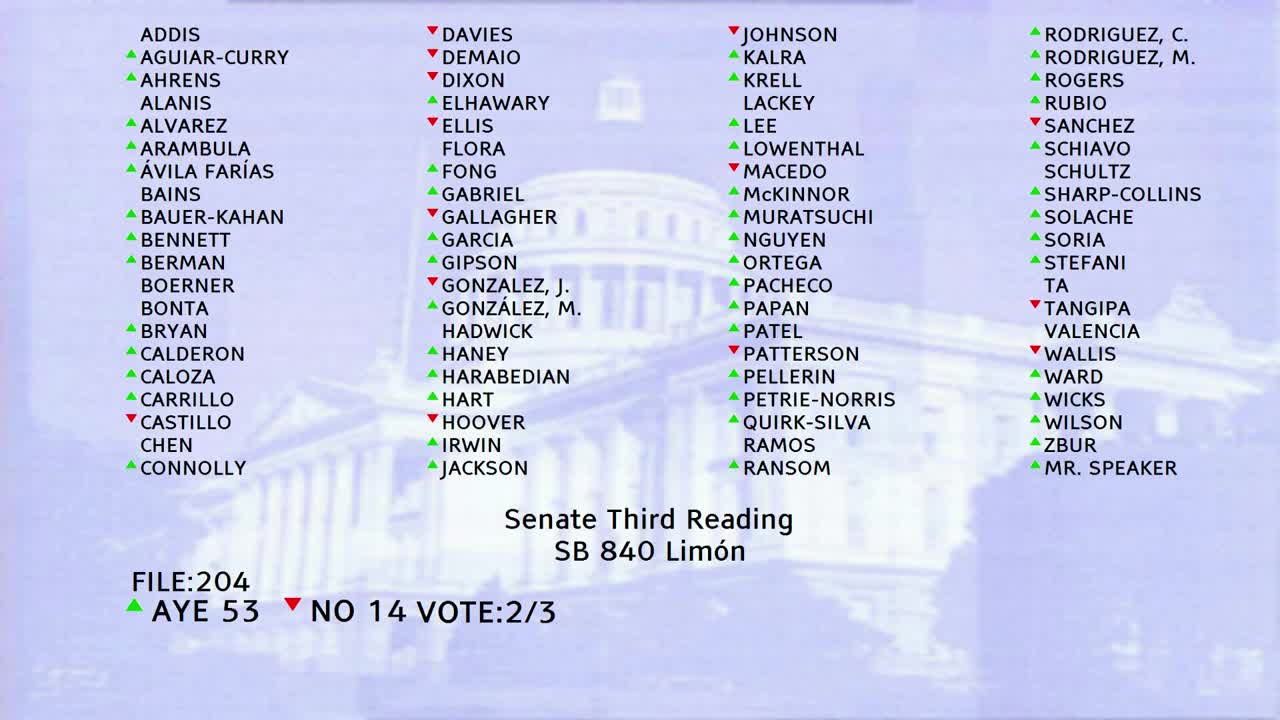 9MIN
Assembly Floor
 1H
Senate Standing Committee on Environmental Quality
 15MIN
Senate Standing Committee on Environmental Quality
 1MIN
Assembly Floor
 2MIN
Assembly Standing Committee on Appropriations
 4MIN
Assembly Standing Committee on Natural Resources



Bill Co-Author(s):