AB 1231: Criminal procedure: Safer Communities Through Opportunities Act.
- Session Year: 2025-2026
- House: Assembly
- Latest Version Date: 2025-09-05
Current Status:
Failed
(2025-09-13: Assembly refused to concur in Senate amendments. (Ayes 34. Noes 27. Page 3497.))
Introduced
In Committee
Awaiting First Chamber Vote
Passed First Chamber
In Committee
Awaiting Second Chamber Vote
Passed Second Chamber
Enacted
What does this bill do?
This bill lets judges offer pretrial diversion—a program that pauses a felony case so a person can get services instead of going to trial—to people charged with many nonserious, nonviolent felonies but excludes crimes involving serious injury, firearms, sex‑offender registration, domestic violence, and other listed offenses. Courts must find the plan reduces public‑safety risk and that the person will likely benefit; plans are individualized, may include services and progress reports, require restitution when owed, protect treatment records, and allow the court to restart the case if the person commits new violent or felony crimes while in diversion.
The summary is provided by generative AI which can make mistakes. For original language, please view the details in the table below.
Existing law authorizes a judge in the superior court in which a misdemeanor is being prosecuted to offer misdemeanor diversion to a defendant. Existing law, upon successful completion of the terms, conditions, or programs ordered by the court, makes the arrest upon which the diversion was imposed deemed to have never occurred, except as specified relating to application to be a peace officer.
This bill, the Safer Communities Through Opportunities Act, would authorize a court to exercise its discretion to grant pretrial diversion on a felony offense, subject to certain exceptions. The bill would authorize the court to consider information from, among others, the prosecutor and the defendant defense in determining whether or not to grant diversion and would prohibit a court from granting diversion unless it finds that the diversion plan mitigates any unreasonable risk of danger to public safety and that the defendant is likely to benefit from the services provided in the diversion plan. The bill would authorize a court to consider reinstating criminal proceedings in certain circumstances, such as the commission of a misdemeanor committed while the defendant is receiving pretrial diversion services that shows a propensity for violence, among others. The bill would require the court to dismiss the criminal allegations if it finds that the defendant has complied with the terms and conditions during the diversion period. The bill would require the court, if the court reduces the felony to a misdemeanor, to follow existing misdemeanor diversion proceedings.
Existing law authorizes a judge in the superior court in which a misdemeanor is being prosecuted to offer misdemeanor diversion to a defendant. Existing law, upon successful completion of the terms, conditions, or programs ordered by the court, makes the arrest upon which the diversion was imposed deemed to have never occurred, except as specified relating to application to be a peace officer.
This bill, the Safer Communities Through Opportunities Act, would authorize a court to exercise its discretion to grant pretrial diversion on a felony offense, subject to certain exceptions. The bill would authorize the court to consider information from, among others, the prosecutor and the defendant in determining whether or not to grant diversion and would prohibit a court from granting diversion unless it finds that the diversion plan mitigates any unreasonable risk of danger to public safety and that the defendant is likely to benefit from the services provided in the diversion plan. The bill would authorize a diversion plan to be administered by a treatment agency, as defined, subject to court approval, and would authorize a court to consider reinstating criminal proceedings in certain circumstances, such as the commission of a misdemeanor committed while the defendant is receiving pretrial diversion services that shows a propensity for violence, among others. The bill would require the court to dismiss the criminal allegations if it finds that the defendant has complied with the terms and conditions during the diversion period. The bill would require the court, if the court reduces the felony to a misdemeanor, to follow existing misdemeanor diversion proceedings.
Existing law authorizes a judge in the superior court in which a misdemeanor is being prosecuted to offer misdemeanor diversion to a defendant. Existing law, upon successful completion of the terms, conditions, or programs ordered by the court, makes the arrest upon which the diversion was imposed deemed to have never occurred, except as specified relating to application to be a peace officer.
This bill bill, the Safer Communities Through Opportunities Act, would authorize a court to exercise its discretion to grant pretrial diversion on a felony offense, subject to certain exceptions. The bill would require authorize the court to consult with consider information from, among others, the prosecutor and the defendant in determining whether or not to grant diversion and would prohibit a court from granting diversion unless it finds that the diversion plan mitigates any unreasonable risk of danger to public safety and that the defendant is likely to benefit from the services provided in the diversion plan. The bill would authorize a diversion plan to be administered by a treatment agency, as defined, subject to court approval, and would authorize a court to consider reinstating criminal proceedings in certain circumstances, such as the commission of a misdemeanor committed while the defendant is receiving pretrial diversion services that shows a propensity for violence, among others. The bill would require the court to dismiss the criminal allegations if it finds that the defendant has complied with the terms and conditions during the diversion period. The bill would require the court, if the court reduces the felony to a misdemeanor, to follow existing misdemeanor diversion proceedings.
Existing law authorizes a judge in the superior court in which a misdemeanor is being prosecuted to offer misdemeanor diversion to a defendant. Existing law, upon successful completion of the terms, conditions, or programs ordered by the court, makes the arrest upon which the diversion was imposed deemed to have never occurred, except as specified relating to application to be a peace officer.
This bill would authorize a court to exercise its discretion to grant pretrial diversion on a felony offense, subject to certain exceptions. The bill would require the court to consult with the prosecutor and the defendant in determining whether or not to grant diversion and would prohibit a court from granting diversion unless it finds that the diversion plan mitigates any unreasonable risk of danger to public safety and that the defendant is likely to benefit from the services provided in the diversion plan. The bill would authorize a diversion plan to be administered by a treatment agency, as defined, subject to court approval, and would authorize a court to consider reinstating criminal proceedings in certain circumstances, such as the commission of a misdemeanor committed while the defendant is receiving pretrial diversion services that shows a propensity for violence, among others. The bill would require the court to dismiss the criminal allegations if it finds that the defendant has complied with the terms and conditions during the diversion period.
(a)On an accusatory pleading alleging the commission of a felony offense described in subdivision (b), a defendant may move the court for diversion pursuant to this section at any time prior to the start of a trial. The court may, in its discretion, grant pretrial diversion to a defendant pursuant to this section if the court determines that the defendant is suitable for that diversion under the factors set forth in subdivision (c).
(b)(1)Except as provided in paragraph (2), this chapter applies to any felony offense punishable as follows:
(A)Pursuant to subdivision (h) of Section 1170.
(B)As a misdemeanor or by imprisonment in the state prison for 16 months, 2 years, or 3 years. Offenses that are a serious felony, as described in subdivision (c) of Section 1192.7, or a violent felony, as described in subdivision (c) of Section 667.5, are ineligible for diversion.
(2)This chapter does not apply to any of the following:
(A)An offense alleged to have caused great bodily injury or serious bodily injury.
(B)An offense alleged to have involved the personal use of a firearm in the commission of an offense, pursuant to Section 12022.5 or 12022.53.
(C)An offense punishable pursuant to Section 23550 of the Vehicle Code.
(D)An offense for which a person, if convicted, would be required to register pursuant to Section 290.
(E)An offense involving domestic violence, as defined in Section 6211 of the Family Code, or subdivision (b) of Section 13700 of this code.
(F)A violation of Section 646.9.
(G)A violation of subdivision (b) or (c) of Section 11418.
(c)(1)In determining whether to grant diversion, the court may consider information provided by entities, including, but not limited to, defense counsel, the defense, the prosecution, probation or pretrial services, victims, family or close contacts of the defendant, and service providers. In determining whether diversion is appropriate, applicable considerations may include the factors described in Section 1016.7 and Rule Rules 4.421 and 4.423 of the California Rules of Court. The court may also consider the defendants age and health conditions. A history of having survived human trafficking, domestic violence, or sexual assault shall be given great weight as mitigating factors that indicate diversion is appropriate. The court shall consider the following as aggravating factors that indicate diversion is inappropriate:
(A)Whether the manner of the offense or prior offenses indicates planning, sophistication, or professionalism.
(B)The defendant induced others to participate in the commission of the offense or occupied a position of leadership or dominance of other participants in the commission of the offense.
(2)A defendants request for diversion pursuant to subdivision (a) may proceed on offers of proof, reliable hearsay, and arguments of counsel and shall proceed prior to any trial or plea of guilty or no contest. If a court, in its discretion, opts to conduct a hearing on whether to grant diversion, a defendant shall submit to the court and serve on the prosecution a proposed diversion plan.
(d)The court shall not grant diversion unless it finds that the diversion plan mitigates any unreasonable risk of danger to public safety and finds that the defendant is likely to benefit from the services provided in the diversion plan.
(e)A (1)The court may order the defendant to comply with a court-approved, individually tailored diversion plan that describes the terms, conditions, or programs programs, or services that the court finds appropriate for the strengths and needs of the defendant and based on the recommendations from the defendant, a social worker, a behavioral health worker, or health care professional. interests of the community. The court may consider the perspective of the prosecutor, pretrial services office, or probation department in assessing any recommendations. If the defendant has a history of having survived human trafficking, domestic violence, or sexual assault, the diversion plan and proposal may rely on information or recommendations from a sexual assault counselor, as described in Section 1035.2 of the Evidence Code, a human trafficking caseworker, as described in Section 1038.2 of the Evidence Code, or a domestic violence counselor as described in Section 1037.1 of the Evidence Code. The diversion plan ordered by the court shall include any conditions necessary to mitigate an unreasonable risk of danger to public safety. recommendations from entities, including, but not limited to, the defense, the prosecution, probation or pretrial services, victims, family or close contacts of the defendant, and service providers, including a social worker, behavioral worker, or health care professional.
(2)The programs or services ordered in the diversion plan shall be provided only to the extent that existing resources are available.
(3)The diversion plan shall describe the frequency of regular status reports on the defendants progress in the diversion plan. At a minimum, a progress report shall be provided every three months. Those reports shall be submitted to the court, the defense, and the prosecution.
(4)If the defendant has a history of having survived human trafficking, domestic violence, or sexual assault, the diversion plan and proposal may rely on information or recommendations from a sexual assault counselor, as described in Section 1035.2 of the Evidence Code, a human trafficking caseworker, as described in Section 1038.2 of the Evidence Code, or a domestic violence counselor, as described in Section 1037.1 of the Evidence Code. The diversion plan ordered by the court shall include any conditions necessary to mitigate an unreasonable risk of danger to public safety.
(f)Upon a court granting diversion, any bail, bond or undertaking, or deposit in lieu thereof on behalf of the defendant shall be exonerated.
(g)A court may continue the criminal proceedings for a period not to exceed 24 months.
1001.981.(a)A defendant who is diverted pursuant to this chapter, who would otherwise be required to make full restitution if they were not diverted, shall be required to make full restitution.
(b)A defendants inability to pay restitution due to indigence shall not be grounds for denial of diversion or a finding that the defendant has failed to comply with the terms of diversion.
(c)In determining that dismissal is warranted upon completion of the proposed diversion plan, the court shall consider unpaid restitution in their consideration of dismissal only if nonpayment was willful and not due solely to indigency or inability to pay. If diversion is completed, but the defendant has an outstanding restitution order balance, a case may be dismissed and the restitution payment shall be enforceable as if the order were a civil judgment pursuant to subdivision (i) of Section 1202.4.
1001.982.(a)Any statement, information, or progress reports concerning the defendants diversion plan, including, but not limited to, health information, evaluations, clinical or treatment notes, or services provided, or any other records related to treatment that were provided for the purpose of facilitating, or as a result of participation in, or completion of, diversion pursuant to this chapter or for use in determining the defendants eligibility for diversion pursuant to this chapter shall not be used in any other proceeding without the defendants consent, unless that information is relevant evidence that is admissible under the standards described in paragraph (2) of subdivision (f) of Section 28 of Article I of the California Constitution.
(b)This section applies even if diversion is denied or subsequently revoked.
1001.983.(a)The court may modify a diversion plan if it appears, following a hearing on the matter, that the defendant is not meeting the terms and conditions of the diversion program. The court may modify the diversion plan to provide for greater supervision by either the treatment agency or the probation department, or both. or additional terms, conditions, programs, or services. A hearing pursuant to this subdivision shall not be held until after notice has been given to the defendant. The hearing shall follow the evidentiary rules applicable to a probation violation hearing.
(b)A court may hold a hearing to determine whether the criminal proceeding should be reinstated if any of the following circumstances exist:
(1)The defendant is charged with a misdemeanor allegedly committed while the defendant is receiving pretrial diversion services that reflects the defendants propensity for violence.
(2)The defendant is charged with a felony allegedly committed while the defendant is receiving pretrial diversion services.
(3)Unsatisfactory performance in the diversion plan that causes the court to believe that no reasonably available additional terms, conditions, or services can mitigate unreasonable risks to public safety. If it appears to the court that the defendant is performing unsatisfactorily in the diversion plan. Unsatisfactory performance may be indicated by repeated or significant noncompliance with the diversion plan.
(c)At a hearing pursuant to subdivision (b), the court shall consider whether a modified diversion plan with additional reasonably available terms, conditions, or services can address the circumstances described in subdivision (a).
(c)(d)A hearing to reinstitute criminal proceedings may be initiated by the court or the prosecutor, and may proceed only after notice to the defendant.
(d)(e)A hearing to reinstitute criminal proceedings pursuant to paragraph (2) of subdivision (b) shall not proceed until probable cause has been established in the subsequent felony allegations.
1001.984.(a)If the defendant has complied with the imposed terms and conditions, at the end of the period of diversion, the court shall dismiss the criminal allegations.
(b)Upon successful completion of diversion, if the court dismisses the charges, the arrest upon which the diversion was based shall be deemed never to have occurred, and the court shall order access to the record of the arrest restricted in accordance with Section 1001.9.
(c)An order to seal records pertaining to an arrest made pursuant to this section has no effect on a criminal justice agencys ability to access and use those sealed records and information regarding sealed arrests, as described in Section 851.92.
1001.985.(a)This chapter shall be implemented only to the extent that it does not conflict with an initiative statute.
(b)If the court has reduced a felony to a misdemeanor pursuant to subdivision (b) of Section 17, the misdemeanor diversion provisions of Section 1001.95 shall be applicable.
(c)Nothing in this chapter is intended to conflict with Marsys Law or a victims right to participate in these proceedings.
(a)On an accusatory pleading alleging the commission of a felony offense described in subdivision (b), a defendant may move the court for diversion pursuant to this section at any time prior to the start of a trial. The court may, in its discretion, grant pretrial diversion to a defendant pursuant to this section if the court determines that the defendant is suitable for that diversion under the factors set forth in subdivision (c).
(b)(1)Except as provided in paragraph (2), this chapter applies to any felony offense punishable as follows:
(A)Pursuant to subdivision (h) of Section 1170.
(B)As a misdemeanor or by imprisonment in the state prison for 16 months, 2 years, or 3 years. Offenses that are a serious felony, as described in subdivision (c) of Section 1192.7, or a violent felony, as described in subdivision (c) of Section 667.5, are ineligible for diversion.
(2)This chapter does not apply to any of the following:
(A)An offense alleged to have caused great bodily injury or serious bodily injury.
(B)An offense alleged to have involved the personal use of a firearm in the commission of an offense, pursuant to Section 12022.5 or 12022.53.
(C)An offense punishable pursuant to Section 23550 of the Vehicle Code.
(D)An offense for which a person, if convicted, would be required to register pursuant to Section 290.
(E)An offense involving domestic violence, as defined in Section 6211 of the Family Code, or subdivision (b) of Section 13700 of this code.
(F)A violation of Section 646.9.
(G)A violation of subdivision (b) or (c) of Section 11418.
(c)(1)In determining whether to grant diversion, the court may consider information provided by entities, including, but not limited to, defense counsel, the prosecution, probation or pretrial services, family or close contacts of the defendant, and service providers. In determining whether diversion is appropriate, applicable considerations may include the factors described in Section 1016.7 and Rule 4.423 of the California Rules of Court. The court may also consider the defendants age and health conditions. A history of having survived human trafficking, domestic violence, or sexual assault shall be given great weight as mitigating factors that indicate diversion is appropriate.
(2)A defendants request for diversion pursuant to subdivision (a) may proceed on offers of proof, reliable hearsay, and arguments of counsel and shall proceed prior to any trial or plea of guilty or no contest. If a court, in its discretion, opts to conduct a hearing on whether to grant diversion, a defendant shall submit to the court and serve on the prosecution a proposed diversion plan and shall recommend in that plan either dual agency supervision or single agency supervision, as described in Section 1001.981. plan.
(d)The court shall not grant diversion unless it finds that the diversion plan mitigates any unreasonable risk of danger to public safety and finds that the defendant is likely to benefit from the services provided in the diversion plan.
(e)A court may order the defendant to comply with terms, conditions, or programs that the court finds appropriate for the strengths and needs of the defendant and based on the recommendations from the defendant, a social worker, a behavioral health worker, or health care professional. The court may consider the perspective of the prosecutor, pretrial services office, or probation department in assessing any recommendations. If the defendant has a history of having survived human trafficking, domestic violence, or sexual assault, the diversion plan and proposal may rely on information or recommendations from a sexual assault counselor, as described in Section 1035.2 of the Evidence Code, a human trafficking caseworker, as described in Section 1038.2 of the Evidence Code, or a domestic violence counselor as described in Section 1037.1 of the Evidence Code. The diversion plan ordered by the court shall include any conditions necessary to mitigate an unreasonable risk of danger to public safety.
(f)Upon a court granting diversion, any bail, bond or undertaking, or deposit in lieu thereof on behalf of the defendant shall be exonerated.
(g)A court may continue the criminal proceedings for a period not to exceed 24 months.
1001.981.(a)As used in this section, the following terms have the following meanings:(1)Dual agency supervision means a court-approved, individually tailored diversion plan administered jointly by the treatment agency and by a county probation department or pretrial services department for a specified period of time. Under dual agency supervision, the treatment agency shall administer the treatment rehabilitation program.(2)Single agency supervision means a court approved, individually tailored diversion plan administered by a treatment agency, for a specified period of time. The treatment agency may include a government-sponsored or community-based job training services center or reentry service provider.(3)Treatment agency may include a government or community-based organization, including, but not limited to, a county health department, a county workforce development department, a behavioral health or reentry services provider, or a similar agency or community-based organization partnering with a county department.(b)A court shall order single agency supervision, unless it finds that single agency diversion is not practical or that dual agency diversion is necessary to mitigate unreasonable risks to public safety.(c)The treatment agency administering a diversion plan under single agency supervision shall report the defendants progress to the court, the prosecution, and the defendant every three months. The treatment agency administering a diversion plan jointly with the county probation department under dual agency diversion shall submit a report to the probation department every three months regarding compliance information required by the court showing the defendants progression in the diversion plan. Within five judicial days of receipt of the treatment agencys report, the probation department shall submit a report on the defendants progress to the court appending the entire report from the treatment agency and serving copies on the defendant and prosecution.(d)If the treatment agency is a community-based organization, the following shall apply:(1)The organization shall adhere to similar transparency, accountability, and outcome measure standards that apply to a government or county department.(2)The organization shall not pay wages and benefits to its most highly compensated executive and managerial employees that are significantly higher than the rates that would be paid to public employees performing similar job duties.(3)The court shall prioritize ordering services by an organization with a record of providing culturally competent and reasonable rehabilitative services.(e)While courts may order the defendant to participate in diversion plan services by government or community-based providers, nothing in this section is intended to reduce employment by government agencies.1001.982. 1001.981.(a)A defendant who is diverted pursuant to this chapter, who would otherwise be required to make full restitution if they were not diverted, shall be required to make full restitution.
(b)A defendants inability to pay restitution due to indigence shall not be grounds for denial of diversion or a finding that the defendant has failed to comply with the terms of diversion.
(c)In determining that dismissal is warranted upon completion of the proposed diversion plan, the court shall consider unpaid restitution in their consideration of dismissal only if nonpayment was willful and not due solely to indigency or inability to pay. If diversion is completed, but the defendant has an outstanding restitution order balance, a case may be dismissed and the restitution payment shall be enforceable as if the order were a civil judgment pursuant to subdivision (i) of Section 1202.4.
1001.983. 1001.982.(a)Any statement, information, or progress reports concerning the defendants diversion plan, including, but not limited to, health information, evaluations, clinical or treatment notes, or services provided, or any other records related to treatment that were provided for the purpose of facilitating, or as a result of participation in, or completion of, diversion pursuant to this chapter or for use in determining the defendants eligibility for diversion pursuant to this chapter shall not be used in any other proceeding without the defendants consent, unless that information is relevant evidence that is admissible under the standards described in paragraph (2) of subdivision (f) of Section 28 of Article I of the California Constitution.
(b)This section applies even if diversion is denied or subsequently revoked.
1001.984. 1001.983.(a)The court may modify a diversion plan if it appears, following a hearing on the matter, that the defendant is not meeting the terms and conditions of the diversion program. The court may modify the diversion plan to provide for greater supervision by either the treatment agency or the probation department, or both. A hearing pursuant to this subdivision shall not be held until after notice has been given to the defendant. The hearing shall follow the evidentiary rules applicable to a probation violation hearing.
(b)A court may hold a hearing to determine whether criminal proceeding should be reinstated if any of the following circumstances exist:
(1)The defendant is charged with a misdemeanor allegedly committed while the defendant is receiving pretrial diversion services that reflects the defendants propensity for violence.
(2)The defendant is charged with a felony allegedly committed while the defendant is receiving pretrial diversion services.
(3)Unsatisfactory performance in the diversion plan that causes the court to believe that no reasonably available additional terms, conditions, or services can mitigate unreasonable risks to public safety.
(c)A hearing to reinstitute criminal proceedings may be initiated by the court or the prosecutor, or, in cases of dual agency supervision, the probation department and may proceed only after notice to the defendant.
(d)A hearing to reinstitute criminal proceedings pursuant to paragraph (2) of subdivision (b) shall not proceed until probable cause has been established in the subsequent felony allegations.
1001.985. 1001.984.(a)If the defendant has complied with the imposed terms and conditions, at the end of the period of diversion, the court shall dismiss the criminal allegations.
(b)Upon successful completion of diversion, if the court dismisses the charges, the arrest upon which the diversion was based shall be deemed never to have occurred, and the court shall order access to the record of the arrest restricted in accordance with Section 1001.9.
(c)An order to seal records pertaining to an arrest made pursuant to this section has no effect on a criminal justice agencys ability to access and use those sealed records and information regarding sealed arrests, as described in Section 851.92.
1001.986. 1001.985.(a)This chapter shall be implemented only to the extent that it does not conflict with an initiative statute.
(b)If the court has reduced a felony to a misdemeanor pursuant to subdivision (b) of Section 17, the misdemeanor diversion provisions of Section 1001.95 shall be applicable.
(c)Nothing in this chapter is intended to conflict with Marsys Law or a victims right to participate in these proceedings.
(a)On an accusatory pleading alleging the commission of a felony offense described in subdivision (b), a defendant may move the court for diversion pursuant to this section at any time prior to the start of a trial. The court may, in its discretion, and after considering the positions of the defense and prosecution, grant pretrial diversion to a defendant pursuant to this section if the court determines that the defendant is suitable for that diversion under the factors set forth in subdivision (c).
(b)(1)Except as provided in paragraph (2), this chapter applies to any felony offense punishable as follows:
(A)Pursuant to subdivision (h) of Section 1170.
(B)As a misdemeanor or by imprisonment in the state prison for 16 months, 2 years, or 3 years, as long as the felony offense is not a 3 years. Offenses that are a serious felony, as described in subdivision (c) of Section 1192.7 1192.7, or a violent felony, as described in subdivision (c) of Section 667.5. 667.5, are ineligible for diversion.
(2)This chapter does not apply to any of the following:
(A)An offense alleged to have caused great bodily injury or serious bodily injury.
(B)An offense alleged to have involved the personal use of a firearm in the commission of an offense, pursuant to Section 12022.5 or 12022.53.
(C)An offense punishable pursuant to Section 23550 of the Vehicle Code.
(D)An offense for which a person, if convicted, would be required to register pursuant to Section 290.
(E)An offense involving domestic violence, as defined in Section 6211 of the Family Code, or subdivision (b) of Section 13700 of this code.
(F)A violation of Section 646.9.
(G)A violation of subdivision (b) or (c) of Section 11418.
(c)(1)In determining whether to grant diversion, the court may consider information provided by entities, including, but not limited to, defense counsel, the prosecution, probation or pretrial services, family or close contacts of the defendant, and service providers. In determining whether diversion is appropriate, applicable considerations may include the factors described in Section 1016.7 and Rule 4.423 of the California Rules of Court. The court may also consider the defendants age and health conditions. A history of having survived human trafficking, domestic violence, or sexual assault shall be given great weight as mitigating factors that indicate diversion is appropriate.
(2)A defendants request for diversion pursuant to subdivision (a) may proceed on offers of proof, reliable hearsay, and arguments of counsel and shall proceed prior to any trial or plea of guilty or no contest. At a hearing If a court, in its discretion, opts to conduct a hearing on whether to grant diversion, a defendant shall submit to the court and serve on the prosecution a proposed diversion plan and shall recommend in that plan either dual agency supervision or single agency supervision, as described in Section 1001.981.
(d)The court shall not grant diversion unless it finds that the diversion plan mitigates any unreasonable risk of danger to public safety and finds that the defendant is likely to benefit from the services provided in the diversion plan.
(e)A court may order the defendant to comply with terms, conditions, or programs that the court finds appropriate for the strengths and needs of the defendant and based on the recommendations from the defendant, a social worker, a behavioral health worker, or health care professional. The court may consider the perspective of the prosecutor, pretrial services office, or probation department in assessing any recommendations. If the defendant has a history of having survived human trafficking, domestic violence, or sexual assault, the diversion plan and proposal may rely on information or recommendations from a sexual assault counselor, as described in Section 1035.2 of the Evidence Code, a human trafficking caseworker, as described in Section 1038.2 of the Evidence Code, or a domestic violence counselor as described in Section 1037.1 of the Evidence Code. The diversion plan ordered by the court shall include any conditions necessary to mitigate an unreasonable risk of danger to public safety.
(f)Upon a court granting diversion, any bail, bond or undertaking, or deposit in lieu thereof on behalf of the defendant shall be exonerated.
(g)A court may continue the criminal proceedings for a period not to exceed 24 months.
1001.981.(a)As used in this section, the following terms have the following meanings:
(1)Dual agency supervision means a court-approved, individually tailored diversion plan administered jointly by the treatment agency and by a county probation department or pretrial services department for a specified period of time. Under dual agency supervision, the treatment agency shall administer the treatment rehabilitation program.
(2)Single agency supervision means a court approved, individually tailored diversion plan administered by a treatment agency, for a specified period of time. The treatment agency may include a government-sponsored or community-based job training services center or reentry service provider.
(3)Treatment agency may include a government or community-based organization, including, but not limited to, a county health department, a county workforce development department, a behavioral health or reentry services provider, or a similar agency or community-based organization partnering with a county department.
(b)A court shall order single agency supervision, unless it finds that single agency diversion is not practical or that dual agency diversion is necessary to mitigate unreasonable risks to public safety.
(c)The treatment agency administering a diversion plan under single agency supervision shall report the defendants progress to the court, the prosecution, and the defendant every three months. The treatment agency administering a diversion plan jointly with the county probation department under dual agency diversion shall submit a report to the probation department every three months regarding compliance information required by the court showing the defendants progression in the diversion plan. Within five judicial days of receipt of the treatment agencys report, the probation department shall submit a report on the defendants progress to the court appending the entire report from the treatment agency and serving copies on the defendant and prosecution.
(d)If the treatment agency is a community-based organization, the following shall apply:
(1)The organization shall adhere to similar transparency, accountability, and outcome measure standards that apply to a government or county department.
(2)The organization shall not pay wages and benefits to its most highly compensated executive and managerial employees that are significantly higher than the rates that would be paid to public employees performing similar job duties.
(3)The court shall prioritize ordering services by an organization with a record of providing culturally competent and reasonable rehabilitative services.
(e)While courts may order the defendant to participate in diversion plan services by government or community-based providers, nothing in this section is intended to reduce employment by government agencies.
1001.982.(a)A defendant who is diverted pursuant to this chapter, who would otherwise be required to make full restitution if they were not diverted, shall be required to make full restitution.
(b)A defendants inability to pay restitution due to indigence shall not be grounds for denial of diversion or a finding that the defendant has failed to comply with the terms of diversion.
(c)In determining that dismissal is warranted upon completion of the proposed diversion plan, the court shall consider unpaid restitution in their consideration of dismissal only if nonpayment was willful and not due solely to indigency or inability to pay. If diversion is completed, but the defendant has an outstanding restitution order balance, a case may be dismissed and the restitution payment shall be enforceable as if the order were a civil judgment pursuant to subdivision (i) of Section 1202.4.
1001.983.(a)Any statement, information, or progress reports concerning the defendants diversion plan, including, but not limited to, health information, evaluations, clinical or treatment notes, or services provided, or any other records related to treatment that were provided for the purpose of facilitating, or as a result of participation in, or completion of, diversion pursuant to this chapter or for use in determining the defendants eligibility for diversion pursuant to this chapter shall not be used in any other proceeding without the defendants consent, unless that information is relevant evidence that is admissible under the standards described in paragraph (2) of subdivision (f) of Section 28 of Article I of the California Constitution.
(b)This section applies even if diversion is denied or subsequently revoked.
1001.983. 1001.984.(a)The court may modify a diversion plan if it appears, following a hearing on the matter, that the defendant is not meeting the terms and conditions of the diversion program. The court may modify the diversion plan to provide for greater supervision by either the treatment agency or the probation department, or both. A hearing pursuant to this subdivision shall not be held until after notice has been given to the defendant. The hearing shall follow the evidentiary rules applicable to a probation violation hearing.
(b)A court may hold a hearing to determine whether criminal proceeding should be reinstated if any of the following circumstances exist:
(1)The defendant is charged with a misdemeanor allegedly committed while the defendant is receiving pretrial diversion services that reflects the defendants propensity for violence.
(2)The defendant is charged with a felony allegedly committed while the defendant is receiving pretrial diversion services.
(3)Any other similar circumstance Unsatisfactory performance in the diversion plan that causes the court to believe that no reasonably available additional terms, conditions, or services can mitigate unreasonable risks to public safety.
(c)A hearing to reinstitute criminal proceedings may be initiated by the court or the prosecutor, or, in cases of dual agency supervision, the probation department and may proceed only after notice to the defendant.
(d)A hearing to reinstitute criminal proceedings pursuant to paragraph (2) of subdivision (b) shall not proceed until probable cause has been established in the subsequent felony allegations.
1001.984. 1001.985.(a)If the defendant has complied with the imposed terms and conditions, at the end of the period of diversion, the court shall dismiss the criminal allegations.
(b)Upon successful completion of diversion, if the court dismisses the charges, the arrest upon which the diversion was based shall be deemed never to have occurred, and the court shall order access to the record of the arrest restricted in accordance with Section 1001.9.
(c)An order to seal records pertaining to an arrest made pursuant to this section has no effect on a criminal justice agencys ability to access and use those sealed records and information regarding sealed arrests, as described in Section 851.92.
1001.985. 1001.986.(a)This chapter shall be implemented only to the extent that it does not conflict with an initiative statute.
(b)If the court has reduced a felony to a misdemeanor pursuant to subdivision (b) of Section 17, the misdemeanor diversion provisions of Section 1001.95 shall be applicable.
(c)Nothing in this chapter is intended to conflict with Marsys Law or a victims right to participate in these proceedings.
(a)On an accusatory pleading alleging the commission of a felony offense described in subdivision (b), a defendant may move the court for diversion pursuant to this section at any time prior to the start of a trial. The court may, in its discretion, and after considering the positions of the defense and prosecution, grant pretrial diversion to a defendant pursuant to this section if the court determines that the defendant is suitable for that diversion under the factors set forth in subdivision (c).
(b)(1)Except as provided in paragraph (2), this chapter applies to any felony offense punishable as follows:
(A)Pursuant to subdivision (h) of Section 1170.
(B)As a misdemeanor or by imprisonment in the state prison for 16 months, 2 years, or 3 years, as long as the felony offense is not a serious felony, as described in subdivision (c) of Section 1192.7 or a violent felony, as described in subdivision (c) of Section 667.5.
(2)This chapter does not apply to any of the following:
(A)An offense alleged to have caused great bodily injury or serious bodily injury.
(B)An offense alleged to have involved the personal use of a firearm in the commission of an offense, pursuant to Section 12022.5 or 12022.53.
(C)An offense punishable pursuant to Section 23550 of the Vehicle Code.
(D)An offense for which a person, if convicted, would be required to register pursuant to Section 290.
(E)An offense involving domestic violence, as defined in Section 6211 of the Family Code, or subdivision (b) of Section 13700 of this code.
(F)A violation of Section 646.9.
(G)A violation of subdivision (b) or (c) of Section 11418.
(c)(1)In determining whether to grant diversion, the court shall consult with the prosecutor and the defendant or their counsel and may consider information provided by other entities, including, but not limited to, defense counsel, the prosecution, probation or pretrial services, family or close contacts of the defendant, and service providers. In determining whether diversion is appropriate, the court shall consider applicable considerations may include the factors described in Section 1016.7 and Rule 4.423 of the California Rules of Court. The court may also consider the defendants age and health conditions. A history of having survived human trafficking, domestic violence, or sexual assault shall be given great weight as mitigating factors that indicate diversion is appropriate.
(2)A hearing on whether to grant defendants request for diversion pursuant to subdivision (a) may proceed on offers of proof, reliable hearsay, and arguments of counsel and shall proceed prior to any trial or plea of guilty or no contest. At a hearing on whether to grant diversion, a defendant shall submit to the court and serve on the prosecution a proposed diversion plan and shall recommend in that plan either dual agency supervision or single agency supervision, as described in Section 1001.981.
(d)The court shall not grant diversion unless it finds that the diversion plan mitigates any unreasonable risk of danger to public safety and finds that the defendant is likely to benefit from the services provided in the diversion plan.
(e)A court may order the defendant to comply with terms, conditions, or programs that the court finds appropriate for the strengths and needs of the defendant and based on the recommendations from the defendant, a social worker, a behavioral health worker, or health care professional. The court may consider the perspective of the prosecutor, pretrial services office, or probation department in assessing any recommendations. If the defendant has a history of having survived human trafficking, domestic violence, or sexual assault, the diversion plan and proposal may rely on information or recommendations from a sexual assault counselor, as described in Section 1035.2 of the Evidence Code, or a human trafficking caseworker, as described in Section 1038.2 of the Evidence Code. Code, or a domestic violence counselor as described in Section 1037.1 of the Evidence Code. The diversion plan ordered by the court shall include any conditions necessary to mitigate an unreasonable risk of danger to public safety.
(f)Upon a court granting diversion, any bail, bond or undertaking, or deposit in lieu thereof on behalf of the defendant shall be exonerated.
(g)A court may continue the criminal proceedings for a period not to exceed 24 months.
1001.981.(a)As used in this section, the following terms have the following meanings:
(1)Dual agency supervision means a court-approved, individually tailored diversion plan administered jointly by the treatment agency and by a county probation department or pretrial services department for a specified period of time. Under dual agency supervision, the treatment agency shall administer the treatment rehabilitation program.
(2)Single agency supervision means a court approved, individually tailored diversion plan administered by a treatment agency, for a specified period of time. The treatment agency may include a government-sponsored or community-based job training services center or reentry service provider.
(3)Treatment agency may include a government or community-based organization, including, but not limited to, a county health department, a county workforce development department, a behavioral health or reentry services provider, or a similar agency or community-based organization partnering with a county department.
(b)A court shall order single agency supervision, unless it finds that single agency diversion is not practical or that dual agency diversion is necessary to mitigate unreasonable risks to public safety.
(c)The treatment agency administering a diversion plan under single agency supervision shall report the defendants progress to the court, the prosecution, and the defendant every three months. The treatment agency administering a diversion plan jointly with the county probation department under dual agency diversion shall submit a report to the probation department every three months regarding compliance information required by the court showing the defendants progression in the diversion plan. Within five judicial days of receipt of the treatment agencys report, the probation department shall submit a report on the defendants progress to the court appending the entire report from the treatment agency and serving copies on the defendant and prosecution.
(d)If the treatment agency is a community-based organization, the following shall apply:
(1)The organization shall adhere to similar transparency, accountability, and outcome measure standards that apply to a government or county department.
(2)The organization shall not pay wages and benefits to its most highly compensated executive and managerial employees that are significantly higher than the rates that would be paid to public employees performing similar job duties.
(3)The court shall prioritize ordering services by an organization with a record of providing culturally competent and reasonable rehabilitative services.
(e)While courts may order the defendant to participate in diversion plan services by government or community-based providers, nothing in this section is intended to reduce employment by government agencies.
1001.982.(a)A defendant who is diverted pursuant to this chapter shall chapter, who would otherwise be required to make full restitution. However, a defendants inability to pay restitution due to indigence shall not be grounds for denial of diversion or a finding that the defendant has failed to comply with the terms of diversion. restitution if they were not diverted, shall be required to make full restitution.
(b)A defendants inability to pay restitution due to indigence shall not be grounds for denial of diversion or a finding that the defendant has failed to comply with the terms of diversion.
(c)In determining that dismissal is warranted upon completion of the proposed diversion plan, the court shall consider unpaid restitution in their consideration of dismissal only if nonpayment was willful and not due solely to indigency or inability to pay. If diversion is completed, but the defendant has an outstanding restitution order balance, a case may be dismissed and the restitution payment shall be enforceable as if the order were a civil judgment pursuant to subdivision (i) of Section 1202.4.
1001.983.(a)The court may modify a diversion plan if it appears, following a hearing on the matter, that the defendant is not meeting the terms and conditions of the diversion program. The court may modify the diversion plan to provide for greater supervision by either the treatment agency or the probation department, or both. A hearing pursuant to this subdivision shall not be held until after notice has been given to the defendant. The hearing shall follow the evidentiary rules applicable to a probation violation hearing.
(b)A court may hold a hearing to determine whether criminal proceeding should be reinstated if any of the following circumstances exist:
(1)The defendant is charged with a misdemeanor allegedly committed while the defendant is receiving pretrial diversion services that reflects the defendants propensity for violence.
(2)The defendant is charged with a felony allegedly committed while the defendant is receiving pretrial diversion services.
(3)Any other similar circumstance that causes the court to believe that no additional terms, conditions, or services can mitigate unreasonable risks to public safety.
(c)A hearing to reinstitute criminal proceedings may be initiated by the court or the prosecutor, or, in cases of dual agency supervision, the probation department and may proceed only after notice to the defendant.
(d)A hearing to reinstitute criminal proceedings pursuant to paragraph (2) of subdivision (b) shall not proceed until probable cause has been established in the subsequent felony allegations.
1001.984.(a)If the defendant has complied with the imposed terms and conditions, at the end of the period of diversion, the court shall dismiss the criminal allegations.
(b)Any record filed with the Department of Justice shall indicate the disposition of those allegations pursuant to this chapter. Upon successful completion of a diversion program, the arrest upon which the diversion was based shall be deemed to have never occurred. The divertee may indicate in response to any question concerning their prior criminal record that they were not arrested or diverted for the offense, except as specified in subdivision (c). A record pertaining to an arrest resulting in successful completion of a diversion program shall not, without the divertees consent, be used in any way that could result in the denial of any employment, benefit, license, or certificate. Upon successful completion of diversion, if the court dismisses the charges, the arrest upon which the diversion was based shall be deemed never to have occurred, and the court shall order access to the record of the arrest restricted in accordance with Section 1001.9.
(c)The divertee shall be advised that, regardless of their successful completion of diversion, the arrest upon which the diversion was based may be disclosed by the Department of Justice in response to any peace officer application request and that, notwithstanding subdivision (b), this section does not relieve the defendant of the obligation to disclose the arrest in response to any direct question contained in any questionnaire or application for a position as a peace officer, as defined in Section 830. An order to seal records pertaining to an arrest made pursuant to this section has no effect on a criminal justice agencys ability to access and use those sealed records and information regarding sealed arrests, as described in Section 851.92.
1001.985.(a)This chapter shall be implemented only to the extent that it does not conflict with an initiative statute.
(b)If the court has reduced a felony to a misdemeanor pursuant to subdivision (b) of Section 17, the misdemeanor diversion provisions of Section 1001.95 shall be applicable.
(c)Nothing in this chapter is intended to conflict with Marsys Law or a victims right to participate in these proceedings.
(a)On an accusatory pleading alleging the commission of a felony offense described in subdivision (b), a defendant may move the court for diversion pursuant to this section at any time prior to the start of a trial. The court may, in its discretion, and after considering the positions of the defense and prosecution, grant pretrial diversion to a defendant pursuant to this section if the court determines that the defendant is suitable for that diversion under the factors set forth in subdivision (c).
(b)(1)Except as provided in paragraph (2), this chapter applies to any felony offense punishable as follows:
(A)Pursuant to subdivision (h) of Section 1170.
(B)As a misdemeanor or by imprisonment in the state prison for 16 months, 2 years, or 3 years, as long as the felony offense is not a serious felony, as described in subdivision (c) of Section 1192.7 or a violent felony, as described in subdivision (c) of Section 667.5.
(2)This chapter does not apply to any of the following:
(A)An offense alleged to have caused great bodily injury or serious bodily injury.
(B)An offense alleged to have involved the personal use of a firearm in the commission of an offense, pursuant to Section 12022.5. 12022.5 or 12022.53.
(C)An offense punishable pursuant to Section 23550 of the Vehicle Code.
(D)An offense for which a person, if convicted, would be required to register pursuant to Section 290.
(E)An offense involving domestic violence, as defined in Section 6211 of the Family Code, or subdivision (b) of Section 13700 of this code.
(F)A violation of Section 646.9.
(G)A violation of subdivision (b) or (c) of Section 11418.
(c)(1)In determining whether to grant diversion, the court shall consult with the prosecutor and the defendant or their counsel and may consider information provided by other entities, including, but not limited to, probation or pretrial services, family or close contacts of the defendant, and service providers. In determining whether diversion is appropriate, the court shall consider the factors described in Section 1016.7 and Rule 4.423 of the California Rules of Court. The court may also consider the defendants age and health conditions. A history of having survived human trafficking, domestic violence, or sexual assault or where the defendant is over 55 years of age, shall be given great weight as mitigating factors that indicate diversion is appropriate.
(2)A hearing on whether to grant diversion may proceed on offers of proof, reliable hearsay, and arguments of counsel and shall proceed prior to any trial or plea of guilty or no contest. At a hearing on whether to grant diversion, a defendant shall submit to the court and serve on the prosecution a proposed diversion plan and shall recommend in that plan either dual agency supervision or single agency supervision, as described in Section 1001.981.
(d)The court shall not grant diversion unless it finds that the diversion plan mitigates any unreasonable risk of danger to public safety and finds that the defendant is likely to benefit from the services provided in the diversion plan.
(e)A court may order the defendant to comply with terms, conditions, or programs that the court finds appropriate for the strengths and needs of the defendant and based on the recommendations from the defendant, a social worker, a behavioral health worker, or health care professional. The court may consider the perspective of the prosecutor, pretrial services office, or probation department in assessing any recommendations. If the defendant has a history of having survived human trafficking, domestic violence, or sexual assault, the diversion plan and proposal may rely on information or recommendations from a sexual assault counselor, as described in Section 1035.2 of the Evidence Code, or a human trafficking caseworker, as described in Section 1038.2 of the Evidence Code. The diversion plan ordered by the court shall include any conditions necessary to mitigate an unreasonable risk of danger to public safety.
(f)Upon a court granting diversion, any bail, bond or undertaking, or deposit in lieu thereof on behalf of the defendant shall be exonerated.
(g)A court may continue the criminal proceedings for a period not to exceed 12 24 months.
1001.981.(a)As used in this section, the following terms have the following meanings:
(1)Dual agency supervision means a court-approved, individually tailored diversion plan administered jointly by the treatment agency and by a county probation department or pretrial services department for a specified period of time. Under dual agency supervision, the treatment agency shall administer the treatment rehabilitation program.
(2)Single agency supervision means a court approved, individually tailored diversion plan administered by a treatment agency, for a specified period of time. The treatment agency may include a government-sponsored or community-based job training services center or reentry service provider.
(3)Treatment agency may include a government or community-based organization, including, but not limited to, a county health department, a county workforce development department, a behavioral health or reentry services provider, or a similar agency or community-based organization partnering with a county department.
(b)A court shall order single agency supervision, unless it finds that single agency diversion is not practical or that dual agency diversion is necessary to mitigate unreasonable risks to public safety.
(c)The treatment agency administering a diversion plan under single agency supervision shall report the defendants progress to the court, the prosecution, and the defendant every three months. The treatment agency administering a diversion plan jointly with the county probation department under dual agency diversion shall submit a report to the probation department every three months regarding the defendants progression in the diversion plan. Within five judicial days of receipt of the treatment agencys report, the probation department shall submit a report on the defendants progress to the court appending the entire report from the treatment agency and serving copies on the defendant and prosecution.
(d)If the treatment agency is a community-based organization, the following shall apply:
(1)The organization shall adhere to similar transparency, accountability, and outcome measure standards that apply to a government or county department.
(2)The organization shall not pay wages and benefits to its most highly compensated executive and managerial employees that are significantly higher than the rates that would be paid to public employees performing similar job duties.
(3)The court shall prioritize ordering services by an organization with a record of providing culturally competent and reasonable rehabilitative services.
(e)While courts may order the defendant to participate in diversion plan services by government or community-based providers, nothing in this section is intended to reduce employment by government agencies.
1001.982.A defendant who is diverted pursuant to this chapter shall be required to make full restitution. However, a defendants inability to pay restitution due to indigence shall not be grounds for denial of diversion or a finding that the defendant has failed to comply with the terms of diversion.
1001.983.(a)The court may modify a diversion plan if it appears, following a hearing on the matter, that the defendant is not meeting the terms and conditions of the diversion program. The court may modify the diversion plan to provide for greater supervision by either the treatment agency or the probation department, or both. A hearing pursuant to this subdivision shall not be held until after notice has been given to the defendant.
(b)A court may hold a hearing to determine whether criminal proceeding should be reinstated if any of the following circumstances exist:
(1)The defendant is charged with a misdemeanor allegedly committed while the defendant is receiving pretrial diversion services that reflects the defendants propensity for violence.
(2)The defendant is charged with a felony allegedly committed while the defendant is receiving pretrial diversion services.
(3)Any other similar circumstance that causes the court to believe that no additional terms, conditions, or services can mitigate unreasonable risks to public safety.
(c)A hearing to reinstitute criminal proceedings may be initiated by the court or the prosecutor, or, in cases of dual agency supervision, the probation department and may proceed only after notice to the defendant.
(d)A hearing to reinstitute criminal proceedings pursuant to paragraph (2) of subdivision (b) shall not proceed until probable cause has been established in the subsequent felony allegations.
1001.984.(a)If the defendant has complied with the imposed terms and conditions, at the end of the period of diversion, the court shall dismiss the criminal allegations.
(b)Any record filed with the Department of Justice shall indicate the disposition of those allegations pursuant to this chapter. Upon successful completion of a diversion program, the arrest upon which the diversion was based shall be deemed to have never occurred. The divertee may indicate in response to any question concerning their prior criminal record that they were not arrested or diverted for the offense, except as specified in subdivision (c). A record pertaining to an arrest resulting in successful completion of a diversion program shall not, without the divertees consent, be used in any way that could result in the denial of any employment, benefit, license, or certificate.
(c)The divertee shall be advised that, regardless of their successful completion of diversion, the arrest upon which the diversion was based may be disclosed by the Department of Justice in response to any peace officer application request and that, notwithstanding subdivision (b), this section does not relieve the defendant of the obligation to disclose the arrest in response to any direct question contained in any questionnaire or application for a position as a peace officer, as defined in Section 830.
1001.985.This chapter shall be implemented only to the extent that it does not conflict with an initiative statute.
(a)On an accusatory pleading alleging the commission of a felony offense described in subdivision (b), a defendant may move the court for diversion pursuant to this section at any time prior to the start of a trial. The court may, in its discretion, and after considering the positions of the defense and prosecution, grant pretrial diversion to a defendant pursuant to this section if the court determines that the defendant is suitable for that diversion under the factors set forth in subdivision (c).
(b)(1)Except as provided in paragraph (2), this chapter applies to any felony offense punishable as follows:
(A)Pursuant to subdivision (h) of Section 1170.
(B)As a misdemeanor or by imprisonment in the state prison for 16 months, 2 years, or 3 years, as long as the felony offense is not a serious felony, as described in subdivision (c) of Section 1192.7 or a violent felony, as described in subdivision (c) of Section 667.5.
(2)This chapter does not apply to any of the following:
(A)An offense alleged to have caused great bodily injury or serious bodily injury.
(B)An offense alleged to have involved the personal use of a firearm in the commission of an offense, pursuant to Section 12022.5.
(C)An offense punishable pursuant to Section 23550 of the Vehicle Code.
(c)(1)In determining whether to grant diversion, the court shall consult with the prosecutor and the defendant or their counsel and may consider information provided by other entities, including, but not limited to, probation or pretrial services, family or close contacts of the defendant, and service providers. In determining whether diversion is appropriate, the court shall consider the factors described in Section 1016.7 and Rule 4.423 of the California Rules of Court. A history of having survived human trafficking, domestic violence, or sexual assault or where the defendant is over 55 years of age, shall be considered given great weight as mitigating factors that indicate diversion is appropriate.
(2) A hearing on whether to grant diversion may proceed on offers of proof, reliable hearsay, and arguments of counsel and shall proceed prior to any trial or plea of guilty or no contest. At a hearing on whether to grant diversion, a defendant shall submit to the court and serve on the prosecution a proposed diversion plan and shall recommend in that plan either dual agency supervision or single agency supervision, as described in Section 1001.981.
(d) The court shall not grant diversion unless it finds that the diversion plan mitigates any unreasonable risk of danger to public safety and finds that the defendant is likely to benefit from the services provided in the diversion plan.
(e)A court may order the defendant to comply with terms, conditions, or programs that the court finds appropriate for the strengths and needs of the defendant and based on the recommendations from the defendant, a social worker, a behavioral health worker, or health care professional. The court may consider the perspective of the prosecutor, pretrial services office, or probation department in assessing any recommendations. If the defendant has a history of having survived human trafficking, domestic violence, or sexual assault, the diversion plan and proposal may rely on information or recommendations from a sexual assault counselor, including as described in Section 1035.5 1035.2 of the Evidence Code. Code, or a human trafficking caseworker, as described in Section 1038.2 of the Evidence Code. The diversion plan ordered by the court shall include any conditions necessary to mitigate an unreasonable risk of danger to public safety.
(f)Upon a court granting diversion, any bail, bond or undertaking, or deposit in lieu thereof on behalf of the defendant shall be exonerated.
(g)A court may continue the criminal proceedings for a period not to exceed 12 months.
1001.981.(a)As used in this section, the following terms have the following meanings:
(1)Dual agency supervision means a court-approved, individually tailored diversion plan administered jointly by the treatment agency and by a county probation department or pretrial services department for a specified period of time. Under dual agency supervision, the treatment agency shall administer the treatment rehabilitation program.
(2)Single agency supervision means a court approved, individually tailored diversion plan administered by a treatment agency, for a specified period of time. The treatment agency may include a government-sponsored or community-based job training services center or reentry service provider.
(3)Treatment agency may include a government or community-based organization, including, but not limited to, a county health department, a county workforce development department, a behavioral health or reentry services provider, or a similar agency or community-based organization partnering with a county department.
(b)A court shall order single agency supervision, unless it finds that single agency diversion is not practical or that dual agency diversion is necessary to mitigate unreasonable risks to public safety.
(c)The treatment agency administering a diversion plan under single agency supervision shall report the defendants progress to the court, the prosecution, and the defendant every three months. The treatment agency administering a diversion plan jointly with the county probation department under dual agency diversion shall submit a report to the probation department every three months regarding the defendants progression in the diversion plan. Within five judicial days of receipt of the treatment agencys report, the probation department shall submit a report on the defendants progress to the court appending the entire report from the treatment agency and serving copies on the defendant and prosecution.
(d)If the treatment agency is a community-based organization, the following shall apply:
(1)The organization shall adhere to similar transparency, accountability, and outcome measure standards that apply to a government or county department.
(2)The organization shall not pay wages and benefits to its most highly compensated executive and managerial employees that are significantly higher than the rates that would be paid to public employees performing similar job duties.
(3)The court shall prioritize ordering services by an organization with a record of providing culturally competent and reasonable rehabilitative services.
(e)While courts may order the defendant to participate in diversion plan services by government or community-based providers, nothing in this section is intended to reduce employment by government agencies.
1001.982.A defendant who is diverted pursuant to this chapter shall be required to make full restitution. However, a defendants inability to pay restitution due to indigence shall not be grounds for denial of diversion or a finding that the defendant has failed to comply with the terms of diversion.
1001.983.(a)The court may modify a diversion plan if it appears, following a hearing on the matter, that the defendant is not meeting the terms and conditions of the diversion program. The court may modify the diversion plan to provide for greater supervision by either the treatment agency or the probation department, or both. A hearing pursuant to this subdivision shall not be held until after notice has been given to the defendant.
(b)A court may hold a hearing to determine whether criminal proceeding should be reinstated if any of the following circumstances exist:
(1)The defendant is charged with a misdemeanor allegedly committed while the defendant is receiving pretrial diversion services that reflects the defendants propensity for violence.
(2)The defendant is charged with a felony allegedly committed while the defendant is receiving pretrial diversion services.
(3)Any other similar circumstance that causes the court to believe that no additional terms, conditions, or services can mitigate unreasonable risks to public safety.
(c)A hearing to reinstitute criminal proceedings may be initiated by the court or the prosecutor, or, in cases of dual agency supervision, the probation department and may proceed only after notice to the defendant.
(d)A hearing to reinstitute criminal proceedings pursuant to paragraph (2) of subdivision (b) shall not proceed until probable cause has been established in the subsequent felony allegations.
1001.984.(a)If the defendant has complied with the imposed terms and conditions, at the end of the period of diversion, the court shall dismiss the criminal allegations.
(b)Any record filed with the Department of Justice shall indicate the disposition of those allegations pursuant to this chapter. Upon successful completion of a diversion program, the arrest upon which the diversion was based shall be deemed to have never occurred. The divertee may indicate in response to any question concerning their prior criminal record that they were not arrested or diverted for the offense, except as specified in subdivision (c). A record pertaining to an arrest resulting in successful completion of a diversion program shall not, without the divertees consent, be used in any way that could result in the denial of any employment, benefit, license, or certificate.
(c)The divertee shall be advised that, regardless of their successful completion of diversion, the arrest upon which the diversion was based may be disclosed by the Department of Justice in response to any peace officer application request and that, notwithstanding subdivision (b), this section does not relieve the defendant of the obligation to disclose the arrest in response to any direct question contained in any questionnaire or application for a position as a peace officer, as defined in Section 830.
1001.985.This chapter shall be implemented only to the extent that it does not conflict with an initiative statute.
(a)On an accusatory pleading alleging the commission of a felony offense described in subdivision (b), a defendant may move the court for diversion pursuant to this section at any time prior to the start of a trial. The court may, in its discretion, and after considering the positions of the defense and prosecution, grant pretrial diversion to a defendant pursuant to this section if the court determines that the defendant is suitable for that diversion under the factors set forth in subdivision (c).
(b)(1)Except as provided in paragraph (2), this chapter applies to any felony offense punishable as follows:
(A)Pursuant to subdivision (h) of Section 1170.
(B)As a misdemeanor or by imprisonment in the state prison for 16 months, 2 years, or 3 years, as long as the felony offense is not a serious felony, as described in subdivision (c) of Section 1192.7 or a violent felony, as described in subdivision (c) of Section 667.5.
(2)This chapter does not apply to any of the following:
(A)An offense alleged to have caused great bodily injury or serious bodily injury.
(B)An offense alleged to have involved the personal use of a firearm in the commission of an offense, pursuant to Section 12022.5.
(C)An offense punishable pursuant to Section 23550 of the Vehicle Code.
(c)(1)In determining whether to grant diversion, the court shall consult with the prosecutor and the defendant or their counsel and may consider information provided by other entities, including, but not limited to, probation or pretrial services, family or close contacts of the defendant, and service providers. In determining whether diversion is appropriate, the court shall consider the factors described in Section 1016.7 and Rule 4.423 of the California Rules of Court. A history of having survived human trafficking, domestic violence, or sexual assault or where the defendant is over 55 years of age, shall be considered mitigating factors that indicate diversion is appropriate.
(2) A hearing on whether to grant diversion may proceed on offers of proof, reliable hearsay, and arguments of counsel and shall proceed prior to any trial or plea of guilty or no contest. At a hearing on whether to grant diversion, a defendant shall submit to the court and serve on the prosecution a proposed diversion plan and shall recommend in that plan either dual agency supervision or single agency supervision, as described in Section 1001.981.
(d) The court shall not grant diversion unless it finds that the diversion plan mitigates any unreasonable risk of danger to public safety and finds that the defendant is likely to benefit from the services provided in the diversion plan.
(e)A court may order the defendant to comply with terms, conditions, or programs that the court finds appropriate for the strengths and needs of the defendant and based on the recommendations from the defendant, a social worker, a behavioral health worker, or health care professional. The court may consider the perspective of the prosecutor, pretrial services office, or probation department in assessing any recommendations. If the defendant has a history of having survived human trafficking, domestic violence, or sexual assault, the diversion plan and proposal may rely on information or recommendations from a sexual assault counselor, including as described in Section 1035.5 of the Evidence Code. The diversion plan ordered by the court shall include any conditions necessary to mitigate an unreasonable risk of danger to public safety.
(f)Upon a court granting diversion, any bail, bond or undertaking, or deposit in lieu thereof on behalf of the defendant shall be exonerated.
(g)A court may continue the criminal proceedings for a period not to exceed 12 months.
1001.981.(a)As used in this section, the following terms have the following meanings:
(1)Dual agency supervision means a court-approved, individually tailored diversion plan administered jointly by the treatment agency and by a county probation department or pretrial services department for a specified period of time. Under dual agency supervision, the treatment agency shall administer the treatment rehabilitation program.
(2)Single agency supervision means a court approved, individually tailored diversion plan administered by a treatment agency, for a specified period of time. The treatment agency may include a government-sponsored or community-based job training services center or reentry service provider.
(3)Treatment agency may include a government or community-based organization, including, but not limited to, a county health department, a county workforce development department, a behavioral health or reentry services provider, or a similar agency or community-based organization partnering with a county department.
(b)A court shall order single agency supervision, unless it finds that single agency diversion is not practical or that dual agency diversion is necessary to mitigate unreasonable risks to public safety.
(c)The treatment agency administering a diversion plan under single agency supervision shall report the defendants progress to the court, the prosecution, and the defendant every three months. The treatment agency administering a diversion plan jointly with the county probation department under dual agency diversion shall submit a report to the probation department every three months regarding the defendants progression in the diversion plan. Within five judicial days of receipt of the treatment agencys report, the probation department shall submit a report on the defendants progress to the court appending the entire report from the treatment agency and serving copies on the defendant and prosecution.
1001.982.A defendant who is diverted pursuant to this chapter shall be required to make full restitution. However, a defendants inability to pay restitution due to indigence shall not be grounds for denial of diversion or a finding that the defendant has failed to comply with the terms of diversion.
1001.983.(a)The court may modify a diversion plan if it appears, following a hearing on the matter, that the defendant is not meeting the terms and conditions of the diversion program. The court may modify the diversion plan to provide for greater supervision by either the treatment agency or the probation department, or both. A hearing pursuant to this subdivision shall not be held until after notice has been given to the defendant.
(b)A court may hold a hearing to determine whether criminal proceeding should be reinstated if any of the following circumstances exist:
(1)The defendant is charged with a misdemeanor allegedly committed while the defendant is receiving pretrial diversion services that reflects the defendants propensity for violence.
(2)The defendant is charged with a felony allegedly committed while the defendant is receiving pretrial diversion services.
(3)Any other similar circumstance that causes the court to believe that no additional terms, conditions, or services can mitigate unreasonable risks to public safety.
(c)A hearing to reinstitute criminal proceedings may be initiated by the court or the prosecutor, or, in cases of dual agency supervision, the probation department and may proceed only after notice to the defendant.
(d)A hearing to reinstitute criminal proceedings pursuant to paragraph (2) of subdivision (b) shall not proceed until probable cause has been established in the subsequent felony allegations.
1001.984.(a)If the defendant has complied with the imposed terms and conditions, at the end of the period of diversion, the court shall dismiss the criminal allegations.
(b)Any record filed with the Department of Justice shall indicate the disposition of those allegations pursuant to this chapter. Upon successful completion of a diversion program, the arrest upon which the diversion was based shall be deemed to have never occurred. The divertee may indicate in response to any question concerning their prior criminal record that they were not arrested or diverted for the offense, except as specified in subdivision (c). A record pertaining to an arrest resulting in successful completion of a diversion program shall not, without the divertees consent, be used in any way that could result in the denial of any employment, benefit, license, or certificate.
(c)The divertee shall be advised that, regardless of their successful completion of diversion, the arrest upon which the diversion was based may be disclosed by the Department of Justice in response to any peace officer application request and that, notwithstanding subdivision (b), this section does not relieve the defendant of the obligation to disclose the arrest in response to any direct question contained in any questionnaire or application for a position as a peace officer, as defined in Section 830.
1001.985.This chapter shall be implemented only to the extent that it does not conflict with an initiative statute.
|
Date
|
Status
|
|---|---|
| Sep 13, 2025 | Motion to reconsider made by Assembly Member Elhawary. |
| Sep 13, 2025 | Joint Rules 61(a)(14) and 51(a)(4) suspended. (Ayes 59. Noes 20. Page 3413.) |
| Sep 13, 2025 | In Assembly. Concurrence in Senate amendments pending. |
| Sep 13, 2025 | Assembly Rule 63 suspended. (Page 3484.) |
| Sep 13, 2025 | Assembly refused to concur in Senate amendments. (Ayes 34. Noes 27. Page 3497.) |
| Sep 13, 2025 | Read third time. Passed. Ordered to the Assembly. (Ayes 21. Noes 16. Page 3019.). |
| Sep 8, 2025 | Read second time. Ordered to third reading. |
| Sep 5, 2025 | Read third time and amended. Ordered to second reading. |
| Sep 2, 2025 | Read second time. Ordered to third reading. |
| Aug 29, 2025 | Read second time and amended. Ordered returned to second reading. |
| Aug 29, 2025 | From committee: Amend, and do pass as amended. (Ayes 5. Noes 2.) (August 29). |
| Aug 18, 2025 | In committee: Referred to suspense file. |
| Jul 15, 2025 | From committee: Do pass and re-refer to Com. on APPR. (Ayes 4. Noes 1.) (July 15). Re-referred to Com. on APPR. |
| Jul 1, 2025 | From committee chair, with author's amendments: Amend, and re-refer to committee. Read second time, amended, and re-referred to Com. on PUB. S. |
| Jun 11, 2025 | Referred to Com. on PUB. S. |
| Jun 3, 2025 | In Senate. Read first time. To Com. on RLS. for assignment. |
| Jun 2, 2025 | Read third time. Passed. Ordered to the Senate. (Ayes 42. Noes 25. Page 1936.) |
| May 27, 2025 | Read second time. Ordered to third reading. |
| May 23, 2025 | Read second time and amended. Ordered returned to second reading. |
| May 23, 2025 | From committee: Amend, and do pass as amended. (Ayes 11. Noes 3.) (May 23). |
| May 23, 2025 | Assembly Rule 63 suspended. (Ayes 51. Noes 16. Page 1644.) |
| Apr 30, 2025 | In committee: Set, first hearing. Referred to suspense file. |
| Apr 21, 2025 | Re-referred to Com. on APPR. |
| Apr 10, 2025 | Read second time and amended. |
| Apr 9, 2025 | From committee: Amend, and do pass as amended and re-refer to Com. on APPR. (Ayes 5. Noes 2.) (April 8). |
| Mar 25, 2025 | Re-referred to Com. on PUB. S. |
| Mar 24, 2025 | From committee chair, with author's amendments: Amend, and re-refer to Com. on PUB. S. Read second time and amended. |
| Mar 10, 2025 | Referred to Com. on PUB. S. |
| Feb 24, 2025 | Read first time. |
| Feb 22, 2025 | From printer. May be heard in committee March 24. |
| Feb 21, 2025 | Introduced. To print. |
|
Date
|
Description
|
Location
|
Votes
|
|
|---|---|---|---|---|
| Sep 13, 2025 | AB 1231 ELHAWARY Concurrence in Senate Amendments | Assembly Floor |
Failed |
|
| Sep 13, 2025 | Assembly 3rd Reading AB1231 Elhawary et al. By Cortese | Senate Floor |
Passed |
|
| Sep 12, 2025 | Assembly 3rd Reading AB1231 Elhawary et al. By Cortese | Senate Floor |
Passed |
|
| Aug 29, 2025 | Do pass as amended | Senate Standing Committee on Appropriations |
Passed |
|
| Aug 18, 2025 | Placed on suspense file | Senate Standing Committee on Appropriations |
Passed |
|
| Jul 15, 2025 | Do pass, but first be re-referred to the Committee on [Appropriations] | Senate Standing Committee on Public Safety |
Passed |
|
| Jun 2, 2025 | AB 1231 Elhawary Assembly Third Reading | Assembly Floor |
Passed |
|
| May 23, 2025 | Do pass as amended. | Assembly Standing Committee on Appropriations |
Passed |
|
| Apr 8, 2025 | Do pass as amended and be re-referred to the Committee on [Appropriations] | Assembly Standing Committee on Public Safety |
Passed |
This list shows positions taken on this bill by organizations on the date displayed, which is linked to the original source.
Positions by individuals are not included.
|
Organization
|
Position
|
Date
|
|---|---|---|
| A New PATH | ** Support | |
| A New Way of Life Re-Entry Project | ** Support | |
| Aclu California Action | ** Support | |
| All of US or None (HQ) | ** Support | |
| Alliance Of Californians For Community Empowerment | ** Support | |
| Arcadia Police Officers' Association | ** Against | |
| Asian Americans Advancing Justice Southern California | ** Support | |
| Back to the Start | ** Support | |
| Being Alive - Los Angeles | ** Support | |
| Bend the Arc: Jewish Action California | ** Support | |
| Bienestar Human Services | ** Support | |
| Black Women For Wellness Action Project | ** Support | |
| Brea Police Association | ** Against | |
| Broken No More | ** Support | |
| Buen Vecino | ** Support | |
| Burbank Police Officers' Association | ** Against | |
| California Alliance for Youth and Community Justice | ** Support | |
| California Association of School Police Chiefs | ** Against | |
| California Coalition for Women Prisoners | ** Support | |
| California Coalition of School Safety Professionals | ** Against | |
| California Community Foundation | ** Support | |
| California District Attorneys Association | ** Against | |
| California Immigrant Policy Center | ** Support | |
| California Narcotic Officers' Association | ** Against | |
| California Police Chiefs Association | ** Against | |
| California Public Defenders Association | ** Support | |
| California Reserve Peace Officers Association | ** Against | |
| California State Sheriffs' Association | ** Against | |
| California Syringe Exchange Program Coalition | ** Support | |
| Californians for Safety and Justice | ** Support | |
| Californians United for a Responsible Budget | ** Support | |
| Carceral Ecologies | ** Support | |
| Catalyst California | ** Support | |
| Chief Probation Officers Of California | ** Against | |
| Chino Police Department | ** Against | |
| City of Glendora | ** Against | |
| City of Los Alamitos | ** Against | |
| CLAREMONT POLICE OFFICERS ASSOCIATION | ** Against | |
| Coalition for Humane Immigrant Rights | ** Support | |
| Communities United for Restorative Youth Justice | ** Support | |
| Community Works | ** Support | |
| Corona Police Officers Association | ** Against | |
| County of Los Angeles Board of Supervisors | ** Support | |
| Courage California | ** Support | |
| Culver City Police Officers' Association | ** Against | |
| Drug Policy Alliance | ** Support | |
| Ella Baker Center For Human Rights | ** Support | |
| Equal Rights Advocates | ** Support | |
| Fair Chance Project | ** Support | |
| Felony Murder Elimination Project | ** Support | |
| Friends Committee On Legislation Of California | ** Support | |
| Fullerton Police Officers' Association | ** Against | |
| Gente Organizada | ** Support | |
| Glide | ** Support | |
| Homies Unidos Inc | ** Support | |
| Immigrant Legal Resource Center | ** Support | |
| Indivisible Ca Statestrong | ** Support | |
| Initiate Justice | ** Support | |
| Initiate Justice Action | ** Support | |
| Inland Coalition for Immigrant Justice | ** Support | |
| Justice in Aging | ** Support | |
| Justice2jobs Coalition | ** Support | |
| LA Defensa | ** Support | |
| LAANE | ** Support | |
| Larkin Street Youth Services | ** Support | |
| Law Office of Jac C. Lyons | ** Support | |
| League Of Women Voters Of California | ** Support | |
| Legal Services for Prisoners with Children | ** Support | |
| Local 148 La County Public Defenders Union | ** Support | |
| Los Angeles County Public Defender's Office | ** Support | |
| Los Angeles Regional Reentry Partnership | ** Support | |
| Los Angeles School Police Management Association | ** Against | |
| los angeles school police officers association | ** Against | |
| Matlin Legal | ** Support | |
| Murrieta Police Officers' Association | ** Against | |
| National Association Of Social Workers, California Chapter | ** Support | |
| New Light Wellness | ** Support | |
| Newport Beach Police Association | ** Against | |
| Norcal Resist | ** Support | |
| Oasis Legal Services | ** Support | |
| Palos Verdes Police Officers' Association | ** Against | |
| Peace Officers Research Association Of California | ** Against | |
| PICO | ** Support | |
| PLACER COUNTY DEPUTY SHERIFFS ASSOCIATION | ** Against | |
| Pomona Police Officers' Association | ** Against | |
| Public Counsel | ** Support | |
| Riverside County District Attorney | ** Against | |
| Riverside Police Officers' Association | ** Against | |
| Riverside Sheriffs' Association | ** Against | |
| Roberts Enterprise Development Fund | ** Support | |
| Rubicon Programs | ** Support | |
| San Bernardino County Sheriff'S Department | ** Against | |
| San Diego County District Attorney's Office | ** Against | |
| San Francisco Aids Foundation | ** Support | |
| San Francisco Public Defender | ** Support | |
| Santa Clara County Public Defender's Office | ** Support | |
| SEIU | ** Support | |
| Smart Justice California | ** Support | |
| south bay people power | ** Support | |
| Southeast Asia Resource Action Center | ** Support | |
| Steinberg Institute | ** Support | |
| The W. Haywood Burns Institute | ** Support | |
| Urban Peace Institute | ** Support | |
| Valor US | ** Support | |
| Ventura County Sheriff's Office | ** Against | |
| Vera Institute Of Justice | ** Support |
CONCURRENCE IN SENATE AMENDMENTS
CSA1 Bill Id:AB 1231
Author:(Elhawary)
As Amended Ver:September 5, 2025
Majority vote
SUMMARY
Enacts the Safer Communities Through Opportunities Act which authorizes a court to grant pretrial diversion for certain felony offenses, except as specified, for a period of up to 24 months, if the court determines that the defendant is suitable for diversion pursuant to specified factors.
Senate Amendments
- Specify the court may, in its discretion, opt to conduct a hearing to determine whether a defendant shall be granted diversion.
- State that any statement, information, or progress reports concerning the defendant's diversion plan or other records related to diversion treatment or eligibility shall not be used in any other proceeding without the defendant's consent unless that information is relevant evidence admissible under the California Constitution. This applies even if diversion is denied or subsequently revoked.
- Strike all provisions relating to single agency and dual agency supervision.
- Require the court to consider specified aggravating factors that indicate diversion is inappropriate.
- Require the programs or services ordered in the diversion plan to be provided only to the extent that existing resources are available.
- Provide that the diversion plan shall describe the frequency of regular status reports on the defendant's progress in the diversion plan. At a minimum, a progress report shall be provided every three months and shall be submitted to the court, the defense, and the prosecution
- Defines "unsatisfactory performance in the diversion plan" to mean significant noncompliance with the diversion plan.
- State that at a hearing to determine whether the criminal proceedings should be reinstated, the court shall consider whether a modified diversion plan with additional reasonably available terms, conditions, or services can address the circumstances resulting in the hearing.
- Make technical nonsubstantive changes.
COMMENTS
As passed by the Assembly: This bill would enact the Safer Communities Through Opportunities Act which authorizes a court to grant pretrial diversion for certain felony offenses, except as specified, for a period of up to 24 months, if the court determines that the defendant is suitable for diversion pursuant to specified factors.
Major Provisions:
- Authorized the court to exercise its discretion to grant pretrial diversion for a non-violent, non-serious felony punishable either as a county-jail eligible felony or as an alternate felony-misdemeanor ("wobbler"), and specifically excludes the following offenses from eligibility:
- Any offense alleged to have caused great bodily injury or serious bodily injury;
- Any offense alleged to have involved the personal use of a firearm in the commission of an offense, pursuant to Section 12022.5 or Section 12022.53;
- A felony driving under the influence offense;
- Any offense for which a person, if convicted, would be required to register as a sex offender;
- Any offense involving domestic violence;
- A violation of stalking; or,
- Use or deployment of a weapon of mass destruction.
- Stated that a defendant may request diversion at any time prior to the start of a trial and the court may, in its discretion, and after considering the positions of the defense and prosecution, grant pretrial diversion to a defendant if the court determines that the defendant is suitable for diversion, as provided.
- Stated that in determining whether to grant diversion, the court may consider information provided by entities, including but not limited to, defense counsel, the prosecution, probation or pretrial services, family or close contacts of the defendant, and service providers.
- Provided that applicable considerations for the court may include mitigating factors including the defendant's trauma, victimization, and youth or other mitigating factors listed in Rule of 4.423 of the California Rules of Court.
- Specified that a history of having survived human trafficking, domestic violence, or sexual assault shall be given great weight as mitigating factors that indicate diversion is appropriate.
- Stated that a defendant shall submit to the court and serve on the prosecution a proposed diversion plan and shall recommend in that plan either dual agency supervision or single agency supervision, as defined.
- Stated that the court shall not grant diversion unless it finds that the diversion plan mitigates any unreasonable risk of danger to public safety and finds that the defendant is likely to benefit from the services provided in the diversion plan.
- Authorized a court to order the defendant to comply with terms, conditions, or programs that the court finds appropriate for the needs of the defendant and based on the recommendations from the defendant, a social worker, a behavioral health worker, or health care professional. The court may also consider the perspective of the prosecutor, pretrial services office, or probation department, or sexual assault counselor, human trafficking caseworker, or a domestic violence counselor where appropriate, in assessing any recommendation.
- Stated that the diversion plan ordered by the court shall include any conditions necessary to mitigate an unreasonable risk of danger to public safety.
- Provided that upon a court granting diversion, any bail, bond or undertaking, or deposit in lieu thereof on behalf of the defendant shall be exonerated.
- Defined the following terms:
- "Dual agency supervision" means a court-approved, individually tailored diversion plan administered jointly by the treatment agency and by a county probation department or pretrial services department for a specified period of time. Under dual agency supervision, the treatment agency shall administer the treatment rehabilitation program.
- "Single agency supervision" means a court approved, individually tailored diversion plan administered by a treatment agency, for a specified period of time. The treatment agency may include a government-sponsored or community-based job training services center or reentry service provider.
- "Treatment agency" may include a government or community-based organization, including, but not limited to, a county health department, a county workforce development department, a behavioral health or reentry services provider, or a similar agency or community-based organization partnering with a county department.
- Required the court to order single agency supervision, unless it finds that single agency diversion is not practical or that dual agency diversion is necessary to mitigate unreasonable risks to public safety.
- Required the treatment agency to provide progress reports to the court, defense and prosecution under single agency supervision, or to the probation department under dual agency supervision every three months regarding compliance information required by the court, and requires the probation department to submit copies of the report to the court, defense, and prosecution within five judicial days of receipt of the report.
- Provided that while courts may order the defendant to participate in diversion plan services by government or community-based providers, nothing in this section is intended to reduce employment by government agencies.
- Stated that a defendant whose charges have been diverted, who would otherwise be required to make full restitution if they were not diverted, shall be required to make full restitution, however, a defendant's inability to pay restitution due to indigence shall not be grounds for denial of diversion or a finding that the defendant has failed to comply with the terms of diversion.
- Required the court, in determining whether dismissal is warranted upon completion of the proposed diversion plan, to consider unpaid restitution only if nonpayment was willful and not due solely to indigency or inability to pay. If diversion is completed, but the defendant has an outstanding restitution order balance, a case may be dismissed and the restitution payment shall be enforceable as if the order were a civil judgment.
- Authorized a court to modify a diversion plan if it appears, following a hearing on the matter, that the defendant is not meeting the terms and conditions of the diversion program. The hearing shall follow the evidentiary rules applicable to a probation violation hearing
- Required the court to dismiss the criminal allegations if at the end of the period of diversion if the defendant has complied with the imposed terms and conditions and the arrest upon which the diversion was based shall be deemed to have never occurred.
- Stated that an order to seal records pertaining to an arrest has not effect on a criminal justice agency's ability to access and use those sealed records.
- Stated that nothing in this bill is intended to conflict with Marsy's Law or a victim's right to participate in these proceedings.
- Specified that the provisions of this bill shall be implemented only to the extent that it does not conflict with an initiative statute
According to the Author
"AB 1231 would allow judges to grant diversion programs and services, rather than solely rely on traditional punishment. This keeps our communities safe, gets people back into the workforce or connected with behavioral health services as needed, ultimately lowering costs to the state."
Arguments in Support
According to Vera Institute of Justice, the sponsor of this bill, "As a recipient of diversion, I cannot stress enough how life changing this type of relief is for people navigating the justice system. As a youth survivor of sexual assault, and as someone who lacked supportive resources, I developed a substance use disorder as an unhealthy coping mechanism. I soon found myself in jail. However, after speaking with my public defender and the judge overseeing my case, I was able to enroll in diversion instead of solely facing punishment and incarceration as a result of my trauma. I enrolled in an adult school office technology program, which became my foundation for higher education, meaningful employment, and deeper engagement in my community. I went on to attend community college, the University of California, Berkeley, and now advocate for criminal justice reform as a Senior Program Associate at Vera California. Diversion unequivocally saved my life.
The research also shows that community-based diversion programs have improved public safety for Californians statewide. Participants in California's diversion programs come into contact with the justice system at a significantly lower rate (15.3%) compared to similar people leaving state prisons (41.9%). Diversion programs that offer targeted, light-touch services such as job training, education, housing, treatment for substance use and mental health, empower people to address their underlying needs, which reduces future contact with the criminal legal system.
Moreover, evidence shows diversion programs are key to reducing racial disparities in the criminal legal system. To this day, Black and brown Californians are arrested at disproportionately higher rates than white people in nearly all of California's 58 counties. Expanded judicial discretion to grant diversion would likely decrease these racial disparities, helping even more Californians avoid the severe, long-term collateral consequences of incarceration—such as barriers to employment, housing, and education—that increase recidivism. As a Native and Latina youth, receiving diversion gave me the opportunity to overcome the generational cycle of incarceration and educate myself.
Diversion programs, which tap into existing community services, are also much more cost-effective than prisons and traditional court processing. This is particularly true in rural areas like the Central Valley, where resources are historically limited, and expanded diversion programming provides crucial opportunities for people to achieve stability, thereby enhancing public safety. My experience demonstrates this potential: having access to local resources and counselors in the Central Valley, who believed in me, enabled me to avoid further incarceration and become the advocate I am today."
Arguments in Opposition
According to Chief Probation Officers of California, "Several diversion and DEJ statutes and programs already exist around various offenses or collaborative court models. The Legislature has recognized that certain individuals may benefit from these pathways such as with substance use, mental health, veterans courts while concurrently retaining other judicial pathways for addressing the myriad of felony offenses where diversion or DEJ may not be deemed suitable.
We are concerned that the expansion of felony diversion, particularly considering the structure of the bill to establish tiers of single and dual agency supervision will create significant confusion, create court inefficiencies, and is not in the best interest of public safety. For example, this would establish processes whereby a treatment agency, which may be an entity with no connection to the court or court orders, could be overseeing the treatment and reporting to the court on someone with a felony offense. Additionally, it would propose to have the defendant develop their own diversion plan and make recommendations for who should supervise them based on the new proposed multi-agency model.
While we recognize the role that specific collaborative court programs can play in helping people to get connected to services through court ordered treatment and accountability, this bill goes beyond that model to apply diversion to a broad list of felony offenses and creates new procedures that create ambiguity and are not in the best interest of public safety, accountability and rehabilitation."
FISCAL COMMENTS
According to the Senate Appropriations Committee:
- Unknown, potential costs to the state funded trial court system (Trial Court Trust Fund, General Fund) to adjudicate the diversion hearings specified in this bill. The fiscal impact of this bill to the courts will depend on many unknowns, including the numbers of people charged with an offense that request diversion and the factors unique to each case. An eight-hour court day costs approximately $10,500 in staff in workload. If court days exceed 10, costs to the trial courts could reach hundreds of thousands of dollars. While the courts are not funded on a workload basis, an increase in workload could result in delayed court services and would put pressure on the General Fund to fund additional staff and resources and to increase the amount appropriated to backfill for trial court operations.
However, diversion is a cost savings tool that could result in potential savings to the trial courts. By removing people from traditional prosecution before entering a formal plea, diversion programs have generally resulted in cost savings to the court through reduced costs associated with jury trials, hearings and other court appearances. For example, in San Francisco, for example, a traditional court case is estimated to cost $16,379, but the cost of behavioral health court is $12,101 and $9,757 for drug court, with an average savings of about $4,000 per case. In 2023–24, over 4.8 million cases were filed statewide in the including 179,821 felony cases. If diversion is successful in only 10% of these cases, the courts could save over $70,000,000 per year.
- Unknown, potentially significant cost savings to county jails (local funds) to the extent people successfully complete diversion rather than serve terms in county jail. The average annual cost to incarcerate one person in county jail varies by county, but likely ranges from $70,000 to $90,000 per year. For example, in 2021, Los Angeles County budgeted $1.3 billion for jail spending, including $89,580 per incarcerated person. Actual incarceration costs to counties will depend on the number of convictions and the length of each sentence.
- Unknown, potentially significant cost savings to the California Department of Corrections and Rehabilitation (CDCR) (General Fund) to the extent people successfully complete diversion rather than serve terms in state prison. The Legislative Analyst's Office (LAO) estimates the average annual cost to incarcerate one person in state prison is $133,000. The annual cost of operating a mental health crisis bed at CDCR is around $400,000. Thus, if even if just one person does not get sentenced to state prison for one year under this bill, it will result in significant cost savings to CDCR.
VOTES:
ASM PUBLIC SAFETY: 5-2-2
YES: Schultz, Mark González, Haney, Harabedian, Sharp-Collins
NO: Alanis, Lackey
ABS, ABST OR NV: Nguyen, Ramos
ASM APPROPRIATIONS: 11-3-1
YES: Wicks, Arambula, Calderon, Caloza, Elhawary, Fong, Mark González, Hart, Pacheco, Pellerin, Solache
NO: Dixon, Ta, Tangipa
ABS, ABST OR NV: Sanchez
ASSEMBLY FLOOR: 42-25-12
YES: Addis, Aguiar-Curry, Ahrens, Alvarez, Arambula, Bauer-Kahan, Bennett, Berman, Boerner, Bonta, Bryan, Caloza, Carrillo, Connolly, Elhawary, Fong, Garcia, Gipson, Mark González, Haney, Harabedian, Hart, Jackson, Kalra, Lee, Lowenthal, McKinnor, Muratsuchi, Ortega, Pellerin, Quirk-Silva, Ransom, Celeste Rodriguez, Rogers, Schultz, Sharp‑Collins, Valencia, Ward, Wicks, Wilson, Zbur, Rivas
NO: Alanis, Ávila Farías, Bains, Castillo, Chen, Davies, DeMaio, Dixon, Ellis, Flora, Gallagher, Jeff Gonzalez, Hadwick, Hoover, Irwin, Lackey, Macedo, Pacheco, Patterson, Michelle Rodriguez, Blanca Rubio, Sanchez, Ta, Tangipa, Wallis
ABS, ABST OR NV: Calderon, Gabriel, Krell, Nguyen, Papan, Patel, Petrie-Norris, Ramos, Schiavo, Solache, Soria, Stefani
UPDATED
VERSION: September 5, 2025
CONSULTANT: Stella Choe / PUB. S. / (916) 319-3744 FN: 0002128
CONCURRENCE IN SENATE AMENDMENTS
CSA1 Bill Id:AB 1231
Author:(Elhawary)
As Amended Ver:September 5, 2025
Majority vote
SUMMARY
Enacts the Safer Communities Through Opportunities Act which authorizes a court to grant pretrial diversion for certain felony offenses, except as specified, for a period of up to 24 months, if the court determines that the defendant is suitable for diversion pursuant to specified factors.
Senate Amendments
- Specify the court may, in its discretion, opt to conduct a hearing to determine whether a defendant shall be granted diversion.
- State that any statement, information, or progress reports concerning the defendant's diversion plan or other records related to diversion treatment or eligibility shall not be used in any other proceeding without the defendant's consent unless that information is relevant evidence admissible under the California Constitution. This applies even if diversion is denied or subsequently revoked.
- Strike all provisions relating to single agency and dual agency supervision.
- Require the court to consider specified aggravating factors that indicate diversion is inappropriate.
- Require the programs or services ordered in the diversion plan to be provided only to the extent that existing resources are available.
- Provide that the diversion plan shall describe the frequency of regular status reports on the defendant's progress in the diversion plan. At a minimum, a progress report shall be provided every three months and shall be submitted to the court, the defense, and the prosecution
- Defines "unsatisfactory performance in the diversion plan" to mean significant noncompliance with the diversion plan.
- State that at a hearing to determine whether the criminal proceedings should be reinstated, the court shall consider whether a modified diversion plan with additional reasonably available terms, conditions, or services can address the circumstances resulting in the hearing.
- Make technical nonsubstantive changes.
COMMENTS
As passed by the Assembly: This bill would enact the Safer Communities Through Opportunities Act which authorizes a court to grant pretrial diversion for certain felony offenses, except as specified, for a period of up to 24 months, if the court determines that the defendant is suitable for diversion pursuant to specified factors.
Major Provisions:
- Authorized the court to exercise its discretion to grant pretrial diversion for a non-violent, non-serious felony punishable either as a county-jail eligible felony or as an alternate felony-misdemeanor ("wobbler"), and specifically excludes the following offenses from eligibility:
- Any offense alleged to have caused great bodily injury or serious bodily injury;
- Any offense alleged to have involved the personal use of a firearm in the commission of an offense, pursuant to Section 12022.5 or Section 12022.53;
- A felony driving under the influence offense;
- Any offense for which a person, if convicted, would be required to register as a sex offender;
- Any offense involving domestic violence;
- A violation of stalking; or,
- Use or deployment of a weapon of mass destruction.
- Stated that a defendant may request diversion at any time prior to the start of a trial and the court may, in its discretion, and after considering the positions of the defense and prosecution, grant pretrial diversion to a defendant if the court determines that the defendant is suitable for diversion, as provided.
- Stated that in determining whether to grant diversion, the court may consider information provided by entities, including but not limited to, defense counsel, the prosecution, probation or pretrial services, family or close contacts of the defendant, and service providers.
- Provided that applicable considerations for the court may include mitigating factors including the defendant's trauma, victimization, and youth or other mitigating factors listed in Rule of 4.423 of the California Rules of Court.
- Specified that a history of having survived human trafficking, domestic violence, or sexual assault shall be given great weight as mitigating factors that indicate diversion is appropriate.
- Stated that a defendant shall submit to the court and serve on the prosecution a proposed diversion plan and shall recommend in that plan either dual agency supervision or single agency supervision, as defined.
- Stated that the court shall not grant diversion unless it finds that the diversion plan mitigates any unreasonable risk of danger to public safety and finds that the defendant is likely to benefit from the services provided in the diversion plan.
- Authorized a court to order the defendant to comply with terms, conditions, or programs that the court finds appropriate for the needs of the defendant and based on the recommendations from the defendant, a social worker, a behavioral health worker, or health care professional. The court may also consider the perspective of the prosecutor, pretrial services office, or probation department, or sexual assault counselor, human trafficking caseworker, or a domestic violence counselor where appropriate, in assessing any recommendation.
- Stated that the diversion plan ordered by the court shall include any conditions necessary to mitigate an unreasonable risk of danger to public safety.
- Provided that upon a court granting diversion, any bail, bond or undertaking, or deposit in lieu thereof on behalf of the defendant shall be exonerated.
- Defined the following terms:
- "Dual agency supervision" means a court-approved, individually tailored diversion plan administered jointly by the treatment agency and by a county probation department or pretrial services department for a specified period of time. Under dual agency supervision, the treatment agency shall administer the treatment rehabilitation program.
- "Single agency supervision" means a court approved, individually tailored diversion plan administered by a treatment agency, for a specified period of time. The treatment agency may include a government-sponsored or community-based job training services center or reentry service provider.
- "Treatment agency" may include a government or community-based organization, including, but not limited to, a county health department, a county workforce development department, a behavioral health or reentry services provider, or a similar agency or community-based organization partnering with a county department.
- Required the court to order single agency supervision, unless it finds that single agency diversion is not practical or that dual agency diversion is necessary to mitigate unreasonable risks to public safety.
- Required the treatment agency to provide progress reports to the court, defense and prosecution under single agency supervision, or to the probation department under dual agency supervision every three months regarding compliance information required by the court, and requires the probation department to submit copies of the report to the court, defense, and prosecution within 5 judicial days of receipt of the report.
- Provided that while courts may order the defendant to participate in diversion plan services by government or community-based providers, nothing in this section is intended to reduce employment by government agencies.
- Stated that a defendant whose charges have been diverted, who would otherwise be required to make full restitution if they were not diverted, shall be required to make full restitution, however, a defendant's inability to pay restitution due to indigence shall not be grounds for denial of diversion or a finding that the defendant has failed to comply with the terms of diversion.
- Required the court, in determining whether dismissal is warranted upon completion of the proposed diversion plan, to consider unpaid restitution only if nonpayment was willful and not due solely to indigency or inability to pay. If diversion is completed, but the defendant has an outstanding restitution order balance, a case may be dismissed and the restitution payment shall be enforceable as if the order were a civil judgment.
- Authorized a court to modify a diversion plan if it appears, following a hearing on the matter, that the defendant is not meeting the terms and conditions of the diversion program. The hearing shall follow the evidentiary rules applicable to a probation violation hearing
- Required the court to dismiss the criminal allegations if at the end of the period of diversion if the defendant has complied with the imposed terms and conditions and the arrest upon which the diversion was based shall be deemed to have never occurred.
- Stated that an order to seal records pertaining to an arrest has not effect on a criminal justice agency's ability to access and use those sealed records.
- Stated that nothing in this bill is intended to conflict with Marsy's Law or a victim's right to participate in these proceedings.
- Specified that the provisions of this bill shall be implemented only to the extent that it does not conflict with an initiative statute
According to the Author
"AB 1231 would allow judges to grant diversion programs and services, rather than solely rely on traditional punishment. This keeps our communities safe, gets people back into the workforce or connected with behavioral health services as needed, ultimately lowering costs to the state."
Arguments in Support
According to Vera Institute of Justice, the sponsor of this bill, "As a recipient of diversion, I cannot stress enough how life changing this type of relief is for people navigating the justice system. As a youth survivor of sexual assault, and as someone who lacked supportive resources, I developed a substance use disorder as an unhealthy coping mechanism. I soon found myself in jail. However, after speaking with my public defender and the judge overseeing my case, I was able to enroll in diversion instead of solely facing punishment and incarceration as a result of my trauma. I enrolled in an adult school office technology program, which became my foundation for higher education, meaningful employment, and deeper engagement in my community. I went on to attend community college, the University of California, Berkeley, and now advocate for criminal justice reform as a Senior Program Associate at Vera California. Diversion unequivocally saved my life.
The research also shows that community-based diversion programs have improved public safety for Californians statewide. Participants in California's diversion programs come into contact with the justice system at a significantly lower rate (15.3%) compared to similar people leaving state prisons (41.9 percent). Diversion programs that offer targeted, light-touch services such as job training, education, housing, treatment for substance use and mental health, empower people to address their underlying needs, which reduces future contact with the criminal legal system.
Moreover, evidence shows diversion programs are key to reducing racial disparities in the criminal legal system. To this day, Black and brown Californians are arrested at disproportionately higher rates than white people in nearly all of California's 58 counties. Expanded judicial discretion to grant diversion would likely decrease these racial disparities, helping even more Californians avoid the severe, long-term collateral consequences of incarceration—such as barriers to employment, housing, and education—that increase recidivism. As a Native and Latina youth, receiving diversion gave me the opportunity to overcome the generational cycle of incarceration and educate myself.
Diversion programs, which tap into existing community services, are also much more cost-effective than prisons and traditional court processing. This is particularly true in rural areas like the Central Valley, where resources are historically limited, and expanded diversion programming provides crucial opportunities for people to achieve stability, thereby enhancing public safety. My experience demonstrates this potential: having access to local resources and counselors in the Central Valley, who believed in me, enabled me to avoid further incarceration and become the advocate I am today."
Arguments in Opposition
According to Chief Probation Officers of California, "Several diversion and DEJ statutes and programs already exist around various offenses or collaborative court models. The Legislature has recognized that certain individuals may benefit from these pathways such as with substance use, mental health, veterans courts while concurrently retaining other judicial pathways for addressing the myriad of felony offenses where diversion or DEJ may not be deemed suitable.
We are concerned that the expansion of felony diversion, particularly considering the structure of the bill to establish tiers of single and dual agency supervision will create significant confusion, create court inefficiencies, and is not in the best interest of public safety. For example, this would establish processes whereby a treatment agency, which may be an entity with no connection to the court or court orders, could be overseeing the treatment and reporting to the court on someone with a felony offense. Additionally, it would propose to have the defendant develop their own diversion plan and make recommendations for who should supervise them based on the new proposed multi-agency model.
While we recognize the role that specific collaborative court programs can play in helping people to get connected to services through court ordered treatment and accountability, this bill goes beyond that model to apply diversion to a broad list of felony offenses and creates new procedures that create ambiguity and are not in the best interest of public safety, accountability and rehabilitation."
FISCAL COMMENTS
According to the Senate Appropriations Committee:
- Unknown, potential costs to the state funded trial court system (Trial Court Trust Fund, General Fund) to adjudicate the diversion hearings specified in this bill. The fiscal impact of this bill to the courts will depend on many unknowns, including the numbers of people charged with an offense that request diversion and the factors unique to each case. An eight-hour court day costs approximately $10,500 in staff in workload. If court days exceed 10, costs to the trial courts could reach hundreds of thousands of dollars. While the courts are not funded on a workload basis, an increase in workload could result in delayed court services and would put pressure on the General Fund to fund additional staff and resources and to increase the amount appropriated to backfill for trial court operations.
However, diversion is a cost savings tool that could result in potential savings to the trial courts. By removing people from traditional prosecution before entering a formal plea, diversion programs have generally resulted in cost savings to the court through reduced costs associated with jury trials, hearings and other court appearances. For example, in San Francisco, for example, a traditional court case is estimated to cost $16,379, but the cost of behavioral health court is $12,101 and $9,757 for drug court, with an average savings of about $4,000 per case. In 2023–24, over 4.8 million cases were filed statewide in the including 179,821 felony cases. If diversion is successful in only 10% of these cases, the courts could save over $70,000,000 per year.
- Unknown, potentially significant cost savings to county jails (local funds) to the extent people successfully complete diversion rather than serve terms in county jail. The average annual cost to incarcerate one person in county jail varies by county, but likely ranges from $70,000 to $90,000 per year. For example, in 2021, Los Angeles County budgeted $1.3 billion for jail spending, including $89,580 per incarcerated person. Actual incarceration costs to counties will depend on the number of convictions and the length of each sentence.
- Unknown, potentially significant cost savings to the California Department of Corrections and Rehabilitation (CDCR) (General Fund) to the extent people successfully complete diversion rather than serve terms in state prison. The Legislative Analyst's Office (LAO) estimates the average annual cost to incarcerate one person in state prison is $133,000. The annual cost of operating a mental health crisis bed at CDCR is around $400,000. Thus, if even if just one person does not get sentenced to state prison for one year under this bill, it will result in significant cost savings to CDCR.
VOTES:
ASM PUBLIC SAFETY: 5-2-2
YES: Schultz, Mark González, Haney, Harabedian, Sharp-Collins
NO: Alanis, Lackey
ABS, ABST OR NV: Nguyen, Ramos
ASM APPROPRIATIONS: 11-3-1
YES: Wicks, Arambula, Calderon, Caloza, Elhawary, Fong, Mark González, Hart, Pacheco, Pellerin, Solache
NO: Dixon, Ta, Tangipa
ABS, ABST OR NV: Sanchez
ASSEMBLY FLOOR: 42-25-12
YES: Addis, Aguiar-Curry, Ahrens, Alvarez, Arambula, Bauer-Kahan, Bennett, Berman, Boerner, Bonta, Bryan, Caloza, Carrillo, Connolly, Elhawary, Fong, Garcia, Gipson, Mark González, Haney, Harabedian, Hart, Jackson, Kalra, Lee, Lowenthal, McKinnor, Muratsuchi, Ortega, Pellerin, Quirk-Silva, Ransom, Celeste Rodriguez, Rogers, Schultz, Sharp‑Collins, Valencia, Ward, Wicks, Wilson, Zbur, Rivas
NO: Alanis, Ávila Farías, Bains, Castillo, Chen, Davies, DeMaio, Dixon, Ellis, Flora, Gallagher, Jeff Gonzalez, Hadwick, Hoover, Irwin, Lackey, Macedo, Pacheco, Patterson, Michelle Rodriguez, Blanca Rubio, Sanchez, Ta, Tangipa, Wallis
ABS, ABST OR NV: Calderon, Gabriel, Krell, Nguyen, Papan, Patel, Petrie-Norris, Ramos, Schiavo, Solache, Soria, Stefani
UPDATED
VERSION: September 5, 2025
CONSULTANT: Stella Choe / PUB. S. / (916) 319-3744 FN: 0002128
CONCURRENCE IN SENATE AMENDMENTS
CSA1 Bill Id:AB 1231
Author:(Elhawary)
As Amended Ver:September 5, 2025
Majority vote
SUMMARY
Enacts the Safer Communities Through Opportunities Act which authorizes a court to grant pretrial diversion for certain felony offenses, except as specified, for a period of up to 24 months, if the court determines that the defendant is suitable for diversion pursuant to specified factors.
Senate Amendments
- Specify the court may, in its discretion, opt to conduct a hearing to determine whether a defendant shall be granted diversion.
- State that any statement, information, or progress reports concerning the defendant's diversion plan or other records related to diversion treatment or eligibility shall not be used in any other proceeding without the defendant's consent unless that information is relevant evidence admissible under the California Constitution. This applies even if diversion is denied or subsequently revoked.
- Strike all provisions relating to single agency and dual agency supervision.
- Require the court to consider specified aggravating factors that indicate diversion is inappropriate.
- Require the programs or services ordered in the diversion plan to be provided only to the extent that existing resources are available.
- Provide that the diversion plan shall describe the frequency of regular status reports on the defendant's progress in the diversion plan. At a minimum, a progress report shall be provided every three months and shall be submitted to the court, the defense, and the prosecution
- Defines "unsatisfactory performance in the diversion plan" to mean significant noncompliance with the diversion plan.
- State that at a hearing to determine whether the criminal proceedings should be reinstated, the court shall consider whether a modified diversion plan with additional reasonably available terms, conditions, or services can address the circumstances resulting in the hearing.
- Make technical nonsubstantive changes.
COMMENTS
As passed by the Assembly: This bill would enact the Safer Communities Through Opportunities Act which authorizes a court to grant pretrial diversion for certain felony offenses, except as specified, for a period of up to 24 months, if the court determines that the defendant is suitable for diversion pursuant to specified factors.
Major Provisions:
- Authorized the court to exercise its discretion to grant pretrial diversion for a non-violent, non-serious felony punishable either as a county-jail eligible felony or as an alternate felony-misdemeanor ("wobbler"), and specifically excludes the following offenses from eligibility:
- Any offense alleged to have caused great bodily injury or serious bodily injury;
- Any offense alleged to have involved the personal use of a firearm in the commission of an offense, pursuant to Section 12022.5 or Section 12022.53;
- A felony driving under the influence offense;
- Any offense for which a person, if convicted, would be required to register as a sex offender;
- Any offense involving domestic violence;
- A violation of stalking; or,
- Use or deployment of a weapon of mass destruction.
- Stated that a defendant may request diversion at any time prior to the start of a trial and the court may, in its discretion, and after considering the positions of the defense and prosecution, grant pretrial diversion to a defendant if the court determines that the defendant is suitable for diversion, as provided.
- Stated that in determining whether to grant diversion, the court may consider information provided by entities, including but not limited to, defense counsel, the prosecution, probation or pretrial services, family or close contacts of the defendant, and service providers.
- Provided that applicable considerations for the court may include mitigating factors including the defendant's trauma, victimization, and youth or other mitigating factors listed in Rule of 4.423 of the California Rules of Court.
- Specified that a history of having survived human trafficking, domestic violence, or sexual assault shall be given great weight as mitigating factors that indicate diversion is appropriate.
- Stated that a defendant shall submit to the court and serve on the prosecution a proposed diversion plan and shall recommend in that plan either dual agency supervision or single agency supervision, as defined.
- Stated that the court shall not grant diversion unless it finds that the diversion plan mitigates any unreasonable risk of danger to public safety and finds that the defendant is likely to benefit from the services provided in the diversion plan.
- Authorized a court to order the defendant to comply with terms, conditions, or programs that the court finds appropriate for the needs of the defendant and based on the recommendations from the defendant, a social worker, a behavioral health worker, or health care professional. The court may also consider the perspective of the prosecutor, pretrial services office, or probation department, or sexual assault counselor, human trafficking caseworker, or a domestic violence counselor where appropriate, in assessing any recommendation.
- Stated that the diversion plan ordered by the court shall include any conditions necessary to mitigate an unreasonable risk of danger to public safety.
- Provided that upon a court granting diversion, any bail, bond or undertaking, or deposit in lieu thereof on behalf of the defendant shall be exonerated.
- Defined the following terms:
- "Dual agency supervision" means a court-approved, individually tailored diversion plan administered jointly by the treatment agency and by a county probation department or pretrial services department for a specified period of time. Under dual agency supervision, the treatment agency shall administer the treatment rehabilitation program.
- "Single agency supervision" means a court approved, individually tailored diversion plan administered by a treatment agency, for a specified period of time. The treatment agency may include a government-sponsored or community-based job training services center or reentry service provider.
- "Treatment agency" may include a government or community-based organization, including, but not limited to, a county health department, a county workforce development department, a behavioral health or reentry services provider, or a similar agency or community-based organization partnering with a county department.
- Required the court to order single agency supervision, unless it finds that single agency diversion is not practical or that dual agency diversion is necessary to mitigate unreasonable risks to public safety.
- Required the treatment agency to provide progress reports to the court, defense and prosecution under single agency supervision, or to the probation department under dual agency supervision every three months regarding compliance information required by the court, and requires the probation department to submit copies of the report to the court, defense, and prosecution within 5 judicial days of receipt of the report.
- Provided that while courts may order the defendant to participate in diversion plan services by government or community-based providers, nothing in this section is intended to reduce employment by government agencies.
- Stated that a defendant whose charges have been diverted, who would otherwise be required to make full restitution if they were not diverted, shall be required to make full restitution, however, a defendant's inability to pay restitution due to indigence shall not be grounds for denial of diversion or a finding that the defendant has failed to comply with the terms of diversion.
- Required the court, in determining whether dismissal is warranted upon completion of the proposed diversion plan, to consider unpaid restitution only if nonpayment was willful and not due solely to indigency or inability to pay. If diversion is completed, but the defendant has an outstanding restitution order balance, a case may be dismissed and the restitution payment shall be enforceable as if the order were a civil judgment.
- Authorized a court to modify a diversion plan if it appears, following a hearing on the matter, that the defendant is not meeting the terms and conditions of the diversion program. The hearing shall follow the evidentiary rules applicable to a probation violation hearing
- Required the court to dismiss the criminal allegations if at the end of the period of diversion if the defendant has complied with the imposed terms and conditions and the arrest upon which the diversion was based shall be deemed to have never occurred.
- Stated that an order to seal records pertaining to an arrest has not effect on a criminal justice agency's ability to access and use those sealed records.
- Stated that nothing in this bill is intended to conflict with Marsy's Law or a victim's right to participate in these proceedings.
- Specified that the provisions of this bill shall be implemented only to the extent that it does not conflict with an initiative statute
According to the Author
"AB 1231 would allow judges to grant diversion programs and services, rather than solely rely on traditional punishment. This keeps our communities safe, gets people back into the workforce or connected with behavioral health services as needed, ultimately lowering costs to the state."
Arguments in Support
According to Vera Institute of Justice, the sponsor of this bill, "As a recipient of diversion, I cannot stress enough how life changing this type of relief is for people navigating the justice system. As a youth survivor of sexual assault, and as someone who lacked supportive resources, I developed a substance use disorder as an unhealthy coping mechanism. I soon found myself in jail. However, after speaking with my public defender and the judge overseeing my case, I was able to enroll in diversion instead of solely facing punishment and incarceration as a result of my trauma. I enrolled in an adult school office technology program, which became my foundation for higher education, meaningful employment, and deeper engagement in my community. I went on to attend community college, the University of California, Berkeley, and now advocate for criminal justice reform as a Senior Program Associate at Vera California. Diversion unequivocally saved my life.
"The research also shows that community-based diversion programs have improved public safety for Californians statewide. Participants in California's diversion programs come into contact with the justice system at a significantly lower rate (15.3 percent) compared to similar people leaving state prisons (41.9 percent). Diversion programs that offer targeted, light-touch services such as job training, education, housing, treatment for substance use and mental health, empower people to address their underlying needs, which reduces future contact with the criminal legal system.
"Moreover, evidence shows diversion programs are key to reducing racial disparities in the criminal legal system. To this day, Black and brown Californians are arrested at disproportionately higher rates than white people in nearly all of California's 58 counties. Expanded judicial discretion to grant diversion would likely decrease these racial disparities, helping even more Californians avoid the severe, long-term collateral consequences of incarceration—such as barriers to employment, housing, and education—that increase recidivism. As a Native and Latina youth, receiving diversion gave me the opportunity to overcome the generational cycle of incarceration and educate myself.
"Diversion programs, which tap into existing community services, are also much more cost-effective than prisons and traditional court processing. This is particularly true in rural areas like the Central Valley, where resources are historically limited, and expanded diversion programming provides crucial opportunities for people to achieve stability, thereby enhancing public safety. My experience demonstrates this potential: having access to local resources and counselors in the Central Valley, who believed in me, enabled me to avoid further incarceration and become the advocate I am today."
Arguments in Opposition
According to Chief Probation Officers of California, "Several diversion and DEJ statutes and programs already exist around various offenses or collaborative court models. The Legislature has recognized that certain individuals may benefit from these pathways such as with substance use, mental health, veterans courts while concurrently retaining other judicial pathways for addressing the myriad of felony offenses where diversion or DEJ may not be deemed suitable.
"We are concerned that the expansion of felony diversion, particularly considering the structure of the bill to establish tiers of single and dual agency supervision will create significant confusion, create court inefficiencies, and is not in the best interest of public safety. For example, this would establish processes whereby a treatment agency, which may be an entity with no connection to the court or court orders, could be overseeing the treatment and reporting to the court on someone with a felony offense. Additionally, it would propose to have the defendant develop their own diversion plan and make recommendations for who should supervise them based on the new proposed multi-agency model.
"While we recognize the role that specific collaborative court programs can play in helping people to get connected to services through court ordered treatment and accountability, this bill goes beyond that model to apply diversion to a broad list of felony offenses and creates new procedures that create ambiguity and are not in the best interest of public safety, accountability and rehabilitation."
FISCAL COMMENTS
According to the Senate Appropriations Committee:
- Unknown, potential costs to the state funded trial court system (Trial Court Trust Fund, General Fund) to adjudicate the diversion hearings specified in this bill. The fiscal impact of this bill to the courts will depend on many unknowns, including the numbers of people charged with an offense that request diversion and the factors unique to each case. An eight-hour court day costs approximately $10,500 in staff in workload. If court days exceed 10, costs to the trial courts could reach hundreds of thousands of dollars. While the courts are not funded on a workload basis, an increase in workload could result in delayed court services and would put pressure on the General Fund to fund additional staff and resources and to increase the amount appropriated to backfill for trial court operations.
However, diversion is a cost savings tool that could result in potential savings to the trial courts. By removing people from traditional prosecution before entering a formal plea, diversion programs have generally resulted in cost savings to the court through reduced costs associated with jury trials, hearings and other court appearances. For example, in San Francisco, for example, a traditional court case is estimated to cost $16,379, but the cost of behavioral health court is $12,101 and $9,757 for drug court, with an average savings of about $4,000 per case. In 2023–24, over 4.8 million cases were filed statewide in the including 179,821 felony cases. If diversion is successful in only 10% of these cases, the courts could save over $70,000,000 per year
- Unknown, potentially significant cost savings to county jails (local funds) to the extent people successfully complete diversion rather than serve terms in county jail. The average annual cost to incarcerate one person in county jail varies by county, but likely ranges from $70,000 to $90,000 per year. For example, in 2021, Los Angeles County budgeted $1.3 billion for jail spending, including $89,580 per incarcerated person. Actual incarceration costs to counties will depend on the number of convictions and the length of each sentence.
- Unknown, potentially significant cost savings to the California Department of Corrections and Rehabilitation (General Fund) to the extent people successfully complete diversion rather than serve terms in state prison. The Legislative Analyst's Office (LAO) estimates the average annual cost to incarcerate one person in state prison is $133,000. The annual cost of operating a mental health crisis bed at CDCR is around $400,000. Thus, if even if just one person does not get sentenced to state prison for one year under this bill, it will result in significant cost savings to CDCR
VOTES:
ASM PUBLIC SAFETY: 5-2-2
YES: Schultz, Mark González, Haney, Harabedian, Sharp-Collins
NO: Alanis, Lackey
ABS, ABST OR NV: Nguyen, Ramos
ASM APPROPRIATIONS: 11-3-1
YES: Wicks, Arambula, Calderon, Caloza, Elhawary, Fong, Mark González, Hart, Pacheco, Pellerin, Solache
NO: Dixon, Ta, Tangipa
ABS, ABST OR NV: Sanchez
ASSEMBLY FLOOR: 42-25-12
YES: Addis, Aguiar-Curry, Ahrens, Alvarez, Arambula, Bauer-Kahan, Bennett, Berman, Boerner, Bonta, Bryan, Caloza, Carrillo, Connolly, Elhawary, Fong, Garcia, Gipson, Mark González, Haney, Harabedian, Hart, Jackson, Kalra, Lee, Lowenthal, McKinnor, Muratsuchi, Ortega, Pellerin, Quirk-Silva, Ransom, Celeste Rodriguez, Rogers, Schultz, Sharp‑Collins, Valencia, Ward, Wicks, Wilson, Zbur, Rivas
NO: Alanis, Ávila Farías, Bains, Castillo, Chen, Davies, DeMaio, Dixon, Ellis, Flora, Gallagher, Jeff Gonzalez, Hadwick, Hoover, Irwin, Lackey, Macedo, Pacheco, Patterson, Michelle Rodriguez, Blanca Rubio, Sanchez, Ta, Tangipa, Wallis
ABS, ABST OR NV: Calderon, Gabriel, Krell, Nguyen, Papan, Patel, Petrie-Norris, Ramos, Schiavo, Solache, Soria, Stefani
UPDATED
VERSION: September 5, 2025
CONSULTANT: Stella Choe / PUB. S. / (916) 319-3744 FN: 0002128
SENATE RULES COMMITTEE Office of Senate Floor Analyses (916) 651-1520 Fax: (916) 327-4478 | AB 1231 |
THIRD READING
Bill No: AB 1231
Author: Elhawary (D), et al.
Amended: 9/5/25 in Senate
Vote: 21
SENATE PUBLIC SAFETY COMMITTEE: 4-1, 7/15/25
AYES: Arreguín, Gonzalez, Pérez, Wiener
NOES: Seyarto
NO VOTE RECORDED: Caballero
SENATE APPROPRIATIONS COMMITTEE: 5-2, 8/29/25
AYES: Caballero, Cabaldon, Grayson, Richardson, Wahab
NOES: Seyarto, Dahle
ASSEMBLY FLOOR: 42-25, 6/2/25 - See last page for vote
SUBJECT: Criminal procedure: Safer Communities Through Opportunities Act
SOURCE: Drug Policy Alliance
Immigrant Legal Resource Center
Los Angeles Regional Reentry Partnership
PICO
SEIU
Vera Institute of Justice
DIGEST:
This bill authorizes a court to grant pretrial diversion for felony offenses, except as specified, for a period of up to 24 months, if the court determines that the defendant is suitable for diversion.
Senate Floor Amendments of 9/5/25 specify additional factors the court must consider in determining whether diversion is appropriate, require the diversion plan to be court-approved and individually tailored, require regular status reports, and state that unsatisfactory performance may be indicated by repeated or significant noncompliance with the diversion plan.
ANALYSIS:
Existing law:
- Authorizes a city or county prosecuting attorney or county probation department to create a diversion or deferred entry of judgment program for persons who commit a theft offense or repeat theft offenses, as specified. (Penal (Pen.) Code, § 1001.81.)
- Authorizes both misdemeanors and felonies to be diverted pretrial under the mental health diversion program for eligible defendants, except for the following offenses:
- Murder or voluntary manslaughter;
- An offense for which a person, if convicted, would be required to register as a sex offender, except indecent exposure;
- Rape;
- Lewd or lascivious act on a child under 14 years of age;
- Assault with intent to commit rape, sodomy, or oral copulation, in violation of Section 220;
- Commission of rape or sexual penetration in concert with another person;
- Continuous sexual abuse of a child; and,
- Use or deployment of a weapon of mass destruction. (Pen. Code, §1001.36.)
- Provides that the period during which criminal proceedings against the defendant may be diverted under mental health diversion is limited to no longer than one year for a misdemeanor and no longer than two years for a felony. (Pen. Code, §1001.36, subd. (f)(1)(C).)
- States that if any of the following circumstances exists, the court shall, after notice to the defendant, defense counsel, and the prosecution, hold a hearing to determine whether the criminal proceedings should be reinstated, whether the treatment should be modified, or whether the defendant should be conserved and referred to the conservatorship investigator of the county of commitment to initiate conservatorship proceedings for the defendant:
- The defendant is charged with an additional misdemeanor allegedly committed during the pretrial diversion and that reflects the defendant's propensity for violence;
- The defendant is charged with an additional felony allegedly committed during the pretrial diversion;
- The defendant is engaged in criminal conduct rendering the defendant unsuitable for diversion; or,
- Based on the opinion of a qualified mental health expert whom the court may deem appropriate, either of the following circumstances exists:
- The defendant is performing unsatisfactorily in the assigned program, or,
- The defendant is gravely disabled, as defined. (Pen. Code, §1001.36, subd. (g).)
- States that if the defendant has performed satisfactorily in mental health diversion, at the end of the period of diversion, the court shall dismiss the defendant's criminal charges that were the subject of the criminal proceedings at the time of the initial diversion. (Pen. Code, §1001.36, subd. (h).)
- Authorizes a judge of the superior court in which a misdemeanor case is being prosecuted, at the judge's discretion and over the objection of a prosecuting attorney, to offer diversion to a defendant except if the defendant is charged with any of the following offenses:
- Any offense for which the defendant, if convicted, would be required to register as a sex offender;
- Any offense involving domestic violence; or,
- An offense of stalking. (Pen. Code, § 1001.95, subd. (a) & (e).)
- States that a judge may continue a diverted misdemeanor case for a period not to exceed 24 months and order the defendant to comply with terms, conditions, or programs that the judge deems appropriate based on the defendant's situation. (Pen. Code, § 1001.95, subd. (b).)
- States that if the defendant has complied with the imposed terms and conditions, at the end of the period of diversion, the judge shall dismiss the action against the defendant. (Pen. Code, § 1001.95, subd. (c).)
- States that if it appears that the defendant is not complying with the terms and conditions of misdemeanor diversion, after notice to the defendant, the court shall hold a hearing to determine whether the criminal proceedings should be reinstituted. If the court finds that the defendant has not complied with the terms and conditions of diversion, the court may end the diversion and order resumption of the criminal proceedings. (Pen. Code, § 1001.95, subd. (d).)
- Mandates generally that relevant evidence, with limited exceptions, is admissible in criminal proceedings. This is known as the Truth-in-Evidence provision. (Cal. Const., Art. I, sec. 28, subd. (f)(2).)
This bill:
- States that a defendant charged with a felony offense may request diversion at any time prior to the start of a trial and the court may, in its discretion, grant pretrial diversion to a defendant if the court determines that the defendant is suitable, as provided.
- States that diversion may apply to any felony punishable either as a county-jail eligible felony or as an alternate state prison felony-misdemeanor, except if the felony offense is a "serious" felony or "violent" felony.
- Excludes also from diversion eligibility:
- Any offense alleged to have caused great bodily injury or serious bodily injury;
- Any offense alleged to have involved the personal use of a firearm in the commission of an offense, as specified;
- A felony driving under the influence offense;
- Any offense for which a person, if convicted, would be required to register as a sex offender;
- Any offense involving domestic violence;
- A violation of stalking; or,
- Use or deployment of a weapon of mass destruction.
- States that in determining whether to grant felony diversion, the court may consider information provided by entities, including, but not limited to, the defense, the prosecution, probation or pretrial services, family or close contacts of the defendant, and service providers.
- Provides that in determining whether diversion is appropriate, applicable considerations may include the defendant's trauma, victimization, and youth or other mitigating factors listed in the California Rules of Court. The court may also consider the defendant's age and health conditions.
- Requires the court to consider the following aggravating factors that indicate diversion is inappropriate: whether the manner of the offense or prior offenses indicates planning, sophistication, or professionalism and/or the defendant induced others to participate in the commission of the offense or occupied a position of leadership or dominance of other participants in the commission of the offense.
- Specifies that a history of having survived human trafficking, domestic violence, or sexual assault shall be given great weight as mitigating factors that indicate diversion is appropriate.
- Requires provision of the diversion plan programs or services only to the extent that existing resources are available.
- States that a defendant's request for diversion may proceed on offers of proof, reliable hearsay, and arguments of counsel and shall proceed prior to any trial or plea of guilty or no contest.
- States that if the court, in its discretion, opts to conduct a hearing on whether to grant diversion, a defendant shall submit to the court and serve on the prosecution a proposed diversion plan.
- States that the court shall not grant diversion unless it finds that the diversion plan mitigates any unreasonable risk of danger to public safety and finds that the defendant is likely to benefit from the services provided in the diversion plan.
- Authorizes a court to order the defendant to comply with a court-approved, individually tailored diversion plant that describes the terms, conditions, programs, or services that the court finds appropriate for the strengths and needs of the defendant and interests of the community. The court may also consider recommendations from entities, including, but not limited to, the defense, the prosecution, or pretrial services, victims, family or close contacts of the defendant, and service providers, including a social worker, behavioral worker, or health care professional.
- States that the diversion plan ordered by the court shall include any conditions necessary to mitigate an unreasonable risk of danger to public safety.
- Requires provision of the diversion plan programs or services only to the extent that existing resources are available.
- States that the diversion plan shall describe the frequency of regular status reports on the defendant’s progress in the diversion plan. At a minimum, a progress report shall be provided every three months. Those reports shall be submitted to the court, the defense, and the prosecution.
- Provides that upon a court granting diversion, any bail, bond or undertaking, or deposit in lieu thereof on behalf of the defendant shall be exonerated.
- Allows the court to continue the criminal proceedings for up to 24 months.
- States that a defendant whose charges have been diverted shall be ordered to pay full restitution, however, a defendant's inability to pay restitution due to indigence shall not be grounds for denial of diversion or a finding that the defendant has failed to comply with the terms of diversion.
- Requires a court, in determining that dismissal is warranted upon completion of the proposed diversion plan, to consider unpaid restitution only if nonpayment was willful and not due solely to indigency or inability to pay. If diversion is completed, but the defendant has an outstanding restitution order balance, a case may be dismissed and the restitution payment shall be enforceable as if the order were a civil judgment.
- Provides that any statement, information, or progress reports concerning the defendant's diversion plan, including, but not limited to, health information, evaluations, clinical or treatment notes, or services provided, or any other records related to treatment that were provided for the purpose of facilitating, or as a result of participation in, or completion of, diversion or for use in determining the defendant's eligibility for diversion shall not be used in any other proceeding without the defendant's consent, unless that information is relevant evidence that is admissible under the Truth-in-Evidence standards of the California Constitution. This applies even if diversion is denied or subsequently revoked.
- Authorizes a court to modify a felony diversion plan if it appears, following a hearing on the matter, that the defendant is not meeting the terms and conditions of the diversion program. Allows the court to modify the diversion plan to provide for greater supervision or additional terms, conditions, programs, or services. A hearing shall not be held until after the defendant is given notice. The hearing shall follow the evidentiary rules applicable to a probation violation hearing.
- States that a court may hold a hearing to determine whether criminal proceeding should be reinstated if any of the following circumstances exist:
- The defendant is charged with a misdemeanor allegedly committed while the defendant is receiving pretrial diversion services that reflects the defendant's propensity for violence;
- The defendant is charged with a felony allegedly committed while the defendant is receiving pretrial diversion services; or,
- It appears to the court that the defendant is performing unsatisfactorily in the diversion plan. Unsatisfactory performance may be indicated by repeated or significant noncompliance with the diversion plan.
- States that at a hearing to reinstitute criminal proceedings, the court shall consider whether a modified diversion plan with additional reasonably available terms, conditions, or services can address the unsatisfactory performance.
- Provides that a hearing to reinstitute criminal proceedings may be initiated by the court or the prosecutor and may proceed only after notice to the defendant.
- Provides that a hearing to reinstitute criminal proceedings shall not proceed until probable cause has been established in the subsequent felony allegations.
- Requires the court to dismiss the criminal allegations if at the end of the period of diversion the defendant has complied with the imposed terms and conditions and the arrest upon which the diversion was based shall be deemed to have never occurred. The court shall order the record sealed and disclosed only as provided.
- Specifies that an order to seal arrest records has no effect on a criminal justice agency's ability to access and use those sealed records and information, as described.
- Specifies that the provisions of this bill shall be implemented only to the extent that it does not conflict with an initiative statute.
- Provides that if the court has reduced a felony to a misdemeanor, the misdemeanor diversion provisions in existing law apply.
- States that nothing in it is intended to conflict with Marsy's Law or a victim's right to participate in these proceedings.
Comments
Background on Diversion. Diversion is the suspension of criminal proceedings for a prescribed time period with certain conditions. A defendant may not be required to admit guilt as a prerequisite for placement in a pretrial diversion program. If diversion is successfully completed, the criminal charges are dismissed and the defendant may, with certain exceptions, legally answer that he or she has never been arrested or charged for the diverted offense. If diversion is not successfully completed, the criminal proceedings resume, however, a hearing to terminate diversion is required.
Diversion programs may be pre-plea or post-plea (often called deferred entry of judgement). Pre-plea programs allow a defendant to participate in the program without admitting guilt. In post-plea programs, the defendant must first admit guilt before participating in the program. The main difference between the two types of diversion is that in a pre-plea program, if the defendant does not successfully complete the program, criminal proceedings resume and the defendant has the option to plead guilty or pursue a defense against their case. In a post-plea diversion program, if a defendant does not successfully complete the program, the defendant having already plead guilty, would be sentenced.
In recent years, the Legislature has enacted several pre-plea diversion programs such as military diversion SB 1227 (Hancock, Chapter 658, Statutes of 2013), mental health diversion SB 215 (Beall, Chapter 1005, Statutes of 2017), diversion for primary caretakers SB 394 (Skinner, Chapter 593, Statutes of 2019), and court-initiated misdemeanor diversion AB 3234 (Ting, Chapter 334, Statutes of 2020). Drug diversion was enacted as a preplea program and changed to a postplea program in 1997 SB 1369 (Kopp, Chapter 1132, Statutes of 1996), then in 2017 changed back to a preplea program AB 208 (Eggman, Chapter 778, Statutes of 2017).
Existing law authorizes a city or county prosecuting attorney or county probation department, until January 1, 2031, to create a diversion or deferred entry of judgment program for persons who commit a theft offense or repeat theft offenses and specifies that the prosecuting attorney is to determine who to refer to the program and who is appropriate for placement in the program. For purposes, of the program, “repeat theft offenses” means being cited or convicted for misdemeanor or felony theft from a store or vehicle two or more times in the previous 12 months and failing to appear in court when cited for these crimes or continuing to engage in these crimes after release or after conviction. (Pen. Code, § 1001.81.)
Misdemeanor Diversion. As referenced above, existing law authorizes a judge to suspend criminal proceedings and divert a misdemeanor defendant, over the objection of the prosecution, except in cases of stalking, domestic violence and any offense requiring sex offender registration. The judge has broad authority to order the defendant to comply with terms, conditions, or programs that the judge deems appropriate based on the specific situation. However, the case may not be diverted for a period exceeding 24 months. Similar to other existing diversion programs, if a defendant successfully completes diversion, the charges would be dismissed; if not, the judge is to hold a hearing to determine whether the defendant has not complied with the terms and conditions of diversion and whether the criminal proceedings should be reinstituted. Unlike some of the other existing pre-plea diversion programs such as mental health diversion or military diversion, court-initiated diversion contains no statutory requirements for the defendant to satisfy in order to be eligible other than the crimes that are specifically excluded. (Pen. Code, § 1001.95.)
Whether or not to divert a misdemeanor defendant is in the trial court's discretion. However, judicial discretion is not without limits. "[A]ll exercises of legal discretion must be grounded in reasoned judgment and guided by legal principles and policies appropriate to the particular matter at issue." (People v. Russel (1968) 69 Cal.2d 187, 195.) A trial court abuses its discretion when it exceeds the bounds of reason, all of the circumstances before it being considered. (Id., at p. 194.)
This bill creates a similar diversion program to the misdemeanor court-initiated diversion program but applied to felonies that are either punishable as county-jail eligible felonies or alternate felony-misdemeanors, also known as “wobblers.” It excludes any offenses on the “serious” or “violent” felonies list, offenses alleged to have caused great bodily injury or serious bodily injury, offenses where it is alleged defendant personally used a firearm in the commission of a felony, or alleged felony driving under the influence. The bill would also exclude offenses that are excluded in misdemeanor diversion, specifically any crime where a person would be required to register as a sex offender, any domestic violence offense, or any stalking offense. Additionally, the bill would exclude use or deployment of a weapon of mass destruction, which is excluded from mental health diversion.
This bill specifies that the criminal proceedings may be continued for a period not to exceed two years which is also the same period of time specified in misdemeanor diversion. Restitution would still be ordered in full, although inability to pay restitution due to indigence shall not be grounds for denial of diversion or a finding that the defendant has failed to comply with the terms of diversion.
In determining whether the defendant is suitable for diversion, the court is required to consider specified mitigating circumstances with great weight to be given to a history of having survived human trafficking, domestic violence, or sexual assault that would indicate that diversion would be appropriate. This bill requires that any diversion plan ordered by the court shall include any conditions necessary to mitigate an unreasonable risk of danger to public safety.
This bill provides that if the defendant is not meeting the terms and conditions of the diversion program, the court may modify the diversion to provide for greater supervision. A hearing to reinstitute criminal proceedings may be initiated by the court or the prosecutor and may proceed only after notice to the defendant. If any of the following circumstances exist, that would be cause to hold a hearing to determine whether to reinstate criminal proceedings: (1) the defendant is charged with a misdemeanor allegedly committed during diversion which reflects the defendant’s propensity for violence; (2) the defendant is charged with a felony allegedly committed while the defendant is receiving pretrial diversion services; or, (3) unsatisfactory performance in the diversion plant that causes the court to believe that no reasonably available additional terms, conditions, or services can mitigate unreasonable risks to public safety. For a felony charge, this bill would require probable cause to be established prior to conducting a hearing on reinstituting criminal proceedings.
On the other hand, if the defendant successfully complies with the terms and conditions of diversion, at the end of the period of diversion, the court shall dismiss the criminal allegations. Any record of the arrest or charges shall be deemed to have never occurred.
FISCAL EFFECT: Appropriation: No Fiscal Com.: Yes Local: No
According to the Senate Appropriations Committee:
- Unknown, potential costs to the state funded trial court system (Trial Court Trust Fund, General Fund) to adjudicate the diversion hearings specified in this bill. The fiscal impact of this bill to the courts will depend on many unknowns, including the numbers of people charged with an offense that request diversion and the factors unique to each case. An eight-hour court day costs approximately $10,500 in staff in workload. If court days exceed 10, costs to the trial courts could reach hundreds of thousands of dollars. While the courts are not funded on a workload basis, an increase in workload could result in delayed court services and would put pressure on the General Fund to fund additional staff and resources and to increase the amount appropriated to backfill for trial court operations.
However, diversion is a cost savings tool that could result in potential savings to the trial courts. By removing people from traditional prosecution before entering a formal plea, diversion programs have generally resulted in cost savings to the court through reduced costs associated with jury trials, hearings and other court appearances. For example, in San Francisco, for example, a traditional court case is estimated to cost $16,379, but the cost of behavioral health court is $12,101 and $9,757 for drug court, with an average savings of about $4,000 per case. In 2023–24, over 4.8 million cases were filed statewide in the including 179,821 felony cases. If diversion is successful in only 10% of these cases, the courts could save over $70,000,000 per year.
- Unknown, potentially significant cost savings to county jails (local funds) to the extent people successfully complete diversion rather than serve terms in county jail. The average annual cost to incarcerate one person in county jail varies by county, but likely ranges from $70,000 to $90,000 per year. For example, in 2021, Los Angeles County budgeted $1.3 billion for jail spending, including $89,580 per incarcerated person. Actual incarceration costs to counties will depend on the number of convictions and the length of each sentence.
- Unknown, potentially significant cost savings to the California Department of Corrections and Rehabilitation (General Fund) to the extent people successfully complete diversion rather than serve terms in state prison. The Legislative Analyst’s Office (LAO) estimates the average annual cost to incarcerate one person in state prison is $133,000. The annual cost of operating a mental health crisis bed at CDCR is around $400,000. Thus, if even if just one person does not get sentenced to state prison for one year under this bill, it will result in significant cost savings to CDCR
SUPPORT: (Verified 9/5/25)
Drug Policy Alliance (Co-source)
Immigrant Legal Resource Center (Co-source)
Los Angeles Regional Reentry Partnership (Co-source)
PICO (Co-source)
SEIU (Co-source)
Vera Institute of Justice (Co-source)
ACLU California Action
All of US or None (HQ)
Asian Americans Advancing Justice Southern California
Buen Vecino
California Alliance for Youth and Community Justice
California Coalition for Women Prisoners
California Community Foundation
California Immigrant Policy Center
California Public Defenders Association
Californians for Safety and Justice
Catalyst California
Coalition for Humane Immigrant Rights
Community Works
County of Los Angeles Board of Supervisors
Courage California
Ella Baker Center for Human Rights
Equal Rights Advocates
Friends Committee on Legislation of California
Initiate Justice
Initiate Justice Action
Justice2jobs Coalition
LA Defensa
League of Women Voters of California
Legal Services for Prisoners With Children
Local 148 LA County Public Defenders Union
Matlin Legal
Robert Enterprise Development Fund
Rubicon Programs
Smart Justice California
South Bay People Power
Southeast Asia Resource Action Center
The W. Haywood Burns Institute
Valor US
OPPOSITION: (Verified 9/5/25)
Arcadia Police Officers' Association
Brea Police Association
Burbank Police Officers' Association
California Association of School Police Chiefs
California Coalition of School Safety Professionals
California District Attorneys Association
California Narcotic Officers' Association
California Police Chiefs Association
California Reserve Peace Officers Association
California State Sheriffs' Association
Chief Probation Officers' of California
Chino Police Department
City of Glendora
City of Los Alamitos
Claremont Police Officers Association
Corona Police Officers Association
Culver City Police Officers' Association
Fullerton Police Officers' Association
Los Angeles School Police Management Association
Los Angeles School Police Officers Association
Murrieta Police Officers' Association
Newport Beach Police Association
Palos Verdes Police Officers Association
Peace Officers Research Association of California
Placer County Deputy Sheriffs' Association
Pomona Police Officers' Association
Riverside County District Attorney
Riverside Police Officers Association
Riverside Sheriffs' Association
San Bernardino County Sheriff's Department
San Diego County District Attorney's Office
Ventura County Sheriff's Office
ARGUMENTS IN SUPPORT: According to the Vera Institute of Justice, a sponsor of this bill:
…AB 1231 by Assemblymember Elhawary …will grant judges additional tools to offer programs and services for people charged with non-violent, non-serious offenses. Court-supervised diversion programming expands opportunities for justice, creates pathways to meaningful accountability, and reduces racial disparities and recidivism.
As both a recipient of diversion and a policy advocate informed by rigorous research, I know firsthand— and the evidence clearly demonstrates—that diversion works.
As a recipient of diversion, I cannot stress enough how life changing this type of relief is for people navigating the justice system. As a youth survivor of sexual assault, and as someone who lacked supportive resources, I developed a substance use disorder as an unhealthy coping mechanism. I soon found myself in jail. However, after speaking with my public defender and the judge overseeing my case, I was able to enroll in diversion instead of solely facing punishment and incarceration as a result of my trauma. I enrolled in an adult school office technology program, which became my foundation for higher education, meaningful employment, and deeper engagement in my community. I went on to attend community college, the University of California, Berkeley, and now advocate for criminal justice reform as a Senior Program Associate at Vera California. Diversion unequivocally saved my life.
The research also shows that community-based diversion programs have improved public safety for Californians statewide. Participants in California’s diversion programs come into contact with the justice system at a significantly lower rate (15.3 percent) compared to similar people leaving state prisons (41.9 percent). Diversion programs that offer targeted, light-touch services such as job training, education, housing, treatment for substance use and mental health, empower people to address their underlying needs, which reduces future contact with the criminal legal system.
Moreover, evidence shows diversion programs are key to reducing racial disparities in the criminal legal system. To this day, Black and brown Californians are arrested at disproportionately higher rates than white people in nearly all of California’s 58 counties. Expanded judicial discretion to grant diversion would likely decrease these racial disparities, helping even more Californians avoid the severe, long-term collateral consequences of incarceration—such as barriers to employment, housing, and education—that increase recidivism. As a Native and Latina youth, receiving diversion gave me the opportunity to overcome the generational cycle of incarceration and educate myself.
Diversion programs, which tap into existing community services, are also much more cost-effective than prisons and traditional court processing. This is particularly true in rural areas like the Central Valley, where resources are historically limited, and expanded diversion programming provides crucial opportunities for people to achieve stability, thereby enhancing public safety. My experience demonstrates this potential: having access to local resources and counselors in the Central Valley, who believed in me, enabled me to avoid further incarceration and become the advocate I am today.
AB 1231 has three important parts. First, it expands judicial authority to offer pretrial diversion programs and services for people facing eligible non-serious, non-violent felony charges that typically result in county jail sentences of up to three years. This flexibility empowers judges to more effectively tailor pretrial decisions based on people’s individualized circumstances.
Second, the bill requires people receiving diversion to develop detailed plans that clearly outline the services they need, including employment support, behavioral healthcare, and job training. The collaborative approach could involve social workers, rape crisis counselors, and community service providers. Judges must also review the plan in consultation with district attorneys, public defenders, or any other relevant agencies. Community safety is prioritized through diversion: judges are instructed to deny diversion if the diversion plan fails to “mitigate unreasonable risks to public safety.”
Lastly, AB 1231 especially prioritizes sexual assault survivors like me, who are often arrested and punished for actions that are a result of their trauma and exploitation.
ARGUMENTS IN OPPOSITION: According to the Chief Probation Officers of California:
This bill would make significant changes to felony sentencing processes by creating diversion eligibility for a broad scope of felony offenses without a clear and commensurate benefit to public safety.
Several diversion and DEJ statutes and programs already exist around various offenses or collaborative court models. These collaborative court models are specific to categories of individuals charged with specified offenses. The Legislature has recognized that certain groups including those with substance use or mental health disorders, or veterans, may benefit from these collaborative court models. Concurrently, other judicial pathways have been retained for addressing the myriad of felony offenses where diversion or DEJ may not be deemed suitable or where eligibility criteria have not been met. This bill opens a path to a broad scope of felony offenses to be diverted from criminal justice system responses regardless of whether an individual meets specific factors.
ASSEMBLY FLOOR: 42-25, 6/2/25
AYES: Addis, Aguiar-Curry, Ahrens, Alvarez, Arambula, Bauer-Kahan, Bennett, Berman, Boerner, Bonta, Bryan, Caloza, Carrillo, Connolly, Elhawary, Fong, Garcia, Gipson, Mark González, Haney, Harabedian, Hart, Jackson, Kalra, Lee, Lowenthal, McKinnor, Muratsuchi, Ortega, Pellerin, Quirk-Silva, Ransom, Celeste Rodriguez, Rogers, Schultz, Sharp-Collins, Valencia, Ward, Wicks, Wilson, Zbur, Rivas
NOES: Alanis, Ávila Farías, Bains, Castillo, Chen, Davies, DeMaio, Dixon, Ellis, Flora, Gallagher, Jeff Gonzalez, Hadwick, Hoover, Irwin, Lackey, Macedo, Pacheco, Patterson, Michelle Rodriguez, Blanca Rubio, Sanchez, Ta, Tangipa, Wallis
NO VOTE RECORDED: Calderon, Gabriel, Krell, Nguyen, Papan, Patel, Petrie-Norris, Ramos, Schiavo, Solache, Soria, Stefani
Prepared by: Cheryl Anderson / PUB. S. /
9/8/25 21:38:04
**** END ****
SENATE RULES COMMITTEE Office of Senate Floor Analyses (916) 651-1520 Fax: (916) 327-4478 | AB 1231 |
THIRD READING
Bill No: AB 1231
Author: Elhawary (D), et al.
Amended: 8/29/25 in Senate
Vote: 21
SENATE PUBLIC SAFETY COMMITTEE: 4-1, 7/15/25
AYES: Arreguín, Gonzalez, Pérez, Wiener
NOES: Seyarto
NO VOTE RECORDED: Caballero
SENATE APPROPRIATIONS COMMITTEE: 5-2, 8/29/25
AYES: Caballero, Cabaldon, Grayson, Richardson, Wahab
NOES: Seyarto, Dahle
ASSEMBLY FLOOR: 42-25, 6/2/25 - See last page for vote
SUBJECT: Criminal procedure: Safer Communities Through Opportunities Act
SOURCE: Drug Policy Alliance, Immigrant Legal Resource Center, PICO, SEIU, Los Angeles Regional Reentry Partnership, Vera Institute of Justice
DIGEST:
This bill authorizes a court to grant pretrial diversion for felony offenses, except as specified, for a period of up to 24 months, if the court determines that the defendant is suitable for diversion.
ANALYSIS:
Existing law:
- Authorizes a city or county prosecuting attorney or county probation department to create a diversion or deferred entry of judgment program for persons who commit a theft offense or repeat theft offenses, as specified. (Penal (Pen.) Code, § 1001.81.)
- Authorizes both misdemeanors and felonies to be diverted pretrial under the mental health diversion program for eligible defendants, except for the following offenses:
- Murder or voluntary manslaughter;
- An offense for which a person, if convicted, would be required to register as a sex offender, except indecent exposure;
- Rape;
- Lewd or lascivious act on a child under 14 years of age;
- Assault with intent to commit rape, sodomy, or oral copulation, in violation of Section 220;
- Commission of rape or sexual penetration in concert with another person;
- Continuous sexual abuse of a child; and,
- Use or deployment of a weapon of mass destruction. (Pen. Code, §1001.36.)
- Provides that the period during which criminal proceedings against the defendant may be diverted under mental health diversion is limited to no longer than one year for a misdemeanor and no longer than two years for a felony. (Pen. Code, §1001.36, subd. (f)(1)(C).)
- States that if any of the following circumstances exists, the court shall, after notice to the defendant, defense counsel, and the prosecution, hold a hearing to determine whether the criminal proceedings should be reinstated, whether the treatment should be modified, or whether the defendant should be conserved and referred to the conservatorship investigator of the county of commitment to initiate conservatorship proceedings for the defendant:
- The defendant is charged with an additional misdemeanor allegedly committed during the pretrial diversion and that reflects the defendant's propensity for violence;
- The defendant is charged with an additional felony allegedly committed during the pretrial diversion;
- The defendant is engaged in criminal conduct rendering the defendant unsuitable for diversion; or,
- Based on the opinion of a qualified mental health expert whom the court may deem appropriate, either of the following circumstances exists:
- The defendant is performing unsatisfactorily in the assigned program, or,
- The defendant is gravely disabled, as defined. (Pen. Code, §1001.36, subd. (g).)
- States that if the defendant has performed satisfactorily in mental health diversion, at the end of the period of diversion, the court shall dismiss the defendant's criminal charges that were the subject of the criminal proceedings at the time of the initial diversion. (Pen. Code, §1001.36, subd. (h).)
- Authorizes a judge of the superior court in which a misdemeanor case is being prosecuted, at the judge's discretion and over the objection of a prosecuting attorney, to offer diversion to a defendant except if the defendant is charged with any of the following offenses:
- Any offense for which the defendant, if convicted, would be required to register as a sex offender;
- Any offense involving domestic violence; or,
- An offense of stalking. (Pen. Code, § 1001.95, subd. (a) & (e).)
- States that a judge may continue a diverted misdemeanor case for a period not to exceed 24 months and order the defendant to comply with terms, conditions, or programs that the judge deems appropriate based on the defendant's situation. (Pen. Code, § 1001.95, subd. (b).)
- States that if the defendant has complied with the imposed terms and conditions, at the end of the period of diversion, the judge shall dismiss the action against the defendant. (Pen. Code, § 1001.95, subd. (c).)
- States that if it appears that the defendant is not complying with the terms and conditions of misdemeanor diversion, after notice to the defendant, the court shall hold a hearing to determine whether the criminal proceedings should be reinstituted. If the court finds that the defendant has not complied with the terms and conditions of diversion, the court may end the diversion and order resumption of the criminal proceedings. (Pen. Code, § 1001.95, subd. (d).)
- Mandates generally that relevant evidence, with limited exceptions, is admissible in criminal proceedings. This is known as the Truth-in-Evidence provision. (Cal. Const., Art. I, sec. 28, subd. (f)(2).)
This bill:
- States that a defendant charged with a felony offense may request diversion at any time prior to the start of a trial and the court may, in its discretion, grant pretrial diversion to a defendant if the court determines that the defendant is suitable, as provided.
- States that diversion may apply to any felony punishable either as a county-jail eligible felony or as an alternate state prison felony-misdemeanor, except if the felony offense is a "serious" felony or "violent" felony.
- Excludes also from diversion eligibility:
- Any offense alleged to have caused great bodily injury or serious bodily injury;
- Any offense alleged to have involved the personal use of a firearm in the commission of an offense, as specified;
- A felony driving under the influence offense;
- Any offense for which a person, if convicted, would be required to register as a sex offender;
- Any offense involving domestic violence;
- A violation of stalking; or,
- Use or deployment of a weapon of mass destruction.
- States that in determining whether to grant felony diversion, the court may consider information provided by entities, including, but not limited to, defense counsel, the prosecution, probation or pretrial services, family or close contacts of the defendant, and service providers.
- Provides that in determining whether diversion is appropriate, applicable considerations may include the defendant's trauma, victimization, and youth or other mitigating factors listed in the California Rules of Court. The court may also consider the defendant's age and health conditions.
- Specifies that a history of having survived human trafficking, domestic violence, or sexual assault shall be given great weight as mitigating factors that indicate diversion is appropriate.
- States that a defendant's request for diversion may proceed on offers of proof, reliable hearsay, and arguments of counsel and shall proceed prior to any trial or plea of guilty or no contest.
- States that if the court, in its discretion, opts to conduct a hearing on whether to grant diversion, a defendant shall submit to the court and serve on the prosecution a proposed diversion plan.
- States that the court shall not grant diversion unless it finds that the diversion plan mitigates any unreasonable risk of danger to public safety and finds that the defendant is likely to benefit from the services provided in the diversion plan.
- Authorizes a court to order the defendant to comply with terms, conditions, or programs that the court finds appropriate for the strengths and needs of the defendant and based on the recommendations from the defendant, a social worker, a behavioral health worker, or health care professional. The court may also consider the perspective of the prosecutor, pretrial services office, or probation department in assessing any recommendation. If the defendant has a history of having survived human trafficking, domestic violence, or sexual assault, the diversion plan and proposal may rely on information or recommendations from a sexual assault counselor, a human trafficking caseworker, or a domestic violence counselor.
- States that the diversion plan ordered by the court shall include any conditions necessary to mitigate an unreasonable risk of danger to public safety.
- Provides that upon a court granting diversion, any bail, bond or undertaking, or deposit in lieu thereof on behalf of the defendant shall be exonerated.
- Allows the court to continue the criminal proceedings for up to 24 months.
- States that a defendant whose charges have been diverted shall be ordered to pay full restitution, however, a defendant's inability to pay restitution due to indigence shall not be grounds for denial of diversion or a finding that the defendant has failed to comply with the terms of diversion.
- Requires a court, in determining that dismissal is warranted upon completion of the proposed diversion plan, to consider unpaid restitution only if nonpayment was willful and not due solely to indigency or inability to pay. If diversion is completed, but the defendant has an outstanding restitution order balance, a case may be dismissed and the restitution payment shall be enforceable as if the order were a civil judgment.
- Provides that any statement, information, or progress reports concerning the defendant's diversion plan, including, but not limited to, health information, evaluations, clinical or treatment notes, or services provided, or any other records related to treatment that were provided for the purpose of facilitating, or as a result of participation in, or completion of, diversion or for use in determining the defendant's eligibility for diversion shall not be used in any other proceeding without the defendant's consent, unless that information is relevant evidence that is admissible under the Truth-in-Evidence standards of the California Constitution. This applies even if diversion is denied or subsequently revoked.
- Authorizes a court to modify a felony diversion plan if it appears, following a hearing on the matter, that the defendant is not meeting the terms and conditions of the diversion program. Allows the court to modify the diversion plan to provide for greater supervision by either the treatment agency or the probation department, or both. A hearing shall not be held until after the defendant is given notice. The hearing shall follow the evidentiary rules applicable to a probation violation hearing.
- States that a court may hold a hearing to determine whether criminal proceeding should be reinstated if any of the following circumstances exist:
- The defendant is charged with a misdemeanor allegedly committed while the defendant is receiving pretrial diversion services that reflects the defendant's propensity for violence;
- The defendant is charged with a felony allegedly committed while the defendant is receiving pretrial diversion services; or,
- Unsatisfactory performance in the diversion plan that causes the court to believe that no additional terms, conditions, or services can mitigate unreasonable risks to public safety.
- Provides that a hearing to reinstitute criminal proceedings may be initiated by the court or the prosecutor and may proceed only after notice to the defendant.
- Provides that a hearing to reinstitute criminal proceedings shall not proceed until probable cause has been established in the subsequent felony allegations.
- Requires the court to dismiss the criminal allegations if at the end of the period of diversion the defendant has complied with the imposed terms and conditions and the arrest upon which the diversion was based shall be deemed to have never occurred. The court shall order the record sealed and disclosed only as provided.
- Specifies that an order to seal arrest records has no effect on a criminal justice agency's ability to access and use those sealed records and information, as described.
- Specifies that the provisions of this bill shall be implemented only to the extent that it does not conflict with an initiative statute.
- Provides that if the court has reduced a felony to a misdemeanor, the misdemeanor diversion provisions in existing law apply.
- States that nothing in it is intended to conflict with Marsy's Law or a victim's right to participate in these proceedings.
Comments
Background on Diversion. Diversion is the suspension of criminal proceedings for a prescribed time period with certain conditions. A defendant may not be required to admit guilt as a prerequisite for placement in a pretrial diversion program. If diversion is successfully completed, the criminal charges are dismissed and the defendant may, with certain exceptions, legally answer that he or she has never been arrested or charged for the diverted offense. If diversion is not successfully completed, the criminal proceedings resume, however, a hearing to terminate diversion is required.
Diversion programs may be pre-plea or post-plea (often called deferred entry of judgement). Pre-plea programs allow a defendant to participate in the program without admitting guilt. In post-plea programs, the defendant must first admit guilt before participating in the program. The main difference between the two types of diversion is that in a pre-plea program, if the defendant does not successfully complete the program, criminal proceedings resume and the defendant has the option to plead guilty or pursue a defense against their case. In a post-plea diversion program, if a defendant does not successfully complete the program, the defendant having already plead guilty, would be sentenced.
In recent years, the Legislature has enacted several pre-plea diversion programs such as military diversion (SB 1227 (Hancock), Chapter 658, Statutes of 2013), mental health diversion (SB 215 (Beall), Chapter 1005, Statutes of 2017), diversion for primary caretakers (SB 394 (Skinner), Chapter 593, Statutes of 2019), and court-initiated misdemeanor diversion (AB 3234 (Ting), Chapter 334, Statutes of 2020). Drug diversion was enacted as a preplea program and changed to a postplea program in 1997 (SB 1369 (Kopp), Chapter 1132, Statutes of 1996), then in 2017 changed back to a preplea program (AB 208 (Eggman), Chapter 778, Statutes of 2017).
Existing law authorizes a city or county prosecuting attorney or county probation department, until January 1, 2031, to create a diversion or deferred entry of judgment program for persons who commit a theft offense or repeat theft offenses and specifies that the prosecuting attorney is to determine who to refer to the program and who is appropriate for placement in the program. For purposes, of the program, “repeat theft offenses” means being cited or convicted for misdemeanor or felony theft from a store or vehicle two or more times in the previous 12 months and failing to appear in court when cited for these crimes or continuing to engage in these crimes after release or after conviction. (Pen. Code, § 1001.81.)
Misdemeanor Diversion. As referenced above, existing law authorizes a judge to suspend criminal proceedings and divert a misdemeanor defendant, over the objection of the prosecution, except in cases of stalking, domestic violence and any offense requiring sex offender registration. The judge has broad authority to order the defendant to comply with terms, conditions, or programs that the judge deems appropriate based on the specific situation. However, the case may not be diverted for a period exceeding 24 months. Similar to other existing diversion programs, if a defendant successfully completes diversion, the charges would be dismissed; if not, the judge is to hold a hearing to determine whether the defendant has not complied with the terms and conditions of diversion and whether the criminal proceedings should be reinstituted. Unlike some of the other existing pre-plea diversion programs such as mental health diversion or military diversion, court-initiated diversion contains no statutory requirements for the defendant to satisfy in order to be eligible other than the crimes that are specifically excluded. (Pen. Code, § 1001.95.)
Whether or not to divert a misdemeanor defendant is in the trial court's discretion. However, judicial discretion is not without limits. "[A]ll exercises of legal discretion must be grounded in reasoned judgment and guided by legal principles and policies appropriate to the particular matter at issue." (People v. Russel (1968) 69 Cal.2d 187, 195.) A trial court abuses its discretion when it exceeds the bounds of reason, all of the circumstances before it being considered. (Id., at p. 194.)
This bill creates a similar diversion program to the misdemeanor court-initiated diversion program but applied to felonies that are either punishable as county-jail eligible felonies or alternate felony-misdemeanors, also known as “wobblers.” It excludes any offenses on the “serious” or “violent” felonies list, offenses alleged to have caused great bodily injury or serious bodily injury, offenses where it is alleged defendant personally used a firearm in the commission of a felony, or alleged felony driving under the influence. The bill would also exclude offenses that are excluded in misdemeanor diversion, specifically any crime where a person would be required to register as a sex offender, any domestic violence offense, or any stalking offense. Additionally, the bill would exclude use or deployment of a weapon of mass destruction, which is excluded from mental health diversion.
This bill specifies that the criminal proceedings may be continued for a period not to exceed two years which is also the same period of time specified in misdemeanor diversion. Restitution would still be ordered in full, although inability to pay restitution due to indigence shall not be grounds for denial of diversion or a finding that the defendant has failed to comply with the terms of diversion.
In determining whether the defendant is suitable for diversion, the court is required to consider specified mitigating circumstances with great weight to be given to a history of having survived human trafficking, domestic violence, or sexual assault that would indicate that diversion would be appropriate.
This bill requires that any diversion plan ordered by the court shall include any conditions necessary to mitigate an unreasonable risk of danger to public safety.
This bill provides that if the defendant is not meeting the terms and conditions of the diversion program, the court may modify the diversion to provide for greater supervision. A hearing to reinstitute criminal proceedings may be initiated by the court or the prosecutor and may proceed only after notice to the defendant. If any of the following circumstances exist, that would be cause to hold a hearing to determine whether to reinstate criminal proceedings: (1) the defendant is charged with a misdemeanor allegedly committed during diversion which reflects the defendant’s propensity for violence; (2) the defendant is charged with a felony allegedly committed while the defendant is receiving pretrial diversion services; or, (3) unsatisfactory performance in the diversion plant that causes the court to believe that no reasonably available additional terms, conditions, or services can mitigate unreasonable risks to public safety. For a felony charge, this bill would require probable cause to be established prior to conducting a hearing on reinstituting criminal proceedings.
On the other hand, if the defendant successfully complies with the terms and conditions of diversion, at the end of the period of diversion, the court shall dismiss the criminal allegations. Any record of the arrest or charges shall be deemed to have never occurred.
FISCAL EFFECT: Appropriation: No Fiscal Com.: Yes Local: No
According to the Senate Appropriations Committee:
- Unknown, potential costs to the state funded trial court system (Trial Court Trust Fund, General Fund) to adjudicate the diversion hearings specified in this bill. The fiscal impact of this bill to the courts will depend on many unknowns, including the numbers of people charged with an offense that request diversion and the factors unique to each case. An eight-hour court day costs approximately $10,500 in staff in workload. If court days exceed 10, costs to the trial courts could reach hundreds of thousands of dollars. While the courts are not funded on a workload basis, an increase in workload could result in delayed court services and would put pressure on the General Fund to fund additional staff and resources and to increase the amount appropriated to backfill for trial court operations.
However, diversion is a cost savings tool that could result in potential savings to the trial courts. By removing people from traditional prosecution before entering a formal plea, diversion programs have generally resulted in cost savings to the court through reduced costs associated with jury trials, hearings and other court appearances. For example, in San Francisco, for example, a traditional court case is estimated to cost $16,379, but the cost of behavioral health court is $12,101 and $9,757 for drug court, with an average savings of about $4,000 per case. In 2023–24, over 4.8 million cases were filed statewide in the including 179,821 felony cases. If diversion is successful in only 10% of these cases, the courts could save over $70,000,000 per year.
- Unknown, potentially significant cost savings to county jails (local funds) to the extent people successfully complete diversion rather than serve terms in county jail. The average annual cost to incarcerate one person in county jail varies by county, but likely ranges from $70,000 to $90,000 per year. For example, in 2021, Los Angeles County budgeted $1.3 billion for jail spending, including $89,580 per incarcerated person. Actual incarceration costs to counties will depend on the number of convictions and the length of each sentence.
- Unknown, potentially significant cost savings to the California Department of Corrections and Rehabilitation (General Fund) to the extent people successfully complete diversion rather than serve terms in state prison. The Legislative Analyst’s Office (LAO) estimates the average annual cost to incarcerate one person in state prison is $133,000. The annual cost of operating a mental health crisis bed at CDCR is around $400,000. Thus, if even if just one person does not get sentenced to state prison for one year under this bill, it will result in significant cost savings to CDCR
SUPPORT: (Verified August 29, 2025)
Drug Policy Alliance (co-Sponsor)
Immigrant Legal Resource Center (co-sponsor)
Los Angeles Regional Reentry Partnership (co-Sponsor)
PICO California (co-sponsor)
SEIU California (co-sponsor)
Vera Institute of Justice (co-sponsor)
ACLU California Action
All of US or None (HQ)
Asian Americans Advancing Justice Southern California
Buen Vecino
California Alliance for Youth and Community Justice
California Coalition for Women Prisoners
California Community Foundation
California Immigrant Policy Center
California Public Defenders Association
Californians for Safety and Justice
Catalyst California
Coalition for Humane Immigrant Rights
Community Works
County of Los Angeles Board of Supervisors
Courage California
Ella Baker Center for Human Rights
Equal Rights Advocates
Friends Committee on Legislation of California
Initiate Justice
Initiate Justice Action
Justice2jobs Coalition
LA Defensa
League of Women Voters of California
Legal Services for Prisoners With Children
Local 148 LA County Public Defenders Union
Matlin Legal
Robert Enterprise Development Fund
Rubicon Programs
Smart Justice California, a Project of Tides Advocacy
South Bay People Power
Southeast Asia Resource Action Center
The W. Haywood Burns Institute
Valor US
OPPOSITION: (Verified August 29, 2025)
Arcadia Police Officers' Association
Brea Police Association
Burbank Police Officers' Association
California Association of School Police Chiefs
California Coalition of School Safety Professionals
California District Attorneys Association
California Narcotic Officers' Association
California Police Chiefs Association
California Reserve Peace Officers Association
California State Sheriffs' Association
Chief Probation Officers' of California
Claremont Police Officers Association
Corona Police Officers Association
Culver City Police Officers' Association
Fullerton Police Officers' Association
Los Angeles School Police Management Association
Los Angeles School Police Officers Association
Murrieta Police Officers' Association
Newport Beach Police Association
Palos Verdes Police Officers Association
Placer County Deputy Sheriffs' Association
Pomona Police Officers' Association
Riverside County District Attorney
Riverside Police Officers Association
Riverside Sheriffs' Association
San Diego County District Attorney's Office
ARGUMENTS IN SUPPORT:
According to the Vera Institute of Justice, a sponsor of this bill:
…AB 1231 by Assemblymember Elhawary …will grant judges additional tools to offer programs and services for people charged with non-violent, non-serious offenses. Court-supervised diversion programming expands opportunities for justice, creates pathways to meaningful accountability, and reduces racial disparities and recidivism.
As both a recipient of diversion and a policy advocate informed by rigorous research, I know firsthand— and the evidence clearly demonstrates—that diversion works.
As a recipient of diversion, I cannot stress enough how life changing this type of relief is for people navigating the justice system. As a youth survivor of sexual assault, and as someone who lacked supportive resources, I developed a substance use disorder as an unhealthy coping mechanism. I soon found myself in jail. However, after speaking with my public defender and the judge overseeing my case, I was able to enroll in diversion instead of solely facing punishment and incarceration as a result of my trauma. I enrolled in an adult school office technology program, which became my foundation for higher education, meaningful employment, and deeper engagement in my community. I went on to attend community college, the University of California, Berkeley, and now advocate for criminal justice reform as a Senior Program Associate at Vera California. Diversion unequivocally saved my life.
The research also shows that community-based diversion programs have improved public safety for Californians statewide. Participants in California’s diversion programs come into contact with the justice system at a significantly lower rate (15.3 percent) compared to similar people leaving state prisons (41.9 percent). Diversion programs that offer targeted, light-touch services such as job training, education, housing, treatment for substance use and mental health, empower people to address their underlying needs, which reduces future contact with the criminal legal system.
Moreover, evidence shows diversion programs are key to reducing racial disparities in the criminal legal system. To this day, Black and brown Californians are arrested at disproportionately higher rates than white people in nearly all of California’s 58 counties. Expanded judicial discretion to grant diversion would likely decrease these racial disparities, helping even more Californians avoid the severe, long-term collateral consequences of incarceration—such as barriers to employment, housing, and education—that increase recidivism. As a Native and Latina youth, receiving diversion gave me the opportunity to overcome the generational cycle of incarceration and educate myself.
Diversion programs, which tap into existing community services, are also much more cost-effective than prisons and traditional court processing. This is particularly true in rural areas like the Central Valley, where resources are historically limited, and expanded diversion programming provides crucial opportunities for people to achieve stability, thereby enhancing public safety. My experience demonstrates this potential: having access to local resources and counselors in the Central Valley, who believed in me, enabled me to avoid further incarceration and become the advocate I am today.
AB 1231 has three important parts. First, it expands judicial authority to offer pretrial diversion programs and services for people facing eligible non-serious, non-violent felony charges that typically result in county jail sentences of up to three years. This flexibility empowers judges to more effectively tailor pretrial decisions based on people’s individualized circumstances.
Second, the bill requires people receiving diversion to develop detailed plans that clearly outline the services they need, including employment support, behavioral healthcare, and job training. The collaborative approach could involve social workers, rape crisis counselors, and community service providers. Judges must also review the plan in consultation with district attorneys, public defenders, or any other relevant agencies. Community safety is prioritized through diversion: judges are instructed to deny diversion if the diversion plan fails to “mitigate unreasonable risks to public safety.”
Lastly, AB 1231 especially prioritizes sexual assault survivors like me, who are often arrested and punished for actions that are a result of their trauma and exploitation.
ARGUMENTS IN OPPOSITION:
According to the Chief Probation Officers of California:
This bill would make significant changes to felony sentencing processes by creating diversion eligibility for a broad scope of felony offenses without a clear and commensurate benefit to public safety.
Several diversion and DEJ statutes and programs already exist around various offenses or collaborative court models. These collaborative court models are specific to categories of individuals charged with specified offenses. The Legislature has recognized that certain groups including those with substance use or mental health disorders, or veterans, may benefit from these collaborative court models. Concurrently, other judicial pathways have been retained for addressing the myriad of felony offenses where diversion or DEJ may not be deemed suitable or where eligibility criteria have not been met. This bill opens a path to a broad scope of felony offenses to be diverted from criminal justice system responses regardless of whether an individual meets specific factors.
ASSEMBLY FLOOR: 42-25, 6/2/25
AYES: Addis, Aguiar-Curry, Ahrens, Alvarez, Arambula, Bauer-Kahan, Bennett, Berman, Boerner, Bonta, Bryan, Caloza, Carrillo, Connolly, Elhawary, Fong, Garcia, Gipson, Mark González, Haney, Harabedian, Hart, Jackson, Kalra, Lee, Lowenthal, McKinnor, Muratsuchi, Ortega, Pellerin, Quirk-Silva, Ransom, Celeste Rodriguez, Rogers, Schultz, Sharp-Collins, Valencia, Ward, Wicks, Wilson, Zbur, Rivas
NOES: Alanis, Ávila Farías, Bains, Castillo, Chen, Davies, DeMaio, Dixon, Ellis, Flora, Gallagher, Jeff Gonzalez, Hadwick, Hoover, Irwin, Lackey, Macedo, Pacheco, Patterson, Michelle Rodriguez, Blanca Rubio, Sanchez, Ta, Tangipa, Wallis
NO VOTE RECORDED: Calderon, Gabriel, Krell, Nguyen, Papan, Patel, Petrie-Norris, Ramos, Schiavo, Solache, Soria, Stefani
Prepared by: Cheryl Anderson / PUB. S. /
9/2/25 18:19:12
**** END ****
SENATE COMMITTEE ON
Senator Anna Caballero, Chair
2025 - 2026 Regular Session
AB 1231 (Elhawary) - Criminal procedure: Safer Communities Through Opportunities Act
Version: | Policy Vote: |
Urgency: | Mandate: |
Hearing Date: | Consultant: |
Bill Summary:
Authorizes a court, in its discretion, to grant pre-trial diversion for specified non-violent, non-serious felony offenses.
*********** ANALYSIS ADDENDUM – SUSPENSE FILE ***********
The following information is revised to reflect amendments
adopted by the committee on August 29, 2025
Fiscal Impact:
- Unknown, potential costs to the state funded trial court system (Trial Court Trust Fund, General Fund) to adjudicate the diversion hearings specified in this bill. The fiscal impact of this bill to the courts will depend on many unknowns, including the numbers of people charged with an offense that request diversion and the factors unique to each case. An eight-hour court day costs approximately $10,500 in staff in workload. If court days exceed 10, costs to the trial courts could reach hundreds of thousands of dollars. While the courts are not funded on a workload basis, an increase in workload could result in delayed court services and would put pressure on the General Fund to fund additional staff and resources and to increase the amount appropriated to backfill for trial court operations.
However, diversion is a cost savings tool that could result in potential savings to the trial courts. By removing people from traditional prosecution before entering a formal plea, diversion programs have generally resulted in cost savings to the court through reduced costs associated with jury trials, hearings and other court appearances. For example, in San Francisco, for example, a traditional court case is estimated to cost $16,379, but the cost of behavioral health court is $12,101 and $9,757 for drug court, with an average savings of about $4,000 per case. In 2023–24, over 4.8 million cases were filed statewide in the including 179,821 felony cases. If diversion is successful in only 10% of these cases, the courts could save over $70,000,000 per year.
- Unknown, potentially significant cost savings to county jails (local funds) to the extent people successfully complete diversion rather than serve terms in county jail. The average annual cost to incarcerate one person in county jail varies by county, but likely ranges from $70,000 to $90,000 per year. For example, in 2021, Los Angeles County budgeted $1.3 billion for jail spending, including $89,580 per incarcerated person. Actual incarceration costs to counties will depend on the number of convictions and the length of each sentence.
- Unknown, potentially significant cost savings to the California Department of Corrections and Rehabilitation (General Fund) to the extent people successfully complete diversion rather than serve terms in state prison. The Legislative Analyst’s Office (LAO) estimates the average annual cost to incarcerate one person in state prison is $133,000. The annual cost of operating a mental health crisis bed at CDCR is around $400,000. Thus, if even if just one person does not get sentenced to state prison for one year under this bill, it will result in significant cost savings to CDCR
Committee Amendments:
Strike all provisions relating to single agency and dual agency supervision.
-- END --
SENATE COMMITTEE ON APPROPRIATIONS
Senator Anna Caballero, Chair
2025 - 2026 Regular Session
AB 1231 (Elhawary) - Criminal procedure: Safer Communities Through Opportunities Act
Version: July 1, 2025 | Policy Vote: PUB. S. 4 - 1 |
Urgency: No | Mandate: No |
Hearing Date: August 18, 2025 | Consultant: Liah Burnley |
Bill Summary:
AB 1231 authorizes a court, in its discretion, to grant pre-trial diversion for specified non-violent, non-serious felony offenses.
Fiscal Impact:
- Unknown, potential costs to the state funded trial court system (Trial Court Trust Fund, General Fund) to adjudicate the diversion hearings specified in this bill. The fiscal impact of this bill to the courts will depend on many unknowns, including the numbers of people charged with an offense that request diversion and the factors unique to each case. An eight-hour court day costs approximately $10,500 in staff in workload. If court days exceed 10, costs to the trial courts could reach hundreds of thousands of dollars. While the courts are not funded on a workload basis, an increase in workload could result in delayed court services and would put pressure on the General Fund to fund additional staff and resources and to increase the amount appropriated to backfill for trial court operations.
However, diversion is a cost savings tool that could result in potential savings to the trial courts. By removing people from traditional prosecution before entering a formal plea, diversion programs have generally resulted in cost savings to the court through reduced costs associated with jury trials, hearings and other court appearances. For example, in San Francisco, for example, a traditional court case is estimated to cost $16,379, but the cost of behavioral health court is $12,101 and $9,757 for drug court, with an average savings of about $4,000 per case. In 2023–24, over 4.8 million cases were filed statewide in the including 179,821 felony cases. If diversion is successful in only 10% of these cases, the courts could save over $70,000,000 per year.
- Unknown, potentially significant cost savings to county jails (local funds) to the extent people successfully complete diversion rather than serve terms in county jail. The average annual cost to incarcerate one person in county jail varies by county, but likely ranges from $70,000 to $90,000 per year. For example, in 2021, Los Angeles County budgeted $1.3 billion for jail spending, including $89,580 per incarcerated person. Actual incarceration costs to counties will depend on the number of convictions and the length of each sentence.
- Unknown, potentially significant cost savings to the California Department of Corrections and Rehabilitation (General Fund) to the extent people successfully complete diversion rather than serve terms in state prison. The Legislative Analyst’s Office (LAO) estimates the average annual cost to incarcerate one person in state prison is $133,000. The annual cost of operating a mental health crisis bed at CDCR is around $400,000. Thus, if even if just one person does not get sentenced to state prison for one year under this bill, it will result in significant cost savings to CDCR.
Background:
Diversion is an alternative approach to resolving criminal charges against a defendant. Instead of allowing traditional criminal proceedings to move forward, a court may, in specified circumstances, order a defendant to participate in services, treatment, or other protocols for a set period of time. Generally, county behavioral health and social services agencies are responsible for providing services to a defendant participating in diversion, so the immediate costs for diversion are typically born by the counties. If the defendant complies with the court’s requirements and successfully completes diversion, the criminal charges against the defendant are dismissed, avoiding significant incarceration costs to the county or state. If the defendant does not successfully complete diversion, the criminal proceedings against them resume and the defendant may enter a plea or go to trial.
California has a number of diversion programs that are specific to a defendant’s experience or condition, including diversion for current and former members of the military, for people with serious mental health conditions, for people charged with certain drug offenses, and for certain primary caregivers. California law also permits a judge to order diversion for any defendant facing certain misdemeanor charges, regardless of whether the defendant fits into one of the above-listed categories.
Proposed Law:
- Allows a defendant accused of a specified felony offense to move the court for diversion at any time prior to the start of a trial.
- Excludes serious felonies.
- Excludes violent felonies.
- Excludes any offense alleged to have caused great bodily injury or serious bodily injury.
- Excludes any offense alleged to have involved the personal use of a firearm in its commission.
- Excludes specified DUI offenses.
- Excludes registerable sex offenses.
- Excludes domestic violence offenses.
- Excludes stalking.
- Excludes weapons of mass destruction offenses.
- Allows the court, in its discretion, to grant pretrial diversion to a defendant if the court determines that the defendant is suitable for that diversion under specified factors.
- States that the court shall not grant diversion unless it finds that the diversion plan mitigates any unreasonable risk of danger to public safety and finds that the defendant is likely to benefit from the services provided in the diversion plan.
- States that, in determining whether to grant diversion, the court may consider information provided by entities, including, but not limited to, defense counsel, the prosecution, probation or pretrial services, family or close contacts of the defendant, and service providers. In determining whether diversion is appropriate, applicable considerations may include the factors described in Section 1016.7 and Rule 4.423 of the California Rules of Court. The court may also consider the defendant’s age and health conditions. A history of having survived human trafficking, domestic violence, or sexual assault shall be given great weight as mitigating factors that indicate diversion is appropriate.
- Provides that a defendant’s request for diversion may proceed on offers of proof, reliable hearsay, and arguments of counsel and shall proceed prior to any trial or plea of guilty or no contest. If a court, in its discretion, opts to conduct a hearing on whether to grant diversion, a defendant shall submit to the court and serve on the prosecution a proposed diversion plan and shall recommend in that plan either dual agency supervision or single agency supervision, as described.
- States that, if the court has reduced a felony to a misdemeanor, the misdemeanor diversion provisions of shall be applicable.
- Requires a court to order single agency supervision, unless it finds that single agency diversion is not practical or that dual agency diversion is necessary to mitigate unreasonable risks to public safety.
- States that the treatment agency administering a diversion plan under single agency supervision shall report the defendant’s progress to the court, the prosecution, and the defendant every three months. The treatment agency administering a diversion plan jointly with the county probation department under dual agency diversion shall submit a report to the probation department every three months regarding compliance information required by the court showing the defendant’s progression in the diversion plan. Within five judicial days of receipt of the treatment agency’s report, the probation department shall submit a report on the defendant’s progress to the court appending the entire report from the treatment agency and serving copies on the defendant and prosecution.
- Provides that a court may order the defendant to comply with terms, conditions, or programs that the court finds appropriate for the strengths and needs of the defendant and based on the recommendations from the defendant, a social worker, a behavioral health worker, or health care professional.
- Allows the court to consider the perspective of the prosecutor, pretrial services office, or probation department in assessing any recommendations. If the defendant has a history of having survived human trafficking, domestic violence, or sexual assault, the diversion plan and proposal may rely on information or recommendations from a sexual assault counselor, a human trafficking caseworker, or a domestic violence counselor.
- The diversion plan ordered by the court shall include any conditions necessary to mitigate an unreasonable risk of danger to public safety.
- Allows the court to modify a diversion plan if it appears, following a hearing on the matter, that the defendant is not meeting the terms and conditions of the diversion program. The court may modify the diversion plan to provide for greater supervision by either the treatment agency or the probation department, or both. A hearing pursuant to this subdivision shall not be held until after notice has been given to the defendant. The hearing shall follow the evidentiary rules applicable to a probation violation hearing.
- States that, upon a court granting diversion, any bail, bond or undertaking, or deposit in lieu thereof on behalf of the defendant shall be exonerated.
- Requires, if the defendant has complied with the imposed terms and conditions, at the end of the period of diversion, the court shall dismiss the criminal allegations.
- Provides, upon successful completion of diversion, if the court dismisses the charges, the arrest upon which the diversion was based shall be deemed never to have occurred, and the court shall order access to the record of the arrest restricted.
- Provides that an order to seal records pertaining to an arrest made pursuant to this section has no effect on a criminal justice agency’s ability to access and use those sealed records and information regarding sealed arrests.
- States that a defendant who is diverted, who would otherwise be required to make full restitution if they were not diverted, shall be required to make full restitution. A defendant’s inability to pay restitution due to indigence shall not be grounds for denial of diversion or a finding that the defendant has failed to comply with the terms of diversion. If diversion is completed, but the defendant has an outstanding restitution order balance, a case may be dismissed and the restitution payment shall be enforceable as if the order were a civil judgment.
- Allows the court to continue the criminal proceedings for a period not to exceed 24 months.
- States that a court may hold a hearing to determine whether criminal proceeding should be reinstated if any of the following circumstances exist:
- The defendant is charged with a misdemeanor allegedly committed while the defendant is receiving pretrial diversion services that reflects the defendant’s propensity for violence;
- The defendant is charged with a felony allegedly committed while the defendant is receiving pretrial diversion services; and,
- Unsatisfactory performance in the diversion plan that causes the court to believe that no reasonably available additional terms, conditions, or services can mitigate unreasonable risks to public safety.
- Provides that a hearing to reinstitute criminal proceedings may be initiated by the court or the prosecutor, or, in cases of dual agency supervision, the probation department and may proceed only after notice to the defendant. A hearing to reinstitute criminal proceedings shall not proceed until probable cause has been established in the subsequent felony allegations.
- Makes inadmissible diversion in any other proceeding any statement, information, or progress reports concerning the defendant’s diversion plan, including, but not limited to, health information, evaluations, clinical or treatment notes, or services provided, or any other records related to treatment that were provided for the purpose of facilitating, or as a result of participation in, or completion of, diversion or for use in determining the defendant’s eligibility for without the defendant’s consent, unless that information is relevant evidence that is admissible under the standards described in the California Constitution. This applies even if diversion is denied or subsequently revoked.
- Defines “Dual agency supervision” as a court-approved, individually tailored diversion plan administered jointly by the treatment agency and by a county probation department or pretrial services department for a specified period of time. Under dual agency supervision, the treatment agency shall administer the treatment rehabilitation program.
- Defines “Single agency supervision” as a court approved, individually tailored diversion plan administered by a treatment agency, for a specified period of time. The treatment agency may include a government-sponsored or community-based job training services center or reentry service provider.
- Defines “Treatment agency” to include a government or community-based organization, including, but not limited to, a county health department, a county workforce development department, a behavioral health or reentry services provider, or a similar agency or community-based organization partnering with a county department. If the treatment agency is a community-based organization, the following shall apply:
- The organization shall adhere to similar transparency, accountability, and outcome measure standards that apply to a government or county department;
- The organization shall not pay wages and benefits to its most highly compensated executive and managerial employees that are significantly higher than the rates that would be paid to public employees performing similar job duties; and,
- The court shall prioritize ordering services by an organization with a record of providing culturally competent and reasonable rehabilitative services.
Related Legislation:
AB 46 (Nguyen) would make various changes to the mental health diversion program including the public safety standard criteria for finding a particular defendant suitable for diversion. AB 46 is pending in this Committee.
-- END --
SENATE COMMITTEE ON PUBLIC SAFETY
Senator Jesse Arreguín, Chair
2025 - 2026 Regular
Bill No: AB 1231 Hearing Date: July 15, 2025
Author: | Elhawary | ||
Version: | July 1, 2025 | ||
Urgency: | No | Fiscal: | Yes |
Consultant: | CA | ||
Subject: Criminal procedure: Safer Communities Through Opportunities Act
HISTORY
Source: Drug Policy Alliance, Immigrant Legal Resource Center, PICO, SEIU, Los Angeles Regional Reentry Partnership, Vera Institute of Justice
Prior Legislation: SB 1282 (Smallwood-Cuevas), failed on the Senate Floor, 2024
SB 1025 (Eggman), Ch. 924, Stats. of 2024
SB 1223 (Becker), Ch. 735, Stats. of 2022
AB 3234 (Ting), Ch. 334, Stats. of 2020
SB 394 (Skinner), Ch. 593, Stats. of 2019
SB 215 (Beall), Ch. 1005, Stats. of 2018
AB 1810 (Committee on Budget), Ch. 34, Stats. of 2018
AB 208 (Eggman), Ch. 778, Stats. of 2017
AB 725 (Jackson), Ch. 179, Stats. of 2017
SB 1227 (Hancock), Ch. 658, Stats. of 2013
Support: ACLU California Action; All of US or None (HQ); Asian Americans Advancing Justice Southern California; Buen Vecino; California Alliance for Youth and Community Justice; California Coalition for Women Prisoners; California Community Foundation; California Immigrant Policy Center; California Public Defenders Association; Californians for Safety and Justice; Catalyst California; Coalition for Humane Immigrant Rights; Community Works; County of Los Angeles Board of Supervisors; Courage California; Ella Baker Center for Human Rights; Initiate Justice; Initiate Justice Action; Justice2jobs Coalition; LA Defensa; League of Women Voters of California; Legal Services for Prisoners With Children; Local 148 LA County Public Defenders Union; Matlin Legal; Robert Enterprise Development Fund; Rubicon Programs; SEIU California; Smart Justice California; South Bay People Power; Southeast Asia Resource Action Center; The W. Haywood Burns Institute; Valor US
Opposition: California District Attorneys Association; California Police Chiefs Association; California State Sheriffs' Association; Chief Probation Officers' of California; Riverside County District Attorney; San Diego County District Attorney's Office
Assembly Floor Vote: 42 - 25
PURPOSE
The purpose of this bill is to authorize a court to grant pretrial diversion for felony offenses, except as specified, for a period of up to 24 months, if the court determines that the defendant is suitable for diversion.
Existing law authorizes a city or county prosecuting attorney or county probation department to create a diversion or deferred entry of judgment program for persons who commit a theft offense or repeat theft offenses, as specified. (Pen. Code, § 1001.81.)
Existing law authorizes both misdemeanors and felonies to be diverted pretrial under the mental health diversion program for eligible defendants, except for the following offenses:
- Murder or voluntary manslaughter;
- An offense for which a person, if convicted, would be required to register as a sex offender, except indecent exposure;
- Rape;
- Lewd or lascivious act on a child under 14 years of age;
- Assault with intent to commit rape, sodomy, or oral copulation, in violation of Section 220;
- Commission of rape or sexual penetration in concert with another person;
- Continuous sexual abuse of a child; and,
- Use or deployment of a weapon of mass destruction. (Pen. Code, §1001.36.)
Existing law provides that the period during which criminal proceedings against the defendant may be diverted under mental health diversion is limited to no longer than one year for a misdemeanor and no longer than two years for a felony. (Pen. Code, §1001.36, subd. (f)(1)(C).)
Existing law states that if any of the following circumstances exists, the court shall, after notice to the defendant, defense counsel, and the prosecution, hold a hearing to determine whether the criminal proceedings should be reinstated, whether the treatment should be modified, or whether the defendant should be conserved and referred to the conservatorship investigator of the county of commitment to initiate conservatorship proceedings for the defendant:
- The defendant is charged with an additional misdemeanor allegedly committed during the pretrial diversion and that reflects the defendant’s propensity for violence;
- The defendant is charged with an additional felony allegedly committed during the pretrial diversion;
- The defendant is engaged in criminal conduct rendering the defendant unsuitable for diversion; or,
- Based on the opinion of a qualified mental health expert whom the court may deem appropriate, either of the following circumstances exists:
- The defendant is performing unsatisfactorily in the assigned program, or,
- The defendant is gravely disabled, as defined. (Pen. Code, §1001.36, subd. (g).)
Existing law states that if the defendant has performed satisfactorily in mental health diversion, at the end of the period of diversion, the court shall dismiss the defendant’s criminal charges that were the subject of the criminal proceedings at the time of the initial diversion. (Pen. Code, §1001.36, subd. (h).)
Existing law authorizes a judge of the superior court in which a misdemeanor case is being prosecuted, at the judge’s discretion and over the objection of a prosecuting attorney, to offer diversion to a defendant except if the defendant is charged with any of the following offenses:
- Any offense for which the defendant, if convicted, would be required to register as a sex offender;
- Any offense involving domestic violence; or,
- An offense of stalking. (Pen. Code, § 1001.95, subd. (a) & (e).)
Existing law states that a judge may continue a diverted misdemeanor case for a period not to exceed 24 months and order the defendant to comply with terms, conditions, or programs that the judge deems appropriate based on the defendant’s situation. (Pen. Code, § 1001.95, subd. (b).)
Existing law states that if the defendant has complied with the imposed terms and conditions, at the end of the period of diversion, the judge shall dismiss the action against the defendant. (Pen. Code, § 1001.95, subd. (c).)
Existing law states that if it appears that the defendant is not complying with the terms and conditions of misdemeanor diversion, after notice to the defendant, the court shall hold a hearing to determine whether the criminal proceedings should be reinstituted. If the court finds that the defendant has not complied with the terms and conditions of diversion, the court may end the diversion and order resumption of the criminal proceedings. (Pen. Code, § 1001.95, subd. (d).)
This bill states that a defendant charged with a felony offense may request diversion at any time prior to the start of a trial and the court may, in its discretion, grant pretrial diversion to a defendant if the court determines that the defendant is suitable, as provided.
This bill states that diversion may apply to any felony punishable either as a county-jail eligible felony or as an alternate state prison felony-misdemeanor, except if the felony offense is a “serious” felony or “violent” felony.
This bill additionally excludes from diversion eligibility:
- Any offense alleged to have caused great bodily injury or serious bodily injury;
- Any offense alleged to have involved the personal use of a firearm in the commission of an offense, as specified;
- A felony driving under the influence offense;
- Any offense for which a person, if convicted, would be required to register as a sex offender;
- Any offense involving domestic violence;
- A violation of stalking; or,
- Use or deployment of a weapon of mass destruction.
This bill states that in determining whether to grant felony diversion, the court may consider information provided by entities, including, but not limited to, defense counsel, the prosecution, probation or pretrial services, family or close contacts of the defendant, and service providers.
This bill provides that in determining whether diversion is appropriate, applicable considerations may include the defendant’s trauma, victimization, and youth or other mitigating factors listed in the California Rules of Court. The court may also consider the defendant’s age and health conditions.
This bill specifies that a history of having survived human trafficking, domestic violence, or sexual assault shall be given great weight as mitigating factors that indicate diversion is appropriate.
This bill states that a defendant’s request for diversion may proceed on offers of proof, reliable hearsay, and arguments of counsel and shall proceed prior to any trial or plea of guilty or no contest.
This bill states that if the court, in its discretion, opts to conduct a hearing on whether to grant diversion, a defendant shall submit to the court and serve on the prosecution a proposed diversion plan and shall recommend in that plan either dual agency supervision or single agency supervision, as defined.
This bill states that the court shall not grant diversion unless it finds that the diversion plan mitigates any unreasonable risk of danger to public safety and finds that the defendant is likely to benefit from the services provided in the diversion plan.
This bill authorizes a court to order the defendant to comply with terms, conditions, or programs that the court finds appropriate for the strengths and needs of the defendant and based on the recommendations from the defendant, a social worker, a behavioral health worker, or health care professional. The court may also consider the perspective of the prosecutor, pretrial services office, or probation department in assessing any recommendation. If the defendant has a history of having survived human trafficking, domestic violence, or sexual assault, the diversion plan and proposal may rely on information or recommendations from a sexual assault counselor, a human trafficking caseworker, or a domestic violence counselor.
This bill states that the diversion plan ordered by the court shall include any conditions necessary to mitigate an unreasonable risk of danger to public safety.
This bill provides that upon a court granting diversion, any bail, bond or undertaking, or deposit in lieu thereof on behalf of the defendant shall be exonerated.
This bill allows the court to continue the criminal proceedings for up to 24 months.
This bill defines the following terms:
- “Dual agency supervision” means a court-approved, individually-tailored diversion plan administered jointly by the treatment agency and by a county probation department or pretrial services department for a specified period of time. Under dual agency supervision, the treatment agency shall administer the treatment rehabilitation program;
- “Single agency supervision” means a court approved, individually-tailored diversion plan administered by a treatment agency, for a specified period of time. The treatment agency may include a government-sponsored or community-based job training services center or reentry service provider; and,
- “Treatment agency” may include a government or community-based organization, including, but not limited to, a county health department, a county workforce development department, a behavioral health or reentry services provider, or a similar agency or community-based organization partnering with a county department.
This bill requires the court to order single agency supervision, unless it finds that single agency supervision is not practical or that dual agency supervision is necessary to mitigate unreasonable risks to public safety.
This bill requires the treatment agency to provide progress reports every three months to the court, defense and prosecution under single agency supervision, or to the probation department under dual agency supervision, and requires the probation department to submit copies of the report to the court, defense, and prosecution within five judicial days of receipt of the report.
This bill specifies that if the treatment agency is a community-based organization, the following shall apply: eligibility:
- The organization shall adhere to similar transparency, accountability, and outcome measure standards that apply to a government or county department;
- The organization shall not pay wages and benefits to its most highly compensated executive and managerial employees that are significantly higher than the rates that would be paid to public employees performing similar job duties; and,
- The court shall prioritize ordering services by an organization with a record of providing culturally competent and reasonable rehabilitative services.
This bill provides that while courts may order the defendant to participate in diversion plan services by government or community-based providers, nothing is intended to reduce employment by government agencies.
This bill states that a defendant whose charges have been diverted shall be ordered to pay full restitution, however, a defendant’s inability to pay restitution due to indigence shall not be grounds for denial of diversion or a finding that the defendant has failed to comply with the terms of diversion.
This bill requires a court, in determining that dismissal is warranted upon completion of the proposed diversion plan, to consider unpaid restitution only if nonpayment was willful and not due solely to indigency or inability to pay. If diversion is completed, but the defendant has an outstanding restitution order balance, a case may be dismissed and the restitution payment shall be enforceable as if the order were a civil judgment.
Existing law generally mandates that relevant evidence, with limited exceptions, is admissible in criminal proceedings. This is known as the Truth-in-Evidence provision. (Cal. Const., Art. I, sec. 28, subd. (f)(2).)
This bill provides that any statement, information, or progress reports concerning the defendant’s diversion plan, including, but not limited to, health information, evaluations, clinical or treatment notes, or services provided, or any other records related to treatment that were provided for the purpose of facilitating, or as a result of participation in, or completion of, diversion or for use in determining the defendant’s eligibility for diversion shall not be used in any other proceeding without the defendant’s consent, unless that information is relevant evidence that is admissible under the Truth-in-Evidence standards of the California Constitution. This applies even if diversion is denied or subsequently revoked.
This bill authorizes a court to modify a felony diversion plan if it appears, following a hearing on the matter, that the defendant is not meeting the terms and conditions of the diversion program. Allows the court to modify the diversion plan to provide for greater supervision by either the treatment agency or the probation department, or both. A hearing shall not be held until after the defendant is given notice. The hearing shall follow the evidentiary rules applicable to a probation violation hearing.
This bill states that a court may hold a hearing to determine whether criminal proceeding should be reinstated if any of the following circumstances exist:
- The defendant is charged with a misdemeanor allegedly committed while the defendant is receiving pretrial diversion services that reflects the defendant’s propensity for violence;
- The defendant is charged with a felony allegedly committed while the defendant is receiving pretrial diversion services; or,
- Unsatisfactory performance in the diversion plan that causes the court to believe that no additional terms, conditions, or services can mitigate unreasonable risks to public safety.
This bill provides that a hearing to reinstitute criminal proceedings may be initiated by the court or the prosecutor, or, in cases of dual agency supervision, the probation department and may proceed only after notice to the defendant.
This bill provides that a hearing to reinstitute criminal proceedings shall not proceed until probable cause has been established in the subsequent felony allegations.
This bill requires the court to dismiss the criminal allegations if at the end of the period of diversion the defendant has complied with the imposed terms and conditions and the arrest upon which the diversion was based shall be deemed to have never occurred. The court shall order the record sealed and disclosed only as provided.
This bill specifies that an order to seal arrest records has no effect on a criminal justice agency’s ability to access and use those sealed records and information, as described.
This bill specifies that the provisions of this bill shall be implemented only to the extent that it does not conflict with an initiative statute.
This bill provides that if the court has reduced a felony to a misdemeanor, the misdemeanor diversion provisions in existing law apply.
This bill states that nothing in it is intended to conflict with Marsy’s Law or a victim’s right to participate in these proceedings.
COMMENTS
- Need for This Bill
According to the author:
AB 1231 would allow judges to grant diversion programs and services, rather than solely rely on traditional punishment. This keeps our communities safe, gets people back into the workforce or connected with behavioral health services as needed, ultimately lowering costs to the state.
- Background on Diversion
Diversion is the suspension of criminal proceedings for a prescribed time period with certain conditions. A defendant may not be required to admit guilt as a prerequisite for placement in a pretrial diversion program. If diversion is successfully completed, the criminal charges are dismissed and the defendant may, with certain exceptions, legally answer that he or she has never been arrested or charged for the diverted offense. If diversion is not successfully completed, the criminal proceedings resume, however, a hearing to terminate diversion is required.
Diversion programs may be pre-plea or post-plea (often called deferred entry of judgement). Pre-plea programs allow a defendant to participate in the program without admitting guilt. In post-plea programs, the defendant must first admit guilt before participating in the program. The main difference between the two types of diversion is that in a pre-plea program, if the defendant does not successfully complete the program, criminal proceedings resume and the defendant has the option to plead guilty or pursue a defense against their case. In a post-plea diversion program, if a defendant does not successfully complete the program, the defendant having already plead guilty, would be sentenced.
In recent years, the Legislature has enacted several pre-plea diversion programs such as military diversion (SB 1227 (Hancock), Chapter 658, Statutes of 2013), mental health diversion (SB 215 (Beall), Chapter 1005, Statutes of 2017), diversion for primary caretakers (SB 394 (Skinner), Chapter 593, Statutes of 2019), and court-initiated misdemeanor diversion (AB 3234 (Ting), Chapter 334, Statutes of 2020). Drug diversion was enacted as a preplea program and changed to a postplea program in 1997 (SB 1369 (Kopp), Chapter 1132, Statutes of 1996), then in 2017 changed back to a preplea program (AB 208 (Eggman), Chapter 778, Statutes of 2017).
Existing law authorizes a city or county prosecuting attorney or county probation department, until January 1, 2031, to create a diversion or deferred entry of judgment program for persons who commit a theft offense or repeat theft offenses and specifies that the prosecuting attorney is to determine who to refer to the program and who is appropriate for placement in the program. For purposes, of the program, “repeat theft offenses” means being cited or convicted for misdemeanor or felony theft from a store or vehicle two or more times in the previous 12 months and failing to appear in court when cited for these crimes or continuing to engage in these crimes after release or after conviction. (Pen. Code, § 1001.81.) - Misdemeanor Diversion
As referenced above, existing law authorizes a judge to suspend criminal proceedings and divert a misdemeanor defendant, over the objection of the prosecution, except in cases of stalking, domestic violence and any offense requiring sex offender registration. The judge has broad authority to order the defendant to comply with terms, conditions, or programs that the judge deems appropriate based on the specific situation. However, the case may not be diverted for a period exceeding 24 months. Similar to other existing diversion programs, if a defendant successfully completes diversion, the charges would be dismissed; if not, the judge is to hold a hearing to determine whether the defendant has not complied with the terms and conditions of diversion and whether the criminal proceedings should be reinstituted. Unlike some of the other existing pre-plea diversion programs such as mental health diversion or military diversion, court-initiated diversion contains no statutory requirements for the defendant to satisfy in order to be eligible other than the crimes that are specifically excluded. (Pen. Code, § 1001.95.)
Whether or not to divert a misdemeanor defendant is in the trial court's discretion. However, judicial discretion is not without limits. "[A]ll exercises of legal discretion must be grounded in reasoned judgment and guided by legal principles and policies appropriate to the particular matter at issue." (People v. Russel (1968) 69 Cal.2d 187, 195.) A trial court abuses its discretion when it exceeds the bounds of reason, all of the circumstances before it being considered. (Id., at p. 194.)
This bill creates a similar diversion program to the misdemeanor court-initiated diversion program but applied to felonies that are either punishable as county-jail eligible felonies or alternate felony-misdemeanors, also known as “wobblers.” It excludes any offenses on the “serious” or “violent” felonies list, offenses alleged to have caused great bodily injury or serious bodily injury, offenses where it is alleged defendant personally used a firearm in the commission of a felony, or alleged felony driving under the influence. The bill would also exclude offenses that are excluded in misdemeanor diversion, specifically any crime where a person would be required to register as a sex offender, any domestic violence offense, or any stalking offense. Additionally, the bill would exclude use or deployment of a weapon of mass destruction, which is excluded from mental health diversion.
This bill specifies that the criminal proceedings may be continued for a period not to exceed two years which is also the same period of time specified in misdemeanor diversion. Restitution would still be ordered in full, although inability to pay restitution due to indigence shall not be grounds for denial of diversion or a finding that the defendant has failed to comply with the terms of diversion.
In determining whether the defendant is suitable for diversion, the court is required to consider specified mitigating circumstances with great weight to be given to a history of having survived human trafficking, domestic violence, or sexual assault that would indicate that diversion would be appropriate.
This bill requires that any diversion plan ordered by the court shall include any conditions necessary to mitigate an unreasonable risk of danger to public safety. The treating agency is required to submit progress reports to the court, prosecution, and defense every three months, or to submit progress reports to the probation department every three months if the defendant is on dual agency supervision and the probation department would send copies of the reports to the courts, defense and prosecution.
This bill provides that if the defendant is not meeting the terms and conditions of the diversion program, the court may modify the diversion to provide for greater supervision. A hearing to reinstitute criminal proceedings may be initiated by the court or the prosecutor, or, in cases of dual agency supervision, the probation department and may proceed only after notice to the defendant. If any of the following circumstances exist, that would be cause to hold a hearing to determine whether to reinstate criminal proceedings: (1) the defendant is charged with a misdemeanor allegedly committed during diversion which reflects the defendant’s propensity for violence; (2) the defendant is charged with a felony allegedly committed while the defendant is receiving pretrial diversion services; or, (3) unsatisfactory performance in the diversion plant that causes the court to believe that no reasonably available additional terms, conditions, or services can mitigate unreasonable risks to public safety. For a felony charge, this bill would require probable cause to be established prior to conducting a hearing on reinstituting criminal proceedings.
On the other hand, if the defendant successfully complies with the terms and conditions of diversion, at the end of the period of diversion, the court shall dismiss the criminal allegations. Any record of the arrest or charges shall be deemed to have never occurred.
- Mitigating Factors
This bill specifies that in determining whether diversion is appropriate, the court may consider mitigating circumstances, as listed in existing statue and rules of court, including whether the person has experienced psychological, physical, or childhood trauma, whether the person is a youth or was a youth at the time of the commission of the offense, or the person is or was a victim of intimate partner violence or human trafficking prior to or during the offense. Additionally, the bill states that the court and may consider the defendant’s age and health conditions.
The rules of court lists out circumstances in mitigation that apply to either the circumstances of the crime (i.e. defendant’s role was minor or committed under coercion or mistake) or characteristics of the defendant (i.e. defendant was under 26 years of age, or had prior victimization that contributed to the offense, or has little to no criminal record.) (Cal. Rules of Court, rule 4.423.)
This bill also specifies that a history of having survived human trafficking, domestic violence, or sexual assault shall be given great weight as mitigating factors that indicate diversion is appropriate.
- Single and Dual Agency Supervision
Penal Code section 1001.20 et seq authorizes diversion for persons with cognitive developmental disabilities, as determined by a regional center of the California Department of Developmental Services, and who have been charged with an eligible misdemeanor or felony offense. This is known as cognitive disability diversion (or regional center diversion). Eligible defendants are diverted under either single or dual agency supervision. Under single agency supervision, the regional center developments treatment and programs directed at the defendant’s needs, which it then administers to the eligible defendant. Under dual agency supervision, the regional center develops treatment and programs directed at the defendant’s needs, which it then administers jointly with the probation department to eligible the defendant.
This bill also provides for single or dual agency supervision. However, a court is required to order single agency supervision, unless it finds that single agency diversion is not practical or that dual agency diversion is necessary to mitigate unreasonable risks to public safety.
Under “single agency supervision,” the diversion plan is administered by a treatment agency. The treatment agency may include a government-sponsored or community-based job training services center or reentry service provider.
Under “dual agency supervision,” the diversion plan is administered jointly by the treatment agency and by a county probation department or pretrial services department. Under dual agency supervision, the treatment agency shall administer the treatment rehabilitation program.
This bill also provides that “treatment agency” may include a government or community-based organization, including, but not limited to, a county health department, a county workforce development department, a behavioral health or reentry services provider, or a similar agency or community-based organization partnering with a county department. - Related Legislation
AB 46 (Nguyen) makes various changes to the mental health diversion program including raising the public safety standard criteria for finding a particular defendant suitable for diversion. AB 46 is pending in Senate Appropriations.
AB 433 (Krell) would have excluded additional crimes from eligibility for mental health diversion. AB 433 failed passage in Assembly Public Safety.
SB 483 (Stern) adds another suitability factor for granting mental health diversion, requiring the court be satisfied that the recommended mental health treatment program is consistent with the purpose of diversion, and the defendant agrees it will meet their specialized treatment needs. SB 483 is pending in Assembly Public Safety. - Argument in Support
According to the Vera Institute of Justice, a sponsor of this bill:
…AB 1231 by Assemblymember Elhawary …will grant judges additional tools to offer programs and services for people charged with non-violent, non-serious offenses. Court-supervised diversion programming expands opportunities for justice, creates pathways to meaningful accountability, and reduces racial disparities and recidivism.
As both a recipient of diversion and a policy advocate informed by rigorous research, I know firsthand— and the evidence clearly demonstrates—that diversion works.
As a recipient of diversion, I cannot stress enough how life changing this type of relief is for people navigating the justice system. As a youth survivor of sexual assault, and as someone who lacked supportive resources, I developed a substance use disorder as an unhealthy coping mechanism. I soon found myself in jail. However, after speaking with my public defender and the judge overseeing my case, I was able to enroll in diversion instead of solely facing punishment and incarceration as a result of my trauma. I enrolled in an adult school office technology program, which became my foundation for higher education, meaningful employment, and deeper engagement in my community. I went on to attend community college, the University of California, Berkeley, and now advocate for criminal justice reform as a Senior Program Associate at Vera California. Diversion unequivocally saved my life.
The research also shows that community-based diversion programs have improved public safety for Californians statewide. Participants in California’s diversion programs come into contact with the justice system at a significantly lower rate (15.3 percent) compared to similar people leaving state prisons (41.9 percent). Diversion programs that offer targeted, light-touch services such as job training, education, housing, treatment for substance use and mental health, empower people to address their underlying needs, which reduces future contact with the criminal legal system.
Moreover, evidence shows diversion programs are key to reducing racial disparities in the criminal legal system. To this day, Black and brown Californians are arrested at disproportionately higher rates than white people in nearly all of California’s 58 counties. Expanded judicial discretion to grant diversion would likely decrease these racial disparities, helping even more Californians avoid the severe, long-term collateral consequences of incarceration—such as barriers to employment, housing, and education—that increase recidivism. As a Native and Latina youth, receiving diversion gave me the opportunity to overcome the generational cycle of incarceration and educate myself.
Diversion programs, which tap into existing community services, are also much more cost-effective than prisons and traditional court processing. This is particularly true in rural areas like the Central Valley, where resources are historically limited, and expanded diversion programming provides crucial opportunities for people to achieve stability, thereby enhancing public safety. My experience demonstrates this potential: having access to local resources and counselors in the Central Valley, who believed in me, enabled me to avoid further incarceration and become the advocate I am today.
AB 1231 has three important parts. First, it expands judicial authority to offer pretrial diversion programs and services for people facing eligible non-serious, non-violent felony charges that typically result in county jail sentences of up to three years. This flexibility empowers judges to more effectively tailor pretrial decisions based on people’s individualized circumstances.
Second, the bill requires people receiving diversion to develop detailed plans that clearly outline the services they need, including employment support, behavioral healthcare, and job training. The collaborative approach could involve social workers, rape crisis counselors, and community service providers. Judges must also review the plan in consultation with district attorneys, public defenders, or any other relevant agencies. Community safety is prioritized through diversion: judges are instructed to deny diversion if the diversion plan fails to “mitigate unreasonable risks to public safety.”
Lastly, AB 1231 especially prioritizes sexual assault survivors like me, who are often arrested and punished for actions that are a result of their trauma and exploitation.
- Argument in Opposition
According to the Chief Probation Officers of California:
This bill would make significant changes to felony sentencing processes by creating diversion eligibility for a broad scope of felony offenses without a clear and commensurate benefit to public safety.
Several diversion and DEJ statutes and programs already exist around various offenses or collaborative court models. These collaborative court models are specific to categories of individuals charged with specified offenses. The Legislature has recognized that certain groups including those with substance use or mental health disorders, or veterans, may benefit from these collaborative court models. Concurrently, other judicial pathways have been retained for addressing the myriad of felony offenses where diversion or DEJ may not be deemed suitable or where eligibility criteria have not been met. This bill opens a path to a broad scope of felony offenses to be diverted from criminal justice system responses regardless of whether an individual meets specific factors.
We are concerned that the expansion of felony diversion, particularly considering the structure of the bill to establish tiers of single and dual agency supervision will create significant confusion, create court inefficiencies, and is not in the best interest of public safety. For example, this would establish processes whereby a treatment agency, which may be an entity with no connection to the court or court orders, or have peace officer authority, could be overseeing the treatment and reporting to the court on someone with a felony offense. Additionally, it would propose to have the defendant develop their own diversion plan and make recommendations for who should supervise them based on the new proposed multi-agency model.
While we recognize the role that specific collaborative court programs can play in helping people to get connected to services through court ordered treatment and accountability, this bill goes beyond that model to apply diversion to a broad list of felony offenses and creates new procedures that create ambiguity and are not in the best interest of public safety, accountability and rehabilitation.
– END –
ASSEMBLY THIRD READING
ATR Bill Id:AB 1231
Author:(Elhawary)
As Amended Ver:May 23, 2025
Majority vote
SUMMARY
Enacts the Safer Communities Through Opportunities Act which authorizes a court to grant pretrial diversion for felony offenses, except as specified, for a period of up to 24 months, if the court determines that the defendant is suitable for diversion as provided.
Major Provisions
- Authorizes the court to exercise its discretion to grant pretrial diversion for a non-violent, non-serious felony punishable either as a county-jail eligible felony or as an alternate felony-misdemeanor ("wobbler"), and specifically excludes the following offenses from eligibility:
- Any offense alleged to have caused great bodily injury or serious bodily injury;
- Any offense alleged to have involved the personal use of a firearm in the commission of an offense, pursuant to Section 12022.5 or Section 12022.53;
- A felony driving under the influence offense;
- Any offense for which a person, if convicted, would be required to register as a sex offender;
- Any offense involving domestic violence;
- A violation of stalking; or,
- Use or deployment of a weapon of mass destruction.
- States that a defendant may request diversion at any time prior to the start of a trial and the court may, in its discretion, and after considering the positions of the defense and prosecution, grant pretrial diversion to a defendant if the court determines that the defendant is suitable for diversion, as provided.
- States that in determining whether to grant diversion, the court may consider information provided by entities, including but not limited to, defense counsel, the prosecution, probation or pretrial services, family or close contacts of the defendant, and service providers.
- Provides that applicable considerations for the court may include mitigating factors including the defendant's trauma, victimization, and youth or other mitigating factors listed in Rule of 4.423 of the California Rules of Court.
- Specifies that a history of having survived human trafficking, domestic violence, or sexual assault shall be given great weight as mitigating factors that indicate diversion is appropriate.
- States that a defendant shall submit to the court and serve on the prosecution a proposed diversion plan and shall recommend in that plan either dual agency supervision or single agency supervision, as defined.
- States that the court shall not grant diversion unless it finds that the diversion plan mitigates any unreasonable risk of danger to public safety and finds that the defendant is likely to benefit from the services provided in the diversion plan.
- Authorizes a court to order the defendant to comply with terms, conditions, or programs that the court finds appropriate for the needs of the defendant and based on the recommendations from the defendant, a social worker, a behavioral health worker, or health care professional. The court may also consider the perspective of the prosecutor, pretrial services office, or probation department, or sexual assault counselor, human trafficking caseworker, or a domestic violence counselor where appropriate, in assessing any recommendation.
- States that the diversion plan ordered by the court shall include any conditions necessary to mitigate an unreasonable risk of danger to public safety.
- Provides that upon a court granting diversion, any bail, bond or undertaking, or deposit in lieu thereof on behalf of the defendant shall be exonerated.
- Defines the following terms:
- "Dual agency supervision" means a court-approved, individually tailored diversion plan administered jointly by the treatment agency and by a county probation department or pretrial services department for a specified period of time. Under dual agency supervision, the treatment agency shall administer the treatment rehabilitation program.
- "Single agency supervision" means a court approved, individually tailored diversion plan administered by a treatment agency, for a specified period of time. The treatment agency may include a government-sponsored or community-based job training services center or reentry service provider.
- "Treatment agency" may include a government or community-based organization, including, but not limited to, a county health department, a county workforce development department, a behavioral health or reentry services provider, or a similar agency or community-based organization partnering with a county department.
- Requires the court to order single agency supervision, unless it finds that single agency diversion is not practical or that dual agency diversion is necessary to mitigate unreasonable risks to public safety.
- Requires the treatment agency to provide progress reports to the court, defense and prosecution under single agency supervision, or to the probation department under dual agency supervision every three months regarding compliance information required by the court, and requires the probation department to submit copies of the report to the court, defense, and prosecution within 5 judicial days of receipt of the report.
- Provides that while courts may order the defendant to participate in diversion plan services by government or community-based providers, nothing in this section is intended to reduce employment by government agencies.
- States that a defendant whose charges have been diverted, who would otherwise be required to make full restitution if they were not diverted, shall be required to make full restitution, however, a defendant's inability to pay restitution due to indigence shall not be grounds for denial of diversion or a finding that the defendant has failed to comply with the terms of diversion.
- Requires the court, in determining whether dismissal is warranted upon completion of the proposed diversion plan, to consider unpaid restitution only if nonpayment was willful and not due solely to indigency or inability to pay. If diversion is completed, but the defendant has an outstanding restitution order balance, a case may be dismissed and the restitution payment shall be enforceable as if the order were a civil judgment.
- Authorizes a court to modify a diversion plan if it appears, following a hearing on the matter, that the defendant is not meeting the terms and conditions of the diversion program. The hearing shall follow the evidentiary rules applicable to a probation violation hearing
- Requires the court to dismiss the criminal allegations if at the end of the period of diversion if the defendant has complied with the imposed terms and conditions and the arrest upon which the diversion was based shall be deemed to have never occurred.
- States that an order to seal records pertaining to an arrest has not effect on a criminal justice agency's ability to access and use those sealed records.
- States that nothing in this bill is intended to conflict with Marsy's Law or a victim's right to participate in these proceedings.
- Specifies that the provisions of this bill shall be implemented only to the extent that it does not conflict with an initiative statute
COMMENTS
According to the Author
"AB 1231 would allow judges to grant diversion programs and services, rather than solely rely on traditional punishment. This keeps our communities safe, gets people back into the workforce or connected with behavioral health services as needed, ultimately lowering costs to the state."
Arguments in Support
According to Vera Institute of Justice, the sponsor of this bill, "As a recipient of diversion, I cannot stress enough how life changing this type of relief is for people navigating the justice system. As a youth survivor of sexual assault, and as someone who lacked supportive resources, I developed a substance use disorder as an unhealthy coping mechanism. I soon found myself in jail. However, after speaking with my public defender and the judge overseeing my case, I was able to enroll in diversion instead of solely facing punishment and incarceration as a result of my trauma. I enrolled in an adult school office technology program, which became my foundation for higher education, meaningful employment, and deeper engagement in my community. I went on to attend community college, the University of California, Berkeley, and now advocate for criminal justice reform as a Senior Program Associate at Vera California. Diversion unequivocally saved my life.
"The research also shows that community-based diversion programs have improved public safety for Californians statewide. Participants in California's diversion programs come into contact with the justice system at a significantly lower rate (15.3 percent) compared to similar people leaving state prisons (41.9 percent). Diversion programs that offer targeted, light-touch services such as job training, education, housing, treatment for substance use and mental health, empower people to address their underlying needs, which reduces future contact with the criminal legal system.
"Moreover, evidence shows diversion programs are key to reducing racial disparities in the criminal legal system. To this day, Black and brown Californians are arrested at disproportionately higher rates than white people in nearly all of California's 58 counties. Expanded judicial discretion to grant diversion would likely decrease these racial disparities, helping even more Californians avoid the severe, long-term collateral consequences of incarceration—such as barriers to employment, housing, and education—that increase recidivism. As a Native and Latina youth, receiving diversion gave me the opportunity to overcome the generational cycle of incarceration and educate myself.
"Diversion programs, which tap into existing community services, are also much more cost-effective than prisons and traditional court processing. This is particularly true in rural areas like the Central Valley, where resources are historically limited, and expanded diversion programming provides crucial opportunities for people to achieve stability, thereby enhancing public safety. My experience demonstrates this potential: having access to local resources and counselors in the Central Valley, who believed in me, enabled me to avoid further incarceration and become the advocate I am today."
Arguments in Opposition
According to Chief Probation Officers of California, "Several diversion and DEJ statutes and programs already exist around various offenses or collaborative court models. The Legislature has recognized that certain individuals may benefit from these pathways such as with substance use, mental health, veterans courts while concurrently retaining other judicial pathways for addressing the myriad of felony offenses where diversion or DEJ may not be deemed suitable.
"We are concerned that the expansion of felony diversion, particularly considering the structure of the bill to establish tiers of single and dual agency supervision will create significant confusion, create court inefficiencies, and is not in the best interest of public safety. For example, this would establish processes whereby a treatment agency, which may be an entity with no connection to the court or court orders, could be overseeing the treatment and reporting to the court on someone with a felony offense. Additionally, it would propose to have the defendant develop their own diversion plan and make recommendations for who should supervise them based on the new proposed multi-agency model.
"While we recognize the role that specific collaborative court programs can play in helping people to get connected to services through court ordered treatment and accountability, this bill goes beyond that model to apply diversion to a broad list of felony offenses and creates new procedures that create ambiguity and are not in the best interest of public safety, accountability and rehabilitation."
FISCAL COMMENTS
According to the Assembly Appropriations Committee:
- Cost pressures (Trial Court Trust Fund, General Fund) of an unknown but potentially significant amount to the courts to incorporate diversion hearings into court calendars. Actual costs will depend on the number of additional hearings resulting from this bill and the amount of court time needed for each hearing. Although courts are not funded on the basis of workload, increased pressure on the Trial Court Trust Fund may create a demand for increased funding for courts from the General Fund. The fiscal year 2024-25 state budget provides $37.3 million ongoing General Fund to backfill declining revenue to the Trial Court Trust Fund.
- Possible future incarceration cost savings to the counties and the California Department of Corrections and Rehabilitation the extent people successfully complete diversion rather than serve terms in county jail or state prison.
VOTES
ASM PUBLIC SAFETY: 5-2-2
YES: Schultz, Mark González, Haney, Harabedian, Sharp-Collins
NO: Alanis, Lackey
ABS, ABST OR NV: Nguyen, Ramos
ASM APPROPRIATIONS: 11-3-1
YES: Wicks, Arambula, Calderon, Caloza, Elhawary, Fong, Mark González, Hart, Pacheco, Pellerin, Solache
NO: Dixon, Ta, Tangipa
ABS, ABST OR NV: Sanchez
UPDATED
VERSION: May 23, 2025
CONSULTANT: Stella Choe / PUB. S. / (916) 319-3744 FN: 0000742
Date of Hearing: April 30, 2025
ASSEMBLY COMMITTEE ON APPROPRIATIONS
Buffy Wicks, Chair
ABPCA Bill Id:AB 1231
Author:(Elhawary) – As Amended Ver:April 10, 2025
Policy Committee: | Public Safety | Vote: | 5 - 2 |
|
| ||
|
|
Urgency: No State Mandated Local Program: No Reimbursable: No
SUMMARY:
This bill authorizes a court to grant pre-trial diversion for specified felony offenses.
The bill permits diversion for alternate felony-misdemeanors (“wobblers”) charged as felonies and for felonies that are punishable by a term in county jail. However, the bill specifies offenses for which diversion is not available, including any serious or violent felony, any offense alleged to have caused great bodily injury or serious bodily injury, any offense involving personal use of a firearm, or driving under the influence, among others.
Specifically, among other provisions, this bill:
- Requires a court to consult with the prosecutor and the defendant or their counsel when determining whether to grant diversion, and permits the court to consider information provided by other entities, including probation or pretrial services, family or close contacts of the defendant, and service providers.
- Authorizes a court granting diversion to order the defendant to comply with terms, conditions, or programs the court finds appropriate, and requires the court-ordered diversion plan to include any conditions necessary to mitigate an unreasonable risk of danger to public safety.
- Requires the court to order single agency supervision of the defendant’s diversion, unless it finds that single agency diversion is not practical or that dual agency diversion is necessary to mitigate unreasonable risks to public safety. Single agency supervision means the defendant’s diversion plan is administered by one treatment agency. Dual agency diversion means the defendant’s diversion plan is supervised by a treatment agency and the county probation department or pretrial services department.
- Requires regular reporting to the court, defense, and prosecution by the treatment agency or probation department during the period of diversion.
- Authorizes a court to hold a hearing to determine whether criminal proceedings against a defendant in diversion should be reinstated in specified circumstances, including if the defendant is charged with a specified misdemeanor or felony offense.
- Requires the court to dismiss the criminal allegations end of the period of diversion if the defendant has complied with the terms and conditions imposed by the court.
FISCAL EFFECT:
- Cost pressures (Trial Court Trust Fund, General Fund) of an unknown but potentially significant amount to the courts to incorporate diversion hearings into court calendars. Actual costs will depend on the number of additional hearings resulting from this bill and the amount of court time needed for each hearing. Although courts are not funded on the basis of workload, increased pressure on the Trial Court Trust Fund may create a demand for increased funding for courts from the General Fund. The fiscal year 2024-25 state budget provides $37.3 million ongoing General Fund to backfill declining revenue to the Trial Court Trust Fund.
- Possible future incarceration cost savings to the counties and the California Department of Corrections and Rehabilitation the extent people successfully complete diversion rather than serve terms in county jail or state prison.
COMMENTS:
- Purpose. This bill is sponsored by the Vera Institute of Justice. According to the author:
AB 1231 would allow judges to grant diversion programs and services, rather than solely rely on traditional punishment. This keeps our communities safe, gets people back into the workforce or connected with behavioral health services as needed, ultimately lowering costs to the state.
- Background. Diversion is an alternative approach to resolving criminal charges against a defendant. Instead of allowing traditional criminal proceedings to move forward, a court may, in specified circumstances, order a defendant to participate in services, treatment, or other protocols for a set period of time. Generally, county behavioral health and social services agencies are responsible for providing services to a defendant participating in diversion, so the immediate costs for diversion are typically born by the counties. If the defendant complies with the court’s requirements and successfully completes diversion, the criminal charges against the defendant are dismissed, avoiding significant incarceration costs to the county or state. If the defendant does not successfully complete diversion, the criminal proceedings against them resume and the defendant may enter a plea or go to trial.
California has a number of diversion programs that are specific to a defendant’s experience or condition, including diversion for current and former members of the military, for people with serious mental health conditions, for people charged with certain drug offenses, and for certain primary caregivers. California law also permits a judge to order diversion for any defendant facing certain misdemeanor charges, regardless of whether the defendant fits into one of the above-listed categories.
This bill authorizes a court to grant diversion for any defendant charged with a qualifying felony – specifically, a felony that may be charged either as a misdemeanor or a felony at the discretion of a prosecutor (a wobbler) or a felony punishable by a term in county jail, rather than in state prison. These qualifiers limit felony diversion to lesser felonies, and the bill contains other exclusions to ensure any person charged with a serious or violent felony is not eligible for diversion. A felony defendant ordered into diversion must follow a court-ordered plan under the supervision of one or more county agency. The bill establishes required reporting to the court and the parties by supervising agencies, and specifies circumstances in which the court may consider revoking diversion.
- Support and Opposition. In support, the County of Los Angeles writes:
The research is clear: access to comprehensive rehabilitative programs—including high-quality job training, educational opportunities, and behavioral health therapy—can significantly reduce recidivism and enhance community safety. By enabling diversion before trial, AB 1231 will not only help lower the burden on our already overcrowded county jails but also improve outcomes for individuals by offering them the opportunity to participate in programs that address the underlying challenges contributing to their involvement with the criminal legal system.
In opposition, the Chief Probation Officers of California write:
We are concerned that the expansion of felony diversion, particularly considering the structure of the bill to establish tiers of single and dual agency supervision will create significant confusion, create court inefficiencies, and is not in the best interest of public safety. For example, this would establish processes whereby a treatment agency, which may be an entity with no connection to the court or court orders, could be overseeing the treatment and reporting to the court on someone with a felony offense…this bill goes beyond [the collaborative courts] model to apply diversion to a broad list of felony offenses and creates new procedures that create ambiguity and are not in the best interest of public safety, accountability and rehabilitation.
Analysis Prepared by: Annika Carlson / APPR. / (916) 319-2081
Date of Hearing:
Deputy Chief Counsel: Stella Choe
ASSEMBLY COMMITTEE ON PUBLIC SAFETY
Nick Schultz, Chair
ABPCA Bill Id:AB 1231
Author:(Elhawary) – As Amended Ver:March 24, 2025
CORRECTED
As Proposed to be Amended in Committee
SUMMARY:
Authorizes a court to grant pretrial diversion for felony offenses, except as specified, for a period of up to 24 months, if the court determines that the defendant is suitable for diversion. Specifically, this bill:
- States that a defendant may request diversion at any time prior to the start of a trial and the court may, in its discretion, and after considering the positions of the defense and prosecution, grant pretrial diversion to a defendant if the court determines that the defendant is suitable as provided.
- States that diversion may apply to any felony punishable either as a county-jail eligible felony or as an alternate felony-misdemeanor, except if the felony offense is a “serious” felony or “violent” felony.
- Additionally excludes from diversion eligibility:
- Any offense alleged to have caused great bodily injury or serious bodily injury;
- Any offense alleged to have involved the personal use of a firearm in the commission of an offense, pursuant to Section 12022.5 or Section 12022.53;
- A felony driving under the influence offense;
- Any offense for which a person, if convicted, would be required to register as a sex offender;
- Any offense involving domestic violence;
- A violation of stalking; or,
- Use or deployment of a weapon of mass destruction.
- States that in determining whether to grant diversion, the court shall consult with the prosecutor and the defendant or their counsel and may consider information provided by other entities, including, but not limited to, probation or pretrial services, family or close contacts of the defendant, and service providers.
- States that the court shall consider mitigating factors including the defendant’s trauma, victimization, and youth or other mitigating factors listed in Rule of 4.423 of the California Rules of Court.
- Specifies that a history of having survived human trafficking, domestic violence, or sexual assault shall be given great weight as mitigating factors that indicate diversion is appropriate.
- States that a defendant shall submit to the court and serve on the prosecution a proposed diversion plan and shall recommend in that plan either dual agency supervision or single agency supervision, as defined.
- States that the court shall not grant diversion unless it finds that the diversion plan mitigates any unreasonable risk of danger to public safety and finds that the defendant is likely to benefit from the services provided in the diversion plan.
- Authorizes a court to order the defendant to comply with terms, conditions, or programs that the court finds appropriate for the needs of the defendant and based on the recommendations from the defendant, a social worker, a behavioral health worker, or health care professional. The court may also consider the perspective of the prosecutor, pretrial services office, or probation department, or sexual assault counselor or human trafficking caseworker where appropriate, in assessing any recommendation.
- States that the diversion plan ordered by the court shall include any conditions necessary to mitigate an unreasonable risk of danger to public safety.
- Provides that upon a court granting diversion, any bail, bond or undertaking, or deposit in lieu thereof on behalf of the defendant shall be exonerated.
- Defines the following terms:
- “Dual agency supervision” means a court-approved, individually tailored diversion plan administered jointly by the treatment agency and by a county probation department or pretrial services department for a specified period of time. Under dual agency supervision, the treatment agency shall administer the treatment rehabilitation program.
- “Single agency supervision” means a court approved, individually tailored diversion plan administered by a treatment agency, for a specified period of time. The treatment agency may include a government-sponsored or community-based job training services center or reentry service provider.
- “Treatment agency” may include a government or community-based organization, including, but not limited to, a county health department, a county workforce development department, a behavioral health or reentry services provider, or a similar agency or community-based organization partnering with a county department.
- Requires the court to order single agency supervision, unless it finds that single agency diversion is not practical or that dual agency diversion is necessary to mitigate unreasonable risks to public safety.
- Requires the treatment agency to provide progress reports to the court, defense and prosecution under single agency supervision, or to the probation department under dual agency supervision every three months, and requires the probation department to submit copies of the report to the court, defense, and prosecution within 5 judicial days of receipt of the report.
- Specifies that if the treatment agency is a community-based organization, the following shall apply:
- The organization shall adhere to similar transparency, accountability, and outcome measure standards that apply to a government or county department;
- The organization shall not pay wages and benefits to its most highly compensated executive and managerial employees that are significantly higher than the rates that would be paid to public employees performing similar job duties; and,
- The court shall prioritize ordering services by an organization with a record of providing culturally competent and reasonable rehabilitative services.
- Provides that while courts may order the defendant to participate in diversion plan services by government or community-based providers, nothing in this section is intended to reduce employment by government agencies.
- States that a defendant whose charges have been diverted shall be ordered to pay full restitution, however, a defendant’s inability to pay restitution due to indigence shall not be grounds for denial of diversion or a finding that the defendant has failed to comply with the terms of diversion.
- Authorizes a court to modify a diversion plan if it appears, following a hearing on the matter, that the defendant is not meeting the terms and conditions of the diversion program.
- States that a court may hold a hearing to determine whether criminal proceeding should be reinstated if any of the following circumstances exist:
- The defendant is charged with a misdemeanor allegedly committed while the defendant is receiving pretrial diversion services that reflects the defendant’s propensity for violence;
- The defendant is charged with a felony allegedly committed while the defendant is receiving pretrial diversion services; or,
- Any other similar circumstance that causes the court to believe that no additional terms, conditions, or services can mitigate unreasonable risks to public safety.
- Provides that a hearing to reinstitute criminal proceedings shall not proceed until probable cause has been established in the subsequent felony allegations.
- Requires the court to dismiss the criminal allegations if at the end of the period of diversion the defendant has complied with the imposed terms and conditions and the arrest upon which the diversion was based shall be deemed to have never occurred.
- Specifies that the provisions of this bill shall be implemented only to the extent that it does not conflict with an initiative statute.
EXISTING LAW:
- Authorizes a city or county prosecuting attorney or county probation department to create a diversion or deferred entry of judgment program for persons who commit a theft offense or repeat theft offenses, as specified. (Pen. Code, § 1001.81.)
- Authorizes both misdemeanors and felonies to be diverted pretrial under the mental health diversion program for eligible defendants, except for the following offenses:
- Murder or voluntary manslaughter;
- An offense for which a person, if convicted, would be required to register as a sex offender, except indecent exposure.
- Rape;
- Lewd or lascivious act on a child under 14 years of age;
- Assault with intent to commit rape, sodomy, or oral copulation, in violation of Section 220;
- Commission of rape or sexual penetration in concert with another person;
- Continuous sexual abuse of a child;
- Use or deployment of a weapon of mass destruction. (Pen. Code, §1001.36.)
- Provides that the period during which criminal proceedings against the defendant may be diverted under mental health diversion is limited to no longer than one year for a misdemeanor and no longer than two years for a felony. (Pen. Code, §1001.36, subd. (f)(1)(C).)
- States that if any of the following circumstances exists, the court shall, after notice to the defendant, defense counsel, and the prosecution, hold a hearing to determine whether the criminal proceedings should be reinstated, whether the treatment should be modified, or whether the defendant should be conserved and referred to the conservatorship investigator of the county of commitment to initiate conservatorship proceedings for the defendant:
- The defendant is charged with an additional misdemeanor allegedly committed during the pretrial diversion and that reflects the defendant’s propensity for violence;
- The defendant is charged with an additional felony allegedly committed during the pretrial diversion;
- The defendant is engaged in criminal conduct rendering the defendant unsuitable for diversion; or,
- Based on the opinion of a qualified mental health expert whom the court may deem appropriate, either of the following circumstances exists:
- The defendant is performing unsatisfactorily in the assigned program, or,
- The defendant is gravely disabled as defined. (Pen. Code, §1001.36, subd. (g).)
- States that if the defendant has performed satisfactorily in mental health diversion, at the end of the period of diversion, the court shall dismiss the defendant’s criminal charges that were the subject of the criminal proceedings at the time of the initial diversion. (Pen. Code, §1001.36, subd. (h).)
- Authorizes a judge of the superior court in which a misdemeanor case is being prosecuted, at the judge’s discretion and over the objection of a prosecuting attorney, offer diversion to a defendant except if the defendant is charged with any of the following offenses:
- Any offense for which the defendant, if convicted, would be required to register as a sex offender;
- Any offense involving domestic violence; or,
- An offense of stalking. (Pen. Code, § 1001.95., subd. (a) & (e).)
- States that a judge may continue a diverted case for a period not to exceed 24 months and order the defendant to comply with terms, conditions, or programs that the judge deems appropriate based on the defendant’s situation. (Pen. Code, § 1001.95., subd. (b).)
- States that if the defendant has complied with the imposed terms and conditions, at the end of the period of diversion, the judge shall dismiss the action against the defendant. (Pen. Code, § 1001.95., subd. (c).)
- States that if it appears that the defendant is not complying with the terms and conditions of diversion, after notice to the defendant, the court shall hold a hearing to determine whether the criminal proceedings should be reinstituted. If the court finds that the defendant has not complied with the terms and conditions of diversion, the court may end the diversion and order resumption of the criminal proceedings. (Pen. Code, § 1001.95., subd. (d).)
FISCAL EFFECT:
Unknown
COMMENTS:
- Author's Statement: According to the author, “AB 1231 would allow judges to grant diversion programs and services, rather than solely rely on traditional punishment. This keeps our communities safe, gets people back into the workforce or connected with behavioral health services as needed, ultimately lowering costs to the state.”
- Background on Diversion: Diversion is the suspension of criminal proceedings for a prescribed time period with certain conditions. A defendant may not be required to admit guilt as a prerequisite for placement in a pretrial diversion program. If diversion is successfully completed, the criminal charges are dismissed and the defendant may, with certain exceptions, legally answer that he or she has never been arrested or charged for the diverted offense. If diversion is not successfully completed, the criminal proceedings resume, however, a hearing to terminate diversion is required.
Diversion programs may be pre-plea or post-plea (often called deferred entry of judgement). Pre-plea programs allow a defendant to participate in the program without admitting guilt. In post-plea programs, the defendant must first admit guilt before participating in the program. The main difference between the two types of diversion is that in a pre-plea program, if the defendant does not successfully complete the program, criminal proceedings resume and the defendant has the option to plead guilty or pursue a defense against their case. In a post-plea diversion program, if a defendant does not successfully complete the program, the defendant having already plead guilty, would be sentenced.
In recent years, the Legislature has enacted several pre-plea diversion programs such as military diversion (SB 1227 (Hancock), chapter 658, statutes of 2013), mental health diversion (SB 215 (Beall), chapter 1005, statutes of 2017), diversion for primary caretakers (SB 394 (Skinner), chapter 593, statutes of 2019), and court-initiated misdemeanor diversion (AB 3234 (Ting), chapter 334, statutes of 2020). Drug diversion was enacted as a preplea program and changed to a postplea program in 1997 (SB 1369 (Kopp), chapter 1132, statutes of 1996), then in 2017 changed back to a preplea program (AB 208 (Eggman), chapter 778, statutes of 2017).
Existing law authorizes a city or county prosecuting attorney or county probation department, until January 1, 2031, to create a diversion or deferred entry of judgment program for persons who commit a theft offense or repeat theft offenses and specifies that the prosecuting attorney is to determine who to refer to the program and who is appropriate for placement in the program. For purposes, of the program, “repeat theft offenses” means being cited or convicted for misdemeanor or felony theft from a store or vehicle two or more times in the previous 12 months and failing to appear in court when cited for these crimes or continuing to engage in these crimes after release or after conviction. (Pen. Code, § 1001.81.)
- Misdemeanor Diversion: As referenced above, existing law authorizes a judge to suspend criminal proceedings and divert a misdemeanor defendant, over the objection of the prosecution, except in cases of stalking, domestic violence and any offense requiring sex offender registration. The judge has broad authority to order the defendant to comply with terms, conditions, or programs that the judge deems appropriate based on the specific situation, however the case may not be diverted for a period exceeding 24 months. Similar to other existing diversion programs, if a defendant successfully completes diversion, the charges would be dismissed; if not, the judge is to hold a hearing to determine whether the defendant has not complied with the terms and conditions of diversion and whether the criminal proceedings should be reinstituted. Unlike some of the other existing pre-plea diversion programs such as mental health diversion or military diversion, court-initiated diversion contains no statutory requirements for the defendant to satisfy in order to be eligible other than the crimes that are specifically excluded.
Whether or not to divert a misdemeanor defendant is in the trial court's discretion. However, judicial discretion is not without limits. "[A]ll exercises of legal discretion must be grounded in reasoned judgment and guided by legal principles and policies appropriate to the particular matter at issue." (People v. Russel (1968) 69 Cal.2d 187, 195.) A trial court abuses its discretion when it exceeds the bounds of reason, all of the circumstances before it being considered. (Id., at p. 194.)
This bill creates a similar diversion program to the misdemeanor court-initiated diversion program but applied to felonies that are either punishable as county-jail eligible felonies or an alternate felony-misdemeanor, also known as “wobblers.” Excluded offenses would be any “serious” or “violent” felonies, offenses alleged to have caused great bodily injury or serious bodily injury, offenses where it is alleged defendant personally used a firearm in the commission of a felony, or alleged felony driving under the influence. The bill would also exclude offenses that are excluded in misdemeanor diversion, specifically any crime where a person would be required to register as a sex offender, any domestic violence offense, or any stalking offense. Additionally, the bill would exclude use or deployment of a weapon of mass destruction which is excluded from mental health diversion.
This bill specifies that the criminal proceedings may be continued for a period not to exceed two years which is also the same period of time specified in misdemeanor diversion. Restitution would still be ordered in full, although inability to pay restitution due to indigence shall not be grounds for denial of diversion or a finding that the defendant has failed to comply with the terms of diversion.
In determining whether the defendant is suitable for diversion, the court is required to consider specified mitigating circumstances with great weight to be given to a history of having survived human trafficking, domestic violence, or sexual assault that would indicate that diversion would be appropriate.
This bill requires that any diversion plan ordered by the court shall include any conditions necessary to mitigate an unreasonable risk of danger to public safety. The treating agency is required to submit progress reports to the court, prosecution, and defense every three months, or to submit progress reports to the probation department every three months if the defendant is on dual agency supervision and the probation department would send copies of the reports to the courts, defense and prosecution.
This bill provides that if the defendant is not meeting the terms and conditions of the diversion program, the court may modify the diversion to provide for greater supervision. A hearing to reinstitute criminal proceedings may be initiated by the court or the prosecutor, or, in cases of dual agency supervision, the probation department and may proceed only after notice to the defendant. If any of the following circumstances exist, that would be cause to hold a hearing to determine whether to reinstate criminal proceedings: (1) the defendant is charged with a misdemeanor allegedly committed during diversion which reflects the defendant’s propensity for violence; (2) the defendant is charged with a felony allegedly committed while the defendant is receiving pretrial diversion services; or, (3) any other similar circumstance that causes the court to believe that no additional terms, conditions, or services can mitigate unreasonable risks to public safety. For a felony charge, this bill would require probable cause to be established prior to conducting a hearing on reinstituting criminal proceedings.
On the other hand, if the defendant successfully complies with the terms and conditions of diversion, at the end of the period of diversion, the court shall dismiss the criminal allegations. Any record of the arrest or charges shall be deemed to have never occurred.
- Mitigating Factors: This bill specifies that in determining whether diversion is appropriate, the court shall consider mitigating circumstances, as listed in existing rules of court, and specified circumstances including whether the person has experienced psychological, physical, or childhood trauma, whether the person is a youth or was a youth at the time of the commission of the offense, or the person is or was a victim of intimate partner violence or human trafficking prior to or during the offense. Additionally, the bill states that the court and may consider the defendant’s age and health conditions.
The rules of court lists out circumstances of mitigation that apply to either the circumstances of the crime (i.e. defendant’s role was minor or committed under coercion or mistake) or characteristics of the defendant (i.e. defendant was under 26 years of age, or had prior victimization that contributed to the offense, or has little to no criminal record.) (Cal. Rules of Court, rule 4.423.)
This bill also specifies that a history of having survived human trafficking, domestic violence, or sexual assault shall be given great weight as mitigating factors that indicate diversion is appropriate.
- Argument in Support: According to Vera Institute of Justice, the sponsor of this bill, “As a recipient of diversion, I cannot stress enough how life changing this type of relief is for people navigating the justice system. As a youth survivor of sexual assault, and as someone who lacked supportive resources, I developed a substance use disorder as an unhealthy coping mechanism. I soon found myself in jail. However, after speaking with my public defender and the judge overseeing my case, I was able to enroll in diversion instead of solely facing punishment and incarceration as a result of my trauma. I enrolled in an adult school office technology program, which became my foundation for higher education, meaningful employment, and deeper engagement in my community. I went on to attend community college, the University of California, Berkeley, and now advocate for criminal justice reform as a Senior Program Associate at Vera California. Diversion unequivocally saved my life.
“The research also shows that community-based diversion programs have improved public safety for Californians statewide. Participants in California’s diversion programs come into contact with the justice system at a significantly lower rate (15.3 percent) compared to similar people leaving state prisons (41.9 percent). Diversion programs that offer targeted, light-touch services such as job training, education, housing, treatment for substance use and mental health, empower people to address their underlying needs, which reduces future contact with the criminal legal system.
“Moreover, evidence shows diversion programs are key to reducing racial disparities in the criminal legal system. To this day, Black and brown Californians are arrested at disproportionately higher rates than white people in nearly all of California’s 58 counties. Expanded judicial discretion to grant diversion would likely decrease these racial disparities, helping even more Californians avoid the severe, long-term collateral consequences of incarceration—such as barriers to employment, housing, and education—that increase recidivism. As a Native and Latina youth, receiving diversion gave me the opportunity to overcome the generational cycle of incarceration and educate myself.
“Diversion programs, which tap into existing community services, are also much more cost-effective than prisons and traditional court processing. This is particularly true in rural areas like the Central Valley, where resources are historically limited, and expanded diversion programming provides crucial opportunities for people to achieve stability, thereby enhancing public safety. My experience demonstrates this potential: having access to local resources and counselors in the Central Valley, who believed in me, enabled me to avoid further incarceration and become the advocate I am today.”
- Argument in Opposition: According to Chief Probation Officers of California, “Several diversion and DEJ statutes and programs already exist around various offenses or collaborative court models. The Legislature has recognized that certain individuals may benefit from these pathways such as with substance use, mental health, veterans courts while concurrently retaining other judicial pathways for addressing the myriad of felony offenses where diversion or DEJ may not be deemed suitable.
“We are concerned that the expansion of felony diversion, particularly considering the structure of the bill to establish tiers of single and dual agency supervision will create significant confusion, create court inefficiencies, and is not in the best interest of public safety. For example, this would establish processes whereby a treatment agency, which may be an entity with no connection to the court or court orders, could be overseeing the treatment and reporting to the court on someone with a felony offense. Additionally, it would propose to have the defendant develop their own diversion plan and make recommendations for who should supervise them based on the new proposed multi-agency model.
“While we recognize the role that specific collaborative court programs can play in helping people to get connected to services through court ordered treatment and accountability, this bill goes beyond that model to apply diversion to a broad list of felony offenses and creates new procedures that create ambiguity and are not in the best interest of public safety, accountability and rehabilitation.”
- Related Legislation:
- AB 46 (Nguyen), would make various changes to the mental health diversion program including making additional exceptions to eligible crimes under the program. AB 46 is pending hearing by this committee.
- AB 433 (Krell), would exclude additional crimes from eligibility for mental health diversion. AB 433 is pending hearing by this committee.
- SB 483 (Stern), would add another suitability factor for granting mental health diversion, requiring the court be satisfied that the recommended mental health treatment program is consistent with the purpose of diversion and will meet the defendant’s specialized treatment needs. SB 483 is pending hearing by the Senate Committee on Appropriations.
- Prior Legislation:
- SB 1282 (Smallwood-Cuevas), of the 2023-2024 Legislative Session, would have authorized felony pretrial diversion, with specified exceptions. SB 1282 failed passage on the Senate Floor.
- SB 1025 (Eggman), Chapter 924, Statutes of 2024, expanded military diversion to apply to specified felonies.
- SB 1223 (Becker), Chapter 735, Statutes of 2022, made various changes to the mental health diversion program recommended by the Committee on the Revision of the Penal Code including requiring the court, if a defendant has been diagnosed with a mental disorder, to find that the defendant’s mental disorder was a significant factor in the commission of a charged offense unless there is clear and convincing evidence that it was not a motivating factor, causal factor, or contributing factor to the alleged offense.
- AB 3234 (Ting), Chapter 334, Statutes of 2020, authorized a judge in the superior court in which a misdemeanor is being prosecuted to offer misdemeanor diversion to a defendant over the objection of a prosecuting attorney, except as specified.
- SB 394 (Skinner), Chapter 593, Statutes of 2019, authorized the presiding judge of the superior court, in consultation with the presiding juvenile court judge and criminal court judges and together with the prosecuting entity and the public defender, to create a pretrial diversion program for defendants who are primary caregivers of a child under 18 years of age, as specified.
- SB 215 (Beall), Chapter 1005, Statutes of 2018, made specified changes to mental health diversion established by AB 1810 of the same year.
- AB 1810 (Committee on Budget), Chapter 34, Statutes of 2018, established mental health diversion for defendants with mental disorders through which the court would be authorized to grant pretrial diversion, for a period no longer than 2 years, to a defendant suffering from a mental disorder, on an accusatory pleading alleging the commission of a misdemeanor or felony offense, in order to allow the defendant to undergo mental health treatment.
- AB 208 (Eggman), Chapter 778, Statutes of 2017, make the deferred entry of judgment program for drugs a pretrial diversion program.
- AB 725 (Jackson), Chapter 179, Statutes of 2017, authorized driving under the influence offenses to be diverted under the military diversion program.
- SB 1227 (Hancock), Chapter 658, Statutes of 2013, established the military diversion program for a defendant who was, or currently is, a member of the United States military and if they may be suffering from sexual trauma, traumatic brain injury, post-traumatic stress disorder, substance abuse, or mental health problems as a result of his or her military service.
REGISTERED SUPPORT / OPPOSITION:
Support
Drug Policy Alliance (Co-sponsor)
Los Angeles Regional Reentry Partnership (LARRP) (Co-sponsor)
Pico California (Co-sponsor)
SEIU California (Co-sponsor)
Vera Institute of Justice (Co-sponsor)
A New Path
A New Way of Life Re-entry Project
ACLU California Action
Alliance of Californians for Community Empowerment (acce Action)
Asian Americans Advancing Justice Southern California
Back to The Start
Being Alive - Los Angeles
Bend the Arc: Jewish Action, California
Bienestar Human Services
Black Women for Wellness Action Project
Broken No More
Buen Vecino
California Immigrant Policy Center
California Public Defenders Association (CPDA)
California Syringe Exchange Program (CASEP) Coalition
Californians for Safety and Justice (CSJ)
Californians United for A Responsible Budget
Carceral Ecologies
Catalyst California
Coalition for Humane Immigrant Rights (CHIRLA)
Communities United for Restorative Youth Justice (CURYJ)
County of Los Angeles Board of Supervisors
Courage California
Ella Baker Center for Human Rights
Fair Chance Project
Felony Murder Elimination Project
Gente Organizada
Glide
Homies Unidos INC
Indivisible CA Statestrong
Initiate Justice
Initiate Justice Action
Inland Coalition for Immigrant Justice
Justice in Aging
Justice2jobs Coalition
LA Defensa
Laane (los Angeles Alliance for A New Economy)
Larkin Street Youth Services
Law Office of Jac C. Lyons
Legal Services for Prisoners With Children
Local 148 LA County Public Defenders Union
Los Angeles County Public Defender's Office
National Association of Social Workers, California Chapter
New Light Wellness
Norcal Resist
Oasis Legal Services
Public Counsel
Rubicon Programs
San Francisco Aids Foundation
San Francisco Public Defender
Santa Clara County Public Defender's Office
Smart Justice California, a Project of Tides Advocacy
South Bay People Power
Southeast Asia Resource Action Center
Steinberg Institute
Urban Peace Institute
Valor US
Opposition
California Police Chiefs Association
California State Sheriffs' Association
Chief Probation Officers' of California (CPOC)
Analysis Prepared by:
Stella Choe / PUB. S. / (916) 319-3744
Date of Hearing:
Deputy Chief Counsel: Stella Choe
ASSEMBLY COMMITTEE ON PUBLIC SAFETY
Nick Schultz, Chair
ABPCA Bill Id:AB 1231
Author:(Elhawary) – As Amended Ver:March 24, 2025
As Proposed to be Amended in Committee
SUMMARY:
Authorizes a court to grant pretrial diversion for felony offenses, except as specified, for a period of up to 24 months, if the court determines that the defendant is suitable for diversion. Specifically, this bill:
- States that a defendant may request diversion at any time prior to the start of a trial and the court may, in its discretion, and after considering the positions of the defense and prosecution, grant pretrial diversion to a defendant if the court determines that the defendant is suitable as provided.
- States that diversion may apply to any felony punishable either as a county-jail eligible felony or as an alternate felony-misdemeanor, except if the felony offense is a “serious” felony or “violent” felony.
- Additionally excludes from diversion eligibility:
- Any offense alleged to have caused great bodily injury or serious bodily injury;
- Any offense alleged to have involved the personal use of a firearm in the commission of an offense, pursuant to Section 12022.5 or Section 12022.53;
- A felony driving under the influence offense;
- Any offense for which a person, if convicted, would be required to register as a sex offender;
- Any offense involving domestic violence;
- A violation of stalking; or,
- Use or deployment of a weapon of mass destruction.
- States that in determining whether to grant diversion, the court shall consult with the prosecutor and the defendant or their counsel and may consider information provided by other entities, including, but not limited to, probation or pretrial services, family or close contacts of the defendant, and service providers.
- States that the court shall consider mitigating factors including the defendant’s trauma, victimization, and youth or other mitigating factors listed in Rule of 4.423 of the California Rules of Court.
- Specifies that a history of having survived human trafficking, domestic violence, or sexual assault shall be given great weight as mitigating factors that indicate diversion is appropriate.
- States that a defendant shall submit to the court and serve on the prosecution a proposed diversion plan and shall recommend in that plan either dual agency supervision or single agency supervision, as defined.
- States that the court shall not grant diversion unless it finds that the diversion plan mitigates any unreasonable risk of danger to public safety and finds that the defendant is likely to benefit from the services provided in the diversion plan.
- Authorizes a court to order the defendant to comply with terms, conditions, or programs that the court finds appropriate for the needs of the defendant and based on the recommendations from the defendant, a social worker, a behavioral health worker, or health care professional. The court may also consider the perspective of the prosecutor, pretrial services office, or probation department, or sexual assault counselor or human trafficking caseworker where appropriate, in assessing any recommendation.
- States that the diversion plan ordered by the court shall include any conditions necessary to mitigate an unreasonable risk of danger to public safety.
- Provides that upon a court granting diversion, any bail, bond or undertaking, or deposit in lieu thereof on behalf of the defendant shall be exonerated.
- Defines the following terms:
- “Dual agency supervision” means a court-approved, individually tailored diversion plan administered jointly by the treatment agency and by a county probation department or pretrial services department for a specified period of time. Under dual agency supervision, the treatment agency shall administer the treatment rehabilitation program.
- “Single agency supervision” means a court approved, individually tailored diversion plan administered by a treatment agency, for a specified period of time. The treatment agency may include a government-sponsored or community-based job training services center or reentry service provider.
- “Treatment agency” may include a government or community-based organization, including, but not limited to, a county health department, a county workforce development department, a behavioral health or reentry services provider, or a similar agency or community-based organization partnering with a county department.
- Requires the court to order single agency supervision, unless it finds that single agency diversion is not practical or that dual agency diversion is necessary to mitigate unreasonable risks to public safety.
- Requires the treatment agency to provide progress reports to the court, defense and prosecution under single agency supervision, or to the probation department under dual agency supervision every three months, and requires the probation department to submit copies of the report to the court, defense, and prosecution within 5 judicial days of receipt of the report.
- Specifies that if the treatment agency is a community-based organization, the following shall apply:
- The organization shall adhere to similar transparency, accountability, and outcome measure standards that apply to a government or county department;
- The organization shall not pay wages and benefits to its most highly compensated executive and managerial employees that are significantly higher than the rates that would be paid to public employees performing similar job duties; and,
- The court shall prioritize ordering services by an organization with a record of providing culturally competent and reasonable rehabilitative services.
- Provides that while courts may order the defendant to participate in diversion plan services by government or community-based providers, nothing in this section is intended to reduce employment by government agencies.
- States that a defendant whose charges have been diverted shall be ordered to pay full restitution, however, a defendant’s inability to pay restitution due to indigence shall not be grounds for denial of diversion or a finding that the defendant has failed to comply with the terms of diversion.
- Authorizes a court to modify a diversion plan if it appears, following a hearing on the matter, that the defendant is not meeting the terms and conditions of the diversion program.
- States that a court may hold a hearing to determine whether criminal proceeding should be reinstated if any of the following circumstances exist:
- The defendant is charged with a misdemeanor allegedly committed while the defendant is receiving pretrial diversion services that reflects the defendant’s propensity for violence;
- The defendant is charged with a felony allegedly committed while the defendant is receiving pretrial diversion services; or,
- Any other similar circumstance that causes the court to believe that no additional terms, conditions, or services can mitigate unreasonable risks to public safety.
- Provides that a hearing to reinstitute criminal proceedings shall not proceed until probable cause has been established in the subsequent felony allegations.
- Requires the court to dismiss the criminal allegations if at the end of the period of diversion the defendant has complied with the imposed terms and conditions and the arrest upon which the diversion was based shall be deemed to have never occurred.
- Specifies that the provisions of this bill shall be implemented only to the extent that it does not conflict with an initiative statute.
EXISTING LAW:
- Authorizes a city or county prosecuting attorney or county probation department to create a diversion or deferred entry of judgment program for persons who commit a theft offense or repeat theft offenses, as specified. (Pen. Code, § 1001.81.)
- Authorizes both misdemeanors and felonies to be diverted pretrial under the mental health diversion program for eligible defendants, except for the following offenses:
- Murder or voluntary manslaughter;
- An offense for which a person, if convicted, would be required to register as a sex offender, except indecent exposure.
- Rape;
- Lewd or lascivious act on a child under 14 years of age;
- Assault with intent to commit rape, sodomy, or oral copulation, in violation of Section 220;
- Commission of rape or sexual penetration in concert with another person;
- Continuous sexual abuse of a child;
- Use or deployment of a weapon of mass destruction. (Pen. Code, §1001.36.)
- Provides that the period during which criminal proceedings against the defendant may be diverted under mental health diversion is limited to no longer than one year for a misdemeanor and no longer than two years for a felony. (Pen. Code, §1001.36, subd. (f)(1)(C).)
- States that if any of the following circumstances exists, the court shall, after notice to the defendant, defense counsel, and the prosecution, hold a hearing to determine whether the criminal proceedings should be reinstated, whether the treatment should be modified, or whether the defendant should be conserved and referred to the conservatorship investigator of the county of commitment to initiate conservatorship proceedings for the defendant:
- The defendant is charged with an additional misdemeanor allegedly committed during the pretrial diversion and that reflects the defendant’s propensity for violence;
- The defendant is charged with an additional felony allegedly committed during the pretrial diversion;
- The defendant is engaged in criminal conduct rendering the defendant unsuitable for diversion; or,
- Based on the opinion of a qualified mental health expert whom the court may deem appropriate, either of the following circumstances exists:
- The defendant is performing unsatisfactorily in the assigned program, or,
- The defendant is gravely disabled as defined. (Pen. Code, §1001.36, subd. (g).)
- States that if the defendant has performed satisfactorily in mental health diversion, at the end of the period of diversion, the court shall dismiss the defendant’s criminal charges that were the subject of the criminal proceedings at the time of the initial diversion. (Pen. Code, §1001.36, subd. (h).)
- Authorizes a judge of the superior court in which a misdemeanor case is being prosecuted, at the judge’s discretion and over the objection of a prosecuting attorney, offer diversion to a defendant except if the defendant is charged with any of the following offenses:
- Any offense for which the defendant, if convicted, would be required to register as a sex offender;
- Any offense involving domestic violence; or,
- An offense of stalking. (Pen. Code, § 1001.95., subd. (a) & (e).)
- States that a judge may continue a diverted case for a period not to exceed 24 months and order the defendant to comply with terms, conditions, or programs that the judge deems appropriate based on the defendant’s situation. (Pen. Code, § 1001.95., subd. (b).)
- States that if the defendant has complied with the imposed terms and conditions, at the end of the period of diversion, the judge shall dismiss the action against the defendant. (Pen. Code, § 1001.95., subd. (c).)
- States that if it appears that the defendant is not complying with the terms and conditions of diversion, after notice to the defendant, the court shall hold a hearing to determine whether the criminal proceedings should be reinstituted. If the court finds that the defendant has not complied with the terms and conditions of diversion, the court may end the diversion and order resumption of the criminal proceedings. (Pen. Code, § 1001.95., subd. (d).)
FISCAL EFFECT:
Unknown
COMMENTS:
- Author's Statement: According to the author, “AB 1231 would allow judges to grant diversion programs and services, rather than solely rely on traditional punishment. This keeps our communities safe, gets people back into the workforce or connected with behavioral health services as needed, ultimately lowering costs to the state.”
- Background on Diversion: Diversion is the suspension of criminal proceedings for a prescribed time period with certain conditions. A defendant may not be required to admit guilt as a prerequisite for placement in a pretrial diversion program. If diversion is successfully completed, the criminal charges are dismissed and the defendant may, with certain exceptions, legally answer that he or she has never been arrested or charged for the diverted offense. If diversion is not successfully completed, the criminal proceedings resume, however, a hearing to terminate diversion is required.
Diversion programs may be pre-plea or post-plea (often called deferred entry of judgement). Pre-plea programs allow a defendant to participate in the program without admitting guilt. In post-plea programs, the defendant must first admit guilt before participating in the program. The main difference between the two types of diversion is that in a pre-plea program, if the defendant does not successfully complete the program, criminal proceedings resume and the defendant has the option to plead guilty or pursue a defense against their case. In a post-plea diversion program, if a defendant does not successfully complete the program, the defendant having already plead guilty, would be sentenced.
In recent years, the Legislature has enacted several pre-plea diversion programs such as military diversion (SB 1227 (Hancock), chapter 658, statutes of 2013), mental health diversion (SB 215 (Beall), chapter 1005, statutes of 2017), diversion for primary caretakers (SB 394 (Skinner), chapter 593, statutes of 2019), and court-initiated misdemeanor diversion (AB 3234 (Ting), chapter 334, statutes of 2020). Drug diversion was enacted as a preplea program and changed to a postplea program in 1997 (SB 1369 (Kopp), chapter 1132, statutes of 1996), then in 2017 changed back to a preplea program (AB 208 (Eggman), chapter 778, statutes of 2017).
Existing law authorizes a city or county prosecuting attorney or county probation department, until January 1, 2031, to create a diversion or deferred entry of judgment program for persons who commit a theft offense or repeat theft offenses and specifies that the prosecuting attorney is to determine who to refer to the program and who is appropriate for placement in the program. For purposes, of the program, “repeat theft offenses” means being cited or convicted for misdemeanor or felony theft from a store or vehicle two or more times in the previous 12 months and failing to appear in court when cited for these crimes or continuing to engage in these crimes after release or after conviction. (Pen. Code, § 1001.81.)
- Misdemeanor Diversion: As referenced above, existing law authorizes a judge to suspend criminal proceedings and divert a misdemeanor defendant, over the objection of the prosecution, except in cases of stalking, domestic violence and any offense requiring sex offender registration. The judge has broad authority to order the defendant to comply with terms, conditions, or programs that the judge deems appropriate based on the specific situation, however the case may not be diverted for a period exceeding 24 months. Similar to other existing diversion programs, if a defendant successfully completes diversion, the charges would be dismissed; if not, the judge is to hold a hearing to determine whether the defendant has not complied with the terms and conditions of diversion and whether the criminal proceedings should be reinstituted. Unlike some of the other existing pre-plea diversion programs such as mental health diversion or military diversion, court-initiated diversion contains no statutory requirements for the defendant to satisfy in order to be eligible other than the crimes that are specifically excluded.
Whether or not to divert a misdemeanor defendant is in the trial court's discretion. However, judicial discretion is not without limits. "[A]ll exercises of legal discretion must be grounded in reasoned judgment and guided by legal principles and policies appropriate to the particular matter at issue." (People v. Russel (1968) 69 Cal.2d 187, 195.) A trial court abuses its discretion when it exceeds the bounds of reason, all of the circumstances before it being considered. (Id., at p. 194.)
This bill creates a similar diversion program to the misdemeanor court-initiated diversion program but applied to felonies that are either punishable as county-jail eligible felonies or an alternate felony-misdemeanor, also known as “wobblers.” Excluded offenses would be any “serious” or “violent” felonies, offenses alleged to have caused great bodily injury or serious bodily injury, offenses where it is alleged defendant personally used a firearm in the commission of a felony, or alleged felony driving under the influence. The bill would also exclude offenses that are excluded in misdemeanor diversion, specifically any crime where a person would be required to register as a sex offender, any domestic violence offense, or any stalking offense. Additionally, the bill would exclude use or deployment of a weapon of mass destruction which is excluded from mental health diversion.
This bill specifies that the criminal proceedings may be continued for a period not to exceed two years which is also the same period of time specified in misdemeanor diversion. Restitution would still be ordered in full, although inability to pay restitution due to indigence shall not be grounds for denial of diversion or a finding that the defendant has failed to comply with the terms of diversion.
In determining whether the defendant is suitable for diversion, the court is required to consider specified mitigating circumstances with great weight to be given to a history of having survived human trafficking, domestic violence, or sexual assault that would indicate that diversion would be appropriate.
This bill requires that any diversion plan ordered by the court shall include any conditions necessary to mitigate an unreasonable risk of danger to public safety. The treating agency is required to submit progress reports to the court, prosecution, and defense every three months, or to submit progress reports to the probation department every three months if the defendant is on dual agency supervision and the probation department would send copies of the reports to the courts, defense and prosecution.
This bill provides that if the defendant is not meeting the terms and conditions of the diversion program, the court may modify the diversion to provide for greater supervision. A hearing to reinstitute criminal proceedings may be initiated by the court or the prosecutor, or, in cases of dual agency supervision, the probation department and may proceed only after notice to the defendant. If any of the following circumstances exist, that would be cause to hold a hearing to determine whether to reinstate criminal proceedings: (1) the defendant is charged with a misdemeanor allegedly committed during diversion which reflects the defendant’s propensity for violence; (2) the defendant is charged with a felony allegedly committed while the defendant is receiving pretrial diversion services; or, (3) any other similar circumstance that causes the court to believe that no additional terms, conditions, or services can mitigate unreasonable risks to public safety. For a felony charge, this bill would require probable cause to be established prior to conducting a hearing on reinstituting criminal proceedings.
On the other hand, if the defendant successfully complies with the terms and conditions of diversion, at the end of the period of diversion, the court shall dismiss the criminal allegations. Any record of the arrest or charges shall be deemed to have never occurred.
- Mitigating Factors: This bill specifies that in determining whether diversion is appropriate, the court shall consider mitigating circumstances, as listed in existing rules of court, and specified circumstances including whether the person has experienced psychological, physical, or childhood trauma, whether the person is a youth or was a youth at the time of the commission of the offense, or the person is or was a victim of intimate partner violence or human trafficking prior to or during the offense. Additionally, the bill states that the court and may consider the defendant’s age and health conditions.
The rules of court lists out circumstances of mitigation that apply to either the circumstances of the crime (i.e. defendant’s role was minor or committed under coercion or mistake) or characteristics of the defendant (i.e. defendant was under 26 years of age, or had prior victimization that contributed to the offense, or has little to no criminal record.) (Cal. Rules of Court, rule 4.423.)
This bill also specifies that a history of having survived human trafficking, domestic violence, or sexual assault shall be given great weight as mitigating factors that indicate diversion is appropriate.
- Argument in Support: According to Vera Institute of Justice, the sponsor of this bill, “As a recipient of diversion, I cannot stress enough how life changing this type of relief is for people navigating the justice system. As a youth survivor of sexual assault, and as someone who lacked supportive resources, I developed a substance use disorder as an unhealthy coping mechanism. I soon found myself in jail. However, after speaking with my public defender and the judge overseeing my case, I was able to enroll in diversion instead of solely facing punishment and incarceration as a result of my trauma. I enrolled in an adult school office technology program, which became my foundation for higher education, meaningful employment, and deeper engagement in my community. I went on to attend community college, the University of California, Berkeley, and now advocate for criminal justice reform as a Senior Program Associate at Vera California. Diversion unequivocally saved my life.
“The research also shows that community-based diversion programs have improved public safety for Californians statewide. Participants in California’s diversion programs come into contact with the justice system at a significantly lower rate (15.3 percent) compared to similar people leaving state prisons (41.9 percent). Diversion programs that offer targeted, light-touch services such as job training, education, housing, treatment for substance use and mental health, empower people to address their underlying needs, which reduces future contact with the criminal legal system.
“Moreover, evidence shows diversion programs are key to reducing racial disparities in the criminal legal system. To this day, Black and brown Californians are arrested at disproportionately higher rates than white people in nearly all of California’s 58 counties. Expanded judicial discretion to grant diversion would likely decrease these racial disparities, helping even more Californians avoid the severe, long-term collateral consequences of incarceration—such as barriers to employment, housing, and education—that increase recidivism. As a Native and Latina youth, receiving diversion gave me the opportunity to overcome the generational cycle of incarceration and educate myself.
“Diversion programs, which tap into existing community services, are also much more cost-effective than prisons and traditional court processing. This is particularly true in rural areas like the Central Valley, where resources are historically limited, and expanded diversion programming provides crucial opportunities for people to achieve stability, thereby enhancing public safety. My experience demonstrates this potential: having access to local resources and counselors in the Central Valley, who believed in me, enabled me to avoid further incarceration and become the advocate I am today.”
- Argument in Opposition: According to Chief Probation Officers of California, “Several diversion and DEJ statutes and programs already exist around various offenses or collaborative court models. The Legislature has recognized that certain individuals may benefit from these pathways such as with substance use, mental health, veterans courts while concurrently retaining other judicial pathways for addressing the myriad of felony offenses where diversion or DEJ may not be deemed suitable.
“We are concerned that the expansion of felony diversion, particularly considering the structure of the bill to establish tiers of single and dual agency supervision will create significant confusion, create court inefficiencies, and is not in the best interest of public safety. For example, this would establish processes whereby a treatment agency, which may be an entity with no connection to the court or court orders, could be overseeing the treatment and reporting to the court on someone with a felony offense. Additionally, it would propose to have the defendant develop their own diversion plan and make recommendations for who should supervise them based on the new proposed multi-agency model.
“While we recognize the role that specific collaborative court programs can play in helping people to get connected to services through court ordered treatment and accountability, this bill goes beyond that model to apply diversion to a broad list of felony offenses and creates new procedures that create ambiguity and are not in the best interest of public safety, accountability and rehabilitation.”
- Related Legislation:
- AB 46 (Nguyen), would make various changes to the mental health diversion program including making additional exceptions to eligible crimes under the program. AB 46 is pending hearing by this committee.
- AB 433 (Krell), would exclude additional crimes from eligibility for mental health diversion. AB 433 is pending hearing by this committee.
- SB 483 (Stern), would add another suitability factor for granting mental health diversion, requiring the court be satisfied that the recommended mental health treatment program is consistent with the purpose of diversion and will meet the defendant’s specialized treatment needs. SB 483 is pending hearing by the Senate Committee on Appropriations.
- Prior Legislation:
- SB 1282 (Smallwood-Cuevas), of the 2023-2024 Legislative Session, would have authorized felony pretrial diversion, with specified exceptions. SB 1282 failed passage on the Senate Floor.
- SB 1025 (Eggman), of the 2023-2024 Legislative Session, would have expanded military diversion to apply to specified felonies. SB 1025 was vetoed.
- SB 1223 (Becker), Chapter 735, Statutes of 2022, made various changes to the mental health diversion program recommended by the Committee on the Revision of the Penal Code including requiring the court, if a defendant has been diagnosed with a mental disorder, to find that the defendant’s mental disorder was a significant factor in the commission of a charged offense unless there is clear and convincing evidence that it was not a motivating factor, causal factor, or contributing factor to the alleged offense.
- AB 3234 (Ting), Chapter 334, Statutes of 2020, authorized a judge in the superior court in which a misdemeanor is being prosecuted to offer misdemeanor diversion to a defendant over the objection of a prosecuting attorney, except as specified.
- SB 394 (Skinner), Chapter 593, Statutes of 2019, authorized the presiding judge of the superior court, in consultation with the presiding juvenile court judge and criminal court judges and together with the prosecuting entity and the public defender, to create a pretrial diversion program for defendants who are primary caregivers of a child under 18 years of age, as specified.
- SB 215 (Beall), Chapter 1005, Statutes of 2018, made specified changes to mental health diversion established by AB 1810 of the same year.
- AB 1810 (Committee on Budget), Chapter 34, Statutes of 2018, established mental health diversion for defendants with mental disorders through which the court would be authorized to grant pretrial diversion, for a period no longer than 2 years, to a defendant suffering from a mental disorder, on an accusatory pleading alleging the commission of a misdemeanor or felony offense, in order to allow the defendant to undergo mental health treatment.
- AB 208 (Eggman), Chapter 778, Statutes of 2017, make the deferred entry of judgment program for drugs a pretrial diversion program.
- AB 725 (Jackson), Chapter 179, Statutes of 2017, authorized driving under the influence offenses to be diverted under the military diversion program.
- SB 1227 (Hancock), Chapter 658, Statutes of 2013, established the military diversion program for a defendant who was, or currently is, a member of the United States military and if they may be suffering from sexual trauma, traumatic brain injury, post-traumatic stress disorder, substance abuse, or mental health problems as a result of his or her military service.
REGISTERED SUPPORT / OPPOSITION:
Support
Drug Policy Alliance (Co-sponsor)
Los Angeles Regional Reentry Partnership (LARRP) (Co-sponsor)
Pico California (Co-sponsor)
Vera Institute of Justice (Co-sponsor)
A New Path
A New Way of Life Re-entry Project
ACLU California Action
Alliance of Californians for Community Empowerment (acce Action)
Asian Americans Advancing Justice Southern California
Back to The Start
Being Alive - Los Angeles
Bend the Arc: Jewish Action, California
Bienestar Human Services
Black Women for Wellness Action Project
Broken No More
Buen Vecino
California Immigrant Policy Center
California Public Defenders Association (CPDA)
California State Council of Service Employees International Union (seiu California)
California Syringe Exchange Program (CASEP) Coalition
Californians for Safety and Justice (CSJ)
Californians United for A Responsible Budget
Carceral Ecologies
Catalyst California
Coalition for Humane Immigrant Rights (CHIRLA)
Communities United for Restorative Youth Justice (CURYJ)
County of Los Angeles Board of Supervisors
Courage California
Ella Baker Center for Human Rights
Fair Chance Project
Felony Murder Elimination Project
Gente Organizada
Glide
Homies Unidos INC
Indivisible CA Statestrong
Initiate Justice
Initiate Justice Action
Inland Coalition for Immigrant Justice
Justice in Aging
Justice2jobs Coalition
LA Defensa
Laane (los Angeles Alliance for A New Economy)
Larkin Street Youth Services
Law Office of Jac C. Lyons
Legal Services for Prisoners With Children
Local 148 LA County Public Defenders Union
Los Angeles County Public Defender's Office
National Association of Social Workers, California Chapter
New Light Wellness
Norcal Resist
Oasis Legal Services
Public Counsel
Rubicon Programs
San Francisco Aids Foundation
San Francisco Public Defender
Santa Clara County Public Defender's Office
Smart Justice California, a Project of Tides Advocacy
South Bay People Power
Southeast Asia Resource Action Center
Steinberg Institute
Urban Peace Institute
Valor US
Opposition
California Police Chiefs Association
California State Sheriffs' Association
Chief Probation Officers' of California (CPOC)
Analysis Prepared by:
Stella Choe / PUB. S. / (916) 319-3744
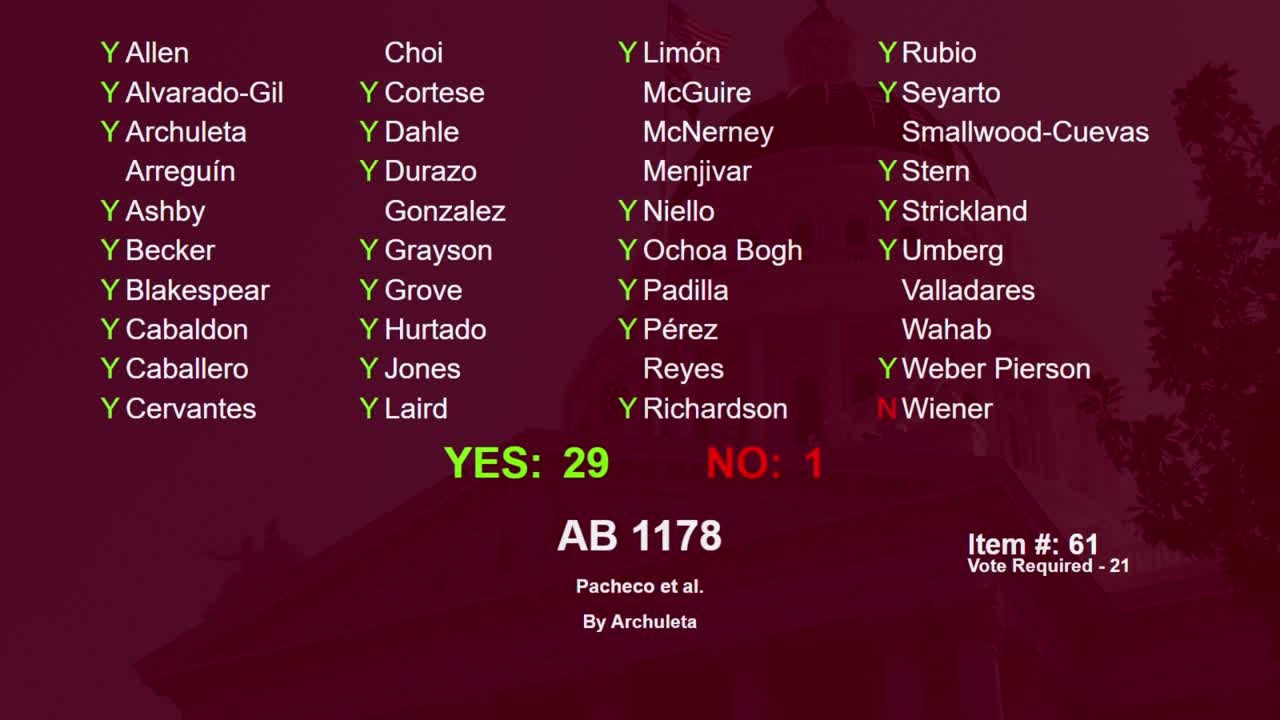


Bill Author