AB 1261: Immigration: immigrant youth: access to legal counsel.
- Session Year: 2025-2026
- House: Assembly
- Latest Version Date: 2025-10-12
Current Status:
Passed
(2025-10-12: Chaptered by Secretary of State - Chapter 665, Statutes of 2025.)
Introduced
In Committee
Awaiting First Chamber Vote
Passed First Chamber
In Committee
Awaiting Second Chamber Vote
Passed Second Chamber
Enacted
What does this bill do?
The bill requires the state, subject to available funding, to provide legal counsel to immigrant youth in California. Immigrant youth are defined as undocumented minors or people under 18 without lawful immigration status who arrived without, or lack, a parent or guardian able to help with their immigration cases. Counsel would begin when a youth is identified as unaccompanied and cover immigration cases and related court filings; the state would contract with qualified nonprofit legal service groups or experienced public defender offices, may fund social work services, and would prioritize groups with no or unmet federal funding.
The summary is provided by generative AI which can make mistakes. For original language, please view the details in the table below.
Existing law, subject to available funding, requires the State Department of Social Services to contract with qualified nonprofit legal services organizations to provide legal services to unaccompanied undocumented minors who are transferred to the care and custody of the federal Office of Refugee Resettlement and who are present in this state or are residing with a family member or other sponsor. Existing law requires contracts awarded pursuant to the above-described provision to be executed with qualified nonprofit legal services organizations that meet certain requirements, including having experience representing individuals in removal proceedings and asylum applications.
This bill would, subject to available funding, provide legal counsel to immigrant youth in the State of California. The bill would define immigrant youth. The bill would require the department to allocate funding for these purposes, and would require the department to consider whether federal funding has been made available and dispersed to organizations or relevant projects in the state in determining the amount and allocation of contracts awarded. The bill would require the department to contract with qualified nonprofit legal services organizations that meet the above-described requirements or an office of the public defender that meets certain requirements. The bill would also authorize the department to fund social work services contracted by qualified nonprofit legal services organizations to assist immigrant youth.
Existing law, subject to available funding, requires the State Department of Social Services to contract with qualified nonprofit legal services organizations to provide legal services to unaccompanied undocumented minors who are transferred to the care and custody of the federal Office of Refugee Resettlement and who are present in this state or are residing with a family member or other sponsor. Existing law requires contracts awarded pursuant to the above-described provision to be executed with qualified nonprofit legal services organizations that meet certain requirements, including having experience representing individuals in removal proceedings and asylum applications.
This bill would require the state to provide legal counsel to each unaccompanied undocumented minor in the physical custody of the federal Office of Refugee Resettlement and present in California or residing with a family member or other sponsor in California, as specified. The bill would additionally require the department to contract with qualified nonprofit legal services organizations that meet the above-described requirements or an office of public defender that meets certain requirements, including that the office has an immigration unit or contracts with an immigration attorney with at least 3 years of experience and expertise in providing legal representation to clients in civil immigration matters before the United States Department of Homeland Security, to fulfill those requirements.This bill would, subject to available funding, provide legal counsel to immigrant youth in the State of California. The bill would define immigrant youth. The bill would require the department to allocate funding for these purposes, and would require the department to consider whether federal funding has been made available and dispersed to organizations or relevant projects in the state in determining the amount and allocation of contracts awarded. The bill would require the department to contract with qualified nonprofit legal services organizations that meet the above-described requirements or an office of the public defender that meets certain requirements. The bill would also authorize the department to fund social work services contracted by qualified nonprofit legal services organizations to assist immigrant youth.
Existing law, subject to available funding, requires the State Department of Social Services to contract with qualified nonprofit legal services organizations to provide legal services to unaccompanied undocumented minors who are transferred to the care and custody of the federal Office of Refugee Resettlement and who are present in this state or are residing with a family member or other sponsor. Existing law requires contracts awarded pursuant to the above-described provision to be executed with qualified nonprofit legal services organizations that meet certain requirements, including having experience representing individuals in removal proceedings and asylum applications.
This bill would require the state to provide legal counsel to each unaccompanied undocumented minor in the physical custody of the federal Office of Refugee Resettlement and present in California or residing with a family member or other sponsor in California, as specified. The bill would additionally require the department to contract with qualified nonprofit legal services organizations or public defenders to appoint counsel for unaccompanied undocumented minors who are in the physical custody of the federal Office of Refugee Resettlement and present in California or are residing with a family member or other of sponsor in California, as specified. that meet the above-described requirements or an office of public defender that meets certain requirements, including that the office has an immigration unit or contracts with an immigration attorney with at least 3 years of experience and expertise in providing legal representation to clients in civil immigration matters before the United States Department of Homeland Security, to fulfill those requirements.
Existing law, subject to available funding, requires the State Department of Social Services to contract with qualified nonprofit legal services organizations to provide legal services to unaccompanied undocumented minors who are transferred to the care and custody of the federal Office of Refugee Resettlement and who are present in this state or are residing with a family member or other sponsor.
This bill would additionally require the department to contract with qualified nonprofit legal services organizations or public defenders to appoint counsel for unaccompanied undocumented minors who are in the physical custody of the federal Office of Refugee Resettlement and present in California or are residing with a family member or other of sponsor in California, as specified.
Existing law provides for the construction of the Civil Code, as specified.This bill would make nonsubstantive changes to that provision.Existing law provides for the construction of the Civil Code, as specified.
This bill would make nonsubstantive changes to that provision.
(a)(1)Subject to the availability of state funding, the state shall provide legal counsel to every immigrant youth in the State of California.
(2)(A)The department shall allocate funding according to this section. In determining the amount and allocation of contracts awarded pursuant to this section, the department shall consider whether federal funding has been made available and dispersed to organizations or relevant projects in the state.
(B)The department shall prioritize awards of contracts or grants to qualified nonprofit organizations as described in Section 13301 that ineligible for federal funds or that have unmet needs despite federal assistance.
(b)Counsel shall be conferred pursuant to this section as follows:
(1)Access to counsel shall begin at the time an immigrant youth is designated as unaccompanied by a federal or state agency or identified as such by an immigration attorney.
(2)Access to counsel may apply in state court proceedings or submitting an affirmative filing for purposes of obtaining any order necessary for or relevant to immigration remedies, federal immigration proceedings, any related appearances or matters, and any appeals arising from those proceedings, before the United States Department of Homeland Security, federal court, or the Department of Justice.
(3)Access to counsel does not need to be provided if the immigrant youth has independent counsel.
(4)Access to counsel applies to a child who has been designated an immigrant youth at any time throughout the pendency of any of the proceedings identified in paragraphs (1) and (2). If an immigrant youth has been assigned counsel before the immigrant youth reaches 18 years of age, the immigrant youth remains eligible for ongoing access to counsel during the pendency of the proceedings.
(c)The department shall contract to provide legal counsel for immigrant youth with either of the following:
(1)A qualified nonprofit legal services organization, as described in Section 13301.
(2)An office of the public defender for the county, as established pursuant to Section 27700 of the Government Code, if the public defender meets all of the following requirements:
(A)The office has an immigration attorney with at least three years of experience handling asylum, T-Visa, U-Visa, or special immigrant juvenile status cases and has represented at least 20 minors in these matters.
(B)The office has an immigration attorney with experience representing minors in removal proceedings and asylum applications.
(C)The office has an immigration attorney who has conducted trainings on these issues for practitioners beyond their staff.
(3)The department may impose additional requirements for an office of public defender for the county to be eligible for a contract.
(d)For purposes of this section, an immigrant youth is a person residing in, or formerly residing, California, and is either of the following:
(1)The person is an undocumented minor as described in Section 279(g)(2) of Title 6 of the United States Code.
(2)The person is under 18 years of age, has no lawful immigration status, arrived in the United States without a parent or legal guardian, or has no parent or legal guardian available and able to assist in the youths immigration proceedings.
(e)The department shall require contractors pursuant to this section to maintain adequate legal malpractice insurance as necessary and to indemnify and hold the state harmless from any claims that arise from the legal services provided pursuant to this section.
(f)The department may fund social work services contracted by qualified nonprofit legal service organizations to assist immigrant youth.
SECTION 1.Section 13300.5 is added to the Welfare and Institutions Code, to read:13300.5.(a)The state shall provide legal counsel to each unaccompanied undocumented minor in the physical custody of the federal Office of Refugee Resettlement and present in California or residing with a family member or other sponsor in California.(b)The right to counsel conferred pursuant to this section shall apply as follows:(1)The right to counsel begins at the time an unaccompanied undocumented minor is issued a notice to appear and has been placed in immigration removal proceedings.(2)The right to counsel applies in state court proceedings for purposes of obtaining any order necessary for or relevant to immigration remedies, federal immigration proceedings, any related appearances or matters before the United States Department of Homeland Security, and any appeals arising from those proceedings.(3)The right to counsel applies unless the unaccompanied undocumented minor has retained counsel independently.(4)The right to counsel applies to a child who has been designated an unaccompanied undocumented minor at any time throughout the pendency of any of the proceedings identified in paragraph (2).(c)The department shall contract to fulfill the obligation imposed pursuant to subdivision (a) with either of the following:(1)A qualified nonprofit legal services organization, as described in Section 13301.(2)An office of public defender for the county, as established pursuant to Section 27700 of the Government Code, if the public defender meets all of the following requirements:(A)The office has an immigration unit or contracts with an immigration attorney with at least three years of experience and expertise in providing legal representation to clients in civil immigration matters before the United States Department of Homeland Security.(B)The immigration unit or immigration attorney on contract supervises work completed pursuant to the contract to provide counsel for unaccompanied undocumented minors.(C)The attorneys within the office performing work pursuant to the contract to provide counsel for unaccompanied undocumented minors receive at least two trainings of two hours each on matters relating to asylum, T-visas, U-visas, or special immigrant juvenile status.(d)For purposes of this section, an unaccompanied undocumented minor is any person who meets all of the following requirements:(1)The person has no lawful immigration status in the United States.(2)The person has not attained 18 years of age.(3)The person has no parent or legal guardian in the United States, or no parent or legal guardian in the United States is available to provide care and physical custody. (e)The department shall require contractors pursuant to this section to maintain adequate legal malpractice insurance as necessary and to indemnify and hold the state harmless from any claims that arise from the legal services provided pursuant to this section.(a)The state shall provide legal counsel to each unaccompanied undocumented minor in the physical custody of the federal Office of Refugee Resettlement and present in California or residing with a family member or other sponsor in California.
(b)The right to counsel conferred pursuant to this section shall apply as follows:
(1)The right to counsel begins at the time an unaccompanied undocumented minor is issued a notice to appear and has been placed in immigration removal proceedings.
(2)The right to counsel applies in state court proceedings for purposes of obtaining any order necessary for or relevant to immigration remedies, federal immigration proceedings, any related appearances or matters before the United States Department of Homeland Security, and any appeals arising from those proceedings.
(3)The right to counsel applies unless the unaccompanied undocumented minor has retained counsel independently.
(4)The right to counsel applies to a child who has been designated an unaccompanied undocumented minor at any time throughout the pendency of any of the proceedings identified in paragraph (2).
(c)The department shall contract to fulfill the obligation imposed pursuant to subdivision (a) with either of the following:
(1)A qualified nonprofit legal services organization, as described in Section 13301.
(2)An office of public defender for the county, as established pursuant to Section 27700 of the Government Code, if the public defender meets all of the following requirements:
(A)The office has an immigration unit or contracts with an immigration attorney with at least three years of experience and expertise in providing legal representation to clients in civil immigration matters before the United States Department of Homeland Security.
(B)The immigration unit or immigration attorney on contract supervises work completed pursuant to the contract to provide counsel for unaccompanied undocumented minors.
(C)The attorneys within the office performing work pursuant to the contract to provide counsel for unaccompanied undocumented minors receive at least two trainings of two hours each on matters relating to asylum, T-visas, U-visas, or special immigrant juvenile status.
(d)For purposes of this section, an unaccompanied undocumented minor is any person who meets all of the following requirements:
(1)The person has no lawful immigration status in the United States.
(2)The person has not attained 18 years of age.
(3)The person has no parent or legal guardian in the United States, or no parent or legal guardian in the United States is available to provide care and physical custody.
(e)The department shall require contractors pursuant to this section to maintain adequate legal malpractice insurance as necessary and to indemnify and hold the state harmless from any claims that arise from the legal services provided pursuant to this section.
SECTION 1.Section 13300.5 is added to the Welfare and Institutions Code, to read:13300.5.(a)The department shall contract with qualified nonprofit legal services organizations, as described in Section 13301, or with public defenders to appoint counsel for unaccompanied undocumented minors who are in the physical custody of the federal Office of Refugee Resettlement and present in California or are residing with a family member or other of sponsor in California.(b)The right to counsel pursuant to this section shall comply with the following requirements:(1)The right to counsel begins at the time an unaccompanied undocumented minor has been served with a notice to appear and has been placed in immigration removal proceedings.(2)The right to counsel applies in state court proceedings, federal immigration proceedings, including appearances before the United States Citizenship and Immigration Services, and any appeals arising from those proceedings.(3)The right to counsel applies unless the unaccompanied undocumented minor has retained counsel independently.(c)The department shall require contractors pursuant to this section to maintain adequate legal malpractice insurance as necessary and to indemnify and hold the state harmless from any claims that arise from the legal services provided pursuant to this section. REVISIONS: HeadingLine 2.(a)The department shall contract with qualified nonprofit legal services organizations, as described in Section 13301, or with public defenders to appoint counsel for unaccompanied undocumented minors who are in the physical custody of the federal Office of Refugee Resettlement and present in California or are residing with a family member or other of sponsor in California.
(b)The right to counsel pursuant to this section shall comply with the following requirements:
(1)The right to counsel begins at the time an unaccompanied undocumented minor has been served with a notice to appear and has been placed in immigration removal proceedings.
(2)The right to counsel applies in state court proceedings, federal immigration proceedings, including appearances before the United States Citizenship and Immigration Services, and any appeals arising from those proceedings.
(3)The right to counsel applies unless the unaccompanied undocumented minor has retained counsel independently.
(c)The department shall require contractors pursuant to this section to maintain adequate legal malpractice insurance as necessary and to indemnify and hold the state harmless from any claims that arise from the legal services provided pursuant to this section.
SECTION 1.Section 5 of the Civil Code is amended to read:5.The provisions of this code, so far as they are substantially the same as existing statutes or the common law, shall be construed as continuations thereof, and not as new enactments.The provisions of this Code, code, so far as they are substantially the same as existing statutes or the common law, must shall be construed as continuations thereof, and not as new enactments.
|
Date
|
Status
|
|---|---|
| Oct 12, 2025 | Chaptered by Secretary of State - Chapter 665, Statutes of 2025. |
| Oct 12, 2025 | Approved by the Governor. |
| Sep 22, 2025 | Enrolled and presented to the Governor at 3 p.m. |
| Sep 10, 2025 | Senate amendments concurred in. To Engrossing and Enrolling. (Ayes 63. Noes 10. Page 3203.). |
| Sep 9, 2025 | In Assembly. Concurrence in Senate amendments pending. |
| Sep 9, 2025 | Read third time. Passed. Ordered to the Assembly. (Ayes 30. Noes 8. Page 2738.). |
| Sep 8, 2025 | Read second time. Ordered to third reading. |
| Sep 5, 2025 | Read third time and amended. Ordered to second reading. |
| Aug 29, 2025 | Read second time. Ordered to third reading. |
| Aug 29, 2025 | From committee: Do pass. (Ayes 5. Noes 2.) (August 29). |
| Aug 18, 2025 | In committee: Referred to suspense file. |
| Jul 8, 2025 | From committee: Do pass and re-refer to Com. on APPR. (Ayes 4. Noes 0.) (July 7). Re-referred to Com. on APPR. |
| Jul 2, 2025 | From committee: Do pass and re-refer to Com. on HUMAN S. (Ayes 12. Noes 1.) (July 1). Re-referred to Com. on HUMAN S. |
| Jun 18, 2025 | Referred to Coms. on JUD. and HUMAN S. |
| Jun 4, 2025 | In Senate. Read first time. To Com. on RLS. for assignment. |
| Jun 3, 2025 | Read third time. Passed. Ordered to the Senate. (Ayes 63. Noes 8. Page 1991.) |
| May 27, 2025 | Read second time. Ordered to third reading. |
| May 23, 2025 | From committee: Do pass. (Ayes 11. Noes 2.) (May 23). |
| May 23, 2025 | Coauthors revised. |
| May 7, 2025 | In committee: Set, first hearing. Referred to APPR. suspense file. |
| Apr 24, 2025 | Re-referred to Com. on APPR. |
| Apr 23, 2025 | Read second time and amended. |
| Apr 22, 2025 | From committee: Amend, and do pass as amended and re-refer to Com. on APPR. (Ayes 9. Noes 2.) (April 22). |
| Apr 1, 2025 | In committee: Hearing postponed by committee. |
| Mar 25, 2025 | Re-referred to Com. on JUD. |
| Mar 24, 2025 | Referred to Com. on JUD. |
| Mar 24, 2025 | From committee chair, with author's amendments: Amend, and re-refer to Com. on JUD. Read second time and amended. |
| Feb 24, 2025 | Read first time. |
| Feb 22, 2025 | From printer. May be heard in committee March 24. |
| Feb 21, 2025 | Introduced. To print. |
|
Date
|
Description
|
Location
|
Votes
|
|
|---|---|---|---|---|
| Sep 10, 2025 | AB 1261 Bonta Concurrence in Senate Amendments | Assembly Floor |
Passed |
|
| Sep 9, 2025 | Assembly 3rd Reading AB1261 Bonta et al. By Arreguín | Senate Floor |
Passed |
|
| Aug 29, 2025 | Do pass | Senate Standing Committee on Appropriations |
Passed |
|
| Aug 18, 2025 | Placed on suspense file | Senate Standing Committee on Appropriations |
Passed |
|
| Jul 7, 2025 | Do pass, but first be re-referred to the Committee on [Appropriations] | Senate Standing Committee on Human Services |
Passed |
|
| Jul 1, 2025 | Do pass, but first be re-referred to the Committee on [Human Services] | Senate Standing Committee on Judiciary |
Passed |
|
| Jun 3, 2025 | AB 1261 Bonta Assembly Third Reading | Assembly Floor |
Passed |
|
| May 23, 2025 | Do pass. | Assembly Standing Committee on Appropriations |
Passed |
|
| Apr 22, 2025 | Do pass as amended and be re-referred to the Committee on [Appropriations] | Assembly Standing Committee on Judiciary |
Passed |
This list shows positions taken on this bill by organizations on the date displayed, which is linked to the original source.
Positions by individuals are not included.
|
Organization
|
Position
|
Date
|
|---|---|---|
| a coalition of 20 attorneys general | ** Support | |
| Alameda County Board of Supervisors | ** Support | |
| California Alliance Of Child And Family Services | ** Support | |
| California attorney | ** Support | |
| California Catholic Conference | ** Support | |
| California Latino Legislative Caucus | ** Support | |
| California Public Defenders Association | ** Support | |
| California State Council of Service Employees International Union (SEIU | ** Support | |
| City of Alameda | ** Support | |
| City Of Oakland | ** Support | |
| City of Soledad | ** Support | |
| Coalition to Abolish Slavery and Trafficking (CAST) | ** Support | |
| Democrats of Rossmoor | ** Support | |
| First 5 California | ** Support | |
| Immigrant Legal Resource Center | ** Support | |
| Santa Barbara Women's Political Committee | ** Support | |
| Secure Justice | ** Support |
CONCURRENCE IN SENATE AMENDMENTS
CSA1 Bill Id:AB 1261
Author:(Bonta)
As Amended Ver:September 5, 2025
Majority vote
SUMMARY
Requires the state to provide legal representation for unaccompanied undocumented minors in federal immigration proceedings, or related state proceedings, in California.
Major Provisions
- Subject to the availability of state funding, requires the state to provide legal counsel to every immigrant youth in the State of California.
- Requires the department to allocate funding as specified. In determining the amount and allocation of contracts awarded, requires the department to consider whether federal funding has been made available and dispersed to organizations or relevant projects in the state. Requires the department to prioritize awards of contracts or grants to qualified nonprofit organizations as described in Welfare and Institutions Code Section 13301 that are ineligible for federal funds or that have unmet needs despite federal assistance.
- Specifies that counsel is conferred as follows:
- Access to counsel begins at the time an immigrant youth has been designated as unaccompanied by a federal or state agency or identified as such by an immigration attorney;
- Access to counsel may apply in state court proceedings or submitting an affirmative filing for purposes of obtaining any order necessary for or relevant to immigration remedies, federal immigration proceedings, any related appearances or matters before the Department of Homeland Security, federal court, or the Department of Justice;
- Access to counsel does not need to be provided if the immigrant youth has independent counsel;
- Access to counsel applies to a child who has been designated as an immigrant youth at any time throughout the pendency of any proceeding identified in this subdivision. If an immigrant youth has been assigned counsel before the immigrant youth reaches 18 years of age, the immigrant youth remains eligible for ongoing access to counsel during the pendency of the proceedings.
- Requires the department to contract with qualified nonprofit legal services organizations as described in Section 13301 of the Welfare and Institutions Code or with an office of the public defender for the county as established pursuant to Section 27700 of the Government Code.
- Requires contracts with an office of the public defender for the county to comply with all of the following:
- Has an immigration unit or contracts with an immigration attorney with at least three years' experience handling asylum, T-Visa, U-Visa, or special immigrant juvenile status cases and has represented at least 20 minors in these matters.
- The office has an immigration attorney with experience representing minors in removal proceedings and asylum applications.
- The office has an immigration attorney who has conducted trainings on these issues for practitioners beyond their staff.
- Authorizes the department to impose additional requirements for an office of public defender for the county to be eligible for a contract.
- Defines an immigrant youth as a person residing in, or formerly residing in, California, and is either of the following:
- The person is an undocumented minor as described in Section 279(g)(2) of Title 6 of the United States Code.
- The person is under 18 years of age, has no lawful immigration status, arrived in the United States without a parent or legal guardian, or has no parent or legal guardian available and able to assist in the youth's immigration proceedings.
- Requires the department to require contractors pursuant to 3) to maintain adequate legal malpractice insurance as necessary and to indemnify and hold the state harmless from any claims that arise from the legal services provided pursuant to the section.
- Authorizes the department to fund social work services contracted by qualified nonprofit legal service organizations to assist immigrant youth.
Senate Amendments
Incorporate clarifying amendments and specify methods for the Department to award grants.
COMMENTS
Up until February of this year, the federal government had contracted with nonprofit organizations to fund legal representation of these minors in federal immigration proceedings. On February 18, 2025, the Trump administration suspended these contracts via executive order. The nonprofits covered by the order were given a stop-work order by the Department of Human Services, throwing the organizations and the children themselves into uncertainty. (Rebecca Santana, Trump administration cuts legal help for migrant children traveling alone, AP News (March 21, 2025) available at: https://apnews.com/article/trump-legal-aid-unaccompanied-children-immigration-court-127a69ce69573d2d16c72a74dacef3ab.) On April 2nd, a federal judge ordered the administration to reinstate the contracts until at least April 16th. (Associated Press via NPR, Judge orders White House to restore legal aid to unaccompanied migrant children (April 2, 2025).) It is not apparent whether the administration will continue, let alone renew, the contracts.
In addition to the federal administration's efforts to reel in support for legal resources for this population of children, California has also rolled back similar programs. The Children's Holistic Immigration Representation Project was funded in 2022 through the state's budget act. The Project was a two-year pilot project that provided social and legal services to unaccompanied minors. Since 2022 it had provided funding for 16 organizations which in turn provided legal representation to more than 600 children. The Governor's initial 2025 – 2026 budget proposal did not include new allocations for the program. The state does implement other measures to provide legal resources to immigrants generally, including through funding of the One California program.
Immigration court is unmanageable for adults, let alone children. Despite the fact that immigration proceedings involve outcomes that are arguably as impactful, if not in some cases more so, than criminal proceedings, unlike in criminal proceedings, individuals in immigration proceedings are not guaranteed government-appointed attorney. For many unaccompanied minors the result is mind-bogglingly irrational – children and toddlers appearing before an immigration judge to attempt to advocate on their own behalf and avoid deportation.
Beyond providing a degree of human comfort to children facing a daunting legal system, providing legal representation also has a marked impact on these children' prospects of remaining in the United States. According to a report by the Vera Institute of Justice, more than 90 percent of unrepresented minors in immigration proceedings were ultimately either issued an order of removal or opted for voluntary departure. (Vera Institute of Justice, Representation Matters (December 2021) available at: https://www.vera.org/publications/representation-matters.) Between 2005 and 2017, only 64% of unrepresented minors had legal representation at any point during their proceedings. (Id.)
This bill creates an obligation for the state to provide legal representation to unaccompanied undocumented minors in the federal Office of Refugee Resettlement (ORR) custody or in the custody of a family member or sponsor in California. The obligation attaches at the time a minor is issued a notice to appear and is placed in immigration removal proceedings, and is limited to services necessary for or relevant to immigration proceedings or remedies, unless the minor has retained counsel independently. Finally, in order to meet the bill's obligations, the bill authorizes the Department of Social Services (DSS) to contract with qualified nonprofit legal services organizations or public defenders offices in order to meet, as specified.
Particularly in light of the notoriously dangerous conditions undocumented unaccompanied children endure in reaching the United States, it seems reasonable to attempt to ensure that those who have a legitimate basis for remaining in the U.S. are not deported to their home country, potentially forcing them to risk the journey yet again.
According to the Author
Unaccompanied immigrant children in the U.S. currently have no right to legal counsel in immigration court, leaving them vulnerable to deportation and unable to access to critical protections like Special Immigrant Juvenile Status (SIJS) and asylum. The legal processes for these protections are complex, and without an attorney, these children are at a severe disadvantage. In 2023, only 56% of unaccompanied children had legal representation, and the difference in outcomes is stark. A 2021 report revealed that 90% of unrepresented minors were ordered removed. Additionally, many children never even get the chance to present their case. In fiscal year 2023, 86% of removal orders were issued in absentia, often because children couldn't make it to court. Represented children, however, appeared in 95% of hearings. Recent actions by the federal administration, such as canceling a contract that provided legal services to 26,000 children and an ICE memo prioritizing unaccompanied children for detention, have heightened the need for children to have access to representation. California alone received over 10,800 unaccompanied minors in fiscal year 2024, underscoring the urgent need for a right to counsel. It is critical to provide legal representation to ensure these children have a fair chance at justice. Access to counsel is not just a matter of legal fairness—it's a matter of basic human rights.
Arguments in Support
This measure is supported by the California Alliance of Child and Family Services, the California Catholic Conference, the California State Council of Service Employees International Union (SEIU), First 5 California, the California Latino Legislative Caucus, the California Public Defenders Association, the cities of Alameda, Oakland, and Soledad, the Coalition to Abolish Slavery and Trafficking (CAST), Democrats of Rossmoor, the Santa Barbara Women's Political Committee, Secure Justice, and the Immigrant Legal Resource Center. In support of the bill, the California Catholic Conference submits:
Children attempting to seek protection alone in the U.S. face several specific challenges beginning with the perilous journey to reach the border in the first place. With no family members to support and protect them there is an extremely high risk of exploitation and abuse by human traffickers. The Congressional Research Service estimates that 75-80% of unaccompanied children arriving at the U.S.-Mexico border are victims of human trafficking.
In the U.S., asylum seekers, including unaccompanied children, are not guaranteed access to legal counsel. They are expected to represent themselves before immigration judges, despite being unable to comprehend the complex proceedings which may result in their return to violence or persecution. Many of these children who are forced to represent themselves are unsuccessful and can be deported. Those who manage to find lawyers win their cases about 88% of the time.
AB 1261 will allow unaccompanied children to obtain legal representation and in turn, they will be more likely to receive positive immigration court decisions and remain in the U.S.
Arguments in Opposition
None on file
FISCAL COMMENTS
According to the Senate Appropriations Committee:
The California Department of Social Services (CDSS) reports that the Office of Refugee Resettlement (ORR) data demonstrates a significant increase between 2014 and 2023 in UUMs released to sponsors in California. On the higher end, in Federal Fiscal Year (FFY) 2021-22, 13,730 unaccompanied undocumented minors were released to sponsors in California and in FFY 2022-23, 11,121 UUMs were released in CA. More recently, from October 1, 2024, as of May 31, 2025, there have only been 2,570 youth released, which closely mirrors the trends observed in FFY 2019-20. With this data context and the current bill language requiring legal assistance for every youth, CDSS's projections range from $17,500,000 to $77,000,000. These projections are based on its current pay scale for Youth Legal Services. CDSS only has $2.9 million funded for these youth on an ongoing basis through CA state budget acts. The actual funding required would change from year to year based on the number of ORR youth in custody. CDSS also notes that it would request to convert three positions 1 SSM I, and 2 AGPAs who manage the CDSS youth legal services grants to budget authorized positions from blanket positions. $563,000 (GF) ongoing annual funding would be needed to support 3.0 positions to handle the associated workload. Since the 3.0 positions requested are existing blanket positions, one-time costs are excluded.
VOTES:
ASM JUDICIARY: 9-2-1
YES: Kalra, Bauer-Kahan, Bryan, Connolly, Harabedian, Pacheco, Lee, Stefani, Zbur
NO: Dixon, Sanchez
ABS, ABST OR NV: Macedo
ASM APPROPRIATIONS: 11-2-2
YES: Wicks, Arambula, Calderon, Caloza, Elhawary, Fong, Mark González, Hart, Pacheco, Pellerin, Solache
NO: Dixon, Tangipa
ABS, ABST OR NV: Sanchez, Ta
ASSEMBLY FLOOR: 63-8-8
YES: Addis, Aguiar-Curry, Ahrens, Alanis, Alvarez, Arambula, Ávila Farías, Bains, Bauer-Kahan, Bennett, Berman, Boerner, Bonta, Bryan, Calderon, Caloza, Carrillo, Connolly, Elhawary, Fong, Gabriel, Garcia, Gipson, Jeff Gonzalez, Mark González, Haney, Harabedian, Hart, Irwin, Jackson, Kalra, Krell, Lee, Lowenthal, McKinnor, Muratsuchi, Nguyen, Ortega, Pacheco, Papan, Patel, Pellerin, Petrie-Norris, Quirk-Silva, Ramos, Ransom, Celeste Rodriguez, Michelle Rodriguez, Rogers, Blanca Rubio, Schiavo, Schultz, Sharp-Collins, Solache, Soria, Stefani, Valencia, Wallis, Ward, Wicks, Wilson, Zbur, Rivas
NO: DeMaio, Dixon, Ellis, Gallagher, Lackey, Patterson, Sanchez, Tangipa
ABS, ABST OR NV: Castillo, Chen, Davies, Flora, Hadwick, Hoover, Macedo, Ta
UPDATED
VERSION: April 23, 2025
CONSULTANT: Manuela Boucher / JUD. / (916) 319-2334 FN: 0001845
SENATE RULES COMMITTEE Office of Senate Floor Analyses (916) 651-1520 Fax: (916) 327-4478 | AB 1261 |
THIRD READING
Bill No: AB 1261
Author: Bonta (D), et al.
Amended: 9/5/25 in Senate
Vote: 21
SENATE JUDICIARY COMMITTEE: 12-1, 7/1/25
AYES: Umberg, Allen, Arreguín, Ashby, Caballero, Durazo, Laird, Stern, Valladares, Wahab, Weber Pierson, Wiener
NOES: Niello
SENATE HUMAN SERVICES COMMITTEE: 4-0, 7/7/25
AYES: Arreguín, Becker, Durazo, Limón
NO VOTE RECORDED: Ochoa Bogh
SENATE APPROPRIATIONS COMMITTEE: 5-2, 8/29/25
AYES: Caballero, Cabaldon, Grayson, Richardson, Wahab
NOES: Seyarto, Dahle
ASSEMBLY FLOOR: 63-8, 6/3/25 - See last page for vote
SUBJECT: Immigration: immigrant youth: access to legal counsel
SOURCE: Author
DIGEST:
This bill specifies that the state shall provide legal counsel to every immigrant youth, as defined, in California, subject to the availability of funding. The bill provides that the California Department of Social Services (CDSS) shall allocate this funding and specifies how awards of contracts will be determined.
Senate Floor Amendments of 9/5/25 specify that the provision of legal counsel to immigrant youth is subject to the availability of state funding. Amendments also make the program more consistent with existing legal services programs for immigrants that are administered by CDSS.
ANALYSIS:
Existing law:
- Directs DSS, subject to the availability of funding from the annual Budget Act, to contract with qualified nonprofit legal services organizations to provide legal services to unaccompanied undocumented minors who are transferred to the care and custody of the federal Office of Refugee Resettlement and who are present in this state, for the sole purpose of providing legal representation to unaccompanied undocumented minors who are in the physical custody of the federal Office of Refugee Resettlement or who are residing with a family member or other sponsor. (Welfare and Institutions Code (Welf. and Inst. Code) § 13300 (a) & (b).)
- Defines “legal services” to include culturally and linguistically appropriate services provided by attorneys, paralegals, interpreters and other support staff for state court proceedings, federal immigration proceedings, and any appeals arising from those proceedings. (Welf. and Inst. Code § 13300 (d).)
- Requires that contracts awarded pursuant to 1) fulfill each of the following, among additional requirements, and may be executed only with nonprofit legal services organizations that meet all of the following requirements:
- Have at least three years of experience handling asylum, T-Visa, U-Visa, or special immigrant juvenile status cases and have represented at least 25 individuals in these matters;
- Have experience in representing individuals in removal proceedings and asylum applications;
- Have conducted trainings on these issues for practitioners beyond their staff;
- Have experience guiding and supervising the work of attorneys who themselves do not regularly participate in this area of the law but nevertheless work pro bono on the types of cases described in i).
- Are accredited by the Board of Immigration Appeals under the United States Department of Justice’s Executive Office for Immigration Review or meet the requirements to receive funding from the Trust Fund Program administered by the State Bar of California. (Welf. and Inst. Code § 13301 (a).)
- Provides immigration relief that relies on a state’s interest in the welfare of children by providing for Special Immigrant Juvenile Status where a state determines that reunification with one or both of the immigrant’s parents is not viable due to abuse, neglect, abandonment, or similar basis found under state law and that it would not be in the child’s best interest to return to their home country. (Title 8 United States Code (U.S.C.) § 1101 (a)(27)(J).)
- Establishes that the care and custody of unaccompanied minors is the responsibility of the Office of Refugee Resettlement in the Department of Health and Human Services instead of the Department of Homeland Security. (Homeland Security Act of 2002; P.L. 107-296, § 462.)
- Defines a “special immigrant juvenile” as a person under 21 who is declared a dependent by a juvenile court or committed to the custody of a state agency or a court-appointed individual, whose reunification with one or both of their parents is not viable due to abuse, neglect, abandonment, or a similar basis found under state law, and whose return to their country of nationality or last habitual residence is not in their best interest. (8 U.S.C. § 1101(a)(27)(J).)
- Allows such a person to obtain Special Immigrant Juvenile Status (SIJS) and, based on that, apply for a visa for lawful permanent residency. (8 U.S.C. § 1153(b)(4).)
- Provides that the superior court, including a juvenile, probate, or family court department or division of the superior court, has jurisdiction to make judicial determinations regarding the custody and care of juveniles within the meaning of the federal Immigration and Nationality Act, and requires the superior court to make an order containing the necessary findings regarding SIJS pursuant to federal law, if there is evidence to support those findings. (Code of Civil Procedure (Code Civ. Proc.) § 155.)
- Allows the court to appoint a guardian of the person, the estate, or both for a child under 18 years of age, taking into consideration the best interest of the proposed ward. Allows the court to appoint a guardian of the person for an unmarried individual who is 18 years or older, but who has not yet attained 21 years of age, in connection with a petition to make the necessary findings regarding SIJS pursuant to Code of Civil Procedure section 155 (b) if the proposed ward consents. (Probate Code) §§ 1501 et seq.)
This bill:
- Provides that the state shall provide legal counsel to every immigrant youth in the State of California, subject to the availability of funding.
- Specifies that CDSS shall allocate this funding and consider whether federal funding has been made available and dispersed to organizations or relevant project in the state when determining the amount and allocation of contracts.
- Requires CDSS to prioritize awards of contracts or grants to qualified nonprofit organizations, as defined, that are ineligible for federal funds or that have unmet needs despite federal assistance.
- Provides that access to counsel: shall begin at the time an immigrant youth is designated as unaccompanied by a federal or state agency or identified as such by an immigration attorney; may apply in state court proceedings or submitting an affirmative filing for purposes of obtaining any order necessary for or relevant to immigration remedies, federal immigration proceedings, any related appearances or matters, and any appeals arising from those proceedings, before the United States Department of Homeland Security, federal court, or the Department of Justice; does not need to be provided if the immigrant youth has independent counsel; applies to a child who has been designated an immigrant youth at any time throughout the pendency of any of these proceedings.
- Specifies that if an immigrant youth has been assigned counsel before the immigrant youth reaches 18 years of age, the immigrant youth remains eligible for ongoing access to counsel during the pendency of the proceedings.
- Provides that CDSS shall contract to provide legal counsel for immigrant youth with either a qualified nonprofit legal services organization, as described in Section 13301 or an office of the public defender for the county, as established pursuant to Section 27700 of the Government Code, if the public defender meets specified requirements.
- Defines “immigrant youth” as: a person residing in, or formerly residing, California, and is either an undocumented minor as described in Section 279(g)(2) of Title 6 of the United States Code; or under 18 years of age, has no lawful immigration status, arrived in the United States without a parent or legal guardian, or has no parent or legal guardian available and able to assist in the youth’s immigration proceedings.
- Specifies that CDSS shall require contractors to maintain adequate legal malpractice insurance as necessary and to indemnify and hold the state harmless from any claims that arise from the legal services provided.
- Provides that CDSS may fund social work services contracted by qualified nonprofit legal service organizations to assist immigrant youth.
Comments
According to the author:
Unaccompanied immigrant children in the U.S. currently have no right to legal counsel in immigration court, leaving them vulnerable to deportation and unable to access critical protections like Special Immigrant Juvenile Status (SIJS) and asylum. The legal processes for these protections are complex, and without an attorney, these children are at a severe disadvantage. In 2023, only 56% of unaccompanied children had legal representation, and the difference in outcomes is stark. A 2021 report revealed that 90% of unrepresented minors were ordered removed. Additionally, many children never even get the chance to present their case. In fiscal year 2023, 86% of removal orders were issued in absentia, often because children couldn’t make it to court. Represented children, however, appeared in 95% of hearings. Recent actions by the federal administration, such as canceling a contract that provided legal services to 26,000 children and an ICE memo prioritizing unaccompanied children for detention, have heightened the need for children to have access to representation. California alone received over 10,800 unaccompanied minors in fiscal year 2024, underscoring the urgent need for a right to counsel. It is critical to provide legal representation to ensure these children have a fair chance at justice. Access to counsel is not just a matter of legal fairness—it’s a matter of basic human rights.
Special Immigrant Juvenile Status (SIJS), found in the Federal Immigration and Nationality Act, is a statutory tool enacted nearly three decades ago to benefit immigrant children and youth. SIJS involves both federal and state law. The federal statute and regulations provide the framework, and the state courts provide the details for each individual situation. Since 2014, the State of California has funded legal services for unaccompanied minors and the Legislature has passed several bills to ensure that the unaccompanied minors and youth are able to receive the predicate orders in state court that the minors and youth require to enable them to apply for SIJS. The federal government has also funded legal services for unaccompanied minors for a number of years. However, funding has been pulled by the federal Administration. Therefore fewer children and youth in California are provided legal immigration services at a time when the Trump Administration is pushing an anti-immigrant agenda.
This bill seeks to better ensure that these children are provided legal representation to help them navigate the complex state court and immigration system so that they may obtain the immigration relief to which they are entitled under federal immigration law. According to the Immigrant Legal Resource Center, a supporter of this bill, “[w]ithout legal assistance, these children cannot successfully navigate the immigration system even if their cases are strong, leading to their near-certain deportation. According to data collected by the Vera Institute of Justice, unaccompanied children with legal representation were more than seven times more likely than unrepresented unaccompanied children to receive an outcome that allowed them to remain in the United States. In that same study, Vera found that more than 90% of unrepresented unaccompanied children were issued an order of removal regardless of the strength of their immigration claims.”[1]
This bill specifies that the state shall provide legal counsel to every immigrant youth, as defined, in California, subject to the availability of funding. This bill provides that the California Department of Social Services (CDSS) shall allocate this funding and specifies how awards of contracts will be determined. This bill is a priority bill of the California Latino Legislative Caucus and is supported by numerous children rights organizations and organizations that support immigrant children and youth. According to the California Latino Legislative Caucus:
Many Latino and immigrant communities and their families face challenges related to language barriers, limited access to legal resources, and fear of deportation. This bill protects the rights of some our youngest Californians by ensuring they have access to legal representation and that they are not left to fend for themselves. AB 1261 mandates that the California Department of Social Services contract with qualified nonprofit legal services organizations or public defenders to appoint counsel for unaccompanied minors who are in the physical custody of the federal Office of Refugee Resettlement and present in California or residing with a sponsor within the state.
As we continue to see families torn apart, California must do more to protect immigrant children, who through no fault of their own, find themselves in immigration proceedings.
FISCAL EFFECT: Appropriation: No Fiscal Com.: Yes Local: No
According to the Senate Appropriations Committee:
The California Department of Social Services (CDSS) reports that the Office of Refugee Resettlement (ORR) data demonstrates a significant increase between 2014 and 2023 in UUMs released to sponsors in California. On the higher end, in Federal Fiscal Year (FFY) 2021-22, 13,730 unaccompanied undocumented minors were released to sponsors in California and in FFY 2022-23, 11,121 UUMs were released in CA. More recently, from October 1, 2024, as of May 31, 2025, there have only been 2,570 youth released, which closely mirrors the trends observed in FFY 2019-20. With this data context and the current bill language requiring legal assistance for every youth, CDSS’s projections range from $17,500,000 to $77,000,000. These projections are based on its current pay scale for Youth Legal Services. CDSS only has $2.9 million funded for these youth on an ongoing basis through CA state budget acts. The actual funding required would change from year to year based on the number of ORR youth in custody.
CDSS also notes that it would request to convert three positions 1 SSM I, and 2 AGPAs who manage the CDSS youth legal services grants to budget authorized positions from blanket positions. $563,000 (GF) ongoing annual funding would be needed to support 3.0 positions to handle the associated workload. Since the 3.0 positions requested are existing blanket positions, one-time costs are excluded.
SUPPORT: (Verified 9/7/25)
Alameda County Board of Supervisors
California Alliance of Child and Family Services
California Catholic Conference
California Latino Legislative Caucus
California Public Defenders Association
City of Alameda
City of Oakland
City of Soledad
Coalition to Abolish Slavery and Trafficking
Democrats of Rossmoor
First 5 California
Immigrant Legal Resource Center
Latino Legislative Caucus
Santa Barbara Women’s Political Committee
Secure Justice
SEIU California
OPPOSITION: (Verified 9/7/25)
None received
ASSEMBLY FLOOR: 63-8, 6/3/25
AYES: Addis, Aguiar-Curry, Ahrens, Alanis, Alvarez, Arambula, Ávila Farías, Bains, Bauer-Kahan, Bennett, Berman, Boerner, Bonta, Bryan, Calderon, Caloza, Carrillo, Connolly, Elhawary, Fong, Gabriel, Garcia, Gipson, Jeff Gonzalez, Mark González, Haney, Harabedian, Hart, Irwin, Jackson, Kalra, Krell, Lee, Lowenthal, McKinnor, Muratsuchi, Nguyen, Ortega, Pacheco, Papan, Patel, Pellerin, Petrie-Norris, Quirk-Silva, Ramos, Ransom, Celeste Rodriguez, Michelle Rodriguez, Rogers, Blanca Rubio, Schiavo, Schultz, Sharp-Collins, Solache, Soria, Stefani, Valencia, Wallis, Ward, Wicks, Wilson, Zbur, Rivas
NOES: DeMaio, Dixon, Ellis, Gallagher, Lackey, Patterson, Sanchez, Tangipa
NO VOTE RECORDED: Castillo, Chen, Davies, Flora, Hadwick, Hoover, Macedo, Ta
Prepared by: Margie Estrada / JUD. / (916) 651-4113
9/8/25 21:38:05
**** END ****
Vera Institute of Justice, Representation Matters (December 2021) available at: https://www.vera.org/publications/representation-matters [as of Aug 29, 2025]. ↑
SENATE RULES COMMITTEE Office of Senate Floor Analyses (916) 651-1520 Fax: (916) 327-4478 | AB 1261 |
THIRD READING
Bill No: AB 1261
Author: Bonta (D), et al.
Amended: 4/23/25 in Assembly
Vote: 21
SENATE JUDICIARY COMMITTEE: 12-1, 7/1/25
AYES: Umberg, Allen, Arreguín, Ashby, Caballero, Durazo, Laird, Stern, Valladares, Wahab, Weber Pierson, Wiener
NOES: Niello
SENATE HUMAN SERVICES COMMITTEE: 4-0, 7/7/25
AYES: Arreguín, Becker, Durazo, Limón
NO VOTE RECORDED: Ochoa Bogh
SENATE APPROPRIATIONS COMMITTEE: 5-2, 8/29/25
AYES: Caballero, Cabaldon, Grayson, Richardson, Wahab
NOES: Seyarto, Dahle
ASSEMBLY FLOOR: 63-8, 6/3/25 - See last page for vote
SUBJECT: Immigration: unaccompanied undocumented minors: right to legal counsel
SOURCE: Author
DIGEST:
This bill requires the state to provide legal counsel to each unaccompanied undocumented minor in the physical custody of the federal Office of Refugee Resettlement and present in California or residing with a family member or other sponsor in California, as specified. The bill additionally requires the Department of Social Services (DSS) to contract with qualified nonprofit legal services organizations that meet specified requirements or an office of public defender that meets specified requirements, including that the office has an immigration unit or contracts with an immigration attorney with at least 3 years of experience and expertise in providing legal representation to clients in civil immigration matters before the United States Department of Homeland Security, to fulfill those requirements.
ANALYSIS:
Existing law:
- Directs DSS, subject to the availability of funding from the annual Budget Act, to contract with qualified nonprofit legal services organizations to provide legal services to unaccompanied undocumented minors who are transferred to the care and custody of the federal Office of Refugee Resettlement and who are present in this state, for the sole purpose of providing legal representation to unaccompanied undocumented minors who are in the physical custody of the federal Office of Refugee Resettlement or who are residing with a family member or other sponsor. (Welfare and Institutions Code (Welf. and Inst. Code) § 13300 (a) & (b).)
- Defines “legal services” to include culturally and linguistically appropriate services provided by attorneys, paralegals, interpreters and other support staff for state court proceedings, federal immigration proceedings, and any appeals arising from those proceedings. (Welf. and Inst. Code § 13300 (d).)
- Requires that contracts awarded pursuant to 1) fulfill each of the following, among additional requirements, and may be executed only with nonprofit legal services organizations that meet all of the following requirements:
- Have at least three years of experience handling asylum, T-Visa, U-Visa, or special immigrant juvenile status cases and have represented at least 25 individuals in these matters;
- Have experience in representing individuals in removal proceedings and asylum applications;
- Have conducted trainings on these issues for practitioners beyond their staff;
- Have experience guiding and supervising the work of attorneys who themselves do not regularly participate in this area of the law but nevertheless work pro bono on the types of cases described in i).
- Are accredited by the Board of Immigration Appeals under the United States Department of Justice’s Executive Office for Immigration Review or meet the requirements to receive funding from the Trust Fund Program administered by the State Bar of California. (Welf. and Inst. Code § 13301 (a).)
- Provides immigration relief that relies on a state’s interest in the welfare of children by providing for Special Immigrant Juvenile Status where a state determines that reunification with one or both of the immigrant’s parents is not viable due to abuse, neglect, abandonment, or similar basis found under state law and that it would not be in the child’s best interest to return to their home country. (Title 8 United States Code (U.S.C.) § 1101 (a)(27)(J).)
- Establishes that the care and custody of unaccompanied minors is the responsibility of the Office of Refugee Resettlement in the Department of Health and Human Services instead of the Department of Homeland Security. (Homeland Security Act of 2002; P.L. 107-296, § 462.)
- Defines a “special immigrant juvenile” as a person under 21 who is declared a dependent by a juvenile court or committed to the custody of a state agency or a court-appointed individual, whose reunification with one or both of their parents is not viable due to abuse, neglect, abandonment, or a similar basis found under state law, and whose return to their country of nationality or last habitual residence is not in their best interest. (8 U.S.C. § 1101(a)(27)(J).)
- Allows such a person to obtain Special Immigrant Juvenile Status (SIJS) and, based on that, apply for a visa for lawful permanent residency. (8 U.S.C. § 1153(b)(4).)
- Provides that the superior court, including a juvenile, probate, or family court department or division of the superior court, has jurisdiction to make judicial determinations regarding the custody and care of juveniles within the meaning of the federal Immigration and Nationality Act, and requires the superior court to make an order containing the necessary findings regarding SIJS pursuant to federal law, if there is evidence to support those findings. (Code of Civil Procedure (Code Civ. Proc.) § 155.)
- Allows the court to appoint a guardian of the person, the estate, or both for a child under 18 years of age, taking into consideration the best interest of the proposed ward. Allows the court to appoint a guardian of the person for an unmarried individual who is 18 years or older, but who has not yet attained 21 years of age, in connection with a petition to make the necessary findings regarding SIJS pursuant to Code of Civil Procedure section 155 (b) if the proposed ward consents. (Probate Code (Prob. Code) §§ 1501 et seq.)
This bill:
- Provides that the state shall provide legal counsel to each unaccompanied undocumented minor in the physical custody of the federal Office of Refugee Resettlement and present in California or residing with a family member or other sponsor in California.
- Provides that the right to counsel conferred pursuant to this bill begins at the time an unaccompanied undocumented minor is issued a notice to appear and has been placed in immigration removal proceedings.
- Provides that the right to counsel conferred pursuant to this bill applies in state court proceedings for purposes of obtaining any order necessary for or relevant to immigration remedies, federal immigration proceedings, any related appearances or matters before the United States Department of Homeland Security, and any appeals arising from those proceedings.
- Provides that the right to counsel conferred pursuant to this bill applies unless the unaccompanied undocumented minor has retained counsel independently.
- Provides that the right to counsel conferred pursuant to this bill applies to a child who has been designated an unaccompanied undocumented minor at any time throughout the pendency of any of the proceedings identified in 3), above.
- Provides that DSS shall contract to fulfill the obligation imposed pursuant to 1), above, with a qualified nonprofit legal services organization, as described in Section 13301 of the Welfare and Institutions Code, or an office of public defender for the county, as established pursuant to Section 27700 of the Government Code, if the public defender meets all of the following requirements:
- the office has an immigration unit or contracts with an immigration attorney with at least three years of experience and expertise in providing legal representation to clients in civil immigration matters before the United States Department of Homeland Security;
- the immigration unit or immigration attorney on contract supervises work completed pursuant to the contract to provide counsel for unaccompanied undocumented minors; and
- the attorneys within the office performing work pursuant to the contract to provide counsel for unaccompanied undocumented minors receive at least two trainings of two hours each on matters relating to asylum, T-visas, U-visas, or special immigrant juvenile status.
- Defines an “unaccompanied undocumented minor” for purposes of this bill as any person who meets all of the following requirements:
- the person has no lawful immigration status in the United States;
- the person has not attained 18 years of age; and
- the person has no parent or legal guardian in the United States, or no parent or legal guardian in the United States is available to provide care and physical custody.
- Provides that DSS shall require contractors pursuant to this bill to maintain adequate legal malpractice insurance as necessary and to indemnify and hold the state harmless from any claims that arise from the legal services provided pursuant to this bill.
Comments
According to the author:
Unaccompanied immigrant children in the U.S. currently have no right to legal counsel in immigration court, leaving them vulnerable to deportation and unable to access critical protections like Special Immigrant Juvenile Status (SIJS) and asylum. The legal processes for these protections are complex, and without an attorney, these children are at a severe disadvantage. In 2023, only 56% of unaccompanied children had legal representation, and the difference in outcomes is stark. A 2021 report revealed that 90% of unrepresented minors were ordered removed. Additionally, many children never even get the chance to present their case. In fiscal year 2023, 86% of removal orders were issued in absentia, often because children couldn’t make it to court. Represented children, however, appeared in 95% of hearings. Recent actions by the federal administration, such as canceling a contract that provided legal services to 26,000 children and an ICE memo prioritizing unaccompanied children for detention, have heightened the need for children to have access to representation. California alone received over 10,800 unaccompanied minors in fiscal year 2024, underscoring the urgent need for a right to counsel. It is critical to provide legal representation to ensure these children have a fair chance at justice. Access to counsel is not just a matter of legal fairness—it’s a matter of basic human rights.
Special Immigrant Juvenile Status (SIJS), found in the Federal Immigration and Nationality Act, is a statutory tool enacted nearly three decades ago to benefit immigrant children and youth. SIJS involves both federal and state law. The federal statute and regulations provide the framework, and the state courts provide the details for each individual situation. Since 2014, the State of California has funded legal services for unaccompanied minors and the Legislature has passed several bills to ensure that the unaccompanied minors and youth are able to receive the predicate orders in state court that the minors and youth require to enable them to apply for SIJS. The federal government has also funded legal services for unaccompanied minors for a number of years. However, funding has been pulled by the federal Administration. Therefore fewer children and youth in California are provided legal immigration services at a time when the Trump Administration is pushing an anti-immigrant agenda.
This bill seeks to ensure that these children and youth are provided legal representation to help them navigate the complex state court and immigration system so that they may obtain the immigration relief to which they are entitled under federal immigration law. According to the Immigrant Legal Resource Center, a supporter of this bill, “[w]ithout legal assistance, these children cannot successfully navigate the immigration system even if their cases are strong, leading to their near-certain deportation. According to data collected by the Vera Institute of Justice, unaccompanied children with legal representation were more than seven times more likely than unrepresented unaccompanied children to receive an outcome that allowed them to remain in the United States. In that same study, Vera found that more than 90% of unrepresented unaccompanied children were issued an order of removal regardless of the strength of their immigration claims.”[1]
AB 1261 requires the state to provide legal counsel to each unaccompanied undocumented minor in the physical custody of the federal Office of Refugee Resettlement and present in California or residing with a family member or other sponsor in California, as specified. The bill additionally requires DSS to contract with qualified nonprofit legal services organizations that meet specified requirements or an office of public defender that meets specified requirements.
The bill is a priority bill of the California Latino Legislative Caucus and is supported by numerous children rights organizations and organizations that support immigrant children and youth. According to the California Latino Legislative Caucus:
Many Latino and immigrant communities and their families face challenges related to language barriers, limited access to legal resources, and fear of deportation. This bill protects the rights of some our youngest Californians by ensuring they have access to legal representation and that they are not left to fend for themselves. AB 1261 mandates that the California Department of Social Services contract with qualified nonprofit legal services organizations or public defenders to appoint counsel for unaccompanied minors who are in the physical custody of the federal Office of Refugee Resettlement and present in California or residing with a sponsor within the state.
As we continue to see families torn apart, California must do more to protect immigrant children, who through no fault of their own, find themselves in immigration proceedings.
FISCAL EFFECT: Appropriation: No Fiscal Com.: Yes Local: No
According to the Senate Appropriations Committee:
The California Department of Social Services (CDSS) reports that the Office of Refugee Resettlement (ORR) data demonstrates a significant increase between 2014 and 2023 in UUMs released to sponsors in California. On the higher end, in Federal Fiscal Year (FFY) 2021-22, 13,730 unaccompanied undocumented minors were released to sponsors in California and in FFY 2022-23, 11,121 UUMs were released in CA. More recently, from October 1, 2024, as of May 31, 2025, there have only been 2,570 youth released, which closely mirrors the trends observed in FFY 2019-20. With this data context and the current bill language requiring legal assistance for every youth, CDSS’s projections range from $17,500,000 to $77,000,000. These projections are based on its current pay scale for Youth Legal Services. CDSS only has $2.9 million funded for these youth on an ongoing basis through CA state budget acts. The actual funding required would change from year to year based on the number of ORR youth in custody.
CDSS also notes that it would request to convert three positions 1 SSM I, and 2 AGPAs who manage the CDSS youth legal services grants to budget authorized positions from blanket positions. $563,000 (GF) ongoing annual funding would be needed to support 3.0 positions to handle the associated workload. Since the 3.0 positions requested are existing blanket positions, one-time costs are excluded.
SUPPORT: (Verified 8/29/25)
Alameda County Board of Supervisors
California Alliance of Child and Family Services
California Catholic Conference
California Latino Legislative Caucus
California Public Defenders Association
City of Alameda
City of Oakland
City of Soledad
Coalition to Abolish Slavery and Trafficking
Democrats of Rossmoor
First 5 California
Immigrant Legal Resource Center
Latino Legislative Caucus
Santa Barbara Women’s Political Committee
Secure Justice
SEIU California
OPPOSITION: (Verified 8/29/25)
None received
ASSEMBLY FLOOR: 63-8, 6/3/25
AYES: Addis, Aguiar-Curry, Ahrens, Alanis, Alvarez, Arambula, Ávila Farías, Bains, Bauer-Kahan, Bennett, Berman, Boerner, Bonta, Bryan, Calderon, Caloza, Carrillo, Connolly, Elhawary, Fong, Gabriel, Garcia, Gipson, Jeff Gonzalez, Mark González, Haney, Harabedian, Hart, Irwin, Jackson, Kalra, Krell, Lee, Lowenthal, McKinnor, Muratsuchi, Nguyen, Ortega, Pacheco, Papan, Patel, Pellerin, Petrie-Norris, Quirk-Silva, Ramos, Ransom, Celeste Rodriguez, Michelle Rodriguez, Rogers, Blanca Rubio, Schiavo, Schultz, Sharp-Collins, Solache, Soria, Stefani, Valencia, Wallis, Ward, Wicks, Wilson, Zbur, Rivas
NOES: DeMaio, Dixon, Ellis, Gallagher, Lackey, Patterson, Sanchez, Tangipa
NO VOTE RECORDED: Castillo, Chen, Davies, Flora, Hadwick, Hoover, Macedo, Ta
Prepared by: Margie Estrada / JUD. / (916) 651-4113
9/2/25 10:14:50
**** END ****
Vera Institute of Justice, Representation Matters (December 2021) available at: https://www.vera.org/publications/representation-matters [as of Aug 29, 2025]. ↑
SENATE RULES COMMITTEE Office of Senate Floor Analyses (916) 651-1520 Fax: (916) 327-4478 | AB 1261 |
THIRD READING
Bill No: AB 1261
Author: Bonta (D), et al.
Amended: 4/23/25 in Assembly
Vote: 21
SENATE JUDICIARY COMMITTEE: 12-1, 7/1/25
AYES: Umberg, Allen, Arreguín, Ashby, Caballero, Durazo, Laird, Stern, Valladares, Wahab, Weber Pierson, Wiener
NOES: Niello
SENATE HUMAN SERVICES COMMITTEE: 4-0, 7/7/25
AYES: Arreguín, Becker, Durazo, Limón
NO VOTE RECORDED: Ochoa Bogh
SENATE APPROPRIATIONS COMMITTEE: 5-2, 8/29/25
AYES: Caballero, Cabaldon, Grayson, Richardson, Wahab
NOES: Seyarto, Dahle
ASSEMBLY FLOOR: 63-8, 6/3/25 - See last page for vote
SUBJECT: Immigration: unaccompanied undocumented minors: right to legal counsel
SOURCE: Author
DIGEST:
This bill requires the state to provide legal counsel to each unaccompanied undocumented minor in the physical custody of the federal Office of Refugee Resettlement and present in California or residing with a family member or other sponsor in California, as specified. The bill additionally requires the Department of Social Services (DSS) to contract with qualified nonprofit legal services organizations that meet specified requirements or an office of public defender that meets specified requirements, including that the office has an immigration unit or contracts with an immigration attorney with at least 3 years of experience and expertise in providing legal representation to clients in civil immigration matters before the United States Department of Homeland Security, to fulfill those requirements.
ANALYSIS:
Existing law:
- Directs DSS, subject to the availability of funding from the annual Budget Act, to contract with qualified nonprofit legal services organizations to provide legal services to unaccompanied undocumented minors who are transferred to the care and custody of the federal Office of Refugee Resettlement and who are present in this state, for the sole purpose of providing legal representation to unaccompanied undocumented minors who are in the physical custody of the federal Office of Refugee Resettlement or who are residing with a family member or other sponsor. (Welfare and Institutions Code (Welf. and Inst. Code) § 13300 (a) & (b).)
- Defines “legal services” to include culturally and linguistically appropriate services provided by attorneys, paralegals, interpreters and other support staff for state court proceedings, federal immigration proceedings, and any appeals arising from those proceedings. (Welf. and Inst. Code § 13300 (d).)
- Requires that contracts awarded pursuant to 1) fulfill each of the following, among additional requirements, and may be executed only with nonprofit legal services organizations that meet all of the following requirements:
- Have at least three years of experience handling asylum, T-Visa, U-Visa, or special immigrant juvenile status cases and have represented at least 25 individuals in these matters;
- Have experience in representing individuals in removal proceedings and asylum applications;
- Have conducted trainings on these issues for practitioners beyond their staff;
- Have experience guiding and supervising the work of attorneys who themselves do not regularly participate in this area of the law but nevertheless work pro bono on the types of cases described in i).
- Are accredited by the Board of Immigration Appeals under the United States Department of Justice’s Executive Office for Immigration Review or meet the requirements to receive funding from the Trust Fund Program administered by the State Bar of California. (Welf. and Inst. Code § 13301 (a).)
- Provides immigration relief that relies on a state’s interest in the welfare of children by providing for Special Immigrant Juvenile Status where a state determines that reunification with one or both of the immigrant’s parents is not viable due to abuse, neglect, abandonment, or similar basis found under state law and that it would not be in the child’s best interest to return to their home country. (Title 8 United States Code (U.S.C.) § 1101 (a)(27)(J).)
- Establishes that the care and custody of unaccompanied minors is the responsibility of the Office of Refugee Resettlement in the Department of Health and Human Services instead of the Department of Homeland Security. (Homeland Security Act of 2002; P.L. 107-296, § 462.)
- Defines a “special immigrant juvenile” as a person under 21 who is declared a dependent by a juvenile court or committed to the custody of a state agency or a court-appointed individual, whose reunification with one or both of their parents is not viable due to abuse, neglect, abandonment, or a similar basis found under state law, and whose return to their country of nationality or last habitual residence is not in their best interest. (8 U.S.C. § 1101(a)(27)(J).)
- Allows such a person to obtain Special Immigrant Juvenile Status (SIJS) and, based on that, apply for a visa for lawful permanent residency. (8 U.S.C. § 1153(b)(4).)
- Provides that the superior court, including a juvenile, probate, or family court department or division of the superior court, has jurisdiction to make judicial determinations regarding the custody and care of juveniles within the meaning of the federal Immigration and Nationality Act, and requires the superior court to make an order containing the necessary findings regarding SIJS pursuant to federal law, if there is evidence to support those findings. (Code of Civil Procedure (Code Civ. Proc.) § 155.)
- Allows the court to appoint a guardian of the person, the estate, or both for a child under 18 years of age, taking into consideration the best interest of the proposed ward. Allows the court to appoint a guardian of the person for an unmarried individual who is 18 years or older, but who has not yet attained 21 years of age, in connection with a petition to make the necessary findings regarding SIJS pursuant to Code of Civil Procedure section 155 (b) if the proposed ward consents. (Probate Code (Prob. Code) §§ 1501 et seq.)
This bill:
- Provides that the state shall provide legal counsel to each unaccompanied undocumented minor in the physical custody of the federal Office of Refugee Resettlement and present in California or residing with a family member or other sponsor in California.
- Provides that the right to counsel conferred pursuant to this bill begins at the time an unaccompanied undocumented minor is issued a notice to appear and has been placed in immigration removal proceedings.
- Provides that the right to counsel conferred pursuant to this bill applies in state court proceedings for purposes of obtaining any order necessary for or relevant to immigration remedies, federal immigration proceedings, any related appearances or matters before the United States Department of Homeland Security, and any appeals arising from those proceedings.
- Provides that the right to counsel conferred pursuant to this bill applies unless the unaccompanied undocumented minor has retained counsel independently.
- Provides that the right to counsel conferred pursuant to this bill applies to a child who has been designated an unaccompanied undocumented minor at any time throughout the pendency of any of the proceedings identified in 3), above.
- Provides that DSS shall contract to fulfill the obligation imposed pursuant to 1), above, with a qualified nonprofit legal services organization, as described in Section 13301 of the Welfare and Institutions Code, or an office of public defender for the county, as established pursuant to Section 27700 of the Government Code, if the public defender meets all of the following requirements:
- the office has an immigration unit or contracts with an immigration attorney with at least three years of experience and expertise in providing legal representation to clients in civil immigration matters before the United States Department of Homeland Security;
- the immigration unit or immigration attorney on contract supervises work completed pursuant to the contract to provide counsel for unaccompanied undocumented minors; and
- the attorneys within the office performing work pursuant to the contract to provide counsel for unaccompanied undocumented minors receive at least two trainings of two hours each on matters relating to asylum, T-visas, U-visas, or special immigrant juvenile status.
- Defines an “unaccompanied undocumented minor” for purposes of this bill as any person who meets all of the following requirements:
- the person has no lawful immigration status in the United States;
- the person has not attained 18 years of age; and
- the person has no parent or legal guardian in the United States, or no parent or legal guardian in the United States is available to provide care and physical custody.
- Provides that DSS shall require contractors pursuant to this bill to maintain adequate legal malpractice insurance as necessary and to indemnify and hold the state harmless from any claims that arise from the legal services provided pursuant to this bill.
Comments
According to the author:
Unaccompanied immigrant children in the U.S. currently have no right to legal counsel in immigration court, leaving them vulnerable to deportation and unable to access critical protections like Special Immigrant Juvenile Status (SIJS) and asylum. The legal processes for these protections are complex, and without an attorney, these children are at a severe disadvantage. In 2023, only 56% of unaccompanied children had legal representation, and the difference in outcomes is stark. A 2021 report revealed that 90% of unrepresented minors were ordered removed. Additionally, many children never even get the chance to present their case. In fiscal year 2023, 86% of removal orders were issued in absentia, often because children couldn’t make it to court. Represented children, however, appeared in 95% of hearings. Recent actions by the federal administration, such as canceling a contract that provided legal services to 26,000 children and an ICE memo prioritizing unaccompanied children for detention, have heightened the need for children to have access to representation. California alone received over 10,800 unaccompanied minors in fiscal year 2024, underscoring the urgent need for a right to counsel. It is critical to provide legal representation to ensure these children have a fair chance at justice. Access to counsel is not just a matter of legal fairness—it’s a matter of basic human rights.
Special Immigrant Juvenile Status (SIJS), found in the Federal Immigration and Nationality Act, is a statutory tool enacted nearly three decades ago to benefit immigrant children and youth. SIJS involves both federal and state law. The federal statute and regulations provide the framework, and the state courts provide the details for each individual situation. Since 2014, the State of California has funded legal services for unaccompanied minors and the Legislature has passed several bills to ensure that the unaccompanied minors and youth are able to receive the predicate orders in state court that the minors and youth require to enable them to apply for SIJS. The federal government has also funded legal services for unaccompanied minors for a number of years. However, funding has been pulled by the federal Administration. Therefore fewer children and youth in California are provided legal immigration services at a time when the Trump Administration is pushing an anti-immigrant agenda.
This bill seeks to ensure that these children and youth are provided legal representation to help them navigate the complex state court and immigration system so that they may obtain the immigration relief to which they are entitled under federal immigration law. According to the Immigrant Legal Resource Center, a supporter of this bill, “[w]ithout legal assistance, these children cannot successfully navigate the immigration system even if their cases are strong, leading to their near-certain deportation. According to data collected by the Vera Institute of Justice, unaccompanied children with legal representation were more than seven times more likely than unrepresented unaccompanied children to receive an outcome that allowed them to remain in the United States. In that same study, Vera found that more than 90% of unrepresented unaccompanied children were issued an order of removal regardless of the strength of their immigration claims.”[1]
AB 1261 requires the state to provide legal counsel to each unaccompanied undocumented minor in the physical custody of the federal Office of Refugee Resettlement and present in California or residing with a family member or other sponsor in California, as specified. The bill additionally requires DSS to contract with qualified nonprofit legal services organizations that meet specified requirements or an office of public defender that meets specified requirements.
The bill is a priority bill of the California Latino Legislative Caucus and is supported by numerous children rights organizations and organizations that support immigrant children and youth. According to the California Latino Legislative Caucus:
Many Latino and immigrant communities and their families face challenges related to language barriers, limited access to legal resources, and fear of deportation. This bill protects the rights of some our youngest Californians by ensuring they have access to legal representation and that they are not left to fend for themselves. AB 1261 mandates that the California Department of Social Services contract with qualified nonprofit legal services organizations or public defenders to appoint counsel for unaccompanied minors who are in the physical custody of the federal Office of Refugee Resettlement and present in California or residing with a sponsor within the state.
As we continue to see families torn apart, California must do more to protect immigrant children, who through no fault of their own, find themselves in immigration proceedings.
FISCAL EFFECT: Appropriation: No Fiscal Com.: Yes Local: No
According to the Senate Appropriations Committee:
The California Department of Social Services (CDSS) reports that the Office of Refugee Resettlement (ORR) data demonstrates a significant increase between 2014 and 2023 in UUMs released to sponsors in California. On the higher end, in Federal Fiscal Year (FFY) 2021-22, 13,730 unaccompanied undocumented minors were released to sponsors in California and in FFY 2022-23, 11,121 UUMs were released in CA. More recently, from October 1, 2024, as of May 31, 2025, there have only been 2,570 youth released, which closely mirrors the trends observed in FFY 2019-20. With this data context and the current bill language requiring legal assistance for every youth, CDSS’s projections range from $17,500,000 to $77,000,000. These projections are based on its current pay scale for Youth Legal Services. CDSS only has $2.9 million funded for these youth on an ongoing basis through CA state budget acts. The actual funding required would change from year to year based on the number of ORR youth in custody.
CDSS also notes that it would request to convert three positions 1 SSM I, and 2 AGPAs who manage the CDSS youth legal services grants to budget authorized positions from blanket positions. $563,000 (GF) ongoing annual funding would be needed to support 3.0 positions to handle the associated workload. Since the 3.0 positions requested are existing blanket positions, one-time costs are excluded.
SUPPORT: (Verified 8/29/25)
Alameda County Board of Supervisors
California Alliance of Child and Family Services
California Catholic Conference
California Latino Legislative Caucus
California Public Defenders Association
City of Alameda
City of Oakland
City of Soledad
Coalition to Abolish Slavery and Trafficking
Democrats of Rossmoor
First 5 California
Immigrant Legal Resource Center
Santa Barbara Women’s Political Committee
Secure Justice
SEIU California
OPPOSITION: (Verified 8/29/25)
None received
ASSEMBLY FLOOR: 63-8, 6/3/25
AYES: Addis, Aguiar-Curry, Ahrens, Alanis, Alvarez, Arambula, Ávila Farías, Bains, Bauer-Kahan, Bennett, Berman, Boerner, Bonta, Bryan, Calderon, Caloza, Carrillo, Connolly, Elhawary, Fong, Gabriel, Garcia, Gipson, Jeff Gonzalez, Mark González, Haney, Harabedian, Hart, Irwin, Jackson, Kalra, Krell, Lee, Lowenthal, McKinnor, Muratsuchi, Nguyen, Ortega, Pacheco, Papan, Patel, Pellerin, Petrie-Norris, Quirk-Silva, Ramos, Ransom, Celeste Rodriguez, Michelle Rodriguez, Rogers, Blanca Rubio, Schiavo, Schultz, Sharp-Collins, Solache, Soria, Stefani, Valencia, Wallis, Ward, Wicks, Wilson, Zbur, Rivas
NOES: DeMaio, Dixon, Ellis, Gallagher, Lackey, Patterson, Sanchez, Tangipa
NO VOTE RECORDED: Castillo, Chen, Davies, Flora, Hadwick, Hoover, Macedo, Ta
Prepared by: Margie Estrada / JUD. / (916) 651-4113
8/30/25 16:23:07
**** END ****
Vera Institute of Justice, Representation Matters (December 2021) available at: https://www.vera.org/publications/representation-matters [as of Aug 29, 2025]. ↑
SENATE COMMITTEE ON APPROPRIATIONS
Senator Anna Caballero, Chair
2025 - 2026 Regular Session
AB 1261 (Bonta) - Immigration: unaccompanied undocumented minors: right to legal counsel
Version: April 23, 2025 | Policy Vote: JUD. 12 - 1, HUMAN S. 4 - 0 |
Urgency: No | Mandate: No |
Hearing Date: August 18, 2025 | Consultant: Liah Burnley |
Bill Summary:
AB 1261 requires the state to provide legal counsel to unaccompanied undocumented minors, as specified.
Fiscal Impact:
The California Department of Social Services (CDSS) reports that the Office of Refugee Resettlement (ORR) data demonstrates a significant increase between 2014 and 2023 in UUMs released to sponsors in California. On the higher end, in Federal Fiscal Year (FFY) 2021-22, 13,730 unaccompanied undocumented minors were released to sponsors in California and in FFY 2022-23, 11,121 UUMs were released in CA. More recently, from October 1, 2024, as of May 31, 2025, there have only been 2,570 youth released, which closely mirrors the trends observed in FFY 2019-20. With this data context and the current bill language requiring legal assistance for every youth, CDSS’s projections range from $17,500,000 to $77,000,000. These projections are based on its current pay scale for Youth Legal Services. CDSS only has $2.9 million funded for these youth on an ongoing basis through CA state budget acts. The actual funding required would change from year to year based on the number of ORR youth in custody.
CDSS also notes that it would request to convert three positions 1 SSM I, and 2 AGPAs who manage the CDSS youth legal services grants to budget authorized positions from blanket positions. $563,000 (GF) ongoing annual funding would be needed to support 3.0 positions to handle the associated workload. Since the 3.0 positions requested are existing blanket positions, one-time costs are excluded.
Background:
Continuing its vitriol towards immigrants, the Trump Administration has attempted to roll back the rights of unaccompanied children. On February 18, 2025, the U.S. Department of Health and Human Services (HHS) suddenly told nonprofit legal organizations nationwide that they were no longer allowed to proceed with offering legal education, legal consultations, or legal representation for unaccompanied children through a stop-work order. The termination of federal funding for legal representation for unaccompanied children will significantly increase the gaps in funding for legal services and legal service providers resulting in funding and staffing shortfalls. Trump’s “big, beautiful bill” gives ice unprecedented funding for mass deportations.
In July 2025, the California Attorney and a coalition of 20 attorneys general filed an amicus brief in Community Legal Services in East Palo Alto, et al. vs. United States Department of Health and Human Services, et al.,[1] in support of a challenge to the Trump Administration’s abrupt termination of funding for legal services for unaccompanied immigrant children. In their brief, the attorneys general urge the Ninth Circuit Court of Appeals to affirm the preliminary injunction issued by the district court, arguing that the Trump Administration’s termination of federal funding for legal representation undermines the efforts of Amici States’ in ensuring the safety of unaccompanied children. A more stable funding source would ensure that children in this state are not deprived of their constitutional right to due process.
According to the Attorney General, in fiscal year 2024, approximately 10,800 unaccompanied children were released to sponsors in California — 11 percent of all unaccompanied children released to sponsors that year and the second-highest number of released children after Texas. These children become important members of their communities, students in their schools, and eventually, parents of their own families. Forcing these children to spend prolonged time in federal custody will make it more difficult for them to thrive in their communities upon release. A robust body of research shows that prolonged time in immigration custody is particularly harmful for children’s physical and mental health and disrupts their development.
Federal law, 8 U.S.C. § 1232(c)(5), recognizes, unaccompanied children are a particularly vulnerable population at risk for abuse, trafficking, and exploitation, and legal representation plays an important role in protecting them from mistreatment. However, currently, there is no federal or state law that guarantees the right to government-appointed legal counsel for unaccompanied minors in immigration proceedings.
Proposed Law:
- Requires the state to provide legal counsel to each unaccompanied undocumented minor in the physical custody of the federal Office of Refugee Resettlement and present in California or residing with a family member or other sponsor in California.
- Provides that the right to counsel conferred shall apply as follows:
- The right to counsel begins at the time an unaccompanied undocumented minor is issued a notice to appear and has been placed in immigration removal proceedings;
- The right to counsel applies in state court proceedings for purposes of obtaining any order necessary for or relevant to immigration remedies, federal immigration proceedings, any related appearances or matters before the United States Department of Homeland Security, and any appeals arising from those proceedings;
- The right to counsel applies unless the unaccompanied undocumented minor has retained counsel independently; and,
- The right to counsel applies to a child who has been designated an unaccompanied undocumented minor at any time throughout the pendency of any of these proceedings.
- Requires CDSS to contract to fulfill these obligations with either a qualified nonprofit legal services organization or an office of public defender for the county, if the public defender has an immigration unit that meets specified requirements.
- Provides that an unaccompanied undocumented minor is any person who meets all of the following requirements:
- Has no lawful immigration status in the United States;
- Has not attained 18 years of age; and,
- Has no parent or legal guardian in the United States, or no parent or legal guardian in the United States is available to provide care and physical custody.
-- END --
Senator Thomas Umberg, Chair
2025-2026 Regular Session
Bill No: AB 1261 (Author:Bonta)
Version: April 23, 2025
Hearing Date: July 1, 2025
Fiscal: Yes
Urgency: No
Consultant: ME
SUBJECT
Immigration: unaccompanied undocumented minors: right to legal counsel
DIGEST
This bill requires the state to provide legal counsel to each unaccompanied undocumented minor in the physical custody of the federal Office of Refugee Resettlement and present in California or residing with a family member or other sponsor in California, as specified. The bill additionally requires the Department of Social Services (DSS) to contract with qualified nonprofit legal services organizations that meet specified requirements or an office of public defender that meets specified requirements, including that the office has an immigration unit or contracts with an immigration attorney with at least 3 years of experience and expertise in providing legal representation to clients in civil immigration matters before the United States Department of Homeland Security, to fulfill those requirements.
EXECUTIVE SUMMARY
Special Immigrant Juvenile Status (SIJS), found in the Federal Immigration and Nationality Act, is a statutory tool enacted nearly three decades ago to benefit immigrant children and youth. SIJS involves both federal and state law. The federal statute and regulations provide the framework, and the state courts provide the details for each individual situation. Since 2014, the State of California has funded legal services for unaccompanied minors and the Legislature has passed several bills to ensure that the unaccompanied minors and youth are able to receive the predicate orders in state court that the minors and youth require to enable them to apply for SIJS. The federal government has also funded legal services for unaccompanied minors for a number of years. However, the funding has cruelly been pulled by the federal Administration. Therefore fewer children and youth in California are provided legal immigration services at a time when the Trump Administration is pushing an inhumane anti-immigrant agenda.
This bill seeks to ensure that these children and youth are provided legal representation to help them navigate the complex state court and immigration system so that they may obtain the immigration relief to which they are entitled under federal immigration law. According to the Immigrant Legal Resource Center, a supporter of this bill, “[w]ithout legal assistance, these children cannot successfully navigate the immigration system even if their cases are strong, leading to their near-certain deportation. According to data collected by the Vera Institute of Justice, unaccompanied children with legal representation were more than seven times more likely than unrepresented unaccompanied children to receive an outcome that allowed them to remain in the United States. In that same study, Vera found that more than 90% of unrepresented unaccompanied children were issued an order of removal regardless of the strength of their immigration claims.”[1]
AB 1261 requires the state to provide legal counsel to each unaccompanied undocumented minor in the physical custody of the federal Office of Refugee Resettlement and present in California or residing with a family member or other sponsor in California, as specified. The bill additionally requires DSS to contract with qualified nonprofit legal services organizations that meet specified requirements or an office of public defender that meets specified requirements.
The bill is a priority bill of the California Latino Legislative Caucus and is supported by numerous children rights organizations and organizations that support immigrant children and youth. The Committee has received no timely opposition to this bill. Should this bill pass out of this Committee it will then be referred to the Senate Committee on Human Services.
PROPOSED CHANGES TO THE LAW
Existing law:
- Directs DSS, subject to the availability of funding from the annual Budget Act, to contract with qualified nonprofit legal services organizations to provide legal services to unaccompanied undocumented minors who are transferred to the care and custody of the federal Office of Refugee Resettlement and who are present in this state, for the sole purpose of providing legal representation to unaccompanied undocumented minors who are in the physical custody of the federal Office of Refugee Resettlement or who are residing with a family member or other sponsor. (Welf. and Inst. Code § 13300 (a) & (b).)
- Defines “legal services” to include culturally and linguistically appropriate services provided by attorneys, paralegals, interpreters and other support staff for state court proceedings, federal immigration proceedings, and any appeals arising from those proceedings. (Welf. and Inst. Code § 13300 (d).)
- Requires that contracts awarded pursuant to 1) fulfill each of the following, among additional requirements, and may be executed only with nonprofit legal services organizations that meet all of the following requirements:
- Have at least three years of experience handling asylum, T-Visa, U-Visa, or special immigrant juvenile status cases and have represented at least 25 individuals in these matters;
- Have experience in representing individuals in removal proceedings and asylum applications;
- Have conducted trainings on these issues for practitioners beyond their staff;
- Have experience guiding and supervising the work of attorneys who themselves do not regularly participate in this area of the law but nevertheless work pro bono on the types of cases described in i).
- Are accredited by the Board of Immigration Appeals under the United States Department of Justice’s Executive Office for Immigration Review or meet the requirements to receive funding from the Trust Fund Program administered by the State Bar of California. (Welf. and Inst. Code § 13301 (a).)
- Provides immigration relief that relies on a state’s interest in the welfare of children by providing for Special Immigrant Juvenile Status where a state determines that reunification with one or both of the immigrant’s parents is not viable due to abuse, neglect, abandonment, or similar basis found under state law and that it would not be in the child’s best interest to return to their home country. (8 U.S.C. § 1101 (a)(27)(J).)
- Establishes that the care and custody of unaccompanied minors is the responsibility of the Office of Refugee Resettlement in the Department of Health and Human Services instead of the Department of Homeland Security. (Homeland Security Act of 2002; P.L. 107-296, § 462.)
- Defines a “special immigrant juvenile” as a person under 21 who is declared a dependent by a juvenile court or committed to the custody of a state agency or a court-appointed individual, whose reunification with one or both of their parents is not viable due to abuse, neglect, abandonment, or a similar basis found under state law, and whose return to their country of nationality or last habitual residence is not in their best interest. (8 U.S.C. § 1101(a)(27)(J).)
- Allows such a person to obtain Special Immigrant Juvenile Status (SIJS) and, based on that, apply for a visa for lawful permanent residency. (8 U.S.C. § 1153(b)(4).)
- Provides that the superior court, including a juvenile, probate, or family court department or division of the superior court, has jurisdiction to make judicial determinations regarding the custody and care of juveniles within the meaning of the federal Immigration and Nationality Act, and requires the superior court to make an order containing the necessary findings regarding SIJS pursuant to federal law, if there is evidence to support those findings. (Code Civ. Proc. § 155.)
- Allows the court to appoint a guardian of the person, the estate, or both for a child under 18 years of age, taking into consideration the best interest of the proposed ward. Allows the court to appoint a guardian of the person for an unmarried individual who is 18 years or older, but who has not yet attained 21 years of age, in connection with a petition to make the necessary findings regarding SIJS pursuant to Code of Civil Procedure section 155 (b) if the proposed ward consents. (Prob. Code §§ 1501 et seq.)
This bill:
- Provides that the state shall provide legal counsel to each unaccompanied undocumented minor in the physical custody of the federal Office of Refugee Resettlement and present in California or residing with a family member or other sponsor in California.
- Provides that the right to counsel conferred pursuant to this bill begins at the time an unaccompanied undocumented minor is issued a notice to appear and has been placed in immigration removal proceedings.
- Provides that the right to counsel conferred pursuant to this bill applies in state court proceedings for purposes of obtaining any order necessary for or relevant to immigration remedies, federal immigration proceedings, any related appearances or matters before the United States Department of Homeland Security, and any appeals arising from those proceedings.
- Provides that the right to counsel conferred pursuant to this bill applies unless the unaccompanied undocumented minor has retained counsel independently.
- Provides that the right to counsel conferred pursuant to this bill applies to a child who has been designated an unaccompanied undocumented minor at any time throughout the pendency of any of the proceedings identified in 3), above.
- Provides that DSS shall contract to fulfill the obligation imposed pursuant to 1), above, with a qualified nonprofit legal services organization, as described in Section 13301 of the Welfare and Institutions Code, or an office of public defender for the county, as established pursuant to Section 27700 of the Government Code, if the public defender meets all of the following requirements:
- the office has an immigration unit or contracts with an immigration attorney with at least three years of experience and expertise in providing legal representation to clients in civil immigration matters before the United States Department of Homeland Security;
- the immigration unit or immigration attorney on contract supervises work completed pursuant to the contract to provide counsel for unaccompanied undocumented minors; and
- the attorneys within the office performing work pursuant to the contract to provide counsel for unaccompanied undocumented minors receive at least two trainings of two hours each on matters relating to asylum, T-visas, U-visas, or special immigrant juvenile status.
- Defines an “unaccompanied undocumented minor” for purposes of this bill as any person who meets all of the following requirements:
- the person has no lawful immigration status in the United States;
- the person has not attained 18 years of age; and
- the person has no parent or legal guardian in the United States, or no parent or legal guardian in the United States is available to provide care and physical custody.
- Provides that DSS shall require contractors pursuant to this bill to maintain adequate legal malpractice insurance as necessary and to indemnify and hold the state harmless from any claims that arise from the legal services provided pursuant to this bill.
COMMENTS
- Stated need for the bill
According to the author:
Unaccompanied immigrant children in the U.S. currently have no right to legal counsel in immigration court, leaving them vulnerable to deportation and unable to access critical protections like Special Immigrant Juvenile Status (SIJS) and asylum. The legal processes for these protections are complex, and without an attorney, these children are at a severe disadvantage. In 2023, only 56% of unaccompanied children had legal representation, and the difference in outcomes is stark. A 2021 report revealed that 90% of unrepresented minors were ordered removed. Additionally, many children never even get the chance to present their case. In fiscal year 2023, 86% of removal orders were issued in absentia, often because children couldn’t make it to court. Represented children, however, appeared in 95% of hearings. Recent actions by the federal administration, such as canceling a contract that provided legal services to 26,000 children and an ICE memo prioritizing unaccompanied children for detention, have heightened the need for children to have access to representation. California alone received over 10,800 unaccompanied minors in fiscal year 2024, underscoring the urgent need for a right to counsel. It is critical to provide legal representation to ensure these children have a fair chance at justice. Access to counsel is not just a matter of legal fairness—it’s a matter of basic human rights.
2. Special Immigrant Juvenile Status is a form of immigration relief available to minors and juveniles
Special Immigrant Juvenile Status (SIJS), found in the Federal Immigration and Nationality Act, is a statutory tool enacted nearly three decades ago to benefit immigrant children and youth. SIJS involves both federal and state law. The federal statute and regulations provide the framework, and the state courts provide the details for each individual situation. The Los Angeles County Bar Association described the interplay between state and federal law as follows:
First, a juvenile court must establish the child’s eligibility for immigration relief. Without the court’s findings, the child cannot apply for SIJS. A “juvenile court,” for SIJS purposes, is “a court located in the United States having jurisdiction under State law to make judicial determinations about the custody and care of juveniles.” This broad definition encompasses many California courts--those that handle dependency and delinquency proceedings as well as those that hear guardianships, adoptions, and even family law cases. What matters is the jurisdiction of California courts, not the labels they use for themselves.
Second, the juvenile court must have either 1) declared the child dependent on the court, 2) legally committed the child to, or placed the child under the custody of, an agency or department of a state, or 3) legally committed the child to, or placed the child under the custody of, an individual or entity appointed by the court. Juvenile court dependents … meet this requirement. So too do … wards when the court vests their “care, custody and control” in the probation department. A child whose custody is placed with a guardian, including an institutional guardian, or with a prospective adoptive parent also meets this requirement. (Jackson, Special Status Seekers: Through the underused SIJS process, immigrant juveniles may obtain legal status, 34 (Feb. 2014) Los Angeles Lawyer 20, 22.)
The court must additionally determine that reunification with one or more of the child’s parents is not viable due to abuse, neglect, abandonment, or a similar basis under state law. “Under California law, children have met this requirement when, for example, their parents are deceased; their parents’ identities are unknown; their parents have sexually, physically, or emotionally harmed them; or their parents have not provided appropriate care, support, or protection. By definition, SIJS-eligible children have suffered the lack of a stable and safe two-parent household.” (Id.) Additionally, the court must find that it is not in the child’s best interest to return to the child to their parent’s country of nationality.
In 2014, through SB 873 (Budget and Fiscal Review, Ch. 685, Stats. 2014), the Legislature clarified that superior courts can make the findings necessary for a child to be eligible for SIJS. That law states that the superior court (including a juvenile, probate, or family court) has jurisdiction to make judicial determinations regarding the custody and care of juveniles within the meaning of the federal Immigration and Nationality Act, and requires the court to make an order containing the necessary findings for SIJS, if there is evidence to support them. (Code Civ. Proc. § 155.) Thus, a child in California today, who is under 18, may have the necessary SIJS findings made in a juvenile court as part of a dependency or delinquency proceeding, in family court as part of a custody proceeding, or in probate court, up to the age of 21, as part of a guardianship proceeding.
California law grants the superior courts jurisdiction to make judicial determinations regarding the custody and care of children, including the juvenile, probate, and family court divisions of the superior court. These courts are also empowered to make the findings necessary for a child to petition the United States Citizenship and Immigration Services for classification as a special immigrant juvenile under federal immigration law. Special immigrant juvenile status, under the federal Immigration and Nationality Act, offers relief from deportation and a path to permanent residence to undocumented immigrant children under 21 years of age, if a state juvenile court has made specific findings. The findings necessary for a child to petition for classification as a special immigrant juvenile include, among others, a finding that reunification with one or both parents is not viable due to abuse, neglect, abandonment, or a similar basis under state law, and a finding that it is not in the child’s best interest to be returned to their country of origin. Superior courts must make the findings necessary for the children and youth to petition for special immigrant juvenile status when specified criteria are met.
Children who enter the United States without a parent or legal guardian and without immigration documentation are placed in the custody of the federal Department of Health and Human Services, Office of Refugee Resettlement (ORR). While most unaccompanied immigrant children are released to family members or other adult caretakers with whom they can seek a legal guardianship, there are a small number of children who have no appropriate caregiver in the United States and therefore remain in ORR custody. Some of these children remain in the shelter system and some are transferred to a federal foster care program that is administered by ORR; in either case, the minor may need to seek a state court order regarding their eligibility for special immigrant juvenile status. Many of the unaccompanied immigrant children arriving in the United States have experienced parental abuse, neglect, or abandonment. They do not have the ability to represent themselves in state court or to petition the federal government for immigration relief. Until recently, both the state and federal governments had programs funding attorneys for unaccompanied minors and youth.
Until February of this year, the federal government had provided legal representation for unaccompanied minors in federal immigration proceedings. However, President Trump issued an executive order to suspend contracts for legal services for unaccompanied minors.[2] Although the Executive Order is being legally challenged, Trump’s administration is not expected to renew contracts. According to the Associated Press, the “program is funded by a five-year contract, but the government can decide at the end of each year if it renews it or not.” Id.
In an effort to ensure these vulnerable unaccompanied minors and youth are given a chance to obtain immigration relief and avert deportation, this bill requires the state to provide legal counsel to each unaccompanied undocumented minor in the physical custody of the federal Office of Refugee Resettlement and present in California or residing with a family member or other sponsor in California, as specified. The bill additionally requires DSS to contract with qualified nonprofit legal services organizations that meet specified requirements or an office of public defender that meets specified requirements, including that the office has an immigration unit or contracts with an immigration attorney with at least 3 years of experience and expertise in providing legal representation to clients in civil immigration matters before the United States Department of Homeland Security, to fulfill those requirements.
3. Support
AB 1261 is a priority bill for the California Latino Legislative Caucus. According to the California Latino Legislative Caucus:
Many Latino and immigrant communities and their families face challenges related to language barriers, limited access to legal resources, and fear of deportation. This bill protects the rights of some our youngest Californians by ensuring they have access to legal representation and that they are not left to fend for themselves. AB 1261 mandates that the California Department of Social Services contract with qualified nonprofit legal services organizations or public defenders to appoint counsel for unaccompanied minors who are in the physical custody of the federal Office of Refugee Resettlement and present in California or residing with a sponsor within the state.
As we continue to see families torn apart, California must do more to protect immigrant children, who through no fault of their own, find themselves in immigration proceedings.
The Coalition to Abolish Slavery and Trafficking writes the following in support of the bill:
[ . . . ] Without legal counsel, these vulnerable youth are forced to navigate complex immigration proceedings alone, increasing their risk of re-trafficking, detention, and deportation to dangerous conditions. As an organization committed to ending human trafficking through survivor-centered advocacy, Cast believes every child deserves a fair chance at safety and justice.
According to the United States Department of Justice, in 2023, only 56% of unaccompanied migrant children defending their cases in U.S immigration court had attorneys representing them. The legal avenues most often available for children to remain safely in the United States, asylum and Special Immigrant Juvenile status (SIJS), are among the most complex in the immigration system. There is a high number of unaccompanied minors who are released in California. Out of the 99,381 unaccompanied children released from ORR custody during FY24, 11 percent (10,819) were released to sponsors throughout the state of California.
Recent federal actions targeting already vulnerable unaccompanied children, actions such as removing protection for sensitive areas such as schools and hospitals, and stripping away federal funding for legal representation, have exacerbated fear and panic in communities throughout California. These actions threaten children’s access to care, safety, and stability. Currently, neither federal law nor California state law guarantees these vulnerable children the right to government-appointed legal representation. Expecting children, many of whom are fleeing from violence, abuse, and exploitation, to navigate a highly complex and quickly changing legal process without the help of experienced attorneys is a glaring gap in our laws that is harmful and unreasonable. Without representation, they may be unable to access protections like Special Immigrant Juvenile Status (SIJS), asylum, and protection for survivors of crime and trafficking.
SUPPORT
Alameda County Board of Supervisors
California Alliance of Child and Family Services
California Catholic Conference
California Latino Legislative Caucus
City of Alameda
Coalition to Abolish Slavery and Trafficking
First 5 California
Immigrant Legal Resource Center
Santa Barbara Women’s Political Committee
Secure Justice
SEIU California
OPPOSITION
None known
RELATED LEGISLATION
Pending Legislation: AB 495 (Celeste Rodriguez, 2025) enacts the Family Preparedness Plan Act of 2025. AB 495 is scheduled to be heard in this Committee on the same day as this bill.
Prior Legislation:
AB 1603 (Committee on Budget and Fiscal Review, Ch. 25, Stats. 2016) made statutory changes to clarify the intent of SB 873 (Committee on Budget and Fiscal Review, Ch. 685, Stats. 2014) and AB 900 (Levine, Ch. 694, Stats. 2015), relating to the Unaccompanied Undocumented Minors program, administered by DSS, which provides legal services funding for unaccompanied undocumented minors. Specifically, these changes clarified that SIJS findings can be made at any point in the court proceedings; prerequisites for SIJS findings are the same across superior court divisions; and perceived motivations of the child/juvenile in seeking classification as a special immigrant juvenile shall not be included or referred to in the findings.
AB 900 (Levine, Ch. 694, Stats. 2015) authorized, with the consent of the proposed ward, a probate court to establish or extend a guardianship of the person for an unmarried individual, who is at least 18 years of age, but not yet 21, in connection with a petition to make necessary findings for the youth to pursue SIJS immigration relief.
SB 873 (Committee on Budget and Fiscal Review, Ch. 685, Stats. 2014) strengthened protections for immigrant children by making it clear that all California courts have jurisdiction to make SIJS findings.
PRIOR VOTES:
Assembly Floor (Ayes 63, Noes 8)
Assembly Appropriations Committee (Ayes 11, Noes 2)
Assembly Judiciary Committee (Ayes 9, Noes 2)
**************
Vera Institute of Justice, Representation Matters (December 2021) available at: https://www.vera.org/publications/representation-matters [as of June 22, 2025]. ↑
Rebecca Santana, Trump administration cuts legal help for migrant children traveling alone, AP News (March 21, 2025) available at: https://apnews.com/article/trump-legal-aid-unaccompanied-children-immigration-court-127a69ce69573d2d16c72a74dacef3ab [as of June 22, 2025]. ↑
ASSEMBLY THIRD READING
ATR Bill Id:AB 1261
Author:(Bonta)
As Amended Ver:April 23, 2025
Majority vote
SUMMARY
Requires the state to provide legal representation for unaccompanied undocumented minors in federal immigration proceedings in California.
Major Provisions
- Specifies that the right to counsel applies as follows:
- The right to counsel begins at the time an unaccompanied undocumented minor has been issued a notice to appear and has been placed in immigration removal proceedings;
- The right to counsel applies in state court proceedings for purposes of obtaining any order necessary for or relevant to immigration remedies, federal immigration proceedings, any related appearances or matters before the Department of Homeland Security, and any appeals arising from those proceedings;
- The right to counsel applies unless the unaccompanied undocumented minor has retained counsel independently;
- The right to counsel applies to children who have been designated as an unaccompanied undocumented minor at any time, throughout the pendency of any proceeding identified in b).
- Requires the department to contract with qualified nonprofit legal services organizations as described in Section 13301 of the Welfare and Institutions Code or with public defenders.
- Requires any contract made pursuant to 2) to comply with specified requirements.
COMMENTS
Up until February of this year, the federal government had contracted with nonprofit organizations to fund legal representation of these minors in federal immigration proceedings. On February 18, 2025, the Trump administration suspended these contracts via executive order. The nonprofits covered by the order were given a stop-work order by the Department of Human Services, throwing the organizations and the children themselves into uncertainty. (Rebecca Santana, Trump administration cuts legal help for migrant children traveling alone, AP News (March 21, 2025) available at: https://apnews.com/article/trump-legal-aid-unaccompanied-children-immigration-court-127a69ce69573d2d16c72a74dacef3ab.) On April 2nd, a federal judge ordered the administration to reinstate the contracts until at least April 16th. (Associated Press via NPR, Judge orders White House to restore legal aid to unaccompanied migrant children (April 2, 2025).) It is not apparent whether the administration will continue, let alone renew, the contracts.
In addition to the federal administration's efforts to reel in support for legal resources for this population of children, California has also rolled back similar programs. The Children's Holistic Immigration Representation Project was funded in 2022 through the state's budget act. The Project was a two-year pilot project that provided social and legal services to unaccompanied minors. Since 2022 it had provided funding for 16 organizations which in turn provided legal representation to more than 600 children. The Governor's initial 2025 – 2026 budget proposal did not include new allocations for the program. The state does implement other measures to provide legal resources to immigrants generally, including through funding of the One California program.
Immigration court is unmanageable for adults, let alone children. Despite the fact that immigration proceedings involve outcomes that are arguably as impactful, if not in some cases more so, than criminal proceedings, unlike in criminal proceedings, individuals in immigration proceedings are not guaranteed government-appointed attorney. For many unaccompanied minors the result is mind-bogglingly irrational – children and toddlers appearing before an immigration judge to attempt to advocate on their own behalf and avoid deportation.
Beyond providing a degree of human comfort to children facing a daunting legal system, providing legal representation also has a marked impact on these children' prospects of remaining in the United States. According to a report by the Vera Institute of Justice, more than 90 percent of unrepresented minors in immigration proceedings were ultimately either issued an order of removal or opted for voluntary departure. (Vera Institute of Justice, Representation Matters (December 2021) available at: https://www.vera.org/publications/representation-matters.) Between 2005 and 2017, only 64 percent of unrepresented minors had legal representation at any point during their proceedings. (Id.)
This bill creates an obligation for the state to provide legal representation to unaccompanied undocumented minors in the federal Office of Refugee Resettlement (ORR) custody or in the custody of a family member or sponsor in California. The obligation attaches at the time a minor is issued a notice to appear and is placed in immigration removal proceedings, and is limited to services necessary for or relevant to immigration proceedings or remedies, unless the minor has retained counsel independently. Finally, in order to meet the bill's obligations, the bill authorizes the Department of Social Services (DSS) to contract with qualified nonprofit legal services organizations or public defenders offices in order to meet, as specified.
Particularly in light of the notoriously dangerous conditions undocumented unaccompanied children endure in reaching the United States, it seems reasonable to attempt to ensure that those who have a legitimate basis for remaining in the U.S. are not deported to their home country, potentially forcing them to risk the journey yet again.
According to the Author
Unaccompanied immigrant children in the U.S. currently have no right to legal counsel in immigration court, leaving them vulnerable to deportation and unable to access to critical protections like Special Immigrant Juvenile Status (SIJS) and asylum. The legal processes for these protections are complex, and without an attorney, these children are at a severe disadvantage. In 2023, only 56% of unaccompanied children had legal representation, and the difference in outcomes is stark. A 2021 report revealed that 90% of unrepresented minors were ordered removed. Additionally, many children never even get the chance to present their case. In fiscal year 2023, 86% of removal orders were issued in absentia, often because children couldn't make it to court. Represented children, however, appeared in 95% of hearings. Recent actions by the federal administration, such as canceling a contract that provided legal services to 26,000 children and an ICE memo prioritizing unaccompanied children for detention, have heightened the need for children to have access to representation. California alone received over 10,800 unaccompanied minors in fiscal year 2024, underscoring the urgent need for a right to counsel. It is critical to provide legal representation to ensure these children have a fair chance at justice. Access to counsel is not just a matter of legal fairness—it's a matter of basic human rights.
Arguments in Support
This measure is supported by the California Alliance of Child and Family Services, the California Catholic Conference, the California State Council of Service Employees International Union (SEIU), First 5 California and Secure Justice. In support of the bill, the California Catholic Conference submits:
Children attempting to seek protection alone in the U.S. face several specific challenges beginning with the perilous journey to reach the border in the first place. With no family members to support and protect them there is an extremely high risk of exploitation and abuse by human traffickers. The Congressional Research Service estimates that 75-80% of unaccompanied children arriving at the U.S.-Mexico border are victims of human trafficking.
In the U.S., asylum seekers, including unaccompanied children, are not guaranteed access to legal counsel. They are expected to represent themselves before immigration judges, despite being unable to comprehend the complex proceedings which may result in their return to violence or persecution. Many of these children who are forced to represent themselves are unsuccessful and can be deported. Those who manage to find lawyers win their cases about 88% of the time.
AB 1261 will allow unaccompanied children to obtain legal representation and in turn, they will be more likely to receive positive immigration court decisions and remain in the U.S.
Arguments in Opposition
None on file
FISCAL COMMENTS
According to the Assembly Appropriations Committee:
- Annual, ongoing cost pressures (General Fund) to allocate funding to CDSS to provide legal representation to every qualifying minor. Actual costs will depend on the number of qualifying minors in the state each year, and, of those, the number who need legal representation provided by the state. In 2024, ORR released more than 10,800 minors from its custody into the care of sponsors in California. This committee was unable to determine the number of minors in ORR custody in the state. CDSS disbursed $2.9 million in grants in fiscal year (FY) 2024-25 for legal services for unaccompanied undocumented minor clients. CDSS's grants are based on a flat fee per-service scale of $7,000 per client. Assuming half of the minors released from ORR custody each year need representation provided by the state and assuming the same per-client cost, annual costs would be approximately $37.8 million, plus the costs of providing representation to minors in ORR custody.
- Workload costs (General Fund) to CDSS of an unknown but potentially significant amount to contract with legal services providers and public defender offices to fulfill the right to counsel created by this bill. CDSS notes it already has contracts with some legal services organizations that provide immigration counsel (as described below), but the department would incur new cost pressures to establish contracts with public defender offices. It is not clear whether CDSS's current contracts are sufficient to fulfill the right to counsel established by the bill; if not, the department may incur additional workload costs to find and contract with additional legal services providers.
The Governor's FY 2025-26 budget proposal includes $75 million to fund immigration legal services. The author of this bill submitted a budget request seeking an additional $60 million in FY 2025-26 for immigration legal services programs. The budget request is not specific to this bill but, if fulfilled, may help fund the requirements of this bill.
VOTES
ASM JUDICIARY: 9-2-1
YES: Kalra, Bauer-Kahan, Bryan, Connolly, Harabedian, Pacheco, Lee, Stefani, Zbur
NO: Dixon, Sanchez
ABS, ABST OR NV: Macedo
ASM APPROPRIATIONS: 11-2-2
YES: Wicks, Arambula, Calderon, Caloza, Elhawary, Fong, Mark González, Hart, Pacheco, Pellerin, Solache
NO: Dixon, Tangipa
ABS, ABST OR NV: Sanchez, Ta
UPDATED
VERSION: April 23, 2025
CONSULTANT: Manuela Boucher / JUD. / (916) 319-2334 FN: 0000491
Date of Hearing: May 7, 2025
ASSEMBLY COMMITTEE ON APPROPRIATIONS
Buffy Wicks, Chair
ABPCA Bill Id:AB 1261
Author:(Bonta) – As Amended Ver:April 23, 2025
Policy Committee: | Judiciary | Vote: | 9 - 2 |
|
| ||
|
|
Urgency: No State Mandated Local Program: No Reimbursable: No
SUMMARY:
This bill requires the state to provide legal counsel to each unaccompanied undocumented minor in the custody of the federal Office of Refugee Resettlement (ORR) and present in California or residing with a family member or sponsor in the state (“qualifying minor”).
Specifically, among other provisions, this bill:
- Defines when and to whom the right to counsel created by the bill applies.
- Requires the California Department of Social Services (CDSS) to contract with qualified nonprofit legal services organizations or with public defenders to fulfill the state’s obligation to provide legal counsel to each qualifying minor.
- Establishes the qualifications a nonprofit legal services organization or public defender office must meet to enter into a contract with CDSS to provide legal services to qualifying minors.
- Requires CDSS to require contractors to maintain adequate legal malpractice insurance as necessary and to indemnify and hold the state harmless from any claims that arise from the legal services provided under this bill.
FISCAL EFFECT:
- Annual, ongoing cost pressures (General Fund) to allocate funding to CDSS to provide legal representation to every qualifying minor. Actual costs will depend on the number of qualifying minors in the state each year, and, of those, the number who need legal representation provided by the state. In 2024, ORR released more than 10,800 minors from its custody into the care of sponsors in California. This committee was unable to determine the number of minors in ORR custody in the state. CDSS disbursed $2.9 million in grants in fiscal year (FY) 2024-25 for legal services for unaccompanied undocumented minor clients. CDSS’s grants are based on a flat fee per-service scale of $7,000 per client. Assuming half of the minors released from ORR custody each year need representation provided by the state and assuming the same per-client cost, annual costs would be approximately $37.8 million, plus the costs of providing representation to minors in ORR custody.
- Workload costs (General Fund) to CDSS of an unknown but potentially significant amount to contract with legal services providers and public defender offices to fulfill the right to counsel created by this bill. CDSS notes it already has contracts with some legal services organizations that provide immigration counsel (as described below), but the department would incur new cost pressures to establish contracts with public defender offices. It is not clear whether CDSS’s current contracts are sufficient to fulfill the right to counsel established by the bill; if not, the department may incur additional workload costs to find and contract with additional legal services providers.
The Governor’s FY 2025-26 budget proposal includes $75 million to fund immigration legal services. The author of this bill submitted a budget request seeking an additional $60 million in FY 2025-26 for immigration legal services programs. The budget request is not specific to this bill but, if fulfilled, may help fund the requirements of this bill.
COMMENTS:
- Purpose. According to the author:
Unaccompanied immigrant children in the U.S. currently have no right to legal counsel in immigration court, leaving them vulnerable to deportation and unable to access to critical protections... Recent actions by the federal administration, such as canceling a contract that provided legal services to 26,000 children and an ICE memo prioritizing unaccompanied children for detention, have heightened the need for children to have access to representation. California alone received over 10,800 unaccompanied minors in fiscal year 2024, underscoring the urgent need for a right to counsel. It is critical to provide legal representation to ensure these children have a fair chance at justice. Access to counsel is not just a matter of legal fairness—it’s a matter of basic human rights.
- Background. As noted by the author, there is no existing right to legal counsel in immigration proceedings. Immigration proceedings, which take place in civil court, are notoriously complex. Simply put, having an attorney can mean the difference between being allowed to stay in California and being deported to an unfamiliar country, especially for a child. Research shows that without an attorney, 90% of qualifying minors are deported or voluntarily depart the country.
Existing law requires, subject to the availability of funding, CDSS to contract with qualified nonprofit legal services organizations to provide legal services to unaccompanied undocumented minors who are in California in the custody of the ORR. In FY 2024-25, CDSS allocated $4.2 million in grant funds through its Youth Legal Services program, which serves undocumented unaccompanied minors and other immigrant youth. In past years, the federal government has also provided funding for legal services for certain qualifying minors. However, in February 2025, via executive order, President Trump suspended existing contracts with legal organizations to represent undocumented unaccompanied minors in federal custody in immigration proceedings.
Analysis Prepared by: Annika Carlson / APPR. / (916) 319-2081
Date of Hearing: April 22, 2025
ASSEMBLY COMMITTEE ON JUDICIARY
Ash Kalra, Chair
ABPCA Bill Id:AB 1261
Author:(Bonta) – As Amended Ver:March 24, 2025
As Proposed to be Amended
SUBJECT: Immigration: unaccompanied undocumented minors: right to legal counsel
KEY ISSUE: SHOULD THE STATE BE REQUIRED TO PROVIDE LEGAL REPRESENTATION TO UNACCOMPANIED UNDOCUMENTED MINORS IN CALIFORNIA IN FEDERAL IMMIGRATION PROCEEDINGS?
SYNOPSIS
On February 18, 2025, the Trump administration suspended federal contracts with nonprofits to provide legal representation for minors in immigration proceedings. The nonprofits covered by the order were given a stop-work order by the US Department of Human Services, throwing the organizations and the children themselves into uncertainty. In 2024, the Office of Refugee Resettlement (ORR) processed 98,356 unaccompanied minors. This number was down slightly from the 118,938 it received in 2023, and the 128,904 in 2022. According to data provided by the Office of the Administration for Children and Families administered by ORR, since 2015, nearly 82,000 unaccompanied children have been released to a sponsor from ORR custody in California. This bill currently requires the California Department of Social Services (CDSS) to contract with nonprofits and public defenders to provide legal services to UUMs in ORR custody or in the custody of a family member or sponsor in California. According to the author, the intent of the bill is to ensure that every undocumented child in immigration proceedings has access to legal representation.
As currently in print, the bill imposes a legal obligation on the department to contract with these entities, however it does not clearly establish an obligation to represent each unaccompanied child. In order to clearly attach an obligation to the state to provide legal representation to these children, the author proposes to restructure the measure. These amendments are incorporated into the SUMMARY and discussed in the COMMENTS sections of this analysis, below.
This author-sponsored measure is supported by the California Alliance of Child and Family Services, the California Catholic Conference, the California State Council of Service Employees International Union (SEIU), First 5 California and Secure Justice. There is no known opposition.
SUMMARY: Requires the state to provide legal representation for unaccompanied undocumented minors in federal immigration proceedings in California. Specifically, this bill:
- Requires the state to provide legal counsel to each unaccompanied undocumented minor that is in the physical custody of the federal Office of Refugee Resettlement and present in California or residing with a family member or other sponsor in California.
- Specifies that the right to counsel applies as follows:
- The right to counsel begins at the time an unaccompanied undocumented minor has been issued a notice to appear and has been placed in immigration removal proceedings;
- The right to counsel applies in state court proceedings for purposes of obtaining any order necessary for or relevant to immigration remedies, federal immigration proceedings, any related appearances or matters before the Department of Homeland Security, and any appeals arising from those proceedings;
- The right to counsel applies unless the unaccompanied undocumented minor has retained counsel independently;
- The right to counsel applies to children who have been designated as an unaccompanied undocumented minor at any time, throughout the pendency of any proceeding identified in b).
- Requires the department to contract with qualified nonprofit legal services organizations as described in Section 13301 of the Welfare and Institutions Code or with public defenders in order to fulfill the obligation imposed pursuant to 1).
- Requires any contract made pursuant to 3) to comply with the following:
- Be with a qualified nonprofit legal services organization as described in Section 13301 of the Welfare and Institutions Code;
- Be with an office of public defender for the county as established under Government Code Section 27700 if that public defender meets all of the following:
- Has an immigration unit or contracts with an immigration attorney with at least three years’ experience and expertise in providing legal representation to clients in civil immigration matters before the United States Department of Homeland Security;
- The immigration unit or immigration attorney on contract supervises the work completed under the contract to provide counsel for unaccompanied undocumented minors.
- The attorneys within the office performing work pursuant to the contract to provide counsel for unaccompanied undocumented minors receive at least two trainings of two hours on matters relating to asylum, T-Visa, U-Visa, or special immigrant juvenile status.
- Defines an unaccompanied undocumented minor as a person who meets all of the following requirements:
- Has no lawful immigration status in the United States;
- Has not attained 18 years of age;
- Has no parent or legal guardian in the United States, or no parent or legal guardian in the United States is available to provide care and physical custody.
- Requires the department to require contractors pursuant to 3) to maintain adequate legal malpractice insurance as necessary and to indemnify and hold the state harmless from any claims that arise from the legal services provided pursuant to the section.
EXISTING LAW:
- Directs the Department of Social Services, subject to the availability of funding from the annual Budget Act, to contract with qualified nonprofit legal services organizations to provide legal services to unaccompanied undocumented minors who are transferred to the care and custody of the federal Office of Refugee Resettlement and who are present in this state, for the sole purpose of providing legal representation to unaccompanied undocumented minors who are in the physical custody of the federal Office of Refugee Resettlement or who are residing with a family member or other sponsor. (Welfare and Institutions Code Section 13300(a) – (b).)
- Defines “legal services” to include culturally and linguistically appropriate services provided by attorneys, paralegals, interpreters and other support staff for state court proceedings, federal immigration proceedings, and any appeals arising from those proceedings. (Welfare and Institutions Code Section 13300 (d).)
- Requires that contracts awarded pursuant to 1) fulfill each of the following, among additional requirements:
- Be executed only with nonprofit legal services organizations that meet all of the following requirements:
- Have at least three years of experience handling asylum, T-Visa, U-Visa, or special immigrant juvenile status case and have represented at least 25 individuals in these matters;
- Have experience in representing individuals in removal proceedings and asylum applications;
- Have conducted trainings on these issues for practitioners beyond their staff;
- Have experience guiding and supervising the work of attorneys whom themselves do not regularly participate in this area of the law but nevertheless work pro bono on the types of cases described in i).
- Are accredited by the Board of Immigration Appeals under the United States Department of Justice’s Executive Office for Immigration Review or meet the requirements to receive funding from the Trust Fund Program administered by the State Bar of California. (Welfare and Institutions Code Section 13301 (a).)
- Be executed only with nonprofit legal services organizations that meet all of the following requirements:
- Defines “unaccompanied alien child” as a child who has no lawful immigration status in the United States, has not attained 18 years of age, and with respect to whom there is no parent or legal guardian in the United States or no parent or legal guardian in the United States is available to provide care and physical custody. (6 U.S.C. Section 279 (g).)
FISCAL EFFECT: As currently in print this bill is keyed fiscal.
COMMENTS: In 2024, the Office of Refugee Resettlement (ORR) processed 98,356 undocumented children who entered the country alone. The number of unaccompanied undocumented minors (UUMs) was down slightly from the 118,938 it received in 2023, and the 128,904 in 2022. According to data provided by the Office of the Administration for Children and Families administered by ORR, since 2015, nearly 82,000 unaccompanied children have been released to a sponsor from ORR custody in California. (Office of Refugee Resettlement, Unaccompanied Alien Children Released to Sponsors by State (April 2, 2025) available at: https://acf.gov/orr/grant-funding/unaccompanied-children-released-sponsors-state.)
Up until February of this year, the federal government had contracted with nonprofit organizations to fund legal representation of these minors in federal immigration proceedings. On February 18, 2025, the Trump administration suspended these contracts via executive order. The nonprofits covered by the order were given a stop-work order by the Department of Human Services, throwing the organizations and the children themselves into uncertainty. (Rebecca Santana, Trump administration cuts legal help for migrant children traveling alone, AP News (March 21, 2025) available at: https://apnews.com/article/trump-legal-aid-unaccompanied-children-immigration-court-127a69ce69573d2d16c72a74dacef3ab.) On April 2nd, a federal judge ordered the administration to reinstate the contracts until at least April 16th. (Associated Press via NPR, Judge orders White House to restore legal aid to unaccompanied migrant children (April 2, 2025).) It is not apparent whether the administration will continue, let alone renew, the contracts.
In addition to the federal administration’s efforts to reel in support for legal resources for this population of children, California has also rolled back similar programs. The Children’s Holistic Immigration Representation Project was funded in 2022 through the state’s budget act. The Project was a two-year pilot project that provided social and legal services to unaccompanied minors. Since 2022 it had provided funding for 16 organizations which in turn provided legal representation to more than 600 children. The Governor’s initial 2025 – 2026 budget proposal did not include new allocations for the program. The state does implement other measures to provide legal resources to immigrants generally, including through funding of the One California program, discussed in further detail below.
According to the author:
Unaccompanied immigrant children in the U.S. currently have no right to legal counsel in immigration court, leaving them vulnerable to deportation and unable to access to critical protections like Special Immigrant Juvenile Status (SIJS) and asylum. The legal processes for these protections are complex, and without an attorney, these children are at a severe disadvantage. In 2023, only 56% of unaccompanied children had legal representation, and the difference in outcomes is stark. A 2021 report revealed that 90% of unrepresented minors were ordered removed. Additionally, many children never even get the chance to present their case. In fiscal year 2023, 86% of removal orders were issued in absentia, often because children couldn’t make it to court. Represented children, however, appeared in 95% of hearings. Recent actions by the federal administration, such as canceling a contract that provided legal services to 26,000 children and an ICE memo prioritizing unaccompanied children for detention, have heightened the need for children to have access to representation. California alone received over 10,800 unaccompanied minors in fiscal year 2024, underscoring the urgent need for a right to counsel. It is critical to provide legal representation to ensure these children have a fair chance at justice. Access to counsel is not just a matter of legal fairness—it’s a matter of basic human rights.
Immigration court is unmanageable for adults, let alone children. Despite the fact that immigration proceedings involve outcomes that are arguably as impactful, if not in some cases more so, than criminal proceedings, unlike in criminal proceedings, individuals in immigration proceedings are not guaranteed government-appointed attorney. For many unaccompanied minors the result is mind-bogglingly irrational – children and toddlers appearing before an immigration judge to attempt to advocate on their own behalf and avoid deportation. As a result of the administration’s initial termination of their contract, “children so young their feet can’t touch the floor when they sit in courtroom chairs have been left without representation in immigration court[.]” An immigration attorney in Pasadena said in response to administration’s February funding cut: “‘What is this 2-year-old client supposed to do without her attorney? […] Who will speak for her in court? Who will explain to her and all of our other clients in foster care who have not only nobody, no adult in the United States to care for them, that they will now have to navigate a very complex legal immigration system on their own?’”
Beyond providing a degree of human comfort to children facing a daunting legal system, providing legal representation also has a marked impact on these children’ prospects of remaining in the United States. According to a report by the Vera Institute of Justice, more than 90 percent of unrepresented minors in immigration proceedings were ultimately either issued an order of removal or opted for voluntary departure. (Vera Institute of Justice, Representation Matters (December 2021) available at: https://www.vera.org/publications/representation-matters.) Between 2005 and 2017, only 64 percent of unrepresented minors had legal representation at any point during their proceedings. (Id.)
The One California Program. The One California Program includes both the Youth Legal Services (YLS) (formerly the Unaccompanied Undocumented Minors (UUM) program) and Immigrant Services Fund (ISF) programs. As detailed by the California Department of Social Services (CDSS) which administers the program, the YLS authorizes CDSS to provide grants to qualified nonprofits “to provide legal services to eligible Unaccompanied Undocumented Minors […] and other Immigrant Youth (IY) […] for the purpose of providing legal representation for UUMs and IYs in the filing of, preparation for, and representation in administrative and/or judicial proceedings” for immigration statuses such as asylum, T-Visa, U-Visa, or Special Immigrant Juvenile Status. (Youth Legal Services, California Department of Social Services available at: https://www.cdss.ca.gov/inforesources/immigration/unaccompanied-undocumented-minors.)
The Department reported awarding just under three million dollars in funding under the YLS program in both the 2020 – 2021 and 2021 – 2022 fiscal years. (Unaccompanied Undocumented Minors Legal Services Funding Award Announcement Fiscal Year 2020 – 21 & Fiscal Year 2021 – 22, (November 6, 2020) California Department of Social Services available at: https://www.cdss.ca.gov/Portals/9/Immigration/UUM/FY_2020-21_UUM_Funding_Award_Announcement_Final.pdf and Unaccompanied Undocumented Minors Legal Services Funding Award Announcement Fiscal Year 2020 – 21 & Fiscal Year 2021 – 22, (September 15, 2021) California Department of Social Services available at: https://www.cdss.ca.gov/Portals/9/Immigration/UUM/FY-2021-22-UUM-Funding-Award-Announcement.pdf.)
Under the One California Program, a qualified nonprofit must meet five distinct requirements to receive YLS grant funding. They must 1) demonstrate a minimum of three years of experience handling asylum, T-Visa, U-Visa or special immigrant juvenile status (SIJS) cases and have represented at least 25 individuals in such proceedings, 2) have experience representing individuals in removal proceedings and asylum applications, 3) have conducted trainings on these issues for practitioners beyond their staff; 4) have experience guiding and supervising the work of attorneys who do not regularly participate in immigration law, but work pro bono in specified immigration proceedings, and 5) be accredited by the Board of Immigration Appeals (BIA) or meet requirements to receive funding from the Trust Fund Program administered by the State Bar.
The bill and proposed amendments. This author-sponsored bill, as currently in print, requires the CDSS to contract with nonprofits and public defenders to provide legal services to UUMs in ORR custody or in the custody of a family member or sponsor in California. According to the author, the intent of the bill is to ensure that every undocumented child in immigration proceedings has access to legal representation. As currently in print, the bill imposes a legal obligation on the department to contract with these entities, however it does not clearly establish an obligation to represent each unaccompanied child.
In order to clearly attach an obligation to the state to provide legal representation to these children, the author proposes to restructure the bill as follows:
SECTION 1. Section 13300.5 is added to the Welfare and Institutions Code, to read:
13300.5. (a) The state shall provide legal counsel to each unaccompanied undocumented minor in the physical custody of the federal Office of Refugee Resettlement and present in California or residing with a family member or other sponsor in California.
(b) The right to counsel conferred pursuant to this section shall apply as follows:
(1) The right to counsel begins at the time an unaccompanied minor is issued a notice to appear and has been placed in immigration removal proceedings.
(2) The right to counsel applies in state court proceedings for purposes of obtaining any order necessary for or relevant to immigration remedies, federal immigration proceedings, any related appearances or matters before the United States Department of Homeland Security, and any appeals arising from those proceedings.
(3) The right to counsel applies unless the unaccompanied undocumented minor has retained counsel independently.
(4) The right to counsel applies to children who have been designated as an unaccompanied undocumented minor at any time throughout the pendency of any of the proceedings identified in paragraph (2).
The bill, as proposed to be amended, further defines unaccompanied undocumented minor in a manner that mirrors current federal law as a person who 1) has no lawful immigration status in the United States, 2) is 17 years or younger, and 3) has no parent or legal guardian in the United States, or no parent or legal guardian in the United States is available to provide care and physical custody.
Under this new structure, the state would be explicitly bound to ensure every child in immigration proceedings who is otherwise unable to obtain legal representation has access to an attorney for purposes of their immigration matter.
Additionally, as currently in print and as proposed to be amended the bill would authorize the state to contract with nonprofits and offices of the public defender in order to meet its obligation. The bill would impose the same qualification requirements on nonprofits who would seek to contract with the state under this bill’s provisions by cross-referencing Section 13301. These nonprofits, then, would have extensive experience in the relevant issues to ensure unaccompanied minors receive adequate representation. Undoubtedly many public defenders are well-equipped to provide robust legal representation. However, considering the sensitivity of the matters, it seems prudent to ensure that any contract with the public defenders’ offices ensures sufficient experience with immigration law in particular. In order to ensure the attorneys tasked with representing this particularly vulnerable population are sufficiently equipped to do so, the author proposes the following amendments:
(c) The department shall contract to fulfill the obligation imposed pursuant to subdivision (a) with the either following:
(1) A qualified nonprofit legal service organization, as described in Section 13301.
(2) An office of public defender for the county, as established pursuant to Section 27700 of the Government Code, if the public defender meets all of the following requirements:
(A) The office has an immigration unit or contracts with an immigration attorney with at least three years of experience and expertise in providing legal representation to clients in civil immigration matters before the United States Department of Homeland Security.
(B) The immigration unit or immigration attorney on contract supervises work completed pursuant to the contract to provide counsel for unaccompanied undocumented minors.
(C) The attorneys within the office performing work pursuant to the contract to provide counsel for unaccompanied undocumented minors receive at least two trainings of two hours on matters relating to asylum, T-Visa, U-Visa, or special immigrant juvenile status.
Particularly in light of the notoriously dangerous conditions undocumented unaccompanied children endure in reaching the United States, it seems reasonable to attempt to ensure that those who have a legitimate basis for remaining in the US are not deported to their home country, potentially forcing them to risk the journey yet again.
ARGUMENTS IN SUPPORT: This measure is supported by the California Alliance of Child and Family Services, the California Catholic Conference, the California State Council of Service Employees International Union (SEIU), First 5 California and Secure Justice. In support of the bill, the California Catholic Conference submits:
Children attempting to seek protection alone in the U.S. face several specific challenges beginning with the perilous journey to reach the border in the first place. With no family members to support and protect them there is an extremely high risk of exploitation and abuse by human traffickers. The Congressional Research Service estimates that 75-80% of unaccompanied children arriving at the U.S.-Mexico border are victims of human trafficking.
In the U.S., asylum seekers, including unaccompanied children, are not guaranteed access to legal counsel. They are expected to represent themselves before immigration judges, despite being unable to comprehend the complex proceedings which may result in their return to violence or persecution. Many of these children who are forced to represent themselves are unsuccessful and can be deported. Those who manage to find lawyers win their cases about 88% of the time.
AB 1261 will allow unaccompanied children to obtain legal representation and in turn, they will be more likely to receive positive immigration court decisions and remain in the U.S.
REGISTERED SUPPORT / OPPOSITION:
Support
California Alliance of Child and Family Services
California Catholic Conference
California State Council of Service Employees International Union (SEIU California)
First 5 California
Secure Justice
Opposition
None on file
Analysis Prepared by: Manuela Boucher-de la Cadena / JUD. / (916) 319-2334
Discussed in Hearing
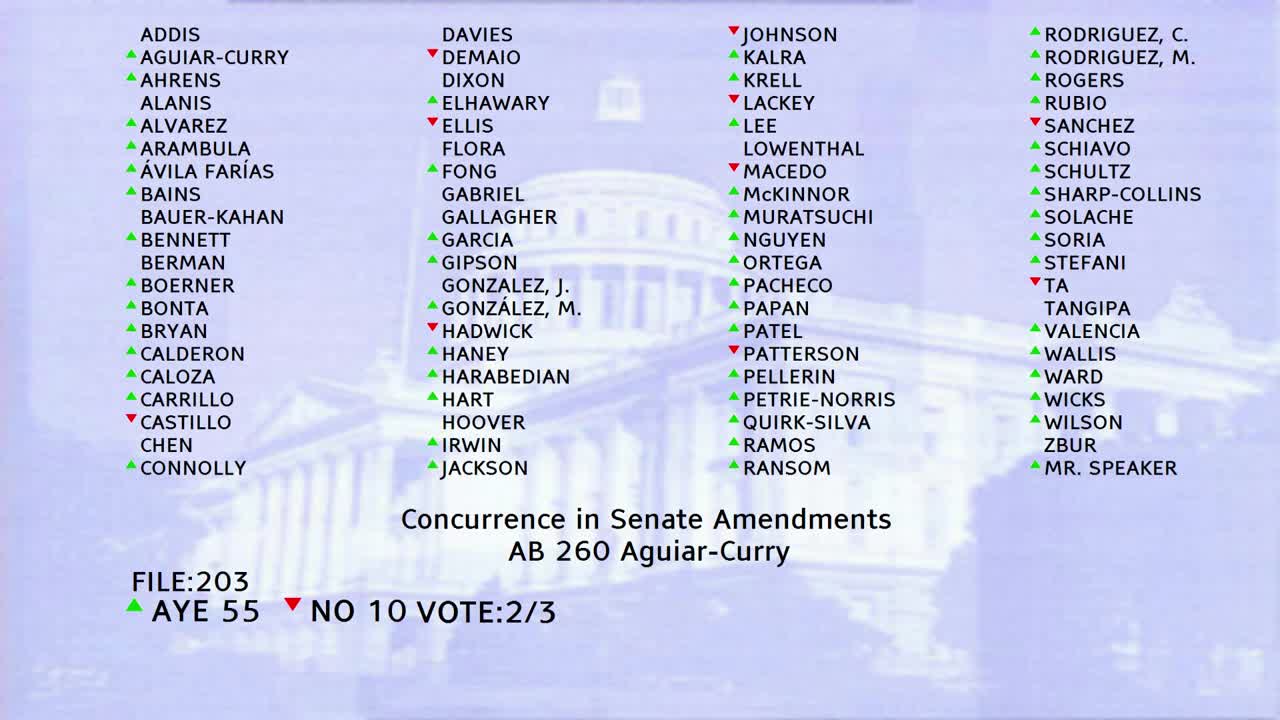 1MIN
Assembly Floor
 7MIN
Senate Floor
 1MIN
Senate Standing Committee on Appropriations
 6MIN
Senate Standing Committee on Human Services
 3MIN
Senate Standing Committee on Judiciary
 2MIN
Assembly Floor
 6MIN
Assembly Standing Committee on Judiciary
Bill Author

Bill Co-Author(s):