AB 1275: Regional housing needs: regional transportation plan.
- Session Year: 2025-2026
- House: Assembly
- Latest Version Date: 2025-10-10
Current Status:
Passed
(2025-10-10: Chaptered by Secretary of State - Chapter 593, Statutes of 2025.)
Introduced
In Committee
Awaiting First Chamber Vote
Passed First Chamber
In Committee
Awaiting Second Chamber Vote
Passed Second Chamber
Enacted
(1)Existing law, the Planning and Zoning Law, requires each county and city to adopt a comprehensive, long-term general plan for the physical development of the county or city, and specified land outside its boundaries. Existing law requires the general plan to include, among other mandatory elements, a housing element, and requires the housing element to include, among other things, an inventory of land suitable and available for residential development.
Existing law requires, for the 4th and subsequent revisions of the housing element, the department to determine the existing and projected need for housing for each region, as specified. Existing law requires the department, in consultation with the council of governments, to determine the existing and projected need of housing for each region at least 2 years prior to the scheduled revision of the housing element, as provided. Existing law requires the department to meet and consult with the council of governments regarding the assumptions and methodology to be used to determine the regions housing needs at least 26 months prior to the scheduled revision of the housing element, as provided.
This bill, except as specified, would extend the above-described timeline for the department to determine the existing and projected need of housing for each region from 2 years to 3 years prior to the scheduled revision of the housing element. The bill would require the department to meet and consult with the council of governments, as described above, pursuant to prescribed deadlines. For the 7th revision of the housing element, the bill would require the department to meet and consult with each council of governments at least 38 months prior to the scheduled revision, except for specified councils of governments. For the 8th and subsequent revisions of the housing element, the bill would require the department to meet and consult with each council of governments at least 38 months prior to the scheduled revision.
(2)Existing law authorizes at least 2 or more cities and a county, or counties, at least 28 months prior to the scheduled housing element revision, to form a subregional entity to allocate the subregions existing and projected housing need among its members. Existing law requires the council of governments to determine the share of regional housing need assigned to each delegate subregion at least 25 months prior to the scheduled revision. Existing law also requires the share allocated to the delegate subregion or subregions by a council of governments to be in a proportion consistent with the distribution of households assumed for the comparable time period of the applicable regional transportation plan.
This bill would instead require the share allocated to the delegate subregion or subregions by a council of governments to be in a proportion consistent with the subregions share of the current adopted final regional housing need allocation plan.
(3)Existing law requires certain transportation planning agencies to prepare and adopt a regional transportation plan directed at achieving a coordinated and balanced regional transportation system. Existing law requires that each regional transportation plan include a sustainable communities strategy developed to achieve greenhouse gas emission reduction targets for the automobile and light truck sector for 2020 and 2035 established by the State Air Resources Board.
Existing law requires each council of governments, or delegate subregion as applicable, to consider certain factors in developing the methodology that allocates regional housing needs, including each member jurisdictions existing and projected jobs and housing relationship.
This bill would require each council of governments, or delegate subregion as applicable, to consider, in addition to the above-described factors, the development pattern set forth in the regions sustainable communities strategy of its regional transportation plan.
(4)Existing law states the intent of the Legislature that housing planning be coordinated and integrated with the regional transportation plan. To achieve this goal, existing law requires the allocation plan to allocate housing units within the region consistent with the development pattern included in the sustainable communities strategy. Existing law also requires the resolution approving the final housing need allocation plan to demonstrate that the plan is consistent with the sustainable communities strategy in the regional transportation plan, among other things.
This bill would instead require the allocation plan to be informed by the development pattern included in the sustainable communities strategy. The bill would also require the resolution approving the final housing need allocation plan to demonstrate that the plan is, instead, informed by the sustainable communities strategy in the regional transportation plan, among other things.
(5)This bill would incorporate additional changes to Section 65584.01 of the Government Code proposed by SB 486 to be operative only if this bill and SB 486 are enacted and this bill is enacted last.
This bill would incorporate additional changes to Section 65584.03 of the Government Code proposed by AB 650 to be operative only if this bill and AB 650 are enacted and this bill is enacted last.
This bill would incorporate additional changes to Section 65584.04 of the Government Code proposed by SB 486 and AB 650, to be operative only if this bill and either or both of those bills are enacted and this bill is enacted last.
(6)By imposing additional requirements on a local entity, this bill would impose a state-mandated local program.
The California Constitution requires the state to reimburse local agencies and school districts for certain costs mandated by the state. Statutory provisions establish procedures for making that reimbursement.
This bill would provide that, if the Commission on State Mandates determines that the bill contains costs mandated by the state, reimbursement for those costs shall be made pursuant to the statutory provisions noted above.
(1)Existing law, the Planning and Zoning Law, requires each county and city to adopt a comprehensive, long-term general plan for the physical development of the county or city, and specified land outside its boundaries. Existing law requires the general plan to include, among other mandatory elements, a housing element, and requires the housing element to include, among other things, an inventory of land suitable and available for residential development.
Existing law requires, for the 4th and subsequent revisions of the housing element, the department to determine the existing and projected need for housing for each region, as specified. Existing law requires the department, in consultation with the council of governments, to determine the existing and projected need of housing for each region at least 2 years prior to the scheduled revision of the housing element, as provided. Existing law requires the department to meet and consult with the council of governments regarding the assumptions and methodology to be used to determine the regions housing needs at least 26 months prior to the scheduled revision of the housing element, as provided.
This bill, except as specified, would extend the above-described timeline for the department to determine the existing and projected need of housing for each region from 2 years to 3 years prior to the scheduled revision of the housing element. The bill would require the department to meet and consult with the council of governments, as described above, pursuant to prescribed deadlines. For the 7th revision of the housing element, the bill would require the department to meet and consult with each council of governments at least 38 months prior to the scheduled revision, except for specified councils of governments. For the 8th and subsequent revisions of the housing element, the bill would require the department to meet and consult with each council of governments at least 38 months prior to the scheduled revision.
(2)Existing law authorizes at least 2 or more cities and a county, or counties, at least 28 months prior to the scheduled housing element revision, to form a subregional entity to allocate the subregions existing and projected housing need among its members. Existing law requires the council of governments to determine the share of regional housing need assigned to each delegate subregion at least 25 months prior to the scheduled revision. Existing law also requires the share allocated to the delegate subregion or subregions by a council of governments to be in a proportion consistent with the distribution of households assumed for the comparable time period of the applicable regional transportation plan.
This bill would instead require the share allocated to the delegate subregion or subregions by a council of governments to be in a proportion consistent with the subregions share of the current adopted final regional housing need allocation plan.
(3)Existing law requires certain transportation planning agencies to prepare and adopt a regional transportation plan directed at achieving a coordinated and balanced regional transportation system. Existing law requires that each regional transportation plan include a sustainable communities strategy developed to achieve greenhouse gas emission reduction targets for the automobile and light truck sector for 2020 and 2035 established by the State Air Resources Board.
Existing law requires each council of governments, or delegate subregion as applicable, to consider certain factors in developing the methodology that allocates regional housing needs, including each member jurisdictions existing and projected jobs and housing relationship.
This bill would require each council of governments, or delegate subregion as applicable, to consider, in addition to the above-described factors, the development pattern set forth in the regions sustainable communities strategy of its regional transportation plan.
(4)Existing law states the intent of the Legislature that housing planning be coordinated and integrated with the regional transportation plan. To achieve this goal, existing law requires the allocation plan to allocate housing units within the region consistent with the development pattern included in the sustainable communities strategy. Existing law also requires the resolution approving the final housing need allocation plan to demonstrate that the plan is consistent with the sustainable communities strategy in the regional transportation plan, among other things.
This bill would instead require the allocation plan to be informed by the development pattern included in the sustainable communities strategy. The bill would also require the resolution approving the final housing need allocation plan to demonstrate that the plan is, instead, informed by the sustainable communities strategy in the regional transportation plan, among other things.
(5)This bill would incorporate additional changes to Section 65584.01 of the Government Code proposed by SB 486 to be operative only if this bill and SB 486 are enacted and this bill is enacted last.
This bill would incorporate additional changes to Section 65584.03 of the Government Code proposed by AB 650 to be operative only if this bill and AB 650 are enacted and this bill is enacted last.
This bill would incorporate additional changes to Section 65584.04 of the Government Code proposed by SB 486 and AB 650, to be operative only if this bill and either or both of those bills are enacted and this bill is enacted last.
(5)(6)By imposing additional requirements on a local entity, this bill would impose a state-mandated local program.
The California Constitution requires the state to reimburse local agencies and school districts for certain costs mandated by the state. Statutory provisions establish procedures for making that reimbursement.
This bill would provide that, if the Commission on State Mandates determines that the bill contains costs mandated by the state, reimbursement for those costs shall be made pursuant to the statutory provisions noted above.
(1)Existing law, the Planning and Zoning Law, requires each county and city to adopt a comprehensive, long-term general plan for the physical development of the county or city, and specified land outside its boundaries. Existing law requires the general plan to include, among other mandatory elements, a housing element, and requires the housing element to include, among other things, an inventory of land suitable and available for residential development.
Existing law requires, for the 4th and subsequent revisions of the housing element, the department to determine the existing and projected need for housing for each region, as specified. Existing law requires the department, in consultation with the council of governments, to determine the existing and projected need of housing for each region at least 2 years prior to the scheduled revision of the housing element, as provided. Existing law requires the department to meet and consult with the council of governments regarding the assumptions and methodology to be used to determine the regions housing needs at least 26 months prior to the scheduled revision of the housing element, as provided.
This bill, except as specified, would extend the above-described timeline for the department to determine the existing and projected need of housing for each region from 2 years to 3 years prior to the scheduled revision of the housing element, and the above-described timeline to meet and consult with a council of governments from at least 26 months to at least 38 months prior to the scheduled revision of the housing element, respectively. element. The bill would require the department to meet and consult with the council of governments, as described above, pursuant to prescribed deadlines. For the 7th revision of the housing element, the bill would require the department to meet and consult with each council of governments at least 38 months prior to the scheduled revision, except for specified councils of governments. For the 8th and subsequent revisions of the housing element, the bill would require the department to meet and consult with each council of governments at least 38 months prior to the scheduled revision.
(2)Existing law authorizes at least 2 or more cities and a county, or counties, at least 28 months prior to the scheduled housing element revision, to form a subregional entity to allocate the subregions existing and projected housing need among its members. Existing law requires the council of governments to determine the share of regional housing need assigned to each delegate subregion at least 25 months prior to the scheduled revision. Existing law also requires the share allocated to the delegate subregion or subregions by a council of governments to be in a proportion consistent with the distribution of households assumed for the comparable time period of the applicable regional transportation plan.
This bill would instead require the share allocated to the delegate subregion or subregions by a council of governments to be in a proportion consistent with the subregions share of the current adopted final regional housing need allocation plan.
Existing(3)Existing law requires certain transportation planning agencies to prepare and adopt a regional transportation plan directed at achieving a coordinated and balanced regional transportation system. Existing law requires that each regional transportation plan include a sustainable communities strategy developed to achieve greenhouse gas emission reduction targets for the automobile and light truck sector for 2020 and 2035 established by the State Air Resources Board.
Existing law requires each council of governments, or delegate subregion as applicable, to consider certain factors in developing the methodology that allocates regional housing needs, including each member jurisdictions existing and projected jobs and housing relationship.
This bill would require each council of governments, or delegate subregion as applicable, to consider, in addition to the above-described factors, the development pattern set forth in the regions sustainable communities strategy of its regional transportation plan.
Existing(4)Existing law states the intent of the Legislature that housing planning be coordinated and integrated with the regional transportation plan. To achieve this goal, existing law requires the allocation plan to allocate housing units within the region consistent with the development pattern included in the sustainable communities strategy. Existing law also requires the resolution approving the final housing need allocation plan to demonstrate that the plan is consistent with the sustainable communities strategy in the regional transportation plan, among other things.
This bill would instead require the allocation plan to be informed by the development pattern included in the sustainable communities strategy. The bill would also require the resolution approving the final housing need allocation plan to demonstrate that the plan is, instead, informed by the sustainable communities strategy in the regional transportation plan, among other things.
By(5)By imposing additional requirements on a local entity, this bill would impose a state-mandated local program.
The California Constitution requires the state to reimburse local agencies and school districts for certain costs mandated by the state. Statutory provisions establish procedures for making that reimbursement.
This bill would provide that, if the Commission on State Mandates determines that the bill contains costs mandated by the state, reimbursement for those costs shall be made pursuant to the statutory provisions noted above.
Existing law, the Planning and Zoning Law, requires each county and city to adopt a comprehensive, long-term general plan for the physical development of the county or city, and specified land outside its boundaries. Existing law requires the general plan to include, among other mandatory elements, a housing element, and requires the housing element to include, among other things, an inventory of land suitable and available for residential development.
Existing law requires the Department of Housing and Community Development, in consultation with each council of governments, to determine each regions existing and projected housing need at least 2 years prior to the scheduled revision, as specified, and requires each council of governments, or the department for cities and counties without a council of governments, to adopt a final regional housing need plan that allocates a share of the regional housing need to each city and county, as provided.This bill would, except for cities and counties without a council of governments, instead require the department, in consultation with each council of governments, to determine each regions existing and projected housing need at least 3 years before the scheduled revision, as specified.Existing law requires, for the 4th and subsequent revisions of the housing element, the department to determine the existing and projected need for housing for each region, as specified. Existing law requires the department, in consultation with the council of governments, to determine the existing and projected need of housing for each region at least 2 years prior to the scheduled revision of the housing element, as provided. Existing law requires the department to meet and consult with the council of governments regarding the assumptions and methodology to be used to determine the regions housing needs at least 26 months prior to the scheduled revision of the housing element, as provided.
This bill, except as specified, would extend the above-described timeline for the department to determine the existing and projected need of housing for each region from 2 years to 3 years prior to the scheduled revision of the housing element, and the above-described timeline to meet and consult with a council of governments from at least 26 months to at least 38 months prior to the scheduled revision of the housing element, respectively.
Existing law requires certain transportation planning agencies to prepare and adopt a regional transportation plan directed at achieving a coordinated and balanced regional transportation system. Existing law requires that each regional transportation plan include a sustainable communities strategy developed to achieve greenhouse gas emission reduction targets for the automobile and light truck sector for 2020 and 2035 established by the State Air Resources Board.
Existing law requires each council of governments, or delegate subregion, as applicable, to develop, in consultation with the department, a proposed methodology for distributing the existing and projected regional housing need to cities, counties, and cities and counties within the region or within the subregion. Existing law requires the proposed methodology to further certain objectives, including affirmatively furthering fair housing, as defined. Existing law requires each council of governments, or delegate subregion, as applicable, to publish a draft allocation methodology on its internet website and submit the draft allocation methodology, along with other specified information, to the department. Existing law requires the department to review the draft allocation methodology and report its written findings to the council of governments, or delegate subregion, as applicable, within 60 days. If the department determines that the methodology is not consistent with the objectives as described above, existing law requires the council of governments, or delegate subregion, as applicable, to either revise the methodology to further those objectives and adopt a final regional, or subregional, housing need allocation methodology, or to adopt the regional, or subregional, housing need allocation methodology without revisions and include within its resolution of adoption findings, supported by substantial evidence, as to why the council of governments, or delegate subregion, believes that the methodology furthers those objectives despite the findings of the department.This bill would require a council of governments or delegate subregion, as applicable, to revise the draft methodology in consultation with the department if the methodology does not further the above-described objectives, and would authorize those entities to revise the methodology by reducing the weighting of the sustainable communities strategy development pattern in the methodology.Existing law requires each council of governments, or delegate subregion as applicable, to consider certain factors in developing the methodology that allocates regional housing needs, including each member jurisdictions existing and projected jobs and housing relationship.
This bill would require each council of governments, or delegate subregion as applicable, to consider, in addition to the above-described factors, the development pattern set forth in the regions sustainable communities strategy of its regional transportation plan.
Existing law states the intent of the Legislature that housing planning be coordinated and integrated with the regional transportation plan. To achieve this goal, existing law requires the allocation plan to allocate housing units within the region consistent with the development pattern included in the sustainable communities strategy. Existing law also requires the resolution approving the final housing need allocation plan to demonstrate that the plan is consistent with the sustainable communities strategy in the regional transportation plan, among other things.
This bill would instead require the allocation plan, and the resolution approving the final housing need allocation plan, plan to be informed by the transportation and job projections development pattern included in the sustainable communities strategy. The bill would also require the resolution approving the final housing need allocation plan to demonstrate that the plan is, instead, informed by the sustainable communities strategy in the regional transportation plan, among other things.
By imposing additional requirements on a local entity, this bill would impose a state-mandated local program.
The California Constitution requires the state to reimburse local agencies and school districts for certain costs mandated by the state. Statutory provisions establish procedures for making that reimbursement.
This bill would provide that, if the Commission on State Mandates determines that the bill contains costs mandated by the state, reimbursement for those costs shall be made pursuant to the statutory provisions noted above.
Existing law, the Planning and Zoning Law, requires each county and city to adopt a comprehensive, long-term general plan for the physical development of the county or city, and specified land outside its boundaries. Existing law requires the general plan to include, among other mandatory elements, a housing element, and requires the housing element to include, among other things, an inventory of land suitable and available for residential development.
Existing law requires the Department of Housing and Community Development, in consultation with each council of governments, to determine each regions existing and projected housing need, need at least 2 years prior to the scheduled revision, as specified, and requires each council of governments, or the department for cities and counties without a council of governments, to adopt a final regional housing need plan that allocates a share of the regional housing need to each city and county, as provided.
This bill would, except for cities and counties without a council of governments, instead require the department, in consultation with each council of governments, to determine each regions existing and projected housing need at least 3 years before the scheduled revision, as specified.
Existing law requires certain transportation planning agencies to prepare and adopt a regional transportation plan directed at achieving a coordinated and balanced regional transportation system. Existing law requires that each regional transportation plan include a sustainable communities strategy developed to achieve greenhouse gas emission reduction targets for the automobile and light truck sector for 2020 and 2035 established by the State Air Resources Board.
Existing law requires each council of governments, or delegate subregion, as applicable, to develop, in consultation with the department, a proposed methodology for distributing the existing and projected regional housing need to cities, counties, and cities and counties within the region or within the subregion. Existing law requires the proposed methodology to further certain objectives, including affirmatively furthering fair housing, as defined. Existing law requires each council of governments, or delegate subregion, as applicable, to publish a draft allocation methodology on its internet website and submit the draft allocation methodology, along with other specified information, to the department. Existing law requires the department to review the draft allocation methodology and report its written findings to the council of governments, or delegate subregion, as applicable, within 60 days. If the department determines that the methodology is not consistent with the objectives as described above, existing law requires the council of governments, or delegate subregion, as applicable, to either revise the methodology to further those objectives and adopt a final regional, or subregional, housing need allocation methodology, or to adopt the regional, or subregional, housing need allocation methodology without revisions and include within its resolution of adoption findings, supported by substantial evidence, as to why the council of governments, or delegate subregion, believes that the methodology furthers those objectives despite the findings of the department.
This bill would require a council of governments or delegate subregion, as applicable, to revise the draft methodology in consultation with the department if the methodology does not further the above-described objectives, and would authorize those entities to revise the methodology by reducing the weighting of the sustainable communities strategy development pattern in the methodology.
Existing law states the intent of the Legislature that housing planning be coordinated and integrated with the regional transportation plan. To achieve this goal, existing law requires the allocation plan to allocate housing units within the region consistent with the development pattern included in the sustainable communities strategy. Existing law also requires the resolution approving the final housing need allocation plan to demonstrate that the plan is consistent with the sustainable communities strategy in the regional transportation plan, among other things.
This bill would instead require the allocation plan, and the resolution approving the final housing need allocation plan, to be informed by the transportation and job projections included in the sustainable communities strategy.
By imposing additional requirements on a local entity, this bill would impose a state-mandated local program.
The California Constitution requires the state to reimburse local agencies and school districts for certain costs mandated by the state. Statutory provisions establish procedures for making that reimbursement.
This bill would provide that, if the Commission on State Mandates determines that the bill contains costs mandated by the state, reimbursement for those costs shall be made pursuant to the statutory provisions noted above.
This bill would state the intent of the Legislature to enact subsequent legislation to harmonize the regional housing needs allocation process with the regional transportation plan and sustainable community strategy processes to ensure the needs of both existing populations and projected populations are met, and to ensure local governments have plans for sufficient housing in climate-friendly locations near transit, jobs, and services.Existing law, the Planning and Zoning Law, requires each county and city to adopt a comprehensive, long-term general plan for the physical development of the county or city, and specified land outside its boundaries. Existing law requires the general plan to include, among other mandatory elements, a housing element, and requires the housing element to include, among other things, an inventory of land suitable and available for residential development.
Existing law requires the Department of Housing and Community Development, in consultation with each council of governments, to determine each regions existing and projected housing need, and requires each council of governments, or the department for cities and counties without a council of governments, to adopt a final regional housing need plan that allocates a share of the regional housing need to each city and county, as provided.
Existing law requires certain transportation planning agencies to prepare and adopt a regional transportation plan directed at achieving a coordinated and balanced regional transportation system. Existing law requires that each regional transportation plan include a sustainable communities strategy developed to achieve greenhouse gas emission reduction targets for the automobile and light truck sector for 2020 and 2035 established by the State Air Resources Board.
This bill would state the intent of the Legislature to enact subsequent legislation to harmonize the regional housing needs allocation process with the regional transportation plan and sustainable community strategy processes to ensure the needs of both existing populations and projected populations are met, and to ensure local governments have plans for sufficient housing in climate-friendly locations near transit, jobs, and services.
(a)(1)For the fourth and subsequent revisions of the housing element pursuant to Section 65588, the department shall determine the existing and projected need for housing for each region pursuant to this article. For purposes of subdivision (a) of Section 65583, the share of a city or county of the regional housing need shall include that share of the housing need of persons at all income levels within the area significantly affected by the general plan of the city or county.
(2)It is the intent of the Legislature that cities, counties, and cities and counties should undertake all necessary actions to encourage, promote, and facilitate the development of housing to accommodate the entire regional housing need, and reasonable actions should be taken by local and regional governments to ensure that future housing production meets, at a minimum, the regional housing need established for planning purposes. These actions shall include applicable reforms and incentives in Section 65582.1.
(3)The Legislature finds and declares that insufficient housing in job centers hinders the states environmental quality and runs counter to the states environmental goals. In particular, when Californians seeking affordable housing are forced to drive longer distances to work, an increased amount of greenhouse gases and other pollutants are released and puts in jeopardy the achievement of the states climate goals, as established pursuant to Section 38566 of the Health and Safety Code, and clean air goals.
(b)(1)(A)The department, in consultation with each council of governments, shall determine each regions existing and projected housing need pursuant to Section 65584.01 at least three years prior to the scheduled revision required pursuant to Section 65588, except in the following circumstances:
(i)For regions with a scheduled housing element revision due date in the 2027 calendar year, the department shall determine the regions housing need at least two years prior to the scheduled revision.
(ii)For regions with a scheduled housing element revision due date in the 2028 calendar year or the first 6 months of the 2029 calendar year, the department shall determine the regions housing need at least 32 months prior to the scheduled revision.
(B)For cities and counties without a council of governments, the department shall determine each regions existing and projected housing need pursuant to Section 65584.01 at least 24 months prior to the scheduled revision required pursuant to Section 65588.
(2)The appropriate council of governments, or for cities and counties without a council of governments, the department, shall adopt a final regional housing need plan that allocates a share of the regional housing need to each city, county, or city and county at least one year prior to the scheduled revision for the region required by Section 65588. The allocation plan prepared by a council of governments shall be prepared pursuant to Sections 65584.04 and 65584.05.
(c)Notwithstanding any other provision of law, the due dates for the determinations of the department or for the council of governments, respectively, regarding the regional housing need may be extended by the department by not more than 60 days if the extension will enable access to more recent critical population or housing data from a pending or recent release of the United States Census Bureau or the Department of Finance. If the due date for the determination of the department or the council of governments is extended for this reason, the department shall extend the corresponding housing element revision deadline pursuant to Section 65588 by not more than 60 days.
(d)The regional housing needs allocation plan shall further all of the following objectives:
(1)Increasing the housing supply and the mix of housing types, tenure, and affordability in all cities and counties within the region in an equitable manner, which shall result in each jurisdiction receiving an allocation of units for low- and very low income households. The regional housing needs allocation plan shall allocate units for extremely low and acutely low income households in a manner that is roughly proportional to, and within a range of 3 percent of, the housing need for very low income households.
(2)Promoting infill development and socioeconomic equity, the protection of environmental and agricultural resources, the encouragement of efficient development patterns, and the achievement of the regions greenhouse gas reductions targets provided by the State Air Resources Board pursuant to Section 65080.
(3)Promoting an improved intraregional relationship between jobs and housing, including an improved balance between the number of low-wage jobs and the number of housing units affordable to low-wage workers in each jurisdiction.
(4)Allocating a lower proportion of housing need to an income category when a jurisdiction already has a disproportionately high share of households in that income category, as compared to the countywide distribution of households in that category from the most recent American Community Survey.
(5)Affirmatively furthering fair housing.
(e)For purposes of this section, affirmatively furthering fair housing means taking meaningful actions, in addition to combating discrimination, that overcome patterns of segregation and foster inclusive communities free from barriers that restrict access to opportunity based on protected characteristics. Specifically, affirmatively furthering fair housing means taking meaningful actions that, taken together, address significant disparities in housing needs and in access to opportunity, replacing segregated living patterns with truly integrated and balanced living patterns, transforming racially and ethnically concentrated areas of poverty into areas of opportunity, and fostering and maintaining compliance with civil rights and fair housing laws.
(f)(1)Subject to paragraph (2), for purposes of this section with respect to revisions of the housing element through the sixth revision, household income levels are as determined by the department pursuant to the following code sections:
(A)Very low incomes, as defined by Section 50105 of the Health and Safety Code.
(B)Lower incomes, as defined by Section 50079.5 of the Health and Safety Code.
(C)Moderate incomes, as defined by Section 50093 of the Health and Safety Code.
(D)Above moderate incomes are those exceeding the moderate-income level of Section 50093 of the Health and Safety Code.
(2)For purposes of this section with respect to the seventh and subsequent revisions of the housing element, household income levels are as determined by the department in accordance with the definitions of acutely low, extremely low, very low, low, moderate, and above moderate income in Section 65582.
(g)Notwithstanding any other provision of law, determinations made by the department, a council of governments, or a city or county pursuant to this section or Section 65584.01, 65584.02, 65584.03, 65584.04, 65584.05, 65584.06, 65584.07, or 65584.08 are exempt from the California Environmental Quality Act (Division 13 (commencing with Section 21000) of the Public Resources Code).
SEC. 2.Section 65584.01 of the Government Code is amended to read:65584.01.For the fourth and subsequent revision of the housing element pursuant to Section 65588, the department, in consultation with each council of governments, where applicable, shall determine the existing and projected need for housing for each region in the following manner:
(a)The departments determination shall be based upon population projections produced by the Department of Finance and regional population forecasts used in preparing regional transportation plans, in consultation with each council of governments. If the total regional population forecast for the projection year, developed by the council of governments and used for the preparation of the regional transportation plan, is within a range of 1.5 percent of the total regional population forecast for the projection year by the Department of Finance, then the population forecast developed by the council of governments shall be the basis from which the department determines the existing and projected need for housing in the region. If the difference between the total population projected by the council of governments and the total population projected for the region by the Department of Finance is greater than 1.5 percent, then the department and the council of governments shall meet to discuss variances in methodology used for population projections and seek agreement on a population projection for the region to be used as a basis for determining the existing and projected housing need for the region. If agreement is not reached, then the population projection for the region shall be the population projection for the region prepared by the Department of Finance as may be modified by the department as a result of discussions with the council of governments.
(b)(1)Subject to the applicable deadline specified in paragraph (2), and prior to developing the existing and projected housing need for a region, the department shall meet and consult with the council of governments regarding the assumptions and methodology to be used by the department to determine the regions housing needs. The council of governments shall provide data assumptions from the councils projections, including, if available, the following data for the region:
(A)Anticipated household growth associated with projected population increases.
(B)Household size data and trends in household size.
(C)The percentage of households that are overcrowded within the region and the percentage of households that are overcrowded throughout the nation. For purposes of this subparagraph, the term overcrowded means more than one resident per room in each room in a dwelling.
(D)The rate of household formation, or headship rates, based on age, gender, ethnicity, or other established demographic measures.
(E)The vacancy rates in existing housing stock, and the vacancy rates for healthy housing market functioning and regional mobility, as well as housing replacement needs. For purposes of this subparagraph, the vacancy rate for a healthy rental housing market shall be considered no less than 5 percent.
(F)Other characteristics of the composition of the projected population.
(G)The relationship between jobs and housing, including any imbalance between jobs and housing.
(H)The percentage of households that are cost burdened within the region and the percentage of households that are cost burdened throughout the nation. For the purposes of this subparagraph, the term cost burdened means the share of very low, low-, moderate-, and above moderate-income households that are paying more than 30 percent of household income on housing costs.
(I)The loss of units during a state of emergency that was declared by the Governor pursuant to the California Emergency Services Act (Chapter 7 (commencing with Section 8550) of Division 1 of Title 2), during the planning period immediately preceding the relevant revision pursuant to Section 65588 that have yet to be rebuilt or replaced at the time of the data request.
(J)The housing needs of individuals and families experiencing homelessness.
(i)The data utilized by the council of governments shall align with homelessness data best practices as determined by the department.
(ii)Sources of homelessness data may include the Homeless Data Integration System administered by the Interagency Council on Homelessness, the homeless point-in-time count, or other sources deemed appropriate by the department.
(2)The deadline for the department to meet and consult with each council of governments pursuant to paragraph (1) shall be as follows:
(A)For the fourth, fifth, and sixth revisions of the housing element, at least 26 months prior to the scheduled revision pursuant to Section 65588.
(B)For the seventh revision of the housing element, the applicable of the following:
(i)With respect to the following councils of governments, at least 26 months prior to the scheduled revision pursuant to Section 65588:
(I)The Humboldt County Association of Governments.
(II)The Lake Area Planning Council.
(III)The Mendocino Council of Governments.
(IV)The County of Nevada.
(ii)With respect to the following councils of governments, at least 34 months prior to the scheduled revision pursuant to Section 65588:
(I)The San Luis Obispo Council of Governments.
(II)The Sacramento Area Council of Governments.
(iii)With respect to all councils of governments other than those specified in clauses (i) and (ii), at least 38 months prior to the scheduled revision pursuant to Section 65588.
(C)For the eighth and subsequent revisions of the housing element, at least 38 months prior to the scheduled revision pursuant to Section 65588.
(3)The department may accept or reject the information provided by the council of governments or modify its own assumptions or methodology based on this information. After consultation with the council of governments, the department shall make determinations in writing on the assumptions for each of the factors listed in subparagraphs (A) to (I), inclusive, of paragraph (1) and the methodology it shall use and shall provide these determinations to the council of governments. The methodology submitted by the department may make adjustments based on the regions total projected households, which includes existing households as well as projected households.
(c)(1)After consultation with the council of governments, the department shall make a determination of the regions existing and projected housing need based upon the assumptions and methodology determined pursuant to subdivision (b). The regions existing and projected housing need shall reflect the achievement of a feasible balance between jobs and housing within the region using the regional employment projections in the applicable regional transportation plan. Within 30 days following notice of the determination from the department, the council of governments may file an objection to the departments determination of the regions existing and projected housing need with the department.
(2)The objection shall be based on and substantiate either of the following:
(A)The department failed to base its determination on the population projection for the region established pursuant to subdivision (a), and shall identify the population projection which the council of governments believes should instead be used for the determination and explain the basis for its rationale.
(B)The regional housing need determined by the department is not a reasonable application of the methodology and assumptions determined pursuant to subdivision (b). The objection shall include a proposed alternative determination of its regional housing need based upon the determinations made in subdivision (b), including analysis of why the proposed alternative would be a more reasonable application of the methodology and assumptions determined pursuant to subdivision (b).
(3)If a council of governments files an objection pursuant to this subdivision and includes with the objection a proposed alternative determination of its regional housing need, it shall also include documentation of its basis for the alternative determination. Within 45 days of receiving an objection filed pursuant to this section, the department shall consider the objection and make a final written determination of the regions existing and projected housing need that includes an explanation of the information upon which the determination was made.
(4)In regions in which the department is required to distribute the regional housing need pursuant to Section 65584.06, no city or county may file an objection to the regional housing need determination.
(d)Statutory changes enacted after the date the department issued a final determination pursuant to this section shall not be a basis for a revision of the final determination.
SEC. 2.5.Section 65584.01 of the Government Code is amended to read:65584.01.For the fourth and subsequent revision of the housing element pursuant to Section 65588, the department, in consultation with each council of governments, where applicable, shall determine the existing and projected need for housing for each region in the following manner:
(a)The departments determination shall be based upon population projections produced by the Department of Finance and regional population forecasts used in preparing regional transportation plans, in consultation with each council of governments. If the total regional population forecast for the projection year, developed by the council of governments and used for the preparation of the regional transportation plan, is within a range of 1.5 percent of the total regional population forecast for the projection year by the Department of Finance, then the population forecast developed by the council of governments shall be the basis from which the department determines the existing and projected need for housing in the region. If the difference between the total population projected by the council of governments and the total population projected for the region by the Department of Finance is greater than 1.5 percent, then the department and the council of governments shall meet to discuss variances in methodology used for population projections and seek agreement on a population projection for the region to be used as a basis for determining the existing and projected housing need for the region. If agreement is not reached, then the population projection for the region shall be the population projection for the region prepared by the Department of Finance as may be modified by the department as a result of discussions with the council of governments.
(b)(1)Subject to the applicable deadline specified in paragraph (2), and prior to developing the existing and projected housing need for a region, the department shall meet and consult with the council of governments regarding the assumptions and methodology to be used by the department to determine the regions housing needs. The council of governments shall provide data assumptions from the councils projections, including, if available, the following data for the region:
(A)(i)Anticipated household growth associated with projected population increases.
(ii)The Department of Finance shall consider changes in enrollment levels at campuses of the University of California or the California State University in the region, as forecasted by the University of California and the California State University pursuant to paragraph (9) of subdivision (e) of Section 65584.04, when preparing the anticipated household growth associated with projected population increases.
(B)Household size data and trends in household size.
(C)The percentage of households that are overcrowded within the region and the percentage of households that are overcrowded throughout the nation. For purposes of this subparagraph, the term overcrowded means more than one resident per room in each room in a dwelling.
(D)The rate of household formation, or headship rates, based on age, gender, ethnicity, or other established demographic measures.
(E)The vacancy rates in existing housing stock, and the vacancy rates for healthy housing market functioning and regional mobility, as well as housing replacement needs. For purposes of this subparagraph, the vacancy rate for a healthy rental housing market shall be considered no less than 5 percent.
(F)Other characteristics of the composition of the projected population.
(G)The relationship between jobs and housing, including any imbalance between jobs and housing.
(H)The percentage of households that are cost burdened within the region and the percentage of households that are cost burdened throughout the nation. For the purposes of this subparagraph, the term cost burdened means the share of very low, low-, moderate-, and above moderate-income households that are paying more than 30 percent of household income on housing costs.
(I)The loss of units during a state of emergency that was declared by the Governor pursuant to the California Emergency Services Act (Chapter 7 (commencing with Section 8550) of Division 1 of Title 2), during the planning period immediately preceding the relevant revision pursuant to Section 65588 that have yet to be rebuilt or replaced at the time of the data request.
(J)The housing needs of individuals and families experiencing homelessness.
(i)The data used by the council of governments shall align with homelessness data best practices as determined by the department.
(ii)Sources of homelessness data may include the Homeless Data Integration System administered by the Interagency Council on Homelessness, the homeless point-in-time count, or other sources deemed appropriate by the department.
(2)The deadline for the department to meet and consult with each council of governments pursuant to paragraph (1) shall be as follows:
(A)For the fourth, fifth, and sixth revisions of the housing element, at least 26 months prior to the scheduled revision pursuant to Section 65588.
(B)For the seventh revision of the housing element, the applicable of the following:
(i)With respect to the following councils of governments, at least 26 months prior to the scheduled revision pursuant to Section 65588:
(I)The Humboldt County Association of Governments.
(II)The Lake Area Planning Council.
(III)The Mendocino Council of Governments.
(IV)The County of Nevada.
(ii)With respect to the following councils of governments, at least 34 months prior to the scheduled revision pursuant to Section 65588:
(I)The San Luis Obispo Council of Governments.
(II)The Sacramento Area Council of Governments.
(iii)With respect to all councils of governments other than those specified in clauses (i) and (ii), at least 38 months prior to the scheduled revision pursuant to Section 65588.
(C)For the eighth and subsequent revisions of the housing element, at least 38 months prior to the scheduled revision pursuant to Section 65588.
(3)The department may accept or reject the information provided by the council of governments or modify its own assumptions or methodology based on this information. After consultation with the council of governments, the department shall make determinations in writing on the assumptions for each of the factors listed in subparagraphs (A) to (I), inclusive, of paragraph (1) and the methodology it shall use and shall provide these determinations to the council of governments. The methodology submitted by the department may make adjustments based on the regions total projected households, which includes existing households as well as projected households.
(c)(1)After consultation with the council of governments, the department shall make a determination of the regions existing and projected housing need based upon the assumptions and methodology determined pursuant to subdivision (b). The regions existing and projected housing need shall reflect the achievement of a feasible balance between jobs and housing within the region using the regional employment projections in the applicable regional transportation plan. Within 30 days following notice of the determination from the department, the council of governments may file an objection to the departments determination of the regions existing and projected housing need with the department.
(2)The objection shall be based on and substantiate either of the following:
(A)The department failed to base its determination on the population projection for the region established pursuant to subdivision (a), and shall identify the population projection which the council of governments believes should instead be used for the determination and explain the basis for its rationale.
(B)The regional housing need determined by the department is not a reasonable application of the methodology and assumptions determined pursuant to subdivision (b). The objection shall include a proposed alternative determination of its regional housing need based upon the determinations made in subdivision (b), including analysis of why the proposed alternative would be a more reasonable application of the methodology and assumptions determined pursuant to subdivision (b).
(3)If a council of governments files an objection pursuant to this subdivision and includes with the objection a proposed alternative determination of its regional housing need, it shall also include documentation of its basis for the alternative determination. Within 45 days of receiving an objection filed pursuant to this section, the department shall consider the objection and make a final written determination of the regions existing and projected housing need that includes an explanation of the information upon which the determination was made.
(4)In regions in which the department is required to distribute the regional housing need pursuant to Section 65584.06, no city or county may file an objection to the regional housing need determination.
(d)Statutory changes enacted after the date the department issued a final determination pursuant to this section shall not be a basis for a revision of the final determination.
SEC. 3.Section 65584.03 of the Government Code is amended to read:65584.03.(a)At least 28 months prior to the scheduled housing element update required by Section 65588, at least two or more cities and a county, or counties, may form a subregional entity for the purpose of allocation of the subregions existing and projected need for housing among its members in accordance with the allocation methodology established pursuant to Section 65584.04. The purpose of establishing a subregion shall be to recognize the community of interest and mutual challenges and opportunities for providing housing within a subregion. A subregion formed pursuant to this section may include a single county and each of the cities in that county or any other combination of geographically contiguous local governments and shall be approved by the adoption of a resolution by each of the local governments in the subregion as well as by the council of governments. All decisions of the subregion shall be approved by vote as provided for in rules adopted by the local governments comprising the subregion or shall be approved by vote of the county or counties, if any, and the majority of the cities with the majority of population within a county or counties.
(b)Upon formation of the subregional entity, the entity shall notify the council of governments of this formation. If the council of governments has not received notification from an eligible subregional entity at least 28 months prior to the scheduled housing element update required by Section 65588, the council of governments shall implement the provisions of Sections 65584 and 65584.04. The delegate subregion and the council of governments shall enter into an agreement that sets forth the process, timing, and other terms and conditions of the delegation of responsibility by the council of governments to the subregion.
(c)At least 25 months prior to the scheduled revision, the council of governments shall determine the share of regional housing need assigned to each delegate subregion. The share or shares allocated to the delegate subregion or subregions by a council of governments shall be in a proportion consistent with the subregions share of the current adopted final regional housing need allocation plan. Prior to allocating the regional housing needs to any delegate subregion or subregions, the council of governments shall hold at least one public hearing, and may consider requests for revision of the proposed allocation to a subregion. If a proposed revision is rejected, the council of governments shall respond with a written explanation of why the proposed revised share has not been accepted.
(d)Each delegate subregion shall fully allocate its share of the regional housing need to local governments within its subregion. If a delegate subregion fails to complete the regional housing need allocation process among its member jurisdictions in a manner consistent with this article and with the delegation agreement between the subregion and the council of governments, the allocations to member jurisdictions shall be made by the council of governments.
SEC. 3.5.Section 65584.03 of the Government Code is amended to read:65584.03.(a)At least 34 months prior to the scheduled housing element update required by Section 65588, at least two or more cities and a county, or counties, may form a subregional entity for the purpose of allocation of the subregions existing and projected need for housing among its members in accordance with the allocation methodology established pursuant to Section 65584.04. The purpose of establishing a subregion shall be to recognize the community of interest and mutual challenges and opportunities for providing housing within a subregion. A subregion formed pursuant to this section may include a single county and each of the cities in that county or any other combination of geographically contiguous local governments and shall be approved by the adoption of a resolution by each of the local governments in the subregion as well as by the council of governments. All decisions of the subregion shall be approved by vote as provided for in rules adopted by the local governments comprising the subregion or shall be approved by vote of the county or counties, if any, and the majority of the cities with the majority of population within a county or counties.
(b)Upon formation of the subregional entity, the entity shall notify the council of governments of this formation. If the council of governments has not received notification from an eligible subregional entity at least 34 months prior to the scheduled housing element update required by Section 65588, the council of governments shall implement the provisions of Sections 65584 and 65584.04. The delegate subregion and the council of governments shall enter into an agreement that sets forth the process, timing, and other terms and conditions of the delegation of responsibility by the council of governments to the subregion.
(c)At least 31 months prior to the scheduled revision, the council of governments shall determine the share of regional housing need assigned to each delegate subregion. The share or shares allocated to the delegate subregion or subregions by a council of governments shall be in a proportion consistent with the subregions share of the current adopted final regional housing need allocation plan. Prior to allocating the regional housing needs to any delegate subregion or subregions, the council of governments shall hold at least one public hearing, and may consider requests for revision of the proposed allocation to a subregion. If a proposed revision is rejected, the council of governments shall respond with a written explanation of why the proposed revised share has not been accepted.
(d)Each delegate subregion shall fully allocate its share of the regional housing need to local governments within its subregion. If a delegate subregion fails to complete the regional housing need allocation process among its member jurisdictions in a manner consistent with this article and with the delegation agreement between the subregion and the council of governments, the allocations to member jurisdictions shall be made by the council of governments.
SEC. 4.Section 65584.04 of the Government Code is amended to read:65584.04.(a)At least two years before a scheduled revision required by Section 65588, each council of governments, or delegate subregion as applicable, shall develop, in consultation with the department, a proposed methodology for distributing the existing and projected regional housing need to cities, counties, and cities and counties within the region or within the subregion, where applicable pursuant to this section. The methodology shall further the objectives listed in subdivision (d) of Section 65584.
(b)(1)No more than six months before the development of a proposed methodology for distributing the existing and projected housing need, each council of governments shall survey each of its member jurisdictions to request, at a minimum, information regarding the factors listed in subdivision (e) that will allow the development of a methodology based upon the factors established in subdivision (e).
(2)With respect to the objective in paragraph (5) of subdivision (d) of Section 65584, the survey shall review and compile information that will allow the development of a methodology based upon the issues, strategies, and actions that are included, as available, in an Analysis of Impediments to Fair Housing Choice or an Assessment of Fair Housing completed by any city or county or the department that covers communities within the area served by the council of governments, and in housing elements adopted pursuant to this article by cities and counties within the area served by the council of governments.
(3)The council of governments shall seek to obtain the information in a manner and format that is comparable throughout the region and utilize readily available data to the extent possible.
(4)The information provided by a local government pursuant to this section shall be used, to the extent possible, by the council of governments, or delegate subregion as applicable, as source information for the methodology developed pursuant to this section. The survey shall state that none of the information received may be used as a basis for reducing the total housing need established for the region pursuant to Section 65584.01.
(5)If the council of governments fails to conduct a survey pursuant to this subdivision, a city, county, or city and county may submit information related to the items listed in subdivision (e) before the public comment period provided for in subdivision (d).
(c)The council of governments shall electronically report the results of the survey of fair housing issues, strategies, and actions compiled pursuant to paragraph (2) of subdivision (b). The report shall describe common themes and effective strategies employed by cities and counties within the area served by the council of governments, including common themes and effective strategies around avoiding the displacement of lower income households. The council of governments shall also identify significant barriers to affirmatively furthering fair housing at the regional level and may recommend strategies or actions to overcome those barriers. A council of governments or metropolitan planning organization, as appropriate, may use this information for any other purpose, including publication within a regional transportation plan adopted pursuant to Section 65080 or to inform the land use assumptions that are applied in the development of a regional transportation plan.
(d)Public participation and access shall be required in the development of the methodology and in the process of drafting and adoption of the allocation of the regional housing needs. Participation by organizations other than local jurisdictions and councils of governments shall be solicited in a diligent effort to achieve public participation of all economic segments of the community as well as members of protected classes under Section 12955 and households with special housing needs under paragraph (7) of subdivision (a) of Section 65583. The proposed methodology, along with any relevant underlying data and assumptions, an explanation of how information about local government conditions gathered pursuant to subdivision (b) has been used to develop the proposed methodology, how each of the factors listed in subdivision (e) is incorporated into the methodology, and how the proposed methodology furthers the objectives listed in subdivision (d) of Section 65584, shall be distributed to all cities, counties, any subregions, and members of the public who have made a written or electronic request for the proposed methodology and published on the council of governments, or delegate subregions, internet website. The council of governments, or delegate subregion, as applicable, shall conduct at least one public hearing to receive oral and written comments on the proposed methodology.
(e)To the extent that sufficient data is available from local governments pursuant to subdivision (b) or other sources, each council of governments, or delegate subregion as applicable, shall consider including the following factors in developing the methodology that allocates regional housing needs:
(1)Each member jurisdictions existing and projected jobs and housing relationship. This shall include an estimate based on readily available data on the number of low-wage jobs within the jurisdiction and how many housing units within the jurisdiction are affordable to low-wage workers as well as an estimate based on readily available data, of projected job growth and projected household growth by income level within each member jurisdiction during the planning period.
(2)The opportunities and constraints to development of additional housing in each member jurisdiction, including all of the following:
(A)Lack of capacity for sewer or water service due to federal or state laws, regulations or regulatory actions, or supply and distribution decisions made by a sewer or water service provider other than the local jurisdiction that preclude the jurisdiction from providing necessary infrastructure for additional development during the planning period.
(B)The availability of land suitable for urban development or for conversion to residential use, the availability of underutilized land, and opportunities for infill development and increased residential densities. The council of governments may not limit its consideration of suitable housing sites or land suitable for urban development to existing zoning ordinances and land use restrictions of a locality, but shall consider the potential for increased residential development under alternative zoning ordinances and land use restrictions. The determination of available land suitable for urban development may exclude lands where the Federal Emergency Management Agency (FEMA) or the Department of Water Resources has determined that the flood management infrastructure designed to protect that land is not adequate to avoid the risk of flooding.
(C)Lands preserved or protected from urban development under existing federal or state programs, or both, designed to protect open space, farmland, environmental habitats, and natural resources on a long-term basis, including land zoned or designated for agricultural protection or preservation that is subject to a local ballot measure that was approved by the voters of that jurisdiction that prohibits or restricts conversion to nonagricultural uses.
(D)County policies to preserve prime agricultural land, as defined pursuant to Section 56064, within an unincorporated area and land within an unincorporated area zoned or designated for agricultural protection or preservation that is subject to a local ballot measure that was approved by the voters of that jurisdiction that prohibits or restricts its conversion to nonagricultural uses.
(E)Emergency evacuation route capacity, wildfire risk, sea level rise, and other impacts caused by climate change.
(3)The distribution of household growth assumed for purposes of a comparable period of regional transportation plans and opportunities to maximize the use of public transportation and existing transportation infrastructure.
(4)Agreements between a county and cities in a county to direct growth toward incorporated areas of the county and land within an unincorporated area zoned or designated for agricultural protection or preservation that is subject to a local ballot measure that was approved by the voters of the jurisdiction that prohibits or restricts conversion to nonagricultural uses.
(5)The loss of units contained in assisted housing developments, as defined in paragraph (9) of subdivision (a) of Section 65583, that changed to non-low-income use through mortgage prepayment, subsidy contract expirations, or termination of use restrictions.
(6)The percentage of existing households at each of the income levels listed in subdivision (f) of Section 65584 that are paying more than 30 percent and more than 50 percent of their income in rent.
(7)The rate of overcrowding.
(8)The housing needs of farmworkers.
(9)The housing needs generated by the presence of a private university or a campus of the California State University or the University of California within any member jurisdiction.
(10)The housing needs of individuals and families experiencing homelessness. If a council of governments has surveyed each of its member jurisdictions pursuant to subdivision (b) on or before January 1, 2020, this paragraph shall apply only to the development of methodologies for the seventh and subsequent revisions of the housing element.
(11)The loss of units during a state of emergency that was declared by the Governor pursuant to the California Emergency Services Act (Chapter 7 (commencing with Section 8550) of Division 1 of Title 2), during the planning period immediately preceding the relevant revision pursuant to Section 65588 that have yet to be rebuilt or replaced at the time of the analysis.
(12)The regions greenhouse gas emissions targets provided by the State Air Resources Board pursuant to Section 65080.
(13)The development pattern set forth in the regions sustainable communities strategy of its regional transportation plan.
(14)Any other factors adopted by the council of governments, that further the objectives listed in subdivision (d) of Section 65584, provided that the council of governments specifies which of the objectives each additional factor is necessary to further. The council of governments may include additional factors unrelated to furthering the objectives listed in subdivision (d) of Section 65584 so long as the additional factors do not undermine the objectives listed in subdivision (d) of Section 65584 and are applied equally across all household income levels as described in subdivision (f) of Section 65584 and the council of governments makes a finding that the factor is necessary to address significant health and safety conditions.
(f)The council of governments, or delegate subregion, as applicable, shall explain in writing how each of the factors described in subdivision (e) was incorporated into the methodology and how the methodology furthers the objectives listed in subdivision (d) of Section 65584. The methodology may include numerical weighting. This information, and any other supporting materials used in determining the methodology, shall be posted on the council of governments, or delegate subregions, internet website.
(g)The following criteria shall not be a justification for a determination or a reduction in a jurisdictions share of the regional housing need:
(1)Any ordinance, policy, voter-approved measure, or standard of a city or county that directly or indirectly limits the number of residential building permits issued by a city or county.
(2)Prior underproduction of housing in a city or county from the previous regional housing need allocation, as determined by each jurisdictions annual production report submitted pursuant to subparagraph (H) of paragraph (2) of subdivision (a) of Section 65400.
(3)Stable population numbers in a city or county from the previous regional housing needs cycle.
(h)Following the conclusion of the public comment period described in subdivision (d) on the proposed allocation methodology, and after making any revisions deemed appropriate by the council of governments, or delegate subregion, as applicable, as a result of comments received during the public comment period, and as a result of consultation with the department, each council of governments, or delegate subregion, as applicable, shall publish a draft allocation methodology on its internet website and submit the draft allocation methodology, along with the information required pursuant to subdivision (e), to the department.
(i)Within 60 days, the department shall review the draft allocation methodology and report its written findings to the council of governments, or delegate subregion, as applicable. In its written findings the department shall determine whether the methodology furthers the objectives listed in subdivision (d) of Section 65584. If the department determines that the methodology is not consistent with subdivision (d) of Section 65584, the council of governments, or delegate subregion, as applicable, shall take both of the following actions:
(1)Revise the methodology, in consultation with the department, to further the objectives listed in subdivision (d) of Section 65584 within 45 days.
(2)Receive department acceptance that the revised methodology furthers the objectives listed in subdivision (d) of Section 65584 and adopt a final regional, or subregional, housing need allocation methodology.
(j)If the departments findings are not available within the time limits set by subdivision (i), the council of governments, or delegate subregion, may act without them.
(k)After taking action pursuant to subdivision (i), the council of governments, or delegate subregion, shall provide notice of the adoption of the methodology to the jurisdictions within the region, or delegate subregion, as applicable, and to the department, and shall publish the adopted allocation methodology, along with its resolution and any adopted written findings, on its internet website.
(l)The department may, within 45 days, review the adopted methodology and report its findings to the council of governments, or delegate subregion.
(m)(1)It is the intent of the Legislature that housing planning be coordinated and integrated with the regional transportation plan. To achieve this goal, the allocation plan shall be informed by the development pattern included in the sustainable communities strategy.
(2)(A)The final allocation plan shall ensure that the total regional housing need, by income category, as determined under Section 65584, is maintained, and that each jurisdiction in the region receive an allocation of units for low- and very low income households.
(B)For the seventh and subsequent revisions of the housing element, the allocation to each region required under subparagraph (A) shall also include an allocation of units for acutely low and extremely low income households.
(3)The resolution approving the final housing need allocation plan shall demonstrate that the plan is informed by the sustainable communities strategy in the regional transportation plan and furthers the objectives listed in subdivision (d) of Section 65584.
(n)This section shall become operative on January 1, 2025.
SEC. 4.1.Section 65584.04 of the Government Code is amended to read:65584.04.(a)At least two years before a scheduled revision required by Section 65588, each council of governments, or delegate subregion as applicable, shall develop, in consultation with the department, a proposed methodology for distributing the existing and projected regional housing need to cities, counties, and cities and counties within the region or within the subregion, where applicable pursuant to this section. The methodology shall further the objectives listed in subdivision (d) of Section 65584.
(b)(1)No more than six months before the development of a proposed methodology for distributing the existing and projected housing need, each council of governments shall survey each of its member jurisdictions to request, at a minimum, information regarding the factors listed in subdivision (e) that will allow the development of a methodology based upon the factors established in subdivision (e).
(2)With respect to the objective in paragraph (5) of subdivision (d) of Section 65584, the survey shall review and compile information that will allow the development of a methodology based upon the issues, strategies, and actions that are included, as available, in an Analysis of Impediments to Fair Housing Choice or an Assessment of Fair Housing completed by any city or county or the department that covers communities within the area served by the council of governments, and in housing elements adopted pursuant to this article by cities and counties within the area served by the council of governments.
(3)The council of governments shall seek to obtain the information in a manner and format that is comparable throughout the region and use readily available data to the extent possible.
(4)The information provided by a local government pursuant to this section shall be used, to the extent possible, by the council of governments, or delegate subregion as applicable, as source information for the methodology developed pursuant to this section. The survey shall state that none of the information received may be used as a basis for reducing the total housing need established for the region pursuant to Section 65584.01.
(5)If the council of governments fails to conduct a survey pursuant to this subdivision, a city, county, or city and county may submit information related to the items listed in subdivision (e) before the public comment period provided for in subdivision (d).
(c)The council of governments shall electronically report the results of the survey of fair housing issues, strategies, and actions compiled pursuant to paragraph (2) of subdivision (b). The report shall describe common themes and effective strategies employed by cities and counties within the area served by the council of governments, including common themes and effective strategies around avoiding the displacement of lower income households. The council of governments shall also identify significant barriers to affirmatively furthering fair housing at the regional level and may recommend strategies or actions to overcome those barriers. A council of governments or metropolitan planning organization, as appropriate, may use this information for any other purpose, including publication within a regional transportation plan adopted pursuant to Section 65080 or to inform the land use assumptions that are applied in the development of a regional transportation plan.
(d)Public participation and access shall be required in the development of the methodology and in the process of drafting and adoption of the allocation of the regional housing needs. Participation by organizations other than local jurisdictions and councils of governments shall be solicited in a diligent effort to achieve public participation of all economic segments of the community as well as members of protected classes under Section 12955 and households with special housing needs under paragraph (7) of subdivision (a) of Section 65583. The proposed methodology, along with any relevant underlying data and assumptions, an explanation of how information about local government conditions gathered pursuant to subdivision (b) has been used to develop the proposed methodology, how each of the factors listed in subdivision (e) is incorporated into the methodology, and how the proposed methodology furthers the objectives listed in subdivision (d) of Section 65584, shall be distributed to all cities, counties, any subregions, and members of the public who have made a written or electronic request for the proposed methodology and published on the council of governments, or delegate subregions, internet website. The council of governments, or delegate subregion, as applicable, shall conduct at least one public hearing to receive oral and written comments on the proposed methodology.
(e)To the extent that sufficient data is available from local governments pursuant to subdivision (b) or other sources, each council of governments, or delegate subregion as applicable, shall consider including the following factors in developing the methodology that allocates regional housing needs:
(1)Each member jurisdictions existing and projected jobs and housing relationship. This shall include an estimate based on readily available data on the number of low-wage jobs within the jurisdiction and how many housing units within the jurisdiction are affordable to low-wage workers as well as an estimate based on readily available data, of projected job growth and projected household growth by income level within each member jurisdiction during the planning period.
(2)The opportunities and constraints to development of additional housing in each member jurisdiction, including all of the following:
(A)Lack of capacity for sewer or water service due to federal or state laws, regulations or regulatory actions, or supply and distribution decisions made by a sewer or water service provider other than the local jurisdiction that preclude the jurisdiction from providing necessary infrastructure for additional development during the planning period.
(B)The availability of land suitable for urban development or for conversion to residential use, the availability of underutilized land, and opportunities for infill development and increased residential densities. The council of governments may not limit its consideration of suitable housing sites or land suitable for urban development to existing zoning ordinances and land use restrictions of a locality, but shall consider the potential for increased residential development under alternative zoning ordinances and land use restrictions. The determination of available land suitable for urban development may exclude lands where the Federal Emergency Management Agency (FEMA) or the Department of Water Resources has determined that the flood management infrastructure designed to protect that land is not adequate to avoid the risk of flooding.
(C)Lands preserved or protected from urban development under existing federal or state programs, or both, designed to protect open space, farmland, environmental habitats, and natural resources on a long-term basis, including land zoned or designated for agricultural protection or preservation that is subject to a local ballot measure that was approved by the voters of that jurisdiction that prohibits or restricts conversion to nonagricultural uses.
(D)County policies to preserve prime agricultural land, as defined pursuant to Section 56064, within an unincorporated area and land within an unincorporated area zoned or designated for agricultural protection or preservation that is subject to a local ballot measure that was approved by the voters of that jurisdiction that prohibits or restricts its conversion to nonagricultural uses.
(E)Emergency evacuation route capacity, wildfire risk, sea level rise, and other impacts caused by climate change.
(3)The distribution of household growth assumed for purposes of a comparable period of regional transportation plans and opportunities to maximize the use of public transportation and existing transportation infrastructure.
(4)Agreements between a county and cities in a county to direct growth toward incorporated areas of the county and land within an unincorporated area zoned or designated for agricultural protection or preservation that is subject to a local ballot measure that was approved by the voters of the jurisdiction that prohibits or restricts conversion to nonagricultural uses.
(5)The loss of units contained in assisted housing developments, as defined in paragraph (9) of subdivision (a) of Section 65583, that changed to non-low-income use through mortgage prepayment, subsidy contract expirations, or termination of use restrictions.
(6)The percentage of existing households at each of the income levels listed in subdivision (f) of Section 65584 that are paying more than 30 percent and more than 50 percent of their income in rent.
(7)The rate of overcrowding.
(8)The housing needs of farmworkers.
(9)(A)The housing needs generated by the presence of a private university or a campus of the California State University or the University of California within any member jurisdiction, the distribution of those students among jurisdictions within the region, and for a campus of the California State University or the University of California, the optimization of transit, pedestrian, and other nonvehicle trip efficiency by students to the campus, including off-campus facilities.
(B)(i)No more than six months before the development of the methodology, the Regents of the University of California are requested to, and the Trustees of the California State University shall, provide to each council of governments a forecast of changes in enrollment levels at its campuses, including off-campus facilities, within the region, based on factors including, but not limited to, (I) cohort progression projections, (II) improvements in the percentage of California residents meeting university admission and transfer standards, and (III) improvements in degree completion by noncohort students. The forecast shall not be limited to students who will be recent high school graduates. The Regents of the University of California are requested to, and the Trustees of the California State University shall, provide copies of the forecast to the Director of Finance, the Director of Housing and Community Development, and the Chairperson of the Joint Legislative Budget Committee.
(ii)Clause (i) shall apply to the seventh and each subsequent housing element cycle, except as specified in clause (iii).
(iii)With respect to all of the following councils of governments, clause (i) shall apply to the eighth and each subsequent housing element cycles:
(I)The Humboldt County Association of Governments.
(II)The Lake Area Planning Council.
(III)The Mendocino Council of Governments.
(C)The Regents of the University of California are requested to, and the Trustees of the California State University shall, provide trip and travel data to the council of governments upon request.
(10)The housing needs of individuals and families experiencing homelessness. If a council of governments has surveyed each of its member jurisdictions pursuant to subdivision (b) on or before January 1, 2020, this paragraph shall apply only to the development of methodologies for the seventh and subsequent revisions of the housing element.
(11)The loss of units during a state of emergency that was declared by the Governor pursuant to the California Emergency Services Act (Chapter 7 (commencing with Section 8550) of Division 1 of Title 2), during the planning period immediately preceding the relevant revision pursuant to Section 65588 that have yet to be rebuilt or replaced at the time of the analysis.
(12)The regions greenhouse gas emissions targets provided by the State Air Resources Board pursuant to Section 65080.
(13)The development pattern set forth in the regions sustainable communities strategy of its regional transportation plan.
(14)Any other factors adopted by the council of governments, that further the objectives listed in subdivision (d) of Section 65584, provided that the council of governments specifies which of the objectives each additional factor is necessary to further. The council of governments may include additional factors unrelated to furthering the objectives listed in subdivision (d) of Section 65584 so long as the additional factors do not undermine the objectives listed in subdivision (d) of Section 65584 and are applied equally across all household income levels as described in subdivision (f) of Section 65584 and the council of governments makes a finding that the factor is necessary to address significant health and safety conditions.
(f)The council of governments, or delegate subregion, as applicable, shall explain in writing how each of the factors described in subdivision (e) was incorporated into the methodology and how the methodology furthers the objectives listed in subdivision (d) of Section 65584. The methodology may include numerical weighting. This information, and any other supporting materials used in determining the methodology, shall be posted on the council of governments, or delegate subregions, internet website.
(g)The following criteria shall not be a justification for a determination or a reduction in a jurisdictions share of the regional housing need:
(1)Any ordinance, policy, voter-approved measure, or standard of a city or county that directly or indirectly limits the number of residential building permits issued by a city or county.
(2)Prior underproduction of housing in a city or county from the previous regional housing need allocation, as determined by each jurisdictions annual production report submitted pursuant to subparagraph (H) of paragraph (2) of subdivision (a) of Section 65400.
(3)Stable population numbers in a city or county from the previous regional housing needs cycle.
(h)Following the conclusion of the public comment period described in subdivision (d) on the proposed allocation methodology, and after making any revisions deemed appropriate by the council of governments, or delegate subregion, as applicable, as a result of comments received during the public comment period, and as a result of consultation with the department, each council of governments, or delegate subregion, as applicable, shall publish a draft allocation methodology on its internet website and submit the draft allocation methodology, along with the information required pursuant to subdivision (e), to the department.
(i)Within 60 days, the department shall review the draft allocation methodology and report its written findings to the council of governments, or delegate subregion, as applicable. In its written findings the department shall determine whether the methodology furthers the objectives listed in subdivision (d) of Section 65584. If the department determines that the methodology is not consistent with subdivision (d) of Section 65584, the council of governments, or delegate subregion, as applicable, shall take both of the following actions:
(1)Revise the methodology, in consultation with the department, to further the objectives listed in subdivision (d) of Section 65584 within 45 days.
(2)Receive department acceptance that the revised methodology furthers the objectives listed in subdivision (d) of Section 65584 and adopt a final regional, or subregional, housing need allocation methodology.
(j)If the departments findings are not available within the time limits set by subdivision (i), the council of governments, or delegate subregion, may act without them.
(k)After taking action pursuant to subdivision (i), the council of governments, or delegate subregion, shall provide notice of the adoption of the methodology to the jurisdictions within the region, or delegate subregion, as applicable, and to the department, and shall publish the adopted allocation methodology, along with its resolution and any adopted written findings, on its internet website.
(l)The department may, within 45 days, review the adopted methodology and report its findings to the council of governments, or delegate subregion.
(m)(1)It is the intent of the Legislature that housing planning be coordinated and integrated with the regional transportation plan. To achieve this goal, the allocation plan shall be informed by the development pattern included in the sustainable communities strategy.
(2)(A)The final allocation plan shall ensure that the total regional housing need, by income category, as determined under Section 65584, is maintained, and that each jurisdiction in the region receive an allocation of units for low- and very low income households.
(B)For the seventh and subsequent revisions of the housing element, the allocation to each region required under subparagraph (A) shall also include an allocation of units for acutely low and extremely low income households.
(3)The resolution approving the final housing need allocation plan shall demonstrate that the plan is informed by the sustainable communities strategy in the regional transportation plan and furthers the objectives listed in subdivision (d) of Section 65584.
(n)This section shall become operative on January 1, 2025.
SEC. 4.2.Section 65584.04 of the Government Code is amended to read:65584.04.(a)At least two and one-half years before a scheduled revision required by Section 65588, each council of governments, or delegate subregion as applicable, shall develop, in consultation with the department, a proposed methodology for distributing the existing and projected regional housing need to cities, counties, and cities and counties within the region or within the subregion, where applicable pursuant to this section. The methodology shall further the objectives listed in subdivision (d) of Section 65584.
(b)(1)No more than six months before the development of a proposed methodology for distributing the existing and projected housing need, each council of governments shall survey each of its member jurisdictions to request, at a minimum, information regarding the factors listed in subdivision (e) that will allow the development of a methodology based upon the factors established in subdivision (e).
(2)With respect to the objective in paragraph (5) of subdivision (d) of Section 65584, the survey shall review and compile information that will allow the development of a methodology based upon the issues, strategies, and actions that are included, as available, in an Analysis of Impediments to Fair Housing Choice or an Assessment of Fair Housing completed by any city or county or the department that covers communities within the area served by the council of governments, and in housing elements adopted pursuant to this article by cities and counties within the area served by the council of governments.
(3)The council of governments shall seek to obtain the information in a manner and format that is comparable throughout the region and utilize readily available data to the extent possible.
(4)The information provided by a local government pursuant to this section shall be used, to the extent possible, by the council of governments, or delegate subregion as applicable, as source information for the methodology developed pursuant to this section. The survey shall state that none of the information received may be used as a basis for reducing the total housing need established for the region pursuant to Section 65584.01.
(5)If the council of governments fails to conduct a survey pursuant to this subdivision, a city, county, or city and county may submit information related to the items listed in subdivision (e) before the public comment period provided for in subdivision (d).
(c)The council of governments shall electronically report the results of the survey of fair housing issues, strategies, and actions compiled pursuant to paragraph (2) of subdivision (b). The report shall describe common themes and effective strategies employed by cities and counties within the area served by the council of governments, including common themes and effective strategies around avoiding the displacement of lower income households. The council of governments shall also identify significant barriers to affirmatively furthering fair housing at the regional level and may recommend strategies or actions to overcome those barriers. A council of governments or metropolitan planning organization, as appropriate, may use this information for any other purpose, including publication within a regional transportation plan adopted pursuant to Section 65080 or to inform the land use assumptions that are applied in the development of a regional transportation plan.
(d)Public participation and access shall be required in the development of the methodology and in the process of drafting and adoption of the allocation of the regional housing needs. Participation by organizations other than local jurisdictions and councils of governments shall be solicited in a diligent effort to achieve public participation of all economic segments of the community as well as members of protected classes under Section 12955 and households with special housing needs under paragraph (7) of subdivision (a) of Section 65583. The proposed methodology, along with any relevant underlying data and assumptions, an explanation of how information about local government conditions gathered pursuant to subdivision (b) has been used to develop the proposed methodology, how each of the factors listed in subdivision (e) is incorporated into the methodology, and how the proposed methodology furthers the objectives listed in subdivision (d) of Section 65584, shall be distributed to all cities, counties, any subregions, and members of the public who have made a written or electronic request for the proposed methodology and published on the council of governments, or delegate subregions, internet website. The council of governments, or delegate subregion, as applicable, shall conduct at least one public hearing to receive oral and written comments on the proposed methodology.
(e)To the extent that sufficient data is available from local governments pursuant to subdivision (b) or other sources, each council of governments, or delegate subregion as applicable, shall consider including the following factors in developing the methodology that allocates regional housing needs:
(1)Each member jurisdictions existing and projected jobs and housing relationship. This shall include an estimate based on readily available data on the number of low-wage jobs within the jurisdiction and how many housing units within the jurisdiction are affordable to low-wage workers as well as an estimate based on readily available data, of projected job growth and projected household growth by income level within each member jurisdiction during the planning period.
(2)The opportunities and constraints to development of additional housing in each member jurisdiction, including all of the following:
(A)Lack of capacity for sewer or water service due to federal or state laws, regulations or regulatory actions, or supply and distribution decisions made by a sewer or water service provider other than the local jurisdiction that preclude the jurisdiction from providing necessary infrastructure for additional development during the planning period.
(B)The availability of land suitable for urban development or for conversion to residential use, the availability of underutilized land, and opportunities for infill development and increased residential densities. The council of governments may not limit its consideration of suitable housing sites or land suitable for urban development to existing zoning ordinances and land use restrictions of a locality, but shall consider the potential for increased residential development under alternative zoning ordinances and land use restrictions. The determination of available land suitable for urban development may exclude lands where the Federal Emergency Management Agency (FEMA) or the Department of Water Resources has determined that the flood management infrastructure designed to protect that land is not adequate to avoid the risk of flooding.
(C)Lands preserved or protected from urban development under existing federal or state programs, or both, designed to protect open space, farmland, environmental habitats, and natural resources on a long-term basis, including land zoned or designated for agricultural protection or preservation that is subject to a local ballot measure that was approved by the voters of that jurisdiction that prohibits or restricts conversion to nonagricultural uses.
(D)County policies to preserve prime agricultural land, as defined pursuant to Section 56064, within an unincorporated area and land within an unincorporated area zoned or designated for agricultural protection or preservation that is subject to a local ballot measure that was approved by the voters of that jurisdiction that prohibits or restricts its conversion to nonagricultural uses.
(E)Emergency evacuation route capacity, wildfire risk, sea level rise, and other impacts caused by climate change.
(3)The distribution of household growth assumed for purposes of a comparable period of regional transportation plans and opportunities to maximize the use of public transportation and existing transportation infrastructure.
(4)Agreements between a county and cities in a county to direct growth toward incorporated areas of the county and land within an unincorporated area zoned or designated for agricultural protection or preservation that is subject to a local ballot measure that was approved by the voters of the jurisdiction that prohibits or restricts conversion to nonagricultural uses.
(5)The loss of units contained in assisted housing developments, as defined in paragraph (9) of subdivision (a) of Section 65583, that changed to non-low-income use through mortgage prepayment, subsidy contract expirations, or termination of use restrictions.
(6)The percentage of existing households at each of the income levels listed in subdivision (f) of Section 65584 that are paying more than 30 percent and more than 50 percent of their income in rent.
(7)The rate of overcrowding.
(8)The housing needs of farmworkers.
(9)The housing needs generated by the presence of a private university or a campus of the California State University or the University of California within any member jurisdiction.
(10)The housing needs of individuals and families experiencing homelessness. If a council of governments has surveyed each of its member jurisdictions pursuant to subdivision (b) on or before January 1, 2020, this paragraph shall apply only to the development of methodologies for the seventh and subsequent revisions of the housing element.
(11)The loss of units during a state of emergency that was declared by the Governor pursuant to the California Emergency Services Act (Chapter 7 (commencing with Section 8550) of Division 1 of Title 2), during the planning period immediately preceding the relevant revision pursuant to Section 65588 that have yet to be rebuilt or replaced at the time of the analysis.
(12)The regions greenhouse gas emissions targets provided by the State Air Resources Board pursuant to Section 65080.
(13)The development pattern set forth in the regions sustainable communities strategy of its regional transportation plan.
(14)Any other factors adopted by the council of governments, that further the objectives listed in subdivision (d) of Section 65584, provided that the council of governments specifies which of the objectives each additional factor is necessary to further. The council of governments may include additional factors unrelated to furthering the objectives listed in subdivision (d) of Section 65584 so long as the additional factors do not undermine the objectives listed in subdivision (d) of Section 65584 and are applied equally across all household income levels as described in subdivision (f) of Section 65584 and the council of governments makes a finding that the factor is necessary to address significant health and safety conditions.
(f)The council of governments, or delegate subregion, as applicable, shall explain in writing how each of the factors described in subdivision (e) was incorporated into the methodology and how the methodology furthers the objectives listed in subdivision (d) of Section 65584. The methodology may include numerical weighting. This information, and any other supporting materials used in determining the methodology, shall be posted on the council of governments, or delegate subregions, internet website.
(g)The following criteria shall not be a justification for a determination or a reduction in a jurisdictions share of the regional housing need:
(1)Any ordinance, policy, voter-approved measure, or standard of a city or county that directly or indirectly limits the number of residential building permits issued by a city or county.
(2)Prior underproduction of housing in a city or county from the previous regional housing need allocation, as determined by each jurisdictions annual production report submitted pursuant to subparagraph (H) of paragraph (2) of subdivision (a) of Section 65400.
(3)Stable population numbers in a city or county from the previous regional housing needs cycle.
(h)Following the conclusion of the public comment period described in subdivision (d) on the proposed allocation methodology, and after making any revisions deemed appropriate by the council of governments, or delegate subregion, as applicable, as a result of comments received during the public comment period, and as a result of consultation with the department, each council of governments, or delegate subregion, as applicable, shall publish a draft allocation methodology on its internet website and submit the draft allocation methodology, along with the information required pursuant to subdivision (e), to the department.
(i)Within 60 days, the department shall review the draft allocation methodology and report its written findings to the council of governments, or delegate subregion, as applicable. In its written findings the department shall determine whether the methodology furthers the objectives listed in subdivision (d) of Section 65584. If the department determines that the methodology is not consistent with subdivision (d) of Section 65584, the council of governments, or delegate subregion, as applicable, shall take both of the following actions:
(1)Revise the methodology, in consultation with the department, to further the objectives listed in subdivision (d) of Section 65584 within 45 days.
(2)Receive department acceptance that the revised methodology furthers the objectives listed in subdivision (d) of Section 65584 and adopt a final regional, or subregional, housing need allocation methodology.
(j)If the departments findings are not available within the time limits set by subdivision (i), the council of governments, or delegate subregion, may act without them.
(k)After taking action pursuant to subdivision (i), the council of governments, or delegate subregion, shall provide notice of the adoption of the methodology to the jurisdictions within the region, or delegate subregion, as applicable, and to the department, and shall publish the adopted allocation methodology, along with its resolution and any adopted written findings, on its internet website.
(l)The department may, within 45 days, review the adopted methodology and report its findings to the council of governments, or delegate subregion.
(m)(1)It is the intent of the Legislature that housing planning be coordinated and integrated with the regional transportation plan. To achieve this goal, the allocation plan shall be informed by the development pattern included in the sustainable communities strategy.
(2)(A)The final allocation plan shall ensure that the total regional housing need, by income category, as determined under Section 65584, is maintained, and that each jurisdiction in the region receive an allocation of units for low- and very low income households.
(B)For the seventh and subsequent revisions of the housing element, the allocation to each region required under subparagraph (A) shall also include an allocation of units for acutely low and extremely low income households.
(3)The resolution approving the final housing need allocation plan shall demonstrate that the plan is informed by the sustainable communities strategy in the regional transportation plan and furthers the objectives listed in subdivision (d) of Section 65584.
(n)This section shall become operative on January 1, 2025.
(o)For the seventh housing element cycle, the changes to this section made by the act adding this subdivision shall not apply to councils of governments with a housing element revision due date during the 2027 calendar year.
SEC. 4.3.Section 65584.04 of the Government Code is amended to read:65584.04.(a)At least two and one-half years before a scheduled revision required by Section 65588, each council of governments, or delegate subregion as applicable, shall develop, in consultation with the department, a proposed methodology for distributing the existing and projected regional housing need to cities, counties, and cities and counties within the region or within the subregion, where applicable pursuant to this section. The methodology shall further the objectives listed in subdivision (d) of Section 65584.
(b)(1)No more than six months before the development of a proposed methodology for distributing the existing and projected housing need, each council of governments shall survey each of its member jurisdictions to request, at a minimum, information regarding the factors listed in subdivision (e) that will allow the development of a methodology based upon the factors established in subdivision (e).
(2)With respect to the objective in paragraph (5) of subdivision (d) of Section 65584, the survey shall review and compile information that will allow the development of a methodology based upon the issues, strategies, and actions that are included, as available, in an Analysis of Impediments to Fair Housing Choice or an Assessment of Fair Housing completed by any city or county or the department that covers communities within the area served by the council of governments, and in housing elements adopted pursuant to this article by cities and counties within the area served by the council of governments.
(3)The council of governments shall seek to obtain the information in a manner and format that is comparable throughout the region and use readily available data to the extent possible.
(4)The information provided by a local government pursuant to this section shall be used, to the extent possible, by the council of governments, or delegate subregion as applicable, as source information for the methodology developed pursuant to this section. The survey shall state that none of the information received may be used as a basis for reducing the total housing need established for the region pursuant to Section 65584.01.
(5)If the council of governments fails to conduct a survey pursuant to this subdivision, a city, county, or city and county may submit information related to the items listed in subdivision (e) before the public comment period provided for in subdivision (d).
(c)The council of governments shall electronically report the results of the survey of fair housing issues, strategies, and actions compiled pursuant to paragraph (2) of subdivision (b). The report shall describe common themes and effective strategies employed by cities and counties within the area served by the council of governments, including common themes and effective strategies around avoiding the displacement of lower income households. The council of governments shall also identify significant barriers to affirmatively furthering fair housing at the regional level and may recommend strategies or actions to overcome those barriers. A council of governments or metropolitan planning organization, as appropriate, may use this information for any other purpose, including publication within a regional transportation plan adopted pursuant to Section 65080 or to inform the land use assumptions that are applied in the development of a regional transportation plan.
(d)Public participation and access shall be required in the development of the methodology and in the process of drafting and adoption of the allocation of the regional housing needs. Participation by organizations other than local jurisdictions and councils of governments shall be solicited in a diligent effort to achieve public participation of all economic segments of the community as well as members of protected classes under Section 12955 and households with special housing needs under paragraph (7) of subdivision (a) of Section 65583. The proposed methodology, along with any relevant underlying data and assumptions, an explanation of how information about local government conditions gathered pursuant to subdivision (b) has been used to develop the proposed methodology, how each of the factors listed in subdivision (e) is incorporated into the methodology, and how the proposed methodology furthers the objectives listed in subdivision (d) of Section 65584, shall be distributed to all cities, counties, any subregions, and members of the public who have made a written or electronic request for the proposed methodology and published on the council of governments, or delegate subregions, internet website. The council of governments, or delegate subregion, as applicable, shall conduct at least one public hearing to receive oral and written comments on the proposed methodology.
(e)To the extent that sufficient data is available from local governments pursuant to subdivision (b) or other sources, each council of governments, or delegate subregion as applicable, shall consider including the following factors in developing the methodology that allocates regional housing needs:
(1)Each member jurisdictions existing and projected jobs and housing relationship. This shall include an estimate based on readily available data on the number of low-wage jobs within the jurisdiction and how many housing units within the jurisdiction are affordable to low-wage workers as well as an estimate based on readily available data, of projected job growth and projected household growth by income level within each member jurisdiction during the planning period.
(2)The opportunities and constraints to development of additional housing in each member jurisdiction, including all of the following:
(A)Lack of capacity for sewer or water service due to federal or state laws, regulations or regulatory actions, or supply and distribution decisions made by a sewer or water service provider other than the local jurisdiction that preclude the jurisdiction from providing necessary infrastructure for additional development during the planning period.
(B)The availability of land suitable for urban development or for conversion to residential use, the availability of underutilized land, and opportunities for infill development and increased residential densities. The council of governments may not limit its consideration of suitable housing sites or land suitable for urban development to existing zoning ordinances and land use restrictions of a locality, but shall consider the potential for increased residential development under alternative zoning ordinances and land use restrictions. The determination of available land suitable for urban development may exclude lands where the Federal Emergency Management Agency (FEMA) or the Department of Water Resources has determined that the flood management infrastructure designed to protect that land is not adequate to avoid the risk of flooding.
(C)Lands preserved or protected from urban development under existing federal or state programs, or both, designed to protect open space, farmland, environmental habitats, and natural resources on a long-term basis, including land zoned or designated for agricultural protection or preservation that is subject to a local ballot measure that was approved by the voters of that jurisdiction that prohibits or restricts conversion to nonagricultural uses.
(D)County policies to preserve prime agricultural land, as defined pursuant to Section 56064, within an unincorporated area and land within an unincorporated area zoned or designated for agricultural protection or preservation that is subject to a local ballot measure that was approved by the voters of that jurisdiction that prohibits or restricts its conversion to nonagricultural uses.
(E)Emergency evacuation route capacity, wildfire risk, sea level rise, and other impacts caused by climate change.
(3)The distribution of household growth assumed for purposes of a comparable period of regional transportation plans and opportunities to maximize the use of public transportation and existing transportation infrastructure.
(4)Agreements between a county and cities in a county to direct growth toward incorporated areas of the county and land within an unincorporated area zoned or designated for agricultural protection or preservation that is subject to a local ballot measure that was approved by the voters of the jurisdiction that prohibits or restricts conversion to nonagricultural uses.
(5)The loss of units contained in assisted housing developments, as defined in paragraph (9) of subdivision (a) of Section 65583, that changed to non-low-income use through mortgage prepayment, subsidy contract expirations, or termination of use restrictions.
(6)The percentage of existing households at each of the income levels listed in subdivision (f) of Section 65584 that are paying more than 30 percent and more than 50 percent of their income in rent.
(7)The rate of overcrowding.
(8)The housing needs of farmworkers.
(9)(A)The housing needs generated by the presence of a private university or a campus of the California State University or the University of California within any member jurisdiction, the distribution of those students among jurisdictions within the region, and for a campus of the California State University or the University of California, the optimization of transit, pedestrian, and other nonvehicle trip efficiency by students to the campus, including off-campus facilities.
(B)(i)No more than six months before the development of the methodology, the Regents of the University of California are requested to, and the Trustees of the California State University shall, provide to each council of governments a forecast of changes in enrollment levels at its campuses, including off-campus facilities, within the region, based on factors including, but not limited to, (I) cohort progression projections, (II) improvements in the percentage of California residents meeting university admission and transfer standards, and (III) improvements in degree completion by noncohort students. The forecast shall not be limited to students who will be recent high school graduates. The Regents of the University of California are requested to, and the Trustees of the California State University shall, provide copies of the forecast to the Director of Finance, the Director of Housing and Community Development, and the Chairperson of the Joint Legislative Budget Committee.
(ii)Clause (i) shall apply to the seventh and each subsequent housing element cycle, except as specified in clause (iii).
(iii)With respect to all of the following councils of governments, clause (i) shall apply to the eighth and each subsequent housing element cycles:
(I)The Humboldt County Association of Governments.
(II)The Lake Area Planning Council.
(III)The Mendocino Council of Governments.
(C)The Regents of the University of California are requested to, and the Trustees of the California State University shall, provide trip and travel data to the council of governments upon request.
(10)The housing needs of individuals and families experiencing homelessness. If a council of governments has surveyed each of its member jurisdictions pursuant to subdivision (b) on or before January 1, 2020, this paragraph shall apply only to the development of methodologies for the seventh and subsequent revisions of the housing element.
(11)The loss of units during a state of emergency that was declared by the Governor pursuant to the California Emergency Services Act (Chapter 7 (commencing with Section 8550) of Division 1 of Title 2), during the planning period immediately preceding the relevant revision pursuant to Section 65588 that have yet to be rebuilt or replaced at the time of the analysis.
(12)The regions greenhouse gas emissions targets provided by the State Air Resources Board pursuant to Section 65080.
(13)The development pattern set forth in the regions sustainable communities strategy of its regional transportation plan.
(14)Any other factors adopted by the council of governments, that further the objectives listed in subdivision (d) of Section 65584, provided that the council of governments specifies which of the objectives each additional factor is necessary to further. The council of governments may include additional factors unrelated to furthering the objectives listed in subdivision (d) of Section 65584 so long as the additional factors do not undermine the objectives listed in subdivision (d) of Section 65584 and are applied equally across all household income levels as described in subdivision (f) of Section 65584 and the council of governments makes a finding that the factor is necessary to address significant health and safety conditions.
(f)The council of governments, or delegate subregion, as applicable, shall explain in writing how each of the factors described in subdivision (e) was incorporated into the methodology and how the methodology furthers the objectives listed in subdivision (d) of Section 65584. The methodology may include numerical weighting. This information, and any other supporting materials used in determining the methodology, shall be posted on the council of governments, or delegate subregions, internet website.
(g)The following criteria shall not be a justification for a determination or a reduction in a jurisdictions share of the regional housing need:
(1)Any ordinance, policy, voter-approved measure, or standard of a city or county that directly or indirectly limits the number of residential building permits issued by a city or county.
(2)Prior underproduction of housing in a city or county from the previous regional housing need allocation, as determined by each jurisdictions annual production report submitted pursuant to subparagraph (H) of paragraph (2) of subdivision (a) of Section 65400.
(3)Stable population numbers in a city or county from the previous regional housing needs cycle.
(h)Following the conclusion of the public comment period described in subdivision (d) on the proposed allocation methodology, and after making any revisions deemed appropriate by the council of governments, or delegate subregion, as applicable, as a result of comments received during the public comment period, and as a result of consultation with the department, each council of governments, or delegate subregion, as applicable, shall publish a draft allocation methodology on its internet website and submit the draft allocation methodology, along with the information required pursuant to subdivision (e), to the department.
(i)Within 60 days, the department shall review the draft allocation methodology and report its written findings to the council of governments, or delegate subregion, as applicable. In its written findings the department shall determine whether the methodology furthers the objectives listed in subdivision (d) of Section 65584. If the department determines that the methodology is not consistent with subdivision (d) of Section 65584, the council of governments, or delegate subregion, as applicable, shall take both of the following actions:
(1)Revise the methodology, in consultation with the department, to further the objectives listed in subdivision (d) of Section 65584 within 45 days.
(2)Receive department acceptance that the revised methodology furthers the objectives listed in subdivision (d) of Section 65584 and adopt a final regional, or subregional, housing need allocation methodology.
(j)If the departments findings are not available within the time limits set by subdivision (i), the council of governments, or delegate subregion, may act without them.
(k)After taking action pursuant to subdivision (i), the council of governments, or delegate subregion, shall provide notice of the adoption of the methodology to the jurisdictions within the region, or delegate subregion, as applicable, and to the department, and shall publish the adopted allocation methodology, along with its resolution and any adopted written findings, on its internet website.
(l)The department may, within 45 days, review the adopted methodology and report its findings to the council of governments, or delegate subregion.
(m)(1)It is the intent of the Legislature that housing planning be coordinated and integrated with the regional transportation plan. To achieve this goal, the allocation plan shall be informed by the development pattern included in the sustainable communities strategy.
(2)(A)The final allocation plan shall ensure that the total regional housing need, by income category, as determined under Section 65584, is maintained, and that each jurisdiction in the region receive an allocation of units for low- and very low income households.
(B)For the seventh and subsequent revisions of the housing element, the allocation to each region required under subparagraph (A) shall also include an allocation of units for acutely low and extremely low income households.
(3)The resolution approving the final housing need allocation plan shall demonstrate that the plan is informed by the sustainable communities strategy in the regional transportation plan and furthers the objectives listed in subdivision (d) of Section 65584.
(n)This section shall become operative on January 1, 2025.
(o)For the seventh housing element cycle, the changes to this section made by the act adding this subdivision shall not apply to councils of governments with a housing element revision due date during the 2027 calendar year.
SEC. 5.(a)Section 2.5 of this bill incorporates amendments to Section 65584.01 of the Government Code proposed by both this bill and Senate Bill 486. That section of this bill shall only become operative if (1) both bills are enacted and become effective on or before January 1, 2026, (2) each bill amends Section 65584.01 of the Government Code, and (3) this bill is enacted after Senate Bill 486, in which case Section 2 of this bill shall not become operative.
(b)Section 3.5 of this bill incorporates amendments to Section 65584.03 of the Government Code proposed by both this bill and Assembly Bill 650. That section of this bill shall only become operative if (1) both bills are enacted and become effective on or before January 1, 2026, (2) each bill amends Section 65584.03 of the Government Code, and (3) this bill is enacted after Assembly Bill 650, in which case Section 3 of this bill shall not become operative.
(c)Section 4.1 of this bill incorporates amendments to Section 65584.04 of the Government Code proposed by both this bill and Senate Bill 486. That section of this bill shall only become operative if (1) both bills are enacted and become effective on or before January 1, 2026, (2) each bill amends Section 65584.04 of the Government Code, (3) Assembly Bill 650 is not enacted or as enacted does not amend that section, and (4) this bill is enacted after Senate Bill 486, in which case Sections 4, 4.2, and 4.3 of this bill shall not become operative.
(d)Section 4.2 of this bill incorporates amendments to Section 65584.04 of the Government Code proposed by both this bill and Assembly Bill 650. That section of this bill shall only become operative if (1) both bills are enacted and become effective on or before January 1, 2026, (2) each bill amends Section 65584.04 of the Government Code, (3) Senate Bill 486 is not enacted or as enacted does not amend that section, and (4) this bill is enacted after Assembly Bill 650 in which case Sections 4, 4.1, and 4.3 of this bill shall not become operative.
(e)Section 4.3 of this bill incorporates amendments to Section 65584.04 of the Government Code proposed by this bill, Senate Bill 486, and Assembly Bill 650. That section of this bill shall only become operative if (1) all three bills are enacted and become effective on or before January 1, 2026, (2) all three bills amend Section 65584.04 of the Government Code, and (3) this bill is enacted after Senate Bill 486 and Assembly Bill 650, in which case Sections 4, 4.1, and 4.2 of this bill shall not become operative.
SEC. 6.If the Commission on State Mandates determines that this act contains costs mandated by the state, reimbursement to local agencies and school districts for those costs shall be made pursuant to Part 7 (commencing with Section 17500) of Division 4 of Title 2 of the Government Code.
(a)(1)For the fourth and subsequent revisions of the housing element pursuant to Section 65588, the department shall determine the existing and projected need for housing for each region pursuant to this article. For purposes of subdivision (a) of Section 65583, the share of a city or county of the regional housing need shall include that share of the housing need of persons at all income levels within the area significantly affected by the general plan of the city or county.
(2)It is the intent of the Legislature that cities, counties, and cities and counties should undertake all necessary actions to encourage, promote, and facilitate the development of housing to accommodate the entire regional housing need, and reasonable actions should be taken by local and regional governments to ensure that future housing production meets, at a minimum, the regional housing need established for planning purposes. These actions shall include applicable reforms and incentives in Section 65582.1.
(3)The Legislature finds and declares that insufficient housing in job centers hinders the states environmental quality and runs counter to the states environmental goals. In particular, when Californians seeking affordable housing are forced to drive longer distances to work, an increased amount of greenhouse gases and other pollutants are released and puts in jeopardy the achievement of the states climate goals, as established pursuant to Section 38566 of the Health and Safety Code, and clean air goals.
(b)(1)(A)The department, in consultation with each council of governments, shall determine each regions existing and projected housing need pursuant to Section 65584.01 at least three years prior to the scheduled revision required pursuant to Section 65588, except in the following circumstances:
(i)For regions with a scheduled housing element revision due date in the 2027 calendar year, the department shall determine the regions housing need at least two years prior to the scheduled revision.
(ii)For regions with a scheduled housing element revision due date in the 2028 calendar year or the first 6 months of the 2029 calendar year, the department shall determine the regions housing need at least 32 months prior to the scheduled revision.
(B)For cities and counties without a council of governments, the department shall determine each regions existing and projected housing need pursuant to Section 65584.01 at least 24 months prior to the scheduled revision required pursuant to Section 65588.
(2)The appropriate council of governments, or for cities and counties without a council of governments, the department, shall adopt a final regional housing need plan that allocates a share of the regional housing need to each city, county, or city and county at least one year prior to the scheduled revision for the region required by Section 65588. The allocation plan prepared by a council of governments shall be prepared pursuant to Sections 65584.04 and 65584.05.
(c)Notwithstanding any other provision of law, the due dates for the determinations of the department or for the council of governments, respectively, regarding the regional housing need may be extended by the department by not more than 60 days if the extension will enable access to more recent critical population or housing data from a pending or recent release of the United States Census Bureau or the Department of Finance. If the due date for the determination of the department or the council of governments is extended for this reason, the department shall extend the corresponding housing element revision deadline pursuant to Section 65588 by not more than 60 days.
(d)The regional housing needs allocation plan shall further all of the following objectives:
(1)Increasing the housing supply and the mix of housing types, tenure, and affordability in all cities and counties within the region in an equitable manner, which shall result in each jurisdiction receiving an allocation of units for low- and very low income households. The regional housing needs allocation plan shall allocate units for extremely low and acutely low income households in a manner that is roughly proportional to, and within a range of 3 percent of, the housing need for very low income households.
(2)Promoting infill development and socioeconomic equity, the protection of environmental and agricultural resources, the encouragement of efficient development patterns, and the achievement of the regions greenhouse gas reductions targets provided by the State Air Resources Board pursuant to Section 65080.
(3)Promoting an improved intraregional relationship between jobs and housing, including an improved balance between the number of low-wage jobs and the number of housing units affordable to low-wage workers in each jurisdiction.
(4)Allocating a lower proportion of housing need to an income category when a jurisdiction already has a disproportionately high share of households in that income category, as compared to the countywide distribution of households in that category from the most recent American Community Survey.
(5)Affirmatively furthering fair housing.
(e)For purposes of this section, affirmatively furthering fair housing means taking meaningful actions, in addition to combating discrimination, that overcome patterns of segregation and foster inclusive communities free from barriers that restrict access to opportunity based on protected characteristics. Specifically, affirmatively furthering fair housing means taking meaningful actions that, taken together, address significant disparities in housing needs and in access to opportunity, replacing segregated living patterns with truly integrated and balanced living patterns, transforming racially and ethnically concentrated areas of poverty into areas of opportunity, and fostering and maintaining compliance with civil rights and fair housing laws.
(f)(1)Subject to paragraph (2), for purposes of this section with respect to revisions of the housing element through the sixth revision, household income levels are as determined by the department pursuant to the following code sections:
(A)Very low incomes, as defined by Section 50105 of the Health and Safety Code.
(B)Lower incomes, as defined by Section 50079.5 of the Health and Safety Code.
(C)Moderate incomes, as defined by Section 50093 of the Health and Safety Code.
(D)Above moderate incomes are those exceeding the moderate-income level of Section 50093 of the Health and Safety Code.
(2)For purposes of this section with respect to the seventh and subsequent revisions of the housing element, household income levels are as determined by the department in accordance with the definitions of acutely low, extremely low, very low, low, moderate, and above moderate income in Section 65582.
(g)Notwithstanding any other provision of law, determinations made by the department, a council of governments, or a city or county pursuant to this section or Section 65584.01, 65584.02, 65584.03, 65584.04, 65584.05, 65584.06, 65584.07, or 65584.08 are exempt from the California Environmental Quality Act (Division 13 (commencing with Section 21000) of the Public Resources Code).
SEC. 2.Section 65584.01 of the Government Code is amended to read:65584.01.For the fourth and subsequent revision of the housing element pursuant to Section 65588, the department, in consultation with each council of governments, where applicable, shall determine the existing and projected need for housing for each region in the following manner:
(a)The departments determination shall be based upon population projections produced by the Department of Finance and regional population forecasts used in preparing regional transportation plans, in consultation with each council of governments. If the total regional population forecast for the projection year, developed by the council of governments and used for the preparation of the regional transportation plan, is within a range of 1.5 percent of the total regional population forecast for the projection year by the Department of Finance, then the population forecast developed by the council of governments shall be the basis from which the department determines the existing and projected need for housing in the region. If the difference between the total population projected by the council of governments and the total population projected for the region by the Department of Finance is greater than 1.5 percent, then the department and the council of governments shall meet to discuss variances in methodology used for population projections and seek agreement on a population projection for the region to be used as a basis for determining the existing and projected housing need for the region. If agreement is not reached, then the population projection for the region shall be the population projection for the region prepared by the Department of Finance as may be modified by the department as a result of discussions with the council of governments.
(b)(1)Subject to the applicable deadline specified in paragraph (2) (2), and prior to developing the existing and projected housing need for a region, the department shall meet and consult with the council of governments regarding the assumptions and methodology to be used by the department to determine the regions housing needs. The council of governments shall provide data assumptions from the councils projections, including, if available, the following data for the region:
(A)Anticipated household growth associated with projected population increases.
(B)Household size data and trends in household size.
(C)The percentage of households that are overcrowded within the region and the percentage of households that are overcrowded throughout the nation. For purposes of this subparagraph, the term overcrowded means more than one resident per room in each room in a dwelling.
(D)The rate of household formation, or headship rates, based on age, gender, ethnicity, or other established demographic measures.
(E)The vacancy rates in existing housing stock, and the vacancy rates for healthy housing market functioning and regional mobility, as well as housing replacement needs. For purposes of this subparagraph, the vacancy rate for a healthy rental housing market shall be considered no less than 5 percent.
(F)Other characteristics of the composition of the projected population.
(G)The relationship between jobs and housing, including any imbalance between jobs and housing.
(H)The percentage of households that are cost burdened within the region and the percentage of households that are cost burdened throughout the nation. For the purposes of this subparagraph, the term cost burdened means the share of very low, low-, moderate-, and above moderate-income households that are paying more than 30 percent of household income on housing costs.
(I)The loss of units during a state of emergency that was declared by the Governor pursuant to the California Emergency Services Act (Chapter 7 (commencing with Section 8550) of Division 1 of Title 2), during the planning period immediately preceding the relevant revision pursuant to Section 65588 that have yet to be rebuilt or replaced at the time of the data request.
(J)The housing needs of individuals and families experiencing homelessness.
(i)The data utilized by the council of governments shall align with homelessness data best practices as determined by the department.
(ii)Sources of homelessness data may include the Homeless Data Integration System administered by the Interagency Council on Homelessness, the homeless point-in-time count, or other sources deemed appropriate by the department.
(2)The deadline for the department to meet and consult with each council of governments pursuant to paragraph (1) shall be as follows:
(A)For the fourth, fifth, and sixth revisions of the housing element, at least 26 months prior to the scheduled revision pursuant to Section 65588.
(B)For the seventh revision of the housing element, the applicable of the following:
(i)With respect to the following councils of governments, at least 26 months prior to the scheduled revision pursuant to Section 65588:
(I)The Humboldt County Association of Governments.
(II)The Lake Area Planning Council.
(III)The Mendocino Council of Governments.
(IV)The County of Nevada.
(ii)With respect to the following councils of governments, at least 34 months prior to the scheduled revision pursuant to Section 65588:
(I)The San Luis Obispo Council of Governments.
(II)The Sacramento Area Council of Governments.
(iii)With respect to all councils of governments other than those specified in clauses (i) and (ii), at least 38 months prior to the scheduled revision pursuant to Section 65588.
(C)For the eighth and subsequent revisions of the housing element, at least 38 months prior to the scheduled revision pursuant to Section 65588.
(3)The department may accept or reject the information provided by the council of governments or modify its own assumptions or methodology based on this information. After consultation with the council of governments, the department shall make determinations in writing on the assumptions for each of the factors listed in subparagraphs (A) to (I), inclusive, of paragraph (1) and the methodology it shall use and shall provide these determinations to the council of governments. The methodology submitted by the department may make adjustments based on the regions total projected households, which includes existing households as well as projected households.
(c)(1)After consultation with the council of governments, the department shall make a determination of the regions existing and projected housing need based upon the assumptions and methodology determined pursuant to subdivision (b). The regions existing and projected housing need shall reflect the achievement of a feasible balance between jobs and housing within the region using the regional employment projections in the applicable regional transportation plan. Within 30 days following notice of the determination from the department, the council of governments may file an objection to the departments determination of the regions existing and projected housing need with the department.
(2)The objection shall be based on and substantiate either of the following:
(A)The department failed to base its determination on the population projection for the region established pursuant to subdivision (a), and shall identify the population projection which the council of governments believes should instead be used for the determination and explain the basis for its rationale.
(B)The regional housing need determined by the department is not a reasonable application of the methodology and assumptions determined pursuant to subdivision (b). The objection shall include a proposed alternative determination of its regional housing need based upon the determinations made in subdivision (b), including analysis of why the proposed alternative would be a more reasonable application of the methodology and assumptions determined pursuant to subdivision (b).
(3)If a council of governments files an objection pursuant to this subdivision and includes with the objection a proposed alternative determination of its regional housing need, it shall also include documentation of its basis for the alternative determination. Within 45 days of receiving an objection filed pursuant to this section, the department shall consider the objection and make a final written determination of the regions existing and projected housing need that includes an explanation of the information upon which the determination was made.
(4)In regions in which the department is required to distribute the regional housing need pursuant to Section 65584.06, no city or county may file an objection to the regional housing need determination.
(d)Statutory changes enacted after the date the department issued a final determination pursuant to this section shall not be a basis for a revision of the final determination.
SEC. 2.5.Section 65584.01 of the Government Code is amended to read:65584.01.For the fourth and subsequent revision of the housing element pursuant to Section 65588, the department, in consultation with each council of governments, where applicable, shall determine the existing and projected need for housing for each region in the following manner:
(a)The departments determination shall be based upon population projections produced by the Department of Finance and regional population forecasts used in preparing regional transportation plans, in consultation with each council of governments. If the total regional population forecast for the projection year, developed by the council of governments and used for the preparation of the regional transportation plan, is within a range of 1.5 percent of the total regional population forecast for the projection year by the Department of Finance, then the population forecast developed by the council of governments shall be the basis from which the department determines the existing and projected need for housing in the region. If the difference between the total population projected by the council of governments and the total population projected for the region by the Department of Finance is greater than 1.5 percent, then the department and the council of governments shall meet to discuss variances in methodology used for population projections and seek agreement on a population projection for the region to be used as a basis for determining the existing and projected housing need for the region. If agreement is not reached, then the population projection for the region shall be the population projection for the region prepared by the Department of Finance as may be modified by the department as a result of discussions with the council of governments.
(b)(1)At least 26 months prior to the scheduled revision pursuant to Section 65588 Subject to the applicable deadline specified in paragraph (2), and prior to developing the existing and projected housing need for a region, the department shall meet and consult with the council of governments regarding the assumptions and methodology to be used by the department to determine the regions housing needs. The council of governments shall provide data assumptions from the councils projections, including, if available, the following data for the region:
(A)(i)Anticipated household growth associated with projected population increases.
(ii)The Department of Finance shall consider changes in enrollment levels at campuses of the University of California or the California State University in the region, as forecasted by the University of California and the California State University pursuant to paragraph (9) of subdivision (e) of Section 65584.04, when preparing the anticipated household growth associated with projected population increases.
(B)Household size data and trends in household size.
(C)The percentage of households that are overcrowded within the region and the percentage of households that are overcrowded throughout the nation. For purposes of this subparagraph, the term overcrowded means more than one resident per room in each room in a dwelling.
(D)The rate of household formation, or headship rates, based on age, gender, ethnicity, or other established demographic measures.
(E)The vacancy rates in existing housing stock, and the vacancy rates for healthy housing market functioning and regional mobility, as well as housing replacement needs. For purposes of this subparagraph, the vacancy rate for a healthy rental housing market shall be considered no less than 5 percent.
(F)Other characteristics of the composition of the projected population.
(G)The relationship between jobs and housing, including any imbalance between jobs and housing.
(H)The percentage of households that are cost burdened within the region and the percentage of households that are cost burdened throughout the nation. For the purposes of this subparagraph, the term cost burdened means the share of very low, low-, moderate-, and above moderate-income households that are paying more than 30 percent of household income on housing costs.
(I)The loss of units during a state of emergency that was declared by the Governor pursuant to the California Emergency Services Act (Chapter 7 (commencing with Section 8550) of Division 1 of Title 2), during the planning period immediately preceding the relevant revision pursuant to Section 65588 that have yet to be rebuilt or replaced at the time of the data request.
(J)The housing needs of individuals and families experiencing homelessness.
(i)The data utilized used by the council of governments shall align with homelessness data best practices as determined by the department.
(ii)Sources of homelessness data may include the Homeless Data Integration System administered by the Interagency Council on Homelessness, the homeless point-in-time count, or other sources deemed appropriate by the department.
(2)The deadline for the department to meet and consult with each council of governments pursuant to paragraph (1) shall be as follows:
(A)For the fourth, fifth, and sixth revisions of the housing element, at least 26 months prior to the scheduled revision pursuant to Section 65588.
(B)For the seventh revision of the housing element, the applicable of the following:
(i)With respect to the following councils of governments, at least 26 months prior to the scheduled revision pursuant to Section 65588:
(I)The Humboldt County Association of Governments.
(II)The Lake Area Planning Council.
(III)The Mendocino Council of Governments.
(IV)The County of Nevada.
(ii)With respect to the following councils of governments, at least 34 months prior to the scheduled revision pursuant to Section 65588:
(I)The San Luis Obispo Council of Governments.
(II)The Sacramento Area Council of Governments.
(iii)With respect to all councils of governments other than those specified in clauses (i) and (ii), at least 38 months prior to the scheduled revision pursuant to Section 65588.
(C)For the eighth and subsequent revisions of the housing element, at least 38 months prior to the scheduled revision pursuant to Section 65588.
(2)(3)The department may accept or reject the information provided by the council of governments or modify its own assumptions or methodology based on this information. After consultation with the council of governments, the department shall make determinations in writing on the assumptions for each of the factors listed in subparagraphs (A) to (I), inclusive, of paragraph (1) and the methodology it shall use and shall provide these determinations to the council of governments. The methodology submitted by the department may make adjustments based on the regions total projected households, which includes existing households as well as projected households.
(c)(1)After consultation with the council of governments, the department shall make a determination of the regions existing and projected housing need based upon the assumptions and methodology determined pursuant to subdivision (b). The regions existing and projected housing need shall reflect the achievement of a feasible balance between jobs and housing within the region using the regional employment projections in the applicable regional transportation plan. Within 30 days following notice of the determination from the department, the council of governments may file an objection to the departments determination of the regions existing and projected housing need with the department.
(2)The objection shall be based on and substantiate either of the following:
(A)The department failed to base its determination on the population projection for the region established pursuant to subdivision (a), and shall identify the population projection which the council of governments believes should instead be used for the determination and explain the basis for its rationale.
(B)The regional housing need determined by the department is not a reasonable application of the methodology and assumptions determined pursuant to subdivision (b). The objection shall include a proposed alternative determination of its regional housing need based upon the determinations made in subdivision (b), including analysis of why the proposed alternative would be a more reasonable application of the methodology and assumptions determined pursuant to subdivision (b).
(3)If a council of governments files an objection pursuant to this subdivision and includes with the objection a proposed alternative determination of its regional housing need, it shall also include documentation of its basis for the alternative determination. Within 45 days of receiving an objection filed pursuant to this section, the department shall consider the objection and make a final written determination of the regions existing and projected housing need that includes an explanation of the information upon which the determination was made.
(4)In regions in which the department is required to distribute the regional housing need pursuant to Section 65584.06, no city or county may file an objection to the regional housing need determination.
(d)Statutory changes enacted after the date the department issued a final determination pursuant to this section shall not be a basis for a revision of the final determination.
SEC. 3.Section 65584.03 of the Government Code is amended to read:65584.03.(a)At least 28 months prior to the scheduled housing element update required by Section 65588, at least two or more cities and a county, or counties, may form a subregional entity for the purpose of allocation of the subregions existing and projected need for housing among its members in accordance with the allocation methodology established pursuant to Section 65584.04. The purpose of establishing a subregion shall be to recognize the community of interest and mutual challenges and opportunities for providing housing within a subregion. A subregion formed pursuant to this section may include a single county and each of the cities in that county or any other combination of geographically contiguous local governments and shall be approved by the adoption of a resolution by each of the local governments in the subregion as well as by the council of governments. All decisions of the subregion shall be approved by vote as provided for in rules adopted by the local governments comprising the subregion or shall be approved by vote of the county or counties, if any, and the majority of the cities with the majority of population within a county or counties.
(b)Upon formation of the subregional entity, the entity shall notify the council of governments of this formation. If the council of governments has not received notification from an eligible subregional entity at least 28 months prior to the scheduled housing element update required by Section 65588, the council of governments shall implement the provisions of Sections 65584 and 65584.04. The delegate subregion and the council of governments shall enter into an agreement that sets forth the process, timing, and other terms and conditions of the delegation of responsibility by the council of governments to the subregion.
(c)At least 25 months prior to the scheduled revision, the council of governments shall determine the share of regional housing need assigned to each delegate subregion. The share or shares allocated to the delegate subregion or subregions by a council of governments shall be in a proportion consistent with the subregions share of the current adopted final regional housing need allocation plan. Prior to allocating the regional housing needs to any delegate subregion or subregions, the council of governments shall hold at least one public hearing, and may consider requests for revision of the proposed allocation to a subregion. If a proposed revision is rejected, the council of governments shall respond with a written explanation of why the proposed revised share has not been accepted.
(d)Each delegate subregion shall fully allocate its share of the regional housing need to local governments within its subregion. If a delegate subregion fails to complete the regional housing need allocation process among its member jurisdictions in a manner consistent with this article and with the delegation agreement between the subregion and the council of governments, the allocations to member jurisdictions shall be made by the council of governments.
SEC. 3.5.Section 65584.03 of the Government Code is amended to read:65584.03.(a)At least 28 34 months prior to the scheduled housing element update required by Section 65588, at least two or more cities and a county, or counties, may form a subregional entity for the purpose of allocation of the subregions existing and projected need for housing among its members in accordance with the allocation methodology established pursuant to Section 65584.04. The purpose of establishing a subregion shall be to recognize the community of interest and mutual challenges and opportunities for providing housing within a subregion. A subregion formed pursuant to this section may include a single county and each of the cities in that county or any other combination of geographically contiguous local governments and shall be approved by the adoption of a resolution by each of the local governments in the subregion as well as by the council of governments. All decisions of the subregion shall be approved by vote as provided for in rules adopted by the local governments comprising the subregion or shall be approved by vote of the county or counties, if any, and the majority of the cities with the majority of population within a county or counties.
(b)Upon formation of the subregional entity, the entity shall notify the council of governments of this formation. If the council of governments has not received notification from an eligible subregional entity at least 28 34 months prior to the scheduled housing element update required by Section 65588, the council of governments shall implement the provisions of Sections 65584 and 65584.04. The delegate subregion and the council of governments shall enter into an agreement that sets forth the process, timing, and other terms and conditions of the delegation of responsibility by the council of governments to the subregion.
(c)At least 25 31 months prior to the scheduled revision, the council of governments shall determine the share of regional housing need assigned to each delegate subregion. The share or shares allocated to the delegate subregion or subregions by a council of governments shall be in a proportion consistent with the distribution of households assumed for the comparable time period of the applicable regional transportation plan. subregions share of the current adopted final regional housing need allocation plan. Prior to allocating the regional housing needs to any delegate subregion or subregions, the council of governments shall hold at least one public hearing, and may consider requests for revision of the proposed allocation to a subregion. If a proposed revision is rejected, the council of governments shall respond with a written explanation of why the proposed revised share has not been accepted.
(d)Each delegate subregion shall fully allocate its share of the regional housing need to local governments within its subregion. If a delegate subregion fails to complete the regional housing need allocation process among its member jurisdictions in a manner consistent with this article and with the delegation agreement between the subregion and the council of governments, the allocations to member jurisdictions shall be made by the council of governments.
SEC. 4.Section 65584.04 of the Government Code is amended to read:65584.04.(a)At least two years before a scheduled revision required by Section 65588, each council of governments, or delegate subregion as applicable, shall develop, in consultation with the department, a proposed methodology for distributing the existing and projected regional housing need to cities, counties, and cities and counties within the region or within the subregion, where applicable pursuant to this section. The methodology shall further the objectives listed in subdivision (d) of Section 65584.
(b)(1)No more than six months before the development of a proposed methodology for distributing the existing and projected housing need, each council of governments shall survey each of its member jurisdictions to request, at a minimum, information regarding the factors listed in subdivision (e) that will allow the development of a methodology based upon the factors established in subdivision (e).
(2)With respect to the objective in paragraph (5) of subdivision (d) of Section 65584, the survey shall review and compile information that will allow the development of a methodology based upon the issues, strategies, and actions that are included, as available, in an Analysis of Impediments to Fair Housing Choice or an Assessment of Fair Housing completed by any city or county or the department that covers communities within the area served by the council of governments, and in housing elements adopted pursuant to this article by cities and counties within the area served by the council of governments.
(3)The council of governments shall seek to obtain the information in a manner and format that is comparable throughout the region and utilize readily available data to the extent possible.
(4)The information provided by a local government pursuant to this section shall be used, to the extent possible, by the council of governments, or delegate subregion as applicable, as source information for the methodology developed pursuant to this section. The survey shall state that none of the information received may be used as a basis for reducing the total housing need established for the region pursuant to Section 65584.01.
(5)If the council of governments fails to conduct a survey pursuant to this subdivision, a city, county, or city and county may submit information related to the items listed in subdivision (e) before the public comment period provided for in subdivision (d).
(c)The council of governments shall electronically report the results of the survey of fair housing issues, strategies, and actions compiled pursuant to paragraph (2) of subdivision (b). The report shall describe common themes and effective strategies employed by cities and counties within the area served by the council of governments, including common themes and effective strategies around avoiding the displacement of lower income households. The council of governments shall also identify significant barriers to affirmatively furthering fair housing at the regional level and may recommend strategies or actions to overcome those barriers. A council of governments or metropolitan planning organization, as appropriate, may use this information for any other purpose, including publication within a regional transportation plan adopted pursuant to Section 65080 or to inform the land use assumptions that are applied in the development of a regional transportation plan.
(d)Public participation and access shall be required in the development of the methodology and in the process of drafting and adoption of the allocation of the regional housing needs. Participation by organizations other than local jurisdictions and councils of governments shall be solicited in a diligent effort to achieve public participation of all economic segments of the community as well as members of protected classes under Section 12955 and households with special housing needs under paragraph (7) of subdivision (a) of Section 65583. The proposed methodology, along with any relevant underlying data and assumptions, an explanation of how information about local government conditions gathered pursuant to subdivision (b) has been used to develop the proposed methodology, how each of the factors listed in subdivision (e) is incorporated into the methodology, and how the proposed methodology furthers the objectives listed in subdivision (d) of Section 65584, shall be distributed to all cities, counties, any subregions, and members of the public who have made a written or electronic request for the proposed methodology and published on the council of governments, or delegate subregions, internet website. The council of governments, or delegate subregion, as applicable, shall conduct at least one public hearing to receive oral and written comments on the proposed methodology.
(e)To the extent that sufficient data is available from local governments pursuant to subdivision (b) or other sources, each council of governments, or delegate subregion as applicable, shall consider including the following factors in developing the methodology that allocates regional housing needs:
(1)Each member jurisdictions existing and projected jobs and housing relationship. This shall include an estimate based on readily available data on the number of low-wage jobs within the jurisdiction and how many housing units within the jurisdiction are affordable to low-wage workers as well as an estimate based on readily available data, of projected job growth and projected household growth by income level within each member jurisdiction during the planning period.
(2)The opportunities and constraints to development of additional housing in each member jurisdiction, including all of the following:
(A)Lack of capacity for sewer or water service due to federal or state laws, regulations or regulatory actions, or supply and distribution decisions made by a sewer or water service provider other than the local jurisdiction that preclude the jurisdiction from providing necessary infrastructure for additional development during the planning period.
(B)The availability of land suitable for urban development or for conversion to residential use, the availability of underutilized land, and opportunities for infill development and increased residential densities. The council of governments may not limit its consideration of suitable housing sites or land suitable for urban development to existing zoning ordinances and land use restrictions of a locality, but shall consider the potential for increased residential development under alternative zoning ordinances and land use restrictions. The determination of available land suitable for urban development may exclude lands where the Federal Emergency Management Agency (FEMA) or the Department of Water Resources has determined that the flood management infrastructure designed to protect that land is not adequate to avoid the risk of flooding.
(C)Lands preserved or protected from urban development under existing federal or state programs, or both, designed to protect open space, farmland, environmental habitats, and natural resources on a long-term basis, including land zoned or designated for agricultural protection or preservation that is subject to a local ballot measure that was approved by the voters of that jurisdiction that prohibits or restricts conversion to nonagricultural uses.
(D)County policies to preserve prime agricultural land, as defined pursuant to Section 56064, within an unincorporated area and land within an unincorporated area zoned or designated for agricultural protection or preservation that is subject to a local ballot measure that was approved by the voters of that jurisdiction that prohibits or restricts its conversion to nonagricultural uses.
(E)Emergency evacuation route capacity, wildfire risk, sea level rise, and other impacts caused by climate change.
(3)The distribution of household growth assumed for purposes of a comparable period of regional transportation plans and opportunities to maximize the use of public transportation and existing transportation infrastructure.
(4)Agreements between a county and cities in a county to direct growth toward incorporated areas of the county and land within an unincorporated area zoned or designated for agricultural protection or preservation that is subject to a local ballot measure that was approved by the voters of the jurisdiction that prohibits or restricts conversion to nonagricultural uses.
(5)The loss of units contained in assisted housing developments, as defined in paragraph (9) of subdivision (a) of Section 65583, that changed to non-low-income use through mortgage prepayment, subsidy contract expirations, or termination of use restrictions.
(6)The percentage of existing households at each of the income levels listed in subdivision (f) of Section 65584 that are paying more than 30 percent and more than 50 percent of their income in rent.
(7)The rate of overcrowding.
(8)The housing needs of farmworkers.
(9)The housing needs generated by the presence of a private university or a campus of the California State University or the University of California within any member jurisdiction.
(10)The housing needs of individuals and families experiencing homelessness. If a council of governments has surveyed each of its member jurisdictions pursuant to subdivision (b) on or before January 1, 2020, this paragraph shall apply only to the development of methodologies for the seventh and subsequent revisions of the housing element.
(11)The loss of units during a state of emergency that was declared by the Governor pursuant to the California Emergency Services Act (Chapter 7 (commencing with Section 8550) of Division 1 of Title 2), during the planning period immediately preceding the relevant revision pursuant to Section 65588 that have yet to be rebuilt or replaced at the time of the analysis.
(12)The regions greenhouse gas emissions targets provided by the State Air Resources Board pursuant to Section 65080.
(13)The development pattern set forth in the regions sustainable communities strategy of its regional transportation plan.
(14)Any other factors adopted by the council of governments, that further the objectives listed in subdivision (d) of Section 65584, provided that the council of governments specifies which of the objectives each additional factor is necessary to further. The council of governments may include additional factors unrelated to furthering the objectives listed in subdivision (d) of Section 65584 so long as the additional factors do not undermine the objectives listed in subdivision (d) of Section 65584 and are applied equally across all household income levels as described in subdivision (f) of Section 65584 and the council of governments makes a finding that the factor is necessary to address significant health and safety conditions.
(f)The council of governments, or delegate subregion, as applicable, shall explain in writing how each of the factors described in subdivision (e) was incorporated into the methodology and how the methodology furthers the objectives listed in subdivision (d) of Section 65584. The methodology may include numerical weighting. This information, and any other supporting materials used in determining the methodology, shall be posted on the council of governments, or delegate subregions, internet website.
(g)The following criteria shall not be a justification for a determination or a reduction in a jurisdictions share of the regional housing need:
(1)Any ordinance, policy, voter-approved measure, or standard of a city or county that directly or indirectly limits the number of residential building permits issued by a city or county.
(2)Prior underproduction of housing in a city or county from the previous regional housing need allocation, as determined by each jurisdictions annual production report submitted pursuant to subparagraph (H) of paragraph (2) of subdivision (a) of Section 65400.
(3)Stable population numbers in a city or county from the previous regional housing needs cycle.
(h)Following the conclusion of the public comment period described in subdivision (d) on the proposed allocation methodology, and after making any revisions deemed appropriate by the council of governments, or delegate subregion, as applicable, as a result of comments received during the public comment period, and as a result of consultation with the department, each council of governments, or delegate subregion, as applicable, shall publish a draft allocation methodology on its internet website and submit the draft allocation methodology, along with the information required pursuant to subdivision (e), to the department.
(i)Within 60 days, the department shall review the draft allocation methodology and report its written findings to the council of governments, or delegate subregion, as applicable. In its written findings the department shall determine whether the methodology furthers the objectives listed in subdivision (d) of Section 65584. If the department determines that the methodology is not consistent with subdivision (d) of Section 65584, the council of governments, or delegate subregion, as applicable, shall take both of the following actions:
(1)Revise the methodology, in consultation with the department, to further the objectives listed in subdivision (d) of Section 65584 within 45 days.
(2)Receive department acceptance that the revised methodology furthers the objectives listed in subdivision (d) of Section 65584 and adopt a final regional, or subregional, housing need allocation methodology.
(j)If the departments findings are not available within the time limits set by subdivision (i), the council of governments, or delegate subregion, may act without them.
(k)After taking action pursuant to subdivision (i), the council of governments, or delegate subregion, shall provide notice of the adoption of the methodology to the jurisdictions within the region, or delegate subregion, as applicable, and to the department, and shall publish the adopted allocation methodology, along with its resolution and any adopted written findings, on its internet website.
(l)The department may, within 45 days, review the adopted methodology and report its findings to the council of governments, or delegate subregion.
(m)(1)It is the intent of the Legislature that housing planning be coordinated and integrated with the regional transportation plan. To achieve this goal, the allocation plan shall be informed by the development pattern included in the sustainable communities strategy.
(2)(A)The final allocation plan shall ensure that the total regional housing need, by income category, as determined under Section 65584, is maintained, and that each jurisdiction in the region receive an allocation of units for low- and very low income households.
(B)For the seventh and subsequent revisions of the housing element, the allocation to each region required under subparagraph (A) shall also include an allocation of units for acutely low and extremely low income households.
(3)The resolution approving the final housing need allocation plan shall demonstrate that the plan is informed by the sustainable communities strategy in the regional transportation plan and furthers the objectives listed in subdivision (d) of Section 65584.
(n)This section shall become operative on January 1, 2025.
SEC. 4.1.Section 65584.04 of the Government Code is amended to read:65584.04.(a)At least two years before a scheduled revision required by Section 65588, each council of governments, or delegate subregion as applicable, shall develop, in consultation with the department, a proposed methodology for distributing the existing and projected regional housing need to cities, counties, and cities and counties within the region or within the subregion, where applicable pursuant to this section. The methodology shall further the objectives listed in subdivision (d) of Section 65584.
(b)(1)No more than six months before the development of a proposed methodology for distributing the existing and projected housing need, each council of governments shall survey each of its member jurisdictions to request, at a minimum, information regarding the factors listed in subdivision (e) that will allow the development of a methodology based upon the factors established in subdivision (e).
(2)With respect to the objective in paragraph (5) of subdivision (d) of Section 65584, the survey shall review and compile information that will allow the development of a methodology based upon the issues, strategies, and actions that are included, as available, in an Analysis of Impediments to Fair Housing Choice or an Assessment of Fair Housing completed by any city or county or the department that covers communities within the area served by the council of governments, and in housing elements adopted pursuant to this article by cities and counties within the area served by the council of governments.
(3)The council of governments shall seek to obtain the information in a manner and format that is comparable throughout the region and utilize use readily available data to the extent possible.
(4)The information provided by a local government pursuant to this section shall be used, to the extent possible, by the council of governments, or delegate subregion as applicable, as source information for the methodology developed pursuant to this section. The survey shall state that none of the information received may be used as a basis for reducing the total housing need established for the region pursuant to Section 65584.01.
(5)If the council of governments fails to conduct a survey pursuant to this subdivision, a city, county, or city and county may submit information related to the items listed in subdivision (e) before the public comment period provided for in subdivision (d).
(c)The council of governments shall electronically report the results of the survey of fair housing issues, strategies, and actions compiled pursuant to paragraph (2) of subdivision (b). The report shall describe common themes and effective strategies employed by cities and counties within the area served by the council of governments, including common themes and effective strategies around avoiding the displacement of lower income households. The council of governments shall also identify significant barriers to affirmatively furthering fair housing at the regional level and may recommend strategies or actions to overcome those barriers. A council of governments or metropolitan planning organization, as appropriate, may use this information for any other purpose, including publication within a regional transportation plan adopted pursuant to Section 65080 or to inform the land use assumptions that are applied in the development of a regional transportation plan.
(d)Public participation and access shall be required in the development of the methodology and in the process of drafting and adoption of the allocation of the regional housing needs. Participation by organizations other than local jurisdictions and councils of governments shall be solicited in a diligent effort to achieve public participation of all economic segments of the community as well as members of protected classes under Section 12955 and households with special housing needs under paragraph (7) of subdivision (a) of Section 65583. The proposed methodology, along with any relevant underlying data and assumptions, an explanation of how information about local government conditions gathered pursuant to subdivision (b) has been used to develop the proposed methodology, how each of the factors listed in subdivision (e) is incorporated into the methodology, and how the proposed methodology furthers the objectives listed in subdivision (d) of Section 65584, shall be distributed to all cities, counties, any subregions, and members of the public who have made a written or electronic request for the proposed methodology and published on the council of governments, or delegate subregions, internet website. The council of governments, or delegate subregion, as applicable, shall conduct at least one public hearing to receive oral and written comments on the proposed methodology.
(e)To the extent that sufficient data is available from local governments pursuant to subdivision (b) or other sources, each council of governments, or delegate subregion as applicable, shall consider including the following factors in developing the methodology that allocates regional housing needs:
(1)Each member jurisdictions existing and projected jobs and housing relationship. This shall include an estimate based on readily available data on the number of low-wage jobs within the jurisdiction and how many housing units within the jurisdiction are affordable to low-wage workers as well as an estimate based on readily available data, of projected job growth and projected household growth by income level within each member jurisdiction during the planning period.
(2)The opportunities and constraints to development of additional housing in each member jurisdiction, including all of the following:
(A)Lack of capacity for sewer or water service due to federal or state laws, regulations or regulatory actions, or supply and distribution decisions made by a sewer or water service provider other than the local jurisdiction that preclude the jurisdiction from providing necessary infrastructure for additional development during the planning period.
(B)The availability of land suitable for urban development or for conversion to residential use, the availability of underutilized land, and opportunities for infill development and increased residential densities. The council of governments may not limit its consideration of suitable housing sites or land suitable for urban development to existing zoning ordinances and land use restrictions of a locality, but shall consider the potential for increased residential development under alternative zoning ordinances and land use restrictions. The determination of available land suitable for urban development may exclude lands where the Federal Emergency Management Agency (FEMA) or the Department of Water Resources has determined that the flood management infrastructure designed to protect that land is not adequate to avoid the risk of flooding.
(C)Lands preserved or protected from urban development under existing federal or state programs, or both, designed to protect open space, farmland, environmental habitats, and natural resources on a long-term basis, including land zoned or designated for agricultural protection or preservation that is subject to a local ballot measure that was approved by the voters of that jurisdiction that prohibits or restricts conversion to nonagricultural uses.
(D)County policies to preserve prime agricultural land, as defined pursuant to Section 56064, within an unincorporated area and land within an unincorporated area zoned or designated for agricultural protection or preservation that is subject to a local ballot measure that was approved by the voters of that jurisdiction that prohibits or restricts its conversion to nonagricultural uses.
(E)Emergency evacuation route capacity, wildfire risk, sea level rise, and other impacts caused by climate change.
(3)The distribution of household growth assumed for purposes of a comparable period of regional transportation plans and opportunities to maximize the use of public transportation and existing transportation infrastructure.
(4)Agreements between a county and cities in a county to direct growth toward incorporated areas of the county and land within an unincorporated area zoned or designated for agricultural protection or preservation that is subject to a local ballot measure that was approved by the voters of the jurisdiction that prohibits or restricts conversion to nonagricultural uses.
(5)The loss of units contained in assisted housing developments, as defined in paragraph (9) of subdivision (a) of Section 65583, that changed to non-low-income use through mortgage prepayment, subsidy contract expirations, or termination of use restrictions.
(6)The percentage of existing households at each of the income levels listed in subdivision (f) of Section 65584 that are paying more than 30 percent and more than 50 percent of their income in rent.
(7)The rate of overcrowding.
(8)The housing needs of farmworkers.
(9)(A)The housing needs generated by the presence of a private university or a campus of the California State University or the University of California within any member jurisdiction. jurisdiction, the distribution of those students among jurisdictions within the region, and for a campus of the California State University or the University of California, the optimization of transit, pedestrian, and other nonvehicle trip efficiency by students to the campus, including off-campus facilities.
(B)(i)No more than six months before the development of the methodology, the Regents of the University of California are requested to, and the Trustees of the California State University shall, provide to each council of governments a forecast of changes in enrollment levels at its campuses, including off-campus facilities, within the region, based on factors including, but not limited to, (I) cohort progression projections, (II) improvements in the percentage of California residents meeting university admission and transfer standards, and (III) improvements in degree completion by noncohort students. The forecast shall not be limited to students who will be recent high school graduates. The Regents of the University of California are requested to, and the Trustees of the California State University shall, provide copies of the forecast to the Director of Finance, the Director of Housing and Community Development, and the Chairperson of the Joint Legislative Budget Committee.
(ii)Clause (i) shall apply to the seventh and each subsequent housing element cycle, except as specified in clause (iii).
(iii)With respect to all of the following councils of governments, clause (i) shall apply to the eighth and each subsequent housing element cycles:
(I)The Humboldt County Association of Governments.
(II)The Lake Area Planning Council.
(III)The Mendocino Council of Governments.
(C)The Regents of the University of California are requested to, and the Trustees of the California State University shall, provide trip and travel data to the council of governments upon request.
(10)The housing needs of individuals and families experiencing homelessness. If a council of governments has surveyed each of its member jurisdictions pursuant to subdivision (b) on or before January 1, 2020, this paragraph shall apply only to the development of methodologies for the seventh and subsequent revisions of the housing element.
(11)The loss of units during a state of emergency that was declared by the Governor pursuant to the California Emergency Services Act (Chapter 7 (commencing with Section 8550) of Division 1 of Title 2), during the planning period immediately preceding the relevant revision pursuant to Section 65588 that have yet to be rebuilt or replaced at the time of the analysis.
(12)The regions greenhouse gas emissions targets provided by the State Air Resources Board pursuant to Section 65080.
(13)The development pattern set forth in the regions sustainable communities strategy of its regional transportation plan.
(13)(14)Any other factors adopted by the council of governments, that further the objectives listed in subdivision (d) of Section 65584, provided that the council of governments specifies which of the objectives each additional factor is necessary to further. The council of governments may include additional factors unrelated to furthering the objectives listed in subdivision (d) of Section 65584 so long as the additional factors do not undermine the objectives listed in subdivision (d) of Section 65584 and are applied equally across all household income levels as described in subdivision (f) of Section 65584 and the council of governments makes a finding that the factor is necessary to address significant health and safety conditions.
(f)The council of governments, or delegate subregion, as applicable, shall explain in writing how each of the factors described in subdivision (e) was incorporated into the methodology and how the methodology furthers the objectives listed in subdivision (d) of Section 65584. The methodology may include numerical weighting. This information, and any other supporting materials used in determining the methodology, shall be posted on the council of governments, or delegate subregions, internet website.
(g)The following criteria shall not be a justification for a determination or a reduction in a jurisdictions share of the regional housing need:
(1)Any ordinance, policy, voter-approved measure, or standard of a city or county that directly or indirectly limits the number of residential building permits issued by a city or county.
(2)Prior underproduction of housing in a city or county from the previous regional housing need allocation, as determined by each jurisdictions annual production report submitted pursuant to subparagraph (H) of paragraph (2) of subdivision (a) of Section 65400.
(3)Stable population numbers in a city or county from the previous regional housing needs cycle.
(h)Following the conclusion of the public comment period described in subdivision (d) on the proposed allocation methodology, and after making any revisions deemed appropriate by the council of governments, or delegate subregion, as applicable, as a result of comments received during the public comment period, and as a result of consultation with the department, each council of governments, or delegate subregion, as applicable, shall publish a draft allocation methodology on its internet website and submit the draft allocation methodology, along with the information required pursuant to subdivision (e), to the department.
(i)Within 60 days, the department shall review the draft allocation methodology and report its written findings to the council of governments, or delegate subregion, as applicable. In its written findings the department shall determine whether the methodology furthers the objectives listed in subdivision (d) of Section 65584. If the department determines that the methodology is not consistent with subdivision (d) of Section 65584, the council of governments, or delegate subregion, as applicable, shall take both of the following actions:
(1)Revise the methodology, in consultation with the department, to further the objectives listed in subdivision (d) of Section 65584 within 45 days.
(2)Receive department acceptance that the revised methodology furthers the objectives listed in subdivision (d) of Section 65584 and adopt a final regional, or subregional, housing need allocation methodology.
(j)If the departments findings are not available within the time limits set by subdivision (i), the council of governments, or delegate subregion, may act without them.
(k)After taking action pursuant to subdivision (i), the council of governments, or delegate subregion, shall provide notice of the adoption of the methodology to the jurisdictions within the region, or delegate subregion, as applicable, and to the department, and shall publish the adopted allocation methodology, along with its resolution and any adopted written findings, on its internet website.
(l)The department may, within 45 days, review the adopted methodology and report its findings to the council of governments, or delegate subregion.
(m)(1)It is the intent of the Legislature that housing planning be coordinated and integrated with the regional transportation plan. To achieve this goal, the allocation plan shall allocate housing units within the region consistent with be informed by the development pattern included in the sustainable communities strategy.
(2)(A)The final allocation plan shall ensure that the total regional housing need, by income category, as determined under Section 65584, is maintained, and that each jurisdiction in the region receive an allocation of units for low- and very low income households.
(B)For the seventh and subsequent revisions of the housing element, the allocation to each region required under subparagraph (A) shall also include an allocation of units for acutely low and extremely low income households.
(3)The resolution approving the final housing need allocation plan shall demonstrate that the plan is consistent with informed by the sustainable communities strategy in the regional transportation plan and furthers the objectives listed in subdivision (d) of Section 65584.
(n)This section shall become operative on January 1, 2025.
SEC. 4.2.Section 65584.04 of the Government Code is amended to read:65584.04.(a)At least two and one-half years before a scheduled revision required by Section 65588, each council of governments, or delegate subregion as applicable, shall develop, in consultation with the department, a proposed methodology for distributing the existing and projected regional housing need to cities, counties, and cities and counties within the region or within the subregion, where applicable pursuant to this section. The methodology shall further the objectives listed in subdivision (d) of Section 65584.
(b)(1)No more than six months before the development of a proposed methodology for distributing the existing and projected housing need, each council of governments shall survey each of its member jurisdictions to request, at a minimum, information regarding the factors listed in subdivision (e) that will allow the development of a methodology based upon the factors established in subdivision (e).
(2)With respect to the objective in paragraph (5) of subdivision (d) of Section 65584, the survey shall review and compile information that will allow the development of a methodology based upon the issues, strategies, and actions that are included, as available, in an Analysis of Impediments to Fair Housing Choice or an Assessment of Fair Housing completed by any city or county or the department that covers communities within the area served by the council of governments, and in housing elements adopted pursuant to this article by cities and counties within the area served by the council of governments.
(3)The council of governments shall seek to obtain the information in a manner and format that is comparable throughout the region and utilize readily available data to the extent possible.
(4)The information provided by a local government pursuant to this section shall be used, to the extent possible, by the council of governments, or delegate subregion as applicable, as source information for the methodology developed pursuant to this section. The survey shall state that none of the information received may be used as a basis for reducing the total housing need established for the region pursuant to Section 65584.01.
(5)If the council of governments fails to conduct a survey pursuant to this subdivision, a city, county, or city and county may submit information related to the items listed in subdivision (e) before the public comment period provided for in subdivision (d).
(c)The council of governments shall electronically report the results of the survey of fair housing issues, strategies, and actions compiled pursuant to paragraph (2) of subdivision (b). The report shall describe common themes and effective strategies employed by cities and counties within the area served by the council of governments, including common themes and effective strategies around avoiding the displacement of lower income households. The council of governments shall also identify significant barriers to affirmatively furthering fair housing at the regional level and may recommend strategies or actions to overcome those barriers. A council of governments or metropolitan planning organization, as appropriate, may use this information for any other purpose, including publication within a regional transportation plan adopted pursuant to Section 65080 or to inform the land use assumptions that are applied in the development of a regional transportation plan.
(d)Public participation and access shall be required in the development of the methodology and in the process of drafting and adoption of the allocation of the regional housing needs. Participation by organizations other than local jurisdictions and councils of governments shall be solicited in a diligent effort to achieve public participation of all economic segments of the community as well as members of protected classes under Section 12955 and households with special housing needs under paragraph (7) of subdivision (a) of Section 65583. The proposed methodology, along with any relevant underlying data and assumptions, an explanation of how information about local government conditions gathered pursuant to subdivision (b) has been used to develop the proposed methodology, how each of the factors listed in subdivision (e) is incorporated into the methodology, and how the proposed methodology furthers the objectives listed in subdivision (d) of Section 65584, shall be distributed to all cities, counties, any subregions, and members of the public who have made a written or electronic request for the proposed methodology and published on the council of governments, or delegate subregions, internet website. The council of governments, or delegate subregion, as applicable, shall conduct at least one public hearing to receive oral and written comments on the proposed methodology.
(e)To the extent that sufficient data is available from local governments pursuant to subdivision (b) or other sources, each council of governments, or delegate subregion as applicable, shall consider including the following factors in developing the methodology that allocates regional housing needs:
(1)Each member jurisdictions existing and projected jobs and housing relationship. This shall include an estimate based on readily available data on the number of low-wage jobs within the jurisdiction and how many housing units within the jurisdiction are affordable to low-wage workers as well as an estimate based on readily available data, of projected job growth and projected household growth by income level within each member jurisdiction during the planning period.
(2)The opportunities and constraints to development of additional housing in each member jurisdiction, including all of the following:
(A)Lack of capacity for sewer or water service due to federal or state laws, regulations or regulatory actions, or supply and distribution decisions made by a sewer or water service provider other than the local jurisdiction that preclude the jurisdiction from providing necessary infrastructure for additional development during the planning period.
(B)The availability of land suitable for urban development or for conversion to residential use, the availability of underutilized land, and opportunities for infill development and increased residential densities. The council of governments may not limit its consideration of suitable housing sites or land suitable for urban development to existing zoning ordinances and land use restrictions of a locality, but shall consider the potential for increased residential development under alternative zoning ordinances and land use restrictions. The determination of available land suitable for urban development may exclude lands where the Federal Emergency Management Agency (FEMA) or the Department of Water Resources has determined that the flood management infrastructure designed to protect that land is not adequate to avoid the risk of flooding.
(C)Lands preserved or protected from urban development under existing federal or state programs, or both, designed to protect open space, farmland, environmental habitats, and natural resources on a long-term basis, including land zoned or designated for agricultural protection or preservation that is subject to a local ballot measure that was approved by the voters of that jurisdiction that prohibits or restricts conversion to nonagricultural uses.
(D)County policies to preserve prime agricultural land, as defined pursuant to Section 56064, within an unincorporated area and land within an unincorporated area zoned or designated for agricultural protection or preservation that is subject to a local ballot measure that was approved by the voters of that jurisdiction that prohibits or restricts its conversion to nonagricultural uses.
(E)Emergency evacuation route capacity, wildfire risk, sea level rise, and other impacts caused by climate change.
(3)The distribution of household growth assumed for purposes of a comparable period of regional transportation plans and opportunities to maximize the use of public transportation and existing transportation infrastructure.
(4)Agreements between a county and cities in a county to direct growth toward incorporated areas of the county and land within an unincorporated area zoned or designated for agricultural protection or preservation that is subject to a local ballot measure that was approved by the voters of the jurisdiction that prohibits or restricts conversion to nonagricultural uses.
(5)The loss of units contained in assisted housing developments, as defined in paragraph (9) of subdivision (a) of Section 65583, that changed to non-low-income use through mortgage prepayment, subsidy contract expirations, or termination of use restrictions.
(6)The percentage of existing households at each of the income levels listed in subdivision (f) of Section 65584 that are paying more than 30 percent and more than 50 percent of their income in rent.
(7)The rate of overcrowding.
(8)The housing needs of farmworkers.
(9)The housing needs generated by the presence of a private university or a campus of the California State University or the University of California within any member jurisdiction.
(10)The housing needs of individuals and families experiencing homelessness. If a council of governments has surveyed each of its member jurisdictions pursuant to subdivision (b) on or before January 1, 2020, this paragraph shall apply only to the development of methodologies for the seventh and subsequent revisions of the housing element.
(11)The loss of units during a state of emergency that was declared by the Governor pursuant to the California Emergency Services Act (Chapter 7 (commencing with Section 8550) of Division 1 of Title 2), during the planning period immediately preceding the relevant revision pursuant to Section 65588 that have yet to be rebuilt or replaced at the time of the analysis.
(12)The regions greenhouse gas emissions targets provided by the State Air Resources Board pursuant to Section 65080.
(13)The development pattern set forth in the regions sustainable communities strategy of its regional transportation plan.
(13)(14)Any other factors adopted by the council of governments, that further the objectives listed in subdivision (d) of Section 65584, provided that the council of governments specifies which of the objectives each additional factor is necessary to further. The council of governments may include additional factors unrelated to furthering the objectives listed in subdivision (d) of Section 65584 so long as the additional factors do not undermine the objectives listed in subdivision (d) of Section 65584 and are applied equally across all household income levels as described in subdivision (f) of Section 65584 and the council of governments makes a finding that the factor is necessary to address significant health and safety conditions.
(f)The council of governments, or delegate subregion, as applicable, shall explain in writing how each of the factors described in subdivision (e) was incorporated into the methodology and how the methodology furthers the objectives listed in subdivision (d) of Section 65584. The methodology may include numerical weighting. This information, and any other supporting materials used in determining the methodology, shall be posted on the council of governments, or delegate subregions, internet website.
(g)The following criteria shall not be a justification for a determination or a reduction in a jurisdictions share of the regional housing need:
(1)Any ordinance, policy, voter-approved measure, or standard of a city or county that directly or indirectly limits the number of residential building permits issued by a city or county.
(2)Prior underproduction of housing in a city or county from the previous regional housing need allocation, as determined by each jurisdictions annual production report submitted pursuant to subparagraph (H) of paragraph (2) of subdivision (a) of Section 65400.
(3)Stable population numbers in a city or county from the previous regional housing needs cycle.
(h)Following the conclusion of the public comment period described in subdivision (d) on the proposed allocation methodology, and after making any revisions deemed appropriate by the council of governments, or delegate subregion, as applicable, as a result of comments received during the public comment period, and as a result of consultation with the department, each council of governments, or delegate subregion, as applicable, shall publish a draft allocation methodology on its internet website and submit the draft allocation methodology, along with the information required pursuant to subdivision (e), to the department.
(i)Within 60 days, the department shall review the draft allocation methodology and report its written findings to the council of governments, or delegate subregion, as applicable. In its written findings the department shall determine whether the methodology furthers the objectives listed in subdivision (d) of Section 65584. If the department determines that the methodology is not consistent with subdivision (d) of Section 65584, the council of governments, or delegate subregion, as applicable, shall take both of the following actions:
(1)Revise the methodology, in consultation with the department, to further the objectives listed in subdivision (d) of Section 65584 within 45 days.
(2)Receive department acceptance that the revised methodology furthers the objectives listed in subdivision (d) of Section 65584 and adopt a final regional, or subregional, housing need allocation methodology.
(j)If the departments findings are not available within the time limits set by subdivision (i), the council of governments, or delegate subregion, may act without them.
(k)After taking action pursuant to subdivision (i), the council of governments, or delegate subregion, shall provide notice of the adoption of the methodology to the jurisdictions within the region, or delegate subregion, as applicable, and to the department, and shall publish the adopted allocation methodology, along with its resolution and any adopted written findings, on its internet website.
(l)The department may, within 45 days, review the adopted methodology and report its findings to the council of governments, or delegate subregion.
(m)(1)It is the intent of the Legislature that housing planning be coordinated and integrated with the regional transportation plan. To achieve this goal, the allocation plan shall allocate housing units within the region consistent with be informed by the development pattern included in the sustainable communities strategy.
(2)(A)The final allocation plan shall ensure that the total regional housing need, by income category, as determined under Section 65584, is maintained, and that each jurisdiction in the region receive an allocation of units for low- and very low income households.
(B)For the seventh and subsequent revisions of the housing element, the allocation to each region required under subparagraph (A) shall also include an allocation of units for acutely low and extremely low income households.
(3)The resolution approving the final housing need allocation plan shall demonstrate that the plan is consistent with informed by the sustainable communities strategy in the regional transportation plan and furthers the objectives listed in subdivision (d) of Section 65584.
(n)This section shall become operative on January 1, 2025.
(o)For the seventh housing element cycle, the changes to this section made by the act adding this subdivision shall not apply to councils of governments with a housing element revision due date during the 2027 calendar year.
SEC. 4.3.Section 65584.04 of the Government Code is amended to read:65584.04.(a)At least two and one-half years before a scheduled revision required by Section 65588, each council of governments, or delegate subregion as applicable, shall develop, in consultation with the department, a proposed methodology for distributing the existing and projected regional housing need to cities, counties, and cities and counties within the region or within the subregion, where applicable pursuant to this section. The methodology shall further the objectives listed in subdivision (d) of Section 65584.
(b)(1)No more than six months before the development of a proposed methodology for distributing the existing and projected housing need, each council of governments shall survey each of its member jurisdictions to request, at a minimum, information regarding the factors listed in subdivision (e) that will allow the development of a methodology based upon the factors established in subdivision (e).
(2)With respect to the objective in paragraph (5) of subdivision (d) of Section 65584, the survey shall review and compile information that will allow the development of a methodology based upon the issues, strategies, and actions that are included, as available, in an Analysis of Impediments to Fair Housing Choice or an Assessment of Fair Housing completed by any city or county or the department that covers communities within the area served by the council of governments, and in housing elements adopted pursuant to this article by cities and counties within the area served by the council of governments.
(3)The council of governments shall seek to obtain the information in a manner and format that is comparable throughout the region and utilize use readily available data to the extent possible.
(4)The information provided by a local government pursuant to this section shall be used, to the extent possible, by the council of governments, or delegate subregion as applicable, as source information for the methodology developed pursuant to this section. The survey shall state that none of the information received may be used as a basis for reducing the total housing need established for the region pursuant to Section 65584.01.
(5)If the council of governments fails to conduct a survey pursuant to this subdivision, a city, county, or city and county may submit information related to the items listed in subdivision (e) before the public comment period provided for in subdivision (d).
(c)The council of governments shall electronically report the results of the survey of fair housing issues, strategies, and actions compiled pursuant to paragraph (2) of subdivision (b). The report shall describe common themes and effective strategies employed by cities and counties within the area served by the council of governments, including common themes and effective strategies around avoiding the displacement of lower income households. The council of governments shall also identify significant barriers to affirmatively furthering fair housing at the regional level and may recommend strategies or actions to overcome those barriers. A council of governments or metropolitan planning organization, as appropriate, may use this information for any other purpose, including publication within a regional transportation plan adopted pursuant to Section 65080 or to inform the land use assumptions that are applied in the development of a regional transportation plan.
(d)Public participation and access shall be required in the development of the methodology and in the process of drafting and adoption of the allocation of the regional housing needs. Participation by organizations other than local jurisdictions and councils of governments shall be solicited in a diligent effort to achieve public participation of all economic segments of the community as well as members of protected classes under Section 12955 and households with special housing needs under paragraph (7) of subdivision (a) of Section 65583. The proposed methodology, along with any relevant underlying data and assumptions, an explanation of how information about local government conditions gathered pursuant to subdivision (b) has been used to develop the proposed methodology, how each of the factors listed in subdivision (e) is incorporated into the methodology, and how the proposed methodology furthers the objectives listed in subdivision (d) of Section 65584, shall be distributed to all cities, counties, any subregions, and members of the public who have made a written or electronic request for the proposed methodology and published on the council of governments, or delegate subregions, internet website. The council of governments, or delegate subregion, as applicable, shall conduct at least one public hearing to receive oral and written comments on the proposed methodology.
(e)To the extent that sufficient data is available from local governments pursuant to subdivision (b) or other sources, each council of governments, or delegate subregion as applicable, shall consider including the following factors in developing the methodology that allocates regional housing needs:
(1)Each member jurisdictions existing and projected jobs and housing relationship. This shall include an estimate based on readily available data on the number of low-wage jobs within the jurisdiction and how many housing units within the jurisdiction are affordable to low-wage workers as well as an estimate based on readily available data, of projected job growth and projected household growth by income level within each member jurisdiction during the planning period.
(2)The opportunities and constraints to development of additional housing in each member jurisdiction, including all of the following:
(A)Lack of capacity for sewer or water service due to federal or state laws, regulations or regulatory actions, or supply and distribution decisions made by a sewer or water service provider other than the local jurisdiction that preclude the jurisdiction from providing necessary infrastructure for additional development during the planning period.
(B)The availability of land suitable for urban development or for conversion to residential use, the availability of underutilized land, and opportunities for infill development and increased residential densities. The council of governments may not limit its consideration of suitable housing sites or land suitable for urban development to existing zoning ordinances and land use restrictions of a locality, but shall consider the potential for increased residential development under alternative zoning ordinances and land use restrictions. The determination of available land suitable for urban development may exclude lands where the Federal Emergency Management Agency (FEMA) or the Department of Water Resources has determined that the flood management infrastructure designed to protect that land is not adequate to avoid the risk of flooding.
(C)Lands preserved or protected from urban development under existing federal or state programs, or both, designed to protect open space, farmland, environmental habitats, and natural resources on a long-term basis, including land zoned or designated for agricultural protection or preservation that is subject to a local ballot measure that was approved by the voters of that jurisdiction that prohibits or restricts conversion to nonagricultural uses.
(D)County policies to preserve prime agricultural land, as defined pursuant to Section 56064, within an unincorporated area and land within an unincorporated area zoned or designated for agricultural protection or preservation that is subject to a local ballot measure that was approved by the voters of that jurisdiction that prohibits or restricts its conversion to nonagricultural uses.
(E)Emergency evacuation route capacity, wildfire risk, sea level rise, and other impacts caused by climate change.
(3)The distribution of household growth assumed for purposes of a comparable period of regional transportation plans and opportunities to maximize the use of public transportation and existing transportation infrastructure.
(4)Agreements between a county and cities in a county to direct growth toward incorporated areas of the county and land within an unincorporated area zoned or designated for agricultural protection or preservation that is subject to a local ballot measure that was approved by the voters of the jurisdiction that prohibits or restricts conversion to nonagricultural uses.
(5)The loss of units contained in assisted housing developments, as defined in paragraph (9) of subdivision (a) of Section 65583, that changed to non-low-income use through mortgage prepayment, subsidy contract expirations, or termination of use restrictions.
(6)The percentage of existing households at each of the income levels listed in subdivision (f) of Section 65584 that are paying more than 30 percent and more than 50 percent of their income in rent.
(7)The rate of overcrowding.
(8)The housing needs of farmworkers.
(9)(A)The housing needs generated by the presence of a private university or a campus of the California State University or the University of California within any member jurisdiction. jurisdiction, the distribution of those students among jurisdictions within the region, and for a campus of the California State University or the University of California, the optimization of transit, pedestrian, and other nonvehicle trip efficiency by students to the campus, including off-campus facilities.
(B)(i)No more than six months before the development of the methodology, the Regents of the University of California are requested to, and the Trustees of the California State University shall, provide to each council of governments a forecast of changes in enrollment levels at its campuses, including off-campus facilities, within the region, based on factors including, but not limited to, (I) cohort progression projections, (II) improvements in the percentage of California residents meeting university admission and transfer standards, and (III) improvements in degree completion by noncohort students. The forecast shall not be limited to students who will be recent high school graduates. The Regents of the University of California are requested to, and the Trustees of the California State University shall, provide copies of the forecast to the Director of Finance, the Director of Housing and Community Development, and the Chairperson of the Joint Legislative Budget Committee.
(ii)Clause (i) shall apply to the seventh and each subsequent housing element cycle, except as specified in clause (iii).
(iii)With respect to all of the following councils of governments, clause (i) shall apply to the eighth and each subsequent housing element cycles:
(I)The Humboldt County Association of Governments.
(II)The Lake Area Planning Council.
(III)The Mendocino Council of Governments.
(C)The Regents of the University of California are requested to, and the Trustees of the California State University shall, provide trip and travel data to the council of governments upon request.
(10)The housing needs of individuals and families experiencing homelessness. If a council of governments has surveyed each of its member jurisdictions pursuant to subdivision (b) on or before January 1, 2020, this paragraph shall apply only to the development of methodologies for the seventh and subsequent revisions of the housing element.
(11)The loss of units during a state of emergency that was declared by the Governor pursuant to the California Emergency Services Act (Chapter 7 (commencing with Section 8550) of Division 1 of Title 2), during the planning period immediately preceding the relevant revision pursuant to Section 65588 that have yet to be rebuilt or replaced at the time of the analysis.
(12)The regions greenhouse gas emissions targets provided by the State Air Resources Board pursuant to Section 65080.
(13)The development pattern set forth in the regions sustainable communities strategy of its regional transportation plan.
(13)(14)Any other factors adopted by the council of governments, that further the objectives listed in subdivision (d) of Section 65584, provided that the council of governments specifies which of the objectives each additional factor is necessary to further. The council of governments may include additional factors unrelated to furthering the objectives listed in subdivision (d) of Section 65584 so long as the additional factors do not undermine the objectives listed in subdivision (d) of Section 65584 and are applied equally across all household income levels as described in subdivision (f) of Section 65584 and the council of governments makes a finding that the factor is necessary to address significant health and safety conditions.
(f)The council of governments, or delegate subregion, as applicable, shall explain in writing how each of the factors described in subdivision (e) was incorporated into the methodology and how the methodology furthers the objectives listed in subdivision (d) of Section 65584. The methodology may include numerical weighting. This information, and any other supporting materials used in determining the methodology, shall be posted on the council of governments, or delegate subregions, internet website.
(g)The following criteria shall not be a justification for a determination or a reduction in a jurisdictions share of the regional housing need:
(1)Any ordinance, policy, voter-approved measure, or standard of a city or county that directly or indirectly limits the number of residential building permits issued by a city or county.
(2)Prior underproduction of housing in a city or county from the previous regional housing need allocation, as determined by each jurisdictions annual production report submitted pursuant to subparagraph (H) of paragraph (2) of subdivision (a) of Section 65400.
(3)Stable population numbers in a city or county from the previous regional housing needs cycle.
(h)Following the conclusion of the public comment period described in subdivision (d) on the proposed allocation methodology, and after making any revisions deemed appropriate by the council of governments, or delegate subregion, as applicable, as a result of comments received during the public comment period, and as a result of consultation with the department, each council of governments, or delegate subregion, as applicable, shall publish a draft allocation methodology on its internet website and submit the draft allocation methodology, along with the information required pursuant to subdivision (e), to the department.
(i)Within 60 days, the department shall review the draft allocation methodology and report its written findings to the council of governments, or delegate subregion, as applicable. In its written findings the department shall determine whether the methodology furthers the objectives listed in subdivision (d) of Section 65584. If the department determines that the methodology is not consistent with subdivision (d) of Section 65584, the council of governments, or delegate subregion, as applicable, shall take both of the following actions:
(1)Revise the methodology, in consultation with the department, to further the objectives listed in subdivision (d) of Section 65584 within 45 days.
(2)Receive department acceptance that the revised methodology furthers the objectives listed in subdivision (d) of Section 65584 and adopt a final regional, or subregional, housing need allocation methodology.
(j)If the departments findings are not available within the time limits set by subdivision (i), the council of governments, or delegate subregion, may act without them.
(k)After taking action pursuant to subdivision (i), the council of governments, or delegate subregion, shall provide notice of the adoption of the methodology to the jurisdictions within the region, or delegate subregion, as applicable, and to the department, and shall publish the adopted allocation methodology, along with its resolution and any adopted written findings, on its internet website.
(l)The department may, within 45 days, review the adopted methodology and report its findings to the council of governments, or delegate subregion.
(m)(1)It is the intent of the Legislature that housing planning be coordinated and integrated with the regional transportation plan. To achieve this goal, the allocation plan shall allocate housing units within the region consistent with be informed by the development pattern included in the sustainable communities strategy.
(2)(A)The final allocation plan shall ensure that the total regional housing need, by income category, as determined under Section 65584, is maintained, and that each jurisdiction in the region receive an allocation of units for low- and very low income households.
(B)For the seventh and subsequent revisions of the housing element, the allocation to each region required under subparagraph (A) shall also include an allocation of units for acutely low and extremely low income households.
(3)The resolution approving the final housing need allocation plan shall demonstrate that the plan is consistent with informed by the sustainable communities strategy in the regional transportation plan and furthers the objectives listed in subdivision (d) of Section 65584.
(n)This section shall become operative on January 1, 2025.
(o)For the seventh housing element cycle, the changes to this section made by the act adding this subdivision shall not apply to councils of governments with a housing element revision due date during the 2027 calendar year.
SEC. 5.(a)Section 2.5 of this bill incorporates amendments to Section 65584.01 of the Government Code proposed by both this bill and Senate Bill 486. That section of this bill shall only become operative if (1) both bills are enacted and become effective on or before January 1, 2026, (2) each bill amends Section 65584.01 of the Government Code, and (3) this bill is enacted after Senate Bill 486, in which case Section 2 of this bill shall not become operative.
(b)Section 3.5 of this bill incorporates amendments to Section 65584.03 of the Government Code proposed by both this bill and Assembly Bill 650. That section of this bill shall only become operative if (1) both bills are enacted and become effective on or before January 1, 2026, (2) each bill amends Section 65584.03 of the Government Code, and (3) this bill is enacted after Assembly Bill 650, in which case Section 3 of this bill shall not become operative.
(c)Section 4.1 of this bill incorporates amendments to Section 65584.04 of the Government Code proposed by both this bill and Senate Bill 486. That section of this bill shall only become operative if (1) both bills are enacted and become effective on or before January 1, 2026, (2) each bill amends Section 65584.04 of the Government Code, (3) Assembly Bill 650 is not enacted or as enacted does not amend that section, and (4) this bill is enacted after Senate Bill 486, in which case Sections 4, 4.2, and 4.3 of this bill shall not become operative.
(d)Section 4.2 of this bill incorporates amendments to Section 65584.04 of the Government Code proposed by both this bill and Assembly Bill 650. That section of this bill shall only become operative if (1) both bills are enacted and become effective on or before January 1, 2026, (2) each bill amends Section 65584.04 of the Government Code, (3) Senate Bill 486 is not enacted or as enacted does not amend that section, and (4) this bill is enacted after Assembly Bill 650 in which case Sections 4, 4.1, and 4.3 of this bill shall not become operative.
(e)Section 4.3 of this bill incorporates amendments to Section 65584.04 of the Government Code proposed by this bill, Senate Bill 486, and Assembly Bill 650. That section of this bill shall only become operative if (1) all three bills are enacted and become effective on or before January 1, 2026, (2) all three bills amend Section 65584.04 of the Government Code, and (3) this bill is enacted after Senate Bill 486 and Assembly Bill 650, in which case Sections 4, 4.1, and 4.2 of this bill shall not become operative.
SEC. 5.SEC. 6.If the Commission on State Mandates determines that this act contains costs mandated by the state, reimbursement to local agencies and school districts for those costs shall be made pursuant to Part 7 (commencing with Section 17500) of Division 4 of Title 2 of the Government Code.
(a)(1)For the fourth and subsequent revisions of the housing element pursuant to Section 65588, the department shall determine the existing and projected need for housing for each region pursuant to this article. For purposes of subdivision (a) of Section 65583, the share of a city or county of the regional housing need shall include that share of the housing need of persons at all income levels within the area significantly affected by the general plan of the city or county.
(2)It is the intent of the Legislature that cities, counties, and cities and counties should undertake all necessary actions to encourage, promote, and facilitate the development of housing to accommodate the entire regional housing need, and reasonable actions should be taken by local and regional governments to ensure that future housing production meets, at a minimum, the regional housing need established for planning purposes. These actions shall include applicable reforms and incentives in Section 65582.1.
(3)The Legislature finds and declares that insufficient housing in job centers hinders the states environmental quality and runs counter to the states environmental goals. In particular, when Californians seeking affordable housing are forced to drive longer distances to work, an increased amount of greenhouse gases and other pollutants are released and puts in jeopardy the achievement of the states climate goals, as established pursuant to Section 38566 of the Health and Safety Code, and clean air goals.
(b)(1)(A)The department, in consultation with each council of governments, shall determine each regions existing and projected housing need pursuant to Section 65584.01 at least three years prior to the scheduled revision required pursuant to Section 65588, except in the following circumstances:
(i)For regions with a scheduled housing element revision due date in the 2027 calendar year, the department shall determine the regions housing need at least two years prior to the scheduled revision.
(ii)For regions with a scheduled housing element revision due date in the 2028 calendar year or the first 6 months of the 2029 calendar year, the department shall determine the regions housing need at least 32 months prior to the scheduled revision.
(B)For cities and counties without a council of governments, the department shall determine each regions existing and projected housing need pursuant to Section 65584.01 at least 30 month 24 months prior to the scheduled revision required pursuant to Section 65588, except for cities and counties with a scheduled housing element revision due date in the 2027 calendar year or the first 6 months of the 2028 calendar year, the department shall determine their existing and projected housing need at least two years prior to the scheduled revision. 65588.
(2)The appropriate council of governments, or for cities and counties without a council of governments, the department, shall adopt a final regional housing need plan that allocates a share of the regional housing need to each city, county, or city and county at least one year prior to the scheduled revision for the region required by Section 65588. The allocation plan prepared by a council of governments shall be prepared pursuant to Sections 65584.04 and 65584.05.
(c)Notwithstanding any other provision of law, the due dates for the determinations of the department or for the council of governments, respectively, regarding the regional housing need may be extended by the department by not more than 60 days if the extension will enable access to more recent critical population or housing data from a pending or recent release of the United States Census Bureau or the Department of Finance. If the due date for the determination of the department or the council of governments is extended for this reason, the department shall extend the corresponding housing element revision deadline pursuant to Section 65588 by not more than 60 days.
(d)The regional housing needs allocation plan shall further all of the following objectives:
(1)Increasing the housing supply and the mix of housing types, tenure, and affordability in all cities and counties within the region in an equitable manner, which shall result in each jurisdiction receiving an allocation of units for low- and very low income households. The regional housing needs allocation plan shall allocate units for extremely low and acutely low income households in a manner that is roughly proportional to, and within a range of 3 percent of, the housing need for very low income households.
(2)Promoting infill development and socioeconomic equity, the protection of environmental and agricultural resources, the encouragement of efficient development patterns, and the achievement of the regions greenhouse gas reductions targets provided by the State Air Resources Board pursuant to Section 65080.
(3)Promoting an improved intraregional relationship between jobs and housing, including an improved balance between the number of low-wage jobs and the number of housing units affordable to low-wage workers in each jurisdiction.
(4)Allocating a lower proportion of housing need to an income category when a jurisdiction already has a disproportionately high share of households in that income category, as compared to the countywide distribution of households in that category from the most recent American Community Survey.
(5)Affirmatively furthering fair housing.
(e)For purposes of this section, affirmatively furthering fair housing means taking meaningful actions, in addition to combating discrimination, that overcome patterns of segregation and foster inclusive communities free from barriers that restrict access to opportunity based on protected characteristics. Specifically, affirmatively furthering fair housing means taking meaningful actions that, taken together, address significant disparities in housing needs and in access to opportunity, replacing segregated living patterns with truly integrated and balanced living patterns, transforming racially and ethnically concentrated areas of poverty into areas of opportunity, and fostering and maintaining compliance with civil rights and fair housing laws.
(f)(1)Subject to paragraph (2), for purposes of this section with respect to revisions of the housing element through the sixth revision, household income levels are as determined by the department pursuant to the following code sections:
(A)Very low incomes, as defined by Section 50105 of the Health and Safety Code.
(B)Lower incomes, as defined by Section 50079.5 of the Health and Safety Code.
(C)Moderate incomes, as defined by Section 50093 of the Health and Safety Code.
(D)Above moderate incomes are those exceeding the moderate-income level of Section 50093 of the Health and Safety Code.
(2)For purposes of this section with respect to the seventh and subsequent revisions of the housing element, household income levels are as determined by the department in accordance with the definitions of acutely low, extremely low, very low, low, moderate, and above moderate income in Section 65582.
(g)Notwithstanding any other provision of law, determinations made by the department, a council of governments, or a city or county pursuant to this section or Section 65584.01, 65584.02, 65584.03, 65584.04, 65584.05, 65584.06, 65584.07, or 65584.08 are exempt from the California Environmental Quality Act (Division 13 (commencing with Section 21000) of the Public Resources Code).
SEC. 2.Section 65584.01 of the Government Code is amended to read:65584.01.For the fourth and subsequent revision of the housing element pursuant to Section 65588, the department, in consultation with each council of governments, where applicable, shall determine the existing and projected need for housing for each region in the following manner:(a)The departments determination shall be based upon population projections produced by the Department of Finance and regional population forecasts used in preparing regional transportation plans, in consultation with each council of governments. If the total regional population forecast for the projection year, developed by the council of governments and used for the preparation of the regional transportation plan, is within a range of 1.5 percent of the total regional population forecast for the projection year by the Department of Finance, then the population forecast developed by the council of governments shall be the basis from which the department determines the existing and projected need for housing in the region. If the difference between the total population projected by the council of governments and the total population projected for the region by the Department of Finance is greater than 1.5 percent, then the department and the council of governments shall meet to discuss variances in methodology used for population projections and seek agreement on a population projection for the region to be used as a basis for determining the existing and projected housing need for the region. If agreement is not reached, then the population projection for the region shall be the population projection for the region prepared by the Department of Finance as may be modified by the department as a result of discussions with the council of governments.(b)(1)At least 38 months prior to the scheduled revision pursuant to Section 65588 and prior to developing the existing and projected housing need for a region, the department shall meet and consult with the council of governments regarding the assumptions and methodology to be used by the department to determine the regions housing needs, except for the seventh housing element cycle, for which the department shall meet and consult with the council of governments at least 2 months prior to developing the existing and projected housing need for a region pursuant to the timelines in subparagraph (A) of paragraph (1) of subdivision (b) of Section 65584. The council of governments shall provide data assumptions from the councils projections, including, if available, the following data for the region:(A)Anticipated household growth associated with projected population increases.(B)Household size data and trends in household size.(C)The percentage of households that are overcrowded and the overcrowding rate for a comparable housing market. For purposes of this subparagraph:(i)The term overcrowded means more than one resident per room in each room in a dwelling.(ii)The term overcrowded rate for a comparable housing market means that the overcrowding rate is no more than the average overcrowding rate in comparable regions throughout the nation, as determined by the council of governments.(D)The rate of household formation, or headship rates, based on age, gender, ethnicity, or other established demographic measures.(E)The vacancy rates in existing housing stock, and the vacancy rates for healthy housing market functioning and regional mobility, as well as housing replacement needs. For purposes of this subparagraph, the vacancy rate for a healthy rental housing market shall be considered no less than 5 percent.(F)Other characteristics of the composition of the projected population.(G)The relationship between jobs and housing, including any imbalance between jobs and housing.(H)The percentage of households that are cost burdened and the rate of housing cost burden for a healthy housing market. For the purposes of this subparagraph:(i)The term cost burdened means the share of very low, low-, moderate-, and above moderate-income households that are paying more than 30 percent of household income on housing costs.(ii)The term rate of housing cost burden for a healthy housing market means that the rate of households that are cost burdened is no more than the average rate of households that are cost burdened in comparable regions throughout the nation, as determined by the council of governments.(I)The loss of units during a state of emergency that was declared by the Governor pursuant to the California Emergency Services Act (Chapter 7 (commencing with Section 8550) of Division 1 of Title 2), during the planning period immediately preceding the relevant revision pursuant to Section 65588 that have yet to be rebuilt or replaced at the time of the data request.(J)The housing needs of individuals and families experiencing homelessness.(i)The data utilized by the council of governments shall align with homelessness data best practices as determined by the department.(ii)Sources of homelessness data may include the Homeless Data Integration System administered by the Interagency Council on Homelessness, the homeless point-in-time count, or other sources deemed appropriate by the department.(2)The department may accept or reject the information provided by the council of governments or modify its own assumptions or methodology based on this information. After consultation with the council of governments, the department shall make determinations in writing on the assumptions for each of the factors listed in subparagraphs (A) to (I), inclusive, of paragraph (1) and the methodology it shall use and shall provide these determinations to the council of governments. The methodology submitted by the department may make adjustments based on the regions total projected households, which includes existing households as well as projected households.(c)(1)After consultation with the council of governments, the department shall make a determination of the regions existing and projected housing need based upon the assumptions and methodology determined pursuant to subdivision (b). The regions existing and projected housing need shall reflect the achievement of a feasible balance between jobs and housing within the region using the regional employment projections in the applicable regional transportation plan. Within 30 days following notice of the determination from the department, the council of governments may file an objection to the departments determination of the regions existing and projected housing need with the department.(2)The objection shall be based on and substantiate either of the following:(A)The department failed to base its determination on the population projection for the region established pursuant to subdivision (a), and shall identify the population projection which the council of governments believes should instead be used for the determination and explain the basis for its rationale.(B)The regional housing need determined by the department is not a reasonable application of the methodology and assumptions determined pursuant to subdivision (b). The objection shall include a proposed alternative determination of its regional housing need based upon the determinations made in subdivision (b), including analysis of why the proposed alternative would be a more reasonable application of the methodology and assumptions determined pursuant to subdivision (b).(3)If a council of governments files an objection pursuant to this subdivision and includes with the objection a proposed alternative determination of its regional housing need, it shall also include documentation of its basis for the alternative determination. Within 45 days of receiving an objection filed pursuant to this section, the department shall consider the objection and make a final written determination of the regions existing and projected housing need that includes an explanation of the information upon which the determination was made.(4)In regions in which the department is required to distribute the regional housing need pursuant to Section 65584.06, no city or county may file an objection to the regional housing need determination.(d)Statutory changes enacted after the date the department issued a final determination pursuant to this section shall not be a basis for a revision of the final determination.SEC. 2.Section 65584.01 of the Government Code is amended to read:65584.01.For the fourth and subsequent revision of the housing element pursuant to Section 65588, the department, in consultation with each council of governments, where applicable, shall determine the existing and projected need for housing for each region in the following manner:
(a)The departments determination shall be based upon population projections produced by the Department of Finance and regional population forecasts used in preparing regional transportation plans, in consultation with each council of governments. If the total regional population forecast for the projection year, developed by the council of governments and used for the preparation of the regional transportation plan, is within a range of 1.5 percent of the total regional population forecast for the projection year by the Department of Finance, then the population forecast developed by the council of governments shall be the basis from which the department determines the existing and projected need for housing in the region. If the difference between the total population projected by the council of governments and the total population projected for the region by the Department of Finance is greater than 1.5 percent, then the department and the council of governments shall meet to discuss variances in methodology used for population projections and seek agreement on a population projection for the region to be used as a basis for determining the existing and projected housing need for the region. If agreement is not reached, then the population projection for the region shall be the population projection for the region prepared by the Department of Finance as may be modified by the department as a result of discussions with the council of governments.
(b)(1)At least 26 months prior to the scheduled revision pursuant to Section 65588 Subject to the applicable deadline specified in paragraph (2) and prior to developing the existing and projected housing need for a region, the department shall meet and consult with the council of governments regarding the assumptions and methodology to be used by the department to determine the regions housing needs. The council of governments shall provide data assumptions from the councils projections, including, if available, the following data for the region:
(A)Anticipated household growth associated with projected population increases.
(B)Household size data and trends in household size.
(C)The percentage of households that are overcrowded within the region and the percentage of households that are overcrowded throughout the nation. For purposes of this subparagraph, the term overcrowded means more than one resident per room in each room in a dwelling.
(D)The rate of household formation, or headship rates, based on age, gender, ethnicity, or other established demographic measures.
(E)The vacancy rates in existing housing stock, and the vacancy rates for healthy housing market functioning and regional mobility, as well as housing replacement needs. For purposes of this subparagraph, the vacancy rate for a healthy rental housing market shall be considered no less than 5 percent.
(F)Other characteristics of the composition of the projected population.
(G)The relationship between jobs and housing, including any imbalance between jobs and housing.
(H)The percentage of households that are cost burdened within the region and the percentage of households that are cost burdened throughout the nation. For the purposes of this subparagraph, the term cost burdened means the share of very low, low-, moderate-, and above moderate-income households that are paying more than 30 percent of household income on housing costs.
(I)The loss of units during a state of emergency that was declared by the Governor pursuant to the California Emergency Services Act (Chapter 7 (commencing with Section 8550) of Division 1 of Title 2), during the planning period immediately preceding the relevant revision pursuant to Section 65588 that have yet to be rebuilt or replaced at the time of the data request.
(J)The housing needs of individuals and families experiencing homelessness.
(i)The data utilized by the council of governments shall align with homelessness data best practices as determined by the department.
(ii)Sources of homelessness data may include the Homeless Data Integration System administered by the Interagency Council on Homelessness, the homeless point-in-time count, or other sources deemed appropriate by the department.
(2)The deadline for the department to meet and consult with each council of governments pursuant to paragraph (1) shall be as follows:
(A)For the fourth, fifth, and sixth revisions of the housing element, at least 26 months prior to the scheduled revision pursuant to Section 65588.
(B)For the seventh revision of the housing element, the applicable of the following:
(i)With respect to the following councils of governments, at least 26 months prior to the scheduled revision pursuant to Section 65588:
(I)The Humboldt County Association of Governments.
(II)The Lake Area Planning Council.
(III)The Mendocino Council of Governments.
(IV)The County of Nevada.
(ii)With respect to the following councils of governments, at least 34 months prior to the scheduled revision pursuant to Section 65588:
(I)The San Luis Obispo Council of Governments.
(II)The Sacramento Area Council of Governments.
(iii)With respect to all councils of governments other than those specified in clauses (i) and (ii), at least 38 months prior to the scheduled revision pursuant to Section 65588.
(C)For the eighth and subsequent revisions of the housing element, at least 38 months prior to the scheduled revision pursuant to Section 65588.
(2)(3)The department may accept or reject the information provided by the council of governments or modify its own assumptions or methodology based on this information. After consultation with the council of governments, the department shall make determinations in writing on the assumptions for each of the factors listed in subparagraphs (A) to (I), inclusive, of paragraph (1) and the methodology it shall use and shall provide these determinations to the council of governments. The methodology submitted by the department may make adjustments based on the regions total projected households, which includes existing households as well as projected households.
(c)(1)After consultation with the council of governments, the department shall make a determination of the regions existing and projected housing need based upon the assumptions and methodology determined pursuant to subdivision (b). The regions existing and projected housing need shall reflect the achievement of a feasible balance between jobs and housing within the region using the regional employment projections in the applicable regional transportation plan. Within 30 days following notice of the determination from the department, the council of governments may file an objection to the departments determination of the regions existing and projected housing need with the department.
(2)The objection shall be based on and substantiate either of the following:
(A)The department failed to base its determination on the population projection for the region established pursuant to subdivision (a), and shall identify the population projection which the council of governments believes should instead be used for the determination and explain the basis for its rationale.
(B)The regional housing need determined by the department is not a reasonable application of the methodology and assumptions determined pursuant to subdivision (b). The objection shall include a proposed alternative determination of its regional housing need based upon the determinations made in subdivision (b), including analysis of why the proposed alternative would be a more reasonable application of the methodology and assumptions determined pursuant to subdivision (b).
(3)If a council of governments files an objection pursuant to this subdivision and includes with the objection a proposed alternative determination of its regional housing need, it shall also include documentation of its basis for the alternative determination. Within 45 days of receiving an objection filed pursuant to this section, the department shall consider the objection and make a final written determination of the regions existing and projected housing need that includes an explanation of the information upon which the determination was made.
(4)In regions in which the department is required to distribute the regional housing need pursuant to Section 65584.06, no city or county may file an objection to the regional housing need determination.
(d)Statutory changes enacted after the date the department issued a final determination pursuant to this section shall not be a basis for a revision of the final determination.
SEC. 3.Section 65584.03 of the Government Code is amended to read:65584.03.(a)At least 28 months prior to the scheduled housing element update required by Section 65588, at least two or more cities and a county, or counties, may form a subregional entity for the purpose of allocation of the subregions existing and projected need for housing among its members in accordance with the allocation methodology established pursuant to Section 65584.04. The purpose of establishing a subregion shall be to recognize the community of interest and mutual challenges and opportunities for providing housing within a subregion. A subregion formed pursuant to this section may include a single county and each of the cities in that county or any other combination of geographically contiguous local governments and shall be approved by the adoption of a resolution by each of the local governments in the subregion as well as by the council of governments. All decisions of the subregion shall be approved by vote as provided for in rules adopted by the local governments comprising the subregion or shall be approved by vote of the county or counties, if any, and the majority of the cities with the majority of population within a county or counties.
(b)Upon formation of the subregional entity, the entity shall notify the council of governments of this formation. If the council of governments has not received notification from an eligible subregional entity at least 28 months prior to the scheduled housing element update required by Section 65588, the council of governments shall implement the provisions of Sections 65584 and 65584.04. The delegate subregion and the council of governments shall enter into an agreement that sets forth the process, timing, and other terms and conditions of the delegation of responsibility by the council of governments to the subregion.
(c)At least 25 months prior to the scheduled revision, the council of governments shall determine the share of regional housing need assigned to each delegate subregion. The share or shares allocated to the delegate subregion or subregions by a council of governments shall be in a proportion consistent with the distribution of households assumed for the comparable time period of the applicable regional transportation plan. subregions share of the current adopted final regional housing need allocation plan. Prior to allocating the regional housing needs to any delegate subregion or subregions, the council of governments shall hold at least one public hearing, and may consider requests for revision of the proposed allocation to a subregion. If a proposed revision is rejected, the council of governments shall respond with a written explanation of why the proposed revised share has not been accepted.
(d)Each delegate subregion shall fully allocate its share of the regional housing need to local governments within its subregion. If a delegate subregion fails to complete the regional housing need allocation process among its member jurisdictions in a manner consistent with this article and with the delegation agreement between the subregion and the council of governments, the allocations to member jurisdictions shall be made by the council of governments.
SEC. 3.Section 65584.04 of the Government Code is amended to read:65584.04.(a)At least two years before a scheduled revision required by Section 65588, each council of governments, or delegate subregion as applicable, shall develop, in consultation with the department, a proposed methodology for distributing the existing and projected regional housing need to cities, counties, and cities and counties within the region or within the subregion, where applicable pursuant to this section. The methodology shall further the objectives listed in subdivision (d) of Section 65584.(b)(1)No more than six months before the development of a proposed methodology for distributing the existing and projected housing need, each council of governments shall survey each of its member jurisdictions to request, at a minimum, information regarding the factors listed in subdivision (e) that will allow the development of a methodology based upon the factors established in subdivision (e).(2)With respect to the objective in paragraph (5) of subdivision (d) of Section 65584, the survey shall review and compile information that will allow the development of a methodology based upon the issues, strategies, and actions that are included, as available, in an Analysis of Impediments to Fair Housing Choice or an Assessment of Fair Housing completed by any city or county or the department that covers communities within the area served by the council of governments, and in housing elements adopted pursuant to this article by cities and counties within the area served by the council of governments.(3)The council of governments shall seek to obtain the information in a manner and format that is comparable throughout the region and utilize readily available data to the extent possible.(4)The information provided by a local government pursuant to this section shall be used, to the extent possible, by the council of governments, or delegate subregion as applicable, as source information for the methodology developed pursuant to this section. The survey shall state that none of the information received may be used as a basis for reducing the total housing need established for the region pursuant to Section 65584.01.(5)If the council of governments fails to conduct a survey pursuant to this subdivision, a city, county, or city and county may submit information related to the items listed in subdivision (e) before the public comment period provided for in subdivision (d).(c)The council of governments shall electronically report the results of the survey of fair housing issues, strategies, and actions compiled pursuant to paragraph (2) of subdivision (b). The report shall describe common themes and effective strategies employed by cities and counties within the area served by the council of governments, including common themes and effective strategies around avoiding the displacement of lower income households. The council of governments shall also identify significant barriers to affirmatively furthering fair housing at the regional level and may recommend strategies or actions to overcome those barriers. A council of governments or metropolitan planning organization, as appropriate, may use this information for any other purpose, including publication within a regional transportation plan adopted pursuant to Section 65080 or to inform the land use assumptions that are applied in the development of a regional transportation plan.(d)Public participation and access shall be required in the development of the methodology and in the process of drafting and adoption of the allocation of the regional housing needs. Participation by organizations other than local jurisdictions and councils of governments shall be solicited in a diligent effort to achieve public participation of all economic segments of the community as well as members of protected classes under Section 12955 and households with special housing needs under paragraph (7) of subdivision (a) of Section 65583. The proposed methodology, along with any relevant underlying data and assumptions, an explanation of how information about local government conditions gathered pursuant to subdivision (b) has been used to develop the proposed methodology, how each of the factors listed in subdivision (e) is incorporated into the methodology, and how the proposed methodology furthers the objectives listed in subdivision (d) of Section 65584, shall be distributed to all cities, counties, any subregions, and members of the public who have made a written or electronic request for the proposed methodology and published on the council of governments, or delegate subregions, internet website. The council of governments, or delegate subregion, as applicable, shall conduct at least one public hearing to receive oral and written comments on the proposed methodology.(e)To the extent that sufficient data is available from local governments pursuant to subdivision (b) or other sources, each council of governments, or delegate subregion as applicable, shall consider including the following factors in developing the methodology that allocates regional housing needs:(1)Each member jurisdictions existing and projected jobs and housing relationship. This shall include an estimate, based on readily available data on the number of low-wage jobs within the jurisdiction and how many housing units within the jurisdiction are affordable to low-wage workers as well as an estimate based on readily available data, of projected job growth and projected household growth by income level within each member jurisdiction during the planning period.(2)The opportunities and constraints to development of additional housing in each member jurisdiction, including all of the following:(A)Lack of capacity for sewer or water service due to federal or state laws, regulations or regulatory actions, or supply and distribution decisions made by a sewer or water service provider other than the local jurisdiction that preclude the jurisdiction from providing necessary infrastructure for additional development during the planning period.(B)The availability of land suitable for urban development or for conversion to residential use, the availability of underutilized land, and opportunities for infill development and increased residential densities. The council of governments may not limit its consideration of suitable housing sites or land suitable for urban development to existing zoning ordinances and land use restrictions of a locality, but shall consider the potential for increased residential development under alternative zoning ordinances and land use restrictions. The determination of available land suitable for urban development may exclude lands where the Federal Emergency Management Agency (FEMA) or the Department of Water Resources has determined that the flood management infrastructure designed to protect that land is not adequate to avoid the risk of flooding.(C)Lands preserved or protected from urban development under existing federal or state programs, or both, designed to protect open space, farmland, environmental habitats, and natural resources on a long-term basis, including land zoned or designated for agricultural protection or preservation that is subject to a local ballot measure that was approved by the voters of that jurisdiction that prohibits or restricts conversion to nonagricultural uses.(D)County policies to preserve prime agricultural land, as defined pursuant to Section 56064, within an unincorporated area and land within an unincorporated area zoned or designated for agricultural protection or preservation that is subject to a local ballot measure that was approved by the voters of that jurisdiction that prohibits or restricts its conversion to nonagricultural uses.(E)Emergency evacuation route capacity, wildfire risk, sea level rise, and other impacts caused by climate change.(3)The distribution of household growth assumed for purposes of a comparable period of regional transportation plans and opportunities to maximize the use of public transportation and existing transportation infrastructure.(4)Agreements between a county and cities in a county to direct growth toward incorporated areas of the county and land within an unincorporated area zoned or designated for agricultural protection or preservation that is subject to a local ballot measure that was approved by the voters of the jurisdiction that prohibits or restricts conversion to nonagricultural uses.(5)The loss of units contained in assisted housing developments, as defined in paragraph (9) of subdivision (a) of Section 65583, that changed to non-low-income use through mortgage prepayment, subsidy contract expirations, or termination of use restrictions.(6)The percentage of existing households at each of the income levels listed in subdivision (f) of Section 65584 that are paying more than 30 percent and more than 50 percent of their income in rent.(7)The rate of overcrowding.(8)The housing needs of farmworkers.(9)The housing needs generated by the presence of a private university or a campus of the California State University or the University of California within any member jurisdiction.(10)The housing needs of individuals and families experiencing homelessness. If a council of governments has surveyed each of its member jurisdictions pursuant to subdivision (b) on or before January 1, 2020, this paragraph shall apply only to the development of methodologies for the seventh and subsequent revisions of the housing element.(11)The loss of units during a state of emergency that was declared by the Governor pursuant to the California Emergency Services Act (Chapter 7 (commencing with Section 8550) of Division 1 of Title 2), during the planning period immediately preceding the relevant revision pursuant to Section 65588 that have yet to be rebuilt or replaced at the time of the analysis.(12)The regions greenhouse gas emissions targets provided by the State Air Resources Board pursuant to Section 65080.(13)The development pattern set forth in the regions sustainable communities strategy of its regional transportation plan.(14)Any other factors adopted by the council of governments, that further the objectives listed in subdivision (d) of Section 65584, provided that the council of governments specifies which of the objectives each additional factor is necessary to further. The council of governments may include additional factors unrelated to furthering the objectives listed in subdivision (d) of Section 65584 so long as the additional factors do not undermine the objectives listed in subdivision (d) of Section 65584 and are applied equally across all household income levels as described in subdivision (f) of Section 65584 and the council of governments makes a finding that the factor is necessary to address significant health and safety conditions.(f)The council of governments, or delegate subregion, as applicable, shall explain in writing how each of the factors described in subdivision (e) was incorporated into the methodology and how the methodology furthers the objectives listed in subdivision (d) of Section 65584. The methodology may include numerical weighting. This information, and any other supporting materials used in determining the methodology, shall be posted on the council of governments, or delegate subregions, internet website.(g)The following criteria shall not be a justification for a determination or a reduction in a jurisdictions share of the regional housing need:(1)Any ordinance, policy, voter-approved measure, or standard of a city or county that directly or indirectly limits the number of residential building permits issued by a city or county.(2)Prior underproduction of housing in a city or county from the previous regional housing need allocation, as determined by each jurisdictions annual production report submitted pursuant to subparagraph (H) of paragraph (2) of subdivision (a) of Section 65400.(3)Stable population numbers in a city or county from the previous regional housing needs cycle.(h)Following the conclusion of the public comment period described in subdivision (d) on the proposed allocation methodology, and after making any revisions deemed appropriate by the council of governments, or delegate subregion, as applicable, as a result of comments received during the public comment period, and as a result of consultation with the department, each council of governments, or delegate subregion, as applicable, shall publish a draft allocation methodology on its internet website and submit the draft allocation methodology, along with the information required pursuant to subdivision (e), to the department.(i)Within 60 days, the department shall review the draft allocation methodology and report its written findings to the council of governments, or delegate subregion, as applicable. In its written findings the department shall determine whether the methodology furthers the objectives listed in subdivision (d) of Section 65584. If the department determines that the methodology is not consistent with subdivision (d) of Section 65584, the council of governments, or delegate subregion, as applicable, shall take one of the following actions:(1)Revise the methodology to further the objectives listed in subdivision (d) of Section 65584 and adopt a final regional, or subregional, housing need allocation methodology.(2)Adopt the regional, or subregional, housing need allocation methodology without revisions and include within its resolution of adoption findings, supported by substantial evidence, as to why the council of governments, or delegate subregion, believes that the methodology furthers the objectives listed in subdivision (d) of Section 65584 despite the findings of the department.(j)If the departments findings are not available within the time limits set by subdivision (i), the council of governments, or delegate subregion, may act without them.(k)Upon either action pursuant to subdivision (i), the council of governments, or delegate subregion, shall provide notice of the adoption of the methodology to the jurisdictions within the region, or delegate subregion, as applicable, and to the department, and shall publish the adopted allocation methodology, along with its resolution and any adopted written findings, on its internet website.(l)The department may, within 45 days, review the adopted methodology and report its findings to the council of governments, or delegate subregion.(m)(1)It is the intent of the Legislature that housing planning be coordinated and integrated with the regional transportation plan. To achieve this goal, the allocation plan shall be informed by the development pattern included in the sustainable communities strategy.(2)(A)The final allocation plan shall ensure that the total regional housing need, by income category, as determined under Section 65584, is maintained, and that each jurisdiction in the region receive an allocation of units for low- and very low income households.(B)For the seventh and subsequent revisions of the housing element, the allocation to each region required under subparagraph (A) shall also include an allocation of units for acutely low and extremely low income households.(3)The resolution approving the final housing need allocation plan shall demonstrate that the plan is informed by the sustainable communities strategy in the regional transportation plan and furthers the objectives listed in subdivision (d) of Section 65584.(n)This section shall become operative on January 1, 2025.SEC. 4.Section 65584.04 of the Government Code is amended to read:65584.04.(a)At least two years before a scheduled revision required by Section 65588, each council of governments, or delegate subregion as applicable, shall develop, in consultation with the department, a proposed methodology for distributing the existing and projected regional housing need to cities, counties, and cities and counties within the region or within the subregion, where applicable pursuant to this section. The methodology shall further the objectives listed in subdivision (d) of Section 65584.
(b)(1)No more than six months before the development of a proposed methodology for distributing the existing and projected housing need, each council of governments shall survey each of its member jurisdictions to request, at a minimum, information regarding the factors listed in subdivision (e) that will allow the development of a methodology based upon the factors established in subdivision (e).
(2)With respect to the objective in paragraph (5) of subdivision (d) of Section 65584, the survey shall review and compile information that will allow the development of a methodology based upon the issues, strategies, and actions that are included, as available, in an Analysis of Impediments to Fair Housing Choice or an Assessment of Fair Housing completed by any city or county or the department that covers communities within the area served by the council of governments, and in housing elements adopted pursuant to this article by cities and counties within the area served by the council of governments.
(3)The council of governments shall seek to obtain the information in a manner and format that is comparable throughout the region and utilize readily available data to the extent possible.
(4)The information provided by a local government pursuant to this section shall be used, to the extent possible, by the council of governments, or delegate subregion as applicable, as source information for the methodology developed pursuant to this section. The survey shall state that none of the information received may be used as a basis for reducing the total housing need established for the region pursuant to Section 65584.01.
(5)If the council of governments fails to conduct a survey pursuant to this subdivision, a city, county, or city and county may submit information related to the items listed in subdivision (e) before the public comment period provided for in subdivision (d).
(c)The council of governments shall electronically report the results of the survey of fair housing issues, strategies, and actions compiled pursuant to paragraph (2) of subdivision (b). The report shall describe common themes and effective strategies employed by cities and counties within the area served by the council of governments, including common themes and effective strategies around avoiding the displacement of lower income households. The council of governments shall also identify significant barriers to affirmatively furthering fair housing at the regional level and may recommend strategies or actions to overcome those barriers. A council of governments or metropolitan planning organization, as appropriate, may use this information for any other purpose, including publication within a regional transportation plan adopted pursuant to Section 65080 or to inform the land use assumptions that are applied in the development of a regional transportation plan.
(d)Public participation and access shall be required in the development of the methodology and in the process of drafting and adoption of the allocation of the regional housing needs. Participation by organizations other than local jurisdictions and councils of governments shall be solicited in a diligent effort to achieve public participation of all economic segments of the community as well as members of protected classes under Section 12955 and households with special housing needs under paragraph (7) of subdivision (a) of Section 65583. The proposed methodology, along with any relevant underlying data and assumptions, an explanation of how information about local government conditions gathered pursuant to subdivision (b) has been used to develop the proposed methodology, how each of the factors listed in subdivision (e) is incorporated into the methodology, and how the proposed methodology furthers the objectives listed in subdivision (d) of Section 65584, shall be distributed to all cities, counties, any subregions, and members of the public who have made a written or electronic request for the proposed methodology and published on the council of governments, or delegate subregions, internet website. The council of governments, or delegate subregion, as applicable, shall conduct at least one public hearing to receive oral and written comments on the proposed methodology.
(e)To the extent that sufficient data is available from local governments pursuant to subdivision (b) or other sources, each council of governments, or delegate subregion as applicable, shall consider including the following factors in developing the methodology that allocates regional housing needs:
(1)Each member jurisdictions existing and projected jobs and housing relationship. This shall include an estimate based on readily available data on the number of low-wage jobs within the jurisdiction and how many housing units within the jurisdiction are affordable to low-wage workers as well as an estimate based on readily available data, of projected job growth and projected household growth by income level within each member jurisdiction during the planning period.
(2)The opportunities and constraints to development of additional housing in each member jurisdiction, including all of the following:
(A)Lack of capacity for sewer or water service due to federal or state laws, regulations or regulatory actions, or supply and distribution decisions made by a sewer or water service provider other than the local jurisdiction that preclude the jurisdiction from providing necessary infrastructure for additional development during the planning period.
(B)The availability of land suitable for urban development or for conversion to residential use, the availability of underutilized land, and opportunities for infill development and increased residential densities. The council of governments may not limit its consideration of suitable housing sites or land suitable for urban development to existing zoning ordinances and land use restrictions of a locality, but shall consider the potential for increased residential development under alternative zoning ordinances and land use restrictions. The determination of available land suitable for urban development may exclude lands where the Federal Emergency Management Agency (FEMA) or the Department of Water Resources has determined that the flood management infrastructure designed to protect that land is not adequate to avoid the risk of flooding.
(C)Lands preserved or protected from urban development under existing federal or state programs, or both, designed to protect open space, farmland, environmental habitats, and natural resources on a long-term basis, including land zoned or designated for agricultural protection or preservation that is subject to a local ballot measure that was approved by the voters of that jurisdiction that prohibits or restricts conversion to nonagricultural uses.
(D)County policies to preserve prime agricultural land, as defined pursuant to Section 56064, within an unincorporated area and land within an unincorporated area zoned or designated for agricultural protection or preservation that is subject to a local ballot measure that was approved by the voters of that jurisdiction that prohibits or restricts its conversion to nonagricultural uses.
(E)Emergency evacuation route capacity, wildfire risk, sea level rise, and other impacts caused by climate change.
(3)The distribution of household growth assumed for purposes of a comparable period of regional transportation plans and opportunities to maximize the use of public transportation and existing transportation infrastructure.
(4)Agreements between a county and cities in a county to direct growth toward incorporated areas of the county and land within an unincorporated area zoned or designated for agricultural protection or preservation that is subject to a local ballot measure that was approved by the voters of the jurisdiction that prohibits or restricts conversion to nonagricultural uses.
(5)The loss of units contained in assisted housing developments, as defined in paragraph (9) of subdivision (a) of Section 65583, that changed to non-low-income use through mortgage prepayment, subsidy contract expirations, or termination of use restrictions.
(6)The percentage of existing households at each of the income levels listed in subdivision (f) of Section 65584 that are paying more than 30 percent and more than 50 percent of their income in rent.
(7)The rate of overcrowding.
(8)The housing needs of farmworkers.
(9)The housing needs generated by the presence of a private university or a campus of the California State University or the University of California within any member jurisdiction.
(10)The housing needs of individuals and families experiencing homelessness. If a council of governments has surveyed each of its member jurisdictions pursuant to subdivision (b) on or before January 1, 2020, this paragraph shall apply only to the development of methodologies for the seventh and subsequent revisions of the housing element.
(11)The loss of units during a state of emergency that was declared by the Governor pursuant to the California Emergency Services Act (Chapter 7 (commencing with Section 8550) of Division 1 of Title 2), during the planning period immediately preceding the relevant revision pursuant to Section 65588 that have yet to be rebuilt or replaced at the time of the analysis.
(12)The regions greenhouse gas emissions targets provided by the State Air Resources Board pursuant to Section 65080.
(13)The development pattern set forth in the regions sustainable communities strategy of its regional transportation plan.
(13)(14)Any other factors adopted by the council of governments, that further the objectives listed in subdivision (d) of Section 65584, provided that the council of governments specifies which of the objectives each additional factor is necessary to further. The council of governments may include additional factors unrelated to furthering the objectives listed in subdivision (d) of Section 65584 so long as the additional factors do not undermine the objectives listed in subdivision (d) of Section 65584 and are applied equally across all household income levels as described in subdivision (f) of Section 65584 and the council of governments makes a finding that the factor is necessary to address significant health and safety conditions.
(f)The council of governments, or delegate subregion, as applicable, shall explain in writing how each of the factors described in subdivision (e) was incorporated into the methodology and how the methodology furthers the objectives listed in subdivision (d) of Section 65584. The methodology may include numerical weighting. This information, and any other supporting materials used in determining the methodology, shall be posted on the council of governments, or delegate subregions, internet website.
(g)The following criteria shall not be a justification for a determination or a reduction in a jurisdictions share of the regional housing need:
(1)Any ordinance, policy, voter-approved measure, or standard of a city or county that directly or indirectly limits the number of residential building permits issued by a city or county.
(2)Prior underproduction of housing in a city or county from the previous regional housing need allocation, as determined by each jurisdictions annual production report submitted pursuant to subparagraph (H) of paragraph (2) of subdivision (a) of Section 65400.
(3)Stable population numbers in a city or county from the previous regional housing needs cycle.
(h)Following the conclusion of the public comment period described in subdivision (d) on the proposed allocation methodology, and after making any revisions deemed appropriate by the council of governments, or delegate subregion, as applicable, as a result of comments received during the public comment period, and as a result of consultation with the department, each council of governments, or delegate subregion, as applicable, shall publish a draft allocation methodology on its internet website and submit the draft allocation methodology, along with the information required pursuant to subdivision (e), to the department.
(i)Within 60 days, the department shall review the draft allocation methodology and report its written findings to the council of governments, or delegate subregion, as applicable. In its written findings the department shall determine whether the methodology furthers the objectives listed in subdivision (d) of Section 65584. If the department determines that the methodology is not consistent with subdivision (d) of Section 65584, the council of governments, or delegate subregion, as applicable, shall take both of the following actions:
(1)Revise the methodology, in consultation with the department, to further the objectives listed in subdivision (d) of Section 65584 within 45 days.
(2)Receive department acceptance that the revised methodology furthers the objectives listed in subdivision (d) of Section 65584 and adopt a final regional, or subregional, housing need allocation methodology.
(j)If the departments findings are not available within the time limits set by subdivision (i), the council of governments, or delegate subregion, may act without them.
(k)After taking action pursuant to subdivision (i), the council of governments, or delegate subregion, shall provide notice of the adoption of the methodology to the jurisdictions within the region, or delegate subregion, as applicable, and to the department, and shall publish the adopted allocation methodology, along with its resolution and any adopted written findings, on its internet website.
(l)The department may, within 45 days, review the adopted methodology and report its findings to the council of governments, or delegate subregion.
(m)(1)It is the intent of the Legislature that housing planning be coordinated and integrated with the regional transportation plan. To achieve this goal, the allocation plan shall allocate housing units within the region consistent with be informed by the development pattern included in the sustainable communities strategy.
(2)(A)The final allocation plan shall ensure that the total regional housing need, by income category, as determined under Section 65584, is maintained, and that each jurisdiction in the region receive an allocation of units for low- and very low income households.
(B)For the seventh and subsequent revisions of the housing element, the allocation to each region required under subparagraph (A) shall also include an allocation of units for acutely low and extremely low income households.
(3)The resolution approving the final housing need allocation plan shall demonstrate that the plan is consistent with informed by the sustainable communities strategy in the regional transportation plan and furthers the objectives listed in subdivision (d) of Section 65584.
(n)This section shall become operative on January 1, 2025.
SEC. 4.SEC. 5.If the Commission on State Mandates determines that this act contains costs mandated by the state, reimbursement to local agencies and school districts for those costs shall be made pursuant to Part 7 (commencing with Section 17500) of Division 4 of Title 2 of the Government Code.
(a)(1)For the fourth and subsequent revisions of the housing element pursuant to Section 65588, the department shall determine the existing and projected need for housing for each region pursuant to this article. For purposes of subdivision (a) of Section 65583, the share of a city or county of the regional housing need shall include that share of the housing need of persons at all income levels within the area significantly affected by the general plan of the city or county.
(2)It is the intent of the Legislature that cities, counties, and cities and counties should undertake all necessary actions to encourage, promote, and facilitate the development of housing to accommodate the entire regional housing need, and reasonable actions should be taken by local and regional governments to ensure that future housing production meets, at a minimum, the regional housing need established for planning purposes. These actions shall include applicable reforms and incentives in Section 65582.1.
(3)The Legislature finds and declares that insufficient housing in job centers hinders the states environmental quality and runs counter to the states environmental goals. In particular, when Californians seeking affordable housing are forced to drive longer distances to work, an increased amount of greenhouse gases and other pollutants are released and puts in jeopardy the achievement of the states climate goals, as established pursuant to Section 38566 of the Health and Safety Code, and clean air goals.
(b)(1)(A)The department, in consultation with each council of governments, shall determine each regions existing and projected housing need pursuant to Section 65584.01 at least three years before prior to the scheduled revision required pursuant to Section 65588. For 65588, except in the following circumstances:
(i)For regions with a scheduled housing element revision due date in the 2027 calendar year, the department shall determine the regions housing need at least two years prior to the scheduled revision.
(ii)For regions with a scheduled housing element revision due date in the 2028 calendar year or the first 6 months of the 2029 calendar year, the department shall determine the regions housing need at least 32 months prior to the scheduled revision.
(B)For cities and counties without a council of governments, the department shall determine each regions existing and projected housing need pursuant to Section 65584.01 at least two years before 30 month prior to the scheduled revision required pursuant to Section 65588. The 65588, except for cities and counties with a scheduled housing element revision due date in the 2027 calendar year or the first 6 months of the 2028 calendar year, the department shall determine their existing and projected housing need at least two years prior to the scheduled revision.
(2)The appropriate council of governments, or for cities and counties without a council of governments, the department, shall adopt a final regional housing need plan that allocates a share of the regional housing need to each city, county, or city and county at least one year prior to the scheduled revision for the region required by Section 65588. The allocation plan prepared by a council of governments shall be prepared pursuant to Sections 65584.04 and 65584.05.
(c)Notwithstanding any other provision of law, the due dates for the determinations of the department or for the council of governments, respectively, regarding the regional housing need may be extended by the department by not more than 60 days if the extension will enable access to more recent critical population or housing data from a pending or recent release of the United States Census Bureau or the Department of Finance. If the due date for the determination of the department or the council of governments is extended for this reason, the department shall extend the corresponding housing element revision deadline pursuant to Section 65588 by not more than 60 days.
(d)The regional housing needs allocation plan shall further all of the following objectives:
(1)Increasing the housing supply and the mix of housing types, tenure, and affordability in all cities and counties within the region in an equitable manner, which shall result in each jurisdiction receiving an allocation of units for low- and very low income households. The regional housing needs allocation plan shall allocate units for extremely low- low and acutely low income households in a manner that is roughly proportional to, and within a range of 3 percent of, the housing need for very low income households.
(2)Promoting infill development and socioeconomic equity, the protection of environmental and agricultural resources, the encouragement of efficient development patterns, and the achievement of the regions greenhouse gas reductions targets provided by the State Air Resources Board pursuant to Section 65080.
(3)Promoting an improved intraregional relationship between jobs and housing, including an improved balance between the number of low-wage jobs and the number of housing units affordable to low-wage workers in each jurisdiction.
(4)Allocating a lower proportion of housing need to an income category when a jurisdiction already has a disproportionately high share of households in that income category, as compared to the countywide distribution of households in that category from the most recent American Community Survey.
(5)Affirmatively furthering fair housing.
(e)For purposes of this section, affirmatively furthering fair housing means taking meaningful actions, in addition to combating discrimination, that overcome patterns of segregation and foster inclusive communities free from barriers that restrict access to opportunity based on protected characteristics. Specifically, affirmatively furthering fair housing means taking meaningful actions that, taken together, address significant disparities in housing needs and in access to opportunity, replacing segregated living patterns with truly integrated and balanced living patterns, transforming racially and ethnically concentrated areas of poverty into areas of opportunity, and fostering and maintaining compliance with civil rights and fair housing laws.
(f)(1)Subject to paragraph (2), for purposes of this section with respect to revisions of the housing element through the sixth revision, household income levels are as determined by the department pursuant to the following code sections:
(A)Very low incomes, as defined by Section 50105 of the Health and Safety Code.
(B)Lower incomes, as defined by Section 50079.5 of the Health and Safety Code.
(C)Moderate incomes, as defined by Section 50093 of the Health and Safety Code.
(D)Above moderate incomes are those exceeding the moderate-income level of Section 50093 of the Health and Safety Code.
(2)For purposes of this section with respect to the seventh and subsequent revisions of the housing element, household income levels are as determined by the department in accordance with the definitions of acutely low, extremely low, very low, low, moderate, and above moderate income in Section 65582.
(g)Notwithstanding any other provision of law, determinations made by the department, a council of governments, or a city or county pursuant to this section or Section 65584.01, 65584.02, 65584.03, 65584.04, 65584.05, 65584.06, 65584.07, or 65584.08 are exempt from the California Environmental Quality Act (Division 13 (commencing with Section 21000) of the Public Resources Code).
SEC. 2.Section 65584.01 of the Government Code is amended to read:65584.01.For the fourth and subsequent revision of the housing element pursuant to Section 65588, the department, in consultation with each council of governments, where applicable, shall determine the existing and projected need for housing for each region in the following manner:
(a)The departments determination shall be based upon population projections produced by the Department of Finance and regional population forecasts used in preparing regional transportation plans, in consultation with each council of governments. If the total regional population forecast for the projection year, developed by the council of governments and used for the preparation of the regional transportation plan, is within a range of 1.5 percent of the total regional population forecast for the projection year by the Department of Finance, then the population forecast developed by the council of governments shall be the basis from which the department determines the existing and projected need for housing in the region. If the difference between the total population projected by the council of governments and the total population projected for the region by the Department of Finance is greater than 1.5 percent, then the department and the council of governments shall meet to discuss variances in methodology used for population projections and seek agreement on a population projection for the region to be used as a basis for determining the existing and projected housing need for the region. If agreement is not reached, then the population projection for the region shall be the population projection for the region prepared by the Department of Finance as may be modified by the department as a result of discussions with the council of governments.
(b)(1)At least 26 38 months prior to the scheduled revision pursuant to Section 65588 and prior to developing the existing and projected housing need for a region, the department shall meet and consult with the council of governments regarding the assumptions and methodology to be used by the department to determine the regions housing needs. needs, except for the seventh housing element cycle, for which the department shall meet and consult with the council of governments at least 2 months prior to developing the existing and projected housing need for a region pursuant to the timelines in subparagraph (A) of paragraph (1) of subdivision (b) of Section 65584. The council of governments shall provide data assumptions from the councils projections, including, if available, the following data for the region:
(A)Anticipated household growth associated with projected population increases.
(B)Household size data and trends in household size.
(C)The percentage of households that are overcrowded and the overcrowding rate for a comparable housing market. For purposes of this subparagraph:
(i)The term overcrowded means more than one resident per room in each room in a dwelling.
(ii)The term overcrowded rate for a comparable housing market means that the overcrowding rate is no more than the average overcrowding rate in comparable regions throughout the nation, as determined by the council of governments.
(D)The rate of household formation, or headship rates, based on age, gender, ethnicity, or other established demographic measures.
(E)The vacancy rates in existing housing stock, and the vacancy rates for healthy housing market functioning and regional mobility, as well as housing replacement needs. For purposes of this subparagraph, the vacancy rate for a healthy rental housing market shall be considered no less than 5 percent.
(F)Other characteristics of the composition of the projected population.
(G)The relationship between jobs and housing, including any imbalance between jobs and housing.
(H)The percentage of households that are cost burdened and the rate of housing cost burden for a healthy housing market. For the purposes of this subparagraph:
(i)The term cost burdened means the share of very low, low-, moderate-, and above moderate-income households that are paying more than 30 percent of household income on housing costs.
(ii)The term rate of housing cost burden for a healthy housing market means that the rate of households that are cost burdened is no more than the average rate of households that are cost burdened in comparable regions throughout the nation, as determined by the council of governments.
(I)The loss of units during a state of emergency that was declared by the Governor pursuant to the California Emergency Services Act (Chapter 7 (commencing with Section 8550) of Division 1 of Title 2), during the planning period immediately preceding the relevant revision pursuant to Section 65588 that have yet to be rebuilt or replaced at the time of the data request.
(J)The housing needs of individuals and families experiencing homelessness.
(i)The data utilized by the council of governments shall align with homelessness data best practices as determined by the department.
(ii)Sources of homelessness data may include the Homeless Data Integration System administered by the Interagency Council on Homelessness, the homeless point-in-time count, or other sources deemed appropriate by the department.
(2)The department may accept or reject the information provided by the council of governments or modify its own assumptions or methodology based on this information. After consultation with the council of governments, the department shall make determinations in writing on the assumptions for each of the factors listed in subparagraphs (A) to (I), inclusive, of paragraph (1) and the methodology it shall use and shall provide these determinations to the council of governments. The methodology submitted by the department may make adjustments based on the regions total projected households, which includes existing households as well as projected households.
(c)(1)After consultation with the council of governments, the department shall make a determination of the regions existing and projected housing need based upon the assumptions and methodology determined pursuant to subdivision (b). The regions existing and projected housing need shall reflect the achievement of a feasible balance between jobs and housing within the region using the regional employment projections in the applicable regional transportation plan. Within 30 days following notice of the determination from the department, the council of governments may file an objection to the departments determination of the regions existing and projected housing need with the department.
(2)The objection shall be based on and substantiate either of the following:
(A)The department failed to base its determination on the population projection for the region established pursuant to subdivision (a), and shall identify the population projection which the council of governments believes should instead be used for the determination and explain the basis for its rationale.
(B)The regional housing need determined by the department is not a reasonable application of the methodology and assumptions determined pursuant to subdivision (b). The objection shall include a proposed alternative determination of its regional housing need based upon the determinations made in subdivision (b), including analysis of why the proposed alternative would be a more reasonable application of the methodology and assumptions determined pursuant to subdivision (b).
(3)If a council of governments files an objection pursuant to this subdivision and includes with the objection a proposed alternative determination of its regional housing need, it shall also include documentation of its basis for the alternative determination. Within 45 days of receiving an objection filed pursuant to this section, the department shall consider the objection and make a final written determination of the regions existing and projected housing need that includes an explanation of the information upon which the determination was made.
(4)In regions in which the department is required to distribute the regional housing need pursuant to Section 65584.06, no city or county may file an objection to the regional housing need determination.
(d)Statutory changes enacted after the date the department issued a final determination pursuant to this section shall not be a basis for a revision of the final determination.
SEC. 2.SEC. 3.Section 65584.04 of the Government Code is amended to read:65584.04.(a)At least two years before a scheduled revision required by Section 65588, each council of governments, or delegate subregion as applicable, shall develop, in consultation with the department, a proposed methodology for distributing the existing and projected regional housing need to cities, counties, and cities and counties within the region or within the subregion, where applicable pursuant to this section. The methodology shall further the objectives listed in subdivision (d) of Section 65584.
(b)(1)No more than six months before the development of a proposed methodology for distributing the existing and projected housing need, each council of governments shall survey each of its member jurisdictions to request, at a minimum, information regarding the factors listed in subdivision (e) that will allow the development of a methodology based upon the factors established in subdivision (e).
(2)With respect to the objective in paragraph (5) of subdivision (d) of Section 65584, the survey shall review and compile information that will allow the development of a methodology based upon the issues, strategies, and actions that are included, as available, in an Analysis of Impediments to Fair Housing Choice or an Assessment of Fair Housing completed by any city or county or the department that covers communities within the area served by the council of governments, and in housing elements adopted pursuant to this article by cities and counties within the area served by the council of governments.
(3)The council of governments shall seek to obtain the information in a manner and format that is comparable throughout the region and utilize readily available data to the extent possible.
(4)The information provided by a local government pursuant to this section shall be used, to the extent possible, by the council of governments, or delegate subregion as applicable, as source information for the methodology developed pursuant to this section. The survey shall state that none of the information received may be used as a basis for reducing the total housing need established for the region pursuant to Section 65584.01.
(5)If the council of governments fails to conduct a survey pursuant to this subdivision, a city, county, or city and county may submit information related to the items listed in subdivision (e) before the public comment period provided for in subdivision (d).
(c)The council of governments shall electronically report the results of the survey of fair housing issues, strategies, and actions compiled pursuant to paragraph (2) of subdivision (b). The report shall describe common themes and effective strategies employed by cities and counties within the area served by the council of governments, including common themes and effective strategies around avoiding the displacement of lower income households. The council of governments shall also identify significant barriers to affirmatively furthering fair housing at the regional level and may recommend strategies or actions to overcome those barriers. A council of governments or metropolitan planning organization, as appropriate, may use this information for any other purpose, including publication within a regional transportation plan adopted pursuant to Section 65080 or to inform the land use assumptions that are applied in the development of a regional transportation plan.
(d)Public participation and access shall be required in the development of the methodology and in the process of drafting and adoption of the allocation of the regional housing needs. Participation by organizations other than local jurisdictions and councils of governments shall be solicited in a diligent effort to achieve public participation of all economic segments of the community as well as members of protected classes under Section 12955 and households with special housing needs under paragraph (7) of subdivision (a) of Section 65583. The proposed methodology, along with any relevant underlying data and assumptions, an explanation of how information about local government conditions gathered pursuant to subdivision (b) has been used to develop the proposed methodology, how each of the factors listed in subdivision (e) is incorporated into the methodology, and how the proposed methodology furthers the objectives listed in subdivision (d) of Section 65584, shall be distributed to all cities, counties, any subregions, and members of the public who have made a written or electronic request for the proposed methodology and published on the council of governments, or delegate subregions, internet website. The council of governments, or delegate subregion, as applicable, shall conduct at least one public hearing to receive oral and written comments on the proposed methodology.
(e)To the extent that sufficient data is available from local governments pursuant to subdivision (b) or other sources, each council of governments, or delegate subregion as applicable, shall consider including the following factors in developing the methodology that allocates regional housing needs:
(1)Each member jurisdictions existing and projected jobs and housing relationship. This shall include an estimate estimate, based on readily available data on the number of low-wage jobs within the jurisdiction and how many housing units within the jurisdiction are affordable to low-wage workers as well as an estimate based on readily available data, of projected job growth and projected household growth by income level within each member jurisdiction during the planning period.
(2)The opportunities and constraints to development of additional housing in each member jurisdiction, including all of the following:
(A)Lack of capacity for sewer or water service due to federal or state laws, regulations or regulatory actions, or supply and distribution decisions made by a sewer or water service provider other than the local jurisdiction that preclude the jurisdiction from providing necessary infrastructure for additional development during the planning period.
(B)The availability of land suitable for urban development or for conversion to residential use, the availability of underutilized land, and opportunities for infill development and increased residential densities. The council of governments may not limit its consideration of suitable housing sites or land suitable for urban development to existing zoning ordinances and land use restrictions of a locality, but shall consider the potential for increased residential development under alternative zoning ordinances and land use restrictions. The determination of available land suitable for urban development may exclude lands where the Federal Emergency Management Agency (FEMA) or the Department of Water Resources has determined that the flood management infrastructure designed to protect that land is not adequate to avoid the risk of flooding.
(C)Lands preserved or protected from urban development under existing federal or state programs, or both, designed to protect open space, farmland, environmental habitats, and natural resources on a long-term basis, including land zoned or designated for agricultural protection or preservation that is subject to a local ballot measure that was approved by the voters of that jurisdiction that prohibits or restricts conversion to nonagricultural uses.
(D)County policies to preserve prime agricultural land, as defined pursuant to Section 56064, within an unincorporated area and land within an unincorporated area zoned or designated for agricultural protection or preservation that is subject to a local ballot measure that was approved by the voters of that jurisdiction that prohibits or restricts its conversion to nonagricultural uses.
(E)Emergency evacuation route capacity, wildfire risk, sea level rise, and other impacts caused by climate change.
(3)The distribution of household growth assumed for purposes of a comparable period of regional transportation plans and opportunities to maximize the use of public transportation and existing transportation infrastructure.
(4)Agreements between a county and cities in a county to direct growth toward incorporated areas of the county and land within an unincorporated area zoned or designated for agricultural protection or preservation that is subject to a local ballot measure that was approved by the voters of the jurisdiction that prohibits or restricts conversion to nonagricultural uses.
(5)The loss of units contained in assisted housing developments, as defined in paragraph (9) of subdivision (a) of Section 65583, that changed to non-low-income use through mortgage prepayment, subsidy contract expirations, or termination of use restrictions.
(6)The percentage of existing households at each of the income levels listed in subdivision (f) of Section 65584 that are paying more than 30 percent and more than 50 percent of their income in rent.
(7)The rate of overcrowding.
(8)The housing needs of farmworkers.
(9)The housing needs generated by the presence of a private university or a campus of the California State University or the University of California within any member jurisdiction.
(10)The housing needs of individuals and families experiencing homelessness. If a council of governments has surveyed each of its member jurisdictions pursuant to subdivision (b) on or before January 1, 2020, this paragraph shall apply only to the development of methodologies for the seventh and subsequent revisions of the housing element.
(11)The loss of units during a state of emergency that was declared by the Governor pursuant to the California Emergency Services Act (Chapter 7 (commencing with Section 8550) of Division 1 of Title 2), during the planning period immediately preceding the relevant revision pursuant to Section 65588 that have yet to be rebuilt or replaced at the time of the analysis.
(12)The regions greenhouse gas emissions targets provided by the State Air Resources Board pursuant to Section 65080.
(13)The development pattern set forth in the regions sustainable communities strategy of its regional transportation plan.
(13)(14)Any other factors adopted by the council of governments, that further the objectives listed in subdivision (d) of Section 65584, provided that the council of governments specifies which of the objectives each additional factor is necessary to further. The council of governments may include additional factors unrelated to furthering the objectives listed in subdivision (d) of Section 65584 so long as the additional factors do not undermine the objectives listed in subdivision (d) of Section 65584 and are applied equally across all household income levels as described in subdivision (f) of Section 65584 and the council of governments makes a finding that the factor is necessary to address significant health and safety conditions.
(f)The council of governments, or delegate subregion, as applicable, shall explain in writing how each of the factors described in subdivision (e) was incorporated into the methodology and how the methodology furthers the objectives listed in subdivision (d) of Section 65584. The methodology may include numerical weighting. This information, and any other supporting materials used in determining the methodology, shall be posted on the council of governments, or delegate subregions, internet website.
(g)The following criteria shall not be a justification for a determination or a reduction in a jurisdictions share of the regional housing need:
(1)Any ordinance, policy, voter-approved measure, or standard of a city or county that directly or indirectly limits the number of residential building permits issued by a city or county.
(2)Prior underproduction of housing in a city or county from the previous regional housing need allocation, as determined by each jurisdictions annual production report submitted pursuant to subparagraph (H) of paragraph (2) of subdivision (a) of Section 65400.
(3)Stable population numbers in a city or county from the previous regional housing needs cycle.
(h)Following the conclusion of the public comment period described in subdivision (d) on the proposed allocation methodology, and after making any revisions deemed appropriate by the council of governments, or delegate subregion, as applicable, as a result of comments received during the public comment period, and as a result of consultation with the department, each council of governments, or delegate subregion, as applicable, shall publish a draft allocation methodology on its internet website and submit the draft allocation methodology, along with the information required pursuant to subdivision (e), to the department.
(i)Within 60 days, the department shall review the draft allocation methodology and report its written findings to the council of governments, or delegate subregion, as applicable. In its written findings the department shall determine whether the methodology furthers the objectives listed in subdivision (d) of Section 65584. If the department determines that the methodology is not consistent with subdivision (d) of Section 65584, the council of governments, or delegate subregion, as applicable, shall take one of the following actions:
(1)Revise the methodology to further the objectives listed in subdivision (d) of Section 65584 and adopt a final regional, or subregional, housing need allocation methodology.
(2)Adopt the regional, or subregional, housing need allocation methodology without revisions and include within its resolution of adoption findings, supported by substantial evidence, as to why the council of governments, or delegate subregion, believes that the methodology furthers the objectives listed in subdivision (d) of Section 65584 despite the findings of the department.
(j)If the departments findings are not available within the time limits set by subdivision (i), the council of governments, or delegate subregion, may act without them.
(k)Upon either action pursuant to subdivision (i), the council of governments, or delegate subregion, shall provide notice of the adoption of the methodology to the jurisdictions within the region, or delegate subregion, as applicable, and to the department, and shall publish the adopted allocation methodology, along with its resolution and any adopted written findings, on its internet website.
(l)The department may, within 45 days, review the adopted methodology and report its findings to the council of governments, or delegate subregion.
(m)(1)It is the intent of the Legislature that housing planning be coordinated and integrated with the regional transportation plan. To achieve this goal, the allocation plan shall be informed by the transportation and job projections development pattern included in the sustainable communities strategy. If the department determines that the draft allocation methodology does not further the objectives listed in subdivision (d) of Section 65584, as determined under subdivision (i), the council of governments, or delegate subregion, as applicable, shall revise the methodology in consultation with the department. In order to revise the methodology, the council of governments, or delegate subregion, as applicable, in consultation with the department, may reduce the weighting of the sustainable communities strategy development pattern in the methodology.
(2)(A)The final allocation plan shall ensure that the total regional housing need, by income category, as determined under Section 65584, is maintained, and that each jurisdiction in the region receive an allocation of units for low- and very low income households.
(B)For the seventh and subsequent revisions of the housing element, the allocation to each region required under subparagraph (A) shall also include an allocation of units for acutely low and extremely low income households.
(3)The resolution approving the final housing need allocation plan shall demonstrate that the plan is informed by the transportation and job projections included in the sustainable communities strategy in the regional transportation plan and furthers the objectives listed in subdivision (d) of Section 65584.
(n)This section shall become operative on January 1, 2025.
SEC. 3.SEC. 4.If the Commission on State Mandates determines that this act contains costs mandated by the state, reimbursement to local agencies and school districts for those costs shall be made pursuant to Part 7 (commencing with Section 17500) of Division 4 of Title 2 of the Government Code.
(a)(1)For the fourth and subsequent revisions of the housing element pursuant to Section 65588, the department shall determine the existing and projected need for housing for each region pursuant to this article. For purposes of subdivision (a) of Section 65583, the share of a city or county of the regional housing need shall include that share of the housing need of persons at all income levels within the area significantly affected by the general plan of the city or county.
(2)It is the intent of the Legislature that cities, counties, and cities and counties should undertake all necessary actions to encourage, promote, and facilitate the development of housing to accommodate the entire regional housing need, and reasonable actions should be taken by local and regional governments to ensure that future housing production meets, at a minimum, the regional housing need established for planning purposes. These actions shall include applicable reforms and incentives in Section 65582.1.
(3)The Legislature finds and declares that insufficient housing in job centers hinders the states environmental quality and runs counter to the states environmental goals. In particular, when Californians seeking affordable housing are forced to drive longer distances to work, an increased amount of greenhouse gases and other pollutants are released and puts in jeopardy the achievement of the states climate goals, as established pursuant to Section 38566 of the Health and Safety Code, and clean air goals.
(b)The department, in consultation with each council of governments, shall determine each regions existing and projected housing need pursuant to Section 65584.01 at least two three years prior to before the scheduled revision required pursuant to Section 65588. For cities and counties without a council of governments, the department shall determine each regions existing and projected housing need pursuant to Section 65584.01 at least two years before the scheduled revision required pursuant to Section 65588. The appropriate council of governments, or for cities and counties without a council of governments, the department, shall adopt a final regional housing need plan that allocates a share of the regional housing need to each city, county, or city and county at least one year prior to the scheduled revision for the region required by Section 65588. The allocation plan prepared by a council of governments shall be prepared pursuant to Sections 65584.04 and 65584.05.
(c)Notwithstanding any other provision of law, the due dates for the determinations of the department or for the council of governments, respectively, regarding the regional housing need may be extended by the department by not more than 60 days if the extension will enable access to more recent critical population or housing data from a pending or recent release of the United States Census Bureau or the Department of Finance. If the due date for the determination of the department or the council of governments is extended for this reason, the department shall extend the corresponding housing element revision deadline pursuant to Section 65588 by not more than 60 days.
(d)The regional housing needs allocation plan shall further all of the following objectives:
(1)Increasing the housing supply and the mix of housing types, tenure, and affordability in all cities and counties within the region in an equitable manner, which shall result in each jurisdiction receiving an allocation of units for low- and very low income households. The regional housing needs allocation plan shall allocate units for extremely low- and acutely low income households in a manner that is roughly proportional to, and within a range of 3 percent of, the housing need for very low income households.
(2)Promoting infill development and socioeconomic equity, the protection of environmental and agricultural resources, the encouragement of efficient development patterns, and the achievement of the regions greenhouse gas reductions targets provided by the State Air Resources Board pursuant to Section 65080.
(3)Promoting an improved intraregional relationship between jobs and housing, including an improved balance between the number of low-wage jobs and the number of housing units affordable to low-wage workers in each jurisdiction.
(4)Allocating a lower proportion of housing need to an income category when a jurisdiction already has a disproportionately high share of households in that income category, as compared to the countywide distribution of households in that category from the most recent American Community Survey.
(5)Affirmatively furthering fair housing.
(e)For purposes of this section, affirmatively furthering fair housing means taking meaningful actions, in addition to combating discrimination, that overcome patterns of segregation and foster inclusive communities free from barriers that restrict access to opportunity based on protected characteristics. Specifically, affirmatively furthering fair housing means taking meaningful actions that, taken together, address significant disparities in housing needs and in access to opportunity, replacing segregated living patterns with truly integrated and balanced living patterns, transforming racially and ethnically concentrated areas of poverty into areas of opportunity, and fostering and maintaining compliance with civil rights and fair housing laws.
(f)(1)Subject to paragraph (2), for purposes of this section with respect to revisions of the housing element through the sixth revision, household income levels are as determined by the department pursuant to the following code sections:
(A)Very low incomes, as defined by Section 50105 of the Health and Safety Code.
(B)Lower incomes, as defined by Section 50079.5 of the Health and Safety Code.
(C)Moderate incomes, as defined by Section 50093 of the Health and Safety Code.
(D)Above moderate incomes are those exceeding the moderate-income level of Section 50093 of the Health and Safety Code.
(2)For purposes of this section with respect to the seventh and subsequent revisions of the housing element, household income levels are as determined by the department in accordance with the definitions of acutely low, extremely low, very low, low, moderate, and above moderate income in Section 65582.
(g)Notwithstanding any other provision of law, determinations made by the department, a council of governments, or a city or county pursuant to this section or Section 65584.01, 65584.02, 65584.03, 65584.04, 65584.05, 65584.06, 65584.07, or 65584.08 are exempt from the California Environmental Quality Act (Division 13 (commencing with Section 21000) of the Public Resources Code).
SEC. 2.Section 65584.04 of the Government Code is amended to read:65584.04.(a)At least two years before a scheduled revision required by Section 65588, each council of governments, or delegate subregion as applicable, shall develop, in consultation with the department, a proposed methodology for distributing the existing and projected regional housing need to cities, counties, and cities and counties within the region or within the subregion, where applicable pursuant to this section. The methodology shall further the objectives listed in subdivision (d) of Section 65584.
(b)(1)No more than six months before the development of a proposed methodology for distributing the existing and projected housing need, each council of governments shall survey each of its member jurisdictions to request, at a minimum, information regarding the factors listed in subdivision (e) that will allow the development of a methodology based upon the factors established in subdivision (e).
(2)With respect to the objective in paragraph (5) of subdivision (d) of Section 65584, the survey shall review and compile information that will allow the development of a methodology based upon the issues, strategies, and actions that are included, as available, in an Analysis of Impediments to Fair Housing Choice or an Assessment of Fair Housing completed by any city or county or the department that covers communities within the area served by the council of governments, and in housing elements adopted pursuant to this article by cities and counties within the area served by the council of governments.
(3)The council of governments shall seek to obtain the information in a manner and format that is comparable throughout the region and utilize readily available data to the extent possible.
(4)The information provided by a local government pursuant to this section shall be used, to the extent possible, by the council of governments, or delegate subregion as applicable, as source information for the methodology developed pursuant to this section. The survey shall state that none of the information received may be used as a basis for reducing the total housing need established for the region pursuant to Section 65584.01.
(5)If the council of governments fails to conduct a survey pursuant to this subdivision, a city, county, or city and county may submit information related to the items listed in subdivision (e) before the public comment period provided for in subdivision (d).
(c)The council of governments shall electronically report the results of the survey of fair housing issues, strategies, and actions compiled pursuant to paragraph (2) of subdivision (b). The report shall describe common themes and effective strategies employed by cities and counties within the area served by the council of governments, including common themes and effective strategies around avoiding the displacement of lower income households. The council of governments shall also identify significant barriers to affirmatively furthering fair housing at the regional level and may recommend strategies or actions to overcome those barriers. A council of governments or metropolitan planning organization, as appropriate, may use this information for any other purpose, including publication within a regional transportation plan adopted pursuant to Section 65080 or to inform the land use assumptions that are applied in the development of a regional transportation plan.
(d)Public participation and access shall be required in the development of the methodology and in the process of drafting and adoption of the allocation of the regional housing needs. Participation by organizations other than local jurisdictions and councils of governments shall be solicited in a diligent effort to achieve public participation of all economic segments of the community as well as members of protected classes under Section 12955 and households with special housing needs under paragraph (7) of subdivision (a) of Section 65583. The proposed methodology, along with any relevant underlying data and assumptions, an explanation of how information about local government conditions gathered pursuant to subdivision (b) has been used to develop the proposed methodology, how each of the factors listed in subdivision (e) is incorporated into the methodology, and how the proposed methodology furthers the objectives listed in subdivision (d) of Section 65584, shall be distributed to all cities, counties, any subregions, and members of the public who have made a written or electronic request for the proposed methodology and published on the council of governments, or delegate subregions, internet website. The council of governments, or delegate subregion, as applicable, shall conduct at least one public hearing to receive oral and written comments on the proposed methodology.
(e)To the extent that sufficient data is available from local governments pursuant to subdivision (b) or other sources, each council of governments, or delegate subregion as applicable, shall consider including the following factors in developing the methodology that allocates regional housing needs:
(1)Each member jurisdictions existing and projected jobs and housing relationship. This shall include an estimate based on readily available data on the number of low-wage jobs within the jurisdiction and how many housing units within the jurisdiction are affordable to low-wage workers as well as an estimate based on readily available data, of projected job growth and projected household growth by income level within each member jurisdiction during the planning period.
(2)The opportunities and constraints to development of additional housing in each member jurisdiction, including all of the following:
(A)Lack of capacity for sewer or water service due to federal or state laws, regulations or regulatory actions, or supply and distribution decisions made by a sewer or water service provider other than the local jurisdiction that preclude the jurisdiction from providing necessary infrastructure for additional development during the planning period.
(B)The availability of land suitable for urban development or for conversion to residential use, the availability of underutilized land, and opportunities for infill development and increased residential densities. The council of governments may not limit its consideration of suitable housing sites or land suitable for urban development to existing zoning ordinances and land use restrictions of a locality, but shall consider the potential for increased residential development under alternative zoning ordinances and land use restrictions. The determination of available land suitable for urban development may exclude lands where the Federal Emergency Management Agency (FEMA) or the Department of Water Resources has determined that the flood management infrastructure designed to protect that land is not adequate to avoid the risk of flooding.
(C)Lands preserved or protected from urban development under existing federal or state programs, or both, designed to protect open space, farmland, environmental habitats, and natural resources on a long-term basis, including land zoned or designated for agricultural protection or preservation that is subject to a local ballot measure that was approved by the voters of that jurisdiction that prohibits or restricts conversion to nonagricultural uses.
(D)County policies to preserve prime agricultural land, as defined pursuant to Section 56064, within an unincorporated area and land within an unincorporated area zoned or designated for agricultural protection or preservation that is subject to a local ballot measure that was approved by the voters of that jurisdiction that prohibits or restricts its conversion to nonagricultural uses.
(E)Emergency evacuation route capacity, wildfire risk, sea level rise, and other impacts caused by climate change.
(3)The distribution of household growth assumed for purposes of a comparable period of regional transportation plans and opportunities to maximize the use of public transportation and existing transportation infrastructure.
(4)Agreements between a county and cities in a county to direct growth toward incorporated areas of the county and land within an unincorporated area zoned or designated for agricultural protection or preservation that is subject to a local ballot measure that was approved by the voters of the jurisdiction that prohibits or restricts conversion to nonagricultural uses.
(5)The loss of units contained in assisted housing developments, as defined in paragraph (9) of subdivision (a) of Section 65583, that changed to non-low-income use through mortgage prepayment, subsidy contract expirations, or termination of use restrictions.
(6)The percentage of existing households at each of the income levels listed in subdivision (f) of Section 65584 that are paying more than 30 percent and more than 50 percent of their income in rent.
(7)The rate of overcrowding.
(8)The housing needs of farmworkers.
(9)The housing needs generated by the presence of a private university or a campus of the California State University or the University of California within any member jurisdiction.
(10)The housing needs of individuals and families experiencing homelessness. If a council of governments has surveyed each of its member jurisdictions pursuant to subdivision (b) on or before January 1, 2020, this paragraph shall apply only to the development of methodologies for the seventh and subsequent revisions of the housing element.
(11)The loss of units during a state of emergency that was declared by the Governor pursuant to the California Emergency Services Act (Chapter 7 (commencing with Section 8550) of Division 1 of Title 2), during the planning period immediately preceding the relevant revision pursuant to Section 65588 that have yet to be rebuilt or replaced at the time of the analysis.
(12)The regions greenhouse gas emissions targets provided by the State Air Resources Board pursuant to Section 65080.
(13)Any other factors adopted by the council of governments, that further the objectives listed in subdivision (d) of Section 65584, provided that the council of governments specifies which of the objectives each additional factor is necessary to further. The council of governments may include additional factors unrelated to furthering the objectives listed in subdivision (d) of Section 65584 so long as the additional factors do not undermine the objectives listed in subdivision (d) of Section 65584 and are applied equally across all household income levels as described in subdivision (f) of Section 65584 and the council of governments makes a finding that the factor is necessary to address significant health and safety conditions.
(f)The council of governments, or delegate subregion, as applicable, shall explain in writing how each of the factors described in subdivision (e) was incorporated into the methodology and how the methodology furthers the objectives listed in subdivision (d) of Section 65584. The methodology may include numerical weighting. This information, and any other supporting materials used in determining the methodology, shall be posted on the council of governments, or delegate subregions, internet website.
(g)The following criteria shall not be a justification for a determination or a reduction in a jurisdictions share of the regional housing need:
(1)Any ordinance, policy, voter-approved measure, or standard of a city or county that directly or indirectly limits the number of residential building permits issued by a city or county.
(2)Prior underproduction of housing in a city or county from the previous regional housing need allocation, as determined by each jurisdictions annual production report submitted pursuant to subparagraph (H) of paragraph (2) of subdivision (a) of Section 65400.
(3)Stable population numbers in a city or county from the previous regional housing needs cycle.
(h)Following the conclusion of the public comment period described in subdivision (d) on the proposed allocation methodology, and after making any revisions deemed appropriate by the council of governments, or delegate subregion, as applicable, as a result of comments received during the public comment period, and as a result of consultation with the department, each council of governments, or delegate subregion, as applicable, shall publish a draft allocation methodology on its internet website and submit the draft allocation methodology, along with the information required pursuant to subdivision (e), to the department.
(i)Within 60 days, the department shall review the draft allocation methodology and report its written findings to the council of governments, or delegate subregion, as applicable. In its written findings the department shall determine whether the methodology furthers the objectives listed in subdivision (d) of Section 65584. If the department determines that the methodology is not consistent with subdivision (d) of Section 65584, the council of governments, or delegate subregion, as applicable, shall take one of the following actions:
(1)Revise the methodology to further the objectives listed in subdivision (d) of Section 65584 and adopt a final regional, or subregional, housing need allocation methodology.
(2)Adopt the regional, or subregional, housing need allocation methodology without revisions and include within its resolution of adoption findings, supported by substantial evidence, as to why the council of governments, or delegate subregion, believes that the methodology furthers the objectives listed in subdivision (d) of Section 65584 despite the findings of the department.
(j)If the departments findings are not available within the time limits set by subdivision (i), the council of governments, or delegate subregion, may act without them.
(k)Upon either action pursuant to subdivision (i), the council of governments, or delegate subregion, shall provide notice of the adoption of the methodology to the jurisdictions within the region, or delegate subregion, as applicable, and to the department, and shall publish the adopted allocation methodology, along with its resolution and any adopted written findings, on its internet website.
(l)The department may, within 45 days, review the adopted methodology and report its findings to the council of governments, or delegate subregion.
(m)(1)It is the intent of the Legislature that housing planning be coordinated and integrated with the regional transportation plan. To achieve this goal, the allocation plan shall allocate housing units within the region consistent with the development pattern be informed by the transportation and job projections included in the sustainable communities strategy. If the department determines that the draft allocation methodology does not further the objectives listed in subdivision (d) of Section 65584, as determined under subdivision (i), the council of governments, or delegate subregion, as applicable, shall revise the methodology in consultation with the department. In order to revise the methodology, the council of governments, or delegate subregion, as applicable, in consultation with the department, may reduce the weighting of the sustainable communities strategy development pattern in the methodology.
(2)(A)The final allocation plan shall ensure that the total regional housing need, by income category, as determined under Section 65584, is maintained, and that each jurisdiction in the region receive an allocation of units for low- and very low income households.
(B)For the seventh and subsequent revisions of the housing element, the allocation to each region required under subparagraph (A) shall also include an allocation of units for acutely low and extremely low income households.
(3)The resolution approving the final housing need allocation plan shall demonstrate that the plan is consistent with informed by the transportation and job projections included in the sustainable communities strategy in the regional transportation plan and furthers the objectives listed in subdivision (d) of Section 65584.
(n)This section shall become operative on January 1, 2025.
SEC. 3.If the Commission on State Mandates determines that this act contains costs mandated by the state, reimbursement to local agencies and school districts for those costs shall be made pursuant to Part 7 (commencing with Section 17500) of Division 4 of Title 2 of the Government Code.
SECTION 1.It is the intent of the Legislature to enact subsequent legislation to harmonize the regional housing needs allocation process with the regional transportation plan and sustainable community strategy processes to ensure the needs of both existing populations and projected populations are met, and to ensure local governments have plans for sufficient housing in climate-friendly locations near transit, jobs, and services.It is the intent of the Legislature to enact subsequent legislation to harmonize the regional housing needs allocation process with the regional transportation plan and sustainable community strategy processes to ensure the needs of both existing populations and projected populations are met, and to ensure local governments have plans for sufficient housing in climate-friendly locations near transit, jobs, and services.
|
Date
|
Status
|
|---|---|
| Oct 10, 2025 | Chaptered by Secretary of State - Chapter 593, Statutes of 2025. |
| Oct 10, 2025 | Approved by the Governor. |
| Sep 22, 2025 | Enrolled and presented to the Governor at 3 p.m. |
| Sep 10, 2025 | Senate amendments concurred in. To Engrossing and Enrolling. (Ayes 79. Noes 0. Page 3203.). |
| Sep 9, 2025 | In Assembly. Concurrence in Senate amendments pending. |
| Sep 9, 2025 | Read third time. Passed. Ordered to the Assembly. (Ayes 40. Noes 0. Page 2727.). |
| Sep 8, 2025 | Read second time. Ordered to third reading. |
| Sep 5, 2025 | Read second time and amended. Ordered returned to second reading. |
| Sep 4, 2025 | Read third time and amended. Ordered to second reading. |
| Jul 17, 2025 | Ordered to third reading. |
| Jul 17, 2025 | From Consent Calendar. |
| Jul 15, 2025 | Read second time. Ordered to Consent Calendar. |
| Jul 14, 2025 | From committee: Be ordered to second reading file pursuant to Senate Rule 28.8 and ordered to Consent Calendar. |
| Jul 2, 2025 | From committee: Do pass and re-refer to Com. on APPR. with recommendation: To Consent Calendar. (Ayes 11. Noes 0.) (July 1). Re-referred to Com. on APPR. |
| Jun 4, 2025 | Referred to Com. on HOUSING. |
| May 23, 2025 | In Senate. Read first time. To Com. on RLS. for assignment. |
| May 23, 2025 | Read third time. Passed. Ordered to the Senate. (Ayes 71. Noes 0. Page 1664.) |
| May 15, 2025 | Read second time. Ordered to Consent Calendar. |
| May 14, 2025 | From committee: Do pass. To Consent Calendar. (Ayes 15. Noes 0.) (May 14). |
| May 1, 2025 | From committee: Do pass and re-refer to Com. on APPR. with recommendation: To Consent Calendar. (Ayes 10. Noes 0.) (April 30). Re-referred to Com. on APPR. |
| Apr 28, 2025 | Re-referred to Com. on L. GOV. |
| Apr 24, 2025 | From committee: Do pass and re-refer to Com. on L. GOV. with recommendation: To Consent Calendar. (Ayes 11. Noes 0.) (April 24). Re-referred to Com. on L. GOV. |
| Apr 24, 2025 | From committee chair, with author's amendments: Amend, and re-refer to Com. on L. GOV. Read second time and amended. |
| Apr 24, 2025 | Assembly Rule 56 suspended. (Page 1265.) |
| Apr 24, 2025 | (Pending re-refer to Com. on L. GOV.) |
| Mar 25, 2025 | Re-referred to Com. on H. & C.D. |
| Mar 24, 2025 | Referred to Coms. on H. & C.D. and L. GOV. |
| Mar 24, 2025 | From committee chair, with author's amendments: Amend, and re-refer to Com. on H. & C.D. Read second time and amended. |
| Feb 24, 2025 | Read first time. |
| Feb 22, 2025 | From printer. May be heard in committee March 24. |
| Feb 21, 2025 | Introduced. To print. |
|
Date
|
Description
|
Location
|
Votes
|
|
|---|---|---|---|---|
| Sep 10, 2025 | AB 1275 Elhawary Concurrence in Senate Amendments | Assembly Floor |
Passed |
|
| Sep 9, 2025 | Assembly 3rd Reading AB1275 Elhawary By Durazo | Senate Floor |
Passed |
|
| Jul 1, 2025 | Do pass, but first be re-referred to the Committee on [Appropriations] with the recommendation: To Consent Calendar | Senate Standing Committee on Housing |
Passed |
|
| May 23, 2025 | AB 1275 Elhawary Consent Calendar Second Day Regular Session | Assembly Floor |
Passed |
|
| May 14, 2025 | Do pass. To Consent Calendar. | Assembly Standing Committee on Appropriations |
Passed |
|
| Apr 30, 2025 | Do pass and be re-referred to the Committee on [Appropriations] with recommendation: To Consent Calendar | Assembly Standing Committee on Local Government |
Passed |
|
| Apr 24, 2025 | Do pass and be re-referred to the Committee on [Local Government] with recommendation: To Consent Calendar | Assembly Standing Committee on Housing and Community Development |
Passed |
This list shows positions taken on this bill by organizations on the date displayed, which is linked to the original source.
Positions by individuals are not included.
|
Organization
|
Position
|
Date
|
|---|---|---|
| Abundant Housing LA | ** Support | |
| California Building Industry Association | ** Support | |
| California Council For Affordable Housing | ** Support | |
| California Home Building Alliance | ** Support | |
| California YIMBY | ** Support | |
| Circulate San Diego | ** Support | |
| County of Santa Clara | ** Support | |
| Inner City Law Center | ** Support | |
| SPUR | ** Support | |
| The Two Hundred | ** Support |
CONCURRENCE IN SENATE AMENDMENTS
CSA1 Bill Id:AB 1275
Author:(Elhawary)
As Amended Ver:September 5, 2025
Majority vote
SUMMARY
Requires the Department of Housing and Community Development (HCD) to determine each region with a council of governments (COG)′s existing and projected housing need three years prior to each region′s scheduled housing element revision, rather than two years as under existing law, and makes changes to how the transportation and job projections in a region′s sustainable communities strategy (SCS) must be incorporated into each COG′s final regional housing needs allocation (RHNA) plan
Senate Amendments
- Delete the requirement for HCD to determine a non-COG′s projected housing need 30 months prior to the scheduled housing element revision, reverting the timeline back to existing law.
- Require a COG to determine the share of RHNA assigned to each delegate subregion to be allocated in a proportion consistent with the subregion′s share of the current adopted final RHNA plan, rather than the distribution of households assumed for the comparable time period of the applicable RTP.
- Make technical changes and include chaptering language.
COMMENTS
RHNA and Housing Elements: The RHNA process is used to determine how many new homes, and the affordability level of those homes, each local government must plan for in its housing element to cover the duration of the next eight-year planning cycle. The state is currently in the sixth housing element cycle. The RHND is assigned at the COG level, while RHNA is suballocated to subregions of the COG or directly to local governments. RHNA is currently assigned via six income categories: very low-income (0-50% of AMI), low-income (50-80% of AMI), moderate income (80-120% of AMI), and above moderate income (120% or more of AMI). Beginning with the seventh cycle, two new income categories will be incorporated for acutely low-income (0-15% of AMI) and extremely low-income (15-30% of AMI).
The cycle begins with HCD and DOF projecting new RHND numbers every five or eight years, depending on the region. DOF produces population projections and the COG also develops projections during its Regional Transportation Plan update. Then, 26 months before the housing element due date for the region, HCD must meet and consult with the COG and share the data assumptions and methodology that they will use to produce the RHND. The COG provides HCD with its own regional data on several criteria, including:
- Anticipated household growth associated with projected population increases;
- Household size data and trends in household size;
- The percentage of households that are overcrowded, as defined, and the overcrowding rate for a comparable housing market, as defined;
- The rate of household formation, or headship rates, based on age, gender, ethnicity, or other established demographic measures;
- The vacancy rates in existing housing stock, and the vacancy rates for healthy housing market functioning and regional mobility, as well as housing replacement needs, as specified;
- Other characteristics of the composition of the projected population;
- The relationship between jobs and housing, including any imbalance between jobs and housing;
- The percentage of households that are cost burdened and the rate of housing cost burden for a healthy housing market, as defined; and
- The loss of units during a declared state of emergency during the planning period immediately preceding the relevant housing element cycle that have yet to be rebuilt or replaced at the time of the data request.
HCD can take this information and use it to modify its own methodology, if it agrees with the data the COG produced, or can reject it if there are other factors or data that HCD feels are better or more accurate. Then, after a consultation with the COG, HCD makes written determinations on the data it is using for each of the factors bulleted above, and provides that information in writing to the COG. HCD uses that data to produce the final RHND. The COG must then take the RHND and create an allocation methodology that distributes the housing need equitably amongst all the local governments in its region. The RHNA methodology is statutorily obligated to further all of the following objectives:
- Increase the housing supply and mix of housing types, tenure, and affordability in all cities and counties within the regional in an equitable manner, which must result in each jurisdiction receiving an allocation of units for low- and very low-income households;
- Promote infill development, socioeconomic equity, the protection of environmental and agricultural resources, and achievement of regional climate change reduction targets;
- Promote an improved intraregional relationship between jobs and housing, including an improved balance between the number of low-wage jobs and the number of housing units affordable to low-wage workers in each jurisdiction;
- Allocate a lower proportion of housing need to an income category when a jurisdiction already has a disproportionately high share of households in that income category; and
- Affirmatively further fair housing.
Once the methodology is developed, the COG creates a draft RHNA allocation plan assigning individual allocations to each local government, who must then incorporate these allocations into their housing elements. This bill would push back the RHND deadlines for the seventh housing element cycle and beyond by requiring HCD to determine each region′s RHND three years prior to the scheduled housing element revision, rather than two years under existing law.
RTP/SCS: In California, regional transportation planning is primarily conducted by 18 Metropolitan MPOs in urban areas and 26 RTPAs in rural areas. MPOs must prepare a key planning document called the RTP. The RTP has a long-term horizon of at least 20 years and identifies existing and future transportation needs in the region. It includes rough cost estimates for transportation projects and is fiscally constrained (i.e., the total anticipated cost of the proposals is limited to the total reasonably anticipated revenues for the term of the plan), however, specific fund sources are usually not identified for the individual transportation proposals. The RTP must also conform with federal air quality requirements in nonattainment or maintenance areas. Federal law requires MPOs/ RTPAs submit an RTP at least every four years.
The Sustainable Communities and Climate Protection Act, SB 375 (Steinberg), Chapter 728, Statutes of 2008, added a new element to regional planning and requires MPOs to develop SCS, or long-range plans, which align transportation, housing, and land use decisions toward achieving GHG emissions reduction targets set by CARB. As part of the SB 375 process, CARB establishes regional GHG emissions reduction targets for each jurisdiction. MPOs must produce a SCS that (i) identifies the general location of uses, residential densities, and building intensities within the region; (ii) identifies areas within the region sufficient to house all the population of the region, including all economic segments of the population, over the course of the planning period of the RTP taking into account net migration into the region, population growth, household formation and employment growth; (iii) identifies areas within the region sufficient to house an eight-year projection of the regional housing need for the region; (iv) identifies a transportation network to service the transportation needs of the region; (v) gathers and considers the best practically available scientific information regarding resource areas and farmland in the region; (vi) considers the state housing goals, as specified; (vii) sets forth a forecasted development pattern for the region, which, when integrated with the transportation network, and other transportation measures and policies, will reduce GHG emissions from automobiles and light trucks to achieve the GHG emission reduction targets approved by CARB.
Existing law requires the RTP/SCS be consistent with the RHNA, but in practice alignment is challenging. One problem is that the current timeline for the adoption of the RHND leaves insufficient time for regions to incorporate the RHND into their updated RTP/SCS. Another problem is that the RHND is required to plan for both project population growth as well as the existing unmet housing needs in the region (as measured by factors such as cost burden, overcrowding, homelessness, and jobs/housing imbalance), while RTP/SCS plans sometimes only address population growth.
AB 1275 seeks to implement two recommendations from HCD′s report, ″California′s Housing Future 2040: The Next Regional Housing Needs Allocation.″ In particular, the bill implements recommendations to move up the RHND determination by one year and clarifies what should occur if the RTP/SCS forecasted development pattern does not further the statutory objectives of RHNA.
According to the Author
″California can′t afford to keep planning housing and transportation in separate conversations. AB 1275 strengthens how we plan for the future by making sure our housing and transportation systems are working together—not against each other.
This bill moves up the release of Regional Housing Needs Determinations by one year, giving local and regional leaders more time to meaningfully integrate housing needs into transportation plans. When we do this right, we can ensure new housing is built near transit, near jobs, and in communities that have been historically left out of access to opportunity.
AB 1275 builds on California′s commitment to climate action and equity by making it easier to plan for sustainable, infill housing and reduce emissions—without sacrificing the needs of everyday people. It′s a practical step toward a California where planning is intentional, coordinated, and centered on the people who live here.″
Arguments in Support
According to the California Home Building Alliance, ″This bill corrects existing law that requires two regional planning processes to inform each other, aligning them remains difficult in practice. One issue with this process is that the RHND timeline does not give enough time for regions to incorporate housing need determinations into their updated transportation and sustainability plans. Another challenge in the process is that RHND accounts for both projected population growth and existing unmet housing needs—such as cost burden, overcrowding, homelessness, and jobs/housing imbalance—while RTP/SCS plans often focus only on population growth. This misalignment results in regional plans and incentives placing too little emphasis on housing in strategic locations, reducing our ability to lower VMT and GHG emissions. This also means transportation investments which could support infill housing may not be properly prioritized. We support AB 1275 since it follows recommendations from HCD′s California′s Housing Future 2040 report. It requires the state to release regional housing numbers (RHND) one year earlier, giving regions more time to include unmet housing needs in their transportation plans. The bill also clarifies that housing targets should be guided by—but not limited to—transportation plans, allowing regions to prioritize housing in areas with the greatest need.″
Arguments in Opposition
None on file.
FISCAL COMMENTS
According to the Assembly Appropriations Committee:
- HCD anticipates minor and absorbable costs.
- Costs to local and regional agencies as a result of this bill are likely minor and absorbable.
VOTES:
ASM HOUSING AND COMMUNITY DEVELOPMENT: 11-0-1
YES: Haney, Patterson, Ávila Farías, Caloza, Garcia, Kalra, Lee, Quirk-Silva, Ta, Wicks, Wilson
ABS, ABST OR NV: Tangipa
ASM LOCAL GOVERNMENT: 10-0-0
YES: Carrillo, Ta, Hoover, Pacheco, Ramos, Ransom, Blanca Rubio, Stefani, Ward, Wilson
ASM APPROPRIATIONS: 15-0-0
YES: Wicks, Sanchez, Arambula, Calderon, Caloza, Dixon, Elhawary, Fong, Mark González, Hart, Pacheco, Pellerin, Solache, Ta, Tangipa
ASSEMBLY FLOOR: 71-0-8
YES: Addis, Aguiar-Curry, Ahrens, Alanis, Alvarez, Arambula, Ávila Farías, Bains, Bauer-Kahan, Bennett, Berman, Boerner, Bonta, Calderon, Caloza, Carrillo, Castillo, Connolly, Davies, DeMaio, Dixon, Elhawary, Flora, Fong, Gabriel, Gallagher, Garcia, Gipson, Jeff Gonzalez, Mark González, Hadwick, Haney, Harabedian, Hart, Hoover, Irwin, Jackson, Kalra, Krell, Lackey, Lee, Lowenthal, Macedo, McKinnor, Muratsuchi, Ortega, Pacheco, Papan, Patel, Patterson, Pellerin, Petrie-Norris, Quirk-Silva, Ramos, Ransom, Celeste Rodriguez, Michelle Rodriguez, Rogers, Blanca Rubio, Schiavo, Solache, Soria, Stefani, Ta, Tangipa, Valencia, Wallis, Ward, Wilson, Zbur, Rivas
ABS, ABST OR NV: Bryan, Chen, Ellis, Nguyen, Sanchez, Schultz, Sharp-Collins, Wicks
UPDATED
VERSION: September 5, 2025
CONSULTANT: Nicole Restmeyer / H. & C.D. / (916) 319-2085 FN: 0001859
SENATE RULES COMMITTEE Office of Senate Floor Analyses (916) 651-1520 Fax: (916) 327-4478 | AB 1275 |
THIRD READING
Bill No: AB 1275
Author: Elhawary (D)
Amended: 9/5/25 in Senate
Vote: 21
SENATE HOUSING COMMITTEE: 11-0, 7/1/25
AYES: Wahab, Seyarto, Arreguín, Cabaldon, Caballero, Cortese, Durazo, Gonzalez, Grayson, Ochoa Bogh, Padilla
SENATE APPROPRIATIONS COMMITTEE: Senate Rule 28.8
ASSEMBLY FLOOR: 71-0, 5/23/25 (Consent) - See last page for vote
SUBJECT: Regional housing needs: regional transportation plan
SOURCE: Author
DIGEST:
This bill (1) extends timelines for determining the Regional Housing Needs (RHNA) and Regional Housing Needs Determination (RHND) for each region, (2) requires each region to incorporate elements of its sustainable communities strategy (SCS) into its RHNA methodology and allocation plan, as specified, and (3) requires the Department of Housing and Community Development (HCD) to consult with Councils of Government regarding the RHND earlier in the Housing Element cycle.
Senate Floor Amendments of 9/5/25 address chaptering conflicts with AB 650 (Papan), SB 233 (Seyarto), and SB 486 (Cabaldon).
Senate Floor Amendments of 9/3/25 incorporate changes from Senate Bill 233, and Assembly Bill 650 to address chaptering issues.
ANALYSIS:
Existing law:
- Provides that each community’s fair share of housing be determined through the RHND and the subsequent RHNA plan for the region. Establishes the RHND/RHNA process as follows: (a) Department of Finance (DOF) and the state Department of Housing and Community Development (HCD) develop regional housing needs estimates; (b) councils of government (COGs) allocate housing within each region based on these determinations, and where a COG does not exist, HCD conducts the allocations; and (c) cities and counties incorporate these allocations into their housing elements.
- Requires HCD, in consultation with each COG, to determine the RHND for each region using population projections produced by DOF and regional population forecasts used in preparing Regional Transportation Plan (RTP) updates, in consultation with each COG.
- Requires HCD, at least 26 months prior to the housing element adoption deadline for the region and prior to developing the existing and projected housing need for a region, to meet and consult with the COG regarding the assumptions and methodology to be used by HCD to develop the RHND. Requires the COG to provide data assumptions from their projections, as specified.
- Requires HCD, after consultation with the COG, to make a determination of the region’s existing and projected housing need based upon the assumptions and methodology determined in 3). Requires the RHND to reflect the achievement of a feasible balance between jobs and housing within the region using the regional employment projections in the applicable RTP.
- Requires each COG or delegate subregion, at least two years before a scheduled revision of the housing element, to develop, in consultation with HCD, a proposed methodology for distributing the RHNA to cities, counties, and cities and counties within the region or subregion.
- Requires each COG or delegate subregion, at least one and one-half years before a scheduled revision of the housing element, to distribute a draft RHNA allocation plan to each local government in the region or subregion, and HCD, based on the methodology in 5) above, and publish the draft allocation on its website.
This bill:
- Revises the time by which HCD, in consultation with each COG, must determine each region’s existing and projected housing need (RHND) from two years prior to the scheduled housing element revision in existing law, to three years prior to the scheduled revision, as specified.
- Requires the required timeline for HCD to meet and consult with each COG regarding the assumptions and methodology to be used by HCD to determine the region’s housing needs, from at least 26 months prior to the scheduled housing element revision in existing law, to 38 months prior to the due date. Provides an exception for the seventh housing element cycle by requiring HCD to meet and consult with the COG at least two months prior to developing the existing and projected housing need pursuant to the timelines in 1) and 2) above.
- Adds to the factors that a COG must consider when developing its RHNA allocation methodology, the development pattern set forth in the region’s SCS of its RTP.
- Requires the RHNA allocation plan to informed by (rather than consistent with) the development pattern included in the SCS.
Background
RHNA and Housing Elements. All of the state's 539 cities and counties are required to appropriately plan for new housing through the housing element of each community's General Plan, which outlines a long-term plan for meeting the community's existing and projected housing needs. Cities and counties are required to update their housing elements every eight years in most of the high population parts of the state, and five years in areas with smaller populations. Localities must adopt a legally valid housing element by their statutory deadline for adoption. Failure to do so can result in escalating penalties, including an accelerated deadline for completing rezoning, exposure to the "builder's remedy," public or private lawsuits, financial penalties, potential loss of permitting authority, or court receivership.
Among other things, the housing element must demonstrate how the community plans to accommodate its share of its region's RHNA. To do so, each community establishes an inventory of sites designated for new housing that is sufficient to accommodate its fair share. Where a community does not already contain the existing capacity to accommodate its fair share of housing, it must undertake a rezoning program. It is critical that local jurisdictions adopt legally compliant housing elements on time in order to meet statewide housing goals and create the environment locally for the successful construction and preservation of desperately needed housing at all income levels. Adequate zoning, removal of regulatory barriers, protection of existing stock and targeting of resources are essential to obtaining a sufficient permanent supply of housing affordable to all economic segments of the community. Recognizing that local governments may lack adequate resources to house all those in need, the law nevertheless mandates that the community do all it can and not engage in exclusionary and harmful practices.
The RHNA process is used to determine how many new homes, and the affordability level of those homes, each local government must plan for in its housing element to cover the duration of the next planning cycle. The state is currently in the sixth housing element cycle. The RHND is assigned at the COG level, while RHNA is suballocated to subregions of the COG or directly to local governments. RHNA is currently assigned via six income categories: very low-income or 0-50% of area median income (AMI), low-income or 50-80% of AMI, moderate income or 80-120% of AMI, and above moderate income at 120% or more of AMI. Beginning with the seventh cycle, two new income categories will be incorporated for acutely low-income (0-15% of AMI) and extremely low-income (15-30% of AMI).
The cycle begins with HCD and the DOF projecting new RHND numbers every five or eight years, depending on the region (and for regions without a COG, HCD allocates the RHND directly to local governments). DOF produces population projections and COGs also develops projections during their RTP updates. Then, 26 months before the housing element due date for the region, HCD must meet and consult with the COG and share the data assumptions and methodology that they will use to produce the RHND. The COG provides HCD with its own regional data on specific criteria. HCD can take this information and use it to modify its own methodology, if it agrees with the data the COG produced, or can reject it if there are other factors or data that HCD feels are better or more accurate. Then, after a consultation with the COG, HCD makes written determinations on the data it is using for specified factors. HCD uses that data to produce the final RHND, which must be distributed at least two years prior to the region's expected housing element due date.
The COG must then take the RHND and create an allocation methodology that distributes the housing need equitably amongst all the local governments in its region. The RHNA methodology is statutorily obligated to further all of the following objectives:
- Increase the housing supply and mix of housing types, tenure, and affordability in all cities and counties within the regional in an equitable manner, which must result in each jurisdiction receiving an allocation of units for low- and very low-income households;
- Promote infill development, socioeconomic equity, the protection of environmental and agricultural resources, and achievement of regional climate change reduction targets;
- Promote an improved intraregional relationship between jobs and housing, including an improved balance between the number of low-wage jobs and the number of housing units affordable to low-wage workers in each jurisdiction;
- Allocate a lower proportion of housing need to an income category when a jurisdiction already has a disproportionately high share of households in that income category; and
- Affirmatively further fair housing.
Comments
Author statement. “California can’t afford to keep planning housing and transportation in separate conversations. AB 1275 strengthens how we plan for the future by making sure our housing and transportation systems are working together—not against each other. This bill moves up the release of Regional Housing Needs Determinations by one year, giving local and regional leaders more time to meaningfully integrate housing needs into transportation plans. When we do this right, we can ensure new housing is built near transit, near jobs, and in communities that have been historically left out of access to opportunity. AB 1275 builds on California’s commitment to climate action and equity by making it easier to plan for sustainable, infill housing and reduce emissions—without sacrificing the needs of everyday people. It’s a practical step toward a California where planning is intentional, coordinated, and centered on the people who live here.”
Regional transportation planning. Federal and state requirements for the development of RTPs have been in law since the 1970’s, with additional requirements added over the years. Metropolitan planning organizations (MPOs) must prepare a key planning document called the RTP. The RTP has a long-term horizon of at least 20 years and identifies existing and future transportation needs in the region. It includes rough cost estimates for transportation projects and is fiscally constrained (i.e., the total anticipated cost of the proposals is limited to the total reasonably anticipated revenues for the term of the plan). However, specific fund sources are usually not identified for the individual transportation proposals. The RTP must also conform to federal air quality requirements in nonattainment or maintenance areas. Federal law requires MPOs/ RTPAs submit an RTP at least every four years.
Emissions reductions through land use planning. In 2008, the Legislature passed SB 375 (Steinberg, Chapter 728, Statutes of 2008), a first-of-its-kind law to recognize the critical role of integrated transportation, land use, and housing decisions to meet state climate goals. The law requires each of California’s 18 regional MPOs to include a new element in their RTPs – an SCS. The key guiding metric in a SCS is a greenhouse gas emission reduction target, which is decided by the California Air Resources Board (CARB) upon consideration of a district’s specific challenges and capabilities. This target is supposed to guide long-term planning and local decision making on new transit, housing, and roadway projects. Ultimately, while these targets are intended to guide planning discussions, they are not enforceable. The question of how MPOs fund projects that advance their SCS remains open, and MPOs do not have the authority to directly regulate land use.
Relationship and discrepancies between RHNA and SCSs. An SCS must establish a reduced development blueprint for the region which will reduce greenhouse gas emissions. But it must also take into account the state housing goals contained in the Housing Element Law and identify areas sufficient to house all economic segments of the population over the 20- to 30-year term of an RTP, including areas sufficient to accommodate an eight-year RHNA. RHNA allocations must also be consistent with SCS-identified development patterns and use. However, only if a COG’s household projection is within 1.5% of DOF’s estimate is HCD is legally required to use the COG’s household growth projection to estimate the region’s future housing need. A difference of greater than 1.5% results in HCD utilizing DOF’s estimates. Planning timelines, under current law, require an SCS development pattern to be finalized before RHNA so that the identified development patterns can inform the housing needs allocation process.
Despite these connections between SCS and RHNA, significant divergences occur between the relative projections, especially for some of the most populous areas in the state. SCS housing projections often anticipate less growth than the RHNA estimated need; if the RTP/SCS anticipates less population growth than RHNA, mixed-income housing developments may not meet the criteria that make them eligible for CEQA streamlining or state-funded grant programs that are tied to SCS alignment.
Aligning the timelines. Last year, HCD published California’s Housing Future 2040: The Next Regional Housing Needs Allocation pursuant to statutory directive to develop recommendations to improve the RHNA process and methodology that promotes and streamlines housing development and substantially addresses California’s housing shortage following a stakeholder engagement process. One of the recommendations HCD adopted in the report recommends moving up the RHND consultation process by one year. HCD additionally noted in its report that requiring the consultation to take place three years prior to the housing element due date will foster more alignment between the housing element cycle and the RTP and SCS planning cycles.
This bill would push back several RHND and RHNA deadlines for the seventh housing element cycle and beyond by six months, as follows:
- HCD would be required to consult with each COG at least 38 months prior to the scheduled housing element revision, rather than 26 months prior under existing law; and
- HCD must determine each region's RHND three years (36 months) prior to the scheduled housing element revision, rather than two years under existing law.
This bill also contains some differences or exceptions to these extended timelines to provide feasible timelines for jurisdictions with due dates earlier in the upcoming seventh housing element cycle. Generally, the additional six months provided by this bill would mean that COGs would have to distribute their draft RHNA plan at least two years before the housing element due date. With the 195-day RHNA methodology appeal timeline in existing law, this change would result in local governments receiving their final RHNA numbers about 1.5 years prior to the housing element due date, providing them an extra six months to prepare housing elements and submit them to HCD for review and approval.
Strengthening the transportation-housing relationship. As noted above (see Background), each COG’s RHNA methodology must meet five statutory objectives, including promoting infill development, socioeconomic equity, protection of environmental and agricultural resources, and achieving regional climate change targets; and promoting an improved intraregional relationship between jobs and housing. In addition, each COG must consider a dozen specific factors when developing the methodology, including the existing and projected jobs-housing relationship in the region, and the region’s greenhouse gas emissions targets provided by CARB.
This bill adds to the factors a COG must consider when developing its methodology, the development patterns set forth in the SCS of its RTP. It also requires the RHNA allocation plan to be informed by the development pattern included in the SCS. This bill aims to ensure that RHNA allocations to local jurisdictions are informed by the RTP/SCS development pattern, but are not forced to follow it exactly if doing so would prevent the region from meeting the statutory RHNA objectives. Abundant Housing LA, sponsor of this bill, states that this bill will create alignment among regional plans, and help ensure sufficient housing in both infill areas and areas with high levels of unmet housing needs.
FISCAL EFFECT: Appropriation: No Fiscal Com.: Yes Local: Yes
SUPPORT: (Verified 9/5/25)
Abundant Housing LA
California Building Industry Association
California Council for Affordable Housing
California Council for Affordable Housing
California Yimby
Circulate San Diego
County of Santa Clara
Inner City Law Center
Spur
The Two Hundred
OPPOSITION: (Verified 9/5/25)
None received.
ASSEMBLY FLOOR: 71-0, 5/23/25
AYES: Addis, Aguiar-Curry, Ahrens, Alanis, Alvarez, Arambula, Ávila Farías, Bains, Bauer-Kahan, Bennett, Berman, Boerner, Bonta, Calderon, Caloza, Carrillo, Castillo, Connolly, Davies, DeMaio, Dixon, Elhawary, Flora, Fong, Gabriel, Gallagher, Garcia, Gipson, Jeff Gonzalez, Mark González, Hadwick, Haney, Harabedian, Hart, Hoover, Irwin, Jackson, Kalra, Krell, Lackey, Lee, Lowenthal, Macedo, McKinnor, Muratsuchi, Ortega, Pacheco, Papan, Patel, Patterson, Pellerin, Petrie-Norris, Quirk-Silva, Ramos, Ransom, Celeste Rodriguez, Michelle Rodriguez, Rogers, Blanca Rubio, Schiavo, Solache, Soria, Stefani, Ta, Tangipa, Valencia, Wallis, Ward, Wilson, Zbur, Rivas
NO VOTE RECORDED: Bryan, Chen, Ellis, Nguyen, Sanchez, Schultz, Sharp-Collins, Wicks
Prepared by: Hank Brady / HOUSING / (916) 651-4124
9/8/25 21:40:09
**** END ****
SENATE RULES COMMITTEE Office of Senate Floor Analyses (916) 651-1520 Fax: (916) 327-4478 | AB 1275 |
THIRD READING
Bill No: AB 1275
Author: Elhawary (D)
Amended: 4/24/25 in Assembly
Vote: 21
SENATE HOUSING COMMITTEE: 11-0, 7/1/25
AYES: Wahab, Seyarto, Arreguín, Cabaldon, Caballero, Cortese, Durazo, Gonzalez, Grayson, Ochoa Bogh, Padilla
SENATE APPROPRIATIONS COMMITTEE: Senate Rule 28.8
ASSEMBLY FLOOR: 71-0, 5/23/25 (Consent) - See last page for vote
SUBJECT: Regional housing needs: regional transportation plan
SOURCE: Author
DIGEST:
This bill (1) extends timelines for determining the Regional Housing Needs (RHNA) and Regional Housing Needs Determination (RHND) for each region and (2) requires each region to incorporate elements of its sustainable communities strategy (SCS) into its RHNA methodology and allocation plan, as specified.
ANALYSIS:
Existing law:
- Provides that each community’s fair share of housing be determined through the RHND and the subsequent RHNA plan for the region. Establishes the RHND/RHNA process as follows: (a) Department of Finance (DOF) and the state Department of Housing and Community Development (HCD) develop regional housing needs estimates; (b) councils of government (COGs) allocate housing within each region based on these determinations, and where a COG does not exist, HCD conducts the allocations; and (c) cities and counties incorporate these allocations into their housing elements.
- Requires HCD, in consultation with each COG, to determine the RHND for each region using population projections produced by DOF and regional population forecasts used in preparing Regional Transportation Plan (RTP) updates, in consultation with each COG.
- Requires HCD, at least 26 months prior to the housing element adoption deadline for the region and prior to developing the existing and projected housing need for a region, to meet and consult with the COG regarding the assumptions and methodology to be used by HCD to develop the RHND. Requires the COG to provide data assumptions from their projections, as specified.
- Requires HCD, after consultation with the COG, to make a determination of the region’s existing and projected housing need based upon the assumptions and methodology determined in 3). Requires the RHND to reflect the achievement of a feasible balance between jobs and housing within the region using the regional employment projections in the applicable RTP.
- Requires each COG or delegate subregion, at least two years before a scheduled revision of the housing element, to develop, in consultation with HCD, a proposed methodology for distributing the RHNA to cities, counties, and cities and counties within the region or subregion.
- Requires each COG or delegate subregion, at least one and one-half years before a scheduled revision of the housing element, to distribute a draft RHNA allocation plan to each local government in the region or subregion, and HCD, based on the methodology in 5) above, and publish the draft allocation on its website.
This bill:
- Revises the time by which HCD, in consultation with each COG, must determine each region’s existing and projected housing need (RHND) from two years prior to the scheduled housing element revision in existing law, to three years prior to the scheduled revision. Provides an exception in the following circumstances:
- For regions with a scheduled housing element revision due date in the 2027 calendar year, HCD must provide the RHND at least two years before the scheduled revision; and
- For regions with a scheduled housing element revision due date in the 2028 calendar or the first six months of the 2029 calendar year, HCD must provide the RHND at least 32 months before the scheduled revision.
- Specifies that, for cities and counties without a COG, HCD must determine each region’s existing and projected housing need at least 30 months before the scheduled housing element revision. Provides an exception for cities and counties with a scheduled housing element revision due date in the 2027 calendar year or the first six months of the 2028 calendar year, by requiring HCD to provide the RHND at least two years before the scheduled revision.
- Requires the required timeline for HCD to meet and consult with each COG regarding the assumptions and methodology to be used by HCD to determine the region’s housing needs, from at least 26 months prior to the scheduled housing element revision in existing law, to 38 months prior to the due date. Provides an exception for the seventh housing element cycle by requiring HCD to meet and consult with the COG at least two months prior to developing the existing and projected housing need pursuant to the timelines in 1) and 2) above.
- Adds to the factors that a COG must consider when developing its RHNA allocation methodology, the development pattern set forth in the region’s SCS of its RTP.
- Requires the RHNA allocation plan to informed by (rather than consistent with) the development pattern included in the SCS.
Background
RHNA and Housing Elements. All of the state's 539 cities and counties are required to appropriately plan for new housing through the housing element of each community's General Plan, which outlines a long-term plan for meeting the community's existing and projected housing needs. Cities and counties are required to update their housing elements every eight years in most of the high population parts of the state, and five years in areas with smaller populations. Localities must adopt a legally valid housing element by their statutory deadline for adoption. Failure to do so can result in escalating penalties, including an accelerated deadline for completing rezoning, exposure to the "builder's remedy," public or private lawsuits, financial penalties, potential loss of permitting authority, or court receivership.
Among other things, the housing element must demonstrate how the community plans to accommodate its share of its region's RHNA. To do so, each community establishes an inventory of sites designated for new housing that is sufficient to accommodate its fair share. Where a community does not already contain the existing capacity to accommodate its fair share of housing, it must undertake a rezoning program. It is critical that local jurisdictions adopt legally compliant housing elements on time in order to meet statewide housing goals and create the environment locally for the successful construction and preservation of desperately needed housing at all income levels. Adequate zoning, removal of regulatory barriers, protection of existing stock and targeting of resources are essential to obtaining a sufficient permanent supply of housing affordable to all economic segments of the community. Recognizing that local governments may lack adequate resources to house all those in need, the law nevertheless mandates that the community do all it can and not engage in exclusionary and harmful practices.
The RHNA process is used to determine how many new homes, and the affordability level of those homes, each local government must plan for in its housing element to cover the duration of the next planning cycle. The state is currently in the sixth housing element cycle. The RHND is assigned at the COG level, while RHNA is suballocated to subregions of the COG or directly to local governments. RHNA is currently assigned via six income categories: very low-income or 0-50% of area median income (AMI), low-income or 50-80% of AMI, moderate income or 80-120% of AMI, and above moderate income at 120% or more of AMI. Beginning with the seventh cycle, two new income categories will be incorporated for acutely low-income (0-15% of AMI) and extremely low-income (15-30% of AMI).
The cycle begins with HCD and the DOF projecting new RHND numbers every five or eight years, depending on the region (and for regions without a COG, HCD allocates the RHND directly to local governments). DOF produces population projections and COGs also develops projections during their RTP updates. Then, 26 months before the housing element due date for the region, HCD must meet and consult with the COG and share the data assumptions and methodology that they will use to produce the RHND. The COG provides HCD with its own regional data on specific criteria. HCD can take this information and use it to modify its own methodology, if it agrees with the data the COG produced, or can reject it if there are other factors or data that HCD feels are better or more accurate. Then, after a consultation with the COG, HCD makes written determinations on the data it is using for specified factors. HCD uses that data to produce the final RHND, which must be distributed at least two years prior to the region's expected housing element due date.
The COG must then take the RHND and create an allocation methodology that distributes the housing need equitably amongst all the local governments in its region. The RHNA methodology is statutorily obligated to further all of the following objectives:
- Increase the housing supply and mix of housing types, tenure, and affordability in all cities and counties within the regional in an equitable manner, which must result in each jurisdiction receiving an allocation of units for low- and very low-income households;
- Promote infill development, socioeconomic equity, the protection of environmental and agricultural resources, and achievement of regional climate change reduction targets;
- Promote an improved intraregional relationship between jobs and housing, including an improved balance between the number of low-wage jobs and the number of housing units affordable to low-wage workers in each jurisdiction;
- Allocate a lower proportion of housing need to an income category when a jurisdiction already has a disproportionately high share of households in that income category; and
- Affirmatively further fair housing.
Comments
Author statement. “California can’t afford to keep planning housing and transportation in separate conversations. AB 1275 strengthens how we plan for the future by making sure our housing and transportation systems are working together—not against each other. This bill moves up the release of Regional Housing Needs Determinations by one year, giving local and regional leaders more time to meaningfully integrate housing needs into transportation plans. When we do this right, we can ensure new housing is built near transit, near jobs, and in communities that have been historically left out of access to opportunity. AB 1275 builds on California’s commitment to climate action and equity by making it easier to plan for sustainable, infill housing and reduce emissions—without sacrificing the needs of everyday people. It’s a practical step toward a California where planning is intentional, coordinated, and centered on the people who live here.”
Regional transportation planning. Federal and state requirements for the development of RTPs have been in law since the 1970’s, with additional requirements added over the years. Metropolitan planning organizations (MPOs) must prepare a key planning document called the RTP. The RTP has a long-term horizon of at least 20 years and identifies existing and future transportation needs in the region. It includes rough cost estimates for transportation projects and is fiscally constrained (i.e., the total anticipated cost of the proposals is limited to the total reasonably anticipated revenues for the term of the plan). However, specific fund sources are usually not identified for the individual transportation proposals. The RTP must also conform to federal air quality requirements in nonattainment or maintenance areas. Federal law requires MPOs/ RTPAs submit an RTP at least every four years.
Emissions reductions through land use planning. In 2008, the Legislature passed SB 375 (Steinberg, Chapter 728, Statutes of 2008), a first-of-its-kind law to recognize the critical role of integrated transportation, land use, and housing decisions to meet state climate goals. The law requires each of California’s 18 regional MPOs to include a new element in their RTPs – an SCS. The key guiding metric in a SCS is a greenhouse gas emission reduction target, which is decided by the California Air Resources Board (CARB) upon consideration of a district’s specific challenges and capabilities. This target is supposed to guide long-term planning and local decision making on new transit, housing, and roadway projects. Ultimately, while these targets are intended to guide planning discussions, they are not enforceable. The question of how MPOs fund projects that advance their SCS remains open, and MPOs do not have the authority to directly regulate land use.
Relationship and discrepancies between RHNA and SCSs. An SCS must establish a reduced development blueprint for the region which will reduce greenhouse gas emissions. But it must also take into account the state housing goals contained in the Housing Element Law and identify areas sufficient to house all economic segments of the population over the 20- to 30-year term of an RTP, including areas sufficient to accommodate an eight-year RHNA. RHNA allocations must also be consistent with SCS-identified development patterns and use. However, only if a COG’s household projection is within 1.5% of DOF’s estimate is HCD is legally required to use the COG’s household growth projection to estimate the region’s future housing need. A difference of greater than 1.5% results in HCD utilizing DOF’s estimates. Planning timelines, under current law, require an SCS development pattern to be finalized before RHNA so that the identified development patterns can inform the housing needs allocation process.
Despite these connections between SCS and RHNA, significant divergences occur between the relative projections, especially for some of the most populous areas in the state. SCS housing projections often anticipate less growth than the RHNA estimated need; if the RTP/SCS anticipates less population growth than RHNA, mixed-income housing developments may not meet the criteria that make them eligible for CEQA streamlining or state-funded grant programs that are tied to SCS alignment.
Aligning the timelines. Last year, HCD published California’s Housing Future 2040: The Next Regional Housing Needs Allocation pursuant to statutory directive to develop recommendations to improve the RHNA process and methodology that promotes and streamlines housing development and substantially addresses California’s housing shortage following a stakeholder engagement process. One of the recommendations HCD adopted in the report recommends moving up the RHND consultation process by one year. HCD additionally noted in its report that requiring the consultation to take place three years prior to the housing element due date will foster more alignment between the housing element cycle and the RTP and SCS planning cycles.
This bill would push back several RHND and RHNA deadlines for the seventh housing element cycle and beyond by six months, as follows:
- HCD would be required to consult with each COG at least 38 months prior to the scheduled housing element revision, rather than 26 months prior under existing law; and
- HCD must determine each region's RHND three years (36 months) prior to the scheduled housing element revision, rather than two years under existing law.
This bill also contains some differences or exceptions to these extended timelines to provide feasible timelines for jurisdictions with due dates earlier in the upcoming seventh housing element cycle. Generally, the additional six months provided by this bill would mean that COGs would have to distribute their draft RHNA plan at least two years before the housing element due date. With the 195-day RHNA methodology appeal timeline in existing law, this change would result in local governments receiving their final RHNA numbers about 1.5 years prior to the housing element due date, providing them an extra six months to prepare housing elements and submit them to HCD for review and approval.
Strengthening the transportation-housing relationship. As noted above (see Background), each COG’s RHNA methodology must meet five statutory objectives, including promoting infill development, socioeconomic equity, protection of environmental and agricultural resources, and achieving regional climate change targets; and promoting an improved intraregional relationship between jobs and housing. In addition, each COG must consider a dozen specific factors when developing the methodology, including the existing and projected jobs-housing relationship in the region, and the region’s greenhouse gas emissions targets provided by CARB.
This bill adds to the factors a COG must consider when developing its methodology, the development patterns set forth in the SCS of its RTP. It also requires the RHNA allocation plan to be informed by the development pattern included in the SCS. This bill aims to ensure that RHNA allocations to local jurisdictions are informed by the RTP/SCS development pattern, but are not forced to follow it exactly if doing so would prevent the region from meeting the statutory RHNA objectives. Abundant Housing LA, sponsor of this bill, states that this bill will create alignment among regional plans, and help ensure sufficient housing in both infill areas and areas with high levels of unmet housing needs.
FISCAL EFFECT: Appropriation: No Fiscal Com.: Yes Local: Yes
SUPPORT: (Verified 7/14/25)
County of Santa Clara
OPPOSITION: (Verified 7/14/25)
None received
ASSEMBLY FLOOR: 71-0, 5/23/25
AYES: Addis, Aguiar-Curry, Ahrens, Alanis, Alvarez, Arambula, Ávila Farías, Bains, Bauer-Kahan, Bennett, Berman, Boerner, Bonta, Calderon, Caloza, Carrillo, Castillo, Connolly, Davies, DeMaio, Dixon, Elhawary, Flora, Fong, Gabriel, Gallagher, Garcia, Gipson, Jeff Gonzalez, Mark González, Hadwick, Haney, Harabedian, Hart, Hoover, Irwin, Jackson, Kalra, Krell, Lackey, Lee, Lowenthal, Macedo, McKinnor, Muratsuchi, Ortega, Pacheco, Papan, Patel, Patterson, Pellerin, Petrie-Norris, Quirk-Silva, Ramos, Ransom, Celeste Rodriguez, Michelle Rodriguez, Rogers, Blanca Rubio, Schiavo, Solache, Soria, Stefani, Ta, Tangipa, Valencia, Wallis, Ward, Wilson, Zbur, Rivas
NO VOTE RECORDED: Bryan, Chen, Ellis, Nguyen, Sanchez, Schultz, Sharp-Collins, Wicks
Prepared by: Erin Riches / HOUSING / (916) 651-4124
7/17/25 10:56:35
**** END ****
SENATE RULES COMMITTEE Office of Senate Floor Analyses (916) 651-1520 Fax: (916) 327-4478 | AB 1275 |
CONSENT
Bill No: AB 1275
Author: Elhawary (D)
Amended: 4/24/25 in Assembly
Vote: 21
SENATE HOUSING COMMITTEE: 11-0, 7/1/25
AYES: Wahab, Seyarto, Arreguín, Cabaldon, Caballero, Cortese, Durazo, Gonzalez, Grayson, Ochoa Bogh, Padilla
SENATE APPROPRIATIONS COMMITTEE: Senate Rule 28.8
ASSEMBLY FLOOR: 71-0, 5/23/25 (Consent) - See last page for vote
SUBJECT: Regional housing needs: regional transportation plan
SOURCE: Author
DIGEST:
This bill (1) extends timelines for determining the Regional Housing Needs (RHNA) and Regional Housing Needs Determination (RHND) for each region and (2) requires each region to incorporate elements of its sustainable communities strategy (SCS) into its RHNA methodology and allocation plan, as specified.
ANALYSIS:
Existing law:
- Provides that each community’s fair share of housing be determined through the RHND and the subsequent RHNA plan for the region. Establishes the RHND/RHNA process as follows: (a) Department of Finance (DOF) and the state Department of Housing and Community Development (HCD) develop regional housing needs estimates; (b) councils of government (COGs) allocate housing within each region based on these determinations, and where a COG does not exist, HCD conducts the allocations; and (c) cities and counties incorporate these allocations into their housing elements.
- Requires HCD, in consultation with each COG, to determine the RHND for each region using population projections produced by DOF and regional population forecasts used in preparing Regional Transportation Plan (RTP) updates, in consultation with each COG.
- Requires HCD, at least 26 months prior to the housing element adoption deadline for the region and prior to developing the existing and projected housing need for a region, to meet and consult with the COG regarding the assumptions and methodology to be used by HCD to develop the RHND. Requires the COG to provide data assumptions from their projections, as specified.
- Requires HCD, after consultation with the COG, to make a determination of the region’s existing and projected housing need based upon the assumptions and methodology determined in 3). Requires the RHND to reflect the achievement of a feasible balance between jobs and housing within the region using the regional employment projections in the applicable RTP.
- Requires each COG or delegate subregion, at least two years before a scheduled revision of the housing element, to develop, in consultation with HCD, a proposed methodology for distributing the RHNA to cities, counties, and cities and counties within the region or subregion.
- Requires each COG or delegate subregion, at least one and one-half years before a scheduled revision of the housing element, to distribute a draft RHNA allocation plan to each local government in the region or subregion, and HCD, based on the methodology in 5) above, and publish the draft allocation on its website.
This bill:
- Revises the time by which HCD, in consultation with each COG, must determine each region’s existing and projected housing need (RHND) from two years prior to the scheduled housing element revision in existing law, to three years prior to the scheduled revision. Provides an exception in the following circumstances:
- For regions with a scheduled housing element revision due date in the 2027 calendar year, HCD must provide the RHND at least two years before the scheduled revision; and
- For regions with a scheduled housing element revision due date in the 2028 calendar or the first six months of the 2029 calendar year, HCD must provide the RHND at least 32 months before the scheduled revision.
- Specifies that, for cities and counties without a COG, HCD must determine each region’s existing and projected housing need at least 30 months before the scheduled housing element revision. Provides an exception for cities and counties with a scheduled housing element revision due date in the 2027 calendar year or the first six months of the 2028 calendar year, by requiring HCD to provide the RHND at least two years before the scheduled revision.
- Requires the required timeline for HCD to meet and consult with each COG regarding the assumptions and methodology to be used by HCD to determine the region’s housing needs, from at least 26 months prior to the scheduled housing element revision in existing law, to 38 months prior to the due date. Provides an exception for the seventh housing element cycle by requiring HCD to meet and consult with the COG at least two months prior to developing the existing and projected housing need pursuant to the timelines in 1) and 2) above.
- Adds to the factors that a COG must consider when developing its RHNA allocation methodology, the development pattern set forth in the region’s SCS of its RTP.
- Requires the RHNA allocation plan to informed by (rather than consistent with) the development pattern included in the SCS.
Background
RHNA and Housing Elements. All of the state's 539 cities and counties are required to appropriately plan for new housing through the housing element of each community's General Plan, which outlines a long-term plan for meeting the community's existing and projected housing needs. Cities and counties are required to update their housing elements every eight years in most of the high population parts of the state, and five years in areas with smaller populations. Localities must adopt a legally valid housing element by their statutory deadline for adoption. Failure to do so can result in escalating penalties, including an accelerated deadline for completing rezoning, exposure to the "builder's remedy," public or private lawsuits, financial penalties, potential loss of permitting authority, or court receivership.
Among other things, the housing element must demonstrate how the community plans to accommodate its share of its region's RHNA. To do so, each community establishes an inventory of sites designated for new housing that is sufficient to accommodate its fair share. Where a community does not already contain the existing capacity to accommodate its fair share of housing, it must undertake a rezoning program. It is critical that local jurisdictions adopt legally compliant housing elements on time in order to meet statewide housing goals and create the environment locally for the successful construction and preservation of desperately needed housing at all income levels. Adequate zoning, removal of regulatory barriers, protection of existing stock and targeting of resources are essential to obtaining a sufficient permanent supply of housing affordable to all economic segments of the community. Recognizing that local governments may lack adequate resources to house all those in need, the law nevertheless mandates that the community do all it can and not engage in exclusionary and harmful practices.
The RHNA process is used to determine how many new homes, and the affordability level of those homes, each local government must plan for in its housing element to cover the duration of the next planning cycle. The state is currently in the sixth housing element cycle. The RHND is assigned at the COG level, while RHNA is suballocated to subregions of the COG or directly to local governments. RHNA is currently assigned via six income categories: very low-income or 0-50% of area median income (AMI), low-income or 50-80% of AMI, moderate income or 80-120% of AMI, and above moderate income at 120% or more of AMI. Beginning with the seventh cycle, two new income categories will be incorporated for acutely low-income (0-15% of AMI) and extremely low-income (15-30% of AMI).
The cycle begins with HCD and the DOF projecting new RHND numbers every five or eight years, depending on the region (and for regions without a COG, HCD allocates the RHND directly to local governments). DOF produces population projections and COGs also develops projections during their RTP updates. Then, 26 months before the housing element due date for the region, HCD must meet and consult with the COG and share the data assumptions and methodology that they will use to produce the RHND. The COG provides HCD with its own regional data on specific criteria. HCD can take this information and use it to modify its own methodology, if it agrees with the data the COG produced, or can reject it if there are other factors or data that HCD feels are better or more accurate. Then, after a consultation with the COG, HCD makes written determinations on the data it is using for specified factors. HCD uses that data to produce the final RHND, which must be distributed at least two years prior to the region's expected housing element due date.
The COG must then take the RHND and create an allocation methodology that distributes the housing need equitably amongst all the local governments in its region. The RHNA methodology is statutorily obligated to further all of the following objectives:
- Increase the housing supply and mix of housing types, tenure, and affordability in all cities and counties within the regional in an equitable manner, which must result in each jurisdiction receiving an allocation of units for low- and very low-income households;
- Promote infill development, socioeconomic equity, the protection of environmental and agricultural resources, and achievement of regional climate change reduction targets;
- Promote an improved intraregional relationship between jobs and housing, including an improved balance between the number of low-wage jobs and the number of housing units affordable to low-wage workers in each jurisdiction;
- Allocate a lower proportion of housing need to an income category when a jurisdiction already has a disproportionately high share of households in that income category; and
- Affirmatively further fair housing.
Comments
Author statement. “California can’t afford to keep planning housing and transportation in separate conversations. AB 1275 strengthens how we plan for the future by making sure our housing and transportation systems are working together—not against each other. This bill moves up the release of Regional Housing Needs Determinations by one year, giving local and regional leaders more time to meaningfully integrate housing needs into transportation plans. When we do this right, we can ensure new housing is built near transit, near jobs, and in communities that have been historically left out of access to opportunity. AB 1275 builds on California’s commitment to climate action and equity by making it easier to plan for sustainable, infill housing and reduce emissions—without sacrificing the needs of everyday people. It’s a practical step toward a California where planning is intentional, coordinated, and centered on the people who live here.”
Regional transportation planning. Federal and state requirements for the development of RTPs have been in law since the 1970’s, with additional requirements added over the years. Metropolitan planning organizations (MPOs) must prepare a key planning document called the RTP. The RTP has a long-term horizon of at least 20 years and identifies existing and future transportation needs in the region. It includes rough cost estimates for transportation projects and is fiscally constrained (i.e., the total anticipated cost of the proposals is limited to the total reasonably anticipated revenues for the term of the plan). However, specific fund sources are usually not identified for the individual transportation proposals. The RTP must also conform to federal air quality requirements in nonattainment or maintenance areas. Federal law requires MPOs/ RTPAs submit an RTP at least every four years.
Emissions reductions through land use planning. In 2008, the Legislature passed SB 375 (Steinberg, Chapter 728, Statutes of 2008), a first-of-its-kind law to recognize the critical role of integrated transportation, land use, and housing decisions to meet state climate goals. The law requires each of California’s 18 regional MPOs to include a new element in their RTPs – an SCS. The key guiding metric in a SCS is a greenhouse gas emission reduction target, which is decided by the California Air Resources Board (CARB) upon consideration of a district’s specific challenges and capabilities. This target is supposed to guide long-term planning and local decision making on new transit, housing, and roadway projects. Ultimately, while these targets are intended to guide planning discussions, they are not enforceable. The question of how MPOs fund projects that advance their SCS remains open, and MPOs do not have the authority to directly regulate land use.
Relationship and discrepancies between RHNA and SCSs. An SCS must establish a reduced development blueprint for the region which will reduce greenhouse gas emissions. But it must also take into account the state housing goals contained in the Housing Element Law and identify areas sufficient to house all economic segments of the population over the 20- to 30-year term of an RTP, including areas sufficient to accommodate an eight-year RHNA. RHNA allocations must also be consistent with SCS-identified development patterns and use. However, only if a COG’s household projection is within 1.5% of DOF’s estimate is HCD is legally required to use the COG’s household growth projection to estimate the region’s future housing need. A difference of greater than 1.5% results in HCD utilizing DOF’s estimates. Planning timelines, under current law, require an SCS development pattern to be finalized before RHNA so that the identified development patterns can inform the housing needs allocation process.
Despite these connections between SCS and RHNA, significant divergences occur between the relative projections, especially for some of the most populous areas in the state. SCS housing projections often anticipate less growth than the RHNA estimated need; if the RTP/SCS anticipates less population growth than RHNA, mixed-income housing developments may not meet the criteria that make them eligible for CEQA streamlining or state-funded grant programs that are tied to SCS alignment.
Aligning the timelines. Last year, HCD published California’s Housing Future 2040: The Next Regional Housing Needs Allocation pursuant to statutory directive to develop recommendations to improve the RHNA process and methodology that promotes and streamlines housing development and substantially addresses California’s housing shortage following a stakeholder engagement process. One of the recommendations HCD adopted in the report recommends moving up the RHND consultation process by one year. HCD additionally noted in its report that requiring the consultation to take place three years prior to the housing element due date will foster more alignment between the housing element cycle and the RTP and SCS planning cycles.
This bill would push back several RHND and RHNA deadlines for the seventh housing element cycle and beyond by six months, as follows:
- HCD would be required to consult with each COG at least 38 months prior to the scheduled housing element revision, rather than 26 months prior under existing law; and
- HCD must determine each region's RHND three years (36 months) prior to the scheduled housing element revision, rather than two years under existing law.
This bill also contains some differences or exceptions to these extended timelines to provide feasible timelines for jurisdictions with due dates earlier in the upcoming seventh housing element cycle. Generally, the additional six months provided by this bill would mean that COGs would have to distribute their draft RHNA plan at least two years before the housing element due date. With the 195-day RHNA methodology appeal timeline in existing law, this change would result in local governments receiving their final RHNA numbers about 1.5 years prior to the housing element due date, providing them an extra six months to prepare housing elements and submit them to HCD for review and approval.
Strengthening the transportation-housing relationship. As noted above (see Background), each COG’s RHNA methodology must meet five statutory objectives, including promoting infill development, socioeconomic equity, protection of environmental and agricultural resources, and achieving regional climate change targets; and promoting an improved intraregional relationship between jobs and housing. In addition, each COG must consider a dozen specific factors when developing the methodology, including the existing and projected jobs-housing relationship in the region, and the region’s greenhouse gas emissions targets provided by CARB.
This bill adds to the factors a COG must consider when developing its methodology, the development patterns set forth in the SCS of its RTP. It also requires the RHNA allocation plan to be informed by the development pattern included in the SCS. This bill aims to ensure that RHNA allocations to local jurisdictions are informed by the RTP/SCS development pattern, but are not forced to follow it exactly if doing so would prevent the region from meeting the statutory RHNA objectives. Abundant Housing LA, sponsor of this bill, states that this bill will create alignment among regional plans, and help ensure sufficient housing in both infill areas and areas with high levels of unmet housing needs.
FISCAL EFFECT: Appropriation: No Fiscal Com.: Yes Local: Yes
SUPPORT: (Verified 7/14/25)
County of Santa Clara
OPPOSITION: (Verified 7/14/25)
None received
ASSEMBLY FLOOR: 71-0, 5/23/25
AYES: Addis, Aguiar-Curry, Ahrens, Alanis, Alvarez, Arambula, Ávila Farías, Bains, Bauer-Kahan, Bennett, Berman, Boerner, Bonta, Calderon, Caloza, Carrillo, Castillo, Connolly, Davies, DeMaio, Dixon, Elhawary, Flora, Fong, Gabriel, Gallagher, Garcia, Gipson, Jeff Gonzalez, Mark González, Hadwick, Haney, Harabedian, Hart, Hoover, Irwin, Jackson, Kalra, Krell, Lackey, Lee, Lowenthal, Macedo, McKinnor, Muratsuchi, Ortega, Pacheco, Papan, Patel, Patterson, Pellerin, Petrie-Norris, Quirk-Silva, Ramos, Ransom, Celeste Rodriguez, Michelle Rodriguez, Rogers, Blanca Rubio, Schiavo, Solache, Soria, Stefani, Ta, Tangipa, Valencia, Wallis, Ward, Wilson, Zbur, Rivas
NO VOTE RECORDED: Bryan, Chen, Ellis, Nguyen, Sanchez, Schultz, Sharp-Collins, Wicks
Prepared by: Erin Riches / HOUSING / (916) 651-4124
7/16/25 16:22:49
**** END ****
SENATE COMMITTEE ON HOUSING
Senator Aisha Wahab, Chair
2025 - 2026 Regular
Bill No: AB 1275 Hearing Date: 7/1/2025
Author: | Elhawary | ||
Version: | 4/24/2025 Amended | ||
Urgency: | No | Fiscal: | Yes |
Consultant: | Erin Riches | ||
SUBJECT: Regional housing needs: regional transportation plan
DIGEST: This bill extends timelines for determining the Regional Housing Needs (RHNA) and Regional Housing Needs Determination (RHND) for each region and requires each region to incorporate elements of its sustainable communities strategy (SCS) into its RHNA methodology and allocation plan, as specified.
ANALYSIS:
Existing law:
- Provides that each community’s fair share of housing be determined through the RHND and the subsequent RHNA plan for the region. Establishes the RHND/RHNA process as follows: (a) Department of Finance (DOF) and the state Department of Housing and Community Development (HCD) develop regional housing needs estimates; (b) councils of government (COGs) allocate housing within each region based on these determinations, and where a COG does not exist, HCD conducts the allocations; and (c) cities and counties incorporate these allocations into their housing elements.
- Requires HCD, in consultation with each COG, to determine the RHND for each region using population projections produced by DOF and regional population forecasts used in preparing Regional Transportation Plan (RTP) updates, in consultation with each COG.
- Requires HCD, at least 26 months prior to the housing element adoption deadline for the region and prior to developing the existing and projected housing need for a region, to meet and consult with the COG regarding the assumptions and methodology to be used by HCD to develop the RHND. Requires the COG to provide data assumptions from their projections, as specified.
- Requires HCD, after consultation with the COG, to make a determination of the region’s existing and projected housing need based upon the assumptions and methodology determined in 3). Requires the RHND to reflect the achievement of a feasible balance between jobs and housing within the region using the regional employment projections in the applicable RTP.
- Requires each COG or delegate subregion, at least two years before a scheduled revision of the housing element, to develop, in consultation with HCD, a proposed methodology for distributing the RHNA to cities, counties, and cities and counties within the region or subregion.
- Requires each COG or delegate subregion, at least one and one-half years before a scheduled revision of the housing element, to distribute a draft RHNA allocation plan to each local government in the region or subregion, and HCD, based on the methodology in 5) above, and publish the draft allocation on its website.
This bill:
- Revises the time by which HCD, in consultation with each COG, must determine each region’s existing and projected housing need (RHND) from two years prior to the scheduled housing element revision in existing law, to three years prior to the scheduled revision. Provides an exception in the following circumstances:
- For regions with a scheduled housing element revision due date in the 2027 calendar year, HCD must provide the RHND at least two years before the scheduled revision; and
- For regions with a scheduled housing element revision due date in the 2028 calendar or the first six months of the 2029 calendar year, HCD must provide the RHND at least 32 months before the scheduled revision.
- Specifies that, for cities and counties without a COG, HCD must determine each region’s existing and projected housing need at least 30 months before the scheduled housing element revision. Provides an exception for cities and counties with a scheduled housing element revision due date in the 2027 calendar year or the first six months of the 2028 calendar year, by requiring HCD to provide the RHND at least two years before the scheduled revision.
- Requires the required timeline for HCD to meet and consult with each COG regarding the assumptions and methodology to be used by HCD to determine the region’s housing needs, from at least 26 months prior to the scheduled housing element revision in existing law, to 38 months prior to the due date. Provides an exception for the seventh housing element cycle by requiring HCD to meet and consult with the COG at least two months prior to developing the existing and projected housing need pursuant to the timelines in 1) and 2) above.
- Adds to the factors that a COG must consider when developing its RHNA allocation methodology, the development pattern set forth in the region’s SCS of its RTP.
- Requires the RHNA allocation plan to informed by (rather than consistent with) the development pattern included in the SCS.
Background
RHNA and Housing Elements. All of the state's 539 cities and counties are required to appropriately plan for new housing through the housing element of each community's General Plan, which outlines a long-term plan for meeting the community's existing and projected housing needs. Cities and counties are required to update their housing elements every eight years in most of the high population parts of the state, and five years in areas with smaller populations. Localities must adopt a legally valid housing element by their statutory deadline for adoption. Failure to do so can result in escalating penalties, including an accelerated deadline for completing rezoning, exposure to the "builder's remedy," public or private lawsuits, financial penalties, potential loss of permitting authority, or court receivership.
Among other things, the housing element must demonstrate how the community plans to accommodate its share of its region's RHNA. To do so, each community establishes an inventory of sites designated for new housing that is sufficient to accommodate its fair share. Where a community does not already contain the existing capacity to accommodate its fair share of housing, it must undertake a rezoning program. It is critical that local jurisdictions adopt legally compliant housing elements on time in order to meet statewide housing goals and create the environment locally for the successful construction and preservation of desperately needed housing at all income levels. Adequate zoning, removal of regulatory barriers, protection of existing stock and targeting of resources are essential to obtaining a sufficient permanent supply of housing affordable to all economic segments of the community. Recognizing that local governments may lack adequate resources to house all those in need, the law nevertheless mandates that the community do all it can and not engage in exclusionary and harmful practices.
The RHNA process is used to determine how many new homes, and the affordability level of those homes, each local government must plan for in its housing element to cover the duration of the next planning cycle. The state is currently in the sixth housing element cycle. The RHND is assigned at the COG level, while RHNA is suballocated to subregions of the COG or directly to local governments. RHNA is currently assigned via six income categories: very low-income or 0-50% of area median income (AMI), low-income or 50-80% of AMI, moderate income or 80-120% of AMI, and above moderate income at 120% or more of AMI. Beginning with the seventh cycle, two new income categories will be incorporated for acutely low-income (0-15% of AMI) and extremely low-income (15-30% of AMI).
The cycle begins with HCD and the Department of Finance (DOF) projecting new RHND numbers every five or eight years, depending on the region (and for regions without a COG, HCD allocates the RHND directly to local governments). DOF produces population projections and COGs also develops projections during their RTP updates. Then, 26 months before the housing element due date for the region, HCD must meet and consult with the COG and share the data assumptions and methodology that they will use to produce the RHND. The COG provides HCD with its own regional data on specific criteria. HCD can take this information and use it to modify its own methodology, if it agrees with the data the COG produced, or can reject it if there are other factors or data that HCD feels are better or more accurate. Then, after a consultation with the COG, HCD makes written determinations on the data it is using for specified factors. HCD uses that data to produce the final RHND, which must be distributed at least two years prior to the region's expected housing element due date.
The COG must then take the RHND and create an allocation methodology that distributes the housing need equitably amongst all the local governments in its region. The RHNA methodology is statutorily obligated to further all of the following objectives:
- Increase the housing supply and mix of housing types, tenure, and affordability in all cities and counties within the regional in an equitable manner, which must result in each jurisdiction receiving an allocation of units for low- and very low-income households;
- Promote infill development, socioeconomic equity, the protection of environmental and agricultural resources, and achievement of regional climate change reduction targets;
- Promote an improved intraregional relationship between jobs and housing, including an improved balance between the number of low-wage jobs and the number of housing units affordable to low-wage workers in each jurisdiction;
- Allocate a lower proportion of housing need to an income category when a jurisdiction already has a disproportionately high share of households in that income category; and
- Affirmatively further fair housing.
Comments
- Author statement. “California can’t afford to keep planning housing and transportation in separate conversations. AB 1275 strengthens how we plan for the future by making sure our housing and transportation systems are working together—not against each other. This bill moves up the release of Regional Housing Needs Determinations by one year, giving local and regional leaders more time to meaningfully integrate housing needs into transportation plans. When we do this right, we can ensure new housing is built near transit, near jobs, and in communities that have been historically left out of access to opportunity. AB 1275 builds on California’s commitment to climate action and equity by making it easier to plan for sustainable, infill housing and reduce emissions—without sacrificing the needs of everyday people. It’s a practical step toward a California where planning is intentional, coordinated, and centered on the people who live here.”
- Regional transportation planning. Federal and state requirements for the development of RTPs have been in law since the 1970’s, with additional requirements added over the years. Metropolitan planning organizations (MPOs) must prepare a key planning document called the RTP. The RTP has a long-term horizon of at least 20 years and identifies existing and future transportation needs in the region. It includes rough cost estimates for transportation projects and is fiscally constrained (i.e., the total anticipated cost of the proposals is limited to the total reasonably anticipated revenues for the term of the plan). However, specific fund sources are usually not identified for the individual transportation proposals. The RTP must also conform to federal air quality requirements in nonattainment or maintenance areas. Federal law requires MPOs/ RTPAs submit an RTP at least every four years.
- Emissions reductions through land use planning. In 2008, the Legislature passed SB 375 (Steinberg), a first-of-its-kind law to recognize the critical role of integrated transportation, land use, and housing decisions to meet state climate goals. The law requires each of California’s 18 regional MPOs to include a new element in their RTPs – an SCS. The key guiding metric in a SCS is a GHG emission reduction target, which is decided by the California Air Resources Board (CARB) upon consideration of a district’s specific challenges and capabilities. This target is supposed to guide long-term planning and local decision making on new transit, housing, and roadway projects. Ultimately, while these targets are intended to guide planning discussions, they are not enforceable. The question of how MPOs fund projects that advance their SCS remains open, and MPOs do not have the authority to directly regulate land use.
- Relationship and discrepancies between RHNA and SCSs. An SCS must establish a reduced development blueprint for the region which will reduce greenhouse gas emissions. But it must also take into account the state housing goals contained in the Housing Element Law and identify areas sufficient to house all economic segments of the population over the 20- to 30-year term of an RTP, including areas sufficient to accommodate an eight-year RHNA. RHNA allocations must also be consistent with SCS-identified development patterns and use. However, only if a COG’s household projection is within 1.5% of DOF’s estimate is HCD is legally required to use the COG’s household growth projection to estimate the region’s future housing need. A difference of greater than 1.5% results in HCD utilizing DOF’s estimates. Planning timelines, under current law, require an SCS development pattern to be finalized before RHNA so that the identified development patterns can inform the housing needs allocation process.
Despite these connections between SCS and RHNA, significant divergences occur between the relative projections, especially for some of the most populous areas in the state. SCS housing projections often anticipate less growth than the RHNA estimated need; if the RTP/SCS anticipates less population growth than RHNA, mixed-income housing developments may not meet the criteria that make them eligible for CEQA streamlining or state-funded grant programs that are tied to SCS alignment.
- Aligning the timelines. Last year, HCD published California’s Housing Future 2040: The Next Regional Housing Needs Allocation pursuant to statutory directive to develop recommendations to improve the RHNA process and methodology that promotes and streamlines housing development and substantially addresses California’s housing shortage following a stakeholder engagement process. One of the recommendations HCD adopted in the report recommends moving up the RHND consultation process by one year. HCD additionally noted in its report that requiring the consultation to take place three years prior to the housing element due date will foster more alignment between the housing element cycle and the RTP and SCS planning cycles.
This bill would push back several RHND and RHNA deadlines for the seventh housing element cycle and beyond by six months, as follows:
- HCD would be required to consult with each COG at least 38 months prior to the scheduled housing element revision, rather than 26 months prior under existing law; and
- HCD must determine each region's RHND three years (36 months) prior to the scheduled housing element revision, rather than two years under existing law.
This bill also contains some differences or exceptions to these extended timelines to provide feasible timelines for jurisdictions with due dates earlier in the upcoming seventh housing element cycle. Generally, the additional six months provided by this bill would mean that COGs would have to distribute their draft RHNA plan at least two years before the housing element due date. With the 195-day RHNA methodology appeal timeline in existing law, this change would result in local governments receiving their final RHNA numbers about 1.5 years prior to the housing element due date, providing them an extra six months to prepare housing elements and submit them to HCD for review and approval.
- Strengthening the transportation-housing relationship. As noted above (see Background), each COG’s RHNA methodology must meet five statutory objectives, including promoting infill development, socioeconomic equity, protection of environmental and agricultural resources, and achieving regional climate change targets; and promoting an improved intraregional relationship between jobs and housing. In addition, each COG must consider a dozen specific factors when developing the methodology, including the existing and projected jobs-housing relationship in the region, and the region’s greenhouse gas emissions targets provided by CARB.
This bill adds to the factors a COG must consider when developing its methodology, the development patterns set forth in the SCS of its RTP. It also requires the RHNA allocation plan to be informed by the development pattern included in the SCS. This bill aims to ensure that RHNA allocations to local jurisdictions are informed by the RTP/SCS development pattern, but are not forced to follow it exactly if doing so would prevent the region from meeting the statutory RHNA objectives. Abundant Housing LA, sponsor of this bill, states that this bill will create alignment among regional plans, and help ensure sufficient housing in both infill areas and areas with high levels of unmet housing needs.
- Ships passing in the night. This committee will also hear AB 650 (Papan) today, which also amends RHNA and RHND timelines. Earlier this year, this committee heard and approved SB 233 (Seyarto), a bill that amends RHND timelines. All three of these bills have been amended to be consistent with each other and prevent conflicts.
Related/Prior Legislation:
SB 233 (Seyarto, 2025) – requires HCD, beginning in the seventh housing element cycle, to meet and consult with COGs regarding the RHND for that COG 38 months rather than 26 months prior to the due date for housing element revisions. This bill is pending hearing in the Assembly Local Government Committee.
SB 681 (Wahab, 2025) – among other things, requires COGs to submit a draft allocation methodology and develop a revised methodology in consultation with HCD within 45 days, if HCD finds the draft allocation methodology does not further the required statutory objectives. This bill is pending hearing in the Assembly Housing and Community Development Committee (7/2).
AB 650 (Papan, 2025) – extends a number of timelines in the process of determining RHND, RHNA, and housing element revisions, and requires HCD to provide specific analysis or text to local governments to remedy deficiencies in their draft housing element revisions. This bill will also be heard in this committee today.
AB 1335 (Zbur, 2023) – would have made changes to the housing projections included in SCSs and added additional reporting requirements. This bill died in the Senate Appropriations Committee.
FISCAL EFFECT: Appropriation: Fiscal Com.: Local:
POSITIONS: (Communicated to the committee before noon on Wednesday,
June 25, 2025.)
SUPPORT:
None received
OPPOSITION:
None received
-- END --
Date of Hearing: May 14, 2025
ASSEMBLY COMMITTEE ON APPROPRIATIONS
Buffy Wicks, Chair
ABPCA Bill Id:AB 1275
Author:(Elhawary) – As Amended Ver:April 24, 2025
Policy Committee: | Housing and Community Development | Vote: | 11 - 0 |
Local Government | 10 - 0 | ||
|
|
Urgency: No State Mandated Local Program: Yes Reimbursable: Yes
SUMMARY:
This bill requires the Department of Housing and Community Development (HCD) to determine the existing and projected housing need for each region with a council of government (COG) three years prior to the region’s housing element due date, instead of two years prior.
This bill also clarifies that a regional housing needs assessment (RHNA) plan need be informed by, rather than consistent with, the development pattern included in the Sustainable Communities Strategy (SCS).
Specifically, this bill:
- Requires HCD to determine each region’s existing and projected housing need at least three years prior to the scheduled revision of the housing element, except in the following circumstances:
- For regions with a scheduled housing element revision due date in the 2027 calendar year, requires HCD to determine the region’s housing need at least two years prior to the scheduled revision.
- For regions with a scheduled housing element revision due date in the 2028 calendar year or the first 6 months of the 2029 calendar year, requires HCD to determine the region’s housing need at least 32 months prior to the scheduled revision.
- Requires, for cities and counties without a COG, HCD to determine each region’s existing and projected housing need, at least 30 months prior to the scheduled revision. However, HCD may determine the existing and projected housing need at least two years prior to the scheduled revision for cities and counties with a scheduled housing element revision due date in the 2027 calendar year or the first 6 months of the 2028 calendar year.
- Requires HCD to meet and consult with a COG 38 months, instead of 26 months, before the housing element update and prior to developing the existing and projected housing need for a region, except for the 7th housing cycle. For the 7th housing cycle, HCD is required to meet and consult with the COG at least 2 months prior to developing the existing and projected housing need for a region within the specified timelines.
- Requires each COG or delegate subregion, as applicable, to consider the development pattern set forth in the region’s SCS in its regional transportation plan in developing the methodology that allocates regional housing needs, to the extent that sufficient data is available.
- Requires the RHNA plan to be informed by, rather than consistent with, the development pattern included in the SCS.
- Requires the resolution approving the final RHNA plan to demonstrate the plan is informed by the SCS in the regional transportation plan and furthers the objectives of the RHNA plan, as specified.
FISCAL EFFECT:
- HCD anticipates minor and absorbable costs.
- Costs to local and regional agencies as a result of this bill are likely minor and absorbable.
COMMENTS:
- Purpose. According the author:
California can’t afford to keep planning housing and transportation in separate conversations. [This bill] strengthens how we plan for the future by making sure our housing and transportation systems are working together—not against each other. This bill moves up the release of Regional Housing Needs Determinations by one year, giving local and regional leaders more time to meaningfully integrate housing needs into transportation plans. When we do this right, we can ensure new housing is built near transit, near jobs, and in communities that have been historically left out of access to opportunity.
- Background. Housing Elements and RHNA. Existing law requires each city and county to prepare a general plan that includes, among other things, a housing element detailing existing housing conditions within the jurisdiction, the need for new housing and the strategy the jurisdiction will use to address that need. Local governments must adopt a new housing element every eight years, although some rural jurisdictions must do so every five years. Each local agency must plan for the amount of housing established by the state’s RHNA process, which includes housing allocations for all income levels.
The RHNA is determined by HCD through a demographic analysis of housing needs and population projections, also known as the regional housing need determination (RHND). HCD establishes its determination of each COG’s regional housing targets across the state for the next five- or eight-year planning cycle. Each COG (or in some areas, HCD acting directly as COG) then sub-allocates the RHNA to each local government within the COG’s jurisdiction.
Regional Transportation Plans (RTPs) and SCS. In California, regional transportation planning is primarily conducted by 18 metropolitan planning organizations (MPOs) in urban areas and 26 regional transportation planning agencies (RTPAs) in rural areas. Each MPO must prepare a key planning document called the RTP, which identifies existing and future transportation needs in the region over at least 20 years. Federal law requires MPOs and RTPAs to submit a RTP at least every four years.
The Sustainable Communities and Climate Protection Act, SB 375 (Steinberg), Chapter 728, Statutes of 2008, requires MPOs to also develop a SCS, or long-range plans, which align transportation, housing, and land use decisions toward achieving greenhouse gas emission reduction targets set by the California Air Resources Board. Existing law requires the SCS be consistent with the RHNA, but the SCS and RHNA are not always aligned. This is due, in part, because the existing timeline for the adoption of the RHND leaves insufficient time for a region to incorporate the RHND into its updated RTP and SCS.
This bill implements two recommendations from HCD’s report, “California’s Housing Future 2040: The Next Regional Housing Needs Allocation.” In particular, the bill implements recommendations to move up the RHND determination by one year and clarifies what should occur if the RTP and SCS forecasted development pattern does not further the statutory objectives of RHNA.
Advocates assert these changes will better align regional plans to achieve the state’s housing, transportation, and climate goals.
- Related Legislation. AB 650 (Papan), of this legislative session, extends various timelines in the RHND and RHNA process, and requires HCD to provide specific analysis or text to local governments to remedy deficiencies in their draft housing elements. AB 650 is pending in this committee.
Analysis Prepared by: Jennifer Swenson / APPR. / (916) 319-2081
Date of Hearing: April 30, 2025
ASSEMBLY COMMITTEE ON LOCAL GOVERNMENT
Juan Carrillo, Chair
ABPCA Bill Id:AB 1275 (
Author:Elhawary) – As Amended Ver:April 24, 2025
SUBJECT: Regional housing needs: regional transportation plan.
SUMMARY: Requires the Department of Housing and Community Development (HCD) to determine the existing and projected housing need for each region with a council of government (COG) three years prior to the region’s housing element update, instead of two years under existing law, and makes changes to how the transportation and job projections in a region’s sustainable communities strategy (SCS) must be incorporated into each COG’s final regional housing needs allocation (RHNA) plan. Specifically, this bill:
- Requires HCD to determine each region’s existing and projected housing need at least three years prior to the scheduled revision of the housing element except in the following circumstances:
- For regions with a scheduled housing element revision due date in the 2027 calendar year, HCD shall determine the region’s housing need at least two years prior to the scheduled revision.
- For regions with a scheduled housing element revision due date in the 2028 calendar year or the first 6 months of the 2029 calendar year, HCD shall determine the region’s housing need at least 32 months prior to the scheduled revision.
- Requires, for cities and counties without a COG, HCD to determine each region’s existing and project housing need, , at least 30 months prior to the scheduled revision. However, HCD shall determine the existing and projected housing need at least two years prior to the scheduled revision for cities and counties with a scheduled housing element revision due date in the 2027 calendar year or the first 6 months of the 2028 calendar year.
- Requires HCD to meet and consult with the COGs 38 months, instead of 26 months, before the housing element update and prior to developing the existing and projected housing need for a region, except for the 7th housing cycle. For the 7th housing cycle, HCD is required to meet and consult with the COG at least 2 months prior to developing the existing and projected housing need for a region within the specified timelines.
- Requires each COG or delegate subregion, as applicable, to consider including the development pattern set forth in the region’s SCS of its regional transportation plan in developing the methodology that allocates regional housing needs to the extent that sufficient data is available.
- Requires the RHNAb plan to be informed by the development pattern included in the SCS. Requires the resolution approving the final RHNA plan to demonstrate that the plan is informed by the SCS in the regional transportation plan and furthers the objectives of the RHNA plan, as specified.
- Provides that if the Commission on State Mandates determines that this bill contains costs mandated by the state, reimbursement to local agencies and school districts for those costs shall be made pursuant to Part 7 (commencing with Section 17500) of Division 4 of Title 2 of the Government Code.
EXISTING LAW:
- Provides that each community’s fair share of housing be determined through the Regional Housing Needs Determination (RHND)/RHNA process. Sets out the process as follows: (a) Department of Finance (DOF) and HCD develop regional housing needs determination estimates or RHNDs; (b) COGs allocate housing via RHNA within each region based on these determinations, and where a COG does not exist, HCD conducts the allocations; and (c) cities and counties incorporate these allocations into their housing elements. [Government Code (GOV) § 65584 and 65584.01]
- Requires HCD, in consultation with each COG, to determine each region’s existing and projected housing need at least two years prior to the scheduled housing element revision, as provided, and requires the COG or HCD to adopt a final RHNA that allocates a share of the regional housing need to each city or county at least one year prior to the region’s housing element due date. (GOV § 65584(b))
- Requires a RHNA plan to further all of the following objectives:
- Increasing the housing supply and the mix of housing types, tenure, and affordability in all cities and counties within the region in an equitable manner, which must result in each jurisdiction receiving an allocation of units for low- and very low-income households;
- Promoting infill development and socioeconomic equity, the protection of environmental and agricultural resources, the encouragement of efficient development patterns, and the achievement of the region’s greenhouse gas reduction targets provided by the State Air Resources Board, as specified;
- Promoting an improved intraregional relationship between jobs and housing, including an improved balance between the number of low-wage jobs and the number of housing units affordable to low-wage workers in each jurisdiction;
- Allocating a lower proportion of housing need to an income category when a jurisdiction already has a disproportionately high share of households in that income category, as compared to the countywide distribution of households in that category from the most recent American Community Survey; and
- Affirmatively furthering fair housing. (GOV § 65584(d))
- Requires HCD to meet and consult with each COG regarding the assumptions and methodology to be used in determining the region’s housing needs at least 26 months prior to the region’s housing element due date. (GOV § 65584.01(b)(1))
- Requires each COG or delegate subregion to develop, in consultation with HCD, a proposed methodology for distributing the RHNA to local governments within the region or subregion at least two years prior to the region’s housing element due date. (GOV § 65584.04(a))
- Requires each COG or delegate subregion, to the extent that sufficient data is available from local governments or other sources, to consider including several factors in developing the RHNA methodology, one of which is the distribution of household growth assumed for purposes of a comparable period of RTPs and opportunities to maximize the use of public transportation and existing transportation infrastructure. (GOV § 65584.04(e)(3))
- Requires each COG or delegate subregion to explain in writing how each of the factors under 6) above was incorporated into the RHNA methodology and how the methodology furthers the statutory objectives of RHNA under 3) above. Allows the methodology to include numerical weighting. (GOV § 65584.04(f))
- States the intent of the Legislature that housing planning be coordinated and integrated with the RTP, and requires the RHNA plan to achieve this goal by allocating housing units within the region consistent with the development pattern included in the SCS. (GOV § 65584.04(m)(1))
- Requires the COG or delegate subregion’s resolution approving the final RHNA plan to demonstrate that the plan is consistent with the SCS in the RTP and furthers the statutory objectives of RHNA under 3) above. (GOV § 65584.04(m)(3))
- Requires each regional transportation planning agency (RTPA) to prepare and adopt an RTP directed at achieving a coordinated and balanced regional transportation system. (GOV § 65080(a))
- Requires the RTP to include an SCS prepared by each metropolitan planning organization (MPO), as specified, containing land use, housing, and transportation strategies that, if implemented, would allow the region to meet regional greenhouse gas (GHG) emission reduction targets established by the California Air Resources Board (CARB). (GOV § 65080(b)(2))
- Requires the SCS to do all of the following:
- Identify the general location of uses, residential densities, and building intensities within the region;
- Identify areas within the region sufficient to house all the population of the region, including all economic segments of the population, over the course of the planning period of the RTP, taking into account net migration into the region, population growth, household formation and employment growth;
- Identify areas within the region sufficient to house an eight-year projection of the RHNA for the region;
- Identify a transportation network to service the transportation needs of the region;
- Gather and consider the best practically available scientific information regarding resource areas and farmland in the region;
- Consider the state housing goals, as specified;
- Set forth a forecasted development pattern for the region, which, when integrated with the transportation network, and other transportation measures and policies, will reduce GHG emissions from automobiles and light trucks to achieve, if there is a feasible way to do so, GHG reduction targets approved by CARB; and,
- Allow the regional transportation plan to comply with Section 176 of the federal Clean Air Act (42 U.S.C. Sec. 7506). (GOV § 65080(b)(2)(B))
FISCAL EFFECT: This bill is keyed fiscal and contains a state mandated local program.
COMMENTS:
- Bill Summary. This bill extends the timeline for HCD to determine the existing and projected housing need for each region from 2 years to 3 years and extends the timeline for HCD to meet and consult with the COGs, from at least 26 months to at least 38 months prior to the next housing element update. This bill requires each COG or delegate subregion, as applicable, to consider the development pattern set forth in the region’s SCS of its regional transportation plan. This bill requires the RHNA plan to be informed by the development pattern included in the SCS. The bill also requires the resolution approving the final RHNA plan to demonstrate that the plan is informed by the SCS in the RTP, among other things.
This bill is sponsored by Abundant Housing LA.
- Author’s Statement. According the author, “California can’t afford to keep planning housing and transportation in separate conversations. AB 1275 strengthens how we plan for the future by making sure our housing and transportation systems are working together—not against each other.
“This bill moves up the release of Regional Housing Needs Determinations by one year, giving local and regional leaders more time to meaningfully integrate housing needs into transportation plans. When we do this right, we can ensure new housing is built near transit, near jobs, and in communities that have been historically left out of access to opportunity.
“AB 1275 builds on California’s commitment to climate action and equity by making it easier to plan for sustainable, infill housing and reduce emissions—without sacrificing the needs of everyday people. It’s a practical step toward a California where planning is intentional, coordinated, and centered on the people who live here.” - Planning for Housing. The California Constitution allows cities and counties to “make and enforce within its limits, all local, police, sanitary and other ordinances and regulations not in conflict with general laws.” It is from this fundamental power (commonly called the police power) that cities and counties derive their authority to regulate behavior to preserve the health, safety, and welfare of the public—including land use authority.
Cities and counties use their police power to enact zoning ordinances that shape development, such as setting maximum heights and densities for housing units, minimum numbers of required parking spaces, setbacks to preserve privacy, lot coverage ratios to increase open space, and others. These ordinances can also include conditions on development to address aesthetics, community impacts, or other particular site-specific consideration. Zoning ordinances and other development decisions must be consistent with the city or county’s general plan.
- General Plan. A general plan serves as a local government’s blueprint for long-term growth and development, outlining policies and goals to shape the community’s future. Required by state law, every city and county in California must adopt a general plan that addresses key planning topics, known as elements. At a minimum, these include land use, circulation, housing, conservation, open space, noise, and safety. The general plan provides a foundation for zoning regulations, infrastructure investments, and public services, ensuring that development aligns with both local priorities and state requirements.
According to state law, “The general plan shall consist of a statement of development policies and shall include a diagram or diagrams and text setting forth objectives, principles, standards, and plan proposals”. As communities evolve, general plans are periodically updated to reflect changing demographics, economic conditions, and environmental factors, making them a critical tool for sustainable and equitable development.
While state law mandates that general plans cover specific topics, cities and counties have broad discretion in their structure, content, and level of detail. General plans range from 200 to over 2,000 pages and vary significantly based on local conditions and priorities. This flexibility reflects the Legislature’s recognition that “the diversity of the state’s communities and their residents requires planning agencies and legislative bodies to implement (general plan law) in ways that accommodate local conditions and circumstances, while meeting its minimum requirements”. - Adoption and Implementation of Housing Elements. One important tool in addressing the state’s housing crisis is to ensure that all of the state’s cities and counties appropriately plan for new housing. Such planning is required through the housing element of each community’s General Plan, which outlines a long-term plan for meeting the community’s existing and projected housing needs. Cities and counties are required to update their housing elements every eight years in most of the high population parts of the state, and five years in areas with smaller populations. Localities must adopt a legally valid housing element by their statutory deadline for adoption. Failure to do so can result in certain escalating penalties, including exposure to the “builder’s remedy” as well as public or private lawsuits, financial penalties, potential loss of permitting authority, or even court receivership. Localities that do not adopt a compliant housing element within 120 days from their statutory deadline also must complete any rezones within one year of their deadline, rather than the three years afforded to on-time adopters.
Among other things, the housing element must demonstrate how the community plans to accommodate its share of its RHNA which is a figure determined by HCD through a demographic analysis of housing needs and population projections, also known as the regional housing need determination (RHND). HCD establishes its determination of each COG’s regional housing targets across the state for the next five- or eight-year planning cycle. Each COG (or in some areas, HCD acting directly as COG) then sub-allocates the RHNA to each local government within the COG’s jurisdiction, and in turn each jurisdiction uses its housing element to show how it will accommodate that number of new housing units, split out by income level and with a focus on certain special needs housing types and on affirmatively furthering fair housing.
Adequate zoning, removal of regulatory barriers, protection of existing stock and targeting of resources are essential to obtaining a sufficient permanent supply of housing affordable to all economic segments of the community. Although not requiring the community to develop the housing, housing element law requires the community to plan for housing. Recognizing that local governments may lack adequate resources to house all those in need, the law nevertheless mandates that the community do all that it can and not engage in exclusionary zoning practices. - Regional Transportation Plans and Sustainable Community Strategies. In California, regional transportation planning is primarily conducted by 18 metropolitan planning organizations (MPOs) in urban areas and 26 regional transportation planning agencies (RTPAs) in rural areas. MPOs must prepare a key planning document called the regional transportation plan (RTP). The RTP has a long-term horizon of at least 20 years and identifies existing and future transportation needs in the region. It includes rough cost estimates for transportation projects and is fiscally constrained (i.e., the total anticipated cost of the proposals is limited to the total reasonably anticipated revenues for the term of the plan). However, specific fund sources are usually not identified for the individual transportation proposals. The RTP must also conform to federal air quality requirements in nonattainment or maintenance areas. Federal law requires MPOs and RTPAs to submit an RTP at least every four years.
The Sustainable Communities and Climate Protection Act, SB 375 (Steinberg), Chapter 728, Statutes of 2008, (SB 375) requires MPOs to develop SCS. SCS are long-range plans which align transportation, housing, and land use decisions toward achieving greenhouse gas (GHG) emissions reduction targets set by the California Air Resources Board (CARB). As part of the SB 375 process, CARB establishes regional GHG emissions reduction targets for each jurisdiction. MPOs must produce a SCS that does all of the following:- Identifies the general location of uses, residential densities, and building intensities within the region.
- Identifies areas within the region sufficient to house all the population of the region, including all economic segments of the population, over the course of the planning period of the RTP taking into account net migration into the region, population growth, household formation and employment growth.
- Identifies areas within the region sufficient to house an eight-year projection of the regional housing need for the region.
- Identifies a transportation network to service the transportation needs of the region.
- Gathers and considers the best practically available scientific information regarding resource areas and farmland in the region.
- Considers state housing goals, as specified.
- Sets forth a forecasted development pattern for the region, which, when integrated with the transportation network, and other transportation measures and policies, will reduce GHG emissions from automobiles and light trucks to achieve the GHG emission reduction targets approved by CARB.
Existing law requires the RTP and SCS be consistent with the RHNA, but in practice alignment is challenging. One problem is that the current timeline for the adoption of the RHND leaves insufficient time for regions to incorporate the RHND into their updated RTP and SCS. Another problem is that the RHND is required to plan for both projected population growth as well as the existing unmet housing needs in the region (as measured by factors such as cost burden, overcrowding, homelessness, and jobs/housing imbalance), while RTP and SCS plans sometimes only address population growth.
- Related Legislation. AB 650 (Papan) extends a number of timelines in the process of determining regional housing needs and regional housing needs allocations (RHNA) and housing element revisions, and requires HCD to provide specific analysis or text to local governments to remedy deficiencies in their draft housing element revisions. This bill is pending in this Committee.
- Previous Legislation. AB 1335 (Zbur) of 2023 would have made changes to the housing projections included in RTP/SCSs and added new reporting requirements for local governments. This bill was held in the Senate Appropriations Committee.
- Argument in Support. According to Abundant Housing LA, the bill’s sponsor, “In order to build a more affordable and sustainable California, it is imperative that we expand sustainable transportation infrastructure and build dense housing in close proximity to those investments. This will make it easier to live in communities with low carbon emissions, while helping to end our state’s housing shortage.
California laid the foundation for such a vision in 2008, with the passage of SB 375 (Steinberg), which created a framework for local leaders to reduce greenhouse gas emissions, by directing metropolitan planning organizations (MPOs) to draft Sustainable Communities Strategies and incorporate best environmental practices into regional urban planning systems. Unfortunately, 17 years later, there is still more work to do. That is because the state’s regional planning frameworks lack alignment with one another in a few important ways. …
AB 1275 amends state law to require that HCD release RHNDs a year earlier in the cycle. That change would give regions more time to incorporate the RHND (and therefore estimates of existing unmet housing need) into their population forecast modeling for the RTP/SCS and lead to higher alignment between RHND and SCS housing targets. Second, AB 1275 clarifies that RHNA allocations to local jurisdictions should be informed by the RTP/SCS development pattern—but should not follow it exactly if doing so would prevent regions from meeting objectives of the RHNA process. This amendment will create alignment between both regional plans while ensuring regions plan for sufficient housing in infill jurisdictions and those with high levels of unmet housing needs.” - Arguments in Opposition. None on file.
- Double Referral. This bill is double-referred to the Assembly Housing and Community Development Committee, where it passed on a 11-0 vote on April 24, 2025.
REGISTERED SUPPORT / OPPOSITION:
Support
Abundant Housing LA (Sponsor)
California Building Industry Association (CBIA)
California Yimby
Circulate San Diego
Inner City Law Center
Spur
The Two Hundred
Opposition
None on file
Analysis Prepared by: Linda Rios / L. GOV. / (916) 319-3958
Date of Hearing: April 24, 2025
ASSEMBLY COMMITTEE ON HOUSING AND COMMUNITY DEVELOPMENT
Matt Haney, Chair
ABPCA Bill Id:AB 1275 (
Author:Elhawary) – As Amended Ver:March 24, 2025
SUBJECT: Regional housing needs: regional transportation plan
SUMMARY: Requires the Department of Housing and Community Development (HCD) to determine each region with a council of governments (COG)’s existing and projected housing need three years prior to each region’s scheduled housing element revision, rather than two years as under existing law, and makes changes to how the transportation and job projections in a region’s sustainable communities strategy (SCS) must be incorporated into each COG’s final regional housing needs allocation (RHNA) plan. Specifically, this bill:
- Requires HCD, in consultation with each COG, to determine each region’s existing and projected housing need at least three years before each region’s scheduled housing element revision, rather than two years as under existing law.
- Requires HCD, for cities and counties without a COG, to determine each region’s existing and projected housing need at least two years before the scheduled housing element revision.
- Requires a COG’s final RHNA plan to be informed by the transportation and job projections included in the SCS, rather than requiring it to allocate housing units within the region consistent with the development pattern included in the SCS.
- Requires a COG or delegate subregion to revise its draft RHNA methodology in consultation with HCD if HCD determines the draft methodology does not further the statutory objectives of RHNA, as specified.
- Allows a COG or delegate subregion to reduce the weighting of the SCS development pattern in its methodology in consultation with HCD to further the statutory objectives of RHNA under 4) above.
- Requires the COG or delegate subregion’s resolution approving the final RHNA plan to demonstrate that the plan is informed by the transportation and job projections included in the SCS in the regional transportation plan (RTP), rather than requiring the resolution to demonstrate the plan is consistent with the RTP/SCS as under existing law.
EXISTING LAW:
- Provides that each community’s fair share of housing be determined through the Regional Housing Needs Determination (RHND)/RHNA process. Sets out the process as follows: (a) Department of Finance (DOF) and HCD develop regional housing needs determination estimates or RHNDs; (b) COGs allocate housing via RHNA within each region based on these determinations, and where a COG does not exist, HCD conducts the allocations; and (c) cities and counties incorporate these allocations into their housing elements. (Government Code (GOV) 65584 and 65584.01)
- Requires HCD, in consultation with each COG, to determine each region’s existing and projected housing need at least two years prior to the scheduled housing element revision, as provided, and requires the COG or HCD to adopt a final RHNA that allocates a share of the regional housing need to each city or county at least one year prior to the region’s housing element due date. (GOV 65584(b))
- Requires a RHNA plan to further all of the following objectives:
- Increasing the housing supply and the mix of housing types, tenure, and affordability in all cities and counties within the region in an equitable manner, which must result in each jurisdiction receiving an allocation of units for low- and very low-income households;
- Promoting infill development and socioeconomic equity, the protection of environmental and agricultural resources, the encouragement of efficient development patterns, and the achievement of the region’s greenhouse gas reduction targets provided by the State Air Resources Board, as specified;
- Promoting an improved intraregional relationship between jobs and housing, including an improved balance between the number of low-wage jobs and the number of housing units affordable to low-wage workers in each jurisdiction;
- Allocating a lower proportion of housing need to an income category when a jurisdiction already has a disproportionately high share of households in that income category, as compared to the countywide distribution of households in that category from the most recent American Community Survey; and
- Affirmatively furthering fair housing. (GOV 65584(d))
- Requires HCD to meet and consult with each COG regarding the assumptions and methodology to be used in determining the region’s housing needs at least 26 months prior to the region’s housing element due date. (GOV 65584.01(b)(1))
- Requires each COG or delegate subregion to develop, in consultation with HCD, a proposed methodology for distributing the RHNA to local governments within the region or subregion at least two years prior to the region’s housing element due date. (GOV 65584.04(a))
- Requires each COG or delegate subregion, to the extent that sufficient data is available from local governments or other sources, to consider including several factors in developing the RHNA methodology, one of which is the distribution of household growth assumed for purposes of a comparable period of RTPs and opportunities to maximize the use of public transportation and existing transportation infrastructure. (GOV 65584.04(e)(3))
- Requires each COG or delegate subregion to explain in writing how each of the factors under 6) above was incorporated into the RHNA methodology and how the methodology furthers the statutory objectives of RHNA under 3) above. Allows the methodology to include numerical weighting. (GOV 65584.04(f))
- States the intent of the Legislature that housing planning be coordinated and integrated with the RTP, and requires the RHNA plan to achieve this goal by allocating housing units within the region consistent with the development pattern included in the SCS. (GOV 65584.04(m)(1))
- Requires the COG or delegate subregion’s resolution approving the final RHNA plan to demonstrate that the plan is consistent with the SCS in the RTP and furthers the statutory objectives of RHNA under 3) above. (GOV 65584.04(m)(3))
- Requires each regional transportation planning agency (RTPA) to prepare and adopt an RTP directed at achieving a coordinated and balanced regional transportation system. (GOV 65080(a))
- Requires the RTP to include an SCS prepared by each metropolitan planning organization (MPO), as specified, containing land use, housing, and transportation strategies that, if implemented, would allow the region to meet regional greenhouse gas (GHG) emission reduction targets established by the California Air Resources Board (CARB). (GOV 65080(b)(2))
- Requires the SCS to do all of the following:
- Identify the general location of uses, residential densities, and building intensities within the region;
- Identify areas within the region sufficient to house all the population of the region, including all economic segments of the population, over the course of the planning period of the RTP, taking into account net migration into the region, population growth, household formation and employment growth;
- Identify areas within the region sufficient to house an eight-year projection of the RHNA for the region;
- Identify a transportation network to service the transportation needs of the region;
- Gather and consider the best practically available scientific information regarding resource areas and farmland in the region;
- Consider the state housing goals, as specified;
- Set forth a forecasted development pattern for the region, which, when integrated with the transportation network, and other transportation measures and policies, will reduce GHG emissions from automobiles and light trucks to achieve, if there is a feasible way to do so, GHG reduction targets approved by CARB; and,
- Allow the regional transportation plan to comply with Section 176 of the federal Clean Air Act (42 U.S.C. Sec. 7506). (GOV 65080(b)(2)(B))
FISCAL EFFECT: Unknown.
COMMENTS:
Author’s Statement: According to the author, “California can’t afford to keep planning housing and transportation in separate conversations. AB 1275 strengthens how we plan for the future by making sure our housing and transportation systems are working together—not against each other.
This bill moves up the release of Regional Housing Needs Determinations by one year, giving local and regional leaders more time to meaningfully integrate housing needs into transportation plans. When we do this right, we can ensure new housing is built near transit, near jobs, and in communities that have been historically left out of access to opportunity.
AB 1275 builds on California’s commitment to climate action and equity by making it easier to plan for sustainable, infill housing and reduce emissions—without sacrificing the needs of everyday people. It’s a practical step toward a California where planning is intentional, coordinated, and centered on the people who live here.”
RHNA and Housing Elements: The RHNA process is used to determine how many new homes, and the affordability level of those homes, each local government must plan for in its housing element to cover the duration of the next eight-year planning cycle. The state is currently in the sixth housing element cycle. The RHND is assigned at the COG level, while RHNA is suballocated to subregions of the COG or directly to local governments. RHNA is currently assigned via six income categories: very low-income (0-50% of AMI), low-income (50-80% of AMI), moderate income (80-120% of AMI), and above moderate income (120% or more of AMI). Beginning with the seventh cycle, two new income categories will be incorporated for acutely low-income (0-15% of AMI) and extremely low-income (15-30% of AMI).
The cycle begins with HCD and DOF projecting new RHND numbers every five or eight years, depending on the region. DOF produces population projections and the COG also develops projections during its Regional Transportation Plan update. Then, 26 months before the housing element due date for the region, HCD must meet and consult with the COG and share the data assumptions and methodology that they will use to produce the RHND. The COG provides HCD with its own regional data on several criteria, including:
- Anticipated household growth associated with projected population increases;
- Household size data and trends in household size;
- The percentage of households that are overcrowded, as defined, and the overcrowding rate for a comparable housing market, as defined;
- The rate of household formation, or headship rates, based on age, gender, ethnicity, or other established demographic measures;
- The vacancy rates in existing housing stock, and the vacancy rates for healthy housing market functioning and regional mobility, as well as housing replacement needs, as specified;
- Other characteristics of the composition of the projected population;
- The relationship between jobs and housing, including any imbalance between jobs and housing;
- The percentage of households that are cost burdened and the rate of housing cost burden for a healthy housing market, as defined; and
- The loss of units during a declared state of emergency during the planning period immediately preceding the relevant housing element cycle that have yet to be rebuilt or replaced at the time of the data request.
HCD can take this information and use it to modify its own methodology, if it agrees with the data the COG produced, or can reject it if there are other factors or data that HCD feels are better or more accurate. Then, after a consultation with the COG, HCD makes written determinations on the data it is using for each of the factors bulleted above, and provides that information in writing to the COG. HCD uses that data to produce the final RHND. The COG must then take the RHND and create an allocation methodology that distributes the housing need equitably amongst all the local governments in its region. The RHNA methodology is statutorily obligated to further all of the following objectives:
- Increase the housing supply and mix of housing types, tenure, and affordability in all cities and counties within the regional in an equitable manner, which must result in each jurisdiction receiving an allocation of units for low- and very low-income households;
- Promote infill development, socioeconomic equity, the protection of environmental and agricultural resources, and achievement of regional climate change reduction targets;
- Promote an improved intraregional relationship between jobs and housing, including an improved balance between the number of low-wage jobs and the number of housing units affordable to low-wage workers in each jurisdiction;
- Allocate a lower proportion of housing need to an income category when a jurisdiction already has a disproportionately high share of households in that income category; and
- Affirmatively further fair housing.
Once the methodology is developed, the COG creates a draft RHNA allocation plan assigning individual allocations to each local government, who must then incorporate these allocations into their housing elements. This bill would push back the RHND deadlines for the seventh housing element cycle and beyond by requiring HCD to determine each region’s RHND three years prior to the scheduled housing element revision, rather than two years under existing law.
RTP/SCS: In California, regional transportation planning is primarily conducted by 18 Metropolitan MPOs in urban areas and 26 RTPAs in rural areas. MPOs must prepare a key planning document called the RTP. The RTP has a long-term horizon of at least 20 years and identifies existing and future transportation needs in the region. It includes rough cost estimates for transportation projects and is fiscally constrained (i.e., the total anticipated cost of the proposals is limited to the total reasonably anticipated revenues for the term of the plan), however, specific fund sources are usually not identified for the individual transportation proposals. The RTP must also conform with federal air quality requirements in nonattainment or maintenance areas. Federal law requires MPOs/ RTPAs submit an RTP at least every four years.
The Sustainable Communities and Climate Protection Act, SB 375 (Steinberg), Chapter 728, Statutes of 2008, added a new element to regional planning and requires MPOs to develop SCS, or long-range plans, which align transportation, housing, and land use decisions toward achieving GHG emissions reduction targets set by CARB. As part of the SB 375 process, CARB establishes regional GHG emissions reduction targets for each jurisdiction. MPOs must produce a SCS that (i) identifies the general location of uses, residential densities, and building intensities within the region; (ii) identifies areas within the region sufficient to house all the population of the region, including all economic segments of the population, over the course of the planning period of the RTP taking into account net migration into the region, population growth, household formation and employment growth; (iii) identifies areas within the region sufficient to house an eight-year projection of the regional housing need for the region; (iv) identifies a transportation network to service the transportation needs of the region; (v) gathers and considers the best practically available scientific information regarding resource areas and farmland in the region; (vi) considers the state housing goals, as specified; (vii) sets forth a forecasted development pattern for the region, which, when integrated with the transportation network, and other transportation measures and policies, will reduce GHG emissions from automobiles and light trucks to achieve the GHG emission reduction targets approved by CARB.
Existing law requires the RTP/SCS be consistent with the RHNA, but in practice alignment is challenging. One problem is that the current timeline for the adoption of the RHND leaves insufficient time for regions to incorporate the RHND into their updated RTP/SCS. Another problem is that the RHND is required to plan for both project population growth as well as the existing unmet housing needs in the region (as measured by factors such as cost burden, overcrowding, homelessness, and jobs/housing imbalance), while RTP/SCS plans sometimes only address population growth.
AB 1275 seeks to implement two recommendations from HCD’s report, “California’s Housing Future 2040: The Next Regional Housing Needs Allocation.” In particular, the bill implements recommendations to move up the RHND determination by one year and clarifies what should occur if the RTP/SCS forecasted development pattern does not further the statutory objectives of RHNA.
Arguments in Support: According to Abundant Housing LA, the bill’s sponsor, “In order to build a more affordable and sustainable California, it is imperative that we expand sustainable transportation infrastructure and build dense housing in close proximity to those investments. This will make it easier to live in communities with low carbon emissions, while helping to end our state’s housing shortage. California laid the foundation for such a vision in 2008, with the passage of SB 375 (Steinberg), which created a framework for local leaders to reduce greenhouse gas emissions, by directing metropolitan planning organizations (MPOs) to draft Sustainable Communities Strategies and incorporate best environmental practices into regional urban planning systems. Unfortunately, 17 years later, there is still more work to do. That is because the state’s regional planning frameworks lack alignment with one another in a few important ways. … AB 1275 amends state law to require that HCD release RHNDs a year earlier in the cycle. That change would give regions more time to incorporate the RHND (and therefore estimates of existing unmet housing need) into their population forecast modeling for the RTP/SCS and lead to higher alignment between RHND and SCS housing targets. Second, AB 1275 clarifies that RHNA allocations to local jurisdictions should be informed by the RTP/SCS development pattern—but should not follow it exactly if doing so would prevent regions from meeting objectives of the RHNA process. This amendment will create alignment between both regional plans while ensuring regions plan for sufficient housing in infill jurisdictions and those with high levels of unmet housing needs.”
Arguments in Opposition: None on file.
Committee Amendments: Staff recommends the bill be amended as follows:
- Both this bill and AB 1275 (Elhawary) propose to modify timelines in the RHND process in different ways. This bill would require HCD to determine each region’s RHND at least 36 months prior to the housing element deadline, while AB 650 proposes to require HCD to determine the RHND at least 30 months prior to the deadline. The committee may wish to consider harmonizing the RHND and COG consultation portions of the two bills by requiring HCD to determine the RHND 36 months prior to the deadline for regions with a COG, and 30 months prior if HCD acts as the region’s COG, phased in for those with due dates in 2027-29 as follows:
GOV 65584. (b) The department, in consultation with each council of governments, shall determine each region’s existing and projected housing need pursuant to Section 65584.01 at least three years before the scheduled revision required pursuant to Section 65588, except as provided in subparagraph (1). For cities and counties without a council of governments, the department shall determine each region’s existing and projected housing need pursuant to Section 65584.01 at least two years 30 months before the scheduled revision required pursuant to Section 65588, except as provided in subparagraph (2). The appropriate council of governments, or for cities and counties without a council of governments, the department, shall adopt a final regional housing need plan that allocates a share of the regional housing need to each city, county, or city and county at least one year prior to the scheduled revision for the region required by Section 65588. The allocation plan prepared by a council of governments shall be prepared pursuant to Sections 65584.04 and 65584.05. For the seventh housing element cycle, the department shall determine each region’s existing and projected housing need as follows:
(1) For regions with a council of governments, the department, in consultation with each council of governments, shall determine each region’s existing and projected housing need pursuant to Section 65584.01 as follows:
(A) For regions with a scheduled housing element revision due date in the 2027 calendar year, the department shall determine the region’s housing need at least two years before the scheduled revision.
(B) For regions with a scheduled housing element revision due date in the 2028 calendar year or the first six months of the 2029 calendar year, the department shall determine the region’s housing need at least 32 months before the scheduled revision.
(C) For regions with a scheduled housing element revision due date in the second six months of the 2029 calendar year or later, the department shall determine the region’s housing need at least three years before the scheduled revision.
(2) For cities and counties without a council of governments and with a scheduled housing element revision due date in the 2027 calendar year or the first six months of the 2028 calendar year, the department shall determine their existing and projected housing need pursuant to Section 65584.01 at least two years before the scheduled revision.
GOV 65584.01. (b) (1) At least 26 38 months prior to the scheduled revision pursuant to Section 65588 and prior to developing the existing and projected housing need for a region, the department shall meet and consult with the council of governments regarding the assumptions and methodology to be used by the department to determine the region’s housing needs, except for the seventh housing element cycle, for which the department shall meet and consult with the council of governments at least two months prior to developing the existing and projected housing need for a region pursuant to the timelines in subparagraph (1) of paragraph (b) of Section 65584. The council of governments shall provide data assumptions from the council’s projections, including, if available, the following data for the region: […]
- HCD is required to review the COG’s proposed RHNA methodology to determine whether the methodology furthers a set of objectives outlined in statute. This bill would add a second layer of subsequent HCD review of the methodology solely relating to the weighting of the SCS development pattern. The committee may wish to consider the following amendments to remove the duplicative review and instead incorporate the development pattern set forth in the region’s SCS into the statutory objectives the RHNA methodology must further, as follows:
GOV 65584.04. (e) To the extent that sufficient data is available from local governments pursuant to subdivision (b) or other sources, each council of governments, or delegate subregion as applicable, shall consider including the following factors in developing the methodology that allocates regional housing needs:
(1) Each member jurisdiction’s existing and projected jobs and housing relationship. This shall include an estimate based on readily available data on the number of low-wage jobs within the jurisdiction and how many housing units within the jurisdiction are affordable to low-wage workers as well as an estimate based on readily available data, of projected job growth and projected household growth by income level within each member jurisdiction during the planning period.
(2) The opportunities and constraints to development of additional housing in each member jurisdiction, including all of the following: […]
(3) The distribution of household growth assumed for purposes of a comparable period of regional transportation plans and opportunities to maximize the use of public transportation and existing transportation infrastructure.
(4) Agreements between a county and cities in a county to direct growth toward incorporated areas of the county and land within an unincorporated area zoned or designated for agricultural protection or preservation that is subject to a local ballot measure that was approved by the voters of the jurisdiction that prohibits or restricts conversion to nonagricultural uses.
(5) The loss of units contained in assisted housing developments, as defined in paragraph (9) of subdivision (a) of Section 65583, that changed to non-low-income use through mortgage prepayment, subsidy contract expirations, or termination of use restrictions.
(6) The percentage of existing households at each of the income levels listed in subdivision (f) of Section 65584 that are paying more than 30 percent and more than 50 percent of their income in rent.
(7) The rate of overcrowding.
(8) The housing needs of farmworkers.
(9) The housing needs generated by the presence of a private university or a campus of the California State University or the University of California within any member jurisdiction.
(10) The housing needs of individuals and families experiencing homelessness. If a council of governments has surveyed each of its member jurisdictions pursuant to subdivision (b) on or before January 1, 2020, this paragraph shall apply only to the development of methodologies for the seventh and subsequent revisions of the housing element.
(11) The loss of units during a state of emergency that was declared by the Governor pursuant to the California Emergency Services Act (Chapter 7 (commencing with Section 8550) of Division 1 of Title 2), during the planning period immediately preceding the relevant revision pursuant to Section 65588 that have yet to be rebuilt or replaced at the time of the analysis.
(12) The region’s greenhouse gas emissions targets provided by the State Air Resources Board pursuant to Section 65080.
(13) The development pattern set forth in the region’s sustainable communities strategy of its regional transportation plan.
(1314) Any other factors adopted by the council of governments, that further the objectives listed in subdivision (d) of Section 65584, provided that the council of governments specifies which of the objectives each additional factor is necessary to further. The council of governments may include additional factors unrelated to furthering the objectives listed in subdivision (d) of Section 65584 so long as the additional factors do not undermine the objectives listed in subdivision (d) of Section 65584 and are applied equally across all household income levels as described in subdivision (f) of Section 65584 and the council of governments makes a finding that the factor is necessary to address significant health and safety conditions.
(f) The council of governments, or delegate subregion, as applicable, shall explain in writing how each of the factors described in subdivision (e) was incorporated into the methodology and how the methodology furthers the objectives listed in subdivision (d) of Section 65584. The methodology may include numerical weighting. This information, and any other supporting materials used in determining the methodology, shall be posted on the council of governments’, or delegate subregion’s, internet website.
(g) The following criteria shall not be a justification for a determination or a reduction in a jurisdiction’s share of the regional housing need:
(1) Any ordinance, policy, voter-approved measure, or standard of a city or county that directly or indirectly limits the number of residential building permits issued by a city or county.
(2) Prior underproduction of housing in a city or county from the previous regional housing need allocation, as determined by each jurisdiction’s annual production report submitted pursuant to subparagraph (H) of paragraph (2) of subdivision (a) of Section 65400.
(3) Stable population numbers in a city or county from the previous regional housing needs cycle.
(h) Following the conclusion of the public comment period described in subdivision (d) on the proposed allocation methodology, and after making any revisions deemed appropriate by the council of governments, or delegate subregion, as applicable, as a result of comments received during the public comment period, and as a result of consultation with the department, each council of governments, or delegate subregion, as applicable, shall publish a draft allocation methodology on its internet website and submit the draft allocation methodology, along with the information required pursuant to subdivision (e), to the department.
(i) Within 60 days, the department shall review the draft allocation methodology and report its written findings to the council of governments, or delegate subregion, as applicable. In its written findings the department shall determine whether the methodology furthers the objectives listed in subdivision (d) of Section 65584. If the department determines that the methodology is not consistent with subdivision (d) of Section 65584, the council of governments, or delegate subregion, as applicable, shall take one of the following actions:
(1) Revise the methodology to further the objectives listed in subdivision (d) of Section 65584 and adopt a final regional, or subregional, housing need allocation methodology.
(2) Adopt the regional, or subregional, housing need allocation methodology without revisions and include within its resolution of adoption findings, supported by substantial evidence, as to why the council of governments, or delegate subregion, believes that the methodology furthers the objectives listed in subdivision (d) of Section 65584 despite the findings of the department.
(j) If the department’s findings are not available within the time limits set by subdivision (i), the council of governments, or delegate subregion, may act without them.
(k) Upon either action pursuant to subdivision (i), the council of governments, or delegate subregion, shall provide notice of the adoption of the methodology to the jurisdictions within the region, or delegate subregion, as applicable, and to the department, and shall publish the adopted allocation methodology, along with its resolution and any adopted written findings, on its internet website.
(l) The department may, within 45 days, review the adopted methodology and report its findings to the council of governments, or delegate subregion.
(m) (1) It is the intent of the Legislature that housing planning be coordinated and integrated with the regional transportation plan. To achieve this goal, the allocation plan shall be informed by the transportation and job projections development pattern included in the sustainable communities strategy. If the department determines that the draft allocation methodology does not further the objectives listed in subdivision (d) of Section 65584, as determined under subdivision (i), the council of governments, or delegate subregion, as applicable, shall revise the methodology in consultation with the department. In order to revise the methodology, the council of governments, or delegate subregion, as applicable, in consultation with the department, may reduce the weighting of the sustainable communities strategy development pattern in the methodology.
(2) (A) The final allocation plan shall ensure that the total regional housing need, by income category, as determined under Section 65584, is maintained, and that each jurisdiction in the region receive an allocation of units for low- and very low income households.
(B) For the seventh and subsequent revisions of the housing element, the allocation to each region required under subparagraph (A) shall also include an allocation of units for acutely low and extremely low income households.
(3) The resolution approving the final housing need allocation plan shall demonstrate that the plan is informed by the transportation and job projections included in the sustainable communities strategy in the regional transportation plan and furthers the objectives listed in subdivision (d) of Section 65584.
(n) This section shall become operative on January 1, 2025.
Related Legislation:
AB 650 (Papan) of the current legislative session would extends various timelines in the RHNA and housing element process, require HCD to provide specific analysis or text to local governments to remedy deficiencies in their draft housing elements, and allow local governments to deny applications for “builder’s remedy projects” during certain portions of the housing element review process.
AB 1335 (Zbur) of 2023 would have made changes to the housing projections included in RTP/SCSs and added new reporting requirements for local governments. This bill was held in the Senate Appropriations Committee.
Double-referred: This bill was also referred to the Assembly Committee on Local Government where it will be heard should it pass out of this committee.
REGISTERED SUPPORT / OPPOSITION:
Support
Abundant Housing LA (Sponsor)
California Building Industry Association (CBIA)
California YIMBY
Circulate San Diego
Inner City Law Center
SPUR
The Two Hundred
Opposition
None on file.
Analysis Prepared by: Nicole Restmeyer / H. & C.D. / (916) 319-2085
Discussed in Hearing
View Older Hearings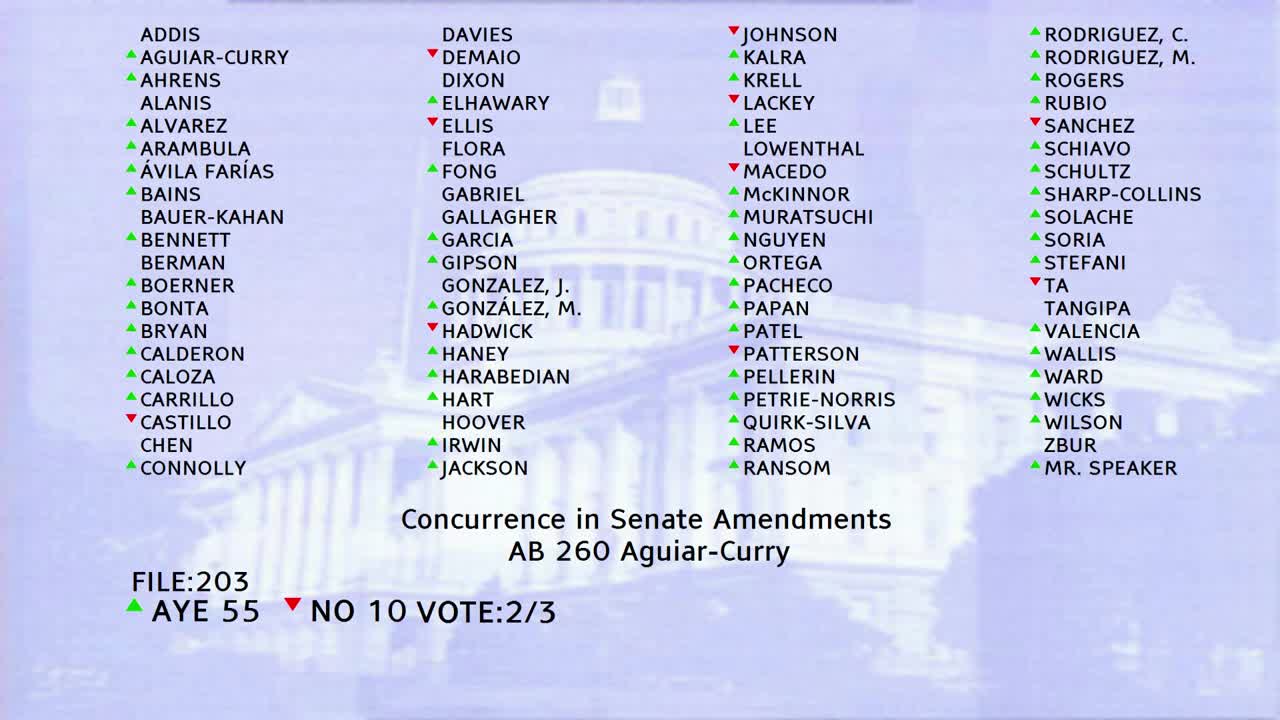
Bill Author

Bill Co-Author(s):