AB 1280: Energy.
- Session Year: 2025-2026
- House: Assembly
- Latest Version Date: 2025-10-06
Current Status:
Passed
(2025-10-06: Chaptered by Secretary of State - Chapter 395, Statutes of 2025.)
Introduced
In Committee
Awaiting First Chamber Vote
Passed First Chamber
In Committee
Awaiting Second Chamber Vote
Passed Second Chamber
Enacted
(1)The Bergeson-Peace Infrastructure and Economic Development Bank Act establishes the California Infrastructure and Economic Development Bank (I-Bank) in the Governors Office of Business and Economic Development, governed by a board of directors. The act, among other things, authorizes the I-Bank to make loans, issue bonds, and provide financial assistance for various types of projects that qualify as economic development or public development facilities. The Climate Catalyst Revolving Fund Act of 2020 authorizes the I-bank, under the Climate Catalyst Revolving Fund Program, to provide financial assistance to any eligible sponsor or participating party in connection with the financing or refinancing of a climate catalyst project, either directly to the sponsor or participating party or to a lending or financial institution, as provided. The act requires the I-Bank to adopt climate catalyst financing plans for specified categories of climate catalyst projects, as specified, after meeting and conferring with the appropriate consulting agencies for those specified categories of climate catalyst projects.
This bill would authorize the I-bank to provide financial assistance in connection with the financing or refinancing of a new category of climate catalyst projects, those that enable the decarbonization of industrial facilities use of heat and power, including, but not limited to, industrial heat pump and thermal energy storage projects, as specified, with the State Energy Resources Conservation and Development Commission and the State Air Resources Board as consulting agencies. The bill would specify conditions to be satisfied regarding these projects. The bill would make implementation of the financial assistance for this new category of climate catalyst projects contingent upon an appropriation by the Legislature.
(2)Existing law requires the commission to establish and implement the Long-Duration Energy Storage Program to provide financial incentives for eligible projects, including thermal storage, that have power ratings of at least one megawatt and are capable of reaching a target of at least 8 hours of continuous discharge of electricity in order to deploy innovative energy storage systems to the electrical grid for purposes of providing critical capacity and grid services. Existing law requires the commission to give preference to eligible projects that have certain impacts, including those that increase the use of renewable energy.
This bill would establish and implement an Industrial Facilities Thermal Energy Storage Program within the Long-Duration Energy Storage Program to provide financial incentives for eligible projects to decarbonize industrial facilities use of heat and power, as specified. The bill would include thermal energy storage, as defined, rather than thermal storage, as an eligible project. The bill would require the commission to give preference to eligible projects that increase the use of renewable energy through reducing curtailment and shifting power usage from peak to off-peak times, rather than to all projects that increase the use of renewable energy. The bill would prohibit, after January 1, 2027, the commission from providing these financial incentives to projects that involve the performance of work by contractors in the construction industry unless that work is performed under a project labor agreement, as provided.
(3)Existing law requires the commission to establish and administer the Industrial Grid Support and Decarbonization Program to provide financial incentives for the implementation of eligible projects at eligible industrial facilities to provide significant benefits to the electrical grid, reduce emissions of greenhouse gases, achieve the states clean energy goals, and exceed compliance requirements. Existing law subjects projects to certain conditions of eligibility for these financial incentives. Existing law requires the commission, in providing financial incentives, to give preference to certain types of projects.
This bill would rename the program the Industrial Decarbonization and Improvement of Grid Operations Program and would add, among its purposes, reducing emissions of health-harming pollutants. The bill would revise some of the conditions for eligible projects. The bill would make, after January 1, 2027, projects that involve the performance of work by contractors in the construction industry ineligible for these financial incentives unless the work is performed under a project labor agreement, as provided. The bill would require, after January 1, 2027, an eligible project for a facility that has a record of air permit violations to separately develop a plan for pollution remediation, including for ecological and public health harms. The bill would require the commission to also give preference, in providing financial incentives, to an eligible project that is located in an under-resourced community, as defined, and an eligible project that develops a community benefit fund or agrees to pursue a community benefits agreement with the surrounding community and other affected stakeholders.
(1)The Bergeson-Peace Infrastructure and Economic Development Bank Act establishes the California Infrastructure and Economic Development Bank (I-Bank) in the Governors Office of Business and Economic Development, governed by a board of directors. The act, among other things, authorizes the I-Bank to make loans, issue bonds, and provide financial assistance for various types of projects that qualify as economic development or public development facilities. The Climate Catalyst Revolving Fund Act of 2020 authorizes the I-bank, under the Climate Catalyst Revolving Fund Program, to provide financial assistance to any eligible sponsor or participating party in connection with the financing or refinancing of a climate catalyst project, either directly to the sponsor or participating party or to a lending or financial institution, as provided. The act requires the bank I-Bank to adopt climate catalyst financing plans for specified categories of climate catalyst projects, as specified, after meeting and conferring with the appropriate consulting agencies for those specified categories of climate catalyst projects.
This bill would authorize the I-bank to provide financial assistance in connection with the financing or refinancing of a new category of climate catalyst projects, those that enable the decarbonization of industrial facilities use of heat and power, including, but not limited to, industrial heat pump and thermal energy storage projects, as specified, with the State Energy Resources Conservation and Development Commission and the State Air Resources Board as consulting agencies. The bill would specify conditions to be satisfied regarding these projects. The bill would make implementation of the financial assistance for this new category of climate catalyst projects contingent upon an appropriation by the Legislature.
(2)Existing law requires the commission to establish and implement the Long-Duration Energy Storage Program to provide financial incentives for eligible projects, including thermal storage, that have power ratings of at least one megawatt and are capable of reaching a target of at least 8 hours of continuous discharge of electricity in order to deploy innovative energy storage systems to the electrical grid for purposes of providing critical capacity and grid services. Existing law requires the commission to give preference to eligible projects that have certain impacts, including those that increase the use of renewable energy.
This bill would establish and implement an Industrial Facilities Thermal Energy Storage Program within the Long-Duration Energy Storage Program to provide financial incentives for eligible projects to decarbonize industrial facilities use of heat and power, as specified. The bill would include thermal energy storage, as defined, rather than thermal storage, as an eligible project. The bill would require the commission to give preference to eligible projects that increase the use of renewable energy through reducing curtailment and shifting power usage from peak to off-peak times, rather than to all projects that increase the use of renewable energy. The bill would prohibit, after January 1, 2026, or a date specified in guidelines adopted by the commission not later than July 1, 2026, 2027, the commission from providing these financial incentives to projects that involve the performance of work by contractors in the construction industry unless that work is performed under a project labor agreement, as provided.
(3)Existing law requires the commission to establish and administer the Industrial Grid Support and Decarbonization Program to provide financial incentives for the implementation of eligible projects at eligible industrial facilities to provide significant benefits to the electrical grid, reduce emissions of greenhouse gases, achieve the states clean energy goals, and exceed compliance requirements. Existing law subjects projects to certain conditions of eligibility for these financial incentives. Existing law requires the commission, in providing financial incentives, to give preference to certain types of projects.
This bill would rename the program the Industrial Decarbonization and Improvement of Grid Operations Program and would add, among its purposes, reducing emissions of health-harming pollutants. The bill would revise some of the conditions for eligible projects. The bill would make, after January 1, 2026, or a date specified in guidelines adopted by the commission not later than July 1, 2026, 2027, projects that involve the performance of work by contractors in the construction industry ineligible for these financial incentives unless the work is performed under a project labor agreement, as provided. The bill would require, after January 1, 2026, or a date specified in guidelines adopted by the commission not later than July 1, 2026, 2027, an eligible project for a facility that has a record of air permit violations to separately develop a plan for pollution remediation, including for ecological and public health harms. The bill would require the commission to also give preference, in providing financial incentives, to an eligible project that is located in an under-resourced community, as defined, and an eligible project that develops a community benefit fund or agrees to pursue a community benefits agreement with the surrounding community and other affected stakeholders.
(1)The Bergeson-Peace Infrastructure and Economic Development Bank Act establishes the California Infrastructure and Economic Development Bank (I-Bank) in the Governors Office of Business and Economic Development, governed by a board of directors. The act, among other things, authorizes the I-Bank to make loans, issue bonds, and provide financial assistance for various types of projects that qualify as economic development or public development facilities. The Climate Catalyst Revolving Loan Fund Act of 2020 authorizes the I-bank, under the Climate Catalyst Revolving Loan Fund Program, to provide financial assistance to any eligible sponsor or participating party in connection with the financing or refinancing of a climate catalyst project, either directly to the sponsor or participating party or to a lending or financial institution, as provided. The act, beginning in the 202122 fiscal year, act requires the bank to adopt a climate catalyst financing plan, plans for specified categories of climate catalyst projects, as specified, after meeting and conferring with prescribed authorized the appropriate consulting agencies concerning specific categories for those specified categories of climate catalyst projects.
This bill would authorize the I-bank to provide financial assistance in connection with the financing or refinancing of a new category of climate catalyst projects, those that enable the decarbonization of industrial facilities use of heat and power, including, but not limited to, industrial heat pump and thermal energy storage projects, as specified, with the State Energy Resources Conservation and Development Commission and the State Air Resources Board as consulting agencies. The bill would specify conditions to be satisfied regarding these projects.
(2)Existing law requires the commission to establish and implement the Long-Duration Energy Storage Program to provide financial incentives for eligible projects, including thermal storage, that have power ratings of at least one megawatt and are capable of reaching a target of at least 8 hours of continuous discharge of electricity in order to deploy innovative energy storage systems to the electrical grid for purposes of providing critical capacity and grid services. Existing law requires the commission to give preference to eligible projects that have certain impacts, including those that increase the use of renewable energy.
This bill would establish and implement an Industrial Facilities Thermal Energy Storage Program within the Long-Duration Energy Storage Program to provide financial incentives for eligible projects to decarbonize industrial facilities use of heat and power, as specified. The bill would include thermal energy storage, as defined, rather than thermal storage, as an eligible project. The bill would require the commission to give preference to eligible projects that increase the use of renewable energy through reducing curtailment and shifting power usage from peak to off-peak times, rather than to all projects that increase the use of renewable energy. The bill would prohibit prohibit, after January 1, 2026, or a date specified in guidelines adopted by the commission not later than July 1, 2026, the commission from providing these financial incentives to projects that involve the performance of work by contractors in the construction industry unless that work is performed under a project labor agreement, as provided.
(3)Existing law requires the commission to establish and administer the Industrial Grid Support and Decarbonization Program to provide financial incentives for the implementation of eligible projects at eligible industrial facilities to provide significant benefits to the electrical grid, reduce emissions of greenhouse gases, achieve the states clean energy goals, and exceed compliance requirements. Existing law subjects projects to certain conditions of eligibility for these financial incentives. Existing law requires the commission, in providing financial incentives, to give preference to certain types of projects.
This bill would rename the program the Industrial Decarbonization and Improvement of Grid Operations Program and would add, among its purposes, reducing emissions of health-harming pollutants. The bill would revise some of the conditions for eligible projects. The bill would make make, after January 1, 2026, or a date specified in guidelines adopted by the commission not later than July 1, 2026, projects that involve the performance of work by contractors in the construction industry ineligible for these financial incentives unless the work is performed under a project labor agreement, as provided. The bill would require require, after January 1, 2026, or a date specified in guidelines adopted by the commission not later than July 1, 2026, an eligible project for a facility that has a record of air permit violations to separately develop a plan for pollution remediation, including for ecological and public health harms. The bill would require the commission to also give preference, in providing financial incentives, to an eligible project that is located in an under-resourced community, as defined, and an eligible project that develops a community benefit fund or agrees to pursue a community benefits agreement with the surrounding community and other affected stakeholders.
(2)Existing law requires the commission to establish and implement the Long-Duration Energy Storage Program to provide financial incentives for eligible projects, including thermal storage, that have power ratings of at least one megawatt and are capable of reaching a target of at least 8 hours of continuous discharge of electricity in order to deploy innovative energy storage systems to the electrical grid for purposes of providing critical capacity and grid services. Existing law requires the commission to give preference to eligible projects that have certain impacts, including those that increase the use of renewable energy.
This bill would establish and implement an Industrial Facilities Thermal Energy Storage Program within the Long-Duration Energy Storage Program to provide financial incentives for eligible projects to decarbonize industrial facilities use of heat and power, as specified. The bill would include thermal energy storage, as defined, rather than thermal storage, as an eligible project. The bill would require the commission to give preference to eligible projects that increase the use of renewable energy through reducing curtailment and shifting power usage from peak to off-peak times, rather than to all projects that increase the use of renewable energy. The bill would prohibit the commission from providing these financial incentives to projects that involve the performance of work by contractors in the construction industry unless that work is performed under a project labor agreement, as provided.
(3)Existing law requires the commission to establish and administer the Industrial Grid Support and Decarbonization Program to provide financial incentives for the implementation of eligible projects at eligible industrial facilities to provide significant benefits to the electrical grid, reduce emissions of greenhouse gases, achieve the states clean energy goals, and exceed compliance requirements. Existing law subjects projects to certain conditions of eligibility for these financial incentives. Existing law requires the commission, in providing financial incentives, to give preference to certain types of projects.
This bill would rename the program the Industrial Decarbonization and Improvement of Grid Operations Program and would add, among its purposes, reducing emissions of health-harming pollutants. The bill would revise some of the conditions for eligible projects. The bill would, to the greatest extent applicable, require an eligible project to create high-road jobs, include project labor agreements or prevailing wages, and contain a workforce training component. would make projects that involve the performance of work by contractors in the construction industry ineligible for these financial incentives unless the work is performed under a project labor agreement, as provided. The bill would require an eligible project for a facility that has a record of air permit violations to separately develop a plan for pollution remediation, including for ecological and public health harms. The bill would require the commission to also give preference, in providing financial incentives, to an eligible project that is located in an under-resourced community, as defined, and an eligible project that develops a community benefit fund or agrees to pursue a community benefits agreement with the surrounding community and other affected stakeholders.
(1)The Bergeson-Peace Infrastructure and Economic Development Bank Act establishes the California Infrastructure and Economic Development Bank (I-Bank) in the Governors Office of Business and Economic Development, governed by a board of directors. The act, among other things, authorizes the I-Bank to make loans, issue bonds, and provide financial assistance for various types of projects that qualify as economic development or public development facilities. The Climate Catalyst Revolving Loan Fund Act of 2020 authorizes the I-bank, under the Climate Catalyst Revolving Loan Fund Program, to provide financial assistance to any eligible sponsor or participating party in connection with the financing or refinancing of a climate catalyst project, either directly to the sponsor or participating party or to a lending or financial institution, as provided. The act, beginning in the 202122 fiscal year, requires the bank to adopt a climate catalyst financing plan, as specified, after meeting and conferring with prescribed authorized consulting agencies concerning specific categories of climate catalyst projects.
This bill would authorize the I-bank to provide financial assistance in connection with the financing or refinancing of a new category of climate catalyst projects, those that enable the decarbonization of industrial facilities use of heat and power, including, but not limited to, industrial heat pump and thermal energy storage projects, as specified, with the State Energy Resources Conservation and Development Commission and the State Air Resources Board as consulting agencies. The bill would specify conditions to be satisfied regarding these projects.
(2)Existing law requires the commission to establish and implement the Long-Duration Energy Storage Program to provide financial incentives for eligible projects, including thermal storage, that have power ratings of at least one megawatt and are capable of reaching a target of at least 8 hours of continuous discharge of electricity in order to deploy innovative energy storage systems to the electrical grid for purposes of providing critical capacity and grid services. Existing law requires the commission to give preference to eligible projects that have certain impacts, including those that increase the use of renewable energy.
This bill would establish and implement an Industrial Facilities Thermal Energy Storage Program within the Long-Duration Energy Storage Program to provide financial incentives for eligible projects to decarbonize industrial facilities use of heat and power, as specified. The bill would include thermal energy storage, as defined, rather than thermal storage, as an eligible project. The bill would require the commission to give preference to eligible projects that increase the use of renewable energy through reducing curtailment and shifting power usage from peak to off-peak times, rather than to all projects that increase the use of renewable energy.
(3)Existing law requires the commission to establish and administer the Industrial Grid Support and Decarbonization Program to provide financial incentives for the implementation of eligible projects at eligible industrial facilities to provide significant benefits to the electrical grid, reduce emissions of greenhouse gases, achieve the states clean energy goals, and exceed compliance requirements. Existing law subjects projects to certain conditions of eligibility for these financial incentives. Existing law requires the commission, in providing financial incentives, to give preference to certain types of projects.
This bill would rename the program the Industrial Decarbonization and Improvement of Grid Operations Program and would add, among its purposes, reducing emissions of health-harming pollutants. The bill would revise some of the conditions for eligible projects. The bill would, to the greatest extent applicable, require an eligible project to create high road high-road jobs, include project labor agreements or prevailing wages, and contain a workforce training component. The bill would require an eligible project for a facility that has a record of air permit violations to separately develop a plan for pollution remediation, including for ecological and public health harms. The bill would require the commission to also give preference, in providing financial incentives, to an eligible project that is located in an under-resourced community, as defined, and an eligible project that develops a community benefit fund or agrees to pursue a community benefits agreement with the surrounding community and other affected stakeholders. The bill would require the commission to establish a thermal energy storage grant program, administered by eligible local air pollution control districts, to provide funds for the decarbonization of facilities use of heat and power, with prescribed eligibility. The bill would require that grants be available to eligible industry facilities for early compliance with zero nitrogen oxides emissions limits. The bill would authorize a participating local air pollution control district to establish additional project and industrial facility eligibility guidelines for its thermal energy grant program. The bill would require no less than ____% of the Industrial Decarbonization and Improvement of Grid Operations Program funds to be annually available for the program and would authorize the commission to also provide funds from other sources for the program.
(1)The Bergeson-Peace Infrastructure and Economic Development Bank Act establishes the California Infrastructure and Economic Development Bank (I-Bank) in the Governors Office of Business and Economic Development, governed by a board of directors. The act, among other things, authorizes the I-Bank to make loans, issue bonds, and provide financial assistance for various types of projects that qualify as economic development or public development facilities. The Climate Catalyst Revolving Loan Fund Act of 2020 authorizes the I-bank, under the Climate Catalyst Revolving Loan Fund Program, to provide financial assistance to any eligible sponsor or participating party in connection with the financing or refinancing of a climate catalyst project, either directly to the sponsor or participating party or to a lending or financial institution, as provided. The act, beginning in the 202122 fiscal year, requires the bank to adopt a climate catalyst financing plan, as specified, after meeting and conferring with prescribed authorized consulting agencies concerning specific categories of climate catalyst projects.
This bill would authorize the I-bank to provide financial assistance in connection with the financing or refinancing of a new category of climate catalyst projects, those that enable the decarbonization of industrial facilities use of heat and power, including, but not limited to, industrial heat pump and thermal energy storage projects, as specified, with the State Energy Resources Conservation and Development Commission and the State Air Resources Board as consulting agencies. The bill would specify conditions to be satisfied regarding these projects.
(2)Existing law requires the commission to establish and implement the Long-Duration Energy Storage Program to provide financial incentives for eligible projects, including thermal storage, that have power ratings of at least one megawatt and are capable of reaching a target of at least 8 hours of continuous discharge of electricity in order to deploy innovative energy storage systems to the electrical grid for purposes of providing critical capacity and grid services. Existing law requires the commission to give preference to eligible projects that have certain impacts, including those that increase the use of renewable energy.
This bill would establish and implement an Industrial Facilities Thermal Energy Storage Program within the Long-Duration Energy Storage Program to provide financial incentives for eligible projects to decarbonize industrial facilities use of heat and power, as specified. The bill would include thermal energy storage, as defined, rather than thermal storage, as an eligible project. The bill would require the commission to give preference to eligible projects that increase the use of renewable energy through reducing curtailment and shifting power usage from peak to off-peak times, rather than to all projects that increase the use of renewable energy.
(3)Existing law requires the commission to establish and administer the Industrial Grid Support and Decarbonization Program to provide financial incentives for the implementation of eligible projects at eligible industrial facilities to provide significant benefits to the electrical grid, reduce emissions of greenhouse gases, achieve the states clean energy goals, and exceed compliance requirements. Existing law subjects projects to certain conditions of eligibility for these financial incentives. Existing law requires the commission, in providing financial incentives, to give preference to certain types of projects.
This bill would rename the program the Industrial Decarbonization and Improvement of Grid Operations Program and would add, among its purposes, reducing emissions of health-harming pollutants. The bill would revise some of the conditions for eligible projects. The bill would, to the greatest extent applicable, require an eligible project to create high road jobs, include project labor agreements or prevailing wages, and contain a workforce training component. The bill would require an eligible project for a facility that has a record of air permit violations to separately develop a plan for pollution remediation, including for ecological and public health harms. The bill would require the commission to also give preference, in providing financial incentives, to an eligible project that is located in an under-resourced community, as defined, and an eligible project that develops a community benefit fund or agrees to pursue a community benefits agreement with the surrounding community and other affected stakeholders. The bill would require the commission to establish a thermal energy storage grant program, administered by eligible local air pollution control districts, to provide funds for the decarbonization of facilities use of heat and power, with prescribed eligibility. The bill would require that grants be available to eligible industry facilities for early compliance with zero nitrogen oxides emissions limits. The bill would authorize a participating local air pollution control district to establish additional project and industrial facility eligibility guidelines for its thermal energy grant program. The bill would require no less than ____% of the Industrial Decarbonization and Improvement of Grid Operations Program funds to be annually available for the program and would authorize the commission to also provide funds from other sources for the program.
(a)The bank is hereby authorized and empowered to provide financial assistance under the Climate Catalyst Revolving Fund Program to any eligible sponsor or participating party either directly or to a lending or financial institution, in connection with the financing or refinancing of a climate catalyst project, in accordance with an agreement or agreements, between the bank and the sponsor or participating party, including, but not limited to, tribes, either as a sole lender or in participation or syndication with other lenders.
(b)Chapter 3.5 (commencing with Section 11340) of Part 1 of Division 3 of Title 2 does not apply to any climate catalyst financing plan or any criteria, priorities, and guidelines adopted by the bank in connection with the Climate Catalyst Revolving Fund Program or any other program of the bank. However, any climate catalyst financing plan shall be posted on the banks internet website in a conspicuous location at least 30 calendar days before a bank board meeting at which the climate catalyst financing plan will be considered for approval.
(c)(1)Repayments of financing made under the Climate Catalyst Revolving Fund Program shall be deposited into the appropriate account created within the Climate Catalyst Revolving Fund.
(2)The bank shall establish a separate account for each category of climate catalyst projects identified by each paragraph of subdivision (f). For purposes of paragraph (3) of subdivision (f), the Clean Energy Transmission Financing Account is hereby created in the Climate Catalyst Revolving Fund.
(d)(1)(A)The bank shall meet and confer with the appropriate consulting agencies for each category of climate catalyst projects identified in subdivision (f). Thereafter, the bank board shall adopt, by majority vote of the bank board, a climate catalyst financing plan for each category of climate catalyst projects identified in subdivision (f). Before the bank board meeting in which the bank board will first consider adoption of a financing plan, each consulting agency shall submit a letter to the bank board discussing any areas of support and any areas of disagreement with the financing plan under consideration.
(B)Adoption of a climate catalyst financing plan by the bank board shall authorize the bank to provide financial assistance and to use all financing authorities provided under this division in its implementation of the climate catalyst financing plan.
(2)Following bank board approval, the climate catalyst financing plan shall be posted on the banks internet website.
(3)A climate catalyst financing plan shall not be in effect until approved by the bank board.
(e)(1)A climate catalyst financing plan shall remain in effect until superseded by a revised climate catalyst financing plan or repealed by the bank. Commencing the first fiscal year following adoption of an initial climate catalyst financing plan, and in each fiscal year thereafter, the bank shall contact each consulting agency to discuss potential revisions to the climate catalyst financing plan last approved by the bank board. If the consultation results in proposed revisions to the climate catalyst financing plan, the bank board may consider adopting, by majority vote, a revised climate catalyst financing plan.
(2)Any revisions to, or repeals of, a climate catalyst financing plan shall take effect 30 days after the bank provides written notification to the Joint Legislative Budget Committee, or not sooner than whatever lesser time after that notification the chairperson of the joint committee, or the chairpersons designee, may determine.
(f)The categories of climate catalyst projects and the consulting agencies for the respective climate catalyst financing plans shall be as follows:
(1)This paragraph shall be known as the Forest Biomass Management and Utilization climate catalyst category. The Natural Resources Agency shall be the consulting agency for the climate catalyst financing plan adopted for this category. This category includes climate catalyst projects that relate to sustainable vegetation management, forestry practices, and timber harvesting products. Eligible climate catalyst project subcategories include, but are not limited to, all of the following:
(A)Clean energy production, except combustion biomass conversion.
(B)Advanced construction materials.
(C)Forestry equipment needed to achieve the states goals for forest and vegetation management treatments.
(2)This paragraph shall be known as the Climate-Smart Agriculture climate catalyst category. The Department of Food and Agriculture shall be the consulting agency for the climate catalyst financing plan for this category. This category includes climate catalyst projects that relate to agricultural improvements that enhance the climate or lessen impacts to the climate resulting from in-force agricultural practices. Eligible climate catalyst project subcategories include, but are not limited to, all of the following:
(A)Onfarm and food processing renewable energy, including both electricity and fuels, and bioenergy, to be used or distributed onsite.
(B)Energy, water, and materials efficiency.
(C)Methane reduction projects, using best practice approaches consistent with state policy goals, excluding dairy digesters and biogas unless used or distributed onsite.
(D)Energy storage or microgrids.
(E)Equipment replacement.
(3)(A)This paragraph shall be known as the Clean Energy Transmission climate catalyst category. The State Energy Resources Conservation and Development Commission and the Public Utilities Commission shall be the consulting agencies for the climate catalyst financing plan for this category. This category includes climate catalyst projects that are clean energy transmission projects. If multiple projects seek funding, the consulting agencies shall prioritize, based on state policy, potential projects that meet the conditions in subparagraph (B), and on financial considerations as determined by the bank. Eligible climate catalyst project subcategories in this paragraph shall comply with the conditions set forth in this paragraph, and include, but are not limited to, both of the following:
(i)Clean energy transmission project infrastructure that is necessary to connect the transmission project into the applicable California balancing authority area.
(ii)Other necessary technical elements of transmission infrastructure, including, but not limited to, environmental planning, permitting, and preconstruction costs for a project.
(B)Eligible projects shall meet all of the following conditions:
(i)Have at least one interconnection point within a California balancing authority area.
(ii)The applicant or its affiliates have previously completed a transmission project in California.
(iii)Will primarily deliver electricity to the Independent System Operator balancing authority area from clean resources located in identified resource areas that do not have adequate deliverability to a California balancing authority area.
(iv)Support new high voltage, defined as 200 kilovolts or higher, transmission projects or upgrades of existing transmission lines and substations to high voltage that are consistent with the states reliability and greenhouse gas policy objectives.
(v)Priority shall be given to transmission projects that have not already been approved through the Independent System Operators transmission planning process or projects that have not been recently studied in the Independent System Operators transmission planning process and found to be unneeded or uneconomical.
(vi)Financial considerations as determined by the bank.
(vii)Consistency with state policy as determined by the consulting agencies.
(C)The bank shall not finance a project unless the entity completing the transmission project has entered into a project labor agreement that, at a minimum, meets the requirements of Section 2500 of the Public Contract Code and includes all of the following:
(i)Provisions requiring payment of prevailing wages, in accordance with Article 1 (commencing with Section 1720) of Chapter 1 of Part 7 of Division 2 of the Labor Code, to all construction workers employed in the construction of the project and for enforcement of that obligation through an arbitration procedure.
(ii)Targeted hiring provisions, including a targeted hiring plan, on a craft-by-craft basis to address job access for local, disadvantaged, or underrepresented workers, as defined by a relevant local agency.
(iii)Apprenticeship utilization provisions that commit all parties to increasing the share of work performed by state-registered apprentices above the state-mandated minimum ratio required in Section 1777.5 of the Labor Code.
(iv)Apprenticeship utilization provisions that commit all parties to hiring and retaining a certain percentage of state-registered apprentices that have completed the Multi-Craft Core preapprenticeship training curriculum referenced in subdivision (t) of Section 14005 of the Unemployment Insurance Code.
(D)Consultation on a potential transmission project does not constitute approval of that project by the Public Utilities Commission or the State Energy Resources Conservation and Development Commission under their decisionmaking authority, if that authority exists.
(E)Consultation on, or evaluation of, a transmission project by the bank does not indicate the banks approval. The bank shall consider the credit and financial aspects of the project before determining whether to approve and finance the project.
(4)This paragraph shall be known as the State Energy Financing Institution climate catalyst category. The State Energy Resources Conservation and Development Commission or the Public Utilities Commission shall be the consulting agency for the climate catalyst financing plan for this category. This category includes climate catalyst projects to leverage federal financing funds that relate to projects that avoid, reduce, use, or sequester air pollutants or anthropogenic emissions of greenhouse gases as defined in Section 16513 of Title 42 of the United States Code, as amended.
(5)(A)This paragraph shall be known as the Federal Greenhouse Gas Reduction Fund climate catalyst category. The Governors Office of Business and Economic Development, Treasurers Office, California Environmental Protection Agency, Public Utilities Commission, Natural Resources Agency, and other relevant agencies, as determined by these agencies, shall be the consulting agencies for the climate catalyst financing plan for this category. This category includes climate catalyst projects to leverage federal funding available under the United States Environmental Protection Agencys Greenhouse Gas Reduction Fund (Section 7434 of Title 42 of the United States Code) and related implementing statutes and regulations.
(B)Eligible climate catalyst project subcategories shall comply with the climate and equity goals in the states climate change scoping plan developed pursuant to Section 38561 of the Health and Safety Code.
(6)The State Energy Resources Conservation and Development Commission and the State Air Resources Board for climate catalyst projects that enable the decarbonization of industrial facilities use of heat and power, including, but not limited to, industrial heat pump and thermal energy storage projects. If multiple projects seek funding, the consulting agencies shall prioritize based on state policy and on financial considerations as determined by the bank. For applications received after January 1, 2027, eligible climate catalyst project categories in this paragraph shall comply with the conditions set forth in this paragraph, and include, but not be limited to, all of the following:
(A)The bank shall prioritize, to the greatest extent applicable, industrial decarbonization projects that meet both of the following requirements:
(i)Achieve direct or indirect emissions reductions at a specific industrial facility.
(ii)Reduce criteria pollutants and further progress toward attainment of local, state, or federal air quality standards.
(B)The bank shall not finance an industrial decarbonization project unless the entity completing the project has entered into a project labor agreement that, at a minimum, meets the requirements of Section 2500 of the Public Contract Code and includes all of the following:
(i)Provisions requiring payment of prevailing wages, in accordance with Article 1 (commencing with Section 1720) of Chapter 1 of Part 7 of Division 2 of the Labor Code, to all construction workers employed in the construction of the project and for enforcement of that obligation through an arbitration procedure.
(ii)Targeted hiring provisions, including a targeted hiring plan, on a craft-by-craft basis to address job access for local, disadvantaged, or underrepresented workers, as defined by a relevant local agency.
(iii)Apprenticeship utilization provisions that commit all parties to increasing the share of work performed by state-registered apprentices above the state-mandated minimum ratio required in Section 1777.5 of the Labor Code.
(iv)Apprenticeship utilization provisions that commit all parties to hiring and retaining a certain percentage of state-registered apprentices that have completed the Multi-Craft Core preapprenticeship training curriculum referenced in subdivision (t) of Section 14005 of the Unemployment Insurance Code.
(C)The bank shall not finance an industrial decarbonization project unless the entity completing the project includes a community benefit fund or community benefits agreement with the surrounding community and other affected stakeholders.
(D)Consultation on an industrial decarbonization project does not constitute approval of that project by the State Energy Resources Conservation and Development Commission or the State Air Resources Board under their decisionmaking authority, if that authority exists.
(E)Consultation on, or evaluation of, an industrial decarbonization project by the bank does not indicate the banks approval. The bank shall consider the credit and financial aspects of the project before determining whether to approve and finance the project.
(F)Implementation of this paragraph is contingent upon an appropriation of funds by the Legislature for the purpose of this paragraph.
(g)(1)The bank may engage in outreach activities to inform disadvantaged participating parties and disadvantaged sponsors of the categories of financial assistance potentially available within the Climate Catalyst Revolving Fund Program. The outreach efforts may include, but are not limited to, all of the following:
(A)Conferring with the consulting agencies.
(B)Conferring with the Governors Office of Business and Economic Development.
(C)Direct contact with existing bank clients and customers that operate within the boundaries of a disadvantaged community.
(D)Consulting with governmental entities, individuals, and business entities engaged in providing, or assisting the obtaining of, financial assistance for disadvantaged sponsors or participating parties, including, but not limited to, business and industrial development corporations and minority enterprise small business investment companies. The executive director, on behalf of the bank, may enter into service contracts for this purpose. Section 10295 and Article 4 (commencing with Section 10335) of Chapter 2 of Part 2 of Division 2 of the Public Contract Code do not apply to those service contracts.
(2)The criteria, priorities, and guidelines adopted for the Climate Catalyst Revolving Fund Program may include potential options for applying interest rate or fee subsidies for disadvantaged participating parties or disadvantaged sponsors seeking financial assistance from the bank under the Climate Catalyst Revolving Fund Program. The bank may offer reduced application fees to disadvantaged sponsors or participating parties seeking financial assistance under the Climate Catalyst Revolving Fund Program.
(3)The bank may offer technical assistance to disadvantaged sponsors or participating parties potentially seeking financial assistance under the Climate Catalyst Revolving Fund Program. The executive director, on behalf of the bank, may enter into service contracts to provide, or assist with the provision of, the technical assistance. Section 10295 and Article 4 (commencing with Section 10335) of Chapter 2 of Part 2 of Division 2 of the Public Contract Code do not apply to those service contracts.
(h)All financial assistance under the Climate Catalyst Revolving Fund Program approved by the bank board shall be consistent with the climate catalyst financing plan then in effect.
(i)(1)The bank shall prepare, and the bank board shall approve by majority vote of the board, criteria, priorities, and guidelines for the provision of financial assistance under the Climate Catalyst Revolving Fund Program. The bank boards approval of any financial assistance for a climate catalyst project shall take into consideration those criteria, priorities, and guidelines together with the relevant climate catalyst financing plan currently in effect. The criteria, priorities, and guidelines shall include, as factors for determining whether to approve the provision of financial assistance, the ability of the sponsor or participating party potentially receiving financial assistance to satisfy any obligation incurred and the return of capital to the Climate Catalyst Revolving Fund.
(2)The bank board may consider additional factors when determining whether to approve financial assistance for a climate catalyst project, taking into consideration the relevant climate catalyst financing plan.
(3)The bank shall consider applications for financial assistance as they are received, on an ongoing basis, if there are available moneys remaining within the Climate Catalyst Revolving Fund to provide that financial assistance. The bank boards determination of whether to approve applications for financial assistance shall be based on the relevant climate catalyst financing plan and the criteria, priorities, and guidelines in effect at the time the bank received the application.
(4)A participating party or sponsor shall comply with the terms and conditions that control the use of the funds provided, if any.
(j)The bank shall provide financial assistance only for climate catalyst projects that the bank board approved before December 31, 2031.
(k)The bank is hereby authorized and empowered to enter into an agreement with the consulting agencies, or any other state agency as approved by the banks board, to operate a program to provide financial assistance to any eligible sponsor or participating party either directly or to a lending or financial institution, in connection with the financing or refinancing of an eligible project, in accordance with such agreement or agreements. Information shared among consulting agencies and the bank, or between any consulting agency and the bank, does not constitute the waiver of any Public Records Act exemption applicable to each entity.
SEC. 2.Section 25640 of the Public Resources Code is amended to read:25640.For purposes of this chapter, the following definitions apply:
(a)Energy storage system has the same meaning as defined in Section 2835 of the Public Utilities Code.
(b)Thermal energy storage means the storage of thermal energy for direct use for heating or cooling at a later time in a manner that avoids the need to use electricity at that later time.
(c)Financial incentive includes a contract, grant, loan, rebate, block grant, or other appropriate funding mechanism.
(d)Under-resourced community has the same meaning as defined in Section 71130.
SEC. 3.Section 25641 of the Public Resources Code is amended to read:25641.(a)The commission shall establish and implement the Long-Duration Energy Storage Program to provide financial incentives for eligible projects, located at eligible storage facilities, that have power ratings of at least one megawatt and are capable of reaching a target of at least eight hours of continuous discharge of electricity at that power rating in order to deploy innovative energy storage systems to the electrical grid for purposes of providing critical capacity and grid services.
(b)The commission shall establish and implement an Industrial Facilities Thermal Energy Storage Program within the Long-Duration Energy Storage Program to provide financial incentives for eligible projects located at eligible facilities to decarbonize industrial facilities use of heat and power. The commission may establish project and industrial facility guidelines for the purposes of this section that support the broader transformation of industrial facilities to ensure program resources support high-road jobs, community benefits, and the transition from fossil fuels to clean energy.
SEC. 4.Section 25642 of the Public Resources Code is amended to read:25642.(a)The commission may establish project and storage facility eligibility guidelines for purposes of this chapter.
(b)Any eligibility guidelines established pursuant to subdivision (a) shall be consistent with both of the following requirements:
(1)Eligible storage facility shall include, but not be limited to, an energy storage system that is interconnected to the electrical grid in California or to a California balancing authority.
(2)(A)Eligible project shall include, but not be limited to, an eligible storage facility that includes any of the following:
(i)Compressed air or liquid air technologies.
(ii)Flow batteries, advanced chemistry batteries, or mechanical energy storage.
(iii)Thermal energy storage or aqueous battery systems.
(iv)A hydrogen demonstration project.
(B)Eligible project shall not include a pumped storage project or lithium-ion-based storage technology.
SEC. 5.Section 25645 of the Public Resources Code is amended to read:25645.(a)In providing financial incentives pursuant to this chapter, the commission shall give preference to an eligible project that does one or more of the following:
(1)Increases the reliability and resiliency of the electrical grid.
(2)Adds electrical grid services when the electrical grid is stressed or anticipating pending energy challenges.
(3)Increases the use of renewable energy, through reducing curtailment and shifting power usage from peak to off-peak times, and reduces the impact of climate change on the electrical grid or on connected facilities or communities, including by improving air quality, reducing emissions of greenhouse gases, or providing under-resourced communities with increased reliability and resiliency.
(4)Lowers energy costs and provides employment opportunities for residents of under-resourced communities.
(5)Interconnects to the electrical grid and is commercially operational by 2028.
(b)For applications received after January 1, 2027, the commission shall provide financial incentives to a project that involves the performance of work by contractors in the construction industry only if that work is performed pursuant to a project labor agreement that, at a minimum, meets the requirements of Section 2500 of the Public Contract Code.
SEC. 6.The heading of Article 2 (commencing with Section 25662) of Chapter 7.6 of Division 15 of the Public Resources Code is amended to read:2.Industrial Decarbonization and Improvement of Grid Operations ProgramSEC. 7.Section 25662 of the Public Resources Code is amended to read:25662.The commission shall establish and administer the Industrial Decarbonization and Improvement of Grid Operations Program to provide financial incentives for the implementation of eligible projects at eligible industrial facilities to provide significant benefits to the electrical grid, reduce emissions of greenhouse gases and health-harming pollutants, achieve the states clean energy goals, and exceed compliance requirements.
SEC. 8.Section 25662.2 of the Public Resources Code is amended to read:25662.2.(a)The commission may establish project and industrial facility eligibility guidelines for purposes of this article.
(b)The eligibility guidelines established pursuant to subdivision (a) shall be consistent with all of the following requirements:
(1)Eligible industrial facility shall include, but not be limited to, a facility involved with manufacturing, production, and processing of materials, such as chemicals, metals, food and beverages, and nonmetallic minerals, including cement, glass, electronics, and pharmaceuticals, and related support facilities.
(2)(A)Eligible project shall include, but not be limited to, the purchase and deployment of advanced technologies and equipment that is capable of doing at least one of the following:
(i)Enhance electrical grid reliability and enable industrial facility participation in utility load reduction programs, such as an emergency load reduction program.
(ii)Electrify processes that use gas or other fossil fuels to produce heat for industrial processes.
(iii)Incorporate energy storage, including thermal energy storage, or renewable energy resources.
(iv)Increase energy efficiency.
(v)Develop and deploy novel decarbonization technologies and strategies, including carbon capture of process emissions for use in products, such as carbonate mineralization and carbon curing of concrete that reduces or eliminates the emissions of greenhouse gases, except geologic storage.
(B)Eligible project shall not include a project to benefit an oil production, processing, or refining facility, to benefit a fossil gas production, processing, or refining facility, or to use captured carbon for enhanced oil and gas recovery.
(C)For applications received after January 1, 2027, a project that involves the performance of work by contractors in the construction industry shall be eligible for a financial incentive pursuant to this article only if the work is performed pursuant to a project labor agreement that, at a minimum, meets the requirements of Section 2500 of the Public Contract Code.
(D)A project shall only be eligible for a financial incentive pursuant to this article if the project will use technologies that exceed the best available control technology, as defined in Section 40405 of the Health and Safety Code, if applicable.
(E)For applications received after January 1, 2027, an eligible project for a facility that has a record of air permit violations shall separately develop a plan for pollution remediation, including for ecological and public health harms.
SEC. 9.Section 25662.4 of the Public Resources Code is amended to read:25662.4.(a)In providing financial incentives pursuant to this article, the commission shall give preference to an eligible project that does one or more of the following:
(1)Provides significant benefits to the electrical grid, especially during net peak periods.
(2)Maximizes the reduction of the emissions of greenhouse gases.
(3)Reduces air pollution in under-resourced communities.
(4)Is located in an under-resourced community, as defined in Section 71130, or in an area out of compliance with the applicable federal Clean Air Act (42 U.S.C. Sec. 7401 et seq.) deadlines in nonattainment areas.
(5)Develops a community benefit fund or agrees to pursue a community benefits agreement with the surrounding community and other affected stakeholders.
(b)In providing financial incentives pursuant to this article, the commission shall prioritize an eligible project that reduces demand during net peak periods.
(c)(1)The commission shall consult with the State Air Resources Board to ensure that financial incentives provided pursuant to this article reduce the emissions of greenhouse gases under the statewide greenhouse gas emission limits in furtherance of the states greenhouse gas reduction targets, to the extent feasible under the State Air Resources Boards regulatory programs.
(2)To comply with the requirements of this subdivision, the commission may require a recipient of a financial incentive to surrender to the State Air Resources Board the number of annual allowances allocated at no cost to the eligible industrial facility pursuant to the market-based compliance mechanism developed pursuant to Part 5 (commencing with Section 38570) of Division 25.5 of the Health and Safety Code equivalent to the greenhouse gas emissions reduced by the eligible project.
(d)A recipient of a financial incentive pursuant to this article shall not receive more than 20 percent of the moneys allocated pursuant to this article.
(a)The bank is hereby authorized and empowered to provide financial assistance under the Climate Catalyst Revolving Fund Program to any eligible sponsor or participating party either directly or to a lending or financial institution, in connection with the financing or refinancing of a climate catalyst project, in accordance with an agreement or agreements, between the bank and the sponsor or participating party, including, but not limited to, tribes, either as a sole lender or in participation or syndication with other lenders.
(b)Chapter 3.5 (commencing with Section 11340) of Part 1 of Division 3 of Title 2 does not apply to any climate catalyst financing plan or any criteria, priorities, and guidelines adopted by the bank in connection with the Climate Catalyst Revolving Fund Program or any other program of the bank. However, any climate catalyst financing plan shall be posted on the banks internet website in a conspicuous location at least 30 calendar days before a bank board meeting at which the climate catalyst financing plan will be considered for approval.
(c)(1)Repayments of financing made under the Climate Catalyst Revolving Fund Program shall be deposited into the appropriate account created within the Climate Catalyst Revolving Fund.
(2)The bank shall establish a separate account for each category of climate catalyst projects identified by each paragraph of subdivision (f). For purposes of paragraph (3) of subdivision (f), the Clean Energy Transmission Financing Account is hereby created in the Climate Catalyst Revolving Fund.
(d)(1)(A)The bank shall meet and confer with the appropriate consulting agencies for each category of climate catalyst projects identified in subdivision (f). Thereafter, the bank board shall adopt, by majority vote of the bank board, a climate catalyst financing plan for each category of climate catalyst projects identified in subdivision (f). Before the bank board meeting in which the bank board will first consider adoption of a financing plan, each consulting agency shall submit a letter to the bank board discussing any areas of support and any areas of disagreement with the financing plan under consideration.
(B)Adoption of a climate catalyst financing plan by the bank board shall authorize the bank to provide financial assistance and to use all financing authorities provided under this division in its implementation of the climate catalyst financing plan.
(2)Following bank board approval, the climate catalyst financing plan shall be posted on the banks internet website.
(3)A climate catalyst financing plan shall not be in effect until approved by the bank board.
(e)(1)A climate catalyst financing plan shall remain in effect until superseded by a revised climate catalyst financing plan or repealed by the bank. Commencing the first fiscal year following adoption of an initial climate catalyst financing plan, and in each fiscal year thereafter, the bank shall contact each consulting agency to discuss potential revisions to the climate catalyst financing plan last approved by the bank board. If the consultation results in proposed revisions to the climate catalyst financing plan, the bank board may consider adopting, by majority vote, a revised climate catalyst financing plan.
(2)Any revisions to, or repeals of, a climate catalyst financing plan shall take effect 30 days after the bank provides written notification to the Joint Legislative Budget Committee, or not sooner than whatever lesser time after that notification the chairperson of the joint committee, or the chairpersons designee, may determine.
(f)The categories of climate catalyst projects and the consulting agencies for the respective climate catalyst financing plans shall be as follows:
(1)This paragraph shall be known as the Forest Biomass Management and Utilization climate catalyst category. The Natural Resources Agency shall be the consulting agency for the climate catalyst financing plan adopted for this category. This category includes climate catalyst projects that relate to sustainable vegetation management, forestry practices, and timber harvesting products. Eligible climate catalyst project subcategories include, but are not limited to, all of the following:
(A)Clean energy production, except combustion biomass conversion.
(B)Advanced construction materials.
(C)Forestry equipment needed to achieve the states goals for forest and vegetation management treatments.
(2)This paragraph shall be known as the Climate-Smart Agriculture climate catalyst category. The Department of Food and Agriculture shall be the consulting agency for the climate catalyst financing plan for this category. This category includes climate catalyst projects that relate to agricultural improvements that enhance the climate or lessen impacts to the climate resulting from in-force agricultural practices. Eligible climate catalyst project subcategories include, but are not limited to, all of the following:
(A)Onfarm and food processing renewable energy, including both electricity and fuels, and bioenergy, to be used or distributed onsite.
(B)Energy, water, and materials efficiency.
(C)Methane reduction projects, using best practice approaches consistent with state policy goals, excluding dairy digesters and biogas unless used or distributed onsite.
(D)Energy storage or microgrids.
(E)Equipment replacement.
(3)(A)This paragraph shall be known as the Clean Energy Transmission climate catalyst category. The State Energy Resources Conservation and Development Commission and the Public Utilities Commission shall be the consulting agencies for the climate catalyst financing plan for this category. This category includes climate catalyst projects that are clean energy transmission projects. If multiple projects seek funding, the consulting agencies shall prioritize, based on state policy, potential projects that meet the conditions in subparagraph (B), and on financial considerations as determined by the bank. Eligible climate catalyst project subcategories in this paragraph shall comply with the conditions set forth in this paragraph, and include, but are not limited to, both of the following:
(i)Clean energy transmission project infrastructure that is necessary to connect the transmission project into the applicable California balancing authority area.
(ii)Other necessary technical elements of transmission infrastructure, including, but not limited to, environmental planning, permitting, and preconstruction costs for a project.
(B)Eligible projects shall meet all of the following conditions:
(i)Have at least one interconnection point within a California balancing authority area.
(ii)The applicant or its affiliates have previously completed a transmission project in California.
(iii)Will primarily deliver electricity to the Independent System Operator balancing authority area from clean resources located in identified resource areas that do not have adequate deliverability to a California balancing authority area.
(iv)Support new high voltage, defined as 200 kilovolts or higher, transmission projects or upgrades of existing transmission lines and substations to high voltage that are consistent with the states reliability and greenhouse gas policy objectives.
(v)Priority shall be given to transmission projects that have not already been approved through the Independent System Operators transmission planning process or projects that have not been recently studied in the Independent System Operators transmission planning process and found to be unneeded or uneconomical.
(vi)Financial considerations as determined by the bank.
(vii)Consistency with state policy as determined by the consulting agencies.
(C)The bank shall not finance a project unless the entity completing the transmission project has entered into a project labor agreement that, at a minimum, meets the requirements of Section 2500 of the Public Contract Code and includes all of the following:
(i)Provisions requiring payment of prevailing wages, in accordance with Article 1 (commencing with Section 1720) of Chapter 1 of Part 7 of Division 2 of the Labor Code, to all construction workers employed in the construction of the project and for enforcement of that obligation through an arbitration procedure.
(ii)Targeted hiring provisions, including a targeted hiring plan, on a craft-by-craft basis to address job access for local, disadvantaged, or underrepresented workers, as defined by a relevant local agency.
(iii)Apprenticeship utilization provisions that commit all parties to increasing the share of work performed by state-registered apprentices above the state-mandated minimum ratio required in Section 1777.5 of the Labor Code.
(iv)Apprenticeship utilization provisions that commit all parties to hiring and retaining a certain percentage of state-registered apprentices that have completed the Multi-Craft Core preapprenticeship training curriculum referenced in subdivision (t) of Section 14005 of the Unemployment Insurance Code.
(D)Consultation on a potential transmission project does not constitute approval of that project by the Public Utilities Commission or the State Energy Resources Conservation and Development Commission under their decisionmaking authority, if that authority exists.
(E)Consultation on, or evaluation of, a transmission project by the bank does not indicate the banks approval. The bank shall consider the credit and financial aspects of the project before determining whether to approve and finance the project.
(4)This paragraph shall be known as the State Energy Financing Institution climate catalyst category. The State Energy Resources Conservation and Development Commission or the Public Utilities Commission shall be the consulting agency for the climate catalyst financing plan for this category. This category includes climate catalyst projects to leverage federal financing funds that relate to projects that avoid, reduce, use, or sequester air pollutants or anthropogenic emissions of greenhouse gases as defined in Section 16513 of Title 42 of the United States Code, as amended.
(5)(A)This paragraph shall be known as the Federal Greenhouse Gas Reduction Fund climate catalyst category. The Governors Office of Business and Economic Development, Treasurers Office, California Environmental Protection Agency, Public Utilities Commission, Natural Resources Agency, and other relevant agencies, as determined by these agencies, shall be the consulting agencies for the climate catalyst financing plan for this category. This category includes climate catalyst projects to leverage federal funding available under the United States Environmental Protection Agencys Greenhouse Gas Reduction Fund (Section 7434 of Title 42 of the United States Code) and related implementing statutes and regulations.
(B)Eligible climate catalyst project subcategories shall comply with the climate and equity goals in the states climate change scoping plan developed pursuant to Section 38561 of the Health and Safety Code.
(6)The State Energy Resources Conservation and Development Commission and the State Air Resources Board for climate catalyst projects that enable the decarbonization of industrial facilities use of heat and power, including, but not limited to, industrial heat pump and thermal energy storage projects. If multiple projects seek funding, the consulting agencies shall prioritize based on state policy and on financial considerations as determined by the bank. For applications received after January 1, 2026, 2027, eligible climate catalyst project categories in this paragraph shall comply with the conditions set forth in this paragraph, and include, but not be limited to, all of the following:
(A)The bank shall prioritize, to the greatest extent applicable, industrial decarbonization projects that meet both of the following requirements:
(i)Achieve direct or indirect emissions reductions at a specific industrial facility.
(ii)Reduce criteria pollutants and further progress toward attainment of local, state, or federal air quality standards.
(B)The bank shall not finance an industrial decarbonization project unless the entity completing the project has entered into a project labor agreement that, at a minimum, meets the requirements of Section 2500 of the Public Contract Code and includes all of the following:
(i)Provisions requiring payment of prevailing wages, in accordance with Article 1 (commencing with Section 1720) of Chapter 1 of Part 7 of Division 2 of the Labor Code, to all construction workers employed in the construction of the project and for enforcement of that obligation through an arbitration procedure.
(ii)Targeted hiring provisions, including a targeted hiring plan, on a craft-by-craft basis to address job access for local, disadvantaged, or underrepresented workers, as defined by a relevant local agency.
(iii)Apprenticeship utilization provisions that commit all parties to increasing the share of work performed by state-registered apprentices above the state-mandated minimum ratio required in Section 1777.5 of the Labor Code.
(iv)Apprenticeship utilization provisions that commit all parties to hiring and retaining a certain percentage of state-registered apprentices that have completed the Multi-Craft Core preapprenticeship training curriculum referenced in subdivision (t) of Section 14005 of the Unemployment Insurance Code.
(C)The bank shall not finance an industrial decarbonization project unless the entity completing the project includes a community benefit fund or community benefits agreement with the surrounding community and other affected stakeholders.
(D)Consultation on an industrial decarbonization project does not constitute approval of that project by the State Energy Resources Conservation and Development Commission or the State Air Resources Board under their decisionmaking authority, if that authority exists.
(E)Consultation on, or evaluation of, an industrial decarbonization project by the bank does not indicate the banks approval. The bank shall consider the credit and financial aspects of the project before determining whether to approve and finance the project.
(F)Implementation of this paragraph is contingent upon an appropriation of funds by the Legislature for the purpose of this paragraph.
(g)(1)The bank may engage in outreach activities to inform disadvantaged participating parties and disadvantaged sponsors of the categories of financial assistance potentially available within the Climate Catalyst Revolving Fund Program. The outreach efforts may include, but are not limited to, all of the following:
(A)Conferring with the consulting agencies.
(B)Conferring with the Governors Office of Business and Economic Development.
(C)Direct contact with existing bank clients and customers that operate within the boundaries of a disadvantaged community.
(D)Consulting with governmental entities, individuals, and business entities engaged in providing, or assisting the obtaining of, financial assistance for disadvantaged sponsors or participating parties, including, but not limited to, business and industrial development corporations and minority enterprise small business investment companies. The executive director, on behalf of the bank, may enter into service contracts for this purpose. Section 10295 and Article 4 (commencing with Section 10335) of Chapter 2 of Part 2 of Division 2 of the Public Contract Code do not apply to those service contracts.
(2)The criteria, priorities, and guidelines adopted for the Climate Catalyst Revolving Fund Program may include potential options for applying interest rate or fee subsidies for disadvantaged participating parties or disadvantaged sponsors seeking financial assistance from the bank under the Climate Catalyst Revolving Fund Program. The bank may offer reduced application fees to disadvantaged sponsors or participating parties seeking financial assistance under the Climate Catalyst Revolving Fund Program.
(3)The bank may offer technical assistance to disadvantaged sponsors or participating parties potentially seeking financial assistance under the Climate Catalyst Revolving Fund Program. The executive director, on behalf of the bank, may enter into service contracts to provide, or assist with the provision of, the technical assistance. Section 10295 and Article 4 (commencing with Section 10335) of Chapter 2 of Part 2 of Division 2 of the Public Contract Code do not apply to those service contracts.
(h)All financial assistance under the Climate Catalyst Revolving Fund Program approved by the bank board shall be consistent with the climate catalyst financing plan then in effect.
(i)(1)The bank shall prepare, and the bank board shall approve by majority vote of the board, criteria, priorities, and guidelines for the provision of financial assistance under the Climate Catalyst Revolving Fund Program. The bank boards approval of any financial assistance for a climate catalyst project shall take into consideration those criteria, priorities, and guidelines together with the relevant climate catalyst financing plan currently in effect. The criteria, priorities, and guidelines shall include, as factors for determining whether to approve the provision of financial assistance, the ability of the sponsor or participating party potentially receiving financial assistance to satisfy any obligation incurred and the return of capital to the Climate Catalyst Revolving Fund.
(2)The bank board may consider additional factors when determining whether to approve financial assistance for a climate catalyst project, taking into consideration the relevant climate catalyst financing plan.
(3)The bank shall consider applications for financial assistance as they are received, on an ongoing basis, if there are available moneys remaining within the Climate Catalyst Revolving Fund to provide that financial assistance. The bank boards determination of whether to approve applications for financial assistance shall be based on the relevant climate catalyst financing plan and the criteria, priorities, and guidelines in effect at the time the bank received the application.
(4)A participating party or sponsor shall comply with the terms and conditions that control the use of the funds provided, if any.
(j)The bank shall provide financial assistance only for climate catalyst projects that the bank board approved before December 31, 2031.
(k)The bank is hereby authorized and empowered to enter into an agreement with the consulting agencies, or any other state agency as approved by the banks board, to operate a program to provide financial assistance to any eligible sponsor or participating party either directly or to a lending or financial institution, in connection with the financing or refinancing of an eligible project, in accordance with such agreement or agreements. Information shared among consulting agencies and the bank, or between any consulting agency and the bank, does not constitute the waiver of any Public Records Act exemption applicable to each entity.
SEC. 2.Section 25640 of the Public Resources Code is amended to read:25640.For purposes of this chapter, the following definitions apply:
(a)Energy storage system has the same meaning as defined in Section 2835 of the Public Utilities Code.
(b)Thermal energy storage means the storage of thermal energy for direct use for heating or cooling at a later time in a manner that avoids the need to use electricity at that later time.
(c)Financial incentive includes a contract, grant, loan, rebate, block grant, or other appropriate funding mechanism.
(d)Under-resourced community has the same meaning as defined in Section 71130.
SEC. 3.Section 25641 of the Public Resources Code is amended to read:25641.(a)The commission shall establish and implement the Long-Duration Energy Storage Program to provide financial incentives for eligible projects, located at eligible storage facilities, that have power ratings of at least one megawatt and are capable of reaching a target of at least eight hours of continuous discharge of electricity at that power rating in order to deploy innovative energy storage systems to the electrical grid for purposes of providing critical capacity and grid services.
(b)The commission shall establish and implement an Industrial Facilities Thermal Energy Storage Program within the Long-Duration Energy Storage Program to provide financial incentives for eligible projects located at eligible facilities to decarbonize industrial facilities use of heat and power. The commission may establish project and industrial facility guidelines for the purposes of this section that support the broader transformation of industrial facilities to ensure program resources support high-road jobs, community benefits, and the transition from fossil fuels to clean energy.
SEC. 4.Section 25642 of the Public Resources Code is amended to read:25642.(a)The commission may establish project and storage facility eligibility guidelines for purposes of this chapter.
(b)Any eligibility guidelines established pursuant to subdivision (a) shall be consistent with both of the following requirements:
(1)Eligible storage facility shall include, but not be limited to, an energy storage system that is interconnected to the electrical grid in California or to a California balancing authority.
(2)(A)Eligible project shall include, but not be limited to, an eligible storage facility that includes any of the following:
(i)Compressed air or liquid air technologies.
(ii)Flow batteries, advanced chemistry batteries, or mechanical energy storage.
(iii)Thermal energy storage or aqueous battery systems.
(iv)A hydrogen demonstration project.
(B)Eligible project shall not include a pumped storage project or lithium-ion-based storage technology.
SEC. 5.Section 25645 of the Public Resources Code is amended to read:25645.(a)In providing financial incentives pursuant to this chapter, the commission shall give preference to an eligible project that does one or more of the following:
(1)Increases the reliability and resiliency of the electrical grid.
(2)Adds electrical grid services when the electrical grid is stressed or anticipating pending energy challenges.
(3)Increases the use of renewable energy, through reducing curtailment and shifting power usage from peak to off-peak times, and reduces the impact of climate change on the electrical grid or on connected facilities or communities, including by improving air quality, reducing emissions of greenhouse gases, or providing under-resourced communities with increased reliability and resiliency.
(4)Lowers energy costs and provides employment opportunities for residents of under-resourced communities.
(5)Interconnects to the electrical grid and is commercially operational by 2028.
(b)For applications received after January 1, 2026, or a date specified in guidelines adopted by the commission not later than July 1, 2026, 2027, the commission shall provide financial incentives to a project that involves the performance of work by contractors in the construction industry only if that work is performed pursuant to a project labor agreement that, at a minimum, meets the requirements of Section 2500 of the Public Contract Code.
SEC. 6.The heading of Article 2 (commencing with Section 25662) of Chapter 7.6 of Division 15 of the Public Resources Code is amended to read:2.Industrial Decarbonization and Improvement of Grid Operations ProgramSEC. 7.Section 25662 of the Public Resources Code is amended to read:25662.The commission shall establish and administer the Industrial Decarbonization and Improvement of Grid Operations Program to provide financial incentives for the implementation of eligible projects at eligible industrial facilities to provide significant benefits to the electrical grid, reduce emissions of greenhouse gases and health-harming pollutants, achieve the states clean energy goals, and exceed compliance requirements.
SEC. 8.Section 25662.2 of the Public Resources Code is amended to read:25662.2.(a)The commission may establish project and industrial facility eligibility guidelines for purposes of this article.
(b)The eligibility guidelines established pursuant to subdivision (a) shall be consistent with all of the following requirements:
(1)Eligible industrial facility shall include, but not be limited to, a facility involved with manufacturing, production, and processing of materials, such as chemicals, metals, food and beverages, and nonmetallic minerals, including cement, glass, electronics, and pharmaceuticals, and related support facilities.
(2)(A)Eligible project shall include, but not be limited to, the purchase and deployment of advanced technologies and equipment that is capable of doing at least one of the following:
(i)Enhance electrical grid reliability and enable industrial facility participation in utility load reduction programs, such as an emergency load reduction program.
(ii)Electrify processes that use gas or other fossil fuels to produce heat for industrial processes.
(iii)Incorporate energy storage, including thermal energy storage, or renewable energy resources.
(iv)Increase energy efficiency.
(v)Develop and deploy novel decarbonization technologies and strategies, including carbon capture of process emissions for use in products, such as carbonate mineralization and carbon curing of concrete that reduces or eliminates the emissions of greenhouse gases, except geologic storage.
(B)Eligible project shall not include a project to benefit an oil production, processing, or refining facility, to benefit a fossil gas production, processing, or refining facility, or to use captured carbon for enhanced oil and gas recovery.
(C)For applications received after January 1, 2026, or a date specified in guidelines adopted by the commission not later than July 1, 2026, 2027, a project that involves the performance of work by contractors in the construction industry shall be eligible for a financial incentive pursuant to this article only if the work is performed pursuant to a project labor agreement that, at a minimum, meets the requirements of Section 2500 of the Public Contract Code.
(D)A project shall only be eligible for a financial incentive pursuant to this article if the project will use technologies that exceed the best available control technology, as defined in Section 40405 of the Health and Safety Code, if applicable.
(E)For applications received after January 1, 2026, or a date specified in guidelines adopted by the commission not later than July 1, 2026, 2027, an eligible project for a facility that has a record of air permit violations shall separately develop a plan for pollution remediation, including for ecological and public health harms.
SEC. 9.Section 25662.4 of the Public Resources Code is amended to read:25662.4.(a)In providing financial incentives pursuant to this article, the commission shall give preference to an eligible project that does one or more of the following:
(1)Provides significant benefits to the electrical grid, especially during net peak periods.
(2)Maximizes the reduction of the emissions of greenhouse gases.
(3)Reduces air pollution in under-resourced communities.
(4)Is located in an under-resourced community, as defined in Section 71130, or in an area out of compliance with the applicable federal Clean Air Act (42 U.S.C. Sec. 7401 et seq.) deadlines in nonattainment areas.
(5)Develops a community benefit fund or agrees to pursue a community benefits agreement with the surrounding community and other affected stakeholders.
(b)In providing financial incentives pursuant to this article, the commission shall prioritize an eligible project that reduces demand during net peak periods.
(c)(1)The commission shall consult with the State Air Resources Board to ensure that financial incentives provided pursuant to this article reduce the emissions of greenhouse gases under the statewide greenhouse gas emission limits in furtherance of the states greenhouse gas reduction targets, to the extent feasible under the State Air Resources Boards regulatory programs.
(2)To comply with the requirements of this subdivision, the commission may require a recipient of a financial incentive to surrender to the State Air Resources Board the number of annual allowances allocated at no cost to the eligible industrial facility pursuant to the market-based compliance mechanism developed pursuant to Part 5 (commencing with Section 38570) of Division 25.5 of the Health and Safety Code equivalent to the greenhouse gas emissions reduced by the eligible project.
(d)A recipient of a financial incentive pursuant to this article shall not receive more than 20 percent of the moneys allocated pursuant to this article.
(a)The bank is hereby authorized and empowered to provide financial assistance under the Climate Catalyst Revolving Fund Program to any eligible sponsor or participating party either directly or to a lending or financial institution, in connection with the financing or refinancing of a climate catalyst project, in accordance with an agreement or agreements, between the bank and the sponsor or participating party, including, but not limited to, tribes, either as a sole lender or in participation or syndication with other lenders.
(b)Chapter 3.5 (commencing with Section 11340) of Part 1 of Division 3 of Title 2 does not apply to any climate catalyst financing plan or any criteria, priorities, and guidelines adopted by the bank in connection with the Climate Catalyst Revolving Fund Program or any other program of the bank. However, any climate catalyst financing plan shall be posted on the banks internet website in a conspicuous location at least 30 calendar days before a bank board meeting at which the climate catalyst financing plan will be considered for approval.
(c)(1)Repayments of financing made under the Climate Catalyst Revolving Fund Program shall be deposited into the appropriate account created within the Climate Catalyst Revolving Fund.
(2)The bank shall establish a separate account for each category of climate catalyst projects identified by each paragraph of subdivision (f). For purposes of paragraph (3) of subdivision (f), the Clean Energy Transmission Financing Account is hereby created in the Climate Catalyst Revolving Fund.
(d)(1)(A)The bank shall meet and confer with the appropriate consulting agencies for each category of climate catalyst projects identified in subdivision (f). Thereafter, the bank board shall adopt, by majority vote of the bank board, a climate catalyst financing plan for each category of climate catalyst projects identified in subdivision (f). Before the bank board meeting in which the bank board will first consider adoption of a financing plan, each consulting agency shall submit a letter to the bank board discussing any areas of support and any areas of disagreement with the financing plan under consideration.
(B)Adoption of a climate catalyst financing plan by the bank board shall authorize the bank to provide financial assistance and to use all financing authorities provided under this division in its implementation of the climate catalyst financing plan.
(2)Following bank board approval, the climate catalyst financing plan shall be posted on the banks internet website.
(3)A climate catalyst financing plan shall not be in effect until approved by the bank board.
(e)(1)A climate catalyst financing plan shall remain in effect until superseded by a revised climate catalyst financing plan or repealed by the bank. Commencing the first fiscal year following adoption of an initial climate catalyst financing plan, and in each fiscal year thereafter, the bank shall contact each consulting agency to discuss potential revisions to the climate catalyst financing plan last approved by the bank board. If the consultation results in proposed revisions to the climate catalyst financing plan, the bank board may consider adopting, by majority vote, a revised climate catalyst financing plan.
(2)Any revisions to, or repeals of, a climate catalyst financing plan shall take effect 30 days after the bank provides written notification to the Joint Legislative Budget Committee, or not sooner than whatever lesser time after that notification the chairperson of the joint committee, or the chairpersons designee, may determine.
(f)The categories of climate catalyst projects and the consulting agencies for the respective climate catalyst financing plans shall be as follows:
(1)This paragraph shall be known as the Forest Biomass Management and Utilization climate catalyst category. The Natural Resources Agency shall be the consulting agency for the climate catalyst financing plan adopted for this category. This category includes climate catalyst projects that relate to sustainable vegetation management, forestry practices, and timber harvesting products. Eligible climate catalyst project subcategories include, but are not limited to, all of the following:
(A)Clean energy production, except combustion biomass conversion.
(B)Advanced construction materials.
(C)Forestry equipment needed to achieve the states goals for forest and vegetation management treatments.
(2)This paragraph shall be known as the Climate-Smart Agriculture climate catalyst category. The Department of Food and Agriculture shall be the consulting agency for the climate catalyst financing plan for this category. This category includes climate catalyst projects that relate to agricultural improvements that enhance the climate or lessen impacts to the climate resulting from in-force agricultural practices. Eligible climate catalyst project subcategories include, but are not limited to, all of the following:
(A)Onfarm and food processing renewable energy, including both electricity and fuels, and bioenergy, to be used or distributed onsite.
(B)Energy, water, and materials efficiency.
(C)Methane reduction projects, using best practice approaches consistent with state policy goals, excluding dairy digesters and biogas unless used or distributed onsite.
(D)Energy storage or microgrids.
(E)Equipment replacement.
(3)(A)This paragraph shall be known as the Clean Energy Transmission climate catalyst category. The State Energy Resources Conservation and Development Commission and the Public Utilities Commission shall be the consulting agencies for the climate catalyst financing plan for this category. This category includes climate catalyst projects that are clean energy transmission projects. If multiple projects seek funding, the consulting agencies shall prioritize, based on state policy, potential projects that meet the conditions in subparagraph (B), and on financial considerations as determined by the bank. Eligible climate catalyst project subcategories in this paragraph shall comply with the conditions set forth in this paragraph, and include, but are not limited to, both of the following:
(i)Clean energy transmission project infrastructure that is necessary to connect the transmission project into the applicable California balancing authority area.
(ii)Other necessary technical elements of transmission infrastructure, including including, but not limited to, environmental planning, permitting, and preconstruction costs for a project.
(B)Eligible projects shall meet all of the following conditions:
(i)Have at least one interconnection point within a California balancing authority area.
(ii)The applicant or its affiliates have previously completed a transmission project in California.
(iii)Will primarily deliver electricity to the Independent System Operator balancing authority area from clean resources located in identified resource areas that do not have adequate deliverability to a California balancing authority area.
(iv)Support new high voltage, defined as 200 kilovolts or higher, transmission projects or upgrades of existing transmission lines and substations to high voltage that are consistent with the states reliability and greenhouse gas policy objectives.
(v)Priority shall be given to transmission projects that have not already been approved through the Independent System Operators transmission planning process or projects that have not been recently studied in the Independent System Operators transmission planning process and found to be unneeded or uneconomical.
(vi)Financial considerations as determined by the bank.
(vii)Consistency with state policy as determined by the consulting agencies.
(C)The bank shall not finance a project unless the entity completing the transmission project has entered into a project labor agreement that, at a minimum, meets the requirements of Section 2500 of the Public Contract Code and includes all of the following:
(i)Provisions requiring payment of prevailing wages, in accordance with Article 1 (commencing with Section 1720) of Chapter 1 of Part 7 of Division 2 of the Labor Code, to all construction workers employed in the construction of the project and for enforcement of that obligation through an arbitration procedure.
(ii)Targeted hiring provisions, including a targeted hiring plan, on a craft-by-craft basis to address job access for local, disadvantaged, or underrepresented workers, as defined by a relevant local agency.
(iii)Apprenticeship utilization provisions that commit all parties to increasing the share of work performed by state-registered apprentices above the state-mandated minimum ratio required in Section 1777.5 of the Labor Code.
(iv)Apprenticeship utilization provisions that commit all parties to hiring and retaining a certain percentage of state-registered apprentices that have completed the Multi-Craft Core preapprenticeship training curriculum referenced in subdivision (t) of Section 14005 of the Unemployment Insurance Code.
(D)Consultation on a potential transmission project does not constitute approval of that project by the Public Utilities Commission or the State Energy Resources Conservation and Development Commission under their decisionmaking authority, if that authority exists.
(E)Consultation on, or evaluation of, a transmission project by the bank does not indicate the banks approval. The bank shall consider the credit and financial aspects of the project before determining whether to approve and finance the project.
(4)This paragraph shall be known as the State Energy Financing Institution climate catalyst category. The State Energy Resources Conservation and Development Commission or the Public Utilities Commission shall be the consulting agency for the climate catalyst financing plan for this category. This category includes climate catalyst projects to leverage federal financing funds that relate to projects that avoid, reduce, use, or sequester air pollutants or anthropogenic emissions of greenhouse gases as defined in Section 16513 of Title 42 of the United States Code, as amended.
(5)(A)This paragraph shall be known as the Federal Greenhouse Gas Reduction Fund climate catalyst category. The Governors Office of Business and Economic Development, Treasurers Office, California Environmental Protection Agency, Public Utilities Commission, Natural Resources Agency, and other relevant agencies, as determined by these agencies, shall be the consulting agencies for the climate catalyst financing plan for this category. This category includes climate catalyst projects to leverage federal funding available under the United States Environmental Protection Agencys Greenhouse Gas Reduction Fund (Section 7434 of Title 42 of the United States Code) and related implementing statutes and regulations.
(B)Eligible climate catalyst project subcategories shall comply with the climate and equity goals in the states climate change scoping plan developed pursuant to Section 38561 of the Health and Safety Code.
(6)The State Energy Resources Conservation and Development Commission and the State Air Resources Board for climate catalyst projects that enable the decarbonization of industrial facilities use of heat and power, including, but not limited to, industrial heat pump and thermal energy storage projects. If multiple projects seek funding, the consulting agencies shall prioritize based on state policy and on financial considerations as determined by the bank. For applications received after January 1, 2026, eligible climate catalyst project categories in this paragraph shall comply with the conditions set forth in this paragraph, and include, but not be limited to, all of the following:
(A)The bank shall prioritize, to the greatest extent applicable, industrial decarbonization projects that meet both of the following requirements:
(i)Achieve direct or indirect emissions reductions at a specific industrial facility.
(ii)Reduce criteria pollutants and further progress toward attainment of local, state, or federal air quality standards.
(B)The bank shall not finance an industrial decarbonization project unless the entity completing the project has entered into a project labor agreement that, at a minimum, meets the requirements of Section 2500 of the Public Contract Code and includes all of the following:
(i)Provisions requiring payment of prevailing wages, in accordance with Article 1 (commencing with Section 1720) of Chapter 1 of Part 7 of Division 2 of the Labor Code, to all construction workers employed in the construction of the project and for enforcement of that obligation through an arbitration procedure.
(ii)Targeted hiring provisions, including a targeted hiring plan, on a craft-by-craft basis to address job access for local, disadvantaged, or underrepresented workers, as defined by a relevant local agency.
(iii)Apprenticeship utilization provisions that commit all parties to increasing the share of work performed by state-registered apprentices above the state-mandated minimum ratio required in Section 1777.5 of the Labor Code.
(iv)Apprenticeship utilization provisions that commit all parties to hiring and retaining a certain percentage of state-registered apprentices that have completed the Multi-Craft Core preapprenticeship training curriculum referenced in subdivision (t) of Section 14005 of the Unemployment Insurance Code.
(C)The bank shall not finance an industrial decarbonization project unless the entity completing the project includes a community benefit fund or community benefits agreement with the surrounding community and other affected stakeholders.
(D)Consultation on an industrial decarbonization project does not constitute approval of that project by the State Energy Resources Conservation and Development Commission or the State Air Resources Board under their decisionmaking authority, if that authority exists.
(E)Consultation on, or evaluation of, an industrial decarbonization project by the bank does not indicate the banks approval. The bank shall consider the credit and financial aspects of the project before determining whether to approve and finance the project.
(g)(1)The bank may engage in outreach activities to inform disadvantaged participating parties and disadvantaged sponsors of the categories of financial assistance potentially available within the Climate Catalyst Revolving Fund Program. The outreach efforts may include, but are not limited to, all of the following:
(A)Conferring with the consulting agencies.
(B)Conferring with the Governors Office of Business and Economic Development.
(C)Direct contact with existing bank clients and customers that operate within the boundaries of a disadvantaged community.
(D)Consulting with governmental entities, individuals, and business entities engaged in providing, or assisting the obtaining of, financial assistance for disadvantaged sponsors or participating parties, including, but not limited to, business and industrial development corporations and minority enterprise small business investment companies. The executive director, on behalf of the bank, may enter into service contracts for this purpose. Section 10295 and Article 4 (commencing with Section 10335) of Chapter 2 of Part 2 of Division 2 of the Public Contract Code do not apply to those service contracts.
(2)The criteria, priorities, and guidelines adopted for the Climate Catalyst Revolving Fund Program may include potential options for applying interest rate or fee subsidies for disadvantaged participating parties or disadvantaged sponsors seeking financial assistance from the bank under the Climate Catalyst Revolving Fund Program. The bank may offer reduced application fees to disadvantaged sponsors or participating parties seeking financial assistance under the Climate Catalyst Revolving Fund Program.
(3)The bank may offer technical assistance to disadvantaged sponsors or participating parties potentially seeking financial assistance under the Climate Catalyst Revolving Fund Program. The executive director, on behalf of the bank, may enter into service contracts to provide, or assist with the provision of, the technical assistance. Section 10295 and Article 4 (commencing with Section 10335) of Chapter 2 of Part 2 of Division 2 of the Public Contract Code do not apply to those service contracts.
(h)All financial assistance under the Climate Catalyst Revolving Fund Program approved by the bank board shall be consistent with the climate catalyst financing plan then in effect.
(i)(1)The bank shall prepare, and the bank board shall approve by majority vote of the board, criteria, priorities, and guidelines for the provision of financial assistance under the Climate Catalyst Revolving Fund Program. The bank boards approval of any financial assistance for a climate catalyst project shall take into consideration those criteria, priorities, and guidelines together with the relevant climate catalyst financing plan currently in effect. The criteria, priorities, and guidelines shall include, as factors for determining whether to approve the provision of financial assistance, the ability of the sponsor or participating party potentially receiving financial assistance to satisfy any obligation incurred and the return of capital to the Climate Catalyst Revolving Fund.
(2)The bank board may consider additional factors when determining whether to approve financial assistance for a climate catalyst project, taking into consideration the relevant climate catalyst financing plan.
(3)The bank shall consider applications for financial assistance as they are received, on an ongoing basis, if there are available moneys remaining within the Climate Catalyst Revolving Fund to provide that financial assistance. The bank boards determination of whether to approve applications for financial assistance shall be based on the relevant climate catalyst financing plan and the criteria, priorities, and guidelines in effect at the time the bank received the application.
(4)A participating party or sponsor shall comply with the terms and conditions that control the use of the funds provided, if any.
(j)The bank shall provide financial assistance only for climate catalyst projects that the bank board approved before December 31, 2031.
(k)The bank is hereby authorized and empowered to enter into an agreement with the consulting agencies, or any other state agency as approved by the banks board, to operate a program to provide financial assistance to any eligible sponsor or participating party either directly or to a lending or financial institution, in connection with the financing or refinancing of an eligible project, in accordance with such agreement or agreements. Information shared among consulting agencies and the bank, or between any consulting agency and the bank, does not constitute the waiver of any Public Records Act exemption applicable to each entity.
SEC. 2.Section 25640 of the Public Resources Code is amended to read:25640.For purposes of this chapter, the following definitions apply:
(a)Energy storage system has the same meaning as defined in Section 2835 of the Public Utilities Code.
(b)Thermal energy storage means the storage of thermal energy for direct use for heating or cooling at a later time in a manner that avoids the need to use electricity at that later time.
(c)Financial incentive includes a contract, grant, loan, rebate, block grant, or other appropriate funding mechanism.
(d)Under-resourced community has the same meaning as defined in Section 71130.
SEC. 3.Section 25641 of the Public Resources Code is amended to read:25641.(a)The commission shall establish and implement the Long-Duration Energy Storage Program to provide financial incentives for eligible projects, located at eligible storage facilities, that have power ratings of at least one megawatt and are capable of reaching a target of at least eight hours of continuous discharge of electricity at that power rating in order to deploy innovative energy storage systems to the electrical grid for purposes of providing critical capacity and grid services.
(b)The commission shall establish and implement an Industrial Facilities Thermal Energy Storage Program within the Long-Duration Energy Storage Program to provide financial incentives for eligible projects located at eligible facilities to decarbonize industrial facilities use of heat and power. The commission may establish project and industrial facility guidelines for the purposes of this section that support the broader transformation of industrial facilities to ensure program resources support high-road jobs, community benefits, and the transition from fossil fuels to clean energy.
SEC. 4.Section 25642 of the Public Resources Code is amended to read:25642.(a)The commission may establish project and storage facility eligibility guidelines for purposes of this chapter.
(b)Any eligibility guidelines established pursuant to subdivision (a) shall be consistent with both of the following requirements:
(1)Eligible storage facility shall include, but not be limited to, an energy storage system that is interconnected to the electrical grid in California or to a California balancing authority.
(2)(A)Eligible project shall include, but not be limited to, an eligible storage facility that includes any of the following:
(i)Compressed air or liquid air technologies.
(ii)Flow batteries, advanced chemistry batteries, or mechanical energy storage.
(iii)Thermal energy storage or aqueous battery systems.
(iv)A hydrogen demonstration project.
(B)Eligible project shall not include a pumped storage project or lithium-ion-based storage technology.
SEC. 5.Section 25645 of the Public Resources Code is amended to read:25645.(a)In providing financial incentives pursuant to this chapter, the commission shall give preference to an eligible project that does one or more of the following:
(1)Increases the reliability and resiliency of the electrical grid.
(2)Adds electrical grid services when the electrical grid is stressed or anticipating pending energy challenges.
(3)Increases the use of renewable energy, through reducing curtailment and shifting power usage from peak to off-peak times, and reduces the impact of climate change on the electrical grid or on connected facilities or communities, including by improving air quality, reducing emissions of greenhouse gases, or providing under-resourced communities with increased reliability and resiliency.
(4)Lowers energy costs and provides employment opportunities for residents of under-resourced communities.
(5)Interconnects to the electrical grid and is commercially operational by 2028.
(b)The For applications received after January 1, 2026, or a date specified in guidelines adopted by the commission not later than July 1, 2026, the commission shall provide financial incentives to a project that involves the performance of work by contractors in the construction industry only if that work is performed pursuant to a project labor agreement that, at a minimum, meets the requirements of Section 2500 of the Public Contract Code.
SEC. 6.The heading of Article 2 (commencing with Section 25662) of Chapter 7.6 of Division 15 of the Public Resources Code is amended to read:2.Industrial Decarbonization and Improvement of Grid Operations ProgramSEC. 7.Section 25662 of the Public Resources Code is amended to read:25662.The commission shall establish and administer the Industrial Decarbonization and Improvement of Grid Operations Program to provide financial incentives for the implementation of eligible projects at eligible industrial facilities to provide significant benefits to the electrical grid, reduce emissions of greenhouse gases and health-harming pollutants, achieve the states clean energy goals, and exceed compliance requirements.
SEC. 8.Section 25662.2 of the Public Resources Code is amended to read:25662.2.(a)The commission may establish project and industrial facility eligibility guidelines for purposes of this article.
(b)The eligibility guidelines established pursuant to subdivision (a) shall be consistent with all of the following requirements:
(1)Eligible industrial facility shall include, but not be limited to, a facility involved with manufacturing, production, and processing of materials, such as chemicals, metals, food and beverages, and nonmetallic minerals, including cement, glass, electronics, and pharmaceuticals, and related support facilities.
(2)(A)Eligible project shall include, but not be limited to, the purchase and deployment of advanced technologies and equipment that is capable of doing at least one of the following:
(i)Enhance electrical grid reliability and enable industrial facility participation in utility load reduction programs, such as an emergency load reduction program.
(ii)Electrify processes that use gas or other fossil fuels to produce heat for industrial processes.
(iii)Incorporate energy storage, including thermal energy storage, or renewable energy resources.
(iv)Increase energy efficiency.
(v)Develop and deploy novel decarbonization technologies and strategies, including carbon capture of process emissions for use in products, such as carbonate mineralization and carbon curing of concrete that reduces or eliminates the emissions of greenhouse gases, except geologic storage.
(B)Eligible project shall not include a project to benefit an oil production, processing, or refining facility, to benefit a fossil gas production, processing, or refining facility, or to use captured carbon for enhanced oil and gas recovery.
(C)A For applications received after January 1, 2026, or a date specified in guidelines adopted by the commission not later than July 1, 2026, a project that involves the performance of work by contractors in the construction industry shall be eligible for a financial incentive pursuant to this article only if the work is performed pursuant to a project labor agreement that, at a minimum, meets the requirements of Section 2500 of the Public Contract Code.
(D)A project shall only be eligible for a financial incentive pursuant to this article if the project will use technologies that exceed the best available control technology, as defined in Section 40405 of the Health and Safety Code, if applicable.
(E)An For applications received after January 1, 2026, or a date specified in guidelines adopted by the commission not later than July 1, 2026, an eligible project for a facility that has a record of air permit violations shall separately develop a plan for pollution remediation, including for ecological and public health harms.
SEC. 9.Section 25662.4 of the Public Resources Code is amended to read:25662.4.(a)In providing financial incentives pursuant to this article, the commission shall give preference to an eligible project that does one or more of the following:
(1)Provides significant benefits to the electrical grid, especially during net peak periods.
(2)Maximizes the reduction of the emissions of greenhouse gases.
(3)Reduces air pollution in under-resourced communities.
(4)Is located in an under-resourced community, as defined in Section 71130, or in an area out of compliance with the applicable federal Clean Air Act (42 U.S.C. Sec. 7401 et seq.) deadlines in nonattainment areas.
(5)Develops a community benefit fund or agrees to pursue a community benefits agreement with the surrounding community and other affected stakeholders.
(b)In providing financial incentives pursuant to this article, the commission shall prioritize an eligible project that reduces demand during net peak periods.
(c)(1)The commission shall consult with the State Air Resources Board to ensure that financial incentives provided pursuant to this article reduce the emissions of greenhouse gases under the statewide greenhouse gas emission limits in furtherance of the states greenhouse gas reduction targets, to the extent feasible under the State Air Resources Boards regulatory programs.
(2)To comply with the requirements of this subdivision, the commission may require a recipient of a financial incentive to surrender to the State Air Resources Board the number of annual allowances allocated at no cost to the eligible industrial facility pursuant to the market-based compliance mechanism developed pursuant to Part 5 (commencing with Section 38570) of Division 25.5 of the Health and Safety Code equivalent to the greenhouse gas emissions reduced by the eligible project.
(d)A recipient of a financial incentive pursuant to this article shall not receive more than 20 percent of the moneys allocated pursuant to this article.
For purposes of this chapter, the following definitions apply:
(a)Energy storage system has the same meaning as defined in Section 2835 of the Public Utilities Code.
(b)Thermal energy storage means the storage of thermal energy for direct use for heating or cooling at a later time in a manner that avoids the need to use electricity at that later time.
(c)Financial incentive includes a contract, grant, loan, rebate, block grant, or other appropriate funding mechanism.
(d)Under-resourced community has the same meaning as defined in Section 71130.
SEC. 3.Section 25641 of the Public Resources Code is amended to read:25641.(a)The commission shall establish and implement the Long-Duration Energy Storage Program to provide financial incentives for eligible projects, located at eligible storage facilities, that have power ratings of at least one megawatt and are capable of reaching a target of at least eight hours of continuous discharge of electricity at that power rating in order to deploy innovative energy storage systems to the electrical grid for purposes of providing critical capacity and grid services.
(b)The commission shall establish and implement an Industrial Facilities Thermal Energy Storage Program within the Long-Duration Energy Storage Program to provide financial incentives for eligible projects located at eligible facilities to decarbonize industrial facilities use of heat and power. The commission may establish project and industrial facility guidelines for the purposes of this section that support the broader transformation of industrial facilities to ensure program resources support high-road jobs, community benefits, and the transition from fossil fuels to clean energy.
SEC. 4.Section 25642 of the Public Resources Code is amended to read:25642.(a)The commission may establish project and storage facility eligibility guidelines for purposes of this chapter.
(b)Any eligibility guidelines established pursuant to subdivision (a) shall be consistent with both of the following requirements:
(1)Eligible storage facility shall include, but not be limited to, an energy storage system that is interconnected to the electrical grid in California or to a California balancing authority.
(2)(A)Eligible project shall include, but not be limited to, an eligible storage facility that includes any of the following:
(i)Compressed air or liquid air technologies.
(ii)Flow batteries, advanced chemistry batteries, or mechanical energy storage.
(iii)Thermal energy storage or aqueous battery systems.
(iv)A hydrogen demonstration project.
(B)Eligible project shall not include a pumped storage project or lithium-ion-based storage technology.
SEC. 5.Section 25645 of the Public Resources Code is amended to read:25645.(a)In providing financial incentives pursuant to this chapter, the commission shall give preference to an eligible project that does one or more of the following:
(a)(1)Increases the reliability and resiliency of the electrical grid.
(b)(2)Adds electrical grid services when the electrical grid is stressed or anticipating pending energy challenges.
(c)(3)Increases the use of renewable energy, through reducing curtailment and shifting power usage from peak to off-peak times, and reduces the impact of climate change on the electrical grid or on connected facilities or communities, including by improving air quality, reducing emissions of greenhouse gases, or providing under-resourced communities with increased reliability and resiliency.
(d)(4)Lowers energy costs and provides employment opportunities for residents of under-resourced communities.
(e)(5)Interconnects to the electrical grid and is commercially operational by 2028.
(b)The commission shall provide financial incentives to a project that involves the performance of work by contractors in the construction industry only if that work is performed pursuant to a project labor agreement that, at a minimum, meets the requirements of Section 2500 of the Public Contract Code.
SEC. 6.The heading of Article 2 (commencing with Section 25662) of Chapter 7.6 of Division 15 of the Public Resources Code is amended to read:2.Industrial Decarbonization and Improvement of Grid Operations ProgramSEC. 7.Section 25662 of the Public Resources Code is amended to read:25662.The commission shall establish and administer the Industrial Decarbonization and Improvement of Grid Operations Program to provide financial incentives for the implementation of eligible projects at eligible industrial facilities to provide significant benefits to the electrical grid, reduce emissions of greenhouse gases and health-harming pollutants, achieve the states clean energy goals, and exceed compliance requirements.
SEC. 8.Section 25662.2 of the Public Resources Code is amended to read:25662.2.(a)The commission may establish project and industrial facility eligibility guidelines for purposes of this article.
(b)The eligibility guidelines established pursuant to subdivision (a) shall be consistent with all of the following requirements:
(1)Eligible industrial facility shall include, but not be limited to, a facility involved with manufacturing, production, and processing of materials, such as chemicals, metals, food and beverages, and nonmetallic minerals, including cement, glass, electronics, and pharmaceuticals, and related support facilities.
(2)(A)Eligible project shall include, but not be limited to, the purchase and deployment of advanced technologies and equipment that is capable of doing at least one of the following:
(i)Enhance electrical grid reliability and enable industrial facility participation in utility load reduction programs, such as an emergency load reduction program.
(ii)Electrify processes that use gas or other fossil fuels to produce heat for industrial processes.
(iii)Incorporate energy storage, including thermal energy storage, or renewable energy resources.
(iv)Increase energy efficiency.
(v)Develop and deploy novel decarbonization technologies and strategies, including carbon capture of process emissions for use in products, such as carbonate mineralization and carbon curing of concrete that reduces or eliminates the emissions of greenhouse gases, except geologic storage.
(B)Eligible project shall not include a project to benefit an oil production, processing, or refining facility, to benefit a fossil gas production, processing, or refining facility, or to use captured carbon for enhanced oil and gas recovery.
(C)To the greatest extent applicable, an eligible project shall create high-road jobs, include project labor agreements or prevailing wages, and contain a workforce training component.(C)A project that involves the performance of work by contractors in the construction industry shall be eligible for a financial incentive pursuant to this article only if the work is performed pursuant to a project labor agreement that, at a minimum, meets the requirements of Section 2500 of the Public Contract Code.
(D)A project shall only be eligible for a financial incentive pursuant to this article if the project will use technologies that exceed the best available control technology, as defined in Section 40405 of the Health and Safety Code, if applicable.
(E)An eligible project for a facility that has a record of air permit violations shall separately develop a plan for pollution remediation, including for ecological and public health harms.
SEC. 9.Section 25662.4 of the Public Resources Code is amended to read:25662.4.(a)In providing financial incentives pursuant to this article, the commission shall give preference to an eligible project that does one or more of the following:
(1)Provides significant benefits to the electrical grid, especially during net peak periods.
(2)Maximizes the reduction of the emissions of greenhouse gases.
(3)Reduces air pollution in under-resourced communities.
(4)Is located in an under-resourced community, as defined in Section 71130, or in an area out of compliance with the applicable federal Clean Air Act (42 U.S.C. Sec. 7401 et seq.) deadlines in nonattainment areas.
(5)Develops a community benefit fund or agrees to pursue a community benefits agreement with the surrounding community and other affected stakeholders.
(b)In providing financial incentives pursuant to this article, the commission shall prioritize an eligible project that reduces demand during net peak periods.
(c)(1)The commission shall consult with the State Air Resources Board to ensure that financial incentives provided pursuant to this article reduce the emissions of greenhouse gases under the statewide greenhouse gas emission limits in furtherance of the states greenhouse gas reduction targets, to the extent feasible under the State Air Resources Boards regulatory programs.
(2)To comply with the requirements of this subdivision, the commission may require a recipient of a financial incentive to surrender to the State Air Resources Board the number of annual allowances allocated at no cost to the eligible industrial facility pursuant to the market-based compliance mechanism developed pursuant to Part 5 (commencing with Section 38570) of Division 25.5 of the Health and Safety Code equivalent to the greenhouse gas emissions reduced by the eligible project.
(d)A recipient of a financial incentive pursuant to this article shall not receive more than 20 percent of the moneys allocated pursuant to this article.
(a)The bank is hereby authorized and empowered to provide financial assistance under the Climate Catalyst Revolving Loan Fund Program to any eligible sponsor or participating party either directly or to a lending or financial institution, in connection with the financing or refinancing of a climate catalyst project, in accordance with an agreement or agreements, between the bank and the sponsor or participating party, including, but not limited to, tribes, either as a sole lender or in participation or syndication with other lenders.
(b)Chapter 3.5 (commencing with Section 11340) of Part 1 of Division 3 of Title 2 does not apply to any climate catalyst financing plan or any criteria, priorities, and guidelines adopted by the bank in connection with the Climate Catalyst Revolving Loan Fund Program or any other program of the bank. However, any climate catalyst financing plan shall be posted on the banks internet website in a conspicuous location at least 30 calendar days before a bank board meeting at which the climate catalyst financing plan will be considered for approval.
(c)(1)Repayments of financing made under the Climate Catalyst Revolving Loan Fund Program shall be deposited into the appropriate account created within the Climate Catalyst Revolving Loan Fund.
(2)The bank shall establish a separate account for each category of climate catalyst projects identified by each paragraph of subdivision (f). For purposes of paragraph (3) of subdivision (f), the Clean Energy Transmission Financing Account is hereby created in the Climate Catalyst Revolving Loan Fund.
(d)(1)(A)Beginning in the 202122 fiscal year, the bank shall meet and confer with the consulting agencies concerning the specific categories of climate catalyst project corresponding to each agency as provided in subdivision (f). Thereafter, the bank board shall adopt, by majority vote of the bank board, a climate catalyst financing plan. Before the bank board meeting in which the bank board will first consider adoption of the financing plan, each consulting agency shall submit a letter to the bank board discussing any areas of support and any areas of disagreement with the financing plan under consideration.
(B)Beginning in the 202324 fiscal year, adoption of a climate catalyst financing plan by the bank board shall authorize the bank to provide financial assistance and to use all financing authorities provided under this division in its implementation of a climate catalyst financing plan.
(2)Following bank board approval, the climate catalyst financing plan shall be posted on the banks internet website.
(3)If the bank board has not approved a climate catalyst financing plan, then a climate catalyst financing plan shall not be in effect until approved by the bank board.
(e)(1)A climate catalyst financing plan shall remain in effect until superseded by a revised climate catalyst financing plan. Commencing the first fiscal year following adoption of the initial climate catalyst financing plan, and in each fiscal year thereafter, the bank shall contact each consulting agency to discuss potential revisions to the climate catalyst financing plan last approved by the bank board. Following each consultation, the bank board shall consider adopting, by majority vote, a revised climate catalyst financing plan reflecting any material revisions to the prior climate catalyst financing plan.
(2)A modified climate catalyst financing plan shall only be considered for approval if no consulting agencies propose material revisions to the financing plan then in effect.
(3)If the bank board does not adopt a proposed revised climate catalyst financing plan, the existing climate catalyst financing plan shall remain in effect.
(f)Beginning with the 202122 fiscal year, the consulting agencies and corresponding areas of climate catalyst projects they will provide consultation on shall be as follows:
(1)The Natural Resources Agency for climate catalyst projects that relate to sustainable vegetation management, forestry practices, and timber harvesting products. Eligible climate catalyst project categories include, but are not limited to, all of the following:
(A)Clean energy production, except combustion biomass conversion.
(B)Advanced construction materials.
(C)Forestry equipment needed to achieve the states goals for forest and vegetation management treatments.
(2)The Department of Food and Agriculture for climate catalyst projects that relate to agricultural improvements that enhance the climate or lessen impacts to the climate resulting from in-force agricultural practices. Eligible climate catalyst project categories include, but are not limited to, all of the following:
(A)Onfarm and food processing renewable energy, including both electricity and fuels, and bioenergy, to be used or distributed onsite.
(B)Energy, water, and materials efficiency.
(C)Methane reduction projects, using best practice approaches consistent with state policy goals, excluding dairy digesters and biogas unless used or distributed onsite.
(D)Energy storage or microgrids.
(E)Equipment replacement.
(3)(A)The State Energy Resources Conservation and Development Commission and the Public Utilities Commission for climate catalyst projects that are clean energy transmission projects. If multiple projects seek funding, the consulting agencies shall prioritize, based on state policy, potential projects that meet the conditions in subparagraph (B), and on financial considerations as determined by the bank. Eligible climate catalyst project categories in this paragraph shall comply with the conditions set forth in this paragraph, and include, but are not limited to, both of the following:
(i)Clean energy transmission project infrastructure that is necessary to connect the transmission project into the applicable California balancing authority area.
(ii)Other necessary technical elements of transmission infrastructure, including including, but not limited to, environmental planning, permitting, and preconstruction costs for a project.
(B)The initial climate catalyst project or projects funded under this paragraph shall support the development of a new transmission line or transmission lines to deliver to the system operated by the Independent System Operator zero-carbon, firm electricity from new resources located in the Salton Sea region.
(C)Eligible projects shall meet all of the following conditions:
(i)Have at least one interconnection point within a California balancing authority area.
(ii)The applicant or its affiliates have previously completed a transmission project in California.
(iii)Will primarily deliver electricity to the Independent System Operator balancing authority area from clean resources located in identified resource areas that do not have adequate deliverability to a California balancing authority area.
(iv)Support new high voltage, defined as 200 kilovolts or higher, transmission projects or upgrades of existing transmission lines and substations to high voltage that are consistent with the states reliability and greenhouse gas policy objectives.
(v)Priority shall be given to transmission projects that have not already been approved through the Independent System Operators transmission planning process or projects that have not been recently studied in the Independent System Operators transmission planning process and found to be unneeded or uneconomical.
(vi)Financial considerations as determined by the bank.
(vii)Consistency with state policy as determined by the consulting agencies.
(D)The bank shall not finance a project unless the entity completing the transmission project has entered into a project labor agreement that, at a minimum, meets the requirements of Section 2500 of the Public Contract Code and includes all of the following:
(i)Provisions requiring payment of prevailing wages, in accordance with Article 1 (commencing with Section 1720) of Chapter 1 of Part 7 of Division 2 of the Labor Code, to all construction workers employed in the construction of the project and for enforcement of that obligation through an arbitration procedure.
(ii)Targeted hiring provisions, including a targeted hiring plan, on a craft-by-craft basis to address job access for local, disadvantaged, or underrepresented workers, as defined by a relevant local agency.
(iii)Apprenticeship utilization provisions that commit all parties to increasing the share of work performed by state-registered apprentices above the state-mandated minimum ratio required in Section 1777.5 of the Labor Code.
(iv)Apprenticeship utilization provisions that commit all parties to hiring and retaining a certain percentage of state-registered apprentices that have completed the Multi-Craft Core preapprenticeship training curriculum referenced in subdivision (t) of Section 14005 of the Unemployment Insurance Code.
(E)Consultation on a potential transmission project does not constitute approval of that project by the Public Utilities Commission or the State Energy Resources Conservation and Development Commission under their decisionmaking authority, if that authority exists.
(F)Consultation on, or evaluation of, a transmission project by the bank does not indicate the banks approval. The bank shall consider the credit and financial aspects of the project before determining whether to approve and finance the project.
(4)(A)The State Energy Resources Conservation and Development Commission or the Public Utilities Commission for climate catalyst projects to leverage federal financing funds that relate to projects that avoid, reduce, use, or sequester air pollutants or anthropogenic emissions of greenhouse gases as defined in Section 16513 of Title 42 of the United States Code, as amended.
(B)Projects described in subparagraph (A) shall not be funded until the United States Department of Energy is able to finance projects that do not meet the criteria in Section 16513(a)(2) of Title 42 of the United States Code. This subparagraph shall become inoperative on July 1, 2024.
(5)(A)The Governors Office of Business and Economic Development, Treasurers Office, State Energy Resources Conservation and Development Commission, California Environmental Protection Agency, State Air Resources Board, Public Utilities Commission, Natural Resources Agency, Department of Conservation, Department of Resources Recycling and Recovery, and other relevant agencies, as determined by these agencies, for climate catalyst projects to leverage federal funding available under the United States Environmental Protection Agencys Greenhouse Gas Reduction Fund (Section 7434 of Title 42 of the United States Code) and related implementing statutes and regulations.
(B)Eligible climate catalyst project categories shall comply with the climate and equity goals in the states climate change scoping plan developed pursuant to Section 38561 of the Health and Safety Code.
(6)The State Energy Resources Conservation and Development Commission and the State Air Resources Board for climate catalyst projects that enable the decarbonization of industrial facilities use of heat and power, including, but not limited to, industrial heat pump and thermal energy storage projects. If multiple projects seek funding, the consulting agencies shall prioritize based on state policy and on financial considerations as determined by the bank. Eligible climate catalyst project categories in this paragraph shall comply with the conditions set forth in this paragraph, and include, but are not limited to, all of the following:
(A)The bank shall prioritize, to the greatest extent applicable, industrial decarbonization projects that meet the following requirements:
(i)Achieve direct or indirect emissions reductions at a specific industrial facility.
(ii)Reduce criteria pollutants and further progress toward attainment of local, state, or federal air quality standards.
(B)The bank shall not finance an industrial decarbonization project unless the entity completing the project has entered into a project labor agreement that, at a minimum, meets the requirements of Section 2500 of the Public Contract Code and includes all of the following:
(i)Provisions requiring payment of prevailing wages, in accordance with Article 1 (commencing with Section 1720) of Chapter 1 of Part 7 of Division 2 of the Labor Code, to all construction workers employed in the construction of the project and for enforcement of that obligation through an arbitration procedure.
(ii)Targeted hiring provisions, including a targeted hiring plan, on a craft-by-craft basis to address job access for local, disadvantaged, or underrepresented workers, as defined by a relevant local agency.
(iii)Apprenticeship utilization provisions that commit all parties to increasing the share of work performed by state-registered apprentices above the state-mandated minimum ratio required in Section 1777.5 of the Labor Code.
(iv)Apprenticeship utilization provisions that commit all parties to hiring and retaining a certain percentage of state-registered apprentices that have completed the Multi-Craft Core preapprenticeship training curriculum referenced in subdivision (t) of Section 14005 of the Unemployment Insurance Code.
(C)The bank shall not finance an industrial decarbonization project unless the entity completing the project includes a community benefit fund or community benefits agreement with the surrounding community and other affected stakeholders.
(D)Consultation on an industrial decarbonization project does not constitute approval of that project by the State Energy Resources Conservation and Development Commission or the State Air Resources Board under their decisionmaking authority, if that authority exists.
(E)Consultation on, or evaluation of, an industrial decarbonization project by the bank does not indicate the banks approval. The bank shall consider the credit and financial aspects of the project before determining whether to approve and finance the project.
(g)(1)The bank may engage in outreach activities to inform disadvantaged participating parties and disadvantaged sponsors of the categories of financial assistance potentially available within the Climate Catalyst Revolving Loan Fund Program. The outreach efforts may include, but are not limited to, all of the following:
(A)Conferring with the consulting agencies.
(B)Conferring with the Governors Office of Business and Economic Development.
(C)Direct contact with existing bank clients and customers that operate within the boundaries of a disadvantaged community.
(D)Consulting with governmental entities, individuals, and business entities engaged in providing, or assisting the obtaining of, financial assistance for disadvantaged sponsors or participating parties, including, but not limited to, business and industrial development corporations and minority enterprise small business investment companies. The executive director, on behalf of the bank, may enter into service contracts for this purpose. Section 10295 and Article 4 (commencing with Section 10335) of Chapter 2 of Part 2 of Division 2 of the Public Contract Code do not apply to those service contracts.
(2)The criteria, priorities, and guidelines adopted for the Climate Catalyst Revolving Loan Fund Program may include potential options for applying interest rate or fee subsidies for disadvantaged participating parties or disadvantaged sponsors seeking financial assistance from the bank under the Climate Catalyst Revolving Loan Fund Program. The bank may offer reduced application fees to disadvantaged sponsors or participating parties seeking financial assistance under the Climate Catalyst Revolving Loan Fund Program.
(3)The bank may offer technical assistance to disadvantaged sponsors or participating parties potentially seeking financial assistance under the Climate Catalyst Revolving Loan Fund Program. The executive director, on behalf of the bank, may enter into service contracts to provide, or assist with the provision of, the technical assistance. Section 10295 and Article 4 (commencing with Section 10335) of Chapter 2 of Part 2 of Division 2 of the Public Contract Code do not apply to those service contracts.
(h)All financial assistance under the Climate Catalyst Revolving Loan Fund Program approved by the bank board shall be consistent with the climate catalyst financing plan then in effect.
(i)(1)The bank shall prepare, and the bank board shall approve by majority vote of the board, criteria, priorities, and guidelines for the provision of financial assistance under the Climate Catalyst Revolving Loan Fund Program. The bank boards approval of any financial assistance for a climate catalyst project shall take into consideration those criteria, priorities, and guidelines together with the climate catalyst financing plan currently in effect. The criteria, priorities, and guidelines shall include, as factors for determining whether to approve the provision of financial assistance, the ability of the sponsor or participating party potentially receiving financial assistance to satisfy any obligation incurred and the return of capital to the Climate Catalyst Revolving Loan Fund.
(2)The bank board may consider additional factors when determining whether to approve financial assistance for a climate catalyst project, taking into consideration the climate catalyst financing plan.
(3)The bank shall consider applications for financial assistance as they are received, on an ongoing basis, if there are available moneys remaining within the Climate Catalyst Revolving Loan Fund to provide that financial assistance. The bank boards determination of whether to approve applications for financial assistance shall be based on the climate catalyst financing plan in effect at the time the bank received the application.
(j)The bank shall provide financial assistance only for climate catalyst projects that the bank board approved before July 1, 2025.
(k)The bank is hereby authorized and empowered to enter into an agreement with the consulting agencies, or any other state agency as approved by the banks board, to operate a program to provide financial assistance to any eligible sponsor or participating party either directly or to a lending or financial institution, in connection with the financing or refinancing of an eligible project, in accordance with such agreement or agreements. Information shared among consulting agencies and the bank, or between any consulting agency and the bank, does not constitute the waiver of any Public Records Act exemption applicable to each entity.
SEC. 2.Section 25640 of the Public Resources Code is amended to read:25640.For purposes of this chapter, the following definitions apply:
(a)Energy storage system has the same meaning as defined in Section 2835 of the Public Utilities Code.
(b)Thermal energy storage means the storage of thermal energy for direct use for heating or cooling at a later time in a manner that avoids the need to use electricity at that later time.
(c)Financial incentive includes a contract, grant, loan, rebate, block grant, or other appropriate funding mechanism.
(d)Under-resourced community has the same meaning as defined in Section 71130.
SEC. 3.Section 25641 of the Public Resources Code is amended to read:25641.(a)The commission shall establish and implement the Long-Duration Energy Storage Program to provide financial incentives for eligible projects, located at eligible storage facilities, that have power ratings of at least one megawatt and are capable of reaching a target of at least eight hours of continuous discharge of electricity at that power rating in order to deploy innovative energy storage systems to the electrical grid for purposes of providing critical capacity and grid services.
(b)The commission shall establish and implement an Industrial Facilities Thermal Energy Storage Program within the Long-Duration Energy Storage Program to provide financial incentives for eligible projects located at eligible facilities to decarbonize industrial facilities use of heat and power. The commission may establish project and industrial facility guidelines for the purposes of this section that support the broader transformation of industrial facilities to ensure program resources support high road high-road jobs, community benefits, and the transition from fossil fuels to clean energy.
SEC. 4.Section 25642 of the Public Resources Code is amended to read:25642.(a)The commission may establish project and storage facility eligibility guidelines for purposes of this chapter.
(b)Any eligibility guidelines established pursuant to subdivision (a) shall be consistent with both of the following requirements:
(1)Eligible storage facility shall include, but not be limited to, an energy storage system that is interconnected to the electrical grid in California or to a California balancing authority.
(2)(A)Eligible project shall include, but not be limited to, an eligible storage facility that includes any of the following:
(i)Compressed air or liquid air technologies.
(ii)Flow batteries, advanced chemistry batteries, or mechanical energy storage.
(iii)Thermal energy storage or aqueous battery systems.
(iv)A hydrogen demonstration project.
(B)Eligible project shall not include a pumped storage project or lithium-ion-based storage technology.
SEC. 5.Section 25645 of the Public Resources Code is amended to read:25645.In providing financial incentives pursuant to this chapter, the commission shall give preference to an eligible project that does one or more of the following:
(a)Increases the reliability and resiliency of the electrical grid.
(b)Adds electrical grid services when the electrical grid is stressed or anticipating pending energy challenges.
(c)Increases the use of renewable energy, through reducing curtailment and shifting power usage from peak to off-peak times, and reduces the impact of climate change on the electrical grid or on connected facilities or communities, including by improving air quality, reducing emissions of greenhouse gases, or providing under-resourced communities with increased reliability and resiliency.
(d)Lowers energy costs and provides employment opportunities for residents of under-resourced communities.
(e)Interconnects to the electrical grid and is commercially operational by 2028.
SEC. 6.The heading of Article 2 (commencing with Section 25662) of Chapter 7.6 of Division 15 of the Public Resources Code is amended to read:2.Industrial Decarbonization and Improvement of Grid Operations ProgramSEC. 7.Section 25662 of the Public Resources Code is amended to read:25662.The commission shall establish and administer the Industrial Decarbonization and Improvement of Grid Operations Program to provide financial incentives for the implementation of eligible projects at eligible industrial facilities to provide significant benefits to the electrical grid, reduce emissions of greenhouse gases and health-harming pollutants, achieve the states clean energy goals, and exceed compliance requirements.
SEC. 8.Section 25662.2 of the Public Resources Code is amended to read:25662.2.(a)The commission may establish project and industrial facility eligibility guidelines for purposes of this article.
(b)The eligibility guidelines established pursuant to subdivision (a) shall be consistent with all of the following requirements:
(1)Eligible industrial facility shall include, but not be limited to, a facility involved with manufacturing, production, and processing of materials, such as chemicals, metals, food and beverages, and nonmetallic minerals, including cement, glass, electronics, and pharmaceuticals, and related support facilities.
(2)(A)Eligible project shall include, but not be limited to, the purchase and deployment of advanced technologies and equipment that is capable of doing at least one of the following:
(i)Enhance electrical grid reliability and enable industrial facility participation in utility load reduction programs, such as an emergency load reduction program.
(ii)Electrify processes that use gas or other fossil fuels to produce heat for industrial processes.
(iii)Incorporate energy storage, including thermal energy storage, or renewable energy resources.
(iv)Increase energy efficiency.
(v)Develop and deploy novel decarbonization technologies and strategies, including carbon capture of process emissions for use in products, such as carbonate mineralization and carbon curing of concrete that reduces or eliminates the emissions of greenhouse gases, except geologic storage.
(B)Eligible project shall not include a project to benefit an oil production, processing, or refining facility, to benefit a fossil gas production, processing, or refining facility, or to use captured carbon for enhanced oil and gas recovery.
(C)To the greatest extent applicable, an eligible project shall create high road high-road jobs, include project labor agreements or prevailing wages, and contain a workforce training component.
(D)A project shall only be eligible for a financial incentive pursuant to this article if the project will use technologies that exceed the best available control technology, as defined in Section 40405 of the Health and Safety Code, if applicable.
(E)An eligible project for a facility that has a record of air permit violations shall separately develop a plan for pollution remediation, including for ecological and public health harms.
SEC. 9.Section 25662.4 of the Public Resources Code is amended to read:25662.4.(a)In providing financial incentives pursuant to this article, the commission shall give preference to an eligible project that does one or more of the following:
(1)Provides significant benefits to the electrical grid, especially during net peak periods.
(2)Maximizes the reduction of the emissions of greenhouse gases.
(3)Reduces air pollution in under-resourced communities.
(4)Is located in an under-resourced community, as defined in Section 71130, or in an area out of compliance with the applicable federal Clean Air Act (42 U.S.C. Sec. 7401 et seq.) deadlines in nonattainment areas.
(5)Develops a community benefit fund or agrees to pursue a community benefits agreement with the surrounding community and other affected stakeholders.
(b)In providing financial incentives pursuant to this article, the commission shall prioritize an eligible project that reduces demand during net peak periods.
(c)(1)The commission shall consult with the State Air Resources Board to ensure that financial incentives provided pursuant to this article reduce the emissions of greenhouse gases under the statewide greenhouse gas emission limits in furtherance of the states greenhouse gas reduction targets, to the extent feasible under the State Air Resources Boards regulatory programs.
(2)To comply with the requirements of this subdivision, the commission may require a recipient of a financial incentive to surrender to the State Air Resources Board the number of annual allowances allocated at no cost to the eligible industrial facility pursuant to the market-based compliance mechanism developed pursuant to Part 5 (commencing with Section 38570) of Division 25.5 of the Health and Safety Code equivalent to the greenhouse gas emissions reduced by the eligible project.
(d)A recipient of a financial incentive pursuant to this article shall not receive more than 20 percent of the moneys allocated pursuant to this article.
(e)The commission shall establish a thermal energy storage grant program, administered by eligible local air pollution control districts, to provide funds for the decarbonization of facilities use of heat and power.(1)A local air pollution control district eligible to participate in this grant program is one that has adopted zero nitrogen oxides (NOx) emission limits for eligible industry equipment.(2)Eligible local air pollution control districts may elect to participate in this program on an annual basis.(3)Grants under this grant program shall be available to eligible industry facilities for early compliance with zero NOx standards.(4)Grants under this grant program shall not be subject to subparagraph (C) of paragraph (2) of subdivision (b) of Section 25662.2.(5)A participating local air pollution control district may establish additional project and industrial facility eligibility guidelines for its thermal energy grant program.(f)No less than ____ percent of the Industrial Decarbonization and Improvement of Grid Operations Program funds shall be annually available for the thermal energy storage grant program. The commission may also provide funds from other sources for the thermal energy storage grant program. REVISIONS: HeadingLine 2.(a)The bank is hereby authorized and empowered to provide financial assistance under the Climate Catalyst Revolving Loan Fund Program to any eligible sponsor or participating party either directly or to a lending or financial institution, in connection with the financing or refinancing of a climate catalyst project, in accordance with an agreement or agreements, between the bank and the sponsor or participating party, including, but not limited to, tribes, either as a sole lender or in participation or syndication with other lenders.
(b)Chapter 3.5 (commencing with Section 11340) of Part 1 of Division 3 of Title 2 does not apply to any climate catalyst financing plan or any criteria, priorities, and guidelines adopted by the bank in connection with the Climate Catalyst Revolving Loan Fund Program or any other program of the bank. However, any climate catalyst financing plan shall be posted on the banks internet website in a conspicuous location at least 30 calendar days before a bank board meeting at which the climate catalyst financing plan will be considered for approval.
(c)(1)Repayments of financing made under the Climate Catalyst Revolving Loan Fund Program shall be deposited into the appropriate account created within the Climate Catalyst Revolving Loan Fund.
(2)The bank shall establish a separate account for each category of climate catalyst projects identified by each paragraph of subdivision (f). For purposes of paragraph (3) of subdivision (f), the Clean Energy Transmission Financing Account is hereby created in the Climate Catalyst Revolving Loan Fund.
(d)(1)(A)Beginning in the 202122 fiscal year, the bank shall meet and confer with the consulting agencies concerning the specific categories of climate catalyst project corresponding to each agency as provided in subdivision (f). Thereafter, the bank board shall adopt, by majority vote of the bank board, a climate catalyst financing plan. Before the bank board meeting in which the bank board will first consider adoption of the financing plan, each consulting agency shall submit a letter to the bank board discussing any areas of support and any areas of disagreement with the financing plan under consideration.
(B)Beginning in the 202324 fiscal year, adoption of a climate catalyst financing plan by the bank board shall authorize the bank to provide financial assistance and to use all financing authorities provided under this division in its implementation of a climate catalyst financing plan.
(2)Following bank board approval, the climate catalyst financing plan shall be posted on the banks internet website.
(3)If the bank board has not approved a climate catalyst financing plan, then a climate catalyst financing plan shall not be in effect until approved by the bank board.
(e)(1)A climate catalyst financing plan shall remain in effect until superseded by a revised climate catalyst financing plan. Commencing the first fiscal year following adoption of the initial climate catalyst financing plan, and in each fiscal year thereafter, the bank shall contact each consulting agency to discuss potential revisions to the climate catalyst financing plan last approved by the bank board. Following each consultation, the bank board shall consider adopting, by majority vote, a revised climate catalyst financing plan reflecting any material revisions to the prior climate catalyst financing plan.
(2)A modified climate catalyst financing plan shall only be considered for approval if no consulting agencies propose material revisions to the financing plan then in effect.
(3)If the bank board does not adopt a proposed revised climate catalyst financing plan, the existing climate catalyst financing plan shall remain in effect.
(f)Beginning with the 202122 fiscal year, the consulting agencies and corresponding areas of climate catalyst projects they will provide consultation on shall be as follows:
(1)The Natural Resources Agency for climate catalyst projects that relate to sustainable vegetation management, forestry practices, and timber harvesting products. Eligible climate catalyst project categories include, but are not limited to, all of the following:
(A)Clean energy production, except combustion biomass conversion.
(B)Advanced construction materials.
(C)Forestry equipment needed to achieve the states goals for forest and vegetation management treatments.
(2)The Department of Food and Agriculture for climate catalyst projects that relate to agricultural improvements that enhance the climate or lessen impacts to the climate resulting from in-force agricultural practices. Eligible climate catalyst project categories include, but are not limited to, all of the following:
(A)Onfarm and food processing renewable energy, including both electricity and fuels, and bioenergy, to be used or distributed onsite.
(B)Energy, water, and materials efficiency.
(C)Methane reduction projects, using best practice approaches consistent with state policy goals, excluding dairy digesters and biogas unless used or distributed onsite.
(D)Energy storage or microgrids.
(E)Equipment replacement.
(3)(A)The State Energy Resources Conservation and Development Commission and the Public Utilities Commission for climate catalyst projects that are clean energy transmission projects. If multiple projects seek funding, the consulting agencies shall prioritize, based on state policy, potential projects that meet the conditions in subparagraph (B), and on financial considerations as determined by the bank. Eligible climate catalyst project categories in this paragraph shall comply with the conditions set forth in this paragraph, and include, but are not limited to, both of the following:
(i)Clean energy transmission project infrastructure that is necessary to connect the transmission project into the applicable California balancing authority area.
(ii)Other necessary technical elements of transmission infrastructure, including but not limited to, environmental planning, permitting, and preconstruction costs for a project.
(B)The initial climate catalyst project or projects funded under this paragraph shall support the development of a new transmission line or transmission lines to deliver to the system operated by the Independent System Operator zero-carbon, firm electricity from new resources located in the Salton Sea region.
(C)Eligible projects shall meet all of the following conditions:
(i)Have at least one interconnection point within a California balancing authority area.
(ii)The applicant or its affiliates have previously completed a transmission project in California.
(iii)Will primarily deliver electricity to the Independent System Operator balancing authority area from clean resources located in identified resource areas that do not have adequate deliverability to a California balancing authority area.
(iv)Support new high voltage, defined as 200 kilovolts or higher, transmission projects or upgrades of existing transmission lines and substations to high voltage that are consistent with the states reliability and greenhouse gas policy objectives.
(v)Priority shall be given to transmission projects that have not already been approved through the Independent System Operators transmission planning process or projects that have not been recently studied in the Independent System Operators transmission planning process and found to be unneeded or uneconomical.
(vi)Financial considerations as determined by the bank.
(vii)Consistency with state policy as determined by the consulting agencies.
(D)The bank shall not finance a project unless the entity completing the transmission project has entered into a project labor agreement that, at a minimum, meets the requirements of Section 2500 of the Public Contract Code and includes all of the following:
(i)Provisions requiring payment of prevailing wages, in accordance with Article 1 (commencing with Section 1720) of Chapter 1 of Part 7 of Division 2 of the Labor Code, to all construction workers employed in the construction of the project and for enforcement of that obligation through an arbitration procedure.
(ii)Targeted hiring provisions, including a targeted hiring plan, on a craft-by-craft basis to address job access for local, disadvantaged, or underrepresented workers, as defined by a relevant local agency.
(iii)Apprenticeship utilization provisions that commit all parties to increasing the share of work performed by state-registered apprentices above the state-mandated minimum ratio required in Section 1777.5 of the Labor Code.
(iv)Apprenticeship utilization provisions that commit all parties to hiring and retaining a certain percentage of state-registered apprentices that have completed the Multi-Craft Core preapprenticeship training curriculum referenced in subdivision (t) of Section 14005 of the Unemployment Insurance Code.
(E)Consultation on a potential transmission project does not constitute approval of that project by the Public Utilities Commission or the State Energy Resources Conservation and Development Commission under their decisionmaking authority, if that authority exists.
(F)Consultation on, or evaluation of, a transmission project by the bank does not indicate the banks approval. The bank shall consider the credit and financial aspects of the project before determining whether to approve and finance the project.
(4)(A)The State Energy Resources Conservation and Development Commission or the Public Utilities Commission for climate catalyst projects to leverage federal financing funds that relate to projects that avoid, reduce, use, or sequester air pollutants or anthropogenic emissions of greenhouse gases as defined in Section 16513 of Title 42 of the United States Code, as amended.
(B)Projects described in subparagraph (A) shall not be funded until the United States Department of Energy is able to finance projects that do not meet the criteria in Section 16513(a)(2) of Title 42 of the United States Code. This subparagraph shall become inoperative on July 1, 2024.
(5)(A)The Governors Office of Business and Economic Development, Treasurers Office, State Energy Resources Conservation and Development Commission, California Environmental Protection Agency, State Air Resources Board, Public Utilities Commission, Natural Resources Agency, Department of Conservation, Department of Resources Recycling and Recovery, and other relevant agencies, as determined by these agencies, for climate catalyst projects to leverage federal funding available under the United States Environmental Protection Agencys Greenhouse Gas Reduction Fund (Section 7434 of Title 42 of the United States Code) and related implementing statutes and regulations.
(B)Eligible climate catalyst project categories shall comply with the climate and equity goals in the states climate change scoping plan developed pursuant to Section 38561 of the Health and Safety Code.
(6)The State Energy Resources Conservation and Development Commission and the State Air Resources Board for climate catalyst projects that enable the decarbonization of industrial facilities use of heat and power, including, but not limited to, industrial heat pump and thermal energy storage projects. If multiple projects seek funding, the consulting agencies shall prioritize based on state policy and on financial considerations as determined by the bank. Eligible climate catalyst project categories in this paragraph shall comply with the conditions set forth in this paragraph, and include, but are not limited to, all of the following:
(A)The bank shall prioritize, to the greatest extent applicable, industrial decarbonization projects that meet the following requirements:
(i)Achieve direct or indirect emissions reductions at a specific industrial facility.
(ii)Reduce criteria pollutants and further progress toward attainment of local, state, or federal air quality standards.
(B)The bank shall not finance an industrial decarbonization project unless the entity completing the project has entered into a project labor agreement that, at a minimum, meets the requirements of Section 2500 of the Public Contract Code and includes all of the following:
(i)Provisions requiring payment of prevailing wages, in accordance with Article 1 (commencing with Section 1720) of Chapter 1 of Part 7 of Division 2 of the Labor Code, to all construction workers employed in the construction of the project and for enforcement of that obligation through an arbitration procedure.
(ii)Targeted hiring provisions, including a targeted hiring plan, on a craft-by-craft basis to address job access for local, disadvantaged, or underrepresented workers, as defined by a relevant local agency.
(iii)Apprenticeship utilization provisions that commit all parties to increasing the share of work performed by state-registered apprentices above the state-mandated minimum ratio required in Section 1777.5 of the Labor Code.
(iv)Apprenticeship utilization provisions that commit all parties to hiring and retaining a certain percentage of state-registered apprentices that have completed the Multi-Craft Core preapprenticeship training curriculum referenced in subdivision (t) of Section 14005 of the Unemployment Insurance Code.
(C)The bank shall not finance an industrial decarbonization project unless the entity completing the project includes a community benefit fund or community benefits agreement with the surrounding community and other affected stakeholders.
(D)Consultation on an industrial decarbonization project does not constitute approval of that project by the State Energy Resources Conservation and Development Commission or the State Air Resources Board under their decisionmaking authority, if that authority exists.
(E)Consultation on, or evaluation of, an industrial decarbonization project by the bank does not indicate the banks approval. The bank shall consider the credit and financial aspects of the project before determining whether to approve and finance the project.
(g)(1)The bank may engage in outreach activities to inform disadvantaged participating parties and disadvantaged sponsors of the categories of financial assistance potentially available within the Climate Catalyst Revolving Loan Fund Program. The outreach efforts may include, but are not limited to, all of the following:
(A)Conferring with the consulting agencies.
(B)Conferring with the Governors Office of Business and Economic Development.
(C)Direct contact with existing bank clients and customers that operate within the boundaries of a disadvantaged community.
(D)Consulting with governmental entities, individuals, and business entities engaged in providing, or assisting the obtaining of, financial assistance for disadvantaged sponsors or participating parties, including, but not limited to, business and industrial development corporations and minority enterprise small business investment companies. The executive director, on behalf of the bank, may enter into service contracts for this purpose. Section 10295 and Article 4 (commencing with Section 10335) of Chapter 2 of Part 2 of Division 2 of the Public Contract Code do not apply to those service contracts.
(2)The criteria, priorities, and guidelines adopted for the Climate Catalyst Revolving Loan Fund Program may include potential options for applying interest rate or fee subsidies for disadvantaged participating parties or disadvantaged sponsors seeking financial assistance from the bank under the Climate Catalyst Revolving Loan Fund Program. The bank may offer reduced application fees to disadvantaged sponsors or participating parties seeking financial assistance under the Climate Catalyst Revolving Loan Fund Program.
(3)The bank may offer technical assistance to disadvantaged sponsors or participating parties potentially seeking financial assistance under the Climate Catalyst Revolving Loan Fund Program. The executive director, on behalf of the bank, may enter into service contracts to provide, or assist with the provision of, the technical assistance. Section 10295 and Article 4 (commencing with Section 10335) of Chapter 2 of Part 2 of Division 2 of the Public Contract Code do not apply to those service contracts.
(h)All financial assistance under the Climate Catalyst Revolving Loan Fund Program approved by the bank board shall be consistent with the climate catalyst financing plan then in effect.
(i)(1)The bank shall prepare, and the bank board shall approve by majority vote of the board, criteria, priorities, and guidelines for the provision of financial assistance under the Climate Catalyst Revolving Loan Fund Program. The bank boards approval of any financial assistance for a climate catalyst project shall take into consideration those criteria, priorities, and guidelines together with the climate catalyst financing plan currently in effect. The criteria, priorities, and guidelines shall include, as factors for determining whether to approve the provision of financial assistance, the ability of the sponsor or participating party potentially receiving financial assistance to satisfy any obligation incurred and the return of capital to the Climate Catalyst Revolving Loan Fund.
(2)The bank board may consider additional factors when determining whether to approve financial assistance for a climate catalyst project, taking into consideration the climate catalyst financing plan.
(3)The bank shall consider applications for financial assistance as they are received, on an ongoing basis, if there are available moneys remaining within the Climate Catalyst Revolving Loan Fund to provide that financial assistance. The bank boards determination of whether to approve applications for financial assistance shall be based on the climate catalyst financing plan in effect at the time the bank received the application.
(j)The bank shall provide financial assistance only for climate catalyst projects that the bank board approved before July 1, 2025.
(k)The bank is hereby authorized and empowered to enter into an agreement with the consulting agencies, or any other state agency as approved by the banks board, to operate a program to provide financial assistance to any eligible sponsor or participating party either directly or to a lending or financial institution, in connection with the financing or refinancing of an eligible project, in accordance with such agreement or agreements. Information shared among consulting agencies and the bank, or between any consulting agency and the bank, does not constitute the waiver of any Public Records Act exemption applicable to each entity.
SEC. 2.Section 25640 of the Public Resources Code is amended to read:25640.For purposes of this chapter, the following definitions apply:
(a)Energy storage system has the same meaning as defined in Section 2835 of the Public Utilities Code.
(b)Thermal energy storage means the storage of thermal energy for direct use for heating or cooling at a later time in a manner that avoids the need to use electricity at that later time.
(b)(c)Financial incentive includes a contract, grant, loan, rebate, block grant, or other appropriate funding mechanism.
(c)(d)Under-resourced community has the same meaning as defined in Section 71130.
SEC. 3.Section 25641 of the Public Resources Code is amended to read:25641.(a)The commission shall establish and implement the Long-Duration Energy Storage Program to provide financial incentives for eligible projects, located at eligible storage facilities, that have power ratings of at least one megawatt and are capable of reaching a target of at least eight hours of continuous discharge of electricity at that power rating in order to deploy innovative energy storage systems to the electrical grid for purposes of providing critical capacity and grid services.
(b)The commission shall establish and implement an Industrial Facilities Thermal Energy Storage Program within the Long-Duration Energy Storage Program to provide financial incentives for eligible projects located at eligible facilities to decarbonize industrial facilities use of heat and power. The commission may establish project and industrial facility guidelines for the purposes of this section that support the broader transformation of industrial facilities to ensure program resources support high road jobs, community benefits, and the transition from fossil fuels to clean energy.
SEC. 4.Section 25642 of the Public Resources Code is amended to read:25642.(a)The commission may establish project and storage facility eligibility guidelines for purposes of this chapter.
(b)Any eligibility guidelines established pursuant to subdivision (a) shall be consistent with both of the following requirements:
(1)Eligible storage facility shall include, but not be limited to, an energy storage system that is interconnected to the electrical grid in California or to a California balancing authority.
(2)(A)Eligible project shall include, but not be limited to, an eligible storage facility that includes any of the following:
(i)Compressed air or liquid air technologies.
(ii)Flow batteries, advanced chemistry batteries, or mechanical energy storage.
(iii)Thermal energy storage or aqueous battery systems.
(iv)A hydrogen demonstration project.
(B)Eligible project shall not include a pumped storage project or lithium-ion-based storage technology.
SEC. 5.Section 25645 of the Public Resources Code is amended to read:25645.In providing financial incentives pursuant to this chapter, the commission shall give preference to an eligible project that does one or more of the following:
(a)Increases the reliability and resiliency of the electrical grid.
(b)Adds electrical grid services when the electrical grid is stressed or anticipating pending energy challenges.
(c)Increases the use of renewable energy energy, through reducing curtailment and shifting power usage from peak to off-peak times, and reduces the impact of climate change on the electrical grid or on connected facilities or communities, including by improving air quality, reducing emissions of greenhouse gases, or providing under-resourced communities with increased reliability and resiliency.
(d)Lowers energy costs and provides employment opportunities for residents of under-resourced communities.
(e)Interconnects to the electrical grid and is commercially operational by 2028.
SEC. 6.The heading of Article 2 (commencing with Section 25662) of Chapter 7.6 of Division 15 of the Public Resources Code is amended to read:2.Industrial Grid Support and Decarbonization Program Decarbonization and Improvement of Grid Operations ProgramSEC. 7.Section 25662 of the Public Resources Code is amended to read:25662.The commission shall establish and administer the Industrial Grid Support and Decarbonization Program Decarbonization and Improvement of Grid Operations Program to provide financial incentives for the implementation of eligible projects at eligible industrial facilities to provide significant benefits to the electrical grid, reduce emissions of greenhouse gases, gases and health-harming pollutants, achieve the states clean energy goals, and exceed compliance requirements.
SEC. 8.Section 25662.2 of the Public Resources Code is amended to read:25662.2.(a)The commission may establish project and industrial facility eligibility guidelines for purposes of this article.
(b)The eligibility guidelines established pursuant to subdivision (a) shall be consistent with all of the following requirements:
(1)Eligible industrial facility shall include, but not be limited to, a facility involved with manufacturing, production, and processing of materials, such as chemicals, metals, food and beverages, and nonmetallic minerals, including cement, glass, electronics, and pharmaceuticals, and related support facilities.
(2)(A)Eligible project shall include, but not be limited to, the purchase and deployment of advanced technologies and equipment that is capable of doing at least one of the following:
(i)Enhance electrical grid reliability and enable industrial facility participation in utility load reduction programs, such as an emergency load reduction program.
(ii)Electrify processes that use gas or other fossil fuels. fuels to produce heat for industrial processes.
(iii)Incorporate energy storage storage, including thermal energy storage, or renewable energy resources.
(iv)Increase energy efficiency.
(v)Develop and deploy novel decarbonization technologies and strategies, including carbon capture of process emissions for use in products, such as carbonate mineralization and carbon curing of concrete that reduces or eliminates the emissions of greenhouse gases, except geologic storage.
(B)Eligible project shall not include a project to benefit an oil production, processing, or refining facility, to benefit a fossil gas production, processing, or refining facility, or to use captured carbon for enhanced oil and gas recovery.
(C)To the greatest extent applicable, an eligible project shall create high road jobs, include project labor agreements or prevailing wages, and contain a workforce training component.
(C)(D)A project shall only be eligible for a financial incentive pursuant to this article if the project will use technologies that exceed the best available control technology, as defined in Section 40405 of the Health and Safety Code, if applicable.
(E)An eligible project for a facility that has a record of air permit violations shall separately develop a plan for pollution remediation, including for ecological and public health harms.
SEC. 9.Section 25662.4 of the Public Resources Code is amended to read:25662.4.(a)In providing financial incentives pursuant to this article, the commission shall give preference to an eligible project that does one or more of the following:
(1)Provides significant benefits to the electrical grid, especially during net peak periods.
(2)Maximizes the reduction of the emissions of greenhouse gases.
(3)Reduces air pollution in under-resourced communities.
(4)Is located in an under-resourced community, as defined in Section 71130, or in an area out of compliance with the applicable federal Clean Air Act (42 U.S.C. Sec. 7401 et seq.) deadlines in nonattainment areas.
(5)Develops a community benefit fund or agrees to pursue a community benefits agreement with the surrounding community and other affected stakeholders.
(b)In providing financial incentives pursuant to this article, the commission shall prioritize an eligible project that reduces demand during net peak periods.
(c)(1)The commission shall consult with the State Air Resources Board to ensure that financial incentives provided pursuant to this article reduce the emissions of greenhouse gases under the statewide greenhouse gas emission limits in furtherance of the states greenhouse gas reduction targets, to the extent feasible under the State Air Resources Boards regulatory programs.
(2)To comply with the requirements of this subdivision, the commission may require a recipient of a financial incentive to surrender to the State Air Resources Board the number of annual allowances allocated at no cost to the eligible industrial facility pursuant to the market-based compliance mechanism developed pursuant to Part 5 (commencing with Section 38570) of Division 25.5 of the Health and Safety Code equivalent to the greenhouse gas emissions reduced by the eligible project.
(d)A recipient of a financial incentive pursuant to this article shall not receive more than 20 percent of the moneys allocated pursuant to this article.
(e)The commission shall establish a thermal energy storage grant program, administered by eligible local air pollution control districts, to provide funds for the decarbonization of facilities use of heat and power.
(1)A local air pollution control district eligible to participate in this grant program is one that has adopted zero nitrogen oxides (NOx) emission limits for eligible industry equipment.
(2)Eligible local air pollution control districts may elect to participate in this program on an annual basis.
(3)Grants under this grant program shall be available to eligible industry facilities for early compliance with zero NOx standards.
(4)Grants under this grant program shall not be subject to subparagraph (C) of paragraph (2) of subdivision (b) of Section 25662.2.
(5)A participating local air pollution control district may establish additional project and industrial facility eligibility guidelines for its thermal energy grant program.
(f)No less than ____ percent of the Industrial Decarbonization and Improvement of Grid Operations Program funds shall be annually available for the thermal energy storage grant program. The commission may also provide funds from other sources for the thermal energy storage grant program.
|
Date
|
Status
|
|---|---|
| Oct 6, 2025 | Chaptered by Secretary of State - Chapter 395, Statutes of 2025. |
| Oct 6, 2025 | Approved by the Governor. |
| Sep 22, 2025 | Enrolled and presented to the Governor at 3 p.m. |
| Sep 10, 2025 | Senate amendments concurred in. To Engrossing and Enrolling. (Ayes 71. Noes 1. Page 3240.). |
| Sep 9, 2025 | In Assembly. Concurrence in Senate amendments pending. |
| Sep 9, 2025 | Read third time. Passed. Ordered to the Assembly. (Ayes 37. Noes 0. Page 2704.). |
| Sep 8, 2025 | Read second time. Ordered to third reading. |
| Sep 5, 2025 | Read third time and amended. Ordered to second reading. |
| Aug 29, 2025 | Read second time. Ordered to third reading. |
| Aug 29, 2025 | From committee: Do pass. (Ayes 5. Noes 0.) (August 29). |
| Aug 18, 2025 | In committee: Referred to suspense file. |
| Jul 17, 2025 | Read second time and amended. Re-referred to Com. on APPR. |
| Jul 16, 2025 | From committee: Amend, and do pass as amended and re-refer to Com. on APPR. (Ayes 13. Noes 0.) (July 15). |
| Jul 7, 2025 | From committee: Do pass and re-refer to Com. on E., U & C. (Ayes 10. Noes 0.) (July 7). Re-referred to Com. on E., U & C. |
| Jun 18, 2025 | Referred to Coms. on B. P. & E.D. and E., U & C. |
| Jun 5, 2025 | In Senate. Read first time. To Com. on RLS. for assignment. |
| Jun 4, 2025 | Read third time. Passed. Ordered to the Senate. (Ayes 72. Noes 1. Page 2061.) |
| Jun 2, 2025 | Read third time and amended. Ordered to third reading. (Page 1953.) |
| May 27, 2025 | Read second time. Ordered to third reading. |
| May 23, 2025 | From committee: Do pass. (Ayes 14. Noes 0.) (May 23). |
| May 14, 2025 | In committee: Set, first hearing. Referred to APPR. suspense file. |
| Apr 29, 2025 | From committee: Do pass and re-refer to Com. on APPR. (Ayes 13. Noes 0.) (April 28). Re-referred to Com. on APPR. |
| Apr 3, 2025 | From committee: Do pass and re-refer to Com. on NAT. RES. (Ayes 17. Noes 0.) (April 2). Re-referred to Com. on NAT. RES. |
| Apr 3, 2025 | Coauthors revised. |
| Mar 26, 2025 | Re-referred to Com. on U. & E. |
| Mar 25, 2025 | From committee chair, with author's amendments: Amend, and re-refer to Com. on U. & E. Read second time and amended. |
| Mar 13, 2025 | Referred to Coms. on U. & E. and NAT. RES. |
| Feb 24, 2025 | Read first time. |
| Feb 22, 2025 | From printer. May be heard in committee March 24. |
| Feb 21, 2025 | Introduced. To print. |
|
Date
|
Description
|
Location
|
Votes
|
|
|---|---|---|---|---|
| Sep 10, 2025 | AB 1280 Garcia Concurrence in Senate Amendments | Assembly Floor |
Passed |
|
| Sep 9, 2025 | Assembly 3rd Reading AB1280 Garcia et al. By Becker | Senate Floor |
Passed |
|
| Aug 29, 2025 | Do pass | Senate Standing Committee on Appropriations |
Passed |
|
| Aug 18, 2025 | Placed on suspense file | Senate Standing Committee on Appropriations |
Passed |
|
| Jul 15, 2025 | Do pass as amended, but first amend, and re-refer to the Committee on [Appropriations] | Senate Standing Committee on Energy, Utilities and Communications |
Passed |
|
| Jul 7, 2025 | Do pass, but first be re-referred to the Committee on [Energy, Utilities and Communications] | Senate Standing Committee on Business, Professions and Economic Development |
Passed |
|
| Jun 4, 2025 | AB 1280 Garcia Assembly Third Reading | Assembly Floor |
Passed |
|
| May 23, 2025 | Do pass. | Assembly Standing Committee on Appropriations |
Passed |
|
| Apr 28, 2025 | Do pass and be re-referred to the Committee on [Appropriations] | Assembly Standing Committee on Natural Resources |
Passed |
|
| Apr 2, 2025 | Do pass and be re-referred to the Committee on [Natural Resources] | Assembly Standing Committee on Utilities and Energy |
Passed |
This list shows positions taken on this bill by organizations on the date displayed, which is linked to the original source.
Positions by individuals are not included.
|
Organization
|
Position
|
Date
|
|---|---|---|
| 350 Bay Area Action | ** Support | |
| 350 Humboldt | ** Support | |
| 350 Southland Legislative Alliance | ** Support | |
| 360 Humboldt | ** Support | |
| American Council for an Energy Efficient Economy | ** Support | |
| Amy's Kitchen | ** Support | |
| ANTORA ENERGY, INC. | ** Support | |
| Asian Pacific Environmental Network | ** Support | |
| Associated Building Contractors of California | ** Against | |
| Bellwether Coffee | ** Support | |
| BlueGreen Alliance | ** Support | |
| Brightline Defense | ** Support | |
| California Climate Action | ** Support | |
| California Environmental Voters | ** Support | |
| California State Association Of Electrical Workers | ** Support | |
| California State Pipe Trades Council | ** Support | |
| Californians for Disability Rights | ** Support | |
| Center for Community Action and Environmental Justice | ** Support | |
| Central Coast Alliance United for a Sustainable Economy | ** Support | |
| Clean Coalition | ** Support | |
| Clean Power Campaign | ** Support | |
| cleanearth4kids.org | ** Support | |
| Climate Action California | ** Support | |
| Climate Action Campaign | ** Support | |
| Coalition For Clean Air | ** Support | |
| Earthjustice | ** Support | |
| East Yard Communities for Environmental Justice | ** Support | |
| Elders Climate Action Norcal Chapter | ** Support | |
| GlassPoint Solar, Inc. | ** Support | |
| Heliogen | ** Support | |
| Industrious Labs | ** Support | |
| Karman Industries | ** Support | |
| Los Angeles Alliance for a New Economy | ** Support | |
| Los Angeles Cleantech Incubator | ** Support | |
| Marin Clean Energy | ** Support | |
| Natural Resources Defense Council | ** Support | |
| Norcal Elder Climate Action | ** Support | |
| People's Collective for Environmental Justice | ** Support | |
| Physicians for Social Responsibility-San Francisco Bay Area Chapter | ** Support | |
| San Francisco Baykeeper | ** Support | |
| Santa Cruz Climate Action Network | ** Support | |
| Searles Valley Minerals | ** Support | |
| Sierra Club California | ** Support | |
| Sierra Nevada Brewing Company | ** Support | |
| Skyven Technologies | ** Support | |
| SoCal 350 Climate Action | ** Support | |
| SoCal Elders Climate Action | ** Support | |
| State Building and Construction Trades Council | ** Support | |
| Sunflower Alliance | ** Support | |
| Sustainable Mill Valley | ** Support | |
| Thanksgiving Coffee | ** Support | |
| The Climate Center | ** Support | |
| The Climate Reality Project, Los Angeles Chapter | ** Support | |
| The Climate Reality Project, Silicon Valley | ** Support | |
| Thermal Battery Alliance | ** Support | |
| Third Act Sacramento | ** Support | |
| TRADITIONAL MEDICINALS | ** Support | |
| U.S. Green Building Council, California | ** Support | |
| Vote Solar | ** Support | |
| Western Electrical Contractors Association | ** Against | |
| Western States Council Sheet Metal, Air, Rail And Transportation | ** Support |
CONCURRENCE IN SENATE AMENDMENTS
CSA1 Bill Id:AB 1280
Author:(Garcia)
As Amended Ver:September 5, 2025
Majority vote
SUMMARY
Qualifies thermal energy storage for multiple financial incentive programs administered by the California Infrastructure and Economic Development Bank (IBank) and the California Energy Commission (CEC). The bill restricts funding for certain industrial decarbonization projects in these programs to those that meet certain labor and community benefit standards, as specified.
Senate Amendments
- Clarifies that the bill's requirements apply only to those applications submitted after January 1, 2027.
- Ensures the bill conforms to current budget legislation.
- Makes the bill contingent on funding.
COMMENTS
Thermal energy storage is a technology that stores thermal energy, or heat, for use at a later time. Advances in thermal energy storage technology are beginning to function similar to other long duration battery storage technologies and could shift industrial energy consumption away from peak grid times. Thermal energy storage technologies have the possibility to be implemented across multiple industries, including the food, textile, chemical, and petrochemical industries, among others.
This bill specifies that thermal energy storage technology is eligible for three state programs: the Climate Catalyst Program, the Long Duration Energy Storage Program, and the INDIGO program.
The Carbon Catalyst Program is intended to provide financial support for infrastructure projects that work toward the State's climate goals. The Climate Catalyst Revolving Loan Fund is administered by IBank. As of January 23, 2025, the U.S. Environmental Protection Agency deposited $446,257,500 into the Climate Catalyst Fund at IBank.
The Long Duration Energy Storage Program is administered by the CEC provides financial incentives for projects that have power ratings of at least one megawatt and are capable of reaching a target of at least eight hours of continuous discharge of electricity. The goal of the program is to encourage energy storage and avoid generation issues during hours of peak energy usage in the state. AB 227 (Gabriel), of the current legislative session, has designated $2.6 million for the Long Duration Energy Storage Program.
In 2022, the Legislature enacted AB 209 (Committee on Budget) Chapter 251, Statutes of 2022 which created INDIGO under the CEC to provide incentives for projects that enhance grid reliability, promote electrification, incorporate renewable energy resources, increase efficiency and develop or deploy decarbonization technologies. As of March 2025, all funding allocated for grants within the INDIGO program is fully committed. Some INDIGO programs are funded by federal cost-shared projects under the Department of Energy. Currently, these federal funds are paused.
According to the Author
"The Inland Empire (IE) is home to over 4,000 warehouses, taking up one billion square feet of the region. The IE ranks among the worst in the nation for air pollution, particularly ozone and particulate matter. While California's industrial sector helps to employ more than 1.1 million people and generates roughly 10% of the state's total economic output, it is also responsible for nearly 25% of all greenhouse gas emissions in California. Many of these facilities are concentrated in regions that already suffer from poor air quality and can have disproportionate health impacts on historically disadvantaged and environmentally burdened communities. Not to mention, many facilities are placed near resident neighborhoods and children's schools, exposing students and families to pollution, especially for students who walk to school. To improve air quality and help achieve our climate goals, AB 1280 would expand three existing state incentive programs to encourage new thermal energy storage projects without reducing in-state jobs or raising prices for consumers."
Arguments in Support
Supporters of the bill include a coalition of environmental organizations and labor groups. They state, "This bill will reinvest in the state's manufacturing base by providing funding under the state's existing grant and incentive programs to replace fossil fuel-fired industrial heating equipment with available clean energy technologies like heat pumps and thermal energy storage. These projects will slash greenhouse gas (GHG) emissions, improve air quality, and preserve and create family-sustaining jobs in California's manufacturing sector."
Arguments in Opposition
None on file.
FISCAL COMMENTS
According to the Senate Committee on Appropriations, the Governor's Office of Business and Economic Development (GO-Biz) reports one-time costs ranging from approximately $1.5 million to $3 million and ongoing costs ranging from $429,000 to $1.03 million to stand up a new category within the Climate Catalyst Revolving Loan Fund, underwrite eligible transactions, and monitor and evaluate new project labor and community benefits requirements (General Fund). GO-Biz notes that IBank does not currently have the experience or existing staff capacity to meet the mandates of this bill. Additionally, GO-Biz notes that IBank would need to perform a market study in order to conduct the lending activities required in this bill, which would not be reimbursable through borrowers. Additional reporting that is required by the Legislature on the impact of IBank investments would also not be reimbursable through borrowers.
The CEC reports annual ongoing costs of approximately $437,000 to administer the expansion of the LDES Program (Energy Resources Programs Account (ERPA)). CEC notes that the bill does not specify a funding source, so assumes costs would be borne by the ERPA; however, the ERPA has an ongoing structural deficit and may not be an appropriate funding source to support implementation of the Industrial Facilities Thermal Energy Storage Program as proposed by this bill.
VOTES:
ASM UTILITIES AND ENERGY: 17-0-1
YES: Petrie-Norris, Boerner, Calderon, Chen, Davies, Mark González, Harabedian, Hart, Irwin, Kalra, Papan, Rogers, Schiavo, Schultz, Ta, Wallis, Zbur
ABS, ABST OR NV: Patterson
ASM NATURAL RESOURCES: 13-0-1
YES: Bryan, Alanis, Connolly, Ellis, Flora, Garcia, Haney, Kalra, Muratsuchi, Pellerin, Schultz, Wicks, Zbur
ABS, ABST OR NV: Hoover
ASM APPROPRIATIONS: 14-0-1
YES: Wicks, Arambula, Calderon, Caloza, Dixon, Elhawary, Fong, Mark González, Hart, Pacheco, Pellerin, Solache, Ta, Tangipa
ABS, ABST OR NV: Sanchez
ASSEMBLY FLOOR: 72-1-6
YES: Addis, Aguiar-Curry, Ahrens, Alanis, Alvarez, Arambula, Ávila Farías, Bains, Bauer-Kahan, Bennett, Berman, Boerner, Bonta, Bryan, Calderon, Caloza, Carrillo, Chen, Connolly, Davies, Elhawary, Flora, Fong, Gabriel, Gallagher, Garcia, Gipson, Jeff Gonzalez, Mark González, Hadwick, Haney, Harabedian, Hart, Hoover, Irwin, Jackson, Kalra, Krell, Lackey, Lee, Lowenthal, McKinnor, Muratsuchi, Nguyen, Ortega, Pacheco, Papan, Patel, Patterson, Pellerin, Petrie-Norris, Quirk-Silva, Ramos, Ransom, Celeste Rodriguez, Michelle Rodriguez, Rogers, Blanca Rubio, Schiavo, Schultz, Sharp-Collins, Solache, Soria, Stefani, Ta, Valencia, Wallis, Ward, Wicks, Wilson, Zbur, Rivas
NO: DeMaio
ABS, ABST OR NV: Castillo, Dixon, Ellis, Macedo, Sanchez, Tangipa
UPDATED
VERSION: September 5, 2025
CONSULTANT: Kristen Koenig / U. & E. / (916) 319-2083 FN: 0001962
SENATE RULES COMMITTEE Office of Senate Floor Analyses (916) 651-1520 Fax: (916) 327-4478 | AB 1280 |
THIRD READING
Bill No: AB 1280
Author: Garcia (D), et al.
Amended: 9/5/25 in Senate
Vote: 21
SENATE BUS., PROF. & ECON. DEV. COMMITTEE: 10-0, 7/7/25
AYES: Ashby, Choi, Archuleta, Arreguín, Grayson, Menjivar, Smallwood-Cuevas, Strickland, Umberg, Weber Pierson
NO VOTE RECORDED: Niello
SENATE ENERGY, U. & C. COMMITTEE: 13-0, 7/15/25
AYES: Becker, Ochoa Bogh, Allen, Archuleta, Arreguín, Caballero, Gonzalez, Hurtado, Limón, McNerney, Rubio, Stern, Wahab
NO VOTE RECORDED: Ashby, Dahle, Grove, Strickland
SENATE APPROPRIATIONS COMMITTEE: 5-0, 8/29/25
AYES: Caballero, Cabaldon, Grayson, Richardson, Wahab
NO VOTE RECORDED: Seyarto, Dahle
ASSEMBLY FLOOR: 72-1, 6/4/25 - See last page for vote
SUBJECT: Energy
SOURCE: Author
DIGEST:
This bill adds a new category of climate catalyst projects, thermal energy storage (TES), to the list of those the Infrastructure and Economic Development Bank (IBank) is authorized to provide financial assistance in connection with, in consultation with the State Energy Resources Conservation and Development Commission and the State Air Resources Board and according to specified requirements.
Senate Floor Amendments of 9/5/25 clarify that the implementation of the bill is contingent upon appropriation by the Legislature and delay implementation.
ANALYSIS:
Existing law:
- Establishes the Bergeson-Peace Infrastructure and Economic Development Bank Act and creates the IBank and authorizes IBank to make loans, issue bonds, and provide other economic development assistance, among other things. (Government Code (GOV) §§ 63000 et seq. and 63050 et seq.)
- Authorizes IBank to provide financial assistance in connection with the financing or refinancing of various climate catalyst projects under the under the Climate Catalyst Revolving Loan Fund Program, with various state agencies named as consulting agencies. Specifies consulting agencies and the corresponding areas of climate catalyst projects they will provide consultation. (GOV § 63048.93)
- Requires the California Energy Commission (CEC) to establish and implement the Long-Duration Energy Storage (LDES) Program to provide financial incentives for eligible projects, located at eligible storage facilities, that have power ratings of at least one megawatt and are capable of reaching a target of at least eight hours of continuous discharge of electricity at that power rating in order to deploy innovative energy storage systems to the electrical grid for purposes of providing critical capacity and grid services. (Public Resources Code (PRC) § 25641)
- Requires CEC to establish the Industrial Decarbonization and Improvement of Grid Operations program to provide incentives for projects at industrial facilities that help achieve specified goals. (PRC §§25662-25662.2)
This bill:
- Adds the State Energy Resources Conservation and Development Commission and the State Air Resources Board to the list of state agencies IBank consults with on climate catalyst projects for projects that enable the decarbonization of industrial facilities’ use of heat and power, including, but not limited to, industrial heat pump and thermal energy storage projects.
- Requires IBank to prioritize, to the greatest extent applicable, industrial decarbonization projects that achieve direct or indirect emissions reductions at a specific industrial facility and that educe criteria pollutants and further progress toward attainment of local, state, or federal air quality standards. Makes implementation of the financial assistance for this new category of climate catalyst projects contingent upon an appropriation by the Legislature.
- Prohibits IBank from financing an industrial decarbonization project unless the entity completing the project has entered into a project labor agreement (PLA) that meets specified requirements and that: includes provisions requiring payment of prevailing wages to all construction workers employed in the construction of the project and for enforcement of that obligation through an arbitration procedure; includes targeted hiring provisions and a hiring plan, on a craft-by-craft basis to address job access for local, disadvantaged, or underrepresented workers, as defined by a relevant local agency; includes apprenticeship utilization provisions that commit all parties to increasing the share of work performed by state-registered apprentices above the state-mandated minimum ratio and; includes apprenticeship utilization provisions that commit all parties to hiring and retaining a certain percentage of state-registered apprentices that have completed the Multi-Craft Core preapprenticeship training curriculum.
- Prohibits IBank from financing an industrial decarbonization project unless the entity completing the project includes a community benefit fund or community benefits agreement with the surrounding community and other affected stakeholders.
- Specifies that consultation on an industrial decarbonization project does not constitute approval of that project by the State Energy Resources Conservation and Development Commission or the State Air Resources Board and that IBank consultation on, or evaluation of, an industrial decarbonization project does not indicate the bank’s approval. Requires IBank to consider the credit and financial aspects of the project before determining whether to approve and finance the project.
- Delays implementation of provisions to January 1, 2027.
Background
According to its website, IBank exists within GO-Biz and “was created in 1994 to finance public infrastructure and private development that promote a healthy climate for jobs, contribute to a strong economy and improve the quality of life in California communities. IBank has broad authority to issue tax-exempt and taxable revenue bonds, provide financing to public agencies, provide credit enhancements, acquire or lease facilities, and leverage State and Federal funds. IBank’s current programs include the Infrastructure State Revolving Fund (ISRF) Loan Program, California Lending for Energy and Environmental Needs (CLEEN) Center, the Climate Catalyst Revolving Loan fund, Small Business Finance Center and the Bond Financing Program.”
According to IBank, The Climate Catalyst Revolving Loan Fund, also known as the Climate Catalyst Fund, is open to both private and public sector applicants and is designed to jumpstart critical climate solutions through flexible, low-cost credit and credit support, to help bridge the financing gap that currently prevents these advanced technologies from scaling into the marketplace, to mobilize public and private finance for shovel-ready projects that are stuck in the deployment phase, and to accelerate the speed and scale at which technologically proven, critical climate solutions are deployed. In November 2023, IBank’s Board of Directors approved the first transaction, a commitment of up to $25 million into the California Wildfire Innovation Fund to fund new businesses that turn hazardous forest waste into products and that promote technologies to decrease the risks of catastrophic wildfires, in accordance with the Climate Catalyst Fund requirement to support, among other priorities, the forestry sector.
According to the U.S. Department of Energy, “thermal energy storage (TES) refers to energy stored in a material as a heat source or a cold sink and reserved for use at a different time. Like how a battery stores energy to use when needed, TES systems can store thermal energy from hours to weeks and discharge the thermal energy directly to regulate building temperatures, while avoiding wasteful thermal/electrical energy conversions. When combined with heat pumps, TES can enhance their performance by providing a more stable thermal source, leading to better overall system efficiency. Such TES systems also help balance energy supply and demand—especially during peak demand periods or extreme weather events. Currently, more than 45% of electricity consumption in U.S. buildings is used to meet thermal uses like air conditioning and water heating. TES systems can improve energy reliability in our nation’s building stock, lower utility bills for American consumers and businesses, and protect people during extreme heat and cold events and improve their living environment.” According to a 2025 CEC report one TES system, “Thermal energy storage solutions for small- and medium-sized commercial buildings are an emerging market with enormous potential for energy savings where successful adoption can help California meet its sustainability mandates.”
FISCAL EFFECT: Appropriation: No Fiscal Com.: Yes Local: No
According to the Senate Appropriations Committee, the Governor’s Office of Business and Economic Development (GO-Biz) reports one-time costs ranging from approximately $1.5 million to $3 million and ongoing costs ranging from $429,000 to $1.03 million to stand up a new category within the Climate Catalyst Revolving Loan Fund, underwrite eligible transactions, and monitor and evaluate new project labor and community benefits requirements. GO-Biz notes that IBank does not currently have the experience or existing staff capacity to meet the mandates of this bill. Additionally, GO-Biz notes that IBank would need to perform a market study in order to conduct the lending activities required in this bill, which would not be reimbursable through borrowers. Additional reporting that is required by the Legislature on the impact of IBank investments would also not be reimbursable through borrowers.
CEC reports annual ongoing costs of approximately $437,000 to administer the expansion of the LDES Program (Energy Resources Programs Account (ERPA)). CEC notes that the bill does not specify a funding source, so assumes costs would be borne by the ERPA; however, the ERPA has an ongoing structural deficit and may not be an appropriate funding source to support implementation of the Industrial Facilities Thermal Energy Storage Program as proposed by this bill.
SUPPORT: (Verified 9/5/25)
350 Bay Area Action
350 Humboldt
350 Southland Legislative Alliance
American Council for an Energy-efficient Economy
Amy's Kitchen
Antora Energy, INC.
Asian Pacific Environmental Network
Bellwether Coffee
Bluegreen Alliance
Brightline Defense
California Climate Action
California Environmental Voters
California State Association of Electrical Workers
California State Pipe Trades Council
Californians for Disability Rights
Center for Community Action and Environmental Justice
Central Coast Alliance United for a Sustainable Economy
Clean Coaliton
Clean Power Campaign
Cleanearth4kids.org
Climate Action California
Climate Action Campaign
Coalition for Clean Air
Earthjustice
East Yard Communities for Environmental Justice
Elders Climate Action Norcal Chapter
Glasspoint Solar, INC.
Heliogen
Industrious Labs
Karman Industries
Los Angeles Alliance for a New Economy
Los Angeles Cleantech Incubator
Marin Clean Energy
Natural Resources Defense Council
Norcal Elder Climate Action
People's Collective for Environmental Justice
Physicians for Social Responsibility - San Francisco Bay Area Chapter
San Francisco Baykeeper
Santa Cruz Climate Action Network
Searles Valley Minerals
Sierra Club California
Sierra Nevada Brewing Company
Skyven Technologies
Socal 350 Climate Action
Socal Elders Climate Action
State Building and Construction Trades Council
Sunflower Alliance
Sustainable Mill Valley
Thanksgiving Coffee
The Climate Center
The Climate Reality Project Los Angeles Chapter
The Climate Reality Project: Silicon Valley
Thermal Battery Alliance
Third ACT Sacramento
Traditional Medicinals
U.S. Green Building Council, California
Vote Solar
Western States Council Sheet Metal, Air, Rail and Transportation
OPPOSITION: (Verified 9/5/25)
Western Electrical Contractors Association
ARGUMENTS IN SUPPORT: Supporters write that the state must assist in wide-scale industrial decarbonization in order to meet our 2045 carbon neutrality goals. Modernization of the manufacturing sector will create a healthy climate, clean air and good paying, high road jobs. By expanding existing state incentive programs, AB 1280 will encourage new thermal energy storage projects without reducing in-state jobs or raising prices for consumers. According to supporters, this bill will reinvest in the state’s manufacturing base by providing funding under the state’s existing grant and incentive programs to replace fossil fuel-fired industrial heating equipment with available clean energy technologies like heat pumps and thermal energy storage. These projects will slash GHG emissions, improve air quality, and preserve and create family-sustaining jobs in California’s manufacturing sector. Supporters state that AB 1280 will make the necessary investments to help secure our manufacturing base as a major economic driver and job creator for decades to come, while keeping end costs affordable for the consumers who depend on these products every day.
ARGUMENTS IN OPPOSITION: The Western Electrical Contractors Association (WECA) opposes this bill because “it requires these important industrial decarbonization projects funded by the I-Bank to include a project labor agreement and a community benefits fund or agreement.” The organization writes that it believes PLAs are discriminatory and increase the cost of construction because they include employment restrictions that only apply to non-signatory contractors. They cite an August 2021 Rand Corporation study that “found that a bond measure passed by LA-area voters in 2016 failed to deliver its intended results, primarily due to a [PLA]. Significant conclusions in the study include: After accounting for a variety of important characteristics of individual projects, I estimate that per-unit construction costs were approximately $43,000 higher for projects covered by the PLA; This amounts to a 14.5-percent increase in construction costs; In a simulation exercise I estimate that, in the absence of the HHH PLA, a combination of developers building larger projects and lower costs facilitating the funding of more projects would have resulted in approximately 800 more units of housing, or an amount representing around 11 percent of the total of 7,305 housing units in the actual HHH pipeline today.” WECA urges the Author to remove the PLA requirements from this bill and writes that “as a Merit Shop Employer Association, is committed to a fair and equal approach to contracting. Their members believe in rewarding employees based on performance and encouraging them to reach their highest level of achievement. Contracts should be awarded based on safety, quality, and value, regardless of labor affiliation. This approach fosters a healthy and competitive business environment.”
ASSEMBLY FLOOR: 72-1, 6/4/25
AYES: Addis, Aguiar-Curry, Ahrens, Alanis, Alvarez, Arambula, Ávila Farías, Bains, Bauer-Kahan, Bennett, Berman, Boerner, Bonta, Bryan, Calderon, Caloza, Carrillo, Chen, Connolly, Davies, Elhawary, Flora, Fong, Gabriel, Gallagher, Garcia, Gipson, Jeff Gonzalez, Mark González, Hadwick, Haney, Harabedian, Hart, Hoover, Irwin, Jackson, Kalra, Krell, Lackey, Lee, Lowenthal, McKinnor, Muratsuchi, Nguyen, Ortega, Pacheco, Papan, Patel, Patterson, Pellerin, Petrie-Norris, Quirk-Silva, Ramos, Ransom, Celeste Rodriguez, Michelle Rodriguez, Rogers, Blanca Rubio, Schiavo, Schultz, Sharp-Collins, Solache, Soria, Stefani, Ta, Valencia, Wallis, Ward, Wicks, Wilson, Zbur, Rivas
NOES: DeMaio
NO VOTE RECORDED: Castillo, Dixon, Ellis, Macedo, Sanchez, Tangipa
Prepared by: Sarah Mason / B., P. & E.D. /
9/8/25 21:40:10
**** END ****
SENATE RULES COMMITTEE Office of Senate Floor Analyses (916) 651-1520 Fax: (916) 327-4478 | AB 1280 |
THIRD READING
Bill No: AB 1280
Author: Garcia (D), et al.
Amended: 7/17/25 in Senate
Vote: 21
SENATE BUS., PROF. & ECON. DEV. COMMITTEE: 10-0, 7/7/25
AYES: Ashby, Choi, Archuleta, Arreguín, Grayson, Menjivar, Smallwood-Cuevas, Strickland, Umberg, Weber Pierson
NO VOTE RECORDED: Niello
SENATE ENERGY, U. & C. COMMITTEE: 13-0, 7/15/25
AYES: Becker, Ochoa Bogh, Allen, Archuleta, Arreguín, Caballero, Gonzalez, Hurtado, Limón, McNerney, Rubio, Stern, Wahab
NO VOTE RECORDED: Ashby, Dahle, Grove, Strickland
SENATE APPROPRIATIONS COMMITTEE: 5-0, 8/29/25
AYES: Caballero, Cabaldon, Grayson, Richardson, Wahab
NO VOTE RECORDED: Seyarto, Dahle
ASSEMBLY FLOOR: 72-1, 6/4/25 - See last page for vote
SUBJECT: Energy
SOURCE: Author
DIGEST:
This bill adds a new category of climate catalyst projects, thermal energy storage (TES), to the list of those the Infrastructure and Economic Development Bank (IBank) is authorized to provide financial assistance in connection with, in consultation with the State Energy Resources Conservation and Development Commission and the State Air Resources Board and according to specified requirements.
ANALYSIS:
Existing law:
- Establishes the Bergeson-Peace Infrastructure and Economic Development Bank Act and creates the IBank and authorizes IBank to make loans, issue bonds, and provide other economic development assistance, among other things. (Government Code (GOV) §§ 63000 et seq. and 63050 et seq.)
- Authorizes IBank to provide financial assistance in connection with the financing or refinancing of various climate catalyst projects under the under the Climate Catalyst Revolving Loan Fund Program, with various state agencies named as consulting agencies. Specifies consulting agencies and the corresponding areas of climate catalyst projects they will provide consultation. (GOV § 63048.93)
- Requires the California Energy Commission (CEC) to establish and implement the Long-Duration Energy Storage (LDES) Program to provide financial incentives for eligible projects, located at eligible storage facilities, that have power ratings of at least one megawatt and are capable of reaching a target of at least eight hours of continuous discharge of electricity at that power rating in order to deploy innovative energy storage systems to the electrical grid for purposes of providing critical capacity and grid services. (Public Resources Code (PRC) § 25641)
- Requires CEC to establish the Industrial Decarbonization and Improvement of Grid Operations program to provide incentives for projects at industrial facilities that help achieve specified goals. (PRC §§25662-25662.2)
This bill:
- Adds the State Energy Resources Conservation and Development Commission and the State Air Resources Board to the list of state agencies IBank consults with on climate catalyst projects for projects that enable the decarbonization of industrial facilities’ use of heat and power, including, but not limited to, industrial heat pump and thermal energy storage projects.
- Requires IBank to prioritize, to the greatest extent applicable, industrial decarbonization projects that achieve direct or indirect emissions reductions at a specific industrial facility and that educe criteria pollutants and further progress toward attainment of local, state, or federal air quality standards.
- Prohibits IBank from financing an industrial decarbonization project unless the entity completing the project has entered into a project labor agreement (PLA) that meets specified requirements and that: includes provisions requiring payment of prevailing wages to all construction workers employed in the construction of the project and for enforcement of that obligation through an arbitration procedure; includes targeted hiring provisions and a hiring plan, on a craft-by-craft basis to address job access for local, disadvantaged, or underrepresented workers, as defined by a relevant local agency; includes apprenticeship utilization provisions that commit all parties to increasing the share of work performed by state-registered apprentices above the state-mandated minimum ratio and; includes apprenticeship utilization provisions that commit all parties to hiring and retaining a certain percentage of state-registered apprentices that have completed the Multi-Craft Core preapprenticeship training curriculum.
- Prohibits IBank from financing an industrial decarbonization project unless the entity completing the project includes a community benefit fund or community benefits agreement with the surrounding community and other affected stakeholders.
- Specifies that consultation on an industrial decarbonization project does not constitute approval of that project by the State Energy Resources Conservation and Development Commission or the State Air Resources Board and that IBank consultation on, or evaluation of, an industrial decarbonization project does not indicate the bank’s approval. Requires IBank to consider the credit and financial aspects of the project before determining whether to approve and finance the project.
Background
According to its website, IBank exists within GO-Biz and “was created in 1994 to finance public infrastructure and private development that promote a healthy climate for jobs, contribute to a strong economy and improve the quality of life in California communities. IBank has broad authority to issue tax-exempt and taxable revenue bonds, provide financing to public agencies, provide credit enhancements, acquire or lease facilities, and leverage State and Federal funds. IBank’s current programs include the Infrastructure State Revolving Fund (ISRF) Loan Program, California Lending for Energy and Environmental Needs (CLEEN) Center, the Climate Catalyst Revolving Loan fund, Small Business Finance Center and the Bond Financing Program.”
According to IBank, The Climate Catalyst Revolving Loan Fund, also known as the Climate Catalyst Fund, is open to both private and public sector applicants and is designed to jumpstart critical climate solutions through flexible, low-cost credit and credit support, to help bridge the financing gap that currently prevents these advanced technologies from scaling into the marketplace, to mobilize public and private finance for shovel-ready projects that are stuck in the deployment phase, and to accelerate the speed and scale at which technologically proven, critical climate solutions are deployed. In November 2023, IBank’s Board of Directors approved the first transaction, a commitment of up to $25 million into the California Wildfire Innovation Fund to fund new businesses that turn hazardous forest waste into products and that promote technologies to decrease the risks of catastrophic wildfires, in accordance with the Climate Catalyst Fund requirement to support, among other priorities, the forestry sector.
According to the U.S. Department of Energy, “thermal energy storage (TES) refers to energy stored in a material as a heat source or a cold sink and reserved for use at a different time. Like how a battery stores energy to use when needed, TES systems can store thermal energy from hours to weeks and discharge the thermal energy directly to regulate building temperatures, while avoiding wasteful thermal/electrical energy conversions. When combined with heat pumps, TES can enhance their performance by providing a more stable thermal source, leading to better overall system efficiency. Such TES systems also help balance energy supply and demand—especially during peak demand periods or extreme weather events. Currently, more than 45% of electricity consumption in U.S. buildings is used to meet thermal uses like air conditioning and water heating. TES systems can improve energy reliability in our nation’s building stock, lower utility bills for American consumers and businesses, and protect people during extreme heat and cold events and improve their living environment.” According to a 2025 CEC report one TES system, “Thermal energy storage solutions for small- and medium-sized commercial buildings are an emerging market with enormous potential for energy savings where successful adoption can help California meet its sustainability mandates.”
FISCAL EFFECT: Appropriation: No Fiscal Com.: Yes Local: No
According to the Senate Appropriations Committee, the Governor’s Office of Business and Economic Development (GO-Biz) reports one-time costs ranging from approximately $1.5 million to $3 million and ongoing costs ranging from $429,000 to $1.03 million to stand up a new category within the Climate Catalyst Revolving Loan Fund, underwrite eligible transactions, and monitor and evaluate new project labor and community benefits requirements. GO-Biz notes that IBank does not currently have the experience or existing staff capacity to meet the mandates of this bill. Additionally, GO-Biz notes that IBank would need to perform a market study in order to conduct the lending activities required in this bill, which would not be reimbursable through borrowers. Additional reporting that is required by the Legislature on the impact of IBank investments would also not be reimbursable through borrowers.
CEC reports annual ongoing costs of approximately $437,000 to administer the expansion of the LDES Program (Energy Resources Programs Account (ERPA)). CEC notes that the bill does not specify a funding source, so assumes costs would be borne by the ERPA; however, the ERPA has an ongoing structural deficit and may not be an appropriate funding source to support implementation of the Industrial Facilities Thermal Energy Storage Program as proposed by this bill.
SUPPORT: (Verified 8/29/25)
350 Bay Area Action
350 Humboldt
350 Southland Legislative Alliance
American Council for an Energy-efficient Economy
Amy's Kitchen
Antora Energy, INC.
Asian Pacific Environmental Network
Bellwether Coffee
Bluegreen Alliance
Brightline Defense
California Climate Action
California Environmental Voters
California State Association of Electrical Workers
California State Pipe Trades Council
Californians for Disability Rights
Center for Community Action and Environmental Justice
Central Coast Alliance United for a Sustainable Economy
Clean Coaliton
Clean Power Campaign
Cleanearth4kids.org
Climate Action California
Climate Action Campaign
Coalition for Clean Air
Earthjustice
East Yard Communities for Environmental Justice
Elders Climate Action Norcal Chapter
Glasspoint Solar, INC.
Heliogen
Industrious Labs
Karman Industries
Los Angeles Alliance for a New Economy
Los Angeles Cleantech Incubator
Marin Clean Energy
Natural Resources Defense Council
Norcal Elder Climate Action
People's Collective for Environmental Justice
Physicians for Social Responsibility - San Francisco Bay Area Chapter
San Francisco Baykeeper
Santa Cruz Climate Action Network
Searles Valley Minerals
Sierra Club California
Sierra Nevada Brewing Company
Skyven Technologies
Socal 350 Climate Action
Socal Elders Climate Action
State Building and Construction Trades Council
Sunflower Alliance
Sustainable Mill Valley
Thanksgiving Coffee
The Climate Center
The Climate Reality Project Los Angeles Chapter
The Climate Reality Project: Silicon Valley
Thermal Battery Alliance
Third ACT Sacramento
Traditional Medicinals
U.S. Green Building Council, California
Vote Solar
Western States Council Sheet Metal, Air, Rail and Transportation
OPPOSITION: (Verified 8/29/25)
Western Electrical Contractors Association
ARGUMENTS IN SUPPORT: Supporters write that the state must assist in wide-scale industrial decarbonization in order to meet our 2045 carbon neutrality goals. Modernization of the manufacturing sector will create a healthy climate, clean air and good paying, high road jobs. By expanding existing state incentive programs, AB 1280 will encourage new thermal energy storage projects without reducing in-state jobs or raising prices for consumers. According to supporters, this bill will reinvest in the state’s manufacturing base by providing funding under the state’s existing grant and incentive programs to replace fossil fuel-fired industrial heating equipment with available clean energy technologies like heat pumps and thermal energy storage. These projects will slash GHG emissions, improve air quality, and preserve and create family-sustaining jobs in California’s manufacturing sector. Supporters state that AB 1280 will make the necessary investments to help secure our manufacturing base as a major economic driver and job creator for decades to come, while keeping end costs affordable for the consumers who depend on these products every day.
ARGUMENTS IN OPPOSITION: The Western Electrical Contractors Association (WECA) opposes this bill because “it requires these important industrial decarbonization projects funded by the I-Bank to include a project labor agreement and a community benefits fund or agreement.” The organization writes that it believes PLAs are discriminatory and increase the cost of construction because they include employment restrictions that only apply to non-signatory contractors. They cite an August 2021 Rand Corporation study that “found that a bond measure passed by LA-area voters in 2016 failed to deliver its intended results, primarily due to a [PLA]. Significant conclusions in the study include: After accounting for a variety of important characteristics of individual projects, I estimate that per-unit construction costs were approximately $43,000 higher for projects covered by the PLA; This amounts to a 14.5-percent increase in construction costs; In a simulation exercise I estimate that, in the absence of the HHH PLA, a combination of developers building larger projects and lower costs facilitating the funding of more projects would have resulted in approximately 800 more units of housing, or an amount representing around 11 percent of the total of 7,305 housing units in the actual HHH pipeline today.” WECA urges the Author to remove the PLA requirements from this bill and writes that “as a Merit Shop Employer Association, is committed to a fair and equal approach to contracting. Their members believe in rewarding employees based on performance and encouraging them to reach their highest level of achievement. Contracts should be awarded based on safety, quality, and value, regardless of labor affiliation. This approach fosters a healthy and competitive business environment.”
ASSEMBLY FLOOR: 72-1, 6/4/25
AYES: Addis, Aguiar-Curry, Ahrens, Alanis, Alvarez, Arambula, Ávila Farías, Bains, Bauer-Kahan, Bennett, Berman, Boerner, Bonta, Bryan, Calderon, Caloza, Carrillo, Chen, Connolly, Davies, Elhawary, Flora, Fong, Gabriel, Gallagher, Garcia, Gipson, Jeff Gonzalez, Mark González, Hadwick, Haney, Harabedian, Hart, Hoover, Irwin, Jackson, Kalra, Krell, Lackey, Lee, Lowenthal, McKinnor, Muratsuchi, Nguyen, Ortega, Pacheco, Papan, Patel, Patterson, Pellerin, Petrie-Norris, Quirk-Silva, Ramos, Ransom, Celeste Rodriguez, Michelle Rodriguez, Rogers, Blanca Rubio, Schiavo, Schultz, Sharp-Collins, Solache, Soria, Stefani, Ta, Valencia, Wallis, Ward, Wicks, Wilson, Zbur, Rivas
NOES: DeMaio
NO VOTE RECORDED: Castillo, Dixon, Ellis, Macedo, Sanchez, Tangipa
Prepared by: Sarah Mason / B., P. & E.D. /
8/30/25 16:35:55
**** END ****
SENATE COMMITTEE ON APPROPRIATIONS
Senator Anna Caballero, Chair
2025 - 2026 Regular Session
AB 1280 (Garcia) - Energy
Version: July 17, 2025 | Policy Vote: B., P. & E.D. 10 - 0, E., U. & C. 13 - 0 |
Urgency: No | Mandate: No |
Hearing Date: August 18, 2025 | Consultant: Janelle Miyashiro |
Bill Summary:
AB 1280 adds projects that enable decarbonization of industrial facilities’ use of heat and power as a new category of climate catalyst projects eligible for California Infrastructure and Economic Development Bank (IBank) financial assistance under the Climate Catalyst Revolving Fund Program, as specified. AB 1280 also expands the California Energy Commission’s (CEC) Long-Duration Energy Storage (LDES) Program, as specified.
Fiscal Impact:
- The Governor’s Office of Business and Economic Development (GO-Biz) reports one-time costs ranging from approximately $1.5 million to $3 million and ongoing costs ranging from $429,000 to $1.03 million to stand up a new category within the Climate Catalyst Revolving Loan Fund, underwrite eligible transactions, and monitor and evaluate new project labor and community benefits requirements (General Fund). GO-Biz notes that IBank does not currently have the experience or existing staff capacity to meet the mandates of this bill. Additionally, GO-Biz notes that IBank would need to perform a market study in order to conduct the lending activities required in this bill, which would not be reimbursable through borrowers. Additional reporting that is required by the Legislature on the impact of IBank investments would also not be reimbursable through borrowers.
- The CEC reports annual ongoing costs of approximately $437,000 to administer the expansion of the LDES Program (Energy Resources Programs Account (ERPA)). CEC notes that the bill does not specify a funding source, so assumes costs would be borne by the ERPA; however, the ERPA has an ongoing structural deficit and may not be an appropriate funding source to support implementation of the Industrial Facilities Thermal Energy Storage Program as proposed by this bill.
Background:
According to IBank, the Climate Catalyst Revolving Loan Fund, also known as the Climate Catalyst Fund, is open to both private and public sector applicants. The Climate Catalyst Fund is designed to jumpstart critical climate solutions through flexible, low-cost credit and credit support to help bridge the financing gap that currently prevents these advanced technologies from scaling into the marketplace. The program also aims to mobilize public and private finance for shovel-ready projects that are stuck in the deployment phase, and to accelerate the speed and scale at which technologically proven, critical climate solutions are deployed.
The Climate Catalyst Fund’s current focus is on three sectors in California’s climate mitigation and resilience strategies:
- Forest Biomass Management and Utilization—projects hat reduce wildfire threats through forest biomass management and utilization. Projects include, but are not limited to, sustainable vegetation management, forestry practices, and timber harvesting products such as advance energy and construction materials.
- Clean Energy Transmission—projects that increase access to zero-carbon resources through new clean energy transmission infrastructure. Projects include, but are not limited to, clean energy transmission project infrastructure and other necessary technical elements of transmission infrastructure, such as environmental planning, permitting, and preconstruction costs for projects.
- Climate-Smart Agriculture—projects that promote climate-smart technologies and practices across the agricultural value chain. Projects include, but are not limited to, on-farm and food processing renewable energy, including electricity, fuels, and bioenergy; energy, water, and materials efficiency; methane reduction projects that use best practice approaches consistent with state policy goals; energy storage or microgrids; and equipment replacements.
Proposed Law:
- Adds projects that enable decarbonization of industrial facilities’ use of heat and power, including but not limited to, industrial heat pump and thermal energy storage projects, as a new category of climate catalyst projects eligible for IBank financial assistance under the Climate Catalyst Revolving Fund Program, as specified.
- Names the State Energy Resources Conservation and Develop Commission and the State Air Resources Board as the consulting agencies for this new category of projects.
- Establishes criteria and other requirements for IBank to consider in prioritizing and financing projects.
- Defines “thermal energy storage” to mean the storage of thermal energy for direct use for heating or cooling at a later time in a manner that avoids the need to use electricity at that later time.
- Requires the State Energy Resources Conservation and Develop Commission to establish and implement an Industrial Facilities Thermal Energy Storage Program within the Long-Duration Energy Storage Program to provide financial incentives for eligible projects located at eligible facilities to decarbonize industrial facilities’ use of heat and power. Authorizes the commission to establish project and industrial facility guidelines for the purposes of this section that support the broader transformation of industrial facilities to ensure program resources support high-road jobs, community benefits, and the transition from fossil fuels to clean energy.
- Clarifies program funding criteria.
- Renames the Industrial Grid Support and Decarbonization to the Industrial Decarbonization and Improvement of Grid Operations Program and makes other conforming changes.
-- END --
SENATE COMMITTEE ON ENERGY, UTILITIES AND COMMUNICATIONS
Senator Josh Becker, Chair
2025 - 2026 Regular
Bill No: Hearing Date: 7/15/2025
Author: | |||
Version: | Amended | ||
Urgency: | Fiscal: | ||
Consultant: | |||
SUBJECT:
DIGEST: This bill expands the eligibility of certain industrial decarbonization and thermal energy storage projects in the Climate Catalyst Revolving Loan Fund administered by the Infrastructure and Economic Development Bank (I-Bank), the Long-Duration Energy Storage Program administered by the California Energy Commission (CEC), and the CEC’s Industrial Grid Support and Decarbonization Program (INDIGO). This bill also restricts funding for certain industrial decarbonization projects in these programs to those projects that meet certain labor and community benefit standards, as specified.
ANALYSIS:
Existing law:
- Requires the California Air Resources Board (CARB) create and update the scoping plan, identifying strategies to achieve the maximum technologically feasible and cost-effective greenhouse gas (GHG) emission reductions. (Health and Safety Code §38560)
- Defines “best available control technology” as emission limitation technology that will achieve the lowest achievable emission rate for the source to which it is applied. (Health and Safety Code §40405)
- Establishes the Climate Catalyst Revolving Loan Fund Program at the IBank and specifies the projects eligible for funding from the program. Existing law requires the IBank to develop a climate catalyst financing plan to support eligible projects. Existing law requires the IBank to confer with specific agencies on the categories of eligible climate catalyst projects. (Government Code §63048.91 et. seq.)
- Establishes the Long Duration Energy Storage Program at the CEC to provide financial incentives for projects at eligible storage facilities that have power ratings of at least one megawatt (MW) and are capable of providing at least eight hours of continuous electricity for purposes of providing critical capacity and grid services. (Public Resources Code §25640 et. seq.)
- Defines a storage facility eligible for incentives under the Long Duration Energy Storage Program as an energy storage system interconnected to the California electrical grid or to a California balancing authority. Existing specifies that eligible storage facilities include, but are not limited to, any of the following:
- Compressed air or liquid air technologies.
- Flow batteries, advanced chemistry batteries, or mechanical energy storage.
- Thermal storage or aqueous battery systems.
- A hydrogen demonstration project. (Public Resources Code §25642)
- Excludes pumped storage and lithium-ion storage projects from eligibility in the Long Duration Energy Storage Program. (Public Resources Code §25642)
- Establishes the INDIGO program at the CEC to provide incentives for eligible industrial decarbonization projects that provide benefits to the electrical grid, lower GHG emissions, support the state’s clean energy goals, and exceed compliance requirements. (Public Resources Code §25662)
- Authorizes the CEC to adopt eligibility guidelines for the INDIGO program, and specifies that eligible projects must include, but are not limited to projects that deploy technology that does at least one of the following:
- Enhance electrical grid reliability and enable industrial facility participation in utility load reduction programs, as specified.
- Electrify processes that use gas or other fossil fuels.
- Incorporate energy storage or renewable energy resources.
- Increase energy efficiency.
- Develop and deploy novel decarbonization technologies and strategies, as specified. (Public Resources Code §25662.2)
- Excludes projects that benefit oil and gas production from receiving INDIGO incentives. (Public Resources Code §25662.2)
- Specifies that projects are only eligible for incentives through INDIGO if the project uses technologies that exceed the best available control technology. (Public Resources Code §25662.2)
This bill:
- Expands the categories of climate catalyst projects to include projects that decarbonize industrial facilities use of heat and power, including, but not limited to projects that deploy industrial heat pump and thermal energy storage. This bill designates the CEC as the agency with which IBank must consult on financing plans for these industrial decarbonization projects.
- Requires IBank to prioritize industrial decarbonization projects that achieve direct and indirect emissions reductions at specific facilities, reduce criteria pollutants, and improve progress toward air quality attainment standards.
- Prohibits IBank from financing an industrial decarbonization project unless the entity completing the project does the following:
- Enters into a project labor agreement (PLA) that meets specified labor requirements.
- Includes a community benefit fund or community benefits agreement with the surrounding community and affected stakeholders.
- Clarifies that consultation with CEC and IBank does not constitute approval of a decarbonization project by CEC or IBank.
- Defines “thermal energy storage” as storage of thermal energy for direct use for heating or cooling at a later time in a manner that avoids the need to use electricity at that later time.
- Requires the CEC to establish and implement an Industrial Facilities Thermal Energy Storage Program within the Long-Duration Energy Storage Program to provide financial incentives for projects at industrial facilities that decarbonize those facilities’ use of heat and power.
- Authorizes the CEC to adopt guidelines for the purposes of the Industrial Facilities Thermal Energy Storage Program to ensure program resources support high-road jobs, community benefits, and the transition from fossil fuels to clean energy.
- Modifies prioritization criteria for the Long Duration Energy Storage Program to prioritize projects that use renewable energy for load-shifting and reducing renewable generation curtailment.
- Restricts Long Duration Energy Storage Program funding for projects using contracted construction work to only those projects that are covered by a PLA, as specified.
- Modifies eligibility criteria for the INDIGO program to expressly include projects that incorporate thermal energy storage and electrify processes that use gas or other fossil fuels to produce heat for industrial processes.
- Clarify the eligibility of carbon capture projects to expressly include projects that use carbon capture of process emissions for mineral carbonation.
- Restricts INDIGO funding for projects using contracted construction work to only those projects that are covered by a PLA, as specified.
- Adds the following to prioritization criteria the CEC must use when providing financial incentives from the INDIGO program:
- The project is located in an under-resourced community or in an area out of compliance with the applicable federal Clean Air Act.
- The project includes a community benefit fund or agrees to pursue a community benefits agreement with the surrounding community and other affected stakeholders.
Background
Industrial processes are major sources of emissions. While the transportation sector is the largest source of GHG emissions in California, the industrial sector is the second largest source of these emissions. Industrial processes contributed approximately 23% of California’s emissions in 2020. Oil refineries and hydrogen production facilities represent the largest emitters in the industrial sector; these facilities produce 36% of the industrial sector emissions. California’s efforts to reduce emissions from the power sector have helped reduce emissions from electricity by 44% over 20 years; however, emissions from the industrial sector have only dropped 20% over the same period.
Many industrial facilities are covered entities for the purposes of the Cap-and-Trade program, and the Scoping Plan already includes a high-level discussion of pathways to decarbonization of industrial processes, including heat processes. The 2022 Scoping Plan update notes that multiple emissions reduction strategies are likely needed to achieve the greatest feasible emissions reductions from the industrial sector. The update states:
“Decarbonizing industrial facilities depends upon displacing fossil fuel use with a mix of electrification, solar thermal heat, biomethane, low- or zero-carbon hydrogen, and other low-carbon fuels to provide energy for heat and reduce combustion emissions. Emissions also can be reduced by implementing energy efficiency measures and using substitute raw materials that can reduce energy demand and some process emissions. Some remaining combustion emissions and some non-combustion CO2 emissions can be captured and sequestered. The strategy employed will depend on the industrial subsector and the specific processes utilized in production.”
Status of Climate Catalyst, Long Duration Energy Storage, and INDIGO programs. All of the programs impacted by this bill were established through budget legislation between 2020 and 2022. Below is a description of each of these programs:
- The Climate Catalyst Revolving Loan Program authorizes the I-Bank to provide financial support for infrastructure projects that work toward the state’s climate goals. The Climate Catalyst fund is available to a variety of projects that further the state’s climate goals.
- The Long Duration Energy Storage Program is administered by the CEC, and it provides financial incentives for projects that have power ratings of at least one MW and are capable of reaching a target of at least eight hours of continuous discharge of electricity. The goal of the program is to encourage energy storage to build resiliency in the grid and avoid generation issues during hours of peak energy usage in the state. The existing Long Duration Energy Storage Program utilizes funding from Cap-and-Trade revenues to support projects that provide grid resiliency and emissions reductions, but the program does not currently extend eligibility to deployment of thermal energy storage in the industrial sector.
- The INDIGO Program is also administered by the CEC and provides incentives for industrial projects that offer benefits to the electric grid, reduce emissions, and local air pollution. Prior budget legislation provided $90 million to INDIGO but the funds have since been exhausted.
Bill expands several decarbonization funding opportunities, but resources for those programs are unclear. This bill establishes new requirements for several bills aimed at providing incentives for technologies that support the grid and help decarbonize certain industrial processes. These new requirements include limiting funding for certain incentives to only those projects that meet certain labor and community benefit standards. While incorporating community benefit and labor protections into these programs may be beneficial, the realization of those benefits may depend on expanding funding for the affected decarbonization programs. Since the establishment of these programs, funding opportunities have declined. Budget reductions and federal clawbacks have limited funding opportunities for expanding incentives in the Climate Catalyst Fund and the CEC’s industrial decarbonization programs.
Need for amendments. This bill adds a number of new restrictions on funding for industrial decarbonization projects that do not have PLAs or community benefit agreements in place at the time those projects apply for funding. To ensure that funding criteria is clear at the time an entity submits its application, the author and committee may wish to amend this bill to clarify that this bill’s requirements apply only to those applications submitted after January 1, 2026, or a later date as specified by the IBank or the CEC in program guidelines. This bill also includes various provisions that appear to conflict with recently enacted budget legislation (AB 137, Committee on Budget, Chapter 20, Statutes of 2025). To eliminate chaptering inconsistencies, the author and committee may wish to amend this bill to ensure that this bill conforms with current budget legislation.
Dual referral: This bill passed out of the Senate Business, Professions and Economic Development Committee on July 7, 2025 with a vote of 10-0.
Prior/Related Legislation
AB 2083 (Berman) of 2024, would have required CEC to assess the potential achieving an 85% reduction below 1990 levels in emissions from industrial heat application processes by January 1, 2045. The bill was held in the Senate Appropriations Committee.
AB 841 (Berman) of 2023, would have required CEC to create a roadmap for electrifying industrial processes, including processes requiring heat, as specified. The bill was held in the Senate Appropriations Committee.
AB 205 (Committee on Budget, Chapter 61, Statutes of 2022), among its provisions, established the Long-Duration Energy Storage Program at the CEC, which provides financial incentives for projects that have power ratings of at least one MW and are capable of reaching a target of at least eight hours of continuous discharge of electricity in order to deploy innovative energy storage systems to the electrical grid, as specified.
AB 209 (Committee on Budget, Chapter 251, Statutes of 2022) among its provisions, established the INDIGO program, which provides incentives for industrial projects that provide benefits to the electrical grid, reduce emissions and local air pollution.
AB 78 (Committee on Budget, Chapter 10, Statutes of 2020), among its provisions, established the Climate Catalyst Revolving Loan Fund at the IBank, which receives funds from non-state governmental entities and private sources to make loans for projects that further the state’s climate goals.
FISCAL EFFECT: Appropriation: Fiscal Com.: Local:
SUPPORT:
Earthjustice (Co-Sponsor)
Industrious Labs (Co-Sponsor)
350 Bay Area Action
350 Humboldt
350 Southland Legislative Alliance
American Council for an Energy-Efficient Economy
Asian Pacific Environmental Network
BlueGreen Alliance
Brightline Defense
California Environmental Voters
California State Association of Electrical Workers
California State Pipe Trades Council
Californians for Disability Rights
Center for Community Action & Environmental Justice
Central Coast Alliance United for a Sustainable Economy
Clean Coalition
Clean Power Campaign
Climate Action California
Climate Action Campaign
Coalition for Clean Air
East Yard Communities for Environmental Justice
Elder Climate Action, NorCal
Elder Climate Action, SoCal
Los Angeles Alliance for a New Economy
Los Angeles Cleantech Incubator
Marin Clean Energy
Natural Resources Defense Council
People's Collective for Environmental Justice
Physicians for Social Responsibility - San Francisco Bay Area Chapter
San Francisco Baykeeper
Santa Cruz Climate Action Network
Sierra Club California
SoCal 350 Climate Action
Sunflower Alliance
Sustainable Mill Valley
The Climate Center
The Climate Reality Project - Silicon Valley Chapter
The Climate Reality Project, Los Angeles Chapter
Thermal Battery Alliance
Third ACT Sacramento
U.S. Green Building Council, California
Vote Solar
Western States Council Sheet Metal, Air, Rail and Transportation
OPPOSITION:
Associated Building Contractors of California
Western Electrical Contractors Association
ARGUMENTS IN SUPPORT: According to the author:
The Inland Empire (IE) is home to over 4,000 warehouses, taking up 1 billion square feet of the region. Uncoincidentally, the IE ranks among the worst in the nation for air pollution, particularly ozone and particulate matter. While California’s industrial sector helps to employ more than 1.1 million people and generates roughly 10% of the state’s total economic output, it is also responsible for nearly 25% of all greenhouse gas emissions in California. Many of these facilities are concentrated in regions that already suffer from poor air quality and can have disproportionate health impacts on historically disadvantaged and environmentally burdened communities. Not to mention, many facilities are placed near resident neighborhoods and children’s schools, exposing students and families to pollution, especially for students who walk to school. To improve air quality and help achieve our climate goals, AB 1280 would expand three existing state incentive programs to encourage new thermal energy storage projects without reducing in-state jobs or raising prices for consumers.
ARGUMENTS IN OPPOSITION: In opposition, the Western Electrical Contractors Association (WECA) states:
WECA staunchly opposes project labor agreements (PLAs), considering them wasteful and discriminatory. They strongly opposed this provision in earlier I-Bank legislation and encourage you to remove this requirement from your bill. WECA, as a Merit Shop Employer Association, is committed to a fair and equal approach to contracting. Their members believe in rewarding employees based on performance and encouraging them to reach their highest level of achievement. Contracts should be awarded based on safety, quality, and value, regardless of labor affiliation. This approach fosters a healthy and competitive business environment.
-- END --
ASSEMBLY THIRD READING
ATR Bill Id:AB 1280
Author:(Garcia)
As Amended Ver:June 2, 2025
Majority vote
SUMMARY
Qualifies thermal energy storage for multiple financial incentive programs administered by the California Infrastructure and Economic Development Bank (IBank) and the California Energy Commission (CEC). Requires an industrial decarbonization project funded by the I-Bank to include a project labor agreement and a community benefits fund or agreement.
Major Provisions
- Includes thermal energy storage in the Climate Catalyst Revolving Loan Fund Program and requires projects funded by the I-Bank to include a project labor agreement, as specified, and a community benefits fund or agreement.
- Establishes the Industrial Facilities Thermal Energy Storage Program within the existing Long Duration Energy Storage Program allowing eligible thermal energy projects to qualify for existing financial incentives. The commission shall provide financial incentives to projects that involve work by contractors in the construction industry only if the work is performed pursuant to a project labor agreement that meets the requirements of Section 2500 of the Public Contract Code.
- Includes thermal energy storage under the Industrial Decarbonization and Improvement of Grid Operations Program (INDIGO). The commission shall provide financial incentives to projects that involve work by contractors in the construction industry only if the work is performed pursuant to a project labor agreement that meets the requirements of Section 2500 of the Public Contract Code and also include pollution remediation plans and community benefit funds or agreements.
COMMENTS
Thermal energy storage is a technology that stores thermal energy, or heat, for use at a later time. Advances in thermal energy storage technology are beginning to function similar to other long duration battery storage technologies and could shift industrial energy consumption away from peak grid times. Thermal energy storage technologies have the possibility to be implemented across multiple industries, including the food, textile, chemical, and petrochemical industries, among others.
This bill specifies that thermal energy storage technology is eligible for three state programs: the Climate Catalyst Program, the Long Duration Energy Storage Program (discussed in greater detail below), and the INDIGO program.
The Carbon Catalyst Program is intended to provide financial support for infrastructure projects that work toward the State's climate goals. The Climate Catalyst Revolving Loan Fund is administered by IBank. As of January 23, 2025, the U.S. Environmental Protection Agency deposited $446,257,500 into the Climate Catalyst Fund at IBan
The Long Duration Energy Storage Program is administered by the CEC provides financial incentives for projects that have power ratings of at least one megawatt and are capable of reaching a target of at least eight hours of continuous discharge of electricity. The goal of the program is to encourage energy storage and avoid generation issues during hours of peak energy usage in the state. AB 227 (Gabriel), of the current legislative session, has designated $2.6 million for the Long Duration Energy Storage Program.
In 2022, the Legislature enacted AB 209 (Committee on Budget) Chapter 251, Statutes of 2022 which created INDIGO under the CEC to provide incentives for projects that enhance grid reliability, promote electrification, incorporate renewable energy resources, increase efficiency and develop or deploy decarbonization technologies. As of March 2025, all funding allocated for grants within the INDIGO program is fully committed. Some INDIGO programs are funded by federal cost-shared projects under the Department of Energy. Currently, these federal funds are paused.
According to the Author
"The Inland Empire (IE) is home to over 4,000 warehouses, taking up 1 billion square feet of the region. The IE ranks among the worst in the nation for air pollution, particularly ozone and particulate matter. While California's industrial sector helps to employ more than 1.1 million people and generates roughly 10% of the state's total economic output, it is also responsible for nearly 25% of all greenhouse gas emissions in California. Many of these facilities are concentrated in regions that already suffer from poor air quality and can have disproportionate health impacts on historically disadvantaged and environmentally burdened communities. Not to mention, many facilities are placed near resident neighborhoods and children's schools, exposing students and families to pollution, especially for students who walk to school. To improve air quality and help achieve our climate goals, AB 1280 would expand three existing state incentive programs to encourage new thermal energy storage projects without reducing in-state jobs or raising prices for consumers."
Arguments in Support
Supporters of the bill include a coalition of environmental organizations and labor groups. They state, "This bill will reinvest in the state's manufacturing base by providing funding under the state's existing grant and incentive programs to replace fossil fuel-fired industrial heating equipment with available clean energy technologies like heat pumps and thermal energy storage. These projects will slash greenhouse gas (GHG) emissions, improve air quality, and preserve and create family-sustaining jobs in California's manufacturing sector."
Arguments in Opposition
None on file
FISCAL COMMENTS
According to the Assembly Committee on Appropriations, this bill provides no additional funding to accommodate thermal energy storage projects within the existing budgets of the three programs and will create cost pressures to provide additional funding. In addition, the IBank and the CEC will face administrative costs to accommodate the new funding category. The IBank estimates such costs to be between $466,000 and $959,000 annually to support seven new positions. While the CEC estimates it may need additional staff to accommodate expansion of the LDES and INDIGO programs. Thermal energy storage projects are already available for funding under both programs. Therefore, it seems unlikely this bill would create the need for additional staff.
VOTES
ASM UTILITIES AND ENERGY: 17-0-1
YES: Petrie-Norris, Boerner, Calderon, Chen, Davies, Mark González, Harabedian, Hart, Irwin, Kalra, Papan, Rogers, Schiavo, Schultz, Ta, Wallis, Zbur
ABS, ABST OR NV: Patterson
ASM NATURAL RESOURCES: 13-0-1
YES: Bryan, Alanis, Connolly, Ellis, Flora, Garcia, Haney, Kalra, Muratsuchi, Pellerin, Schultz, Wicks, Zbur
ABS, ABST OR NV: Hoover
ASM APPROPRIATIONS: 14-0-1
YES: Wicks, Arambula, Calderon, Caloza, Dixon, Elhawary, Fong, Mark González, Hart, Pacheco, Pellerin, Solache, Ta, Tangipa
ABS, ABST OR NV: Sanchez
UPDATED
VERSION: June 2, 2025
CONSULTANT: Kristen Koenig / U. & E. / (916) 319-2083 FN: 0000953
ASSEMBLY THIRD READING
ATR Bill Id:AB 1280
Author:(Garcia)
As Amended Ver:March 25, 2025
Majority vote
SUMMARY
Qualifies thermal energy storage for multiple financial incentive programs administered by the California Infrastructure and Economic Development Bank (IBank) and the California Energy Commission (CEC). Requires an industrial decarbonization project funded by the I-Bank to include a project labor agreement and a community benefits fund or agreement.
Major Provisions
- Includes thermal energy storage in the Climate Catalyst Revolving Loan Fund Program and requires projects funded by the I-Bank to include a project labor agreement, as specified, and a community benefits fund or agreement.
- Establishes the Industrial Facilities Thermal Energy Storage Program within the existing Long Duration Energy Storage Program allowing eligible thermal energy projects to qualify for existing financial incentives.
- Includes thermal energy storage under the Industrial Decarbonization and Improvement of Grid Operations Program (INDIGO) and requires the creation of project labor agreements, pollution remediation plans and community benefit funds or agreements.
COMMENTS
Thermal energy storage is a technology that stores thermal energy, or heat, for use at a later time. Advances in thermal energy storage technology are beginning to function similar to other long duration battery storage technologies and could shift industrial energy consumption away from peak grid times. Thermal energy storage technologies have the possibility to be implemented across multiple industries, including the food, textile, chemical, and petrochemical industries, among others.
This bill specifies that thermal energy storage technology is eligible for three state programs: the Climate Catalyst Program, the Long Duration Energy Storage Program (discussed in greater detail below), and the INDIGO program.
The Carbon Catalyst Program is intended to provide financial support for infrastructure projects that work toward the State's climate goals. The Climate Catalyst Revolving Loan Fund is administered by IBank. As of January 23, 2025, the U.S. Environmental Protection Agency deposited $446,257,500 into the Climate Catalyst Fund at IBank.
The Long Duration Energy Storage Program is administered by the CEC provides financial incentives for projects that have power ratings of at least one megawatt and are capable of reaching a target of at least eight hours of continuous discharge of electricity. The goal of the program is to encourage energy storage and avoid generation issues during hours of peak energy usage in the state. AB 227 (Gabriel) of the current legislative session, has designated $2.6 million for the Long Duration Energy Storage Program.
In 2022, the Legislature enacted AB 209 (Committee on Budget), Chapter 251, Statutes of 2022 which created INDIGO under the CEC to provide incentives for projects that enhance grid reliability, promote electrification, incorporate renewable energy resources, increase efficiency and develop or deploy decarbonization technologies. As of March 2025, all funding allocated for grants within the INDIGO program is fully committed. Some INDIGO programs are funded by federal cost-shared projects under the Department of Energy. Currently, these federal funds are paused.
According to the Author
"The Inland Empire (IE) is home to over 4,000 warehouses, taking up 1 billion square feet of the region. The IE ranks among the worst in the nation for air pollution, particularly ozone and particulate matter. While California's industrial sector helps to employ more than 1.1 million people and generates roughly 10% of the state's total economic output, it is also responsible for nearly 25% of all greenhouse gas emissions in California. Many of these facilities are concentrated in regions that already suffer from poor air quality and can have disproportionate health impacts on historically disadvantaged and environmentally burdened communities. Not to mention, many facilities are placed near resident neighborhoods and children's schools, exposing students and families to pollution, especially for students who walk to school. To improve air quality and help achieve our climate goals, AB 1280 would expand three existing state incentive programs to encourage new thermal energy storage projects without reducing in-state jobs or raising prices for consumers."
Arguments in Support
Supporters of the bill include a coalition of environmental organizations and labor groups. They state, "This bill will reinvest in the state's manufacturing base by providing funding under the state's existing grant and incentive programs to replace fossil fuel-fired industrial heating equipment with available clean energy technologies like heat pumps and thermal energy storage. These projects will slash greenhouse gas (GHG) emissions, improve air quality, and preserve and create family-sustaining jobs in California's manufacturing sector."
Arguments in Opposition
None on file
FISCAL COMMENTS
According to the Assembly Committee on Appropriations, this bill provides no additional funding to accommodate thermal energy storage projects within the existing budgets of the three programs and will create cost pressures to provide additional funding. In addition, the IBank and the CEC will face administrative costs to accommodate the new funding category. The IBank estimates such costs to be between $466,000 and $959,000 annually to support seven new positions. While the CEC estimates it may need additional staff to accommodate expansion of the LDES and INDIGO programs. Thermal energy storage projects are already available for funding under both programs. Therefore, it seems unlikely this bill would create the need for additional staff.
VOTES
ASM UTILITIES AND ENERGY: 17-0-1
YES: Petrie-Norris, Boerner, Calderon, Chen, Davies, Mark González, Harabedian, Hart, Irwin, Kalra, Papan, Rogers, Schiavo, Schultz, Ta, Wallis, Zbur
ABS, ABST OR NV: Patterson
ASM NATURAL RESOURCES: 13-0-1
YES: Bryan, Alanis, Connolly, Ellis, Flora, Garcia, Haney, Kalra, Muratsuchi, Pellerin, Schultz, Wicks, Zbur
ABS, ABST OR NV: Hoover
ASM APPROPRIATIONS: 14-0-1
YES: Wicks, Arambula, Calderon, Caloza, Dixon, Elhawary, Fong, Mark González, Hart, Pacheco, Pellerin, Solache, Ta, Tangipa
ABS, ABST OR NV: Sanchez
UPDATED
VERSION: March 25, 2025
CONSULTANT: Kristen Koenig / U. & E. / (916) 319-2083 FN: 0000678
Date of Hearing: May 14, 2025
ASSEMBLY COMMITTEE ON APPROPRIATIONS
Buffy Wicks, Chair
ABPCA Bill Id:AB 1280
Author:(Garcia) – As Amended Ver:March 25, 2025
Policy Committee: | Utilities and Energy | Vote: | 17 - 0 |
Natural Resources | 13 - 0 | ||
|
|
Urgency: No State Mandated Local Program: No Reimbursable: No
SUMMARY:
This bill makes thermal energy storage projects eligible for financial incentives through the Climate Catalyst Revolving Loan Fund Program administered by the California Infrastructure and Economic Development Bank (IBank) and two funding programs administered by the California Energy Commission (CEC)—the Long Duration Energy Storage (LDES) program and the Industrial Decarbonization and Improvement of Grid Operations Program (INDIGO).
FISCAL EFFECT:
As this bill provides no additional funding to accommodate thermal energy storage projects within the existing budgets of the three programs listed above, it will create cost pressures to provide significant additional funding—in the tens of millions of dollars, or more—to each program (General Fund, federal funds or special funds.) Those pressures will come mainly from the Climate Catalyst Revolving Loan Fund Program, as thermal energy storage projects are already eligible for funding under both the CEC’s programs.
In addition, the IBank and the CEC will face additional administrative costs to accommodate the new funding category. The IBank estimates such costs to be between $466,000 and $959,000 annually to support seven new positions (special fund).
While the CEC estimates it may need additional staff to accommodate expansion of the LDES and INDIGO programs, thermal energy storage projects are already available for funding under either program, as described above. Therefore, it seems unlikely this bill would create the need for additional staffing resources at the CEC.
COMMENTS:
A thermal energy storage project, in the context of this bill, is a project that stores thermal energy for direct use for heating or cooling at a later time in a manner that avoids the need to use electricity at that later time. This bill makes such projects eligible for financing through any of the following existing state programs: the Climate Catalyst Revolving Loan Fund Program, the LDES program and INDIGO. Very generally, those programs, each, are:
- Climate Catalyst Revolving Loan Fund Program. The statute governing the IBank’s Climate Catalyst Program directs it to provide financial assistance for climate catalyst projects at low-interest rates and at low-cost as determined by the bank, to support the projects directly and to attract additional third-party capital. Statute defines a climate catalyst project as any building, structure, equipment, infrastructure or other improvement within California, or financing the general needs of any sponsor or participating party for operations or activities within California that are consistent with, and intended to, further California’s climate goals, activities that reduce climate risk and the implementation of low-carbon technology and infrastructure.
According to the IBank, the federal government awarded it funds from the Climate Catalyst program within the Inflation Reduction Act of 2022. However, the IBank warns the funds are, by court order, frozen and, therefore, are unavailable for deployment for the projects addressed in this bill, or for any other project.
- LDES Program. According to the CEC, its LDES program has been allocated over $270 million to invest in demonstration and deployment of non-lithium-ion long duration energy storage technologies and leverages funding made available through the California Climate Investments initiative.
- INDIGO. The CEC administers INDIGO to provide financial incentives for industrial facilities to purchase and deploy advanced technology and equipment to support grid reliability, electrify processes, incorporate energy storage or renewable energy resources, increase energy efficiency and develop or deploy decarbonization technologies.
While this bill explicitly makes thermal energy storage projects eligible for financing from three programs, and while such projects are consistent with the purpose of each program, the bill provides no additional funding to accommodate thermal energy storage projects within the existing budget of each program.
Analysis Prepared by: Jay Dickenson / APPR. / (916) 319-2081
Date of Hearing: April 28, 2025
ASSEMBLY COMMITTEE ON NATURAL RESOURCES
Isaac G. Bryan, Chair
ABPCA Bill Id:AB 1280 (
Author:Garcia) – As Amended Ver:March 25, 2025
SUBJECT: Energy
SUMMARY: Makes heat pump and thermal energy storage projects that decarbonize industrial facilities’ use of heat and power eligible for specified Infrastructure and Economic Development Bank (I-Bank) and California Energy Commission (CEC) funding programs. Requires an industrial decarbonization project funded by the I-Bank to include a project labor agreement and a community benefits fund or agreement.
EXISTING LAW:
- Establishes the Climate Catalyst Revolving Loan Fund Program at the I-Bank and prescribes which projects are eligible for funding within the program. (Government Code 63048.91 et seq.)
- Establishes and prescribe requirements for the Long Duration Energy Storage (LDES) Program at the CEC to provide financial incentives for energy storage projects that have power ratings of at least one megawatt and are capable of reaching a target of at least eight hours of continuous discharge of electricity. (Public Resources Code (PRC) 25640 et seq.)
- Establishes the Industrial Decarbonization and Improvements to Grid Operations (INDIGO) Program at the CEC to provide incentives for the implementation of projects that provide significant benefits to the electrical grid, reduce greenhouse gas (GHG) emissions, achieve the state’s clean energy goals, and exceed compliance requirements. (PRC 25662 et seq.)
THIS BILL:
- Adds to the Climate Catalyst Fund projects that enable decarbonization of industrial facilities’ use of heat and power, including industrial heat pumps and thermal energy storage. Requires an industrial decarbonization project funded by the I-Bank to include a project labor agreement, as specified, and a community benefits fund or agreement.
- Establishes the Industrial Facilities Thermal Energy Storage Program within the existing Long Duration Energy Storage Program allowing eligible thermal energy projects to qualify for existing financial incentives.
- Includes thermal energy storage under the Industrial Decarbonization and Improvement of Grid Operations Program (INDIGO). Adds additional requirements and priorities within the INDIGO program language, including the creation of project labor agreements, pollution remediation plans and community benefit funds or agreements.
FISCAL EFFECT: Unknown
COMMENTS:
- Background. According to ARB’s 2024 report tracking trends in emissions by economic sector, the industrial sector generated 23% of total GHG emissions in the state. The industrial sector emissions are primarily driven by refining and hydrogen production, oil and gas, cement production, and cogeneration emissions attributed to industrial process heat. Industrial process heat is defined as heat energy (thermal energy) used for preparation or treatment of materials that produce manufactured goods.
Thermal energy storage is a technology that stores thermal energy, or heat, for use at a later time. There are several ways that thermal energy can be stored for later use, including changing temperature of a specific material like steel slag or volcanic rock that retains the heat, or by performing a chemical reaction that can release energy at a later time. These types of technology can enable industrial waste heat recovery. For example, the painting process in automobiles is one of the highest energy consumption steps in manufacturing, where the painting and curing involve significant consumption of electricity (fans, volatiles removal), fuel (curing ovens), and hot or chilled water. Thermal energy storage technologies have the possibility to be implemented across multiple industries, including the food, textile, chemical, and petrochemical industries, among others.
The Climate Catalyst Program was established by AB 78 (Chapter 10, Statutes of 2020), a budget trailer bill. The program authorizes the I-Bank to provide financial support for infrastructure projects that work toward the state’s climate goals. The Climate Catalyst fund is available to a variety of projects that further the state’s climate goals.
The LDES Program was established by AB 205 (Chapter 61, Statutes of 2022), a budget trailer bill. The program provides financial incentives for projects that have power ratings of at least one megawatt and are capable of reaching a target of at least eight hours of continuous discharge of electricity. The goal of the program is to encourage energy storage to build resiliency in the grid and avoid generation issues during hours of peak energy usage in the state.
The INDIGO Program was established by AB 209 (Chapter 251, Statutes of 2022), a budget trailer bill. AB 209 provided $90 million to INDIGO for incentives for industrial projects that provide benefits to the electric grid, reduce emissions, and local air pollution. The INDIGO program successfully funded industrial decarbonization projects, but the funds have since been exhausted. The CEC’s current Long Duration Energy Storage (LDES) program also leverages funding from the California Climate Investments initiative and is intended to support grid resiliency and emissions reductions, but does not currently extend eligibility to solutions like thermal energy storage in the industrial sector which support the LDES program goals.
- Author’s statement:
The Inland Empire (IE) is home to over hundreds of industrial facilities and 4,000 warehouses, taking up 1 billion square feet of the region. As a consequence, the IE ranks among the worst in the nation for air pollution, particularly ozone and particulate matter. While California’s industrial sector helps to employ more than 1.1 million people and generates roughly 10% of the state’s total economic output, it is also responsible for nearly 25% of all greenhouse gas emissions in California. Many of these facilities are concentrated in regions that already suffer from poor air quality and can have disproportionate health impacts on historically disadvantaged and environmentally burdened communities. Not to mention they are placed near residential neighborhoods and children’s schools, exposing students and families to pollution, particularly for students that walk to school. To improve air quality and help achieve California’s climate goals, AB 1280 would expand three existing state incentive programs to encourage new thermal energy storage projects without reducing in-state jobs or raising prices for consumers.
- Double referral. This was heard in the Utilities and Energy Committee on April 2 and passed by a vote of 17-0.
REGISTERED SUPPORT / OPPOSITION:
Support
Earthjustice (co-sponsor)
Industrious Labs (co-sponsor)
350 Bay Area Action
350 Humboldt
350 Southland Legislative Alliance
American Council for an Energy-Efficient Economy
Brightline Defense
California Climate Action
California Environmental Voters
Californians for Disability Rights
Center for Community Action and Environmental Justice
Central Coast Alliance United for a Sustainable Economy
Clean Coalition
Clean Power Campaign
Climate Action Campaign
Climate Reality Project - Silicon Valley Chapter
Coalition for Clean Air
East Yard Communities for Environmental Justice
Los Angeles Cleantech Incubator
Marin Clean Energy
NorCal Elders Climate Action
People’s Collective for Environmental Justice
Physicians for Social Responsibility - San Francisco Bay
San Francisco Baykeeper
Santa Cruz Climate Action Network
Sierra Club California
SoCal Elders Climate Action
Sunflower Alliance
Sustainable Mill Valley
The Climate Center
Third ACT Sacramento
Vote Solar
Opposition
None on file
Analysis Prepared by: Lawrence Lingbloom / NAT. RES. /
Date of Hearing: April 2, 2025
ASSEMBLY COMMITTEE ON UTILITIES AND ENERGY
Cottie Petrie-Norris, Chair
ABPCA Bill Id:AB 1280 (
Author:Garcia) – As Amended Ver:March 25, 2025
SUBJECT: Energy
SUMMARY: Qualifies thermal energy storage for multiple financial incentive programs administered by the California Infrastructure and Economic Development Bank (IBank) and the California Energy Commission (CEC) and expands programmatic language to include project labor agreements and community benefits agreements, among other additions.
Specifically, this bill:
- Includes thermal energy storage in the Climate Catalyst Revolving Loan Fund Program.
- Outlines specific requirements for thermal energy proposals to gain priority access to the Climate Catalyst Program, including:
- Achieve emissions reductions.
- Achieve reductions in pollutants and progress toward federal air quality standards.
- Create project labor agreements and implement other labor protections.
- Create a community benefit fund or community benefits agreement.
- Establishes the Industrial Facilities Thermal Energy Storage Program within the existing Long Duration Energy Storage Program allowing eligible thermal energy projects to qualify for existing financial incentives.
- Includes thermal energy storage under the Industrial Decarbonization and Improvement of Grid Operations Program (INDIGO).
- Includes additional priorities within the INDIGO program language, including the creation of project labor agreements, pollution remediation plans and community benefit funds or agreements.
EXISTING LAW:
1) California Global Warming Solutions Act of 2006, directs the California Air Resources
Board (CARB) to achieve emissions reductions and to complete a scoping plan for achieving
those reductions. (Health and Safety Code § 38560)
2) Creates the Climate Catalyst Revolving Loan Fund Program at the IBank and prescribes which projects are eligible for funding within the program. (Government Code § 63048.9-63048.100)
3) Establishes and prescribe requirements for the Long Duration Energy Storage Program at the
CEC. (Public Resources Code §§ 25640-25642 and 25645)
4) Establishes and prescribes requirements for the INDIGO Program at the CEC. (Public
Resources Code § 25662)
FISCAL EFFECT: Unknown. This bill is keyed fiscal and will be referred to the Assembly Committee on Appropriations for its review.
CONSUMER COST IMPACTS: Unknown.
BACKGROUND:
California’s greenhouse gas emissions in 2022 broken out by economic sector[1] |
 California’s Industrial Sector – According to CARB’s 2024 report tracking trends in emissions by economic sector, the industrial sector generated 23% of total Greenhouse Gas (GHG) emissions in the state.[2] The industrial sector emissions are primarily driven by refining and hydrogen production, oil and gas, cement production, and cogeneration emissions attributed to industrial process heat. Industrial process heat is defined as heat energy (thermal energy) used for preparation or treatment of materials that produce manufactured goods.[3]
What is Thermal Energy Storage? – Thermal energy storage is a technology that stores thermal energy, or heat, for use at a later time.[4],[5] There are several ways that thermal energy can be stored for later use, including changing temperature of a specific material like steel slag or volcanic rock that retains the heat, or by performing a chemical reaction that can release energy at a later time. These types of technology can enable industrial waste heat recovery.[6] For example, the painting process in automobiles is one of the highest energy consumption steps in manufacturing, where the painting and curing involve significant consumption of electricity (fans, volatiles removal), fuel (curing ovens), and hot or chilled water.[7] Thermal energy storage can be used to make this procedure more energy efficient by reusing waste heat elsewhere by warming raw materials or heating renewable desiccant. However, advances in thermal energy storage technology are beginning to function similar to other long duration battery storage technologies. Just this January the CEC published a large scale sulfur thermal battery demonstration that could be deployed in industrial settings.[8] These technologies could function similarly to other batteries and shift industrial energy consumption away from peak grid times. Thermal energy storage technologies have the possibility to be implemented across multiple industries, including the food, textile, chemical, and petrochemical industries, among others.[9]
Carbon Catalyst Program – The Carbon Catalyst Program is intended to provide financial support for infrastructure projects that work toward the State’s climate goals. The Climate Catalyst Act,[10] passed in 2020, established the Climate Catalyst Revolving Loan Fund to be administered by IBank. This fund is available to Climate Catalyst Projects, defined broadly as any in-state improvement that furthers the state’s climate goals.[11] Statute has added specificity to this broad mandate by identifying sustainable vegetation management and forestry practices,[12] agricultural improvements,[13] electric transmission projects,[14] and projects that can draw down federal dollars[15] as eligible funding recipients. As of January 23, 2025, the U.S. Environmental Protection Agency deposited $446,257,500 into the Climate Catalyst Fund at IBank as part of the federal Inflation Reduction Act of 2022.
Long Duration Energy Storage Program – The Long Duration Energy Storage Program was established in 2022 by AB 205 (Committee on Budget, Chapter 61, Statutes of 2022). The program administered by the CEC provides financial incentives for projects that have power ratings of at least one megawatt and are capable of reaching a target of at least eight hours of continuous discharge of electricity. The goal of the program is to encourage energy storage to build resiliency in the grid and avoid generation issues during hours of peak energy usage in the state. AB 227 (Gabriel, 2025), has designated $2,600,000 for the Long Duration Energy Storage Program.
Industrial Decarbonization and Improvement of Grid Operations (INDIGO) Program – In 2022, the Legislature enacted AB 209, which created INDIGO under the CEC to provide incentives for projects that:
- Enhance electrical grid reliability
- Electrify processes that use fossil fuels
- Incorporate renewable resources
- Increase energy efficiency
- Develop and deploy novel decarbonization technologies[16]
As of March 2025, all funding allocated for grants within the INDIGO program is fully committed.[17] Some INDIGO programs are funded by federal cost-shared projects under the Department of Energy. [18] Currently, these federal funds are paused.
COMMENTS:
- Author’s Statement. According to the author, “The Inland Empire (IE) is home to over 4,000 warehouses, taking up 1 billion square feet of the region. The IE ranks among the worst in the nation for air pollution, particularly ozone and particulate matter. While California’s industrial sector helps to employ more than 1.1 million people and generates roughly 10% of the state’s total economic output, it is also responsible for nearly 25% of all greenhouse gas emissions in California. Many of these facilities are concentrated in regions that already suffer from poor air quality and can have disproportionate health impacts on historically disadvantaged and environmentally burdened communities. Not to mention, many facilities are placed near resident neighborhoods and children’s schools, exposing students and families to pollution, especially for students who walk to school. To improve air quality and help achieve our climate goals, AB 1280 would expand three existing state incentive programs to encourage new thermal energy storage projects without reducing in-state jobs or raising prices for consumers.”
- Purpose of the Bill. This bill is specifying that thermal energy storage technology is eligible for three state programs: the Climate Catalyst Program, the Long Duration Energy Storage Program (discussed in greater detail below), and the INDIGO program. By including thermal energy projects, the bill will encourage further investment in this technology by the industrial sector. As a result, this new designation may build on existing technological contributions to curbing the industrial sector’s GHG emissions by increasing efficiency and shifting peak load on the grid.
- Long Duration Energy Storage Program – Thermal energy storage is a promising technology that is growing in usage for industrial purposes. It is a broad term, inclusive of many technologies, such as recycling waste heat or storing heat to be extracted at a later time. [19] Currently, much of this thermal energy storage is implemented for increased efficiency but technologies to convert waste heat to electricity are an emerging and growing implementation. This bill places “thermal energy storage” as a specified subprogram within the CEC’s Long Duration Energy Storage Program. Thermal energy storage is currently eligible for the program, as the definition of “energy storage system” is inclusive of thermal storage, therefore this added language does little to change the current statute.[20] The bill supports “high-road jobs” and “community benefits” within the Long Duration Energy Storage Program, but does not mandate these provisions. To date, the Long Duration Energy Storage program has awarded approximately $120 million in funding to almost all non-lithium-ion battery installations.[21] As of January, approximately $94 million remained, though the CEC was actively seeking federal cost share agreements.[22]
- Double Referral. This bill is double-referred. Should it pass out of this committee, it will next be considered in the Assembly Committee on Natural Resources.
- Related Legislation:
AB 1095 (Papan, 2025) adds waste heat energy as an eligible resource in the Renewables Portfolio Standard but specifies eligibility only for data center use. Status: Referred to the Committees on Utilities and Energy and Natural Resources.
SB 787 (McNerney, 2025) would establish the Task Force on Industrial Policy and Clean Energy Development to identify policies and make recommendations on industrial policies that accelerate decarbonization. Status: Referred to Senate Committee on Energy, Utilities & Communications.
- Prior Legislation:
AB 2109 (Carrillo) exempts large industrial customers from paying certain surcharges on their reductions in electricity if that reduction is achieved through an industrial process heat recovery technology with specified requirements. Status: Chapter 700, Statutes of 2024.
AB 2083 (Berman, 2024) requires the CEC to assess the potential for achieving an 85 percent reduction below 1990 levels in emissions from industrial heat application processes by January 1, 2045. Status: Held under submission in the Senate Appropriations Committee.
AB 841 (Berman, 2023) would have required CEC to create a roadmap for electrifying industrial processes, including processes requiring heat, as specified. Status: Held under submission in the Senate Appropriations Committee.
AB 205 (Budget), among its many provisions, established the Long-Duration Energy Storage Program at the CEC. This program provides financial incentives for projects that have power ratings of at least one megawatt and are capable of reaching a target of at least eight hours of continuous discharge of electricity in order to deploy innovative energy storage systems to the electrical grid, as specified.
AB 209 (Budget) established the INDIGO program, which provides incentives for industrial projects that provide benefits to the electrical grid, reduce emissions and local air pollution. Status: Chapter 251, Statutes of 2022.
SB 596 (Becker) would require the state board to establish interim targets for reductions in the greenhouse gas intensity of cement used within the state relative to the average greenhouse gas intensity of cement used within the state during the 2019 calendar year, with the goal of reducing the greenhouse gas intensity of cement used within the state to 40% below the 2019 average levels by December 31, 2035. Status: Chapter 246, Statutes of 2021.
AB 78 (Budget), among its multiple provisions, established the Climate Catalyst Revolving Loan Fund at the IBank. This allowed the state to receive funds from non-state governmental entities and private sources to make loans for projects that further the state’s climate goals. Status: Chapter 10, Statutes 2020.
REGISTERED SUPPORT / OPPOSITION:
Support
360 Humboldt
Brightline Defense
California for Disability Rights
Center for Community Action and Environmental Justice
Clean Coalition
Clean Power Campaign
Climate Action California
Climate Action Campaign
Climate Reality Project - Silicon Valley
Coalition for Clean Air
Earthjustice
Industrious Labs
NorCal Elders Climate Action
People’s Collective for Environmental Justice
Physicians for Social Responsibility – San Francisco Bay Area
San Francisco Baykeeper
Santa Cruz Climate Action Network
Sierra Club California
SoCal Elders Climate Action
Sunflower Alliance
Sustainable Mill Valley
ThirdAct Sacramento
Vote Solar
Opposition
None on file.
Analysis Prepared by: Kristen Koenig / U. & E. / (916) 319-2083
California Air Resources Board, California Greenhouse Gas Emissions from 2000 to 2022: Trends of Emissions and Other Indicators, 2024 ↑
Ibid. ↑
Office of Energy Efficiency & Renewable Energy, DOE, “Process Heat Basics.” https://www.energy.gov/eere/iedo/process-heat-basics ↑
Ma, Zhiwei, et al. "Integration of thermal energy storage in industrial processes: challenges and opportunities." Green Energy and Sustainability 5.1 (2025). ↑
Jouhara, Hussam, et al. "Waste heat recovery technologies and applications." Thermal science and engineering progress 6 (2018): 268-289. ↑
Miró, Laia, Jaume Gasia, and Luisa F. Cabeza. "Thermal energy storage (TES) for industrial waste heat (IWH) recovery: A review." Applied energy 179 (2016): 284-301. ↑
Giampieri, A., et al. "A review of the current automotive manufacturing practice from an energy perspective." Applied Energy 261 (2020): 114074. ↑
CEC, Large-Scale Sulfur Thermal Battery Demonstration for Enhanced Grid Flexibility and Increased Renewable Penetration, CEC-500-2025-006, January 25, 2025. ↑
Turek, Vojtěch, et al. "Industrial waste heat utilization in the European Union—An engineering-centric review." Energies 17.9 (2024): 2084. ↑
Government Code § 63048.9-63048.100 ↑
Government Code § 63048.92(b) ↑
Government Code § 63048.93 (f)(1) ↑
Government Code § 63048.93 (f)(2) ↑
Government Code § 63048.93 (f)(3) ↑
Government Code § 63048.93 (f)(4-5) ↑
Committee on Budget, AB 209, Chapter 251, Statutes of 2022 ↑
Reported by the Energy Commission, March 27, 2025 ↑
DE-FOA-0002936 Industrial Decarbonization and Emissions Reduction Demonstration-to-Deployment Funding Opportunity ↑
Jeff St. John, “Heat-based batteries are a surprisingly versatile tool”, Canary Media, August 16, 2024. ↑
Public Utilities Code § 2835(a)(4)(B) ↑
CEC LDES program website; https://www.energy.ca.gov/programs-and-topics/programs/long-duration-energy-storage-program, accessed 03/26/2025. ↑
$120 million from the ~$213 million awarded in the 2023-2024 budget ↑
Discussed in Hearing
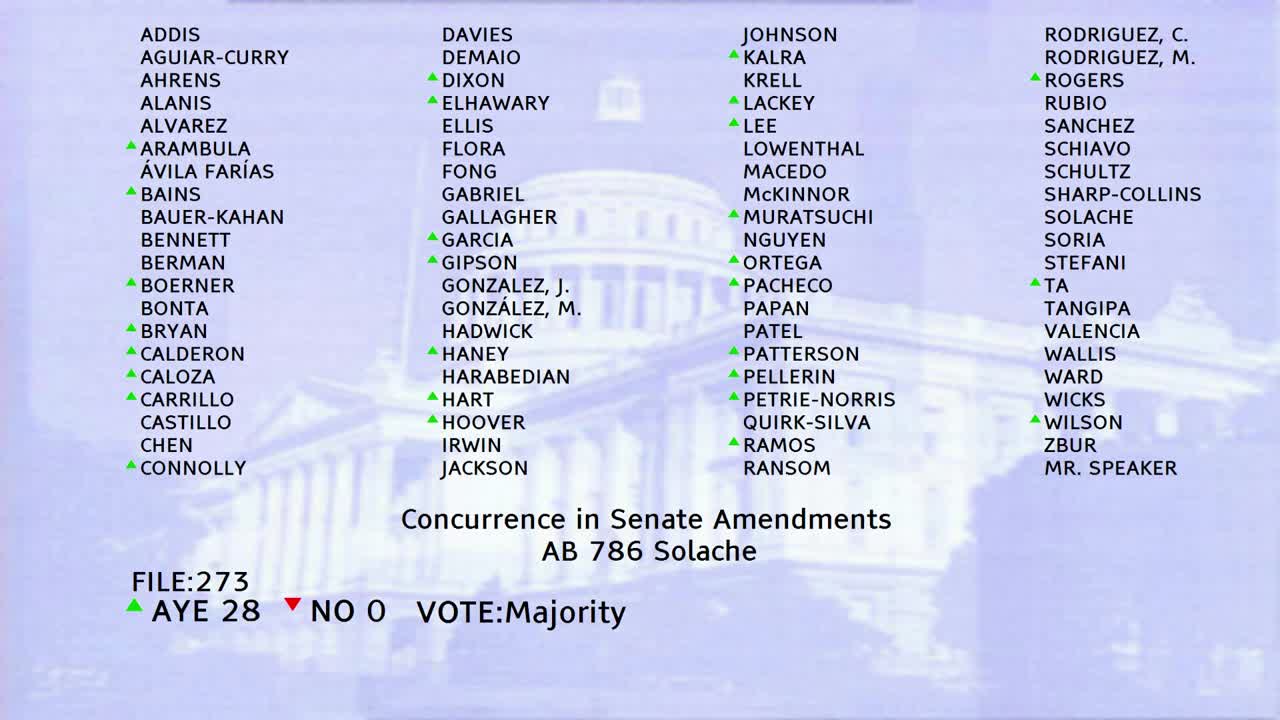 57SEC
Assembly Floor
 2MIN
Senate Floor
 1MIN
Senate Standing Committee on Appropriations
 8MIN
Senate Standing Committee on Energy, Utilities and Communications
 5MIN
Senate Standing Committee on Business, Professions and Economic Development
 3MIN
Assembly Floor
 6MIN
Assembly Standing Committee on Natural Resources
 8MIN
Assembly Standing Committee on Utilities and Energy
Bill Author

Bill Co-Author(s):