AB 1348: Average daily attendance: emergencies: immigration enforcement activity: independent study plans.
- Session Year: 2025-2026
- House: Assembly
- Latest Version Date: 2025-09-11
Current Status:
Failed
(2026-01-22: Consideration of Governor's veto stricken from file.)
Introduced
In Committee
Awaiting First Chamber Vote
Passed First Chamber
In Committee
Awaiting Second Chamber Vote
Passed Second Chamber
Enacted
What does this bill do?
The bill lets school districts, county offices of education, and charter schools count missed attendance caused by immigration enforcement actions — such as federal investigations, arrests, or other enforcement of immigration laws — when calculating state funding, but limits that credit to no more than 10 missed school days per pupil. It also requires districts that report such events occurring from Jan. 1, 2025 through June 30, 2026 to have independent study plans that either offer live (synchronous) instruction or explain why live instruction isn’t possible and what support will be provided, and it shields related documents from public records.
The summary is provided by generative AI which can make mistakes. For original language, please view the details in the table below.
Existing law establishes a public school financing system that requires state funding for county superintendents of schools, school districts, and charter schools to be calculated pursuant to a local control funding formula, as specified. Existing law requires the local control funding formula, in part, to be based on average daily attendance, as defined.
For purposes of state apportionments based on average daily attendance, as provided, if the average daily attendance of a school district, county office of education, or charter school has been materially decreased during a fiscal year because of a specified type of emergency, existing law requires the Superintendent of Public Instruction to estimate the average daily attendance in a manner that credits to the school district, county office of education, or charter school the total average daily attendance that would have been credited had the emergency not occurred, as provided.
This bill would, until July 1, 2029, add an immigration enforcement activity, as defined, to the list of emergencies for which the above-described provisions related to calculating average daily attendance for purposes of state apportionments apply, as provided. The bill would, for purposes of these provisions related to calculating average daily attendance for purposes of state apportionments, prohibit a school district, county office of education, or charter school from being credited for more than 10 days of missed attendance for a pupil due to an immigration enforcement activity.
For affidavits submitted to the Superintendent for emergency events occurring after September 1, 2021, but on or before June 30, 2026, that resulted in a school closure or material decrease in attendance, existing law requires a school district, county office of education, or charter school that provides an affidavit to the Superintendent to certify that it has a plan for which independent study will be offered to pupils, as provided, and requires that plan to comply with certain requirements, including, among other things, that independent study is offered to any impacted pupil within 10 instructional days of the first day of a school closure or material decrease in attendance.
This bill would, for affidavits submitted to the Superintendent for an immigration enforcement activity that occurred on or after January 1, 2025, but on or before June 30, 2026, that resulted in a school closure or material decrease in attendance, require a school district, county office of education, or charter school that provides an affidavit to the Superintendent to additionally require the independent study plan to either (1) require the offering of live interaction or synchronous instruction to pupils, as provided, or (2) provide a description of both the extenuating circumstances that prevent the offering of live interaction or synchronous instruction and a description of what pupil engagement, services, and instruction will be provided to support pupils during or immediately after the period of closure or material decrease in attendance.
The bill would, as applied to the above-described provisions for calculating average daily attendance for purposes of state apportionments and related affidavits certifying independent study plans, exempt from the California Public Records Act any documentation related to an immigration enforcement activity submitted to the Superintendent by a school district, charter school, county office of education, or county superintendent of schools, as provided.
The bill would make these provisions inoperative on July 1, 2029, and would repeal them as of January 1, 2030.
Existing constitutional provisions require that a statute that limits the right of access to the meetings of public bodies or the writings of public officials and agencies be adopted with findings demonstrating the interest protected by the limitation and the need for protecting that interest.
This bill would make legislative findings to that effect.
Existing law establishes a public school financing system that requires state funding for county superintendents of schools, school districts, and charter schools to be calculated pursuant to a local control funding formula, as specified. Existing law requires the local control funding formula, in part, to be based on average daily attendance, as defined.
For purposes of state apportionments based on average daily attendance, as provided, if the average daily attendance of a school district, county office of education, or charter school has been materially decreased during a fiscal year because of a specified type of emergency, existing law requires the Superintendent of Public Instruction to estimate the average daily attendance in a manner that credits to the school district, county office of education, or charter school the total average daily attendance that would have been credited had the emergency not occurred, as provided.
This bill would, until July 1, 2029, require the Superintendent, if the average daily attendance of a school district, county office of education, or charter school has been materially decreased during a fiscal year because of immigration enforcement activities, as defined, to estimate the average daily attendance in the same manner described above if certain conditions are met, including, among others, the submission of a form certifying compliance with requirements related to the availability of independent study, as provided. The bill would exempt any documentation submitted to the Superintendent by a school district, charter school, county office of education, or county superintendent of schools for purposes of these provisions from the California Public Records Act. add an immigration enforcement activity, as defined, to the list of emergencies for which the above-described provisions related to calculating average daily attendance for purposes of state apportionments apply, as provided. The bill would, for purposes of these provisions related to calculating average daily attendance for purposes of state apportionments, prohibit a school district, county office of education, or charter school from being credited for more than 10 days of missed attendance for a pupil due to an immigration enforcement activity.
For affidavits submitted to the Superintendent for emergency events occurring after September 1, 2021, but on or before June 30, 2026, that resulted in a school closure or material decrease in attendance, existing law requires a school district, county office of education, or charter school that provides an affidavit to the Superintendent to certify that it has a plan for which independent study will be offered to pupils, as provided, and requires that plan to comply with certain requirements, including, among other things, that independent study is offered to any impacted pupil within 10 instructional days of the first day of a school closure or material decrease in attendance.
This bill would, for affidavits submitted to the Superintendent for an immigration enforcement activity that occurred on or after January 1, 2025, but on or before June 30, 2026, that resulted in a school closure or material decrease in attendance, require a school district, county office of education, or charter school that provides an affidavit to the Superintendent to additionally require the independent study plan to either (1) require the offering of live interaction or synchronous instruction to pupils, as provided, or (2) provide a description of both the extenuating circumstances that prevent the offering of live interaction or synchronous instruction and a description of what pupil engagement, services, and instruction will be provided to support pupils during or immediately after the period of closure or material decrease in attendance.
The bill would, as applied to the above-described provisions for calculating average daily attendance for purposes of state apportionments and related affidavits certifying independent study plans, exempt from the California Public Records Act any documentation related to an immigration enforcement activity submitted to the Superintendent by a school district, charter school, county office of education, or county superintendent of schools, as provided.
The bill would make these provisions inoperative on July 1, 2029, and would repeal them as of January 1, 2030.
Existing constitutional provisions require that a statute that limits the right of access to the meetings of public bodies or the writings of public officials and agencies be adopted with findings demonstrating the interest protected by the limitation and the need for protecting that interest.
This bill would make legislative findings to that effect.
Existing law establishes a public school financing system that requires state funding for county superintendents of schools, school districts, and charter schools to be calculated pursuant to a local control funding formula, as specified. Existing law requires the local control funding formula, in part, to be based on average daily attendance, as defined.
For purposes of state apportionments based on average daily attendance, as provided, if the average daily attendance of a school district, county office of education, or charter school has been materially decreased during a fiscal year because of a specified type of emergency, existing law requires the Superintendent of Public Instruction to estimate the average daily attendance in a manner that credits to the school district, county office of education, or charter school the total average daily attendance that would have been credited had the emergency not occurred, as provided.
This bill would, until July 1, 2029, require the Superintendent, if the average daily attendance of a school district, county office of education, or charter school has been materially decreased during a fiscal year because of immigration enforcement activities, as defined, to estimate the average daily attendance in the same manner described above if certain conditions are met, including, among others, the submission of a form certifying compliance with requirements related to the availability of independent study, as provided. The bill would exempt any documentation submitted to the Superintendent by a school district, charter school, or county office of education education, or county superintendent of schools for purposes of these provisions from the California Public Records Act.
Existing constitutional provisions require that a statute that limits the right of access to the meetings of public bodies or the writings of public officials and agencies be adopted with findings demonstrating the interest protected by the limitation and the need for protecting that interest.
This bill would make legislative findings to that effect.
Existing law establishes a public school financing system that requires state funding for county superintendents of schools, school districts, and charter schools to be calculated pursuant to a local control funding formula, as specified. Existing law requires the local control funding formula, in part, to be based on average daily attendance, as defined.
For purposes of state apportionments based on average daily attendance, as provided, if the average daily attendance of a school district, county office of education, or charter school has been materially decreased during a fiscal year because of a specified type of emergency, existing law requires the Superintendent of Public Instruction to estimate the average daily attendance in a manner that credits to the school district, county office of education, or charter school the total average daily attendance that would have been credited had the emergency not occurred, as provided.
This bill would add immigration enforcement activities, as defined, to the list of emergencies for which the above-described provision related to calculating average daily attendance for purposes of state apportionments apply, as provided.This bill would, until July 1, 2029, require the Superintendent, if the average daily attendance of a school district, county office of education, or charter school has been materially decreased during a fiscal year because of immigration enforcement activities, as defined, to estimate the average daily attendance in the same manner described above if certain conditions are met, including, among others, the submission of a form certifying compliance with requirements related to the availability of independent study, as provided. The bill would exempt any documentation submitted to the Superintendent by a school district, charter school, or county office of education for purposes of these provisions from the California Public Records Act.
Existing constitutional provisions require that a statute that limits the right of access to the meetings of public bodies or the writings of public officials and agencies be adopted with findings demonstrating the interest protected by the limitation and the need for protecting that interest.
This bill would make legislative findings to that effect.
Existing law establishes a public school financing system that requires state funding for county superintendents of schools, school districts, and charter schools to be calculated pursuant to a local control funding formula, as specified. Existing law requires the local control funding formula, in part, to be based on average daily attendance, as defined.
For purposes of state apportionments under the local control funding formula, this bill would, commencing with the 202627 fiscal year, require the Superintendent of Public Instruction to, upon receiving documentation from a school district, county office of education, or charter school, as provided, determine the average daily attendance for the period of 30 calendar days immediately following a confirmed immigration enforcement activity, as defined, for all schools within a designated region, as defined, using the highest of (1) the actual attendance recorded during the 30-day period, (2) the average daily attendance recorded during the 30 school days immediately preceding the confirmed immigration enforcement activity, or (3) the attendance recorded for the same 30-day period in the previous calendar year. The bill would require the Superintendent to take certain actions to implement and support these provisions, as provided.The bill would require, on or before January 1, 2029, the Legislative Analysts Office to submit a report to the Legislature analyzing the implementation and effectiveness of the provisions described above.For purposes of state apportionments based on average daily attendance, as provided, if the average daily attendance of a school district, county office of education, or charter school has been materially decreased during a fiscal year because of a specified type of emergency, existing law requires the Superintendent of Public Instruction to estimate the average daily attendance in a manner that credits to the school district, county office of education, or charter school the total average daily attendance that would have been credited had the emergency not occurred, as provided.
This bill would add immigration enforcement activities, as defined, to the list of emergencies for which the above-described provision related to calculating average daily attendance for purposes of state apportionments apply, as provided.
Existing law establishes a public school financing system that requires state funding for county superintendents of schools, school districts, and charter schools to be calculated pursuant to a local control funding formula, as specified. Existing law requires the local control funding formula, in part, to be based on average daily attendance, as defined.
For purposes of state apportionments under the local control funding formula, this bill would, commencing with the 202627 fiscal year, require the Superintendent of Public Instruction to, upon receiving documentation from a school district, county office of education, or charter school, as provided, determine the average daily attendance for the period of 30 calendar days immediately following a confirmed immigration enforcement activity, as defined, for all schools within a designated region, as defined, using the highest of (1) the actual attendance recorded during the 30-day period, (2) the average daily attendance recorded during the 30 school days immediately preceding the confirmed immigration enforcement activity, or (3) the attendance recorded for the same 30-day period in the previous calendar year. The bill would require the Superintendent to take certain actions to implement and support these provisions, as provided.
The bill would require, on or before January 1, 2029, the Legislative Analysts Office to submit a report to the Legislature analyzing the implementation and effectiveness of the provisions described above.
(a)If the average daily attendance of a school district, county office of education, or charter school during a fiscal year has been materially decreased during a fiscal year because of any of the following, the fact shall be established to the satisfaction of the Superintendent by affidavits of the members of the governing board or body of the school district, county office of education, or charter school and the county superintendent of schools:
(1)Fire.
(2)Flood.
(3)Impassable roads.
(4)Epidemic.
(5)Earthquake.
(6)The imminence of a major safety hazard as determined by the local law enforcement agency.
(7)A strike involving transportation services to pupils provided by a nonschool entity.
(8)An order provided for in Section 41422.
(9)Snowstorm.
(10)(A)An immigration enforcement activity.
(B)For purposes of this paragraph, immigration enforcement activity includes any and all efforts on or after January 1, 2025, to investigate, enforce, or assist in the investigation or enforcement of any federal civil immigration law, and also includes any and all efforts to investigate, enforce, or assist in the investigation or enforcement of any federal criminal immigration law that penalizes a persons presence in, entry, or reentry to, or employment in, the United States.
(b)(1)In the event a state of emergency is declared by the Governor in a county, a decrease in average daily attendance in the county below the approximate total average daily attendance that would have been credited to a school district, county office of education, or charter school had the state of emergency not occurred shall be deemed material. The Superintendent shall determine the length of the period during which average daily attendance has been reduced by the state of emergency.
(2)The period determined by the Superintendent shall not extend into the next fiscal year following the declaration of the state of emergency by the Governor, except upon a showing by a school district, county office of education, or charter school, to the satisfaction of the Superintendent, that extending the period into the next fiscal year is essential to alleviate continued reductions in average daily attendance attributable to the state of emergency.
(3)Notwithstanding any other law, the Superintendent shall extend through the 201819 fiscal year the period during which it is essential to alleviate continued reductions in average daily attendance attributable to a state of emergency declared by the Governor in October 2017, for a school district where no less than 5 percent of the residences within the school district or school district facilities were destroyed by the qualifying emergency.
(c)(1)(A)The average daily attendance of the school district, county office of education, or charter school for the fiscal year shall be estimated by the Superintendent in a manner that credits to the school district, county office of education, or charter school for determining the apportionments to be made to the school district, county office of education, or charter school from the State School Fund approximately the total average daily attendance that would have been credited to the school district, county office of education, or charter school had the emergency not occurred or had the order not been issued.
(B)In determining the apportionments to be made to the school district, county office of education, or charter school pursuant to subparagraph (A) for purposes of an affidavit submitted in relation to an immigration enforcement activity, as defined in subparagraph (B) of paragraph (10) of subdivision (a), a school district, county office of education, or charter school shall not be credited for more than 10 days of missed attendance for a pupil.
(2)(A)From September 1, 2021, to June 30, 2022, inclusive, with the exception of a material loss of attendance for pupils who are individuals with exceptional needs, as that term is defined in Section 56026, whose individualized education program developed pursuant to Article 3 (commencing with Section 56340) of Chapter 4 of Part 30 does not specifically provide for participation in independent study or pupils who are enrolled in community day schools pursuant to Article 3 (commencing with Section 48660) of Chapter 4 of Part 27, a school district, county office of education, or charter school shall not receive average daily attendance credit pursuant to this section for pupils that have been quarantined and are unable to attend in-person instruction due to exposure to, or infection with, COVID-19 pursuant to local or state public health guidance.
(B)Notwithstanding subparagraph (A), from September 1, 2021, to June 30, 2022, inclusive, a school district, county office of education, or charter school may receive average daily attendance credit pursuant to this section for school closures related to impacts from COVID-19 or material loss of attendance due to COVID-19 related staffing shortages if the following conditions are established to the satisfaction of the Superintendent by affidavits of the members of the governing board or body of the school district, county office of education, or charter school and the county superintendent of schools:
(i)The school district, county office of education, or charter school is unable to provide in-person instruction to pupils due to staffing shortages as a result of staff quarantine due to exposure to, or infection with, COVID-19 pursuant to local or state public health guidance.
(ii)For certificated staff shortages, the school district, county office of education, or charter school has exhausted all options for obtaining staff coverage, including using all certificated staff and substitute teacher options, and has consulted with their county office of education and the Superintendent in determining that staffing needs cannot be met through any option.
(iii)For classified staff shortages, the school district, county office of education, or charter school has exhausted all options for obtaining staff coverage, including using all staff options, and has consulted with their county office of education and the Superintendent in determining that staffing needs cannot be met through any option.
(d)Notwithstanding any other law, for a school district or charter school physically located within a school district, where no less than 5 percent of the residences within the school district, or the school districts facilities, were destroyed as a result of a state of emergency that was declared by the Governor in November 2018, all of the following shall apply:
(1)(A)In the 202021 fiscal year, for school districts, the Superintendent shall calculate the difference between the school districts certified second principal apportionment local control funding formula entitlement pursuant to Section 42238.02 in the 202021 fiscal year and the 201920 fiscal year and, if there is a difference, allocate the amount of that difference to the school district.
(B)In the 202122 fiscal year, for school districts, the Superintendent shall allocate an amount equal to 25 percent of the difference calculated in subparagraph (A) to the school district.
(C)In the 202223 fiscal year, for school districts, the Superintendent shall allocate an amount equal to 12.5 percent of the difference calculated in subparagraph (A) to the school district.
(2)(A)In the 201920 and 202021 fiscal years, for charter schools, the Superintendent shall calculate the difference between the charter schools certified second principal apportionment local control funding formula entitlement pursuant to Section 42238.02 in the current year and each respective prior year and, if there is a difference, allocate the amount of that difference to the charter school.
(B)In the 202122 fiscal year, for charter schools that operate a minimum of 175 school days and report at least 75 percent of the total second period average daily attendance for the 201920 fiscal year, as described in Section 41601, the Superintendent shall allocate 25 percent of the difference calculated in subparagraph (A) to the charter school.
(3)For a county office of education funded pursuant to paragraph (1) of subdivision (g) of Section 2575 that has within the boundaries of the county school districts or charter schools affected pursuant to this subdivision and that has in the schools operated by the county office of education at least a 10-percent decrease in average daily attendance in the current fiscal year, in the 201920 and 202021 fiscal years, the Superintendent shall calculate the difference between the county office of educations alternative education grant entitlement certified at the annual principal apportionment pursuant to Section 2574 in the current fiscal year and each respective prior fiscal year and, if there is a difference, allocate the amount of that difference to the county office of education.
(4)A school district may transfer funds received pursuant to paragraph (1) to the county office of education for the portion of the funds that represents pupils served by the county office of education who are funded through the school districts local control funding formula apportionment pursuant to Section 2576.
(5)In each fiscal year, the allocations pursuant to this subdivision shall be made to school districts and charter schools by the Superintendent as soon as practicable after the second principal apportionment and to county offices of education as soon as practicable after the annual principal apportionment. The allocations made shall be final. The Superintendent may provide a preliminary allocation of up to 50 percent no sooner than the first principal apportionment.
(6)(A)The amounts described in this subdivision shall be continuously appropriated from the General Fund to the Superintendent for these purposes.
(B)For purposes of making the computations required by Section 8 of Article XVI of the California Constitution, the appropriation made by this subdivision shall be deemed to be General Fund revenues appropriated for school districts, as defined in subdivision (c) of Section 41202, for the fiscal year in which they are appropriated, and included within the total allocations to school districts and community college districts from General Fund proceeds of taxes appropriated pursuant to Article XIIIB, as defined in subdivision (e) of Section 41202.
(e)Notwithstanding any other law, for a school district or charter school physically located within a school district, where no less than 5 percent of the residences within the school district, or the school districts facilities, were destroyed as a result of a state of emergency that was declared by the Governor in September 2020, all of the following shall apply:
(1)For the 202122 fiscal year, for school districts, the Superintendent shall calculate the difference between the school districts certified annual principal apportionment local control funding formula revenues pursuant to Section 42238.02 in the 202122 fiscal year and the 201920 fiscal year, including local revenue, pursuant to subdivision (j) of Section 42238.02, and any additional funds received pursuant to subdivision (e) of Section 42238.03 in excess of the entitlement calculated pursuant to Sections 42238.02 and 42238.03 and, if there is a difference, allocate the amount of that difference to the school district.
(2)For the 202122 fiscal year, for charter schools that operate a minimum of 175 school days and report at least 75 percent of the total second period average daily attendance for the 201920 fiscal year, as described in Section 41601, the Superintendent shall calculate the difference between the charter schools certified second principal apportionment local control funding formula revenues pursuant to Section 42238.02 in the 202122 fiscal year and the 201920 fiscal year, and, if there is a difference, allocate the amount of that difference to the charter school.
(3)School districts and charter schools shall notify the Superintendent of their eligibility pursuant to this subdivision by November 1, 2021, in the manner prescribed by the Superintendent.
(4)Preliminary allocations made pursuant to paragraph (1) shall be made to school districts by the Superintendent through the principal apportionment beginning with the 202122 fiscal year first principal apportionment certification and shall be made final as of the annual principal apportionment.
(5)Allocations pursuant to paragraph (2) shall be made to charter schools by the Superintendent as soon as practicable after the second principal apportionment and shall be made final as of the annual principal apportionment. The Superintendent may provide a preliminary allocation of up to 50 percent no sooner than the first principal apportionment.
(f)Notwithstanding any other law, for a school district where a school eligible for funding pursuant to Article 4 (commencing with Section 42280) of Chapter 7 of Part 24 of Division 3 was destroyed as a result of a state of emergency that was declared by the Governor in August 2021, the following shall apply:
(1)The school district may continue to report the amount of attendance generated by pupils enrolled in another school of the school district that would have otherwise attended the destroyed school, and the number of full-time teachers employed by the school district that would have otherwise provided instructional services at the school, as if the school were operational in the 202122, 202223, and 202324 fiscal years.
(2)The school shall be considered a necessary small school for the purpose of Section 42282 in the 202223 and 202324 fiscal years.
(g)(1)Notwithstanding any other law, paragraphs (2) and (3) shall apply for the following charter schools identified in subparagraph (A), (B), or (C) that were damaged, destroyed, or directly impacted, as a result of a state of emergency that was declared by the Governor in January 2025:
(A)Marquez Charter, Palisades Charter Elementary, and Palisades Charter High within the Los Angeles Unified School District.
(B)Aveson Global Leadership Academy, Aveson School of Leaders, Odyssey Charter, OCS - South, and Pasadena Rosebud Academy in the Pasadena Unified School District.
(C)Alma Fuerte Public in the City of Pasadena.
(2)For the 202526 fiscal year, for charter schools identified in paragraph (1) that operate a minimum of 175 school days, as described in Section 41601, the Superintendent shall calculate the difference between the charter schools certified local control funding formula entitlement pursuant to Section 42238.02 as of the annual principal apportionment in the 202526 fiscal year and the first principal apportionment in the 202425 fiscal year, and, if there is a difference, allocate the amount of that difference to the charter school.
(3)Allocations pursuant to paragraph (2) shall be made final as of the annual principal apportionment. The Superintendent may provide a preliminary allocation no sooner than the first principal apportionment.
(h)This section applies to any average daily attendance that occurs during any part of a school year.
(i)Any documentation submitted to the Superintendent by a school district, charter school, county office of education, or county superintendent of schools for purposes of this section related to an immigration enforcement activity, as defined in subparagraph (B) of paragraph (10) of subdivision (a), that results in a school closure or material decrease in attendance is exempt from the California Public Records Act (Division 10 (commencing with Section 7920.000) of Title 1 of the Government Code).
(j)This section shall become inoperative on July 1, 2029, and, as of January 1, 2030, is repealed.
SEC. 2.Section 46392 is added to the Education Code, to read:46392.(a)If the average daily attendance of a school district, county office of education, or charter school during a fiscal year has been materially decreased during a fiscal year because of any of the following, the fact shall be established to the satisfaction of the Superintendent by affidavits of the members of the governing board or body of the school district, county office of education, or charter school and the county superintendent of schools:
(1)Fire.
(2)Flood.
(3)Impassable roads.
(4)Epidemic.
(5)Earthquake.
(6)The imminence of a major safety hazard as determined by the local law enforcement agency.
(7)A strike involving transportation services to pupils provided by a nonschool entity.
(8)An order provided for in Section 41422.
(9)Snowstorm.
(b)(1)In the event a state of emergency is declared by the Governor in a county, a decrease in average daily attendance in the county below the approximate total average daily attendance that would have been credited to a school district, county office of education, or charter school had the state of emergency not occurred shall be deemed material. The Superintendent shall determine the length of the period during which average daily attendance has been reduced by the state of emergency.
(2)The period determined by the Superintendent shall not extend into the next fiscal year following the declaration of the state of emergency by the Governor, except upon a showing by a school district, county office of education, or charter school, to the satisfaction of the Superintendent, that extending the period into the next fiscal year is essential to alleviate continued reductions in average daily attendance attributable to the state of emergency.
(3)Notwithstanding any other law, the Superintendent shall extend through the 201819 fiscal year the period during which it is essential to alleviate continued reductions in average daily attendance attributable to a state of emergency declared by the Governor in October 2017, for a school district where no less than 5 percent of the residences within the school district or school district facilities were destroyed by the qualifying emergency.
(c)(1)The average daily attendance of the school district, county office of education, or charter school for the fiscal year shall be estimated by the Superintendent in a manner that credits to the school district, county office of education, or charter school for determining the apportionments to be made to the school district, county office of education, or charter school from the State School Fund approximately the total average daily attendance that would have been credited to the school district, county office of education, or charter school had the emergency not occurred or had the order not been issued.
(2)(A)From September 1, 2021, to June 30, 2022, inclusive, with the exception of a material loss of attendance for pupils who are individuals with exceptional needs, as that term is defined in Section 56026, whose individualized education program developed pursuant to Article 3 (commencing with Section 56340) of Chapter 4 of Part 30 does not specifically provide for participation in independent study or pupils who are enrolled in community day schools pursuant to Article 3 (commencing with Section 48660) of Chapter 4 of Part 27, a school district, county office of education, or charter school shall not receive average daily attendance credit pursuant to this section for pupils that have been quarantined and are unable to attend in-person instruction due to exposure to, or infection with, COVID-19 pursuant to local or state public health guidance.
(B)Notwithstanding subparagraph (A), from September 1, 2021, to June 30, 2022, inclusive, a school district, county office of education, or charter school may receive average daily attendance credit pursuant to this section for school closures related to impacts from COVID-19 or material loss of attendance due to COVID-19 related staffing shortages if the following conditions are established to the satisfaction of the Superintendent by affidavits of the members of the governing board or body of the school district, county office of education, or charter school and the county superintendent of schools:
(i)The school district, county office of education, or charter school is unable to provide in-person instruction to pupils due to staffing shortages as a result of staff quarantine due to exposure to, or infection with, COVID-19 pursuant to local or state public health guidance.
(ii)For certificated staff shortages, the school district, county office of education, or charter school has exhausted all options for obtaining staff coverage, including using all certificated staff and substitute teacher options, and has consulted with their county office of education and the Superintendent in determining that staffing needs cannot be met through any option.
(iii)For classified staff shortages, the school district, county office of education, or charter school has exhausted all options for obtaining staff coverage, including using all staff options, and has consulted with their county office of education and the Superintendent in determining that staffing needs cannot be met through any option.
(d)Notwithstanding any other law, for a school district or charter school physically located within a school district, where no less than 5 percent of the residences within the school district, or the school districts facilities, were destroyed as a result of a state of emergency that was declared by the Governor in November 2018, all of the following shall apply:
(1)(A)In the 202021 fiscal year, for school districts, the Superintendent shall calculate the difference between the school districts certified second principal apportionment local control funding formula entitlement pursuant to Section 42238.02 in the 202021 fiscal year and the 201920 fiscal year and, if there is a difference, allocate the amount of that difference to the school district.
(B)In the 202122 fiscal year, for school districts, the Superintendent shall allocate an amount equal to 25 percent of the difference calculated in subparagraph (A) to the school district.
(C)In the 202223 fiscal year, for school districts, the Superintendent shall allocate an amount equal to 12.5 percent of the difference calculated in subparagraph (A) to the school district.
(2)(A)In the 201920 and 202021 fiscal years, for charter schools, the Superintendent shall calculate the difference between the charter schools certified second principal apportionment local control funding formula entitlement pursuant to Section 42238.02 in the current year and each respective prior year and, if there is a difference, allocate the amount of that difference to the charter school.
(B)In the 202122 fiscal year, for charter schools that operate a minimum of 175 school days and report at least 75 percent of the total second period average daily attendance for the 201920 fiscal year, as described in Section 41601, the Superintendent shall allocate 25 percent of the difference calculated in subparagraph (A) to the charter school.
(3)For a county office of education funded pursuant to paragraph (1) of subdivision (g) of Section 2575 that has within the boundaries of the county school districts or charter schools affected pursuant to this subdivision and that has in the schools operated by the county office of education at least a 10-percent decrease in average daily attendance in the current fiscal year, in the 201920 and 202021 fiscal years, the Superintendent shall calculate the difference between the county office of educations alternative education grant entitlement certified at the annual principal apportionment pursuant to Section 2574 in the current fiscal year and each respective prior fiscal year and, if there is a difference, allocate the amount of that difference to the county office of education.
(4)A school district may transfer funds received pursuant to paragraph (1) to the county office of education for the portion of the funds that represents pupils served by the county office of education who are funded through the school districts local control funding formula apportionment pursuant to Section 2576.
(5)In each fiscal year, the allocations pursuant to this subdivision shall be made to school districts and charter schools by the Superintendent as soon as practicable after the second principal apportionment and to county offices of education as soon as practicable after the annual principal apportionment. The allocations made shall be final. The Superintendent may provide a preliminary allocation of up to 50 percent no sooner than the first principal apportionment.
(6)(A)The amounts described in this subdivision shall be continuously appropriated from the General Fund to the Superintendent for these purposes.
(B)For purposes of making the computations required by Section 8 of Article XVI of the California Constitution, the appropriation made by this subdivision shall be deemed to be General Fund revenues appropriated for school districts, as defined in subdivision (c) of Section 41202, for the fiscal year in which they are appropriated, and included within the total allocations to school districts and community college districts from General Fund proceeds of taxes appropriated pursuant to Article XIIIB, as defined in subdivision (e) of Section 41202.
(e)Notwithstanding any other law, for a school district or charter school physically located within a school district, where no less than 5 percent of the residences within the school district, or the school districts facilities, were destroyed as a result of a state of emergency that was declared by the Governor in September 2020, all of the following shall apply:
(1)For the 202122 fiscal year, for school districts, the Superintendent shall calculate the difference between the school districts certified annual principal apportionment local control funding formula revenues pursuant to Section 42238.02 in the 202122 fiscal year and the 201920 fiscal year, including local revenue, pursuant to subdivision (j) of Section 42238.02, and any additional funds received pursuant to subdivision (e) of Section 42238.03 in excess of the entitlement calculated pursuant to Sections 42238.02 and 42238.03 and, if there is a difference, allocate the amount of that difference to the school district.
(2)For the 202122 fiscal year, for charter schools that operate a minimum of 175 school days and report at least 75 percent of the total second period average daily attendance for the 201920 fiscal year, as described in Section 41601, the Superintendent shall calculate the difference between the charter schools certified second principal apportionment local control funding formula revenues pursuant to Section 42238.02 in the 202122 fiscal year and the 201920 fiscal year, and, if there is a difference, allocate the amount of that difference to the charter school.
(3)School districts and charter schools shall notify the Superintendent of their eligibility pursuant to this subdivision by November 1, 2021, in the manner prescribed by the Superintendent.
(4)Preliminary allocations made pursuant to paragraph (1) shall be made to school districts by the Superintendent through the principal apportionment beginning with the 202122 fiscal year first principal apportionment certification and shall be made final as of the annual principal apportionment.
(5)Allocations pursuant to paragraph (2) shall be made to charter schools by the Superintendent as soon as practicable after the second principal apportionment and shall be made final as of the annual principal apportionment. The Superintendent may provide a preliminary allocation of up to 50 percent no sooner than the first principal apportionment.
(f)Notwithstanding any other law, for a school district where a school eligible for funding pursuant to Article 4 (commencing with Section 42280) of Chapter 7 of Part 24 of Division 3 was destroyed as a result of a state of emergency that was declared by the Governor in August 2021, the following shall apply:
(1)The school district may continue to report the amount of attendance generated by pupils enrolled in another school of the school district that would have otherwise attended the destroyed school, and the number of full-time teachers employed by the school district that would have otherwise provided instructional services at the school, as if the school were operational in the 202122, 202223, and 202324 fiscal years.
(2)The school shall be considered a necessary small school for the purpose of Section 42282 in the 202223 and 202324 fiscal years.
(g)(1)Notwithstanding any other law, paragraphs (2) and (3) shall apply for the following charter schools identified in subparagraph (A), (B), or (C) that were damaged, destroyed, or directly impacted, as a result of a state of emergency that was declared by the Governor in January 2025:
(A)Marquez Charter, Palisades Charter Elementary, and Palisades Charter High within the Los Angeles Unified School District.
(B)Aveson Global Leadership Academy, Aveson School of Leaders, Odyssey Charter, OCS - South, and Pasadena Rosebud Academy in the Pasadena Unified School District.
(C)Alma Fuerte Public in the City of Pasadena.
(2)For the 202526 fiscal year, for charter schools identified in paragraph (1) that operate a minimum of 175 school days, as described in Section 41601, the Superintendent shall calculate the difference between the charter schools certified local control funding formula entitlement pursuant to Section 42238.02 as of the annual principal apportionment in the 202526 fiscal year and the first principal apportionment in the 202425 fiscal year, and, if there is a difference, allocate the amount of that difference to the charter school.
(3)Allocations pursuant to paragraph (2) shall be made final as of the annual principal apportionment. The Superintendent may provide a preliminary allocation no sooner than the first principal apportionment.
(h)This section applies to any average daily attendance that occurs during any part of a school year.
(i)This section shall become operative on July 1, 2029.
SEC. 3.Section 46393 of the Education Code is amended to read:46393.(a)(1)The Legislature finds and declares that, given the effects of public health emergencies and the significant and growing number of natural disasters that the state has faced in recent years, there is an increased need for local educational agencies to provide instructional continuity for pupils when conditions make in-person instruction infeasible for all or some pupils, and that maintaining access to instruction during a natural disaster or emergency is crucial in mitigating the negative impacts of lost learning time and supporting pupil mental health.
(2)It is the intent of the Legislature that all local educational agencies have plans in place to keep pupils learning in the event of school closures or absences, especially by being prepared to shift to online or other remote learning options, if necessary. While the first priority will always be to get pupils back to in-person instruction as quickly as possible following a natural disaster or other emergency event, schools should have the infrastructure in place to move instruction online, or otherwise deliver curriculum remotely, and ensure that pupils can access that instruction at short notice. Best practices like including independent study program agreements in back-to-school paperwork provided pursuant to Section 48980 for parents to sign ahead of time, posting assignments and pupil academic resources online, assigning laptops to all pupils, developing emergency partnerships with neighboring local educational agencies, and maintaining an online instructional platform can help local educational agencies be better prepared to shift to remote learning options if the need arises.
(b)(1)For affidavits submitted to the Superintendent for events occurring after September 1, 2021, but on or before June 30, 2026, that resulted in a school closure or material decrease in attendance, a school district, county office of education, or charter school that provides an affidavit to the Superintendent, pursuant to Section 41422 or 46392, excluding an affidavit related to an event described in paragraph (10) of subdivision (a) of Section 46392, shall certify that it has a plan for which independent study will be offered to pupils, pursuant to Article 5.5 (commencing with Section 51744) of Chapter 5 of Part 28. The plan shall comply with all of the following:
(A)Independent study is offered to any pupil impacted by any of the conditions listed in Section 46392 within 10 instructional days of the first day of a school closure or material decrease in attendance. Pupils who are individuals with exceptional needs shall receive the services identified in their individualized education programs pursuant to paragraph (9) of subdivision (a) of Section 56345 and may participate in an independent study program.
(B)Require reopening for in-person instruction as soon as possible unless prohibited under the direction of the local or state health officer.
(C)Notwithstanding subdivision (c) of Section 51745 or subparagraph (F) of paragraph (9) of subdivision (g) of Section 51747, include information regarding establishing independent study master agreements in a reasonable amount of time.
(2)For affidavits submitted to the Superintendent for an immigration enforcement activity, as that term is defined in subparagraph (B) of paragraph (10) of subdivision (a) of Section 46392, occurring on or after January 1, 2025, but on or before June 30, 2026, that resulted in a school closure or material decrease in attendance, a school district, county office of education, or charter school that provides an affidavit to the Superintendent pursuant to Section 46392 shall certify that it has a plan for which independent study will be offered to pupils, pursuant to Article 5.5 (commencing with Section 51744) of Chapter 5 of Part 28. The plan shall comply with all of the following:
(A)Independent study is offered to any pupil impacted by any of the conditions listed in Section 46392 within 10 instructional days of the first day of a school closure or material decrease in attendance. Pupils who are individuals with exceptional needs shall receive the services identified in their individualized education programs pursuant to paragraph (9) of subdivision (a) of Section 56345 and may participate in an independent study program.
(B)Require reopening for in-person instruction as soon as possible unless prohibited under the direction of the local or state health officer.
(C)Notwithstanding subdivision (c) of Section 51745 or subparagraph (F) of paragraph (9) of subdivision (g) of Section 51747, include information regarding establishing independent study master agreements in a reasonable amount of time.
(D)Either of the following:
(i)Require the offering of live interaction or synchronous instruction to impacted pupils pursuant to Section 51745.5.
(ii)If, due to extenuating circumstances, the school district, county office of education, or charter school is not able to provide live interaction or synchronous instruction pursuant to Section 51745.5, the school district, county office of education, or charter school that certifies pursuant to this clause shall describe the circumstances that prevent it from providing live interaction or synchronous instruction and shall describe what pupil engagement, services, and instruction it will provide to support its pupils during or immediately after the period of closure or material decrease in attendance.
(c)Notwithstanding subdivision (b), the plan is not required to comply with subdivision (d), (e), or (f) of Section 51747 for school closures or a material decrease in attendance for 15 days or less for affected pupils.
(d)A copy of the plan and, if applicable, the state or local public health or public safety order that required school closure shall accompany the affidavit provided to the Superintendent described in subdivision (b).
(e)(1)For affidavits submitted to the Superintendent for events occurring on or after July 1, 2026, that result in a school closure or material decrease in attendance, a school district, county office of education, or charter school that provides an affidavit to the Superintendent, pursuant to Section 41422 or 46392, shall certify all of the following:
(A)It has a local governing board- or body-adopted comprehensive school safety plan in place meeting the requirements of Section 32282, including the requirements of paragraph (3) of subdivision (a) of Section 32282.
(B)Either of the following:
(i)It has offered pupil engagement and instruction consistent with paragraph (3) of subdivision (a) of Section 32282.
(ii)Due to extenuating circumstances, it has not provided pupil engagement and instruction consistent with paragraph (3) of subdivision (a) of Section 32282. A school district, county office of education, or charter school that certifies pursuant to this clause shall describe the circumstances that prevented it from providing pupil engagement and instruction and shall describe what pupil engagement, services, and instruction it did provide to support its pupils during or immediately after the period of closure or material decrease in attendance.
(2)If applicable, a copy of the state or local public health or public safety order that required school closure shall accompany the affidavit provided to the Superintendent described in paragraph (1).
(f)Any documentation submitted to the Superintendent by a school district, charter school, county office of education, or county superintendent of schools for purposes of this section related to an immigration enforcement activity, as defined in subparagraph (B) of paragraph (10) of subdivision (a) of Section 46392, that results in a school closure or material decrease in attendance is exempt from the California Public Records Act (Division 10 (commencing with Section 7920.000) of Title 1 of the Government Code).
(g)This section shall become inoperative on July 1, 2029, and, as of January 1, 2030, is repealed.
SEC. 4.Section 46393 is added to the Education Code, to read:46393.(a)(1)The Legislature finds and declares that, given the effects of public health emergencies and the significant and growing number of natural disasters that the state has faced in recent years, there is an increased need for local educational agencies to provide instructional continuity for pupils when conditions make in-person instruction infeasible for all or some pupils, and that maintaining access to instruction during a natural disaster or emergency is crucial in mitigating the negative impacts of lost learning time and supporting pupil mental health.
(2)It is the intent of the Legislature that all local educational agencies have plans in place to keep pupils learning in the event of school closures or absences, especially by being prepared to shift to online or other remote learning options, if necessary. While the first priority will always be to get pupils back to in-person instruction as quickly as possible following a natural disaster or other emergency event, schools should have the infrastructure in place to move instruction online, or otherwise deliver curriculum remotely, and ensure that pupils can access that instruction at short notice. Best practices like including independent study program agreements in back-to-school paperwork provided pursuant to Section 48980 for parents to sign ahead of time, posting assignments and pupil academic resources online, assigning laptops to all pupils, developing emergency partnerships with neighboring local educational agencies, and maintaining an online instructional platform can help local educational agencies be better prepared to shift to remote learning options if the need arises.
(b)For affidavits submitted to the Superintendent for events occurring after September 1, 2021, but on or before June 30, 2026, that resulted in a school closure or material decrease in attendance, a school district, county office of education, or charter school that provides an affidavit to the Superintendent, pursuant to Section 41422 or 46392, shall certify that it has a plan for which independent study will be offered to pupils, pursuant to Article 5.5 (commencing with Section 51744) of Chapter 5 of Part 28. The plan shall comply with all of the following:
(1)Independent study is offered to any pupil impacted by any of the conditions listed in Section 46392 within 10 instructional days of the first day of a school closure or material decrease in attendance. Pupils who are individuals with exceptional needs shall receive the services identified in their individualized education programs pursuant to paragraph (9) of subdivision (a) of Section 56345 and may participate in an independent study program.
(2)Require reopening for in-person instruction as soon as possible unless prohibited under the direction of the local or state health officer.
(3)Notwithstanding subdivision (c) of Section 51745 or subparagraph (F) of paragraph (9) of subdivision (g) of Section 51747, include information regarding establishing independent study master agreements in a reasonable amount of time.
(c)Notwithstanding subdivision (b), the plan is not required to comply with subdivision (d), (e), or (f) of Section 51747 for school closures or a material decrease in attendance for 15 days or less for affected pupils.
(d)A copy of the plan and, if applicable, the state or local public health or public safety order that required school closure shall accompany the affidavit provided to the Superintendent described in subdivision (b).
(e)(1)For affidavits submitted to the Superintendent for events occurring on or after July 1, 2026, that result in a school closure or material decrease in attendance, a school district, county office of education, or charter school that provides an affidavit to the Superintendent, pursuant to Section 41422 or 46392, shall certify all of the following:
(A)It has a local governing board- or body-adopted comprehensive school safety plan in place meeting the requirements of Section 32282, including the requirements of paragraph (3) of subdivision (a) of Section 32282.
(B)Either of the following:
(i)It has offered pupil engagement and instruction consistent with paragraph (3) of subdivision (a) of Section 32282.
(ii)Due to extenuating circumstances, it has not provided pupil engagement and instruction consistent with paragraph (3) of subdivision (a) of Section 32282. A school district, county office of education, or charter school that certifies pursuant to this clause shall describe the circumstances that prevented it from providing pupil engagement and instruction and shall describe what pupil engagement, services, and instruction it did provide to support its pupils during or immediately after the period of closure or material decrease in attendance.
(2)If applicable, a copy of the state or local public health or public safety order that required school closure shall accompany the affidavit provided to the Superintendent described in paragraph (1).
(f)This section shall become operative on July 1, 2029.
SEC. 5.The Legislature finds and declares that Sections 1 and 3 of this act, which amend Sections 46392 and 46393 of the Education Code, impose a limitation on the publics right of access to the meetings of public bodies or the writings of public officials and agencies within the meaning of Section 3 of Article I of the California Constitution. Pursuant to that constitutional provision, the Legislature makes the following findings to demonstrate the interest protected by this limitation and the need for protecting that interest:
In order to protect the privacy and safety of California residents, it is necessary that records of pupils who miss school due to immigration actions are not made public.
(a)If the average daily attendance of a school district, county office of education, or charter school during a fiscal year has been materially decreased during a fiscal year because of any of the following, the fact shall be established to the satisfaction of the Superintendent by affidavits of the members of the governing board or body of the school district, county office of education, or charter school and the county superintendent of schools:
(1)Fire.
(2)Flood.
(3)Impassable roads.
(4)Epidemic.
(5)Earthquake.
(6)The imminence of a major safety hazard as determined by the local law enforcement agency.
(7)A strike involving transportation services to pupils provided by a nonschool entity.
(8)An order provided for in Section 41422.
(9)Snowstorm.
(10)(A)An immigration enforcement activity.
(B)For purposes of this paragraph, immigration enforcement activity includes any and all efforts on or after January 1, 2025, to investigate, enforce, or assist in the investigation or enforcement of any federal civil immigration law, and also includes any and all efforts to investigate, enforce, or assist in the investigation or enforcement of any federal criminal immigration law that penalizes a persons presence in, entry, or reentry to, or employment in, the United States.
(b)(1)In the event a state of emergency is declared by the Governor in a county, a decrease in average daily attendance in the county below the approximate total average daily attendance that would have been credited to a school district, county office of education, or charter school had the state of emergency not occurred shall be deemed material. The Superintendent shall determine the length of the period during which average daily attendance has been reduced by the state of emergency.
(2)The period determined by the Superintendent shall not extend into the next fiscal year following the declaration of the state of emergency by the Governor, except upon a showing by a school district, county office of education, or charter school, to the satisfaction of the Superintendent, that extending the period into the next fiscal year is essential to alleviate continued reductions in average daily attendance attributable to the state of emergency.
(3)Notwithstanding any other law, the Superintendent shall extend through the 201819 fiscal year the period during which it is essential to alleviate continued reductions in average daily attendance attributable to a state of emergency declared by the Governor in October 2017, for a school district where no less than 5 percent of the residences within the school district or school district facilities were destroyed by the qualifying emergency.
(c)(1)(A)The average daily attendance of the school district, county office of education, or charter school for the fiscal year shall be estimated by the Superintendent in a manner that credits to the school district, county office of education, or charter school for determining the apportionments to be made to the school district, county office of education, or charter school from the State School Fund approximately the total average daily attendance that would have been credited to the school district, county office of education, or charter school had the emergency not occurred or had the order not been issued.
(B)In determining the apportionments to be made to the school district, county office of education, or charter school pursuant to subparagraph (A) for purposes of an affidavit submitted in relation to an immigration enforcement activity, as defined in subparagraph (B) of paragraph (10) of subdivision (a), a school district, county office of education, or charter school shall not be credited for more than 10 days of missed attendance for a pupil.
(2)(A)From September 1, 2021, to June 30, 2022, inclusive, with the exception of a material loss of attendance for pupils who are individuals with exceptional needs, as that term is defined in Section 56026, whose individualized education program developed pursuant to Article 3 (commencing with Section 56340) of Chapter 4 of Part 30 does not specifically provide for participation in independent study or pupils who are enrolled in community day schools pursuant to Article 3 (commencing with Section 48660) of Chapter 4 of Part 27, a school district, county office of education, or charter school shall not receive average daily attendance credit pursuant to this section for pupils that have been quarantined and are unable to attend in-person instruction due to exposure to, or infection with, COVID-19 pursuant to local or state public health guidance.
(B)Notwithstanding subparagraph (A), from September 1, 2021, to June 30, 2022, inclusive, a school district, county office of education, or charter school may receive average daily attendance credit pursuant to this section for school closures related to impacts from COVID-19 or material loss of attendance due to COVID-19 related staffing shortages if the following conditions are established to the satisfaction of the Superintendent by affidavits of the members of the governing board or body of the school district, county office of education, or charter school and the county superintendent of schools:
(i)The school district, county office of education, or charter school is unable to provide in person in-person instruction to pupils due to staffing shortages as a result of staff quarantine due to exposure to, or infection with, COVID-19 pursuant to local or state public health guidance.
(ii)For certificated staff shortages, the school district, county office of education, or charter school has exhausted all options for obtaining staff coverage, including using all certificated staff and substitute teacher options, and has consulted with their county office of education and the Superintendent in determining that staffing needs cannot be met through any option.
(iii)For classified staff shortages, the school district, county office of education, or charter school has exhausted all options for obtaining staff coverage, including using all staff options, and has consulted with their county office of education and the Superintendent in determining that staffing needs cannot be met through any option.
(d)Notwithstanding any other law, for a school district or charter school physically located within a school district, where no less than 5 percent of the residences within the school district, or the school districts facilities, were destroyed as a result of a state of emergency that was declared by the Governor in November 2018, all of the following shall apply:
(1)(A)In the 202021 fiscal year, for school districts, the Superintendent shall calculate the difference between the school districts certified second principal apportionment local control funding formula entitlement pursuant to Section 42238.02 in the 202021 fiscal year and the 201920 fiscal year and, if there is a difference, allocate the amount of that difference to the school district.
(B)In the 202122 fiscal year, for school districts, the Superintendent shall allocate an amount equal to 25 percent of the difference calculated in subparagraph (A) to the school district.
(C)In the 202223 fiscal year, for school districts, the Superintendent shall allocate an amount equal to 12.5 percent of the difference calculated in subparagraph (A) to the school district.
(2)(A)In the 201920 and 202021 fiscal years, for charter schools, the Superintendent shall calculate the difference between the charter schools certified second principal apportionment local control funding formula entitlement pursuant to Section 42238.02 in the current year and each respective prior year and, if there is a difference, allocate the amount of that difference to the charter school.
(B)In the 202122 fiscal year, for charter schools that operate a minimum of 175 school days and report at least 75 percent of the total second period average daily attendance for the 201920 fiscal year, as described in Section 41601, the Superintendent shall allocate 25 percent of the difference calculated in subparagraph (A) to the charter school.
(3)For a county office of education funded pursuant to paragraph (1) of subdivision (g) of Section 2575 that has within the boundaries of the county school districts or charter schools affected pursuant to this subdivision and that has in the schools operated by the county office of education at least a 10-percent decrease in average daily attendance in the current fiscal year, in the 201920 and 202021 fiscal years, the Superintendent shall calculate the difference between the county office of educations alternative education grant entitlement certified at the annual principal apportionment pursuant to Section 2574 in the current fiscal year and each respective prior fiscal year and, if there is a difference, allocate the amount of that difference to the county office of education.
(4)A school district may transfer funds received pursuant to paragraph (1) to the county office of education for the portion of the funds that represents pupils served by the county office of education who are funded through the school districts local control funding formula apportionment pursuant to Section 2576.
(5)In each fiscal year, the allocations pursuant to this subdivision shall be made to school districts and charter schools by the Superintendent as soon as practicable after the second principal apportionment and to county offices of education as soon as practicable after the annual principal apportionment. The allocations made shall be final. The Superintendent may provide a preliminary allocation of up to 50 percent no sooner than the first principal apportionment.
(6)(A)The amounts described in this subdivision shall be continuously appropriated from the General Fund to the Superintendent for these purposes.
(B)For purposes of making the computations required by Section 8 of Article XVI of the California Constitution, the appropriation made by this subdivision shall be deemed to be General Fund revenues appropriated for school districts, as defined in subdivision (c) of Section 41202, for the fiscal year in which they are appropriated, and included within the total allocations to school districts and community college districts from General Fund proceeds of taxes appropriated pursuant to Article XIIIB, as defined in subdivision (e) of Section 41202.
(e)Notwithstanding any other law, for a school district or charter school physically located within a school district, where no less than 5 percent of the residences within the school district, or the school districts facilities, were destroyed as a result of a state of emergency that was declared by the Governor in September 2020, all of the following shall apply:
(1)For the 202122 fiscal year, for school districts, the Superintendent shall calculate the difference between the school districts certified annual principal apportionment local control funding formula revenues pursuant to Section 42238.02 in the 202122 fiscal year and the 201920 fiscal year, including local revenue, pursuant to subdivision (j) of Section 42238.02, and any additional funds received pursuant to subdivision (e) of Section 42238.03 in excess of the entitlement calculated pursuant to Section Sections 42238.02 and 42238.03 and, if there is a difference, allocate the amount of that difference to the school district.
(2)For the 202122 fiscal year, for charter schools that operate a minimum of 175 school days and report at least 75 percent of the total second period average daily attendance for the 201920 fiscal year, as described in Section 41601, the Superintendent shall calculate the difference between the charter schools certified second principal apportionment local control funding formula revenues pursuant to Section 42238.02 in the 202122 fiscal year and the 201920 fiscal year, and, if there is a difference, allocate the amount of that difference to the charter school.
(3)School districts and charter schools shall notify the Superintendent of their eligibility pursuant to this subdivision by November 1, 2021, in the manner prescribed by the Superintendent.
(4)Preliminary allocations made pursuant to paragraph (1) shall be made to school districts by the Superintendent through the principal apportionment beginning with the 202122 fiscal year first principal apportionment certification and shall be made final as of the annual principal apportionment.
(5)Allocations pursuant to paragraph (2) shall be made to charter schools by the Superintendent as soon as practicable after the second principal apportionment and shall be made final as of the annual principal apportionment. The Superintendent may provide a preliminary allocation of up to 50 percent no sooner than the first principal apportionment.
(f)Notwithstanding any other law, for a school district where a school eligible for funding pursuant to Article 4 (commencing with Section 42280) of Chapter 7 of Part 24 of Division 3 was destroyed as a result of a state of emergency that was declared by the Governor in August 2021, the following shall apply:
(1)The school district may continue to report the amount of attendance generated by pupils enrolled in another school of the school district that would have otherwise attended the destroyed school, and the number of full-time teachers employed by the school district that would have otherwise provided instructional services at the school, as if the school were operational in the 202122, 202223, and 202324 fiscal years.
(2)The school shall be considered a necessary small school for the purpose of Section 42282 in the 202223 and 202324 fiscal years.
(g)(1)Notwithstanding any other law, paragraphs (2) and (3) shall apply for the following charter schools identified in subparagraph (A), (B), or (C) that were damaged, destroyed, or directly impacted, as a result of a state of emergency that was declared by the Governor in January 2025:
(A)Marquez Charter, Palisades Charter Elementary, and Palisades Charter High within the Los Angeles Unified School District.
(B)Aveson Global Leadership Academy, Aveson School of Leaders, Odyssey Charter, OCS - South, and Pasadena Rosebud Academy in the Pasadena Unified School District.
(C)Alma Fuerte Public in the City of Pasadena.
(2)For the 202526 fiscal year, for charter schools identified in paragraph (1) that operate a minimum of 175 school days, as described in Section 41601, the Superintendent shall calculate the difference between the charter schools certified local control funding formula entitlement pursuant to Section 42238.02 as of the annual principal apportionment in the 202526 fiscal year and the first principal apportionment in the 202425 fiscal year, and, if there is a difference, allocate the amount of that difference to the charter school.
(3)Allocations pursuant to paragraph (2) shall be made final as of the annual principal apportionment. The Superintendent may provide a preliminary allocation no sooner than the first principal apportionment.
(h)This section applies to any average daily attendance that occurs during any part of a school year.
(i)Any documentation submitted to the Superintendent by a school district, charter school, county office of education, or county superintendent of schools for purposes of this section related to an immigration enforcement activity, as defined in subparagraph (B) of paragraph (10) of subdivision (a), that results in a school closure or material decrease in attendance is exempt from the California Public Records Act (Division 10 (commencing with Section 7920.000) of Title 1 of the Government Code).
(j)This section shall become inoperative on July 1, 2029, and, as of January 1, 2030, is repealed.
SEC. 2.Section 46392 is added to the Education Code, to read:46392.(a)If the average daily attendance of a school district, county office of education, or charter school during a fiscal year has been materially decreased during a fiscal year because of any of the following, the fact shall be established to the satisfaction of the Superintendent by affidavits of the members of the governing board or body of the school district, county office of education, or charter school and the county superintendent of schools:
(1)Fire.
(2)Flood.
(3)Impassable roads.
(4)Epidemic.
(5)Earthquake.
(6)The imminence of a major safety hazard as determined by the local law enforcement agency.
(7)A strike involving transportation services to pupils provided by a nonschool entity.
(8)An order provided for in Section 41422.
(9)Snowstorm.
(b)(1)In the event a state of emergency is declared by the Governor in a county, a decrease in average daily attendance in the county below the approximate total average daily attendance that would have been credited to a school district, county office of education, or charter school had the state of emergency not occurred shall be deemed material. The Superintendent shall determine the length of the period during which average daily attendance has been reduced by the state of emergency.
(2)The period determined by the Superintendent shall not extend into the next fiscal year following the declaration of the state of emergency by the Governor, except upon a showing by a school district, county office of education, or charter school, to the satisfaction of the Superintendent, that extending the period into the next fiscal year is essential to alleviate continued reductions in average daily attendance attributable to the state of emergency.
(3)Notwithstanding any other law, the Superintendent shall extend through the 201819 fiscal year the period during which it is essential to alleviate continued reductions in average daily attendance attributable to a state of emergency declared by the Governor in October 2017, for a school district where no less than 5 percent of the residences within the school district or school district facilities were destroyed by the qualifying emergency.
(c)(1)The average daily attendance of the school district, county office of education, or charter school for the fiscal year shall be estimated by the Superintendent in a manner that credits to the school district, county office of education, or charter school for determining the apportionments to be made to the school district, county office of education, or charter school from the State School Fund approximately the total average daily attendance that would have been credited to the school district, county office of education, or charter school had the emergency not occurred or had the order not been issued.
(2)(A)From September 1, 2021, to June 30, 2022, inclusive, with the exception of a material loss of attendance for pupils who are individuals with exceptional needs, as that term is defined in Section 56026, whose individualized education program developed pursuant to Article 3 (commencing with Section 56340) of Chapter 4 of Part 30 does not specifically provide for participation in independent study or pupils who are enrolled in community day schools pursuant to Article 3 (commencing with Section 48660) of Chapter 4 of Part 27, a school district, county office of education, or charter school shall not receive average daily attendance credit pursuant to this section for pupils that have been quarantined and are unable to attend in-person instruction due to exposure to, or infection with, COVID-19 pursuant to local or state public health guidance.
(B)Notwithstanding subparagraph (A), from September 1, 2021, to June 30, 2022, inclusive, a school district, county office of education, or charter school may receive average daily attendance credit pursuant to this section for school closures related to impacts from COVID-19 or material loss of attendance due to COVID-19 related staffing shortages if the following conditions are established to the satisfaction of the Superintendent by affidavits of the members of the governing board or body of the school district, county office of education, or charter school and the county superintendent of schools:
(i)The school district, county office of education, or charter school is unable to provide in-person instruction to pupils due to staffing shortages as a result of staff quarantine due to exposure to, or infection with, COVID-19 pursuant to local or state public health guidance.
(ii)For certificated staff shortages, the school district, county office of education, or charter school has exhausted all options for obtaining staff coverage, including using all certificated staff and substitute teacher options, and has consulted with their county office of education and the Superintendent in determining that staffing needs cannot be met through any option.
(iii)For classified staff shortages, the school district, county office of education, or charter school has exhausted all options for obtaining staff coverage, including using all staff options, and has consulted with their county office of education and the Superintendent in determining that staffing needs cannot be met through any option.
(d)Notwithstanding any other law, for a school district or charter school physically located within a school district, where no less than 5 percent of the residences within the school district, or the school districts facilities, were destroyed as a result of a state of emergency that was declared by the Governor in November 2018, all of the following shall apply:
(1)(A)In the 202021 fiscal year, for school districts, the Superintendent shall calculate the difference between the school districts certified second principal apportionment local control funding formula entitlement pursuant to Section 42238.02 in the 202021 fiscal year and the 201920 fiscal year and, if there is a difference, allocate the amount of that difference to the school district.
(B)In the 202122 fiscal year, for school districts, the Superintendent shall allocate an amount equal to 25 percent of the difference calculated in subparagraph (A) to the school district.
(C)In the 202223 fiscal year, for school districts, the Superintendent shall allocate an amount equal to 12.5 percent of the difference calculated in subparagraph (A) to the school district.
(2)(A)In the 201920 and 202021 fiscal years, for charter schools, the Superintendent shall calculate the difference between the charter schools certified second principal apportionment local control funding formula entitlement pursuant to Section 42238.02 in the current year and each respective prior year and, if there is a difference, allocate the amount of that difference to the charter school.
(B)In the 202122 fiscal year, for charter schools that operate a minimum of 175 school days and report at least 75 percent of the total second period average daily attendance for the 201920 fiscal year, as described in Section 41601, the Superintendent shall allocate 25 percent of the difference calculated in subparagraph (A) to the charter school.
(3)For a county office of education funded pursuant to paragraph (1) of subdivision (g) of Section 2575 that has within the boundaries of the county school districts or charter schools affected pursuant to this subdivision and that has in the schools operated by the county office of education at least a 10-percent decrease in average daily attendance in the current fiscal year, in the 201920 and 202021 fiscal years, the Superintendent shall calculate the difference between the county office of educations alternative education grant entitlement certified at the annual principal apportionment pursuant to Section 2574 in the current fiscal year and each respective prior fiscal year and, if there is a difference, allocate the amount of that difference to the county office of education.
(4)A school district may transfer funds received pursuant to paragraph (1) to the county office of education for the portion of the funds that represents pupils served by the county office of education who are funded through the school districts local control funding formula apportionment pursuant to Section 2576.
(5)In each fiscal year, the allocations pursuant to this subdivision shall be made to school districts and charter schools by the Superintendent as soon as practicable after the second principal apportionment and to county offices of education as soon as practicable after the annual principal apportionment. The allocations made shall be final. The Superintendent may provide a preliminary allocation of up to 50 percent no sooner than the first principal apportionment.
(6)(A)The amounts described in this subdivision shall be continuously appropriated from the General Fund to the Superintendent for these purposes.
(B)For purposes of making the computations required by Section 8 of Article XVI of the California Constitution, the appropriation made by this subdivision shall be deemed to be General Fund revenues appropriated for school districts, as defined in subdivision (c) of Section 41202, for the fiscal year in which they are appropriated, and included within the total allocations to school districts and community college districts from General Fund proceeds of taxes appropriated pursuant to Article XIIIB, as defined in subdivision (e) of Section 41202.
(e)Notwithstanding any other law, for a school district or charter school physically located within a school district, where no less than 5 percent of the residences within the school district, or the school districts facilities, were destroyed as a result of a state of emergency that was declared by the Governor in September 2020, all of the following shall apply:
(1)For the 202122 fiscal year, for school districts, the Superintendent shall calculate the difference between the school districts certified annual principal apportionment local control funding formula revenues pursuant to Section 42238.02 in the 202122 fiscal year and the 201920 fiscal year, including local revenue, pursuant to subdivision (j) of Section 42238.02, and any additional funds received pursuant to subdivision (e) of Section 42238.03 in excess of the entitlement calculated pursuant to Sections 42238.02 and 42238.03 and, if there is a difference, allocate the amount of that difference to the school district.
(2)For the 202122 fiscal year, for charter schools that operate a minimum of 175 school days and report at least 75 percent of the total second period average daily attendance for the 201920 fiscal year, as described in Section 41601, the Superintendent shall calculate the difference between the charter schools certified second principal apportionment local control funding formula revenues pursuant to Section 42238.02 in the 202122 fiscal year and the 201920 fiscal year, and, if there is a difference, allocate the amount of that difference to the charter school.
(3)School districts and charter schools shall notify the Superintendent of their eligibility pursuant to this subdivision by November 1, 2021, in the manner prescribed by the Superintendent.
(4)Preliminary allocations made pursuant to paragraph (1) shall be made to school districts by the Superintendent through the principal apportionment beginning with the 202122 fiscal year first principal apportionment certification and shall be made final as of the annual principal apportionment.
(5)Allocations pursuant to paragraph (2) shall be made to charter schools by the Superintendent as soon as practicable after the second principal apportionment and shall be made final as of the annual principal apportionment. The Superintendent may provide a preliminary allocation of up to 50 percent no sooner than the first principal apportionment.
(f)Notwithstanding any other law, for a school district where a school eligible for funding pursuant to Article 4 (commencing with Section 42280) of Chapter 7 of Part 24 of Division 3 was destroyed as a result of a state of emergency that was declared by the Governor in August 2021, the following shall apply:
(1)The school district may continue to report the amount of attendance generated by pupils enrolled in another school of the school district that would have otherwise attended the destroyed school, and the number of full-time teachers employed by the school district that would have otherwise provided instructional services at the school, as if the school were operational in the 202122, 202223, and 202324 fiscal years.
(2)The school shall be considered a necessary small school for the purpose of Section 42282 in the 202223 and 202324 fiscal years.
(g)(1)Notwithstanding any other law, paragraphs (2) and (3) shall apply for the following charter schools identified in subparagraph (A), (B), or (C) that were damaged, destroyed, or directly impacted, as a result of a state of emergency that was declared by the Governor in January 2025:
(A)Marquez Charter, Palisades Charter Elementary, and Palisades Charter High within the Los Angeles Unified School District.
(B)Aveson Global Leadership Academy, Aveson School of Leaders, Odyssey Charter, OCS - South, and Pasadena Rosebud Academy in the Pasadena Unified School District.
(C)Alma Fuerte Public in the City of Pasadena.
(2)For the 202526 fiscal year, for charter schools identified in paragraph (1) that operate a minimum of 175 school days, as described in Section 41601, the Superintendent shall calculate the difference between the charter schools certified local control funding formula entitlement pursuant to Section 42238.02 as of the annual principal apportionment in the 202526 fiscal year and the first principal apportionment in the 202425 fiscal year, and, if there is a difference, allocate the amount of that difference to the charter school.
(3)Allocations pursuant to paragraph (2) shall be made final as of the annual principal apportionment. The Superintendent may provide a preliminary allocation no sooner than the first principal apportionment.
(h)This section applies to any average daily attendance that occurs during any part of a school year.
(i)This section shall become operative on July 1, 2029.
SEC. 3.Section 46393 of the Education Code is amended to read:46393.(a)(1)The Legislature finds and declares that, given the effects of public health emergencies and the significant and growing number of natural disasters that the state has faced in recent years, there is an increased need for local educational agencies to provide instructional continuity for pupils when conditions make in-person instruction infeasible for all or some pupils, and that maintaining access to instruction during a natural disaster or emergency is crucial in mitigating the negative impacts of lost learning time and supporting pupil mental health.
(2)It is the intent of the Legislature that all local educational agencies have plans in place to keep pupils learning in the event of school closures or absences, especially by being prepared to shift to online or other remote learning options, if necessary. While the first priority will always be to get pupils back to in-person instruction as quickly as possible following a natural disaster or other emergency event, schools should have the infrastructure in place to move instruction online, or otherwise deliver curriculum remotely, and ensure that pupils can access that instruction at short notice. Best practices like including independent study program agreements in back-to-school paperwork provided pursuant to Section 48980 for parents to sign ahead of time, posting assignments and pupil academic resources online, assigning laptops to all pupils, developing emergency partnerships with neighboring local educational agencies, and maintaining an online instructional platform can help local educational agencies be better prepared to shift to remote learning options if the need arises.
(b)(1)For affidavits submitted to the Superintendent for events occurring after September 1, 2021, but on or before June 30, 2026, that resulted in a school closure or material decrease in attendance, a school district, county office of education, or charter school that provides an affidavit to the Superintendent, pursuant to Section 41422 or 46392, excluding an affidavit related to an event described in paragraph (10) of subdivision (a) of Section 46392, shall certify that it has a plan for which independent study will be offered to pupils, pursuant to Article 5.5 (commencing with Section 51745) 51744) of Chapter 5 of Part 28 of Division 4. 28. The plan shall comply with all of the following:
(1)(A)Independent study is offered to any pupil impacted by any of the conditions listed in Section 46392 within 10 instructional days of the first day of a school closure or material decrease in attendance. Pupils who are individuals with exceptional needs shall receive the services identified in their individualized education programs pursuant to paragraph (9) of subdivision (a) of Section 56345 and may participate in an independent study program.
(2)(B)Require reopening for in-person instruction as soon as possible unless prohibited under the direction of the local or state health officer.
(3)(C)Notwithstanding subdivision (c) of Section 51745 or subparagraph (F) of paragraph (9) of subdivision (g) of Section 51747, include information regarding establishing independent study master agreements in a reasonable amount of time.
(2)For affidavits submitted to the Superintendent for an immigration enforcement activity, as that term is defined in subparagraph (B) of paragraph (10) of subdivision (a) of Section 46392, occurring on or after January 1, 2025, but on or before June 30, 2026, that resulted in a school closure or material decrease in attendance, a school district, county office of education, or charter school that provides an affidavit to the Superintendent pursuant to Section 46392 shall certify that it has a plan for which independent study will be offered to pupils, pursuant to Article 5.5 (commencing with Section 51744) of Chapter 5 of Part 28. The plan shall comply with all of the following:
(A)Independent study is offered to any pupil impacted by any of the conditions listed in Section 46392 within 10 instructional days of the first day of a school closure or material decrease in attendance. Pupils who are individuals with exceptional needs shall receive the services identified in their individualized education programs pursuant to paragraph (9) of subdivision (a) of Section 56345 and may participate in an independent study program.
(B)Require reopening for in-person instruction as soon as possible unless prohibited under the direction of the local or state health officer.
(C)Notwithstanding subdivision (c) of Section 51745 or subparagraph (F) of paragraph (9) of subdivision (g) of Section 51747, include information regarding establishing independent study master agreements in a reasonable amount of time.
(D)Either of the following:
(i)Require the offering of live interaction or synchronous instruction to impacted pupils pursuant to Section 51745.5.
(ii)If, due to extenuating circumstances, the school district, county office of education, or charter school is not able to provide live interaction or synchronous instruction pursuant to Section 51745.5, the school district, county office of education, or charter school that certifies pursuant to this clause shall describe the circumstances that prevent it from providing live interaction or synchronous instruction and shall describe what pupil engagement, services, and instruction it will provide to support its pupils during or immediately after the period of closure or material decrease in attendance.
(c)Notwithstanding subdivision (b), the plan is not required to comply with subdivision (d), (e), or (f) of Section 51747 for school closures or a material decrease in attendance for 15 days or less for affected pupils.
(d)A copy of the plan and, if applicable, the state or local public health or public safety order that required school closure shall accompany the affidavit provided to the Superintendent described in subdivision (b).
(e)(1)For affidavits submitted to the Superintendent for events occurring on or after July 1, 2026, that result in a school closure or material decrease in attendance, a school district, county office of education, or charter school that provides an affidavit to the Superintendent, pursuant to Section 41422 or 46392, shall certify all of the following:
(A)It has a local governing board- or body-adopted comprehensive school safety plan in place meeting the requirements of Section 32282, including the requirements of paragraph (3) of subdivision (a) of Section 32282.
(B)Either of the following:
(i)It has offered pupil engagement and instruction consistent with paragraph (3) of subdivision (a) of Section 32282.
(ii)Due to extenuating circumstances, it has not provided pupil engagement and instruction consistent with paragraph (3) of subdivision (a) of Section 32282. A school district, county office of education, or charter school that certifies pursuant to this clause shall describe the circumstances that prevented it from providing pupil engagement and instruction and shall describe what pupil engagement, services, and instruction it did provide to support its pupils during or immediately after the period of closure or material decrease in attendance.
(2)If applicable, a copy of the state or local public health or public safety order that required school closure shall accompany the affidavit provided to the Superintendent described in paragraph (1).
(f)Any documentation submitted to the Superintendent by a school district, charter school, county office of education, or county superintendent of schools for purposes of this section related to an immigration enforcement activity, as defined in subparagraph (B) of paragraph (10) of subdivision (a) of Section 46392, that results in a school closure or material decrease in attendance is exempt from the California Public Records Act (Division 10 (commencing with Section 7920.000) of Title 1 of the Government Code).
(g)This section shall become inoperative on July 1, 2029, and, as of January 1, 2030, is repealed.
SEC. 4.Section 46393 is added to the Education Code, to read:46393.(a)(1)The Legislature finds and declares that, given the effects of public health emergencies and the significant and growing number of natural disasters that the state has faced in recent years, there is an increased need for local educational agencies to provide instructional continuity for pupils when conditions make in-person instruction infeasible for all or some pupils, and that maintaining access to instruction during a natural disaster or emergency is crucial in mitigating the negative impacts of lost learning time and supporting pupil mental health.
(2)It is the intent of the Legislature that all local educational agencies have plans in place to keep pupils learning in the event of school closures or absences, especially by being prepared to shift to online or other remote learning options, if necessary. While the first priority will always be to get pupils back to in-person instruction as quickly as possible following a natural disaster or other emergency event, schools should have the infrastructure in place to move instruction online, or otherwise deliver curriculum remotely, and ensure that pupils can access that instruction at short notice. Best practices like including independent study program agreements in back-to-school paperwork provided pursuant to Section 48980 for parents to sign ahead of time, posting assignments and pupil academic resources online, assigning laptops to all pupils, developing emergency partnerships with neighboring local educational agencies, and maintaining an online instructional platform can help local educational agencies be better prepared to shift to remote learning options if the need arises.
(b)For affidavits submitted to the Superintendent for events occurring after September 1, 2021, but on or before June 30, 2026, that resulted in a school closure or material decrease in attendance, a school district, county office of education, or charter school that provides an affidavit to the Superintendent, pursuant to Section 41422 or 46392, shall certify that it has a plan for which independent study will be offered to pupils, pursuant to Article 5.5 (commencing with Section 51744) of Chapter 5 of Part 28. The plan shall comply with all of the following:
(1)Independent study is offered to any pupil impacted by any of the conditions listed in Section 46392 within 10 instructional days of the first day of a school closure or material decrease in attendance. Pupils who are individuals with exceptional needs shall receive the services identified in their individualized education programs pursuant to paragraph (9) of subdivision (a) of Section 56345 and may participate in an independent study program.
(2)Require reopening for in-person instruction as soon as possible unless prohibited under the direction of the local or state health officer.
(3)Notwithstanding subdivision (c) of Section 51745 or subparagraph (F) of paragraph (9) of subdivision (g) of Section 51747, include information regarding establishing independent study master agreements in a reasonable amount of time.
(c)Notwithstanding subdivision (b), the plan is not required to comply with subdivision (d), (e), or (f) of Section 51747 for school closures or a material decrease in attendance for 15 days or less for affected pupils.
(d)A copy of the plan and, if applicable, the state or local public health or public safety order that required school closure shall accompany the affidavit provided to the Superintendent described in subdivision (b).
(e)(1)For affidavits submitted to the Superintendent for events occurring on or after July 1, 2026, that result in a school closure or material decrease in attendance, a school district, county office of education, or charter school that provides an affidavit to the Superintendent, pursuant to Section 41422 or 46392, shall certify all of the following:
(A)It has a local governing board- or body-adopted comprehensive school safety plan in place meeting the requirements of Section 32282, including the requirements of paragraph (3) of subdivision (a) of Section 32282.
(B)Either of the following:
(i)It has offered pupil engagement and instruction consistent with paragraph (3) of subdivision (a) of Section 32282.
(ii)Due to extenuating circumstances, it has not provided pupil engagement and instruction consistent with paragraph (3) of subdivision (a) of Section 32282. A school district, county office of education, or charter school that certifies pursuant to this clause shall describe the circumstances that prevented it from providing pupil engagement and instruction and shall describe what pupil engagement, services, and instruction it did provide to support its pupils during or immediately after the period of closure or material decrease in attendance.
(2)If applicable, a copy of the state or local public health or public safety order that required school closure shall accompany the affidavit provided to the Superintendent described in paragraph (1).
(f)This section shall become operative on July 1, 2029.
SEC. 5.The Legislature finds and declares that Sections 1 and 3 of this act, which amend Sections 46392 and 46393 of the Education Code, impose a limitation on the publics right of access to the meetings of public bodies or the writings of public officials and agencies within the meaning of Section 3 of Article I of the California Constitution. Pursuant to that constitutional provision, the Legislature makes the following findings to demonstrate the interest protected by this limitation and the need for protecting that interest:
In order to protect the privacy and safety of California residents, it is necessary that records of pupils who miss school due to immigration actions are not made public.
All matter omitted in this version of the bill appears in the bill as amended in the Senate, July 10, 2025. (JR11)(a)If the average daily attendance of a school district, county office of education, or charter school during a fiscal year has been materially decreased during a fiscal year because of any of the following, the fact shall be established to the satisfaction of the Superintendent by affidavits of the members of the governing board or body of the school district, county office of education, or charter school and the county superintendent of schools:
(1)Fire.
(2)Flood.
(3)Impassable roads.
(4)Epidemic.
(5)Earthquake.
(6)The imminence of a major safety hazard as determined by the local law enforcement agency.
(7)A strike involving transportation services to pupils provided by a nonschool entity.
(8)An order provided for in Section 41422.
(9)Snowstorm.
(b)(1)In the event a state of emergency is declared by the Governor in a county, a decrease in average daily attendance in the county below the approximate total average daily attendance that would have been credited to a school district, county office of education, or charter school had the state of emergency not occurred shall be deemed material. The Superintendent shall determine the length of the period during which average daily attendance has been reduced by the state of emergency.
(2)The period determined by the Superintendent shall not extend into the next fiscal year following the declaration of the state of emergency by the Governor, except upon a showing by a school district, county office of education, or charter school, to the satisfaction of the Superintendent, that extending the period into the next fiscal year is essential to alleviate continued reductions in average daily attendance attributable to the state of emergency.
(3)Notwithstanding any other law, the Superintendent shall extend through the 201819 fiscal year the period during which it is essential to alleviate continued reductions in average daily attendance attributable to a state of emergency declared by the Governor in October 2017, for a school district where no less than 5 percent of the residences within the school district or school district facilities were destroyed by the qualifying emergency.
(c)(1)The average daily attendance of the school district, county office of education, or charter school for the fiscal year shall be estimated by the Superintendent in a manner that credits to the school district, county office of education, or charter school for determining the apportionments to be made to the school district, county office of education, or charter school from the State School Fund approximately the total average daily attendance that would have been credited to the school district, county office of education, or charter school had the emergency not occurred or had the order not been issued.
(2)(A)From September 1, 2021, to June 30, 2022, inclusive, with the exception of a material loss of attendance for pupils who are individuals with exceptional needs, as that term is defined in Section 56026, whose individualized education program developed pursuant to Article 3 (commencing with Section 56340) of Chapter 4 of Part 30 does not specifically provide for participation in independent study or pupils who are enrolled in community day schools pursuant to Article 3 (commencing with Section 48660) of Chapter 4 of Part 27, a school district, county office of education, or charter school shall not receive average daily attendance credit pursuant to this section for pupils that have been quarantined and are unable to attend in-person instruction due to exposure to, or infection with, COVID-19 pursuant to local or state public health guidance.
(B)Notwithstanding subparagraph (A), from September 1, 2021, to June 30, 2022, inclusive, a school district, county office of education, or charter school may receive average daily attendance credit pursuant to this section for school closures related to impacts from COVID-19 or material loss of attendance due to COVID-19 related staffing shortages if the following conditions are established to the satisfaction of the Superintendent by affidavits of the members of the governing board or body of the school district, county office of education, or charter school and the county superintendent of schools:
(i)The school district, county office of education, or charter school is unable to provide in person in-person instruction to pupils due to staffing shortages as a result of staff quarantine due to exposure to, or infection with, COVID-19 pursuant to local or state public health guidance.
(ii)For certificated staff shortages, the school district, county office of education, or charter school has exhausted all options for obtaining staff coverage, including using all certificated staff and substitute teacher options, and has consulted with their county office of education and the Superintendent in determining that staffing needs cannot be met through any option.
(iii)For classified staff shortages, the school district, county office of education, or charter school has exhausted all options for obtaining staff coverage, including using all staff options, and has consulted with their county office of education and the Superintendent in determining that staffing needs cannot be met through any option.
(d)Notwithstanding any other law, for a school district or charter school physically located within a school district, where no less than 5 percent of the residences within the school district, or the school districts facilities, were destroyed as a result of a state of emergency that was declared by the Governor in November 2018, all of the following shall apply:
(1)(A)In the 202021 fiscal year, for school districts, the Superintendent shall calculate the difference between the school districts certified second principal apportionment local control funding formula entitlement pursuant to Section 42238.02 in the 202021 fiscal year and the 201920 fiscal year and, if there is a difference, allocate the amount of that difference to the school district.
(B)In the 202122 fiscal year, for school districts, the Superintendent shall allocate an amount equal to 25 percent of the difference calculated in subparagraph (A) to the school district.
(C)In the 202223 fiscal year, for school districts, the Superintendent shall allocate an amount equal to 12.5 percent of the difference calculated in subparagraph (A) to the school district.
(2)(A)In the 201920 and 202021 fiscal years, for charter schools, the Superintendent shall calculate the difference between the charter schools certified second principal apportionment local control funding formula entitlement pursuant to 42238.02 in the current year and each respective prior year and, if there is a difference, allocate the amount of that difference to the charter school.
(B)In the 202122 fiscal year, for charter schools that operate a minimum of 175 school days and report at least 75 percent of the total second period average daily attendance for the 201920 fiscal year, as described in Section 41601, the Superintendent shall allocate 25 percent of the difference calculated in subparagraph (A) to the charter school.
(3)For a county office of education funded pursuant to paragraph (1) of subdivision (g) of Section 2575 that has within the boundaries of the county school districts or charter schools affected pursuant to this subdivision and that has in the schools operated by the county office of education at least a 10-percent decrease in average daily attendance in the current fiscal year, in the 201920 and 202021 fiscal years, the Superintendent shall calculate the difference between the county office of educations alternative education grant entitlement certified at the annual principal apportionment pursuant to Section 2574 in the current fiscal year and each respective prior fiscal year and, if there is a difference, allocate the amount of that difference to the county office of education.
(4)A school district may transfer funds received pursuant to paragraph (1) to the county office of education for the portion of the funds that represents pupils served by the county office of education who are funded through the school districts local control funding formula apportionment pursuant to Section 2576.
(5)In each fiscal year, the allocations pursuant to this subdivision shall be made to school districts and charter schools by the Superintendent as soon as practicable after the second principal apportionment and to county offices of education as soon as practicable after the annual principal apportionment. The allocations made shall be final. The Superintendent may provide a preliminary allocation of up to 50 percent no sooner than the first principal apportionment.
(6)(A)The amounts described in this subdivision shall be continuously appropriated from the General Fund to the Superintendent for these purposes.
(B)For purposes of making the computations required by Section 8 of Article XVI of the California Constitution, the appropriation made by this subdivision shall be deemed to be General Fund revenues appropriated for school districts, as defined in subdivision (c) of Section 41202, for the fiscal year in which they are appropriated, and included within the total allocations to school districts and community college districts from General Fund proceeds of taxes appropriated pursuant to Article XIIIB, as defined in subdivision (e) of Section 41202.
(e)Notwithstanding any other law, for a school district or charter school physically located within a school district, where no less than 5 percent of the residences within the school district, or the school districts facilities, were destroyed as a result of a state of emergency that was declared by the Governor in September 2020, all of the following shall apply:
(1)For the 202122 fiscal year, for school districts, the Superintendent shall calculate the difference between the school districts certified annual principal apportionment local control funding formula revenues pursuant to Section 42238.02 in the 202122 fiscal year and the 201920 fiscal year, including local revenue, pursuant to subdivision (j) of Section 42238.02, and any additional funds received pursuant to subdivision (e) of Section 42238.03 in excess of the entitlement calculated pursuant to Section Sections 42238.02 and 42238.03 and, if there is a difference, allocate the amount of that difference to the school district.
(2)For the 202122 fiscal year, for charter schools that operate a minimum of 175 school days and report at least 75 percent of the total second period average daily attendance for the 201920 fiscal year, as described in Section 41601, the Superintendent shall calculate the difference between the charter schools certified second principal apportionment local control funding formula revenues pursuant to Section 42238.02 in the 202122 fiscal year and the 201920 fiscal year, and, if there is a difference, allocate the amount of that difference to the charter school.
(3)School districts and charter schools shall notify the Superintendent of their eligibility pursuant to this subdivision by November 1, 2021, in the manner prescribed by the Superintendent.
(4)Preliminary allocations made pursuant to paragraph (1) shall be made to school districts by the Superintendent through the principal apportionment beginning with the 202122 fiscal year first principal apportionment certification and shall be made final as of the annual principal apportionment.
(5)Allocations pursuant to paragraph (2) shall be made to charter schools by the Superintendent as soon as practicable after the second principal apportionment and shall be made final as of the annual principal apportionment. The Superintendent may provide a preliminary allocation of up to 50 percent no sooner than the first principal apportionment.
(f)Notwithstanding any other law, for a school district where a school eligible for funding pursuant to Article 4 (commencing with Section 42280) of Chapter 7 of Part 24 of Division 3 was destroyed as a result of a state of emergency that was declared by the Governor in August 2021, the following shall apply:
(1)The school district may continue to report the amount of attendance generated by pupils enrolled in another school of the school district that would have otherwise attended the destroyed school, and the number of full-time teachers employed by the school district that would have otherwise provided instructional services at the school, as if the school were operational in the 202122, 202223, and 202324 fiscal years.
(2)The school shall be considered a necessary small school for the purpose of Section 42282 in the 202223 and 202324 fiscal years.
(g)(1)Notwithstanding any other law, paragraphs (2) and (3) shall apply for the following charter schools identified in subparagraph (A), (B), or (C) that were damaged, destroyed, or directly impacted, as a result of a state of emergency that was declared by the Governor in January 2025:
(A)Marquez Charter, Palisades Charter Elementary, and Palisades Charter High within the Los Angeles Unified School District.
(B)Aveson Global Leadership Academy, Aveson School of Leaders, Odyssey Charter, OCS - South, and Pasadena Rosebud Academy in the Pasadena Unified School District.
(C)Alma Fuerte Public in the City of Pasadena.
(2)For the 202526 fiscal year, for charter schools identified in paragraph (1) that operate a minimum of 175 school days, as described in Section 41601, the Superintendent shall calculate the difference between the charter schools certified local control funding formula entitlement pursuant to Section 42238.02 as of the annual principal apportionment in the 202526 fiscal year and the first principal apportionment in the 202425 fiscal year, and, if there is a difference, allocate the amount of that difference to the charter school.
(3)Allocations pursuant to paragraph (2) shall be made final as of the annual principal apportionment. The Superintendent may provide a preliminary allocation no sooner than the first principal apportionment.
(h)(1)If the average daily attendance of a school district, county office of education, or charter school during a fiscal year has been materially decreased during a fiscal year because of an immigration enforcement activity, the average daily attendance of the school district, county office of education, or charter school for the fiscal year shall be estimated by the Superintendent in a manner that credits to the school district, county office of education, or charter school for determining the apportionments to be made to the school district, county office of education, or charter school from the State School Fund approximately the total average daily attendance that would have been credited to the school district, county office of education, or charter school had the immigration enforcement activity not occurred.
(2)The members of the governing board or body of the school district, county office of education, or charter school and the county superintendent of schools electing to seek a credit of average daily attendance described in paragraph (1) shall establish that the average daily attendance of the school district, county office of education, or charter school has been materially decreased during a fiscal year because of an immigration enforcement activity, to the satisfaction of the Superintendent, by affidavit, and the school district, county office of education, or charter school shall submit a form, provided by the department, certifying compliance with both of the following:
(A)The school district, county office of education, or charter school offered an independent study program to all pupils consistent with the requirements of Section 51745 for the school year and provided the same notifications to parents and guardians of all enrolled pupils that was required for the 202122 school year by paragraph (1) of subdivision (h) of Section 51747 and subparagraph (A) of paragraph (8) of subdivision (b) of Section 51749.6.
(B)The school district, county office of education, or charter school offered adopted written policies for providing instruction to pupils through independent study and has verifiable documentation substantiating the provision of opportunities for live interaction and synchronous instruction pursuant to Section 51745.5, if applicable, or the provision of activities or pupil work product of a pupil while out on independent study that is equivalent to in-person instruction pursuant to Sections 51747 and 51749.5.
(3)The department shall, on or before May 1, 2026, make the form required by paragraph (2) available to school districts, county offices of education, and charter schools.
(4)Commencing with the 202627 fiscal year Guide for Annual Audits of K12 Local Education Agencies and State Compliance Reporting, the Controller shall incorporate verification of compliance with the requirements specified in subparagraphs (A) and (B) of paragraph (2), which may include reviewing the school districts, charter schools, or county office of educations annual audit to determine compliance with those requirements.
(5)Any documentation submitted to the Superintendent by a school district, charter school, county office of education, or county superintendent of schools for purposes of this subdivision is exempt from the California Public Records Act (Division 10 (commencing with Section 7920.000) of Title 1 of the Government Code).
(6)For purposes of this subdivision, immigration enforcement activity includes any and all efforts to investigate, enforce, or assist in the investigation or enforcement of any federal civil immigration law, and also includes any and all efforts to investigate, enforce, or assist in the investigation or enforcement of any federal criminal immigration law that penalizes a persons presence in, entry, or reentry to, or employment in, the United States.
(h)(i)This section applies to any average daily attendance that occurs during any part of a school year.
(j)This section shall become inoperative on July 1, 2029, and, as of January 1, 2030, is repealed.
SEC. 2.Section 46392 is added to the Education Code, to read:46392.(a)If the average daily attendance of a school district, county office of education, or charter school during a fiscal year has been materially decreased during a fiscal year because of any of the following, the fact shall be established to the satisfaction of the Superintendent by affidavits of the members of the governing board or body of the school district, county office of education, or charter school and the county superintendent of schools:
(1)Fire.
(2)Flood.
(3)Impassable roads.
(4)Epidemic.
(5)Earthquake.
(6)The imminence of a major safety hazard as determined by the local law enforcement agency.
(7)A strike involving transportation services to pupils provided by a nonschool entity.
(8)An order provided for in Section 41422.
(9)Snowstorm.
(b)(1)In the event a state of emergency is declared by the Governor in a county, a decrease in average daily attendance in the county below the approximate total average daily attendance that would have been credited to a school district, county office of education, or charter school had the state of emergency not occurred shall be deemed material. The Superintendent shall determine the length of the period during which average daily attendance has been reduced by the state of emergency.
(2)The period determined by the Superintendent shall not extend into the next fiscal year following the declaration of the state of emergency by the Governor, except upon a showing by a school district, county office of education, or charter school, to the satisfaction of the Superintendent, that extending the period into the next fiscal year is essential to alleviate continued reductions in average daily attendance attributable to the state of emergency.
(3)Notwithstanding any other law, the Superintendent shall extend through the 201819 fiscal year the period during which it is essential to alleviate continued reductions in average daily attendance attributable to a state of emergency declared by the Governor in October 2017, for a school district where no less than 5 percent of the residences within the school district or school district facilities were destroyed by the qualifying emergency.
(c)(1)The average daily attendance of the school district, county office of education, or charter school for the fiscal year shall be estimated by the Superintendent in a manner that credits to the school district, county office of education, or charter school for determining the apportionments to be made to the school district, county office of education, or charter school from the State School Fund approximately the total average daily attendance that would have been credited to the school district, county office of education, or charter school had the emergency not occurred or had the order not been issued.
(2)(A)From September 1, 2021, to June 30, 2022, inclusive, with the exception of a material loss of attendance for pupils who are individuals with exceptional needs, as that term is defined in Section 56026, whose individualized education program developed pursuant to Article 3 (commencing with Section 56340) of Chapter 4 of Part 30 does not specifically provide for participation in independent study or pupils who are enrolled in community day schools pursuant to Article 3 (commencing with Section 48660) of Chapter 4 of Part 27, a school district, county office of education, or charter school shall not receive average daily attendance credit pursuant to this section for pupils that have been quarantined and are unable to attend in-person instruction due to exposure to, or infection with, COVID-19 pursuant to local or state public health guidance.
(B)Notwithstanding subparagraph (A), from September 1, 2021, to June 30, 2022, inclusive, a school district, county office of education, or charter school may receive average daily attendance credit pursuant to this section for school closures related to impacts from COVID-19 or material loss of attendance due to COVID-19 related staffing shortages if the following conditions are established to the satisfaction of the Superintendent by affidavits of the members of the governing board or body of the school district, county office of education, or charter school and the county superintendent of schools:
(i)The school district, county office of education, or charter school is unable to provide in-person instruction to pupils due to staffing shortages as a result of staff quarantine due to exposure to, or infection with, COVID-19 pursuant to local or state public health guidance.
(ii)For certificated staff shortages, the school district, county office of education, or charter school has exhausted all options for obtaining staff coverage, including using all certificated staff and substitute teacher options, and has consulted with their county office of education and the Superintendent in determining that staffing needs cannot be met through any option.
(iii)For classified staff shortages, the school district, county office of education, or charter school has exhausted all options for obtaining staff coverage, including using all staff options, and has consulted with their county office of education and the Superintendent in determining that staffing needs cannot be met through any option.
(d)Notwithstanding any other law, for a school district or charter school physically located within a school district, where no less than 5 percent of the residences within the school district, or the school districts facilities, were destroyed as a result of a state of emergency that was declared by the Governor in November 2018, all of the following shall apply:
(1)(A)In the 202021 fiscal year, for school districts, the Superintendent shall calculate the difference between the school districts certified second principal apportionment local control funding formula entitlement pursuant to Section 42238.02 in the 202021 fiscal year and the 201920 fiscal year and, if there is a difference, allocate the amount of that difference to the school district.
(B)In the 202122 fiscal year, for school districts, the Superintendent shall allocate an amount equal to 25 percent of the difference calculated in subparagraph (A) to the school district.
(C)In the 202223 fiscal year, for school districts, the Superintendent shall allocate an amount equal to 12.5 percent of the difference calculated in subparagraph (A) to the school district.
(2)(A)In the 201920 and 202021 fiscal years, for charter schools, the Superintendent shall calculate the difference between the charter schools certified second principal apportionment local control funding formula entitlement pursuant to 42238.02 in the current year and each respective prior year and, if there is a difference, allocate the amount of that difference to the charter school.
(B)In the 202122 fiscal year, for charter schools that operate a minimum of 175 school days and report at least 75 percent of the total second period average daily attendance for the 201920 fiscal year, as described in Section 41601, the Superintendent shall allocate 25 percent of the difference calculated in subparagraph (A) to the charter school.
(3)For a county office of education funded pursuant to paragraph (1) of subdivision (g) of Section 2575 that has within the boundaries of the county school districts or charter schools affected pursuant to this subdivision and that has in the schools operated by the county office of education at least a 10-percent decrease in average daily attendance in the current fiscal year, in the 201920 and 202021 fiscal years, the Superintendent shall calculate the difference between the county office of educations alternative education grant entitlement certified at the annual principal apportionment pursuant to Section 2574 in the current fiscal year and each respective prior fiscal year and, if there is a difference, allocate the amount of that difference to the county office of education.
(4)A school district may transfer funds received pursuant to paragraph (1) to the county office of education for the portion of the funds that represents pupils served by the county office of education who are funded through the school districts local control funding formula apportionment pursuant to Section 2576.
(5)In each fiscal year, the allocations pursuant to this subdivision shall be made to school districts and charter schools by the Superintendent as soon as practicable after the second principal apportionment and to county offices of education as soon as practicable after the annual principal apportionment. The allocations made shall be final. The Superintendent may provide a preliminary allocation of up to 50 percent no sooner than the first principal apportionment.
(6)(A)The amounts described in this subdivision shall be continuously appropriated from the General Fund to the Superintendent for these purposes.
(B)For purposes of making the computations required by Section 8 of Article XVI of the California Constitution, the appropriation made by this subdivision shall be deemed to be General Fund revenues appropriated for school districts, as defined in subdivision (c) of Section 41202, for the fiscal year in which they are appropriated, and included within the total allocations to school districts and community college districts from General Fund proceeds of taxes appropriated pursuant to Article XIIIB, as defined in subdivision (e) of Section 41202.
(e)Notwithstanding any other law, for a school district or charter school physically located within a school district, where no less than 5 percent of the residences within the school district, or the school districts facilities, were destroyed as a result of a state of emergency that was declared by the Governor in September 2020, all of the following shall apply:
(1)For the 202122 fiscal year, for school districts, the Superintendent shall calculate the difference between the school districts certified annual principal apportionment local control funding formula revenues pursuant to Section 42238.02 in the 202122 fiscal year and the 201920 fiscal year, including local revenue, pursuant to subdivision (j) of Section 42238.02, and any additional funds received pursuant to subdivision (e) of Section 42238.03 in excess of the entitlement calculated pursuant to Sections 42238.02 and 42238.03 and, if there is a difference, allocate the amount of that difference to the school district.
(2)For the 202122 fiscal year, for charter schools that operate a minimum of 175 school days and report at least 75 percent of the total second period average daily attendance for the 201920 fiscal year, as described in Section 41601, the Superintendent shall calculate the difference between the charter schools certified second principal apportionment local control funding formula revenues pursuant to Section 42238.02 in the 202122 fiscal year and the 201920 fiscal year, and, if there is a difference, allocate the amount of that difference to the charter school.
(3)School districts and charter schools shall notify the Superintendent of their eligibility pursuant to this subdivision by November 1, 2021, in the manner prescribed by the Superintendent.
(4)Preliminary allocations made pursuant to paragraph (1) shall be made to school districts by the Superintendent through the principal apportionment beginning with the 202122 fiscal year first principal apportionment certification and shall be made final as of the annual principal apportionment.
(5)Allocations pursuant to paragraph (2) shall be made to charter schools by the Superintendent as soon as practicable after the second principal apportionment and shall be made final as of the annual principal apportionment. The Superintendent may provide a preliminary allocation of up to 50 percent no sooner than the first principal apportionment.
(f)Notwithstanding any other law, for a school district where a school eligible for funding pursuant to Article 4 (commencing with Section 42280) of Chapter 7 of Part 24 of Division 3 was destroyed as a result of a state of emergency that was declared by the Governor in August 2021, the following shall apply:
(1)The school district may continue to report the amount of attendance generated by pupils enrolled in another school of the school district that would have otherwise attended the destroyed school, and the number of full-time teachers employed by the school district that would have otherwise provided instructional services at the school, as if the school were operational in the 202122, 202223, and 202324 fiscal years.
(2)The school shall be considered a necessary small school for the purpose of Section 42282 in the 202223 and 202324 fiscal years.
(g)(1) Notwithstanding any other law, paragraphs (2) and (3) shall apply for the following charter schools identified in subparagraph (A), (B), or (C) that were damaged, destroyed, or directly impacted, as a result of a state of emergency that was declared by the Governor in January 2025:
(A)Marquez Charter, Palisades Charter Elementary, and Palisades Charter High within the Los Angeles Unified School District.
(B)Aveson Global Leadership Academy, Aveson School of Leaders, Odyssey Charter, OCS - South, and Pasadena Rosebud Academy in the Pasadena Unified School District.
(C)Alma Fuerte Public in the City of Pasadena.
(2)For the 202526 fiscal year, for charter schools identified in paragraph (1) that operate a minimum of 175 school days, as described in Section 41601, the Superintendent shall calculate the difference between the charter schools certified local control funding formula entitlement pursuant to Section 42238.02 as of the annual principal apportionment in the 202526 fiscal year and the first principal apportionment in the 202425 fiscal year, and, if there is a difference, allocate the amount of that difference to the charter school.
(3)Allocations pursuant to paragraph (2) shall be made final as of the annual principal apportionment. The Superintendent may provide a preliminary allocation no sooner than the first principal apportionment.
(g)(h)This section applies to any average daily attendance that occurs during any part of a school year.
(h)(i)This section shall become operative on July 1, 2029.
SEC. 3.The Legislature finds and declares that Section 1 of this act, which amends Section 46392 of the Education Code, imposes a limitation on the publics right of access to the meetings of public bodies or the writings of public officials and agencies within the meaning of Section 3 of Article I of the California Constitution. Pursuant to that constitutional provision, the Legislature makes the following findings to demonstrate the interest protected by this limitation and the need for protecting that interest:
In order to protect the privacy and safety of California residents, it is necessary that records of pupils who miss school due to immigration actions are not made public.
(a)If the average daily attendance of a school district, county office of education, or charter school during a fiscal year has been materially decreased during a fiscal year because of any of the following, the fact shall be established to the satisfaction of the Superintendent by affidavits of the members of the governing board or body of the school district, county office of education, or charter school and the county superintendent of schools:
(1)Fire.
(2)Flood.
(3)Impassable roads.
(4)Epidemic.
(5)Earthquake.
(6)The imminence of a major safety hazard as determined by the local law enforcement agency.
(7)A strike involving transportation services to pupils provided by a nonschool entity.
(8)An order provided for in Section 41422.
(9)Snowstorm.
(10)(A)An immigration enforcement activity.(B)For purposes of this paragraph, immigration enforcement activity includes any and all efforts to investigate, enforce, or assist in the investigation or enforcement of any federal civil immigration law, and also includes any and all efforts to investigate, enforce, or assist in the investigation or enforcement of any federal criminal immigration law that penalizes a persons presence in, entry, or reentry to, or employment in, the United States.(b)(1)In the event a state of emergency is declared by the Governor in a county, a decrease in average daily attendance in the county below the approximate total average daily attendance that would have been credited to a school district, county office of education, or charter school had the state of emergency not occurred shall be deemed material. The Superintendent shall determine the length of the period during which average daily attendance has been reduced by the state of emergency.
(2)The period determined by the Superintendent shall not extend into the next fiscal year following the declaration of the state of emergency by the Governor, except upon a showing by a school district, county office of education, or charter school, to the satisfaction of the Superintendent, that extending the period into the next fiscal year is essential to alleviate continued reductions in average daily attendance attributable to the state of emergency.
(3)Notwithstanding any other law, the Superintendent shall extend through the 201819 fiscal year the period during which it is essential to alleviate continued reductions in average daily attendance attributable to a state of emergency declared by the Governor in October 2017, for a school district where no less than 5 percent of the residences within the school district or school district facilities were destroyed by the qualifying emergency.
(c)(1)The average daily attendance of the school district, county office of education, or charter school for the fiscal year shall be estimated by the Superintendent in a manner that credits to the school district, county office of education, or charter school for determining the apportionments to be made to the school district, county office of education, or charter school from the State School Fund approximately the total average daily attendance that would have been credited to the school district, county office of education, or charter school had the emergency not occurred or had the order not been issued.
(2)(A)From September 1, 2021, to June 30, 2022, inclusive, with the exception of a material loss of attendance for pupils who are individuals with exceptional needs, as that term is defined in Section 56026, whose individualized education program developed pursuant to Article 3 (commencing with Section 56340) of Chapter 4 of Part 30 does not specifically provide for participation in independent study or pupils who are enrolled in community day schools pursuant to Article 3 (commencing with Section 48660) of Chapter 4 of Part 27, a school district, county office of education, or charter school shall not receive average daily attendance credit pursuant to this section for pupils that have been quarantined and are unable to attend in-person instruction due to exposure to, or infection with, COVID-19 pursuant to local or state public health guidance.
(B)Notwithstanding subparagraph (A), from September 1, 2021, to June 30, 2022, inclusive, a school district, county office of education, or charter school may receive average daily attendance credit pursuant to this section for school closures related to impacts from COVID-19 or material loss of attendance due to COVID-19 related staffing shortages if the following conditions are established to the satisfaction of the Superintendent by affidavits of the members of the governing board or body of the school district, county office of education, or charter school and the county superintendent of schools:
(i)The school district, county office of education, or charter school is unable to provide in-person instruction to pupils due to staffing shortages as a result of staff quarantine due to exposure to, or infection with, COVID-19 pursuant to local or state public health guidance.
(ii)For certificated staff shortages, the school district, county office of education, or charter school has exhausted all options for obtaining staff coverage, including using all certificated staff and substitute teacher options, and has consulted with their county office of education and the Superintendent in determining that staffing needs cannot be met through any option.
(iii)For classified staff shortages, the school district, county office of education, or charter school has exhausted all options for obtaining staff coverage, including using all staff options, and has consulted with their county office of education and the Superintendent in determining that staffing needs cannot be met through any option.
(d)Notwithstanding any other law, for a school district or charter school physically located within a school district, where no less than 5 percent of the residences within the school district, or the school districts facilities, were destroyed as a result of a state of emergency that was declared by the Governor in November 2018, all of the following shall apply:
(1)(A)In the 202021 fiscal year, for school districts, the Superintendent shall calculate the difference between the school districts certified second principal apportionment local control funding formula entitlement pursuant to Section 42238.02 in the 202021 fiscal year and the 201920 fiscal year and, if there is a difference, allocate the amount of that difference to the school district.
(B)In the 202122 fiscal year, for school districts, the Superintendent shall allocate an amount equal to 25 percent of the difference calculated in subparagraph (A) to the school district.
(C)In the 202223 fiscal year, for school districts, the Superintendent shall allocate an amount equal to 12.5 percent of the difference calculated in subparagraph (A) to the school district.
(2)(A)In the 201920 and 202021 fiscal years, for charter schools, the Superintendent shall calculate the difference between the charter schools certified second principal apportionment local control funding formula entitlement pursuant to 42238.02 in the current year and each respective prior year and, if there is a difference, allocate the amount of that difference to the charter school.
(B)In the 202122 fiscal year, for charter schools that operate a minimum of 175 school days and report at least 75 percent of the total second period average daily attendance for the 201920 fiscal year, as described in Section 41601, the Superintendent shall allocate 25 percent of the difference calculated in subparagraph (A) to the charter school.
(3)For a county office of education funded pursuant to paragraph (1) of subdivision (g) of Section 2575 that has within the boundaries of the county school districts or charter schools affected pursuant to this subdivision and that has in the schools operated by the county office of education at least a 10-percent decrease in average daily attendance in the current fiscal year, in the 201920 and 202021 fiscal years, the Superintendent shall calculate the difference between the county office of educations alternative education grant entitlement certified at the annual principal apportionment pursuant to Section 2574 in the current fiscal year and each respective prior fiscal year and, if there is a difference, allocate the amount of that difference to the county office of education.
(4)A school district may transfer funds received pursuant to paragraph (1) to the county office of education for the portion of the funds that represents pupils served by the county office of education who are funded through the school districts local control funding formula apportionment pursuant to Section 2576.
(5)In each fiscal year, the allocations pursuant to this subdivision shall be made to school districts and charter schools by the Superintendent as soon as practicable after the second principal apportionment and to county offices of education as soon as practicable after the annual principal apportionment. The allocations made shall be final. The Superintendent may provide a preliminary allocation of up to 50 percent no sooner than the first principal apportionment.
(6)(A)The amounts described in this subdivision shall be continuously appropriated from the General Fund to the Superintendent for these purposes.
(B)For purposes of making the computations required by Section 8 of Article XVI of the California Constitution, the appropriation made by this subdivision shall be deemed to be General Fund revenues appropriated for school districts, as defined in subdivision (c) of Section 41202, for the fiscal year in which they are appropriated, and included within the total allocations to school districts and community college districts from General Fund proceeds of taxes appropriated pursuant to Article XIIIB, as defined in subdivision (e) of Section 41202.
(e)Notwithstanding any other law, for a school district or charter school physically located within a school district, where no less than 5 percent of the residences within the school district, or the school districts facilities, were destroyed as a result of a state of emergency that was declared by the Governor in September 2020, all of the following shall apply:
(1)For the 202122 fiscal year, for school districts, the Superintendent shall calculate the difference between the school districts certified annual principal apportionment local control funding formula revenues pursuant to Section 42238.02 in the 202122 fiscal year and the 201920 fiscal year, including local revenue, pursuant to subdivision (j) of Section 42238.02, and any additional funds received pursuant to subdivision (e) of Section 42238.03 in excess of the entitlement calculated pursuant to Sections 42238.02 and 42238.03 and, if there is a difference, allocate the amount of that difference to the school district.
(2)For the 202122 fiscal year, for charter schools that operate a minimum of 175 school days and report at least 75 percent of the total second period average daily attendance for the 201920 fiscal year, as described in Section 41601, the Superintendent shall calculate the difference between the charter schools certified second principal apportionment local control funding formula revenues pursuant to Section 42238.02 in the 202122 fiscal year and the 201920 fiscal year, and, if there is a difference, allocate the amount of that difference to the charter school.
(3)School districts and charter schools shall notify the Superintendent of their eligibility pursuant to this subdivision by November 1, 2021, in the manner prescribed by the Superintendent.
(4)Preliminary allocations made pursuant to paragraph (1) shall be made to school districts by the Superintendent through the principal apportionment beginning with the 202122 fiscal year first principal apportionment certification and shall be made final as of the annual principal apportionment.
(5)Allocations pursuant to paragraph (2) shall be made to charter schools by the Superintendent as soon as practicable after the second principal apportionment and shall be made final as of the annual principal apportionment. The Superintendent may provide a preliminary allocation of up to 50 percent no sooner than the first principal apportionment.
(f)Notwithstanding any other law, for a school district where a school eligible for funding pursuant to Article 4 (commencing with Section 42280) of Chapter 7 of Part 24 of Division 3 was destroyed as a result of a state of emergency that was declared by the Governor in August 2021, the following shall apply:
(1)The school district may continue to report the amount of attendance generated by pupils enrolled in another school of the school district that would have otherwise attended the destroyed school, and the number of full-time teachers employed by the school district that would have otherwise provided instructional services at the school, as if the school were operational in the 202122, 202223, and 202324 fiscal years.
(2)The school shall be considered a necessary small school for the purpose of Section 42282 in the 202223 and 202324 fiscal years.
(g)(1)If the average daily attendance of a school district, county office of education, or charter school during a fiscal year has been materially decreased during a fiscal year because of an immigration enforcement activity, the average daily attendance of the school district, county office of education, or charter school for the fiscal year shall be estimated by the Superintendent in a manner that credits to the school district, county office of education, or charter school for determining the apportionments to be made to the school district, county office of education, or charter school from the State School Fund approximately the total average daily attendance that would have been credited to the school district, county office of education, or charter school had the immigration enforcement activity not occurred.
(2)The members of the governing board or body of the school district, county office of education, or charter school and the county superintendent of schools shall establish that the average daily attendance of the school district, county office of education, or charter school has been materially decreased during a fiscal year because of an immigration enforcement activity, to the satisfaction of the Superintendent, by affidavit, and the school district, county office of education, or charter school shall submit a form, provided by the department, certifying compliance with both of the following:
(A)The school district, county office of education, or charter school offered an independent study program to all pupils consistent with the requirements of Section 51745 for the school year and provided the same notifications to parents and guardians of all enrolled pupils that was required for the 202122 school year by paragraph (1) of subdivision (h) of Section 51747 and subparagraph (A) of paragraph (8) of subdivision (b) of Section 51749.6.
(B)The school district, county office of education, or charter school offered adopted written policies for providing instruction to pupils through independent study and has verifiable documentation substantiating the provision of opportunities for live interaction and synchronous instruction pursuant to Section 51745.5, if applicable, or the provision of activities or pupil work product of a pupil while out on independent study that is equivalent to in-person instruction pursuant to Sections 51747 and 51749.5.
(3)The department shall, on or before May 1, 2026, make the form required by paragraph (2) available to school districts, county offices of education, and charter schools.
(4)Commencing with the 202627 fiscal year Guide for Annual Audits of K12 Local Education Agencies and State Compliance Reporting, the Controller shall incorporate verification of compliance with the requirements specified in subparagraphs (A) and (B) of paragraph (2), which may include reviewing the school districts, charter schools, or county office of educations annual audit to determine compliance with those requirements.
(5)Any documentation submitted to the Superintendent by a school district, charter school, or county office of education for purposes of this subdivision is exempt from the California Public Records Act (Division 10 (commencing with Section 7920.000) of Title 1 of the Government Code).
(6)For purposes of this subdivision, immigration enforcement activity includes any and all efforts to investigate, enforce, or assist in the investigation or enforcement of any federal civil immigration law, and also includes any and all efforts to investigate, enforce, or assist in the investigation or enforcement of any federal criminal immigration law that penalizes a persons presence in, entry, or reentry to, or employment in, the United States.
(g)(h)This section applies to any average daily attendance that occurs during any part of a school year.
(i)This section shall become inoperative on July 1, 2029, and, as of January 1, 2030, is repealed.
SEC. 2.Section 46392 is added to the Education Code, to read:46392.(a)If the average daily attendance of a school district, county office of education, or charter school during a fiscal year has been materially decreased during a fiscal year because of any of the following, the fact shall be established to the satisfaction of the Superintendent by affidavits of the members of the governing board or body of the school district, county office of education, or charter school and the county superintendent of schools:
(1)Fire.
(2)Flood.
(3)Impassable roads.
(4)Epidemic.
(5)Earthquake.
(6)The imminence of a major safety hazard as determined by the local law enforcement agency.
(7)A strike involving transportation services to pupils provided by a nonschool entity.
(8)An order provided for in Section 41422.
(9)Snowstorm.
(b)(1)In the event a state of emergency is declared by the Governor in a county, a decrease in average daily attendance in the county below the approximate total average daily attendance that would have been credited to a school district, county office of education, or charter school had the state of emergency not occurred shall be deemed material. The Superintendent shall determine the length of the period during which average daily attendance has been reduced by the state of emergency.
(2)The period determined by the Superintendent shall not extend into the next fiscal year following the declaration of the state of emergency by the Governor, except upon a showing by a school district, county office of education, or charter school, to the satisfaction of the Superintendent, that extending the period into the next fiscal year is essential to alleviate continued reductions in average daily attendance attributable to the state of emergency.
(3)Notwithstanding any other law, the Superintendent shall extend through the 201819 fiscal year the period during which it is essential to alleviate continued reductions in average daily attendance attributable to a state of emergency declared by the Governor in October 2017, for a school district where no less than 5 percent of the residences within the school district or school district facilities were destroyed by the qualifying emergency.
(c)(1)The average daily attendance of the school district, county office of education, or charter school for the fiscal year shall be estimated by the Superintendent in a manner that credits to the school district, county office of education, or charter school for determining the apportionments to be made to the school district, county office of education, or charter school from the State School Fund approximately the total average daily attendance that would have been credited to the school district, county office of education, or charter school had the emergency not occurred or had the order not been issued.
(2)(A)From September 1, 2021, to June 30, 2022, inclusive, with the exception of a material loss of attendance for pupils who are individuals with exceptional needs, as that term is defined in Section 56026, whose individualized education program developed pursuant to Article 3 (commencing with Section 56340) of Chapter 4 of Part 30 does not specifically provide for participation in independent study or pupils who are enrolled in community day schools pursuant to Article 3 (commencing with Section 48660) of Chapter 4 of Part 27, a school district, county office of education, or charter school shall not receive average daily attendance credit pursuant to this section for pupils that have been quarantined and are unable to attend in-person instruction due to exposure to, or infection with, COVID-19 pursuant to local or state public health guidance.
(B)Notwithstanding subparagraph (A), from September 1, 2021, to June 30, 2022, inclusive, a school district, county office of education, or charter school may receive average daily attendance credit pursuant to this section for school closures related to impacts from COVID-19 or material loss of attendance due to COVID-19 related staffing shortages if the following conditions are established to the satisfaction of the Superintendent by affidavits of the members of the governing board or body of the school district, county office of education, or charter school and the county superintendent of schools:
(i)The school district, county office of education, or charter school is unable to provide in-person instruction to pupils due to staffing shortages as a result of staff quarantine due to exposure to, or infection with, COVID-19 pursuant to local or state public health guidance.
(ii)For certificated staff shortages, the school district, county office of education, or charter school has exhausted all options for obtaining staff coverage, including using all certificated staff and substitute teacher options, and has consulted with their county office of education and the Superintendent in determining that staffing needs cannot be met through any option.
(iii)For classified staff shortages, the school district, county office of education, or charter school has exhausted all options for obtaining staff coverage, including using all staff options, and has consulted with their county office of education and the Superintendent in determining that staffing needs cannot be met through any option.
(d)Notwithstanding any other law, for a school district or charter school physically located within a school district, where no less than 5 percent of the residences within the school district, or the school districts facilities, were destroyed as a result of a state of emergency that was declared by the Governor in November 2018, all of the following shall apply:
(1)(A)In the 202021 fiscal year, for school districts, the Superintendent shall calculate the difference between the school districts certified second principal apportionment local control funding formula entitlement pursuant to Section 42238.02 in the 202021 fiscal year and the 201920 fiscal year and, if there is a difference, allocate the amount of that difference to the school district.
(B)In the 202122 fiscal year, for school districts, the Superintendent shall allocate an amount equal to 25 percent of the difference calculated in subparagraph (A) to the school district.
(C)In the 202223 fiscal year, for school districts, the Superintendent shall allocate an amount equal to 12.5 percent of the difference calculated in subparagraph (A) to the school district.
(2)(A)In the 201920 and 202021 fiscal years, for charter schools, the Superintendent shall calculate the difference between the charter schools certified second principal apportionment local control funding formula entitlement pursuant to 42238.02 in the current year and each respective prior year and, if there is a difference, allocate the amount of that difference to the charter school.
(B)In the 202122 fiscal year, for charter schools that operate a minimum of 175 school days and report at least 75 percent of the total second period average daily attendance for the 201920 fiscal year, as described in Section 41601, the Superintendent shall allocate 25 percent of the difference calculated in subparagraph (A) to the charter school.
(3)For a county office of education funded pursuant to paragraph (1) of subdivision (g) of Section 2575 that has within the boundaries of the county school districts or charter schools affected pursuant to this subdivision and that has in the schools operated by the county office of education at least a 10-percent decrease in average daily attendance in the current fiscal year, in the 201920 and 202021 fiscal years, the Superintendent shall calculate the difference between the county office of educations alternative education grant entitlement certified at the annual principal apportionment pursuant to Section 2574 in the current fiscal year and each respective prior fiscal year and, if there is a difference, allocate the amount of that difference to the county office of education.
(4)A school district may transfer funds received pursuant to paragraph (1) to the county office of education for the portion of the funds that represents pupils served by the county office of education who are funded through the school districts local control funding formula apportionment pursuant to Section 2576.
(5)In each fiscal year, the allocations pursuant to this subdivision shall be made to school districts and charter schools by the Superintendent as soon as practicable after the second principal apportionment and to county offices of education as soon as practicable after the annual principal apportionment. The allocations made shall be final. The Superintendent may provide a preliminary allocation of up to 50 percent no sooner than the first principal apportionment.
(6)(A)The amounts described in this subdivision shall be continuously appropriated from the General Fund to the Superintendent for these purposes.
(B)For purposes of making the computations required by Section 8 of Article XVI of the California Constitution, the appropriation made by this subdivision shall be deemed to be General Fund revenues appropriated for school districts, as defined in subdivision (c) of Section 41202, for the fiscal year in which they are appropriated, and included within the total allocations to school districts and community college districts from General Fund proceeds of taxes appropriated pursuant to Article XIIIB, as defined in subdivision (e) of Section 41202.
(e)Notwithstanding any other law, for a school district or charter school physically located within a school district, where no less than 5 percent of the residences within the school district, or the school districts facilities, were destroyed as a result of a state of emergency that was declared by the Governor in September 2020, all of the following shall apply:
(1)For the 202122 fiscal year, for school districts, the Superintendent shall calculate the difference between the school districts certified annual principal apportionment local control funding formula revenues pursuant to Section 42238.02 in the 202122 fiscal year and the 201920 fiscal year, including local revenue, pursuant to subdivision (j) of Section 42238.02, and any additional funds received pursuant to subdivision (e) of Section 42238.03 in excess of the entitlement calculated pursuant to Sections 42238.02 and 42238.03 and, if there is a difference, allocate the amount of that difference to the school district.
(2)For the 202122 fiscal year, for charter schools that operate a minimum of 175 school days and report at least 75 percent of the total second period average daily attendance for the 201920 fiscal year, as described in Section 41601, the Superintendent shall calculate the difference between the charter schools certified second principal apportionment local control funding formula revenues pursuant to Section 42238.02 in the 202122 fiscal year and the 201920 fiscal year, and, if there is a difference, allocate the amount of that difference to the charter school.
(3)School districts and charter schools shall notify the Superintendent of their eligibility pursuant to this subdivision by November 1, 2021, in the manner prescribed by the Superintendent.
(4)Preliminary allocations made pursuant to paragraph (1) shall be made to school districts by the Superintendent through the principal apportionment beginning with the 202122 fiscal year first principal apportionment certification and shall be made final as of the annual principal apportionment.
(5)Allocations pursuant to paragraph (2) shall be made to charter schools by the Superintendent as soon as practicable after the second principal apportionment and shall be made final as of the annual principal apportionment. The Superintendent may provide a preliminary allocation of up to 50 percent no sooner than the first principal apportionment.
(f)Notwithstanding any other law, for a school district where a school eligible for funding pursuant to Article 4 (commencing with Section 42280) of Chapter 7 of Part 24 of Division 3 was destroyed as a result of a state of emergency that was declared by the Governor in August 2021, the following shall apply:
(1)The school district may continue to report the amount of attendance generated by pupils enrolled in another school of the school district that would have otherwise attended the destroyed school, and the number of full-time teachers employed by the school district that would have otherwise provided instructional services at the school, as if the school were operational in the 202122, 202223, and 202324 fiscal years.
(2)The school shall be considered a necessary small school for the purpose of Section 42282 in the 202223 and 202324 fiscal years.
(g)This section applies to any average daily attendance that occurs during any part of a school year.
(h)This section shall become operative on July 1, 2029.
SEC. 3.The Legislature finds and declares that Section 1 of this act, which amends Section 46392 of the Education Code, imposes a limitation on the publics right of access to the meetings of public bodies or the writings of public officials and agencies within the meaning of Section 3 of Article I of the California Constitution. Pursuant to that constitutional provision, the Legislature makes the following findings to demonstrate the interest protected by this limitation and the need for protecting that interest:
In order to protect the privacy and safety of California residents, it is necessary that records of pupils who miss school due to immigration actions are not made public.
(a)If the average daily attendance of a school district, county office of education, or charter school during a fiscal year has been materially decreased during a fiscal year because of any of the following, the fact shall be established to the satisfaction of the Superintendent by affidavits of the members of the governing board or body of the school district, county office of education, or charter school and the county superintendent of schools:
(1)Fire.
(2)Flood.
(3)Impassable roads.
(4)Epidemic.
(5)Earthquake.
(6)The imminence of a major safety hazard as determined by the local law enforcement agency.
(7)A strike involving transportation services to pupils provided by a nonschool entity.
(8)An order provided for in Section 41422.
(9)Snowstorm.
(10)(A)An immigration enforcement activity.
(B)For purposes of this paragraph, immigration enforcement activity includes any and all efforts to investigate, enforce, or assist in the investigation or enforcement of any federal civil immigration law, and also includes any and all efforts to investigate, enforce, or assist in the investigation or enforcement of any federal criminal immigration law that penalizes a persons presence in, entry, or reentry to, or employment in, the United States.
(b)(1)In the event a state of emergency is declared by the Governor in a county, a decrease in average daily attendance in the county below the approximate total average daily attendance that would have been credited to a school district, county office of education, or charter school had the state of emergency not occurred shall be deemed material. The Superintendent shall determine the length of the period during which average daily attendance has been reduced by the state of emergency.
(2)The period determined by the Superintendent shall not extend into the next fiscal year following the declaration of the state of emergency by the Governor, except upon a showing by a school district, county office of education, or charter school, to the satisfaction of the Superintendent, that extending the period into the next fiscal year is essential to alleviate continued reductions in average daily attendance attributable to the state of emergency.
(3)Notwithstanding any other law, the Superintendent shall extend through the 201819 fiscal year the period during which it is essential to alleviate continued reductions in average daily attendance attributable to a state of emergency declared by the Governor in October 2017, for a school district where no less than 5 percent of the residences within the school district or school district facilities were destroyed by the qualifying emergency.
(c)(1)The average daily attendance of the school district, county office of education, or charter school for the fiscal year shall be estimated by the Superintendent in a manner that credits to the school district, county office of education, or charter school for determining the apportionments to be made to the school district, county office of education, or charter school from the State School Fund approximately the total average daily attendance that would have been credited to the school district, county office of education, or charter school had the emergency not occurred or had the order not been issued.
(2)(A)From September 1, 2021, to June 30, 2022, inclusive, with the exception of a material loss of attendance for pupils who are individuals with exceptional needs, as that term is defined in Section 56026, whose individualized education program developed pursuant to Article 3 (commencing with Section 56340) of Chapter 4 of Part 30 does not specifically provide for participation in independent study or pupils who are enrolled in community day schools pursuant to Article 3 (commencing with Section 48660) of Chapter 4 of Part 27, a school district, county office of education, or charter school shall not receive average daily attendance credit pursuant to this section for pupils that have been quarantined and are unable to attend in-person instruction due to exposure to, or infection with, COVID-19 pursuant to local or state public health guidance.
(B)Notwithstanding subparagraph (A), from September 1, 2021, to June 30, 2022, inclusive, a school district, county office of education, or charter school may receive average daily attendance credit pursuant to this section for school closures related to impacts from COVID-19 or material loss of attendance due to COVID-19 related staffing shortages if the following conditions are established to the satisfaction of the Superintendent by affidavits of the members of the governing board or body of the school district, county office of education, or charter school and the county superintendent of schools:
(i)The school district, county office of education, or charter school is unable to provide in person in-person instruction to pupils due to staffing shortages as a result of staff quarantine due to exposure to, or infection with, COVID-19 pursuant to local or state public health guidance.
(ii)For certificated staff shortages, the school district, county office of education, or charter school has exhausted all options for obtaining staff coverage, including using all certificated staff and substitute teacher options, and has consulted with their county office of education and the Superintendent in determining that staffing needs cannot be met through any option.
(iii)For classified staff shortages, the school district, county office of education, or charter school has exhausted all options for obtaining staff coverage, including using all staff options, and has consulted with their county office of education and the Superintendent in determining that staffing needs cannot be met through any option.
(d)Notwithstanding any other law, for a school district or charter school physically located within a school district, where no less than 5 percent of the residences within the school district, or the school districts facilities, were destroyed as a result of a state of emergency that was declared by the Governor in November 2018, all of the following shall apply:
(1)(A)In the 202021 fiscal year, for school districts, the Superintendent shall calculate the difference between the school districts certified second principal apportionment local control funding formula entitlement pursuant to Section 42238.02 in the 202021 fiscal year and the 201920 fiscal year and, if there is a difference, allocate the amount of that difference to the school district.
(B)In the 202122 fiscal year, for school districts, the Superintendent shall allocate an amount equal to 25 percent of the difference calculated in subparagraph (A) to the school district.
(C)In the 202223 fiscal year, for school districts, the Superintendent shall allocate an amount equal to 12.5 percent of the difference calculated in subparagraph (A) to the school district.
(2)(A)In the 201920 and 202021 fiscal years, for charter schools, the Superintendent shall calculate the difference between the charter schools certified second principal apportionment local control funding formula entitlement pursuant to 42238.02 in the current year and each respective prior year and, if there is a difference, allocate the amount of that difference to the charter school.
(B)In the 202122 fiscal year, for charter schools that operate a minimum of 175 school days and report at least 75 percent of the total second period average daily attendance for the 201920 fiscal year, as described in Section 41601, the Superintendent shall allocate 25 percent of the difference calculated in subparagraph (A) to the charter school.
(3)For a county office of education funded pursuant to paragraph (1) of subdivision (g) of Section 2575 that has within the boundaries of the county school districts or charter schools affected pursuant to this subdivision and that has in the schools operated by the county office of education at least a 10-percent decrease in average daily attendance in the current fiscal year, in the 201920 and 202021 fiscal years, the Superintendent shall calculate the difference between the county office of educations alternative education grant entitlement certified at the annual principal apportionment pursuant to Section 2574 in the current fiscal year and each respective prior fiscal year and, if there is a difference, allocate the amount of that difference to the county office of education.
(4)A school district may transfer funds received pursuant to paragraph (1) to the county office of education for the portion of the funds that represents pupils served by the county office of education who are funded through the school districts local control funding formula apportionment pursuant to Section 2576.
(5)In each fiscal year, the allocations pursuant to this subdivision shall be made to school districts and charter schools by the Superintendent as soon as practicable after the second principal apportionment and to county offices of education as soon as practicable after the annual principal apportionment. The allocations made shall be final. The Superintendent may provide a preliminary allocation of up to 50 percent no sooner than the first principal apportionment.
(6)(A)The amounts described in this subdivision shall be continuously appropriated from the General Fund to the Superintendent for these purposes.
(B)For purposes of making the computations required by Section 8 of Article XVI of the California Constitution, the appropriation made by this subdivision shall be deemed to be General Fund revenues appropriated for school districts, as defined in subdivision (c) of Section 41202, for the fiscal year in which they are appropriated, and included within the total allocations to school districts and community college districts from General Fund proceeds of taxes appropriated pursuant to Article XIIIB, as defined in subdivision (e) of Section 41202.
(e)Notwithstanding any other law, for a school district or charter school physically located within a school district, where no less than 5 percent of the residences within the school district, or the school districts facilities, were destroyed as a result of a state of emergency that was declared by the Governor in September 2020, all of the following shall apply:
(1)For the 202122 fiscal year, for school districts, the Superintendent shall calculate the difference between the school districts certified annual principal apportionment local control funding formula revenues pursuant to Section 42238.02 in the 202122 fiscal year and the 201920 fiscal year, including local revenue, pursuant to subdivision (j) of Section 42238.02, and any additional funds received pursuant to subdivision (e) of Section 42238.03 in excess of the entitlement calculated pursuant to Section Sections 42238.02 and 42238.03 and, if there is a difference, allocate the amount of that difference to the school district.
(2)For the 202122 fiscal year, for charter schools that operate a minimum of 175 school days and report at least 75 percent of the total second period average daily attendance for the 201920 fiscal year, as described in Section 41601, the Superintendent shall calculate the difference between the charter schools certified second principal apportionment local control funding formula revenues pursuant to Section 42238.02 in the 202122 fiscal year and the 201920 fiscal year, and, if there is a difference, allocate the amount of that difference to the charter school.
(3)School districts and charter schools shall notify the Superintendent of their eligibility pursuant to this subdivision by November 1, 2021, in the manner prescribed by the Superintendent.
(4)Preliminary allocations made pursuant to paragraph (1) shall be made to school districts by the Superintendent through the principal apportionment beginning with the 202122 fiscal year first principal apportionment certification and shall be made final as of the annual principal apportionment.
(5)Allocations pursuant to paragraph (2) shall be made to charter schools by the Superintendent as soon as practicable after the second principal apportionment and shall be made final as of the annual principal apportionment. The Superintendent may provide a preliminary allocation of up to 50 percent no sooner than the first principal apportionment.
(f)Notwithstanding any other law, for a school district where a school eligible for funding pursuant to Article 4 (commencing with Section 42280) of Chapter 7 of Part 24 of Division 3 was destroyed as a result of a state of emergency that was declared by the Governor in August 2021, the following shall apply:
(1)The school district may continue to report the amount of attendance generated by pupils enrolled in another school of the school district that would have otherwise attended the destroyed school, and the number of full-time teachers employed by the school district that would have otherwise provided instructional services at the school, as if the school were operational in the 202122, 202223, and 202324 fiscal years.
(2)The school shall be considered a necessary small school for the purpose of Section 42282 in the 202223 and 202324 fiscal years.
(g)This section applies to any average daily attendance that occurs during any part of a school year.
SECTION 1.Section 42238.057 is added to the Education Code, to read:42238.057.(a)For purposes of this section, the following definitions apply:(1)Confirmed immigration enforcement activity means any immigration enforcement operation conducted by federal immigration authorities within any county of a designated region as confirmed by a local police department, county sheriffs office, or district attorneys office.(2)Designated region means one of the following:(A)The northern California region, consisting of the Counties of Del Norte, Humboldt, Lassen, Modoc, Plumas, Shasta, Siskiyou, Tehama, and Trinity.(B)The greater Sacramento and central Sierra region, consisting of the Counties of Amador, Butte, Colusa, El Dorado, Glenn, Nevada, Placer, Sacramento, Sierra, Sutter, Yolo, and Yuba.(C)The bay area and north coast region, consisting of the Counties of Alameda, Contra Costa, Lake, Marin, Mendocino, Monterey, Napa, San Francisco, San Mateo, Santa Clara, Santa Cruz, Solano, and Sonoma.(D)The central California and San Joaquin Valley region, consisting of the Counties of Alpine, Calaveras, Fresno, Kern, Kings, Madera, Mariposa, Merced, San Benito, San Joaquin, Stanislaus, Tulare, and Tuolumne.(E)The southern California region, consisting of the Counties of Imperial, Inyo, Los Angeles, Mono, Orange, Riverside, San Bernardino, San Diego, San Luis Obispo, Santa Barbara, and Ventura.(3)Local educational agency means a school district, county office of education, or charter school.(b)Notwithstanding any other law, commencing with the 202627 fiscal year, for purposes of calculating local control funding formula entitlements pursuant to Sections 42238.02, 42238.03, 2574, and 2576, as applicable, for a local educational agency located within a designated region in which a confirmed immigration enforcement activity occurs, the Superintendent shall determine the units of average daily attendance for the period of 30 calendar days immediately following the confirmed immigration enforcement activity using the highest of the following numbers:(1)The actual attendance recorded during the 30-day period.(2)The average daily attendance recorded during the 30 school days immediately preceding the confirmed immigration enforcement activity.(3)The attendance recorded for the same 30-day period in the previous calendar year.(c)To qualify for the alternative attendance determination pursuant to subdivision (b), a local educational agency shall, within 10 business days of becoming aware of confirmed immigration enforcement activity, submit documentation to the Superintendent that includes all of the following:(1)The date of the confirmed immigration enforcement activity.(2)Evidence of the confirmed immigration enforcement activity.(3)The designated region affected by the confirmed immigration enforcement activity.(d)The Superintendent shall do all of the following:(1)Develop guidelines for implementing this section.(2)Establish procedures for a local educational agency to document and report confirmed immigration enforcement activity.(3)Provide technical assistance to a local educational agency in documenting and reporting confirmed immigration enforcement activity.(4)Coordinate with each county office of education within each designated region to ensure the effective implementation of this section.(e)On or before January 1, 2029, the Legislative Analysts Office shall submit a report to the Legislature, consistent with Section 9795 of the Government Code, analyzing the implementation and effectiveness of this section, including all of the following:(1)The number and geographic distribution of confirmed immigration enforcement activity by designated region.(2)The fiscal impact on affected local educational agencies within each designated region that has confirmed immigration enforcement activities.(3)The effectiveness of support services provided to affected pupils and families.(4)Recommendations for improving the protection of educational access and stability.(f)Nothing in this section shall be construed to do any of the following:(1)Require a local educational agency to collect or maintain information about any pupils immigration status.(2)Affect any existing pupil or family privacy protections under state or federal law.(3)Prevent a local educational agency from providing additional support services to affected pupils and families.(a)For purposes of this section, the following definitions apply:
(1)Confirmed immigration enforcement activity means any immigration enforcement operation conducted by federal immigration authorities within any county of a designated region as confirmed by a local police department, county sheriffs office, or district attorneys office.
(2)Designated region means one of the following:
(A)The northern California region, consisting of the Counties of Del Norte, Humboldt, Lassen, Modoc, Plumas, Shasta, Siskiyou, Tehama, and Trinity.
(B)The greater Sacramento and central Sierra region, consisting of the Counties of Amador, Butte, Colusa, El Dorado, Glenn, Nevada, Placer, Sacramento, Sierra, Sutter, Yolo, and Yuba.
(C)The bay area and north coast region, consisting of the Counties of Alameda, Contra Costa, Lake, Marin, Mendocino, Monterey, Napa, San Francisco, San Mateo, Santa Clara, Santa Cruz, Solano, and Sonoma.
(D)The central California and San Joaquin Valley region, consisting of the Counties of Alpine, Calaveras, Fresno, Kern, Kings, Madera, Mariposa, Merced, San Benito, San Joaquin, Stanislaus, Tulare, and Tuolumne.
(E)The southern California region, consisting of the Counties of Imperial, Inyo, Los Angeles, Mono, Orange, Riverside, San Bernardino, San Diego, San Luis Obispo, Santa Barbara, and Ventura.
(3)Local educational agency means a school district, county office of education, or charter school.
(b)Notwithstanding any other law, commencing with the 202627 fiscal year, for purposes of calculating local control funding formula entitlements pursuant to Sections 42238.02, 42238.03, 2574, and 2576, as applicable, for a local educational agency located within a designated region in which a confirmed immigration enforcement activity occurs, the Superintendent shall determine the units of average daily attendance for the period of 30 calendar days immediately following the confirmed immigration enforcement activity using the highest of the following numbers:
(1)The actual attendance recorded during the 30-day period.
(2)The average daily attendance recorded during the 30 school days immediately preceding the confirmed immigration enforcement activity.
(3)The attendance recorded for the same 30-day period in the previous calendar year.
(c)To qualify for the alternative attendance determination pursuant to subdivision (b), a local educational agency shall, within 10 business days of becoming aware of confirmed immigration enforcement activity, submit documentation to the Superintendent that includes all of the following:
(1)The date of the confirmed immigration enforcement activity.
(2)Evidence of the confirmed immigration enforcement activity.
(3)The designated region affected by the confirmed immigration enforcement activity.
(d)The Superintendent shall do all of the following:
(1)Develop guidelines for implementing this section.
(2)Establish procedures for a local educational agency to document and report confirmed immigration enforcement activity.
(3)Provide technical assistance to a local educational agency in documenting and reporting confirmed immigration enforcement activity.
(4)Coordinate with each county office of education within each designated region to ensure the effective implementation of this section.
(e)On or before January 1, 2029, the Legislative Analysts Office shall submit a report to the Legislature, consistent with Section 9795 of the Government Code, analyzing the implementation and effectiveness of this section, including all of the following:
(1)The number and geographic distribution of confirmed immigration enforcement activity by designated region.
(2)The fiscal impact on affected local educational agencies within each designated region that has confirmed immigration enforcement activities.
(3)The effectiveness of support services provided to affected pupils and families.
(4)Recommendations for improving the protection of educational access and stability.
(f)Nothing in this section shall be construed to do any of the following:
(1)Require a local educational agency to collect or maintain information about any pupils immigration status.
(2)Affect any existing pupil or family privacy protections under state or federal law.
(3)Prevent a local educational agency from providing additional support services to affected pupils and families.
|
Date
|
Status
|
|---|---|
| Jan 22, 2026 | Consideration of Governor's veto stricken from file. |
| Oct 13, 2025 | Consideration of Governor's veto pending. |
| Oct 13, 2025 | Vetoed by Governor. |
| Sep 16, 2025 | Enrolled and presented to the Governor at 2 p.m. |
| Sep 9, 2025 | Senate amendments concurred in. To Engrossing and Enrolling. (Ayes 62. Noes 15. Page 3125.). |
| Sep 8, 2025 | In Assembly. Concurrence in Senate amendments pending. |
| Sep 8, 2025 | Read third time. Passed. Ordered to the Assembly. (Ayes 30. Noes 8. Page 2618.). |
| Sep 2, 2025 | Read second time. Ordered to third reading. |
| Aug 29, 2025 | Read second time and amended. Ordered returned to second reading. |
| Aug 29, 2025 | From committee: Amend, and do pass as amended. (Ayes 5. Noes 2.) (August 29). |
| Aug 18, 2025 | In committee: Referred to suspense file. |
| Jul 10, 2025 | From committee chair, with author's amendments: Amend, and re-refer to committee. Read second time, amended, and re-referred to Com. on APPR. |
| Jul 9, 2025 | From committee: Do pass and re-refer to Com. on APPR. (Ayes 12. Noes 0.) (July 8). Re-referred to Com. on APPR. |
| Jun 25, 2025 | From committee: Do pass and re-refer to Com. on JUD. (Ayes 5. Noes 2.) (June 25). Re-referred to Com. on JUD. |
| Jun 11, 2025 | Referred to Coms. on ED. and JUD. |
| Jun 3, 2025 | In Senate. Read first time. To Com. on RLS. for assignment. |
| Jun 2, 2025 | Read third time. Passed. Ordered to the Senate. (Ayes 62. Noes 13. Page 1887.) |
| May 27, 2025 | Read second time. Ordered to third reading. |
| May 23, 2025 | From committee: Do pass. (Ayes 11. Noes 3.) (May 23). |
| May 14, 2025 | In committee: Set, first hearing. Referred to APPR. suspense file. |
| May 6, 2025 | Re-referred to Com. on APPR. |
| May 5, 2025 | Read second time and amended. |
| May 1, 2025 | From committee: Amend, and do pass as amended and re-refer to Com. on APPR. (Ayes 7. Noes 2.) (April 30). |
| Mar 12, 2025 | Re-referred to Com. on ED. |
| Mar 11, 2025 | From committee chair, with author's amendments: Amend, and re-refer to Com. on ED. Read second time and amended. |
| Mar 10, 2025 | Referred to Com. on ED. |
| Feb 24, 2025 | Read first time. |
| Feb 22, 2025 | From printer. May be heard in committee March 24. |
| Feb 21, 2025 | Introduced. To print. |
|
Date
|
Description
|
Location
|
Votes
|
|
|---|---|---|---|---|
| Sep 9, 2025 | AB 1348 Bains Concurrence in Senate Amendments | Assembly Floor |
Passed |
|
| Sep 8, 2025 | Assembly 3rd Reading AB1348 Bains By Pérez | Senate Floor |
Passed |
|
| Aug 29, 2025 | Do pass as amended | Senate Standing Committee on Appropriations |
Passed |
|
| Aug 18, 2025 | Placed on suspense file | Senate Standing Committee on Appropriations |
Passed |
|
| Jul 8, 2025 | Do pass, but first be re-referred to the Committee on [Appropriations] | Senate Standing Committee on Judiciary |
Passed |
|
| Jun 25, 2025 | Do pass, but first be re-referred to the Committee on [Judiciary] | Senate Standing Committee on Education |
Passed |
|
| Jun 2, 2025 | AB 1348 Bains Assembly Third Reading | Assembly Floor |
Passed |
|
| May 23, 2025 | Do pass. | Assembly Standing Committee on Appropriations |
Passed |
|
| Apr 30, 2025 | Do pass as amended and be re-referred to the Committee on [Appropriations] | Assembly Standing Committee on Education |
Passed |
This list shows positions taken on this bill by organizations on the date displayed, which is linked to the original source.
Positions by individuals are not included.
|
Organization
|
Position
|
Date
|
|---|---|---|
| California Asian Pacific American Bar Association | ** Support | |
| California Association for Bilingual Education (CABE) | ** Support | |
| California Charter Schools Association | ** Support | |
| California Community Foundation | ** Support | |
| California School Employees Association | ** Support | |
| CFT- a Union of Educators & Classified Professionals, Aft, Afl-cio | ** Support | |
| City of Alameda | ** Support | |
| Delta Kappa Gamma International - Chi State | ** Support | |
| EdTrust - West | ** Support | |
| Kern County Superintendent of Schools Office | ** Support | |
| Kipp Socal Public Schools | ** Support | |
| Los Angeles County Office Of Education | ** Support | |
| Loyola Marymount University - The Center for Equity for English Learners | ** Support | |
| Oakland Unified School District | ** Support | |
| Opportunity Youth Schools Coalition | ** Support | |
| Partnership for Los Angeles Schools | ** Support | |
| San Francisco Unified School District | ** Support | |
| Small School Districts Association | ** Support | |
| Sobrato Early Academic Language | ** Support | |
| United Administrators of Southern California | ** Support |
GOVERNOR'S VETO
GV Bill Id:AB 1348
Author:(Bains)
As Enrolled Ver:September 11, 2025
2/3 vote
SUMMARY
Adds immigration enforcement activity to the list of emergencies that may justify a waiver of average daily attendance (ADA) losses for local educational agencies (LEAs) funding purposes through June 30, 2029.
Senate Amendments
- Require that for affidavits submitted for immigration enforcement activity occurring on or after January 1, 2025, but on or before June 30, 2026, the independent study plan to do one of the following:
- Require the offering of live interaction or synchronous instruction to pupils, as provided in Education Code.
- Or, if live or synchronous instruction is not offered, include a description of the extenuating circumstances preventing it and explain what pupil engagement, services, and instruction will be provided during or immediately after the period of closure or material ADA loss.
Governor’s Veto Message
This bill adds immigration enforcement activity to the list of emergencies that may justify a waiver of average daily attendance losses for school funding purposes until July 1, 2029.
Current law already provides opportunities for local educational agencies to utilize attendance recovery and independent study programs to recoup lost attendance-based funding, while also ensuring students receive instruction and support. AB 1348 does not include sufficient safeguards to ensure that students who miss school due to immigration enforcement activities will receive alternative instructional opportunities. Additionally, this bill creates substantial cost pressures when state law is already designed to buffer school districts' budgets from attendance fluctuations by allowing them to use a three-year rolling average of attendance when calculating school funding.
In partnership with the Legislature this year, my Administration has enacted a balanced budget that recognizes the challenging fiscal landscape our state faces while maintaining our commitment to working families and our most vulnerable communities. With significant fiscal pressures and the federal government's hostile economic policies, it is vital that we remain disciplined when considering bills with significant fiscal implications that are not included in the budget, such as this measure.
For these reasons, I cannot sign this bill.
COMMENTS
School attendance decreases, school closure, and school apportionment. Current law provides that a school district, COE, or charter school may obtain approval of attendance and instructional time credit from the SPI due to a material decrease in attendance due, via a CDE form J-13A, to an order of any military officer of the United States or of the state to meet an emergency created by war, or of any civil officer of the United States, of the state, or of any county, city and county, or city authorized to issue that order to meet an emergency created by war, or because of other extraordinary conditions. California public school apportionment is largely calculated based on student attendance, and unless a J-13A is submitted by a school district, COE, or charter school and granted by the CDE, their apportionment will be ratably reduced.
Since January 2025, some school districts report that student attendance has decreased due to the increased attention to immigration enforcement. Some schools report that families are not sending their children to school due to the fear that in doing so they may put themselves or family members at risk of encountering immigration enforcement personnel. It may be challenging to identify which students are not attending school due to fear of immigration enforcement, or due to the impact of an immigration enforcement order directed to specific students or their parents. If it is the former, a school district, COE, or charter school is authorized under current law to offer independent study to the student. This will have the dual benefit of both keeping the student and family engaged with school and related academic instruction, and schools may receive full apportionment for students participating in independent study.
CDE form J-13A. The Request for Allowance of Attendance Due to Emergency Conditions (Form J-13A) is used to obtain approval of attendance and instructional time credit in the event of an emergency when one or more schools were closed, when schools were kept open but experienced a material decrease in attendance, or when attendance records have been lost or destroyed. Current regulations define a decrease in attendance as material when at least 10% of the students who would normally attend a school do not attend on any one day (California Code of Regulations, Title 5, Section 428). The CDE's approval of the Form J-13A, combined with other attendance records, serves to document the LEA’s compliance with instructional time laws and provide authority to maintain school for less than the required instructional days and minutes without incurring a fiscal penalty.
SB 153 (Committee on Budget and Fiscal Review), Chapter 38, Statutes of 2024, and AB 176 (Committee on Budget), Chapter 998, Statutes of 2024, made two significant changes to the Form J-13A submittal process in upcoming years.
- The requirement to include the Certification Form for Independent Study and a certified independent study plan with Form J-13A submissions will end on June 30, 2026; and
- In place of the independent study plan and certification process, starting July 1, 2026, LEAs will include an instructional continuity plan as part of their school safety plan. This plan must address how the LEA will continue to provide instruction to students affected by emergency events. Specifically, the plans are required to include a procedure to provide two-way communication with families and students within 5 days of the emergency event, and include a plan to provide in-person or remote instruction (via independent study) within 10 days of the emergency event.
Increased immigration enforcement activity. Since 1993, the Department of Homeland Security (DHS), formerly known as the Immigration and Naturalization Service, has had a policy to "attempt to avoid apprehension of persons and to tightly control investigative operations on the premises of schools, places of worship, funerals and other religious ceremonies." In 2011, the DHS reaffirmed the policy of avoiding enforcement actions at “sensitive locations” such as schools and churches, unless exigent circumstances exist, a law enforcement action leads to a sensitive location, or prior approval is obtained. A 2021 memo from the U.S. DHS reiterated guidance for Immigration and Customs Enforcement (ICE) and Customs and Border Protection (CBP) in or near sensitive locations and included the following statement:
To the fullest extent possible, we should not take an enforcement action in or near a location that would restrain people’s access to essential services or engagement in essential activities. Such a location is referred to as a protected area.
The memo includes examples of protected areas, including "a school, such as a pre-school, primary or secondary school, vocational or trade school, or college or university." It also included "a place where children gather, such as a playground, recreation center, childcare center, before- or after-school care center, foster care facility, group home for children, or school bus stop."
A more recent communication from the U.S. Department of Justice was issued on January 21, 2025, which rescinded guidelines for ICE and CBP enforcement actions that prohibit law enforcement activity in or near so-called "sensitive areas." The memo notes that federal law prohibits state and local actors from resisting, obstructing, and otherwise failing to comply with lawful immigration-related commands and requests. A DHS spokesperson noted, "Criminals will no longer be able to hide in America's schools and churches to avoid arrest. The Trump Administration will not tie the hands of our brave law enforcement, and instead trusts them to use common sense."
Immigration status among California children and parents. Approximately 4.2 million children in California had at least one immigrant parent in 2017-18, according to the Urban Institute. Of these children, 93% are U.S. citizens. Over 1 million children in California have at least one undocumented parent.
Right to public education. The U.S. Supreme Court, in a 1982 decision, Plyler v. Doe, upheld the right of undocumented children to free public education. The lawsuit stemmed from a 1975 Texas law that authorized school districts to deny enrollment of children and withhold state funds for the education of children not legally admitted to the U.S. The Supreme Court argued that the denial of public education would be a violation of the U.S. Constitution's Fourteenth Amendment, which does not allow states to deprive any person of life, liberty, or property, without due process of law; nor deny to any person within its jurisdiction the equal protection of the laws. In 1994, Proposition 187 was a statewide initiative that would have prohibited public health, social services, and education to undocumented immigrants and would have required law enforcement, teachers, social service and health care workers to verify a person's immigration status. A federal judge found the initiative unconstitutional.
Independent study. Due to the growing number of public health emergencies and natural disasters that have impacted the state in recent years, there is an increased need for LEAs to provide continuity of academic instruction for students who are unable to attend in-person instruction during an emergency event. Current law requires LEAs to certify offering independent study within ten days of the first day of a school closure or material decrease in attendance. LEAs are encouraged to provide access to instruction and the opportunity to earn academic credit through independent study for students who are excluded from school (or absent), or when school is closed. Providing independent study is crucial in mitigating the negative impact of lost learning time and supporting mental health.
According to the Author
"Allowing federal immigration activities to defund our schools is unacceptable. We must ensure that our schools remain safe and fully funded to serve students from all backgrounds. As we continue to grapple with the elimination of the sensitive places policy, AB 1361 is a reasonable step to hold our schools harmless."
Arguments in Support
The California Association for Bilingual Education (CABE) writes, "CABE believes that California must lead the nation in its vigilant protection and support for the safety and well-being of California's immigrant community who are already facing objectification and are beginning to face harassment and intimidation. Many fear separation from their families, despite their status as citizens or documented residents. Approximately 45% of children in our state have at least one immigrant parent. Additionally, 60% of children under the age of five speak a language other than English at home, meaning California must create policies that are more purposeful in supporting its students."
Arguments in Opposition
None on file
FISCAL COMMENTS
According to the Senate Appropriations Committee, this bill could result in Proposition 98 General Fund costs ranging in the hundreds of thousands to potentially tens of millions of dollars in ADA credits each year. While some school districts have reported significant student attendance decreases as a result of immigration enforcement activities, the bill's exact costs will depend on several factors that are difficult to quantify. These factors include the number of Form J-13A waiver requests that are approved, the amount of ADA involved, and the amount of funding associated with the waiver requests. The bill's provisions would sunset on June 30, 2029.
VOTES
ASM EDUCATION: 7-2-0
YES: Muratsuchi, Addis, Alvarez, Bonta, Garcia, Lowenthal, Patel
NO: Hoover, Castillo
ASM APPROPRIATIONS: 11-3-1
YES: Wicks, Arambula, Calderon, Caloza, Elhawary, Fong, Mark González, Hart, Pacheco, Pellerin, Solache
NO: Dixon, Ta, Tangipa
ABS, ABST OR NV: Sanchez
ASSEMBLY FLOOR: 62-13-4
YES: Addis, Aguiar-Curry, Ahrens, Alvarez, Arambula, Ávila Farías, Bains, Bauer-Kahan, Bennett, Berman, Boerner, Bonta, Bryan, Calderon, Caloza, Carrillo, Connolly, Davies, Elhawary, Fong, Gabriel, Garcia, Gipson, Mark González, Haney, Harabedian, Hart, Irwin, Jackson, Kalra, Krell, Lee, Lowenthal, McKinnor, Muratsuchi, Nguyen, Ortega, Pacheco, Papan, Patel, Pellerin, Petrie-Norris, Quirk-Silva, Ramos, Ransom, Celeste Rodriguez, Michelle Rodriguez, Rogers, Blanca Rubio, Schiavo, Schultz, Sharp-Collins, Solache, Soria, Stefani, Valencia, Wallis, Ward, Wicks, Wilson, Zbur, Rivas
NO: Castillo, DeMaio, Dixon, Ellis, Gallagher, Hadwick, Hoover, Lackey, Macedo, Patterson, Sanchez, Ta, Tangipa
ABS, ABST OR NV: Alanis, Chen, Flora, Jeff Gonzalez
SENATE FLOOR: 30-8-2
YES: Allen, Archuleta, Arreguín, Ashby, Becker, Blakespear, Cabaldon, Caballero, Cervantes, Cortese, Durazo, Gonzalez, Grayson, Hurtado, Laird, Limón, McGuire, McNerney, Menjivar, Padilla, Pérez, Reyes, Richardson, Rubio, Smallwood-Cuevas, Umberg, Valladares, Wahab, Weber Pierson, Wiener
NO: Alvarado-Gil, Choi, Dahle, Grove, Jones, Ochoa Bogh, Seyarto, Strickland
ABS, ABST OR NV: Niello, Stern
ASSEMBLY FLOOR: 62-15-3
YES: Addis, Aguiar-Curry, Ahrens, Alvarez, Arambula, Ávila Farías, Bains, Bauer-Kahan, Bennett, Berman, Boerner, Bonta, Bryan, Calderon, Caloza, Carrillo, Connolly, Davies, Elhawary, Fong, Gabriel, Garcia, Gipson, Mark González, Haney, Harabedian, Hart, Irwin, Jackson, Kalra, Krell, Lee, Lowenthal, McKinnor, Muratsuchi, Nguyen, Ortega, Pacheco, Papan, Patel, Pellerin, Petrie-Norris, Quirk-Silva, Ramos, Ransom, Celeste Rodriguez, Michelle Rodriguez, Rogers, Blanca Rubio, Schiavo, Schultz, Sharp-Collins, Solache, Soria, Stefani, Valencia, Wallis, Ward, Wicks, Wilson, Zbur, Rivas
NO: Castillo, Chen, DeMaio, Dixon, Ellis, Flora, Hadwick, Hoover, Johnson, Lackey, Macedo, Patterson, Sanchez, Ta, Tangipa
ABS, ABST OR NV: Alanis, Gallagher, Jeff Gonzalez
UPDATED
VERSION: September 11, 2025
CONSULTANT: Marguerite Ries / ED. / (916) 319-2087 FN: 0002172
CONCURRENCE IN SENATE AMENDMENTS
CSA1 Bill Id:AB 1348
Author:(Bains)
As Amended Ver:August 29, 2025
Majority vote
SUMMARY
Adds immigration enforcement activity to the list of emergencies that may justify a waiver of average daily attendance (ADA) losses for local educational agencies (LEAs) funding purposes through June 30, 2029.
Senate Amendments
- Require that for affidavits submitted for immigration enforcement activity occurring on or after January 1, 2025, but on or before June 30, 2026, the independent study plan to do one of the following:
- Require the offering of live interaction or synchronous instruction to pupils, as provided in Education Code.
- Or, if live or synchronous instruction is not offered, include a description of the extenuating circumstances preventing it and explain what pupil engagement, services, and instruction will be provided during or immediately after the period of closure or material ADA loss.
COMMENTS
School attendance decreases, school closure, and school apportionment. Current law provides that a school district, COE, or charter school may obtain approval of attendance and instructional time credit from the SPI due to a material decrease in attendance due, via a CDE form J-13A, to an order of any military officer of the United States or of the state to meet an emergency created by war, or of any civil officer of the United States, of the state, or of any county, city and county, or city authorized to issue that order to meet an emergency created by war, or because of other extraordinary conditions. California public school apportionment is largely calculated based on student attendance, and unless a J-13A is submitted by a school district, COE, or charter school and granted by the CDE, their apportionment will be ratably reduced.
Since January 2025, some school districts report that student attendance has decreased due to the increased attention to immigration enforcement. Some schools report that families are not sending their children to school due to the fear that in doing so they may put themselves or family members at risk of encountering immigration enforcement personnel. It may be challenging to identify which students are not attending school due to fear of immigration enforcement, or due to the impact of an immigration enforcement order directed to specific students or their parents. If it is the former, a school district, COE, or charter school is authorized under current law to offer independent study to the student. This will have the dual benefit of both keeping the student and family engaged with school and related academic instruction, and schools may receive full apportionment for students participating in independent study.
CDE form J-13A. The Request for Allowance of Attendance Due to Emergency Conditions (Form J-13A) is used to obtain approval of attendance and instructional time credit in the event of an emergency when one or more schools were closed, when schools were kept open but experienced a material decrease in attendance, or when attendance records have been lost or destroyed. Current regulations define a decrease in attendance as material when at least 10% of the students who would normally attend a school do not attend on any one day (California Code of Regulations, Title 5, Section 428). The CDE's approval of the Form J-13A, combined with other attendance records, serves to document the LEA's compliance with instructional time laws and provide authority to maintain school for less than the required instructional days and minutes without incurring a fiscal penalty.
SB 153 (Committee on Budget and Fiscal Review), Chapter 38, Statutes of 2024, and AB 176 (Committee on Budget), Chapter 998, Statutes of 2024, made two significant changes to the Form J-13A submittal process in upcoming years.
- The requirement to include the Certification Form for Independent Study and a certified independent study plan with Form J-13A submissions will end on June 30, 2026; and
- In place of the independent study plan and certification process, starting July 1, 2026, LEAs will include an instructional continuity plan as part of their school safety plan. This plan must address how the LEA will continue to provide instruction to students affected by emergency events. Specifically, the plans are required to include a procedure to provide two-way communication with families and students within five days of the emergency event, and include a plan to provide in-person or remote instruction (via independent study) within 10 days of the emergency event.
Increased immigration enforcement activity. Since 1993, the Department of Homeland Security (DHS), formerly known as the Immigration and Naturalization Service, has had a policy to "attempt to avoid apprehension of persons and to tightly control investigative operations on the premises of schools, places of worship, funerals and other religious ceremonies." In 2011, the DHS reaffirmed the policy of avoiding enforcement actions at "sensitive locations" such as schools and churches, unless exigent circumstances exist, a law enforcement action leads to a sensitive location, or prior approval is obtained. A 2021 memo from the U.S. DHS reiterated guidance for Immigration and Customs Enforcement (ICE) and Customs and Border Protection (CBP) in or near sensitive locations and included the following statement:
To the fullest extent possible, we should not take an enforcement action in or near a location that would restrain people's access to essential services or engagement in essential activities. Such a location is referred to as a protected area.
The memo includes examples of protected areas, including "a school, such as a pre-school, primary or secondary school, vocational or trade school, or college or university." It also included "a place where children gather, such as a playground, recreation center, childcare center, before- or after-school care center, foster care facility, group home for children, or school bus stop."
A more recent communication from the U.S. Department of Justice was issued on January 21, 2025, which rescinded guidelines for ICE and CBP enforcement actions that prohibit law enforcement activity in or near so-called "sensitive areas." The memo notes that federal law prohibits state and local actors from resisting, obstructing, and otherwise failing to comply with lawful immigration-related commands and requests. A DHS spokesperson noted, "Criminals will no longer be able to hide in America's schools and churches to avoid arrest. The Trump Administration will not tie the hands of our brave law enforcement, and instead trusts them to use common sense."
Immigration status among California children and parents. Approximately 4.2 million children in California had at least one immigrant parent in 2017-18, according to the Urban Institute. Of these children, 93% are U.S. citizens. Over one million children in California have at least one undocumented parent.
Right to public education. The U.S. Supreme Court, in a 1982 decision, Plyler v. Doe, upheld the right of undocumented children to free public education. The lawsuit stemmed from a 1975 Texas law that authorized school districts to deny enrollment of children and withhold state funds for the education of children not legally admitted to the U.S. The Supreme Court argued that the denial of public education would be a violation of the U.S. Constitution's Fourteenth Amendment, which does not allow states to deprive any person of life, liberty, or property, without due process of law; nor deny to any person within its jurisdiction the equal protection of the laws. In 1994, Proposition 187 was a statewide initiative that would have prohibited public health, social services, and education to undocumented immigrants and would have required law enforcement, teachers, social service and health care workers to verify a person's immigration status. A federal judge found the initiative unconstitutional.
Independent study. Due to the growing number of public health emergencies and natural disasters that have impacted the state in recent years, there is an increased need for LEAs to provide continuity of academic instruction for students who are unable to attend in-person instruction during an emergency event. Current law requires LEAs to certify offering independent study within ten days of the first day of a school closure or material decrease in attendance. LEAs are encouraged to provide access to instruction and the opportunity to earn academic credit through independent study for students who are excluded from school (or absent), or when school is closed. Providing independent study is crucial in mitigating the negative impact of lost learning time and supporting mental health.
According to the Author
"Allowing federal immigration activities to defund our schools is unacceptable. We must ensure that our schools remain safe and fully funded to serve students from all backgrounds. As we continue to grapple with the elimination of the sensitive places policy, AB 1361 is a reasonable step to hold our schools harmless."
Arguments in Support
The California Association for Bilingual Education (CABE) writes, "CABE believes that California must lead the nation in its vigilant protection and support for the safety and well-being of California's immigrant community who are already facing objectification and are beginning to face harassment and intimidation. Many fear separation from their families, despite their status as citizens or documented residents. Approximately 45% of children in our state have at least one immigrant parent. Additionally, 60% of children under the age of five speak a language other than English at home, meaning California must create policies that are more purposeful in supporting its students."
Arguments in Opposition
None on file
FISCAL COMMENTS
According to the Senate Appropriations Committee, this bill could result in Proposition 98 General Fund costs ranging in the hundreds of thousands to potentially tens of millions of dollars in ADA credits each year. While some school districts have reported significant student attendance decreases as a result of immigration enforcement activities, the bill's exact costs will depend on several factors that are difficult to quantify. These factors include the number of Form J-13A waiver requests that are approved, the amount of ADA involved, and the amount of funding associated with the waiver requests. The bill's provisions would sunset on June 30, 2029.
VOTES:
ASM EDUCATION: 7-2-0
YES: Muratsuchi, Addis, Alvarez, Bonta, Garcia, Lowenthal, Patel
NO: Hoover, Castillo
ASM APPROPRIATIONS: 11-3-1
YES: Wicks, Arambula, Calderon, Caloza, Elhawary, Fong, Mark González, Hart, Pacheco, Pellerin, Solache
NO: Dixon, Ta, Tangipa
ABS, ABST OR NV: Sanchez
ASSEMBLY FLOOR: 62-13-4
YES: Addis, Aguiar-Curry, Ahrens, Alvarez, Arambula, Ávila Farías, Bains, Bauer-Kahan, Bennett, Berman, Boerner, Bonta, Bryan, Calderon, Caloza, Carrillo, Connolly, Davies, Elhawary, Fong, Gabriel, Garcia, Gipson, Mark González, Haney, Harabedian, Hart, Irwin, Jackson, Kalra, Krell, Lee, Lowenthal, McKinnor, Muratsuchi, Nguyen, Ortega, Pacheco, Papan, Patel, Pellerin, Petrie-Norris, Quirk-Silva, Ramos, Ransom, Celeste Rodriguez, Michelle Rodriguez, Rogers, Blanca Rubio, Schiavo, Schultz, Sharp-Collins, Solache, Soria, Stefani, Valencia, Wallis, Ward, Wicks, Wilson, Zbur, Rivas
NO: Castillo, DeMaio, Dixon, Ellis, Gallagher, Hadwick, Hoover, Lackey, Macedo, Patterson, Sanchez, Ta, Tangipa
ABS, ABST OR NV: Alanis, Chen, Flora, Jeff Gonzalez
UPDATED
VERSION: August 29, 2025
CONSULTANT: Marguerite Ries / ED. / (916) 319-2087 FN: 0001873
SENATE RULES COMMITTEE Office of Senate Floor Analyses (916) 651-1520 Fax: (916) 327-4478 | AB 1348 |
THIRD READING
Bill No: AB 1348
Author: Bains (D)
Amended: 8/29/25 in Senate
Vote: 21
SENATE EDUCATION COMMITTEE: 5-2, 6/25/25
AYES: Pérez, Cabaldon, Cortese, Gonzalez, Laird
NOES: Ochoa Bogh, Choi
SENATE JUDICIARY COMMITTEE: 12-0, 7/8/25
AYES: Umberg, Allen, Arreguín, Ashby, Caballero, Durazo, Laird, Stern, Valladares, Wahab, Weber Pierson, Wiener
NO VOTE RECORDED: Niello
SENATE APPROPRIATIONS COMMITTEE: 5-2, 8/29/25
AYES: Caballero, Cabaldon, Grayson, Richardson, Wahab
NOES: Seyarto, Dahle
ASSEMBLY FLOOR: 62-13, 6/2/25 - See last page for vote
SUBJECT: Average daily attendance: emergencies: immigration enforcement activity: independent study plans
SOURCE: Author
DIGEST:
This bill adds immigration enforcement activity to the list of emergencies that may justify a waiver of average daily attendance (ADA) losses for local educational agencies (LEAs) funding purposes through June 30, 2029.
ANALYSIS:
Existing Law:
- Establishes that LEAs are funded based on ADA and defines “material decrease” as a drop of at least 10% in attendance due to qualifying emergencies. (Education Code (EC) § 46392; California Code of Regulations (CCR) Title 5 § 428)
- Lists qualifying emergencies for ADA credit, including fire, flood, epidemic, earthquake, impassable roads, and other extraordinary conditions, including civil or military orders. (EC § 46392)
- Allows LEAs to submit a Form J-13A to the California Department of Education (CDE) to request ADA and instructional time credit during an emergency or material attendance loss.
- Requires LEAs to offer independent study during emergency closures or attendance disruptions to retain ADA credit, and includes audit requirements for substantiating compliance. (EC §§ 42238.023, 51745, 51747, 51749.6)
- Requires future inclusion of instructional continuity plans in school safety plans, effective July 1, 2026. (SB 153 Committee on Budget and Fiscal Review, Chapter 38, Statutes of 2024; AB 176 Committee on Budget, Chapter 998, Statutes of 2024)
This bill:
- Adds “immigration enforcement activity” to the list of emergency conditions that may justify approval of ADA credit from the Superintendent of Public Instruction (SPI) when a school remains open but experiences a material decrease in attendance.
- Defines “immigration enforcement activity” to include any efforts to investigate, enforce, or assist in the investigation or enforcement of federal civil or criminal immigration law.
- Limits the amount of ADA that may be credited for an individual pupil due to an immigration enforcement activity to no more than 10 days.
- Requires that for affidavits submitted for immigration enforcement activity occurring on or after January 1, 2025, but on or before June 30, 2026, the independent study plan must do one of the following:
- Require the offering of live interaction or synchronous instruction to pupils, as provided in Education Code.
- Or, if live or synchronous instruction is not offered, include a description of the extenuating circumstances preventing it and explain what pupil engagement, services, and instruction will be provided during or immediately after the period of closure or material ADA loss.
- Exempts from the California Public Records Act any documentation related to an immigration enforcement activity that is submitted to the SPI by a school district, charter school, county office of education, or county superintendent of schools.
Comments
- Need for this bill. According to the author, “Allowing federal immigration activities to defund our schools is unacceptable. We must ensure that our schools remain safe and fully funded to serve students from all backgrounds. As we continue to grapple with the elimination of the sensitive places policy, AB 1361 is a reasonable step to hold our schools harmless.”
- Attendance disruption due to immigration enforcement activity. This bill adds immigration enforcement activity to the list of events that may qualify a LEA for ADA credit under Education Code Section 46392 when a material decrease in attendance occurs, but schools remain open. This expands the existing list of emergencies—such as fire, flood, and epidemic—under which an LEA may submit a Form J-13A waiver request to the SPI.
The bill includes requirements to verify that the decrease in attendance was both material (generally defined in regulation as a 10% drop on a given day) and attributable to immigration enforcement activity, as established through affidavit and documentation. In addition, the LEA must certify that it offered independent study and met specified engagement and instructional standards.
- Procedural safeguards and implementation timing. This bill’s provisions apply through June 30, 2029, and require the CDE to make a standardized certification form available by May 1, 2026. LEAs must maintain verifiable documentation of independent study offerings, which will be subject to audit beginning in the 2026–27 fiscal year. The bill does not permit retroactive application before that time.
- Recent developments and local impact. In June 2025, Los Angeles Unified School District (LAUSD) issued a public notice regarding the stress, disruption, and fear caused by recent immigration enforcement activity in its communities. The notice confirmed that the district was experiencing emotional and logistical impacts among students, families, and staff and reported localized civil unrest and possible walkouts. Although June 10 marked the end of LAUSD’s school year, these events illustrate the kinds of real-world conditions under which LEAs might seek ADA credit under the provisions of this bill. LAUSD’s communication encouraged families to assess safety conditions when deciding whether to attend school and emphasized the availability of mental health and support services.
FISCAL EFFECT: Appropriation: No Fiscal Com.: Yes Local: No
According to the Senate Appropriations Committee, this bill could result in Proposition 98 General Fund costs ranging in the hundreds of thousands to potentially tens of millions of dollars in ADA credits each year. While some school districts have reported significant student attendance decreases as a result of immigration enforcement activities, the bill’s exact costs will depend on several factors that are difficult to quantify. These factors include the number of form J-13A waiver requests that are approved, the amount of ADA involved, and the amount of funding associated with the waiver requests. The bill’s provisions would sunset on June 30, 2029.
SUPPORT: (Verified 8/29/25)
California Asian Pacific American Bar Association
California Association for Bilingual Education
California Charter Schools Association
California Community Foundation
California School Employees Association
CFT- A Union of Educators & Classified Professionals, AFT, AFL-CIO
City of Alameda
Delta Kappa Gamma International - Chi State
Edtrust - West
Kipp SoCal Public Schools
Los Angeles County Office of Education
Loyola Marymount University - the Center for Equity for English Learners
Oakland Unified School District
Opportunity Youth Schools Coalition
Partnership for Los Angeles Schools
San Francisco Unified School District
Small School Districts Association
Sobrato Early Academic Language
United Administrators of Southern California
OPPOSITION: (Verified 8/29/25)
None received
ASSEMBLY FLOOR: 62-13, 6/2/25
AYES: Addis, Aguiar-Curry, Ahrens, Alvarez, Arambula, Ávila Farías, Bains, Bauer-Kahan, Bennett, Berman, Boerner, Bonta, Bryan, Calderon, Caloza, Carrillo, Connolly, Davies, Elhawary, Fong, Gabriel, Garcia, Gipson, Mark González, Haney, Harabedian, Hart, Irwin, Jackson, Kalra, Krell, Lee, Lowenthal, McKinnor, Muratsuchi, Nguyen, Ortega, Pacheco, Papan, Patel, Pellerin, Petrie-Norris, Quirk-Silva, Ramos, Ransom, Celeste Rodriguez, Michelle Rodriguez, Rogers, Blanca Rubio, Schiavo, Schultz, Sharp-Collins, Solache, Soria, Stefani, Valencia, Wallis, Ward, Wicks, Wilson, Zbur, Rivas
NOES: Castillo, DeMaio, Dixon, Ellis, Gallagher, Hadwick, Hoover, Lackey, Macedo, Patterson, Sanchez, Ta, Tangipa
NO VOTE RECORDED: Alanis, Chen, Flora, Jeff Gonzalez
Prepared by: Ian Johnson / ED. / (916) 651-4105
9/2/25 18:19:20
**** END ****
SENATE COMMITTEE ON
Senator Anna Caballero, Chair
2025 - 2026 Regular Session
AB 1348 (Bains) - Average daily attendance: emergencies: immigration enforcement activity
Version: | Policy Vote: |
Urgency: | Mandate: |
Hearing Date: | Consultant: |
Bill Summary:
This bill adds immigration enforcement activity to the list of emergencies that may justify a waiver of average daily attendance (ADA) losses for school funding purposes.
*********** ANALYSIS ADDENDUM – SUSPENSE FILE ***********
The following information is revised to reflect amendments
adopted by the committee on August 29, 2025
Fiscal Impact:
This bill could result in Proposition 98 General Fund costs ranging in the hundreds of thousands to potentially tens of millions of dollars in ADA credits each year. While some school districts have reported significant student attendance decreases as a result of immigration enforcement activities, the bill’s exact costs will depend on several factors that are difficult to quantify. These factors include the number of form J-13A waiver requests that are approved, the amount of ADA involved, and the amount of funding associated with the waiver requests. The bill’s provisions would sunset on June 30, 2029.
Author Amendments:
Define immigration enforcement activity and make clarifying changes regarding the independent study provisions.
Committee Amendments: Limit the number of ADA credits for each student that an LEA may qualify for to ten days.
-- END --
SENATE COMMITTEE ON APPROPRIATIONS
Senator Anna Caballero, Chair
2025 - 2026 Regular Session
AB 1348 (Bains) - Average daily attendance: emergencies: immigration enforcement activity
Version: July 10, 2025 | Policy Vote: ED. 5 - 2, JUD. 12 - 0 |
Urgency: No | Mandate: No |
Hearing Date: August 18, 2025 | Consultant: Lenin Del Castillo |
Bill Summary:
This bill adds immigration enforcement activity to the list of emergencies that may justify a waiver of average daily attendance (ADA) losses for school funding purposes.
Fiscal Impact:
This bill could result in Proposition 98 General Fund costs ranging in the hundreds of thousands to potentially tens of millions of dollars in ADA credits each year. While some school districts have reported significant student attendance decreases as a result of immigration enforcement activities, the bill’s exact costs will depend on several factors that are difficult to quantify. These factors include the number of form J-13A waiver requests that are approved, the amount of ADA involved, and the amount of funding associated with the waiver requests. The bill does not place a cap on the ADA credit for which an LEA may qualify and would sunset on June 30, 2029.
Background:
Existing law specifies qualifying emergencies for ADA credit, including fire, flood, epidemic, earthquake, impassable roads, and other extraordinary conditions, including civil or military orders. The law allows LEAs to submit a Form J-13A to the California Department of Education (CDE) to request ADA and instructional time credit during an emergency or material attendance loss.
Existing law requires LEAs to offer independent study during emergency closures or attendance disruptions to retain ADA credit, and includes audit requirements for substantiating compliance. The law also requires future inclusion of instructional continuity plans in school safety plans, effective July 1, 2026.
Proposed Law:
This bill adds “immigration enforcement activity” to the list of emergencies that may justify approval of attendance credit from the Superintendent of Public Instruction (SPI) when a school remains open but experiences a material decrease in ADA. The bill defines “immigration enforcement activity” to include all efforts to investigate, enforce, or assist in enforcement of federal civil or criminal immigration law.
This bill requires an LEA seeking a waiver due to immigration enforcement to:
- Submit an affidavit establishing a material ADA loss due to such activity.
- Offer independent study to all pupils during the relevant school year.
- Provide specific notifications to parents/guardians consistent with prior statutory requirements.
- Adopt written independent study policies and maintain documentation of live interaction and synchronous instruction or equivalent pupil work.
This bill requires the CDE to make available a standardized certification form by May 1, 2026, and incorporates compliance verification into the 2026–27 Guide for Annual Audits of K–12 LEAs and State Compliance Reporting. The bill also exempts documentation submitted in connection with an immigration enforcement-related J-13A from disclosure under the California Public Records Act.
This bill sunsets the authority to apply for ADA credit due to immigration enforcement activity on June 30, 2029.
Staff Comments:
This bill would expand the existing list of emergencies for which an LEA may submit a Form J-13A waiver request to the SPI and qualify for ADA credit under current law. Specifically, this bill “adds immigration enforcement activity” that may qualify when a material decrease in attendance occurs, but schools remain open. The bill includes a requirement to verify that the decrease in attendance was both material (generally defined in regulation as a 10% drop on a given day) and attributable to immigration enforcement activity, as established through affidavit and documentation. In addition, the LEA must certify that it offered independent study and met specified engagement and instructional standards. The bill’s costs could be significant but will depend on the number of J-13A waiver requests that are submitted and approved, the amount of ADA, and the total amount of funding associated with those requests. Staff notes that the bill does not place a cap on the ADA credit for which an LEA may qualify.
-- END --
SENATE COMMITTEE ON EDUCATION
Senator Sasha Renée Pérez, Chair
2025 - 2026 Regular
Bill No: Hearing Date: June 25, 2025
Author: | Bains | ||
Version: |
| ||
Urgency: | Fiscal: | ||
Consultant: | |||
Subject:
NOTE: This bill has been referred to the Committees on Education and Judiciary. A “do pass” motion should include referral to the Committee on Judiciary.
SUMMARY
This bill adds immigration enforcement activity to the list of emergencies that may justify a waiver of average daily attendance (ADA) losses for local educational agencies (LEAs) funding purposes through June 30, 2029.
BACKGROUND
Existing Law:
- Establishes that LEAs are funded based on ADA and defines “material decrease” as a drop of at least 10% in attendance due to qualifying emergencies. (Education Code (EC) § 46392; California Code of Regulations (CCR) Title 5 § 428)
- Lists qualifying emergencies for ADA credit, including fire, flood, epidemic, earthquake, impassable roads, and other extraordinary conditions, including civil or military orders. (EC § 46392)
- Allows LEAs to submit a Form J-13A to the California Department of Education (CDE) to request ADA and instructional time credit during an emergency or material attendance loss.
- Requires LEAs to offer independent study during emergency closures or attendance disruptions to retain ADA credit, and includes audit requirements for substantiating compliance. (EC §§ 42238.023, 51745, 51747, 51749.6)
- Requires future inclusion of instructional continuity plans in school safety plans, effective July 1, 2026. (SB 153 Committee on Budget and Fiscal Review, Chapter 38, Statutes of 2024; AB 176 Committee on Budget, Chapter 998, Statutes of 2024)
ANALYSIS
This bill:
- Adds “immigration enforcement activity” to the list of emergencies that may justify approval of attendance credit from the Superintendent of Public Instruction (SPI) when a school remains open but experiences a material decrease in ADA.
- Defines “immigration enforcement activity” to include all efforts to investigate, enforce, or assist in enforcement of federal civil or criminal immigration law.
- Requires an LEA seeking a waiver due to immigration enforcement to:
- Submit an affidavit establishing a material ADA loss due to such activity.
- Offer independent study to all pupils during the relevant school year.
- Provide specific notifications to parents/guardians consistent with prior statutory requirements.
- Adopt written independent study policies and maintain documentation of live interaction and synchronous instruction or equivalent pupil work.
- Requires the CDE to make available a standardized certification form by May 1, 2026.
- Incorporates compliance verification into the 2026–27 Guide for Annual Audits of K–12 LEAs and State Compliance Reporting.
- Exempts documentation submitted in connection with an immigration enforcement-related J-13A from disclosure under the California Public Records Act.
- Sunsets the authority to apply for ADA credit due to immigration enforcement activity on June 30, 2029.
STAFF COMMENTS
- Need for the bill. According to the author, “Allowing federal immigration activities to defund our schools is unacceptable. We must ensure that our schools remain safe and fully funded to serve students from all backgrounds. As we continue to grapple with the elimination of the sensitive places policy, AB 1361 is a reasonable step to hold our schools harmless.”
- Attendance disruption due to immigration enforcement activity. This bill adds immigration enforcement activity to the list of events that may qualify a LEA for ADA credit under Education Code Section 46392 when a material decrease in attendance occurs, but schools remain open. This expands the existing list of emergencies—such as fire, flood, and epidemic—under which an LEA may submit a Form J-13A waiver request to the SPI.
The bill includes requirements to verify that the decrease in attendance was both material (generally defined in regulation as a 10% drop on a given day) and attributable to immigration enforcement activity, as established through affidavit and documentation. In addition, the LEA must certify that it offered independent study and met specified engagement and instructional standards.
- Procedural safeguards and implementation timing. This bill’s provisions apply through June 30, 2029, and require the CDE to make a standardized certification form available by May 1, 2026. LEAs must maintain verifiable documentation of independent study offerings, which will be subject to audit beginning in the 2026–27 fiscal year. The bill does not permit retroactive application before that time.
- Recent developments and local impact. In June 2025, Los Angeles Unified School District (LAUSD) issued a public notice regarding the stress, disruption, and fear caused by recent immigration enforcement activity in its communities. The notice confirmed that the district was experiencing emotional and logistical impacts among students, families, and staff and reported localized civil unrest and possible walkouts. Although June 10 marked the end of LAUSD’s school year, these events illustrate the kinds of real-world conditions under which LEAs might seek ADA credit under the provisions of this bill. LAUSD’s communication encouraged families to assess safety conditions when deciding whether to attend school and emphasized the availability of mental health and support services.
- Considerations for implementation. In contrast to emergencies like fires or floods—which tend to occur at a specific time and place and have clearly observable effects—immigration enforcement activity may lead to a more gradual or dispersed decline in attendance. Some students may stay home due to direct enforcement actions in their neighborhood, while others may be absent out of general fear or confusion, even if no enforcement occurred nearby. As a result, it may be challenging for LEAs to document that an attendance drop was caused specifically by immigration enforcement. The SPI may need to review waiver requests on a case-by-case basis, weighing affidavits and supporting documentation to determine whether the requirements for ADA credit under this bill have been met.
SUPPORT
California Association for Bilingual Education
California Charter Schools Association
CFT- A Union of Educators & Classified Professionals, AFT, AFL-CIO
Delta Kappa Gamma International - Chi State
EdTrust-West
Los Angeles County Office of Education
Loyola Marymount University - the Center for Equity for English Learners
San Francisco Unified School District
Small School Districts Association
Sobrato Early Academic Language
United Administrators of Southern California
OPPOSITION
None received
-- END --
SSEMBLY THIRD READING
ATR Bill Id:AB 1348
Author:(Bains)
As Amended Ver:May 5, 2025
Majority vote
SUMMARY
Adds immigration enforcement activities, through June 30, 2029, to the list of specified emergency situations a school district, county office of education (COE), or charter school can experience that may qualify for an approval of attendance and instructional time credit (form J-13A waiver) from the Superintendent of Public Instruction (SPI) when schools remain open but experience a material decrease in attendance.
Major Provisions
- Adds immigration enforcement activities to the list of specified emergency situations a school district, COE, or charter school may use to obtain approval of attendance and instructional time credit from the SPI when schools are kept open but experience a material decrease in attendance.
- Requires the members of the governing board or body of the school district, COE, or charter school and the county superintendent of schools to establish that the ADA of the school district, COE, or charter school has been materially decreased during a fiscal year because of an immigration enforcement activity, to the satisfaction of the SPI, by affidavit, and the school district, COE, or charter school shall to a form, provided by the California Department of Education (CDE), certifying compliance with both of the following:
- The school district, COE, or charter school offered an independent study program to all pupils for the school year and provided specified notifications to parents and guardians of all enrolled pupils; and
- The school district, COE, or charter school offered adopted written policies for providing instruction to pupils through independent study and has verifiable documentation substantiating the provision of opportunities for live interaction and synchronous instruction, or the provision of activities or pupil work product of a pupil while out on independent study that is equivalent to in-person instruction.
- Exempts any documentation submitted to the SPI by a school district, charter school, or COE for this purpose from the California Public Records Act.
- Requires, commencing with the 2026–27 fiscal year Guide for Annual Audits of K–12 Local Education Agencies (LEAs) and State Compliance Reporting, the Controller to incorporate verification of compliance with the requirements to offer independent study, which may include reviewing the school district's, charter school's, or COE’s annual audit to determine compliance with those requirements.
- Defines "immigration enforcement activity" to include any and all efforts to investigate, enforce, or assist in the investigation or enforcement of any federal civil immigration law, and also includes any and all efforts to investigate, enforce, or assist in the investigation or enforcement of any federal criminal immigration law that penalizes a person's presence in, entry, or reentry to, or employment in, the United States.
COMMENTS
Material decrease in attendance. Current law provides that a school district, COE, or charter school may obtain approval of attendance and instructional time credit from the SPI due to a material decrease in attendance (defined as a loss of 10% or more from "normal") due, via a CDE form J-13A waiver, to an order of any military officer of the United States or of the state to meet an emergency created by war, or of any civil officer of the United States, of the state, or of any county, city and county, or city authorized to issue that order to meet an emergency created by war, or because of other extraordinary conditions. California public school apportionment relies heavily on ADA, and an LEA experiencing a material decrease in attendance, without an approved form J-13A waiver from the CDE, will receive a reduced apportionment relative to their typical ADA figures had it not been for the material decrease. Additionally, during a Governor’s declared state of emergency, any decrease in attendance is deemed material.
Fear of immigration enforcement. Since January 2025, some school districts report that student attendance has decreased due to the increased attention to immigration enforcement. There have been reported instances of homeland security agents visiting school campuses claiming they are conducting wellness checks on unaccompanied, undocumented minors. Some schools report that families are not sending their children to school due to the fear that in doing so they may put themselves or family members at risk of encountering immigration enforcement personnel. It may be challenging to identify which students are not attending school due to fear of immigration enforcement, or due to the impact of an immigration enforcement order directed to specific students or their parents. If it is the former, current law authorizes an LEA to offer independent study to the student. This will have the dual benefit of both keeping the student and family engaged with school and related academic instruction, and schools receive full apportionment for students participating in independent study.
Existing SPI discretion and process. Existing law and regulations direct the SPI to compare decreased attendance due to an emergency to an LEA's October or May "normal" ADA numbers. If the decrease represents more than a 10% decrease relative to that figure, it is material. This bill directs the SPI to credit an LEA with approximately the total ADA that it would have received absent the immigration enforcement activity. The bill also adds additional requirements for an LEA seeking a form J-13A waiver under its provisions, including substantiation the LEA provided opportunities for live interaction and synchronous instruction via independent study and verification of compliance with this requirement in an LEA's annual audit. This is a notable departure from current practice as the existing form J-13A waiver statutes do not predicate the SPI's determination for whether an LEA qualifies for approval upon subsequent compliance verification through an audit. This requirement may significantly delay when an LEA has certainty their request qualified for approval which delays how soon they receive any additional funding for attendance decreases or may result in owing a portion or all of the additional funding back to the state.
Immigration status among California children and parents. Approximately 4.2 million children in California had at least one immigrant parent in 2017-18, according to the Urban Institute. Of these children, 93% are U.S. citizens. Over 1 million children in California have at least one undocumented parent.
According to the Author
"Allowing federal immigration activities to defund our schools is unacceptable. We must ensure that our schools remain safe and fully funded to serve students from all backgrounds. As we continue to grapple with the elimination of the sensitive places policy, AB 1361 is a reasonable step to hold our schools harmless."
Arguments in Support
The California Association for Bilingual Education (CABE) writes, "CABE believes that California must lead the nation in its vigilant protection and support for the safety and well-being of California's immigrant community who are already facing objectification and are beginning to face harassment and intimidation. Many fear separation from their families, despite their status as citizens or documented residents. Approximately 45% of children in our state have at least one immigrant parent. Additionally, 60% of children under the age of five speak a language other than English at home, meaning California must create policies that are more purposeful in supporting its students."
Arguments in Opposition
None on file
FISCAL COMMENTS
According to the Assembly Appropriations Committee, "Ongoing Proposition 98 General Fund costs under the Local Control Funding Formula of an unknown but potentially significant amount, possibly in the hundreds of thousands of dollars to tens of millions of dollars annually. Exact costs will depend on the number of form J-13A waiver requests the SPI approves for LEAs experiencing a material decrease in attendance they would not otherwise approve for the same purpose under existing law, the amount of ADA, and the total associated dollar amount for requests."
VOTES
ASM EDUCATION: 7-2-0
YES: Muratsuchi, Addis, Alvarez, Bonta, Garcia, Lowenthal, Patel
NO: Hoover, Castillo
ASM APPROPRIATIONS: 11-3-1
YES: Wicks, Arambula, Calderon, Caloza, Elhawary, Fong, Mark González, Hart, Pacheco, Pellerin, Solache
NO: Dixon, Ta, Tangipa
ABS, ABST OR NV: Sanchez
UPDATED
VERSION: May 5, 2025
CONSULTANT: Marguerite Ries / ED. / (916) 319-2087 FN: 0000634
Date of Hearing: May 14, 2025
ASSEMBLY COMMITTEE ON APPROPRIATIONS
Buffy Wicks, Chair
ABPCA Bill Id:AB 1348
Author:(Bains) – As Amended Ver:May 5, 2025
Policy Committee: | Education | Vote: | 7 - 2 |
|
| ||
|
|
Urgency: No State Mandated Local Program: No Reimbursable: No
SUMMARY:
This bill adds immigration enforcement activities, through June 30, 2029, to the list of specified emergency situations a local educational agency (LEA) can experience that may qualify for an approval of attendance and instructional time credit (form J-13A waiver) from the Superintendent of Public Instruction (SPI) when schools remain open but experience a material decrease in attendance.
FISCAL EFFECT:
Ongoing Proposition 98 General Fund costs under the Local Control Funding Formula of an unknown but potentially significant amount, possibly in the hundreds of thousands of dollars to tens of millions of dollars annually. Exact costs will depend on the number of form J-13A waiver requests the SPI approves for LEAs experiencing a material decrease in attendance they would not otherwise approve for the same purpose under existing law, the amount of average daily attendance (ADA), and the total associated dollar amount for requests.
COMMENTS:
- Purpose. According to the author:
Allowing federal immigration activities to defund our schools is unacceptable. We must ensure that our schools remain safe and fully funded to serve students from all backgrounds. As we continue to grapple with the elimination of the sensitive places policy, AB 1361 is a reasonable step to hold our schools harmless.
- Background. Material Decrease in Attendance. Current law provides that a school district, county office of education (COE), or charter school may obtain approval of attendance and instructional time credit from the SPI due to a material decrease in attendance (defined as a loss of 10% or more from “normal”) due, via a CDE form J-13A waiver, to an order of any military officer of the United States or of the state to meet an emergency created by war, or of any civil officer of the United States, of the state, or of any county, city and county, or city authorized to issue that order to meet an emergency created by war, or because of other extraordinary conditions. California public school apportionment relies heavily on ADA, and an LEA experiencing a material decrease in attendance, without an approved form J-13A waiver from the CDE, will receive a reduced apportionment relative to their typical ADA figures had it not been for the material decrease. Additionally, during a Governor’s declared state of emergency, any decrease in attendance is deemed material.
Fear of Immigration Enforcement. Since January 2025, some school districts report that student attendance has decreased due to the increased attention to immigration enforcement. There have been reported instances of homeland security agents visiting school campuses claiming they are conducting wellness checks on unaccompanied, undocumented minors. Some schools report that families are not sending their children to school due to the fear that in doing so they may put themselves or family members at risk of encountering immigration enforcement personnel. It may be challenging to identify which students are not attending school due to fear of immigration enforcement, or due to the impact of an immigration enforcement order directed to specific students or their parents. If it is the former, current law authorizes an LEA to offer independent study to the student. This will have the dual benefit of both keeping the student and family engaged with school and related academic instruction, and schools receive full apportionment for students participating in independent study.
Existing SPI Discretion and Process. Existing law and regulations direct the SPI to compare decreased attendance due to an emergency to an LEA’s October or May “normal” ADA numbers. If the decrease represents more than a 10% decrease relative to that figure, it is material. This bill directs the SPI to credit an LEA with approximately the total ADA that it would have received absent the immigration enforcement activity. However, absent similar attendance data to what current law already requires as a point of comparison, it is unclear what the SPI will use to make this determination. Further, this bill provides for attendance credit in the event of an immigration enforcement activity, however, it is silent regarding student absences due to fear of immigration enforcement. The bill also adds additional requirements for an LEA seeking a form J-13A waiver under its provisions, including substantiation the LEA provided opportunities for live interaction and synchronous instruction via independent study and verification of compliance with this requirement in an LEA’s annual audit. This is a notable departure from current practice as the existing form J-13A waiver statutes do not predicate the SPI’s determination for whether an LEA qualifies for approval upon subsequent compliance verification through an audit. This requirement may significantly delay when an LEA has certainty their request qualified for approval which delays how soon they receive any additional funding for attendance decreases or may result in owing a portion or all of the additional funding back to the state.
Because of the Trump Administration’s declaration of a state of emergency at the southern border of the United States, it is possible that immigration enforcement activities stemming from that declaration would qualify for a material decrease in attendance form J-13A waiver under current law. Current law qualifies emergencies resulting from an order of any military officer of the United States or any civil officer of the United States authorized to issue that order to meet an emergency created by war, or because of other extraordinary conditions, which would likely include an order issued by the President of the United States.
Analysis Prepared by: Aaron Heredia / APPR. / (916) 319-2081
Date of Hearing: April 30, 2025
ASSEMBLY COMMITTEE ON EDUCATION
Al Muratsuchi, Chair
ABPCA Bill Id:AB 1348 (
Author:Bains) – As Amended Ver:March 11, 2025
SUBJECT: Average daily attendance: emergencies: immigration enforcement activity
SUMMARY: Adds immigration enforcement activities to the list of specified emergency situations a school district, county office of education (COE), or charter school may use to obtain approval of attendance and instructional time credit from the Superintendent of Public Instruction (SPI) when schools are kept open but experienced a material decrease in attendance. Specifically, this bill:
- Adds immigration enforcement activities to the list of specified emergency situations a school district, COE, or charter school may use to obtain approval of attendance and instructional time credit from the SPI when schools are kept open but experience a material decrease in attendance.
- Defines “immigration enforcement activity” to include any and all efforts to investigate, enforce, or assist in the investigation or enforcement of any federal civil immigration law, and also includes any and all efforts to investigate, enforce, or assist in the investigation or enforcement of any federal criminal immigration law that penalizes a person’s presence in, entry, or reentry to, or employment in, the United States.
EXISTING LAW:
- States that it is the policy of the State of California to afford all persons in public schools, regardless of their disability, gender, gender identity, gender expression, nationality, race or ethnicity, religion, sexual orientation, or any other characteristic that is contained in the definition of hate crimes set forth in Section 422.55 of the Penal Code, including immigration statutes, equal rights and opportunities in the educational institutions of the state. (Education Code (EC) Section 200)
- Provides funding to local educational agencies (LEAs) on the basis of average daily attendance (ADA). (EC 42238.05)
- Allows school districts to claim the greater of current year, prior year, or three prior years’ ADA for apportionment purposes as a buffer against declining enrollment. (EC 42238.05)
- Requires the SPI, for apportionment purposes, to credit a school district, COE, or charter school a material loss of ADA due to the following reasons, provided the loss has been established to the satisfaction of the SPI by affidavits of the members of the governing board or body of the LEA:
- Fire;
- Flood;
- Impassable roads;
- Epidemic;
- Earthquake;
- The imminence of a major safety hazard as determined by the local law enforcement agency;
- A strike involving transportation services to pupils provided by a non-school entity;
- An order of any military officer of the United States or of the state to meet an emergency created by war, or of any civil officer of the United States, of the state, or of any county, city and county, or city authorized to issue that order to meet an emergency created by war, or because of other extraordinary conditions; or
- Snowstorms. (EC 46392)
- Allows LEAs unable to maintain schools for at least 180 days (for a school district or COE) or 175 days (for a charter school) due to various reasons such as fire, flood, earthquake, epidemic, emergencies declared by military or civil officers, teacher shortages, or teacher illness to receive the same state funding amount as if they had operated for the full required days. This is contingent upon satisfying certain conditions, including providing affidavits from relevant governing bodies and superintendents to justify the circumstances preventing the maintenance of schools. (EC 46392)
- Requires, in the event of a state of emergency declared by the Governor in a county, the SPI to determine the length of the period during which ADA has been reduced by the state of emergency and prohibits the SPI from extending the period into the next fiscal year except upon a showing by a LEA, to the satisfaction of the SPI, that extending the period into the next fiscal year is essential to alleviate continued reductions in ADA attributable to the state of emergency. (EC 46392)
- Requires, for affidavits submitted to the SPI for events occurring after September 1, 2021, but not on or before June 30, 2026, that resulted in a school closure or material decrease in attendance, a school district, COE, or charter school that provides an affidavit to the SPI, as specified, to certify that it has a plan for offering independent study to pupils. Requires the plan to comply with all of the following:
- Requires independent study to be offered to any pupil impacted by any of the specified conditions within 10 days of the first day of a school closure or material decrease in attendance. Requires pupils who are individuals with exceptional needs to receive the services identified in their individualized education programs (IEPs) and authorizes their participation in an independent study program;
- Requires reopening for in-person instruction as soon as possible, unless prohibited under the direction of the local or state health officer; and
- Requires plans to include information regarding establishing independent study master agreements in a reasonable amount of time. (EC 46393)
- Requires affidavits submitted to the SPI for events occurring on or after July 1, 2026, that result in a school closure or material decrease in attendance, a school district, COE, or charter school that provides an affidavit to the SPI, to certify all of the following:
- It has a local governing board- or body-adopted comprehensive school safety plan in place meeting the requirements of the school safety plan, including an instructional continuity plan to establish communication with pupils and their families and provide instruction to pupils when in-person instruction is disrupted due to an emergency, as specified; and
- Either of the following: it has offered pupil engagement and instruction consistent with the requirements of tine instructional continuity plan, or if it has not offered pupil engagement and instruction consistent with the requirements of tine instructional continuity plan due to extenuating circumstances, then requires the school district, COE, or charter school to describe the circumstances that prevented it from providing pupil engagement and instruction and describe what pupil engagement, services, and instruction it did provide to support its pupils during or immediately after the period of closure or material decrease in attendance. (EC 46393)
- Requires a school district, COE, or charter school that is prevented from maintaining its schools during a fiscal year for at least 180 days for a school district or COE or 175 days for a charter school, or is required to operate sessions of shorter length than otherwise prescribed by law because of fire, flood, earthquake, snowstorm, or epidemic, or because of any order of any military officer of the United States or of the state to meet an emergency created by war, or of any civil officer of the United States, of the state, or of any county, city and county, or city authorized to issue that order to meet an emergency created by war, or because of other extraordinary conditions, or because of inability to secure or hold a teacher, or because of the illness of the teacher, established to the satisfaction of the SPI by the affidavits of the members of the governing board of the school district, the governing board of the COE, or the governing board or body of the charter school and of the county superintendent of schools, to receive the same apportionment from the State School Fund as it would have received had it not been so prevented from maintaining school for at least 180 full-length days for a school district or COE or 175 full-length days for a charter school. (EC 41422)
- Requires the California Department of Education (CDE) to electronically distribute disaster preparedness educational materials and lesson plans that are currently available to school districts and COEs. Requires the CDE to ensure that the disaster preparedness materials are available in at least the three most dominant primary languages spoken by English learners in California, according to the language census. Requires the CDE to coordinate with the Governor’s Office of Emergency Services (CALOES) to make sure that all materials are reviewed and updated annually. (EC 32282.5)
- Requires a pupil’s IEP to include a description of the means by which the IEP will be provided under emergency conditions, as specified, in which instruction or services, or both, cannot be provided to the pupil either at the school or in person for more than 10 school days. (EC 56345)
- Define a decrease in attendance as material when at least 10% of the students who would normally attend a school do not attend on any one day. (California Code of Regulations, Title 5, Section 428).
- Authorize, for the 2021-22 school year, school districts and COEs to be eligible for additional apportionment that met all of the following requirements:
- Require, by no later than November 1, 2021, offer an independent study program to all pupils, for the 2021–22 school year, consistent with the requirements of EC 51745, and provided the notification to parents and guardians of all enrolled pupils pursuant to paragraph (1) of subdivision (h) of EC 51747 and subparagraph (A) of paragraph (8) of subdivision (b) of EC 51749.6;
- Require, by no later than November 1, 2021, adopt written policies for providing instruction to pupils through independent study, and have verifiable documentation substantiating the provision of opportunities for live interaction and synchronous instruction pursuant to EC 51745.5, if applicable, or the provision of activities or pupil work product of a pupil while out on independent study that is equivalent to in-person instruction pursuant to EC 51747 and 51749.5; and
- Require, on or before November 1, 2022, a school district or COE to certify its compliance with (a) and (b) using a form the CDE is required provide for this purpose. Prohibits a school district or COE that does not certify compliance from receiving specified additional apportionment for the 2021–22. (EC 42238.023)
- Requires the 2022–23 fiscal year Guide for Annual Audits of K–12 Local Education Agencies and State Compliance Reporting, the Controller to incorporate verification of compliance with the requirements specified in (13), which may include reviewing the local educational agency’s annual audit for the 2021–22 fiscal year to determine compliance with those requirements. (EC 42238.023)
FISCAL EFFECT: Unknown
COMMENTS:
Need for the bill. According to the author, “Allowing federal immigration activities to defund our schools is unacceptable. We must ensure that our schools remain safe and fully funded to serve students from all backgrounds. As we continue to grapple with the elimination of the sensitive places policy, AB 1361 is a reasonable step to hold our schools harmless.”
Key provisions of the bill. This bill would add immigration enforcement activities to the list of specified conditions a school district, COE, or charter school may use to obtain approval of attendance and instructional time credit from the SPI when schools are kept open but experienced a material decrease in attendance.
Current law provides that a school district, COE, or charter school may obtain approval of attendance and instructional time credit from the SPI due to a material decrease in attendance due, via a CDE form J-13A, to an order of any military officer of the United States or of the state to meet an emergency created by war, or of any civil officer of the United States, of the state, or of any county, city and county, or city authorized to issue that order to meet an emergency created by war, or because of other extraordinary conditions. California public school apportionment is largely calculated based on student attendance, and unless a J-13A is submitted by a school district, COE, or charter school and granted by the CDE, their apportionment will be ratably reduced.
Since January 2025, some school districts report that student attendance has decreased due to the increased attention to immigration enforcement. Some schools report that families are not sending their children to school due to the fear that in doing so they may put themselves or family members at risk of encountering immigration enforcement personnel. It may be challenging to identify which students are not attending school due to fear of immigration enforcement, or due to the impact of an immigration enforcement order directed to specific students or their parents. If it is the former, a school district, COE, or charter school is authorized under current law to offer independent study to the student. This will have the dual benefit of both keeping the student and family engaged with school and related academic instruction, and schools may receive full apportionment for students participating in independent study.
CDE form J-13A. The Request for Allowance of Attendance Due to Emergency Conditions (Form J-13A) is used to obtain approval of attendance and instructional time credit in the event of an emergency when one or more schools were closed, when schools were kept open but experienced a material decrease in attendance, or when attendance records have been lost or destroyed. Current regulations define a decrease in attendance as material when at least 10% of the students who would normally attend a school do not attend on any one day (California Code of Regulations, Title 5, Section 428).
The CDE’s approval of the Form J-13A, combined with other attendance records, serves to document the LEA compliance with instructional time laws and provide authority to maintain school for less than the required instructional days and minutes without incurring a fiscal penalty.
SB 153 (Committee on Budget and Fiscal Review), Chapter 38, Statutes of 2024, and AB 176 (Committee on Budget), Chapter 998, Statutes of 2024, made two significant changes to the Form J-13A submittal process in upcoming years.
- The requirement to include the Certification Form for Independent Study and a certified independent study plan with Form J-13A submissions will end on June 30, 2026; and
- In place of the independent study plan and certification process, starting July 1, 2026, LEAs will include an instructional continuity plan as part of their school safety plan. This plan must address how the LEA will continue to provide instruction to students affected by emergency events. Specifically, the plans are required to include a procedure to provide two-way communication with families and students within 5 days of the emergency event, and include a plan to provide in-person or remote instruction (via independent study) within 10 days of the emergency event.
Increased immigration enforcement activity. Since 1993, the Department of Homeland Security (DHS), formerly known as the Immigration and Naturalization Service, has had a policy to "attempt to avoid apprehension of persons and to tightly control investigative operations on the premises of schools, places of worship, funerals and other religious ceremonies." In 2011, the DHS reaffirmed the policy of avoiding enforcement actions at “sensitive locations” such as schools and churches, unless exigent circumstances exist, a law enforcement action leads to a sensitive location, or prior approval is obtained.
A 2021 memo from the U.S. DHS reiterated guidance for Immigration and Customs Enforcement (ICE) and Customs and Border Protection (CBP) in or near sensitive locations and included the following statement:
To the fullest extent possible, we should not take an enforcement action in or near a location that would restrain people’s access to essential services or engagement in essential activities. Such a location is referred to as a protected area.
The memo includes examples of protected areas, including “a school, such as a pre-school, primary or secondary school, vocational or trade school, or college or university.” It also included “a place where children gather, such as a playground, recreation center, childcare center, before- or after-school care center, foster care facility, group home for children, or school bus stop.”
A more recent communication from the U.S. Department of Justice was issued on January 21, 2025, which rescinded guidelines for ICE and CBP enforcement actions that prohibit law enforcement activity in or near so-called “sensitive areas.” The memo notes that federal law prohibits state and local actors from resisting, obstructing, and otherwise failing to comply with lawful immigration-related commands and requests. A DHS spokesperson noted, “Criminals will no longer be able to hide in America’s schools and churches to avoid arrest. The Trump Administration will not tie the hands of our brave law enforcement, and instead trusts them to use common sense.”
Immigration status among California children and parents. Approximately 4.2 million children in California had at least one immigrant parent in 2017-18, according to the Urban Institute. Of these children, 93% are U.S. citizens. Over 1 million children in California have at least one undocumented parent.
Right to public education. The U.S. Supreme Court, in a 1982 decision, Plyler v. Doe, upheld the right of undocumented children to free public education. The lawsuit stemmed from a 1975 Texas law that authorized school districts to deny enrollment of children and withhold state funds for the education of children not legally admitted to the U.S. The Supreme Court argued that the denial of public education would be a violation of the U.S. Constitution's Fourteenth Amendment, which does not allow states to deprive any person of life, liberty, or property, without due process of law; nor deny to any person within its jurisdiction the equal protection of the laws.
In 1994, Proposition 187 was a statewide initiative that would have prohibited public health, social services, and education to undocumented immigrants and would have required law enforcement, teachers, social service and health care workers to verify a person's immigration status. A federal judge found the initiative unconstitutional.
Recent school closure data. According to data provided by the CDE, there were 4,269 school closure requests submitted by LEAs from 2014-15 to 2022-23. As shown in the table below, the total number of school closures reported increased dramatically beginning in 2016-17 due to the wildfires. The vast majority of these school closures lasted less than three days.
Emergency | 2014-15 | 2015-16 | 2016-17 | 2017-18 | 2018-19 | 2019-20 | 2020-21 | 2021-22 | 2022-23 |
Weather | 215 | 43 | 331 | 75 | 263 | 399 | 57 | 57 | 441 |
Other | 22 | 27 | 70 | 57 | 17 | 6 | 7 | 21 | 60 |
Epidemic | 5 | 2 | 7 | 8 | 14 | 10 | 3 | 76 | 32 |
Violence Threat | 23 | 44 | 8 | 24 | 35 | 21 | 0 | 25 | 18 |
Wildfire | 22 | 42 | 30 | 424 | 507 | 185 | 120 | 61 | 37 |
Power | 32 | 46 | 26 | 28 | 42 | 20 | 44 | 45 | 35 |
TOTAL | 319 | 204 | 472 | 616 | 878 | 641 | 231 | 285 | 623 |
Source: CDE
Independent study. Due to the growing number of public health emergencies and natural disasters that have impacted the state in recent years, there is an increased need for LEAs to provide continuity of academic instruction for students who are unable to attend in-person instruction during an emergency event. Current law requires LEAs to certify offering independent study within ten days of the first day of a school closure or material decrease in attendance. LEAs are encouraged to provide access to instruction and the opportunity to earn academic credit through independent study for students who are excluded from school (or absent), or when school is closed. However, independent study participation during these instances is for the purpose of academic credit only and would not generate attendance for apportionment. Providing independent study is crucial in mitigating the negative impact of lost learning time and supporting mental health. According to the CDE, LEAs can prepare for transitioning students to independent study during school closures through the following recommended best practices:
- Including independent study agreements in back-to-school paperwork provided for parents to sign ahead of time;
- Posting assignments and student academic resources online;
- Assigning laptops to all students;
- Developing emergency partnerships with neighboring LEAs; and
- Maintaining an online instructional platform.
These are best practices and would not preclude LEAs from providing other methods of instruction during closures where online options are limited (e.g. power outages).
Arguments in support. The California Association for Bilingual Education (CABE) writes, “CABE believes that California must lead the nation in its vigilant protection and support for the safety and well-being of California’s immigrant community who are already facing objectification and are beginning to face harassment and intimidation. Many fear separation from their families, despite their status as citizens or documented residents. Approximately 45% of children in our state have at least one immigrant parent. Additionally, 60% of children under the age of five speak a language other than English at home, meaning California must create policies that are more purposeful in supporting its students.”
Recommended Committee Amendments. Staff recommends that the bill be amended as follows:
- In order to ensure that every effort is made for students to remain connected with school if they are absent due to immigration enforcement activities, require a school district, COE, or charter school that files a J-13A for immigration enforcement activities to do all of the following:
- Offer an independent study program to all student, for the school year in which they submit the affidavit to the SPI, and provide specified notification to parents and guardians of all enrolled students;
- Adopt written policies for providing instruction to students through independent study for the school year in which they submit the affidavit to the SPI, and have verifiable documentation substantiating the provision of opportunities for live interaction and synchronous instruction, or the provision of activities or student work product of a student while out on independent study that is equivalent to in-person instruction; and
- Certify its compliance with the above using a CDE-developed form for this purpose. Require the CDE to make the form available by May 1, 2026. Require that a school district, COE, or charter school that does not certify compliance to not be eligible to submit an affidavit to the SPI.
- Require, for the 2026–27 fiscal year Guide for Annual Audits of K–12 LEAs and State Compliance Reporting, the Controller to incorporate verification of compliance with the above requirements, which may include reviewing the school district’s, COE’s, or charter school’s annual audit to determine compliance with those requirements.
- Exempt any documentation submitted by the SPI by a school district, COE, or charter school for this purpose to document an immigration enforcement activity is exempt from the California Public Records Act (Division 10 (commencing with Section 79200.000) of Title 1 of the Government Code).
- Sunset the authorization to apply for a J-13A for immigration enforcement activities as of June 30, 2029.
Related legislation. SB 153 (Committee on Budget and Fiscal Review), Chapter 38, Statutes of 2024, and amended by AB 176 (Committee on Budget), Chapter 998, Statutes of 2024, ends the requirement to include the Certification Form for Independent Study and a certified independent study plan with Form J-13A submissions on June 30, 2026; and in place of the independent study plan and certification process, starting July 1, 2026, require LEAs to include an instructional continuity plan as part of their school safety plan. Requires the plan to address how the LEA will continue to provide instruction to students affected by emergency events.
AB 1429 (Ochoa Bogh), Chapter 477, Statutes of 2024, adds snowstorms to the list of specified emergency situations a school district, COE, or charter school may use to obtain approval of attendance and instructional time credit from the SPI when one or more schools are closed, when schools are kept open but experienced a material decrease in attendance, or when attendance records are lost or destroyed.
SB 114 (Committee on Budget and Fiscal Review), Chapter 48, Statutes of 2023, made various changes to instructional time requirements and apportionment in response to the COVID-19 pandemic.
AB 167 (Committee on Budget), Chapter 252, Statutes of 2021, made various changes to instructional time requirements and apportionment in the 2021-22 school year in response to the COVID-19 pandemic.
AB 3120 (O’Donnell) of the 2019-20 Session would have required LEAs to be exempt from various instructional minute fiscal penalties if the LEA added instructional minutes to existing instructional days or if the LEA could demonstrate that it could not meet the instructional day requirements due to specified circumstances.
REGISTERED SUPPORT / OPPOSITION:
Support
California Association for Bilingual Education (CABE)
California Charter Schools Association
CFT - a Union of Educators & Classified Professionals, AFT, AFL-CIO
Kern County Superintendent of Schools Office
Small School Districts Association
Opposition
None on file
Analysis Prepared by: Marguerite Ries / ED. / (916) 319-2087
Date of Hearing: April 30, 2025
ASSEMBLY COMMITTEE ON EDUCATION
Al Muratsuchi, Chair
ABPCA Bill Id:AB 1348 (
Author:Bains) – As Amended Ver:March 11, 2025
SUBJECT: Average daily attendance: emergencies: immigration enforcement activity
SUMMARY: Adds immigration enforcement activities to the list of specified emergency situations a school district, county office of education (COE), or charter school may use to obtain approval of attendance and instructional time credit from the Superintendent of Public Instruction (SPI) when schools are kept open but experienced a material decrease in attendance. Specifically, this bill:
- Adds immigration enforcement activities to the list of specified emergency situations a school district, COE, or charter school may use to obtain approval of attendance and instructional time credit from the SPI when schools are kept open but experience a material decrease in attendance.
- Defines “immigration enforcement activity” to include any and all efforts to investigate, enforce, or assist in the investigation or enforcement of any federal civil immigration law, and also includes any and all efforts to investigate, enforce, or assist in the investigation or enforcement of any federal criminal immigration law that penalizes a person’s presence in, entry, or reentry to, or employment in, the United States.
EXISTING LAW:
- States that it is the policy of the State of California to afford all persons in public schools, regardless of their disability, gender, gender identity, gender expression, nationality, race or ethnicity, religion, sexual orientation, or any other characteristic that is contained in the definition of hate crimes set forth in Section 422.55 of the Penal Code, including immigration statutes, equal rights and opportunities in the educational institutions of the state. (Education Code (EC) Section 200)
- Provides funding to local educational agencies (LEAs) on the basis of average daily attendance (ADA). (EC 42238.05)
- Allows school districts to claim the greater of current year, prior year, or three prior years’ ADA for apportionment purposes as a buffer against declining enrollment. (EC 42238.05)
- Requires the SPI, for apportionment purposes, to credit a school district, COE, or charter school a material loss of ADA due to the following reasons, provided the loss has been established to the satisfaction of the SPI by affidavits of the members of the governing board or body of the LEA:
- Fire;
- Flood;
- Impassable roads;
- Epidemic;
- Earthquake;
- The imminence of a major safety hazard as determined by the local law enforcement agency;
- A strike involving transportation services to pupils provided by a non-school entity;
- An order of any military officer of the United States or of the state to meet an emergency created by war, or of any civil officer of the United States, of the state, or of any county, city and county, or city authorized to issue that order to meet an emergency created by war, or because of other extraordinary conditions; or
- Snowstorms. (EC 46392)
- Allows LEAs unable to maintain schools for at least 180 days (for a school district or COE) or 175 days (for a charter school) due to various reasons such as fire, flood, earthquake, epidemic, emergencies declared by military or civil officers, teacher shortages, or teacher illness to receive the same state funding amount as if they had operated for the full required days. This is contingent upon satisfying certain conditions, including providing affidavits from relevant governing bodies and superintendents to justify the circumstances preventing the maintenance of schools. (EC 46392)
- Requires, in the event of a state of emergency declared by the Governor in a county, the SPI to determine the length of the period during which ADA has been reduced by the state of emergency and prohibits the SPI from extending the period into the next fiscal year except upon a showing by a LEA, to the satisfaction of the SPI, that extending the period into the next fiscal year is essential to alleviate continued reductions in ADA attributable to the state of emergency. (EC 46392)
- Requires, for affidavits submitted to the SPI for events occurring after September 1, 2021, but not on or before June 30, 2026, that resulted in a school closure or material decrease in attendance, a school district, COE, or charter school that provides an affidavit to the SPI, as specified, to certify that it has a plan for offering independent study to pupils. Requires the plan to comply with all of the following:
- Requires independent study to be offered to any pupil impacted by any of the specified conditions within 10 days of the first day of a school closure or material decrease in attendance. Requires pupils who are individuals with exceptional needs to receive the services identified in their individualized education programs (IEPs) and authorizes their participation in an independent study program;
- Requires reopening for in-person instruction as soon as possible, unless prohibited under the direction of the local or state health officer; and
- Requires plans to include information regarding establishing independent study master agreements in a reasonable amount of time. (EC 46393)
- Requires affidavits submitted to the SPI for events occurring on or after July 1, 2026, that result in a school closure or material decrease in attendance, a school district, COE, or charter school that provides an affidavit to the SPI, to certify all of the following:
- It has a local governing board- or body-adopted comprehensive school safety plan in place meeting the requirements of the school safety plan, including an instructional continuity plan to establish communication with pupils and their families and provide instruction to pupils when in-person instruction is disrupted due to an emergency, as specified; and
- Either of the following: it has offered pupil engagement and instruction consistent with the requirements of tine instructional continuity plan, or if it has not offered pupil engagement and instruction consistent with the requirements of tine instructional continuity plan due to extenuating circumstances, then requires the school district, COE, or charter school to describe the circumstances that prevented it from providing pupil engagement and instruction and describe what pupil engagement, services, and instruction it did provide to support its pupils during or immediately after the period of closure or material decrease in attendance. (EC 46393)
- Requires a school district, COE, or charter school that is prevented from maintaining its schools during a fiscal year for at least 180 days for a school district or COE or 175 days for a charter school, or is required to operate sessions of shorter length than otherwise prescribed by law because of fire, flood, earthquake, snowstorm, or epidemic, or because of any order of any military officer of the United States or of the state to meet an emergency created by war, or of any civil officer of the United States, of the state, or of any county, city and county, or city authorized to issue that order to meet an emergency created by war, or because of other extraordinary conditions, or because of inability to secure or hold a teacher, or because of the illness of the teacher, established to the satisfaction of the SPI by the affidavits of the members of the governing board of the school district, the governing board of the COE, or the governing board or body of the charter school and of the county superintendent of schools, to receive the same apportionment from the State School Fund as it would have received had it not been so prevented from maintaining school for at least 180 full-length days for a school district or COE or 175 full-length days for a charter school. (EC 41422)
- Requires the California Department of Education (CDE) to electronically distribute disaster preparedness educational materials and lesson plans that are currently available to school districts and COEs. Requires the CDE to ensure that the disaster preparedness materials are available in at least the three most dominant primary languages spoken by English learners in California, according to the language census. Requires the CDE to coordinate with the Governor’s Office of Emergency Services (CALOES) to make sure that all materials are reviewed and updated annually. (EC 32282.5)
- Requires a pupil’s IEP to include a description of the means by which the IEP will be provided under emergency conditions, as specified, in which instruction or services, or both, cannot be provided to the pupil either at the school or in person for more than 10 school days. (EC 56345)
- Define a decrease in attendance as material when at least 10% of the students who would normally attend a school do not attend on any one day. (California Code of Regulations, Title 5, Section 428).
- Authorize, for the 2021-22 school year, school districts and COEs to be eligible for additional apportionment that met all of the following requirements:
- Require, by no later than November 1, 2021, offer an independent study program to all pupils, for the 2021–22 school year, consistent with the requirements of EC 51745, and provided the notification to parents and guardians of all enrolled pupils pursuant to paragraph (1) of subdivision (h) of EC 51747 and subparagraph (A) of paragraph (8) of subdivision (b) of EC 51749.6;
- Require, by no later than November 1, 2021, adopt written policies for providing instruction to pupils through independent study, and have verifiable documentation substantiating the provision of opportunities for live interaction and synchronous instruction pursuant to EC 51745.5, if applicable, or the provision of activities or pupil work product of a pupil while out on independent study that is equivalent to in-person instruction pursuant to EC 51747 and 51749.5; and
- Require, on or before November 1, 2022, a school district or COE to certify its compliance with (a) and (b) using a form the CDE is required provide for this purpose. Prohibits a school district or COE that does not certify compliance from receiving specified additional apportionment for the 2021–22. (EC 42238.023)
- Requires the 2022–23 fiscal year Guide for Annual Audits of K–12 Local Education Agencies and State Compliance Reporting, the Controller to incorporate verification of compliance with the requirements specified in (13), which may include reviewing the local educational agency’s annual audit for the 2021–22 fiscal year to determine compliance with those requirements. (EC 42238.023)
FISCAL EFFECT: Unknown
COMMENTS:
Need for the bill. According to the author, “Allowing federal immigration activities to defund our schools is unacceptable. We must ensure that our schools remain safe and fully funded to serve students from all backgrounds. As we continue to grapple with the elimination of the sensitive places policy, AB 1361 is a reasonable step to hold our schools harmless.”
Key provisions of the bill. This bill would add immigration enforcement activities to the list of specified conditions a school district, COE, or charter school may use to obtain approval of attendance and instructional time credit from the SPI when schools are kept open but experienced a material decrease in attendance.
Current law provides that a school district, COE, or charter school may obtain approval of attendance and instructional time credit from the SPI due to a material decrease in attendance due, via a CDE form J-13A, to an order of any military officer of the United States or of the state to meet an emergency created by war, or of any civil officer of the United States, of the state, or of any county, city and county, or city authorized to issue that order to meet an emergency created by war, or because of other extraordinary conditions. California public school apportionment is largely calculated based on student attendance, and unless a J-13A is submitted by a school district, COE, or charter school and granted by the CDE, their apportionment will be ratably reduced.
Since January 2025, some school districts report that student attendance has decreased due to the increased attention to immigration enforcement. Some schools report that families are not sending their children to school due to the fear that in doing so they may put themselves or family members at risk of encountering immigration enforcement personnel. It may be challenging to identify which students are not attending school due to fear of immigration enforcement, or due to the impact of an immigration enforcement order directed to specific students or their parents. If it is the former, a school district, COE, or charter school is authorized under current law to offer independent study to the student. This will have the dual benefit of both keeping the student and family engaged with school and related academic instruction, and schools may receive full apportionment for students participating in independent study.
CDE form J-13A. The Request for Allowance of Attendance Due to Emergency Conditions (Form J-13A) is used to obtain approval of attendance and instructional time credit in the event of an emergency when one or more schools were closed, when schools were kept open but experienced a material decrease in attendance, or when attendance records have been lost or destroyed. Current regulations define a decrease in attendance as material when at least 10% of the students who would normally attend a school do not attend on any one day (California Code of Regulations, Title 5, Section 428).
The CDE’s approval of the Form J-13A, combined with other attendance records, serves to document the LEA compliance with instructional time laws and provide authority to maintain school for less than the required instructional days and minutes without incurring a fiscal penalty.
SB 153 (Committee on Budget and Fiscal Review), Chapter 38, Statutes of 2024, and AB 176 (Committee on Budget), Chapter 998, Statutes of 2024, made two significant changes to the Form J-13A submittal process in upcoming years.
- The requirement to include the Certification Form for Independent Study and a certified independent study plan with Form J-13A submissions will end on June 30, 2026; and
- In place of the independent study plan and certification process, starting July 1, 2026, LEAs will include an instructional continuity plan as part of their school safety plan. This plan must address how the LEA will continue to provide instruction to students affected by emergency events. Specifically, the plans are required to include a procedure to provide two-way communication with families and students within 5 days of the emergency event, and include a plan to provide in-person or remote instruction (via independent study) within 10 days of the emergency event.
Increased immigration enforcement activity. Since 1993, the Department of Homeland Security (DHS), formerly known as the Immigration and Naturalization Service, has had a policy to "attempt to avoid apprehension of persons and to tightly control investigative operations on the premises of schools, places of worship, funerals and other religious ceremonies." In 2011, the DHS reaffirmed the policy of avoiding enforcement actions at “sensitive locations” such as schools and churches, unless exigent circumstances exist, a law enforcement action leads to a sensitive location, or prior approval is obtained.
A 2021 memo from the U.S. DHS reiterated guidance for Immigration and Customs Enforcement (ICE) and Customs and Border Protection (CBP) in or near sensitive locations and included the following statement:
To the fullest extent possible, we should not take an enforcement action in or near a location that would restrain people’s access to essential services or engagement in essential activities. Such a location is referred to as a protected area.
The memo includes examples of protected areas, including “a school, such as a pre-school, primary or secondary school, vocational or trade school, or college or university.” It also included “a place where children gather, such as a playground, recreation center, childcare center, before- or after-school care center, foster care facility, group home for children, or school bus stop.”
A more recent communication from the U.S. Department of Justice was issued on January 21, 2025, which rescinded guidelines for ICE and CBP enforcement actions that prohibit law enforcement activity in or near so-called “sensitive areas.” The memo notes that federal law prohibits state and local actors from resisting, obstructing, and otherwise failing to comply with lawful immigration-related commands and requests. A DHS spokesperson noted, “Criminals will no longer be able to hide in America’s schools and churches to avoid arrest. The Trump Administration will not tie the hands of our brave law enforcement, and instead trusts them to use common sense.”
Immigration status among California children and parents. Approximately 4.2 million children in California had at least one immigrant parent in 2017-18, according to the Urban Institute. Of these children, 93% are U.S. citizens. Over 1 million children in California have at least one undocumented parent.
Right to public education. The U.S. Supreme Court, in a 1982 decision, Plyler v. Doe, upheld the right of undocumented children to free public education. The lawsuit stemmed from a 1975 Texas law that authorized school districts to deny enrollment of children and withhold state funds for the education of children not legally admitted to the U.S. The Supreme Court argued that the denial of public education would be a violation of the U.S. Constitution's Fourteenth Amendment, which does not allow states to deprive any person of life, liberty, or property, without due process of law; nor deny to any person within its jurisdiction the equal protection of the laws.
In 1994, Proposition 187 was a statewide initiative that would have prohibited public health, social services, and education to undocumented immigrants and would have required law enforcement, teachers, social service and health care workers to verify a person's immigration status. A federal judge found the initiative unconstitutional.
Recent school closure data. According to data provided by the CDE, there were 4,269 school closure requests submitted by LEAs from 2014-15 to 2022-23. As shown in the table below, the total number of school closures reported increased dramatically beginning in 2016-17 due to the wildfires. The vast majority of these school closures lasted less than three days.
Emergency | 2014-15 | 2015-16 | 2016-17 | 2017-18 | 2018-19 | 2019-20 | 2020-21 | 2021-22 | 2022-23 |
Weather | 215 | 43 | 331 | 75 | 263 | 399 | 57 | 57 | 441 |
Other | 22 | 27 | 70 | 57 | 17 | 6 | 7 | 21 | 60 |
Epidemic | 5 | 2 | 7 | 8 | 14 | 10 | 3 | 76 | 32 |
Violence Threat | 23 | 44 | 8 | 24 | 35 | 21 | 0 | 25 | 18 |
Wildfire | 22 | 42 | 30 | 424 | 507 | 185 | 120 | 61 | 37 |
Power | 32 | 46 | 26 | 28 | 42 | 20 | 44 | 45 | 35 |
TOTAL | 319 | 204 | 472 | 616 | 878 | 641 | 231 | 285 | 623 |
Source: CDE
Independent study. Due to the growing number of public health emergencies and natural disasters that have impacted the state in recent years, there is an increased need for LEAs to provide continuity of academic instruction for students who are unable to attend in-person instruction during an emergency event. Current law requires LEAs to certify offering independent study within ten days of the first day of a school closure or material decrease in attendance. LEAs are encouraged to provide access to instruction and the opportunity to earn academic credit through independent study for students who are excluded from school (or absent), or when school is closed. However, independent study participation during these instances is for the purpose of academic credit only and would not generate attendance for apportionment. Providing independent study is crucial in mitigating the negative impact of lost learning time and supporting mental health. According to the CDE, LEAs can prepare for transitioning students to independent study during school closures through the following recommended best practices:
- Including independent study agreements in back-to-school paperwork provided for parents to sign ahead of time;
- Posting assignments and student academic resources online;
- Assigning laptops to all students;
- Developing emergency partnerships with neighboring LEAs; and
- Maintaining an online instructional platform.
These are best practices and would not preclude LEAs from providing other methods of instruction during closures where online options are limited (e.g. power outages).
Arguments in support. The California Association for Bilingual Education (CABE) writes, “CABE believes that California must lead the nation in its vigilant protection and support for the safety and well-being of California’s immigrant community who are already facing objectification and are beginning to face harassment and intimidation. Many fear separation from their families, despite their status as citizens or documented residents. Approximately 45% of children in our state have at least one immigrant parent. Additionally, 60% of children under the age of five speak a language other than English at home, meaning California must create policies that are more purposeful in supporting its students.”
Recommended Committee Amendments. Staff recommends that the bill be amended as follows:
- In order to ensure that every effort is made for students to remain connected with school if they are absent due to immigration enforcement activities, require a school district or COE that files a J-13A for immigration enforcement activities to do all of the following:
- Offer an independent study program to all student, for the school year in which they submit the affidavit to the SPI, and provide specified notification to parents and guardians of all enrolled students;
- Adopt written policies for providing instruction to students through independent study for the school year in which they submit the affidavit to the SPI, and have verifiable documentation substantiating the provision of opportunities for live interaction and synchronous instruction, or the provision of activities or student work product of a student while out on independent study that is equivalent to in-person instruction; and
- Certify its compliance with the above using a CDE-developed form for this purpose. Require the CDE to make the form available by May 1, 2026. Require that a school district or COE that does not certify compliance to not be eligible to submit an affidavit to the SPI.
- Require, for the 2026–27 fiscal year Guide for Annual Audits of K–12 LEAs and State Compliance Reporting, the Controller to incorporate verification of compliance with the above requirements, which may include reviewing the school district’s or COE’s annual audit to determine compliance with those requirements.
- Specify that a J-13A filed for this purpose only applies to school districts and COEs.
- Exempt any documentation submitted by the SPI by a school district or COE for this purpose to document an immigration enforcement activity is exempt from the California Public Records Act (Division 10 (commencing with Section 79200.000) of Title 1 of the Government Code).
- Sunset the authorization to apply for a J-13A for immigration enforcement activities as of June 30, 2029.
Related legislation. SB 153 (Committee on Budget and Fiscal Review), Chapter 38, Statutes of 2024, and amended by AB 176 (Committee on Budget), Chapter 998, Statutes of 2024, ends the requirement to include the Certification Form for Independent Study and a certified independent study plan with Form J-13A submissions on June 30, 2026; and in place of the independent study plan and certification process, starting July 1, 2026, require LEAs to include an instructional continuity plan as part of their school safety plan. Requires the plan to address how the LEA will continue to provide instruction to students affected by emergency events.
AB 1429 (Ochoa Bogh), Chapter 477, Statutes of 2024, adds snowstorms to the list of specified emergency situations a school district, COE, or charter school may use to obtain approval of attendance and instructional time credit from the SPI when one or more schools are closed, when schools are kept open but experienced a material decrease in attendance, or when attendance records are lost or destroyed.
SB 114 (Committee on Budget and Fiscal Review), Chapter 48, Statutes of 2023, made various changes to instructional time requirements and apportionment in response to the COVID-19 pandemic.
AB 167 (Committee on Budget), Chapter 252, Statutes of 2021, made various changes to instructional time requirements and apportionment in the 2021-22 school year in response to the COVID-19 pandemic.
AB 3120 (O’Donnell) of the 2019-20 Session would have required LEAs to be exempt from various instructional minute fiscal penalties if the LEA added instructional minutes to existing instructional days or if the LEA could demonstrate that it could not meet the instructional day requirements due to specified circumstances.
REGISTERED SUPPORT / OPPOSITION:
Support
California Association for Bilingual Education (CABE)
California Charter Schools Association
CFT - a Union of Educators & Classified Professionals, AFT, AFL-CIO
Kern County Superintendent of Schools Office
Small School Districts Association
Opposition
None on file
Analysis Prepared by: Marguerite Ries / ED. / (916) 319-2087
Discussed in Hearing
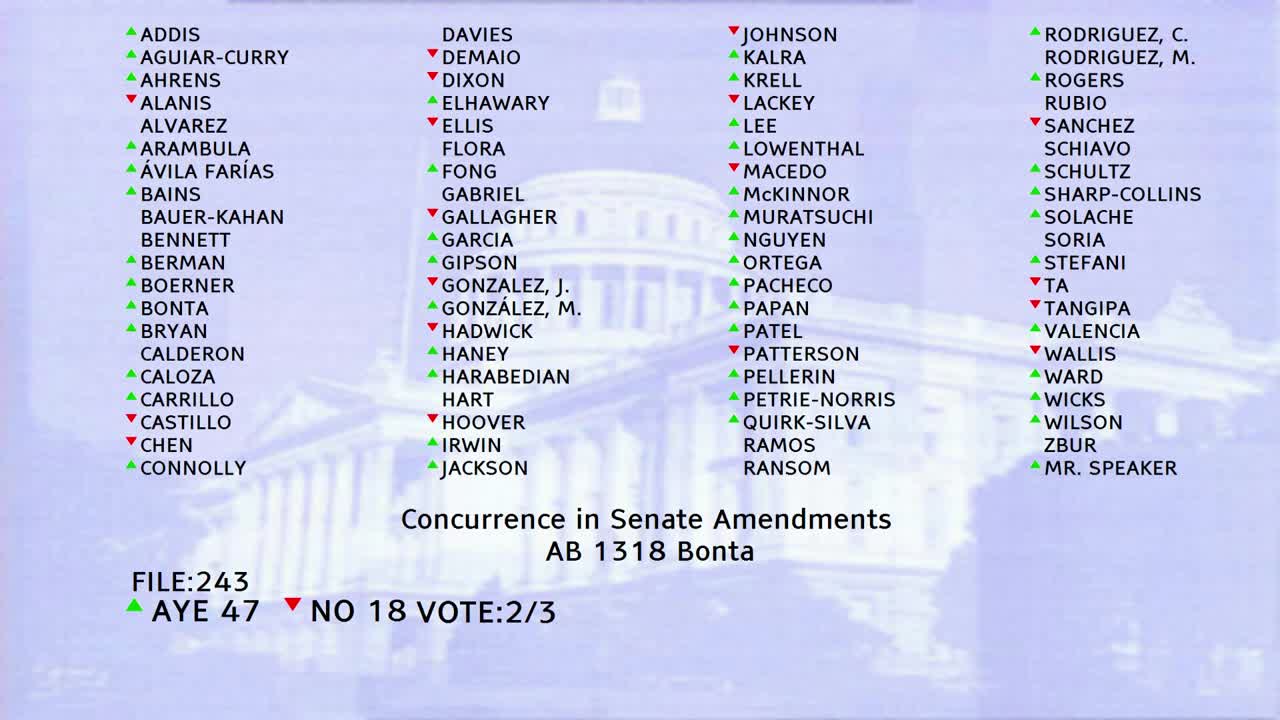 10MIN
Assembly Floor
 2MIN
Senate Floor
 1MIN
Senate Standing Committee on Appropriations
 13MIN
Senate Standing Committee on Judiciary
 26MIN
Senate Standing Committee on Education
 5MIN
Assembly Floor
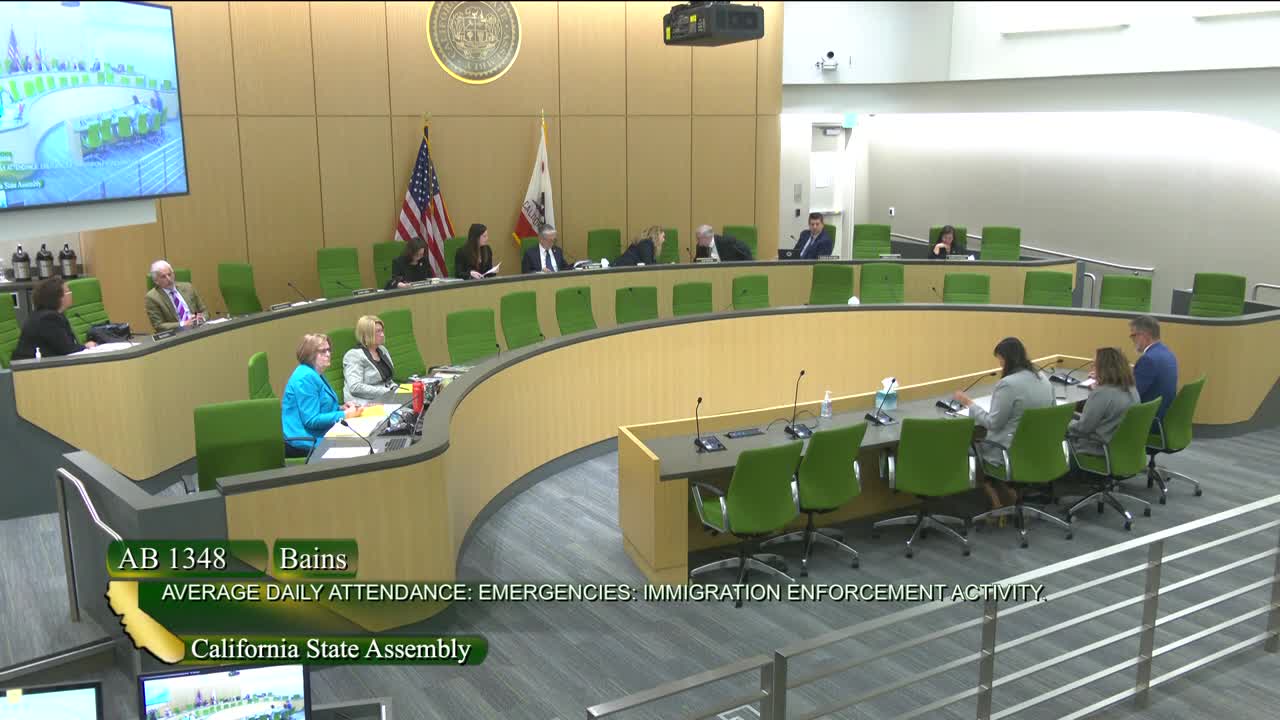 16MIN
Assembly Standing Committee on Education
Bill Author

Bill Co-Author(s):