AB 1392: Elections: voter registration information: elected officials and candidates.
- Session Year: 2025-2026
- House: Assembly
- Latest Version Date: 2025-10-03
Current Status:
Passed
(2025-10-03: Chaptered by Secretary of State - Chapter 300, Statutes of 2025.)
Introduced
In Committee
Awaiting First Chamber Vote
Passed First Chamber
In Committee
Awaiting Second Chamber Vote
Passed Second Chamber
Enacted
Under existing law, the residence address, telephone number, and email address of a registered voter is confidential, except that under certain circumstances a county elections official must provide that information to any candidate for federal, state, or local office, to any committee for or against any initiative or referendum measure, and to any person for election, scholarly, journalistic, political, or governmental purposes.
This bill would exempt the residence address, telephone number, and email address of a federal, state, or local elected official or candidate from that disclosure requirement, except that the information may be disclosed for journalistic or governmental purposes under specified conditions. The bill would require the Secretary of State to provide each county elections official with a list identifying each federal and state elected official or candidate residing in the county, require the county elections official to add each local elected official or candidate to that list, and require the county elections official to make the elected official or candidates information confidential within 5 business days. The bill would require the county elections official to exclude the elected official or candidates confidential information when producing any list, roster, or index. The bill would require an elected official or candidate to contact their county elections official to ensure their voter registration record has been made confidential. The bill would authorize an elected official or candidate to opt out of making their residence address, telephone number, and email address confidential. By adding new duties for county elections officials, this bill would create a state-mandated local program.
This bill would incorporate additional changes to Section 2194 of the Elections Code proposed by AB 827 to be operative only if this bill and AB 827 are enacted and this bill is enacted last.
Existing constitutional provisions require that a statute that limits the right of access to the meetings of public bodies or the writings of public officials and agencies be adopted with findings demonstrating the interest protected by the limitation and the need for protecting that interest.
This bill would make legislative findings to that effect.
The California Constitution requires the state to reimburse local agencies and school districts for certain costs mandated by the state. Statutory provisions establish procedures for making that reimbursement.
This bill would provide that, if the Commission on State Mandates determines that the bill contains costs mandated by the state, reimbursement for those costs shall be made pursuant to the statutory provisions noted above.
Under existing law, the residence address, telephone number, and email address of a registered voter is confidential, except that under certain circumstances a county elections official must provide that information to any candidate for federal, state, or local office, to any committee for or against any initiative or referendum measure, and to any person for election, scholarly, journalistic, political, or governmental purposes.
This bill would exempt the residence address, telephone number, and email address of a federal, state, or local elected official or candidate for an elected federal, state, or local office from that disclosure requirement. from that disclosure requirement, except that the information may be disclosed for journalistic or governmental purposes under specified conditions. The bill would require the Secretary of State or applicable local elections official to provide each county elections official with a list identifying each federal and state elected official or candidate residing in the county county, require the county elections official to add each local elected official or candidate to that list, and require the county elections official to make the elected official or candidates information confidential within 5 business days. The bill would require the county elections official to exclude the elected official or candidates confidential information when producing any list, roster, or index. The bill would require an elected official or candidate to contact their county elections official to ensure their voter registration record has been made confidential. The bill would authorize an elected official or candidate to opt out of making their residence address, telephone number, and email address confidential. By adding new duties for county elections officials, this bill would create a state-mandated local program.
Existing constitutional provisions require that a statute that limits the right of access to the meetings of public bodies or the writings of public officials and agencies be adopted with findings demonstrating the interest protected by the limitation and the need for protecting that interest.
This bill would make legislative findings to that effect.
The California Constitution requires the state to reimburse local agencies and school districts for certain costs mandated by the state. Statutory provisions establish procedures for making that reimbursement.
This bill would provide that, if the Commission on State Mandates determines that the bill contains costs mandated by the state, reimbursement for those costs shall be made pursuant to the statutory provisions noted above.
Under existing law, the residence address, telephone number, and email address of a registered voter is confidential, except that under certain circumstances a county elections official must provide that information to any candidate for federal, state, or local office, to any committee for or against any initiative or referendum measure, and to any person for election, scholarly, journalistic, political, or governmental purposes.
This bill would exempt the residence address, telephone number, and email address of a Member of the Legislature, state constitutional officer, Insurance Commissioner, Member of the United States House of Representatives, and United States Senator federal, state, or local elected official or candidate for an elected federal, state, or local office from that disclosure requirement. The bill would require the Secretary of State or applicable local elections official to provide each county elections official with a list identifying each elected state or federal official official or candidate residing in the county and require the county elections official to make the elected officials official or candidates information confidential within 5 business days. The bill would require an elected state or federal official official or candidate to contact their county elections official to ensure their voter registration record has been made confidential. By adding new duties for county elections officials, this bill would create a state-mandated local program.
Existing constitutional provisions require that a statute that limits the right of access to the meetings of public bodies or the writings of public officials and agencies be adopted with findings demonstrating the interest protected by the limitation and the need for protecting that interest.
This bill would make legislative findings to that effect.
The California Constitution requires the state to reimburse local agencies and school districts for certain costs mandated by the state. Statutory provisions establish procedures for making that reimbursement.
This bill would provide that, if the Commission on State Mandates determines that the bill contains costs mandated by the state, reimbursement for those costs shall be made pursuant to the statutory provisions noted above.
Under existing law, the residence address, telephone number, and email address of a registered voter is confidential, except that under certain circumstances a county elections official must provide that information to any candidate for federal, state, or local office, to any committee for or against any initiative or referendum measure, and to any person for election, scholarly, journalistic, political, or governmental purposes.
This bill would exempt the residence address, telephone number, and email address of a Member of the Legislature, state constitutional officer, Insurance Commissioner, Member of the United States House of Representatives, and United States Senator from that disclosure requirement. The bill would require the Secretary of State to provide each county elections official with a list identifying each elected state or federal official residing in the county and require the county elections official to make the elected officials information confidential within 5 business days. The bill would require an elected state or federal official to contact their county elections official to ensure their voter registration record has been made confidential. By adding new duties for county elections officials, this bill would create a state-mandated local program.
Existing constitutional provisions require that a statute that limits the right of access to the meetings of public bodies or the writings of public officials and agencies be adopted with findings demonstrating the interest protected by the limitation and the need for protecting that interest.
This bill would make legislative findings to that effect.
The California Constitution requires the state to reimburse local agencies and school districts for certain costs mandated by the state. Statutory provisions establish procedures for making that reimbursement.
This bill would provide that, if the Commission on State Mandates determines that the bill contains costs mandated by the state, reimbursement for those costs shall be made pursuant to the statutory provisions noted above.
Existing law regulates the wages, hours, and working conditions of any worker employed in any occupation, trade, or industry, whether compensation is measured by time, piece, or otherwise, except as specified. Existing law, in any instance in which an employer is required to physically post information, authorizes an employer to additionally distribute that information to employees by email with the documents attached.This bill would also authorize an employer to additionally distribute that information to employees by mail.Existing law regulates the wages, hours, and working conditions of any worker employed in any occupation, trade, or industry, whether compensation is measured by time, piece, or otherwise, except as specified. Existing law, in any instance in which an employer is required to physically post information, authorizes an employer to additionally distribute that information to employees by email with the documents attached.
This bill would also authorize an employer to additionally distribute that information to employees by mail.
(a)For purposes of this section, elected official or candidate means a federal, state, or local elected official or a candidate for an elected federal, state, or local office.
(b)An elected official or candidate shall have their residence address, telephone number, and email address appearing on the affidavit of registration made confidential in accordance with the terms and conditions of this section.
(c)(1)When a person files nomination papers for an elected federal or state office, the Secretary of State shall provide to each county elections official a list identifying each elected official or candidate residing in each respective county.
(2)When a person files nomination papers for an elected local office, the county elections official shall add that individuals name to a list identifying each elected official or candidate residing in that county. The county elections official shall periodically update the list for each election cycle.
(3)Within five business days of receipt of the list described in paragraph (1) or, for an office for which nomination papers are filed with the county elections official, within five business days of the filing of nomination papers with the county elections official, the county elections official shall make confidential that elected official or candidates residence address, telephone number, and email address appearing on the affidavit of registration.
(d)(1)The county elections official, in producing any list, roster, or index, shall exclude voters with a confidential voter status pursuant to this section.
(2)Within 60 days of moving to a new county, if available in the new county, the elected official or candidate shall apply for confidential voter status pursuant to this section. The elections official of the new county, upon notice of the confidential voter moving into the county, shall do all of the following:
(A)Contact the confidential voter and provide information regarding the application for confidential voter status in the new county.
(B)Honor the confidential voter status from the former county for 60 days from the date of notice.
(C)Pursuant to paragraph (1), exclude the confidential voter in any list, roster, or index during the 60-day period.
(D)Remove the confidential voter status if the new voter has not obtained or cannot obtain confidential voter status pursuant to this section in the new county during the 60-day period.
(e)An elected official or candidate shall contact their county elections official to ensure their voter registration record has been made confidential in accordance with the terms and conditions of this section.
(f)An elected official or candidates residence address, telephone number, and email address shall remain confidential until, for an elected official, the official no longer holds the office or, for a candidate, the winning candidate takes office.
(g)A county or county elections official shall not be liable for taking or failing to take the actions described in this section when the county or county elections official has received erroneous information from the Secretary of State.
(h)An action in negligence shall not be maintained against any government entity or officer or employee thereof as a result of the disclosure of the information that is the subject of this section, except by a showing of gross negligence or willfulness.
(i)An elected official or candidate holding office as of the effective date of this section shall contact their county elections official to ensure their voter registration record has been made confidential in accordance with the terms and conditions of this section. County elections officials shall make the elected officials information confidential when contacted by the elected official or candidate.
(j)(1)A candidate who does not wish to have confidential voter status may opt out when completing their candidate filing statement provided by a county elections official.
(2)(A)An elected official who wishes to opt out of confidential voter status may submit a letter to the county elections official declaring their decision to be exempt from the requirements of this section.
(B)A request pursuant to subparagraph (A) shall include the elected officials full name, voter registration address, and a clear statement that they wish to opt out of having their residence address, telephone number, and email address made confidential pursuant to this section.
(C)Upon receipt of the request, the county elections official shall remove the confidential designation from the individuals voter registration record within five business days.
(D)The county elections official shall notify the Secretary of State and any other relevant local elections officials of the decision to opt out within five business days of processing the request.
(E)An elected official who opts out may reapply for confidential voter status at any time while serving in or running for office, and confidential voter status shall be reinstated in accordance with this section upon receipt of the request.
(k)(1)Notwithstanding any other law, an elected official or candidates residence address, telephone number, and email address made confidential pursuant to this section may be disclosed only for bona fide journalistic or governmental purposes. A person seeking an elected official or candidates confidential residence address, telephone number, and email address for a journalistic purpose pursuant to this section shall apply to the Secretary of State or to a county elections official as specified in paragraph (2).
(2)(A)A person seeking a federal or state elected official or candidates confidential residence address, telephone number, and email address for journalistic purposes shall submit all of the following to the Secretary of State:
(i)A completed California Voter Registration File Request application.
(ii)A letter of authorization or affiliation from the media outlet that the person represents. If the person submitting the request is a member of the media, a press pass may be submitted in lieu of a letter of authorization.
(iii)A declaration under penalty of perjury attesting to the intended journalistic use of the information.
(B)A person seeking a local elected official or candidates confidential residence address, telephone number, and email address for journalistic purposes shall submit requests to the county elections official or other local elections official.
(C)A county elections official shall process a request for a local elected official or candidates confidential residence address, telephone number, and email address for journalistic purposes consistent with the requirements of regulations promulgated by the Secretary of State.
(D)The county elections official shall retain records of all requests for, and disclosures of, a local elected official or candidates confidential residence address, telephone number, and email address for journalistic purposes. The county elections official may reject a request that does not clearly adhere to the requirements of this subdivision.
(3)For purposes of this chapter, journalistic purposes shall be interpreted in a manner consistent with subdivision (b) of Section 2 of Article I of the California Constitution.
SEC. 2.Section 2194 of the Elections Code is amended to read:2194.(a)Except as provided in Section 2194.1, the affidavit of voter registration information identified in Section 7924.000 of the Government Code:
(1)Shall be confidential and shall not appear on any computer terminal, list, affidavit, duplicate affidavit, or other medium routinely available to the public at the county elections officials office.
(2)Shall not be used for any personal, private, or commercial purpose, including, but not limited to:
(A)The harassment of any voter or voters household.
(B)The advertising, solicitation, sale, or marketing of products or services to any voter or voters household.
(C)Reproduction in print, broadcast visual or audio, or display on the internet or any computer terminal unless pursuant to paragraph (3).
(3)Shall be provided with respect to any voter, subject to the provisions of Sections 2166, 2166.5, 2166.7, 2166.8, 2166.9, and 2188, to any candidate for federal, state, or local office, to any committee for or against any initiative or referendum measure for which legal publication is made, and to any person for election, scholarly, journalistic, or political purposes, or for governmental purposes, as determined by the Secretary of State.
(4)May be used by the Secretary of State for the purpose of educating voters pursuant to Section 12173 of the Government Code.
(b)(1)Notwithstanding any other law, the California drivers license number, the California identification card number, the social security number, and any other unique identifier used by the State of California for purposes of voter identification shown on the affidavit of voter registration of a registered voter, or added to voter registration records to comply with the requirements of the federal Help America Vote Act of 2002 (52 U.S.C. Sec. 20901 et seq.), are confidential and shall not be disclosed to any person.
(2)Notwithstanding any other law, the signature of the voter shown on the affidavit of voter registration or an image thereof is confidential and shall not be disclosed to any person, except as provided in subdivision (c).
(c)(1)The home address or signature of any voter shall be released whenever the persons vote is challenged pursuant to Sections 15105 to 15108, inclusive, or Article 3 (commencing with Section 14240) of Chapter 3 of Division 14. The address or signature shall be released only to the challenger, to elections officials, and to other persons as necessary to make, defend against, or adjudicate the challenge.
(2)An elections official shall permit a person to view the signature of a voter for the purpose of determining whether the signature compares with a signature on an affidavit of registration or an image thereof or a petition, but shall not permit a signature to be copied.
(d)A governmental entity, or officer or employee thereof, shall not be held civilly liable as a result of disclosure of the information referred to in this section, unless by a showing of gross negligence or willfulness.
(e)For the purposes of this section, voters household is defined as the voters place of residence or mailing address or any persons who reside at the place of residence or use the mailing address as supplied on the affidavit of registration pursuant to paragraphs (3) and (4) of subdivision (a) of Section 2150.
(f)Notwithstanding any other law, information regarding voters who did not sign a vote by mail ballot identification envelope or whose signature on the vote by mail ballot identification envelope did not compare with the voters signature on file shall be treated as confidential voter registration information pursuant to this section and Section 7924.000 of the Government Code. This information shall be provided with respect to any voter, subject to the provisions of Sections 2166, 2166.5, 2166.7, 2166.8, 2166.9, and 2188, to any candidate for federal, state, or local office, to any committee for or against any initiative or referendum measure for which legal publication is made, and to any person for election, scholarly, journalistic, or political purposes, or for governmental purposes, as determined by the Secretary of State, but otherwise shall not be disclosed to any person. Any disclosure of this information shall be accompanied by a notice to the recipient regarding Sections 18109 and 18540. Voter information provided pursuant to this subdivision shall be updated daily, include the name of the voter, and be provided in a searchable electronic format.
SEC. 2.5.Section 2194 of the Elections Code is amended to read:2194.(a)Except as provided in Section 2194.1, the affidavit of voter registration information identified in Section 7924.000 of the Government Code:
(1)Shall be confidential and shall not appear on any computer terminal, list, affidavit, duplicate affidavit, or other medium routinely available to the public at the county elections officials office.
(2)Shall not be used for any personal, private, or commercial purpose, including, but not limited to:
(A)The harassment of any voter or voters household.
(B)The advertising, solicitation, sale, or marketing of products or services to any voter or voters household.
(C)Reproduction in print, broadcast visual or audio, or display on the internet or any computer terminal unless pursuant to paragraph (3).
(3)Shall be provided with respect to any voter, subject to the provisions of Sections 2166, 2166.5, 2166.7, 2166.8, 2166.9, and 2188, to any candidate for federal, state, or local office, to any committee for or against any initiative or referendum measure for which legal publication is made, and to any person for election, scholarly, journalistic, or political purposes, or for governmental purposes, as determined by the Secretary of State.
(4)May be used by the Secretary of State for the purpose of educating voters pursuant to Section 12173 of the Government Code.
(b)(1)Notwithstanding any other law, the California drivers license number, the California identification card number, the social security number, and any other unique identifier used by the State of California for purposes of voter identification shown on the affidavit of voter registration of a registered voter, or added to voter registration records to comply with the requirements of the federal Help America Vote Act of 2002 (52 U.S.C. Sec. 20901 et seq.), are confidential and shall not be disclosed to any person.
(2)Notwithstanding any other law, the signature of the voter shown on the affidavit of voter registration or an image thereof is confidential and shall not be disclosed to any person, except as provided in subdivision (c).
(c)(1)The home address or signature of any voter shall be released whenever the persons vote is challenged pursuant to Sections 15105 to 15108, inclusive, or Article 3 (commencing with Section 14240) of Chapter 3 of Division 14. The address or signature shall be released only to the challenger, to elections officials, and to other persons as necessary to make, defend against, or adjudicate the challenge.
(2)An elections official shall permit a person to view the signature of a voter for the purpose of determining whether the signature compares with a signature on an affidavit of registration or an image thereof or a petition, but shall not permit a signature to be copied.
(d)A governmental entity, or officer or employee thereof, shall not be held civilly liable as a result of disclosure of the information referred to in this section, unless by a showing of gross negligence or willfulness.
(e)For purposes of this section, voters household is defined as the voters place of residence or mailing address or any persons who reside at the place of residence or use the mailing address as supplied on the affidavit of registration pursuant to paragraphs (3) and (4) of subdivision (a) of Section 2150.
(f)(1)Notwithstanding any other law, information regarding voters who did not sign a vote by mail ballot identification envelope or whose signature on the vote by mail ballot identification envelope did not compare with the voters signature on file shall be treated as confidential voter registration information pursuant to this section and Section 7924.000 of the Government Code. This information shall be provided with respect to any voter, subject to the provisions of Sections 2166, 2166.5, 2166.7, 2166.8, 2166.9, and 2188, to any candidate for federal, state, or local office, to any committee for or against any initiative or referendum measure for which legal publication is made, and to any person for election, scholarly, journalistic, or political purposes, or for governmental purposes, as determined by the Secretary of State, but otherwise shall not be disclosed to any person. Any disclosure of this information shall be accompanied by a notice to the recipient regarding Sections 18109 and 18540.
(2)Voter information provided pursuant to this subdivision shall be updated daily, include the name of the voter, and be provided in a searchable electronic format. The daily update shall also include, as applicable, information regarding whether a form has been received from the voter to verify their signature pursuant to subdivision (d) of Section 3019, whether a form has been received or the voter has otherwise provided a signature pursuant to subdivision (e) of Section 3019, and whether the signature provided pursuant to subdivision (d) or (e) of Section 3019 did or did not compare.
SEC. 3.Section 2227 of the Elections Code is amended to read:2227.(a)In lieu of mailing a residency confirmation postcard, as prescribed in subdivision (a) of Section 2220, the county elections official may contract with a consumer credit reporting agency or its licensees to obtain use of change-of-address data in accordance with this section.
(b)If the county elections official contracts with a consumer credit reporting agency or its licensees pursuant to subdivision (a), all of the following shall occur:
(1)For each registered voter in the county, the county elections official shall initiate a search for change-of-address data with the consumer credit reporting agency or its licensees by providing the name and residence address of each registered voter in the county to the consumer credit reporting agency or its licensees.
(2)The consumer credit reporting agency or its licensees shall search their databases for each name and address provided by the county elections official and shall report to the county elections official any information indicating that the registered voter changed the voters residence address.
(c)(1)Notwithstanding Section 2194 of this code or Section 7924.000 of the Government Code, and except as provided in paragraph (2), a county elections official may disclose a registered voters name and residence address to a consumer credit reporting agency or its licensees pursuant to, and in accordance with, this section.
(2)A county elections official shall not disclose to a consumer credit reporting agency or its licensees the name and residence address of a registered voter if that information is deemed confidential pursuant to Section 2166, 2166.5, 2166.7, 2166.8, or 2166.9 of this code, or Chapter 3.1 (commencing with Section 6205) of Division 7 of Title 1 of the Government Code.
(d)A consumer credit reporting agency or its licensees shall use the information provided by a county elections official only pursuant to paragraph (2) of subdivision (b), and shall not retain any information received from the county elections official pursuant to this section.
(e)Based on change-of-address data received from a consumer credit reporting agency or its licensees, the county elections official shall send a forwardable notice, including a postage-paid and preaddressed return form, which may be in the form of a postcard, to the registered voter to enable the voter to verify or correct address information. The forwardable notice shall be in substantially the following form:
We have received notification that you have moved to a new residence address in ____ County. You will remain registered to vote at your old address unless you notify our office that the address to which this card was mailed is a change of your permanent residence. Please notify our office in writing by returning the attached postage-paid postcard. If this is not a permanent residence, and you do not wish to change your address for voting purposes, please disregard this notice.
(f)The county elections official shall take all of the following actions as appropriate:
(1)If a voter responds to the forwardable notice sent pursuant to subdivision (e) or otherwise verifies in a signed writing that the voter has moved to a new residence address in California, the county elections official shall verify the signature on the response by comparing it to the signature on file for the voter and, if appropriate, immediately update the voters registration record with the new residence address.
(2)If a voter does not respond to the forwardable notice sent pursuant to subdivision (e) and does not otherwise verify in a signed writing that the voter has moved to a new residence address, the elections official shall not update the status of the voters registration to inactive or cancel the voter registration.
(g)For purposes of this section, consumer credit reporting agency has the same meaning as set forth in subdivision (d) of Section 1785.3 of the Civil Code.
SEC. 4.Section 8040 of the Elections Code is amended to read:8040.(a)The declaration of candidacy by a candidate shall be substantially as follows:
DECLARATION OF CANDIDACY |
I hereby declare myself a candidate for nomination to the office of ________ District Number ________ to be voted for at the primary election to be held ________, 20__, and declare the following to be true: My name is . I want my name and occupational designation to appear on the ballot as follows: ______________________________________. |
Addresses: Residence Business Mailing |
Telephone numbers: Day _________ Evening _________ |
Internet website:_______________________________________ |
I meet the statutory and constitutional qualifications for this office (including, but not limited to, citizenship, residency, and party preference, if required). |
I am at present an incumbent of the following public office |
(if any) __________. |
If nominated, I will accept the nomination and not withdraw, except as permitted by state law. |
Signature of candidate |
A candidate for voter-nominated office shall also complete all of the following: | ||
(1)I hereby certify that: | ||
(a)At the time of presentation of this declaration, as shown by my current affidavit of registration, I have disclosed the following political party preference, if any: . | ||
(b)My complete voter registration and party affiliation/preference history, from [10 years prior to current year] through the date of signing this document, is as follows: | ||
Party Registration | County | Timeframe (by year) |
(2)Pursuant to Section 8002.5 of the Elections Code, select one of the following: | ||
______ Party Preference: _____________________ (insert the name of the qualified political party as disclosed upon your affidavit of registration). | ||
______ Party Preference: None (if you have declined to disclose a preference for a qualified political party upon your affidavit of registration). | ||
Dated this ___ day of _____, 20___. | ||
Signature of candidate | ||
| A Notary Public or other officer completing this certificate verifies only the identity of the individual who signed the document to which this certificate is attached, and not the truthfulness, accuracy, or validity of that document. |
State of California | ) | |
County of | ) ss. | |
) |
Subscribed and sworn to before me this ___ day of ________, 20____. |
Signature of Notary Public (or other official) Notary Public Seal |
Examined and certified by me this ________ day of ________, 20____. |
County Elections Official |
WARNING: Every person acting on behalf of a candidate is guilty of a misdemeanor who deliberately fails to file at the proper time and in the proper place any declaration of candidacy in the persons possession which is entitled to be filed under the provisions of the Elections Code Section 18202. |
(b)At the discretion of the elections official, a candidate for a judicial office, or a candidate for any office whose voter registration information is confidential under Section 2166, 2166.5, 2166.7, 2166.8, or 2166.9 may withhold the candidates residence address from the declaration of candidacy. If a candidate does not state the candidates residence address on the declaration of candidacy, the elections official shall verify whether the candidates address is within the appropriate political subdivision and add the notation verified where appropriate on the declaration.
(c)If a candidate will not be within the State of California during the entire nomination period and is unable to appear before a notary public appointed by the Secretary of State or other California official to complete their declaration of candidacy, the candidate may appear before a notary public in another state to complete the declaration of candidacy. The candidate shall attach to their declaration of candidacy a notarial certificate from the out-of-state notary that complies with the law of the notarys state.
SEC. 5.Section 8600 of the Elections Code is amended to read:8600.(a)Every person who desires to be a write-in candidate and have their name as written on the ballot of an election counted for a particular office shall file both of the following:
(1)A statement of write-in candidacy that contains the following information:
(A)Candidates name.
(B)Residence address.
(C)A declaration stating that they are a write-in candidate.
(D)The title of the office for which they are running.
(E)The party nomination which they seek, if running in a partisan primary election.
(F)The date of the election.
(G)A certification of the candidates complete voter registration and party affiliation/preference history for the preceding 10 years, or for as long as they have been eligible to vote in the state if less than 10 years, if running for a voter-nominated office.
(H)For any of the offices described in Section 13.5, a statement that the candidate meets the statutory and constitutional requirements for that office as described in that section.
(2)The requisite number of signatures on the nomination papers, if any, required pursuant to Sections 8062, 10220, and 10510, or, in the case of a special district not subject to the Uniform District Election Law (Part 4 (commencing with Section 10500) of Division 10), the number of signatures required by the principal act of the district.
(b)Notwithstanding any other provision of law, a person may not be a write-in candidate at the general election for a voter-nominated office.
(c)A write-in candidate shall have their residence address, telephone number, and email address appearing on the affidavit of registration made confidential in accordance with the terms and conditions of Section 2166.9. If a candidate does not state the candidates residence address on the statement of write-in candidacy, the elections official shall verify whether the candidates address is within the appropriate political subdivision and add the notation verified where appropriate on the declaration.
SEC. 6.Section 10226.3 of the Elections Code is amended to read:10226.3.(a)The declaration of candidacy by a candidate shall be substantially as follows:
DECLARATION OF CANDIDACY |
I hereby declare myself a candidate for nomination to the office of ________ District Number ________ to be voted for at the municipal election to be held ________, 20__, and declare the following to be true: My name is . I want my name and occupational designation to appear on the ballot as follows: ______________________________________. |
Addresses: Residence Business Mailing |
Telephone numbers: Day _________ Evening _________ |
Internet website:_______________________________________ |
I meet the statutory and constitutional qualifications for this office (including, but not limited to, citizenship, and residency). |
I am at present an incumbent of the following public office |
(if any) __________. |
If nominated, I will accept the nomination, and if elected, I will accept the office. |
Signature of candidate |
| A Notary Public or other officer completing this certificate verifies only the identity of the individual who signed the document to which this certificate is attached, and not the truthfulness, accuracy, or validity of that document. |
State of California | ) | |
County of | ) ss. | |
) |
Subscribed and sworn to before me this ___ day of ________, 20____. |
Signature of Notary Public (or other official) Notary Public Seal |
Examined and certified by me this ________ day of ________, 20____. |
County Elections Official |
WARNING: Every person acting on behalf of a candidate is guilty of a misdemeanor who deliberately fails to file at the proper time and in the proper place any declaration of candidacy in the persons possession which is entitled to be filed under the provisions of the Elections Code Section 18202. |
(b)At the discretion of the elections official, a candidate for any office whose voter registration information is confidential under Section 2166, 2166.5, 2166.7, 2166.8, or 2166.9 may withhold the candidates residence address from the declaration of candidacy. If a candidate does not state the candidates residence address on the declaration of candidacy, the elections official shall verify whether the candidates address is within the appropriate political subdivision and add the notation verified where appropriate on the declaration.
(c)If a candidate will not be within the State of California within the entire nomination period and is unable to appear before a notary public appointed by the Secretary of State or other state official to complete their declaration of candidacy, the candidate may appear before a notary public in another state to complete the declaration of candidacy. The candidate shall attach to their declaration of candidacy a notarial certificate from the out-of-state notary that complies with the law of the notarys state.
SEC. 7.Section 2.5 of this bill incorporates amendments to Section 2194 of the Elections Code proposed by both this bill and Assembly Bill 827. That section of this bill shall only become operative if (1) both bills are enacted and become effective on or before January 1, 2026, (2) each bill amends Section 2194 of the Elections Code, and (3) this bill is enacted after Assembly Bill 827, in which case Section 2 of this bill shall not become operative.
SEC. 8.The Legislature finds and declares that Section 1 of this act, which adds Section 2166.9 to the Elections Code, imposes a limitation on the publics right of access to the meetings of public bodies or the writings of public officials and agencies within the meaning of Section 3 of Article I of the California Constitution. Pursuant to that constitutional provision, the Legislature makes the following findings to demonstrate the interest protected by this limitation and the need for protecting that interest:
In order to ensure the safety of elected officials and candidates for elective office, it is necessary to make the residence address, telephone number, and email address listed on the affidavit of voter registration for an elected official or candidate confidential.
SEC. 9.If the Commission on State Mandates determines that this act contains costs mandated by the state, reimbursement to local agencies and school districts for those costs shall be made pursuant to Part 7 (commencing with Section 17500) of Division 4 of Title 2 of the Government Code.
(a)For purposes of this section, elected official or candidate means a federal, state, or local elected official or a candidate for an elected federal, state, or local office.
(b)An elected official or candidate shall have their residence address, telephone number, and email address appearing on the affidavit of registration made confidential in accordance with the terms and conditions of this section.
(c)(1)When a person files nomination papers for an elected federal or state office, the Secretary of State shall provide to each county elections official a list identifying each elected official or candidate residing in each respective county.
(2)When a person files nomination papers for an elected local office, the county elections official shall add that individuals name to a list identifying each elected official or candidate residing in that county. The county elections official shall periodically update the list for each election cycle.
(3)Within five business days of receipt of the list described in paragraph (1) or, for an office for which nomination papers are filed with the county elections official, within five business days of the filing of nomination papers with the county elections official, the county elections official shall make confidential that elected official or candidates residence address, telephone number, and email address appearing on the affidavit of registration.
(d)(1)The county elections official, in producing any list, roster, or index, shall exclude voters with a confidential voter status pursuant to this section.
(2)Within 60 days of moving to a new county, if available in the new county, the elected official or candidate shall apply for confidential voter status pursuant to this section. The elections official of the new county, upon notice of the confidential voter moving into the county, shall do all of the following:
(A)Contact the confidential voter and provide information regarding the application for confidential voter status in the new county.
(B)Honor the confidential voter status from the former county for 60 days from the date of notice.
(C)Pursuant to paragraph (1), exclude the confidential voter in any list, roster, or index during the 60-day period.
(D)Remove the confidential voter status if the new voter has not obtained or cannot obtain confidential voter status pursuant to this section in the new county during the 60-day period.
(e)An elected official or candidate shall contact their county elections official to ensure their voter registration record has been made confidential in accordance with the terms and conditions of this section.
(f)An elected official or candidates residence address, telephone number, and email address shall remain confidential until, for an elected official, the official no longer holds the office or, for a candidate, the winning candidate takes office.
(g)A county or county elections official shall not be liable for taking or failing to take the actions described in this section when the county or county elections official has received erroneous information from the Secretary of State.
(h)An action in negligence shall not be maintained against any government entity or officer or employee thereof as a result of the disclosure of the information that is the subject of this section, except by a showing of gross negligence or willfulness.
(i)An elected official or candidate holding office as of the effective date of this section shall contact their county elections official to ensure their voter registration record has been made confidential in accordance with the terms and conditions of this section. County elections officials shall make the elected officials information confidential when contacted by the elected official or candidate.
(j)(1)A candidate who does not wish to have confidential voter status may opt out when completing their candidate filing statement provided by a county elections official.
(2)(A)An elected official who wishes to opt out of confidential voter status may submit a letter to the county elections official declaring their decision to be exempt from the requirements of this section.
(B)A request pursuant to subparagraph (A) shall include the elected officials full name, voter registration address, and a clear statement that they wish to opt out of having their residence address, telephone number, and email address made confidential pursuant to this section.
(C)Upon receipt of the request, the county elections official shall remove the confidential designation from the individuals voter registration record within five business days.
(D)The county elections official shall notify the Secretary of State and any other relevant local elections officials of the decision to opt out within five business days of processing the request.
(E)An elected official who opts out may reapply for confidential voter status at any time while serving in or running for office, and confidential voter status shall be reinstated in accordance with this section upon receipt of the request.
(k)(1)Notwithstanding any other law, an elected official or candidates residence address, telephone number, and email address made confidential pursuant to this section may be disclosed only for bona fide journalistic or governmental purposes. A person seeking an elected official or candidates confidential residence address, telephone number, and email address for a journalistic purpose pursuant to this section shall apply to the Secretary of State or to a county elections official as specified in paragraph (2).
(2)(A)A person seeking a federal or state elected official or candidates confidential residence address, telephone number, and email address for journalistic purposes shall submit all of the following to the Secretary of State:
(i)A completed California Voter Registration File Request application.
(ii)A letter of authorization or affiliation from the media outlet that the person represents. If the person submitting the request is a member of the media, a press pass may be submitted in lieu of a letter of authorization.
(iii)A sworn declaration under penalty of perjury attesting to the intended journalistic use of the information.
(B)A person seeking a local elected official or candidates confidential residence address, telephone number, and email address for journalistic purposes shall submit requests to the county elections official or other local elections official.
(C)A county elections official shall process a request for a local elected official or candidates confidential residence address, telephone number, and email address for journalistic purposes consistent with the requirements of regulations promulgated by the Secretary of State.
(D)The county elections official shall retain records of all requests for, and disclosures of, a local elected official or candidates confidential residence address, telephone number, and email address for journalistic purposes. The county elections official may reject a request that does not clearly adhere to the requirements of this subdivision.
(3)For purposes of this chapter, journalistic purposes shall be interpreted in a manner consistent with subdivision (b) of Section 2 of Article I of the California Constitution.
SEC. 2.Section 2194 of the Elections Code is amended to read:2194.(a)Except as provided in Section 2194.1, the affidavit of voter registration information identified in Section 7924.000 of the Government Code:
(1)Shall be confidential and shall not appear on any computer terminal, list, affidavit, duplicate affidavit, or other medium routinely available to the public at the county elections officials office.
(2)Shall not be used for any personal, private, or commercial purpose, including, but not limited to:
(A)The harassment of any voter or voters household.
(B)The advertising, solicitation, sale, or marketing of products or services to any voter or voters household.
(C)Reproduction in print, broadcast visual or audio, or display on the internet or any computer terminal unless pursuant to paragraph (3).
(3)Shall be provided with respect to any voter, subject to the provisions of Sections 2166, 2166.5, 2166.7, 2166.8, 2166.9, and 2188, to any candidate for federal, state, or local office, to any committee for or against any initiative or referendum measure for which legal publication is made, and to any person for election, scholarly, journalistic, or political purposes, or for governmental purposes, as determined by the Secretary of State.
(4)May be used by the Secretary of State for the purpose of educating voters pursuant to Section 12173 of the Government Code.
(b)(1)Notwithstanding any other law, the California drivers license number, the California identification card number, the social security number, and any other unique identifier used by the State of California for purposes of voter identification shown on the affidavit of voter registration of a registered voter, or added to voter registration records to comply with the requirements of the federal Help America Vote Act of 2002 (52 U.S.C. Sec. 20901 et seq.), are confidential and shall not be disclosed to any person.
(2)Notwithstanding any other law, the signature of the voter shown on the affidavit of voter registration or an image thereof is confidential and shall not be disclosed to any person, except as provided in subdivision (c).
(c)(1)The home address or signature of any voter shall be released whenever the persons vote is challenged pursuant to Sections 15105 to 15108, inclusive, or Article 3 (commencing with Section 14240) of Chapter 3 of Division 14. The address or signature shall be released only to the challenger, to elections officials, and to other persons as necessary to make, defend against, or adjudicate the challenge.
(2)An elections official shall permit a person to view the signature of a voter for the purpose of determining whether the signature compares with a signature on an affidavit of registration or an image thereof or a petition, but shall not permit a signature to be copied.
(d)A governmental entity, or officer or employee thereof, shall not be held civilly liable as a result of disclosure of the information referred to in this section, unless by a showing of gross negligence or willfulness.
(e)For the purposes of this section, voters household is defined as the voters place of residence or mailing address or any persons who reside at the place of residence or use the mailing address as supplied on the affidavit of registration pursuant to paragraphs (3) and (4) of subdivision (a) of Section 2150.
(f)Notwithstanding any other law, information regarding voters who did not sign a vote by mail ballot identification envelope or whose signature on the vote by mail ballot identification envelope did not compare with the voters signature on file shall be treated as confidential voter registration information pursuant to this section and Section 7924.000 of the Government Code. This information shall be provided with respect to any voter, subject to the provisions of Sections 2166, 2166.5, 2166.7, 2166.8, 2166.9, and 2188, to any candidate for federal, state, or local office, to any committee for or against any initiative or referendum measure for which legal publication is made, and to any person for election, scholarly, journalistic, or political purposes, or for governmental purposes, as determined by the Secretary of State, but otherwise shall not be disclosed to any person. Any disclosure of this information shall be accompanied by a notice to the recipient regarding Sections 18109 and 18540. Voter information provided pursuant to this subdivision shall be updated daily, include the name of the voter, and be provided in a searchable electronic format.
SEC. 2.5.Section 2194 of the Elections Code is amended to read:2194.(a)Except as provided in Section 2194.1, the affidavit of voter registration information identified in Section 7924.000 of the Government Code:
(1)Shall be confidential and shall not appear on any computer terminal, list, affidavit, duplicate affidavit, or other medium routinely available to the public at the county elections officials office.
(2)Shall not be used for any personal, private, or commercial purpose, including, but not limited to:
(A)The harassment of any voter or voters household.
(B)The advertising, solicitation, sale, or marketing of products or services to any voter or voters household.
(C)Reproduction in print, broadcast visual or audio, or display on the internet or any computer terminal unless pursuant to paragraph (3).
(3)Shall be provided with respect to any voter, subject to the provisions of Sections 2166, 2166.5, 2166.7, 2166.8, 2166.9, and 2188, to any candidate for federal, state, or local office, to any committee for or against any initiative or referendum measure for which legal publication is made, and to any person for election, scholarly, journalistic, or political purposes, or for governmental purposes, as determined by the Secretary of State.
(4)May be used by the Secretary of State for the purpose of educating voters pursuant to Section 12173 of the Government Code.
(b)(1)Notwithstanding any other law, the California drivers license number, the California identification card number, the social security number, and any other unique identifier used by the State of California for purposes of voter identification shown on the affidavit of voter registration of a registered voter, or added to voter registration records to comply with the requirements of the federal Help America Vote Act of 2002 (52 U.S.C. Sec. 20901 et seq.), are confidential and shall not be disclosed to any person.
(2)Notwithstanding any other law, the signature of the voter shown on the affidavit of voter registration or an image thereof is confidential and shall not be disclosed to any person, except as provided in subdivision (c).
(c)(1)The home address or signature of any voter shall be released whenever the persons vote is challenged pursuant to Sections 15105 to 15108, inclusive, or Article 3 (commencing with Section 14240) of Chapter 3 of Division 14. The address or signature shall be released only to the challenger, to elections officials, and to other persons as necessary to make, defend against, or adjudicate the challenge.
(2)An elections official shall permit a person to view the signature of a voter for the purpose of determining whether the signature compares with a signature on an affidavit of registration or an image thereof or a petition, but shall not permit a signature to be copied.
(d)A governmental entity, or officer or employee thereof, shall not be held civilly liable as a result of disclosure of the information referred to in this section, unless by a showing of gross negligence or willfulness.
(e)For the purposes of this section, voters household is defined as the voters place of residence or mailing address or any persons who reside at the place of residence or use the mailing address as supplied on the affidavit of registration pursuant to paragraphs (3) and (4) of subdivision (a) of Section 2150.
(f)(1)Notwithstanding any other law, information regarding voters who did not sign a vote by mail ballot identification envelope or whose signature on the vote by mail ballot identification envelope did not compare with the voters signature on file shall be treated as confidential voter registration information pursuant to this section and Section 7924.000 of the Government Code. This information shall be provided with respect to any voter, subject to the provisions of Sections 2166, 2166.5, 2166.7, 2166.8, 2166.9, and 2188, to any candidate for federal, state, or local office, to any committee for or against any initiative or referendum measure for which legal publication is made, and to any person for election, scholarly, journalistic, or political purposes, or for governmental purposes, as determined by the Secretary of State, but otherwise shall not be disclosed to any person. Any disclosure of this information shall be accompanied by a notice to the recipient regarding Sections 18109 and 18540. Voter information provided pursuant to this subdivision shall be updated daily, include the name of the voter, and be provided in a searchable electronic format.
(2)Voter information provided pursuant to this subdivision shall be updated daily, include the name of the voter, and be provided in a searchable electronic format. The daily update shall also include, as applicable, information regarding whether a form has been received from the voter to verify their signature pursuant to subdivision (d) of Section 3019, whether a form has been received or the voter has otherwise provided a signature pursuant to subdivision (e) of Section 3019, and whether the signature provided pursuant to subdivision (d) or (e) of Section 3019 did or did not compare.
SEC. 3.Section 2227 of the Elections Code is amended to read:2227.(a)In lieu of mailing a residency confirmation postcard, as prescribed in subdivision (a) of Section 2220, the county elections official may contract with a consumer credit reporting agency or its licensees to obtain use of change-of-address data in accordance with this section.
(b)If the county elections official contracts with a consumer credit reporting agency or its licensees pursuant to subdivision (a), all of the following shall occur:
(1)For each registered voter in the county, the county elections official shall initiate a search for change-of-address data with the consumer credit reporting agency or its licensees by providing the name and residence address of each registered voter in the county to the consumer credit reporting agency or its licensees.
(2)The consumer credit reporting agency or its licensees shall search their databases for each name and address provided by the county elections official and shall report to the county elections official any information indicating that the registered voter changed the voters residence address.
(c)(1)Notwithstanding Section 2194 of this code or Section 7924.000 of the Government Code, and except as provided in paragraph (2), a county elections official may disclose a registered voters name and residence address to a consumer credit reporting agency or its licensees pursuant to, and in accordance with, this section.
(2)A county elections official shall not disclose to a consumer credit reporting agency or its licensees the name and residence address of a registered voter if that information is deemed confidential pursuant to Section 2166, 2166.5, 2166.7, 2166.8, or 2166.9 of this code, or Chapter 3.1 (commencing with Section 6205) of Division 7 of Title 1 of the Government Code.
(d)A consumer credit reporting agency or its licensees shall use the information provided by a county elections official only pursuant to paragraph (2) of subdivision (b), and shall not retain any information received from the county elections official pursuant to this section.
(e)Based on change-of-address data received from a consumer credit reporting agency or its licensees, the county elections official shall send a forwardable notice, including a postage-paid and preaddressed return form, which may be in the form of a postcard, to the registered voter to enable the voter to verify or correct address information. The forwardable notice shall be in substantially the following form:
We have received notification that you have moved to a new residence address in ____ County. You will remain registered to vote at your old address unless you notify our office that the address to which this card was mailed is a change of your permanent residence. Please notify our office in writing by returning the attached postage-paid postcard. If this is not a permanent residence, and you do not wish to change your address for voting purposes, please disregard this notice.
(f)The county elections official shall take all of the following actions as appropriate:
(1)If a voter responds to the forwardable notice sent pursuant to subdivision (e) or otherwise verifies in a signed writing that the voter has moved to a new residence address in California, the county elections official shall verify the signature on the response by comparing it to the signature on file for the voter and, if appropriate, immediately update the voters registration record with the new residence address.
(2)If a voter does not respond to the forwardable notice sent pursuant to subdivision (e) and does not otherwise verify in a signed writing that the voter has moved to a new residence address, the elections official shall not update the status of the voters registration to inactive or cancel the voter registration.
(g)For purposes of this section, consumer credit reporting agency has the same meaning as set forth in subdivision (d) of Section 1785.3 of the Civil Code.
SEC. 4.Section 8040 of the Elections Code is amended to read:8040.(a)The declaration of candidacy by a candidate shall be substantially as follows:
DECLARATION OF CANDIDACY |
I hereby declare myself a candidate for nomination to the office of ________ District Number ________ to be voted for at the primary election to be held ________, 20__, and declare the following to be true: My name is . I want my name and occupational designation to appear on the ballot as follows: ______________________________________. |
Addresses: Residence Business Mailing |
Telephone numbers: Day _________ Evening _________ |
Internet website:_______________________________________ |
I meet the statutory and constitutional qualifications for this office (including, but not limited to, citizenship, residency, and party preference, if required). |
I am at present an incumbent of the following public office |
(if any) __________. |
If nominated, I will accept the nomination and not withdraw, except as permitted by state law. |
Signature of candidate |
A candidate for voter-nominated office shall also complete all of the following: | ||
(1)I hereby certify that: | ||
(a)At the time of presentation of this declaration, as shown by my current affidavit of registration, I have disclosed the following political party preference, if any: . | ||
(b)My complete voter registration and party affiliation/preference history, from [10 years prior to current year] through the date of signing this document, is as follows: | ||
Party Registration | County | Timeframe (by year) |
(2)Pursuant to Section 8002.5 of the Elections Code, select one of the following: | ||
______ Party Preference: _____________________ (insert the name of the qualified political party as disclosed upon your affidavit of registration). | ||
______ Party Preference: None (if you have declined to disclose a preference for a qualified political party upon your affidavit of registration). | ||
Dated this ___ day of _____, 20___. | ||
Signature of candidate | ||
| A Notary Public or other officer completing this certificate verifies only the identity of the individual who signed the document to which this certificate is attached, and not the truthfulness, accuracy, or validity of that document. |
State of California | ) | |
County of | ) ss. | |
) |
Subscribed and sworn to before me this ___ day of ________, 20____. |
Signature of Notary Public (or other official) Notary Public Seal |
Examined and certified by me this ________ day of ________, 20____. |
County Elections Official |
WARNING: Every person acting on behalf of a candidate is guilty of a misdemeanor who deliberately fails to file at the proper time and in the proper place any declaration of candidacy in the persons possession which is entitled to be filed under the provisions of the Elections Code Section 18202. |
(b)At the discretion of the elections official, a candidate for a judicial office, or a candidate for any office whose voter registration information is confidential under Section 2166, 2166.5, 2166.7, 2166.8, or 2166.9 may withhold the candidates residence address from the declaration of candidacy. If a candidate does not state the candidates residence address on the declaration of candidacy, the elections official shall verify whether the candidates address is within the appropriate political subdivision and add the notation verified where appropriate on the declaration.
(c)If a candidate will not be within the State of California during the entire nomination period and is unable to appear before a notary public appointed by the Secretary of State or other California official to complete their declaration of candidacy, the candidate may appear before a notary public in another state to complete the declaration of candidacy. The candidate shall attach to their declaration of candidacy a notarial certificate from the out-of-state notary that complies with the law of the notarys state.
SEC. 5.Section 8600 of the Elections Code is amended to read:8600.(a)Every person who desires to be a write-in candidate and have his or her their name as written on the ballot of an election counted for a particular office shall file both of the following:
(1)A statement of write-in candidacy that contains the following information:
(A)Candidates name.
(B)Residence address.
(C)A declaration stating that he or she is they are a write-in candidate.
(D)The title of the office for which he or she is they are running.
(E)The party nomination which he or she seeks, they seek, if running in a partisan primary election.
(F)The date of the election.
(G)A certification of the candidates complete voter registration and party affiliation/preference history for the preceding 10 years, or for as long as he or she has they have been eligible to vote in the state if less than 10 years, if running for a voter-nominated office.
(H)For any of the offices described in Section 13.5, a statement that the candidate meets the statutory and constitutional requirements for that office as described in that section.
(2)The requisite number of signatures on the nomination papers, if any, required pursuant to Sections 8062, 10220, and 10510, or, in the case of a special district not subject to the Uniform District Election Law (Part 4 (commencing with Section 10500) of Division 10), the number of signatures required by the principal act of the district.
(b)Notwithstanding any other provision of law, a person may not be a write-in candidate at the general election for a voter-nominated office.
(c)A write-in candidate shall have their residence address, telephone number, and email address appearing on the affidavit of registration made confidential in accordance with the terms and conditions of Section 2166.9. If a candidate does not state the candidates residence address on the statement of write-in candidacy, the elections official shall verify whether the candidates address is within the appropriate political subdivision and add the notation verified where appropriate on the declaration.
SEC. 6.Section 10226.3 of the Elections Code is amended to read:10226.3.(a)The declaration of candidacy by a candidate shall be substantially as follows:
DECLARATION OF CANDIDACY |
I hereby declare myself a candidate for nomination to the office of ________ District Number ________ to be voted for at the municipal election to be held ________, 20__, and declare the following to be true: My name is . I want my name and occupational designation to appear on the ballot as follows: ______________________________________. |
Addresses: Residence Business Mailing |
Telephone numbers: Day _________ Evening _________ |
Internet website:_______________________________________ |
I meet the statutory and constitutional qualifications for this office (including, but not limited to, citizenship, and residency). |
I am at present an incumbent of the following public office |
(if any) __________. |
If nominated, I will accept the nomination, and if elected, I will accept the office. |
Signature of candidate |
| A Notary Public or other officer completing this certificate verifies only the identity of the individual who signed the document to which this certificate is attached, and not the truthfulness, accuracy, or validity of that document. |
State of California | ) | |
County of | ) ss. | |
) |
Subscribed and sworn to before me this ___ day of ________, 20____. |
Signature of Notary Public (or other official) Notary Public Seal |
Examined and certified by me this ________ day of ________, 20____. |
County Elections Official |
WARNING: Every person acting on behalf of a candidate is guilty of a misdemeanor who deliberately fails to file at the proper time and in the proper place any declaration of candidacy in the persons possession which is entitled to be filed under the provisions of the Elections Code Section 18202. |
(b)At the discretion of the elections official, a candidate for any office whose voter registration information is confidential under Section 2166, 2166.5, 2166.7, 2166.8, or 2166.9 may withhold the candidates residence address from the declaration of candidacy. If a candidate does not state the candidates residence address on the declaration of candidacy, the elections official shall verify whether the candidates address is within the appropriate political subdivision and add the notation verified where appropriate on the declaration.
(c)If a candidate will not be within the State of California within the entire nomination period and is unable to appear before a notary public appointed by the Secretary of State or other state official to complete their declaration of candidacy, the candidate may appear before a notary public in another state to complete the declaration of candidacy. The candidate shall attach to their declaration of candidacy a notarial certificate from the out-of-state notary that complies with the law of the notarys state.
SEC. 7.Section 2.5 of this bill incorporates amendments to Section 2194 of the Elections Code proposed by both this bill and Assembly Bill 827. That section of this bill shall only become operative if (1) both bills are enacted and become effective on or before January 1, 2026, (2) each bill amends Section 2194 of the Elections Code, and (3) this bill is enacted after Assembly Bill 827, in which case Section 2 of this bill shall not become operative.
SEC. 7.SEC. 8.The Legislature finds and declares that Section 1 of this act, which adds Section 2166.9 to the Elections Code, imposes a limitation on the publics right of access to the meetings of public bodies or the writings of public officials and agencies within the meaning of Section 3 of Article I of the California Constitution. Pursuant to that constitutional provision, the Legislature makes the following findings to demonstrate the interest protected by this limitation and the need for protecting that interest:
In order to ensure the safety of elected officials and candidates for elective office, it is necessary to make the residence address, telephone number, and email address listed on the affidavit of voter registration for an elected official or candidate confidential.
SEC. 8.SEC. 9.If the Commission on State Mandates determines that this act contains costs mandated by the state, reimbursement to local agencies and school districts for those costs shall be made pursuant to Part 7 (commencing with Section 17500) of Division 4 of Title 2 of the Government Code.
(a)For purposes of this section, elected official or candidate means a federal, state, or local elected official or a candidate for an elected federal, state, or local office.
(b)An elected official or candidate shall have their residence address, telephone number, and email address appearing on the affidavit of registration made confidential in accordance with the terms and conditions of this section.
(c)(1)When a person files nomination papers for an elected federal, state, or local federal or state office, the Secretary of State or the local elections official, if the local elections official is someone other than the county elections official, shall provide to each county elections official a list identifying each elected official or candidate residing in each respective county.
(2)When a person files nomination papers for an elected local office, the county elections official shall add that individuals name to a list identifying each elected official or candidate residing in that county. The county elections official shall periodically update the list for each election cycle.
(2)(3)Within five business days of receipt of the list described in paragraph (1) or, for an office for which nomination papers are filed with the county elections official, within five business days of the filing of nomination papers with the county elections official, the county elections official shall make confidential that elected official or candidates residence address, telephone number, and email address appearing on the affidavit of registration.
(d)(1)The county elections official, in producing any list, roster, or index, shall exclude voters with a confidential voter status pursuant to this section.
(2)Within 60 days of moving to a new county, if available in the new county, the elected official or candidate shall apply for confidential voter status pursuant to this section. The elections official of the new county, upon notice of the confidential voter moving into the county, shall do all of the following:
(A)Contact the confidential voter and provide information regarding the application for confidential voter status in the new county.
(B)Honor the confidential voter status from the former county for 60 days from the date of notice.
(C)Pursuant to paragraph (1), exclude the confidential voter in any list, roster, or index during the 60-day period.
(D)Remove the confidential voter status if the new voter has not obtained or cannot obtain confidential voter status pursuant to this section in the new county during the 60-day period.
(d)(e)An elected official or candidate shall contact their county elections official to ensure their voter registration record has been made confidential in accordance with the terms and conditions of this section.
(e)(f)An elected official or candidates residence address, telephone number, and email address shall remain confidential until, for an elected official, the official no longer holds the office or, for a candidate, the winning candidate takes office.
(f)(g)A county or county elections official shall not be liable for taking or failing to take the actions described in this section when the county or county elections official has received erroneous information from the Secretary of State.
(g)(h)An action in negligence shall not be maintained against any government entity or officer or employee thereof as a result of the disclosure of the information that is the subject of this section, except by a showing of gross negligence or willfulness.
(h)(i)An elected official or candidate holding office as of the effective date of this section shall contact their county elections official to ensure their voter registration record has been made confidential in accordance with the terms and conditions of this section. County elections officials shall make the elected officials information confidential when contacted by the elected official or candidate.
(j)(1)A candidate who does not wish to have confidential voter status may opt out when completing their candidate filing statement provided by a county elections official.
(2)(A)An elected official who wishes to opt out of confidential voter status may submit a letter to the county elections official declaring their decision to be exempt from the requirements of this section.
(B)A request pursuant to subparagraph (A) shall include the elected officials full name, voter registration address, and a clear statement that they wish to opt out of having their residence address, telephone number, and email address made confidential pursuant to this section.
(C)Upon receipt of the request, the county elections official shall remove the confidential designation from the individuals voter registration record within five business days.
(D)The county elections official shall notify the Secretary of State and any other relevant local elections officials of the decision to opt out within five business days of processing the request.
(E)An elected official who opts out may reapply for confidential voter status at any time while serving in or running for office, and confidential voter status shall be reinstated in accordance with this section upon receipt of the request.
(k)(1)Notwithstanding any other law, an elected official or candidates residence address, telephone number, and email address made confidential pursuant to this section may be disclosed only for bona fide journalistic or governmental purposes. A person seeking an elected official or candidates confidential residence address, telephone number, and email address for a journalistic purpose pursuant to this section shall apply to the Secretary of State or to a county elections official as specified in paragraph (2).
(2)(A)A person seeking a federal or state elected official or candidates confidential residence address, telephone number, and email address for journalistic purposes shall submit all of the following to the Secretary of State:
(i)A completed California Voter Registration File Request application.
(ii)A letter of authorization or affiliation from the media outlet that the person represents. If the person submitting the request is a member of the media, a press pass may be submitted in lieu of a letter of authorization.
(iii)A sworn declaration under penalty of perjury attesting to the intended journalistic use of the information.
(B)A person seeking a local elected official or candidates confidential residence address, telephone number, and email address for journalistic purposes shall submit requests to the county elections official or other local elections official.
(C)A county elections official shall process a request for a local elected official or candidates confidential residence address, telephone number, and email address for journalistic purposes consistent with the requirements of regulations promulgated by the Secretary of State.
(D)The county elections official shall retain records of all requests for, and disclosures of, a local elected official or candidates confidential residence address, telephone number, and email address for journalistic purposes. The county elections official may reject a request that does not clearly adhere to the requirements of this subdivision.
(3)For purposes of this chapter, journalistic purposes shall be interpreted in a manner consistent with subdivision (b) of Section 2 of Article I of the California Constitution.
SEC. 2.Section 2194 of the Elections Code is amended to read:2194.(a)Except as provided in Section 2194.1, the affidavit of voter registration information identified in Section 7924.000 of the Government Code:
(1)Shall be confidential and shall not appear on any computer terminal, list, affidavit, duplicate affidavit, or other medium routinely available to the public at the county elections officials office.
(2)Shall not be used for any personal, private, or commercial purpose, including, but not limited to:
(A)The harassment of any voter or voters household.
(B)The advertising, solicitation, sale, or marketing of products or services to any voter or voters household.
(C)Reproduction in print, broadcast visual or audio, or display on the internet or any computer terminal unless pursuant to paragraph (3).
(3)Shall be provided with respect to any voter, subject to the provisions of Sections 2166, 2166.5, 2166.7, 2166.8, 2166.9, and 2188, to any candidate for federal, state, or local office, to any committee for or against any initiative or referendum measure for which legal publication is made, and to any person for election, scholarly, journalistic, or political purposes, or for governmental purposes, as determined by the Secretary of State.
(4)May be used by the Secretary of State for the purpose of educating voters pursuant to Section 12173 of the Government Code.
(b)(1)Notwithstanding any other law, the California drivers license number, the California identification card number, the social security number, and any other unique identifier used by the State of California for purposes of voter identification shown on the affidavit of voter registration of a registered voter, or added to voter registration records to comply with the requirements of the federal Help America Vote Act of 2002 (52 U.S.C. Sec. 20901 et seq.), are confidential and shall not be disclosed to any person.
(2)Notwithstanding any other law, the signature of the voter shown on the affidavit of voter registration or an image thereof is confidential and shall not be disclosed to any person, except as provided in subdivision (c).
(c)(1)The home address or signature of any voter shall be released whenever the persons vote is challenged pursuant to Sections 15105 to 15108, inclusive, or Article 3 (commencing with Section 14240) of Chapter 3 of Division 14. The address or signature shall be released only to the challenger, to elections officials, and to other persons as necessary to make, defend against, or adjudicate the challenge.
(2)An elections official shall permit a person to view the signature of a voter for the purpose of determining whether the signature compares with a signature on an affidavit of registration or an image thereof or a petition, but shall not permit a signature to be copied.
(d)A governmental entity, or officer or employee thereof, shall not be held civilly liable as a result of disclosure of the information referred to in this section, unless by a showing of gross negligence or willfulness.
(e)For the purposes of this section, voters household is defined as the voters place of residence or mailing address or any persons who reside at the place of residence or use the mailing address as supplied on the affidavit of registration pursuant to paragraphs (3) and (4) of subdivision (a) of Section 2150.
(f)Notwithstanding any other law, information regarding voters who did not sign a vote by mail ballot identification envelope or whose signature on the vote by mail ballot identification envelope did not compare with the voters signature on file shall be treated as confidential voter registration information pursuant to this section and Section 7924.000 of the Government Code. This information shall be provided with respect to any voter, subject to the provisions of Sections 2166, 2166.5, 2166.7, 2166.8, 2166.9, and 2188, to any candidate for federal, state, or local office, to any committee for or against any initiative or referendum measure for which legal publication is made, and to any person for election, scholarly, journalistic, or political purposes, or for governmental purposes, as determined by the Secretary of State, but otherwise shall not be disclosed to any person. Any disclosure of this information shall be accompanied by a notice to the recipient regarding Sections 18109 and 18540. Voter information provided pursuant to this subdivision shall be updated daily, include the name of the voter, and be provided in a searchable electronic format.
SEC. 3.Section 2227 of the Elections Code is amended to read:2227.(a)In lieu of mailing a residency confirmation postcard, as prescribed in subdivision (a) of Section 2220, the county elections official may contract with a consumer credit reporting agency or its licensees to obtain use of change-of-address data in accordance with this section.
(b)If the county elections official contracts with a consumer credit reporting agency or its licensees pursuant to subdivision (a), all of the following shall occur:
(1)For each registered voter in the county, the county elections official shall initiate a search for change-of-address data with the consumer credit reporting agency or its licensees by providing the name and residence address of each registered voter in the county to the consumer credit reporting agency or its licensees.
(2)The consumer credit reporting agency or its licensees shall search their databases for each name and address provided by the county elections official and shall report to the county elections official any information indicating that the registered voter changed the voters residence address.
(c)(1)Notwithstanding Section 2194 of this code or Section 7924.000 of the Government Code, and except as provided in paragraph (2), a county elections official may disclose a registered voters name and residence address to a consumer credit reporting agency or its licensees pursuant to, and in accordance with, this section.
(2)A county elections official shall not disclose to a consumer credit reporting agency or its licensees the name and residence address of a registered voter if that information is deemed confidential pursuant to Section 2166, 2166.5, 2166.7, 2166.8, or 2166.9 of this code, or Chapter 3.1 (commencing with Section 6205) of Division 7 of Title 1 of the Government Code.
(d)A consumer credit reporting agency or its licensees shall use the information provided by a county elections official only pursuant to paragraph (2) of subdivision (b), and shall not retain any information received from the county elections official pursuant to this section.
(e)Based on change-of-address data received from a consumer credit reporting agency or its licensees, the county elections official shall send a forwardable notice, including a postage-paid and preaddressed return form, which may be in the form of a postcard, to the registered voter to enable the voter to verify or correct address information. The forwardable notice shall be in substantially the following form:
We have received notification that you have moved to a new residence address in ____ County. You will remain registered to vote at your old address unless you notify our office that the address to which this card was mailed is a change of your permanent residence. Please notify our office in writing by returning the attached postage-paid postcard. If this is not a permanent residence, and you do not wish to change your address for voting purposes, please disregard this notice.
(f)The county elections official shall take all of the following actions as appropriate:
(1)If a voter responds to the forwardable notice sent pursuant to subdivision (e) or otherwise verifies in a signed writing that the voter has moved to a new residence address in California, the county elections official shall verify the signature on the response by comparing it to the signature on file for the voter and, if appropriate, immediately update the voters registration record with the new residence address.
(2)If a voter does not respond to the forwardable notice sent pursuant to subdivision (e) and does not otherwise verify in a signed writing that the voter has moved to a new residence address, the elections official shall not update the status of the voters registration to inactive or cancel the voter registration.
(g)For purposes of this section, consumer credit reporting agency has the same meaning as set forth in subdivision (d) of Section 1785.3 of the Civil Code.
SEC. 4.Section 8040 of the Elections Code is amended to read:8040.(a)The declaration of candidacy by a candidate shall be substantially as follows:
DECLARATION OF CANDIDACY |
I hereby declare myself a candidate for nomination to the office of ________ District Number ________ to be voted for at the primary election to be held ________, 20__, and declare the following to be true: My name is . I want my name and occupational designation to appear on the ballot as follows: ______________________________________. |
Addresses: Residence Business Mailing |
Telephone numbers: Day _________ Evening _________ |
Internet website:_______________________________________ |
I meet the statutory and constitutional qualifications for this office (including, but not limited to, citizenship, residency, and party preference, if required). |
I am at present an incumbent of the following public office |
(if any) __________. |
If nominated, I will accept the nomination and not withdraw, except as permitted by state law. |
Signature of candidate |
A candidate for voter-nominated office shall also complete all of the following: | ||
(1)I hereby certify that: | ||
(a)At the time of presentation of this declaration, as shown by my current affidavit of registration, I have disclosed the following political party preference, if any: . | ||
(b)My complete voter registration and party affiliation/preference history, from [10 years prior to current year] through the date of signing this document, is as follows: | ||
Party Registration | County | Timeframe (by year) |
(2)Pursuant to Section 8002.5 of the Elections Code, select one of the following: | ||
______ Party Preference: _____________________ (insert the name of the qualified political party as disclosed upon your affidavit of registration). | ||
______ Party Preference: None (if you have declined to disclose a preference for a qualified political party upon your affidavit of registration). | ||
Dated this ___ day of _____, 20___. | ||
Signature of candidate | ||
| A Notary Public or other officer completing this certificate verifies only the identity of the individual who signed the document to which this certificate is attached, and not the truthfulness, accuracy, or validity of that document. |
State of California | ) | |
County of | ) ss. | |
) |
Subscribed and sworn to before me this ___ day of ________, 20____. |
Signature of Notary Public (or other official) Notary Public Seal |
Examined and certified by me this ________ day of ________, 20____. |
County Elections Official |
WARNING: Every person acting on behalf of a candidate is guilty of a misdemeanor who deliberately fails to file at the proper time and in the proper place any declaration of candidacy in the persons possession which is entitled to be filed under the provisions of the Elections Code Section 18202. |
(b)At the discretion of the elections official, a candidate for a judicial office, or a candidate for any office whose voter registration information is confidential under Section 2166, 2166.5, 2166.7, 2166.8, or 2166.9 may withhold the candidates residence address from the declaration of candidacy. If a candidate does not state the candidates residence address on the declaration of candidacy, the elections official shall verify whether the candidates address is within the appropriate political subdivision and add the notation verified where appropriate on the declaration.
(c)If a candidate will not be within the State of California during the entire nomination period and is unable to appear before a notary public appointed by the Secretary of State or other California official to complete their declaration of candidacy, the candidate may appear before a notary public in another state to complete the declaration of candidacy. The candidate shall attach to their declaration of candidacy a notarial certificate from the out-of-state notary that complies with the law of the notarys state.
SEC. 5.Section 8600 of the Elections Code is amended to read:8600.(a)Every person who desires to be a write-in candidate and have his or her name as written on the ballot of an election counted for a particular office shall file: file both of the following:
(a)(1)A statement of write-in candidacy that contains the following information:
(1)(A)Candidates name.
(2)(B)Residence address.
(3)(C)A declaration stating that he or she is a write-in candidate.
(4)(D)The title of the office for which he or she is running.
(5)(E)The party nomination which he or she seeks, if running in a partisan primary election.
(6)(F)The date of the election.
(7)(G)A certification of the candidates complete voter registration and party affiliation/preference history for the preceding 10 years, or for as long as he or she has been eligible to vote in the state if less than 10 years, if running for a voter-nominated office.
(8)(H)For any of the offices described in Section 13.5, a statement that the candidate meets the statutory and constitutional requirements for that office as described in that section.
(b)(2)The requisite number of signatures on the nomination papers, if any, required pursuant to Sections 8062, 10220, and 10510, or, in the case of a special district not subject to the Uniform District Election Law (Part 4 (commencing with Section 10500) of Division 10), the number of signatures required by the principal act of the district.
(c)(b)Notwithstanding any other provision of law, a person may not be a write-in candidate at the general election for a voter-nominated office.
(c)A write-in candidate shall have their residence address, telephone number, and email address appearing on the affidavit of registration made confidential in accordance with the terms and conditions of Section 2166.9. If a candidate does not state the candidates residence address on the statement of write-in candidacy, the elections official shall verify whether the candidates address is within the appropriate political subdivision and add the notation verified where appropriate on the declaration.
SEC. 5.SEC. 6.Section 10226.3 of the Elections Code is amended to read:10226.3.(a)The declaration of candidacy by a candidate shall be substantially as follows:
DECLARATION OF CANDIDACY |
I hereby declare myself a candidate for nomination to the office of ________ District Number ________ to be voted for at the municipal election to be held ________, 20__, and declare the following to be true: My name is . I want my name and occupational designation to appear on the ballot as follows: ______________________________________. |
Addresses: Residence Business Mailing |
Telephone numbers: Day _________ Evening _________ |
Internet website:_______________________________________ |
I meet the statutory and constitutional qualifications for this office (including, but not limited to, citizenship, and residency). |
I am at present an incumbent of the following public office |
(if any) __________. |
If nominated, I will accept the nomination, and if elected, I will accept the office. |
Signature of candidate |
| A Notary Public or other officer completing this certificate verifies only the identity of the individual who signed the document to which this certificate is attached, and not the truthfulness, accuracy, or validity of that document. |
State of California | ) | |
County of | ) ss. | |
) |
Subscribed and sworn to before me this ___ day of ________, 20____. |
Signature of Notary Public (or other official) Notary Public Seal |
Examined and certified by me this ________ day of ________, 20____. |
County Elections Official |
WARNING: Every person acting on behalf of a candidate is guilty of a misdemeanor who deliberately fails to file at the proper time and in the proper place any declaration of candidacy in the persons possession which is entitled to be filed under the provisions of the Elections Code Section 18202. |
(b)At the discretion of the elections official, a candidate for any office whose voter registration information is confidential under Section 2166, 2166.5, 2166.7, 2166.8, or 2166.9 may withhold the candidates residence address from the declaration of candidacy. If a candidate does not state the candidates residence address on the declaration of candidacy, the elections official shall verify whether the candidates address is within the appropriate political subdivision and add the notation verified where appropriate on the declaration.
(c)If a candidate will not be within the State of California within the entire nomination period and is unable to appear before a notary public appointed by the Secretary of State or other state official to complete their declaration of candidacy, the candidate may appear before a notary public in another state to complete the declaration of candidacy. The candidate shall attach to their declaration of candidacy a notarial certificate from the out-of-state notary that complies with the law of the notarys state.
SEC. 6.SEC. 7.The Legislature finds and declares that Section 1 of this act, which adds Section 2166.9 to the Elections Code, imposes a limitation on the publics right of access to the meetings of public bodies or the writings of public officials and agencies within the meaning of Section 3 of Article I of the California Constitution. Pursuant to that constitutional provision, the Legislature makes the following findings to demonstrate the interest protected by this limitation and the need for protecting that interest:
In order to ensure the safety of elected officials and candidates for elective office, it is necessary to make the residence address, telephone number, and email address listed on the affidavit of voter registration for an elected official or candidate confidential.
SEC. 7.SEC. 8.If the Commission on State Mandates determines that this act contains costs mandated by the state, reimbursement to local agencies and school districts for those costs shall be made pursuant to Part 7 (commencing with Section 17500) of Division 4 of Title 2 of the Government Code.
(a)For purposes of this section, elected state or federal official means a Member of the Legislature, state constitutional officer, Insurance Commissioner, Member of the United States House of Representatives, or United States Senator. official or candidate means a federal, state, or local elected official or a candidate for an elected federal, state, or local office.
(b)An elected state or federal official official or candidate shall have their residence address, telephone number, and email address appearing on the affidavit of registration made confidential in accordance with the terms and conditions of this section.
(c)(1)When the Secretary of State issues the certificate of election pursuant to Section 15504 to elected state or federal officials, the Secretary of State When a person files nomination papers for an elected federal, state, or local office, the Secretary of State or the local elections official, if the local elections official is someone other than the county elections official, shall provide to each county elections official a list identifying each elected state or federal official official or candidate residing in each respective county.
(2)Within five business days of receipt of the list described in paragraph (1), (1) or, for an office for which nomination papers are filed with the county elections official, within five business days of the filing of nomination papers with the county elections official, the county elections official shall make confidential that elected state or federal officials official or candidates residence address, telephone number, and email address appearing on the affidavit of registration.
(d)An elected state or federal official official or candidate shall contact their county elections official to ensure their voter registration record has been made confidential in accordance with the terms and conditions of this section.
(e)The confidential status of an elected state or federal official shall remain in place until the time the official is no longer holding the office to which they were elected.(e)An elected official or candidates residence address, telephone number, and email address shall remain confidential until, for an elected official, the official no longer holds the office or, for a candidate, the winning candidate takes office.
(f)A county or county elections official shall not be liable for taking or failing to take the actions described in this section when the county or county elections official has received erroneous information from the Secretary of State.
(g)An action in negligence shall not be maintained against any government entity or officer or employee thereof as a result of the disclosure of the information that is the subject of this section, except by a showing of gross negligence or willfulness.
(h)An elected state or federal official official or candidate holding office as of the effective date of this section shall contact their county elections official to ensure their voter registration record has been made confidential in accordance with the terms and conditions of this section. County elections officials shall make the elected officials information confidential when contacted by the elected state or federal official. official or candidate.
SEC. 2.Section 2194 of the Elections Code is amended to read:2194.(a)Except as provided in Section 2194.1, the affidavit of voter registration information identified in Section 7924.000 of the Government Code:
(1)Shall be confidential and shall not appear on any computer terminal, list, affidavit, duplicate affidavit, or other medium routinely available to the public at the county elections officials office.
(2)Shall not be used for any personal, private, or commercial purpose, including, but not limited to:
(A)The harassment of any voter or voters household.
(B)The advertising, solicitation, sale, or marketing of products or services to any voter or voters household.
(C)Reproduction in print, broadcast visual or audio, or display on the internet or any computer terminal unless pursuant to paragraph (3).
(3)Shall be provided with respect to any voter, subject to the provisions of Sections 2166, 2166.5, 2166.7, 2166.8, 2166.9, and 2188, to any candidate for federal, state, or local office, to any committee for or against any initiative or referendum measure for which legal publication is made, and to any person for election, scholarly, journalistic, or political purposes, or for governmental purposes, as determined by the Secretary of State.
(4)May be used by the Secretary of State for the purpose of educating voters pursuant to Section 12173 of the Government Code.
(b)(1)Notwithstanding any other law, the California drivers license number, the California identification card number, the social security number, and any other unique identifier used by the State of California for purposes of voter identification shown on the affidavit of voter registration of a registered voter, or added to voter registration records to comply with the requirements of the federal Help America Vote Act of 2002 (52 U.S.C. Sec. 20901 et seq.), are confidential and shall not be disclosed to any person.
(2)Notwithstanding any other law, the signature of the voter shown on the affidavit of voter registration or an image thereof is confidential and shall not be disclosed to any person, except as provided in subdivision (c).
(c)(1)The home address or signature of any voter shall be released whenever the persons vote is challenged pursuant to Sections 15105 to 15108, inclusive, or Article 3 (commencing with Section 14240) of Chapter 3 of Division 14. The address or signature shall be released only to the challenger, to elections officials, and to other persons as necessary to make, defend against, or adjudicate the challenge.
(2)An elections official shall permit a person to view the signature of a voter for the purpose of determining whether the signature compares with a signature on an affidavit of registration or an image thereof or a petition, but shall not permit a signature to be copied.
(d)A governmental entity, or officer or employee thereof, shall not be held civilly liable as a result of disclosure of the information referred to in this section, unless by a showing of gross negligence or willfulness.
(e)For the purposes of this section, voters household is defined as the voters place of residence or mailing address or any persons who reside at the place of residence or use the mailing address as supplied on the affidavit of registration pursuant to paragraphs (3) and (4) of subdivision (a) of Section 2150.
(f)Notwithstanding any other law, information regarding voters who did not sign a vote by mail ballot identification envelope or whose signature on the vote by mail ballot identification envelope did not compare with the voters signature on file shall be treated as confidential voter registration information pursuant to this section and Section 7924.000 of the Government Code. This information shall be provided with respect to any voter, subject to the provisions of Sections 2166, 2166.5, 2166.7, 2166.8, 2166.9, and 2188, to any candidate for federal, state, or local office, to any committee for or against any initiative or referendum measure for which legal publication is made, and to any person for election, scholarly, journalistic, or political purposes, or for governmental purposes, as determined by the Secretary of State, but otherwise shall not be disclosed to any person. Any disclosure of this information shall be accompanied by a notice to the recipient regarding Sections 18109 and 18540. Voter information provided pursuant to this subdivision shall be updated daily, include the name of the voter, and be provided in a searchable electronic format.
SEC. 3.Section 2227 of the Elections Code is amended to read:2227.(a)In lieu of mailing a residency confirmation postcard, as prescribed in subdivision (a) of Section 2220, the county elections official may contract with a consumer credit reporting agency or its licensees to obtain use of change-of-address data in accordance with this section.
(b)If the county elections official contracts with a consumer credit reporting agency or its licensees pursuant to subdivision (a), all of the following shall occur:
(1)For each registered voter in the county, the county elections official shall initiate a search for change-of-address data with the consumer credit reporting agency or its licensees by providing the name and residence address of each registered voter in the county to the consumer credit reporting agency or its licensees.
(2)The consumer credit reporting agency or its licensees shall search their databases for each name and address provided by the county elections official and shall report to the county elections official any information indicating that the registered voter changed the voters residence address.
(c)(1)Notwithstanding Section 2194 of this code or Section 7924.000 of the Government Code, and except as provided in paragraph (2), a county elections official may disclose a registered voters name and residence address to a consumer credit reporting agency or its licensees pursuant to, and in accordance with, this section.
(2)A county elections official shall not disclose to a consumer credit reporting agency or its licensees the name and residence address of a registered voter if that information is deemed confidential pursuant to Section 2166, 2166.5, 2166.7, 2166.8, or 2166.9 of this code, or Chapter 3.1 (commencing with Section 6205) of Division 7 of Title 1 of the Government Code.
(d)A consumer credit reporting agency or its licensees shall use the information provided by a county elections official only pursuant to paragraph (2) of subdivision (b), and shall not retain any information received from the county elections official pursuant to this section.
(e)Based on change-of-address data received from a consumer credit reporting agency or its licensees, the county elections official shall send a forwardable notice, including a postage-paid and preaddressed return form, which may be in the form of a postcard, to the registered voter to enable the voter to verify or correct address information. The forwardable notice shall be in substantially the following form:
We have received notification that you have moved to a new residence address in ____ County. You will remain registered to vote at your old address unless you notify our office that the address to which this card was mailed is a change of your permanent residence. Please notify our office in writing by returning the attached postage-paid postcard. If this is not a permanent residence, and you do not wish to change your address for voting purposes, please disregard this notice.
(f)The county elections official shall take all of the following actions as appropriate:
(1)If a voter responds to the forwardable notice sent pursuant to subdivision (e) or otherwise verifies in a signed writing that the voter has moved to a new residence address in California, the county elections official shall verify the signature on the response by comparing it to the signature on file for the voter and, if appropriate, immediately update the voters registration record with the new residence address.
(2)If a voter does not respond to the forwardable notice sent pursuant to subdivision (e) and does not otherwise verify in a signed writing that the voter has moved to a new residence address, the elections official shall not update the status of the voters registration to inactive or cancel the voter registration.
(g)For purposes of this section, consumer credit reporting agency has the same meaning as set forth in subdivision (d) of Section 1785.3 of the Civil Code.
SEC. 4.Section 8040 of the Elections Code is amended to read:8040.(a)The declaration of candidacy by a candidate shall be substantially as follows:
DECLARATION OF CANDIDACY |
I hereby declare myself a candidate for nomination to the office of ________ District Number ________ to be voted for at the primary election to be held ________, 20__, and declare the following to be true: My name is . I want my name and occupational designation to appear on the ballot as follows: ______________________________________. |
Addresses: Residence Business Mailing |
Telephone numbers: Day _________ Evening _________ |
Internet website:_______________________________________ |
I meet the statutory and constitutional qualifications for this office (including, but not limited to, citizenship, residency, and party preference, if required). |
I am at present an incumbent of the following public office |
(if any) __________. |
If nominated, I will accept the nomination and not withdraw, except as permitted by state law. |
Signature of candidate |
A candidate for voter-nominated office shall also complete all of the following: | ||
(1)I hereby certify that: | ||
(a)At the time of presentation of this declaration, as shown by my current affidavit of registration, I have disclosed the following political party preference, if any: . | ||
(b)My complete voter registration and party affiliation/preference history, from [10 years prior to current year] through the date of signing this document, is as follows: | ||
Party Registration | County | Timeframe (by year) |
(2)Pursuant to Section 8002.5 of the Elections Code, select one of the following: | ||
______ Party Preference: _____________________ (insert the name of the qualified political party as disclosed upon your affidavit of registration). | ||
______ Party Preference: None (if you have declined to disclose a preference for a qualified political party upon your affidavit of registration). | ||
Dated this ___ day of _____, 20___. | ||
Signature of candidate | ||
| A Notary Public or other officer completing this certificate verifies only the identity of the individual who signed the document to which this certificate is attached, and not the truthfulness, accuracy, or validity of that document. |
State of California | ) | |
County of | ) ss. | |
) |
Subscribed and sworn to before me this ___ day of ________, 20____. |
Signature of Notary Public (or other official) Notary Public Seal |
Examined and certified by me this ________ day of ________, 20____. |
County Elections Official |
WARNING: Every person acting on behalf of a candidate is guilty of a misdemeanor who deliberately fails to file at the proper time and in the proper place any declaration of candidacy in the persons possession which is entitled to be filed under the provisions of the Elections Code Section 18202. |
(b)At the discretion of the elections official, a candidate for a judicial office, or a candidate for any office whose voter registration information is confidential under Section 2166, 2166.5, 2166.7, 2166.8, or 2166.9 may withhold the candidates residence address from the declaration of candidacy. If a candidate does not state the candidates residence address on the declaration of candidacy, the elections official shall verify whether the candidates address is within the appropriate political subdivision and add the notation verified where appropriate on the declaration.
(c)If a candidate will not be within the State of California during the entire nomination period and is unable to appear before a notary public appointed by the Secretary of State or other California official to complete their declaration of candidacy, the candidate may appear before a notary public in another state to complete the declaration of candidacy. The candidate shall attach to their declaration of candidacy a notarial certificate from the out-of-state notary that complies with the law of the notarys state.
SEC. 5.Section 10226.3 of the Elections Code is amended to read:10226.3.(a)The declaration of candidacy by a candidate shall be substantially as follows:
DECLARATION OF CANDIDACY |
I hereby declare myself a candidate for nomination to the office of ________ District Number ________ to be voted for at the municipal election to be held ________, 20__, and declare the following to be true: My name is . I want my name and occupational designation to appear on the ballot as follows: ______________________________________. |
Addresses: Residence Business Mailing |
Telephone numbers: Day _________ Evening _________ |
Internet website:_______________________________________ |
I meet the statutory and constitutional qualifications for this office (including, but not limited to, citizenship, and residency). |
I am at present an incumbent of the following public office |
(if any) __________. |
If nominated, I will accept the nomination, and if elected, I will accept the office. |
Signature of candidate |
| A Notary Public or other officer completing this certificate verifies only the identity of the individual who signed the document to which this certificate is attached, and not the truthfulness, accuracy, or validity of that document. |
State of California | ) | |
County of | ) ss. | |
) |
Subscribed and sworn to before me this ___ day of ________, 20____. |
Signature of Notary Public (or other official) Notary Public Seal |
Examined and certified by me this ________ day of ________, 20____. |
County Elections Official |
WARNING: Every person acting on behalf of a candidate is guilty of a misdemeanor who deliberately fails to file at the proper time and in the proper place any declaration of candidacy in the persons possession which is entitled to be filed under the provisions of the Elections Code Section 18202. |
(b)At the discretion of the elections official, a candidate for any office whose voter registration information is confidential under Section 2166, 2166.5, 2166.7, 2166.8, or 2166.9 may withhold the candidates residence address from the declaration of candidacy. If a candidate does not state the candidates residence address on the declaration of candidacy, the elections official shall verify whether the candidates address is within the appropriate political subdivision and add the notation verified where appropriate on the declaration.
(c)If a candidate will not be within the State of California within the entire nomination period and is unable to appear before a notary public appointed by the Secretary of State or other state official to complete their declaration of candidacy, the candidate may appear before a notary public in another state to complete the declaration of candidacy. The candidate shall attach to their declaration of candidacy a notarial certificate from the out-of-state notary that complies with the law of the notarys state.
SEC. 6.The Legislature finds and declares that Section 1 of this act, which adds Section 2166.9 to the Elections Code, imposes a limitation on the publics right of access to the meetings of public bodies or the writings of public officials and agencies within the meaning of Section 3 of Article I of the California Constitution. Pursuant to that constitutional provision, the Legislature makes the following findings to demonstrate the interest protected by this limitation and the need for protecting that interest:
In order to ensure the safety of elected officials, officials and candidates for elective office, it is necessary to make the residence address, telephone number, and email address listed on an elected officials the affidavit of voter registration for an elected official or candidate confidential.
SEC. 7.If the Commission on State Mandates determines that this act contains costs mandated by the state, reimbursement to local agencies and school districts for those costs shall be made pursuant to Part 7 (commencing with Section 17500) of Division 4 of Title 2 of the Government Code.
(a)For purposes of this section, elected state or federal official means a Member of the Legislature, state constitutional officer, Insurance Commissioner, Member of the United States House of Representatives, or United States Senator.
(b)An elected state or federal official shall have their residence address, telephone number, and email address appearing on the affidavit of registration made confidential in accordance with the terms and conditions of this section.
(c)(1)When the Secretary of State issues the certificate of election pursuant to Section 15504 to elected state or federal officials, the Secretary of State shall provide to each county elections official a list identifying each elected state or federal official residing in each respective county.
(2)Within five business days of receipt of the list described in paragraph (1), the county elections official shall make confidential that elected state or federal officials residence address, telephone number, and email address appearing on the affidavit of registration.
(d)An elected state or federal official shall contact their county elections official to ensure their voter registration record has been made confidential in accordance with the terms and conditions of this section.
(e)The confidential status of an elected state or federal official shall remain in place until the time the official is no longer holding the office to which they were elected.
(f)A county or county elections official shall not be liable for taking or failing to take the actions described in this section when the county or county elections official has received erroneous information from the Secretary of State.
(g)An action in negligence shall not be maintained against any government entity or officer or employee thereof as a result of the disclosure of the information that is the subject of this section, except by a showing of gross negligence or willfulness.
(h)An elected state or federal official holding office as of the effective date of this section shall contact their county elections official to ensure their voter registration record has been made confidential in accordance with the terms and conditions of this section. County elections officials shall make the elected officials information confidential when contacted by the elected state or federal official.
SEC. 2.Section 2194 of the Elections Code is amended to read:2194.(a)Except as provided in Section 2194.1, the affidavit of voter registration information identified in Section 7924.000 of the Government Code:
(1)Shall be confidential and shall not appear on any computer terminal, list, affidavit, duplicate affidavit, or other medium routinely available to the public at the county elections officials office.
(2)Shall not be used for any personal, private, or commercial purpose, including, but not limited to:
(A)The harassment of any voter or voters household.
(B)The advertising, solicitation, sale, or marketing of products or services to any voter or voters household.
(C)Reproduction in print, broadcast visual or audio, or display on the internet or any computer terminal unless pursuant to paragraph (3).
(3)Shall be provided with respect to any voter, subject to the provisions of Sections 2166, 2166.5, 2166.7, 2166.8, 2166.9, and 2188, to any candidate for federal, state, or local office, to any committee for or against any initiative or referendum measure for which legal publication is made, and to any person for election, scholarly, journalistic, or political purposes, or for governmental purposes, as determined by the Secretary of State.
(4)May be used by the Secretary of State for the purpose of educating voters pursuant to Section 12173 of the Government Code.
(b)(1)Notwithstanding any other law, the California drivers license number, the California identification card number, the social security number, and any other unique identifier used by the State of California for purposes of voter identification shown on the affidavit of voter registration of a registered voter, or added to voter registration records to comply with the requirements of the federal Help America Vote Act of 2002 (52 U.S.C. Sec. 20901 et seq.), are confidential and shall not be disclosed to any person.
(2)Notwithstanding any other law, the signature of the voter shown on the affidavit of voter registration or an image thereof is confidential and shall not be disclosed to any person, except as provided in subdivision (c).
(c)(1)The home address or signature of any voter shall be released whenever the persons vote is challenged pursuant to Sections 15105 to 15108, inclusive, or Article 3 (commencing with Section 14240) of Chapter 3 of Division 14. The address or signature shall be released only to the challenger, to elections officials, and to other persons as necessary to make, defend against, or adjudicate the challenge.
(2)An elections official shall permit a person to view the signature of a voter for the purpose of determining whether the signature compares with a signature on an affidavit of registration or an image thereof or a petition, but shall not permit a signature to be copied.
(d)A governmental entity, or officer or employee thereof, shall not be held civilly liable as a result of disclosure of the information referred to in this section, unless by a showing of gross negligence or willfulness.
(e)For the purposes of this section, voters household is defined as the voters place of residence or mailing address or any persons who reside at the place of residence or use the mailing address as supplied on the affidavit of registration pursuant to paragraphs (3) and (4) of subdivision (a) of Section 2150.
(f)Notwithstanding any other law, information regarding voters who did not sign a vote by mail ballot identification envelope or whose signature on the vote by mail ballot identification envelope did not compare with the voters signature on file shall be treated as confidential voter registration information pursuant to this section and Section 7924.000 of the Government Code. This information shall be provided with respect to any voter, subject to the provisions of Sections 2166, 2166.5, 2166.7, 2166.8, 2166.9, and 2188, to any candidate for federal, state, or local office, to any committee for or against any initiative or referendum measure for which legal publication is made, and to any person for election, scholarly, journalistic, or political purposes, or for governmental purposes, as determined by the Secretary of State, but otherwise shall not be disclosed to any person. Any disclosure of this information shall be accompanied by a notice to the recipient regarding Sections 18109 and 18540. Voter information provided pursuant to this subdivision shall be updated daily, include the name of the voter, and be provided in a searchable electronic format.
SEC. 3.Section 2227 of the Elections Code is amended to read:2227.(a)In lieu of mailing a residency confirmation postcard, as prescribed in subdivision (a) of Section 2220, the county elections official may contract with a consumer credit reporting agency or its licensees to obtain use of change-of-address data in accordance with this section.
(b)If the county elections official contracts with a consumer credit reporting agency or its licensees pursuant to subdivision (a), all of the following shall occur:
(1)For each registered voter in the county, the county elections official shall initiate a search for change-of-address data with the consumer credit reporting agency or its licensees by providing the name and residence address of each registered voter in the county to the consumer credit reporting agency or its licensees.
(2)The consumer credit reporting agency or its licensees shall search their databases for each name and address provided by the county elections official and shall report to the county elections official any information indicating that the registered voter changed the voters residence address.
(c)(1)Notwithstanding Section 2194 of this code or Section 7924.000 of the Government Code, and except as provided in paragraph (2), a county elections official may disclose a registered voters name and residence address to a consumer credit reporting agency or its licensees pursuant to, and in accordance with, this section.
(2)A county elections official shall not disclose to a consumer credit reporting agency or its licensees the name and residence address of a registered voter if that information is deemed confidential pursuant to Section 2166, 2166.5, 2166.7, or 2166.8 2166.8, or 2166.9 of this code, or Chapter 3.1 (commencing with Section 6205) of Division 7 of Title 1 of the Government Code.
(d)A consumer credit reporting agency or its licensees shall use the information provided by a county elections official only pursuant to paragraph (2) of subdivision (b), and shall not retain any information received from the county elections official pursuant to this section.
(e)Based on change-of-address data received from a consumer credit reporting agency or its licensees, the county elections official shall send a forwardable notice, including a postage-paid and preaddressed return form, which may be in the form of a postcard, to the registered voter to enable the voter to verify or correct address information. The forwardable notice shall be in substantially the following form:
We have received notification that you have moved to a new residence address in ____ County. You will remain registered to vote at your old address unless you notify our office that the address to which this card was mailed is a change of your permanent residence. Please notify our office in writing by returning the attached postage-paid postcard. If this is not a permanent residence, and you do not wish to change your address for voting purposes, please disregard this notice.
(f)The county elections official shall take all of the following actions as appropriate:
(1)If a voter responds to the forwardable notice sent pursuant to subdivision (e) or otherwise verifies in a signed writing that the voter has moved to a new residence address in California, the county elections official shall verify the signature on the response by comparing it to the signature on file for the voter and, if appropriate, immediately update the voters registration record with the new residence address.
(2)If a voter does not respond to the forwardable notice sent pursuant to subdivision (e) and does not otherwise verify in a signed writing that the voter has moved to a new residence address, the elections official shall not update the status of the voters registration to inactive or cancel the voter registration.
(g)For purposes of this section, consumer credit reporting agency has the same meaning as set forth in subdivision (d) of Section 1785.3 of the Civil Code.
SEC. 4.Section 8040 of the Elections Code is amended to read:8040.(a)The declaration of candidacy by a candidate shall be substantially as follows:
DECLARATION OF CANDIDACY |
I hereby declare myself a candidate for nomination to the office of ________ District Number ________ to be voted for at the primary election to be held ________, 20__, and declare the following to be true: My name is . I want my name and occupational designation to appear on the ballot as follows: ______________________________________. |
Addresses: Residence Business Mailing |
Telephone numbers: Day _________ Evening _________ |
Internet website:_______________________________________ |
I meet the statutory and constitutional qualifications for this office (including, but not limited to, citizenship, residency, and party preference, if required). |
I am at present an incumbent of the following public office |
(if any) __________. |
If nominated, I will accept the nomination and not withdraw, except as permitted by state law. |
Signature of candidate |
A candidate for voter-nominated office shall also complete all of the following: | ||
(1)I hereby certify that: | ||
(a)At the time of presentation of this declaration, as shown by my current affidavit of registration, I have disclosed the following political party preference, if any: . | ||
(b)My complete voter registration and party affiliation/preference history, from [10 years prior to current year] through the date of signing this document, is as follows: | ||
Party Registration | County | Timeframe (by year) |
(2)Pursuant to Section 8002.5 of the Elections Code, select one of the following: | ||
______ Party Preference: _____________________ (insert the name of the qualified political party as disclosed upon your affidavit of registration). | ||
______ Party Preference: None (if you have declined to disclose a preference for a qualified political party upon your affidavit of registration). | ||
Dated this ___ day of _____, 20___. | ||
Signature of candidate | ||
| A Notary Public or other officer completing this certificate verifies only the identity of the individual who signed the document to which this certificate is attached, and not the truthfulness, accuracy, or validity of that document. |
State of California | ) | |
County of | ) ss. | |
) |
Subscribed and sworn to before me this ___ day of ________, 20____. |
Signature of Notary Public (or other official) Notary Public Seal |
Examined and certified by me this ________ day of ________, 20____. |
County Elections Official |
WARNING: Every person acting on behalf of a candidate is guilty of a misdemeanor who deliberately fails to file at the proper time and in the proper place any declaration of candidacy in the persons possession which is entitled to be filed under the provisions of the Elections Code Section 18202. |
(b)At the discretion of the elections official, a candidate for a judicial office, or a candidate for any office whose voter registration information is confidential under Section 2166, 2166.5, 2166.7, or 2166.8 2166.8, or 2166.9 may withhold the candidates residence address from the declaration of candidacy. If a candidate does not state the candidates residence address on the declaration of candidacy, the elections official shall verify whether the candidates address is within the appropriate political subdivision and add the notation verified where appropriate on the declaration.
(c)If a candidate will not be within the State of California during the entire nomination period and is unable to appear before a notary public appointed by the Secretary of State or other California official to complete their declaration of candidacy, the candidate may appear before a notary public in another state to complete the declaration of candidacy. The candidate shall attach to their declaration of candidacy a notarial certificate from the out-of-state notary that complies with the law of the notarys state.
SEC. 5.Section 10226.3 of the Elections Code is amended to read:10226.3.(a)The declaration of candidacy by a candidate shall be substantially as follows:
DECLARATION OF CANDIDACY |
I hereby declare myself a candidate for nomination to the office of ________ District Number ________ to be voted for at the municipal election to be held ________, 20__, and declare the following to be true: My name is . I want my name and occupational designation to appear on the ballot as follows: ______________________________________. |
Addresses: Residence Business Mailing |
Telephone numbers: Day _________ Evening _________ |
Internet website:_______________________________________ |
I meet the statutory and constitutional qualifications for this office (including, but not limited to, citizenship, and residency). |
I am at present an incumbent of the following public office |
(if any) __________. |
If nominated, I will accept the nomination, and if elected, I will accept the office. |
Signature of candidate |
| A Notary Public or other officer completing this certificate verifies only the identity of the individual who signed the document to which this certificate is attached, and not the truthfulness, accuracy, or validity of that document. |
State of California | ) | |
County of | ) ss. | |
) |
Subscribed and sworn to before me this ___ day of ________, 20____. |
Signature of Notary Public (or other official) Notary Public Seal |
Examined and certified by me this ________ day of ________, 20____. |
County Elections Official |
WARNING: Every person acting on behalf of a candidate is guilty of a misdemeanor who deliberately fails to file at the proper time and in the proper place any declaration of candidacy in the persons possession which is entitled to be filed under the provisions of the Elections Code Section 18202. |
(b)At the discretion of the elections official, a candidate for any office whose voter registration information is confidential under Section 2166, 2166.5, 2166.7, or 2166.8 2166.8, or 2166.9 may withhold the candidates residence address from the declaration of candidacy. If a candidate does not state the candidates residence address on the declaration of candidacy, the elections official shall verify whether the candidates address is within the appropriate political subdivision and add the notation verified where appropriate on the declaration.
(c)If a candidate will not be within the State of California within the entire nomination period and is unable to appear before a notary public appointed by the Secretary of State or other state official to complete their declaration of candidacy, the candidate may appear before a notary public in another state to complete the declaration of candidacy. The candidate shall attach to their declaration of candidacy a notarial certificate from the out-of-state notary that complies with the law of the notarys state.
SEC. 6.The Legislature finds and declares that Section 1 of this act, which adds Section 2166.9 to the Elections Code, imposes a limitation on the publics right of access to the meetings of public bodies or the writings of public officials and agencies within the meaning of Section 3 of Article I of the California Constitution. Pursuant to that constitutional provision, the Legislature makes the following findings to demonstrate the interest protected by this limitation and the need for protecting that interest:
In order to ensure the safety of elected officials, it is necessary to make the residence address, telephone number, and email address listed on an elected officials affidavit of voter registration confidential.
SEC. 7.If the Commission on State Mandates determines that this act contains costs mandated by the state, reimbursement to local agencies and school districts for those costs shall be made pursuant to Part 7 (commencing with Section 17500) of Division 4 of Title 2 of the Government Code.
SECTION 1.Section 1207 of the Labor Code is amended to read:1207.In any instance in which an employer is required to physically post information, an employer may also distribute that information to employees by email, with the document or documents attached, or by mail. Email or mail distribution pursuant to this section shall not alter the employers obligation to physically display the required posting.In any instance in which an employer is required to physically post information, an employer may also distribute that information to employees by email email, with the document or documents attached. attached, or by mail. Email or mail distribution pursuant to this section shall not alter the employers obligation to physically display the required posting.
|
Date
|
Status
|
|---|---|
| Oct 3, 2025 | Chaptered by Secretary of State - Chapter 300, Statutes of 2025. |
| Oct 3, 2025 | Approved by the Governor. |
| Sep 24, 2025 | Enrolled and presented to the Governor at 3 p.m. |
| Sep 13, 2025 | Senate amendments concurred in. To Engrossing and Enrolling. (Ayes 77. Noes 0. Page 3461.). |
| Sep 13, 2025 | Joint Rules 61(a)(14) and 51(a)(4) suspended. (Ayes 59. Noes 20. Page 3413.) |
| Sep 12, 2025 | From committee: That the Senate amendments be concurred in. (Ayes 7. Noes 0.) (September 12). |
| Sep 10, 2025 | Re-referred to Com. on ELECTIONS. pursuant to Assembly Rule 77.2. |
| Sep 10, 2025 | Joint Rule 62(a) suspended. (Page 3183.) |
| Sep 9, 2025 | In Assembly. Concurrence in Senate amendments pending. |
| Sep 9, 2025 | Read third time. Passed. Ordered to the Assembly. (Ayes 40. Noes 0. Page 2703.). |
| Sep 8, 2025 | Read second time. Ordered to third reading. |
| Sep 5, 2025 | Read third time and amended. Ordered to second reading. |
| Sep 2, 2025 | Read second time. Ordered to third reading. |
| Aug 29, 2025 | Read second time and amended. Ordered returned to second reading. |
| Aug 29, 2025 | From committee: Amend, and do pass as amended. (Ayes 7. Noes 0.) (August 29). |
| Aug 18, 2025 | In committee: Referred to suspense file. |
| Jul 16, 2025 | From committee: Do pass and re-refer to Com. on APPR. (Ayes 13. Noes 0.) (July 15). Re-referred to Com. on APPR. |
| Jul 2, 2025 | Read second time and amended. Re-referred to Com. on JUD. |
| Jul 1, 2025 | From committee: Amend, and do pass as amended and re-refer to Com. on JUD. (Ayes 5. Noes 0.) (July 1). |
| Jun 27, 2025 | Re-referred to Coms. on E. & C.A. and JUD. |
| Jun 27, 2025 | Re-referred to Com. on RLS. pursuant to Senate Rule 29.10(c). |
| Jun 24, 2025 | Read second time. Ordered to third reading. |
| Jun 23, 2025 | Read second time and amended. Ordered returned to second reading. |
| Jun 23, 2025 | Ordered to second reading. |
| Jun 23, 2025 | From inactive file. |
| Jun 19, 2025 | Ordered to inactive file at the request of Senator Jones. |
| Jun 19, 2025 | From Consent Calendar. |
| Jun 12, 2025 | Read second time. Ordered to Consent Calendar. |
| Jun 11, 2025 | From committee: Do pass. To Consent Calendar. (Ayes 5. Noes 0.) (June 11). |
| May 7, 2025 | Referred to Com. on L., P.E. & R. |
| Apr 10, 2025 | In Senate. Read first time. To Com. on RLS. for assignment. |
| Apr 10, 2025 | Read third time. Passed. Ordered to the Senate. (Ayes 67. Noes 0. Page 1120.) |
| Apr 7, 2025 | Read second time. Ordered to Consent Calendar. |
| Apr 3, 2025 | From committee: Do pass. To Consent Calendar. (Ayes 7. Noes 0.) (April 2). |
| Mar 13, 2025 | Referred to Com. on L. & E. |
| Feb 24, 2025 | Read first time. |
| Feb 22, 2025 | From printer. May be heard in committee March 24. |
| Feb 21, 2025 | Introduced. To print. |
|
Date
|
Description
|
Location
|
Votes
|
|
|---|---|---|---|---|
| Sep 13, 2025 | AB 1392 Sharp-Collins Concurrence in Senate Amendments | Assembly Floor |
Passed |
|
| Sep 12, 2025 | With recommendation: That Senate amendments be concurred in. | Assembly Standing Committee on Elections |
Passed |
|
| Sep 9, 2025 | Assembly 3rd Reading AB1392 Sharp-Collins et al. By Grove | Senate Floor |
Passed |
|
| Aug 29, 2025 | Do pass as amended | Senate Standing Committee on Appropriations |
Passed |
|
| Aug 18, 2025 | Placed on suspense file | Senate Standing Committee on Appropriations |
Passed |
|
| Jul 15, 2025 | Do pass, but first be re-referred to the Committee on [Appropriations] | Senate Standing Committee on Judiciary |
Passed |
|
| Jul 1, 2025 | Do pass as amended, but first amend, and re-refer to the Committee on [Judiciary] | Senate Standing Committee on Elections and Constitutional Amendments |
Passed |
|
| Jun 11, 2025 | Do pass and be ordered to the Consent Calendar | Senate Standing Committee on Labor, Public Employment and Retirement |
Passed |
|
| Apr 10, 2025 | AB 1392 Flora Consent Calendar Second Day Regular Session | Assembly Floor |
Passed |
|
| Apr 2, 2025 | Do pass. To Consent Calendar. | Assembly Standing Committee on Labor and Employment |
Passed |
This list shows positions taken on this bill by organizations on the date displayed, which is linked to the original source.
Positions by individuals are not included.
|
Organization
|
Position
|
Date
|
|---|---|---|
| California Broadcasters Association | ** Against | |
| California News Publishers Association | ** Against | |
| First Amendment Coalition | ** Against | |
| Freedom Of The Press Foundation | ** Against | |
| League Of Women Voters Of California | ** Against | |
| Secretary of State Shirley N. Weber, Ph.D. | ** Support |
CONCURRENCE IN SENATE AMENDMENTS
CSA2 Bill Id:AB 1392
Author:(Sharp-Collins and Flora)
As Amended Ver:September 5, 2025
Majority vote
SUMMARY
Original Committee of Reference: L. & E.
Makes the voter registration records of elected officials and candidates for elective office confidential, thereby making information from those records unavailable for election, scholarly, or political purposes, as specified.
Senate Amendments
Current Committee Recommendation: Concur
The Senate amendments delete the Assembly-approved version of the bill, and instead:
- Provide that an elected official or candidate shall have the residence address, telephone number, and email address from the person's voter registration affidavit made confidential.
- Require the Secretary of State (SOS) and local elections officials to provide the county elections official with a list identifying each elected official or candidate residing in the county whenever a person files nomination papers for an elected federal, state, or local office. Require the county elections official to make the information from the elected official's or candidate's voter registration affidavit confidential within five business days of receipt of this information.
- Require an elected official or candidate to contact their county elections official to ensure their voter registration record has been made confidential, and require such an individual, within 60 days of moving to a new county, to contact the elections official in that county to apply for confidential voter status under this bill.
- Require an elected official or candidate's residence address, telephone number, and email address to remain confidential until the elected official no longer holds the office or, in the case of a candidate, until the winning candidate takes office.
- Permit a candidate to opt out of the confidential voter status provided by this bill, as specified.
- Protect a county or county elections official from liability for taking or failing to take the actions required by this bill due to the receipt of erroneous information from the SOS.
- Prohibit an action in negligence against any government entity, officer, or employee as a result of the disclosure of information that is confidential under this bill, except by a showing of gross negligence or willfulness.
- Provide that information made confidential under this bill shall not be provided as part of any request for voter registration affidavit information that is made by a candidate for office, a committee for or against any initiative or referendum measure, or by any person for election, scholarly, or political purposes, as specified. Permit an elected official or candidate's residence address, telephone number, and email address made confidential pursuant to this bill to be disclosed for bona fide journalistic or governmental purposes, as specified.
- Add double-jointing language to avoid chaptering problems with AB 827 (Berman) of the current legislative session.
- Makes corresponding changes.
COMMENTS
As approved by the Assembly, this bill would have authorized employers to distribute specified information to employees by mail, in addition to physically displaying that material. Subsequent to the Assembly's approval, this bill was amended in the Senate to delete the Assembly-approved provisions and to add the current provisions. In light of the substantive Senate amendments, this bill was re-referred to the Assembly Elections Committee for further consideration pursuant to Assembly Rule 77.2. On September 12, 2025, the Assembly Elections Committee recommended, by a 7-0 vote, that the Senate amendments be concurred in.
In June of this year, two Minnesota legislators—Senator John Hoffman and Representative Melissa Hortman— were shot in their homes. Senator Hoffman and his wife survived the attack, but were hospitalized following the shooting. Representative Hortman and her husband were killed. The suspect was apprehended and faces federal and state murder charges. Minnesota Governor Tim Walz called the shooting an "act of targeted political violence."
According to The New York Times, in response to these shootings, legislators and officials across the country began to reexamine their practices relating to privacy and security. This includes increased security for lawmakers in Ohio, security briefings for legislators in Michigan, increased patrols around lawmakers' homes in Fairfax County, Virginia, and the removal of home addresses from biographies of legislators in North Dakota.
Under current law, all voter registration information is confidential, though certain information from voter registration records may be released for approved election, scholarly, journalistic, political, or governmental purposes. In certain situations, state law provides a higher level of confidentiality for voter registration records, prohibiting the release of a voter's residence address, phone number, and email address even for election, scholarly, journalistic, political, or governmental purposes.
The number of voters who have confidential voter registrations pursuant to these provisions is small; according to information from the SOS, fewer than 2,500 voters statewide currently have confidential voter registration status, including approximately 1,100 voters who have confidential voter registration status as part of the Safe at Home program.
This bill creates a new procedure for public officials and candidates for office to prevent the residence addresses, telephone numbers, and email addresses in their voter registration records from being disclosed for election, scholarly, or political purposes. Unlike existing confidentiality procedures, this protection would be provided to all public officials and candidates without a need to show or attest to a life-threatening circumstance. This procedure also differs in that the residence addresses, phone numbers, and emails of public officials and candidates granted confidentiality under this program would still be available for bona fide journalistic or governmental purposes, as specified.
This bill likely will significantly expand the number of people whose voter registration records are subject to heightened confidentiality requirements. Given the number of elected officials and candidates at all levels—federal, state, and local—several thousand people will qualify for these protections unless they choose to opt out.
According to the Author
"Public service should not come with threats, violence and potential harm to the elected official or their family. Unfortunately, these threats are on the rise. AB 1392 is a common sense measure that requires county officials to make confidential the address and other sensitive information of state and federal elected officials and candidates in order to improve safety."
Arguments in Support
The sponsor of this bill, Secretary of State Shirley N. Weber, Ph.D., writes in support, "I am proud to sponsor Assembly Bill 1392, which strengthens the privacy of elected officials and candidates for federal, state, and local office by safeguarding sensitive voter registration information. The bill ensures the confidentiality of residence addresses, phone numbers, and email addresses listed on voter registration records. County elections officials are required to protect this information within five business days of receiving a list of candidates from the Secretary of State or the filing of nomination papers. This protection will remain in place through the duration of an elected official's service or, for unsuccessful candidates, until the winning candidate takes office. In light of increasing threats and harassment targeting public officials, AB 1392 provides timely and necessary protection."
Arguments in Opposition
None received to the current version of the bill. All prior opposition to this bill has been removed.
FISCAL COMMENTS
According to the Senate Appropriations Committee:
- By adding specified duties to local elections officials, this bill creates a state-mandated local program. To the extent the Commission on State Mandates determines that the provisions of this bill create a new program or impose a higher level of service on local agencies, local agencies could claim reimbursement of those costs. The magnitude is unknown, but potentially in excess of $50,000 annually (General Fund).
- SOS indicates that it would incur minor and absorbable costs to implement the provisions of the bill.
VOTES
ASM LABOR AND EMPLOYMENT: 7-0-0
YES: Ortega, Flora, Chen, Elhawary, Kalra, Lee, Ward
ASSEMBLY FLOOR: 67-0-12
YES: Addis, Aguiar-Curry, Ahrens, Alanis, Alvarez, Arambula, Ávila Farías, Bains, Bennett, Berman, Boerner, Bonta, Bryan, Caloza, Castillo, Connolly, Davies, DeMaio, Dixon, Elhawary, Ellis, Flora, Fong, Gabriel, Gipson, Jeff Gonzalez, Mark González, Hadwick, Haney, Harabedian, Hart, Irwin, Kalra, Krell, Lackey, Lee, Lowenthal, Macedo, McKinnor, Muratsuchi, Nguyen, Ortega, Pacheco, Patel, Patterson, Pellerin, Ramos, Ransom, Michelle Rodriguez, Rogers, Blanca Rubio, Sanchez, Schiavo, Schultz, Sharp-Collins, Solache, Soria, Stefani, Ta, Tangipa, Valencia, Wallis, Ward, Wicks, Wilson, Zbur, Rivas
ABS, ABST OR NV: Bauer-Kahan, Calderon, Carrillo, Chen, Gallagher, Garcia, Hoover, Jackson, Papan, Petrie-Norris, Quirk-Silva, Celeste Rodriguez
SENATE FLOOR: 40-0-0
YES: Allen, Alvarado-Gil, Archuleta, Arreguín, Ashby, Becker, Blakespear, Cabaldon, Caballero, Cervantes, Choi, Cortese, Dahle, Durazo, Gonzalez, Grayson, Grove, Hurtado, Jones, Laird, Limón, McGuire, McNerney, Menjivar, Niello, Ochoa Bogh, Padilla, Pérez, Reyes, Richardson, Rubio, Seyarto, Smallwood-Cuevas, Stern, Strickland, Umberg, Valladares, Wahab, Weber Pierson, Wiener
ASM ELECTIONS: 7-0-0
YES: Pellerin, Macedo, Bennett, Berman, Solache, Stefani, Tangipa
UPDATED
VERSION: September 5, 2025
CONSULTANT: Ethan Jones / ELECTIONS / (916) 319-2094 FN: 0002122
Date of Hearing: September 12, 2025
ASSEMBLY COMMITTEE ON ELECTIONS
Gail Pellerin, Chair
ABPCA Bill Id:AB 1392 (
Author:Sharp-Collins) – As Amended Ver:September 5, 2025
CONCURRENCE IN SENATE AMENDMENTS
SUBJECT: Elections: voter registration information: elected officials and candidates.
SUMMARY: Makes the voter registration records of elected officials and candidates for elective office confidential, thereby making information from those records unavailable for election, scholarly, or political purposes, as specified.
The Senate amendments delete the Assembly-approved version of the bill, and instead:
- Define “elected official or candidate,” for the purpose of this bill, as an official holding or a candidate for an elected federal, state, or local office.
- Provide for the residence address, telephone number, and email address from the voter registration of an elected official or candidate to be made confidential.
- Require the Secretary of State (SOS), whenever a person files nomination papers for elective federal or state office, to provide a list to each county elections official that identifies each elected official or candidate residing in that county. Require a county elections official, whenever a person files nomination papers for an elected local office, to add that individual’s name to a list identifying each elected official or candidate residing in that county.
- Require a county elections official to make confidential the residence address, telephone number, and email address from the voter registration of an elected official or candidate within five business days of a candidate’s filing of nomination papers with the county elections official or within five business days of receipt of the list described above in 3). Require the county elections official to exclude voters with a confidential voter status under this bill from any list, roster, or index of voters, as specified.
- Require an elected official or candidate to apply for confidential voter status under this bill within 60 days of moving to a new county. Require the elections official of the new county, upon notice of the confidential voter moving into the county, to do all of the following:
- Contact the confidential voter and provide information regarding the application for confidential voter status in the new county.
- Honor the confidential voter status from the former county for 60 days from the date of notice, and exclude the confidential voter in any list, roster, or index during the 60-day period.
- Remove the confidential voter status if the new voter has not obtained or cannot obtain confidential voter status in the new county during the 60-day period.
- Contact the confidential voter and provide information regarding the application for confidential voter status in the new county.
- Provide that an elected official or candidate’s residence address, telephone number, and email address shall remain confidential until the official no longer holds the office or, in the case of a candidate, until the winning candidate takes office.
- Protect a county or county elections official from liability for taking or failing to take the actions required by this bill due to the receipt of erroneous information from the SOS.
- Prohibit an action in negligence against any government entity, officer, or employee as a result of the disclosure of information that is confidential under this bill, except by a showing of gross negligence or willfulness.
- Permit a candidate or elected official to opt out of confidential voter status under this bill, as specified. Permit an elected official who opts out to reapply for confidential voter status at any time while serving in or running for office.
- Permit an elected official or candidate’s residence address, telephone number, and email address made confidential pursuant to this bill to be disclosed for bona fide journalistic or governmental purposes. Require a person seeking an elected official’s or candidate’s confidential residence address, telephone number, and email address for a journalistic purpose to apply to the SOS or a county elections official.
- Require a person seeking a federal or state elected official or candidate’s confidential residence address, telephone number, and email address for journalistic purposes to submit all of the following to the SOS:
- A completed California Voter Registration File Request application.
- A letter of authorization or affiliation from the media outlet that the person represents. If the person submitting the request is a member of the media, a press pass may be submitted in lieu of a letter of authorization.
- A declaration under penalty of perjury attesting to the intended journalistic use of the information.
- A completed California Voter Registration File Request application.
- Require a person seeking a local elected official or candidate’s confidential residence address, telephone number, and email address for journalistic purposes to submit requests to the county or other local elections official. Require a county elections official to process such a request consistent with SOS regulations. Require the county elections official to retain records of all requests for, and disclosures of, a local elected official or candidate’s confidential voter registration information for journalistic purposes. Permit the county elections official to reject a request that does not adhere to the requirements of this bill.
- Declare that the provisions of this bill that limit the public’s access to certain voter registration information is necessary to ensure the safety of elected officials and candidates.
- Add double-jointing language to avoid chaptering problems with AB 827 (Berman) of the current legislative session.
- Makes corresponding changes.
EXISTING LAW:
- Provides that the home address, telephone number, email address, precinct number, or other number specified by the SOS for voter registration purposes, and prior registration information shown on the voter registration affidavit for all registered voters, are confidential, and shall not be disclosed to any person, except that such information shall be provided with respect to any voter to any candidate for public office, to any committee for or against any initiative or referendum measure, as specified, and to any person for election, scholarly, journalistic, or political purposes, or for governmental purposes, as determined by the SOS, as specified. (Elections Code §2194; Government Code §7924.000)
- Provides, notwithstanding 1) above, that a voter’s residence address, telephone number, and email address from the voter’s registration may be declared confidential, and shall not be provided to candidates for public office, committees for or against initiative or referendum measures, or to any person for election, scholarly, journalistic, or political purposes, or for governmental purposes, in the following circumstances:
- Upon order of a superior court after a showing of good cause that a life-threatening circumstance exists to the voter or a member of the voter’s household (Elections Code §2166);
- If the voter is a participant in an address confidentiality program established for victims of domestic violence, sexual assault, stalking, human trafficking, or elder or dependent adult abuse, or a similar program established for reproductive health care service providers, employees, volunteers, and patients, and other individuals who face threats or violence because of work for a public entity (Elections Code §2166.5; Government Code §§6205 et seq., §§6215 et seq.);
- If the voter is a public safety officer who declared under penalty of perjury that a life-threatening circumstance exists to the voter or a member of the voter’s household, and the county board of supervisors in the county where the voter is registered to vote has authorized such confidentiality for public safety officers (Elections Code §2166.7); or,
- If the voter is employed by or contracts with the SOS or a local elections official and performs elections-related work and interacts with the public, and the voter declares under penalty of perjury that a life-threatening circumstance exists to the voter or a member of the voter’s household (Elections Code §2166.8).
- Upon order of a superior court after a showing of good cause that a life-threatening circumstance exists to the voter or a member of the voter’s household (Elections Code §2166);
- Permits a candidate for judicial office, or a candidate for any office whose voter registration is confidential pursuant to 2) above, to withhold the candidate’s residence address from the declaration of candidacy, at the discretion of the elections official. Requires the elections official to verify whether the candidate’s address is within the appropriate political subdivision if the candidate’s residence address is not on the declaration of candidacy, and to add the notation “verified” where appropriate on the declaration of candidacy (Elections Code §§8040, 10226.3).
- Specifies that the people have the right of access to information concerning the conduct of the people’s business, and, therefore, the meetings of public bodies and the writings of public officials and agencies shall be open to public scrutiny. Requires a statute adopted after June 3, 2014, that limits the right of access to be adopted with findings demonstrating the interest protected by the limitation and the need for protecting that interest. (California Constitution, Art. I, §3(b))
FISCAL EFFECT: According to the Senate Appropriations Committee:
- By adding specified duties to local elections officials, this bill creates a state-mandated local program. To the extent the Commission on State Mandates determines that the provisions of this bill create a new program or impose a higher level of service on local agencies, local agencies could claim reimbursement of those costs. The magnitude is unknown, but potentially in excess of $50,000 annually (General Fund).
- SOS indicates that it would incur minor and absorbable costs to implement the provisions of the bill.
COMMENTS:
- Prior Assembly Consideration of This Bill: As approved by the Assembly earlier this year, this bill would have authorized employers to distribute specified information to employees by mail, in addition to physically displaying that material. Subsequent to the Assembly's approval, this bill was amended in the Senate to delete the Assembly-approved provisions and to add the current provisions, which were approved by the Senate by a vote of 40-0 on September 9, 2025. As a result, this bill has been re-referred to this committee for further consideration pursuant to Assembly Rule 77.2.
- Purpose of the Bill: According to the author, “Public service should not come with threats, violence and potential harm to the elected official or their family. Unfortunately, these threats are on the rise. AB 1392 is a common sense measure that requires county officials to make confidential the address and other sensitive information of state and federal elected officials and candidates in order to improve safety.”
- Threats against Elected Officials: In June of this year, two Minnesota legislators—Senator John Hoffman and Representative Melissa Hortman— were shot in their homes. Senator Hoffman and his wife survived the attack, but were hospitalized following the shooting. Representative Hortman and her husband were killed. The suspect was apprehended and faces federal and state murder charges. Minnesota Governor Tim Walz called the shooting an “act of targeted political violence.”
According to The New York Times, in response to these shootings, legislators and officials across the country began to reexamine their practices relating to privacy and security. This includes increased security for lawmakers in Ohio, security briefings for legislators in Michigan, increased patrols around lawmakers’ homes in Fairfax County, Virginia, and the removal of home addresses from biographies of legislators in North Dakota. - Voter Registration Confidentiality: Under current law, all voter registration information is confidential, though certain information from voter registration records may be released for approved election, scholarly, journalistic, political, or governmental purposes. However, a voter's driver’s license number, ID number, partial Social Security number, and signature are never disclosed under these provisions.
To access permitted information, individuals or organizations must apply to the SOS or a county elections official, providing their name, address, phone number, and driver’s license or approved ID number; the specific information requested; and a statement of the intended use of the information. The elections official must verify the applicant’s identity before providing any information. Completed applications must be retained by the elections official for five years.
In certain situations, state law provides a higher level of confidentiality for voter registration records, prohibiting the release of a voter’s residence address, phone number, and email address even for election, scholarly, journalistic, political, or governmental purposes. Individuals enrolled in California’s Safe at Home program—which includes two address confidentiality programs for those at higher risk of threats or violence—are eligible for these protections. Additionally, a voter may request a superior court to declare their address and contact information confidential if they can show that a life-threatening circumstance exists for the voter or a household member. Similar protections are also available to public safety officers and individuals who perform elections-related work for state or county elections officials who attest to such threats affecting them or their families.
The number of voters who have confidential voter registrations pursuant to these provisions is small; according to information from the SOS, fewer than 2,500 voters statewide currently have confidential voter registration status, including approximately 1,100 voters who have confidential voter registration status as part of the Safe at Home program.
This bill creates a new procedure for public officials and candidates for office to prevent the residence addresses, telephone numbers, and email addresses in their voter registration records from being disclosed for election, scholarly, or political purposes. Unlike existing confidentiality procedures, this protection would be provided to all public officials and candidates without a need to show or attest to a life-threatening circumstance. This procedure also differs in that the residence addresses, phone numbers, and emails of public officials and candidates granted confidentiality under this program would still be available for bona fide journalistic or governmental purposes, as specified.
This bill likely will significantly expand the number of people whose voter registration records are subject to heightened confidentiality requirements. Given the number of elected officials and candidates at all levels—federal, state, and local—several thousand people will qualify for these protections unless they choose to opt out. - Arguments in Support: The sponsor of this bill, Secretary of State Shirley N. Weber, Ph.D., writes in support:
I am proud to sponsor Assembly Bill 1392, which strengthens the privacy of elected officials and candidates for federal, state, and local office by safeguarding sensitive voter registration information. The bill ensures the confidentiality of residence addresses, phone numbers, and email addresses listed on voter registration records. County elections officials are required to protect this information within five business days of receiving a list of candidates from the Secretary of State or the filing of nomination papers. This protection will remain in place through the duration of an elected official's service or, for unsuccessful candidates, until the winning candidate takes office. In light of increasing threats and harassment targeting public officials, AB 1392 provides timely and necessary protection.
- Previous Legislation: SB 1131 (Newman), Chapter 554, Statutes of 2022, expanded the state’s Safe at Home program to elections-related workers, and allowed employees and contractors of state or local election officials who face life-threatening circumstances to have their voter registration information made confidential, among other provisions.
REGISTERED SUPPORT / OPPOSITION:
Support
Secretary of State Shirley N. Weber, Ph.D. (Sponsor)
Opposition
None on file.
Analysis Prepared by: Ethan Jones / ELECTIONS / (916) 319-2094
CONCURRENCE IN SENATE AMENDMENTS
CSA1 Bill Id:AB 1392
Author:(Sharp-Collins and Flora)
As Amended Ver:September 5, 2025
Majority vote
SUMMARY
Makes the voter registration records of elected officials and candidates for elective office confidential, thereby making information from those records unavailable for election, scholarly, or political purposes, as specified.
Senate Amendments
Delete the Assembly-approved version of the bill, and instead:
- Provide that an elected official or candidate shall have the residence address, telephone number, and email address appearing on the person's voter registration affidavit made confidential, as specified.
- Require the Secretary of State (SOS) and local elections officials to provide the county elections official with a list identifying each elected official or candidate residing in the county whenever a person files nomination papers for an elected federal, state, or local office. Require the county elections official to make the information from the elected official’s or candidate's voter registration affidavit confidential within five business days of receipt of this information.
- Require an elected official or candidate to contact their county elections official to ensure their voter registration record has been made confidential, and require such an individual, within 60 days of moving to a new county, to contact the elections official in that county to apply for confidential voter status under this bill.
- Require an elected official or candidate's residence address, telephone number, and email address to remain confidential until the elected official no longer holds the office or, in the case of a candidate, until the winning candidate takes office.
- Permit a candidate to opt out of the confidential voter status provided by this bill, as specified.
- Provide that a county or county elections official shall not be liable for taking or failing to take the actions required by this bill if the county or county elections official received erroneous information from the SOS.
- Provide that an action in negligence shall not be maintained against any government entity or officer or employee thereof as a result of the disclosure of the information that is the subject of this bill, except by a showing of gross negligence or willfulness.
- Require an elected official or candidate holding office as of the effective date of this bill to contact their county elections official to ensure their voter registration record has been made confidential.
- Provide that information made confidential under this bill shall not be provided as part of any request for voter registration affidavit information that is made by a candidate for office, a committee for or against any initiative or referendum measure, or by any person for election, scholarly, or political purposes, as specified. Permit an elected official or candidate's residence address, telephone number, and email address made confidential pursuant to this bill to be disclosed for bona fide journalistic or governmental purposes, as specified.
- Add double-jointing language to avoid chaptering problems with AB 827 (Berman) of the current legislative session.
- Makes corresponding changes.
COMMENTS
As approved by the Assembly, this bill would have authorized employers to distribute specified information to employees by mail, in addition to physically displaying that material. Subsequent to the Assembly's approval, this bill was amended in the Senate to delete the Assembly-approved provisions and to add the current provisions. The provisions added in the Senate have not been heard in a policy committee in the Assembly during this legislative session.
According to the Author
"Public service should not come with threats, violence and potential harm to the elected official or their family. Unfortunately, these threats are on the rise. AB 1392 is a common sense measure that requires county officials to make confidential the address and other sensitive information of state and federal elected officials and candidates in order to improve safety."
Arguments in Support
The sponsor of this bill, Secretary of State Shirley N. Weber, Ph.D., writes, "I am proud to sponsor Assembly Bill 1392, which strengthens the privacy of elected officials and candidates for federal, state, and local office by safeguarding sensitive voter registration information. The bill ensures the confidentiality of residence addresses, phone numbers, and email addresses listed on voter registration records. County elections officials are required to protect this information within five business days of receiving a list of candidates from the Secretary of State or the filing of nomination papers. This protection will remain in place through the duration of an elected official's service or, for unsuccessful candidates, until the winning candidate takes office. In light of increasing threats and harassment targeting public officials, AB 1392 provides timely and necessary protection."
Arguments in Opposition
In a joint letter of opposition to a prior version of this bill, the First Amendment Coalition and the Freedom of the Press Foundation wrote, "Existing law generally makes voter registration records confidential… However, journalists are among a select few with a right of access to select pieces of information contained in voter registration affidavits…The narrow transparency protection is essential for a wide range of important public service journalism, including public corruption reporting. Access to politicians’ voter registration affidavits, including their full residential addresses, enables journalists to probe their fitness and eligibility for office, in addition to general truthfulness. It also allows journalists to inform readers about newsworthy activities at public officials’ residences, such as calls for police service; investigate matters of public importance, such as acceptance of controversial public benefits; and perform watchdog functions on a range of important topics, from bribery scandals to other breaches of public trust… We appreciate the stated intent to address safety concerns following acts of political violence around the country, but we must oppose AB 1392 because it will not contribute to greater security for those choosing to perform public service. Instead, if enacted, this law would reduce checks on politicians and have a number of unintended consequences that hurt trust in government and elections."
FISCAL COMMENTS
According to the Senate Appropriations Committee:
- By adding specified duties to local elections officials, this bill creates a state-mandated local program. To the extent the Commission on State Mandates determines that the provisions of this bill create a new program or impose a higher level of service on local agencies, local agencies could claim reimbursement of those costs. The magnitude is unknown, but potentially in excess of $50,000 annually (General Fund).
- SOS indicates that it would incur minor and absorbable costs to implement the provisions of the bill.
VOTES:
ASM LABOR AND EMPLOYMENT: VOTES NOT RELEVANT
YES:
ASSEMBLY FLOOR: VOTES NOT RELEVANT
YES:
ABS, ABST OR NV:
UPDATED
VERSION: September 5, 2025
CONSULTANT: Ethan Jones / ELECTIONS / (916) 319-2094 FN: 0001827
SENATE RULES COMMITTEE Office of Senate Floor Analyses (916) 651-1520 Fax: (916) 327-4478 | AB 1392 |
THIRD READING
Bill No: AB 1392
Author: Sharp-Collins (D) and Flora (R)
Amended: 9/5/25 in Senate
Vote: 21
SENATE ELECTIONS & C.A. COMMITTEE: 5-0, 7/1/25
AYES: Cervantes, Choi, Allen, Limón, Umberg
SENATE JUDICIARY COMMITTEE: 13-0, 7/15/25
AYES: Umberg, Niello, Allen, Arreguín, Ashby, Caballero, Durazo, Laird, Stern, Valladares, Wahab, Weber Pierson, Wiener
SENATE APPROPRIATIONS COMMITTEE: 7-0, 8/29/25
AYES: Caballero, Seyarto, Cabaldon, Dahle, Grayson, Richardson, Wahab
SUBJECT: Elections: voter registration information: elected officials and candidates
SOURCE: California Secretary of State Shirley N. Weber, Ph.D.
DIGEST:
This bill requires the residence address, telephone number, and email address appearing on an elected official or candidate’s affidavit of registration be made confidential unless the person opts out.
Senate Floor Amendments of 9/5/25 make technical changes and address chaptering issues between this bill and AB 827 (Berman) of 2025.
ANALYSIS:
Existing law:
- Provides that the home address, telephone number, email address, precinct number, or other information specified by the Secretary of State (SOS) for voter registration purposes, and prior registration information shown on the voter registration affidavit for all registered voters, are confidential, and shall not be disclosed to any person unless certain conditions are met.
- Provides that the information in 1) of existing law be provided with respect for any voter to any candidate for federal, state, or local office, to any committee for or against any initiative or referendum measure for which legal publication is made, and to any person for election, scholarly, journalistic, or political purposes, or for governmental purposes, as determined by the SOS.
- Permits any person filing a new registration affidavit of registration or reregistration to have the information relating to their residence address, telephone number, and email address appearing on the affidavit, or any list or roster or index prepared therefrom, declared confidential upon order of a superior court upon a showing of good cause that a life-threatening circumstance exists to the voter or a member of the voter’s household. An individual is also able to seek confidential voter status and have their residence address, telephone number, and email address declared confidential upon presentation of certification that the person is a participant in the SOS’s Safe at Home program, which masks the identifying information of crime victims and other specified individuals.
- Requires a county elections official, upon application of a public safety officer and if authorized by the county board of supervisors, to make confidential an officer’s residence address, telephone number, and email address appearing on the affidavit of registration.
- Requires a county elections official, upon application of a qualified elections-related worker, to make confidential that worker’s residence address, telephone number, and email address appearing on the affidavit of registration.
This bill:
- Requires the residence address, telephone number, and email address appearing on an elected official or candidate’s affidavit of registration be made confidential.
- Defines “elected official or candidate” as a federal, state, or local elected official or a candidate for an elected federal, state, or local office.
- Requires the SOS to provide each county elections official a list identifying each elected official or candidate in each respective county when a person files nomination papers for an elected federal or state office. When a person files nomination papers for an elected local office, the county elections official must add that individual’s name to the list identifying each elected official or candidate residing in that county.
- Requires the county elections official to make confidential an elected official or candidate’s information in 1) of this bill within five business days of receipt of the list from the SOS in 3) of this bill or within five business days of the filing of nomination papers with the county elections official for an office for which nomination papers are filed with the county elections official.
- Requires county election officials to exclude from any list, roster, or index elected officials or candidates with a confidential voter status pursuant to this bill.
- Creates a process for when an elected official or candidate with a confidential voter status moves to another county.
- Permits an elected official or candidate to opt out of confidential voter status by following a specified process.
- Requires elected officials or candidates to contact their county elections official to ensure that their voter registration record has been made confidential. Elected officials or candidates holding office as of the effective date of this bill must also contact their county elections official to ensure the confidentiality of their voter registration record.
- Provides that confidential status of an elected official or candidate remains in place until the official is no longer holding the office to which they were elected or, for a candidate, the winning candidate takes office.
- Provides that a county or county elections official is not liable for taking or failing to take the actions prescribed by this bill when the county or the county elections official receives erroneous information from the SOS.
- Provides that an action in negligence shall not be maintained against any government entity, officer, or employee as a result of the disclosure of the information that is the subject to the provisions of this bill, except by a showing of gross negligence or willfulness.
- Makes corresponding changes to include the provisions prescribed by this bill to other areas of the Elections Code where the confidentiality of information is prohibited from being shared.
- Permits the information being made confidential pursuant to this bill be disclosed only for bona fide journalistic or governmental purposes following a specified process.
Background
Minnesota. On June 14, 2025, two Minnesota legislators were shot in their homes: Senator John Hoffman and Representative Melissa Hortman. Senator Hoffman and his wife survived the attack but were hospitalized following this shooting. Representative Hortman and her husband were both murdered. The suspect was apprehended and faces federal and state murder charges. Minnesota Governor Tim Walz called the shooting an “act of targeted political violence.”
Other States. According to The New York Times, legislators and officials across the country began to reexamine their current practices relating to privacy and security. This includes increased security for lawmakers in Ohio, security briefings for legislators in Michigan, increased patrols around lawmakers’ homes in Fairfax County, Virginia, and the removal of home addresses from biographies of legislators in North Dakota.
Related Legislation. The Legislature passed and the Governor signed SB 1131 (Newman, Chapter 554, Statutes of 2022) which expanded the state’s address confidentiality program, Safe at Home, to elections-related workers. SB 1131 responded to an increase in threats to election workers in recent years. One of the sponsors of the bill, the California Voter Foundation, noted in a letter that:
Over the past two years, those charged with administering California’s elections have been increasingly subjected to targeted threats of violence, harassment, and intimidation. Election workers face the risk of “doxing” and harassment as the result of their names, photographs, and addresses being posted online and on social media platforms, as has happened to numerous election officials already around the country. Since November 2020, more than 15% of California’s election officials have left their jobs, some citing increased aggressive and abusive behavior targeted at them.
Comments
Author’s Statement. Public service should not come with threats, violence and potential harm to an elected official or their family. Unfortunately, these threats are on the rise. This bill is a common sense measure that requires county officials to make confidential the address and other sensitive information of state and federal elected officials in order to improve safety.
Related/Prior Legislation
SB 1131 (Newman, Chapter 554, Statutes of 2022), among other provisions, expanded the state’s address confidentiality program, Safe at Home, to elections-related workers.
FISCAL EFFECT: Appropriation: No Fiscal Com.: Yes Local: Yes
According to the Senate Committee on Appropriations:
- By adding specified duties to local elections officials, this bill creates a state-mandated local program. To the extent the Commission on State Mandates determines that the provisions of this bill create a new program or impose a higher level of service on local agencies, local agencies could claim reimbursement of those costs. The magnitude is unknown, but potentially in excess of $50,000 annually (General Fund).
- SOS indicates that it would incur minor and absorbable costs to implement the provisions of the bill.
SUPPORT: (Verified 9/9/25)
California Secretary of State Shirley N. Weber, Ph.D. (source)
OPPOSITION: (Verified 9/9/25)
Freedom of the Press Foundation
Prepared by: Scott Matsumoto / E. & C.A. / (916) 651-4106
9/9/25 15:49:51
**** END ****
SENATE RULES COMMITTEE Office of Senate Floor Analyses (916) 651-1520 Fax: (916) 327-4478 | AB 1392 |
THIRD READING
Bill No: AB 1392
Author: Sharp-Collins (D) and Flora (R)
Amended: 8/29/25 in Senate
Vote: 21
SENATE LABOR, PUB. EMP. & RET. COMMITTEE: 5-0, 6/11/25
AYES: Smallwood-Cuevas, Strickland, Cortese, Durazo, Laird
SENATE ELECTIONS & C.A. COMMITTEE: 5-0, 7/1/25
AYES: Cervantes, Choi, Allen, Limón, Umberg
SENATE JUDICIARY COMMITTEE: 13-0, 7/15/25
AYES: Umberg, Niello, Allen, Arreguín, Ashby, Caballero, Durazo, Laird, Stern, Valladares, Wahab, Weber Pierson, Wiener
ASSEMBLY FLOOR: 67-0, 4/10/25 (Consent) - See last page for vote
SUBJECT: Elections: voter registration information: elected officials and candidates
SOURCE: California Secretary of State Shirley N. Weber, Ph.D.
DIGEST:
This bill requires the residence address, telephone number, and email address appearing on an elected official or candidate’s affidavit of registration be made confidential unless the person opts out.
ANALYSIS:
Existing law:
- Provides that the home address, telephone number, email address, precinct number, or other information specified by the Secretary of State (SOS) for voter registration purposes, and prior registration information shown on the voter registration affidavit for all registered voters, are confidential, and shall not be disclosed to any person unless certain conditions are met.
- Provides that the information in 1) of existing law be provided with respect for any voter to any candidate for federal, state, or local office, to any committee for or against any initiative or referendum measure for which legal publication is made, and to any person for election, scholarly, journalistic, or political purposes, or for governmental purposes, as determined by the SOS.
- Permits any person filing a new registration affidavit of registration or reregistration to have the information relating to their residence address, telephone number, and email address appearing on the affidavit, or any list or roster or index prepared therefrom, declared confidential upon order of a superior court upon a showing of good cause that a life-threatening circumstance exists to the voter or a member of the voter’s household. An individual is also able to seek confidential voter status and have their residence address, telephone number, and email address declared confidential upon presentation of certification that the person is a participant in the SOS’s Safe at Home program, which masks the identifying information of crime victims and other specified individuals.
- Requires a county elections official, upon application of a public safety officer and if authorized by the county board of supervisors, to make confidential an officer’s residence address, telephone number, and email address appearing on the affidavit of registration.
- Requires a county elections official, upon application of a qualified elections-related worker, to make confidential that worker’s residence address, telephone number, and email address appearing on the affidavit of registration.
This bill:
- Requires the residence address, telephone number, and email address appearing on an elected official or candidate’s affidavit of registration be made confidential.
- Defines “elected official or candidate” as a federal, state, or local elected official or a candidate for an elected federal, state, or local office.
- Requires the SOS to provide each county elections official a list identifying each elected official or candidate in each respective county when a person files nomination papers for an elected federal or state office. When a person files nomination papers for an elected local office, the county elections official must add that individual’s name to the list identifying each elected official or candidate residing in that county.
- Requires county election officials to make confidential the information in 1) of this bill for elected officials or candidates within five business days of receiving the list in 3) of this bill.
- Requires county election officials to exclude from any list, roster, or index elected officials or candidates with a confidential voter status pursuant to this bill.
- Creates a process for when an elected official or candidate with a confidential voter status moves to another county.
- Permits an elected official or candidate to opt out of confidential voter status by following a specified process.
- Requires elected officials or candidates to contact their county elections official to ensure that their voter registration record has been made confidential. Elected officials or candidates holding office as of the effective date of this bill must also contact their county elections official to ensure the confidentiality of their voter registration record.
- Provides that confidential status of an elected official or candidate remains in place until the official is no longer holding the office to which they were elected or, for a candidate, the winning candidate takes office.
- Provides that a county or county elections official is not liable for taking or failing to take the actions prescribed by this bill when the county or the county elections official receives erroneous information from the SOS.
- Provides that an action in negligence shall not be maintained against any government entity, officer, or employee as a result of the disclosure of the information that is the subject to the provisions of this bill, except by a showing of gross negligence or willfulness.
- Makes corresponding changes to include the provisions prescribed by this bill to other areas of the Elections Code where the confidentiality of information is prohibited from being shared.
- Permits the information being made confidential pursuant to this bill be disclosed only for bona fide journalistic or governmental purposes following a specified process.
Background
Minnesota. On June 14, 2025, two Minnesota legislators were shot in their homes: Senator John Hoffman and Representative Melissa Hortman. Senator Hoffman and his wife survived the attack but were hospitalized following this shooting. Representative Hortman and her husband were both murdered. The suspect was apprehended and faces federal and state murder charges. Minnesota Governor Tim Walz called the shooting an “act of targeted political violence.”
Other States. According to The New York Times, legislators and officials across the country began to reexamine their current practices relating to privacy and security. This includes increased security for lawmakers in Ohio, security briefings for legislators in Michigan, increased patrols around lawmakers’ homes in Fairfax County, Virginia, and the removal of home addresses from biographies of legislators in North Dakota.
Related Legislation. The Legislature passed and the Governor signed SB 1131 (Newman, Chapter 554, Statutes of 2022), which expanded the state’s address confidentiality program, Safe at Home, to elections-related workers. SB 1131 responded to an increase in threats to election workers in recent years. One of the sponsors of the bill, the California Voter Foundation, noted in a letter that:
Over the past two years, those charged with administering California’s elections have been increasingly subjected to targeted threats of violence, harassment, and intimidation. Election workers face the risk of “doxing” and harassment as the result of their names, photographs, and addresses being posted online and on social media platforms, as has happened to numerous election officials already around the country. Since November 2020, more than 15% of California’s election officials have left their jobs, some citing increased aggressive and abusive behavior targeted at them.
Comments
Author’s Statement. Public service should not come with threats, violence and potential harm to an elected official or their family. Unfortunately, these threats are on the rise. This bill is a common sense measure that requires county officials to make confidential the address and other sensitive information of state and federal elected officials in order to improve safety.
Related/Prior Legislation
SB 1131 (Newman, Chapter 554, Statutes of 2022), among other provisions, expanded the state’s address confidentiality program, Safe at Home, to elections-related workers.
FISCAL EFFECT: Appropriation: No Fiscal Com.: Yes Local: Yes
According to the Senate Committee on Appropriations:
- By adding specified duties to local elections officials, this bill creates a state-mandated local program. To the extent the Commission on State Mandates determines that the provisions of this bill create a new program or impose a higher level of service on local agencies, local agencies could claim reimbursement of those costs. The magnitude is unknown, but potentially in excess of $50,000 annually (General Fund).
- SOS indicates that it would incur minor and absorbable costs to implement the provisions of the bill.
SUPPORT: (Verified 9/2/25)
California Secretary of State Shirley N. Weber, Ph.D. (source)
OPPOSITION: (Verified 9/2/25)
California Broadcasters Association
California News Publishers Association
First Amendment Coalition
Freedom of the Press Foundation
League of Women Voters of California
ASSEMBLY FLOOR: 67-0, 4/10/25
AYES: Addis, Aguiar-Curry, Ahrens, Alanis, Alvarez, Arambula, Ávila Farías, Bains, Bennett, Berman, Boerner, Bonta, Bryan, Caloza, Castillo, Connolly, Davies, DeMaio, Dixon, Elhawary, Ellis, Flora, Fong, Gabriel, Gipson, Jeff Gonzalez, Mark González, Hadwick, Haney, Harabedian, Hart, Irwin, Kalra, Krell, Lackey, Lee, Lowenthal, Macedo, McKinnor, Muratsuchi, Nguyen, Ortega, Pacheco, Patel, Patterson, Pellerin, Ramos, Ransom, Michelle Rodriguez, Rogers, Blanca Rubio, Sanchez, Schiavo, Schultz, Sharp-Collins, Solache, Soria, Stefani, Ta, Tangipa, Valencia, Wallis, Ward, Wicks, Wilson, Zbur, Rivas
NO VOTE RECORDED: Bauer-Kahan, Calderon, Carrillo, Chen, Gallagher, Garcia, Hoover, Jackson, Papan, Petrie-Norris, Quirk-Silva, Celeste Rodriguez
Prepared by: Scott Matsumoto / E. & C.A. / (916) 651-4106
9/2/25 18:22:33
**** END ****
SENATE COMMITTEE ON APPROPRIATIONS
Senator Anna Caballero, Chair
2025 - 2026 Regular Session
AB 1392 (Sharp-Collins) - Elections: voter registration information: elected officials and candidates
Version: July 2, 2025 | Policy Vote: L., P.E. & R. 5 - 0, E. & C.A. 5 - 0, JUD. 13 - 0 |
Urgency: No | Mandate: Yes |
Hearing Date: August 29, 2025 | Consultant: Robert Ingenito |
Bill Summary:
AB 1392 would (1) exempt the residence address, telephone number, and email address of a federal, state, or local elected official or candidate for an elected federal, state, or local office from being disclosed on voter rolls under existing provisions of law, as provided, (2) provide that a county or county elections official is not liable for taking, or failing to take, the actions prescribed by this bill when the county or the county elections official receives erroneous information from the Secretary of State (SOS), and (3) provide that an action in negligence will not be maintained against any government entity or officer or employee thereof as a result of the disclosure of the information that is the subject of this bill, except by a showing of gross negligence or willfulness.
*********** ANALYSIS ADDENDUM – SUSPENSE FILE ***********
The following information is revised to reflect amendments
adopted by the committee on August 29, 2025
Fiscal Impact:
- By adding specified duties to local elections officials, this bill creates a state-mandated local program. To the extent the Commission on State Mandates determines that the provisions of this bill create a new program or impose a higher level of service on local agencies, local agencies could claim reimbursement of those costs. The magnitude is unknown, but potentially in excess of $50,000 annually (General Fund).
- SOS indicates that it would incur minor and absorbable costs to implement the provisions of the bill.
Author Amendments:
- Provide that residence address, telephone number, email address of a federal, state, or local elected official or candidate may be disclosed for journalistic or government purposes under specified conditions.
- Require SOS to provide each county elections official with a list identifying each federal and state elected official or candidate residing in the county, and require the county elections official to add each local elected official or candidate to that list, as specified.
- Authorize an elected official to opt out of making their address, telephone number and email confidential.
-- END --
SENATE COMMITTEE ON APPROPRIATIONS
Senator Anna Caballero, Chair
2025 - 2026 Regular Session
AB 1392 (Sharp-Collins) - Elections: voter registration information: elected officials and candidates
Version: July 2, 2025 | Policy Vote: E. & C.A. 5 - 0, JUD. 13 - 0 |
Urgency: No | Mandate: Yes |
Hearing Date: August 18, 2025 | Consultant: Robert Ingenito |
Bill Summary:
AB 1392 would (1) exempt the residence address, telephone number, and email address of a federal, state, or local elected official or candidate for an elected federal, state, or local office from being disclosed on voter rolls under existing provisions of law, as provided, (2) provide that a county or county elections official is not liable for taking, or failing to take, the actions prescribed by this bill when the county or the county elections official receives erroneous information from the Secretary of State (SOS), and (3) provide that an action in negligence will not be maintained against any government entity or officer or employee thereof as a result of the disclosure of the information that is the subject of this bill, except by a showing of gross negligence or willfulness.
Fiscal Impact:
- By adding specified duties to local elections officials, this bill creates a state-mandated local program. To the extent the Commission on State Mandates determines that the provisions of this bill create a new program or impose a higher level of service on local agencies, local agencies could claim reimbursement of those costs. The magnitude is unknown, but potentially in excess of $50,000 annually (General Fund).
- SOS indicates that it would incur minor and absorbable costs to implement the provisions of the bill.
Background:
A report published by the Combating Terrorism Center at West Point found that threats against public officials have steadily increased since 2017, which corresponds with an increase in polarization in this country since the 2016 presidential election. The report found that from 2013-2016 there were an average of 38 federal charges per year, but that number almost doubled during 2017-2022. Several high profile incidents have occurred against federal officials. In 2017, U.S. Representative Steve Scalise was shot at a congressional baseball practice. There was the January 6 insurrection at the Capitol and the hammer attack on U.S. Representative Nancy Pelosi’s husband inside his home. The California Legislature has also experienced incidents of violence.
In June 2025, two Minnesota state legislators—Senator John Hoffman and Representative Melissa Hortman— were shot in their homes. Senator Hoffman and his wife Yvette survived the attack, but were hospitalized for needed medical care. Representative Hortman and her husband Mark died from their injuries. The suspect was apprehended and faces federal and state murder charges. Court documents in the case show that the suspect used “online people search services to find the home addresses of his intended targets. Police found the names of 11 registered data brokers—or companies that gather and sell people’s information, including addresses, emails and phone numbers—in [the suspect’s] abandoned car after the shootings. Police also found a list of dozens of state and federal lawmakers, and their addresses, according to the criminal complaint.”
A 2024 report from the Brennan Center for Justice that conducted surveys in October 2023 from over 1,700 local and state elected officials from all 50 state and across ages, party affiliations, ideologies, genders, sexual orientations, racial and ethnic identities, and religions found alarming rates of threats against elected officials. As the report explains, “threats and attacks [on elected officials] constrain how freely officeholders interact with constituents, narrow the spectrum of policy positions they feel safe to support, and make them less willing to continue in public service. Unaddressed, the problem stands to endanger not just individual politicians but, more broadly, the free and fair functioning of representative democracy — at every level of government.”
Proposed Law:
This bill would, among other things, do the following:
- Exempt the residence address, telephone number, and email address of a federal, state, or local elected official or candidate for an elected federal, state, or local office from specified disclosure requirements.
- Require SOS or applicable local elections official to provide each county elections official with a list identifying each elected official or candidate residing in the county and require the county elections official to make the elected official or candidate’s information confidential within 5 business days.
- Require an elected official or candidate to contact their county elections official to ensure their voter registration record has been made confidential.
Related Legislation:
- AB 302 (Bauer-Kahan), among other things, would authorize a protected individual or the California Privacy Protection Agency, to request a business to refrain from publishing or selling their personal information. The bill is currently pending in this Committee.
- SB 1131 (Newman, Chapter 554, Statutes of 2022), among other things, expanded eligibility in the state’s address confidentiality program to include individuals who face threats of violence or violence or harassment from the public because of their work for a public entity and provided that participants in the program are eligible for confidential voter status.
-- END --
Senator Thomas Umberg, Chair
2025-2026 Regular Session
Bill No: AB 1392 (Author:Sharp-Collins)
Version: July 2, 2025
Hearing Date: July 15, 2025
Fiscal: Yes
Urgency: No
Consultant: AM
SUBJECT
Elections: voter registration information: elected officials and candidates
DIGEST
This bill exempts the residence address, telephone number, and email address of a federal, state, or local elected official or candidate for an elected federal, state, or local office from being disclosed on voter rolls under existing provisions of law, as provided. The bill provides that a county or county elections official is not liable for taking, or failing to take, the actions prescribed by this bill when the county or the county elections official receives erroneous information from the Secretary of State. The bill also provides that an action in negligence will not be maintained against any government entity or officer or employee thereof as a result of the disclosure of the information that is the subject of this bill, except by a showing of gross negligence or willfulness.
EXECUTIVE SUMMARY
The recent events in Minnesota where elected politicians and their spouses were targeted in their homes and, in one instance, tragically killed provides a stark reminder that serving in public office poses risks for those who choose to serve and their families.[1] In response to these recent events, this bill seeks to exempt the residence address, telephone number, and email address of a federal, state, or local elected official or candidate for an elected federal, state, or local office from being disclosed on voter rolls under existing provisions of law. The bill is sponsored by the Secretary of State. The bill is opposed by the California Broadcasters Association, the California News Publishers Association, and the First Amendment Coalition. This bill passed the Senate Elections and Constitutional Amendments Committee on a vote of 5 to 0.
PROPOSED CHANGES TO THE LAW
Existing law:
- Provides that the home address, telephone number, email address, precinct number, or other information specified by the Secretary of State (SOS) for voter registration purposes, and prior registration information shown on the voter registration affidavit for all registered voters, are confidential, and are prohibited from being disclosed to any person, except as specified. (Gov. Code § 7924.000; Elec. Code § 2194(a)(1).)
- Provides that the information in 1) be provided with respect to any voter to any candidate for federal, state, or local office, to any committee for or against any initiative or referendum measure for which legal publication is made, and to any person for election, scholarly, journalistic, or political purposes, or for governmental purposes, as determined by the SOS. (Elec. Code § 2194(a)(3).)
- Permits any person filing a new registration affidavit of registration or reregistration to have the information relating to their residence address, telephone number, and email address appearing on the affidavit, or any list or roster or index prepared therefrom, declared confidential upon order of a superior court upon a showing of good cause that a life-threatening circumstance exists to the voter or a member of the voter’s household. An individual is also able to seek confidential voter status and have their residence address, telephone number, and email address declared confidential upon presentation of certification that the person is a participant in the SOS’s Safe at Home program, which masks the identifying information of crime victims and other specified individuals. (Elec. Code §§ 2166 & 2166.5.)
- Requires a county elections official, upon application of a public safety officer and if authorized by the county board of supervisors, to make confidential an officer’s residence address, telephone number, and email address appearing on the affidavit of registration. (Elec. Code §§ 2166.7.)
- Requires a county elections official, upon application of a qualified elections-related worker, to make confidential that worker’s residence address, telephone number, and email address appearing on the affidavit of registration. (Elec. Code §§ 2166.8.)
- Provides, pursuant to the California Constitution, that the people have the right of access to information concerning the conduct of the people’s business, and, therefore, the meetings of public bodies and the writings of public officials and agencies are required to be open to public scrutiny. (Cal. const. art. I, § 3(b)(1).)
- Requires a statute to be broadly construed if it furthers the people’s right of access, and narrowly construed if it limits the right of access. (Cal. const. art. I, § 3(b)(1).)
- Requires a statute that limits the public’s right of access to be adopted with findings demonstrating the interest protected by the limitation and the need for protecting that interest. (Cal. const. art. I, § 3(b)(1).)
- Governs the disclosure of information collected and maintained by public agencies pursuant to the CPRA. (Gov. Code §§ 7920.000 et seq.)
- States that the Legislature, mindful of the individual right to privacy, finds and declares that access to information concerning the conduct of the people’s business is a fundamental and necessary right of every person in this state. (Gov. Code § 7921.000.)
- Defines “public records” as any writing containing information relating to the conduct of the public’s business prepared, owned, used, or retained by any state or local agency regardless of physical form or characteristics. (Gov. Code § 7920.530.)
- Provides that all public records are accessible to the public upon request, unless the record requested is exempt from public disclosure. (Gov. Code § 7922.530.)
This bill:
- Requires the residence address, telephone number, and email address appearing on an elected official or candidate’s affidavit of registration be made confidential.
- Defines “elected official or candidate” as a federal, state, or local elected official or a candidate for an elected federal, state, or local office.
- Requires the SOS or the local elections official, if the local elections official is someone other than the county elections official, to provide each county elections official a list identifying each elected official or candidate residing in each respective county when a person files nomination papers for an elected federal, state, or local office.
- Requires county election officials to make confidential the information in 1), above within five business days of receiving the list elected officials described under 3), above.
- Provides that an elected official or candidate’s residence address, telephone number, and email address remains confidential until, for an elected official, the official no longer holds the office or, for a candidate, the winning candidate takes office.
- Requires an elected official or candidate to contact their county elections official to ensure that their voter registration record has been made confidential. An elected official or candidate holding office as of the effective date of this bill must contact their county elections official to ensure the confidentiality of their voter registration record.
- Provides that a county or county elections official is not liable for taking or failing to take the actions described in these provisions when the county or county elections official has received erroneous information from the SOS.
- Provides that an action in negligence will not be maintained against any government entity or officer or employee thereof as a result of the disclosure of the information that is the subject of this section, except by a showing of gross negligence or willfulness.
- Makes corresponding changes.
COMMENTS
- Stated need for the bill
The author writes:
Public service should not come with threats, violence and potential harm to the elected official or their family. Unfortunately, these threats are on the rise. AB 1392 is a common sense measure that requires county officials to make confidential the address and other sensitive information of state and federal elected officials in order to improve safety.
The sponsor of the bill, Shirley N. Weber, Ph.D., California Secretary of State, writes in support, stating:
[…] AB 1392 establishes a process to safeguard the residence address, telephone number, and email address listed on the affidavit of registration for federal, state, and local elected officials and candidates. It directs the Secretary of State, via a certificate of election, to notify county elections officials of newly elected officials in their jurisdiction. It also requires counties, within five business days of receiving that certificate, to make the official's voter registration information confidential. This sensitive information will remain confidential for the duration of the officials' term of office.
In an era of heightened threats and harassment directed toward public officials, this legislation is both timely and necessary. Recent amendments taken in Assembly Elections, adding local elected officials and candidates to the scope of the bill, will necessitate a host of additional changes. Dialogue with the California Association of Clerks and Elections Officials on those changes is pending. In an era of heightened threats and harassment directed toward public officials, this legislation is both timely and necessary. […]
- Intimidation and threats against elected officeholders and public officials is on the rise
A report published by the Combating Terrorism Center at West Point found that threats against public officials have steadily increased since 2017, which corresponds with an increase in polarization in this country since the 2016 presidential election.[2] The report found that in 2013-2016 there were an average of 38 federal charges per year, but that number almost doubled during 2017-2022. Several high profile incidents have occurred against federal officials. In 2017, U.S. Representative Steve Scalise was shot at a congressional baseball practice. There was the January 6 insurrection at the Capitol and the hammer attack on U.S. Representative Nancy Pelosi’s husband in their home. The California Legislature has also had its fair share of violent incidents. In late August of 2019, former Senator Richard Pan was shoved by an anti-vaccine activist who was videotaping Senator Pan while walking in downtown Sacramento.[3]
A little over a month ago, two Minnesota legislators—Senator John Hoffman and Representative Melissa Hortman— were shot in their homes. Senator Hoffman and his wife Yvette survived the attack, but were hospitalized for needed medical care. Representative Hortman and her husband Mark succumbed to their injuries. The suspect was apprehended and faces federal and state murder charges. Minnesota Governor Tim Walz called the shooting an “act of targeted political violence.”[4] Court documents in the case show that the suspect used “online people search services to find the home addresses of his intended targets. Police found the names of 11 registered data brokers—or companies that gather and sell people’s information, including addresses, emails and phone numbers—in [the suspect’s] abandoned car after the shootings. Police also found a list of dozens of state and federal lawmakers, and their addresses, according to the criminal complaint.”[5] On the last night of the 2019 legislative session, the Senate had to shut down for several hours after a protestor in the Senate Gallery “threw a feminine hygiene device containing what appeared to be blood onto the Senate floor.[6]
A 2024 report from the Brennan Center for Justice that conducted surveys in October 2023 from over 1,700 local and state elected officials from all 50 state and across ages, party affiliations, ideologies, genders, sexual orientations, racial and ethnic identities, and religions found alarming rates of threats against elected officials. The report highlights:
Officeholders across these demographic categories reported experiencing threats or attacks within the past three years. And the volume and severity of abuse have increased in recent years, they said. More than 40 percent of state legislators experienced threats or attacks within the past three years, and more than 18 percent of local officeholders experienced threats or attacks within the past year and a half. The numbers balloon to 89 percent of state legislators and 52 percent of local officeholders when less severe forms of abuse — insults or harassment such as stalking — are included.[7]
A report conducted by the Joan B. Kroc School of Peace Studies at the University of San Diego that focused on local elected officials in San Diego, Riverside, and Imperial Counties found:
- 66% of all elected officials reported being on the receiving end of threats and harassment.
- 69% of women report experiencing threats and harassment monthly, compared to 38% of their male counterparts.
- 83% of respondents said that threats and harassment are a major issue that require a public response.
- 46% of women and 39% of men have considered leaving public service as a direct result of the threats and harassment they have experienced.[8]
As the Brennan Center for Justice Report explains, “threats and attacks [on elected officials] constrain how freely officeholders interact with constituents, narrow the spectrum of policy positions they feel safe to support, and make them less willing to continue in public service. Unaddressed, the problem stands to endanger not just individual politicians but, more broadly, the free and fair functioning of representative democracy — at every level of government.”[9]
- Limitation on public’s access to public records
Access to information concerning the conduct of the people’s business is a fundamental and necessary right of every person in this state. (Gov. Code § 7921.000.) In 2004, the right of public access was enshrined in the California Constitution with the passage of Proposition 59 (Nov. 3, 2004, statewide general election),[10] which amended the California Constitution to specifically protect the right of the public to access and obtain government records: “The people have the right of access to information concerning the conduct of the people’s business, and therefore . . . the writings of public officials and agencies shall be open to public scrutiny.” (Cal. Const., art. I, sec. 3 (b)(1).) In 2014, voters approved Proposition 42 (Jun. 3, 2014, statewide direct primary election)[11] to further increase public access to government records by requiring local agencies to comply with the CPRA and the Ralph M. Brown Act[12], and with any subsequent statutory enactment amending either act, as provided. (Cal. Const., art. I, sec. 3 (b)(7).)
Under the CPRA, public records are open to inspection by the public at all times during the office hours of the agency, unless they are exempt from disclosure. (Gov. Coed § 7922.525.) A public record is defined as any writing containing information relating to the conduct of the public’s business that is prepared, owned, used, or retained by any public agency regardless of physical form or characteristics. (Gov. Code § 7920.530.) There are several general categories of documents or information that are permissively exempt from disclosure under the CPRA essentially due to the character of the information. The exempt information can be withheld by the public agency with custody of the information, but it also may be disclosed if it is shown that the public’s interest in disclosure outweighs the public’s interest in non-disclosure of the information. (CBS, Inc. v. Block (1986) 42 Cal.3d 646, at 652.). Additionally, some records are prohibited from disclosure or are specifically stated to not be public records. (see Gov. Code § 7924.110(a).) For example, the home addresses, home telephone numbers, personal cellular telephone numbers, and birthdates of all employees of a public agency are not public records and are not open to public inspection. (Gov. Code § 7928.300 (a).)
California generally recognizes that public access to information concerning the conduct of the people’s business is a fundamental and necessary right.[13] At the same time, the state recognizes that this right must be balanced against the right to privacy.[14] The general right of access to public records may, therefore, be limited when other prevailing public policy interests exist. As noted above, the suspect in the Minnesota case seemed to access the addresses of the elected officials through data brokers, not voter registry information. In this current age, unfortunately much of the information his bill seeks to protect is readily available online. Nevertheless, the Legislature has passed bills protecting election workers in the past by making them eligible for confidential voter status, which makes their information not disclosable under the voter registry for any purpose. (SB 1131(Newman, Ch. 554, Stats. 2022.)) The justification for this was similarly the increase of threats against election workers and their crucial role to a functioning democracy.[15]
This bill states its limitation on the access to the residence address, telephone number, and email address listed in the affidavit of voter registration for an elected official or candidate is necessary to ensure the safety of elected officials and candidates for elective office. In light of recent events and the increasing polarization of politics in this country, the finding on the limitation on access to public records seems warranted.
- Immunity under the bill
Liability has the primary effect of ensuring that some measure of recourse exists for those persons injured by the negligent or willful acts of others; the risk of that liability has the primary effect of ensuring parties act reasonably to avoid harm to those to whom they owe a duty. As a general rule, California law provides that everyone is responsible, not only for the result of their willful acts, but also for an injury occasioned to another by their want of ordinary care or skill in the management of their property or person, except so far as the latter has, willfully or by lack of ordinary care, caused their own injury. (Civ. Code § 1714(a).)
Blanket immunity provisions are generally disfavored as a matter of public policy because they, by their nature, prevent an injured party from seeking a particular type of recovery. However, the Legislature has in limited circumstances allowed for measured immunity from liability to promote other policy goals that could benefit the public. Immunity provisions are sometimes allowed when necessary to ensure the willingness of individuals to continue taking on certain roles that may involve some risk.
This bill provides that a county or county elections official is not liable for taking or failing to take the actions prescribed by this bill when the county or the county elections official receives erroneous information from the SOS. The bill also provides that an action in negligence will not be maintained against any government entity or officer or employee thereof as a result of the disclosure of the information that is the subject of this bill, except by a showing of gross negligence or willfulness.
- Statements in opposition
The California Broadcasters Association, the California News Publishers Association, and the First Amendment Coalition write in opposition, stating:
[…] [W]e understand the serious threats elected officials can face and submit that limiting the access to portions of the street address- not the city, state or zip code- would protect public officials without restricting access to other information in these affidavits. Access to public records is of such paramount importance that it is enshrined in Article I, Section 3 of the California Constitution. The records relating to a candidate or elected official that has been submitted to the Secretary of States office for their candidacy certainly qualifies as public records the people are entitled to under the California Constitution. The courts have routinely held that limited redactions are favored over complete denials of public information. Given safety is the intended purpose of this legislation, confidentiality should be limited to the residential street address. The public and the press should be able to at a minimum, obtain what city the candidate or official states they reside in to ensure the candidate actually resides in the area they are or seeking to represent. […]
SUPPORT
Shirley N. Weber, Ph.D., California Secretary of State (sponsor)
OPPOSITION
California Broadcasters Association
California News Publishers Association
First Amendment Coalition
RELATED LEGISLATION
Pending Legislation:
AB 302 (Bauer-Kahan, 2025), among other things, authorize a protected individual or the California Privacy Protection Agency, to request a business to refrain from publishing or selling their personal information. AB 302 is pending before this Committee and is set to be heard on the same day as this bill.
Prior Legislation:
SB 1131 (Newman, Ch. 554, Stats. 2022), among other things, expanded eligibility in the state’s address confidentiality program to include individuals who face threats of violence or violence or harassment from the public because of their work for a public entity and provided that participants in the program are eligible for confidential voter status.
PRIOR VOTES
Senate Elections and Constitutional Amendments Committee (Ayes 5, Noes 0)
This bill was amended on June 23, 2025, to completely change the bill’s provisions. The prior votes are based on the bill before it was amended on that date.
**************
Steven Karnowski, et. al, The man suspected of shooting 2 Minnesota lawmakers is in custody after surrendering to the police, AP News, (June 16, 2025), available at https://apnews.com/article/minnesota-lawmakers-shot-8ce70a94c9eb90688baaa1a71faef6cc. ↑
Pete Simi, et. al, Rising Threats to Public Officials: A Review of 10 Years of Federal Data, Vol. 17, Issue 5, (May 2024), available at https://ctc.westpoint.edu/rising-threats-to-public-officials-a-review-of-10-years-of-federal-data/. ↑
KCRA Staff, 'I don't regret pushing him': Man cited for shoving California state senator, KCRA News, (Aud. 22, 2019), available at https://www.kcra.com/article/california-state-senator-richard-pan-assault/28777200. ↑
Meg Anderson & Avie Schneider, Suspect named in targeted shootings of Minnesota lawmakers, NPR, (Jun. 14, 2025), available at https://www.npr.org/2025/06/14/nx-s1-5433645/minnesota-state-legislators-lawmaker-shootings. ↑
Alfred Ng, Alleged shooter found Minnesota lawmakers’ addresses online, court docs say, Politico, (Jun. 16, 2025, available at https://www.politico.com/news/2025/06/16/alleged-shooter-found-minnesota-lawmakers-addresses-online-court-docs-say-00409260. ↑
Angela Hart & Colby Bermel, Protester throws apparent blood at legislators, shutting down California Senate, Politico, (Sept. 13, 2019), available at https://www.politico.com/states/california/story/2019/09/13/protester-throws-red-liquid-at-legislators-shutting-down-california-senate-1188537. ↑
Intimidation of State and Local Officeholders, Brennan Center for Justice, (Jan. 25, 2024), available at https://www.brennancenter.org/our-work/research-reports/intimidation-state-and-local-officeholders. ↑
Assessing Threats and Harassment Towards Locally Elected Officials, Joan B. Kroc School of Peace Studies, University of San Diego, available at https://www.sandiego.edu/peace/institute-for-peace-justice/violence-inequality-power-lab/san-diego-threats.php. ↑
Intimidation of State and Local Officeholders, Brennan Center for Justice, (Jan, 25, 2024), available at https://www.brennancenter.org/our-work/research-reports/intimidation-state-and-local-officeholders. ↑
Prop. 59 was placed on the ballot by a unanimous vote of both houses of the Legislature. (SCA 1 (Burton, Ch. 1, Stats. 2004).) ↑
Prop. 42 was placed on the ballot by a unanimous vote of both houses of the Legislature. (SCA 3 (Leno, Ch. 123, Stats. 2013).) ↑
The Ralph M. Brown Act is the open meetings laws that applies to local agencies. (Gov. Code §§ 59450 et. seq.) ↑
Cal. Const., art. I, § 3; Gov. Code, § 7921.000. ↑
Cal. Const., art. I, § 1. ↑
Sen. Judiciary Comm. analysis SB 1131 (2021-22 reg. sess) as amended Aug. 15, 2022. ↑
SENATE COMMITTEE ON
ELECTIONS AND CONSTITUTIONAL AMENDMENTS
Senator Sabrina Cervantes, Chair
2025 - 2026 Regular
Bill No: AB Hearing Date: 7/1/25
Author: | |||
Version: | 6/23/25 | ||
Urgency: | No | Fiscal: | Yes |
Consultant: | Scott Matsumoto | ||
Subject: Elections: voter registration information: elected officials
DIGEST
This bill requires the residence address, telephone number, and email address appearing on an elected state or federal official’s affidavit of registration be made confidential.
ANALYSIS
Existing law:
- Provides that the home address, telephone number, email address, precinct number, or other information specified by the Secretary of State (SOS) for voter registration purposes, and prior registration information shown on the voter registration affidavit for all registered voters, are confidential, and shall not be disclosed to any person unless certain conditions are met.
- Provides that the information in 1) be provided with respect to any voter to any candidate for federal, state, or local office, to any committee for or against any initiative or referendum measure for which legal publication is made, and to any person for election, scholarly, journalistic, or political purposes, or for governmental purposes, as determined by the SOS.
- Permits any person filing a new registration affidavit of registration or reregistration to have the information relating to their residence address, telephone number, and email address appearing on the affidavit, or any list or roster or index prepared therefrom, declared confidential upon order of a superior court upon a showing of good cause that a life-threatening circumstance exists to the voter or a member of the voter’s household. An individual is also able to seek confidential voter status and have their residence address, telephone number, and email address declared confidential upon presentation of certification that the person is a participant in the SOS’s Safe at Home program, which masks the identifying information of crime victims and other specified individuals.
- Requires a county elections official, upon application of a public safety officer and if authorized by the county board of supervisors, to make confidential an officer’s residence address, telephone number, and email address appearing on the affidavit of registration.
- Requires a county elections official, upon application of a qualified elections-related worker, to make confidential that worker’s residence address, telephone number, and email address appearing on the affidavit of registration.
This bill:
- Requires the residence address, telephone number, and email address appearing on an elected state or federal official’s affidavit of registration be made confidential.
- Defines “elected state or federal official” as a Member of the Legislature, state constitutional officer, Insurance Commissioner, Member of the United States House of Representatives, or United States Senator.
- Requires the SOS to provide each county elections official a list identifying each elected state or federal official residing in each respective county when the SOS certifies the election.
- Requires county election officials to make confidential the information in 1) for elected state or federal officials within five business days of receiving the list elected officials from the SOS.
- Requires elected state or federal officials to contact their county elections official to ensure that their voter registration record has been made confidential. Elected state or federal officials holding office as of the effective date of this bill must also contact their county elections official to ensure the confidentiality of their voter registration record.
- Provides that confidential status of an elected state or federal official remains in place until the official is no longer holding the office to which they were elected.
- Provides that a county or county elections official is not liable for taking or failing to take the actions prescribed by this bill when the county or the county elections official receives erroneous information from the SOS.
- Provides that an action in negligence shall not be maintained against any government entity, officer, or employee as a result of the disclosure of the information that is the subject to the provisions of this bill, except by a showing of gross negligence or willfulness.
- Makes corresponding changes to include the provisions prescribed by this bill to other areas of the Elections Code where the confidentiality of information is prohibited from being shared.
BACKGROUND
Minnesota. On June 14, 2025, two Minnesota legislators were shot in their homes: Senator John Hoffman and Representative Melissa Hortman. Senator Hoffman and his wife survived the attack but were hospitalized following this shooting. Representative Hortman and her husband were both murdered. The suspect was apprehended and faces federal and state murder charges. Minnesota Governor Tim Walz called the shooting an “act of targeted political violence.”
Other States. According to The New York Times, legislators and officials across the country began to reexamine their current practices relating to privacy and security. This includes increased security for lawmakers in Ohio, security briefings for legislators in Michigan, increased patrols around lawmakers’ homes in Fairfax County, Virginia, and the removal of home addresses from biographies of legislators in North Dakota.
Related Legislation. The Legislature passed and the Governor signed SB 1131 (Newman), Chapter 554, Statutes of 2022, which expanded the state’s address confidentiality program, Safe at Home, to elections-related workers. SB 1131 responded to an increase in threats to election workers in recent years. One of the sponsors of the bill, the California Voter Foundation, noted in a letter that:
Over the past two years, those charged with administering California’s elections have been increasingly subjected to targeted threats of violence, harassment, and intimidation. Election workers face the risk of “doxing” and harassment as the result of their names, photographs, and addresses being posted online and on social media platforms, as has happened to numerous election officials already around the country. Since November 2020, more than 15 percent of California’s election officials have left their jobs, some citing increased aggressive and abusive behavior targeted at them.
COMMENTS
- Author’s Statement. Public service should not come with threats, violence and potential harm to an elected official or their family. Unfortunately, these threats are on the rise. This bill is a common sense measure that requires county officials to make confidential the address and other sensitive information of state and federal elected officials in order to improve safety.
- Suggested Amendment – Who’s Subject to this Bill? This bill defines “elected state or federal official” as a Member of the Legislature, state constitutional officer, Insurance Commissioner, Member of the United States House of Representatives, or United States Senator. It does not include local elected offices, such as mayors, county supervisors, city councilmembers, school board members, etc. It is possible that local officials face similar threats of violence.
Additionally, local officials tend to seek higher office at some point in their careers. As a result, if local elected officials seek an open state or statewide office, the local elected official’s information could be accessible. Also, if local elected officials face federal, state, or statewide elected officials, only the local elected official’s information would be available. The committee should consider whether this bill should only affect elected state or federal officials or if it should include candidates or local elected officials. The committee may also wish to consider whether this creates an unfair advantage or a sense of an unfair advantage for incumbents or officials in higher offices as candidates may be subject to more harassment or threats because their information is more public than an elected state or federal official.
Committee staff recommends the bill be amended to include all local elected officials and all candidates seeking elective office.
- Suggested Amendment – Timing. This bill requires the SOS to provide each county elections official a list identifying each elected state or federal official residing in each respective county when the SOS certifies the election. Within five business days, county election officials would be required to make confidential the residence address, telephone number, and email address appearing on the affidavit of registration of elected state or federal officials.
It is conceivable and likely the information relating to candidates seeking office is already available somewhere in the public realm. While elections are not officially over until the SOS certifies the election, there usually is an apparent winner in the days following Election Day. This creates a gap between when the public sees a candidate leading in votes and when the results become final. A mischievous person with nefarious intentions may take the opportunity to collect the relevant personal information of the apparent winner before the SOS certifies the election. The committee should consider the point in time where an official’s information becomes confidential and if that creates a more secure environment for the elected state or federal official.
If the bill includes candidates and local elected officials, committee staff recommends the bill be amended to begin when a person files nomination documents for an elective office. The amendments would also note that the confidentiality protections continue until the conclusion of the election for candidates and until the end of the term of office for elected officials.
- Appointments to a State Office. This bill applies to constitutional and statewide officers. When a statewide office is vacated, the governor appoints and the Legislature confirms a successor. This bill is predicated on a person being elected to an elected state or federal office. It is silent on situations where a person is appointed to a position.
- Additional Steps for Elected State or Federal Officials. In addition to the requirements for the SOS and county election officials, this bill mandates elected state or federal officials to contact their county election officials to ensure that their information was made confidential. It may be useful to include this new requirement in training materials or information provided for incoming state or federal officials.
- Double Referral. If approved by this committee, this bill will be referred to the Committee on Judiciary for further consideration.
RELATED/PRIOR LEGISLATION
SB 1131 (Newman), Chapter 554, Statutes of 2022, among other provisions, expanded the state’s address confidentiality program, Safe at Home, to elections-related workers.
POSITIONS
Sponsor: California Secretary of State Shirley N. Weber, Ph.D.
Support: None received
Oppose: None received
-- END --
SENATE RULES COMMITTEE Office of Senate Floor Analyses (916) 651-1520 Fax: (916) 327-4478 | AB 1392 |
CONSENT
Bill No: AB 1392
Author: Flora (R)
Introduced: 2/21/25
Vote: 21
SENATE LABOR, PUB. EMP. & RET. COMMITTEE: 5-0, 6/11/25
AYES: Smallwood-Cuevas, Strickland, Cortese, Durazo, Laird
ASSEMBLY FLOOR: 67-0, 4/10/25 (Consent) - See last page for vote
SUBJECT: Employment: documents
SOURCE: Author
DIGEST:
This bill authorizes, in any instance in which an employer is required to physically post information, an employer to also distribute that information to employees by mail, but provides that distribution by mail does not alter the employer’s obligation to physically display the required posting.
ANALYSIS:
Existing law:
- Establishes the Department of Industrial Relations (DIR) in the Labor and Workforce Development Agency, and vests it with various powers and duties to foster, promote, and develop the welfare of the wage earners of California, to improve their working conditions, and to advance their opportunities for profitable employment. (Labor Code §50.5)
- Regulates the wages, hours, and working conditions of any worker employed in any occupation, trade, or industry, whether compensation is measured by time, piece, or otherwise, except as specified. (Labor Code §1171 et eq.)
- Requires an employer to provide a notice to each current employee, by posting in the language the employer normally uses to communicate employment-related information to the employee, of any inspections of I-9 Employment Eligibility Verification forms or other employment records conducted by an immigration agency within 72 hours of receiving notice of inspection. Requires that written notice shall also be given within 72 hours to the employee’s authorized representative, if any, and specifies what information is required in the notice. (Labor Code §90.2)
- Requires an employer to post a notice specifying the regular pay days and the time and place of payment. (Labor Code §207)
- Requires an employer to post in the workplace a notice containing information about paid sick leave, as specified. (Labor Code §247)
- Requires an employer to prominently display a list of employees’ rights and responsibilities under the whistleblower laws, including the telephone number of the whistleblower hotline. (Labor Code §1102.8)
- Requires farm labor contractors to prominently display at the site where the work is to be performed and on all vehicles used by the farm labor contractor or their employees or agents for the transportation of employees the rate of compensation the licensee is paying to their employees for their services, printed in both English and Spanish. (Labor Code §1695)
- Requires an employer to post a notice containing information regarding workers’ compensation that states the name of the current compensation insurance carrier of the employer, or when appropriate, that the employer is self-insured, and who is responsible for claims adjustment, as specified. (Labor Code §3550)
- Requires an employer to post a notice containing information regarding safety rules and regulations, as specified. (Labor Code §6328)
- Authorizes, in any instance in which an employer is required to physically post information, an employer to additionally distribute that information to employees by email with the documents attached. Specifies that email distribution does not alter the employer’s obligation to physically display the required posting. (Labor Code §1207)
This bill:
- Authorizes, in any instance in which an employer is required to physically post information, an employer to also distribute that information to employees by mail, in addition to email.
- Provides that distribution by mail does not alter the employer’s obligation to physically display the required posting.
Background
Workplace Postings. In California, employers are required to post notices informing their workforce of various employee rights and employer responsibilities. These notices include information related to wages, paid sick leave, working conditions, workers’ compensation, and information regarding safety rules and regulations, as well as protections against discrimination and retaliation, among others. These postings are required to be placed in an area frequented by employees where they may be easily read during work hours.
Employer posting requirements are found in the California Labor Code, California Code of Regulations, and other relevant federal laws and regulations. DIR maintains a list of the employer required posting and notices on its website.[1]
In 2021, the Legislature and Governor approved SB 657 (Ochoa Bogh, Chapter 109, Statutes of 2021) that permitted an employer to distribute the required information to employees by email with the document or documents attached, in addition to physical posting requirements. This did not change the employer’s obligation to physically display the required posting.
Related/Prior Legislation
SB 657 (Ochoa Bogh, Chapter 109, Statutes of 2021) provided that, in any instance in which an employer is required to physically post information, an employer may also distribute that information to employees by email with the document or documents attached. Email distribution does not alter the employer’s obligation to physically display the required posting.
AB 513 (Bigelow, 2021) would have authorized an employee working from home or a remote location not at the physical location of the employer to 1) receive legally required notices and postings electronically and sign or acknowledge certain documents electronically and 2) have any wages due at the time of separation of employment mailed to the employee using the address the employer has on file for the employee sending notices. The bill would have also required the wages to be deemed paid on the date of mailing. This bill was not set for hearing in the Assembly Labor and Employment Committee.
FISCAL EFFECT: Appropriation: No Fiscal Com.: No Local: No
SUPPORT: (Verified 6/11/25)
None received
OPPOSITION: (Verified 6/11/25)
None received
ASSEMBLY FLOOR: 67-0, 4/10/25
AYES: Addis, Aguiar-Curry, Ahrens, Alanis, Alvarez, Arambula, Ávila Farías, Bains, Bennett, Berman, Boerner, Bonta, Bryan, Caloza, Castillo, Connolly, Davies, DeMaio, Dixon, Elhawary, Ellis, Flora, Fong, Gabriel, Gipson, Jeff Gonzalez, Mark González, Hadwick, Haney, Harabedian, Hart, Irwin, Kalra, Krell, Lackey, Lee, Lowenthal, Macedo, McKinnor, Muratsuchi, Nguyen, Ortega, Pacheco, Patel, Patterson, Pellerin, Ramos, Ransom, Michelle Rodriguez, Rogers, Blanca Rubio, Sanchez, Schiavo, Schultz, Sharp-Collins, Solache, Soria, Stefani, Ta, Tangipa, Valencia, Wallis, Ward, Wicks, Wilson, Zbur, Rivas
NO VOTE RECORDED: Bauer-Kahan, Calderon, Carrillo, Chen, Gallagher, Garcia, Hoover, Jackson, Papan, Petrie-Norris, Quirk-Silva, Celeste Rodriguez
Prepared by: Jazmin Marroquin / L., P.E. & R. / (916) 651-1556
6/13/25 15:46:16
**** END ****
Workplace Postings, DIR, https://www.dir.ca.gov/wpnodb.html ↑
SENATE COMMITTEE ON LABOR, PUBLIC EMPLOYMENT AND RETIREMENT
Senator Lola Smallwood-Cuevas, Chair
2025 - 2026 Regular
Bill No: AB 1392 Hearing Date: June 11, 2025
Author: | Flora | ||
Version: | February 21, 2025 | ||
Urgency: | No | Fiscal: | No |
Consultant: | Jazmin Marroquin | ||
SUBJECT: Employment: documents
KEY ISSUE
This bill authorizes, in any instance in which an employer is required to physically post information, an employer to also distribute that information to employees by mail, but provides that distribution by mail does not alter the employer’s obligation to physically display the required posting.
ANALYSIS
Existing law:
- Establishes the Department of Industrial Relations (DIR) in the Labor and Workforce Development Agency (LWDA), and vests it with various powers and duties to foster, promote, and develop the welfare of the wage earners of California, to improve their working conditions, and to advance their opportunities for profitable employment. (Labor Code §50.5)
- Regulates the wages, hours, and working conditions of any worker employed in any occupation, trade, or industry, whether compensation is measured by time, piece, or otherwise, except as specified. (Labor Code §1171 et eq.)
- Requires an employer to provide a notice to each current employee, by posting in the language the employer normally uses to communicate employment-related information to the employee, of any inspections of I-9 Employment Eligibility Verification forms or other employment records conducted by an immigration agency within 72 hours of receiving notice of inspection. Requires that written notice shall also be given within 72 hours to the employee’s authorized representative, if any, and specifies what information is required in the notice. (Labor Code §90.2)
- Requires an employer to post a notice specifying the regular pay days and the time and place of payment. (Labor Code §207)
- Requires an employer to post in the workplace a notice containing information about paid sick leave, as specified. (Labor Code §247)
- Requires an employer to prominently display a list of employees’ rights and responsibilities under the whistleblower laws, including the telephone number of the whistleblower hotline. (Labor Code §1102.8)
- Requires farm labor contractors to prominently display at the site where the work is to be performed and on all vehicles used by the farm labor contractor or their employees or agents for the transportation of employees the rate of compensation the licensee is paying to their employees for their services, printed in both English and Spanish. (Labor Code §1695)
- Requires an employer to post a notice containing information regarding workers’ compensation that states the name of the current compensation insurance carrier of the employer, or when appropriate, that the employer is self-insured, and who is responsible for claims adjustment, as specified. (Labor Code §3550)
- Requires an employer to post a notice containing information regarding safety rules and regulations, as specified. (Labor Code §6328)
- Authorizes, in any instance in which an employer is required to physically post information, an employer to additionally distribute that information to employees by email with the documents attached. Specifies that email distribution does not alter the employer’s obligation to physically display the required posting. (Labor Code §1207)
This bill:
- Authorizes, in any instance in which an employer is required to physically post information, an employer to also distribute that information to employees by mail, in addition to email.
- Provides that distribution by mail does not alter the employer’s obligation to physically display the required posting.
COMMENTS
1. Background:
Workplace Postings
In California, employers are required to post notices informing their workforce of various employee rights and employer responsibilities. These notices include information related to wages, paid sick leave, working conditions, workers’ compensation, and information regarding safety rules and regulations, as well as protections against discrimination and retaliation, among others. These postings are required to be placed in an area frequented by employees where they may be easily read during work hours.
Employer posting requirements are found in the California Labor Code, California Code of Regulations, and other relevant federal laws and regulations. DIR maintains a list of the employer required posting and notices on its website.[1]
In 2021, the Legislature and Governor approved SB 657 (Ochoa Bogh, Chapter 109) that permitted an employer to distribute the required information to employees by email with the document or documents attached, in addition to physical posting requirements. This did not change the employer’s obligation to physically display the required posting.
2. Need for this bill?
According to the author:
“Existing law requires employers to physically post certain employment-related information at the workplace. While employers can also distribute this information via email, not all employees may receive the information due to emails being lost or because the employee has limited access to their emails. Employees who work remotely may not be able to view posted notices at their physical workplace, or may prefer hard copies. There is a need for greater flexibility in the methods available to employers for communicating required information to ensure all employees are informed.
AB 1392 would amend Section 1207 of the Labor Code to allow employers to distribute required workplace postings to employees by mail in addition to email. This amendment provides an alternative method to ensure that employees who lack regular email access or prefer physical copies still receive important information.
The physical posting requirement would remain unchanged, ensuring that employees have multiple opportunities to access required employment-related information. AB 1392 increases flexibility for employers and enhances access to information for all employees, improving overall compliance and communication.”
3. Proponent Arguments:
None received.
4. Opponent Arguments:
None received.
5. Prior Legislation:
SB 657 (Ochoa Bogh, Chapter 109, Statutes of 2021) provided that, in any instance in which an employer is required to physically post information, an employer may also distribute that information to employees by email with the document or documents attached. Email distribution does not alter the employer’s obligation to physically display the required posting.
AB 513 (Bigelow, 2021) would have authorized an employee working from home or a remote location not at the physical location of the employer to 1) receive legally required notices and postings electronically and sign or acknowledge certain documents electronically and 2) have any wages due at the time of separation of employment mailed to the employee using the address the employer has on file for the employee sending notices. The bill would have also required the wages to be deemed paid on the date of mailing. This bill was not set for hearing in the Assembly Labor and Employment Committee.
SUPPORT
None received.
OPPOSITION
None received.
-- END --
Workplace Postings, DIR, https://www.dir.ca.gov/wpnodb.html ↑
Date of Hearing: April 2, 2025
ASSEMBLY COMMITTEE ON LABOR AND EMPLOYMENT
Liz Ortega, Chair
ABPCA Bill Id:AB 1392 (
Author:Flora) – As Introduced Ver:February 21, 2025
SUBJECT: Employment: documents
SUMMARY: Authorizes, in any instance in which an employer is required to physically post information, an employer to also distribute that information to employees by mail, but provides that distribution by mail does not alter the employer’s obligation to physically display the required posting.
EXISTING LAW:
- Regulates the wages, hours, and working conditions of any worker employed in any occupation, trade, or industry, whether compensation is measured by time, piece, or otherwise, except as specified. Labor Code § 1171 et seq.
- Authorizes, in any instance in which an employer is required to physically post information, an employer to additionally distribute that information to employees by email with the documents attached. Labor Code § 1207.
- Requires an employer to provide a notice to each current employee, by posting in the language the employer normally uses to communicate employment-related information to the employee, of any inspections of I-9 Employment Eligibility Verification forms or other employment records conducted by an immigration agency within 72 hours of receiving notice of the inspection. Requires that written notice also be given within 72 hours to the employee’s authorized representative, if any. Labor Code § 90.2.
- Requires an employer to post a notice specifying the regular pay days and the time and place of payment. Labor Code § 207.
- Requires an employer to post in the workplace a notice containing information about paid sick leave, as specified. Labor Code § 247.
- Requires an employer to prominently display a list of employees’ rights and responsibilities under the whistleblower laws, including the telephone number of the whistleblower hotline. Labor Code § 1102.8.
- Requires farm labor contractors to prominently display at the site where the work is to be performed and on all vehicles used by the farm labor contractor or his or her employees or agents for the transportation of employees the rate of compensation the licensee is paying to his or her employees for their services, printed in both English and Spanish. Labor Code §1695(7).
- Requires an employer to post a notice containing information about workers’ compensation insurance, as specified. Labor Code § 3550.
- Requires an employer to post a notice containing information regarding safety rules and regulations, as specified. Labor Code § 6328.
FISCAL EFFECT: None
COMMENTS: Employers in California are required to post notices informing their workforce of various employee rights and employer responsibilities. The postings are required to be placed in an area frequented by employees where they may be easily read during the workday.
Posting requirements are found in the California Labor Code, California Code of Regulations, other California Codes, and relevant federal laws and regulations. The Department of Industrial Relations (DIR) maintains a list of many of the employer required postings and notices on its website at https://www.dir.ca.gov/wpnodb.html.
Existing law allows alternatives to the posting requirement in certain situations where the employer does not have adequate space to post materials. According to the DIR, “some situations where this could be acceptable are a construction site where there is only an on-site trailer, or an agricultural site where the workplace is outdoors. If employers put postings in a binder, they must tell employees where the binder is located, have the binder available for employees, ensure employees have easy access to postings and don't have to walk a long distance or ask to see the material.”
In 2021, the Legislature passed and the governor signed a bill, SB 657 (Ochoa Bogh), that additionally permitted an employer to distribute the required information to employees by email with the document or documents attached. However, this did not change the employer’s obligation to physically display the required posting.
According to the author, “AB 1392 would amend Section 1207 of the Labor Code to allow employers to distribute required workplace postings to employees by mail in addition to email. The physical posting requirement would remain unchanged, ensuring that employees have multiple opportunities to access required employment-related information. AB 1392 increases flexibility for employers and enhances access to information for all employees, improving overall compliance and communication.”
Regarding how the bill promotes equity solutions and maximizes benefits for underserved and marginalized communities, the author adds that “This amendment provides an alternative method to ensure that employees who lack regular email access or prefer physical copies still receive important information.”
Prior Legislation
SB 657 (Ochoa Bogh) Chapter 109, Statutes of 2021 provided that, in any instance in which an employer is required to physically post information, an employer may also distribute that information to employees by email with the document or documents attached.
AB 513 (Bigelow) of 2021 would authorize an employee working from home or a remote location not at the physical location of the employer to receive legally required notices and postings electronically and sign or acknowledge certain documents electronically. Died in this Committee.
REGISTERED SUPPORT / OPPOSITION:
Support
None on file.
Opposition
None on file.
Analysis Prepared by: Erin Hickey / L. & E. / (916) 319-2733
Discussed in Hearing
 10MIN
Assembly Standing Committee on Elections
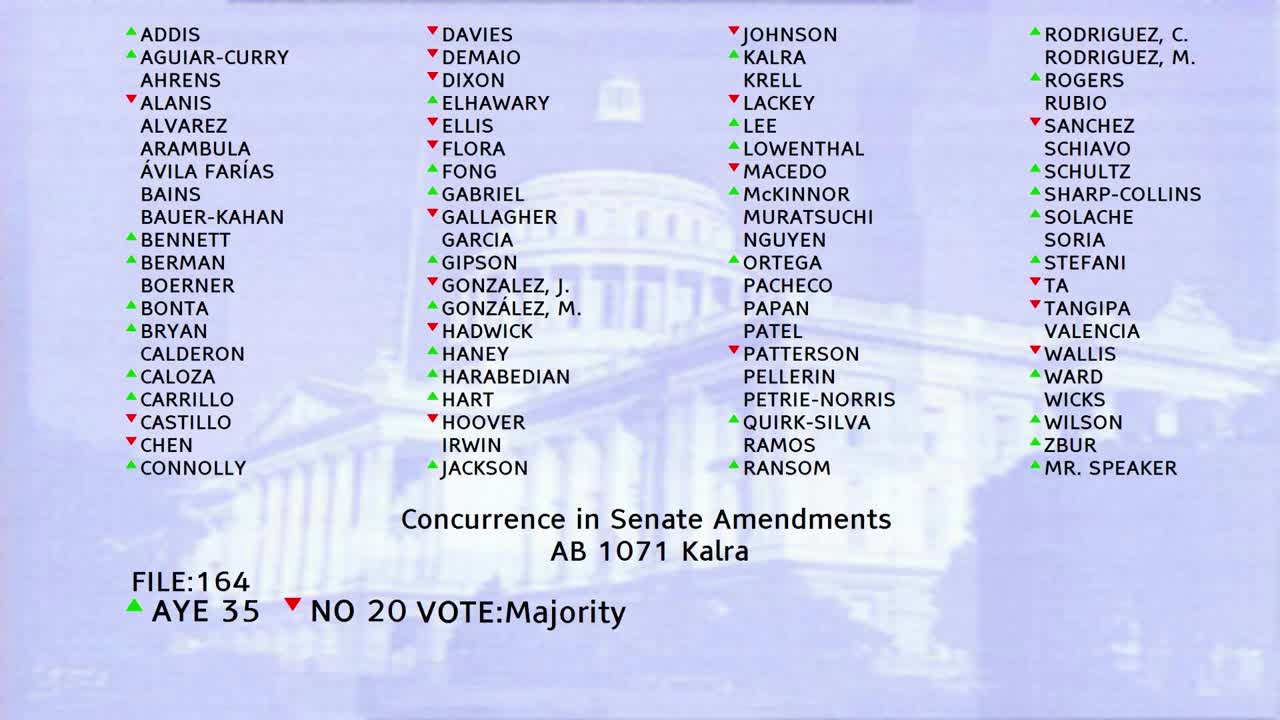 5MIN
Assembly Floor
 2MIN
Senate Floor
 7MIN
Senate Standing Committee on Judiciary
 7MIN
Senate Standing Committee on Elections and Constitutional Amendments


Bill Co-Author(s):