AB 1405: Artificial intelligence: auditors: registration.
- Session Year: 2025-2026
- House: Assembly
- Latest Version Date: 2026-09-09
Current Status:
Passed
(2026-09-09: Chaptered by Secretary of State - Chapter 178, Statutes of 2026.)
Introduced
In Committee
Awaiting First Chamber Vote
Passed First Chamber
In Committee
Awaiting Second Chamber Vote
Passed Second Chamber
Enacted
Existing law establishes the Department of Technology within the Government Operations Agency. Existing law requires the department to conduct, in coordination with other interagency bodies as it deems appropriate, a comprehensive inventory of all high-risk automated decision systems that have been proposed for use, development, or procurement by, or are being used, developed, or procured by, any state agency.
Existing law generally regulates artificial intelligence, including the Transparency in Frontier Artificial Intelligence Act, which, among other things related to the safety of certain artificial intelligence models, requires a large frontier developer to write, implement, comply with, and clearly and conspicuously publish on its internet website a frontier AI framework that applies to the large frontier developers frontier models and describes how the large frontier developer approaches certain safety-related items. Existing law defines artificial intelligence as an engineered or machine-based system that varies in its level of autonomy and that can, for explicit or implicit objectives, infer from the input it receives how to generate outputs that can influence physical or virtual environments.
This bill would require the Government Operations Agency to, no later than January 1, 2029, establish an AI Auditor Registry on the agencys internet website allowing AI auditors to register with the agency and allowing natural persons to report misconduct by a registered AI auditor, and require the agency to fix annual registration fees, as specified. The bill would, commencing January 1, 2029, prohibit an unregistered person from offering, selling, or conducting a covered AI audit, as defined, and would require the agency to, among other things, issue a unique registration number to each registered AI auditor and publish information provided by a registered AI auditor on the agencys internet website. The bill would require the registration number of a registered AI auditor to be clearly and conspicuously displayed on all advertising materials offering or soliciting covered AI audit services. The bill would authorize the agency to adopt regulations that are reasonably necessary to effectuate the purposes of the bill.
This bill would require an AI auditor that registers with the agency to provide specified information to the agency and would impose various requirements on a registered AI auditor that conducts a covered AI audit, including, among other things, providing the auditee with a report that includes a signed and dated statement indicating that the audit was conducted according to the provisions of this bill.
This bill would require a registered AI auditor to adhere to various standards of independence, objectivity, and integrity, including not seeking, soliciting, negotiating for, or accepting employment with an auditee while participating in the audit and not conducting a covered AI audit if the auditor has a financial, business, employment, or other interest or relationship that would reasonably be expected to impair the auditors independence or objectivity. The bill would prohibit a registered AI auditor from preventing an employee from engaging in, or from retaliating against an employee who has engaged in, specified whistleblower activity. The bill would authorize the agency to investigate alleged violations of the bill, as specified, and provide that a violation constitutes grounds for removal from the registry and referral to the Attorney General or other appropriate enforcement authority.
This bill would create the AI Auditors Registration Fund within the State Treasury, to be administered by the agency, and would require that all moneys collected or received by the agency pursuant to the above-described provisions be deposited into the fund to be available, upon appropriation by the Legislature, to administer the above-described provisions.
Existing law establishes the California Board of Accountancy, which is within the Department of Consumer Affairs, and requires the board to license and regulate accountants in this state.
This bill would exempt a registered AI auditor licensed or authorized to practice public accountancy and a firm holding a permit to practice public accountancy issued by the California Board of Accountancy, as specified, from complying with certain requirements related to reporting information to the agency and standards of independence, objectivity, and integrity under the bill if certain requirements are met. The bill would require the Government Operations Agency to, if the agency determines that a certified public accountant, public accountant, or accounting firm in good standing has violated this bill, notify the accountant or firm and the California Board of Accountancy in writing, and would require the board to investigate the complaint and provide the agency with a report of its findings and any resulting action.
Existing law establishes the Department of Technology within the Government Operations Agency. Existing law requires the department to conduct, in coordination with other interagency bodies as it deems appropriate, a comprehensive inventory of all high-risk automated decision systems that have been proposed for use, development, or procurement by, or are being used, developed, or procured by, any state agency.
Existing law generally regulates artificial intelligence, including the Transparency in Frontier Artificial Intelligence Act, which, among other things related to the safety of certain artificial intelligence models, requires a large frontier developer to write, implement, comply with, and clearly and conspicuously publish on its internet website a frontier AI framework that applies to the large frontier developers frontier models and describes how the large frontier developer approaches certain safety-related items. Existing law defines artificial intelligence as an engineered or machine-based system that varies in its level of autonomy and that can, for explicit or implicit objectives, infer from the input it receives how to generate outputs that can influence physical or virtual environments.
This bill would require the Government Operations Agency to, no later than January 1, 2029, establish an AI Auditor Registry on the agencys internet website allowing AI auditors to register with the agency and allowing natural persons to report misconduct by a registered AI auditor, and require the agency to fix annual registration fees, as specified. The bill would, commencing January 1, 2029, prohibit an unregistered person from offering, selling, or conducting a covered AI audit, as defined, and would require the agency to, among other things, issue a unique registration number to each registered AI auditor and publish information provided by a registered AI auditor on the agencys internet website. The bill would require the registration number of a registered AI auditor to be clearly and conspicuously displayed on all advertising materials offering or soliciting covered AI audit services. The bill would authorize the agency to adopt regulations that are reasonably necessary to effectuate the purposes of the bill.
This bill would require an AI auditor that registers with the agency to provide specified information to the agency and would impose various requirements on a registered AI auditor that conducts a covered AI audit, including, among other things, providing the auditee with a report that includes a signed and dated statement indicating that the audit was conducted according to the provisions of this bill.
This bill would require a registered AI auditor to adhere to various standards of independence, objectivity, and integrity, including not seeking, soliciting, negotiating for, or accepting employment with an auditee while participating in the audit and not conducting a covered AI audit if the auditor has a financial, business, employment, or other interest or relationship that would reasonably be expected to impair the auditors independence or objectivity. The bill would prohibit a registered AI auditor from preventing an employee from engaging in, or from retaliating against an employee who has engaged in, specified whistleblower activity. The bill would authorize the agency to investigate alleged violations of the bill, as specified, and provide that a violation constitutes grounds for removal from the registry and referral to the Attorney General or other appropriate enforcement authority.
This bill would create the AI Auditors Registration Fund within the State Treasury, to be administered by the agency, and would require that all moneys collected or received by the agency pursuant to the above-described provisions be deposited into the fund to be available, upon appropriation by the Legislature, to administer the above-described provisions.
Existing law establishes the California Board of Accountancy, which is within the Department of Consumer Affairs, and requires the board to license and regulate accountants in this state.
This bill would exempt a registered AI auditor licensed or authorized to practice public accountancy and a firm holding a permit to practice public accountancy issued by the California Board of Accountancy, as specified, from complying with certain requirements related to reporting information to the agency and standards of independence, objectivity, and integrity under the bill if certain requirements are met. The bill would require the Government Operations Agency to, if the agency determines that a certified public accountant, public accountant, or accounting firm in good standing has violated this bill, notify the accountant or firm and the California Board of Accountancy in writing, and would require the board to investigate the complaint and provide the agency with a report of its findings and any resulting action.
Existing law establishes the Department of Technology within the Government Operations Agency. Existing law requires the department to conduct, in coordination with other interagency bodies as it deems appropriate, a comprehensive inventory of all high-risk automated decision systems that have been proposed for use, development, or procurement by, or are being used, developed, or procured by, any state agency.
Existing law defines automated decision system as a computational process derived from machine learning, statistical modeling, data analytics, or artificial intelligence that issues simplified output, including a score, classification, or recommendation, that is used to assist or replace human discretionary decisionmaking and materially impacts natural persons. generally regulates artificial intelligence, including the Transparency in Frontier Artificial Intelligence Act, which, among other things related to the safety of certain artificial intelligence models, requires a large frontier developer to write, implement, comply with, and clearly and conspicuously publish on its internet website a frontier AI framework that applies to the large frontier developers frontier models and describes how the large frontier developer approaches certain safety-related items. Existing law defines artificial intelligence as an engineered or machine-based system that varies in its level of autonomy and that can, for explicit or implicit objectives, infer from the input it receives how to generate outputs that can influence physical or virtual environments.
This bill would require the Government Operations Agency, by Agency to, no later than January 1, 2027, to 2029, establish a mechanism an AI Auditor Registry on the agencys internet website allowing AI auditors to enroll register with the agency and allowing natural persons to report misconduct by an enrolled AI auditor. a registered AI auditor, and require the agency to fix annual registration fees, as specified. The bill would require the agency, would, commencing January 1, 2027, to 2029, prohibit an unregistered person from offering, selling, or conducting a covered AI audit, as defined, and would require the agency to, among other things, issue a unique registration number to each registered AI auditor and publish information provided by an enrolled a registered AI auditor on the agencys internet website, retain specified reports for as long as the auditor remains enrolled, plus 10 years, and share reports submitted by persons reporting misconduct with other state agencies as necessary for enforcement purposes. website. The bill would require the registration number of a registered AI auditor to be clearly and conspicuously displayed on all advertising materials offering or soliciting covered AI audit services. The bill would authorize the agency to adopt regulations that are reasonably necessary to effectuate the purposes of the bill.
This bill would, commencing January 1, 2027, would require an AI auditor, prior to initially conducting a covered audit, as defined, to enroll with the agency. The bill would require an AI auditor that enrolls with the agency to pay an enrollment fee, to be fixed by the agency by January 1, 2027, and auditor that registers with the agency to provide specified information. The bill information to the agency and would impose various requirements on an a registered AI auditor that conducts a covered AI audit, including, among other things, providing the auditee with an audit report after the covered audit. a report that includes a signed and dated statement indicating that the audit was conducted according to the provisions of this bill.
This bill would prohibit the require a registered AI auditor from to adhere to various standards of independence, objectivity, and integrity, including not seeking, soliciting, negotiating for, or accepting employment with an auditee within 12 months of completing a covered audit of the auditee, while participating in the audit and not conducting a covered AI audit if the auditee had employed the auditor during the 12-month period preceding the audit, disclosing confidential information except under certain circumstances, and auditor has a financial, business, employment, or other interest or relationship that would reasonably be expected to impair the auditors independence or objectivity. The bill would prohibit a registered AI auditor from preventing an employee from engaging in, or from retaliating against an employee who has engaged in, specified whistleblower activity. The bill would authorize the agency to investigate alleged violations of the bill, as specified, and provide that a violation constitutes grounds for removal from the registry and referral to the Attorney General or other appropriate enforcement authority.
This bill would create the AI Auditors Enrollment Registration Fund within the State Treasury, to be administered by the agency, and would require that all moneys collected or received by the agency pursuant to the above-described provisions be deposited into the fund to be available, upon appropriation by the Legislature, to administer the above-described provisions.
Existing law establishes the California Board of Accountancy, which is within the Department of Consumer Affairs, and requires the board to license and regulate accountants in this state.
This bill would exempt a registered AI auditor licensed or authorized to practice public accountancy and a firm holding a permit to practice public accountancy issued by the California Board of Accountancy, as specified, from complying with certain requirements related to reporting information to the agency and standards of independence, objectivity, and integrity under the bill if certain requirements are met. The bill would require the Government Operations Agency to, if the agency determines that a certified public accountant, public accountant, or accounting firm in good standing has violated this bill, notify the accountant or firm and the California Board of Accountancy in writing, and would require the board to investigate the complaint and provide the agency with a report of its findings and any resulting action.
Existing law establishes the Department of Technology within the Government Operations Agency. Existing law requires the department to conduct, in coordination with other interagency bodies as it deems appropriate, a comprehensive inventory of all high-risk automated decision systems that have been proposed for use, development, or procurement by, or are being used, developed, or procured by, any state agency.
Existing law defines automated decision system as a computational process derived from machine learning, statistical modeling, data analytics, or artificial intelligence that issues simplified output, including a score, classification, or recommendation, that is used to assist or replace human discretionary decisionmaking and materially impacts natural persons. Existing law defines artificial intelligence as an engineered or machine-based system that varies in its level of autonomy and that can, for explicit or implicit objectives, infer from the input it receives how to generate outputs that can influence physical or virtual environments.
This bill would require the Government Operations Agency, by January 1, 2027, to establish a mechanism on the agencys internet website allowing AI auditors to enroll with the agency and allowing natural persons to report misconduct by an enrolled AI auditor. The bill would require the agency, commencing January 1, 2027, to publish information provided by an enrolled AI auditor on the agencys internet website, retain specified reports for as long as the auditor remains enrolled, plus 10 years, and share reports submitted by persons reporting misconduct with other state agencies as necessary for enforcement purposes.
This bill would, commencing January 1, 2027, require an AI auditor, prior to initially conducting a covered audit, as defined, to enroll with the agency. The bill would require an AI auditor that enrolls with the agency to pay an enrollment fee, to be fixed by the agency by January 1, 2027, and provide specified information. The bill would impose various requirements on an AI auditor that conducts a covered audit, including, among other things, providing the auditee with an audit report after the covered audit.
This bill would prohibit the AI auditor from accepting employment with an auditee within 12 months of completing a covered audit of the auditee, conducting a covered audit if the auditee had employed the auditor during the 12-month period preceding the audit, disclosing confidential information except under certain circumstances, and preventing an employee from engaging in, or retaliating against an employee who has engaged in, specified whistleblower activity.
This bill would create the AI Auditors Enrollment Fund within the State Treasury, to be administered by the agency, and would require that all moneys collected or received by the agency pursuant to the above-described provisions be deposited into the fund to be available, upon appropriation by the Legislature, to administer the above-described provisions.
Existing law establishes the Department of Technology within the Government Operations Agency. Existing law requires the department to conduct, in coordination with other interagency bodies as it deems appropriate, a comprehensive inventory of all high-risk automated decision systems that have been proposed for use, development, or procurement by, or are being used, developed, or procured by, any state agency.
Existing law defines automated decision system as a computational process derived from machine learning, statistical modeling, data analytics, or artificial intelligence that issues simplified output, including a score, classification, or recommendation, that is used to assist or replace human discretionary decisionmaking and materially impacts natural persons. Existing law defines artificial intelligence as an engineered or machine-based system that varies in its level of autonomy and that can, for explicit or implicit objectives, infer from the input it receives how to generate outputs that can influence physical or virtual environments.
This bill would require the Government Operations Agency, by January 1, 2027, to establish a mechanism on the agencys internet website allowing AI auditors to enroll with the agency and allowing natural persons to report misconduct by an enrolled AI auditor. The bill would require the agency, commencing January 1, 2027, to publish information provided by an enrolled AI auditor on the agencys internet website and website, retain specified reports for as long as the auditor remains enrolled, plus 10 years. years, and share reports submitted by persons reporting misconduct with other state agencies as necessary for enforcement purposes.
This bill would, commencing January 1, 2027, require an AI auditor, prior to initially conducting a covered audit, as defined, to enroll with the agency. The bill would require an AI auditor that enrolls with the agency to pay an enrollment fee, to be fixed by the agency by January 1, 2027, and provide specified information. The bill would impose various requirements on an AI auditor that conducts a covered audit, including, among other things, providing the auditee with an audit report after the covered audit.
This bill would prohibit the AI auditor from accepting employment with an auditee within 12 months of completing a covered audit of the auditee, conducting a covered audit if the auditee had employed the auditor during the 12-month period preceding the audit, disclosing confidential information except under certain circumstances, and preventing an employee from engaging in, or retaliating against an employee who has engaged in, specified whistleblower activity.
This bill would create the AI Auditors Enrollment Fund within the State Treasury, to be administered by the agency, and would require that all moneys collected or received by the agency pursuant to the above-described provisions be deposited into the fund to be available, upon appropriation by the Legislature, to administer the above-described provisions.
Existing law establishes the Department of Technology within the Government Operations Agency. Existing law requires the department to conduct, in coordination with other interagency bodies as it deems appropriate, a comprehensive inventory of all high-risk automated decision systems that have been proposed for use, development, or procurement by, or are being used, developed, or procured by, any state agency.
Existing law defines automated decision system as a computational process derived from machine learning, statistical modeling, data analytics, or artificial intelligence that issues simplified output, including a score, classification, or recommendation, that is used to assist or replace human discretionary decisionmaking and materially impacts natural persons. Existing law defines artificial intelligence as an engineered or machine-based system that varies in its level of autonomy and that can, for explicit or implicit objectives, infer from the input it receives how to generate outputs that can influence physical or virtual environments.
This bill would require the Government Operations Agency, by January 1, 2027, to establish a mechanism on the agencys internet website allowing AI auditors to enroll with the agency and allowing natural persons to report misconduct by an enrolled AI auditor. The bill would require the agency, commencing January 1, 2027, to publish information provided by an enrolled AI auditor on the agencys internet website and retain specified reports for as long as the auditor remains enrolled, plus 10 years.
This bill would, commencing January 1, 2027, require an AI auditor, prior to initially conducting a covered audit, as defined, to enroll with the agency. The bill would require an AI auditor that enrolls with the agency to pay an enrollment fee, to be fixed by the agency by January 1, 2027, and provide specified information. The bill would impose various requirements on an AI auditor that conducts a covered audit, including, among other things, providing the auditee with an audit report after the covered audit.
This bill would prohibit the AI auditor from accepting employment with an auditee within 12 months of completing a covered audit of the auditee, disclosing confidential information except under certain circumstances, and preventing an employee from engaging in, or retaliating against an employee who has engaged in, specified whistleblower activity.
This bill would create the AI Auditors Enrollment Fund within the State Treasury, to be administered by the agency, and would require that all moneys collected or received by the agency pursuant to the above-described provisions be deposited into the fund to be available, upon appropriation by the Legislature, to administer the above-described provisions.
For purposes of this chapter, the following definitions apply:
(a)Agency means the Government Operations Agency.
(b)Artificial intelligence or AI means an engineered or machine-based system that varies in its level of autonomy and that can, for explicit or implicit objectives, infer from the input it receives how to generate outputs that can influence physical or virtual environments.
(c)AI auditor means a person, partnership, or corporation that assesses an AI system or model on behalf of a third party.
(d)Covered AI audit means an audit conducted to assess internal controls, processes, or systems implemented for an AI system or model that are necessary for compliance with state law.
11549.81.The AI Auditors Registration Fund is hereby created within the State Treasury. The fund shall be administered by the Government Operations Agency. All moneys collected or received by the agency under this chapter shall be deposited into the AI Auditors Registration Fund to be available for expenditure by the agency, upon appropriation by the Legislature, to administer this chapter.
11549.82.(a)No later than January 1, 2029, the agency shall do all of the following:
(1)Establish an AI Auditor Registry on the agencys internet website allowing AI auditors to register with the agency.
(2)Fix annual registration fees at an amount not exceeding the reasonable costs of administering this chapter.
(3)Establish a mechanism on the agencys internet website allowing natural persons to report misconduct by a registered AI auditor.
(b)Beginning January 1, 2029, the agency shall do all of the following:
(1)Issue a unique registration number to each registered AI auditor.
(2)Publish all of the following information in a publicly accessible format on the agencys internet website:
(A)The registration number of each registered AI auditor.
(B)Any registration information provided by the registered AI auditor pursuant to this chapter.
(C)A statement prominently disclosing that registration by an AI auditor does not constitute recommendation or endorsement of that entity by the State of California.
(3)Retain misconduct reports submitted using the mechanism established pursuant to subdivision (a) for as long as the relevant AI auditor remains registered, plus 10 years.
(4)Share misconduct reports submitted using the mechanism established pursuant to subdivision (a) with other state agencies as necessary for enforcement purposes.
(5)Periodically review and update, as necessary, the annual registration fees and reporting mechanism established pursuant to subdivision (a).
11549.82.5.Beginning January 1, 2029, a person shall not offer, sell, or conduct a covered AI audit unless the person is registered with the agency pursuant to this chapter.
11549.83.(a)An AI auditor that registers with the agency pursuant to this chapter shall provide the agency with all of the following information:
(1)The business name of the AI auditor.
(2)Business contact information for the AI auditor.
(3)A list of California laws or regulations under which the AI auditor conducts covered AI audits.
(4)Any relevant certifications or accreditations held by the AI auditor.
(5)A written description of the AI auditor and the services they provide, not to exceed 500 words in length.
(6)(A)A standard operating procedure that includes both of the following:
(i)References to any standards the AI auditor applies when conducting audits, including, but not limited to, standards published by the International Organization for Standardization, the National Institute of Standards and Technology, national and international auditing and assurance standard-setters, professional accountancy bodies, or a governmental agency in this state.
(ii)A description of the basis for any claims made by the AI auditor regarding the accuracy, reliability, or validity of its protocols.
(B)An AI auditor that provides a standard operating procedure pursuant to this paragraph may make reasonable redactions for the purpose of protecting trade secrets, as that term is defined in Section 3426.1 of the Civil Code.
(b)A registered AI auditor shall provide updated information to the agency within 90 days of making any change that materially affects the accuracy or completeness of information published by the agency.
(c)A registered AI auditor shall conduct covered AI audits in accordance with widely recognized industry standards appropriate to the system or model being audited, to the extent appropriate standards are available.
(d)(1)A registered AI auditor that conducts a covered AI audit shall provide the auditee with a report that includes, but is not limited to, all of the following information:
(A)The scope and objectives of the audit.
(B)The results of the audit and any documentation necessary to demonstrate the basis of those results.
(C)For each deficiency identified in the audit, a description of any technical, operational, or governance measures the AI auditor determines would reasonably address the deficiency, if appropriate.
(D)A description of whether the auditee has implemented and adhered to internal safety standards and protocols that are within the scope of the covered AI audit.
(E)A description of the limitations of the audit, including any matters within the scope of the audit that were not assessed and any material gaps in the evidence, information, systems, or access available to the AI auditor.
(F)A statement indicating that the audit was conducted in accordance with the requirements of this chapter, signed and dated by the AI auditor.
(2)A registered AI auditor holding a current and valid license issued by the California Board of Accountancy, or authorized to practice public accountancy pursuant to Article 5.1 (commencing with Section 5096) of Chapter 1 of Division 3 of the Business and Professions Code, and a firm holding a current and valid permit to practice public accountancy issued by the California Board of Accountancy, including the firms partners, shareholders, owners, and employees acting within the scope of that license or permit, shall be deemed to satisfy the requirements of paragraph (1) when issuing a report pursuant to this chapter, provided both of the following apply:
(A)The report addresses the subject matter required by this chapter.
(B)The AI auditor complies with all applicable professional standards, including the following:
(i)Chapter 1 (commencing with Section 5000) of Division 3 of the Business and Professions Code, known as the California Accountancy Act, and regulations promulgated thereunder.
(ii)The American Institute of Certified Public Accountants (AICPA) Code of Professional Conduct and its requirements relating to integrity, objectivity, independence, professional competence, due care, and the public interest.
(iii)The attestation standards promulgated by the AICPA, as applicable to engagements performed under this chapter.
(e)A registered AI auditor shall retain all of the following information for at least 10 years:
(1)Any information provided to an auditee pursuant to this chapter.
(2)Any documentation necessary to demonstrate the basis of the results of a covered AI audit.
(f)(1)Except as provided by paragraph (2), a registered AI auditor shall adhere to all of the following standards of independence, objectivity, and integrity:
(A)A registered AI auditor shall maintain independence from the auditee and shall not conduct a covered AI audit if the auditor has a financial, business, employment, or other interest or relationship that would reasonably be expected to impair the auditors independence or objectivity. Reasonable compensation received for performing a covered AI audit shall not, by itself, constitute an interest prohibited by this subparagraph.
(B)A registered AI auditor shall not conduct a covered AI audit that requires the auditor to evaluate the auditors own work, including a system, process, control, assessment, or other subject matter that the auditor materially designed, developed, implemented, or operated for the auditee.
(C)An individual conducting a covered AI audit shall not seek, solicit, negotiate for, or accept employment with the auditee while participating in the audit.
(D)A registered AI auditor shall not assign an individual to perform a covered AI audit of an auditee if, during the preceding 12 months, the individual was employed by the auditee in a position involving material responsibility for, or material participation in, the subject matter of the audit.
(E)A registered AI auditor shall exercise independent, objective, and impartial professional judgment in planning and conducting a covered AI audit and in preparing and reporting its findings and conclusions.
(F)A registered AI auditor shall ensure that the individuals assigned to perform a covered AI audit collectively possess the knowledge, skills, and abilities necessary to competently perform the audit, including any specialized expertise necessary for the subject matter and scope of the audit.
(G)A registered AI auditor shall comply with any additional professional standards governing independence, objectivity, integrity, competence, or professional conduct adopted by the agency.
(2)A registered AI auditor holding a current and valid license issued by the California Board of Accountancy, or authorized to practice public accountancy pursuant to Article 5.1 (commencing with Section 5096) of Chapter 1 of Division 3 of the Business and Professions Code, and a firm holding a current and valid permit to practice public accountancy issued by the California Board of Accountancy, including the firms partners, shareholders, owners, and employees acting within the scope of that license or permit, shall be deemed to satisfy the requirements of paragraph (1) when performing attestation or assurance engagements subject to this chapter, provided the AI auditor complies with all applicable professional standards, including the following:
(A)Chapter 1 (commencing with Section 5000) of Division 3 of the Business and Professions Code, known as the California Accountancy Act, and regulations promulgated thereunder.
(B)The AICPA Code of Professional Conduct and its requirements relating to integrity, objectivity, independence, professional competence, due care, and the public interest.
(C)The attestation standards promulgated by the AICPA, as applicable to engagements performed under this chapter.
(g)A registered AI auditor shall not do either of the following:
(1)Prevent an employee from disclosing information to the Attorney General or the Labor Commissioner, or submitting a misconduct report using the mechanism established pursuant to this chapter, including through terms and conditions of employment or seeking to enforce terms and conditions of employment, if the employee has reasonable cause to believe the information indicates that the auditor is out of compliance with the requirements of this chapter.
(2)Retaliate against an employee for disclosing information or submitting a misconduct report pursuant to paragraph (1).
11549.83.5.The registration number of a registered AI auditor shall be clearly and conspicuously displayed on all advertising materials offering or soliciting covered AI audit services.
11549.84.(a)(1)Except as provided by subdivision (b), upon receiving a report alleging a violation of this chapter by a registered AI auditor, the agency may investigate the alleged violation and obtain information reasonably necessary to determine whether the AI auditor has violated this chapter.
(2)A violation of this chapter by a registered AI auditor shall constitute grounds for removal from the registry and referral to the Attorney General or other appropriate enforcement authority.
(3)Before removing a registered AI auditor from the registry pursuant to paragraph (2), the agency shall provide the AI auditor with written notice of the basis for removal and a reasonable opportunity to cure or contest the removal, in a manner prescribed by the agency.
(b)(1)If the agency determines that a certified public accountant, public accountant, or accounting firm in good standing as certified by the California Board of Accountancy has violated this chapter, the agency shall notify in writing the certified public accountant, public accountant, or accounting firm and the California Board of Accountancy.
(2)The California Board of Accountancy shall investigate the complaint in accordance with its existing authority and procedures and, upon completion of the investigation, provide the agency with a report of its findings and any resulting action.
11549.85.The agency may adopt regulations that are reasonably necessary to effectuate the purposes of this chapter in accordance with Chapter 3.5 (commencing with Section 11340) of Part 1 of Division 3 of Title 2 of the Government Code.
11549.86.(a)Nothing in this chapter shall be construed to impede, delay, or otherwise affect the conduct of any audit required under any other statute or regulation that becomes operative prior to the effective dates of this chapter.
(b)Nothing in this chapter shall be construed to constitute recommendation or endorsement of an AI auditor by the State of California.
For purposes of this chapter, the following definitions apply:
(a)Agency means the Government Operations Agency.
(b)Artificial intelligence or AI means an engineered or machine-based system that varies in its level of autonomy and that can, for explicit or implicit objectives, infer from the input it receives how to generate outputs that can influence physical or virtual environments.
(c)AI auditor means a person, partnership, or corporation that assesses an AI system or model on behalf of a third party.
(d)Covered AI audit means an audit conducted to assess internal controls, processes, or systems implemented for an AI system or model that are necessary for compliance with state law.
11549.81.The AI Auditors Registration Fund is hereby created within the State Treasury. The fund shall be administered by the Government Operations Agency. All moneys collected or received by the agency under this chapter shall be deposited into the AI Auditors Registration Fund to be available for expenditure by the agency, upon appropriation by the Legislature, to administer this chapter.
11549.82.(a)No later than January 1, 2029, the agency shall do all of the following:
(1)Establish an AI Auditor Registry on the agencys internet website allowing AI auditors to register with the agency.
(2)Fix annual registration fees at an amount not exceeding the reasonable costs of administering this chapter.
(3)Establish a mechanism on the agencys internet website allowing natural persons to report misconduct by a registered AI auditor.
(b)Beginning January 1, 2029, the agency shall do all of the following:
(1)Issue a unique registration number to each registered AI auditor.
(2)Publish all of the following information in a publicly accessible format on the agencys internet website:
(A)The registration number of each registered AI auditor.
(B)Any registration information provided by the registered AI auditor pursuant to this chapter.
(C)A statement prominently disclosing that registration by an AI auditor does not constitute recommendation or endorsement of that entity by the State of California.
(3)Retain misconduct reports submitted using the mechanism established pursuant to subdivision (a) for as long as the relevant AI auditor remains registered, plus 10 years.
(4)Share misconduct reports submitted using the mechanism established pursuant to subdivision (a) with other state agencies as necessary for enforcement purposes.
(5)Periodically review and update, as necessary, the annual registration fees and reporting mechanism established pursuant to subdivision (a).
11549.82.5.Beginning January 1, 2029, a person shall not offer, sell, or conduct a covered AI audit unless the person is registered with the agency pursuant to this chapter.
11549.83.(a)An AI auditor that registers with the agency pursuant to this chapter shall provide the agency with all of the following information:
(1)The business name of the AI auditor.
(2)Business contact information for the AI auditor.
(3)A list of California laws or regulations under which the AI auditor conducts covered AI audits.
(4)Any relevant certifications or accreditations held by the AI auditor.
(5)A written description of the AI auditor and the services they provide, not to exceed 500 words in length.
(6)(A)A standard operating procedure that includes both of the following:
(i)References to any standards the AI auditor applies when conducting audits, including, but not limited to, standards published by the International Organization for Standardization, the National Institute of Standards and Technology, national and international auditing and assurance standard-setters, professional accountancy bodies, or a governmental agency in this state.
(ii)A description of the basis for any claims made by the AI auditor regarding the accuracy, reliability, or validity of its protocols.
(B)An AI auditor that provides a standard operating procedure pursuant to this paragraph may make reasonable redactions for the purpose of protecting trade secrets, as that term is defined in Section 3426.1 of the Civil Code.
(b)A registered AI auditor shall provide updated information to the agency within 90 days of making any change that materially affects the accuracy or completeness of information published by the agency.
(c)A registered AI auditor shall conduct covered AI audits in accordance with widely recognized industry standards appropriate to the system or model being audited, to the extent appropriate standards are available.
(d)(1)A registered AI auditor that conducts a covered AI audit shall provide the auditee with a report that includes, but is not limited to, all of the following information:
(A)The scope and objectives of the audit.
(B)The results of the audit and any documentation necessary to demonstrate the basis of those results.
(C)For each deficiency identified in the audit, a description of any technical, operational, or governance measures the AI auditor determines would reasonably address the deficiency, if appropriate.
(D)A description of whether the auditee has implemented and adhered to internal safety standards and protocols that are within the scope of the covered AI audit.
(E)A description of the limitations of the audit, including any matters within the scope of the audit that were not assessed and any material gaps in the evidence, information, systems, or access available to the AI auditor.
(F)A statement indicating that the audit was conducted in accordance with the requirements of this chapter, signed and dated by the AI auditor.
(2)A registered AI auditor holding a current and valid license issued by the California Board of Accountancy, or authorized to practice public accountancy pursuant to Article 5.1 (commencing with Section 5096) of Chapter 1 of Division 3 of the Business and Professions Code, and a firm holding a current and valid permit to practice public accountancy issued by the California Board of Accountancy, including the firms partners, shareholders, owners, and employees acting within the scope of that license or permit, shall be deemed to satisfy the requirements of paragraph (1) when issuing a report pursuant to this chapter, provided both of the following apply:
(A)The report addresses the subject matter required by this chapter.
(B)The AI auditor complies with all applicable professional standards, including the following:
(i)Chapter 1 (commencing with Section 5000) of Division 3 of the Business and Professions Code, known as the California Accountancy Act, and regulations promulgated thereunder.
(ii)The American Institute of Certified Public Accountants (AICPA) Code of Professional Conduct and its requirements relating to integrity, objectivity, independence, professional competence, due care, and the public interest.
(iii)The attestation standards promulgated by the AICPA, as applicable to engagements performed under this chapter.
(e)A registered AI auditor shall retain all of the following information for at least 10 years:
(1)Any information provided to an auditee pursuant to this chapter.
(2)Any documentation necessary to demonstrate the basis of the results of a covered AI audit.
(f)(1)Except as provided by paragraph (2), a registered AI auditor shall adhere to all of the following standards of independence, objectivity, and integrity:
(A)A registered AI auditor shall maintain independence from the auditee and shall not conduct a covered AI audit if the auditor has a financial, business, employment, or other interest or relationship that would reasonably be expected to impair the auditors independence or objectivity. Reasonable compensation received for performing a covered AI audit shall not, by itself, constitute an interest prohibited by this subparagraph.
(B)A registered AI auditor shall not conduct a covered AI audit that requires the auditor to evaluate the auditors own work, including a system, process, control, assessment, or other subject matter that the auditor materially designed, developed, implemented, or operated for the auditee.
(C)An individual conducting a covered AI audit shall not seek, solicit, negotiate for, or accept employment with the auditee while participating in the audit.
(D)A registered AI auditor shall not assign an individual to perform a covered AI audit of an auditee if, during the preceding 12 months, the individual was employed by the auditee in a position involving material responsibility for, or material participation in, the subject matter of the audit.
(E)A registered AI auditor shall exercise independent, objective, and impartial professional judgment in planning and conducting a covered AI audit and in preparing and reporting its findings and conclusions.
(F)A registered AI auditor shall ensure that the individuals assigned to perform a covered AI audit collectively possess the knowledge, skills, and abilities necessary to competently perform the audit, including any specialized expertise necessary for the subject matter and scope of the audit.
(G)A registered AI auditor shall comply with any additional professional standards governing independence, objectivity, integrity, competence, or professional conduct adopted by the agency.
(2)A registered AI auditor holding a current and valid license issued by the California Board of Accountancy, or authorized to practice public accountancy pursuant to Article 5.1 (commencing with Section 5096) of Chapter 1 of Division 3 of the Business and Professions Code, and a firm holding a current and valid permit to practice public accountancy issued by the California Board of Accountancy, including the firms partners, shareholders, owners, and employees acting within the scope of that license or permit, shall be deemed to satisfy the requirements of paragraph (1) when performing attestation or assurance engagements subject to this chapter, provided the AI auditor complies with all applicable professional standards, including the following:
(A)Chapter 1 (commencing with Section 5000) of Division 3 of the Business and Professions Code, known as the California Accountancy Act, and regulations promulgated thereunder.
(B)The AICPA Code of Professional Conduct and its requirements relating to integrity, objectivity, independence, professional competence, due care, and the public interest.
(C)The attestation standards promulgated by the AICPA, as applicable to engagements performed under this chapter.
(g)A registered AI auditor shall not do either of the following:
(1)Prevent an employee from disclosing information to the Attorney General or the Labor Commissioner, or submitting a misconduct report using the mechanism established pursuant to this chapter, including through terms and conditions of employment or seeking to enforce terms and conditions of employment, if the employee has reasonable cause to believe the information indicates that the auditor is out of compliance with the requirements of this chapter.
(2)Retaliate against an employee for disclosing information or submitting a misconduct report pursuant to paragraph (1).
11549.83.5.The registration number of a registered AI auditor shall be clearly and conspicuously displayed on all advertising materials offering or soliciting covered AI audit services.
11549.84.(a)(1)Except as provided by subdivision (b), upon receiving a report alleging a violation of this chapter by a registered AI auditor, the agency may investigate the alleged violation and obtain information reasonably necessary to determine whether the AI auditor has violated this chapter.
(2)A violation of this chapter by a registered AI auditor shall constitute grounds for removal from the registry and referral to the Attorney General or other appropriate enforcement authority.
(3)Before removing a registered AI auditor from the registry pursuant to paragraph (2), the agency shall provide the AI auditor with written notice of the basis for removal and a reasonable opportunity to cure or contest the removal, in a manner prescribed by the agency.
(b)(1)If the agency determines that a certified public accountant, public accountant, or accounting firm in good standing as certified by the California Board of Accountancy has violated this chapter, the agency shall notify in writing the certified public accountant, public accountant, or accounting firm and the California Board of Accountancy.
(2)The California Board of Accountancy shall investigate the complaint in accordance with its existing authority and procedures and, upon completion of the investigation, provide the agency with a report of its findings and any resulting action.
11549.85.The agency may adopt regulations that are reasonably necessary to effectuate the purposes of this chapter in accordance with Chapter 3.5 (commencing with Section 11340) of Part 1 of Division 3 of Title 2 of the Government Code.
11549.86.(a)Nothing in this chapter shall be construed to impede, delay, or otherwise affect the conduct of any audit required under any other statute or regulation that becomes operative prior to the effective dates of this chapter.
(b)Nothing in this chapter shall be construed to constitute recommendation or endorsement of an AI auditor by the State of California.
For purposes of this chapter, the following definitions apply:
(a)Agency means the Government Operations Agency.
(b)Artificial intelligence or AI means an engineered or machine-based system that varies in its level of autonomy and that can, for explicit or implicit objectives, infer from the input it receives how to generate outputs that can influence physical or virtual environments.
(c)Artificial intelligence auditor or AI auditor means a person, partnership, or corporation that assesses an AI system or model on behalf of a third party.
(d)Covered AI audit means an audit conducted pursuant to any state statute that requires an audit of an AI system or model by an independent third party auditor. to assess internal controls, processes, or systems implemented for an AI system or model that are necessary for compliance with state law.
11549.81.The AI Auditors Enrollment Registration Fund is hereby created within the State Treasury. The fund shall be administered by the Government Operations Agency. All moneys collected or received by the agency under this chapter shall be deposited into the AI Auditors Enrollment Registration Fund to be available for expenditure by the agency, upon appropriation by the Legislature, to administer this chapter.
11549.82.(a)By No later than January 1, 2027, 2029, the agency shall do all of the following:
(1)Establish a mechanism an AI Auditor Registry on the agencys internet website allowing AI auditors to enroll register with the agency pursuant to subdivision (a) of Section 11549.83. agency.
(2)Fix enrollment annual registration fees at an amount not exceeding the reasonable costs of administering this chapter.
(3)Establish a mechanism on the agencys internet website allowing natural persons to report misconduct by an enrolled a registered AI auditor.
(b)Beginning January 1, 2027, 2029, the agency shall do all of the following:
(1)Issue a unique registration number to each registered AI auditor.
(1)(2)Publish any all of the following information provided by an enrolled AI auditor pursuant to subdivision (a) of Section 11549.83 in a publicly accessible format on the agencys internet website. website:
(A)The registration number of each registered AI auditor.
(B)Any registration information provided by the registered AI auditor pursuant to this chapter.
(C)A statement prominently disclosing that registration by an AI auditor does not constitute recommendation or endorsement of that entity by the State of California.
(2)(3)Retain any report misconduct reports submitted using the mechanism established pursuant to paragraph (3) of subdivision (a) for as long as the enrolled relevant AI auditor remains enrolled, registered, plus 10 years.
(3)(4)Share misconduct reports submitted using the mechanism established pursuant to paragraph (3) of subdivision (a) with other state agencies as necessary for enforcement purposes.
(5)Periodically review and update, as necessary, the annual registration fees and reporting mechanism established pursuant to subdivision (a).
11549.82.5.Beginning January 1, 2029, a person shall not offer, sell, or conduct a covered AI audit unless the person is registered with the agency pursuant to this chapter.
11549.83.(a)Beginning January 1, 2027, prior to initially conducting a covered audit, an AI auditor shall do all of the following:(1)Enroll with the agency using the mechanism established pursuant to paragraph (1) of subdivision (a) of Section 11549.82.(2)Pay to the agency the enrollment fee set forth in paragraph (2) of subdivision (a) of Section 11549.82.(3)Provide to11549.83.(a)An AI auditor that registers with the agency pursuant to this chapter shall provide the agency with all of the following information:
(A)(1)The legal business name of the AI auditor.
(B)All of the following contact information:(i)The primary physical address of the auditor, if applicable.(ii)The primary internet website of the auditor, if applicable.(iii)A telephone number enabling a natural person to communicate with the auditor.(iv)An email address enabling a natural person to communicate with the auditor.(C)The types of AI systems or models that the auditor is enrolling to audit.(2)Business contact information for the AI auditor.
(3)A list of California laws or regulations under which the AI auditor conducts covered AI audits.
(D)(4)Any relevant certifications or accreditations held by the AI auditor, and the names of the certifying or accrediting entities. auditor.
(E)(5)A written description of the AI auditor and the services they provide, not to exceed 200 500 words in length.
(F)A(6)(A)A standard operating procedure that does includes both of the following:
(i)Describes the auditors protocols in sufficient detail to enable a third party to assess whether audits are conducted according to widely recognized industry standards appropriate to the system or model being audited.(i)References to any standards the AI auditor applies when conducting audits, including, but not limited to, standards published by the International Organization for Standardization, the National Institute of Standards and Technology, national and international auditing and assurance standard-setters, professional accountancy bodies, or a governmental agency in this state.
(ii)Includes documentation substantiating A description of the basis for any claims made by the AI auditor regarding the accuracy, reliability, or validity of its protocols.
(B)An AI auditor that provides a standard operating procedure pursuant to this paragraph may make reasonable redactions for the purpose of protecting trade secrets, as that term is defined in Section 3426.1 of the Civil Code.
(b)A registered AI auditor shall provide updated information to the agency within 90 days of making any change that materially affects the accuracy or completeness of information published by the agency.
(b)In conducting a covered audit, an enrolled AI auditor shall abide by(c)A registered AI auditor shall conduct covered AI audits in accordance with widely recognized industry standards appropriate to the system or model being audited. audited, to the extent appropriate standards are available.
(d)(1)A registered AI auditor that conducts a covered AI audit shall provide the auditee with a report that includes, but is not limited to, all of the following information:
(A)The scope and objectives of the audit.
(B)The results of the audit and any documentation necessary to demonstrate the basis of those results.
(C)For each deficiency identified in the audit, a description of any technical, operational, or governance measures the AI auditor determines would reasonably address the deficiency, if appropriate.
(D)A description of whether the auditee has implemented and adhered to internal safety standards and protocols that are within the scope of the covered AI audit.
(E)A description of the limitations of the audit, including any matters within the scope of the audit that were not assessed and any material gaps in the evidence, information, systems, or access available to the AI auditor.
(F)A statement indicating that the audit was conducted in accordance with the requirements of this chapter, signed and dated by the AI auditor.
(2)A registered AI auditor holding a current and valid license issued by the California Board of Accountancy, or authorized to practice public accountancy pursuant to Article 5.1 (commencing with Section 5096) of Chapter 1 of Division 3 of the Business and Professions Code, and a firm holding a current and valid permit to practice public accountancy issued by the California Board of Accountancy, including the firms partners, shareholders, owners, and employees acting within the scope of that license or permit, shall be deemed to satisfy the requirements of paragraph (1) when issuing a report pursuant to this chapter, provided both of the following apply:
(A)The report addresses the subject matter required by this chapter.
(B)The AI auditor complies with all applicable professional standards, including the following:
(i)Chapter 1 (commencing with Section 5000) of Division 3 of the Business and Professions Code, known as the California Accountancy Act, and regulations promulgated thereunder.
(ii)The American Institute of Certified Public Accountants (AICPA) Code of Professional Conduct and its requirements relating to integrity, objectivity, independence, professional competence, due care, and the public interest.
(iii)The attestation standards promulgated by the AICPA, as applicable to engagements performed under this chapter.
(e)A registered AI auditor shall retain all of the following information for at least 10 years:
(1)Any information provided to an auditee pursuant to this chapter.
(2)Any documentation necessary to demonstrate the basis of the results of a covered AI audit.
(f)(1)Except as provided by paragraph (2), a registered AI auditor shall adhere to all of the following standards of independence, objectivity, and integrity:
(A)A registered AI auditor shall maintain independence from the auditee and shall not conduct a covered AI audit if the auditor has a financial, business, employment, or other interest or relationship that would reasonably be expected to impair the auditors independence or objectivity. Reasonable compensation received for performing a covered AI audit shall not, by itself, constitute an interest prohibited by this subparagraph.
(B)A registered AI auditor shall not conduct a covered AI audit that requires the auditor to evaluate the auditors own work, including a system, process, control, assessment, or other subject matter that the auditor materially designed, developed, implemented, or operated for the auditee.
(C)An individual conducting a covered AI audit shall not seek, solicit, negotiate for, or accept employment with the auditee while participating in the audit.
(D)A registered AI auditor shall not assign an individual to perform a covered AI audit of an auditee if, during the preceding 12 months, the individual was employed by the auditee in a position involving material responsibility for, or material participation in, the subject matter of the audit.
(E)A registered AI auditor shall exercise independent, objective, and impartial professional judgment in planning and conducting a covered AI audit and in preparing and reporting its findings and conclusions.
(F)A registered AI auditor shall ensure that the individuals assigned to perform a covered AI audit collectively possess the knowledge, skills, and abilities necessary to competently perform the audit, including any specialized expertise necessary for the subject matter and scope of the audit.
(G)A registered AI auditor shall comply with any additional professional standards governing independence, objectivity, integrity, competence, or professional conduct adopted by the agency.
(2)A registered AI auditor holding a current and valid license issued by the California Board of Accountancy, or authorized to practice public accountancy pursuant to Article 5.1 (commencing with Section 5096) of Chapter 1 of Division 3 of the Business and Professions Code, and a firm holding a current and valid permit to practice public accountancy issued by the California Board of Accountancy, including the firms partners, shareholders, owners, and employees acting within the scope of that license or permit, shall be deemed to satisfy the requirements of paragraph (1) when performing attestation or assurance engagements subject to this chapter, provided the AI auditor complies with all applicable professional standards, including the following:
(A)Chapter 1 (commencing with Section 5000) of Division 3 of the Business and Professions Code, known as the California Accountancy Act, and regulations promulgated thereunder.
(B)The AICPA Code of Professional Conduct and its requirements relating to integrity, objectivity, independence, professional competence, due care, and the public interest.
(C)The attestation standards promulgated by the AICPA, as applicable to engagements performed under this chapter.
(g)A registered AI auditor shall not do either of the following:
(1)Prevent an employee from disclosing information to the Attorney General or the Labor Commissioner, or submitting a misconduct report using the mechanism established pursuant to this chapter, including through terms and conditions of employment or seeking to enforce terms and conditions of employment, if the employee has reasonable cause to believe the information indicates that the auditor is out of compliance with the requirements of this chapter.
(2)Retaliate against an employee for disclosing information or submitting a misconduct report pursuant to paragraph (1).
11549.84.(a)After conducting a covered audit, an enrolled AI auditor shall provide the auditee with an audit report that contains, but is not limited to, all of the following:(1)The scope and objectives of the audit. (2)The results of the audit and any documentation necessary to demonstrate the basis of those results.(3)An explanation of any steps the auditee can take to meet widely recognized industry standards appropriate to the system or model being audited.(4)An explanation of any steps the auditee can take to become compliant with state law.(5)A statement that is signed and dated by each auditor that certifies that the covered audit was completed.(b)An AI auditor shall not knowingly make a material misrepresentation in an audit report prepared pursuant to this subdivision.(c)An enrolled AI auditor shall retain any documentation that is provided to an auditee pursuant to this chapter, or that is necessary to demonstrate the basis of the result of a covered audit, for at least 10 years.(d)An enrolled AI auditor shall not conduct a covered audit if it has a financial interest in the auditee other than financial compensation for performing an audit.(e)(1)Notwithstanding Chapter 1 (commencing with Section 16600) of Part 2 of Division 7 of the Business and Professions Code, an enrolled AI auditor shall not accept employment with an auditee within 12 months of completing a covered audit of the auditee.(2)An enrolled AI auditor shall not conduct a covered audit if the auditee had employed the auditor during the 12-month period preceding the audit.11549.85.(a)An enrolled AI auditor may disclose confidential information concerning an auditee only if the auditee provides written authorization or if the disclosure is any of the following:(1)Made in compliance with a subpoena or a summons enforceable by order of a court.(2)Reasonably necessary to maintain or defend the auditor in a legal proceeding initiated by the auditee.(3)Made in response to an official inquiry from a federal or state government regulatory agency.(4)Made to another enrolled AI auditor or person in connection with a proposed sale or merger of the auditors professional practice, provided the parties enter into a written nondisclosure agreement with regard to all auditee information shared between the parties.(5)Made to either of the following:(A)Another enrolled AI auditor to the extent necessary for purposes of professional consultation.(B)Organizations that provide professional standards review and ethics or quality control peer review.(6)Specifically permitted by state or federal law.(b)An enrolled AI auditor shall not do either of the following:(1)Prevent an employee from disclosing information to the Attorney General or the Labor Commissioner, or using the mechanism established pursuant to paragraph (3) of subdivision (a) of Section 11549.82, including through terms and conditions of employment or seeking to enforce terms and conditions of employment, if the employee has reasonable cause to believe the information indicates that the auditor is out of compliance with the requirements of this chapter.(2)Retaliate against an employee for disclosing information pursuant to paragraph (1).11549.83.5.The registration number of a registered AI auditor shall be clearly and conspicuously displayed on all advertising materials offering or soliciting covered AI audit services.
11549.84.(a)(1)Except as provided by subdivision (b), upon receiving a report alleging a violation of this chapter by a registered AI auditor, the agency may investigate the alleged violation and obtain information reasonably necessary to determine whether the AI auditor has violated this chapter.
(2)A violation of this chapter by a registered AI auditor shall constitute grounds for removal from the registry and referral to the Attorney General or other appropriate enforcement authority.
(3)Before removing a registered AI auditor from the registry pursuant to paragraph (2), the agency shall provide the AI auditor with written notice of the basis for removal and a reasonable opportunity to cure or contest the removal, in a manner prescribed by the agency.
(b)(1)If the agency determines that a certified public accountant, public accountant, or accounting firm in good standing as certified by the California Board of Accountancy has violated this chapter, the agency shall notify in writing the certified public accountant, public accountant, or accounting firm and the California Board of Accountancy.
(2)The California Board of Accountancy shall investigate the complaint in accordance with its existing authority and procedures and, upon completion of the investigation, provide the agency with a report of its findings and any resulting action.
11549.85.The agency may adopt regulations that are reasonably necessary to effectuate the purposes of this chapter in accordance with Chapter 3.5 (commencing with Section 11340) of Part 1 of Division 3 of Title 2 of the Government Code.
11549.86.(a)Nothing in this chapter shall be construed to impede, delay, or otherwise affect the conduct of any audit required under any other statute or regulation that becomes operative prior to the effective dates of this chapter.
(b)This section shall remain in effect only until January 1, 2027, and as of that date is repealed.(b)Nothing in this chapter shall be construed to constitute recommendation or endorsement of an AI auditor by the State of California.
For purposes of this chapter, the following definitions apply:
(a)Agency means the Government Operations Agency.
(b)Artificial intelligence or AI means an engineered or machine-based system that varies in its level of autonomy and that can, for explicit or implicit objectives, infer from the input it receives how to generate outputs that can influence physical or virtual environments.
(c)Artificial intelligence auditor or AI auditor means a person, partnership, or corporation that assesses an AI system or model on behalf of a third party.
(d)Covered audit means an audit conducted pursuant to any state statute that requires an audit of an AI system or model by an independent third party auditor.
11549.81.The AI Auditors Enrollment Fund is hereby created within the State Treasury. The fund shall be administered by the Government Operations Agency. All moneys collected or received by the agency under this chapter shall be deposited into the AI Auditors Enrollment Fund to be available for expenditure by the agency, upon appropriation by the Legislature, to administer this chapter.
11549.82.(a)By January 1, 2027, the agency shall do all of the following:
(1)Establish a mechanism on the agencys internet website allowing AI auditors to enroll with the agency pursuant to paragraph (1) of subdivision (a) of Section 11549.83.
(2)Fix enrollment fees at an amount not exceeding the reasonable costs of administering this chapter.
(3)Establish a mechanism on the agencys internet website allowing natural persons to report misconduct by an enrolled AI auditor.
(b)Beginning January 1, 2027, the agency shall do all of the following:
(1)Publish any information provided by an enrolled AI auditor pursuant to subdivision (a) of Section 11549.83 in a publicly accessible format on the agencys internet website.
(2)Retain any report submitted using the mechanism established pursuant to paragraph (3) of subdivision (a) for as long as the enrolled AI auditor remains enrolled, plus 10 years.
(3)Share reports submitted using the mechanism established pursuant to paragraph (3) of subdivision (a) with other state agencies as necessary for enforcement purposes.
11549.83.(a)Beginning January 1, 2027, prior to initially conducting a covered audit, an AI auditor shall do all of the following:
(1)Enroll with the agency using the mechanism established pursuant to paragraph (1) of subdivision (a) of Section 11549.82.
(2)Pay to the agency the enrollment fee set forth in paragraph (2) of subdivision (a) of Section 11549.82.
(3)Provide to the agency all of the following information:
(A)The legal name of the auditor.
(B)All of the following contact information:
(i)The primary physical address of the auditor, if the auditor has a physical address. applicable.
(ii)The primary internet website of the auditor, if the auditor has an internet website. applicable.
(iii)A telephone number enabling a natural person to communicate with the auditor.
(iv)An email address enabling a natural person to communicate with the auditor.
(C)The types of AI systems or models that the auditor is enrolling to audit.
(D)Any relevant certifications or accreditations held by the AI auditor, and the identities names of the certifying or accrediting entities.
(E)A written description of the auditor and the services they provide, not to exceed 200 words in length.
(F)A standard operating procedure (SOP) that describes that does both of the following:
(i)Describes the auditors procedures protocols in sufficient detail to enable a third party to assess whether audits are conducted according to generally accepted industry best practices. widely recognized industry standards appropriate to the system or model being audited.
(ii)Includes documentation substantiating any claims made by the AI auditor regarding the accuracy, reliability, or validity of its protocols.
(b)In conducting a covered audit, an enrolled AI auditor shall abide by generally accepted industry best practices widely recognized industry standards appropriate to the system or model being audited.
11549.84.(a)After conducting a covered audit, an enrolled AI auditor shall provide the auditee with an audit report that contains, but is not limited to, all of the following:
(1)The scope and objectives of the audit.
(2)The results of the audit and any documentation necessary to demonstrate the basis of those results.
(3)An explanation of any steps the auditee can take to meet generally accepted widely recognized industry standards appropriate to the system or model being audited.
(4)An explanation of any steps the auditee can take to become compliant with state law.
(5)A statement that is signed and dated by each auditor that certifies that the covered audit was completed.
(b)An AI auditor shall not knowingly make a material misrepresentation in an audit report prepared pursuant to this subdivision.
(c)An enrolled AI auditor shall retain any documentation that is provided to an auditee pursuant to this chapter, or that is necessary to demonstrate the basis of the result of a covered audit, for at least 10 years.
(d)An enrolled AI auditor shall not conduct a covered audit if it has a financial interest in the auditee other than financial compensation for performing an audit.
(e)(1)Notwithstanding Chapter 1 (commencing with Section 16600) of Part 2 of Division 7 of the Business and Professions Code, an enrolled AI auditor shall not accept employment with an auditee within 12 months of completing a covered audit of the auditee.
(2)An enrolled AI auditor shall not conduct a covered audit if the auditee had employed the auditor during the 12-month period preceding the audit.
11549.85.(a)An enrolled AI auditor may disclose confidential information concerning an auditee only if the auditee provides written authorization or if the disclosure is any of the following:
(1)Made in compliance with a subpoena or a summons enforceable by order of a court.
(2)Reasonably necessary to maintain or defend the auditor in a legal proceeding initiated by the auditee.
(3)Made in response to an official inquiry from a federal or state government regulatory agency.
(4)Made to another enrolled AI auditor or person in connection with a proposed sale or merger of the auditors professional practice, provided the parties enter into a written nondisclosure agreement with regard to all auditee information shared between the parties.
(5)Made to either of the following:
(A)Another enrolled AI auditor to the extent necessary for purposes of professional consultation.
(B)Organizations that provide professional standards review and ethics or quality control peer review.
(6)Specifically permitted by state or federal law.
(b)An enrolled AI auditor shall not do either of the following:
(1)Prevent an employee from disclosing information to the Attorney General or the Labor Commissioner, or using the mechanism established pursuant to paragraph (3) of subdivision (a) of Section 11549.82, including through terms and conditions of employment or seeking to enforce terms and conditions of employment, if the employee has reasonable cause to believe the information indicates that the auditor is out of compliance with the requirements of this chapter.
(2)Retaliate against an employee for disclosing information pursuant to paragraph (1).
11549.86.(a)Nothing in this chapter shall be construed to impede, delay, or otherwise affect the conduct of any audit required under any other statute or regulation that becomes operative prior to the effective dates of this chapter.
(b)This section shall remain in effect only until January 1, 2027, and as of that date is repealed.
For purposes of this chapter, the following definitions apply:
(a)Agency means the Government Operations Agency.
(b)Artificial intelligence or AI means an engineered or machine-based system that varies in its level of autonomy and that can, for explicit or implicit objectives, infer from the input it receives how to generate outputs that can influence physical or virtual environments.
(c)Artificial intelligence auditor or AI auditor means a person, partnership, or corporation that assesses an AI system or model on behalf of a third party.
(d)Covered audit means an audit conducted pursuant to any state statute that requires an audit of an AI system or model by an independent third party auditor.
11549.81.The AI Auditors Enrollment Fund is hereby created within the State Treasury. The fund shall be administered by the Government Operations Agency. All moneys collected or received by the agency under this chapter shall be deposited into the AI Auditors Enrollment Fund to be available for expenditure by the agency, upon appropriation by the Legislature, to administer this chapter.
11549.82.(a)By January 1, 2027, the agency shall do all of the following:
(1)Establish a mechanism on the agencys internet website allowing AI auditors to enroll with the agency pursuant to paragraph (1) of subdivision (a) of Section 11549.83.
(2)Fix enrollment fees at an amount not exceeding the reasonable costs of administering this chapter.
(3)Establish a mechanism on the agencys internet website allowing natural persons to report misconduct by an enrolled AI auditor.
(b)Beginning January 1, 2027, the agency shall do both all of the following:
(1)Publish any information provided by an enrolled AI auditor pursuant to subdivision (a) of Section 11549.83 in a publicly accessible format on the agencys internet website.
(2)Retain any report submitted using the mechanism established pursuant to paragraph (3) of subdivision (a) pertaining to an enrolled AI auditor for as long as the enrolled AI auditor remains enrolled, plus 10 years.
(3)Share reports submitted using the mechanism established pursuant to paragraph (3) of subdivision (a) with other state agencies as necessary for enforcement purposes.
11549.83.(a)Beginning January 1, 2027, prior to initially conducting a covered audit, an AI auditor shall do all of the following:
(1)Enroll with the agency using the mechanism established pursuant to paragraph (1) of subdivision (a) of Section 11549.82.
(2)Pay to the agency the enrollment fee set forth in paragraph (2) of subdivision (a) of Section 11549.82.
(3)Provide to the agency all of the following information:
(A)The name of the auditor.
(B)All of the following contact information:
(i)The primary physical address of the auditor, if the auditor has a physical address.
(ii)The primary internet website of the auditor, if the auditor has an internet website.
(iii)A telephone number enabling a natural person to communicate with the auditor.
(iv)An email address enabling a natural person to communicate with the auditor.
(C)The types of AI systems or models that the auditor is qualified enrolling to audit.
(D)Any relevant qualifications, certifications, certifications or accreditations the auditor wishes to provide. and the identities of the certifying or accrediting entities.
(E)A written description of the auditor and the services they provide, not to exceed 200 words in length.
(F)A standard operating procedure (SOP) that describes the auditors procedures in sufficient detail to enable a third party to assess whether audits are conducted according to generally accepted industry best practices.
(b)In conducting a covered audit, an enrolled AI auditor shall abide by generally accepted industry best practices appropriate to the system or model being audited.
11549.84.(a)After conducting a covered audit, an enrolled AI auditor shall provide the auditee with an audit report that contains, but is not limited to, all of the following:
(1)The scope and objectives of the audit.
(1)(2)The results of the audit. audit and any documentation necessary to demonstrate the basis of those results.
(2)(3)An explanation of any steps the auditee can take to meet generally accepted industry standards appropriate to the system or model being audited.
(3)(4)An explanation of any steps the auditee can take to become compliant with state law.
(5)A statement that is signed and dated by each auditor that certifies that the covered audit was completed.
(b)An AI auditor shall not knowingly make a material misrepresentation in an audit report prepared pursuant to this subdivision.
(c)An enrolled AI auditor shall retain any documentation that is provided to an auditee pursuant to this chapter chapter, or that is necessary to demonstrate the basis of the result of a covered audit, for at least 10 years.
(d)An enrolled AI auditor shall not conduct a covered audit if it has a financial interest in the auditee other than a financial interest that is necessary for the performance of the audit. financial compensation for performing an audit.
(e)(1)Notwithstanding Chapter 1 (commencing with Section 16600) of Part 2 of Division 7 of the Business and Professions Code, an enrolled AI auditor shall not accept employment with an auditee within 12 months of completing a covered audit of the auditee.
(2)An enrolled AI auditor shall not conduct a covered audit if the auditee had employed the auditor during the 12-month period preceding the audit.
11549.85.(a)An enrolled AI auditor may disclose confidential information concerning an auditee only if the auditee provides written authorization or if the disclosure is any of the following:
(1)Made in compliance with a subpoena or a summons enforceable by order of a court.
(2)Reasonably necessary to maintain or defend the auditor in a legal proceeding initiated by the auditee.
(3)Made in response to an official inquiry from a federal or state government regulatory agency.
(4)Made to another enrolled AI auditor or person in connection with a proposed sale or merger of the auditors professional practice, provided the parties enter into a written nondisclosure agreement with regard to all auditee information shared between the parties.
(5)Made to either of the following:
(A)Another enrolled AI auditor to the extent necessary for purposes of professional consultation.
(B)Organizations that provide professional standards review and ethics or quality control peer review.
(6)Specifically permitted by state or federal law.
(b)An enrolled AI auditor shall not do either of the following:
(1)Prevent an employee from disclosing information to the Attorney General or the Labor Commissioner, or using the mechanism established pursuant to paragraph (3) of subdivision (a) of Section 11549.82, including through terms and conditions of employment or seeking to enforce terms and conditions of employment, if the employee has reasonable cause to believe the information indicates that the auditor is out of compliance with the requirements of this chapter.
(2)Retaliate against an employee for disclosing information pursuant to paragraph (1).
For purposes of this chapter, the following definitions apply:
(a)Agency means the Government Operations Agency.
(b)Artificial intelligence or AI means an engineered or machine-based system that varies in its level of autonomy and that can, for explicit or implicit objectives, infer from the input it receives how to generate outputs that can influence physical or virtual environments.
(c)Artificial intelligence auditor or AI auditor means a person, partnership, or corporation that assesses an AI system or model on behalf of a third party.
(d)Covered audit means an audit conducted pursuant to any state statute that requires an audit of an AI system or model by an independent third party auditor.
11549.81.The AI Auditors Enrollment Fund is hereby created within the State Treasury. The fund shall be administered by the Government Operations Agency. All moneys collected or received by the agency under this chapter shall be deposited into the AI Auditors Enrollment Fund to be available for expenditure by the agency, upon appropriation by the Legislature, to administer this chapter.
11549.82.(a)By January 1, 2027, the agency shall do all of the following:
(1)Establish a mechanism on the agencys internet website allowing AI auditors to enroll with the agency pursuant to paragraph (1) of subdivision (a) of Section 11549.83.
(2)Fix enrollment fees at an amount not exceeding the reasonable costs of administering this chapter.
(3)Establish a mechanism on the agencys internet website allowing natural persons to report misconduct by an enrolled AI auditor.
(b)Beginning January 1, 2027, the agency shall do both of the following:
(1)Publish any information provided by an enrolled AI auditor pursuant to subdivision (a) of Section 11549.83 in a publicly accessible format on the agencys internet website.
(2)Retain any report submitted using the mechanism established pursuant to paragraph (3) of subdivision (a) pertaining to an enrolled AI auditor for as long as the auditor remains enrolled, plus 10 years.
11549.83.(a)Beginning January 1, 2027, prior to initially conducting a covered audit, an AI auditor shall do all of the following:
(1)Enroll with the agency using the mechanism established pursuant to paragraph (1) of subdivision (a) of Section 11549.82.
(2)Pay to the agency the enrollment fee set forth in paragraph (2) of subdivision (a) of Section 11549.82.
(3)Provide to the agency all of the following information:
(A)The name of the auditor.
(B)All of the following contact information:
(i)The primary physical address of the auditor, if the auditor has a physical address.
(ii)The primary internet website of the auditor, if the auditor has an internet website.
(iii)A telephone number enabling a natural person to communicate with the auditor.
(iv)An email address enabling a natural person to communicate with the auditor.
(C)The types of AI systems or models that the auditor is qualified to audit.
(D)Any relevant qualifications, certifications, or accreditations the auditor wishes to provide.
(E)A written description of the auditor and the services they provide, not to exceed 200 words in length.
(F)A standard operating procedure (SOP) that describes the auditors procedures in sufficient detail to enable a third party to assess whether audits are conducted according to generally accepted industry best practices.
(b)In conducting a covered audit, an enrolled AI auditor shall abide by generally accepted industry best practices appropriate to the system or model being audited.
11549.84.(a)After conducting a covered audit, an enrolled AI auditor shall provide the auditee with an audit report that contains, but is not limited to, all of the following:
(1)The results of the audit.
(2)An explanation of any steps the auditee can take to meet generally accepted industry standards appropriate to the system or model being audited.
(3)An explanation of any steps the auditee can take to become compliant with state law.
(b)An AI auditor shall not knowingly make a material misrepresentation in an audit report prepared pursuant to this subdivision.
(c)An enrolled AI auditor shall retain any documentation provided to an auditee pursuant to this chapter for at least 10 years.
(d)An enrolled AI auditor shall not conduct a covered audit if it has a financial interest in the auditee other than a financial interest that is necessary for the performance of the audit.
(e)Notwithstanding Chapter 1 (commencing with Section 16600) of Part 2 of Division 7 of the Business and Professions Code, an enrolled AI auditor shall not accept employment with an auditee within 12 months of completing a covered audit of the auditee.
11549.85.(a)An enrolled AI auditor may disclose confidential information concerning an auditee only if the auditee provides written authorization or if the disclosure is any of the following:
(1)Made in compliance with a subpoena or a summons enforceable by order of a court.
(2)Reasonably necessary to maintain or defend the auditor in a legal proceeding initiated by the auditee.
(3)Made in response to an official inquiry from a federal or state government regulatory agency.
(4)Made to another enrolled AI auditor or person in connection with a proposed sale or merger of the auditors professional practice, provided the parties enter into a written nondisclosure agreement with regard to all auditee information shared between the parties.
(5)Made to either of the following:
(A)Another enrolled AI auditor to the extent necessary for purposes of professional consultation.
(B)Organizations that provide professional standards review and ethics or quality control peer review.
(6)Specifically permitted by state or federal law.
(b)An enrolled AI auditor shall not do either of the following:
(1)Prevent an employee from disclosing information to the Attorney General or the Labor Commissioner, or using the mechanism established pursuant to paragraph (3) of subdivision (a) of Section 11549.82, including through terms and conditions of employment or seeking to enforce terms and conditions of employment, if the employee has reasonable cause to believe the information indicates that the auditor is out of compliance with the requirements of this chapter.
(2)Retaliate against an employee for disclosing information pursuant to paragraph (1).
|
Date
|
Status
|
|---|---|
| Sep 9, 2026 | Chaptered by Secretary of State - Chapter 178, Statutes of 2026. |
| Sep 9, 2026 | Approved by the Governor. |
| Sep 9, 2026 | Enrolled and presented to the Governor at 1 p.m. |
| Aug 30, 2026 | Senate amendments concurred in. To Engrossing and Enrolling. (Ayes 60. Noes 6.). |
| Aug 30, 2026 | Senate amendments concurred in. To Engrossing and Enrolling. (Ayes 60. Noes 6. Page 6929.). |
| Aug 30, 2026 | Senate amendments concurred in. To Engrossing and Enrolling. |
| Aug 30, 2026 | In Assembly. Concurrence in Senate amendments pending. |
| Aug 30, 2026 | Read third time. Passed. Ordered to the Assembly. (Ayes 29. Noes 10.). |
| Aug 26, 2026 | Read second time. Ordered to third reading. |
| Aug 25, 2026 | Read third time and amended. Ordered to second reading. |
| Aug 13, 2026 | Read second time. Ordered to third reading. |
| Aug 13, 2026 | From committee: Do pass. (Ayes 5. Noes 2.) (August 13). |
| Aug 29, 2025 | In committee: Held under submission. |
| Aug 18, 2025 | In committee: Referred to suspense file. |
| Jul 9, 2025 | Read second time and amended. Re-referred to Com. on APPR. |
| Jul 8, 2025 | From committee: Amend, and do pass as amended and re-refer to Com. on APPR. (Ayes 11. Noes 2.) (July 8). |
| Jul 2, 2025 | From committee: Do pass and re-refer to Com. on G.O. (Ayes 11. Noes 1.) (July 1). Re-referred to Com. on G.O. |
| Jun 11, 2025 | Referred to Coms. on JUD. and G.O. |
| Jun 3, 2025 | In Senate. Read first time. To Com. on RLS. for assignment. |
| Jun 2, 2025 | Read third time. Passed. Ordered to the Senate. (Ayes 62. Noes 4. Page 1890.) |
| May 27, 2025 | Read second time. Ordered to third reading. |
| May 23, 2025 | From committee: Do pass. (Ayes 11. Noes 0.) (May 23). |
| Apr 23, 2025 | In committee: Set, first hearing. Referred to suspense file. |
| Apr 7, 2025 | Re-referred to Com. on APPR. |
| Apr 3, 2025 | Read second time and amended. |
| Apr 2, 2025 | From committee: Amend, and do pass as amended and re-refer to Com. on APPR. (Ayes 11. Noes 1.) (April 1). |
| Mar 17, 2025 | Referred to Com. on P. & C.P. |
| Feb 24, 2025 | Read first time. |
| Feb 22, 2025 | From printer. May be heard in committee March 24. |
| Feb 21, 2025 | Introduced. To print. |
|
Date
|
Description
|
Location
|
Votes
|
|
|---|---|---|---|---|
| Aug 30, 2026 | AB 1405 Bauer-Kahan Concurrence in Senate Amendments | Assembly Floor |
Passed |
|
| Aug 30, 2026 | Assembly 3rd Reading AB1405 Bauer-Kahan et al. By Wiener | Senate Floor |
Passed |
|
| Aug 13, 2026 | Do pass | Senate Standing Committee on Appropriations |
Passed |
|
| Aug 18, 2025 | Placed on suspense file | Senate Standing Committee on Appropriations |
Passed |
|
| Jul 8, 2025 | Do pass as amended, but first amend, and re-refer to the Committee on [Appropriations] | Senate Standing Committee on Governmental Organization |
Passed |
|
| Jul 1, 2025 | Do pass, but first be re-referred to the Committee on [Governmental Organization] | Senate Standing Committee on Judiciary |
Passed |
|
| Jun 2, 2025 | AB 1405 Bauer-Kahan Assembly Third Reading | Assembly Floor |
Passed |
|
| May 23, 2025 | Do pass. | Assembly Standing Committee on Appropriations |
Passed |
|
| Apr 1, 2025 | Do pass as amended and be re-referred to the Committee on [Appropriations] | Assembly Standing Committee on Privacy and Consumer Protection |
Passed |
This list shows positions taken on this bill by organizations on the date displayed, which is linked to the original source.
Positions by individuals are not included.
|
Organization
|
Position
|
Date
|
|---|---|---|
| A-LIGN | ** Support | |
| Anthropic | ** Support | |
| Business Software Alliance | ** Against | |
| California Board of Accountancy | ** Against | |
| California Chamber Of Commerce | ** Against | |
| California Initiative for Technology and Democracy | ** Support | |
| Common Sense Media | ** Support | |
| Computer And Communications Industry Association | ** Against | |
| Fathom | ** Support | |
| Oakland Privacy | ** Support | |
| Omidyar Network | ** Support | |
| Techca | ** Against | |
| Techequity Action | ** Support | |
| Technet | ** Against | |
| Transparency Coalition.ai | ** Support |
CONCURRENCE IN SENATE AMENDMENTS
CSA1 Bill Id:AB 1405
Author:(Bauer-Kahan)
As Amended Ver:August 25, 2026
Majority vote
SUMMARY
Establishes an Artificial Intelligence (AI) auditor registry in the Government Operations Agency and requires registered auditors be financially independent and transparent about their auditing practices.
Senate Amendments
- Delay implementation to January 1, 2029.
- Exempt certified public accountants in good standing with the Board of Accounting from specified provisions.
- Grant the Government Operations Agency limited investigative authority into auditor misconduct.
COMMENTS
Background. Artificial intelligence systems are increasingly being deployed across high-impact sectors in California. While several prior or pending bills have proposed independent third-party auditing requirements, no such requirement has yet been enacted in California.
What this bill would do. AB 1405 would create a registry for AI auditors in the Government Operations Agency, and would require any audit conducted to assess compliance with state law be conducted by a registered auditor. Registered auditors would be held to minimum standards of transparency, independence, objectivity, and integrity.
Analysis. The development of GenAI is creating exciting opportunities to grow California's economy and improve the lives of its residents. GenAI can generate compelling text, images and audio in an instant – but with novel technologies come novel safety concerns. Most AI systems remain "black boxes" whose design elements and efficacies are held as trade secrets, making it difficult for the public to evaluate whether these systems are being used legally and ethically. Testing these systems becomes challenging when only customer-facing outputs are accessible, especially as the number of variables involved increases.
Civil society, industry, and governmental groups all have expressed support for independent third-party audits of AI systems to ensure that the products can be deployed safely and reliably. In 2024, a KPMG survey of over 1,800 companies across ten major markets found that 91% of business leaders believe that regular audits are the most effective practice in ensuring ethical AI use. Moreover, 80% of business leaders believe that third-party review will be an integral part of that practice.[1] In fact, many AI companies openly flaunt their use of independent evaluation.[2]
As AI systems become increasingly embedded in critical sectors of society, the demand for trustworthy, transparent, and independent oversight grows more urgent. While challenges remain in standardizing best practices for AI audits, the momentum behind third-party evaluation, driven by industry leaders, policymakers, and civil society, reflects a shared understanding that accountability must evolve alongside innovation. It will thus become important to foster a robust auditing ecosystems that ensures meaningful access for evaluators, and can begin to close the gap between principle and practice, building AI systems that not only perform well, but do so with integrity and public trust.
According to the Author
Over the past decade, artificial intelligence (AI) systems have become increasingly powerful and accessible. Just as financial audits improve transparency and mitigate risks in capital markets, independent third-party audits play a critical role in ensuring that AI systems are developed and deployed responsibly. Well-structured audits can help identify risks, verify compliance with ethical and legal standards, and build public trust in AI technologies. AB 1405 establishes a registration process for AI auditors and sets minimum transparency, competency, and ethical standards for registered auditors.
Arguments in Support
According to Anthropic:
There is more work to be done to ensure AI developers are required to put safe guardrails in place that are evaluated by independent third party experts. We stand ready to collaborate with policymakers to get this right. We strongly support California taking this simple but important step to designate AI auditors and thereby help to create an ecosystem of qualified organizations to perform AI audits that assess compliance with state law.
Arguments in Opposition
According to the Business Software Alliance:
AI encompasses a wide range of systems, business models, and use cases. Different accountability mechanisms are appropriate for different risks, and there is no reason to assume that an independent third-party audit is the right mechanism in every circumstance. Creating a general-purpose auditor framework now risks predetermining the regulator solution before the Legislature has identified the problem it is intended to solve.
FISCAL COMMENTS
According to the Senate Appropriations Committee analysis:
Government Operations Agency (GovOps) reports a significant fiscal impact (General Fund, AI Auditors Enrollment Fund) ranging from $5 million to $10 million annually.
VOTES:
ASM PRIVACY AND CONSUMER PROTECTION: 11-1-3
YES: Bauer-Kahan, Berman, Bryan, Irwin, Lowenthal, McKinnor, Ortega, Pellerin, Petrie-Norris, Ward, Wilson
NO: DeMaio
ABS, ABST OR NV: Dixon, Macedo, Patterson
ASM APPROPRIATIONS: 11-0-4
YES: Wicks, Arambula, Calderon, Caloza, Elhawary, Fong, Mark González, Hart, Pacheco, Pellerin, Solache
ABS, ABST OR NV: Sanchez, Dixon, Ta, Tangipa
ASSEMBLY FLOOR: 62-4-13
YES: Addis, Aguiar-Curry, Ahrens, Alanis, Alvarez, Arambula, Ávila Farías, Bains, Bauer-Kahan, Bennett, Berman, Boerner, Bonta, Bryan, Calderon, Caloza, Carrillo, Connolly, Elhawary, Fong, Gabriel, Garcia, Gipson, Mark González, Haney, Harabedian, Hart, Irwin, Jackson, Kalra, Krell, Lee, Lowenthal, McKinnor, Muratsuchi, Nguyen, Ortega, Pacheco, Papan, Patel, Pellerin, Petrie-Norris, Quirk-Silva, Ramos, Ransom, Celeste Rodriguez, Michelle Rodriguez, Rogers, Blanca Rubio, Schiavo, Schultz, Sharp-Collins, Solache, Soria, Stefani, Valencia, Wallis, Ward, Wicks, Wilson, Zbur, Rivas
NO: DeMaio, Ellis, Gallagher, Sanchez
ABS, ABST OR NV: Castillo, Chen, Davies, Dixon, Flora, Jeff Gonzalez, Hadwick, Hoover, Lackey, Macedo, Patterson, Ta, Tangipa
UPDATED
VERSION: August 25, 2026
CONSULTANT: Josh Tosney / P. & C.P. / (916) 319-2200 FN: 0004525
SENATE RULES COMMITTEE Office of Senate Floor Analyses (916) 651-4171 | AB 1405 |
THIRD READING
Bill No: AB 1405
Author: Bauer-Kahan (D), et al.
Amended: 8/25/26 in Senate
Vote: 21
SENATE JUDICIARY COMMITTEE: 11-1, 7/1/25
AYES: Umberg, Allen, Arreguín, Ashby, Caballero, Durazo, Laird, Stern, Wahab, Weber Pierson, Wiener
NOES: Niello
NO VOTE RECORDED: Valladares
SENATE GOVERNMENTAL ORG. COMMITTEE: 11-2, 7/8/25
AYES: Padilla, Archuleta, Ashby, Blakespear, Cervantes, Hurtado, Richardson, Rubio, Smallwood-Cuevas, Wahab, Weber Pierson
NOES: Dahle, Ochoa Bogh
NO VOTE RECORDED: Valladares, Jones
SENATE APPROPRIATIONS COMMITTEE: 5-2, 8/13/26
AYES: Cervantes, Cabaldon, Grayson, Richardson, Wahab
NOES: Seyarto, Dahle
ASSEMBLY FLOOR: 62-4, 6/2/25 - See last page for vote
SUBJECT: Artificial intelligence: auditors: registration
SOURCE: Author
DIGEST:
This bill establishes a registration process for auditors of artificial intelligence (AI) systems or models through the Government Operations Agency (GovOps) and creates and sets standards, reporting requirements, and transparency requirements for registered AI audits.
Senate Floor Amendments of 8/25/26 require GovOps to establish an AI Auditor Registry, no later than January 1, 2029, prohibits an unregistered person from conducting a covered AI audit, add various transparency and reporting requirements for registered AI auditors, create standards for registered AI auditors, and refine various definitions, among other changes.
ANALYSIS:
Existing law:
- Establishes GovOps within the state government. (Government (Gov.) Code § 12800.)
- Establishes the Department of Technology within GovOps, and charges it with the approval and oversight of information technology projects. (Gov. Code §§ 11545, 11546.)
- Defines “artificial intelligence” as an engineered or machine-based system that varies in its level of autonomy and that can, for explicit or implicit objectives, infer from the input it receives how to generate outputs that can influence physical or virtual environments. (Gov. Code § 11546.45.5(a)(1).)
This bill:
- Requires GovOps, no later than January 1, 2029, to do all of the following:
- Establish an AI Auditor Registry on their website allowing AI auditors to register and natural persons to report misconduct by a registered AI auditor.
- Fix annual registration fees at an amount not exceeding the reasonable costs of administering these provisions.
- Requires GovOps, starting January 1, 2029, to do all of the following:
- Issue a unique registration number to each registered AI auditor.
- Publish various pieces of information, as specified, provided in a publicly accessible format on the agency’s website.
- Retain misconduct reports submitted using the relevant mechanism for as long as the relevant AI auditor remains registered, plus 10 years.
- Share misconduct reports submitted using the relevant mechanism with other state agencies as necessary for enforcement purposes.
- Periodically review and update the annual registration fees and reporting mechanism.
- Prohibits a person, beginning January 1, 2029, from offering, selling, or conducting a covered AI audit unless the person is registered with GovOps.
- Defines “covered AI audit” as an audit conducted to assess internal controls, processes, or systems implemented for an AI system or model that are necessary for compliance with state law.
- Requires an AI auditor that registers with GovOps to provide all of the following information:
- The business name and contact information of the AI auditor.
- A list of California laws and regulations under which the AI auditor conducts covered AI audits.
- Any relevant certifications or accreditations held by the AI auditor.
- A written description of the AI auditor and their services.
- A standard operating procedure, as specified.
- Requires a registered AI auditor, after conducting a covered AI audit, to provide the auditee with an audit report, as specified, and to conduct covered AI audits in accordance with widely recognized industry standards.
- Requires a registered AI auditor to retain various information and documentation, as specified, for at least 10 years.
- Requires a registered AI auditor to adhere to various standards of independence, objectivity, and integrity, as specified.
- Prohibits a registered AI auditor from preventing an employee from disclosing information to the Attorney General or Labor Commissioner, submitting a misconduct report, as specified, or retaliate against an employee for disclosing information or submitting a misconduct report.
- Prohibits a registered AI auditor shall not do either of the following:
- Prevent an employee from disclosing information to the Attorney General or the Labor Commissioner, or using the misconduct-reporting mechanism, including through terms and conditions of employment or seeking to enforce terms and conditions of employment, if the employee has reasonable cause to believe the information indicates that the auditor is out of compliance with the requirements of this chapter.
- Retaliate against an employee for so disclosing information.
- Requires the registration number of a registered AI auditor to be clearly and conspicuously displayed on all advertising materials offering or soliciting covered AI services.
- Provides that violations of the above provisions constitute grounds for removal from the registry and referral to the Attorney General or other appropriate enforcement authority. Provides that prior to removal from the registry, GovOps shall provide the AI auditor with a written notice and a reasonable opportunity to cure or contest the removal.
- Provides that GovOps may adopt regulations reasonably necessary to effectuate the purposes of this bill, as specified.
- Establishes the AI Auditors’ Registration Fund within the State Treasury. The fund shall be administered by GovOps and all moneys collected or received by the agency hereunder shall be deposited into this fund to be available for expenditure by GovOps, upon appropriation, to administer this program.
Background
AI models and systems have opened beneficial possibilities and breakthroughs in a variety of sectors, including healthcare, creative industries, education, business operations, and customer service. However, these models also pose significant risks to society with their capabilities, whether it is through the creation of chemical, biological, radiological, or nuclear (CBRN) weapons, utilization to carry out cyberattacks at scale, algorithmic discrimination, or evasion of the oversight and control of their developers or deployers. Given how complex and opaque these models can be and the lack of comprehensive regulatory oversight of their development, one tool that has increasingly been advocated for as a foundational element of any such framework is the use of independent auditing.
In order to ensure the proper oversight and identification of sophisticated and reliable AI auditors should such auditing be required by law in the future, this bill establishes a process for GovOps to register AI auditors and create a publicly accessible listing of relevant information about these auditors. The bill provides clear guidelines for “covered AI audits” and a number of requirements to ensure no conflict of interests or misconduct on the part of registered AI auditors. This bill is author-sponsored and supported by Oakland Privacy and Transparency Coalition.ai. It is opposed by industry associations, including TechCA. For a more thorough discussion of the bill, please see the Senate Judiciary Committee analysis of the bill, which is incorporated herein by reference.
Comment
According to the author:
Over the past decade, artificial intelligence (AI) systems have become increasingly powerful and accessible. Just as financial audits improve transparency and mitigate risks in capital markets, independent third party audits play a critical role in ensuring that AI systems are developed and deployed responsibly. Well-structured audits can help identify risks, verify compliance with ethical and legal standards, and build public trust in AI technologies. AB 1405 establishes a registration process for AI auditors and sets minimum transparency, competency, and ethical standards for registered auditors.
The use of AI auditing can be a key tool in effectively assessing how AI systems and models are working and what their impacts are. Audits can ensure legal compliance and, when shared publicly, afford a measure of transparency. Mandatory audits create baseline standards across the industry, making it easier to compare different AI systems and ensuring minimum safety thresholds. This levels the playing field and prevents a “race to the bottom” where competitive pressures lead companies to skimp on safety measures. Audit requirements create transparency that builds public confidence in AI systems, especially those used in critical domains like healthcare, criminal justice, or financial services. When people know systems have been independently verified, they are more likely to accept and appropriately use AI tools. This accountability also provides recourse when things go wrong, as qualified auditors can provide concrete evidence for regulatory decisions and legal proceedings. They create a paper trail showing whether companies exercised reasonable care, which is crucial for determining liability when AI systems cause harm. Especially given the limited resources and expertise of state government in carrying out such audits, ensuring the availability of qualified independent auditors is crucial to the effectiveness of any auditing regime.
Last year, the National Telecommunications and Information Administration (NTIA) published an “Artificial Intelligence Accountability Policy Report.” One of its main recommendations focused on the utility of such independent auditing:
Independent AI audits and evaluations are central to any accountability structure. To help create clarity and utility around independent audits, we recommend that the government work with stakeholders to create basic guidelines for what an audit covers and how it is conducted – guidance that will undoubtedly have some general components and some domain-specific ones. This work would likely include the creation of auditor certifications and audit methodologies, as well as mechanisms for regulatory recognition of appropriate certifications and methodologies.
Auditors should adhere to consensus standards and audit criteria where possible, recognizing that some will be specific to particular risks (e.g., dangerous capabilities in a foundation model) and/or particular deployment contexts (e.g., discriminatory impact in hiring). Much work is required to create those standards – which NIST and others are undertaking. Audits and other evaluations are being rolled out now concurrently with the development of technical standards. Especially where evaluators are not yet relying on consensus standards, it is important that they show their work so that they too are subject to evaluation. Auditors should disclose methodological choices and auditor independence criteria, with the goal of standardizing such methods and criteria as appropriate. The goals of safeguarding sensitive information and ensuring auditor independence and appropriate expertise may militate towards a certification process for qualified auditors.
AI audits should, at a minimum, be able to evaluate claims made about an AI system’s fitness for purpose, performance, processes, and controls.[1]
FISCAL EFFECT: Appropriation: No Fiscal Com.: Yes Local: No
According to the Senate Appropriations Committee:
Government Operations Agency (GovOps) reports a significant fiscal impact (General Fund, AI Auditors Enrollment Fund) ranging from $5 million to $10 million annually. Specifically GovOps reports that its estimated costs depend on platform complexity, startup and recurring costs; platform development: build public enrollment and reporting system; staffing: program administration, IT development, data management; maintenance & oversight: manage complaints, compliance, enforcement coordination; and, fund management.
A-LIGN
Anthropic
California Initiative for Technology and Democracy
Common Sense Media
Fathom
Oakland Privacy
Omidyar Network
TechEquity Action
Transparency Coalition.ai
OPPOSITION: (Verified 8/25/26)
Business Software Alliance
California Chamber of Commerce
Computer and Communications Industry Association
Techca
Technet
ARGUMENTS IN SUPPORT: Oakland Privacy asserts:
Assembly Bill 1405 addresses the large question of how all of the companies that will have to start performing risk assessments under proposed regulations at both the CA Privacy Protection Agency, and on the legislative agenda, will find qualified auditors. While we firmly believe that the creation of new markets causes human beings to pivot to fill the void, it makes perfect sense for the State to help such organic processes along.
AB 1405 proposes a registry that would provide in one place the experiences and qualifications of a number of third party entities who are available to take on this work and allows businesses, especially those who may never have undertaken a risk assessment audit before, to get a handle on how to contract for this service.
We are always glad to see the Legislature making an effort to produce useful compliance resources and we think this makes a great deal of sense. It is always more cost-effective and more helpful to the people of the State to aid regulatory compliance as opposed to penalizing for noncompliance.
ARGUMENTS IN OPPOSITION: The Business Software Alliance writes:
[T]he existing AI auditing ecosystem is immature. While existing state law requires audits of certain public-sector high-risk automated decision systems, proposed legislation, namely AB 1018, would require third-party audits of private-sector automated decision systems. We have concerns regarding requirements for third-party audits of private-sector AI systems because today’s AI auditing ecosystem is nascent and lacks: (1) comprehensive standards for how AI audits should be conducted; (2) a robust framework for governing the professional conduct of AI auditors; and (3) sufficient resources for conducting AI audits. Establishing clear mechanisms for audits of government AI systems that are already required by current law may help ensure those audits are conducted efficiently, however, we are concerned by any legislation that seeks to create auditing regimes for private-sector AI systems and encourage policymakers to consider more widely used and workable accountability tools, like impact assessments.
ASSEMBLY FLOOR: 62-4, 6/2/25
AYES: Addis, Aguiar-Curry, Ahrens, Alanis, Alvarez, Arambula, Ávila Farías, Bains, Bauer-Kahan, Bennett, Berman, Boerner, Bonta, Bryan, Calderon, Caloza, Carrillo, Connolly, Elhawary, Fong, Gabriel, Garcia, Gipson, Mark González, Haney, Harabedian, Hart, Irwin, Jackson, Kalra, Krell, Lee, Lowenthal, McKinnor, Muratsuchi, Nguyen, Ortega, Pacheco, Papan, Patel, Pellerin, Petrie-Norris, Quirk-Silva, Ramos, Ransom, Celeste Rodriguez, Michelle Rodriguez, Rogers, Blanca Rubio, Schiavo, Schultz, Sharp-Collins, Solache, Soria, Stefani, Valencia, Wallis, Ward, Wicks, Wilson, Zbur, Rivas
NOES: DeMaio, Ellis, Gallagher, Sanchez
NO VOTE RECORDED: Castillo, Chen, Davies, Dixon, Flora, Jeff Gonzalez, Hadwick, Hoover, Lackey, Macedo, Patterson, Ta, Tangipa
Prepared by: Christian Kurpiewski / P., D.T., & C.P. / (916) 651-1548, Benjamin Diaz / P., D.T., & C.P. / (916) 651-1548
8/27/26 18:14:49
**** END ****
Artificial Intelligence Accountability Policy Report (March 27, 2024) NTIA, https://www.ntia.gov/sites/default/files/publications/ntia-ai-report-final.pdf [as of August 25, 2026]. ↑
SENATE RULES COMMITTEE Office of Senate Floor Analyses (916) 651-4171 | AB 1405 |
THIRD READING
Bill No: AB 1405
Author: Bauer-Kahan (D), et al.
Amended: 8/25/26 in Senate
Vote: 21
SENATE JUDICIARY COMMITTEE: 11-1, 7/1/25
AYES: Umberg, Allen, Arreguín, Ashby, Caballero, Durazo, Laird, Stern, Wahab, Weber Pierson, Wiener
NOES: Niello
NO VOTE RECORDED: Valladares
SENATE GOVERNMENTAL ORG. COMMITTEE: 11-2, 7/8/25
AYES: Padilla, Archuleta, Ashby, Blakespear, Cervantes, Hurtado, Richardson, Rubio, Smallwood-Cuevas, Wahab, Weber Pierson
NOES: Dahle, Ochoa Bogh
NO VOTE RECORDED: Valladares, Jones
SENATE APPROPRIATIONS COMMITTEE: 5-2, 8/13/26
AYES: Cervantes, Cabaldon, Grayson, Richardson, Wahab
NOES: Seyarto, Dahle
ASSEMBLY FLOOR: 62-4, 6/2/25 - See last page for vote
SUBJECT: Artificial intelligence: auditors: registration
SOURCE: Author
DIGEST:
This bill establishes a registration process for auditors of artificial intelligence (AI) systems or models through the Government Operations Agency (GovOps) and creates and sets standards, reporting requirements, and transparency requirements for registered AI audits.
Senate Floor Amendments of 8/25/26 require GovOps to establish an AI Auditor Registry, no later than January 1, 2029, prohibits an unregistered person from conducting a covered AI audit, add various transparency and reporting requirements for registered AI auditors, create standards for registered AI auditors, and refine various definitions, among other changes.
ANALYSIS:
Existing law:
- Establishes GovOps within the state government. (Government (Gov.) Code § 12800.)
- Establishes the Department of Technology within GovOps, and charges it with the approval and oversight of information technology projects. (Gov. Code §§ 11545, 11546.)
- Defines “artificial intelligence” as an engineered or machine-based system that varies in its level of autonomy and that can, for explicit or implicit objectives, infer from the input it receives how to generate outputs that can influence physical or virtual environments. (Gov. Code § 11546.45.5(a)(1).)
This bill:
- Requires GovOps, no later than January 1, 2029, to do all of the following:
- Establish an AI Auditor Registry on their website allowing AI auditors to register and natural persons to report misconduct by a registered AI auditor.
- Fix annual registration fees at an amount not exceeding the reasonable costs of administering these provisions.
- Requires GovOps, starting January 1, 2029, to do all of the following:
- Issue a unique registration number to each registered AI auditor.
- Publish various pieces of information, as specified, provided in a publicly accessible format on the agency’s website.
- Retain misconduct reports submitted using the relevant mechanism for as long as the relevant AI auditor remains registered, plus 10 years.
- Share misconduct reports submitted using the relevant mechanism with other state agencies as necessary for enforcement purposes.
- Periodically review and update the annual registration fees and reporting mechanism.
- Prohibits a person, beginning January 1, 2029, from offering, selling, or conducting a covered AI audit unless the person is registered with GovOps.
- Defines “covered AI audit” as an audit conducted to assess internal controls, processes, or systems implemented for an AI system or model that are necessary for compliance with state law.
- Requires an AI auditor that registers with GovOps to provide all of the following information:
- The business name and contact information of the AI auditor.
- A list of California laws and regulations under which the AI auditor conducts covered AI audits.
- Any relevant certifications or accreditations held by the AI auditor.
- A written description of the AI auditor and their services.
- A standard operating procedure, as specified.
- Requires a registered AI auditor, after conducting a covered AI audit, to provide the auditee with an audit report, as specified, and to conduct covered AI audits in accordance with widely recognized industry standards.
- Requires a registered AI auditor to retain various information and documentation, as specified, for at least 10 years.
- Requires a registered AI auditor to adhere to various standards of independence, objectivity, and integrity, as specified.
- Prohibits a registered AI auditor from preventing an employee from disclosing information to the Attorney General or Labor Commissioner, submitting a misconduct report, as specified, or retaliate against an employee for disclosing information or submitting a misconduct report.
- Prohibits a registered AI auditor shall not do either of the following:
- Prevent an employee from disclosing information to the Attorney General or the Labor Commissioner, or using the misconduct-reporting mechanism, including through terms and conditions of employment or seeking to enforce terms and conditions of employment, if the employee has reasonable cause to believe the information indicates that the auditor is out of compliance with the requirements of this chapter.
- Retaliate against an employee for so disclosing information.
- Requires the registration number of a registered AI auditor to be clearly and conspicuously displayed on all advertising materials offering or soliciting covered AI services.
- Provides that violations of the above provisions constitute grounds for removal from the registry and referral to the Attorney General or other appropriate enforcement authority. Provides that prior to removal from the registry, GovOps shall provide the AI auditor with a written notice and a reasonable opportunity to cure or contest the removal.
- Provides that GovOps may adopt regulations reasonably necessary to effectuate the purposes of this bill, as specified.
- Establishes the AI Auditors’ Registration Fund within the State Treasury. The fund shall be administered by GovOps and all moneys collected or received by the agency hereunder shall be deposited into this fund to be available for expenditure by GovOps, upon appropriation, to administer this program.
Background
AI models and systems have opened beneficial possibilities and breakthroughs in a variety of sectors, including healthcare, creative industries, education, business operations, and customer service. However, these models also pose significant risks to society with their capabilities, whether it is through the creation of chemical, biological, radiological, or nuclear (CBRN) weapons, utilization to carry out cyberattacks at scale, algorithmic discrimination, or evasion of the oversight and control of their developers or deployers. Given how complex and opaque these models can be and the lack of comprehensive regulatory oversight of their development, one tool that has increasingly been advocated for as a foundational element of any such framework is the use of independent auditing.
In order to ensure the proper oversight and identification of sophisticated and reliable AI auditors should such auditing be required by law in the future, this bill establishes a process for GovOps to register AI auditors and create a publicly accessible listing of relevant information about these auditors. The bill provides clear guidelines for “covered AI audits” and a number of requirements to ensure no conflict of interests or misconduct on the part of registered AI auditors. This bill is author-sponsored and supported by Oakland Privacy and Transparency Coalition.ai. It is opposed by industry associations, including TechCA. For a more thorough discussion of the bill, please see the Senate Judiciary Committee analysis of the bill, which is incorporated herein by reference.
Comment
According to the author:
Over the past decade, artificial intelligence (AI) systems have become increasingly powerful and accessible. Just as financial audits improve transparency and mitigate risks in capital markets, independent third party audits play a critical role in ensuring that AI systems are developed and deployed responsibly. Well-structured audits can help identify risks, verify compliance with ethical and legal standards, and build public trust in AI technologies. AB 1405 establishes a registration process for AI auditors and sets minimum transparency, competency, and ethical standards for registered auditors.
The use of AI auditing can be a key tool in effectively assessing how AI systems and models are working and what their impacts are. Audits can ensure legal compliance and, when shared publicly, afford a measure of transparency. Mandatory audits create baseline standards across the industry, making it easier to compare different AI systems and ensuring minimum safety thresholds. This levels the playing field and prevents a “race to the bottom” where competitive pressures lead companies to skimp on safety measures. Audit requirements create transparency that builds public confidence in AI systems, especially those used in critical domains like healthcare, criminal justice, or financial services. When people know systems have been independently verified, they are more likely to accept and appropriately use AI tools. This accountability also provides recourse when things go wrong, as qualified auditors can provide concrete evidence for regulatory decisions and legal proceedings. They create a paper trail showing whether companies exercised reasonable care, which is crucial for determining liability when AI systems cause harm. Especially given the limited resources and expertise of state government in carrying out such audits, ensuring the availability of qualified independent auditors is crucial to the effectiveness of any auditing regime.
Last year, the National Telecommunications and Information Administration (NTIA) published an “Artificial Intelligence Accountability Policy Report.” One of its main recommendations focused on the utility of such independent auditing:
Independent AI audits and evaluations are central to any accountability structure. To help create clarity and utility around independent audits, we recommend that the government work with stakeholders to create basic guidelines for what an audit covers and how it is conducted – guidance that will undoubtedly have some general components and some domain-specific ones. This work would likely include the creation of auditor certifications and audit methodologies, as well as mechanisms for regulatory recognition of appropriate certifications and methodologies.
Auditors should adhere to consensus standards and audit criteria where possible, recognizing that some will be specific to particular risks (e.g., dangerous capabilities in a foundation model) and/or particular deployment contexts (e.g., discriminatory impact in hiring). Much work is required to create those standards – which NIST and others are undertaking. Audits and other evaluations are being rolled out now concurrently with the development of technical standards. Especially where evaluators are not yet relying on consensus standards, it is important that they show their work so that they too are subject to evaluation. Auditors should disclose methodological choices and auditor independence criteria, with the goal of standardizing such methods and criteria as appropriate. The goals of safeguarding sensitive information and ensuring auditor independence and appropriate expertise may militate towards a certification process for qualified auditors.
AI audits should, at a minimum, be able to evaluate claims made about an AI system’s fitness for purpose, performance, processes, and controls.[1]
FISCAL EFFECT: Appropriation: No Fiscal Com.: Yes Local: No
According to the Senate Appropriations Committee:
Government Operations Agency (GovOps) reports a significant fiscal impact (General Fund, AI Auditors Enrollment Fund) ranging from $5 million to $10 million annually. Specifically GovOps reports that its estimated costs depend on platform complexity, startup and recurring costs; platform development: build public enrollment and reporting system; staffing: program administration, IT development, data management; maintenance & oversight: manage complaints, compliance, enforcement coordination; and, fund management.
A-LIGN
California Initiative for Technology and Democracy
Common Sense Media
Fathom
Oakland Privacy
Omidyar Network
TechEquity Action
Transparency Coalition.ai
OPPOSITION: (Verified 8/25/26)
Business Software Alliance
California Chamber of Commerce
Computer and Communications Industry Association
Techca
Technet
ARGUMENTS IN SUPPORT: Oakland Privacy asserts:
Assembly Bill 1405 addresses the large question of how all of the companies that will have to start performing risk assessments under proposed regulations at both the CA Privacy Protection Agency, and on the legislative agenda, will find qualified auditors. While we firmly believe that the creation of new markets causes human beings to pivot to fill the void, it makes perfect sense for the State to help such organic processes along.
AB 1405 proposes a registry that would provide in one place the experiences and qualifications of a number of third party entities who are available to take on this work and allows businesses, especially those who may never have undertaken a risk assessment audit before, to get a handle on how to contract for this service.
We are always glad to see the Legislature making an effort to produce useful compliance resources and we think this makes a great deal of sense. It is always more cost-effective and more helpful to the people of the State to aid regulatory compliance as opposed to penalizing for noncompliance.
ARGUMENTS IN OPPOSITION: The Business Software Alliance writes:
[T]he existing AI auditing ecosystem is immature. While existing state law requires audits of certain public-sector high-risk automated decision systems, proposed legislation, namely AB 1018, would require third-party audits of private-sector automated decision systems. We have concerns regarding requirements for third-party audits of private-sector AI systems because today’s AI auditing ecosystem is nascent and lacks: (1) comprehensive standards for how AI audits should be conducted; (2) a robust framework for governing the professional conduct of AI auditors; and (3) sufficient resources for conducting AI audits. Establishing clear mechanisms for audits of government AI systems that are already required by current law may help ensure those audits are conducted efficiently, however, we are concerned by any legislation that seeks to create auditing regimes for private-sector AI systems and encourage policymakers to consider more widely used and workable accountability tools, like impact assessments.
ASSEMBLY FLOOR: 62-4, 6/2/25
AYES: Addis, Aguiar-Curry, Ahrens, Alanis, Alvarez, Arambula, Ávila Farías, Bains, Bauer-Kahan, Bennett, Berman, Boerner, Bonta, Bryan, Calderon, Caloza, Carrillo, Connolly, Elhawary, Fong, Gabriel, Garcia, Gipson, Mark González, Haney, Harabedian, Hart, Irwin, Jackson, Kalra, Krell, Lee, Lowenthal, McKinnor, Muratsuchi, Nguyen, Ortega, Pacheco, Papan, Patel, Pellerin, Petrie-Norris, Quirk-Silva, Ramos, Ransom, Celeste Rodriguez, Michelle Rodriguez, Rogers, Blanca Rubio, Schiavo, Schultz, Sharp-Collins, Solache, Soria, Stefani, Valencia, Wallis, Ward, Wicks, Wilson, Zbur, Rivas
NOES: DeMaio, Ellis, Gallagher, Sanchez
NO VOTE RECORDED: Castillo, Chen, Davies, Dixon, Flora, Jeff Gonzalez, Hadwick, Hoover, Lackey, Macedo, Patterson, Ta, Tangipa
Prepared by: Christian Kurpiewski / P., D.T., & C.P. / (916) 651-1548, Benjamin Diaz / P., D.T., & C.P. / (916) 651-1548
8/26/26 9:43:13
**** END ****
Artificial Intelligence Accountability Policy Report (March 27, 2024) NTIA, https://www.ntia.gov/sites/default/files/publications/ntia-ai-report-final.pdf [as of August 25, 2026]. ↑
SENATE RULES COMMITTEE Office of Senate Floor Analyses (916) 651-4171 | AB 1405 |
THIRD READING
Bill No: AB 1405
Author: Bauer-Kahan (D), et al.
Amended: 7/9/25 in Senate
Vote: 21
SENATE JUDICIARY COMMITTEE: 11-1, 7/1/25
AYES: Umberg, Allen, Arreguín, Ashby, Caballero, Durazo, Laird, Stern, Wahab, Weber Pierson, Wiener
NOES: Niello
NO VOTE RECORDED: Valladares
SENATE GOVERNMENTAL ORG. COMMITTEE: 11-2, 7/8/25
AYES: Padilla, Archuleta, Ashby, Blakespear, Cervantes, Hurtado, Richardson, Rubio, Smallwood-Cuevas, Wahab, Weber Pierson
NOES: Dahle, Ochoa Bogh
NO VOTE RECORDED: Valladares, Jones
SENATE APPROPRIATIONS COMMITTEE: 5-2, 8/13/26
AYES: Cervantes, Cabaldon, Grayson, Richardson, Wahab
NOES: Seyarto, Dahle
ASSEMBLY FLOOR: 62-4, 6/2/25 - See last page for vote
SUBJECT: Artificial intelligence: auditors: enrollment
SOURCE: Author
DIGEST:
This bill establishes an enrollment process for auditors of artificial intelligence (AI) systems or models through the Government Operations Agency (GovOps) and sets certain minimum standards for AI auditing pursuant to any state statutes.
ANALYSIS:
Existing law:
- Establishes the Government Operations Agency (GovOps) within the state government. (Government (Gov.) Code § 12800.)
- Establishes the Department of Technology within GovOps, and charges it with the approval and oversight of information technology projects. (Gov. Code §§ 11545, 11546.)
- Defines “artificial intelligence” as an engineered or machine-based system that varies in its level of autonomy and that can, for explicit or implicit objectives, infer from the input it receives how to generate outputs that can influence physical or virtual environments. (Gov. Code § 11546.45.5(a)(1).)
This bill:
- Requires GovOps, by January 1, 2027, to do all of the following:
- Establish mechanisms on their website allowing AI auditors to enroll and natural persons to report misconduct by an enrolled AI auditor.
- Fix enrollment fees at an amount not exceeding the reasonable costs of administering these provisions.
- Requires GovOps, starting January 1, 2027, to do all of the following:
- Publish any information provided by an enrolled AI auditor in a publicly accessible format on the agency’s website.
- Retain any report submitted using the relevant mechanism for as long as the enrolled AI auditor remains enrolled, plus 10 years.
- Share reports submitted using the relevant mechanism with other state agencies as necessary for enforcement purposes.
- Requires an AI auditor, beginning January 1, 2027, prior to conducting any covered audits, to do all of the following:
- Enroll with GovOps and pay the relevant enrollment fee.
- Provide GovOps with specified information, including details about the AI auditor and their protocols.
- Defines “covered audit” as an audit conducted pursuant to any state statute that requires an audit of an AI system or model by an independent third party auditor.
- Requires an AI auditor, in conducting a covered audit, to abide by widely recognized industry standards appropriate to the system or model being audited.
- Requires an AI auditor, after conducting a covered audit, to provide the auditee with an audit report that contains, but is not limited to, all of the following:
- The scope and objectives of the audit.
- The results of the audit and any documentation necessary to demonstrate the basis of those results.
- An explanation of any steps the auditee can take to meet widely recognized industry standards appropriate to the system or model being audited.
- An explanation of any steps the auditee can take to become compliant with state law.
- A statement that is signed and dated by each auditor that certifies that the covered audit was completed.
- Prohibits an AI auditor from knowingly making a material misrepresentation in an audit report prepared pursuant hereto. An enrolled AI auditor shall not conduct a covered audit if it has a financial interest in the auditee other than financial compensation for performing an audit.
- Requires an enrolled AI auditor to retain any documentation that is provided to an auditee pursuant to this chapter, or that is necessary to demonstrate the basis of the result of a covered audit, for at least 10 years.
- Provides that an enrolled AI auditor shall not accept employment with an auditee within 12 months of completing a covered audit of the auditee. An enrolled AI auditor shall not conduct a covered audit if the auditee had employed the auditor during the 12-month period preceding the audit.
- Authorizes an enrolled AI auditor to disclose confidential information concerning an auditee only if the auditee provides written authorization or if the disclosure is any of the following:
- Made in compliance with a subpoena or a summons enforceable by order of a court.
- Reasonably necessary to maintain or defend the auditor in a legal proceeding initiated by the auditee.
- Made in response to an official inquiry from a federal or state government regulatory agency.
- Made to another enrolled AI auditor or person in connection with a proposed sale or merger of the auditor’s professional practice, provided the parties enter into a written nondisclosure agreement with regard to all auditee information shared between the parties.
- Made to another enrolled AI auditor to the extent necessary for purposes of professional consultation.
- Made to organizations that provide professional standards review and ethics or quality control peer review.
- Specifically permitted by state or federal law.
- Provides that an enrolled AI auditor shall not do either of the following:
- Prevent an employee from disclosing information to the Attorney General or the Labor Commissioner, or using the misconduct-reporting mechanism, including through terms and conditions of employment or seeking to enforce terms and conditions of employment, if the employee has reasonable cause to believe the information indicates that the auditor is out of compliance with the requirements of this chapter.
- Retaliate against an employee for so disclosing information.
- Establishes the AI Auditors’ Enrollment Fund within the State Treasury. The fund shall be administered by GovOps and all moneys collected or received by the agency hereunder shall be deposited into this fund to be available for expenditure by GovOps, upon appropriation, to administer this program.
Background
AI models and systems have opened beneficial possibilities and breakthroughs in a variety of sectors, including healthcare, creative industries, education, business operations, and customer service. However, these models also pose significant risks to society with their capabilities, whether it is through the creation of chemical, biological, radiological, or nuclear (CBRN) weapons, utilization to carry out cyberattacks at scale, algorithmic discrimination, or evasion of the oversight and control of their developers or deployers. Given how complex and opaque these models can be and the lack of comprehensive regulatory oversight of their development, one tool that has increasingly been advocated for as a foundational element of any such framework is the use of independent auditing.
In order to ensure the proper oversight and identification of sophisticated and reliable AI auditors should such auditing be required by law in the future, this bill establishes a process for GovOps to enroll AI auditors and create a publicly accessible listing of relevant information about these auditors. This bill provides clear guidelines for “covered audits” and a number of requirements to ensure no conflict of interests or misconduct on the part of enrolled AI auditors. This bill is author-sponsored and supported by Oakland Privacy and Transparency Coalition.ai. It is opposed by industry associations, including TechCA. For a more thorough discussion of this bill, please see the Senate Judiciary Committee analysis of the bill, which is incorporated herein by reference.
Comment
According to the author:
Over the past decade, artificial intelligence (AI) systems have become increasingly powerful and accessible. Just as financial audits improve transparency and mitigate risks in capital markets, independent third party audits play a critical role in ensuring that AI systems are developed and deployed responsibly. Well-structured audits can help identify risks, verify compliance with ethical and legal standards, and build public trust in AI technologies. AB 1405 establishes an enrollment process for AI auditors and sets minimum transparency, competency, and ethical standards for enrolled auditors.
The use of AI auditing can be a key tool in effectively assessing how AI systems and models are working and what their impacts are. Audits can ensure legal compliance and, when shared publicly, afford a measure of transparency. Mandatory audits create baseline standards across the industry, making it easier to compare different AI systems and ensuring minimum safety thresholds. This levels the playing field and prevents a “race to the bottom” where competitive pressures lead companies to skimp on safety measures. Audit requirements create transparency that builds public confidence in AI systems, especially those used in critical domains like healthcare, criminal justice, or financial services. When people know systems have been independently verified, they are more likely to accept and appropriately use AI tools. This accountability also provides recourse when things go wrong, as qualified auditors can provide concrete evidence for regulatory decisions and legal proceedings. They create a paper trail showing whether companies exercised reasonable care, which is crucial for determining liability when AI systems cause harm. Especially given the limited resources and expertise of state government in carrying out such audits, ensuring the availability of qualified independent auditors is crucial to the effectiveness of any auditing regime.
Last year, the National Telecommunications and Information Administration (NTIA) published an “Artificial Intelligence Accountability Policy Report.” One of its main recommendations focused on the utility of such independent auditing:
Independent AI audits and evaluations are central to any accountability structure. To help create clarity and utility around independent audits, we recommend that the government work with stakeholders to create basic guidelines for what an audit covers and how it is conducted – guidance that will undoubtedly have some general components and some domain-specific ones. This work would likely include the creation of auditor certifications and audit methodologies, as well as mechanisms for regulatory recognition of appropriate certifications and methodologies.
Auditors should adhere to consensus standards and audit criteria where possible, recognizing that some will be specific to particular risks (e.g., dangerous capabilities in a foundation model) and/or particular deployment contexts (e.g., discriminatory impact in hiring). Much work is required to create those standards – which NIST and others are undertaking. Audits and other evaluations are being rolled out now concurrently with the development of technical standards. Especially where evaluators are not yet relying on consensus standards, it is important that they show their work so that they too are subject to evaluation. Auditors should disclose methodological choices and auditor independence criteria, with the goal of standardizing such methods and criteria as appropriate. The goals of safeguarding sensitive information and ensuring auditor independence and appropriate expertise may militate towards a certification process for qualified auditors.
AI audits should, at a minimum, be able to evaluate claims made about an AI system’s fitness for purpose, performance, processes, and controls.[1]
FISCAL EFFECT: Appropriation: No Fiscal Com.: Yes Local: No
According to the Senate Appropriations Committee:
Government Operations Agency (GovOps) reports a significant fiscal impact (General Fund, AI Auditors Enrollment Fund) ranging from $5 million to $10 million annually. Specifically GovOps reports that its estimated costs depend on platform complexity, startup and recurring costs; platform development: build public enrollment and reporting system; staffing: program administration, IT development, data management; maintenance & oversight: manage complaints, compliance, enforcement coordination; and, fund management.
SUPPORT: (Verified 8/15/26)
California Initiative for Technology and Democracy
Oakland Privacy
Omidyar Network
TechEquity Action
Transparency Coalition.ai
OPPOSITION: (Verified 8/15/26)
Business Software Alliance
California Chamber of Commerce
Computer and Communications Industry Association
Techca
Technet
ARGUMENTS IN SUPPORT: Oakland Privacy asserts:
Assembly Bill 1405 addresses the large question of how all of the companies that will have to start performing risk assessments under proposed regulations at both the CA Privacy Protection Agency, and on the legislative agenda, will find qualified auditors. While we firmly believe that the creation of new markets causes human beings to pivot to fill the void, it makes perfect sense for the State to help such organic processes along.
AB 1405 proposes a registry that would provide in one place the experiences and qualifications of a number of third party entities who are available to take on this work and allows businesses, especially those who may never have undertaken a risk assessment audit before, to get a handle on how to contract for this service.
We are always glad to see the Legislature making an effort to produce useful compliance resources and we think this makes a great deal of sense. It is always more cost-effective and more helpful to the people of the State to aid regulatory compliance as opposed to penalizing for noncompliance.
ARGUMENTS IN OPPOSITION: The Business Software Alliance writes:
[T]he existing AI auditing ecosystem is immature. While existing state law requires audits of certain public-sector high-risk automated decision systems, proposed legislation, namely AB 1018, would require third-party audits of private-sector automated decision systems. We have concerns regarding requirements for third-party audits of private-sector AI systems because today’s AI auditing ecosystem is nascent and lacks: (1) comprehensive standards for how AI audits should be conducted; (2) a robust framework for governing the professional conduct of AI auditors; and (3) sufficient resources for conducting AI audits. Establishing clear mechanisms for audits of government AI systems that are already required by current law may help ensure those audits are conducted efficiently, however, we are concerned by any legislation that seeks to create auditing regimes for private-sector AI systems and encourage policymakers to consider more widely used and workable accountability tools, like impact assessments.
ASSEMBLY FLOOR: 62-4, 6/2/25
AYES: Addis, Aguiar-Curry, Ahrens, Alanis, Alvarez, Arambula, Ávila Farías, Bains, Bauer-Kahan, Bennett, Berman, Boerner, Bonta, Bryan, Calderon, Caloza, Carrillo, Connolly, Elhawary, Fong, Gabriel, Garcia, Gipson, Mark González, Haney, Harabedian, Hart, Irwin, Jackson, Kalra, Krell, Lee, Lowenthal, McKinnor, Muratsuchi, Nguyen, Ortega, Pacheco, Papan, Patel, Pellerin, Petrie-Norris, Quirk-Silva, Ramos, Ransom, Celeste Rodriguez, Michelle Rodriguez, Rogers, Blanca Rubio, Schiavo, Schultz, Sharp-Collins, Solache, Soria, Stefani, Valencia, Wallis, Ward, Wicks, Wilson, Zbur, Rivas
NOES: DeMaio, Ellis, Gallagher, Sanchez
NO VOTE RECORDED: Castillo, Chen, Davies, Dixon, Flora, Jeff Gonzalez, Hadwick, Hoover, Lackey, Macedo, Patterson, Ta, Tangipa
Prepared by: Margie Estrada / JUD/ (916) 651-4113
8/17/26 10:34:27
**** END ****
Artificial Intelligence Accountability Policy Report (March 27, 2024) NTIA, https://www.ntia.gov/sites/default/files/publications/ntia-ai-report-final.pdf [as of August 16, 2026]. ↑
SENATE COMMITTEE ON
Senator Anna Caballero, Chair
2025 - 2026 Regular Session
AB 1405 (Bauer-Kahan) - Artificial intelligence: auditors: enrollment
Version: | Policy Vote: |
Urgency: | Mandate: |
Hearing Date: | Consultant: |
Bill Summary:
AB 1405 requires the Government Operations Agency to create and administer a program that allows an artificial intelligence auditor to enroll with the agency and allows a member of the public to report misconduct by an AI auditor.
Fiscal Impact:
Government Operations Agency (GovOps) reports a significant fiscal impact (General Fund, AI Auditors Enrollment Fund) ranging from $5 million to $10 million annually. Specifically GovOps reports that its estimated costs depend on platform complexity, startup and recurring costs; platform development: build public enrollment and reporting system; staffing: program administration, IT development, data management; maintenance & oversight: manage complaints, compliance, enforcement coordination; and, fund management.
Background:
According to the author’s office, “over the past decade, AI systems have become increasingly powerful and accessible. Just as financial audits improve transparency and mitigate risks in capital markets, independent third party audits play a critical role in ensuring that AI systems are developed and deployed responsibly. Well-structured audits can help identify risks, verify compliance with ethical and legal standards, and build public trust in AI technologies. AB 1405 establishes an enrollment process for AI auditors and sets minimum transparency, competency, and ethical standards for enrolled auditors.”
A coalition of opposition, including the California Chamber of Commerce and TechCA, argue that this bill is premature and fundamentally flawed, imposing a mandatory third-party AI auditing regime before comprehensive standards, qualified auditors, or clear oversight frameworks exist. They warn the bill would create costly, inconsistent, and potentially ineffective audits that could damage trust in both the technology and the auditing process itself, while stifling innovation and creating anti-competitive burdens in a rapidly evolving field. They also object to the bill’s vague definitions, lack of meaningful professional requirements, and failure to account for the immaturity of the AI auditing ecosystem, which currently lacks broadly accepted best practices and qualified personnel.
According to the California Board of Accountancy, this bill “will likely create inconsistencies in who can perform the audits, how the audits are completed, and significant differences and costs associated with the audit report. This could lead to the potential of overlapping regulatory responsibilities in the oversight of the individuals performing the audits. Coordinating the responsibilities might become necessary, leading to the potential of more costs associated with the implementation. These outcomes appear to be contradictory to the goals of the bill.”
Proposed Law:
- Defines all of the following:
- “Agency” as the Government Operations Agency;
- “Artificial intelligence” or “AI” as an engineered or machine-based system that varies in its level of autonomy and that can, for explicit or implicit objectives, infer from the input it receives how to generate outputs that can influence physical or virtual environments;
- “Artificial intelligence auditor” or “AI auditor” as a person, partnership, or corporation that assesses an AI system or model on behalf of a third party; and,
- “Covered audit” as an audit conducted pursuant to any state statute that requires an audit of an AI system or model by an independent third party auditor.
- Establishes the AI Auditors’ Enrollment Fund is hereby within the State Treasury. The fund shall be administered by the Government Operations Agency. All moneys collected or received by the agency pursuant to these provisions shall be deposited into the AI Auditors’ Enrollment Fund to be available for expenditure by the agency, upon appropriation by the Legislature, to administer these provisions.
- Requires, by January 1, 2027, the agency to do all of the following:
- Establish a mechanism on the agency’s website allowing AI auditors to enroll with the agency;
- Fix enrollment fees at an amount not exceeding the reasonable administrative costs;
- Establish a mechanism on the agency’s website allowing natural persons to report misconduct by an enrolled AI auditor;
- Publish any information provided by an enrolled AI auditor in a publicly accessible format on the agency’s website;
- Retain reports for as long as the enrolled AI auditor remains enrolled, plus 10 years; and,
- Share reports with other state agencies as necessary for enforcement purposes.
- Requires, beginning January 1, 2027, prior to initially conducting a covered audit, an AI auditor to do all of the following:
- Enroll with the agency;
- Pay the agency the enrollment fee;
- Provide to the agency all of the following information:
- The legal name of the auditor;
- The primary physical address of the auditor;
- The primary website of the auditor;
- A telephone number enabling a natural person to communicate with the auditor;
- An email address enabling a natural person to communicate with the auditor;
- The types of AI systems or models that the auditor is enrolling to audit;
- Any relevant certifications or accreditations held by the AI auditor, and the names of the certifying or accrediting entities;
- A written description of the auditor and the services they provide, not to exceed 200 words in length; and,
- A standard operating procedure that describes the auditor’s protocols and documentation substantiating any claims made by the AI auditor regarding the accuracy, reliability, or validity of its protocols.
- Provides that, in conducting an audit, an enrolled AI auditor shall abide by widely recognized industry standards appropriate to the system or model being audited.
- Provides that, after conducting an audit, an enrolled AI auditor shall provide the auditee with an audit report that contains, but is not limited to, all of the following:
- The scope and objectives of the audit;
- The results of the audit and any documentation necessary to demonstrate the basis of those results;
- An explanation of any steps the auditee can take to meet widely recognized industry standards appropriate to the system or model being audited;
- An explanation of any steps the auditee can take to become compliant with state law; and,
- A statement that is signed and dated by each auditor that certifies that the audit was completed.
- States that an AI auditor shall not knowingly make a material misrepresentation in an audit report.
- Requires an AI auditor to retain any documentation that is provided to an auditee or that is necessary to demonstrate the basis of the result of a covered audit, for at least 10 years.
- Prohibits an AI auditor from conducting an audit if it has a financial interest in the auditee other than financial compensation for performing an audit.
- Provides that an AI auditor shall not accept employment with an auditee within 12 months of completing an audit of the auditee.
- Provides that an enrolled AI auditor shall not conduct an audit if the auditee had employed the auditor during the 12-month period preceding the audit.
- States that an AI auditor may disclose confidential information concerning an auditee only if the auditee provides written authorization or if the disclosure is any of the following:
- Made in compliance with a subpoena or a summons enforceable by order of a court;
- Reasonably necessary to maintain or defend the auditor in a legal proceeding initiated by the auditee;
- Made in response to an official inquiry from a federal or state government regulatory agency;
- Made to another AI auditor or person in connection with a proposed sale or merger of the auditor’s professional practice, provided the parties enter into a written nondisclosure agreement with regard to all auditee information shared between the parties;
- Made to an AI auditor to the extent necessary for purposes of professional consultation;
- Made to organizations that provide professional standards review and ethics or quality control peer review; or,
- Specifically permitted by state or federal law.
- Provides that an AI auditor shall not do either of the following:
- Prevent an employee from disclosing information to the Attorney General or the Labor Commissioner, including through terms and conditions of employment or seeking to enforce terms and conditions of employment, if the employee has reasonable cause to believe the information indicates that the auditor is out of compliance with the requirements of these provisions; or,
- Retaliate against an employee for disclosing information.
Related Legislation: AB 1018 (Bauer-Kahan), among other things, requires the developer of a qualifying automated decision system to contract with an independent, third party auditor to conduct an assessment. AB 1018 is pending in this Committee.
-- END --
Senator Thomas Umberg, Chair
2025-2026 Regular Session
Bill No: AB 1405 (Author:Bauer-Kahan)
Version: April 3, 2025
Hearing Date: July 1, 2025
Fiscal: Yes
Urgency: No
Consultant: CK
SUBJECT
Artificial intelligence: auditors: enrollment
DIGEST
This bill establishes an enrollment process for auditors of AI systems or models through the Government Operations Agency (GovOps) and sets certain minimum standards for AI auditing pursuant to any state statutes.
EXECUTIVE SUMMARY
AI models and systems have opened beneficial possibilities and breakthroughs in a variety of sectors, including healthcare, creative industries, education, business operations, and customer service. However, these models also pose significant risks to society with their capabilities, whether it is through the creation of chemical, biological, radiological, or nuclear (CBRN) weapons, utilization to carry out cyberattacks at scale, algorithmic discrimination, or evasion of the oversight and control of their developers or deployers. Given how complex and opaque these models can be and the lack of comprehensive regulatory oversight of their development, one tool that has increasingly been advocated for as a foundational element of any such framework is the use of independent auditing.
In order to ensure the proper oversight and identification of sophisticated and reliable AI auditors should such auditing be required by law in the future, this bill establishes a process for GovOps to enroll AI auditors and create a publicly accessible listing of relevant information about these auditors. The bill provides clear guidelines for “covered audits” and a number of requirements to ensure no conflict of interests or misconduct on the part of enrolled AI auditors. This bill is author-sponsored and supported by Oakland Privacy and Transparency Coalition.ai. It is opposed by industry associations, including TechCA. Should the bill pass this Committee it will then be referred to the Senate Governmental Organization Committee.
PROPOSED CHANGES TO THE LAW
Existing law:
- Establishes the Government Operations Agency (GovOps) within the state government. (Gov. Code § 12800.)
- Establishes the Department of Technology within GovOps, and charges it with the approval and oversight of information technology projects. (Gov. Code §§ 11545, 11546.)
- Defines “artificial intelligence” as an engineered or machine-based system that varies in its level of autonomy and that can, for explicit or implicit objectives, infer from the input it receives how to generate outputs that can influence physical or virtual environments. (Gov. Code § 11546.45.5(a)(1).)
This bill:
- Requires GovOps, by January 1, 2027, to do all of the following:
- Establish mechanisms on their website allowing AI auditors to enroll and natural persons to report misconduct by an enrolled AI auditor.
- Fix enrollment fees at an amount not exceeding the reasonable costs of administering these provisions.
- Requires GovOps, starting January 1, 2027, to do all of the following:
- Publish any information provided by an enrolled AI auditor in a publicly accessible format on the agency’s website.
- Retain any report submitted using the relevant mechanism for as long as the enrolled AI auditor remains enrolled, plus 10 years.
- Share reports submitted using the relevant mechanism with other state agencies as necessary for enforcement purposes.
- Requires an AI auditor, beginning January 1, 2027, prior to conducting any covered audits, to do all of the following:
- Enroll with GovOps and pay the relevant enrollment fee.
- Provide GovOps with specified information, including details about the AI auditor and their protocols.
- Defines “covered audit” as an audit conducted pursuant to any state statute that requires an audit of an AI system or model by an independent third party auditor.
- Requires an AI auditor, in conducting a covered audit, to abide by generally accepted industry best practices appropriate to the system or model being audited.
- Requires an AI auditor, after conducting a covered audit, to provide the auditee with an audit report that contains, but is not limited to, all of the following:
- The scope and objectives of the audit.
- The results of the audit and any documentation necessary to demonstrate the basis of those results.
- An explanation of any steps the auditee can take to meet generally accepted industry standards appropriate to the system or model being audited.
- An explanation of any steps the auditee can take to become compliant with state law.
- A statement that is signed and dated by each auditor that certifies that the covered audit was completed.
- Prohibits an AI auditor from knowingly making a material misrepresentation in an audit report prepared pursuant hereto. An enrolled AI auditor shall not conduct a covered audit if it has a financial interest in the auditee other than financial compensation for performing an audit.
- Requires an enrolled AI auditor to retain any documentation that is provided to an auditee pursuant to this chapter, or that is necessary to demonstrate the basis of the result of a covered audit, for at least 10 years.
- Provides that an enrolled AI auditor shall not accept employment with an auditee within 12 months of completing a covered audit of the auditee. An enrolled AI auditor shall not conduct a covered audit if the auditee had employed the auditor during the 12-month period preceding the audit.
- Authorizes an enrolled AI auditor to disclose confidential information concerning an auditee only if the auditee provides written authorization or if the disclosure is any of the following:
- Made in compliance with a subpoena or a summons enforceable by order of a court.
- Reasonably necessary to maintain or defend the auditor in a legal proceeding initiated by the auditee.
- Made in response to an official inquiry from a federal or state government regulatory agency.
- Made to another enrolled AI auditor or person in connection with a proposed sale or merger of the auditor’s professional practice, provided the parties enter into a written nondisclosure agreement with regard to all auditee information shared between the parties.
- Made to another enrolled AI auditor to the extent necessary for purposes of professional consultation.
- Made to organizations that provide professional standards review and ethics or quality control peer review.
- Specifically permitted by state or federal law.
- Provides that an enrolled AI auditor shall not do either of the following:
- Prevent an employee from disclosing information to the Attorney General or the Labor Commissioner, or using the misconduct-reporting mechanism, including through terms and conditions of employment or seeking to enforce terms and conditions of employment, if the employee has reasonable cause to believe the information indicates that the auditor is out of compliance with the requirements of this chapter.
- Retaliate against an employee for so disclosing information.
- Establishes the AI Auditors’ Enrollment Fund within the State Treasury. The fund shall be administered by GovOps and all moneys collected or received by the agency hereunder shall be deposited into this fund to be available for expenditure by GovOps, upon appropriation by the Legislature, to administer this program.
COMMENTS
- The use of independent audits for proper AI oversight
The use of AI auditing can be a key tool in effectively assessing how AI systems and models are working and what their impacts are. Audits can ensure legal compliance and, when shared publicly, afford a measure of transparency. Mandatory audits create baseline standards across the industry, making it easier to compare different AI systems and ensuring minimum safety thresholds. This levels the playing field and prevents a “race to the bottom” where competitive pressures lead companies to skimp on safety measures. Audit requirements create transparency that builds public confidence in AI systems, especially those used in critical domains like healthcare, criminal justice, or financial services. When people know systems have been independently verified, they are more likely to accept and appropriately use AI tools. This accountability also provides recourse when things go wrong, as qualified auditors can provide concrete evidence for regulatory decisions and legal proceedings. They create a paper trail showing whether companies exercised reasonable care, which is crucial for determining liability when AI systems cause harm. Especially given the limited resources and expertise of state government in carrying out such audits, ensuring the availability of qualified independent auditors is crucial to the effectiveness of any auditing regime.
Last year, the National Telecommunications and Information Administration (NTIA) published an “Artificial Intelligence Accountability Policy Report.” One of its main recommendations focused on the utility of such independent auditing:
Independent AI audits and evaluations are central to any accountability structure. To help create clarity and utility around independent audits, we recommend that the government work with stakeholders to create basic guidelines for what an audit covers and how it is conducted – guidance that will undoubtedly have some general components and some domain-specific ones. This work would likely include the creation of auditor certifications and audit methodologies, as well as mechanisms for regulatory recognition of appropriate certifications and methodologies.
Auditors should adhere to consensus standards and audit criteria where possible, recognizing that some will be specific to particular risks (e.g., dangerous capabilities in a foundation model) and/or particular deployment contexts (e.g., discriminatory impact in hiring). Much work is required to create those standards – which NIST and others are undertaking. Audits and other evaluations are being rolled out now concurrently with the development of technical standards. Especially where evaluators are not yet relying on consensus standards, it is important that they show their work so that they too are subject to evaluation. Auditors should disclose methodological choices and auditor independence criteria, with the goal of standardizing such methods and criteria as appropriate. The goals of safeguarding sensitive information and ensuring auditor independence and appropriate expertise may militate towards a certification process for qualified auditors.
AI audits should, at a minimum, be able to evaluate claims made about an AI system’s fitness for purpose, performance, processes, and controls.[1]
- Establishing an enrollment process for AI auditors
This bill establishes the infrastructure for overseeing the auditing of AI systems and models as may be required by California law, implementing a number of elements recommended by the NTIA report.
The bill tasks GovOps with setting up mechanisms for AI auditors to enroll and pay an established fee before conducting “covered audits,” defined as audits conducted pursuant to any state statute that requires an audit of an AI system or model by an independent third party auditor. Currently, no such auditing requirements exist, but they are currently being contemplated in pending legislation.
In order to carry out covered audits, enrolled AI auditors must provide GovOps with specified information about themselves. This includes not only identifying and contact information, but also the types of AI systems or models that the auditor is enrolling to audit and any relevant certifications or accreditations and the identities of the certifying or accrediting entities. They must also provide a written description of the auditor and the services they provide, not to exceed 200 words in length. AI auditors must also include a standard operating procedure (SOP) that describes their procedures in sufficient detail to enable a third party to assess whether audits are conducted according to generally accepted industry best practices. GovOps is required to publish this information and make it publically available.
The bill also prescribes necessary elements of AI audits that must be provided to the auditee, including:
- The scope and objectives of the audit.
- The results of the audit and any documentation necessary to demonstrate the basis of those results.
- An explanation of any steps the auditee can take to meet generally accepted industry standards appropriate to the system or model being audited.
- An explanation of any steps the auditee can take to become compliant with state law.
- A statement that is signed and dated by each auditor that certifies that the covered audit was completed.
The bill includes several provisions working to ensure ethical and accountable auditing. Enrolled AI auditors must abide by generally accepted industry best practices. GovOps is required to establish a mechanism allowing for reports of AI auditor misconduct and to retain those for at least 10 years beyond the time an auditor is enrolled. Any submitted reports must be shared with other state agencies as needed for enforcement purposes. Employees cannot be prevented from, or retaliated against for, disclosing relevant information to the Attorney General or Labor Commissioner, or making reports through the misconduct-reporting mechanism.
Auditors are prohibited from knowingly making material misrepresentations and shall not conduct a covered audit if they have a financial interest in the auditee other than financial compensation for performing an audit. To prevent possible collusion, an enrolled AI auditor shall not accept employment with an auditee within a year of completing a covered audit of the auditee or conduct a covered audit if the auditee had employed the auditor during the 12-month period preceding the audit.
To protect confidential information of the auditee, the bill places strict limits on when an enrolled AI auditor can disclose such information, such as in response to a subpoena or official inquiry of government regulators or with the written authorization of the auditee.
According to the author:
Over the past decade, artificial intelligence (AI) systems have become increasingly powerful and accessible. Just as financial audits improve transparency and mitigate risks in capital markets, independent third party audits play a critical role in ensuring that AI systems are developed and deployed responsibly. Well-structured audits can help identify risks, verify compliance with ethical and legal standards, and build public trust in AI technologies. AB 1405 establishes an enrollment process for AI auditors and sets minimum transparency, competency, and ethical standards for enrolled auditors.
- Stakeholder positions
Writing in support, Oakland Privacy asserts:
Assembly Bill 1405 addresses the large question of how all of the companies that will have to start performing risk assessments under proposed regulations at both the CA Privacy Protection Agency, and on the legislative agenda, will find qualified auditors. While we firmly believe that the creation of new markets causes human beings to pivot to fill the void, it makes perfect sense for the State to help such organic processes along.
AB 1405 proposes a registry that would provide in one place the experiences and qualifications of a number of third party entities who are available to take on this work and allows businesses, especially those who may never have undertaken a risk assessment audit before, to get a handle on how to contract for this service.
We are always glad to see the Legislature making an effort to produce useful compliance resources and we think this makes a great deal of sense. It is always more cost-effective and more helpful to the people of the State to aid regulatory compliance as opposed to penalizing for noncompliance.
The Business Software Alliance writes in opposition:
[T]he existing AI auditing ecosystem is immature. While existing state law requires audits of certain public-sector high-risk automated decision systems, proposed legislation, namely AB 1018, would require third-party audits of private-sector automated decision systems. We have concerns regarding requirements for third-party audits of private-sector AI systems because today’s AI auditing ecosystem is nascent and lacks: (1) comprehensive standards for how AI audits should be conducted; (2) a robust framework for governing the professional conduct of AI auditors; and (3) sufficient resources for conducting AI audits. Establishing clear mechanisms for audits of government AI systems that are already required by current law may help ensure those audits are conducted efficiently, however, we are concerned by any legislation that seeks to create auditing regimes for private-sector AI systems and encourage policymakers to consider more widely used and workable accountability tools, like impact assessments.
A coalition of industry groups, including Technet, write in opposition:
While protecting whistleblowers obviously serves important policy objectives in any number of contexts, these provisions are both unnecessary and potentially counterproductive in this context. Existing frameworks, including the Sarbanes-Oxley Act and California Labor Code Section 1102.5, already provide robust protection for employees who report wrongdoing and there is no reason to believe that these protections are insufficient. There is nothing unique or inherent to the use of AI that justifies creating an overlapping, if not inconsistent schemes for a subset of auditors. To the contrary, imposing duplicative rules risks confusing reporting pathways for workers and creating compliance uncertainty. It may even suggest that existing laws would not apply in the absence of creating new protections such as these.
TechEquity Action writes in support of the bill:
AI audits can provide crucial independent verification that consequential AI systems function as claimed and mitigate the risk of bias and unintended harms. Without this specialized oversight, we risk allowing potentially harmful systems to impact millions of people with insufficient scrutiny or accountability. A clear example of this need can be seen in healthcare and government where automated systems with error rates of over 90% have impacted access to unemployment benefits and health insurance. Independent AI audits may have caught these errors before they resulted in denied claims, fraud accusations and lawsuits.
AI auditing is a relatively new field that needs structure and standards to grow. AB 1405 provides a needed framework for AI auditing that would:
1. Create standardized practices for AI auditing, establishing a professional ecosystem of qualified, independent auditors and helping to document and advance industry best practices regarding AI audits.
2. Decrease litigation risks and costs for both companies and consumers by identifying and addressing potential issues early, before they lead to harm requiring legal remedies.
3. Foster greater trust in AI technologies among consumers and businesses alike, driving responsible innovation and adoption of responsible AI.
4. Create a new professional sector of AI auditors to drive accountability, much like financial auditors do, generating high-quality jobs in California and greater trust in these systems.
SUPPORT
Oakland Privacy
TechEquity Action
Transparency Coalition.ai
OPPOSITION
Business Software Alliance
California Chamber of Commerce
Computer and Communications Industry Association
Techca
Technet
RELATED LEGISLATION
Pending Legislation:
SB 420 (Padilla, 2025) regulates the use of “high-risk automated decision systems (ADS).” This includes requirements on developers and deployers to perform impact assessments on their systems. SB 420 establishes the right of individuals to know when an ADS has been used, details about the systems, and an opportunity to appeal ADS decisions, where technically feasible. SB 420 is currently in the Assembly Privacy and Consumer Protection Committee.
SB 468 (Becker, 2025) imposes a duty on a business that deploys a high-risk artificial intelligence system, or high-risk ADS, that processes personal information to protect that information and requires such a deployer to maintain a comprehensive information security program that meets specified requirements. SB 468 is currently in the Senate Appropriations Committee.
SB 813 (McNerney, 2025) provides a rebuttable presumption against liability for harms caused by an AI model or application if it is certified by a private “multistakeholder regulatory organization” that is designated by the Attorney General, as provided. SB 813 is currently in the Senate Appropriations Committee.
AB 1018 (Bauer-Kahan, 2025) regulates the development and deployment of ADS that are used in "consequential decisions" – those that materially impact an individual's rights, opportunities, or access to critical resources or services – in order to mitigate bias and unreliability in these systems. Developers are required to contract with an independent third-party auditor to assess the developer's compliance with requirements for performance evaluations. AB 1018 is currently in this Committee.
Prior Legislation:
SB 1047 (Wiener, 2024) would have, among other things, required developers of powerful AI models and those providing the computing power to train such models to put appropriate safeguards and policies into place to prevent critical harms. It would have established a state entity to oversee the development of these models. SB 1047 was vetoed by Governor Newsom. In his veto message, he stated:
SB 1047 magnified the conversation about threats that could emerge from the deployment of AI. Key to the debate is whether the threshold for regulation should be based on the cost and number of computations needed to develop an AI model, or whether we should evaluate the system’s actual risks regardless of these factors. This global discussion is occurring as the capabilities of AI continue to scale at an impressive pace. At the same time, the strategies and solutions for addressing the risk of catastrophic harm are rapidly evolving.
By focusing only on the most expensive and large-scale models, SB 1047 establishes a regulatory framework that could give the public a false sense of security about controlling this fast-moving technology. Smaller, specialized models may emerge as equally or even more dangerous than the models targeted by SB 1047 - at the potential expense of curtailing the very innovation that fuels advancement in favor of the public good.
AB 2885 (Bauer-Kahan & Umberg, Ch. 843, Stats. 2024) established a uniform definition for “artificial intelligence” in California’s code, which is used in this bill.
PRIOR VOTES:
Assembly Floor (Ayes 62, Noes 4)
Assembly Appropriations Committee (Ayes 11, Noes 0)
Assembly Privacy and Consumer Protection Committee (Ayes 11, Noes 1)
**************
Artificial Intelligence Accountability Policy Report (March 27, 2024) NTIA, https://www.ntia.gov/sites/default/files/publications/ntia-ai-report-final.pdf [as of June 26, 2025]. ↑
ASSEMBLY THIRD READING
ATR Bill Id:AB 1405
Author:(Bauer-Kahan)
As Amended Ver:April 3, 2025
Majority vote
SUMMARY
Establishes an enrollment process for AI auditors within the Government Operation Agency. The bill neither mandates audits nor prescribes how audits are to be carried out. Instead, it creates a publicly accessible repository of AI auditors and requires that they adhere to minimum standards of transparency, confidentiality, and ethical conduct. It also provides for whistleblower protections in certain cases. As such, the bill would promote this burgeoning industry, enable California to be a leader in developing AI auditing best practices, and foster public trust and accountability in the testing and oversight of AI models and systems.
Major Provisions
- Requires GovOps to create a program that allows an AI auditor to enroll on GovOps′ website by providing specified information, including the auditor′s contact information, the types of AI systems the auditor is enrolling to audit, and details about the auditor′s procedures.
- Allows GovOps to charge an AI auditor an enrollment fee that covers the agency′s reasonable costs in administering the enrollment program.
- Requires an AI auditor to enroll with GovOps before the auditor may conduct an audit required by state law (″covered audit″).
- Requires an enrolled AI auditor to abide by generally accepted industry best practices when conducting a covered audit, and requires an enrolled audit to provide specified documentation after conducting a covered audit.
- Establishes the AI Auditors′ Enrollment Fund within the State Treasury, to be administered by GovOps. Fees and other moneys collected by GovOps must be deposited into the fund and may, upon appropriation by the Legislature, be used by GovOps to administer the AI auditor enrollment program.
- Establishes practices an enrolled auditor must follow regarding document retention, confidentiality, and whistleblower protection.
COMMENTS
Civil society, industry, and governmental groups all have expressed support for independent third-party audits of AI systems to ensure that the products can be deployed safely and reliably. In 2024, a KPMG survey of over 1,800 companies across ten major markets found that 91% of business leaders believe that regular audits are the most effective practice in ensuring ethical AI use. Moreover, 80% of business leaders believe that third-party review will be an integral part of that practice.[1] In fact, many AI companies openly flaunt their use of independent evaluation.[2] Recently, the Joint California Policy Working Group on AI Frontier Models, convened by Governor Newsom, in their released draft report highlights the importance of third-party auditing, stating:
Significant historical experiences with science and technology—inspired by case comparisons to internet policy, consumer products, and energy—highlight the reality that policymaking must often occur under uncertainty. If crafted properly, policymaking under such conditions encourages innovation, pays attention to evidence of both present and emerging risks, and leverages multidisciplinary and thorough assessment of the state of the evidence. Among other implications, the case comparisons underscore the importance of transparency, third-party auditing, and acting on policy windows with mechanisms that surface and enable knowledge and analysis. These insights also highlight the value of augmenting real-world observation with a range of methods to consistently address uncertainty, navigate practical realities, and incorporate critical context from a breadth of perspectives.
Agreement on which risks should be tracked and how they can be measured through evaluations, ideally harmonized to level the playing field through third-party auditing, offers an industry-inspired pathway that can inform governance.[3]
Despite growing consensus on the need for independent evaluation, critics argue that the field of AI auditing is still nascent and lacks standardized best practices. However, there already exist many AI auditing firms. This is largely a result of the passage of New York City′s ″Automated Employment Decision Tools″ local law in 2021 that requires audits of tools used in the hiring process for any job in New York City.[4] These AI auditors include Holistic AI, Rocket-Hire, and Babl.[5] The number of auditing entities is likely to increase as AI audits become more common. Individuals can also become certified by the Institute of Internal Auditors, the Information Systems Audit and Control Association, and the International Federation of Global & Green Information & Communication Technology, among a growing number of programs in the auditing and cybersecurity industries.[6]
While a universal framework for AI audits is not yet established, auditing as a discipline is not new. Auditors could refer to various frameworks already employed by auditors such as the Claims-Arguments-Evidence framework (CAE), which is widely used in safety-critical contexts.[7] These guidelines are relatively flexible and rely on verifiable information for testing. This aligns with the approaches taken by the O′Neil Risk Consulting and Algorithmic Auditing firm, which uses adaptive strategies to address the audit at hand.[8] Auditing practices are likely to be further developed over the next few years, as audits become more commonplace as other jurisdictions enact similar auditing requirements such as those in the EU AI Act.[9]
Importantly, while AI auditing lacks a comprehensive standard today, the status quo of developers auditing their own systems offers even less transparency and oversight. Third-party audits would nonetheless at least be conducted independently, addressing concerns about accuracy in self-reporting. However, for reports to be accurate, information has to be accessible to the auditor to ensure a comprehensive investigation and report. The Biden Administration′s Blueprint for an AI Bill of Rights outlines how these evaluations could be done in regard to automated systems:
Automated systems should be designed to allow for independent evaluation (e.g., via application programming interfaces). Independent evaluators, such as researchers, journalists, ethics review boards, inspectors general, and third-party auditors, should be given access to the system and samples of associated data, in a manner consistent with privacy, security, law, or regulation (including, e.g., intellectual property law), in order to perform such evaluations. Mechanisms should be included to ensure that system access for evaluation is: provided in a timely manner to the deployment-ready version of the system; trusted to provide genuine, unfiltered access to the full system; and truly independent such that evaluator access cannot be revoked without reasonable and verified justification.[10]
As AI systems become increasingly embedded in critical sectors of society, the demand for trustworthy, transparent, and independent oversight grows more urgent. While challenges remain in standardizing best practices for AI audits, the momentum behind third-party evaluation, driven by industry leaders, policymakers, and civil society, reflects a shared understanding that accountability must evolve alongside innovation. It will thus become important to foster a robust auditing ecosystems that ensures meaningful access for evaluators, and can begin to close the gap between principle and practice, building AI systems that not only perform well, but do so with integrity and public trust.
For a full analysis of the bill, please see the policy committee analysis.
According to the Author
Over the past decade, artificial intelligence (AI) systems have become increasingly powerful and accessible. Just as financial audits improve transparency and mitigate risks in capital markets, independent third party audits play a critical role in ensuring that AI systems are developed and deployed responsibly. Well-structured audits can help identify risks, verify compliance with ethical and legal standards, and build public trust in AI technologies. AB 1405 establishes an enrollment process for AI auditors and sets minimum transparency, competency, and ethical standards for enrolled auditors.
Arguments in Support
In support of this bill, The California Initiative for Technology & Democracy:
Given the urgent need to increase transparency, a nascent industry has grown to provide these third-party auditing services. But unlike the financial auditing industry, there has been little to no regulation in the US around the standards and ethical rules governing AI auditors. Thus, like many other areas of AI policy, California must take the lead.
AB 1405 tries to address this gap by requiring basic transparency and ethical standards for AI auditors. The enrollment requirement should help the public identify and judge the trustworthiness of the auditors. Moreover, the basic financial conflict of interest rules should hopefully prevent egregious manipulation of audit results. Finally, the record retention requirement can serve as support for future policy interventions to prevent harms revealed through audit and testing.
To be clear, the very basic requirements AB 1405 should be the starting point for safeguards to evolve from. These basic regulations should serve to build trust in the auditing and testing results mandated in state law and empower policymakers to continue demanding transparency from companies deploying AI tools that purport to benefit Californians. Finally, these basic guardrails should not override existing rules for governing independent auditors in other contexts that set out more robust standards.
Arguments in Opposition
None on file.
FISCAL COMMENTS
According to the Appropriation Committee Analysis:
Costs (General Fund) to GovOps, likely in the millions of dollars, to establish the AI auditor enrollment program. GovOps anticipates initial costs between $5 million and $10 million for IT development, data processing, and staffing to establish and administer the enrollment program, determine and collect fees, and collect and manage misconduct reports. Ongoing operating costs may be covered or offset by fees paid by enrolled auditors (AI Auditor′s Enrollment Fund).
VOTES
ASM PRIVACY AND CONSUMER PROTECTION: 11-1-3
YES: Bauer-Kahan, Berman, Bryan, Irwin, Lowenthal, McKinnor, Ortega, Pellerin, Petrie-Norris, Ward, Wilson
NO: DeMaio
ABS, ABST OR NV: Dixon, Macedo, Patterson
ASM APPROPRIATIONS: 11-0-4
YES: Wicks, Arambula, Calderon, Caloza, Elhawary, Fong, Mark González, Hart, Pacheco, Pellerin, Solache
ABS, ABST OR NV: Sanchez, Dixon, Ta, Tangipa
UPDATED
VERSION: April 3, 2025
CONSULTANT: John Bennett / Josh Tosney / P. & C.P. / (916) 319-2200 FN: 0000807
KPMG, ″Navigating The AI Era In Financial Reporting,″ (May 8, 2024), https://kpmg.com/us/en/media/news/ai-in-financial-reporting-kpmg-2024.html. ↑
OpenAI, ″OpenAI Red Teaming Network,″ (Sept. 23, 2023), https://openai.com/index/red-teaming-network/. ↑
Jennifer Tour Chayes, Mariano-Florentino Cuéllar, Li Fei-Fei, ″DRAFT REPORT of the Joint California Policy Working Group on AI Frontier Models″ (Mar. 18, 2025), https://www.cafrontieraigov.org/. ↑
New York City Law Int 1894-2020, can be read at https://legistar.council.nyc.gov/LegislationDetail.aspx?GUID=B051915D-A9AC-451E-81F8-6596032FA3F9&ID=4344524&Options=&Search=. ↑
Auditors and their websites: Holistic AI (https://www.holisticai.com/), Rocket-Hire (https://rocket-hire.com/ai-bias-audits/), Babl (https://babl.ai/ai-audits/). ↑
These courses are marketed and run by each organization on their respective online webpages. ↑
Miles Brundage et al. ″Toward Trustworthy AI Development: Mechanisms for Supporting Verifiable Claims″, arXiv (Apr. 20, 2020), https://doi.org/10.48550/arXiv.2004.07213. ↑
Information regarding O’Neil Risk Consulting & Algorithmic Auditing can be found at https://orcaarisk.com/. ↑
Jim Pelletier, ″Internal audit's role in the new European Union’s Artificial Intelligence Act″, Wolters Kluwer (June 26, 2024), https://www.wolterskluwer.com/en/expert-insights/internal-audits-role-new-european-union-ai-act. ↑
The Biden White House, ″Blueprint for an AI Bill of Rights,″ Oct. 2022, https://bidenwhitehouse.archives.gov/ostp/ai-bill-of-rights/ ↑
Date of Hearing: April 23, 2025
ASSEMBLY COMMITTEE ON APPROPRIATIONS
Buffy Wicks, Chair
ABPCA Bill Id:AB 1405
Author:(Bauer-Kahan) – As Amended Ver:April 3, 2025
Policy Committee: | Privacy and Consumer Protection | Vote: | 11 - 1 |
|
| ||
|
|
Urgency: No State Mandated Local Program: No Reimbursable: No
SUMMARY:
This bill requires the Government Operations Agency (GovOps) to create and administer a program that allows an artificial intelligence (AI) auditor to enroll with the agency and allows a member of the public to report misconduct by an enrolled AI auditor.
Specifically, among other provisions, this bill:
- Requires GovOps to create a program that allows an AI auditor to enroll on GovOps’ website by providing specified information, including the auditor’s contact information, the types of AI systems the auditor is enrolling to audit, and details about the auditor’s procedures.
- Allows GovOps to charge an AI auditor an enrollment fee that covers the agency’s reasonable costs in administering the enrollment program.
- Requires an AI auditor to enroll with GovOps before the auditor may conduct an audit required by state law (“covered audit”).
- Requires an enrolled AI auditor to abide by generally accepted industry best practices when conducting a covered audit, and requires an enrolled audit to provide specified documentation after conducting a covered audit.
- Establishes the AI Auditors’ Enrollment Fund within the State Treasury, to be administered by GovOps. Fees and other moneys collected by GovOps must be deposited into the fund and may, upon appropriation by the Legislature, be used by GovOps to administer the AI auditor enrollment program.
- Establishes practices an enrolled auditor must follow regarding document retention, confidentiality, and whistleblower protection.
FISCAL EFFECT:
Costs (General Fund) to GovOps, likely in the millions of dollars, to establish the AI auditor enrollment program. GovOps anticipates initial costs between $5 million and $10 million for IT development, data processing, and staffing to establish and administer the enrollment program, determine and collect fees, and collect and manage misconduct reports. Ongoing operating costs may be covered or offset by fees paid by enrolled auditors (AI Auditor’s Enrollment Fund).
COMMENTS:
- Purpose. According to the author:
Just as financial audits improve transparency and mitigate risks in capital markets, independent third party audits play a critical role in ensuring that AI systems are developed and deployed responsibly. Well-structured audits can help identify risks, verify compliance with ethical and legal standards, and build public trust in AI technologies. AB 1405 establishes an enrollment process for AI auditors and sets minimum transparency, competency, and ethical standards for enrolled auditors.
- Background. In recent years, AI technology has advanced considerably. It is now integrated into many facets of our daily lives through products, services, and government actions. In California, policymakers have struggled to achieve consensus on the proper balance between ensuring transparency and consumer protection, and permitting the industry to continue to innovate unburdened by state regulations. In 2024, when he vetoed another Legislative attempt to regulate AI model developers, Governor Newsom announced he was convening a group of experts to propose a framework for regulating the generative AI industry. In spring 2025, the group released a draft report that, among many other topics, discussed the potential benefits of credible third-party auditing of AI developers and models.
This bill requires GovOps to establish a process by which an AI auditor can enroll with GovOps so the auditor may conduct audits required by state law. GovOps must make available on its website the list of enrolled auditors, and must provide a mechanism for a member of the public to submit negative feedback about an enrolled auditor. The enrollment program created by this bill does not include an evaluation or endorsement of an enrolled auditor. Instead, the program is more like a list of auditors who have voluntarily agreed to “abide by generally accepted industry best practices” and are therefore eligible to conduct certain covered audits. There are some existing AI auditing firms, but as discussed in the analysis of this bill by the Assembly Committee on Privacy and Consumer Protection, there is currently no consensus in the AI auditing industry about how an AI audit should be conducted or about the professional standards to which AI auditors must adhere.
- Related Legislation. AB 1018 (Bauer-Kahan), among other things, requires the developer of a qualifying automated decision system to contract with an independent, third party auditor to conduct an assessment.
Analysis Prepared by: Annika Carlson / APPR. / (916) 319-2081
Date of Hearing: April 1, 2025
Fiscal: Yes
ASSEMBLY COMMITTEE ON PRIVACY AND CONSUMER PROTECTION
Rebecca Bauer-Kahan, Chair
ABPCA Bill Id:AB 1405 (
Author:Bauer-Kahan) – As Introduced Ver:February 21, 2025
PROPOSED AMENDMENTS
SUBJECT: Artificial intelligence: auditors: enrollment
SYNOPSIS
The use of artificial intelligence is becoming commonplace in many industries where it is used to either augment or supplant human decision makers. This technology has the capability to increase efficiency, cut costs, and streamline many processes. These advances have raised questions in both the private and public sector about how the public can be assured that these systems are deployed safely. Third-party audits of AI systems have recently arisen as a way to sow trust into the system and ensure that AI systems comply with state laws and ethical practices.
This author-sponsored bill would establish an enrollment process for AI auditors within the Government Operation Agency. The bill neither mandates audits nor prescribes how audits are to be carried out. Instead, it creates a publicly accessible repository of AI auditors and requires that they adhere to minimum standards of transparency, confidentiality, and ethical conduct. It also provides for whistleblower protections in certain cases. As such, the bill would help promote this burgeoning industry, enable California to be a leader in developing AI auditing best practices, and foster public trust and accountability in the testing and oversight of AI models and systems.
This bill is supported by Oakland Privacy, The California Initiative for Technology & Democracy (CITED), and Transparency Coalition.AI. The bill has no opposition, although Business Software Alliance has submitted a letter of concern noting the industry is still developing and audits are costly.
Committee amendments set forth in Comment #6 enhance whistleblower protections, clarify transparency requirements, and further restrict the revolving door between auditors and auditees.
THIS BILL:
- Defines the following terms:
- “Agency” to mean the Government Operations Agency.
- “Artificial intelligence” or “AI” to mean an engineered or machine-based system that varies in its level of autonomy and that can, for explicit or implicit objectives, infer from the input it receives how to generate outputs that can influence physical or virtual environments.
- “Artificial intelligence auditor” or “AI auditor” to mean a person, partnership, or corporation that assesses an AI system or model on behalf of a third party.
- “Covered audit” to mean an audit conducted pursuant to any state statute that requires an audit of an AI system or model by an independent third party auditor.
- Establishes the AI Auditors’ Enrollment Fund is within the State Treasury. The fund will be administered by the Government Operations Agency.
- Requires that the agency do all of the following by January 1, 2025:
- Establish a mechanism on the agency’s internet website allowing AI auditors to enroll with the agency.
- Fix enrollment fees at an amount not exceeding the reasonable costs of administering the bill.
- Establish a mechanism on the agency’s internet website allowing natural persons to report misconduct by an enrolled AI auditor.
- Requires that the agency do both of the following beginning January 1, 2027:
- Publish any information provided by an enrolled AI auditor in a publicly accessible format on the agency’s internet website.
- Retain any report submitted pertaining to an enrolled AI auditor for as long as the auditor remains enrolled, plus 10 years.
- Requires that prior to initially conducting a covered audit, an AI auditor must do all of the following beginning January 1, 2027:
- Enroll with the agency.
- Pay the agency the enrollment fee.
- Provide to the agency all of the following information:
- The name of the auditor.
- All of the following contact information:
- The primary physical address of the auditor, if the auditor has a physical address.
- The primary internet website of the auditor, if the auditor has an internet website.
- A telephone number enabling a natural person to communicate with the auditor.
- An email address enabling a natural person to communicate with the auditor.
- The types of AI systems or models that the auditor is qualified to audit.
- Any relevant qualifications, certifications, or accreditations the auditor wishes to provide.
- A written description of the auditor and the services they provide, not to exceed 200 words in length.
- A standard operating procedure (SOP) that describes the auditor’s procedures in sufficient detail to enable a third party to assess whether audits are conducted according to generally accepted industry best practices.
- Requires that an enrolled AI auditor abide by generally accepted industry best practices appropriate to the system or model being audited when conducting a covered audit.
- Requires that after conducting a covered audit, an enrolled AI auditor provide the auditee with an audit report that contains, but is not limited to, all of the following:
- The results of the audit.
- An explanation of any steps the auditee can take to meet generally accepted industry standards appropriate to the system or model being audited.
- An explanation of any steps the auditee can take to become compliant with state law.
- Prohibits an AI auditor from knowingly making a material misrepresentation in an audit reportn.
- Requires an enrolled AI auditor to retain any documentation provided to an auditee pursuant to the bill for at least 10 years.
- Prohibits an enrolled AI auditor from conducting a covered audit if it has a financial interest in the auditee other than a financial interest that is necessary for the performance of the audit.
- Prohibits an enrolled AI auditor from accepting employment with an auditee within 12 months of completing a covered audit of the auditee.
- Provides that an enrolled AI auditor may disclose confidential information concerning an auditee only if the auditee provides written authorization or if the disclosure is any of the following:
- Made in compliance with a subpoena or a summons enforceable by order of a court.
- Reasonably necessary to maintain or defend the auditor in a legal proceeding initiated by the auditee.
- Made in response to an official inquiry from a federal or state government regulatory agency.
- Made to another enrolled AI auditor or person in connection with a proposed sale or merger of the auditor’s professional practice, provided the parties enter into a written nondisclosure agreement with regard to all auditee information shared between the parties.
- Made to either of the following:
- Another enrolled AI auditor to the extent necessary for purposes of professional consultation.
- Organizations that provide professional standards review and ethics or quality control peer review.
- Specifically permitted by state or federal law.
- Prohibits an enrolled AI auditor from doing either of the following:
- Prevent an employee from disclosing information to the Attorney General or the Labor Commissioner, or using the mechanism established in this bill, including through terms and conditions of employment or seeking to enforce terms and conditions of employment, if the employee has reasonable cause to believe the information indicates that the auditor is out of compliance with the requirements of this chapter.
- Retaliate against an employee for disclosing information.
EXISTING LAW:
- Establishes the Government Operations Agency. (Gov. Code § 12800.)
- Establishes the Department of Technology within the Government Operations Agency. (Gov. Code § 12803.2.)
- Charges the Department of Technology with approving and overseeing information technology projects in the state. (Gov. Code § 11546.)
COMMENTS:
1) Author’s statement. According to the author:
Over the past decade, artificial intelligence (AI) systems have become increasingly powerful and accessible. Just as financial audits improve transparency and mitigate risks in capital markets, independent third party audits play a critical role in ensuring that AI systems are developed and deployed responsibly. Well-structured audits can help identify risks, verify compliance with ethical and legal standards, and build public trust in AI technologies. AB 1405 establishes an enrollment process for AI auditors and sets minimum transparency, competency, and ethical standards for enrolled auditors.
2) AI and GenAI. The development of GenAI is creating exciting opportunities to grow California’s economy and improve the lives of its residents. GenAI can generate compelling text, images and audio in an instant – but with novel technologies come novel safety concerns.
In brief, AI is the mimicking of human intelligence by artificial systems such as computers. AI uses algorithms – sets of rules – to transform inputs into outputs. Inputs and outputs can be anything a computer can process: numbers, text, audio, video, or movement. AI is not fundamentally different from other computer functions; its novelty lies in its application. Unlike normal computer functions, AI is able to accomplish tasks that are normally performed by humans.
AI that are trained on small, specific datasets in order to make recommendations and predictions are sometimes referred to as “predictive AI.” This differentiates them from GenAI, which are trained on massive datasets in order to produce detailed text and images. When Netflix suggests a TV show to a viewer, the recommendation is produced by predictive AI that has been trained on the viewing habits of Netflix users. When ChatGPT generates text in clear, concise paragraphs, it uses GenAI that has been trained on the written contents of the internet.
GenAI tools can be released in open-source or closed-source formats by their creators. Open-source tools are publically available; researchers and developers can access their code and parameters. This accessibility increases transparency, but it has downsides: when a tool’s code and parameters can be easily accessed, they can be easily altered, and open-source tools have the potential to be used for nefarious purposes such as generating deepfake pornography and targeted propaganda. By comparison, closed-source tools are opaque with respect to their security features. It is harder for bad actors to generate illicit materials using these tools. But unlike open-source tools, closed-source tools are not subject to collective oversight because their inner workings cannot be examined by independent experts.
3) The Case for Auditing. Auditing may evoke visions of the IRS pursuing individuals or corporations for fraudulent tax practices, but audits are commonplace in numerous fields. Even the idea of auditing an algorithm itself is not new. In the 1960s, American Airlines began using a rudimentary computer program to aid in the booking of flights, which streamlined the process for travel agents and prevented double bookings. American Airlines extended this program to other airlines in the 1980s; however, an audit of this program discovered that the algorithm ensured that American Airlines flights would show up as the top result in any search, regardless of whether they were longer or more expensive. During a US Congressional investigation into this business practice, the President of American Airlines did not deny that the algorithm prioritized their flights. Instead, he doubled down, stating that “the preferential display of our flights, and the corresponding increase in our market share, is the competitive raison d’etre for having created the system in the first place”.[1] Although regulations were ultimately put in place to address this algorithmic bias in flight offerings, there remains little to no legislative oversight for algorithms deployed in other sectors.
Algorithms and AI systems are usually evaluated for their outputs, meaning most testing focuses on whether the output matches with the desired outcome of the deployer. However, this approach results in a simplistic binary pass/fail assessment rather than a systematic analysis aimed at understanding the underlying issues with the algorithm. Audits of AI systems have often been in response to investigative journalism or public outcry.
For instance, ProPublica reported in 2016 that a commercially available algorithm used to assess the likelihood of recidivism among criminals predicted that Black individuals had a 77% higher likelihood of recidivism than white individuals, even when controlling for prior crimes, age, gender and actual recidivism. This finding suggested that race alone significantly influenced the algorithm’s output, and led to a reevaluation of the use of this algorithm.[2] Similarly, in 2020, Twitter introduced an AI-powered image cropping tool designed to center photos to try to highlight faces or other interesting elements. However, users quickly observed that the tool disproportionately favored white faces over Black faces and women over men. Twitter quickly launched their own study and found that this bias was indeed present.[3]
These two cases were among the most widely publicized examples of algorithmic bias. However, most AI systems are “black boxes,” concealed by company trade secrets, making it difficult for the public to evaluate whether these systems are being used legally and ethically. Testing these systems becomes challenging when only the output is accessible, especially as the number of variables involved increases. For example, it is easy to verify if a calculator is adding two numbers correctly, but when an algorithm is used to assess college admissions, considering factors such as essays, grades, extracurricular activities, and other criteria, it becomes nearly impossible to understand why a certain outcome occurred. Determining whether bias influenced the outcome is even more difficult without access to extensive data. This makes it practically impossible for anyone to hold these systems accountable from the outside.
This is especially crucial as AI systems proliferate and expand into more industries, where misuse could have even graver consequences. The major risks associated with AI deployment have been summarized in the National Institute of Standards and Technology’s “Artificial Intelligence Risk Management Framework: Generative Artificial Intelligence Profile” as follows:
1. CBRN Information or Capabilities: Eased access to or synthesis of materially nefarious information or design capabilities related to chemical, biological, radiological, or nuclear (CBRN) weapons or other dangerous materials or agents.
2. Confabulation: The production of confidently stated but erroneous or false content (known colloquially as “hallucinations” or “fabrications”) by which users may be misled or deceived.
3. Dangerous, Violent, or Hateful Content: Eased production of and access to violent, inciting, radicalizing, or threatening content as well as recommendations to carry out self-harm or conduct illegal activities. Includes difficulty controlling public exposure to hateful and disparaging or stereotyping content.
4. Data Privacy: Impacts due to leakage and unauthorized use, disclosure, or de-anonymization of biometric, health, location, or other personally identifiable information or sensitive data.
5. Environmental Impacts: Impacts due to high compute resource utilization in training or operating GAI models, and related outcomes that may adversely impact ecosystems.
6. Harmful Bias or Homogenization: Amplification and exacerbation of historical, societal, and systemic biases; performance disparities between sub-groups or languages, possibly due to non-representative training data, that result in discrimination, amplification of biases, or incorrect presumptions about performance; undesired homogeneity that skews system or model outputs, which may be erroneous, lead to ill-founded decision-making, or amplify harmful biases.
7. Human-AI Configuration: Arrangements of or interactions between a human and an AI system which can result in the human inappropriately anthropomorphizing GAI systems or experiencing algorithmic aversion, automation bias, over-reliance, or emotional entanglement with GAI systems.
8. Information Integrity: Lowered barrier to entry to generate and support the exchange and consumption of content which may not distinguish fact from opinion or fiction or acknowledge uncertainties, or could be leveraged for large-scale dis- and mis-information campaigns.
9. Information Security: Lowered barriers for offensive cyber capabilities, including via automated discovery and exploitation of vulnerabilities to ease hacking, malware, phishing, offensive cyber operations, or other cyberattacks; increased attack surface for targeted cyberattacks, which may compromise a system’s availability or the confidentiality or integrity of training data, code, or model weights.
10. Intellectual Property: Eased production or replication of alleged copyrighted, trademarked, or licensed content without authorization (possibly in situations which do not fall under fair use); eased exposure of trade secrets; or plagiarism or illegal replication.
11. Obscene, Degrading, and/or Abusive Content: Eased production of and access to obscene, degrading, and/or abusive imagery which can cause harm, including synthetic child sexual abuse material (CSAM), and nonconsensual intimate images (NCII) of adults.
12. Value Chain and Component Integration: Non-transparent or untraceable integration of upstream third-party components, including data that has been improperly obtained or not processed and cleaned due to increased automation from GAI; improper supplier vetting across the AI lifecycle; or other issues that diminish transparency or accountability for downstream users. [4]
Many of these harms of AI are currently being considered by the legislature including obscene and abusive content (AB 671, Bauer-Kahan), Intellectual Property (AB 412, Bauer-Kahan), Data Privacy (SB 468, Becker), environmental impacts (AB 222, Bauer-Kahan and AB 93, Papan), human-AI configurations (AB 1064, Bauer-Kahan, AB 410, Wilson, AB 489, Bonta, and SB 243, Padilla) among a myriad of other AI focused legislation. Notably, three bills would require audits, AB 1018 (Bauer-Kahan) addressing algorithmic discrimination and AB 1064 (Bauer-Kahan) and SB 243 (Padilla) addressing human-AI Configurations. As AI continues to develop, more legislation is likely to arise that addresses AI harms and would require auditing to ensure compliance.
4) What this bill would do. This bill would establish an enrollment process within the Government Operations Agency (GovOps) for AI auditors. Enrolled auditors could then perform “covered audits,” which are audits mandated by the legislature or regulations. This bill would establish a central repository within GovOps through which one could find an auditor. This bill stipulates that GovOps will establish a publicly accessible format for accessing this repository, as well as a mechanism for reporting auditor wrongdoing. It requires enrolling auditors to disclose information regarding their practice, including contact information, the AI systems and models they are enrolling to audit, any accreditations they may have, and their standard operating procedures. Moreover, this bill mandates that auditors disclose to the auditee the results of audits, the steps auditees can take to bring audited systems into compliance with industry standards and state law, and any necessary corrective actions. The bill also prohibits auditors from knowingly misrepresenting audits and imposes limits on their financial interests and employment with auditees. Lastly, it specifies the circumstances under which auditors may disclose confidential information about an auditee, including compliance with subpoenas and responses to federal or state regulators.
5) If you build it, will they come? In a letter of concern from the Business Software Alliance states:
We have concerns regarding requirements for third-party audits of private-sector AI systems because today’s AI auditing ecosystem is nascent and lacks: (1) comprehensive standards for how AI audits should be conducted; (2) a robust framework for governing the professional conduct of AI auditors; and (3) sufficient resources for conducting AI audits.
While this field is nascent, there already exist many AI auditing firms. This is largely a result of the passage of New York City’s “Automated Employment Decision Tools” local law in 2021 that requires audits of tools used in the hiring process for any job in New York City.[5] These AI auditors include Holistic AI, Rocket-Hire, and Babl.[6] The number of auditing entities is likely to increase as AI audits become more common. Individuals can also become certified by the Institute of Internal Auditors, the Information Systems Audit and Control Association, and the International Federation of Global & Green Information & Communication Technology, among a growing number of programs in the auditing and cybersecurity industries.[7]
Moreover, there is a growing desire for third-party oversight from both the public and industry itself. In 2024, a KPMG survey of over 1,800 companies across ten major markets found that 91% of business leaders believe that regular audits are the most effective practice in ensuring ethical AI use. Similarly, 80% of business leaders believe that third-party review will be an integral part of that practice.[8] In fact, many AI companies openly flaunt their use of independent evaluation, such as adversarial testing for harm via red-teaming.[9] This bill would establish a centralized resource that anyone can access and streamline the process for industry to find an auditor. Moreover, this bill legitimizes the growing market of AI auditors that businesses and regulators alike see as a mechanism to ensure safety.
Though the field itself lacks a comprehensive standard, the current practice of developers testing their own AI systems is equally unregulated. These practices are not only opaque, but also depend on first parties acting altruistically rather than, as American Airlines had, in their self-interest. Furthermore, as stated above, industry is likely to encourage third party audits. Overall, there is an understanding that relying solely on internal audits is unlikely to be adequate to ensure that AI systems do not cause harm. The Institute of Internal Auditors in their “Framework for AI Audits” states:
Internal auditors are not expected to be experts on every audit topic; rather, having a disciplined, methodical approach with a focus on critical thinking and identifying risk should be the objective for all audits, not just AI. Familiarity and a working knowledge of AI is vital; however, knowing all technical aspects of AI is not likely. It may be necessary to engage outside technical resources to assist with more technical aspects such as deciphering algorithms.[10]
As well as bringing in outside expertise, third-party audits are conducted independently, addressing concerns about accuracy in self-reporting. Though, for reports to be accurate, information has to be accessible to the auditor to ensure a comprehensive investigation and report. The Biden Administration’s Blueprint for an AI Bill of Rights outlines how these evaluations could be done in regard to automated systems:
Automated systems should be designed to allow for independent evaluation (e.g., via application programming interfaces). Independent evaluators, such as researchers, journalists, ethics review boards, inspectors general, and third-party auditors, should be given access to the system and samples of associated data, in a manner consistent with privacy, security, law, or regulation (including, e.g., intellectual property law), in order to perform such evaluations. Mechanisms should be included to ensure that system access for evaluation is: provided in a timely manner to the deployment-ready version of the system; trusted to provide genuine, unfiltered access to the full system; and truly independent such that evaluator access cannot be revoked without reasonable and verified justification.[11]
Although no consensus framework exists in the AI auditing space for how such an audit should occur, auditing is not a new field, and auditors could refer to various frameworks already employed by auditors such as the Claims-Arguments-Evidence framework (CAE), which is widely used in safety-critical contexts.[12] These guidelines are relatively flexible and rely on verifiable information for testing. This aligns with the approaches taken by the O’Neil Risk Consulting and Algorithmic Auditing firm, which uses adaptive strategies to address the audit at hand.[13] Thus, the bill gives space for auditors and industry to establish “industry best practices” that ensure safety and build trust with the public. Auditing practices are likely to be further developed over the next few years, as audits become more commonplace as other jurisdictions enact similar auditing requirements such as those in the EU AI Act.[14] This enrollment process would ensure that California would be a leader in the development of these best practices.
The recently released draft of the Joint California Policy Working Group on AI Frontier Models, convened by Governor Newsom, highlights the importance of third-party auditing, stating:
Significant historical experiences with science and technology—inspired by case comparisons to internet policy, consumer products, and energy—highlight the reality that policymaking must often occur under uncertainty. If crafted properly, policymaking under such conditions encourages innovation, pays attention to evidence of both present and emerging risks, and leverages multidisciplinary and thorough assessment of the state of the evidence. Among other implications, the case comparisons underscore the importance of transparency, third-party auditing, and acting on policy windows with mechanisms that surface and enable knowledge and analysis. These insights also highlight the value of augmenting real-world observation with a range of methods to consistently address uncertainty, navigate practical realities, and incorporate critical context from a breadth of perspectives.
[…]
Agreement on which risks should be tracked and how they can be measured through evaluations, ideally harmonized to level the playing field through third-party auditing, offers an industry-inspired pathway that can inform governance.[15]
The draft findings of this working group align with the goal of this bill, emphasizing the importance and legitimization of third-party oversight while also empowering the Legislature to work with industry to determine which risks posed by AI can be addressed through audits.
6) Amendments. The ultimate goal of this bill is to establish a system that increases transparency and enables accountability in audits. To that end, the author has agreed to various amendments that will clarify or increase transparency and accountability.
The bill acknowledges that auditees have whistleblower rights to ensure that covered audits are performed correctly and therefore provides a mechanism for audited entities to file whistleblower reports against enrolled auditors. However, the bill does not clarify how those reports will be handled. Amendments detailing how these complaints would be handled are as follows:
(b) Beginning January 1, 2027, the agency shall do bothall of the following:
(1) Publish any information provided by an enrolled AI auditor pursuant to subdivision (a) of Section 11549.83 in a publicly accessible format on the agency’s internet website.
(2) Retain any report submitted using the mechanism established pursuant to paragraph (3) of subdivision (a) pertaining to an enrolled AI auditor for as long as the enrolled AI auditor remains enrolled, plus 10 years.
(4) Share reports submitted using the mechanism established pursuant to paragraph (3) of subdivision (a) with other state government agencies as necessary for enforcement purposes.
The bill also requires that enrolled auditors provide certain contact information and information regarding credentials. The author has agreed to amendments that would clarify which information is required, such as the auditor’s website. Importantly, these amendments will ensure that auditors that have credentials and certifications disclose the source of these qualifications to ensure that they are legitimate:
11549.83. (a) Beginning January 1, 2027, prior to initially conducting a covered audit, an AI auditor shall do all of the following:
(1) Enroll with the agency using the mechanism established pursuant to paragraph (1) of subdivision (a) of Section 11549.82.
(2) Pay to the agency the enrollment fee set forth in paragraph (2) of subdivision (a) of Section 11549.82.
(3) Provide to the agency all of the following information:
(A) The name of the auditor.
(B) All of the following contact information:
(i) The primary physical address of the auditor, if the auditor has a physical address.
(ii) The primary internet website of the auditor, if the auditor has an internet website.
(iii) A telephone number enabling a natural person to communicate with the auditor.
(iv) An email address enabling a natural person to communicate with the auditor.
(C) The types of AI systems or models that the auditor is qualifiedenrolling to audit.
(D) Any relevant qualifications, certifications, or accreditations,the auditor wishes to provide, and the identities of the certifying or accrediting entities.
(E) A written description of the auditor and the services they provide, not to exceed 200 words in length.
(F) A standard operating procedure (SOP) that describes the auditor’s procedures in sufficient detail to enable a third party to assess whether audits are conducted according to generally accepted industry best practices.
The bill also requires certain disclosures by the auditor to the auditee to ensure transparency and that the auditee is provided with the results of the audit. The author has agreed to amendments that would:
Expand what the auditor must provide to the auditee to include the scope of the audits as well as documentation of the evidence used to arrive to the results of the audit.
Require auditors to provide a signed document certifying the audit.
Clarify what information an auditor must retain. As written, the bill would prohibit an auditor from conducting multiple audits of the same entity; however, this was not the intention of the bill, and, therefore, the author has accepted amendments to address this issue.
Prohibit a covered audit from being performed by someone who was employed by the auditee in the past 12 months, in order to ensure that covered audits are performed without a conflict of interest.
The amendments are as follows:
11549.84. (a) After conducting a covered audit, an enrolled AI auditor shall provide the auditee with an audit report that contains, but is not limited to, all of the following:
(1) The scope and objective of the audit.
(12) The results of the audit and any documentation necessary to demonstrate the basis of those results.
(23) An explanation of any steps the auditee can take to meet generally accepted industry standards appropriate to the system or model being audited.
(34) An explanation of any steps the auditee can take to become compliant with state law.
(5) A statement that is signed and dated by each auditor that certifies that the covered audit was completed.
(b) An AI auditor shall not knowingly make a material misrepresentation in an audit report prepared pursuant to this subdivision.
(c) An enrolled AI auditor shall retain any documentation that is provided to an auditee pursuant to this chapter, or that is necessary to demonstrate the basis of the result of a covered audit, for at least 10 years.
(d) An enrolled AI auditor shall not conduct a covered audit if it has a financial interest in the auditee other than financial compensation for performing an audit a financial interest that is necessary for the performance of the audit.
(e) (1) Notwithstanding Chapter 1 (commencing with Section 16600) of Part 2 of Division 7 of the Business and Professions Code, an enrolled AI auditor shall not accept employment with an auditee within 12 months of completing a covered audit of the auditee.
(2) An enrolled AI auditor shall not conduct a covered audit if the auditee employed the auditor during the 12-month period preceding the audit.
ARGUMENTS IN SUPPORT:
In support of this bill, The California Initiative for Technology & Democracy:
Given the urgent need to increase transparency, a nascent industry has grown to provide these third-party auditing services.6 But unlike the financial auditing industry, there has been little to no regulation in the US around the standards and ethical rules governing AI auditors. Thus, like many other areas of AI policy, California must take the lead.
AB 1405 tries to address this gap by requiring basic transparency and ethical standards for AI auditors. The enrollment requirement should help the public identify and judge the trustworthiness of the auditors. Moreover, the basic financial conflict of interest rules should hopefully prevent egregious manipulation of audit results. Finally, the record retention requirement can serve as support for future policy interventions to prevent harms revealed through audit and testing.
To be clear, the very basic requirements AB 1405 should be the starting point for safeguards to evolve from. These basic regulations should serve to build trust in the auditing and testing results mandated in state law and empower policymakers to continue demanding transparency from companies deploying AI tools that purport to benefit Californians. Finally, these basic guardrails should not override existing rules for governing independent auditors in other contexts that set out more robust standards.
ARGUMENTS IN OPPOSITION: None on file.
REGISTERED SUPPORT / OPPOSITION:
Support
California Initiative on Technology and Democracy
Oakland Privacy
Transparency Coalition.ai
Opposition
None on file.
Analysis Prepared by: John Bennett / P. & C.P. / (916) 319-2200, Josh Tosney / P. & C.P. / (916) 319-2200
Christian Sandvig et al, “Auditing Algorithms: Research Methods for Detecting Discrimination on Internet Platforms,” Data and Discrimination: Converting Critical Concerns into Productive Inquiry (May 22, 2014), accessed at https://kevinhamilton.org/. ↑
Jeff Larson et al., “How We Analyzed the COMPAS Recidivism Algorithm,” ProPublica (May 23, 2016), access at https://www.propublica.org/article/how-we-analyzed-the-compas-recidivism-algorithm. ↑
Rumman Chowdhury, “Sharing learnings about our image cropping algorithm”, X Engineering (May 19, 2021), accessed at https://blog.x.com/engineering/en_us/topics/insights/2021/sharing-learnings-about-our-image-cropping-algorithm. ↑
National Institute of Standard and Technology, “Artificial Intelligence Risk Management Framework (AI RMF 1.0),” accessed at https://www.nist.gov/news-events/news/2023/01/nist-risk-management-framework-aims-improve-trustworthiness-artificial. ↑
New York City Law Int 1894-2020, can be read at https://legistar.council.nyc.gov/LegislationDetail.aspx?GUID=B051915D-A9AC-451E-81F8-6596032FA3F9&ID=4344524&Options=&Search=. ↑
Auditors and their websites: Holistic AI (https://www.holisticai.com/), Rocket-Hire (https://rocket-hire.com/ai-bias-audits/), Babl (https://babl.ai/ai-audits/). ↑
These courses are marketed and run by each organization on their respective online webpages. ↑
KPMG, “Navigating The AI Era In Financial Reporting,” (May 8, 2024), accessed at https://kpmg.com/us/en/media/news/ai-in-financial-reporting-kpmg-2024.html. ↑
OpenAI, “OpenAI Red Teaming Network,” (Sept. 23, 2023), accessed at https://openai.com/index/red-teaming-network/. ↑
The Institute of Internal Auditors, “Artificial Intelligence Auditing Framework,” (Dec. 18, 2023), accessed at https://www.theiia.org/en/content/tools/professional/2023/the-iias-updated-ai-auditing-framework/. ↑
The Biden White House, “Blueprint for an AI Bill of Rights,” Oct. 2022, https://bidenwhitehouse.archives.gov/ostp/ai-bill-of-rights/ ↑
Miles Brundage et al. “Toward Trustworthy AI Development: Mechanisms for Supporting Verifiable Claims”, arXiv (Apr. 20, 2020), accessed at https://doi.org/10.48550/arXiv.2004.07213. ↑
Information regarding O’Neil Risk Consulting & Algorithmic Auditing can be found at https://orcaarisk.com/. ↑
Jim Pelletier, “Internal audit's role in the new European Union’s Artificial Intelligence Act”, Wolters Kluwer (June 26, 2024), accessed at https://www.wolterskluwer.com/en/expert-insights/internal-audits-role-new-european-union-ai-act. ↑
Jennifer Tour Chayes, Mariano-Florentino Cuéllar, Li Fei-Fei, “DRAFT REPORT of the Joint California Policy Working Group on AI Frontier Models” (Mar. 18, 2025), accessed at https://www.cafrontieraigov.org/. ↑
Discussed in Hearing
 1MIN
Assembly Floor
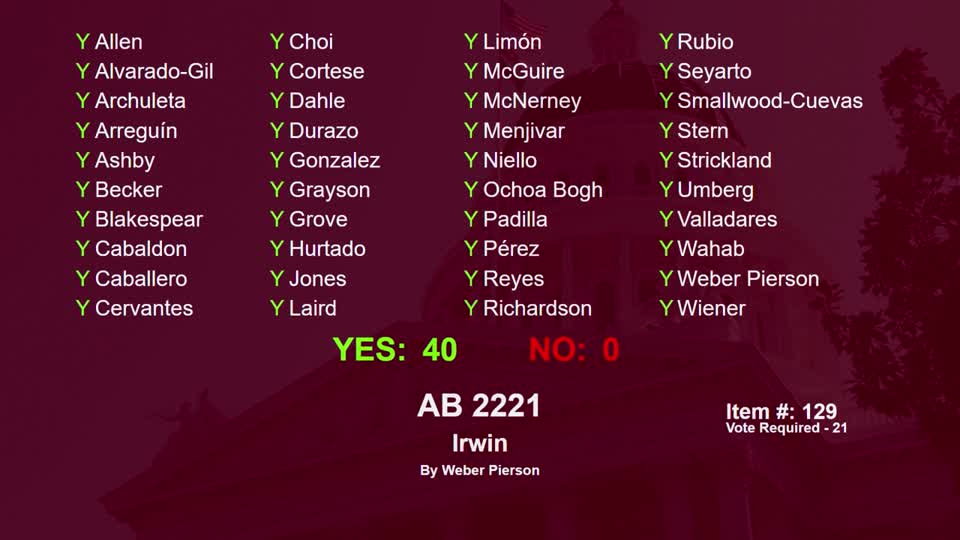 3MIN
Senate Floor
 1MIN
Senate Standing Committee on Appropriations
 8MIN
Senate Standing Committee on Governmental Organization
 7MIN
Senate Standing Committee on Judiciary
 42SEC
Assembly Floor
 17MIN
Assembly Standing Committee on Privacy and Consumer Protection
Bill Author