AB 1439: Public retirement systems: development projects: labor standards.
- Session Year: 2025-2026
- House: Assembly
- Latest Version Date: 2026-09-20
Current Status:
Passed
(2026-09-20: Chaptered by Secretary of State - Chapter 365, Statutes of 2026.)
Introduced
In Committee
Awaiting First Chamber Vote
Passed First Chamber
In Committee
Awaiting Second Chamber Vote
Passed Second Chamber
Enacted
The California Constitution grants the retirement board of a public employee retirement system plenary authority and fiduciary responsibility for investment of moneys and administration of the retirement fund and system. These provisions qualify this grant of powers by reserving to the Legislature the authority to prohibit investments if it is in the public interest and the prohibition satisfies standards of fiduciary care and loyalty required of a retirement board.
Existing law prohibits the boards of the Public Employees Retirement System (PERS) and the State Teachers Retirement System (STRS) from making certain new investments or renewing existing investments of public employee retirement funds, including in a thermal coal company, as defined. Existing law provides that a board is not required to take any action regarding those investments unless the board determines in good faith that the action is consistent with the boards fiduciary responsibilities established in the California Constitution.
This bill would request the University of California, Berkeley, Labor Center to conduct an independent study to analyze the extent of labor standards protections in California real estate and infrastructure development projects funded through the real asset portfolios of PERS and STRS. The bill would request that the study and a report of its findings be completed and provided to the Legislature and the Department of Finance by January 1, 2028, as specified.
The California Constitution grants the retirement board of a public employee retirement system plenary authority and fiduciary responsibility for investment of moneys and administration of the retirement fund and system. These provisions qualify this grant of powers by reserving to the Legislature the authority to prohibit investments if it is in the public interest and the prohibition satisfies standards of fiduciary care and loyalty required of a retirement board.
Existing law prohibits the boards of the Public Employees Retirement System (PERS) and the State Teachers Retirement System (STRS) from making certain new investments or renewing existing investments of public employee retirement funds, including in a thermal coal company, as defined. Existing law provides that a board is not required to take any action regarding those investments unless the board determines in good faith that the action is consistent with the boards fiduciary responsibilities established in the California Constitution.
This bill would state that its purpose is to require the boards of PERS and STRS to contract with the University of California Labor Centers request the University of California, Berkeley, Labor Center to conduct an independent study to determine the impacts on public employee retirement funds of prohibiting the board of a public pension or retirement system, as defined, from investing in development projects in California that do not provide labor standards protections for workers. analyze the extent of labor standards protections in California real estate and infrastructure development projects funded through the real asset portfolios of PERS and STRS. The bill would require request that the study and a report of its findings to be completed and provided to the Legislature and the Department of Finance by January 1, 2028, as specified. The bill would provide that a board is not required to take action pursuant to this provision unless it determines in good faith that the action is consistent with the boards fiduciary responsibilities established in the California Constitution.
The California Constitution grants the retirement board of a public employee retirement system plenary authority and fiduciary responsibility for investment of moneys and administration of the retirement fund and system. These provisions qualify this grant of powers by reserving to the Legislature the authority to prohibit investments if it is in the public interest and the prohibition satisfies standards of fiduciary care and loyalty required of a retirement board.
Existing law prohibits the boards of the Public Employees Retirement System (PERS) and the State Teachers Retirement System (STRS) from making certain new investments or renewing existing investments of public employee retirement funds, including in a thermal coal company, as defined. Existing law provides that a board is not required to take any action regarding those investments unless the board determines in good faith that the action is consistent with the boards fiduciary responsibilities established in the California Constitution.
This bill would prohibit state that its purpose is to require the boards of PERS and STRS to contract with the University of California Labor Centers to conduct an independent study to determine the impacts on public employee retirement funds of prohibiting the board of a public pension or retirement system from making any additional or new investments of public employee pension or retirement funds board of a public pension or retirement system, as defined, from investing in development projects in California or providing financing for those projects with public employee pension or retirement funds unless those projects include labor standards protections, as defined. that do not provide labor standards protections for workers. The bill would require the study and a report of its findings to be completed and provided to the Legislature and the Department of Finance by January 1, 2028, as specified. The bill would provide that a board is not required to take action pursuant to this provision unless it determines in good faith that the action is consistent with the boards fiduciary responsibilities established in the California Constitution.
The California Constitution grants the retirement board of a public employee retirement system plenary authority and fiduciary responsibility for investment of moneys and administration of the retirement fund and system. These provisions qualify this grant of powers by reserving to the Legislature the authority to prohibit investments if it is in the public interest and the prohibition satisfies standards of fiduciary care and loyalty required of a retirement board.
Existing law prohibits the boards of the Public Employees Retirement System and the State Teachers Retirement System from making certain new investments or renewing existing investments of public employee retirement funds, including in a thermal coal company, as defined. Existing law provides that a board is not required to take any action regarding those investments unless the board determines in good faith that the action is consistent with the boards fiduciary responsibilities established in the California Constitution.
This bill would prohibit the board of a public pension or retirement system from making any additional or new investments of public employee pension or retirement funds in development projects in California or providing financing for those projects with public employee pension or retirement funds unless those projects include labor standards protections, as defined. The bill would provide that a board is not required to take action pursuant to this provision unless it determines in good faith that the action is consistent with the boards fiduciary responsibilities established in the California Constitution.
Existing law authorizes the Judicial Council to sell specified property, at fair market value and upon terms and conditions subject to the reservations the Judicial Council deems in the best interests of the state, if specified conditions are met.This bill would make technical, nonsubstantive changes to this provision.Existing law authorizes the Judicial Council to sell specified property, at fair market value and upon terms and conditions subject to the reservations the Judicial Council deems in the best interests of the state, if specified conditions are met.
This bill would make technical, nonsubstantive changes to this provision.
(a)The Legislature finds and declares that the development of projects in California that do not involve strong labor standards protections for workers is not in the public interest or the interests of the participants in, and beneficiaries of, public pension and retirement systems.
(b)(1)The Legislature requests that the University of California, Berkeley, Labor Center conduct an independent study to analyze the extent of labor standards protections in California real estate and infrastructure development projects funded through the real asset portfolios of the Public Employees Retirement System (PERS) and the State Teachers Retirement System (STRS). The Legislature also requests that the study examine available evidence on the impact of labor standards protections, or lack of protections, on California workers and the states economy, development costs, project completion timelines, and other outcomes.
(2)The Legislature requests the Labor Center to complete its study and provide its findings to the Legislature, in compliance with Section 9795, and to the Department of Finance, by January 1, 2028.
(3)The Legislature requests PERS and STRS to provide the Labor Center with data relevant to this study, including internal data and data obtainable from or provided to their respective consultants, agents, contractors, and subcontractors, within 60 days after receipt of a written request from the Labor Center.
(c)As used in this section, the following definitions apply:
(1)Board means the Board of Administration of the Public Employees Retirement System, consistent with Section 20021, and the Teachers Retirement Board of the State Teachers Retirement System, consistent with Section 22109 of the Education Code.
(2)Labor standards protections means all of the following:
(A)Construction work performed to carry out and maintain the development project will be subject to the same prevailing wage and apprenticeship requirements that apply to public projects pursuant to Chapter 1 (commencing with Section 1720) of Part 7 of Division 2 of the Labor Code.
(B)(i)All construction and maintenance work for the development project will be performed only by contractors and subcontractors that have provided an enforceable commitment to use a skilled and trained workforce, as defined in Chapter 2.9 (commencing with Section 2600) of Part 1 of Division 2 of the Public Contract Code, to perform all work that falls within an apprenticeable occupation in the building and construction trades.
(ii)This subparagraph shall not apply if the work is covered by a project labor agreement that requires the use of a skilled and trained workforce. For purposes of this subparagraph, project labor agreement means a prehire collective bargaining agreement that establishes terms and conditions of employment for a specific construction project or projects and is an agreement described in Section 158(f) of Title 29 of the United States Code.
(C)The developer has provided commitments designed to provide labor peace during union organizing campaigns for workers who will be employed upon completion of the project.
(D)The developer has entered into a community benefits agreement that is informed by meaningful engagement and outreach to residents of the surrounding communities and that includes funding for, or direct implementation of, specific community improvements or amenities, including job access within the community in which the project is located.
(d)Nothing in this section shall be construed to require a board to take action as described in this section unless the board determines in good faith that the action described in this section is consistent with the fiduciary responsibilities of the board described in Section 17 of Article XVI of the California Constitution.
(a)The Legislature finds and declares that the development of projects in California that do not involve strong labor standards protections for workers is not in the public interest or the interests of the participants in in, and beneficiaries of of, public pension and retirement systems.
(b)(1)The Legislature requests that the University of California, Berkeley, Labor Center conduct an independent study to analyze the extent of labor standards protections in California real estate and infrastructure development projects funded through the real asset portfolios of the Public Employees Retirement System (PERS) and the State Teachers Retirement System (STRS). The Legislature also requests that the study examine available evidence on the impact of labor standards protections, or lack of protections, on California workers and the states economy, development costs, project completion timelines, and other outcomes.
(2)The Legislature requests the Labor Center to complete its study and provide its findings to the Legislature, in compliance with Section 9795, and to the Department of Finance, by January 1, 2028.
(3)The Legislature requests PERS and STRS to provide the Labor Center with data relevant to this study, including internal data and data obtainable from or provided to their respective consultants, agents, contractors, and subcontractors, within 60 days after receipt of a written request from the Labor Center.
(c)As used in this section, the following definitions apply:
(1)Board means the Board of Administration of the Public Employees Retirement System, consistent with Section 20021, and the Teachers Retirement Board of the State Teachers Retirement System, consistent with Section 22109 of the Education Code.
(2)Labor standards protections means all of the following:
(A)Construction work performed to carry out and maintain the development project will be subject to the same prevailing wage and apprenticeship requirements that apply to public projects pursuant to Chapter 1 (commencing with Section 1720) of Part 7 of Division 2 of the Labor Code.
(B)(i)All construction and maintenance work for the development project will be performed only by contractors and subcontractors that have provided an enforceable commitment to use a skilled and trained workforce, as defined in Chapter 2.9 (commencing with Section 2600) of Part 1 of Division 2 of the Public Contract Code, to perform all work that falls within an apprenticeable occupation in the building and construction trades.
(ii)This subparagraph shall not apply if the work is covered by a project labor agreement that requires the use of a skilled and trained workforce. For purposes of this subparagraph, project labor agreement means a prehire collective bargaining agreement that establishes terms and conditions of employment for a specific construction project or projects and is an agreement described in Section 158(f) of Title 29 of the United States Code.
(C)The developer has provided commitments designed to provide labor peace during union organizing campaigns for workers who will be employed upon completion of the project.
(D)The developer has entered into a community benefits agreement that is informed by meaningful engagement and outreach to residents of the surrounding communities and that includes funding for, or direct implementation of, specific community improvements or amenities, including job access within the community in which the project is located.
(d)Nothing in this section shall be construed to require a board to take action as described in this section unless the board determines in good faith that the action described in this section is consistent with the fiduciary responsibilities of the board described in Section 17 of Article XVI of the California Constitution.
(a)The Legislature finds and declares that the development of projects in California that do not involve strong labor standards protections for workers is not in the public interest or the interests of the participants in and beneficiaries of public pension and retirement systems.
(b)(1)The Legislature requests that the University of California, Berkeley, Labor Center conduct an independent study to analyze the extent of labor standards protections in California real estate and infrastructure development projects funded through the real asset portfolios of the Public Employees Retirement System (PERS) and the State Teachers Retirement System (STRS). The Legislature also requests that the study examine available evidence on the impact of labor standards protections, or lack of protections, on California workers and the states economy, development costs, project completion timelines, and other outcomes.
(2)The Legislature requests the Labor Center to complete its study and provide its findings to the Legislature, in compliance with Section 9795, and to the Department of Finance, by January 1, 2028.
(3)The Legislature requests PERS and STRS to provide the Labor Center with data relevant to this study, including internal data and data obtainable from or provided to their respective consultants, agents, contractors, and subcontractors, within 60 days after receipt of a written request from the Labor Center.
(c)As used in this section, the following definitions apply:
(1)Board means the Board of Administration of the Public Employees Retirement System, consistent with Section 20021, and the Teachers Retirement Board of the State Teachers Retirement System, consistent with Section 22109 of the Education Code.
(2)Labor standards protections means all of the following:
(A)Construction work performed to carry out and maintain the development project will be subject to the same prevailing wage and apprenticeship requirements that apply to public projects pursuant to Chapter 1 (commencing with Section 1720) of Part 7 of Division 2 of the Labor Code.
(B)(i)All construction and maintenance work for the development project will be performed only by contractors and subcontractors that have provided an enforceable commitment to use a skilled and trained workforce, as defined in Chapter 2.9 (commencing with Section 2600) of Part 1 of Division 2 of the Public Contract Code, to perform all work that falls within an apprenticeable occupation in the building and construction trades.
(ii)This subparagraph shall not apply if the work is covered by a project labor agreement that requires the use of a skilled and trained workforce. For purposes of this subparagraph, project labor agreement means a prehire collective bargaining agreement that establishes terms and conditions of employment for a specific construction project or projects and is an agreement described in Section 158(f) of Title 29 of the United States Code.
(C)The developer has provided commitments designed to provide labor peace during union organizing campaigns for workers who will be employed upon completion of the project.
(D)The developer has entered into a community benefits agreement that is informed by meaningful engagement and outreach to residents of the surrounding communities and that includes funding for, or direct implementation of, specific community improvements or amenities, including job access within the community in which the project is located.
(d)Nothing in this section shall be construed to require a board to take action as described in this section unless the board determines in good faith that the action described in this section is consistent with the fiduciary responsibilities of the board described in Section 17 of Article XVI of the California Constitution.
(a)The Legislature finds and declares all of the following: that the development of projects in California that do not involve strong labor standards protections for workers is not in the public interest or the interests of the participants in and beneficiaries of public pension and retirement systems.
(1)The development of projects in California that do not involve strong labor standards protections for workers is not in the public interest or the interests of the participants in and beneficiaries of public pension and retirement systems.(2)The purpose of this section is to require the Board of Administration of the Public Employees Retirement System and the Teachers Retirement Board of the State Teachers Retirement System, to contract with the University of California Labor Centers to conduct an independent study to determine the impacts on public employee retirement funds of prohibiting the boards of public pension and retirement systems from investing in development projects in California that do not provide labor standards protections for workers. The study and a report of its findings shall be completed and provided to the Legislature, in compliance with Section 9795, and to the Department of Finance, by January 1, 2028. If additional expertise is needed, the University of California is authorized to subcontract with additional entities to perform individual components of the study.(b)(1)The Legislature requests that the University of California, Berkeley, Labor Center conduct an independent study to analyze the extent of labor standards protections in California real estate and infrastructure development projects funded through the real asset portfolios of the Public Employees Retirement System (PERS) and the State Teachers Retirement System (STRS). The Legislature also requests that the study examine available evidence on the impact of labor standards protections, or lack of protections, on California workers and the states economy, development costs, project completion timelines, and other outcomes.
(2)The Legislature requests the Labor Center to complete its study and provide its findings to the Legislature, in compliance with Section 9795, and to the Department of Finance, by January 1, 2028.
(3)The Legislature requests PERS and STRS to provide the Labor Center with data relevant to this study, including internal data and data obtainable from or provided to their respective consultants, agents, contractors, and subcontractors, within 60 days after receipt of a written request from the Labor Center.
(b)(c)As used in this section, the following definitions apply:
(1)Board means the Board of Administration of the Public Employees Retirement System, consistent with Section 20021, and the Teachers Retirement Board of the State Teachers Retirement System, consistent with Section 22109 of the Education Code.
(2)Labor standards protections means all of the following:
(A)Construction work performed to carry out and maintain the development project will be subject to the same prevailing wage and apprenticeship requirements that apply to public projects pursuant to Chapter 1 (commencing with Section 1720) of Part 7 of Division 2 of the Labor Code.
(B)(i)All construction and maintenance work for the development project will be performed only by contractors and subcontractors that have provided an enforceable commitment to use a skilled and trained workforce, as defined in Chapter 2.9 (commencing with Section 2600) of Part 1 of Division 2 of the Public Contract Code, to perform all work that falls within an apprenticeable occupation in the building and construction trades.
(ii)This subparagraph shall not apply if the work is covered by a project labor agreement that requires the use of a skilled and trained workforce. For purposes of this subparagraph, project labor agreement means a prehire collective bargaining agreement that establishes terms and conditions of employment for a specific construction project or projects and is an agreement described in Section 158(f) of Title 29 of the United States Code.
(C)The developer has provided commitments designed to provide labor peace during union organizing campaigns for workers who will be employed upon completion of the project.
(c)(d)Nothing in this section shall be construed to require a board to take action as described in this section unless the board determines in good faith that the action described in this section is consistent with the fiduciary responsibilities of the board described in Section 17 of Article XVI of the California Constitution.
(a)The Legislature finds and declares all of the following:
(1)The development of projects in California that do not involve strong labor standards protections for workers is not in the public interest or the interests of the participants in and beneficiaries of public pension and retirement systems.
(2)The purpose of this section is to prohibit require the Board of Administration of the Public Employees Retirement System and the Teachers Retirement Board of the State Teachers Retirement System, to contract with the University of California Labor Centers to conduct an independent study to determine the impacts on public employee retirement funds of prohibiting the boards of public pension and retirement systems, consistent with, and not in violation of, their fiduciary responsibilities, systems from investing in development projects in California that do not provide labor standards protections for workers. The study and a report of its findings shall be completed and provided to the Legislature, in compliance with Section 9795, and to the Department of Finance, by January 1, 2028. If additional expertise is needed, the University of California is authorized to subcontract with additional entities to perform individual components of the study.
(b)As used in this section, the following definitions apply:
(1)Board means the retirement board of a public pension or retirement system, as defined in subdivision (h) of Section 17 of Article XVI of the California Constitution. Board of Administration of the Public Employees Retirement System, consistent with Section 20021, and the Teachers Retirement Board of the State Teachers Retirement System, consistent with Section 22109 of the Education Code.
(2)Labor standards protections means all of the following:
(A)Construction work performed to carry out and maintain the development project will be subject to the same prevailing wage and apprenticeship requirements that apply to public projects pursuant to Chapter 1 (commencing with Section 1720) of Part 7 of Division 2 of the Labor Code.
(B)(i)All construction and maintenance work for the development project will be performed only by contractors and subcontractors that have provided an enforceable commitment to use a skilled and trained workforce, as defined in Chapter 2.9 (commencing with Section 2600) of Part 1 of Division 2 of the Public Contract Code, to perform all work that falls within an apprenticeable occupation in the building and construction trades.
(ii)This subparagraph shall not apply if the work is covered by a project labor agreement that requires the use of a skilled and trained workforce. For purposes of this subparagraph, project labor agreement means a prehire collective bargaining agreement that establishes terms and conditions of employment for a specific construction project or projects and is an agreement described in Section 158(f) of Title 29 of the United States Code.
(C)The developer has provided commitments designed to provide labor peace during union organizing campaigns for workers who will be employed upon completion of the project.
(c)The board shall not make additional or new investments of public employee pension or retirement funds in development projects in California or provide financing for those projects with public employee pension or retirement funds unless those projects include labor standards protections.(d)(c)Nothing in this section shall require a board to take action as described in this section unless the board determines in good faith that the action described in this section is consistent with the fiduciary responsibilities of the board described in Section 17 of Article XVI of the California Constitution.
(a)The Legislature finds and declares all of the following:
(1)The development of projects in California that do not involve strong labor standards protections for workers is not in the public interest or the interests of the participants in and beneficiaries of public pension and retirement systems.
(2)The purpose of this section is to prohibit the boards of public pension and retirement systems, consistent with, and not in violation of, their fiduciary responsibilities, from investing in development projects in California that do not provide labor standards protections for workers.
(b)As used in this section, the following definitions apply:
(1)Board means the retirement board of a public pension or retirement system, as defined in subdivision (h) of Section 17 of Article XVI of the California Constitution.
(2)Labor standards protections means all of the following:
(A)Construction work performed to carry out and maintain the development project will be subject to the same prevailing wage and apprenticeship requirements that apply to public projects pursuant to Chapter 1 (commencing with Section 1720) of Part 7 of Division 2 of the Labor Code.
(B)(i)All construction and maintenance work for the development project will be performed only by contractors and subcontractors that have provided an enforceable commitment to use a skilled and trained workforce, as defined in Chapter 2.9 (commencing with Section 2600) of Part 1 of Division 2 of the Public Contract Code, to perform all work that falls within an apprenticeable occupation in the building and construction trades.
(ii)This subparagraph shall not apply if the work is covered by a project labor agreement that requires the use of a skilled and trained workforce. For purposes of this subparagraph, project labor agreement means a prehire collective bargaining agreement that establishes terms and conditions of employment for a specific construction project or projects and is an agreement described in Section 158(f) of Title 29 of the United States Code.
(C)The developer has provided commitments designed to provide labor peace during union organizing campaigns for workers who will be employed upon completion of the project.
(c)The board shall not make additional or new investments of public employee pension or retirement funds in development projects in California or provide financing for those projects with public employee pension or retirement funds unless those projects include labor standards protections.
(d)Nothing in this section shall require a board to take action as described in this section unless the board determines in good faith that the action described in this section is consistent with the fiduciary responsibilities of the board described in Section 17 of Article XVI of the California Constitution.
SECTION 1.Section 70397 of the Government Code is amended to read:70397.(a)Notwithstanding any other law, the Judicial Council may sell property, at fair market value and upon the terms and conditions and subject to the reservations the Judicial Council deems in the best interests of the state, if all of the following requirements are satisfied:(1)The sale complies with Section 70391, as applicable.(2)The Judicial Council consults with the County of Los Angeles regarding the sale of the property.(3)The Judicial Council offers the County of Los Angeles the right to purchase the property at fair market value before otherwise offering the property for sale.(b)Notwithstanding any other law, the net proceeds from the sale of the property shall be deposited into the State Court Facilities Construction Fund, established by Section 70371.(c)For purposes of this act, property means each of the following:(1)The West Los Angeles Courthouse located at 1633 Purdue Avenue, City of Los Angeles, County of Los Angeles, Assessor Parcel Numbers 4261-011-908, 4261-011-909, 4261-011-910, 4261-011-913, 4261-011-914, and 4261-011-915.(2)The Mental Health Courthouse located at 1150 North San Fernando Road, City of Los Angeles, County of Los Angeles, Assessor Parcel Number 5453-002-900.(d)The disposition of the property authorized in this section does not constitute a sale or other disposition of surplus state property within the meaning of Section 9 of Article III of the California Constitution and is not subject to subdivision (g) of Section 11011.(a)Notwithstanding any other law, the Judicial Council may sell the property, at fair market value and upon the terms and conditions and subject to the reservations the Judicial Council deems in the best interests of the state, if all of the following requirements are satisfied:
(1)The sale complies with Section 70391, as applicable.
(2)The Judicial Council consults with the County of Los Angeles concerning regarding the sale of the property.
(3)The Judicial Council offers the County of Los Angeles the right to purchase the property at fair market value before otherwise offering the property for sale.
(b)Notwithstanding any other law, the net proceeds from the sale of the property shall be deposited into the State Court Facilities Construction Fund, established by Section 70371.
(c)For purposes of this act, property means each of the following:
(1)The West Los Angeles Courthouse located at 1633 Purdue Avenue, City of Los Angeles, County of Los Angeles, Assessor Parcel Numbers 4261-011-908, 4261-011-909, 4261-011-910, 4261-011-913, 4261-011-914, and 4261-011-915.
(2)The Mental Health Courthouse located at 1150 North San Fernando Road, City of Los Angeles, County of Los Angeles, Assessor Parcel Number 5453-002-900.
(d)The disposition of the property authorized in this section does not constitute a sale or other disposition of surplus state property within the meaning of Section 9 of Article III of the California Constitution and is not subject to subdivision (g) of Section 11011.
|
Date
|
Status
|
|---|---|
| Sep 20, 2026 | Chaptered by Secretary of State - Chapter 365, Statutes of 2026. |
| Sep 20, 2026 | Approved by the Governor. |
| Sep 4, 2026 | Enrolled and presented to the Governor at 4 p.m. |
| Aug 27, 2026 | Senate amendments concurred in. To Engrossing and Enrolling. (Ayes 60. Noes 9.). |
| Aug 27, 2026 | Senate amendments concurred in. To Engrossing and Enrolling. (Ayes 60. Noes 9. Page 6680.). |
| Aug 26, 2026 | In Assembly. Concurrence in Senate amendments pending. |
| Aug 26, 2026 | Read third time. Passed. Ordered to the Assembly. (Ayes 29. Noes 10. Page 5836.). |
| Aug 26, 2026 | Read third time. Passed. Ordered to the Assembly. (Ayes 28. Noes 10.). |
| Aug 17, 2026 | Read second time. Ordered to third reading. |
| Aug 13, 2026 | Read second time and amended. Ordered returned to second reading. |
| Aug 13, 2026 | From committee: Amend, and do pass as amended. (Ayes 5. Noes 2.) (August 13). |
| Jun 22, 2026 | In committee: Referred to APPR. suspense file. |
| Jun 11, 2026 | Read second time and amended. Re-referred to Com. on APPR. |
| Jun 10, 2026 | From committee: Amend, and do pass as amended and re-refer to Com. on APPR. (Ayes 4. Noes 1.) (June 10). |
| Jun 2, 2026 | From committee chair, with author's amendments: Amend, and re-refer to committee. Read second time, amended, and re-referred to Com. on L., P.E. & R. |
| May 6, 2026 | Referred to Com. on L., P.E. & R. |
| Jan 29, 2026 | In Senate. Read first time. To Com. on RLS. for assignment. |
| Jan 29, 2026 | Read third time. Passed. Ordered to the Senate. (Ayes 50. Noes 9. Page 3879.) |
| Jan 26, 2026 | Read second time. Ordered to third reading. |
| Jan 22, 2026 | Read second time and amended. Ordered returned to second reading. |
| Jan 22, 2026 | In committee: Set, first hearing. Referred to suspense file. |
| Jan 22, 2026 | From committee: Amend, and do pass as amended. (Ayes 10. Noes 4.) (January 22). |
| Jan 22, 2026 | Assembly Rule 63 suspended. (Page 3806.) |
| Jan 14, 2026 | From committee: Do pass and re-refer to Com. on APPR. (Ayes 5. Noes 0.) (January 14). Re-referred to Com. on APPR. |
| Apr 21, 2025 | In committee: Set, first hearing. Hearing canceled at the request of author. |
| Mar 25, 2025 | Re-referred to Com. on P. E. & R. |
| Mar 24, 2025 | Referred to Com. on P. E. & R. |
| Mar 24, 2025 | From committee chair, with author's amendments: Amend, and re-refer to Com. on P. E. & R. Read second time and amended. |
| Feb 24, 2025 | Read first time. |
| Feb 22, 2025 | From printer. May be heard in committee March 24. |
| Feb 21, 2025 | Introduced. To print. |
|
Date
|
Description
|
Location
|
Votes
|
|
|---|---|---|---|---|
| Aug 27, 2026 | AB 1439 Garcia Concurrence in Senate Amendments | Assembly Floor |
Passed |
|
| Aug 26, 2026 | Assembly 3rd Reading AB1439 Garcia et al. | Senate Floor |
Passed |
|
| Aug 13, 2026 | Do pass as amended | Senate Standing Committee on Appropriations |
Passed |
|
| Jun 22, 2026 | Placed on suspense file | Senate Standing Committee on Appropriations |
Passed |
|
| Jun 10, 2026 | Do pass as amended, but first amend, and re-refer to the Committee on [Appropriations] | Senate Standing Committee on Labor, Public Employment and Retirement |
Passed |
|
| Jan 29, 2026 | AB 1439 Garcia Assembly Third Reading | Assembly Floor |
Passed |
|
| Jan 22, 2026 | Do pass as amended. | Assembly Standing Committee on Appropriations |
Passed |
|
| Jan 14, 2026 | Do pass and be re-referred to the Committee on [Appropriations] | Assembly Standing Committee on Public Employment and Retirement |
Passed |
This list shows positions taken on this bill by organizations on the date displayed, which is linked to the original source.
Positions by individuals are not included.
|
Organization
|
Position
|
Date
|
|---|---|---|
| Associated General Contractors, California Chapters | ** Against | |
| Association Of California School Administrators | ** Against | |
| BOMA California | ** Against | |
| California Alliance For Retired Americans | ** Support | |
| California Apartment Association | ** Against | |
| California Association Of School Business Officials | ** Against | |
| California Building Industry Association | ** Against | |
| California Business Properties Association | ** Against | |
| California Chamber Of Commerce | ** Against | |
| California Council For Affordable Housing | ** Against | |
| California Federation of Labor Unions | ** Support | |
| California Housing Consortium | ** Against | |
| California School Employees Association | ** Against | |
| California Special Districts Association | ** Against | |
| California State Association Of Counties | ** Against | |
| California State Association Of Electrical Workers | ** Support | |
| California State Council Of Laborers | ** Support | |
| California State Pipe Trades Council | ** Support | |
| California Teamsters Public Affairs Council | ** Support | |
| California-Nevada Conference Of Operating Engineers | ** Support | |
| CFT – A Union of Educators & Classified Professionals | ** Support | |
| Commercial Real Estate Development Association, NAIOP of California | ** Against | |
| DISTRICT COUNCIL 16, INTERNATIONAL UNION OF PAINTERS AND ALLIED TRADES | ** Support | |
| District Council 36, International Union of Painters and Allied Trades | ** Support | |
| District Council Of Iron Workers Of The State Of California And Vicinity | ** Support | |
| League Of California Cities | ** Against | |
| Rural County Representatives of California | ** Against | |
| South Pasadena Residents for Responsible Growth | ** Against | |
| State Association Of County Retirement Systems | ** Against | |
| State Building and Construction Trades Council of California | ** Support | |
| Teamsters California | ** Support | |
| Urban Counties of California | ** Against | |
| Western Electrical Contractors Associations | ** Against | |
| Western States Council Sheet Metal, Air, Rail And Transportation | ** Support |
CONCURRENCE IN SENATE AMENDMENTS
CSA1 Bill Id:AB 1439
Author:(Garcia)
As Amended Ver:August 13, 2026
Majority vote
SUMMARY
Requests the University of California Berkeley (UCB) Labor Center to study California Public Employees' Retirement System (CalPERS) and California State Teachers' Retirement System (CalSTRS) portfolio-funded real estate and infrastructure development projects to analyze the extent of their labor standards protections and CalPERS and CalSTRS to provide the UCB Labor Center relevant data, among other provisions.
Senate Amendments
- Remove the mandate that prohibited CalPERS and CalSTRS from investing in, or providing financing for, infrastructure development projects in California unless those projects include certain labor standards protections and, instead:
- Request the UCB Labor Center to study the subject and provide its findings to the Legislature and Department of Finance by January 1, 2028.
- Request CalPERS and CalSTRS to provide relevant data to the UCB Labor Center for the study within 60 days after receipt of request.
- Remove the mandate that CalPERS and CalSTRS fund the study.
- Revise the definition of "labor standards protections" to include that the developer has entered into a community benefits agreements that is informed by meaningful engagement and outreach to residents of the surrounding communities and that includes funding for, or direct implementation of, specific community improvements or amenities, including job access within the community in which the project is located.
COMMENTS
This bill stems from labor union efforts to prohibit public employee pension funds from investing in companies that they believe do not adhere to certain labor standards. The labor unions' efforts aim to draft public employee pension systems into their struggle to obtain labor policies in the private sector even though both CalPERS and CalSTRS already have responsible contractor policies regarding worker protections for companies held in their portfolios.
It is again noted that CalPERS has indicated that it has already issued a request for proposals to conduct a similar study.
Please refer to the various policy committee analyses for a full discussion of this bill.
According to the Author
"[The recently approved CalPERS] RCP has no real teeth to guarantee that prevailing wages are paid, that construction workers are properly trained, or that there is labor peace after construction. This allows CalPERS to actively invest in projects that allow worker exploitation and undermine the standards that labor have fought so hard to establish. [This bill will help to ensure] contractors doing work on CalPERS-funded projects not only are good stewards of public employee members' investments but that they treat workers on CalPERS projects with dignity."
Arguments in Support
The State Building and Construction Trades Council of California expresses, "[w]hile CalPERS' Board members and staff have a fiduciary duty to properly invest members' contributions, there are several practical steps CalPERS can take to mitigate the risks associated with contractors' noncompliance with the RCP and state labor law at investment properties. Issues such as wage theft, health and safety violations, and poor-quality construction are not readily apparent during a construction project and largely come to light only after construction is complete, as workers fear losing their jobs if they report problems. These low-road employer violations not only negatively impact a construction workers' livelihood and safety on the job but they create investment risks for CalPERS as an asset owner. Wage theft, health and safety issues, project delays, and construction defects may lead to fines and penalties by public agencies and litigation by workers and end users. These negative outcomes are financial risks that can erode a construction project's investment returns and are difficult to mitigate once the problem has developed. CalPERS ultimately bears the risk of failure to deliver such projects on time, within budget, and in accordance with construction standards. When construction project managers do not consider the qualifications of potential contractors, they are choosing to favor low-quality, irresponsible contractors who submit the lowest-cost construction bids. The bill was amended to focus specifically on investments by CalPERS and CalSTRS and to simply require a study of the impacts of such an investment prohibition. This bill will provide the state with an evaluation of how requiring labor-standard protections on pension-funded development projects could affect public retirement system investments and fiduciary obligations."
Arguments in Opposition
According to a coalition of local government interests, i.e., cities and counties, "[f]undamentally, we do not believe it is appropriate to undermine the plenary authority of our public pension systems, particularly at the expense of the financial security of our workforce or public agencies. As noted in the bill analysis in the Assembly Public Employment and Retirement Committee, the legislature has limited constitutional authority to impose conditions on how public pension funds make investment decisions. [This bill] represents a step down a slippery slope of political interference in the retirement assets earned by California's public employees. Aside from our concerns that the bill advances an unwise legislative proposal, we do not believe it is necessary. CalPERS is conducting a market study to evaluate the potential impacts of adopting the standards that had been proposed in [this bill]. It is not clear that there is an entity better positioned to conduct a study than the pension systems themselves: professional investment staff governed by a board accountable to public employees and employers. Requiring a duplicative analysis to be conducted by an outside entity, like the UC Labor Centers, undermines CalPERS' and CalSTRS' independence and authority to assess investment risks on behalf of their members."
Registering a stance of "opposed unless amended," the Western Electrical Contractors Associations (WECA) states, among other things, "[the UCB Labor Center] is a respected institution with a long history of participation in public policy debates concerning labor standards, prevailing wage laws, project labor agreements, workforce mandates, and related issues. The Center has published numerous reports and policy recommendations supporting expanded labor protections and has frequently participated in legislative discussions regarding those policies. If the Legislature truly seeks an independent assessment, California already possesses well-established
procurement and contracting procedures for obtaining independent research and consulting services. A competitive process could establish the study scope, qualifications, and deliverables while allowing qualified universities, economists, public policy institutes, and research
organizations to compete to perform the work. Such a process would strengthen confidence in the study's conclusions regardless of the outcome. Instead, [this bill] predetermines who will conduct the analysis and then asks policymakers and stakeholders to accept the resulting report as independent. That approach undermines the very purpose of commissioning an independent study. At a minimum, WECA respectfully requests that [this bill] be amended to remove the statutory designation of the [UCB Labor Center] and instead direct CalPERS and CalSTRS to procure the study through a competitive and transparent process designed to ensure neutrality and independence.
FISCAL COMMENTS
According to the Senate Committee on Appropriations, the UCB Labor Center would incur one-time costs in the low hundreds of thousands of dollars over an 18-month period to conduct the required study (General Fund). To provide the data for the study, CalPERS would incur one-time administrative costs of $250,000 (Public Employment Retirement Fund) and one-time costs to CalSTRS would total $200,000 to $500,000 (Teacher's Retirement Fund). Administrative costs would include gathering, reviewing and categorizing the requisite data.
VOTES:
ASM PUBLIC EMPLOYMENT AND RETIREMENT: 5-0-2
YES: Alanis, Boerner, Elhawary, Garcia, Chen
ABS, ABST OR NV: McKinnor, Nguyen
ASM APPROPRIATIONS: 10-4-1
YES: Wicks, Stefani, Calderon, Caloza, Fong, Mark González, Krell, Bauer-Kahan, Pellerin, Solache
NO: Hoover, Dixon, Ta, Tangipa
ABS, ABST OR NV: Pacheco
ASSEMBLY FLOOR: 50-9-21
YES: Addis, Aguiar-Curry, Ahrens, Alanis, Alvarez, Bains, Bennett, Berman, Boerner, Bonta, Bryan, Calderon, Caloza, Carrillo, Chen, Connolly, Davies, Elhawary, Fong, Gabriel, Garcia, Jeff Gonzalez, Mark González, Haney, Harabedian, Hart, Hoover, Irwin, Jackson, Kalra, Krell, Lee, Lowenthal, Ortega, Pacheco, Papan, Patel, Pellerin, Rogers, Schiavo, Schultz, Sharp-Collins, Solache, Soria, Stefani, Wallis, Ward, Wilson, Zbur, Rivas
NO: Ávila Farías, Dixon, Ellis, Gallagher, Johnson, Macedo, Sanchez, Ta, Tangipa
ABS, ABST OR NV: Arambula, Bauer-Kahan, Castillo, DeMaio, Flora, Gipson, Hadwick, Lackey, McKinnor, Muratsuchi, Nguyen, Patterson, Petrie-Norris, Quirk-Silva, Ramos, Ransom, Celeste Rodriguez, Michelle Rodriguez, Blanca Rubio, Valencia, Wicks
UPDATED
VERSION: August 13, 2026
CONSULTANT: Michael Bolden / P. E. & R. / (916) 319-3957 FN: 0004258
SENATE RULES COMMITTEE Office of Senate Floor Analyses (916) 651-4171 | AB 1439 |
THIRD READING
Bill No: AB 1439
Author: Garcia (D), et al.
Amended: 8/13/26 in Senate
Vote: 21
SENATE LABOR, PUB. EMP. & RET. COMMITTEE: 4-1, 6/10/26
AYES: Smallwood-Cuevas, Cortese, Durazo, Laird
NOES: Strickland
SENATE APPROPRIATIONS COMMITTEE: 5-2, 8/13/26
AYES: Cervantes, Cabaldon, Grayson, Richardson, Wahab
NOES: Seyarto, Dahle
ASSEMBLY FLOOR: 50-9, 1/29/26 - See last page for vote
SUBJECT: Public retirement systems: development projects: labor standards
SOURCE: State Building and Construction Trades Council of California
DIGEST:
This bill requests the University of California, Berkeley (UCB), Labor Center to study California Public Employees’ Retirement System (CalPERS)’s and California State Teachers’ Retirement System (CalSTRS)’s portfolio-funded real estate and infrastructure development projects to analyze the extent of their labor standards protections and requests CalPERS and CalSTRS to provide UCB Labor Center relevant data, as specified.
ANALYSIS:
Existing law:
- Establishes the California Public Employees’ Retirement System (CalPERS) and the California State Teachers’ Retirement System (CalSTRS) to provide defined benefit pensions to eligible public and school employees respectively, while minimizing the cost of those benefits to their public employers. (Government Code § 20000 et seq. and Education Code § 22000 et seq.)
- Grants the retirement board of a public pension or retirement system sole and exclusive fiduciary responsibility over the assets of the public pension or retirement system and the sole and exclusive responsibility to administer the system in a manner that will assure prompt delivery of benefits and related services to the participants and their beneficiaries. The assets of a public pension or retirement system are trust funds and shall be held for the exclusive purposes of providing benefits to participants in the pension or retirement system and their beneficiaries and defraying reasonable expenses of administering the system. (California Constitution (CA CONST) art. XVI § 17 (a)).
- Requires the members of a public retirement board to discharge their duties with respect to the system solely in the interest of, and for the exclusive purposes of providing benefits to, participants and their beneficiaries, minimizing employer contributions thereto, and defraying reasonable expenses of administering the system. A retirement board’s duty to its participants and their beneficiaries shall take precedence over any other duty. (CA CONST art. XVI § 17 (b)).
- Requires the members of a public retirement board to diversify the investments of the system so as to minimize the risk of loss and to maximize the rate of return, unless under the circumstances it is clearly not prudent to do so. (CA CONST art. XVI § 17 (d)).
- Establishes the Division of Labor Standards Enforcement (DLSE), under the direction of the Labor Commissioner (LC), within the Department of Industrial Relations (DIR), and authorizes the LC to investigate employee complaints and enforce labor laws, as specified. (Labor Code § 79 et seq.)
- Defines “public works,” for the purposes of regulating public works contracts, as, among other things, construction, alteration, demolition, installation, or repair work done under contract and paid for, in whole or in part, out of public funds. (Labor Code § 1720(a).)
- Requires that not less than the general prevailing rate of per diem wages be paid to all workers employed on a "public works" project costing over $1,000 dollars and imposes misdemeanor penalties for violation of this requirement. (Labor Code § 1771.)
- Requires contractors and subcontractors, while performing public works, to furnish specified payroll records at least once a month directly to the LC, in an electronic format, in the manner prescribed by the LC, on the department’s internet website. (Labor Code § 1771.4(a)(3).)
- Requires each contractor and subcontractor on a public works project to keep accurate payroll records, showing the name, address, social security number, work classification, straight time and overtime hours worked each day and week, and the actual per diem wages paid to each journeyman, apprentice, worker, or other employee employed by the contractor or subcontractor in connection with the public work. (Labor Code § 1776(a).)
- Defines “graduate of an apprenticeship program” to mean either of the following:
- An individual that has been issued a certificate of completion under the authority of the California Apprenticeship Council for completing an apprenticeship program approved by the chief.
- An individual that has completed an apprenticeship program located outside California and approved for federal purposes pursuant to the apprenticeship regulations adopted by the federal Secretary of Labor. (Public Contract Code § 2601(c).)
- Provides that when the use of a skilled and trained workforce to complete a contract or project is required, the public entity shall include in all bid documents and construction contracts a notice that the project is subject to the skilled and trained workforce requirement. (Public Contract Code § 2600©.)
This bill:
- Finds and declares that development projects in California without strong labor standards protections for workers is not in the public interest or the interests of the participants in, and beneficiaries of, public pension and retirement systems.
- Requests the UC Berkeley Labor Center to conduct an independent study to analyze the extent of labor standards protections in CalPERS’ and CalSTRS’ portfolio-funded California real estate and infrastructure development projects requests that the study examine available evidence on the impact labor standards protections, as specified; that the study be completed by January 1, 2028; and that pension systems provide the Labor Center with relevant data, as specified.
- Makes the following definitions:
- “Board” means the CalPERS and CalSTRS boards.
- “Labor standards protections” means that construction work to carry out and maintain the development project shall be subject to specified Labor Code requirements to provide prevailing wage; require the use of unionized workers or require coverage under a project labor agreement; require the project developer to commit to union organizing campaigns for workers who will be employed upon the project’s completion; and require the developer to have entered into a community benefits agreement that is informed by meaningful engagement and outreach to residents of the surrounding communities and that includes funding for, or direct implementation of, specific community improvements or amenities including job access within the community in which the project is located.
- Declares that nothing in this bill shall be construed to require CalPERS or CalSTRS to take action described in this bill unless the respective boards determine in good faith that the action is consistent with the board’s constitutional fiduciary responsibilities.
Background
This bill stems from union efforts to prohibit public employee pension funds from investing in companies that do not adhere to specified labor standards.[1] The unions’ efforts aim to draft public employee pension systems into their struggle to obtain specified labor policies in the private sector although CalPERS and CalSTRS already have responsible contractor policies regarding worker protections for companies held in their portfolios.
An earlier version of this bill would have prohibited public pension boards from making “additional or new investments of public employee pension or retirement funds in development projects in California or provide financing for those projects with public employee pension or retirement funds unless those projects include labor standards protections.” [2] The bill’s opponents have labeled the earlier version a de facto mandate on the pension systems to divest from companies that don’t meet those labor standards.
In analyzing that prior version of the bill, the Assembly Appropriations Committee noted that its fiscal costs to CalPERS and CalSTRS could result in tens of billions of dollars.[3]
This bill’s current version requests that the UC Berkely Labor center study the issue, as specified, and requests the pension systems provide relevant data to the Labor Center for the study. Recent author amendments remove mandates, including a mandate that the pension systems fund the studies (such a mandate would conflict with constitutional provisions that grant the pension systems’ plenary and exclusive authority to invest pension funds and administer the systems).
CalPERS indicates that it has already issued a request for proposals to conduct a similar study. This bill’s opponents argue that AB 1439 is thus unnecessary and duplicative and continue to argue this bill is an improper intrusion into CalPERS’ and CalSTRS’ plenary authority to manage their respective pension systems.
FISCAL EFFECT: Appropriation: No Fiscal Com.: Yes Local: No
According to the Senate Appropriations Committee:
- The UCB Labor Center would incur one-time costs in the low hundreds of thousands of dollars over an 18-month period to conduct the required study (General Fund).
- To provide the data for the study, CalPERS would incur one-time administrative costs of $250,000 (Public Employment Retirement Fund); one-time costs to CalSTRS would total $200,000 to $500,000 (Teacher’s Retirement Fund). Administrative costs would include gathering, reviewing and categorizing the requisite data.
SUPPORT: (Verified 8/10/26)
State Building and Construction Trades Council of California (sponsor)
California Alliance for Retired Americans
California Federation of Labor Unions
California State Association of Electrical Workers
California State Council of Laborers
California State Pipe Trades Council
California Teamsters Public Affairs Council
California-Nevada Conference of Operating Engineers
CFT – a Union of Educators & Classified Professionals
District Council 16, International Union of Painters and Allied Trades
District Council 36, International Union of Painters and Allied Trades
District Council of Iron Workers of the State of California and Vicinity
Teamsters California
Western States Council Sheet Metal, Air, Rail and Transportation
OPPOSITION: (Verified 8/10/26)
Associated General Contractors, California Chapters
Association of California School Administrators
BOMA California
California Apartment Association
California Association of School Business Officials
California Building Industry Association
California Business Properties Association
California Chamber of Commerce
California Council for Affordable Housing
California Housing Consortium
California School Employees Association
California Special Districts Association
California State Association of Counties
Commercial Real Estate Development Association, NAIOP of California
League of California Cities
Rural County Representatives of California
South Pasadena Residents for Responsible Growth
State Association of County Retirement Systems
Urban Counties of California
Western Electrical Contractors Association
ARGUMENTS IN SUPPORT: According to the State Building and Construction Trades Council of California:
“The RCP is CalPERS’ attempt to ensure that contractors doing work on CalPERS-funded projects not only are good stewards of public employee members’ investments but also treat workers on CalPERS projects with dignity.
However, the recently approved update to CalPERS’ RCP has no real requirement that guarantees that prevailing wages are paid, that construction workers are properly trained, or that there is labor peace after construction. This allows CalPERS to actively invest in projects that allow worker exploitation and undermine the standards we have fought so hard to establish.
While CalPERS’ Board members and staff have a fiduciary duty to properly invest members’ contributions, there are several practical steps CalPERS can take to mitigate the risks associated with contractors' noncompliance with the RCP and state labor law at investment properties. Issues such as wage theft, health and safety violations, and poor-quality construction are not readily apparent during a construction project and largely come to light only after construction is complete, as workers fear losing their jobs if they report problems.
These low-road employer violations not only negatively impact a construction workers’ livelihood and safety on the job but they create investment risks for CalPERS as an asset owner. Wage theft, health and safety issues, project delays, and construction defects may lead to fines and penalties by public agencies and litigation by workers and end users. These negative outcomes are financial risks that can erode a construction project’s investment returns and are difficult to mitigate once the problem has developed. CalPERS ultimately bears the risk of failure to deliver such projects on time, within budget, and in accordance with construction standards. When construction project managers do not consider the qualifications of potential contractors, they are choosing to favor low-quality, irresponsible contractors who submit the lowest-cost construction bids.
The bill was amended to focus specifically on investments by CalPERS and CalSTRS and to simply require a study of the impacts of such an investment prohibition. This bill will provide the state with an evaluation of how requiring labor-standard protections on pension-funded development projects could affect public retirement system investments and fiduciary obligations.”
ARGUMENTS IN OPPOSITION: According to a coalition of public employer associations, including the California State Association of Counties and the League of California Cities:
“Fundamentally, we do not believe it is appropriate to undermine the plenary authority of our public pension systems, particularly at the expense of the financial security of our workforce or public agencies. As noted in the bill analysis in the Assembly Public Employment and Retirement Committee, the legislature has limited constitutional authority to impose conditions on how public pension funds make investment decisions. AB 1439 represents a step down a slippery slope of political interference in the retirement assets earned by California’s public employees.
Aside from our concerns that the bill advances an unwise legislative proposal, we do not believe it is necessary. CalPERS is conducting a market study to evaluate the potential impacts of adopting the standards that had been proposed in AB 1439. It is not clear that there is an entity better positioned to conduct a study than the pension systems themselves: professional investment staff governed by a board accountable to public employees and employers. Requesting a duplicative analysis to be conducted by an outside entity, like the UC Labor Centers, undermines CalPERS’ and CalSTRS’ independence and authority to assess investment risks on behalf of their members.”
ASSEMBLY FLOOR: 50-9, 1/29/26
AYES: Addis, Aguiar-Curry, Ahrens, Alanis, Alvarez, Bains, Bennett, Berman, Boerner, Bonta, Bryan, Calderon, Caloza, Carrillo, Chen, Connolly, Davies, Elhawary, Fong, Gabriel, Garcia, Jeff Gonzalez, Mark González, Haney, Harabedian, Hart, Hoover, Irwin, Jackson, Kalra, Krell, Lee, Lowenthal, Ortega, Pacheco, Papan, Patel, Pellerin, Rogers, Schiavo, Schultz, Sharp-Collins, Solache, Soria, Stefani, Wallis, Ward, Wilson, Zbur, Rivas
NOES: Ávila Farías, Dixon, Ellis, Gallagher, Johnson, Macedo, Sanchez, Ta, Tangipa
NO VOTE RECORDED: Arambula, Bauer-Kahan, Castillo, DeMaio, Flora, Gipson, Hadwick, Lackey, McKinnor, Muratsuchi, Nguyen, Patterson, Petrie-Norris, Quirk-Silva, Ramos, Ransom, Celeste Rodriguez, Michelle Rodriguez, Blanca Rubio, Valencia, Wicks
Prepared by: Glenn Miles / L., P.E. & R. / (916) 651-1556
8/17/26 10:34:28
**** END ****
It’s Our Money: Union Members Fight for Good Public Pension Investments, Labor Notes, April 29, 2026, https://labornotes.org/blogs/2026/04/its-our-money-union-members-fight-good-public-pension-investments ↑
AB 1439 (Garcia), as amended March 24, 2025, adding, inter alia, Government Code Section 7513.77 (c). ↑
See the Assembly Committee on Appropriations’ Bill Analysis of AB 1439 (Garcia), as amended March 24, 2025, for the committee’s January 22, 2026, hearing. ↑
SENATE COMMITTEE ON
Senator Sabrina Cervantes, Chair
2025 - 2026 Regular Session
AB 1439 (Garcia) - Public retirement systems: development projects: labor standards
Version: | Policy Vote: |
Urgency: | Mandate: |
Hearing Date: | Consultant: |
Bill Summary:
AB 1439 would request (1) the University of California, Berkeley (UCB), Labor Center to study California Public Employees’ Retirement System (CalPERS)’s and California State Teachers’ Retirement System (CalSTRS)’s portfolio-funded real estate and infrastructure development projects to analyze the extent of their labor standards protections, and (2) CalPERS and CalSTRS to provide the relevant data to UCB Labor Center, as specified.
*********** ANALYSIS ADDENDUM – SUSPENSE FILE ***********
The following information is revised to reflect amendments
adopted by the committee on August 13, 2026
Fiscal Impact:
- The UCB Labor Center would incur one-time costs in the low hundreds of thousands of dollars over an 18-month period to conduct the required study (General Fund).
- To provide the data for the study, CalPERS would incur one-time administrative costs of $250,000 (Public Employment Retirement Fund); one-time costs to CalSTRS would total $200,000 to $500,000 (Teacher’s Retirement Fund). Administrative costs would include gathering, reviewing and categorizing the requisite data.
Author Amendments:
Add coauthors.
-- END --
SENATE COMMITTEE ON
Senator Sabrina Cervantes, Chair
2025 - 2026 Regular Session
AB 1439 (Garcia) - Public retirement systems: development projects: labor standards
Version: | Policy Vote: |
Urgency: | Mandate: |
Hearing Date: | Consultant: |
Bill Summary:
AB 1439 would request (1) the University of California, Berkeley (UCB), Labor Center to study California Public Employees’ Retirement System (CalPERS)’s and California State Teachers’ Retirement System (CalSTRS)’s portfolio-funded real estate and infrastructure development projects to analyze the extent of their labor standards protections, and (2) CalPERS and CalSTRS to provide the relevant data to UCB Labor Center, as specified.
Fiscal Impact:
- The UCB Labor Center would incur one-time costs in the low hundreds of thousands of dollars over an 18-month period to conduct the required study (General Fund).
- To provide the data for the study, CalPERS would incur one-time administrative costs of $250,000 (Public Employment Retirement Fund); one-time costs to CalSTRS would total $200,000 to $500,000 (Teacher’s Retirement Fund). Administrative costs would include gathering, reviewing and categorizing the requisite data.
Background:
California’s two largest public retirement systems, CalPERS and CalSTRS, provide defined-benefit pension benefits to eligible public employees and educators while seeking to minimize costs borne by participating public employers. The governing boards of these systems have exclusive fiduciary responsibility for managing retirement assets and administering benefits. Pension assets are held in trust solely for the benefit of members and beneficiaries, and board members are required to act exclusively in their interests, giving that duty precedence over all other considerations. In carrying out these responsibilities, the boards must prudently invest and diversify system assets to minimize risk and maximize long-term returns.
The Department of Industrial Relations, through the Division of Labor Standards Enforcement and the Labor Commissioner, is responsible for enforcing California’s labor laws, including requirements applicable to public works projects. Public works generally include construction, alteration, demolition, installation, and repair activities financed in whole or in part with public funds. Workers employed on public works projects above a specified threshold must be paid no less than the applicable prevailing wage. Contractors and subcontractors performing public works are required to maintain detailed payroll records and regularly submit certified payroll information electronically to the state to facilitate compliance and enforcement.
California law also recognizes individuals who have completed approved apprenticeship programs, either within California or through federally approved programs in other states, as graduates of apprenticeship programs. In addition, when a public project is subject to a skilled and trained workforce requirement, public agencies must notify prospective bidders and contractors of that requirement in all relevant bid and contract documents.
Proposed Law:
This bill, among other things, would do the following:
- Request UCB Labor Center to conduct an independent study to analyze the extent of labor standards protections in California real estate and infrastructure development projects funded through the real asset portfolios of PERS and STRS.
- Request that the study and a report of its findings be completed and provided to the Legislature and the Department of Finance by January 1, 2028, as specified.
- Request PERS and STRS to provide UCB Labor Center with data relevant to this study, including internal data and data obtainable from or provided to their respective consultants, agents, contractors, and subcontractors, within 60 days after receipt of a written request from the Labor Center.
Related Legislation:
- SB 252 (Gonzalez, 2023) would have restricted investments of the CalPERS and CalSTRS by requiring each to divest their investment holdings in fossil fuel companies, as defined and specified. Per the author’s request, the Assembly Committee on Public Employment and Retirement did not hear the bill.
- SB 1328 (McGuire, 2022) would have required CalPERS, CalSTRS, other state agencies, and the Treasurer to divest from Russia and Belarus, associated companies, among other provisions. The Assembly Committee on Public Employment and Retirement held the bill.
- SB 457 (Portantino, 2021) would have required CalSTRS and CalPERS to offer to any school district or contracting city employer an investment portfolio option that does not contain investment vehicles issued or owned by the government of the Republic of Turkey. The author amended the bill to address a different subject.
- AB 1019 (Holden, 2021) would have prohibited certain investments by CalPERS and CalSTRS in Turkey regarding the Armenian Genocide unless Turkey adopts a policy to acknowledge the Armenian Genocide and embark on a path of affording justice to its victims. The Assembly Committee on Public Employment and Retirement held the bill without a hearing.
- AB 2780 (Holden, 2020) would have required CalPERS and CalSTRS to divest investments in and prohibited new investments in Turkey and Azerbaijan. The Assembly Committee on Public Employment and Retirement held the bill without a hearing
- AB 1320 (Nazarian, Chapter 459, Statutes of 2019) requires CalPERS and CalSTRS to divest from Turkey upon the occurrence of certain specified concerted actions by the United States federal government, among other provisions.
- AB 33 (R. Bonta, 2019) would have required CalPERS and CalSTRS to divest from private prison companies, would have prohibited them from making new or renewing existing investments in such companies, and would have required them to constructively engage with private prison companies to establish whether the companies are transitioning their business model to another industry, among other provisions. The Assembly Committee on Public Employment and Retirement held the bill.
Staff Comments: Currently, CalPERS has a Responsible Contractor Policy (RCP) as a means of ensuring contractors working on CalPERS-funded projects steward public funds well and treat their workforce with dignity. Similarly, CalSTRS’s RCP, among other things, defines a “responsible contractor” as a contractor or subcontractor who pays workers a “fair wage” and “fair benefit” as evidenced by payroll and employee records. In both cases, the determination of “fair” is relative to the applicable local market factors and recognizes that a standard of “prevailing wage” may not be realistic in all markets.
CalPERS indicates that it has already issued a request for proposals to conduct a similar study.
-- END --
SENATE COMMITTEE ON LABOR, PUBLIC EMPLOYMENT AND RETIREMENT
Senator Lola Smallwood-Cuevas, Chair
2025 - 2026 Regular
Bill No: AB 1439 Hearing Date: June 10, 2026
Author: | Garcia | ||
Version: | June 2, 2026 | ||
Urgency: | No | Fiscal: | Yes |
Consultant: | Glenn Miles | ||
SUBJECT: Public retirement systems: development projects: labor standards
KEY ISSUE
This bill requests the University of California, Berkeley (UCB), Labor Center to study California Public Employees’ Retirement System (CalPERS)’s and California State Teachers’ Retirement System (CalSTRS)’s portfolio-funded real estate and infrastructure development projects to analyze the extent of their labor standards protections and requests CalPERS and CalSTRS to provide UCB Labor Center relevant data, as specified.
ANALYSIS
Existing law:
- Establishes the California Public Employees’ Retirement System (CalPERS) and the California State Teachers’ Retirement System (CalSTRS) to provide defined benefit pensions to eligible public and school employees respectively, while minimizing the cost of those benefits to their public employers. (Government Code § 20000 et seq. and Education Code § 22000 et seq.)
- Grants the retirement board of a public pension or retirement system sole and exclusive fiduciary responsibility over the assets of the public pension or retirement system and the sole and exclusive responsibility to administer the system in a manner that will assure prompt delivery of benefits and related services to the participants and their beneficiaries. The assets of a public pension or retirement system are trust funds and shall be held for the exclusive purposes of providing benefits to participants in the pension or retirement system and their beneficiaries and defraying reasonable expenses of administering the system. (CA CONST art. XVI § 17 (a)).
- Requires the members of a public retirement board to discharge their duties with respect to the system solely in the interest of, and for the exclusive purposes of providing benefits to, participants and their beneficiaries, minimizing employer contributions thereto, and defraying reasonable expenses of administering the system. A retirement board’s duty to its participants and their beneficiaries shall take precedence over any other duty. (CA CONST art. XVI § 17 (b)).
- Requires the members of a public retirement board to diversify the investments of the system so as to minimize the risk of loss and to maximize the rate of return, unless under the circumstances it is clearly not prudent to do so. (CA CONST art. XVI § 17 (d)).
- Establishes the Division of Labor Standards Enforcement (DLSE), under the direction of the Labor Commissioner (LC), within the Department of Industrial Relations (DIR), and authorizes the LC to investigate employee complaints and enforce labor laws, as specified. Labor Code § 79 et seq.
- Defines “public works,” for the purposes of regulating public works contracts, as, among other things, construction, alteration, demolition, installation, or repair work done under contract and paid for, in whole or in part, out of public funds. Labor Code § 1720(a).
- Requires that not less than the general prevailing rate of per diem wages be paid to all workers employed on a "public works" project costing over $1,000 dollars and imposes misdemeanor penalties for violation of this requirement. Labor Code § 1771.
- Requires contractors and subcontractors, while performing public works, to furnish specified payroll records at least once a month directly to the LC, in an electronic format, in the manner prescribed by the LC, on the department’s internet website. Labor Code § 1771.4(a)(3).
- Requires each contractor and subcontractor on a public works project to keep accurate payroll records, showing the name, address, social security number, work classification, straight time and overtime hours worked each day and week, and the actual per diem wages paid to each journeyman, apprentice, worker, or other employee employed by the contractor or subcontractor in connection with the public work. Labor Code § 1776(a).
- Defines “graduate of an apprenticeship program” to mean either of the following:
- An individual that has been issued a certificate of completion under the authority of the California Apprenticeship Council for completing an apprenticeship program approved by the chief.
- An individual that has completed an apprenticeship program located outside California and approved for federal purposes pursuant to the apprenticeship regulations adopted by the federal Secretary of Labor. Public Contract Code § 2601(c).
- Provides that when the use of a skilled and trained workforce to complete a contract or project is required, the public entity shall include in all bid documents and construction contracts a notice that the project is subject to the skilled and trained workforce requirement. Public Contract Code § 2600(c).
This bill:
- Finds and declares that development projects in California without strong labor standards protections for workers is not in the public interest or the interests of the participants in and beneficiaries of public pension and retirement systems.
- Requests the UC Berkeley Labor Center to conduct an independent study to analyze the extent of labor standards protections in CalPERS’ and CalSTRS’ portfolio-funded California real estate and infrastructure development projects requests that the study examine available evidence on the impact labor standards protections, as specified; that the study be completed by January 1, 2028; and that pension systems provide the Labor Center with relevant data, as specified.
- Makes the following definitions:
- “Board” means the CalPERS and CalSTRS boards.
- “Labor standards protections” means that construction work to carry out and maintain the development project shall be subject to specified Labor Code requirements to provide prevailing wage; require the use of unionized workers or require coverage under a project labor agreement; and require the project developer to commit to union organizing campaigns for workers who will be employed upon the project’s completion.
- Declares that nothing in this bill shall be construed to require CalPERS or CalSTRS to take action described in the bill unless the respective boards determine in good faith that the action is consistent with the board’s constitutional fiduciary responsibilities.
COMMENTS
1. Background
This bill stems from union efforts to prohibit public employee pension funds from investing in companies that do not adhere to specified labor standards.[1] The unions’ efforts aim to draft public employee pension systems into their struggle to obtain specified labor policies in the private sector although CalPERS and CalSTRS already have responsible contractor policies regarding worker protections for companies held in their portfolios.
An earlier version of this bill would have prohibited public pension boards from making “additional or new investments of public employee pension or retirement funds in development projects in California or provide financing for those projects with public employee pension or retirement funds unless those projects include labor standards protections.” [2] The bill’s opponents have labeled the earlier version a de facto mandate on the pension systems to divest from companies that don’t meet those labor standards.
In analyzing that prior version of the bill, the Assembly Appropriations Committee noted that its fiscal costs to CalPERS and CalSTRS could result in tens of billions of dollars.[3]
The bill’s current version requests that the UC Berkely Labor center study the issue, as specified, and requests the pension systems provide relevant data to the Labor Center for the study. Recent author amendments remove mandates, including a mandate that the pension systems fund the studies (such a mandate would conflict with constitutional provisions that grant the pension systems’ plenary and exclusive authority to invest pension funds and administer the systems).
CalPERS indicates that it has already issued a request for proposals to conduct a similar study. The bill’s opponents argue that AB 1439 is thus unnecessary and duplicative and continue to argue the bill is an improper intrusion into CalPERS’ and CalSTRS’ plenary authority to manage their respective pension systems.
In any case, the committee is recommending that any study on the issue also include evaluating the impact when development and infrastructure projects do not include community benefit and job access agreements.
2. Committee Amendments
Government Code § 7513.77 (c)…
2) “Labor standards protections” means all of the following:
(A) Construction work performed to carry out and maintain the development project will be subject to the same prevailing wage and apprenticeship requirements that apply to public projects pursuant to Chapter 1 (commencing with Section 1720) of Part 7 of Division 2 of the Labor Code.
(B) (i) All construction and maintenance work for the development project will be performed only by contractors and subcontractors that have provided an enforceable commitment to use a skilled and trained workforce, as defined in Chapter 2.9 (commencing with Section 2600) of Part 1 of Division 2 of the Public Contract Code, to perform all work that falls within an apprenticeable occupation in the building and construction trades.
(ii) This subparagraph shall not apply if the work is covered by a project labor agreement that requires the use of a skilled and trained workforce. For purposes of this subparagraph, “project labor agreement” means a prehire collective bargaining agreement that establishes terms and conditions of employment for a specific construction project or projects and is an agreement described in Section 158(f) of Title 29 of the United States Code.
(C) The developer has provided commitments designed to provide labor peace during union organizing campaigns for workers who will be employed upon completion of the project.
(D) The developer has entered into a community benefits agreement that is informed by meaningful engagement and outreach to residents of the surrounding communities and that includes funding for, or direct implementation of, specific community improvements or amenities including job access within the community in which the project is located.
3. Need for this bill?
According to the sponsor:
“AB 1439 ensures the California Public Employees Retirement System’s (CalPERS) Responsible Contractor Policy (RCP) has adequate construction worker protections. Specifically, this bill will require that the RCP will guarantee that prevailing wages are paid, construction workers are properly trained, and that there is labor peace after construction on projects built in California.”
“CalPERS established the RCP during the 1990’s to support small business development, market competition, to control operating costs, and to provide fair market wages, benefits and training for workers employed by contractors/subcontractors on projects that CalPERS funds (subject to fiduciary principles that require a competitive return on the state’s real estate and infrastructure investments). The RCP policy demonstrates their support of human capital management by promoting the use of responsible contractors who offer fair wages and benefits. It is CalPERS’s stated belief that an adequately compensated and trained worker delivers a higher quality product and service.”
“The RCP is CalPERS’ attempt to ensure that contractors doing work on CalPERS-funded projects not only are good stewards of public employee members’ investments but that they treat workers on CalPERS projects with dignity. However, the recently approved RCP has no real requirement that guarantees that prevailing wages are paid, that construction workers are properly trained, or that there is labor peace after construction. This allows CalPERS to actively invest in projects that allow worker exploitation and undermine the standards we have fought so hard to establish.”
4. Proponent Arguments
According to the State Building and Construction Trades Council of California (SBCTC):
“While CalPERS’ Board members and staff have a fiduciary duty to properly invest members’ contributions, there are several practical steps CalPERS can take to mitigate the risks associated with contractors' noncompliance with the RCP and state labor law at investment properties. Issues such as wage theft, health and safety violations, and poor-quality construction are not readily apparent during a construction project and largely come to light only after construction is complete, as workers fear losing their jobs if they report problems.”
“These low-road employer violations not only negatively impact a construction workers’ livelihood and safety on the job but they create investment risks for CalPERS as an asset owner. Wage theft, health and safety issues, project delays, and construction defects may lead to fines and penalties by public agencies and litigation by workers and end users. These negative outcomes are financial risks that can erode a construction project’s investment returns and are difficult to mitigate once the problem has developed. CalPERS ultimately bears the risk of failure to deliver such projects on time, within budget, and in accordance with construction standards. When construction project managers do not consider the qualifications of potential contractors, they are choosing to favor low-quality, irresponsible contractors who submit the lowest-cost construction bids.”
“The bill was amended to focus specifically on investments by CalPERS and CalSTRS and to simply require a study of the impacts of such an investment prohibition. This bill will provide the state with an evaluation of how requiring labor-standard protections on pension-funded development projects could affect public retirement system investments and fiduciary obligations.”
5. Opponent Arguments:
According to a coalition of public employer groups, including the California State Association of Counties and the League of California Cities:
“Fundamentally, we do not believe it is appropriate to undermine the plenary authority of our public pension systems, particularly at the expense of the financial security of our workforce or public agencies. As noted in the bill analysis in the Assembly Public Employment and Retirement Committee, the legislature has limited constitutional authority to impose conditions on how public pension funds make investment decisions. AB 1439 represents a step down a slippery slope of political interference in the retirement assets earned by California’s public employees.
“Aside from our concerns that the bill advances an unwise legislative proposal, we do not believe it is necessary. CalPERS is conducting a market study to evaluate the potential impacts of adopting the standards that had been proposed in AB 1439. It is not clear that there is an entity better positioned to conduct a study than the pension systems themselves: professional investment staff governed by a board accountable to public employees and employers. Requiring a duplicative analysis to be conducted by an outside entity, like the UC Labor Centers, undermines CalPERS’ and CalSTRS’ independence and authority to assess investment risks on behalf of their members.”
6. Prior Legislation:
SB 252 (Gonzalez, 2023) proposed to restrict investments of the CalPERS and California State Teachers’ Retirement System (CalSTRS) by requiring each to divest their investment holdings in fossil fuel companies, as defined and specified. Per the author’s request, the Assembly Committee on Public Employment and Retirement did not hear the bill.
SB 1328 (McGuire, 2022) proposed to require CalPERS, CalSTRS, other state agencies, and the Treasurer to divest from Russia and Belarus, associated companies, among other provisions. The Assembly Committee on Public Employment and Retirement held the bill.
SB 1173 (Gonzalez, 2022) was substantially similar to the current bill. The Assembly Committee on Public Employment and Retirement held the bill.
SB 457 (Portantino, 2021) would have required CalSTRS and CalPERS to offer to any school district or contracting city employer an investment portfolio option that does not contain investment vehicles issued or owned by the government of the Republic of Turkey. The author amended the bill to address a different subject.
AB 1019 (Holden, 2021) would have prohibited certain investments by CalPERS and CalSTRS in Turkey regarding the Armenian Genocide unless Turkey adopts a policy to acknowledge the Armenian Genocide and embark on a path of affording justice to its victims. The Assembly Committee on Public Employment and Retirement held the bill without a hearing.
AB 2780 (Holden, 2020) would have required CalPERS and CalSTRS to divest investments in and prohibited new investments in Turkey and Azerbaijan. The Assembly Committee on Public Employment and Retirement held the bill without a hearing
AB 1320 (Nazarian, Chapter 459, Statutes of 2019) requires CalPERS and CalSTRS to divest from Turkey upon the occurrence of certain specified concerted actions by the United States federal government, among other provisions.
AB 33 (R. Bonta, 2019) would have required CalPERS and CalSTRS to divest from private prison companies, would have prohibited them from making new or renewing existing investments in such companies, and would have required them to constructively engage with private prison companies to establish whether the companies are transitioning their business model to another industry, among other provisions. The Assembly Committee on Public Employment and Retirement held the bill.
SUPPORT
State Building and Construction Trades Council of California (Sponsor)
California Alliance for Retired Americans
California Federation of Labor Unions
California State Association of Electrical Workers
California State Council of Laborers
California State Pipe Trades Council
California Teamsters Public Affairs Council
California-Nevada Conference of Operating Engineers
California Federation of Teachers
District Council 16, International Union of Painters and Allied Trades
District Council 36, International Union of Painters and Allied Trades
District Council of Iron Workers of the State of California and Vicinity
Teamsters California
Western States Council Sheet Metal, Air, Rail and Transportation
OPPOSITION
Associated General Contractors, California Chapters
Association of California School Administrators
BOMA California
California Apartment Association
California Association of School Business Officials
California Building Industry Association
California Business Properties Association
California Chamber of Commerce
California Council for Affordable Housing
California Housing Consortium
California School Employees Association
California Special Districts Association
California State Association of Counties
Commercial Real Estate Development Association, NAIOP of California
League of California Cities
Rural County Representatives of California
South Pasadena Residents for Responsible Growth
State Association of County Retirement Systems
Urban Counties of California
-- END --
It’s Our Money: Union Members Fight for Good Public Pension Investments, Labor Notes, April 29, 2026, https://labornotes.org/blogs/2026/04/its-our-money-union-members-fight-good-public-pension-investments ↑
AB 1439 (Garcia), as amended March 24, 2025, adding, inter alia, Government Code Section 7513.77 (c). ↑
See the Assembly Committee on Appropriations’ Bill Analysis of AB 1439 (Garcia), as amended March 24, 2025, for the committee’s January 22, 2026, hearing. ↑
ASSEMBLY THIRD READING
ATR Bill Id:AB 1439
Author:(Garcia)
As Amended Ver:January 22, 2026
Majority vote
SUMMARY
Requires the California Public Employees' Retirement System (CalPERS) Board of Administration and the Teachers' Retirement Board of the State Teachers' Retirement System (CalSTRS), respectively, to contract with the University of California (UC) Labor Centers to conduct an independent study to determine the impacts on public employee retirement funds of prohibiting the boards from investing in California development projects that do not provide labor standards protections for workers, among other provisions.
Major Provisions
- Require the study and report of findings to be completed and submitted to the Legislature and the Department of Finance by January 1, 2028, and authorize the UC to subcontract with additional entities to perform individual components of the study if additional expertise is needed.
- Define the following terms:
- "Board" to mean the CalPERS and CalSTRS boards, as provided.
- "Labor standards protections" to mean those that are consistent with the Labor Code and Public Contract Code, as respectively provided, and the developer has provided commitments to provide labor peace during union organizing campaigns for workers who will be employed upon completion of the project.
- Establish codified legislative findings and intent expressing that the development of projects in California that do not involve strong labor standards protections for workers is not in the public interest or the interests of the participants in and beneficiaries of public pension and retirement systems.
COMMENTS
A Brief History Regarding Proposition 162 – "The Pension Protection Act of 1992" (General Election, November 1992), and the California Constitution
Among other things, Section 17, art. XVI of the California Constitution (Cal. Const.) establishes, among other things, sole and exclusive authority to pension system boards over the investments and administration of the system, and mandates fiduciary standards in the exercise of their duties. While doing so, it also simultaneously reserves to the Legislature, authority to prohibit investments by statute, subject to the standards of fiduciary care, loyalty, and diversification of investments required of a retirement board.
Upon review of the "Findings and Declarations" of Proposition 162, it is clearly evidenced that what serves as its foundational impetus results from the Legislature and Governor "raiding" pension fund public employee monies to address a budgetary shortfall in the state budget in 1991. Its "Findings and Declarations" state, among other things, that "[political] meddling has driven the federal Social Security system to the brink of bankruptcy. To protect the financial security of retired Californians, politicians must be prevented from meddling in or looting pension funds." Further, "… to protect pension systems, retirement board trustees must be free from political meddling and intimidation." And, "[in] order to protect pension benefits and to avoid the prospect of higher taxes, the People must act now to shield the pension funds of this state from abuse, plunder, and political corruption."
Following voter adoption of Proposition 162 that amended the Cal. Const., public employee retirement systems in California operate as legal "trusts" for public employees who are members of such systems, and in which their assets are "trust funds" – not public funds – that must strictly to be used to provide retirement benefits for system members, and the decisions of pension fund boards must solely be based on administering the funds in a manner that exclusively benefits its members and their beneficiaries. As stated, the purpose of that measure and its enshrinement in the constitution is to preclude political "meddling" or "interference" through external influence by the Legislature, Governor, and others over pension system board decisions regarding administration of those systems, investment of public employee monies for retirement purposes and accessing pension system monies for other purposes.
The fiduciary duties established and imposed upon pension system boards by Proposition 162 are well-established, long-standing, and consistent with historical jurisprudence and judicial decisions regarding such duties and trusts. As such, neither the Governor, the Legislature, the public, nor anyone else is burdened by the performance of, and adherence to, such legal duties and standards strictly owed to pension system members and their beneficiaries. Although the Legislature serves as a fiduciary with respect to the general safety, health, and welfare of the State and its public, it does not "stand in the shoes" of, or as, a fiduciary board member of a public employee pension system.
Although the Legislature has limited constitutional authority regarding pension system investments, its authority is deferential to pension system boards' plenary authority and fiduciary duties exclusively owed to their members. This goes to follow that should a breach of fiduciary duty occur, legal liability attaches to, and is shouldered by, pension system board members – not the Governor, Legislature, or public.
Labor Standards Provisions Currently Exist in CalPERS' and CalSTRS' Respective Responsible Contractor Policies
Since the 1990s, CalPERS' Responsible Contractor Policy (RCP) has supported fair market wages in addition to benefits and training based on local conditions for workers employed by contractors and subcontractors, subject to fiduciary principles that require competitive returns on its real estate and infrastructure investments. CalPERS' RCP demonstrates its support of human capital management by promoting the use of responsible contractors who offer fair wages and benefits, where it believes that an adequately compensated and trained worker delivers a higher quality product and service. Further, its RCP contains principles that 1) apply to contracts over $100,000 for real estate and infrastructure investments in which it owns more than 50 percent; 2) establishes a duty of loyalty and prudence for CalPERS and its managers; 3) establishes a competitive bidding requirement for RCP managers; 4) requires observance of state, local, and national laws; and, 5) establishes delegation requirements for RCP managers.
Inclusive of this policy, managers must notify a national contact at trade/service unions, if the manager is expanding RCP investments into new areas so that trade/service unions can provide the manager contact information of local trade councils and union halls in the market where expansion is occurring. As to "fair wage," "fair benefits," and "training," CalPERS' RCP specifically avoids a narrow definition of these terms stating that doing so might not be practical in all markets, and does not require a "prevailing wage," as defined by government surveys, because the policy looks to local practices concerning type of trade and type of project recognizing that practices and labor market conditions vary across the country where flexibility in its implementation is important. The policy includes provisions for transition, monitoring, and enforcement.
While looking to local practices, in lieu of a "prevailing wage" standard, CalPERS' RCP requires a broad outreach and competitive bidding program premised on the availability of a list of responsible contractors in every market where CalPERS directly owns a property. CalPERS does not depend solely on managers and delegates for gathering and analyzing information to identify and hire responsible contractors, and invites various local trades to suggest contractors that, in their own view, qualify as responsible contractors, from which the sources of this information include local building and service trade councils, builders, associations, and governments. It is noted that this policy and its considerations, according to CalPERS, are consistent with its investment beliefs that, necessarily, are subject to fiduciary principles and where its RCP is applied without significant adverse effect on investment returns, access to investment opportunities, or cost impacts.
Simultaneously, CalSTRS' RCP expressly "… supports and encourages fair wages and fair benefits for workers employed by its contractors and subcontractors, subject to fiduciary principles concerning duties of loyalty and prudence…," which require competitive returns on its investments.
CalSTRS' RCP defines a "responsible contractor" as contractor or subcontractor who pays workers a "fair wage" and "fair benefit" as evidenced by payroll and employee records. Such pay and benefits include employer-paid family health care coverage, pension benefits, and apprenticeship programs. Like CalPERS' RCP, "fair wage" and "fair benefit" depends on the wages and benefits paid on comparable investment projects based on local market factors (e.g., nature of project, i.e., residential, commercial, public, or private), comparable job or trade classification, and scope and complexity of the services provided. Additionally, and also like CalPERS, CalSTRS' RCP makes clear that contractors and subcontractors must abide by local, state, and national laws, and trade or service unions: i) must be asked to deliver a list of names and phone numbers of responsible contractors for delivery to a property manager; ii) refer interested and qualified responsible contractors to the property manager; and, iii) provide technical input as appropriate.
CalSTRS' RCP further details that its RCP also avoids a narrow definition of "fair wage," fair benefits," and "training" where such narrow definitions might not be practical in all markets. It further does not require "prevailing wage," as defined by government surveys. Rather, as a matter of practicality and prudence, instead, it looks to local practices recognizing that local practices and labor market conditions vary across the country. Such implementational flexibility is important towards achieving positive investment returns towards the board fulfilling its mandated constitutional fiduciary duty that is owed exclusively to its members.
CalPERS Has Taken Steps Necessary to Perform an Independent Study
Following efforts by the sponsor of this bill directed at the CalPERS Board to include similar labor standards provisions in its RCP, in June 2025, the CalPERS Board adopted the performance of a market study regarding the financial impact of prevailing wage and labor peace agreements for its real estate and infrastructure investments. The purpose of the market study is to "investigate how mandating prevailing wage requirements and labor peace agreements would affect the financial performance of real estate and infrastructure investments…, and "…will address the financial impact of these labor practices, analyze their influence on projected costs, timeliness, risk, and ultimately, investment returns." This fiduciary due diligence task is to assist the Board with determining whether it is prudent to mandate one or both labor practices into its RCP. What this bill proposes is, among other things, similar to the effort that the CalPERS board is currently performing, consistent with fiduciary due diligence, prior to an administrative action, if any.
To the extent that CalPERS independently moves forward with procuring the expertise necessary to perform the same or similar study required by this bill, this potentially duplicative approach may result in challenges relating to the awarding/letting of a contract. In sum, a Request for Proposals by CalPERS to perform an independent study could result in a contract that is not awarded/let to the UC Labor Centers; whereas, this bill requires contracting with the UC Labor Centers.
Other Constitutional Considerations
Among other things, the Cal. Const., ibid., requires public employee retirement system boards to "… [defray] reasonable expenses of administering the system."
To the extent that this bill requires CalPERS and CalSTRS, respectively, to expend funds to procure the performance of the proposed statutorily mandated study by the UC Labor Centers that, in turn, may subcontract with another for a currently unknown or undetermined amount and where such costs either might not be accounted for or controlled by the boards, this raises questions regarding adherence to the constitutional requirement to "…defray 'reasonable' expenses…." This specific issue could be applicable if the UC Labor Centers would need to subcontract and reimbursement of subcontract costs must be paid by the systems/boards.
Please see the policy committee analysis for a full discussion of the prior version of this bill.
This Bill
Because of the complexities involving the subject of this bill and the paramount importance and need for public employee retirement board fiduciary due diligence, the study by CalPERS and CalSTRS will take time for completion and must not be expedited or prejudged to a certain outcome or determination. In addition, because this bill mandates an "independent" study, that independence must not be interfered with to achieve a particular objective.
While the study is intended to provide insight as to whether the twain shall (or can) meet, the constitutional duties and authorities of retirement system boards regarding their investments in trust assets remain plenary.
According to the Author
"[The recently approved CalPERS] RCP has no real teeth to guarantee that prevailing wages are paid, that construction workers are properly trained, or that there is labor peace after construction. This allows CalPERS to actively invest in projects that allow worker exploitation and undermine the standards that labor have fought so hard to establish. [This bill] ensures contractors doing work on CalPERS-funded projects not only are good stewards of public employee members' investments but that they treat workers on CalPERS projects with dignity."
Arguments in Support
Among other things, generally, the sponsor and supporters of this bill express that CalPERS' RCP is insufficient to ensure that well-trained and skilled workers are employed by contractors on CalPERS-invested development projects. They content that his bill will help to ensure against low-road jobs and employer violations towards treating workers on such projects with dignity while also being in the interests of public health and safety.
Arguments in Opposition
None on file that address the current version of the bill.
FISCAL COMMENTS
According to the Assembly Appropriations Committee, this bill would result in one-time General Fund costs of a significant amount, likely in the low hundreds of thousands of dollars, for the boards of CalPERS and CalSTRS to contract with the UC Labor Centers to conduct the study determining the impacts of a labor standards protections investment restriction.
VOTES
ASM PUBLIC EMPLOYMENT AND RETIREMENT: 5-0-2
YES: Alanis, Boerner, Elhawary, Garcia, Chen
ABS, ABST OR NV: McKinnor, Nguyen
ASM APPROPRIATIONS: 10-4-1
YES: Wicks, Stefani, Calderon, Caloza, Fong, Mark González, Krell, Bauer-Kahan, Pellerin, Solache
NO: Hoover, Dixon, Ta, Tangipa
ABS, ABST OR NV: Pacheco
UPDATED
VERSION: January 22, 2026
CONSULTANT: Michael Bolden / P. E. & R. / (916) 319-3957 FN: 0002262
Date of Hearing: January 22, 2026
ASSEMBLY COMMITTEE ON APPROPRIATIONS
Buffy Wicks, Chair
ABPCA Bill Id:AB 1439
Author:(Garcia) – As Amended Ver:March 24, 2025
Policy Committee: | Public Employment and Retirement | Vote: | 5 - 0 |
|
| ||
|
|
Urgency: No State Mandated Local Program: No Reimbursable: No
SUMMARY:
This bill prohibits a public pension and retirement system board from investing in a development project in California unless the project provides labor standards and protections for workers, as defined.
FISCAL EFFECT:
- Potential cost exposure to the California Public Employees Retirement System (CalPERS) and other public pension and retirement systems likely in the hundreds of millions to tens of billions of dollars depending upon the level of divestment from construction projects this bill would require.
- Potential losses to existing CalPERS investments in the billions to tens of billions of dollars. According to the CalPERS, the system has $18 billion in real estate and infrastructure investments in California.
- Potential losses to existing California State Teachers’ Retirement System (CalSTRS) investments in the billions of dollars. CalSTRS has an estimated net asset value of approximately $12 billion in real estate and infrastructure investments in California. Since 2000, CalSTRS has been subject to various divestment actions and portfolio restrictions, which, over time, have compounded and resulted in an estimated $11.2 billion loss to the fund as of June 30, 2025.
Additionally, potential opportunity costs and losses resulting from portfolio restrictions place the CalSTRS Funding Plan at risk. Any resulting costs would increase the unfunded liability and may result in an increase in the state’s contribution from the General Fund to the Defined Benefit Program.
COMMENTS:
- Purpose. According to the author:
CalPERS ultimately bears the risk of failure to deliver such projects on time, within budget, and in accordance with construction standards. When construction project managers do not consider the qualifications of potential contractors, they are choosing to favor low quality irresponsible contractors who submit the lowest cost construction bids.
- Background. Under Proposition 162, commonly known as the Pension Protection Act of 1992, CalPERS and every public pension and retirement system administrative board has a fiduciary duty to manage the funds in their respective care solely for the benefit of the members and beneficiaries of the system. However, according to the California School Employees Association, directing the CalPERS board to make specific investment or divestment decisions “undermines the authority of the independent CalPERS board to make investment decisions in the best interest of current members, retired public employees, and their beneficiaries.”
Currently, CalPERS has a Responsible Contractor Policy (RCP) as a means of ensuring contractors working on CalPERS-funded projects steward public funds well and treat their workforce with dignity. Similarly, CalSTRS’s RCP, among other things, defines a “responsible contractor” as a contractor or subcontractor who pays workers a “fair wage” and “fair benefit” as evidenced by payroll and employee records. In both cases, the determination of “fair” is relative to the applicable local market factors and recognizes that a standard of “prevailing wage” may not be realistic in all markets. Conversely, this bill would require any public employee retirement system to divest from development projects in California unless the project includes labor standards protections, defined as prevailing wage and apprenticeship standards consistent with the Labor Code, an enforceable commitment to use a skilled and trained workforce, and a commitment by the developer to provide labor peace during union organizing campaigns.
- Prior Legislation. SB 252 (Gonzalez), of the 2023-24 Legislative Session, would have required CalPERS and CalSTRS to divest their holdings of fossil fuel company investments. The bill was referred to, but not heard by the Assembly Committee on Public Employment and Retirement.
Analysis Prepared by: Aaron Heredia / APPR. / (916) 319-2081
Date of Hearing: January 14, 2026
ASSEMBLY COMMITTEE ON PUBLIC EMPLOYMENT AND RETIREMENT
Tina S. McKinnor, Chair
ABPCA Bill Id:AB 1439 (
Author:Garcia) – As Amended Ver:March 24, 2025
SUBJECT: Public retirement systems: development projects: labor standards
SUMMARY: Establishes preconditions on public employee retirement system investments and financing of existing and new development projects in California, among other provisions. Specifically, this bill:
- Establishes codified legislative findings and intent expressing that the development of projects in California that do not involve strong labor standards protections for workers is not in the public interest or the interests of the participants in and beneficiaries of public pension and retirement systems. Further establishes that the purpose of this proposed statute is to prohibit boards of public pension and retirement systems, consistent with, and not in violation of, their fiduciary responsibilities, from investing in California development projects that do not provide labor standards protections for workers.
- Prohibits the board from making additional or new investments of public employee pension or retirement funds in development projects in California or provide financing for those projects, unless those projects include labor standards protections.
- Defines the following terms:
- “Board” to mean a retirement board of a public pension or retirement system, as specifically defined in the California Constitution.
- “Labor standards protections” to mean:
- Construction work performed to carry out and maintain project development, subject to the same prevailing wage and apprenticeship standards that apply to projects under the Labor Code, as specified.
- All construction and maintenance work for the development project will be performed only by contractors and subcontractors that have provided an enforceable commitment to use a skilled and trained workforce, as defined in the Public Contract Code, as specified, to perform all work that falls within the apprenticeable occupation in the building and construction trades. However, work covered by a project labor agreement (PLA) that requires the use of a skilled and trained workforce is exempted from this provision, and “PLA” is defined to mean a prehire collective bargaining agreement that establishes the terms and conditions of employment for a specific construction project or projects and is an agreement described in federal law, as provided.
- The developer has provided commitments to provide labor peace during union organizing campaigns for workers who will be employed upon completion of the project.
EXISTING LAW:
- Provides that California's public pension boards have plenary authority and fiduciary responsibility for [the] investment of monies and administration of the system. (Section 17, art. XVI, California Constitution (Cal. Const.).)
- Reserves authority to the Legislature to, by statute, "continue to prohibit certain investments by a retirement board where it is in the public interest to do so, and provided that the prohibition satisfies the standards of fiduciary care and loyalty required of a retirement board….” (Cal. Const., id.)
- Requires pension board members to discharge their duties with respect to the system solely in the interest of, and for the exclusive purposes of providing benefits to, participants and their beneficiaries, minimizing employer contributions thereto, and defraying reasonable expenses of administrating the system…[and] the board to diversify the investments of the system so as to minimize the risk of loss and to maximize the rate of return unless under the circumstances it is clearly not prudent to do so. (Cal. Const. id.)
- Establishes the Public Employees’ Retirement Law, administered by CalPERS, to effect economy and efficiency in the public service by providing a means whereby employees who become superannuated or otherwise incapacitate may, without hardship or prejudice, be replaced by more capable employees, and to that end provide a retirement system consisting of retirement compensation and death benefits. (Section 20000 et seq., Gov. Code).
- Establishes the Teachers’ Retirement Law, administered by CalSTRS, to provide a financially sound plan for the retirement, with adequate retirement allowances, of teachers in public schools of this state, teachers and schools supported by this state, and other persons employed in connection with the schools….” (Sections 22000 et seq., Educ. Code.)
- Establishes the County Employees Retirement Law of 1937, administered by 20 independent county employee retirement associations, to recognize a public obligation to county and district employees who become incapacitated by age or long service in public employment and its accompanying physical disabilities by making provision for retirement compensation and death benefit as additional elements of compensation for future services and to provide a means by which public employees who become incapacitated may be replaced by more capable employees to the betterment of public service without prejudice and without inflicting hardship upon the employees removed. (Sections 31450 et seq., Gov. Code.)
- Encourages a public employee retirement system, as specified, to prioritize investment in in-state infrastructure projects over alternative out-of-state infrastructure projects, if the investments in the in-state projects are consistent with the board’s fiduciary duties to minimize risk of loss and to maximize the rate of return, among other provisions. (Section 7514.2, Government (Gov.) Code.)
- Provides for investments by a public retirement system in real property as follows:
- A public retirement system which has invested assets in real property and improvements for business or residential purposes for the production of income, must pay an annual fee to the city or county in whose jurisdiction the real property is located, among other specifications. However, while the governing bodies of local entities may adopt ordinances and regulations authorizing retirement systems to invest in real property subject to the aforementioned requirements, these provisions do not apply to any retirement system established by a local government entity if that entity is presently authorized by statute or ordinance to invest retirement assets in real property, and this particular provision does not apply to property owned by any state public retirement system. (Section 7510 (a), Gov. Code.)
- As to state public retirement systems, whenever such systems have invested assets in real property and improvements thereon for business or residential purposes for the production of income, and leases the property, existing law provides for possessory interests relating to the taxation and valuation of such property. (Section 7510 (b)(1) and (2), Gov. Code.)
- Investments by a state public retirement system in a legal entity that invests assets in real property and improvements thereon must not constitute an investment by the state public retirement system of assets in such things, and for this purpose, describes “legal entity” to include, but not limited to, partnership, joint venture, corporation, trust, or association, and the state public retirement system is deemed to be person for purposes of determining a change of ownership under existing law, as stated. (Section 7510 (b)(3) through (5).)
- Authorizes, but does not require, CalPERS, CalSTRS and CERL retirement boards to prioritize investment in an in-state infrastructure project over a comparable out-of-state project, among other provisions. (Section 7514.2, Gov. Code.)
- Defines “public works” to mean, among other things, “[c]onstruction, alteration, demolition, installation, or repair work done under contract and paid for in whole or in part out of public funds, except work done directly by a public utility company pursuant to order of the Public Utilities Commission or other public authority. For purposes of this paragraph, “construction” includes work performed during the design, site assessment, feasibility study, and other preconstruction phases of construction, including, but not limited to, inspection and land surveying work, regardless of whether any further construction work is conducted, and work performed during the postconstruction phases of construction, including, but not limited to, all cleanup work at the jobsite. For purposes of this paragraph, “installation” includes, but is not limited to, the assembly and disassembly of freestanding and affixed modular office systems.” (Section 1720, Labor Code.)
Further “paid for in whole or in part out of public funds” means all of the following (Section 1720 (b), Labor Code):
- The payment of money or the equivalent of money by the state or political subdivision directly to or on behalf of the public works contractor, subcontractor, or developer.
- Performance of construction work by the state or political subdivision in execution of the project.
- Transfer by the state or political subdivision of an asset of value for less than fair market price.
- Fees, costs, rents, insurance or bond premiums, loans, interest rates, or other obligations that would normally be required in the execution of the contract, that are paid, reduced, charged at less than fair market value, waived, or forgiven by the state or political subdivision.
- Money loaned by the state or political subdivision that is to be repaid on a contingent basis.
- Credits that are applied by the state or political subdivision against repayment obligations to the state or political subdivision.
FISCAL EFFECT: Unknown. This bill is flagged as fiscal by Legislative Counsel.
COMMENTS:
Background
Supplemental information provided by the author regarding this bill states that, “[the California Public Employees’ Retirement System (CalPERS)] has a Responsible Contractor Policy (RCP) that is their attempt to ensure that contractors doing work on CalPERS-funded projects not only are good stewards of public employee members’ investments but that they treat workers on CalPERS projects with dignity. Unfortunately, the language in the recently updated RCP significantly lacks the necessary language to ensure adequate construction worker protections. The approved RCP has no real teeth to guarantee that prevailing wages are paid, that construction workers are properly trained, or that there is labor peace after construction. This allows CalPERS to actively invest in projects that allow worker exploitation and undermine the standards that labor have fought so hard to establish.”
Further, “[these] low-road employer violations create investment risks for CalPERS as an asset owner. Wage theft, health and safety issues, project delays, and construction defects may lead to fines and penalties by public agencies and litigation by workers and end users. These negative outcomes are financial risks that can eat away at a construction project’s investment returns and can be difficult to mitigate once the problem has been allowed to develop. CalPERS ultimately bears the risk of failure to deliver such projects on time, within budget, and in accordance with construction standards. When construction project managers do not consider the qualifications of potential contractors, they are choosing to favor low quality irresponsible contractors who submit the lowest cost construction bids.”
As to the need for this bill, the supplemental information also states, “[while] CalPERS’ Board members and staff have a fiduciary duty to properly invest members’ contributions, there are several practical things that CalPERS can do to mitigate the risk associated with contractors not complying with the RCP and with drawn-out labor disputes at investment properties. [This bill] ensures contractors doing work on CalPERS-funded projects not only are good stewards of public employee members’ investments but that they treat workers on CalPERS projects with dignity, [by prohibiting] the Boards of public employee pension funds from making new or additional investments in projects unless [they include the prescribed provisions of this bill]. These… commonsense, pro-worker requirements will ensure that construction workers will be protected and provided with a living wage on projects, that they will be properly trained California workers, and that workers employed after the construction project is completed will have a fair chance at being able to organize. All of these pro-worker requirements will also provide a measure of fiduciary protection for CalPERS members’ investments.”
Public Employee Pensions Systems are Legal Trusts. A Brief History Regarding Proposition 162 (General Election, November 1992) and the California Constitution
Among other things, the California Constitution establishes sole and exclusive authority to pension system boards over the investments and administration of the system, and mandates fiduciary standards in the exercise of their duties. (Emphasis.) While doing so, it also simultaneously reserves to the Legislature, authority to prohibit investments by statute, subject to the standards of fiduciary care, loyalty, and diversification of investments required of a retirement board. (Section 17, art. XVI, Cal. Const.)
Upon review of the “Findings and Declarations” of Proposition 162, commonly referred to as the “Pension Protection Act of 1992,” it is clearly evidenced that what serves as its foundational impetus results from the Legislature and Governor “raiding” pension fund public employee monies to address a budgetary shortfall in the state budget. That measure’s “Findings and Declarations” state, among other things, that “[political] meddling has driven the federal Social Security system to the brink of bankruptcy. To protect the financial security of retired Californians, politicians must be prevented from meddling in or looting pension funds.” Further, “[to protect pension systems, retirement board trustees must be free from political meddling and intimidation.” And, “[in] order to protect pension benefits and to avoid the prospect of higher taxes, the People must act now to shield the pension funds of this state from abuse, plunder, and political corruption.”
Following actions by the Legislature and the Governor, Proposition 162 was adopted by voters and established public employee retirement systems in California as legal “trusts” in which public employee retirement fund monies are strictly to be used to provide retirement benefits for system members, and the decisions of pension fund boards must solely be based on administering the “trust” in a manner that exclusively benefits its members and their beneficiaries.[1] As stated, the purpose of that measure and its enshrinement in the constitution is to preclude political “meddling” or “interference” through external influence by the Legislature, Governor, and others over pension system board decisions regarding administration of those systems, investment of public employee monies for retirement purposes, and accessing pension system monies for other purposes.
The fiduciary duties established and imposed upon pension system boards by Proposition 162 are well-established, long-standing consistent with jurisprudence regarding such duties. As such, neither the Governor, the Legislature, the public, nor anyone else is burdened by the performance of, and adherence to, such legal duties and standards strictly owed to pension system members and their beneficiaries. Although the Legislature serves as a fiduciary with respect to the general safety, health, and welfare of the State and its public, it does not “stand in the shoes” of, or as, a fiduciary board member of a public employee pension system. This goes to follow that should a breach of fiduciary duty occur, legal liability attaches to, and is shouldered by, pension system board members.
While the proposed codified legislative findings and declarations include a statement regarding pension system investments in construction projects without prevailing wage requirements not being in the financial interests of pension system members, such a statement could be construed as an attempt to establish a state policy and directive regarding the administrative and deliberative decision-making of public employee pension system boards; the establishment of an affirmative statutory mandate upon those boards when making certain investments (as opposed to prohibiting investments); and, to achieve its own objective. However, as previously discussed, as well as discussed throughout this writing, pension system boards expressly reserve the authority to make such determinations consistent with their fiduciary duties, and the Legislature’s authority is deferential to those duties. Thus, public employee retirement system boards have plenary authority over investments of public employee monies.
This Bill is Expressly Clear that It Applies to Other Public Employee Pension Systems - Not Just CalPERS
It is noted that this proposed statute unambiguously states that, “[the] purpose of this section is to prohibit the boards of public pension and retirement systems….” In addition, the proposed statute defines “board” by incorporating subdivision (h) of art. XVI, Cal. Const., which defines “retirement board” to mean the board of administration, board of trustees, board of directors, or other governing body or board of a public employee’s pension or retirement system; provided, however, that the term “retirement board” must not be interpreted to mean or include a governing body or board created after July 1, 1991, which does not administer pension or retirement benefits, or the elected legislative body of a jurisdiction which employs participants in a public employee’s pension or retirement system. Further, the constitutional provision referenced by incorporation into this bill is limiting in its applicability to pension or retirement systems created before July 1, 1991. (Emphasis.) Here, it is important to note that the abundance of the state’s public employee retirement systems, associations, and various independent systems were created prior to that date. Thus, they are not excepted or excluded from the applicability of this bill.
While some may ponder, articulate by spoken or written communication, or presume that this bill is intended to apply to certain investments of only CalPERS, its provisions explicitly state otherwise.
It is further noted that the manner of how this bill proposes to achieve its objective may presume that CalPERS and other public employee retirement systems throughout California (state and local) administer their systems and investments in the same manner. However, such a presumption would be incorrect.
This Bill Proposes a One-Sized-Fits-All Approach. However, Public Employee Retirement Systems Are as Unique as Each Individual
As previously discussed, this bill applies to other California public employee retirement systems, not just CalPERS and their investments in California construction projects. In so doing, it presumes that all systems invest in such projects, similarly do so, or similarly have policies regarding such investments, among other pension system attributes.
Each pension system board has a fiduciary duty exclusively owed to its own members. Along with this duty and adherence to various relevant state and federal laws, they are identical. However, other material aspects of each of these systems are as different and unique as each person. They are governed differently (e.g. adhere to different state or local laws – public employees’ retirement law, county employees retirement law, teacher’s retirement law, county ordinances etc.); their respective boards as well as each member thereof, have different perspectives; they administer their respective plans differently; their actuarial assumptions differ based on their perspectives and respective memberships; they do not have or hold the same level or type of investment asset; they invest differently (passive, active, or both); some or many investments types or asset classes they invest differ; some or many investments extend to public or private bond portfolios, public equity indices, or private equity, and they utilize different tools and expert advisors (internal and external) for prudent investment decision-making with different metrics for performance, among a host of other material differences.
To the extent that this bill proposes to apply a single standard that equally applies to them all – not just CalPERS – without regard to those variations or differences, at least and particularly, where some systems may not invest in construction projects, or that do not have an RCP or similar policy relating to construction projects, or invest passively v. actively, etc., it would require them to perform necessary fiduciary due diligence and expend funds to do so to be compliant with this bill for something that may not be necessary or applicable to them. In turn, the proposed statutory mandate coupled with efforts to be compliant may present a constitutional violation where they are mandated to “defray reasonable expenses of administering the system…,” where “administering the system” could be construed to mean “any” administrative activity that involves those steps necessary to ensure the administration and provision of retirement benefits consistent with constitutional and statutory requirements.
Equally, this bill may be construed to disregard without question, the prudent necessity for balance relating to labor equity and prudence in investment decision-making on investments in construction projects in a manner that would enable or avail the best opportunities for pension systems to earn anticipated investment returns that must strictly inure to benefit pension system members. A positive return on an investment is superior to a loss on the investment, and an increase in the positive return on the investment is superior – even though several other factors exist that increase risk to achieve a greater return. Several of these are discussed further below.
Labor Standards Provisions Currently Exist in CalPERS’ (and CalSTRS’) Respective Responsible Contractor Policies
Notwithstanding a plain reading of the express provisions of the proposed statute, when applying what may be a leading focus on CalPERS and CalSTRS, the following discussion is limited to those two public employee pension systems sans delving into other public employee retirement system segments throughout the state or their practices.
Since the 1990s, CalPERS’ RCP has supported fair market wages in addition to benefits and training based on local conditions for workers employed by contractors and subcontractors, subject to fiduciary principles that require competitive returns on its real estate and infrastructure investments.
According to CalPERS’ internet website, the RCP demonstrates its support of human capital management by promoting the use of responsible contractors who offer fair wages and benefits, where it believes that an adequately compensated and trained worker delivers a higher quality product and service. Further, its RCP contains principles that (1) apply to contracts over $100,000 for real estate and infrastructure investments in which it owns more than 50 percent; (2) establishes a duty of loyalty and prudence for CalPERS and its managers; (3) establishes a competitive bidding requirement for RCP managers; (4) requires observance of state, local, and national laws; and, (5) establishes delegation requirements for RCP managers.[2]
Within its RCP, all managers, delegates and the contractors they hire, while performing services with respect to CalPERS’ RCP investments, must observe all local, state, and national laws (including those pertaining to applicable licensing, permitting, insurance, tax withholding, minimum wage, and health and occupational safety). Inclusive of this policy, managers must notify a national contact at trade/service unions, if the manager is expanding RCP investments into new areas so that trade/service unions can provide the manager contact information of local trade councils and union halls in the market where expansion is occurring. As to “fair wage,” “fair benefits,” and “training,” CalPERS’ RCP specifically avoids a narrow definition of these terms stating that doing so might not be practical in all markets, and does not require a “prevailing wage,” as defined by government surveys, because the policy looks to local practices concerning type of trade and type of project recognizing that practices and labor market conditions vary across the country where flexibility in its implementation is important. The policy includes provisions for transition, monitoring, and enforcement.
In lieu of a “prevailing wage” standard, CalPERS’ RCP requires a broad outreach and competitive bidding program premised on the availability of a list of responsible contractors in every market where CalPERS directly owns a property. CalPERS does not depend solely on managers and delegates for gathering and analyzing information to identify and hire responsible contractors, and invites various local trades to suggest contractors that, in their own view, qualify as responsible contractors, from which the sources of this information include local building and service trade councils, builders, associations, and governments.
It is noted that this policy and its considerations, according to CalPERS, are consistent with its investment beliefs that, necessarily, are subject to fiduciary principles and where its RCP is applied without significant adverse effect on investment returns, access to investment opportunities, or cost impacts.[3]
Simultaneously, CalSTRS’ RCP expressly “… supports and encourages fair wages and fair benefits for workers employed by its contractors and subcontractors, subject to fiduciary principles concerning duties of loyalty and prudence…,” which require competitive returns on its investments.
CalSTRS’ RCP defines a “responsible contractor” as contractor or subcontractor who pays workers a “fair wage” and “fair benefit” as evidenced by payroll and employee records. Such pay and benefits include employer-paid family health care coverage, pension benefits, and apprenticeship programs. Like CalPERS’ RCP, “fair wage” and “fair benefit” depends on the wages and benefits paid on comparable investment projects based on local market factors (e.g., nature of project, i.e., residential, commercial, public, or private), comparable job or trade classification, and scope and complexity of the services provided. Additionally, and also like CalPERS, CalSTRS’ RCP makes clear that contractors and subcontractors must abide by local, state, and national laws, and trade or service unions: i) must be asked to deliver a list of names and phone numbers of responsible contractors for delivery to a property manager; ii) refer interested and qualified responsible contractors to the property manager; and, iii) provide technical input as appropriate.
CalSTRS’ RCP further details that its RCP also avoids a narrow definition of “fair wage,” fair benefits,” and “training” where such narrow definitions might not be practical in all markets. It further does not require “prevailing wage,” as defined by government surveys. Rather, as a matter of practicality and prudence, it looks to local practices recognizing that local practices and labor market conditions vary across the country. Such implementational flexibility is important towards achieving positive investment returns towards the board fulfilling its mandated constitutional fiduciary duty that is owed exclusively to its members.[4]
The Restriction Proposed by this Bill May Result in Financial Losses Relating to Existing Construction Projects
It is acknowledged that the objectives to require labor standards protections for workers relating to construction workers may, indeed, be deemed a laudable objective, and is but one among a number of various other possible methods of supporting that objective and the financial interests in retirement of public employee pension system members and their beneficiaries with respect to minimizing risk of loss and maximizing investment returns relating to construction projects.
The Cal. Const. also expressly provides, “[the] members of the retirement board of a public pension or retirement system must diversify the investments of the system to minimize the risk of loss and to maximize the rate of return, unless under the circumstances it is clearly not prudent to do so.” As the aged prudent investor maxim states, “never put all of your eggs in one basket.” Where the provisions of this bill could result in increased risk of loss or actual loss because of its proposed preconditions on investments and financing of existing and new development projects, it could be construed as placing limits or restraints on investing affecting the mandatory fiduciary investment diversification requirement.
To the extent that this bill is enacted and restricts by prohibiting retirement or pension system investments from making additional investments in existing California construction projects that are yet to be completed, the proposed restriction on additional investments prescribed by this bill may result in financial losses. As a result, the original or enabling investment may yield significantly less, less-than de minimus, or no rate of return, or a loss in comparison to the assumed rate of investment return anticipated or projected based on a prudent investment risk assessment at the outset of the original or enabling investment determination and actual investment. Because of the proposed preconditions, this may amount to an investment loss analogous to an unrecoverable financial construction “pit,” so to speak, that would not inure to benefit members and beneficiaries of the system,[5] which could serve to their financial detriment, and where the effectuation and implementation of this proposed statute could serve as the impetus for litigation by negatively affected public employee pension system members based on claims of breach of fiduciary duty by the retirement board.
Finally, if a public employee retirement system is prohibited from making additional or new investments in a California construction project in which it has already invested, and such investments are made by contract, i.e., a legal, binding, and enforceable agreement between parties, questions exist – albeit, arguably, whether this bill could be construed to impair the obligations of contract contrary to Section 1, Art. IX, Cal. Const., if passed,[6] or be in violation of the Contract Clause of the United States Constitution (Art. I, Section 10, Clause I.).[7]
Questions Exist as to Whether this Bill is Permissible Given the Legislature’s Limited Constitutional Authority Regarding Public Employee Retirement System Investments, and Whether This “Bill” is the Appropriate Legislative Vehicle to Accomplish its Objective
To the extent that this bill requires, or results in, a public employee retirement or pension system board having to take certain administrative action to develop, implement, or modify a policy that affects its investment strategy relating to construction projects to be compliant with these provisions such that would enable it to continue to make such investments, the bill could be construed to attempt to affirmatively impose preconditions on pension system investments via legislative mandate in a manner by which ongoing or future pension system board investment decisions would be made with respect to such projects. This also may incentivize “legislative/political meddling” relating to other investments where the purposes of Proposition 162 limited such activities by the Legislature. This goes to go follow a reasonable presumption that, if the proponents of Proposition 162 and voters wanted the Legislature to have authority beyond what is explicitly provided for in the Cal. Cont. (id.), i.e., “’prohibit’ certain investments…,” Proposition 162 would or could have included such provisions and authority, but do not. Where the Cal. Const. expressly reserves authority to the Legislature to “prohibit” certain investments by statute where it is in the public interest to do so, it neither explicitly or impliedly grants the Legislature authority to establish preconditions on making investments, or continuing existing investments (e.g., requiring what a board must consider or do regarding retirement system investment decisions or actual investments). “The voters enacted Prop. 162 to preclude the legislative and executive branches from “raiding” pension funds to balance the state budget. Prop. 162 removed the Legislature’s authority to meddle in the board’s investment decisions and it established that the board’s primary obligation was to its members and beneficiaries.” (Board of Retirement v. Santa Barbara County Grand Jury (58 Cal. App.4th 1185) re: “plenary authority,” inter alia.) Again, such authority is strictly limited to “prohibiting” certain investments. Thus, the imposition of a statutory mandate that proposes preconditions on making additional or new investments could be construed as an attempt to statutorily, rather than constitutionally, expand the Legislature’s express, but limited authority, contrary to the explicit right granted that is simultaneously deferential to public employee pension boards’ fiduciary authorities and duties. In other words, the proposed statute could be construed to direct or place preconditions, qualifiers or criteria that must be satisfied or used by boards when considering or making investment decisions (including on existing investments), rather than strictly prohibiting “whom” or “what” may not (or no longer) be invested.[8]
Although Section 7513.77 (d) of this bill is consistent with that deference, historically, that proviso is a requirement for inclusion for purposes of constitutional alignment and consistency. As such, it should not serve as factor for reliance upon, or as a supportive means to justify, a bill affecting public employee retirement system investments (e.g., “… the bill says that [they] don’t have to do this if…. So, if they determine that it’s not consistent with their fiduciary duties, they don’t have to do it. Its fine.”). Here, it is important to note while such views may be expressed, this requirement also could serve as the impetus for litigation against a board by a disagreeable party should the board determine, based on its constitutional plenary authority and fiduciary obligations to its members, not to implement the proposed statute. Litigation of this kind likely would entail a considerable judicial review of the reason(s) for the board’s determination and exercise of that authority, and a party will not be satisfied with the judicial decision.
Because of the explicit provisions in the Cal. Const. (id.), this “bill” potentially could be construed as an overreach of the Legislature’s authority and therefore, deemed as unconstitutional, impermissible, and contrary to a system’s fiduciary analyses and duties necessary for speculative investment determination/decision-making or actual investing consistent with their constitutional authority regarding those activities. Given that a potential constitutional conflict may occur or exist with respect to the effect that this bill may have on requiring that preconditions be satisfied that may affirmatively intrude upon the deliberative decision-making authority of retirement boards, questions exist as to whether this proposed statutory “bill,” instead of a “constitutional amendment,” is the appropriate legislative vehicle form to accomplish its objective. Another statutory example that demonstrates deference by the Legislature to the fiduciary duties of public employee retirement system boards is Section 7510 (b)(3) through (5), Gov. Code, where public employee pension systems are “encouraged” – not required – regarding certain investment priorities.
In sum, should the Legislature want increased authority relating to pension system investments rather than its limited prohibiting authority, Section 17, art. XVI, Cal. Const. must be amended via a “constitutional amendment” that is adopted by voters. Because there exists an abundance of historically consistent judicial decisions regarding trusts and fiduciary duties, a legal balancing test of that increased authority would be necessary given the “trust” status of public employee retirement systems and the fiduciary status and obligations of the boards.
Questions Exist as to Whether This Bill May Apply a “Public Works Standard/Prevailing Wage Laws” to Public Employee Monies Held in Trust, Administered, and Invested Exclusively for their Retirement - That Are Not Public Funds
Commonly and generally, “public funds” is defined as money that has been collected by government, usually through taxation or fees levied, for use towards the common public good. Although the source of many of California’s public employees’ income is derived from the public through government taxation or fees levied, when public employees have lawfully worked, earned and been paid wages for that work, the source of those funds cease to continue to be “public funds” and become the personal/private property of a public employee. Even when a portion of those earnings coupled with contributions from their employer are made to a public employee retirement system fund where they are held in trust and invested exclusively by such systems that strictly inure to benefit the public employees, those monies still are not public funds. Such funds are not the property of government or the retirement system that administers and invests such funds on their behalf.[9] Otherwise, as an analogy of sorts, how could the Legislature, Governor, or public be entitled or permitted to dictate or control how a public employee expends, saves, or invests their earnings for their retirement merely because such earnings are derived from a public fund source? This follows the historical reason(s) why Section 17, art. XVI, Cal. Const. exists. Although investment of public employee monies for their retirement by a public employee retirement system board may directly or indirectly benefit the common good of the public, the actual and paramount purpose of such investments and the purposes for which such systems exist, is to benefit the retirement system members, which is not analogous to governmental authority to appropriate “public funds” directly from government treasuries for the common good of the public.
This bill proposes a definition for “labor standards protection,” and this definition explicitly states and includes, “[construction] work performed to carry out and maintain project development, subject to the same prevailing wage and apprenticeship standards that apply to projects under the Labor Code, as specified. In this definition, two separate Codes of law are incorporated by reference.[10] As to the subject of this specific discussion, Section 1720 et seq. of the Labor Code specifically relates to “public works,” and Section 2600 et seq. of the Public Contract Code specifically relates to skilled and trained workforce requirements (e.g., apprenticeships and apprenticeable occupations). Commonly, the referenced sections of the Labor Code are referred to as “prevailing wage laws.”
According to the California Department of Industrial Relations “public works in general means (1) construction, alteration, demolition, installation, or repair work done under contract and paid in whole or in part out of public funds, which can include (2) preconstruction and post-construction activities related to a public works project; and (3) refers to Section 1720.[11]
Because public employee retirement systems previously were not viewed or treated as legal trusts prior to voter passage of Proposition 162 and its enshrinement into the Cal. Const., the Legislature and the Governor sought to, and did, use such funds for public purposes, as previously discussed. Following passage of that measure, neither the Legislature, Governor, nor the public can claim, access, or use those monies, or direct them to be used in a manner contrary to the explicit purposes and directives within the Cal. Const. (id.) and related statutes, absent voter adoption or passage of a constitutional amendment that grants such authority.
For practical intents regarding public employee monies invested, including in construction projects, the investments may be considered private money investment, although a government entity – a public employee retirement system as an institutional investor – is responsible for, and solely burdened by, fiduciary standards and obligations relating to such investments on behalf of their public employee members and beneficiaries.
Because this bill attempts to apply a “public works standard” that largely, if not exclusively, relies or depends upon the use of “public funds” for construction and related ancillary projects to nonpublic monies, it may be construed to impermissibly require and apply that standard in a manner that is inconsistent with the legal obligations imposed on retirement system boards in the Cal. Const. and other existing statutes; thereby, potentially extending such authority and use (e.g., legislative/“political meddling” or abuse) of these monies for, or relating to, other public purposes besides the retirement of public employee retirement system members, as previously discussed.
- Further Section 1720 (b) of the Labor Code expressly identifies “paid for in whole or in part out of public funds.” Based on the specific elements relating to this phrase within the statutory definition of “public works,” public employee monies remitted by the employee, their employer, and exclusively administered, held in trust, and invested for their retirement benefit by a public employee retirement system constitutionally and statutorily charged with such authority is neither similar or equal to monies levied by government taxation, deposited in a government treasury, and subsequently appropriated by government for the common public good. While public employee pension systems are state or local public entities, monies held in trust and invested by them for the exclusive benefit of their members for their retirement benefit may not be sufficient to trigger the applicability of the remaining elements of the definition of this phrase defined in statute. As such, questions exist as to the appropriateness of this bill with respect to its requirements relating to public employee monies that are personal/private property that are not appropriated by government for common public good purposes.
“The overall purpose and object of California’s prevailing wage law, i.e. Sections 1720 et seq. Labor Code, is to benefit and protect employees on public works projects. This general objective subsumes within it a number of specific goals: to protect employees from substandard wages that might be paid if contractors could recruit labor from distant cheap-labor areas; to permit union contractors to compete with nonunion contractors; to benefit the public through the superior efficiency of well-paid employees; and to compensate nonpublic employees with higher wages for the absence of job security and employment benefits enjoyed by public employees….” (Southern Cal. Labor Mgmt. Operating Eng’rs Contract Compliance Commission v. Aubry (54 Cal. App.4th 783).) (Emphasis added.)
- If public monies lawfully earned by, and paid to, a public employee then contributed and deposited into a public employee retirement system fund, and administered and invested exclusively for their retirement on their behalf were to be construed as “public funds,” this could raise substantive questions regarding the practical, legal, and operative intent, meaning and effect of Section 17, art. XVI, (id.), and the fiduciary obligations exclusively owed by public employee retirement system boards to their members. For example, to whom would the board owe a legal duty (e.g., Retirement system members? Non-retirement system members who work on construction or development projects in which the system has invested? The public, in general? All of them or combination of them?) Regarding public contracts and the purpose of competitive bidding, “[t]he competitive bidding laws for public contracts were enacted for the benefit of the public, not for the benefit or enrichment of bidders, and should so be construed and administered as to accomplish such purpose fairly and reasonable with sole reference to the public interest.” (Roy Allan Slurry Seal, Inc. v. American Asphalt South, Inc. (2017) 388 P.3d 800.) (Emphasis added.)
- Historically, wages are also considered costs that can increase; thereby, reducing an investment return (or profit, in the case of private for-profit business). This proposed statute would impose prevailing wage and apprenticeship requirements on the investment of public employee monies invested exclusively for their retirement in construction projects that could affect speculative investment assumptions v. actual investment performance (e.g., returns realized) that, in turn, could affect public employee retirement system members and their future retirement security, as well as the budgets of public employers with respect to employer contributions that must be remitted to the systems.
- Finally, it is noted that this specific discussion does not fully consider or discuss the sections of the Public Contract Code incorporated by reference in this bill. This is because that incorporation addresses skilled and trained workforce requirements of a public entity when contracting on a project. The prior discussion that provides information regarding CalPERS’ and CalSTRS’ respective RCPs includes elements providing for certain labor standards and requirements relating to the participation of local trades groups, including a skilled workforce, when those systems consider or make certain investments. Historically, various trade groups administer, utilize, and recruit workers from work (apprenticeship) programs to perform work provided for within the Public Contract Code.
This Bill Is Premature Pending the Completion of Necessary Fiduciary Due Diligence and May Be Unnecessary After the Performance of Such Due Diligence
The committee is informed that, in addition to the entirety of this discussion, and in following the lead of the author specifically identifying CalPERS investments in California construct projects as the target of this proposed statute, on March 17, 2025, the Chair of CalPERS’ Investment Committee directed CalPERS staff to perform a cost and scope analysis of a market study of prevailing wage and labor peace agreements for its RCP following efforts by the sponsor of this bill requesting the CalPERS board to modify its RCP in a manner similar to, or consistent with, the provisions of this bill. CalPERS performed an extensive review of its RCP, including a diligence and engagement process to determine if there were areas of the RCP that should be updated.
Coupled with the efforts of the sponsor of this bill and its engagement of this subject with the CalPERS Board, in June 2025, the CalPERS Board adopted the performance of a market study regarding the financial impact of prevailing wage and labor peace agreements for real estate and infrastructure investments. The purpose of the market study is to “investigate how mandating prevailing wage requirements and labor peace agreements would affect the financial performance of real estate and infrastructure investments…, and “…will address the financial impact of these labor practices, analyze their influence on projected costs, timeliness, risk, and ultimately, investment returns.” This fiduciary due diligence task is to assist the Board with determining whether it is prudent to mandate one or both labor practices into its RCP. What this bill proposes is, among other things, what the CalPERS board is currently working to assess via necessary fiduciary due diligence prior to an administrative action, if any.
Because of the complexities involving the subject of this bill, its potential to usurp or circumvent the performance and completion of that prudent and necessary fiduciary due diligence, and the potential impacts that it may have on CalPERS’ investment risk assessments, speculative investment assumptions, actual investments and return on investments, potential retirement risks to CalPERS members, potential increased future costs to employers, and requirement to maintain its fiduciary duty strictly owed to its members and their beneficiaries, the necessity and utmost importance of this due diligence will take time for its completion and must not be expedited or prejudged to a certain outcome or determination. Pending the outcome of the results of that study, this bill is premature at this time and may interfere with those prudent and necessary fiduciary due diligence efforts. Further, the outcome of that due diligence would not subsequently require statutory action as the Board may, pursuant to its constitutional and other statutory authorities regarding system administration, investments, and continuing work with the sponsors of this bill, implement changes to its RCP as it deems appropriate without the need for statutory action or mandate. In short, because the respective boards have authority to establish such policies, they may modify those policies as they deem appropriate in a manner that is consistent with their legal obligations to their respective members without statutory interference. Similar action also may be performed by the CalSTRS Teachers’ Retirement Board relating to its RCP, and all other systems affected by this bill.
Given what is considered and discussed in this writing, in toto, an important, necessary and prudent due diligence review must first be performed and completed to determine whether the twain shall or can meet.
Statement by the Author
As previously provided under “Background,” the author states that, “[the recently approved] RCP has no real teeth to guarantee that prevailing wages are paid, that construction workers are properly trained, or that there is labor peace after construction. This allows CalPERS to actively invest in projects that allow worker exploitation and undermine the standards that labor have fought so hard to establish. [This bill] ensures contractors doing work on CalPERS-funded projects not only are good stewards of public employee members’ investments but that they treat workers on CalPERS projects with dignity.”
Comments by Supporters
Among other things, the State Building and Construction Trades Council of California states, “[while] CalPERS’ Board members and staff have a fiduciary duty to properly invest members’ contributions, there are several practical things that CalPERS can do to mitigate the risk associated with contractors not complying with the RCP and with drawn-out labor disputes at investment properties. Issues such as wage theft, health and safety violations, and poor-quality construction are not readily apparent during a construction project and largely come to light only after construction is complete because workers fear losing employment on the job if they report problems. These low-road employer violations create investment risks for CalPERS as an asset owner. Wage theft, health and safety issues, project delays, and construction defects may lead to fines and penalties by public agencies and litigation by workers and end users. These negative outcomes are financial risks that can eat away at a construction project’s investment returns and can be difficult to mitigate once the problem has been allowed to develop. CalPERS ultimately bears the risk of failure to deliver such projects on time, within budget, and in accordance with construction standards. When construction project managers do not consider the qualifications of potential contractors, they are choosing to favor low quality irresponsible contractors who submit the lowest cost construction bids. [This bill] ensures contractors doing work on CalPERS-funded projects not only are good stewards of public employee members’ investments but that they treat workers on CalPERS projects with dignity,” and “…prohibits the Boards of public employee pension funds from making new or additional investments in projects unless construction workers earn the prevailing wage, a certain percentage of construction workers are graduates of a state-approved apprenticeship program, and the developer has committed to provide labor peace for organizing campaigns for workers employed after project completion.”
Among other things, the California Teamsters Public Affairs Council states that, “[w]hile CalPERS’ board members and staff have a fiduciary duty to properly invest members’ contributions, there are several practical things that CalPERS can do to mitigate the risk associated with contractors not complying with the RCP and with drawn-out labor disputes at investment properties. Issues such as wage theft, health and safety violations, and poor-quality construction are not readily apparent during a construction project and largely come to light only after construction is complete because workers fear losing employment on the job if they report problems. These low-road employer violations create investment risks for CalPERS as an asset owner. Wage theft, health and safety issues, project delays, and construction defects may lead to fines and penalties by public agencies and litigation by workers and end users. These negative outcomes are financial risks that can eat away at construction project’s investment returns and can be difficult to mitigate once the problem has been allowed to develop. CalPERS ultimately bears the risk of failure to deliver such projects on time, within budget, ad in accordance with construction standards. When construction project managers do not consider the qualifications of potential contractors, they choose to favor low quality irresponsible contractors who submit the lowest cost construction bids.”
The California Federation of Labor Unions, AFL-CIO states that, “[This bill] ensures that contractors doing work on CalPERS funded projects are good stewards of public employee members’ investments and that they treat workers on CalPERS projects with dignity. This bill prohibits public employee pension funds boards from making new or additional investments in projects unless construction workers earn the prevailing wage, a certain percentage of construction workers are graduates of a state-approved apprenticeship program, and the developer has committed to provide labor peace for organizing campaigns for workers employed after project completion. These three common-sense, pro-worker requirements will ensure that construction workers will be protected and provided with a living wage on projects, that they will be properly trained, and that workers employed after the construction project is completed will have a fair chance at organizing. These requirements will also provide a measure of fiduciary protection for CalPERS members’ investments as these projects are built on time, built efficiently, and built to last…,” among other remarks.
Among other things, District Councils 16 and 36 of the Painting and Allied Trades express that “CalPERS established the RCP during the 1990’s to support small business development, market competition, to control operating costs, and to provide fair market wages, benefits and training for workers employed by contractors/subcontractors on projects that CalPERS funds (subject to fiduciary principles that require a competitive return on the state’s real estate and infrastructure investments). The RCP policy demonstrates their support of human capital management by promoting the use of responsible contractors who offer fair wages and benefits. It is CalPERS’s stated belief that an adequately compensated and trained worker delivers a higher quality product and service. The RCP is CalPERS’ attempt to ensure that contractors doing work on CalPERS-funded projects not only are good stewards of public employee members’ investments but that they treat workers on CalPERS projects with dignity. However, the recently approved RCP has no real requirement that guarantees that prevailing wages are paid, that construction workers are properly trained, or that there is labor peace after construction. This allows CalPERS to actively invest in projects that allow worker exploitation and undermine the standards we have fought so hard to establish.”
Comments by Opponents
The California School Employees Association, AFL-CIO (CSEA) states that, “[as] a matter of principle, CSEA is opposed to any legislative proposal that directs the CalPERS Board to make specific investment or divestment decisions. Doing so undermines the authority of the independent CalPERS Board to make investment decisions in the best interest of current members, retired public employees, and their beneficiaries. In addition, the Public Employees’ Retirement Fund (PERF) is not state General Fund monies, state budget reserves, or public taxpayer dollars. The PERF is deferred compensation for more than two million public employees. These public employees have contributed to the fund from their own paychecks for decades in order to find security and stability in retirement. The Legislature should not usurp the authority of public employees and their elected representatives on the CalPERS Board to direct investment standards and decisions because the Legislature does not feel the consequences of those decisions and is not held accountable for meeting an assumed rate of return. Classified school employees dedicate their careers to serving our public schools and students, often earning less than their counterparts in the private sector, with the promise of a secure pension waiting for them in retirement. School employees and other public employees vote to elect CalPERS Board Members based on which candidate they believe will best protect their retirements. By directing the CalPERS Board to take specific actions, including preventing investment absent certain conditions, the Legislature undermines the authority of CalPERS Board Members entrusted to protect beneficiaries’ financial futures. Legislative directives on investment strategies also impose financial risks on CalPERS’ members, employers, and the system overall. Over the short term, this may increase employer and employee contribution rates, equating to less take-home pay and less money to cover increasing healthcare costs at the bargaining table.”
On behalf of the 20 county employee retirement associations (CERL systems), the State Association of County Retirement Systems states, among other things, that “… the [requirements of this bill] would be interpreted broadly to include more than real-estate or infrastructure construction projects but also large corporate bond portfolios or private equity funds that finance business expansions and improvements including physical plants, warehouses, stores, and other facilities. This bill arguably could restrict investing in a passive public equity index (like the S&P 500) with hundreds of underlying assets traded in the stock market. Would holding shares of Target or Costco require the pension system to insist that any new retail stores in California be built with labor protection standards or would those retirement systems have to sell those shares? The 20 county retirement systems under the 1937 Act are varied in size, plan member demographics, investment portfolios and assets, but the one thing they have in common is that they use external investment managers to invest trust fund assets in large, diversified, pooled strategies. This is a cost-effective and efficient way to access institutional markets without the necessity of employing experts in active investing, and it satisfies the constitutional fiduciary duty to prudently manage the trust. Because retirement systems—particularly smaller local retirement systems—invest as limited partners that do not determine the assets of a pooled investment fund, they do not have the ability to influence or dictate how companies within those funds manage their construction projects. To comply with the bill’s requirements, the practical effect of this bill would be de-investment from companies involved in construction projects in California. Restricting investment opportunities would override the plenary authority of the 1937 Act system boards. Ultimately, these actions could hurt the asset base that funds our members’ pensions, leading to higher contribution rates from government agencies.”
A coalition of local government organizations representing various government interest, i.e., cities, counties, special districts, rural and urban counties, respectively, and school business officials state that, “California’s public workforce deserves the retirement benefits they have been promised. Bills that limit pension fund investments not only risk future benefits, but they heighten pension costs for the public workforce, public employers, and taxpayers. [This bill] will establish a de facto divestment mechanism for a broad swath of public pension investments. While [this bill] nominally applies only to new investments, pension funds continually grow their stake in existing funds and individual investments – and often sell and repurchase investments to take advantage of market conditions. As funds grow, continual investments must be made to keep pace with investment policies and the prudent needs of the fund itself. In order to improve the funded status of our employees’ pension funds and avoid financial shock to our systems and their members, it is critical that public pension systems have healthy investment returns. To make matters more concerning, we do not yet know the extent to which [this bill] could impact public pension funds. Currently, CalPERS is conducting a market study to evaluate potential impacts of adopting the standards proposed in [this bill]. One thing is certain: as collective investors of more than $1 trillion, the last thing public pension systems need is policy that severely constrains the assets in which they may invest…,” among other remarks.
A coalition of organizations representing developers, affordable housing interests, building industry groups and others, express that, “[this bill] would interfere with existing contractual provisions by which a public employee pension or retirement fund has agreed to provide funding for a project that does not include the labor standards outlined in this bill. Pension or retirement funds that have already promised funding would be exposed to significant legal liability since [this bill] would impair those existing contracts – an action that is prohibited by federal law. For some projects, these labor standards would be infeasible to implement due to a lack of skilled and trained workers in the region of the project. Additionally, the labor standards would add $94,00 [sic?] on average to the cost of a home – reducing California’s affordability. A $1,000 increase in the cost of a home prices 8,905 California households out of the housing market, according to estimates from National Association of Home Builders for 2025. There are more Californian’s that would be disadvantaged than would be benefited by this requirement. Pension funds, retirement funds, and developers enter into agreements based on the law that exists at the time of entering into their agreement. There is no reason to apply these restrictions retroactively. California continues to grapple with its housing crisis and [this bill] only worsens the problem the state has in meeting its housing needs by restricting funding resources.”
Prior or Related Legislation
Senate Bill 252 (Gonzalez, 2023) proposed to restrict investments of the CalPERS and California State Teachers’ Retirement System (CalSTRS) by requiring each to divest their investment holdings in fossil fuel companies, as defined and specified. This bill was not heard by the Assembly Committee on Public Employment and Retirement at the request of the author.
Senate Bill 1328 (McGuire, 2022) proposed to require CalPERS, CalSTRS, other state agencies, and the Treasurer to divest from Russia and Belarus, associated companies, and establishes the Russia Contracting Act, among other provisions. This bill was held in the Assembly Committee on Public Employment and Retirement.
Senate Bill 1173 (Gonzalez, 2022) was substantially similar to the current bill. This bill was held in the Assembly Committee on Public Employment and Retirement.
Senate Bill 457 (Portantino, 2021) would have required CalSTRS and CalPERS to offer to any school district or contracting city employer an investment portfolio option that does not contain investment vehicles issued or owned by the government of the Republic of Turkey. This bill was amended to address a different subject.
Assembly Bill 1019 (Holden, 2021) proposed an identical purpose to, and following, the enactment and chaptering of Assembly Bill 1320 (Nazarian, 2019) which prohibited certain investments by CalPERS and CalSTRS in Turkey regarding the Armenian Genocide. This bill was held in the Assembly Committee on Public Employment and Retirement without a hearing.
Assembly Bill 2780 (Holden, 2020) proposed an identical purpose to, and following, the enactment and chaptering of Assembly Bill 1320 (Nazarian, 2019) which prohibited certain investments by CalPERS and CalSTRS in Turkey regarding the Armenian Genocide, but also included Azerbaijan. This bill held in the held in the Assembly Committee on Public Employment and Retirement without a hearing.
Chapter 459, Statutes of 2019 (Assembly Bill 1320, Nazarian) requires CalPERS and CalSTRS to divest from Turkey upon the occurrence of certain specified concerted actions by the United States federal government, among other provisions.
Assembly Bill 33 (R. Bonta, 2019) requires CalPERS and CalSTRS to divest from private prison companies, from making new or renewing existing investments in such companies, and to constructively engage with private prison companies to establish whether the companies are transitioning their business model to another industry, among other provisions. This bill was held in the Assembly Committee on Public Employment and Retirement.
Chapter 731, Statutes of 2018 (Senate Bill 964, Allen) requires CalPERS and CalSTRS to analyze climate-related financial risk to the extent that the respective pension boards identify climate-related financial risk as a material risk to their respective funds.
Senate Bill 459 (Portantino, 2017) would have required CalPERS to adopt an investment policy for retailers or wholesalers of banned weapons; engage those sellers; exercise proxy votes if engagement is unsuccessful; and, divest from those companies if engagement and the exercise of proxy votes are unsuccessful, among other provisions. This bill was held in the former Assembly Committee on Public Employees, Retirement and Social Security.
Chapter 575, Statutes of 2017 (Assembly Bill 20, Kalra) requires CalPERS and CalSTRS to report to the Legislature and the Governor, on or before April 1, 2018, information regarding investments in, and engagement with, companies constructing or funding the construction of the Dakota Access Pipeline.
Assembly Bill 946 (Ting, 2017) would have prohibited CalPERS and CalSTRS from investing public employee retirement funds in companies engaged in business related to the ‘border wall’ proposed by the Trump Administration. This bill was held in the former Assembly Committee on Public Employees, Retirement and Social Security.
Assembly Bill 1597 (Nazarian, 2017) would have prohibited CalPERS and CalSTRS from investing in any investment vehicle issued, owned, controlled, or managed by the government of Turkey. The Governor vetoed this bill stating in part that:
“The horror of the Armenian Genocide is something no Californian should ever forget. To that end, our school curriculum requires the study of the Armenian Genocide and this year I proclaimed April 24, 2018, as “Day of Remembrance of the Armenian Genocide.” In addition, the state extended the statutory deadline for genocide victims or their heirs to seek legal redress.
“While this subject is profoundly important, the bill as written is mostly symbolic. Moreover, I am reluctant to force yet another disinvestment measure on our already stressed pension systems.”
Assembly Bill 1551 (Allen, 2016) would have required public retirement funds, on or after January 1, 2017, to make no additional investments or renew existing investments in business firms or financial institutions that engage in business practices in furtherance of the boycott of Israel, among other provisions. This bill was held in the Assembly Committee on Rules.
Assembly Bill 2283 (I. Calderon, 2016) would have required CalPERS and CalSTRS to evaluate their investments in securitized home rental properties and ensure certain requirements were met, as specified, prior to investing or reinvesting in securitized home rental properties, among other provisions. This bill was held in the former Assembly Committee on Public Employees, Retirement, and Social Security.
Assembly Bill 2650 (Nazarian, 2016) would have prohibited CalPERS and CalSTRS from investing public employee retirement funds in specified investments issued by, owned, controlled, or managed by the government of Turkey. This bill was held in the Assembly Committee on Appropriations.
Assembly Bill 1410 (Nazarian, 2015) would have prohibited CalPERS and CalSTRS from investing public employee retirement funds in specified investments issued by, owned, controlled, or managed by the government of Turkey. This bill was held in the Assembly Committee on Appropriations.
Chapter 605, Statutes of 2015 (Senate Bill 185, De Leόn) prohibits CalPERS and CalSTRS from investing public employee retirement funds in thermal coal companies, as specified, and among other provisions.
Assembly Bill 761 (Dickinson, 2013) would have prohibited CalPERS and CalSTRS from investing in companies that manufacture firearms or ammunition for a recipient other than the U.S. military, subject to a process specified in the bill and consistent with previous divestment legislation, but subject to the board's fiduciary duties. This bill was held in the Assembly Committee on Appropriations.
Senate Resolution 18 (Leno, 2013) encouraged CalPERS and CalSTRS, whenever feasible and consistent with their fiduciary responsibilities, to cease making direct investments in Russia and to encourage companies in which employee retirement funds are invested and that are doing business in Russia not to take actions that promote or otherwise enable human rights violations in Russia. This resolution was adopted.
Chapter 441, Statutes of 2011 (Assembly Bill 1151, Feuer) amended the California Public Divest from Iran Act to, among other things, clarify that the boards of CalPERS and CalSTRS must divest pension funds, unless to do so would breach a fiduciary duty, among other provisions.
Senate Bill 903 (Anderson, 2011) would have amended the California Public Divest from Iran Act to clarify the criteria and process that the boards of CalPERS and CalSTRS must use to invest in Iran. This bill was held in the Assembly Committee on Appropriations.
Assembly Bill 2337 (Ammiano, 2010) would have prohibited CalPERS and CalSTRS from participating in predatory real estate investment practices related to rent-regulated housing that results in excessive rent increases, the displacement of tenants, or conversion of rent-regulated housing to market rate units. This bill was held in former Senate Committee on Public Employment and Retirement.
Chapter 671, Statutes of 2007 (Assembly Bill 221, Anderson) prohibits CalPERS and CalSTRS from investing in companies that have specified energy or defense-related operations in Iran.
Chapter 442, Statutes of 2006 (Assembly Bill 2941, Koretz) prohibits CalPERS and CalSTRS from investing public employee retirement funds in a company with business operations in Sudan, as specified.
Assembly Bill 107 (Knox, 2000) would have prohibited new or additional investments in tobacco companies by CalPERS and CalSTRS on and after January 1, 2001, and would have required divestment from existing investments by July 1, 2002. This bill was held in the former Assembly Committee on Public Employees, Retirement and Social Security on concurrence in Senate amendments.
Chapter 341, Statutes of 1999 (Senate Bill 105, Burton) requires CalPERS and CalSTRS to annually investigate the extent to which the U.S. and international corporations operating in Northern Ireland, in which they have invested, adhere to the MacBride Principles of nondiscrimination in employment, among other provisions.
Chapter 1351, Statutes of 1992 (Assembly Bill 2251, Margolin) prohibits state trust fund and state money investments in business firms or financial institutions that engage in discriminatory business practices after January 1, 1994, relating to the Arab League’s economic boycott of Israel.
Chapter 1254, Statues of 1986 (Assembly Bill 134, M. Waters) prohibits the use of state trust funds or state monies to make additional or new investments or renew existing investments in firms doing business with or in South Africa, as of January 1, 1987.
REGISTERED SUPPORT / OPPOSITION:
Support
State Building and Construction Trades Council of California (Sponsor)
California Federation of Labor Unions, AFL-CIO
California Federation of Teachers – A Union of Educators and Classified Professionals, AFT, AFL-CIO
California-Nevada Conference of Operating Engineers, IUOE
California State Council of Laborers, Laborers’ International Union of North America
California Teamsters Public Affairs Council
Painters and Allied Trades, District Council 16
Painters and Allied Trades, District Council 36
Opposition
Associated General Contractors, California Chapters
California Apartment Association
California Association of School Business Officials
California Building Industry Association
California Business Properties Association
California Council for Affordable Housing
California Housing Consortium
California School Employees Association, AFL-CIO
California Special Districts Association
California State Association of Counties
Commercial Real Estate Development Association, California Chapter
League of California Cities
Rural County Representatives of California
South Pasadena Residents for Responsible Growth
State Association of County Retirement Systems
Urban Counties of California
Analysis Prepared by: Michael Bolden / P. E. & R. / (916) 319-3957
“Fiduciary Duty,” Cornell Law School, Legal Information Institute ↑
“Responsible Contractor Program,” CalPERS. Visit: https”//www.calpers.ca.gov/investments/sustainable-investments-progam/human-capital/responsible-contractor-program. ↑
“CalPERS Statement of Investment Policy for Responsible Contractor Program,” eff. July 1, 2015. Visit: https://www.calpers.ca.gov/documents/policy-responsible-contractor-2015/download?inline, and “5. Action Agenda Item,” CalPERS Investment Committee Agenda – March 17, 2025. Visit: https://www.calpers.ca.gov/about/board/board-meetings/invest-202503. ↑
“California State Teachers’ Retirement System Responsible Contractor Policy.” February 6, 2015. Visit https://www.calstrs.com/files/cb0622548/ResponsibleContractorPolicy.pdf ↑
It is acknowledged that risk is an inherent investing attribute. A strategy to address that risk involves and includes, among a host of other prudent investor considerations, assessing the risk (including level of risk), adjusting for such risk, and assuming a reasonable rate of return on the investment given the risk. As with an abundance of investments, the assumption of a reasonable rate of return may not actually be realized, and an investment in real estate or infrastructure may not necessarily yield the assumed rate or return, if any, due to other events or factors, regardless of public policy, including what is proposed by this bill. Ex: “CalPERS failed to fill Sacramento’s ‘hole in the ground’….” The Sacramento Bee, April 15, 2022. ↑
Although “if passed” is explicitly stated in the Cal. Const. (id.), that phrasing could refer to action by the Legislature on a bill, and not specific action of a committee of the Legislature. ↑
While the U.S. Const. (id.) prohibits the States from impairing the obligation of contracts, the U.S. Supreme Court has interpreted the clause to limit a state’s power to enact legislation that: (1) breaches or modifies its own contracts; or, (2) regulates contracts between private parties. Ogden v. Saunders, 25 U.S. (12 Wheat.) 213, 266-67, and U.S. Trust Co. 431 U.S. at 17. ↑
Cal. Const. id. ↑
Provided that public funds were not obtained, gained, or paid by mistake or fraud. Public funds obtained, gained, or paid by mistake or fraud may be recovered by government. ↑
Section 1720, Labor Code and Chapter 2.9 of Part 1 of Div. 1, Public Contract Code. ↑
“Public Works.” California Department of Industrial Relations. Visit: dir.ca.gov/public-works/publiworks.html. ↑
Discussed in Hearing
 2MIN
Assembly Floor
 2MIN
Senate Floor
 6MIN
Senate Standing Committee on Labor, Public Employment and Retirement
 4MIN
Assembly Floor
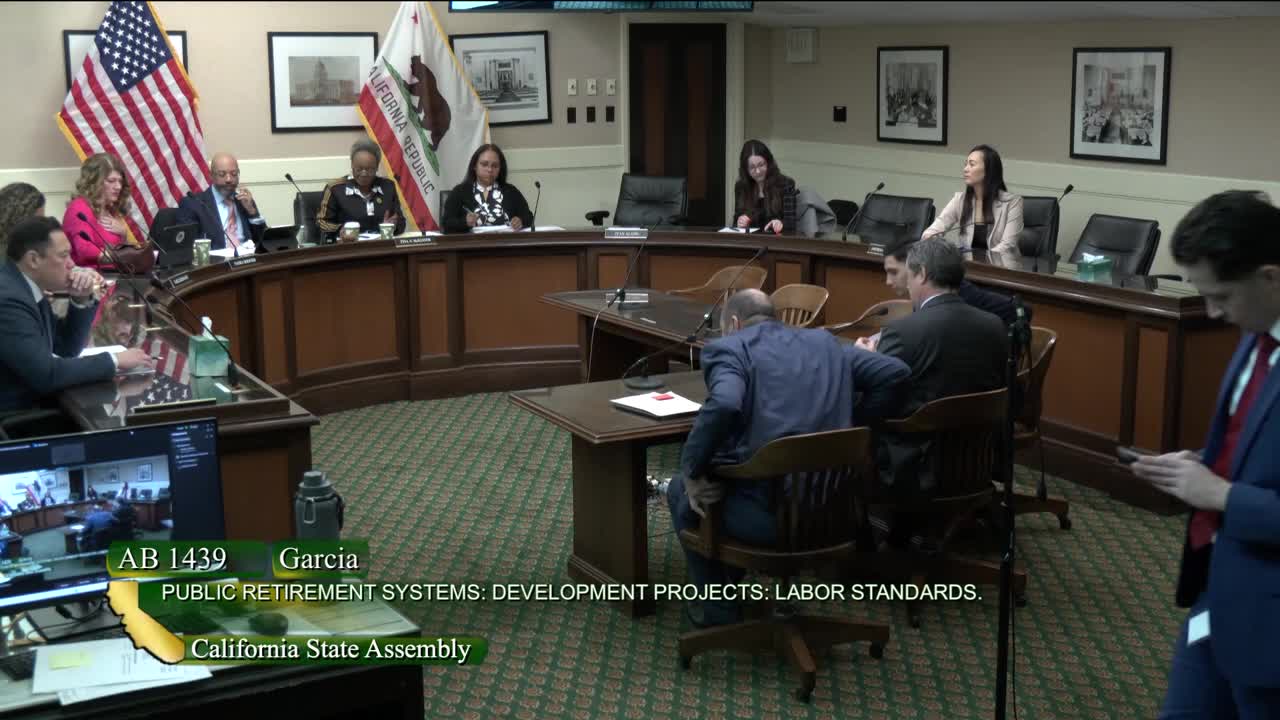 31MIN
Assembly Standing Committee on Public Employment and Retirement
Bill Author