AB 1445: Downtown revitalization and economic recovery financing districts.
- Session Year: 2025-2026
- House: Assembly
- Latest Version Date: 2025-10-11
Current Status:
Passed
(2025-10-11: Chaptered by Secretary of State - Chapter 642, Statutes of 2025.)
Introduced
In Committee
Awaiting First Chamber Vote
Passed First Chamber
In Committee
Awaiting Second Chamber Vote
Passed Second Chamber
Enacted
Existing law authorizes the legislative body of a city or a county to establish an enhanced infrastructure financing district to finance public capital facilities or other specified projects of communitywide significance, including the acquisition, construction, or rehabilitation of housing for persons of very low, low, and moderate income.
Existing law authorizes the City and County of San Francisco to establish a downtown revitalization and economic recovery financing district for the purpose of financing commercial-to-residential conversion projects with incremental tax revenues generated by commercial-to-residential conversion projects within the district. Existing law requires the City and County of San Francisco to establish a board for the district at the same time that it adopts the resolution of intention to form the district, and requires the district to prepare a downtown revitalization financing plan (financing plan) that includes specified information and requirements, including that the first distribution of incremental tax revenues distributed back to a commercial-to-residential conversion project commence with the fiscal year that begins after the project is issued a certificate of occupancy. Existing law, among other things, requires a district to establish a process for eligible commercial-to-residential conversion projects identified in the financing plan to opt into receiving incremental tax revenue generated by the respective project.
Existing law specifies that the commercial-to-residential conversion projects that opt in to receive incremental tax revenue are public works for which prevailing wages are required to be paid, as specified, and requires the commercial-to-residential conversion projects that opt in to receiving incremental tax revenue to comply with labor standards adopted by the Board of Supervisors of the City and County of San Francisco, as provided.
This bill would additionally authorize any city, county, or city and county, except the City and County of San Francisco, to establish a downtown revitalization and economic recovery financing district for the purpose of financing specified commercial-to-residential conversion projects with incremental tax revenues generated by commercial-to-residential conversion projects within the district. The bill would require the district to meet the requirements imposed on the City and County of San Francisco when establishing a downtown revitalization and economic recovery financing district described above and would modify the required components of the districts proposed financing plan, as provided. The bill would make various conforming changes to the above-described provisions in this regard and would also make technical changes.
This bill would further specify that, for purposes of the preparation of a financing plan, if the city, county, or city and county does not issue certificates of occupancy, the first distribution of incremental tax revenue to a commercial-to-residential conversion project shall be made with the fiscal year that begins after the project completes a final inspection. The bill would remove the requirement that commercial-to-residential conversion projects that opt in to receive incremental tax revenue comply with labor standards adopted by the Board of Supervisors of the City and County of San Francisco and would instead subject such projects to specified labor standards.
Existing law requires a certain portion of any ad valorem property tax revenue annually allocated to the local government that is specified in the adopted financing plan, as described, to be allocated to and, when collected, apportioned to a special fund of the district for all lawful purposes of the district. Existing law also requires those revenues to be allocated and apportioned to the local government when the district ceases to exist pursuant to the financing plan.
This bill would remove those provisions.
Existing law authorizes the legislative body of a city or a county to establish an enhanced infrastructure financing district to finance public capital facilities or other specified projects of communitywide significance, including the acquisition, construction, or rehabilitation of housing for persons of very low, low, and moderate income.
Existing law authorizes the City and County of San Francisco to establish a downtown revitalization and economic recovery financing district for the purpose of financing commercial-to-residential conversion projects with incremental tax revenues generated by commercial-to-residential conversion projects within the district. Existing law requires the City and County of San Francisco to establish a board for the district at the same time that it adopts the resolution of intention to form the district, and requires the district to prepare a downtown revitalization financing plan (financing plan) that includes specified information and requirements, including that the first distribution of incremental tax revenues distributed back to a commercial-to-residential conversion project commence with the fiscal year that begins after the project is issued a certificate of occupancy. Existing law, among other things, requires a district to establish a process for eligible commercial-to-residential conversion projects identified in the financing plan to opt into receiving incremental tax revenue generated by the respective project.
Existing law specifies that the commercial-to-residential conversion projects that opt in to receive incremental tax revenue are public works for which prevailing wages are required to be paid, as specified, and requires the commercial-to-residential conversion projects that opt in to receiving incremental tax revenue to comply with labor standards adopted by the Board of Supervisors of the City and County of San Francisco, as provided.
This bill would additionally authorize any city, county, or city and county, except the City and County of San Francisco, to establish a downtown revitalization and economic recovery financing district for the purpose of financing specified commercial-to-residential conversion projects with incremental tax revenues generated by commercial-to-residential conversion projects within the district. The bill would require the district to meet the requirements imposed on the City and County of San Francisco when establishing a downtown revitalization and economic recovery financing district described above and would modify the required components of the districts proposed financing plan, as provided. The bill would make various conforming changes to the above-described provisions in this regard and would also make technical changes.
This bill would further specify that, for purposes of the preparation of a financing plan, if the city, county, or city and county does not issue certificates of occupancy, the first distribution of incremental tax revenue to a commercial-to-residential conversion project shall be made with the fiscal year that begins after the project completes a final inspection. The bill would remove the requirement that commercial-to-residential conversion projects that opt in to receive incremental tax revenue comply with labor standards adopted by the Board of Supervisors of the City and County of San Francisco and would instead subject such projects to specified labor standards.
Existing law requires a certain portion of any ad valorem property tax revenue annually allocated to the local government that is specified in the adopted financing plan, as described, to be allocated to and, when collected, apportioned to a special fund of the district for all lawful purposes of the district. Existing law also requires those revenues to be allocated and apportioned to the local government when the district ceases to exist pursuant to the financing plan.
This bill would remove those provisions.
Existing law authorizes the legislative body of a city or a county to establish an enhanced infrastructure financing district to finance public capital facilities or other specified projects of communitywide significance, including the acquisition, construction, or rehabilitation of housing for persons of very low, low, and moderate income.
Existing law authorizes the City and County of San Francisco to establish a downtown revitalization and economic recovery financing district for the purpose of financing commercial-to-residential conversion projects with incremental tax revenues generated by commercial-to-residential conversion projects within the district. Existing law requires the City and County of San Francisco to establish a board for the district at the same time that it adopts the resolution of intention to form the district, and requires the district to prepare a downtown revitalization financing plan (financing plan) that includes specified information and requirements, including that the first distribution of incremental tax revenues distributed back to a commercial-to-residential conversion project commence with the fiscal year that begins after the project is issued a certificate of occupancy. Existing law, among other things, requires a district to establish a process for eligible commercial-to-residential conversion projects identified in the financing plan to opt into receiving incremental tax revenue generated by the respective project. Existing
Existing law specifies that the commercial-to-residential conversion projects that opt in to receive incremental tax revenue are public works for which prevailing wages are required to be paid, as specified, and requires the commercial-to-residential conversion projects that opt in to receiving incremental tax revenue to comply with labor standards adopted by the Board of Supervisors of the City and County of San Francisco, as provided.
This bill would additionally authorize any city, county, or city and county, except the City and County of San Francisco, to establish a downtown revitalization and economic recovery financing district for the purpose of financing specified commercial-to-residential conversion projects with incremental tax revenues generated by commercial-to-residential conversion projects within the district. The bill would require the district to meet the requirements imposed on the City and County of San Francisco when establishing a downtown revitalization and economic recovery financing district described above. above and would modify the required components of the districts proposed financing plan, as provided. The bill would make various conforming changes to the above-described provisions in this regard. regard and would also make technical changes.
This bill would further specify that, for purposes of the preparation of a financing plan, if the city, county, or city and county does not issue certificates of occupancy, the first distribution of incremental tax revenue to a commercial-to-residential conversion project shall be made with the fiscal year that begins after the project completes a final inspection. The bill would also require the city council or board of supervisors of a city, county, or city and county, as applicable, to adopt labor standards specific to commercial-to-residential conversion projects that opt in to receive incremental tax revenue, as specified. The bill would also remove the requirement that commercial-to-residential conversion projects that opt in to receive incremental tax revenue comply with labor standards adopted by the Board of Supervisors of the City and County of San Francisco and would instead subject such projects to specified labor standards.
Existing law requires a certain portion of any ad valorem property tax revenue annually allocated to the local government that is specified in the adopted financing plan, as described, to be allocated to and, when collected, apportioned to a special fund of the district for all lawful purposes of the district. Existing law also requires those revenues to be allocated and apportioned to the local government when the district ceases to exist pursuant to the financing plan.
This bill would remove those provisions.
Existing law authorizes the legislative body of a city or a county to establish an enhanced infrastructure financing district to finance public capital facilities or other specified projects of communitywide significance, including the acquisition, construction, or rehabilitation of housing for persons of very low, low, and moderate income.
Existing law authorizes the City and County of San Francisco to establish a downtown revitalization and economic recovery financing district for the purpose of financing commercial-to-residential conversion projects with incremental tax revenues generated by commercial-to-residential conversion projects within the district. Existing law requires the City and County of San Francisco to establish a board for the district at the same time that it adopts the resolution of intention to form the district, and requires the district to prepare a downtown revitalization financing plan (financing plan) that includes specified information and requirements, including that the first distribution of incremental tax revenues distributed back to a commercial-to-residential conversion project commence with the fiscal year that begins after the project is issued a certificate of occupancy. Existing law, among other things, requires a district to establish a process for eligible commercial-to-residential conversion projects identified in the financing plan to opt into receiving incremental tax revenue generated by the respective project. Existing law specifies that the commercial-to-residential conversion projects that opt in to receive incremental tax revenue are public works for which prevailing wages are required to be paid, as specified, and requires the commercial-to-residential conversion projects that opt in to receiving incremental tax revenue to comply with labor standards adopted by the Board of Supervisors of the City and County of San Francisco, as provided.
This bill would additionally authorize any city, county, or city and county, except the City and County of San Francisco, to establish a downtown revitalization and economic recovery financing district for the purpose of financing specified commercial-to-residential conversion projects with incremental tax revenues generated by commercial-to-residential conversion projects within the district. The bill would require the district to meet the requirements imposed on the City and County of San Francisco when establishing a downtown revitalization and economic recovery financing district described above. The bill would make various conforming changes to the above-described provisions in this regard.
This bill would further specify that, for purposes of the preparation of a financing plan, if the city, county, or city and county does not issue certificates of occupancy, the first distribution of incremental tax revenue to a commercial-to-residential conversion project shall be made with the fiscal year that begins after the project completes a final inspection. The bill would also require the city council or board of supervisors of a city, county, or city and county, as applicable, to adopt labor standards specific to commercial-to-residential conversion projects that opt in to receive incremental tax revenue, as specified. The bill would also subject such projects to specified labor standards.
Existing law requires a certain portion of any ad valorem property tax revenue annually allocated to the local government that is specified in the adopted financing plan, as described, to be allocated to and, when collected, apportioned to a special fund of the district for all lawful purposes of the district. Existing law also requires those revenues to be allocated and apportioned to the local government when the district ceases to exist pursuant to the financing plan.
This bill would remove those provisions.
Existing law authorizes the legislative body of a city or a county to establish an enhanced infrastructure financing district to finance public capital facilities or other specified projects of communitywide significance, including the acquisition, construction, or rehabilitation of housing for persons of very low, low, and moderate income.
Existing law authorizes the City and County of San Francisco to establish a downtown revitalization and economic recovery financing district for the purpose of financing commercial-to-residential conversion projects with incremental tax revenues generated by commercial-to-residential conversion projects within the district. Existing law requires the City and County of San Francisco to establish a board for the district at the same time that it adopts the resolution of intention to form the district, and requires the district to prepare a downtown revitalization financing plan (financing plan) that includes specified information and requirements, including that the first distribution of incremental tax revenues be distributed back to the respective project for the purpose of financing the debt service of the project for 30 years or until the district ceases to exist. a commercial-to-residential conversion project commence with the fiscal year that begins after the project is issued a certificate of occupancy. Existing law, among other things, requires a district to establish a process for eligible commercial-to-residential conversion projects identified in the financing plan to opt into receiving incremental tax revenue generated by the respective project. Existing law specifies that the commercial-to-residential conversion projects that opt in to receive incremental tax revenue are public works for which prevailing wages are required to be paid, as specified, and requires the commercial-to-residential conversion projects that opt in to receiving incremental tax revenue to comply with labor standards adopted by the Board of Supervisors of the City and County of San Francisco, as provided.
This bill would additionally authorize any city, county, or city and county, except the City and County of San Francisco, to establish a downtown revitalization and economic recovery financing district for the purpose of financing specified commercial-to-residential conversion projects with incremental tax revenues generated by commercial-to-residential conversion projects within the district. The bill would require the district to meet the requirements imposed on the City and County of San Francisco when establishing a downtown revitalization and economic recovery financing district described above. The bill would make various conforming changes to the above-described provisions in this regard.
This bill would further specify that, for purposes of the preparation of a financing plan, if the city, county, or city and county does not issue certificates of occupancy, the first distribution of incremental tax revenue to a commercial-to-residential conversion project shall be made with the fiscal year that begins after the project completes a final inspection. The bill would also require the city council or board of supervisors of a city, county, or city and county, as applicable, to adopt labor standards specific to commercial-to-residential conversion projects that opt in to receive incremental tax revenue, as specified. The bill would also subject such projects to specified labor standards.
Existing law requires a certain portion of any ad valorem property tax revenue annually allocated to the local government that is specified in the adopted financing plan, as described, to be allocated to and, when collected, apportioned to a special fund of the district for all lawful purposes of the district. Existing law also requires those revenues to be allocated and apportioned to the local government when the district ceases to exist pursuant to the financing plan.
This bill would remove those provisions.
Existing law authorizes the legislative body of a city or a county to establish an enhanced infrastructure financing district to finance public capital facilities or other specified projects of communitywide significance, including the acquisition, construction, or rehabilitation of housing for persons of very low, low, and moderate income.
Existing law authorizes the City and County of San Francisco to establish a downtown revitalization and economic recovery financing district for the purpose of financing commercial-to-residential conversion projects with incremental tax revenues generated by commercial-to-residential conversion projects within the district. Existing law requires the City and County of San Francisco to establish a board for the district at the same time that it adopts the resolution of intention to form the district, and requires the district to prepare a downtown revitalization financing plan that includes specified information and requirements, including that incremental tax revenues be distributed back to the respective project for the purpose of financing the debt service of the project for 30 years or until the district ceases to exist. Existing law, among other things, requires a district to establish a process for eligible commercial-to-residential conversion projects identified in the financing plan to opt into receiving incremental tax revenue generated by the respective project. Existing law specifies that the commercial-to-residential conversion projects that opt in to receive incremental tax revenue are public works for which prevailing wages are required to be paid, as specified, and requires the commercial-to-residential conversion projects that opt in to receiving incremental tax revenue to comply with labor standards adopted by the Board of Supervisors of the City and County of San Francisco, as provided.
This bill would additionally authorize any city, county, or city and county county, except the City and County of San Francisco, to establish a downtown revitalization and economic recovery financing district for the purpose of financing specified commercial-to-residential conversion projects with incremental tax revenues generated by commercial-to-residential conversion projects within the district. The bill would require the district to meet the requirements imposed on the City and County of San Francisco when establishing a downtown revitalization and economic recovery financing district described above. The bill would make various conforming changes to the above-described provisions in this regard.
Existing law authorizes the legislative body of a city or a county to establish an enhanced infrastructure financing district to finance public capital facilities or other specified projects of communitywide significance, including the acquisition, construction, or rehabilitation of housing for persons of very low, low, and moderate income.
Existing law authorizes the City and County of San Francisco to establish a downtown revitalization and economic recovery financing district for the purpose of financing commercial-to-residential conversion projects with incremental tax revenues generated by commercial-to-residential conversion projects within the district. Existing law requires the City and County of San Francisco to establish a board for the district at the same time that it adopts the resolution of intention to form the district, and requires the district to prepare a downtown revitalization financing plan that includes specified information and requirements, including that incremental tax revenues be distributed back to the respective project for the purpose of financing the debt service of the project for 30 years or until the district ceases to exist. Existing law, among other things, requires a district to establish a process for eligible commercial-to-residential conversion projects identified in the financing plan to opt into receiving incremental tax revenue generated by the respective project. Existing law specifies that the commercial-to-residential conversion projects that opt in to receive incremental tax revenue are public works for which prevailing wages are required to be paid, as specified, and requires the commercial-to-residential conversion projects that opt in to receiving incremental tax revenue to comply with labor standards adopted by the Board of Supervisors of the City and County of San Francisco, as provided.
This bill would additionally authorize any city, county, or city and county to establish a downtown revitalization and economic recovery financing district for the purpose of financing commercial-to-residential conversion projects with incremental tax revenues generated by commercial-to-residential conversion projects within the district. The bill would require the district to meet the requirements imposed on the City and County of San Francisco when establishing a downtown revitalization and economic recovery financing district described above. The bill would make various conforming changes to the above-described provisions in this regard.
Existing law, the Affordable Housing and High Road Jobs Act of 2022, until January 1, 2033, establishes a streamlined development process for affordable housing developments that meet specified objective standards and affordability and site criteria. This bill would make a nonsubstantive change to those provisions.Existing law, the Affordable Housing and High Road Jobs Act of 2022, until January 1, 2033, establishes a streamlined development process for affordable housing developments that meet specified objective standards and affordability and site criteria.
This bill would make a nonsubstantive change to those provisions.
For purposes of this part:
(a)Commercial-to-residential conversion project means a housing development project that converts an existing qualifying commercial building to market rate or affordable housing by either reuse of the existing commercial building or by replacing the commercial building with a new residential building.
(b)Communitywide significance means benefits associated with the commercial-to-residential conversion project beyond the conversion of commercial space to residential dwelling units.
(c)Designated official means the appropriate official designated pursuant to Section 62455.
(d)District board means the governing board of the downtown revitalization and economic recovery financing district.
(e)(1)Downtown revitalization and economic recovery financing district or district means a legally constituted governmental entity separate and distinct from the local government that established it pursuant to this division for the sole purpose of financing commercial-to-residential conversion projects or other projects of communitywide significance that support downtown revitalization and economic recovery as authorized by this division. A downtown revitalization and economic recovery financing district is a local agency for purposes of Chapter 9 (commencing with Section 54950) of Part 1 of Division 2 of Title 5.
(2)A downtown revitalization and economic recovery financing district shall be deemed a district within the meaning of Section 1 of Article XIIIA of the California Constitution.
(f)Downtown revitalization financing plan means an adopted financing plan prepared pursuant to Section 62456.
(g)Downtown San Francisco means an area in the City and County of San Francisco bounded beginning at the intersection of Washington Street and The Embarcadero, running southerly along The Embarcadero and then King Street to 3rd Street, running northwesterly on 3rd Street to Townsend Street, running southwesterly along Townsend Street to 6th Street, running northwesterly along 6th Street to Mission Street, running southwesterly along Mission Street to 10th Street, running southeasterly along 10th Street to Minna Street, running southwesterly along Minna Street to Lafayette Street, running southeasterly along Lafayette Street to Howard Street, running southerly along Howard Street to the junction with the Central Freeway, running westerly along the Central Freeway to Market Street, running northeasterly along Market Street to Franklin Street, running northerly along Franklin Street to Golden Gate Avenue, running easterly along Golden Gate Avenue to Taylor Street, running northerly along Taylor Street to Turk Street, running easterly along Turk Street to Mason Street, running northerly along Mason Street to Ellis Street, running westerly along Ellis Street to Taylor Street, running northerly along Taylor Street to OFarrell Street, running westerly along OFarrell Street to Shannon Street, running northerly along Shannon Street to Geary Street, running easterly along Geary Street to Taylor Street, running northerly along Taylor Street to Bush Street, running easterly along Bush Street to Kearny Street, running northerly along Kearny Street to Sacramento Street, running easterly along Sacramento Street to Montgomery Street, running northerly along Montgomery Street to Washington Street, and running easterly along Washington Street to The Embarcadero.
(h)Governing body means the city council or board of supervisors of a local government.
(i)Local government means a city, county, or city and county, whether general law or chartered.
(j)Lower income households has the same meaning as defined in Section 50079.5 of the Health and Safety Code.
(k)Moderate-income households means households of persons and families of moderate income, as defined in Section 50093 of the Health and Safety Code.
(l)Net available revenue means periodic distributions to a local government from the Redevelopment Property Tax Trust Fund, created pursuant to Section 34170.5 of the Health and Safety Code, that are available to the local government after all preexisting legal commitments and statutory obligations funded from that revenue are made pursuant to Part 1.85 (commencing with Section 34170) of Division 24 of the Health and Safety Code. Net available revenue shall not include any funds deposited by the county auditor-controller into the Redevelopment Property Tax Trust Fund or funds remaining in the Redevelopment Property Tax Trust Fund prior to distribution. Net available revenue shall not include any moneys payable to a school district that maintains kindergarten and grades 1 to 12, inclusive, community college districts, county office of education, or to the Educational Revenue Augmentation Fund, pursuant to paragraph (4) of subdivision (a) of Section 34183 of the Health and Safety Code.
(m)Opted-in taxable property means the property of a commercial-to-residential conversion project that has opted in to receive incremental tax revenue pursuant to Section 62459.
(n)Qualifying commercial building means a commercial building identified in the downtown revitalization financing plan pursuant to subdivision (d) of Section 62456.
(o)San Francisco means the City and County of San Francisco.
(p)Transit priority area has the same meaning as defined in subdivision (a) of Section 21099 of the Public Resources Code.
(q)Very low income households has the same meaning as defined in Section 50105 of the Health and Safety Code.
SEC. 2.Section 62451 of the Government Code is amended to read:62451.The Board of Supervisors of the City and County of San Francisco may establish one downtown revitalization and economic recovery financing district pursuant to this division. Proceedings for the establishment of a district shall be instituted by the adoption of a resolution of intention to establish the proposed district and shall do all of the following:
(a)(1)State that a district is proposed to be established under the terms of this division and describe the boundaries of the proposed district, which may be accomplished by reference to a map on file in the office of the recorder of the county.
(2)The boundaries of the district shall be limited to downtown San Francisco.
(b)State the need for the district and the goals the district proposes to achieve.
(c)State that incremental property tax revenue generated by investment in the commercial-to-residential conversion project from San Francisco will be used to finance these activities.
(d)Fix a time and place for a public hearing by the Board of Supervisors of the City and County of San Francisco on the proposed downtown revitalization financing plan. The Board of Supervisors of the City and County of San Francisco shall hold the public hearing before the district boards third public hearing, described in subdivision (d) of Section 62458. After the Board of Supervisors of the City and County of San Francisco public hearing, the Board of Supervisors of the City and County of San Francisco may approve or reject the proposed downtown revitalization financing plan.
SEC. 3.Section 62451.5 is added to the Government Code, to read:62451.5.The governing body of a local government, except the City and County of San Francisco, may establish one downtown revitalization and economic recovery financing district pursuant to this division. Proceedings for the establishment of a district shall be instituted by the adoption of a resolution of intention to establish the proposed district and shall do all of the following:
(a)State that a district is proposed to be established under the terms of this division and describe the boundaries of the proposed district, which may be accomplished by reference to a map on file in the office of the recorder of the county.
(b)State that the district will only finance commercial-to-residential conversion projects that meet all of the following requirements:
(1)At least 75 percent of the perimeter of the site of the development adjoins parcels that are developed with urban uses. For the purposes of this section, parcels that are only separated by a street or highway shall be considered to be adjoined.
(2)Is located within a part of the city or county where the commercial office building vacancy rate is 20 percent or greater.
(3)Is located within a transit priority area.
(c)State the need for the district and the goals the district proposes to achieve.
(d)State that incremental property tax revenue generated by investment in the commercial-to-residential conversion project from the local government will be used to finance these activities.
(e)Fix a time and place for a public hearing by the governing body on the proposed downtown revitalization financing plan. The governing body shall hold the public hearing before the district boards third public hearing, described in subdivision (d) of Section 62458. After the governing bodys public hearing, the governing body may approve or reject the proposed downtown revitalization financing plan.
SEC. 4.Section 62452 of the Government Code is amended to read:62452.(a)(1)The district boards membership shall consist of three members of the governing body and two members of the public chosen by the governing body. The governing body may appoint one of its members to be an alternate member of the district board who may serve and vote in place of a member who is absent or disqualifies themselves from participating in a meeting of the district. The appointment of the public members shall be subject to the provisions of Sections 54970 and 54972.
(2)For purposes of this subdivision, the district board may include a directly elected mayor.
(b)The governing body shall ensure the district board is established at the same time that it adopts a resolution of intention pursuant to Section 62451 or 62451.5, as applicable.
(c)Members of the district board shall not receive compensation but may receive reimbursement for actual and necessary expenses incurred in the performance of official duties pursuant to Article 2.3 (commencing with Section 53232) of Chapter 2 of Part 1 of Division 2 of Title 5.
(d)Members of the district board are subject to Article 2.4 (commencing with Section 53234) of Chapter 2 of Part 1 of Division 2 of Title 5.
(e)The district board shall be a local public agency subject to the Ralph M. Brown Act (Chapter 9 (commencing with Section 54950) of Part 1 of Division 2 of Title 5), the California Public Records Act (Division 10 (commencing with Section 7920.000) of Title 1), and the Political Reform Act of 1974 (Title 9 (commencing with Section 81000)).
SEC. 5.Section 62453 of the Government Code is amended to read:62453.(a)The purpose of the district is to finance commercial-to-residential conversion projects with incremental tax revenues generated by commercial-to-residential conversion projects within the district.
(b)Incremental tax revenues generated by commercial-to-residential conversion projects within the district shall be allocated to, and when collected shall be paid into a special fund of, the district for all lawful purposes described in this section.
(c)The district shall finance only commercial-to-residential conversion projects that the district determines are of communitywide significance and that provide significant benefits to the district or the surrounding community.
(d)The district shall ensure that incremental tax revenues allocated to the district are limited to those revenues described in Section 62457 that are generated through commercial-to-residential conversion projects within the district that have opted in pursuant to Section 62459.
(e)(1)The district shall take all of the following actions:
(A)Hold an annual public hearing.
(B)On or before June 30, after holding a public hearing, adopt an annual report.
(C)Make available written copies of the draft of the annual report available to the public 30 days before the public hearing.
(D)Post the draft of the annual report in an easily identifiable and accessible location on the districts internet website.
(2)The annual report shall contain all of the following:
(A)A description of the projects undertaken by the district in the fiscal year, including any rehabilitation of structures, and a comparison of the progress expected to be made on those projects compared to the actual progress.
(B)A chart comparing the actual revenues and expenses, including administrative costs, of the district to the budgeted revenues and expenses.
(C)The amount of tax increment revenues received by the district.
(D)A description of each commercial-to-residential conversion project within the district that opted in and the amount of tax increment revenues received.
(E)An assessment of the status regarding completion of the districts projects.
(F)The amount of revenues expended by the district to assist private businesses.
(3)If the district fails to adopt the annual report required by subparagraph (B) of paragraph (1), the district shall not allow for any additional properties to opt in to receiving funds from the district until the district has adopted the report.
(4)Every 10 years at a public hearing required by subparagraph (A) of paragraph (1), the district shall consider the following:
(A)Whether the requirements of this division continue to be met.
(B)Whether amendments to the downtown revitalization plan are necessary to ensure the requirements of this division continue to be met.
SEC. 6.Section 62455 of the Government Code is amended to read:62455.After adopting the resolution pursuant to Section 62451 or 62451.5, as applicable, the governing body shall send a copy of the resolution to the district board. The district board shall designate and direct the appropriate government official to prepare a downtown revitalization financing plan pursuant to Section 62456.
SEC. 7.Section 62456 of the Government Code is amended to read:62456.After receipt of a copy of the resolution of intention to establish the district, the official designated pursuant to Section 62455 shall prepare a proposed downtown revitalization financing plan. The downtown revitalization financing plan shall be consistent with the general plan and applicable specific plans, and shall include all of the following:
(a)A map and legal description of the proposed district, which may include all or a portion of the district designated by the governing body in its resolution of intention.
(b)A description of the potential commercial-to-residential conversion projects that are proposed in the area of the district. A commercial-to-residential conversion project may be mixed use, but at least 60 percent of the square footage of the commercial-to-residential conversion shall be designated for residential use. Mixed-use developments shall be limited to residential and commercial uses.
(c)A requirement that if nonresidential development is included in the development pursuant to subdivision (b), at least 25 percent of the total planned units affordable to lower income households shall be made available for lease or sale and permitted for use and occupancy before or at the same time with every 25 percent of nonresidential development made available for lease or sale and permitted for use and occupancy.
(d)(1)A requirement that an opted-in taxable property shall not receive a property tax distribution from the district unless it meets one of the following:
(A)At least 5 percent of total units for rent are affordable to very low income households or the local inclusionary requirement, whichever is higher, for a minimum of 55 years.
(B)At least 10 percent of total units for rent are affordable to lower income households or the local inclusionary requirement, whichever is higher, for a minimum of 55 years.
(C)At least 10 percent of total units for sale are affordable to households of moderate income or the local inclusionary requirement, whichever is higher, for a minimum of 45 years.
(2)For a district established in the City and County of San Francisco, the affordability requirements established pursuant to this subdivision shall not apply to the first 1,500,000 square feet of opted-in commercial-to-residential conversion projects.
(e)For a district established by a city or county other than the City and County of San Francisco, a requirement that at least 30 percent of the incremental tax revenues generated by the district be used to finance the units in subdivision (d).
(f)A finding that the potential commercial-to-residential conversion projects and financial assistance are of communitywide significance and provide significant benefits to an area larger than the area of the district.
(g)Identification of each existing commercial building within the district that is eligible for conversion to residential use and that may opt in to receive incremental tax revenue pursuant to this division.
(h)A requirement that the incremental tax revenues generated by each individual commercial-to-residential conversion project within the district that are allocated to the district by the local government be distributed by the district back to that same project for the purpose of financing necessary development costs. Each individual commercial-to-residential conversion project shall receive an annual distribution on a pay-go basis in an amount no greater than the amount of incremental tax revenues generated by that same commercial-to-residential conversion project for a maximum of 30 years or until the district ceases to exist, whichever occurs first.
(i)A requirement that the first distribution of incremental tax revenue to a commercial-to-residential conversion project pursuant to subdivision (h) commence with the fiscal year that begins after the project is issued a certificate of occupancy or, if the city, county, or city and county does not issue certificates of occupancy, the project completes a final inspection.
(j)A requirement that if an opted-in taxable property is sold or otherwise transferred to a new property owner, the distribution described in subdivision (h) shall also be transferred to the new property owner.
(k)A requirement that any incremental tax revenues remaining after the distribution of revenues pursuant to subdivision (h) be used for downtown revitalization programs. Once the allocation of revenues has ceased, the tax increment shall be allocated to, and, when collected, shall be apportioned to, the local government.
(l)A requirement that local administrative costs to implement this section do not exceed 5 percent of the tax revenues allocated pursuant to the section, not including amounts required to reimburse the local government for the costs of establishing the district or the costs described in Section 62461.
(m)A financing section, which shall contain all of the following information:
(1)A specification of the maximum portion of the incremental tax revenue of the local government proposed to be committed to the district for each year during which the district will receive incremental tax revenue. The portion may change over time.
(2)A projection of the amount of tax revenues expected to be received by the district in each year during which the district will receive tax revenues.
(3)A limit on the total number of dollars of taxes that may be allocated to the district pursuant to the plan.
(4)A date on which the district will cease to exist, by which time all tax allocations to the district will end. The date shall not be more than 45 years from the date on which the district distributes funding to the first commercial-to-residential conversion project within the district.
(5)An analysis of the costs to the local government of providing facilities and services to the area of the district while the area is being developed and after the area is developed. The plan shall also include an analysis of the tax, fee, charge, and other revenues expected to be received by the local government as a result of expected development in the area of the district.
(6)An analysis of the projected fiscal impact of the district and the associated development upon the local government.
(n)If any residential dwelling units within the territory of the district are proposed to be removed or demolished in the course of a commercial-to-residential conversion project within the area of the district, a plan providing for replacement of those units and relocation of those persons or families consistent with the requirements of Article 2 (commencing with Section 66300.5) of Chapter 12 of Division 1 of Title 7.
(o)The goals the district proposes to achieve for each project financed pursuant to this division.
SEC. 8.Section 62457 of the Government Code is amended to read:62457.(a)A downtown revitalization financing plan shall contain a provision that taxes, if any, levied upon opted-in taxable property in the area included within the downtown financing district each year by or for the benefit of the State of California, or the local government, shall be divided, subject to the provisions of Section 53993, as follows:
(1)That portion of the taxes that would be produced by the rate upon which the tax is levied each year by or for the local government upon the total sum of the assessed value of all of the opted-in taxable property in the district, as established pursuant to subdivision (c) of Section 62459, shall be allocated to, and when collected shall be paid to, that local government as taxes on all other property are paid.
(2)That portion of the levied taxes each year specified in the adopted downtown revitalization financing plan for the local government in excess of the amount specified in paragraph (1) shall be allocated to, and when collected shall be paid into a special fund of, the district for all lawful purposes of the district. Unless and until the total assessed valuation of the opted-in taxable property in a district exceeds the total assessed value of the opted-in taxable property in the district as shown by the last equalized assessment rolls referred to in paragraph (1), all of the taxes levied and collected upon the opted-in taxable property in the district shall be paid to the local government. When the district ceases to exist pursuant to the adopted downtown revitalization financing plan, all moneys thereafter received from taxes upon the opted-in taxable property in the district shall be allocated to, and, when collected, shall be apportioned to, the local government.
(b)Notwithstanding subdivision (a), where any district boundaries overlap with the boundaries of any former redevelopment project area, any debt or obligation of the district shall be subordinate to any and all enforceable obligations of the former redevelopment agency, as approved by the oversight board and the Department of Finance. For the purposes of this chapter, the division of taxes allocated to the district pursuant to subdivision (a) shall not include any taxes required to be deposited by the county auditor-controller into the Redevelopment Property Tax Trust Fund created pursuant to subdivision (b) of Section 34170.5 of the Health and Safety Code.
(c)The governing body may choose to dedicate any portion of its net available revenue, as defined in subdivision (k) of Section 62450, to the district through the downtown revitalization financing plan.
(d)The downtown revitalization financing plan shall not divide revenues that are allocated to other taxing entities that are not part of the local government.
(e)The portion of the incremental tax revenues described in subdivisions (a) and (c) generated by a commercial-to-residential conversion project that can be allocated to the district shall be limited to the incremental tax revenues generated by residential use in the project, with residential use measured based on square footage.
SEC. 9.Section 62458 of the Government Code is amended to read:62458.(a)The district board shall consider adoption of the downtown revitalization financing plan at three public hearings.
(b)At the first public hearing, the district shall present the draft downtown revitalization financing plan, answer questions about the district, and consider comments about the downtown revitalization financing plan.
(c)At the second public hearing, the district shall consider any written and oral comments and take action to approve, modify, or reject the downtown revitalization financing plan.
(d)If the district takes action to approve or modify the downtown revitalization financing plan at the second public hearing, and if the governing body approved the downtown revitalization financing plan pursuant to Section 62451 or 62451.5, as applicable, then the district may enact an ordinance or adopt a resolution to approve the downtown revitalization financing plan at the third public hearing.
(e)At least 10 days before each public hearing, the district board shall give notice of the public hearing as follows:
(1)The district board shall post notice of each public hearing required by this section in an easily identifiable and accessible location on the districts internet website.
(2)The district board shall do one of following:
(A)Mail a written notice of the public hearing at least 10 days before each scheduled public hearing date to each landowner, resident, business owner, and labor organization that represents workers in the geographic area of the project.
(B)If the district designates a contact person to receive and process any requests for an electronically mailed packet of all materials, email, at least 10 days before each scheduled public hearing date, notice of the public hearing to the email contact list assembled and maintained by the designated contact person.
(C)Publish notice of each public hearing at least 10 days before each public hearing in a newspaper of general circulation in that jurisdiction.
SEC. 10.Section 62459 of the Government Code is amended to read:62459.(a)(1)After the adoption of the downtown revitalization financing plan, the district shall establish a process for eligible commercial-to-residential conversion projects identified pursuant to subdivision (d) of Section 62456 to opt into receiving incremental tax revenue generated by that same commercial-to-residential conversion project pursuant to this division. A district shall establish a process to reconsider the amount of incremental tax revenue to be distributed to a project if there is a change in use or the square footage of commercial space converted to housing planned to be built.
(2)An eligible commercial-to-residential conversion project may opt in to receive incremental tax revenue generated by that same commercial-to-residential conversion project pursuant to this division at any time before the project is issued the first building permit for the project.
(3)A commercial-to-residential conversion project shall not be eligible to opt in to receive incremental tax revenue pursuant to this division after December 31, 2032.
(b)After a commercial-to-residential conversion project opts in, the district shall determine whether it meets the requirements of this division and can begin receiving property tax incremental revenues. If the district determines that the project does not meet the requirements of this division, or that it does not have enough room under the limit established pursuant to paragraph (3) of subdivision (l) of Section 62456 for the project, the district shall not allow the project to begin receiving incremental tax revenue.
(c)For purposes of paragraph (1) of subdivision (a) of Section 62457, after a commercial-to-residential conversion project opts in to receive incremental tax revenue, and the district approves the projects ability to receive incremental tax revenue, the district shall establish the base assessed value for the applicable property, which shall be the assessed value for the applicable property as shown on the assessment roll used in connection with the property by the local government, last equalized prior to the first building permit being issued as a part of the conversion of the commercial-to-residential conversion project.
(d)An eligible commercial-to-residential conversion project that opts in to receive incremental tax revenue pursuant to subdivision (a) shall comply with the labor standards established in Section 62460.
SEC. 11.Section 62460 of the Government Code is amended to read:62460.(a)Commercial-to-residential conversion projects that opt in to receive incremental tax revenue pursuant to Section 62459 are public works for which prevailing wages shall be paid for purposes of Chapter 1 (commencing with Section 1720) of Part 7 of Division 2 of the Labor Code.
(b)For commercial-to-residential conversion projects that opt in to receive incremental tax revenue pursuant to Section 62459, the following labor standard provisions shall apply:
(1)Except as provided in paragraphs (2) and (3), for projects comprising 50 or more housing units, the labor standards of Section 65912.131 shall apply.
(2)Notwithstanding paragraph (1) and except as provided in paragraph (3), for projects involving buildings over 85 feet in height above grade, the labor standards of paragraph (8) of subdivision (a) of Section 65913.4 shall apply.
(3)(A)Notwithstanding paragraphs (1) and (2), for projects that are streamlined under the Office to Housing Conversion Act (Article 11.5 (commencing with Section 65658) of Chapter 3 of Division 1 of Title 7), the labor standards of that act shall apply.
(B)This paragraph shall become operative only if Assembly Bill 507 of the 202526 Regular Session is enacted and takes effect.
SEC. 12.Section 62461 of the Government Code is amended to read:62461.All costs incurred by the local government in connection with the division of taxes pursuant to this division for the district shall be paid by the district.
SEC. 13.Section 62462 of the Government Code is amended to read:62462.(a)If a local government establishes a district pursuant to this division, it shall develop and submit an annual report to the relevant committees of the Legislature regarding the commercial-to-residential conversion projects financed by the district.
(b)The reports submitted pursuant to subdivision (a) shall be submitted in compliance with Section 9795.
For purposes of this part:
(a)Commercial-to-residential conversion project means a housing development project that converts an existing qualifying commercial building to market rate or affordable housing by either reuse of the existing commercial building or by replacing the commercial building with a new residential building.
(b)Communitywide significance means benefits associated with the commercial-to-residential conversion project beyond the conversion of commercial space to residential dwelling units.
(c)Designated official means the appropriate official designated pursuant to Section 62455.
(d)District board means the governing board of the downtown revitalization and economic recovery financing district.
(e)(1)Downtown revitalization and economic recovery financing district or district means a legally constituted governmental entity separate and distinct from the local government that established it pursuant to this division for the sole purpose of financing commercial-to-residential conversion projects or other projects of communitywide significance that support downtown revitalization and economic recovery as authorized by this division. A downtown revitalization and economic recovery financing district is a local agency for purposes of Chapter 9 (commencing with Section 54950) of Part 1 of Division 2 of Title 5.
(2)A downtown revitalization and economic recovery financing district shall be deemed a district within the meaning of Section 1 of Article XIIIA of the California Constitution.
(f)Downtown revitalization financing plan means an adopted financing plan prepared pursuant to Section 62456.
(g)Downtown San Francisco means an area in the City and County of San Francisco bounded beginning at the intersection of Washington Street and The Embarcadero, running southerly along The Embarcadero and then King Street to 3rd Street, running northwesterly on 3rd Street to Townsend Street, running southwesterly along Townsend Street to 6th Street, running northwesterly along 6th Street to Mission Street, running southwesterly along Mission Street to 10th Street, running southeasterly along 10th Street to Minna Street, running southwesterly along Minna Street to Lafayette Street, running southeasterly along Lafayette Street to Howard Street, running southerly along Howard Street to the junction with the Central Freeway, running westerly along the Central Freeway to Market Street, running northeasterly along Market Street to Franklin Street, running northerly along Franklin Street to Golden Gate Avenue, running easterly along Golden Gate Avenue to Taylor Street, running northerly along Taylor Street to Turk Street, running easterly along Turk Street to Mason Street, running northerly along Mason Street to Ellis Street, running westerly along Ellis Street to Taylor Street, running northerly along Taylor Street to OFarrell Street, running westerly along OFarrell Street to Shannon Street, running northerly along Shannon Street to Geary Street, running easterly along Geary Street to Taylor Street, running northerly along Taylor Street to Bush Street, running easterly along Bush Street to Kearny Street, running northerly along Kearny Street to Sacramento Street, running easterly along Sacramento Street to Montgomery Street, running northerly along Montgomery Street to Washington Street, and running easterly along Washington Street to The Embarcadero.
(h)Governing body means the city council or board of supervisors of a local government.
(i)Local government means a city, county, or city and county, whether general law or chartered.
(j)Lower income households has the same meaning as defined in Section 50079.5 of the Health and Safety Code.
(k)Moderate-income households means households of persons and families of moderate income, as defined in Section 50093 of the Health and Safety Code.
(l)Net available revenue means periodic distributions to a local government from the Redevelopment Property Tax Trust Fund, created pursuant to Section 34170.5 of the Health and Safety Code, that are available to the local government after all preexisting legal commitments and statutory obligations funded from that revenue are made pursuant to Part 1.85 (commencing with Section 34170) of Division 24 of the Health and Safety Code. Net available revenue shall not include any funds deposited by the county auditor-controller into the Redevelopment Property Tax Trust Fund or funds remaining in the Redevelopment Property Tax Trust Fund prior to distribution. Net available revenue shall not include any moneys payable to a school district that maintains kindergarten and grades 1 to 12, inclusive, community college districts, county office of education, or to the Educational Revenue Augmentation Fund, pursuant to paragraph (4) of subdivision (a) of Section 34183 of the Health and Safety Code.
(m)Opted-in taxable property means the property of a commercial-to-residential conversion project that has opted in to receive incremental tax revenue pursuant to Section 62459.
(n)Qualifying commercial building means a commercial building identified in the downtown revitalization financing plan pursuant to subdivision (d) of Section 62456.
(o)San Francisco means the City and County of San Francisco.
(p)Transit priority area has the same meaning as defined in subdivision (a) of Section 21099 of the Public Resources Code.
(q)Very low income households has the same meaning as defined in Section 50105 of the Health and Safety Code.
SEC. 2.Section 62451 of the Government Code is amended to read:62451.The Board of Supervisors of the City and County of San Francisco may establish one downtown revitalization and economic recovery financing district pursuant to this division. Proceedings for the establishment of a district shall be instituted by the adoption of a resolution of intention to establish the proposed district and shall do all of the following:
(a)(1)State that a district is proposed to be established under the terms of this division and describe the boundaries of the proposed district, which may be accomplished by reference to a map on file in the office of the recorder of the county.
(2)The boundaries of the district shall be limited to downtown San Francisco.
(b)State the need for the district and the goals the district proposes to achieve.
(c)State that incremental property tax revenue generated by investment in the commercial-to-residential conversion project from San Francisco will be used to finance these activities.
(d)Fix a time and place for a public hearing by the Board of Supervisors of the City and County of San Francisco on the proposed downtown revitalization financing plan. The Board of Supervisors of the City and County of San Francisco shall hold the public hearing before the district boards third public hearing, described in subdivision (d) of Section 62458. After the Board of Supervisors of the City and County of San Francisco public hearing, the Board of Supervisors of the City and County of San Francisco may approve or reject the proposed downtown revitalization financing plan.
SEC. 3.Section 62451.5 is added to the Government Code, to read:62451.5.The governing body of a local government, except the City and County of San Francisco, may establish one downtown revitalization and economic recovery financing district pursuant to this division. Proceedings for the establishment of a district shall be instituted by the adoption of a resolution of intention to establish the proposed district and shall do all of the following:
(a)State that a district is proposed to be established under the terms of this division and describe the boundaries of the proposed district, which may be accomplished by reference to a map on file in the office of the recorder of the county.
(b)State that the district will only finance commercial-to-residential conversion projects that meet all of the following requirements:
(1)At least 75 percent of the perimeter of the site of the development adjoins parcels that are developed with urban uses. For the purposes of this section, parcels that are only separated by a street or highway shall be considered to be adjoined.
(2)Is located within a part of the city or county where the commercial office building vacancy rate is 20 percent or greater.
(3)Is located within a transit priority area.
(c)State the need for the district and the goals the district proposes to achieve.
(d)State that incremental property tax revenue generated by investment in the commercial-to-residential conversion project from the local government will be used to finance these activities.
(e)Fix a time and place for a public hearing by the governing body on the proposed downtown revitalization financing plan. The governing body shall hold the public hearing before the district boards third public hearing, described in subdivision (d) of Section 62458. After the governing bodys public hearing, the governing body may approve or reject the proposed downtown revitalization financing plan.
SEC. 4.Section 62452 of the Government Code is amended to read:62452.(a)(1)The district boards membership shall consist of three members of the governing body and two members of the public chosen by the governing body. The governing body may appoint one of its members to be an alternate member of the district board who may serve and vote in place of a member who is absent or disqualifies themselves from participating in a meeting of the district. The appointment of the public members shall be subject to the provisions of Sections 54970 and 54972.
(2)For purposes of this subdivision, the district board may include a directly elected mayor.
(b)The governing body shall ensure the district board is established at the same time that it adopts a resolution of intention pursuant to Section 62451 or 62451.5, as applicable.
(c)Members of the district board shall not receive compensation but may receive reimbursement for actual and necessary expenses incurred in the performance of official duties pursuant to Article 2.3 (commencing with Section 53232) of Chapter 2 of Part 1 of Division 2 of Title 5.
(d)Members of the district board are subject to Article 2.4 (commencing with Section 53234) of Chapter 2 of Part 1 of Division 2 of Title 5.
(e)The district board shall be a local public agency subject to the Ralph M. Brown Act (Chapter 9 (commencing with Section 54950) of Part 1 of Division 2 of Title 5), the California Public Records Act (Division 10 (commencing with Section 7920.000) of Title 1), and the Political Reform Act of 1974 (Title 9 (commencing with Section 81000)).
SEC. 5.Section 62453 of the Government Code is amended to read:62453.(a)The purpose of the district is to finance commercial-to-residential conversion projects with incremental tax revenues generated by commercial-to-residential conversion projects within the district.
(b)Incremental tax revenues generated by commercial-to-residential conversion projects within the district shall be allocated to, and when collected shall be paid into a special fund of, the district for all lawful purposes described in this section.
(c)The district shall finance only commercial-to-residential conversion projects that the district determines are of communitywide significance and that provide significant benefits to the district or the surrounding community.
(d)The district shall ensure that incremental tax revenues allocated to the district are limited to those revenues described in Section 62457 that are generated through commercial-to-residential conversion projects within the district that have opted in pursuant to Section 62459.
(e)(1)The district shall take all of the following actions:
(A)Hold an annual public hearing.
(B)On or before June 30, after holding a public hearing, adopt an annual report.
(C)Make available written copies of the draft of the annual report available to the public 30 days before the public hearing.
(D)Post the draft of the annual report in an easily identifiable and accessible location on the districts internet website.
(2)The annual report shall contain all of the following:
(A)A description of the projects undertaken by the district in the fiscal year, including any rehabilitation of structures, and a comparison of the progress expected to be made on those projects compared to the actual progress.
(B)A chart comparing the actual revenues and expenses, including administrative costs, of the district to the budgeted revenues and expenses.
(C)The amount of tax increment revenues received by the district.
(D)A description of each commercial-to-residential conversion project within the district that opted in and the amount of tax increment revenues received.
(E)An assessment of the status regarding completion of the districts projects.
(F)The amount of revenues expended by the district to assist private businesses.
(3)If the district fails to adopt the annual report required by subparagraph (B) of paragraph (1), the district shall not allow for any additional properties to opt in to receiving funds from the district until the district has adopted the report.
(4)Every 10 years at a public hearing required by subparagraph (A) of paragraph (1), the district shall consider the following:
(A)Whether the requirements of this division continue to be met.
(B)Whether amendments to the downtown revitalization plan are necessary to ensure the requirements of this division continue to be met.
SEC. 6.Section 62455 of the Government Code is amended to read:62455.After adopting the resolution pursuant to Section 62451 or 62451.5, as applicable, the governing body shall send a copy of the resolution to the district board. The district board shall designate and direct the appropriate government official to prepare a downtown revitalization financing plan pursuant to Section 62456.
SEC. 7.Section 62456 of the Government Code is amended to read:62456.After receipt of a copy of the resolution of intention to establish the district, the official designated pursuant to Section 62455 shall prepare a proposed downtown revitalization financing plan. The downtown revitalization financing plan shall be consistent with the general plan and applicable specific plans, and shall include all of the following:
(a)A map and legal description of the proposed district, which may include all or a portion of the district designated by the governing body in its resolution of intention.
(b)A description of the potential commercial-to-residential conversion projects that are proposed in the area of the district. A commercial-to-residential conversion project may be mixed use, but at least 60 percent of the square footage of the commercial-to-residential conversion shall be designated for residential use. Mixed-use developments shall be limited to residential and commercial uses.
(c)A requirement that if nonresidential development is included in the development pursuant to subdivision (b), at least 25 percent of the total planned units affordable to lower income households shall be made available for lease or sale and permitted for use and occupancy before or at the same time with every 25 percent of nonresidential development made available for lease or sale and permitted for use and occupancy.
(d)(1)A requirement that an opted-in taxable property shall not receive a property tax distribution from the district unless it meets one of the following:
(A)At least 5 percent of total units for rent are affordable to very low income households or the local inclusionary requirement, whichever is higher, for a minimum of 55 years.
(B)At least 10 percent of total units for rent are affordable to lower income households or the local inclusionary requirement, whichever is higher, for a minimum of 55 years.
(C)At least 10 percent of total units for sale are affordable to households of moderate income or the local inclusionary requirement, whichever is higher, for a minimum of 45 years.
(2)For a district established in the City and County of San Francisco, the affordability requirements established pursuant to this subdivision shall not apply to the first 1,500,000 square feet of opted-in commercial-to-residential conversion projects.
(e)For a district established by a city or county other than the City and County of San Francisco, a requirement that at least 30 percent of the incremental tax revenues generated by the district be used to finance the units in subdivision (d).
(f)A finding that the potential commercial-to-residential conversion projects and financial assistance are of communitywide significance and provide significant benefits to an area larger than the area of the district.
(g)Identification of each existing commercial building within the district that is eligible for conversion to residential use and that may opt in to receive incremental tax revenue pursuant to this division.
(h)A requirement that the incremental tax revenues generated by each individual commercial-to-residential conversion project within the district that are allocated to the district by the local government be distributed by the district back to that same project for the purpose of financing necessary development costs. Each individual commercial-to-residential conversion project shall receive an annual distribution on a pay-go basis in an amount no greater than the amount of incremental tax revenues generated by that same commercial-to-residential conversion project for a maximum of 30 years or until the district ceases to exist, whichever occurs first.
(i)A requirement that the first distribution of incremental tax revenue to a commercial-to-residential conversion project pursuant to subdivision (h) commence with the fiscal year that begins after the project is issued a certificate of occupancy or, if the city, county, or city and county does not issue certificates of occupancy, the project completes a final inspection.
(j)A requirement that if an opted-in taxable property is sold or otherwise transferred to a new property owner, the distribution described in subdivision (h) shall also be transferred to the new property owner.
(k)A requirement that any incremental tax revenues remaining after the distribution of revenues pursuant to subdivision (h) be used for downtown revitalization programs. Once the allocation of revenues has ceased, the tax increment shall be allocated to, and, when collected, shall be apportioned to, the local government.
(l)A requirement that local administrative costs to implement this section do not exceed 5 percent of the tax revenues allocated pursuant to the section, not including amounts required to reimburse the local government for the costs of establishing the district or the costs described in Section 62461.
(m)A financing section, which shall contain all of the following information:
(1)A specification of the maximum portion of the incremental tax revenue of the local government proposed to be committed to the district for each year during which the district will receive incremental tax revenue. The portion may change over time.
(2)A projection of the amount of tax revenues expected to be received by the district in each year during which the district will receive tax revenues.
(3)A limit on the total number of dollars of taxes that may be allocated to the district pursuant to the plan.
(4)A date on which the district will cease to exist, by which time all tax allocations to the district will end. The date shall not be more than 45 years from the date on which the district distributes funding to the first commercial-to-residential conversion project within the district.
(5)An analysis of the costs to the local government of providing facilities and services to the area of the district while the area is being developed and after the area is developed. The plan shall also include an analysis of the tax, fee, charge, and other revenues expected to be received by the local government as a result of expected development in the area of the district.
(6)An analysis of the projected fiscal impact of the district and the associated development upon the local government.
(n)If any residential dwelling units within the territory of the district are proposed to be removed or demolished in the course of a commercial-to-residential conversion project within the area of the district, a plan providing for replacement of those units and relocation of those persons or families consistent with the requirements of Article 2 (commencing with Section 66300.5) of Chapter 12 of Division 1 of Title 7.
(o)The goals the district proposes to achieve for each project financed pursuant to this division.
SEC. 8.Section 62457 of the Government Code is amended to read:62457.(a)A downtown revitalization financing plan shall contain a provision that taxes, if any, levied upon opted-in taxable property in the area included within the downtown financing district each year by or for the benefit of the State of California, or the local government, shall be divided, subject to the provisions of Section 53993, as follows:
(1)That portion of the taxes that would be produced by the rate upon which the tax is levied each year by or for the local government upon the total sum of the assessed value of all of the opted-in taxable property in the district, as established pursuant to subdivision (c) of Section 62459, shall be allocated to, and when collected shall be paid to, that local government as taxes on all other property are paid.
(2)That portion of the levied taxes each year specified in the adopted downtown revitalization financing plan for the local government in excess of the amount specified in paragraph (1) shall be allocated to, and when collected shall be paid into a special fund of, the district for all lawful purposes of the district. Unless and until the total assessed valuation of the opted-in taxable property in a district exceeds the total assessed value of the opted-in taxable property in the district as shown by the last equalized assessment rolls referred to in paragraph (1), all of the taxes levied and collected upon the opted-in taxable property in the district shall be paid to the local government. When the district ceases to exist pursuant to the adopted downtown revitalization financing plan, all moneys thereafter received from taxes upon the opted-in taxable property in the district shall be allocated to, and, when collected, shall be apportioned to, the local government.
(b)Notwithstanding subdivision (a), where any district boundaries overlap with the boundaries of any former redevelopment project area, any debt or obligation of the district shall be subordinate to any and all enforceable obligations of the former redevelopment agency, as approved by the oversight board and the Department of Finance. For the purposes of this chapter, the division of taxes allocated to the district pursuant to subdivision (a) shall not include any taxes required to be deposited by the county auditor-controller into the Redevelopment Property Tax Trust Fund created pursuant to subdivision (b) of Section 34170.5 of the Health and Safety Code.
(c)The governing body may choose to dedicate any portion of its net available revenue, as defined in subdivision (k) of Section 62450, to the district through the downtown revitalization financing plan.
(d)The downtown revitalization financing plan shall not divide revenues that are allocated to other taxing entities that are not part of the local government.
(e)The portion of the incremental tax revenues described in subdivisions (a) and (c) generated by a commercial-to-residential conversion project that can be allocated to the district shall be limited to the incremental tax revenues generated by residential use in the project, with residential use measured based on square footage.
SEC. 9.Section 62458 of the Government Code is amended to read:62458.(a)The district board shall consider adoption of the downtown revitalization financing plan at three public hearings.
(b)At the first public hearing, the district shall present the draft downtown revitalization financing plan, answer questions about the district, and consider comments about the downtown revitalization financing plan.
(c)At the second public hearing, the district shall consider any written and oral comments and take action to approve, modify, or reject the downtown revitalization financing plan.
(d)If the district takes action to approve or modify the downtown revitalization financing plan at the second public hearing, and if the governing body approved the downtown revitalization financing plan pursuant to Section 62451 or 62451.5, as applicable, then the district may enact an ordinance or adopt a resolution to approve the downtown revitalization financing plan at the third public hearing.
(e)At least 10 days before each public hearing, the district board shall give notice of the public hearing as follows:
(1)The district board shall post notice of each public hearing required by this section in an easily identifiable and accessible location on the districts internet website.
(2)The district board shall do one of following:
(A)Mail a written notice of the public hearing at least 10 days before each scheduled public hearing date to each landowner, resident, business owner, and labor organization that represents workers in the geographic area of the project.
(B)If the district designates a contact person to receive and process any requests for an electronically mailed packet of all materials, email, at least 10 days before each scheduled public hearing date, notice of the public hearing to the email contact list assembled and maintained by the designated contact person.
(C)Publish notice of each public hearing at least 10 days before each public hearing in a newspaper of general circulation in that jurisdiction.
SEC. 10.Section 62459 of the Government Code is amended to read:62459.(a)(1)After the adoption of the downtown revitalization financing plan, the district shall establish a process for eligible commercial-to-residential conversion projects identified pursuant to subdivision (d) of Section 62456 to opt into receiving incremental tax revenue generated by that same commercial-to-residential conversion project pursuant to this division. A district shall establish a process to reconsider the amount of incremental tax revenue to be distributed to a project if there is a change in use or the square footage of commercial space converted to housing planned to be built.
(2)An eligible commercial-to-residential conversion project may opt in to receive incremental tax revenue generated by that same commercial-to-residential conversion project pursuant to this division at any time before the project is issued the first building permit for the project.
(3)A commercial-to-residential conversion project shall not be eligible to opt in to receive incremental tax revenue pursuant to this division after December 31, 2032.
(b)After a commercial-to-residential conversion project opts in, the district shall determine whether it meets the requirements of this division and can begin receiving property tax incremental revenues. If the district determines that the project does not meet the requirements of this division, or that it does not have enough room under the limit established pursuant to paragraph (3) of subdivision (l) of Section 62456 for the project, the district shall not allow the project to begin receiving incremental tax revenue.
(c)For purposes of paragraph (1) of subdivision (a) of Section 62457, after a commercial-to-residential conversion project opts in to receive incremental tax revenue, and the district approves the projects ability to receive incremental tax revenue, the district shall establish the base assessed value for the applicable property, which shall be the assessed value for the applicable property as shown on the assessment roll used in connection with the property by the local government, last equalized prior to the first building permit being issued as a part of the conversion of the commercial-to-residential conversion project.
(d)An eligible commercial-to-residential conversion project that opts in to receive incremental tax revenue pursuant to subdivision (a) shall comply with the labor standards established in Section 62460.
SEC. 11.Section 62460 of the Government Code is amended to read:62460.(a)Commercial-to-residential conversion projects that opt in to receive incremental tax revenue pursuant to Section 62459 are public works for which prevailing wages shall be paid for purposes of Chapter 1 (commencing with Section 1720) of Part 7 of Division 2 of the Labor Code.
(b)For commercial-to-residential conversion projects that opt in to receive incremental tax revenue pursuant to Section 62459, the following labor standard provisions shall apply:
(1)Except as provided in paragraphs (2) and (3), for projects comprising 50 or more housing units, the labor standards of Section 65912.131 shall apply.
(2)Notwithstanding paragraph (1) and except as provided in paragraph (3), for projects involving buildings over 85 feet in height above grade, the labor standards of paragraph (8) of subdivision (a) of Section 65913.4 shall apply.
(3)(A)Notwithstanding paragraphs (1) and (2), for projects that are streamlined under the Office to Housing Conversion Act (Article 11.5 (commencing with Section 65658) of Chapter 3 of Division 1 of Title 7), the labor standards of that act shall apply.
(B)This paragraph shall become operative only if Assembly Bill 507 of the 202526 Regular Session is enacted and takes effect.
SEC. 12.Section 62461 of the Government Code is amended to read:62461.All costs incurred by the local government in connection with the division of taxes pursuant to this division for the district shall be paid by the district.
SEC. 13.Section 62462 of the Government Code is amended to read:62462.(a)If a local government establishes a district pursuant to this division, it shall develop and submit an annual report to the relevant committees of the Legislature regarding the commercial-to-residential conversion projects financed by the district.
(b)The reports submitted pursuant to subdivision (a) shall be submitted in compliance with Section 9795.
For purposes of this part:
(a)Commercial-to-residential conversion project means a housing development project that converts an existing qualifying commercial building to market rate or affordable housing by either reuse of the existing commercial building or by replacing the commercial building with a new residential building.
(b)Communitywide significance means benefits associated with the commercial-to-residential conversion project beyond the conversion of commercial space to residential dwelling units.
(c)Designated official means the appropriate official designated pursuant to Section 62455.
(d)District board means the governing board of the downtown revitalization and economic recovery financing district.
(e)(1)Downtown revitalization and economic recovery financing district or district means a legally constituted governmental entity separate and distinct from the local government that established it pursuant to this division for the sole purpose of financing commercial-to-residential conversion projects or other projects of communitywide significance that support downtown revitalization and economic recovery as authorized by this division. A downtown revitalization and economic recovery financing district is a local agency for purposes of Chapter 9 (commencing with Section 54950) of Part 1 of Division 2 of Title 5.
(2)A downtown revitalization and economic recovery financing district shall be deemed a district within the meaning of Section 1 of Article XIIIA of the California Constitution.
(f)Downtown revitalization financing plan means an adopted financing plan prepared pursuant to Section 62456.
(g)Downtown San Francisco means an area in the City and County of San Francisco bounded beginning at the intersection of Washington Street and The Embarcadero, running southerly along The Embarcadero and then King Street to 3rd Street, running northwesterly on 3rd Street to Townsend Street, running southwesterly along Townsend Street to 6th Street, running northwesterly along 6th Street to Mission Street, running southwesterly along Mission Street to 10th Street, running southeasterly along 10th Street to Minna Street, running southwesterly along Minna Street to Lafayette Street, running southeasterly along Lafayette Street to Howard Street, running southerly along Howard Street to the junction with the Central Freeway, running westerly along the Central Freeway to Market Street, running northeasterly along Market Street to Franklin Street, running northerly along Franklin Street to Golden Gate Avenue, running easterly along Golden Gate Avenue to Taylor Street, running northerly along Taylor Street to Turk Street, running easterly along Turk Street to Mason Street, running northerly along Mason Street to Ellis Street, running westerly along Ellis Street to Taylor Street, running northerly along Taylor Street to OFarrell Street, running westerly along OFarrell Street to Shannon Street, running northerly along Shannon Street to Geary Street, running easterly along Geary Street to Taylor Street, running northerly along Taylor Street to Bush Street, running easterly along Bush Street to Kearny Street, running northerly along Kearny Street to Sacramento Street, running easterly along Sacramento Street to Montgomery Street, running northerly along Montgomery Street to Washington Street, and running easterly along Washington Street to The Embarcadero.
(h)Governing body means the city council or board of supervisors of a local government.
(i)Local government means a city, county, or city and county, whether general law or chartered.
(j)Lower income households has the same meaning as defined in Section 50079.5 of the Health and Safety Code.
(k)Moderate-income households means households of persons and families of moderate income, as defined in Section 50093 of the Health and Safety Code.
(l)Net available revenue means periodic distributions to a local government from the Redevelopment Property Tax Trust Fund, created pursuant to Section 34170.5 of the Health and Safety Code, that are available to the local government after all preexisting legal commitments and statutory obligations funded from that revenue are made pursuant to Part 1.85 (commencing with Section 34170) of Division 24 of the Health and Safety Code. Net available revenue shall not include any funds deposited by the county auditor-controller into the Redevelopment Property Tax Trust Fund or funds remaining in the Redevelopment Property Tax Trust Fund prior to distribution. Net available revenue shall not include any moneys payable to a school district that maintains kindergarten and grades 1 to 12, inclusive, community college districts, county office of education, or to the Educational Revenue Augmentation Fund, pursuant to paragraph (4) of subdivision (a) of Section 34183 of the Health and Safety Code.
(m)Opted-in taxable property means the property of a commercial-to-residential conversion project that has opted in to receive incremental tax revenue pursuant to Section 62459.
(n)Qualifying commercial building means a commercial building identified in the downtown revitalization financing plan pursuant to subdivision (d) of Section 62456.
(o)San Francisco means the City and County of San Francisco.
(p)Transit priority area has the same meaning as defined in subdivision (a) of Section 21099 of the Public Resources Code.
(q)Very low income households has the same meaning as defined in Section 50105 of the Health and Safety Code.
SEC. 2.Section 62451 of the Government Code is amended to read:62451.The Board of Supervisors of the City and County of San Francisco may establish one downtown revitalization and economic recovery financing district pursuant to this division. Proceedings for the establishment of a district shall be instituted by the adoption of a resolution of intention to establish the proposed district and shall do all of the following:
(a)(1)State that a district is proposed to be established under the terms of this division and describe the boundaries of the proposed district, which may be accomplished by reference to a map on file in the office of the recorder of the county.
(2)The boundaries of the district shall be limited to downtown San Francisco.
(b)State the need for the district and the goals the district proposes to achieve.
(c)State that incremental property tax revenue generated by investment in the commercial-to-residential conversion project from San Francisco will be used to finance these activities.
(d)Fix a time and place for a public hearing by the Board of Supervisors of the City and County of San Francisco on the proposed downtown revitalization financing plan. The Board of Supervisors of the City and County of San Francisco shall hold the public hearing before the district boards third public hearing, described in subdivision (d) of Section 62458. After the Board of Supervisors of the City and County of San Francisco public hearing, the Board of Supervisors of the City and County of San Francisco may approve or reject the proposed downtown revitalization financing plan.
SEC. 3.Section 62451.5 is added to the Government Code, to read:62451.5.The governing body of a local government, except the City and County of San Francisco, may establish one downtown revitalization and economic recovery financing district pursuant to this division. Proceedings for the establishment of a district shall be instituted by the adoption of a resolution of intention to establish the proposed district and shall do all of the following:
(a)State that a district is proposed to be established under the terms of this division and describe the boundaries of the proposed district, which may be accomplished by reference to a map on file in the office of the recorder of the county.
(b)State that the district will only finance commercial-to-residential conversion projects that meet all of the following requirements:
(1)At least 75 percent of the perimeter of the site of the development adjoins parcels that are developed with urban uses. For the purposes of this section, parcels that are only separated by a street or highway shall be considered to be adjoined.
(2)Is located within a part of the city or county where the commercial office building vacancy rate is 20 percent or greater.
(3)Is located within a transit priority area.
(c)State the need for the district and the goals the district proposes to achieve.
(d)State that incremental property tax revenue generated by investment in the commercial-to-residential conversion project from the local government will be used to finance these activities.
(e)Fix a time and place for a public hearing by the governing body on the proposed downtown revitalization financing plan. The governing body shall hold the public hearing before the district boards third public hearing, described in subdivision (d) of Section 62458. After the governing bodys public hearing, the governing body may approve or reject the proposed downtown revitalization financing plan.
SEC. 4.Section 62452 of the Government Code is amended to read:62452.(a)(1)The district boards membership shall consist of three members of the governing body and two members of the public chosen by the governing body. The governing body may appoint one of its members to be an alternate member of the district board who may serve and vote in place of a member who is absent or disqualifies themselves from participating in a meeting of the district. The appointment of the public members shall be subject to the provisions of Sections 54970 and 54972.
(2)For purposes of this subdivision, the district board may include a directly elected mayor.
(b)The governing body shall ensure the district board is established at the same time that it adopts a resolution of intention pursuant to Section 62451 or 62451.5, as applicable.
(c)Members of the district board shall not receive compensation but may receive reimbursement for actual and necessary expenses incurred in the performance of official duties pursuant to Article 2.3 (commencing with Section 53232) of Chapter 2 of Part 1 of Division 2 of Title 5.
(d)Members of the district board are subject to Article 2.4 (commencing with Section 53234) of Chapter 2 of Part 1 of Division 2 of Title 5.
(e)The district board shall be a local public agency subject to the Ralph M. Brown Act (Chapter 9 (commencing with Section 54950) of Part 1 of Division 2 of Title 5), the California Public Records Act (Division 10 (commencing with Section 7920.000) of Title 1), and the Political Reform Act of 1974 (Title 9 (commencing with Section 81000)).
SEC. 5.Section 62453 of the Government Code is amended to read:62453.(a)The purpose of the district is to finance commercial-to-residential conversion projects with incremental tax revenues generated by commercial-to-residential conversion projects within the district.
(b)Incremental tax revenues generated by commercial-to-residential conversion projects within the district shall be allocated to, and when collected shall be paid into a special fund of, the district for all lawful purposes described in this section.
(c)The district shall finance only commercial-to-residential conversion projects that the district determines are of communitywide significance and that provide significant benefits to the district or the surrounding community.
(d)The district shall ensure that incremental tax revenues allocated to the district are limited to those revenues described in Section 62457 that are generated through commercial-to-residential conversion projects within the district that have opted in pursuant to Section 62459.
(e)(1)The district shall take all of the following actions:
(A)Hold an annual public hearing.
(B)On or before June 30, after holding a public hearing, adopt an annual report.
(C)Make available written copies of the draft of the annual report available to the public 30 days before the public hearing.
(D)Post the draft of the annual report in an easily identifiable and accessible location on the districts internet website.
(2)The annual report shall contain all of the following:
(A)A description of the projects undertaken by the district in the fiscal year, including any rehabilitation of structures, and a comparison of the progress expected to be made on those projects compared to the actual progress.
(B)A chart comparing the actual revenues and expenses, including administrative costs, of the district to the budgeted revenues and expenses.
(C)The amount of tax increment revenues received by the district.
(D)A description of each commercial-to-residential conversion project within the district that opted in and the amount of tax increment revenues received.
(E)An assessment of the status regarding completion of the districts projects.
(F)The amount of revenues expended by the district to assist private businesses.
(3)If the district fails to adopt the annual report required by subparagraph (B) of paragraph (1), the district shall not allow for any additional properties to opt in to receiving funds from the district until the district has adopted the report.
(4)Every 10 years at a public hearing required by subparagraph (A) of paragraph (1), the district shall consider the following:
(A)Whether the requirements of this division continue to be met.
(B)Whether amendments to the downtown revitalization plan are necessary to ensure the requirements of this division continue to be met.
SEC. 6.Section 62455 of the Government Code is amended to read:62455.After adopting the resolution pursuant to Section 62451 or 62451.5, as applicable, the governing body shall send a copy of the resolution to the district board. The district board shall designate and direct the appropriate government official to prepare a downtown revitalization financing plan pursuant to Section 62456.
SEC. 7.Section 62456 of the Government Code is amended to read:62456.After receipt of a copy of the resolution of intention to establish the district, the official designated pursuant to Section 62455 shall prepare a proposed downtown revitalization financing plan. The downtown revitalization financing plan shall be consistent with the general plan and applicable specific plans, and shall include all of the following:
(a)A map and legal description of the proposed district, which may include all or a portion of the district designated by the governing body in its resolution of intention.
(b)A description of the potential commercial-to-residential conversion projects that are proposed in the area of the district. A commercial-to-residential conversion project may be mixed use, but at least 60 percent of the square footage of the commercial-to-residential conversion shall be designated for residential use. Mixed-use developments shall be limited to residential and commercial uses.
(c)A requirement that if nonresidential development is included in the development pursuant to subdivision (b), at least 25 percent of the total planned units affordable to lower income households shall be made available for lease or sale and permitted for use and occupancy before or at the same time with every 25 percent of nonresidential development made available for lease or sale and permitted for use and occupancy.
(d)(1)A requirement that an opted-in taxable property shall not receive a property tax distribution from the district unless it meets one of the following:
(A)At least 5 percent of total units for rent are affordable to very low income households or the local inclusionary requirement, whichever is higher, for a minimum of 55 years.
(B)At least 10 percent of total units for rent are affordable to lower income households or the local inclusionary requirement, whichever is higher, for a minimum of 55 years.
(C)At least 10 percent of total units for sale are affordable to households of moderate income or the local inclusionary requirement, whichever is higher, for a minimum of 45 years.
(2)The For a district established in the City and County of San Francisco, the affordability requirements established pursuant to this subdivision shall not apply to the first 1,500,000 square feet of opted-in commercial-to-residential conversion projects within the City and County of San Francisco. projects.
(e)A For a district established by a city or county other than the City and County of San Francisco, a requirement that at least 30 percent of the incremental tax revenues generated by the district be used to finance the units in subdivision (d) outside of the City and County of San Francisco. (d).
(f)A finding that the potential commercial-to-residential conversion projects and financial assistance are of communitywide significance and provide significant benefits to an area larger than the area of the district.
(g)Identification of each existing commercial building within the district that is eligible for conversion to residential use and that may opt in to receive incremental tax revenue pursuant to this division.
(h)A requirement that the incremental tax revenues generated by each individual commercial-to-residential conversion project within the district that are allocated to the district by the local government be distributed by the district back to that same project for the purpose of financing necessary development costs. Each individual commercial-to-residential conversion project shall receive an annual distribution on a pay-go basis in an amount no greater than the amount of incremental tax revenues generated by that same commercial-to-residential conversion project for a maximum of 30 years or until the district ceases to exist, whichever occurs first.
(i)A requirement that the first distribution of incremental tax revenue to a commercial-to-residential conversion project pursuant to subdivision (h) commence with the fiscal year that begins after the project is issued a certificate of occupancy or, if the city, county, or city and county does not issue certificates of occupancy, the project completes a final inspection.
(j)A requirement that if an opted-in taxable property is sold or otherwise transferred to a new property owner, the distribution described in subdivision (h) shall also be transferred to the new property owner.
(k)A requirement that any incremental tax revenues remaining after the distribution of revenues pursuant to subdivision (h) be used for downtown revitalization programs. Once the allocation of revenues has ceased, the tax increment shall be allocated to, and, when collected, shall be apportioned to, the local government.
(l)A requirement that local administrative costs to implement this section do not exceed 5 percent of the tax revenues allocated pursuant to the section, not including amounts required to reimburse the local government for the costs of establishing the district or the costs described in Section 62461.
(m)A financing section, which shall contain all of the following information:
(1)A specification of the maximum portion of the incremental tax revenue of the local government proposed to be committed to the district for each year during which the district will receive incremental tax revenue. The portion may change over time.
(2)A projection of the amount of tax revenues expected to be received by the district in each year during which the district will receive tax revenues.
(3)A limit on the total number of dollars of taxes that may be allocated to the district pursuant to the plan.
(4)A date on which the district will cease to exist, by which time all tax allocations to the district will end. The date shall not be more than 45 years from the date on which the district distributes funding to the first commercial-to-residential conversion project within the district.
(5)An analysis of the costs to the local government of providing facilities and services to the area of the district while the area is being developed and after the area is developed. The plan shall also include an analysis of the tax, fee, charge, and other revenues expected to be received by the local government as a result of expected development in the area of the district.
(6)An analysis of the projected fiscal impact of the district and the associated development upon the local government.
(n)If any residential dwelling units within the territory of the district are proposed to be removed or demolished in the course of a commercial-to-residential conversion project within the area of the district, a plan providing for replacement of those units and relocation of those persons or families consistent with the requirements of Article 2 (commencing with Section 66300.5) of Chapter 12 of Division 1 of Title 7.
(o)The goals the district proposes to achieve for each project financed pursuant to this division.
SEC. 8.Section 62457 of the Government Code is amended to read:62457.(a)A downtown revitalization financing plan shall contain a provision that taxes, if any, levied upon opted-in taxable property in the area included within the downtown financing district each year by or for the benefit of the State of California, or the local government, shall be divided, subject to the provisions of Section 53993, as follows:
(1)That portion of the taxes that would be produced by the rate upon which the tax is levied each year by or for the local government upon the total sum of the assessed value of all of the opted-in taxable property in the district, as established pursuant to subdivision (b) (c) of Section 62459, shall be allocated to, and when collected shall be paid to, that local government as taxes on all other property are paid.
(2)That portion of the levied taxes each year specified in the adopted downtown revitalization financing plan for the local government in excess of the amount specified in paragraph (1) shall be allocated to, and when collected shall be paid into a special fund of, the district for all lawful purposes of the district. Unless and until the total assessed valuation of the opted-in taxable property in a district exceeds the total assessed value of the opted-in taxable property in the district as shown by the last equalized assessment rolls referred to in paragraph (1), all of the taxes levied and collected upon the opted-in taxable property in the district shall be paid to the local government. When the district ceases to exist pursuant to the adopted downtown revitalization financing plan, all moneys thereafter received from taxes upon the opted-in taxable property in the district shall be allocated to, and, when collected, shall be apportioned to, the local government.
(b)Notwithstanding subdivision (a), where any district boundaries overlap with the boundaries of any former redevelopment project area, any debt or obligation of the district shall be subordinate to any and all enforceable obligations of the former redevelopment agency, as approved by the oversight board and the Department of Finance. For the purposes of this chapter, the division of taxes allocated to the district pursuant to subdivision (a) shall not include any taxes required to be deposited by the county auditor-controller into the Redevelopment Property Tax Trust Fund created pursuant to subdivision (b) of Section 34170.5 of the Health and Safety Code.
(c)The governing body may choose to dedicate any portion of its net available revenue, as defined in subdivision (k) of Section 62450, to the district through the downtown revitalization financing plan.
(d)The downtown revitalization financing plan shall not divide revenues that are allocated to other taxing entities that are not part of the local government.
(e)The portion of the incremental tax revenues described in subdivisions (a) and (c) generated by a commercial-to-residential conversion project that can be allocated to the district shall be limited to the incremental tax revenues generated by residential use in the project, with residential use measured based on square footage.
SEC. 9.Section 62458 of the Government Code is amended to read:62458.(a)The district board shall consider adoption of the downtown revitalization financing plan at three public hearings.
(b)At the first public hearing, the district shall present the draft downtown revitalization financing plan, answer questions about the district, and consider comments about the downtown revitalization financing plan.
(c)At the second public hearing, the district shall consider any written and oral comments and take action to approve, modify, or reject the downtown revitalization financing plan.
(d)If the district takes action to approve or modify the downtown revitalization financing plan at the second public hearing, and if the governing body approved the downtown revitalization financing plan pursuant to Section 62451 or 62451.5, as applicable, then the district may enact an ordinance or adopt a resolution to approve the downtown revitalization financing plan at the third public hearing.
(e)At least 10 days before each public hearing, the district board shall give notice of the public hearing as follows:
(1)The district board shall post notice of each public hearing required by this section in an easily identifiable and accessible location on the districts internet website.
(2)The district board shall do one of following:
(A)Mail a written notice of the public hearing at least 10 days before each scheduled public hearing date to each landowner, resident, business owner, and labor organization that represents workers in the geographic area of the project.
(B)If the district designates a contact person to receive and process any requests for an electronically mailed packet of all materials, email, at least 10 days before each scheduled public hearing date, notice of the public hearing to the email contact list assembled and maintained by the designated contact person.
(C)Publish notice of each public hearing at least 10 days before each public hearing in a newspaper of general circulation in that jurisdiction.
SEC. 10.Section 62459 of the Government Code is amended to read:62459.(a)(1)After the adoption of the downtown revitalization financing plan, the district shall establish a process for eligible commercial-to-residential conversion projects identified pursuant to subdivision (d) of Section 62456 to opt into receiving incremental tax revenue generated by that same commercial-to-residential conversion project pursuant to this division. A district shall establish a process to reconsider the amount of incremental tax revenue to be distributed to a project if there is a change in use or the square footage of commercial space converted to housing planned to be built.
(2)An eligible commercial-to-residential conversion project may opt in to receive incremental tax revenue generated by that same commercial-to-residential conversion project pursuant to this division at any time before the project is issued the first building permit for the project.
(3)A commercial-to-residential conversion project shall not be eligible to opt in to receive incremental tax revenue pursuant to this division after December 31, 2032.
(b)After a commercial-to-residential conversion project opts in, the district shall determine whether it meets the requirements of this division and can begin receiving property tax incremental revenues. If the district determines that the project does not meet the requirements of this division, or that it does not have enough room under the limit established pursuant to paragraph (3) of subdivision (l) of Section 62456 for the project, the district shall not allow the project to begin receiving incremental tax revenue.
(c)For purposes of paragraph (1) of subdivision (a) of Section 62457, after a commercial-to-residential conversion project opts in to receive incremental tax revenue, and the district approves the projects ability to receive incremental tax revenue, the district shall establish the base assessed value for the applicable property, which shall be the assessed value for the applicable property as shown on the assessment roll used in connection with the property by the local government, last equalized prior to the first building permit being issued as a part of the conversion of the commercial-to-residential conversion project.
(d)An eligible commercial-to-residential conversion project that opts in to receive incremental tax revenue pursuant to subdivision (a) shall comply with the labor standards established in Section 62460.
SEC. 11.Section 62460 of the Government Code is amended to read:62460.(a)Commercial-to-residential conversion projects that opt in to receive incremental tax revenue pursuant to Section 62459 are public works for which prevailing wages shall be paid for purposes of Chapter 1 (commencing with Section 1720) of Part 7 of Division 2 of the Labor Code.
(b)(1)The governing body shall adopt labor standards specific to commercial-to-residential conversion projects that opt in to receive incremental tax revenue pursuant to Section 62459.(2)Notwithstanding any other law, commercial-to-residential conversion projects that opt in to receive incremental tax revenue pursuant to Section 62459 shall comply with labor standards adopted by the governing body.(3)For a district established pursuant to this division by the City and County of San Francisco, the board of supervisors shall also adopt labor standards applicable to projects funded pursuant to subparagraph (A) of paragraph (1) of subdivision (d) of Section 64650. If the board of supervisors does not adopt labor standards applicable to projects funded pursuant to subparagraph (A) of paragraph (1) of subdivision (d) of Section 64650, then the commercial-to-residential conversion project shall not receive incremental tax revenue or net available revenue.(c)Notwithstanding any law, for(b)For commercial-to-residential conversion projects that opt in to receive incremental tax revenue pursuant to Section 62459, the following labor standard provisions shall apply:
(1)Except as provided in paragraphs (2) and (3), the labor standards of Section 65912.130 shall apply.(2)Notwithstanding paragraph (1) and except(1)Except as provided in paragraph (3), paragraphs (2) and (3), for projects comprising 50 or more housing units, the labor standards of Section 65912.131 shall apply in addition to those in Section 65912.130. apply.
(3)(2)Notwithstanding paragraphs (1) and (2), paragraph (1) and except as provided in paragraph (3), for projects involving buildings over 85 feet in height above grade, the labor standards of paragraph (8) of subdivision (a) of Section 65913.4 shall apply.
(3)(A)Notwithstanding paragraphs (1) and (2), for projects that are streamlined under the Office to Housing Conversion Act (Article 11.5 (commencing with Section 65658) of Chapter 3 of Division 1 of Title 7), the labor standards of that act shall apply.
(B)This paragraph shall become operative only if Assembly Bill 507 of the 202526 Regular Session is enacted and takes effect.
SEC. 12.Section 62461 of the Government Code is amended to read:62461.All costs incurred by the local government in connection with the division of taxes pursuant to this division for the district shall be paid by the district.
SEC. 13.Section 62462 of the Government Code is amended to read:62462.(a)If a local government establishes a district pursuant to this division, it shall develop and submit an annual report to the relevant committees of the Legislature regarding the commercial-to-residential conversion projects financed by the district.
(b)The reports submitted pursuant to subdivision (a) shall be submitted in compliance with Section 9795.
For purposes of this part:
(a)Commercial-to-residential conversion project means a housing development project that converts an existing qualifying commercial building to market rate or affordable housing by either reuse of the existing commercial building or by replacing the commercial building with a new residential building.
(b)Communitywide significance means benefits associated with the commercial-to-residential conversion project beyond the conversion of commercial space to residential dwelling units.
(c)Designated official means the appropriate official designated pursuant to Section 62455.
(d)District board means the governing board of the downtown revitalization and economic recovery financing district.
(e)(1)Downtown revitalization and economic recovery financing district or district means a legally constituted governmental entity separate and distinct from the local government that established it pursuant to this division for the sole purpose of financing commercial-to-residential conversion projects or other projects of communitywide significance that support downtown revitalization and economic recovery as authorized by this division. A downtown revitalization and economic recovery financing district is a local agency for purposes of Chapter 9 (commencing with Section 54950) of Part 1 of Division 2 of Title 5.
(2)A downtown revitalization and economic recovery financing district shall be deemed a district within the meaning of Section 1 of Article XIIIA of the California Constitution.
(f)Downtown revitalization financing plan means an adopted financing plan prepared pursuant to Section 62456.
(g)Downtown San Francisco means an area in the City and County of San Francisco bounded beginning at the intersection of Washington Street and The Embarcadero, running southerly along The Embarcadero and then King Street to 3rd Street, running northwesterly on 3rd Street to Townsend Street, running southwesterly along Townsend Street to 6th Street, running northwesterly along 6th Street to Mission Street, running southwesterly along Mission Street to 10th Street, running southeasterly along 10th Street to Minna Street, running southwesterly along Minna Street to Lafayette Street, running southeasterly along Lafayette Street to Howard Street, running southerly along Howard Street to the junction with the Central Freeway, running westerly along the Central Freeway to Market Street, running northeasterly along Market Street to Franklin Street, running northerly along Franklin Street to Golden Gate Avenue, running easterly along Golden Gate Avenue to Taylor Street, running northerly along Taylor Street to Turk Street, running easterly along Turk Street to Mason Street, running northerly along Mason Street to Ellis Street, running westerly along Ellis Street to Taylor Street, running northerly along Taylor Street to OFarrell Street, running westerly along OFarrell Street to Shannon Street, running northerly along Shannon Street to Geary Street, running easterly along Geary Street to Taylor Street, running northerly along Taylor Street to Bush Street, running easterly along Bush Street to Kearny Street, running northerly along Kearny Street to Sacramento Street, running easterly along Sacramento Street to Montgomery Street, running northerly along Montgomery Street to Washington Street, and running easterly along Washington Street to The Embarcadero.
(h)Governing body means the city council or board of supervisors of a local government.
(i)Local government means a city, county, or city and county, whether general law or chartered.
(j)Lower income households has the same meaning as defined in Section 50079.5 of the Health and Safety Code.
(k)Moderate-income households means households of persons and families of moderate income, as defined in Section 50093 of the Health and Safety Code.
(l)Net available revenue means periodic distributions to a local government from the Redevelopment Property Tax Trust Fund, created pursuant to Section 34170.5 of the Health and Safety Code, that are available to the local government after all preexisting legal commitments and statutory obligations funded from that revenue are made pursuant to Part 1.85 (commencing with Section 34170) of Division 24 of the Health and Safety Code. Net available revenue shall not include any funds deposited by the county auditor-controller into the Redevelopment Property Tax Trust Fund or funds remaining in the Redevelopment Property Tax Trust Fund prior to distribution. Net available revenue shall not include any moneys payable to a school district that maintains kindergarten and grades 1 to 12, inclusive, community college districts, county office of education, or to the Educational Revenue Augmentation Fund, pursuant to paragraph (4) of subdivision (a) of Section 34183 of the Health and Safety Code.
(m)Opted-in taxable property means the property of a commercial-to-residential conversion project that has opted in to receive incremental tax revenue pursuant to Section 62459.
(n)Qualifying commercial building means a commercial building identified in the downtown revitalization financing plan pursuant to subdivision (d) of Section 62456.
(o)San Francisco means the City and County of San Francisco.
(p)Transit priority area has the same meaning as defined in subdivision (a) of Section 21099 of the Public Resources Code.
(q)Very low income households has the same meaning as defined in Section 50105 of the Health and Safety Code.
SEC. 2.Section 62451 of the Government Code is amended to read:62451.The Board of Supervisors of the City and County of San Francisco may establish one downtown revitalization and economic recovery financing district pursuant to this division. Proceedings for the establishment of a district shall be instituted by the adoption of a resolution of intention to establish the proposed district and shall do all of the following:
(a)(1)State that a district is proposed to be established under the terms of this division and describe the boundaries of the proposed district, which may be accomplished by reference to a map on file in the office of the recorder of the county.
(2)The boundaries of the district shall be limited to downtown San Francisco.
(b)State the need for the district and the goals the district proposes to achieve.
(c)State that incremental property tax revenue generated by investment in the commercial-to-residential conversion project from San Francisco will be used to finance these activities.
(d)Fix a time and place for a public hearing by the Board of Supervisors of the City and County of San Francisco on the proposed downtown revitalization financing plan. The Board of Supervisors of the City and County of San Francisco shall hold the public hearing before the district boards third public hearing, described in subdivision (d) of Section 62458. After the Board of Supervisors of the City and County of San Francisco public hearing, the Board of Supervisors of the City and County of San Francisco may approve or reject the proposed downtown revitalization financing plan.
SEC. 3.Section 62451.5 is added to the Government Code, to read:62451.5.The governing body of a local government, except the City and County of San Francisco, may establish one downtown revitalization and economic recovery financing district pursuant to this division. Proceedings for the establishment of a district shall be instituted by the adoption of a resolution of intention to establish the proposed district and shall do all of the following:
(a)State that a district is proposed to be established under the terms of this division and describe the boundaries of the proposed district, which may be accomplished by reference to a map on file in the office of the recorder of the county.
(b)State that the district will only finance commercial-to-residential conversion projects that meet all of the following requirements:
(1)At least 75 percent of the perimeter of the site of the development adjoins parcels that are developed with urban uses. For the purposes of this section, parcels that are only separated by a street or highway shall be considered to be adjoined.
(2)Is located within a part of the city or county where the commercial office building vacancy rate is 20 percent or greater.
(3)Is located within a transit priority area.
(c)State the need for the district and the goals the district proposes to achieve.
(d)State that incremental property tax revenue generated by investment in the commercial-to-residential conversion project from the local government will be used to finance these activities.
(e)Fix a time and place for a public hearing by the governing body on the proposed downtown revitalization financing plan. The governing body shall hold the public hearing before the district boards third public hearing, described in subdivision (d) of Section 62458. After the governing bodys public hearing, the governing body may approve or reject the proposed downtown revitalization financing plan.
SEC. 4.Section 62452 of the Government Code is amended to read:62452.(a)(1)The district boards membership shall consist of three members of the governing body and two members of the public chosen by the governing body. The governing body may appoint one of its members to be an alternate member of the district board who may serve and vote in place of a member who is absent or disqualifies themselves from participating in a meeting of the district. The appointment of the public members shall be subject to the provisions of Sections 54970 and 54972.
(2)For purposes of this subdivision, the district board may include a directly elected mayor.
(b)The governing body shall ensure the district board is established at the same time that it adopts a resolution of intention pursuant to Section 62451 or 62451.5, as applicable.
(c)Members of the district board shall not receive compensation but may receive reimbursement for actual and necessary expenses incurred in the performance of official duties pursuant to Article 2.3 (commencing with Section 53232) of Chapter 2 of Part 1 of Division 2 of Title 5.
(d)Members of the district board are subject to Article 2.4 (commencing with Section 53234) of Chapter 2 of Part 1 of Division 2 of Title 5.
(e)The district board shall be a local public agency subject to the Ralph M. Brown Act (Chapter 9 (commencing with Section 54950) of Part 1 of Division 2 of Title 5), the California Public Records Act (Division 10 (commencing with Section 7920.000) of Title 1), and the Political Reform Act of 1974 (Title 9 (commencing with Section 81000)).
SEC. 5.Section 62453 of the Government Code is amended to read:62453.(a)The purpose of the district is to finance commercial-to-residential conversion projects with incremental tax revenues generated by commercial-to-residential conversion projects within the district.
(b)Incremental tax revenues generated by commercial-to-residential conversion projects within the district shall be allocated to, and when collected shall be paid into a special fund of, the district for all lawful purposes described in this section.
(c)The district shall finance only commercial-to-residential conversion projects that the district determines are of communitywide significance and that provide significant benefits to the district or the surrounding community.
(d)The district shall ensure that incremental tax revenues allocated to the district are limited to those revenues described in Section 62457 that are generated through commercial-to-residential conversion projects within the district that have opted in pursuant to Section 62459.
(e)(1)The district shall take all of the following actions:
(A)Hold an annual public hearing.
(B)On or before June 30, after holding a public hearing, adopt an annual report.
(C)Make available written copies of the draft of the annual report available to the public 30 days before the public hearing.
(D)Post the draft of the annual report in an easily identifiable and accessible location on the districts internet website.
(2)The annual report shall contain all of the following:
(A)A description of the projects undertaken by the district in the fiscal year, including any rehabilitation of structures, and a comparison of the progress expected to be made on those projects compared to the actual progress.
(B)A chart comparing the actual revenues and expenses, including administrative costs, of the district to the budgeted revenues and expenses.
(C)The amount of tax increment revenues received by the district.
(D)A description of each commercial-to-residential conversion project within the district that opted in and the amount of tax increment revenues received.
(E)An assessment of the status regarding completion of the districts projects.
(F)The amount of revenues expended by the district to assist private businesses.
(3)If the district fails to adopt the annual report required by subparagraph (B) of paragraph (1), the district shall not allow for any additional properties to opt in to receiving funds from the district until the district has adopted the report.
(4)Every 10 years at a public hearing required by subparagraph (A) of paragraph (1), the district shall consider the following:
(A)Whether the requirements of this division continue to be met.
(B)Whether amendments to the downtown revitalization plan are necessary to ensure the requirements of this division continue to be met.
SEC. 6.Section 62455 of the Government Code is amended to read:62455.After adopting the resolution pursuant to Section 62451 or 62451.5, as applicable, the governing body shall send a copy of the resolution to the district board. The district board shall designate and direct the appropriate government official to prepare a downtown revitalization financing plan pursuant to Section 62456.
SEC. 7.Section 62456 of the Government Code is amended to read:62456.After receipt of a copy of the resolution of intention to establish the district, the official designated pursuant to Section 62455 shall prepare a proposed downtown revitalization financing plan. The downtown revitalization financing plan shall be consistent with the general plan and applicable specific plans, and shall include all of the following:
(a)A map and legal description of the proposed district, which may include all or a portion of the district designated by the governing body in its resolution of intention.
(b)A description of the potential commercial-to-residential conversion projects that are proposed in the area of the district. A commercial-to-residential conversion project may be mixed use, but at least 60 percent of the square footage of the commercial-to-residential conversion shall be designated for residential use. Mixed-use developments shall be limited to residential and commercial uses.
(c)A requirement that if nonresidential development is included in the development pursuant to subdivision (b), at least 25 percent of the total planned units affordable to lower income households shall be made available for lease or sale and permitted for use and occupancy before or at the same time with every 25 percent of nonresidential development made available for lease or sale and permitted for use and occupancy.
(d)(1)A requirement that an opted-in taxable property shall not receive a property tax distribution from the district unless it meets one of the following:
(A)At least 5 percent of total units for rent are affordable to very low income households or the local inclusionary requirement, whichever is higher, for a minimum of 55 years.
(B)At least 10 percent of total units for rent are affordable to lower income households or the local inclusionary requirement, whichever is higher, for a minimum of 55 years.
(C)At least 10 percent of total units for sale are affordable to households of moderate income or the local inclusionary requirement, whichever is higher, for a minimum of 45 years.
(2)The affordability requirements established pursuant to this subdivision shall not apply to the first 1,500,000 square feet of opted-in commercial-to-residential conversion projects. projects within the City and County of San Francisco.
(e)A requirement that at least 30 percent of the incremental tax revenues generated by the district be used to finance the units in subdivision (d) outside of the City and County of San Francisco.
(e)(f)A finding that the potential commercial-to-residential conversion projects and financial assistance are of communitywide significance and provide significant benefits to an area larger than the area of the district.
(f)(g)Identification of each existing commercial building within the district that is eligible for conversion to residential use and that may opt in to receive incremental tax revenue pursuant to this division.
(g)(h)A requirement that the incremental tax revenues generated by each individual commercial-to-residential conversion project within the district that are allocated to the district by the local government be distributed by the district back to that same project for the purpose of financing necessary development costs. Each individual commercial-to-residential conversion project shall receive an annual distribution on a pay-go basis in an amount no greater than the amount of incremental tax revenues generated by that same commercial-to-residential conversion project for a maximum of 30 years or until the district ceases to exist, whichever occurs first.
(h)(i)A requirement that the first distribution of incremental tax revenue to a commercial-to-residential conversion project pursuant to subdivision (g) (h) commence with the fiscal year that begins after the project is issued a certificate of occupancy or, if the city, county, or city and county does not issue certificates of occupancy, the project completes a final inspection.
(i)(j)A requirement that if an opted-in taxable property is sold or otherwise transferred to a new property owner, the distribution described in subdivision (g) (h) shall also be transferred to the new property owner.
(j)(k)A requirement that any incremental tax revenues remaining after the distribution of revenues pursuant to subdivision (g) (h) be used for downtown revitalization programs. Once the allocation of revenues has ceased, the tax increment shall be allocated to, and, when collected, shall be apportioned to, the local government.
(k)(l)A requirement that local administrative costs to implement this section do not exceed 5 percent of the tax revenues allocated pursuant to the section, not including amounts required to reimburse the local government for the costs of establishing the district or the costs described in Section 62461.
(l)(m)A financing section, which shall contain all of the following information:
(1)A specification of the maximum portion of the incremental tax revenue of the local government proposed to be committed to the district for each year during which the district will receive incremental tax revenue. The portion may change over time.
(2)A projection of the amount of tax revenues expected to be received by the district in each year during which the district will receive tax revenues.
(3)A limit on the total number of dollars of taxes that may be allocated to the district pursuant to the plan.
(4)A date on which the district will cease to exist, by which time all tax allocations to the district will end. The date shall not be more than 45 years from the date on which the district distributes funding to the first commercial-to-residential conversion project within the district.
(5)An analysis of the costs to the local government of providing facilities and services to the area of the district while the area is being developed and after the area is developed. The plan shall also include an analysis of the tax, fee, charge, and other revenues expected to be received by the local government as a result of expected development in the area of the district.
(6)An analysis of the projected fiscal impact of the district and the associated development upon the local government.
(m)(n)If any residential dwelling units within the territory of the district are proposed to be removed or demolished in the course of a commercial-to-residential conversion project within the area of the district, a plan providing for replacement of those units and relocation of those persons or families consistent with the requirements of Article 2 (commencing with Section 66300.5) of Chapter 12 of Division 1 of Title 7.
(n)(o)The goals the district proposes to achieve for each project financed pursuant to this division.
SEC. 8.Section 62457 of the Government Code is amended to read:62457.(a)A downtown revitalization financing plan shall contain a provision that taxes, if any, levied upon opted-in taxable property in the area included within the downtown financing district each year by or for the benefit of the State of California, or the local government, shall be divided, subject to the provisions of Section 53993, as follows:
(1)That portion of the taxes that would be produced by the rate upon which the tax is levied each year by or for the local government upon the total sum of the assessed value of all of the opted-in taxable property in the district, as established pursuant to subdivision (b) of Section 62459, shall be allocated to, and when collected shall be paid to, that local government as taxes on all other property are paid.
(2)That portion of the levied taxes each year specified in the adopted downtown revitalization financing plan for the local government in excess of the amount specified in paragraph (1) shall be allocated to, and when collected shall be paid into a special fund of, the district for all lawful purposes of the district. Unless and until the total assessed valuation of the opted-in taxable property in a district exceeds the total assessed value of the opted-in taxable property in the district as shown by the last equalized assessment rolls referred to in paragraph (1), all of the taxes levied and collected upon the opted-in taxable property in the district shall be paid to the local government. When the district ceases to exist pursuant to the adopted downtown revitalization financing plan, all moneys thereafter received from taxes upon the opted-in taxable property in the district shall be allocated to, and, when collected, shall be apportioned to, the local government.
(b)Notwithstanding subdivision (a), where any district boundaries overlap with the boundaries of any former redevelopment project area, any debt or obligation of the district shall be subordinate to any and all enforceable obligations of the former redevelopment agency, as approved by the oversight board and the Department of Finance. For the purposes of this chapter, the division of taxes allocated to the district pursuant to subdivision (a) shall not include any taxes required to be deposited by the county auditor-controller into the Redevelopment Property Tax Trust Fund created pursuant to subdivision (b) of Section 34170.5 of the Health and Safety Code.
(c)The governing body may choose to dedicate any portion of its net available revenue, as defined in subdivision (k) of Section 62450, to the district through the downtown revitalization financing plan.
(d)The downtown revitalization financing plan shall not divide revenues that are allocated to other taxing entities that are not part of the local government.
(e)The portion of the incremental tax revenues described in subdivisions (a) and (c) generated by a commercial-to-residential conversion project that can be allocated to the district shall be limited to the incremental tax revenues generated by residential use in the project, with residential use measured based on square footage.
SEC. 9.Section 62458 of the Government Code is amended to read:62458.(a)The district board shall consider adoption of the downtown revitalization financing plan at three public hearings.
(b)At the first public hearing, the district shall present the draft downtown revitalization financing plan, answer questions about the district, and consider comments about the downtown revitalization financing plan.
(c)At the second public hearing, the district shall consider any written and oral comments and take action to approve, modify, or reject the downtown revitalization financing plan.
(d)If the district takes action to approve or modify the downtown revitalization financing plan at the second public hearing, and if the governing body approved the downtown revitalization financing plan pursuant to Section 62451 or 62451.5, as applicable, then the district may enact an ordinance or adopt a resolution to approve the downtown revitalization financing plan at the third public hearing.
(e)At least 10 days before each public hearing, the district board shall give notice of the public hearing as follows:
(1)The district board shall post notice of each public hearing required by this section in an easily identifiable and accessible location on the districts internet website.
(2)The district board shall do one of following:
(A)Mail a written notice of the public hearing at least 10 days before each scheduled public hearing date to each landowner, resident, business owner, and labor organization that represents workers in the geographic area of the project.
(B)If the district designates a contact person to receive and process any requests for an electronically mailed packet of all materials, email, at least 10 days before each scheduled public hearing date, notice of the public hearing to the email contact list assembled and maintained by the designated contact person.
(C)Publish notice of each public hearing at least 10 days before each public hearing in a newspaper of general circulation in that jurisdiction.
SEC. 10.Section 62459 of the Government Code is amended to read:62459.(a)(1)After the adoption of the downtown revitalization financing plan, the district shall establish a process for eligible commercial-to-residential conversion projects identified pursuant to subdivision (d) of Section 62456 to opt into receiving incremental tax revenue generated by that same commercial-to-residential conversion project pursuant to this division. A district shall establish a process to reconsider the amount of incremental tax revenue to be distributed to a project if there is a change in use or the square footage of commercial space converted to housing planned to be built.
(2)An eligible commercial-to-residential conversion project may opt in to receive incremental tax revenue generated by that same commercial-to-residential conversion project pursuant to this division at any time before the project is issued the first building permit for the project.
(3)A commercial-to-residential conversion project shall not be eligible to opt in to receive incremental tax revenue pursuant to this division after December 31, 2032.
(b)After a commercial-to-residential conversion project opts in, the district shall determine whether it meets the requirements of this division and can begin receiving property tax incremental revenues. If the district determines that the project does not meet the requirements of this division, or that it does not have enough room under the limit established pursuant to paragraph (3) of subdivision (l) of Section 62456 for the project, the district shall not allow the project to begin receiving incremental tax revenue.
(c)For purposes of paragraph (1) of subdivision (a) of Section 62457, after a commercial-to-residential conversion project opts in to receive incremental tax revenue, and the district approves the projects ability to receive incremental tax revenue, the district shall establish the base assessed value for the applicable property, which shall be the assessed value for the applicable property as shown on the assessment roll used in connection with the property by the local government, last equalized prior to the first building permit being issued as a part of the conversion of the commercial-to-residential conversion project.
(d)An eligible commercial-to-residential conversion project that opts in to receive incremental tax revenue pursuant to subdivision (a) shall comply with the labor standards established in Section 62460.
SEC. 11.Section 62460 of the Government Code is amended to read:62460.(a)Commercial-to-residential conversion projects that opt in to receive incremental tax revenue pursuant to Section 62459 are public works for which prevailing wages shall be paid for purposes of Chapter 1 (commencing with Section 1720) of Part 7 of Division 2 of the Labor Code.
(b)(1)The governing body shall adopt labor standards specific to commercial-to-residential conversion projects that opt in to receive incremental tax revenue pursuant to Section 62459.
(2)Notwithstanding any other law, commercial-to-residential conversion projects that opt in to receive incremental tax revenue pursuant to Section 62459 shall comply with labor standards adopted by the governing body.
(3)For a district established pursuant to this division by the City and County of San Francisco, the board of supervisors shall also adopt labor standards applicable to projects funded pursuant to subparagraph (A) of paragraph (1) of subdivision (d) of Section 64650. If the board of supervisors does not adopt labor standards applicable to projects funded pursuant to subparagraph (A) of paragraph (1) of subdivision (d) of Section 64650, then the commercial-to-residential conversion project shall not receive incremental tax revenue or net available revenue.
(c)Notwithstanding any law, for commercial-to-residential conversion projects that opt in to receive incremental tax revenue pursuant to Section 62459, the following labor standard provisions shall apply:
(1)Except as provided in paragraphs (2) and (3), the labor standards of Section 65912.130 shall apply.
(2)Notwithstanding paragraph (1) and except as provided in paragraph (3), for projects comprising 50 or more housing units, the labor standards of Section 65912.131 shall apply in addition to those in Section 65912.130.
(3)Notwithstanding paragraphs (1) and (2), for projects involving buildings over 85 feet in height above grade, the labor standards of paragraph (8) of subdivision (a) of Section 65913.4 shall apply.
SEC. 12.Section 62461 of the Government Code is amended to read:62461.All costs incurred by the local government in connection with the division of taxes pursuant to this division for the district shall be paid by the district.
SEC. 13.Section 62462 of the Government Code is amended to read:62462.(a)If a local government establishes a district pursuant to this division, it shall develop and submit an annual report to the relevant committees of the Legislature regarding the commercial-to-residential conversion projects financed by the district.
(b)The reports submitted pursuant to subdivision (a) shall be submitted in compliance with Section 9795.
For purposes of this part:
(a)Commercial-to-residential conversion project means a housing development project that converts an existing qualifying commercial building to market rate or affordable housing by either reuse of the existing commercial building or by replacing the commercial building with a new residential building.
(b)Communitywide significance means benefits associated with the commercial-to-residential conversion project beyond the conversion of commercial space to residential dwelling units.
(c)Designated official means the appropriate official designated pursuant to Section 62455.
(d)District board means the governing board of the downtown revitalization and economic recovery financing district.
(e)(1)Downtown revitalization and economic recovery financing district or district means a legally constituted governmental entity separate and distinct from the local government that established it pursuant to this division for the sole purpose of financing commercial-to-residential conversion projects or other projects of communitywide significance that support downtown revitalization and economic recovery as authorized by this division. A downtown revitalization and economic recovery financing district is a local agency for purposes of Chapter 9 (commencing with Section 54950) of Part 1 of Division 2 of Title 5.
(2)A downtown revitalization and economic recovery financing district shall be deemed a district within the meaning of Section 1 of Article XIIIA of the California Constitution.
(f)Downtown revitalization financing plan means an adopted financing plan prepared pursuant to Section 62456.
(g)Downtown San Francisco means an area in the City and County of San Francisco bounded beginning at the intersection of Washington Street and The Embarcadero, running southerly along The Embarcadero and then King Street to 3rd Street, running northwesterly on 3rd Street to Townsend Street, running southwesterly along Townsend Street to 6th Street, running northwesterly along 6th Street to Mission Street, running southwesterly along Mission Street to 10th Street, running southeasterly along 10th Street to Minna Street, running southwesterly along Minna Street to Lafayette Street, running southeasterly along Lafayette Street to Howard Street, running southerly along Howard Street to the junction with the Central Freeway, running westerly along the Central Freeway to Market Street, running northeasterly along Market Street to Franklin Street, running northerly along Franklin Street to Golden Gate Avenue, running easterly along Golden Gate Avenue to Taylor Street, running northerly along Taylor Street to Turk Street, running easterly along Turk Street to Mason Street, running northerly along Mason Street to Ellis Street, running westerly along Ellis Street to Taylor Street, running northerly along Taylor Street to OFarrell Street, running westerly along OFarrell Street to Shannon Street, running northerly along Shannon Street to Geary Street, running easterly along Geary Street to Taylor Street, running northerly along Taylor Street to Bush Street, running easterly along Bush Street to Kearny Street, running northerly along Kearny Street to Sacramento Street, running easterly along Sacramento Street to Montgomery Street, running northerly along Montgomery Street to Washington Street, and running easterly along Washington Street to The Embarcadero.
(h)Legislative Governing body means the city council or board of supervisors of a local government.
(i)Local government means a city, county, or city and county, whether general law or chartered.
(j)Lower income households has the same meaning as defined in Section 50079.5 of the Health and Safety Code.
(k)Moderate-income households means households of persons and families of moderate income, as defined in Section 50093 of the Health and Safety Code.
(l)Net available revenue means periodic distributions to a local government from the Redevelopment Property Tax Trust Fund, created pursuant to Section 34170.5 of the Health and Safety Code, that are available to the local government after all preexisting legal commitments and statutory obligations funded from that revenue are made pursuant to Part 1.85 (commencing with Section 34170) of Division 24 of the Health and Safety Code. Net available revenue shall not include any funds deposited by the county auditor-controller into the Redevelopment Property Tax Trust Fund or funds remaining in the Redevelopment Property Tax Trust Fund prior to distribution. Net available revenue shall not include any moneys payable to a school district that maintains kindergarten and grades 1 to 12, inclusive, community college districts, county office of education, or to the Educational Revenue Augmentation Fund, pursuant to paragraph (4) of subdivision (a) of Section 34183 of the Health and Safety Code.
(m)Opted-in taxable property means the property of a commercial-to-residential conversion project that has opted in to receive incremental tax revenue pursuant to Section 62459.
(n)Qualifying commercial building means a commercial building identified in the downtown revitalization financing plan pursuant to subdivision (d) of Section 62456.
(o)San Francisco means the City and County of San Francisco.
(p)Transit priority area has the same meaning as defined in subdivision (a) of Section 21099 of the Public Resources Code.
(q)Very low income households has the same meaning as defined in Section 50105 of the Health and Safety Code.
SEC. 2.Section 62451 of the Government Code is amended to read:62451.The Board of Supervisors of the City and County of San Francisco may establish one downtown revitalization and economic recovery financing district pursuant to this division. Proceedings for the establishment of a district shall be instituted by the adoption of a resolution of intention to establish the proposed district and shall do all of the following:
(a)(1)State that a district is proposed to be established under the terms of this division and describe the boundaries of the proposed district, which may be accomplished by reference to a map on file in the office of the recorder of the county.
(2)The boundaries of the district shall be limited to downtown San Francisco.
(b)State the need for the district and the goals the district proposes to achieve.
(c)State that incremental property tax revenue generated by investment in the commercial-to-residential conversion project from San Francisco will be used to finance these activities.
(d)Fix a time and place for a public hearing by the Board of Supervisors of the City and County of San Francisco on the proposed downtown revitalization financing plan. The Board of Supervisors of the City and County of San Francisco shall hold the public hearing before the district boards third public hearing, described in subdivision (d) of Section 62458. After the Board of Supervisors of the City and County of San Francisco public hearing, the Board of Supervisors of the City and County of San Francisco may approve or reject the proposed downtown revitalization financing plan.
SEC. 3.Section 62451.5 is added to the Government Code, to read:62451.5.The legislative governing body of a local government, except the City and County of San Francisco, may establish one downtown revitalization and economic recovery financing district pursuant to this division. Proceedings for the establishment of a district shall be instituted by the adoption of a resolution of intention to establish the proposed district and shall do all of the following:
(a)State that a district is proposed to be established under the terms of this division and describe the boundaries of the proposed district, which may be accomplished by reference to a map on file in the office of the recorder of the county.
(b)State that the district will only finance commercial-to-residential conversion projects that meet all of the following requirements:
(1)At least 75 percent of the perimeter of the site of the development adjoins parcels that are developed with urban uses. For the purposes of this section, parcels that are only separated by a street or highway shall be considered to be adjoined.
(2)Is located within an area a part of the city or county where the commercial office building vacancy rate is 20 percent or greater.
(3)Is located within a transit priority area.
(c)State the need for the district and the goals the district proposes to achieve.
(d)State that incremental property tax revenue generated by investment in the commercial-to-residential conversion project from the local government will be used to finance these activities.
(e)Fix a time and place for a public hearing by the legislative governing body on the proposed downtown revitalization financing plan. The legislative governing body shall hold the public hearing before the district boards third public hearing, described in subdivision (d) of Section 62458. After the Board of Supervisors governing bodys public hearing, the legislative governing body may approve or reject the proposed downtown revitalization financing plan.
SEC. 4.Section 62452 of the Government Code is amended to read:62452.(a)(1)The district boards membership shall consist of three members of the legislative governing body and two members of the public chosen by the legislative governing body. The legislative governing body may appoint one of its members to be an alternate member of the district board who may serve and vote in place of a member who is absent or disqualifies themselves from participating in a meeting of the district. The appointment of the public members shall be subject to the provisions of Sections 54970 and 54972.
(2)For purposes of this subdivision, the district board may include a directly elected mayor.
(b)The legislative governing body shall ensure the district board is established at the same time that it adopts a resolution of intention pursuant to Section 62451 or 62451.5, as applicable.
(c)Members of the district board shall not receive compensation but may receive reimbursement for actual and necessary expenses incurred in the performance of official duties pursuant to Article 2.3 (commencing with Section 53232) of Chapter 2 of Part 1 of Division 2 of Title 5.
(d)Members of the district board are subject to Article 2.4 (commencing with Section 53234) of Chapter 2 of Part 1 of Division 2 of Title 5.
(e)The district board shall be a local public agency subject to the Ralph M. Brown Act (Chapter 9 (commencing with Section 54950) of Part 1 of Division 2 of Title 5), the California Public Records Act (Division 10 (commencing with Section 7920.000) of Title 1), and the Political Reform Act of 1974 (Title 9 (commencing with Section 81000)).
SEC. 5.Section 62453 of the Government Code is amended to read:62453.(a)The purpose of the district is to finance commercial-to-residential conversion projects with incremental tax revenues generated by commercial-to-residential conversion projects within the district.
(b)Incremental tax revenues generated by commercial-to-residential conversion projects within the district shall be allocated to, and when collected shall be paid into a special fund of, the district for all lawful purposes described in this section.
(c)The district shall finance only commercial-to-residential conversion projects that the district determines are of communitywide significance and that provide significant benefits to the district or the surrounding community.
(d)The district shall ensure that incremental tax revenues allocated to the district are limited to those revenues described in Section 62457 that are generated through commercial-to-residential conversion projects within the district that have opted in pursuant to Section 62459.
(e)(1)The district shall take all of the following actions:
(A)Hold an annual public hearing.
(B)On or before June 30, after holding a public hearing, adopt an annual report.
(C)Make available written copies of the draft of the annual report available to the public 30 days before the public hearing.
(D)Post the draft of the annual report in an easily identifiable and accessible location on the districts internet website.
(2)The annual report shall contain all of the following:
(A)A description of the projects undertaken by the district in the fiscal year, including any rehabilitation of structures, and a comparison of the progress expected to be made on those projects compared to the actual progress.
(B)A chart comparing the actual revenues and expenses, including administrative costs, of the district to the budgeted revenues and expenses.
(C)The amount of tax increment revenues received by the district.
(D)A description of each commercial-to-residential conversion project within the district that opted in and the amount of tax increment revenues received.
(E)An assessment of the status regarding completion of the districts projects.
(F)The amount of revenues expended by the district to assist private businesses.
(3)If the district fails to adopt the annual report required by subparagraph (B) of paragraph (1), the district shall not allow for any additional properties to opt in to receiving funds from the district until the district has adopted the report.
(4)Every 10 years at a public hearing required by subparagraph (A) of paragraph (1), the district shall consider the following:
(A)Whether the requirements of this division continue to be met.
(B)Whether amendments to the downtown revitalization plan are necessary to ensure the requirements of this division continue to be met.
SEC. 6.Section 62455 of the Government Code is amended to read:62455.After adopting the resolution pursuant to Section 62451 or 62451.5, as applicable, the legislative governing body shall send a copy of the resolution to the district board. The district board shall designate and direct the appropriate government official to prepare a downtown revitalization financing plan pursuant to Section 62456.
SEC. 7.Section 62456 of the Government Code is amended to read:62456.After receipt of a copy of the resolution of intention to establish the district, the official designated pursuant to Section 62455 shall prepare a proposed downtown revitalization financing plan. The downtown revitalization financing plan shall be consistent with the general plan and applicable specific plans, and shall include all of the following:
(a)A map and legal description of the proposed district, which may include all or a portion of the district designated by the legislative governing body in its resolution of intention.
(b)A description of the potential commercial-to-residential conversion projects that are proposed in the area of the district. A commercial-to-residential conversion project may be mixed use, but at least 60 percent of the square footage of the commercial-to-residential conversion shall be designated for residential use. Mixed-use developments shall be limited to residential and commercial uses.
(c)A requirement that if nonresidential development is included in the development pursuant to subdivision (b), at least 25 percent of the total planned units affordable to lower income households shall be made available for lease or sale and permitted for use and occupancy before or at the same time with every 25 percent of nonresidential development made available for lease or sale and permitted for use and occupancy.
(d)(1)A requirement that an opted-in taxable property shall not receive a property tax distribution from the district unless it meets one of the following:
(A)At least 5 percent of total units for rent are affordable to very low income households or the local inclusionary requirement, whichever is higher, for a minimum of 55 years.
(B)At least 10 percent of total units for rent are affordable to lower income households or the local inclusionary requirement, whichever is higher, for a minimum of 55 years.
(C)At least 10 percent of total units for sale are affordable to households of moderate income or the local inclusionary requirement, whichever is higher, for a minimum of 45 years.
(2)The affordability requirements established pursuant to this subdivision shall not apply to the first 1,500,000 square feet of opted-in commercial-to-residential conversion projects.
(e)A finding that the potential commercial-to-residential conversion projects and financial assistance are of communitywide significance and provide significant benefits to an area larger than the area of the district.
(f)Identification of each existing commercial building within the district that is eligible for conversion to residential use and that may opt in to receive incremental tax revenue pursuant to this division.
(g)A requirement that the incremental tax revenues generated by each individual commercial-to-residential conversion project within the district that are allocated to the district by the local government be distributed by the district back to that same project for the purpose of financing necessary development costs. Each individual commercial-to-residential conversion project shall receive an annual distribution on a pay-go basis in an amount no greater than the amount of incremental tax revenues generated by that same commercial-to-residential conversion project for a maximum of 30 years or until the district ceases to exist, whichever occurs first.
(h)A requirement that the first distribution of incremental tax revenue to a commercial-to-residential conversion project pursuant to subdivision (g) commence with the fiscal year that begins after the project is issued a certificate of occupancy. occupancy or, if the city, county, or city and county does not issue certificates of occupancy, the project completes a final inspection.
(i)A requirement that if an opted-in taxable property is sold or otherwise transferred to a new property owner, the distribution described in subdivision (g) shall also be transferred to the new property owner.
(j)A requirement that any incremental tax revenues remaining after the distribution of revenues pursuant to subdivision (g) be used for downtown revitalization programs. Once the allocation of revenues has ceased, the tax increment shall be allocated to, and, when collected, shall be apportioned to, the local government.
(k)A requirement that local administrative costs to implement this section do not exceed 5 percent of the tax revenues allocated pursuant to the section, not including amounts required to reimburse the local government for the costs of establishing the district or the costs described in Section 62461.
(l)A financing section, which shall contain all of the following information:
(1)A specification of the maximum portion of the incremental tax revenue of the local government proposed to be committed to the district for each year during which the district will receive incremental tax revenue. The portion may change over time.
(2)A projection of the amount of tax revenues expected to be received by the district in each year during which the district will receive tax revenues.
(3)A limit on the total number of dollars of taxes that may be allocated to the district pursuant to the plan.
(4)A date on which the district will cease to exist, by which time all tax allocations to the district will end. The date shall not be more than 45 years from the date on which the district distributes funding to the first commercial-to-residential conversion project within the district.
(5)An analysis of the costs to the local government of providing facilities and services to the area of the district while the area is being developed and after the area is developed. The plan shall also include an analysis of the tax, fee, charge, and other revenues expected to be received by the local government as a result of expected development in the area of the district.
(6)An analysis of the projected fiscal impact of the district and the associated development upon the local government.
(m)If any residential dwelling units within the territory of the district are proposed to be removed or demolished in the course of a commercial-to-residential conversion project within the area of the district, a plan providing for replacement of those units and relocation of those persons or families consistent with the requirements of Article 2 (commencing with Section 66300.5) of Chapter 12 of Division 1 of Title 7.
(n)The goals the district proposes to achieve for each project financed pursuant to this division.
SEC. 8.Section 62457 of the Government Code is amended to read:62457.(a)A downtown revitalization financing plan shall contain a provision that taxes, if any, levied upon opted-in taxable property in the area included within the downtown financing district each year by or for the benefit of the State of California, or the local government, shall be divided, subject to the provisions of Section 53993, as follows:
(1)That portion of the taxes that would be produced by the rate upon which the tax is levied each year by or for the local government upon the total sum of the assessed value of all of the opted-in taxable property in the district, as established pursuant to subdivision (b) of Section 62459, shall be allocated to, and when collected shall be paid to, that local government as taxes on all other property are paid.
(2)That portion of the levied taxes each year specified in the adopted downtown revitalization financing plan for the local government in excess of the amount specified in paragraph (1) shall be allocated to, and when collected shall be paid into a special fund of, the district for all lawful purposes of the district. Unless and until the total assessed valuation of the opted-in taxable property in a district exceeds the total assessed value of the opted-in taxable property in the district as shown by the last equalized assessment rolls referred to in paragraph (1), all of the taxes levied and collected upon the opted-in taxable property in the district shall be paid to the local government. When the district ceases to exist pursuant to the adopted downtown revitalization financing plan, all moneys thereafter received from taxes upon the opted-in taxable property in the district shall be allocated to, and, when collected, shall be apportioned to, the local government.
(b)Notwithstanding subdivision (a), where any district boundaries overlap with the boundaries of any former redevelopment project area, any debt or obligation of the district shall be subordinate to any and all enforceable obligations of the former redevelopment agency, as approved by the oversight board and the Department of Finance. For the purposes of this chapter, the division of taxes allocated to the district pursuant to subdivision (a) shall not include any taxes required to be deposited by the county auditor-controller into the Redevelopment Property Tax Trust Fund created pursuant to subdivision (b) of Section 34170.5 of the Health and Safety Code.
(c)The legislative governing body may choose to dedicate any portion of its net available revenue, as defined in subdivision (k) of Section 62450, to the district through the downtown revitalization financing plan.
(d)(1)That portion of any ad valorem property tax revenue annually allocated to the local government pursuant to Section 97.70 of the Revenue and Taxation Code that is specified in the adopted downtown revitalization financing plan for the local government, and that corresponds to the increase in the assessed valuation of taxable property shall be allocated to, and, when collected, shall be apportioned to, a special fund of the district for all lawful purposes of the district.(2)When the district ceases to exist pursuant to the adopted downtown revitalization financing plan, the revenues described in this subdivision shall be allocated to, and, when collected, shall be apportioned to, the local government.(e)(d)The downtown revitalization financing plan shall not divide revenues that are allocated to other taxing entities that are not part of the local government.
(f)(e)The portion of the incremental tax revenues described in subdivisions (a) and (c) generated by a commercial-to-residential conversion project that can be allocated to the district shall be limited to the incremental tax revenues generated by residential use in the project, with residential use measured based on square footage.
SEC. 9.Section 62458 of the Government Code is amended to read:62458.(a)The district board shall consider adoption of the downtown revitalization financing plan at three public hearings.
(b)At the first public hearing, the district shall present the draft downtown revitalization financing plan, answer questions about the district, and consider comments about the downtown revitalization financing plan.
(c)At the second public hearing, the district shall consider any written and oral comments and take action to approve, modify, or reject the downtown revitalization financing plan.
(d)If the district takes action to approve or modify the downtown revitalization financing plan at the second public hearing, and if the legislative governing body approved the downtown revitalization financing plan pursuant to Section 62451 or 62451.5, as applicable, then the district may enact an ordinance or adopt a resolution to approve the downtown revitalization financing plan at the third public hearing.
(e)At least 10 days before each public hearing, the district board shall give notice of the public hearing as follows:
(1)The district board shall post notice of each public hearing required by this section in an easily identifiable and accessible location on the districts internet website.
(2)The district board shall do one of following:
(A)Mail a written notice of the public hearing at least 10 days before each scheduled public hearing date to each landowner, resident, business owner, and labor organization that represents workers in the geographic area of the project.
(B)If the district designates a contact person to receive and process any requests for an electronically mailed packet of all materials, email, at least 10 days before each scheduled public hearing date, notice of the public hearing to the email contact list assembled and maintained by the designated contact person.
(C)Publish notice of each public hearing at least 10 days before each public hearing in a newspaper of general circulation in that jurisdiction.
SEC. 10.Section 62459 of the Government Code is amended to read:62459.(a)(1)After the adoption of the downtown revitalization financing plan, the district shall establish a process for eligible commercial-to-residential conversion projects identified pursuant to subdivision (d) of Section 62456 to opt into receiving incremental tax revenue generated by that same commercial-to-residential conversion project pursuant to this division. A district shall establish a process to reconsider the amount of incremental tax revenue to be distributed to a project if there is a change in use or the square footage of commercial space converted to housing planned to be built.
(2)An eligible commercial-to-residential conversion project may opt in to receive incremental tax revenue generated by that same commercial-to-residential conversion project pursuant to this division at any time before the project is issued the first building permit for the project.
(3)A commercial-to-residential conversion project shall not be eligible to opt in to receive incremental tax revenue pursuant to this division after December 31, 2032.
(b)After a commercial-to-residential conversion project opts in, the district shall determine whether it meets the requirements of this division and can begin receiving property tax incremental revenues. If the district determines that the project does not meet the requirements of this division, or that it does not have enough room under the limit established pursuant to paragraph (3) of subdivision (l) of Section 62456 for the project, the district shall not allow the project to begin receiving incremental tax revenue.
(c)For purposes of paragraph (1) of subdivision (a) of Section 62457, after a commercial-to-residential conversion project opts in to receive incremental tax revenue, and the district approves the projects ability to receive incremental tax revenue, the district shall establish the base assessed value for the applicable property, which shall be the assessed value for the applicable property as shown on the assessment roll used in connection with the property by the local government, last equalized prior to the first building permit being issued as a part of the conversion of the commercial-to-residential conversion project.
(d)An eligible commercial-to-residential conversion project that opts in to receive incremental tax revenue pursuant to subdivision (a) shall comply with the labor standards established in Section 62460.
SEC. 11.Section 62460 of the Government Code is amended to read:62460.(a)Commercial-to-residential conversion projects that opt in to receive incremental tax revenue pursuant to Section 62459 are public works for which prevailing wages shall be paid for purposes of Chapter 1 (commencing with Section 1720) of Part 7 of Division 2 of the Labor Code.
(b)(1) Notwithstanding(b)(1)The governing body shall adopt labor standards specific to commercial-to-residential conversion projects that opt in to receive incremental tax revenue pursuant to Section 62459.
(2)Notwithstanding any other law, commercial-to-residential conversion projects that opt in to receive incremental tax revenue pursuant to Section 62459 shall comply with labor standards adopted by the legislative body and applicable to projects funded pursuant to subparagraph (A) of paragraph (1) of subdivision (d) of Section 64650. governing body.
(2)(3)For a district established pursuant to this division by the City and County of San Francisco, the board of supervisors shall also adopt labor standards applicable to projects funded pursuant to subparagraph (A) of paragraph (1) of subdivision (d) of Section 64650. If the legislative body board of supervisors does not adopt labor standards applicable to projects funded pursuant to subparagraph (A) of paragraph (1) of subdivision (d) of Section 64650, then the commercial-to-residential conversion project shall not receive incremental tax revenue or net available revenue.
(c)Notwithstanding any law, for commercial-to-residential conversion projects that opt in to receive incremental tax revenue pursuant to Section 62459, the following labor standard provisions shall apply:
(1)Except as provided in paragraphs (2) and (3), the labor standards of Section 65912.130 shall apply.
(2)Notwithstanding paragraph (1) and except as provided in paragraph (3), for projects comprising 50 or more housing units, the labor standards of Section 65912.131 shall apply in addition to those in Section 65912.130.
(3)Notwithstanding paragraphs (1) and (2), for projects involving buildings over 85 feet in height above grade, the labor standards of paragraph (8) of subdivision (a) of Section 65913.4 shall apply.
SEC. 12.Section 62461 of the Government Code is amended to read:62461.All costs incurred by the local government in connection with the division of taxes pursuant to this division for the district shall be paid by the district.
SEC. 13.Section 62462 of the Government Code is amended to read:62462.(a)If a local government establishes a district pursuant to this division, it shall develop and submit an annual report to the relevant committees of the Legislature regarding the commercial-to-residential conversion projects financed by the district.
(b)The reports submitted pursuant to subdivision (a) shall be submitted in compliance with Section 9795.
For purposes of this part:
(a)Commercial-to-residential conversion project means a housing development project that converts an existing qualifying commercial building to market rate or affordable housing by either reuse of the existing commercial building or by replacing the commercial building with a new residential building.
(b)Communitywide significance means benefits associated with the commercial-to-residential conversion project beyond the conversion of commercial space to residential dwelling units.
(c)Designated official means the appropriate official designated pursuant to Section 62455.
(d)District board means the governing board of the downtown revitalization and economic recovery financing district.
(e)(1)Downtown revitalization and economic recovery financing district or district means a legally constituted governmental entity separate and distinct from the local government that established it pursuant to this division for the sole purpose of financing commercial-to-residential conversion projects or other projects of communitywide significance that support downtown revitalization and economic recovery as authorized by this division. A downtown revitalization and economic recovery financing district is a local agency for purposes of Chapter 9 (commencing with Section 54950) of Part 1 of Division 2 of Title 5.
(2)A downtown revitalization and economic recovery financing district shall be deemed a district within the meaning of Section 1 of Article XIIIA of the California Constitution.
(f)Downtown revitalization financing plan means an adopted financing plan prepared pursuant to Section 62456.
(g)Downtown San Francisco means an area in the City and County of San Francisco bounded beginning at the intersection of Washington Street and The Embarcadero, running southerly along The Embarcadero and then King Street to 3rd Street, running northwesterly on 3rd Street to Townsend Street, running southwesterly along Townsend Street to 6th Street, running northwesterly along 6th Street to Mission Street, running southwesterly along Mission Street to 10th Street, running southeasterly along 10th Street to Minna Street, running southwesterly along Minna Street to Lafayette Street, running southeasterly along Lafayette Street to Howard Street, running southerly along Howard Street to the junction with the Central Freeway, running westerly along the Central Freeway to Market Street, running northeasterly along Market Street to Franklin Street, running northerly along Franklin Street to Golden Gate Avenue, running easterly along Golden Gate Avenue to Taylor Street, running northerly along Taylor Street to Turk Street, running easterly along Turk Street to Mason Street, running northerly along Mason Street to Ellis Street, running westerly along Ellis Street to Taylor Street, running northerly along Taylor Street to OFarrell Street, running westerly along OFarrell Street to Shannon Street, running northerly along Shannon Street to Geary Street, running easterly along Geary Street to Taylor Street, running northerly along Taylor Street to Bush Street, running easterly along Bush Street to Kearny Street, running northerly along Kearny Street to Sacramento Street, running easterly along Sacramento Street to Montgomery Street, running northerly along Montgomery Street to Washington Street, and running easterly along Washington Street to The Embarcadero.
(h)Legislative body means the city council or board of supervisors of a local government.
(i)Local government means a city, county, or city and county, whether general law or chartered.
(j)Lower income households has the same meaning as defined in Section 50079.5 of the Health and Safety Code.
(k)Moderate-income households means households of persons and families of moderate income, as defined in Section 50093 of the Health and Safety Code.
(l)Net available revenue means periodic distributions to a local government from the Redevelopment Property Tax Trust Fund, created pursuant to Section 34170.5 of the Health and Safety Code, that are available to the local government after all preexisting legal commitments and statutory obligations funded from that revenue are made pursuant to Part 1.85 (commencing with Section 34170) of Division 24 of the Health and Safety Code. Net available revenue shall not include any funds deposited by the county auditor-controller into the Redevelopment Property Tax Trust Fund or funds remaining in the Redevelopment Property Tax Trust Fund prior to distribution. Net available revenue shall not include any moneys payable to a school district that maintains kindergarten and grades 1 to 12, inclusive, community college districts, county office of education, or to the Educational Revenue Augmentation Fund, pursuant to paragraph (4) of subdivision (a) of Section 34183 of the Health and Safety Code.
(m)Opted-in taxable property means the property of a commercial-to-residential conversion project that has opted in to receive incremental tax revenue pursuant to Section 62459.
(n)Qualifying commercial building means a commercial building identified in the downtown revitalization financing plan pursuant to subdivision (d) of Section 62456.
(o)San Francisco means the City and County of San Francisco.
(p)Transit priority area has the same meaning as defined in subdivision (a) of Section 21099 of the Public Resources Code.
(p)(q)Very low income households has the same meaning as defined in Section 50105 of the Health and Safety Code.
SEC. 2.Section 62451 of the Government Code is amended to read:62451.The Board of Supervisors of the City and County of San Francisco may establish one downtown revitalization and economic recovery financing district pursuant to this division. Proceedings for the establishment of a district shall be instituted by the adoption of a resolution of intention to establish the proposed district and shall do all of the following:
(a)(1)State that a district is proposed to be established under the terms of this division and describe the boundaries of the proposed district, which may be accomplished by reference to a map on file in the office of the recorder of the county.
(2)The boundaries of the district shall be limited to downtown San Francisco.
(b)State the need for the district and the goals the district proposes to achieve.
(c)State that incremental property tax revenue generated by investment in the commercial-to-residential conversion project from San Francisco will be used to finance these activities.
(d)Fix a time and place for a public hearing by the Board of Supervisors of the City and County of San Francisco on the proposed downtown revitalization financing plan. The Board of Supervisors of the City and County of San Francisco shall hold the public hearing before the district boards third public hearing, described in subdivision (d) of Section 62458. After the Board of Supervisors of the City and County of San Francisco public hearing, the Board of Supervisors of the City and County of San Francisco may approve or reject the proposed downtown revitalization financing plan.
SEC. 3.Section 62451.5 is added to the Government Code, to read:62451.5.The legislative body of a local government government, except the City and County of San Francisco, may establish a one downtown revitalization and economic recovery financing district pursuant to this division. Proceedings for the establishment of a district shall be instituted by the adoption of a resolution of intention to establish the proposed district and shall do all of the following:
(a)State that a district is proposed to be established under the terms of this division and describe the boundaries of the proposed district, which may be accomplished by reference to a map on file in the office of the recorder of the county.
(b)State that the district will only finance commercial-to-residential conversion projects that meet all of the following requirements:
(1)At least 75 percent of the perimeter of the site of the development adjoins parcels that are developed with urban uses. For the purposes of this section, parcels that are only separated by a street or highway shall be considered to be adjoined.
(2)Is located within an area where the commercial office building vacancy rate is 20 percent or greater.
(3)Is located within a transit priority area.
(b)(c)State the need for the district and the goals the district proposes to achieve.
(c)(d)State that incremental property tax revenue generated by investment in the commercial-to-residential conversion project from the local government will be used to finance these activities.
(d)(e)Fix a time and place for a public hearing by the legislative body on the proposed downtown revitalization financing plan. The legislative body shall hold the public hearing before the district boards third public hearing, described in subdivision (d) of Section 62458. After the Board of Supervisors public hearing, the legislative body may approve or reject the proposed downtown revitalization financing plan.
SEC. 4.Section 62452 of the Government Code is amended to read:62452.(a)(1)The district boards membership shall consist of three members of the legislative body and two members of the public chosen by the legislative body. The legislative body may appoint one of its members to be an alternate member of the district board who may serve and vote in place of a member who is absent or disqualifies themselves from participating in a meeting of the district. The appointment of the public members shall be subject to the provisions of Sections 54970 and 54972.
(2)For purposes of this subdivision, the district board may include a directly elected mayor.
(b)The legislative body shall ensure the district board is established at the same time that it adopts a resolution of intention pursuant to Section 62451 or 62451.5, as applicable.
(c)Members of the district board shall not receive compensation but may receive reimbursement for actual and necessary expenses incurred in the performance of official duties pursuant to Article 2.3 (commencing with Section 53232) of Chapter 2 of Part 1 of Division 2 of Title 5.
(d)Members of the district board are subject to Article 2.4 (commencing with Section 53234) of Chapter 2 of Part 1 of Division 2 of Title 5.
(e)The district board shall be a local public agency subject to the Ralph M. Brown Act (Chapter 9 (commencing with Section 54950) of Part 1 of Division 2 of Title 5), the California Public Records Act (Division 10 (commencing with Section 7920.000) of Title 1), and the Political Reform Act of 1974 (Title 9 (commencing with Section 81000)).
SEC. 5.Section 62453 of the Government Code is amended to read:62453.(a)The purpose of the district is to finance commercial-to-residential conversion projects with incremental tax revenues generated by commercial-to-residential conversion projects within the district.
(b)Incremental tax revenues generated by commercial-to-residential conversion projects within the district shall be allocated to, and when collected shall be paid into a special fund of, the district for all lawful purposes described in this section.
(c)The district shall finance only commercial-to-residential conversion projects that the district determines are of communitywide significance and that provide significant benefits to the district or the surrounding community.
(d)The district shall ensure that incremental tax revenues allocated to the district are limited to those revenues described in Section 62457 that are generated through commercial-to-residential conversion projects within the district that have opted in pursuant to Section 62459.
(e)(1)The district shall take all of the following actions:
(A)Hold an annual public hearing.
(B)On or before June 30, after holding a public hearing, adopt an annual report.
(C)Make available written copies of the draft of the annual report available to the public 30 days before the public hearing.
(D)Post the draft of the annual report in an easily identifiable and accessible location on the districts internet website.
(2)The annual report shall contain all of the following:
(A)A description of the projects undertaken by the district in the fiscal year, including any rehabilitation of structures, and a comparison of the progress expected to be made on those projects compared to the actual progress.
(B)A chart comparing the actual revenues and expenses, including administrative costs, of the district to the budgeted revenues and expenses.
(C)The amount of tax increment revenues received by the district.
(D)A description of each commercial-to-residential conversion project within the district that opted in and the amount of tax increment revenues received.
(E)An assessment of the status regarding completion of the districts projects.
(F)The amount of revenues expended by the district to assist private businesses.
(3)If the district fails to adopt the annual report required by subparagraph (B) of paragraph (1), the district shall not allow for any additional properties to opt in to receiving funds from the district until the district has adopted the report.
(4)Every 10 years at a public hearing required by subparagraph (A) of paragraph (1), the district shall consider the following:
(A)Whether the requirements of this division continue to be met.
(B)Whether amendments to the downtown revitalization plan are necessary to ensure the requirements of this division continue to be met.
SEC. 6.Section 62455 of the Government Code is amended to read:62455.After adopting the resolution pursuant to Section 62451 or 62451.5, as applicable, the legislative body shall send a copy of the resolution to the district board. The district board shall designate and direct the appropriate government official to prepare a downtown revitalization financing plan pursuant to Section 62456.
SEC. 7.Section 62456 of the Government Code is amended to read:62456.After receipt of a copy of the resolution of intention to establish the district, the official designated pursuant to Section 62455 shall prepare a proposed downtown revitalization financing plan. The downtown revitalization financing plan shall be consistent with the general plan and applicable specific plans, and shall include all of the following:
(a)A map and legal description of the proposed district, which may include all or a portion of the district designated by the legislative body in its resolution of intention.
(b)A description of the potential commercial-to-residential conversion projects that are proposed in the area of the district. A commercial-to-residential conversion project may be mixed use, but at least 60 percent of the square footage of the commercial-to-residential conversion shall be designated for residential use. Mixed-use developments shall be limited to residential and commercial uses.
(c)A requirement that if nonresidential development is included in the development pursuant to subdivision (b), at least 25 percent of the total planned units affordable to lower income households shall be made available for lease or sale and permitted for use and occupancy before or at the same time with every 25 percent of nonresidential development made available for lease or sale and permitted for use and occupancy.
(d)(1)A requirement that an opted-in taxable property shall not receive a property tax distribution from the district unless it meets one of the following:
(A)At least 5 percent of total units for rent are affordable to very low income households or the local inclusionary requirement, whichever is higher, for a minimum of 55 years.
(B)At least 10 percent of total units for rent are affordable to lower income households or the local inclusionary requirement, whichever is higher, for a minimum of 55 years.
(C)At least 10 percent of total units for sale are affordable to households of moderate income or the local inclusionary requirement, whichever is higher, for a minimum of 45 years.
(2)The affordability requirements established pursuant to this subdivision shall not apply to the first 1,500,000 square feet of opted-in commercial-to-residential conversion projects.
(e)A finding that the potential commercial-to-residential conversion projects and financial assistance are of communitywide significance and provide significant benefits to an area larger than the area of the district.
(f)Identification of each existing commercial building within the district that is eligible for conversion to residential use and that may opt in to receive incremental tax revenue pursuant to this division.
(g)A requirement that the incremental tax revenues generated by each individual commercial-to-residential conversion project within the district that are allocated to the district by the local government be distributed by the district back to that same project for the purpose of financing necessary development costs. Each individual commercial-to-residential conversion project shall receive an annual distribution on a pay-go basis in an amount no greater than the amount of incremental tax revenues generated by that same commercial-to-residential conversion project for a maximum of 30 years or until the district ceases to exist, whichever occurs first.
(h)A requirement that the first distribution of incremental tax revenue to a commercial-to-residential conversion project pursuant to subdivision (g) commence with the fiscal year that begins after the project is issued a certificate of occupancy.
(i)A requirement that if an opted-in taxable property is sold or otherwise transferred to a new property owner, the distribution described in subdivision (g) shall also be transferred to the new property owner.
(j)A requirement that any incremental tax revenues remaining after the distribution of revenues pursuant to subdivision (g) be used for downtown revitalization programs. Once the allocation of revenues has ceased, the tax increment shall be allocated to, and, when collected, shall be apportioned to, the local government.
(k)A requirement that local administrative costs to implement this section do not exceed 5 percent of the tax revenues allocated pursuant to the section, not including amounts required to reimburse the local government for the costs of establishing the district or the costs described in Section 62461.
(l)A financing section, which shall contain all of the following information:
(1)A specification of the maximum portion of the incremental tax revenue of the local government proposed to be committed to the district for each year during which the district will receive incremental tax revenue. The portion may change over time.
(2)A projection of the amount of tax revenues expected to be received by the district in each year during which the district will receive tax revenues.
(3)A limit on the total number of dollars of taxes that may be allocated to the district pursuant to the plan.
(4)A date on which the district will cease to exist, by which time all tax allocations to the district will end. The date shall not be more than 45 years from the date on which the district distributes funding to the first commercial-to-residential conversion project within the district.
(5)An analysis of the costs to the local government of providing facilities and services to the area of the district while the area is being developed and after the area is developed. The plan shall also include an analysis of the tax, fee, charge, and other revenues expected to be received by the local government as a result of expected development in the area of the district.
(6)An analysis of the projected fiscal impact of the district and the associated development upon the local government.
(m)If any residential dwelling units within the territory of the district are proposed to be removed or demolished in the course of a commercial-to-residential conversion project within the area of the district, a plan providing for replacement of those units and relocation of those persons or families consistent with the requirements of Article 2 (commencing with Section 66300.5) of Chapter 12 of Division 1 of Title 7.
(n)The goals the district proposes to achieve for each project financed pursuant to this division.
SEC. 8.Section 62457 of the Government Code is amended to read:62457.(a)A downtown revitalization financing plan shall contain a provision that taxes, if any, levied upon opted-in taxable property in the area included within the downtown financing district each year by or for the benefit of the State of California, or the local government, shall be divided, subject to the provisions of Section 53993, as follows:
(1)That portion of the taxes that would be produced by the rate upon which the tax is levied each year by or for the local government upon the total sum of the assessed value of all of the opted-in taxable property in the district, as established pursuant to subdivision (b) of Section 62459, shall be allocated to, and when collected shall be paid to, that local government as taxes on all other property are paid.
(2)That portion of the levied taxes each year specified in the adopted downtown revitalization financing plan for the local government in excess of the amount specified in paragraph (1) shall be allocated to, and when collected shall be paid into a special fund of, the district for all lawful purposes of the district. Unless and until the total assessed valuation of the opted-in taxable property in a district exceeds the total assessed value of the opted-in taxable property in the district as shown by the last equalized assessment rolls referred to in paragraph (1), all of the taxes levied and collected upon the opted-in taxable property in the district shall be paid to the local government. When the district ceases to exist pursuant to the adopted downtown revitalization financing plan, all moneys thereafter received from taxes upon the opted-in taxable property in the district shall be allocated to, and, when collected, shall be apportioned to, the local government.
(b)Notwithstanding subdivision (a), where any district boundaries overlap with the boundaries of any former redevelopment project area, any debt or obligation of the district shall be subordinate to any and all enforceable obligations of the former redevelopment agency, as approved by the oversight board and the Department of Finance. For the purposes of this chapter, the division of taxes allocated to the district pursuant to subdivision (a) shall not include any taxes required to be deposited by the county auditor-controller into the Redevelopment Property Tax Trust Fund created pursuant to subdivision (b) of Section 34170.5 of the Health and Safety Code.
(c)The legislative body may choose to dedicate any portion of its net available revenue, as defined in subdivision (k) of Section 62450, to the district through the downtown revitalization financing plan.
(d)(1)That portion of any ad valorem property tax revenue annually allocated to the local government pursuant to Section 97.70 of the Revenue and Taxation Code that is specified in the adopted downtown revitalization financing plan for the local government, and that corresponds to the increase in the assessed valuation of taxable property shall be allocated to, and, when collected, shall be apportioned to, a special fund of the district for all lawful purposes of the district.
(2)When the district ceases to exist pursuant to the adopted downtown revitalization financing plan, the revenues described in this subdivision shall be allocated to, and, when collected, shall be apportioned to, the local government.
(e)The downtown revitalization financing plan shall not divide revenues that are allocated to other taxing entities that are not part of the local government.
(f)The portion of the incremental tax revenues described in subdivisions (a) and (c) generated by a commercial-to-residential conversion project that can be allocated to the district shall be limited to the incremental tax revenues generated by residential use in the project, with residential use measured based on square footage.
SEC. 9.Section 62458 of the Government Code is amended to read:62458.(a)The district board shall consider adoption of the downtown revitalization financing plan at three public hearings.
(b)At the first public hearing, the district shall present the draft downtown revitalization financing plan, answer questions about the district, and consider comments about the downtown revitalization financing plan.
(c)At the second public hearing, the district shall consider any written and oral comments and take action to approve, modify, or reject the downtown revitalization financing plan.
(d)If the district takes action to approve or modify the downtown revitalization financing plan at the second public hearing, and if the legislative body approved the downtown revitalization financing plan pursuant to Section 62451 or 62451.5, as applicable, then the district may enact an ordinance or adopt a resolution to approve the downtown revitalization financing plan at the third public hearing.
(e)At least 10 days before each public hearing, the district board shall give notice of the public hearing as follows:
(1)The district board shall post notice of each public hearing required by this section in an easily identifiable and accessible location on the districts internet website.
(2)The district board shall do one of following:
(A)Mail a written notice of the public hearing at least 10 days before each scheduled public hearing date to each landowner, resident, business owner, and labor organization that represents workers in the geographic area of the project.
(B)If the district designates a contact person to receive and process any requests for an electronically mailed packet of all materials, email, at least 10 days before each scheduled public hearing date, notice of the public hearing to the email contact list assembled and maintained by the designated contact person.
(C)Publish notice of each public hearing at least 10 days before each public hearing in a newspaper of general circulation in that jurisdiction.
SEC. 10.Section 62459 of the Government Code is amended to read:62459.(a)(1)After the adoption of the downtown revitalization financing plan, the district shall establish a process for eligible commercial-to-residential conversion projects identified pursuant to subdivision (d) of Section 62456 to opt into receiving incremental tax revenue generated by that same commercial-to-residential conversion project pursuant to this division. A district shall establish a process to reconsider the amount of incremental tax revenue to be distributed to a project if there is a change in use or the square footage of commercial space converted to housing planned to be built.
(2)An eligible commercial-to-residential conversion project may opt in to receive incremental tax revenue generated by that same commercial-to-residential conversion project pursuant to this division at any time before the project is issued the first building permit for the project.
(3)A commercial-to-residential conversion project shall not be eligible to opt in to receive incremental tax revenue pursuant to this division after December 31, 2032.
(b)After a commercial-to-residential conversion project opts in, the district shall determine whether it meets the requirements of this division and can begin receiving property tax incremental revenues. If the district determines that the project does not meet the requirements of this division, or that it does not have enough room under the limit established pursuant to paragraph (3) of subdivision (l) of Section 62456 for the project, the district shall not allow the project to begin receiving incremental tax revenue.
(c)For purposes of paragraph (1) of subdivision (a) of Section 62457, after a commercial-to-residential conversion project opts in to receive incremental tax revenue, and the district approves the projects ability to receive incremental tax revenue, the district shall establish the base assessed value for the applicable property, which shall be the assessed value for the applicable property as shown on the assessment roll used in connection with the property by the local government, last equalized prior to the first building permit being issued as a part of the conversion of the commercial-to-residential conversion project.
(d)An eligible commercial-to-residential conversion project that opts in to receive incremental tax revenue pursuant to subdivision (a) shall comply with the labor standards established in Section 62460.
SEC. 11.Section 62460 of the Government Code is amended to read:62460.(a)Commercial-to-residential conversion projects that opt in to receive incremental tax revenue pursuant to Section 62459 are public works for which prevailing wages shall be paid for purposes of Chapter 1 (commencing with Section 1720) of Part 7 of Division 2 of the Labor Code.
(b)(1)Notwithstanding any other law, commercial-to-residential conversion projects that opt in to receive incremental tax revenue pursuant to Section 62459 shall comply with labor standards adopted by the legislative body and applicable to projects funded pursuant to subparagraph (A) of paragraph (1) of subdivision (d) of Section 64650.
(2)If the legislative body does not adopt labor standards applicable to projects funded pursuant to subparagraph (A) of paragraph (1) of subdivision (d) of Section 64650, then the commercial-to-residential conversion project shall not receive incremental tax revenue or net available revenue.
SEC. 12.Section 62461 of the Government Code is amended to read:62461.All costs incurred by the local government in connection with the division of taxes pursuant to this division for the district shall be paid by the district.
SEC. 13.Section 62462 of the Government Code is amended to read:62462.(a)If a local government establishes a district pursuant to this division, it shall develop and submit an annual report to the relevant committees of the Legislature regarding the commercial-to-residential conversion projects financed by the district.
(b)The reports submitted pursuant to subdivision (a) shall be submitted in compliance with Section 9795.
REVISIONS: HeadingLine 2.For purposes of this part:
(a)Board of Supervisors means the Board of Supervisors of the City and County of San Francisco.(b)(a)Commercial-to-residential conversion project means a housing development project that converts an existing qualifying commercial building to market rate or affordable housing by either reuse of the existing commercial building or by replacing the commercial building with a new residential building.
(c)(b)Communitywide significance means benefits associated with the commercial-to-residential conversion project beyond the conversion of commercial space to residential dwelling units.
(d)(c)Designated official means the appropriate official designated pursuant to Section 62455.
(e)(d)District board means the governing board of the downtown revitalization and economic recovery financing district.
(f)(e)(1)Downtown revitalization and economic recovery financing district or district means a legally constituted governmental entity separate and distinct from the City and County of San Francisco local government that established it pursuant to this division for the sole purpose of financing commercial-to-residential conversion projects or other projects of communitywide significance in downtown San Francisco that support downtown revitalization and economic recovery as authorized by this division. A downtown revitalization and economic recovery financing district is a local agency for purposes of Chapter 9 (commencing with Section 54950) of Part 1 of Division 2 of Title 5.
(2)A downtown revitalization and economic recovery financing district shall be deemed a district within the meaning of Section 1 of Article XIIIA of the California Constitution.
(g)(f)Downtown revitalization financing plan means an adopted financing plan prepared pursuant to Section 62456.
(h)(g)Downtown San Francisco means an area in the City and County of San Francisco bounded beginning at the intersection of Washington Street and The Embarcadero, running southerly along The Embarcadero and then King Street to 3rd Street, running northwesterly on 3rd Street to Townsend Street, running southwesterly along Townsend Street to 6th Street, running northwesterly along 6th Street to Mission Street, running southwesterly along Mission Street to 10th Street, running southeasterly along 10th Street to Minna Street, running southwesterly along Minna Street to Lafayette Street, running southeasterly along Lafayette Street to Howard Street, running southerly along Howard Street to the junction with the Central Freeway, running westerly along the Central Freeway to Market Street, running northeasterly along Market Street to Franklin Street, running northerly along Franklin Street to Golden Gate Avenue, running easterly along Golden Gate Avenue to Taylor Street, running northerly along Taylor Street to Turk Street, running easterly along Turk Street to Mason Street, running northerly along Mason Street to Ellis Street, running westerly along Ellis Street to Taylor Street, running northerly along Taylor Street to OFarrell Street, running westerly along OFarrell Street to Shannon Street, running northerly along Shannon Street to Geary Street, running easterly along Geary Street to Taylor Street, running northerly along Taylor Street to Bush Street, running easterly along Bush Street to Kearny Street, running northerly along Kearny Street to Sacramento Street, running easterly along Sacramento Street to Montgomery Street, running northerly along Montgomery Street to Washington Street, and running easterly along Washington Street to The Embarcadero.
(h)Legislative body means the city council or board of supervisors of a local government.
(i)Local government means a city, county, or city and county, whether general law or chartered.
(i)(j)Lower income households has the same meaning as defined in Section 50079.5 of the Health and Safety Code.
(j)(k)Moderate-income households means households of persons and families of moderate income, as defined in Section 50093 of the Health and Safety Code.
(k)(l)Net available revenue means periodic distributions to San Francisco a local government from the Redevelopment Property Tax Trust Fund, created pursuant to Section 34170.5 of the Health and Safety Code, that are available to San Francisco the local government after all preexisting legal commitments and statutory obligations funded from that revenue are made pursuant to Part 1.85 (commencing with Section 34170) of Division 24 of the Health and Safety Code. Net available revenue shall not include any funds deposited by the county auditor-controller into the Redevelopment Property Tax Trust Fund or funds remaining in the Redevelopment Property Tax Trust Fund prior to distribution. Net available revenue shall not include any moneys payable to a school district that maintains kindergarten and grades 1 to 12, inclusive, community college districts, county office of education, or to the Educational Revenue Augmentation Fund, pursuant to paragraph (4) of subdivision (a) of Section 34183 of the Health and Safety Code.
(l )(m)Opted-in taxable property means the property of a commercial-to-residential conversion project that has opted in to receive incremental tax revenue pursuant to Section 62459.
(m)(n)Qualifying commercial building means a commercial building identified in the downtown revitalization financing plan pursuant to subdivision (d) of Section 62456.
(n)(o)San Francisco means the City and County of San Francisco.
(o)(p)Very low income households has the same meaning as defined in Section 50105 of the Health and Safety Code.
SEC. 2.Section 62451 of the Government Code is amended to read:62451.The Board of Supervisors of the City and County of San Francisco may establish one downtown revitalization and economic recovery financing district pursuant to this division. Proceedings for the establishment of a district shall be instituted by the adoption of a resolution of intention to establish the proposed district and shall do all of the following:
(a)(1)State that a district is proposed to be established under the terms of this division and describe the boundaries of the proposed district, which may be accomplished by reference to a map on file in the office of the recorder of the county.
(2)The boundaries of the district shall be limited to downtown San Francisco.
(b)State the need for the district and the goals the district proposes to achieve.
(c)State that incremental property tax revenue generated by investment in the commercial-to-residential conversion project from San Francisco will be used to finance these activities.
(d)Fix a time and place for a public hearing by the Board of Supervisors of the City and County of San Francisco on the proposed downtown revitalization financing plan. The Board of Supervisors of the City and County of San Francisco shall hold the public hearing before the district boards third public hearing, described in subdivision (d) of Section 62458. After the Board of Supervisors of the City and County of San Francisco public hearing, the Board of Supervisors of the City and County of San Francisco may approve or reject the proposed downtown revitalization financing plan.
SEC. 3.Section 62451.5 is added to the Government Code, to read:62451.5.The legislative body of a local government may establish a downtown revitalization and economic recovery financing district pursuant to this division. Proceedings for the establishment of a district shall be instituted by the adoption of a resolution of intention to establish the proposed district and shall do all of the following:
(a)State that a district is proposed to be established under the terms of this division and describe the boundaries of the proposed district, which may be accomplished by reference to a map on file in the office of the recorder of the county.
(b)State the need for the district and the goals the district proposes to achieve.
(c)State that incremental property tax revenue generated by investment in the commercial-to-residential conversion project from the local government will be used to finance these activities.
(d)Fix a time and place for a public hearing by the legislative body on the proposed downtown revitalization financing plan. The legislative body shall hold the public hearing before the district boards third public hearing, described in subdivision (d) of Section 62458. After the Board of Supervisors public hearing, the legislative body may approve or reject the proposed downtown revitalization financing plan.
SEC. 4.Section 62452 of the Government Code is amended to read:62452.(a)(1)The district boards membership shall consist of three members of the Board of Supervisors, legislative body and two members of the public chosen by the Board of Supervisors. The Board of Supervisors legislative body. The legislative body may appoint one of its members to be an alternate member of the district board who may serve and vote in place of a member who is absent or disqualifies themselves from participating in a meeting of the district. The appointment of the public members shall be subject to the provisions of Sections 54970 and 54972.
(2)For purposes of this subdivision, the district board may include a directly elected mayor.
(b)The Board of Supervisors legislative body shall ensure the district board is established at the same time that it adopts a resolution of intention pursuant to Section 62451. 62451 or 62451.5, as applicable.
(c)Members of the district board shall not receive compensation but may receive reimbursement for actual and necessary expenses incurred in the performance of official duties pursuant to Article 2.3 (commencing with Section 53232) of Chapter 2 of Part 1 of Division 2 of Title 5.
(d)Members of the district board are subject to Article 2.4 (commencing with Section 53234) of Chapter 2 of Part 1 of Division 2 of Title 5.
(e)The district board shall be a local public agency subject to the Ralph M. Brown Act (Chapter 9 (commencing with Section 54950) of Part 1 of Division 2 of Title 5), the California Public Records Act (Division 10 (commencing with Section 7920.000) of Title 1), and the Political Reform Act of 1974 (Title 9 (commencing with Section 81000)).
SEC. 5.Section 62453 of the Government Code is amended to read:62453.(a)The purpose of the district is to finance commercial-to-residential conversion projects with incremental tax revenues generated by commercial-to-residential conversion projects within the district.
(b)Incremental tax revenues generated by commercial-to-residential conversion projects within the district shall be allocated to, and when collected shall be paid into a special fund of, the district for all lawful purposes described in this section.
(c)The district shall finance only commercial-to-residential conversion projects that the district determines are of communitywide significance and that provide significant benefits to the district or San Francisco. the surrounding community.
(d)The district shall ensure that incremental tax revenues allocated to the district are limited to those revenues described in Section 62457 that are generated through commercial-to-residential conversion projects within the district that have opted in pursuant to Section 62459.
(e)(1)The district shall take all of the following actions:
(A)Hold an annual public hearing.
(B)On or before June 30, after holding a public hearing, adopt an annual report.
(C)Make available written copies of the draft of the annual report available to the public 30 days before the public hearing.
(D)Post the draft of the annual report in an easily identifiable and accessible location on the districts internet website.
(2)The annual report shall contain all of the following:
(A)A description of the projects undertaken by the district in the fiscal year, including any rehabilitation of structures, and a comparison of the progress expected to be made on those projects compared to the actual progress.
(B)A chart comparing the actual revenues and expenses, including administrative costs, of the district to the budgeted revenues and expenses.
(C)The amount of tax increment revenues received by the district.
(D)A description of each commercial-to-residential conversion project within the district that opted in and the amount of tax increment revenues received.
(E)An assessment of the status regarding completion of the districts projects.
(F)The amount of revenues expended by the district to assist private businesses.
(3)If the district fails to adopt the annual report required by subparagraph (B) of paragraph (1), the district shall not allow for any additional properties to opt in to receiving funds from the district until the district has adopted the report.
(4)Every 10 years at a public hearing required by subparagraph (A) of paragraph (1), the district shall consider the following:
(A)Whether the requirements of this division continue to be met.
(B)Whether amendments to the downtown revitalization plan are necessary to ensure the requirements of this division continue to be met.
SEC. 6.Section 62455 of the Government Code is amended to read:62455.After adopting the resolution pursuant to Section 62451, 62451 or 62451.5, as applicable, the Board of Supervisors legislative body shall send a copy of the resolution to the district board. The district board shall designate and direct the appropriate government official to prepare a downtown revitalization financing plan pursuant to Section 62456.
SEC. 7.Section 62456 of the Government Code is amended to read:62456.After receipt of a copy of the resolution of intention to establish the district, the official designated pursuant to Section 62455 shall prepare a proposed downtown revitalization financing plan. The downtown revitalization financing plan shall be consistent with the general plan and applicable specific plans of San Francisco, plans, and shall include all of the following:
(a)A map and legal description of the proposed district, which may include all or a portion of the district designated by the Board of Supervisors legislative body in its resolution of intention.
(b)A description of the potential commercial-to-residential conversion projects that are proposed in the area of the district. A commercial-to-residential conversion project may be mixed use, but at least 60 percent of the square footage of the commercial-to-residential conversion shall be designated for residential use. Mixed-use developments shall be limited to residential and commercial uses.
(c)A requirement that if nonresidential development is included in the development pursuant to subdivision (b), at least 25 percent of the total planned units affordable to lower income households shall be made available for lease or sale and permitted for use and occupancy before or at the same time with every 25 percent of nonresidential development made available for lease or sale and permitted for use and occupancy.
(d)(1)A requirement that an opted-in taxable property shall not receive a property tax distribution from the district unless it meets one of the following:
(A)At least 5 percent of total units for rent are affordable to very low income households or the local inclusionary requirement, whichever is higher, for a minimum of 55 years.
(B)At least 10 percent of total units for rent are affordable to lower income households or the local inclusionary requirement, whichever is higher, for a minimum of 55 years.
(C)At least 10 percent of total units for sale are affordable to households of moderate income or the local inclusionary requirement, whichever is higher, for a minimum of 45 years.
(2)The affordability requirements established pursuant to this subdivision shall not apply to the first 1,500,000 square feet of opted-in commercial-to-residential conversion projects.
(e)A finding that the potential commercial-to-residential conversion projects and financial assistance are of communitywide significance and provide significant benefits to an area larger than the area of the district.
(f)Identification of each existing commercial building within the district that is eligible for conversion to residential use and that may opt in to receive incremental tax revenue pursuant to this division.
(g)A requirement that the incremental tax revenues generated by each individual commercial-to-residential conversion project within the district that are allocated to the district by San Francisco the local government be distributed by the district back to that same project for the purpose of financing necessary development costs. Each individual commercial-to-residential conversion project shall receive an annual distribution on a pay-go basis in an amount no greater than the amount of incremental tax revenues generated by that same commercial-to-residential conversion project for a maximum of 30 years or until the district ceases to exist, whichever occurs first.
(h)A requirement that the first distribution of incremental tax revenue to a commercial-to-residential conversion project pursuant to subdivision (g) commence with the fiscal year that begins after the project is issued a certificate of occupancy.
(i)A requirement that if an opted-in taxable property is sold or otherwise transferred to a new property owner, the distribution described in subdivision (g) shall also be transferred to the new property owner.
(j)A requirement that any incremental tax revenues remaining after the distribution of revenues pursuant to subdivision (g) be used for downtown revitalization programs. Once the allocation of revenues has ceased, the tax increment shall be allocated to, and, when collected, shall be apportioned to, San Francisco. the local government.
(k)A requirement that local administrative costs to implement this section do not exceed 5 percent of the tax revenues allocated pursuant to the section, not including amounts required to reimburse San Francisco the local government for the costs of establishing the district or the costs described in Section 62461.
(l)A financing section, which shall contain all of the following information:
(1)A specification of the maximum portion of the incremental tax revenue of San Francisco the local government proposed to be committed to the district for each year during which the district will receive incremental tax revenue. The portion may change over time.
(2)A projection of the amount of tax revenues expected to be received by the district in each year during which the district will receive tax revenues.
(3)A limit on the total number of dollars of taxes that may be allocated to the district pursuant to the plan.
(4)A date on which the district will cease to exist, by which time all tax allocations to the district will end. The date shall not be more than 45 years from the date on which the district distributes funding to the first commercial-to-residential conversion project within the district.
(5)An analysis of the costs to San Francisco the local government of providing facilities and services to the area of the district while the area is being developed and after the area is developed. The plan shall also include an analysis of the tax, fee, charge, and other revenues expected to be received by San Francisco the local government as a result of expected development in the area of the district.
(6)An analysis of the projected fiscal impact of the district and the associated development upon San Francisco. the local government.
(m)If any residential dwelling units within the territory of the district are proposed to be removed or demolished in the course of a commercial-to-residential conversion project within the area of the district, a plan providing for replacement of those units and relocation of those persons or families consistent with the requirements of Article 2 (commencing with Section 66300.5) of Chapter 12 of Division 1 of Title 7.
(n)The goals the district proposes to achieve for each project financed pursuant to this division.
SEC. 8.Section 62457 of the Government Code is amended to read:62457.(a)A downtown revitalization financing plan shall contain a provision that taxes, if any, levied upon opted-in taxable property in the area included within the downtown financing district each year by or for the benefit of the State of California, or San Francisco, the local government, shall be divided, subject to the provisions of Section 53993, as follows:
(1)That portion of the taxes that would be produced by the rate upon which the tax is levied each year by or for San Francisco the local government upon the total sum of the assessed value of all of the opted-in taxable property in the district, as established pursuant to subdivision (b) of Section 62459, shall be allocated to, and when collected shall be paid to, San Francisco that local government as taxes on all other property are paid.
(2)That portion of the levied taxes each year specified in the adopted downtown revitalization financing plan for San Francisco the local government in excess of the amount specified in paragraph (1) shall be allocated to, and when collected shall be paid into a special fund of, the district for all lawful purposes of the district. Unless and until the total assessed valuation of the opted-in taxable property in a district exceeds the total assessed value of the opted-in taxable property in the district as shown by the last equalized assessment rolls referred to in paragraph (1), all of the taxes levied and collected upon the opted-in taxable property in the district shall be paid to San Francisco. the local government. When the district ceases to exist pursuant to the adopted downtown revitalization financing plan, all moneys thereafter received from taxes upon the opted-in taxable property in the district shall be allocated to, and, when collected, shall be apportioned to, San Francisco. the local government.
(b)Notwithstanding subdivision (a), where any district boundaries overlap with the boundaries of any former redevelopment project area, any debt or obligation of the district shall be subordinate to any and all enforceable obligations of the former redevelopment agency, as approved by the oversight board and the Department of Finance. For the purposes of this chapter, the division of taxes allocated to the district pursuant to subdivision (a) shall not include any taxes required to be deposited by the county auditor-controller into the Redevelopment Property Tax Trust Fund created pursuant to subdivision (b) of Section 34170.5 of the Health and Safety Code.
(c)The Board of Supervisors legislative body may choose to dedicate any portion of its net available revenue, as defined in subdivision (k) of Section 62450, to the district through the downtown revitalization financing plan.
(d)(1)That portion of any ad valorem property tax revenue annually allocated to San Francisco the local government pursuant to Section 97.70 of the Revenue and Taxation Code that is specified in the adopted downtown revitalization financing plan for San Francisco, the local government, and that corresponds to the increase in the assessed valuation of taxable property shall be allocated to, and, when collected, shall be apportioned to, a special fund of the district for all lawful purposes of the district.
(2)When the district ceases to exist pursuant to the adopted downtown revitalization financing plan, the revenues described in this subdivision shall be allocated to, and, when collected, shall be apportioned to, San Francisco. the local government.
(e)The downtown revitalization financing plan shall not divide revenues that are allocated to other taxing entities that are not part of San Francisco. the local government.
(f)The portion of the incremental tax revenues described in subdivisions (a) and (c) generated by a commercial-to-residential conversion project that can be allocated to the district shall be limited to the incremental tax revenues generated by residential use in the project, with residential use measured based on square footage.
SEC. 9.Section 62458 of the Government Code is amended to read:62458.(a)The district board shall consider adoption of the downtown revitalization financing plan at three public hearings.
(b)At the first public hearing, the district shall present the draft downtown revitalization financing plan, answer questions about the district, and consider comments about the downtown revitalization financing plan.
(c)At the second public hearing, the district shall consider any written and oral comments and take action to approve, modify, or reject the downtown revitalization financing plan.
(d)If the district takes action to approve or modify the downtown revitalization financing plan at the second public hearing, and if the Board of Supervisors legislative body approved the downtown revitalization financing plan pursuant to subdivision (d) of Section 62451, Section 62451 or 62451.5, as applicable, then the district may enact an ordinance or adopt a resolution to approve the downtown revitalization financing plan at the third public hearing.
(e)At least 10 days before each public hearing, the district board shall give notice of the public hearing as follows:
(1)The district board shall post notice of each public hearing required by this section in an easily identifiable and accessible location on the districts internet website.
(2)The district board shall do one of following:
(A)Mail a written notice of the public hearing at least 10 days before each scheduled public hearing date to each landowner, resident, business owner, and labor organization that represents workers in the geographic area of the project.
(B)If the district designates a contact person to receive and process any requests for an electronically mailed packet of all materials, email, at least 10 days before each scheduled public hearing date, notice of the public hearing to the email contact list assembled and maintained by the designated contact person.
(C)Publish notice of each public hearing at least 10 days before each public hearing in a newspaper of general circulation in San Francisco. that jurisdiction.
SEC. 10.Section 62459 of the Government Code is amended to read:62459.(a)(1)After the adoption of the downtown revitalization financing plan, the district shall establish a process for eligible commercial-to-residential conversion projects identified pursuant to subdivision (d) of Section 62456 to opt into receiving incremental tax revenue generated by that same commercial-to-residential conversion project pursuant to this division. A district shall establish a process to reconsider the amount of incremental tax revenue to be distributed to a project if there is a change in use or the square footage of commercial space converted to housing planned to be built.
(2)An eligible commercial-to-residential conversion project may opt in to receive incremental tax revenue generated by that same commercial-to-residential conversion project pursuant to this division at any time before the project is issued the first building permit for the project.
(3)A commercial-to-residential conversion project shall not be eligible to opt in to receive incremental tax revenue pursuant to this division after December 31, 2032.
(b)After a commercial-to-residential conversion project opts in, the district shall determine whether it meets the requirements of this division and can begin receiving property tax incremental revenues. If the district determines that the project does not meet the requirements of this division, or that it does not have enough room under the limit established pursuant to paragraph (3) of subdivision (l) of Section 62456 for the project, the district shall not allow the project to begin receiving incremental tax revenue.
(c)For purposes of paragraph (1) of subdivision (a) of Section 62457, after a commercial-to-residential conversion project opts in to receive incremental tax revenue, and the district approves the projects ability to receive incremental tax revenue, the district shall establish the base assessed value for the applicable property, which shall be the assessed value for the applicable property as shown on the assessment roll used in connection with the property by San Francisco, the local government, last equalized prior to the first building permit being issued as a part of the conversion of the commercial-to-residential conversion project.
(d)An eligible commercial-to-residential conversion project that opts in to receive incremental tax revenue pursuant to subdivision (a) shall comply with the labor standards established in Section 62460.
SEC. 11.Section 62460 of the Government Code is amended to read:62460.(a)Commercial-to-residential conversion projects that opt in to receive incremental tax revenue pursuant to Section 62459 are public works for which prevailing wages shall be paid for purposes of Chapter 1 (commencing with Section 1720) of Part 7 of Division 2 of the Labor Code.
(b)(1)Notwithstanding any other law, commercial-to-residential conversion projects that opt in to receive incremental tax revenue pursuant to Section 62459 shall comply with labor standards adopted by the Board of Supervisors legislative body and applicable to projects funded pursuant to subparagraph (A) of paragraph (1) of subdivision (d) of Section 64650.
(2)If the Board of Supervisors legislative body does not adopt labor standards applicable to projects funded pursuant to subparagraph (A) of paragraph (1) of subdivision (d) of Section 64650, then the commercial-to-residential conversion project shall not receive incremental tax revenue or net available revenue.
SEC. 12.Section 62461 of the Government Code is amended to read:62461.All costs incurred by San Francisco the local government in connection with the division of taxes pursuant to this division for the district shall be paid by the district.
SEC. 13.Section 62462 of the Government Code is amended to read:62462.(a)If San Francisco a local government establishes a district pursuant to this division, it shall develop and submit an annual report to the relevant committees of the Legislature regarding the commercial-to-residential conversion projects financed by the district.
(b)The reports submitted pursuant to subdivision (a) shall be submitted in compliance with Section 9795.
SECTION 1.Section 65912.100 of the Government Code is amended to read:65912.100.This chapter shall be known and may be cited as the Affordable Housing and High Road Jobs Act of 2022.This chapter shall be known and may be cited as the Affordable Housing and High Road Jobs Act of 2022.
|
Date
|
Status
|
|---|---|
| Oct 11, 2025 | Chaptered by Secretary of State - Chapter 642, Statutes of 2025. |
| Oct 11, 2025 | Approved by the Governor. |
| Sep 23, 2025 | Enrolled and presented to the Governor at 4 p.m. |
| Sep 11, 2025 | Senate amendments concurred in. To Engrossing and Enrolling. (Ayes 69. Noes 5. Page 3311.). |
| Sep 10, 2025 | In Assembly. Concurrence in Senate amendments pending. |
| Sep 10, 2025 | Read third time. Passed. Ordered to the Assembly. (Ayes 28. Noes 0. Page 2813.). |
| Sep 8, 2025 | Read second time. Ordered to third reading. |
| Sep 5, 2025 | Read third time and amended. Ordered to second reading. |
| Aug 29, 2025 | Read second time. Ordered to third reading. |
| Aug 29, 2025 | From committee: Do pass. (Ayes 5. Noes 0.) (August 29). |
| Aug 18, 2025 | In committee: Referred to suspense file. |
| Jul 17, 2025 | Read second time and amended. Re-referred to Com. on APPR. |
| Jul 16, 2025 | From committee: Amend, and do pass as amended and re-refer to Com. on APPR. (Ayes 8. Noes 1.) (July 15). |
| Jul 3, 2025 | Read second time and amended. Re-referred to Com. on HOUSING. |
| Jul 2, 2025 | From committee: Amend, and do pass as amended and re-refer to Com. on HOUSING. (Ayes 5. Noes 0.) (July 2). |
| Jun 4, 2025 | Referred to Coms. on L. GOV. and HOUSING. |
| May 23, 2025 | In Senate. Read first time. To Com. on RLS. for assignment. |
| May 23, 2025 | Read third time. Passed. Ordered to the Senate. (Ayes 63. Noes 0. Page 1649.) |
| May 8, 2025 | Read second time. Ordered to third reading. |
| May 7, 2025 | From committee: Do pass. (Ayes 11. Noes 0.) (May 7). |
| May 7, 2025 | Coauthors revised. |
| Apr 29, 2025 | Re-referred to Com. on H. & C.D. |
| Apr 29, 2025 | In committee: Hearing postponed by committee. |
| Apr 28, 2025 | Read second time and amended. |
| Apr 24, 2025 | From committee: Amend, and do pass as amended and re-refer to Com. on H. & C.D. (Ayes 9. Noes 0.) (April 23). |
| Apr 21, 2025 | Assembly Rule 56 suspended. (Page 1163.) |
| Apr 21, 2025 | (Pending re-refer to Com. on H. & C. D.) |
| Apr 1, 2025 | Re-referred to Com. on L. GOV. |
| Apr 1, 2025 | In committee: Hearing postponed by committee. |
| Mar 28, 2025 | Referred to Coms. on L. GOV. and H. & C.D. |
| Mar 28, 2025 | From committee chair, with author's amendments: Amend, and re-refer to Com. on L. GOV. Read second time and amended. |
| Feb 24, 2025 | Read first time. |
| Feb 22, 2025 | From printer. May be heard in committee March 24. |
| Feb 21, 2025 | Introduced. To print. |
|
Date
|
Description
|
Location
|
Votes
|
|
|---|---|---|---|---|
| Sep 11, 2025 | AB 1445 Haney Concurrence in Senate Amendments | Assembly Floor |
Passed |
|
| Sep 10, 2025 | Assembly 3rd Reading AB1445 Haney et al. By Ashby | Senate Floor |
Passed |
|
| Aug 29, 2025 | Do pass | Senate Standing Committee on Appropriations |
Passed |
|
| Aug 18, 2025 | Placed on suspense file | Senate Standing Committee on Appropriations |
Passed |
|
| Jul 15, 2025 | Do pass as amended, but first amend, and re-refer to the Committee on [Appropriations] | Senate Standing Committee on Housing |
Passed |
|
| Jul 2, 2025 | Do pass as amended, but first amend, and re-refer to the Committee on [Housing] | Senate Standing Committee on Local Government |
Passed |
|
| May 23, 2025 | AB 1445 Haney Assembly Third Reading | Assembly Floor |
Passed |
|
| May 7, 2025 | Do pass. | Assembly Standing Committee on Housing and Community Development |
Passed |
|
| Apr 23, 2025 | Do pass as amended and be re-referred to the Committee on [Housing and Community Development] | Assembly Standing Committee on Local Government |
Passed |
This list shows positions taken on this bill by organizations on the date displayed, which is linked to the original source.
Positions by individuals are not included.
|
Organization
|
Position
|
Date
|
|---|---|---|
| Abundant Housing LA | ** Support | |
| California Apartment Association | ** Support | |
| California Association For Local Economic Development | ** Support | |
| California Council For Affordable Housing | ** Support | |
| California Downtown Association | ** Support | |
| California State Association Of County Auditors | ** Against | |
| California Travel Association | ** Support | |
| Circulate San Diego | ** Support | |
| City Of Mission Viejo | ** Support | |
| City Of Oakland | ** Support | |
| Housing Action Coalition | ** Support | |
| Housing Trust Silicon Valley | ** Support | |
| Ingka Procurement | ** Support | |
| Ingka Procurement LLC | ** Support | |
| Kosmont Companies | ** Support | |
| League Of California Cities | ** Support | |
| SPUR | ** Support | |
| State Association of Auditor-Controllers. | ** Against | |
| Streets for All | ** Support |
CONCURRENCE IN SENATE AMENDMENTS
CSA1 Bill Id:AB 1445
Author:(Haney)
As Amended Ver:September 5, 2025
Majority vote
SUMMARY
Authorizes any city or county to establish one downtown revitalization and economic recovery financing district (district).
Senate Amendments
- Specify labor requirements for projects receiving tax revenue.
- Requires that 30% of the revenues of a district outside of San Francisco support the required affordable housing units.
- Provide additional clarifying and technical amendments.
COMMENTS
- Adaptive Reuse. Adaptive reuse is the process of converting an existing non-residential building to housing. The ability to adaptively reuse a building is highly dependent on the initially designed use. For example, uses such as warehouses and big box retail are not generally suitable to adaptive reuse, because their tall ceilings, single stories, and rudimentary plumbing would need to be completely redone to be appropriate for human habitation. Office buildings maintain some potential for conversion, because their multi-floor layout is conducive to housing; however, the large configuration of most office buildings makes it difficult to provide the necessary light and air that is required for residential units. For these conversions to occur, it would also need to be financially attractive to the property owner – something that has increased due to the sharp downturn in the downtown office market since the beginning of the COVID-19 pandemic. However, other commercial properties, like hotels and motels, are more conducive to adaptive reuse, since they already have separate residential units, often with bathrooms.
- Recent State Adaptive Reuse Efforts. One of the state's primary efforts to address homelessness during the COVID-19 pandemic involved turning existing hotels and motels into housing for individuals experiencing homelessness, known as Project Homekey. These uses are already divided into quarters designed for short-term human habitation and can readily be converted to housing with the addition of kitchens. As of February 29, 2024, the Legislative Analyst’s Office reported that Project Homekey has funded 250 projects and assisted 15,319 units of housing with a total expenditure of $3.35 billion. The cost of converting a unit under Project Homekey, at $218,683 per unit, is less than the current cost of constructing a new multifamily unit which averages at a little under $600,000 a unit as calculated by a recent report from the UC Berkeley's Terner Center for Housing Innovation, Making it Pencil: the Math of Housing Development-2023. This report found that for a multifamily mixed-use project with five stories of residential and a nonresidential ground floor, the average cost per unit in the Bay Area is $637,000 in the East Bay and $623,000 in the South Bay, $594,000 in Los Angeles, and $508,000 in Sacramento.
The Legislature has also enacted other policies to facilitate the conversion of commercial properties into housing. This includes:
- SB 6 (Caballero, 2022) which enacted the Middle Class Housing Act of 2022, which established housing as an allowable use on any parcel zoned for office or retail uses.
- AB 2011 (Wicks, 2022) established a streamlined, ministerial approval process, not subject to the California Environmental Quality Act (CEQA), for certain infill multifamily affordable housing projects that are located on land that is zoned for retail, office, or parking.
- SB 6 (Caballero, 2022) which enacted the Middle Class Housing Act of 2022, which established housing as an allowable use on any parcel zoned for office or retail uses.
- AB 2488 (Ting) of 2024. AB 2488 (Ting), Chapter 274, Statutes of 2024 allowed San Francisco to establish a district, but placed many provisions restricting its use. AB 2488 did not grant a district access to a share of property tax increment like other tax increment financing tools as EIFDs or CRIAs, which capture property tax prior to projects being built. Instead, it takes increment generated by a specific project and returns it to the project's owner, rather than allowing those funds to flow to San Francisco's general fund. Among its many provisions, AB 2488 specified the following:
- Allowed San Francisco to create a district to finance commercial-to-residential conversion projects with incremental tax revenues generated by commercial-to-residential conversion projects and outline the districts: formation process, governance structure, powers, financing plan, payment mechanics, affordability requirements, labor standards, and accountability measures.
- Allowed the San Francisco Board of Supervisors to form a district by adopting a resolution that:
- States the intent to form a district.
- Describes the district's boundaries, which must be limited to specified areas of downtown San Francisco.
- States the need for, and the goals of, the district.
- States the district will use incremental property tax revenue to finance these activities.
- Fixes a time and place for a public hearing on the proposed financing plan. At the hearing, the Board of Supervisors can approve or deny the financing plan.
- Allowed the district to use incremental property tax revenues generated by commercial-to-residential conversion projects that opt into the district.
- Required the district to create a financing plan it must approve at three public hearings regarding the plan. The first meeting is for the district to present the financing plan, answer public questions, and consider public comments. The second meeting is to consider public comments and take action to approve, modify, or reject the financing plan. The third meeting is to adopt a resolution or enact a resolution to approve the plan and create the district, provided the Board of Supervisors approved the plan at its meeting. The district must meet specified noticing requirements for these meetings.
- Required the financing plan to comply with specified conditions and outlines certain actions the district will take. The conditions and actions outlined AB 2488 included obligations that the financing plan:
- Include a map and legal description of the proposed district.
- Describe the potential commercial-to-residential conversion projects in the district. Eligible projects can be mixed-use, but must dedicate at least 60% of the square footage for residential use.
- Require each project that includes nonresidential development to develop residential and nonresidential portions of the development concurrently, as specified.
- Require the incremental tax revenues generated by each individual commercial-to-residential conversion project be distributed back to that same project to finance necessary development costs of the project. The amount a project receives cannot be greater than the incremental tax revenues generated by that same project for a period no greater than 30 years or until the district ceases to exist. This amount is limited to the incremental tax revenues generated by residential use in the project as specified.
- Require that distributions transfer to the new property owner if the project is sold.
- Include a date when the district ceases to exist no more than 45 years from the date the district distributes funding to the first project.
- Analyze the cost to San Francisco to provide facilities and services to the area of the district before and after its development, which must include an analysis of the tax, fee, charge, and other revenues San Francisco expects to receive in the area of the district.
- Require, if a project proposes to remove or demolish any residential units, a plan to protect or replace those units, and relocate residents consistent with existing law.
- Prohibit the district from receiving property tax increment that would go to other taxing entities.
- Provided that no affordability requirements apply to the first 1.5 million square feet of opted-in commercial-to-residential conversion projects. After the first 1.5 million square feet are developed, projects must comply with one of the following affordability requirements:
- At least 5% of total units for rent are affordable to very low-income households or the local inclusionary requirement, whichever is higher.
- At least 10% of total units for rent are affordable to lower- income households or the local inclusionary requirement whichever is higher.
- At least 10% of total units for sale are affordable to moderate-income households, or the local inclusionary requirement, whichever is higher.
- Commercial-to-residential projects that opt in to receive funding are considered public works and must pay prevailing wage. These projects must also comply with labor standards adopted by the Board of Supervisors. If the Board of Supervisors does not adopt labor standards, then the project cannot receive incremental tax revenue or net available revenue.
- Required the district to take the following actions related to annual reports:
- Hold an annual public hearing.
- Adopt an annual report on or before June 30th each year that includes specified information on the annual actions of the district.
- Make written copies of the draft annual report available to the public 30 days before the public hearing.
- Post the draft annual report on the district's website.
- If the district fails to adopt the annual report by June 30th, the district shall not allow for any additional projects to opt into receiving funds from the district.
- Every ten years, the district must consider whether the statutory requirements of the district continue to be met, or whether amendments to the district's financing plan are needed.
According to the Author
"As a result from the sharp decline in return-to-office rates during the Covid-19 pandemic, and subsequent suburban sprawl patterns, many of California's downtowns are failing to return to pre-pandemic rates of visitation, revenue-generating dollars, and foot traffic. Office vacancy rates in cities across the state continue to hover around 30 percent, while commercial property values are in a sharp decline.
"While there has been interest in converting office spaces into mixed-use housing, many developers are unable to actually carry out conversions due to costly, but necessary, upgrades and structural changes to allow for housing to be built. AB 1445 would provide necessary tools to support the creation of affordable, mixed-use housing on former commercial spaces in downtowns across California, giving way to increased foot traffic and sustainable downtown neighborhoods. By allowing cities to opt into a tax increment financing model, AB 1445 will provide much-needed financing for office-to-housing conversions.
"At a time when cities across the state face budget shortfalls, we cannot afford to allow our downtowns, the main cultural, economic, and revenue-generating districts of California's cities, to crumble."
Arguments in Support
According to a coalition in support, "...as a result of the sharp decline in return-to-office rates during the Covid-19 pandemic, and suburban sprawl, many of California's downtowns are failing to return to pre-pandemic rates of visitation, revenue-generating dollars, and foot traffic. Office vacancy rates in cities across the state continue to hover around 30 percent, and commercial property values are in a sharp decline – all while California faces economic uncertainty. AB 1445 would provide necessary tools to support the creation of affordable, mixed-use housing on former commercial spaces in downtowns across California.
"At a time when cities across the state face budget shortfalls, we cannot afford to allow our downtowns – the main cultural, economic, and revenue-generating districts of California's cities – to crumble. AB 1445 will help fund key projects that will revitalize California's downtowns by capturing property tax increases in downtown areas that are most in need of economic support."
Arguments in Opposition
According to the State Association of Auditor-Controllers, "While converting vacant office buildings to housing is a commendable goal, we believe the proposed bill aims to revitalize redevelopment in a new way but has several fundamental design flaws. Given that this concept was only recently approved through AB 2488 just for San Francisco, it represents an unproved new model that needs further refinement. In San Francisco, the County Controller and County Tax Collector exist within the City's organizational structure and thus they may be able to internally coordinate to fill holes in the prior legislation. However, that is not true of other jurisdictions in which Cities may create these districts which would impose responsibilities on County Auditor-Controllers without sufficient legal structure to implement.
These fundamental design flaws will cause substantial challenges in property tax administration of this new type of district, a Downtown revitalization and economic recovery financing district..."
FISCAL COMMENTS
According to the Senate Appropriations Committee:
Staff estimates that the Department of Industrial Relations (DIR) would incur unknown, potentially significant ongoing workload costs in future fiscal years for oversight and enforcement activities related to prevailing wage and apprenticeship standards requirements on projects constructed pursuant to the provisions of this bill. There could be some penalty revenue gains to partially offset these costs. Actual costs and penalty revenues would depend upon the number of districts formed pursuant to the bill, the number of qualifying projects constructed under this bill, and the number of complaints and referrals to the Division of Labor Standards and Enforcement that require enforcement actions, investigations, and appeals. (State Public Works Enforcement Fund).
VOTES:
ASM LOCAL GOVERNMENT: 9-0-1
YES: Carrillo, Hoover, Pacheco, Ramos, Ransom, Blanca Rubio, Stefani, Ward, Wilson
ABS, ABST OR NV: Ta
ASM HOUSING AND COMMUNITY DEVELOPMENT: 11-0-1
YES: Haney, Patterson, Ávila Farías, Caloza, Garcia, Kalra, Lee, Quirk-Silva, Ta, Wicks, Wilson
ABS, ABST OR NV: Tangipa
ASSEMBLY FLOOR: 63-0-16
YES: Addis, Aguiar-Curry, Ahrens, Alanis, Alvarez, Arambula, Ávila Farías, Bains, Bauer‑Kahan, Bennett, Berman, Boerner, Bonta, Calderon, Caloza, Carrillo, Connolly, Davies, Elhawary, Flora, Fong, Gabriel, Garcia, Gipson, Mark González, Haney, Harabedian, Hart, Hoover, Irwin, Jackson, Kalra, Krell, Lee, Lowenthal, McKinnor, Muratsuchi, Ortega, Pacheco, Papan, Patel, Patterson, Pellerin, Petrie-Norris, Quirk-Silva, Ramos, Ransom, Celeste Rodriguez, Michelle Rodriguez, Rogers, Blanca Rubio, Schiavo, Schultz, Solache, Soria, Stefani, Ta, Valencia, Wallis, Ward, Wilson, Zbur, Rivas
ABS, ABST OR NV: Bryan, Castillo, Chen, DeMaio, Dixon, Ellis, Gallagher, Jeff Gonzalez, Hadwick, Lackey, Macedo, Nguyen, Sanchez, Sharp-Collins, Tangipa, Wicks
UPDATED
VERSION: September 5, 2025
CONSULTANT: Jimmy MacDonald / L. GOV. / (916) 319-3958 FN: 0001992
SENATE RULES COMMITTEE Office of Senate Floor Analyses (916) 651-1520 Fax: (916) 327-4478 | AB 1445 |
THIRD READING
Bill No: AB 1445
Author: Haney (D), et al.
Amended: 9/5/25 in Senate
Vote: 21
SENATE LOCAL GOVERNMENT COMMITTEE: 5-0, 7/2/25
AYES: Durazo, Arreguín, Cabaldon, Laird, Wiener
NO VOTE RECORDED: Choi, Seyarto
SENATE HOUSING COMMITTEE: 8-1, 7/15/25
AYES: Wahab, Arreguín, Caballero, Cortese, Durazo, Gonzalez, Grayson, Padilla
NOES: Ochoa Bogh
NO VOTE RECORDED: Seyarto, Cabaldon
SENATE APPROPRIATIONS COMMITTEE: 5-0, 8/29/25
AYES: Caballero, Cabaldon, Grayson, Richardson, Wahab
NO VOTE RECORDED: Seyarto, Dahle
ASSEMBLY FLOOR: 63-0, 5/23/25 - See last page for vote
SUBJECT: Downtown revitalization and economic recovery financing districts
SOURCE: Author
DIGEST:
This bill expands Downtown Revitalization and Economic Recovery Financing Districts AB 2488 (Ting, Chapter 274, Statutes of 2024) statewide.
Senate Floor Amendments of 9/5/25 repeal the requirement that the City and County of San Francisco adopt labor standards and instead apply the bill’s labor standards to projects funded by these districts statewide, and make other technical changes.
ANALYSIS:
Existing law:
- Allows San Francisco to create a Downtown Revitalization and Economic Recovery Financing District (district) to finance commercial-to-residential conversion projects with incremental tax revenues generated by commercial-to-residential conversion projects and outlines: formation process, governance structure, powers, financing plan, payment mechanics, affordability requirements, labor standards, and accountability measures. The measure allows the San Francisco Board of Supervisors (Board) to form a district by adopting a resolution that includes specified information.
- Requires the Board, when it establishes the district, to also form a district board at the same time comprising three members of the Board and two members of the public chosen by the Board.
- Authorizes the Board to appoint one supervisor to serve as an alternate. Members cannot receive compensation, but they can be reimbursed for actual and necessary expenses.
- Authorizes the district to use incremental property tax revenues generated by commercial-to-residential conversion projects that opt into the district.
- Provides that district can only finance commercial-to-residential conversion projects the district determines are of communitywide significance and provide significant benefits to the district or San Francisco.
- Requires the Board, when creating the district, to approve a financing plan over the course of three public hearings. The district must meet specified noticing requirements for these meetings
- Requires the financing plan to comply with specified conditions and outline certain actions the district will take. To ensure that the city can fund projects effectively, the financing plan must include:
- Description of the potential commercial-to-residential conversion projects in the district. Eligible projects can be mixed-use, but must dedicate at least 60% of the square footage for residential use;
- Provisions that require each project that includes non-residential development to develop residential and non-residential portions of the development concurrently, as specified;
- Identification of each existing commercial building within the district that is eligible for conversion to residential use and that may opt in to receive incremental tax revenue;
- Requirements for incremental tax revenues generated by each individual commercial-to-residential conversion project to be distributed back to that same project to finance necessary development costs of the project. The amount a project receives cannot be greater than the incremental tax revenues generated by that same project for a period no greater than 30 years or until the district ceases to exist. This amount is limited to the incremental tax revenues generated by residential use in the project as specified;
- Requirements that distributions transfer to the new property owner if the project is sold;
- Requirements that any incremental tax revenues remaining after allocating funds to the project must go to support downtown revitalization programs. After allocations have ceased, the tax increment returns to San Francisco;
- Specifies the maximum portion of the incremental tax revenue proposed for the district for each year;
- A date when the district ceases to exist that is no more than 45 years from the date the district distributes funding to the first project;
- An analysis of the cost to San Francisco to provide facilities and services to the area of the district before and after its development, which must include analysis of the tax, fee, charge, and other revenues San Francisco expects to receive in the area of the district;
- An analysis of the projected fiscal impact of the district on San Francisco;
- Requirements for the removal or demolition of any residential units, a plan to protect or replace those units, and a plan to relocate residents consistent with existing law; and
- Prohibitions against the district from receiving property tax increment that would go to other taxing entities.
- Requires, after approving the financing plan, the district to create a process for projects to opt-in to district. After a project opts in, the district must determine whether the project meets the district’s requirements.
- If the project does not meet the district’s requirements or there is not enough room under the required cap on total incremental revenues the district receives, then the district must not start distributing funds to the project.
- If the district approves the project, the district must establish the base assessed value for the property using the last assessment roll equalized prior to the issuance of the first building permit for the project. The district must pay San Francisco for the costs of calculating property tax revenue amounts. Projects cannot opt in after December 31, 2032.
- Provides that projects do not need to include any affordable housing units in the first 1.5 million square feet of opted-in commercial-to-residential conversion projects. After the first 1.5 million square feet are developed, projects must comply with one of the following affordability requirements (or the local inclusionary requirement, whichever is higher):
- At least 5% of total units for rent are affordable to very low-income households;
- At least 10% of total units for rent are affordable to lower- income households; or
- At least 10% of total units for sale are affordable to moderate-income households.
- Provides that commercial-to-residential projects that opt-in to receive funding are considered public works and must pay prevailing wage and additional specified labor standards.
- Establishes, pursuant to AB 2011 (Wicks, Chapter 647, Statutes of 2022), a streamlined, ministerial approval process for certain infill multifamily affordable housing projects that are located on land that is zoned for retail, office, or parking, and meet specified requirements, including labor standards.
This bill:
- Expands Downtown Revitalization and Economic Recovery Financing Districts (districts) statewide.
- Provides that, in districts outside of San Francisco, a city or county may establish one district. These districts would follow the same procedures for their creation as outlined under AB 2488.
- Provides that for districts outside of San Francisco, a downtown district can only finance commercial-to-residential conversion projects that meet all the following requirements:
- At least 75% of the development site’s perimeter adjoins parcels developed with urban uses, including sites separated by a street or highway;
- The commercial office vacancy rate in the area is 20% or greater; and
- The project is located in a transit priority area.
- Requires projects statewide that receive tax revenue to comply with specified labor standards that include prevailing wages, healthcare for projects over 50 units in size consistent with AB 2011, and a skilled and trained workforce for projects containing buildings 85 feet or more above grade, except that if AB 507 (Haney) is signed and a project is developed pursuant to AB 507 (Haney), then AB 507’s standards apply.
- Requires that 30% of the revenues of a district outside of San Francisco support the required affordable housing units.
- Makes other technical and conforming changes.
Background
Adaptive reuse. Adaptive reuse is the process of converting an existing non-residential building to housing. The ability to adaptively reuse a building is highly dependent on the initially designed use. For example, uses such as warehouses and big box retail are not generally suitable to adaptive reuse, because their tall ceilings, single stories, and rudimentary plumbing would need to be completely redone to be appropriate for human habitation. Office buildings maintain some potential for conversion, because their multi-floor layout is conducive to housing; however, the large configuration of most office buildings makes it difficult to provide the necessary light and air that is required for residential units. For these conversions to occur, they would also need to be financially beneficial to the property owner. Other commercial properties, like hotels and motels, are more conducive to adaptive reuse, since they already have separate residential units often with bathrooms.
Downtown Revitalization and Economic Recovery Financing Districts. AB 2488 (Ting, Chapter 274, Statutes of 2024) allows San Francisco to create a Downtown Revitalization and Economic Recovery Financing District (district) to finance commercial-to-residential conversion projects with incremental tax revenues generated by commercial-to-residential conversion projects and outlines the districts: formation process, governance structure, powers, financing plan, payment mechanics, affordability requirements, labor standards, and accountability measures. The measure allows the San Francisco Board of Supervisors to form a district by adopting a resolution that includes specified information.
In an effort to encourage more conversions of underutilized office space into housing, the author wants to expand Downtown Revitalization and Economic Recovery Financing Districts statewide.
Comments
- Purpose of this bill. According to the author, “As a result from the sharp decline in return-to-office rates during the Covid-19 pandemic, and subsequent suburban sprawl patterns, many of California’s downtowns are failing to return to pre-pandemic rates of visitation, revenue-generating dollars, and foot traffic. Office vacancy rates in cities across the state continue to hover around 30 percent, while commercial property values are in a sharp decline.
“While there has been interest in converting office spaces into mixed-use housing, many developers are unable to actually carry out conversions due to costly, but necessary, upgrades and structural changes to allow for housing to be built. AB 1445 would provide necessary tools to support the creation of affordable, mixed-use housing on former commercial spaces in downtowns across California, giving way to increased foot traffic and sustainable downtown neighborhoods. By allowing cities to opt into a tax increment financing model, AB 1445 will provide much-needed financing for office-to-housing conversions.
“At a time when cities across the state face budget shortfalls, we cannot afford to allow our downtowns, the main cultural, economic, and revenue-generating districts of California’s cities, to crumble.”
- Caution: wet paint. San Francisco is still in the process of creating the district that AB 2448 allowed them to just last year. In fact, the Mayor just signed the resolution of intent to form the district on June 12, 2025. San Francisco now has to figure out the financing plan that will guide the district’s activities. However, San Francisco has already identified various implementation challenges, including how the tax revenues would be allocated to specific buildings. Before San Francisco has proven that such a district can effectively finance commercial to residential conversions, AB 1445 expands these districts statewide. The Legislature may wish to consider whether it should authorize the use of these districts elsewhere before San Francisco demonstrates that these districts function as intended.
FISCAL EFFECT: Appropriation: No Fiscal Com.: Yes Local: No
According to the Senate Appropriations Committee:
- Staff estimates that the Department of Industrial Relations (DIR) would incur unknown, potentially significant ongoing workload costs in future fiscal years for oversight and enforcement activities related to prevailing wage and apprenticeship standards requirements on projects constructed pursuant to the provisions of this bill. There could be some penalty revenue gains to partially offset these costs. Actual costs and penalty revenues would depend upon the number of districts formed pursuant to the bill, the number of qualifying projects constructed under this bill, and the number of complaints and referrals to the Division of Labor Standards and Enforcement that require enforcement actions, investigations, and appeals. (State Public Works Enforcement Fund)
SUPPORT: (Verified 9/7/25)
Abundant Housing LA
California Apartment Association
California Association for Local Economic Development
California Council for Affordable Housing
California Downtown Association
California Travel Association
Circulate San Diego
City of Mission Viejo
City of Oakland
Housing Action Coalition
Housing Trust Silicon Valley
Ingka Procurement LLC
Kosmont Companies
League of California Cities
Spur
Streets for All
OPPOSITION: (Verified 9/7/25)
California State Association of County Auditors
ASSEMBLY FLOOR: 63-0, 5/23/25
AYES: Addis, Aguiar-Curry, Ahrens, Alanis, Alvarez, Arambula, Ávila Farías, Bains, Bauer-Kahan, Bennett, Berman, Boerner, Bonta, Calderon, Caloza, Carrillo, Connolly, Davies, Elhawary, Flora, Fong, Gabriel, Garcia, Gipson, Mark González, Haney, Harabedian, Hart, Hoover, Irwin, Jackson, Kalra, Krell, Lee, Lowenthal, McKinnor, Muratsuchi, Ortega, Pacheco, Papan, Patel, Patterson, Pellerin, Petrie-Norris, Quirk-Silva, Ramos, Ransom, Celeste Rodriguez, Michelle Rodriguez, Rogers, Blanca Rubio, Schiavo, Schultz, Solache, Soria, Stefani, Ta, Valencia, Wallis, Ward, Wilson, Zbur, Rivas
NO VOTE RECORDED: Bryan, Castillo, Chen, DeMaio, Dixon, Ellis, Gallagher, Jeff Gonzalez, Hadwick, Lackey, Macedo, Nguyen, Sanchez, Sharp-Collins, Tangipa, Wicks
Prepared by: Anton Favorini-Csorba / L. GOV. / (916) 651-4119
9/8/25 21:44:04
**** END ****
SENATE RULES COMMITTEE Office of Senate Floor Analyses (916) 651-1520 Fax: (916) 327-4478 | AB 1445 |
THIRD READING
Bill No: AB 1445
Author: Haney (D), et al.
Amended: 7/17/25 in Senate
Vote: 21
SENATE LOCAL GOVERNMENT COMMITTEE: 5-0, 7/2/25
AYES: Durazo, Arreguín, Cabaldon, Laird, Wiener
NO VOTE RECORDED: Choi, Seyarto
SENATE HOUSING COMMITTEE: 8-1, 7/15/25
AYES: Wahab, Arreguín, Caballero, Cortese, Durazo, Gonzalez, Grayson, Padilla
NOES: Ochoa Bogh
NO VOTE RECORDED: Seyarto, Cabaldon
SENATE APPROPRIATIONS COMMITTEE: 5-0, 8/29/25
AYES: Caballero, Cabaldon, Grayson, Richardson, Wahab
NO VOTE RECORDED: Seyarto, Dahle
ASSEMBLY FLOOR: 63-0, 5/23/25 - See last page for vote
SUBJECT: Downtown revitalization and economic recovery financing districts
SOURCE: Author
DIGEST:
This bill expands Downtown Revitalization and Economic Recovery Financing Districts AB 2488, (Ting, Chapter 274, Statutes of 2024) statewide.
ANALYSIS:
Existing law:
- Allows San Francisco to create a Downtown Revitalization and Economic Recovery Financing District (district) to finance commercial-to-residential conversion projects with incremental tax revenues generated by commercial-to-residential conversion projects and outlines: formation process, governance structure, powers, financing plan, payment mechanics, affordability requirements, labor standards, and accountability measures. The measure allows the San Francisco Board of Supervisors (Board) to form a district by adopting a resolution that includes specified information.
- Requires the Board, when it establishes the district, to also form a district board at the same time comprising three members of the Board and two members of the public chosen by the Board.
- Authorizes the Board to appoint one supervisor to serve as an alternate. Members cannot receive compensation, but they can be reimbursed for actual and necessary expenses.
- Authorizes the district to use incremental property tax revenues generated by commercial-to-residential conversion projects that opt into the district.
- Provides that district can only finance commercial-to-residential conversion projects the district determines are of communitywide significance and provide significant benefits to the district or San Francisco.
- Requires the Board, when creating the district, to approve a financing plan over the course of three public hearings. The district must meet specified noticing requirements for these meetings
- Requires the financing plan to comply with specified conditions and outline certain actions the district will take. To ensure that the city can fund projects effectively, the financing plan must include:
- Description of the potential commercial-to-residential conversion projects in the district. Eligible projects can be mixed-use, but must dedicate at least 60% of the square footage for residential use;
- Provisions that require each project that includes non-residential development to develop residential and non-residential portions of the development concurrently, as specified;
- Identification of each existing commercial building within the district that is eligible for conversion to residential use and that may opt in to receive incremental tax revenue;
- Requirements for incremental tax revenues generated by each individual commercial-to-residential conversion project to be distributed back to that same project to finance necessary development costs of the project. The amount a project receives cannot be greater than the incremental tax revenues generated by that same project for a period no greater than 30 years or until the district ceases to exist. This amount is limited to the incremental tax revenues generated by residential use in the project as specified;
- Requirements that distributions transfer to the new property owner if the project is sold;
- Requirements that any incremental tax revenues remaining after allocating funds to the project must go to support downtown revitalization programs. After allocations have ceased, the tax increment returns to San Francisco;
- Specifies the maximum portion of the incremental tax revenue proposed for the district for each year;
- A date when the district ceases to exist that is no more than 45 years from the date the district distributes funding to the first project;
- An analysis of the cost to San Francisco to provide facilities and services to the area of the district before and after its development, which must include analysis of the tax, fee, charge, and other revenues San Francisco expects to receive in the area of the district;
- An analysis of the projected fiscal impact of the district on San Francisco;
- Requirements for the removal or demolition of any residential units, a plan to protect or replace those units, and a plan to relocate residents consistent with existing law; and
- Prohibitions against the district from receiving property tax increment that would go to other taxing entities.
- Requires, after approving the financing plan, the district to create a process for projects to opt-in to district. After a project opts in, the district must determine whether the project meets the district’s requirements.
- If the project does not meet the district’s requirements or there is not enough room under the required cap on total incremental revenues the district receives, then the district must not start distributing funds to the project.
- If the district approves the project, the district must establish the base assessed value for the property using the last assessment roll equalized prior to the issuance of the first building permit for the project. The district must pay San Francisco for the costs of calculating property tax revenue amounts. Projects cannot opt in after December 31, 2032.
- Provides that projects do not need to include any affordable housing units in the first 1.5 million square feet of opted-in commercial-to-residential conversion projects. After the first 1.5 million square feet are developed, projects must comply with one of the following affordability requirements (or the local inclusionary requirement, whichever is higher):
- At least 5% of total units for rent are affordable to very low-income households;
- At least 10% of total units for rent are affordable to lower- income households; or
- At least 10% of total units for sale are affordable to moderate-income households.
- Provides that commercial-to-residential projects that opt-in to receive funding are considered public works and must pay prevailing wage and additional specified labor standards.
This bill:
1) Expands Downtown Revitalization and Economic Recovery Financing Districts (districts) statewide.
- Provides that, in districts outside of San Francisco, a city or county may establish one district. These districts would follow the same procedures for their creation as outlined under AB 2488.
- Provides that for districts outside of San Francisco, a downtown district can only finance commercial-to-residential conversion projects that meet all the following requirements:
- At least 75% of the development site’s perimeter adjoins parcels developed with urban uses, including sites separated by a street or highway;
- The commercial office vacancy rate in the area is 20% or greater; and
- The project is located in a transit priority area.
- Requires projects that receive tax revenue to comply with specified labor standards.
- Require that 30% of the revenues of a district outside of San Francisco support the required affordable housing units.
- Make other technical and conforming changes.
Background
Adaptive reuse. Adaptive reuse is the process of converting an existing non-residential building to housing. The ability to adaptively reuse a building is highly dependent on the initially designed use. For example, uses such as warehouses and big box retail are not generally suitable to adaptive reuse, because their tall ceilings, single stories, and rudimentary plumbing would need to be completely redone to be appropriate for human habitation. Office buildings maintain some potential for conversion, because their multi-floor layout is conducive to housing; however, the large configuration of most office buildings makes it difficult to provide the necessary light and air that is required for residential units. For these conversions to occur, they would also need to be financially beneficial to the property owner. Other commercial properties, like hotels and motels, are more conducive to adaptive reuse, since they already have separate residential units often with bathrooms.
Downtown Revitalization and Economic Recovery Financing Districts. AB 2488 (Ting, Chapter 274, Statutes of 2024) allows San Francisco to create a Downtown Revitalization and Economic Recovery Financing District (district) to finance commercial-to-residential conversion projects with incremental tax revenues generated by commercial-to-residential conversion projects and outlines the districts: formation process, governance structure, powers, financing plan, payment mechanics, affordability requirements, labor standards, and accountability measures. The measure allows the San Francisco Board of Supervisors to form a district by adopting a resolution that includes specified information.
In an effort to encourage more conversions of underutilized office space into housing, the author wants to expand Downtown Revitalization and Economic Recovery Financing Districts statewide.
Comments
- Purpose of this bill. According to the author, “As a result from the sharp decline in return-to-office rates during the Covid-19 pandemic, and subsequent suburban sprawl patterns, many of California’s downtowns are failing to return to pre-pandemic rates of visitation, revenue-generating dollars, and foot traffic. Office vacancy rates in cities across the state continue to hover around 30 percent, while commercial property values are in a sharp decline.
“While there has been interest in converting office spaces into mixed-use housing, many developers are unable to actually carry out conversions due to costly, but necessary, upgrades and structural changes to allow for housing to be built. AB 1445 would provide necessary tools to support the creation of affordable, mixed-use housing on former commercial spaces in downtowns across California, giving way to increased foot traffic and sustainable downtown neighborhoods. By allowing cities to opt into a tax increment financing model, AB 1445 will provide much-needed financing for office-to-housing conversions.
“At a time when cities across the state face budget shortfalls, we cannot afford to allow our downtowns, the main cultural, economic, and revenue-generating districts of California’s cities, to crumble.”
- Caution: wet paint. San Francisco is still in the process of creating the district that AB 2448 allowed them to just last year. In fact, the Mayor just signed the resolution of intent to form the district on June 12, 2025. San Francisco now has to figure out the financing plan that will guide the district’s activities. However, San Francisco has already identified various implementation challenges, including how the tax revenues would be allocated to specific buildings. Before San Francisco has proven that such a district can effectively finance commercial to residential conversions, AB 1445 expands these districts statewide. The Legislature may wish to consider whether it should authorize the use of these districts elsewhere before San Francisco demonstrates that these districts function as intended.
FISCAL EFFECT: Appropriation: No Fiscal Com.: Yes Local: No
According to the Senate Appropriations Committee:
- Staff estimates that the Department of Industrial Relations (DIR) would incur unknown, potentially significant ongoing workload costs in future fiscal years for oversight and enforcement activities related to prevailing wage and apprenticeship standards requirements on projects constructed pursuant to the provisions of this bill. There could be some penalty revenue gains to partially offset these costs. Actual costs and penalty revenues would depend upon the number of districts formed pursuant to the bill, the number of qualifying projects constructed under this bill, and the number of complaints and referrals to the Division of Labor Standards and Enforcement that require enforcement actions, investigations, and appeals. (State Public Works Enforcement Fund)
SUPPORT: (Verified 8/29/25)
Abundant Housing LA
California Apartment Association
California Association for Local Economic Development
California Council for Affordable Housing
California Downtown Association
California Travel Association
Circulate San Diego
City of Mission Viejo
Housing Action Coalition
Housing Trust Silicon Valley
Ingka Procurement LLC
Kosmont Companies
League of California Cities
Oakland; City of
Spur
Streets for All
OPPOSITION: (Verified 8/29/25)
California State Association of County Auditors
ASSEMBLY FLOOR: 63-0, 5/23/25
AYES: Addis, Aguiar-Curry, Ahrens, Alanis, Alvarez, Arambula, Ávila Farías, Bains, Bauer-Kahan, Bennett, Berman, Boerner, Bonta, Calderon, Caloza, Carrillo, Connolly, Davies, Elhawary, Flora, Fong, Gabriel, Garcia, Gipson, Mark González, Haney, Harabedian, Hart, Hoover, Irwin, Jackson, Kalra, Krell, Lee, Lowenthal, McKinnor, Muratsuchi, Ortega, Pacheco, Papan, Patel, Patterson, Pellerin, Petrie-Norris, Quirk-Silva, Ramos, Ransom, Celeste Rodriguez, Michelle Rodriguez, Rogers, Blanca Rubio, Schiavo, Schultz, Solache, Soria, Stefani, Ta, Valencia, Wallis, Ward, Wilson, Zbur, Rivas
NO VOTE RECORDED: Bryan, Castillo, Chen, DeMaio, Dixon, Ellis, Gallagher, Jeff Gonzalez, Hadwick, Lackey, Macedo, Nguyen, Sanchez, Sharp-Collins, Tangipa, Wicks
Prepared by: Jonathan Peterson / L. GOV. / (916) 651-4119
8/29/25 21:14:41
**** END ****
SENATE COMMITTEE ON
Senator Anna Caballero, Chair
2025 - 2026 Regular Session
AB 1445 (Haney) - Downtown revitalization and economic recovery financing districts
Version: | Policy Vote: |
Urgency: | Mandate: |
Hearing Date: | Consultant: |
Bill Summary:
AB 1445 would extend the authority for all cities and counties in the state to establish Downtown Revitalization and Economic Recovery Financing Districts (districts) to finance commercial-to-residential conversion projects with incremental property tax revenues generated by conversion projects within a district, as specified. The bill would also impose specified labor standards on those projects, including requirements that contractors pay prevailing wages, participate in apprenticeship programs, make specified healthcare expenditures, and use a skilled and trained workforce in certain circumstances.
Fiscal Impact:
- Staff estimates that the Department of Industrial Relations (DIR) would incur unknown, potentially significant ongoing workload costs in future fiscal years for oversight and enforcement activities related to prevailing wage and apprenticeship standards requirements on projects constructed pursuant to the provisions of this bill. There could be some penalty revenue gains to partially offset these costs. Actual costs and penalty revenues would depend upon the number of districts formed pursuant to the bill, the number of qualifying projects constructed under this bill, and the number of complaints and referrals to the Division of Labor Standards and Enforcement that require enforcement actions, investigations, and appeals. (State Public Works Enforcement Fund)
Background:
Historically, the Community Redevelopment Law allowed a local government to establish redevelopment agencies (RDAs) and capture all of the increase in property taxes that is generated within the project area beyond the base year value (referred to as “tax increment”) over a period of decades. Prior to their dissolution pursuant to ABx1 26 (Blumenfield) Chap. 5/2011, RDAs used tax increment financing, oftentimes issuing long-term debt in the form of tax allocation bonds, to address issues of blight, construct affordable housing, rehabilitate existing buildings, and finance development and infrastructure projects. Following the dissolution of RDAs, numerous state laws have been enacted to provide local agencies with various tax increment financing (TIF) tools to raise capital needed to fund public infrastructure projects, including Enhanced Infrastructure Financing Districts (EIFDs), Community Revitalization and Investment Authorities (CRIAs), Affordable Housing Authorities (AHAs), and two versions of Neighborhood Infill Finance and Transit Improvement districts (NIFTIs and NIFTI-2s). One primary distinction between RDA statutes and the more recent TIF tools is that the latter all require voluntary participation by affected taxing agencies, and none are authorized to involve the participation of the local school share of revenues.
Existing law, as enacted by AB 2488 (Ting, 2024), allows San Francisco to create a Downtown Revitalization and Economic Recovery Financing District (district) to finance commercial-to-residential conversion projects with incremental tax revenues generated by commercial-to-residential conversion projects. AB 2488 specifies the district formation process, governance structure, powers, financing plan, payment mechanics, affordability requirements, labor standards, and accountability measures. Existing law requires the San Francisco Board of Supervisors to establish a board for the district when it adopts a resolution of intention to form the district, and requires the district to prepare a downtown revitalization financing plan that outlines certain information and actions the district will take. Among other things, the financing plan must do the following:
- Describe the potential commercial-to-residential conversion projects in the district. Eligible projects can be mixed-use, but must dedicate at least 60 percent of the square footage for residential use, and development of residential and nonresidential portions of the development concurrently, as specified.
- Identify each existing commercial building within the district that is eligible for conversion to residential use and that may opt in to receive incremental tax revenue.
- Require the incremental tax revenues generated by each individual commercial-to-residential conversion project be distributed back to that same project to finance necessary development costs of the project. The amount a project receives is limited to the incremental tax revenues generated by the residential uses of that project for a period no greater than 30 years or until the district ceases to exist.
- Require that distributions transfer to the new property owner if the project is sold.
- Require that any incremental tax revenues remaining after allocating funds to the project must go to support downtown revitalization programs. After allocations have ceased, the tax increment returns to San Francisco.
- Specify the maximum portion of the incremental tax revenue proposed for the district for each year.
- Include a date when the district ceases to exist, which can be no more than 45 years from the date the district distributes funding to the first project.
- Analyze the projected fiscal impact of the district on San Francisco, as specified.
- Require a plan to protect or replace any units that would be removed or demolished as part of the project, and to relocate residents consistent with existing law.
- Prohibit the district from receiving property tax increment that would go to other taxing entities.
After approving the financing plan, the district must establish a process for eligible projects to opt into receiving incremental tax revenue. Projects that opt in are considered public works and must pay prevailing wage, and comply with labor standards adopted by the Board of Supervisors, as specified. The first 1.5 million square feet of a commercial-to-residential conversion project is not subject to affordability standards, but after that, a project must comply with the local inclusionary requirements or ensure that at least 5% of total rental units that are affordable to very low-income households, at least 10% or rental units for lower-income households, or 10% of rental units for moderate-income households. Existing law prohibits any projects from opting in to receiving tax increment funding after December 31, 2032.
Proposed Law:
AB 1445 would extend the authority to establish Downtown Revitalization and Economic Recovery Financing Districts (districts) to all cities and counties in the state using the same procedures specified in existing law for San Francisco, with certain modifications. Specifically, the bill would revise the requirements in the following ways:
- Require the resolution of intention to form a district to state that it will only finance commercial-to-residential conversion projects that meet all of the following requirements:
- At least 75% of the development site’s perimeter adjoins parcels that are developed for urban uses.
- The project is located in a part of the city or county where the commercial office vacancy rate is 20% or greater.
- The project is located within a transit priority area, as specified.
- Require at least 30% of the incremental tax revenues generated by a district outside of San Francisco to be used to finance low- and moderate-income rental housing units.
- Require a city or county governing body outside of San Francisco to adopt labor standards specific to commercial-to-residential conversion projects that opt into receiving incremental tax revenue.
- Require commercial-to-residential conversion projects that opt in to receive incremental tax revenue pursuant to this bill to meet certain labor standards, as specified in the Affordable Housing and High Road Jobs Act of 2022, that include the following:
- A requirement for contractors to pay prevailing wages and maintain and verify payroll records, as specified.
- Authorization for prevailing wage requirements to be enforced by the Labor Commissioner, an underpaid worker, or a joint labor-management committee through a civil action, as specified.
- A requirement that a project of 50 or more housing units that is approved pursuant to this bill to meet additional standards, including requirements for project proponents to certify with a local agency that contractors will be paid prevailing wages, and for contractors to participate in an apprenticeship program and make health care expenditures for each employee, as specified.
- Subject the development proponent to monthly compliance reporting with the labor standards above, and other reporting and disclosure requirements regarding payroll records, the apprenticeship program participation, and health care requirements, as specified.
- Specify penalties for failure to provide specified reports and for other violations.
- Require projects involving buildings over 85 feet in height above grade to meet additional specified labor standards, including the use of a skilled and trained workforce, as specified.
Related Legislation:
AB 2488 (Ting), Chap. 274/2024, authorized San Francisco to establish a Downtown Revitalization and Economic Recovery Financing District to finance commercial-to-residential conversion projects, as specified.
-- END --
SENATE COMMITTEE ON HOUSING
Senator Aisha Wahab, Chair
2025 - 2026 Regular
Bill No: AB 1445 Hearing Date: 7/15/2025
Author: | Haney | ||
Version: | 7/3/2025 Amended | ||
Urgency: | No | Fiscal: | Yes |
Consultant: | Alison Hughes | ||
SUBJECT: Downtown revitalization and economic recovery financing districts
DIGEST: This bill expands Downtown Revitalization and Economic Recovery Financing Districts (AB 2488, Ting, Chapter 274, Statutes of 2024) statewide.
ANALYSIS:
Existing law, pursuant to AB 2488 (Ting):
- Allows San Francisco to create a Downtown Revitalization and Economic Recovery Financing District (district) to finance commercial-to-residential conversion projects with incremental tax revenues generated by commercial-to-residential conversion projects and outlines: formation process, governance structure, powers, financing plan, payment mechanics, affordability requirements, labor standards, and accountability measures. The measure allows the San Francisco Board of Supervisors (Board) to form a district by adopting a resolution that includes specified information.
- Requires the Board, when it establishes the district, to also form a district board at the same time comprising three members of the Board and two members of the public chosen by the Board.
- Authorizes the Board to appoint one supervisor to serve as an alternate. Members cannot receive compensation, but they can be reimbursed for actual and necessary expenses.
- Authorizes the district to use incremental property tax revenues generated by commercial-to-residential conversion projects that opt into the district.
- Provides that district can only finance commercial-to-residential conversion projects the district determines are of communitywide significance and provide significant benefits to the district or San Francisco.
- Requires the Board, when creating the district, to approve a financing plan over the course of three public hearings. The district must meet specified noticing requirements for these meetings
- Requires the financing plan to comply with specified conditions and outline certain actions the district will take. To ensure that the city can fund projects effectively, the financing plan must include:
- Description of the potential commercial-to-residential conversion projects in the district. Eligible projects can be mixed-use, but must dedicate at least 60% of the square footage for residential use;
- Provisions that require each project that includes non-residential development to develop residential and non-residential portions of the development concurrently, as specified;
- Identification of each existing commercial building within the district that is eligible for conversion to residential use and that may opt in to receive incremental tax revenue;
- Requirements for incremental tax revenues generated by each individual commercial-to-residential conversion project to be distributed back to that same project to finance necessary development costs of the project. The amount a project receives cannot be greater than the incremental tax revenues generated by that same project for a period no greater than 30 years or until the district ceases to exist. This amount is limited to the incremental tax revenues generated by residential use in the project as specified;
- Requirements that distributions transfer to the new property owner if the project is sold;
- Requirements that any incremental tax revenues remaining after allocating funds to the project must go to support downtown revitalization programs. After allocations have ceased, the tax increment returns to San Francisco;
- Specifies the maximum portion of the incremental tax revenue proposed for the district for each year;
- A date when the district ceases to exist that is no more than 45 years from the date the district distributes funding to the first project;
- An analysis of the cost to San Francisco to provide facilities and services to the area of the district before and after its development, which must include analysis of the tax, fee, charge, and other revenues San Francisco expects to receive in the area of the district;
- An analysis of the projected fiscal impact of the district on San Francisco;
- Requirements for the removal or demolition of any residential units, a plan to protect or replace those units, and a plan to relocate residents consistent with existing law; and
- Prohibitions against the district from receiving property tax increment that would go to other taxing entities.
- Requires, after approving the financing plan, the district to create a process for projects to opt-in to district. After a project opts in, the district must determine whether the project meets the district’s requirements.
- If the project does not meet the district’s requirements or there is not enough room under the required cap on total incremental revenues the district receives, then the district must not start distributing funds to the project.
- If the district approves the project, the district must establish the base assessed value for the property using the last assessment roll equalized prior to the issuance of the first building permit for the project. The district must pay San Francisco for the costs of calculating property tax revenue amounts. Projects cannot opt in after December 31, 2032.
- Provides that projects do not need to include any affordable housing units in the first 1.5 million square feet of opted-in commercial-to-residential conversion projects. After the first 1.5 million square feet are developed, projects must comply with one of the following affordability requirements (or the local inclusionary requirement, whichever is higher):
- At least 5% of total units for rent are affordable to very low-income households;
- At least 10% of total units for rent are affordable to lower- income households; or
- At least 10% of total units for sale are affordable to moderate-income households.
- Provides that commercial-to-residential projects that opt-in to receive funding are considered public works and must pay prevailing wage and additional specified labor standards.
This bill:
- Expands Downtown Revitalization and Economic Recovery Financing Districts (districts) statewide.
- Provides that, in districts outside of San Francisco, a city or county may establish one district. These districts would follow the same procedures for their creation as outlined under AB 2488.
- Provides that for districts outside of San Francisco, a downtown district can only finance commercial-to-residential conversion projects that meet all the following requirements:
- At least 75% of the development site’s perimeter adjoins parcels developed with urban uses, including sites separated by a street or highway;
- The commercial office vacancy rate in the area is 20% or greater; and
- The project is located in a transit priority area.
Background
Tax increment financing (TIF) generally. A TIF is a mechanism used to fund and finance public facilities and other improvements, often in infill locations where up-front investments are needed to enable real estate development.[1] TIF captures incremental growth in tax revenues (usually property tax, although other types of revenue can also be collected) above and beyond what taxing entities receive within a designated area. TIF revenues are typically used to pay back upfront costs or debt service for bonds issued to fund improvements such as infrastructure and other public facilities that are needed to facilitate private investment. TIF can play an important role in providing funding for affordable housing. Historically, TIF was a financing tool used by local redevelopment agencies (RDAs). While they were active, RDAs enjoyed broad powers and often played a role in encouraging infill and transit oriented development (TOD). RDAs were also an important local source of funding for affordable housing, because state law required RDAs to set aside 20% of revenues for that purpose. RDAs were dissolved by the state in 2012, partly due to concerns about how TIF revenues were being used (i.e., not meeting their obligations to fund affordable housing).
Since the dissolution of RDAs, the Legislature has created several new TIF tools to authorize local governments to raise revenues to finance local infrastructure. Below is a chart summarizing the various available TIF tools.
TIFs + Enabling Legislation | Location Reqs | Rev Sources | Aff. Housing Reqs | Expenditures | # Created |
Infrastructure Financing Districts (IFD), SB 208 (Seymour, Chapter 1575, 1990) | None | Property tax increment | None | Capital improvements only, such as highways, transit, water systems, sewer projects, flood control, childcare facilities, libraries, parks, and solid waste | 2 (through 2021) |
Enhanced Infrastructure Financing Districts (EIFD), SB 628 (Beall, Chapter 785, 2014) | None | Property tax increment, increment from property tax in-lieu of vehicle license fees | None | Purchase, construction, or improvement of real property; can be used for maintenance of public facilities, as specified | 15 |
Infrastructure and Revitalization Financing District (IRFD), AB 229 (Perez, Chapter 775, 2014) | None | Property tax increment | None | Same as IFDs plus watershed lands, flood management, brownfield restoration and other environmental mitigation, purchase of real property, housing acquisition or construction, commercial acquisition or construction, and repayment transfer funds into a military base reuse authority | 0 |
Community Revitalization and Infrastructure Authority (CRIA), AB 2 (Alejo, Chapter 319, 2015) | Disadvantaged communities, as specified, or an area within a former military base, as specified. | Property tax increment, increment from property tax in-lieu of vehicle license fees | 25% for affordable (low- and moderate income) housing | Wide range of capital improvements within its boundaries | 0 |
Affordable Housing Authorities, AB 1598 (Mullin, Chpater 764, 2017) | None | Property tax increment, increment from property tax in-lieu of vehicle license fees, sales and use tax increment | 95% for increasing and preserving affordable housing, as specified. | Financing low- and moderate-income housing, including supportive and transitional housing. | 0 |
Neighborhood Infill Finance and Transit Districts (NIFTI), AB 1568 (Bloom, Chapter 562, 2017) | Qualified infill site | Property tax increment, increment from property tax in-lieu of vehicle license fees, sales and use tax increment | 20% of revenues for acquisition, rehabilitation or construction of affordable housing; 20% for all housing to be affordable | Wide range of capital improvements and affordable housing | 0 |
Second Neighborhood Infill Finance and Transit Districts (NIFTI-2), SB 961 (Allen, Chapter 559, 2018) | Qualified infill site and within 1/2 mile of a major transit stop | Property tax increment, increment from property tax in-lieu of vehicle license fees, sales and use tax increment | 40% of revenues must be spent on affordable housing; 50% of affordable housing funds for households below 60% AMI and 50% for households below 30% AMI |
| 0 |
Comments
1) Author’s statement. “As a result from the sharp decline in return-to-office rates during the Covid-19 pandemic, and subsequent suburban sprawl patterns, many of California’s downtowns are failing to return to pre-pandemic rates of visitation, revenue-generating dollars, and foot traffic. Office vacancy rates in cities across the state continue to hover around 30 percent, while commercial property values are in a sharp decline. While there has been interest in converting office spaces into mixed-use housing, many developers are unable to actually carry out conversions due to costly, but necessary, upgrades and structural changes to allow for housing to be built. AB 1445 would provide necessary tools to support the creation of affordable, mixed-use housing on former commercial spaces in downtowns across California, giving way to increased foot traffic and sustainable downtown neighborhoods. By allowing cities to opt into a tax increment financing model, AB 1445 will provide much-needed financing for office-to-housing conversions. At a time when cities across the state face budget shortfalls, we cannot afford to allow our downtowns, the main cultural, economic, and revenue-generating districts of California’s cities, to crumble.”
2) Downtown Revitalization and Economic Recovery Financing Districts. AB 2488 (Ting, 2024) allows San Francisco to create a Downtown Revitalization and Economic Recovery Financing District (district) to finance commercial-to-residential conversion projects with incremental tax revenues generated by commercial-to-residential conversion projects and outlines the districts: formation process, governance structure, powers, financing plan, payment mechanics, affordability requirements, labor standards, and accountability measures. The measure allows the San Francisco Board of Supervisors to form a district by adopting a resolution that includes specified information.
The financing plan must comply with specified conditions and outline certain actions the district will take. To ensure that the city can fund projects effectively, the financing plan must do the following:
- Describe the potential commercial-to-residential conversion projects in the district. Eligible projects can be mixed-use, but must dedicate at least 60% of the square footage for residential use;
- Require each project that includes nonresidential development to develop residential and nonresidential portions of the development concurrently, as specified;
- Identify each existing commercial building within the district that is eligible for conversion to residential use and that may opt in to receive incremental tax revenue;
- Require that any incremental tax revenues remaining after allocating funds to the project must go to support downtown revitalization programs. After allocations have ceased, the tax increment returns to San Francisco;
- Include a date when the district ceases to exist no more than 45 years from the date the district distributes funding to the first project;
- Analyze the cost to San Francisco to provide facilities and services to the area of the district before and after its development, which must include analysis of the tax, fee, charge, and other revenues San Francisco expects to receive in the area of the district;
- Analyze the projected fiscal impact of the district on San Francisco;
- Require, if a project proposes to remove or demolish any residential units, a plan to protect or replace those units, and relocate residents consistent with existing law; and
No affordability requirements apply to the first 1.5 million square feet of opted-in commercial-to-residential conversion projects. After the first 1.5 million square feet are developed, projects must comply with one of the following affordability requirements (or the local inclusionary requirement, whichever is higher):
- At least 5% of total units for rent are affordable to very low-income households;
- At least 10% of total units for rent are affordable to lower- income households; or
- At least 10% of total units for sale are affordable to moderate-income households.
Redevelopment agencies and RDA 2.0 tools that allow for TIFs to pay for housing generally require at least 20% of the funds to pay for housing units that are affordable to low- and moderate income households. AB 2488 (Ting), which was limited to the City and County of San Francisco included affordability provisions that applied only after the first 1.5 million square feet; however, many areas of the state may not be able to meet that threshold. In order to align with existing provisions for TIF tools and help finance low- and moderate-income housing, the author has agreed to require districts outside of San Francisco to allocate at least 30% of the funds to low- and moderate income housing units and to require the districts outside of San Francisco to include the affordability levels in each project starting with the first funded project.
AB 2488 (Ting) did not grant a district access to a share of property tax increment, unlike other TIF tools as EIFDs or CRIAs, which capture property tax prior to projects being built. Instead, it takes increment generated by a specific project and returns it to the project’s owner, rather than allowing those funds to flow to San Francisco’s general fund.
3) SF District: TBD. San Francisco is still in the process of creating the district that AB 2448 authorized them to just last year. In fact, the Mayor just signed the resolution of intent to form the district on June 12, 2025. San Francisco now has to figure out the financing plan that will guide the district’s activities. Before San Francisco has proven that such a district can effectively finance commercial to residential conversions, AB 1445 expands these districts statewide. This is problematic because San Francisco has already identified various implementation challenges. First, AB 2488 allowed San Francisco to dedicate certain state revenues associated with vehicle license fees according to property valuation. However, this revenue is not determined at a parcel level, so it is unclear how San Francisco could determine the level of revenue it should allocate to these projects. AB 1445 replicates this mechanism without addressing this question. Second, AB 1445 copies from AB 2488 the requirement that revenues go back to specific buildings. But local governments assess property values at the parcel level, not the building level. San Francisco has not yet come up with a method for determining increment at a building level.
4) Opposition. According to the State Association of Auditor-Controllers, this bill “represents an unproved new model that needs further refinement. In San Francisco, the County Controller and County Tax Collector exist within the City’s organizational structure and thus they may be able to internally coordinate to fill holes in the prior legislation. However, that is not true of other jurisdictions in which Cities may create these districts which would impose responsibilities on County Auditor-Controllers without sufficient legal structure to implement.”
5) Incoming! This bill passed out of the Senate Local Government Committee on July 2nd on a 5-0 vote.
Related/Prior Legislation
AB 2488 (Ting, Chapter 274, Statutes of 2024) — established Downtown Revitalization and Economic Recovery Financing Districts in San Francisco.
FISCAL EFFECT: Appropriation: Fiscal Com.: Local:
POSITIONS: (Communicated to the committee before noon on Wednesday,
July 9, 2025)
SUPPORT:
Abundant Housing LA
California Apartment Association
California Downtown Association
Circulate San Diego
City of Mission Viejo
Housing Action Coalition
Housing Trust Silicon Valley
Ingka Procurement LLC (IKEA)
League of California Cities
Spur
Streets for All
OPPOSITION:
California State Association of County Auditors
-- END --
Office of Planning and Research. Housing Financing Tools and Equitable, Location-Efficient Development in California: Report on the Use of Tax Increment Financing. (December 29, 2020) https://www.opr.ca.gov/docs/20210203-TIF_Tools_Final_Report.pdf ↑
SENATE COMMITTEE ON LOCAL GOVERNMENT
Senator María Elena Durazo, Chair
2025 - 2026 Regular
Bill No: | AB 1445 | Hearing Date: | 7/2/25 |
Author: | Haney | Fiscal: | No |
Version: | 4/28/25 | Consultant: | Peterson |
Downtown revitalization and economic recovery financing districts
Expands Downtown Revitalization and Economic Recovery Financing Districts statewide.
Background
Adaptive reuse. Adaptive reuse is the process of converting an existing non-residential building to housing. The ability to adaptively reuse a building is highly dependent on the initially designed use. For example, uses such as warehouses and big box retail are not generally suitable to adaptive reuse, because their tall ceilings, single stories, and rudimentary plumbing would need to be completely redone to be appropriate for human habitation. Office buildings maintain some potential for conversion, because their multi-floor layout is conducive to housing; however, the large configuration of most office buildings makes it difficult to provide the necessary light and air that is required for residential units. For these conversions to occur, they would also need to be financially beneficial to the property owner. Other commercial properties, like hotels and motels, are more conducive to adaptive reuse, since they already have separate residential units often with bathrooms.
Downtown Revitalization and Economic Recovery Financing Districts. AB 2488 (Ting, 2024). allows San Francisco to create a Downtown Revitalization and Economic Recovery Financing District (district) to finance commercial-to-residential conversion projects with incremental tax revenues generated by commercial-to-residential conversion projects and outlines the districts: formation process, governance structure, powers, financing plan, payment mechanics, affordability requirements, labor standards, and accountability measures. The measure allows the San Francisco Board of Supervisors to form a district by adopting a resolution that includes specified information.
When the Board of Supervisors establishes the district, it must also form a district board at the same time comprising three members of the Board of Supervisors and two members of the public chosen by the Board of Supervisors. Additionally, the Board of Supervisors may appoint one supervisor to serve as an alternate. Members cannot receive compensation, but they can be reimbursed for actual and necessary expenses.
The district to use incremental property tax revenues generated by commercial-to-residential conversion projects that opt into the district. The district can only finance commercial-to-residential conversion projects the district determines are of communitywide significance and provide significant benefits to the district or San Francisco.
To create the district, it must approve a financing plan over the course of three public hearings. The first meeting is for the district to present the financing plan, answer public questions, and consider public comments. The second meeting is to consider public comments and take action to approve, modify, or reject the financing plan. The third meeting is to adopt a resolution or enact a resolution to approve the plan and create the district, provided the Board Supervisors approved the plan at their meeting. The district must meet specified noticing requirements for these meetings.
The financing plan must comply with specified conditions and outline certain actions the district will take. To ensure that the city can fund projects effectively, the financing plan must include:
- Describe the potential commercial-to-residential conversion projects in the district. Eligible projects can be mixed-use, but must dedicate at least 60 percent of the square footage for residential use;
- Require each project that includes nonresidential development to develop residential and nonresidential portions of the development concurrently, as specified;
- Identify each existing commercial building within the district that is eligible for conversion to residential use and that may opt in to receive incremental tax revenue;
- Require the incremental tax revenues generated by each individual commercial-to-residential conversion project be distributed back to that same project to finance necessary development costs of the project. The amount a project receives cannot be greater than the incremental tax revenues generated by that same project for a period no greater than 30 years or until the district ceases to exist. This amount is limited to the incremental tax revenues generated by residential use in the project as specified;
- Require that distributions transfer to the new property owner if the project is sold;
- Require that any incremental tax revenues remaining after allocating funds to the project must go to support downtown revitalization programs. After allocations have ceased, the tax increment returns to San Francisco;
- Specify the maximum portion of the incremental tax revenue proposed for the district for each year;
- Include a date when the district ceases to exist no more than 45 years from the date the district distributes funding to the first project;
- Analyze the cost to San Francisco to provide facilities and services to the area of the district before and after its development, which must include analysis of the tax, fee, charge, and other revenues San Francisco expects to receive in the area of the district;
- Analyze the projected fiscal impact of the district on San Francisco;
- Require, if a project proposes to remove or demolish any residential units, a plan to protect or replace those units, and relocate residents consistent with existing law; and
- Prohibit the district from receiving property tax increment that would go to other taxing entities.
After approving the financing plan, the district must create a process for projects to opt in to district. After a project opts in, the district must determine whether the project meets the district’s requirements. If the project does not meet the district’s requirements or there is not enough room under the required cap on total incremental revenues the district receives, then the district must not start distributing funds to the project. If the district approves the project, the district to establish the base assessed value for the property using the last assessment roll equalized prior to the issuance of the first building permit for the project. The district must pay San Francisco for the costs of calculating property tax revenue amounts. Projects cannot opt in after December 31, 2032.
No affordability requirements apply to the first 1.5 million square feet of opted-in commercial-to-residential conversion projects. After the first 1.5 million square feet are developed, projects must comply with one of the following affordability requirements (or the local inclusionary requirement, whichever is higher):
- At least 5% of total units for rent are affordable to very low-income households;
- At least 10% of total units for rent are affordable to lower- income households; or
- At least 10% of total units for sale are affordable to moderate-income households.
Commercial-to-residential projects that opt in to receive funding are considered public works and must pay prevailing wage. These projects must also comply with labor standards adopted by the Board of Supervisors. If the Board of Supervisors does not adopt labor standards, then the project cannot receive incremental tax revenue or net available revenue.
In an effort to encourage more conversions of underutilized office space into housing, the author wants to expand Downtown Revitalization and Economic Recovery Financing Districts statewide.
Proposed Law
Assembly Bill 1445 expands Downtown Revitalization and Economic Recovery Financing Districts (districts) statewide. Under the measure, any city or county could establish one district. These districts would follow the same procedure for their creation as AB 2488 allowed Downtown San Francisco. A downtown district could only finance commercial-to-residential conversion projects that meet all the following requirements:
- At least 75% of the development site’s perimeter adjoins parcels developed with urban uses, including sites separated by a street or highway;
- The commercial office vacancy rate in the area is 20% or greater; and
- Is located in a transit priority area.
Comments
1. Purpose of the bill. According to the author, “As a result from the sharp decline in return-to-office rates during the Covid-19 pandemic, and subsequent suburban sprawl patterns, many of California’s downtowns are failing to return to pre-pandemic rates of visitation, revenue-generating dollars, and foot traffic. Office vacancy rates in cities across the state continue to hover around 30 percent, while commercial property values are in a sharp decline.
“While there has been interest in converting office spaces into mixed-use housing, many developers are unable to actually carry out conversions due to costly, but necessary, upgrades and structural changes to allow for housing to be built. AB 1445 would provide necessary tools to support the creation of affordable, mixed-use housing on former commercial spaces in downtowns across California, giving way to increased foot traffic and sustainable downtown neighborhoods. By allowing cities to opt into a tax increment financing model, AB 1445 will provide much-needed financing for office-to-housing conversions.
“At a time when cities across the state face budget shortfalls, we cannot afford to allow our downtowns, the main cultural, economic, and revenue-generating districts of California’s cities, to crumble.”
2. Caution: wet paint. San Francisco is still in the process of creating the district that AB 2448 allowed them to just last year. In fact, the Mayor just signed the resolution of intent to form the district on June 12, 2025. San Francisco now has to figure out the financing plan that will guide the district’s activities. Before San Francisco has proven that such a district can effectively finance commercial to residential conversions, AB 1445 expands these districts statewide. This is problematic because San Francisco has already identified various implementation challenges. First, AB 2488 allowed San Francisco to dedicate certain state revenues associated with vehicle license fees according to property valuation. However, this revenue is not determined at a parcel level, so it is unclear how San Francisco could determine the level of revenue it should allocate to these projects. AB 1445 replicates this mechanism without addressing this question. Second, AB 1445 copies from AB 2488 the requirement that revenues go back to specific buildings. But local governments assess property values at the parcel level, not the building level. San Francisco has not yet come up with a method for determining increment at a building level. AB 1445 expands these downtown districts before learning whether San Francisco can address these implementation challenges. To resolve one of these challenges, the Committee may wish to consider amending the bill to remove provisions related to vehicle license fee adjustments.
3. Labor standards. AB 2488 required projects to pay prevailing wages and abide by labor standards that San Francisco adopted for projects based on labor standards that a regional housing finance agency, the Bay Area Housing Finance Authority (BAHFA) would adopt for its proposed regional tax measure. AB 1445 extends these same provisions statewide. This is problematic for a couple reasons. First, that regional tax measure did not move forward, so the BAHFA did not adopt labor standards for that measure, meaning the labor standards that apply to the district is now up to the San Francisco Board of Supervisors. Second, if BAHFA did adopt labor standards for a future regional tax measure, any downtown district would have to follow standards they had no part in developing and do not otherwise apply to their jurisdiction. The Committee may wish to consider amending the bill to clarify what labor standards apply to these districts.
4. Let’s be clear. Committee staff recommend the following clarifying amendments:
- AB 2488 allowed adapt reuse projects to receive property tax increment after they receive their certificate of occupancy. While generally all projects receive a final inspection, not all projects receive a certificate of occupancy. Now that AB 1445 expands these districts outside of San Francisco, the Committee may wish to consider amending the bill to allow the final inspection to count as the certificate of occupancy for projects that do not require a certificate of occupancy.
- The measure refers to the legislative body of a city or county and defines that term to mean the city council or county board of supervisors. However, in other sections of law legislative body refers more broadly. To avoid unnecessary confusion, the Committee may wish to consider amending the bill to replace references to “legislative body” with “governing body.
5. Related legislation. AB 507 (Haney) enacts the Office to Housing Conversion Act, which creates a streamlined, ministerial approval process for adaptive reuse projects and provides certain financial incentives for the adaptive reuse of existing buildings. The measure is also scheduled to be heard at the Committee’s July 2nd hearing.
6. Coming and going. The Senate Rules Committee has ordered a double referral of AB 1445: first to the Committee on Local Government to hear issues relating to tax increment financing, and second to the Committee on Housing.
Assembly Actions
Assembly Local Government Committee: 9-0
Assembly Housing and Community Development Committee: 11-0
Assembly Floor: 63-0
Support and Opposition
(6/27/25)
Support: Abundant Housing LA
California Apartment Association
California Downtown Association
California Travel Association (CALTRAVEL)
Circulate San Diego
City of Mission Viejo
Housing Action Coalition
Housing Trust Silicon Valley
Ingka Procurement LLC (IKEA)
League of California Cities
Spur
Streets for All
Opposition: State Association of Auditor-Controllers.
-- END --
ASSEMBLY THIRD READING
ATR Bill Id:AB 1445
Author:(Haney)
As Amended Ver:April 28, 2025
Majority vote
SUMMARY
Authorizes any city or county to establish one downtown revitalization and economic recovery financing district (district).
Major Provisions
- Defines "local government" to mean a city, county, or city and county, whether general law or chartered.
- Authorizes a local body of a local government to establish one district. Proceedings for the establishment of a district shall be instituted by the adoption of a resolution of intention to establish the proposed district and shall do all of the following:
- State that a district is proposed to be established under the terms enumerated in existing law governing the authorization for the City and County of San Francisco to create a district, and describe the boundaries of the proposed district, which may be accomplished by reference to a map on file in the office of the recorder of the county.
- State that the district will only finance commercial-to residential conversion projects that meet specified requirements.
- State the need for the district and the goals the district proposes to achieve.
- State that incremental property tax revenue generated by investment in the commercial-to-residential conversion project from the local government will be used to finance these activities.
- Fix a time and place for a public hearing by the legislative body on the proposed downtown revitalization financing plan (plan). The legislative body shall hold the public hearing before the district board's third public hearing, as specified. After the Board of Supervisors public hearing, the legislative body may approve or reject the proposed plan.
COMMENTS
Adaptive Reuse. Adaptive reuse is the process of converting an existing non-residential building to housing. The ability to adaptively reuse a building is highly dependent on the initially designed use. For example, uses such as warehouses and big box retail are not generally suitable to adaptive reuse, because their tall ceilings, single stories, and rudimentary plumbing would need to be completely redone to be appropriate for human habitation. Office buildings maintain some potential for conversion, because their multi-floor layout is conducive to housing; however, the large configuration of most office buildings makes it difficult to provide the necessary light and air that is required for residential units. For these conversions to occur, it would also need to be financially attractive to the property owner – something that has increased due to the sharp downturn in the downtown office market since the beginning of the COVID-19 pandemic. However, other commercial properties, like hotels and motels, are more conducive to adaptive reuse, since they already have separate residential units, often with bathrooms.
Recent State Adaptive Reuse Efforts. One of the state's primary efforts to address homelessness during the COVID-19 pandemic involved turning existing hotels and motels into housing for individuals experiencing homelessness, known as Project Homekey. These uses are already divided into quarters designed for short-term human habitation and can readily be converted to housing with the addition of kitchens. As of February 29, 2024, the Legislative Analyst's Office reported that Project Homekey has funded 250 projects and assisted 15,319 units of housing with a total expenditure of $3.35 billion. The cost of converting a unit under Project Homekey, at $218,683 per unit, is less than the current cost of constructing a new multifamily unit which averages at a little under $600,000 a unit as calculated by a recent report from the UC Berkeley's Terner Center for Housing Innovation, Making it Pencil: the Math of Housing Development-2023. This report found that for a multifamily mixed-use project with five stories of residential and a nonresidential ground floor, the average cost per unit in the Bay Area is $637,000 in the East Bay and $623,000 in the South Bay, $594,000 in Los Angeles, and $508,000 in Sacramento.
The Legislature has also enacted other policies to facilitate the conversion of commercial properties into housing. This includes:
- SB 6 (Caballero, 2022) which enacted the Middle Class Housing Act of 2022, which established housing as an allowable use on any parcel zoned for office or retail uses.
- AB 2011 (Wicks, 2022) established a streamlined, ministerial approval process, not subject to the California Environmental Quality Act (CEQA), for certain infill multifamily affordable housing projects that are located on land that is zoned for retail, office, or parking.
AB 2488 (Ting) of 2024. AB 2488 (Ting), Chapter 274, Statutes of 2024 allowed San Francisco to establish a district, but placed many provisions restricting its use. AB 2488 did not grant a district access to a share of property tax increment like other tax increment financing tools as EIFDs or CRIAs, which capture property tax prior to projects being built. Instead, it takes increment generated by a specific project and returns it to the project's owner, rather than allowing those funds to flow to San Francisco's general fund. Among its many provisions, AB 2488 specified the following:
- Allowed San Francisco to create a district to finance commercial-to-residential conversion projects with incremental tax revenues generated by commercial-to-residential conversion projects and outline the districts: formation process, governance structure, powers, financing plan, payment mechanics, affordability requirements, labor standards, and accountability measures.
- Allowed the San Francisco Board of Supervisors to form a district by adopting a resolution that:
- States the intent to form a district.
- Describes the district's boundaries, which must be limited to specified areas of downtown San Francisco.
- States the need for, and the goals of, the district.
- States the district will use incremental property tax revenue to finance these activities.
- Fixes a time and place for a public hearing on the proposed financing plan. At the hearing, the Board of Supervisors can approve or deny the financing plan.
- Allowed the district to use incremental property tax revenues generated by commercial-to-residential conversion projects that opt into the district.
- Required the district to create a financing plan it must approve at three public hearings regarding the plan. The first meeting is for the district to present the financing plan, answer public questions, and consider public comments. The second meeting is to consider public comments and take action to approve, modify, or reject the financing plan. The third meeting is to adopt a resolution or enact a resolution to approve the plan and create the district, provided the Board of Supervisors approved the plan at its meeting. The district must meet specified noticing requirements for these meetings.
- Required the financing plan to comply with specified conditions and outlines certain actions the district will take. The conditions and actions outlined AB 2488 included obligations that the financing plan:
- Include a map and legal description of the proposed district.
- Describe the potential commercial-to-residential conversion projects in the district. Eligible projects can be mixed-use, but must dedicate at least 60% of the square footage for residential use.
- Require each project that includes nonresidential development to develop residential and nonresidential portions of the development concurrently, as specified.
- Require the incremental tax revenues generated by each individual commercial-to-residential conversion project be distributed back to that same project to finance necessary development costs of the project. The amount a project receives cannot be greater than the incremental tax revenues generated by that same project for a period no greater than 30 years or until the district ceases to exist. This amount is limited to the incremental tax revenues generated by residential use in the project as specified.
- Require that distributions transfer to the new property owner if the project is sold.
- Include a date when the district ceases to exist no more than 45 years from the date the district distributes funding to the first project.
- Analyze the cost to San Francisco to provide facilities and services to the area of the district before and after its development, which must include an analysis of the tax, fee, charge, and other revenues San Francisco expects to receive in the area of the district.
- Require, if a project proposes to remove or demolish any residential units, a plan to protect or replace those units, and relocate residents consistent with existing law.
- Prohibit the district from receiving property tax increment that would go to other taxing entities.
- Provided that no affordability requirements apply to the first 1.5 million square feet of opted-in commercial-to-residential conversion projects. After the first 1.5 million square feet are developed, projects must comply with one of the following affordability requirements:
- At least 5% of total units for rent are affordable to very low-income households or the local inclusionary requirement, whichever is higher.
- At least 10% of total units for rent are affordable to lower- income households or the local inclusionary requirement whichever is higher.
- At least 10% of total units for sale are affordable to moderate-income households, or the local inclusionary requirement, whichever is higher.
- Commercial-to-residential projects that opt in to receive funding are considered public works and must pay prevailing wage. These projects must also comply with labor standards adopted by the Board of Supervisors. If the Board of Supervisors does not adopt labor standards, then the project cannot receive incremental tax revenue or net available revenue.
- Required the district to take the following actions related to annual reports:
- Hold an annual public hearing.
- Adopt an annual report on or before June 30th each year that includes specified information on the annual actions of the district.
- Make written copies of the draft annual report available to the public 30 days before the public hearing.
- Post the draft annual report on the district's website.
- If the district fails to adopt the annual report by June 30th, the district shall not allow for any additional projects to opt into receiving funds from the district.
- Every 10 years, the district must consider whether the statutory requirements of the district continue to be met, or whether amendments to the district’s financing plan are needed.
A district has not been established by San Francisco as of this date.
According to the Author
"As a result from the sharp decline in return-to-office rates during the Covid-19 pandemic, and subsequent suburban sprawl patterns, many of California's downtowns are failing to return to pre-pandemic rates of visitation, revenue-generating dollars, and foot traffic. Office vacancy rates in cities across the state continue to hover around 30%, while commercial property values are in a sharp decline.
"While there has been interest in converting office spaces into mixed-use housing, many developers are unable to actually carry out conversions due to costly, but necessary, upgrades and structural changes to allow for housing to be built. AB 1445 would provide necessary tools to support the creation of affordable, mixed-use housing on former commercial spaces in downtowns across California, giving way to increased foot traffic and sustainable downtown neighborhoods. By allowing cities to opt into a tax increment financing model, AB 1445 will provide much-needed financing for office-to-housing conversions.
"At a time when cities across the state face budget shortfalls, we cannot afford to allow our downtowns, the main cultural, economic, and revenue-generating districts of California's cities, to crumble."
Arguments in Support
According to the California Travel Association, "Due to the sharp decline in return-to-office rates during COVID, and suburban sprawl, many of California's downtowns are failing to return to pre-pandemic rates of visitation and revenue-generating activity. Office vacancy rates in cities across the state continue to hover around 30%, and commercial property values are in a sharp decline—all while California faces economic uncertainty. AB 1445 would provide necessary tools to support the creation of affordable, mixed-use housing on former commercial spaces in downtowns across California.
"At a time when cities across the state face budget shortfalls, we cannot afford to allow our downtowns—the main cultural, economic, and revenue-generating districts of California's cities—to crumble. AB 1445 will help fund key projects that will revitalize California's downtowns by capturing property tax increases in downtown areas that are most in need of economic support."
Arguments in Opposition
None on file.
FISCAL COMMENTS
None.
VOTES
ASM LOCAL GOVERNMENT: 9-0-1
YES: Carrillo, Hoover, Pacheco, Ramos, Ransom, Blanca Rubio, Stefani, Ward, Wilson
ABS, ABST OR NV: Ta
ASM HOUSING AND COMMUNITY DEVELOPMENT: 11-0-1
YES: Haney, Patterson, Ávila Farías, Caloza, Garcia, Kalra, Lee, Quirk-Silva, Ta, Wicks, Wilson
ABS, ABST OR NV: Tangipa
UPDATED
VERSION: April 28, 2025
CONSULTANT: Jimmy MacDonald / L. GOV. / (916) 319-3958 FN: 0000366
Date of Hearing: May 7, 2025
ASSEMBLY COMMITTEE ON HOUSING AND COMMUNITY DEVELOPMENT
Matt Haney, Chair
ABPCA Bill Id:AB 1445 (
Author:Haney) – As Amended Ver:April 28, 2025
SUBJECT: Downtown revitalization and economic recovery financing districts
SUMMARY Authorizes any city or county to establish a downtown revitalization and economic recovery financing district (district). Specifically, this bill:
- Defines “local government” to mean a city, county, or city and county, whether general law or chartered.
- Defines “legislative body” to mean the city council or board of supervisors of a local government.
- Authorizes a local body of a local government to establish a district. Proceedings for the establishment of a district shall be instituted by the adoption of a resolution of intention to establish the proposed district and shall do all of the following:
- State that a district is proposed to be established under the terms enumerated in existing law governing the authorization for the City and County of San Francisco to create a district, and describe the boundaries of the proposed district, which may be accomplished by reference to a map on file in the office of the recorder of the county;
- State the need for the district and the goals the district proposes to achieve;
- State that incremental property tax revenue generated by investment in the commercial-to-residential conversion project from the local government will be used to finance these activities; and
- Fix a time and place for a public hearing by the legislative body on the proposed downtown revitalization financing plan (plan). The legislative body shall hold the public hearing before the district board’s third public hearing, as specified. After the Board of Supervisors public hearing, the legislative body may approve or reject the proposed plan.
- Makes numerous conforming changes.
EXISTING LAW:
- Allows San Francisco to create a district to finance commercial-to-residential conversion projects with incremental tax revenues generated by commercial-to-residential conversion projects and outlines the districts: formation process, governance structure, powers, financing plan, payment mechanics, affordability requirements, labor standards, and accountability measures.
- Allows the San Francisco Board of Supervisors to form a district by adopting a resolution that:
- States the intent to form a district;
- Describe the district’s boundaries, which must be limited to downtown San Francisco as specified;
- States the need for, and the goals of, the district;
- States the district will use incremental property tax revenue to finance these activities and
- Fixes a time and place for a public hearing on the proposed financing plan. The Board of Supervisors must hold the hearing before the district board’s third public hearing. At the hearing, the Board of Supervisors can approve or deny the financing plan.
- Requires that when the Board of Supervisors establishes the district, it must also form a district board at the same time with three members of the Board of Supervisors and two members of the public chosen by the Board of Supervisors. Additionally, the Board of Supervisors may appoint one supervisor to serve as an alternate who can vote in place of another member who is absent or disqualifies themselves from participating in the meeting. Members cannot receive compensation, but they can be reimbursed for actual and necessary expenses.
- Allows the district to use incremental property tax revenues generated by commercial-to-residential conversion projects that opt into the district.
- Allows the district to only finance commercial-to-residential conversion projects the district determines are of communitywide significance and provide significant benefits to the district or San Francisco.
- Requires the district to create a financing plan it must approve at three public hearings. The first meeting is for the district to present the financing plan, answer public questions, and consider public comments. The second meeting is to consider public comments and take action to approve, modify, or reject the financing plan. The third meeting is to adopt a resolution or enact a resolution to approve the plan and create the district, provided the Board Supervisors approved the plan at their meeting. The district must meet specified noticing requirements for these meetings.
- Requires the financing plan must comply with specified conditions and outline certain actions the district will take. The conditions and actions outlined in this bill include obligations that the financing plan:
- Include a map and legal description of the proposed district;
- Describe the potential commercial-to-residential conversion projects in the district; Eligible projects can be mixed-use, but must dedicate at least 60 percent of the square footage for residential use;
- Require each project that includes nonresidential development to develop residential and nonresidential portions of the development concurrently, as specified;
- Identify each existing commercial building within the district that is eligible for conversion to residential use and that may opt in to receive incremental tax revenue;
- Require the incremental tax revenues generated by each individual commercial-to-residential conversion project be distributed back to that same project to finance necessary development costs of the project. The amount a project receives cannot be greater than the incremental tax revenues generated by that same project for a period no greater than 30 years or until the district ceases to exist. This amount is limited to the incremental tax revenues generated by residential use in the project as specified;
- Require that distributions transfer to the new property owner if the project is sold;
- Require that any incremental tax revenues remaining after allocating funds to the project must go to support downtown revitalization programs. After allocations have ceased, the tax increment returns to San Francisco;
- Require the district to limit its administrative costs to 5 percent of its revenues, not including amounts to reimburse San Francisco for the costs of establishing the district;
- Specify the maximum portion of the incremental tax revenue proposed for the district for each year;
- Include a date when the district ceases to exist no more than 45 years from the date the district distributes funding to the first project;
- Analyze the cost to San Francisco to provide facilities and services to the area of the district before and after its development, which must include analysis of the tax, fee, charge, and other revenues San Francisco expects to receive in the area of the district;
- Analyze the projected fiscal impact of the district on San Francisco;
- Require, if a project proposes to remove or demolish any residential units, a plan to protect or replace those units, and relocate residents consistent with existing law;
- Include the goals the district proposes to achieve for each project; and
- Prohibit the district from receiving property tax increment that would go to other taxing entities.
- Requires the district to create a process for projects to opt in to district. After a project opts in, the district must determine whether the project meets the district’s requirements. If the project does not meet the district’s requirements or there is not enough room under the required cap on total incremental revenues the district receives, then the district must not start distributing funds to the project.
- Requires, if the district approves the project, the district to establish the base assessed value for the property using the last assessment roll equalized prior to the issuance of the first building permit for the project. The district must pay San Francisco for the costs of calculating property tax revenue amounts. Projects cannot opt in after December 31, 2032.
- Provides direction on how to calculate the portion of property tax revenue that goes to the district, requires the district to place revenue in a special fund, and prohibits it from receiving revenue from other taxing entities.
- Allows the Board of Supervisors to choose to dedicate net available revenues to the district as specified.
- Provides that no affordability requirements apply to the first 1.5 million square feet of opted-in commercial-to-residential conversion projects.
- After the first 1.5 million square feet are developed projects must comply with one of the following affordability requirements:
- At least 5% of total units for rent are affordable to very low-income households or the local inclusionary requirement, whichever is higher;
- At least 10% of total units for rent are affordable to lower- income households or the local inclusionary requirement whichever is higher; and
- At least 10% of total units for sale are affordable to moderate-income households, or the local inclusionary requirement, whichever is higher.
- Commercial-to-residential projects that opt in to receive funding are considered public works and must pay prevailing wage. These projects must also comply with labor standards adopted by the Bay Area Housing Finance Authority (BAHFA).
- Requires the district to take the following actions related to annual reports:
- Hold an annual public hearing;
- Adopt an annual report on or before June 30th each year that includes specified information on the annual actions of the district;
- Make written copies of the draft annual report available to the public 30 days before the public hearing;
- Post the draft annual report on the district’s website;
- If, the district fails to adopt the annual report by June 30th, the district allow for any additional projects to opt into receiving funds from the district; and
- Every ten years, the district must consider whether the statutory requirements of the district continue to be met, or whether amendments to the district’s financing plan are needed.
- Requires the district to submit an annual report to the relevant committees of the Legislature on the projects the district finances if the Board of Supervisors creates a district.
- Provides that any action to challenge the creation of the district or the financing plan must commence within 30 days after the resolution creating the district, as specified.
- Provides that allocation and payment to the district must not be deemed the receipt by a district of proceeds of taxes for purposes of calculating constitutional debt limits. (Government Code Section 62450, 62451, 62452, 62453, 62455, 62456, 62457, 62458, 62459, 62460, 62461, and 6246)
FISCAL EFFECT: None.
COMMENTS:
Author’s Statement: “As a result from the sharp decline in return-to-office rates during the Covid-19 pandemic, and subsequent suburban sprawl patterns, many of California’s downtowns are failing to return to pre-pandemic rates of visitation, revenue-generating dollars, and foot traffic. Office vacancy rates in cities across the state continue to hover around 30 percent, while commercial property values are in a sharp decline.
While there has been interest in converting office spaces into mixed-use housing, many developers are unable to actually carry out conversions due to costly, but necessary, upgrades and structural changes to allow for housing to be built. AB 1445 would provide necessary tools to support the creation of affordable, mixed-use housing on former commercial spaces in downtowns across California, giving way to increased foot traffic and sustainable downtown neighborhoods. By allowing cities to opt into a tax increment financing model, AB 1445 will provide much-needed financing for office-to-housing conversions.
At a time when cities across the state face budget shortfalls, we cannot afford to allow our downtowns, the main cultural, economic, and revenue-generating districts of California’s cities, to crumble.”
Redevelopment: Article XVI, Section 16 of the California Constitution authorizes the Legislature to provide for the formation of redevelopment agencies (RDAs) to eliminate blight in an area by means of a self-financing schedule that pays for the redevelopment project with tax increment derived from any increase in the assessed value of property within the redevelopment project area (or tax increment). Generally, property tax increment financing involves a local government forming a tax increment financing district to issue bonds and use the bond proceeds to pay project costs within the boundaries of a specified project area. To repay the bonds, the district captures increased property tax revenues that are generated when projects financed by the bonds increase assessed property values within the project area.
To calculate the increased property tax revenues captured by the district, the amount of property tax revenues received by any local government participating in the district is “frozen” at the amount it received from property within a project area prior to the project area’s formation. In future years, as the project area's assessed valuation grows above the frozen base, the resulting additional property tax revenues — the so-called property tax “increment” revenues — flow to the tax increment financing district instead of other local governments. After the bonds have been fully repaid using the incremental property tax revenues, the district is dissolved, ending the diversion of tax increment revenues from participating local governments.
Prior to Proposition 13, very few RDAs existed; however, after its passage, RDAs became a source of funding for a variety of local infrastructure activities. Eventually, RDAs were required to set-aside 20% of funding generated in a project area to increase the supply of low and moderate income housing in the project areas. At the time RDAs were dissolved, the Controller estimated that statewide, RDAs were obligated to spend $1 billion on affordable housing. At the time of dissolution, over 400 RDAs statewide were diverting 12% of property taxes, over $5.6 billion yearly.
In 2011, facing a severe budget shortfall, the Governor proposed eliminating RDAs in order to deliver more property taxes to other local agencies. Ultimately, the Legislature approved and the Governor signed two measures, ABX1 26 (Blumenfield), Chapter 5 and ABX1 27 (Blumenfield), Chapter 6 that together dissolved RDAs as they existed at the time and created a voluntary redevelopment program on a smaller scale. In response, the California Redevelopment Association (CRA) and the League of California Cities, along with other parties, filed suit challenging the two measures. The Supreme Court denied the petition for peremptory writ of mandate with respect to ABX1 26. However, the Court did grant CRA's petition with respect to ABX1 27. As a result, all RDAs were required to dissolve as of February 1, 2012.
New Tax Increment Tools: After the Supreme Court’s 2011 Matosantos decision dissolved all RDAs, legislators enacted several measures creating new tax increment financing tools to pay for local economic development. The Legislature authorized the creation of Enhanced Infrastructure Financing Districts (EIFDs) [SB 628 (Beall), Chapter 785, Statutes of 2014] quickly followed by Community Revitalization and Investment Authorities (CRIAs) [AB 2 (Alejo), Chapter 319, Statutes of 2015]. Similar to EIFDs, CRIAs use tax increment financing to fund infrastructure projects. CRIAs may currently only be formed in economically depressed areas.
The Legislature has also authorized the formation of affordable housing authorities (AHAs), which may use tax increment financing exclusively for rehabilitating and constructing affordable housing and also do not require voter approval to issue bonds [AB 1598 (Mullin), Chapter 764, Statutes of 2017]. SB 961 (Allen), Chapter 559, Statutes of 2018, removed the vote requirement for a subset of EIFDs to issue bonds and required these EIFDs to instead solicit public input, and AB 116 (Ting), Chapter 656, Statutes of 2019, removed the voter requirement for any EIFD to issues bonds in favor of a formal protest process. SB 852 (Dodd), Chapter 266, Statutes of 2022, created climate resilience districts (CRDs), which can also utilize tax-increment financing. CRDs were also given the authority to issue general obligation bonds and impose special taxes. While these entities share fundamental similarities with RDAs in terms of using various forms of tax-increment financing, they differ in two significant aspects, 1) not having access to the school’s share of property tax increment, and 2) not automatically including the tax increment of other taxing entities.
Lastly, AB 2488 (Ting), Chapter 274, Statutes of 2024, authorized the City and County of San Francisco to create a district for the purpose of commercial-residential conversion projects.
AB 2488 (Ting), Chapter 274, Statutes of 2024 allowed San Francisco to establish a district, but placed many provisions restricting its use. AB 2488 did not grant a district access to a share of property tax increment like other tax increment financing tools as EIFDs or CRIAs, which capture property tax prior to projects being built. Instead, it takes increment generated by a specific project and returns it to the project’s owner, rather than allowing those funds to flow to San Francisco’s general fund.
This bill builds on AB 2488 to allow any city our county in the state to establish one district. A district can only finance commercial-to-residential conversion projects that are urban infill sites (at least 75% of the perimeter of a perimeter of the site of the development adjoins parcels that are developed with urban use), is located within an area where the commercial office building vacancy rate is 20 percent or greater, and is within a transit priority area.
As in AB 2488, this bill allows all cities and counties to convert 1.5 million square feet of commercial building space prior to being subject to affordable housing requirements.
AB 2488 contained provisions that require San Francisco to adopt labor standards that commercial-to-residential projects must meet. These labor standards are to be the same as projects specifically funded by the BAHFA. San Francisco does not adopt these labor standards, a commercial-to-residential conversion project must not receive the property tax incentive. BAHFA has yet to adopted labor standards. As currently drafted, the same labor standards that apply to BAHFA would likely apply statewide to commercial-to-residential projects receiving the property tax incentive this bill allows.
Recent State Adaptive Reuse Efforts: One of the state’s primary efforts to address homelessness during the COVID-19 pandemic involved turning existing hotels and motels into housing for individuals experiencing homelessness, known as Project Homekey. These uses are already divided into quarters designed for short-term human habitation and can readily be converted to housing with the addition of kitchens. As of February 29, 2024, the Legislative Analyst’s Office reported that Project Homekey has funded 250 projects and assisted 15,319 units of housing with a total expenditure of $3.35 billion. The cost of converting a unit under Project Homekey, at $218,683 per unit, is less than the current cost of constructing a new multifamily unit which averages at a little under $600,000 a unit as calculated by a recent report from the UC Berkeley’s Terner Center for Housing Innovation, Making it Pencil: the Math of Housing Development-2023. This report found that for a multifamily mixed-use project with five stories of residential and a nonresidential ground floor, the average cost per unit in the Bay Area is $637,000 in the East Bay and $623,000 in the South Bay, $594,000 in Los Angeles, and $508,000 in Sacramento. The Legislature has also enacted other policies to facilitate the conversion of commercial properties into housing. SB 6 (Caballero, 2022) which enacted the Middle Class Housing Act of 2022, which established housing as an allowable use on any parcel zoned for office or retail uses. AB 2011 (Wicks, 2022) established a streamlined, ministerial approval process, not subject to the California Environmental Quality Act (CEQA), for certain infill multifamily affordable housing projects that are located on land that is zoned for retail, office, or parking.
Arguments in Support: According to SPUR and other supporters, “Downtowns are vital to the economic health of our cities and residents. Because of the density of economic activity, downtown investment provides a higher level of return per dollar invested than other parts of the city. While on average downtowns make up 3% of all citywide land, they deliver an average of 16% of citywide property tax revenue, 42% of hotel tax revenue, and 12% of sales tax revenue. However, as a result of the sharp decline in return-to-office rates during the Covid-19 pandemic, and suburban sprawl, many of California’s downtowns are failing to return to pre-pandemic rates of visitation, revenue-generating dollars, and foot traffic. Office vacancy rates in cities across the state continue to hover around 30 percent, and commercial property values are in a sharp decline – all while California faces economic uncertainty. AB 1445 would provide necessary tools to support the creation of affordable, mixed-use housing on former commercial spaces in downtowns across California.”
Arguments in Opposition: None on file.
REGISTERED SUPPORT / OPPOSITION:
Support
Abundant Housing LA
California Apartment Association
California Association for Local Economic Development
California Travel Association
Circulate San Diego
Housing Action Coalition
Housing Trust Silicon Valley
Ingka Procurement (IKEA)
Kosmont Companies
SPUR
Opposition
None file.
Analysis Prepared by: Lisa Engel / H. & C.D. / (916) 319-2085
Date of Hearing: April 23, 2025
ASSEMBLY COMMITTEE ON LOCAL GOVERNMENT
Juan Carrillo, Chair
ABPCA Bill Id:AB 1445 (
Author:Haney) – As Amended Ver:March 28, 2025
SUBJECT: Downtown revitalization and economic recovery financing districts.
SUMMARY: Authorizes any city or county to establish a downtown revitalization and economic recovery financing district (district). Specifically, this bill:
- Defines “local government” to mean a city, county, or city and county, whether general law or chartered.
- Defines “legislative body” to mean the city council or board of supervisors of a local government.
- Authorizes a local body of a local government to establish a district. Proceedings for the establishment of a district shall be instituted by the adoption of a resolution of intention to establish the proposed district and shall do all of the following:
- State that a district is proposed to be established under the terms enumerated in existing law governing the authorization for the City and County of San Francisco to create a district, and describe the boundaries of the proposed district, which may be accomplished by reference to a map on file in the office of the recorder of the county.
- State the need for the district and the goals the district proposes to achieve.
- State that incremental property tax revenue generated by investment in the commercial-to-residential conversion project from the local government will be used to finance these activities.
- Fix a time and place for a public hearing by the legislative body on the proposed downtown revitalization financing plan (plan). The legislative body shall hold the public hearing before the district board’s third public hearing, as specified. After the Board of Supervisors public hearing, the legislative body may approve or reject the proposed plan.
- Makes numerous conforming changes.
FISCAL EFFECT: None.
COMMENTS:
- Redevelopment. Article XVI, Section 16 of the California Constitution authorizes the Legislature to provide for the formation of redevelopment agencies (RDAs) to eliminate blight in an area by means of a self-financing schedule that pays for the redevelopment project with tax increment derived from any increase in the assessed value of property within the redevelopment project area (or tax increment). Generally, property tax increment financing involves a local government forming a tax increment financing district to issue bonds and use the bond proceeds to pay project costs within the boundaries of a specified project area. To repay the bonds, the district captures increased property tax revenues that are generated when projects financed by the bonds increase assessed property values within the project area.
To calculate the increased property tax revenues captured by the district, the amount of property tax revenues received by any local government participating in the district is “frozen” at the amount it received from property within a project area prior to the project area’s formation. In future years, as the project area's assessed valuation grows above the frozen base, the resulting additional property tax revenues — the so-called property tax “increment” revenues — flow to the tax increment financing district instead of other local governments. After the bonds have been fully repaid using the incremental property tax revenues, the district is dissolved, ending the diversion of tax increment revenues from participating local governments.
Prior to Proposition 13, very few RDAs existed; however, after its passage, RDAs became a source of funding for a variety of local infrastructure activities. Eventually, RDAs were required to set-aside 20% of funding generated in a project area to increase the supply of low and moderate income housing in the project areas. At the time RDAs were dissolved, the Controller estimated that statewide, RDAs were obligated to spend $1 billion on affordable housing. At the time of dissolution, over 400 RDAs statewide were diverting 12% of property taxes, over $5.6 billion yearly.
In 2011, facing a severe budget shortfall, the Governor proposed eliminating RDAs in order to deliver more property taxes to other local agencies. Ultimately, the Legislature approved and the Governor signed two measures, ABX1 26 (Blumenfield), Chapter 5 and ABX1 27 (Blumenfield), Chapter 6 that together dissolved RDAs as they existed at the time and created a voluntary redevelopment program on a smaller scale. In response, the California Redevelopment Association (CRA) and the League of California Cities, along with other parties, filed suit challenging the two measures. The Supreme Court denied the petition for peremptory writ of mandate with respect to ABX1 26. However, the Court did grant CRA's petition with respect to ABX1 27. As a result, all RDAs were required to dissolve as of February 1, 2012.
- Attempts to Replace RDAs. After the Supreme Court’s 2011 Matosantos decision dissolved all RDAs, legislators enacted several measures creating new tax increment financing tools to pay for local economic development. The Legislature authorized the creation of Enhanced Infrastructure Financing Districts (EIFDs) [SB 628 (Beall), Chapter 785, Statutes of 2014] quickly followed by Community Revitalization and Investment Authorities (CRIAs) [AB 2 (Alejo), Chapter 319, Statutes of 2015]. Similar to EIFDs, CRIAs use tax increment financing to fund infrastructure projects. CRIAs may currently only be formed in economically depressed areas.
The Legislature has also authorized the formation of affordable housing authorities (AHAs), which may use tax increment financing exclusively for rehabilitating and constructing affordable housing and also do not require voter approval to issue bonds [AB 1598 (Mullin), Chapter 764, Statutes of 2017]. SB 961 (Allen), Chapter 559, Statutes of 2018, removed the vote requirement for a subset of EIFDs to issue bonds and required these EIFDs to instead solicit public input, and AB 116 (Ting), Chapter 656, Statutes of 2019, removed the voter requirement for any EIFD to issues bonds in favor of a formal protest process. SB 852 (Dodd), Chapter 266, Statutes of 2022, created climate resilience districts (CRDs), which can also utilize tax-increment financing. CRDs were also given the authority to issue general obligation bonds and impose special taxes. While these entities share fundamental similarities with RDAs in terms of using various forms of tax-increment financing, they differ in two significant aspects, 1) not having access to the school’s share of property tax increment, and 2) not automatically including the tax increment of other taxing entities.
Lastly, AB 2488 (Ting), Chapter 274, Statutes of 2024, authorized the City and County of San Francisco to create a district for the purpose of commercial-residential conversion projects
- California’s Housing Crisis. California faces a severe housing shortage. A variety of factors have contributed to the lack of housing production. A major cause of the housing crisis is the mismatch between the supply and demand for housing. The Statewide Housing Plan adopted by the Department of Housing and Community Development (HCD) in 2022 found California needs approximately 2.5 million units of housing, including one million units affordable to lower income households, to address this mismatch over the next eight years. That would require production of over 300,000 units a year, including over 120,000 units a year of housing affordable to lower income households.
The Legislative Analyst’s Office wrote in a January 24, 2024 article, California Housing Affordability Tracker, “California home prices have long been—and continue to be—much more expensive than the rest of the US. Prices for mid-tier homes are more than twice as expensive as the typical mid-tier US home. (Mid-tier homes reflect home values in the 35th to 65th percentile range.) Perhaps even more importantly for a first-time home buyer, a bottom-tier home in California is now about 33 percent more expensive than a mid-tier home in the rest of the U.S.—a gap that has widened over the last decade (Bottom-tier homes are those with values in the 5th to 35th percentile range.)”
“Monthly payments for a newly purchased mid-tier home—including mortgage, taxes, and homeowners’ insurance—have increased dramatically over the last couple of years. Payments for a mid-tier home were over $5,500 a month in December 2023—an 80 percent increase since January 2020. Payments for a bottom-tier home were over $3,400 per month—an 85 percent increase since January 2020. Also, the gap between the monthly costs of purchasing a bottom-tier home versus renting are near levels that have not been seen since the housing bubble in the mid-2000s. This rapid increase in monthly costs for homebuyers was driven by higher home prices and increasing mortgage rates, both of which we discuss in more detail below.”
- Adaptive Reuse. Adaptive reuse is the process of converting an existing non-residential building to housing. The ability to adaptively reuse a building is highly dependent on the initially designed use. For example, uses such as warehouses and big box retail are not generally suitable to adaptive reuse, because their tall ceilings, single stories, and rudimentary plumbing would need to be completely redone to be appropriate for human habitation. Office buildings maintain some potential for conversion, because their multi-floor layout is conducive to housing; however, the large configuration of most office buildings makes it difficult to provide the necessary light and air that is required for residential units. For these conversions to occur, it would also need to be financially attractive to the property owner – something that has increased due to the sharp downturn in the downtown office market since the beginning of the COVID-19 pandemic. However, other commercial properties, like hotels and motels, are more conducive to adaptive reuse, since they already have separate residential units, often with bathrooms.
- Recent State Adaptive Reuse Efforts. One of the state’s primary efforts to address homelessness during the COVID-19 pandemic involved turning existing hotels and motels into housing for individuals experiencing homelessness, known as Project Homekey. These uses are already divided into quarters designed for short-term human habitation and can readily be converted to housing with the addition of kitchens. As of February 29, 2024, the Legislative Analyst’s Office reported that Project Homekey has funded 250 projects and assisted 15,319 units of housing with a total expenditure of $3.35 billion. The cost of converting a unit under Project Homekey, at $218,683 per unit, is less than the current cost of constructing a new multifamily unit which averages at a little under $600,000 a unit as calculated by a recent report from the UC Berkeley’s Terner Center for Housing Innovation, Making it Pencil: the Math of Housing Development-2023. This report found that for a multifamily mixed-use project with five stories of residential and a nonresidential ground floor, the average cost per unit in the Bay Area is $637,000 in the East Bay and $623,000 in the South Bay, $594,000 in Los Angeles, and $508,000 in Sacramento.
The Legislature has also enacted other policies to facilitate the conversion of commercial properties into housing. This includes:
- SB 6 (Caballero, 2022) which enacted the Middle Class Housing Act of 2022, which established housing as an allowable use on any parcel zoned for office or retail uses.
- AB 2011 (Wicks, 2022) established a streamlined, ministerial approval process, not subject to the California Environmental Quality Act (CEQA), for certain infill multifamily affordable housing projects that are located on land that is zoned for retail, office, or parking.
- SB 6 (Caballero, 2022) which enacted the Middle Class Housing Act of 2022, which established housing as an allowable use on any parcel zoned for office or retail uses.
- Property Tax Welfare Exemption. Article XIII, Section 4(b) of the California Constitution authorizes the Legislature to exempt property used exclusively for religious, hospital, or charitable purposes, as specified, from taxation. The Legislature has implemented this "welfare exemption" in Revenue & Taxation Code Section 214.
AB 2144 (Filante), Chapter 1469, Statutes of 1987, amended R&TC Section 214 to also provide a welfare exemption for low-income housing developments operated by non-profit organizations. As noted in the Senate Revenue and Taxation Committee analysis of AB 2144's, the bill’s proponents argued that the property tax funds then being paid "could better be used in furtherance of the goals of providing low income housing." Generally, to qualify for the welfare exemption, the law requires that the rental housing be financed with specified tax-exempt bonds, government loans, or grants, or that the property's owner receives a Low-Income Housing Tax Credit under the Internal Revenue Code Section 42. The welfare exemption extends to "units serving lower income households." To qualify, the unit must be occupied by a lower income household (typically a household with a maximum income of 80 percent of Area Median Income). To receive the welfare exemption, a property owner must certify that the property tax savings is necessary to maintain the affordability of the units occupied by lower income households.
- AB 2488 (Ting) of 2024. AB 2488 (Ting), Chapter 274, Statutes of 2024 allowed San Francisco to establish a district, but placed many provisions restricting its use. AB 2488 did not grant a district access to a share of property tax increment like other tax increment financing tools as EIFDs or CRIAs, which capture property tax prior to projects being built. Instead, it takes increment generated by a specific project and returns it to the project’s owner, rather than allowing those funds to flow to San Francisco’s general fund. Among its many provisions, AB 2488 specified the following:
- Allowed San Francisco to create a district to finance commercial-to-residential conversion projects with incremental tax revenues generated by commercial-to-residential conversion projects and outline the districts: formation process, governance structure, powers, financing plan, payment mechanics, affordability requirements, labor standards, and accountability measures.
- Allowed the San Francisco Board of Supervisors to form a district by adopting a resolution that:
- States the intent to form a district.
- Describes the district’s boundaries, which must be limited to specified areas of downtown San Francisco.
- States the need for, and the goals of, the district.
- States the district will use incremental property tax revenue to finance these activities.
- Fixes a time and place for a public hearing on the proposed financing plan. At the hearing, the Board of Supervisors can approve or deny the financing plan.
- States the intent to form a district.
- Allowed the district to use incremental property tax revenues generated by commercial-to-residential conversion projects that opt into the district.
- Required the district to create a financing plan it must approve at three public hearings regarding the plan. The first meeting is for the district to present the financing plan, answer public questions, and consider public comments. The second meeting is to consider public comments and take action to approve, modify, or reject the financing plan. The third meeting is to adopt a resolution or enact a resolution to approve the plan and create the district, provided the Board of Supervisors approved the plan at its meeting. The district must meet specified noticing requirements for these meetings.
- Required the financing plan to comply with specified conditions and outlines certain actions the district will take. The conditions and actions outlined AB 2488 included obligations that the financing plan:
- Include a map and legal description of the proposed district.
- Describe the potential commercial-to-residential conversion projects in the district. Eligible projects can be mixed-use, but must dedicate at least 60% of the square footage for residential use.
- Require each project that includes nonresidential development to develop residential and nonresidential portions of the development concurrently, as specified.
- Require the incremental tax revenues generated by each individual commercial-to-residential conversion project be distributed back to that same project to finance necessary development costs of the project. The amount a project receives cannot be greater than the incremental tax revenues generated by that same project for a period no greater than 30 years or until the district ceases to exist. This amount is limited to the incremental tax revenues generated by residential use in the project as specified.
- Require that distributions transfer to the new property owner if the project is sold.
- Include a date when the district ceases to exist no more than 45 years from the date the district distributes funding to the first project.
- Analyze the cost to San Francisco to provide facilities and services to the area of the district before and after its development, which must include an analysis of the tax, fee, charge, and other revenues San Francisco expects to receive in the area of the district.
- Require, if a project proposes to remove or demolish any residential units, a plan to protect or replace those units, and relocate residents consistent with existing law.
- Prohibit the district from receiving property tax increment that would go to other taxing entities.
- Include a map and legal description of the proposed district.
- Required the district to create a process for projects to opt in to district. After a project opts in, the district must determine whether the project meets the district’s requirements. If the project does not meet the district’s requirements or there is not enough room under the required cap on total incremental revenues the district receives, then the district must not start distributing funds to the project.
- Provided that no affordability requirements apply to the first 1.5 million square feet of opted-in commercial-to-residential conversion projects. After the first 1.5 million square feet are developed, projects must comply with one of the following affordability requirements:
- At least 5% of total units for rent are affordable to very low-income households or the local inclusionary requirement, whichever is higher.
- At least 10% of total units for rent are affordable to lower- income households or the local inclusionary requirement whichever is higher.
- At least 10% of total units for sale are affordable to moderate-income households, or the local inclusionary requirement, whichever is higher.
- At least 5% of total units for rent are affordable to very low-income households or the local inclusionary requirement, whichever is higher.
- Commercial-to-residential projects that opt in to receive funding are considered public works and must pay prevailing wage. These projects must also comply with labor standards adopted by the Board of Supervisors. If the Board of Supervisors does not adopt labor standards, then the project cannot receive incremental tax revenue or net available revenue.
- Required the district to take the following actions related to annual reports:
- Hold an annual public hearing.
- Adopt an annual report on or before June 30th each year that includes specified information on the annual actions of the district.
- Make written copies of the draft annual report available to the public 30 days before the public hearing.
- Post the draft annual report on the district’s website.
- If the district fails to adopt the annual report by June 30th, the district shall not allow for any additional projects to opt into receiving funds from the district.
- Hold an annual public hearing.
- Every ten years, the district must consider whether the statutory requirements of the district continue to be met, or whether amendments to the district’s financing plan are needed.
- Allowed San Francisco to create a district to finance commercial-to-residential conversion projects with incremental tax revenues generated by commercial-to-residential conversion projects and outline the districts: formation process, governance structure, powers, financing plan, payment mechanics, affordability requirements, labor standards, and accountability measures.
A district has not been established by San Francisco as of this date.
- Bill Summary and Author’s Statement. This bill allows cities and counties to establish a district and requires these districts to follow almost all of the same requirements that San Francisco must follow when establishing a district. The author is the sponsor of this bill.
According to the author, “As a result from the sharp decline in return-to-office rates during the Covid-19 pandemic, and subsequent suburban sprawl patterns, many of California’s downtowns are failing to return to pre-pandemic rates of visitation, revenue-generating dollars, and foot traffic. Office vacancy rates in cities across the state continue to hover around 30 percent, while commercial property values are in a sharp decline.
“While there has been interest in converting office spaces into mixed-use housing, many developers are unable to actually carry out conversions due to costly, but necessary, upgrades and structural changes to allow for housing to be built. AB 1445 would provide necessary tools to support the creation of affordable, mixed-use housing on former commercial spaces in downtowns across California, giving way to increased foot traffic and sustainable downtown neighborhoods. By allowing cities to opt into a tax increment financing model, AB 1445 will provide much-needed financing for office-to-housing conversions.
“At a time when cities across the state face budget shortfalls, we cannot afford to allow our downtowns, the main cultural, economic, and revenue-generating districts of California’s cities, to crumble.”
- Policy Considerations. The Committee may wish to consider the following:
- Incentivizing Home Building. In 2022, HCD found that California needs approximately 2.5 million units of housing, including one million units affordable to lower income households over the next eight years. This would require production of over 300,000 units a year, including over 120,000 units a year of housing affordable to lower income households. The Legislature has adopted many measures to help stimulate the development of housing by providing state funding for direct financial assistance, streamlining permitting and other local processes, or overriding local planning and zoning standards for certain types of projects.
It has been a consistent policy of the Legislature in recent years to include affordability requirements on developments receiving the benefit of financing, streamlining, or other incentives to ensure the state can meet its affordability goals. As in AB 2488, this bill allows all cities and counties to convert 1.5 million square feet of commercial building space prior to being subject to the existing affordable housing requirements. This means the public could be subsidizing the construction of projects that are at least 90% market rate units for as many as 30 years.
The author of AB 2488 noted that San Francisco had an estimated 32-34% office vacancy rate and tens of millions of square feet of vacant office space. However, the challenges that San Francisco faces may not be present in every city and county. In light of the differing commercial vacancy conditions from community to community and the existing affordability requirements that apply to San Francisco, the Committee may wish to consider if this authority should be expanded to include the entire state.
- Scope. The stated intent of AB 2488 was to help provide the foot traffic and transit ridership needed to spur economic recovery in downtowns. However, this bill is does not currently limit cities and counties to providing property tax incentives in downtown areas, potentially applying to areas that may not have high commercial building vacancy rates or transit services readily available. The Committee may wish to consider if the areas where commercial-to-residential conversion project that could benefit from this bill should be limited.
- Too Soon? AB 2488 was a departure from other existing tools that provide a property tax incentive or that use property tax revenue as a means for building projects that may otherwise not be built. However, AB 2488 just recently became law. Considering San Francisco has yet to establish a district, adopt a plan, and successfully spur the conversion of a commercial building into residences, the Committee may wish to consider if expanding the ability to establish a district statewide is premature.
- Labor Provisions. AB 2488 contained provisions that require San Francisco to adopt labor standards that commercial-to-residential projects must meet. AB 2488 also made clear that if San Francisco does not adopt these labor standards, a commercial-to-residential conversion project must not receive the property tax incentive. These labor standards are to be the same as projects specifically funded by the Bay Area Housing Finance Authority (BAHFA). As currently drafted, the same labor standards that apply to BAHFA would likely apply statewide to commercial-to-residential projects receiving the property tax incentive this bill allows. BAHFA’s labor standards may not be appropriate for every city and county. The author may wish to consider future amendments that provide for the adoption of different labor standards that align with local policies.
- Scope. The stated intent of AB 2488 was to help provide the foot traffic and transit ridership needed to spur economic recovery in downtowns. However, this bill is does not currently limit cities and counties to providing property tax incentives in downtown areas, potentially applying to areas that may not have high commercial building vacancy rates or transit services readily available. The Committee may wish to consider if the areas where commercial-to-residential conversion project that could benefit from this bill should be limited.
- Committee Amendments. In order to respond to some of the policy considerations above, the Committee may wish to consider the following amendments:
62450 (o) “Transit priority area” means the same as defined in paragraph (7) of subdivision (a) of Section 21099 of the Public Resources Code.
62451.5. The legislative body of a local government, except the city and county of San Francisco, may establish a one downtown revitalization and economic recovery financing district pursuant to this division. Proceedings for the establishment of a district shall be instituted by the adoption of a resolution of intention to establish the proposed district and shall do all of the following:
- State that a district is proposed to be established under the terms of this division and describe the boundaries of the proposed district, which may be accomplished by reference to a map on file in the office of the recorder of the county.
- The district may only finance commercial-to residential conversion projects that meet the three following requirements:
(1) At least 75 percent of the perimeter of the site of the development adjoins parcels that are developed with urban uses. For the purposes of this section, parcels that are only separated by a street or highway shall be considered to be adjoined.
(2) Is located within an area where the commercial office building vacancy rate is 20 percent or greater.
(3) Is located within a transit priority area.
(b) (c) State the need for the district and the goals the district proposes to achieve.
(c) (d) State that incremental property tax revenue generated by investment in the commercial-to-residential conversion project from the local government will be used to finance these activities.
(d) (e) Fix a time and place for a public hearing by the legislative body on the proposed downtown revitalization financing plan. The legislative body shall hold the public hearing before the district board’s third public hearing, described in subdivision (d) of Section 62458. After the Board of Supervisors public hearing, the legislative body may approve or reject the proposed downtown revitalization financing plan.
- Arguments in Support. According to the California Travel Association, “Due to the sharp decline in return-to-office rates during COVID, and suburban sprawl, many of California’s downtowns are failing to return to pre-pandemic rates of visitation and revenue-generating activity. Office vacancy rates in cities across the state continue to hover around 30 percent, and commercial property values are in a sharp decline—all while California faces economic uncertainty. AB 1445 would provide necessary tools to support the creation of affordable, mixed-use housing on former commercial spaces in downtowns across California.
“At a time when cities across the state face budget shortfalls, we cannot afford to allow our downtowns—the main cultural, economic, and revenue-generating districts of California’s cities—to crumble. AB 1445 will help fund key projects that will revitalize California’s downtowns by capturing property tax increases in downtown areas that are most in need of economic support.”
- Arguments in Opposition. None on file.
- Double-Referral. This bill is double-referred to the Assembly Committee on Housing and Community Development.
REGISTERED SUPPORT / OPPOSITION:
Support
Abundant Housing LA
California Apartment Association
California Travel Association
Circulate San Diego
Housing Action Coalition
Housing Trust Silicon Valley
Kosmont Companies
SPUR
Opposition
None on file
Analysis Prepared by: Jimmy MacDonald / L. GOV. / (916) 319-3958
Discussed in Hearing
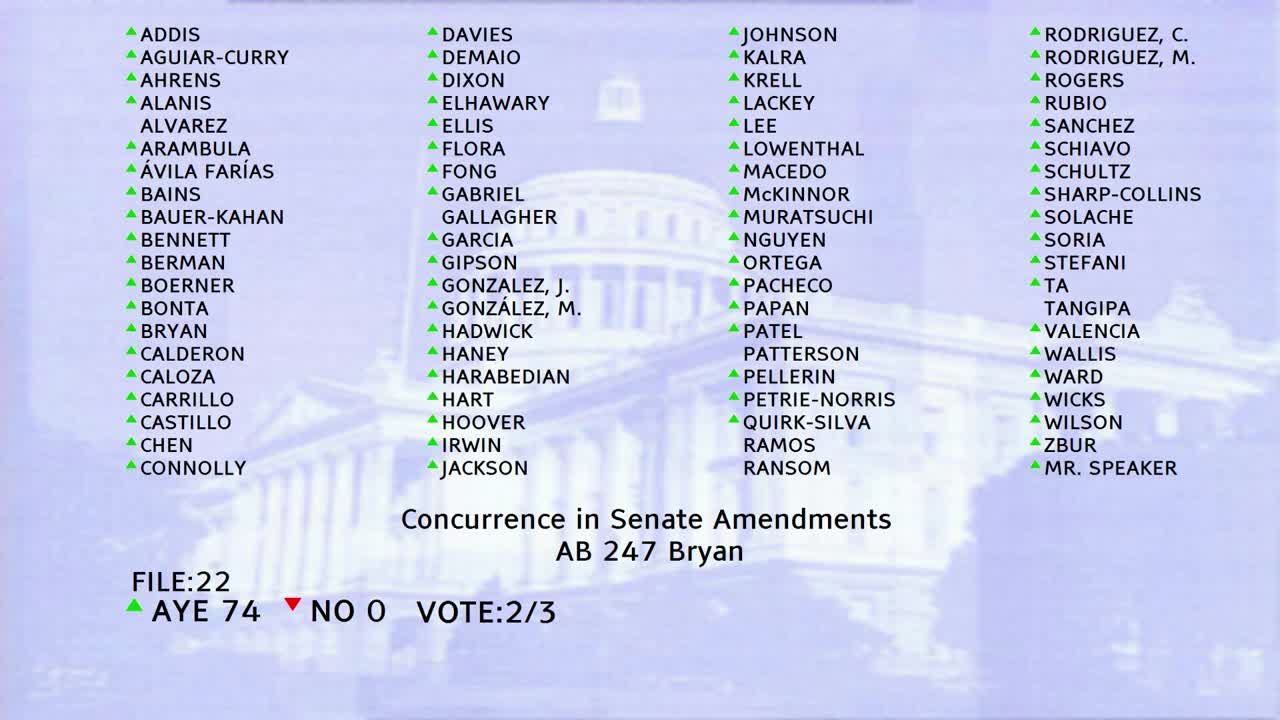 1MIN
Assembly Floor
 3MIN
Senate Floor
 10MIN
Senate Standing Committee on Housing
 10MIN
Senate Standing Committee on Local Government
 58SEC
Assembly Floor
 5MIN
Assembly Standing Committee on Housing and Community Development
 5MIN
Assembly Standing Committee on Local Government
Bill Author