AB 1454: Pupil literacy: credential program standards and professional development: instructional materials.
- Session Year: 2025-2026
- House: Assembly
- Latest Version Date: 2025-10-09
Current Status:
Passed
(2025-10-09: Chaptered by Secretary of State - Chapter 471, Statutes of 2025.)
Introduced
In Committee
Awaiting First Chamber Vote
Passed First Chamber
In Committee
Awaiting Second Chamber Vote
Passed Second Chamber
Enacted
Existing law requires the Commission on Teacher Credentialing to establish standards for the issuance and renewal of credentials, certificates, and permits. Existing law sets forth the minimum requirements for a preliminary services credential with a specialization in administrative services, which include, among other requirements, completion of an entry-level program of specialized and professional preparation in administrative services or a one-year internship in a program of supervised training in administrative services, subject to approval by the commission, as provided. Existing law also sets forth the minimum requirements for a reading and literacy leadership specialist credential and a reading and literacy added authorization, which include, among other requirements, completion of a program of specialized and professional preparation, as provided.
This bill would require the commission to, no later than September 1, 2028, ensure that the program standards for the professional preparation of candidates for a preliminary services credential with a specialization in administrative services meets specified criteria, including, among other things, that the program standards include preparation on how to support teachers in delivering instruction through effective means for teaching literacy, as provided. The bill would require the commission to, no later than January 1, 2028, ensure that the program standards and teaching performance expectations for the professional preparation of candidates for the reading and literacy leadership specialist credential and the reading and literacy added authorization include preparation on how to deliver instruction and support teachers to deliver instruction through effective means for teaching literacy, as provided.
Existing law requires the state board to adopt basic instructional materials for use in kindergarten and grades 1 to 8, inclusive, for governing boards of school districts and county boards of education, subject to specified provisions, including, among others, that the State Board of Education adopt at least 5 basic instructional materials for all applicable grade levels in each of the specified subject areas, including, among others, language arts, including, but not limited to, spelling, reading, and English language development.
This bill would require the state board, on or before January 31, 2027, and in adherence with specified provisions related to followup adoptions, to adopt instructional materials for kindergarten and grades 1 to 8, inclusive, in English language arts and English language development, as provided. The bill would require the state board to ensure that instructional materials adopted pursuant to these provisions adhere to specified criteria. The bill would require, upon the adoption of instructional materials described above, the state board to update the state Guidance for Local Instructional Materials Adoptions to reflect the criteria described above. The bill would require a local educational agency to follow this guidance for purposes of adopting instructional materials and require a local educational agency that adopts materials that have not been adopted by the state board to certify that the materials align to the criteria described above. By imposing additional duties on local educational agencies, the bill would impose a state-mandated local program.
The California Constitution requires the state to reimburse local agencies and school districts for certain costs mandated by the state. Statutory provisions establish procedures for making that reimbursement.
This bill would provide that, if the Commission on State Mandates determines that the bill contains costs mandated by the state, reimbursement for those costs shall be made pursuant to the statutory provisions noted above.
Existing law requires the Commission on Teacher Credentialing to establish standards for the issuance and renewal of credentials, certificates, and permits. Existing law sets forth the minimum requirements for a preliminary services credential with a specialization in administrative services, which include, among other requirements, completion of an entry-level program of specialized and professional preparation in administrative services or a one-year internship in a program of supervised training in administrative services, subject to approval by the commission, as provided. Existing law also sets forth the minimum requirements for a reading and literacy leadership specialist credential and a reading and literacy added authorization, which include, among other requirements, completion of a program of specialized and professional preparation, as provided.
This bill would, contingent upon an appropriation by the Legislature, would require the commission to, no later than September 1, 2028, ensure that the program standards for the professional preparation of candidates for a preliminary services credential with a specialization in administrative services meets specified criteria, including, among other things, that the program standards include preparation on how to support teachers in delivering instruction through effective means for teaching literacy, as provided. The bill would require the commission to, no later than January 1, 2028, ensure that the program standards and teaching performance expectations for the professional preparation of candidates for the reading and literacy leadership specialist credential and the reading and literacy added authorization meet specified criteria, including, among other things, include preparation on how to deliver instruction and support teachers to deliver instruction through effective means for teaching literacy, as provided.
Existing law requires the state board to adopt basic instructional materials for use in kindergarten and grades 1 to 8, inclusive, for governing boards of school districts and county boards of education, subject to specified provisions, including, among others, that the State Board of Education adopt at least 5 basic instructional materials for all applicable grade levels in each of the specified subject areas, including, among others, language arts, including, but not limited to, spelling, reading, and English language development.
This bill would require the state board, on or before January 31, 2027, and in adherence with specified provisions related to followup adoptions, to adopt instructional materials for kindergarten and grades 1 to 8, inclusive, in English language arts and English language development, as provided. The bill would require the state board to ensure that instructional materials adopted pursuant to these provisions adhere to specified criteria. The bill would require, upon the adoption of instructional materials described above, the state board to update the state Guidance for Local Instructional Materials Adoptions to reflect the criteria described above. The bill would require a local educational agency to follow this guidance for purposes of adopting instructional materials and require a local educational agency that adopts materials that have not been adopted by the state board to certify that the materials align to the criteria described above. By imposing additional duties on local educational agencies, the bill would impose a state-mandated local program.
The California Constitution requires the state to reimburse local agencies and school districts for certain costs mandated by the state. Statutory provisions establish procedures for making that reimbursement.
This bill would provide that, if the Commission on State Mandates determines that the bill contains costs mandated by the state, reimbursement for those costs shall be made pursuant to the statutory provisions noted above.
Existing law requires the Commission on Teacher Credentialing to establish standards for the issuance and renewal of credentials, certificates, and permits. Existing law sets forth the minimum requirements for a preliminary services credential with a specialization in administrative services, which include, among other requirements, completion of an entry-level program of specialized and professional preparation in administrative services or a one-year internship in a program of supervised training in administrative services, subject to approval by the commission, as provided. Existing law also sets forth the minimum requirements for a reading and literacy leadership specialist credential and a reading and literacy added authorization, which include, among other requirements, completion of a program of specialized and professional preparation, as provided.
This bill would would, contingent upon an appropriation by the Legislature, require the commission to, no later than September 1, 2027, 2028, ensure that the program standards for the professional preparation of candidates for a preliminary services credential with a specialization in administrative services meets specified criteria, including, among other things, that the program standards include preparation on how to support teachers in delivering instruction through effective means for teaching literacy, as provided. The bill would require the commission to, no later than September 1, 2029, certify that all professional preparation programs and internships for candidates for a preliminary services credential with a specialization in administrative services approved by the commission meet those program standards. January 1, 2028, ensure that the program standards and teaching performance expectations for the professional preparation of candidates for the reading and literacy leadership specialist credential and the reading and literacy added authorization meet specified criteria, including, among other things, preparation on how to deliver instruction and support teachers to deliver instruction through effective means for teaching literacy, as provided.
Existing law requires the state board to adopt basic instructional materials for use in kindergarten and grades 1 to 8, inclusive, for governing boards of school districts and county boards of education, subject to specified provisions, including, among others, that the State Board of Education adopt at least 5 basic instructional materials for all applicable grade levels in each of the specified subject areas, including, among others, language arts, including, but not limited to, spelling, reading, and English language development.
This bill would require the state board, on or before June 30, January 31, 2027, and in adherence with specified provisions related to followup adoptions, to adopt instructional materials for kindergarten and grades 1 to 8, inclusive, in English language arts and English language development, as provided. The bill would require the state board to ensure that instructional materials adopted pursuant to these provisions adhere to specified criteria. The bill would require, upon the adoption of instructional materials described above, the state board to update the state Guidance for Local Instructional Materials Adoptions to reflect the criteria described above. The bill would require a local educational agency to follow this guidance for purposes of adopting instructional materials and require a local educational agency that adopts materials that have not been adopted by the state board to certify that the materials align to the criteria described above. By imposing additional duties on local educational agencies, the bill would impose a state-mandated local program.
This bill would make implementation of its provisions, as described above, contingent upon an appropriation by the Legislature.The California Constitution requires the state to reimburse local agencies and school districts for certain costs mandated by the state. Statutory provisions establish procedures for making that reimbursement.
This bill would provide that, if the Commission on State Mandates determines that the bill contains costs mandated by the state, reimbursement for those costs shall be made pursuant to the statutory provisions noted above.
Existing law establishes the State Department of Education, under the administration of the Superintendent of Public Instruction, and assigns to the department numerous duties relating to the financing, governance, and guidance of the public elementary and secondary schools in this state.
This bill would require the department to, no later than September 1, 2026, identify and post on its internet website a list of inservice professional development programs for effective means of teaching literacy in specified grade levels that may be used by school districts, county offices of education, charter schools, and state special schools for training certificated and classified staff who provide reading instruction or who support any teacher who provides reading instruction. The bill would require the department to ensure that the list includes programs offered in different modalities, including in-person and virtual formats, ensure that programs are interactive, provide adequate time to master the concepts being taught, and include periodic checks to demonstrate mastery of the concepts, and ensure that the programs meet specified criteria. The bill would require department to solicit stakeholder input when developing the list of professional development programs described above. The bill would require the department to make specified funds available and the Superintendent to apportion those funds to school districts, county offices of education, charter schools, and state special schools to provide opportunities for professional development for certificated and classified staff who provide reading instruction, or who support any teacher who provides reading instruction, to pupils in transitional kindergarten, kindergarten, or any of grades 1 to 5, inclusive, using one or more of the above-described professional development programs, as provided.
Existing law requires the Commission on Teacher Credentialing to establish standards for the issuance and renewal of credentials, certificates, and permits. Existing law sets forth the minimum requirements for a preliminary services credential with a specialization in administrative services, which include, among other requirements, completion of an entry-level program of specialized and professional preparation in administrative services or a one-year internship in a program of supervised training in administrative services, subject to approval by the commission, as provided.
This bill would require the commission to, no later than September 1, 2027, ensure that the program standards for the professional preparation of candidates for a preliminary services credential with a specialization in administrative services meets specified criteria, including, among other things, that the program standards include preparation on how to support teachers in delivering instruction through effective means for teaching literacy, as provided. The bill would require the commission to, no later than September 1, 2029, certify that all professional preparation programs and internships for candidates for a preliminary services credential with a specialization in administrative services approved by the commission meet those program standards.
Existing law requires the state board to adopt basic instructional materials for use in kindergarten and grades 1 to 8, inclusive, for governing boards of school districts and county boards of education, subject to specified provisions, including, among others, that the State Board of Education adopt at least 5 basic instructional materials for all applicable grade levels in each of the specified subject areas, including, among others, language arts, including, but not limited to, spelling, reading, and English language development.
This bill would require the state board, on or before June 30, 2027, and in adherence with specified provisions related to followup adoptions, to adopt instructional materials for kindergarten and grades 1 to 8, inclusive, in English language arts and English language development, as provided. The bill would require the state board to ensure that instructional materials adopted pursuant to these provisions adhere to specified criteria. The bill would require, upon the adoption of instructional materials described above, the state board to update the state Guidance for Local Instructional Materials Adoptions to reflect the criteria described above. The bill would require a local educational agency to follow this guidance for purposes of adopting instructional materials and require a local educational agency that adopts materials that have not been adopted by the state board to certify that the materials align to the criteria described above. By imposing additional duties on local educational agencies, the bill would impose a state-mandated local program.
This bill would make implementation of its provisions, as described above, contingent upon an appropriation by the Legislature.
The California Constitution requires the state to reimburse local agencies and school districts for certain costs mandated by the state. Statutory provisions establish procedures for making that reimbursement.This bill would provide that, if the Commission on State Mandates determines that the bill contains costs mandated by the state, reimbursement for those costs shall be made pursuant to the statutory provisions noted above.Existing law requires a covered school, defined as a school district, a county office of education, a charter school, a private school, the California Community Colleges, or the California State University, and requests the University of California, to ensure that facilities have heating, ventilation, and air-conditioning (HVAC) systems that meet specified minimum ventilation rate requirements, unless the existing HVAC system is not capable of safely and efficiently providing the minimum ventilation rate, in which case its HVAC system meets the minimum ventilation rates in effect at the time the building permit for installation of that HVAC system was issued. Existing law also requires a covered school, and requests the University of California, to install filtration that achieves specified minimum efficiency reporting values (MERV) levels, determined by the school to be feasible with the existing HVAC system, as provided.
This bill would require each school district, county office of education, and charter school to submit an annual inventory of their HVAC systems to the State Department of Education, including a description of any modifications made pursuant to the above-described provisions. By imposing new duties on local educational agencies, this bill would impose a state-mandated local program.
The California Constitution requires the state to reimburse local agencies and school districts for certain costs mandated by the state. Statutory provisions establish procedures for making that reimbursement.
This bill would provide that, if the Commission on State Mandates determines that the bill contains costs mandated by the state, reimbursement for those costs shall be made pursuant to the statutory provisions noted above.
(a)No later than January 1, 2028, the commission shall ensure that its standards of program quality and effectiveness for the preparation of candidates for the reading and literacy leadership specialist credential and the reading and literacy added authorization, and the teaching performance expectations for the preparation of candidates for the reading and literacy leadership specialist credential and the reading and literacy added authorization include preparation on how to deliver instruction and support teachers to deliver instruction through effective means for teaching literacy, aligned to all of the following:
(1)The English Language Arts/English Language Development (ELA/ELD) Framework, including instruction to meet the varied language development needs of English learners.
(2)Evidence-based means of teaching foundational reading skills, which shall include explicit and systematic instruction in print concepts, phonological awareness, phonics and word recognition, and fluency to all pupils, and attending to oral and written language development, vocabulary and background knowledge, and comprehension, including tiered supports for pupils with reading difficulties, English learners, and pupils with exceptional needs.
(3)The program guidelines for dyslexia developed pursuant to Section 56335.
(b)It is the intent of the Legislature that candidates for the reading and literacy leadership specialist credential and the reading and literacy added authorization are prepared to deliver instruction and support teachers to deliver instruction through effective means for teaching literacy in programs in which English learner pupils are being instructed in their primary languages.
SEC. 2.Section 44270.6 is added to the Education Code, to read:44270.6.(a)No later than September 1, 2028, the commission shall ensure that the program standards for the professional preparation of candidates for a preliminary services credential with a specialization in administrative services established pursuant to paragraph (3) of subdivision (a) of Section 44270 include preparation on how to support teachers in delivering instruction through effective means for teaching literacy, aligned to all of the following:
(1)The English Language Arts/English Language Development (ELA/ELD) Framework, including instruction to meet the varied language development needs of English learners.
(2)Evidence-based means of teaching foundational reading skills, which shall include explicit and systematic instruction in print concepts, phonological awareness, phonics and word recognition, and fluency to all pupils, and attending to oral and written language development, vocabulary and background knowledge, and comprehension, including tiered supports for pupils with reading difficulties, English learners, and pupils with exceptional needs.
(3)The program guidelines for dyslexia developed pursuant to Section 56335.
(b)The commission shall confirm that administrative preparation programs implement the standards pursuant to this section.
(c)It is the intent of the Legislature that candidates for a preliminary services credential with a specialization in administrative services are prepared to support teachers to deliver instruction through effective means for teaching literacy in programs in which English learner pupils are being instructed in their primary languages.
SEC. 3.Section 60205 is added to the Education Code, to read:60205.(a)On or before January 31, 2027, the state board shall, in adherence with the procedures established pursuant to Section 60227, adopt instructional materials for kindergarten and grades 1 to 8, inclusive, in English language arts and English language development.
(b)The state board shall ensure that instructional materials adopted pursuant to this section adhere to all of the following:
(1)Align to the current English Language Arts/English Language Development (ELA/ELD) Framework, including integrated and designated English language development instruction adopted by the state board, and including strategies to meet the varied language development needs of English learners.
(2)Align to evidence-based means of teaching foundational reading skills, which shall include explicit and systematic instruction in print concepts, phonological awareness, phonics and word recognition, and fluency, and attending to oral and written language development, vocabulary and background knowledge, and comprehension, including tiered supports for pupils with reading difficulties, English learners, and pupils with exceptional needs.
(3)Align to the program guidelines for dyslexia developed pursuant to Section 56335.
(4)Include materials that focus on the teaching of specific skills and standards that are a subset of the entire English Language Arts/English Language Development (ELA/ELD) Framework and clearly designate which standards they effectively address.
(c)Upon the adoption of instructional materials pursuant to subdivision (a), the state board shall update the state Guidance for Local Instructional Materials Adoptions to reflect the criteria in subdivision (b). A local educational agency shall follow this guidance and the processes described in Section 60002 for purposes of adopting instructional materials.
(d)(1)A local educational agency that adopts instructional materials that have not been adopted by the state board pursuant to subdivision (a) shall certify that the instructional materials align to the criteria in subdivision (b).
(2)A local educational agency may adopt a set of instructional materials that, in combination, address all of the state standards and components of the English Language Arts/English Language Development (ELA/ELD) Framework.
(e)It is the intent of the Legislature that the state boards adoption of instructional materials in English language arts and English language development include high-quality instructional materials in pupils primary languages to enable teachers to build upon pupils linguistic assets in programs for which English learner pupils are being instructed in their primary language.
SEC. 4.If the Commission on State Mandates determines that this act contains costs mandated by the state, reimbursement to local agencies and school districts for those costs shall be made pursuant to Part 7 (commencing with Section 17500) of Division 4 of Title 2 of the Government Code.
(a)No later than January 1, 2028, the commission shall ensure that its standards of program quality and effectiveness for the preparation of candidates for the reading and literacy leadership specialist credential and the reading and literacy added authorization, and the teaching performance expectations for the preparation of candidates for the reading and literacy leadership specialist credential and the reading and literacy added authorization include preparation on how to deliver instruction and support teachers to deliver instruction through effective means for teaching literacy, aligned to all of the following:
(a)(1)The English Language Arts/English Language Development (ELA/ELD) Framework. Framework, including instruction to meet the varied language development needs of English learners.
(b)(2)Evidence-based means of teaching foundational reading skills, which shall include explicit and systematic instruction in print concepts, phonological awareness, phonics and word recognition, and fluency to all pupils, and attending to oral and written language development, vocabulary and background knowledge, and comprehension, including tiered supports for pupils with reading difficulties, English learners, and pupils with exceptional needs.
(c)(3)The program guidelines for dyslexia developed pursuant to Section 56335.
(b)It is the intent of the Legislature that candidates for the reading and literacy leadership specialist credential and the reading and literacy added authorization are prepared to deliver instruction and support teachers to deliver instruction through effective means for teaching literacy in programs in which English learner pupils are being instructed in their primary languages.
SEC. 2.Section 44270.6 is added to the Education Code, to read:44270.6.(a)No later than September 1, 2028, the commission shall ensure that the program standards for the professional preparation of candidates for a preliminary services credential with a specialization in administrative services established pursuant to paragraph (3) of subdivision (a) of Section 44270 include preparation on how to support teachers in delivering instruction through effective means for teaching literacy, aligned to all of the following:
(1)The English Language Arts/English Language Development (ELA/ELD) Framework. Framework, including instruction to meet the varied language development needs of English learners.
(2)Evidence-based means of teaching foundational reading skills, which shall include explicit and systematic instruction in print concepts, phonological awareness, phonics and word recognition, and fluency to all pupils, and attending to oral and written language development, vocabulary and background knowledge, and comprehension, including tiered supports for pupils with reading difficulties, English learners, and pupils with exceptional needs.
(3)The program guidelines for dyslexia developed pursuant to Section 56335.
(b)The commission shall confirm that administrative preparation programs implement the standards pursuant to this section.
(c)The operation of this section is contingent upon an appropriation for its purposes in the annual Budget Act or another statute.(c)It is the intent of the Legislature that candidates for a preliminary services credential with a specialization in administrative services are prepared to support teachers to deliver instruction through effective means for teaching literacy in programs in which English learner pupils are being instructed in their primary languages.
SEC. 3.Section 60205 is added to the Education Code, to read:60205.(a)On or before January 31, 2027, the state board shall, in adherence with the procedures established pursuant to Section 60227, adopt instructional materials for kindergarten and grades 1 to 8, inclusive, in English language arts and English language development.
(b)The state board shall ensure that instructional materials adopted pursuant to this section adhere to all of the following:
(1)Align to the current English Language Arts/English Language Development (ELA/ELD) Framework, including integrated and designated English language development instruction adopted by the state board. board, and including strategies to meet the varied language development needs of English learners.
(2)Align to evidence-based means of teaching foundational reading skills, which shall include explicit and systematic instruction in print concepts, phonological awareness, phonics and word recognition, and fluency, and attending to oral and written language development, vocabulary and background knowledge, and comprehension, including tiered supports for pupils with reading difficulties, English learners, and pupils with exceptional needs.
(3)Align to the program guidelines for dyslexia developed pursuant to Section 56335.
(4)Include materials that focus on the teaching of specific skills and standards that are a subset of the entire English Language Arts/English Language Development (ELA/ELD) Framework and clearly designate which standards they effectively address.
(c)Upon the adoption of instructional materials pursuant to subdivision (a), the state board shall update the state Guidance for Local Instructional Materials Adoptions to reflect the criteria in subdivision (b). A local educational agency shall follow this guidance and the processes described in Section 60002 for purposes of adopting instructional materials.
(d)(1)A local educational agency that adopts instructional materials that have not been adopted by the state board pursuant to subdivision (a) shall certify that the instructional materials align to the criteria in subdivision (b).
(2)A local educational agency may adopt a set of instructional materials that, in combination, address all of the state standards and components of the English Language Arts/English Language Development (ELA/ELD) Framework.
(e)It is the intent of the Legislature that the state boards adoption of instructional materials in English language arts and English language development include high-quality instructional materials in pupils primary languages to enable teachers to build upon pupils linguistic assets in programs for which English learner pupils are being instructed in their primary language.
SEC. 4.If the Commission on State Mandates determines that this act contains costs mandated by the state, reimbursement to local agencies and school districts for those costs shall be made pursuant to Part 7 (commencing with Section 17500) of Division 4 of Title 2 of the Government Code.
No later than January 1, 2028, the commission shall ensure that its standards of program quality and effectiveness for the preparation of candidates for the reading and literacy leadership specialist credential and the reading and literacy added authorization, and the teaching performance expectations for the preparation of candidates for the reading and literacy leadership specialist credential and the reading and literacy added authorization include preparation on how to deliver instruction and support teachers to deliver instruction through effective means for teaching literacy, aligned to all of the following:
(a)The English Language Arts/English Language Development (ELA/ELD) Framework.
(b)Evidence-based means of teaching foundational reading skills, which shall include explicit and systematic instruction in print concepts, phonological awareness, phonics and word recognition, and fluency to all pupils, and attending to oral language development, vocabulary and background knowledge, and comprehension, including tiered supports for pupils with reading difficulties, English learners, and pupils with exceptional needs.
(c)The program guidelines for dyslexia developed pursuant to Section 56335.
SEC. 2.Section 44270.6 is added to the Education Code, to read:44270.6.(a)No later than September 1, 2027, 2028, the commission shall ensure that the program standards for the professional preparation of candidates for a preliminary services credential with a specialization in administrative services established pursuant to paragraph (3) of subdivision (a) of Section 44270 meet all of the following criteria:
(1)Includes include preparation on how to support teachers in delivering instruction through effective means for teaching literacy, including the requirements described in subparagraphs (A) and (B) of paragraph (4) of subdivision (b) of Section 44259 and evidence-based aligned to all of the following:
(1)The English Language Arts/English Language Development (ELA/ELD) Framework.
(2)Evidence-based means of teaching foundational reading skills skills, which shall include explicit and systematic instruction in print concepts, phonological awareness, phonics and word recognition, and fluency to all pupils, and attending to oral language development, vocabulary and background knowledge, and comprehension, including tiered supports for pupils with reading difficulties, English learners, and pupils with exceptional needs.
(2)Aligns to the commissions current standards of program quality and effectiveness and current teaching performance expectations as specified in Sections 44259.6 and 44259.7.(3)Aligns to the current English Language Arts/English Language Development (ELA/ELD) Framework, including integrated and designated English language development instruction, oral language development, vocabulary and background knowledge, and comprehension, adopted by the state board.(4)Incorporates the(3)The program guidelines for dyslexia developed pursuant to Section 56335.
(b)The commission shall confirm that administrative preparation programs implement the standards pursuant to this section.
(b)(c)The operation of this section is contingent upon an appropriation for its purposes in the annual Budget Act or another statute.
SEC. 3.Section 44270.7 is added to the Education Code, to read:44270.7.(a)No later than September 1, 2029, the commission shall certify that all professional preparation programs and internships for candidates for a preliminary services credential with a specialization in administrative services approved by the commission pursuant to paragraph (3) of subdivision (a) of Section 44270 meet all of the following criteria:(1)Includes preparation on how to support teachers in delivering instruction through effective means for teaching literacy, including the requirements described in subparagraphs (A) and (B) of paragraph (4) of subdivision (b) of Section 44259 and evidence-based means of teaching foundational reading skills in print concepts, phonological awareness, phonics and word recognition, and fluency to all pupils, including tiered supports for pupils with reading difficulties, English learners, and pupils with exceptional needs.(2)Aligns to the commissions current standards of program quality and effectiveness and current teaching performance expectations as specified in Sections 44259.6 and 44259.7.(3)Aligns to the current English Language Arts/English Language Development (ELA/ELD) Framework, including integrated and designated English language development instruction, oral language development, vocabulary and background knowledge, and comprehension, adopted by the state board.(4)Incorporates the program guidelines for dyslexia developed pursuant to Section 56335.(b)The operation of this section is contingent upon an appropriation for its purposes in the annual Budget Act or another statute.SEC. 4.SEC. 3.Section 60205 is added to the Education Code, to read:60205.(a)On or before June 30, January 31, 2027, the state board shall, in adherence with the procedures established pursuant to Section 60227, adopt instructional materials for kindergarten and grades 1 to 8, inclusive, in English language arts and English language development.
(b)The state board shall ensure that instructional materials adopted pursuant to this section adhere to all of the following:
(1)Include the requirements described in subparagraphs (A) and (B) of paragraph (4) of subdivision (b) of Section 44259 and evidence-based means of teaching foundational reading skills in print concepts, phonological awareness, phonics and word recognition, and fluency to all pupils, including tiered supports for pupils with reading difficulties, English learners, and pupils with exceptional needs.(2)Align to the commissions current teaching performance expectations as specified in Section 44259.7.(3)(1)Align to the current English Language Arts/English Language Development (ELA/ELD) Framework, including integrated and designated English language development instruction, oral language development, vocabulary and background knowledge, and comprehension, instruction adopted by the state board.
(2)Align to evidence-based means of teaching foundational reading skills, which shall include explicit and systematic instruction in print concepts, phonological awareness, phonics and word recognition, and fluency, and attending to oral language development, vocabulary and background knowledge, and comprehension, including tiered supports for pupils with reading difficulties, English learners, and pupils with exceptional needs.
(4)(3)Align to the program guidelines for dyslexia developed pursuant to Section 56335.
(5)Align to the guidance required to be developed by the county office of education that is chosen by the Superintendent to support the followup adoption and subsequent implementation of English Language Arts/English Language Development instructional materials by the Instructional Quality Commission and the state board.(4)Include materials that focus on the teaching of specific skills and standards that are a subset of the entire English Language Arts/English Language Development (ELA/ELD) Framework and clearly designate which standards they effectively address.
(c)Upon the adoption of instructional materials pursuant to subdivision (a), the state board shall update the state Guidance for Local Instructional Materials Adoptions to reflect the criteria in subdivision (b). A local educational agency shall follow this guidance and the processes described in Section 60002 for purposes of adopting instructional materials.
(d)(1)A local educational agency that adopts instructional materials that have not been adopted by the state board pursuant to subdivision (a) shall certify that the instructional materials align to the criteria in subdivision (b).
(2)A local educational agency may adopt a set of instructional materials that, in combination, address all of the state standards and components of the English Language Arts/English Language Development (ELA/ELD) Framework.
(e)The operation of this section is contingent upon an appropriation for its purposes in the annual Budget Act or another statute.SEC. 5.SEC. 4.If the Commission on State Mandates determines that this act contains costs mandated by the state, reimbursement to local agencies and school districts for those costs shall be made pursuant to Part 7 (commencing with Section 17500) of Division 4 of Title 2 of the Government Code.
(a)No later than September 1, 2026, the department shall identify and post on its internet website a list of inservice professional development programs for effective means of teaching literacy in transitional kindergarten, kindergarten, and grades 1 to 5, inclusive, that may be used by local educational agencies for training certificated and classified staff who provide reading instruction or who support any teacher who provides reading instruction. The department shall ensure that the list includes programs offered in different modalities, including in-person and virtual formats, ensures that programs are interactive, provide adequate time to master the concepts being taught, and include periodic checks to demonstrate mastery of the concepts, and shall ensure that the programs meet all of the following criteria:
(1)Include the requirements described in subparagraphs (A) and (B) of paragraph (4) of subdivision (b) of Section 44259 and evidence-based means of teaching foundational reading skills in print concepts, phonological awareness, phonics and word recognition, and fluency to all pupils, including tiered supports for pupils with reading difficulties, English learners, and pupils with exceptional needs.
(2)Align to the commissions current teaching performance expectations as specified in Section 44259.7.
(3)Align to the current English Language Arts/English Language Development (ELA/ELD) Framework, including integrated and designated English language development instruction, oral language development, vocabulary and background knowledge, and comprehension, adopted by the state board.
(4)Align to the program guidelines for dyslexia developed pursuant to Section 56335.
(b)The department shall solicit stakeholder input when developing the list of professional development programs pursuant to (a).
(c)(1)(A)The department shall make funding available for purposes of training certificated and classified staff who provide reading instruction, or who support any teacher who provides reading instruction, to pupils in transitional kindergarten, kindergarten, or any of grades 1 to 5, inclusive, using the professional development programs identified pursuant to subdivision (a). The Superintendent shall apportion these funds to local educational agencies in an equal amount per full-time equivalent certificated staff who teach pupils in transitional kindergarten, kindergarten, or any of grades 1 to 5, inclusive.
(B)A local educational agency may expend the funds received pursuant to this subdivision from the 202627 fiscal year to the 202829 fiscal year, inclusive.
(2)(A)(i)If a local educational agency is apportioned funds pursuant to subparagraph (A) of paragraph (1), those funds shall be used to provide opportunities for professional development for teachers who teach pupils in transitional kindergarten, kindergarten, or any of grades 1 to 5, inclusive, using one or more of the professional development programs identified pursuant to subdivision (a), except as provided in clause (ii).
(ii)Notwithstanding clause (i), if a local educational agency is apportioned funds pursuant to subparagraph (A) of paragraph (1), those funds may be used to provide opportunities for professional development using a professional development program not identified pursuant to subdivision (a), provided that the program aligns to the criteria specified in paragraphs (1) to (4), inclusive, of subdivision (a).
(B)If there are remaining funds after complying with subparagraph (A), a local educational agency may provide opportunities for professional development for teachers who teach pupils in grades other than transitional kindergarten, kindergarten, or any of grades 1 to 5, inclusive.
(3)As a condition of receiving funds apportioned pursuant to this subdivision, a local educational agency shall, on or before September 1, 2029, report to the department, in a form and manner determined by the department, the number of teachers that received professional development and which professional development program was used at the local educational agency and schoolsite level.
(4)The department shall summarize the information reported pursuant to paragraph (3) and shall submit the summary to the appropriate budget subcommittees and policy committees of the Legislature, in compliance with Section 9795 of the Government Code, and to the Department of Finance on or before February 1, 2030.
(d)For purposes of this section, local educational agency means a school district, county office of education, charter school, or state special school.
(e)The operation of this section is contingent upon an appropriation for its purposes in the annual Budget Act or another statute.
SEC. 2.Section 44270.6 is added to the Education Code, to read:44270.6.(a)No later than September 1, 2027, the commission shall ensure that the program standards for the professional preparation of candidates for a preliminary services credential with a specialization in administrative services established pursuant to paragraph (3) of subdivision (a) of Section 44270 meet all of the following criteria:
(1)Includes preparation on how to support teachers in delivering instruction through effective means for teaching literacy, including the requirements described in subparagraphs (A) and (B) of paragraph (4) of subdivision (b) of Section 44259 and evidence-based means of teaching foundational reading skills in print concepts, phonological awareness, phonics and word recognition, and fluency to all pupils, including tiered supports for pupils with reading difficulties, English learners, and pupils with exceptional needs.
(2)Aligns to the commissions current standards of program quality and effectiveness and current teaching performance expectations as specified in Sections 44259.6 and 44259.7.
(3)Aligns to the current English Language Arts/English Language Development (ELA/ELD) Framework, including integrated and designated English language development instruction, oral language development, vocabulary and background knowledge, and comprehension, adopted by the state board.
(4)Incorporates the program guidelines for dyslexia developed pursuant to Section 56335.
(b)The operation of this section is contingent upon an appropriation for its purposes in the annual Budget Act or another statute.
SEC. 3.Section 44270.7 is added to the Education Code, to read:44270.7.(a)No later than September 1, 2029, the commission shall certify that all professional preparation programs and internships for candidates for a preliminary services credential with a specialization in administrative services approved by the commission pursuant to paragraph (3) of subdivision (a) of Section 44270 meet all of the following criteria:
(1)Includes preparation on how to support teachers in delivering instruction through effective means for teaching literacy, including the requirements described in subparagraphs (A) and (B) of paragraph (4) of subdivision (b) of Section 44259 and evidence-based means of teaching foundational reading skills in print concepts, phonological awareness, phonics and word recognition, and fluency to all pupils, including tiered supports for pupils with reading difficulties, English learners, and pupils with exceptional needs.
(2)Aligns to the commissions current standards of program quality and effectiveness and current teaching performance expectations as specified in Sections 44259.6 and 44259.7.
(3)Aligns to the current English Language Arts/English Language Development (ELA/ELD) Framework, including integrated and designated English language development instruction, oral language development, vocabulary and background knowledge, and comprehension, adopted by the state board.
(4)Incorporates the program guidelines for dyslexia developed pursuant to Section 56335.
(b)The operation of this section is contingent upon an appropriation for its purposes in the annual Budget Act or another statute.
SEC. 4.Section 60205 is added to the Education Code, to read:60205.(a)On or before June 30, 2027, the state board shall, in adherence with the procedures established pursuant to Section 60227, adopt instructional materials for kindergarten and grades 1 to 8, inclusive, in English language arts and English language development.
(b)The state board shall ensure that instructional materials adopted pursuant to this section adhere to all of the following:
(1)Include the requirements described in subparagraphs (A) and (B) of paragraph (4) of subdivision (b) of Section 44259 and evidence-based means of teaching foundational reading skills in print concepts, phonological awareness, phonics and word recognition, and fluency to all pupils, including tiered supports for pupils with reading difficulties, English learners, and pupils with exceptional needs.
(2)Align to the commissions current teaching performance expectations as specified in Section 44259.7.
(3)Align to the current English Language Arts/English Language Development (ELA/ELD) Framework, including integrated and designated English language development instruction, oral language development, vocabulary and background knowledge, and comprehension, adopted by the state board.
(4)Align to the program guidelines for dyslexia developed pursuant to Section 56335.
(5)Align to the guidance required to be developed by the county office of education that is chosen by the Superintendent to support the followup adoption and subsequent implementation of English Language Arts/English Language Development instructional materials by the Instructional Quality Commission and the state board.
(c)Upon the adoption of instructional materials pursuant to subdivision (a), the state board shall update the state Guidance for Local Instructional Materials Adoptions to reflect the criteria in subdivision (b). A local educational agency shall follow this guidance and the processes described in Section 60002 for purposes of adopting instructional materials.
(d)A local educational agency that adopts instructional materials that have not been adopted by the state board pursuant to subdivision (a) shall certify that the instructional materials align to the criteria in subdivision (b).
(e)The operation of this section is contingent upon an appropriation for its purposes in the annual Budget Act or another statute.
SEC. 2.SEC. 5.If the Commission on State Mandates determines that this act contains costs mandated by the state, reimbursement to local agencies and school districts for those costs shall be made pursuant to Part 7 (commencing with Section 17500) of Division 4 of Title 2 of the Government Code.(a)For purposes of this section, the following definitions apply:
(1)Covered school means a school district, a county office of education, a charter school, a private school, the California Community Colleges, or the California State University.
(2)HVAC means heating, ventilation, and air conditioning. air-conditioning.
(3)MERV means minimum efficiency reporting values.
(b)(1)A covered school shall, and the University of California is requested to, ensure that facilities, including, but not limited to, classrooms for students, have HVAC systems that meet the minimum ventilation rate requirements set forth in Table 120.1-A of Part 6 (commencing with Section 100.0) of Title 24 of the California Code of Regulations, unless the existing HVAC system is not capable of safely and efficiently providing the minimum ventilation rate.
(2)If a schools existing HVAC system is not capable of safely and efficiently providing the minimum ventilation rate required pursuant to paragraph (1), then a covered school shall, and the University of California is requested to, ensure that its HVAC system meets the minimum ventilation rates in effect at the time the building permit for installation of that HVAC system was issued. In addition, the covered school shall, and the University of California is requested to, document the HVAC systems inability to meet the current ventilation standards set forth in paragraph (1) in the annual HVAC inspection report required by Section 5142 of Title 8 of the California Code of Regulations, which shall be available to the public upon request.
(c)(1)Subject to paragraph (2), a covered school shall, and the University of California is requested to, install filtration that achieves MERV levels of 13 or higher to the extent determined to be feasible and appropriate for the existing HVAC system, as determined by the school.
(2)If, pursuant to paragraph (1), it is determined that the existing HVAC system is not designed to achieve MERV levels of 13 or higher, a covered school shall, and the University of California is requested to, install filtration that achieves the highest MERV level that the school determines is feasible without significantly reducing the lifespan or performance of the existing HVAC system.
(d)Each school district, county office of education, and charter school shall submit an annual inventory of their HVAC systems to the department, including a description of any modifications made pursuant to this section.
(d)(e)Upon the next triennial update of the California Building Standards Code (Title 24 of the California Code of Regulations), the California Building Standards Commission and the Division of the State Architect shall research, develop, and propose for adoption mandatory standards for carbon dioxide monitors in classrooms of a covered school and the University of California.
(e)(f)This section shall apply to the University of California only to the extent that the Regents of the University of California, by resolution, make it applicable.
SEC. 2.If the Commission on State Mandates determines that this act contains costs mandated by the state, reimbursement to local agencies and school districts for those costs shall be made pursuant to Part 7 (commencing with Section 17500) of Division 4 of Title 2 of the Government Code.
|
Date
|
Status
|
|---|---|
| Oct 9, 2025 | Chaptered by Secretary of State - Chapter 471, Statutes of 2025. |
| Oct 9, 2025 | Approved by the Governor. |
| Sep 24, 2025 | Enrolled and presented to the Governor at 3 p.m. |
| Sep 13, 2025 | Senate amendments concurred in. To Engrossing and Enrolling. (Ayes 80. Noes 0. Page 3479.). |
| Sep 13, 2025 | Joint Rules 61(a)(14) and 51(a)(4) suspended. (Ayes 59. Noes 20. Page 3413.) |
| Sep 13, 2025 | Assembly Rule 63 suspended. (Page 3477.) |
| Sep 13, 2025 | In Assembly. Concurrence in Senate amendments pending. |
| Sep 12, 2025 | Read third time. Passed. Ordered to the Assembly. (Ayes 38. Noes 0. Page 2996.). |
| Sep 2, 2025 | Read second time. Ordered to third reading. |
| Aug 29, 2025 | Read second time and amended. Ordered returned to second reading. |
| Aug 29, 2025 | From committee: Amend, and do pass as amended. (Ayes 7. Noes 0.) (August 29). |
| Aug 18, 2025 | In committee: Referred to suspense file. |
| Jul 9, 2025 | From committee: Do pass and re-refer to Com. on APPR. with recommendation: To Consent Calendar. (Ayes 7. Noes 0.) (July 9). Re-referred to Com. on APPR. |
| Jun 30, 2025 | From committee chair, with author's amendments: Amend, and re-refer to committee. Read second time, amended, and re-referred to Com. on ED. |
| Jun 18, 2025 | Referred to Com. on ED. |
| Jun 9, 2025 | In Senate. Read first time. To Com. on RLS. for assignment. |
| Jun 5, 2025 | Read third time. Passed. Ordered to the Senate. (Ayes 78. Noes 0. Page 2111.) |
| May 27, 2025 | Read second time. Ordered to third reading. |
| May 23, 2025 | From committee: Do pass. (Ayes 14. Noes 0.) (May 23). |
| May 14, 2025 | In committee: Set, first hearing. Referred to APPR. suspense file. |
| May 6, 2025 | Re-referred to Com. on APPR. |
| May 5, 2025 | Read second time and amended. |
| May 1, 2025 | From committee: Amend, and do pass as amended and re-refer to Com. on APPR. (Ayes 9. Noes 0.) (April 30). |
| Mar 13, 2025 | Referred to Com. on ED. |
| Feb 24, 2025 | Read first time. |
| Feb 22, 2025 | From printer. May be heard in committee March 24. |
| Feb 21, 2025 | Introduced. To print. |
|
Date
|
Description
|
Location
|
Votes
|
|
|---|---|---|---|---|
| Sep 13, 2025 | AB 1454 RIVAS Concurrence in Senate Amendments | Assembly Floor |
Passed |
|
| Sep 12, 2025 | Assembly 3rd Reading AB1454 Rivas et al. By Weber Pierson | Senate Floor |
Passed |
|
| Aug 29, 2025 | Do pass as amended | Senate Standing Committee on Appropriations |
Passed |
|
| Aug 18, 2025 | Placed on suspense file | Senate Standing Committee on Appropriations |
Passed |
|
| Jul 9, 2025 | Do pass, but first be re-referred to the Committee on [Appropriations] with the recommendation: To Consent Calendar | Senate Standing Committee on Education |
Passed |
|
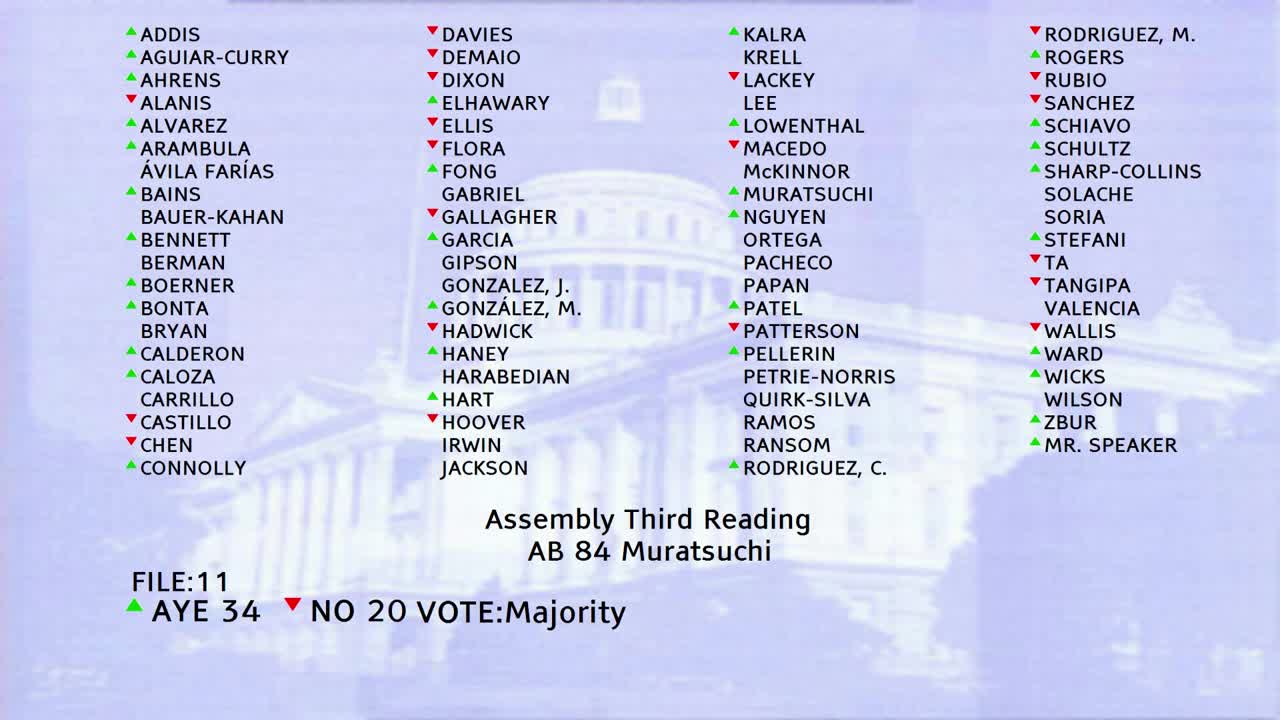
| Jun 5, 2025 | AB 1454 Rivas Assembly Third Reading | Assembly Floor |
Passed |
|
| May 23, 2025 | Do pass. | Assembly Standing Committee on Appropriations |
Passed |
|
| Apr 30, 2025 | Do pass as amended and be re-referred to the Committee on [Appropriations] | Assembly Standing Committee on Education |
Passed |
This list shows positions taken on this bill by organizations on the date displayed, which is linked to the original source.
Positions by individuals are not included.
|
Organization
|
Position
|
Date
|
|---|---|---|
| 21St Century Alliance | ** Support | |
| Alameda County Office Of Education | ** Support | |
| Association Of California School Administrators | ** Support | |
| Black Parallel School board | ** Support | |
| California Association For Bilingual Education | ** Support | |
| California Catholic Conference | ** Support | |
| California County Superintendents | ** Support | |
| California Federation Of Teachers | ** Support | |
| california hawaii state conference of the naacp | ** Support | |
| California Reading Coalition | ** Support | |
| California School Library Association | ** Support | |
| California Teachers Association | ** Support | |
| California-Hawaii State Conference Of The Naacp | ** Support | |
| Californians Together | ** Support | |
| CFT- a Union of Educators & Classified Professionals, Aft, Afl-cio | ** Support | |
| Charles Armstrong School | ** Support | |
| Children Now | ** Support | |
| cleanearth4kids.org | ** Support | |
| Courage California | ** Support | |
| Decoding Dyslexia CA | ** Support | |
| Deep San Diego | ** Support | |
| DEMOCRATS FOR EDUCATION REFORM | ** Support | |
| E Train Talks, Inc. | ** Support | |
| EDMENTUM | ** Support | |
| EdTrust-West | ** Support | |
| Educate. Advocate. | ** Support | |
| Educators for Excellence Los Angeles | ** Support | |
| Edvoice | ** Support | |
| Elevate California | ** Support | |
| Equitable Literacy for All | ** Support | |
| Evidence Advocacy Center | ** Support | |
| Families in Action for Quality Education | ** Support | |
| Families In Schools | ** Support | |
| Fenton Charter Public Schools | ** Support | |
| Fresno Business Council | ** Support | |
| FULCRUM | ** Support | |
| Go Public Schools | ** Support | |
| Hawley Special Education Law Advocacy | ** Support | |
| Innovate Public Schools | ** Support | |
| International Dyslexia Association - Los Angeles | ** Support | |
| International Dyslexia Association - Northern California | ** Support | |
| Learnup Centers | ** Support | |
| LifeSTEPS | ** Support | |
| Lighthouse Community Public Schools | ** Support | |
| Los Angeles County Office Of Education | ** Support | |
| Los Angeles County Superintendent of Schools, Dr. Debra Duardo | ** Support | |
| Los Angeles Unified School District | ** Support | |
| Luminous Minds | ** Support | |
| Monterey County Office Of Education | ** Support | |
| Mt. Diablo Unified SELPA Community Advisory Committee | ** Support | |
| NAACP Butte County | ** Support | |
| NAACP Hayward South Alameda County Branch | ** Support | |
| NAACP Long Beach | ** Support | |
| NAACP North San Diego County | ** Support | |
| NAACP Oakland | ** Support | |
| NAACP Oxnard-Ventura County | ** Support | |
| NAACP Riverside | ** Support | |
| NAACP San Diego Branch | ** Support | |
| NAACP San Jose/Silicon Valley | ** Support | |
| NAACP Santa Monica/Venice | ** Support | |
| Napa County Office Of Education | ** Support | |
| National Center for Learning Disabilities | ** Support | |
| North Region SELPA Community Advisory Committee | ** Support | |
| Numerous individuals | ** Support | |
| Oakland Literacy Coalition | ** Support | |
| Office of Los Angeles County Supervisor Lindsey P. Horvath | ** Support | |
| Our Voice: Communities for Quality Education | ** Support | |
| Palo Alto Special Education PTA | ** Support | |
| Para Los Ninos | ** Support | |
| Partnership for Los Angeles Schools | ** Support | |
| Placer County Office Of Education | ** Support | |
| Professional Learning Coalition | ** Support | |
| Reading for Berkeley | ** Support | |
| Reading Is Fundamental of Southern California | ** Support | |
| Sacramento Literacy Foundation | ** Support | |
| San Diego Unified School District | ** Support | |
| San Francisco Parent Coalition | ** Support | |
| San Ramon Valley Council of PTAs | ** Support | |
| San Ramon Valley Unified School District SELPA Community Advisory Committee | ** Support | |
| San Ramon Valley USD Board of Education | ** Support | |
| Santa Barbara Reading Coalition | ** Support | |
| Second District SF PTA | ** Support | |
| SFUSD Community Advisory Committee for Special Education | ** Support | |
| Smart Justice California | ** Support | |
| So Cal Tri-Counties International Dyslexia Association | ** Support | |
| Taylor Farms | ** Support | |
| Teach for America – California Capital Valley | ** Support | |
| Teach Plus California | ** Support | |
| The Dyslexia Project | ** Support | |
| The Gary Payton II Foundation | ** Support | |
| The Read to Me Project | ** Support | |
| The Reading League California | ** Support | |
| Third District PTA | ** Support | |
| Unidosus | ** Support | |
| United Administrators of Southern California | ** Support | |
| United Way Monterey County | ** Support | |
| Westside Family Democratic Club of San Francisco | ** Support |
CONCURRENCE IN SENATE AMENDMENTS
CSA1 Bill Id:AB 1454
Author:(Rivas, et al.)
As Amended Ver:August 29, 2025
Majority vote
SUMMARY
Requires the State Board of Education (SBE) to conduct a follow-up instructional materials adoption for English language arts and English language development (ELA/ELD); and requires the Commission on Teacher Credentialing (CTC) to ensure that the program standards for the professional preparation of candidates for the administrative services and the reading and literacy leadership specialist credentials includes preparation on how to support teachers in delivering instruction through effective means for teaching literacy.
Senate Amendments
- Remove provisions related to inservice professional development programs for literacy instruction.
- Add a requirement that, by January 1, 2028, the CTC ensure that the program standards and teaching performance expectations for the professional preparation of candidates for the reading and literacy leadership specialist credential and the reading and literacy added authorization meet specified criteria related to effective literacy instruction.
- Remove the requirement that the CTC certify that all professional preparation programs and internships for administrative services credentials as meeting specified criteria related to literacy instruction and instead require the CTC to confirm that these programs meet these criteria.
- Change the date by which the CTC would be required to update its standards for the preparation programs for administrative services credential to September 1, 2028.
- Change the date by which the SBE would be required to adopt instructional materials in ELA/ELD to January 31, 2027.
- Remove the requirement that the adopted instructional materials align to the specified guidance required by the 2025-26 budget.
- Add a requirement that this adoption include materials that focus on the teaching of specific skills and standards that are a subset of the entire ELA/ELD Framework and clearly designate which standards they effectively address.
- States that a local educational agency (LEA) may adopt a set of instructional materials that, in combination, address all of the state standards and components of the ELA/ELD Framework.
- State the intent of the Legislature that:
- Candidates for the reading and literacy leadership specialist credential, the reading and literacy added authorization, and the administrative services credential are prepared to deliver instruction and support teachers to deliver instruction through effective means for teaching literacy in programs in which English learners (ELs) are being instructed in their primary languages; and
- The adoption of instructional materials in ELA/ELD include high-quality instructional materials in pupils' primary languages to enable teachers to build upon pupils' linguistic assets in programs for which ELs are being instructed in their primary language.
COMMENTS
Prior to the pandemic, ELA achievement in California was improving, and reading scores were approaching the national average. Scores declined during the pandemic, and recovery remains slow. The achievement of California students in ELA, and reading specifically, has been of concern for many years. To understand California's progress in this area, it's helpful to look at both the state's ELA scores and reading scores on the National Assessment of Educational Progress (NAEP). The state's assessment in ELA is administered in grades three through eight and 11, and the NAEP assessment in reading is administered in grades four and eight. It is also important to look at achievement by student subgroup, to understand gaps in achievement.
California's assessment in ELA measures students' progress in reading, writing, listening and speaking, and language. As of the 2023-24 school year, 43% of 3rd grade students, and 47% of all students in tested grades, were meeting or exceeding standards in ELA. Overall ELA scores had been improving gradually prior to the COVID-19 pandemic, though half of all students were not meeting state standards. Since the pandemic, growth in ELA scores has been essentially flat. With respect to reading, over the course of roughly 25 years California had been closing the gap with the national average. Scores on the NAEP for 4th and 8th grades through the 2023-24 school year had grown steadily relative to the national average since 1998. In 2022, 8th grade reading scores met the national average for the first time. Like all states, reading proficiency in California fell as a result of the COVID-19 pandemic. In 2024, 29% of 4th-graders and 28% of 8th graders were proficient in reading as measured by the NAEP.
According to the Education Recovery Scorecard, a project of Stanford and Harvard Universities, California ranked 18th in recovery in reading between 2019 and 2024.
Achievement gaps in ELA are significant and widening. Students' achievement in ELA varies significantly by racial/ethnic subgroup and other student characteristics.
In 2023-24, the following percentages of 3rd graders met or exceeded standards in ELA, by race/ethnicity:
- Asian: 67%
- Filipino: 64%
- White: 57%
- Two or more races: 56%
- Native Hawaiian/Pacific Islander: 34%
- Hispanic/Latino: 32%
- American Indian/Alaska Native: 30%
- Black/African American: 28%
Similarly, a significant gap exists between students by income, disability, and other factors. The percentage of 3rd grade students meeting or exceeding standards in ELA in the 2023-24 school year is shown below:
- Students who are low-income: 33%
- Students experiencing homelessness: 22%
- Students who are English learners: 15%
- Students in foster care: 21%
- Students with disabilities: 19%
A 2025 analysis by the Public Policy Institute of California (PPIC) of state ELA and mathematics scores for all grades indicates that these achievement gaps started before the pandemic and have since accelerated. The PPIC noted that students scoring at the 10th percentile are now scoring significantly lower than those at the 10th percentile in 2019, and that this divergence from higher performing students began as far back as 2017.
The PPIC notes that this trend is a reversal from the prior decade. They state that "from 2003 to the early 2010s, students with scores in the bottom 10th percentile saw substantially more progress averaged across all grades and subjects: their scores rose nearly a full grade level, compared to two-thirds of a grade for students near the median and about half a grade for those in the 90th percentile." The current data indicate substantial progress for high-performing students and decline for those with the lowest scores over the last 10 years.
According to the Author
"AB 1454 builds on California's efforts to support teaching children to read by requiring the state to adopt instructional materials in English language arts/English language development. This bill will also help principals support teachers in delivering effective literacy instruction by updating their preparation standards. AB 1454 provides a meaningful approach to addressing early literacy and ensures California educators have the tools they need to support our youngest readers."
Arguments in Support
The California Association for Bilingual Education writes, "CABE is pleased to support AB 1454 (Rivas, Muratsuchi, Rubio), as amended on May 5, 2025, which supports California's efforts to improve student literacy for all students through the strengthening of professional development, updating professional materials, and ensuring training that incorporates evidence-based instructional strategies that will also support English Learners in language development and literacy.
Both monolingual and bilingual learners in dual language instruction programs are developing language and literacy in two languages. California's English learners are developing their oral language skills in English but at different levels of proficiency as they are acquiring their literacy skills. As this occurs, they often surpass their peers by the time they get to the eighth grade.
CABE recognizes and appreciates the collaborative approach being utilized in AB 1454 and commits to continuing the conversation with the commitment of finding a path forward to strengthen California's tools to further support and implement the ELA/ELD Framework, thereby providing California's over 1.1 million English learners with the tools they need to succeed."
Arguments in Opposition
None on file
FISCAL COMMENTS
According to the Senate Appropriations Committee:
- The CTC estimates one-time General Fund costs of $50,000 for the cost of the workgroup and to update its standards for the reading and literacy leadership specialist credential and the reading and literacy added authorization. The bill's requirement for CTC to update its program standards for the Preliminary Administrative Services Credential would contingent upon an appropriation. However, the CTC indicates that it received funding for this purpose in the 2025 Budget Act.
- The California Department of Education estimates General Fund costs of approximately $324,000 each year for the SBE to conduct a new K-8 ELA/ELD instructional materials adoption by January 2027.
VOTES:
ASM EDUCATION: 9-0-0
YES: Muratsuchi, Hoover, Addis, Alvarez, Bonta, Castillo, Garcia, Lowenthal, Patel
ASM APPROPRIATIONS: 14-0-1
YES: Wicks, Arambula, Calderon, Caloza, Dixon, Elhawary, Fong, Mark González, Hart, Pacheco, Pellerin, Solache, Ta, Tangipa
ABS, ABST OR NV: Sanchez
ASSEMBLY FLOOR: 78-0-1
YES: Addis, Aguiar-Curry, Ahrens, Alanis, Alvarez, Arambula, Ávila Farías, Bains, Bauer-Kahan, Bennett, Berman, Boerner, Bonta, Bryan, Calderon, Caloza, Carrillo, Castillo, Chen, Connolly, Davies, DeMaio, Dixon, Elhawary, Ellis, Flora, Fong, Gabriel, Gallagher, Garcia, Gipson, Jeff Gonzalez, Mark González, Hadwick, Haney, Harabedian, Hart, Hoover, Irwin, Jackson, Kalra, Krell, Lackey, Lee, Lowenthal, Macedo, McKinnor, Muratsuchi, Nguyen, Pacheco, Papan, Patel, Patterson, Pellerin, Petrie-Norris, Quirk-Silva, Ramos, Ransom, Celeste Rodriguez, Michelle Rodriguez, Rogers, Blanca Rubio, Sanchez, Schiavo, Schultz, Sharp-Collins, Solache, Soria, Stefani, Ta, Tangipa, Valencia, Wallis, Ward, Wicks, Wilson, Zbur, Rivas
ABS, ABST OR NV: Ortega
UPDATED
VERSION: August 29, 2025
CONSULTANT: Tanya Lieberman / ED. / (916) 319-2087 FN: 0002119
SENATE RULES COMMITTEE Office of Senate Floor Analyses (916) 651-1520 Fax: (916) 327-4478 | AB 1454 |
THIRD READING
Bill No: AB 1454
Author: Rivas (D), Muratsuchi (D) and Blanca Rubio (D), et al.
Amended: 8/29/25 in Senate
Vote: 21
SENATE EDUCATION COMMITTEE: 7-0, 7/9/25
AYES: Pérez, Ochoa Bogh, Cabaldon, Choi, Cortese, Gonzalez, Laird
SENATE APPROPRIATIONS COMMITTEE: 7-0, 8/29/25
AYES: Caballero, Seyarto, Cabaldon, Dahle, Grayson, Richardson, Wahab
ASSEMBLY FLOOR: 78-0, 6/5/25 - See last page for vote
SUBJECT: Pupil literacy: credential program standards and professional development: instructional materials
SOURCE: Author
DIGEST:
This bill requires the Commission on Teacher Credentialing (CTC) to revise standards for literacy specialist and administrator preparation programs to ensure alignment with evidence-based literacy practices and the state’s English Language Arts/English Language Development (ELA/ELD) Framework. It also requires the State Board of Education (SBE) to adopt new instructional materials for grades K-8 in ELA/ELD that meet specified criteria, and establishes related requirements for local adoptions of instructional materials.
ANALYSIS:
Existing law:
- Requires candidates for multiple subject, single subject in English, and education specialist credentials to receive preparation in comprehensive, research-based literacy instruction. This includes evidence-based instruction in print concepts, phonological awareness, phonics and word recognition, fluency, oral language, vocabulary, and reading comprehension, with tiered supports for students with reading difficulties, English learners, and students with exceptional needs. (Education Code (EC) § 44259)
- Requires that literacy instruction in teacher preparation programs align to the ELA/ELD Framework, the CTC teaching performance expectations (TPEs), and the program guidelines for dyslexia. (EC § 44259)
- Specifies that a preliminary services credential with a specialization in administrative services must include completion of a CTC-approved program or internship. Separately establishes requirements for the Reading and Literacy Leadership Specialist Credential and the Reading and Literacy Added Authorization. (EC §§ 44270, 44265)
- Requires the SBE to adopt at least five basic instructional materials for each subject area, including ELA/ELD, that are aligned to the state frameworks and content standards and reflective of current research. (EC § 60200)
- Authorizes local educational agencies (LEAs) to adopt instructional materials aligned to state content standards, even if not adopted by the SBE, provided that a majority of reviewers are classroom teachers and that LEAs engage teachers, parents, and community members in the selection process. (EC §§ 60210, 60002)
- Provides for various state and federally funded literacy initiatives, including the California Comprehensive State Literacy Plan, the Reading Instruction and Intervention Grant Program, and grants for literacy coaches, dyslexia training, and educator credential incentives. These programs promote professional development aligned to state frameworks and targeted toward early literacy and equity goals. (Statutory and budget provisions)
This bill:
- Requires the CTC, by January 1, 2028, to ensure that its program standards and TPEs for the Reading and Literacy Leadership Specialist Credential and the Reading and Literacy Added Authorization include preparation on how to deliver instruction and support teachers in delivering effective literacy instruction.
- Requires this preparation to align with the ELA/ELD Framework, evidence-based practices for foundational reading skills, and the program guidelines for dyslexia.
- Requires the CTC, by September 1, 2028, to ensure that its program standards for the Preliminary Administrative Services Credential include preparation on how to support teachers in delivering effective literacy instruction, aligned to the same frameworks and evidence-based practices as above. Also requires the CTC to confirm that administrator preparation programs implement the revised standards.
- Requires adoption of new instructional materials in ELA/ELD, as specified.
Comments
- Need for this bill. According to the author, “AB 1454 builds on California’s efforts to support teaching children to read by requiring the state to adopt instructional materials in English language arts/English language development and identify effective professional development programs that reinforce evidence-based instruction. This bill will also help principals support teachers in delivering effective literacy instruction by updating their preparation standards. AB 1454 provides a meaningful approach to addressing early literacy and ensures California educators have the tools they need to support our youngest readers.”
- Focus has narrowed to credentialing and instructional materials. Previous versions of this bill included provisions directing the California Department of Education (CDE) to identify and post a list of professional development (PD) programs for evidence-based literacy instruction, primarily focused on transitional kindergarten (TK) through grade five. However, those provisions were removed following the enactment of AB 121 (Committee on Budget, Chapter 8, Statutes of 2025), the omnibus education budget trailer bill, which includes similar requirements and a $200 million General Fund appropriation to support the development, identification, and delivery of such professional development statewide. With the passage of AB 121, this bill now focuses on ensuring alignment between credentialing standards and instructional materials with evidence-based literacy practices.
- Expands literacy alignment to administrator and specialist preparation. While California has made recent updates to teacher preparation standards and TPEs to align with evidence-based reading instruction (pursuant to SB 488, Rubio, Chapter 678, Statutes of 2021), this bill extends that alignment to two related but distinct areas of educator preparation: (1) literacy specialists, and (2) school administrators. This bill requires the CTC to update standards and TPEs for the Reading and Literacy Leadership Specialist Credential and the Reading and Literacy Added Authorization by 2028. It also requires that administrator preparation programs equip candidates with the knowledge and skills to support effective literacy instruction, recognizing the importance of site-level leadership in implementing instructional change.
- Revisits instructional materials adoption for foundational reading alignment. This bill requires the SBE to conduct a new K-8 ELA/ELD instructional materials adoption by January 2027. It specifies that adopted materials must align with the state ELA/ELD Framework, include explicit and systematic instruction in foundational reading skills, and reflect the state’s dyslexia guidelines. These requirements reflect a consensus among literacy researchers that systematic instruction in phonemic awareness, phonics, fluency, vocabulary, and comprehension is particularly important for students at risk of reading difficulties. This bill also allows for local flexibility by permitting LEAs to adopt non-SBE materials, provided they certify alignment with the same criteria.
- Complements recent state efforts to build a coherent literacy strategy.
This bill builds upon a sequence of recent state actions to strengthen early literacy outcomes. These include the creation of the California Comprehensive State Literacy Plan, the Literacy Roadmap, investments in literacy coaches and specialists, and the new literacy performance assessment (to replace the Reading Instruction Competence Assessment). By requiring parallel alignment in credentialing, curriculum, and school leadership preparation, this bill promotes coherence across major components of the instructional system. It also reflects recognition that effective literacy instruction is not limited to teacher practice alone but depends on systemic supports.
FISCAL EFFECT: Appropriation: No Fiscal Com.: Yes Local: Yes
According to the Senate Appropriations Committee:
- The CTC estimates one-time General Fund costs of $50,000 for the cost of the workgroup and to update its standards for the reading and literacy leadership specialist credential and the reading and literacy added authorization. The bill’s requirement for CTC to update its program standards for the Preliminary Administrative Services Credential would contingent upon an appropriation. However, the CTC indicates that it received funding for this purpose in the 2025 Budget Act.
- The California Department of Education estimates General Fund costs of approximately $324,000 each year for the SBE to conduct a new K-8 ELA/ELD instructional materials adoption by January 2027.
SUPPORT: (Verified 8/29/25)
21st Century Alliance
Alameda County Office of Education
Association of California School Administrators
Black Parallel School Board
California Association for Bilingual Education
California Catholic Conference
California County Superintendents
California Federation of Teachers
California Hawaii State Conference of the NAACP
California Reading Coalition
California School Library Association
California Teachers Association
California-Hawaii State Conference of the NAACP
Californians Together
CFT- A Union of Educators & Classified Professionals, AFT, AFL-CIO
Charles Armstrong School
Children Now
CleanEarth4Kids.org
Courage California
Decoding Dyslexia CA
Deep San Diego
Democrats for Education Reform
E Train Talks, Inc.
Edmentum
EdTrust-West
Educate. Advocate.
Educators for Excellence - Los Angeles
EdVoice
Elevate California
Equitable Literacy for All
Evidence Advocacy Center
Families in Action for Quality Education
Families in Schools
Fenton Charter Public Schools
Fresno Business Council
Fulcrum
Go Public Schools
Hawley Special Education Law Advocacy
Innovate Public Schools
International Dyslexia Association - Los Angeles
International Dyslexia Association - Northern California
Learnup Centers
Lifesteps
Lighthouse Community Public Schools
Los Angeles County Office of Education
Los Angeles County Superintendent of Schools, Dr. Debra Duardo
Los Angeles Unified School District
Luminous Minds
Monterey County Office of Education
Mt. Diablo Unified SELPA Community Advisory Committee
NAACP Butte County
NAACP Hayward South Alameda County Branch
NAACP Long Beach
NAACP North San Diego County
NAACP Oakland
NAACP Oxnard-Ventura County
NAACP Riverside
NAACP San Diego Branch
NAACP San Jose/Silicon Valley
NAACP Santa Monica/Venice
Napa County Office of Education
National Center for Learning Disabilities
North Region SELPA Community Advisory Committee
Oakland Literacy Coalition
Office of Los Angeles County Supervisor Lindsey P. Horvath
Our Voice: Communities for Quality Education
Palo Alto Special Education PTA
Para Los Ninos
Partnership for Los Angeles Schools
Placer County Office of Education
Professional Learning Coalition
Reading for Berkeley
Reading Is Fundamental of Southern California
Sacramento Literacy Foundation
San Diego Unified School District
San Francisco Parent Coalition
San Ramon Valley Council of PTAS
San Ramon Valley Unified School District SELPA Community Advisory Committee
San Ramon Valley USD Board of Education
Santa Barbara Reading Coalition
Second District SF PTA
SFUSD Community Advisory Committee for Special Education
Smart Justice California
So Cal Tri-Counties International Dyslexia Association
Taylor Farms
Teach for America – California Capital Valley
Teach Plus California
The Dyslexia Project
The Gary Payton II Foundation
The Read to Me Project
The Reading League California
Third District PTA
Unidosus
United Administrators of Southern California
United Way Monterey County
Westside Family Democratic Club of San Francisco
OPPOSITION: (Verified 8/29/25)
None received
ASSEMBLY FLOOR: 78-0, 6/5/25
AYES: Addis, Aguiar-Curry, Ahrens, Alanis, Alvarez, Arambula, Ávila Farías, Bains, Bauer-Kahan, Bennett, Berman, Boerner, Bonta, Bryan, Calderon, Caloza, Carrillo, Castillo, Chen, Connolly, Davies, DeMaio, Dixon, Elhawary, Ellis, Flora, Fong, Gabriel, Gallagher, Garcia, Gipson, Jeff Gonzalez, Mark González, Hadwick, Haney, Harabedian, Hart, Hoover, Irwin, Jackson, Kalra, Krell, Lackey, Lee, Lowenthal, Macedo, McKinnor, Muratsuchi, Nguyen, Pacheco, Papan, Patel, Patterson, Pellerin, Petrie-Norris, Quirk-Silva, Ramos, Ransom, Celeste Rodriguez, Michelle Rodriguez, Rogers, Blanca Rubio, Sanchez, Schiavo, Schultz, Sharp-Collins, Solache, Soria, Stefani, Ta, Tangipa, Valencia, Wallis, Ward, Wicks, Wilson, Zbur, Rivas
NO VOTE RECORDED: Ortega
Prepared by: Ian Johnson / ED. / (916) 651-4105
9/2/25 18:22:36
SENATE COMMITTEE ON APPROPRIATIONS
Senator Anna Caballero, Chair
2025 - 2026 Regular Session
AB 1454 (Rivas) - Pupil literacy: credential program standards and professional development: instructional materials
Version: June 30, 2025 | Policy Vote: ED. 7 - 0 |
Urgency: No | Mandate: Yes |
Hearing Date: August 29, 2025 | Consultant: Lenin Del Castillo |
Bill Summary:
This bill requires the Commission on Teacher Credentialing (CTC) to revise its standards for the literacy specialist and administrator preparation programs to ensure alignment with evidence-based literacy practices and the state’s English Language Arts/English Language Development (ELA/ELD) Framework. The bill also requires the State Board of Education to adopt new instructional materials for grades K-8 in ELA/ELD that meet specified criteria, and establishes related requirements for local adoptions of instructional materials.
*********** ANALYSIS ADDENDUM – SUSPENSE FILE ***********
The following information is revised to reflect amendments
adopted by the committee on August 29, 2025
Fiscal Impact:
- The CTC estimates one-time General Fund costs of $50,000 for the cost of the workgroup and to update its standards for the reading and literacy leadership specialist credential and the reading and literacy added authorization. The bill’s requirement for CTC to update its program standards for the Preliminary Administrative Services Credential would contingent upon an appropriation. However, the CTC indicates that it received funding for this purpose in the 2025 Budget Act.
- The California Department of Education estimates General Fund costs of approximately $324,000 each year for the SBE to conduct a new K-8 ELA/ELD instructional materials adoption by January 2027.
Author Amendments:
Make clarifying changes and add coauthors.
-- END --
SENATE COMMITTEE ON APPROPRIATIONS
Senator Anna Caballero, Chair
2025 - 2026 Regular Session
AB 1454 (Rivas) - Pupil literacy: credential program standards and professional development: instructional materials
Version: June 30, 2025 | Policy Vote: ED. 7 - 0 |
Urgency: No | Mandate: Yes |
Hearing Date: August 18, 2025 | Consultant: Lenin Del Castillo |
Bill Summary:
This bill requires the Commission on Teacher Credentialing (CTC) to revise its standards for the literacy specialist and administrator preparation programs to ensure alignment with evidence-based literacy practices and the state’s English Language Arts/English Language Development (ELA/ELD) Framework. The bill also requires the State Board of Education (SBE) to adopt new instructional materials for grades K-8 in ELA/ELD that meet specified criteria, and establishes related requirements for local adoptions of instructional materials.
Fiscal Impact:
- The CTC estimates one-time General Fund costs of $50,000 for the cost of the workgroup and to update its standards for the reading and literacy leadership specialist credential and the reading and literacy added authorization. The bill’s requirement for CTC to update its program standards for the Preliminary Administrative Services Credential would contingent upon an appropriation. However, the CTC indicates that it received funding for this purpose in the 2025 Budget Act .
- The California Department of Education (CDE) estimates General Fund costs of approximately $324,000 each year for the SBE to conduct a new K-8 ELA/ELD instructional materials adoption by January 2027.
Background:
Existing law requires candidates for multiple subject, single subject in English, and education specialist credentials to receive preparation in comprehensive, research-based literacy instruction. This includes evidence-based instruction in print concepts, phonological awareness, phonics and word recognition, fluency, oral language, vocabulary, and reading comprehension, with tiered supports for students with reading difficulties, English learners, and students with exceptional needs.
Existing law requires that literacy instruction in teacher preparation programs align to the ELA/ELD Framework, the CTC teaching performance expectations (TPEs), and the program guidelines for dyslexia.
Existing law requires the SBE to adopt at least five basic instructional materials for each subject area, including ELA/ELD, that are aligned to the state frameworks and content standards and reflective of current research.
Existing law authorizes local educational agencies (LEAs) to adopt instructional materials aligned to state content standards, even if not adopted by the SBE, provided that a majority of reviewers are classroom teachers and that LEAs engage teachers, parents, and community members in the selection process.
Proposed Law:
This bill require the CTC, by January 1, 2028, to ensure that its program standards and TPEs for the Reading and Literacy Leadership Specialist Credential and the Reading and Literacy Added Authorization include preparation on how to deliver instruction and support teachers in delivering effective literacy instruction. Specifically, the bill requires this preparation to align with:
- The ELA/ELD Framework;
- Evidence-based practices for foundational reading skills, including explicit and systematic instruction in print concepts, phonological awareness, phonics and word recognition, and fluency; oral language development, vocabulary and background knowledge, and reading comprehension; and tiered supports for students with reading difficulties, English learners, and students with exceptional needs; and
- The program guidelines for dyslexia developed pursuant to Education Code Section 56335.
This bill requires the CTC, by September 1, 2028, to ensure that its program standards for the Preliminary Administrative Services Credential include preparation on how to support teachers in delivering effective literacy instruction, aligned to the same frameworks and evidence-based practices as above. The bill also requires the CTC to confirm that administrator preparation programs implement the revised standards.
This bill makes implementation of the administrator credential provisions contingent upon an appropriation in the Budget Act or another statute.
This bill requires adoption of new instructional materials in ELA/ELD. Specifically, the bill requires the SBE, by January 31, 2027, to adopt instructional materials for kindergarten through grade 8 in ELA/ELD, consistent with procedures for follow-up adoptions under existing law. The bill sets various requirements for the materials that are adopted, including alignment to the current ELA/ELD Framework, including both integrated and designated ELD instruction.
This bill requires the SBE to update the Guidance for Local Instructional Materials Adoptions to reflect the new criteria. This bill also requires LEAs that adopt instructional materials not on the state-adopted list to certify alignment to these criteria, and for LEAs adopting materials locally to follow the local adoption process described in Education Code Section 60002, including teacher and public input.
Staff Comments:
The state has made recent updates to teacher preparation standards and TPEs to align with evidence-based reading instruction. This bill proposes to extends that alignment to literacy specialists and school administrators. Specifically, the bill requires CTC to update its standards and TPEs for the Reading and Literacy Leadership Specialist Credential and the Reading and Literacy Added Authorization by 2028. It also requires that administrator preparation programs equip candidates with the knowledge and skills to support effective literacy instruction. According to the author, “AB 1454 builds on California’s efforts to support teaching children to read by requiring the state to adopt instructional materials in English language arts/English language development and identify effective professional development programs that reinforce evidence-based instruction. This bill will also help principals support teachers in delivering effective literacy instruction by updating their preparation standards. AB 1454 provides a meaningful approach to addressing early literacy and ensures California educators have the tools they need to support our youngest readers.”
-- END --
SENATE COMMITTEE ON EDUCATION
Senator Sasha Renée Pérez, Chair
2025 - 2026 Regular
Bill No: Hearing Date: July 9, 2025
Author: | Rivas | ||
Version: |
| ||
Urgency: | Fiscal: | ||
Consultant: | |||
Subject: .
SUMMARY
This bill requires the Commission on Teacher Credentialing (CTC) to revise standards for literacy specialist and administrator preparation programs to ensure alignment with evidence-based literacy practices and the state’s English Language Arts/English Language Development (ELA/ELD) Framework. It also requires the State Board of Education (SBE) to adopt new instructional materials for grades K-8 in ELA/ELD that meet specified criteria, and establishes related requirements for local adoptions of instructional materials.
BACKGROUND
Existing law:
- Requires candidates for multiple subject, single subject in English, and education specialist credentials to receive preparation in comprehensive, research-based literacy instruction. This includes evidence-based instruction in print concepts, phonological awareness, phonics and word recognition, fluency, oral language, vocabulary, and reading comprehension, with tiered supports for students with reading difficulties, English learners, and students with exceptional needs. (Education Code (EC) § 44259)
- Requires that literacy instruction in teacher preparation programs align to the ELA/ELD Framework, the CTC teaching performance expectations (TPEs), and the program guidelines for dyslexia. (EC § 44259)
- Specifies that a preliminary services credential with a specialization in administrative services must include completion of a CTC-approved program or internship. Separately establishes requirements for the Reading and Literacy Leadership Specialist Credential and the Reading and Literacy Added Authorization. (EC §§ 44270, 44265)
- Requires the SBE to adopt at least five basic instructional materials for each subject area, including ELA/ELD, that are aligned to the state frameworks and content standards and reflective of current research. (EC § 60200)
- Authorizes local educational agencies (LEAs) to adopt instructional materials aligned to state content standards, even if not adopted by the SBE, provided that a majority of reviewers are classroom teachers and that LEAs engage teachers, parents, and community members in the selection process. (EC §§ 60210, 60002)
- Provides for various state and federally funded literacy initiatives, including the California Comprehensive State Literacy Plan, the Reading Instruction and Intervention Grant Program, and grants for literacy coaches, dyslexia training, and educator credential incentives. These programs promote professional development aligned to state frameworks and targeted toward early literacy and equity goals. (Statutory and budget provisions)
ANALYSIS
This bill:
- Aligns credentialing standards with evidence-based literacy practices by:
- Requiring the CTC, by January 1, 2028, to ensure that its program standards and TPEs for the Reading and Literacy Leadership Specialist Credential and the Reading and Literacy Added Authorization include preparation on how to deliver instruction and support teachers in delivering effective literacy instruction.
- Requiring this preparation to align with:
- The ELA/ELD Framework;
- Evidence-based practices for foundational reading skills, including explicit and systematic instruction in print concepts, phonological awareness, phonics and word recognition, and fluency; oral language development, vocabulary and background knowledge, and reading comprehension; and tiered supports for students with reading difficulties, English learners, and students with exceptional needs; and
- The program guidelines for dyslexia developed pursuant to Education Code Section 56335.
- Requiring the CTC, by September 1, 2028, to ensure that its program standards for the Preliminary Administrative Services Credential include preparation on how to support teachers in delivering effective literacy instruction, aligned to the same frameworks and evidence-based practices as above. Also requires the CTC to confirm that administrator preparation programs implement the revised standards.
- Making implementation of the administrator credential provisions contingent upon an appropriation in the Budget Act or another statute.
- Requires adoption of new instructional materials in ELA/ELD. Specifically:
- Requires the SBE, by January 31, 2027, to adopt instructional materials for kindergarten through grade 8 in ELA/ELD, consistent with procedures for follow-up adoptions under existing law.
- Requires that adopted materials:
- Align to the current ELA/ELD Framework, including both integrated and designated ELD instruction;
- Align to evidence-based practices for foundational reading skills, including explicit and systematic instruction in print concepts, phonological awareness, phonics and word recognition, fluency, oral language development, vocabulary, background knowledge, and comprehension, and include tiered supports for pupils with reading difficulties, English learners, and pupils with exceptional needs;
- Align to the program guidelines for dyslexia developed under Section 56335; and
- Include materials that focus on specific skills and standards, clearly identifying which standards from the ELA/ELD Framework are addressed.
- Requires the SBE to update the Guidance for Local Instructional Materials Adoptions to reflect the criteria listed above.
- Requires LEAs that adopt instructional materials not on the state-adopted list to certify alignment to these criteria.
- Requires LEAs adopting materials locally to follow the local adoption process described in Education Code Section 60002, including teacher and public input.
STAFF COMMENTS
- Need for the bill. According to the author, “AB 1454 builds on California’s efforts to support teaching children to read by requiring the state to adopt instructional materials in English language arts/English language development and identify effective professional development programs that reinforce evidence-based instruction. This bill will also help principals support teachers in delivering effective literacy instruction by updating their preparation standards. AB 1454 provides a meaningful approach to addressing early literacy and ensures California educators have the tools they need to support our youngest readers.”
- Focus has narrowed to credentialing and instructional materials. Previous versions of this bill included provisions directing the California Department of Education (CDE) to identify and post a list of professional development (PD) programs for evidence-based literacy instruction, primarily focused on transitional kindergarten (TK) through grade five. However, those provisions were removed following the enactment of AB 121 (Committee on Budget, Chapter 8, Statutes of 2025), the omnibus education budget trailer bill, which includes similar requirements and a $200 million General Fund appropriation to support the development, identification, and delivery of such professional development statewide. With the passage of AB 121, this bill now focuses on ensuring alignment between credentialing standards and instructional materials with evidence-based literacy practices.
- Expands literacy alignment to administrator and specialist preparation. While California has made recent updates to teacher preparation standards and TPEs to align with evidence-based reading instruction (pursuant to SB 488, Rubio, Chapter 678, Statutes of 2021), this bill extends that alignment to two related but distinct areas of educator preparation: (1) literacy specialists, and (2) school administrators. The bill requires the CTC to update standards and TPEs for the Reading and Literacy Leadership Specialist Credential and the Reading and Literacy Added Authorization by 2028. It also requires that administrator preparation programs equip candidates with the knowledge and skills to support effective literacy instruction, recognizing the importance of site-level leadership in implementing instructional change.
- Revisits instructional materials adoption for foundational reading alignment. This bill requires the SBE to conduct a new K-8 ELA/ELD instructional materials adoption by January 2027. It specifies that adopted materials must align with the state ELA/ELD Framework, include explicit and systematic instruction in foundational reading skills, and reflect the state’s dyslexia guidelines. These requirements reflect a consensus among literacy researchers that systematic instruction in phonemic awareness, phonics, fluency, vocabulary, and comprehension is particularly important for students at risk of reading difficulties. The bill also allows for local flexibility by permitting LEAs to adopt non-SBE materials, provided they certify alignment with the same criteria.
- Complements recent state efforts to build a coherent literacy strategy.
This bill builds upon a sequence of recent state actions to strengthen early literacy outcomes. These include the creation of the California Comprehensive State Literacy Plan, the Literacy Roadmap, investments in literacy coaches and specialists, and the new literacy performance assessment (to replace the Reading Instruction Competence Assessment). By requiring parallel alignment in credentialing, curriculum, and school leadership preparation, the bill promotes coherence across major components of the instructional system. It also reflects recognition that effective literacy instruction is not limited to teacher practice alone but depends on systemic supports. - Implementation is phased and largely contingent on funding. The timelines set forth in this bill extend to 2027 and 2028, providing a multi-year runway for implementation. Importantly, the administrator credentialing provisions are contingent on a legislative appropriation. As a result, the scope and pace of implementation will depend in part on future budget decisions. Additionally, the bill does not specify enforcement mechanisms beyond requiring CTC to confirm implementation by administrator preparation programs.
SUPPORT
21st Century Alliance
Alameda County Office of Education
Association of California School Administrators
Black Parallel School Board
California Association for Bilingual Education
California Catholic Conference
California County Superintendents
California Federation of Teachers
California Reading Coalition
California School Library Association
California Teachers Association
California-Hawaii State Conference of the NAACP
Californians Together
CFT- A Union of Educators & Classified Professionals, AFT, AFL-CIO
Charles Armstrong School
Children Now
CleanEarth4Kids.org
Courage California
Decoding Dyslexia CA
Deep San Diego
Democrats for Education Reform
E Train Talks, Inc.
Edmentum
EdTrust-West
Educate. Advocate.
Educators for Excellence - Los Angeles
EdVoice
Elevate California
Equitable Literacy for All
Evidence Advocacy Center
Families in Action for Quality Education
Families in Schools
Fenton Charter Public Schools
Fresno Business Council
Fulcrum
Go Public Schools
Hawley Special Education Law Advocacy
Innovate Public Schools
International Dyslexia Association - Los Angeles
International Dyslexia Association - Northern California
Learnup Centers
Lifesteps
Lighthouse Community Public Schools
Los Angeles County Office of Education
Los Angeles County Superintendent of Schools, Dr. Debra Duardo
Los Angeles Unified School District
Luminous Minds
Monterey County Office of Education
Mt. Diablo Unified SELPA Community Advisory Committee
NAACP Butte County
NAACP Hayward South Alameda County Branch
NAACP Long Beach
NAACP North San Diego County
NAACP Oakland
NAACP Oxnard-Ventura County
NAACP Riverside
NAACP San Diego Branch
NAACP San Jose/Silicon Valley
NAACP Santa Monica/Venice
Napa County Office of Education
National Center for Learning Disabilities
North Region SELPA Community Advisory Committee
Oakland Literacy Coalition
Office of Los Angeles County Supervisor Lindsey P. Horvath
Our Voice: Communities for Quality Education
Palo Alto Special Education PTA
Para Los Ninos
Partnership for Los Angeles Schools
Professional Learning Coalition
Reading for Berkeley
Reading Is Fundamental of Southern California
Sacramento Literacy Foundation
San Diego Unified School District
San Francisco Parent Coalition
San Ramon Valley Council of PTAS
San Ramon Valley Unified School District SELPA Community Advisory Committee
San Ramon Valley USD Board of Education
Santa Barbara Reading Coalition
Second District SF PTA
SFUSD Community Advisory Committee for Special Education
Smart Justice California
So Cal Tri-Counties International Dyslexia Association
Taylor Farms
Teach for America – California Capital Valley
Teach Plus California
The Dyslexia Project
The Gary Payton II Foundation
The Read to Me Project
The Reading League California
Third District PTA
Unidosus
United Administrators of Southern California
United Way Monterey County
Westside Family Democratic Club of San Francisco
Numerous Individuals
OPPOSITION
None received
-- END --
ASSEMBLY THIRD READING
ATR Bill Id:AB 1454
Author:(Rivas, et al.)
As Amended Ver:May 5, 2025
Majority vote
SUMMARY
Requires the California Department of Education (CDE) to identify and post on its website a list of inservice professional development programs for effective means of teaching literacy that may be used for training teachers in transitional kindergarten (TK) through 5th grade; requires, contingent upon an appropriation, the CDE to apportion funds for professional development using one of the identified programs; requires the State Board of Education (SBE) to conduct a follow-up instructional materials adoption for English language arts and English language development (ELA/ELD); requires the Commission on Teacher Credentialing (CTC) to ensure that the program standards for the professional preparation of candidates for an administrative services credential includes preparation on how to support teachers in delivering instruction through effective means for teaching literacy.
Major Provisions
Professional development:
- Requires the CDE, by September 1, 2026, to identify and post on its website a list of inservice professional development programs for effective means of teaching literacy in TK through fifth grade that may be used by school districts, county offices of education (COE), and charter schools for training certificated and classified staff who provide reading instruction, or who support any teacher who provides reading instruction.
- Requires the CDE to ensure that the list includes programs offered in different modalities, including in-person and virtual formats, and that programs are interactive, provide adequate time to master the concepts being taught, and include periodic checks to demonstrate mastery of the concepts; and ensure that the programs:
- Include the requirements in current law regarding evidence-based means of teaching foundational reading skills in print concepts, phonological awareness, phonics and word recognition, and fluency to all pupils, including tiered supports for pupils with reading difficulties, English learners, and pupils with exceptional needs;
- Align to the CTC's current teaching performance expectations (TPEs);
- Align to the current ELA/ELD Framework adopted by the SBE, including integrated and designated ELD instruction, oral language development, vocabulary and background knowledge, and comprehension; and
- Align to the program guidelines for dyslexia.
- Requires the CDE to solicit stakeholder input when developing the list of professional development programs.
- Requires the CDE, from funds appropriated for this purpose, to make funding available for purposes of certificated and classified staff who provide reading instruction, or who support any teacher who provides reading instruction to students in TK to 5th grade, using the professional development programs it has identified.
- Requires the Superintendent of Public Instruction (SPI) to apportion these funds to local educational agencies (LEAs), charter schools, and the state special schools for the blind and the deaf (SSS) in an equal amount per full-time equivalent certificated staff teaching grades TK through 5th grade, inclusive.
- Requires these entities to expend the funds to provide opportunities for professional development for teachers of TK through fifth grade, inclusive, using one or more of the professional development programs the CDE has identified.
- Permits funds apportioned for this purpose to be expended from the 2026-27 fiscal year to the 2028-29 fiscal year, inclusive.
- Permits a school district, COE, charter school, or SSS that has trained teachers of TK through fifth grade using the professional development programs, if additional resources remain, to provide this training to teachers of other grades.
- Permits a school district, COE, charter school, or SSS to use funds to provide professional development for professional development programs not included on the list, provided that those programs align to the criteria used to identify them.
- Requires, as a condition of receiving these funds the receiving entities to, on or before September 1, 2029, report to the CDE, in a form and manner determined by the CDE, the number of teachers that received professional development and the professional development program utilized, at the district and school site level. Requires the CDE to summarize this information and submit the summary to the appropriate budget subcommittees and policy committees of the Legislature and to the Department of Finance on or before February 1, 2030.
Instructional materials:
- Requires the SBE, by June 30, 2027, to adopt instructional materials for grades kindergarten through grade 8, inclusive, in ELA/ELD, pursuant to procedures for follow-up adoptions specified in existing law. Requires the SBE to ensure that these instructional materials:
- Include the requirements in current law regarding evidence-based means of teaching foundational reading skills in print concepts, phonological awareness, phonics and word recognition, and fluency to all pupils, including tiered supports for pupils with reading difficulties, English learners, and pupils with exceptional needs;
- Align to the CTC's current TPEs;
- Align to the current ELA/ELD Framework adopted by the SBE including integrated and designated ELD instruction, oral language development, vocabulary and background knowledge, and comprehension; and
- Align to the program guidelines for dyslexia; and
- Incorporate the guidance required to be produced by a COE to support the follow-up adoption and subsequent implementation of ELA/ELD instructional materials by the Instructional Quality Commission (IQC) and the SBE.
- Requires the SBE, upon the adoption of instructional materials, to update the state Guidance for Local Instructional Materials Adoptions (GLIMA) to reflect the criteria specified for the SBE’s adoption of instructional materials. Requires LEAs to follow this guidance and the existing requirements to provide for teacher and public input in the adoption of instructional materials.
- Requires LEAs that adopt instructional materials that are not on the SBE’s list to certify that the materials align to the criteria specified for the SBE's adoption of instructional materials.
Credentialing of administrators to support literacy instruction
- Requires the CTC, by September 1, 2027, to ensure that the program standards for the professional preparation of candidates for a preliminary services credential with a specialization in administrative services meet all of the following criteria:
- Includes preparation on how to support teachers in delivering instruction through effective means for teaching literacy including the requirements in current law regarding evidence-based means of teaching foundational reading skills in print concepts, phonological awareness, phonics, and word recognition, and fluency to all pupils, including tiered supports for pupils with reading difficulties, English learners, and pupils with exceptional needs;
- Align to the CTC's current TPEs;
- Align to the current ELA/ELD Framework adopted by the SBE, including integrated and designated ELD instruction, oral language development, vocabulary and background knowledge, and comprehension; and
- Align to the program guidelines for dyslexia.
- Requires the CTC, by September 1, 2029, to certify that all professional preparation programs and internships for candidates for a preliminary services credential with a specialization in administrative services meet all of the following criteria:
- Include the requirements in current law regarding evidence-based means of teaching foundational reading skills in print concepts, phonological awareness, phonics and word recognition, and fluency to all pupils, including tiered supports for pupils with reading difficulties, English learners, and pupils with exceptional needs;
- Align to the CTC's current TPEs;
- Align to the current ELA/ELD Framework adopted by the SBE including integrated and designated ELD instruction, oral language development, vocabulary and background knowledge, and comprehension; and
- Align to the program guidelines for dyslexia.
- Makes the Act subject to an appropriation for its purposes in the Budget Act or another statute.
COMMENTS
Key provisions of this bill. This bill is intended to improve literacy instruction in California schools. The bill:
- Requires the CDE to identify a list of professional development programs for effective means of teaching literacy, primarily focused on educators who teach reading in transitional kindergarten through 5th grade;
- Establishes a program, subject to an appropriation, to provide funding for LEAs to train teachers using the programs identified by the CDE;
- Requires the SBE to conduct a follow-up instructional materials adoption in ELA/ELD and requires LEAs that adopt instructional materials that are not on the SBE’s list to certify that the materials align to the SBE's criteria for adoption; and
- Requires the CTC to update administrator preparation standards to include training on supporting effective literacy instruction.
Prior to the pandemic, ELA achievement in California was improving, and reading scores were approaching the national average. Scores declined during the pandemic, and recovery remains slow. The achievement of California students in ELA, and reading specifically, has been of concern for many years. To understand California's progress in this area, it's helpful to look at both the state's ELA scores and reading scores on the National Assessment of Educational Progress (NAEP). The state's assessment in ELA is administered in grades 3 through 8 and 11, and the NAEP assessment in reading is administered in grades 4 and 8. It is also important to look at achievement by student subgroup, to understand gaps in achievement.
California's assessment in ELA measures students' progress in reading, writing, listening and speaking, and language. As of the 2023-24 school year, 43% of 3rd grade students, and 47% of all students in tested grades, were meeting or exceeding standards in ELA. Overall ELA scores had been improving gradually prior to the COVID-19 pandemic, though half of all students were not meeting state standards. Since the pandemic, growth in ELA scores has been essentially flat. With respect to reading, over the course of roughly 25 years California had been closing the gap with the national average. Scores on the NAEP for 4th and 8th grades through the 2023-24 school year had grown steadily relative to the national average since 1998. In 2022, 8th grade reading scores met the national average for the first time. Like all states, reading proficiency in California fell as a result of the COVID-19 pandemic. In 2024, 29% of 4th-graders and 28% of 8th graders were proficient in reading as measured by the NAEP.
According to the Education Recovery Scorecard, a project of Stanford and Harvard Universities, California ranked 18th in recovery in reading between 2019 and 2024.
Achievement gaps in ELA are significant and widening. Students' achievement in ELA varies significantly by racial/ethnic subgroup and other student characteristics.
In 2023-24, the following percentages of 3rd graders met or exceeded standards in ELA, by race/ethnicity:
- Asian: 67%
- Filipino: 64%
- White: 57%
- Two or more races: 56%
- Native Hawaiian/Pacific Islander: 34%
- Hispanic/Latino: 32%
- American Indian/Alaska Native: 30%
- Black/African American: 28%
Similarly, a significant gap exists between students by income, disability, and other factors. The percentage of 3rd grade students meeting or exceeding standards in ELA in the 2023-24 school year is shown below:
- Students who are low-income: 33%
- Students experiencing homelessness: 22%
- Students who are English learners: 15%
- Students in foster care: 21%
- Students with disabilities: 19%
A 2025 analysis by the Public Policy Institute of California (PPIC) of state ELA and mathematics scores for all grades indicates that these achievement gaps started before the pandemic and have since accelerated. The PPIC noted that students scoring at the 10th percentile are now scoring significantly lower than those at the 10th percentile in 2019, and that this divergence from higher performing students began as far back as 2017.
The PPIC notes that this trend is a reversal from the prior decade. They state that "from 2003 to the early 2010s, students with scores in the bottom 10th percentile saw substantially more progress averaged across all grades and subjects: their scores rose nearly a full grade level, compared to two-thirds of a grade for students near the median and about half a grade for those in the 90th percentile." The current data indicate substantial progress for high-performing students and decline for those with the lowest scores over the last ten years.
According to the Author
The author states, "AB 1454 builds on California’s efforts to support teaching children to read by requiring the state to adopt instructional materials in English language arts/English language development and identify effective professional development programs that reinforce evidence-based instruction. This bill will also help principals support teachers in delivering effective literacy instruction by updating their preparation standards. AB 1454 provides a meaningful approach to addressing early literacy and ensures California educators have the tools they need to support our youngest readers."
Arguments in Support
The California Association for Bilingual Education writes, "CABE is pleased to support AB 1454 (Rivas, Muratsuchi, Rubio), as amended on May 5, 2025, which supports California's efforts to improve student literacy for all students through the strengthening of professional development, updating professional materials, and ensuring training that incorporates evidence-based instructional strategies that will also support English Learners in language development and literacy.
Both monolingual and bilingual learners in dual language instruction programs are developing language and literacy in two languages. California's English learners are developing their oral language skills in English but at different levels of proficiency as they are acquiring their literacy skills. As this occurs, they often surpass their peers by the time they get to the eighth grade.
CABE recognizes and appreciates the collaborative approach being utilized in AB 1454 and commits to continuing the conversation with the commitment of finding a path forward to strengthen California's tools to further support and implement the ELA/ELD Framework, thereby providing California's over 1.1 million English learners with the tools they need to succeed."
Arguments in Opposition
None on file
FISCAL COMMENTS
According to the Assembly Appropriations Committee:
- Ongoing General Fund costs of approximately $760,000 to the CTC to hire an additional five staff to support the increased workload to implement the bill’s requirements, including updating standards, developing reports to the commission, providing technical assistance to programs during implementation, and certifying professional preparation programs. The CTC also estimates an additional $50,000 one-time General fund cost for the workgroup to update standards.
- Ongoing General Fund costs of approximately $1.9 million annually for the CDE to hire additional staff and contract with a COE to develop guidance and allocate grant funds.
VOTES
ASM EDUCATION: 9-0-0
YES: Muratsuchi, Hoover, Addis, Alvarez, Bonta, Castillo, Garcia, Lowenthal, Patel
ASM APPROPRIATIONS: 14-0-1
YES: Wicks, Arambula, Calderon, Caloza, Dixon, Elhawary, Fong, Mark González, Hart, Pacheco, Pellerin, Solache, Ta, Tangipa
ABS, ABST OR NV: Sanchez
UPDATED
VERSION: February 21, 2025
CONSULTANT: Tanya Lieberman / ED. / (916) 319-2087 FN: 0000676
Date of Hearing: May 14, 2025
ASSEMBLY COMMITTEE ON APPROPRIATIONS
Buffy Wicks, Chair
ABPCA Bill Id:AB 1454
Author:(Rivas) – As Amended Ver:May 5, 2025
Policy Committee: | Education | Vote: | 9 - 0 |
|
| ||
|
|
Urgency: No State Mandated Local Program: Yes Reimbursable: Yes
SUMMARY:
This bill, contingent on an appropriation and according to specified timelines, requires the California Department of Education (CDE) to develop and publish resources and allocate funding for literacy teaching programs, requires a local educational agency (LEA) to provide literacy teaching training to staff, requires the California Commission on Teacher Credentialing (CTC) to update administrative credential standards for literacy instruction, and requires the State Board of Education (SBE) to conduct a follow-up adoption for English language arts (ELA) and English language development (ELD).
Specifically, this bill requires the following:
- The CDE, by September 1, 2026, to identify and post on its internet website a list of literacy teaching professional development programs for teachers serving transitional kindergarten through grade five.
- The CDE to allocate funds for this purpose to LEAs based on the number of full-time equivalent certificated staff teaching students in transitional kindergarten through grade five.
- An LEA receiving funds for this purpose to report to the CDE regarding the training offered by the LEA by September 1, 2029.
- The CDE to submit a summary of the information reported by LEAs to the Legislature and the Department of Finance by February 1, 2030.
- The CTC to update administrative services credential preparation program standards for effective literacy instruction by September 1, 2027, and certify full compliance by September 1, 2029.
- The SBE to conduct a follow-up instructional materials adoption for ELA and ELD by June 30, 2027.
FISCAL EFFECT:
- Ongoing General Fund costs of approximately $760,000 to the CTC to hire an additional five staff to support the increased workload to implement the bill’s requirements, including updating standards, developing reports to the commission, providing technical assistance to programs during implementation, and certifying professional preparation programs. The CTC also estimates an additional $50,000 one-time General fund cost for the workgroup to update standards.
- Ongoing General Fund costs of approximately $1.9 million annually for the CDE to hire additional staff and contract with a COE to develop guidance and allocate grant funds.
COMMENTS:
- Purpose. According to the author:
AB 1454 builds on California’s efforts to support teaching children to read by requiring the state to adopt instructional materials in English language arts/English language development and identify effective professional development programs that reinforce evidence-based instruction. This bill will also help principals support teachers in delivering effective literacy instruction by updating their preparation standards. AB 1454 provides a meaningful approach to addressing early literacy and ensures California educators have the tools they need to support our youngest readers.
- Background. Research suggests achievement gaps in literacy and math have widened at an accelerated rate post-pandemic. Students scoring at the 10th percentile are now scoring significantly lower than those at the 10th percentile in 2019, and this divergence from higher performing students began as far back as 2017.
The Public Policy Institute of California (PPIC) notes that this trend is a reversal from the prior decade. PPIC states the following:
From 2003 to the early 2010s, students with scores in the bottom 10th percentile saw substantially more progress averaged across all grades and subjects: their scores rose nearly a full grade level, compared to two-thirds of a grade for students near the median and about half a grade for those in the 90th percentile.
Therefore, the current data indicate substantial progress for high-performing students and decline for those with the lowest scores over the last ten years.
The state has made significant investments in reading and literacy in recent years and, in 2021, the SBE adopted the final California Comprehensive State Literacy Plan, the purpose of which is to align and integrate state literacy initiatives, content standards, and state guidance documents to support teachers in providing literacy instruction to students. The plan identified multiple statewide literacy priority areas, including transitional kindergarten to grade five statewide literacy.
This bill continues the state’s focus on improving reading and literacy outcome for students by improving state resources, guidance, training, funding, and standards for literacy, ELA, and ELD.
Analysis Prepared by: Aaron Heredia / APPR. / (916) 319-2081
Date of Hearing: April 30, 2025
ASSEMBLY COMMITTEE ON EDUCATION
Al Muratsuchi, Chair
ABPCA Bill Id:AB 1454 (
Author:Rivas, Muratsuchi, Rubio) – As Introduced Ver:February 21, 2025
AS PROPOSED TO BE AMENDED
SUBJECT: Pupil literacy: administrative services credential program standards and professional development: instructional materials.
SUMMARY: Requires the California Department of Education (CDE) to identify and post on its website a list of inservice professional development programs for effective means of teaching literacy that may be used for training teachers in transitional kindergarten (TK) through 5th grade; requires, contingent upon an appropriation, the CDE to apportion funds for professional development using one of the identified programs; requires the State Board of Education (SBE) to conduct a follow-up instructional materials adoption for English language arts (ELA) and English language development (ELD); requires the Commission on Teacher Credentialing (CTC) to ensure that the program standards for the professional preparation of candidates for an administrative services credential includes preparation on how to support teachers in delivering instruction through effective means for teaching literacy. Specifically, this bill:
Professional development:
- Requires the CDE, by September 1, 2026, to identify and post on its website a list of inservice professional development programs for effective means of teaching literacy in TK through fifth grade that may be used by school districts, county offices of education (COE), and charter schools for training certificated and classified staff who provide reading instruction, or who support any teacher who provides reading instruction.
- Requires the CDE to ensure that the list includes programs offered in different modalities, including in-person and virtual formats, and that programs are interactive, provide adequate time to master the concepts being taught, and include periodic checks to demonstrate mastery of the concepts; and ensure that the programs:
- Include the requirements in current law regarding evidence-based means of teaching foundational reading skills in print concepts, phonological awareness, phonics and word recognition, and fluency to all pupils, including tiered supports for pupils with reading difficulties, English learners, and pupils with exceptional needs;
- Align to the CTC’s current teaching performance expectations (TPEs);
- Align to the current English Language Arts/English Language Development (ELA/ELD) Framework adopted by the SBE, including integrated and designated ELD instruction, oral language development, vocabulary and background knowledge, and comprehension; and
- Align to the program guidelines for dyslexia.
- Requires the CDE to solicit stakeholder input when developing the list of professional development programs.
- Requires the CDE, from funds appropriated for this purpose, to make funding available for purposes of certificated and classified staff who provide reading instruction, or who support any teacher who provides reading instruction to students in TK to 5th grade, using the professional development programs it has identified.
- Requires the Superintendent of Public Instruction (SPI) to apportion these funds to local educational agencies (LEAs), charter schools, and the state special schools for the blind and the deaf (SSS) in an equal amount per full-time equivalent certificated staff teaching grades TK through 5th grade, inclusive.
- Requires these entities to expend the funds to provide opportunities for professional development for teachers of TK through fifth grade, inclusive, using one or more of the professional development programs the CDE has identified.
- Permits funds apportioned for this purpose to be expended from the 2026-27 fiscal year to the 2028-29 fiscal year, inclusive.
- Permits a school district, COE, charter school, or SSS that has trained teachers of TK through fifth grade using the professional development programs, if additional resources remain, to provide this training to teachers of other grades.
- Permits a school district, COE, charter school, or SSS to use funds to provide professional development for professional development programs not included on the list, provided that those programs align to the criteria used to identify them.
- Requires, as a condition of receiving these funds the receiving entities to, on or before September 1, 2029, report to the CDE, in a form and manner determined by the CDE, the number of teachers that received professional development and the professional development program utilized, at the district and school site level. Requires the CDE to summarize this information and submit the summary to the appropriate budget subcommittees and policy committees of the Legislature and to the Department of Finance on or before February 1, 2030.
Instructional materials:
- Requires the SBE, by June 30, 2027, to adopt instructional materials for grades kindergarten through grade 8, inclusive, in ELA/ELD, pursuant to procedures for follow-up adoptions specified in existing law. Requires the SBE to ensure that these instructional materials:
- Include the requirements in current law regarding evidence-based means of teaching foundational reading skills in print concepts, phonological awareness, phonics and word recognition, and fluency to all pupils, including tiered supports for pupils with reading difficulties, English learners, and pupils with exceptional needs;
- Align to the CTC’s current TPEs;
- Align to the current ELA/ELD Framework adopted by the SBE including integrated and designated ELD instruction, oral language development, vocabulary and background knowledge, and comprehension; and
- Align to the program guidelines for dyslexia; and
- Incorporate the guidance required to be produced by a COE to support the follow-up adoption and subsequent implementation of ELA/ELD instructional materials by the Instructional Quality Commission (IQC) and the SBE.
- Requires the SBE, upon the adoption of instructional materials, to update the state Guidance for Local Instructional Materials Adoptions (GLIMA) to reflect the criteria specified for the SBE’s adoption of instructional materials. Requires LEAs to follow this guidance and the existing requirements to provide for teacher and public input in the adoption of instructional materials.
- Requires LEAs that adopt instructional materials that are not on the SBE’s list to certify that the materials align to the criteria specified for the SBE’s adoption of instructional materials.
Credentialing of administrators to support literacy instruction
- Requires the CTC, by September 1, 2027, to ensure that the program standards for the professional preparation of candidates for a preliminary services credential with a specialization in administrative services meet all of the following criteria:
- Includes preparation on how to support teachers in delivering instruction through effective means for teaching literacy including the requirements in current law regarding evidence-based means of teaching foundational reading skills in print concepts, phonological awareness, phonics, and word recognition, and fluency to all pupils, including tiered supports for pupils with reading difficulties, English learners, and pupils with exceptional needs;
- Align to the CTC’s current TPEs;
- Align to the current ELA/ELD Framework adopted by the SBE, including integrated and designated ELD instruction, oral language development, vocabulary and background knowledge, and comprehension; and
- Align to the program guidelines for dyslexia.
- Requires the CTC, by September 1, 2029, to certify that all professional preparation programs and internships for candidates for a preliminary services credential with a specialization in administrative services meet all of the following criteria:
- Include the requirements in current law regarding evidence-based means of teaching foundational reading skills in print concepts, phonological awareness, phonics and word recognition, and fluency to all pupils, including tiered supports for pupils with reading difficulties, English learners, and pupils with exceptional needs;
- Align to the CTC’s current TPEs;
- Align to the current ELA/ELD Framework adopted by the SBE including integrated and designated ELD instruction, oral language development, vocabulary and background knowledge, and comprehension; and
- Align to the program guidelines for dyslexia.
- Makes the Act subject to an appropriation for its purposes in the Budget Act or another statute.
EXISTING LAW:
- Establishes the minimum requirements for the preliminary multiple or single subject teaching credential and education specialist teaching credential, including the study of effective means of teaching literacy, including, but not limited to, satisfactory completion of comprehensive reading instruction that is research based, and evidence-based means of teaching foundational reading skills in print concepts, phonological awareness, phonics and word recognition, and fluency to all pupils, including tiered supports for pupils with reading difficulties, English learners, and pupils with exceptional needs. (Education Code (EC) 44259)
- Requires that the study of effective means of teaching literacy be in accordance with the CTC’s standards of program quality and effectiveness and current teaching performance expectations, be aligned to the current ELA/ELD Framework adopted by the SBE, and incorporate the program guidelines for dyslexia. (EC 44259)
- Requires this to include, commencing January 1, 1997, satisfactory completion of comprehensive reading instruction that is research based and includes all of the following:
- The study of organized, systematic, explicit skills, including phonemic awareness, direct, systematic, explicit phonics, and decoding skills;
- A strong literature, language, and comprehension component with a balance of oral and written language;
- Ongoing diagnostic techniques that inform teaching and assessment;
- Early intervention techniques;
- Guided practice in a clinical setting; and
- Defines “direct, systematic, explicit phonics” to mean phonemic awareness, spelling patterns, the direct instruction of sound/symbol codes and practice in connected text, and the relationship of direct, systematic, explicit phonics to a) to e) above. (EC 44259)
- Requires the SBE to adopt basic instructional materials for use in kindergarten through 8th grade. (EC 60200)
- Requires the SBE to adopt at least five basic instructional materials for all applicable grade levels in each of the following subject areas:
- Language arts, including, but not limited to, spelling, reading, and ELD;
- Mathematics;
- Science;
- Social science;
- Bilingual or bicultural subjects; and
- Any other subject, discipline, or interdisciplinary areas for which the SBE determines the adoption of instructional materials to be necessary or desirable. (EC 60200)
- Requires the SBE, in reviewing and adopting or recommending for adoption submitted basic instructional materials, to ensure that the submitted basic instructional materials:
- Are consistent with the criteria and the standards of quality prescribed in the SBE’s adopted curriculum framework;
- Comply with the SBE’s guidelines for social content;
- Are factually accurate and incorporate principles of instruction reflective of current and confirmed research;
- Are aligned to the content standards adopted by the SBE in the subject area and the grade level or levels for which they are submitted;
- Do not contain materials, including illustrations, that provide unnecessary exposure to a commercial brand name, product, or corporate or company logo; and
- Meet other criteria as established by the state board as being necessary. (EC 60200)
- Establishes procedures for the adoption of instructional materials for grades K-8 by the SBE. (EC 60200)
- Authorizes a process for conducting a follow-up adoption of instructional materials, and defines it as one other than the primary adoption. (EC 60277)
- States that a local educational agency may use instructional materials that are aligned with the state academic content standards, including instructional materials that have not been adopted by the SBE. (EC 60210)
- Requires LEAs, if they choose to use instructional materials that have not been adopted by the SBE, to ensure that a majority of the participants of any review process conducted by the LEA are classroom teachers who are assigned to the subject area or grade level of the materials. (EC 60210)
- Requires each district board to provide for substantial teacher involvement in the selection of instructional materials and shall promote the involvement of parents and other members of the community in the selection of instructional materials. (EC 60002)
- Establishes the minimum requirements for the preliminary services credential with a specialization in administrative services. (EC 44270)
FISCAL EFFECT: Unknown
COMMENTS:
Need for the bill. The author states, “AB 1454 builds on California’s efforts to support teaching children to read by requiring the state to adopt instructional materials in English language arts/English language development and identify effective professional development programs that reinforce evidence-based instruction. This bill will also help principals support teachers in delivering effective literacy instruction by updating their preparation standards. AB 1454 provides a meaningful approach to addressing early literacy and ensures California educators have the tools they need to support our youngest readers.”
Key provisions of this bill. This bill is intended to improve literacy instruction in California schools. The bill:
- Requires the CDE to identify a list of professional development programs for effective means of teaching literacy, primarily focused on educators who teach reading in transitional kindergarten through 5th grade;
- Establishes a program, subject to an appropriation, to provide funding for LEAs to train teachers using the programs identified by the CDE;
- Requires the SBE to conduct a follow-up instructional materials adoption in ELA/ELD and requires LEAs that adopt instructional materials that are not on the SBE’s list to certify that the materials align to the SBE’s criteria for adoption; and
- Requires the CTC to update administrator preparation standards to include training on supporting effective literacy instruction.
Prior to the pandemic, ELA achievement in California was improving, and reading scores were approaching the national average. Scores declined during the pandemic, and recovery remains slow. The achievement of California students in ELA, and reading specifically, has been of concern for many years. To understand California’s progress in this area, it’s helpful to look at both the state’s ELA scores and reading scores on the National Assessment of Educational Progress (NAEP). The state’s assessment in ELA is administered in grades 3 through 8 and 11, and the NAEP assessment in reading is administered in grades 4 and 8. It is also important to look at achievement by student subgroup, to understand gaps in achievement.
California’s assessment in ELA measures students’ progress in reading, writing, listening and speaking, and language. As of the 2023-24 school year, 43% of 3rd grade students, and 47% of all students in tested grades, are meeting or exceeding standards in ELA. As shown in Figure 1, produced by Policy Analysis for California Education (PACE), overall ELA scores had been improving gradually prior to the COVID-19 pandemic, though half of all students were not meeting state standards. Since the pandemic, growth in ELA scores has been essentially flat.

Figure 1: Percentage of Students (grades 3-8, 11) Meeting or Exceeding Standards in ELA and Mathematics (PACE, 2025)

 With respect to reading, over the course of roughly 25 years California had been closing the gap with the national average. As shown in Figures 2 and 3, scores on the NAEP for 4th and 8th grades through the 2023-24 school year had grown steadily relative to the national average since 1998. In 2022, 8th grade reading scores met the national average for the first time. Like all states, reading proficiency fell as a result of the COVID-19 pandemic. In 2024, 29% of 4th-graders and 28% of 8th graders were proficient in reading as measured by the NAEP.
Figure 3: 8th Grade Reading (NAEP, 2025)
Figure 2: 4th Grade Reading (NAEP, 2025)
According to the Education Recovery Scorecard, a project of Stanford and Harvard Universities, California ranked 18th in recovery in reading between 2019 and 2024.
Achievement gaps in ELA are significant and widening. Students’ achievement in ELA varies significantly by racial/ethnic and other student characteristics.
In 2023-24, the following percentages of 3rd graders met or exceeded standards in ELA, by race/ethnicity:
- Asian: 67%
- Filipino: 64%
- White: 57%
- Two or more races: 56%
- Native Hawaiian/Pacific Islander: 34%
- Hispanic/Latino: 32%
- American Indian/Alaska Native: 30%
- Black/African American: 28%
Similarly, a significant gap exists between students by income, disability, and other factors. The percentage of 3rd grade students meeting or exceeding standards in ELA in the 2023-24 school year is shown below:
- Students who are low-income: 33%
- Students experiencing homelessness: 22%
- Students who are English learners: 15%
- Students in foster care: 21%
 Students with disabilities: 19%
A 2025 analysis by the Public Policy Institute of California (PPIC) of state ELA and mathematics scores for all grades indicates that these achievement gaps started before the pandemic and have since accelerated.
As shown in Figure 4, students scoring at the 10th percentile are now scoring significantly lower than those at the 10th percentile in 2019, and that this divergence from higher performing students began as far back as 2017.
The PPIC notes that this trend is a reversal from the prior decade. They state that “from 2003 to the early 2010s, students with scores in the bottom 10th percentile saw substantially more progress averaged across all grades and subjects: their scores rose nearly a full grade level, compared to two-thirds of a grade for students near the median and about half a grade for those in the 90th percentile.” The current data indicate substantial progress for high-performing students and decline for those with the lowest scores over the last ten years.
Figure 4: SBAC scores for ELA and Math in grades 3-8, 11 (PPIC, 2025)
California has undertaken numerous literacy initiatives in recent years. The Legislature and Governor have authorized and funded numerous literacy initiatives and reforms in recent years. They include:
- Revised Literacy TPEs, Literacy Teaching Performance Assessment (TPA), and Preparation Program Standards. SB 488 (Rubio), Chapter 678, Statutes of 2021 required the CTC to update their Multiple Subject, Single Subject in English, and Education Specialist literacy program standards for the preparation of teacher candidates and the corresponding TPEs. This bill also required the CTC to review teacher preparation programs and certify that they are providing instruction according to the updated standards and TPEs and to develop a new literacy TPA to replace the Reading Instruction Competence Assessment (RICA). The CTC extended these requirements to the new PK-3 Early Childhood Education Specialist instruction credential.
- Universal Screening for Risk of Reading Difficulties: The SBE developed a list of approved screeners for reading difficulties, and LEAs must adopt an approved screener and begin universal screening of kindergarten through grade 2 students in the 2025–26 school year. The Governor’s Budget for 2025-26 proposes $40 million for educator training related to implementation of the screener.
- Literacy Coaches and Reading Specialist Grant Program: $500 million to employ and prepare literacy coaches and specialists, provide targeted literacy support to students, or provide literacy-focused professional development for educators, among other literacy-focused initiatives. The Governor’s Budget for 2025-26 proposes another $235 million for this purpose.
- State Literacy Plan. California was awarded a federal grant of $38 million in 2019 to develop and implement a comprehensive literacy plan that aligns and integrates state literacy initiatives, content standards, and state guidance documents to support teachers. The plan, described below, was completed in 2021.
- State Literacy Roadmap. $1 million was appropriated to the CDE for a Literacy Roadmap to help educators apply the state’s curriculum framework to classroom instruction, navigate the resources and professional development opportunities available to implement effective literacy instruction, and improve literacy outcomes for all pupils with a focus on equity.
- Early Literacy Support Block Grant and Expert Lead in Literacy (Ella T. v. State of California settlement). $50 million to support intervention in 75 schools with the highest percentage of students in 3rd grade scoring at the lowest achievement standard level on the state ELA assessment.
- Expert Lead in Literacy. $3 million for an Expert Lead in Literacy within the California Statewide System of Support (SoS) to support grantees to build statewide professional learning networks and provide technical assistance to increase statewide capacity in implementing effective literacy instruction. Sacramento COE was selected as the lead.
- Reading and Literacy Supplementary Authorization Incentive Grant Program: $15 million for grant awards of up to $2,500 per participating teacher to support credentialed teachers in adding a Reading and Literacy Added Authorization (RLAA) or a Reading and Literacy Leadership Specialist (RLLS) credential through a CTC-approved program. The Governor’s Budget for 2025-26 proposes an increase in award per teacher.
- Reading Instruction and Intervention Grant. $10 million for the Reading Instruction and Intervention (RII) Grant Program to generate and disseminate professional learning opportunities for educators in the areas of evidence-based literacy, intensive literacy interventions, and support of pupils’ executive functioning skills.
- California Dyslexia Initiative. $4 million for the Sacramento COE to partner with University of California, San Francisco (UCSF) to build capacity and resources across California’s educational systems to address the needs of struggling readers and students with dyslexia. The initiative also supported a statewide literacy campaign which provided training to support students with dyslexia.
- UCSF Dyslexia Center. $15.2 million to support dyslexia research and augment a dyslexia and early intervention pilot program, and $5 million to expand pilot sites for LEAs to use dyslexia screening tools and assessments. Funds were available until June 30, 2024.
- Literacy Coaches and Reading Specialists Educator Training. $25 million to the Sacramento COE to develop training for educators to become literacy coaches and reading specialists. Under this grant, Sacramento COE partnered with the Napa COE and other regional hubs.
- Block grants for professional development. $1.5 billion and $3.3 billion block grants across two budgets could be used for educator professional development on a variety of subjects.
- Biliteracy initiatives. Multiple programs to support the bilingual teacher workforce, expansion of dual immersion programs, and implementation of the California EL Roadmap.
In addition, the Governor’s Budget for 2025-26 proposes:
- Student Support and Discretionary Block Grant. $1.8 billion proposed as one-time funding authorized through 2028-29 for a variety of uses, including implementation of the literacy roadmap.
- Statewide Literacy Network. $25 million proposed for the California Collaborative for Educational Excellence (CCEE), in consultation with the CDE, to bring together all literacy leads and SoS partners to better integrate and align literacy efforts with the ELD/ELA Framework, California Dyslexia Guidelines, English Learner Roadmap, and Literacy Roadmap.
- Literacy Coaches and Reading Specialist Grant Program: As noted above, $235 million to expand this program.
State recently adopted the California Comprehensive State Literacy Plan. In 2019, the CDE was awarded $37.5 million through the federal Comprehensive Literacy State Development (CLSD) grant program. $36 million of the CLSD funds were to be allocated as subgrants to 11 COEs representing administrative regions of the state, and the balance of the funds supported CDE activities.
The goals of this initiative were to expand existing statewide infrastructure, guidance, and expertise to bring coherence to the system of literacy supports to improve student outcomes over a period of five years. Project objectives included:
- Aligning local and state literacy initiatives through a coordinated effort to build state and local capacity over the life of the project;
- Developing and implementing an evidence-based, comprehensive State Literacy Plan that aligns and integrates state literacy initiatives, content standards, and state guidance documents to support teachers of students, birth through grade twelve; and
- Building local capacity to establish, align, and implement local literacy initiatives that emphasize family and community involvement to address the needs of California’s most vulnerable children.
After months of development and revisions based on stakeholder feedback, the SBE adopted the final California Comprehensive State Literacy Plan on March 17, 2021. The purpose of the State Literacy Plan is to align and integrate state literacy initiatives, content standards, and state guidance documents to support teachers in providing literacy instruction to students. The plan is intended to support continuous improvement of state and local literacy programs by:
- Connecting essential literacy guidance from state guidance documents to support comprehensive and integrated implementation of high-quality literacy programs at state and local levels;
- Focusing on the age/grade band goals for literacy achievement established by the California Common Core State Standards in ELA/Literacy and the ELA/ELD Framework;
- Reporting current disaggregated literacy achievement data and literacy needs assessment results to all stakeholders to evaluate the outcomes the current system is producing; and
- Using the continuous improvement process to identify statewide literacy priorities, solidify state-level activities for the CLSD grant, and serve as a model for local literacy plans.
As part of the development of this plan, the state convened a State Literacy Team, a diverse group of stakeholders with experience in literacy education. The State Literacy Team conducted a Statewide Literacy Needs Assessment and developed the following Statewide Literacy Priorities, by grade span:
Birth to Age Five Literacy Priorities:
- Support early childhood education (ECE) programs in creating literacy-rich environments and experiences, and support the quality of ECE programs and their capacity to support early language and literacy skills; and
- Increase parenting support by increasing parental knowledge, skills, and confidence through parenting curriculum and literacy activities with special attention to access and equity for all.
Transitional Kindergarten to Grade Five Statewide Literacy Priorities:
- Build teacher capacity for Tier 1 foundational skills and reading comprehension, including best first reading and writing instruction;
- Build school capacity for effective literacy and comprehensive ELD for English learners, including opportunities to develop biliteracy and primary language instruction whenever possible;
- Build school capacity to support students struggling with reading, including, but not limited to, students with disabilities and students with dyslexia; and
- Increase sustainable, high-quality professional learning systems, including literacy coaching models.
Grades Six to Grade Twelve Statewide Literacy Priorities:
- Build teacher capacity across disciplines for literacy instruction;
- Increase asset-based teaching in schools, including culturally and linguistically responsive and sustaining pedagogies;
- Build school capacity for effective literacy and comprehensive ELD for English learners, including opportunities to develop biliteracy and primary language instruction whenever possible; and
- Build school capacity for effective literacy instruction for students with disabilities.
Related legislation. AB 1121 (Rubio) of the 2026-26 Session would requires the CDE to develop and submit a list of recommended professional development and training programs in literacy and reading for approval by the SBE, and requires specified educators to complete this professional development; require the SBE to adopt instructional materials in ELA, ELD and reading and requires that, once materials have been adopted, LEAs use those materials unless granted a waiver by the SBE.
AB 1194 (Muratsuchi) of the 2025-26 Session would require the CDE to identify and post on its website a list of inservice professional development programs for effective means of teaching literacy that may be used for training teachers; requires the CTC to ensure that the program standards for the professional preparation of candidates for a administrative services credential includes preparation on how to support teachers in delivering instruction through effective means for teaching literacy; and requires the CTC to certify that all preparation programs for administrative services include this content.
AB 2222 (Rubio) of the 2023-24 Session would have established a definition of the “science of reading,” required that teachers of TK to 5th grade receive professional development in literacy, required the SBE to adopt new instructional materials in ELA/ELD, and made changes to teacher preparation and program accreditation in literacy, among other changes. This bill was held in the Assembly Education Committee.
SB 488 (Rubio), Chapter 678, Statutes of 2021, requires the CTC to ensure, by July 1, 2025, that an approved TPA for a preliminary multiple subject credential and a preliminary education specialist credential assesses all candidates for competence in instruction in literacy, revises the definition of literacy instruction for purposes of teacher preparation and requires the CTC to ensure that its standards for program quality and effectiveness align to this definition, and provides an alternate means of meeting the current reading instruction competence assessment (RICA) for some credential candidates affected by COVID-19 test center closures.
SB 614 (Rubio) of the 2019-20 Session would have repealed the RICA on January 1, 2025, and directed the CTC to ensure, by July 1, 2024, that all TPAs assessed candidates for multiple subject credentials and education specialist credentials for competency in reading instruction. This bill was held in the Assembly Appropriations Committee.
AB 1684 (Maienschein) of the 2019-20 Session would have established an ongoing program for the purpose of building a love of reading in schools, families, and communities, and establishes the Literacy Academy for California Educators as a statewide professional learning infrastructure to support educators in teaching reading and literacy across grades and across the content areas. This bill was held in the Senate Education Committee.
REGISTERED SUPPORT / OPPOSITION:
Support
None on this version of the bill
Opposition
None on this version of the bill
Analysis Prepared by: Tanya Lieberman / ED. / (916) 319-2087