AB 1502: Veterinary medicine: California Veterinary Medical Board.
- Session Year: 2025-2026
- House: Assembly
- Latest Version Date: 2025-10-01
Current Status:
Passed
(2025-10-01: Chaptered by Secretary of State - Chapter 195, Statutes of 2025.)
Introduced
In Committee
Awaiting First Chamber Vote
Passed First Chamber
In Committee
Awaiting Second Chamber Vote
Passed Second Chamber
Enacted
(1)Existing law, the Veterinary Medicine Practice Act, establishes the California Veterinary Medical Board, until January 1, 2026, within the Department of Consumer Affairs and sets forth its powers and duties relating to the licensure and regulation of veterinarians, veterinarian technicians, and the practice of veterinary medicine. Existing law, until January 1, 2026, authorizes the board to appoint a person exempt from civil service as an executive officer to exercise the powers and perform the duties delegated by the board and vested in them. Existing law establishes the membership of the board, including 4 licensed veterinarians, 1 registered veterinary technician, and 3 public members. Existing law makes a violation of the act a crime.
This bill would extend the existence of the board until January 1, 2030, add an additional registered veterinary technician member to the board, and make conforming changes. The bill would require at least one of the licensed veterinarian members to practice in equine or livestock care, or both.
(2)Existing law requires an individual to meet certain requirements for registration as a veterinary technician, as defined, including furnishing satisfactory evidence of educational or experiential qualifications, as specified.
This bill would expand the qualifications that the applicant for registration as a veterinary technician may furnish as proof of compliance with the educational or experiential qualifications requirement to include, among other things, graduation from a veterinary college recognized by the board. The bill would expand the requirements of registration as a veterinary technician to include, among other things, submission of a full set of fingerprints for the purpose of conducting a criminal history record check and a state and federal criminal offender record information search, as specified.
(3)Existing law requires an individual to meet certain requirements for issuance of a veterinary assistant controlled substance permit, including submitting to the Department of Justice fingerprint images and related information, as specified.
This bill would require an applicant for a veterinary assistant controlled substance permit to disclose each state, Canadian province, or United States territory in which the applicant currently holds or has ever held a license, registration, certificate, or permit to practice veterinary medicine.
(4)Existing law requires a veterinarian to keep a written record of all animals receiving veterinary services, and to provide a summary of that record to the owner of animals receiving veterinary services, when requested. Existing law requires the board to establish the minimum amount of information to be included in written records and summaries and the minimum duration of time that a licensed premises must retain the written record or a copy of the written record.
This bill would instead require a veterinarian to provide a client or clients authorized agent with a copy of that record, upon their request, as specified. The bill would also require the veterinarian, if requested by the client or clients authorized agent, as specified, because the animal is in critical condition or direct transfer to another veterinary premises for medical care is recommended, to provide a copy or summary of the written record to the client or the clients authorized agent. If a written record is not available upon release of the animal patient, the bill would require the veterinarian to communicate information to facilitate continuity of care of the animal patient either to the receiving veterinarian or veterinary premises or, if the receiving veterinary premises is unknown, to the client or the clients authorized agent.
This bill would also require a licensee manager to provide a client or clients authorized agent, upon their request, with a record of client payments made to the veterinary premises related to services and treatment provided, as specified. The bill would require a record of client payments made to the veterinary premises related to services and treatments provided to be maintained for a minimum of 3 years after the animals last visits. The bill would also require a licensee manager to make any records related to the services a veterinarian has provided on behalf of the registered veterinary premises available for inspection by that veterinarian.
By expanding the requirements of the act, the violation of which is a crime, the bill would impose a state-mandated local program.
(5)Existing law requires the board to establish a regular inspection program that will provide for random, unannounced inspections of veterinary premises and requires the board to inspect at least 20% of veterinary premises annually.
This bill would, instead, provide that the random inspections described above shall be announced or unannounced. The bill would remove the requirement for the board to inspect 20% of veterinary premises annually and would, instead, require the board to make every reasonable effort to ensure veterinary premises are inspected in a timely manner.
(6)Existing law authorizes the board to revoke or suspend for a certain time the license or registration of a veterinarian or veterinarian technician to practice veterinary medicine, as specified, and, in addition to its authority to suspend or revoke a license or registration, to assess a fine not in excess of $5,000 against a licensee or registrant, as specified. Existing law authorizes the board to place a licensee or registrant on probation, as specified, and to issue a probationary veterinary assistant controlled substance permit, as specified. Existing law requires the board to prioritize its investigative and prosecutorial resources to ensure that veterinarians and registered veterinary technicians representing the greatest threat of harm are identified and disciplined expeditiously, as specified.
Existing law authorizes the executive officer to issue a citation to a veterinarian or registered veterinary technician for specified violations. Existing law authorizes the board to deny, revoke, or suspend a license or registration for specified violations, including a violation of any federal statute, rule, or regulation or any of the statutes, rules, or regulations of this state regulating dangerous drugs or controlled substances. Existing law authorizes the board, upon a plea or verdict of guilty or a conviction following a plea of nolo contendere made to a charge of a felony or of any offense related to the practice of veterinary medicine, to order the suspension or revocation of the license or registration of the convicted individual or to assess a fine, as specified.
This bill would recast and expand the above-described authorizations and requirements for the board and authorizations for the executive officer related to the disciplinary proceedings of a licensee or registrant to also apply to a veterinary assistant controlled substance permitholder. The bill would authorize the board to place on probation a license, registration, or permit for certain violations, including the above-described violations relating to dangerous drugs or controlled substances, and would specify that dangerous drugs includes antimicrobial drugs in animal feed. The bill would authorize the executive officer to issue a citation to a person or entity for practicing or offering to practice veterinary medicine without a license, registration, or permit, as specified. The bill would authorize a veterinary assistant controlled substance permitholder to, under the supervision of a licensed veterinarian, compound drugs for animal use, as specified. The bill would authorize a licensee, registrant, or permitholder to enter into a settlement to resolve an administrative action, as specified.
Existing law authorizes the board, on reinstatement of a license or registration, to impose certain terms and conditions to be followed by the licensee or registrant, including requiring the licensee or registrant to obtain additional professional training and to pass an examination upon completion of the training. Existing law requires the holder of a revoked license or registration that is reinstated after its expiration to pay a reinstatement fee, as specified. Existing law provides that a person who fails to renew their license within five years of its expiration may not renew it, and it shall not be restored, reissued, or reinstated, but such a person may apply for and obtain a new license, as specified.
This bill would also authorize the board to impose the above-referenced terms and conditions on the reinstatement of a veterinary assistant controlled substance permit, and would impose the above-described fee requirement on the reinstatement of that permit. The bill would deem a reinstatement petition abandoned if enforcement fees and costs, as applicable, are not paid by a petitioner within one year of the effective date of a decision reinstating the license, registration, or permit. The bill would deem a license, registration, or permit canceled if it is not renewed within 5 years after its expiration, but would allow the licensee, registrant, or permitholder to apply for and obtain a new license, registration, or permit, as specified.
Existing law requires the executive officer in all cases of suspension, revocation, or restriction of licenses or assessment of fines to enter on the register the fact of suspension, revocation, restriction, or fine, as the case may be. Existing law deems a record of any suspension, revocation, restriction, or fine as made by the county clerk to be prima facie evidence of the fact thereof, and of the regularity of all the proceedings of the board in the matter of the suspension, revocation, restriction, or fine. Existing law requires the board to, upon denial of an application for registration, provide certain information related to the denial, as specified.
This bill would delete those provisions.
Existing law authorizes a person whose license or registration has been revoked or who has been placed on probation to petition the board for reinstatement or modification of penalties, as specified.
This bill would require those petitions to be accompanied by a full set of fingerprints for purposes of conducting a criminal history record check.
(7)Existing law requires the board to collect specified fees related to, among other things, licensure, registration, issuance of permit, course licensure, and veterinary premises registration and to credit those fees to the California Veterinary Medical Board Contingent Fund, an account in the Professions and Vocations Fund subject to appropriation by the Legislature. Existing law requires the fee for filing an application for approval of a school or institution offering a curriculum for training registered veterinary technicians to be set by the board at an amount not to exceed $300 and requires the school or institution to pay for the reasonable regulatory costs incident to an onsite inspection conducted by the board, as specified. Existing law requires the fees assessed by the board to be reduced, upon specified conditions, but not reduced so as to cause the California Veterinary Medical Board Contingent Fund to have a reserve of less than 3 months of annual authorized board expenditures.
This bill would recast those provisions and would revise the cost of those fees to not exceed specified amounts. The bill would establish new categories for veterinary premises registration fees based on the number of full-time equivalent veterinarians providing veterinary services at the premises and would define terms for that purpose. The bill would delete the above-described provisions related to filing an application for approval of a school or institution offering a curriculum for training registered veterinary technicians and the reduction of fees.
(8)Existing law requires the board to issue renewal licenses only to applicants who have completed a minimum of 36 hours of continuing education in the preceding 2 years, except as specified, and provides sources to earn continuing education credit, including courses offered by nonprofit annual conferences established in conjunction with state veterinary medical associations. Existing law authorizes the board to require, if the board determines that the public health and safety would be served by requiring all registrants to continue their education after receiving registration, that they submit assurances satisfactory to the board that they will, during the succeeding renewal period, inform themselves of the developments in the field of animal health technology since the issuance of their certificate of registration, as specified.
This bill would recast those provisions to instead require all holders of veterinarian licenses and veterinary technician registrations to, except for during the first renewal period, obtain continuing education relevant to developments in the practice of veterinary medicine, as specified, and would make conforming changes. The bill would require a person applying for renewal to certify, under penalty of perjury, that they are in compliance with the applicable continuing education requirements. By expanding the scope of a crime, the bill would impose a state-mandated local program.
This bill would authorize the board to audit the records of all applicants to verify the completion of the continuing education requirement. The bill would revise the courses that previously fulfilled that continuing education requirement by, among other things, removing courses offered by the nonprofit annual conferences described above. The bill would, among other things, authorize a veterinarian or a veterinarian technician who teaches a course that meets the continuing education requirement to receive continuing education credit, as specified. The bill would authorize continuing education credit to be received for, among other things, passing the California Veterinary Law Examination. The bill would delete the above provision related to registrant continuing education.
This bill would require the board to issue renewed veterinary technician registrations to only those applicants who have completed a minimum of 20 hours of continuing education in the preceding 2 years. The bill would specify sources to earn continuing education credit, including taking self-study courses. The bill would require providers offering continuing education courses for veterinarians or veterinarian technicians to comply with specified requirements and would authorize the board, for good cause, to adopt an order specifying, on a prospective basis, that a continuing education source is no longer an acceptable source.
(9)Existing law requires the board to approve all schools or institutions offering a curriculum for training registered veterinary technicians and to furnish application forms to schools requesting approval.
This bill would delete those approval and application form requirements.
(10)This bill would incorporate additional changes to Sections 4827 and 4883 of the Business and Professions Code proposed by AB 867 to be operative only if this bill and AB 867 are enacted and this bill is enacted last.
(11)The California Constitution requires the state to reimburse local agencies and school districts for certain costs mandated by the state. Statutory provisions establish procedures for making that reimbursement.
This bill would provide that no reimbursement is required by this act for a specified reason.
(1)Existing law, the Veterinary Medicine Practice Act, establishes the California Veterinary Medical Board, until January 1, 2026, within the Department of Consumer Affairs and sets forth its powers and duties relating to the licensure and regulation of veterinarians, veterinarian technicians, and the practice of veterinary medicine. Existing law, until January 1, 2026, authorizes the board to appoint a person exempt from civil service as an executive officer to exercise the powers and perform the duties delegated by the board and vested in them. Existing law establishes the membership of the board, including 4 licensed veterinarians, 1 registered veterinary technician, and 3 public members. Existing law makes a violation of the act a crime.
This bill would extend the existence of the board to until January 1, 2030, add an additional registered veterinary technician member to the board, and make conforming changes. The bill would require at least one of the licensed veterinarian members to practice in equine or livestock care, or both.
(2)Existing law requires an individual to meet certain requirements for registration as a veterinary technician, as defined, including furnishing satisfactory evidence of educational or experiential qualifications, as specified.
This bill would expand the qualifications that the applicant for registration as a veterinary technician may furnish as proof of compliance with the educational or experiential qualifications requirement to include, among other things, graduation from a veterinary college recognized by the board. The bill would expand the requirements of registration as a veterinary technician to include, among other things, submission of a full set of fingerprints for the purpose of conducting a criminal history record check and a state and federal criminal offender record information search, as specified.
(3)Existing law requires an individual to meet certain requirements for issuance of a veterinary assistant controlled substance permit, including submitting to the Department of Justice fingerprint images and related information, as specified.
This bill would require an applicant for a veterinary assistant controlled substance permit to disclose each state, Canadian province, or United States territory in which the applicant currently holds or has ever held a license, registration, certificate, or permit to practice veterinary medicine.
(4)Existing law requires a veterinarian to keep a written record of all animals receiving veterinary services, and to provide a summary of that record to the owner of animals receiving veterinary services, when requested. Existing law requires the board to establish the minimum amount of information to be included in written records and summaries and the minimum duration of time that a licensed premises must retain the written record or a copy of the written record.
This bill would instead require a veterinarian to provide a client or clients authorized agent with a copy of that record, upon their request, as specified. The bill would also require the veterinarian, if requested by the client or clients authorized agent, as specified, because the animal is in critical condition or direct transfer to another veterinary premises for medical care is recommended, to provide a copy or summary of the written record to the client or the clients authorized agent. If a written record is not available upon release of the animal patient, the bill would require the veterinarian to communicate information to facilitate continuity of care of the animal patient either to the receiving veterinarian or veterinary premises or, if the receiving veterinary premises is unknown, to the client or the clients authorized agent.
This bill would also require a licensee manager to provide a client or clients authorized agent, upon their request, with a record of client payments made to the veterinary premises related to services and treatment provided, as specified. The bill would require a record of client payments made to the veterinary premises related to services and treatments provided to be maintained for a minimum of 3 years after the animals last visits. The bill would also require a licensee manager to make any records related to the services a veterinarian has provided on behalf of the registered veterinary premises available for inspection by that veterinarian.
By expanding the requirements of the act, the violation of which is a crime, the bill would impose a state-mandated local program.
(5)Existing law requires the board to establish a regular inspection program that will provide for random, unannounced inspections of veterinary premises and requires the board to inspect at least 20% of veterinary premises annually.
The bill would, instead, provide that the random inspections described above shall be announced or unannounced. The bill would remove the requirement for the board to inspect 20% of veterinary premises annually and would, instead, require the board to make every reasonable effort to ensure veterinary premises are inspected in a timely manner.
(6)Existing law authorizes the board to revoke or suspend for a certain time the license or registration of a veterinarian or veterinarian technician to practice veterinary medicine, as specified, and, in addition to its authority to suspend or revoke a license or registration, to assess a fine not in excess of $5,000 against a licensee or registrant, as specified. Existing law authorizes the board to place a licensee or registrant on probation, as specified, and to issue a probationary veterinary assistant controlled substance permit, as specified. Existing law requires the board to prioritize its investigative and prosecutorial resources to ensure that veterinarians and registered veterinary technicians representing the greatest threat of harm are identified and disciplined expeditiously, as specified.
Existing law authorizes the executive officer to issue a citation to a veterinarian or registered veterinary technician for specified violations. Existing law authorizes the board to deny, revoke, or suspend a license or registration for specified violations, including a violation of any federal statute, rule, or regulation or any of the statutes, rules, or regulations of this state regulating dangerous drugs or controlled substances. Existing law authorizes the board, upon a plea or verdict of guilty or a conviction following a plea of nolo contendere made to a charge of a felony or of any offense related to the practice of veterinary medicine, to order the suspension or revocation of the license or registration of the convicted individual or to assess a fine, as specified.
This bill would recast and expand the above-described authorizations and requirements for the board and authorizations for the executive officer related to the disciplinary proceedings of a licensee or registrant to also apply to a veterinary assistant controlled substance permitholder. The bill would authorize the board to place on probation a license, registration, or permit for certain violations, including the above-described violations relating to dangerous drugs or controlled substances, and would specify that dangerous drugs includes antimicrobial drugs in animal feed. The bill would authorize the executive officer to issue a citation to a person or entity for practicing or offering to practice veterinary medicine without a license, registration, or permit, as specified. The bill would authorize a veterinary assistant controlled substance permitholder to, under the supervision of a licensed veterinarian, compound drugs for animal use, as specified. The bill would authorize a licensee, registrant, or permitholder to enter into a settlement to resolve an administrative action, as specified.
Existing law authorizes the board, on reinstatement of a license or registration, to impose certain terms and conditions to be followed by the licensee or registrant, including requiring the licensee or registrant to obtain additional professional training and to pass an examination upon completion of the training. Existing law requires the holder of a revoked license or registration that is reinstated after its expiration to pay a reinstatement fee, as specified. Existing law provides that a person who fails to renew their license within five years of its expiration may not renew it, and it shall not be restored, reissued, or reinstated, but such a person may apply for and obtain a new license, as specified.
This bill would also authorize the board to impose the above-referenced terms and conditions on the reinstatement of a veterinary assistant controlled substance permit, and would impose the above-described fee requirement on the reinstatement of that permit. The bill would deem a reinstatement petition abandoned if enforcement fees and costs, as applicable, are not paid by a petitioner within one year of the effective date of a decision reinstating the license, registration, or permit. The bill would deem a license, registration, or permit canceled if it is not renewed within five years after its expiration, but would allow the licensee, registrant, or permitholder to apply for and obtain a new license, registration, or permit, as specified.
Existing law requires the executive officer in all cases of suspension, revocation, or restriction of licenses or assessment of fines to enter on the register the fact of suspension, revocation, restriction, or fine, as the case may be. Existing law deems a record of any suspension, revocation, restriction, or fine as made by the county clerk to be prima facie evidence of the fact thereof, and of the regularity of all the proceedings of the board in the matter of the suspension, revocation, restriction, or fine. Existing law requires the board to, upon denial of an application for registration, provide certain information related to the denial, as specified.
This bill would delete those provisions.
Existing law authorizes a person whose license or registration has been revoked or who has been placed on probation to petition the board for reinstatement or modification of penalties, as specified.
This bill would require those petitions to be accompanied by a full set of fingerprints for purposes of conducting a criminal history record check.
(7)Existing law requires the board to collect specified fees related to, among other things, licensure, registration, issuance of permit, course licensure, and veterinary premises registration and credit those fees to the California Veterinary Medical Board Contingent Fund, an account in the Professions and Vocations Fund subject to appropriation by the Legislature. Existing law requires the fee for filing an application for approval of a school or institution offering a curriculum for training registered veterinary technicians to be set by the board at an amount not to exceed $300 and requires the school or institution to pay for the reasonable regulatory costs incident to an onsite inspection conducted by the board, as specified. Existing law requires the fees assessed by the board to be reduced, upon specified conditions, but not reduced so as to cause the California Veterinary Medical Board Contingent Fund to have a reserve of less than 3 months of annual authorized board expenditures.
This bill would recast those provisions and would revise the cost of those fees to not exceed specified amounts. The bill would establish new categories for veterinary premises registration fees based on the number of full-time equivalent veterinarians providing veterinary services at the premises and would define terms for that purpose. The bill would delete, among other things, the provisions related to application for approval of a school or institution offering a curriculum for training registered veterinary technicians and reduction of fees.
(8)Existing law requires the board to issue renewal licenses only to applicants who have completed a minimum of 36 hours of continuing education in the preceding 2 years, except as specified, and provides sources to earn continuing education credit, including courses offered by nonprofit annual conferences established in conjunction with state veterinary medical associations. Existing law authorizes the board to require, if the board determines that the public health and safety would be served by requiring all registrants to continue their education after receiving registration, that they submit assurances satisfactory to the board that they will, during the succeeding renewal period, inform themselves of the developments in the field of animal health technology since the issuance of their certificate of registration, as specified.
This bill would recast those provisions to instead require all holders of veterinarian licenses and veterinary technician registrations to, except for during the first renewal period, obtain continuing education relevant to developments in the practice of veterinary medicine, as specified, and would make conforming changes. The bill would require a person applying for renewal to certify, under penalty of perjury, that they are in compliance with the applicable continuing education requirements. By expanding the scope of a crime, the bill would impose a state-mandated local program.
This bill would authorize the board to audit the records of all applicants to verify the completion of the continuing education requirement. The bill would revise the courses that previously fulfilled that continuing education requirement by, among other things, removing courses offered by the nonprofit annual conferences described above. The bill would, among other things, authorize a veterinarian or a veterinarian technician who teaches a course that meets the continuing education requirement to receive continuing education credit, as specified. The bill would authorize continuing education requirement credit to be received for, among other things, passing the California Veterinary Law Examination. The bill would delete the above provision related to registrant continuing education.
This bill would require the board to issue renewed veterinary technician registrations to only those applicants who have completed a minimum of 20 hours of continuing education in the preceding two years. The bill would specify sources to earn continuing education credit, including taking self-study courses. The bill would require providers offering continuing education courses for veterinarians or veterinarian technicians to comply with specified requirements and would authorize the board, for good cause, to adopt an order specifying, on a prospective basis, that a continuing education source is no longer an acceptable source.
(9)Existing law requires the board to approve all schools or institutions offering a curriculum for training registered veterinary technicians and to furnish application forms to schools requesting approval.
This bill would delete those approval and application form requirements.
(10)This bill would incorporate additional changes to Sections 4827 and 4883 of the Business and Professions Code proposed by AB 867 to be operative only if this bill and AB 867 are enacted and this bill is enacted last.
(10)(11)The California Constitution requires the state to reimburse local agencies and school districts for certain costs mandated by the state. Statutory provisions establish procedures for making that reimbursement.
This bill would provide that no reimbursement is required by this act for a specified reason.
(1)Existing law, the Veterinary Medicine Practice Act, establishes the California Veterinary Medical Board, until January 1, 2026, within the Department of Consumer Affairs and sets forth its powers and duties relating to the licensure and regulation of veterinarians, veterinarian technicians, and the practice of veterinary medicine. Existing law, until January 1, 2026, authorizes the board to appoint a person exempt from civil service as an executive officer to exercise the powers and perform the duties delegated by the board and vested in them. Existing law establishes the membership of the board, including 4 licensed veterinarians, 1 registered veterinary technician, and 3 public members. Existing law makes a violation of the act a crime.
This bill would extend the existence of the board to until January 1, 2030, add an additional registered veterinary technician member to the board, and make conforming changes. The bill would require at least one of the licensed veterinarian members to specialize practice in equine or livestock care, or both.
(2)Existing law requires an individual to meet certain requirements for registration as a veterinary technician, as defined, including furnishing satisfactory evidence of educational or experiential qualifications, as specified.
This bill would expand the qualifications that the applicant for registration as a veterinary technician may furnish as proof of compliance with the educational or experiential qualifications requirement to include, among other things, graduation from a veterinary college recognized by the board. The bill would expand the requirements of registration as a veterinary technician to include, among other things, submission of a full set of fingerprints for the purpose of conducting a criminal history record check and a state and federal criminal offender record information search, as specified.
(3)Existing law requires an individual to meet certain requirements for issuance of a veterinary assistant controlled substance permit, including submitting to the Department of Justice fingerprint images and related information, as specified.
This bill would require an applicant for a veterinary assistant controlled substance permit to disclose each state, Canadian province, or United States territory in which the applicant currently holds or has ever held a license, registration, certificate, or permit to practice veterinary medicine.
(4)Existing law requires a veterinarian to keep a written record of all animals receiving veterinary services, and to provide a summary of that record to the owner of animals receiving veterinary services, when requested. Existing law requires the board to establish the minimum amount of information to be included in written records and summaries and the minimum duration of time that a licensed premises must retain the written record or a copy of the written record.
This bill would instead require a veterinarian to provide a client or clients authorized agent with a copy of that record, upon their request, as specified. The bill would also require the veterinarian, if requested by the client or clients authorized agent, as specified, because the animal is in critical condition or direct transfer to another veterinary premises for medical care is recommended, to provide a copy or summary of the written record to the client or the clients authorized agent. If a written record is not available upon release of the animal patient, the bill would require the veterinarian to communicate information to facilitate continuity of care of the animal patient either to the receiving veterinarian or veterinary premises or, if the receiving veterinary premises is unknown, to the client or the clients authorized agent.
This bill would also require a licensee manager to provide a client or clients authorized agent, upon their request, with a record of client payments made to the veterinary premises related to services and treatment provided, as specified. The bill would require a record of client payments made to the veterinary premises related to services and treatments provided to be maintained for a minimum of 3 years after the animals last visits. The bill would also require a licensee manager to make any records related to the services a veterinarian has provided on behalf of the registered veterinary premises available for inspection by that veterinarian.
By expanding the requirements of the act, the violation of which is a crime, the bill would impose a state-mandated local program.
(5)Existing law requires the board to establish a regular inspection program that will provide for random, unannounced inspections of veterinary premises and requires the board to inspect at least 20% of veterinary premises annually.
The bill would, instead, provide that the random inspections described above shall be announced or unannounced. The bill would remove the requirement for the board to inspect 20% of veterinary premises annually and would, instead, require the board to make every reasonable effort to ensure veterinary premises are inspected in a timely manner.
(6)Existing law authorizes the board to revoke or suspend for a certain time the license or registration of a veterinarian or veterinarian technician to practice veterinary medicine, as specified, and, in addition to its authority to suspend or revoke a license or registration, to assess a fine not in excess of $5,000 against a licensee or registrant, as specified. Existing law authorizes the board to place a licensee or registrant on probation, as specified, and to issue a probationary veterinary assistant controlled substance permit, as specified. Existing law requires the board to prioritize its investigative and prosecutorial resources to ensure that veterinarians and registered veterinary technicians representing the greatest threat of harm are identified and disciplined expeditiously, as specified.
Existing law authorizes the executive officer to issue a citation to a veterinarian or registered veterinary technician for specified violations. Existing law authorizes the board to deny, revoke, or suspend a license or registration for specified violations, including a violation of any federal statute, rule, or regulation or any of the statutes, rules, or regulations of this state regulating dangerous drugs or controlled substances. Existing law authorizes the board, upon a plea or verdict of guilty or a conviction following a plea of nolo contendere made to a charge of a felony or of any offense related to the practice of veterinary medicine, to order the suspension or revocation of the license or registration of the convicted individual or to assess a fine, as specified.
This bill would recast and expand the above-described authorizations and requirements for the board and authorizations for the executive officer related to the disciplinary proceedings of a licensee or registrant to also apply to a veterinary assistant controlled substance permitholder. The bill would authorize the board to place on probation a license, registration, or permit for certain violations, including the above-described violations relating to dangerous drugs or controlled substances, and would specify that dangerous drugs includes antimicrobial drugs in animal feed. The bill would authorize the executive officer to issue a citation to a person or entity for practicing or offering to practice veterinary medicine without a license, registration, or permit, as specified. The bill would authorize a veterinary assistant controlled substance permitholder to, under the supervision of a licensed veterinarian, compound drugs for animal use, as specified. The bill would authorize a licensee, registrant, or permitholder to enter into a settlement to resolve an administrative action, as specified.
Existing law authorizes the board, on reinstatement of a license or registration, to impose certain terms and conditions to be followed by the licensee or registrant, including requiring the licensee or registrant to obtain additional professional training and to pass an examination upon completion of the training. Existing law requires the holder of a revoked license or registration that is reinstated after its expiration to pay a reinstatement fee, as specified. Existing law provides that a person who fails to renew their license within five years of its expiration may not renew it, and it shall not be restored, reissued, or reinstated, but such a person may apply for and obtain a new license, as specified.
This bill would also authorize the board to impose the above-referenced terms and conditions on the reinstatement of a veterinary assistant controlled substance permit, and would impose the above-described fee requirement on the reinstatement of that permit. The bill would deem a reinstatement petition abandoned if enforcement fees and costs, as applicable, are not paid by a petitioner within one year of the effective date of a decision reinstating the license, registration, or permit. The bill would deem a license, registration, or permit canceled if it is not renewed within five years after its expiration, but would allow the licensee, registrant, or permitholder to apply for and obtain a new license, registration, or permit, as specified.
Existing law requires the executive officer in all cases of suspension, revocation, or restriction of licenses or assessment of fines to enter on the register the fact of suspension, revocation, restriction, or fine, as the case may be. Existing law deems a record of any suspension, revocation, restriction, or fine as made by the county clerk to be prima facie evidence of the fact thereof, and of the regularity of all the proceedings of the board in the matter of the suspension, revocation, restriction, or fine. Existing law requires the board to, upon denial of an application for registration, provide certain information related to the denial, as specified.
This bill would delete those provisions.
Existing law authorizes a person whose license or registration has been revoked or who has been placed on probation to petition the board for reinstatement or modification of penalties, as specified.
This bill would require those petitions to be accompanied by a full set of fingerprints for purposes of conducting a criminal history record check.
(7)Existing law requires the board to collect specified fees related to, among other things, licensure, registration, issuance of permit, course licensure, and veterinary premises registration and credit those fees to the California Veterinary Medical Board Contingent Fund, an account in the Professions and Vocations Fund subject to appropriation by the Legislature. Existing law requires the fee for filing an application for approval of a school or institution offering a curriculum for training registered veterinary technicians to be set by the board at an amount not to exceed $300 and requires the school or institution to pay for the reasonable regulatory costs incident to an onsite inspection conducted by the board, as specified. Existing law requires the fees assessed by the board to be reduced, upon specified conditions, but not reduced so as to cause the California Veterinary Medical Board Contingent Fund to have a reserve of less than 3 months of annual authorized board expenditures.
This bill would recast those provisions and would revise the cost of those fees to not exceed specified amounts. The bill would establish new categories for veterinary premises registration fees based on the number of full-time equivalent veterinarians providing veterinary services at the premises and would define terms for that purpose. The bill would delete, among other things, the provisions related to application for approval of a school or institution offering a curriculum for training registered veterinary technicians and reduction of fees.
(8)Existing law requires the board to issue renewal licenses only to applicants who have completed a minimum of 36 hours of continuing education in the preceding 2 years, except as specified, and provides sources to earn continuing education credit, including courses offered by nonprofit annual conferences established in conjunction with state veterinary medical associations. Existing law authorizes the board to require, if the board determines that the public health and safety would be served by requiring all registrants to continue their education after receiving registration, that they submit assurances satisfactory to the board that they will, during the succeeding renewal period, inform themselves of the developments in the field of animal health technology since the issuance of their certificate of registration, as specified.
This bill would recast those provisions to instead require all holders of veterinarian licenses and veterinary technician registrations to, except for during the first renewal period, obtain continuing education relevant to developments in the practice of veterinary medicine, as specified, and would make conforming changes. The bill would require a person applying for renewal to certify, under penalty of perjury, that they are in compliance with the applicable continuing education requirements. By expanding the scope of a crime, the bill would impose a state-mandated local program.
This bill would authorize the board to audit the records of all applicants to verify the completion of the continuing education requirement. The bill would revise the courses that previously fulfilled that continuing education requirement by, among other things, removing courses offered by the nonprofit annual conferences described above. The bill would, among other things, authorize a veterinarian or a veterinarian technician who teaches a course that meets the continuing education requirement to receive continuing education credit, as specified. The bill would authorize continuing education requirement credit to be received for, among other things, passing the California Veterinary Law Examination. The bill would delete the above provision related to registrant continuing education.
This bill would require the board to issue renewed veterinary technician registrations to only those applicants who have completed a minimum of 20 hours of continuing education in the preceding two years. The bill would specify sources to earn continuing education credit, including taking self-study courses. The bill would require providers offering continuing education courses for veterinarians or veterinarian technicians to comply with specified requirements and would authorize the board, for good cause, to adopt an order specifying, on a prospective basis, that a continuing education source is no longer an acceptable source.
(9)Existing law requires the board to approve all schools or institutions offering a curriculum for training registered veterinary technicians and to furnish application forms to schools requesting approval.
This bill would delete those approval and application form requirements.
(10)The California Constitution requires the state to reimburse local agencies and school districts for certain costs mandated by the state. Statutory provisions establish procedures for making that reimbursement.
This bill would provide that no reimbursement is required by this act for a specified reason.
(1)Existing law, the Veterinary Medicine Practice Act, establishes the California Veterinary Medical Board, until January 1, 2026, within the Department of Consumer Affairs and sets forth its powers and duties relating to the licensure and regulation of veterinarians, veterinarian technicians, and the practice of veterinary medicine. Existing law, until January 1, 2026, authorizes the board to appoint a person exempt from civil service as an executive officer to exercise the powers and perform the duties delegated by the board and vested in them. Existing law establishes the membership of the board, including 4 licensed veterinarians, 1 registered veterinary technician, and 3 public members. Existing law makes a violation of the act a crime.
This bill would extend the existence of the board to until January 1, 2030, add an additional registered veterinary technician member to the board, and make conforming changes. The bill would require at least one of the licensed veterinarian members to specialize in equine or livestock care, or both.
(2)Existing law requires an individual to meet certain requirements for registration as a veterinary technician, as defined, including furnishing satisfactory evidence of educational or experiential qualifications, as specified.
This bill would expand the qualifications that the applicant for registration as a veterinary technician may furnish as proof of compliance with the educational or experiential qualifications requirement to include, among other things, graduation from a veterinary college recognized by the board. The bill would expand the requirements of registration as a veterinary technician to include, among other things, submission of a full set of fingerprints for the purpose of conducting a criminal history record check and a state and federal criminal offender record information search, as specified.
(3)Existing law requires an individual to meet certain requirements for issuance of a veterinary assistant controlled substance permit, including submitting to the Department of Justice fingerprint images and related information, as specified.
This bill would require an applicant for a veterinary assistant controlled substance permit to disclose each state, Canadian province, or United States territory in which the applicant currently holds or has ever held a license, registration, certificate, or permit to practice veterinary medicine.
(4)Existing law requires a veterinarian to keep a written record of all animals receiving veterinary services, and to provide a summary of that record to the owner of animals receiving veterinary services, when requested. Existing law requires the board to establish the minimum amount of information to be included in written records and summaries and the minimum duration of time that a licensed premises must retain the written record or a copy of the written record.
This bill would instead require a veterinarian to provide a client or clients authorized agent with a copy of that record, upon their request, as specified. The bill would also require the veterinarian, if requested by the client or clients authorized agent, as specified, because the animal is in critical condition or direct transfer to another veterinary premises for medical care is recommended, to provide a copy or summary of the written record to the client or the clients authorized agent. If a written record is not available upon release of the animal patient, the bill would require the veterinarian to communicate information to facilitate continuity of care of the animal patient either to the receiving veterinarian or veterinary premises or, if the receiving veterinary premises is unknown, to the client or the clients authorized agent.
This bill would also require a licensee manager to provide a client or clients authorized agent, upon their request, with a record of client payments made to the veterinary premises related to services and treatment provided, as specified. The bill would require a record of client payments made to the veterinary premises related to services and treatments provided to be maintained for a minimum of 3 years after the animals last visits. The bill would also require a licensee manager to make any records related to the services a veterinarian has provided on behalf of the registered veterinary premises available for inspection by that veterinarian.
By expanding the requirements of the act, the violation of which is a crime, the bill would impose a state-mandated local program.
(5)Existing law requires the board to establish a regular inspection program that will provide for random, unannounced inspections of veterinary premises and requires the board to inspect at least 20% of veterinary premises annually.
The bill would, instead, provide that the random inspections described above shall be announced or unannounced. The bill would remove the requirement for the board to inspect 20% of veterinary premises annually and would, instead, require the board to make every reasonable effort to ensure veterinary premises are inspected in a timely manner.
(5)(6)Existing law authorizes the board to revoke or suspend for a certain time the license or registration of a veterinarian or veterinarian technician to practice veterinary medicine, as specified, and, in addition to its authority to suspend or revoke a license or registration, to assess a fine not in excess of $5,000 against a licensee or registrant, as specified. Existing law authorizes the board to place a licensee or registrant on probation, as specified, and to issue a probationary veterinary assistant controlled substance permit, as specified. Existing law requires the board to prioritize its investigative and prosecutorial resources to ensure that veterinarians and registered veterinary technicians representing the greatest threat of harm are identified and disciplined expeditiously, as specified.
Existing law authorizes the executive officer to issue a citation to a veterinarian or registered veterinary technician for specified violations. Existing law authorizes the board to deny, revoke, or suspend a license or registration for specified violations, including a violation of any federal statute, rule, or regulation or any of the statutes, rules, or regulations of this state regulating dangerous drugs or controlled substances. Existing law authorizes the board, upon a plea or verdict of guilty or a conviction following a plea of nolo contendere made to a charge of a felony or of any offense related to the practice of veterinary medicine, to order the suspension or revocation of the license or registration of the convicted individual or to assess a fine, as specified.
This bill would recast and expand the above-described authorizations and requirements for the board and authorizations for the executive officer related to the disciplinary proceedings of a licensee or registrant to also apply to a veterinary assistant controlled substance permitholder. The bill would authorize the board to place on probation a license, registration, or permit for certain violations, including the above-described violations relating to dangerous drugs or controlled substances, and would specify that dangerous drugs includes antimicrobial drugs in animal feed. The bill would authorize the executive officer to issue a citation to a person or entity for practicing or offering to practice veterinary medicine without a license, registration, or permit, as specified. The bill would authorize a veterinary assistant controlled substance permitholder to, under the supervision of a licensed veterinarian, compound drugs for animal use, as specified. The bill would authorize a licensee, registrant, or permitholder to enter into a settlement to resolve an administrative action, as specified.
Existing law authorizes the board, on reinstatement of a license or registration, to impose certain terms and conditions to be followed by the licensee or registrant, including requiring the licensee or registrant to obtain additional professional training and to pass an examination upon completion of the training. Existing law requires the holder of a revoked license or registration that is reinstated after its expiration to pay a reinstatement fee, as specified. Existing law provides that a person who fails to renew their license within five years of its expiration may not renew it, and it shall not be restored, reissued, or reinstated, but such a person may apply for and obtain a new license, as specified.
This bill would also authorize the board to impose the above-referenced terms and conditions on the reinstatement of a veterinary assistant controlled substance permit, and would impose the above-described fee requirement on the reinstatement of that permit. The bill would deem a reinstatement petition abandoned if enforcement fees and costs, as applicable, are not paid by a petitioner within one year of the effective date of a decision reinstating the license, registration, or permit. The bill would deem a license, registration, or permit canceled if it is not renewed within five years after its expiration, but would allow the licensee, registrant, or permitholder to apply for and obtain a new license, registration, or permit, as specified.
Existing law requires the executive officer in all cases of suspension, revocation, or restriction of licenses or assessment of fines to enter on the register the fact of suspension, revocation, restriction, or fine, as the case may be. Existing law deems a record of any suspension, revocation, restriction, or fine as made by the county clerk to be prima facie evidence of the fact thereof, and of the regularity of all the proceedings of the board in the matter of the suspension, revocation, restriction, or fine. Existing law requires the board to, upon denial of an application for registration, provide certain information related to the denial, as specified.
This bill would delete those provisions.
Existing law authorizes a person whose license or registration has been revoked or who has been placed on probation to petition the board for reinstatement or modification of penalties, as specified.
This bill would require those petitions to be accompanied by a full set of fingerprints for purposes of conducting a criminal history record check.
(6)(7)Existing law requires the board to collect specified fees related to, among other things, licensure, registration, issuance of permit, course licensure, and veterinary premises registration and credit those fees to the California Veterinary Medical Board Contingent Fund, an account in the Professions and Vocations Fund subject to appropriation by the Legislature. Existing law requires the fee for filing an application for approval of a school or institution offering a curriculum for training registered veterinary technicians to be set by the board at an amount not to exceed $300 and requires the school or institution to pay for the reasonable regulatory costs incident to an onsite inspection conducted by the board, as specified. Existing law requires the fees assessed by the board to be reduced, upon specified conditions, but not reduced so as to cause the California Veterinary Medical Board Contingent Fund to have a reserve of less than 3 months of annual authorized board expenditures.
This bill would recast those provisions and would revise the cost of those fees to not exceed specified amounts. The bill would establish new categories for veterinary premises registration fees based on the number of full-time equivalent veterinarians providing veterinary services at the premises and would define terms for that purpose. The bill would delete, among other things, the provisions related to application for approval of a school or institution offering a curriculum for training registered veterinary technicians and reduction of fees.
(7)(8)Existing law requires the board to issue renewal licenses only to applicants who have completed a minimum of 36 hours of continuing education in the preceding 2 years, except as specified, and provides sources to earn continuing education credit, including courses offered by nonprofit annual conferences established in conjunction with state veterinary medical associations. Existing law authorizes the board to require, if the board determines that the public health and safety would be served by requiring all registrants to continue their education after receiving registration, that they submit assurances satisfactory to the board that they will, during the succeeding renewal period, inform themselves of the developments in the field of animal health technology since the issuance of their certificate of registration, as specified.
This bill would recast those provisions to instead require all holders of veterinarian licenses and veterinary technician registrations to, except for during the first renewal period, obtain continuing education relevant to developments in the practice of veterinary medicine, as specified. specified, and would make conforming changes. The bill would require a person applying for renewal to certify, under penalty of perjury, that they are in compliance with the applicable continuing education requirements. By expanding the scope of a crime, the bill would impose a state-mandated local program.
This bill would authorize the board to audit the records of all applicants to verify the completion of the continuing education requirement. The bill would revise the courses that previously fulfilled that continuing education requirement by, among other things, removing courses offered by the nonprofit annual conferences described above. The bill would, among other things, authorize a veterinarian or a veterinarian technician who teaches a course that meets the continuing education requirement to receive continuing education credit, as specified. The bill would authorize continuing education requirement credit to be received for, among other things, passing the California Veterinary Law Examination. The bill would delete the above provision related to registrant continuing education.
This bill would require the board to issue renewed veterinary technician registrations to only those applicants who have completed a minimum of 20 hours of continuing education in the preceding two years. The bill would specify sources to earn continuing education credit, including taking self-study courses. The bill would require providers offering continuing education courses for veterinarians or veterinarian technicians to comply with specified requirements and would authorize the board, for good cause, to adopt an order specifying, on a prospective basis, that a continuing education source is no longer an acceptable source.
(8)(9)Existing law requires the board to approve all schools or institutions offering a curriculum for training registered veterinary technicians and to furnish application forms to schools requesting approval.
This bill would delete those approval and application form requirements.
(9)(10)The California Constitution requires the state to reimburse local agencies and school districts for certain costs mandated by the state. Statutory provisions establish procedures for making that reimbursement.
This bill would provide that no reimbursement is required by this act for a specified reason.
(1) Existing law, the Veterinary Medicine Practice Act, establishes the California Veterinary Medical Board, until January 1, 2026, within the Department of Consumer Affairs and sets forth its powers and duties relating to the licensure and regulation of veterinarians veterinarians, veterinarian technicians, and the practice of veterinary medicine. Existing law, until January 1, 2026, authorizes the board to appoint a person exempt from civil service as an executive officer to exercise the powers and perform the duties delegated by the board and vested in them. Existing law establishes the membership of the board, including 4 licensed veterinarians, 1 registered veterinary technician, and 3 public members. Existing law makes a violation of the act a crime.
This bill would extend the existence of the board to until January 1, 2030, and would make conforming changes. The bill would add an additional registered veterinary technician member to the board and board, and make conforming changes. The bill would require at least one of the licensed veterinarian members to specialize in equine or livestock care, or both.
(2)Existing law requires an individual to meet certain requirements for licensure as a veterinarian, including completing a board-approved license application. Existing law requires an individual to meet certain requirements for registration as a veterinary technician, as defined, including furnishing satisfactory evidence of educational or experiential qualifications, as specified. Existing law requires an individual to meet certain requirements for issuance of a veterinary assistant controlled substance permit, including submitting to the Department of Justice fingerprint images and related information, as specified.
This bill would expand the qualifications that the applicant for registration as a veterinary technician may furnish as proof of compliance with the educational or experiential qualifications requirement to include, among other things, graduation from a veterinary college recognized by the board. The bill would expand the requirements of registration as a veterinary technician to include, among other things, submission of a full set of fingerprints for the purpose of conducting a criminal history record check and a state and federal criminal offender record information search, as specified.
(3)Existing law requires an individual to meet certain requirements for issuance of a veterinary assistant controlled substance permit, including submitting to the Department of Justice fingerprint images and related information, as specified.
This bill would require an applicant for a veterinary assistant controlled substance permit to disclose each state, Canadian province, or United States territory in which the applicant currently holds or has ever held a license, registration, certificate, or permit to practice veterinary medicine.
(4)Existing law requires a veterinarian to keep a written record of all animals receiving veterinary services, and to provide a summary of that record to the owner of animals receiving veterinary services, when requested. Existing law requires the board to establish the minimum amount of information to be included in written records and summaries and the minimum duration of time that a licensed premises must retain the written record or a copy of the written record.
This bill would instead require a veterinarian to provide a client or clients authorized agent with a copy of that record, upon their request, as specified. The bill would also require the veterinarian, if requested by the client or clients authorized agent, as specified, because the animal is in critical condition or direct transfer to another veterinary premises for medical care is recommended, to provide a copy or summary of the written record to the client or the clients authorized agent. If a written record is not available upon release of the animal patient, the bill would require the veterinarian to communicate information to facilitate continuity of care of the animal patient either to the receiving veterinarian or veterinary premises or, if the receiving veterinary premises is unknown, to the client or the clients authorized agent.
This bill would also require a licensee manager to provide a client or clients authorized agent, upon their request, with a record of client payments made to the veterinary premises related to services and treatment provided, as specified. The bill would require a record of client payments made to the veterinary premises related to services and treatments provided to be maintained for a minimum of 3 years after the animals last visits.
By expanding the requirements of the act, the violation of which is a crime, the bill would impose a state-mandated local program.
(3)(5)Existing law authorizes the board to revoke or suspend for a certain time the license or registration of a veterinarian or veterinarian technician to practice veterinary medicine, as specified, and, in addition to its authority to suspend or revoke a license or registration, to assess a fine not in excess of five thousand dollars ($5,000) $5,000 against a licensee or registrant, as specified. Existing law authorizes the board to place a licensee or registrant on probation, as specified, and to issue a probationary veterinary assistant controlled substance permit, as specified. Existing law requires the board to prioritize its investigative and prosecutorial resources to ensure that veterinarians and registered veterinary technicians representing the greatest threat of harm are identified and discipline disciplined expeditiously, as specified.
Existing law authorizes the executive officer to issue a citation to a veterinarian or registered veterinary technician for specified violations. Existing law authorizes the board to deny, revoke, or suspend a license or permit registration for specified violations, including a violation of any federal statute, rule, or regulation or any of the statutes, rules, or regulations of this state regulating dangerous drugs or controlled substances. Existing law authorizes the board, upon a plea or verdict of guilty or a conviction following a plea of nolo contendere made to a charge of a felony or of any offense related to the practice of veterinary medicine, to order the suspension or revocation of the license or registration of the convicted individual or to assess a fine, as specified.
This bill would recast and expand the above-described authorizations and requirements for the board and authorizations for the executive officer related to the disciplinary proceedings of a licensee or registrant to also apply to a veterinary assistant controlled substance permitholder. The bill would also authorize the board to place on probation a license, registration, or permit for certain violations, including a violation of any federal statute, rule, or regulation or any of the statutes, rules, or regulations of this state regulating dangerous drugs or controlled substances the above-described violations relating to dangerous drugs or controlled substances, and would specify that dangerous drugs includes antimicrobial drugs in animal feed. The bill would authorize the executive officer to issue a citation to a person or entity for practicing or offering to practice veterinary medicine without a license, registration, or permit, as specified. The bill would authorize a veterinary assistant controlled substance permitholder to, under the supervision of a licensed veterinarian, compound drugs for animal use, as specified. The bill would authorize a licensee, registrant, or permitholder to enter into a settlement to resolve an administrative action, as specified.
Existing law authorizes the board, on reinstatement of a license or registration, to impose certain terms and conditions to be followed by the licensee or registrant, including requiring the licensee or registrant to obtain additional professional training and to pass an examination upon completion of the training. Existing law requires the holder of a revoked license or registration that is reinstated after its expiration to pay a reinstatement fee, as specified. Existing law provides that a person who fails to renew their license within five years of its expiration may not renew it, and it shall not be restored, reissued, or reinstated, but such a person may apply for and obtain a new license, as specified.
This bill would also authorize the board to impose the above-referenced terms and conditions on the reinstatement of a veterinary assistant controlled substance permit, and would impose the above-described fee requirement on the reinstatement of that permit. The bill would deem a reinstatement petition abandoned if enforcement fees and costs, as applicable, are not paid by a petitioner within one year of the effective date of a decision reinstating the license, registration, or permit. The bill would deem a license, registration, or permit canceled if it is not renewed within five years after its expiration, but would allow the licensee, registrant, or permitholder to apply for and obtain a new license, registration, or permit, as specified.
Existing law requires the executive officer in all cases of suspension, revocation, or restriction of licenses or assessment of fines to enter on the register the fact of suspension, revocation, restriction, or fine, as the case may be. Existing law deems a record of any suspension, revocation, restriction, or fine as made by the county clerk to be prima facie evidence of the fact thereof, and of the regularity of all the proceedings of the board in the matter of the suspension, revocation, restriction, or fine. Existing law requires the board to, upon denial of an application for registration, provide certain information related to the denial, as specified.
This bill would delete those provisions.
Existing law authorizes a person whose license or registration has been revoked or who has been placed on probation to petition the board for reinstatement or modification of penalties, as specified.
This bill would require those petitions to be accompanied by a full set of fingerprints for purposes of conducting a criminal history record check.
(4)(6)Existing law requires the board to collect specified fees related to, among other things, licensure, registration, issuance of permit, course licensure, and veterinary premises registration and credit those fees to the California Veterinary Medical Board Contingent Fund, an account in the Professions and Vocations Fund subject to appropriation by the Legislature. Existing law requires the fee for filing an application for approval of a school or institution offering a curriculum for training registered veterinary technicians to be set by the board at an amount not to exceed $300 and requires the school or institution to pay for the reasonable regulatory costs incident to an onside onsite inspection conducted by the board, as specified. Existing law requires the fees assessed by the board to be reduced, upon specified conditions, but not reduced so as to cause the California Veterinary Medical Board Contingent Fund to have a reserve of less than 3 months of annual authorized board expenditures.
This bill would recast those provisions and would revise the cost of those fees to not exceed specified amounts. The bill would establish new categories for veterinary premises registration fees based on the number of full-time equivalent veterinarians providing veterinary services at the premises and would define terms for that purpose. The bill would delete delete, among other things, the provisions related to application for approval of a school or institution offering a curriculum for training registered veterinary technicians and reduction of fees.
(5)(7)Existing law requires the board to issue renewal licenses only to applicants who have completed a minimum of 36 hours of continuing education in the preceding two years 2 years, except as specified, and provides sources to earn continuing education credit, including courses offered by nonprofit annual conferences established in conjunction with state veterinary medical associations. Existing law authorizes the board to require, if the board determines that the public health and safety would be served by requiring all registrants to continue their education after receiving registration, that they submit assurances satisfactory to the board that they will, during the succeeding renewal period, inform themselves of the developments in the field of animal health technology since the issuance of their certificate of registration, as specified.
This bill would recast those provisions to instead require all holders of veterinarian licenses and veterinary technician registrations to, except for during the first renewal period, obtain continuing education relevant to developments in the practice of veterinary medicine. medicine, as specified. The bill would require a person applying for renewal to certify, under penalty of perjury, that they are in compliance with the applicable continuing education requirements. By expanding the scope of a crime, the bill would impose a state-mandated local program.
This bill would authorize the board to audit the records of all applicants to verify the completion of the continuing education requirement. The bill would remove certain revise the courses that previously fulfilled that continuing education requirement, including, among others, requirement by, among other things, removing courses offered by the nonprofit annual conferences described above. The bill would, among other things, authorize a veterinarian or a veterinarian technician who teaches a course that meets the continuing education requirement to receive continuing education credit, as specified. The bill would authorize continuing education requirement credit to be received for, among other things, passing the California Veterinary Law Examination. The bill would delete the above provision related to registrant continuing education.
This bill would require the board to issue renewed veterinary technician registrations to only those applicants who have completed a minimum of 20 hours of continuing education in the preceding two years. The bill would specify sources to earn continuing education credit, including taking self-study courses. The bill would require providers offering continuing education courses for veterinarians or veterinarian technicians to comply with specified requirements and would authorize the board, for good cause, to adopt an order specifying, on a prospective basis, that a continuing education source is no longer an acceptable source.
(6)(8)Existing law requires the board to approve all schools or institutions offering a curriculum for training registered veterinary technicians and to furnish application forms to schools requesting approval.
This bill would delete those approval and application form requirements.
(7)(9)The California Constitution requires the state to reimburse local agencies and school districts for certain costs mandated by the state. Statutory provisions establish procedures for making that reimbursement.
This bill would provide that no reimbursement is required by this act for a specified reason.
(1) Existing law, the Veterinary Medicine Practice Act, establishes the California Veterinary Medical Board, until January 1, 2026, within the Department of Consumer Affairs and sets forth its powers and duties relating to the licensure and regulation of veterinarians and the practice of veterinary medicine. Existing law, until January 1, 2026, authorizes the board to appoint a person exempt from civil service as an executive officer to exercise the powers and perform the duties delegated by the board and vested in them. Existing law establishes the membership of the board, including 4 licensed veterinarians, 1 registered veterinary technician, and 3 public members.
This bill would extend the existence of the board to until January 1, 2030, and would make conforming changes. The bill would add an additional registered veterinary technician member to the board and would require at least one of the licensed veterinarian members to specialize in equine or livestock care, or both.
(2)Existing law requires an individual to meet certain requirements for licensure as a veterinarian, including completing a board-approved license application. Existing law requires an individual to meet certain requirements for registration as a veterinary technician, including furnishing satisfactory evidence of educational or experiential qualifications, as specified. Existing law requires an individual to meet certain requirements for issuance of a veterinary assistant controlled substance permit, including submitting to the Department of Justice fingerprint images and related information, as specified.
This bill would expand the qualifications that the applicant for registration as a veterinary technician may furnish as proof of compliance with the educational or experiential qualifications requirement to include, among other things, graduation from a veterinary college recognized by the board. The bill would expand the requirements of registration as a veterinary technician to include, among other things, submission of a full set of fingerprints for the purpose of conducting a criminal history record check and a state and federal criminal offender record information search, as specified.
(3)Existing law authorizes the board to revoke or suspend for a certain time the license or registration of a veterinarian or veterinarian technician to practice veterinary medicine, as specified, and, in addition to its authority to suspend or revoke a license or registration, to assess a fine not in excess of five thousand dollars ($5,000) against a licensee or registrant, as specified. Existing law requires the board to prioritize its investigative and prosecutorial resources to ensure that veterinarians and registered veterinary technicians representing the greatest threat of harm are identified and discipline expeditiously, as specified.
Existing law authorizes the executive officer to issue a citation to a veterinarian or registered veterinary technician for specified violations. Existing law authorizes the board to deny, revoke, or suspend a license or permit for specified violations, including a violation of any federal statute, rule, or regulation or any of the statutes, rules, or regulations of this state regulating dangerous drugs or controlled substances. Existing law authorizes the board, upon a plea or verdict of guilty or a conviction following a plea of nolo contendere made to a charge of a felony or of any offense related to the practice of veterinary medicine, to order the suspension or revocation of the license or registration of the convicted individual or assess a fine, as specified.
This bill would recast and expand the above-described authorizations and requirements for the board and authorizations for the executive officer related to the disciplinary proceedings of a licensee or registrant to also apply to a veterinary assistant controlled substance permitholder. The bill would also authorize the board to place on probation a license, registration, or permit for certain violations, including a violation of any federal statute, rule, or regulation or any of the statutes, rules, or regulations of this state regulating dangerous drugs or controlled substances and would specify that dangerous drugs includes antimicrobial drugs in animal feed.
Existing law authorizes the board, on reinstatement of a license or registration, to impose certain terms and conditions to be followed by the licensee or registrant, including requiring the licensee or registrant to obtain additional professional training and to pass an examination upon completion of the training. Existing law requires a revoked license or registration reinstated after its expiration to pay a reinstatement fee, as specified. Existing law provides that a person who fails to renew their license within five years of its expiration may not renew it, and it shall not be restored, reissued, or reinstated, but such a person may apply for and obtain a new license, as specified.
This bill would deem a reinstatement petition abandoned if enforcement fees and costs, as applicable, are not paid by a petitioner within one year of the effective date of a decision reinstating the license, registration, or permit. The bill would deem a license, registration, or permit canceled if it is not renewed within five years after its expiration, but would allow the licensee, registrant, or permitholder to apply for and obtain a new license, registration, or permit, as specified.
Existing law requires the executive officer in all cases of suspension, revocation, or restriction of licenses or assessment of fines to enter on the register the fact of suspension, revocation, restriction, or fine, as the case may be. Existing law deems a record of any suspension, revocation, restriction, or fine as made by the county clerk to be prima facie evidence of the fact thereof, and of the regularity of all the proceedings of the board in the matter of the suspension, revocation, restriction, or fine.
This bill would delete those provisions.
Existing law authorizes a person whose license or registration has been revoked or who has been placed on probation to petition the board for reinstatement or modification of penalties, as specified.
This bill would require those petitions to be accompanied by a full set of fingerprints for purposes of conducting a criminal history record check.
(2) Existing law establishes the Joint Sunset Review Committee, a legislative committee comprised of 10 members of the Legislature, to identify and eliminate waste, duplication, and inefficiency in government agencies and to conduct a comprehensive analysis of an eligible agency, as defined, for which a date for repeal has been established, to determine if the agency is still necessary and cost effective.This bill would declare the intent of the legislature to evaluate the California Veterinary Medical Board through the joint legislative sunset review oversight process and to subsequently effectuate any recommendations produced through that process.(4)Existing law requires the board to collect specified fees related to, among other things, licensure, registration, issuance of permit, course licensure, and veterinary premises registration and credit those fees to the California Veterinary Medical Board Contingent Fund, an account in the Professions and Vocations Fund subject to appropriation by the Legislature. Existing law requires the fee for filing an application for approval of a school or institution offering a curriculum for training registered veterinary technicians to be set by the board at an amount not to exceed $300 and requires the school or institution to pay for the reasonable regulatory costs incident to an onside inspection conducted by the board, as specified. Existing law requires the fees assessed by the board to be reduced, upon specified conditions, but not reduced so as to cause the California Veterinary Medical Board Contingent Fund to have a reserve of less than 3 months of annual authorized board expenditures.
This bill would recast those provisions and would revise the cost of those fees to not exceed specified amounts. The bill would establish new categories for veterinary premises registration fees based on the number of full-time equivalent veterinarians providing veterinary services at the premises and would define terms for that purpose. The bill would delete the provisions related to application for approval of a school or institution offering a curriculum for training registered veterinary technicians and reduction of fees.
(5)Existing law requires the board to issue renewal licenses only to applicants who have completed a minimum of 36 hours of continuing education in the preceding two years and provides sources to earn continuing education credit, including courses offered by nonprofit annual conferences established in conjunction with state veterinary medical associations. Existing law authorizes the board to require, if the board determines that the public health and safety would be served by requiring all registrants to continue their education after receiving registration, that they submit assurances satisfactory to the board that they will, during the succeeding renewal period, inform themselves of the developments in the field of animal health technology since the issuance of their certificate of registration, as specified.
This bill would recast those provisions to instead require all holders of veterinarian licenses and veterinary technician registrations to, except for during the first renewal period, obtain continuing education relevant to developments in the practice of veterinary medicine. The bill would require a person applying for renewal to certify, under penalty of perjury, that they are in compliance with the applicable continuing education requirements. By expanding the scope of a crime, the bill would impose a state-mandated local program.
This bill would authorize the board to audit the records of all applicants to verify the completion of the continuing education requirement. The bill would remove certain courses that previously fulfilled that continuing education requirement, including, among others, the nonprofit annual conferences described above. The bill would, among other things, authorize a veterinarian who teaches a course that meets the continuing education requirement to receive continuing education credit, as specified. The bill would authorize continuing education requirement credit to be received for, among other things, passing the California Veterinary Law Examination. The bill would delete the above provision related to registrant continuing education.
This bill would require the board to issue renewed veterinary technician registrations to only those applicants who have completed a minimum of 20 hours of continuing education in the preceding two years. The bill would specify sources to earn continuing education credit, including taking self-study courses. The bill would require providers offering continuing education courses for veterinarians or veterinarian technicians to comply with specified requirements and would authorize the board, for good cause, to adopt an order specifying, on a prospective basis, that a continuing education source is no longer an acceptable source.
(6)Existing law requires the board to approve all schools or institutions offering a curriculum for training registered veterinary technicians and to furnish application forms to schools requesting approval.
This bill would delete those approval and application form requirements.
(7)The California Constitution requires the state to reimburse local agencies and school districts for certain costs mandated by the state. Statutory provisions establish procedures for making that reimbursement.
This bill would provide that no reimbursement is required by this act for a specified reason.
(1) Existing law, the Veterinary Medicine Practice Act, establishes the California Veterinary Medical Board, until January 1, 2026, within the Department of Consumer Affairs and sets forth its powers and duties relating to the licensure and regulation of veterinarians and the practice of veterinary medicine.
Existing law authorizes a person whose license or registration has been revoked or who has been placed on probation to petition the board for reinstatement or modification of penalties, as specified.
This bill would require those petitions to be accompanied by a full set of fingerprints for purposes of conducting a criminal history record check.
(2) Existing law establishes the Joint Sunset Review Committee, a legislative committee comprised of 10 members of the Legislature, to identify and eliminate waste, duplication, and inefficiency in government agencies and to conduct a comprehensive analysis of an eligible agency, as defined, for which a date for repeal has been established, to determine if the agency is still necessary and cost effective.
This bill would declare the intent of the legislature to evaluate the California Veterinary Medical Board through the joint legislative sunset review oversight process and to subsequently effectuate any recommendations produced through that process.
(a)There is in the Department of Consumer Affairs a California Veterinary Medical Board in which the administration of this chapter is vested. The board shall consist of the following nine members:
(1)Four licensed veterinarians, at least one of whom shall practice in equine or livestock care, or both.
(2)Two registered veterinary technicians.
(3)Three public members.
(b)This section shall remain in effect only until January 1, 2030, and as of that date is repealed.
(c)Notwithstanding any other law, the repeal of this section renders the board subject to review by the appropriate policy committees of the Legislature. However, the review of the board shall be limited to those issues identified by the appropriate policy committees of the Legislature and shall involve the preparation or submission of a sunset review document or evaluative questionnaire.
SEC. 2.Section 4804.5 of the Business and Professions Code is amended to read:4804.5.(a)The board may appoint a person exempt from civil service who shall be designated as an executive officer and who shall exercise the powers and perform the duties delegated by the board and vested in them by this chapter.
(b)This section shall remain in effect only until January 1, 2030, and as of that date is repealed.
SEC. 3.Section 4809.7 of the Business and Professions Code is amended to read:4809.7.The board shall establish a regular inspection program that will provide for random announced or unannounced inspections of veterinary premises. The board shall make every reasonable effort to ensure veterinary premises are inspected in a timely manner.
SEC. 4.Section 4809.8 of the Business and Professions Code is amended to read:4809.8.(a)The board shall establish an advisory committee to assist, advise, and make recommendations for the implementation of rules and regulations necessary to ensure proper administration and enforcement of this chapter and to assist the board in its examination, licensure, and registration programs. The committee shall serve only in an advisory capacity to the board and the objectives, duties, and actions of the committee shall not be a substitute for or conflict with any of the powers, duties, and responsibilities of the board. The committee shall be known as the Veterinary Medicine Multidisciplinary Advisory Committee. The multidisciplinary committee shall consist of nine members. The following members of the multidisciplinary committee shall be appointed by the board from lists of nominees solicited by the board: four licensed veterinarians, two registered veterinary technicians, and one public member. The committee shall also include one veterinarian member of the board and one registered veterinary technician member of the board, both to be appointed by the board president. Members of the multidisciplinary committee shall represent a sufficient cross section of the interests in veterinary medicine in order to address the issues before it, as determined by the board, including veterinarians, registered veterinary technicians, and members of the public.
(b)Multidisciplinary committee members appointed by the board shall serve for a term of three years and appointments shall be staggered accordingly. A member may be reappointed, but no person shall serve as a member of the committee for more than two consecutive terms. Vacancies occurring shall be filled by appointment for the unexpired term, within 90 days after they occur. Board members of the multidisciplinary committee shall serve concurrently with their terms of office on the board.
(c)The multidisciplinary committee shall be subject to the requirements of Article 9 (commencing with Section 11120) of Chapter 1 of Part 1 of Division 3 of Title 2 of the Government Code.
(d)Multidisciplinary committee members shall receive a per diem as provided in Section 103 and shall be compensated for their actual travel expenses in accordance with the rules and regulations adopted by the Department of Human Resources.
(e)The board may remove a member of the multidisciplinary committee appointed by the board for continued neglect of a duty required by this chapter, for incompetency, or for unprofessional conduct.
(f)It is the intent of the Legislature that the multidisciplinary committee, in implementing this section, give appropriate consideration to issues pertaining to the practice of registered veterinarian technicians.
SEC. 5.Section 4826.5 of the Business and Professions Code is amended to read:4826.5.Notwithstanding any other law, a licensed veterinarian, registered veterinary technician, or veterinary assistant controlled substance permitholder under the supervision of a licensed veterinarian may compound drugs for animal use pursuant to Section 530 of Title 21 of the Code of Federal Regulations and in accordance with regulations promulgated by the board. The regulations promulgated by the board shall, at a minimum, address the storage of drugs, the level and type of supervision required for compounding drugs by a registered veterinary technician or a veterinary assistant controlled substance permitholder, and the equipment necessary for the safe compounding of drugs. Any violation of the regulations adopted by the board pursuant to this section shall constitute grounds for an enforcement or disciplinary action.
SEC. 6.Section 4826.6 of the Business and Professions Code is amended to read:4826.6.(a)A veterinarian shall not prescribe, dispense, or administer a drug, medicine, application, or treatment of whatever nature for the prevention, cure, or relief of a wound, fracture, bodily injury, or disease of animals unless a veterinarian-client-patient relationship exists or as otherwise permitted by law, except when the animal patient is a wild animal or the owner of the animal patient is unknown. A veterinarian-client-patient relationship exists if all of the following conditions are met:
(1)The client has authorized the veterinarian to assume responsibility for medical judgments regarding the health of the animal patient.
(2)The veterinarian possesses sufficient knowledge of the animal patient to initiate at least a general or preliminary diagnosis of the animal patients medical condition.
(3)The veterinarian has assumed responsibility for making medical judgments regarding the health of the animal patient and has communicated with the client a medical, treatment, diagnostic, or therapeutic plan appropriate to the circumstances.
(b)A veterinarian possesses sufficient knowledge of the animal patient for purposes of paragraph (2) of subdivision (a) if the veterinarian has recently seen, or is personally acquainted with, the care of the animal patient by doing any of the following:
(1)Examining the animal patient in person.
(2)Examining the animal patient by use of synchronous audio-video communication.
(3)Making medically appropriate and timely visits to the premises on which the animal patient is kept.
(c)For purposes of paragraphs (1) and (3) of subdivision (a), the client may authorize an agent to act on the clients behalf.
(d)Synchronous audio-video communication is not required for the delivery of veterinary medicine via telehealth after a veterinarian-client-patient relationship has been established unless the veterinarian determines that it is necessary in order to provide care consistent with prevailing veterinary medical practice.
(e)A veterinarian-client-patient relationship shall not be established solely by audio-only communication or by means of a questionnaire.
(f)Only a person who holds a current license to practice veterinary medicine in this state is authorized to practice veterinary medicine via telehealth on an animal patient located in this state.
(g)Before delivering veterinary medicine via telehealth, the veterinarian shall inform the client about the use and potential limitations of telehealth and obtain consent from the client to use telehealth, including acknowledgment of all of the following:
(1)The same standards of care apply to veterinary medicine services via telehealth and in-person veterinary medical services.
(2)The client has the option to choose an in-person visit from a veterinarian at any time.
(3)The client has been advised how to receive followup care or assistance in the event of an adverse reaction to the treatment or in the event of an inability to communicate resulting from technological or equipment failure.
(h)A veterinarian who practices veterinary medicine via telehealth shall do all of the following:
(1)Ensure that the technology, method, and equipment used to provide veterinary medicine services via telehealth comply with all current privacy protection laws.
(2)Have historical knowledge of the animal patient by obtaining and reviewing the animal patients relevant medical history, and, if available, medical records. If medical records exist from a previous in-person visit and are available to the client, the client may transmit those records, including any diagnostic data contained therein, to the veterinarian electronically.
(3)Employ sound professional judgment to determine whether using telehealth is an appropriate method for delivering medical advice or treatment to the animal patient and providing quality of care consistent with prevailing veterinary medical practice.
(4)Be familiar with available medical resources, including emergency resources near the animal patients location, be able to provide the client with a list of nearby veterinarians who may be able to see the animal patient in person upon the request of the client, and keep, maintain, and make available a copy or summary of the animal patient record, as specified in Section 4855.
(5)Provide the client with the veterinarians name, contact information, and license number.
(6)Secure an alternative means of contacting the client if the electronic means is interrupted.
(i)(1)A veterinarian shall not prescribe a drug for a duration of time that is inconsistent with the medical condition of the animal patient or the type of drug prescribed.
(2)A veterinarian who established the required veterinarian-client-patient relationship by examining the animal patient in person or by making medically appropriate and timely visits to the premises on which the animal patient is kept shall not prescribe a drug for a duration of time that is longer than one year from the date that the veterinarian examined the animal patient in person or visited the premises and prescribed the drug.
(3)Except as provided in paragraphs (4) to (8), inclusive, a veterinarian who practices veterinary medicine via telehealth may order, prescribe, or make available drugs, as defined in Section 11014 of the Health and Safety Code, in accordance with all relevant state and federal regulations.
(4)A veterinarian who established the required veterinarian-client-patient relationship using synchronous audio-video communication shall not prescribe a drug to the animal patient for use for a period longer than six months from the date upon which the veterinarian examined the animal patient or prescribed the drug. The veterinarian shall not issue another prescription to the animal patient for the same drug unless they have conducted another examination of the animal patient, either in person or using telehealth.
(5)A veterinarian who established the required veterinarian-client-patient relationship using synchronous audio-video communication shall not prescribe an antimicrobial drug to the animal patient for a period longer than 14 days of treatment. The veterinarian shall not issue any further antimicrobial drug prescription, including a refill, to treat the condition of the animal patient unless the veterinarian has conducted an in-person examination of the animal patient.
(6)The veterinarian shall not order, prescribe, or make available a controlled substance, as defined in Section 4021, or xylazine, unless the veterinarian has performed an in-person physical examination of the animal patient or made medically appropriate and timely visits to the premises where the animal patient is kept.
(7)The veterinarian shall notify the client that some prescription drugs or medications may be available at a pharmacy and, if requested, the veterinarian shall submit a prescription to a pharmacy that the client chooses.
(8)A veterinarian shall not prescribe via telehealth any drug or medication for use on a horse engaged in racing or training at a facility under the jurisdiction of the California Horse Racing Board pursuant to Chapter 4 (commencing with Section 19400) of Division 8.
(j)As used in this section, drug means any controlled substance, as defined in Section 4021, or any dangerous drug, as defined in Section 4022.
(k)A veterinarian is permitted to use telehealth without establishing a veterinarian-client-patient relationship in order to provide advice in an emergency, as defined in Section 4840.5.
SEC. 7.Section 4827 of the Business and Professions Code is amended to read:4827.(a)Nothing in this chapter prohibits any person from:
(1)Practicing veterinary medicine as a bona fide owner of ones own animals. This exemption applies to the following:
(A)The owners bona fide employees.
(B)Any person assisting the owner, provided that the practice is performed gratuitously.
(2)Lay testing of poultry by the whole blood agglutination test. For purposes of this section, poultry means flocks of avian species maintained for food production, including, but not limited to, chickens, turkeys, and exotic fowl.
(3)Making any determination as to the status of pregnancy, sterility, or infertility upon livestock, equine, or food animals at the time an animal is being inseminated, providing no charge is made for this determination.
(4)Administering sodium pentobarbital for euthanasia of sick, injured, homeless, or surrendered domestic pets or animals without the presence of a veterinarian when the person is administering the treatment in their capacity as an employee of an animal control shelter and its agencies or humane society and has received proper training in the administration of sodium pentobarbital for these purposes.
(5)Providing the following care to animals lawfully deposited with or impounded by a shelter not registered with the board pursuant to Section 4853:
(A)Administering preventative or prophylactic nonprescription vaccinations to the animal pursuant to protocols written by a veterinarian licensed in this state for the purposes of preventing the spread of communicable diseases, without the presence of a veterinarian when the person has received proper training in the administration of the nonprescription preventative or prophylactic vaccinations.
(B)Administering nonprescription medications to the animal pursuant to protocols written by a veterinarian licensed in this state, for the control or eradication of apparent or anticipated internal or external parasites, including, but not limited to, fleas, ticks, or worms, without the presence of a veterinarian when the person has received proper training in the administration of the nonprescription medications for the control or eradication of those internal or external parasites. A persons decision to administer these medications shall not be construed to mean the person has made a diagnosis of the animals medical condition.
(C)Administering medications prescribed by a veterinarian licensed in the state to the animal without the presence of a veterinarian when the shelter has received a written treatment plan from the licensed veterinarian for that specific animal and has a dispensing protocol in place for the tracking of dispensed prescribed medications and when the person has received proper training in the administration of prescription medications.
(b)For the purposes of paragraph (5) of subdivision (a):
(1)Proper training means completing a training curriculum of at least four hours provided by a veterinarian licensed to practice in this state, and includes, but is not limited to, an overview of intake procedures and preventative medicine, recognizing when an animal is required to be seen by a veterinarian, prescription and nonprescription medications, humane animal restraint techniques, vaccination injection methods and procedures, and documentation.
(2)Shelter means a public animal control agency or shelter, society for the prevention of cruelty to animals shelter, or humane society shelter that is not registered with the board pursuant to Section 4853.
(c)A shelter providing care to an animal pursuant to this section that is not registered with the board pursuant to Section 4853 shall report to the board any adverse event resulting in significant impairment or death from the care provided, on a form prescribed by the board, including severe injuries, infections, and unintended reactions caused by the incorrect or inappropriate administration of a vaccine or medications.
SEC. 7.5.Section 4827 of the Business and Professions Code is amended to read:4827.(a)Nothing in this chapter prohibits any person from:
(1)Practicing veterinary medicine as a bona fide owner of ones own animals, except for the procedures specified in Section 4826.8. This exemption applies to the following:
(A)The owners bona fide employees.
(B)Any person assisting the owner, provided that the practice is performed gratuitously.
(2)Lay testing of poultry by the whole blood agglutination test. For purposes of this section, poultry means flocks of avian species maintained for food production, including, but not limited to, chickens, turkeys, and exotic fowl.
(3)Making any determination as to the status of pregnancy, sterility, or infertility upon livestock, equine, or food animals at the time an animal is being inseminated, providing no charge is made for this determination.
(4)Administering sodium pentobarbital for euthanasia of sick, injured, homeless, or surrendered domestic pets or animals without the presence of a veterinarian when the person is administering the treatment in their capacity as an employee of an animal control shelter and its agencies or humane society and has received proper training in the administration of sodium pentobarbital for these purposes.
(5)Providing the following care to animals lawfully deposited with or impounded by a shelter not registered with the board pursuant to Section 4853:
(A)Administering preventative or prophylactic nonprescription vaccinations to the animal pursuant to protocols written by a veterinarian licensed in this state for the purposes of preventing the spread of communicable diseases, without the presence of a veterinarian when the person has received proper training in the administration of the nonprescription preventative or prophylactic vaccinations.
(B)Administering nonprescription medications to the animal pursuant to protocols written by a veterinarian licensed in this state, for the control or eradication of apparent or anticipated internal or external parasites, including, but not limited to, fleas, ticks, or worms, without the presence of a veterinarian when the person has received proper training in the administration of the nonprescription medications for the control or eradication of those internal or external parasites. A persons decision to administer these medications shall not be construed to mean the person has made a diagnosis of the animals medical condition.
(C)Administering medications prescribed by a veterinarian licensed in the state to the animal without the presence of a veterinarian when the shelter has received a written treatment plan from the licensed veterinarian for that specific animal and has a dispensing protocol in place for the tracking of dispensed prescribed medications and when the person has received proper training in the administration of prescription medications.
(b)For the purposes of paragraph (5) of subdivision (a):
(1)Proper training means completing a training curriculum of at least four hours provided by a veterinarian licensed to practice in this state, and includes, but is not limited to, an overview of intake procedures and preventative medicine, recognizing when an animal is required to be seen by a veterinarian, prescription and nonprescription medications, humane animal restraint techniques, vaccination injection methods and procedures, and documentation.
(2)Shelter means a public animal control agency or shelter, society for the prevention of cruelty to animals shelter, or humane society shelter that is not registered with the board pursuant to Section 4853.
(c)A shelter providing care to an animal pursuant to this section that is not registered with the board pursuant to Section 4853 shall report to the board any adverse event resulting in significant impairment or death from the care provided, on a form prescribed by the board, including severe injuries, infections, and unintended reactions caused by the incorrect or inappropriate administration of a vaccine or medications.
SEC. 8.Section 4836.2 of the Business and Professions Code is repealed.SEC. 9.Section 4836.2 is added to the Business and Professions Code, to read:4836.2.(a)To obtain a veterinary assistant controlled substance permit in California, an individual shall satisfy the following requirements:
(1)Complete and submit an application furnished by the board.
(2)Pay the applicable fees specified in Section 4905.
(3)Pursuant to Section 144, submit a full set of fingerprints for the purpose of conducting a criminal history record check and undergoing a state and federal criminal offender record information search conducted through the Department of Justice, pursuant to subdivision (u) of Section 11105 of the Penal Code. The Department of Justice shall provide a state or federal response to the board pursuant to paragraph (1) of subdivision (p) of Section 11105 of the Penal Code.
(b)The applicant shall disclose each state, Canadian province, or United States territory in which the applicant currently holds or has ever held a license, registration, certificate, or permit to practice veterinary medicine. License verification, including any disciplinary or enforcement history, shall be confirmed through electronic means or direct submission from each state, Canadian province, or United States territory in which the applicant has identified that the applicant holds or has ever held a license to practice veterinary medicine.
(c)A veterinary assistant controlled substance permit application shall be subject to denial pursuant to Sections 480 and 4883.
SEC. 10.Section 4837 of the Business and Professions Code is repealed.SEC. 11.Section 4838 of the Business and Professions Code is repealed.SEC. 12.Section 4839 of the Business and Professions Code is amended to read:4839.For purposes of this article, registered veterinary technician means a person who has met the requirements set forth in Section 4841.5 and is registered by the board.
SEC. 13.Section 4841.1 of the Business and Professions Code is amended to read:4841.1.This article shall not apply to students in a California veterinary technology program who perform the job tasks for registered veterinary technicians as part of their educational experience, including students both on and off campus acting under the direct supervision of a California licensed veterinarian, except that those students shall only administer controlled substances and perform drug compounding under the immediate supervision of a registered veterinary technician or California licensed veterinarian. For purposes of this section, immediate supervision means supervision by a person who is within audible and visual range of both the animal patient and the person being supervised.
SEC. 14.Section 4841.4 of the Business and Professions Code is amended to read:4841.4.(a)The board, by means of examination, shall determine the professional qualifications of all applicants who wish to register as veterinary technicians in California. A registration shall not be issued to anyone who has not demonstrated their competency by examination.
(b)The examination for veterinary technicians shall consist of a national licensing examination.
(c)For examination purposes, the board may make contractual arrangements on a sole source basis with organizations furnishing examination material as it may deem desirable and shall be exempt from Section 10115 of the Public Contract Code.
SEC. 15.Section 4841.5 of the Business and Professions Code is amended to read:4841.5.(a)To obtain registration as a registered veterinary technician, the applicant shall satisfy the following requirements:
(1)Complete and submit an application upon a form furnished by the board.
(2)Pay the applicable fees specified in Section 4905.
(3)Pursuant to Section 144, submit a full set of fingerprints for the purpose of conducting a criminal history record check and undergo a state and federal criminal offender record information search conducted through the Department of Justice, pursuant to subdivision (u) of Section 11105 of the Penal Code. The Department of Justice shall provide a state or federal response to the board pursuant to paragraph (1) of subdivision (p) of Section 11105 of the Penal Code.
(4)Furnish satisfactory evidence of one of the following:
(A)Graduation from, at minimum, a two-year curriculum in veterinary technology, in a college or other postsecondary institution accredited by the American Veterinary Medical Association (AVMA). In the case of a private postsecondary institution, the institution shall also be approved by the Bureau for Private Postsecondary Education (BPPE). Proof of graduation shall be confirmed through electronic means or direct submission from the college, other postsecondary institution, or American Association of Veterinary State Boards (AAVSB).
(B)A combination of education and clinical practice experience, as determined by the board. All education shall be accredited by the AVMA or the Accrediting Commission for Community and Junior Colleges, or approved by the BPPE.
(C)Graduation from a veterinary college recognized by the board. Proof of graduation shall be confirmed through electronic means or direct submission from the veterinary college or the AAVSB.
(D)Education equivalency certified by the AAVSBs Program for the Assessment of Veterinary Education Equivalence (PAVE) for Veterinary Technicians. The certificate of education equivalence shall be confirmed through electronic means or direct submission from the American Association of Veterinary State Boards.
(E)Education equivalency certified by the Educational Commission for Foreign Veterinary Graduates (ECFVG) or PAVE. The certificate of education equivalence shall be confirmed through electronic means or direct submission from ECFVG or PAVE.
(5)Pass the national licensing examination for veterinary technicians. If the applicant passed the national licensing examination over five years from the date of submitting the veterinary technician registration application, the applicant shall perform one of the following:
(A)Retake and pass the national licensing examination.
(B)Submit proof of having practiced clinical veterinary medicine for a minimum of two years and completed a minimum of 2,500 hours of clinical practice in another state, Canadian province, or United States territory within the three years immediately preceding filing an application for licensure in this state.
(C)Complete the minimum continuing education requirements of Section 4858.2 for the current and preceding year.
(b)The applicant shall disclose each state, Canadian province, or United States territory in which the applicant currently holds or has ever held a license, registration, certificate, or permit to practice veterinary medicine. License verification, including any disciplinary or enforcement history, shall be confirmed through electronic means or direct submission from each state, Canadian province, or United States territory in which the applicant has identified that the applicant holds or has ever held a license to practice veterinary medicine.
(c)An application for veterinary technician registration shall be subject to denial pursuant to Sections 480 and 4883.
SEC. 16.Section 4842 of the Business and Professions Code is amended to read:4842.The board may deny a registered veterinary technician application if the applicant has done any of the following:
(a)Committed any act that would be grounds for the suspension or revocation of registration under this chapter.
(b)While unregistered, committed, or aided and abetted the commission of, any act for which a certificate of registration is required by this chapter.
(c)Knowingly made any false statement in the application.
(d)Been convicted of a crime substantially related to the qualifications, functions and duties of a registered veterinary technician.
(e)Committed any act that resulted in a revocation by another state of the applicants license, registration, or other procedure by virtue of which one is licensed or allowed to practice veterinary technology in that state.
SEC. 17.Section 4842.1 of the Business and Professions Code is repealed.SEC. 18.Section 4843 of the Business and Professions Code is repealed.SEC. 19.Section 4845.5 of the Business and Professions Code is repealed.SEC. 20.Section 4846 of the Business and Professions Code is amended to read:4846.(a)In order to obtain a license to practice veterinary medicine in California, an individual shall meet the following requirements:
(1)Graduate from a veterinary college recognized by the board or receive a certificate from the Educational Commission for Foreign Veterinary Graduates (ECFVG) or the Program for the Assessment of Veterinary Education Equivalence (PAVE). Proof of graduation shall be directly submitted to the board by the veterinary college or from the American Association of Veterinary State Boards (AAVSB). Proof of certificate shall be directly submitted to the board by ECFVG or PAVE.
(2)Complete a board-approved license application.
(3)Pay the applicable fees specified in Section 4905.
(4)As directed by the board pursuant to Section 144, submit a full set of fingerprints for the purpose of conducting a criminal history record check and undergo a state and federal criminal offender record information search conducted through the Department of Justice, pursuant to subdivision (u) of Section 11105 of the Penal Code. The Department of Justice shall provide a state or federal response to the board pursuant to paragraph (1) of subdivision (p) of Section 11105 of the Penal Code.
(5)Pass an examination consisting of the following:
(A)A licensing examination that is administered on a national basis. If the applicant passed the national licensing examination over five years from the date of submitting the California veterinarian license application, the applicant shall satisfy one of the following:
(i)Retake and pass the national licensing examination.
(ii)Submit proof of having practiced clinical veterinary medicine for a minimum of two years and completed a minimum of 2,500 hours of clinical practice in another state, Canadian province, or United States territory within the three years immediately preceding filing an application for licensure in this state.
(iii)Complete the minimum continuing education requirements of Section 4858.1 for the current and preceding year.
(B)A veterinary law examination administered by the board concerning the statutes and regulations of this chapter. The examination may be administered by regular mail, email, or by other electronic means. The applicant shall certify that the applicant personally completed the examination. Any false statement is a violation subject to Section 4831. Every applicant who obtains a score of at least 80 percent on the veterinary law examination shall be deemed to have passed. University of California and Western University of Health Sciences veterinary medical students who have successfully completed a board-approved course on veterinary law and ethics covering this chapter shall be exempt from this subparagraph.
(b)The applicant shall disclose each state, Canadian province, or United States territory in which the applicant currently holds or has ever held a license to practice veterinary medicine. License verification, including any disciplinary or enforcement history, shall be confirmed through electronic means or direct submission from each state, Canadian province, or United States territory in which the applicant has identified the applicant holds or has ever held a license to practice veterinary medicine.
(c)A veterinarian license application shall be subject to denial pursuant to Sections 480, 4875, and 4883.
SEC. 21.Section 4846.5 of the Business and Professions Code is repealed.SEC. 22.Section 4848.1 of the Business and Professions Code is amended to read:4848.1.(a)A veterinarian engaged in the practice of veterinary medicine, as defined in Section 4826, employed by the University of California and engaged in the performance of duties in connection with the School of Veterinary Medicine or employed by the Western University of Health Sciences and engaged in the performance of duties in connection with the College of Veterinary Medicine shall be issued a university license pursuant to this section or hold a license to practice veterinary medicine in this state.
(b)An individual may apply for and be issued a university license if all of the following are satisfied:
(1)The applicant is currently employed by the University of California or Western University of Health Sciences, as defined in subdivision (a).
(2)The applicant passes an examination concerning the statutes and regulations of this chapter, administered by the board, pursuant to subparagraph (B) of paragraph (5) of subdivision (a) of Section 4846.
(3)The applicant completes and submits the application specified by the board and pays the application and the initial license fee, pursuant to Section 4905.
(c)A university license:
(1)Shall automatically cease to be valid upon termination or cessation of employment by the University of California or by the Western University of Health Sciences.
(2)Shall be subject to the license renewal provisions in Section 4900 and the payment of the renewal fee pursuant to subdivision (g) of Section 4905.
(3)Shall be subject to denial, revocation, or suspension pursuant to Sections 480, 4875, and 4883.
(4)Authorizes the holder to practice veterinary medicine only at an educational institution described in subdivision (a) and any locations formally affiliated with those institutions.
(d)An individual who holds a university license is exempt from satisfying the license renewal requirements of Section 4858.1.
SEC. 23.Section 4855 of the Business and Professions Code is amended to read:4855.(a)A veterinarian subject to the provisions of this chapter shall, as required by regulation of the board, keep a written record of all animals receiving veterinary services, and provide a copy of that record to the client or the clients authorized agent within five days of receiving the clients or the clients authorized agents verbal or written request.
(b)If requested verbally or in writing by the client or the clients authorized agent because the animal is in critical condition or direct transfer to another veterinary premises for medical care is recommended, the veterinarian, upon release of the animal patient from the veterinarians care, shall either:
(1)Provide a copy or summary of the written record to the client or the clients authorized agent.
(2)If a written record is not available upon release of the animal patient, communicate information to facilitate continuity of care of the animal patient either to:
(A)The receiving veterinarian or veterinary premises.
(B)The client or the clients authorized agent if the receiving veterinary premises is unknown.
(c) The minimum amount of information that shall be included in written records and summaries shall be established by the board.
(d)The minimum duration of time for which a registered veterinary premises shall retain the written record or a complete copy of the written record shall be determined by the board.
SEC. 24.Section 4855.1 is added to the Business and Professions Code, to read:4855.1.Within 30 days of receiving a written or verbal request by the client or their authorized agent for a record of client payments, the licensee manager of the veterinary premises shall provide a record of client payments made to the veterinary premises related to services and treatment provided. A record of client payments made to the veterinary premises related to services and treatments provided shall be maintained for a minimum of three years after the animals last visits.
SEC. 25.Section 4856 of the Business and Professions Code is amended to read:4856.(a)All records required by law to be kept by a veterinarian subject to this chapter, including, but not limited to, records pertaining to diagnosis and treatment of animals and records pertaining to drugs or devices for use on animals, shall be open to inspection by the board, or its authorized representatives, during an inspection as part of a regular inspection program by the board, or during an investigation initiated in response to a complaint that a licensee has violated any law or regulation that constitutes grounds for disciplinary action by the board. A copy of all those records shall be provided to the board immediately upon request.
(b)Equipment and drugs on the premises, or any other place, where veterinary medicine, veterinary dentistry, veterinary surgery, or the various branches thereof is being practiced, or otherwise in the possession of a veterinarian for purposes of that practice, shall be open to inspection by the board, or its authorized representatives, during an inspection as part of a regular inspection program by the board, or during an investigation initiated in response to a complaint that a licensee has violated any law or regulation that constitutes grounds for disciplinary action by the board.
(c)The licensee manager for the registered veterinary premises shall make any records related to the services a veterinarian has provided on behalf of the registered veterinary premises available for inspection by that veterinarian.
SEC. 26.Article 3.1 (commencing with Section 4858) is added to Chapter 11 of Division 2 of the Business and Professions Code, to read:3.1.Continuing Education4858.(a)Except for the first renewal period, all holders of veterinarian licenses and veterinary technician registrations issued under the provisions of this chapter shall obtain continuing education relevant to developments in the practice of veterinary medicine.
(b)A person applying for renewal of their license or registration in active status shall certify, under penalty of perjury, that they are in compliance with this article, as applicable.
(c)The board shall have the right to audit the records of all applicants to verify the completion of the continuing education requirement. Applicants shall maintain records of completion of required continuing education coursework for a period of four years and shall make these records available to the board upon request for auditing purposes. If the board, during this audit, questions whether any course reported by the applicant satisfies the continuing education requirement, the applicant shall provide information to the board concerning the content of the course, course hours, and the name of its sponsor and cosponsor.
(d)An applicant may apply for an inactive license or to restore an inactive license under the provisions of Article 9 (commencing with Section 700) of Chapter 1.
(e)Notwithstanding Section 4858.1, the board, in its discretion, may exempt from the continuing education requirement an applicant who for reasons of health, military service, or undue hardship cannot meet those requirements. Applications for waivers shall be submitted on a form provided by the board.
4858.1.(a)The board shall issue renewed veterinarian licenses only to those applicants who have completed a minimum of 36 hours of continuing education in the preceding two years.
(b)Continuing education hours for veterinarians shall be earned as follows:
(1)Attending courses relevant to veterinary medicine and sponsored or cosponsored by any of the following:
(A)The American Veterinary Medical Association (AVMA), its accredited veterinary medical colleges, or its recognized specialty or affiliated allied groups or educational organizations.
(B)State veterinary medical associations or their affiliated associations or educational organizations.
(C)Federal, state, or local government agencies.
(D)Providers accredited, approved, or recognized by the Accreditation Council for Continuing Medical Education (ACCME), American Medical Association (AMA), American Dental Association Continuing Education Recognition Program (ADA CERP), or American Association of Veterinary State Boards (AAVSB).
(2)A total of 6 hours or fewer of the required 36 hours of continuing education may be earned by doing either of the following, or a combination thereof:
(A)Up to six hours may be earned by taking self-study courses, which may include, but are not limited to, reading journals, viewing video recordings, or listening to audio recordings.
(B)Up to four hours may be earned by providing pro bono spaying or neutering services for a public animal control agency or shelter, society for the prevention of cruelty to animals shelter, humane society shelter, or rescue group in compliance with the following:
(i)The services shall be performed at a veterinary premises registered with the board pursuant to Section 4853.
(ii)Proof of completion of continuing education pursuant to this subparagraph shall be documented by the director or administrator of the public animal control agency or shelter, society for the prevention of cruelty to animals shelter, humane society shelter, or rescue group, with a copy provided to the veterinarian, and include the date of performing the spaying and neutering services, the name, address, and telephone number of the entity for which the spaying and neutering services were provided, and the name, address, and veterinary premises registration where the spaying and neutering services were performed.
(3)A veterinarian who teaches a course specified in subparagraphs (A) to (D), inclusive, of paragraph (1) of subdivision (b) may receive continuing education credit for the course one time during a renewal period.
(4)Up to 16 hours of continuing education credit may be earned by participating as an expert in an examination preparation workshop for the national licensing examination.
(5)Up to 24 hours of continuing education credit may be earned for completing courses in business practice management or licensee mental health and wellness and its impact on the delivery of veterinary services.
(6)Up to one hour of continuing education credit may be earned by passing the Veterinary Law Examination (VLE).
(7)Up to two hours of continuing education credit may be earned by attending a board of Veterinary Medicine Multidisciplinary Advisory Committee meeting, as verified by the board.
(c)Providers offering continuing education courses pursuant to paragraph (1) or (2) of subdivision (b) shall comply with the requirements of Section 4858.3.
(d)For good cause, the board may adopt an order specifying, on a prospective basis, that a course provider authorized pursuant to paragraph (1) or (2) of subdivision (b) is no longer an acceptable provider.
(e)(1)A licensed veterinarian who renews their license shall complete a minimum of one credit hour of continuing education on the judicious use of medically important antimicrobial drugs every four years as part of their continuing education requirements.
(2)For purposes of this subdivision, medically important antimicrobial drug means an antimicrobial drug listed in Appendix A of the federal Food and Drug Administrations Guidance for Industry #152, including critically important, highly important, and important antimicrobial drugs, as that appendix may be amended.
4858.2.(a)The board shall issue renewed veterinary technician registrations only to those applicants who have completed a minimum of 20 hours of continuing education in the preceding two years.
(b)Continuing education hours for registered veterinary technicians shall be earned as follows:
(1)Attending courses provided by those specified in subparagraphs (A) to (D), inclusive, of paragraph (1) of subdivision (b) of Section 4858.1 or sponsored or cosponsored by one of the following:
(A)National Association of Veterinary Technicians in America (NAVTA) recognized veterinary technician specialty organizations.
(B)State veterinary technician associations recognized by the secretary of state in that state.
(2)Up to 4 hours of the required 20 hours of continuing education may be earned by doing either of the following, or a combination thereof:
(A)Up to four hours may be earned by taking self-study courses, which may include, but are not limited to, reading journals, viewing video recordings, or listening to audio recordings.
(B)Up to two hours may be earned by performing pro bono animal health care tasks related to spaying or neutering services for a public animal control agency or shelter, society for the prevention of cruelty to animals shelter, humane society shelter, or rescue group in compliance with the following:
(i)The services shall be performed under the direct supervision of a licensed veterinarian at a veterinary premises registered with the board pursuant to Section 4853.
(ii)Proof of completion of continuing education pursuant to this subparagraph shall be documented, with a copy provided to the registered veterinary technician, by the supervising veterinarian and include the date of performance of animal health care tasks, the name, address, and telephone number of the entity for which the animal health care tasks were provided, the name and veterinarian license number of the supervising veterinarian, and the name, address, and veterinary premises registration where the animal health care tasks were performed.
(3)A registered veterinary technician who teaches a course described in paragraph (1) of subdivision (b) may receive continuing education credit for the course one time during a renewal period.
(4)Up to nine hours of continuing education credit may be earned by participating as an expert in an examination preparation workshop for the national licensing examination.
(5)Up to 13 hours of continuing education credit may be earned for completing courses in business practice management or mental health and wellness and its impact on the delivery of veterinary services.
(6)Up to one hour of continuing education credit may be earned by passing the Veterinary Law Examination.
(7)Up to two hours of continuing education credit may be earned by attending a board or Veterinary Medicine Multidisciplinary Advisory Committee meeting, as verified by the board.
(c)Providers offering continuing education courses pursuant to paragraph (1) or (2) of subdivision (b) shall comply with the requirements of Section 4858.3.
(d)For good cause, the board may adopt an order specifying, on a prospective basis, that a continuing education source authorized pursuant to paragraph (1) or (2) of subdivision (b) is no longer an acceptable source.
4858.3.(a)Upon a course attendees completion of a continuing education course sponsored by a provider pursuant to paragraph (1) of subdivision (b) of Section 4858.1 or paragraph (1) of subdivision (b) of Section 4858.2, as applicable, the course provider shall issue to the course attendee a certificate of course completion containing the following:
(1)The name of the attendee.
(2)The course title.
(3)The provider name and address.
(4)The provider number assigned by the entity accrediting, approving, or recognizing the course provider, if applicable, and the name of that entity.
(5)The date of the course.
(6)The number of continuing education hours granted for the course.
(7)The signature of the course instructor, provider, or provider designee.
(b)For providers that hold continuing education events with multiple and concurrent courses, the record of course completion shall specify both of the following:
(1)The information specified in paragraphs (1) to (7), inclusive, of subdivision (a).
(2)The maximum number of hours offered at the continuing education event, accompanied by a log of the actual courses attended by the attendee. The log of courses attended shall be completed by either the provider or the attendee.
(c)The course provider shall maintain records related to continuing education courses provided for a period of four years from the date the course was completed. The records shall include:
(1)Syllabi or course outlines for each course.
(2)The time and location of each course.
(3)Course instructors curriculum vitae or resumes.
(4)Registration rosters with the names and addresses of individuals who attended the courses.
(5)A sample of the record of course completion form provided to attendees for verifying attendance.
(6)A sample of the evaluation form completed by attendees.
SEC. 27.Section 4875 of the Business and Professions Code is amended to read:4875.In addition to its authority to suspend or revoke a license, registration, or permit, the board shall have the authority to assess a fine not in excess of five thousand dollars ($5,000) against a licensee, registrant, or permitholder for any of the causes specified in Section 4883. A fine may be assessed in lieu of or in addition to a suspension or revocation. Notwithstanding Section 4903, all fines collected pursuant to this section shall be deposited to the credit of the California Veterinary Medical Board Contingent Fund.
SEC. 28.Section 4875.1 of the Business and Professions Code is amended to read:4875.1.(a)In order to ensure that its resources are maximized for the protection of the public, the board shall prioritize its investigative and prosecutorial resources to ensure that individuals representing the greatest threat of harm are identified and disciplined expeditiously. Cases involving any of the following allegations shall be handled on a priority basis, as follows, with the highest priority being given to cases in paragraph (1):
(1)Negligence or incompetence that involves death or serious bodily injury to an animal patient, such that the individual represents a danger to the public.
(2)Cruelty to animals.
(3)A conviction or convictions for a criminal charge or charges or being subject to a felony criminal proceeding without consideration of the outcome of the proceeding.
(4)Practicing veterinary medicine while under the influence of drugs or alcohol.
(5)Drug or alcohol abuse by an individual involving death or serious bodily injury to an animal patient or to the public.
(6)Self-prescribing of any dangerous drug, as defined in Section 4022, or any controlled substance, as defined in Section 4021.
(7)Repeated acts of excessive prescribing, furnishing, or administering of controlled substances, as defined in Section 4021, or repeated acts of prescribing, dispensing, or furnishing of controlled substances, as defined in Section 4021, without having first established a veterinarian-client-patient relationship pursuant to Section 4826.6.
(8)Extreme departures from minimum sanitary conditions such that there is a threat to an animal patient or the public and animal health and safety, only if the case has already been subject to Section 494 and board action.
(b)The board may prioritize cases involving an allegation of conduct that is not described in subdivision (a). Those cases prioritized shall not be assigned a priority equal to or higher than the priorities established in subdivision (a).
(c)The board shall annually report and make publicly available the number of disciplinary actions that are taken in each priority category specified in subdivisions (a) and (b).
SEC. 29.Section 4875.2 of the Business and Professions Code is amended to read:4875.2.If, upon completion of an investigation, the executive officer has probable cause to believe that a veterinarian, registered veterinary technician, veterinary assistant controlled substance permitholder, or veterinary premises registration holder has violated provisions of this chapter, the executive officer may issue a citation to the veterinarian, registered veterinary technician, veterinary assistant controlled substance permitholder, or veterinary premises registration holder in accordance with Section 125.9 and the boards regulations established pursuant thereto.
SEC. 30.Section 4875.7 is added to the Business and Professions Code, to read:4875.7.(a)Notwithstanding paragraph (3) of subdivision (b) of Section 125.9 and Section 148, the executive officer may issue a citation to a person or entity, and that person or entity shall be subject to an administrative fine of no less than two thousand dollars ($2,000) and not exceeding ten thousand dollars ($10,000) for each violation of practicing or offering to practice veterinary medicine without a license, registration, or permit issued by the board pursuant to this chapter. The maximum fine for unlicensed activity is separate and not inclusive of fines for other violations.
(b)Administrative fines collected pursuant to this section shall be deposited in accordance with Section 4903.
SEC. 31.Section 4876 of the Business and Professions Code is repealed.SEC. 32.Section 4881 of the Business and Professions Code is repealed.SEC. 33.Section 4882 is added to the Business and Professions Code, to read:4882.(a)The proceedings under this article shall be conducted in accordance with Chapter 5 (commencing with Section 11500) of Part 1 of Division 3 of Title 2 of the Government Code, and the board shall have the powers granted therein.
(b)Notwithstanding subdivision (b) of Section 11415.60 of the Government Code, a licensee, registrant, or permitholder may enter into a settlement to resolve an administrative action, including through license, registration, or permit surrender, suspension or revocation, or placing the license, registration, or permit on probation, instead of a commencement of proceedings pursuant to Chapter 5 (commencing with Section 11500) of Part 1 of Division 3 of Title 2 of the Government Code. That settlement shall be subject to board approval or a counteroffer of terms of the settlement action. At any time prior to the issuance of a decision and order by the board adopting the settlement, the licensee, registrant, or permitholder may withdraw the settlement and request a commencement of proceedings pursuant to subdivision (a). The decision and order adopting the settlement shall be considered discipline and shall be posted on the boards internet website.
SEC. 34.Section 4883 of the Business and Professions Code is amended to read:4883.The board may deny, revoke, suspend, or place on probation a license, registration, or permit or assess a fine as provided in Section 4875 for any of the following:
(a)Conviction of a crime substantially related to the qualifications, functions, or duties of veterinary medicine, surgery, or dentistry, in which case the record of the conviction shall be conclusive evidence.
(b)For having professional connection with, or lending the licensees, registrants, or permitholders name to, any illegal practitioner of veterinary medicine and the various branches thereof.
(c)Violation or attempting to violate, directly or indirectly, any of the provisions of this chapter.
(d)Fraud or dishonesty in applying, treating, or reporting on tuberculin or other biological tests.
(e)Employment of anyone but a veterinarian licensed in the state to demonstrate the use of biologics in the treatment of animals.
(f)False or misleading advertising.
(g)Unprofessional conduct, that includes, but is not limited to, the following:
(1)Conviction of a charge of violating any federal statutes or rules or any statute or rule of this state regulating dangerous drugs or controlled substances. The record of the conviction is conclusive evidence thereof. A plea or verdict of guilty or a conviction following a plea of nolo contendere is deemed to be a conviction within the meaning of this section. The board may order the license, registration, or permit to be suspended or revoked, or assess a fine, or decline to issue a license, registration, or permit when the time for appeal has elapsed, or the judgment of conviction has been affirmed on appeal or when an order granting probation is made suspending the imposition of sentence, irrespective of a subsequent order under Section 1203.4, 1210.1, or 3063.1 of the Penal Code allowing the person to withdraw a plea of guilty and to enter a plea of not guilty, or setting aside the verdict of guilty, or dismissing the accusation, information, or indictment.
(2)(A)The use of, or prescribing for or administering to oneself, any controlled substance.
(B)The use of any of the dangerous drugs specified in Section 4022, or of alcoholic beverages to the extent, or in any manner as to be dangerous or injurious to a person issued a license, registration, or permit under this chapter, or to any other person or to the public, or to the extent that the use impairs the ability of the licensee, registrant, or permitholder to conduct with safety the practice authorized by the license, registration, or permit.
(C)The conviction of more than one misdemeanor or any felony involving the use, consumption, or self-administration of any of the substances referred to in this section or any combination thereof, and the record of the conviction is conclusive evidence.
A plea or verdict of guilty or a conviction following a plea of nolo contendere is deemed to be a conviction within the meaning of this section. The board may order the license, registration, or permit to be suspended or revoked or assess a fine, or may decline to issue a license, registration, or permit when the time for appeal has elapsed or the judgment of conviction has been affirmed on appeal or when an order granting probation is made suspending imposition of sentence, irrespective of a subsequent order under Section 1203.4, 1210.1, or 3063.1 of the Penal Code allowing the person to withdraw a plea of guilty and to enter a plea of not guilty, or setting aside the verdict of guilty, or dismissing the accusation, information, or indictment.
(3)A violation of any federal statute, rule, or regulation or any of the statutes, rules, or regulations of this state regulating dangerous drugs, including antimicrobial drugs in animal feed, or controlled substances.
(h)Failure to keep the licensees or registrants premises and all equipment therein in a clean and sanitary condition.
(i)Fraud, deception, negligence, or incompetence in the practice of veterinary medicine.
(j)Aiding or abetting in any acts that are in violation of any of the provisions of this chapter.
(k)The employment of fraud, misrepresentation, or deception in obtaining the license, registration, or permit.
(l)The revocation, suspension, or other discipline by another state or territory of a license, certificate, or registration to practice veterinary medicine or as a veterinary technician in that state or territory.
(m)Cruelty to animals, conviction on a charge of cruelty to animals, or both.
(n)Disciplinary action taken by any public agency in any state or territory for any act substantially related to the practice of veterinary medicine or the practice of a veterinary technician, or veterinary assistant controlled substance permitholder.
(o)Violation, or the assisting or abetting violation, of any regulations adopted by the board pursuant to this chapter.
(p)Accepting, soliciting, or offering any form of remuneration from or to a cannabis licensee if the veterinarian or the veterinarians immediate family have a financial interest with the cannabis licensee. For purposes of this subdivision, the following definitions shall apply:
(1)Cannabis licensee shall have the same meaning as licensee in Section 26001.
(2)Financial interest shall have the same meaning as in Section 650.01.
(q)Discussing or recommending cannabis for use with a client while the veterinarian is employed by, or has an agreement with, a cannabis licensee. For purposes of this subdivision, cannabis licensee shall have the same meaning as licensee in Section 26001.
(r)Distributing any form of advertising for cannabis in California.
(s)Making any statement, claim, or advertisement that the licensee or registrant is a veterinary specialist or board certified unless they are certified by an American Veterinary Medical Association-Recognized Veterinary Specialty Organization or a National Association of Veterinary Technicians in America-Recognized Veterinary Specialty Organization.
(t)Exercising control over, interfering with, or attempting to influence the professional judgment of another California-licensed veterinarian or registered veterinary technician through coercion, extortion, inducement, collusion, or intimidation through any means, including, but not limited to, compensation, in order to require the other California-licensed veterinarian or registered veterinary technician to perform veterinary services in a manner inconsistent with current veterinary medical practice in this state.
SEC. 34.5.Section 4883 of the Business and Professions Code is amended to read:4883.The board may deny, revoke, suspend, or place on probation a license, registration, or permit or assess a fine as provided in Section 4875 for any of the following:
(a)Conviction of a crime substantially related to the qualifications, functions, or duties of veterinary medicine, surgery, or dentistry, in which case the record of the conviction shall be conclusive evidence.
(b)For having professional connection with, or lending the licensees, registrants, or permitholders name to, any illegal practitioner of veterinary medicine and the various branches thereof.
(c)Violation or attempting to violate, directly or indirectly, any of the provisions of this chapter.
(d)Fraud or dishonesty in applying, treating, or reporting on tuberculin or other biological tests.
(e)Employment of anyone but a veterinarian licensed in the state to demonstrate the use of biologics in the treatment of animals.
(f)False or misleading advertising.
(g)Unprofessional conduct, that includes, but is not limited to, the following:
(1)Conviction of a charge of violating any federal statutes or rules or any statute or rule of this state regulating dangerous drugs or controlled substances. The record of the conviction is conclusive evidence thereof. A plea or verdict of guilty or a conviction following a plea of nolo contendere is deemed to be a conviction within the meaning of this section. The board may order the license, registration, or permit to be suspended or revoked, or assess a fine, or decline to issue a license, registration, or permit when the time for appeal has elapsed, or the judgment of conviction has been affirmed on appeal or when an order granting probation is made suspending the imposition of sentence, irrespective of a subsequent order under Section 1203.4, 1210.1, or 3063.1 of the Penal Code allowing the person to withdraw a plea of guilty and to enter a plea of not guilty, or setting aside the verdict of guilty, or dismissing the accusation, information, or indictment.
(2)(A)The use of, or prescribing for or administering to oneself, any controlled substance.
(B)The use of any of the dangerous drugs specified in Section 4022, or of alcoholic beverages to the extent, or in any manner as to be dangerous or injurious to a person issued a license, registration, or permit under this chapter, or to any other person or to the public, or to the extent that the use impairs the ability of the licensee, registrant, or permitholder to conduct with safety the practice authorized by the license, registration, or permit.
(C)The conviction of more than one misdemeanor or any felony involving the use, consumption, or self-administration of any of the substances referred to in this section or any combination thereof, and the record of the conviction is conclusive evidence.
A plea or verdict of guilty or a conviction following a plea of nolo contendere is deemed to be a conviction within the meaning of this section. The board may order the license, registration, or permit to be suspended or revoked or assess a fine, or may decline to issue a license, registration, or permit when the time for appeal has elapsed or the judgment of conviction has been affirmed on appeal or when an order granting probation is made suspending imposition of sentence, irrespective of a subsequent order under Section 1203.4, 1210.1, or 3063.1 of the Penal Code allowing the person to withdraw a plea of guilty and to enter a plea of not guilty, or setting aside the verdict of guilty, or dismissing the accusation, information, or indictment.
(3)A violation of any federal statute, rule, or regulation or any of the statutes, rules, or regulations of this state regulating dangerous drugs, including antimicrobial drugs in animal feed, or controlled substances.
(h)Failure to keep the licensees or registrants premises and all equipment therein in a clean and sanitary condition.
(i)Fraud, deception, negligence, or incompetence in the practice of veterinary medicine.
(j)Aiding or abetting in any acts that are in violation of any of the provisions of this chapter.
(k)The employment of fraud, misrepresentation, or deception in obtaining the license, registration, or permit.
(l)The revocation, suspension, or other discipline by another state or territory of a license, certificate, or registration to practice veterinary medicine or as a veterinary technician in that state or territory.
(m)Cruelty to animals, conviction on a charge of cruelty to animals, or both.
(n)Disciplinary action taken by any public agency in any state or territory for any act substantially related to the practice of veterinary medicine or the practice of a veterinary technician, or veterinary assistant controlled substance permitholder.
(o)Violation, or the assisting or abetting violation, of any regulations adopted by the board pursuant to this chapter.
(p)Accepting, soliciting, or offering any form of remuneration from or to a cannabis licensee if the veterinarian or the veterinarians immediate family have a financial interest with the cannabis licensee. For purposes of this subdivision, the following definitions shall apply:
(1)Cannabis licensee shall have the same meaning as licensee in Section 26001.
(2)Financial interest shall have the same meaning as in Section 650.01.
(q)Discussing or recommending cannabis for use with a client while the veterinarian is employed by, or has an agreement with, a cannabis licensee. For purposes of this subdivision, cannabis licensee shall have the same meaning as licensee in Section 26001.
(r)Distributing any form of advertising for cannabis in California.
(s)Making any statement, claim, or advertisement that the licensee or registrant is a veterinary specialist or board certified unless they are certified by an American Veterinary Medical Association-Recognized Veterinary Specialty Organization or a National Association of Veterinary Technicians in America-Recognized Veterinary Specialty Organization.
(t)Exercising control over, interfering with, or attempting to influence the professional judgment of another California-licensed veterinarian or registered veterinary technician through coercion, extortion, inducement, collusion, or intimidation through any means, including, but not limited to, compensation, in order to require the other California-licensed veterinarian or registered veterinary technician to perform veterinary services in a manner inconsistent with current veterinary medical practice in this state.
(u)Performing a surgical claw removal, declawing, onychectomy, or a tendonectomy on any feline or otherwise altering a felines toes, claws, or paws to prevent or impair the normal function of the felines toes, claws, or paws for any reason other than a therapeutic purpose.
SEC. 35.Section 4885 of the Business and Professions Code is amended to read:4885.A plea or verdict of guilty or a conviction following a plea of nolo contendere made to a charge of a felony or of any offense related to the practice of veterinary medicine is deemed to be a conviction within the meaning of this article. The board may order the license, registration, or permit to be suspended or revoked, or assess a fine as provided in Section 4883 or may decline to issue a license, registration, or permit when the time for appeal has elapsed, or the judgment of conviction has been affirmed on appeal or when an order granting probation is made suspending the imposition of sentence, irrespective of a subsequent order under the provisions of Section 1203.4, 1210.1, or 3063.1 of the Penal Code allowing that person to withdraw their plea of guilty and to enter a plea of not guilty, or setting aside the verdict of guilty, or dismissing the accusation, information, or indictment.
SEC. 36.Section 4886 of the Business and Professions Code is amended to read:4886.In reinstating a license, registration, or permit that has been revoked or suspended under Section 4883, the board may impose terms and conditions to be followed by the licensee, registrant, or permitholder after the license, registration, or permit has been reinstated. The authority of the board to impose terms and conditions includes, but is not limited to, the following:
(a)Requiring the licensee, registrant, or permitholder to obtain additional professional training and to pass an examination upon completion of the training.
(b)Requiring the licensee, registrant, or permitholder to pass a verbal, written, practical, or clinical examination, or any combination of those examinations, to determine their present fitness to engage in the practice of veterinary medicine.
(c)Requiring the licensee, registrant, or permitholder to submit to a complete diagnostic examination by one or more physicians appointed by the board. If the board requires the licensee, registrant, or permitholder to submit to that examination, the board shall receive and consider any other report of a complete diagnostic examination given by one or more physicians of the licensees, registrants, or permitholders choice.
(d)Restricting or limiting the extent, scope, or type of practice of the licensee, registrant, or permitholder.
SEC. 37.Section 4887 of the Business and Professions Code is amended to read:4887.(a)(1)A person whose license or registration has been revoked or who has been placed on probation may petition the board for reinstatement or modification of penalty including modification or termination of probation after the period as described below in subparagraphs (A) to (C), inclusive, has elapsed from the effective date of the decision ordering the disciplinary action. The petition shall state facts as required by the board. The period shall be as follows:
(A)At least three years for reinstatement of a surrendered or revoked license.
(B)At least two years for early termination or modification of probation of three years or more.
(C)At least one year for modification of a condition or termination of probation of less than three years.
(2)Notwithstanding paragraph (1), the board may, upon a showing of good cause, specify in a revocation order, a surrender order, or an order imposing probation of more than three years that the person may petition the board for reinstatement or modification or termination of probation after one year.
(b)The petition shall be accompanied by both of the following:
(1)At least two verified recommendations from veterinarians licensed by the board who have personal knowledge of the activities of the petitioner since the disciplinary penalty was imposed.
(2)A full set of fingerprints for purposes of conducting a criminal history record check.
(c)The petition shall be heard by the board. The board may consider all activities of the petitioner since the disciplinary action was taken, the offense for which the petitioner was disciplined, the petitioners activities since the license or registration was in good standing, and the petitioners rehabilitation efforts, general reputation for truth, and professional ability. The hearing may be continued from time to time as the board finds necessary.
(d)The board reinstating the license or registration or modifying a penalty may impose terms and conditions as it determines necessary. To reinstate a revoked license or registration or to otherwise reduce a penalty or modify probation shall require a vote of five of the members of the board.
(e)The petition shall not be considered while the petitioner is under sentence for any criminal offense, including any period during which the petitioner is on court-imposed probation or parole. The board may deny without a hearing or argument any petition filed pursuant to this section within a period of two years from the effective date of the prior decision following a hearing under this section.
SEC. 38.Section 4901.2 of the Business and Professions Code is amended to read:4901.2.(a)A revoked or surrendered license, registration, or permit is subject to expiration as provided in this article, but it shall not be renewed. If it is reinstated after its expiration, the licensee, registrant, or permitholder, as a condition precedent to reinstatement, shall pay a reinstatement fee in an amount equal to the renewal fee in effect on the last regular renewal date before the date on which it is reinstated plus the delinquency fee, if any, accrued at the time of its revocation.
(b)If reinstatement fees, delinquency fees, or reimbursement of costs of prosecution and enforcement, as applicable, are not paid by a petitioner pursuant to Section 4887 within one year of the effective date of a decision reinstating the license, registration, or permit, the petition shall be deemed abandoned, and the license, registration, or permit shall not be reinstated as ordered by the decision.
SEC. 39.Section 4902 of the Business and Professions Code is repealed.SEC. 40.Section 4902 is added to the Business and Professions Code, to read:4902.A license, registration, or permit that is not renewed within five years after its expiration shall be canceled and shall not be renewed, restored, reissued, or reinstated thereafter, but the licensee, registrant, or permitholder may apply for and obtain a new license, registration, or permit if the person applies for a license, registration, or permit as a new applicant and meets all of the requirements for the license, registration, or permit.
SEC. 41.Section 4905 of the Business and Professions Code is amended to read:4905.(a)For purposes of this section, the following definitions apply:
(1)Small veterinary premises means a veterinary premises where up to three full-time equivalent veterinarians provide veterinary services.
(2)Medium veterinary premises means a veterinary premises where four to eight full-time equivalent veterinarians provide veterinary services.
(3)Large veterinary premises means a veterinary premises where nine or more full-time equivalent veterinarians provide veterinary services.
(b)The following fees shall be collected by the board and shall be credited to the California Veterinary Medical Board Contingent Fund:
(1)The veterinarian license application fee shall not exceed five hundred forty dollars ($540).
(2)The California Veterinary Medicine Practice Act course fee shall not exceed one hundred fifty-five dollars ($155).
(3)The initial veterinarian license fee shall not exceed eight hundred dollars ($800).
(4)The biennial veterinarian license renewal fee shall not exceed eight hundred dollars ($800).
(5)The university licensee application fee shall not exceed five hundred forty dollars ($540).
(6)The initial university license fee shall not exceed eight hundred dollars ($800).
(7)The biennial university licensee renewal fee shall not exceed eight hundred dollars ($800).
(8)The initial small veterinary premises registration fee shall not exceed eight hundred forty dollars ($840) annually.
(9)The annual small veterinary premises registration renewal fee shall not exceed nine hundred ten dollars ($910).
(10)The initial medium veterinary premises registration fee shall not exceed one thousand one hundred twenty dollars ($1,120).
(11)The annual medium veterinary premises registration renewal fee shall not exceed one thousand one hundred ninety dollars ($1,190).
(12)The initial large veterinary premises registration fee shall not exceed one thousand six hundred seventy-five dollars ($1,675).
(13)The annual large veterinary premises registration renewal fee shall not exceed one thousand seven hundred forty-five dollars ($1,745).
(14)The registered veterinary technician application fee shall not exceed three hundred dollars ($300).
(15)The initial registered veterinary technician registration fee shall not exceed three hundred dollars ($300).
(16)The biennial registered veterinary technician renewal fee shall not exceed three hundred dollars ($300).
(17)The veterinary assistant controlled substance permit application fee shall not exceed three hundred dollars ($300).
(18)The veterinary assistant controlled substance permit fee shall not exceed three hundred dollars ($300).
(19)The biennial veterinary assistant controlled substance permit renewal fee shall not exceed three hundred dollars ($300).
(20)All license, registration, and permit delinquency fees shall be 50 percent of the renewal fee in effect on the date of the renewal, but shall not be less than fifty dollars ($50) nor more than one hundred fifty dollars ($150).
SEC. 42.(a)Section 7.5 of this bill incorporates amendments to Section 4827 of the Business and Professions Code proposed by both this bill and Assembly Bill 867. That section of this bill shall only become operative if (1) both bills are enacted and become effective on or before January 1, 2026, (2) each bill amends Section 4827 of the Business and Professions Code, and (3) this bill is enacted after Assembly Bill 867, in which case Section 7 of this bill shall not become operative.
(b)Section 34.5 of this bill incorporates amendments to Section 4883 of the Business and Professions Code proposed by both this bill and Assembly Bill 867. That section of this bill shall only become operative if (1) both bills are enacted and become effective on or before January 1, 2026, (2) each bill amends Section 4883 of the Business and Professions Code, and (3) this bill is enacted after Assembly Bill 867, in which case Section 34 of this bill shall not become operative.
SEC. 43.No reimbursement is required by this act pursuant to Section 6 of Article XIIIB of the California Constitution because the only costs that may be incurred by a local agency or school district will be incurred because this act creates a new crime or infraction, eliminates a crime or infraction, or changes the penalty for a crime or infraction, within the meaning of Section 17556 of the Government Code, or changes the definition of a crime within the meaning of Section 6 of Article XIIIB of the California Constitution.
(a)There is in the Department of Consumer Affairs a California Veterinary Medical Board in which the administration of this chapter is vested. The board shall consist of the following nine members:
(1)Four licensed veterinarians, at least one of whom shall practice in equine or livestock care, or both.
(2)Two registered veterinary technicians.
(3)Three public members.
(b)This section shall remain in effect only until January 1, 2030, and as of that date is repealed.
(c)Notwithstanding any other law, the repeal of this section renders the board subject to review by the appropriate policy committees of the Legislature. However, the review of the board shall be limited to those issues identified by the appropriate policy committees of the Legislature and shall involve the preparation or submission of a sunset review document or evaluative questionnaire.
SEC. 2.Section 4804.5 of the Business and Professions Code is amended to read:4804.5.(a)The board may appoint a person exempt from civil service who shall be designated as an executive officer and who shall exercise the powers and perform the duties delegated by the board and vested in them by this chapter.
(b)This section shall remain in effect only until January 1, 2030, and as of that date is repealed.
SEC. 3.Section 4809.7 of the Business and Professions Code is amended to read:4809.7.The board shall establish a regular inspection program that will provide for random announced or unannounced inspections of veterinary premises. The board shall make every reasonable effort to ensure veterinary premises are inspected in a timely manner.
SEC. 4.Section 4809.8 of the Business and Professions Code is amended to read:4809.8.(a)The board shall establish an advisory committee to assist, advise, and make recommendations for the implementation of rules and regulations necessary to ensure proper administration and enforcement of this chapter and to assist the board in its examination, licensure, and registration programs. The committee shall serve only in an advisory capacity to the board and the objectives, duties, and actions of the committee shall not be a substitute for or conflict with any of the powers, duties, and responsibilities of the board. The committee shall be known as the Veterinary Medicine Multidisciplinary Advisory Committee. The multidisciplinary committee shall consist of nine members. The following members of the multidisciplinary committee shall be appointed by the board from lists of nominees solicited by the board: four licensed veterinarians, two registered veterinary technicians, and one public member. The committee shall also include one veterinarian member of the board and one registered veterinary technician member of the board, both to be appointed by the board president. Members of the multidisciplinary committee shall represent a sufficient cross section of the interests in veterinary medicine in order to address the issues before it, as determined by the board, including veterinarians, registered veterinary technicians, and members of the public.
(b)Multidisciplinary committee members appointed by the board shall serve for a term of three years and appointments shall be staggered accordingly. A member may be reappointed, but no person shall serve as a member of the committee for more than two consecutive terms. Vacancies occurring shall be filled by appointment for the unexpired term, within 90 days after they occur. Board members of the multidisciplinary committee shall serve concurrently with their terms of office on the board.
(c)The multidisciplinary committee shall be subject to the requirements of Article 9 (commencing with Section 11120) of Chapter 1 of Part 1 of Division 3 of Title 2 of the Government Code.
(d)Multidisciplinary committee members shall receive a per diem as provided in Section 103 and shall be compensated for their actual travel expenses in accordance with the rules and regulations adopted by the Department of Human Resources.
(e)The board may remove a member of the multidisciplinary committee appointed by the board for continued neglect of a duty required by this chapter, for incompetency, or for unprofessional conduct.
(f)It is the intent of the Legislature that the multidisciplinary committee, in implementing this section, give appropriate consideration to issues pertaining to the practice of registered veterinarian technicians.
SEC. 5.Section 4826.5 of the Business and Professions Code is amended to read:4826.5.Notwithstanding any other law, a licensed veterinarian, registered veterinary technician, or veterinary assistant controlled substance permitholder under the supervision of a licensed veterinarian may compound drugs for animal use pursuant to Section 530 of Title 21 of the Code of Federal Regulations and in accordance with regulations promulgated by the board. The regulations promulgated by the board shall, at a minimum, address the storage of drugs, the level and type of supervision required for compounding drugs by a registered veterinary technician or a veterinary assistant controlled substance permitholder, and the equipment necessary for the safe compounding of drugs. Any violation of the regulations adopted by the board pursuant to this section shall constitute grounds for an enforcement or disciplinary action.
SEC. 6.Section 4826.6 of the Business and Professions Code is amended to read:4826.6.(a)A veterinarian shall not prescribe, dispense, or administer a drug, medicine, application, or treatment of whatever nature for the prevention, cure, or relief of a wound, fracture, bodily injury, or disease of animals unless a veterinarian-client-patient relationship exists or as otherwise permitted by law, except when the animal patient is a wild animal or the owner of the animal patient is unknown. A veterinarian-client-patient relationship exists if all of the following conditions are met:
(1)The client has authorized the veterinarian to assume responsibility for medical judgments regarding the health of the animal patient.
(2)The veterinarian possesses sufficient knowledge of the animal patient to initiate at least a general or preliminary diagnosis of the animal patients medical condition.
(3)The veterinarian has assumed responsibility for making medical judgments regarding the health of the animal patient and has communicated with the client a medical, treatment, diagnostic, or therapeutic plan appropriate to the circumstances.
(b)A veterinarian possesses sufficient knowledge of the animal patient for purposes of paragraph (2) of subdivision (a) if the veterinarian has recently seen, or is personally acquainted with, the care of the animal patient by doing any of the following:
(1)Examining the animal patient in person.
(2)Examining the animal patient by use of synchronous audio-video communication.
(3)Making medically appropriate and timely visits to the premises on which the animal patient is kept.
(c)For purposes of paragraphs (1) and (3) of subdivision (a), the client may authorize an agent to act on the clients behalf.
(d)Synchronous audio-video communication is not required for the delivery of veterinary medicine via telehealth after a veterinarian-client-patient relationship has been established unless the veterinarian determines that it is necessary in order to provide care consistent with prevailing veterinary medical practice.
(e)A veterinarian-client-patient relationship shall not be established solely by audio-only communication or by means of a questionnaire.
(f)Only a person who holds a current license to practice veterinary medicine in this state is authorized to practice veterinary medicine via telehealth on an animal patient located in this state.
(g)Before delivering veterinary medicine via telehealth, the veterinarian shall inform the client about the use and potential limitations of telehealth and obtain consent from the client to use telehealth, including acknowledgment of all of the following:
(1)The same standards of care apply to veterinary medicine services via telehealth and in-person veterinary medical services.
(2)The client has the option to choose an in-person visit from a veterinarian at any time.
(3)The client has been advised how to receive followup care or assistance in the event of an adverse reaction to the treatment or in the event of an inability to communicate resulting from technological or equipment failure.
(h)A veterinarian who practices veterinary medicine via telehealth shall do all of the following:
(1)Ensure that the technology, method, and equipment used to provide veterinary medicine services via telehealth comply with all current privacy protection laws.
(2)Have historical knowledge of the animal patient by obtaining and reviewing the animal patients relevant medical history, and, if available, medical records. If medical records exist from a previous in-person visit and are available to the client, the client may transmit those records, including any diagnostic data contained therein, to the veterinarian electronically.
(3)Employ sound professional judgment to determine whether using telehealth is an appropriate method for delivering medical advice or treatment to the animal patient and providing quality of care consistent with prevailing veterinary medical practice.
(4)Be familiar with available medical resources, including emergency resources near the animal patients location, be able to provide the client with a list of nearby veterinarians who may be able to see the animal patient in person upon the request of the client, and keep, maintain, and make available a copy or summary of the animal patient record, as specified in Section 4855.
(5)Provide the client with the veterinarians name, contact information, and license number.
(6)Secure an alternative means of contacting the client if the electronic means is interrupted.
(i)(1)A veterinarian shall not prescribe a drug for a duration of time that is inconsistent with the medical condition of the animal patient or the type of drug prescribed.
(2)A veterinarian who established the required veterinarian-client-patient relationship by examining the animal patient in person or by making medically appropriate and timely visits to the premises on which the animal patient is kept shall not prescribe a drug for a duration of time that is longer than one year from the date that the veterinarian examined the animal patient in person or visited the premises and prescribed the drug.
(3)Except as provided in paragraphs (4) to (8), inclusive, a veterinarian who practices veterinary medicine via telehealth may order, prescribe, or make available drugs, as defined in Section 11014 of the Health and Safety Code, in accordance with all relevant state and federal regulations.
(4)A veterinarian who established the required veterinarian-client-patient relationship using synchronous audio-video communication shall not prescribe a drug to the animal patient for use for a period longer than six months from the date upon which the veterinarian examined the animal patient or prescribed the drug. The veterinarian shall not issue another prescription to the animal patient for the same drug unless they have conducted another examination of the animal patient, either in person or using telehealth.
(5)A veterinarian who established the required veterinarian-client-patient relationship using synchronous audio-video communication shall not prescribe an antimicrobial drug to the animal patient for a period longer than 14 days of treatment. The veterinarian shall not issue any further antimicrobial drug prescription, including a refill, to treat the condition of the animal patient unless the veterinarian has conducted an in-person examination of the animal patient.
(6)The veterinarian shall not order, prescribe, or make available a controlled substance, as defined in Section 4021, or xylazine, unless the veterinarian has performed an in-person physical examination of the animal patient or made medically appropriate and timely visits to the premises where the animal patient is kept.
(7)The veterinarian shall notify the client that some prescription drugs or medications may be available at a pharmacy and, if requested, the veterinarian shall submit a prescription to a pharmacy that the client chooses.
(8)A veterinarian shall not prescribe via telehealth any drug or medication for use on a horse engaged in racing or training at a facility under the jurisdiction of the California Horse Racing Board pursuant to Chapter 4 (commencing with Section 19400) of Division 8.
(j)As used in this section, drug means any controlled substance, as defined in Section 4021, or any dangerous drug, as defined in Section 4022.
(k)A veterinarian is permitted to use telehealth without establishing a veterinarian-client-patient relationship in order to provide advice in an emergency, as defined in Section 4840.5.
SEC. 7.Section 4827 of the Business and Professions Code is amended to read:4827.(a)Nothing in this chapter prohibits any person from:
(1)Practicing veterinary medicine as a bona fide owner of ones own animals. This exemption applies to the following:
(A)The owners bona fide employees.
(B)Any person assisting the owner, provided that the practice is performed gratuitously.
(2)Lay testing of poultry by the whole blood agglutination test. For purposes of this section, poultry means flocks of avian species maintained for food production, including, but not limited to, chickens, turkeys, and exotic fowl.
(3)Making any determination as to the status of pregnancy, sterility, or infertility upon livestock, equine, or food animals at the time an animal is being inseminated, providing no charge is made for this determination.
(4)Administering sodium pentobarbital for euthanasia of sick, injured, homeless, or surrendered domestic pets or animals without the presence of a veterinarian when the person is administering the treatment in their capacity as an employee of an animal control shelter and its agencies or humane society and has received proper training in the administration of sodium pentobarbital for these purposes.
(5)Providing the following care to animals lawfully deposited with or impounded by a shelter not registered with the board pursuant to Section 4853:
(A)Administering preventative or prophylactic nonprescription vaccinations to the animal pursuant to protocols written by a veterinarian licensed in this state for the purposes of preventing the spread of communicable diseases, without the presence of a veterinarian when the person has received proper training in the administration of the nonprescription preventative or prophylactic vaccinations.
(B)Administering nonprescription medications to the animal pursuant to protocols written by a veterinarian licensed in this state, for the control or eradication of apparent or anticipated internal or external parasites, including, but not limited to, fleas, ticks, or worms, without the presence of a veterinarian when the person has received proper training in the administration of the nonprescription medications for the control or eradication of those internal or external parasites. A persons decision to administer these medications shall not be construed to mean the person has made a diagnosis of the animals medical condition.
(C)Administering medications prescribed by a veterinarian licensed in the state to the animal without the presence of a veterinarian when the shelter has received a written treatment plan from the licensed veterinarian for that specific animal and has a dispensing protocol in place for the tracking of dispensed prescribed medications and when the person has received proper training in the administration of prescription medications.
(b)For the purposes of paragraph (5) of subdivision (a):
(1)Proper training means completing a training curriculum of at least four hours provided by a veterinarian licensed to practice in this state, and includes, but is not limited to, an overview of intake procedures and preventative medicine, recognizing when an animal is required to be seen by a veterinarian, prescription and nonprescription medications, humane animal restraint techniques, vaccination injection methods and procedures, and documentation.
(2)Shelter means a public animal control agency or shelter, society for the prevention of cruelty to animals shelter, or humane society shelter that is not registered with the board pursuant to Section 4853.
(c)A shelter providing care to an animal pursuant to this section that is not registered with the board pursuant to Section 4853 shall report to the board any adverse event resulting in significant impairment or death from the care provided, on a form prescribed by the board, including severe injuries, infections, and unintended reactions caused by the incorrect or inappropriate administration of a vaccine or medications.
SEC. 7.5.Section 4827 of the Business and Professions Code is amended to read:4827.(a)Nothing in this chapter prohibits any person from:
(1)Practicing veterinary medicine as a bona fide owner of ones own animals. animals, except for the procedures specified in Section 4826.8. This exemption applies to the following:
(A)The owners bona fide employees.
(B)Any person assisting the owner, provided that the practice is performed gratuitously.
(2)Lay testing of poultry by the whole blood agglutination test. For purposes of this section, poultry means flocks of avian species maintained for food production, including, but not limited to, chickens, turkeys, and exotic fowl.
(3)Making any determination as to the status of pregnancy, sterility, or infertility upon livestock, equine, or food animals at the time an animal is being inseminated, providing no charge is made for this determination.
(4)Administering sodium pentobarbital for euthanasia of sick, injured, homeless, or surrendered domestic pets or animals without the presence of a veterinarian when the person is administering the treatment in their capacity as an employee of an animal control shelter and its agencies or humane society and has received proper training in the administration of sodium pentobarbital for these purposes.
(5)Providing the following care to animals lawfully deposited with or impounded by a shelter not registered with the board pursuant to Section 4853:
(A)Administering preventative or prophylactic nonprescription vaccinations to the animal pursuant to protocols written by a veterinarian licensed in this state for the purposes of preventing the spread of communicable diseases, without the presence of a veterinarian when the person has received proper training in the administration of the nonprescription preventative or prophylactic vaccinations.
(B)Administering nonprescription medications to the animal pursuant to protocols written by a veterinarian licensed in this state, for the control or eradication of apparent or anticipated internal or external parasites, including, but not limited to, fleas, ticks, or worms, without the presence of a veterinarian when the person has received proper training in the administration of the nonprescription medications for the control or eradication of those internal or external parasites. A persons decision to administer these medications shall not be construed to mean the person has made a diagnosis of the animals medical condition.
(C)Administering medications prescribed by a veterinarian licensed in the state to the animal without the presence of a veterinarian when the shelter has received a written treatment plan from the licensed veterinarian for that specific animal and has a dispensing protocol in place for the tracking of dispensed prescribed medications and when the person has received proper training in the administration of prescription medications.
(b)For the purposes of paragraph (5) of subdivision (a):
(1)Proper training means completing a training curriculum of at least four hours provided by a veterinarian licensed to practice in this state, and includes, but is not limited to, an overview of intake procedures and preventative medicine, recognizing when an animal is required to be seen by a veterinarian, prescription and nonprescription medications, humane animal restraint techniques, vaccination injection methods and procedures, and documentation.
(2)Shelter means a public animal control agency or shelter, society for the prevention of cruelty to animals shelter, or humane society shelter that is not registered with the board pursuant to Section 4853.
(c)A shelter providing care to an animal pursuant to this section that is not registered with the board pursuant to Section 4853 shall report to the board any adverse event resulting in significant impairment or death from the care provided, on a form prescribed by the board, including severe injuries, infections, and unintended reactions caused by the incorrect or inappropriate administration of a vaccine or medications.
SEC. 8.Section 4836.2 of the Business and Professions Code is repealed.SEC. 9.Section 4836.2 is added to the Business and Professions Code, to read:4836.2.(a)To obtain a veterinary assistant controlled substance permit in California, an individual shall satisfy the following requirements:
(1)Complete and submit an application furnished by the board.
(2)Pay the applicable fees specified in Section 4905.
(3)Pursuant to Section 144, submit a full set of fingerprints for the purpose of conducting a criminal history record check and undergoing a state and federal criminal offender record information search conducted through the Department of Justice, pursuant to subdivision (u) of Section 11105 of the Penal Code. The Department of Justice shall provide a state or federal response to the board pursuant to paragraph (1) of subdivision (p) of Section 11105 of the Penal Code.
(b)The applicant shall disclose each state, Canadian province, or United States territory in which the applicant currently holds or has ever held a license, registration, certificate, or permit to practice veterinary medicine. License verification, including any disciplinary or enforcement history, shall be confirmed through electronic means or direct submission from each state, Canadian province, or United States territory in which the applicant has identified that the applicant holds or has ever held a license to practice veterinary medicine.
(c)A veterinary assistant controlled substance permit application shall be subject to denial pursuant to Sections 480 and 4883.
SEC. 10.Section 4837 of the Business and Professions Code is repealed.SEC. 11.Section 4838 of the Business and Professions Code is repealed.SEC. 12.Section 4839 of the Business and Professions Code is amended to read:4839.For purposes of this article, registered veterinary technician means a person who has met the requirements set forth in Section 4841.5 and is registered by the board.
SEC. 13.Section 4841.1 of the Business and Professions Code is amended to read:4841.1.This article shall not apply to students in a California veterinary technology program who perform the job tasks for registered veterinary technicians as part of their educational experience, including students both on and off campus acting under the direct supervision of a California licensed veterinarian, except that those students shall only administer controlled substances and perform drug compounding under the immediate supervision of a registered veterinary technician or California licensed veterinarian. For purposes of this section, immediate supervision means supervision by a person who is within audible and visual range of both the animal patient and the person being supervised.
SEC. 14.Section 4841.4 of the Business and Professions Code is amended to read:4841.4.(a)The board, by means of examination, shall determine the professional qualifications of all applicants who wish to register as veterinary technicians in California. A registration shall not be issued to anyone who has not demonstrated their competency by examination.
(b)The examination for veterinary technicians shall consist of a national licensing examination.
(c)For examination purposes, the board may make contractual arrangements on a sole source basis with organizations furnishing examination material as it may deem desirable and shall be exempt from Section 10115 of the Public Contract Code.
SEC. 15.Section 4841.5 of the Business and Professions Code is amended to read:4841.5.(a)To obtain registration as a registered veterinary technician, the applicant shall satisfy the following requirements:
(1)Complete and submit an application upon a form furnished by the board.
(2)Pay the applicable fees specified in Section 4905.
(3)Pursuant to Section 144, submit a full set of fingerprints for the purpose of conducting a criminal history record check and undergo a state and federal criminal offender record information search conducted through the Department of Justice, pursuant to subdivision (u) of Section 11105 of the Penal Code. The Department of Justice shall provide a state or federal response to the board pursuant to paragraph (1) of subdivision (p) of Section 11105 of the Penal Code.
(4)Furnish satisfactory evidence of one of the following:
(A)Graduation from, at minimum, a two-year curriculum in veterinary technology, in a college or other postsecondary institution accredited by the American Veterinary Medical Association (AVMA). In the case of a private postsecondary institution, the institution shall also be approved by the Bureau for Private Postsecondary Education (BPPE). Proof of graduation shall be confirmed through electronic means or direct submission from the college, other postsecondary institution, or American Association of Veterinary State Boards (AAVSB).
(B)A combination of education and clinical practice experience, as determined by the board. All education shall be accredited by the AVMA or the Accrediting Commission for Community and Junior Colleges, or approved by the BPPE.
(C)Graduation from a veterinary college recognized by the board. Proof of graduation shall be confirmed through electronic means or direct submission from the veterinary college or the AAVSB.
(D)Education equivalency certified by the AAVSBs Program for the Assessment of Veterinary Education Equivalence (PAVE) for Veterinary Technicians. The certificate of education equivalence shall be confirmed through electronic means or direct submission from the American Association of Veterinary State Boards.
(E)Education equivalency certified by the Educational Commission for Foreign Veterinary Graduates (ECFVG) or PAVE. The certificate of education equivalence shall be confirmed through electronic means or direct submission from ECFVG or PAVE.
(5)Pass the national licensing examination for veterinary technicians. If the applicant passed the national licensing examination over five years from the date of submitting the veterinary technician registration application, the applicant shall perform one of the following:
(A)Retake and pass the national licensing examination.
(B)Submit proof of having practiced clinical veterinary medicine for a minimum of two years and completed a minimum of 2,500 hours of clinical practice in another state, Canadian province, or United States territory within the three years immediately preceding filing an application for licensure in this state.
(C)Complete the minimum continuing education requirements of Section 4858.2 for the current and preceding year.
(b)The applicant shall disclose each state, Canadian province, or United States territory in which the applicant currently holds or has ever held a license, registration, certificate, or permit to practice veterinary medicine. License verification, including any disciplinary or enforcement history, shall be confirmed through electronic means or direct submission from each state, Canadian province, or United States territory in which the applicant has identified that the applicant holds or has ever held a license to practice veterinary medicine.
(c)An application for veterinary technician registration shall be subject to denial pursuant to Sections 480 and 4883.
SEC. 16.Section 4842 of the Business and Professions Code is amended to read:4842.The board may deny a registered veterinary technician application if the applicant has done any of the following:
(a)Committed any act that would be grounds for the suspension or revocation of registration under this chapter.
(b)While unregistered, committed, or aided and abetted the commission of, any act for which a certificate of registration is required by this chapter.
(c)Knowingly made any false statement in the application.
(d)Been convicted of a crime substantially related to the qualifications, functions and duties of a registered veterinary technician.
(e)Committed any act that resulted in a revocation by another state of the applicants license, registration, or other procedure by virtue of which one is licensed or allowed to practice veterinary technology in that state.
SEC. 17.Section 4842.1 of the Business and Professions Code is repealed.SEC. 18.Section 4843 of the Business and Professions Code is repealed.SEC. 19.Section 4845.5 of the Business and Professions Code is repealed.SEC. 20.Section 4846 of the Business and Professions Code is amended to read:4846.(a)In order to obtain a license to practice veterinary medicine in California, an individual shall meet the following requirements:
(1)Graduate from a veterinary college recognized by the board or receive a certificate from the Educational Commission for Foreign Veterinary Graduates (ECFVG) or the Program for the Assessment of Veterinary Education Equivalence (PAVE). Proof of graduation shall be directly submitted to the board by the veterinary college or from the American Association of Veterinary State Boards (AAVSB). Proof of certificate shall be directly submitted to the board by ECFVG or PAVE.
(2)Complete a board-approved license application.
(3)Pay the applicable fees specified in Section 4905.
(4)As directed by the board pursuant to Section 144, submit a full set of fingerprints for the purpose of conducting a criminal history record check and undergo a state and federal criminal offender record information search conducted through the Department of Justice, pursuant to subdivision (u) of Section 11105 of the Penal Code. The Department of Justice shall provide a state or federal response to the board pursuant to paragraph (1) of subdivision (p) of Section 11105 of the Penal Code.
(5)Pass an examination consisting of the following:
(A)A licensing examination that is administered on a national basis. If the applicant passed the national licensing examination over five years from the date of submitting the California veterinarian license application, the applicant shall satisfy one of the following:
(i)Retake and pass the national licensing examination.
(ii)Submit proof of having practiced clinical veterinary medicine for a minimum of two years and completed a minimum of 2,500 hours of clinical practice in another state, Canadian province, or United States territory within the three years immediately preceding filing an application for licensure in this state.
(iii)Complete the minimum continuing education requirements of Section 4858.1 for the current and preceding year.
(B)A veterinary law examination administered by the board concerning the statutes and regulations of this chapter. The examination may be administered by regular mail, email, or by other electronic means. The applicant shall certify that the applicant personally completed the examination. Any false statement is a violation subject to Section 4831. Every applicant who obtains a score of at least 80 percent on the veterinary law examination shall be deemed to have passed. University of California and Western University of Health Sciences veterinary medical students who have successfully completed a board-approved course on veterinary law and ethics covering this chapter shall be exempt from this subparagraph.
(b)The applicant shall disclose each state, Canadian province, or United States territory in which the applicant currently holds or has ever held a license to practice veterinary medicine. License verification, including any disciplinary or enforcement history, shall be confirmed through electronic means or direct submission from each state, Canadian province, or United States territory in which the applicant has identified the applicant holds or has ever held a license to practice veterinary medicine.
(c)A veterinarian license application shall be subject to denial pursuant to Sections 480, 4875, and 4883.
SEC. 21.Section 4846.5 of the Business and Professions Code is repealed.SEC. 22.Section 4848.1 of the Business and Professions Code is amended to read:4848.1.(a)A veterinarian engaged in the practice of veterinary medicine, as defined in Section 4826, employed by the University of California and engaged in the performance of duties in connection with the School of Veterinary Medicine or employed by the Western University of Health Sciences and engaged in the performance of duties in connection with the College of Veterinary Medicine shall be issued a university license pursuant to this section or hold a license to practice veterinary medicine in this state.
(b)An individual may apply for and be issued a university license if all of the following are satisfied:
(1)The applicant is currently employed by the University of California or Western University of Health Sciences, as defined in subdivision (a).
(2)The applicant passes an examination concerning the statutes and regulations of this chapter, administered by the board, pursuant to subparagraph (B) of paragraph (5) of subdivision (a) of Section 4846.
(3)The applicant completes and submits the application specified by the board and pays the application and the initial license fee, pursuant to Section 4905.
(c)A university license:
(1)Shall automatically cease to be valid upon termination or cessation of employment by the University of California or by the Western University of Health Sciences.
(2)Shall be subject to the license renewal provisions in Section 4900 and the payment of the renewal fee pursuant to subdivision (g) of Section 4905.
(3)Shall be subject to denial, revocation, or suspension pursuant to Sections 480, 4875, and 4883.
(4)Authorizes the holder to practice veterinary medicine only at an educational institution described in subdivision (a) and any locations formally affiliated with those institutions.
(d)An individual who holds a university license is exempt from satisfying the license renewal requirements of Section 4858.1.
SEC. 23.Section 4855 of the Business and Professions Code is amended to read:4855.(a)A veterinarian subject to the provisions of this chapter shall, as required by regulation of the board, keep a written record of all animals receiving veterinary services, and provide a copy of that record to the client or the clients authorized agent within five days of receiving the clients or the clients authorized agents verbal or written request.
(b)If requested verbally or in writing by the client or the clients authorized agent because the animal is in critical condition or direct transfer to another veterinary premises for medical care is recommended, the veterinarian, upon release of the animal patient from the veterinarians care, shall either:
(1)Provide a copy or summary of the written record to the client or the clients authorized agent.
(2)If a written record is not available upon release of the animal patient, communicate information to facilitate continuity of care of the animal patient either to:
(A)The receiving veterinarian or veterinary premises.
(B)The client or the clients authorized agent if the receiving veterinary premises is unknown.
(c) The minimum amount of information that shall be included in written records and summaries shall be established by the board.
(d)The minimum duration of time for which a registered veterinary premises shall retain the written record or a complete copy of the written record shall be determined by the board.
SEC. 24.Section 4855.1 is added to the Business and Professions Code, to read:4855.1.Within 30 days of receiving a written or verbal request by the client or their authorized agent for a record of client payments, the licensee manager of the veterinary premises shall provide a record of client payments made to the veterinary premises related to services and treatment provided. A record of client payments made to the veterinary premises related to services and treatments provided shall be maintained for a minimum of three years after the animals last visits.
SEC. 25.Section 4856 of the Business and Professions Code is amended to read:4856.(a)All records required by law to be kept by a veterinarian subject to this chapter, including, but not limited to, records pertaining to diagnosis and treatment of animals and records pertaining to drugs or devices for use on animals, shall be open to inspection by the board, or its authorized representatives, during an inspection as part of a regular inspection program by the board, or during an investigation initiated in response to a complaint that a licensee has violated any law or regulation that constitutes grounds for disciplinary action by the board. A copy of all those records shall be provided to the board immediately upon request.
(b)Equipment and drugs on the premises, or any other place, where veterinary medicine, veterinary dentistry, veterinary surgery, or the various branches thereof is being practiced, or otherwise in the possession of a veterinarian for purposes of that practice, shall be open to inspection by the board, or its authorized representatives, during an inspection as part of a regular inspection program by the board, or during an investigation initiated in response to a complaint that a licensee has violated any law or regulation that constitutes grounds for disciplinary action by the board.
(c)The licensee manager for the registered veterinary premises shall make any records related to the services a veterinarian has provided on behalf of the registered veterinary premises available for inspection by that veterinarian.
SEC. 26.Article 3.1 (commencing with Section 4858) is added to Chapter 11 of Division 2 of the Business and Professions Code, to read:3.1.Continuing Education4858.(a)Except for the first renewal period, all holders of veterinarian licenses and veterinary technician registrations issued under the provisions of this chapter shall obtain continuing education relevant to developments in the practice of veterinary medicine.
(b)A person applying for renewal of their license or registration in active status shall certify, under penalty of perjury, that they are in compliance with this article, as applicable.
(c)The board shall have the right to audit the records of all applicants to verify the completion of the continuing education requirement. Applicants shall maintain records of completion of required continuing education coursework for a period of four years and shall make these records available to the board upon request for auditing purposes. If the board, during this audit, questions whether any course reported by the applicant satisfies the continuing education requirement, the applicant shall provide information to the board concerning the content of the course, course hours, and the name of its sponsor and cosponsor.
(d)An applicant may apply for an inactive license or to restore an inactive license under the provisions of Article 9 (commencing with Section 700) of Chapter 1.
(e)Notwithstanding Section 4858.1, the board, in its discretion, may exempt from the continuing education requirement an applicant who for reasons of health, military service, or undue hardship cannot meet those requirements. Applications for waivers shall be submitted on a form provided by the board.
4858.1.(a)The board shall issue renewed veterinarian licenses only to those applicants who have completed a minimum of 36 hours of continuing education in the preceding two years.
(b)Continuing education hours for veterinarians shall be earned as follows:
(1)Attending courses relevant to veterinary medicine and sponsored or cosponsored by any of the following:
(A)The American Veterinary Medical Association (AVMA), its accredited veterinary medical colleges, or its recognized specialty or affiliated allied groups or educational organizations.
(B)State veterinary medical associations or their affiliated associations or educational organizations.
(C)Federal, state, or local government agencies.
(D)Providers accredited, approved, or recognized by the Accreditation Council for Continuing Medical Education (ACCME), American Medical Association (AMA), American Dental Association Continuing Education Recognition Program (ADA CERP), or American Association of Veterinary State Boards (AAVSB).
(2)A total of 6 hours or fewer of the required 36 hours of continuing education may be earned by doing either of the following, or a combination thereof:
(A)Up to six hours may be earned by taking self-study courses, which may include, but are not limited to, reading journals, viewing video recordings, or listening to audio recordings.
(B)Up to four hours may be earned by providing pro bono spaying or neutering services for a public animal control agency or shelter, society for the prevention of cruelty to animals shelter, humane society shelter, or rescue group in compliance with the following:
(i)The services shall be performed at a veterinary premises registered with the board pursuant to Section 4853.
(ii)Proof of completion of continuing education pursuant to this subparagraph shall be documented by the director or administrator of the public animal control agency or shelter, society for the prevention of cruelty to animals shelter, humane society shelter, or rescue group, with a copy provided to the veterinarian, and include the date of performing the spaying and neutering services, the name, address, and telephone number of the entity for which the spaying and neutering services were provided, and the name, address, and veterinary premises registration where the spaying and neutering services were performed.
(3)A veterinarian who teaches a course specified in subparagraphs (A) to (D), inclusive, of paragraph (1) of subdivision (b) may receive continuing education credit for the course one time during a renewal period.
(4)Up to 16 hours of continuing education credit may be earned by participating as an expert in an examination preparation workshop for the national licensing examination.
(5)Up to 24 hours of continuing education credit may be earned for completing courses in business practice management or licensee mental health and wellness and its impact on the delivery of veterinary services.
(6)Up to one hour of continuing education credit may be earned by passing the Veterinary Law Examination (VLE).
(7)Up to two hours of continuing education credit may be earned by attending a board of Veterinary Medicine Multidisciplinary Advisory Committee meeting, as verified by the board.
(c)Providers offering continuing education courses pursuant to paragraph (1) or (2) of subdivision (b) shall comply with the requirements of Section 4858.3.
(d)For good cause, the board may adopt an order specifying, on a prospective basis, that a course provider authorized pursuant to paragraph (1) or (2) of subdivision (b) is no longer an acceptable provider.
(e)(1)A licensed veterinarian who renews their license shall complete a minimum of one credit hour of continuing education on the judicious use of medically important antimicrobial drugs every four years as part of their continuing education requirements.
(2)For purposes of this subdivision, medically important antimicrobial drug means an antimicrobial drug listed in Appendix A of the federal Food and Drug Administrations Guidance for Industry #152, including critically important, highly important, and important antimicrobial drugs, as that appendix may be amended.
4858.2.(a)The board shall issue renewed veterinary technician registrations only to those applicants who have completed a minimum of 20 hours of continuing education in the preceding two years.
(b)Continuing education hours for registered veterinary technicians shall be earned as follows:
(1)Attending courses provided by those specified in subparagraphs (A) to (D), inclusive, of paragraph (1) of subdivision (b) of Section 4858.1 or sponsored or cosponsored by one of the following:
(A)National Association of Veterinary Technicians in America (NAVTA) recognized veterinary technician specialty organizations.
(B)State veterinary technician associations recognized by the secretary of state in that state.
(2)Up to 4 hours of the required 20 hours of continuing education may be earned by doing either of the following, or a combination thereof:
(A)Up to four hours may be earned by taking self-study courses, which may include, but are not limited to, reading journals, viewing video recordings, or listening to audio recordings.
(B)Up to two hours may be earned by performing pro bono animal health care tasks related to spaying or neutering services for a public animal control agency or shelter, society for the prevention of cruelty to animals shelter, humane society shelter, or rescue group in compliance with the following:
(i)The services shall be performed under the direct supervision of a licensed veterinarian at a veterinary premises registered with the board pursuant to Section 4853.
(ii)Proof of completion of continuing education pursuant to this subparagraph shall be documented, with a copy provided to the registered veterinary technician, by the supervising veterinarian and include the date of performance of animal health care tasks, the name, address, and telephone number of the entity for which the animal health care tasks were provided, the name and veterinarian license number of the supervising veterinarian, and the name, address, and veterinary premises registration where the animal health care tasks were performed.
(3)A registered veterinary technician who teaches a course described in paragraph (1) of subdivision (b) may receive continuing education credit for the course one time during a renewal period.
(4)Up to nine hours of continuing education credit may be earned by participating as an expert in an examination preparation workshop for the national licensing examination.
(5)Up to 13 hours of continuing education credit may be earned for completing courses in business practice management or mental health and wellness and its impact on the delivery of veterinary services.
(6)Up to one hour of continuing education credit may be earned by passing the Veterinary Law Examination.
(7)Up to two hours of continuing education credit may be earned by attending a board or Veterinary Medicine Multidisciplinary Advisory Committee meeting, as verified by the board.
(c)Providers offering continuing education courses pursuant to paragraph (1) or (2) of subdivision (b) shall comply with the requirements of Section 4858.3.
(d)For good cause, the board may adopt an order specifying, on a prospective basis, that a continuing education source authorized pursuant to paragraph (1) or (2) of subdivision (b) is no longer an acceptable source.
4858.3.(a)Upon a course attendees completion of a continuing education course sponsored by a provider pursuant to paragraph (1) of subdivision (b) of Section 4858.1 or paragraph (1) of subdivision (b) of Section 4858.2, as applicable, the course provider shall issue to the course attendee a certificate of course completion containing the following:
(1)The name of the attendee.
(2)The course title.
(3)The provider name and address.
(4)The provider number assigned by the entity accrediting, approving, or recognizing the course provider, if applicable, and the name of that entity.
(5)The date of the course.
(6)The number of continuing education hours granted for the course.
(7)The signature of the course instructor, provider, or provider designee.
(b)For providers that hold continuing education events with multiple and concurrent courses, the record of course completion shall specify both of the following:
(1)The information specified in paragraphs (1) to (7), inclusive, of subdivision (a).
(2)The maximum number of hours offered at the continuing education event, accompanied by a log of the actual courses attended by the attendee. The log of courses attended shall be completed by either the provider or the attendee.
(c)The course provider shall maintain records related to continuing education courses provided for a period of four years from the date the course was completed. The records shall include:
(1)Syllabi or course outlines for each course.
(2)The time and location of each course.
(3)Course instructors curriculum vitae or resumes.
(4)Registration rosters with the names and addresses of individuals who attended the courses.
(5)A sample of the record of course completion form provided to attendees for verifying attendance.
(6)A sample of the evaluation form completed by attendees.
SEC. 27.Section 4875 of the Business and Professions Code is amended to read:4875.In addition to its authority to suspend or revoke a license, registration, or permit, the board shall have the authority to assess a fine not in excess of five thousand dollars ($5,000) against a licensee, registrant, or permitholder for any of the causes specified in Section 4883. A fine may be assessed in lieu of or in addition to a suspension or revocation. Notwithstanding Section 4903, all fines collected pursuant to this section shall be deposited to the credit of the California Veterinary Medical Board Contingent Fund.
SEC. 28.Section 4875.1 of the Business and Professions Code is amended to read:4875.1.(a)In order to ensure that its resources are maximized for the protection of the public, the board shall prioritize its investigative and prosecutorial resources to ensure that individuals representing the greatest threat of harm are identified and disciplined expeditiously. Cases involving any of the following allegations shall be handled on a priority basis, as follows, with the highest priority being given to cases in paragraph (1):
(1)Negligence or incompetence that involves death or serious bodily injury to an animal patient, such that the individual represents a danger to the public.
(2)Cruelty to animals.
(3)A conviction or convictions for a criminal charge or charges or being subject to a felony criminal proceeding without consideration of the outcome of the proceeding.
(4)Practicing veterinary medicine while under the influence of drugs or alcohol.
(5)Drug or alcohol abuse by an individual involving death or serious bodily injury to an animal patient or to the public.
(6)Self-prescribing of any dangerous drug, as defined in Section 4022, or any controlled substance, as defined in Section 4021.
(7)Repeated acts of excessive prescribing, furnishing, or administering of controlled substances, as defined in Section 4021, or repeated acts of prescribing, dispensing, or furnishing of controlled substances, as defined in Section 4021, without having first established a veterinarian-client-patient relationship pursuant to Section 4826.6.
(8)Extreme departures from minimum sanitary conditions such that there is a threat to an animal patient or the public and animal health and safety, only if the case has already been subject to Section 494 and board action.
(b)The board may prioritize cases involving an allegation of conduct that is not described in subdivision (a). Those cases prioritized shall not be assigned a priority equal to or higher than the priorities established in subdivision (a).
(c)The board shall annually report and make publicly available the number of disciplinary actions that are taken in each priority category specified in subdivisions (a) and (b).
SEC. 29.Section 4875.2 of the Business and Professions Code is amended to read:4875.2.If, upon completion of an investigation, the executive officer has probable cause to believe that a veterinarian, registered veterinary technician, veterinary assistant controlled substance permitholder, or veterinary premises registration holder has violated provisions of this chapter, the executive officer may issue a citation to the veterinarian, registered veterinary technician, veterinary assistant controlled substance permitholder, or veterinary premises registration holder in accordance with Section 125.9 and the boards regulations established pursuant thereto.
SEC. 30.Section 4875.7 is added to the Business and Professions Code, to read:4875.7.(a)Notwithstanding paragraph (3) of subdivision (b) of Section 125.9 and Section 148, the executive officer may issue a citation to a person or entity, and that person or entity shall be subject to an administrative fine of no less than two thousand dollars ($2,000) and not exceeding ten thousand dollars ($10,000) for each violation of practicing or offering to practice veterinary medicine without a license, registration, or permit issued by the board pursuant to this chapter. The maximum fine for unlicensed activity is separate and not inclusive of fines for other violations.
(b)Administrative fines collected pursuant to this section shall be deposited in accordance with Section 4903.
SEC. 31.Section 4876 of the Business and Professions Code is repealed.SEC. 32.Section 4881 of the Business and Professions Code is repealed.SEC. 33.Section 4882 is added to the Business and Professions Code, to read:4882.(a)The proceedings under this article shall be conducted in accordance with Chapter 5 (commencing with Section 11500) of Part 1 of Division 3 of Title 2 of the Government Code, and the board shall have the powers granted therein.
(b)Notwithstanding subdivision (b) of Section 11415.60 of the Government Code, a licensee, registrant, or permitholder may enter into a settlement to resolve an administrative action, including through license, registration, or permit surrender, suspension or revocation, or placing the license, registration, or permit on probation, instead of a commencement of proceedings pursuant to Chapter 5 (commencing with Section 11500) of Part 1 of Division 3 of Title 2 of the Government Code. That settlement shall be subject to board approval or a counteroffer of terms of the settlement action. At any time prior to the issuance of a decision and order by the board adopting the settlement, the licensee, registrant, or permitholder may withdraw the settlement and request a commencement of proceedings pursuant to subdivision (a). The decision and order adopting the settlement shall be considered discipline and shall be posted on the boards internet website.
SEC. 34.Section 4883 of the Business and Professions Code is amended to read:4883.The board may deny, revoke, suspend, or place on probation a license, registration, or permit or assess a fine as provided in Section 4875 for any of the following:
(a)Conviction of a crime substantially related to the qualifications, functions, or duties of veterinary medicine, surgery, or dentistry, in which case the record of the conviction shall be conclusive evidence.
(b)For having professional connection with, or lending the licensees, registrants, or permitholders name to, any illegal practitioner of veterinary medicine and the various branches thereof.
(c)Violation or attempting to violate, directly or indirectly, any of the provisions of this chapter.
(d)Fraud or dishonesty in applying, treating, or reporting on tuberculin or other biological tests.
(e)Employment of anyone but a veterinarian licensed in the state to demonstrate the use of biologics in the treatment of animals.
(f)False or misleading advertising.
(g)Unprofessional conduct, that includes, but is not limited to, the following:
(1)Conviction of a charge of violating any federal statutes or rules or any statute or rule of this state regulating dangerous drugs or controlled substances. The record of the conviction is conclusive evidence thereof. A plea or verdict of guilty or a conviction following a plea of nolo contendere is deemed to be a conviction within the meaning of this section. The board may order the license, registration, or permit to be suspended or revoked, or assess a fine, or decline to issue a license, registration, or permit when the time for appeal has elapsed, or the judgment of conviction has been affirmed on appeal or when an order granting probation is made suspending the imposition of sentence, irrespective of a subsequent order under Section 1203.4, 1210.1, or 3063.1 of the Penal Code allowing the person to withdraw a plea of guilty and to enter a plea of not guilty, or setting aside the verdict of guilty, or dismissing the accusation, information, or indictment.
(2)(A)The use of, or prescribing for or administering to oneself, any controlled substance.
(B)The use of any of the dangerous drugs specified in Section 4022, or of alcoholic beverages to the extent, or in any manner as to be dangerous or injurious to a person issued a license, registration, or permit under this chapter, or to any other person or to the public, or to the extent that the use impairs the ability of the licensee, registrant, or permitholder to conduct with safety the practice authorized by the license, registration, or permit.
(C)The conviction of more than one misdemeanor or any felony involving the use, consumption, or self-administration of any of the substances referred to in this section or any combination thereof, and the record of the conviction is conclusive evidence.
A plea or verdict of guilty or a conviction following a plea of nolo contendere is deemed to be a conviction within the meaning of this section. The board may order the license, registration, or permit to be suspended or revoked or assess a fine, or may decline to issue a license, registration, or permit when the time for appeal has elapsed or the judgment of conviction has been affirmed on appeal or when an order granting probation is made suspending imposition of sentence, irrespective of a subsequent order under Section 1203.4, 1210.1, or 3063.1 of the Penal Code allowing the person to withdraw a plea of guilty and to enter a plea of not guilty, or setting aside the verdict of guilty, or dismissing the accusation, information, or indictment.
(3)A violation of any federal statute, rule, or regulation or any of the statutes, rules, or regulations of this state regulating dangerous drugs, including antimicrobial drugs in animal feed, or controlled substances.
(h)Failure to keep the licensees or registrants premises and all equipment therein in a clean and sanitary condition.
(i)Fraud, deception, negligence, or incompetence in the practice of veterinary medicine.
(j)Aiding or abetting in any acts that are in violation of any of the provisions of this chapter.
(k)The employment of fraud, misrepresentation, or deception in obtaining the license, registration, or permit.
(l)The revocation, suspension, or other discipline by another state or territory of a license, certificate, or registration to practice veterinary medicine or as a veterinary technician in that state or territory.
(m)Cruelty to animals, conviction on a charge of cruelty to animals, or both.
(n)Disciplinary action taken by any public agency in any state or territory for any act substantially related to the practice of veterinary medicine or the practice of a veterinary technician, or veterinary assistant controlled substance permitholder.
(o)Violation, or the assisting or abetting violation, of any regulations adopted by the board pursuant to this chapter.
(p)Accepting, soliciting, or offering any form of remuneration from or to a cannabis licensee if the veterinarian or the veterinarians immediate family have a financial interest with the cannabis licensee. For purposes of this subdivision, the following definitions shall apply:
(1)Cannabis licensee shall have the same meaning as licensee in Section 26001.
(2)Financial interest shall have the same meaning as in Section 650.01.
(q)Discussing or recommending cannabis for use with a client while the veterinarian is employed by, or has an agreement with, a cannabis licensee. For purposes of this subdivision, cannabis licensee shall have the same meaning as licensee in Section 26001.
(r)Distributing any form of advertising for cannabis in California.
(s)Making any statement, claim, or advertisement that the licensee or registrant is a veterinary specialist or board certified unless they are certified by an American Veterinary Medical Association-Recognized Veterinary Specialty Organization or a National Association of Veterinary Technicians in America-Recognized Veterinary Specialty Organization.
(t)Exercising control over, interfering with, or attempting to influence the professional judgment of another California-licensed veterinarian or registered veterinary technician through coercion, extortion, inducement, collusion, or intimidation through any means, including, but not limited to, compensation, in order to require the other California-licensed veterinarian or registered veterinary technician to perform veterinary services in a manner inconsistent with current veterinary medical practice in this state.
SEC. 34.5.Section 4883 of the Business and Professions Code is amended to read:4883.The board may deny, revoke, or suspend a license or registration suspend, or place on probation a license, registration, or permit or assess a fine as provided in Section 4875 for any of the following:
(a)Conviction of a crime substantially related to the qualifications, functions, or duties of veterinary medicine, surgery, or dentistry, in which case the record of the conviction shall be conclusive evidence.
(b)For having professional connection with, or lending the licensees or registrants licensees, registrants, or permitholders name to, any illegal practitioner of veterinary medicine and the various branches thereof.
(c)Violation or attempting to violate, directly or indirectly, any of the provisions of this chapter.
(d)Fraud or dishonesty in applying, treating, or reporting on tuberculin or other biological tests.
(e)Employment of anyone but a veterinarian licensed in the state to demonstrate the use of biologics in the treatment of animals.
(f)False or misleading advertising.
(g)Unprofessional conduct, that includes, but is not limited to, the following:
(1)Conviction of a charge of violating any federal statutes or rules or any statute or rule of this state regulating dangerous drugs or controlled substances. The record of the conviction is conclusive evidence thereof. A plea or verdict of guilty or a conviction following a plea of nolo contendere is deemed to be a conviction within the meaning of this section. The board may order the license or registration license, registration, or permit to be suspended or revoked, or assess a fine, or decline to issue a license or registration, license, registration, or permit when the time for appeal has elapsed, or the judgment of conviction has been affirmed on appeal or when an order granting probation is made suspending the imposition of sentence, irrespective of a subsequent order under Section 1203.4, 1210.1, or 3063.1 of the Penal Code allowing the person to withdraw a plea of guilty and to enter a plea of not guilty, or setting aside the verdict of guilty, or dismissing the accusation, information, or indictment.
(2)(A)The use of, or prescribing for or administering to oneself, any controlled substance.
(B)The use of any of the dangerous drugs specified in Section 4022, or of alcoholic beverages to the extent, or in any manner as to be dangerous or injurious to a person licensed or registered issued a license, registration, or permit under this chapter, or to any other person or to the public, or to the extent that the use impairs the ability of the person so licensed or registered licensee, registrant, or permitholder to conduct with safety the practice authorized by the license or registration. license, registration, or permit.
(C)The conviction of more than one misdemeanor or any felony involving the use, consumption, or self-administration of any of the substances referred to in this section or any combination thereof, and the record of the conviction is conclusive evidence.
A plea or verdict of guilty or a conviction following a plea of nolo contendere is deemed to be a conviction within the meaning of this section. The board may order the license or registration license, registration, or permit to be suspended or revoked or assess a fine, or may decline to issue a license or registration, license, registration, or permit when the time for appeal has elapsed or the judgment of conviction has been affirmed on appeal or when an order granting probation is made suspending imposition of sentence, irrespective of a subsequent order under Section 1203.4, 1210.1, or 3063.1 of the Penal Code allowing the person to withdraw a plea of guilty and to enter a plea of not guilty, or setting aside the verdict of guilty, or dismissing the accusation, information, or indictment.
(3)A violation of any federal statute, rule, or regulation or any of the statutes, rules, or regulations of this state regulating dangerous drugs drugs, including antimicrobial drugs in animal feed, or controlled substances.
(h)Failure to keep the licensees or registrants premises and all equipment therein in a clean and sanitary condition.
(i)Fraud, deception, negligence, or incompetence in the practice of veterinary medicine.
(j)Aiding or abetting in any acts that are in violation of any of the provisions of this chapter.
(k)The employment of fraud, misrepresentation, or deception in obtaining the license or registration. license, registration, or permit.
(l)The revocation, suspension, or other discipline by another state or territory of a license, certificate, or registration to practice veterinary medicine or as a veterinary technician in that state or territory.
(m)Cruelty to animals, conviction on a charge of cruelty to animals, or both.
(n)Disciplinary action taken by any public agency in any state or territory for any act substantially related to the practice of veterinary medicine or the practice of a veterinary technician. technician, or veterinary assistant controlled substance permitholder.
(o)Violation, or the assisting or abetting violation, of any regulations adopted by the board pursuant to this chapter.
(p)Accepting, soliciting, or offering any form of remuneration from or to a cannabis licensee if the veterinarian or the veterinarians immediate family have a financial interest with the cannabis licensee. For purposes of this subdivision, the following definitions shall apply:
(1)Cannabis licensee shall have the same meaning as licensee in Section 26001.
(2)Financial interest shall have the same meaning as in Section 650.01.
(q)Discussing or recommending cannabis for use with a client while the veterinarian is employed by, or has an agreement with, a cannabis licensee. For purposes of this subdivision, cannabis licensee shall have the same meaning as licensee in Section 26001.
(r)Distributing any form of advertising for cannabis in California.
(s)Making any statement, claim, or advertisement that the licensee or registrant is a veterinary specialist or board certified unless they are certified by an American Veterinary Medical Association-Recognized Veterinary Specialty Organization or a National Association of Veterinary Technicians in America-Recognized Veterinary Specialty Organization.
(t)Exercising control over, interfering with, or attempting to influence the professional judgment of another California-licensed veterinarian or registered veterinary technician through coercion, extortion, inducement, collusion, or intimidation through any means, including, but not limited to, compensation, in order to require the other California-licensed veterinarian or registered veterinary technician to perform veterinary services in a manner inconsistent with current veterinary medical practice in this state.
(u)Performing a surgical claw removal, declawing, onychectomy, or a tendonectomy on any feline or otherwise altering a felines toes, claws, or paws to prevent or impair the normal function of the felines toes, claws, or paws for any reason other than a therapeutic purpose.
SEC. 35.Section 4885 of the Business and Professions Code is amended to read:4885.A plea or verdict of guilty or a conviction following a plea of nolo contendere made to a charge of a felony or of any offense related to the practice of veterinary medicine is deemed to be a conviction within the meaning of this article. The board may order the license, registration, or permit to be suspended or revoked, or assess a fine as provided in Section 4883 or may decline to issue a license, registration, or permit when the time for appeal has elapsed, or the judgment of conviction has been affirmed on appeal or when an order granting probation is made suspending the imposition of sentence, irrespective of a subsequent order under the provisions of Section 1203.4, 1210.1, or 3063.1 of the Penal Code allowing that person to withdraw their plea of guilty and to enter a plea of not guilty, or setting aside the verdict of guilty, or dismissing the accusation, information, or indictment.
SEC. 36.Section 4886 of the Business and Professions Code is amended to read:4886.In reinstating a license, registration, or permit that has been revoked or suspended under Section 4883, the board may impose terms and conditions to be followed by the licensee, registrant, or permitholder after the license, registration, or permit has been reinstated. The authority of the board to impose terms and conditions includes, but is not limited to, the following:
(a)Requiring the licensee, registrant, or permitholder to obtain additional professional training and to pass an examination upon completion of the training.
(b)Requiring the licensee, registrant, or permitholder to pass a verbal, written, practical, or clinical examination, or any combination of those examinations, to determine their present fitness to engage in the practice of veterinary medicine.
(c)Requiring the licensee, registrant, or permitholder to submit to a complete diagnostic examination by one or more physicians appointed by the board. If the board requires the licensee, registrant, or permitholder to submit to that examination, the board shall receive and consider any other report of a complete diagnostic examination given by one or more physicians of the licensees, registrants, or permitholders choice.
(d)Restricting or limiting the extent, scope, or type of practice of the licensee, registrant, or permitholder.
SEC. 37.Section 4887 of the Business and Professions Code is amended to read:4887.(a)(1)A person whose license or registration has been revoked or who has been placed on probation may petition the board for reinstatement or modification of penalty including modification or termination of probation after the period as described below in subparagraphs (A) to (C), inclusive, has elapsed from the effective date of the decision ordering the disciplinary action. The petition shall state facts as required by the board. The period shall be as follows:
(A)At least three years for reinstatement of a surrendered or revoked license.
(B)At least two years for early termination or modification of probation of three years or more.
(C)At least one year for modification of a condition or termination of probation of less than three years.
(2)Notwithstanding paragraph (1), the board may, upon a showing of good cause, specify in a revocation order, a surrender order, or an order imposing probation of more than three years that the person may petition the board for reinstatement or modification or termination of probation after one year.
(b)The petition shall be accompanied by both of the following:
(1)At least two verified recommendations from veterinarians licensed by the board who have personal knowledge of the activities of the petitioner since the disciplinary penalty was imposed.
(2)A full set of fingerprints for purposes of conducting a criminal history record check.
(c)The petition shall be heard by the board. The board may consider all activities of the petitioner since the disciplinary action was taken, the offense for which the petitioner was disciplined, the petitioners activities since the license or registration was in good standing, and the petitioners rehabilitation efforts, general reputation for truth, and professional ability. The hearing may be continued from time to time as the board finds necessary.
(d)The board reinstating the license or registration or modifying a penalty may impose terms and conditions as it determines necessary. To reinstate a revoked license or registration or to otherwise reduce a penalty or modify probation shall require a vote of five of the members of the board.
(e)The petition shall not be considered while the petitioner is under sentence for any criminal offense, including any period during which the petitioner is on court-imposed probation or parole. The board may deny without a hearing or argument any petition filed pursuant to this section within a period of two years from the effective date of the prior decision following a hearing under this section.
SEC. 38.Section 4901.2 of the Business and Professions Code is amended to read:4901.2.(a)A revoked or surrendered license, registration, or permit is subject to expiration as provided in this article, but it shall not be renewed. If it is reinstated after its expiration, the licensee, registrant, or permitholder, as a condition precedent to reinstatement, shall pay a reinstatement fee in an amount equal to the renewal fee in effect on the last regular renewal date before the date on which it is reinstated plus the delinquency fee, if any, accrued at the time of its revocation.
(b)If reinstatement fees, delinquency fees, or reimbursement of costs of prosecution and enforcement, as applicable, are not paid by a petitioner pursuant to Section 4887 within one year of the effective date of a decision reinstating the license, registration, or permit, the petition shall be deemed abandoned, and the license, registration, or permit shall not be reinstated as ordered by the decision.
SEC. 39.Section 4902 of the Business and Professions Code is repealed.SEC. 40.Section 4902 is added to the Business and Professions Code, to read:4902.A license, registration, or permit that is not renewed within five years after its expiration shall be canceled and shall not be renewed, restored, reissued, or reinstated thereafter, but the licensee, registrant, or permitholder may apply for and obtain a new license, registration, or permit if the person applies for a license, registration, or permit as a new applicant and meets all of the requirements for the license, registration, or permit.
SEC. 41.Section 4905 of the Business and Professions Code is amended to read:4905.(a)For purposes of this section, the following definitions apply:
(1)Small veterinary premises means a veterinary premises where up to three full-time equivalent veterinarians provide veterinary services.
(2)Medium veterinary premises means a veterinary premises where four to eight full-time equivalent veterinarians provide veterinary services.
(3)Large veterinary premises means a veterinary premises where nine or more full-time equivalent veterinarians provide veterinary services.
(b)The following fees shall be collected by the board and shall be credited to the California Veterinary Medical Board Contingent Fund:
(1)The veterinarian license application fee shall not exceed five hundred forty dollars ($540).
(2)The California Veterinary Medicine Practice Act course fee shall not exceed one hundred fifty-five dollars ($155).
(3)The initial veterinarian license fee shall not exceed eight hundred dollars ($800).
(4)The biennial veterinarian license renewal fee shall not exceed eight hundred dollars ($800).
(5)The university licensee application fee shall not exceed five hundred forty dollars ($540).
(6)The initial university license fee shall not exceed eight hundred dollars ($800).
(7)The biennial university licensee renewal fee shall not exceed eight hundred dollars ($800).
(8)The initial small veterinary premises registration fee shall not exceed eight hundred forty dollars ($840) annually.
(9)The annual small veterinary premises registration renewal fee shall not exceed nine hundred ten dollars ($910).
(10)The initial medium veterinary premises registration fee shall not exceed one thousand one hundred twenty dollars ($1,120).
(11)The annual medium veterinary premises registration renewal fee shall not exceed one thousand one hundred ninety dollars ($1,190).
(12)The initial large veterinary premises registration fee shall not exceed one thousand six hundred seventy-five dollars ($1,675).
(13)The annual large veterinary premises registration renewal fee shall not exceed one thousand seven hundred forty-five dollars ($1,745).
(14)The registered veterinary technician application fee shall not exceed three hundred dollars ($300).
(15)The initial registered veterinary technician registration fee shall not exceed three hundred dollars ($300).
(16)The biennial registered veterinary technician renewal fee shall not exceed three hundred dollars ($300).
(17)The veterinary assistant controlled substance permit application fee shall not exceed three hundred dollars ($300).
(18)The veterinary assistant controlled substance permit fee shall not exceed three hundred dollars ($300).
(19)The biennial veterinary assistant controlled substance permit renewal fee shall not exceed three hundred dollars ($300).
(20)All license, registration, and permit delinquency fees shall be 50 percent of the renewal fee in effect on the date of the renewal, but shall not be less than fifty dollars ($50) nor more than one hundred fifty dollars ($150).
SEC. 42.(a)Section 7.5 of this bill incorporates amendments to Section 4827 of the Business and Professions Code proposed by both this bill and Assembly Bill 867. That section of this bill shall only become operative if (1) both bills are enacted and become effective on or before January 1, 2026, (2) each bill amends Section 4827 of the Business and Professions Code, and (3) this bill is enacted after Assembly Bill 867, in which case Section 7 of this bill shall not become operative.
(b)Section 34.5 of this bill incorporates amendments to Section 4883 of the Business and Professions Code proposed by both this bill and Assembly Bill 867. That section of this bill shall only become operative if (1) both bills are enacted and become effective on or before January 1, 2026, (2) each bill amends Section 4883 of the Business and Professions Code, and (3) this bill is enacted after Assembly Bill 867, in which case Section 34 of this bill shall not become operative.
SEC. 42.SEC. 43.No reimbursement is required by this act pursuant to Section 6 of Article XIIIB of the California Constitution because the only costs that may be incurred by a local agency or school district will be incurred because this act creates a new crime or infraction, eliminates a crime or infraction, or changes the penalty for a crime or infraction, within the meaning of Section 17556 of the Government Code, or changes the definition of a crime within the meaning of Section 6 of Article XIIIB of the California Constitution.
(a)There is in the Department of Consumer Affairs a California Veterinary Medical Board in which the administration of this chapter is vested. The board shall consist of the following nine members:
(1)Four licensed veterinarians, at least one of whom shall specialize practice in equine or livestock care, or both.
(2)Two registered veterinary technicians.
(3)Three public members.
(b)This section shall remain in effect only until January 1, 2030, and as of that date is repealed.
(c)Notwithstanding any other law, the repeal of this section renders the board subject to review by the appropriate policy committees of the Legislature. However, the review of the board shall be limited to those issues identified by the appropriate policy committees of the Legislature and shall involve the preparation or submission of a sunset review document or evaluative questionnaire.
SEC. 2.Section 4804.5 of the Business and Professions Code is amended to read:4804.5.(a)The board may appoint a person exempt from civil service who shall be designated as an executive officer and who shall exercise the powers and perform the duties delegated by the board and vested in them by this chapter.
(b)This section shall remain in effect only until January 1, 2030, and as of that date is repealed.
SEC. 3.Section 4809.7 of the Business and Professions Code is amended to read:4809.7.The board shall establish a regular inspection program that will provide for random announced or unannounced inspections of veterinary premises. The board shall make every reasonable effort to ensure veterinary premises are inspected in a timely manner.
SEC. 4.Section 4809.8 of the Business and Professions Code is amended to read:4809.8.(a)The board shall establish an advisory committee to assist, advise, and make recommendations for the implementation of rules and regulations necessary to ensure proper administration and enforcement of this chapter and to assist the board in its examination, licensure, and registration programs. The committee shall serve only in an advisory capacity to the board and the objectives, duties, and actions of the committee shall not be a substitute for or conflict with any of the powers, duties, and responsibilities of the board. The committee shall be known as the Veterinary Medicine Multidisciplinary Advisory Committee. The multidisciplinary committee shall consist of nine members. The following members of the multidisciplinary committee shall be appointed by the board from lists of nominees solicited by the board: four licensed veterinarians, two registered veterinary technicians, and one public member. The committee shall also include one veterinarian member of the board and one registered veterinary technician member of the board, both to be appointed by the board president. Members of the multidisciplinary committee shall represent a sufficient cross section of the interests in veterinary medicine in order to address the issues before it, as determined by the board, including veterinarians, registered veterinary technicians, and members of the public.
(b)Multidisciplinary committee members appointed by the board shall serve for a term of three years and appointments shall be staggered accordingly. A member may be reappointed, but no person shall serve as a member of the committee for more than two consecutive terms. Vacancies occurring shall be filled by appointment for the unexpired term, within 90 days after they occur. Board members of the multidisciplinary committee shall serve concurrently with their terms of office on the board.
(c)The multidisciplinary committee shall be subject to the requirements of Article 9 (commencing with Section 11120) of Chapter 1 of Part 1 of Division 3 of Title 2 of the Government Code.
(d)Multidisciplinary committee members shall receive a per diem as provided in Section 103 and shall be compensated for their actual travel expenses in accordance with the rules and regulations adopted by the Department of Human Resources.
(e)The board may remove a member of the multidisciplinary committee appointed by the board for continued neglect of a duty required by this chapter, for incompetency, or for unprofessional conduct.
(f)It is the intent of the Legislature that the multidisciplinary committee, in implementing this section, give appropriate consideration to issues pertaining to the practice of registered veterinarian technicians.
SEC. 5.Section 4826.5 of the Business and Professions Code is amended to read:4826.5.Notwithstanding any other law, a licensed veterinarian, registered veterinary technician, or veterinary assistant controlled substance permitholder under the supervision of a licensed veterinarian may compound drugs for animal use pursuant to Section 530 of Title 21 of the Code of Federal Regulations and in accordance with regulations promulgated by the board. The regulations promulgated by the board shall, at a minimum, address the storage of drugs, the level and type of supervision required for compounding drugs by a registered veterinary technician or a veterinary assistant controlled substance permitholder, and the equipment necessary for the safe compounding of drugs. Any violation of the regulations adopted by the board pursuant to this section shall constitute grounds for an enforcement or disciplinary action.
SEC. 6.Section 4826.6 of the Business and Professions Code is amended to read:4826.6.(a)A veterinarian shall not prescribe, dispense, or administer a drug, medicine, application, or treatment of whatever nature for the prevention, cure, or relief of a wound, fracture, bodily injury, or disease of animals unless a veterinarian-client-patient relationship exists or as otherwise permitted by law, except when the animal patient is a wild animal or the owner of the animal patient is unknown. A veterinarian-client-patient relationship exists if all of the following conditions are met:
(1)The client has authorized the veterinarian to assume responsibility for medical judgments regarding the health of the animal patient.
(2)The veterinarian possesses sufficient knowledge of the animal patient to initiate at least a general or preliminary diagnosis of the animal patients medical condition.
(3)The veterinarian has assumed responsibility for making medical judgments regarding the health of the animal patient and has communicated with the client a medical, treatment, diagnostic, or therapeutic plan appropriate to the circumstances.
(b)A veterinarian possesses sufficient knowledge of the animal patient for purposes of paragraph (2) of subdivision (a) if the veterinarian has recently seen, or is personally acquainted with, the care of the animal patient by doing any of the following:
(1)Examining the animal patient in person.
(2)Examining the animal patient by use of synchronous audio-video communication.
(3)Making medically appropriate and timely visits to the premises on which the animal patient is kept.
(c)For purposes of paragraphs (1) and (3) of subdivision (a), the client may authorize an agent to act on the clients behalf.
(d)Synchronous audio-video communication is not required for the delivery of veterinary medicine via telehealth after a veterinarian-client-patient relationship has been established unless the veterinarian determines that it is necessary in order to provide care consistent with prevailing veterinary medical practice.
(e)A veterinarian-client-patient relationship shall not be established solely by audio-only communication or by means of a questionnaire.
(f)Only a person who holds a current license to practice veterinary medicine in this state is authorized to practice veterinary medicine via telehealth on an animal patient located in this state.
(g)Before delivering veterinary medicine via telehealth, the veterinarian shall inform the client about the use and potential limitations of telehealth and obtain consent from the client to use telehealth, including acknowledgment of all of the following:
(1)The same standards of care apply to veterinary medicine services via telehealth and in-person veterinary medical services.
(2)The client has the option to choose an in-person visit from a veterinarian at any time.
(3)The client has been advised how to receive followup care or assistance in the event of an adverse reaction to the treatment or in the event of an inability to communicate resulting from technological or equipment failure.
(h)A veterinarian who practices veterinary medicine via telehealth shall do all of the following:
(1)Ensure that the technology, method, and equipment used to provide veterinary medicine services via telehealth comply with all current privacy protection laws.
(2)Have historical knowledge of the animal patient by obtaining and reviewing the animal patients relevant medical history, and, if available, medical records. If medical records exist from a previous in-person visit and are available to the client, the client may transmit those records, including any diagnostic data contained therein, to the veterinarian electronically.
(3)Employ sound professional judgment to determine whether using telehealth is an appropriate method for delivering medical advice or treatment to the animal patient and providing quality of care consistent with prevailing veterinary medical practice.
(4)Be familiar with available medical resources, including emergency resources near the animal patients location, be able to provide the client with a list of nearby veterinarians who may be able to see the animal patient in person upon the request of the client, and keep, maintain, and make available a copy or summary of the animal patient record, as specified in Section 4855.
(5)Provide the client with the veterinarians name, contact information, and license number.
(6)Secure an alternative means of contacting the client if the electronic means is interrupted.
(i)(1)A veterinarian shall not prescribe a drug for a duration of time that is inconsistent with the medical condition of the animal patient or the type of drug prescribed.
(2)A veterinarian who established the required veterinarian-client-patient relationship by examining the animal patient in person or by making medically appropriate and timely visits to the premises on which the animal patient is kept shall not prescribe a drug for a duration of time that is longer than one year from the date that the veterinarian examined the animal patient in person or visited the premises and prescribed the drug.
(3)Except as provided in paragraphs (4) to (8), inclusive, a veterinarian who practices veterinary medicine via telehealth may order, prescribe, or make available drugs, as defined in Section 11014 of the Health and Safety Code, in accordance with all relevant state and federal regulations.
(4)A veterinarian who established the required veterinarian-client-patient relationship using synchronous audio-video communication shall not prescribe a drug to the animal patient for use for a period longer than six months from the date upon which the veterinarian examined the animal patient or prescribed the drug. The veterinarian shall not issue another prescription to the animal patient for the same drug unless they have conducted another examination of the animal patient, either in person or using telehealth.
(5)A veterinarian who established the required veterinarian-client-patient relationship using synchronous audio-video communication shall not prescribe an antimicrobial drug to the animal patient for a period longer than 14 days of treatment. The veterinarian shall not issue any further antimicrobial drug prescription, including a refill, to treat the condition of the animal patient unless the veterinarian has conducted an in-person examination of the animal patient.
(6)The veterinarian shall not order, prescribe, or make available a controlled substance, as defined in Section 4021, or xylazine, unless the veterinarian has performed an in-person physical examination of the animal patient or made medically appropriate and timely visits to the premises where the animal patient is kept.
(7)The veterinarian shall notify the client that some prescription drugs or medications may be available at a pharmacy and, if requested, the veterinarian shall submit a prescription to a pharmacy that the client chooses.
(8)A veterinarian shall not prescribe via telehealth any drug or medication for use on a horse engaged in racing or training at a facility under the jurisdiction of the California Horse Racing Board pursuant to Chapter 4 (commencing with Section 19400) of Division 8.
(j)As used in this section, drug means any controlled substance, as defined in Section 4021, or any dangerous drug, as defined in Section 4022.
(k)A veterinarian is permitted to use telehealth without establishing a veterinarian-client-patient relationship in order to provide advice in an emergency, as defined in Section 4840.5.
SEC. 7.Section 4827 of the Business and Professions Code is amended to read:4827.(a)Nothing in this chapter prohibits any person from:
(1)Practicing veterinary medicine as a bona fide owner of ones own animals. This exemption applies to the following:
(A)The owners bona fide employees.
(B)Any person assisting the owner, provided that the practice is performed gratuitously.
(2)Lay testing of poultry by the whole blood agglutination test. For purposes of this section, poultry means flocks of avian species maintained for food production, including, but not limited to, chickens, turkeys, and exotic fowl.
(3)Making any determination as to the status of pregnancy, sterility, or infertility upon livestock, equine, or food animals at the time an animal is being inseminated, providing no charge is made for this determination.
(4)Administering sodium pentobarbital for euthanasia of sick, injured, homeless, or surrendered domestic pets or animals without the presence of a veterinarian when the person is administering the treatment in their capacity as an employee of an animal control shelter and its agencies or humane society and has received proper training in the administration of sodium pentobarbital for these purposes.
(5)Providing the following care to animals lawfully deposited with or impounded by a shelter not registered with the board pursuant to Section 4853:
(A)Administering preventative or prophylactic nonprescription vaccinations to the animal pursuant to protocols written by a veterinarian licensed in this state for the purposes of preventing the spread of communicable diseases, without the presence of a veterinarian when the person has received proper training in the administration of the nonprescription preventative or prophylactic vaccinations.
(B)Administering nonprescription medications to the animal pursuant to protocols written by a veterinarian licensed in this state, for the control or eradication of apparent or anticipated internal or external parasites, including, but not limited to, fleas, ticks, or worms, without the presence of a veterinarian when the person has received proper training in the administration of the nonprescription medications for the control or eradication of those internal or external parasites. A persons decision to administer these medications shall not be construed to mean the person has made a diagnosis of the animals medical condition.
(C)Administering medications prescribed by a veterinarian licensed in the state to the animal without the presence of a veterinarian when the shelter has received a written treatment plan from the licensed veterinarian for that specific animal and has a dispensing protocol in place for the tracking of dispensed prescribed medications and when the person has received proper training in the administration of prescription medications.
(b)For the purposes of paragraph (5) of subdivision (a):
(1)Proper training means completing a training curriculum of at least four hours provided by a veterinarian licensed to practice in this state, and includes, but is not limited to, an overview of intake procedures and preventative medicine, recognizing when an animal is required to be seen by a veterinarian, prescription and nonprescription medications, humane animal restraint techniques, vaccination injection methods and procedures, and documentation.
(2)Shelter means a public animal control agency or shelter, society for the prevention of cruelty to animals shelter, or humane society shelter that is not registered with the board pursuant to Section 4853.
(c)A shelter providing care to an animal pursuant to this section that is not registered with the board pursuant to Section 4853 shall report to the board any adverse event resulting in significant impairment or death from the care provided, on a form prescribed by the board, including severe injuries, infections, and unintended reactions caused by the incorrect or inappropriate administration of a vaccine or medications.
SEC. 8.Section 4836.2 of the Business and Professions Code is repealed.SEC. 9.Section 4836.2 is added to the Business and Professions Code, to read:4836.2.(a)To obtain a veterinary assistant controlled substance permit in California, an individual shall satisfy the following requirements:
(1)Complete and submit an application furnished by the board.
(2)Pay the applicable fees specified in Section 4905.
(3)Pursuant to Section 144, submit a full set of fingerprints for the purpose of conducting a criminal history record check and undergoing a state and federal criminal offender record information search conducted through the Department of Justice, pursuant to subdivision (u) of Section 11105 of the Penal Code. The Department of Justice shall provide a state or federal response to the board pursuant to paragraph (1) of subdivision (p) of Section 11105 of the Penal Code.
(b)The applicant shall disclose each state, Canadian province, or United States territory in which the applicant currently holds or has ever held a license, registration, certificate, or permit to practice veterinary medicine. License verification, including any disciplinary or enforcement history, shall be confirmed through electronic means or direct submission from each state, Canadian province, or United States territory in which the applicant has identified that the applicant holds or has ever held a license to practice veterinary medicine.
(c)A veterinary assistant controlled substance permit application shall be subject to denial pursuant to Sections 480 and 4883.
SEC. 10.Section 4837 of the Business and Professions Code is repealed.SEC. 11.Section 4838 of the Business and Professions Code is repealed.SEC. 12.Section 4839 of the Business and Professions Code is amended to read:4839.For purposes of this article, registered veterinary technician means a person who has met the requirements set forth in Section 4841.5 and is registered by the board.
SEC. 13.Section 4841.1 of the Business and Professions Code is amended to read:4841.1.This article shall not apply to students in a California veterinary technology program who perform the job tasks for registered veterinary technicians as part of their educational experience, including students both on and off campus acting under the direct supervision of a California licensed veterinarian, except that those students shall only administer controlled substances and perform drug compounding under the immediate supervision of a registered veterinary technician or California licensed veterinarian. For purposes of this section, immediate supervision means supervision by a person who is within audible and visual range of both the animal patient and the person being supervised.
SEC. 14.Section 4841.4 of the Business and Professions Code is amended to read:4841.4.(a)The board, by means of examination, shall determine the professional qualifications of all applicants who wish to register as veterinary technicians in California. A registration shall not be issued to anyone who has not demonstrated their competency by examination.
(b)The examination for veterinary technicians shall consist of a national licensing examination.
(c)For examination purposes, the board may make contractual arrangements on a sole source basis with organizations furnishing examination material as it may deem desirable and shall be exempt from Section 10115 of the Public Contract Code.
SEC. 15.Section 4841.5 of the Business and Professions Code is amended to read:4841.5.(a)To obtain registration as a registered veterinary technician, the applicant shall satisfy the following requirements:
(1)Complete and submit an application upon a form furnished by the board.
(2)Pay the applicable fees specified in Section 4905.
(3)Pursuant to Section 144, submit a full set of fingerprints for the purpose of conducting a criminal history record check and undergo a state and federal criminal offender record information search conducted through the Department of Justice, pursuant to subdivision (u) of Section 11105 of the Penal Code. The Department of Justice shall provide a state or federal response to the board pursuant to paragraph (1) of subdivision (p) of Section 11105 of the Penal Code.
(4)Furnish satisfactory evidence of one of the following:
(A)Graduation from, at minimum, a two-year curriculum in veterinary technology, in a college or other postsecondary institution accredited by the American Veterinary Medical Association (AVMA). In the case of a private postsecondary institution, the institution shall also be approved by the Bureau for Private Postsecondary Education (BPPE). Proof of graduation shall be confirmed through electronic means or direct submission from the college, other postsecondary institution, or American Association of Veterinary State Boards (AAVSB).
(B)A combination of education and clinical practice experience, as determined by the board. All education shall be accredited by the AVMA or the Accrediting Commission for Community and Junior Colleges, or approved by the BPPE.
(C)Graduation from a veterinary college recognized by the board. Proof of graduation shall be confirmed through electronic means or direct submission from the veterinary college or the AAVSB.
(D)Education equivalency certified by the AAVSBs Program for the Assessment of Veterinary Education Equivalence (PAVE) for Veterinary Technicians. The certificate of education equivalence shall be confirmed through electronic means or direct submission from the American Association of Veterinary State Boards.
(E)Education equivalency certified by the Educational Commission for Foreign Veterinary Graduates (ECFVG) or PAVE. The certificate of education equivalence shall be confirmed through electronic means or direct submission from ECFVG or PAVE.
(5)Pass the national licensing examination for veterinary technicians. If the applicant passed the national licensing examination over five years from the date of submitting the veterinary technician registration application, the applicant shall perform one of the following:
(A)Retake and pass the national licensing examination.
(B)Submit proof of having practiced clinical veterinary medicine for a minimum of two years and completed a minimum of 2,500 hours of clinical practice in another state, Canadian province, or United States territory within the three years immediately preceding filing an application for licensure in this state.
(C)Complete the minimum continuing education requirements of Section 4858.2 for the current and preceding year.
(b)The applicant shall disclose each state, Canadian province, or United States territory in which the applicant currently holds or has ever held a license, registration, certificate, or permit to practice veterinary medicine. License verification, including any disciplinary or enforcement history, shall be confirmed through electronic means or direct submission from each state, Canadian province, or United States territory in which the applicant has identified that the applicant holds or has ever held a license to practice veterinary medicine.
(c)An application for veterinary technician registration shall be subject to denial pursuant to Sections 480 and 4883.
SEC. 16.Section 4842 of the Business and Professions Code is amended to read:4842.The board may deny a registered veterinary technician application if the applicant has done any of the following:
(a)Committed any act that would be grounds for the suspension or revocation of registration under this chapter.
(b)While unregistered, committed, or aided and abetted the commission of, any act for which a certificate of registration is required by this chapter.
(c)Knowingly made any false statement in the application.
(d)Been convicted of a crime substantially related to the qualifications, functions and duties of a registered veterinary technician.
(e)Committed any act that resulted in a revocation by another state of the applicants license, registration, or other procedure by virtue of which one is licensed or allowed to practice veterinary technology in that state.
SEC. 17.Section 4842.1 of the Business and Professions Code is repealed.SEC. 18.Section 4843 of the Business and Professions Code is repealed.SEC. 19.Section 4845.5 of the Business and Professions Code is repealed.SEC. 20.Section 4846 of the Business and Professions Code is amended to read:4846.(a)In order to obtain a license to practice veterinary medicine in California, an individual shall meet the following requirements:
(1)Graduate from a veterinary college recognized by the board or receive a certificate from the Educational Commission for Foreign Veterinary Graduates (ECFVG) or the Program for the Assessment of Veterinary Education Equivalence (PAVE). Proof of graduation shall be directly submitted to the board by the veterinary college or from the American Association of Veterinary State Boards (AAVSB). Proof of certificate shall be directly submitted to the board by ECFVG or PAVE.
(2)Complete a board-approved license application.
(3)Pay the applicable fees specified in Section 4905.
(4)As directed by the board pursuant to Section 144, submit a full set of fingerprints for the purpose of conducting a criminal history record check and undergo a state and federal criminal offender record information search conducted through the Department of Justice, pursuant to subdivision (u) of Section 11105 of the Penal Code. The Department of Justice shall provide a state or federal response to the board pursuant to paragraph (1) of subdivision (p) of Section 11105 of the Penal Code.
(5)Pass an examination consisting of the following:
(A)A licensing examination that is administered on a national basis. If the applicant passed the national licensing examination over five years from the date of submitting the California veterinarian license application, the applicant shall satisfy one of the following:
(i)Retake and pass the national licensing examination.
(ii)Submit proof of having practiced clinical veterinary medicine for a minimum of two years and completed a minimum of 2,500 hours of clinical practice in another state, Canadian province, or United States territory within the three years immediately preceding filing an application for licensure in this state.
(iii)Complete the minimum continuing education requirements of Section 4858.1 for the current and preceding year.
(B)A veterinary law examination administered by the board concerning the statutes and regulations of this chapter. The examination may be administered by regular mail, email, or by other electronic means. The applicant shall certify that the applicant personally completed the examination. Any false statement is a violation subject to Section 4831. Every applicant who obtains a score of at least 80 percent on the veterinary law examination shall be deemed to have passed. University of California and Western University of Health Sciences veterinary medical students who have successfully completed a board-approved course on veterinary law and ethics covering this chapter shall be exempt from this subparagraph.
(b)The applicant shall disclose each state, Canadian province, or United States territory in which the applicant currently holds or has ever held a license to practice veterinary medicine. License verification, including any disciplinary or enforcement history, shall be confirmed through electronic means or direct submission from each state, Canadian province, or United States territory in which the applicant has identified the applicant holds or has ever held a license to practice veterinary medicine.
(c)A veterinarian license application shall be subject to denial pursuant to Sections 480, 4875, and 4883.
SEC. 21.Section 4846.5 of the Business and Professions Code is repealed.SEC. 22.Section 4848.1 of the Business and Professions Code is amended to read:4848.1.(a)A veterinarian engaged in the practice of veterinary medicine, as defined in Section 4826, employed by the University of California and engaged in the performance of duties in connection with the School of Veterinary Medicine or employed by the Western University of Health Sciences and engaged in the performance of duties in connection with the College of Veterinary Medicine shall be issued a university license pursuant to this section or hold a license to practice veterinary medicine in this state.
(b)An individual may apply for and be issued a university license if all of the following are satisfied:
(1)The applicant is currently employed by the University of California or Western University of Health Sciences, as defined in subdivision (a).
(2)The applicant passes an examination concerning the statutes and regulations of this chapter, administered by the board, pursuant to subparagraph (B) of paragraph (5) of subdivision (a) of Section 4846.
(3)The applicant completes and submits the application specified by the board and pays the application and the initial license fee, pursuant to Section 4905.
(c)A university license:
(1)Shall automatically cease to be valid upon termination or cessation of employment by the University of California or by the Western University of Health Sciences.
(2)Shall be subject to the license renewal provisions in Section 4900 and the payment of the renewal fee pursuant to subdivision (g) of Section 4905.
(3)Shall be subject to denial, revocation, or suspension pursuant to Sections 480, 4875, and 4883.
(4)Authorizes the holder to practice veterinary medicine only at an educational institution described in subdivision (a) and any locations formally affiliated with those institutions.
(d)An individual who holds a university license is exempt from satisfying the license renewal requirements of Section 4858.1.
SEC. 23.Section 4855 of the Business and Professions Code is amended to read:4855.(a)A veterinarian subject to the provisions of this chapter shall, as required by regulation of the board, keep a written record of all animals receiving veterinary services, and provide a copy of that record to the client or the clients authorized agent within five days of receiving the clients or the clients authorized agents verbal or written request.
(b)If requested verbally or in writing by the client or the clients authorized agent because the animal is in critical condition or direct transfer to another veterinary premises for medical care is recommended, the veterinarian, upon release of the animal patient from the veterinarians care, shall either:
(1)Provide a copy or summary of the written record to the client or the clients authorized agent.
(2)If a written record is not available upon release of the animal patient, communicate information to facilitate continuity of care of the animal patient either to:
(A)The receiving veterinarian or veterinary premises.
(B)The client or the clients authorized agent if the receiving veterinary premises is unknown.
(c) The minimum amount of information that shall be included in written records and summaries shall be established by the board.
(d)The minimum duration of time for which a registered veterinary premises shall retain the written record or a complete copy of the written record shall be determined by the board.
SEC. 24.Section 4855.1 is added to the Business and Professions Code, to read:4855.1.Within 30 days of receiving a written or verbal request by the client or their authorized agent for a record of client payments, the licensee manager of the veterinary premises shall provide a record of client payments made to the veterinary premises related to services and treatment provided. A record of client payments made to the veterinary premises related to services and treatments provided shall be maintained for a minimum of three years after the animals last visits.
SEC. 25.Section 4856 of the Business and Professions Code is amended to read:4856.(a)All records required by law to be kept by a veterinarian subject to this chapter, including, but not limited to, records pertaining to diagnosis and treatment of animals and records pertaining to drugs or devices for use on animals, shall be open to inspection by the board, or its authorized representatives, during an inspection as part of a regular inspection program by the board, or during an investigation initiated in response to a complaint that a licensee has violated any law or regulation that constitutes grounds for disciplinary action by the board. A copy of all those records shall be provided to the board immediately upon request.
(b)Equipment and drugs on the premises, or any other place, where veterinary medicine, veterinary dentistry, veterinary surgery, or the various branches thereof is being practiced, or otherwise in the possession of a veterinarian for purposes of that practice, shall be open to inspection by the board, or its authorized representatives, during an inspection as part of a regular inspection program by the board, or during an investigation initiated in response to a complaint that a licensee has violated any law or regulation that constitutes grounds for disciplinary action by the board.
(c)The licensee manager for the registered veterinary premises shall make any records related to the services a veterinarian has provided on behalf of the registered veterinary premises available for inspection by that veterinarian.
SEC. 26.Article 3.1 (commencing with Section 4858) is added to Chapter 11 of Division 2 of the Business and Professions Code, to read:3.1.Continuing Education4858.(a)Except for the first renewal period, all holders of veterinarian licenses and veterinary technician registrations issued under the provisions of this chapter shall obtain continuing education relevant to developments in the practice of veterinary medicine.
(b)A person applying for renewal of their license or registration in active status shall certify, under penalty of perjury, that they are in compliance with this article, as applicable.
(c)The board shall have the right to audit the records of all applicants to verify the completion of the continuing education requirement. Applicants shall maintain records of completion of required continuing education coursework for a period of four years and shall make these records available to the board upon request for auditing purposes. If the board, during this audit, questions whether any course reported by the applicant satisfies the continuing education requirement, the applicant shall provide information to the board concerning the content of the course, course hours, and the name of its sponsor and cosponsor.
(d)An applicant may apply for an inactive license or to restore an inactive license under the provisions of Article 9 (commencing with Section 700) of Chapter 1.
(e)Notwithstanding Section 4858.1, the board, in its discretion, may exempt from the continuing education requirement an applicant who for reasons of health, military service, or undue hardship cannot meet those requirements. Applications for waivers shall be submitted on a form provided by the board.
4858.1.(a)The board shall issue renewed veterinarian licenses only to those applicants who have completed a minimum of 36 hours of continuing education in the preceding two years.
(b)Continuing education hours for veterinarians shall be earned as follows:
(1)Attending courses relevant to veterinary medicine and sponsored or cosponsored by any of the following:
(A)The American Veterinary Medical Association (AVMA), its accredited veterinary medical colleges, or its recognized specialty or affiliated allied groups or educational organizations.
(B)State veterinary medical associations or their affiliated associations or educational organizations.
(C)Federal, state, or local government agencies.
(D)Providers accredited, approved, or recognized by the Accreditation Council for Continuing Medical Education (ACCME), American Medical Association (AMA), American Dental Association Continuing Education Recognition Program (ADA CERP), or American Association of Veterinary State Boards (AAVSB).
(2)A total of 6 hours or fewer of the required 36 hours of continuing education may be earned by doing either of the following, or a combination thereof:
(A)Up to six hours may be earned by taking self-study courses, which may include, but are not limited to, reading journals, viewing video recordings, or listening to audio recordings.
(B)Up to four hours may be earned by providing pro bono spaying or neutering services for a public animal control agency or shelter, society for the prevention of cruelty to animals shelter, humane society shelter, or rescue group in compliance with the following:
(i)The services shall be performed at a veterinary premises registered with the board pursuant to Section 4853.
(ii)Proof of completion of continuing education pursuant to this subparagraph shall be documented by the director or administrator of the public animal control agency or shelter, society for the prevention of cruelty to animals shelter, humane society shelter, or rescue group, with a copy provided to the veterinarian, and include the date of performing the spaying and neutering services, the name, address, and telephone number of the entity for which the spaying and neutering services were provided, and the name, address, and veterinary premises registration where the spaying and neutering services were performed.
(3)A veterinarian who teaches a course specified in subparagraphs (A) to (D), inclusive, of paragraph (1) of subdivision (b) may receive continuing education credit for the course one time during a renewal period.
(4)Up to 16 hours of continuing education credit may be earned by participating as an expert in an examination preparation workshop for the national licensing examination.
(5)Up to 24 hours of continuing education credit may be earned for completing courses in business practice management or licensee mental health and wellness and its impact on the delivery of veterinary services.
(6)Up to one hour of continuing education credit may be earned by passing the Veterinary Law Examination (VLE).
(7)Up to two hours of continuing education credit may be earned by attending a board of Veterinary Medicine Multidisciplinary Advisory Committee meeting, as verified by the board.
(c)Providers offering continuing education courses pursuant to paragraph (1) or (2) of subdivision (b) shall comply with the requirements of Section 4858.3.
(d)For good cause, the board may adopt an order specifying, on a prospective basis, that a course provider authorized pursuant to paragraph (1) or (2) of subdivision (b) is no longer an acceptable provider.
(e)(1)A licensed veterinarian who renews their license shall complete a minimum of one credit hour of continuing education on the judicious use of medically important antimicrobial drugs every four years as part of their continuing education requirements.
(2)For purposes of this subdivision, medically important antimicrobial drug means an antimicrobial drug listed in Appendix A of the federal Food and Drug Administrations Guidance for Industry #152, including critically important, highly important, and important antimicrobial drugs, as that appendix may be amended.
4858.2.(a)The board shall issue renewed veterinary technician registrations only to those applicants who have completed a minimum of 20 hours of continuing education in the preceding two years.
(b)Continuing education hours for registered veterinary technicians shall be earned as follows:
(1)Attending courses provided by those specified in subparagraphs (A) to (D), inclusive, of paragraph (1) of subdivision (b) of Section 4858.1 or sponsored or cosponsored by one of the following:
(A)National Association of Veterinary Technicians in America (NAVTA) recognized veterinary technician specialty organizations.
(B)State veterinary technician associations recognized by the secretary of state in that state.
(2)Up to 4 hours of the required 20 hours of continuing education may be earned by doing either of the following, or a combination thereof:
(A)Up to four hours may be earned by taking self-study courses, which may include, but are not limited to, reading journals, viewing video recordings, or listening to audio recordings.
(B)Up to two hours may be earned by performing pro bono animal health care tasks related to spaying or neutering services for a public animal control agency or shelter, society for the prevention of cruelty to animals shelter, humane society shelter, or rescue group in compliance with the following:
(i)The services shall be performed under the direct supervision of a licensed veterinarian at a veterinary premises registered with the board pursuant to Section 4853.
(ii)Proof of completion of continuing education pursuant to this subparagraph shall be documented, with a copy provided to the registered veterinary technician, by the supervising veterinarian and include the date of performance of animal health care tasks, the name, address, and telephone number of the entity for which the animal health care tasks were provided, the name and veterinarian license number of the supervising veterinarian, and the name, address, and veterinary premises registration where the animal health care tasks were performed.
(3)A registered veterinary technician who teaches a course described in paragraph (1) of subdivision (b) may receive continuing education credit for the course one time during a renewal period.
(4)Up to nine hours of continuing education credit may be earned by participating as an expert in an examination preparation workshop for the national licensing examination.
(5)Up to 13 hours of continuing education credit may be earned for completing courses in business practice management or mental health and wellness and its impact on the delivery of veterinary services.
(6)Up to one hour of continuing education credit may be earned by passing the Veterinary Law Examination.
(7)Up to two hours of continuing education credit may be earned by attending a board or Veterinary Medicine Multidisciplinary Advisory Committee meeting, as verified by the board.
(c)Providers offering continuing education courses pursuant to paragraph (1) or (2) of subdivision (b) shall comply with the requirements of Section 4858.3.
(d)For good cause, the board may adopt an order specifying, on a prospective basis, that a continuing education source authorized pursuant to paragraph (1) or (2) of subdivision (b) is no longer an acceptable source.
4858.3.(a)Upon a course attendees completion of a continuing education course sponsored by a provider pursuant to paragraph (1) of subdivision (b) of Section 4858.1 or paragraph (1) of subdivision (b) of Section 4858.2, as applicable, the course provider shall issue to the course attendee a certificate of course completion containing the following:
(1)The name of the attendee.
(2)The course title.
(3)The provider name and address.
(4)The provider number assigned by the entity accrediting, approving, or recognizing the course provider, if applicable, and the name of that entity.
(5)The date of the course.
(6)The number of continuing education hours granted for the course.
(7)The signature of the course instructor, provider, or provider designee.
(b)For providers that hold continuing education events with multiple and concurrent courses, the record of course completion shall specify both of the following:
(1)The information specified in paragraphs (1) to (7), inclusive, of subdivision (a).
(2)The maximum number of hours offered at the continuing education event, accompanied by a log of the actual courses attended by the attendee. The log of courses attended shall be completed by either the provider or the attendee.
(c)The course provider shall maintain records related to continuing education courses provided for a period of four years from the date the course was completed. The records shall include:
(1)Syllabi or course outlines for each course.
(2)The time and location of each course.
(3)Course instructors curriculum vitae or resumes.
(4)Registration rosters with the names and addresses of individuals who attended the courses.
(5)A sample of the record of course completion form provided to attendees for verifying attendance.
(6)A sample of the evaluation form completed by attendees.
SEC. 27.Section 4875 of the Business and Professions Code is amended to read:4875.In addition to its authority to suspend or revoke a license, registration, or permit, the board shall have the authority to assess a fine not in excess of five thousand dollars ($5,000) against a licensee, registrant, or permitholder for any of the causes specified in Section 4883. A fine may be assessed in lieu of or in addition to a suspension or revocation. Notwithstanding Section 4903, all fines collected pursuant to this section shall be deposited to the credit of the California Veterinary Medical Board Contingent Fund.
SEC. 28.Section 4875.1 of the Business and Professions Code is amended to read:4875.1.(a)In order to ensure that its resources are maximized for the protection of the public, the board shall prioritize its investigative and prosecutorial resources to ensure that individuals representing the greatest threat of harm are identified and disciplined expeditiously. Cases involving any of the following allegations shall be handled on a priority basis, as follows, with the highest priority being given to cases in paragraph (1):
(1)Negligence or incompetence that involves death or serious bodily injury to an animal patient, such that the individual represents a danger to the public.
(2)Cruelty to animals.
(3)A conviction or convictions for a criminal charge or charges or being subject to a felony criminal proceeding without consideration of the outcome of the proceeding.
(4)Practicing veterinary medicine while under the influence of drugs or alcohol.
(5)Drug or alcohol abuse by an individual involving death or serious bodily injury to an animal patient or to the public.
(6)Self-prescribing of any dangerous drug, as defined in Section 4022, or any controlled substance, as defined in Section 4021.
(7)Repeated acts of excessive prescribing, furnishing, or administering of controlled substances, as defined in Section 4021, or repeated acts of prescribing, dispensing, or furnishing of controlled substances, as defined in Section 4021, without having first established a veterinarian-client-patient relationship pursuant to Section 4826.6.
(8)Extreme departures from minimum sanitary conditions such that there is a threat to an animal patient or the public and animal health and safety, only if the case has already been subject to Section 494 and board action.
(b)The board may prioritize cases involving an allegation of conduct that is not described in subdivision (a). Those cases prioritized shall not be assigned a priority equal to or higher than the priorities established in subdivision (a).
(c)The board shall annually report and make publicly available the number of disciplinary actions that are taken in each priority category specified in subdivisions (a) and (b).
SEC. 29.Section 4875.2 of the Business and Professions Code is amended to read:4875.2.If, upon completion of an investigation, the executive officer has probable cause to believe that a veterinarian, registered veterinary technician, veterinary assistant controlled substance permitholder, or veterinary premises registration holder has violated provisions of this chapter, the executive officer may issue a citation to the veterinarian, registered veterinary technician, veterinary assistant controlled substance permitholder, or veterinary premises registration holder in accordance with Section 125.9 and the boards regulations established pursuant thereto.
SEC. 30.Section 4875.7 is added to the Business and Professions Code, to read:4875.7.(a)Notwithstanding paragraph (3) of subdivision (b) of Section 125.9 and Section 148, the executive officer may issue a citation to a person or entity, and that person or entity shall be subject to an administrative fine of no less than two thousand dollars ($2,000) and not exceeding ten thousand dollars ($10,000) for each violation of practicing or offering to practice veterinary medicine without a license, registration, or permit issued by the board pursuant to this chapter. The maximum fine for unlicensed activity is separate and not inclusive of fines for other violations.
(b)Administrative fines collected pursuant to this section shall be deposited in accordance with Section 4903.
SEC. 31.Section 4876 of the Business and Professions Code is repealed.SEC. 32.Section 4881 of the Business and Professions Code is repealed.SEC. 33.Section 4882 is added to the Business and Professions Code, to read:4882.(a)The proceedings under this article shall be conducted in accordance with Chapter 5 (commencing with Section 11500) of Part 1 of Division 3 of Title 2 of the Government Code, and the board shall have the powers granted therein.
(b)Notwithstanding subdivision (b) of Section 11415.60 of the Government Code, a licensee, registrant, or permitholder may enter into a settlement to resolve an administrative action, including through license, registration, or permit surrender, suspension or revocation, or placing the license, registration, or permit on probation, instead of a commencement of proceedings pursuant to Chapter 5 (commencing with Section 11500) of Part 1 of Division 3 of Title 2 of the Government Code. That settlement shall be subject to board approval or a counteroffer of terms of the settlement action. At any time prior to the issuance of a decision and order by the board adopting the settlement, the licensee, registrant, or permitholder may withdraw the settlement and request a commencement of proceedings pursuant to subdivision (a). The decision and order adopting the settlement shall be considered discipline and shall be posted on the boards internet website.
SEC. 34.Section 4883 of the Business and Professions Code is amended to read:4883.The board may deny, revoke, suspend, or place on probation a license, registration, or permit or assess a fine as provided in Section 4875 for any of the following:
(a)Conviction of a crime substantially related to the qualifications, functions, or duties of veterinary medicine, surgery, or dentistry, in which case the record of the conviction shall be conclusive evidence.
(b)For having professional connection with, or lending the licensees, registrants, or permitholders name to, any illegal practitioner of veterinary medicine and the various branches thereof.
(c)Violation or attempting to violate, directly or indirectly, any of the provisions of this chapter.
(d)Fraud or dishonesty in applying, treating, or reporting on tuberculin or other biological tests.
(e)Employment of anyone but a veterinarian licensed in the state to demonstrate the use of biologics in the treatment of animals.
(f)False or misleading advertising.
(g)Unprofessional conduct, that includes, but is not limited to, the following:
(1)Conviction of a charge of violating any federal statutes or rules or any statute or rule of this state regulating dangerous drugs or controlled substances. The record of the conviction is conclusive evidence thereof. A plea or verdict of guilty or a conviction following a plea of nolo contendere is deemed to be a conviction within the meaning of this section. The board may order the license, registration, or permit to be suspended or revoked, or assess a fine, or decline to issue a license, registration, or permit when the time for appeal has elapsed, or the judgment of conviction has been affirmed on appeal or when an order granting probation is made suspending the imposition of sentence, irrespective of a subsequent order under Section 1203.4, 1210.1, or 3063.1 of the Penal Code allowing the person to withdraw a plea of guilty and to enter a plea of not guilty, or setting aside the verdict of guilty, or dismissing the accusation, information, or indictment.
(2)(A)The use of, or prescribing for or administering to oneself, any controlled substance.
(B)The use of any of the dangerous drugs specified in Section 4022, or of alcoholic beverages to the extent, or in any manner as to be dangerous or injurious to a person issued a license, registration, or permit under this chapter, or to any other person or to the public, or to the extent that the use impairs the ability of the licensee, registrant, or permitholder to conduct with safety the practice authorized by the license, registration, or permit.
(C)The conviction of more than one misdemeanor or any felony involving the use, consumption, or self-administration of any of the substances referred to in this section or any combination thereof, and the record of the conviction is conclusive evidence.
A plea or verdict of guilty or a conviction following a plea of nolo contendere is deemed to be a conviction within the meaning of this section. The board may order the license, registration, or permit to be suspended or revoked or assess a fine, or may decline to issue a license, registration, or permit when the time for appeal has elapsed or the judgment of conviction has been affirmed on appeal or when an order granting probation is made suspending imposition of sentence, irrespective of a subsequent order under Section 1203.4, 1210.1, or 3063.1 of the Penal Code allowing the person to withdraw a plea of guilty and to enter a plea of not guilty, or setting aside the verdict of guilty, or dismissing the accusation, information, or indictment.
(3)A violation of any federal statute, rule, or regulation or any of the statutes, rules, or regulations of this state regulating dangerous drugs, including antimicrobial drugs in animal feed, or controlled substances.
(h)Failure to keep the licensees or registrants premises and all equipment therein in a clean and sanitary condition.
(i)Fraud, deception, negligence, or incompetence in the practice of veterinary medicine.
(j)Aiding or abetting in any acts that are in violation of any of the provisions of this chapter.
(k)The employment of fraud, misrepresentation, or deception in obtaining the license, registration, or permit.
(l)The revocation, suspension, or other discipline by another state or territory of a license, certificate, or registration to practice veterinary medicine or as a veterinary technician in that state or territory.
(m)Cruelty to animals, conviction on a charge of cruelty to animals, or both.
(n)Disciplinary action taken by any public agency in any state or territory for any act substantially related to the practice of veterinary medicine or the practice of a veterinary technician, or veterinary assistant controlled substance permitholder.
(o)Violation, or the assisting or abetting violation, of any regulations adopted by the board pursuant to this chapter.
(p)Accepting, soliciting, or offering any form of remuneration from or to a cannabis licensee if the veterinarian or the veterinarians immediate family have a financial interest with the cannabis licensee. For purposes of this subdivision, the following definitions shall apply:
(1)Cannabis licensee shall have the same meaning as licensee in Section 26001.
(2)Financial interest shall have the same meaning as in Section 650.01.
(q)Discussing or recommending cannabis for use with a client while the veterinarian is employed by, or has an agreement with, a cannabis licensee. For purposes of this subdivision, cannabis licensee shall have the same meaning as licensee in Section 26001.
(r)Distributing any form of advertising for cannabis in California.
(s)Making any statement, claim, or advertisement that the licensee or registrant is a veterinary specialist or board certified unless they are certified by an American Veterinary Medical Association-Recognized Veterinary Specialty Organization or a National Association of Veterinary Technicians in America-Recognized Veterinary Specialty Organization.
(t)Exercising control over, interfering with, or attempting to influence the professional judgment of another California-licensed veterinarian or registered veterinary technician through coercion, extortion, inducement, collusion, or intimidation through any means, including, but not limited to, compensation, in order to require the other California-licensed veterinarian or registered veterinary technician to perform veterinary services in a manner inconsistent with current veterinary medical practice in this state.
SEC. 35.Section 4885 of the Business and Professions Code is amended to read:4885.A plea or verdict of guilty or a conviction following a plea of nolo contendere made to a charge of a felony or of any offense related to the practice of veterinary medicine is deemed to be a conviction within the meaning of this article. The board may order the license, registration, or permit to be suspended or revoked, or assess a fine as provided in Section 4883 or may decline to issue a license, registration, or permit when the time for appeal has elapsed, or the judgment of conviction has been affirmed on appeal or when an order granting probation is made suspending the imposition of sentence, irrespective of a subsequent order under the provisions of Section 1203.4, 1210.1, or 3063.1 of the Penal Code allowing that person to withdraw their plea of guilty and to enter a plea of not guilty, or setting aside the verdict of guilty, or dismissing the accusation, information, or indictment.
SEC. 36.Section 4886 of the Business and Professions Code is amended to read:4886.In reinstating a license, registration, or permit that has been revoked or suspended under Section 4883, the board may impose terms and conditions to be followed by the licensee, registrant, or permitholder after the license, registration, or permit has been reinstated. The authority of the board to impose terms and conditions includes, but is not limited to, the following:
(a)Requiring the licensee, registrant, or permitholder to obtain additional professional training and to pass an examination upon completion of the training.
(b)Requiring the licensee, registrant, or permitholder to pass a verbal, written, practical, or clinical examination, or any combination of those examinations, to determine their present fitness to engage in the practice of veterinary medicine.
(c)Requiring the licensee, registrant, or permitholder to submit to a complete diagnostic examination by one or more physicians appointed by the board. If the board requires the licensee, registrant, or permitholder to submit to that examination, the board shall receive and consider any other report of a complete diagnostic examination given by one or more physicians of the licensees, registrants, or permitholders choice.
(d)Restricting or limiting the extent, scope, or type of practice of the licensee, registrant, or permitholder.
SEC. 37.Section 4887 of the Business and Professions Code is amended to read:4887.(a)(1)A person whose license or registration has been revoked or who has been placed on probation may petition the board for reinstatement or modification of penalty including modification or termination of probation after the period as described below in subparagraphs (A) to (C), inclusive, has elapsed from the effective date of the decision ordering the disciplinary action. The petition shall state facts as required by the board. The period shall be as follows:
(A)At least three years for reinstatement of a surrendered or revoked license.
(B)At least two years for early termination or modification of probation of three years or more.
(C)At least one year for modification of a condition or termination of probation of less than three years.
(2)Notwithstanding paragraph (1), the board may, upon a showing of good cause, specify in a revocation order, a surrender order, or an order imposing probation of more than three years that the person may petition the board for reinstatement or modification or termination of probation after one year.
(b)The petition shall be accompanied by both of the following:
(1)At least two verified recommendations from veterinarians licensed by the board who have personal knowledge of the activities of the petitioner since the disciplinary penalty was imposed.
(2)A full set of fingerprints for purposes of conducting a criminal history record check.
(c)The petition shall be heard by the board. The board may consider all activities of the petitioner since the disciplinary action was taken, the offense for which the petitioner was disciplined, the petitioners activities since the license or registration was in good standing, and the petitioners rehabilitation efforts, general reputation for truth, and professional ability. The hearing may be continued from time to time as the board finds necessary.
(d)The board reinstating the license or registration or modifying a penalty may impose terms and conditions as it determines necessary. To reinstate a revoked license or registration or to otherwise reduce a penalty or modify probation shall require a vote of five of the members of the board.
(e)The petition shall not be considered while the petitioner is under sentence for any criminal offense, including any period during which the petitioner is on court-imposed probation or parole. The board may deny without a hearing or argument any petition filed pursuant to this section within a period of two years from the effective date of the prior decision following a hearing under this section.
SEC. 38.Section 4901.2 of the Business and Professions Code is amended to read:4901.2.(a)A revoked or surrendered license, registration, or permit is subject to expiration as provided in this article, but it shall not be renewed. If it is reinstated after its expiration, the licensee, registrant, or permitholder, as a condition precedent to reinstatement, shall pay a reinstatement fee in an amount equal to the renewal fee in effect on the last regular renewal date before the date on which it is reinstated plus the delinquency fee, if any, accrued at the time of its revocation.
(b)If reinstatement fees, delinquency fees, or reimbursement of costs of prosecution and enforcement, as applicable, are not paid by a petitioner pursuant to Section 4887 within one year of the effective date of a decision reinstating the license, registration, or permit, the petition shall be deemed abandoned, and the license, registration, or permit shall not be reinstated as ordered by the decision.
SEC. 39.Section 4902 of the Business and Professions Code is repealed.SEC. 40.Section 4902 is added to the Business and Professions Code, to read:4902.A license, registration, or permit that is not renewed within five years after its expiration shall be canceled and shall not be renewed, restored, reissued, or reinstated thereafter, but the licensee, registrant, or permitholder may apply for and obtain a new license, registration, or permit if the person applies for a license, registration, or permit as a new applicant and meets all of the requirements for the license, registration, or permit.
SEC. 41.Section 4905 of the Business and Professions Code is amended to read:4905.(a)For purposes of this section, the following definitions apply:
(1)Small veterinary premises means a veterinary premises where up to three full-time equivalent veterinarians provide veterinary services.
(2)Medium veterinary premises means a veterinary premises where four to eight full-time equivalent veterinarians provide veterinary services.
(3)Large veterinary premises means a veterinary premises where nine or more full-time equivalent veterinarians provide veterinary services.
(b)The following fees shall be collected by the board and shall be credited to the California Veterinary Medical Board Contingent Fund:
(1)The veterinarian license application fee shall not exceed five hundred forty dollars ($540).
(2)The California Veterinary Medicine Practice Act course fee shall not exceed one hundred fifty-five dollars ($155).
(3)The initial veterinarian license fee shall not exceed eight hundred dollars ($800).
(4)The biennial veterinarian license renewal fee shall not exceed eight hundred dollars ($800).
(5)The university licensee application fee shall not exceed five hundred forty dollars ($540).
(6)The initial university license fee shall not exceed eight hundred dollars ($800).
(7)The biennial university licensee renewal fee shall not exceed eight hundred dollars ($800).
(8)The initial small veterinary premises registration fee shall not exceed eight hundred forty dollars ($840) annually.
(9)The annual small veterinary premises registration renewal fee shall not exceed nine hundred ten dollars ($910).
(10)The initial medium veterinary premises registration fee shall not exceed one thousand one hundred twenty dollars ($1,120).
(11)The annual medium veterinary premises registration renewal fee shall not exceed one thousand one hundred ninety dollars ($1,190).
(12)The initial large veterinary premises registration fee shall not exceed one thousand six hundred seventy-five dollars ($1,675).
(13)The annual large veterinary premises registration renewal fee shall not exceed one thousand seven hundred forty-five dollars ($1,745).
(14)The registered veterinary technician application fee shall not exceed three hundred dollars ($300).
(15)The initial registered veterinary technician registration fee shall not exceed three hundred dollars ($300).
(16)The biennial registered veterinary technician renewal fee shall not exceed three hundred dollars ($300).
(17)The veterinary assistant controlled substance permit application fee shall not exceed three hundred dollars ($300).
(18)The veterinary assistant controlled substance permit fee shall not exceed three hundred dollars ($300).
(19)The biennial veterinary assistant controlled substance permit renewal fee shall not exceed three hundred dollars ($300).
(20)All license, registration, and permit delinquency fees shall be 50 percent of the renewal fee in effect on the date of the renewal, but shall not be less than fifty dollars ($50) nor more than one hundred fifty dollars ($150).
SEC. 42.No reimbursement is required by this act pursuant to Section 6 of Article XIIIB of the California Constitution because the only costs that may be incurred by a local agency or school district will be incurred because this act creates a new crime or infraction, eliminates a crime or infraction, or changes the penalty for a crime or infraction, within the meaning of Section 17556 of the Government Code, or changes the definition of a crime within the meaning of Section 6 of Article XIIIB of the California Constitution.
(a)There is in the Department of Consumer Affairs a California Veterinary Medical Board in which the administration of this chapter is vested. The board shall consist of the following nine members:
(1)Four licensed veterinarians, at least one of whom shall specialize in equine or livestock care, or both.
(2)Two registered veterinary technicians.
(3)Three public members.
(b)This section shall remain in effect only until January 1, 2030, and as of that date is repealed.
(c)Notwithstanding any other law, the repeal of this section renders the board subject to review by the appropriate policy committees of the Legislature. However, the review of the board shall be limited to those issues identified by the appropriate policy committees of the Legislature and shall involve the preparation or submission of a sunset review document or evaluative questionnaire.
SEC. 2.Section 4804.5 of the Business and Professions Code is amended to read:4804.5.(a)The board may appoint a person exempt from civil service who shall be designated as an executive officer and who shall exercise the powers and perform the duties delegated by the board and vested in them by this chapter.
(b)This section shall remain in effect only until January 1, 2030, and as of that date is repealed.
SEC. 3.Section 4809.7 of the Business and Professions Code is amended to read:4809.7.The board shall establish a regular inspection program that will provide for random, random announced or unannounced inspections and the board shall inspect at least 20 percent of veterinary premises on an annual basis. of veterinary premises. The board shall make every reasonable effort to ensure veterinary premises are inspected in a timely manner.
SEC. 3.SEC. 4.Section 4809.8 of the Business and Professions Code is amended to read:4809.8.(a)The board shall establish an advisory committee to assist, advise, and make recommendations for the implementation of rules and regulations necessary to ensure proper administration and enforcement of this chapter and to assist the board in its examination, licensure, and registration programs. The committee shall serve only in an advisory capacity to the board and the objectives, duties, and actions of the committee shall not be a substitute for or conflict with any of the powers, duties, and responsibilities of the board. The committee shall be known as the Veterinary Medicine Multidisciplinary Advisory Committee. The multidisciplinary committee shall consist of nine members. The following members of the multidisciplinary committee shall be appointed by the board from lists of nominees solicited by the board: four licensed veterinarians, two registered veterinary technicians, and one public member. The committee shall also include one veterinarian member of the board and one registered veterinary technician member of the board, both to be appointed by the board president. Members of the multidisciplinary committee shall represent a sufficient cross section of the interests in veterinary medicine in order to address the issues before it, as determined by the board, including veterinarians, registered veterinary technicians, and members of the public.
(b)Multidisciplinary committee members appointed by the board shall serve for a term of three years and appointments shall be staggered accordingly. A member may be reappointed, but no person shall serve as a member of the committee for more than two consecutive terms. Vacancies occurring shall be filled by appointment for the unexpired term, within 90 days after they occur. Board members of the multidisciplinary committee shall serve concurrently with their terms of office on the board.
(c)The multidisciplinary committee shall be subject to the requirements of Article 9 (commencing with Section 11120) of Chapter 1 of Part 1 of Division 3 of Title 2 of the Government Code.
(d)Multidisciplinary committee members shall receive a per diem as provided in Section 103 and shall be compensated for their actual travel expenses in accordance with the rules and regulations adopted by the Department of Human Resources.
(e)The board may remove a member of the multidisciplinary committee appointed by the board for continued neglect of a duty required by this chapter, for incompetency, or for unprofessional conduct.
(f)It is the intent of the Legislature that the multidisciplinary committee, in implementing this section, give appropriate consideration to issues pertaining to the practice of registered veterinarian technicians.
SEC. 4.SEC. 5.Section 4826.5 of the Business and Professions Code is amended to read:4826.5.Notwithstanding any other law, a licensed veterinarian, registered veterinary technician, or veterinary assistant controlled substance permitholder under the supervision of a licensed veterinarian may compound drugs for animal use pursuant to Section 530 of Title 21 of the Code of Federal Regulations and in accordance with regulations promulgated by the board. The regulations promulgated by the board shall, at a minimum, address the storage of drugs, the level and type of supervision required for compounding drugs by a registered veterinary technician or a veterinary assistant controlled substance permitholder, and the equipment necessary for the safe compounding of drugs. Any violation of the regulations adopted by the board pursuant to this section shall constitute grounds for an enforcement or disciplinary action.
SEC. 5.SEC. 6.Section 4826.6 of the Business and Professions Code is amended to read:4826.6.(a)A veterinarian shall not prescribe, dispense, or administer a drug, medicine, application, or treatment of whatever nature for the prevention, cure, or relief of a wound, fracture, bodily injury, or disease of animals unless a veterinarian-client-patient relationship exists or as otherwise permitted by law, except when the animal patient is a wild animal or the owner of the animal patient is unknown. A veterinarian-client-patient relationship exists if all of the following conditions are met:
(1)The client has authorized the veterinarian to assume responsibility for medical judgments regarding the health of the animal patient.
(2)The veterinarian possesses sufficient knowledge of the animal patient to initiate at least a general or preliminary diagnosis of the animal patients medical condition.
(3)The veterinarian has assumed responsibility for making medical judgments regarding the health of the animal patient and has communicated with the client a medical, treatment, diagnostic, or therapeutic plan appropriate to the circumstances.
(b)A veterinarian possesses sufficient knowledge of the animal patient for purposes of paragraph (2) of subdivision (a) if the veterinarian has recently seen, or is personally acquainted with, the care of the animal patient by doing any of the following:
(1)Examining the animal patient in person.
(2)Examining the animal patient by use of synchronous audio-video communication.
(3)Making medically appropriate and timely visits to the premises on which the animal patient is kept.
(c)For purposes of paragraphs (1) and (3) of subdivision (a), the client may authorize an agent to act on the clients behalf.
(d)Synchronous audio-video communication is not required for the delivery of veterinary medicine via telehealth after a veterinarian-client-patient relationship has been established unless the veterinarian determines that it is necessary in order to provide care consistent with prevailing veterinary medical practice.
(e)A veterinarian-client-patient relationship shall not be established solely by audio-only communication or by means of a questionnaire.
(f)Only a person who holds a current license to practice veterinary medicine in this state is authorized to practice veterinary medicine via telehealth on an animal patient located in this state.
(g)Before delivering veterinary medicine via telehealth, the veterinarian shall inform the client about the use and potential limitations of telehealth and obtain consent from the client to use telehealth, including acknowledgment of all of the following:
(1)The same standards of care apply to veterinary medicine services via telehealth and in-person veterinary medical services.
(2)The client has the option to choose an in-person visit from a veterinarian at any time.
(3)The client has been advised how to receive follow-up followup care or assistance in the event of an adverse reaction to the treatment or in the event of an inability to communicate resulting from technological or equipment failure.
(h)A veterinarian who practices veterinary medicine via telehealth shall do all of the following:
(1)Ensure that the technology, method, and equipment used to provide veterinary medicine services via telehealth comply with all current privacy protection laws.
(2)Have historical knowledge of the animal patient by obtaining and reviewing the animal patients relevant medical history, and, if available, medical records. If medical records exist from a previous in-person visit and are available to the client, the client may transmit those records, including any diagnostic data contained therein, to the veterinarian electronically.
(3)Employ sound professional judgment to determine whether using telehealth is an appropriate method for delivering medical advice or treatment to the animal patient and providing quality of care consistent with prevailing veterinary medical practice.
(4)Be familiar with available medical resources, including emergency resources near the animal patients location, be able to provide the client with a list of nearby veterinarians who may be able to see the animal patient in person upon the request of the client, and keep, maintain, and make available a copy or summary of the animal patient record, as specified in Section 4855.
(5)Provide the client with the veterinarians name, contact information, and license number.
(6)Secure an alternative means of contacting the client if the electronic means is interrupted.
(i)(1)A veterinarian shall not prescribe a drug for a duration of time that is inconsistent with the medical condition of the animal patient or the type of drug prescribed.
(2)A veterinarian who established the required veterinarian-client-patient relationship by examining the animal patient in person or by making medically appropriate and timely visits to the premises on which the animal patient is kept shall not prescribe a drug for a duration of time that is longer than one year from the date that the veterinarian examined the animal patient in person or visited the premises and prescribed the drug.
(3)Except as provided in paragraphs (4) to (8), inclusive, a veterinarian who practices veterinary medicine via telehealth may order, prescribe, or make available drugs, as defined in Section 11014 of the Health and Safety Code, in accordance with all relevant state and federal regulations.
(4)A veterinarian who established the required veterinarian-client-patient relationship using synchronous audio-video communication shall not prescribe a drug to the animal patient for use for a period longer than six months from the date upon which the veterinarian examined the animal patient or prescribed the drug. The veterinarian shall not issue another prescription to the animal patient for the same drug unless they have conducted another examination of the animal patient, either in person or using telehealth.
(5)A veterinarian who established the required veterinarian-client-patient relationship using synchronous audio-video communication shall not prescribe an antimicrobial drug to the animal patient for a period longer than 14 days of treatment. The veterinarian shall not issue any further antimicrobial drug prescription, including a refill, to treat the condition of the animal patient unless the veterinarian has conducted an in-person examination of the animal patient.
(6)The veterinarian shall not order, prescribe, or make available a controlled substance, as defined in Section 4021, or xylazine, unless the veterinarian has performed an in-person physical examination of the animal patient or made medically appropriate and timely visits to the premises where the animal patient is kept.
(7)The veterinarian shall notify the client that some prescription drugs or medications may be available at a pharmacy and, if requested, the veterinarian shall submit a prescription to a pharmacy that the client chooses.
(8)A veterinarian shall not prescribe via telehealth any drug or medication for use on a horse engaged in racing or training at a facility under the jurisdiction of the California Horse Racing Board pursuant to Chapter 4 (commencing with Section 19400) of Division 8.
(j)As used in this section, drug means any controlled substance, as defined in Section 4021, or any dangerous drug, as defined in Section 4022.
(k)A veterinarian is permitted to use telehealth without establishing a veterinarian-client-patient relationship in order to provide advice in an emergency, as defined in Section 4840.5.
SEC. 7.Section 4827 of the Business and Professions Code is amended to read:4827.(a)Nothing in this chapter prohibits any person from:
(1)Practicing veterinary medicine as a bona fide owner of ones own animals. This exemption applies to the following:
(A)The owners bona fide employees.
(B)Any person assisting the owner, provided that the practice is performed gratuitously.
(2)Lay testing of poultry by the whole blood agglutination test. For purposes of this section, poultry means flocks of avian species maintained for food production, including, but not limited to, chickens, turkeys, and exotic fowl.
(3)Making any determination as to the status of pregnancy, sterility, or infertility upon livestock, equine, or food animals at the time an animal is being inseminated, providing no charge is made for this determination.
(4)Administering sodium pentobarbital for euthanasia of sick, injured, homeless, or surrendered domestic pets or animals without the presence of a veterinarian when the person is administering the treatment in their capacity as an employee of an animal control shelter and its agencies or humane society and has received proper training in the administration of sodium pentobarbital for these purposes.
(5)Providing the following care to animals lawfully deposited with or impounded by a shelter not registered with the board pursuant to Section 4853:
(A)Administering preventative or prophylactic nonprescription vaccinations to the animal pursuant to protocols written by a veterinarian licensed in this state for the purposes of preventing the spread of communicable diseases, without the presence of a veterinarian when the person has received proper training in the administration of the nonprescription preventative or prophylactic vaccinations.
(B)Administering nonprescription medications to the animal pursuant to protocols written by a veterinarian licensed in this state, for the control or eradication of apparent or anticipated internal or external parasites, including, but not limited to, fleas, ticks, or worms, without the presence of a veterinarian when the person has received proper training in the administration of the nonprescription medications for the control or eradication of those internal or external parasites. A persons decision to administer these medications shall not be construed to mean the person has made a diagnosis of the animals medical condition.
(C)Administering medications prescribed by a veterinarian licensed in the state to the animal without the presence of a veterinarian when the shelter has received a written treatment plan from the licensed veterinarian for that specific animal and has a dispensing protocol in place for the tracking of dispensed prescribed medications and when the person has received proper training in the administration of prescription medications.
(b)For the purposes of paragraph (5) of subdivision (a):
(1)Proper training means completing a training curriculum of at least four hours provided by a veterinarian licensed to practice in this state, and includes, but is not limited to, an overview of intake procedures and preventative medicine, recognizing when an animal is required to be seen by a veterinarian, prescription and nonprescription medications, humane animal restraint techniques, vaccination injection methods and procedures, and documentation.
(2)Shelter means a public animal control agency or shelter, society for the prevention of cruelty to animals shelter, or humane society shelter that is not registered with the board pursuant to Section 4853.
(c)A shelter providing care to an animal pursuant to this section that is not registered with the board pursuant to Section 4853 shall report to the board any adverse event resulting in significant impairment or death from the care provided, on a form prescribed by the board, including severe injuries, infections, and unintended reactions caused by the incorrect or inappropriate administration of a vaccine or medications.
SEC. 6.SEC. 8.Section 4836.2 of the Business and Professions Code is repealed.SEC. 7.SEC. 9.Section 4836.2 is added to the Business and Professions Code, to read:4836.2.(a)To obtain a veterinary assistant controlled substance permit in California, an individual shall satisfy the following requirements:
(1)Complete and submit an application furnished by the board.
(2)Pay the applicable fees specified in Section 4905.
(3)Pursuant to Section 144, submit a full set of fingerprints for the purpose of conducting a criminal history record check and undergoing a state and federal criminal offender record information search conducted through the Department of Justice, pursuant to subdivision (u) of Section 11105 of the Penal Code. The Department of Justice shall provide a state or federal response to the board pursuant to paragraph (1) of subdivision (p) of Section 11105 of the Penal Code.
(b)The applicant shall disclose each state, Canadian province, or United States territory in which the applicant currently holds or has ever held a license, registration, certificate, or permit to practice veterinary medicine. License verification, including any disciplinary or enforcement history, shall be confirmed through electronic means or direct submission from each state, Canadian province, or United States territory in which the applicant has identified that the applicant holds or has ever held a license to practice veterinary medicine.
(c)A veterinary assistant controlled substance permit application shall be subject to denial pursuant to Sections 480 and 4883.
SEC. 8.SEC. 10.Section 4837 of the Business and Professions Code is repealed.SEC. 9.SEC. 11.Section 4838 of the Business and Professions Code is repealed.SEC. 10.SEC. 12.Section 4839 of the Business and Professions Code is amended to read:4839.For purposes of this article, registered veterinary technician means a person who has met the requirements set forth in Section 4841.5 and is registered by the board.
SEC. 11.SEC. 13.Section 4841.1 of the Business and Professions Code is amended to read:4841.1.This article shall not apply to students in a California veterinary technology program who perform the job tasks for registered veterinary technicians as part of their educational experience, including students both on and off campus acting under the direct supervision of a California licensed veterinarian. veterinarian, except that those students shall only administer controlled substances and perform drug compounding under the immediate supervision of a registered veterinary technician or California licensed veterinarian. For purposes of this section, immediate supervision means supervision by a person who is within audible and visual range of both the animal patient and the person being supervised.
SEC. 12.SEC. 14.Section 4841.4 of the Business and Professions Code is amended to read:4841.4.(a)The board, by means of examination, shall determine the professional qualifications of all applicants who wish to register as veterinary technicians in California. A registration shall not be issued to anyone who has not demonstrated their competency by examination.
(b)The examination for veterinary technicians shall consist of a national licensing examination.
(c)For examination purposes, the board may make contractual arrangements on a sole source basis with organizations furnishing examination material as it may deem desirable and shall be exempt from Section 10115 of the Public Contract Code.
SEC. 13.SEC. 15.Section 4841.5 of the Business and Professions Code is amended to read:4841.5.(a)To obtain registration as a registered veterinary technician, the applicant shall satisfy the following requirements:
(1)Complete and submit an application upon a form furnished by the board.
(2)Pay the applicable fees specified in Section 4905.
(3)Pursuant to Section 144, submit a full set of fingerprints for the purpose of conducting a criminal history record check and undergo a state and federal criminal offender record information search conducted through the Department of Justice, pursuant to subdivision (u) of Section 11105 of the Penal Code. The Department of Justice shall provide a state or federal response to the board pursuant to paragraph (1) of subdivision (p) of Section 11105 of the Penal Code.
(4)Furnish satisfactory evidence of one of the following:
(A)Graduation from, at minimum, a two-year curriculum in veterinary technology, in a college or other postsecondary institution accredited by the American Veterinary Medical Association or the equivalent thereof, as determined by the board. (AVMA). In the case of a private postsecondary institution, the institution shall also be approved by the Bureau for Private Postsecondary Education. Education (BPPE). Proof of graduation shall be confirmed through electronic means or direct submission from the college, other postsecondary institution, or American Association of Veterinary State Boards (AAVSB).
(B)Education or a A combination of education and clinical practice experience, as determined by the board. All education shall be accredited by the AVMA or the Accrediting Commission for Community and Junior Colleges, or approved by the BPPE.
(C)Graduation from a veterinary college recognized by the board. Proof of graduation shall be confirmed through electronic means or direct submission from the veterinary college or the AAVSB.
(D)Education equivalency certified by the AAVSBs Program for the Assessment of Veterinary Education Equivalence (PAVE) for Veterinary Technicians. The certificate of education equivalence shall be confirmed through electronic means or direct submission from the American Association of Veterinary State Boards.
(E)Education equivalency certified by the Educational Commission for Foreign Veterinary Graduates (ECFVG) or PAVE. The certificate of education equivalence shall be confirmed through electronic means or direct submission from ECFVG or PAVE.
(5)Pass the national licensing examination for veterinary technicians. If the applicant passed the national licensing examination over five years from the date of submitting the veterinary technician registration application, the applicant shall perform one of the following:
(A)Retake and pass the national licensing examination.
(B)Submit proof of having practiced clinical veterinary medicine for a minimum of two years and completed a minimum of 2,500 hours of clinical practice in another state, Canadian province, or United States territory within the three years immediately preceding filing an application for licensure in this state.
(i)The directed clinical practice shall have provided the applicant with knowledge, skills, and abilities in the areas of communication with clients, patient examinations, emergency procedures, laboratory procedures, diagnostic imaging, surgical assisting, anesthesia, animal nursing, nutrition, dentistry, animal behavior, and pharmacology.(ii)The supervising veterinarian shall complete a checklist attesting to the proficiency in the skill areas described in clause (i).(C)Complete the minimum continuing education requirements of Section 4858.2 for the current and preceding year.
(b)The applicant shall disclose each state, Canadian province, or United States territory in which the applicant currently holds or has ever held a license, registration, certificate, or permit to practice veterinary medicine. License verification, including any disciplinary or enforcement history, shall be confirmed through electronic means or direct submission from each state, Canadian province, or United States territory in which the applicant has identified that the applicant holds or has ever held a license to practice veterinary medicine.
(c)An application for veterinary technician registration shall be subject to denial pursuant to Sections 480 and 4883.
SEC. 14.SEC. 16.Section 4842 of the Business and Professions Code is amended to read:4842.The board may deny a registered veterinary technician application if the applicant has done any of the following:
(a)Committed any act that would be grounds for the suspension or revocation of registration under this chapter.
(b)While unregistered, committed, or aided and abetted the commission of, any act for which a certificate of registration is required by this chapter.
(c)Knowingly made any false statement in the application.
(d)Been convicted of a crime substantially related to the qualifications, functions and duties of a registered veterinary technician.
(e)Committed any act that resulted in a revocation by another state of the applicants license, registration, or other procedure by virtue of which one is licensed or allowed to practice veterinary technology in that state.
SEC. 15.SEC. 17.Section 4842.1 of the Business and Professions Code is repealed.SEC. 16.SEC. 18.Section 4843 of the Business and Professions Code is repealed.SEC. 17.SEC. 19.Section 4845.5 of the Business and Professions Code is repealed.SEC. 20.Section 4846 of the Business and Professions Code is amended to read:4846.(a)In order to obtain a license to practice veterinary medicine in California, an individual shall meet the following requirements:
(1)Graduate from a veterinary college recognized by the board or receive a certificate from the Educational Commission for Foreign Veterinary Graduates (ECFVG) or the Program for the Assessment of Veterinary Education Equivalence (PAVE). Proof of graduation shall be directly submitted to the board by the veterinary college or from the American Association of Veterinary State Boards (AAVSB). Proof of certificate shall be directly submitted to the board by ECFVG or PAVE.
(2)Complete a board-approved license application.
(3)Pay the applicable fees specified in Section 4905.
(4)As directed by the board pursuant to Section 144, submit a full set of fingerprints for the purpose of conducting a criminal history record check and undergo a state and federal criminal offender record information search conducted through the Department of Justice, pursuant to subdivision (u) of Section 11105 of the Penal Code. The Department of Justice shall provide a state or federal response to the board pursuant to paragraph (1) of subdivision (p) of Section 11105 of the Penal Code.
(5)Pass an examination consisting of the following:
(A)A licensing examination that is administered on a national basis. If the applicant passed the national licensing examination over five years from the date of submitting the California veterinarian license application, the applicant shall satisfy one of the following:
(i)Retake and pass the national licensing examination.
(ii)Submit proof of having practiced clinical veterinary medicine for a minimum of two years and completed a minimum of 2,500 hours of clinical practice in another state, Canadian province, or United States territory within the three years immediately preceding filing an application for licensure in this state.
(iii)Complete the minimum continuing education requirements of Section 4846.5 4858.1 for the current and preceding year.
(B)A veterinary law examination administered by the board concerning the statutes and regulations of this chapter. The examination may be administered by regular mail, email, or by other electronic means. The applicant shall certify that the applicant personally completed the examination. Any false statement is a violation subject to Section 4831. Every applicant who obtains a score of at least 80 percent on the veterinary law examination shall be deemed to have passed. University of California and Western University of Health Sciences veterinary medical students who have successfully completed a board-approved course on veterinary law and ethics covering this chapter shall be exempt from this subparagraph.
(b)The applicant shall disclose each state, Canadian province, or United States territory in which the applicant currently holds or has ever held a license to practice veterinary medicine. License verification, including any disciplinary or enforcement history, shall be confirmed through electronic means or direct submission from each state, Canadian province, or United States territory in which the applicant has identified the applicant holds or has ever held a license to practice veterinary medicine.
(c)A veterinarian license application shall be subject to denial pursuant to Sections 480, 4875, and 4883.
SEC. 18.SEC. 21.Section 4846.5 of the Business and Professions Code is repealed.SEC. 22.Section 4848.1 of the Business and Professions Code is amended to read:4848.1.(a)A veterinarian engaged in the practice of veterinary medicine, as defined in Section 4826, employed by the University of California and engaged in the performance of duties in connection with the School of Veterinary Medicine or employed by the Western University of Health Sciences and engaged in the performance of duties in connection with the College of Veterinary Medicine shall be issued a university license pursuant to this section or hold a license to practice veterinary medicine in this state.
(b)An individual may apply for and be issued a university license if all of the following are satisfied:
(1)The applicant is currently employed by the University of California or Western University of Health Sciences, as defined in subdivision (a).
(2)The applicant passes an examination concerning the statutes and regulations of this chapter, administered by the board, pursuant to subparagraph (C) (B) of paragraph (2) (5) of subdivision (a) of Section 4848. 4846.
(3)The applicant completes and submits the application specified by the board and pays the application and the initial license fee, pursuant to Section 4905.
(c)A university license:
(1)Shall automatically cease to be valid upon termination or cessation of employment by the University of California or by the Western University of Health Sciences.
(2)Shall be subject to the license renewal provisions in Section 4900 and the payment of the renewal fee pursuant to subdivision (g) of Section 4905.
(3)Shall be subject to denial, revocation, or suspension pursuant to Sections 480, 4875, and 4883.
(4)Authorizes the holder to practice veterinary medicine only at an educational institution described in subdivision (a) and any locations formally affiliated with those institutions.
(d)An individual who holds a university license is exempt from satisfying the license renewal requirements of Section 4846.5. 4858.1.
SEC. 19.SEC. 23.Section 4855 of the Business and Professions Code is amended to read:4855.(a)A veterinarian subject to the provisions of this chapter shall, as required by regulation of the board, keep a written record of all animals receiving veterinary services, and provide a copy of that record to the client or the clients authorized agent within five days of receiving the clients or the clients authorized agents verbal or written request.
(b)If requested verbally or in writing by the client or the clients authorized agent because the animal is in critical condition or direct transfer to another veterinary premises for medical care is recommended, the veterinarian, upon release of the animal patient from the veterinarians care, shall either:
(1)Provide a copy or summary of the written record to the client or the clients authorized agent.
(2)If a written record is not available upon release of the animal patient, communicate information to facilitate continuity of care of the animal patient either to:
(A)The receiving veterinarian or veterinary premises.
(B)The client or the clients authorized agent if the receiving veterinary premises is unknown.
(c) The minimum amount of information that shall be included in written records and summaries shall be established by the board.
(d)The minimum duration of time for which a registered veterinary premises shall retain the written record or a complete copy of the written record shall be determined by the board.
SEC. 20.SEC. 24.Section 4855.1 is added to the Business and Professions Code, to read:4855.1.Within 30 days of receiving a written or verbal request by the client or their authorized agent for a record of client payments, the licensee manager of the veterinary premises shall provide a record of client payments made to the veterinary premises related to services and treatment provided. A record of client payments made to the veterinary premises related to services and treatments provided shall be maintained for a minimum of three years after the animals last visits.
SEC. 25.Section 4856 of the Business and Professions Code is amended to read:4856.(a)All records required by law to be kept by a veterinarian subject to this chapter, including, but not limited to, records pertaining to diagnosis and treatment of animals and records pertaining to drugs or devices for use on animals, shall be open to inspection by the board, or its authorized representatives, during an inspection as part of a regular inspection program by the board, or during an investigation initiated in response to a complaint that a licensee has violated any law or regulation that constitutes grounds for disciplinary action by the board. A copy of all those records shall be provided to the board immediately upon request.
(b)Equipment and drugs on the premises, or any other place, where veterinary medicine, veterinary dentistry, veterinary surgery, or the various branches thereof is being practiced, or otherwise in the possession of a veterinarian for purposes of that practice, shall be open to inspection by the board, or its authorized representatives, during an inspection as part of a regular inspection program by the board, or during an investigation initiated in response to a complaint that a licensee has violated any law or regulation that constitutes grounds for disciplinary action by the board.
(c)The licensee manager for the registered veterinary premises shall make any records related to the services a veterinarian has provided on behalf of the registered veterinary premises available for inspection by that veterinarian.
SEC. 21.SEC. 26.Article 3.1 (commencing with Section 4858) is added to Chapter 11 of Division 2 of the Business and Professions Code, to read:3.1.Continuing Education4858.(a)Except for the first renewal period, all holders of veterinarian licenses and veterinary technician registrations issued under the provisions of this chapter shall obtain continuing education relevant to developments in the practice of veterinary medicine.
(b)A person applying for renewal of their license or registration in active status shall certify, under penalty of perjury, that they are in compliance with this article, as applicable.
(c)The board shall have the right to audit the records of all applicants to verify the completion of the continuing education requirement. Applicants shall maintain records of completion of required continuing education coursework for a period of four years and shall make these records available to the board upon request for auditing purposes. If the board, during this audit, questions whether any course reported by the applicant satisfies the continuing education requirement, the applicant shall provide information to the board concerning the content of the course, course hours, and the name of its sponsor and cosponsor.
(d)An applicant may apply for an inactive license or to restore an inactive license under the provisions of Article 9 (commencing with Section 700) of Chapter 1.
(e)Notwithstanding Section 4858.1, the board, in its discretion, may exempt from the continuing education requirement an applicant who for reasons of health, military service, or undue hardship cannot meet those requirements. Applications for waivers shall be submitted on a form provided by the board.
4858.1.(a)The board shall issue renewed veterinarian licenses only to those applicants who have completed a minimum of 36 hours of continuing education in the preceding two years.
(b)Continuing education hours for veterinarians shall be earned as follows:
(1)Attending courses relevant to veterinary medicine and sponsored or cosponsored by any of the following:
(A)The American Veterinary Medical Association (AVMA), its accredited veterinary medical colleges, or its recognized specialty or affiliated allied groups or educational organizations.
(B)State veterinary medical associations or their affiliated associations or educational organizations.
(C)Federal, state, or local government agencies.
(D)Providers accredited, approved, or recognized by the Accreditation Council for Continuing Medical Education (ACCME), American Medical Association (AMA), American Dental Association Continuing Education Recognition Program (ADA CERP), or American Association of Veterinary State Boards (AAVSB).
(2)A total of 6 hours or fewer of the required 36 hours of continuing education may be earned by doing either of the following, or a combination thereof:
(A)Up to six hours may be earned by taking self-study courses, which may include, but are not limited to, reading journals, viewing video recordings, or listening to audio recordings.
(B)Up to four hours may be earned by providing pro bono spaying or neutering services for a public animal control agency or shelter, society for the prevention of cruelty to animals shelter, humane society shelter, or rescue group in compliance with the following:
(i)The services shall be performed at a veterinary premises registered with the board pursuant to Section 4853.
(ii)Proof of completion of continuing education pursuant to this subparagraph shall be documented by the director or administrator of the public animal control agency or shelter, society for the prevention of cruelty to animals shelter, humane society shelter, or rescue group, with a copy provided to the veterinarian, and include the date of performing the spaying and neutering services, the name, address, and telephone number of the entity for which the spaying and neutering services were provided, and the name, address, and veterinary premises registration where the spaying and neutering services were performed.
(3)A veterinarian who teaches a course specified in subparagraphs (A) to (D), inclusive, of paragraph (1) of subdivision (b) may receive continuing education credit for the course one time during a renewal period.
(4)Up to 16 hours of continuing education credit may be earned by participating as an expert in an examination preparation workshop for the national licensing examination.
(5)Up to 24 hours of continuing education credit may be earned for completing courses in business practice management or licensee mental health and wellness and its impact on the delivery of veterinary services.
(6)Up to one hour of continuing education credit may be earned by passing the Veterinary Law Examination (VLE).
(7)Up to two hours of continuing education credit may be earned by attending a board of Veterinary Medicine Multidisciplinary Advisory Committee meeting, as verified by the board.
(c)Providers offering continuing education courses pursuant to paragraph (1) or (2) of subdivision (b) shall comply with the requirements of Section 4858.3.
(d)For good cause, the board may adopt an order specifying, on a prospective basis, that a course provider authorized pursuant to paragraph (1) or (2) of subdivision (b) is no longer an acceptable provider.
(e)(1)A licensed veterinarian who renews their license shall complete a minimum of one credit hour of continuing education on the judicious use of medically important antimicrobial drugs every four years as part of their continuing education requirements.
(2)For purposes of this subdivision, medically important antimicrobial drug means an antimicrobial drug listed in Appendix A of the federal Food and Drug Administrations Guidance for Industry #152, including critically important, highly important, and important antimicrobial drugs, as that appendix may be amended.
4858.2.(a)The board shall issue renewed veterinary technician registrations only to those applicants who have completed a minimum of 20 hours of continuing education in the preceding two years.
(b)Continuing education hours for registered veterinary technicians shall be earned as follows:
(1)Attending courses provided by those specified in subparagraphs (A) to (D), inclusive, of paragraph (1) of subdivision (b) of Section 4858.1 or sponsored or cosponsored by one of the following:
(A)National Association of Veterinary Technicians in America (NAVTA) recognized veterinary technician specialty organizations.
(B)State veterinary technician associations recognized by the secretary of state in that state.
(2)Up to 4 hours of the required 20 hours of continuing education may be earned by doing either of the following, or a combination thereof:
(A)Up to four hours may be earned by taking self-study courses, which may include, but are not limited to, reading journals, viewing video recordings, or listening to audio recordings.
(B)Up to two hours may be earned by performing pro bono animal health care tasks related to spaying or neutering services for a public animal control agency or shelter, society for the prevention of cruelty to animals shelter, humane society shelter, or rescue group in compliance with the following:
(i)The services shall be performed under the direct supervision of a licensed veterinarian at a veterinary premises registered with the board pursuant to Section 4853.
(ii)Proof of completion of continuing education pursuant to this subparagraph shall be documented, with a copy provided to the registered veterinary technician, by the supervising veterinarian and include the date of performance of animal health care tasks, the name, address, and telephone number of the entity for which the animal health care tasks were provided, the name and veterinarian license number of the supervising veterinarian, and the name, address, and veterinary premises registration where the animal health care tasks were performed.
(3)A registered veterinarian veterinary technician who teaches a course described in paragraph (1) of subdivision (b) may receive continuing education credit for the course one time during a renewal period.
(4)Up to nine hours of continuing education credit may be earned by participating as an expert in an examination preparation workshop for the national licensing examination.
(5)Up to 13 hours of continuing education credit may be earned for completing courses in business practice management or mental health and wellness and its impact on the delivery of veterinary services.
(6)Up to one hour of continuing education credit may be earned by passing the Veterinary Law Examination.
(7)Up to two hours of continuing education credit may be earned by attending a board or Veterinary Medicine Multidisciplinary Advisory Committee meeting, as verified by the board.
(c)Providers offering continuing education courses pursuant to paragraph (1) or (2) of subdivision (b) shall comply with the requirements of Section 4858.3.
(d)For good cause, the board may adopt an order specifying, on a prospective basis, that a continuing education source authorized pursuant to paragraph (1) or (2) of subdivision (b) is no longer an acceptable source.
4858.3.(a)Upon a course attendees completion of a continuing education course sponsored by a provider pursuant to paragraph (1) of subdivision (b) of Section 4858.1 or paragraph (1) of subdivision (b) of Section 4858.2, as applicable, the course provider shall issue to the course attendee a certificate of course completion containing the following:
(1)The name of the attendee.
(2)The course title.
(3)The provider name and address.
(4)The provider number assigned by the entity accrediting, approving, or recognizing the course provider, if applicable, and the name of that entity.
(5)The date of the course.
(6)The number of continuing education hours granted for the course.
(7)The signature of the course instructor, provider, or provider designee.
(b)For providers that hold continuing education events with multiple and concurrent courses, the record of course completion shall specify both of the following:
(1)The information specified in paragraphs (1) to (7), inclusive, of subdivision (a).
(2)The maximum number of hours offered at the continuing education event, accompanied by a log of the actual courses attended by the attendee. The log of courses attended shall be completed by either the provider or the attendee.
(c)The course provider shall maintain records related to continuing education courses provided for a period of four years from the date the course was completed. The records shall include:
(1)Syllabi or course outlines for each course.
(2)The time and location of each course.
(3)Course instructors curriculum vitaes vitae or resumes.
(4)Registration rosters with the names and addresses of individuals who attended the courses.
(5)A sample of the record of course completion form provided to attendees for verifying attendance.
(6)A sample of the evaluation form completed by attendees.
SEC. 22.SEC. 27.Section 4875 of the Business and Professions Code is amended to read:4875.In addition to its authority to suspend or revoke a license, registration, or permit, the board shall have the authority to assess a fine not in excess of five thousand dollars ($5,000) against a licensee, registrant, or permitholder for any of the causes specified in Section 4883. A fine may be assessed in lieu of or in addition to a suspension or revocation. Notwithstanding Section 4903, all fines collected pursuant to this section shall be deposited to the credit of the California Veterinary Medical Board Contingent Fund.
SEC. 23.SEC. 28.Section 4875.1 of the Business and Professions Code is amended to read:4875.1.(a)In order to ensure that its resources are maximized for the protection of the public, the board shall prioritize its investigative and prosecutorial resources to ensure that individuals representing the greatest threat of harm are identified and disciplined expeditiously. Cases involving any of the following allegations shall be handled on a priority basis, as follows, with the highest priority being given to cases in paragraph (1):
(1)Negligence or incompetence that involves death or serious bodily injury to an animal patient, such that the individual represents a danger to the public.
(2)Cruelty to animals.
(3)A conviction or convictions for a criminal charge or charges or being subject to a felony criminal proceeding without consideration of the outcome of the proceeding.
(4)Practicing veterinary medicine while under the influence of drugs or alcohol.
(5)Drug or alcohol abuse by an individual involving death or serious bodily injury to an animal patient or to the public.
(6)Self-prescribing of any dangerous drug, as defined in Section 4022, or any controlled substance, as defined in Section 4021.
(7)Repeated acts of excessive prescribing, furnishing, or administering of controlled substances, as defined in Section 4021, or repeated acts of prescribing, dispensing, or furnishing of controlled substances, as defined in Section 4021, without having first established a veterinarian-client-patient relationship pursuant to Section 4826.6.
(8)Extreme departures from minimum sanitary conditions such that there is a threat to an animal patient or the public and animal health and safety, only if the case has already been subject to Section 494 and board action.
(b)The board may prioritize cases involving an allegation of conduct that is not described in subdivision (a). Those cases prioritized shall not be assigned a priority equal to or higher than the priorities established in subdivision (a).
(c)The board shall annually report and make publicly available the number of disciplinary actions that are taken in each priority category specified in subdivisions (a) and (b).
SEC. 24.SEC. 29.Section 4875.2 of the Business and Professions Code is amended to read:4875.2.If, upon completion of an investigation, the executive officer has probable cause to believe that a veterinarian, registered veterinary technician, veterinary assistant controlled substance permitholder, or veterinary premises registration holder has violated provisions of this chapter, the executive officer may issue a citation to the veterinarian, registered veterinary technician, veterinary assistant controlled substance permitholder, or veterinary premises registration holder in accordance with Section 125.9 and the boards regulations established pursuant thereto.
SEC. 25.SEC. 30.Section 4875.7 is added to the Business and Professions Code, to read:4875.7.(a)Notwithstanding paragraph (3) of subdivision (b) of Section 125.9 and Section 148, the executive officer may issue a citation to a person or entity, and that person or entity shall be subject to an administrative fine of no less than two thousand dollars ($2,000) and not exceeding ten thousand dollars ($10,000) for each violation of practicing or offering to practice veterinary medicine without a license, registration, or permit issued by the board pursuant to this chapter. The maximum fine for unlicensed activity is separate and not inclusive of fines for other violations.
(b)Administrative fines collected pursuant to this section shall be deposited in accordance with Section 4903.
SEC. 26.SEC. 31.Section 4876 of the Business and Professions Code is repealed.SEC. 27.SEC. 32.Section 4881 of the Business and Professions Code is repealed.SEC. 28.SEC. 33.Section 4882 is added to the Business and Professions Code, to read:4882.(a)The proceedings under this article shall be conducted in accordance with Chapter 5 (commencing with Section 11500) of Part 1 of Division 3 of Title 2 of the Government Code, and the board shall have the powers granted therein.
(b)Notwithstanding subdivision (b) of Section 11415.60 of the Government Code, a licensee, registrant, or permitholder may enter into a settlement to resolve an administrative action, including through license, registration, or permit surrender, suspension or revocation, or placing the license, registration, or permit on probation, instead of a commencement of proceedings pursuant to Chapter 5 (commencing with Section 11500) of Part 1 of Division 3 of Title 2 of the Government Code. That settlement shall be subject to board approval or a counteroffer of terms of the settlement action. At any time prior to the issuance of a decision and order by the board adopting the settlement, the licensee, registrant, or permitholder may withdraw the settlement and request a commencement of proceedings pursuant to subdivision (a). The decision and order adopting the settlement shall be considered discipline and shall be posted on the boards internet website.
SEC. 29.SEC. 34.Section 4883 of the Business and Professions Code is amended to read:4883.The board may deny, revoke, suspend, or place on probation a license, registration, or permit or assess a fine as provided in Section 4875 for any of the following:
(a)Conviction of a crime substantially related to the qualifications, functions, or duties of veterinary medicine, surgery, or dentistry, in which case the record of the conviction shall be conclusive evidence.
(b)For having professional connection with, or lending the licensees, registrants, or permitholders name to, any illegal practitioner of veterinary medicine and the various branches thereof.
(c)Violation or attempting to violate, directly or indirectly, any of the provisions of this chapter.
(d)Fraud or dishonesty in applying, treating, or reporting on tuberculin or other biological tests.
(e)Employment of anyone but a veterinarian licensed in the state to demonstrate the use of biologics in the treatment of animals.
(f)False or misleading advertising.
(g)Unprofessional conduct, that includes, but is not limited to, the following:
(1)Conviction of a charge of violating any federal statutes or rules or any statute or rule of this state regulating dangerous drugs or controlled substances. The record of the conviction is conclusive evidence thereof. A plea or verdict of guilty or a conviction following a plea of nolo contendere is deemed to be a conviction within the meaning of this section. The board may order the license, registration, or permit to be suspended or revoked, or assess a fine, or decline to issue a license, registration, or permit when the time for appeal has elapsed, or the judgment of conviction has been affirmed on appeal or when an order granting probation is made suspending the imposition of sentence, irrespective of a subsequent order under Section 1203.4, 1210.1, or 3063.1 of the Penal Code allowing the person to withdraw a plea of guilty and to enter a plea of not guilty, or setting aside the verdict of guilty, or dismissing the accusation, information, or indictment.
(2)(A)The use of, or prescribing for or administering to oneself, any controlled substance.
(B)The use of any of the dangerous drugs specified in Section 4022, or of alcoholic beverages to the extent, or in any manner as to be dangerous or injurious to a person issued a license, registration, or permit under this chapter, or to any other person or to the public, or to the extent that the use impairs the ability of the licensee, registrant, or permitholder to conduct with safety the practice authorized by the license, registration, or permit.
(C)The conviction of more than one misdemeanor or any felony involving the use, consumption, or self-administration of any of the substances referred to in this section or any combination thereof, and the record of the conviction is conclusive evidence.
A plea or verdict of guilty or a conviction following a plea of nolo contendere is deemed to be a conviction within the meaning of this section. The board may order the license, registration, or permit to be suspended or revoked or assess a fine, or may decline to issue a license, registration, or permit when the time for appeal has elapsed or the judgment of conviction has been affirmed on appeal or when an order granting probation is made suspending imposition of sentence, irrespective of a subsequent order under Section 1203.4, 1210.1, or 3063.1 of the Penal Code allowing the person to withdraw a plea of guilty and to enter a plea of not guilty, or setting aside the verdict of guilty, or dismissing the accusation, information, or indictment.
(3)A violation of any federal statute, rule, or regulation or any of the statutes, rules, or regulations of this state regulating dangerous drugs, including antimicrobial drugs in animal feed, or controlled substances.
(h)Failure to keep the licensees or registrants premises and all equipment therein in a clean and sanitary condition.
(i)Fraud, deception, negligence, or incompetence in the practice of veterinary medicine.
(j)Aiding or abetting in any acts that are in violation of any of the provisions of this chapter.
(k)The employment of fraud, misrepresentation, or deception in obtaining the license, registration, or permit.
(l)The revocation, suspension, or other discipline by another state or territory of a license, certificate, or registration to practice veterinary medicine or as a veterinary technician in that state or territory.
(m)Cruelty to animals, conviction on a charge of cruelty to animals, or both.
(n)Disciplinary action taken by any public agency in any state or territory for any act substantially related to the practice of veterinary medicine or the practice of a veterinary technician, or veterinary assistant controlled substance permitholder.
(o)Violation, or the assisting or abetting violation, of any regulations adopted by the board pursuant to this chapter.
(p)Accepting, soliciting, or offering any form of remuneration from or to a cannabis licensee if the veterinarian or the veterinarians immediate family have a financial interest with the cannabis licensee. For purposes of this subdivision, the following definitions shall apply:
(1)Cannabis licensee shall have the same meaning as licensee in Section 26001.
(2)Financial interest shall have the same meaning as in Section 650.01.
(q)Discussing or recommending cannabis for use with a client while the veterinarian is employed by, or has an agreement with, a cannabis licensee. For purposes of this subdivision, cannabis licensee shall have the same meaning as licensee in Section 26001.
(r)Distributing any form of advertising for cannabis in California.
(s)Making any statement, claim, or advertisement that the licensee or registrant is a veterinary specialist or board certified unless they are certified by an American Veterinary Medical Association-Recognized Veterinary Specialty Organization or a National Association of Veterinary Technicians in America-Recognized Veterinary Specialty Organization.
(t)Exercising control over, interfering with, or attempting to influence the professional judgment of another California-licensed veterinarian or registered veterinary technician through coercion, extortion, inducement, collusion, or intimidation through any means, including, but not limited to, compensation, in order to require the other California-licensed veterinarian or registered veterinary technician to perform veterinary services in a manner inconsistent with current veterinary medical practice in this state.
SEC. 30.SEC. 35.Section 4885 of the Business and Professions Code is amended to read:4885.A plea or verdict of guilty or a conviction following a plea of nolo contendere made to a charge of a felony or of any offense related to the practice of veterinary medicine is deemed to be a conviction within the meaning of this article. The board may order the license, registration, or permit to be suspended or revoked, or assess a fine as provided in Section 4883 or may decline to issue a license, registration, or permit when the time for appeal has elapsed, or the judgment of conviction has been affirmed on appeal or when an order granting probation is made suspending the imposition of sentence, irrespective of a subsequent order under the provisions of Section 1203.4, 1210.1, or 3063.1 of the Penal Code allowing that person to withdraw their plea of guilty and to enter a plea of not guilty, or setting aside the verdict of guilty, or dismissing the accusation, information, or indictment.
SEC. 31.SEC. 36.Section 4886 of the Business and Professions Code is amended to read:4886.In reinstating a license, registration, or permit that has been revoked or suspended under Section 4883, the board may impose terms and conditions to be followed by the licensee, registrant, or permitholder after the license, registration, or permit has been reinstated. The authority of the board to impose terms and conditions includes, but is not limited to, the following:
(a)Requiring the licensee, registrant, or permitholder to obtain additional professional training and to pass an examination upon completion of the training.
(b)Requiring the licensee, registrant, or permitholder to pass a verbal, written, practical, or clinical examination, or any combination of those examinations, to determine their present fitness to engage in the practice of veterinary medicine.
(c)Requiring the licensee, registrant, or permitholder to submit to a complete diagnostic examination by one or more physicians appointed by the board. If the board requires the licensee, registrant, or permitholder to submit to that examination, the board shall receive and consider any other report of a complete diagnostic examination given by one or more physicians of the licensees, registrants, or permitholders choice.
(d)Restricting or limiting the extent, scope, or type of practice of the licensee, registrant, or permitholder.
SEC. 32.SEC. 37.Section 4887 of the Business and Professions Code is amended to read:4887.(a)(1)A person whose license or registration has been revoked or who has been placed on probation may petition the board for reinstatement or modification of penalty including modification or termination of probation after the period as described below in subparagraphs (A) to (C), inclusive, has elapsed from the effective date of the decision ordering the disciplinary action. The petition shall state facts as required by the board. The period shall be as follows:
(A)At least three years for reinstatement of a surrendered or revoked license.
(B)At least two years for early termination or modification of probation of three years or more.
(C)At least one year for modification of a condition or termination of probation of less than three years.
(2)Notwithstanding paragraph (1), the board may, upon a showing of good cause, specify in a revocation order, a surrender order, or an order imposing probation of more than three years that the person may petition the board for reinstatement or modification or termination of probation after one year.
(b)The petition shall be accompanied by both of the following:
(1)At least two verified recommendations from veterinarians licensed by the board who have personal knowledge of the activities of the petitioner since the disciplinary penalty was imposed.
(2)A full set of fingerprints for purposes of conducting a criminal history record check.
(c)The petition shall be heard by the board. The board may consider all activities of the petitioner since the disciplinary action was taken, the offense for which the petitioner was disciplined, the petitioners activities since the license or registration was in good standing, and the petitioners rehabilitation efforts, general reputation for truth, and professional ability. The hearing may be continued from time to time as the board finds necessary.
(d)The board reinstating the license or registration or modifying a penalty may impose terms and conditions as it determines necessary. To reinstate a revoked license or registration or to otherwise reduce a penalty or modify probation shall require a vote of five of the members of the board.
(e)The petition shall not be considered while the petitioner is under sentence for any criminal offense, including any period during which the petitioner is on court-imposed probation or parole. The board may deny without a hearing or argument any petition filed pursuant to this section within a period of two years from the effective date of the prior decision following a hearing under this section.
SEC. 33.SEC. 38.Section 4901.2 of the Business and Professions Code is amended to read:4901.2.(a)A revoked or surrendered license, registration, or permit is subject to expiration as provided in this article, but it shall not be renewed. If it is reinstated after its expiration, the licensee, registrant, or permitholder, as a condition precedent to reinstatement, shall pay a reinstatement fee in an amount equal to the renewal fee in effect on the last regular renewal date before the date on which it is reinstated plus the delinquency fee, if any, accrued at the time of its revocation.
(b)If reinstatement fees, delinquency fees, or reimbursement of costs of prosecution and enforcement, as applicable, are not paid by a petitioner pursuant to Section 4887 within one year of the effective date of a decision reinstating the license, registration, or permit, the petition shall be deemed abandoned, and the license, registration, or permit shall not be reinstated as ordered by the decision.
SEC. 34.SEC. 39.Section 4902 of the Business and Professions Code is repealed.SEC. 35.SEC. 40.Section 4902 is added to the Business and Professions Code, to read:4902.A license, registration, or permit that is not renewed within five years after its expiration shall be canceled and shall not be renewed, restored, reissued, or reinstated thereafter, but the licensee, registrant, or permitholder may apply for and obtain a new license, registration, or permit if the person applies for a license, registration, or permit as a new applicant and meets all of the requirements for the license, registration, or permit.
SEC. 36.SEC. 41.Section 4905 of the Business and Professions Code is amended to read:4905.(a)For purposes of this section, the following definitions apply:
(1)Small veterinary premises means a veterinary premises where up to three full-time equivalent veterinarians provide veterinary services.
(2)Medium veterinary premises means a veterinary premises where four to eight full-time equivalent veterinarians provide veterinary services.
(3)Large veterinary premises means a veterinary premises where nine or more full-time equivalent veterinarians provide veterinary services.
(b)The following fees shall be collected by the board and shall be credited to the California Veterinary Medical Board Contingent Fund:
(1)The veterinarian license application fee shall not exceed five hundred forty dollars ($540).
(2)The California Veterinary Medicine Practice Act course fee shall not exceed one hundred fifty-five dollars ($155).
(3)The initial veterinarian license fee shall not exceed eight hundred dollars ($800).
(4)The biennial veterinarian license renewal fee shall not exceed eight hundred dollars ($800).
(5)The university licensee application fee shall not exceed five hundred forty dollars ($540).
(6)The initial university license fee shall not exceed eight hundred dollars ($800).
(7)The biennial university licensee renewal fee shall not exceed eight hundred dollars ($800).
(8)The initial small veterinary premises registration fee shall not exceed eight hundred forty dollars ($840) annually.
(9)The annual small veterinary premises registration renewal fee shall not exceed nine hundred ten dollars ($910).
(10)The initial medium veterinary premises registration fee shall not exceed one thousand one hundred twenty dollars ($1,120).
(11)The annual medium veterinary premises registration renewal fee shall not exceed one thousand one hundred ninety dollars ($1,190).
(12)The initial large veterinary premises registration fee shall not exceed one thousand six hundred seventy-five dollars ($1,675).
(13)The annual large veterinary premises registration renewal fee shall not exceed one thousand seven hundred forty-five dollars ($1,745).
(14)The registered veterinary technician application fee shall not exceed three hundred dollars ($300).
(15)The initial registered veterinary technician registration fee shall not exceed three hundred dollars ($300).
(16)The biennial registered veterinary technician renewal fee shall not exceed three hundred dollars ($300).
(17)The veterinary assistant controlled substance permit application fee shall not exceed three hundred dollars ($300).
(18)The veterinary assistant controlled substance permit fee shall not exceed three hundred dollars ($300).
(19)The biennial veterinary assistant controlled substance permit renewal fee shall not exceed three hundred dollars ($300).
(20)All license, registration, and permit delinquency fees shall be 50 percent of the renewal fee in effect on the date of the renewal, but shall not be less than fifty dollars ($50) nor more than one hundred fifty dollars ($150).
SEC. 37.SEC. 42.No reimbursement is required by this act pursuant to Section 6 of Article XIIIB of the California Constitution because the only costs that may be incurred by a local agency or school district will be incurred because this act creates a new crime or infraction, eliminates a crime or infraction, or changes the penalty for a crime or infraction, within the meaning of Section 17556 of the Government Code, or changes the definition of a crime within the meaning of Section 6 of Article XIIIB of the California Constitution.
(a)There is in the Department of Consumer Affairs a California Veterinary Medical Board in which the administration of this chapter is vested. The board shall consist of the following nine members:
(1)Four licensed veterinarians, at least one of whom shall specialize in equine or livestock care, or both.
(2)Two registered veterinary technicians.
(3)Three public members.
(b)This section shall remain in effect only until January 1, 2030, and as of that date is repealed.
(c)Notwithstanding any other law, the repeal of this section renders the board subject to review by the appropriate policy committees of the Legislature. However, the review of the board shall be limited to those issues identified by the appropriate policy committees of the Legislature and shall involve the preparation or submission of a sunset review document or evaluative questionnaire.
SEC. 2.Section 4804.5 of the Business and Professions Code is amended to read:4804.5.(a)The board may appoint a person exempt from civil service who shall be designated as an executive officer and who shall exercise the powers and perform the duties delegated by the board and vested in them by this chapter.
(b)This section shall remain in effect only until January 1, 2030, and as of that date is repealed.
SEC. 3.Section 4809.8 of the Business and Professions Code is amended to read:4809.8.(a)The board shall establish an advisory committee to assist, advise, and make recommendations for the implementation of rules and regulations necessary to ensure proper administration and enforcement of this chapter and to assist the board in its examination, licensure, and registration programs. The committee shall serve only in an advisory capacity to the board and the objectives, duties, and actions of the committee shall not be a substitute for or conflict with any of the powers, duties, and responsibilities of the board. The committee shall be known as the Veterinary Medicine Multidisciplinary Advisory Committee. The multidisciplinary committee shall consist of nine members. The following members of the multidisciplinary committee shall be appointed by the board from lists of nominees solicited by the board: four licensed veterinarians, two registered veterinary technicians, and one public member. The committee shall also include one veterinarian member of the board and one registered veterinary technician member of the board, both to be appointed by the board president, and the registered veterinary technician member of the board. president. Members of the multidisciplinary committee shall represent a sufficient cross section of the interests in veterinary medicine in order to address the issues before it, as determined by the board, including veterinarians, registered veterinary technicians, and members of the public.
(b)Multidisciplinary committee members appointed by the board shall serve for a term of three years and appointments shall be staggered accordingly. A member may be reappointed, but no person shall serve as a member of the committee for more than two consecutive terms. Vacancies occurring shall be filled by appointment for the unexpired term, within 90 days after they occur. Board members of the multidisciplinary committee shall serve concurrently with their terms of office on the board.
(c)The multidisciplinary committee shall be subject to the requirements of Article 9 (commencing with Section 11120) of Chapter 1 of Part 1 of Division 3 of Title 2 of the Government Code.
(d)Multidisciplinary committee members shall receive a per diem as provided in Section 103 and shall be compensated for their actual travel expenses in accordance with the rules and regulations adopted by the Department of Human Resources.
(e)The board may remove a member of the multidisciplinary committee appointed by the board for continued neglect of a duty required by this chapter, for incompetency, or for unprofessional conduct.
(f)It is the intent of the Legislature that the multidisciplinary committee, in implementing this section, give appropriate consideration to issues pertaining to the practice of registered veterinarian technicians.
SEC. 3.SEC. 4.Section 4826.5 of the Business and Professions Code is amended to read:4826.5.Notwithstanding any other law, a licensed veterinarian, registered veterinary technician, or veterinary assistant controlled substance permitholder under the supervision of a licensed veterinarian may compound drugs for animal use pursuant to Section 530 of Title 21 of the Code of Federal Regulations and in accordance with regulations promulgated by the board. The regulations promulgated by the board shall, at a minimum, address the storage of drugs, the level and type of supervision required for compounding drugs by a registered veterinary technician or a veterinary assistant controlled substance permitholder, and the equipment necessary for the safe compounding of drugs. Any violation of the regulations adopted by the board pursuant to this section shall constitute grounds for an enforcement or disciplinary action.
SEC. 4.SEC. 5.Section 4826.6 of the Business and Professions Code is amended to read:4826.6.(a)A veterinarian shall not prescribe, dispense, or administer a drug, medicine, application, or treatment of whatever nature for the prevention, cure, or relief of a wound, fracture, bodily injury, or disease of animals unless a veterinarian-client-patient relationship exists or as otherwise permitted by law, except when the animal patient is a wild animal or the owner of the animal patient is unknown. A veterinarian-client-patient relationship exists if all of the following conditions are met:
(1)The client has authorized the veterinarian to assume responsibility for medical judgments regarding the health of the animal patient.
(2)The veterinarian possesses sufficient knowledge of the animal patient to initiate at least a general or preliminary diagnosis of the animal patients medical condition.
(3)The veterinarian has assumed responsibility for making medical judgments regarding the health of the animal patient and has communicated with the client a medical, treatment, diagnostic, or therapeutic plan appropriate to the circumstances.
(b)A veterinarian possesses sufficient knowledge of the animal patient for purposes of paragraph (2) of subdivision (a) if the veterinarian has recently seen, or is personally acquainted with, the care of the animal patient by doing any of the following:
(1)Examining the animal patient in person.
(2)Examining the animal patient by use of synchronous audio-video communication.
(3)Making medically appropriate and timely visits to the premises on which the animal patient is kept.
(c)For purposes of paragraphs (1) and (3) of subdivision (a), the client may authorize an agent to act on the clients behalf.
(d)Synchronous audio-video communication is not required for the delivery of veterinary medicine via telehealth after a veterinarian-client-patient relationship has been established unless the veterinarian determines that it is necessary in order to provide care consistent with prevailing veterinary medical practice.
(e)A veterinarian-client-patient relationship shall not be established solely by audio-only communication or by means of a questionnaire.
(f)Only a person who holds a current license to practice veterinary medicine in this state is authorized to practice veterinary medicine via telehealth on an animal patient located in this state.
(g)Before delivering veterinary medicine via telehealth, the veterinarian shall inform the client about the use and potential limitations of telehealth and obtain consent from the client to use telehealth, including acknowledgment of all of the following:
(1)The same standards of care apply to veterinary medicine services via telehealth and in-person veterinary medical services.
(2)The client has the option to choose an in-person visit from a veterinarian at any time.
(3)The client has been advised how to receive follow-up care or assistance in the event of an adverse reaction to the treatment or in the event of an inability to communicate resulting from technological or equipment failure.
(h)A veterinarian who practices veterinary medicine via telehealth shall do all of the following:
(1)Ensure that the technology, method, and equipment used to provide veterinary medicine services via telehealth comply with all current privacy protection laws.
(2)Have historical knowledge of the animal patient by obtaining and reviewing the animal patients relevant medical history, and, if available, medical records. If medical records exist from a previous in-person visit and are available to the client, the client may transmit those records, including any diagnostic data contained therein, to the veterinarian electronically.
(3)Employ sound professional judgment to determine whether using telehealth is an appropriate method for delivering medical advice or treatment to the animal patient and providing quality of care consistent with prevailing veterinary medical practice.
(4)Be familiar with available medical resources, including emergency resources near the animal patients location, be able to provide the client with a list of nearby veterinarians who may be able to see the animal patient in person upon the request of the client, and keep, maintain, and make available a copy or summary of the animal patient record, as specified in Section 4855.
(5)Provide the client with the veterinarians name, contact information, and license number.
(6)Secure an alternative means of contacting the client if the electronic means is interrupted.
(i)(1)A veterinarian shall not prescribe a drug for a duration of time that is inconsistent with the medical condition of the animal patient or the type of drug prescribed.
(2)A veterinarian who established the required veterinarian-client-patient relationship by examining the animal patient in person or by making medically appropriate and timely visits to the premises on which the animal patient is kept shall not prescribe a drug for a duration of time that is longer than one year from the date that the veterinarian examined the animal patient in person or visited the premises and prescribed the drug.
(3)Except as provided in paragraphs (4) to (8), inclusive, a veterinarian who practices veterinary medicine via telehealth may order, prescribe, or make available drugs, as defined in Section 11014 of the Health and Safety Code, in accordance with all relevant state and federal regulations.
(4)A veterinarian who established the required veterinarian-client-patient relationship using synchronous audio-video communication shall not prescribe a drug to the animal patient for use for a period longer than six months from the date upon which the veterinarian examined the animal patient or prescribed the drug. The veterinarian shall not issue another prescription to the animal patient for the same drug unless they have conducted another examination of the animal patient, either in person or using telehealth.
(5)A veterinarian who established the required veterinarian-client-patient relationship using synchronous audio-video communication shall not prescribe an antimicrobial drug to the animal patient for a period longer than 14 days of treatment. The veterinarian shall not issue any further antimicrobial drug prescription, including a refill, to treat the condition of the animal patient unless the veterinarian has conducted an in-person examination of the animal patient.
(6)The veterinarian shall not order, prescribe, or make available a controlled substance, as defined in Section 4021, or xylazine, unless the veterinarian has performed an in-person physical examination of the animal patient or made medically appropriate and timely visits to the premises where the animal patient is kept.
(7)The veterinarian shall notify the client that some prescription drugs or medications may be available at a pharmacy and, if requested, the veterinarian shall submit a prescription to a pharmacy that the client chooses.
(8)A veterinarian shall not prescribe via telehealth any drug or medication for use on a horse engaged in racing or training at a facility under the jurisdiction of the California Horse Racing Board pursuant to Chapter 4 (commencing with Section 19400) of Division 8.
(j)As used in this section, drug means any controlled substance, as defined in Section 4021, or any dangerous drug, as defined in Section 4022.
(k)A veterinarian is permitted to use telehealth without establishing a veterinarian-client-patient relationship in order to provide advice in an emergency, as defined in Section 4840.5.
SEC. 5.SEC. 6.Section 4836.2 of the Business and Professions Code is repealed.SEC. 6.SEC. 7.Section 4836.2 is added to the Business and Professions Code, to read:4836.2.(a)To obtain a veterinary assistant controlled substance permit in California, an individual shall satisfy the following requirements:
(1)Complete and submit an application furnished by the board.
(2)Pay the applicable fees specified in Section 4905.
(3)Pursuant to Section 144, submit a full set of fingerprints for the purpose of conducting a criminal history record check and undergoing a state and federal criminal offender record information search conducted through the Department of Justice, pursuant to subdivision (u) of Section 11105 of the Penal Code. The Department of Justice shall provide a state or federal response to the board pursuant to paragraph (1) of subdivision (p) of Section 11105 of the Penal Code.
(b)The applicant shall disclose each state, Canadian province, or United States territory in which the applicant currently holds or has ever held a license, registration, certificate, or permit to practice veterinary medicine. License verification, including any disciplinary or enforcement history, shall be confirmed through electronic means or direct submission from each state, Canadian province, or United States territory in which the applicant has identified that the applicant holds or has ever held a license to practice veterinary medicine.
(c)A veterinary assistant controlled substance permit application shall be subject to denial pursuant to Sections 480 and 4883.
SEC. 7.SEC. 8.Section 4837 of the Business and Professions Code is repealed.SEC. 8.SEC. 9.Section 4838 of the Business and Professions Code is repealed.SEC. 9.SEC. 10.Section 4839 of the Business and Professions Code is amended to read:4839.For purposes of this article, registered veterinary technician means a person who has met the requirements set forth in Section 4841.5 and is registered by the board.
SEC. 10.SEC. 11.Section 4841.1 of the Business and Professions Code is amended to read:4841.1.This article shall not apply to students in a California veterinary technology program who perform the job tasks for registered veterinary technicians as part of their educational experience, including students both on and off campus acting under the direct supervision of a California licensed veterinarian. For purposes of this section, immediate supervision means supervision by a person who is within audible and visual range of both the animal patient and the person being supervised.
SEC. 11.SEC. 12.Section 4841.4 of the Business and Professions Code is amended to read:4841.4.(a)The board, by means of examination, shall determine the professional qualifications of all applicants who wish to register as veterinary technicians in California. A registration shall not be issued to anyone who has not demonstrated their competency by examination.
(b)The examination for veterinary technicians shall consist of a national licensing examination.
(c)For examination purposes, the board may make contractual arrangements on a sole source basis with organizations furnishing examination material as it may deem desirable and shall be exempt from Section 10115 of the Public Contract Code.
SEC. 12.SEC. 13.Section 4841.5 of the Business and Professions Code is amended to read:4841.5.(a)To obtain registration as a registered veterinary technician, the applicant shall satisfy the following requirements:
(1)Complete and submit an application upon a form furnished by the board.
(2)Pay the applicable fees specified in Section 4905.
(3)Pursuant to Section 144, submit a full set of fingerprints for the purpose of conducting a criminal history record check and undergo a state and federal criminal offender record information search conducted through the Department of Justice, pursuant to subdivision (u) of Section 11105 of the Penal Code. The Department of Justice shall provide a state or federal response to the board pursuant to paragraph (1) of subdivision (p) of Section 11105 of the Penal Code.
(4)Furnish satisfactory evidence of one of the following:
(A)Graduation from, at minimum, a two-year curriculum in veterinary technology, in a college or other postsecondary institution accredited by the American Veterinary Medical Association or the equivalent thereof, as determined by the board. In the case of a private postsecondary institution, the institution shall also be approved by the Bureau for Private Postsecondary Education. Proof of graduation shall be confirmed through electronic means or direct submission from the college, other postsecondary institution, or American Association of Veterinary State Boards (AAVSB).
(B)Education or a combination of education and clinical practice experience, as determined by the board.
(C)Graduation from a veterinary college recognized by the board. Proof of graduation shall be confirmed through electronic means or direct submission from the veterinary college or the AAVSB.
(D)Education equivalency certified by the AAVSBs Program for the Assessment of Veterinary Education Equivalence (PAVE) for Veterinary Technicians. The certificate of education equivalence shall be confirmed through electronic means or direct submission from the American Association of Veterinary State Boards.
(E)Education equivalency certified by the Educational Commission for Foreign Veterinary Graduates (ECFVG) or PAVE. The certificate of education equivalence shall be confirmed through electronic means or direct submission from ECFVG or PAVE.
(5)Pass the national licensing examination for veterinary technicians. If the applicant passed the national licensing examination over five years from the date of submitting the veterinary technician registration application, the applicant shall perform one of the following:
(A)Retake and pass the national licensing examination.
(B)Submit proof of having practiced clinical veterinary medicine for a minimum of two years and completed a minimum of 2,500 hours of clinical practice in another state, Canadian province, or United States territory within the three years immediately preceding filing an application for licensure in this state.
(i)The directed clinical practice shall have provided the applicant with knowledge, skills, and abilities in the areas of communication with clients, patient examinations, emergency procedures, laboratory procedures, diagnostic imaging, surgical assisting, anesthesia, animal nursing, nutrition, dentistry, animal behavior, and pharmacology.
(ii)The supervising veterinarian shall complete a checklist attesting to the proficiency in the skill areas described in clause (i).
(C)Complete the minimum continuing education requirements of Section 4858.2 for the current and preceding year.
(b)The applicant shall disclose each state, Canadian province, or United States territory in which the applicant currently holds or has ever held a license, registration, certificate, or permit to practice veterinary medicine. License verification, including any disciplinary or enforcement history, shall be confirmed through electronic means or direct submission from each state, Canadian province, or United States territory in which the applicant has identified that the applicant holds or has ever held a license to practice veterinary medicine.
(c)An application for veterinary technician registration shall be subject to denial pursuant to Sections 480 and 4883.
SEC. 13.SEC. 14.Section 4842 of the Business and Professions Code is amended to read:4842.The board may deny a registered veterinary technician application if the applicant has done any of the following:
(a)Committed any act that would be grounds for the suspension or revocation of registration under this chapter.
(b)While unregistered, committed, or aided and abetted the commission of, any act for which a certificate of registration is required by this chapter.
(c)Knowingly made any false statement in the application.
(d)Been convicted of a crime substantially related to the qualifications, functions and duties of a registered veterinary technician.
(e)Committed any act that resulted in a revocation by another state of the applicants license, registration, or other procedure by virtue of which one is licensed or allowed to practice veterinary technology in that state.
SEC. 14.SEC. 15.Section 4842.1 of the Business and Professions Code is repealed.SEC. 15.SEC. 16.Section 4843 of the Business and Professions Code is repealed.SEC. 16.SEC. 17.Section 4845.5 of the Business and Professions Code is repealed.SEC. 17.SEC. 18.Section 4846.5 of the Business and Professions Code is repealed.SEC. 18.SEC. 19.Section 4855 of the Business and Professions Code is amended to read:4855.(a)A veterinarian subject to the provisions of this chapter shall, as required by regulation of the board, keep a written record of all animals receiving veterinary services, and provide a copy of that record to the client or the clients authorized agent within five days of receiving the clients or the clients authorized agents verbal or written request.
(b)If requested verbally or in writing by the client or the clients authorized agent because the animal is in critical condition or direct transfer to another veterinary premises for medical care is recommended, the veterinarian, upon release of the animal patient from the veterinarians care, shall either:
(1)Provide a copy or summary of the written record to the client or the clients authorized agent.
(2)If a written record is not available upon release of the animal patient, communicate information to facilitate continuity of care of the animal patient either to:
(A)The receiving veterinarian or veterinary premises.
(B)The client or the clients authorized agent if the receiving veterinary premises is unknown.
(c) The minimum amount of information that shall be included in written records and summaries shall be established by the board.
(d)The minimum duration of time for which a registered veterinary premises shall retain the written record or a complete copy of the written record shall be determined by the board.
SEC. 19.SEC. 20.Section 4855.1 is added to the Business and Professions Code, to read:4855.1.Within 30 days of receiving a written or verbal request by the client or their authorized agent for a record of client payments, the licensee manager of the veterinary premises shall provide a record of client payments made to the veterinary premises related to services and treatment provided. A record of client payments made to the veterinary premises related to services and treatments provided shall be maintained for a minimum of three years after the animals last visits.
SEC. 20.SEC. 21.Article 3.1 (commencing with Section 4858) is added to Chapter 11 of Division 2 of the Business and Professions Code, to read:3.1.Continuing Education4858.(a)Except for the first renewal period, all holders of veterinarian licenses and veterinary technician registrations issued under the provisions of this chapter shall obtain continuing education relevant to developments in the practice of veterinary medicine.
(b)A person applying for renewal of their license or registration in active status shall certify, under penalty of perjury, that they are in compliance with this article, as applicable.
(c)The board shall have the right to audit the records of all applicants to verify the completion of the continuing education requirement. Applicants shall maintain records of completion of required continuing education coursework for a period of four years and shall make these records available to the board upon request for auditing purposes. If the board, during this audit, questions whether any course reported by the applicant satisfies the continuing education requirement, the applicant shall provide information to the board concerning the content of the course, course hours, and the name of its sponsor and cosponsor.
(d)An applicant may apply for an inactive license or to restore an inactive license under the provisions of Article 9 (commencing with Section 700) of Chapter 1.
(e)Notwithstanding Section 4858.1, the board, in its discretion, may exempt from the continuing education requirement an applicant who for reasons of health, military service, or undue hardship cannot meet those requirements. Applications for waivers shall be submitted on a form provided by the board.
4858.1.(a)The board shall issue renewed veterinarian licenses only to those applicants who have completed a minimum of 36 hours of continuing education in the preceding two years.
(b)Continuing education hours for veterinarians shall be earned as follows:
(1)Attending courses relevant to veterinary medicine and sponsored or cosponsored by any of the following:
(A)The American Veterinary Medical Association (AVMA), its accredited veterinary medical colleges, or its recognized specialty or affiliated allied groups or educational organizations.
(B)State veterinary medical associations or their affiliated associations or educational organizations.
(C)Federal, state, or local government agencies.
(D)Providers accredited, approved, or recognized by the Accreditation Council for Continuing Medical Education (ACCME), American Medical Association (AMA), American Dental Association Continuing Education Recognition Program (ADA CERP), or American Association of Veterinary State Boards (AAVSB).
(2)A total of 6 hours or fewer of the required 36 hours of continuing education may be earned by doing either of the following, or a combination thereof:
(A)Up to six hours may be earned by taking self-study courses, which may include, but are not limited to, reading journals, viewing video recordings, or listening to audio recordings.
(B)Up to four hours may be earned by providing pro bono spaying or neutering services for a public animal control agency or shelter, society for the prevention of cruelty to animals shelter, humane society shelter, or rescue group in compliance with the following:
(i)The services shall be performed at a veterinary premises registered with the board pursuant to Section 4853.
(ii)Proof of completion of continuing education pursuant to this subparagraph shall be documented by the director or administrator of the public animal control agency or shelter, society for the prevention of cruelty to animals shelter, humane society shelter, or rescue group, with a copy provided to the veterinarian, and include the date of performing the spaying and neutering services, the name, address, and telephone number of the entity for which the spaying and neutering services were provided, and the name, address, and veterinary premises registration where the spaying and neutering services were performed.
(3)A veterinarian who teaches a course specified in subparagraphs (A) to (D), inclusive, of paragraph (1) of subdivision (b) may receive continuing education credit for the course one time during a renewal period.
(4)Up to 16 hours of continuing education credit may be earned by participating as an expert in an examination preparation workshop for the national licensing examination.
(5)Up to 24 hours of continuing education credit may be earned for completing courses in business practice management or licensee mental health and wellness and its impact on the delivery of veterinary services.
(6)Up to one hour of continuing education credit may be earned by passing the Veterinary Law Examination (VLE).
(7)Up to two hours of continuing education credit may be earned by attending a board of Veterinary Medicine Multidisciplinary Advisory Committee meeting, as verified by the board.
(c)Providers offering continuing education courses pursuant to paragraph (1) or (2) of subdivision (b) shall comply with the requirements of Section 4858.3.
(d)For good cause, the board may adopt an order specifying, on a prospective basis, that a course provider authorized pursuant to paragraph (1) or (2) of subdivision (b) is no longer an acceptable provider.
(e)(1)A licensed veterinarian who renews their license shall complete a minimum of one credit hour of continuing education on the judicious use of medically important antimicrobial drugs every four years as part of their continuing education requirements.
(2)For purposes of this subdivision, medically important antimicrobial drug means an antimicrobial drug listed in Appendix A of the federal Food and Drug Administrations Guidance for Industry #152, including critically important, highly important, and important antimicrobial drugs, as that appendix may be amended.
4858.2.(a)The board shall issue renewed veterinary technician registrations only to those applicants who have completed a minimum of 20 hours of continuing education in the preceding two years.
(b)Continuing education hours for registered veterinary technicians shall be earned as follows:
(1)Attending courses provided by those specified in subparagraphs (A) to (D), inclusive, of paragraph (1) of subdivision (b) of Section 4858.1 or sponsored or cosponsored by one of the following:
(A)National Association of Veterinary Technicians in America (NAVTA) recognized veterinary technician specialty organizations.
(B)State veterinary technician associations recognized by the secretary of state in that state.
(2)Up to 4 hours of the required 20 hours of continuing education may be earned by doing either of the following, or a combination thereof:
(A)Up to four hours may be earned by taking self-study courses, which may include, but are not limited to, reading journals, viewing video recordings, or listening to audio recordings.
(B)Up to two hours may be earned by performing pro bono animal health care tasks related to spaying or neutering services for a public animal control agency or shelter, society for the prevention of cruelty to animals shelter, humane society shelter, or rescue group in compliance with the following:
(i)The services shall be performed under the direct supervision of a licensed veterinarian at a veterinary premises registered with the board pursuant to Section 4853.
(ii)Proof of completion of continuing education pursuant to this subparagraph shall be documented, with a copy provided to the registered veterinary technician, by the supervising veterinarian and include the date of performance of animal health care tasks, the name, address, and telephone number of the entity for which the animal health care tasks were provided, the name and veterinarian license number of the supervising veterinarian, and the name, address, and veterinary premises registration where the animal health care tasks were performed.
(3)A registered veterinarian technician who teaches a course described in paragraph (1) of subdivision (b) may receive continuing education credit for the course one time during a renewal period.
(4)Up to nine hours of continuing education credit may be earned by participating as an expert in an examination preparation workshop for the national licensing examination.
(5)Up to 13 hours of continuing education credit may be earned for completing courses in business practice management or mental health and wellness and its impact on the delivery of veterinary services.
(6)Up to one hour of continuing education credit may be earned by passing the Veterinary Law Examination.
(7)Up to two hours of continuing education credit may be earned by attending a board or Veterinary Medicine Multidisciplinary Advisory Committee meeting, as verified by the board.
(c)Providers offering continuing education courses pursuant to paragraph (1) or (2) of subdivision (b) shall comply with the requirements of Section 4858.3.
(d)For good cause, the board may adopt an order specifying, on a prospective basis, that a continuing education source authorized pursuant to paragraph (1) or (2) of subdivision (b) is no longer an acceptable source.
4858.3.(a)Upon a course attendees completion of a continuing education course sponsored by a provider pursuant to paragraph (1) of subdivision (b) of Section 4858.1 or paragraph (1) of subdivision (b) of Section 4858.2, as applicable, the course provider shall issue to the course attendee a certificate of course completion containing the following:
(1)The name of the attendee.
(2)The course title.
(3)The provider name and address.
(4)The provider number assigned by the entity accrediting, approving, or recognizing the course provider, if applicable, and the name of that entity.
(5)The date of the course.
(6)The number of continuing education hours granted for the course.
(7)The signature of the course instructor, provider, or provider designee.
(b)For providers that hold continuing education events with multiple and concurrent courses, the record of course completion shall specify both of the following:
(1)The information specified in paragraphs (1) to (7), inclusive, of subdivision (a).
(2)The maximum number of hours offered at the continuing education event, accompanied by a log of the actual courses attended by the attendee. The log of courses attended shall be completed by either the provider or the attendee.
(c)The course provider shall maintain records related to continuing education courses provided for a period of four years from the date the course was completed. The records shall include:
(1)Syllabi or course outlines for each course.
(2)The time and location of each course.
(3)Course instructors curriculum vitaes or resumes.
(4)Registration rosters with the names and addresses of individuals who attended the courses.
(5)A sample of the record of course completion form provided to attendees for verifying attendance.
(6)A sample of the evaluation form completed by attendees.
SEC. 21.SEC. 22.Section 4875 of the Business and Professions Code is amended to read:4875.In addition to its authority to suspend or revoke a license, registration, or permit, the board shall have the authority to assess a fine not in excess of five thousand dollars ($5,000) against a licensee, registrant, or permitholder for any of the causes specified in Section 4883. A fine may be assessed in lieu of or in addition to a suspension or revocation. Notwithstanding Section 4903, all fines collected pursuant to this section shall be deposited to the credit of the California Veterinary Medical Board Contingent Fund.
SEC. 22.SEC. 23.Section 4875.1 of the Business and Professions Code is amended to read:4875.1.(a)In order to ensure that its resources are maximized for the protection of the public, the board shall prioritize its investigative and prosecutorial resources to ensure that individuals representing the greatest threat of harm are identified and disciplined expeditiously. Cases involving any of the following allegations shall be handled on a priority basis, as follows, with the highest priority being given to cases in paragraph (1):
(1)Negligence or incompetence that involves death or serious bodily injury to an animal patient, such that the individual represents a danger to the public.
(2)Cruelty to animals.
(3)A conviction or convictions for a criminal charge or charges or being subject to a felony criminal proceeding without consideration of the outcome of the proceeding.
(4)Practicing veterinary medicine while under the influence of drugs or alcohol.
(5)Drug or alcohol abuse by an individual involving death or serious bodily injury to an animal patient or to the public.
(6)Self-prescribing of any dangerous drug, as defined in Section 4022, or any controlled substance, as defined in Section 4021.
(7)Repeated acts of excessive prescribing, furnishing, or administering of controlled substances, as defined in Section 4021, or repeated acts of prescribing, dispensing, or furnishing of controlled substances, as defined in Section 4021, without having first established a veterinarian-client-patient relationship pursuant to Section 4826.6.
(8)Extreme departures from minimum sanitary conditions such that there is a threat to an animal patient or the public and animal health and safety, only if the case has already been subject to Section 494 and board action.
(b)The board may prioritize cases involving an allegation of conduct that is not described in subdivision (a). Those cases prioritized shall not be assigned a priority equal to or higher than the priorities established in subdivision (a).
(c)The board shall annually report and make publicly available the number of disciplinary actions that are taken in each priority category specified in subdivisions (a) and (b).
SEC. 23.SEC. 24.Section 4875.2 of the Business and Professions Code is amended to read:4875.2.If, upon completion of an investigation, the executive officer has probable cause to believe that a veterinarian, registered veterinary technician, veterinary assistant controlled substance permitholder, or veterinary premises registration holder has violated provisions of this chapter, the executive officer may issue a citation to the veterinarian, registered veterinary technician, veterinary assistant controlled substance permitholder, or veterinary premises registration holder in accordance with Section 125.9 and the boards regulations established pursuant thereto.
SEC. 24.SEC. 25.Section 4875.7 is added to the Business and Professions Code, to read:4875.7.(a)Notwithstanding paragraph (3) of subdivision (b) of Section 125.9 and Section 148, the executive officer may issue a citation to a person or entity, and that person or entity shall be subject to an administrative fine of no less than two thousand dollars ($2,000) and not exceeding ten thousand dollars ($10,000) for each violation of practicing or offering to practice veterinary medicine without a license, registration, or permit issued by the board pursuant to this chapter. The maximum fine for unlicensed activity is separate and not inclusive of fines for other violations.
(b)Administrative fines collected pursuant to this section shall be deposited in accordance with Section 4903.
SEC. 25.SEC. 26.Section 4876 of the Business and Professions Code is repealed.SEC. 26.SEC. 27.Section 4881 of the Business and Professions Code is repealed.SEC. 27.SEC. 28.Section 4882 is added to the Business and Professions Code, to read:4882.(a)The proceedings under this article shall be conducted in accordance with Chapter 5 (commencing with Section 11500) of Part 1 of Division 3 of Title 2 of the Government Code, and the board shall have the powers granted therein.
(b)Notwithstanding subdivision (b) of Section 11415.60 of the Government Code, a licensee, registrant, or permitholder may enter into a settlement to resolve an administrative action, including through license, registration, or permit surrender, suspension or revocation, or placing the license, registration, or permit on probation, instead of a commencement of proceedings pursuant to Chapter 5 (commencing with Section 11500) of Part 1 of Division 3 of Title 2 of the Government Code. That settlement shall be subject to board approval or a counteroffer of terms of the settlement action. At any time prior to the issuance of a decision and order by the board adopting the settlement, the licensee, registrant, or permitholder may withdraw the settlement and request a commencement of proceedings pursuant to subdivision (a). The decision and order adopting the settlement shall be considered discipline and shall be posted on the boards internet website.
SEC. 28.SEC. 29.Section 4883 of the Business and Professions Code is amended to read:4883.The board may deny, revoke, suspend, or place on probation a license, registration, or permit or assess a fine as provided in Section 4875 for any of the following:
(a)Conviction of a crime substantially related to the qualifications, functions, or duties of veterinary medicine, surgery, or dentistry, in which case the record of the conviction shall be conclusive evidence.
(b)For having professional connection with, or lending the licensees, registrants, or permitholders name to, any illegal practitioner of veterinary medicine and the various branches thereof.
(c)Violation or attempting to violate, directly or indirectly, any of the provisions of this chapter.
(d)Fraud or dishonesty in applying, treating, or reporting on tuberculin or other biological tests.
(e)Employment of anyone but a veterinarian licensed in the state to demonstrate the use of biologics in the treatment of animals.
(f)False or misleading advertising.
(g)Unprofessional conduct, that includes, but is not limited to, the following:
(1)Conviction of a charge of violating any federal statutes or rules or any statute or rule of this state regulating dangerous drugs or controlled substances. The record of the conviction is conclusive evidence thereof. A plea or verdict of guilty or a conviction following a plea of nolo contendere is deemed to be a conviction within the meaning of this section. The board may order the license, registration, or permit to be suspended or revoked, or assess a fine, or decline to issue a license, registration, or permit when the time for appeal has elapsed, or the judgment of conviction has been affirmed on appeal or when an order granting probation is made suspending the imposition of sentence, irrespective of a subsequent order under Section 1203.4, 1210.1, or 3063.1 of the Penal Code allowing the person to withdraw a plea of guilty and to enter a plea of not guilty, or setting aside the verdict of guilty, or dismissing the accusation, information, or indictment.
(2)(A)The use of, or prescribing for or administering to oneself, any controlled substance.
(B)The use of any of the dangerous drugs specified in Section 4022, or of alcoholic beverages to the extent, or in any manner as to be dangerous or injurious to a person issued a license, registration, or permit under this chapter, or to any other person or to the public, or to the extent that the use impairs the ability of the licensee, registrant, or permitholder to conduct with safety the practice authorized by the license, registration, or permit.
(C)The conviction of more than one misdemeanor or any felony involving the use, consumption, or self-administration of any of the substances referred to in this section or any combination thereof, and the record of the conviction is conclusive evidence.
A plea or verdict of guilty or a conviction following a plea of nolo contendere is deemed to be a conviction within the meaning of this section. The board may order the license, registration, or permit to be suspended or revoked or assess a fine, or may decline to issue a license, registration, or permit when the time for appeal has elapsed or the judgment of conviction has been affirmed on appeal or when an order granting probation is made suspending imposition of sentence, irrespective of a subsequent order under Section 1203.4, 1210.1, or 3063.1 of the Penal Code allowing the person to withdraw a plea of guilty and to enter a plea of not guilty, or setting aside the verdict of guilty, or dismissing the accusation, information, or indictment.
(3)A violation of any federal statute, rule, or regulation or any of the statutes, rules, or regulations of this state regulating dangerous drugs, including antimicrobial drugs in animal feed, or controlled substances.
(h)Failure to keep the licensees or registrants premises and all equipment therein in a clean and sanitary condition.
(i)Fraud, deception, negligence, or incompetence in the practice of veterinary medicine.
(j)Aiding or abetting in any acts that are in violation of any of the provisions of this chapter.
(k)The employment of fraud, misrepresentation, or deception in obtaining the license, registration, or permit.
(l)The revocation, suspension, or other discipline by another state or territory of a license, certificate, or registration to practice veterinary medicine or as a veterinary technician in that state or territory.
(m)Cruelty to animals, conviction on a charge of cruelty to animals, or both.
(n)Disciplinary action taken by any public agency in any state or territory for any act substantially related to the practice of veterinary medicine or the practice of a veterinary technician, or veterinary assistant controlled substance permitholder.
(o)Violation, or the assisting or abetting violation, of any regulations adopted by the board pursuant to this chapter.
(p)Accepting, soliciting, or offering any form of remuneration from or to a cannabis licensee if the veterinarian or the veterinarians immediate family have a financial interest with the cannabis licensee. For purposes of this subdivision, the following definitions shall apply:
(1)Cannabis licensee shall have the same meaning as licensee in Section 26001.
(2)Financial interest shall have the same meaning as in Section 650.01.
(q)Discussing or recommending cannabis for use with a client while the veterinarian is employed by, or has an agreement with, a cannabis licensee. For purposes of this subdivision, cannabis licensee shall have the same meaning as licensee in Section 26001.
(r)Distributing any form of advertising for cannabis in California.
(s)Making any statement, claim, or advertisement that the licensee or registrant is a veterinary specialist or board certified unless they are certified by an American Veterinary Medical Association-Recognized Veterinary Specialty Organization or a National Association of Veterinary Technicians in America-Recognized Veterinary Specialty Organization.
(t)Exercising control over, interfering with, or attempting to influence the professional judgment of another California-licensed veterinarian or registered veterinary technician through coercion, extortion, inducement, collusion, or intimidation through any means, including, but not limited to, compensation, in order to require the other California-licensed veterinarian or registered veterinary technician to perform veterinary services in a manner inconsistent with current veterinary medical practice in this state.
SEC. 29.SEC. 30.Section 4885 of the Business and Professions Code is amended to read:4885.A plea or verdict of guilty or a conviction following a plea of nolo contendere made to a charge of a felony or of any offense related to the practice of veterinary medicine is deemed to be a conviction within the meaning of this article. The board may order the license, registration, or permit to be suspended or revoked, or assess a fine as provided in Section 4883 or may decline to issue a license, registration, or permit when the time for appeal has elapsed, or the judgment of conviction has been affirmed on appeal or when an order granting probation is made suspending the imposition of sentence, irrespective of a subsequent order under the provisions of Section 1203.4, 1210.1, or 3063.1 of the Penal Code allowing that person to withdraw their plea of guilty and to enter a plea of not guilty, or setting aside the verdict of guilty, or dismissing the accusation, information, or indictment.
SEC. 30.SEC. 31.Section 4886 of the Business and Professions Code is amended to read:4886.In reinstating a license, registration, or permit that has been revoked or suspended under Section 4883, the board may impose terms and conditions to be followed by the licensee, registrant, or permitholder after the license, registration, or permit has been reinstated. The authority of the board to impose terms and conditions includes, but is not limited to, the following:
(a)Requiring the licensee, registrant, or permitholder to obtain additional professional training and to pass an examination upon completion of the training.
(b)Requiring the licensee, registrant, or permitholder to pass a verbal, written, practical, or clinical examination, or any combination of those examinations, to determine their present fitness to engage in the practice of veterinary medicine.
(c)Requiring the licensee, registrant, or permitholder to submit to a complete diagnostic examination by one or more physicians appointed by the board. If the board requires the licensee, registrant, or permitholder to submit to that examination, the board shall receive and consider any other report of a complete diagnostic examination given by one or more physicians of the licensees, registrants, or permitholders choice.
(d)Restricting or limiting the extent, scope, or type of practice of the licensee, registrant, or permitholder.
SEC. 31.SEC. 32.Section 4887 of the Business and Professions Code is amended to read:4887.(a)(1)A person whose license or registration has been revoked or who has been placed on probation may petition the board for reinstatement or modification of penalty including modification or termination of probation after the period as described below in subparagraphs (A) to (C), inclusive, has elapsed from the effective date of the decision ordering the disciplinary action. The petition shall state facts as required by the board. The period shall be as follows:
(A)At least three years for reinstatement of a surrendered or revoked license.
(B)At least two years for early termination or modification of probation of three years or more.
(C)At least one year for modification of a condition or termination of probation of less than three years.
(2)Notwithstanding paragraph (1), the board may, upon a showing of good cause, specify in a revocation order, a surrender order, or an order imposing probation of more than three years that the person may petition the board for reinstatement or modification or termination of probation after one year.
(b)The petition shall be accompanied by both of the following:
(1)At least two verified recommendations from veterinarians licensed by the board who have personal knowledge of the activities of the petitioner since the disciplinary penalty was imposed.
(2)A full set of fingerprints for purposes of conducting a criminal history record check.
(c)The petition shall be heard by the board. The board may consider all activities of the petitioner since the disciplinary action was taken, the offense for which the petitioner was disciplined, the petitioners activities since the license or registration was in good standing, and the petitioners rehabilitation efforts, general reputation for truth, and professional ability. The hearing may be continued from time to time as the board finds necessary.
(d)The board reinstating the license or registration or modifying a penalty may impose terms and conditions as it determines necessary. To reinstate a revoked license or registration or to otherwise reduce a penalty or modify probation shall require a vote of five of the members of the board.
(e)The petition shall not be considered while the petitioner is under sentence for any criminal offense, including any period during which the petitioner is on court-imposed probation or parole. The board may deny without a hearing or argument any petition filed pursuant to this section within a period of two years from the effective date of the prior decision following a hearing under this section.
SEC. 32.SEC. 33.Section 4901.2 of the Business and Professions Code is amended to read:4901.2.(a)A revoked or surrendered license, registration, or permit is subject to expiration as provided in this article, but it may shall not be renewed. If it is reinstated after its expiration, the licensee, registrant, or permitholder, as a condition precedent to reinstatement, shall pay a reinstatement fee in an amount equal to the renewal fee in effect on the last regular renewal date before the date on which it is reinstated plus the delinquency fee, if any, accrued at the time of its revocation.
(b)If reinstatement, reinstatement fees, delinquency fees, or reimbursement of costs of prosecution and enforcement, as applicable, are not paid by a petitioner pursuant to Section 4887 within one year of the effective date of a decision reinstating the license, registration, or permit, the petition shall be deemed abandoned, and the license, registration, or permit shall not be reinstated as ordered by the decision.
SEC. 33.SEC. 34.Section 4902 of the Business and Professions Code is repealed.SEC. 34.SEC. 35.Section 4902 is added to the Business and Professions Code, to read:4902.A license, registration, or permit that is not renewed within five years after its expiration shall be canceled and shall not be renewed, restored, reissued, or reinstated thereafter, but the licensee, registrant, or permitholder may apply for and obtain a new license, registration, or permit if the person applies for a license, registration, or permit as a new applicant and meets all of the requirements for the license, registration, or permit.
SEC. 35.SEC. 36.Section 4905 of the Business and Professions Code is amended to read:4905.(a)For purposes of this section, the following definitions apply:
(1)Small veterinary premises means a veterinary premises where up to three full-time equivalent veterinarians provide veterinary services.
(2)Medium veterinary premises means a veterinary premises where four to eight full-time equivalent veterinarians provide veterinary services.
(3)Large veterinary premises means a veterinary premises where nine or more full-time equivalent veterinarians provide veterinary services.
(b)The following fees shall be collected by the board and shall be credited to the California Veterinary Medical Board Contingent Fund:
(1)The veterinarian license application fee shall not exceed five hundred forty dollars ($540).
(2)The California Veterinary Medicine Practice Act course fee shall not exceed one hundred fifty-five dollars ($155).
(3)The initial veterinarian license fee shall not exceed eight hundred dollars ($800).
(4)The biennial veterinarian license renewal fee shall not exceed eight hundred dollars ($800).
(5)The university licensee application fee shall not exceed five hundred forty dollars ($540).
(6)The initial university license fee shall not exceed eight hundred dollars ($800).
(7)The biennial university licensee renewal fee shall not exceed eight hundred dollars ($800).
(8)The initial small veterinary premises registration fee shall not exceed eight hundred forty dollars ($840) annually.
(9)The annual small veterinary premises registration renewal fee shall not exceed nine hundred ten dollars ($910).
(10)The initial medium veterinary premises registration fee shall not exceed one thousand one hundred twenty dollars ($1,120).
(11)The annual medium veterinary premises registration renewal fee shall not exceed one thousand one hundred ninety dollars ($1,190).
(12)The initial large veterinary premises registration fee shall not exceed one thousand six hundred seventy-five dollars ($1,675).
(13)The annual large veterinary premises registration renewal fee shall not exceed one thousand seven hundred forty-five dollars ($1,745).
(14)The registered veterinary technician application fee shall not exceed three hundred dollars ($300).
(15)The initial registered veterinary technician registration fee shall not exceed three hundred dollars ($300).
(16)The biennial registered veterinary technician renewal fee shall not exceed three hundred dollars ($300).
(17)The veterinary assistant controlled substance permit application fee shall not exceed three hundred dollars ($300).
(18)The veterinary assistant controlled substance permit fee shall not exceed three hundred dollars ($300).
(19)The biennial veterinary assistant controlled substance permit renewal fee shall not exceed three hundred dollars ($300).
(20)All license, registration, and permit delinquency fees shall be 50 percent of the renewal fee in effect on the date of the renewal, but shall not be less than fifty dollars ($50) nor more than one hundred fifty dollars ($150).
SEC. 36.SEC. 37.No reimbursement is required by this act pursuant to Section 6 of Article XIIIB of the California Constitution because the only costs that may be incurred by a local agency or school district will be incurred because this act creates a new crime or infraction, eliminates a crime or infraction, or changes the penalty for a crime or infraction, within the meaning of Section 17556 of the Government Code, or changes the definition of a crime within the meaning of Section 6 of Article XIIIB of the California Constitution.
(a)There is in the Department of Consumer Affairs a California Veterinary Medical Board in which the administration of this chapter is vested. The board shall consist of the following eight nine members:
(1)Four licensed veterinarians. veterinarians, at least one of whom shall specialize in equine or livestock care, or both.
(2)One Two registered veterinary technician. technicians.
(3)Three public members.
(b)This section shall remain in effect only until January 1, 2026, 2030, and as of that date is repealed.
(c)Notwithstanding any other law, the repeal of this section renders the board subject to review by the appropriate policy committees of the Legislature. However, the review of the board shall be limited to those issues identified by the appropriate policy committees of the Legislature and shall involve the preparation or submission of a sunset review document or evaluative questionnaire.
SEC. 2.Section 4804.5 of the Business and Professions Code is amended to read:4804.5.(a)The board may appoint a person exempt from civil service who shall be designated as an executive officer and who shall exercise the powers and perform the duties delegated by the board and vested in them by this chapter.
(b)This section shall remain in effect only until January 1, 2026, 2030, and as of that date is repealed.
SEC. 3.Section 4826.5 of the Business and Professions Code is amended to read:4826.5.Notwithstanding any other law, a licensed veterinarian or a veterinarian, registered veterinary technician technician, or veterinary assistant controlled substance permitholder under the supervision of a licensed veterinarian may compound drugs for animal use pursuant to Section 530 of Title 21 of the Code of Federal Regulations and in accordance with regulations promulgated by the board. The regulations promulgated by the board shall, at a minimum, address the storage of drugs, the level and type of supervision required for compounding drugs by a registered veterinary technician, technician or a veterinary assistant controlled substance permitholder, and the equipment necessary for the safe compounding of drugs. Any violation of the regulations adopted by the board pursuant to this section shall constitute grounds for an enforcement or disciplinary action.
SEC. 4.Section 4826.6 of the Business and Professions Code is amended to read:4826.6.(a)A veterinarian shall not prescribe, dispense, or administer a drug, medicine, application, or treatment of whatever nature for the prevention, cure, or relief of a wound, fracture, bodily injury, or disease of animals unless a veterinarian-client-patient relationship exists or as otherwise permitted by law, except when the animal patient is a wild animal or the owner of the animal patient is unknown. A veterinarian-client-patient relationship exists if all of the following conditions are met:
(1)The client has authorized the veterinarian to assume responsibility for medical judgments regarding the health of the animal patient.
(2)The veterinarian possesses sufficient knowledge of the animal patient to initiate at least a general or preliminary diagnosis of the animal patients medical condition.
(3)The veterinarian has assumed responsibility for making medical judgments regarding the health of the animal patient and has communicated with the client a medical, treatment, diagnostic, or therapeutic plan appropriate to the circumstances.
(b)A veterinarian possesses sufficient knowledge of the animal patient for purposes of paragraph (2) of subdivision (a) if the veterinarian has recently seen, or is personally acquainted with, the care of the animal patient by doing any of the following:
(1)Examining the animal patient in person.
(2)Examining the animal patient by use of synchronous audio-video communication.
(3)Making medically appropriate and timely visits to the premises on which the animal patient is kept.
(c)For purposes of paragraphs (1) and (3) of subdivision (a), the client may authorize an agent to act on the clients behalf.
(d)Synchronous audio-video communication is not required for the delivery of veterinary medicine via telehealth after a veterinarian-client-patient relationship has been established unless the veterinarian determines that it is necessary in order to provide care consistent with prevailing veterinary medical practice.
(e)A veterinarian-client-patient relationship shall not be established solely by audio-only communication or by means of a questionnaire.
(f)Only a person who holds a current license to practice veterinary medicine in this state is authorized to practice veterinary medicine via telehealth on an animal patient located in this state.
(g)Before delivering veterinary medicine via telehealth, the veterinarian shall inform the client about the use and potential limitations of telehealth and obtain consent from the client to use telehealth, including acknowledgment of all of the following:
(1)The same standards of care apply to veterinary medicine services via telehealth and in-person veterinary medical services.
(2)The client has the option to choose an in-person visit from a veterinarian at any time.
(3)The client has been advised how to receive follow-up care or assistance in the event of an adverse reaction to the treatment or in the event of an inability to communicate resulting from technological or equipment failure.
(h)A veterinarian who practices veterinary medicine via telehealth shall do all of the following:
(1)Ensure that the technology, method, and equipment used to provide veterinary medicine services via telehealth comply with all current privacy protection laws.
(2)Have historical knowledge of the animal patient by obtaining and reviewing the animal patients relevant medical history, and, if available, medical records. If medical records exist from a previous in-person visit and are available to the client, the client may transmit those records, including any diagnostic data contained therein, to the veterinarian electronically.
(3)Employ sound professional judgment to determine whether using telehealth is an appropriate method for delivering medical advice or treatment to the animal patient and providing quality of care consistent with prevailing veterinary medical practice.
(4)Be familiar with available medical resources, including emergency resources near the animal patients location, be able to provide the client with a list of nearby veterinarians who may be able to see the animal patient in person upon the request of the client, and keep, maintain, and make available a copy or summary of the animal patient record, as specified in Section 4855.
(5)Provide the client with the veterinarians name, contact information, and license number.
(6)Secure an alternative means of contacting the client if the electronic means is interrupted.
(i)(1)A veterinarian shall not prescribe a drug for a duration of time that is inconsistent with the medical condition of the animal patient or the type of drug prescribed.
(2)A veterinarian who established the required veterinarian-client-patient relationship by examining the animal patient in person or by making medically appropriate and timely visits to the premises on which the animal patient is kept shall not prescribe a drug for a duration of time that is longer than one year from the date that the veterinarian examined the animal patient in person or visited the premises and prescribed the drug.
(3)Except as provided in paragraphs (4) to (8), inclusive, a veterinarian who practices veterinary medicine via telehealth may order, prescribe, or make available drugs, as defined in Section 11014 of the Health and Safety Code, in accordance with all relevant state and federal regulations.
(4)A veterinarian who established the required veterinarian-client-patient relationship using synchronous audio-video communication shall not prescribe a drug to the animal patient for use for a period longer than six months from the date upon which the veterinarian examined the animal patient or prescribed the drug. The veterinarian shall not issue another prescription to the animal patient for the same drug unless they have conducted another examination of the animal patient, either in person or using telehealth.
(5)A veterinarian who established the required veterinarian-client-patient relationship using synchronous audio-video communication shall not prescribe an antimicrobial drug to the animal patient for a period longer than 14 days of treatment. The veterinarian shall not issue any further antimicrobial drug prescription, including a refill, to treat the condition of the animal patient unless the veterinarian has conducted an in-person examination of the animal patient.
(6)The veterinarian shall not order, prescribe, or make available a controlled substance, as defined in Section 4021, or xylazine, unless the veterinarian has performed an in-person physical examination of the animal patient or made medically appropriate and timely visits to the premises where the animal patient is kept.
(7)The veterinarian shall notify the client that some prescription drugs or medications may be available at a pharmacy and, if requested, the veterinarian shall submit a prescription to a pharmacy that the client chooses.
(8)A veterinarian shall not prescribe via telehealth any drug or medication for use on a horse engaged in racing or training at a facility under the jurisdiction of the California Horse Racing Board pursuant to Chapter 4 (commencing with Section 19400) of Division 8.
(j)As used in this section, drug means any controlled substance, as defined in Section 4021, or any dangerous drug, as defined in Section 4022.
(k)A veterinarian is permitted to use telehealth without establishing a veterinarian-client-patient relationship in order to provide advice in an emergency, as defined in Section 4840.5.
SEC. 5.Section 4836.2 of the Business and Professions Code is repealed.4836.2.(a)Applications for a veterinary assistant controlled substance permit shall be upon a form furnished by the board.(b)The board may suspend or revoke the controlled substance permit of a veterinary assistant after notice and hearing for any cause provided in this subdivision. The proceedings under this section shall be conducted in accordance with the provisions for administrative adjudication in Chapter 5 (commencing with Section 11500) of Part 1 of Division 3 of Title 2 of the Government Code, and the board shall have all the powers granted therein. The board may deny, revoke, or suspend a veterinary assistant controlled substance permit, or, subject to terms and conditions deemed appropriate by the board, issue a probationary veterinary assistant controlled substance permit, for any of the following reasons:(1)The employment of fraud, misrepresentation, or deception in obtaining a veterinary assistant controlled substance permit.(2)Chronic inebriety or habitual use of controlled substances.(3)The applicant or permitholder has been convicted of a state or federal felony controlled substance violation.(4)Violating or attempts to violate, directly or indirectly, or assisting in or abetting the violation of, or conspiring to violate, any provision of this chapter, or of the regulations adopted under this chapter.(5)Conviction of a crime substantially related to the qualifications, functions, or duties of veterinary medicine, veterinary surgery, or veterinary dentistry, in which case the record of the conviction shall be conclusive evidence.(c)(1)As part of the application for a veterinary assistant controlled substance permit, the applicant shall submit to the Department of Justice fingerprint images and related information, as required by the Department of Justice for all veterinary assistant applicants, for the purposes of obtaining information as to the existence and content of a record of state or federal convictions and state or federal arrests and information as to the existence and content of a record of state or federal arrests for which the Department of Justice establishes that the person is free on bail or on the persons own recognizance pending trial or appeal.(2)When received, the Department of Justice shall forward to the Federal Bureau of Investigation requests for federal summary criminal history information that it receives pursuant to this section. The Department of Justice shall review any information returned to it from the Federal Bureau of Investigation and compile and disseminate a response to the board summarizing that information.(3)The Department of Justice shall provide a state or federal level response to the board pursuant to paragraph (1) of subdivision (p) of Section 11105 of the Penal Code.(4)The Department of Justice shall charge a reasonable fee sufficient to cover the cost of processing the request described in this subdivision.(d)The board shall request from the Department of Justice subsequent notification service, as provided pursuant to Section 11105.2 of the Penal Code, for persons described in paragraph (1) of subdivision (c).SEC. 6.Section 4836.2 is added to the Business and Professions Code, to read:4836.2.(a)To obtain a veterinary assistant controlled substance permit in California, an individual shall satisfy the following requirements:
(1)Complete and submit an application furnished by the board.
(2)Pay the applicable fees specified in Section 4905.
(3)Pursuant to Section 144, submit a full set of fingerprints for the purpose of conducting a criminal history record check and undergoing a state and federal criminal offender record information search conducted through the Department of Justice, pursuant to subdivision (u) of Section 11105 of the Penal Code. The Department of Justice shall provide a state or federal response to the board pursuant to paragraph (1) of subdivision (p) of Section 11105 of the Penal Code.
(b)The applicant shall disclose each state, Canadian province, or United States territory in which the applicant currently holds or has ever held a license, registration, certificate, or permit to practice veterinary medicine. License verification, including any disciplinary or enforcement history, shall be confirmed through electronic means or direct submission from each state, Canadian province, or United States territory in which the applicant has identified that the applicant holds or has ever held a license to practice veterinary medicine.
(c)A veterinary assistant controlled substance permit application shall be subject to denial pursuant to Sections 480 and 4883.
SEC. 7.Section 4837 of the Business and Professions Code is repealed.4837.The board may revoke or suspend the registration of a registered veterinary technician in this state after notice and hearing for any cause provided in this article. The proceedings under this article shall be conducted in accordance with the provisions for administrative adjudication in Chapter 5 (commencing with Section 11500) of Part 1 of Division 3 of Title 2 of the Government Code, and the board shall have all the powers granted therein. The board may revoke or suspend a certificate of registration for any of the following reasons:(a)The employment of fraud, misrepresentation or deception in obtaining a registration.(b)Conviction of a crime substantially related to the qualifications, functions and duties of a registered veterinary technician in which case the record of such conviction will be conclusive evidence.(c)Chronic inebriety or habitual use of controlled substances.(d)For having professional connection with or lending ones name to any illegal practitioner of veterinary medicine and the various branches thereof.(e)Violating or attempts to violate, directly or indirectly, or assisting in or abetting the violation of, or conspiring to violate, any provision of this chapter, or of the regulations adopted under this chapter.SEC. 8.Section 4838 of the Business and Professions Code is repealed.4838.Effective with the 1976 renewal period, if the board determines that the public health and safety would be served by requiring all registrants under the provisions of this article to continue their education after receiving such registration, it may require, as a condition of renewal, that they submit assurances satisfactory to the board that they will, during the succeeding renewal period, inform themselves of the developments in the field of animal health technology since the issuance of their certificate of registration by pursuing one or more courses of study satisfactory to the board or by other means deemed equivalent by the board.The board shall adopt regulations providing for the suspension of registration at the end of each annual renewal period until compliance with the assurances provided for in this section is accomplished.SEC. 9.Section 4839 of the Business and Professions Code is amended to read:4839.(a)For purposes of this article, a registered veterinary technician registered veterinary technician means a person who has met the requirements set forth in Sections 4841.4 and 4841.5, has passed the examination described in Section 4841.4, Section 4841.5 and is registered by the board.
(b)This section shall become operative on January 1, 2011.SEC. 10.Section 4841.1 of the Business and Professions Code is amended to read:4841.1.(a)This article shall not apply to students in the clinical portion of their final year of study in a board-approved in a California veterinary technology program who perform the job tasks for registered veterinary technicians as part of their educational experience, including students both on and off campus acting under the direct supervision of a licensed veterinarian in good standing, as defined in paragraph (1) of subdivision (b) of Section 4848. California licensed veterinarian. For purposes of this section, immediate supervision means supervision by a person who is within audible and visual range of both the animal patient and the person being supervised.
(b)The board shall adopt regulations defining the parameters of supervision required for the students described in subdivision (a).SEC. 11.Section 4841.4 of the Business and Professions Code is amended to read:4841.4.(a)The board, by means of examination, shall determine the professional qualifications of all applicants who wish to register as veterinary technicians in California. A registration shall not be issued to anyone who has not demonstrated their competency by examination.
(b)Subject to subdivision (d), the The examination for veterinary technicians shall consist of a national licensing examination.
(c)For examination purposes, the board may make contractual arrangements on a sole source basis with organizations furnishing examination material as it may deem desirable and shall be exempt from Section 10115 of the Public Contract Code.
(d)The national licensing examination shall be implemented upon availability of the computerized examination on or after January 1, 2011.SEC. 12.Section 4841.5 of the Business and Professions Code is amended to read:4841.5.(a)To obtain registration as a registered veterinary technician, the applicant shall furnish satisfactory evidence of one of the following: satisfy the following requirements:
(1)Complete and submit an application upon a form furnished by the board.
(2)Pay the applicable fees specified in Section 4905.
(3)Pursuant to Section 144, submit a full set of fingerprints for the purpose of conducting a criminal history record check and undergo a state and federal criminal offender record information search conducted through the Department of Justice, pursuant to subdivision (u) of Section 11105 of the Penal Code. The Department of Justice shall provide a state or federal response to the board pursuant to paragraph (1) of subdivision (p) of Section 11105 of the Penal Code.
(4)Furnish satisfactory evidence of one of the following:
(a)(A)Graduation from, at minimum, a two-year curriculum in veterinary technology, in a college or other postsecondary institution approved by the board, accredited by the American Veterinary Medical Association or the equivalent thereof, as determined by the board. In the case of a private postsecondary institution, the institution shall also be approved by the Bureau for Private Postsecondary Education. Proof of graduation shall be submitted directly to the board by confirmed through electronic means or direct submission from the college, other postsecondary institution, or American Association of Veterinary State Boards. Boards (AAVSB).
(b)(B)Education or a combination of education and clinical practice experience, as determined by the board.
(C)Graduation from a veterinary college recognized by the board. Proof of graduation shall be confirmed through electronic means or direct submission from the veterinary college or the AAVSB.
(c)(D)Education equivalency certified by the American Association of Veterinary State Boards AAVSBs Program for the Assessment of Veterinary Education Equivalence (PAVE) for Veterinary Technicians. The certificate of education equivalence shall be submitted directly to the board by confirmed through electronic means or direct submission from the American Association of Veterinary State Boards.
(E)Education equivalency certified by the Educational Commission for Foreign Veterinary Graduates (ECFVG) or PAVE. The certificate of education equivalence shall be confirmed through electronic means or direct submission from ECFVG or PAVE.
(5)Pass the national licensing examination for veterinary technicians. If the applicant passed the national licensing examination over five years from the date of submitting the veterinary technician registration application, the applicant shall perform one of the following:
(A)Retake and pass the national licensing examination.
(B)Submit proof of having practiced clinical veterinary medicine for a minimum of two years and completed a minimum of 2,500 hours of clinical practice in another state, Canadian province, or United States territory within the three years immediately preceding filing an application for licensure in this state.
(i)The directed clinical practice shall have provided the applicant with knowledge, skills, and abilities in the areas of communication with clients, patient examinations, emergency procedures, laboratory procedures, diagnostic imaging, surgical assisting, anesthesia, animal nursing, nutrition, dentistry, animal behavior, and pharmacology.
(ii)The supervising veterinarian shall complete a checklist attesting to the proficiency in the skill areas described in clause (i).
(C)Complete the minimum continuing education requirements of Section 4858.2 for the current and preceding year.
(b)The applicant shall disclose each state, Canadian province, or United States territory in which the applicant currently holds or has ever held a license, registration, certificate, or permit to practice veterinary medicine. License verification, including any disciplinary or enforcement history, shall be confirmed through electronic means or direct submission from each state, Canadian province, or United States territory in which the applicant has identified that the applicant holds or has ever held a license to practice veterinary medicine.
(c)An application for veterinary technician registration shall be subject to denial pursuant to Sections 480 and 4883.
SEC. 13.Section 4842 of the Business and Professions Code is amended to read:4842.The board may deny an application to take a written and practical examination for registration as a registered veterinary technician a registered veterinary technician application if the applicant has done any of the following:
(a)Committed any act which that would be grounds for the suspension or revocation of registration under this chapter.
(b)While unregistered, committed, or aided and abetted the commission of, any act for which a certificate of registration is required by this chapter.
(c)Knowingly made any false statement in the application.
(d)Been convicted of a crime substantially related to the qualifications, functions and duties of a registered veterinary technician.
(e)Committed any act that resulted in a revocation by another state of his or her the applicants license, registration, or other procedure by virtue of which one is licensed or allowed to practice veterinary technology in that state.
SEC. 14.Section 4842.1 of the Business and Professions Code is repealed.4842.1.The board shall issue a certificate of registration to each applicant who passes the examination. The form of the certificate shall be determined by the board.SEC. 15.Section 4843 of the Business and Professions Code is repealed.4843.The board shall approve all schools or institutions offering a curriculum for training registered veterinary technicians. Application forms for schools requesting approval shall be furnished by the board. Approval by the board shall be for a two-year period. Reapplication for approval by the board shall be made at the end of the expiration date.SEC. 16.Section 4845.5 of the Business and Professions Code is repealed.4845.5.(a)Notwithstanding Sections 4837 and 4842.6 or any other provision of law, the board may revoke, suspend, or deny at any time a registration under this article on any of the grounds for disciplinary action provided in this article. The proceedings under this section shall be conducted in accordance with Chapter 5 (commencing with Section 11500) of Part 1 of Division 3 of Title 2 of the Government Code, and the board shall have all the powers granted therein.(b)The board may deny a registration to an applicant on any of the grounds specified in Section 480.(c)In addition to the requirements provided in Sections 485 and 486, upon denial of an application for registration, the board shall provide a statement of reasons for the denial that does the following:(1)Evaluates evidence of rehabilitation submitted by the applicant, if any.(2)Provides the boards criteria relating to rehabilitation, formulated pursuant to Section 482, that takes into account the age and severity of the offense, and the evidence relating to participation in treatment or other rehabilitation programs.(3)If the boards decision was based on the applicants prior criminal conviction, justifies the boards denial of a registration and conveys the reasons why the prior criminal conviction is substantially related to the qualifications, functions, or duties of a registered veterinary technician.(d)Commencing July 1, 2009, all of the following shall apply:(1)If the denial of a registration is due at least in part to the applicants state or federal criminal history record, the board shall, in addition to the information provided pursuant to paragraph (3) of subdivision (c), provide to the applicant a copy of his or her criminal history record if the applicant makes a written request to the board for a copy, specifying an address to which it is to be sent.(A)The state or federal criminal history record shall not be modified or altered from its form or content as provided by the Department of Justice.(B)The criminal history record shall be provided in such a manner as to protect the confidentiality and privacy of the applicants criminal history record and the criminal history record shall not be made available by the board to any employer.(C)The board shall retain a copy of the applicants written request and a copy of the response sent to the applicant, which shall include the date and the address to which the response was sent.(2)The board shall make that information available upon request by the Department of Justice or the Federal Bureau of Investigation.(e)Notwithstanding Section 487, the board shall conduct a hearing of a registration denial within 90 days of receiving an applicants request for a hearing. For all other hearing requests, the board shall determine when the hearing shall be conducted.SEC. 17.Section 4846.5 of the Business and Professions Code is repealed.4846.5.(a)Except as provided in this section, the board shall issue renewal licenses only to those applicants that have completed a minimum of 36 hours of continuing education in the preceding two years.(b)(1)Notwithstanding any other law, continuing education hours shall be earned by attending courses relevant to veterinary medicine and sponsored or cosponsored by any of the following:(A)American Veterinary Medical Association (AVMA) accredited veterinary medical colleges.(B)Accredited colleges or universities offering programs relevant to veterinary medicine.(C)The American Veterinary Medical Association.(D)American Veterinary Medical Association recognized specialty or affiliated allied groups.(E)American Veterinary Medical Associations affiliated state veterinary medical associations.(F)Nonprofit annual conferences established in conjunction with state veterinary medical associations.(G)Educational organizations affiliated with the American Veterinary Medical Association or its state affiliated veterinary medical associations.(H)Local veterinary medical associations affiliated with the California Veterinary Medical Association.(I)Federal, state, or local government agencies.(J)Providers accredited by the Accreditation Council for Continuing Medical Education (ACCME) or approved by the American Medical Association (AMA), providers recognized by the American Dental Association Continuing Education Recognition Program (ADA CERP), and AMA or ADA affiliated state, local, and specialty organizations.(2)Notwithstanding paragraph (1), a total of six hours or less of the required 36 hours of continuing education may be earned by doing either of the following, or a combination thereof:(A)Up to six hours may be earned by taking self-study courses, which may include, but are not limited to, reading journals, viewing video recordings, or listening to audio recordings.(B)Up to four hours may be earned by providing pro bono spaying or neutering services under the supervision of a public animal control agency or shelter, society for the prevention of cruelty to animals shelter, humane society shelter, or rescue group. The services shall be administered at a facility that is appropriately equipped and staffed to provide those services. The service shall be provided to a household with a demonstrated financial need for reduced-cost services.(3)The board may approve other continuing veterinary medical education providers not specified in paragraph (1).(A)The board has the authority to recognize national continuing education approval bodies for the purpose of approving continuing education providers not specified in paragraph (1).(B)Applicants seeking continuing education provider approval shall have the option of applying to the board or to a board-recognized national approval body.(4)For good cause, the board may adopt an order specifying, on a prospective basis, that a provider of continuing veterinary medical education authorized pursuant to paragraph (1) or (3) is no longer an acceptable provider.(c)A person renewing their license issued pursuant to Section 4846.4, or a person applying for relicensure or for reinstatement of their license to active status, shall submit proof of compliance with this section to the board certifying that the person is in compliance with this section. Any false statement submitted pursuant to this section shall be a violation subject to Section 4831.(d)This section shall not apply to a veterinarians first license renewal. This section shall apply only to second and subsequent license renewals granted on or after January 1, 2002.(e)The board shall have the right to audit the records of all applicants to verify the completion of the continuing education requirement. Applicants shall maintain records of completion of required continuing education coursework for a period of four years and shall make these records available to the board for auditing purposes upon request. If the board, during this audit, questions whether any course reported by the veterinarian satisfies the continuing education requirement, the veterinarian shall provide information to the board concerning the content of the course; the name of its sponsor and cosponsor, if any; and specify the specific curricula that was of benefit to the veterinarian.(f)A veterinarian desiring an inactive license or to restore an inactive license under Section 701 shall submit an application on a form provided by the board. In order to restore an inactive license to active status, the veterinarian shall have completed a minimum of 36 hours of continuing education within the last two years preceding application. The inactive license status of a veterinarian shall not deprive the board of its authority to institute or continue a disciplinary action against a licensee.(g)Knowing misrepresentation of compliance with this article by a veterinarian constitutes unprofessional conduct and grounds for disciplinary action or for the issuance of a citation and the imposition of a civil penalty pursuant to Section 4883.(h)The board, in its discretion, may exempt from the continuing education requirement any veterinarian who for reasons of health, military service, or undue hardship cannot meet those requirements. Applications for waivers shall be submitted on a form provided by the board.(i)The administration of this section may be funded through professional license and continuing education provider fees. The fees related to the administration of this section shall not exceed the costs of administering the corresponding provisions of this section.(j)For those continuing education providers not listed in paragraph (1) of subdivision (b), the board or its recognized national approval agent shall establish criteria by which a provider of continuing education shall be approved. The board shall initially review and approve these criteria and may review the criteria as needed. The board or its recognized agent shall monitor, maintain, and manage related records and data. The board may impose an application fee, not to exceed two hundred dollars ($200) biennially, for continuing education providers not listed in paragraph (1) of subdivision (b).(k)(1)Beginning January 1, 2018, a licensed veterinarian who renews their license shall complete a minimum of one credit hour of continuing education on the judicious use of medically important antimicrobial drugs every four years as part of their continuing education requirements.(2)For purposes of this subdivision, medically important antimicrobial drug means an antimicrobial drug listed in Appendix A of the federal Food and Drug Administrations Guidance for Industry #152, including critically important, highly important, and important antimicrobial drugs, as that appendix may be amended.SEC. 18.Section 4855 of the Business and Professions Code is amended to read:4855.(a)A veterinarian subject to the provisions of this chapter shall, as required by regulation of the board, keep a written record of all animals receiving veterinary services, and provide a summary copy of that record to the owner of animals receiving veterinary services, when requested. The minimum amount of information which shall be included in written records and summaries shall be established by the board. The minimum duration of time for which a licensed premise shall retain the written record or a complete copy of the written record shall be determined by the board. client or the clients authorized agent within five days of receiving the clients or the clients authorized agents verbal or written request.
(b)If requested verbally or in writing by the client or the clients authorized agent because the animal is in critical condition or direct transfer to another veterinary premises for medical care is recommended, the veterinarian, upon release of the animal patient from the veterinarians care, shall either:
(1)Provide a copy or summary of the written record to the client or the clients authorized agent.
(2)If a written record is not available upon release of the animal patient, communicate information to facilitate continuity of care of the animal patient either to:
(A)The receiving veterinarian or veterinary premises.
(B)The client or the clients authorized agent if the receiving veterinary premises is unknown.
(c) The minimum amount of information that shall be included in written records and summaries shall be established by the board.
(d)The minimum duration of time for which a registered veterinary premises shall retain the written record or a complete copy of the written record shall be determined by the board.
SEC. 19.Section 4855.1 is added to the Business and Professions Code, to read:4855.1.Within 30 days of receiving a written or verbal request by the client or their authorized agent for a record of client payments, the licensee manager of the veterinary premises shall provide a record of client payments made to the veterinary premises related to services and treatment provided. A record of client payments made to the veterinary premises related to services and treatments provided shall be maintained for a minimum of three years after the animals last visits.
SEC. 20.Article 3.1 (commencing with Section 4858) is added to Chapter 11 of Division 2 of the Business and Professions Code, to read:3.1.Continuing Education4858.(a)Except for the first renewal period, all holders of veterinarian licenses and veterinary technician registrations issued under the provisions of this chapter shall obtain continuing education relevant to developments in the practice of veterinary medicine.
(b)A person applying for renewal of their license or registration in active status shall certify, under penalty of perjury, that they are in compliance with this article, as applicable.
(c)The board shall have the right to audit the records of all applicants to verify the completion of the continuing education requirement. Applicants shall maintain records of completion of required continuing education coursework for a period of four years and shall make these records available to the board upon request for auditing purposes. If the board, during this audit, questions whether any course reported by the applicant satisfies the continuing education requirement, the applicant shall provide information to the board concerning the content of the course, course hours, and the name of its sponsor and cosponsor.
(d)An applicant may apply for an inactive license or to restore an inactive license under the provisions of Article 9 (commencing with Section 700) of Chapter 1.
(e)Notwithstanding Section 4858.1, the board, in its discretion, may exempt from the continuing education requirement an applicant who for reasons of health, military service, or undue hardship cannot meet those requirements. Applications for waivers shall be submitted on a form provided by the board.
4858.1.(a)The board shall issue renewed veterinarian licenses only to those applicants who have completed a minimum of 36 hours of continuing education in the preceding two years.
(b)Continuing education hours for veterinarians shall be earned as follows:
(1)Attending courses relevant to veterinary medicine and sponsored or cosponsored by any of the following:
(A)The American Veterinary Medical Association (AVMA), its accredited veterinary medical colleges, or its recognized specialty or affiliated allied groups or educational organizations.
(B)State veterinary medical associations or their affiliated associations or educational organizations.
(C)Federal, state, or local government agencies.
(D)Providers accredited, approved, or recognized by the Accreditation Council for Continuing Medical Education (ACCME), American Medical Association (AMA), American Dental Association Continuing Education Recognition Program (ADA CERP), or American Association of Veterinary State Boards (AAVSB).
(2)A total of 6 hours or fewer of the required 36 hours of continuing education may be earned by doing either of the following, or a combination thereof:
(A)Up to six hours may be earned by taking self-study courses, which may include, but are not limited to, reading journals, viewing video recordings, or listening to audio recordings.
(B)Up to four hours may be earned by providing pro bono spaying or neutering services for a public animal control agency or shelter, society for the prevention of cruelty to animals shelter, humane society shelter, or rescue group in compliance with the following:
(i)The services shall be performed at a veterinary premises registered with the board pursuant to Section 4853.
(ii)Proof of completion of continuing education pursuant to this subparagraph shall be documented by the director or administrator of the public animal control agency or shelter, society for the prevention of cruelty to animals shelter, humane society shelter, or rescue group, with a copy provided to the veterinarian, and include the date of performing the spaying and neutering services, the name, address, and telephone number of the entity for which the spaying and neutering services were provided, and the name, address, and veterinary premises registration where the spaying and neutering services were performed.
(3)A veterinarian who teaches a course specified in subparagraphs (A) to (D), inclusive, of paragraph (1) of subdivision (b) may receive continuing education credit for the course one time during a renewal period.
(4)Up to 16 hours of continuing education credit may be earned by participating as an expert in an examination preparation workshop for the national licensing examination.
(5)Up to 24 hours of continuing education credit may be earned for completing courses in business practice management or licensee mental health and wellness and its impact on the delivery of veterinary services.
(6)Up to one hour of continuing education credit may be earned by passing the Veterinary Law Examination (VLE).
(7)Up to two hours of continuing education credit may be earned by attending a board of Veterinary Medicine Multidisciplinary Advisory Committee meeting, as verified by the board.
(c)Providers offering continuing education courses pursuant to paragraph (1) or (2) of subdivision (b) shall comply with the requirements of Section 4858.3.
(d)For good cause, the board may adopt an order specifying, on a prospective basis, that a course provider authorized pursuant to paragraph (1) or (2) of subdivision (b) is no longer an acceptable provider.
(e)(1)A licensed veterinarian who renews their license shall complete a minimum of one credit hour of continuing education on the judicious use of medically important antimicrobial drugs every four years as part of their continuing education requirements.
(2)For purposes of this subdivision, medically important antimicrobial drug means an antimicrobial drug listed in Appendix A of the federal Food and Drug Administrations Guidance for Industry #152, including critically important, highly important, and important antimicrobial drugs, as that appendix may be amended.
4858.2.(a)The board shall issue renewed veterinary technician registrations only to those applicants who have completed a minimum of 20 hours of continuing education in the preceding two years.
(b)Continuing education hours for registered veterinary technicians shall be earned as follows:
(1)Attending courses provided by those specified in subparagraphs (A) to (D), inclusive, of paragraph (1) of subdivision (b) of Section 4858.1 or sponsored or cosponsored by one of the following:
(A)National Association of Veterinary Technicians in America (NAVTA) recognized veterinary technician specialty organizations.
(B)State veterinary technician associations recognized by the secretary of state in that state.
(2)Up to 4 hours of the required 20 hours of continuing education may be earned by doing either of the following, or a combination thereof:
(A)Up to four hours may be earned by taking self-study courses, which may include, but are not limited to, reading journals, viewing video recordings, or listening to audio recordings.
(B)Up to two hours may be earned by performing pro bono animal health care tasks related to spaying or neutering services for a public animal control agency or shelter, society for the prevention of cruelty to animals shelter, humane society shelter, or rescue group in compliance with the following:
(i)The services shall be performed under the direct supervision of a licensed veterinarian at a veterinary premises registered with the board pursuant to Section 4853.
(ii)Proof of completion of continuing education pursuant to this subparagraph shall be documented, with a copy provided to the registered veterinary technician, by the supervising veterinarian and include the date of performance of animal health care tasks, the name, address, and telephone number of the entity for which the animal health care tasks were provided, the name and veterinarian license number of the supervising veterinarian, and the name, address, and veterinary premises registration where the animal health care tasks were performed.
(3)A registered veterinarian technician who teaches a course described in paragraph (1) of subdivision (b) may receive continuing education credit for the course one time during a renewal period.
(4)Up to nine hours of continuing education credit may be earned by participating as an expert in an examination preparation workshop for the national licensing examination.
(5)Up to 13 hours of continuing education credit may be earned for completing courses in business practice management or mental health and wellness and its impact on the delivery of veterinary services.
(6)Up to one hour of continuing education credit may be earned by passing the Veterinary Law Examination.
(7)Up to two hours of continuing education credit may be earned by attending a board or Veterinary Medicine Multidisciplinary Advisory Committee meeting, as verified by the board.
(c)Providers offering continuing education courses pursuant to paragraph (1) or (2) of subdivision (b) shall comply with the requirements of Section 4858.3.
(d)For good cause, the board may adopt an order specifying, on a prospective basis, that a continuing education source authorized pursuant to paragraph (1) or (2) of subdivision (b) is no longer an acceptable source.
4858.3.(a)Upon a course attendees completion of a continuing education course sponsored by a provider pursuant to paragraph (1) of subdivision (b) of Section 4858.1 or paragraph (1) of subdivision (b) of Section 4858.2, as applicable, the course provider shall issue to the course attendee a certificate of course completion containing the following:
(1)The name of the attendee.
(2)The course title.
(3)The provider name and address.
(4)The provider number assigned by the entity accrediting, approving, or recognizing the course provider, if applicable, and the name of that entity.
(5)The date of the course.
(6)The number of continuing education hours granted for the course.
(7)The signature of the course instructor, provider, or provider designee.
(b)For providers that hold continuing education events with multiple and concurrent courses, the record of course completion shall specify both of the following:
(1)The information specified in paragraphs (1) to (7), inclusive, of subdivision (a).
(2)The maximum number of hours offered at the continuing education event, accompanied by a log of the actual courses attended by the attendee. The log of courses attended shall be completed by either the provider or the attendee.
(c)The course provider shall maintain records related to continuing education courses provided for a period of four years from the date the course was completed. The records shall include:
(1)Syllabi or course outlines for each course.
(2)The time and location of each course.
(3)Course instructors curriculum vitaes or resumes.
(4)Registration rosters with the names and addresses of individuals who attended the courses.
(5)A sample of the record of course completion form provided to attendees for verifying attendance.
(6)A sample of the evaluation form completed by attendees.
SEC. 21.Section 4875 of the Business and Professions Code is amended to read:4875.The board may revoke or suspend for a certain time the license or registration of any person to practice veterinary medicine or any branch of veterinary medicine in this state after notice and hearing for any of the causes provided in this article. In addition to its authority to suspend or revoke a license or license, registration, or permit, the board shall have the authority to assess a fine not in excess of five thousand dollars ($5,000) against a licensee or registrant licensee, registrant, or permitholder for any of the causes specified in Section 4883. A fine may be assessed in lieu of or in addition to a suspension or revocation. The proceedings under this article shall be conducted in accordance with Chapter 5 (commencing with Section 11500) of Part 1 of Division 3 of Title 2 of the Government Code, and the board shall have all the powers granted in that chapter. Notwithstanding Section 4903, all fines collected pursuant to this section shall be deposited to the credit of the California Veterinary Medical Board Contingent Fund.
SEC. 22.Section 4875.1 of the Business and Professions Code is amended to read:4875.1.(a)In order to ensure that its resources are maximized for the protection of the public, the board shall prioritize its investigative and prosecutorial resources to ensure that veterinarians and registered veterinary technicians individuals representing the greatest threat of harm are identified and disciplined expeditiously. Cases involving any of the following allegations shall be handled on a priority basis, as follows, with the highest priority being given to cases in paragraph (1):
(1)Negligence or incompetence that involves death or serious bodily injury to an animal patient, such that the veterinarian or registered veterinary technician individual represents a danger to the public.
(2)Cruelty to animals.
(3)A conviction or convictions for a criminal charge or charges or being subject to a felony criminal proceeding without consideration of the outcome of the proceeding.
(4)Practicing veterinary medicine while under the influence of drugs or alcohol.
(5)Drug or alcohol abuse by a veterinarian or registered veterinary technician an individual involving death or serious bodily injury to an animal patient or to the public.
(6)Self-prescribing of any dangerous drug, as defined in Section 4022, or any controlled substance, as defined in Section 4021.
(7)Repeated acts of excessive prescribing, furnishing, or administering of controlled substances, as defined in Section 4021, or repeated acts of prescribing, dispensing, or furnishing of controlled substances, as defined in Section 4021, without having first established a veterinarian-client-patient relationship pursuant to Section 4826.6.
(8)Extreme departures from minimum sanitary conditions such that there is a threat to an animal patient or the public and animal health and safety, only if the case has already been subject to Section 494 and board action.
(b)The board may prioritize cases involving an allegation of conduct that is not described in subdivision (a). Those cases prioritized shall not be assigned a priority equal to or higher than the priorities established in subdivision (a).
(c)The board shall annually report and make publicly available the number of disciplinary actions that are taken in each priority category specified in subdivisions (a) and (b).
SEC. 23.Section 4875.2 of the Business and Professions Code is amended to read:4875.2.If, upon completion of an investigation, the executive officer has probable cause to believe that a veterinarian, a registered veterinary tehnician, technician, veterinary assistant controlled substance permitholder, or an unlicensed person veterinary premises registration holder has violated provisions of this chapter, the executive officer may issue a citation to the veterinarian, registered veterinary technician, veterinary assistant controlled substance permitholder, or unlicensed person, veterinary premises registration holder in accordance with Sections Section 125.9 and 148 and the boards regulations established pursuant thereto.
SEC. 24.Section 4875.7 is added to the Business and Professions Code, to read:4875.7.(a)Notwithstanding paragraph (3) of subdivision (b) of Section 125.9 and Section 148, the executive officer may issue a citation to a person or entity, and that person or entity shall be subject to an administrative fine of no less than two thousand dollars ($2,000) and not exceeding ten thousand dollars ($10,000) for each violation of practicing or offering to practice veterinary medicine without a license, registration, or permit issued by the board pursuant to this chapter. The maximum fine for unlicensed activity is separate and not inclusive of fines for other violations.
(b)Administrative fines collected pursuant to this section shall be deposited in accordance with Section 4903.
SEC. 25.Section 4876 of the Business and Professions Code is repealed.4876.In addition to its authority to suspend or revoke a license or registration, or assess a fine on a person licensed or registered under this chapter, the board shall have the authority to place a licensee or registrant on probation. The authority of the board to discipline by placing the licensee or registrant on probation shall include, but is not limited to, the following:(a)Requiring the licensee or registrant to complete a course of study or service, or both, as prescribed by the board, and to demonstrate renewed competence to the satisfaction of the board.(b)Requiring the licensee or registrant to submit to a complete diagnostic examination by one or more physicians appointed by the board. If the board requires a licensee or registrant to submit to that examination, the board shall receive and consider any other report of a complete diagnostic examination given by one or more physicians of the licensees or registrants choice.(c)Restricting or limiting the extent, scope, or type of practice of the licensee or registrant.SEC. 26.Section 4881 of the Business and Professions Code is repealed.4881.The executive officer in all cases of suspension, revocation, or restriction of licenses or assessment of fines shall enter on the register the fact of suspension, revocation, restriction, or fine, as the case may be. The record of any suspension, revocation, restriction, or fine so made by the county clerks shall be prima facie evidence of the fact thereof, and of the regularity of all the proceedings of the board in the matter of the suspension, revocation, restriction, or fine.SEC. 27.Section 4882 is added to the Business and Professions Code, to read:4882.(a)The proceedings under this article shall be conducted in accordance with Chapter 5 (commencing with Section 11500) of Part 1 of Division 3 of Title 2 of the Government Code, and the board shall have the powers granted therein.
(b)Notwithstanding subdivision (b) of Section 11415.60 of the Government Code, a licensee, registrant, or permitholder may enter into a settlement to resolve an administrative action, including through license, registration, or permit surrender, suspension or revocation, or placing the license, registration, or permit on probation, instead of a commencement of proceedings pursuant to Chapter 5 (commencing with Section 11500) of Part 1 of Division 3 of Title 2 of the Government Code. That settlement shall be subject to board approval or a counteroffer of terms of the settlement action. At any time prior to the issuance of a decision and order by the board adopting the settlement, the licensee, registrant, or permitholder may withdraw the settlement and request a commencement of proceedings pursuant to subdivision (a). The decision and order adopting the settlement shall be considered discipline and shall be posted on the boards internet website.
SEC. 28.Section 4883 of the Business and Professions Code is amended to read:4883.The board may deny, revoke, or suspend suspend, or place on probation a license or registration license, registration, or permit or assess a fine as provided in Section 4875 for any of the following:
(a)Conviction of a crime substantially related to the qualifications, functions, or duties of veterinary medicine, surgery, or dentistry, in which case the record of the conviction shall be conclusive evidence.
(b)For having professional connection with, or lending the licensees or registrants licensees, registrants, or permitholders name to, any illegal practitioner of veterinary medicine and the various branches thereof.
(c)Violation or attempting to violate, directly or indirectly, any of the provisions of this chapter.
(d)Fraud or dishonesty in applying, treating, or reporting on tuberculin or other biological tests.
(e)Employment of anyone but a veterinarian licensed in the state to demonstrate the use of biologics in the treatment of animals.
(f)False or misleading advertising.
(g)Unprofessional conduct, that includes, but is not limited to, the following:
(1)Conviction of a charge of violating any federal statutes or rules or any statute or rule of this state regulating dangerous drugs or controlled substances. The record of the conviction is conclusive evidence thereof. A plea or verdict of guilty or a conviction following a plea of nolo contendere is deemed to be a conviction within the meaning of this section. The board may order the license or registration license, registration, or permit to be suspended or revoked, or assess a fine, or decline to issue a license or registration, license, registration, or permit when the time for appeal has elapsed, or the judgment of conviction has been affirmed on appeal or when an order granting probation is made suspending the imposition of sentence, irrespective of a subsequent order under Section 1203.4, 1210.1, or 3063.1 of the Penal Code allowing the person to withdraw a plea of guilty and to enter a plea of not guilty, or setting aside the verdict of guilty, or dismissing the accusation, information, or indictment.
(2)(A)The use of, or prescribing for or administering to oneself, any controlled substance.
(B)The use of any of the dangerous drugs specified in Section 4022, or of alcoholic beverages to the extent, or in any manner as to be dangerous or injurious to a person licensed or registered issued a license, registration, or permit under this chapter, or to any other person or to the public, or to the extent that the use impairs the ability of the person so licensed or registered licensee, registrant, or permitholder to conduct with safety the practice authorized by the license or registration. license, registration, or permit.
(C)The conviction of more than one misdemeanor or any felony involving the use, consumption, or self-administration of any of the substances referred to in this section or any combination thereof, and the record of the conviction is conclusive evidence.
A plea or verdict of guilty or a conviction following a plea of nolo contendere is deemed to be a conviction within the meaning of this section. The board may order the license or registration license, registration, or permit to be suspended or revoked or assess a fine, or may decline to issue a license or registration, license, registration, or permit when the time for appeal has elapsed or the judgment of conviction has been affirmed on appeal or when an order granting probation is made suspending imposition of sentence, irrespective of a subsequent order under Section 1203.4, 1210.1, or 3063.1 of the Penal Code allowing the person to withdraw a plea of guilty and to enter a plea of not guilty, or setting aside the verdict of guilty, or dismissing the accusation, information, or indictment.
(3)A violation of any federal statute, rule, or regulation or any of the statutes, rules, or regulations of this state regulating dangerous drugs drugs, including antimicrobial drugs in animal feed, or controlled substances.
(h)Failure to keep the licensees or registrants premises and all equipment therein in a clean and sanitary condition.
(i)Fraud, deception, negligence, or incompetence in the practice of veterinary medicine.
(j)Aiding or abetting in any acts that are in violation of any of the provisions of this chapter.
(k)The employment of fraud, misrepresentation, or deception in obtaining the license or registration. license, registration, or permit.
(l)The revocation, suspension, or other discipline by another state or territory of a license, certificate, or registration to practice veterinary medicine or as a veterinary technician in that state or territory.
(m)Cruelty to animals, conviction on a charge of cruelty to animals, or both.
(n)Disciplinary action taken by any public agency in any state or territory for any act substantially related to the practice of veterinary medicine or the practice of a veterinary technician. technician, or veterinary assistant controlled substance permitholder.
(o)Violation, or the assisting or abetting violation, of any regulations adopted by the board pursuant to this chapter.
(p)Accepting, soliciting, or offering any form of remuneration from or to a cannabis licensee if the veterinarian or the veterinarians immediate family have a financial interest with the cannabis licensee. For purposes of this subdivision, the following definitions shall apply:
(1)Cannabis licensee shall have the same meaning as licensee in Section 26001.
(2)Financial interest shall have the same meaning as in Section 650.01.
(q)Discussing or recommending cannabis for use with a client while the veterinarian is employed by, or has an agreement with, a cannabis licensee. For purposes of this subdivision, cannabis licensee shall have the same meaning as licensee in Section 26001.
(r)Distributing any form of advertising for cannabis in California.
(s)Making any statement, claim, or advertisement that the licensee or registrant is a veterinary specialist or board certified unless they are certified by an American Veterinary Medical Association-Recognized Veterinary Specialty Organization or a National Association of Veterinary Technicians in America-Recognized Veterinary Specialty Organization.
(t)Exercising control over, interfering with, or attempting to influence the professional judgment of another California-licensed veterinarian or registered veterinary technician through coercion, extortion, inducement, collusion, or intimidation through any means, including, but not limited to, compensation, in order to require the other California-licensed veterinarian or registered veterinary technician to perform veterinary services in a manner inconsistent with current veterinary medical practice in this state.
SEC. 29.Section 4885 of the Business and Professions Code is amended to read:4885.A plea or verdict of guilty or a conviction following a plea of nolo contendere made to a charge of a felony or of any offense related to the practice of veterinary medicine or the practice of a veterinary technician is deemed to be a conviction within the meaning of this article. The board may order the license or registration license, registration, or permit to be suspended or revoked, or assess a fine as provided in Section 4883 or may decline to issue a license or registration, license, registration, or permit when the time for appeal has elapsed, or the judgment of conviction has been affirmed on appeal or when an order granting probation is made suspending the imposition of sentence, irrespective of a subsequent order under the provisions of Section 1203.4, 1210.1, or 3063.1 of the Penal Code allowing that person to withdraw his or her their plea of guilty and to enter a plea of not guilty, or setting aside the verdict of guilty, or dismissing the accusation, information, or indictment.
SEC. 30.Section 4886 of the Business and Professions Code is amended to read:4886.In reinstating a license or registration license, registration, or permit that has been revoked or suspended under Section 4883, the board may impose terms and conditions to be followed by the licensee or registrant licensee, registrant, or permitholder after the license or registration license, registration, or permit has been reinstated. The authority of the board to impose terms and conditions includes, but is not limited to, the following:
(a)Requiring the licensee or registrant licensee, registrant, or permitholder to obtain additional professional training and to pass an examination upon completion of the training.
(b)Requiring the licensee or registrant licensee, registrant, or permitholder to pass a verbal, written, practical, or clinical examination, or any combination of those examinations, to determine their present fitness to engage in the practice of veterinary medicine or to practice as a veterinary technician. medicine.
(c)Requiring the licensee or registrant licensee, registrant, or permitholder to submit to a complete diagnostic examination by one or more physicians appointed by the board. If the board requires the licensee or registrant licensee, registrant, or permitholder to submit to that examination, the board shall receive and consider any other report of a complete diagnostic examination given by one or more physicians of the licensees or registrants licensees, registrants, or permitholders choice.
(d)Restricting or limiting the extent, scope, or type of practice of the licensee or registrant. licensee, registrant, or permitholder.
SEC. 2.SEC. 31.Section 4887 of the Business and Professions Code is amended to read:4887.(a)(1)A person whose license or registration has been revoked or who has been placed on probation may petition the board for reinstatement or modification of penalty including modification or termination of probation after the period as described below in subparagraphs (A) to (C), inclusive, has elapsed from the effective date of the decision ordering the disciplinary action. The petition shall state facts as required by the board. The period shall be as follows:
(A)At least three years for reinstatement of a surrendered or revoked license.
(B)At least two years for early termination or modification of probation of three years or more.
(C)At least one year for modification of a condition or termination of probation of less than three years.
(2)Notwithstanding paragraph (1), the board may, upon a showing of good cause, specify in a revocation order, a surrender order, or an order imposing probation of more than three years that the person may petition the board for reinstatement or modification or termination of probation after one year.
(b)The petition shall be accompanied by both of the following:
(1)At least two verified recommendations from veterinarians licensed by the board who have personal knowledge of the activities of the petitioner since the disciplinary penalty was imposed.
(2)A full set of fingerprints for purposes of conducting a criminal history record check.
(c)The petition shall be heard by the board. The board may consider all activities of the petitioner since the disciplinary action was taken, the offense for which the petitioner was disciplined, the petitioners activities since the license or registration was in good standing, and the petitioners rehabilitation efforts, general reputation for truth, and professional ability. The hearing may be continued from time to time as the board finds necessary.
(d)The board reinstating the license or registration or modifying a penalty may impose terms and conditions as it determines necessary. To reinstate a revoked license or registration or to otherwise reduce a penalty or modify probation shall require a vote of five of the members of the board.
(e)The petition shall not be considered while the petitioner is under sentence for any criminal offense, including any period during which the petitioner is on court-imposed probation or parole. The board may deny without a hearing or argument any petition filed pursuant to this section within a period of two years from the effective date of the prior decision following a hearing under this section.
SEC. 32.Section 4901.2 of the Business and Professions Code is amended to read:4901.2.(a)A revoked license or registration or surrendered license, registration, or permit is subject to expiration as provided in this article, but it may not be renewed. If it is reinstated after its expiration, the licensee or registrant, licensee, registrant, or permitholder, as a condition precedent to reinstatement, shall pay a reinstatement fee in an amount equal to the renewal fee in effect on the last regular renewal date before the date on which it is reinstated plus the delinquency fee, if any, accrued at the time of its revocation.
(b)If reinstatement, delinquency fees, or reimbursement of costs of prosecution and enforcement, as applicable, are not paid by a petitioner pursuant to Section 4887 within one year of the effective date of a decision reinstating the license, registration, or permit, the petition shall be deemed abandoned, and the license, registration, or permit shall not be reinstated as ordered by the decision.
SEC. 33.Section 4902 of the Business and Professions Code is repealed.4902.A person who fails to renew his license within five years after its expiration may not renew it, and it shall not be restored, reissued, or reinstated thereafter, but such person may apply for and obtain a new license if:(a)He is not subject to denial of licensure under Section 480.(b)He takes and passes the examination, if any, which would be required of him if he were then applying for a license for the first time, or otherwise establishes to the satisfaction of the board that, with due regard for the public interest, he is qualified to practice veterinary medicine, and(c)He pays all of the fees that would be required of him if he were then applying for the license for the first time.The board may, by regulation, provide for the waiver or refund of all or any part of the examination fee in those cases in which a license is issued without an examination pursuant to the provisions of this section.SEC. 34.Section 4902 is added to the Business and Professions Code, to read:4902.A license, registration, or permit that is not renewed within five years after its expiration shall be canceled and shall not be renewed, restored, reissued, or reinstated thereafter, but the licensee, registrant, or permitholder may apply for and obtain a new license, registration, or permit if the person applies for a license, registration, or permit as a new applicant and meets all of the requirements for the license, registration, or permit.
SEC. 35.Section 4905 of the Business and Professions Code is amended to read:4905.The(a)For purposes of this section, the following definitions apply:
(1)Small veterinary premises means a veterinary premises where up to three full-time equivalent veterinarians provide veterinary services.
(2)Medium veterinary premises means a veterinary premises where four to eight full-time equivalent veterinarians provide veterinary services.
(3)Large veterinary premises means a veterinary premises where nine or more full-time equivalent veterinarians provide veterinary services.
(b)The following fees shall be collected by the board and shall be credited to the California Veterinary Medical Board Contingent Fund:
(a)(1)The veterinarian license application fee shall be three hundred fifty dollars ($350). not exceed five hundred forty dollars ($540).
(b)(2)The California Veterinary Medicine Practice Act course fee shall be set by the board in an amount it determines reasonably necessary to provide sufficient funds to carry out the purpose of this chapter, not to exceed one hundred dollars ($100). not exceed one hundred fifty-five dollars ($155).
(c)(3)The initial veterinarian license fee shall be set by the board not to exceed five hundred dollars ($500). not exceed eight hundred dollars ($800).
(d)(4)The biennial veterinarian license renewal fee shall be five hundred dollars ($500). not exceed eight hundred dollars ($800).
(e)(5)The university licensee application fee shall be three hundred fifty dollars ($350). not exceed five hundred forty dollars ($540).
(f)(6)The initial university license fee shall be five hundred dollars ($500). not exceed eight hundred dollars ($800).
(g)(7)The biennial university licensee renewal fee shall be five hundred dollars ($500). not exceed eight hundred dollars ($800).
(h)The delinquency fee shall be fifty dollars ($50).(i)The fee for issuance of a duplicate license, registration, or permit shall be twenty-five dollars ($25).(j)Any charge made for duplication or other services shall be set at the cost of rendering the service, except as specified in subdivision (i).(k)The fee for failure to report a change in the mailing address shall be twenty-five dollars ($25).(l)(8)The initial small veterinary premises registration fee shall be five hundred dollars ($500) annually. not exceed eight hundred forty dollars ($840) annually.
(m)(9)The annual small veterinary premises registration renewal fee shall be five hundred twenty-five dollars ($525). not exceed nine hundred ten dollars ($910).
(10)The initial medium veterinary premises registration fee shall not exceed one thousand one hundred twenty dollars ($1,120).
(11)The annual medium veterinary premises registration renewal fee shall not exceed one thousand one hundred ninety dollars ($1,190).
(12)The initial large veterinary premises registration fee shall not exceed one thousand six hundred seventy-five dollars ($1,675).
(13)The annual large veterinary premises registration renewal fee shall not exceed one thousand seven hundred forty-five dollars ($1,745).
(n)(14)The registered veterinary technician application fee shall be two hundred twenty-five dollars ($225). not exceed three hundred dollars ($300).
(o)(15)The initial registered veterinary technician registration fee shall be two hundred twenty-five dollars ($225). not exceed three hundred dollars ($300).
(p)(16)The biennial registered veterinary technician renewal fee shall be two hundred twenty-five dollars ($225). not exceed three hundred dollars ($300).
(q)(17)The veterinary assistant controlled substance permit application fee shall be one hundred dollars ($100). not exceed three hundred dollars ($300).
(r)(18)The veterinary assistant controlled substance permit fee shall be one hundred dollars ($100). not exceed three hundred dollars ($300).
(s)(19)The biennial veterinary assistant controlled substance permit renewal fee shall be one hundred dollars ($100). not exceed three hundred dollars ($300).
(t)The veterinary assistant controlled substance(20)All license, registration, and permit delinquency fee fees shall be 50 percent of the renewal fee for such permit in effect on the date of the renewal of the permit, renewal, but shall not be less than twenty-five dollars ($25) fifty dollars ($50) nor more than one hundred fifty dollars ($150).
(u)The fee for filing an application for approval of a school or institution offering a curriculum for training registered veterinary technicians pursuant to Section 4843 shall be set by the board at an amount not to exceed three hundred dollars ($300). The school or institution shall also pay for the reasonable regulatory costs incident to an onsite inspection conducted by the board pursuant to Section 2065.6 of Title 16 of the California Code of Regulations.(v)If the money transferred from the California Veterinary Medical Board Contingent Fund to the General Fund pursuant to the Budget Act of 1991 is redeposited into the California Veterinary Medical Board Contingent Fund, the fees assessed by the board shall be reduced correspondingly. However, the reduction shall not be so great as to cause the California Veterinary Medical Board Contingent Fund to have a reserve of less than three months of annual authorized board expenditures. The fees set by the board shall not result in a California Veterinary Medical Board Contingent Fund reserve of more than 10 months of annual authorized board expenditures.SEC. 36.No reimbursement is required by this act pursuant to Section 6 of Article XIIIB of the California Constitution because the only costs that may be incurred by a local agency or school district will be incurred because this act creates a new crime or infraction, eliminates a crime or infraction, or changes the penalty for a crime or infraction, within the meaning of Section 17556 of the Government Code, or changes the definition of a crime within the meaning of Section 6 of Article XIIIB of the California Constitution.
It is the intent of the Legislature to evaluate the California Veterinary Medical Board through the joint legislative sunset review oversight process and to subsequently effectuate any recommendations produced through that process.
SEC. 2.Section 4887 of the Business and Professions Code is amended to read:4887.(a)(1)A person whose license or registration has been revoked or who has been placed on probation may petition the board for reinstatement or modification of penalty including modification or termination of probation after the period as described below in subparagraphs (A) to (C), inclusive, has elapsed from the effective date of the decision ordering the disciplinary action. The petition shall state facts as required by the board. The period shall be as follows:
(A)At least three years for reinstatement of a surrendered or revoked license.
(B)At least two years for early termination or modification of probation of three years or more.
(C)At least one year for modification of a condition or termination of probation of less than three years.
(2)Notwithstanding paragraph (1), the board may, upon a showing of good cause, specify in a revocation order, a surrender order, or an order imposing probation of more than three years that the person may petition the board for reinstatement or modification or termination of probation after one year.
(b)The petition shall be accompanied by at both of the following:
(1)At least two verified recommendations from veterinarians licensed by the board who have personal knowledge of the activities of the petitioner since the disciplinary penalty was imposed. The
(2)A full set of fingerprints for purposes of conducting a criminal history record check.
(c)The petition shall be heard by the board. The board may consider all activities of the petitioner since the disciplinary action was taken, the offense for which the petitioner was disciplined, the petitioners activities since the license or registration was in good standing, and the petitioners rehabilitation efforts, general reputation for truth, and professional ability. The hearing may be continued from time to time as the board finds necessary.
(c)(d)The board reinstating the license or registration or modifying a penalty may impose terms and conditions as it determines necessary. To reinstate a revoked license or registration or to otherwise reduce a penalty or modify probation shall require a vote of five of the members of the board.
(d)(e)The petition shall not be considered while the petitioner is under sentence for any criminal offense, including any period during which the petitioner is on court-imposed probation or parole. The board may deny without a hearing or argument any petition filed pursuant to this section within a period of two years from the effective date of the prior decision following a hearing under this section.
|
Date
|
Status
|
|---|---|
| Oct 1, 2025 | Chaptered by Secretary of State - Chapter 195, Statutes of 2025. |
| Oct 1, 2025 | Approved by the Governor. |
| Sep 22, 2025 | Enrolled and presented to the Governor at 3 p.m. |
| Sep 10, 2025 | Senate amendments concurred in. To Engrossing and Enrolling. (Ayes 75. Noes 0. Page 3242.). |
| Sep 9, 2025 | In Assembly. Concurrence in Senate amendments pending. |
| Sep 9, 2025 | Read third time. Passed. Ordered to the Assembly. (Ayes 39. Noes 0. Page 2702.). |
| Sep 4, 2025 | Read second time. Ordered to third reading. |
| Sep 3, 2025 | Read third time and amended. Ordered to second reading. |
| Aug 29, 2025 | Read second time. Ordered to third reading. |
| Aug 29, 2025 | From committee: Do pass. (Ayes 7. Noes 0.) (August 29). |
| Aug 18, 2025 | In committee: Referred to suspense file. |
| Jul 1, 2025 | Read second time and amended. Re-referred to Com. on APPR. |
| Jun 30, 2025 | From committee: Amend, and do pass as amended and re-refer to Com. on APPR. (Ayes 8. Noes 0.) (June 30). |
| Jun 25, 2025 | From committee chair, with author's amendments: Amend, and re-refer to committee. Read second time, amended, and re-referred to Com. on B. P. & E.D. |
| Jun 11, 2025 | Referred to Com. on B. P. & E.D. |
| Jun 3, 2025 | In Senate. Read first time. To Com. on RLS. for assignment. |
| Jun 2, 2025 | Read third time. Passed. Ordered to the Senate. (Ayes 76. Noes 0. Page 1892.) |
| May 27, 2025 | Read second time. Ordered to third reading. |
| May 23, 2025 | From committee: Do pass. (Ayes 13. Noes 0.) (May 23). |
| May 21, 2025 | Joint Rule 62(a), file notice suspended. (Page 1627.) |
| May 21, 2025 | In committee: Set, first hearing. Referred to suspense file. |
| May 14, 2025 | In committee: Hearing postponed by committee. |
| May 1, 2025 | Re-referred to Com. on APPR. |
| Apr 30, 2025 | Read second time and amended. |
| Apr 29, 2025 | From committee: Amend, and do pass as amended and re-refer to Com. on APPR. (Ayes 17. Noes 0.) (April 29). |
| Apr 24, 2025 | Re-referred to Com. on B. & P. |
| Apr 23, 2025 | From committee chair, with author's amendments: Amend, and re-refer to Com. on B. & P. Read second time and amended. |
| Mar 13, 2025 | Referred to Com. on B. & P. |
| Feb 25, 2025 | From printer. May be heard in committee March 27. |
| Feb 24, 2025 | Read first time. To print. |
|
Date
|
Description
|
Location
|
Votes
|
|
|---|---|---|---|---|
| Sep 10, 2025 | AB 1502 Berman Concurrence in Senate Amendments | Assembly Floor |
Passed |
|
| Sep 9, 2025 | Assembly 3rd Reading AB1502 Berman By Ashby | Senate Floor |
Passed |
|
| Aug 29, 2025 | Do pass | Senate Standing Committee on Appropriations |
Passed |
|
| Aug 18, 2025 | Placed on suspense file | Senate Standing Committee on Appropriations |
Passed |
|
| Jun 30, 2025 | Do pass as amended, but first amend, and re-refer to the Committee on [Appropriations] | Senate Standing Committee on Business, Professions and Economic Development |
Passed |
|
| Jun 2, 2025 | AB 1502 Berman Assembly Third Reading | Assembly Floor |
Passed |
|
| May 23, 2025 | Do pass. | Assembly Standing Committee on Appropriations |
Passed |
|
| Apr 29, 2025 | Do pass as amended and be re-referred to the Committee on [Appropriations] | Assembly Standing Committee on Business and Professions |
Passed |
This list shows positions taken on this bill by organizations on the date displayed, which is linked to the original source.
Positions by individuals are not included.
|
Organization
|
Position
|
Date
|
|---|---|---|
| Animal Physical Therapy Coalition (APTC) | ** Against | |
| California Veterinary Medical Association (CVMA) | ** Support | |
| The Animal Physical Therapy Coalition | ** Against |
CONCURRENCE IN SENATE AMENDMENTS
CSA1 Bill Id:AB 1502
Author:(Berman)
As Amended Ver:September 3, 2025
Majority vote
SUMMARY
Extends the sunset date for the California Veterinary Medical Board (CVMB) until January 1, 2030, increases fee authority for the CVMB, recasts and revises requirements related to continuing education, and makes various other technical changes, statutory improvements, and policy reforms in response to issues raised during the CVMB′s sunset review oversight process.
Senate Amendments
- Remove the specific mandate that the CVMB inspect at least 20% of licensed premises annually, and instead requires that the CVMB ″make every reasonable effort to ensure timely inspection″ of licensed premises.
- Clarifies that an employee of an animal control shelter or humane society may only administer sodium pentobarbital for euthanasia when doing so in the capacity of their employment.
- Makes conforming statutory changes related to the revised continuing education requirements.
- Makes other minor and technical changes pursuant to the CVMB′s joint sunset review.
COMMENTS
Sunset review. In order to ensure that California′s myriad professional boards and bureaus are meeting the state′s public protection priorities, authorizing statutes for these regulatory bodies are subject to statutory dates of repeal, at which point the entity ″sunsets″ unless the date is extended by the Legislature. The sunset process provides a regular forum for discussion around the successes and challenges of various programs and the consideration of proposed changes to laws governing the regulation of professionals. Currently, the sunset review process applies to approximately three dozen different boards and bureaus under the Department of Consumer Affairs, as well as the Department of Real Estate and three nongovernmental nonprofit councils.
On a schedule averaging every four years, each entity is required to present a report to the Legislature′s policy committees, which in return prepare a comprehensive background paper on the efficacy and efficiency of their licensing and enforcement programs. Both the Administration and regulated professional stakeholders actively engage in this process. Legislation is then subsequently introduced extending the repeal date for the entity along with any reforms identified during the sunset review process.
Issues Raised during Sunset Review. The background paper for the CVMB sunset review oversight hearing contained a total of 23 issues and recommendations, each of which is eligible to result in statutory changes enacted through the CVMB′s sunset bill. Beyond extending the Board′s sunset date to January 1, 2030, the following issues are currently addressed in AB 1502:
- Issue No.1 - Unlicensed Practice Penalties: This bill grants the Executive Officer (EO) of the CVMB the authority to issue a citation, with an administrative fine no less than $2,000 and no more than $10,000, to a person or entity for each violation of practicing or offering to practice veterinary medicine without a license, registration, or permit.
In addition, the bill clarifies that the Board shall prioritize resources to ensure any individuals representing the greatest threat of harm are identified and disciplined expeditiously, rather than the current standard that they only prioritize such individuals if they are veterinarians or RVTs.
- Issue No.5 – Board Composition. In order to reflect the diverse array of professionals, patient types, and practice settings common across the field of veterinary medicine, this bill adds an additional RVT member to the Board, bringing the total members of the Board to nine. Further, the bill specifies that one of the four veterinary members shall specialize in equine practice, large animals, or both.
- Issue No.6 – Fees. This bill grants the CVMB the authority to raise its various licensing, registration, and permitting fees, subject to specified caps. Additionally, the bill establishes separate fee categories for ″small veterinary premises″, which constitutes three or fewer full-time equivalent veterinarians, ″medium veterinary premises″, which constitutes four-to-eight full-time equivalent veterinarians, and ″large veterinary premises″, which constitutes greater than nine full-time equivalent veterinarians. Finally, the bill removes the requirement that the CVMB maintain a fund condition of no more than 10 months in reserves, thus reverting their fund condition to the 24-month reserve maximum that is standard for other entities under the DCA.
- Issue No.7 – Drug Compounding for Veterinary Assistant Controlled Substance Permit (VACSP) Holders. Like many other healing arts professionals, veterinary professionals utilize many types of drugs—including certain controlled substances—for pain relief, disease prevention, anesthesia, and more, across the varied animal patients they service. In 2003, the Board and the wider veterinary community represented by CVMA supported legislation (SB 175, (Kuehl), Chapter 250, Statutes of 2003, that brought the regulation of veterinary drugs under the oversight of the Board of Pharmacy (BOP), with provisions to ensure collaboration with the VMB as necessary to regulate storage, diversion, reporting and monitoring. Since then, Board staff has worked with BOP to implement regulations related to controlled substances, drug compounding, and many other issues in a largely collaborative manner, including the implementation of a Veterinary Assistant Controlled Substances Permit (VACSP) in 2016.
Current law limits drug compounding—which is the process of combining, mixing or altering ingredients of a drug to tailor it for the needs of a specific patient—to be performed by a licensed veterinarian, or an RVT under the supervision of a veterinarian. During an April 2022 MDC meeting, stakeholders raised concerns that only allowing veterinarians and RVTs to compound drugs severely limits access to care. For example, an RVT in an emergency veterinary hospital opined that the COVID-19 pandemic further limited veterinary care and severely exacerbated wait times in emergency settings; according to this RVT, prohibiting VACSP holders from compounding—which can include tasks as mundane as adding medications to an IV fluid –added further burden to already understaffed veterinary establishments. The Board agrees with this assessment, and in its 2025 Sunset Review Report has requested amendments to BPC Section 4826.5 that will authorize VACSP holders to drug compound under the supervision of a licensed veterinarian. As such, this bill authorizes VACSP holders to compound drugs for animal use, pursuant to all federal and state regulations.
- Issue No. 9 – RVT School Approvals. This bill repeals BPC Section 4843, removing redundant requirements that the CVMB approve all schools offering RVT curricula.
- Issue No.11 – Animal Patient Records. The bill requires a veterinarian to provide a copy of written records to a client or the client′s authorized agents within five days of receiving a written or verbal request, subject to specified conditions, including if the animal is in critical condition. Furthermore, the bill adds a requirement that within 30 days of receiving written or verbal request from a client, the licensee manager of a veterinary premises shall provide a record of the client payments made, and requires that client payment records be maintained for at least three years from the client′s last visit.
- Issue No.12 – Continuing Education. This bill recasts, revises, and expands the existing CE statute and regulations into a unified ″Article 3.1″ under the Practice Act. Additionally, to streamline administrative bloat, the bill removes the requirement that the CVMB proactively approve additional CE course providers, and instead authorizes them to adopt an order specifying that a CE course provider is no longer valid. Finally, the bill adds additional requirements on CE course providers regarding certificates of completion and record retention for purposes of CE audits.
- Issue No.12 – Fingerprints for License Reinstatement. The bill clarifies that, when submitting a petition for reinstatement, a petitioner must include a full set of fingerprints for purposes of conducting a criminal history check.
- Issue No.15 – Administrative Streamlining. Among other technical changes related to permit issuance and disciplinary authority, the bill expands the requirements of RVT registration to include the submission of a full set of fingerprints for the purpose of conducting a criminal history record check and a state and federal criminal offender record information search, as specified. Further, the bill expedites disciplinary proceedings by allowing stipulated settlements without requiring formal administrative proceedings, reducing delays and costs for both the Board and licensees.
According to the Author
This bill is the sunset review vehicle for the California Veterinary Medical Board, authored by the Assembly Business and Professions Committee. The bill extends the sunset date for the Board and enacts technical changes, statutory improvements, and policy reforms in response to issues raised during the Board′s sunset review oversight process.
Arguments in Support
This bill is supported by the California Veterinary Medical Association (CVMA), who writes: ″the CVMA supports the continued existence of the Veterinary Medical Board under the Department of Consumer Affairs, to regulate the practice of veterinary medicine in California. The CVMA believes that an independent board is essential to ensure the competency of licensees who perform complex medical procedures and provide critical care to animals. The Board′s Executive Officer, Legal Counsel, and Board representatives are to be commended for their efforts to elevate consumer protection and oversee the veterinary medical profession.″
Arguments in Opposition
This bill is opposed, unless amended, by the Animal Physical Therapy Coalition (APTC), who writes: ″AB 1502, as written, represents a significant fiscal and legal risk to the state while failing to address longstanding issues of accountability and transparency within the VMB. A two-year extension with targeted reforms and fair, capped enforcement authority would better serve Californians, protect taxpayer funds, and align the VMB with its true mission: protecting the public and ensuring access to safe, effective animal healthcare.″
FISCAL COMMENTS
According to the Senate Appropriations Committee:
- The 2025-26 Budget Act provides approximately $9.244 million (VMB Contingent Fund) and 38.3 positions to support the continued operation of the VMB. The VMB notes the other following impacts resulting from the provisions of this bill:
- Increased fee revenue of up to $5.8 million annually from the revision of the VMB′s current fee structure from a fixed amount to specify statutory fee limits. The VMB notes it would be required to promulgate regulations to increase fees within the statutory limit.
- Minor travel costs, totaling to an annual cost of approximately $4,000, to add an additional registered veterinary technician (RVT) board member.
- The Office of Information Services within the Department of Consumer Affairs reports costs of approximately $11,000 to update applications, add fee codes, and make other IT changes. Costs are anticipated to be absorbable through the redirection of existing maintenance resources.
VOTES:
ASM BUSINESS AND PROFESSIONS: 17-0-1
YES: Berman, Flora, Ahrens, Alanis, Bains, Bauer-Kahan, Caloza, Chen, Elhawary, Wilson, Irwin, Jackson, Krell, Lowenthal, Macedo, Nguyen, Pellerin
ABS, ABST OR NV: Hadwick
ASM APPROPRIATIONS: 13-0-2
YES: Wicks, Arambula, Calderon, Caloza, Dixon, Elhawary, Fong, Mark González, Hart, Pacheco, Pellerin, Solache, Tangipa
ABS, ABST OR NV: Sanchez, Ta
ASSEMBLY FLOOR: 76-0-3
YES: Addis, Aguiar-Curry, Ahrens, Alanis, Alvarez, Arambula, Ávila Farías, Bains, Bauer-Kahan, Bennett, Berman, Boerner, Bonta, Bryan, Calderon, Caloza, Carrillo, Castillo, Chen, Connolly, Davies, DeMaio, Dixon, Elhawary, Ellis, Flora, Fong, Gabriel, Gallagher, Garcia, Gipson, Jeff Gonzalez, Mark González, Hadwick, Haney, Harabedian, Hart, Hoover, Irwin, Jackson, Kalra, Krell, Lackey, Lee, Lowenthal, Macedo, McKinnor, Muratsuchi, Nguyen, Ortega, Pacheco, Papan, Patel, Patterson, Pellerin, Petrie-Norris, Quirk-Silva, Ramos, Ransom, Celeste Rodriguez, Michelle Rodriguez, Rogers, Blanca Rubio, Schultz, Sharp-Collins, Solache, Soria, Stefani, Tangipa, Valencia, Wallis, Ward, Wicks, Wilson, Zbur, Rivas
ABS, ABST OR NV: Sanchez, Schiavo, Ta
UPDATED
VERSION: September 3, 2025
CONSULTANT: Edward Franco / B. & P. / (916) 319-3301 FN: 0001973
SENATE RULES COMMITTEE Office of Senate Floor Analyses (916) 651-1520 Fax: (916) 327-4478 | AB 1502 |
THIRD READING
Bill No: AB 1502
Author: Berman (D)
Amended: 9/3/25 in Senate
Vote: 21
SENATE BUS., PROF. & ECON. DEV. COMMITTEE: 8-0, 6/30/25
AYES: Ashby, Choi, Archuleta, Arreguín, Menjivar, Smallwood-Cuevas, Strickland, Umberg
NO VOTE RECORDED: Grayson, Niello, Weber Pierson
SENATE APPROPRIATIONS COMMITTEE: 7-0, 8/29/25
AYES: Caballero, Seyarto, Cabaldon, Dahle, Grayson, Richardson, Wahab
ASSEMBLY FLOOR: 76-0, 6/2/25 - See last page for vote
SUBJECT: Veterinary medicine: California Veterinary Medical Board
SOURCE: Author
DIGEST:
This bill makes numerous technical changes, statutory improvements, and policy reforms in response to the issues raised during the Veterinary Medical Board’s (VMB) 2025 sunset review oversight and extends the operations of the VMB and its authority to appoint an Executive Officer (EO) by four years, until January 1, 2030.
Senate Floor Amendments of 9/3/25 add language to avoid a chaptering conflict with AB 867 (Lee).
ANALYSIS:
Existing law:
- Establishes the VMB, under the jurisdiction of the Department of Consumer Affairs (DCA) to license and regulate veterinarians, registered veterinary technicians (RVTs), register veterinary premises (premises) and issue veterinary assistant controlled substance permits (VACSPs) and sunsets the VMB and its authority to appoint an EO January 1, 2026. (Business and Professions Code (BPC) § 4800, et. seq.)
- Requires the VMB to establish a regular inspection program that will provide for random, unannounced inspections and further requires the VMB to inspect 20% of veterinary premises on an annual basis. (BPC §4809.7)
- Prohibits a veterinarian from prescribing, dispensing, or administering a drug, medicine, application, or treatment of whatever nature for the prevention, cure, relief of a wound, fracture, bodily injury, or disease of animals unless a veterinarian-client patient relationship (VCPR) exists and specifies the conditions under which a VCPR is established, as specified. (BPC § 4826.6)
- States that notwithstanding any other law, a designated agency under the jurisdiction of the DCA, including the VMB, must require an applicant to furnish to the agency a full set of fingerprints for purposes of conducting criminal history record checks, and further specifies that a designated agency may obtain and receive criminal history information from the Department of Justice and the United States Federal Bureau of Investigation. (BPC § 144)
- Requires the VMB, by means of examination, to determine the professional qualifications of all applicants who wish to register as RVTs in California and prohibits the VMB from issuing a registration to anyone who has not demonstrated competency by examination. (BPC § 4841.1)
- Requires a licensed veterinarian to keep a written record of all animals receiving veterinary services and provide a summary of that record to the owner of veterinary animals when receiving the care. (BPC § 4855(a))
This bill:
- Adds an additional RVT member to the VMB and requires one of the four veterinarian members to practice in equine or livestock care, or both.
- Extends the operations of the VMB and its authority to appoint an executive office until January 1, 2030.
- Clarifies that the RVT member on the MDC is to be appointed by the board president.
- Permits a VACSP-holder, under the supervision of a licensed veterinarian, to compound drugs for animal use, as specified.
- Revises and recasts the registration requirements for a VACSP permit holder.
- Revises and recasts the registration requirements for a RVT, as specified.
- Adds a definition of “immediate supervision” for purposes of gaining experience in a veterinary technology program, to mean supervision by a person who is within audible and visual range of both the animal patient and the person being supervised.
- Requires a veterinarian to provide a copy of animal patient records to their respective client or the client’s authorized agent within five days or receiving a verbal or written request.
- Specifies that if the request for records is because the animal is in critical condition or direct transfer to another veterinary premises for medical care is recommended, the veterinarian upon release of the animal patient from the veterinarian’s care must either Provide a copy or summary of the written record to the client or the client’s authorized agency or if a record is not available upon release of the animal patient, communicate information to facilitate continuity of care of the animal patient either to the receiving veterinarian or veterinary premises or the or client’s authorized agents if the receiving veterinary premises is unknown
- Requires within 30 days of receiving a written or verbal request by a client or their authorized agent for a record of client payments, the licensee manager of the veterinary premises provide a record of client payments made to the veterinary premises related to services and treatment provided. A record of client payments must be maintained for a minimum of three years after the animal’s last visits.
- Strikes an existing statute related to veterinarian continuing education (CE) and creates a new article under the Practice Act that regulates CE, as specified.
- Specifies that a fine for unlicensed practice is no less than $2,000 and no more than $10,000.
- Clarifies that provisions of the Act are applicable to a registrant and permit holder in addition to a licensee.
- Clarifies RVT students may only administer controlled substances and perform drug compounding under the “immediate supervision” of a licensed veterinarian.
- Requires all education completed by a RVT to be accredited by the American Veterinary Medical Association or the Accrediting Commission for Community and Junior Colleges, or approved by the Bureau for Private Postsecondary Education (BPPE).
- Requires a petition by a person whose license or registration has been revoked or who has been placed on probation to be accompanied by At least two verified recommendations from veterinarians licensed by the VMB who have personal knowledge of the activities of the petitioner since the disciplinary penalty was imposed; and, a full set of fingerprints for purposes of conducting a criminal history record check
- States that if reinstatement fees, delinquency fees, or reimbursement of costs of prosecution and enforcement, as applicable, are not paid by a petition, as specified, within one year of the effective date of the decision reinstating the license, registration or permit, the petition is deemed abandoned, and the license, registration or permit cannot be reinstated as ordered by that decision.
- Deletes the current authority for the VMB to provide a fee waiver or refund for any part of an examination fee in those cases where an applicant whose license has been expired for more than five years is reinstated without an examination requirement.
- Adds the definitions of veterinary premises for purposes of a premises registration fee:
- Increases various licensing fee caps.
- Revises existing delinquency or deficiency fees and establishes that all license, registration, and permit delinquency fees shall be 50 percent of the renewal fee in effect on the date of the renewal, but cannot be less than $50 or more than $150.
- Strikes the requirement that the California Veterinary Medical Board maintain a fund condition of no more than 10 months in reserves, as specified.
- Deletes the filing fee for approval of an institution offering a curriculum training RVTs, as specified.
- Adds language to resolve a chaptering conflict with AB 867 (Lee).
- Makes numerous other technical, conforming and clarifying changes.
Background
This bill and the accompanying sunset bills aim to implement legislative proposals reflected in the Background Papers prepared by Committee staff for each agency and program reviewed this year, along with those proposals raised in the board’s sunset review reports and those discussed during the sunset review oversight hearings. This bill proposes statutory changes to the operations of VMB as identified in issues raised in the background paper and raised during VMB’s joint sunset review oversight hearing on March 4, 2025. In order to practice veterinary medicine in California, an individual must hold a license issued by the VMB. The VMB protects the public from unprofessional and unlicensed practice of veterinary medicine.
Pursuant to Business and Professions Code Section 4853, any premises where veterinary medicine, dentistry or surgery is practiced is required to be registered with the VMB. The VMB is authorized to take enforcement action against a registered premise for violations of the Act. SB 1480 (Hill, Chapter 571, Statutes of 2018) among other provisions required the VMB to inspect at least 20% of registered premises annually. This bill will delete the requirement that the VMB inspect 20% of premises, but maintain a requirement for the VMB to inspect premises.
Business and Professions Code Section 4800 specifies the composition of the VMB’s membership. The board is to consist of four licensed veterinarians, three public members, and one RVT. This bill will revise the current membership composition to add an additional RVT member, and specify that one of the licensed veterinarian board members practice with equine or livestock to ensure a broader representation of veterinary practice areas.
The VMB is a special fund entity, collecting revenues primarily from licensing, applications, renewals, and examination fees for the various licensees and registrants under the VMB’s regulatory jurisdiction. The revenues generated from licensing fees supports both the administrative and enforcement work of the VMB. As special fund entity, the VMB receives no general fund support. As noted in the VMB’s 2025 Sunset Review Report, revenues continue to fall below expenditures, forcing the VMB to utilize its Contingent Fund (fund) to subsidize the structural imbalance. This bill will increase the statutory fee cap for a number of application and licensing fees currently assessed by the VMB. In order for the fees to be increased, the VMB will need to utilize the regulatory process to do so. In addition, this bill establishes a new licensure fee category for premises registrations by establishing a “FTE-based” premises registration fee. Depending on the number of veterinarians, practicing full-time at the facility will determine the premises registration fee and tier.
Current law limits drug compounding—which is the process of combining, mixing or altering ingredients of a drug to tailor it for the needs of a specific patient—to be performed by a licensed veterinarian, or an RVT under the supervision of a veterinarian. This bill will authorize VACSP holders in addition to RVTs to compound drugs under the supervision of a licensed veterinarian.
Current law, (Business and Professions Code § 4843) requires that the VMB “approve” all schools offering RVT curriculum, and that the schools renew approval every two years. According to the VMB’s 2025 Sunset Review Report, compliance with the VMB’s role in approval of these educational programs has been inconsistent and burdensome on VMB resources. This bill will delete the requirement for the VMB to “approve” RVT programs and instead require the VMB to accept education from an educational program approved by the Accrediting Commission for Community and Junior Colleges, the American Veterinary Medical Association and the BPPE or education equivalency certified by the American Association of State Veterinary Boards’ Program for Assessment of Veterinary Education Equivalence.
This bill revises the current pathways for registration as an RVT for both in-state applicants and out-of-state applicants. The changes proposed by this bill provide parity for applicants seeking registration. This bill additionally clarifies that a person can either get education or education and experience in order to obtain a RVT registration. This bill reduces the current clinical-practice hour requirements to 2,500 hours, in line with previous amendments for RVTs who hold a license outside of California. This bill maintains the VMB’s discretion to determine the clinical or experience requirements necessary for the education and experience pathway for registration.
Current law (Business and Professions Code §§ 4855, 4826.6) requires veterinarians to keep a written record of all animal patients receiving veterinary services, and to provide a summary of that record to the owner of an animal patient whenever requested. This bill will revise the patient record requirements.
Licensed veterinarians are required to complete a minimum of 36 hours of CE every two years in order to renew their license. Additionally, RVTs are required to meet certain CE conditions, as determined by VMB through regulation. This bill will revise and recast the current CE requirements.
FISCAL EFFECT: Appropriation: No Fiscal Com.: Yes Local: Yes
According to the Senate Appropriations Committee, VMB notes increased fee revenue of up to $5.8 million annually from the revision of the VMB’s current fee structure from a fixed amount to specify statutory fee limits as well as minor travel costs, totaling to an annual cost of approximately $4,000, to add an additional RVT board member. The Office of Information Services within the Department of Consumer Affairs reports costs of approximately $11,000 to update applications, add fee codes, and make other IT changes. Costs are anticipated to be absorbable through the redirection of existing maintenance resources.
SUPPORT: (Verified 9/3/25)
California Veterinary Medical Association
OPPOSITION: (Verified 9/3/25)
The Animal Physical Therapy Coalition
ARGUMENTS IN SUPPORT: The California Veterinary Medical Association notes, “The CVMA supports the continued existence of the Veterinary Medical Board under the Department of Consumer Affairs, to regulate the practice of veterinary medicine in California. The CVMA believes that an independent board is essential to ensure the competency of licensees who perform complex medical procedures and provide critical care to animals. The Board’s Executive Officer, Legal Counsel, and Board representatives are to be commended for their efforts to elevate consumer protection and oversee the veterinary medical profession.”
ARGUMENTS IN OPPOSITION: The Animal Physical Therapy Coalition is opposed unless amended and notes, “AB 1502, as written, represents a significant fiscal and legal risk to the state while failing to address longstanding issues of accountability and transparency within the VMB. A two-year extension with targeted reforms and fair, capped enforcement authority would better serve Californians, protect taxpayer funds, and align the VMB with its true mission: protecting the public and ensuring access to safe, effective animal healthcare.”
ASSEMBLY FLOOR: 76-0, 6/2/25
AYES: Addis, Aguiar-Curry, Ahrens, Alanis, Alvarez, Arambula, Ávila Farías, Bains, Bauer-Kahan, Bennett, Berman, Boerner, Bonta, Bryan, Calderon, Caloza, Carrillo, Castillo, Chen, Connolly, Davies, DeMaio, Dixon, Elhawary, Ellis, Flora, Fong, Gabriel, Gallagher, Garcia, Gipson, Jeff Gonzalez, Mark González, Hadwick, Haney, Harabedian, Hart, Hoover, Irwin, Jackson, Kalra, Krell, Lackey, Lee, Lowenthal, Macedo, McKinnor, Muratsuchi, Nguyen, Ortega, Pacheco, Papan, Patel, Patterson, Pellerin, Petrie-Norris, Quirk-Silva, Ramos, Ransom, Celeste Rodriguez, Michelle Rodriguez, Rogers, Blanca Rubio, Schultz, Sharp-Collins, Solache, Soria, Stefani, Tangipa, Valencia, Wallis, Ward, Wicks, Wilson, Zbur, Rivas
NO VOTE RECORDED: Sanchez, Schiavo, Ta
Prepared by: Elissa Silva / B., P. & E.D. / 916-651-4104
9/6/25 10:40:11
**** END ****
SENATE RULES COMMITTEE Office of Senate Floor Analyses (916) 651-1520 Fax: (916) 327-4478 | AB 1502 |
THIRD READING
Bill No: AB 1502
Author: Berman (D)
Amended: 7/1/25 in Senate
Vote: 21
SENATE BUS., PROF. & ECON. DEV. COMMITTEE: 8-0, 6/30/25
AYES: Ashby, Choi, Archuleta, Arreguín, Menjivar, Smallwood-Cuevas, Strickland, Umberg
NO VOTE RECORDED: Grayson, Niello, Weber Pierson
SENATE APPROPRIATIONS COMMITTEE: 7-0, 8/29/25
AYES: Caballero, Seyarto, Cabaldon, Dahle, Grayson, Richardson, Wahab
ASSEMBLY FLOOR: 76-0, 6/2/25 - See last page for vote
SUBJECT: Veterinary medicine: California Veterinary Medical Board
SOURCE: Author
DIGEST:
This bill makes numerous technical changes, statutory improvements, and policy reforms in response to the issues raised during the Veterinary Medical Board’s (VMB) 2025 sunset review oversight and extends the operations of the VMB and its authority to appoint an Executive Officer (EO) by four years, until January 1, 2030.
ANALYSIS:
Existing law:
- Establishes the VMB, under the jurisdiction of the Department of Consumer Affairs (DCA) to license and regulate veterinarians, registered veterinary technicians (RVTs), register veterinary premises (premises) and issue veterinary assistant controlled substance permits (VACSPs) and sunsets the VMB and its authority to appoint an EO January 1, 2026. (Business and Professions Code (BPC) § 4800, et. seq.)
- Requires the VMB to establish a regular inspection program that will provide for random, unannounced inspections and further requires the VMB to inspect 20% of veterinary premises on an annual basis. (BPC §4809.7)
- Prohibits a veterinarian from prescribing, dispensing, or administering a drug, medicine, application, or treatment of whatever nature for the prevention, cure, relief of a wound, fracture, bodily injury, or disease of animals unless a veterinarian-client patient relationship (VCPR) exists and specifies the conditions under which a VCPR is established, as specified. (BPC § 4826.6)
- States that notwithstanding any other law, a designated agency under the jurisdiction of the DCA, including the VMB, must require an applicant to furnish to the agency a full set of fingerprints for purposes of conducting criminal history record checks, and further specifies that a designated agency may obtain and receive criminal history information from the Department of Justice and the United States Federal Bureau of Investigation. (BPC § 144)
- Requires the VMB, by means of examination, to determine the professional qualifications of all applicants who wish to register as RVTs in California and prohibits the VMB from issuing a registration to anyone who has not demonstrated competency by examination. (BPC § 4841.1)
- Requires a licensed veterinarian to keep a written record of all animals receiving veterinary services and provide a summary of that record to the owner of veterinary animals when receiving the care. (BPC § 4855(a))
This bill:
- Adds an additional RVT member to the VMB and requires one of the four veterinarian members to practice in equine or livestock care, or both.
- Extends the operations of the VMB and its authority to appoint an executive office until January 1, 2030.
- Clarifies that the RVT member on the MDC is to be appointed by the board president.
- Permits a VACSP-holder, under the supervision of a licensed veterinarian, to compound drugs for animal use, as specified.
- Revises and recasts the registration requirements for a VACSP permit holder.
- Revises and recasts the registration requirements for a RVT, as specified.
- Adds a definition of “immediate supervision” for purposes of gaining experience in a veterinary technology program, to mean supervision by a person who is within audible and visual range of both the animal patient and the person being supervised.
- Requires a veterinarian to provide a copy of animal patient records to their respective client or the client’s authorized agent within five days or receiving a verbal or written request.
- Specifies that if the request for records is because the animal is in critical condition or direct transfer to another veterinary premises for medical care is recommended, the veterinarian upon release of the animal patient from the veterinarian’s care must either Provide a copy or summary of the written record to the client or the client’s authorized agency or if a record is not available upon release of the animal patient, communicate information to facilitate continuity of care of the animal patient either to the receiving veterinarian or veterinary premises or the or client’s authorized agents if the receiving veterinary premises is unknown
- Requires within 30 days of receiving a written or verbal request by a client or their authorized agent for a record of client payments, the licensee manager of the veterinary premises provide a record of client payments made to the veterinary premises related to services and treatment provided. A record of client payments must be maintained for a minimum of three years after the animal’s last visits.
- Strikes an existing statute related to veterinarian continuing education (CE) and creates a new article under the Practice Act that regulates CE, as specified.
- Specifies that a fine for unlicensed practice is no less than $2,000 and no more than $10,000.
- Clarifies that provisions of the Act are applicable to a registrant and permit holder in addition to a licensee.
- Clarifies RVT students may only administer controlled substances and perform drug compounding under the “immediate supervision” of a licensed veterinarian.
- Requires all education completed by a RVT to be accredited by the AVMA or the Accrediting Commission for Community and Junior Colleges, or approved by the Bureau for Private Postsecondary Education (BPPE).
- Requires a petition by a person whose license or registration has been revoked or who has been placed on probation to be accompanied by At least two verified recommendations from veterinarians licensed by the VMB who have personal knowledge of the activities of the petitioner since the disciplinary penalty was imposed; and, a full set of fingerprints for purposes of conducting a criminal history record check
- States that if reinstatement fees, delinquency fees, or reimbursement of costs of prosecution and enforcement, as applicable, are not paid by a petition, as specified, within one year of the effective date of the decision reinstating the license, registration or permit, the petition is deemed abandoned, and the license, registration or permit cannot be reinstated as ordered by that decision.
- Deletes the current authority for the VMB to provide a fee waiver or refund for any part of an examination fee in those cases where an applicant whose license has been expired for more than five years is reinstated without an examination requirement.
- Adds the definitions of veterinary premises for purposes of a premises registration fee:
- Increases various licensing fee caps.
- Revises existing delinquency or deficiency fees and establishes that all license, registration, and permit delinquency fees shall be 50 percent of the renewal fee in effect on the date of the renewal, but cannot be less than $50 or more than $150.
- Strikes the requirement that the CVMB maintain a fund condition of no more than 10 months in reserves, as specified.
- Deletes the filing fee for approval of an institution offering a curriculum training RVTs, as specified.
- Makes numerous other technical, conforming and clarifying changes.
Background
This bill and the accompanying sunset bills aim to implement legislative proposals reflected in the Background Papers prepared by Committee staff for each agency and program reviewed this year, along with those proposals raised in the board’s sunset review reports and those discussed during the sunset review oversight hearings. This bill proposes statutory changes to the operations of VMB as identified in issues raised in the background paper and raised during VMB’s joint sunset review oversight hearing on March 4, 2025. In order to practice veterinary medicine in California, an individual must hold a license issued by the VMB. The VMB protects the public from unprofessional and unlicensed practice of veterinary medicine.
Pursuant to BPC § 4853, any premises where veterinary medicine, dentistry or surgery is practiced is required to be registered with the VMB. The VMB is authorized to take enforcement action against a registered premise for violations of the Act. SB 1480 (Hill, Chapter 571, Statutes of 2018) among other provisions required the VMB to inspect at least 20% of registered premises annually. This bill will delete the requirement that the VMB inspect 20% of premises, but maintain a requirement for the VMB to inspect premises.
BPC § 4800 specifies the composition of the VMB’s membership. The board is to consist of four licensed veterinarians, three public members, and one RVT. This bill will revise the current membership composition to add an additional RVT member, and specify that one of the licensed veterinarian board members practice with equine or livestock to ensure a broader representation of veterinary practice areas.
The VMB is a special fund entity, collecting revenues primarily from licensing, applications, renewals, and examination fees for the various licensees and registrants under the VMB’s regulatory jurisdiction. The revenues generated from licensing fees supports both the administrative and enforcement work of the VMB. As special fund entity, the VMB receives no general fund support. As noted in the VMB’s 2025 Sunset Review Report, revenues continue to fall below expenditures, forcing the VMB to utilize its Contingent Fund (fund) to subsidize the structural imbalance. This bill will increase the statutory fee cap for a number of application and licensing fees currently assessed by the VMB. In order for the fees to be increased, the VMB will need to utilize the regulatory process to do so. In addition, this bill establishes a new licensure fee category for premises registrations by establishing a “FTE-based” premises registration fee. Depending on the number of veterinarians, practicing full-time at the facility will determine the premises registration fee and tier.
Current law limits drug compounding—which is the process of combining, mixing or altering ingredients of a drug to tailor it for the needs of a specific patient—to be performed by a licensed veterinarian, or an RVT under the supervision of a veterinarian. This bill will authorize VACSP holders in addition to RVTs to compound drugs under the supervision of a licensed veterinarian.
Current law, (BPC § 4843) requires that the VMB “approve” all schools offering RVT curriculum, and that the schools renew approval every two years. According to the VMB’s 2025 Sunset Review Report, compliance with the VMB’s role in approval of these educational programs has been inconsistent and burdensome on VMB resources. This bill will delete the requirement for the VMB to “approve” RVT programs and instead require the VMB to accept education from an educational program approved by ACCJC, the American Veterinary Medical Association and the BPPE or education equivalency certified by the AAVSB’s Program for Assessment of Veterinary Education Equivalence.
This bill revises the current pathways for registration as an RVT for both in-state applicants and out-of-state applicants. The changes proposed by this bill provide parity for applicants seeking registration. This bill additionally clarifies that a person can either get education or education and experience in order to obtain a RVT registration. This bill reduces the current clinical-practice hour requirements to 2,500 hours, in line with previous amendments for RVTs who hold a license outside of California. This bill maintains the VMB’s discretion to determine the clinical or experience requirements necessary for the education and experience pathway for registration.
Current law (BPC §§ 4855, 4826.6) requires veterinarians to keep a written record of all animal patients receiving veterinary services, and to provide a summary of that record to the owner of an animal patient whenever requested. This bill will revise the patient record requirements.
Licensed veterinarians are required to complete a minimum of 36 hours of CE every two years in order to renew their license. Additionally, RVTs are required to meet certain CE conditions, as determined by VMB through regulation. This bill will revise and recast the current CE requirements.
FISCAL EFFECT: Appropriation: No Fiscal Com.: Yes Local: Yes
According to the Senate Committee on Appropriations, VMB notes increased fee revenue of up to $5.8 million annually from the revision of the VMB’s current fee structure from a fixed amount to specify statutory fee limits as well as minor travel costs, totaling to an annual cost of approximately $4,000, to add an additional RVT board member. The Office of Information Services within the Department of Consumer Affairs reports costs of approximately $11,000 to update applications, add fee codes, and make other IT changes. Costs are anticipated to be absorbable through the redirection of existing maintenance resources.
SUPPORT: (Verified 8/29/25)
California Veterinary Medical Association
OPPOSITION: (Verified 8/29/25)
The Animal Physical Therapy Coalition
ARGUMENTS IN SUPPORT: The California Veterinary Medical Association notes, “The CVMA supports the continued existence of the Veterinary Medical Board under the Department of Consumer Affairs, to regulate the practice of veterinary medicine in California. The CVMA believes that an independent board is essential to ensure the competency of licensees who perform complex medical procedures and provide critical care to animals. The Board’s Executive Officer, Legal Counsel, and Board representatives are to be commended for their efforts to elevate consumer protection and oversee the veterinary medical profession.”
ARGUMENTS IN OPPOSITION: The Animal Physical Therapy Coalition is opposed unless amended and notes, “AB 1502, as written, represents a significant fiscal and legal risk to the state while failing to address longstanding issues of accountability and transparency within the VMB. A two-year extension with targeted reforms and fair, capped enforcement authority would better serve Californians, protect taxpayer funds, and align the VMB with its true mission: protecting the public and ensuring access to safe, effective animal healthcare.”
ASSEMBLY FLOOR: 76-0, 6/2/25
AYES: Addis, Aguiar-Curry, Ahrens, Alanis, Alvarez, Arambula, Ávila Farías, Bains, Bauer-Kahan, Bennett, Berman, Boerner, Bonta, Bryan, Calderon, Caloza, Carrillo, Castillo, Chen, Connolly, Davies, DeMaio, Dixon, Elhawary, Ellis, Flora, Fong, Gabriel, Gallagher, Garcia, Gipson, Jeff Gonzalez, Mark González, Hadwick, Haney, Harabedian, Hart, Hoover, Irwin, Jackson, Kalra, Krell, Lackey, Lee, Lowenthal, Macedo, McKinnor, Muratsuchi, Nguyen, Ortega, Pacheco, Papan, Patel, Patterson, Pellerin, Petrie-Norris, Quirk-Silva, Ramos, Ransom, Celeste Rodriguez, Michelle Rodriguez, Rogers, Blanca Rubio, Schultz, Sharp-Collins, Solache, Soria, Stefani, Tangipa, Valencia, Wallis, Ward, Wicks, Wilson, Zbur, Rivas
NO VOTE RECORDED: Sanchez, Schiavo, Ta
Prepared by: Elissa Silva / B., P. & E.D. / 916-651-4104
8/29/25 21:18:41
**** END ****
SENATE COMMITTEE ON
Senator Anna Caballero, Chair
2025 - 2026 Regular Session
AB 1502 (Berman) - Veterinary medicine: California Veterinary Medical Board
Version: | Policy Vote: |
Urgency: | Mandate: |
Hearing Date: | Consultant: |
Bill Summary:
AB 1502 is the sunset bill for the California Veterinary Medical Board (VMB) and extends the operation of the VMB and its authority to appoint an Executive Officer (EO) until January 1, 2030 as well as makes changes recommended during the joint sunset review of the VMB.
Fiscal Impact:
- The 2025-26 Budget Act provides approximately $9.244 million (VMB Contingent Fund) and 38.3 positions to support the continued operation of the VMB. The VMB notes the other following impacts resulting from the provisions of this bill:
- Increased fee revenue of up to $5.8 million annually from the revision of the VMB’s current fee structure from a fixed amount to specify statutory fee limits. The VMB notes it would be required to promulgate regulations to increase fees within the statutory limit.
- Minor travel costs, totaling to an annual cost of approximately $4,000, to add an additional registered veterinary technician (RVT) board member.
- The Office of Information Services within the Department of Consumer Affairs reports costs of approximately $11,000 to update applications, add fee codes, and make other IT changes. Costs are anticipated to be absorbable through the redirection of existing maintenance resources.
Background:
In March 2025, the Senate Business, Professions and Economic Development Committee and the Assembly Committee on Business and Professions (Committees) began their comprehensive sunset review oversight of ten regulatory entities, including the VMB. The Committees conducted three oversight hearings. This bill and the accompanying sunset bills are intended to implement legislative changes as recommended by staff of the Committees, and which are reflected in the Background Papers prepared by Committee staff for each agency and program reviewed this year.
Proposed Law:
- Adds an additional RVT member to the VMB and requires one of the four veterinarian members to practice in equine or livestock care, or both.
- Extends the operations of the VMB and its authority to appoint an executive office until January 1, 2030.
- Clarifies that the RVT member on the Veterinary Medicine Multidisciplinary Committee (MDC) is to be appointed by the board president.
- Permits a Veterinary Assistant Controlled Substance Permit (VACSP)-holder, under the supervision of a licensed veterinarian, to compound drugs for animal use, as specified.
- Revises and recasts the registration requirements for a VACSP permit holder.
- Revises and recasts the registration requirements for a RVT, as specified.
- Adds a definition of “immediate supervision” for purposes of gaining experience in a veterinary technology program, to mean supervision by a person who is within audible and visual range of both the animal patient and the person being supervised.
- Requires a veterinarian to provide a copy of animal patient records to their respective client or the client’s authorized agent within five days or receiving a verbal or written request.
- Specifies that if the request for records is because the animal is in critical condition or direct transfer to another veterinary premises for medical care is recommended, the veterinarian upon release of the animal patient from the veterinarian’s care must either:
- Provide a copy or summary of the written record to the client or the client’s authorized agency;
- If a record is not available upon release of the animal patient, communicate information to facilitate continuity of care of the animal patient either to the receiving veterinarian or veterinary premises or the or client’s authorized agents if the receiving veterinary premises is unknown.
- Requires within 30 days of receiving a written or verbal request by a client or their authorized agent for a record of client payments, the licensee manager of the veterinary premises provide a record of client payments made to the veterinary premises related to services and treatment provided. A record of client payments are to be maintained for a minimum of three years after the animal’s last visits.
- Strikes an existing statute related to veterinarian continuing education (CE) and creates a new article under the Veterinary Practice Act (Act) that regulates CE, as specified.
- Includes VACSP holder or a veterinary premises registration holder under the VMB’s authority to issue a citation for a violation of the Act.
- Specifies that a fine for unlicensed practice is no less than $2,000 and no more than $10,000.
- Clarifies that provisions of the Act are applicable to a registrant and permit holder in addition to a licensee.
- Clarifies RVT students may only administer controlled substances and perform drug compounding under the “immediate supervision” of a licensed veterinarian.
- Requires all education completed by a RVT to be accredited by the AVMA or the Accrediting Commission for Community and Junior Colleges, or approved by the Bureau for Private Postsecondary Education (BPPE).
- Requires a petition by a person whose license or registration has been revoked or who has been placed on probation to be accompanied by both of the following:
- At least two verified recommendations from veterinarians licensed by the VMB who have personal knowledge of the activities of the petitioner since the disciplinary penalty was imposed; and,
- A full set of fingerprints for purposes of conducting a criminal history record check.
- States that if reinstatement fees, delinquency fees, or reimbursement of costs of prosecution and enforcement, as applicable, are not paid by a petition, as specified, within one year of the effective date of the decision reinstating the license, registration or permit, the petition is deemed abandoned, and the license, registration or permit cannot be reinstated as ordered by that decision.
- Deletes the current authority for the VMB to provide a fee waiver or refund for any part of an examination fee in those cases where an applicant whose license has been expired for more than five years is reinstated without an examination requirement.
- Adds definitions of veterinary premises for purposes of a premises registration fee.
- Increases the following fee caps:
- Up to $550 for the veterinarian license application fee.
- Up to $155 for the California Veterinary Medicine Practice Act course fee.
- Up to $800 for the initial veterinarian license fee.
- Up to $800 for the biennial veterinarian license renewal fee.
- Up to $540 for the university licensee application fee.
- Up to $800 for the initial university license fee.
- Up to $800 for the biennial university licensee renewal fee.
- Up to $300 for the RVT application fee.
- Up to $300 for the initial RVT registration fee.
- Up to $300 for the biennial RVT renewal fee.
- Up to $300 for the VACSP application fee.
- Up to $300 for the initial issuance of a VACSP.
- Up to $300 for the renewal of a VACSP.
- Establishes the following premises registration fees:
- An initial small veterinary premises registration fee, not to exceed $840 annually.
- An annual small veterinary premises registration renewal fee, not to exceed $910.
- An initial medium veterinary premises registration fee, not to exceed $1,120 annually.
- An annual medium veterinary premises registration renewal fee, not to exceed $1,190.
- An initial large veterinary premises registration fee, not to exceed $1,675 annually
- An annual large veterinary premises registration renewal fee, not to exceed $1,745.
- Revises existing delinquency or deficiency fees and establishes that all license, registration, and permit delinquency fees shall be 50 percent of the renewal fee in effect on the date of the renewal, but cannot be less than $50 or more than $150.
- Strikes the requirement that the CVMB maintain a fund condition of no more than 10 months in reserves, as specified.
- Deletes the filing fee for approval of an institution offering a curriculum training RVTs, as specified.
- Makes numerous other technical, conforming and clarifying changes.
Related Legislation:
SB 774 (Ashby, 2025) is the Department of Real Estate and Bureau of Real Estate Appraisers sunset bill. SB 774 is pending in the Assembly Appropriations Committee.
SB 775 (Ashby, 2025) is the Board of Psychology and Board of Behavioral Sciences sunset bill. SB 775 is pending in the Assembly Appropriations Committee.
SB 776 (Ashby, 2025) is the Board of Optometry sunset bill. SB 776 is pending in the Assembly Appropriations Committee.
AB 1501 (Berman, 2025) is the Physician Assistant Board and Podiatric Medical Board of California sunset bill. AB 1501 is pending in this committee.
AB 1503 (Berman, 2025) is the California State Board of Pharmacy sunset bill. AB 1503 is pending in this committee.
AB 1504 (Berman, 2025) is the California Massage Therapy Council sunset bill. AB 1504 is pending in this committee.
-- END --
SENATE COMMITTEE ON
BUSINESS, PROFESSIONS AND ECONOMIC DEVELOPMENT
Senator Angelique Ashby, Chair
2025 - 2026 Regular
Bill No: AB 1502 Hearing Date: June 30, 2025
Author: | Berman | ||
Version: |
| ||
Urgency: | Fiscal: | ||
Consultant: | |||
Subject: Veterinary medicine: California Veterinary Medical Board
SUMMARY:
Makes numerous technical changes, statutory improvements, and policy reforms in response to the issues raised during the Veterinary Medical Board’s (VMB) 2025 sunset review oversight and extends the operations of the VMB and its authority to appoint an Executive Officer (EO) by four years, until January 1, 2030.
Existing law:
- Establishes the VMB, under the jurisdiction of the Department of Consumer Affairs (DCA) to license and regulate veterinarians, registered veterinary technicians (RVTs), register veterinary premises (premises) and issue veterinary assistant controlled substance permits (VACSPs) and sunsets the VMB and its authority to appoint an EO January 1, 2026. (Business and Professions Code (BPC § 4800, et. seq.)
- Requires the VMB to establish the Veterinary Medicine Multidisciplinary Committee (MDC), consisting of nine members to advise, assist, and make recommendations for the implementation of rules and regulations necessary to ensure proper administration and enforcement of the veterinary practice act (Act), as specified. (BPC § 4809.8(a))
- Requires the VMB to establish a regular inspection program that will provide for random, unannounced inspections and further requires the VMB to inspect 20% of veterinary premises on an annual basis. (BPC §4809.7)
- Permits a licensed veterinarian or a RVT under supervision of a licensed veterinarian to compound drugs for animal use pursuant to federal regulations and regulations adopted by the VMB, as specified. (BPC § 4826.5)
- Prohibits a veterinarian from prescribing, dispensing, or administering a drug, medicine, application, or treatment of whatever nature for the prevention, cure, relief of a wound, fracture, bodily injury, or disease of animals unless a veterinarian-client patient relationship (VCPR) exists and specifies the conditions under which a VCPR is established, as specified. (BPC § 4826.6)
- Requires applications for VACSP to be on a form furnished by the VMB and subjects a VACSP-holder to enforcement action of the VMB, as specified. (BPC § 4836.2)
- States that notwithstanding any other law, a designated agency under the jurisdiction of the DCA, including the VMB, must require an applicant to furnish to the agency a full set of fingerprints for purposes of conducting criminal history record checks, and further specifies that a designated agency may obtain and receive criminal history information from the Department of Justice and the United States Federal Bureau of Investigation. (BPC § 144)
- Authorizes the VMB to revoke or suspend the registration of a RVT, as specified. (BPC § 4837)
- Requires the VMB, by means of examination, to determine the professional qualifications of all applicants who wish to register as RVTs in California and prohibits the VMB from issuing a registration to anyone who has not demonstrated competency by examination. (BPC § 4841.1)
- Requires the examination for RVTs to consist of a national licensing examination. (BPC § 4841.4)
- Requires the VMB to approve all schools or institutions offering a curriculum for training RVTs, and makes VMB-approval good for two-years. (BPC § 4843)
- Permits the VMB to approve CE providers, as specified. (BPC 4846.5(b)(3))
- Requires a licensed veterinarian to keep a written record of all animals receiving veterinary services and provide a summary of that record to the owner of veterinary animals when receiving the care. (BPC § 4855(a))
- Establishes the following fees and charges to be collected by the VMB and be credited to the VMB fund:
- A veterinarian license application fee of $350.
- The California Veterinary Medicine Practice Act course fee, to be set by the board in an amount it determines reasonably necessary to provide sufficient funds, but not to exceed $100.
- An initial veterinarian license fee set by the board not to exceed five hundred dollars $500.
- A biennial veterinarian license renewal fee of $500.
- A university licensee application fee of $350.
- An initial university license fee of $500.
- A biennial university licensee renewal fee of $500.
- A delinquency fee of $50.
- A fee for issuance of a duplicate license, registration, or permit of $25.
- Any charge made for duplication or other services, to be set at the cost of rendering the service.
- A fee for failure to report a change in the mailing address of $25.
- An initial veterinary premises registration fee of $500 annually.
- An annual veterinary premises registration renewal fee of $525.
- An RVT application fee of $225.
- An initial RVT registration fee of $225.
- A biennial RVT renewal fee of $225.
- A VACSP application fee of $100.
- A VACSP fee of $100.
- A biennial VACSP renewal fee of $100.
- A VACSP delinquency fee of 50 percent of the renewal fee for such permit in effect on the date of the renewal of the permit, but not to be less than $25 nor more than one $150.
- A fee for filing an application for approval of a school or institution offering a curriculum for training RVTs, to be set by the board at an amount not to exceed $300. The school or institution shall also pay for the reasonable regulatory costs incident to an onsite inspection conducted by the Board. (BPC § 4905)
- States that the provisions of the Act for RVTs are not applicable to RVT students in a California education program who perform job tasks for RVTs as part of their educational experience including both on and off campus acting under the direct supervision of a licensed veterinarian. (BPC § 4841.1)
This bill:
- Adds an additional RVT member to the VMB and requires one of the four veterinarian members to specialize in equine or livestock care, or both.
- Extends the operations of the VMB and its authority to appoint an executive office until January 1, 2030.
- Clarifies that the RVT member on the MDC is to be appointed by the board president.
- Permits a VACSP-holder, under the supervision of a licensed veterinarian, to compound drugs for animal use, as specified.
- Revises and recasts the registration requirements for a VACSP permit holder.
- Revises and recasts the registration requirements for a RVT as follows:
- Deletes the requirement for the VMB to approve RVT education institutions and instead accepts education from an institution accredited by the American Veterinary Medical Association; graduation from a veterinary college approved by the VMB; education equivalency certified by the Educational Commission for Foreign Veterinary Graduates or Program for the Assessment of Veterinary Education Equivalence (PAVE);
- Pass a national licensing examination and if the examination was passed more than five years from the date of submitting the application, retake the national examination, submit proof of two years and 2500 hours of clinical experience in another state, as specified, within the three years immediately preceding the application for licensure.
- Specifies what skills the applicant has been provided in directed clinical practice to include, as specified, and requires the veterinarian to complete a checklist attesting to the proficiency of the skills acquired.
- Requires the applicant to disclose each state, Canadian province, or United States territory in which the applicant currently holds or has ever held a license or registration, as specified.
- Adds a definition of “immediate supervision” for purposes of gaining experience in a veterinary technology program, to mean supervision by a person who is within audible and visual range of both the animal patient and the person being supervised.
- Requires a veterinarian to provide a copy of animal patient records to their respective client or the client’s authorized agent within five days or receiving a verbal or written request.
- Specifies that if the request for records is because the animal is in critical condition or direct transfer to another veterinary premises for medical care is recommended, the veterinarian upon release of the animal patient from the veterinarian’s care must either:
- Provide a copy or summary of the written record to the client or the client’s authorized agency;
- If a record is not available upon release of the animal patient, communicate information to facilitate continuity of care of the animal patient either to the receiving veterinarian or veterinary premises or the or client’s authorized agents if the receiving veterinary premises is unknown.
- Requires within 30 days of receiving a written or verbal request by a client or their authorized agent for a record of client payments, the licensee manager of the veterinary premises provide a record of client payments made to the veterinary premises related to services and treatment provided. A record of client payments are to be maintained for a minimum of three years after the animal’s last visits.
- Strikes an existing statute related to veterinarian continuing education (CE) and creates a new article under the Practice Act that regulates CE as follows:
- Recasts the statute under the new article.
- Codifies existing regulations related to additional pathways for veterinarians to obtain CE credit, including up to 16 hours participating as an expert in an examination preparation workshop for the national licensing examination.
- Codifies existing regulations related to CE requirements for RVTs.
- Authorizes the CVMB to adopt an order specifying that a course provider is no longer acceptable to count toward CE credit.
- Adds additional retention requirements on veterinarians and RVTs regarding proof of CE completion.
- Requires CE course providers to issue a course attendee a certificate of completion with the following information:
The name of the attendee. - The course title.
- The provider name and address.
- The provider number assigned by the entity accrediting, approving, or recognizing the course provider, if applicable, and the name of that entity.
- The date of the course.
- The number of continuing education hours granted for the course.
- The signature of the course instructor, provider, or provider designee.
- Requires CE course providers to maintain records related to the courses for a minimum of four years from the date the course is completed, and that the records shall include:
- Syllabi or course outlines for each course.
- The time and location of each course.
- Course instructor’s curriculum vitae or resume.
- Registration rosters with the names and addresses of individuals who attended the courses.
- A sample of the record of course completion form provided to attendees for verifying attendance.
- A sample of the evaluation form completed by attendees.
- Includes VACSP holder or a veterinary premises registration holder under the VMB’s authority to issue a citation for a violation of the Act.
- Specifies that a fine for unlicensed practice is no less than $2,000 and no more than $10,000.
- Clarifies that provisions of the Act are applicable to a registrant and permit holder in addition to a licensee.
- Clarifies RVT students may only administer controlled substances and perform drug compounding under the “immediate supervision” of a licensed veterinarian.
- Requires all education completed by a RVT to be accredited by the AVMA or the Accrediting Commission for Community and Junior Colleges, or approved by the Bureau for Private Postsecondary Education (BPPE).
- Requires a petition by a person whose license or registration has been revoked or who has been placed on probation to be accompanied by both of the following:
- At least two verified recommendations from veterinarians licensed by the VMB who have personal knowledge of the activities of the petitioner since the disciplinary penalty was imposed; and,
- A full set of fingerprints for purposes of conducting a criminal history record check.
- States that if reinstatement fees, delinquency fees, or reimbursement of costs of prosecution and enforcement, as applicable, are not paid by a petition, as specified, within one year of the effective date of the decision reinstating the license, registration or permit, the petition is deemed abandoned, and the license, registration or permit cannot be reinstated as ordered by that decision.
- Deletes the current authority for the VMB to provide a fee waiver or refund for any part of an examination fee in those cases where an applicant whose license has been expired for more than five years is reinstated without an examination requirement.
- Adds the following definitions of veterinary premises for purposes of a premises registration fee:
- “Small veterinary premises” to mean a veterinary premise where up to three full-time equivalent (FTE) veterinarians provide veterinary services.
- “Medium veterinary premises” to mean veterinary premises where four to eight FTE veterinarians provide veterinary services.
- “Large veterinary premises” to mean veterinary premises where nine or more FTE veterinarians provide veterinary services.
- Increases the following fee caps:
- Up to $550 for the veterinarian license application fee.
- Up to $155 for the California Veterinary Medicine Practice Act course fee.
- Up to $800 for the initial veterinarian license fee.
- Up to $800 for the biennial veterinarian license renewal fee.
- Up to $540 for the university licensee application fee.
- Up to $800 for the initial university license fee.
- Up to $800 for the biennial university licensee renewal fee.
- Up to $300 for the RVT application fee.
- Up to $300 for the initial RVT registration fee.
- Up to $300 for the biennial RVT renewal fee.
- Up to $300 for the VACSP application fee.
- Up to $300 for the initial issuance of a VACSP.
- Up to $300 for the renewal of a VACSP.
- Establishes the following premises registration fees:
- An initial small veterinary premises registration fee, not to exceed $840 annually.
- An annual small veterinary premises registration renewal fee, not to exceed $910.
- An initial medium veterinary premises registration fee, not to exceed $1,120 annually.
- An annual medium veterinary premises registration renewal fee, not to exceed $1,190.
- An initial large veterinary premises registration fee, not to exceed $1,675 annually
- An annual large veterinary premises registration renewal fee, not to exceed $1,745.
- Revises existing delinquency or deficiency fees and establishes that all license, registration, and permit delinquency fees shall be 50 percent of the renewal fee in effect on the date of the renewal, but cannot be less than $50 or more than $150.
- Strikes the requirement that the CVMB maintain a fund condition of no more than 10 months in reserves, as specified.
- Deletes the filing fee for approval of an institution offering a curriculum training RVTs, as specified.
- Makes numerous other technical, conforming and clarifying changes.
FISCAL EFFECT:
According to the Assembly Committee on Appropriations,
VMB’s budgeted expenditures for fiscal year 2025-26 are $9.8 million. This bill revises VMB’s fee structure from a fixed amount to specified fee limits. By establishing fee limits, this bill may increase VMB revenues by up to $5.8 million per year if all fees are set at the statutory limits, for potential costs of $15.6 million a year. DCA’s Office of Information Services estimates absorbable costs of $11,000 to its online licensing and enforcement system.
COMMENTS:
- Purpose. The Author is the sponsor of this bill. According to the Author, “The bill extends the sunset date for the Board and enacts technical changes, statutory improvements, and policy reforms in response to issues raised during the Board’s sunset review oversight process.”
- Oversight Hearings and Sunset Review of Licensing Boards and Programs. In early 2025, the Senate Business, Professions, and Economic Development Committee and the Assembly Committee on Business and Professions (Committees) began their comprehensive sunset review oversight of 10 regulatory entities, including the VMB. The Committees conducted three oversight hearings in March of this year. This bill and the accompanying sunset bills aim to implement legislative proposals which are reflected in the Background Papers prepared by Committee staff for each agency and program reviewed this year, along with those proposals raised in the board’s sunset review reports and those discussed during the sunset review oversight hearings.
- Background on Veterinary Medical Board. In order to practice veterinary medicine in California, an individual must hold a license issued by the VMB. The VMB protects the public from unprofessional and unlicensed practice of veterinary medicine. The VMB requires adherence to strict licensure or registration requirements for Veterinarians, RVTs, and VACSP holders. The VMB is responsible for ensuring that each licensee or registrant has met the level of competence required to perform animal health care services. The VMB investigates complaints – and if violations confirmed, takes disciplinary action against its licensees or those individuals who may be providing unlicensed practice. In order to obtain a license to practice veterinary medicine an individual must meet specified education requirements and pass an examination.
In addition to the licensure of veterinarians, the VMB oversees the RVTs and VACSP holders. An RVT must be registered with the VMB in order to provide the designated animal health care tasks. RVTs are an essential part of the veterinary workforce, performing critical support tasks for animal health care and welfare, typically under the supervision and direction of a licensed veterinarian. There are multiple pathways to become an RVT in California. All applicants must take and pass the National Veterinary Technician National Exam offered by the American Association of Veterinary State Boards and graduate from a VMB-approved program, or obtain education equivalency certified by the American Association of Veterinary State Boards Program for the Assessment of Veterinary Education Equivalency for veterinary technicians.
VACSP holders are approved by the VMB to obtain and administer controlled substances in a veterinary premise and under supervision of the premises licensee manager. VACSP holders must apply for, and receive a permit from the VMB. VACSP holders may perform the same tasks as veterinary assistants. Veterinary assistants are not required to register with the VMB and there are no state-specific requirements for a veterinary assistant to practice. However, they must practice under the direction and supervision of a licensed veterinarian.
This bill proposes statutory changes to the operations of VMB as identified in issues raised in the background paper and raised during VMB’s joint sunset review oversight hearing on March 4, 2025.
a) Issue #3. Premises Inspection Mandate.
Background. Pursuant to BPC § 4853, any premises where veterinary medicine, dentistry or surgery is practiced is required to be registered with the VMB. The VMB is authorized to take enforcement action against a registered premise for violations of the Act. SB 1480 (Hill, Chapter 571, Statutes of 2018) among other provisions required the VMB to inspect at least 20% of registered premises annually. At the time, the inspection mandate was thought to assist the VMB in securing necessary funding to ensure the VMB could acquire the appropriate personnel to carry out the inspections. Despite a budget increase for staff, requiring a 20% inspection mandate in statute did not yield the predicted results for increased funding or lead to the VMB inspecting the target 20%. By the end of 2020, the VMB acknowledged its ongoing inability to meet the 20% mandate and directed the MDC to evaluate the process. The following year, the MDC’s Inspections Subcommittee opined that the mandate is unrealistic due to inefficiencies and funding constraints, concluding it was unattainable without increased fees. The VMB identified the 20% mandate as an issue in its 2025 Sunset Review Report, and cited its inability to comply with the mandate. The VMB requests that it still be required to inspect premises, but that it not be subject to a percentage to ensure that the VMB can be more flexible in determining the appropriate workload. This bill will delete the requirement that the VMB inspect 20% of premises, but maintain a requirement for the VMB to inspect premises.
b) Issue #5. Board Composition.
Background. BPC § 4800 specifies the composition of the VMB’s membership. The board is to consist of four licensed veterinarians, three public members, and one RVT. The RVT member participates on the MDC, provides regular reports at each VMB meeting, and represents the VMB and its RVT population on many state and national organizations. The VMB reports that the workload for this sole RVT member is extensive. The VMB raised this issue in its 2025 Sunset Review Report and requests that an additional RVT member is added to the VMB’s membership composition. This bill will revise the current membership composition to add an additional RVT member, and specify that one of the licensed veterinarian board members specialize in equine or livestock to ensure a broader representation of veterinary practice areas.
c) Issue #6. Fees
Background. The VMB is a special fund entity, collecting revenues primarily from licensing, applications, renewals, and examination fees for the various licensees and registrants under the VMB’s regulatory jurisdiction. The revenues generated from licensing fees supports both the administrative and enforcement work of the VMB. As special fund entity, the VMB receives no general fund support. As noted in the VMB’s 2025 Sunset Review Report, revenues continue to fall below expenditures, forcing the VMB to utilize its Contingent Fund (fund) to subsidize the structural imbalance. As a result, the VMB expects its fund to fall below its three-month statutory minimum in FY 2029/30. The VMB projects that if forecasted revenues and expenditures remain status quo, the VMB expects its fund to become insolvent by FY 2030/31. To address the current structural imbalance, the VMB seeks to amend and increase its statutory fee authority in order to remain solvent and compliant with BPC § 4905.
The VMB reported that the distribution of fees assessed based on the various license types is in need of further refinement. For example, the VMB reports that there are 8,901 RVTs as of FY 2023/24, who are assessed a renewal fee of $225, accounting for 13.4% of the Board’s total revenue. Comparatively, there were 7,985 VACSP holders in the same fiscal year; assessed a $100 renewal fee that only accounted for 2.1% of the VMB’s total revenue. Additionally, it is unclear to the Committees whether the statutory cap in BPC § 4905(v), currently limiting the Board’s fund condition to no more than ten months in reserve, is serving a necessary purpose. BPC § 128.5 clarifies that the majority of all other entities under the DCA maintain a fund condition of no more than two-years in reserve.
To address the forecasted insolvency, the VMB voted to increase fees in January 2020 to their current statutory maximums; among other fees, the VMB raised initial and renewal fees for Veterinarians from $350 to $500 and raised the initial and renewal fees for RVTs from $160 to $350. Recognizing the disproportional impact of these increases on the RVT community, the VMB requested during a prior sunset to lower the RVT fees to $225. AB 1535 (Committee on Business and Professions, Chapter 631, Statutes of 2021) also increased the veterinary premises initial and renewal application fees to $500 and $525, respectively, setting the VACSP application fee at $100, creating an initial VACSP permit fee of $100, and increasing the biennial VACSP renewal fee from $50 to $100, among other changes and reforms. It should be noted that increased fees through the VMB’s last sunset were not intended to generate additional Board revenue, but to provide the ability to lower RVT fees while still keeping the Board’s fund solvent. Additionally, to assuage concerns from the VMB’s licensee population regarding further fee changes, AB 1535 removed authority for the VMB to adjust fees through regulations. This bill will increase the statutory fee cap for a number of application and licensing fees currently assessed by the VMB. In order for the fees to be increased, the VMB will need to utilize the regulatory process to do so. In addition, this bill establishes a new licensure fee category for premises registrations by establishing a “FTE-based” premises registration fee. Depending on the number of veterinarians, practicing full-time at the facility will determine the premises registration fee and tier.
d) Issue #7. Drug Compounding.
Background. Current law limits drug compounding—which is the process of combining, mixing or altering ingredients of a drug to tailor it for the needs of a specific patient—to be performed by a licensed veterinarian, or an RVT under the supervision of a veterinarian. During an April 2022, MDC meeting, stakeholders raised concerns that only allowing veterinarians and RVTs to compound drugs severely limits access to care. In its 2025 Sunset Review Report, the VMB requested amendments to BPC § 4826.5 that will authorize VACSP holders to compound under the supervision of a licensed veterinarian. Additionally, through recent correspondence to the Committees, veterinary stakeholders such as the CVMA have raised significant concerns regarding the current status quo of drug compounding in California veterinary settings, including limited access to vital drugs and lack of transparency from governing bodies regarding rulemaking that affects the profession. This bill will authorize VACSP holders in addition to RVTs to compound drugs under the supervision of a licensed veterinarian.
e) Issue #9. RVT School Approvals.
Background. Current law, (BPC § 4843) requires that the VMB “approve” all schools offering RVT curriculum, and that the schools renew approval every two years. According to the VMB’s 2025 Sunset Review Report, compliance with the VMB’s role in approval of these educational programs has been inconsistent and burdensome on VMB resources. The VMB’s approval of RVT programs is in addition to other accrediting or regulatory entities approving these programs. Because of the potential duplication of efforts, the VMB requested the MDC to convene a subcommittee focused on evaluating the VMB’s approval of RVT education programs.
In March 2023, the MDC convened an RVT Education Programs Stakeholder Meeting with over 50 participants, including school administrators, RVTs, and representatives from the California RVT association, the BPPE, and the American Association of State Veterinary Boards (AAVSB), among others. The discussion highlighted and re-affirmed that the Association of Veterinary Technician Educators (CVTEA), BPPE, and even the Accrediting Commission for Community and Junior Colleges (ACCJC) already ensured educational quality and student protection through accreditation, site visits, and compliance reviews. It concluded that additional VMB approval was unnecessary and redundant. In April 2023, the VMB voted to pursue legislative changes to remove the VMB’s duplicative oversight. This bill will delete the requirement for the VMB to “approve” RVT programs and instead require the VMB to accept education from an educational program approved by ACCJC, the American Veterinary Medical Association and the BPPE or education equivalency certified by the AAVSB’s Program for Assessment of Veterinary Education Equivalence.
f) Issue #10. Out of State Applicants (RVTs).
Background. Pursuant to BPC § 4841.5 there are three pathways by which an RVT can satisfy the requirements for registration: (1) completion of an accredited two-year program, (2) evidence of education or a combination of education and clinical experience as determined by the Board, or (3) completion of the AAVSB’s education equivalency certification program.
However, pursuant to current regulations (16 CCR § 2068.6) which specifies the pathway for out-of-state license reciprocity, there is inconsistency as the regulations authorizes RVTs to obtain registration through clinical experience only (without completing some education as consistent with RVTs seeking licensure in California). As noted by the author, this raises concerns among members of the Board’s RVT Subcommittee and wider stakeholders regarding the credibility of RVTs practicing in California. As a result, the RVT Subcommittee recommend eliminating the pathway permitted through current regulations. Furthermore, in its 2025 Sunset Review Report, the VMB recommends updating and clarifying the pathway for out-of-state RVTs to obtain registration in California, which will help make the requirements consistent for both in-state applicants and those who hold a registration outside of this state. This bill revises the current pathways for registration as an RVT for both in-state applicants and out-of-state applicants. The changes proposed by this bill provide parity for applicants seeking registration. This bill additionally clarifies that a person can either get education or education and experience in order to obtain a RVT registration. This bill reduces the current clinical-practice hour requirements to 2,500 hours, in line with previous amendments for RVTs who hold a license outside of California. This bill maintains the VMB’s discretion to determine the clinical or experience requirements necessary for the education and experience pathway for registration.
g) Issue #11. Animal Patient Records.
Background. Current law (BPC §§ 4855, 4826.6) requires veterinarians to keep a written record of all animal patients receiving veterinary services, and to provide a summary of that record to the owner of an animal patient whenever requested. The VMB is authorized to determine, via regulation, the duration of time that a veterinarian premises must retain animal patient records or copies of the records, and further specifies the minimum information that must be included in a record summary.
In the VMB’s 2025 Sunset Review Report, the VMB requested adding a mandate to require veterinarians to provide a copy of an animal patient record within five days of a request from the animal patient owner or client, subject to certain exceptions and different requirements when an animal patient is in critical condition. Further, to assist consumers who require proof of payment for insurance purposes or when the VMB seeks to include restitution in an enforcement action, the VMB seeks to require a registered veterinary premises to provide upon request, a record of client payments made for services and treatments, and to retain this record for at least three years. The VMB additionally requests statutory clarity that a registered veterinary premise must make records available for inspection by any veterinarian who provided services to the animal patient on behalf of the premises. This bill will revise the patient record requirements as follows: 1) require that animal-patient records are received by the client requesting the records within five days; 2) if the animal is in critical condition or direct transfer to another veterinary premises is necessary, the veterinarian, upon release of the animal patient from the veterinarian’s care, shall either: (a) Provide a copy or summary of the written record to the client or the client’s authorized agent or (b) provide a clear pathway for obtaining a record if one is not available and the animal patient is in critical condition; and, 3) require within 30 days of receiving a written or verbal request by a client for a record of client payments, the licensee manager of the premises provide a record of the payments related to the services and treatments provided.
h) Issue #12. Continuing Education (CE).
Background. Licensed veterinarians are required to complete a minimum of 36 hours of CE every two years in order to renew their license. Additionally, RVTs are required to meet certain CE conditions, as determined by VMB through regulation. For RVTs, pursuant to 16 CCR § 2086.1, RVTs must complete 20 hours of CE every renewal period. The various regulations specific to RVTs, (16 CCR §§ 2086-2086.8) further specify the types of coursework/experience that can be counted towards fulfilling CE, the approved course providers, record retention, waivers, and approved providers. CE requirements for licensed veterinarians are specified in statute. Current law, BPC § 4846.5 provides an extensive list of statutorily approved CE providers, including the American Veterinary Medical Association (AVMA) accredited colleges and associations, government agencies, certain nonprofit conferences, and more. Additionally, under BPC § 4846.5(b)(3), the VMB is also provided authority to approve other CE providers not otherwise specified in the law. The VMB reports that in 2002, multiple regulations became effective that specified the process for approving CE providers. However, the VMB reports that it is not aware of any CE providers not already specified in statute, and deem the authorization and associated regulations to approve additional CE providers unnecessary. The Committee staff recommendation in the VMB-Staff Background Paper requested the VMB to report to the Committees its current efforts, and plans, to improve compliance with CE requirements amongst its licensed population. In response, this bill will revise and recast the current CE requirements to 1) remove the requirement that the VMB proactively approve CE providers; 2) update RVT CE requirements and place into statute; 3) ensure the VMB’s authority to verify CE completion through a licensee or registrants signature of completion under penalty of perjury; 4) allow RVTs to obtain CE credit for teaching a course that meets CE requirements; and, 5) allow the VMB to specify when a course may no longer be appropriate for CE credit.
i) Issue #13. Fingerprints for License Reinstatement
Background. All veterinarian, RVT and VACSP applicants are required to provide fingerprints for purposes of criminal offender record inquires. However, once a license is either revoked or surrendered, the VMB notifies the Department of Justice that it no longer has authority to receive criminal information related to the previously licensed individual. If such an individual files a petition for license reinstatement, the person is considered an applicant and thus is subject to the fingerprint requirement. However, the Board has opined that due to lack of specificity in current law related to the petition process for reinstatement (BPC § 4887), many petitioners do not include fingerprints as part of their initial petition for reinstatement. This of course causes delays in the process. As such, the VMB seeks additional clarity in BPC § 4887 that fingerprints for purposes of a criminal background inquiry must accompany a petition for license reinstatement. This bill requires a petition for reinstatement or modification to include a full set of fingerprints for purposes of conducting a criminal history record check.
j) Issue # 24 - Administrative Streamlining.
Background. The VMB has identified additional areas in the Act where statutory updates and revisions will help improve and streamline registration and permit applications, and help assist with disciplinary action and compliance, as detailed in its 2025 Sunset Review Report.
Specifically, in October 2024, the VMB approved a proposal to amend several sections of the Act, which aim to remove redundant language, align RVT application and disciplinary processes with those for veterinarians, and incorporate references to VACSPs where previously omitted.
As a result, this bill proposes to make the following updates:
- Expedite disciplinary proceedings by allowing stipulated settlements without requiring formal administrative proceedings, reducing delays and costs for both the Board and licensees.
- Allow VACSP holders to petition for reinstatement or probation modifications, and remove the requirement for five VMB members to vote on reinstatements, which can delay decision-making.
- Establish a one-year deadline for petitioners granted reinstatement to complete conditions precedent, preventing indefinite delays that could affect assurances of competency.
According to the VMB, these reforms aim to reduce barriers to licensure, accelerate disciplinary resolutions, and improve regulatory efficiency while maintaining consumer and animal protection standards.
k) Issue #22. Technical Cleanup.
Background. As the veterinary profession continues to evolve and the Legislature enacts new laws affecting the Act, many provisions of statute become outdated, duplicative or superfluous. The VMB was requested to recommend any technical changes that can be enacted during this sunset review process. This bill makes a number of technical, clarifying, and other updates to delete outdated code sections or address superfluous language to improve efficiency and improve the Act.
l) Issue #23. Continuation of the VMB.
Background. As noted in the Staff Background Paper, the health, safety, and welfare of consumers and animals are protected by a well-regulated veterinary profession. Although the VMB is facing increased licensing and enforcement workloads and is struggling to meet established processing timelines, the VMB has displayed a strong commitment to improve the VMB’s overall efficiency and effectiveness. In addition, the current membership and its staff have worked cooperatively with the Legislature and the Committees to identify and address issues that affect veterinary medicine. The Staff Recommendation states the practice of veterinary medicine should continue to be regulated by the VMB in order to protect the interest of the public. Furthermore, the Committees should continue to review the VMB regularly in intervals to be determined. This bill will extend the operations of the VMB and its authority to appoint an Executive Officer by four years, until January 1, 2030.
- Prior Related Legislation. SB 1526 (Committee on Business, Professions and Economic Development, Chapter 497, Statutes of 2024), enacted various technical changes to statute related to entities and practice acts under the regulation of the DCA, including adding “California” to the beginning of the name of the VMB, the Practice Act, and the Contingent Fund.
AB 1535 (Committee on Business and Professions, Chapter 631, Statutes of 2021), extended the sunset date for the VMB to January 1, 2026, and exacted changes resulting from the sunset review process.
SB 1480 (Hill, Chapter 571, Statutes of 2018) Requires the VMB to inspect 20% of veterinary premises on an annual basis, authorizes veterinarians to provide specified veterinary care during emergencies, and Makes a number of substantive changes to various boards and bureaus within the DCA, Raises several types of licensing fees imposed by the Board of Chiropractic Examiners, the Board of Podiatric Medicine, the Board of Vocational Nursing and Psychiatric Technicians, and the Naturopathic Medicine Committee. Modifies the requirements for certification by the California Massage Therapy Council.
SB 547 (Hill, Chapter 429, Statutes of 2017) Makes technical and substantive changes to boards and bureaus under the jurisdiction of the DCA; provides for fee increases for several boards and a bureau of the DCA; extends the operation of the California Council for Interior Design; requires that the fees collected by the California Department of Food and Agriculture to recover administration costs also include reasonable costs to maintain state weights and measures standards; and, makes other technical and clarifying changes.
SB 1193 (Hill, Chapter 484, Statutes of 2016) extends the operation of the Board of Pharmacy (BOP) and Pharmacy Law until 2021 and makes various changes to the Pharmacy Law intended to improve BOP oversight of licensees involved in the acquisition, storage, distribution and dispensing of dangerous drugs and dangerous devices, including: oversight by the BOP for outsourcing facilities; registration with the BOP for use of an automated delivery device by a pharmacy; timeline requirements for the Board to approve clinic licenses; and technical changes. The bill also makes various changes intended to improve the effectiveness of the VMB and extends the VMB’s sunset dates. Extends the operation of the Board of Psychology and Psychology Licensing Law to 2021, authorizes the issuance of a retired license and makes technical amends.
- Arguments in Support. The California Veterinary Medical Association writes in support and notes, “The CVMA appreciates the April 23 amendments which added a second registered veterinary technician to the Board, which will allow for greater representation of the expanding RVT community. Additionally, we are grateful for the amendment creating the requirement that one of the current veterinarians on the board be a veterinarian who practices equine medicine, livestock care, or both.”
- Suggested Author’s Amendment. In order to clarify that the addition of a veterinarian specializing in “equine or livestock” care does not have to hold a special “license” or credentialed designation, the bill should be amended to replace “specialized” with “practice” to ensure a veterinarian who practices on equines or livestock would be eligible as a board member and potentially expand the number of qualified applicants.
SUPPORT AND OPPOSITION:
Support:
California Veterinary Medical Association
Opposition:
None received
-- END --
ASSEMBLY THIRD READING
ATR Bill Id:AB 1502
Author:(Berman)
As Amended Ver:April 30, 2025
Majority vote
SUMMARY
Extends the sunset date for the California Veterinary Medical Board (CVMB) until January 1, 2030, increases fee authority for the CVMB, recasts and revises requirements related to continuing education, and makes various other technical changes, statutory improvements, and policy reforms in response to issues raised during the CVMB's sunset review oversight process.
Major Provisions
- Extends the authority for the CVMB to license and regulate professions established under the California Veterinary Medicine Practice Act to January 1, 2030.
- Requires that one of the four licensed veterinary members of the Board specialize in equine or livestock care, or both.
- Adds an additional RVT member to the CVMB, raising the Board’s composition to nine members.
- Recasts and simplifies provisions related to obtaining a veterinary assistant controlled substances permit.
- Streamlines existing statute related to obtaining an RVT registration.
- Updates veterinarian recordkeeping requirements.
- Strikes an existing statute related to veterinarian continuing education (CE), and creates a new article under the Practice Act that regulates CE as follows:
- Recasts the statute under the new article.
- Codifies existing regulations related to additional pathways for veterinarians to obtain CE credit, including up to 16 hours participating as an expert in an examination preparation workshop for the national licensing examination.
- Codifies existing regulations related to CE requirements for RVTs.
- Authorizes the CVMB to adopt an order specifying that a course provider is no longer acceptable to count toward CE credit.
- Adds additional recordkeeping requirements for veterinarians, RVTs, and CE course providers regarding proof of CE completion.
- Authorizes the executive officer of the CVMB to issue a citation to a person or entity, with an administrative fine of no less than $2,000 per violation and no more than $10,000 per violation, for practicing or offering to practice veterinary medicine without a license, registration, or permit issued by the Board.
- Requires that a petition for reinstatement by a person whose license or registration has been revoked must include a full set of fingerprints for purposes of a criminal history record check.
- Authorizes the CVMB to enter into stipulated settlements with licensees, registrants or permit holders accused of violations of the Act prior to the commencement of a full disciplinary proceeding.
- Clarifies that any license, registration, or permit that is not renewed within five years of expiration shall be cancelled and can no longer be renewed, but the respective individual can apply for a new one.
- Revises the CVMB’s fee authority and authorizes the Board to set "tiered" fees for premises registrations according to the premises size.
- Strikes the requirement that the CVMB maintain a fund condition of no more than 10 months in reserves, thus reverting their fund condition to the 24-month reserve maximum that is standard for other entities under the DCA.
- Makes other technical and non-substantive changes to the Practice Act related to enforcement, discipline, and administration.
COMMENTS
Sunset review. In order to ensure that California's myriad professional boards and bureaus are meeting the state's public protection priorities, authorizing statutes for these regulatory bodies are subject to statutory dates of repeal, at which point the entity "sunsets" unless the date is extended by the Legislature. The sunset process provides a regular forum for discussion around the successes and challenges of various programs and the consideration of proposed changes to laws governing the regulation of professionals. Currently, the sunset review process applies to approximately three dozen different boards and bureaus under the Department of Consumer Affairs, as well as the Department of Real Estate and three nongovernmental nonprofit councils.
On a schedule averaging every four years, each entity is required to present a report to the Legislature's policy committees, which in return prepare a comprehensive background paper on the efficacy and efficiency of their licensing and enforcement programs. Both the Administration and regulated professional stakeholders actively engage in this process. Legislation is then subsequently introduced extending the repeal date for the entity along with any reforms identified during the sunset review process.
Issues Raised during Sunset Review. The background paper for the CVMB sunset review oversight hearing contained a total of 23 issues and recommendations, each of which is eligible to result in statutory changes enacted through the CVMB's sunset bill. Beyond extending the Board’s sunset date to January 1, 2030, the following issues are currently addressed in AB 1502:
- Issue #1 - Unlicensed Practice Penalties: This bill grants the Executive Officer (EO) of the CVMB the authority to issue a citation, with an administrative fine no less than $2,000 and no more than $10,000, to a person or entity for each violation of practicing or offering to practice veterinary medicine without a license, registration, or permit.
In addition, the bill clarifies that the Board shall prioritize resources to ensure any individuals representing the greatest threat of harm are identified and disciplined expeditiously, rather than the current standard that they only prioritize such individuals if they are veterinarians or RVTs.
- Issue #5 – Board Composition. In order to reflect the diverse array of professionals, patient types, and practice settings common across the field of veterinary medicine, this bill adds an additional RVT member to the Board, bringing the total members of the Board to nine. Further, the bill specifies that one of the four veterinary members shall specialize in equine practice, large animals, or both.
- Issue #6 – Fees. This bill grants the CVMB the authority to raise its various licensing, registration, and permitting fees, subject to specified caps. Additionally, the bill establishes separate fee categories for "small veterinary premises", which constitutes three or fewer full-time equivalent veterinarians, "medium veterinary premises", which constitutes four-to-eight full-time equivalent veterinarians, and "large veterinary premises", which constitutes greater than nine full-time equivalent veterinarians. Finally, the bill removes the requirement that the CVMB maintain a fund condition of no more than 10 months in reserves, thus reverting their fund condition to the 24-month reserve maximum that is standard for other entities under the DCA.
- Issue #7 – Drug Compounding for Veterinary Assistant Controlled Substance Permit (VACSP) Holders. Like many other healing arts professionals, veterinary professionals utilize many types of drugs—including certain controlled substances—for pain relief, disease prevention, anesthesia, and more, across the varied animal patients they service. In 2003, the Board and the wider veterinary community represented by CVMA supported legislation (SB 175, (Kuehl), Chapter 250, Statutes of 2003, that brought the regulation of veterinary drugs under the oversight of the Board of Pharmacy (BOP), with provisions to ensure collaboration with the VMB as necessary to regulate storage, diversion, reporting and monitoring. Since then, Board staff has worked with BOP to implement regulations related to controlled substances, drug compounding, and many other issues in a largely collaborative manner, including the implementation of a Veterinary Assistant Controlled Substances Permit (VACSP) in 2016.
Current law limits drug compounding—which is the process of combining, mixing or altering ingredients of a drug to tailor it for the needs of a specific patient—to be performed by a licensed veterinarian, or an RVT under the supervision of a veterinarian. During an April 2022 MDC meeting, stakeholders raised concerns that only allowing veterinarians and RVTs to compound drugs severely limits access to care. For example, an RVT in an emergency veterinary hospital opined that the COVID-19 pandemic further limited veterinary care and severely exacerbated wait times in emergency settings; according to this RVT, prohibiting VACSP holders from compounding—which can include tasks as mundane as adding medications to an IV fluid –added further burden to already understaffed veterinary establishments. The Board agrees with this assessment, and in its 2025 Sunset Review Report has requested amendments to BPC Section 4826.5 that will authorize VACSP holders to drug compound under the supervision of a licensed veterinarian. As such, this bill authorizes VACSP holders to compound drugs for animal use, pursuant to all federal and state regulations.
- Issue #9 – RVT School Approvals. This bill repeals BPC Section 4843, removing redundant requirements that the CVMB approve all schools offering RVT curricula.
- Issue #11 – Animal Patient Records. The bill requires a veterinarian to provide a copy of written records to a client or the client's authorized agents within five days of receiving a written or verbal request, subject to specified conditions, including if the animal is in critical condition. Furthermore, the bill adds a requirement that within 30 days of receiving written or verbal request from a client, the licensee manager of a veterinary premises shall provide a record of the client payments made, and requires that client payment records be maintained for at least three years from the client's last visit.
- Issue #12 – Continuing Education. This bill recasts, revises, and expands the existing CE statute and regulations into a unified "Article 3.1" under the Practice Act. Additionally, to streamline administrative bloat, the bill removes the requirement that the CVMB proactively approve additional CE course providers, and instead authorizes them to adopt an order specifying that a CE course provider is no longer valid. Finally, the bill adds additional requirements on CE course providers regarding certificates of completion and record retention for purposes of CE audits.
- Issue #12 – Fingerprints for License Reinstatement. The bill clarifies that, when submitting a petition for reinstatement, a petitioner must include a full set of fingerprints for purposes of conducting a criminal history check.
- Issue #15 – Administrative Streamlining. Among other technical changes related to permit issuance and disciplinary authority, the bill expands the requirements of RVT registration to include the submission of a full set of fingerprints for the purpose of conducting a criminal history record check and a state and federal criminal offender record information search, as specified. Further, the bill expedites disciplinary proceedings by allowing stipulated settlements without requiring formal administrative proceedings, reducing delays and costs for both the Board and licensees.
According to the Author
This bill is the sunset review vehicle for the California Veterinary Medical Board, authored by the Assembly Business and Professions Committee. The bill extends the sunset date for the Board and enacts technical changes, statutory improvements, and policy reforms in response to issues raised during the Board's sunset review oversight process.
Arguments in Support
None on file.
Arguments in Opposition
None on file.
FISCAL COMMENTS
According to the Assembly Appropriations Committee:
The CVMB's budgeted expenditures for fiscal year 2025-26 are $9.8 million. This bill revises CVMB's fee structure from a fixed amount to specified fee limits. By establishing fee limits, this bill may increase CVMB revenues by up to $5.8 million per year if all fees are set at the statutory limits, for potential costs of $15.6 million a year (Veterinary Medical Board Contingent Fund).
The Department of Consumer Affairs (DCA) Office of Information Services estimates absorbable costs of $11,000 to its online licensing and enforcement system.
VOTES
ASM BUSINESS AND PROFESSIONS: 17-0-1
YES: Berman, Flora, Ahrens, Alanis, Bains, Bauer-Kahan, Caloza, Chen, Elhawary, Wilson, Irwin, Jackson, Krell, Lowenthal, Macedo, Nguyen, Pellerin
ABS, ABST OR NV: Hadwick
ASM APPROPRIATIONS: 13-0-2
YES: Wicks, Arambula, Calderon, Caloza, Dixon, Elhawary, Fong, Mark González, Hart, Pacheco, Pellerin, Solache, Tangipa
ABS, ABST OR NV: Sanchez, Ta
UPDATED
VERSION: April 30, 2025
CONSULTANT: Edward Franco / B. & P. / (916) 319-3301 FN: 0000552
Date of Hearing: May 21, 2025
ASSEMBLY COMMITTEE ON APPROPRIATIONS
Buffy Wicks, Chair
ABPCA Bill Id:AB 1502
Author:(Berman) – As Amended Ver:April 30, 2025
Policy Committee: | Business and Professions | Vote: | 17 - 0 |
|
| ||
|
|
Urgency: No State Mandated Local Program: Yes Reimbursable: No
SUMMARY:
This bill extends the sunset date for the California Veterinary Medical Board (CVMB) until January 1, 2030, increases fee authority for the CVMB, recasts and revises requirements related to continuing education, adds an additional registered veterinary technician (RVT) member to the CVMB, and makes other changes in response to issues raised during the CVMB’s sunset review oversight process.
Specifically, this bill:
- Extends the authority for the CVMB to license and regulate professions established under the California Veterinary Medicine Practice Act to January 1, 2030.
- Requires one of the four licensed veterinarian members of the CVMB specialize in equine or livestock care, or both.
- Adds an additional RVT member to the CVMB, raising the Board’s composition to nine members.
- Recasts requirements for a veterinary assistant to acquire a controlled substances permit and authorizes a veterinary assistant controlled substances permit (VACSP) holder to compound drugs for animal use, as specified.
- Revises and recasts statutes related to requirements for RVT registration.
- Requires a veterinarian to provide a copy of animal patient records to the respective client or the client’s authorized agent within five days of receiving a verbal or written request, among other patient record requirements, and requires the CVMB to establish various other requirements for retention and sharing or veterinary care information.
- Strikes existing statutes related to veterinarian and RVT continuing education (CE) and creates a new article regulating CE and, among other things, codifies existing regulations related to additional pathways for veterinarians to obtain CE credit.
- Authorizes the executive officer of the CVMB to issue a citation to a person or entity an administrative fine of at least $2,000, and no more than $10,000, per violation, for practicing or offering to practice veterinary medicine without a license, registration, or permit issued by the Board.
- Authorizes the CVMB to charge specified fees for initial registration and license renewal for small, medium, and large veterinary premises, ranging from $840 to $1,745 annually.
- Authorizes the CVMB to raise existing fees for veterinarian license applications, courses, initial veterinary licenses and license renewals, RVT registration fees, and VACSP permits, to specified caps.
- Repeals delinquency or deficiency fees and instead establishes that all license, registration, and permit delinquency fees are 50% of the renewal fee on the date of the renewal, but no less than $50 and no more than $150.
- Repeals requirements that CVMB Contingent Fund not be reduced to less than three months of CVMB expenditures, and that fees set by the CVMB not result in a reserve of more than 10 months of expenditures.
- Recasts and expands authorizations related to disciplinary proceedings of a licensee or registrant to also apply to a VACSP holder.
- Expands existing CVMB authority to enforce against a veterinarian or RVT that represents a danger to the public due to negligence or incompetence leading to animal harm, to any individual.
- Expands existing CVMB authority to enforce against a veterinarian or RVT that abuses drugs or alcohol, to any individual.
- Makes other changes to the Veterinary Medicine Practice Act.
FISCAL EFFECT:
The CVMB’s budgeted expenditures for fiscal year 2025-26 are $9.8 million. This bill revises CVMB’s fee structure from a fixed amount to specified fee limits. By establishing fee limits, this bill may increase CVMB revenues by up to $5.8 million per year if all fees are set at the statutory limits, for potential costs of $15.6 million a year (Veterinary Medical Board Contingent Fund).
The Department of Consumer Affairs (DCA) Office of Information Services estimates absorbable costs of $11,000 to its online licensing and enforcement system.
COMMENTS:
Purpose. Each year, the Assembly Committee on Business and Professions and the Senate Committee on Business, Professions, and Economic Development hold joint sunset review oversight hearings to review the licensing boards under the DCA. The DCA boards are responsible for protecting consumers and the public and regulating the professionals they license. The sunset review process provides an opportunity for the Legislature, DCA, boards, and stakeholders to discuss the boards’ performance and make recommendations for improvements.
Each board subject to review has an enacting statute with a repeal date. Each board’s authority must be extended by the Legislature before the repeal date; otherwise the board will lose its statutory mandate. This bill extends the repeal date for the CVMB.
Analysis Prepared by: Allegra Kim / APPR. / (916) 319-2081
Date of Hearing:
ASSEMBLY COMMITTEE ON BUSINESS AND PROFESSIONS
Marc Berman, Chair
ABPCA Bill Id:AB 1502
Author:(Committee on Business and Professions) – As Amended Ver:April 23, 2025
SUBJECT: Veterinary medicine: California Veterinary Medical Board.
SUMMARY: Extends the sunset date for the California Veterinary Medical Board (CVMB) until January 1, 2030, increases fee authority for the CVMB, recasts and revises requirements related to continuing education, and makes various other technical changes, statutory improvements, and policy reforms in response to issues raised during the CVMB’s sunset review oversight process.
EXISTING LAW:
- Provides for the regulation of veterinary medicine under the Veterinary Medicine Practice Act (Act), which outlines the licensure requirements, scope of practice, and responsibilities of individuals practicing animal health care tasks in the state. (Business and Professions Code (BPC) § 4800 et seq.)
- Establishes the CVMB under the jurisdiction of the Department of Consumer Affairs (DCA), responsible for enforcing the Act, and regulating veterinarians, registered veterinary technicians (RVTs), Veterinary Assistant Controlled Substance Permit (VACSP) holders, and veterinary premises until January 1, 2026. (BPC § 4800-4811)
- Authorizes the Board to appoint an executive officer (EO) until January 1, 2026. (BPC § 4804.5)
- Authorizes a veterinarian, or an RVT under the supervision of a veterinarian, to compound drugs for animals pursuant to Section 530 of Title 21 of the Code of Federal Regulations and in accordance with regulations promulgated by the Board. (BPC § 4826.5)
- Authorizes the Board to suspend, revoke, or deny a VACSP, after notice and hearing, for any of the following:
- The employment of fraud, misrepresentation, or deception in obtaining a VACSP.
- Chronic inebriety or habitual use of controlled substances.
- The applicant or permit holder has been convicted of a state or federal felony controlled substance violation.
- Violating or attempts to violate, directly or indirectly, or assisting in or abetting the violation of, or conspiring to violate, any provision of the Act, or of the regulations pursuant to it.
- Conviction of a crime substantially related to the qualifications, functions, or duties of veterinary medicine, veterinary surgery, or veterinary dentistry, in which case the record of the conviction shall be conclusive evidence.
- (BPC § 4836.2(b))
- Requires that an applicant for a VACSP submit fingerprints to the Department of Justice for the purpose of criminal background checks. (BPC § 4836.2(c))
- Authorizes the Board to suspend, revoke, or deny the registration of an RVT, after notice and hearing, for any of the following:
- The employment of fraud, misrepresentation or deception in obtaining a registration.
- Conviction of a crime substantially related to the qualifications, functions and duties of an RVT in which case the record of such conviction will be conclusive evidence.
- Chronic inebriety or habitual use of controlled substances.
- For having professional connection with or lending one’s name to any illegal practitioner of veterinary medicine and the various branches thereof.
- Violating or attempts to violate, directly or indirectly, or assisting in or abetting the violation of, or conspiring to violate, any provision of the Act, or of the regulations pursuant to it.
- (BPC § 4837)
- Requires that RVT applicants furnish satisfactory evidence of one of the following:
- Graduation from, at minimum, a two-year curriculum in veterinary technology, in a college or other postsecondary institution approved by the Board, or the equivalent thereof, as determined by the Board. In the case of a private postsecondary institution, the institution shall also be approved by the Bureau for Private Postsecondary Education (BPEE). Proof of graduation shall be submitted directly to the board by the college, other postsecondary institution, or American Association of Veterinary State Boards (AAVSB).
- Education or a combination of education and clinical practice experience, as determined by the Board.
- Education equivalency certified by the AAVSB Program for the Assessment of Veterinary Education Equivalence for Veterinary Technicians. The certificate of education equivalence shall be submitted directly to the board by the AAVSB.
- (BPC § 4841.5)
- Requires the Board to approve all schools or institutions offering RVT curriculum. (BPC § 4843)
- Requires RVTs applying for registration renewal to complete 20 hours of approved continuing education (CE) in the preceding two years and furnish a set of fingerprints to the Board. (CCR, tit. 16 § 2086.2).
- Requires that applicants for veterinary license renewal complete 36 hours of continuing education (CE) in the preceding two years. (BPC § 4846.5)
- Authorizes CE hours to be obtained by attending courses relevant to veterinary medicine and sponsored or cosponsored by any of the following:
- American Veterinary Medical Association (AVMA) accredited veterinary medical colleges.
- Accredited colleges or universities offering programs relevant to veterinary medicine.
- The AVMA.
- AVMA recognized specialty or affiliated allied groups.
- AVMA’s affiliated state veterinary medical associations.
- Nonprofit annual conferences established in conjunction with state veterinary medical associations.
- Educational organizations affiliated with the AVMA or its state-affiliated veterinary medical associations.
- Local veterinary medical associations affiliated with the California Veterinary Medical Association (CVMA).
- Federal, state, or local government agencies.
- Providers accredited by the Accreditation Council for Continuing Medical Education (ACCME) or approved by the American Medical Association (AMA), providers recognized by the American Dental Association Continuing Education Recognition Program (ADA CERP), and AMA or ADA-affiliated state, local, and specialty organizations.
- (BPC § 4846.5(b)(1))
- Authorizes up to six of the required 36 CE hours to be obtained by doing either of the following, or a combination thereof:
- Up to six hours may be earned by taking self-study courses, which may include, but are not limited to, reading journals, viewing video recordings, or listening to audio recordings.
- Up to four hours may be earned by providing pro bono spaying or neutering services under the supervision of a public animal control agency or shelter, society for the prevention of cruelty to animals shelter, humane society shelter, or rescue group, to a household with a demonstrated financial need for reduced-cost services.
- (BPC § 4846.5(b)(2))
- Authorizes the Board to audit the records of all applicants to verify the completion of the CE requirement. (BPC § 4846.5(e))
- Establishes that knowing misrepresentation of compliance with CE requirements by a veterinarian constitutes unprofessional conduct and is grounds for disciplinary action or the issuance of a citation and imposition of a civil penalty. (BPC § 4846.5(g))
- Authorizes the Board, at its discretion, to exempt any veterinarian from the CE requirement who, for reasons of health, military service, or undue hardship, cannot complete them. (BPC § 4846.5(h))
- Requires that, beginning January 1, 2018, a veterinarian who renews their license shall complete at least one hour of CE on the judicious use of medically important microbial drugs every four years. (BPC § 4846.5(k))
- Requires that all veterinarians keep a written record of all animals receiving services, with minimum information and duration determined by the Board, and provide a summary of that record to the owner of animals receiving services, when requested. (BPC § 4855)
- Authorizes a person whose license or person whose license or registration has been revoked or who has been placed on probation to petition the Board for reinstatement or modification, subject to certain minimum probationary periods. (BPC § 4887)
- Establishes the following fees and charges to be collected by the Board and be credited to the CVMB Contingent Fund:
- A veterinarian license application fee of $350.
- The California Veterinary Medicine Practice Act course fee, to be set by the board in an amount it determines reasonably necessary to provide sufficient funds, but not to exceed $100.
- An initial veterinarian license fee set by the board not to exceed five hundred dollars $500.
- A biennial veterinarian license renewal fee of $500.
- A university licensee application fee of $350.
- An initial university license fee of $500.
- A biennial university licensee renewal fee of $500.
- A delinquency fee of $50.
- A fee for issuance of a duplicate license, registration, or permit of $25.
- Any charge made for duplication or other services, to be set at the cost of rendering the service.
- A fee for failure to report a change in the mailing address of $25.
- An initial veterinary premises registration fee of $500 annually.
- An annual veterinary premises registration renewal fee of $525.
- An RVT application fee of $225.
- An initial RVT registration fee of $225.
- A biennial RVT renewal fee of $225.
- A VACSP application fee of $100.
- A VACSP fee of $100.
- A biennial VACSP renewal fee of $100.
- A VACSP delinquency fee of 50 percent of the renewal fee for such permit in effect on the date of the renewal of the permit, but not to be less than $25 nor more than one $150.
- A fee for filing an application for approval of a school or institution offering a curriculum for training RVTs, to be set by the board at an amount not to exceed $300. The school or institution shall also pay for the reasonable regulatory costs incident to an onsite inspection conducted by the Board.
- (BPC § 4905)
- Requires that, if money transferred from the CVMB Contingent Fund to the General Fund pursuant to the Budget Act of 1991 is redeposited into the Contingent Fund, fees shall be reduced correspondingly, and further requires that the fees set by the Board shall not result in a Contingent Fund reserve of more than 10 months of annual authorized expenditures.
THIS BILL:
- Extends the authority for the CVMB to license and regulate professions established under the California Veterinary Medicine Practice Act to January 1, 2030.
- Requires that one of the four licensed veterinary members of the Board specialize in equine or livestock care, or both.
- Adds an additional RVT member to the CVMB, raising the Board’s composition to nine members.
- Extends the power for the CVMB to appoint an executive officer to January 1, 2030.
- Recasts and simplifies provisions related to obtaining a veterinary assistant controlled substances permit.
- Amends existing statute related to obtaining an RVT registration as follows:
- Strikes the requirement that the CMVB approve RVT curriculum, and strikes relevant fees associated with RVT school approvals.
- Codifies existing regulations clarifying the registration pathway for out-of-state RVT applicants, including the option to submit proof of 2,500 hours of clinic practice in another state, Canadian province, or U.S. territory obtained within the immediate preceding three years.
- Recasts and simplifies existing provisions related to registration applications, issuances, and denials.
- Requires a veterinarian to provide a copy of animal patient records to the respective client or the client’s authorized agent within five days of receiving a verbal or written request.
- Clarifies that, if the request is because the patient is in critical condition or requires direct transfer to another veterinary premises, the veterinarian shall either:
- Immediately provide patient records upon release, or
- If a written record is not available at the time of release, communicate information to facilitate continuity of care to the receiving veterinarian, or to the client if the receiving veterinarian is unknown.
- Establishes that the minimum required information and duration of retention for animal patient records shall be established by the CVMB.
- Requires that, within 30 days of receiving a written or verbal request by a client or their authorized agent for a record of client payments, the licensee manager of a veterinary premises shall provide a record of client payments made to the premises related to services and treatments provided, and requires that client payment records be maintained for at least three years following the patient’s last visit.
- Strikes an existing statute related to veterinarian continuing education (CE) and creates a new article under the Practice Act that regulates CE as follows:
- Recasts the statute under the new article.
- Codifies existing regulations related to additional pathways for veterinarians to obtain CE credit, including up to 16 hours participating as an expert in an examination preparation workshop for the national licensing examination.
- Codifies existing regulations related to CE requirements for RVTs.
- Authorizes the CVMB to adopt an order specifying that a course provider is no longer acceptable to count toward CE credit.
- Adds additional retention requirements on veterinarians and RVTs regarding proof of CE completion.
- Requires CE course providers to issue a course attendee a certificate of completion with the following information:
- The name of the attendee.
- The course title.
- The provider name and address.
- The provider number assigned by the entity accrediting, approving, or recognizing the course provider, if applicable, and the name of that entity.
- The date of the course.
- The number of continuing education hours granted for the course.
- The signature of the course instructor, provider, or provider designee.
- Requires CE course providers to maintain records related to the courses for a minimum of four years from the date the course is completed, and that the records shall include:
- Syllabi or course outlines for each course.
- The time and location of each course.
- Course instructors’ curriculum vitaes or resumes.
- Registration rosters with the names and addresses of individuals who attended the courses.
- A sample of the record of course completion form provided to attendees for verifying attendance.
- A sample of the evaluation form completed by attendees.
- Authorizes the executive officer of the CVMB to issue a citation to a person or entity, with an administrative fine of no less than $2,000 per violation and no more than $10,000 per violation, for practicing or offering to practice veterinary medicine without a license, registration, or permit issued by the Board.
- Requires that a petition for reinstatement by a person whose license or registration has been revoked must include a full set of fingerprints for purposes of a criminal history record check.
- Authorizes the CVMB to enter into stipulated settlements with licensees, registrants or permit holders accused of violations of the Act prior to the commencement of a full disciplinary proceeding.
- Clarifies that any license, registration, or permit that is not renewed within five years of expiration shall be cancelled and can no longer be renewed, but the respective individual can apply for a new one.
- Establishes the following definitions for purposes of fees:
- “Small veterinary premises” means a veterinary premises where up to three full-time equivalent veterinarians provide services.
- “Medium veterinary premises” means a veterinary premises where four to eight full-time equivalent veterinarians provide services.
- “Large veterinary premises” means a veterinary premises where nine or more full-time equivalent veterinarians provide veterinary services.
- Authorizes the CVMB to charge the following new fees:
- An initial small veterinary premises registration fee, not to exceed $840 annually.
- An annual small veterinary premises registration renewal fee, not to exceed $910.
- An initial medium veterinary premises registration fee, not to exceed $1,120 annually.
- An annual medium veterinary premises registration renewal fee, not to exceed $1,190.
- An initial large veterinary premises registration fee, not to exceed $1,675 annually
- An annual large veterinary premises registration renewal fee, not to exceed $1,745.
- Authorizes the CVMB to raise existing fees as follows:
- Up to $550 for the veterinarian license application fee.
- Up to $155 for the California Veterinary Medicine Practice Act course fee.
- Up to $800 for the initial veterinarian license fee.
- Up to $800 for the biennial veterinarian license renewal fee.
- Up to $540 for the university licensee application fee.
- Up to $800 for the initial university license fee.
- Up to $800 for the biennial university licensee renewal fee.
- Up to $300 for the RVT application fee.
- Up to $300 for the initial RVT registration fee.
- Up to $300 for the biennial RVT renewal fee.
- Up to $300 for the VACSP application fee.
- Up to $300 for the initial issuance of a VACSP.
- Up to $300 for the renewal of a VACSP.
- Strikes existing delinquency or deficiency fees and instead establishes that all license, registration, and permit delinquency fees shall be 50 percent of the renewal fee in effect on the date of the renewal, but cannot be less than $50 or more than $150.
- Strikes the requirement that the CVMB maintain a fund condition of no more than 10 months in reserves, thus reverting their fund condition to the 24-month reserve maximum that is standard for other entities under the DCA.
- Recasts and expands authorizations related to disciplinary proceedings of a licensee or registrant to also apply to a VACSP holder.
- Expands existing CVMB authority to enforce against a veterinarian or RVT that represents a danger to the public due to negligence or incompetence leading to animal harm, to any individual.
- Expands existing CVMB authority to enforce against a veterinarian or RVT that abuses drugs or alcohol, to any individual.
- Makes other technical and non-substantive changes to the Practice Act.
FISCAL EFFECT: Unknown; this bill is keyed fiscal by the Legislative Counsel.
COMMENTS:
Purpose. This bill is the sunset review vehicle for the California Veterinary Medical Board, authored by the Assembly Business and Professions Committee. The bill extends the sunset date for the Board and enacts technical changes, statutory improvements, and policy reforms in response to issues raised during the Board’s sunset review oversight process.
Background.
Sunset Review. Each year, the Assembly Committee on Business and Professions and the Senate Committee on Business, Professions and Economic Development hold joint sunset review oversight hearings to review the licensing boards under the Department of Consumer Affairs (DCA). The DCA boards are responsible for protecting consumers and the public and regulating the professionals they license. The sunset review process provides an opportunity for the Legislature, DCA, boards, and stakeholders to discuss the performance of the boards and make recommendations for improvements.
Each board subject to review has an enacting statute that has a repeal date, which means each board requires an extension before the repeal date. This bill is one of the “sunset” bills that are intended to extend the repeal date of the boards undergoing sunset review, as well as include the recommendations from the sunset review oversight hearings.
This year, there are four sunset review bills authored by the Assembly Committee on Business and Professions and three sunset review bills authored by the Chair of the Senate Business, Professions and Economic Development Committee.
SUNSET ISSUES FOR CONSIDERATION:
As part of the CVMB’s sunset review, a number of issues and priorities were raised by the board’s staff, stakeholders, and legislative committees. These issues were first outlined in the CVMB’s “Sunset Review Report 2025” submitted to the Legislature in January. Subsequently, as part of the Joint Sunset hearings conducted by the Assembly Committee on Business and Professions and the Senate Business, Professions and Economic Development Committee, committees issued “background papers” highlighting recommendations to the CVMB regarding issues raised in their report. The background paper is available on the Committee’s website: https://abp.assembly.ca.gov/jointsunsethearings. On April 12th, the CVMB responded to these recommendations and presented committee staff with potential reforms and statutory language to address various issues. As further detailed below, this bill addresses certain issues discussed in these reports and responses, while some remain in active deliberation between the Board and stakeholders.
Currently, AB 1502 addresses the following issues related to the administration, composition, and enforcement capabilities of the Board:
- Issue #1 – Unlicensed Practice Penalties. Protecting consumers against unlicensed and unqualified services is one of the most important responsibilities of any state board or bureau. According to the VMB, individuals not licensed by the Board—even those who may be licensed by another healing arts board in California or another state—pose a danger to consumers and animal patients, as they do not have the same education and training or otherwise have the competence to practice on animals. Throughout the past year, the Board has been exploring ways in which it might better combat unlicensed veterinary activity, specifically through discussions and stakeholder engagement in the Unlicensed Practice Subcommittee.
Through the Subcommittee, the Board has identified several examples of unlicensed individuals or businesses offering services within jurisdiction of veterinary medicine. For example, the Board is aware of several instances of unlicensed practice in the equine space, including individuals performing certain dental procedures like teeth floating, or healing professionals regulated by other DCA entities—such as chiropractors, physical therapists, and massage therapists—practicing on horses. Similar issues have arisen in small animal care, with many groomers offering “teeth cleanings” that cross into more serious dental work. The Board is also aware of businesses such as boarding facilities that administer vaccinations and other medications.
Currently, citations issued by the Board’s Executive Officer are limited to the same $5,000-per-citation maximum as other boards and bureaus under DCA, pursuant to BPC § 125.9(b)(3). While the $5,000 cap is sufficient to incentivize compliance for some smaller unlicensed practice cases, the Board argues that those unlicensed individuals or businesses who are charging consumers significantly more lack the incentive to comply. Those individuals may continue to practice knowing the financial impact of a citation is absorbable relative to the profit they can gain by continuing to operate.
The Board notes that certain other healing arts boards are vested with additional citation authority in order to better deter unlicensed practice by individuals and businesses who are otherwise making significant profit. As a result, the Board voted in its January meeting to recommend working with the Legislature to increase the statutory cap for citations related to unlicensed practice.
Staff Recommendation in the Background Paper: The Board should update the Committees on what types of unlicensed activities it finds are most commonly practiced amongst unlicensed individuals and businesses, and describe the estimated size and annual revenue of common offenders. Should the Board seek additional citation authority, it should recommend what cap might be reasonable to deter unlicensed practice.
Board Response to the Background Paper: The Board sees unlicensed activities in all practice areas. Some of the most common unlicensed complaints involve small and large animal dentistry. For small animal practice, dentistry complaints are typically tied to a groomer offering “anesthetic free” dentistry, but the services often extend to tooth extractions. In large animal, there are multiple unlicensed individuals providing teeth floating, lameness examinations, and intra-articular, subcutaneous injections. The Board also sees unlicensed practice in reproductive services, such as transcervical inseminations, fertility treatments and cesarian sections. It is estimated unlicensed individuals providing these services can easily generate up to $200,000 in revenue per year.
The Board is seeking a legislative amendment that authorizes the Board to assess a fine between $2,500 - $10,000 per unlicensed practice violation (Proposal #1). In the same proposal, the Board seeks to add the authority to issue a citation to a veterinary assistant controlled substance permit holder.
Committee Recommendation: This bill grants the Executive Officer (EO) of the CVMB the authority to issue a citation, with an administrative fine no less than $2,000 and no more than $10,000, to a person or entity for each violation of practicing or offering to practice veterinary medicine without a license, registration, or permit.
In addition, the bill clarifies that the Board shall prioritize resources to ensure any individuals representing the greatest threat of harm are identified and disciplined expeditiously, rather than the current standard that they only prioritize such individuals if they are veterinarians or RVTs.
- Issue #5 – Board Composition. BPC § 4800 establishes the composition of the Board members, which shall consist of four licensed veterinarians, three public members, and one registered veterinary technician (RVT). The RVT member is one of the most active on the Board: they are automatically assigned to the MDC, make regular reports at each Board meeting, and represent the Board and its RVT population on many state and national organizations. The Board has reported that the workload for this sole RVT member is extensive. Considering the disproportionate workload that is currently expected of the RVT Board member, and the increased need for RVT perspectives in Board deliberations and decision-making as the profession grows, the Board is requesting an additional RVT member be added to their composition.
In a letter addressed to the Committees, the California Veterinary Medical Association (CVMA) wrote in support of the Board’s recommendation to add another RVT member to the Board, agreeing with their assessment that RVTs are disproportionately represented in the current makeup. Additionally, CVMA argues that the current Board composition does not adequately account for the wide breadth of animal care that is regulated by the Practice Act. Specifically, CVMA is concerned that “small animal” care (ie. dog, cat, and companion animal care) is the primary mission and representation of the Board, whereas California is home to “the largest population of dairy cattle in the country, the second largest beef cattle population, as well as over 800,000 horses”. CVMA contends that lack of input from “large animal” veterinarians has caused disruptions in this sector of practice, and is crucial going forward as the profession evolves. As such, CVMA is requesting changes to BPC § 4800 that specify one of the licensed veterinary representatives is “currently practicing primarily on horses, livestock, or both”.
Staff Recommendation in the Background Paper: The Board should work with the Legislature to determine what, if any, statutory additions or revisions are needed regarding the Board’s composition in order to accurately represent the varied population of, and professional services offered by, California’s licensed veterinarians, RVTs, and vet assistants.
Board Response in the Background Paper: The Board requests the Legislature add an RVT member to the Board’s composition. The Board has not discussed potential statutory amendments specifying specific professional practice areas. However, the Governor’s Office strives to appoint members who represent the population it regulates. Despite claims by stakeholders, the Board has had at least one large animal veterinarian on the Board for over a decade. While varied representation is always the goal, the Board’s Executive Committee is concerned that mandating specific representation practice areas may make it more challenging to appoint members to the Board. If there are no candidates in a specific area, vacancies may be prolonged and may result in a loss of quorum.
Committee Recommendation: In order to reflect the diverse array of professionals, patient types, and practice settings common across the field of veterinary medicine, this bill adds an additional RVT member to the Board, bringing the total members of the Board to nine. Further, the bill specifies that one of the four veterinary members shall specialize in equine practice, large animals, or both.
- Issue #6 – Fees. As a body under the DCA, the Board is a special funded entity, collecting revenues primarily from licensing, applications, renewals, and examination fees for the various licensees and registrants they regulate. The Board does not receive revenue from the General Fund. Additionally, BPC § 4905(v) requires that the Board’s Contingent Fund not fall below a three-month reserve, but also requires that the reserve not exceed ten months. In other words, statute requires that the Board maintain a fund condition that forecasts revenues within a seven-month window.
The Board was at risk of falling below its three-month statutory minimum during the last sunset review. Due to fee increases and adjustments made during its previous sunset review window, and the last sunset bill (AB 1535, Committee on Business and Professions, Chapter 631, Statutes of 2021) new and increased fees, the Board avoided the need for greater statutory increases to licensing and renewal fees as a whole. However, to ensure a stable and predictable fee schedule for licensees who had just experienced several years of fee adjustments, AB 1535 fixed fee amounts statutorily (rather than the previous standard of setting maximum statutory caps), without the ability for the Board to further adjust.
According to the latest fund data provided to the Committees, revenues continue to fall below expenditures, forcing the Board to continually draw from the Contingent Fund to subsidize this structural imbalance. As a result, the Board expects the Contingent Fund to fall below its three-month statutory minimum in FY 2029/30; in fact, if forecasted revenues and expenditures remain status quo, the Board expects the Contingent Fund to become insolvent by FY 2030/31. As such, it is clear the Board will require increased fee authority in statute in order to remain solvent and compliant with BPC § 4905.
However, it is also clear from data provided by the Board that the distribution of financial burden across license types is in need of further refinement. For example, the Board reports that there are 8,901 RVTs as of FY 2023/24, who are each charged a renewal fee of $225, accounting for 13.4% of the Board’s total revenue. Comparatively, there were 7,985 VACSP holders in the same fiscal year, each charged a $100 renewal fee that only accounted for 2.1% of the Board’s total revenue.
Additionally, it is unclear to the Committees whether the statutory cap in BPC § 4905(v), currently limiting the Board’s fund condition to no more than ten months in reserve, is serving a necessary purpose. BPC § 128.5 clarifies that all entities under the DCA shall maintain a fund condition of no more than two years (ie. 24 months) in reserve, notwithstanding any other law. Based on all relevant data observed by the Committees, this has allowed other boards and bureaus—especially those regulating healing arts professions—the ability to forecast potential fee increases or other necessary adjustments with enough time to deliberate with stakeholders and gradually phase-in, or phase-out, fees as necessary.
Conversely, it appears that the narrow “three-to-ten month” window by which BPC § 4905(v) forces the Board to operate in, combined with its inability to adjust fees without statutory approval, makes the responsible and long-term stewardship of funds—and the Board’s timely response to the needs of its licensee population and wider industry trends—a difficult task.
Staff Recommendation in Background Paper. The Board should further detail to the Committees the most significant operational costs and expenditures contributing to its declining fund condition. Additionally, the Board should describe its long-term budget plan and any cost-savings it is currently undertaking. If the Board is seeking increased statutory fee authority, it should inform the Committees of reasonable fees as well as its projected timeline for fee increases, including the potential impact on licensees. Finally, the Board should inform the Committees of other potential reforms to BPC § 4905 and related statute that might improve its financial operations, such as amendments to the reserve forecast requirements or tiered fee structures.
Board Response in Background Paper. The most significant operational expenditures are personnel and enforcement activities. Since the last Sunset Review, the Board has decreased its budget by $309,000 due to the following budget reduction efforts:
- BL 20-37 2021 5% reduction plan:
- Reduced Travel In-State by $40,000
- The Board found efficiencies via teleworking and holding virtual meetings to reduce travel costs as it relates to Board Meetings, staff meetings, and the Board's various committee meetings.
- Board’s share of DCA Reduction (Prorata): Reduction of $8,000
- Reduced Travel In-State by $40,000
- BL 24-20 2024 Vacancy Elimination:
- Reduced 1.0 Associate Governmental Program Analyst and $134,000
- Board’s share of DCA Reduction (Prorata): Reduction of $44,000
- BL 24-24 2024 7.95% Operating Budget Efficiencies
- Reduced C&P External by $83,000
- The Board will achieve savings by reducing its Elavon contract.
- Board’s share of DCA Reduction (Prorata): N/A
- Reduced C&P External by $83,000
In addition, if the Board is able to enter into stipulated settlements to resolve disciplinary actions without transmitting those cases to the Attorney General’s Office, the Board is projected to save over 90% of its AG costs (roughly $700,000) annually .
The Board is working with the DCA Budget Office to determine how much revenue must be generated over the next several years to remain solvent. Using that information, the Board plans to discuss a potential fee structure with stakeholders and vote on a legislative proposal during its April Board meeting. The Board will also discuss potential amendments to BPC § 4905 in light of its current conflict with BPC § 128.5.
Committee Response: This bill grants the CVMB the authority to raise its various licensing, registration, and permitting fees, subject to specified caps. Additionally, the bill establishes separate fee categories for “small veterinary premises”, which constitutes three or fewer full-time equivalent veterinarians, “medium veterinary premises”, which constitutes four-to-eight full-time equivalent veterinarians, and “large veterinary premises”, which constitutes greater than nine full-time equivalent veterinarians. Finally, the bill removes the requirement that the CVMB maintain a fund condition of no more than 10 months in reserves, thus reverting their fund condition to the 24-month reserve maximum that is standard for other entities under the DCA. For specific fee caps for each license or registration type, refer to the “This Bill” section of this analysis.
- Issue #7 – Drug Compounding for Veterinary Assistant Controlled Substance Permit (VACSP) Holders. Like many other healing arts professionals, veterinary professionals utilize many types of drugs—including certain controlled substances—for pain relief, disease prevention, anesthesia, and more, across the varied animal patients they service. In 2003, the Board and the wider veterinary community represented by CVMA supported legislation (SB 175, (Kuehl), Chapter 250, Statutes of 2003, that brought the regulation of veterinary drugs under the oversight of the Board of Pharmacy (BOP), with provisions to ensure collaboration with the VMB as necessary to regulate storage, diversion, reporting and monitoring. Since then, Board staff has worked with BOP to implement regulations related to controlled substances, drug compounding, and many other issues in a largely collaborative manner, including the implementation of a Veterinary Assistant Controlled Substances Permit (VACSP) in 2016.
Current law limits drug compounding—which is the process of combining, mixing or altering ingredients of a drug to tailor it for the needs of a specific patient—to be performed by a licensed veterinarian, or an RVT under the supervision of a veterinarian. During an April 2022 MDC meeting, stakeholders raised concerns that only allowing veterinarians and RVTs to compound drugs severely limits access to care. For example, an RVT in an emergency veterinary hospital opined that the COVID-19 pandemic further limited veterinary care and severely exacerbated wait times in emergency settings; according to this RVT, prohibiting VACSP holders from compounding—which can include tasks as mundane as adding medications to an IV fluid –added further burden to already understaffed veterinary establishments. The Board agrees with this assessment, and in its 2025 Sunset Review Report has requested amendments to BPC § 4826.5 that will authorize VACSP holders to drug compound under the supervision of a licensed veterinarian.
Staff Recommendation in the Background Paper: The Board should detail what further revisions to law might facilitate greater access to compounded medicines in the veterinary setting, including compounding permissions for VACSP holders.
Board Response to the Background Paper: The Board is seeking a legislative proposal (Proposal #3) to authorize VACSP holders to compound medications to increase consumer and animal patient access to care.
Committee Recommendation: This bill authorizes VACSP holders to compound drugs for animal use, pursuant to all federal and state regulations.
- Issue #9 – RVT School Approvals. BPC § 4843 requires that the Board approve all schools offering RVT curriculum, and that the schools renew approval every two years. According to the Board’s 2025 Sunset Review Report, however, compliance with this provision of statute has been inconsistent and burdensome on Board resources.
In 1995, the Board approved its first RVT school program at San Diego – Mesa College. From 1997 to 2017, the Board reports that approvals varied from one to five years, inconsistent with the two-year statutory limit and with virtually no enforcement. Between 2012 and 2017, renewals were issued without a formal process, application, or fees, despite the requirement to do so in statute. Board inspections of the RVT education program occurred in 2002, 2006, and 2007, with very limited cost recovery.
In 2014, a school administrator sought Board approval for their RVT program but was informed the Board no longer approved schools. A representative of the California Registered Veterinary Technicians Association (CaRVTA) later reminded the Board it was legally required to approve all California RVT schools. As a result, from 2014 through 2018 the Board worked on a rulemaking package that would clarify and expand RVT education program requirements, and amend Board approval of alternate route programs. Approved in 2018, the package was among 20 other pending rulemaking efforts by the Board at the time.
By 2021, the Board’s executive officer questioned whether requiring Board approval of RVT programs was in service of consumer protection, or if the process had become redundant and burdensome. Subsequently, an MDC Subcommittee reviewed past discussions on the topic spanning back to 2014, noting that:
- Other oversight bodies, such as the Committee on Veterinary Technician Education and Activities (CVTEA) and the Bureau for Private Postsecondary Education (BPPE), already accredited/approved schools, with no clear rationale for additional Board approval.
- Cost concerns related to an approval program were raised in the past, but previous Board members incorrectly assumed costs would be resolved through a Budget Change Proposal (BCP), while in reality costs can only be offset by fee increases.
- Past Board deliberations also addressed difficulties in meeting inspection mandates and questioned the feasibility of also pursuing RVT school inspections; in this instance, Board members again mistakenly believed a BCP would resolve this resource concern.
In March 2023, the Subcommittee convened an RVT Education Programs Stakeholder Meeting with over 50 participants, including school administrators, RVTs, and representatives from CaRVTA, BPPE, and AAVSB, among others. The discussion highlighted and re-affirmed that the CVTEA, BPPE, and even the Accrediting Commission for Community and Junior Colleges (ACCJC) already ensured educational quality and student protection through accreditation, site visits, and compliance reviews.
As such, a consensus was reached that additional Board approval was unnecessary and redundant. In April 2023, the Board voted to pursue legislative changes to amend and repeal specific BPC sections, thus removing the RVT school approval requirement by the Board.
Staff Recommendation in Background Paper: The Board should provide the Committees with specific statutory recommendations to remove unnecessary approval and registration requirements related to RVT education. In addition, the Board should detail how it plans to continue communication and collaboration with entities such as CVTEA, BBPE and ACCJC to ensure California’s RVT population is receiving adequate training, should the Legislature remove its explicit role in approving curricula.
Board Response to the Background Paper: The Board is seeking a legislative amendment (Proposal #4) to repeal the requirement for RVT programs to be approved by the Board. The Board will work with the above stated entities and the AAVSB to monitor VTNE pass rates of each program compared to the national pass rates. This will include encouraging a centralized location of all pass rates related to each program. In addition, the Board will request regular updates from those entities whenever a program is being investigated or is endanger of losing its approval/accreditation. The Board will also assist in disseminating any information to impacted RVT applicants.
Committee Recommendation: This bill repeals BPC § 4843, removing the requirement that the CVMB approve all schools offering RVT curricula.
- Issue #11 – Animal Patient Records. Current law (BPC §§ 4855, 4826.6) requires veterinarians to keep a written record of all animal patients receiving veterinary services, and to provide a summary of that record to the owner of an animal patient whenever requested. Law defers to the Board to determine, via regulation, the duration of time that a veterinarian premises must retain animal patient records or copy of the records, and to specify what minimum information must be included in a record summary.
The Board reports that consumers have complained about the inability to obtain a full copy of their animal’s patient record. Additionally, during the Board’s 2023 Strategic Planning Session, a concern was raised that veterinarians, having ceased employment at a particular premises, are sometimes unable to retrieve the records of patients to whom they had rendered services at that premises. The Board contends that this hinders licensees’ ability to respond to complaint allegations during investigations.
As such, in “New Issue #10” on Page 65 of their 2025 Sunset Review Report, the Board recommends adding statutory language requiring veterinarians to provide a copy of an animal patient record within five days of request, subject to certain exceptions such as when a patient is in critical condition. Further, to assist consumers who require proof of payment for insurance purposes or when the Board seeks to include restitution in an enforcement action, the Board is seeking statute to require a veterinary premises to provide upon request a record of client payments made for services and treatments, and to retain this record for at least three years.
Staff Recommendation in the Background Paper: The Board should work with the Legislature through the Sunset Review process to propose statutory revisions related to animal patient records that will promote greater transparency for animal owners and provide licensed veterinarians the ability to access previous patient records, while maintaining necessary safeguards around access and confidentiality.
Board Response to the Background Paper: The Board seeks to improve consumer access to animal patient records with the attached legislative amendments (Proposal #5), promote greater transparency for animal owners, and provide licensed veterinarians the ability to access previous patient records, while maintaining necessary safeguards around access and confidentiality.
Committee Recommendation: The bill requires a veterinarian to provide a copy of written records to a client or the client’s authorized agents within five days of receiving a written or verbal request, subject to specified conditions, including if the animal is in critical condition. Furthermore, the bill adds a requirement that within 30 days of receiving written or verbal request from a client, the licensee manager of a veterinary premises shall provide a record of the client payments made, and requires that client payment records be maintained for at least three years from the client’s last visit.
- Issue #12 - Continuing Education. Licensed veterinarians are required to complete a minimum of 36 hours of continuing education (CE) every two years in order to renew their license. Additionally, RVTs are required to meet certain CE conditions, as determined by Board regulation, upon renewal of their registration. BPC § 4846.5 provides an extensive list of statutorily approved CE providers, including American Veterinary Medical Association (AVMA) accredited colleges and associations, government agencies, certain nonprofit conferences, and more. Additionally, under BPC § 4846.5(b)(3), the Board is also provided authority to approve other continuing veterinary medical education providers not otherwise specified in the section. The Board reports that in 2002, multiple regulations became effective that specified the process for approving CE providers. However, the Board is not aware of any CE providers that are not already listed under subdivision (b)(3), and as such deem the authorization and associated regulations to approve additional CE providers unnecessary, and believe that it “fuels a narrative” that the Board overregulates the profession.
However, on Page 32 of their 2025 Sunset Review Report, the Board reports an overall CE failure rate of 35% (287 licensees) based on CE audits of 813 veterinary and RVT licensees over the last four fiscal years. Considering the many changes and additional practices authorized under veterinary medicine in the past several years—including increased telehealth options, new authorizations for RVTs to establish veterinary-client-patient relationships, increased techniques for low-cost spay and neuter, and more—this rate of CE failure amongst the Board’s licensees is alarming.
Staff Recommendation in the Background Paper: The Board should report to the Committees its current efforts, and future plans, to improve compliance with CE requirements amongst its licensed population.
Board Response to the Background Paper: The Board submits the attached legislative amendment to improve the statutory framework of the CE requirements and add more opportunities for licensees and registrants to earn CE credit. If the legislative amendments become effective, the Board will update its regulations to repeal unnecessary regulations and reduce licensee and registrant confusion. The Board also plans to evaluate its CE audit process and streamline wherever possible. Once the revised statutes and regulations are effective and the process improvements are implemented, the Board plans to hold informational webinars on the CE requirements, review common areas of non-compliance, and provide an overview of the CE audit process.
Committee Recommendation: This bill recasts, revises, and expands the existing CE statute and regulations into a unified “Article 3.1” under the Practice Act. Additionally, to streamline administrative bloat, the bill removes the requirement that the CVMB proactively approve additional CE course providers, and instead authorizes them to adopt an order specifying that a CE course provider is no longer valid. Finally, the bill adds additional requirements on CE course providers regarding certificates of completion and record retention for purposes of CE audits.
Issue #13 – Fingerprints for License Reinstatement. Both statute and regulations require fingerprints for all license applicants and license renewals. Once a license is either revoked or surrendered, the Board notifies the Department of Justice through a “No Longer Interested” notification that it no longer has authority to receive criminal information related to the previously-licensed individual.
If such an individual files a petition for license reinstatement, the person is technically considered an applicant and thus is subject to the fingerprint requirement. However, the Board has opined that due to lack of specificity in BPC § 4887 (the section of law that details the petitioning process), many petitioners do not include fingerprints as part of their initial petition for reinstatement. As such, the Board is seeking additional clarity in BPC § 4887 that fingerprints for purposes of a criminal background check must accompany a petition for license reinstatement.
Staff Recommendation in the Background Paper: The Board should review with the Committees its legislative proposal to amend language regarding petitions for license reinstatement, and describe how further additions will improve workflow for the Board.
Board Response to the Background Paper: The Board submits the attached legislative proposal to amend language regarding petitions for license reinstatement. The proposed amendments to BPC § 4887 would provide clarity to reinstatement petitioners that they must submit to fingerprints as part of their reinstatement petition. This would streamline the process by petitioners submitting their fingerprints up front rather than submitting their petition and then having staff instruct them to go get fingerprints after. This can eliminate at least a week of the petition process.
Committee Recommendation: The bill clarifies that, when submitting a petition for reinstatement, a petitioner must include a full set of fingerprints for purposes of conducting a criminal history check.
- Issue #15 - Administrative Streamlining. During its last sunset review, the Board successfully requested several legislative amendments that removed unnecessary barriers to veterinary licensure and condensed requirements into one section. Since then, the Board identified multiple other areas in the Practice Act that require similar improvement to streamline registration, permit applications, and disciplinary actions, as detailed in its 2025 Sunset Review Report.
Specifically, in October 2024, the Board approved a legislative proposal to amend several sections of the Practice Act, aiming to remove redundant language, align RVT application and disciplinary processes with those for veterinarians, and incorporate references to VACSPs where previously omitted.
Key proposed changes include:
- Creating a pathway for veterinary college graduates, and holders of Educational Commission for Foreign Veterinary Graduates (ECFVG) or Program for the Assessment of Veterinary Education Equivalence (PAVE) certificates, to obtain veterinary technician registration.
- Expediting disciplinary proceedings by allowing stipulated settlements without requiring formal administrative proceedings, reducing delays and costs for both the Board and licensees.
- Amending probation and reinstatement law to allow VACSP holders to petition for reinstatement or probation modifications, and removing the requirement for five Board members to vote on reinstatements, which can delay decision-making.
- Establishing a one-year deadline for petitioners granted reinstatement to complete conditions precedent, preventing indefinite delays that could impact assurances of competency.
According to the Board, these reforms aim to reduce barriers to licensure, accelerate disciplinary resolutions, and improve regulatory efficiency while maintaining consumer and animal protection standards.
Notably, on Page 21 of its 2025 Sunset Review Report, the Board describes that “pending [license] applications have grown at a gradual rate that exceeds completed applications”. Considering the disparity in licensed veterinary professionals in California, this pending application backlog is particularly concerning.
Staff Recommendation in the Background Paper: The Board should work with the Legislature to identify statutory revisions and technical changes that will streamline administration of licenses, applications and permit registrations under the Board’s purview. Specifically, the Board should inform the Committees of any revisions that will assist in reducing the backlog of pending applications.
Board Response to the Background Paper: The attached legislative proposal includes the key proposed changes mentioned above. At this time, the Board does not believe statutory revisions are necessary to streamline administration of licenses, registrations, and permits issued by the Board. The Legislature graciously addressed those necessary revisions in the Board’s last Sunset Review. Pending applications have grown at a gradual rate due to personnel challenges within the Board. Most of those challenges have been addressed, and the Board anticipates the pending applications to decrease significantly in the next several months.
Committee Recommendation: Among other technical changes related to permit issuance and disciplinary authority, the bill expands the requirements of RVT registration to include the submission of a full set of fingerprints for the purpose of conducting a criminal history record check and a state and federal criminal offender record information search, as specified. Further, the bill expedites disciplinary proceedings by allowing stipulated settlements without requiring formal administrative proceedings, reducing delays and costs for both the Board and licensees.
- Issue #24 – Continuation of the California Veterinary Medical Board. The health, safety, and welfare of consumers and animals are protected by a well-regulated veterinary profession. Although the Board is facing increased licensing and enforcement workloads and is struggling to meet established processing timelines, the Board has displayed a strong commitment to improve the Board’s overall efficiency and effectiveness. In addition, the current Board and its staff have worked cooperatively with the Legislature and the Committees to identify and address issues impacting veterinary medicine.
Staff Recommendation in the Sunset Paper: The practice of veterinary medicine should continue to be regulated by the Veterinary Medical Board in order to protect the interest of the public. Furthermore, the Committees should continue to review the Board regularly in intervals to be determined.
Board Recommendation in the Sunset Paper: The Board appreciates the staff’s recommendation and respectfully requests the Board be extended for another four years.
Committee Recommendation: The bill extends the CVMB’s sunset date to January 1, 2030.
Current Related Legislation. AB 1501 (Committee on Business and Professions) is the sunset bill for the Physician Assistant Board and the Podiatric Medical Board of California. This bill is pending in this committee.
AB 1503 (Committee on Business and Professions) is the sunset bill for the California State Board of Pharmacy. This bill is pending in this committee.
AB 1504 (Committee on Business and Professions) is the sunset bill for the California Massage Therapy Council. This bill is pending in this committee.
SB 774 (Ashby) is the sunset bill for the Department of Real Estate and the Bureau of Real Estate Appraisers. This bill is pending in the Senate Committee on Business, Professions, and Economic Development.
SB 775 (Ashby) is the sunset bill for the Board of Behavioral Sciences and the California Board of Psychology. This bill is pending in the Senate Committee on Business, Professions, and Economic Development.
SB 776 (Ashby) is the sunset bill for the California Board of Optometry. This bill is pending in the Senate Committee on Business, Professions, and Economic Development.
Prior Related Legislation.
SB 1526 (Committee on Business, Professions and Economic Development), Chapter 497, Statutes of 2024, enacted various technical changes to statute related to entities and practice acts under the regulation of the DCA, including adding “California” to the beginning of the name of the Veterinary Medical Board, the Practice Act, and the Contingent Fund.
AB 1535 (Committee on Business and Professions), Chapter 631, Statutes of 2021, extended the sunset date for the Veterinary Medical Board to January 1, 2026, and exacted changes resulting from the Joint Legislative Sunset Review process.
AMENDMENTS:
- To conform the statute related to appointments to the Board’s multidisciplinary committee to the bill’s addition of another RVT member to the Board’s composition, amend the bill as follows:
On page 7, after line 8:
4809.8. (a) The board shall establish an advisory committee to assist, advise, and make recommendations for the implementation of rules and regulations necessary to ensure proper administration and enforcement of this chapter and to assist the board in its examination, licensure, and registration programs. The committee shall serve only in an advisory capacity to the board and the objectives, duties, and actions of the committee shall not be a substitute for or conflict with any of the powers, duties, and responsibilities of the board. The committee shall be known as the Veterinary Medicine Multidisciplinary Advisory Committee. The multidisciplinary committee shall consist of nine members. The following members of the multidisciplinary committee shall be appointed by the board from lists of nominees solicited by the board: four licensed veterinarians, two registered veterinary technicians, and one public member. The committee shall also include one veterinarian member and one registered veterinary technician member of the board, to be appointed by the board president, and the registered veterinary technician member of the board. Members of the multidisciplinary committee shall represent a sufficient cross section of the interests in veterinary medicine in order to address the issues before it, as determined by the board, including veterinarians, registered veterinary technicians, and members of the public. […]
- Make additional technical and clarifying changes, including an amendment changing the author of the bill from the Committee on Business and Professions to Assemblymember Marc Berman.
REGISTERED SUPPORT:
No support on file.
REGISTERED OPPOSITION:
No opposition on file.
Analysis Prepared by: Edward Franco / B. & P. / (916) 319-3301
Discussed in Hearing
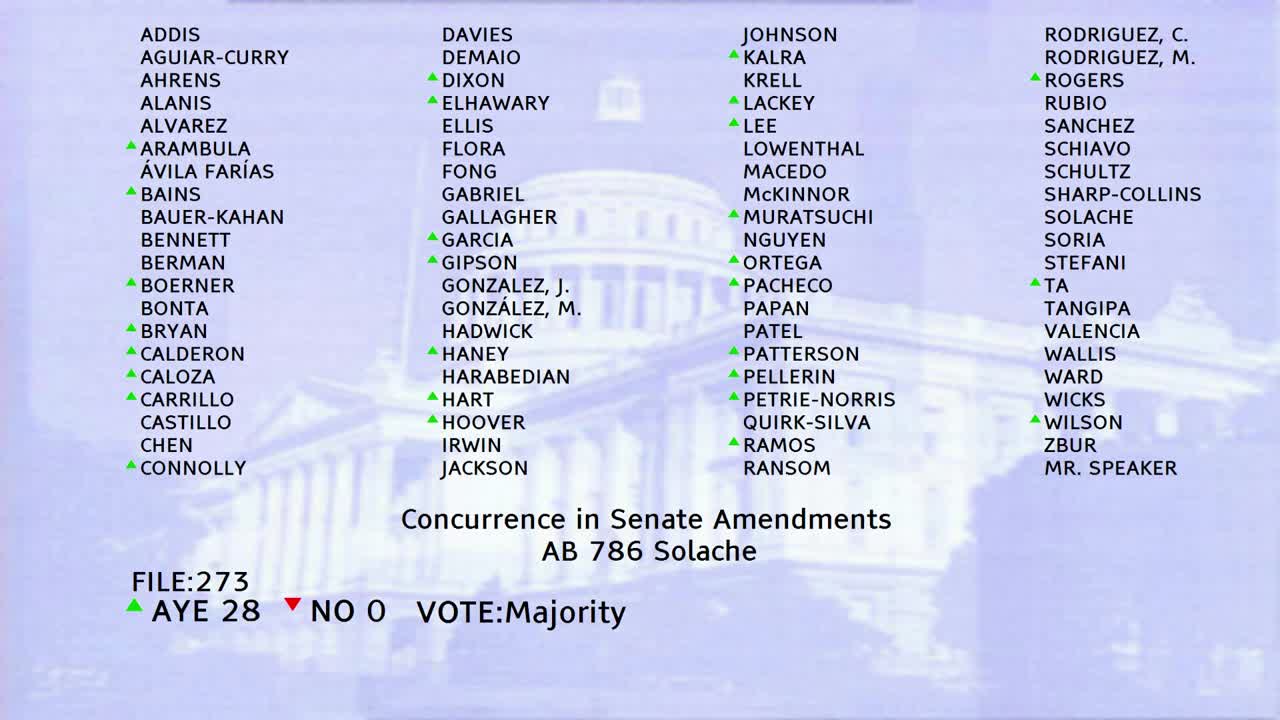 1MIN
Assembly Floor
 2MIN
Senate Floor
 3MIN
Senate Standing Committee on Business, Professions and Economic Development
 57SEC
Assembly Floor
 3MIN
Assembly Standing Committee on Business and Professions
Bill Author

Bill Co-Author(s):