AB 1504: California Massage Therapy Council.
- Session Year: 2025-2026
- House: Assembly
- Latest Version Date: 2025-10-01
Current Status:
Passed
(2025-10-01: Chaptered by Secretary of State - Chapter 197, Statutes of 2025.)
Introduced
In Committee
Awaiting First Chamber Vote
Passed First Chamber
In Committee
Awaiting Second Chamber Vote
Passed Second Chamber
Enacted
(1)Existing law, the Massage Therapy Act, provides for the certification and regulation of massage professionals by the California Massage Therapy Council, which is a private nonprofit organization governed by a board of directors composed of 13 members. Existing law requires one member to be appointed by the office of the Chancellor of the California Community Colleges, and authorizes the California Association of Private Postsecondary Schools to appoint one member. Existing law requires one member to be a certified massage therapist or a certified massage practitioner who is a California resident who has practiced massage for at least 3 years before appointment and is selected by a specified professional society, association, or other entity the membership of which is composed of massage therapist professionals, and that chooses to participate in the council.
This bill would remove the above-described appointment of one member by the office of the Chancellor of the California Community Colleges, and would limit the appointment authority of the California Association of Private Postsecondary Schools by requiring that their appointed member represent an approved massage school. The bill would add an additional member who is a certified massage therapist or a certified massage practitioner who is selected by a specified professional society, association, or other entity, as described above, and would make conforming changes related to that provision.
Existing law authorizes the council to take any reasonable actions necessary to carry out the responsibilities and duties set forth in the Massage Therapy Act, including hiring staff.
This bill would prohibit the total annual salary for any individual employed or contracted by the council from exceeding the annual salary provided to certain state officers during that fiscal year.
Existing law requires the council to issue a certificate to practice massage therapy to an applicant who meets specified qualifications, including that the applicant has successfully completed at least 500 hours in the curricula in massage and related subjects, as specified, from approved schools. Existing law requires the council to determine whether the school from which an applicant has obtained their education meets the requirement of the Massage Therapy Act. If the council has any reason to question whether or not the applicant received that education from the school or schools that the applicant is claiming, existing law requires the council to investigate the facts to determine that the applicant received the education before issuing the certificate.
This bill would authorize, instead of require, the council to conduct that investigation regarding the applicants education, as described above. The bill would require an applicant who meets all of the other requirements for certification and who received the instruction described above at an approved school that was not under formal investigation at the time at which the applicant began instruction but was subsequently placed under investigation by the council to, as a condition of certification, have the opportunity for an interview or educational hearing, as specified, provided that their application for certification was submitted to the council no more than 90 days from the date of a final decision by the council to revoke the schools approval. The bill would require the council to issue a certificate to any applicant who successfully passes the interview or hearing, provided that the school at which the applicant completed the instruction was a school approved by the council within 90 days from the date the applicant submitted their application for certification and was considered to be in good standing, as specified, at the time the applicant passed the interview or hearing.
Existing law, beginning January 1, 2027, also requires an applicant to pass a massage and bodywork competency assessment examination that meets generally recognized psychometric principles and standards and that is approved by the council, as specified.
The bill would remove the requirement that an applicant pass a massage and bodywork competency assessment examination as described above, and would require an approved massage school, upon each students completion of curriculum at the massage school, to provide notice to the student that the massage and bodywork competency assessment examination is not a requirement for certification but may be required for licensure or certification as a massage therapist in any other state.
Existing law requires a certificate holder to notify the council within 30 days of any changes in the certificate holders home address or the address of any massage establishment or other location where the certificate holder provides massage for compensation, except as specified.
This bill would also require a certificate holder to notify the council within 30 days of any changes in the certificate holders legal name.
Existing law makes it a violation of the Massage Therapy Act for an applicant or certificate holder to commit certain acts, and makes the commission of those acts grounds for the council to deny an application for a certificate or to impose discipline on a certificate holder. Those acts include being convicted of any felony, misdemeanor, infraction, or municipal code violation, providing massage of female breasts without the written consent of the person receiving the massage and a referral from a licensed California health care provider, and dressing in certain attire or manners while engaged in the practice of massage for compensation, or while visible to clients in a massage establishment as specified.
This bill would specify that the council may take action for a conviction, as described above, when the time for appeal has elapsed, the judgment of conviction has been affirmed on appeal, or an order granting probation is made suspending the imposition of sentence. The bill would define a conviction for these purposes to mean a judgment following a plea or verdict of guilty, a plea of nolo contendere, or a finding of guilt. The bill would also revise and recast the above-described acts that are considered a violation of the Massage Therapy Act. In this regard, the bill would remove the requirement of a referral from a licensed California health care provider to provide massage of female breasts. The bill would remove the list of prohibited attire or manners of dressing while engaged in the practice of massage for compensation, or while visible to clients in a massage establishment, except that the bill would maintain the prohibition on dressing in a manner that is deemed by the council to constitute unprofessional attire based on the custom and practice of the profession in California. The bill would also include among those specified acts that are considered a violation the determination of being a threat to public safety based on mental health reasons by a medical or mental health professional, or the rendering of a finding of not guilty in a criminal proceeding by reason of insanity.
Existing law authorizes a board to deny a license on the grounds that the applicant has been convicted of a crime or was subject to formal discipline within the preceding 7 years from the date of application based on professional misconduct that is substantially related to the qualifications, functions, or duties of the business or profession for which the present application is made, as specified and subject to certain exceptions.
This bill would require the denial of an initial certificate to practice massage therapy on the grounds that the applicant has been convicted of a crime or has been subject to formal discipline as provided under the act to be consistent with the above-described provisions authorizing a board to deny a license on certain grounds.
Existing law requires the council to follow specified procedures for deciding upon and imposing the denial of a certificate or the discipline of a certificate holder under the Massage Therapy Act. Existing law requires, with certain exceptions, the council to provide an opportunity for the applicant or certificate holder to be heard, orally or in writing, not less than 5 days before the effective date of the denial or discipline, by a person or body authorized to decide whether the proposed denial or discipline should go into effect.
This bill would require the person or body authorized to make that decision to be qualified.
The bill would authorize an applicant or certificate holder to request an appeal of a final decision of the council to deny a certificate or discipline a certificate holder by submitting a request in writing within 30 days of the date of the final decision. In this regard, the bill would require a request to appeal a final decision to be considered by a committee of the board of directors within 120 days of the final decision, as specified. If a request to appeal is granted, the bill would require the appeal of the final decision to be heard at the next board of directors meeting, as specified, that is at least 120 days from the date that the request to appeal was granted, except as specified. The bill would require the council to notify the applicant or certificate holder of its right to request an appeal pursuant to these provisions at the time of the final decision.
Existing law requires the council to develop policies, procedures, rules, or bylaws governing the requirements and processes for approving, denying approval of, imposing corrective action on, or unapproving schools from which applicants obtain their education, as specified. Existing law requires the council, on or before one year from the date the council receives an initial application for approval as a school, to approve the school, propose to deny approval of the school, or notify the school that corrective action is required, and authorizes the council to deny the application of a school that fails to adequately rectify the deficiencies. Existing law authorizes a school to appeal the councils final decision to deny approval of the school, and requires the appeal to be heard at the next board of directors meeting, as specified.
This bill would require the council to notify the school of its right to appeal pursuant to these provisions at the time of the final decision.
Existing law states the intent of the Legislature that, among other things, the Massage Therapy Act enables consumers and local government to more easily identify certified massage professionals and provide for consistent statewide certification and oversight of massage professionals. Existing law repeals the Massage Therapy Act on January 1, 2026.
This bill would also state the intent of the Legislature that, among other things, both state and local regulation of massage therapy reflect the recognized status of certified massage professionals as health care providers. The bill would instead repeal the act on January 1, 2030.
Existing law, the Bagley-Keene Open Meeting Act, requires, with specified exceptions, that all meetings of a state body be open and public and all persons be permitted to attend any meeting of a state body. The act imposes various requirements on a state body holding a meeting subject to the act, including, among other things, requiring the state body to provide notice of its meeting to any person who requests that notice in writing.
The Massage Therapy Act requires meetings of the council to be subject to the rules of the Bagley-Keene Open Meeting Act, and authorizes the board to adopt additional policies and procedures that provide greater transparency to certificate holders and the public than required by the act.
This bill would, except as otherwise provided in the Massage Therapy Act, require meetings of the council to be governed by either Rosenbergs Rules of Order or Roberts Rules of Order, Newly Revised.
The bill would require the council to provide a meaningful opportunity for public participation in the adoption, amendment, or repeal of any policies, procedures, rules, or bylaws that substantially impact the rights, benefits, privileges, duties, obligations, or responsibilities of individuals or entities subject to certification or approval by the council, including, among other things, actions by the council to increase fees. In this regard, the bill would require the council, at a minimum, to publish the complete text of any policies, procedures, rules, or bylaws proposed for adoption, amendment, or repeal along with a summary of the changes being considered for a period of at least 45 calendar days before the adoption, amendment, or repeal, and to accept written public comments during the 45-day period and allow further public comment during a meeting held for these purposes.
Existing law, the California Public Records Act, requires state and local agencies to make their records available for public inspection, unless an exemption from disclosure applies.
This bill would require the council, beginning July 1, 2027, and to the extent practicable, to make the records of the council available for public inspection in a manner consistent with the California Public Records Act, as specified, and would authorize the council to charge for the direct costs of responding to requests for records, as specified.
(2)Existing law establishes the California Private Postsecondary Education Act of 2009, which provides for student protections and regulatory oversight of private postsecondary educational institutions, as defined, in the state. The act is enforced by the Bureau for Private Postsecondary Education within the Department of Consumer Affairs.
Existing law requires an institution with an approval to operate under the act that knows that it is being investigated by an oversight entity other than the bureau to report that investigation, as defined, to the bureau in writing within 30 days of the institutions first knowledge of the investigation, and requires an institution with an approval to operate under the act that is the subject of a judgment by, a regulatory action by, increased oversight or monitoring by, or a settlement with, any oversight entity other than the bureau to report it to the bureau within 30 days. Existing law defines oversight entity for these purposes to include, among other entities, a governmental agency.
This bill would also include any private entity authorized pursuant to any provision of the Business and Professions Code to approve schools or educational programs for purposes of a professional certification as an oversight entity for the above-described purposes.
(1)Existing law, the Massage Therapy Act, provides for the certification and regulation of massage professionals by the California Massage Therapy Council, which is a private nonprofit organization governed by a board of directors composed of 13 members. Existing law requires one member to be appointed by the office of the Chancellor of the California Community Colleges, and authorizes the California Association of Private Postsecondary Schools to appoint one member. Existing law requires one member to be a certified massage therapist or a certified massage practitioner who is a California resident who has practiced massage for at least 3 years before appointment and is selected by a specified professional society, association, or other entity the membership of which is composed of massage therapist professionals, and that chooses to participate in the council.
This bill would remove the above-described appointment of one member by the office of the Chancellor of the California Community Colleges, and would limit the appointment authority of the California Association of Private Postsecondary Schools by requiring that their appointed member represent an approved massage school. The bill would add an additional member who is a certified massage therapist or a certified massage practitioner who is selected by a specified professional society, association, or other entity, as described above, and would make conforming changes related to that provision.
Existing law authorizes the council to take any reasonable actions necessary to carry out the responsibilities and duties set forth in the Massage Therapy Act, including hiring staff.
This bill would prohibit the total annual salary for any individual employed or contracted by the council from exceeding the annual salary provided to certain state officers during that fiscal year.
Existing law requires the council to issue a certificate to practice massage therapy to an applicant who meets specified qualifications, including that the applicant has successfully completed at least 500 hours in the curricula in massage and related subjects, as specified, from approved schools. Existing law requires the council to determine whether the school from which an applicant has obtained their education meets the requirement of the Massage Therapy Act. If the council has any reason to question whether or not the applicant received that education from the school or schools that the applicant is claiming, existing law requires the council to investigate the facts to determine that the applicant received the education before issuing the certificate.
This bill would authorize, instead of require, the council to conduct that investigation regarding the applicants education, as described above. The bill would require an applicant who meets all of the other requirements for certification and who received instruction described above at an approved school that was not under formal investigation at the time at which the applicant began instruction but was subsequently placed under investigation by the council to to, as a condition of certification, have the opportunity for an interview or educational hearing, as specified . specified, provided that their application for certification was submitted to the council no more than 90 days from the date of a final decision by the council to revoke the schools approval. The bill would require the council to issue a certificate to any applicant who successfully passes the interview or hearing, provided that the school at which the applicant completed the instruction was a school approved by the council within 90 days from the date the applicant submitted their application for certification and was considered to be in good standing, as specified, at the time the applicant passed the interview hearing.
Existing law, beginning January 1, 2027, also requires an applicant to pass a massage and bodywork competency assessment examination that meets generally recognized psychometric principles and standards and that is approved by the council, as specified.
The bill would remove the requirement that an applicant pass a massage and bodywork competency assessment examination as described above, and would require an approved massage school, upon each students completion of curriculum at the massage school, to provide notice to the student that the massage and bodywork competency assessment examination is not a requirement for certification but may be required for licensure or certification as a massage therapist in any other state.
Existing law requires a certificate holder to notify the council within 30 days of any changes in the certificate holders home address or the address of any massage establishment or other location where the certificate holder provides massage for compensation, except as specified.
This bill would also require a certificate holder to notify the council within 30 days of any changes in the certificate holders legal name.
Existing law makes it a violation of the Massage Therapy Act for an applicant or certificate holder to commit certain acts, and makes the commission of those acts grounds for the council to deny an application for a certificate or to impose discipline on a certificate holder. Those acts include being convicted of any felony, misdemeanor, infraction, or municipal code violation, providing massage of female breasts without the written consent of the person receiving the massage and a referral from a licensed California health care provider, and dressing in certain attire or manners while engaged in the practice of massage for compensation, or while visible to clients in a massage establishment as specified.
This bill would specify that the council may take action for a conviction, as described above, when the time for appeal has elapsed, the judgment of conviction has been affirmed on appeal, or an order granting probation is made suspending the imposition of sentence. The bill would define a conviction for these purposes to mean a judgment following a plea or verdict of guilty, a plea of nolo contendere, or a finding of guilt. The bill would also revise and recast the above-described acts that are considered a violation of the Massage Therapy Act. In this regard, the bill would remove the requirement of a referral from a licensed California health care provider to provide massage of female breasts. The bill would remove the list of prohibited attire or manners of dressing while engaged in the practice of massage for compensation, or while visible to clients in a massage establishment, except that the bill would maintain the prohibition on dressing in a manner that is deemed by the council to constitute unprofessional attire based on the custom and practice of the profession in California. The bill would also include among those specified acts that are considered a violation the determination of being a threat to public safety based on mental health reasons by a medical or mental health professional, or the rendering of a finding of not guilty in a criminal proceeding by reason of insanity.
Existing law authorizes a board to deny a license on the grounds that the applicant has been convicted of a crime or was subject to formal discipline within the preceding 7 years from the date of application based on professional misconduct that is substantially related to the qualifications, functions, or duties of the business or profession for which the present application is made, as specified and subject to certain exceptions.
This bill would require the denial of an initial certificate to practice massage therapy on the grounds that the applicant has been convicted of a crime or has been subject to formal discipline as provided under the act to be consistent with the above-described provisions authorizing a board to deny a license on certain grounds.
Existing law requires the council to follow specified procedures for deciding upon and imposing the denial of a certificate or the discipline of a certificate holder under the Massage Therapy Act. Existing law requires, with certain exceptions, the council to provide an opportunity for the applicant or certificate holder to be heard, orally or in writing, not less than 5 days before the effective date of the denial or discipline, by a person or body authorized to decide whether the proposed denial or discipline should go into effect.
This bill would specify that require the person or body authorized to make that decision is a person or body authorized by the board of directors. to be qualified.
Existing law authorizes the council to immediately suspend the certificate if the council determines that a certificate holder has committed an act punishable as a sexually related crime or a felony that is substantially related to the qualifications, functions, or duties of a certificate holder. Existing law provides the certificate holder the right to request, in writing, an oral hearing or consideration of a written statement to challenge the factual basis for the suspension, and a requested oral hearing or consideration to be held within 30 calendar days after the receipt of the request.This bill would specify that the oral hearing or consideration is to be held by a person or body authorized by the board of directors.The bill would authorize an applicant or certificate holder to request an appeal of a final decision of the council to deny or revoke a certificate for conduct not constituting a criminal offense. or discipline a certificate holder by submitting a request in writing within 30 days of the date of the final decision. In this regard, the bill would require an a request to appeal a final decision to be considered by a committee of the board of directors within 120 days of the final decision, as specified. If a request to appeal is granted, the bill would require the appeal of the final decision to be heard at the next board of directors meeting, as specified, that is at least 120 days from the last date for the applicant or certificate holder to timely request an appeal, date that the request to appeal was granted, except as specified. The bill would require the council to notify the applicant or certificate holder of its right to request an appeal pursuant to these provisions at the time of the final decision.
Existing law requires the council to develop policies, procedures, rules, or bylaws governing the requirements and processes for approving, denying approval of, imposing corrective action on, or unapproving schools from which applicants obtain their education, as specified. Existing law requires the council, on or before one year from the date the council receives an initial application for approval as a school, to approve the school, propose to deny approval of the school, or notify the school that corrective action is required, and authorizes the council to deny the application of a school that fails to adequately rectify the deficiencies. Existing law authorizes a school to appeal the councils final decision to deny approval of the school, and requires the appeal to be heard at the next board of directors meeting, as specified.
This bill would require the council to notify the school of its right to appeal pursuant to these provisions at the time of the final decision.
Existing law states the intent of the Legislature that, among other things, the Massage Therapy Act enables consumers and local government to more easily identify certified massage professionals and provide for consistent statewide certification and oversight of massage professionals. Existing law repeals the Massage Therapy Act on January 1, 2026.
This bill would also state the intent of the Legislature that, among other things, both state and local regulation of massage therapy reflect the recognized status of certified massage professionals as health care providers. The bill would instead repeal the act on January 1, 2030.
Existing law, the Bagley-Keene Open Meeting Act, requires, with specified exceptions, that all meetings of a state body be open and public and all persons be permitted to attend any meeting of a state body. The act imposes various requirements on a state body holding a meeting subject to the act, including, among other things, requiring the state body to provide notice of its meeting to any person who requests that notice in writing.
The Massage Therapy Act requires meetings of the council to be subject to the rules of the Bagley-Keene Open Meeting Act, and authorizes the board to adopt additional policies and procedures that provide greater transparency to certificate holders and the public than required by the act.
This bill would, except as otherwise provided in the Massage Therapy Act, require meetings of the council to be governed by either Rosenbergs Rules of Order or Roberts Rules of Order, Newly Revised.
The bill would require the council to provide a meaningful opportunity for public participation in the adoption, amendment, or repeal of any policies, procedures, rules, or bylaws that substantially impact the rights, benefits, privileges, duties, obligations, or responsibilities of individuals or entities subject to certification or approval by the council, including, among other things, actions by the council to increase fees. In this regard, the bill would require the council, at a minimum, to publish the complete text of any policies, procedures, rules, or bylaws proposed for adoption, amendment, or repeal along with a summary of the changes being considered for a period of at least 45 calendar days before the adoption, amendment, or repeal, and to accept written public comments during the 45-day period and allow further public comment during a meeting held for these purposes.
Existing law, the California Public Records Act, requires state and local agencies to make their records available for public inspection, unless an exemption from disclosure applies.
This bill would require the council, beginning July 1, 2027, and to the extent practicable, to make the records of the council available for public inspection in a manner consistent with the California Public Records Act, as specified. specified, and would authorize the council to charge for the direct costs of responding to requests for records, as specified.
(2)Existing law establishes the California Private Postsecondary Education Act of 2009, which provides for student protections and regulatory oversight of private postsecondary educational institutions, as defined, in the state. The act is enforced by the Bureau for Private Postsecondary Education within the Department of Consumer Affairs.
Existing law requires an institution with an approval to operate under the act that knows that it is being investigated by an oversight entity other than the bureau to report that investigation, as specified, to the bureau in writing within 30 days of the institutions first knowledge of the investigation, and requires an institution with an approval to operate under the act that is the subject of a judgment by, a regulatory action by, increased oversight or monitoring by, or a settlement with, any oversight entity other than the bureau to report it to the bureau within 30 days. Existing law defines oversight entity for these purposes to include, among other entities, a governmental agency.
This bill would also include any private entity authorized pursuant to any provision of the Business and Professions Code to approve schools or educational programs for purposes of a professional certification as an oversight entity for the above-described purposes.
(1)Existing law, the Massage Therapy Act, provides for the certification and regulation of massage professionals by the California Massage Therapy Council, which is a private nonprofit organization governed by a board of directors composed of 13 members. Existing law requires one member to be appointed by the office of the Chancellor of the California Community Colleges, and authorizes the California Association of Private Postsecondary Schools to appoint one member. Existing law requires one member to be a certified massage therapist or a certified massage practitioner who is a California resident who has practiced massage for at least 3 years before appointment and is selected by a specified professional society, association, or other entity the membership of which is composed of massage therapist professionals, and that chooses to participate in the council.
This bill would remove the above-described appointment of one member by the office of the Chancellor of the California Community Colleges, and would limit the appointment authority of the California Association of Private Postsecondary Schools by requiring that their appointed member represent an approved massage school. The bill would add an additional member who is a certified massage therapist or a certified massage practitioner who is selected by a specified professional society, association, or other entity, as described above, and would make conforming changes related to that provision.
Existing law authorizes the council to take any reasonable actions necessary to carry out the responsibilities and duties set forth in the Massage Therapy Act, including hiring staff.
This bill would prohibit the total annual salary for any individual employed or contracted by the council from exceeding the annual salary provided to certain state officers during that fiscal year.
Existing law requires the council to issue a certificate to practice massage therapy to an applicant who meets specified qualifications, including that the applicant has successfully completed at least 500 hours in the curricula in massage and related subjects, as specified, from approved schools. Existing law requires the council to determine whether the school from which an applicant has obtained their education meets the requirement of the Massage Therapy Act. If the council has any reason to question whether or not the applicant received that education from the school or schools that the applicant is claiming, existing law requires the council to investigate the facts to determine that the applicant received the education before issuing the certificate.
This bill would authorize, instead of require, the council to conduct that investigation regarding the applicants education, as described above. The bill would require an applicant who meets all the other requirements for certification and who received instruction described above at an approved school that was not under formal investigation at the time at which the applicant began instruction but was subsequently placed under investigation by the council to have the opportunity for an interview or educational hearing, as specified . The bill would require the council to issue a certificate to any applicant who successfully passes the interview or hearing, provided that the school at which the applicant completed the instruction was considered in good standing, as specified, at the time the applicant passed the interview hearing.
Existing law, beginning January 1, 2027, also requires an applicant to pass a massage and bodywork competency assessment examination that meets generally recognized psychometric principles and standards and that is approved by the council, as specified.
The bill would remove the requirement that an applicant to pass a massage and bodywork competency assessment examination as described above, and would require an approved massage school, upon each students completion of curriculum at the massage school, to provide notice to the student that the massage and bodywork competency assessment examination is not a requirement for certification but may be required for licensure or certification as a massage therapist in any other state.
Existing law requires a certificate holder to notify the council within 30 days of any changes in the certificate holders home address or the address of any massage establishment or other location where the certificate holder provides massage for compensation, except as specified.
This bill would also require a certificate holder to notify the council within 30 days of any changes in the certificate holders legal name.
Existing law makes it a violation of the Massage Therapy Act for an applicant or certificate holder to commit certain acts, and makes the commission of those acts grounds for the council to deny an application for a certificate or to impose discipline on a certificate holder. Those acts include being convicted of any felony, misdemeanor, infraction, or municipal code violation, providing massage of female breasts without the written consent of the person receiving the massage and a referral from a licensed California health care provider, and dressing in certain attire or manners while engaged in the practice of massage for compensation, or while visible to clients in a massage establishment as specified.
This bill would revise and recast the above-described acts that are considered a violation. In this regard, the bill would specify that the council may take action for a conviction, as described above, when the time for appeal has elapsed, the judgment of conviction has been affirmed on appeal, or an order granting probation is made suspending the imposition of sentence. The bill would define a conviction for these purposes to mean a judgment following a plea or verdict of guilty, or a conviction after a plea of nolo contendere, is a conviction for those purposes. The or a finding of guilt. The bill would also revise and recast the above-described acts that are considered a violation of the Massage Therapy Act. In this regard, the bill would remove the requirement of a referral from a licensed California health care provider to provide massage of female breasts. The bill would remove the list of prohibited attire or manners of dressing while engaged in the practice of massage for compensation, or while visible to clients in a massage establishment, except that the bill would maintain the prohibition on dressing in a manner that is deemed by the council to constitute unprofessional attire based on the custom and practice of the profession in California. The bill would also include among those specified acts that are considered a violation the determination of being a threat to public safety based on mental health reasons by a medical or mental health professional, or the rendering of a finding of not guilty in a criminal proceeding by reason of insanity.
Existing law authorizes a board to deny a license on the grounds that the applicant has been convicted of a crime or was subject to formal discipline within the preceding 7 years from the date of application based on professional misconduct that is substantially related to the qualifications, functions, or duties of the business or profession for which the present application is made, as specified and subject to certain exceptions.
This bill would require the denial of an initial certificate to practice massage therapy on the grounds that the applicant has been convicted of a crime or has been subject to formal discipline as provided under the act to be consistent with the above-described provisions authorizing a board to deny a license on certain grounds.
Existing law requires the council to follow specified procedures for deciding upon and imposing the denial of a certificate or the discipline of a certificate holder under the Massage Therapy Act. Existing law requires, with certain exceptions, the council to provide an opportunity for the applicant or certificate holder to be heard, orally or in writing, not less than 5 days before the effective date of the denial or discipline, by a person or body authorized to decide whether the proposed denial or discipline should go into effect.
This bill would specify that the person or body authorized to make that decision is a person or body authorized by the board of directors.
Existing law authorizes the council to immediately suspend the certificate if the council determines that a certificate holder has committed an act punishable as a sexually related crime or a felony that is substantially related to the qualifications, functions, or duties of a certificate holder. Existing law provides the certificate holder the right to request, in writing, an oral hearing or consideration of a written statement to challenge the factual basis for the suspension, and a requested oral hearing or consideration to be held within 30 calendar days after the receipt of the request.
This bill would specify that the oral hearing or consideration is to be held by a person or body authorized by the board of directors.
The bill would authorize an applicant or certificate holder to appeal a final decision of the council to deny or revoke a certificate for conduct not constituting a criminal offense. In this regard, the bill would require an appeal of the final decision to be heard at the next board of directors meeting, as specified, that is at least 120 days from the last date for the applicant or certificate holder to timely request an appeal, except as specified. The bill would require the council to notify the applicant or certificate holder of its right to appeal pursuant to these provisions at the time of the final decision.
Existing law requires the council to develop policies, procedures, rules, or bylaws governing the requirements and processes for approving, denying approval of, imposing corrective action on, or unapproving schools from which applicants obtain their education, as specified. Existing law requires the council, on or before one year from the date the council receives an initial application for approval as a school, to approve the school, propose to deny approval of the school, or notify the school that corrective action is required, and authorizes the council to deny the application of a school that fails to adequately rectify the deficiencies. Existing law authorizes a school to appeal the councils final decision to deny approval of the school, and requires the appeal to be heard at the next board of directors meeting, as specified.
This bill would require the council to notify the school of its right to appeal pursuant to these provisions at the time of the final decision.
Existing law states the intent of the Legislature that, among other things, the Massage Therapy Act enables consumers and local government to more easily identify certified massage professionals and provide for consistent statewide certification and oversight of massage professionals. Existing law repeals the Massage Therapy Act on January 1, 2026.
This bill would also state the intent of the Legislature that, among other things, both state and local regulation of massage therapy reflect the recognized status of certified massage professionals as health care providers. The bill would instead repeal the act on January 1, 2030.
Existing law, the Bagley-Keene Open Meeting Act, requires, with specified exceptions, that all meetings of a state body be open and public and all persons be permitted to attend any meeting of a state body. The act imposes various requirements on a state body holding a meeting subject to the act, including, among other things, requiring the state body to provide notice of its meeting to any person who requests that notice in writing.
The Massage Therapy Act requires meetings of the council to be subject to the rules of the Bagley-Keene Open Meeting Act, and authorizes the board to adopt additional policies and procedures that provide greater transparency to certificate holders and the public than required by the act.
This bill would, except as otherwise provided in the Massage Therapy Act, require meetings of the council to be governed by either Rosenbergs Rules of Order or Roberts Rules of Order, Newly Revised.
The bill would require the council to provide a meaningful opportunity for public participation in the adoption, amendment, or repeal of any policies, procedures, rules, or bylaws that substantially impact the rights, benefits, privileges, duties, obligations, or responsibilities of individuals or entities subject to certification or approval by the council, including, among other things, actions by the council to increase fees. In this regard, the bill would require the council, at a minimum, to publish the complete text of any policies, procedures, rules, or bylaws proposed for adoption, amendment, or repeal along with a summary of the changes being considered for a period of at least 45 calendar days before the adoption, amendment, or repeal, and to accept written public comments during the 45-day period and allow further public comment during a meeting held for these purposes.
Existing law, the California Public Records Act, requires state and local agencies to make their records available for public inspection, unless an exemption from disclosure applies.
This bill would require the council, to the extent practicable, to make the records of the council available for public inspection in a manner consistent with the California Public Records Act, as specified.
(2)Existing law establishes the California Private Postsecondary Education Act of 2009, which provides for student protections and regulatory oversight of private postsecondary educational institutions, as defined, in the state. The act is enforced by the Bureau for Private Postsecondary Education within the Department of Consumer Affairs.
Existing law requires an institution with an approval to operate under the act that knows that it is being investigated by an oversight entity other than the bureau to report that investigation, as specified, to the bureau in writing within 30 days of the institutions first knowledge of the investigation, and requires an institution with an approval to operate under the act that is the subject of a judgment by, a regulatory action by, increased oversight or monitoring by, or a settlement with, any oversight entity other than the bureau to report it to the bureau within 30 days. Existing law defines oversight entity for these purposes to include, among other entities, a governmental agency.
This bill would also include any private entity authorized pursuant to any provision of the Business and Professions Code to approve schools or educational programs for purposes of a professional certification as an oversight entity for the above-described purposes.
Existing
(1)Existing law, the Massage Therapy Act, provides for the certification and regulation of massage professionals by the California Massage Therapy Council, which is a private nonprofit organization governed by a board of directors composed of 13 members. Existing law requires one member to be appointed by the office of the Chancellor of the California Community Colleges, and authorizes the California Association of Private Postsecondary Schools to appoint one member. Existing law requires one member to be a certified massage therapist or a certified massage practitioner who is a California resident who has practiced massage for at least 3 years before appointment and is selected by a specified professional society, association, or other entity the membership of which is composed of massage therapist professionals, and that chooses to participate in the council.
This bill would remove the above-described appointment of one member by the office of the Chancellor of the California Community Colleges, and would limit the appointment authority of the California Association of Private Postsecondary Schools by requiring that their appointed member represent an approved massage school. The bill would add an additional member who is a certified massage therapist or a certified massage practitioner who is selected by a specified professional society, association, or other entity, as described above, and would make conforming changes related to that provision.
Existing law authorizes the council to take any reasonable actions necessary to carry out the responsibilities and duties set forth in the Massage Therapy Act, including hiring staff.
This bill would prohibit the total annual compensation salary for any individual employed or contracted by the council from exceeding the annual salary provided to certain state officers during that fiscal year.
Existing law requires the council to issue a certificate to practice massage therapy to an applicant who meets specified qualifications, including that the applicant has successfully completed at least 500 hours in the curricula in massage and related subjects, as specified. specified, from approved schools. Existing law requires the council to determine whether the school from which an applicant has obtained their education meets the requirement of the Massage Therapy Act. If the council has any reason to question whether or not the applicant received that education from the school or schools that the applicant is claiming, existing law requires the council to investigate the facts to determine that the applicant received the education before issuing the certificate.
This bill would authorize, instead of require, the council to conduct that investigation, investigation regarding the applicants education, as described above. The bill would require an applicant who meets all the other requirements for certification and who received instruction described above at an approved school that was not under formal investigation at the time at which the applicant began instruction but was subsequently placed under investigation by the council to have the opportunity for an interview or educational hearing, as specified . The bill would require the council to issue a certificate to any applicant who successfully passes the interview or hearing, provided that the school at which the applicant completed the instruction was considered in good standing, as specified, at the time the applicant passed the interview hearing.
Existing law, beginning January 1, 2027, also requires an applicant to pass a massage and bodywork competency assessment examination that meets generally recognized psychometric principles and standards and that is approved by the council, as specified.
The bill would remove the requirement that an applicant to pass a massage and bodywork competency assessment examination as described above, and would require an approved massage school, upon each students completion of curriculum at the massage school, to provide notice to the student that the massage and bodywork competency assessment examination is not a requirement for certification but may be required for licensure or certification as a massage therapist in any other state.
Existing law requires a certificate holder to notify the council within 30 days of any changes in the certificate holders home address or the address of any massage establishment or other location where the certificate holder provides massage for compensation, except as specified.
This bill would also require a certificate holder to notify the council within 30 days of any changes in the certificate holders legal name.
Existing law makes it a violation of the Massage Therapy Act for an applicant or certificate holder to commit certain acts, and makes the commission of those acts grounds for the council to deny an application for a certificate or to impose discipline on a certificate holder. Those acts include being convicted of any felony, misdemeanor, infraction, or municipal code violation, or being held liable in an administrative or civil action for an act, that is substantially related to the qualifications, functions, or duties of a certificate holder. providing massage of female breasts without the written consent of the person receiving the massage and a referral from a licensed California health care provider, and dressing in certain attire or manners while engaged in the practice of massage for compensation, or while visible to clients in a massage establishment as specified.
This bill would revise and recast the above-described acts that are considered a violation. In this regard, the bill would specify that a plea or verdict of guilty, or a conviction after a plea of nolo contendere, is a conviction for purposes of the above-described provision. conviction for those purposes. The bill would remove the requirement of a referral from a licensed California health care provider to provide massage of female breasts. The bill would remove the list of prohibited attire or manners of dressing while engaged in the practice of massage for compensation, or while visible to clients in a massage establishment, except that the bill would maintain the prohibition on dressing in a manner that is deemed by the council to constitute unprofessional attire based on the custom and practice of the profession in California. The bill would also include among those specified acts that are considered a violation the determination of being a threat to public safety based on mental health reasons by a medical or mental health professional, or the rendering of a finding of not guilty in a criminal proceeding by reason of insanity.
Existing law authorizes a board to deny a license on the grounds that the applicant has been convicted of a crime or was subject to formal discipline within the preceding 7 years from the date of application based on professional misconduct that is substantially related to the qualifications, functions, or duties of the business or profession for which the present application is made, as specified and subject to certain exceptions. Existing law requires a board to follow specified procedures in requesting or acting on an applicants criminal history information, including notifying the applicant in writing, as specified, if a board decides to deny an application for licensure based solely or in part on the applicants conviction history.
This bill would require the denial of an initial certificate to practice massage therapy on the grounds that the applicant has been convicted of a crime or has been subject to formal discipline as provided under the act to be consistent with the above-described provisions authorizing a board to deny a license. license on certain grounds.
Existing law requires the council to follow specified procedures for deciding upon and imposing the denial of a certificate or the discipline of a certificate holder under the Massage Therapy Act. Existing law requires, with certain exceptions, the council to provide an opportunity for the applicant or certificate holder, holder to be heard, orally or in writing, not less than 5 days before the effective date of the denial or discipline, by a person or body authorized to decide whether the proposed denial or discipline should go into effect.
This bill would specify that the person or body authorized to make that decision is a person or body authorized by the board of directors.
Existing law authorizes the council to immediately suspend the certificate if the council determines that a certificate holder has committed an act punishable as a sexually related crime or a felony that is substantially related to the qualifications, functions, or duties of a certificate holder. Existing law provides the certificate holder the right to request, in writing, an oral hearing or consideration of a written statement to challenge the factual basis for the suspension, and a requested oral hearing or consideration to be held within 30 calendar days after the receipt of the request.
This bill would specify that the oral hearing or consideration is to be held by a person or body authorized by the board of directors.
The bill would authorize an applicant or certificate holder to appeal a final decision of the council to deny or revoke a certificate. certificate for conduct not constituting a criminal offense. In this regard, the bill would require an appeal of the final decision to be heard at the next board of directors meeting, as specified, that is at least 120 days from the last date for the applicant or certificate holder to timely request an appeal, except as specified. The bill would require the council to notify the applicant or certificate holder of its right to appeal pursuant to these provisions at the time of the final decision.
Existing law requires the council, upon request of any law enforcement agency or any other representative of a local government agency with responsibility for regulating or administering a local ordinance relating to massage or massage establishments, to provide information concerning an applicant or certificate holder, including the name and home and work addresses of any person whose certificate has been suspended and the length of the suspension if the work address is located within the jurisdiction of the agency making the request, and any other information in the councils possession that is necessary to verify facts relevant to administering the local ordinance.The bill would revise the entities to which the council is required to provide that information to include any law enforcement agency, state agency, or representative of a local government agency with responsibility for regulating or administering a local ordinance relating to massage or massage establishments. The bill would remove the requirement that the work address be located within the jurisdiction of the agency making the request. The bill would expand the information the council is required to provide the requesting agency to instead include any information in the councils possession that is necessary to verify facts relevant to administering a local massage or massage establishment ordinance, or any other federal, state, or local enforcement laws related to massage or massage establishments, human trafficking, organized crime, acts punishable as a sexually related crime, or regulating a California-licensed profession.Existing law requires the council to develop policies, procedures, rules, or bylaws governing the requirements and processes for approving, denying approval of, imposing corrective action on, or unapproving schools from which applicants obtain their education, as specified. Existing law requires the council, on or before one year from the date the council receives an initial application for approval as a school, to approve the school, propose to deny approval of the school, or notify the school that corrective action is required, and authorizes the council to deny the application of a school that fails to adequately rectify the deficiencies. Existing law authorizes a school to appeal the councils final decision to deny approval of the school, and requires the appeal to be heard at the next board of directors meeting, as specified.
This bill would require the council to notify the school of its right to appeal pursuant to these provisions at the time of the final decision.
Existing law states the intent of the Legislature that, among other things, the Massage Therapy Act enables consumers and local government to more easily identify certified massage professionals and provide for consistent statewide certification and oversight of massage professionals. Existing law repeals the Massage Therapy Act on January 1, 2026.
This bill would also state the intent of the Legislature that, among other things, both state and local regulation of massage therapy reflect the recognized status of certified massage professionals as health care providers. The bill would instead repeal the act on January 1, 2030.
Existing law, the Bagley-Keene Open Meeting Act, requires, with specified exceptions, that all meetings of a state body be open and public and all persons be permitted to attend any meeting of a state body. The act imposes various requirements on a state body holding a meeting subject to the act, including, among other things, requiring the state body to provide notice of its meeting to any person who requests that notice in writing.
The Massage Therapy Act requires meetings of the council to be subject to the rules of the Bagley-Keene Open Meeting Act, and authorizes the board to adopt additional policies and procedures that provide greater transparency to certificate holders and the public than required by the act.
This bill would, except as otherwise provided in the Massage Therapy Act, require meetings of the council to be governed by either Rosenbergs Rules of Order or Roberts Rules of Order, Newly Revised.
The bill would require the council to provide a meaningful opportunity for public participation in the adoption, amendment, or repeal of any policies, procedures, rules, or bylaws that substantially impact the rights, benefits, privileges, duties, obligations, or responsibilities of individuals or entities subject to certification or approval by the council, including, among other things, actions by the council to increase fees. In this regard, the bill would require the council, at a minimum, to publish the complete text of any policies, procedures, rules, or bylaws proposed for adoption, amendment, or repeal along with a summary of the changes being considered for a period of at least 45 calendar days before the adoption, amendment, or repeal, and to accept written public comments during the 45-day period and allow further public comment during a meeting held for these purposes that is noticed and conducted in compliance with the Bagley-Keene Open Meeting Act. purposes.
Existing law, the California Public Records Act, requires state and local agencies to make their records available for public inspection, unless an exemption from disclosure applies.
This bill would require the council, to the extent practicable, to make the records of the council to be subject to available for public inspection in a manner consistent with the California Public Records Act, as specified.
(2)Existing law establishes the California Private Postsecondary Education Act of 2009, which provides for student protections and regulatory oversight of private postsecondary educational institutions, as defined, in the state. The act is enforced by the Bureau for Private Postsecondary Education within the Department of Consumer Affairs.
Existing law requires an institution with an approval to operate under the act that knows that it is being investigated by an oversight entity other than the bureau to report that investigation, as specified, to the bureau in writing within 30 days of the institutions first knowledge of the investigation, and requires an institution with an approval to operate under the act that is the subject of a judgment by, a regulatory action by, increased oversight or monitoring by, or a settlement with, any oversight entity other than the bureau to report it to the bureau within 30 days. Existing law defines oversight entity for these purposes to include, among other entities, a governmental agency.
This bill would also include any private entity authorized pursuant to any provision of the Business and Professions Code to approve schools or educational programs for purposes of a professional certification as an oversight entity for the above-described purposes.
Existing law, the Massage Therapy Act, provides for the certification and regulation of massage professionals by the California Massage Therapy Council, which is a private nonprofit organization governed by a board of directors composed of 13 members. Existing law requires one member to be appointed by the office of the Chancellor of the California Community Colleges, and authorizes the California Association of Private Postsecondary Schools to appoint one member. Existing law requires one member to be a certified massage therapist or a certified massage practitioner who is a California resident who has practiced massage for at least 3 years before appointment and is selected by a specified professional society, association, or other entity the membership of which is composed of massage therapist professionals, and that chooses to participate in the council.
This bill would remove the above-described appointment of one member by the office of the Chancellor of the California Community Colleges, and would limit the appointment authority of the California Association of Private Postsecondary Schools by requiring that their appointed member represent an approved massage school. The bill would add an additional member who is a certified massage therapist or a certified massage practitioner who is selected by a specified professional society, association, or other entity, as described above, and would make conforming changes related to that provision.
Existing law authorizes the council to take any reasonable actions necessary to carry out the responsibilities and duties set forth in the Massage Therapy Act, including hiring staff.
This bill would prohibit the total annual compensation for any individual employed or contracted by the council from exceeding the annual salary provided to certain state officers during that fiscal year.
Existing law requires the council to issue a certificate to practice massage therapy to an applicant who meets specified qualifications, including that the applicant has successfully completed the curricula in massage and related subjects, as specified. Existing law requires the council to determine whether the school from which an applicant has obtained their education meets the requirement of the Massage Therapy Act. If the council has any reason to question whether or not the applicant received that education from the school or schools that the applicant is claiming, existing law requires the council to investigate the facts to determine that the applicant received the education before issuing the certificate.
This bill would authorize, instead of require, the council to conduct that investigation, as described above.
Existing law requires a certificate holder to notify the council within 30 days of any changes in the certificate holders home address or the address of any massage establishment or other location where the certificate holder provides massage for compensation, except as specified.
This bill would also require a certificate holder to notify the council within 30 days of any changes in the certificate holders legal name.
Existing law makes it a violation of the Massage Therapy Act for an applicant or certificate holder to commit certain acts, and makes the commission of those acts grounds for the council to deny an application for a certificate or to impose discipline on a certificate holder. Those acts include being convicted of any felony, misdemeanor, infraction, or municipal code violation, or being held liable in an administrative or civil action for an act, that is substantially related to the qualifications, functions, or duties of a certificate holder.
This bill would specify that a plea or verdict of guilty, or a conviction after a plea of nolo contendere, is a conviction for purposes of the above-described provision. The bill would also include among those specified acts that are considered a violation the determination of being a threat to public safety based on mental health reasons by a medical or mental health professional, or the rendering of a finding of not guilty in a criminal proceeding by reason of insanity.
Existing law authorizes a board to deny a license on the grounds that the applicant has been convicted of a crime or was subject to formal discipline within the preceding 7 years from the date of application based on professional misconduct that is substantially related to the qualifications, functions, or duties of the business or profession for which the present application is made, as specified and subject to certain exceptions. Existing law requires a board to follow specified procedures in requesting or acting on an applicants criminal history information, including notifying the applicant in writing, as specified, if a board decides to deny an application for licensure based solely or in part on the applicants conviction history.
This bill would require the denial of an initial certificate to practice massage therapy on the grounds that the applicant has been convicted of a crime or has been subject to formal discipline as provided under the act to be consistent with the above-described provisions authorizing a board to deny a license.
Existing law requires the council to follow specified procedures for deciding upon and imposing the denial of a certificate or the discipline of a certificate holder under the Massage Therapy Act. Existing law requires, with certain exceptions, the council to provide an opportunity for the applicant or certificate holder, to be heard, orally or in writing, not less than 5 days before the effective date of the denial or discipline, by a person or body authorized to decide whether the proposed denial or discipline should go into effect.
This bill would specify that the person or body authorized to make that decision is a person or body authorized by the board of directors.
Existing law authorizes the council to immediately suspend the certificate if the council determines that a certificate holder has committed an act punishable as a sexually related crime or a felony that is substantially related to the qualifications, functions, or duties of a certificate holder. Existing law provides the certificate holder the right to request, in writing, an oral hearing or consideration of a written statement to challenge the factual basis for the suspension, and a requested oral hearing or consideration to be held within 30 calendar days after the receipt of the request.
This bill would specify that the oral hearing or consideration is to be held by a person or body authorized by the board of directors.
The bill would authorize an applicant or certificate holder to appeal a final decision of the council to deny or revoke a certificate. In this regard, the bill would require an appeal of the final decision to be heard at the next board of directors meeting, as specified, that is at least 120 days from the last date for the applicant or certificate holder to timely request an appeal, except as specified. The bill would require the council to notify the applicant or certificate holder of its right to appeal pursuant to these provisions at the time of the final decision.
Existing law requires the council, upon request of any law enforcement agency or any other representative of a local government agency with responsibility for regulating or administering a local ordinance relating to massage or massage establishments, to provide information concerning an applicant or certificate holder, including the name and home and work addresses of any person whose certificate has been suspended and the length of the suspension if the work address is located within the jurisdiction of the agency making the request, and any other information in the councils possession that is necessary to verify facts relevant to administering the local ordinance.
The bill would revise the entities to which the council is required to provide that information to include any law enforcement agency, state agency, or representative of a local government agency with responsibility for regulating or administering a local ordinance relating to massage or massage establishments. The bill would remove the requirement that the work address be located within the jurisdiction of the agency making the request. The bill would expand the information the council is required to provide the requesting agency to instead include any information in the councils possession that is necessary to verify facts relevant to administering a local massage or massage establishment ordinance, or any other federal, state, or local enforcement laws related to massage or massage establishments, human trafficking, organized crime, acts punishable as a sexually related crime, or regulating a California-licensed profession.
Existing law requires the council to develop policies, procedures, rules, or bylaws governing the requirements and processes for approving, denying approval of, imposing corrective action on, or unapproving schools from which applicants obtain their education, as specified. Existing law requires the council, on or before one year from the date the council receives an initial application for approval as a school, to approve the school, propose to deny approval of the school, or notify the school that corrective action is required, and authorizes the council to deny the application of a school that fails to adequately rectify the deficiencies. Existing law authorizes a school to appeal the councils final decision to deny approval of the school, and requires the appeal to be heard at the next board of directors meeting, as specified.
This bill would require the council to notify the school of its right to appeal pursuant to these provisions at the time of the final decision.
Existing law states the intent of the Legislature that, among other things, the Massage Therapy Act enables consumers and local government to more easily identify certified massage professionals and provide for consistent statewide certification and oversight of massage professionals. Existing law repeals the Massage Therapy Act on January 1, 2026.
This bill would also state the intent of the Legislature that, among other things, both state and local regulation of massage therapy reflect the recognized status of certified massage professionals as health care providers. The bill would instead repeal the act on January 1, 2030.
Existing law, the Bagley-Keene Open Meeting Act, requires, with specified exceptions, that all meetings of a state body be open and public and all persons be permitted to attend any meeting of a state body. The act imposes various requirements on a state body holding a meeting subject to the act, including, among other things, requiring the state body to provide notice of its meeting to any person who requests that notice in writing.
The Massage Therapy Act requires meetings of the council to be subject to the rules of the Bagley-Keene Open Meeting Act, and authorizes the board to adopt additional policies and procedures that provide greater transparency to certificate holders and the public than required by the act.
This bill would, except as otherwise provided in the Massage Therapy Act, require meetings of the council to be governed by Roberts Rules of Order, Newly Revised.
The bill would require the council to provide a meaningful opportunity for public participation in the adoption, amendment, or repeal of any policies, procedures, rules, or bylaws that substantially impact the rights, benefits, privileges, duties, obligations, or responsibilities of individuals or entities subject to certification or approval by the council, including, among other things, actions by the council to increase fees. In this regard, the bill would require the council, at a minimum, to publish the complete text of any policies, procedures, rules, or bylaws proposed for adoption, amendment, or repeal along with a summary of the changes being considered for a period of at least 45 calendar days before the adoption, amendment, or repeal, and to accept written public comments during the 45-day period and allow further public comment during a meeting held for these purposes that is noticed and conducted in compliance with the Bagley-Keene Open Meeting Act.
Existing law, the California Public Records Act, requires state and local agencies to make their records available for public inspection, unless an exemption from disclosure applies.
This bill would require the records of the council to be open to public inspection pursuant subject to the California Public Records Act, as specified.
Existing law, the Massage Therapy Act, provides for the certification and regulation of massage professionals by the California Massage Therapy Council, which is a nonprofit organization. Existing private nonprofit organization governed by a board of directors composed of 13 members. Existing law requires one member to be appointed by the office of the Chancellor of the California Community Colleges, and authorizes the California Association of Private Postsecondary Schools to appoint one member. Existing law requires one member to be a certified massage therapist or a certified massage practitioner who is a California resident who has practiced massage for at least 3 years before appointment and is selected by a specified professional society, association, or other entity the membership of which is composed of massage therapist professionals, and that chooses to participate in the council.
This bill would remove the above-described appointment of one member by the office of the Chancellor of the California Community Colleges, and would limit the appointment authority of the California Association of Private Postsecondary Schools by requiring that their appointed member represent an approved massage school. The bill would add an additional member who is a certified massage therapist or a certified massage practitioner who is selected by a specified professional society, association, or other entity, as described above, and would make conforming changes related to that provision.
Existing law authorizes the council to take any reasonable actions necessary to carry out the responsibilities and duties set forth in the Massage Therapy Act, including hiring staff.
This bill would prohibit the total annual compensation for any individual employed or contracted by the council from exceeding the annual salary provided to certain state officers during that fiscal year.
Existing law requires the council to issue a certificate to practice massage therapy to an applicant who meets specified qualifications, including that the applicant has successfully completed the curricula in massage and related subjects, as specified. Existing law requires the council to determine whether the school from which an applicant has obtained their education meets the requirement of the Massage Therapy Act. If the council has any reason to question whether or not the applicant received that education from the school or schools that the applicant is claiming, existing law requires the council to investigate the facts to determine that the applicant received the education before issuing the certificate.
This bill would authorize, instead of require, the council to conduct that investigation, as described above.
Existing law requires a certificate holder to notify the council within 30 days of any changes in the certificate holders home address or the address of any massage establishment or other location where the certificate holder provides massage for compensation, except as specified.
This bill would also require a certificate holder to notify the council within 30 days of any changes in the certificate holders legal name.
Existing law makes it a violation of the Massage Therapy Act for an applicant or certificate holder to commit certain acts, and makes the commission of those acts grounds for the council to deny an application for a certificate or to impose discipline on a certificate holder. Those acts include being convicted of any felony, misdemeanor, infraction, or municipal code violation, or being held liable in an administrative or civil action for an act, that is substantially related to the qualifications, functions, or duties of a certificate holder.
This bill would specify that a plea or verdict of guilty, or a conviction after a plea of nolo contendere, is a conviction for purposes of the above-described provision. The bill would also include among those specified acts that are considered a violation the determination of being a threat to public safety based on mental health reasons by a medical or mental health professional, or the rendering of a finding of not guilty in a criminal proceeding by reason of insanity.
Existing law authorizes a board to deny a license on the grounds that the applicant has been convicted of a crime or was subject to formal discipline within the preceding 7 years from the date of application based on professional misconduct that is substantially related to the qualifications, functions, or duties of the business or profession for which the present application is made, as specified and subject to certain exceptions. Existing law requires a board to follow specified procedures in requesting or acting on an applicants criminal history information, including notifying the applicant in writing, as specified, if a board decides to deny an application for licensure based solely or in part on the applicants conviction history.
This bill would require the denial of an initial certificate to practice massage therapy on the grounds that the applicant has been convicted of a crime or has been subject to formal discipline as provided under the act to be consistent with the above-described provisions authorizing a board to deny a license.
Existing law requires the council to follow specified procedures for deciding upon and imposing the denial of a certificate or the discipline of a certificate holder under the Massage Therapy Act. Existing law requires, with certain exceptions, the council to provide an opportunity for the applicant or certificate holder, to be heard, orally or in writing, not less than 5 days before the effective date of the denial or discipline, by a person or body authorized to decide whether the proposed denial or discipline should go into effect.
This bill would specify that the person or body authorized to make that decision is a person or body authorized by the board of directors.
Existing law authorizes the council to immediately suspend the certificate if the council determines that a certificate holder has committed an act punishable as a sexually related crime or a felony that is substantially related to the qualifications, functions, or duties of a certificate holder. Existing law provides the certificate holder the right to request, in writing, an oral hearing or consideration of a written statement to challenge the factual basis for the suspension, and a requested oral hearing or consideration to be held within 30 calendar days after the receipt of the request.
This bill would specify that the oral hearing or consideration is to be held by a person or body authorized by the board of directors.
The bill would authorize an applicant or certificate holder to appeal a final decision of the council to deny or revoke a certificate. In this regard, the bill would require an appeal of the final decision to be heard at the next board of directors meeting, as specified, that is at least 120 days from the last date for the applicant or certificate holder to timely request an appeal, except as specified. The bill would require the council to notify the applicant or certificate holder of its right to appeal pursuant to these provisions at the time of the final decision.
Existing law requires the council, upon request of any law enforcement agency or any other representative of a local government agency with responsibility for regulating or administering a local ordinance relating to massage or massage establishments, to provide information concerning an applicant or certificate holder, including the name and home and work addresses of any person whose certificate has been suspended and the length of the suspension if the work address is located within the jurisdiction of the agency making the request, and any other information in the councils possession that is necessary to verify facts relevant to administering the local ordinance.
The bill would revise the entities to which the council is required to provide that information to include any law enforcement agency, state agency, or representative of a local government agency with responsibility for regulating or administering a local ordinance relating to massage or massage establishments. The bill would remove the requirement that the work address be located within the jurisdiction of the agency making the request. The bill would expand the information the council is required to provide the requesting agency to instead include any information in the councils possession that is necessary to verify facts relevant to administering a local massage or massage establishment ordinance, or any other federal, state, or local enforcement laws related to massage or massage establishments, human trafficking, organized crime, acts punishable as a sexually related crime, or regulating a California-licensed profession.
Existing law requires the council to develop policies, procedures, rules, or bylaws governing the requirements and processes for approving, denying approval of, imposing corrective action on, or unapproving schools from which applicants obtain their education, as specified. Existing law requires the council, on or before one year from the date the council receives an initial application for approval as a school, to approve the school, propose to deny approval of the school, or notify the school that corrective action is required, and authorizes the council to deny the application of a school that fails to adequately rectify the deficiencies. Existing law authorizes a school to appeal the councils final decision to deny approval of the school, and requires the appeal to be heard at the next board of directors meeting, as specified.
This bill would require the council to notify the school of its right to appeal pursuant to these provisions at the time of the final decision.
Existing law states the intent of the Legislature that, among other things, the Massage Therapy Act enables consumers and local government to more easily identify certified massage professionals and provide for consistent statewide certification and oversight of massage professionals. Existing law repeals the Massage Therapy Act on January 1, 2026.
This bill would state the intent of the Legislature to evaluate the California Massage Therapy Council through the joint legislative sunset review oversight process and to subsequently effectuate any recommendations produced through that process.This bill would also state the intent of the Legislature that, among other things, both state and local regulation of massage therapy reflect the recognized status of certified massage professionals as health care providers. The bill would instead repeal the act on January 1, 2030.
(2)ExistingExisting law, the Bagley-Keene Open Meeting Act, requires, with specified exceptions, that all meetings of a state body be open and public and all persons be permitted to attend any meeting of a state body. The act imposes various requirements on a state body holding a meeting subject to the act, including, among other things, requiring the state body to provide notice of its meeting to any person who requests that notice in writing.
The Massage Therapy Act requires meetings of the council to be subject to the rules of the Bagley-Keene Open Meeting Act, and authorizes the board to adopt additional policies and procedures that provide greater transparency to certificate holders and the public than required by the act.
This bill would, except as otherwise provided in the Massage Therapy Act, require meetings of the council to be governed by Roberts Rules of Order, Newly Revised.
The bill would require the council to provide a meaningful opportunity for public participation in the adoption, amendment, or repeal of any policies, procedures, rules, or bylaws that substantially impact the rights, benefits, privileges, duties, obligations, or responsibilities of individuals or entities subject to certification or approval by the council, including, among other things, actions by the council to increase fees. In this regard, the bill would require the council, at a minimum, to publish the complete text of any policies, procedures, rules, or bylaws proposed for adoption, amendment, or repeal along with a summary of the changes being considered for a period of at least 45 calendar days before the adoption, amendment, or repeal, and to accept written public comments during the 45-day period and allow further public comment during a meeting held for these purposes that is noticed and conducted in compliance with the Bagley-Keene Open Meeting Act.
Existing law, the California Public Records Act, requires state and local agencies to make their records available for public inspection, unless an exemption from disclosure applies.
This bill would require the records of the council to be open to public inspection pursuant to the California Public Records Act, as specified.
(1)Existing law, the Massage Therapy Act, provides for the certification and regulation of massage professionals by the California Massage Therapy Council, which is a nonprofit organization. Existing law repeals the Massage Therapy Act on January 1, 2026.
This bill would state the intent of the Legislature to evaluate the California Massage Therapy Council through the joint legislative sunset review oversight process and to subsequently effectuate any recommendations produced through that process.
(2)Existing law, the Bagley-Keene Open Meeting Act, requires, with specified exceptions, that all meetings of a state body be open and public and all persons be permitted to attend any meeting of a state body. The act imposes various requirements on a state body holding a meeting subject to the act, including, among other things, requiring the state body to provide notice of its meeting to any person who requests that notice in writing.
The Massage Therapy Act requires meetings of the council to be subject to the rules of the Bagley-Keene Open Meeting Act, and authorizes the board to adopt additional policies and procedures that provide greater transparency to certificate holders and the public than required by the act.
This bill would, except as otherwise provided in the Massage Therapy Act, require meetings of the council to be governed by Roberts Rules of Order, Newly Revised.
(a)It is the intent of the Legislature that this act enable consumers and local governments to more easily identify certified massage professionals, provide for consistent statewide certification and oversight of massage professionals, ensure that schools approved by the council that are teaching massage provide a high level of training, assist local governments and law enforcement in meeting their duty to maintain the highest standards of conduct in massage establishments by vetting and disciplining certificate holders, provide for a self-funded nonprofit oversight body to certify massage professionals, and ensure full compliance with, and execution of, the requirements of this act.
(b)It is the intent of the Legislature that broad control over land use in regulating massage establishments be vested in local governments so that they may manage those establishments in the best interests of the individual community, and that the requirements and practice of the profession of massage therapy remain a matter of statewide concern, regulation, and oversight. Local governments should give strong consideration to establishing a registration program that grants local governments the ability to either suspend or revoke a registration of massage business for specific violations.
(c)It is the intent of the Legislature that local governments, law enforcement, nonprofit stakeholders, the massage industry, and massage professionals work together going forward to improve communication and share information to further increase the value of statewide certification, to collaborate in the implementation of this act, and to develop a model ordinance reflecting best practices in massage regulation for cities and counties to adopt that will respect local control, patient privacy, and the dignity of the profession of massage therapy.
(d)It is the intent of the Legislature in extending the councils powers and duties through the sunset review process that the council continue to serve as an entity entrusted with administering a state function in its certification of massage therapy professionals and approval of massage education programs.
(e)It is the intent of the Legislature that both state and local regulation of massage therapy reflect the recognized status of certified massage professionals as health care providers.
SEC. 2.Section 4602 of the Business and Professions Code is amended to read:4602.(a)The California Massage Therapy Council, as defined in subdivision (d) of Section 4601, is hereby established and shall carry out the responsibilities and duties set forth in this chapter.
(b)(1)The council may take any reasonable actions necessary to carry out the responsibilities and duties set forth in this chapter, including, but not limited to, hiring staff, entering into contracts, and developing policies, procedures, rules, and bylaws to implement this chapter.
(2)Notwithstanding any other law, the total annual salary for any individual employed or contracted by the council shall not exceed the annual salary provided pursuant to Section 11550 of the Government Code during that fiscal year.
(c)The council may require background checks for all employees, contractors, volunteers, and board members as a condition of their employment, formation of a contractual relationship, or participation in council activities.
(d)The council shall issue a certificate to an individual applicant who satisfies the requirements of this chapter for that certificate.
(e)The council is authorized to determine whether the information provided to the council in relation to the certification of an applicant is true and correct and meets the requirements of this chapter. If the council has any reason to question whether the information provided is true or correct, or meets the requirements of this chapter, the council is authorized to make any investigation it deems necessary to establish that the information received is accurate and satisfies any criteria established by this chapter. The applicant has the burden to prove that they are entitled to certification.
(f)The council shall be governed by a board of directors composed of 13 members who shall be chosen in the following manner:
(1)One member shall be a representative of the League of California Cities, unless that entity chooses not to exercise this right to appoint.
(2)One member shall be a representative of the California Police Chiefs Association, unless that entity chooses not to exercise this right to appoint.
(3)One member shall be a representative of the California State Association of Counties, unless that entity chooses not to exercise this right to appoint.
(4)One member shall be a representative of an anti-human trafficking organization to be determined by the council. This organization shall appoint one member, unless the organization chooses not to exercise this right to appoint.
(5)One member shall be a member of the public appointed by the Director of the Department of Consumer Affairs, unless the director chooses not to exercise this right to appoint.
(6)One member who represents an approved massage school shall be appointed by the California Association of Private Postsecondary Schools, unless that entity chooses not to exercise this right to appoint.
(7)One member shall be appointed by the American Massage Therapy Association, California Chapter, who shall be a California-certified massage therapist or massage practitioner who is a California resident and who has been practicing massage for at least three years, unless that entity chooses not to exercise this right to appoint.
(8)One member shall be a public health official representing a city, county, city and county, or state health department, to be determined by the council. The city, county, city and county, or state health department chosen, shall appoint one member unless that entity chooses not to exercise this right to appoint.
(9)(A)Two members shall each be a certified massage therapist or a certified massage practitioner who is a California resident who has practiced massage for at least three years prior to the appointment, selected by a professional society, association, or other entity the membership of which is composed of massage therapist professionals, and that chooses to participate in the council. To qualify, a professional society, association, or other entity shall have a dues-paying membership in California of at least 1,000 individuals, have been established since 2000, and shall have bylaws that require its members to comply with a code of ethics.
(B)If there are more than two professional societies, associations, or other entities that meet the requirements of subparagraph (A), the appointments shall rotate based on a four-year term between each of the qualifying entities. The qualifying entity shall maintain its appointment authority during the entirety of the four-year term during which it holds the appointment authority. The order in which a qualifying professional society, association, or other entity has the authority to appoint shall be determined by alphabetical order based on the full legal name of the entity as of January 1, 2014.
(10)The members appointed to the board in accordance with paragraphs (1) to (9), inclusive, shall appoint three additional members, at a duly held board meeting in accordance with the boards bylaws. One of those appointees shall be an attorney licensed by the State Bar of California who has been practicing law for at least three years and who at the time of appointment represents a city, county, or a city and county in the state. One of those appointees shall represent a massage business entity that has been operating in the state for at least three years. The council shall establish in its bylaws a process for appointing an additional member, provided that the member has knowledge of the massage industry or can bring needed expertise to the operation of the council for purposes of complying with Section 4603.
(g)Any decision to change the appointing authority of any member appointed to the board pursuant to paragraphs (1) to (9), inclusive, of subdivision (f) shall not be effective unless the current member has completed their term under subdivision (h) or the appointment is vacant.
(h)(1)Board member terms shall be for four years and until the appointment and qualification of their successor or until one year from the expiration of the term for which the member was appointed, whichever occurs first. A board member who has served two terms shall not be eligible for reappointment to the board regardless of the appointing authority. Any board member who, as of January 1, 2025, has served on the board for 8 out of the preceding 10 years, regardless of the appointing authority, shall vacate their appointment no later than July 1, 2025.
(2)A board member may be removed only by their appointing authority under the conditions provided in Section 106.
(i)The board of directors shall establish fees reasonably related to the cost of providing services and carrying out its ongoing responsibilities and duties. Initial and renewal fees for certificates shall be in an amount sufficient to support the functions of the council in the administration of this chapter, but in no event shall exceed three hundred dollars ($300). The renewal fee shall be reassessed biennially by the board.
(j)Prior to holding a meeting to vote upon a proposal to increase the certification fees, the board shall provide at least 90 days notice of the meeting, including posting a notice on the councils internet website unless at least two-thirds of the board members concur that there is an active threat to public safety and that voting at a meeting without prior notice is necessary. However, the board shall not waive the requirements of subdivision (l).
(k)If the board approves an increase in the certification fees, the council shall update all relevant areas of its internet website and notify all certificate holders and affected applicants by email within 14 days of the boards action.
(l)The meetings of the council shall be subject to the rules of the Bagley-Keene Open Meeting Act (Article 9 (commencing with Section 11120) of Chapter 1 of Part 1 of Division 3 of Title 2 of the Government Code). The board may adopt additional policies and procedures that provide greater transparency to certificate holders and the public than required by the Bagley-Keene Open Meeting Act. Except as otherwise provided in this chapter, meetings of the council shall be governed by either Rosenbergs Rules of Order or Roberts Rules of Order, Newly Revised.
(m)(1)The council shall provide a meaningful opportunity for public participation in the adoption, amendment, or repeal of any policies, procedures, rules, or bylaws that substantially impact the rights, benefits, privileges, duties, obligations, or responsibilities of individuals or entities subject to certification or approval by the council, including, but not limited to, actions by the council to increase fees, impose additional requirements for certification or approval, or substantively modify the disciplinary processes.
(2)For purposes of this subdivision, the council shall, at a minimum, publish the complete text of any policies, procedures, rules, or bylaws proposed for adoption, amendment, or repeal along with a summary of the changes being considered for a period of at least 45 calendar days before the adoption, amendment, or repeal. The council shall accept written public comments during the 45-day period and allow further public comment during a meeting held for these purposes.
(n)The council shall assess its contact with non-English speakers. Based on this assessment, the council shall offer and make available all publicly available written and electronic materials provided to certificate holders and applicants in languages other than English that the council determines will be used by a substantial number of non-English speakers who are in contact with the council. This subdivision shall not apply to examinations, denial and disciplinary legal documents, and email communications. The council shall provide a report to the Legislature on the findings of its assessment of contact with non-English speakers on or before January 1, 2019.
(o)(1)Beginning July 1, 2027, the council shall, to the extent practicable, make the records of the council available for public inspection in a manner consistent with the California Public Records Act (Chapter 1 (commencing with Section 7920.000) of Part 1 of Division 10 of Title 1 of the Government Code), as though the council were a public agency for purposes of that act.
(2)The council may charge for the direct costs of responding to requests for records pursuant to this subdivision, including staff time reasonably required to identify, locate, and provide records.
(3)It is the intent of the Legislature in enacting this subdivision that, in addition to having all exemptions under the California Public Records Act (Chapter 1 (commencing with Section 7920.000) of Part 1 of Division 10 of Title 1 of the Government Code) apply, the council shall not disclose investigatory records or records containing sensitive information, including law enforcement activities or personally identifying information regarding applicants, certificate holders, employers of certificate holders or other employer staff, council employees and contractors, massage school owners and staff, or other members of the public, including potential victims or survivors of human trafficking, sexual assault, or other crimes.
SEC. 3.Section 4604 of the Business and Professions Code is amended to read:4604.(a)In order to obtain certification as a massage therapist, an applicant shall submit a written application and provide the council with satisfactory evidence that the applicant meets all of the following requirements:
(1)The applicant is 18 years of age or older.
(2)The applicant has successfully completed the curricula in massage and related subjects totaling a minimum of 500 hours, or the credit unit equivalent, that incorporates appropriate school assessment of student knowledge and skills.
(A)Of the 500 hours, a minimum of 100 hours of instruction shall address anatomy and physiology, contraindications, health and hygiene, and business and ethics.
(B)All of the 500 hours shall be from approved schools. The council shall accept the 500 hours if, at the time all of the hours were completed, the school or schools were approved. The 500 hours may be completed at more than one approved school. Notwithstanding any other law, pursuant to its policies and procedures for approval of schools, the council shall accept hours earned by an applicant for certification as a massage therapist if those hours were completed before July 1, 2016, and were earned from a school providing education in this state that was unapproved by the council after July 1, 2016, based solely on the fact that the National Certification Board for Therapeutic Massage and Bodywork took denial or disciplinary action against the school. For purposes of this section, unapproved means that the council determined that it will not accept hours from a school toward certification.
(C)(i)Any applicant who meets all of the other requirements for certification and who received instruction required by this paragraph at an approved school that was not under formal investigation at the time at which the applicant began instruction but was subsequently placed under investigation by the council shall, as a condition of certification, have the opportunity for an interview pursuant to subdivision (a) of Section 4615 or an educational hearing determined by the council, provided that their application for certification was submitted to the council no more than 90 days from the date of a final decision by the council to revoke the schools approval. Any interview or education hearing provided pursuant to this clause shall be completed no later than 12 months from the date that the council deems the application packet complete.
(ii)The council shall issue a certificate to any applicant who successfully passes the interview or education hearing described in clause (i), provided that the school at which the applicant completed the instruction was a school approved by the council within 90 days from the date an applicant submitted their application for certification and was considered to be in good standing according to the Bureau for Private Postsecondary Education at the time the applicant passed the interview or hearing.
(3)(A)The applicant has passed a massage and bodywork competency assessment examination that meets generally recognized psychometric principles and standards and that is approved by the council. The successful completion of this examination may have been accomplished before the date the council is authorized by this chapter to begin issuing certificates. This subparagraph shall be inoperative commencing on January 1, 2019.
(B)Beginning January 1, 2026, an approved massage school shall, upon each students completion of curriculum at the massage school, provide notice to the student that the massage and bodywork competency assessment examination described in subparagraph (A) is not a requirement for certification pursuant to this chapter but may be required for licensure or certification as a massage therapist in any other state.
(4)The applicant has successfully passed a background investigation pursuant to Section 4606, and has not violated any of the provisions of this chapter.
(5)All fees required by the council have been paid.
(6)The council may issue a certificate to an applicant who meets the qualifications of this chapter if the applicant holds a current and valid registration, certification, or license from any other state whose licensure requirements meet or exceed those defined within this chapter. If an applicant has received education at a school that is not approved by the council, the council shall have the discretion to give credit for comparable academic work completed by an applicant in a program outside of California.
(7)If an applicant has received education at a school located outside of California or a school located in a country outside of the United States that does not meet the requirements of subdivision (a) of Section 4601 to be an approved school, the council shall have the discretion to give credit for comparable academic work completed by an applicant toward certification.
(b)A certificate issued pursuant to this chapter and any identification card issued by the council shall be surrendered to the council by any certificate holder whose certificate is suspended or revoked.
SEC. 4.Section 4608 of the Business and Professions Code is amended to read:4608.In addition to the other requirements of this chapter, a certificate holder shall:
(a)Display their original certificate wherever they provide massage for compensation. A certificate holder shall have their identification card in their possession while providing massage services for compensation.
(b)Provide their full name and certificate number upon the request of a member of the public, the council, or a member of law enforcement, or a local government agency charged with regulating massage or massage establishments, at the location where they are providing massage services for compensation.
(c)Include the name under which they are certified and their certificate number in any and all advertising of massage for compensation.
(d)Notify the council within 30 days of any changes in the certificate holders legal name, home address, or the address of any massage establishment or other location where they provide massage for compensation, excluding those locations where massage is only provided on an out-call basis. A certificate holder also shall notify the council of their primary email address, if any, and notify the council within 30 days of a change of the primary email address.
SEC. 5.Section 4609 of the Business and Professions Code is amended to read:4609.(a)It is a violation of this chapter for an applicant or a certificate holder to commit any of the following acts, the commission of which is grounds for the council to deny an application for a certificate or to impose discipline on a certificate holder:
(1)Unprofessional conduct, including, but not limited to, any of the following:
(A)Engaging in sexually suggestive advertising related to massage services.
(B)Engaging in any form of sexual activity on the premises of a massage establishment where massage is provided for compensation, excluding a residence.
(C)Engaging in sexual activity while providing massage services for compensation.
(D)Practicing massage on a suspended certificate or practicing outside of the conditions of a restricted certificate.
(E)Providing massage of the genitals or anal region.
(F)Providing massage of female breasts without the written consent of the person receiving the massage.
(2)Procuring or attempting to procure a certificate by fraud, misrepresentation, or mistake.
(3)Failing to fully disclose all information requested on the application.
(4)Impersonating an applicant or acting as a proxy for an applicant in any examination referred to in this chapter for the issuance of a certificate.
(5)Impersonating a certificate holder, or permitting or allowing a noncertified person to use a certificate.
(6)Violating or attempting to violate, directly or indirectly, or assisting in or abetting the violation of, or conspiring to violate, any provision of this chapter or any rule or bylaw adopted by the council.
(7)Committing any fraudulent, dishonest, or corrupt act that is substantially related to the qualifications or duties of a certificate holder.
(8)Denial of licensure, revocation, suspension, restriction, citation, or any other disciplinary action against an applicant or certificate holder by another state or territory of the United States, by any other government agency, or by another California health care professional licensing board. A certified copy of the decision, order, judgment, or citation shall be conclusive evidence of these actions.
(9)(A)Being convicted of any felony, misdemeanor, infraction, or municipal code violation, or being held liable in an administrative or civil action for an act, that is substantially related to the qualifications, functions, or duties of a certificate holder. A record of the conviction or other judgment or liability shall be conclusive evidence of the crime or liability.
(B)The council may take action pursuant to this paragraph when the time for appeal has elapsed, the judgment of conviction has been affirmed on appeal, or an order granting probation is made suspending the imposition of sentence.
(C)For purposes of this paragraph, conviction means a judgment following a plea or verdict of guilty, a plea of nolo contendere, or a finding of guilt.
(10)Dressing while engaged in the practice of massage for compensation, or while visible to clients in a massage establishment, in a manner that is deemed by the council to constitute unprofessional attire based on the custom and practice of the profession in California.
(11)Committing any act punishable as a sexually related crime or being required to register pursuant to the Sex Offender Registration Act (Chapter 5.5 (commencing with Section 290) of Title 9 of Part 1 of the Penal Code), or being required to register as a sex offender in another state.
(12)Being determined to be a threat to public safety based on mental health reasons by a medical or mental health professional, or rendered a finding of not guilty in a criminal proceeding by reason of insanity.
(b)The council may deny an application for a certificate for the commission of any of the acts described in subdivision (a). The council may also discipline a certificate holder, in any manner permitted by this chapter, for the commission of any of those acts by a certificate holder.
(c)The council shall deny an application for a certificate, or revoke the certificate of a certificate holder, if the applicant or certificate holder is required to register pursuant to the Sex Offender Registration Act (Chapter 5.5 (commencing with Section 290) of Title 9 of Part 1 of the Penal Code), or is required to register as a sex offender in another state.
(d)Denial of an initial certificate on the grounds that the applicant has been convicted of a crime or has been subject to formal discipline as provided in this section shall be consistent with the requirements of subdivision (a) of Section 480.
SEC. 6.Section 4610 of the Business and Professions Code is amended to read:4610.(a)An applicant for a certificate shall not be denied a certificate, and a certificate holder shall not be disciplined pursuant to this chapter except according to procedures that satisfy the requirements of this section. Denial or discipline that is not in accord with this section shall be void and without effect.
(b)The council may discipline a certificate holder by any, or a combination, of the following methods:
(1)Placing the certificate holder on probation, which may include limitations or conditions on practice.
(2)Suspending the certificate and the rights conferred by this chapter on a certificate holder for a period not to exceed one year.
(3)Suspending or staying the disciplinary order, or portions of it, with or without conditions.
(4)Revoking the certificate.
(5)Taking other action as the council deems proper, as authorized by this chapter or policies, procedures, rules, or bylaws adopted by the board.
(c)The council may issue an initial certificate on probation, with specific terms and conditions, to any applicant.
(d)Any denial or discipline shall be decided upon and imposed in good faith and in a fair and reasonable manner. Any procedure that conforms to the requirements of subdivision (e) is fair and reasonable.
(e)A procedure is fair and reasonable and meets requirements for fair procedure if the procedures specified in subdivision (f) or (g) are followed or if all of the following apply:
(1)Denial or discipline shall be based on a preponderance of the evidence. In determining the basis for the denial or discipline and making a final decision that denial or discipline shall be imposed, the council may consider all written documents or statements as evidence, but shall weigh the reliability of those documents or statements. A final decision to deny or impose discipline may be based solely on a written statement or declaration made under penalty of perjury and the individual providing the written statement or declaration made under penalty of perjury shall not be required to appear at an oral hearing or provide additional documents or information beyond the written statement or declaration made under penalty of perjury that was already provided.
(2)The provisions of the procedure are publicly available on the councils internet website.
(3)The council provides 15 calendar days prior notice of the denial or discipline and the reasons for the denial or discipline.
(4)The council provides an opportunity for the applicant or certificate holder, to be heard, orally or in writing, not less than five days before the effective date of the denial or discipline, by a qualified person or body authorized to decide whether the proposed denial or discipline should go into effect.
(f)(1)Notwithstanding any other law, if the council receives notice that a certificate holder has been arrested and charges have been filed by the appropriate prosecuting agency against the certificate holder alleging a violation of subdivision (b) of Section 647 of the Penal Code or any other offense described in paragraph (11) of subdivision (a) of Section 4609, the council shall immediately suspend, on an interim basis, the certificate of that certificate holder, and take all of the following additional actions:
(A)Notify the certificate holder at the address last filed with the council that the certificate has been suspended and the reason for the suspension within 10 business days.
(B)Provide notification of the suspension by email to the clerk or other designated contact of the city, county, or city and county in which the certificate holder lives or works, pursuant to the councils records, within 10 business days.
(C)Provide notification of the suspension by email or first-class mail to any establishment or employer, whether public or private, that the council has in its records as employing the certificate holder, within 10 business days.
(2)Upon notice to the council that the charges described in paragraph (1) have resulted in a conviction, the council shall permanently revoke the suspended certificate. The council shall provide notice to the certificate holder, at the address last filed with the council by a method providing delivery confirmation, within 10 business days that it has evidence of a valid record of conviction and that the certificate will be revoked unless the certificate holder provides evidence within 15 days from the date of the councils mailing of the notice that the conviction is either invalid or that the information is otherwise erroneous.
(3)Upon notice that the charges described in paragraph (1) have resulted in an acquittal or have been otherwise dismissed prior to conviction, the certificate shall be immediately reinstated and the certificate holder and any establishment or employer that received notice pursuant to this section shall be notified of the reinstatement within 10 business days.
(g)(1)Notwithstanding any other law, if the council determines that a certificate holder has committed an act punishable as a sexually related crime or a felony that is substantially related to the qualifications, functions, or duties of a certificate holder, the council may immediately suspend the certificate of that certificate holder. A determination to immediately suspend a certificate pursuant to this subdivision shall be based upon a preponderance of the evidence and the council shall also consider any available credible mitigating evidence before making a decision. Written statements by any person shall not be considered by the council when determining whether to immediately suspend a certificate unless made under penalty of perjury. If the council suspends a certificate in accordance with this subdivision, the council shall take all of the following additional actions:
(A)Notify the certificate holder within 10 business days, at the address last filed with the council, by a method providing delivery confirmation, that the certificate has been suspended, the reason for the suspension, and that the certificate holder has the right to request a hearing pursuant to paragraph (2).
(B)Notify by email or any other means consistent with the notice requirements of this chapter, any business or employer, whether public or private, that the council has in its records as employing or contracting with the certificate holder for massage services, and the California city, county, or city and county that has jurisdiction over that establishment or employer, that the certificate has been suspended within 10 business days.
(2)A certificate holder whose certificate is suspended pursuant to this subdivision shall have the right to request, in writing, an oral hearing or consideration of a written statement to challenge the factual basis for the suspension. If the holder of the suspended certificate requests an oral hearing or consideration of a written statement on the suspension, the oral hearing or consideration of a written statement shall be held within 30 calendar days after receipt of the request. A holder whose certificate is suspended based on paragraph (1) shall be subject to revocation or other discipline in accordance with subdivision (a).
(3)If the council determines, after a hearing conducted pursuant to this subdivision, to lift the suspension, the certificate shall be immediately reinstated and the certificate holder, any establishment or employer, and the city, county, or city and county that has jurisdiction over that establishment or employer, that received notice pursuant to this section shall be notified of the reinstatement within 10 business days.
(h)Any notice required under this section may be given by any method reasonably calculated to provide actual notice. Any notice given by mail shall be given by first-class or certified mail sent to the last address of the applicant or certificate holder shown on the councils records.
(i)An applicant or certificate holder may challenge a denial or discipline decision issued pursuant to this section in a court of competent jurisdiction. Any action challenging a denial or discipline, including any claim alleging defective notice, shall be commenced within 90 days after the effective date of the denial or discipline. Certification issued pursuant to this chapter is not a fundamental vested right and judicial review of denial and disciplinary decisions made by the council shall be conducted using the substantial evidence standard of review. If the action is successful, the court may order any relief, including reinstatement, that it finds equitable under the circumstances.
(j)(1)An applicant or certificate holder may request an appeal of a final decision by the council to deny a certificate or discipline a certificate holder by submitting a request in writing within 30 days of the date of the final decision. A request to appeal a final decision submitted pursuant to this paragraph shall be considered by a committee of the board of directors, who may convene in closed session for that purpose, within 120 days of the final decision.
(2)If a request to appeal submitted pursuant to paragraph (1) is granted, the appeal of the final decision to deny a certificate or discipline a certificate holder shall be heard at the next board of directors meeting with a date, as posted on the internet website of the council, that is at least 120 days from the date that the request to appeal was granted, unless a timely request for a continuance of the hearing date is granted. The council may, in its discretion, for good cause, continue the date an appeal may be heard, in which case the appeal shall be heard at a later board of directors meeting.
(3)The council shall notify the applicant or certificate holder of its right to request an appeal pursuant to paragraph (1) at the time of the final decision.
(k)This section governs only the procedures for denial or discipline decision and not the substantive grounds for the denial or discipline. Denial or discipline based upon substantive grounds that violates contractual or other rights of the applicant or certificate holder, or is otherwise unlawful, is not made valid by compliance with this section.
SEC. 7.Section 4615 of the Business and Professions Code is amended to read:4615.(a)The council shall have the responsibility to determine whether the school from which an applicant has obtained the education required by this chapter meets the requirements of this chapter.
(1)If the council has any reason to question whether or not the applicant received the education that is required by this chapter from the school or schools that the applicant is claiming, the council may investigate the facts to determine that the applicant received the required education before issuing a certificate.
(2)For purposes of this section and any other provision of this chapter that authorizes the council to receive factual information as a condition of taking any action, the council may conduct oral interviews of the applicant and others or conduct any investigation deemed necessary to establish that the information received is accurate and satisfies the criteria established by this chapter.
(b)(1)The council shall develop policies, procedures, rules, or bylaws governing the requirements and process for approving, denying approval of, imposing corrective action on, or unapproving schools consistent with Section 4601. These policies, procedures, rules, or bylaws shall address topics, including, but not limited to, what constitutes an acceptable curriculum, facility requirements, student-teacher ratios, clinical practice requirements, and provisions for the acceptance of accreditation from a recognized accreditation body or other form of acceptance.
(2)The approval process for a school shall be consistent with the following timelines:
(A)(i)On or before 30 days from the date the council receives an initial application for school approval, the council shall notify the school whether or not, for the purpose of preliminary review, the application is complete.
(ii)A notice that an initial application is not complete for the purpose of preliminary review shall specify what additional documents or payment of fees the school is required to submit to the council to make the application complete for the purpose of preliminary review.
(B)Within 60 days from the date the council notifies the school that the initial application is not complete for purposes of preliminary review, the school shall provide the missing information and pay the required fees. If a school fails to do so, the council shall purge the application. The council may, in its sole discretion, provide a school with an additional 30 days to make its application complete for purposes of preliminary review. A school with a purged application may submit a new application for school approval, including the required fees, without prejudice, after 180 days have passed from the effective date of purging. The council shall post on its internet website the effective date of purging.
(C)(i)On or before one year from the date the council receives an initial application for approval as a school, the council shall approve the school, propose to deny approval of the school, or notify the school that corrective action is required. The council reserves the right to issue a one-time notice of corrective action on an initial application. If the school fails to adequately rectify the deficiencies, the council may deny the application.
(ii)Within one year from the date that the council notifies a school of its proposed decision to deny approval of an initial application for school approval, the council shall notify the school of its final decision pursuant to any oral telephonic hearing or consideration of a written statement provided in opposition to the proposed decision to deny approval of the initial application for school approval.
(D)A school may appeal the councils final decision to deny approval of the school. An appeal of the councils final decision to deny approval of a school shall be heard at the next board of directors meeting with a date, as posted on the councils internet website, that is at least 120 days from the last date for the school to timely request an appeal, unless a timely request for a continuance of the hearing date is granted. The council may, in its discretion, for good cause, continue the date an appeal may be heard, in which case the appeal shall be heard at a later board of directors meeting. The council shall notify the school of its right to appeal pursuant to this subdivision at the time of the final decision.
(3)The council shall exercise its authority to approve, deny approval of, and unapprove schools and specify corrective action in keeping with the purposes set forth in Section 4603.
(c)The council may charge a reasonable fee for the inspection or approval of schools, provided the fees do not exceed the reasonable cost of the inspection or approval process.
(d)The council shall note on its internet website the date that a letter proposing to deny a schools application for approval or reapproval or requesting corrective action has been sent to the school and the final outcome and date of that proposed action.
(e)For purposes of this section, the following terms have the following meanings:
(1)Initial application means a new application submitted by a school for school approval.
(2)Complete application, for purposes of preliminary review, means an application that the council, after preliminary review, has determined contains all the necessary documents for the council to begin a more thorough review process that allows the council to make a decision to approve or propose to deny the application for school approval or request corrective action. A complete application is not an approved application and a determination by the council upon preliminary review that an application is complete shall not prejudice the councils ability to later determine that the application is not complete.
(3)Preliminary review means an initial review conducted by the council to determine if all fees have been paid and if all application and supporting documents have been submitted, so that the council can move forward and begin a more thorough review process. The preliminary review process does not include completion of a site visit or completion of background checks for noncertified individuals.
SEC. 8.Section 4621 of the Business and Professions Code is amended to read:4621.(a)This chapter shall remain in effect only until January 1, 2030, and as of that date is repealed.
(b)Notwithstanding any other law, the powers and duties of the council shall be subject to review by the appropriate policy committees of the Legislature.
SEC. 9.Section 94934.5 of the Education Code is amended to read:94934.5.(a)An institution with an approval to operate that knows that it is being investigated by an oversight entity other than the bureau shall report that investigation, including the nature of that investigation, to the bureau in writing within 30 days of the institutions first knowledge of the investigation. An institution with an approval to operate that is the subject of a judgment by, a regulatory action by, increased oversight or monitoring by, or a settlement with, any oversight entity other than the bureau shall report it to the bureau within 30 days. Failure to comply with this section may subject the institution to an administrative citation pursuant to Section 94936.
(b)For the purposes of this section, investigation means any inquiry into possible violations of any applicable laws or accreditation standards.
(c)For the purposes of this section, oversight entity means all of the following:
(1)Any governmental agency.
(2)Any accrediting agency.
(3)Any professional licensing entity that exercises any programmatic or institutional approval over the institution.
(4)Any private entity authorized pursuant to any provision of the Business and Professions Code to approve schools or educational programs for purposes of a professional certification.
(a)It is the intent of the Legislature that this act enable consumers and local governments to more easily identify certified massage professionals, provide for consistent statewide certification and oversight of massage professionals, ensure that schools approved by the council that are teaching massage provide a high level of training, assist local governments and law enforcement in meeting their duty to maintain the highest standards of conduct in massage establishments by vetting and disciplining certificate holders, provide for a self-funded nonprofit oversight body to certify massage professionals, and ensure full compliance with, and execution of, the requirements of this act.
(b)It is the intent of the Legislature that broad control over land use in regulating massage establishments be vested in local governments so that they may manage those establishments in the best interests of the individual community, and that the requirements and practice of the profession of massage therapy remain a matter of statewide concern, regulation, and oversight. Local governments should give strong consideration to establishing a registration program that grants local governments the ability to either suspend or revoke a registration of massage business for specific violations.
(c)It is the intent of the Legislature that local governments, law enforcement, nonprofit stakeholders, the massage industry, and massage professionals work together going forward to improve communication and share information to further increase the value of statewide certification, to collaborate in the implementation of this act, and to develop a model ordinance reflecting best practices in massage regulation for cities and counties to adopt that will respect local control, patient privacy, and the dignity of the profession of massage therapy.
(d)It was is the intent of the Legislature in creating the council, and it is further the intent of the Legislature in extending the councils powers and duties through the sunset review process, process that the council continue to serve as an entity entrusted with administering a state function in its certification and oversight of the of massage therapy profession. professionals and approval of massage education programs.
(e)It is the intent of the Legislature that both state and local regulation of massage therapy reflect the recognized status of certified massage professionals as health care providers.
SEC. 2.Section 4602 of the Business and Professions Code is amended to read:4602.(a)The California Massage Therapy Council, as defined in subdivision (d) of Section 4601, is hereby established and shall carry out the responsibilities and duties set forth in this chapter.
(b)(1)The council may take any reasonable actions necessary to carry out the responsibilities and duties set forth in this chapter, including, but not limited to, hiring staff, entering into contracts, and developing policies, procedures, rules, and bylaws to implement this chapter.
(2)Notwithstanding any other law, the total annual salary for any individual employed or contracted by the council shall not exceed the annual salary provided pursuant to Section 11550 of the Government Code during that fiscal year.
(c)The council may require background checks for all employees, contractors, volunteers, and board members as a condition of their employment, formation of a contractual relationship, or participation in council activities.
(d)The council shall issue a certificate to an individual applicant who satisfies the requirements of this chapter for that certificate.
(e)The council is authorized to determine whether the information provided to the council in relation to the certification of an applicant is true and correct and meets the requirements of this chapter. If the council has any reason to question whether the information provided is true or correct, or meets the requirements of this chapter, the council is authorized to make any investigation it deems necessary to establish that the information received is accurate and satisfies any criteria established by this chapter. The applicant has the burden to prove that they are entitled to certification.
(f)The council shall be governed by a board of directors composed of 13 members who shall be chosen in the following manner:
(1)One member shall be a representative of the League of California Cities, unless that entity chooses not to exercise this right to appoint.
(2)One member shall be a representative of the California Police Chiefs Association, unless that entity chooses not to exercise this right to appoint.
(3)One member shall be a representative of the California State Association of Counties, unless that entity chooses not to exercise this right to appoint.
(4)One member shall be a representative of an anti-human trafficking organization to be determined by the council. This organization shall appoint one member, unless the organization chooses not to exercise this right to appoint.
(5)One member shall be a member of the public appointed by the Director of the Department of Consumer Affairs, unless the director chooses not to exercise this right to appoint.
(6)One member who represents an approved massage school shall be appointed by the California Association of Private Postsecondary Schools, unless that entity chooses not to exercise this right to appoint.
(7)One member shall be appointed by the American Massage Therapy Association, California Chapter, who shall be a California-certified massage therapist or massage practitioner who is a California resident and who has been practicing massage for at least three years, unless that entity chooses not to exercise this right to appoint.
(8)One member shall be a public health official representing a city, county, city and county, or state health department, to be determined by the council. The city, county, city and county, or state health department chosen, shall appoint one member unless that entity chooses not to exercise this right to appoint.
(9)(A)Two members shall each be a certified massage therapist or a certified massage practitioner who is a California resident who has practiced massage for at least three years prior to the appointment, selected by a professional society, association, or other entity the membership of which is composed of massage therapist professionals, and that chooses to participate in the council. To qualify, a professional society, association, or other entity shall have a dues-paying membership in California of at least 1,000 individuals, have been established since 2000, and shall have bylaws that require its members to comply with a code of ethics.
(B)If there are more than two professional societies, associations, or other entities that meet the requirements of subparagraph (A), the appointments shall rotate based on a four-year term between each of the qualifying entities. The qualifying entity shall maintain its appointment authority during the entirety of the four-year term during which it holds the appointment authority. The order in which a qualifying professional society, association, or other entity has the authority to appoint shall be determined by alphabetical order based on the full legal name of the entity as of January 1, 2014.
(10)The members appointed to the board in accordance with paragraphs (1) to (9), inclusive, shall appoint three additional members, at a duly held board meeting in accordance with the boards bylaws. One of those appointees shall be an attorney licensed by the State Bar of California who has been practicing law for at least three years and who at the time of appointment represents a city, county, or a city and county in the state. One of those appointees shall represent a massage business entity that has been operating in the state for at least three years. The council shall establish in its bylaws a process for appointing an additional member, provided that the member has knowledge of the massage industry or can bring needed expertise to the operation of the council for purposes of complying with Section 4603.
(g)Any decision to change the appointing authority of any member appointed to the board pursuant to paragraphs (1) to (9), inclusive, of subdivision (f) shall not be effective unless the current member has completed their term under subdivision (h) or the appointment is vacant.
(h)(1)Board member terms shall be for four years and until the appointment and qualification of their successor or until one year from the expiration of the term for which the member was appointed, whichever occurs first. A board member who has served two terms shall not be eligible for reappointment to the board regardless of the appointing authority. Any board member who, as of January 1, 2025, has served on the board for 8 out of the preceding 10 years, regardless of the appointing authority, shall vacate their appointment no later than July 1, 2025.
(2)A board member may be removed only by their appointing authority under the conditions provided in Section 106.
(i)The board of directors shall establish fees reasonably related to the cost of providing services and carrying out its ongoing responsibilities and duties. Initial and renewal fees for certificates shall be in an amount sufficient to support the functions of the council in the administration of this chapter, but in no event shall exceed three hundred dollars ($300). The renewal fee shall be reassessed biennially by the board.
(j)Prior to holding a meeting to vote upon a proposal to increase the certification fees, the board shall provide at least 90 days notice of the meeting, including posting a notice on the councils internet website unless at least two-thirds of the board members concur that there is an active threat to public safety and that voting at a meeting without prior notice is necessary. However, the board shall not waive the requirements of subdivision (l).
(k)If the board approves an increase in the certification fees, the council shall update all relevant areas of its internet website and notify all certificate holders and affected applicants by email within 14 days of the boards action.
(l)The meetings of the council shall be subject to the rules of the Bagley-Keene Open Meeting Act (Article 9 (commencing with Section 11120) of Chapter 1 of Part 1 of Division 3 of Title 2 of the Government Code). The board may adopt additional policies and procedures that provide greater transparency to certificate holders and the public than required by the Bagley-Keene Open Meeting Act. Except as otherwise provided in this chapter, meetings of the council shall be governed by either Rosenbergs Rules of Order or Roberts Rules of Order, Newly Revised.
(m)(1)The council shall provide a meaningful opportunity for public participation in the adoption, amendment, or repeal of any policies, procedures, rules, or bylaws that substantially impact the rights, benefits, privileges, duties, obligations, or responsibilities of individuals or entities subject to certification or approval by the council, including, but not limited to, actions by the council to increase fees, impose additional requirements for certification or approval, or substantively modify the disciplinary processes.
(2)For purposes of this subdivision, the council shall, at a minimum, publish the complete text of any policies, procedures, rules, or bylaws proposed for adoption, amendment, or repeal along with a summary of the changes being considered for a period of at least 45 calendar days before the adoption, amendment, or repeal. The council shall accept written public comments during the 45-day period and allow further public comment during a meeting held for these purposes.
(n)The council shall assess its contact with non-English speakers. Based on this assessment, the council shall offer and make available all publicly available written and electronic materials provided to certificate holders and applicants in languages other than English that the council determines will be used by a substantial number of non-English speakers who are in contact with the council. This subdivision shall not apply to examinations, denial and disciplinary legal documents, and email communications. The council shall provide a report to the Legislature on the findings of its assessment of contact with non-English speakers on or before January 1, 2019.
(o)(1)The Beginning July 1, 2027, the council shall, to the extent practicable, make the records of the council available for public inspection in a manner consistent with the California Public Records Act (Chapter 1 (commencing with Section 7920.000) of Part 1 of Division 10 of Title 1 of the Government Code), as though the council were a public agency for purposes of that act.
(2)The council may charge for the direct costs of responding to requests for records pursuant to this subdivision, including staff time reasonably required to identify, locate, and provide records.
(2)(3)It is the intent of the Legislature in enacting this subdivision that that, in addition to having all exemptions under the California Public Records Act (Chapter 1 (commencing with Section 7920.000) of Part 1 of Division 10 of Title 1 of the Government Code) apply, the council shall not inappropriately disclose investigatory records or records containing sensitive information, including law enforcement activities or personally identifying information regarding applicants, certificate holders, employers of certificate holders or other employer staff, council employees, employees and contractors, massage school owners and staff, or other members of the public, including potential victims or survivors of human trafficking. trafficking, sexual assault, or other crimes.
SEC. 3.Section 4604 of the Business and Professions Code is amended to read:4604.(a)In order to obtain certification as a massage therapist, an applicant shall submit a written application and provide the council with satisfactory evidence that the applicant meets all of the following requirements:
(1)The applicant is 18 years of age or older.
(2)The applicant has successfully completed the curricula in massage and related subjects totaling a minimum of 500 hours, or the credit unit equivalent, that incorporates appropriate school assessment of student knowledge and skills.
(A)Of the 500 hours, a minimum of 100 hours of instruction shall address anatomy and physiology, contraindications, health and hygiene, and business and ethics.
(B)All of the 500 hours shall be from approved schools. The council shall accept the 500 hours if, at the time all of the hours were completed, the school or schools were approved. The 500 hours may be completed at more than one approved school. Notwithstanding any other law, pursuant to its policies and procedures for approval of schools, the council shall accept hours earned by an applicant for certification as a massage therapist if those hours were completed before July 1, 2016, and were earned from a school providing education in this state that was unapproved by the council after July 1, 2016, based solely on the fact that the National Certification Board for Therapeutic Massage and Bodywork took denial or disciplinary action against the school. For purposes of this section, unapproved means that the council determined that it will not accept hours from a school toward certification.
(C)(i)Any applicant who meets all of the other requirements for certification and who received instruction required by this paragraph at an approved school that was not under formal investigation at the time at which the applicant began instruction but was subsequently placed under investigation by the council shall shall, as a condition of certification, have the opportunity for an interview pursuant to subdivision (a) of Section 4615 or an educational hearing determined by the council. council, provided that their application for certification was submitted to the council no more than 90 days from the date of a final decision by the council to revoke the schools approval. Any interview or education hearing provided pursuant to this subparagraph clause shall be completed no later than six 12 months from the date that the council deems the application was submitted or the student completed the instruction. packet complete.
(ii)The council shall issue a certificate to any applicant who successfully passes the interview or education hearing described in this subparagraph, clause (i), provided that the school at which the applicant completed the instruction was a school approved by the council within 90 days from the date an applicant submitted their application for certification and was considered to be in good standing according to the Bureau for Private Postsecondary Education at the time the applicant passed the interview or hearing.
(3)(A)The applicant has passed a massage and bodywork competency assessment examination that meets generally recognized psychometric principles and standards and that is approved by the council. The successful completion of this examination may have been accomplished before the date the council is authorized by this chapter to begin issuing certificates. This subparagraph shall be inoperative commencing on January 1, 2019.
(B)Beginning January 1, 2026, an approved massage school shall, upon each students completion of curriculum at the massage school, provide notice to the student that the massage and bodywork competency assessment examination described in subparagraph (A) is not a requirement for certification pursuant to this chapter but may be required for licensure or certification as a massage therapist in any other state.
(4)The applicant has successfully passed a background investigation pursuant to Section 4606, and has not violated any of the provisions of this chapter.
(5)All fees required by the council have been paid.
(6)The council may issue a certificate to an applicant who meets the qualifications of this chapter if the applicant holds a current and valid registration, certification, or license from any other state whose licensure requirements meet or exceed those defined within this chapter. If an applicant has received education at a school that is not approved by the council, the council shall have the discretion to give credit for comparable academic work completed by an applicant in a program outside of California.
(7)If an applicant has received education at a school located outside of California or a school located in a country outside of the United States that does not meet the requirements of subdivision (a) of Section 4601 to be an approved school, the council shall have the discretion to give credit for comparable academic work completed by an applicant toward certification.
(b)A certificate issued pursuant to this chapter and any identification card issued by the council shall be surrendered to the council by any certificate holder whose certificate is suspended or revoked.
SEC. 4.Section 4608 of the Business and Professions Code is amended to read:4608.In addition to the other requirements of this chapter, a certificate holder shall:
(a)Display their original certificate wherever they provide massage for compensation. A certificate holder shall have their identification card in their possession while providing massage services for compensation.
(b)Provide their full name and certificate number upon the request of a member of the public, the council, or a member of law enforcement, or a local government agency charged with regulating massage or massage establishments, at the location where they are providing massage services for compensation.
(c)Include the name under which they are certified and their certificate number in any and all advertising of massage for compensation.
(d)Notify the council within 30 days of any changes in the certificate holders legal name, home address, or the address of any massage establishment or other location where they provide massage for compensation, excluding those locations where massage is only provided on an out-call basis. A certificate holder also shall notify the council of their primary email address, if any, and notify the council within 30 days of a change of the primary email address.
SEC. 5.Section 4609 of the Business and Professions Code is amended to read:4609.(a)It is a violation of this chapter for an applicant or a certificate holder to commit any of the following acts, the commission of which is grounds for the council to deny an application for a certificate or to impose discipline on a certificate holder:
(1)Unprofessional conduct, including, but not limited to, any of the following:
(A)Engaging in sexually suggestive advertising related to massage services.
(B)Engaging in any form of sexual activity on the premises of a massage establishment where massage is provided for compensation, excluding a residence.
(C)Engaging in sexual activity while providing massage services for compensation.
(D)Practicing massage on a suspended certificate or practicing outside of the conditions of a restricted certificate.
(E)Providing massage of the genitals or anal region.
(F)Providing massage of female breasts without the written consent of the person receiving the massage.
(2)Procuring or attempting to procure a certificate by fraud, misrepresentation, or mistake.
(3)Failing to fully disclose all information requested on the application.
(4)Impersonating an applicant or acting as a proxy for an applicant in any examination referred to in this chapter for the issuance of a certificate.
(5)Impersonating a certificate holder, or permitting or allowing a noncertified person to use a certificate.
(6)Violating or attempting to violate, directly or indirectly, or assisting in or abetting the violation of, or conspiring to violate, any provision of this chapter or any rule or bylaw adopted by the council.
(7)Committing any fraudulent, dishonest, or corrupt act that is substantially related to the qualifications or duties of a certificate holder.
(8)Denial of licensure, revocation, suspension, restriction, citation, or any other disciplinary action against an applicant or certificate holder by another state or territory of the United States, by any other government agency, or by another California health care professional licensing board. A certified copy of the decision, order, judgment, or citation shall be conclusive evidence of these actions.
(9)(A)Being convicted of any felony, misdemeanor, infraction, or municipal code violation, or being held liable in an administrative or civil action for an act, that is substantially related to the qualifications, functions, or duties of a certificate holder. A record of the conviction or other judgment or liability shall be conclusive evidence of the crime or liability.
(B)The council may take action pursuant to this paragraph when the time for appeal has elapsed, the judgment of conviction has been affirmed on appeal, or an order granting probation is made suspending the imposition of sentence.
(C)For purposes of this paragraph, conviction means a judgment following a plea or verdict of guilty, a plea of nolo contendere, or a finding of guilt.
(10)Dressing while engaged in the practice of massage for compensation, or while visible to clients in a massage establishment, in a manner that is deemed by the council to constitute unprofessional attire based on the custom and practice of the profession in California.
(11)Committing any act punishable as a sexually related crime or being required to register pursuant to the Sex Offender Registration Act (Chapter 5.5 (commencing with Section 290) of Title 9 of Part 1 of the Penal Code), or being required to register as a sex offender in another state.
(12)Being determined to be a threat to public safety based on mental health reasons by a medical or mental health professional, or rendered a finding of not guilty in a criminal proceeding by reason of insanity.
(b)The council may deny an application for a certificate for the commission of any of the acts described in subdivision (a). The council may also discipline a certificate holder, in any manner permitted by this chapter, for the commission of any of those acts by a certificate holder.
(c)The council shall deny an application for a certificate, or revoke the certificate of a certificate holder, if the applicant or certificate holder is required to register pursuant to the Sex Offender Registration Act (Chapter 5.5 (commencing with Section 290) of Title 9 of Part 1 of the Penal Code), or is required to register as a sex offender in another state.
(d)Denial of an initial certificate on the grounds that the applicant has been convicted of a crime or has been subject to formal discipline as provided in this section shall be consistent with the requirements of subdivision (a) of Section 480.
SEC. 6.Section 4610 of the Business and Professions Code is amended to read:4610.(a)An applicant for a certificate shall not be denied a certificate, and a certificate holder shall not be disciplined pursuant to this chapter except according to procedures that satisfy the requirements of this section. Denial or discipline that is not in accord with this section shall be void and without effect.
(b)The council may discipline a certificate holder by any, or a combination, of the following methods:
(1)Placing the certificate holder on probation, which may include limitations or conditions on practice.
(2)Suspending the certificate and the rights conferred by this chapter on a certificate holder for a period not to exceed one year.
(3)Suspending or staying the disciplinary order, or portions of it, with or without conditions.
(4)Revoking the certificate.
(5)Taking other action as the council deems proper, as authorized by this chapter or policies, procedures, rules, or bylaws adopted by the board.
(c)The council may issue an initial certificate on probation, with specific terms and conditions, to any applicant.
(d)Any denial or discipline shall be decided upon and imposed in good faith and in a fair and reasonable manner. Any procedure that conforms to the requirements of subdivision (e) is fair and reasonable.
(e)A procedure is fair and reasonable and meets requirements for fair procedure if the procedures specified in subdivision (f) or (g) are followed or if all of the following apply:
(1)Denial or discipline shall be based on a preponderance of the evidence. In determining the basis for the denial or discipline and making a final decision that denial or discipline shall be imposed, the council may consider all written documents or statements as evidence, but shall weigh the reliability of those documents or statements. A final decision to deny or impose discipline may be based solely on a written statement or declaration made under penalty of perjury and the individual providing the written statement or declaration made under penalty of perjury shall not be required to appear at an oral hearing or provide additional documents or information beyond the written statement or declaration made under penalty of perjury that was already provided.
(2)The provisions of the procedure are publicly available on the councils internet website.
(3)The council provides 15 calendar days prior notice of the denial or discipline and the reasons for the denial or discipline.
(4)The council provides an opportunity for the applicant or certificate holder, to be heard, orally or in writing, not less than five days before the effective date of the denial or discipline, by a qualified person or body authorized by the board of directors to decide whether the proposed denial or discipline should go into effect.
(f)(1)Notwithstanding any other law, if the council receives notice that a certificate holder has been arrested and charges have been filed by the appropriate prosecuting agency against the certificate holder alleging a violation of subdivision (b) of Section 647 of the Penal Code or any other offense described in paragraph (11) of subdivision (a) of Section 4609, the council shall immediately suspend, on an interim basis, the certificate of that certificate holder, and take all of the following additional actions:
(A)Notify the certificate holder at the address last filed with the council that the certificate has been suspended and the reason for the suspension within 10 business days.
(B)Provide notification of the suspension by email to the clerk or other designated contact of the city, county, or city and county in which the certificate holder lives or works, pursuant to the councils records, within 10 business days.
(C)Provide notification of the suspension by email or first-class mail to any establishment or employer, whether public or private, that the council has in its records as employing the certificate holder, within 10 business days.
(2)Upon notice to the council that the charges described in paragraph (1) have resulted in a conviction, the council shall permanently revoke the suspended certificate. The council shall provide notice to the certificate holder, at the address last filed with the council by a method providing delivery confirmation, within 10 business days that it has evidence of a valid record of conviction and that the certificate will be revoked unless the certificate holder provides evidence within 15 days from the date of the councils mailing of the notice that the conviction is either invalid or that the information is otherwise erroneous.
(3)Upon notice that the charges described in paragraph (1) have resulted in an acquittal or have been otherwise dismissed prior to conviction, the certificate shall be immediately reinstated and the certificate holder and any establishment or employer that received notice pursuant to this section shall be notified of the reinstatement within 10 business days.
(g)(1)Notwithstanding any other law, if the council determines that a certificate holder has committed an act punishable as a sexually related crime or a felony that is substantially related to the qualifications, functions, or duties of a certificate holder, the council may immediately suspend the certificate of that certificate holder. A determination to immediately suspend a certificate pursuant to this subdivision shall be based upon a preponderance of the evidence and the council shall also consider any available credible mitigating evidence before making a decision. Written statements by any person shall not be considered by the council when determining whether to immediately suspend a certificate unless made under penalty of perjury. If the council suspends a certificate in accordance with this subdivision, the council shall take all of the following additional actions:
(A)Notify the certificate holder within 10 business days, at the address last filed with the council, by a method providing delivery confirmation, that the certificate has been suspended, the reason for the suspension, and that the certificate holder has the right to request a hearing pursuant to paragraph (2).
(B)Notify by email or any other means consistent with the notice requirements of this chapter, any business or employer, whether public or private, that the council has in its records as employing or contracting with the certificate holder for massage services, and the California city, county, or city and county that has jurisdiction over that establishment or employer, that the certificate has been suspended within 10 business days.
(2)A certificate holder whose certificate is suspended pursuant to this subdivision shall have the right to request, in writing, an oral hearing or consideration of a written statement to challenge the factual basis for the suspension. If the holder of the suspended certificate requests an oral hearing or consideration of a written statement on the suspension, the oral hearing or consideration of a written statement shall be held by a person or body authorized by the board of directors within 30 calendar days after receipt of the request. A holder whose certificate is suspended based on paragraph (1) shall be subject to revocation or other discipline in accordance with subdivision (a).
(3)If the council determines, after a hearing conducted pursuant to this subdivision, to lift the suspension, the certificate shall be immediately reinstated and the certificate holder, any establishment or employer, and the city, county, or city and county that has jurisdiction over that establishment or employer, that received notice pursuant to this section shall be notified of the reinstatement within 10 business days.
(h)Any notice required under this section may be given by any method reasonably calculated to provide actual notice. Any notice given by mail shall be given by first-class or certified mail sent to the last address of the applicant or certificate holder shown on the councils records.
(i)An applicant or certificate holder may challenge a denial or discipline decision issued pursuant to this section in a court of competent jurisdiction. Any action challenging a denial or discipline, including any claim alleging defective notice, shall be commenced within 90 days after the effective date of the denial or discipline. Certification issued pursuant to this chapter is not a fundamental vested right and judicial review of denial and disciplinary decisions made by the council shall be conducted using the substantial evidence standard of review. If the action is successful, the court may order any relief, including reinstatement, that it finds equitable under the circumstances.
(j)(1)An applicant or certificate holder may request an appeal of a final decision by the council to deny or revoke a certificate for conduct not constituting a criminal offense. An or discipline a certificate holder by submitting a request in writing within 30 days of the date of the final decision. A request to appeal a final decision submitted pursuant to this paragraph shall be considered by a committee of the board of directors, who may convene in closed session for that purpose, within 120 days of the final decision.
(2)If a request to appeal submitted pursuant to paragraph (1) is granted, the appeal of the final decision to deny or revoke a certificate or discipline a certificate holder shall be heard at the next board of directors meeting with a date, as posted on the internet website of the council, that is at least 120 days from the last date for the applicant or certificate holder to timely request an appeal, date that the request to appeal was granted, unless a timely request for a continuance of the hearing date is granted. The council may, in its discretion, for good cause, continue the date an appeal may be heard, in which case the appeal shall be heard at a later board of directors meeting. The
(3)The council shall notify the applicant or certificate holder of its right to request an appeal pursuant to this subdivision paragraph (1) at the time of the final decision.
(k)This section governs only the procedures for denial or discipline decision and not the substantive grounds for the denial or discipline. Denial or discipline based upon substantive grounds that violates contractual or other rights of the applicant or certificate holder, or is otherwise unlawful, is not made valid by compliance with this section.
SEC. 7.Section 4615 of the Business and Professions Code is amended to read:4615.(a)The council shall have the responsibility to determine whether the school from which an applicant has obtained the education required by this chapter meets the requirements of this chapter.
(1)If the council has any reason to question whether or not the applicant received the education that is required by this chapter from the school or schools that the applicant is claiming, the council may investigate the facts to determine that the applicant received the required education before issuing a certificate.
(2)For purposes of this section and any other provision of this chapter that authorizes the council to receive factual information as a condition of taking any action, the council may conduct oral interviews of the applicant and others or conduct any investigation deemed necessary to establish that the information received is accurate and satisfies the criteria established by this chapter.
(b)(1)The council shall develop policies, procedures, rules, or bylaws governing the requirements and process for approving, denying approval of, imposing corrective action on, or unapproving schools consistent with Section 4601. These policies, procedures, rules, or bylaws shall address topics, including, but not limited to, what constitutes an acceptable curriculum, facility requirements, student-teacher ratios, clinical practice requirements, and provisions for the acceptance of accreditation from a recognized accreditation body or other form of acceptance.
(2)The approval process for a school shall be consistent with the following timelines:
(A)(i)On or before 30 days from the date the council receives an initial application for school approval, the council shall notify the school whether or not, for the purpose of preliminary review, the application is complete.
(ii)A notice that an initial application is not complete for the purpose of preliminary review shall specify what additional documents or payment of fees the school is required to submit to the council to make the application complete for the purpose of preliminary review.
(B)Within 60 days from the date the council notifies the school that the initial application is not complete for purposes of preliminary review, the school shall provide the missing information and pay the required fees. If a school fails to do so, the council shall purge the application. The council may, in its sole discretion, provide a school with an additional 30 days to make its application complete for purposes of preliminary review. A school with a purged application may submit a new application for school approval, including the required fees, without prejudice, after 180 days have passed from the effective date of purging. The council shall post on its internet website the effective date of purging.
(C)(i)On or before one year from the date the council receives an initial application for approval as a school, the council shall approve the school, propose to deny approval of the school, or notify the school that corrective action is required. The council reserves the right to issue a one-time notice of corrective action on an initial application. If the school fails to adequately rectify the deficiencies, the council may deny the application.
(ii)Within one year from the date that the council notifies a school of its proposed decision to deny approval of an initial application for school approval, the council shall notify the school of its final decision pursuant to any oral telephonic hearing or consideration of a written statement provided in opposition to the proposed decision to deny approval of the initial application for school approval.
(D)A school may appeal the councils final decision to deny approval of the school. An appeal of the councils final decision to deny approval of a school shall be heard at the next board of directors meeting with a date, as posted on the councils internet website, that is at least 120 days from the last date for the school to timely request an appeal, unless a timely request for a continuance of the hearing date is granted. The council may, in its discretion, for good cause, continue the date an appeal may be heard, in which case the appeal shall be heard at a later board of directors meeting. The council shall notify the school of its right to appeal pursuant to this subdivision at the time of the final decision.
(3)The council shall exercise its authority to approve, deny approval of, and unapprove schools and specify corrective action in keeping with the purposes set forth in Section 4603.
(c)The council may charge a reasonable fee for the inspection or approval of schools, provided the fees do not exceed the reasonable cost of the inspection or approval process.
(d)The council shall note on its internet website the date that a letter proposing to deny a schools application for approval or reapproval or requesting corrective action has been sent to the school and the final outcome and date of that proposed action.
(e)For purposes of this section, the following terms have the following meanings:
(1)Initial application means a new application submitted by a school for school approval.
(2)Complete application, for purposes of preliminary review, means an application that the council, after preliminary review, has determined contains all the necessary documents for the council to begin a more thorough review process that allows the council to make a decision to approve or propose to deny the application for school approval or request corrective action. A complete application is not an approved application and a determination by the council upon preliminary review that an application is complete shall not prejudice the councils ability to later determine that the application is not complete.
(3)Preliminary review means an initial review conducted by the council to determine if all fees have been paid and if all application and supporting documents have been submitted, so that the council can move forward and begin a more thorough review process. The preliminary review process does not include completion of a site visit or completion of background checks for noncertified individuals.
SEC. 8.Section 4621 of the Business and Professions Code is amended to read:4621.(a)This chapter shall remain in effect only until January 1, 2030, and as of that date is repealed.
(b)Notwithstanding any other law, the powers and duties of the council shall be subject to review by the appropriate policy committees of the Legislature.
SEC. 9.Section 94934.5 of the Education Code is amended to read:94934.5.(a)An institution with an approval to operate that knows that it is being investigated by an oversight entity other than the bureau shall report that investigation, including the nature of that investigation, to the bureau in writing within 30 days of the institutions first knowledge of the investigation. An institution with an approval to operate that is the subject of a judgment by, a regulatory action by, increased oversight or monitoring by, or a settlement with, any oversight entity other than the bureau shall report it to the bureau within 30 days. Failure to comply with this section may subject the institution to an administrative citation pursuant to Section 94936.
(b)For the purposes of this section, investigation means any inquiry into possible violations of any applicable laws or accreditation standards.
(c)For the purposes of this section, oversight entity means all of the following:
(1)Any governmental agency.
(2)Any accrediting agency.
(3)Any professional licensing entity that exercises any programmatic or institutional approval over the institution.
(4)Any private entity authorized pursuant to any provision of the Business and Professions Code to approve schools or educational programs for purposes of a professional certification.
(a)It is the intent of the Legislature that this act enable consumers and local governments to more easily identify certified massage professionals, provide for consistent statewide certification and oversight of massage professionals, ensure that schools approved by the council that are teaching massage provide a high level of training, assist local governments and law enforcement in meeting their duty to maintain the highest standards of conduct in massage establishments by vetting and disciplining certificate holders, provide for a self-funded nonprofit oversight body to certify massage professionals, and ensure full compliance with, and execution of, the requirements of this act.
(b)It is the intent of the Legislature that broad control over land use in regulating massage establishments be vested in local governments so that they may manage those establishments in the best interests of the individual community, and that the requirements and practice of the profession of massage therapy remain a matter of statewide concern, regulation, and oversight. Local governments should give strong consideration to establishing a registration program that grants local governments the ability to either suspend or revoke a registration of massage business for specific violations.
(c)It is the intent of the Legislature that local governments, law enforcement, nonprofit stakeholders, the massage industry, and massage professionals work together going forward to improve communication and share information to further increase the value of statewide certification, to collaborate in the implementation of this act, and to develop a model ordinance reflecting best practices in massage regulation for cities and counties to adopt that will respect local control, patient privacy, and the dignity of the profession of massage therapy.
(d)It was the intent of the Legislature in creating the council, and it is further the intent of the Legislature in extending the councils powers and duties through the sunset review process, that the council serve as an entity entrusted with administering a state function in its certification and oversight of the massage therapy profession.
(e)It is the intent of the Legislature that both state and local regulation of massage therapy reflect the recognized status of certified massage professionals as health care providers.
SEC. 2.Section 4602 of the Business and Professions Code is amended to read:4602.(a)The California Massage Therapy Council, as defined in subdivision (d) of Section 4601, is hereby established and shall carry out the responsibilities and duties set forth in this chapter.
(b)(1)The council may take any reasonable actions necessary to carry out the responsibilities and duties set forth in this chapter, including, but not limited to, hiring staff, entering into contracts, and developing policies, procedures, rules, and bylaws to implement this chapter.
(2)Notwithstanding any other law, the total annual salary for any individual employed or contracted by the council shall not exceed the annual salary provided pursuant to Section 11550 of the Government Code during that fiscal year.
(c)The council may require background checks for all employees, contractors, volunteers, and board members as a condition of their employment, formation of a contractual relationship, or participation in council activities.
(d)The council shall issue a certificate to an individual applicant who satisfies the requirements of this chapter for that certificate.
(e)The council is authorized to determine whether the information provided to the council in relation to the certification of an applicant is true and correct and meets the requirements of this chapter. If the council has any reason to question whether the information provided is true or correct, or meets the requirements of this chapter, the council is authorized to make any investigation it deems necessary to establish that the information received is accurate and satisfies any criteria established by this chapter. The applicant has the burden to prove that they are entitled to certification.
(f)The council shall be governed by a board of directors composed of 13 members who shall be chosen in the following manner:
(1)One member shall be a representative of the League of California Cities, unless that entity chooses not to exercise this right to appoint.
(2)One member shall be a representative of the California Police Chiefs Association, unless that entity chooses not to exercise this right to appoint.
(3)One member shall be a representative of the California State Association of Counties, unless that entity chooses not to exercise this right to appoint.
(4)One member shall be a representative of an anti-human trafficking organization to be determined by the council. This organization shall appoint one member, unless the organization chooses not to exercise this right to appoint.
(5)One member shall be a member of the public appointed by the Director of the Department of Consumer Affairs, unless the director chooses not to exercise this right to appoint.
(6)One member who represents an approved massage school shall be appointed by the California Association of Private Postsecondary Schools, unless that entity chooses not to exercise this right to appoint.
(7)One member shall be appointed by the American Massage Therapy Association, California Chapter, who shall be a California-certified massage therapist or massage practitioner who is a California resident and who has been practicing massage for at least three years, unless that entity chooses not to exercise this right to appoint.
(8)One member shall be a public health official representing a city, county, city and county, or state health department, to be determined by the council. The city, county, city and county, or state health department chosen, shall appoint one member unless that entity chooses not to exercise this right to appoint.
(9)(A)Two members shall each be a certified massage therapist or a certified massage practitioner who is a California resident who has practiced massage for at least three years prior to the appointment, selected by a professional society, association, or other entity the membership of which is composed of massage therapist professionals, and that chooses to participate in the council. To qualify, a professional society, association, or other entity shall have a dues-paying membership in California of at least 1,000 individuals, have been established since 2000, and shall have bylaws that require its members to comply with a code of ethics.
(B)If there are more than two professional societies, associations, or other entities that meet the requirements of subparagraph (A), the appointments shall rotate based on a four-year term between each of the qualifying entities. The qualifying entity shall maintain its appointment authority during the entirety of the four-year term during which it holds the appointment authority. The order in which a qualifying professional society, association, or other entity has the authority to appoint shall be determined by alphabetical order based on the full legal name of the entity as of January 1, 2014.
(10)The members appointed to the board in accordance with paragraphs (1) to (9), inclusive, shall appoint three additional members, at a duly held board meeting in accordance with the boards bylaws. One of those appointees shall be an attorney licensed by the State Bar of California who has been practicing law for at least three years and who at the time of appointment represents a city, county, or a city and county in the state. One of those appointees shall represent a massage business entity that has been operating in the state for at least three years. The council shall establish in its bylaws a process for appointing an additional member, provided that the member has knowledge of the massage industry or can bring needed expertise to the operation of the council for purposes of complying with Section 4603.
(g)Any decision to change the appointing authority of any member appointed to the board pursuant to paragraphs (1) to (9), inclusive, of subdivision (f) shall not be effective unless the current member has completed their term under subdivision (h) or the appointment is vacant.
(h)(1)Board member terms shall be for four years and until the appointment and qualification of their successor or until one year from the expiration of the term for which the member was appointed, whichever occurs first. A board member who has served two terms shall not be eligible for reappointment to the board regardless of the appointing authority. Any board member who, as of January 1, 2025, has served on the board for 8 out of the preceding 10 years, regardless of the appointing authority, shall vacate their appointment no later than July 1, 2025.
(2)A board member may be removed only by their appointing authority under the conditions provided in Section 106.
(i)The board of directors shall establish fees reasonably related to the cost of providing services and carrying out its ongoing responsibilities and duties. Initial and renewal fees for certificates shall be in an amount sufficient to support the functions of the council in the administration of this chapter, but in no event shall exceed three hundred dollars ($300). The renewal fee shall be reassessed biennially by the board.
(j)Prior to holding a meeting to vote upon a proposal to increase the certification fees, the board shall provide at least 90 days notice of the meeting, including posting a notice on the councils internet website unless at least two-thirds of the board members concur that there is an active threat to public safety and that voting at a meeting without prior notice is necessary. However, the board shall not waive the requirements of subdivision (l).
(k)If the board approves an increase in the certification fees, the council shall update all relevant areas of its internet website and notify all certificate holders and affected applicants by email within 14 days of the boards action.
(l)The meetings of the council shall be subject to the rules of the Bagley-Keene Open Meeting Act (Article 9 (commencing with Section 11120) of Chapter 1 of Part 1 of Division 3 of Title 2 of the Government Code). The board may adopt additional policies and procedures that provide greater transparency to certificate holders and the public than required by the Bagley-Keene Open Meeting Act. Except as otherwise provided in this chapter, meetings of the council shall be governed by either Rosenbergs Rules of Order or Roberts Rules of Order, Newly Revised.
(m)(1)The council shall provide a meaningful opportunity for public participation in the adoption, amendment, or repeal of any policies, procedures, rules, or bylaws that substantially impact the rights, benefits, privileges, duties, obligations, or responsibilities of individuals or entities subject to certification or approval by the council, including, but not limited to, actions by the council to increase fees, impose additional requirements for certification or approval, or substantively modify the disciplinary processes.
(2)For purposes of this subdivision, the council shall, at a minimum, publish the complete text of any policies, procedures, rules, or bylaws proposed for adoption, amendment, or repeal along with a summary of the changes being considered for a period of at least 45 calendar days before the adoption, amendment, or repeal. The council shall accept written public comments during the 45-day period and allow further public comment during a meeting held for these purposes.
(n)The council shall assess its contact with non-English speakers. Based on this assessment, the council shall offer and make available all publicly available written and electronic materials provided to certificate holders and applicants in languages other than English that the council determines will be used by a substantial number of non-English speakers who are in contact with the council. This subdivision shall not apply to examinations, denial and disciplinary legal documents, and email communications. The council shall provide a report to the Legislature on the findings of its assessment of contact with non-English speakers on or before January 1, 2019.
(o)(1)The council shall, to the extent practicable, make the records of the council available for public inspection in a manner consistent with the California Public Records Act (Chapter 1 (commencing with Section 7920.000) of Part 1 of Division 10 of Title 1 of the Government Code), as though the council were a public agency for purposes of that act.
(2)It is the intent of the Legislature in enacting this subdivision that the council shall not inappropriately disclose investigatory records or records containing sensitive information, including law enforcement activities or personally identifying information regarding certificate holders, council employees, or members of the public, including potential victims or survivors of human trafficking.
SEC. 3.Section 4604 of the Business and Professions Code is amended to read:4604.(a)In order to obtain certification as a massage therapist, an applicant shall submit a written application and provide the council with satisfactory evidence that the applicant meets all of the following requirements:
(1)The applicant is 18 years of age or older.
(2)The applicant has successfully completed the curricula in massage and related subjects totaling a minimum of 500 hours, or the credit unit equivalent, that incorporates appropriate school assessment of student knowledge and skills.
(A)Of the 500 hours, a minimum of 100 hours of instruction shall address anatomy and physiology, contraindications, health and hygiene, and business and ethics.
(B)All of the 500 hours shall be from approved schools. The council shall accept the 500 hours if, at the time all of the hours were completed, the school or schools were approved. The 500 hours may be completed at more than one approved school. Notwithstanding any other law, pursuant to its policies and procedures for approval of schools, the council shall accept hours earned by an applicant for certification as a massage therapist if those hours were completed before July 1, 2016, and were earned from a school providing education in this state that was unapproved by the council after July 1, 2016, based solely on the fact that the National Certification Board for Therapeutic Massage and Bodywork took denial or disciplinary action against the school. For purposes of this section, unapproved means that the council determined that it will not accept hours from a school toward certification.
(C)(i)Any applicant who meets all the other requirements for certification and who received instruction required by this paragraph at an approved school that was not under formal investigation at the time at which the applicant began instruction but was subsequently placed under investigation by the council shall have the opportunity for an interview pursuant to subdivision (a) of Section 4615 or an educational hearing determined by the council. Any interview or hearing provided pursuant to this subparagraph shall be completed no later than six months from the date the application was submitted or the student completed the instruction.
(ii)The council shall issue a certificate to any applicant who successfully passes the interview or hearing described in this subparagraph, provided that the school at which the applicant completed the instruction was considered in good standing according to the Bureau for Private Postsecondary Education at the time the applicant passed the interview or hearing.
(3)(A)The applicant has passed a massage and bodywork competency assessment examination that meets generally recognized psychometric principles and standards and that is approved by the council. The successful completion of this examination may have been accomplished before the date the council is authorized by this chapter to begin issuing certificates. This subparagraph shall be inoperative commencing on January 1, 2019.
(B)Beginning January 1, 2026, an approved massage school shall, upon each students completion of curriculum at the massage school, provide notice to the student that the massage and bodywork competency assessment examination described in subparagraph (A) is not a requirement for certification pursuant to this chapter but may be required for licensure or certification as a massage therapist in any other state.
(4)The applicant has successfully passed a background investigation pursuant to Section 4606, and has not violated any of the provisions of this chapter.
(5)All fees required by the council have been paid.
(6)The council may issue a certificate to an applicant who meets the qualifications of this chapter if the applicant holds a current and valid registration, certification, or license from any other state whose licensure requirements meet or exceed those defined within this chapter. If an applicant has received education at a school that is not approved by the council, the council shall have the discretion to give credit for comparable academic work completed by an applicant in a program outside of California.
(7)If an applicant has received education at a school located outside of California or a school located in a country outside of the United States that does not meet the requirements of subdivision (a) of Section 4601 to be an approved school, the council shall have the discretion to give credit for comparable academic work completed by an applicant toward certification.
(b)A certificate issued pursuant to this chapter and any identification card issued by the council shall be surrendered to the council by any certificate holder whose certificate is suspended or revoked.
SEC. 4.Section 4608 of the Business and Professions Code is amended to read:4608.In addition to the other requirements of this chapter, a certificate holder shall:
(a)Display their original certificate wherever they provide massage for compensation. A certificate holder shall have their identification card in their possession while providing massage services for compensation.
(b)Provide their full name and certificate number upon the request of a member of the public, the council, or a member of law enforcement, or a local government agency charged with regulating massage or massage establishments, at the location where they are providing massage services for compensation.
(c)Include the name under which they are certified and their certificate number in any and all advertising of massage for compensation.
(d)Notify the council within 30 days of any changes in the certificate holders legal name, home address, or the address of any massage establishment or other location where they provide massage for compensation, excluding those locations where massage is only provided on an out-call basis. A certificate holder also shall notify the council of their primary email address, if any, and notify the council within 30 days of a change of the primary email address.
SEC. 5.Section 4609 of the Business and Professions Code is amended to read:4609.(a)It is a violation of this chapter for an applicant or a certificate holder to commit any of the following acts, the commission of which is grounds for the council to deny an application for a certificate or to impose discipline on a certificate holder:
(1)Unprofessional conduct, including, but not limited to, any of the following:
(A)Engaging in sexually suggestive advertising related to massage services.
(B)Engaging in any form of sexual activity on the premises of a massage establishment where massage is provided for compensation, excluding a residence.
(C)Engaging in sexual activity while providing massage services for compensation.
(D)Practicing massage on a suspended certificate or practicing outside of the conditions of a restricted certificate.
(E)Providing massage of the genitals or anal region.
(F)Providing massage of female breasts without the written consent of the person receiving the massage.
(2)Procuring or attempting to procure a certificate by fraud, misrepresentation, or mistake.
(3)Failing to fully disclose all information requested on the application.
(4)Impersonating an applicant or acting as a proxy for an applicant in any examination referred to in this chapter for the issuance of a certificate.
(5)Impersonating a certificate holder, or permitting or allowing a noncertified person to use a certificate.
(6)Violating or attempting to violate, directly or indirectly, or assisting in or abetting the violation of, or conspiring to violate, any provision of this chapter or any rule or bylaw adopted by the council.
(7)Committing any fraudulent, dishonest, or corrupt act that is substantially related to the qualifications or duties of a certificate holder.
(8)Denial of licensure, revocation, suspension, restriction, citation, or any other disciplinary action against an applicant or certificate holder by another state or territory of the United States, by any other government agency, or by another California health care professional licensing board. A certified copy of the decision, order, judgment, or citation shall be conclusive evidence of these actions.
(9)(A)Being convicted of any felony, misdemeanor, infraction, or municipal code violation, or being held liable in an administrative or civil action for an act, that is substantially related to the qualifications, functions, or duties of a certificate holder. A plea or verdict of guilty, or a conviction after a plea of nolo contendere, shall be a conviction for purposes of this paragraph. A record of the conviction or other judgment or liability shall be conclusive evidence of the crime or liability.
(B)The council may take action pursuant to this paragraph when the time for appeal has elapsed, the judgment of conviction has been affirmed on appeal, or an order granting probation is made suspending the imposition of sentence.
(C)For purposes of this paragraph, conviction means a judgment following a plea or verdict of guilty, a plea of nolo contendere, or a finding of guilt.
(10)Dressing while engaged in the practice of massage for compensation, or while visible to clients in a massage establishment, in a manner that is deemed by the council to constitute unprofessional attire based on the custom and practice of the profession in California.
(11)Committing any act punishable as a sexually related crime or being required to register pursuant to the Sex Offender Registration Act (Chapter 5.5 (commencing with Section 290) of Title 9 of Part 1 of the Penal Code), or being required to register as a sex offender in another state.
(12)Being determined to be a threat to public safety based on mental health reasons by a medical or mental health professional, or rendered a finding of not guilty in a criminal proceeding by reason of insanity.
(b)The council may deny an application for a certificate for the commission of any of the acts described in subdivision (a). The council may also discipline a certificate holder, in any manner permitted by this chapter, for the commission of any of those acts by a certificate holder.
(c)The council shall deny an application for a certificate, or revoke the certificate of a certificate holder, if the applicant or certificate holder is required to register pursuant to the Sex Offender Registration Act (Chapter 5.5 (commencing with Section 290) of Title 9 of Part 1 of the Penal Code), or is required to register as a sex offender in another state.
(d)Denial of an initial certificate on the grounds that the applicant has been convicted of a crime or has been subject to formal discipline as provided in this section shall be consistent with the requirements of subdivision (a) of Section 480.
SEC. 6.Section 4610 of the Business and Professions Code is amended to read:4610.(a)An applicant for a certificate shall not be denied a certificate, and a certificate holder shall not be disciplined pursuant to this chapter except according to procedures that satisfy the requirements of this section. Denial or discipline that is not in accord with this section shall be void and without effect.
(b)The council may discipline a certificate holder by any, or a combination, of the following methods:
(1)Placing the certificate holder on probation, which may include limitations or conditions on practice.
(2)Suspending the certificate and the rights conferred by this chapter on a certificate holder for a period not to exceed one year.
(3)Suspending or staying the disciplinary order, or portions of it, with or without conditions.
(4)Revoking the certificate.
(5)Taking other action as the council deems proper, as authorized by this chapter or policies, procedures, rules, or bylaws adopted by the board.
(c)The council may issue an initial certificate on probation, with specific terms and conditions, to any applicant.
(d)Any denial or discipline shall be decided upon and imposed in good faith and in a fair and reasonable manner. Any procedure that conforms to the requirements of subdivision (e) is fair and reasonable.
(e)A procedure is fair and reasonable and meets requirements for fair procedure if the procedures specified in subdivision (f) or (g) are followed or if all of the following apply:
(1)Denial or discipline shall be based on a preponderance of the evidence. In determining the basis for the denial or discipline and making a final decision that denial or discipline shall be imposed, the council may consider all written documents or statements as evidence, but shall weigh the reliability of those documents or statements. A final decision to deny or impose discipline may be based solely on a written statement or declaration made under penalty of perjury and the individual providing the written statement or declaration made under penalty of perjury shall not be required to appear at an oral hearing or provide additional documents or information beyond the written statement or declaration made under penalty of perjury that was already provided.
(2)The provisions of the procedure are publicly available on the councils internet website.
(3)The council provides 15 calendar days prior notice of the denial or discipline and the reasons for the denial or discipline.
(4)The council provides an opportunity for the applicant or certificate holder, to be heard, orally or in writing, not less than five days before the effective date of the denial or discipline, by a person or body authorized by the board of directors to decide whether the proposed denial or discipline should go into effect.
(f) (1)Notwithstanding any other law, if the council receives notice that a certificate holder has been arrested and charges have been filed by the appropriate prosecuting agency against the certificate holder alleging a violation of subdivision (b) of Section 647 of the Penal Code or any other offense described in paragraph (11) of subdivision (a) of Section 4609, the council shall immediately suspend, on an interim basis, the certificate of that certificate holder, and take all of the following additional actions:
(A)Notify the certificate holder at the address last filed with the council that the certificate has been suspended and the reason for the suspension within 10 business days.
(B)Provide notification of the suspension by email to the clerk or other designated contact of the city, county, or city and county in which the certificate holder lives or works, pursuant to the councils records, within 10 business days.
(C)Provide notification of the suspension by email or first-class mail to any establishment or employer, whether public or private, that the council has in its records as employing the certificate holder, within 10 business days.
(2)Upon notice to the council that the charges described in paragraph (1) have resulted in a conviction, the council shall permanently revoke the suspended certificate. The council shall provide notice to the certificate holder, at the address last filed with the council by a method providing delivery confirmation, within 10 business days that it has evidence of a valid record of conviction and that the certificate will be revoked unless the certificate holder provides evidence within 15 days from the date of the councils mailing of the notice that the conviction is either invalid or that the information is otherwise erroneous.
(3)Upon notice that the charges described in paragraph (1) have resulted in an acquittal or have been otherwise dismissed prior to conviction, the certificate shall be immediately reinstated and the certificate holder and any establishment or employer that received notice pursuant to this section shall be notified of the reinstatement within 10 business days.
(g) (1)Notwithstanding any other law, if the council determines that a certificate holder has committed an act punishable as a sexually related crime or a felony that is substantially related to the qualifications, functions, or duties of a certificate holder, the council may immediately suspend the certificate of that certificate holder. A determination to immediately suspend a certificate pursuant to this subdivision shall be based upon a preponderance of the evidence and the council shall also consider any available credible mitigating evidence before making a decision. Written statements by any person shall not be considered by the council when determining whether to immediately suspend a certificate unless made under penalty of perjury. If the council suspends a certificate in accordance with this subdivision, the council shall take all of the following additional actions:
(A)Notify the certificate holder within 10 business days, at the address last filed with the council, by a method providing delivery confirmation, that the certificate has been suspended, the reason for the suspension, and that the certificate holder has the right to request a hearing pursuant to paragraph (2).
(B)Notify by email or any other means consistent with the notice requirements of this chapter, any business or employer, whether public or private, that the council has in its records as employing or contracting with the certificate holder for massage services, and the California city, county, or city and county that has jurisdiction over that establishment or employer, that the certificate has been suspended within 10 business days.
(2)A certificate holder whose certificate is suspended pursuant to this subdivision shall have the right to request, in writing, an oral hearing or consideration of a written statement to challenge the factual basis for the suspension. If the holder of the suspended certificate requests an oral hearing or consideration of a written statement on the suspension, the oral hearing or consideration of a written statement shall be held by a person or body authorized by the board of directors within 30 calendar days after receipt of the request. A holder whose certificate is suspended based on paragraph (1) shall be subject to revocation or other discipline in accordance with subdivision (a).
(3)If the council determines, after a hearing conducted pursuant to this subdivision, to lift the suspension, the certificate shall be immediately reinstated and the certificate holder, any establishment or employer, and the city, county, or city and county that has jurisdiction over that establishment or employer, that received notice pursuant to this section shall be notified of the reinstatement within 10 business days.
(h)Any notice required under this section may be given by any method reasonably calculated to provide actual notice. Any notice given by mail shall be given by first-class or certified mail sent to the last address of the applicant or certificate holder shown on the councils records.
(i)An applicant or certificate holder may challenge a denial or discipline decision issued pursuant to this section in a court of competent jurisdiction. Any action challenging a denial or discipline, including any claim alleging defective notice, shall be commenced within 90 days after the effective date of the denial or discipline. Certification issued pursuant to this chapter is not a fundamental vested right and judicial review of denial and disciplinary decisions made by the council shall be conducted using the substantial evidence standard of review. If the action is successful, the court may order any relief, including reinstatement, that it finds equitable under the circumstances.
(j)An applicant or certificate holder may appeal a final decision by the council to deny or revoke a certificate for conduct not constituting a criminal offense. An appeal of the final decision to deny or revoke a certificate shall be heard at the next board of directors meeting with a date, as posted on the internet website of the council, that is at least 120 days from the last date for the applicant or certificate holder to timely request an appeal, unless a timely request for a continuance of the hearing date is granted. The council may, in its discretion, for good cause, continue the date an appeal may be heard, in which case the appeal shall be heard at a later board of directors meeting. The council shall notify the applicant or certificate holder of its right to appeal pursuant to this subdivision at the time of the final decision.
(k)This section governs only the procedures for denial or discipline decision and not the substantive grounds for the denial or discipline. Denial or discipline based upon substantive grounds that violates contractual or other rights of the applicant or certificate holder, or is otherwise unlawful, is not made valid by compliance with this section.
SEC. 7.Section 4615 of the Business and Professions Code is amended to read:4615.(a)The council shall have the responsibility to determine whether the school from which an applicant has obtained the education required by this chapter meets the requirements of this chapter.
(1)If the council has any reason to question whether or not the applicant received the education that is required by this chapter from the school or schools that the applicant is claiming, the council may investigate the facts to determine that the applicant received the required education before issuing a certificate.
(2)For purposes of this section and any other provision of this chapter that authorizes the council to receive factual information as a condition of taking any action, the council may conduct oral interviews of the applicant and others or conduct any investigation deemed necessary to establish that the information received is accurate and satisfies the criteria established by this chapter.
(b)(1)The council shall develop policies, procedures, rules, or bylaws governing the requirements and process for approving, denying approval of, imposing corrective action on, or unapproving schools consistent with Section 4601. These policies, procedures, rules, or bylaws shall address topics, including, but not limited to, what constitutes an acceptable curriculum, facility requirements, student-teacher ratios, clinical practice requirements, and provisions for the acceptance of accreditation from a recognized accreditation body or other form of acceptance.
(2)The approval process for a school shall be consistent with the following timelines:
(A)(i)On or before 30 days from the date the council receives an initial application for school approval, the council shall notify the school whether or not, for the purpose of preliminary review, the application is complete.
(ii)A notice that an initial application is not complete for the purpose of preliminary review shall specify what additional documents or payment of fees the school is required to submit to the council to make the application complete for the purpose of preliminary review.
(B)Within 60 days from the date the council notifies the school that the initial application is not complete for purposes of preliminary review, the school shall provide the missing information and pay the required fees. If a school fails to do so, the council shall purge the application. The council may, in its sole discretion, provide a school with an additional 30 days to make its application complete for purposes of preliminary review. A school with a purged application may submit a new application for school approval, including the required fees, without prejudice, after 180 days have passed from the effective date of purging. The council shall post on its internet website the effective date of purging.
(C)(i)On or before one year from the date the council receives an initial application for approval as a school, the council shall approve the school, propose to deny approval of the school, or notify the school that corrective action is required. The council reserves the right to issue a one-time notice of corrective action on an initial application. If the school fails to adequately rectify the deficiencies, the council may deny the application.
(ii)Within one year from the date that the council notifies a school of its proposed decision to deny approval of an initial application for school approval, the council shall notify the school of its final decision pursuant to any oral telephonic hearing or consideration of a written statement provided in opposition to the proposed decision to deny approval of the initial application for school approval.
(D)A school may appeal the councils final decision to deny approval of the school. An appeal of the councils final decision to deny approval of a school shall be heard at the next board of directors meeting with a date, as posted on the councils internet website, that is at least 120 days from the last date for the school to timely request an appeal, unless a timely request for a continuance of the hearing date is granted. The council may, in its discretion, for good cause, continue the date an appeal may be heard, in which case the appeal shall be heard at a later board of directors meeting. The council shall notify the school of its right to appeal pursuant to this subdivision at the time of the final decision.
(3)The council shall exercise its authority to approve, deny approval of, and unapprove schools and specify corrective action in keeping with the purposes set forth in Section 4603.
(c)The council may charge a reasonable fee for the inspection or approval of schools, provided the fees do not exceed the reasonable cost of the inspection or approval process.
(d)The council shall note on its internet website the date that a letter proposing to deny a schools application for approval or reapproval or requesting corrective action has been sent to the school and the final outcome and date of that proposed action.
(e)For purposes of this section, the following terms have the following meanings:
(1)Initial application means a new application submitted by a school for school approval.
(2)Complete application, for purposes of preliminary review, means an application that the council, after preliminary review, has determined contains all the necessary documents for the council to begin a more thorough review process that allows the council to make a decision to approve or propose to deny the application for school approval or request corrective action. A complete application is not an approved application and a determination by the council upon preliminary review that an application is complete shall not prejudice the councils ability to later determine that the application is not complete.
(3)Preliminary review means an initial review conducted by the council to determine if all fees have been paid and if all application and supporting documents have been submitted, so that the council can move forward and begin a more thorough review process. The preliminary review process does not include completion of a site visit or completion of background checks for noncertified individuals.
SEC. 8.Section 4621 of the Business and Professions Code is amended to read:4621.(a)This chapter shall remain in effect only until January 1, 2030, and as of that date is repealed.
(b)Notwithstanding any other law, the powers and duties of the council shall be subject to review by the appropriate policy committees of the Legislature.
SEC. 9.Section 94934.5 of the Education Code is amended to read:94934.5.(a)An institution with an approval to operate that knows that it is being investigated by an oversight entity other than the bureau shall report that investigation, including the nature of that investigation, to the bureau in writing within 30 days of the institutions first knowledge of the investigation. An institution with an approval to operate that is the subject of a judgment by, a regulatory action by, increased oversight or monitoring by, or a settlement with, any oversight entity other than the bureau shall report it to the bureau within 30 days. Failure to comply with this section may subject the institution to an administrative citation pursuant to Section 94936.
(b)For the purposes of this section, investigation means any inquiry into possible violations of any applicable laws or accreditation standards.
(c)For the purposes of this section, oversight entity means all of the following:
(1)Any governmental agency.
(2)Any accrediting agency.
(3)Any professional licensing entity that exercises any programmatic or institutional approval over the institution.
(4)Any private entity authorized pursuant to any provision of the Business and Professions Code to approve schools or educational programs for purposes of a professional certification.
(a)It is the intent of the Legislature that this act enable consumers and local governments to more easily identify certified massage professionals, provide for consistent statewide certification and oversight of massage professionals, ensure that schools approved by the council that are teaching massage provide a high level of training, assist local governments and law enforcement in meeting their duty to maintain the highest standards of conduct in massage establishments by vetting and disciplining certificate holders, provide for a self-funded nonprofit oversight body to certify massage professionals, and ensure full compliance with, and execution of, the requirements of this act.
(b)It is the intent of the Legislature that broad control over land use in regulating massage establishments be vested in local governments so that they may manage those establishments in the best interests of the individual community, and that the requirements and practice of the profession of massage therapy remain a matter of statewide concern, regulation, and oversight. Local governments should give strong consideration to establishing a registration program that grants local governments the ability to either suspend or revoke a registration of massage business for specific violations.
(c)It is the intent of the Legislature that local governments, law enforcement, nonprofit stakeholders, the massage industry, and massage professionals work together going forward to improve communication and share information to further increase the value of statewide certification, to collaborate in the implementation of this act, and to develop a model ordinance reflecting best practices in massage regulation for cities and counties to adopt that will respect local control, patient privacy, and the dignity of the profession of massage therapy.
(d)It was the intent of the Legislature in creating the council, and it is further the intent of the Legislature in extending the councils powers and duties through the sunset review process, that the council serve as a quasi-public an entity entrusted with administering a state function in its certification and oversight of the massage therapy profession.
(e)It is the intent of the Legislature that both state and local regulation of massage therapy reflect the recognized status of certified massage professionals as health care providers.
SEC. 2.Section 4602 of the Business and Professions Code is amended to read:4602.(a)The California Massage Therapy Council, as defined in subdivision (d) of Section 4601, is hereby established and shall carry out the responsibilities and duties set forth in this chapter.
(b)(1)The council may take any reasonable actions necessary to carry out the responsibilities and duties set forth in this chapter, including, but not limited to, hiring staff, entering into contracts, and developing policies, procedures, rules, and bylaws to implement this chapter.
(2)Notwithstanding any other law, the total annual compensation salary for any individual employed or contracted by the council shall not exceed the annual salary provided pursuant to Section 11550 of the Government Code during that fiscal year.
(c)The council may require background checks for all employees, contractors, volunteers, and board members as a condition of their employment, formation of a contractual relationship, or participation in council activities.
(d)The council shall issue a certificate to an individual applicant who satisfies the requirements of this chapter for that certificate.
(e)The council is authorized to determine whether the information provided to the council in relation to the certification of an applicant is true and correct and meets the requirements of this chapter. If the council has any reason to question whether the information provided is true or correct, or meets the requirements of this chapter, the council is authorized to make any investigation it deems necessary to establish that the information received is accurate and satisfies any criteria established by this chapter. The applicant has the burden to prove that they are entitled to certification.
(f)The council shall be governed by a board of directors composed of 13 members who shall be chosen in the following manner:
(1)One member shall be a representative of the League of California Cities, unless that entity chooses not to exercise this right to appoint.
(2)One member shall be a representative of the California Police Chiefs Association, unless that entity chooses not to exercise this right to appoint.
(3)One member shall be a representative of the California State Association of Counties, unless that entity chooses not to exercise this right to appoint.
(4)One member shall be a representative of an anti-human trafficking organization to be determined by the council. This organization shall appoint one member, unless the organization chooses not to exercise this right to appoint.
(5)One member shall be a member of the public appointed by the Director of the Department of Consumer Affairs, unless the director chooses not to exercise this right to appoint.
(6)One member who represents an approved massage school shall be appointed by the California Association of Private Postsecondary Schools, unless that entity chooses not to exercise this right to appoint.
(7)One member shall be appointed by the American Massage Therapy Association, California Chapter, who shall be a California-certified massage therapist or massage practitioner who is a California resident and who has been practicing massage for at least three years, unless that entity chooses not to exercise this right to appoint.
(8)One member shall be a public health official representing a city, county, city and county, or state health department, to be determined by the council. The city, county, city and county, or state health department chosen, shall appoint one member unless that entity chooses not to exercise this right to appoint.
(9)(A)Two members shall each be a certified massage therapist or a certified massage practitioner who is a California resident who has practiced massage for at least three years prior to the appointment, selected by a professional society, association, or other entity the membership of which is composed of massage therapist professionals, and that chooses to participate in the council. To qualify, a professional society, association, or other entity shall have a dues-paying membership in California of at least 1,000 individuals, have been established since 2000, and shall have bylaws that require its members to comply with a code of ethics.
(B)If there is are more than two professional societies, associations, or other entities that meet the requirements of subparagraph (A), the appointments shall rotate based on a four-year term between each of the qualifying entities. The qualifying entity shall maintain its appointment authority during the entirety of the four-year term during which it holds the appointment authority. The order in which a qualifying professional society, association, or other entity has the authority to appoint shall be determined by alphabetical order based on the full legal name of the entity as of January 1, 2014.
(10)The members appointed to the board in accordance with paragraphs (1) to (9), inclusive, shall appoint three additional members, at a duly held board meeting in accordance with the boards bylaws. One of those appointees shall be an attorney licensed by the State Bar of California who has been practicing law for at least three years and who at the time of appointment represents a city, county, or a city and county in the state. One of those appointees shall represent a massage business entity that has been operating in the state for at least three years. The council shall establish in its bylaws a process for appointing an additional member, provided that the member has knowledge of the massage industry or can bring needed expertise to the operation of the council for purposes of complying with Section 4603.
(g)Any decision to change the appointing authority of any member appointed to the board pursuant to paragraphs (1) to (9), inclusive, of subdivision (f) shall not be effective unless the current member has completed their term under subdivision (h) or the appointment is vacant.
(h)(1)Board member terms shall be for four years and until the appointment and qualification of their successor or until one year from the expiration of the term for which the member was appointed, whichever occurs first. A board member who has served two terms shall not be eligible for reappointment to the board regardless of the appointing authority. Any board member who, as of January 1, 2025, has served on the board for 8 out of the preceding 10 years, regardless of the appointing authority, shall vacate their appointment no later than July 1, 2025.
(2)A board member may be removed only by their appointing authority under the conditions provided in Section 106.
(i)The board of directors shall establish fees reasonably related to the cost of providing services and carrying out its ongoing responsibilities and duties. Initial and renewal fees for certificates shall be in an amount sufficient to support the functions of the council in the administration of this chapter, but in no event shall exceed three hundred dollars ($300). The renewal fee shall be reassessed biennially by the board.
(j)Prior to holding a meeting to vote upon a proposal to increase the certification fees, the board shall provide at least 90 days notice of the meeting, including posting a notice on the councils internet website unless at least two-thirds of the board members concur that there is an active threat to public safety and that voting at a meeting without prior notice is necessary. However, the board shall not waive the requirements of subdivision (l).
(k)If the board approves an increase in the certification fees, the council shall update all relevant areas of its internet website and notify all certificate holders and affected applicants by email within 14 days of the boards action.
(l)The meetings of the council shall be subject to the rules of the Bagley-Keene Open Meeting Act (Article 9 (commencing with Section 11120) of Chapter 1 of Part 1 of Division 3 of Title 2 of the Government Code). The board may adopt additional policies and procedures that provide greater transparency to certificate holders and the public than required by the Bagley-Keene Open Meeting Act. Except as otherwise provided in this chapter, meetings of the council shall be governed by either Rosenbergs Rules of Order or Roberts Rules of Order, Newly Revised.
(m)(1)The council shall provide a meaningful opportunity for public participation in the adoption, amendment, or repeal of any policies, procedures, rules, or bylaws that substantially impact the rights, benefits, privileges, duties, obligations, or responsibilities of individuals or entities subject to certification or approval by the council, including, but not limited to, actions by the council to increase fees, impose additional requirements for certification or approval, or substantively modify the disciplinary processes.
(2)For purposes of this subdivision, the council shall, at a minimum, publish the complete text of any policies, procedures, rules, or bylaws proposed for adoption, amendment, or repeal along with a summary of the changes being considered for a period of at least 45 calendar days before the adoption, amendment, or repeal. The council shall accept written public comments during the 45-day period and allow further public comment during a meeting held for these purposes that is noticed and conducted in compliance with the Bagley-Keene Open Meeting Act (Article 9 (commencing with Section 11120) of Chapter 1 of Part 1 of Division 3 of Title 2 of the Government Code). purposes.
(n)The council shall assess its contact with non-English speakers. Based on this assessment, the council shall offer and make available all publicly available written and electronic materials provided to certificate holders and applicants in languages other than English that the council determines will be used by a substantial number of non-English speakers who are in contact with the council. This subdivision shall not apply to examinations, denial and disciplinary legal documents, and email communications. The council shall provide a report to the Legislature on the findings of its assessment of contact with non-English speakers on or before January 1, 2019.
(o)(1)The council shall, to the extent practicable, make the records of the council shall be subject to available for public inspection in a manner consistent with the California Public Records Act (Chapter 1 (commencing with Section 7920.000) of Part 1 of Division 10 of Title 1 of the Government Code), including the exemptions provided by the act, as though the council were a public agency for purposes of that act.
(2)It is the intent of the Legislature in enacting this subdivision that the council shall not inappropriately disclose investigatory records or records containing sensitive information, including law enforcement activities or personally identifying information regarding certificate holders, council employees, or members of the public, including potential victims or survivors of human trafficking.
SEC. 3.Section 4604 of the Business and Professions Code is amended to read:4604.(a)In order to obtain certification as a massage therapist, an applicant shall submit a written application and provide the council with satisfactory evidence that the applicant meets all of the following requirements:
(1)The applicant is 18 years of age or older.
(2)The applicant has successfully completed the curricula in massage and related subjects totaling a minimum of 500 hours, or the credit unit equivalent, that incorporates appropriate school assessment of student knowledge and skills.
(A)Of the 500 hours, a minimum of 100 hours of instruction shall address anatomy and physiology, contraindications, health and hygiene, and business and ethics.
(B)All of the 500 hours shall be from approved schools. The council shall accept the 500 hours if, at the time all of the hours were completed, the school or schools were approved. The 500 hours may be completed at more than one approved school. Notwithstanding any other law, pursuant to its policies and procedures for approval of schools, the council shall accept hours earned by an applicant for certification as a massage therapist if those hours were completed before July 1, 2016, and were earned from a school providing education in this state that was unapproved by the council after July 1, 2016, based solely on the fact that the National Certification Board for Therapeutic Massage and Bodywork took denial or disciplinary action against the school. For purposes of this section, unapproved means that the council determined that it will not accept hours from a school toward certification.
(C)(i)Any applicant who meets all the other requirements for certification and who received instruction required by this paragraph at an approved school that was not under formal investigation at the time at which the applicant began instruction but was subsequently placed under investigation by the council shall have the opportunity for an interview pursuant to subdivision (a) of Section 4615 or an educational hearing determined by the council. Any interview or hearing provided pursuant to this subparagraph shall be completed no later than six months from the date the application was submitted or the student completed the instruction.
(ii)The council shall issue a certificate to any applicant who successfully passes the interview or hearing described in this subparagraph, provided that the school at which the applicant completed the instruction was considered in good standing according to the Bureau for Private Postsecondary Education at the time the applicant passed the interview or hearing.
(3)(A)The applicant has passed a massage and bodywork competency assessment examination that meets generally recognized psychometric principles and standards and that is approved by the council. The successful completion of this examination may have been accomplished before the date the council is authorized by this chapter to begin issuing certificates. This paragraph subparagraph shall be inoperative commencing on January 1, 2019, and shall become operative on January 1, 2027. 2019.
(B)Beginning January 1, 2026, an approved massage school shall, upon each students completion of curriculum at the massage school, provide notice to the student that the massage and bodywork competency assessment examination described in subparagraph (A) is not a requirement for certification pursuant to this chapter but may be required for licensure or certification as a massage therapist in any other state.
(4)The applicant has successfully passed a background investigation pursuant to Section 4606, and has not violated any of the provisions of this chapter.
(5)All fees required by the council have been paid.
(6)The council may issue a certificate to an applicant who meets the qualifications of this chapter if the applicant holds a current and valid registration, certification, or license from any other state whose licensure requirements meet or exceed those defined within this chapter. If an applicant has received education at a school that is not approved by the council, the council shall have the discretion to give credit for comparable academic work completed by an applicant in a program outside of California.
(7)If an applicant has received education at a school located outside of California or a school located in a country outside of the United States that does not meet the requirements of subdivision (a) of Section 4601 to be an approved school, the council shall have the discretion to give credit for comparable academic work completed by an applicant toward certification.
(b)A certificate issued pursuant to this chapter and any identification card issued by the council shall be surrendered to the council by any certificate holder whose certificate is suspended or revoked.
SEC. 3.SEC. 4.Section 4608 of the Business and Professions Code is amended to read:4608.In addition to the other requirements of this chapter, a certificate holder shall:
(a)Display their original certificate wherever they provide massage for compensation. A certificate holder shall have their identification card in their possession while providing massage services for compensation.
(b)Provide their full name and certificate number upon the request of a member of the public, the council, or a member of law enforcement, or a local government agency charged with regulating massage or massage establishments, at the location where they are providing massage services for compensation.
(c)Include the name under which they are certified and their certificate number in any and all advertising of massage for compensation.
(d)Notify the council within 30 days of any changes in the certificate holders legal name, home address, or the address of any massage establishment or other location where they provide massage for compensation, excluding those locations where massage is only provided on an out-call basis. A certificate holder also shall notify the council of their primary email address, if any, and notify the council within 30 days of a change of the primary email address.
SEC. 4.SEC. 5.Section 4609 of the Business and Professions Code is amended to read:4609.(a)It is a violation of this chapter for an applicant or a certificate holder to commit any of the following acts, the commission of which is grounds for the council to deny an application for a certificate or to impose discipline on a certificate holder:
(1)Unprofessional conduct, including, but not limited to, any of the following:
(A)Engaging in sexually suggestive advertising related to massage services.
(B)Engaging in any form of sexual activity on the premises of a massage establishment where massage is provided for compensation, excluding a residence.
(C)Engaging in sexual activity while providing massage services for compensation.
(D)Practicing massage on a suspended certificate or practicing outside of the conditions of a restricted certificate.
(E)Providing massage of the genitals or anal region.
(F)Providing massage of female breasts without the written consent of the person receiving the massage and a referral from a licensed California health care provider. massage.
(2)Procuring or attempting to procure a certificate by fraud, misrepresentation, or mistake.
(3)Failing to fully disclose all information requested on the application.
(4)Impersonating an applicant or acting as a proxy for an applicant in any examination referred to in this chapter for the issuance of a certificate.
(5)Impersonating a certificate holder, or permitting or allowing a noncertified person to use a certificate.
(6)Violating or attempting to violate, directly or indirectly, or assisting in or abetting the violation of, or conspiring to violate, any provision of this chapter or any rule or bylaw adopted by the council.
(7)Committing any fraudulent, dishonest, or corrupt act that is substantially related to the qualifications or duties of a certificate holder.
(8)Denial of licensure, revocation, suspension, restriction, citation, or any other disciplinary action against an applicant or certificate holder by another state or territory of the United States, by any other government agency, or by another California health care professional licensing board. A certified copy of the decision, order, judgment, or citation shall be conclusive evidence of these actions.
(9)Being convicted of any felony, misdemeanor, infraction, or municipal code violation, or being held liable in an administrative or civil action for an act, that is substantially related to the qualifications, functions, or duties of a certificate holder. A plea or verdict of guilty, or a conviction after a plea of nolo contendere, shall be a conviction for purposes of this paragraph. A record of the conviction or other judgment or liability shall be conclusive evidence of the crime or liability.
(10)Dressing while engaged in the practice of massage for compensation, or while visible to clients in a massage establishment, in any of the following: a manner that is deemed by the council to constitute unprofessional attire based on the custom and practice of the profession in California.
(A)Attire that is transparent, see-through, or substantially exposes the certificate holders undergarments.(B)Swim attire, if not providing a water-based massage modality approved by the council.(C)A manner that exposes the certificate holders breasts, buttocks, or genitals.(D)A manner that constitutes a violation of Section 314 of the Penal Code.(E)A manner that is otherwise deemed by the council to constitute unprofessional attire based on the custom and practice of the profession in California.(11)Committing any act punishable as a sexually related crime or being required to register pursuant to the Sex Offender Registration Act (Chapter 5.5 (commencing with Section 290) of Title 9 of Part 1 of the Penal Code), or being required to register as a sex offender in another state.
(12)Being determined to be a threat to public safety based on mental health reasons by a medical or mental health professional, or rendered a finding of not guilty in a criminal proceeding by reason of insanity.
(b)The council may deny an application for a certificate for the commission of any of the acts described in subdivision (a). The council may also discipline a certificate holder, in any manner permitted by this chapter, for the commission of any of those acts by a certificate holder.
(c)The council shall deny an application for a certificate, or revoke the certificate of a certificate holder, if the applicant or certificate holder is required to register pursuant to the Sex Offender Registration Act (Chapter 5.5 (commencing with Section 290) of Title 9 of Part 1 of the Penal Code), or is required to register as a sex offender in another state.
(d)Denial of an initial certificate on the grounds that the applicant has been convicted of a crime or has been subject to formal discipline as provided in this section shall be consistent with the requirements of subdivision (a) of Section 480.
SEC. 5.SEC. 6.Section 4610 of the Business and Professions Code is amended to read:4610.(a)An applicant for a certificate shall not be denied a certificate, and a certificate holder shall not be disciplined pursuant to this chapter except according to procedures that satisfy the requirements of this section. Denial or discipline that is not in accord with this section shall be void and without effect.
(b)The council may discipline a certificate holder by any, or a combination, of the following methods:
(1)Placing the certificate holder on probation, which may include limitations or conditions on practice.
(2)Suspending the certificate and the rights conferred by this chapter on a certificate holder for a period not to exceed one year.
(3)Suspending or staying the disciplinary order, or portions of it, with or without conditions.
(4)Revoking the certificate.
(5)Taking other action as the council deems proper, as authorized by this chapter or policies, procedures, rules, or bylaws adopted by the board.
(c)The council may issue an initial certificate on probation, with specific terms and conditions, to any applicant.
(d)Any denial or discipline shall be decided upon and imposed in good faith and in a fair and reasonable manner. Any procedure that conforms to the requirements of subdivision (e) is fair and reasonable.
(e)A procedure is fair and reasonable and meets requirements for fair procedure if the procedures specified in subdivision (f) or (g) are followed or if all of the following apply:
(1)Denial or discipline shall be based on a preponderance of the evidence. In determining the basis for the denial or discipline and making a final decision that denial or discipline shall be imposed, the council may consider all written documents or statements as evidence, but shall weigh the reliability of those documents or statements. A final decision to deny or impose discipline may be based solely on a written statement or declaration made under penalty of perjury and the individual providing the written statement or declaration made under penalty of perjury shall not be required to appear at an oral hearing or provide additional documents or information beyond the written statement or declaration made under penalty of perjury that was already provided.
(2)The provisions of the procedure are publicly available on the councils internet website.
(3)The council provides 15 calendar days prior notice of the denial or discipline and the reasons for the denial or discipline.
(4)The council provides an opportunity for the applicant or certificate holder, to be heard, orally or in writing, not less than five days before the effective date of the denial or discipline, by a person or body authorized by the board of directors to decide whether the proposed denial or discipline should go into effect.
(f) (1)Notwithstanding any other law, if the council receives notice that a certificate holder has been arrested and charges have been filed by the appropriate prosecuting agency against the certificate holder alleging a violation of subdivision (b) of Section 647 of the Penal Code or any other offense described in paragraph (11) of subdivision (a) of Section 4609, the council shall immediately suspend, on an interim basis, the certificate of that certificate holder, and take all of the following additional actions:
(A)Notify the certificate holder at the address last filed with the council that the certificate has been suspended and the reason for the suspension within 10 business days.
(B)Provide notification of the suspension by email to the clerk or other designated contact of the city, county, or city and county in which the certificate holder lives or works, pursuant to the councils records, within 10 business days.
(C)Provide notification of the suspension by email or first-class mail to any establishment or employer, whether public or private, that the council has in its records as employing the certificate holder, within 10 business days.
(2)Upon notice to the council that the charges described in paragraph (1) have resulted in a conviction, the council shall permanently revoke the suspended certificate. The council shall provide notice to the certificate holder, at the address last filed with the council by a method providing delivery confirmation, within 10 business days that it has evidence of a valid record of conviction and that the certificate will be revoked unless the certificate holder provides evidence within 15 days from the date of the councils mailing of the notice that the conviction is either invalid or that the information is otherwise erroneous.
(3)Upon notice that the charges described in paragraph (1) have resulted in an acquittal or have been otherwise dismissed prior to conviction, the certificate shall be immediately reinstated and the certificate holder and any establishment or employer that received notice pursuant to this section shall be notified of the reinstatement within 10 business days.
(g) (1)Notwithstanding any other law, if the council determines that a certificate holder has committed an act punishable as a sexually related crime or a felony that is substantially related to the qualifications, functions, or duties of a certificate holder, the council may immediately suspend the certificate of that certificate holder. A determination to immediately suspend a certificate pursuant to this subdivision shall be based upon a preponderance of the evidence and the council shall also consider any available credible mitigating evidence before making a decision. Written statements by any person shall not be considered by the council when determining whether to immediately suspend a certificate unless made under penalty of perjury. If the council suspends a certificate in accordance with this subdivision, the council shall take all of the following additional actions:
(A)Notify the certificate holder within 10 business days, at the address last filed with the council, by a method providing delivery confirmation, that the certificate has been suspended, the reason for the suspension, and that the certificate holder has the right to request a hearing pursuant to paragraph (2).
(B)Notify by email or any other means consistent with the notice requirements of this chapter, any business or employer, whether public or private, that the council has in its records as employing or contracting with the certificate holder for massage services, and the California city, county, or city and county that has jurisdiction over that establishment or employer, that the certificate has been suspended within 10 business days.
(2)A certificate holder whose certificate is suspended pursuant to this subdivision shall have the right to request, in writing, an oral hearing or consideration of a written statement to challenge the factual basis for the suspension. If the holder of the suspended certificate requests an oral hearing or consideration of a written statement on the suspension, the oral hearing or consideration of a written statement shall be held by a person or body authorized by the board of directors within 30 calendar days after receipt of the request. A holder whose certificate is suspended based on paragraph (1) shall be subject to revocation or other discipline in accordance with subdivision (a).
(3)If the council determines, after a hearing conducted pursuant to this subdivision, to lift the suspension, the certificate shall be immediately reinstated and the certificate holder, any establishment or employer, and the city, county, or city and county that has jurisdiction over that establishment or employer, that received notice pursuant to this section shall be notified of the reinstatement within 10 business days.
(h)Any notice required under this section may be given by any method reasonably calculated to provide actual notice. Any notice given by mail shall be given by first-class or certified mail sent to the last address of the applicant or certificate holder shown on the councils records.
(i)An applicant or certificate holder may challenge a denial or discipline decision issued pursuant to this section in a court of competent jurisdiction. Any action challenging a denial or discipline, including any claim alleging defective notice, shall be commenced within 90 days after the effective date of the denial or discipline. Certification issued pursuant to this chapter is not a fundamental vested right and judicial review of denial and disciplinary decisions made by the council shall be conducted using the substantial evidence standard of review. If the action is successful, the court may order any relief, including reinstatement, that it finds equitable under the circumstances.
(j)An applicant or certificate holder may appeal a final decision by the council to deny or revoke a certificate. certificate for conduct not constituting a criminal offense. An appeal of the final decision to deny or revoke a certificate shall be heard at the next board of directors meeting with a date, as posted on the internet website of the council, that is at least 120 days from the last date for the applicant or certificate holder to timely request an appeal, unless a timely request for a continuance of the hearing date is granted. The council may, in its discretion, for good cause, continue the date an appeal may be heard, in which case the appeal shall be heard at a later board of directors meeting. The council shall notify the applicant or certificate holder of its right to appeal pursuant to this subdivision at the time of the final decision.
(k)This section governs only the procedures for denial or discipline decision and not the substantive grounds for the denial or discipline. Denial or discipline based upon substantive grounds that violates contractual or other rights of the applicant or certificate holder, or is otherwise unlawful, is not made valid by compliance with this section.
SEC. 6.Section 4614 of the Business and Professions Code is amended to read:4614.(a)Upon the request of any law enforcement agency, state agency, or representative of a local government agency with responsibility for regulating or administering a local ordinance relating to massage or massage establishments, the council shall provide information concerning an applicant or a certificate holder, including, but not limited to, any of the following:(1)The current status of an application or certificate.(2)Any history of disciplinary actions.(3)The home and work addresses of the applicant or certificate holder.(4)The name and home and work addresses of any person whose certificate has been suspended and the length of the suspension.(5)Any other information in the councils possession that is necessary to verify facts relevant to administering any local massage or massage establishment ordinance or any other federal, state, or local enforcement laws related to massage or massage establishments, human trafficking, organized crime, acts punishable as a sexually related crime, or regulating a California-licensed profession.(b)Upon the request of the council, any law enforcement agency or any other representative of a local government agency with responsibility for regulating or administering a local ordinance relating to massage or massage establishments is authorized to provide information to the council concerning an applicant or certificate holder, including, but not limited to, any of the following:(1)The current status of any local application or permit.(2)Any history of legal or administrative action taken against the applicant or certificate holder.(3)Any information related to criminal activity or unprofessional conduct allegedly engaged in by a certificate applicant or certificate holder, including, but not limited to, police reports and declarations of conduct.(4)The home and work addresses of the applicant or certificate holder.(5)Any other information in the possession of the law enforcement agency or other local government agency that is necessary to verify information or otherwise implement this chapter.(c)The council shall accept information provided by any law enforcement agency or any other representative of a local government agency with responsibility for regulating or administering a local ordinance relating to massage and review that information in a timely manner. The council shall have the responsibility to review any information received pursuant to this subdivision and to take any actions authorized by this chapter that are warranted by that information.SEC. 7.Section 4615 of the Business and Professions Code is amended to read:4615.(a)The council shall have the responsibility to determine whether the school from which an applicant has obtained the education required by this chapter meets the requirements of this chapter.
(1)If the council has any reason to question whether or not the applicant received the education that is required by this chapter from the school or schools that the applicant is claiming, the council may investigate the facts to determine that the applicant received the required education before issuing a certificate.
(2)For purposes of this section and any other provision of this chapter that authorizes the council to receive factual information as a condition of taking any action, the council may conduct oral interviews of the applicant and others or conduct any investigation deemed necessary to establish that the information received is accurate and satisfies the criteria established by this chapter.
(b)(1)The council shall develop policies, procedures, rules, or bylaws governing the requirements and process for approving, denying approval of, imposing corrective action on, or unapproving schools consistent with Section 4601. These policies, procedures, rules, or bylaws shall address topics topics, including, but not limited to, what constitutes an acceptable curriculum, facility requirements, student-teacher ratios, clinical practice requirements, and provisions for the acceptance of accreditation from a recognized accreditation body or other form of acceptance.
(2)The approval process for a school shall be consistent with the following timelines:
(A)(i)On or before 30 days from the date the council receives an initial application for school approval, the council shall notify the school whether or not, for the purpose of preliminary review, the application is complete.
(ii)A notice that an initial application is not complete for the purpose of preliminary review shall specify what additional documents or payment of fees the school is required to submit to the council to make the application complete for the purpose of preliminary review.
(B)Within 60 days from the date the council notifies the school that the initial application is not complete for purposes of preliminary review, the school shall provide the missing information and pay the required fees. If a school fails to do so, the council shall purge the application. The council may, in its sole discretion, provide a school with an additional 30 days to make its application complete for purposes of preliminary review. A school with a purged application may submit a new application for school approval, including the required fees, without prejudice, after 180 days have passed from the effective date of purging. The council shall post on its internet website the effective date of purging.
(C)(i)On or before one year from the date the council receives an initial application for approval as a school, the council shall approve the school, propose to deny approval of the school, or notify the school that corrective action is required. The council reserves the right to issue a one-time notice of corrective action on an initial application. If the school fails to adequately rectify the deficiencies, the council may deny the application.
(ii)Within one year from the date that the council notifies a school of its proposed decision to deny approval of an initial application for school approval, the council shall notify the school of its final decision pursuant to any oral telephonic hearing or consideration of a written statement provided in opposition to the proposed decision to deny approval of the initial application for school approval.
(D)A school may appeal the councils final decision to deny approval of the school. An appeal of the councils final decision to deny approval of a school shall be heard at the next board of directors meeting with a date, as posted on the councils internet website, that is at least 120 days from the last date for the school to timely request an appeal, unless a timely request for a continuance of the hearing date is granted. The council may, in its discretion, for good cause, continue the date an appeal may be heard, in which case the appeal shall be heard at a later board of directors meeting. The council shall notify the school of its right to appeal pursuant to this subdivision at the time of the final decision.
(3)The council shall exercise its authority to approve, deny approval of, and unapprove schools and specify corrective action in keeping with the purposes set forth in Section 4603.
(c)The council may charge a reasonable fee for the inspection or approval of schools, provided the fees do not exceed the reasonable cost of the inspection or approval process.
(d)The council shall note on its internet website the date that a letter proposing to deny a schools application for approval or reapproval or requesting corrective action has been sent to the school and the final outcome and date of that proposed action.
(e)For purposes of this section, the following terms have the following meanings:
(1)Initial application means a new application submitted by a school for school approval.
(2)Complete application, for purposes of preliminary review, means an application that the council, after preliminary review, has determined contains all the necessary documents for the council to begin a more thorough review process that allows the council to make a decision to approve or propose to deny the application for school approval or request corrective action. A complete application is not an approved application and a determination by the council upon preliminary review that an application is complete shall not prejudice the councils ability to later determine that the application is not complete.
(3)Preliminary review means an initial review conducted by the council to determine if all fees have been paid and if all application and supporting documents have been submitted, so that the council can move forward and begin a more thorough review process. The preliminary review process does not include completion of a site visit or completion of background checks for noncertified individuals.
SEC. 8.Section 4621 of the Business and Professions Code is amended to read:4621.(a)This chapter shall remain in effect only until January 1, 2030, and as of that date is repealed.
(b)Notwithstanding any other law, the powers and duties of the council shall be subject to review by the appropriate policy committees of the Legislature.
SEC. 9.Section 94934.5 of the Education Code is amended to read:94934.5.(a)An institution with an approval to operate that knows that it is being investigated by an oversight entity other than the bureau shall report that investigation, including the nature of that investigation, to the bureau in writing within 30 days of the institutions first knowledge of the investigation. An institution with an approval to operate that is the subject of a judgment by, a regulatory action by, increased oversight or monitoring by, or a settlement with, any oversight entity other than the bureau shall report it to the bureau within 30 days. Failure to comply with this section may subject the institution to an administrative citation pursuant to Section 94936.
(b)For the purposes of this section, investigation means any inquiry into possible violations of any applicable laws or accreditation standards.
(c)For the purposes of this section, oversight entity means all of the following:
(1)Any governmental agency.
(2)Any accrediting agency.
(3)Any professional licensing entity that exercises any programmatic or institutional approval over the institution.
(4)Any private entity authorized pursuant to any provision of the Business and Professions Code to approve schools or educational programs for purposes of a professional certification.
(a)It is the intent of the Legislature that this act enable consumers and local governments to more easily identify certified massage professionals, provide for consistent statewide certification and oversight of massage professionals, ensure that schools approved by the council that are teaching massage provide a high level of training, assist local governments and law enforcement in meeting their duty to maintain the highest standards of conduct in massage establishments by vetting and disciplining certificate holders, provide for a self-funded nonprofit oversight body to certify massage professionals, and ensure full compliance with, and execution of, the requirements of this act.
(b)It is the intent of the Legislature that broad control over land use in regulating massage establishments be vested in local governments so that they may manage those establishments in the best interests of the individual community, and that the requirements and practice of the profession of massage therapy remain a matter of statewide concern, regulation, and oversight. Local governments should give strong consideration to establishing a registration program that grants local governments the ability to either suspend or revoke a registration of massage business for specific violations.
(c)It is the intent of the Legislature that local governments, law enforcement, nonprofit stakeholders, the massage industry, and massage professionals work together going forward to improve communication and share information to further increase the value of statewide certification, to collaborate in the implementation of this act, and to develop a model ordinance reflecting best practices in massage regulation for cities and counties to adopt that will respect local control, patient privacy, and the dignity of the profession of massage therapy.
(d)It was the intent of the Legislature in creating the council, and it is further the intent of the Legislature in extending the councils powers and duties through the sunset review process, that the council serve as a quasi-public entity entrusted with administering a state function in its certification and oversight of the massage therapy profession.
(e)It is the intent of the Legislature that both state and local regulation of massage therapy reflect the recognized status of certified massage professionals as health care providers.
SEC. 2.Section 4602 of the Business and Professions Code is amended to read:4602.(a)The California Massage Therapy Council, as defined in subdivision (d) of Section 4601, is hereby established and shall carry out the responsibilities and duties set forth in this chapter.
(b)(1)The council may take any reasonable actions necessary to carry out the responsibilities and duties set forth in this chapter, including, but not limited to, hiring staff, entering into contracts, and developing policies, procedures, rules, and bylaws to implement this chapter.
(2)Notwithstanding any other law, the total annual compensation for any individual employed or contracted by the council shall not exceed the annual salary provided pursuant to Section 11550 of the Government Code during that fiscal year.
(c)The council may require background checks for all employees, contractors, volunteers, and board members as a condition of their employment, formation of a contractual relationship, or participation in council activities.
(d)The council shall issue a certificate to an individual applicant who satisfies the requirements of this chapter for that certificate.
(e)The council is authorized to determine whether the information provided to the council in relation to the certification of an applicant is true and correct and meets the requirements of this chapter. If the council has any reason to question whether the information provided is true or correct, or meets the requirements of this chapter, the council is authorized to make any investigation it deems necessary to establish that the information received is accurate and satisfies any criteria established by this chapter. The applicant has the burden to prove that they are entitled to certification.
(f)The council shall be governed by a board of directors composed of 13 members who shall be chosen in the following manner:
(1)One member shall be a representative of the League of California Cities, unless that entity chooses not to exercise this right to appoint.
(2)One member shall be a representative of the California Police Chiefs Association, unless that entity chooses not to exercise this right to appoint.
(3)One member shall be a representative of the California State Association of Counties, unless that entity chooses not to exercise this right to appoint.
(4)One member shall be a representative of an anti-human trafficking organization to be determined by the council. This organization shall appoint one member, unless the organization chooses not to exercise this right to appoint.
(5)One member shall be a member of the public appointed by the Director of the Department of Consumer Affairs, unless the director chooses not to exercise this right to appoint.
(6)One member who represents an approved massage school shall be appointed by the California Association of Private Postsecondary Schools, unless that entity chooses not to exercise this right to appoint.
(7)One member shall be appointed by the American Massage Therapy Association, California Chapter, who shall be a California-certified massage therapist or massage practitioner who is a California resident and who has been practicing massage for at least three years, unless that entity chooses not to exercise this right to appoint.
(8)One member shall be a public health official representing a city, county, city and county, or state health department, to be determined by the council. The city, county, city and county, or state health department chosen, shall appoint one member unless that entity chooses not to exercise this right to appoint.
(9)(A)Two members shall each be a certified massage therapist or a certified massage practitioner who is a California resident who has practiced massage for at least three years prior to the appointment, selected by a professional society, association, or other entity the membership of which is composed of massage therapist professionals, and that chooses to participate in the council. To qualify, a professional society, association, or other entity shall have a dues-paying membership in California of at least 1,000 individuals, have been established since 2000, and shall have bylaws that require its members to comply with a code of ethics.
(B)If there is more than two professional societies, associations, or other entities that meet the requirements of subparagraph (A), the appointments shall rotate based on a four-year term between each of the qualifying entities. The qualifying entity shall maintain its appointment authority during the entirety of the four-year term during which it holds the appointment authority. The order in which a qualifying professional society, association, or other entity has the authority to appoint shall be determined by alphabetical order based on the full legal name of the entity as of January 1, 2014.
(10)The members appointed to the board in accordance with paragraphs (1) to (9), inclusive, shall appoint three additional members, at a duly held board meeting in accordance with the boards bylaws. One of those appointees shall be an attorney licensed by the State Bar of California who has been practicing law for at least three years and who at the time of appointment represents a city, county, or a city and county in the state. One of those appointees shall represent a massage business entity that has been operating in the state for at least three years. The council shall establish in its bylaws a process for appointing an additional member, provided that the member has knowledge of the massage industry or can bring needed expertise to the operation of the council for purposes of complying with Section 4603.
(g)Any decision to change the appointing authority of any member appointed to the board pursuant to paragraphs (1) to (9), inclusive, of subdivision (f) shall not be effective unless the current member has completed their term under subdivision (h) or the appointment is vacant.
(h)(1)Board member terms shall be for four years and until the appointment and qualification of their successor or until one year from the expiration of the term for which the member was appointed, whichever occurs first. A board member who has served two terms shall not be eligible for reappointment to the board regardless of the appointing authority. Any board member who, as of January 1, 2025, has served on the board for 8 out of the preceding 10 years, regardless of the appointing authority, shall vacate their appointment no later than July 1, 2025.
(2)A board member may be removed only by their appointing authority under the conditions provided in Section 106.
(i)The board of directors shall establish fees reasonably related to the cost of providing services and carrying out its ongoing responsibilities and duties. Initial and renewal fees for certificates shall be in an amount sufficient to support the functions of the council in the administration of this chapter, but in no event shall exceed three hundred dollars ($300). The renewal fee shall be reassessed biennially by the board.
(j)Prior to holding a meeting to vote upon a proposal to increase the certification fees, the board shall provide at least 90 days notice of the meeting, including posting a notice on the councils internet website unless at least two-thirds of the board members concur that there is an active threat to public safety and that voting at a meeting without prior notice is necessary. However, the board shall not waive the requirements of subdivision (l).
(k)If the board approves an increase in the certification fees, the council shall update all relevant areas of its internet website and notify all certificate holders and affected applicants by email within 14 days of the boards action.
(l)The meetings of the council shall be subject to the rules of the Bagley-Keene Open Meeting Act (Article 9 (commencing with Section 11120) of Chapter 1 of Part 1 of Division 3 of Title 2 of the Government Code). The board may adopt additional policies and procedures that provide greater transparency to certificate holders and the public than required by the Bagley-Keene Open Meeting Act. Except as otherwise provided in this chapter, meetings of the council shall be governed by Roberts Rules of Order, Newly Revised.
(m)(1)The council shall provide a meaningful opportunity for public participation in the adoption, amendment, or repeal of any policies, procedures, rules, or bylaws that substantially impact the rights, benefits, privileges, duties, obligations, or responsibilities of individuals or entities subject to certification or approval by the council, including, but not limited to, actions by the council to increase fees, impose additional requirements for certification or approval, or substantively modify the disciplinary processes.
(2)For purposes of this subdivision, the council shall, at a minimum, publish the complete text of any policies, procedures, rules, or bylaws proposed for adoption, amendment, or repeal along with a summary of the changes being considered for a period of at least 45 calendar days before the adoption, amendment, or repeal. The council shall accept written public comments during the 45-day period and allow further public comment during a meeting held for these purposes that is noticed and conducted in compliance with the Bagley-Keene Open Meeting Act (Article 9 (commencing with Section 11120) of Chapter 1 of Part 1 of Division 3 of Title 2 of the Government Code).
(n)The council shall assess its contact with non-English speakers. Based on this assessment, the council shall offer and make available all publicly available written and electronic materials provided to certificate holders and applicants in languages other than English that the council determines will be used by a substantial number of non-English speakers who are in contact with the council. This subdivision shall not apply to examinations, denial and disciplinary legal documents, and email communications. The council shall provide a report to the Legislature on the findings of its assessment of contact with non-English speakers on or before January 1, 2019.
(o)The records of the council shall be open to public inspection pursuant subject to the California Public Records Act (Chapter 1 (commencing with Section 7920.000) of Part 1 of Division 10 of Title 1 of the Government Code) Code), including the exemptions provided by the act, as though the council were a public agency for purposes of that act.
SEC. 3.Section 4608 of the Business and Professions Code is amended to read:4608.In addition to the other requirements of this chapter, a certificate holder shall:
(a)Display their original certificate wherever they provide massage for compensation. A certificate holder shall have their identification card in their possession while providing massage services for compensation.
(b)Provide their full name and certificate number upon the request of a member of the public, the council, or a member of law enforcement, or a local government agency charged with regulating massage or massage establishments, at the location where they are providing massage services for compensation.
(c)Include the name under which they are certified and their certificate number in any and all advertising of massage for compensation.
(d)Notify the council within 30 days of any changes in the certificate holders legal name, home address, or the address of any massage establishment or other location where they provide massage for compensation, excluding those locations where massage is only provided on an out-call basis. A certificate holder also shall notify the council of their primary email address, if any, and notify the council within 30 days of a change of the primary email address.
SEC. 4.Section 4609 of the Business and Professions Code is amended to read:4609.(a)It is a violation of this chapter for an applicant or a certificate holder to commit any of the following acts, the commission of which is grounds for the council to deny an application for a certificate or to impose discipline on a certificate holder:
(1)Unprofessional conduct, including, but not limited to, any of the following:
(A)Engaging in sexually suggestive advertising related to massage services.
(B)Engaging in any form of sexual activity on the premises of a massage establishment where massage is provided for compensation, excluding a residence.
(C)Engaging in sexual activity while providing massage services for compensation.
(D)Practicing massage on a suspended certificate or practicing outside of the conditions of a restricted certificate.
(E)Providing massage of the genitals or anal region.
(F)Providing massage of female breasts without the written consent of the person receiving the massage and a referral from a licensed California health care provider.
(2)Procuring or attempting to procure a certificate by fraud, misrepresentation, or mistake.
(3)Failing to fully disclose all information requested on the application.
(4)Impersonating an applicant or acting as a proxy for an applicant in any examination referred to in this chapter for the issuance of a certificate.
(5)Impersonating a certificate holder, or permitting or allowing a noncertified person to use a certificate.
(6)Violating or attempting to violate, directly or indirectly, or assisting in or abetting the violation of, or conspiring to violate, any provision of this chapter or any rule or bylaw adopted by the council.
(7)Committing any fraudulent, dishonest, or corrupt act that is substantially related to the qualifications or duties of a certificate holder.
(8)Denial of licensure, revocation, suspension, restriction, citation, or any other disciplinary action against an applicant or certificate holder by another state or territory of the United States, by any other government agency, or by another California health care professional licensing board. A certified copy of the decision, order, judgment, or citation shall be conclusive evidence of these actions.
(9)Being convicted of any felony, misdemeanor, infraction, or municipal code violation, or being held liable in an administrative or civil action for an act, that is substantially related to the qualifications, functions, or duties of a certificate holder. A plea or verdict of guilty, or a conviction after a plea of nolo contendere, shall be a conviction for purposes of this paragraph. A record of the conviction or other judgment or liability shall be conclusive evidence of the crime or liability.
(10)Dressing while engaged in the practice of massage for compensation, or while visible to clients in a massage establishment, in any of the following:
(A)Attire that is transparent, see-through, or substantially exposes the certificate holders undergarments.
(B)Swim attire, if not providing a water-based massage modality approved by the council.
(C)A manner that exposes the certificate holders breasts, buttocks, or genitals.
(D)A manner that constitutes a violation of Section 314 of the Penal Code.
(E)A manner that is otherwise deemed by the council to constitute unprofessional attire based on the custom and practice of the profession in California.
(11)Committing any act punishable as a sexually related crime or being required to register pursuant to the Sex Offender Registration Act (Chapter 5.5 (commencing with Section 290) of Title 9 of Part 1 of the Penal Code), or being required to register as a sex offender in another state.
(12)Being determined to be a threat to public safety based on mental health reasons by a medical or mental health professional, or rendered a finding of not guilty in a criminal proceeding by reason of insanity.
(b)The council may deny an application for a certificate for the commission of any of the acts described in subdivision (a). The council may also discipline a certificate holder, in any manner permitted by this chapter, for the commission of any of those acts by a certificate holder.
(c)The council shall deny an application for a certificate, or revoke the certificate of a certificate holder, if the applicant or certificate holder is required to register pursuant to the Sex Offender Registration Act (Chapter 5.5 (commencing with Section 290) of Title 9 of Part 1 of the Penal Code), or is required to register as a sex offender in another state.
(d)Denial of an initial certificate on the grounds that the applicant has been convicted of a crime or has been subject to formal discipline as provided in this section shall be consistent with the requirements of Section 480.
SEC. 5.Section 4610 of the Business and Professions Code is amended to read:4610.(a)An applicant for a certificate shall not be denied a certificate, and a certificate holder shall not be disciplined pursuant to this chapter except according to procedures that satisfy the requirements of this section. Denial or discipline that is not in accord with this section shall be void and without effect.
(b)The council may discipline a certificate holder by any, or a combination, of the following methods:
(1)Placing the certificate holder on probation, which may include limitations or conditions on practice.
(2)Suspending the certificate and the rights conferred by this chapter on a certificate holder for a period not to exceed one year.
(3)Suspending or staying the disciplinary order, or portions of it, with or without conditions.
(4)Revoking the certificate.
(5)Taking other action as the council deems proper, as authorized by this chapter or policies, procedures, rules, or bylaws adopted by the board.
(c)The council may issue an initial certificate on probation, with specific terms and conditions, to any applicant.
(d)Any denial or discipline shall be decided upon and imposed in good faith and in a fair and reasonable manner. Any procedure that conforms to the requirements of subdivision (e) is fair and reasonable.
(e)A procedure is fair and reasonable and meets requirements for fair procedure if the procedures specified in subdivision (f) or (g) are followed or if all of the following apply:
(1)Denial or discipline shall be based on a preponderance of the evidence. In determining the basis for the denial or discipline and making a final decision that denial or discipline shall be imposed, the council may consider all written documents or statements as evidence, but shall weigh the reliability of those documents or statements. A final decision to deny or impose discipline may be based solely on a written statement or declaration made under penalty of perjury and the individual providing the written statement or declaration made under penalty of perjury shall not be required to appear at an oral hearing or provide additional documents or information beyond the written statement or declaration made under penalty of perjury that was already provided.
(2)The provisions of the procedure are publicly available on the councils internet website.
(3)The council provides 15 calendar days prior notice of the denial or discipline and the reasons for the denial or discipline.
(4)The council provides an opportunity for the applicant or certificate holder, to be heard, orally or in writing, not less than five days before the effective date of the denial or discipline, by a person or body authorized by the board of directors to decide whether the proposed denial or discipline should go into effect.
(f) (1)Notwithstanding any other law, if the council receives notice that a certificate holder has been arrested and charges have been filed by the appropriate prosecuting agency against the certificate holder alleging a violation of subdivision (b) of Section 647 of the Penal Code or any other offense described in paragraph (11) of subdivision (a) of Section 4609, the council shall immediately suspend, on an interim basis, the certificate of that certificate holder, and take all of the following additional actions:
(A)Notify the certificate holder at the address last filed with the council that the certificate has been suspended and the reason for the suspension within 10 business days.
(B)Provide notification of the suspension by email to the clerk or other designated contact of the city, county, or city and county in which the certificate holder lives or works, pursuant to the councils records, within 10 business days.
(C)Provide notification of the suspension by email or first-class mail to any establishment or employer, whether public or private, that the council has in its records as employing the certificate holder, within 10 business days.
(2)Upon notice to the council that the charges described in paragraph (1) have resulted in a conviction, the council shall permanently revoke the suspended certificate. The council shall provide notice to the certificate holder, at the address last filed with the council by a method providing delivery confirmation, within 10 business days that it has evidence of a valid record of conviction and that the certificate will be revoked unless the certificate holder provides evidence within 15 days from the date of the councils mailing of the notice that the conviction is either invalid or that the information is otherwise erroneous.
(3)Upon notice that the charges described in paragraph (1) have resulted in an acquittal or have been otherwise dismissed prior to conviction, the certificate shall be immediately reinstated and the certificate holder and any establishment or employer that received notice pursuant to this section shall be notified of the reinstatement within 10 business days.
(g) (1)Notwithstanding any other law, if the council determines that a certificate holder has committed an act punishable as a sexually related crime or a felony that is substantially related to the qualifications, functions, or duties of a certificate holder, the council may immediately suspend the certificate of that certificate holder. A determination to immediately suspend a certificate pursuant to this subdivision shall be based upon a preponderance of the evidence and the council shall also consider any available credible mitigating evidence before making a decision. Written statements by any person shall not be considered by the council when determining whether to immediately suspend a certificate unless made under penalty of perjury. If the council suspends a certificate in accordance with this subdivision, the council shall take all of the following additional actions:
(A)Notify the certificate holder within 10 business days, at the address last filed with the council, by a method providing delivery confirmation, that the certificate has been suspended, the reason for the suspension, and that the certificate holder has the right to request a hearing pursuant to paragraph (2).
(B)Notify by email or any other means consistent with the notice requirements of this chapter, any business or employer, whether public or private, that the council has in its records as employing or contracting with the certificate holder for massage services, and the California city, county, or city and county that has jurisdiction over that establishment or employer, that the certificate has been suspended within 10 business days.
(2)A certificate holder whose certificate is suspended pursuant to this subdivision shall have the right to request, in writing, an oral hearing or consideration of a written statement to challenge the factual basis for the suspension. If the holder of the suspended certificate requests an oral hearing or consideration of a written statement on the suspension, the oral hearing or consideration of a written statement shall be held by a person or body authorized by the board of directors within 30 calendar days after receipt of the request. A holder whose certificate is suspended based on paragraph (1) shall be subject to revocation or other discipline in accordance with subdivision (a).
(3)If the council determines, after a hearing conducted pursuant to this subdivision, to lift the suspension, the certificate shall be immediately reinstated and the certificate holder, any establishment or employer, and the city, county, or city and county that has jurisdiction over that establishment or employer, that received notice pursuant to this section shall be notified of the reinstatement within 10 business days.
(h)Any notice required under this section may be given by any method reasonably calculated to provide actual notice. Any notice given by mail shall be given by first-class or certified mail sent to the last address of the applicant or certificate holder shown on the councils records.
(i)An applicant or certificate holder may challenge a denial or discipline decision issued pursuant to this section in a court of competent jurisdiction. Any action challenging a denial or discipline, including any claim alleging defective notice, shall be commenced within 90 days after the effective date of the denial or discipline. Certification issued pursuant to this chapter is not a fundamental vested right and judicial review of denial and disciplinary decisions made by the council shall be conducted using the substantial evidence standard of review. If the action is successful, the court may order any relief, including reinstatement, that it finds equitable under the circumstances.
(j)An applicant or certificate holder may appeal a final decision by the council to deny or revoke a certificate. An appeal of the final decision to deny or revoke a certificate shall be heard at the next board of directors meeting with a date, as posted on the internet website of the council, that is at least 120 days from the last date for the applicant or certificate holder to timely request an appeal, unless a timely request for a continuance of the hearing date is granted. The council may, in its discretion, for good cause, continue the date an appeal may be heard, in which case the appeal shall be heard at a later board of directors meeting. The council shall notify the applicant or certificate holder of its right to appeal pursuant to this subdivision at the time of the final decision.
(k)This section governs only the procedures for denial or discipline decision and not the substantive grounds for the denial or discipline. Denial or discipline based upon substantive grounds that violates contractual or other rights of the applicant or certificate holder, or is otherwise unlawful, is not made valid by compliance with this section.
SEC. 6.Section 4614 of the Business and Professions Code is amended to read:4614.(a)Upon the request of any law enforcement agency, state agency, or representative of a local government agency with responsibility for regulating or administering a local ordinance relating to massage or massage establishments, the council shall provide information concerning an applicant or a certificate holder, including, but not limited to, any of the following:
(1)The current status of an application or certificate.
(2)Any history of disciplinary actions.
(3)The home and work addresses of the applicant or certificate holder.
(4)The name and home and work addresses of any person whose certificate has been suspended and the length of the suspension.
(5)Any other information in the councils possession that is necessary to verify facts relevant to administering any local massage or massage establishment ordinance or any other federal, state, or local enforcement laws related to massage or massage establishments, human trafficking, organized crime, acts punishable as a sexually related crime, or regulating a California-licensed profession.
(b)Upon the request of the council, any law enforcement agency or any other representative of a local government agency with responsibility for regulating or administering a local ordinance relating to massage or massage establishments is authorized to provide information to the council concerning an applicant or certificate holder, including, but not limited to, any of the following:
(1)The current status of any local application or permit.
(2)Any history of legal or administrative action taken against the applicant or certificate holder.
(3)Any information related to criminal activity or unprofessional conduct allegedly engaged in by a certificate applicant or certificate holder, including, but not limited to, police reports and declarations of conduct.
(4)The home and work addresses of the applicant or certificate holder.
(5)Any other information in the possession of the law enforcement agency or other local government agency that is necessary to verify information or otherwise implement this chapter.
(c)The council shall accept information provided by any law enforcement agency or any other representative of a local government agency with responsibility for regulating or administering a local ordinance relating to massage and review that information in a timely manner. The council shall have the responsibility to review any information received pursuant to this subdivision and to take any actions authorized by this chapter that are warranted by that information.
SEC. 7.Section 4615 of the Business and Professions Code is amended to read:4615.(a)The council shall have the responsibility to determine whether the school from which an applicant has obtained the education required by this chapter meets the requirements of this chapter.
(1)If the council has any reason to question whether or not the applicant received the education that is required by this chapter from the school or schools that the applicant is claiming, the council may investigate the facts to determine that the applicant received the required education before issuing a certificate.
(2)For purposes of this section and any other provision of this chapter that authorizes the council to receive factual information as a condition of taking any action, the council may conduct oral interviews of the applicant and others or conduct any investigation deemed necessary to establish that the information received is accurate and satisfies the criteria established by this chapter.
(b)(1)The council shall develop policies, procedures, rules, or bylaws governing the requirements and process for approving, denying approval of, imposing corrective action on, or unapproving schools consistent with Section 4601. These policies, procedures, rules, or bylaws shall address topics including, but not limited to, what constitutes an acceptable curriculum, facility requirements, student-teacher ratios, clinical practice requirements, and provisions for the acceptance of accreditation from a recognized accreditation body or other form of acceptance.
(2)The approval process for a school shall be consistent with the following timelines:
(A)(i)On or before 30 days from the date the council receives an initial application for school approval, the council shall notify the school whether or not, for the purpose of preliminary review, the application is complete.
(ii)A notice that an initial application is not complete for the purpose of preliminary review shall specify what additional documents or payment of fees the school is required to submit to the council to make the application complete for the purpose of preliminary review.
(B)Within 60 days from the date the council notifies the school that the initial application is not complete for purposes of preliminary review, the school shall provide the missing information and pay the required fees. If a school fails to do so, the council shall purge the application. The council may, in its sole discretion, provide a school with an additional 30 days to make its application complete for purposes of preliminary review. A school with a purged application may submit a new application for school approval, including the required fees, without prejudice, after 180 days have passed from the effective date of purging. The council shall post on its internet website the effective date of purging.
(C)(i)On or before one year from the date the council receives an initial application for approval as a school, the council shall approve the school, propose to deny approval of the school, or notify the school that corrective action is required. The council reserves the right to issue a one-time notice of corrective action on an initial application. If the school fails to adequately rectify the deficiencies, the council may deny the application.
(ii)Within one year from the date that the council notifies a school of its proposed decision to deny approval of an initial application for school approval, the council shall notify the school of its final decision pursuant to any oral telephonic hearing or consideration of a written statement provided in opposition to the proposed decision to deny approval of the initial application for school approval.
(D)A school may appeal the councils final decision to deny approval of the school. An appeal of the councils final decision to deny approval of a school shall be heard at the next board of directors meeting with a date, as posted on the councils internet website, that is at least 120 days from the last date for the school to timely request an appeal, unless a timely request for a continuance of the hearing date is granted. The council may, in its discretion, for good cause, continue the date an appeal may be heard, in which case the appeal shall be heard at a later board of directors meeting. The council shall notify the school of its right to appeal pursuant to this subdivision at the time of the final decision.
(3)The council shall exercise its authority to approve, deny approval of, and unapprove schools and specify corrective action in keeping with the purposes set forth in Section 4603.
(c)The council may charge a reasonable fee for the inspection or approval of schools, provided the fees do not exceed the reasonable cost of the inspection or approval process.
(d)The council shall note on its internet website the date that a letter proposing to deny a schools application for approval or reapproval or requesting corrective action has been sent to the school and the final outcome and date of that proposed action.
(e)For purposes of this section, the following terms have the following meanings:
(1)Initial application means a new application submitted by a school for school approval.
(2)Complete application, for purposes of preliminary review, means an application that the council, after preliminary review, has determined contains all the necessary documents for the council to begin a more thorough review process that allows the council to make a decision to approve or propose to deny the application for school approval or request corrective action. A complete application is not an approved application and a determination by the council upon preliminary review that an application is complete shall not prejudice the councils ability to later determine that the application is not complete.
(3)Preliminary review means an initial review conducted by the council to determine if all fees have been paid and if all application and supporting documents have been submitted, so that the council can move forward and begin a more thorough review process. The preliminary review process does not include completion of a site visit or completion of background checks for noncertified individuals.
SEC. 8.Section 4621 of the Business and Professions Code is amended to read:4621.(a)This chapter shall remain in effect only until January 1, 2030, and as of that date is repealed.
(b)Notwithstanding any other law, the powers and duties of the council shall be subject to review by the appropriate policy committees of the Legislature.
(a)It is the intent of the Legislature that this act enable consumers and local governments to more easily identify certified massage professionals, provide for consistent statewide certification and oversight of massage professionals, ensure that schools approved by the council that are teaching massage provide a high level of training, assist local governments and law enforcement in meeting their duty to maintain the highest standards of conduct in massage establishments by vetting and disciplining certificate holders, provide for a self-funded nonprofit oversight body to certify massage professionals, and ensure full compliance with, and execution of, the requirements of this act.
(b)It is the intent of the Legislature that broad control over land use in regulating massage establishments be vested in local governments so that they may manage those establishments in the best interests of the individual community, and that the requirements and practice of the profession of massage therapy remain a matter of statewide concern, regulation, and oversight. Local governments should give strong consideration to establishing a registration program that grants local governments the ability to either suspend or revoke a registration of massage business for specific violations.
(c)It is the intent of the Legislature that local governments, law enforcement, nonprofit stakeholders, the massage industry, and massage professionals work together going forward to improve communication and share information to further increase the value of statewide certification, to collaborate in the implementation of this act, and to develop a model ordinance reflecting best practices in massage regulation for cities and counties to adopt that will respect local control, patient privacy, and the dignity of the profession of massage therapy.
(d)It was the intent of the Legislature in creating the council, and it is further the intent of the Legislature in extending the councils powers and duties through the sunset review process, that the council serve as a quasi-public entity entrusted with administering a state function in its certification and oversight of the massage therapy profession.
(e)It is the intent of the Legislature that both state and local regulation of massage therapy reflect the recognized status of certified massage professionals as health care providers.
SEC. 2.Section 4602 of the Business and Professions Code is amended to read:4602.(a)The California Massage Therapy Council, as defined in subdivision (d) of Section 4601, is hereby established and shall carry out the responsibilities and duties set forth in this chapter.
(b)(1)The council may take any reasonable actions necessary to carry out the responsibilities and duties set forth in this chapter, including, but not limited to, hiring staff, entering into contracts, and developing policies, procedures, rules, and bylaws to implement this chapter.
(2)Notwithstanding any other law, the total annual compensation for any individual employed or contracted by the council shall not exceed the annual salary provided pursuant to Section 11550 of the Government Code during that fiscal year.
(c)The council may require background checks for all employees, contractors, volunteers, and board members as a condition of their employment, formation of a contractual relationship, or participation in council activities.
(d)The council shall issue a certificate to an individual applicant who satisfies the requirements of this chapter for that certificate.
(e)The council is authorized to determine whether the information provided to the council in relation to the certification of an applicant is true and correct and meets the requirements of this chapter. If the council has any reason to question whether the information provided is true or correct, or meets the requirements of this chapter, the council is authorized to make any investigation it deems necessary to establish that the information received is accurate and satisfies any criteria established by this chapter. The applicant has the burden to prove that they are entitled to certification.
(f)The council shall be governed by a board of directors composed of 13 members who shall be chosen in the following manner:
(1)One member shall be a representative of the League of California Cities, unless that entity chooses not to exercise this right to appoint.
(2)One member shall be a representative of the California Police Chiefs Association, unless that entity chooses not to exercise this right to appoint.
(3)One member shall be a representative of the California State Association of Counties, unless that entity chooses not to exercise this right to appoint.
(4)One member shall be a representative of an anti-human trafficking organization to be determined by the council. This organization shall appoint one member, unless the organization chooses not to exercise this right to appoint.
(5)One member shall be appointed by the Office of the Chancellor of the California Community Colleges, unless that office chooses not to exercise this right to appoint.(6)(5)One member shall be a member of the public appointed by the Director of the Department of Consumer Affairs, unless the director chooses not to exercise this right to appoint.
(7)(6)One member who represents an approved massage school shall be appointed by the California Association of Private Postsecondary Schools, unless that entity chooses not to exercise this right to appoint.
(8)(7)One member shall be appointed by the American Massage Therapy Association, California Chapter, who shall be a California-certified massage therapist or massage practitioner who is a California resident and who has been practicing massage for at least three years, unless that entity chooses not to exercise this right to appoint.
(9)(8)One member shall be a public health official representing a city, county, city and county, or state health department, to be determined by the council. The city, county, city and county, or state health department chosen, shall appoint one member unless that entity chooses not to exercise this right to appoint.
(10)(9)(A)One member Two members shall each be a certified massage therapist or a certified massage practitioner who is a California resident who has practiced massage for at least three years prior to the appointment, selected by a professional society, association, or other entity which the membership of which is composed of massage therapist professionals, and that chooses to participate in the council. To qualify, a professional society, association, or other entity shall have a dues-paying membership in California of at least 1,000 individuals, have been established since 2000, and shall have bylaws that require its members to comply with a code of ethics.
(B)If there is more than one professional society, association, or other entity that meets two professional societies, associations, or other entities that meet the requirements of subparagraph (A), the appointment appointments shall rotate based on a four-year term between each of the qualifying entities. The qualifying entity shall maintain its appointment authority during the entirety of the four-year term during which it holds the appointment authority. The order in which a qualifying professional society, association, or other entity has the authority to appoint shall be determined by alphabetical order based on the full legal name of the entity as of January 1, 2014.
(11)(10)The members appointed to the board in accordance with paragraphs (1) to (10), (9), inclusive, shall appoint three additional members, at a duly held board meeting in accordance with the boards bylaws. One of those appointees shall be an attorney licensed by the State Bar of California who has been practicing law for at least three years and who at the time of appointment represents a city, county, or a city and county in the state. One of those appointees shall represent a massage business entity that has been operating in the state for at least three years. The council shall establish in its bylaws a process for appointing an additional member, provided that the member has knowledge of the massage industry or can bring needed expertise to the operation of the council for purposes of complying with Section 4603.
(g)Any decision to change the appointing authority of any member appointed to the board pursuant to paragraphs (1) to (10), (9), inclusive, of subdivision (f) shall not be effective unless the current member has completed their term under subdivision (h) or the appointment is vacant.
(h)(1)Board member terms shall be for four years and until the appointment and qualification of their successor or until one year from the expiration of the term for which the member was appointed, whichever occurs first. A board member who has served two terms shall not be eligible for reappointment to the board regardless of the appointing authority. Any board member who, as of January 1, 2025, has served on the board for 8 out of the preceding 10 years, regardless of the appointing authority, shall vacate their appointment no later than July 1, 2025.
(2)A board member may be removed only by their appointing authority under the conditions provided in Section 106.
(i)The board of directors shall establish fees reasonably related to the cost of providing services and carrying out its ongoing responsibilities and duties. Initial and renewal fees for certificates shall be in an amount sufficient to support the functions of the council in the administration of this chapter, but in no event shall exceed three hundred dollars ($300). The renewal fee shall be reassessed biennially by the board.
(j)The meetings of the council shall be subject to the rules of the Bagley-Keene Open Meeting Act (Article 9 (commencing with Section 11120) of Chapter 1 of Part 1 of Division 3 of Title 2 of the Government Code). The board may adopt additional policies and procedures that provide greater transparency to certificate holders and the public than required by the Bagley-Keene Open Meeting Act. Except as otherwise provided in this chapter, meetings of the council shall be governed by Roberts Rules of Order, Newly Revised. (k)(j)Prior to holding a meeting to vote upon a proposal to increase the certification fees, the board shall provide at least 90 days notice of the meeting, including posting a notice on the councils internet website unless at least two-thirds of the board members concur that there is an active threat to public safety and that voting at a meeting without prior notice is necessary. However, the board shall not waive the requirements of subdivision (i). (l).
(l)(k)If the board approves an increase in the certification fees, the council shall update all relevant areas of its internet website and notify all certificate holders and affected applicants by email within 14 days of the boards action.
(l)The meetings of the council shall be subject to the rules of the Bagley-Keene Open Meeting Act (Article 9 (commencing with Section 11120) of Chapter 1 of Part 1 of Division 3 of Title 2 of the Government Code). The board may adopt additional policies and procedures that provide greater transparency to certificate holders and the public than required by the Bagley-Keene Open Meeting Act. Except as otherwise provided in this chapter, meetings of the council shall be governed by Roberts Rules of Order, Newly Revised.
(m)(1)The council shall provide a meaningful opportunity for public participation in the adoption, amendment, or repeal of any policies, procedures, rules, or bylaws that substantially impact the rights, benefits, privileges, duties, obligations, or responsibilities of individuals or entities subject to certification or approval by the council, including, but not limited to, actions by the council to increase fees, impose additional requirements for certification or approval, or substantively modify the disciplinary processes.
(2)For purposes of this subdivision, the council shall, at a minimum, publish the complete text of any policies, procedures, rules, or bylaws proposed for adoption, amendment, or repeal along with a summary of the changes being considered for a period of at least 45 calendar days before the adoption, amendment, or repeal. The council shall accept written public comments during the 45-day period and allow further public comment during a meeting held for these purposes that is noticed and conducted in compliance with the Bagley-Keene Open Meeting Act (Article 9 (commencing with Section 11120) of Chapter 1 of Part 1 of Division 3 of Title 2 of the Government Code).
(m)(n)The council shall assess its contact with non-English speakers. Based on this assessment, the council shall offer and make available all publicly available written and electronic materials provided to certificate holders and applicants in languages other than English that the council determines will be used by a substantial number of non-English speakers who are in contact with the council. This subdivision shall not apply to examinations, denial and disciplinary legal documents, and email communications. The council shall provide a report to the Legislature on the findings of its assessment of contact with non-English speakers on or before January 1, 2019.
(o)The records of the council shall be open to public inspection pursuant to the California Public Records Act (Chapter 1 (commencing with Section 7920.000) of Part 1 of Division 10 of Title 1 of the Government Code) as though the council were a public agency for purposes of that act.
SEC. 3.Section 4608 of the Business and Professions Code is amended to read:4608.In addition to the other requirements of this chapter, a certificate holder shall:
(a)Display his or her their original certificate wherever he or she provides they provide massage for compensation. A certificate holder shall have his or her their identification card in his or her their possession while providing massage services for compensation.
(b)Provide his or her their full name and certificate number upon the request of a member of the public, the council, or a member of law enforcement, or a local government agency charged with regulating massage or massage establishments, at the location where he or she is they are providing massage services for compensation.
(c)Include the name under which he or she is they are certified and his or her their certificate number in any and all advertising of massage for compensation.
(d)Notify the council within 30 days of any changes in the certificate holders home address legal name, home address, or the address of any massage establishment or other location where he or she provides they provide massage for compensation, excluding those locations where massage is only provided on an out-call basis. A certificate holder also shall notify the council of his or her their primary email address, if any, and notify the council within 30 days of a change of the primary email address.
SEC. 4.Section 4609 of the Business and Professions Code is amended to read:4609.(a)It is a violation of this chapter for an applicant or a certificate holder to commit any of the following acts, the commission of which is grounds for the council to deny an application for a certificate or to impose discipline on a certificate holder:
(1)Unprofessional conduct, including, but not limited to, any of the following:
(A)Engaging in sexually suggestive advertising related to massage services.
(B)Engaging in any form of sexual activity on the premises of a massage establishment where massage is provided for compensation, excluding a residence.
(C)Engaging in sexual activity while providing massage services for compensation.
(D)Practicing massage on a suspended certificate or practicing outside of the conditions of a restricted certificate.
(E)Providing massage of the genitals or anal region.
(F)Providing massage of female breasts without the written consent of the person receiving the massage and a referral from a licensed California health care provider.
(2)Procuring or attempting to procure a certificate by fraud, misrepresentation, or mistake.
(3)Failing to fully disclose all information requested on the application.
(4)Impersonating an applicant or acting as a proxy for an applicant in any examination referred to in this chapter for the issuance of a certificate.
(5)Impersonating a certificate holder, or permitting or allowing a noncertified person to use a certificate.
(6)Violating or attempting to violate, directly or indirectly, or assisting in or abetting the violation of, or conspiring to violate, any provision of this chapter or any rule or bylaw adopted by the council.
(7)Committing any fraudulent, dishonest, or corrupt act that is substantially related to the qualifications or duties of a certificate holder.
(8)Denial of licensure, revocation, suspension, restriction, citation, or any other disciplinary action against an applicant or certificate holder by another state or territory of the United States, by any other government agency, or by another California health care professional licensing board. A certified copy of the decision, order, judgment, or citation shall be conclusive evidence of these actions.
(9)Being convicted of any felony, misdemeanor, infraction, or municipal code violation, or being held liable in an administrative or civil action for an act, that is substantially related to the qualifications, functions, or duties of a certificate holder. A plea or verdict of guilty, or a conviction after a plea of nolo contendere, shall be a conviction for purposes of this paragraph. A record of the conviction or other judgment or liability shall be conclusive evidence of the crime or liability.
(10)Dressing while engaged in the practice of massage for compensation, or while visible to clients in a massage establishment, in any of the following:
(A)Attire that is transparent, see-through, or substantially exposes the certificate holders undergarments.
(B)Swim attire, if not providing a water-based massage modality approved by the council.
(C)A manner that exposes the certificate holders breasts, buttocks, or genitals.
(D)A manner that constitutes a violation of Section 314 of the Penal Code.
(E)A manner that is otherwise deemed by the council to constitute unprofessional attire based on the custom and practice of the profession in California.
(11)Committing any act punishable as a sexually related crime or being required to register pursuant to the Sex Offender Registration Act (Chapter 5.5 (commencing with Section 290) of Title 9 of Part 1 of the Penal Code), or being required to register as a sex offender in another state.
(12)Being determined to be a threat to public safety based on mental health reasons by a medical or mental health professional, or rendered a finding of not guilty in a criminal proceeding by reason of insanity.
(b)The council may deny an application for a certificate for the commission of any of the acts described in subdivision (a). The council may also discipline a certificate holder, in any manner permitted by this chapter, for the commission of any of those acts by a certificate holder.
(c)The council shall deny an application for a certificate, or revoke the certificate of a certificate holder, if the applicant or certificate holder is required to register pursuant to the Sex Offender Registration Act (Chapter 5.5 (commencing with Section 290) of Title 9 of Part 1 of the Penal Code), or is required to register as a sex offender in another state.
(d)Denial of an initial certificate on the grounds that the applicant has been convicted of a crime or has been subject to formal discipline as provided in this section shall be consistent with the requirements of Section 480.
SEC. 5.Section 4610 of the Business and Professions Code is amended to read:4610.(a)An applicant for a certificate shall not be denied a certificate, and a certificate holder shall not be disciplined pursuant to this chapter except according to procedures that satisfy the requirements of this section. Denial or discipline that is not in accord with this section shall be void and without effect.
(b)The council may discipline a certificate holder by any, or a combination, of the following methods:
(1)Placing the certificate holder on probation, which may include limitations or conditions on practice.
(2)Suspending the certificate and the rights conferred by this chapter on a certificate holder for a period not to exceed one year.
(3)Suspending or staying the disciplinary order, or portions of it, with or without conditions.
(4)Revoking the certificate.
(5)Taking other action as the council deems proper, as authorized by this chapter or policies, procedures, rules, or bylaws adopted by the board.
(c)The council may issue an initial certificate on probation, with specific terms and conditions, to any applicant.
(d)Any denial or discipline shall be decided upon and imposed in good faith and in a fair and reasonable manner. Any procedure that conforms to the requirements of subdivision (e) is fair and reasonable.
(e)A procedure is fair and reasonable and meets requirements for fair procedure if the procedures specified in subdivision (f) or (g) are followed or if all of the following apply:
(1)Denial or discipline shall be based on a preponderance of the evidence. In determining the basis for the denial or discipline and making a final decision that denial or discipline shall be imposed, the council may consider all written documents or statements as evidence, but shall weigh the reliability of those documents or statements. A final decision to deny or impose discipline may be based solely on a written statement or declaration made under penalty of perjury and the individual providing the written statement or declaration made under penalty of perjury shall not be required to appear at an oral hearing or provide additional documents or information beyond the written statement or declaration made under penalty of perjury that was already provided.
(2)The provisions of the procedure are publicly available on the councils Internet Web site. internet website.
(3)The council provides 15 calendar days prior notice of the denial or discipline and the reasons for the denial or discipline.
(4)The council provides an opportunity for the applicant or certificate holder, to be heard, orally or in writing, not less than five days before the effective date of the denial or discipline, by a person or body authorized by the board of directors to decide whether the proposed denial or discipline should go into effect.
(f) (1)Notwithstanding any other law, if the council receives notice that a certificate holder has been arrested and charges have been filed by the appropriate prosecuting agency against the certificate holder alleging a violation of subdivision (b) of Section 647 of the Penal Code or any other offense described in paragraph (11) of subdivision (a) of Section 4609, the council shall immediately suspend, on an interim basis, the certificate of that certificate holder, and take all of the following additional actions:
(A)Notify the certificate holder at the address last filed with the council that the certificate has been suspended and the reason for the suspension within 10 business days.
(B)Provide notification of the suspension by email to the clerk or other designated contact of the city, county, or city and county in which the certificate holder lives or works, pursuant to the councils records, within 10 business days.
(C)Provide notification of the suspension by email or first-class mail to any establishment or employer, whether public or private, that the council has in its records as employing the certificate holder, within 10 business days.
(2)Upon notice to the council that the charges described in paragraph (1) have resulted in a conviction, the council shall permanently revoke the suspended certificate. The council shall provide notice to the certificate holder, at the address last filed with the council by a method providing delivery confirmation, within 10 business days that it has evidence of a valid record of conviction and that the certificate will be revoked unless the certificate holder provides evidence within 15 days from the date of the councils mailing of the notice that the conviction is either invalid or that the information is otherwise erroneous.
(3)Upon notice that the charges described in paragraph (1) have resulted in an acquittal or have been otherwise dismissed prior to conviction, the certificate shall be immediately reinstated and the certificate holder and any establishment or employer that received notice pursuant to this section shall be notified of the reinstatement within 10 business days.
(g) (1)Notwithstanding any other law, if the council determines that a certificate holder has committed an act punishable as a sexually related crime or a felony that is substantially related to the qualifications, functions, or duties of a certificate holder, the council may immediately suspend the certificate of that certificate holder. A determination to immediately suspend a certificate pursuant to this subdivision shall be based upon a preponderance of the evidence and the council shall also consider any available credible mitigating evidence before making a decision. Written statements by any person shall not be considered by the council when determining whether to immediately suspend a certificate unless made under penalty of perjury. If the council suspends a certificate in accordance with this subdivision, the council shall take all of the following additional actions:
(A)Notify the certificate holder within 10 business days, at the address last filed with the council, by a method providing delivery confirmation, that the certificate has been suspended, the reason for the suspension, and that the certificate holder has the right to request a hearing pursuant to paragraph (2).
(B)Notify by email or any other means consistent with the notice requirements of this chapter, any business or employer, whether public or private, that the council has in its records as employing or contracting with the certificate holder for massage services, and the California city, county, or city and county that has jurisdiction over that establishment or employer, that the certificate has been suspended within 10 business days.
(2)A certificate holder whose certificate is suspended pursuant to this subdivision shall have the right to request, in writing, an oral hearing or consideration of a written statement to challenge the factual basis for the suspension. If the holder of the suspended certificate requests an oral hearing or consideration of a written statement on the suspension, the oral hearing or consideration of a written statement shall be held by a person or body authorized by the board of directors within 30 calendar days after receipt of the request. A holder whose certificate is suspended based on paragraph (1) shall be subject to revocation or other discipline in accordance with subdivision (a).
(3)If the council determines, after a hearing conducted pursuant to this subdivision, to lift the suspension, the certificate shall be immediately reinstated and the certificate holder, any establishment or employer, and the city, county, or city and county that has jurisdiction over that establishment or employer, that received notice pursuant to this section shall be notified of the reinstatement within 10 business days.
(h)Any notice required under this section may be given by any method reasonably calculated to provide actual notice. Any notice given by mail shall be given by first-class or certified mail sent to the last address of the applicant or certificate holder shown on the councils records.
(i)An applicant or certificate holder may challenge a denial or discipline decision issued pursuant to this section in a court of competent jurisdiction. Any action challenging a denial or discipline, including any claim alleging defective notice, shall be commenced within 90 days after the effective date of the denial or discipline. Certification issued pursuant to this chapter is not a fundamental vested right and judicial review of denial and disciplinary decisions made by the council shall be conducted using the substantial evidence standard of review. If the action is successful, the court may order any relief, including reinstatement, that it finds equitable under the circumstances.
(j)An applicant or certificate holder may appeal a final decision by the council to deny or revoke a certificate. An appeal of the final decision to deny or revoke a certificate shall be heard at the next board of directors meeting with a date, as posted on the internet website of the council, that is at least 120 days from the last date for the applicant or certificate holder to timely request an appeal, unless a timely request for a continuance of the hearing date is granted. The council may, in its discretion, for good cause, continue the date an appeal may be heard, in which case the appeal shall be heard at a later board of directors meeting. The council shall notify the applicant or certificate holder of its right to appeal pursuant to this subdivision at the time of the final decision.
(j)(k)This section governs only the procedures for denial or discipline decision and not the substantive grounds for the denial or discipline. Denial or discipline based upon substantive grounds that violates contractual or other rights of the applicant or certificate holder, or is otherwise unlawful, is not made valid by compliance with this section.
SEC. 6.Section 4614 of the Business and Professions Code is amended to read:4614.(a)Upon the request of any law enforcement agency or any other agency, state agency, or representative of a local government agency with responsibility for regulating or administering a local ordinance relating to massage or massage establishments, the council shall provide information concerning an applicant or a certificate holder, including, but not limited to, any of the following:
(1)The current status of an application or certificate.
(2)Any history of disciplinary actions.
(3)The home and work addresses of the applicant or certificate holder.
(4)The name and home and work addresses of any person whose certificate has been suspended and the length of the suspension, if the work address is located within the jurisdiction of agency making the request. suspension.
(5)Any other information in the councils possession that is necessary to verify facts relevant to administering the local ordinance. any local massage or massage establishment ordinance or any other federal, state, or local enforcement laws related to massage or massage establishments, human trafficking, organized crime, acts punishable as a sexually related crime, or regulating a California-licensed profession.
(b)Upon the request of the council, any law enforcement agency or any other representative of a local government agency with responsibility for regulating or administering a local ordinance relating to massage or massage establishments is authorized to provide information to the council concerning an applicant or certificate holder, including, but not limited to, any of the following:
(1)The current status of any local application or permit.
(2)Any history of legal or administrative action taken against the applicant or certificate holder.
(3)Any information related to criminal activity or unprofessional conduct allegedly engaged in by a certificate applicant or certificate holder, including, but not limited to, police reports and declarations of conduct.
(4)The home and work addresses of the applicant or certificate holder.
(5)Any other information in the possession of the law enforcement agency or other local government agency that is necessary to verify information or otherwise implement this chapter.
(c)The council shall accept information provided by any law enforcement agency or any other representative of a local government agency with responsibility for regulating or administering a local ordinance relating to massage and review that information in a timely manner. The council shall have the responsibility to review any information received pursuant to this subdivision and to take any actions authorized by this chapter that are warranted by that information.
SEC. 7.Section 4615 of the Business and Professions Code is amended to read:4615.(a)The council shall have the responsibility to determine whether the school from which an applicant has obtained the education required by this chapter meets the requirements of this chapter.
(1)If the council has any reason to question whether or not the applicant received the education that is required by this chapter from the school or schools that the applicant is claiming, the council shall may investigate the facts to determine that the applicant received the required education before issuing a certificate.
(2)For purposes of this section and any other provision of this chapter that authorizes the council to receive factual information as a condition of taking any action, the council may conduct oral interviews of the applicant and others or conduct any investigation deemed necessary to establish that the information received is accurate and satisfies the criteria established by this chapter.
(b)(1)The council shall develop policies, procedures, rules, or bylaws governing the requirements and process for approving, denying approval of, imposing corrective action on, or unapproving schools consistent with Section 4601. These policies, procedures, rules, or bylaws shall address topics including, but not limited to, what constitutes an acceptable curriculum, facility requirements, student-teacher ratios, clinical practice requirements, and provisions for the acceptance of accreditation from a recognized accreditation body or other form of acceptance.
(2)The approval process for a school shall be consistent with the following timelines:
(A)(i)On or before 30 days from the date the council receives an initial application for school approval, the council shall notify the school whether or not, for the purpose of preliminary review, the application is complete.
(ii)A notice that an initial application is not complete for the purpose of preliminary review shall specify what additional documents or payment of fees the school is required to submit to the council to make the application complete for the purpose of preliminary review.
(B)Within 60 days from the date the council notifies the school that the initial application is not complete for purposes of preliminary review, the school shall provide the missing information and pay the required fees. If a school fails to do so, the council shall purge the application. The council may, in its sole discretion, provide a school with an additional 30 days to make its application complete for purposes of preliminary review. A school with a purged application may submit a new application for school approval, including the required fees, without prejudice, after 180 days have passed from the effective date of purging. The council shall post on its internet website the effective date of purging.
(C)(i)On or before one year from the date the council receives an initial application for approval as a school, the council shall approve the school, propose to deny approval of the school, or notify the school that corrective action is required. The council reserves the right to issue a one-time notice of corrective action on an initial application. If the school fails to adequately rectify the deficiencies, the council may deny the application.
(ii)Within one year from the date that the council notifies a school of its proposed decision to deny approval of an initial application for school approval, the council shall notify the school of its final decision pursuant to any oral telephonic hearing or consideration of a written statement provided in opposition to the proposed decision to deny approval of the initial application for school approval.
(D)A school may appeal the councils final decision to deny approval of the school. An appeal of the councils final decision to deny approval of a school shall be heard at the next board of directors meeting with a date, as posted on the councils internet website, that is at least 120 days from the last date for the school to timely request an appeal, unless a timely request for a continuance of the hearing date is granted. The council may, in its discretion, for good cause, continue the date an appeal may be heard, in which case the appeal shall be heard at a later board of directors meeting. The council shall notify the school of its right to appeal pursuant to this subdivision at the time of the final decision.
(3)The council shall exercise its authority to approve, deny approval of, and unapprove schools and specify corrective action in keeping with the purposes set forth in Section 4603.
(c)The council may charge a reasonable fee for the inspection or approval of schools, provided the fees do not exceed the reasonable cost of the inspection or approval process.
(d)The council shall note on its internet website the date that a letter proposing to deny a schools application for approval or reapproval or requesting corrective action has been sent to the school and the final outcome and date of that proposed action.
(e)For purposes of this section, the following terms have the following meanings:
(1)Initial application means a new application submitted by a school for school approval.
(2)Complete application, for purposes of preliminary review, means an application that the council, after preliminary review, has determined contains all the necessary documents for the council to begin a more thorough review process that allows the council to make a decision to approve or propose to deny the application for school approval or request corrective action. A complete application is not an approved application and a determination by the council upon preliminary review that an application is complete shall not prejudice the councils ability to later determine that the application is not complete.
(3)Preliminary review means an initial review conducted by the council to determine if all fees have been paid and if all application and supporting documents have been submitted, so that the council can move forward and begin a more thorough review process. The preliminary review process does not include completion of a site visit or completion of background checks for noncertified individuals.
SEC. 8.Section 4621 of the Business and Professions Code is amended to read:4621.(a)This chapter shall remain in effect only until January 1, 2026, 2030, and as of that date is repealed.
(b)Notwithstanding any other law, the powers and duties of the council shall be subject to review by the appropriate policy committees of the Legislature.
It is the intent of the Legislature to evaluate the California Massage Therapy Council through the joint legislative sunset review oversight process and to subsequently effectuate any recommendations produced through that process.
SEC. 2.Section 4602 of the Business and Professions Code is amended to read:4602.(a)The California Massage Therapy Council, as defined in subdivision (d) of Section 4601, is hereby established and shall carry out the responsibilities and duties set forth in this chapter.
(b)The council may take any reasonable actions necessary to carry out the responsibilities and duties set forth in this chapter, including, but not limited to, hiring staff, entering into contracts, and developing policies, procedures, rules, and bylaws to implement this chapter.
(c)The council may require background checks for all employees, contractors, volunteers, and board members as a condition of their employment, formation of a contractual relationship, or participation in council activities.
(d)The council shall issue a certificate to an individual applicant who satisfies the requirements of this chapter for that certificate.
(e)The council is authorized to determine whether the information provided to the council in relation to the certification of an applicant is true and correct and meets the requirements of this chapter. If the council has any reason to question whether the information provided is true or correct, or meets the requirements of this chapter, the council is authorized to make any investigation it deems necessary to establish that the information received is accurate and satisfies any criteria established by this chapter. The applicant has the burden to prove that they are entitled to certification.
(f)The council shall be governed by a board of directors composed of 13 members who shall be chosen in the following manner:
(1)One member shall be a representative of the League of California Cities, unless that entity chooses not to exercise this right to appoint.
(2)One member shall be a representative of the California Police Chiefs Association, unless that entity chooses not to exercise this right to appoint.
(3)One member shall be a representative of the California State Association of Counties, unless that entity chooses not to exercise this right to appoint.
(4)One member shall be a representative of an anti-human trafficking organization to be determined by the council. This organization shall appoint one member, unless the organization chooses not to exercise this right to appoint.
(5)One member shall be appointed by the Office of the Chancellor of the California Community Colleges, unless that office chooses not to exercise this right to appoint.
(6)One member shall be a member of the public appointed by the Director of the Department of Consumer Affairs, unless the director chooses not to exercise this right to appoint.
(7)One member shall be appointed by the California Association of Private Postsecondary Schools, unless that entity chooses not to exercise this right to appoint.
(8)One member shall be appointed by the American Massage Therapy Association, California Chapter, who shall be a California-certified massage therapist or massage practitioner who is a California resident and who has been practicing massage for at least three years, unless that entity chooses not to exercise this right to appoint.
(9)One member shall be a public health official representing a city, county, city and county, or state health department, to be determined by the council. The city, county, city and county, or state health department chosen, shall appoint one member unless that entity chooses not to exercise this right to appoint.
(10)(A)One member shall be a certified massage therapist or a certified massage practitioner who is a California resident who has practiced massage for at least three years prior to the appointment, selected by a professional society, association, or other entity which membership is composed of massage therapist professionals, and that chooses to participate in the council. To qualify, a professional society, association, or other entity shall have a dues-paying membership in California of at least 1,000 individuals, have been established since 2000, and shall have bylaws that require its members to comply with a code of ethics.
(B)If there is more than one professional society, association, or other entity that meets the requirements of subparagraph (A), the appointment shall rotate based on a four-year term between each of the qualifying entities. The qualifying entity shall maintain its appointment authority during the entirety of the four-year term during which it holds the appointment authority. The order in which a qualifying professional society, association, or other entity has the authority to appoint shall be determined by alphabetical order based on the full legal name of the entity as of January 1, 2014.
(11)The members appointed to the board in accordance with paragraphs (1) to (10), inclusive, shall appoint three additional members, at a duly held board meeting in accordance with the boards bylaws. One of those appointees shall be an attorney licensed by the State Bar of California who has been practicing law for at least three years and who at the time of appointment represents a city, county, or a city and county in the state. One of those appointees shall represent a massage business entity that has been operating in the state for at least three years. The council shall establish in its bylaws a process for appointing an additional member, provided that the member has knowledge of the massage industry or can bring needed expertise to the operation of the council for purposes of complying with Section 4603.
(g)Any decision to change the appointing authority of any member appointed to the board pursuant to paragraphs (1) to (10), inclusive, of subdivision (f) shall not be effective unless the current member has completed their term under subdivision (h) or the appointment is vacant.
(h)(1)Board member terms shall be for four years and until the appointment and qualification of their successor or until one year from the expiration of the term for which the member was appointed, whichever occurs first. A board member who has served two terms shall not be eligible for reappointment to the board regardless of the appointing authority. Any board member who, as of January 1, 2025, has served on the board for 8 out of the preceding 10 years, regardless of the appointing authority, shall vacate their appointment no later than July 1, 2025.
(2)A board member may be removed only by their appointing authority under the conditions provided in Section 106.
(i)The board of directors shall establish fees reasonably related to the cost of providing services and carrying out its ongoing responsibilities and duties. Initial and renewal fees for certificates shall be in an amount sufficient to support the functions of the council in the administration of this chapter, but in no event shall exceed three hundred dollars ($300). The renewal fee shall be reassessed biennially by the board.
(j)The meetings of the council shall be subject to the rules of the Bagley-Keene Open Meeting Act (Article 9 (commencing with Section 11120) of Chapter 1 of Part 1 of Division 3 of Title 2 of the Government Code). The board may adopt additional policies and procedures that provide greater transparency to certificate holders and the public than required by the Bagley-Keene Open Meeting Act. Except as otherwise provided in this chapter, meetings of the council shall be governed by Roberts Rules of Order, Newly Revised.
(k)Prior to holding a meeting to vote upon a proposal to increase the certification fees, the board shall provide at least 90 days notice of the meeting, including posting a notice on the councils internet website unless at least two-thirds of the board members concur that there is an active threat to public safety and that voting at a meeting without prior notice is necessary. However, the board shall not waive the requirements of subdivision (i).
(l)If the board approves an increase in the certification fees, the council shall update all relevant areas of its internet website and notify all certificate holders and affected applicants by email within 14 days of the boards action.
(m)The council shall assess its contact with non-English speakers. Based on this assessment, the council shall offer and make available all publicly available written and electronic materials provided to certificate holders and applicants in languages other than English that the council determines will be used by a substantial number of non-English speakers who are in contact with the council. This subdivision shall not apply to examinations, denial and disciplinary legal documents, and email communications. The council shall provide a report to the Legislature on the findings of its assessment of contact with non-English speakers on or before January 1, 2019.
|
Date
|
Status
|
|---|---|
| Oct 1, 2025 | Chaptered by Secretary of State - Chapter 197, Statutes of 2025. |
| Oct 1, 2025 | Approved by the Governor. |
| Sep 22, 2025 | Enrolled and presented to the Governor at 3 p.m. |
| Sep 10, 2025 | Senate amendments concurred in. To Engrossing and Enrolling. (Ayes 75. Noes 0. Page 3244.). |
| Sep 9, 2025 | In Assembly. Concurrence in Senate amendments pending. |
| Sep 9, 2025 | Read third time. Passed. Ordered to the Assembly. (Ayes 35. Noes 0. Page 2702.). |
| Sep 4, 2025 | Read second time. Ordered to third reading. |
| Sep 3, 2025 | Read third time and amended. Ordered to second reading. |
| Aug 29, 2025 | Read second time. Ordered to third reading. |
| Aug 29, 2025 | From committee: Do pass. (Ayes 5. Noes 0.) (August 29). |
| Aug 18, 2025 | In committee: Referred to suspense file. |
| Jul 16, 2025 | Read second time and amended. Re-referred to Com. on APPR. |
| Jul 15, 2025 | From committee: Amend, and do pass as amended and re-refer to Com. on APPR. (Ayes 5. Noes 0.) (July 15). |
| Jun 30, 2025 | From committee: Do pass and re-refer to Com. on PUB. S. (Ayes 7. Noes 0.) (June 30). Re-referred to Com. on PUB. S. |
| Jun 26, 2025 | From committee chair, with author's amendments: Amend, and re-refer to committee. Read second time, amended, and re-referred to Com. on B. P. & E.D. |
| May 28, 2025 | Referred to Coms. on B. P. & E.D. and PUB. S. |
| May 20, 2025 | In Senate. Read first time. To Com. on RLS. for assignment. |
| May 19, 2025 | Read third time. Passed. Ordered to the Senate. (Ayes 67. Noes 0. Page 1609.) |
| May 15, 2025 | Read second time. Ordered to third reading. |
| May 14, 2025 | From committee: Do pass. (Ayes 15. Noes 0.) (May 14). |
| May 1, 2025 | Re-referred to Com. on APPR. |
| Apr 30, 2025 | Read second time and amended. |
| Apr 29, 2025 | From committee: Amend, and do pass as amended and re-refer to Com. on APPR. (Ayes 16. Noes 0.) (April 29). |
| Apr 22, 2025 | Re-referred to Com. on B. & P. |
| Apr 21, 2025 | From committee chair, with author's amendments: Amend, and re-refer to Com. on B. & P. Read second time and amended. |
| Mar 13, 2025 | Referred to Com. on B. & P. |
| Feb 25, 2025 | From printer. May be heard in committee March 27. |
| Feb 24, 2025 | Read first time. To print. |
|
Date
|
Description
|
Location
|
Votes
|
|
|---|---|---|---|---|
| Sep 10, 2025 | AB 1504 Berman Concurrence in Senate Amendments | Assembly Floor |
Passed |
|
| Sep 9, 2025 | Assembly 3rd Reading AB1504 Berman By Ashby | Senate Floor |
Passed |
|
| Aug 29, 2025 | Do pass | Senate Standing Committee on Appropriations |
Passed |
|
| Aug 18, 2025 | Placed on suspense file | Senate Standing Committee on Appropriations |
Passed |
|
| Jul 15, 2025 | Do pass as amended, but first amend, and re-refer to the Committee on [Appropriations] | Senate Standing Committee on Public Safety |
Passed |
|
| Jun 30, 2025 | Do pass, but first be re-referred to the Committee on [Public Safety] | Senate Standing Committee on Business, Professions and Economic Development |
Passed |
|
| May 19, 2025 | AB 1504 Berman Assembly Third Reading | Assembly Floor |
Passed |
|
| May 14, 2025 | Do pass. | Assembly Standing Committee on Appropriations |
Passed |
|
| Apr 29, 2025 | Do pass as amended and be re-referred to the Committee on [Appropriations] | Assembly Standing Committee on Business and Professions |
Passed |
This list shows positions taken on this bill by organizations on the date displayed, which is linked to the original source.
Positions by individuals are not included.
|
Organization
|
Position
|
Date
|
|---|---|---|
| American Massage Therapy Association | ** Support | |
| American Massage Therapy Association-California Chapter | ** Support | |
| Associated Bodywork & Massage Professionals | ** Support | |
| california massage school association | ** Against | |
| Numerous individuals | ** Support |
CONCURRENCE IN SENATE AMENDMENTS
CSA1 Bill Id:AB 1504
Author:(Berman)
As Amended Ver:September 3, 2025
Majority vote
SUMMARY
Extends the sunset date for the California Massage Therapy Council (CAMTC) until January 1, 2030 and makes additional technical changes, statutory improvements, and policy reforms in response to issues raised during CAMTC's sunset review oversight process.
Senate Amendments
- Provide that CAMTC is only required to make records available for public inspection to the extent practicable, broadly exempt any investigatory records or records containing sensitive information from disclosure, and authorize CAMTC to charge for the direct costs of responding to requests for records.
- Allow meetings of CAMTC's Board of Directors to be governed by either Rosenberg's Rules of Order or Robert's Rules of Order.
- Clarify provisions of the bill relating to the maximum compensation that may be paid to CAMTC staff.
- Modify the definition of "conviction" to mean a judgment following a plea or verdict of guilty, a plea of nolo contendere, or a finding of guilt.
- Strike language in the Massage Therapy Act expressly prohibiting massage therapists from dressing in certain revealing attire.
- Remove a requirement in existing law that massage therapists obtain a referral from a licensed health care provider prior to massaging female breasts with consent of the client.
- Strike the requirement that hearing officers be appointed by CAMTC's Board of Directors and instead merely require that these hearing officers be qualified for their role.
- Replace language providing applicants and certificate holders with a right to appeal disciplinary decisions to CAMTC's Board of Directors with language allowing the submission of a request for an appeal for consideration by a committee of the board.
- Add private entities authorized to approve schools or educational programs for purposes of a professional certification, like CAMTC, to the definition of "oversight entity" for purposes of existing requirements relating to higher education providers.
- Strike language in the bill broadening the authority of CAMTC to engage in information sharing with law enforcement.
- Establish a timeline for CAMTC to conduct interviews or education hearings for applicants who received instruction from an approved school that was not under formal investigation at the time at which the applicants began instruction but was subsequently placed under investigation by CAMTC.
- Permanently sunset the massage and bodywork competency assessment examination as a requirement for certification and require approved massage schools to provide notice to students that the examination is not a requirement for certification but may be required for licensure or certification as a massage therapist in any other state.
- Modify codified intent language in the bill.
COMMENTS
Sunset review. In order to ensure that California's myriad professional boards and bureaus are meeting the state's public protection priorities, authorizing statutes for these regulatory bodies are subject to statutory dates of repeal, at which point the entity "sunsets" unless the date is extended by the Legislature. The sunset process provides a regular forum for discussion around the successes and challenges of various programs and the consideration of proposed changes to laws governing the regulation of professionals. Currently, the sunset review process applies to approximately three dozen different boards and bureaus under the Department of Consumer Affairs, as well as the Department of Real Estate and three nongovernmental nonprofit councils.
On a schedule averaging every four years, each entity is required to present a report to the Legislature's policy committees, which in return prepare a comprehensive background paper on the efficacy and efficiency of their licensing and enforcement programs. Both the Administration and regulated professional stakeholders actively engage in this process. Legislation is then subsequently introduced extending the repeal date for the entity along with any reforms identified during the sunset review process.
California Massage Therapy Council. CAMTC was first established in 2009. Unlike the majority of regulatory bodies responsible for overseeing professions and vocations in California, CAMTC is not a state agency and does not function as part of the state's government. Instead, CAMTC is incorporated as a private nonprofit public benefit corporation with 501(c)(3) tax exempt status. Certificates granted by CAMTC are voluntary at the state level, though only certificate holders may use the terms "certified massage therapist" or any other language that implies certification by the council. As of June 2024, there are 50,495 certified massage therapists in California.
The practice of massage, also referred to as bodywork, is defined in statute as "the scientific manipulation of the soft tissues." According to the National Institutes of Health, massage therapy has been found to provide short-term relief for several kinds of pain, and massage therapy may be helpful for anxiety and depression in people with fibromyalgia, cancer, or HIV/AIDS. While a number of recent studies support the promotion of massage therapy as a complementary approach to pain management, for much of the profession's history it has been treated less as a healing art and more as a potential front for illicit activities such as sex trafficking and prostitution. Through partnerships with local law enforcement, CAMTC considers efforts to combat human trafficking to be at the core of its mission and mandate from the Legislature. Local governments frequently include a requirement that all massage professionals possess a certificate from CAMTC as part of their anti-trafficking ordinances. As a result, while certification by CAMTC is technically voluntary at the state level, it is mandated in numerous jurisdictions across the state and is often framed by local government as a form of "vice" regulation rather than health care practice.
CAMTC has the authority to grant or deny applications for certification and to discipline certificate holders by denying, suspending, or placing probationary conditions on certificates. CAMTC is also responsible for approving and unapproving massage schools whose students are eligible for certification. CAMTC does not have any authority over massage establishments, with the exception of when the owner of the business is a certified massage therapist.
Prior to the creation of CAMTC, massage therapy was almost exclusively regulated at the local level. Following years of negotiations, Senate Bill 731 (Oropeza) was signed into law, creating a voluntary statewide certification of massage professionals by a nongovernmental nonprofit. The first section of SB 731 began by declaring:
It is the intent of this act to create a voluntary certification for the massage therapy profession that will enable consumers to easily identify credible certified massage therapists; assure that certified massage therapists have completed sufficient training at approved schools; phase in increased education and training standards consistent with other states; assure that massage therapy can no longer be used as a subterfuge to violate [laws against prostitution]; and to provide a self-funded nonprofit oversight body to approve certification and education requirements for massage therapists.
During the Legislature's review of CAMTC in 2021, the Assembly Committee on Business and Professions and the Senate Committee on Business, Professions, and Economic Development (Committees) received comments from stakeholders who argued that the private nonprofit model was inappropriate for a healing arts profession and that oversight of massage therapy should be a state-level responsibility in the form of a public licensing board. While it was acknowledged that "transitioning from voluntary certification to a statewide license requirement would potentially elevate the profession of massage therapy and align the industry with other therapeutic practices," it was further noted that "a licensing program with all the associated expectations of due process would likely be both more expensive and less efficient than what is currently operated by CAMTC."
Assembly Bill 1537 (Low) was subsequently amended to extend CAMTC's sunset date by another year, with additional codified language declaring the intent of the Legislature to engage in "subsequent consideration of legislation to create a new state board and a new category of licensed professional" through the Legislature's sunrise review process. In the interim, the Committees received a formal sunrise proposal from Associated Bodywork and Massage Professionals (ABMP), which provided supportive analysis for requiring state licensure of massage therapy. CAMTC commissioned its own analysis in a report comparing the potential difference in fees for certification versus licensure, asserting that the biennial fee assessed to practitioners would be substantially higher under a state licensure model. Each of these positions was presented and discussed during an oversight hearing the following year.
Ultimately, CAMTC's sunset date was extended by four years through the enactment of Assembly Bill 2687 (Committee on Business and Professions), which made only minor changes to the Massage Therapy Act. Recent changes in leadership within the Committees discouraged the pursuit of significant reforms to an active certification program, and it was determined that the benefits of licensure had not yet been sufficiently proven to outweigh the potential downsides. While professional stakeholders stated their intention to continue advocating for licensure in the future, the Committees chose to conclude exploration of that proposal as part of the sunset process for CAMTC.
However, in 2024, the Committees grew concerned that CAMTC had engaged in activities warranting more immediate oversight and action than initially anticipated within the scheduled sunset review, with committee analysis arguing that “further scrutiny to [CAMTC’s] operations has been elicited by actions taken by the council that appear to reflect a deliberate circumvention of transparency and accountability.” The Committees specifically raised objections over a substantial certificate fee increase imposed without meaningful opportunity for public input. Concerns were also articulated regarding recent meetings of CAMTC’s Board of Directors, where "it became apparent that CAMTC's Board of Directors was expected to loyally affirm the decisions of the council's staff, rather than provide independent oversight of its functions on behalf of the public." As a result, Senate Bill 1451 (Ashby) was amended to reschedule CAMTC's sunset review to take place in 2025, a year earlier than originally planned, and to impose stricter term limits on members of CAMTC's Board of Directors, with those limits effective retroactively beginning July 1, 2025.
Issues Raised during Sunset Review. The background paper for CAMTC's sunset review oversight hearing contained a total of 23 issues and recommendations, each of which is eligible to result in statutory changes enacted through the CAMTC’s sunset bill. In addition to extending CAMTC’s sunset date, this bill addresses a number of those issues. Among other changes, this bill would cap the annual compensation for CAMTC employees at the amount paid to state agency secretaries (currently $247,000); subject the records of CAMTC to the California Public Records Act, with broad exemptions; require CAMTC to provide public notice and comment for major changes to its policies, procedures, rules, or bylaws; and allow for certificate holders to request to appeal enforcement decisions to CAMTC's Board of Directors.
According to the Author
"This bill is the sunset review vehicle for the California Massage Therapy Council. The bill extends the sunset date for CAMTC and enacts technical changes, statutory improvements, and policy reforms in response to issues raised during CAMTC's sunset review oversight process."
Arguments in Support
The American Massage Therapy Association (AMTA) has taken a "support if amended" position on this bill. Specifically, the AMTA states that it “understands the need to extend the CAMTC during this sunset hearing but hope this is the beginning stages of a conversation about the next steps towards licensure. As such, AMTA respectfully requests that AB 1504 sunset the CAMTC and the legislature create a licensing structure. We believe that this will provide public safety to massage clients while supporting the efforts to allow local governments to appropriately ensure that they know who is practicing in their communities. A licensing structure would provide a state enforcement division to identify and eradicate bad actors in the massage wellness centers and spas. AMTA believes that a licensing structure would be a supportive step to protect massage consumers, massage therapists, and sex trafficking victims from the direct effects of sexualized client-initiated behaviors as identified by locals in massage workplaces."
Arguments in Opposition
There is no opposition on file.
FISCAL COMMENTS
According to the Senate Committee on Appropriations, there may be unknown cost pressures to the state funded trial court system to adjudicate any civil cases filed as a result of CAMTC's continued operations.
VOTES:
ASM BUSINESS AND PROFESSIONS: 16-0-2
YES: Berman, Flora, Ahrens, Alanis, Bauer-Kahan, Caloza, Chen, Elhawary, Wilson, Irwin, Jackson, Krell, Lowenthal, Macedo, Nguyen, Pellerin
ABS, ABST OR NV: Bains, Hadwick
ASM APPROPRIATIONS: 15-0-0
YES: Wicks, Sanchez, Arambula, Calderon, Caloza, Dixon, Elhawary, Fong, Mark González, Hart, Pacheco, Pellerin, Solache, Ta, Tangipa
ASSEMBLY FLOOR: 67-0-12
YES: Addis, Aguiar-Curry, Ahrens, Alanis, Alvarez, Arambula, Ávila Farías, Bauer-Kahan, Bennett, Berman, Boerner, Bonta, Bryan, Calderon, Caloza, Carrillo, Castillo, Chen, Connolly, Elhawary, Ellis, Fong, Gabriel, Gallagher, Garcia, Gipson, Mark González, Hadwick, Haney, Harabedian, Hart, Hoover, Irwin, Jackson, Kalra, Krell, Lackey, Lee, Lowenthal, Macedo, McKinnor, Nguyen, Ortega, Pacheco, Patel, Pellerin, Petrie-Norris, Quirk-Silva, Ramos, Ransom, Celeste Rodriguez, Michelle Rodriguez, Rogers, Blanca Rubio, Schultz, Sharp-Collins, Solache, Soria, Stefani, Ta, Tangipa, Valencia, Wallis, Ward, Wicks, Wilson, Rivas
ABS, ABST OR NV: Bains, Davies, DeMaio, Dixon, Flora, Jeff Gonzalez, Muratsuchi, Papan, Patterson, Sanchez, Schiavo, Zbur
UPDATED
VERSION: September 3, 2025
CONSULTANT: Robert Sumner / B. & P. / (916) 319-3301 FN: 0001974
SENATE RULES COMMITTEE Office of Senate Floor Analyses (916) 651-1520 Fax: (916) 327-4478 | AB 1504 |
THIRD READING
Bill No: AB 1504
Author: Berman (D)
Amended: 9/3/25 in Senate
Vote: 21
SENATE BUS., PROF. & ECON. DEV. COMMITTEE: 7-0, 6/30/25
AYES: Ashby, Archuleta, Arreguín, Menjivar, Smallwood-Cuevas, Strickland, Umberg
NO VOTE RECORDED: Choi, Grayson, Niello, Weber Pierson
SENATE PUBLIC SAFETY COMMITTEE: 5-0, 7/15/25
AYES: Arreguín, Caballero, Gonzalez, Pérez, Wiener
NO VOTE RECORDED: Seyarto
SENATE APPROPRIATIONS COMMITTEE: 5-0, 8/29/25
AYES: Caballero, Cabaldon, Grayson, Richardson, Wahab
NO VOTE RECORDED: Seyarto, Dahle
ASSEMBLY FLOOR: 67-0, 5/19/25 - See last page for vote
SUBJECT: California Massage Therapy Council
SOURCE: Author
DIGEST:
This bill makes numerous technical changes, statutory improvements, and policy reforms in response to the issues raised during the recent sunset review oversight of California Massage Therapy Council (CAMTC), including extending CAMTC for four years until January 1, 2030.
Senate Floor Amendments of 9/3/25 clarify intent language, permit the CAMTC to charge for records related to a public record request, add a timeframe for an applicant to apply for certification upon graduation from a school under discipline, revise the appeal requirements for a certificate holder or applicant disciplined by the CAMTC, and make other technical changes.
ANALYSIS:
Existing law:
- Establishes the CAMTC to provide for the voluntary certification of massage therapists by CAMTC, a private nonprofit organization and sunsets the CAMTC on January 1, 2026. (Business and Professions Code (BPC) §§ 4602, 4621)
- Provides CAMTC with authority to approve massage schools and, if CAMTC has any reason to question whether or not an applicant received their required education from an approved school, requires the CAMTC to investigate the facts to determine that an applicant received the required education before issuing a certificate. (BPC § 4615)
- Authorizes CAMTC to discipline a certificate holder by placing them on probation, suspending their certificate, revoking their certificate, or taking other action as CAMTC deems proper, in accordance with specified procedures. (BPC § 4610)
- Pauses the requirement for an applicant for a massage therapy certificate to take and pass a national examination until January 1, 2027. (BPC § 4604(a)(3)
This bill:
- Extends the operations of the CAMTC until January 1, 2030 and makes various changes to CAMTC board composition and operations. Permits the CAMTC to adopt policies or procedures that provide greater transparency to certificate holders and the public than what is required by the Bagley-Keene, and further requires the CAMTC board meetings to be governed by either Rosenberg’s Rules of Order or Robert’s Rules of Order, Newly Revised. Makes various changes intended to increase public awareness about CAMTC actions.
- States that an applicant who meets all of the other requirements for certification and who received instruction at an approved school that was not under formal investigation at the time at which the applicant began instruction but was subsequently placed under investigation by the CAMTC, must, as a condition of certification, have the opportunity for an educational hearing provided that the certification application was submitted to the CAMTC no more than 90 days from the date of a final decision by the CAMTC to revoke the school’s approval, and the hearing is to be conducted no later than 12 months from the date the application was submitted or the student completed the instruction. Requires the CAMTC to issue a certificate to any applicant who successfully passes the interview or hearing, provided that the school at which the applicant completed the instruction was considered in good standing according to the Bureau for Private Postsecondary Education (BPPE) at the time the applicant passed the interview or hearing, as specified.
- Requires beginning January 1, 2026, an approved massage school, upon each student’s completion of curriculum, to provide notice to the student that a massage and bodywork competency assessment examination is not a requirement for certification but may be required for licensure or certification as a massage therapist in any other state.
- Deletes the requirement that a female patient obtain a referral from a health care practitioner to receive a breast massage.
- Deletes clothing specific prohibitions and maintains the CAMTC’s authority to determine unprofessional conduct, as specified.
- Specifies that denial of an initial certificate on the grounds that the applicant has been convicted of a crime or has been subject to formal disciple must be consistent with the requirements for the denial of a professional licensure.
- Requires a person or body authorized by the CAMTC board of directors to participate in an oral hearing for a suspended certificate, as specified. Permits an applicant or certificate holder to appeal a final decision by the CAMTC to deny or revoke a certificate. Permits the CAMTC, for good cause, to continue the date of which an appeal may be heard, and in which case the appeal is to be heard by a committee of the Board of Directors, at a later board of directors meeting. Requires the CAMTC to notify the applicant or certificate holder of its right to request an appeal at the time of final decision. Requires the CAMTC to notify a school its right to appeal, at the time of a final decision.
- Adds intent language stating the CAMTC continue to be an entity entrusted with administering a state function in its certification of massage therapy professionals and approval of massage therapy education; and, that both state and state local regulation of massage therapy reflect the recognized status of certified massage professionals as health care providers.
- Makes other technical and conforming changes and updates.
Background
The Massage Therapy Act is administered by a private nonprofit organization as specified in BPC § 4602. As a nonprofit public benefit organization, the CAMTC must abide by nonprofit corporation law, as specified in the Corporations Code. The CAMTC is authorized by statute to take any reasonable actions necessary to carry out its responsibilities and duties, as specified in BPC § 4600 et seq.
The CAMTC is responsible for the voluntary certification and recertification of CMTs. The CAMTC does not register, approve, or have any other regulatory oversight over massage establishments. The CAMTC’s oversight authority extends solely to an individual certificate holder. As specified in BPC § 4611, it is an unfair business practice for an individual 1) to use the title of “certified massage therapist” or “certified massage practitioner,” or any other term, such as “licensed,” “certified,” “CMT,” or “CMP,” in any manner that implies or suggests that the individual is certified unless that individual currently holds an active and valid certificate issued by the CAMTC, or to falsely state or advertise or put out any sign or card or other device, or 2) to falsely represent to the public through any print or electronic media, that they are licensed, certified, or registered by a governmental agency as a massage therapist or massage practitioner.
The voluntary certification program was initially enacted by SB 731 (Oropeza, Chapter 384, Statutes of 2008.) Because certification is voluntary, non-certified individuals may provide massage services in accordance with local rules and regulations. SB 731 authorized the creation of a governing certification entity, the Massage Therapy Organization, which was, renamed the CAMTC by AB 619 (Halderman, Chapter 162, Statutes of 2011).
CAMTC-certified professionals are recognized throughout California to provide massage services but may still be subject to local ordinances and business regulations. Government Code Section 51034 provides modest restrictions on local ordinances regarding certified massage professionals and massage businesses. For individuals not certified by the CAMTC, local jurisdictions may regulate those individuals according to their local ordinances. Since 2014, there have been an increased number of jurisdictions that require a CAMTC-certificate in order to practice massage therapy in that jurisdiction. The Act additionally authorizes the CAMTC to deny applications and discipline certificate holders by denying an applicant or revoking, suspending, or placing probationary conditions on an individual's certificate.
Comments
The committees have heard from numerous stakeholders including individual massage practitioners, professional massage associations, students who completed education at a school under CAMTC investigation, business owners and school owners regarding the sunset review of CAMTC and the accompanying legislation. Some of the more contentious provisions include the sunset extension of the CAMTC by four years, the requirement to comply with the PRA, and the competency examination. Numerous massage professionals provided letters or emails requesting the CAMTC continue, as well as requested that a voluntary certification program continue, noting that the model represents a fiscally prudent option for massage professionals. Numerous other massage therapy professionals provided letters or emails requesting that the CAMTC be sunset this year, or in the near future, in favor of a state regulatory board and full licensure. Many note issues with the CAMTC’s certification approval process and lack of transparency. A number of massage business owners and school owners wrote to express support for the sunset of the competency examination requirement for certification.
Associated Bodywork & Massage Professionals supports this bill if it is amended to implement an entry exam requirement, move up the sunset of CAMTC to 2027, and set a deadline for transition to a statewide licensure model. The American Massage Therapy Association-California Chapter supports this bill if it is amended to sunset CAMTC and begin the process of creating a licensing structure.
FISCAL EFFECT: Appropriation: No Fiscal Com.: Yes Local: No
According to the Senate Committee on Appropriations, although CAMTC oversees a voluntary certificate program, many localities treat the certificate as a de-facto license for purposes of practicing the profession. As a result, the value of the certificate as a license has resulted and may continue to result in civil suits against the CAMTC due to its approval and revocation actions. There may be unknown cost pressures to the state funded trial court system to adjudicate any civil cases filed as a result of CAMTC’s continued operations. The fiscal impact to the courts will depend on many unknowns, including the number of cases filed and the factors unique to each case. An eight-hour court day costs approximately $10,500 in staff in workload. If court days exceed 10, costs to the trial courts could reach hundreds of thousands of dollars. While the courts are not funded on a workload basis, an increase in workload could result in delayed court services and would put pressure on the General Fund to fund additional staff and resources and to increase the amount appropriated to backfill for trial court operations.”
SUPPORT: (Verified 9/3/25)
Numerous Individuals
OPPOSITION: (Verified 9/3/25)
California Massage School Association
ARGUMENTS IN OPPOSITION: California Massage School Association writes in opposition: “We would like to express our opposition to AB 1504 and to the proposed four-year extension of the California Massage Therapy Council (CAMTC). The time to transition to a state licensing board is now. While all change presents challenges, the long-term benefits of establishing a state licensing board far outweigh any temporary difficulties associated with the transition.
ASSEMBLY FLOOR: 67-0, 5/19/25
AYES: Addis, Aguiar-Curry, Ahrens, Alanis, Alvarez, Arambula, Ávila Farías, Bauer-Kahan, Bennett, Berman, Boerner, Bonta, Bryan, Calderon, Caloza, Carrillo, Castillo, Chen, Connolly, Elhawary, Ellis, Fong, Gabriel, Gallagher, Garcia, Gipson, Mark González, Hadwick, Haney, Harabedian, Hart, Hoover, Irwin, Jackson, Kalra, Krell, Lackey, Lee, Lowenthal, Macedo, McKinnor, Nguyen, Ortega, Pacheco, Patel, Pellerin, Petrie-Norris, Quirk-Silva, Ramos, Ransom, Celeste Rodriguez, Michelle Rodriguez, Rogers, Blanca Rubio, Schultz, Sharp-Collins, Solache, Soria, Stefani, Ta, Tangipa, Valencia, Wallis, Ward, Wicks, Wilson, Rivas
NO VOTE RECORDED: Bains, Davies, DeMaio, Dixon, Flora, Jeff Gonzalez, Muratsuchi, Papan, Patterson, Sanchez, Schiavo, Zbur
Prepared by: Elissa Silva / B., P. & E.D. / 916-651-4104
9/6/25 10:40:12
**** END ****
SENATE RULES COMMITTEE Office of Senate Floor Analyses (916) 651-1520 Fax: (916) 327-4478 | AB 1504 |
THIRD READING
Bill No: AB 1504
Author: Berman (D)
Amended: 7/16/25 in Senate
Vote: 21
SENATE BUS., PROF. & ECON. DEV. COMMITTEE: 7-0, 6/30/25
AYES: Ashby, Archuleta, Arreguín, Menjivar, Smallwood-Cuevas, Strickland, Umberg
NO VOTE RECORDED: Choi, Grayson, Niello, Weber Pierson
SENATE PUBLIC SAFETY COMMITTEE: 5-0, 7/15/25
AYES: Arreguín, Caballero, Gonzalez, Pérez, Wiener
NO VOTE RECORDED: Seyarto
SENATE APPROPRIATIONS COMMITTEE: 5-0, 8/29/25
AYES: Caballero, Cabaldon, Grayson, Richardson, Wahab
NO VOTE RECORDED: Seyarto, Dahle
ASSEMBLY FLOOR: 67-0, 5/19/25 - See last page for vote
SUBJECT: California Massage Therapy Council
SOURCE: Author
DIGEST:
This bill makes numerous technical changes, statutory improvements, and policy reforms in response to the issues raised during the recent sunset review oversight of California Massage Therapy Council (CAMTC), including extending CAMTC for four years until January 1, 2030.
ANALYSIS:
Existing law:
- Establishes the CAMTC to provide for the voluntary certification of massage therapists by CAMTC, a private nonprofit organization and sunsets the CAMTC on January 1, 2026. (Business and Professions Code (BPC) §§ 4602, 4621)
- Provides CAMTC with authority to approve massage schools and, if CAMTC has any reason to question whether or not an applicant received their required education from an approved school, requires the CAMTC to investigate the facts to determine that an applicant received the required education before issuing a certificate. (BPC § 4615)
- Authorizes CAMTC to discipline a certificate holder by placing them on probation, suspending their certificate, revoking their certificate, or taking other action as CAMTC deems proper, in accordance with specified procedures. (BPC § 4610)
- Pauses the requirement for an applicant for a massage therapy certificate to take and pass a national examination until January 1, 2027. (BPC § 4604(a)(3)
This bill:
- Extends the operations of the CAMTC until January 1, 2030 and makes various changes to CAMTC board composition and operations. Permits the CAMTC to adopt policies or procedures that provide greater transparency to certificate holders and the public than what is required by the Bagley-Keene, and further requires the CAMTC board meetings to be governed by either Rosenberg’s Rules of Order or Robert’s Rules of Order, Newly Revised. Makes various changes intended to increase public awareness about CAMTC actions.
- States that any applicant who meets all the other requirements for certification and who received instruction at an approved school that was not under formal investigation at the time at which the applicant began instruction but was subsequently placed under investigation by the CAMTC, must have the opportunity for an educational hearing no later than six months from the date the application was submitted or the student completed the instruction. Requires the CAMTC to issue a certificate to any applicant who successfully passes the interview or hearing, provided that the school at which the applicant completed the instruction was considered in good standing according to the Bureau for Private Postsecondary Education (BPPE) at the time the applicant passed the interview or hearing.
- Requires beginning January 1, 2026, an approved massage school, upon each student’s completion of curriculum, to provide notice to the student that a massage and bodywork competency assessment examination is not a requirement for certification but may be required for licensure or certification as a massage therapist in any other state.
- Deletes the requirement that a female patient obtain a referral from a health care practitioner to receive a breast massage.
- Deletes clothing specific prohibitions and maintains the CAMTC’s authority to determine unprofessional conduct, as specified.
- Specifies that denial of an initial certificate on the grounds that the applicant has been convicted of a crime or has been subject to formal disciple must be consistent with the requirements for the denial of a professional licensure.
- Requires a person or body authorized by the CAMTC board of directors to participate in an oral hearing for a suspended certificate, as specified. Permits an applicant or certificate holder to appeal a final decision by the CAMTC to deny or revoke a certificate. Permits the CAMTC, for good cause, to continue the date of which an appeal may be heard, and in which case the appeal is to be heard at a later board of directors meeting. Requires the CAMTC to notify the applicant or certificate holder of its rights to appeal at the time of final decision. Requires the CAMTC to notify a school its right to appeal, at the time of a final decision.
- Adds intent language stating the CAMTC is to be an entity entrusted with administering a state function in its certification and oversight of the massage therapy profession; and, that both state and state local regulation of massage therapy reflect the recognized status of certified massage professionals as health care providers.
- Makes other technical and conforming changes and updates.
Background
The Massage Therapy Act is administered by a private nonprofit organization as specified in BPC § 4602. As a nonprofit public benefit organization, the CAMTC must abide by nonprofit corporation law, as specified in the Corporations Code. The CAMTC is authorized by statute to take any reasonable actions necessary to carry out its responsibilities and duties, as specified in BPC § 4600 et seq.
The CAMTC is responsible for the voluntary certification and recertification of CMTs. The CAMTC does not register, approve, or have any other regulatory oversight over massage establishments. The CAMTC’s oversight authority extends solely to an individual certificate holder. As specified in BPC § 4611, it is an unfair business practice for an individual 1) to use the title of “certified massage therapist” or “certified massage practitioner,” or any other term, such as “licensed,” “certified,” “CMT,” or “CMP,” in any manner that implies or suggests that the individual is certified unless that individual currently holds an active and valid certificate issued by the CAMTC, or to falsely state or advertise or put out any sign or card or other device, or 2) to falsely represent to the public through any print or electronic media, that they are licensed, certified, or registered by a governmental agency as a massage therapist or massage practitioner.
The voluntary certification program was initially enacted by SB 731 (Oropeza, Chapter 384, Statutes of 2008.) Because certification is voluntary, non-certified individuals may provide massage services in accordance with local rules and regulations. SB 731 authorized the creation of a governing certification entity, the Massage Therapy Organization, which was, renamed the CAMTC by AB 619 (Halderman, Chapter 162, Statutes of 2011).
CAMTC-certified professionals are recognized throughout California to provide massage services but may still be subject to local ordinances and business regulations. Government Code § 51034 provides modest restrictions on local ordinances regarding certified massage professionals and massage businesses. For individuals not certified by the CAMTC, local jurisdictions may regulate those individuals according to their local ordinances. Since 2014, there have been an increased number of jurisdictions that require a CAMTC-certificate in order to practice massage therapy in that jurisdiction. The Act additionally authorizes the CAMTC to deny applications and discipline certificate holders by denying an applicant or revoking, suspending, or placing probationary conditions on an individual's certificate.
Comments
The committees have heard from numerous stakeholders including individual massage practitioners, professional massage associations, students who completed education at a school under CAMTC investigation, business owners and school owners regarding the sunset review of CAMTC and the accompanying legislation. Some of the more contentious provisions include the sunset extension of the CAMTC by four years, the requirement to comply with the PRA, and the competency examination. Numerous massage professionals provided letters or emails requesting the CAMTC continue, as well as requested that a voluntary certification program continue, noting that the model represents a fiscally prudent option for massage professionals. Numerous other massage therapy professionals provided letters or emails requesting that the CAMTC be sunset this year, or in the near future, in favor of a state regulatory board and full licensure. Many note issues with the CAMTC’s certification approval process and lack of transparency. A number of massage business owners and school owners wrote to express support for the sunset of the competency examination requirement for certification.
Associated Bodywork & Massage Professionals supports this bill if it is amended to implement an entry exam requirement, move up the sunset of CAMTC to 2027, and set a deadline for transition to a statewide licensure model. The American Massage Therapy Association-California Chapter supports this bill if it is amended to sunset CAMTC and begin the process of creating a licensing structure
FISCAL EFFECT: Appropriation: No Fiscal Com.: Yes Local: No
According to the Senate Committee on Appropriations, although CAMTC oversees a voluntary certificate program, many localities treat the certificate as a de-facto license for purposes of practicing the profession. As a result, the value of the certificate as a license has resulted and may continue to result in civil suits against the CAMTC due to its approval and revocation actions. There may be unknown cost pressures to the state funded trial court system to adjudicate any civil cases filed as a result of CAMTC’s continued operations. The fiscal impact to the courts will depend on many unknowns, including the number of cases filed and the factors unique to each case. An eight-hour court day costs approximately $10,500 in staff in workload. If court days exceed 10, costs to the trial courts could reach hundreds of thousands of dollars. While the courts are not funded on a workload basis, an increase in workload could result in delayed court services and would put pressure on the General Fund to fund additional staff and resources and to increase the amount appropriated to backfill for trial court operations.”
SUPPORT: (Verified 8/29/25)
Numerous Individuals
OPPOSITION: (Verified 8/29/25)
California Massage School Association
ARGUMENTS IN OPPOSITION: California Massage School Association writes in opposition: “We would like to express our opposition to AB 1504 and to the proposed four-year extension of the California Massage Therapy Council (CAMTC). The time to transition to a state licensing board is now. While all change presents challenges, the long-term benefits of establishing a state licensing board far outweigh any temporary difficulties associated with the transition.
ASSEMBLY FLOOR: 67-0, 5/19/25
AYES: Addis, Aguiar-Curry, Ahrens, Alanis, Alvarez, Arambula, Ávila Farías, Bauer-Kahan, Bennett, Berman, Boerner, Bonta, Bryan, Calderon, Caloza, Carrillo, Castillo, Chen, Connolly, Elhawary, Ellis, Fong, Gabriel, Gallagher, Garcia, Gipson, Mark González, Hadwick, Haney, Harabedian, Hart, Hoover, Irwin, Jackson, Kalra, Krell, Lackey, Lee, Lowenthal, Macedo, McKinnor, Nguyen, Ortega, Pacheco, Patel, Pellerin, Petrie-Norris, Quirk-Silva, Ramos, Ransom, Celeste Rodriguez, Michelle Rodriguez, Rogers, Blanca Rubio, Schultz, Sharp-Collins, Solache, Soria, Stefani, Ta, Tangipa, Valencia, Wallis, Ward, Wicks, Wilson, Rivas
NO VOTE RECORDED: Bains, Davies, DeMaio, Dixon, Flora, Jeff Gonzalez, Muratsuchi, Papan, Patterson, Sanchez, Schiavo, Zbur
Prepared by: Elissa Silva / B., P. & E.D. / 916-651-4104
8/29/25 21:20:59
**** END ****
SENATE COMMITTEE ON APPROPRIATIONS
Senator Anna Caballero, Chair
2025 - 2026 Regular Session
AB 1504 (Berman) - California Massage Therapy Council
Version: July 16, 2025 | Policy Vote: B., P. & E.D. 7 - 0, PUB. S. 5 - 0 |
Urgency: No | Mandate: No |
Hearing Date: August 18, 2025 | Consultant: Janelle Miyashiro |
Bill Summary:
AB 1504 is the sunset bill for the California Massage Therapy Council (CAMTC or Council) and extends the operation of CAMTC until January 1, 2030 as well as makes changes recommended during the joint sunset review of the Council.
Fiscal Impact:
The Background Paper for the CAMTC notes the condition of the Council’s fund over the past four fiscal years:
2021 | 2022 | 2023 | 2024 | |
Beginning Balance | $2,041,000 | $2,556,000 | $1,856,000 | $3,256,000 |
Revenue | $6,276,000 | $5,631,000 | $7,981,000 | $7,920,000 |
Expenditures | $5,758,000 | $6,331,000 | $6,581,000 | $7,076,000 |
Fund Balance | $2,556,000 | $1,856,000 | $3,256,000 | $4,099,000 |
Months in Reserve | 5.3 | 3.5 | 5.9 | 7 |
The Council is a nongovernmental, nonprofit organization entirely funded through fees and is not part of the state budget.
Although CAMTC oversees a voluntary certificate program, many localities treat the certificate as a de-facto license for purposes of practicing the profession. As a result, the value of the certificate as a license has resulted and may continue to result in civil suits against the CAMTC due to its approval and revocation actions. There may be unknown cost pressures to the state funded trial court system to adjudicate any civil cases filed as a result of CAMTC’s continued operations (Trial Court Trust Fund, General Fund). The fiscal impact to the courts will depend on many unknowns, including the number of cases filed and the factors unique to each case. An eight-hour court day costs approximately $10,500 in staff in workload. If court days exceed 10, costs to the trial courts could reach hundreds of thousands of dollars. While the courts are not funded on a workload basis, an increase in workload could result in delayed court services and would put pressure on the General Fund to fund additional staff and resources and to increase the amount appropriated to backfill for trial court operations.
Background:
In March 2025, the Senate Business, Professions and Economic Development Committee and the Assembly Committee on Business and Professions (Committees) began their comprehensive sunset review oversight of ten regulatory entities, including the Council. The Committees conducted three oversight hearings. This bill and the accompanying sunset bills are intended to implement legislative changes as recommended by staff of the Committees, and which are reflected in the Background Papers prepared by Committee staff for each agency and program reviewed this year.
Proposed Law:
- Extends the operations of the CAMTC until January 1, 2030.
- Limits the total annual salary for any individual employed or contracted by the CAMTC, as specified.
- Removes a board member appointed by the Office of the Chancellor of Community Colleges, specifies the one member appointed by the California Association of Private Postsecondary Schools be a representative of an approved massage school, and adds an additional certified massage therapist (CMT) or certified massage practitioner board member.
- Requires the CAMTC to provide a meaningful opportunity for public participation in the adoption, amendment, or repeal of any policies, procedures, rules, or bylaws that substantially impact the rights, benefits, privileges, duties, obligations, or responsibilities of individuals or entities subject to certification or approval by the CAMTC including but not limited to actions by the CAMTC to increase fees, impose additional requirements for certification or approval or substantively modify the disciplinary process.
- Requires CAMTC, to the extent possible, make the records of the council available for public inspection.
- States that any applicant who meets all the other requirements for certification and who received instruction at an approved school that was not under formal investigation at the time at which the applicant began instruction but was subsequently placed under investigation by the CAMTC, must have the opportunity for an educational hearing. Any interview or hearing must be completed no later than six months from the date the application was submitted or the student completed the instruction.
- Requires the CAMTC to issue a certificate to any applicant who successfully passes the interview or hearing described above, provided that the school at which the applicant completed the instruction was considered in good standing according to the Bureau for Private Postsecondary Education (BPPE) at the time the applicant passed the interview or hearing.
- Beginning January 1, 2026, requires an approved massage school, upon each student’s completion of curriculum, to provide notice to the student that a massage and bodywork competency assessment examination is not a requirement for certification but may be required for licensure or certification as a massage therapist in any other state.
- Deletes the requirement that a female patient obtain a referral from a health care practitioner to receive a breast massage.
- Authorizes CAMTC to take action when the time for appeal has elapsed, the judgment of conviction has been affirmed on appeal, or an order granting probation is made suspending the imposition of sentence.
- Deletes clothing specific prohibitions and maintains the CAMTC’s authority to determine unprofessional conduct, as specified.
- Adds being determined to be a threat to public safety based on mental health reasons by a medical or mental health professional, or rendered a finding of not guilty in a criminal proceeding by reason of insanity as grounds for the CAMTC to deny an application or impose discipline on a certificate holder.
- Permits an applicant or certificate holder to appeal a final decision by the CAMTC to deny or revoke a certificate.
- Adds any private entity authorized in the Business and Profession Code to approve schools or educational programs for purposes of certification.
- States codified legislative intent to extend the council’s powers and duties through the sunset review process, and that both state and local regulation of massage therapy reflect the recognized status of certified massage professionals as health care providers.
Related Legislation:
SB 774 (Ashby, 2025) is the Department of Real Estate and Bureau of Real Estate Appraisers sunset bill. SB 774 is pending in the Assembly Appropriations Committee.
SB 775 (Ashby, 2025) is the Board of Psychology and Board of Behavioral Sciences sunset bill. SB 775 is pending in the Assembly Appropriations Committee.
SB 776 (Ashby, 2025) is the Board of Optometry sunset bill. SB 776 is pending in the Assembly Appropriations Committee.
AB 1501 (Berman, 2025) is the Physician Assistant Board and Podiatric Medical Board of California sunset bill. AB 1501 is pending in this committee.
AB 1502 (Berman, 2025) is the California Veterinary Medical Board sunset bill. AB 1502 is pending in this committee.
AB 1503 (Berman, 2025) is the California State Board of Pharmacy sunset bill. AB 1503 is pending in this committee.
-- END --
SENATE COMMITTEE ON PUBLIC SAFETY
Senator Jesse Arreguín, Chair
2025 - 2026 Regular
Bill No: AB 1504 Hearing Date: July 15, 2025
Author: | Berman | ||
Version: | June 26, 2025 | ||
Urgency: | No | Fiscal: | Yes |
Consultant: | CA | ||
Subject: California Massage Therapy Council
HISTORY
Source: Author
Prior Legislation: AB 1451 (Ashby), Ch. 481, Stats. 2024
AB 2687 (Committee on Business and Professions), Ch. 236, Stats. 2022
AB 1537 (Low), Ch. 179, Stats. 2021
AB 2194 (Salas), Ch. 411, Stats. 2016
SB 731 (Oropeza), Ch. 384, Stats. 2008
Support: None known
Opposition: Unknown
Assembly Floor Vote: 67 - 0
PURPOSE
The purpose of this bill is to extend the sunset date for the California Massage Therapy Council (CAMTC) until January 1, 2030, and make additional technical and statutory changes, including redefining “conviction” for purposes of denying an application for certification or imposing discipline on a certificate holder.
- Existing law establishes the Massage Therapy Act to provide for the voluntary certification of massage therapists by the CAMTC, a private nonprofit organization. (Bus. & Prof. Code, §§ 4600 et seq.)
- Existing law provides CAMTC with authority to take any reasonable actions necessary to carry out the responsibilities and duties set forth in the Massage Therapy Act, including, but not limited to, hiring staff, entering into contracts, and developing policies, procedures, rules, and bylaws to implement the Massage Therapy Act. (Bus. & Prof. Code, § 4602, subd. (b).)
- Existing law requires the CAMTC to issue a certificate to an individual applicant who satisfies the requirements for certification. (Bus. & Prof. Code, § 4602, subd. (d).)
- Existing law states that protection of the public shall be the highest priority for CAMTC in exercising its certification and disciplinary authority, and any other functions; whenever the protection of the public is inconsistent with other interests sought to be promoted, the protection of the public shall be paramount. (Bus. & Prof. Code, § 4603.)
- Existing law requires an applicant for certification as a massage therapist to have received 500 hours of education at an approved massage school and successfully completed a background-check investigation. (Bus. & Prof. Code, § 4604.)
Existing law specifies acts which violate the Act and constitute grounds for the CAMTC to deny an application for a certificate or to impose discipline on a certificate holder. These acts include being convicted of a felony, misdemeanor, infraction, or municipal code violation, or being held liable in an administrative or civil action for an act, that is substantially related to the qualifications, functions, or duties of a certificate holder. A record of conviction or other judgment or liability shall be conclusive evidence of the crime or liability. (Bus. & Prof. Code, § 4609, subd. (a)(9).)
Existing law authorizes a board to deny a license regulated by the Department of Consumer Affairs on the grounds that the applicant has been convicted of a crime or has been subject to formal discipline only if either of the following conditions are met:
- The applicant has been convicted of a crime within the preceding seven years from the date of application that is substantially related to the qualifications, functions, or duties of the business or profession for which the application is made, regardless of whether the applicant was incarcerated for that crime or the applicant has been convicted of a crime that is substantially related to the business or profession for which the application is made and for which the applicant is presently incarcerated or for which the applicant was released from incarceration within the preceding seven years from the date of application, unless the applicant was convicted of a serious felony, as defined, or convicted of a financial crime currently classified as a felony, as specified; or,
- The applicant has been subjected to formal discipline by a licensing board in or outside California within the preceding seven years from the date of application based on professional misconduct that would have been cause for discipline before the board for which the present application is made; however, prior disciplinary action by a licensing board within the preceding seven years shall not be the basis for denial if the basis for that disciplinary action was a conviction that has been dismissed, as specified, or a comparable dismissal or expungement. (Bus. & Prof. Code, § 480, subd. (a).)
This bill clarifies that denial of an initial certificate on the grounds that the applicant has been convicted of a crime or has been subject to formal discipline shall be consistent with the above required conditions having been met.
Existing law prohibits a person from being denied a license on the basis that the person has been convicted of a crime, or on the basis of acts underlying a conviction for a crime, if that person has obtained a certificate of rehabilitation, as specified, has been granted clemency or a pardon by a state or federal executive, or has made a showing of rehabilitation. (Bus. & Prof. Code, § 480, subd. (b).)
Existing law prohibits a person from being denied a license on the basis of any conviction, or on the basis of the acts underlying the conviction, that has been dismissed, as specified, or a comparable dismissal or expungement. An applicant who has a conviction that has been dismissed shall provide proof of the dismissal if it is not reflected on the report furnished by the Department of Justice. (Bus. & Prof. Code, § 480, subd. (c).)
Existing law generally defines “conviction” for the purposes of licensing as a judgment following a plea or verdict of guilty or a plea of nolo contendere or finding of guilt. Any action which a board is permitted to take following the establishment of a conviction may be taken when the time for appeal has elapsed, or the judgment of conviction has been affirmed on appeal or when an order granting probation is made suspending the imposition of sentence. However, a board may not deny a license to an applicant who is otherwise qualified on the basis of having obtained a certificate of rehabilitation, clemency or pardon, dismissal or expungement as specified in the foregoing prohibitions. (Bus. & Prof. Code, §§ 480, subd. (h) & 7.5.)
This bill provides that for the purposes of denying an application or disciplining a certificate holder under the Massage Therapy Act, a conviction means a plea or verdict of guilty, or a conviction after a plea of no contest.
Existing law prohibits a board from denying a license on the basis of an arrest that resulted in a disposition other than a conviction, including an arrest that resulted in an infraction, citation, or a juvenile adjudication. (Bus. & Prof. Code, § 480, subd. (d).)
- Existing law enacts the California Public Records Act (CPRA), which gives every person a right to inspect any public record, except as specifically exempted. (Govt. Code §§ 7920.000 et seq.)
This bill provides that, to the extent practicable, the CAMTC shall make their records available for public inspection in a manner consistent with the CPRA.
This bill states it is the intent of the Legislature that the CAMTC not inappropriately disclose investigatory records or records containing sensitive information, including law enforcement activities or personally identifying information regarding certificate holders, council employees, or members of the public, including potential victims or survivors of human trafficking.
Existing law sunsets the CAMTC on January 1, 2026. (Bus. & Prof. Code, § 4621.)
This bill extends the sunset to January 1, 2030.
This bill also makes numerous technical changes, statutory improvements, and policy reforms in response to the issues raised during the recent sunset review oversight of CAMTC.
COMMENTS
- Need for This Bill
According to the author:
This bill is the sunset review vehicle for the California Massage Therapy Council, authored by the Assembly Committee on Business and Professions. The bill extends the sunset date for CAMTC and enacts technical changes, statutory improvements, and policy reforms in response to issues raised during CAMTC’s sunset review oversight process.
- CAMTC Certification:
“The California Massage Therapy Council issues voluntary certifications to massage professionals that meet the requirements in the California State Law. Certification is voluntary. CAMTC Certification is not required by State Law in order for a massage professional to practice their profession in the State. However, some cities and counties locally require CAMTC Certification for massage professionals.” (https://www.camtc.org/requirements-to-certify/ [as of July 2, 2025].) - Fair Chance Licensing Act
AB 2138 (Chiu), Chapter 995, Statutes of 2018, also known as the Fair Chance Licensing Act, reduced barriers to licensure for individuals with prior criminal convictions. In particular, AB 2138 substantially reformed the initial application process for individuals with criminal records seeking licensure through a board or bureau under the Department of Consumer Affairs. Under AB 2138, an application may only be denied on the basis of prior misconduct if the applicant was formally convicted of a substantially related crime or was subject to formal discipline by a licensing board. Further, prior convictions are ineligible for disqualification of applications after seven years, with the exception of serious and registerable felonies, as well as financial crimes for certain boards. Prior discipline history is ineligible for disqualification after seven years; it is ineligible within the preceding seven years if the conviction was dismissed or expungement, as specified. (See Bus. & Prof. Code, § 480, subd. (a).)
As explained in information provided by the author’s office, because CAMTC is not a licensing board under the Department of Consumer Affairs, the provisions of AB 2138 do not apply to it. CAMTC is required to conduct a fingerprint background check of each applicant for a certificate through both the California Department of Justice and the Federal Bureau of Investigation. (Bus. & Prof. Code, § 4604, subd. (a)(4).) Statute prescribes what misconduct disqualifies an applicant from certification, resulting in the denial of applicants who have been “convicted of any felony, misdemeanor, infraction, or municipal code violation, or being held liable in an administrative or civil action for an act, that is substantially related to the qualifications, functions, or duties of a certificate holder,” or “committing any fraudulent, dishonest, or corrupt act that is substantially related to the qualifications or duties of a certificate holder.” (Bus. & Prof. Code, § 4609, subd. (a)(9).) The statute further provides, “A record of the conviction or other judgment or liability shall be conclusive evidence of the crime or liability.” (Ibid.)
This bill applies some of the requirements of AB 2138 – i.e., Business and Professions Code section 480, subdivision (a) – to decisions by CAMTC to deny an initial certificate on the grounds that the applicant has been convicted of a crime or has been subject to formal discipline. In particular, it applies the seven-year washout periods of AB 2138 to prior convictions and prior discipline history. (See Bus. & Prof. Code, § 480, subd. (a).)
This bill defines “conviction” for these purposes of denying an applicant or disciplining a certificate holder under the Massage Therapy Act as a “plea or verdict of guilty, or a conviction after a plea of nolo contendere.” This broad language could encompass, for example, deferred entry of judgment cases, where a defendant pleads guilty or no contest, but the judge delays entering a formal judgment (conviction) while the defendant completes certain requirements, such as counseling, or community service. If the defendant successfully fulfills all conditions, the charges are dismissed. Also, this language could encompass a judgment that is not final because an appeal is pending.
Importantly, AB 2138 added Business and Professions Code section 7.5 which defines “conviction” for general purposes of licensing, as follows: “A conviction within the meaning of this code means a judgment following a plea or verdict of guilty or a plea of nolo contendere or finding of guilt. Any action which a board is permitted to take following the establishment of a conviction may be taken when the time for appeal has elapsed, or the judgment of conviction has been affirmed on appeal or when an order granting probation is made suspending the imposition of sentence.
The author should consider amending the bill to mirror the definition of “conviction” used in Business and Professions Code section 7.5. - Additional Considerations
AB 2138 also provided that a licensing board may not deny a license to an applicant who is otherwise qualified” as specified. AB 2138 specified that applicants for a license were otherwise qualified pursuant to Business and Professions Code section 480, as follows:
(b) Notwithstanding any other provision of this code, a person shall not be denied a license on the basis that the person has been convicted of a crime, or on the basis of acts underlying a conviction for a crime, if that person has obtained a certificate of rehabilitation under Chapter 3.5 (commencing with Section 4852.01) of Title 6 of Part 3 of the Penal Code, has been granted clemency or a pardon by a state or federal executive, or has made a showing of rehabilitation pursuant to Section 482.
(c) Notwithstanding any other provision of this code, a person shall not be denied a license on the basis of any conviction, or on the basis of the acts underlying the conviction, that has been dismissed pursuant to Section 1203.4, 1203.4a, 1203.41, 1203.42, or 1203.425 of the Penal Code, or a comparable dismissal or expungement. An applicant who has a conviction that has been dismissed pursuant to Section 1203.4, 1203.4a, 1203.41, or 1203.42 of the Penal Code shall provide proof of the dismissal if it is not reflected on the report furnished by the Department of Justice.
In the interests of fair chance certification, as with fair chance licensing, should the bill be amended to also make these provisions of AB 2138 applicable to “convictions” for purposes of certification under the Massage Therapy Act?
When it comes to licensing generally, AB 2138 also provided that a board is prohibited from denying a license on the basis of an arrest that resulted in a disposition other than a conviction, including an arrest that resulted in an infraction, citation, or a juvenile adjudication. (Bus. & Prof. Code, § 480, subd. (d).)
Similarly, in the interests of fair chance certification, as with fair chance licensing, should the bill be amended to include this prohibition against using arrests resulting in infractions, citations, or juvenile adjudications to deny certification under the Massage Therapy Act?
According to information provided by CAMTC, applying these provisions would conflict with other provisions regarding certification under the Massage Therapy Act which allow consideration of non-criminal conduct, unprofessional in nature, and which need only be proven by a preponderance of the evidence, as opposed to beyond a reasonable doubt (as applicable to criminal convictions). (See e.g., Bus. & Prof. Code, §§ 4609, subd. (a)(1)(C) [engaging in sexual activity while providing massage services for compensation], 4610, subd. (e)(1) [preponderance standard].)
- California Public Records Act (CPRA)
The California Public Records Act (CPRA) generally provides that “public records are open to inspection at all times during the office hours of the state or local agency and every person has a right to inspect any public record.” The CPRA defines “state agency” for purposes of the CPRA as “every state office, officer, department, bureau, board, and commission or other state body or agency, except those agencies provided for in … the California Constitution.”
This bill provides that, to the extent practicable, the CAMTC shall make their records available for public inspection in a manner consistent with the CPRA. This bill also states the intent of the Legislature that the council not inappropriately disclose investigatory records or records containing sensitive information, including law enforcement activities or personally identifying information regarding certificate holders, council employees, or members of the public, including potential victims or survivors of human trafficking. - Double Referral
This bill was double referred to the Senate Business, Professions, and Economic Development Committee. Technical changes, additional statutory changes, and policy reforms in response to the issues raised during the recent sunset review oversight of CAMTC, including extending CAMTC for four years until January 1, 2030, were addressed by that committee.
– END –
SENATE COMMITTEE ON
BUSINESS, PROFESSIONS AND ECONOMIC DEVELOPMENT
Senator Angelique Ashby, Chair
2025 - 2026 Regular
Bill No: AB 1504 Hearing Date: June 30, 2025
Author: | Berman | ||
Version: | April 30, 2025 | ||
Urgency: | No | Fiscal: | Yes |
Consultant: | Elissa Silva | ||
Subject: California Massage Therapy Council
SUMMARY:
The sunset bill for the California Massage Therapy Council (CAMTC or Council), this bill makes numerous technical changes, statutory improvements, and policy reforms in response to the issues raised during the recent sunset review oversight of CAMTC, including extending CAMTC for four years until January 1, 2030.
NOTE:
This bill is double-referred to the Senate Committee on Public Safety, second.
Existing law:
- Establishes the CAMTC to provide for the voluntary certification of massage therapists by CAMTC, a private nonprofit organization. (Business and Professions Code (BPC) § 4602)
- Authorizes the CAMTC to take any reasonable actions necessary to carry out the responsibilities and duties under the Massage Therapy Practice Act (Practice Act or Act), including but not limited to hiring staff, entering into contracts, and developing policies, procedures, rules, and bylaws to implement the Act. (BPC § 4602(b))
- Requires the CAMTC to issue a certificate to an individual applicant who satisfies the requirements for certification. (BPC § 4602(d))
- Requires the CAMTC to be governed by a board of directors (board), comprised of 13 members who are to be chosen in the following manner:
- One member shall be a representative of the League of California Cities, unless that entity chooses not to exercise this right to appoint.
- One member shall be a representative of the California Police Chiefs Association, unless that entity chooses not to exercise this right to appoint.
- One member shall be a representative of the California State Association of Counties, unless that entity chooses not to exercise this right to appoint.
- One member shall be a representative of an “anti-human trafficking” organization determined by the council. This organization shall appoint one member, unless the organization chooses not to exercise this right to appoint.
- One member shall be appointed by the Office of the Chancellor of the California Community Colleges, unless that office chooses not to exercise this right to appoint.
- One member shall be a member of the public appointed by the Director of the Department of Consumer Affairs, unless the director chooses not to exercise this right to appoint.
- One member shall be appointed by the California Association of Private Postsecondary Schools, unless that entity chooses not to exercise this right to appoint.
- One member shall be appointed by the American Massage Therapy Association, California Chapter, who shall be a California-certified massage therapist (CMT) or massage practitioner who is a California resident and who has been practicing massage for at least three years, unless that entity chooses not to exercise this right to appoint.
- One member shall be a public health official representing a city, county, city and county, or state health department, to be determined by the council. The city, county, city and county, or state health department chosen, shall appoint one member unless that entity chooses not to exercise this right to appoint.
- One member shall be a CMT or a certified massage practitioner who is a California resident who has practiced massage for at least three years prior to the appointment, selected by a professional society, association, or other entity which membership is composed of massage therapist professionals, and that chooses to participate in the council. To qualify, a professional society, association, or other entity shall have a dues-paying membership in California of at least 1,000 individuals, have been established since 2000, and shall have bylaws that require its members to comply with a code of ethics.
- If there is more than one professional society, association, or other entity that meets the requirements of subparagraph (A), the appointment shall rotate based on a four-year term between each of the qualifying entities. The qualifying entity shall maintain its appointment authority during the entirety of the four-year term during which it holds the appointment authority. The order in which a qualifying professional society, association, or other entity has the authority to appoint shall be determined by alphabetical order based on the full legal name of the entity as of January 1, 2014.
- The members appointed to the board in accordance with paragraphs (1) to (10), inclusive, shall appoint three additional members, at a duly held board meeting in accordance with the board’s bylaws. One of those appointees shall be an attorney licensed by the State Bar of California who has been practicing law for at least three years and who at the time of appointment represents a city, county, or a city and county in the state. One of those appointees shall represent a massage business entity that has been operating in the state for at least three years. The council shall establish in its bylaws a process for appointing an additional member, provided that the member has knowledge of the massage industry or can bring needed expertise to the operation of the council, as specified. (BPC § 4602(f))
- Requires the CAMTC upon request of any law enforcement entity or local government agency with responsibility of regulating massage or massage establishments, to provide information concerning an applicant or a certificate holder, as specified. (BPC § 4614)
- Makes it an unfair business practice for a person to do any of the following:
- Hold oneself out or use the title of “CMT” or “certified massage practitioner” (CMP) or any other term, such as “licensed,” “certified,” “CMT,” or “CMP,” in any manner whatsoever that implies or suggests that the person is certified to practice massage therapy, unless that person holds an active and valid certificate issued by the CAMTC.
- Falsely state or advertise or put out any sign or card or other device, or to falsely represent to the public through any print or electronic media, that they are licensed, certified, or registered by a government agency as a massage therapist or massage practitioner. (BPC § 4611(a))
- Provides CAMTC with authority to approve massage schools and, if CAMTC has any reason to question whether or not an applicant received their required education from an approved school, requires the CAMTC to investigate the facts to determine that an applicant received the required education before issuing a certificate. (BPC § 4615)
- Requires a school offering a professional massage therapy program that has not been approved by the CAMTC prior to enrolling a student, to notify the student in writing and obtain a signed confirmation from the student that the student has received written notification that the school is not approved by the CAMTC and that the education completed at the school cannot be used to satisfy any of the requirements for certification. (BPC § 4615.5)
- Specifies the acts which constitute unprofessional conduct for a CMT, the commission of which is grounds for CAMTC to deny an application for a certificate or to impose discipline on a certificate holder. (BPC § 4609)
- Authorizes CAMTC to discipline a certificate holder by placing them on probation, suspending their certificate, revoking their certificate, or taking other action as CAMTC deems proper, in accordance with specified procedures. (BPC § 4610)
- Sunsets the CAMTC on January 1, 2026. (BPC § 4621)
- Pauses the requirement for an applicant for a massage therapy certificate to take and pass a national examination until January 1, 2027. (BPC § 4604(a)(3))
- States Legislative Intent:
- That the Act enable consumers and local governments to more easily identify certified massage professionals, provide for consistent statewide certification and oversight of massage professionals, ensure that schools approved by the Council that are teaching massage provide a high level of training, assist local governments and law enforcement in meeting their duty to maintain the highest standards of conduct in massage establishments by vetting and disciplining certificate holders, provide for a self-funded nonprofit oversight body to certify massage professionals, and ensure full compliance with, and execution of, the requirements of this act.
- That broad control over land use in regulating massage establishments be vested in local governments so that they may manage those establishments in the best interests of the individual community, and that the requirements and practice of the profession of massage therapy remain a matter of statewide concern, regulation, and oversight. Local governments should give strong consideration to establishing a registration program that grants local governments the ability to either suspend or revoke a registration of massage business for specific violations.
- That local governments, law enforcement, nonprofit stakeholders, the massage industry, and massage professionals work together going forward to improve communication and share information to further increase the value of statewide certification, to collaborate in the implementation of the Act, and to develop a model ordinance reflecting best practices in massage regulation for cities and counties to adopt that will respect local control, patient privacy, and the dignity of the profession of massage therapy. (BPC § 4600.5)
- Makes it a violation of the Act to provide a massage of female breasts without the written consent of the person receiving the massage and a referral from a licensed health care provider. (BPC § 4609(a)(F))
- Requires a certificate holder to notify the CAMTC within 30 days of any changes in the certificate holder’s home address, business address or email address, as specified. (BPC § 4608(d))
- Specifies the methods by which the CAMTC may discipline a certificate holder and require any denial or discipline to be decided and imposed in good faith and in a fair and reasonable manner and further specifies the requirements to determine a fair and reasonable procedure. (BPC § 4610(b)(d)(e))
This bill:
- Extends the operations of the CAMTC until January 1, 2030.
- Limits the total annual salary for any individual employed or contracted by the CAMTC, as specified Removes a board member appointed by the Office of the Chancellor of Community Colleges, and adds an additional CMT or certified massage practitioner board member and specifies a member shall represent an approved massage school.
- Permits the CAMTC to adopt policies or procedures that provide greater transparency to certificate holders and the public than what is required by the Bagley-Keene, and further requires the CAMTC board meetings to be governed by either Rosenberg’s Rules of Order or Robert’s Rules of Order, Newly Revised.
- Requires the CAMTC to provide a meaningful opportunity for public participation in the adoption, amendment, or repeal of any policies, procedures, rules, or bylaws that substantially impact the rights, benefits, privileges, duties, obligations, or responsibilities of individuals or entities subject to certification or approval by the CAMTC including but not limited to actions by the CAMTC to increase fees, impose additional requirements for certification or approval or substantively modify the disciplinary process.
- Requires the CAMTC to publish, at a minimum, the complete text of any policies, procedures, rules, or bylaws proposed for adoption, amendments, or repeal along with a summary of the changes being considered for a period of at least 45 calendar days before the adoption, amendment or repeal.
- Requires the CAMTC to accept written public comments during the 45-day period and allow further public comment during a public meeting held to discuss the proposed changes, as specified.
- Requires the CAMTC to the extent practicable, to make the records of the CAMTC available for public inspection, as specified, and states that it is the intent of the Legislature in enacting this provision that the CAMTC not inappropriately disclose investigatory records containing sensitive information, as specified.
- States that any applicant who meets all the other requirements for certification and who received instruction at an approved school that was not under formal investigation at the time at which the applicant began instruction but was subsequently placed under investigation by the CAMTC, must have the opportunity for an educational hearing. Any interview or hearing must be completed no later than six months from the date the application was submitted or the student completed the instruction.
- Requires the CAMTC to issue a certificate to any applicant who successfully passes the interview or hearing described above, provided that the school at which the applicant completed the instruction was considered in good standing according to the Bureau for Private Postsecondary Education (BPPE) at the time the applicant passed the interview or hearing.
- Requires beginning January 1, 2026, an approved massage school, upon each student’s completion of curriculum, to provide notice to the student that a massage and bodywork competency assessment examination is not a requirement for certification but may be required for licensure or certification as a massage therapist in any other state.
- Deletes the requirement that a female patient obtain a referral from a health care practitioner to receive a breast massage.
- Deletes clothing specific prohibitions and maintains the CAMTC’s authority to determine unprofessional conduct, as specified.
- Adds being determined to be a threat to public safety based on mental health reasons by a medical or mental health professional, or rendered a finding of not guilty in a criminal proceeding by reason of insanity.
- Specifies that denial of an initial certificate on the grounds that the applicant has been convicted of a crime or has been subject to formal disciple must be consistent with the requirements for the denial of a professional licensure, as specified in BPC § 480.
- Requires a person or body authorized by the CAMTC board of directors to participate in an oral hearing for a suspended certificate, as specified.
- Permits an applicant or certificate holder to appeal a final decision by the CAMTC to deny or revoke a certificate.
- Requires an appeal of a final decision to deny or revoke a certificate to be heard at the next CAMTC board of directors meeting with a date posted on the website that is at least 120 days from the last date for the applicant or certificate holder to timely request an appeal, unless a timely request for a continuance of the hearing date is granted.
- Permits the CAMTC, for good cause, to continue the date of which an appeal may be heard, and in which case the appeal is to be heard at a later board of directors meeting.
- Requires the CAMTC to notify the applicant or certificate holder of its rights to appeal at the time of final decision.
- Requires the CAMTC to notify a school its right to appeal, at the time of a final decision.
- Adds intent language stating the CAMTC is to be an entity entrusted with administering a state function in its certification and oversight of the massage therapy profession; and, that both state and state local regulation of massage therapy reflect the recognized status of certified massage professionals as health care providers.
- Adds any private entity authorized in the BPC to approve schools or educational programs for purposes of certification to requirement to report any investigative information if the investigation is not conducted by the BPPE to notify the BPPE within 30 days of the institutions first knowledge of the investigation.
- Makes other technical changes and updates.
FISCAL EFFECT:
According to the Assembly Committee on Appropriations, this bill will not result in state costs.
COMMENTS:
- Purpose. The bill extends the sunset date for the CAMTC and enacts technical changes, statutory improvements, and policy reforms in response to issues raised during the CAMTC’s sunset review oversight process.
- Background.
Oversight Hearings and Sunset Review of Licensing Boards and Programs. In early 2025, the Senate Committee on Business, Professions and Economic Development and the Assembly Committee on Business and Professions (Committees) began their comprehensive sunset review oversight of 10 regulatory entities including the CAMTC. The Committees conducted three oversight hearings in March of this year. This bill and the accompanying sunset bills aim to implement legislative proposals which are reflected in the background papers prepared by Committee staff for each agency and program reviewed this year, along with those proposals raised in the sunset review reports and those discussed during the sunset review oversight hearings.
The Massage Therapy Act and the California Massage Therapy Council (CAMTC).
The Massage Therapy Act is administered by a private nonprofit organization as specified in BPC § 4602. As a nonprofit public benefit organization, the CAMTC must abide by nonprofit corporation law, as specified in the Corporations Code. The CAMTC is authorized by statute to take any reasonable actions necessary to carry out its responsibilities and duties, as specified in BPC § 4600 et seq. BPC § 4603 states “protection of the public shall be the highest priority for the council in exercising its certification and disciplinary authority, and any other functions. Whenever the protection of the public is inconsistent with other interests sought to be promoted, the protection of the public shall be paramount.”
The CAMTC is responsible for the voluntary certification and recertification of CMTs. The CAMTC does not register, approve, or have any other regulatory oversight over massage establishments. The CAMTC’s oversight authority extends solely to an individual certificate holder. As specified in BPC § 4611, it is an unfair business practice for an individual 1) to use the title of “certified massage therapist” or “certified massage practitioner,” or any other term, such as “licensed,” “certified,” “CMT,” or “CMP,” in any manner that implies or suggests that the individual is certified unless that individual currently holds an active and valid certificate issued by the CAMTC, or to falsely state or advertise or put out any sign or card or other device, or 2) to falsely represent to the public through any print or electronic media, that they are licensed, certified, or registered by a governmental agency as a massage therapist or massage practitioner.
The voluntary certification program was initially enacted by SB 731 (Oropeza, Chapter 384, Statutes of 2008.) Because certification is voluntary, non-certified individuals may provide massage services in accordance with local rules and regulations. SB 731 authorized the creation of a governing certification entity, the Massage Therapy Organization, which was, renamed the CAMTC by AB 619 (Halderman Chapter 162, Statutes of 2011).
CAMTC-certified professionals are recognized throughout California to provide massage services but may still be subject to local ordinances and business regulations. Government Code § 51034 provides modest restrictions on local ordinances regarding certified massage professionals and massage businesses. For individuals not certified by the CAMTC, local jurisdictions may regulate those individuals according to their local ordinances. Since 2014, there have been an increased number of jurisdictions that require a CAMTC-certificate in order to practice massage therapy in that jurisdiction. The Act additionally authorizes the CAMTC to deny applications and discipline certificate holders by denying an applicant or revoking, suspending, or placing probationary conditions on an individual's certificate.
Massage Therapy Profession. According to the Bureau of Labor Statistics (BLS), the employment of massage professionals nationwide is projected to grow 18% from 2023 to 2033, compared to the average growth of 4% for all occupations. A statement on the BLS’s website related to employment of massage therapists noted, “Continued growth in the demand for massage services will lead to new jobs for massage therapists. Not only does massage help relieve stress and increase relaxation, but it is also becoming more accepted as a natural and safe treatment method for managing pain. Demand for massage therapists is expected to increase as more people look to massage to maintain overall health and well-being.”
As noted on the National Center for Integrative and Complementary Health’s website, “National survey data show that 10.9 percent of U.S. adults used massage therapy in 2022, more than double the percentage who used it in 2002 (4.8 percent).”
The BLS reports that California has the highest massage therapist population almost double that of Texas and Florida, which are reported to have the second and third highest licensing population of massage therapists in the country. As noted in the CAMTC’s 2025 Sunset Review Report, as of June of 2024, there are approximately 50,000 CMTs in California. That number does not include those massage therapists who may be practicing and choose not to obtain a voluntary certification.
A factor considered during the establishment of a statewide framework for massage therapy regulation was to address the varying regulatory structures throughout local jurisdictions, which often made it challenging for practitioners to practice in neighboring jurisdictions without meeting a patchwork of varying local regulatory requirements. Local jurisdictions are responsible for all land use and zoning requirements for massage business. Many local jurisdictions recognize CAMTC certified individuals as having met educational and background requirements. Current law, BPC § 4603.1 requires that local governments impose and enforce only reasonable and necessary fees and regulations on massage businesses and massage establishments, in keeping with the requirements of existing law and being mindful of the need to protect legitimate business owners and massage professionals, particularly sole providers.
a) Issue #1. Board of Directors Composition.
Background The Massage Therapy Act dictates that “the council shall be governed by a board of directors composed of 13 members” with specific designations for how each member is appointed and which stakeholder interests they are intended to represent. Four members are required to be representatives of local governments, including both local law enforcement and public health agencies. Two members represent massage schools, with one allocated to the Community Colleges Chancellor and one to the California Association of Private Postsecondary Schools (CAPPS). One member is reserved for an anti-human trafficking organization, and one member is appointed by the DCA. Only two members are specifically reserved for representatives of the profession, with the American Massage Therapy Association (AMTA) appointing one member and the other appointment going to a certificate holder selected by professional associations meeting certain requirements that rotate every four years. Three additional members are appointed by the CAMTC-Board of Directors, which are required to include a public attorney, a massage establishment owner, and an individual deemed to possess “knowledge of the massage industry.”
Prior to 2015, the number of CAMTC’s board membership was limited only by the CAMTC’s by-laws, which stated that its board could have no more than 20 total members and no less than four. During the CAMTC’s 2013 sunset review, in an effort to make the CAMTC’s board membership more responsive to stakeholders, it was recommended that the membership be reduced to 15 or less, that local government or local law enforcement representation be increased, that a public health and anti-human trafficking advocate be included and a California residency requirement be imposed to ensure that California-based associations had an opportunity to participate.
CAMTC’s Board of Directors does not expressly distinguish between professional and public members; most of its membership categories are comprised of appointing authorities, and only one member is expressly required to be “a member of the public,” which is the member appointed by the Director of DCA. There is otherwise nothing prohibiting other members of the Board of Directors from being active certificate-holders. Meanwhile, only two members are expressly required to be massage professionals—the AMTA representative and the professional association appointee. The current director appointed for “knowledge of the massage industry” and the current director appointed by CAPPS are also both certificate holders, but they are not required to be. Concerns have been raised that the current membership does not sufficiently represent the massage therapy practitioner community. This bill increases the massage professional representation on the board and removes the Chancellor of Community Colleges from appointing a board member, as there are no longer massage therapy education programs taught at community colleges. In addition, this bill ensures that a representative of a massage school is on the board.
b) Issue #3. Staff Compensation.
Background As a private nonprofit corporation, CAMTC’s employees are not subject to civil service requirements and its board membership has broad discretion to make hiring decisions and set compensation. It has been previously recognized that the CAMTC’s CEO receives a substantial salary. While nonprofit corporations are generally authorized to grant compensation to its executives deemed “reasonable” by the Internal Revenue Service (IRS), the question of whether salaries provided by CAMTC are excessively generous is meaningful given that the entirety of the CAMTC’s budget is derived by certificate holder and schools approval fees. This issue was first raised in CAMTC’s 2014 sunset review background paper, which pointed to 2012 when the council’s CEO had earned $260,000 per year. In 2019, at which point the CEO’s salary increased to $369,000, CAMTC commissioned a “CEO Compensation Study” to determine the appropriate range for the CEO’s compensation. This study found that the CEO’s $369,000 salary was just over the 25th percentile when compared to what was identified as similar nonprofit executives. As a result, CAMTC’s Board of Directors adopted a new compensation policy in 2019 to prohibit the CEO’s total compensation package from exceeding the 75th percentile for peer groups identified by the study over the course of the agreement or eroding the council’s three-month reserve.
The DCA commissioned a salary study in 2019, to analyze compensation trends among regulatory board Executive Officers (EOs). That study found that the median salary for an EO is approximately $107,000 per year, with the highest paid EO at the time making $146,000 per year. It should be noted that retirement plans and other benefits available to state employees differs from what CAMTC likely offers; however, it is still likely that the CEO’s total compensation is substantially greater than that for comparable roles in state government. This bill limits the total annual salary for an employee of the CAMTC and prohibits any CAMTC employee from exceeding the annual salary provided in Government Code § 11550 (which establishes salaries for secretaries of various state agencies) during that fiscal year.
c) Issue #4. Public Records Act.
Background The California Public Records Act (PRA) generally provides that “public records are open to inspection at all times during the office hours of the state or local agency and every person has a right to inspect any public record.” The PRA defines “state agency” for purposes of the PRA as “every state office, officer, department, bureau, board, and commission or other state body or agency, except those agencies provided for in … the California Constitution.” This language is significantly less broad than the definition of “state body” provided in the Bagley-Keene Open Meeting Act and almost certainly does not include a private nonprofit like CAMTC.
According to information provided on the IRS website, “An exempt organization must make available for public inspection its annual information return (e.g., Form 990, Form 990-EZ). Returns must be available for a three-year period beginning with the due date of the return (including any extension of time for filing) or, if later, the date it is actually filed.” There are exemptions as noted on the IRS’ website to how and where the information is disclosed and how it can be obtained. As a 501(c)(3) exempt organization, CAMTC’s federal 990 tax returns are open to public inspection as provided for under current IRS requirements. This bill strongly encourages the CAMTC to make records available for public inspection and specify that CAMTC cannot disclose investigatory records containing sensitive information including law enforcement activities or personally identifying information of certificate holders.
d) Issue #6 Administrative Procedure Act.
Background The Administrative Procedures Act (APA) establishes a basic minimum procedural requirements for the adoption of regulations, the conduct of administrative hearings, and for administrative adjudication. The APA ensures that public agency rulemaking and administrative hearings conform to a full public process. As a non-profit entity, and not a state regulatory board, provisions of the APA presumably does not apply to the CAMTC. If there remains an incentive to ensure that CAMTC be more responsive and flexible than state agencies, it may not be practical to expect that they comply with APA’s provisions governing rulemaking or administrative hearings. However, there may still be opportunities for improving public access and due process in CAMTC’s current operations.
In addition, as illustrated in Issue #10 in the staff background paper, and notably raised during the CAMTC’s sunset review hearing on March 24, 2025, are concerns surrounding the 2022 certificate fee increase. During the CAMTC’s prior sunset review by the Legislature, CAMTC did not raise any concerns related to its fund condition or fees for certificate holders. The CAMTC noted issues with fee equity for school approval; however, certificate fees were not included in any assessment. CAMTC reported at the time that its fees were appropriate to cover its specific services and for its reserves. AB 2687 (Committee on Business and Professions, Chapter 236, Statutes of 2022), extended CAMTC’s sunset by a standard four years, but did not address any statutory fee increase. The sunset review is an appropriate time for entities to raise fiscal concerns and revenue needs during these discussions. Included in the provisions of AB 1147 in 2013, was a statutory fee cap of $300 for certificate fees. That cap remains.
Of concern to the Committees is the expedited manner in which the CAMTC quickly raised its certification fees to the $300 statutory limit within a few months of conclusion of the CAMTC’s sunset review oversight. At that time, the $150 increase represented a 50% increase in certification fees.
Pursuant to BPC § 4602(k-l), prior to holding a meeting to vote upon a proposal to increase the certification fees, CAMTC must provide at least 90 days’ notice of the meeting, including posting a notice on the website unless at least two-thirds of the board members concur that there is an active threat to public safety and that voting at a meeting without prior notice is necessary. Current law further specifies that if the CAMTC board approves an increase in the certification fees, it must update all relevant areas of its internet website and notify all certificate holders and affected applicants by email within 14 days of the action. To increase public participation and ensure stakeholders have sufficient opportunities to engage in the process and review proposed policy and procedure changes, this bill will require CAMTC to provide a meaningful opportunity for public participation in the adoption, amendment, or repeal of any its policies, procedures, rules, or bylaws that substantially impact the rights, benefits, privileges, duties, obligations, or responsibilities of individuals or entities subject to certification or approval by the CAMTC, including, but not limited to, actions by CAMTC to increase fees, impose additional requirements for certification or approval, or substantively modify the disciplinary processes.
e) Issue #11. Fair Chance Licensing Act.
Background AB 2138 (Chiu and Low, Chapter, Statutes of 2018), made substantial reforms to the initial application process for individuals with criminal records seeking licensure through a board or bureau under the DCA. Under AB 2138, an application may only be denied on the basis of prior misconduct if the applicant was formally convicted of a substantially related crime or was subject to formal discipline by a licensing board. Further, prior conviction and discipline histories are ineligible for disqualification of applications after seven years, with the exception of serious and registerable felonies, as well as financial crimes for certain boards. AB 2138 additionally required each board to report data on license denials, publish its criteria on determining if a prior offense is substantially related to licensure, and provide denied applicants with information about how to appeal the decision and how to request a copy of their conviction history. The provisions of AB 2138 do not apply to CAMTC. This bill will make the provisions of AB 2138 applicable to the Massage Therapy Act.
f) Issue #13. Competency Assessment Examination.
Background During the CAMTC’s first sunset review in 2013, AB 1147 (Bonilla, Chapter 406, Statutes of 2013) eliminated the multiple certification pathways and required all applicants for certification beginning January 1, 2015, to complete 500 hours of education and pass a massage and bodywork competency assessment examination that is approved by CAMTC. Prior to 2015, applicants seeking certification could complete either 500 hours or 250 hours of education plus the examination. The goal of requiring the passage of an examination and the completion of 500 hours of coursework was to “raise the standards of the profession as a whole in California.”
The following examinations have been approved by the CAMTC:
- The Massage and Bodywork Licensing Examination (MBLEx);
- The National Certification Examination for Therapeutic Massage and Bodywork
- The National Certification Examination for Therapeutic Massage if taken prior to February of 2015;
- The Board Certification Examination for Therapeutic Massage and Bodywork.
- The New York State Massage Therapy Examination.
In order to take the MBLEx, an individual is required to complete 500 hours of education, which is the certification requirement in California. The New York State Massage Therapy Examination is only available if an individual meets specified educational requirements from New York, which has been 1,000 hours. The Board Certification Exam in Therapeutic Massage and Bodywork requires 750 hours. The National Certification Exam for Therapeutic Massage and Bodywork must have been taken on or before February 2015. Therefore, for applicants for certification who have studied in California, under the state’s 500- hour education requirements, the MBLEx is the only exam available. The majority of states that require licensure for massage therapists require passage of the MBLEx.
The MBLEx is currently offered in two languages, English and Spanish and is available at Pearson Vue testing centers. The Federation of State Massage Therapy Board (FSMTB), the provider of the MBLEx, began requiring candidates seeking to take the MBLEx to demonstrate that they have received their education from an “approved massage therapy education program” beginning July 1, 2017. The massage therapy school must be approved or recognized by the state board or agency authorized to regulate massage therapy. In California, CAMTC is the body recognized by the FSMTB; to be eligible to sit for the MBLEx, an applicant must have attended a school approved by the CAMTC. The CAMTC only began approving schools in 2016; prior to that, schools were presumed approved until unapproved. Due to the ineligibility of many qualified applicants for certification as massage therapists in California to take the MBLEx, the examination requirement for certification was suspended in 2018 through SB 1480 (Hill, Chapter 571, Statutes of 2018).
The suspension was extended further in 2020 in SB 1474 (Committee on Business, Professions, and Economic Development, Chapter 312, Statutes of 2020).
While CAMTC and the Committees have considered issues to resolve the outstanding issues with the FSMTB, it may also be considered whether an examination requirement is necessary for a massage therapist to provide services in California. The suspension of the examination requirement was extended from January 1, 2022 to January 1, 2027 during CAMTC’s previous sunset review. While the expiration of the suspension no longer aligns with CAMTC’s sunset date, there should nevertheless be further discussion of whether to extend or make permanent that extension through the sunset review process this year. This bill will eliminate the requirement for a massage applicant to take and pass a competency examination in order to obtain certification in California. Individuals who obtain massage therapy education in California from an institution that meet the FTSMB’s requirements, may still apply for and take the examination if interested.
g) Issue #14 School Approval and Unapproval.
Background Current law defines an “approved school” or an “approved massage school” as a school that is approved by CAMTC, has not been unapproved by CAMTC, and is approved by the BPPE, the DCA, or the organizations that accredit junior and community colleges, and corresponding agencies in other states.
Until 2014, CAMTC was not required to have a formal school approval process. However, during CAMTC’s first sunset review oversight, concerns were raised that many schools were granting diplomas without providing massage therapy education. This was especially important during a period of time when there were concerns about illicit businesses and practitioners infiltrating the massage therapy profession. In 2014, the Legislature questioned whether CAMTC’s reactive unapproval process was the best mechanism to ensure that students were meeting important programmatic standards for massage therapy practice. In order to alleviate that concern, AB 1147 required CAMTC to restructure its school approval system from a complaint-driven unapproval process to a more thorough and proactive approval process but did not specify the parameters for what that approval process should entail.
Pursuant to BPC § 4615(b)(1) the CAMTC is required to develop policies, procedures, rules, or bylaws governing the requirements and process for the approval and unapproval of schools, as specified, including any corrective action required to return a school to approved status. These policies, procedures, rules, or bylaws shall address topics including, but not limited to, what constitutes acceptable curriculum, facility requirements, student-teacher ratios, clinical practice requirements, and provisions for the acceptance of accreditation from a recognized accreditation body or other form of acceptance. The required policies and procedures were developed by CAMTC through the organization’s board process and any alterations to CAMTC’s policies continue to be voted on at board meetings. The CAMTC Board of Directors has made numerous edits to policies and procures over the years, including the implementation of detailed requirements for a school to meet minimum standards for training and curriculum in massage and related subjects.
Schools proposed to be denied approval or have their school approval revoked or disciplined may oppose the proposed decision in an oral telephonic hearing or through the submission of a written statement. Fees are charged for each of these hearings. A school may then appeal that denial or disciplinary decision to CAMTC’s full Board. If the Board upholds the denial or disciplinary decision, further review may be had in superior court. This bill proposes to change the word “shall” to “may,” giving CAMTC discretion as to whether to engage in investigations of an applicant if the CAMTC has any reason to question whether the required education was acquired from an approved school. In addition, this bill provides that if an applicant attended a school that was approved by the CAMTC, when the student began their studies, and the school has since been placed under investigation, the student must obtain an education hearing (if they meet all other requirements for CAMTC-certification) and be eligible for certification as long as the educational institution remained in good standing with the BPPE.
h) Issue #18. Enforcement Process.
Background The Act provides the CAMTC with broad authority to take enforcement actions against certificate holders or applicants. Unlike other regulatory boards such as those within the broader organization of the Department of Consumer Affairs, the entire disciplinary process is conducted by the CAMTC. They do not contract with the Department of Justice to assist in enforcement related matters as state licensing boards do.
The staff-prepared background paper for the current sunset review oversight of CAMTC asked whether there is sufficient due process provided throughout CAMTC’s procedure for certificate revocation, suspension, or discipline.
BPC § 4609 specifies the acts which constitute unprofessional conduct that would subject an applicant or certificate holder to discipline including the denial of an application or a suspension, revocation or other discipline of a certificate holder. Reasons for discipline include, but is not limited to, unprofessional conduct, obtaining or trying to obtain a fraudulent certificate, being denied a license in another state, a conviction of any felony, misdemeanor, infraction, or municipal code violation, or being held liable in an administrative or civil action for an act, that is substantially related to the qualifications, functions, or duties of a certificate holder, or wearing certain clothing. The CAMTC is required to deny an application for a certificate, or revoke the certificate of a certificate holder, if the applicant or certificate holder is required to register pursuant to the Sex Offender Registration Act or in another state.
To provide certificate holders accused of misconduct an opportunity to address their discipline, certificate holders may pay CAMTC a fee to have either a telephonic hearing or to submit a written statement. CAMTC charges certificate holders a $270 fee for telephonic hearings and a $180 fee for consideration of a written statement. These hearings are then held by at least two Hearing Officers. These Hearing Officers are also employees of CAMTC and part of the Legal Department under the supervision of the CAMTC Senior Staff Attorney.
According to processes established by the CAMTC, Hearing Officers review all the evidence submitted, including evidence provided by the certificate holder in the hearing or through written statement, and decide whether to uphold, reject, or modify the proposed decision. According to CAMTC, “the decision of the Hearing Officers shall be final.”
CAMTC notes that additional fair procedure is created by ensuring that those who review or investigate a matter are not the same individuals that make a proposed decision to discipline an individual, nor are they the same individuals that make a final decision when a proposed decision to discipline is opposed at a hearing.
If a certificate holder believes CAMTC’s employees are wrong in their proposed discipline, then a lawsuit against the council is their opportunity to have a third party weigh in. This bill will require Hearing Officers to be formally approved by CAMTC’s Board of Directors and additionally allow certificate holders to appeal a final decision in the current manner currently authorized for CAMTC-schools.
i) Issue #19. Additional Enforcement Recommendations.
Background The CAMTC’s 2025 Sunset Review Report identified several statutory changes that it believes would help the CAMTC with its enforcement responsibilities. Requested changes include the following:
- Pursuant to BPC § 4608, certificate holders are required to notify CAMTC within 30 days of any changes to their home address, work address, or e-mail address. However, there is no similar requirement for legal name changes, and CAMTC notes that this notification often does not occur until the certificate holder’s next certification renewal, which may be up to two years away. This bill will require a certificate holder to notify the CAMTC within 30-days of a legal name change.
- Pursuant to BPC § 4609, CAMTC may deny an application for certification or discipline a current certificate holder when the individual is convicted for an act considered to be substantially related to the qualifications, functions, or duties of a certificate holder. While CAMTC believes the Legislature’s intent was for this to include a plea or verdict of guilty or a conviction after a plea of nolo contendere, it has stated that this is sometimes not clear to third parties. CAMTC requests a statutory clarification. This bill will include a plea or verdict of guilty or a conviction after a plea of nolo contendere to be considered a conviction for purposes of the CAMTC’s ability to deny or discipline an applicant or certificate holder. This provision will be further considered in the Senate Committee on Public Safety, which will hear this bill should it pass this Committee.
- CAMTC requests authority to deny a certificate or discipline a certificate holder when the individual has been determined to be unfit to perform the duties of a certificate holder for mental health reasons or reasons of criminal insanity. The language requested by CAMTC would add “being determined to be a threat to public safety based on mental health reasons as determined by a medical or mental health professional or a finding of criminal insanity” to the list of examples of unprofessional conduct under the Massage Therapy Act. The CAMTC argues that this addition would address situations where a certificate holder has exhibited violent or harmful behavior but has not yet been an instance where this behavior has occurred during the course and scope of providing a massage. CAMTC’s position is that closing what it believes to be a loophole would help to protect the public. This bill adds that provision.
- In 2014, as part of the CAMTC’s sunset review, AB 1147 included BPC § 4609 in the Massage Therapy Act which prohibited the massage on female breasts unless the female client seeking a massage had a referral from a licensed California healthcare provider and the massage practitioner had written consent. Because massage certification is voluntary, there may be uncertified practitioners who are not subject to the same prohibition. In addition, this requirement is onerous for a female client and forces them to expend additional time and financial resources to meet with their medical provider prior to scheduling a massage appointment. To address the issues with this requirement, this bill will strike the requirement that a female client must have a referral from a health care provider. In addition, this bill will remove unnecessary dress-code requirements that return clothing choice to those who provide massages and who are certified. Massage professionals who do not hold a certification are not required to abide by the same dress code requirements unless there is specificity through a local jurisdiction. This bill retains the CAMTC’s authority to determine if dressing in a certain manner constitutes unprofessional conduct.
j) Issue #23. Continued Regulation by the CAMTC.
Background: The background paper for CAMTC sunset review oversight recommended that some mode of state-level oversight of the massage profession should be continued, with further discussion as to whether solutions to the issues raised in the sunset background paper may reasonably be implemented by CAMTC in its current form.
Throughout the sunset review oversight process, it has become clear that CAMTC needs to work with stakeholders, including those in the massage therapy education community, to ensure that the school approval process is not overly burdensome and that the policies and procedures are clear and consistent. It is also necessary for CAMTC to provide greater transparency and efficiency when considering taking an enforcement action and during the enforcement process, including for approved schools. CAMTC also needs to establish appropriate timeframes for conducting investigations.
This bill extends the sunset date for the Massage Therapy Act and its administration by CAMTC for an additional four years, until January 1, 2030 and makes various changes, including related to its school oversight.
- Stakeholder Comments. The committees have heard from numerous stakeholders including individual massage practitioners, professional massage associations, students who completed education at a school under CAMTC investigation, business owners and school owners regarding the sunset review of CAMTC and the accompanying legislation. Some of the more contentious provisions include the sunset extension of the CAMTC by four years, the requirement to comply with the PRA, and the competency examination.
Numerous massage professionals provided letters or emails requesting the CAMTC continue, as well as requested that a voluntary certification program continue, noting that the model represents a fiscally prudent option for massage professionals.
Numerous other massage therapy professionals provided letters or emails requesting that the CAMTC be sunset this year, or in the near future, in favor of a state regulatory board and full licensure. Many note issues with the CAMTC’s certification approval process and lack of transparency.
A number of massage business owners and school owners wrote to express support for the sunset of the competency examination requirement for certification.
Prior to the bill recently being amended to encourage CAMTC to make records available, rather than subjecting the CAMTC to the state Public Records Act, several entities expressed concerns about the negative consequences of such a requirement. The San Diego County District Attorney’s Office, American Massage Council, California District Attorneys Association, District Attorney of Santa Clara, and Burke Williams Day Spas all requested that the bill not obligate CAMTC to comply with the state PRA.
Associated Bodywork & Massage Professionals writes in support if amended and notes, “ABMP supports the amendments made in AB 1504 that help mitigate some of the myriad problems plaguing CAMTC, but we implore you to implement an entry exam requirement, move up the sunset of CAMTC to 2027, and set a deadline for transition to a statewide licensure model like what is in place in 45 other states.”
The AMTA-California Chapter writes in support if amended and notes, “The AMTA believes that the California Massage Therapy Council (CAMTC) should be sunset during the 2025 sunset review process, or at the very least, the legislature should begin to wind down the CAMTC and begin the process of creating a licensing structure on behalf of the industry. While the CAMTC conducts commendable work raising awareness and supporting efforts to combat human trafficking, there is a need for a state board to regulate massage therapy in the same manner as other allied health therapies.”
- Arguments in Opposition. California Massage School Association writes in opposition: “We would like to express our opposition to AB 1504 and to the proposed four-year extension of the California Massage Therapy Council (CAMTC). The time to transition to a state licensing board is now. While all change presents challenges, the long-term benefits of establishing a state licensing board far outweigh any temporary difficulties associated with the transition.
“Therefore, we urge that AB 1504 only extend CAMTC’s operations through December 31, 2026, and that it includes a directive requiring CAMTC to collaborate with legislators between 1/1/2026 to 12/31/2026 to facilitate a full transition to a state licensing board, which will be effective and operative starting January 1, 2027. This timeline provides ample opportunity to design and implement a comprehensive licensing framework and allows sufficient time to inform and prepare all stakeholders.
“It is important to remember that the original intention of this legislative body was always to establish a state licensing board for massage therapy in California—not to rely indefinitely on a voluntary, private model that lacks true public oversight.
“California is home to more than 50,000 massage therapists and millions of consumers who regularly utilize massage therapy services. It is unprecedented for a profession of this scale and impact to operate without formal state regulation. Despite CAMTC’s claims of leadership in combating human trafficking, California continues to rank first in the number of illicit massage businesses. A state licensing board would provide the structure, accountability, and enforcement necessary to address this persistent issue.”
Numerous students who attended A2Z Health Massage School write in opposition to extending the CAMTC due to ongoing litigation issues and a lack of opportunity to achieve certification for many that completed a program of massage.
SUPPORT AND OPPOSITION:
Support:
Numerous individuals
Opposition:
California Massage School Association
Numerous individuals
-- END --
ASSEMBLY THIRD READING
ATR Bill Id:AB 1504
Author:(Berman)
As Amended Ver:April 30, 2025
Majority vote
SUMMARY
Extends the sunset date for the California Massage Therapy Council (CAMTC) until January 1, 2030 and makes additional technical changes, statutory improvements, and policy reforms in response to issues raised during CAMTC's sunset review oversight process.
Major Provisions
- Extends the sunset date for CAMTC until January 1, 2030.
- States that it was the intent of the Legislature in creating CAMTC, and it is further the intent of the Legislature in extending CAMTC's powers and duties through the sunset review process, that CAMTC serve as a quasi-public entity entrusted with administering a state function in its certification and oversight of the massage therapy profession.
- Further states that it is the intent of the Legislature that both state and local regulation of massage therapy reflect the recognized status of certified massage professionals as health care providers.
- Prohibits the total annual compensation for an individual employed or contracted by CAMTC from exceeding the annual salary provided to specified executives within state government, including the Secretary of the Business, Consumer Services, and Housing Agency.
- Replaces the appointment to CAMTC's board of directors currently provided to the Office of the Chancellor of the California Community Colleges with an additional certified massage therapist member.
- Requires meetings of CAMTC to be governed by Robert’s Rules of Order, Newly Revised.
- Requires CAMTC to provide a meaningful opportunity for public participation in the adoption, amendment, or repeal of any policies, procedures, rules, or bylaws that substantially impact the rights, benefits, privileges, duties, obligations, or responsibilities of individuals or entities subject to certification or approval by CAMTC, including, but not limited to, actions by the council to increase fees, impose additional requirements for certification or approval, or substantively modify the disciplinary processes.
- Provides that CAMTC shall, at a minimum, publish the complete text of any policies, procedures, rules, or bylaws proposed for adoption, amendment, or repeal along with a summary of the changes being considered for a period of at least 45 calendar days, and requires CAMTC to accept written public comments during the 45-day period and allow further public comment during a meeting held for these purposes that is noticed and conducted in compliance with the Bagley-Keene Open Meeting Act.
- Provides that records of CAMTC shall be subject to the California Public Records Act, including its exemptions, as though CAMTC were a public agency for purposes of that act.
- Requires certificate holders to notify CAMTC within 30 days of any changes in the certificate holder's legal name.
- Specifies that a plea or verdict of guilty, or a conviction after a plea of nolo contendere, shall be a conviction for purposes of CAMTC's authority to deny an application for a certificate or to impose discipline on a certificate holder for unprofessional conduct and provides that being determined to be a threat to public safety based on mental health reasons by a medical or mental health professional, or rendered a finding of not guilty in a criminal proceeding by reason of insanity constitutes unprofessional conduct by a certificate holder.
- Requires denial of an initial certificate on the grounds that the applicant has been convicted of a crime or has been subject to formal discipline to be consistent with the requirements of the Fair Chance Licensing Act.
- Requires hearing officers employed by CAMTC for purposes of its disciplinary process to be approved by CAMTC's board of directors.
- Provides that an applicant or certificate holder may appeal a final decision by CAMTC to deny or revoke a certificate in the same manner currently allowed for massage schools and requires CAMTC to notify both applicants or certificate holders and massage schools of their right to appeal at the time of the final decision.
- Expands the authority of an agency to receive information from CAMTC to include state agencies and authorizes local and state agencies to obtain information from CAMTC relevant to administering any local massage or massage establishment ordinance or any other federal, state, or local enforcement laws related to massage or massage establishments, human trafficking, organized crime, acts punishable as a sexually related crime, or regulating a California-licensed profession.
- Provides CAMTC with discretion as to whether to investigate the facts to determine that an applicant received the required education before issuing a certificate.
COMMENTS
Sunset review. In order to ensure that California's myriad professional boards and bureaus are meeting the state's public protection priorities, authorizing statutes for these regulatory bodies are subject to statutory dates of repeal, at which point the entity "sunsets" unless the date is extended by the Legislature. The sunset process provides a regular forum for discussion around the successes and challenges of various programs and the consideration of proposed changes to laws governing the regulation of professionals. Currently, the sunset review process applies to approximately three dozen different boards and bureaus under the Department of Consumer Affairs, as well as the Department of Real Estate and three nongovernmental nonprofit councils.
On a schedule averaging every four years, each entity is required to present a report to the Legislature's policy committees, which in return prepare a comprehensive background paper on the efficacy and efficiency of their licensing and enforcement programs. Both the Administration and regulated professional stakeholders actively engage in this process. Legislation is then subsequently introduced extending the repeal date for the entity along with any reforms identified during the sunset review process.
California Massage Therapy Council. CAMTC was first established in 2009. Unlike the majority of regulatory bodies responsible for overseeing professions and vocations in California, CAMTC is not a state agency and does not function as part of the state's government. Instead, CAMTC is incorporated as a private nonprofit public benefit corporation with 501(c)(3) tax exempt status. Certificates granted by CAMTC are voluntary at the state level, though only certificate holders may use the terms "certified massage therapist" or any other language that implies certification by the council. As of June 2024, there are 50,495 certified massage therapists in California.
The practice of massage, also referred to as bodywork, is defined in statute as "the scientific manipulation of the soft tissues." According to the National Institutes of Health, massage therapy has been found to provide short-term relief for several kinds of pain, and massage therapy may be helpful for anxiety and depression in people with fibromyalgia, cancer, or HIV/AIDS. While a number of recent studies support the promotion of massage therapy as a complementary approach to pain management, for much of the profession's history it has been treated less as a healing art and more as a potential front for illicit activities such as sex trafficking and prostitution. Through partnerships with local law enforcement, CAMTC considers efforts to combat human trafficking to be at the core of its mission and mandate from the Legislature. Local governments frequently include a requirement that all massage professionals possess a certificate from CAMTC as part of their anti-trafficking ordinances. As a result, while certification by CAMTC is technically voluntary at the state level, it is mandated in numerous jurisdictions across the state and is often framed by local government as a form of "vice" regulation rather than health care practice.
CAMTC has the authority to grant or deny applications for certification and to discipline certificate holders by denying, suspending, or placing probationary conditions on certificates. CAMTC is also responsible for approving and unapproving massage schools whose students are eligible for certification. CAMTC does not have any authority over massage establishments, with the exception of when the owner of the business is a certified massage therapist.
Prior to the creation of CAMTC, massage therapy was almost exclusively regulated at the local level. Following years of negotiations, Senate Bill 731 (Oropeza) Chapter 384, Statutes of 2008, was signed into law, creating a voluntary statewide certification of massage professionals by a nongovernmental nonprofit. The first section of SB 731 began by declaring:
It is the intent of this act to create a voluntary certification for the massage therapy profession that will enable consumers to easily identify credible certified massage therapists; assure that certified massage therapists have completed sufficient training at approved schools; phase in increased education and training standards consistent with other states; assure that massage therapy can no longer be used as a subterfuge to violate [laws against prostitution]; and to provide a self-funded nonprofit oversight body to approve certification and education requirements for massage therapists.
During the Legislature's review of CAMTC in 2021, the Assembly Committee on Business and Professions and the Senate Committee on Business, Professions, and Economic Development (Committees) received comments from stakeholders who argued that the private nonprofit model was inappropriate for a healing arts profession and that oversight of massage therapy should be a state-level responsibility in the form of a public licensing board. While it was acknowledged that "transitioning from voluntary certification to a statewide license requirement would potentially elevate the profession of massage therapy and align the industry with other therapeutic practices," it was further noted that "a licensing program with all the associated expectations of due process would likely be both more expensive and less efficient than what is currently operated by CAMTC."
Assembly Bill 1537 (Low) Chapter 179 Statutes of 2021, was subsequently amended to extend CAMTC's sunset date by another year, with additional codified language declaring the intent of the Legislature to engage in "subsequent consideration of legislation to create a new state board and a new category of licensed professional" through the Legislature's sunrise review process. In the interim, the Committees received a formal sunrise proposal from Associated Bodywork and Massage Professionals (ABMP), which provided supportive analysis for requiring state licensure of massage therapy. CAMTC commissioned its own analysis in a report comparing the potential difference in fees for certification versus licensure, asserting that the biennial fee assessed to practitioners would be substantially higher under a state licensure model. Each of these positions was presented and discussed during an oversight hearing the following year.
Ultimately, CAMTC's sunset date was extended by four years through the enactment of Assembly Bill 2687 (Committee on Business and Professions) Chapter 236 Statutes of 2022, which made only minor changes to the Massage Therapy Act. Recent changes in leadership within the Committees discouraged the pursuit of significant reforms to an active certification program, and it was determined that the benefits of licensure had not yet been sufficiently proven to outweigh the potential downsides. While professional stakeholders stated their intention to continue advocating for licensure in the future, the Committees chose to conclude exploration of that proposal as part of the sunset process for CAMTC.
However, in 2024, the Committees grew concerned that CAMTC had engaged in activities warranting more immediate oversight and action than initially anticipated within the scheduled sunset review, with committee analysis arguing that "further scrutiny to [CAMTC's] operations has been elicited by actions taken by the council that appear to reflect a deliberate circumvention of transparency and accountability." The Committees specifically raised objections over a substantial certificate fee increase imposed without meaningful opportunity for public input. Concerns were also articulated regarding recent meetings of CAMTC's Board of Directors, where "it became apparent that CAMTC's Board of Directors was expected to loyally affirm the decisions of the council's staff, rather than provide independent oversight of its functions on behalf of the public." As a result, Senate Bill 1451 (Ashby) Chapter 481 Statutes of 2024, was amended to reschedule CAMTC's sunset review to take place in 2025, a year earlier than originally planned, and to impose stricter term limits on members of CAMTC's Board of Directors, with those limits effective retroactively beginning July 1, 2025.
Issues Raised during Sunset Review. The background paper for CAMTC's sunset review oversight hearing contained a total of 23 issues and recommendations, each of which is eligible to result in statutory changes enacted through the CAMTC's sunset bill. In addition to extending CAMTC's sunset date, this bill addresses a number of those issues. Among other changes, this bill would cap the annual compensation for CAMTC employees at the amount paid to state agency secretaries (currently $247,000); subject the records of CAMTC to the California Public Records Act, with exemptions to that act expressly applied; require CAMTC to provide public notice and comment for major changes to its policies, procedures, rules, or bylaws; and allow for certificate holders to appeal enforcement decisions to CAMTC's Board of Directors.
According to the Author
"This bill is the sunset review vehicle for the California Massage Therapy Council. The bill extends the sunset date for CAMTC and enacts technical changes, statutory improvements, and policy reforms in response to issues raised during CAMTC's sunset review oversight process."
Arguments in Support
The American Massage Therapy Association (AMTA) has taken a "support if amended" position on this bill. Specifically, the AMTA states that it "understands the need to extend the CAMTC during this sunset hearing but hope this is the beginning stages of a conversation about the next steps towards licensure. As such, AMTA respectfully requests that AB 1504 sunset the CAMTC and the legislature create a licensing structure. We believe that this will provide public safety to massage clients while supporting the efforts to allow local governments to appropriately ensure that they know who is practicing in their communities. A licensing structure would provide a state enforcement division to identify and eradicate bad actors in the massage wellness centers and spas. AMTA believes that a licensing structure would be a supportive step to protect massage consumers, massage therapists, and sex trafficking victims from the direct effects of sexualized client-initiated behaviors as identified by locals in massage workplaces."
Arguments in Opposition
Santa Clara County District Attorney Jeff Rosen has taken an "oppose unless amended" position on this bill, specifically opposing the provision in this bill requiring CAMTC to comply with the California Public Records Act, arguing that this requirement "will have a chilling effect on that collaboration, negatively impact our MOU, and hurt the most vulnerable. Santa Clara County regularly shares police reports and other highly confidential pieces of information with CAMTC so that they may take-action, with the understanding that the information shared is confidential and protected. If that were no longer the case due to PRA requirements, the Santa Clara County could no longer engage in the robust information sharing that has allowed us to strongly collaborate with CAMTC, successfully prosecute human traffickers, and rescue countless victims of human trafficking. It would weaken Santa Clara County's ability to protect local communities, massage therapists, and the massage clients they serve." District Attorney Rosen further expresses concern that the requirement to comply with the CPRA could result in the forced disclosure of "detailed declarations of sexual assault perpetrated against named victims would have a chilling effect on future victims' willingness to come forward."
FISCAL COMMENTS
According to the Assembly Committee on Appropriations, no state costs.
VOTES
ASM BUSINESS AND PROFESSIONS: 16-0-2
YES: Berman, Flora, Ahrens, Alanis, Bauer-Kahan, Caloza, Chen, Elhawary, Wilson, Irwin, Jackson, Krell, Lowenthal, Macedo, Nguyen, Pellerin
ABS, ABST OR NV: Bains, Hadwick
ASM APPROPRIATIONS: 15-0-0
YES: Wicks, Sanchez, Arambula, Calderon, Caloza, Dixon, Elhawary, Fong, Mark González, Hart, Pacheco, Pellerin, Solache, Ta, Tangipa
UPDATED
VERSION: April 30, 2025
CONSULTANT: Robert Sumner / B. & P. / (916) 319-3301 FN: 0000408
Date of Hearing: May 14, 2025
ASSEMBLY COMMITTEE ON APPROPRIATIONS
Buffy Wicks, Chair
ABPCA Bill Id:AB 1504
Author:(Berman) – As Amended Ver:April 30, 2025
Policy Committee: | Business and Professions | Vote: | 16 - 0 |
|
| ||
|
|
Urgency: No State Mandated Local Program: No Reimbursable: No
SUMMARY:
This bill extends the sunset date for the California Massage Therapy Council (CAMTC), from January 1, 2026, to January 1, 2030, and makes additional statutory changes and policy reforms in response to issues raised during CAMTC’s sunset review oversight process.
Specifically, this bill does the following, among other things:
- Prohibits the total annual compensation for an individual employed or contracted by CAMTC from exceeding the annual salary provided to specified executives within state government, including the Secretary of the Business, Consumer Services, and Housing Agency.
- Requires CAMTC to provide a meaningful opportunity for public participation in the adoption, amendment, or repeal of any policies, procedures, rules, or bylaws that substantially impact the rights, benefits, privileges, duties, obligations, or responsibilities of individuals or entities subject to certification or approval by CAMTC, including, but not limited to, actions by the council to increase fees, impose additional requirements for certification or approval, or substantively modify the disciplinary processes.
- Requires CAMTC publish the complete text of any policies, procedures, rules, or bylaws proposed for adoption, amendment, or repeal along with a summary of the changes being considered for at least 45 calendar days, and accept written public comments during the 45-day period and allow further public comment, as specified.
- Requires CAMTC to open records to public inspection pursuant to the California Public Records Act as though CAMTC were a public agency for purposes of that act.
- Requires a certificate holder to notify CAMTC within 30 days of a name change.
- Specifies that a plea or verdict of guilty, or a conviction after a plea of nolo contendere, is a conviction for purposes of CAMTC’s authority to deny an application for a certificate or to impose discipline on a certificate holder for unprofessional conduct.
- Specifies that being determined a threat to public safety based on mental health reasons by a medical or mental health professional, or rendered a finding of not guilty by reason of insanity in a criminal proceeding, constitutes unprofessional conduct by a certificate holder.
- Provides that an applicant or certificate holder may appeal a final decision by CAMTC to deny or revoke a certificate in the same manner currently allowed for massage schools and requires CAMTC to notify both applicants or certificate holders and massage schools of their right to appeal at the time of the final decision.
- Expands the authority of an agency to receive information from CAMTC to include state agencies and authorizes local and state agencies to obtain information from CAMTC relevant to administering any local massage or massage establishment ordinance or any other federal, state, or local enforcement laws related to massage or massage establishments, human trafficking, organized crime, acts punishable as a sexually related crime, or regulating a California-licensed profession.
- Provides CAMTC with discretion as to whether to investigate the facts to determine that an applicant received the required education before issuing a certificate.
FISCAL EFFECT:
No state costs.
COMMENTS:
Purpose and Background. This bill is the sunset review vehicle for the California Massage Therapy Council. CAMTC was first established in 2009 by SB 731 (Oropeza), Chapter 384, Statutes of 2008. Prior to SB 731, massage therapy was almost exclusively regulated at the local level. Unlike the majority of regulatory bodies responsible for overseeing professions and vocations in California, CAMTC is not a state agency and does not function as part of the state’s government. Instead, CAMTC is incorporated as a private nonprofit public benefit corporation with 501(c)(3) tax exempt status. Certification by CAMTC is voluntary at the state level, though only certificate holders may use the terms “certified massage therapist” or any other language that implies certification by the council. In June 2024, there were 50,495 certified massage therapists in California.
CAMTC has the authority to grant or deny applications for certification and to discipline certificate holders by denying, suspending, or placing probationary conditions on certificates. CAMTC is also responsible for approving and unapproving massage schools whose students are eligible for certification. CAMTC does not have any authority over massage establishments, with the exception of when the owner of the business is a certified massage therapist.
Prior Legislation.
AB 1451 (Ashby), Chapter 481, Statutes of 2024 rescheduled the Legislature’s sunset review of CAMTC and clarified the term lengths and removal process for its board of directors, among other provisions.
AB 2687 (Committee on Business and Professions), Chapter 236, Statutes of 2022 extended the sunset date for CAMTC by four years.
AB 1537 (Low), Chapter 179, Statutes of 2021 extended CAMTC’s sunset date by one year.
AB 2194 (Salas), Chapter 411, Statutes of 2016 extended CAMTC’s sunset date by four years and enacted reforms to the Massage Therapy Act.
Analysis Prepared by: Allegra Kim / APPR. / (916) 319-2081
Date of Hearing:
ASSEMBLY COMMITTEE ON BUSINESS AND PROFESSIONS
Marc Berman, Chair
ABPCA Bill Id:AB 1504
Author:(Committee on Business and Professions) – As Amended Ver:April 21, 2025
SUBJECT: California Massage Therapy Council.
SUMMARY: Extends the sunset date for the California Massage Therapy Council (CAMTC) until January 1, 2030 and makes additional technical changes, statutory improvements, and policy reforms in response to issues raised during CAMTC’s sunset review oversight process.
EXISTING LAW:
- Establishes the Massage Therapy Act to provide for the voluntary certification of massage therapists by CAMTC, a private nonprofit organization. (BPC §§ 4600 et seq.)
- Makes statements clarifying the Legislature’s intent in establishing the Massage Therapy Act. (BPC § 4600.5)
- Defines “massage” as the scientific manipulation of the soft tissues and provides that the terms “massage” and “bodywork” have the same meaning for purposes of the Massage Therapy Act. (BPC § 4601)
- Provides CAMTC with authority to take any reasonable actions necessary to carry out the responsibilities and duties set forth in the Massage Therapy Act, including, but not limited to, hiring staff, entering into contracts, and developing policies, procedures, rules, and bylaws to implement the Massage Therapy Act. (BPC § 4602(b))
- Provides that CAMTC shall be governed by a board of directors comprised of 13 members, each appointed by a specified agency or organization representing local government, anti-trafficking advocates, higher education, and the massage industry. (BPC § 4602(f))
- Requires meetings of CAMTC to comply with the rules of the Bagley-Keene Open Meeting Act. (BPC § 4602(j))
- States that protection of the public shall be the highest priority for CAMTC in exercising its certification and disciplinary authority, and any other functions; whenever the protection of the public is inconsistent with other interests sought to be promoted, the protection of the public shall be paramount. (BPC § 4603)
- Requires an applicant for certification as a massage therapist to have received 500 hours of education at an approved massage school and successfully completed a background investigation. (BPC § 4604)
- Requires certified massage therapists to notify CAMTC within 30 days of any changes in the certificate holder’s home address, address of the massage establishment where they provide massage for compensation, and email address. (BPC § 4608)
- Specifies acts constituting unprofessional conduct for a certified massage therapist, the commission of which is grounds for CAMTC to deny an application for a certificate or to impose discipline on a certificate holder. (BPC § 4609)
- Authorizes CAMTC to discipline a certificate holder by placing them on probation, suspending their certificate, revoking their certificate, or taking other action as CAMTC deems proper, in accordance with specified procedures. (BPC § 4610)
- Provides that it is an unfair business practice for any person to use the title of “certified massage therapist” or “certified massage practitioner,” or any other term, such as “licensed,” “certified,” “CMT,” or “CMP,” in any manner whatsoever that implies or suggests that the person is certified as a massage therapist or massage practitioner, unless that person currently holds an active and valid certificate issued by CAMTC. (BPC § 4611)
- Requires CAMTC to provide specified information concerning an applicant or a certificate holder upon the request of any law enforcement agency or any other representative of a local government agency with responsibility for regulating or administering a local ordinance relating to massage or massage establishments. (BPC § 4614)
- Provides CAMTC with responsibility for approving massage schools and, if CAMTC has any reason to question whether or not an applicant received their required education from an approved school, requires the CAMTC to investigate the facts to determine that an applicant received the required education before issuing a certificate. (BPC § 4615)
- Provides that the Massage Therapy Act shall remain in effect only until January 1, 2026, and as of that date is repealed. (BPC § 4621)
- Enacts the Public Records Act (PRA), which gives every person a right to inspect any public record, except as specifically exempted. (Government Code §§ 7920.000 et seq.)
THIS BILL:
- Extends the sunset date for CAMTC until January 1, 2030.
- States that it was the intent of the Legislature in creating CAMTC, and it is further the intent of the Legislature in extending CAMTC’s powers and duties through the sunset review process, that CAMTC serve as a quasi-public entity entrusted with administering a state function in its certification and oversight of the massage therapy profession.
- Further states that it is the intent of the Legislature that both state and local regulation of massage therapy reflect the recognized status of certified massage professionals as health care providers.
- Prohibits the total annual compensation for an individual employed or contracted by CAMTC from exceeding the annual salary provided to specified executives within state government, including the Secretary of the Business, Consumer Services, and Housing Agency.
- Replaces the appointment to CAMTC’s board of directors currently provided to the Office of the Chancellor of the California Community Colleges with an additional certified massage therapist member.
- Requires meetings of CAMTC to be governed by Robert’s Rules of Order, Newly Revised.
- Requires CAMTC to provide a meaningful opportunity for public participation in the adoption, amendment, or repeal of any policies, procedures, rules, or bylaws that substantially impact the rights, benefits, privileges, duties, obligations, or responsibilities of individuals or entities subject to certification or approval by CAMTC, including, but not limited to, actions by the council to increase fees, impose additional requirements for certification or approval, or substantively modify the disciplinary processes.
- Provides that CAMTC shall, at a minimum, publish the complete text of any policies, procedures, rules, or bylaws proposed for adoption, amendment, or repeal along with a summary of the changes being considered for a period of at least 45 calendar days, and requires CAMTC to accept written public comments during the 45-day period and allow further public comment during a meeting held for these purposes that is noticed and conducted in compliance with the Bagley-Keene Open Meeting Act.
- Provides that records of CAMTC shall be open to public inspection pursuant to the California Public Records Act as though CAMTC were a public agency for purposes of that act.
- Requires certificate holders to notify CAMTC within 30 days of any changes in the certificate holder’s legal name.
- Specifies that a plea or verdict of guilty, or a conviction after a plea of nolo contendere, shall be a conviction for purposes of CAMTC’s authority to deny an application for a certificate or to impose discipline on a certificate holder for unprofessional conduct and provides that being determined to be a threat to public safety based on mental health reasons by a medical or mental health professional, or rendered a finding of not guilty in a criminal proceeding by reason of insanity constitutes unprofessional conduct by a certificate holder.
- Requires denial of an initial certificate on the grounds that the applicant has been convicted of a crime or has been subject to formal discipline to be consistent with the requirements of the Fair Chance Licensing Act.
- Requires hearing officers employed by CAMTC for purposes of its disciplinary process to be approved by CAMTC’s board of directors.
- Provides that an applicant or certificate holder may appeal a final decision by CAMTC to deny or revoke a certificate in the same manner currently allowed for massage schools and requires CAMTC to notify both applicants or certificate holders and massage schools of their right to appeal at the time of the final decision.
- Expands the authority of an agency to receive information from CAMTC to include state agencies and authorizes local and state agencies to obtain information from CAMTC relevant to administering any local massage or massage establishment ordinance or any other federal, state, or local enforcement laws related to massage or massage establishments, human trafficking, organized crime, acts punishable as a sexually related crime, or regulating a California-licensed profession.
- Provides CAMTC with discretion as to whether to investigate the facts to determine that an applicant received the required education before issuing a certificate.
FISCAL EFFECT: Unknown; this bill is keyed fiscal by the Legislative Counsel.
COMMENTS:
Purpose. This bill is the sunset review vehicle for the California Massage Therapy Council, authored by the Assembly Committee on Business and Professions. The bill extends the sunset date for CAMTC and enacts technical changes, statutory improvements, and policy reforms in response to issues raised during CAMTC’s sunset review oversight process.
Background.
Sunset review. In order to ensure that California’s myriad professional boards and bureaus are meeting the state’s public protection priorities, authorizing statutes for these regulatory bodies are subject to statutory dates of repeal, at which point the entity “sunsets” unless the date is extended by the Legislature. The sunset process provides a regular forum for discussion around the successes and challenges of various programs and the consideration of proposed changes to laws governing the regulation of professionals. Currently, the sunset review process applies to approximately three dozen different boards and bureaus under the Department of Consumer Affairs, as well as the Department of Real Estate and three nongovernmental nonprofit councils.
On a schedule averaging every four years, each entity is required to present a report to the Legislature’s policy committees, which in return prepare a comprehensive background paper on the efficacy and efficiency of their licensing and enforcement programs. Both the Administration and regulated professional stakeholders actively engage in this process. Legislation is then subsequently introduced extending the repeal date for the entity along with any reforms identified during the sunset review process.
California Massage Therapy Council. CAMTC was first established in 2009. Unlike the majority of regulatory bodies responsible for overseeing professions and vocations in California, CAMTC is not a state agency and does not function as part of the state’s government. Instead, CAMTC is incorporated as a private nonprofit public benefit corporation with 501(c)(3) tax exempt status. Certificates granted by CAMTC are voluntary at the state level, though only certificate holders may use the terms “certified massage therapist” or any other language that implies certification by the council. As of June 2024, there are 50,495 certified massage therapists in California.
The practice of massage, also referred to as bodywork, is defined in statute as “the scientific manipulation of the soft tissues.” According to the National Institutes of Health, massage therapy has been found to provide short-term relief for several kinds of pain, and massage therapy may be helpful for anxiety and depression in people with fibromyalgia, cancer, or HIV/AIDS. While a number of recent studies support the promotion of massage therapy as a complementary approach to pain management, for much of the profession’s history it has been treated less as a healing art and more as a potential front for illicit activities such as sex trafficking and prostitution. Through partnerships with local law enforcement, CAMTC considers efforts to combat human trafficking to be at the core of its mission and mandate from the Legislature. Local governments frequently include a requirement that all massage professionals possess a certificate from CAMTC as part of their anti-trafficking ordinances. As a result, while certification by CAMTC is technically voluntary at the state level, it is mandated in numerous jurisdictions across the state and is often framed by local government as a form of “vice” regulation rather than health care practice.
CAMTC has the authority to grant or deny applications for certification and to discipline certificate holders by denying, suspending, or placing probationary conditions on certificates. CAMTC is also responsible for approving and unapproving massage schools whose students are eligible for certification. CAMTC does not have any authority over massage establishments, with the exception of when the owner of the business is a certified massage therapist.
Prior to the creation of CAMTC, massage therapy was almost exclusively regulated at the local level. Following years of negotiations, Senate Bill 731 (Oropeza) was signed into law, creating a voluntary statewide certification of massage professionals by a nongovernmental nonprofit. The first section of SB 731 began by declaring:
It is the intent of this act to create a voluntary certification for the massage therapy profession that will enable consumers to easily identify credible certified massage therapists; assure that certified massage therapists have completed sufficient training at approved schools; phase in increased education and training standards consistent with other states; assure that massage therapy can no longer be used as a subterfuge to violate [laws against prostitution]; and to provide a self-funded nonprofit oversight body to approve certification and education requirements for massage therapists.
During the Legislature’s review of CAMTC in 2021, the Assembly Committee on Business and Professions and the Senate Committee on Business, Professions, and Economic Development (Committees) received comments from stakeholders who argued that the private nonprofit model was inappropriate for a healing arts profession and that oversight of massage therapy should be a state-level responsibility in the form of a public licensing board. While it was acknowledged that “transitioning from voluntary certification to a statewide license requirement would potentially elevate the profession of massage therapy and align the industry with other therapeutic practices,” it was further noted that “a licensing program with all the associated expectations of due process would likely be both more expensive and less efficient than what is currently operated by CAMTC.”
Assembly Bill 1537 (Low) was subsequently amended to extend CAMTC’s sunset date by another year, with additional codified language declaring the intent of the Legislature to engage in “subsequent consideration of legislation to create a new state board and a new category of licensed professional” through the Legislature’s sunrise review process. In the interim, the Committees received a formal sunrise proposal from Associated Bodywork and Massage Professionals (ABMP), which provided supportive analysis for requiring state licensure of massage therapy. CAMTC commissioned its own analysis in a report comparing the potential difference in fees for certification versus licensure, asserting that the biennial fee assessed to practitioners would be substantially higher under a state licensure model. Each of these positions was presented and discussed during an oversight hearing the following year.
Ultimately, CAMTC’s sunset date was extended by four years through the enactment of Assembly Bill 2687 (Committee on Business and Professions), which made only minor changes to the Massage Therapy Act. Recent changes in leadership within the Committees discouraged the pursuit of significant reforms to an active certification program, and it was determined that the benefits of licensure had not yet been sufficiently proven to outweigh the potential downsides. While professional stakeholders stated their intention to continue advocating for licensure in the future, the Committees chose to conclude exploration of that proposal as part of the sunset process for CAMTC.
However, in 2024, the Committees grew concerned that CAMTC had engaged in activities warranting more immediate oversight and action than initially anticipated within the scheduled sunset review, with committee analysis arguing that “further scrutiny to [CAMTC’s] operations has been elicited by actions taken by the council that appear to reflect a deliberate circumvention of transparency and accountability.” The Committees specifically raised objections over a substantial certificate fee increase imposed without meaningful opportunity for public input. Concerns were also articulated regarding recent meetings of CAMTC’s Board of Directors, where “it became apparent that CAMTC’s Board of Directors was expected to loyally affirm the decisions of the council’s staff, rather than provide independent oversight of its functions on behalf of the public.” As a result, Senate Bill 1451 (Ashby) was amended to reschedule CAMTC’s sunset review to take place in 2025, a year earlier than originally planned, and to impose stricter term limits on members of CAMTC’s Board of Directors, with those limits effective retroactively beginning July 1, 2025.
Issues Raised during Sunset Review. The background paper for CAMTC’s sunset review oversight hearing contained a total of 23 issues and recommendations, each of which is eligible to result in statutory changes enacted through the CAMTC’s sunset bill.[1]
Board of Directors Composition. Issue #1 in the sunset background paper for CAMTC discussed whether the current membership on CAMTC’s Board of Directors provides a sufficient balance of disinterested public oversight and professional expertise. The Massage Therapy Act dictates that “the council shall be governed by a board of directors composed of 13 members,” with specific designations for how each member is appointed and which stakeholder interests they are intended to represent. Four members are required to be representatives of local governments, including both local law enforcement and public health agencies. Two members represent massage schools, with one allocated to the Community Colleges Chancellor and one to the California Association of Private Postsecondary Schools (CAPPS). One member is reserved for an anti-human trafficking organization, and one member is appointed by the Department of Consumer Affairs. Only two members are specifically reserved for representatives of the profession, with the American Massage Therapy Association (AMTA) appointing one member and the other appointment going to a certificate holder selected by professional associations meeting certain requirements that rotate every four years. Three additional members are appointed by the Board of Directors, which are required to include a public attorney, a massage establishment owner, and an individual deemed to possess “knowledge of the massage industry.”
To the extent that the Board of Directors is charged with directing the activities of the council and overseeing its effectuation of identified policy objectives, CAMTC’s Board of Directors is relatively analogous to licensing boards under the Department of Consumer Affairs. Meetings of the Board of Directors also must similarly comply with the Bagley-Keene Open Meeting Act. However, there are a number of distinctions when it comes to member composition.
For state licensing boards, members are generally divided into two categories: public members and professional members. Public members are broadly defined as persons without any vested interest in the regulated profession—in other words, they do not hold a license to practice any activities regulated by the board. Correspondingly, professional members reflect the perspectives of the regulated profession and offer expertise relevant to decisions being made by the board.
CAMTC’s Board of Directors does not expressly distinguish between professional and public members; most of its membership categories are comprised of appointing authorities, and only one member is expressly required to be “a member of the public,” which is the member appointed by the Director of Consumer Affairs. There is otherwise nothing prohibiting other members of the Board of Directors from being active certificate-holders. Meanwhile, only two members are expressly required to be massage professionals—the AMTA representative and the professional association appointee. The current director appointed for “knowledge of the massage industry” and the current director appointed by CAPPS are also both certificate holders, but they are not required to be.
This bill would make relatively minor changes to the composition of CMATC’s Board of Directors. First, the bill would remove the current appointment allocated to the Office of the Chancellor of the California Community Colleges, recognizing that there is currently no known community college in California offering an approved massage program. This appointment is currently vacant. This bill would then replace that appointment with an additional certified massage therapist, appointed by a professional society or association.
Staff Compensation. Issue #3 in the sunset background paper for CAMTC questioned whether the financial compensation currently paid to CAMTC’s Chief Executive Officer is inappropriately high compared to leadership at other regulatory entities. As a private nonprofit corporation, CAMTC’s employees are not subject to civil service requirements and its Board of Directors has broad discretion to make hiring decisions and set compensation. It has been previously pointed out that CAMTC’s CEO receives a substantial salary. While nonprofit corporations are generally authorized to grant compensation to its executives deemed “reasonable” by the Internal Revenue Service (IRS), the question of whether salaries provided by CAMTC are excessively generous is meaningful given that the entirety of the council’s budget is derived by fees, included those collected from certificate holders who are often locally required to be certified.
This issue was first raised in CAMTC’s 2014 sunset review background paper, which pointed to 2012 when the council’s CEO had earned $260,000 per year. In 2019, at which point the CEO’s salary had been raised to $369,000, CAMTC commissioned a “CEO Compensation Study” to determine the appropriate range for the CEO’s compensation. This study found that the CEO’s $369,000 salary was just over the 25th percentile when compared to what was identified as similar nonprofit executives. As a result, CAMTC’s Board of Directors adopted a new compensation policy in 2019 to prohibit the CEO’s total compensation package from exceeding the 75th percentile for peer groups identified by the study over the course of the agreement or eroding the council’s three-month reserve.
However, further examination of the study reveals what could be considered major flaws in its comparative analysis. The study identified a number of nonprofit organizations as “peer groups” to whom CAMTC should be compared in terms of executive compensation; however, virtually none of these organizations could be considered regulatory entities, but are instead primarily professional and trade associations such as the California Chamber of Commerce, the California Medical Association, and the California Restaurant Association. Using these organizations as peer groups resulted in the study determining that the cited 75th percentile mark would be approximately $705,000 per year.
While technically a trade association is typically designated as a nonprofit under Section 501(c)(6) of the Internal Revenue Code, its mission is markedly different from that of CAMTC, a 501(c)(3) nonprofit. Meanwhile, other 501(c)(3) nonprofits may also not be appropriate comparisons. While charitable organizations and foundations are nonprofits, their funds are voluntarily contributed, unlike CAMTC, which has the authority to charge specified fees for certification, which is sometimes locally mandated.
As a more direct comparison, the Department of Consumer Affairs also commissioned a salary study in 2019 to analyze compensation trends among regulatory board Executive Officers (EOs). That study found that the median salary for an EO is approximately $107,000 per year, with the highest paid EO at the time making $146,000 per year. If the CEO of CAMTC is more accurately compared to the EO of a regulatory board than a trade association, then the council’s executive compensation is well over three times the median salary of its peers. It should be noted that retirement plans and other benefits available to state employees differs from what CAMTC likely offers; however, it is still likely that the CEO’s total compensation is substantially greater than that for comparable roles in state government.
This bill would provide the total annual compensation for any individual employed or contracted by CAMTC shall not exceed the annual salary provided pursuant to Section 11550 of the Government Code during that fiscal year. That provision of law establishes the salary for specified executives in state government, including the Secretary of the Business, Consumer Services, and Housing Agency, who oversees the Department of Consumer Affairs and approximately a dozen other departments and other entities. The salary specified in statute does not reflect the actual amount currently paid to those executives, which is increased in every fiscal year in which a general salary increase is provided for state employees. At this time, the effective cap imposed by this bill would be $247,000, which is arguably still substantial but less than the $615,897 salary currently paid to the CEO of CAMTC.
Public Records Act. Issue #4 in the sunset background paper for CAMTC raised the question of whether CAMTC should be required to comply with the requirements of the California Public Records Act (CPRA). While the Massage Therapy Act is clearly intended to provide CAMTC with regulatory responsibilities analogous to a government body, it is established in statute as a private nonprofit and is therefore not necessarily required to comply with various laws aimed at ensuring transparency and accountability within state bureaucracy. This was arguably in part the legislative intent of the nonprofit model, as it provides more flexibility and efficiency. Statute does require meetings of CAMTC’s Board of Directors to comply with the provisions of the Bagley-Keene Open Meeting Act. However, many other similar laws and public oversight mechanisms do not necessarily apply to the council’s operations.
The CPRA generally provides that “public records are open to inspection at all times during the office hours of the state or local agency and every person has a right to inspect any public record.” The CPRA defines “state agency” for purposes of the CPRA as “every state office, officer, department, bureau, board, and commission or other state body or agency, except those agencies provided for in … the California Constitution.” This language is significantly less broad than the definition of “state body” provided in the Bagley-Keene Open Meeting Act and almost certainly does not currently include a private nonprofit like CAMTC. This is supported by caselaw; in California State University v. Superior Court (2011), the court found that CSU auxiliary organizations, which are private nonprofit corporations operating pursuant to statute, are not state agencies subject to the CPRA.
The fact that the Massage Therapy Act additionally requires that CAMTC comply with the Bagley-Keene Open Meeting Act and authorizes it to “adopt additional policies and procedures that provide greater transparency” additionally indicates that the CPRA does not apply, but it could be made to apply through statutory change. Doing so would no doubt reduce efficiencies in CAMTC’s operations, as it currently does not need to engage in public inspection of its documents, which are largely under the management of AMG. However, given interest by members of the public in understanding the process by which CAMTC engages in oversight activities, there is a compelling reason to expand the CPRA to the council, which this bill does.
Because this bill would provide that CAMTC should be treated as though it were a “state agency” for purposes of the CPRA, all the existing exemptions to disclosure that apply to governmental agencies would apply. These include exemptions for personally identifying information regarding individuals, exemptions for law enforcement and public safety investigatory records, and records covered by attorney-client privilege, among others. If a determination is made that these existing exemptions do not sufficiently protect CAMTC from being required to disclose inappropriately sensitive information, further amendments could be made to expressly exempt those records.
Administrative Procedures Act. Issue #6 in the sunset background paper for CAMTC discussed whether CAMTC’s adoption of bylaws and enforcement activities should be subjected to the Administrative Procedure Act (APA) or similar requirements. The APA establishes a series of basic minimum procedural requirements for the adoption of regulations, the conduct of administrative hearings, and for administrative adjudication. The APA ensures that agency rulemaking and administrative hearings conform to a full public process. Chapter 3.5, which establishes the public process for establishing administrative regulations, is expressly applied only to a state agency as defined under Section 11000, rendering it presumably inapplicable to the CAMTC.
Issue #10 in the sunset background paper for CAMTC additionally discussed recent actions taken by the council’s Board of Directors and questioned whether CAMTC has been sufficiently prudent and transparent in its actions relating to the fees it charges to certificate holders. In November 2022, CAMTC increased its certificate fees by fifty percent, despite having indicated to the Legislature during its sunset review that it was sufficiently funded. Additionally, as described in a subsequent letter sent from members of the California State Assembly to CAMTC’s leadership, the logistics of the vote to increase fees appeared “intentionally intended to obstruct public discussion.”
This bill would require CAMTC to provide a meaningful opportunity for public participation in the adoption, amendment, or repeal of any policies, procedures, rules, or bylaws that substantially impact the rights, benefits, privileges, duties, obligations, or responsibilities of individuals or entities subject to certification or approval by the council, including, but not limited to, actions by CAMTC to increase fees, impose additional requirements for certification or approval, or substantively modify the disciplinary processes. Minimum requirements for this process would mirror requirements under the APA for state agency rulemaking, requiring the CAMTC to publish the complete text of any policies, procedures, rules, or bylaws proposed for adoption, amendment, or repeal along with a summary of the changes being considered for a period of at least 45 calendar days before the adoption, amendment, or repeal. The council shall accept written public comments during the 45-day period and allow further public comment during a public meeting held for these purposes.
In regards to administrative adjudication, “agency” is more broadly defined to include not only state agencies, but adjudicative proceedings conducted by a “quasi-public entity.” This is defined as “an entity, other than a governmental agency, whether characterized by statute as a public corporation, public instrumentality, or otherwise, that is expressly created by statute for the purpose of administration of a state function.” This definition would arguably appear to apply to CAMTC as established, though this application has been disputed. This bill would expressly declare the intent of the Legislature that CAMTC operate as a quasi-public entity.
Fair Chance Licensing Act. Issue #11 in the sunset background paper for CAMTC discussed whether the requirements of the Fair Chance Licensing Act should be applied to CAMTC’s certification program. In 2018, Assembly Bill 2138 (Chiu/Low) was signed into law, making substantial reforms to the initial application process for individuals with criminal records seeking licensure through a board or bureau under the Department of Consumer Affairs. Under AB 2138, an application may only be denied on the basis of prior misconduct if the applicant was formally convicted of a substantially related crime or was subject to formal discipline by a licensing board. Further, prior conviction and discipline histories are ineligible for disqualification of applications after seven years, with the exception of serious and registerable felonies, as well as financial crimes for certain boards.
Because CAMTC is not a licensing board under the Department of Consumer Affairs, the provisions of Assembly Bill 2138 do not apply to it. CAMTC is required to conduct a fingerprint background check of each applicant for a certificate through both the California Department of Justice and the Federal Bureau of Investigation. Statute prescribes what misconduct disqualifies an applicant from certification, resulting in the denial of applicants who have been “convicted of any felony, misdemeanor, infraction, or municipal code violation, or being held liable in an administrative or civil action for an act, that is substantially related to the qualifications, functions, or duties of a certificate holder,” or “committing any fraudulent, dishonest, or corrupt act that is substantially related to the qualifications or duties of a certificate holder.” This bill would apply AB 2138 to decisions by CAMTC to deny an initial certificate on the grounds that the applicant has been convicted of a crime or has been subject to formal discipline.
School Approval and Unapproval. Issue #14 in the sunset background paper for CAMTC discussed CAMTC’s whether current process for approving and unapproving schools appropriately provides due process for schools and students. Given that CAMTC is a voluntary certifying entity, a school operator does not need to have CAMTC approval to offer a massage therapy education in California to operate. However, individuals who attend non-CAMTC approved institutions are not able to obtain CAMTC’s voluntary certification, unless they applied during specified-grace periods offered by CAMTC.
In January 2023, CAMTC ordered a corrective action for a massage school in Southern California based on concerns that arose during site visits about the ability of the school’s students to understand English when the school’s catalog required all classes to be taught in English, along with other circumstances causing CAMTC to suspect fraud. One of the conditions placed on the school was a requirement that all graduates of the school attend an informal interview or education hearing prior to being granted certification. During this period, the school remained approved and was not under formal investigation. A third of the students interviewed passed informal interviews and were certified but, two-thirds did not.
The school filed suit against CAMTC, seeking injunctive relief, and in September 2023 the Court granted a motion for preliminary injunction that enjoined CAMTC from requiring the students to attend education hearings or informal interviews as a certification requirement. However, CAMTC still refused to certify the students, arguing that the injunction prevented the council from meeting the requirement of the Massage Therapy Act that, when it has a reason to question whether or not an individual has all of the education listed on their transcript, it “shall” investigate whether an applicant has received all of the required education before issuing a certificate. This bill would address this issue by changing the word “shall” to “may,” giving CAMTC discretion as to whether to engage in those investigations.
Enforcement Process. Issue #18 in the sunset background paper for CAMTC raised the question of whether sufficient due process is provided throughout CAMTC’s procedure for certificate revocation, suspension, or other discipline. The Massage Therapy Act grants CAMTC broad authority to take disciplinary action against certificate holders, including through suspensions and revocations of certificates. Statute identifies a broad range of specific causes for discipline for acts constituting professional misconduct. As with any regulatory program, taking swift and effective action against professionals who have engaged in misconduct or gross negligence is a core component of CAMTC’s mission to protect the public.
Unlike other regulatory boards, however, the investigation, enforcement, and adjudication processes for allegations against massage therapists are all entirely placed within the purview of the council. Whereas boards and bureaus under the Department of Consumer Affairs typically utilize the Attorney General’s office to prosecute discipline cases, with many ultimately being heard by an Administrative Law Judge within the Office of Administrative Hearings, CAMTC does not implicate any of these entities and handles all disciplinary matters itself. As previously discussed, the Administrative Procedures Act has limited applicability to CAMTC when it comes to how cases are brought and decided following a complaint or accusation.
Certificate holders are provided at least fifteen days’ notice of a proposed disciplinary action in the form of a “Proposed Revocation/Discipline Letter” (PRL). This letter includes the factual and legal basis for the proposed action and the violations that the certificate holder is accused of. The certificate holder is then also notified of their opportunity to be heard. Certificate holders have the right to challenge the proposed action before it becomes final and effective by requesting an oral hearing or consideration of a written statement. If they do so, their matter is heard by dedicated Hearing Officers.
Certificate holders being accused of misconduct may pay CAMTC a fee to have either a telephonic hearing or to submit a written statement. CAMTC charges certificate holders a $270 fee for telephonic hearings and a $180 fee for consideration of a written statement. These hearings are then held by at least two Hearing Officers. These Hearing Officers are also employees of CAMTC and part of the Legal Department under the direct supervision of the Senior Staff Attorney. The Hearing Officers review all the evidence submitted, including evidence provided by the certificate holder in the hearing or through written statement, and decide whether to uphold, reject, or modify the proposed decision. According to CAMTC, “the decision of the Hearing Officers shall be final.” If a certificate holder wishes to continue to appeal the decision, their only option is to file a lawsuit against CAMTC in superior court. This lawsuit must be filed within ninety days of the effective date of the discipline.
In essence, the Hearing Officers function much like administrative law judges (ALJs) in matters before boards and bureaus. The Hearing Officers consider proposed disciplinary action brought by BRD based on the recommendations and evidence submitted by Investigators or other BRD employees not involved in making the proposed decision to impose discipline. Each one of these individuals is an employee of CAMTC. At no point in time does an independent entity consider the case. CAMTC appears to believe that additional fair procedure is created by ensuring that those who review or investigate a matter are not the same individuals that make a proposed decision to discipline an individual, nor are they the same individuals that make a final decision when a proposed decision to discipline is opposed at a hearing. If a certificate holder truly believes CAMTC’s employees acted wrongly in their proposed discipline, then a lawsuit against the council is their opportunity to have a third party weigh in.
It is additionally unclear whether CAMTC requires each of the employees involved in this process to meet any particular qualifications. For example, it is not apparent that either BRD or Investigations staff are required to have a law enforcement or criminal justice background, though it is possible that some do. While Hearing Officers are divisionally placed under CAMTC’s Special Counsel and Senior Staff Attorney on its organizational chart, it is not known if these individuals themselves must be licensed attorneys. There is similarly no legal requirement for certified massage therapists to be involved in the investigation or enforcement of cases for discipline as subject matter experts. While nothing in the Massage Practice Act requires minimum qualifications for these employees, there is a question as to how distantly related these CAMTC employees are to the investigators, prosecutors, and judges involved in a disciplinary action brought by a board under the Department of Consumer Affairs.
While not establishing any minimal qualifications, this bill would require Hearing Officers to be formally approved by CAMTC’s Board of Directors. Additionally, this bill would allow massage therapists to appeal a final decision by CAMTC to deny or revoke a certificate in a meeting of the Board of Directors in the same manner currently provided to massage schools. CAMTC would be further required to notify both massage therapists and schools of this right to appeal at the time of the final decision.
Additional Enforcement Recommendations. Issue #19 in the sunset background paper discussed recommendations that CAMTC believes would equip it to more effectively engage in its oversight and enforcement responsibilities under the Massage Therapy Act. First, the Massage Therapy Act requires every applicant for a certificate to submit their fingerprints for a criminal history background check through the California Department of Justice and the FBI, and this information is then reviewed by CAMTC to determine whether an application for certification should be denied for specified forms of prior misconduct. According to CAMTC, federal criminal history information is not received directly from the Department of Justice, nor is it receiving subsequent arrest notifications about federal level convictions. CAMTC has asked that specific language be placed into statute to allow for it to receive this information.
Another issue identified in CAMTC’s report to the Committees involves notifications of a legal name change. Currently, CAMTC must be notified within 30 days when a certificate holder changes their home address, work address, or e-mail address. However, there is no similar requirement for legal name changes, and CAMTC says that this notification often does not occur until the certificate holder’s next certification, which may be up to two years away. CAMTC has requested language to require notifications of legal name changes to be provided within 30 days, consistent with address changes.
CAMTC has also recommended modifying the Massage Therapy Act to enable it to more broadly engage in information sharing with state and federal law enforcement agencies, as well as professional licensing agencies. Current law allows specified information to be shared upon request with law enforcement agencies or other local government agencies responsible for enforcing local ordinances involving massage therapy establishments. CAMTC believes that this should be expanded to cover additional information and to specifically include state agencies.
Another recommendation from CAMTC involves the question of whether CAMTC can take action on a nolo contendere plea consistent with action it takes following a conviction. Current law empowers CAMTC to deny an application for certification or discipline a current certificate holder when the individual is convicted for an act considered to be substantially related to the qualifications, functions, or duties of a certificate holder. While CAMTC believes the Legislature’s intent was for this to include a plea or verdict of guilty or a conviction after a plea of nolo contendere, it has stated that this is sometimes not clear to third parties. CAMTC has asked for language clarifying the law in these cases.
Finally, CAMTC requested statutory language allowing it to deny a certificate or discipline a certificate holder when the individual has been determined to be unfit to perform the duties of a certificate holder for mental health reasons or reasons of criminal insanity. The language requested by CAMTC would add “being determined to be a threat to public safety based on mental health reasons as determined by a medical or mental health professional or a finding of criminal insanity” to the list of examples of unprofessional conduct under the Massage Therapy Act. CAMTC argues that this addition would address situations where a certificate holder has exhibited violent or harmful behavior but has not yet been an instance where this behavior has occurred during the course and scope of providing a massage. CAMTC’s position is that closing what it believes to be a loophole would help to protect the public.
Each of these recommendations made by CAMTC in its report to the Committees is currently included in this bill.
Healthcare Provider Status. Issue #21 in the sunset background paper for CAMTC discussed whether events that took place during the COVID-19 pandemic revealed a need to clarify the role played by massage therapists in their communities. While massage therapy is not a licensed profession in California, it is included in the acts listed “healing arts.” As previously discussed, there has been extensive research into the therapeutic value of massage, including as a means of addressing specific symptoms of both acute and chronic medical conditions. The Legislature has repeatedly acted to reinforce massage therapy’s status as a form of healthcare practice.
During its previous sunset review, CAMTC stated that during the initial stages of the pandemic, it assisted with seeking clarify for its certificate holders regarding how the stay-at-home orders impacted their services and whether they would be considered essential. According to the CAMTC, whether massage was considered “healthcare” was a central debate during the lockdown and a “hugely divisive and contested issue.” CAMTC sent a formal letter to the Governor’s Office seeking clarification of this issue. The California Department of Public Health clarified that only massage therapists providing “medical massage” based on the referral from a doctor or chiropractor would be permitted indoors as an essential service. Ultimately, massage therapy studios were included under the Governor’s guidance for “personal care services” and massage services in non-healthcare settings became allowed indoors with modifications and restrictions.
CAMTC has indicated that while it is proud of what it was able to accomplish under the restrictions of the COVID-19 public health crisis, it does believe that it might be helpful for the Legislature to statutorily clarify that a certified massage therapy professional is a “healthcare provider.” This distinction arguably became less semantic and more substantive during the pandemic, when it had immediate effects on the ability of therapists to keep their businesses open. Such a clarification would also likely be helpful for future scenarios when the Legislature is considering how best to enable healthcare providers to provide care to their communities. This bill would make that clarification through the codification of additional intent language.
Continued Regulation. Issue #23 in the sunset background paper for CAMTC posted the traditional question of whether the certification of massage professionals should be continued and be administered by the California Massage Therapy Council. The sunset background paper discussed the history of CAMTC and concluded that the state should not revert to the so-called “chaotic mish-mash” of local ordinances governing the requirements to practice massage therapy in California. The certificate program operated by CAMTC has greatly increased mobility and clarity within the profession, though as previously discussed, inconsistencies in whether the certificate is featured as a requirement for a particular locality continues to frustrate historical efforts by the profession to achieve the universal scheme that exists in other states. As discussed in the sunset background paper, this has led to the persistent debate about whether the Massage Therapy Act should transition from a Title Act to a Practice Act and require licensure for all massage therapists practicing within the state.
From an administrative perspective, CAMTC has certainly delivered upon the promises inherent with the nongovernmental regulator model. The council is able to act swiftly, flexibly, and inexpensively in its operations, particularly when compared to analogous boards and bureaus under the Department of Consumer Affairs. If the Legislature wishes to prioritize these traits in its regulation of professionals, then CAMTC could certainly be held up as a paragon of the nonprofit structure.
However, as discussed throughout the sunset background paper, there are a number of potential downsides to empowering an entity outside the auspices of state government to exercise oversight over a profession. Some may argue that the efficiencies boasted by CAMTC come at the cost of transparency, accountability, and due process. With so many so-called “good government laws” passed over the years to promote public confidence in bureaucracy inapplicable to CAMTC, the balance of interests remains subject to adjustment by the Legislature. Further prompting this deliberation is statements from some within the massage industry, including those representing societies and associations, that the current framework for CAMTC is unconducive to the persistent goal of elevating the profession as a healing art.
The sunset background paper for CAMTC concluded that reforms could be made to the Massage Therapy Act through sunset review, including options to revise statute to require the council to further emulate the state licensing board model in areas that would increase public confidence and allow the industry to more closely resemble other health care professionals, without changing CAMTC’s status as a private nonprofit. The sunset background paper recommended that some mode of state-level oversight of the massage profession should be continued, with further discussion as to whether solutions to the issues raised in the sunset background paper may reasonably be implemented by CAMTC in its current form. This bill would extend the sunset date for the Massage Therapy Act and its administration by CAMTC by an additional four years, until January 1, 2030.
Current Related Legislation. AB 1501 (Committee on Business and Professions) is the sunset bill for the Physician Assistant Board and the Podiatric Medical Board of California. This bill is pending in this committee.
AB 1502 (Committee on Business and Professions) is the sunset bill for the California Veterinary Medical Board. This bill is pending in this committee.
AB 1503 (Committee on Business and Professions) is the sunset bill for the California State Board of Pharmacy. This bill is pending in this committee.
SB 774 (Ashby) is the sunset bill for the Department of Real Estate and the Bureau of Real Estate Appraisers. This bill is pending in the Senate Committee on Business, Professions, and Economic Development.
SB 775 (Ashby) is the sunset bill for the Board of Behavioral Sciences and the California Board of Psychology. This bill is pending in the Senate Committee on Business, Professions, and Economic Development.
SB 776 (Ashby) is the sunset bill for the California Board of Optometry. This bill is pending in the Senate Committee on Business, Professions, and Economic Development.
Prior Related Legislation. AB 1451 (Ashby), Chapter 481, Statutes of 2024 rescheduled the Legislature’s sunset review of CAMTC and clarified the term lengths and removal process for its board of directors, among other provisions.
AB 2687 (Committee on Business and Professions), Chapter 236, Statutes of 2022 extended the sunset date for CAMTC by four years.
AB 1537 (Low), Chapter 179, Statutes of 2021 extended CAMTC’s sunset date by one year.
AB 2194 (Salas), Chapter 411, Statutes of 2016 extended CAMTC’s sunset date by four years and enacted reforms to the Massage Therapy Act.
AB 1147 (Bonilla), Chapter 406, Statutes of 2014 extended CAMTC’s sunset date by two years and implemented a number of reforms to address issues raised in the background paper.
AB 731 (Oropeza), Chapter 384, Statutes of 2008 established the Massage Therapy Act.
ARGUMENTS IN SUPPORT:
The American Massage Therapy Association (AMTA) has taken a “support if amended” position on this bill. Specifically, the AMTA states that it “understands the need to extend the CAMTC during this sunset hearing but hope this is the beginning stages of a conversation about the next steps towards licensure. As such, AMTA respectfully requests that AB 1504 sunset the CAMTC and the legislature create a licensing structure. We believe that this will provide public safety to massage clients while supporting the efforts to allow local governments to appropriately ensure that they know who is practicing in their communities. A licensing structure would provide a state enforcement division to identify and eradicate bad actors in the massage wellness centers and spas. AMTA believes that a licensing structure would be a supportive step to protect massage consumers, massage therapists, and sex trafficking victims from the direct effects of sexualized client-initiated behaviors as identified by locals in massage workplaces.”
ARGUMENTS IN OPPOSITION:
Santa Clara County District Attorney Jeff Rosen has taken an “oppose unless amended” position on this bill. Specifically, District Attorney Rosen opposes the provision in this bill requiring CAMTC to comply with the California Public Records Act, arguing that this requirement “will have a chilling effect on that collaboration, negatively impact our MOU, and hurt the most vulnerable. Santa Clara County regularly shares police reports and other highly confidential pieces of information with CAMTC so that they may take-action, with the understanding that the information shared is confidential and protected. If that were no longer the case due to PRA requirements, the Santa Clara County could no longer engage in the robust information sharing that has allowed us to strongly collaborate with CAMTC, successfully prosecute human traffickers, and rescue countless victims of human trafficking. It would weaken Santa Clara County's ability to protect local communities, massage therapists, and the massage clients they serve.” District Attorney Rosen further expresses concern that the requirement to comply with the CPRA could result in the forced disclosure of “detailed declarations of sexual assault perpetrated against named victims would have a chilling effect on future victims' willingness to come forward.”
IMPLEMENTATION ISSUES:
Clarification of Disclosure Requirements under the California Public Records Act. Stakeholders have expressed concerns regarding this bill’s requirement that CAMTC comply with the CPRA. Specifically, concerns have been raised that compliance with the CPRA would compel the disclosure of records relating to law enforcement investigations or records containing personally identifying information of human trafficking victims and other individuals. The CPRA already contains a number of codified exemptions, which includes exemptions that would arguably allow CAMTC not to disclose the types of records that stakeholders in opposition have described. However, to provide greater reassurance, this bill should be amended to specifically apply existing the exemptions under the CPRA to the new compliance requirements for CAMTC.
AMENDMENTS:
- To clarify the applicability of the exemptions contained within the CPRA to CAMTC, amend the proposed subdivision (o) in Section 2 of the bill as follows:
(o) The records of the council shall be open to public inspection pursuant subject to the California Public Records Act (Chapter 1 (commencing with Section 7920.000) of Part 1 of Division 10 of Title 1 of the Government Code), including the exemptions provided by that act, as though the council were a public agency for purposes of that act.
- Make additional technical and clarifying changes, including an amendment changing the author of the bill from the Committee on Business and Professions to Assemblymember Marc Berman.
REGISTERED SUPPORT:
American Massage Therapy Association (If Amended)
16 Individuals
REGISTERED OPPOSITION:
American Massage Therapy Council (Unless Amended)
Burke Williams Day Spas (Unless Amended)
California District Attorneys Association (Unless Amended)
Santa Clara County District Attorney’s Office (Unless Amended)
3 Individuals
Analysis Prepared by: Robert Sumner / B. & P. / (916) 319-3301
https://abp.assembly.ca.gov/media/1246 ↑
Discussed in Hearing
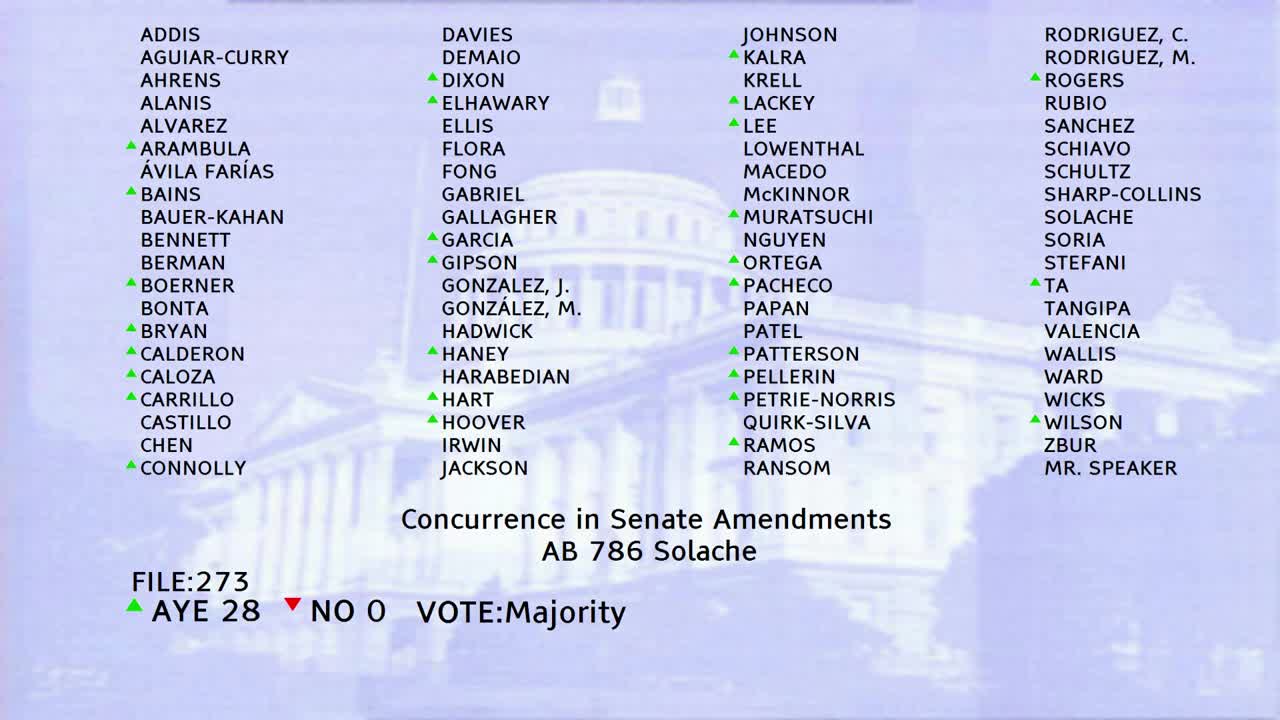 1MIN
Assembly Floor
 1MIN
Senate Floor
 23SEC
Senate Standing Committee on Appropriations
 4MIN
Senate Standing Committee on Public Safety
 17MIN
Senate Standing Committee on Business, Professions and Economic Development
 57SEC
Assembly Floor
 11MIN
Assembly Standing Committee on Business and Professions
Bill Author

Bill Co-Author(s):