AB 1551: California Rice Commission: purpose.
- Session Year: 2025-2026
- House: Assembly
- Latest Version Date: 2026-09-27
Current Status:
Passed
(2026-09-27: Chaptered by Secretary of State - Chapter 521, Statutes of 2026.)
Introduced
In Committee
Awaiting First Chamber Vote
Passed First Chamber
In Committee
Awaiting Second Chamber Vote
Passed Second Chamber
Enacted
Existing law creates the California Rice Commission with a prescribed membership and authorizes the commission, among other things, to promote the sale of rice, educate and instruct the wholesale and retail trade with respect to proper methods of handling and selling rice, and conduct scientific research. Existing law declares the California Rice Commission to be necessary for, among other things, carrying out the California rice industrys commitment to responsible stewardship and increasingly efficient cultural practices.
This bill would additionally declare the commission to be necessary for maintaining a sufficient footprint of annual rice acreage to support the wildlife habitat objectives of the state.
The establishment of the commission is necessary for the efficient development and management of a national and international advertising and promotion program that will enhance the reputation of the California rice industry, create a more receptive environment for the industry and its products, and increase competitiveness of the California rice industry within the national and international marketplace. In addition, the commission is necessary to carry out the California rice industrys commitment to responsible stewardship and increasingly efficient cultural practices, and to maintain a sufficient footprint of annual rice acreage to support the wildlife habitat objectives of the state.
The establishment of the commission is necessary for the efficient development and management of a national and international advertising and promotion program that will enhance the reputation of the California rice industry, create a more receptive environment for the industry and its products, and increase competitiveness of the California rice industry within the national and international marketplace. In addition, the commission is necessary to carry out the California rice industrys commitment to responsible stewardship and increasingly efficient cultural practices, and to maintain a sufficient footprint of annual rice acreage to support the wildlife habitat objectives of the state.
The establishment of the commission is necessary for the efficient development and management of a national and international advertising and promotion program that will enhance the reputation of the California rice industry, create a more receptive environment for the industry and its products, and increase competitiveness of the California rice industry within the national and international marketplace. In addition, the commission is necessary to carry out the California rice industrys commitment to responsible stewardship and increasingly efficient cultural practices. practices, and to maintain a sufficient footprint of annual rice acreage to support the wildlife habitat objectives of the state.
|
Date
|
Status
|
|---|---|
| Sep 27, 2026 | Chaptered by Secretary of State - Chapter 521, Statutes of 2026. |
| Sep 27, 2026 | Approved by the Governor. |
| Aug 24, 2026 | Enrolled and presented to the Governor at 4:30 p.m. |
| Aug 17, 2026 | In Assembly. Ordered to Engrossing and Enrolling. |
| Aug 17, 2026 | Read third time. Passed. Ordered to the Assembly. (Ayes 39. Noes 0.). |
| Aug 17, 2026 | Read third time. Passed. Ordered to the Assembly. (Ayes 39. Noes 0. Page 5490.). |
| Jun 17, 2026 | Read second time. Ordered to third reading. |
| Jun 16, 2026 | From committee: Do pass. (Ayes 4. Noes 0.) (June 16). |
| May 6, 2026 | Referred to Com. on AGRI. |
| Apr 9, 2026 | In Senate. Read first time. To Com. on RLS. for assignment. |
| Apr 9, 2026 | Read third time. Passed. Ordered to the Senate. (Ayes 64. Noes 0.) |
| Apr 9, 2026 | Read third time. Passed. Ordered to the Senate. (Ayes 64. Noes 0. Page 4556.) |
| Apr 6, 2026 | Read second time. Ordered to Consent Calendar. |
| Mar 26, 2026 | From committee: Do pass. To Consent Calendar. (Ayes 8. Noes 0.) (March 25). |
| Feb 2, 2026 | Referred to Com. on AGRI. |
| Jan 8, 2026 | From printer. May be heard in committee February 7. |
| Jan 7, 2026 | Read first time. To print. |
|
Date
|
Description
|
Location
|
Votes
|
|
|---|---|---|---|---|
| Aug 17, 2026 | Assembly 3rd Reading AB1551 Krell By McNerney | Senate Floor |
Passed |
|
| Jun 16, 2026 | Do pass | Senate Standing Committee on Agriculture |
Passed |
|
| Apr 9, 2026 | AB 1551 Krell Consent Calendar Second Day Regular Session | Assembly Floor |
Passed |
|
| Mar 25, 2026 | Do pass. To Consent Calendar. | Assembly Standing Committee on Agriculture |
Passed |
This list shows positions taken on this bill by organizations on the date displayed, which is linked to the original source.
Positions by individuals are not included.
|
Organization
|
Position
|
Date
|
|---|---|---|
| Audobon California | ** Support | |
| California Rice Commission | ** Support | |
| National Audubon Society | ** Support | |
| The Nature Conservancy | ** Support |
SENATE RULES COMMITTEE Office of Senate Floor Analyses (916) 651-4171 | AB 1551 |
THIRD READING
Bill No: AB 1551
Author: Krell (D)
Introduced: 1/7/26
Vote: 21
SENATE AGRICULTURE COMMITTEE: 4-0, 6/16/26
AYES: Caballero, Alvarado-Gil, McNerney, Padilla
NO VOTE RECORDED: Ashby
ASSEMBLY FLOOR: 64-0, 4/9/26 (Consent) - See last page for vote
SUBJECT: California Rice Commission: purpose
SOURCE: Author
DIGEST:
This bill declares the California Rice Commission to be necessary for maintaining a sufficient footprint of annual rice acreage to support the wildlife habitat objectives of the state.
ANALYSIS:
Existing law establishes the California Rice Commission to promote the sale of rice, educate and instruct the wholesale and retail trade with respect to proper methods of handling and selling rice, and conduct scientific research (Food and Agricultural Code Section § 71000).
This bill declares the commission to be necessary to maintain a sufficient footprint of annual rice acreage to support the wildlife habitat objectives of California.
FISCAL EFFECT: Appropriation: No Fiscal Com.: No Local: No
SUPPORT: (Verified 6/16/26)
Audobon California
California Rice Commission
The Nature Conservancy
OPPOSITION: (Verified 6/16/26)
None received
ARGUMENTS IN SUPPORT: According to the author:
“California’s roughly 500,000 acres of rice provide vital surrogate wetland habitat to a diverse array of species, including Giant Garter snakes, Sandhill Cranes, and millions of other waterfowl, shorebirds, and native fish.
Climate change, water shortages, market shifts, and urban growth all pose a challenge to maintaining enough rice acreage to guarantee a viable habitat for these species.
The recent UC Davis study “The Rice Footprint” sets forth a plan to maintain this critical ecosystem, which would cost an estimated $2 billion to restore if we fail to preserve it.
AB 1551 supports this crucial conservation work by identifying implementation of the Rice Footprint as a priority of the California Rice Commission.”
The California Rice Commission wrote in support of the bill stating, in part:
“By codifying the maintenance of a sufficient rice footprint into statute as part of the Commission’s purpose, AB 1551 will:
• Provide clarity and long-term direction for state policy in supporting agriculture that also delivers demonstrable ecological benefits;
• Facilitate coordination between rice growers, conservation partners, and state agencies to prioritize voluntary conservation programs, easements, and management practices;
• Strengthen California’s ability to protect working lands that serve vital ecosystem functions while contributing to food security and local economic resilience.”
ARGUMENTS IN OPPOSITION: None received
ASSEMBLY FLOOR: 64-0, 4/9/26
AYES: Aguiar-Curry, Ahrens, Alanis, Alvarez, Bains, Berman, Boerner, Calderon, Caloza, Carrillo, Castillo, Chen, Connolly, Davies, DeMaio, Dixon, Elhawary, Ellis, Fong, Gabriel, Garcia, Gipson, Mark González, Hadwick, Harabedian, Hart, Hoover, Irwin, Jackson, Johnson, Krell, Lackey, Lee, Lowenthal, Macedo, McKinnor, Muratsuchi, Nguyen, Pacheco, Papan, Patel, Patterson, Pellerin, Petrie-Norris, Quirk-Silva, Ramos, Ransom, Michelle Rodriguez, Rogers, Blanca Rubio, Sanchez, Schiavo, Sharp-Collins, Solache, Soria, Stefani, Ta, Tangipa, Valencia, Wallis, Ward, Wicks, Wilson, Rivas
NO VOTE RECORDED: Addis, Arambula, Ávila Farías, Bauer-Kahan, Bennett, Bonta, Bryan, Flora, Gallagher, Jeff Gonzalez, Haney, Kalra, Ortega, Celeste Rodriguez, Schultz, Zbur
Prepared by: Reichel Everhart / AGRI. / (916) 651-1508
6/17/26 16:28:15
**** END ****
SENATE COMMITTEE ON AGRICULTURE
Senator Anna Caballero, Chair
2025 - 2026 Regular
Bill No: AB 1551 Hearing Date: 6/16/26
Author: | Krell | ||
Version: | 1/7/26 | ||
Urgency: | No | Fiscal: | No |
Consultant: | Reichel Everhart | ||
Subject: California Rice Commission: purpose
SUMMARY
:
This bill declares the California Rice Commission to be necessary for maintaining a sufficient footprint of annual rice acreage to support the wildlife habitat objectives of the state.
BACKGROUND AND EXISTING LAW
:
Existing law:
- Establishes the California Rice Commission to promote the sale of rice, educate and instruct the wholesale and retail trade with respect to proper methods of handling and selling rice, and conduct scientific research (Food and Agricultural Code Section 71000).
PROPOSED LAW
:
This bill would additionally declare the commission to be necessary to maintain a sufficient footprint of annual rice acreage to support the wildlife habitat objectives of California.
ARGUMENTS IN SUPPORT: According to the author:
“California’s roughly 500,000 acres of rice provide vital surrogate wetland habitat to a diverse array of species, including Giant Garter snakes, Sandhill Cranes, and millions of other waterfowl, shorebirds, and native fish.
Climate change, water shortages, market shifts, and urban growth all pose a challenge to maintaining enough rice acreage to guarantee a viable habitat for these species.
The recent UC Davis study “The Rice Footprint” sets forth a plan to maintain this critical ecosystem, which would cost an estimated $2 billion to restore if we fail to preserve it.
AB 1551 supports this crucial conservation work by identifying implementation of the Rice Footprint as a priority of the California Rice Commission.”
ARGUMENTS IN OPPOSITION:
None received
COMMENTS
:
Rice agriculture plays a vital role in California’s conservation efforts. However, climate changes, water availability, agricultural crop markets, and urban expansion have raised uncertainties that affect the role of the rice industry and wildlife conservation. According to the University of California’s Center for Watershed Sciences, California’s “working” ricelands, especially winter-flooded rice fields, provide surrogate wetlands that host a diverse number of species in the Central Valley. For example, rice fields are critical for Giant Gartersnakes, wintering waterfowl, wintering and breeding shorebirds, Sandhill Cranes, native fishes, and many other species[1].
RELATED LEGISLATION
:
AB 623 (Chapter 567, Statutes of 1998): Established the California Rice Commission.
PRIOR ACTIONS
:
Assembly Floor: | 64 - 0 |
Assembly Appropriations Committee: |
|
Assembly Agriculture Committee: | 8 - 0 |
SUPPORT
:
Audobon California
California Rice Commission
The Nature Conservancy
OPPOSITION
:
None received
-- END --
https://watershed.ucdavis.edu/project/conservation-footprint-california-rice ↑
Date of Hearing: March 25, 2026
ASSEMBLY COMMITTEE ON AGRICULTURE
Esmeralda Soria, Chair
ABPCA Bill Id:AB 1551
Author:(Krell) – As Introduced Ver:January 7, 2026
SUBJECT: California Rice Commission: purpose
SUMMARY: This bill adds language to the California Rice Commission’s (CRC) declaration and general provisions that it is necessary to maintain a sufficient footprint of annual rice acreage to support the wildlife habitat objectives of the state.
EXISTING LAW:
- Creates the CRC with a prescribed membership and authorizes the commission, among other things, to promote the sale of rice, educate and instruct the wholesale and retail trade with respect to proper methods of handling and selling rice, and conduct scientific research. (Food and Agriculture Code (FAC) 71000-71010)
- Declares the CRC to be necessary for, among other things, carrying out the California rice industry’s commitment to responsible stewardship and increasingly efficient cultural practices. (FAC 71003)
FISCAL EFFECT: Unknown
COMMENTS: The CRC was created by AB 623 (Machado) Statutes of 1998, Chapter 567. AB 623 provided statutory authority to create the CRC for producers and handlers, for the purposes of engaging in research and market expansion activities. The bill also prescribes the membership and specifies the powers, duties, and responsibilities of the commission.
Rice agriculture in the Sacramento Valley has not only produced globally recognized rice crops but has also become a basis of habitat for hundreds of species and a critical component of regional ecological function and local economies. California’s rice lands today serve as surrogate wetlands in a landscape where more than 95% of historical wetlands have disappeared, providing essential wintering and foraging habitat for migratory waterfowl, shorebirds, fish, and other wildlife.
According to author, California’s roughly 500,000 acres of rice provide vital surrogate wetland habitat to a diverse array of species, including Giant Garter snakes, Sandhill Cranes, and millions of other waterfowl, shorebirds, and native fish. Climate change, water shortages, market shifts, and urban growth all pose a challenge to maintaining enough rice acreage to guarantee a viable habitat for these species. The recent UC Davis study “The Rice Footprint” sets forth a plan to maintain this critical ecosystem, which would cost an estimated $2 billion to restore if we fail to preserve it. This bill supports this crucial conservation work by identifying implementation of the Rice Footprint as a priority of the CRC.
Supporters state recent research has identified rice as critical surrogate wetland habitant supporting a wide variety of species. Research has also identified a minimum amount of rice footprint – annual rice acreage – needed to support these species. However, existing law does not include the maintenance of this critical rice footprint as a function of the Rice Commission or any other entity. This bill makes changes to ensure there is a designated entity safeguarding this important conservation priority.
The purpose of marketing programs are to provide agricultural producers and handlers an organizational structure, operating under government sanction, which allows them to solve production and marketing problems collectively that could not be addressed individually. Current marketing programs’ activities include commodity promotion, research, and maintenance of quality standards.
Commissions provide a structure for solving problems while also providing a vehicle for collecting funds to support activities. Current commissions and marketing orders have been successful in expanding markets, improving product quality, and providing more research for pests and disease prevention.
REGISTERED SUPPORT / OPPOSITION:
Support
Audobon California
California Rice Commission
National Audubon Society
The Nature Conservancy
Opposition
None on file
Analysis Prepared by: Victor Francovich / AGRI. / (916) 319-2084
Discussed in Hearing
View Older Hearings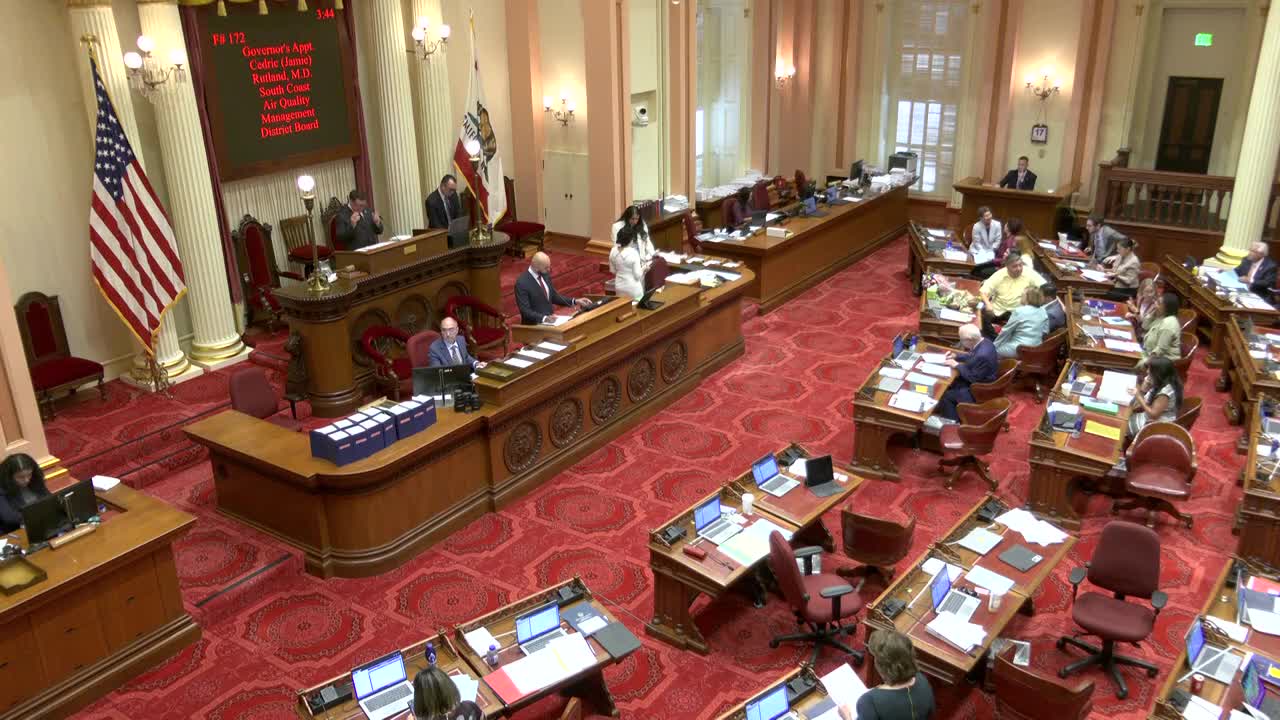
Bill Author

Bill Co-Author(s):