AB 1599: Public transit: California Transit Stop Registry: transit datasets.
- Session Year: 2025-2026
- House: Assembly
- Latest Version Date: 2026-09-18
Current Status:
Passed
(2026-09-18: Chaptered by Secretary of State - Chapter 269, Statutes of 2026.)
Introduced
In Committee
Awaiting First Chamber Vote
Passed First Chamber
In Committee
Awaiting Second Chamber Vote
Passed Second Chamber
Enacted
Existing law establishes the Department of Transportation and vests it with various powers and duties.
This bill would require the department to create, on or before June 1, 2027, and with input from transit operators, the California Transit Stop Registry as a centralized, statewide dataset of standardized information regarding transit stops that includes, but is not limited to, each transit stops name, location, available seating, and unique identifier, and information on whether the transit stop is sheltered, as specified.
Existing law provides for the funding of public transit, including under the Mills-Alquist-Deddeh Act, also known as the Transportation Development Act.
This bill would require a transit operator, as defined, on or before January 1, 2028, to (1) ensure that the name and location of each of its transit stops conforms with the name and location for the stop in the California Transit Stop Registry, (2) use a transit stops unique identifier listed in the registry when publishing any dataset with stop information or during publication of agency open datasets, and (3) report, for inclusion in the California Transit Stop Registry, if each of its transit stops has seating and shelter. By requiring a transit operator to perform new duties, the bill would impose a state-mandated local program.
The California Constitution requires the state to reimburse local agencies and school districts for certain costs mandated by the state. Statutory provisions establish procedures for making that reimbursement.
This bill would provide that, if the Commission on State Mandates determines that the bill contains costs mandated by the state, reimbursement for those costs shall be made pursuant to the statutory provisions noted above.
Existing law establishes the Department of Transportation and vests it with various powers and duties.
This bill would require the department to create, on or before June 1, 2027, and with input from transit operators, the California Transit Stop Registry as a centralized, statewide dataset of standardized information regarding transit stops that includes, but is not limited to, each transit stops name, location, available amenities, seating, and unique identifier, and information on whether the transit stop is sheltered, as specified.
Existing law provides for the funding of public transit, including under the Mills-Alquist-Deddeh Act, also known as the Transportation Development Act.
This bill would require a transit operator, as defined, to ensure, on or before January 1, 2028, to (1) ensure that the name and location of each of its transit stops conforms with the name and location for the stop in the California Transit Stop Registry and to Registry, (2) use a transit stops unique identifier listed in the registry when publishing any dataset with stop information or during publication of agency open datasets. datasets, and (3) report, for inclusion in the California Transit Stop Registry, if each of its transit stops has seating and shelter. By requiring a transit operator to perform new duties, the bill would impose a state-mandated local program.
The California Constitution requires the state to reimburse local agencies and school districts for certain costs mandated by the state. Statutory provisions establish procedures for making that reimbursement.
This bill would provide that, if the Commission on State Mandates determines that the bill contains costs mandated by the state, reimbursement for those costs shall be made pursuant to the statutory provisions noted above.
Existing law establishes the Department of Transportation and vests it with various powers and duties.
This bill would require the department to create, on or before December 31, 2026, June 1, 2027, the California Transit Stop Registry as a centralized, statewide dataset of standardized information regarding transit stops that includes, but is not limited to, each transit stops name, location, available amenities, and unique identifier, as specified.
Existing law provides for the funding of public transit, including under the Mills-Alquist-Deddeh Act, also known as the Transportation Development Act.
This bill would require a transit operator that qualifies for funding under the act operator, as defined, to ensure, on or before June 1, 2027, January 1, 2028, that the name and location of each of its transit stops conforms with the name and location for the stop in the California Transit Stop Registry and to use a transit stops unique identifier listed in the registry when publishing any dataset with stop information or during publication of agency open datasets. By requiring a transit operator to perform new duties, the bill would impose a state-mandated local program.
The California Constitution requires the state to reimburse local agencies and school districts for certain costs mandated by the state. Statutory provisions establish procedures for making that reimbursement.
This bill would provide that, if the Commission on State Mandates determines that the bill contains costs mandated by the state, reimbursement for those costs shall be made pursuant to the statutory provisions noted above.
Existing law establishes the Department of Transportation and vests it with various powers and duties.
This bill would require the department to create, on or before December 31, 2026, the California Transit Stop Registry as a centralized, statewide dataset of standardized information regarding transit stops that includes, but is not limited to, each transit stops name, location, available amenities, and unique identifier, as specified.
Existing law provides for the funding of public transit, including under the Mills-Alquist-Deddeh Act, also known as the Transportation Development Act.
This bill would require a transit operator that qualifies for funding under the act to ensure, on or before June 1, 2027, that the name and location of each of its transit stops conforms with the name and location for the stop in the California Transit Stop Registry and to use a transit stops unique identifier listed in the registry when publishing any dataset with stop information or during publication of agency open datasets. By requiring a transit operator to perform new duties, the bill would impose a state-mandated local program.
The California Constitution requires the state to reimburse local agencies and school districts for certain costs mandated by the state. Statutory provisions establish procedures for making that reimbursement.
This bill would provide that, if the Commission on State Mandates determines that the bill contains costs mandated by the state, reimbursement for those costs shall be made pursuant to the statutory provisions noted above.
(a)On or before June 1, 2027, the department shall create, with input from transit operators, the California Transit Stop Registry, which shall be a centralized, statewide dataset of standardized information regarding transit stops. To the extent possible, the department shall maximize the use of publicly available data and shall update the registry at least once per year, unless the department determines the inclusion of additional data is necessary or more frequent updates are required. The department may also include data voluntarily submitted by transit agencies, transit operators, or other state, regional, or local authorities. The department shall not be held liable for information made available or not made available through the registry.
(b)The registry shall include, but is not limited to, all of the following for each transit stop in the state:
(1)The transit stops name.
(2)The transit stops location.
(3)If seating is available at the transit stop, as reported pursuant to Section 99150.5 of the Public Utilities Code.
(4)If the transit stop is sheltered, as reported pursuant to Section 99150.5 of the Public Utilities Code.
(5)A unique identifier for the transit stop, as established by the department.
(c)The department shall not require a transit operator to change the unique identifying number the operator assigns to each transit stop.
(d)The department shall consider input from transit operators on registry design, data sources, and data collection methods and for any guidelines or guidance the department may create to facilitate compliance with subdivision (b) of Section 99150.5 of the Public Utilities Code to limit adverse financial and human resources impacts on transit operators.
SEC. 2.Section 99150.5 is added to the Public Utilities Code, to read:99150.5.(a)For purposes of this section, the following definitions apply:
(1)California Transit Stop Registry means the dataset described in Section 14113 of the Government Code.
(2)Transit operator has the same meaning as the term operator as defined in Section 99210.
(3)Unique identifier means the unique identifier described in paragraph (5) of subdivision (b) of Section 14113 of the Government Code.
(b)On or before January 1, 2028, a transit operator shall do all of the following:
(1)Ensure that the name and location of each of its transit stops conforms with the corresponding name and location identified in the California Transit Stop Registry.
(2)Use the unique identifier that conforms with the California Transit Stop Registry when publishing any dataset with stop information, including, but not limited to, General Transit Feed Specification datasets, transit stop seating and shelter information, stop-level ridership datasets, or any other format used to incorporate transit service information to a generally available trip-planning mobile application, or during publication of agency open datasets.
(3)Report, for each of its transit stops, if seating is available and if shelter is available, using the unique identifier, for inclusion in the California Transit Stop Registry.
SEC. 3.If the Commission on State Mandates determines that this act contains costs mandated by the state, reimbursement to local agencies and school districts for those costs shall be made pursuant to Part 7 (commencing with Section 17500) of Division 4 of Title 2 of the Government Code.
(a)On or before June 1, 2027, the department shall create create, with input from transit operators, the California Transit Stop Registry, which shall be a centralized, statewide dataset of standardized information regarding transit stops that includes, but stops. To the extent possible, the department shall maximize the use of publicly available data and shall update the registry at least once per year, unless the department determines the inclusion of additional data is necessary or more frequent updates are required. The department may also include data voluntarily submitted by transit agencies, transit operators, or other state, regional, or local authorities. The department shall not be held liable for information made available or not made available through the registry.
(b)The registry shall include, but is not limited to, all of the following for each transit stop in the state:
(a)(1)The transit stops name.
(b)(2)The transit stops location.
(c)The amenities available at the transit stop.(3)If seating is available at the transit stop, as reported pursuant to Section 99150.5 of the Public Utilities Code.
(4)If the transit stop is sheltered, as reported pursuant to Section 99150.5 of the Public Utilities Code.
(d)(5)A unique identifier for the transit stop, as established by the department.
(c)The department shall not require a transit operator to change the unique identifying number the operator assigns to each transit stop.
(d)The department shall consider input from transit operators on registry design, data sources, and data collection methods and for any guidelines or guidance the department may create to facilitate compliance with subdivision (b) of Section 99150.5 of the Public Utilities Code to limit adverse financial and human resources impacts on transit operators.
SEC. 2.Section 99150.5 is added to the Public Utilities Code, to read:99150.5.(a)For purposes of this section, the following definitions apply:
(1)California Transit Stop Registry means the dataset described in Section 14113 of the Government Code.
(2)Transit operator has the same meaning as the term operator as defined in Section 99210.
(3)Unique identifier means the unique identifier described in subdivision (d) paragraph (5) of subdivision (b) of Section 14113 of the Government Code.
(b)On or before January 1, 2028, a transit operator shall do both all of the following:
(1)Ensure that the name and location of each of its transit stops conforms with the corresponding name and location identified in the California Transit Stop Registry.
(2)Use the unique identifier that conforms with the California Transit Stop Registry when publishing any dataset with stop information, including, but not limited to, General Transit Feed Specification datasets, transit stop amenity datasets, seating and shelter information, stop-level ridership datasets, or any other format used to incorporate transit service information to a generally available trip-planning mobile application, or during publication of agency open datasets.
(3)Report, for each of its transit stops, if seating is available and if shelter is available, using the unique identifier, for inclusion in the California Transit Stop Registry.
SEC. 3.If the Commission on State Mandates determines that this act contains costs mandated by the state, reimbursement to local agencies and school districts for those costs shall be made pursuant to Part 7 (commencing with Section 17500) of Division 4 of Title 2 of the Government Code.
On or before December 31, 2026, June 1, 2027, the department shall create the California Transit Stop Registry, which shall be a centralized, statewide dataset of standardized information regarding transit stops that includes, but is not limited to, all of the following for each transit stop in the state:
(a)The transit stops name.
(b)The transit stops location.
(c)The amenities available at the transit stop.
(d)A unique identifier for the transit stop, as established by the department.
SEC. 2.Section 99150.5 is added to the Public Utilities Code, to read:99150.5.(a)For purposes of this section, the following definitions apply:
(1)California Transit Stop Registry means the dataset described in Section 14113 of the Government Code.
(2)Transit district means an entity that qualifies as a claimant, as defined in Section 99203, eligible to receive allocations under Chapter 4 (commencing with Section 99200).(2)Transit operator has the same meaning as the term operator as defined in Section 99210.
(3)Unique identifier means the unique identifier described in subdivision (d) of Section 14113 of the Government Code.
(b)On or before June 1, 2027, January 1, 2028, a transit district operator shall do both of the following:
(1)Ensure that the name and location of each of its transit stops conforms with the corresponding name and location identified in the California Transit Stop Registry.
(2)Use the unique identifier that conforms with the California Transit Stop Registry when publishing any dataset with stop information, including, but not limited to, General Transit Feed Specification datasets, transit stop amenity datasets, stop-level ridership datasets, or any other format used to incorporate transit service information to a generally available trip-planning mobile application, or during publication of agency open datasets.
SEC. 3.If the Commission on State Mandates determines that this act contains costs mandated by the state, reimbursement to local agencies and school districts for those costs shall be made pursuant to Part 7 (commencing with Section 17500) of Division 4 of Title 2 of the Government Code.
On or before December 31, 2026, the department shall create the California Transit Stop Registry, which shall be a centralized, statewide dataset of standardized information regarding transit stops that includes, but is not limited to, all of the following for each transit stop in the state:
(a)The transit stops name.
(b)The transit stops location.
(c)The amenities available at the transit stop.
(d)A unique identifier for the transit stop, as established by the department.
SEC. 2.Section 99150.5 is added to the Public Utilities Code, to read:99150.5.(a)For purposes of this section, the following definitions apply:
(1)California Transit Stop Registry means the dataset described in Section 14113 of the Government Code.
(2)Transit district means an entity that qualifies as a claimant, as defined in Section 99203, eligible to receive allocations under Chapter 4 (commencing with Section 99200).
(3)Unique identifier means the unique identifier described in subdivision (d) of Section 14113 of the Government Code.
(b)On or before June 1, 2027, a transit district shall do both of the following:
(1)Ensure that the name and location of each of its transit stops conforms with the corresponding name and location identified in the California Transit Stop Registry.
(2)Use the unique identifier that conforms with the California Transit Stop Registry when publishing any dataset with stop information, including, but not limited to, General Transit Feed Specification datasets, transit stop amenity datasets, stop-level ridership datasets, or any other format used to incorporate transit service information to a generally available trip-planning mobile application, or during publication of agency open datasets.
SEC. 3.If the Commission on State Mandates determines that this act contains costs mandated by the state, reimbursement to local agencies and school districts for those costs shall be made pursuant to Part 7 (commencing with Section 17500) of Division 4 of Title 2 of the Government Code.
REVISIONS: HeadingLine 2.|
Date
|
Status
|
|---|---|
| Sep 18, 2026 | Chaptered by Secretary of State - Chapter 269, Statutes of 2026. |
| Sep 18, 2026 | Approved by the Governor. |
| Sep 3, 2026 | Enrolled and presented to the Governor at 4 p.m. |
| Aug 26, 2026 | Senate amendments concurred in. To Engrossing and Enrolling. (Ayes 79. Noes 0.). |
| Aug 26, 2026 | Senate amendments concurred in. To Engrossing and Enrolling. (Ayes 79. Noes 0. Page 6628.). |
| Aug 26, 2026 | In Assembly. Concurrence in Senate amendments pending. |
| Aug 26, 2026 | Read third time. Passed. Ordered to the Assembly. (Ayes 40. Noes 0.). |
| Aug 24, 2026 | Read second time. Ordered to third reading. |
| Aug 21, 2026 | Read third time and amended. Ordered to second reading. |
| Aug 13, 2026 | Read second time. Ordered to third reading. |
| Aug 13, 2026 | From committee: Do pass. (Ayes 7. Noes 0.) (August 13). |
| Aug 3, 2026 | In committee: Referred to APPR. suspense file. |
| Jun 24, 2026 | From committee: Do pass and re-refer to Com. on APPR. with recommendation: To Consent Calendar. (Ayes 13. Noes 0.) (June 23). Re-referred to Com. on APPR. |
| Jun 4, 2026 | From committee chair, with author's amendments: Amend, and re-refer to committee. Read second time, amended, and re-referred to Com. on TRANS. |
| Jun 3, 2026 | Referred to Com. on TRANS. |
| May 21, 2026 | In Senate. Read first time. To Com. on RLS. for assignment. |
| May 21, 2026 | Read third time. Passed. Ordered to the Senate. (Ayes 74. Noes 0.) |
| May 21, 2026 | Read third time. Passed. Ordered to the Senate. (Ayes 74. Noes 0. Page 5188.) |
| May 18, 2026 | Read second time. Ordered to third reading. |
| May 14, 2026 | From committee: Do pass. (Ayes 15. Noes 0.) (May 14). |
| May 6, 2026 | In committee: Set, first hearing. Referred to APPR. suspense file. |
| Mar 24, 2026 | From committee: Do pass and re-refer to Com. on APPR. (Ayes 16. Noes 0.) (March 23). Re-referred to Com. on APPR. |
| Mar 24, 2026 | Coauthors revised. |
| Feb 2, 2026 | Referred to Com. on TRANS. |
| Jan 17, 2026 | From printer. May be heard in committee February 16. |
| Jan 16, 2026 | Read first time. To print. |
|
Date
|
Description
|
Location
|
Votes
|
|
|---|---|---|---|---|
| Aug 26, 2026 | AB 1599 Ahrens Concurrence in Senate Amendments | Assembly Floor |
Passed |
|
| Aug 26, 2026 | Assembly 3rd Reading AB1599 Ahrens et al. By Cortese | Senate Floor |
Passed |
|
| Aug 13, 2026 | Do pass | Senate Standing Committee on Appropriations |
Passed |
|
| Aug 3, 2026 | Placed on suspense file | Senate Standing Committee on Appropriations |
Passed |
|
| Jun 23, 2026 | Do pass, but first be re-referred to the Committee on [Appropriations] with the recommendation: To Consent Calendar | Senate Standing Committee on Transportation |
Passed |
|
| May 21, 2026 | AB 1599 Ahrens Assembly Third Reading | Assembly Floor |
Passed |
|
| May 14, 2026 | Do pass. | Assembly Standing Committee on Appropriations |
Passed |
|
| Mar 23, 2026 | Do pass and be re-referred to the Committee on [Appropriations] | Assembly Standing Committee on Transportation |
Passed |
This list shows positions taken on this bill by organizations on the date displayed, which is linked to the original source.
Positions by individuals are not included.
|
Organization
|
Position
|
Date
|
|---|---|---|
| AARP | ** Support | |
| Active San Gabriel Valley | ** Support | |
| Bike East Bay | ** Support | |
| Circulate Planning & Policy | ** Support | |
| Climate Resolve | ** Support | |
| Move LA | ** Support | |
| People For Housing Orange County | ** Support | |
| Sacramento Area Bicycle Advocates | ** Support | |
| San Diego County Bicycle Coalition | ** Support | |
| Seamless Bay Area | ** Support | |
| South Pas Active Streets | ** Support | |
| Streets for All | ** Support |
CONCURRENCE IN SENATE AMENDMENTS
CSA1 Bill Id:AB 1599
Author:(Ahrens)
As Amended Ver:August 21, 2026
Majority vote
SUMMARY
Requires the Department of Transportation (Caltrans) to create the California Transit Stop Registry (Registry) and requires transit districts to use a unique identifier that conforms with the registry when publishing any dataset with stop information.
Senate Amendments
- Requires Caltrans to get input from transit operators when establishing the registry.
- Requires Caltrans to update the registry at least once per year, unless Caltrans determines the inclusion of additional data is necessary more frequently.
- Removes the requirement for transit agencies to report amenities available at the transit stop and instead requires them to provide if seating is available at the transit stop and if the transit stop is sheltered.
COMMENTS
Caltrans' division of Rail and Mass Transportation in 2020 established the California Integrated Travel Project (Cal-ITP) to improve the experience and cost-effectiveness of public transit for riders and operators through three actions: (1) installing an open loop contactless payment system that uses tap to pay enabled mobile devices, bank cards, or prepaid cards, to enable seamless travel across transit providers in order to make payment more convenient, (2) automating pricing flexibility, and (3) developing a platform for transit operators to share static and eventually real-time route information by establishing the California Minimum General Transit Feed Specification (GTFS) guidelines.
GTFS was created in 2006 through a public-private partnership between the transit agency in Portland, Oregon and Google and is the global standard for describing transit schedules and operations for use by trip-planning applications. Thousands of agencies worldwide use GTFS and it produces the most transit agency data.
According to Caltrans, "The purpose of the California Transit Data Guidelines is to communicate the specific criteria by which Caltrans determines whether GTFS schedule and real time data produced by transit providers and vendors meets the qualitative needs of riders (and therefore trip-planning applications that deliver this data to riders), transit providers, and regulators. The guidelines provide producers with a reference document for the characteristics of high-quality GTFS feeds. All transit providers and GTFS-producing vendors within the State of California are expected to work toward meeting the Guidelines in full."
The most common ways for transit riders to see the data are through a consumer-facing application such as Google or Apple Maps, a transit provider's signage, or through commercial displays. Caltrans guidelines for transit agencies recommend they provide the public accurate, complete, and up-to-date transit information.
The Bipartisan Infrastructure Investment and Jobs Act (IIJA) required the Federal Transit Agency (FTA) to collect GTFS data from transit agencies. In 2024 FTA passed regulations requiring transit agencies to standardize GTFS data and imposed this requirement on all agencies. As a result, most California transit agencies have standardized their trip data and annually submit the data to the federal government.
This bill would go a step further than the federal requirements for standardizing trip data and would require transit agencies to standardize transit stop data, including using a unique identifier for each transit stop as established by Caltrans. A standardized stop ID enables a mapping app to read a location for trip planning and would standardize a currently fragmented system that can make it harder for a transit user to determine what route they need to take to get to their destination.
For example, in the City of Banning there is a transit stop where four different agencies stop at the same location. Every agency calls the stop by a different name. Under this bill, Caltrans could assign that location an ID number, allowing the transit agencies to continue to call the stop by their unique names while also ensuring mapping applications understand it is the same location for routing purposes.
Standardizing stop data may also make other potential travel improvements easier to implement. Transit agencies have increasingly been shifting away from monthly transit passes and instead have been implementing fare capping. Fare capping limits the amount an individual rider would pay in a single month to never exceed a maximum amount. For example, a rider who cannot afford a monthly pass and instead pays for each individual ride would never have to pay in a single month more than the cost of the monthly pass. Fare capping has been shown to modestly increase transit ridership. According to a University of Tennessee Report, the App or the Cap? Which fare innovation affects bus ridership? monthly fare capping was found to increase annual bus ridership from 3.6% to 4.1%.
According to the Author
"Today, every transit agency names and labels its stops differently even when they're sharing the exact same physical bus stop. That means riders can see conflicting information on Apple Maps or other transit apps, making transfers confusing and unreliable. For working families, seniors, and people with disabilities who depend on transit, that confusion can mean missed connections, longer commutes, or deciding not to take transit at all. We can do better by making our system clearer, more consistent, and easier to use."
Arguments in Support
Streets for All, a sponsor of this bill, argues "Currently, transit stop information is often fragmented across agencies. When multiple transit operators serve the same stop, it may appear as separate entries in different datasets with inconsistent names or locations. This can create confusion for riders, trip planning apps, and planners who rely on accurate transit data.
AB 1599 addresses this issue by creating a single statewide registry and assigning a unique identifier to each transit stop. By standardizing stop information across agencies, the bill will improve data quality, simplify transit planning and coordination, level the playing field between transit routing software, and make transfers between transit services clearer for riders.
Improving the quality and accessibility of transit data helps make transit systems easier to use and more reliable. A statewide transit stop registry will support better trip planning tools, stronger coordination between transit agencies, and a more seamless rider experience."
Arguments in Opposition
None on file.
FISCAL COMMENTS
According to Senate Appropriations Committee:
- Caltrans indicates that it is currently resourced through the 2026-27 budget year as part of the California Integrated Travel Project (CalITP), and can absorb the workload related to establishing initial datasets for the Registry through June 30, 2027. Caltrans estimates ongoing costs in the low hundreds of thousands of dollars annually, beginning in 2027-28, to confirm and validate the use of conforming data, and to maintain and update the Registry on an ongoing basis. (State Highway Account)
- Unknown, potentially significant local costs in the aggregate for transit districts to report specified information on each transit stop to Caltrans, ensure the names and locations of each transit stop conforms to the name specified in the Registry, and to use a transit stop's unique identifier listed in the Registry when publishing datasets. The bill states that the state must reimburse these costs if the Commission on State Mandates determines that this bill contains costs mandated by the state. Staff notes, however, that costs incurred by transit districts are not likely to be state-reimbursable. See Staff Comments. (local funds)
VOTES:
ASM TRANSPORTATION: 16-0-0
YES: Wilson, Davies, Aguiar-Curry, Ahrens, Carrillo, Harabedian, Hart, Hoover, Jackson, Lackey, Macedo, Papan, Ransom, Rogers, Sharp-Collins, Ward
ASM APPROPRIATIONS: 15-0-0
YES: Wicks, Hoover, Aguiar-Curry, Calderon, Caloza, Dixon, Fong, Mark González, Krell, Pacheco, Pellerin, Sharp-Collins, Solache, Ta, Tangipa
ASSEMBLY FLOOR: 74-0-6
YES: Addis, Aguiar-Curry, Ahrens, Alanis, Alvarez, Ávila Farías, Bains, Bauer-Kahan, Bennett, Berman, Boerner, Bonta, Bryan, Calderon, Caloza, Carrillo, Castillo, Connolly, Davies, DeMaio, Dixon, Elhawary, Ellis, Flora, Fong, Gabriel, Gallagher, Gipson, Jeff Gonzalez, Mark González, Hadwick, Haney, Harabedian, Hart, Hoover, Irwin, Jackson, Johnson, Kalra, Krell, Lee, Lowenthal, Macedo, McKinnor, Muratsuchi, Nguyen, Ortega, Pacheco, Papan, Patel, Patterson, Pellerin, Petrie-Norris, Quirk-Silva, Ransom, Michelle Rodriguez, Rogers, Blanca Rubio, Sanchez, Schiavo, Schultz, Sharp-Collins, Solache, Soria, Stefani, Ta, Tangipa, Valencia, Wallis, Ward, Wicks, Wilson, Zbur, Rivas
ABS, ABST OR NV: Arambula, Chen, Garcia, Lackey, Ramos, Celeste Rodriguez
UPDATED
VERSION: August 21, 2026
CONSULTANT: David Sforza / TRANS. / (916) 319-2093 FN: 0004276
SENATE RULES COMMITTEE Office of Senate Floor Analyses (916) 651-4171 | AB 1599 |
THIRD READING
Bill No: AB 1599
Author: Ahrens (D), et al.
Amended: 8/20/26 in Senate
Vote: 21
SENATE TRANSPORTATION COMMITTEE: 13-0, 6/23/26
AYES: Cortese, Strickland, Archuleta, Arreguín, Blakespear, Dahle, Gonzalez, Grayson, Menjivar, Richardson, Seyarto, Valladares, Wiener
SENATE APPROPRIATIONS COMMITTEE: 7-0, 8/13/26
AYES: Cervantes, Seyarto, Cabaldon, Dahle, Grayson, Richardson, Wahab
ASSEMBLY FLOOR: 74-0, 5/21/26 - See last page for vote
SUBJECT: Public transit: California Transit Stop Registry: transit datasets
Streets for All
DIGEST:
This bill requires the California Department of Transportation (Caltrans) to create the California Transit Stop Registry and requires transit operators to use a unique identifier that conforms with the registry when publishing any dataset with stop information.
Senate Floor Amendments of 8/20/26 1) require Caltrans to take input from transit operators when creating the transit stop registry, including considering transit operator input on the design, sources, data collection methods, and guidelines for the registry; 2) require Caltrans to utilize publicly available data when possible when creating the transit stop registry; 3) require Caltrans to update the transit stop registry at least once a year; 4) state that Caltrans cannot be held liable for information included or excluded from the registry; 5) remove references to “amenities” and instead require the registry to include if seating and shelter are available at a transit stop; and 6) require Caltrans to limit adverse financial and human resource impacts on transit operators in creating the registry.
ANALYSIS:
Existing federal law:
- Requires the United States Department of Transportation (USDOT) to maintain, and transit operators who receive federal funds to contribute to, a National Transit Database (NTD) that contains operating and geographic coverage area information, among other things. (Title 49 United States Code (USC) Section 5335)
Existing state law:
- Establishes the Transportation Development Act (TDA) to provide funding for transit and non-transit related purposes that comply with regional transportation plans. (Public Utilities Code (PUC) Division 10, Part 11, Chapter 4)
- Authorizes Caltrans to adopt rules and regulations consistent with TDA. (PUC 99241)
- Defines a transit operator as a city, county, public district, or certain other entity that operates a public transportation system, as defined. (PUC Section 99210)
- Requires transportation planning agencies to report General Transit Feed Specification (GTFS) data to the California State Transportation Agency (CalSTA) as a condition of funding. (Government Code (GOV) Section 13987(f))
- Requires CalSTA to provide transit operators with technical assistance to implement GTFS Real Time data collection and reporting. (GOV Section 13987(i))
This bill:
- Requires Caltrans to create the California Transit Stop Registry by June 1, 2027. The registry must contain, at a minimum, the following information for each transit stop in the state:
- The transit stop’s name;
- The transit stop’s location;
- If seating is available at the transit stop;
- If shelter is available at the transit stop; and,
- A unique identifier for the transit stop.
- Requires Caltrans, when creating the California Transit Stop Registry, to
- Maximize the use of publicly available data;
- Update the registry at least once a year;
- Consider input from transit operators on registry design, data sources, data collection methods, and guidelines; and,
- Limit adverse financial and human resources impacts on transit operators.
- Requires transit operators, by January 1, 2028, to ensure that the name and location of each of its transit stops conforms with the corresponding name and location identified in the California Transit Stop Registry, to use that unique identifier when publishing any data set, including GTFS datasets, and to include any information regarding if seating and shelter are available at a transit stop.
Comments
Purpose of the bill. According to the author, “Today, every transit agency names and labels its stops differently even when they’re sharing the exact same physical bus stop. That means riders can see conflicting information on Apple Maps or other transit apps, making transfers confusing and unreliable. For working families, seniors, and people with disabilities who depend on transit, that confusion can mean missed connections, longer commutes, or deciding not to take transit at all. We can do better by making our system clearer, more consistent, and easier to use.”
General Transit Feed Specification. GTFS is an open data standard used to distribute information about transit routes, fares, and other relevant factors to transit riders. It provides a uniform standard that transit agencies across the world can use to publicly report information about their routes and operations. This standard then allows third parties, such as Google or Apple Maps to access this data and make it available for users of their services. Indeed, today GTFS is the global standard for describing transit schedules and operations for use by trip-planning applications, and is used by thousands of transit agencies across the world.
GTFS is broken into various components, each describing different types of data. The two most prominently used today are GTFS Standard and GTFS Real Time. GTFS Standard includes basic information about schedules, fares, and routes. GTFS Real Time allows for the live tracking of transit vehicle locations and can provide live schedule estimates. Currently, all California transit agencies make data available using GTFS Standard, and nearly half of agencies are able to distribute GTFS Real Time data.
Due to its utility, both the federal government and California require transit agencies to use GTFS to varying degrees. On the federal level, the Bipartisan Infrastructure Investment and Jobs Act (IIJA) required the Federal Transit Agency (FTA) to collect GTFS Standard data from transit agencies. In 2024, FTA then passed regulations requiring transit agencies to standardize GTFS data and imposed this requirement on all agencies. Thus, all California agencies are already under this requirement.
In California, Caltrans has instituted similar requirements on the state level. Namely, as part of the California Integrated Travel Project (CalITP), Caltrans has worked to create a statewide transit database of both GTFS Standard and GTFS Real Time data. In so doing, Caltrans has created their own California Transit Guidelines that serve as a reference document for producing high-quality GTFS data. Caltrans also actively works with transit agencies, providing technical assistance to help bring them into compliance with these guidelines. This assistance includes offering access to and training for software to generate GTFS-compliant data, and direct assistance in generating this data.
Transit stop locations. While GTFS makes information about transit routes and schedules easily available to the public, it is ultimately still reliant on information reported out by the transit agencies themselves. As a result, complications can arise when different agencies operate in the same location.
One common issue has to do with the location of transit stops. For example, in a busy urban area, multiple transit agencies may utilize the same stop. However, each agency may refer to the stop by a different name. Furthermore, even if each transit agency functionally utilizes the same stop location, their GTFS data may report that stop as being in slightly different places. Therefore, a mapping application may tell a transit rider to walk across the street to get their next bus, when in fact they are already in the correct location, creating confusion and delay.
This bill seeks to address this issue by requiring Caltrans to establish a California Transit Stop Registry. As part of the registry, each transit stop in the state would be assigned a unique identifier. Once this identifier is assigned, the bill would further require transit agencies to include that information in the data they report out using GTFS. Transit agencies would not, however, be required to adopt the new identifier for internal purposes, only in published data sets. Thus, this would allow transit agencies to continue to call the stop by their unique names while also ensuring that mapping applications understand it is the same location for routing purposes. Furthermore, since all transit agencies in California already report out GTFS Standard data, the only additional requirement imposed on the agencies would be the inclusion of the unique identifier in their data sets.
According to Streets for All, writing as a sponsor of this bill, “AB 1599…creat[es] a single statewide registry and assign[s] a unique identifier to each transit stop. By standardizing stop information across agencies, the bill will improve data quality, simplify transit planning and coordination, level the playing field between transit routing softwares, and make transfers between transit services clearer for riders.”
Transit stop amenities. In addition to the unique stop identifier, this bill also requires the registry to contain information about if seating and shelter are available at any particular transit stop. By including such information, it would also be available to any third-party application that wishes to make use of that data. Thus, it would then be possible for users to see if a transit stop had seating or shelter available while planning their trips. Some proponents have argued that this would support increased accessibility and safety around transit stops by allowing users to access and plan around this information. However, GTFS does not currently support information about stop amenities, and it is thus unclear how much such data would be utilized by third-parties without wider adoption.
Protections for transit operators. This bill also includes protections for transit operators to ensure that implementing the California Transit Stop Registry does not create undue fiscal or staffing burdens on operators. Namely, this bill specifies that Caltrans must work in consultation with transit operators when designing the California Transit Stop Registry and must proactively work to mitigate any such negative effects. This is to be achieved by, among other things, requiring the use of data that is already publicly available.
Transit Transformation Task Force. SB 125 (Committee on Budget and Fiscal Review, Chapter 54, Statutes of 2023), among other things, created the Transit Transformation Task Force. The goal of the task force was to look at ridership growth strategies, operation innovations, and reforms of the TDA. The taskforce was convened by CalSTA in December of 2023, including representatives from transit agencies, including urban, rural, bus, rail, and ferry providers; regional transportation planning agencies; transit and environmental justice advocates; labor; academia; and the Legislature. The taskforce’s final report, including recommendations, was delivered to the Legislature in late 2025.
One recommendation of the task force was to “Recommend opt-in common data collection, analysis, and publication standards across agencies to improve interoperability (e.g., General Transit Feed Specification, Operational Data Standard, TIDES) to local and regional agencies.” AB 1599 would take a significant additional step towards implementing this recommendation by allowing transit agencies that share stops to more easily coordinate amongst themselves. This would be the first recommendation of the task force to be addressed legislatively.
FISCAL EFFECT: Appropriation: No Fiscal Com.: Yes Local: Yes
According to the Senate Appropriations Committee:
- Caltrans indicates that it is currently resourced through the 2026-27 budget year as part of CalITP, and can absorb the workload related to establishing initial datasets for the Registry through June 30, 2027. Caltrans estimates ongoing costs in the low hundreds of thousands of dollars annually, beginning in 2027‑28, to confirm and validate the use of conforming data, and to maintain and update the Registry on an ongoing basis. (State Highway Account)
- Unknown, potentially significant local costs in the aggregate for transit districts to report specified information on each transit stop to Caltrans, ensure the names and locations of each transit stop conforms to the name specified in the Registry, and to use a transit stop’s unique identifier listed in the Registry when publishing datasets. The bill states that the state must reimburse these costs if the Commission on State Mandates determines that this bill contains costs mandated by the state. Staff notes, however, that costs incurred by transit districts are not likely to be state-reimbursable.
SUPPORT: (Verified 8/19/26)
Streets for All (co-source)
Active San Gabriel Valley
Bike East Bay
Circulate Planning & Policy
Climate Resolve
Move LA
People for Housing Orange County
Sacramento Area Bicycle Advocates
San Diego County Bicycle Coalition
Seamless Bay Area
South Pas Active Streets
OPPOSITION: (Verified 8/19/26)
None received
ASSEMBLY FLOOR: 74-0, 5/21/26
AYES: Addis, Aguiar-Curry, Ahrens, Alanis, Alvarez, Ávila Farías, Bains, Bauer-Kahan, Bennett, Berman, Boerner, Bonta, Bryan, Calderon, Caloza, Carrillo, Castillo, Connolly, Davies, DeMaio, Dixon, Elhawary, Ellis, Flora, Fong, Gabriel, Gallagher, Gipson, Jeff Gonzalez, Mark González, Hadwick, Haney, Harabedian, Hart, Hoover, Irwin, Jackson, Johnson, Kalra, Krell, Lee, Lowenthal, Macedo, McKinnor, Muratsuchi, Nguyen, Ortega, Pacheco, Papan, Patel, Patterson, Pellerin, Petrie-Norris, Quirk-Silva, Ransom, Michelle Rodriguez, Rogers, Blanca Rubio, Sanchez, Schiavo, Schultz, Sharp-Collins, Solache, Soria, Stefani, Ta, Tangipa, Valencia, Wallis, Ward, Wicks, Wilson, Zbur, Rivas
NO VOTE RECORDED: Arambula, Chen, Garcia, Lackey, Ramos, Celeste Rodriguez
Prepared by: Samuel Myers / TRANS. / (916) 651-4121
8/25/26 21:20:30
**** END ****
SENATE RULES COMMITTEE Office of Senate Floor Analyses (916) 651-4171 | AB 1599 |
THIRD READING
Bill No: AB 1599
Author: Ahrens (D), et al.
Amended: 6/4/26 in Senate
Vote: 21
SENATE TRANSPORTATION COMMITTEE: 13-0, 6/23/26
AYES: Cortese, Strickland, Archuleta, Arreguín, Blakespear, Dahle, Gonzalez, Grayson, Menjivar, Richardson, Seyarto, Valladares, Wiener
SENATE APPROPRIATIONS COMMITTEE: 7-0, 8/13/26
AYES: Cervantes, Seyarto, Cabaldon, Dahle, Grayson, Richardson, Wahab
ASSEMBLY FLOOR: 74-0, 5/21/26 - See last page for vote
SUBJECT: Public transit: California Transit Stop Registry: transit datasets
SOURCE: AARP / Streets for All
DIGEST:
This bill requires the California Department of Transportation (Caltrans) to create the California Transit Stop Registry and requires transit operators to use a unique identifier that conforms with the registry when publishing any dataset with stop information.
ANALYSIS:
Existing federal law requires the United States Department of Transportation (USDOT) to maintain, and transit operators who receive federal funds to contribute to, a National Transit Database (NTD) that contains operating and geographic coverage area information, among other things. (49 United States Code (USC) section 5335)
Existing state law:
- Establishes the Transportation Development Act (TDA) to provide funding for transit and non-transit related purposes that comply with regional transportation plans. (Public Utilities Code (PUC) Division 10, Part 11, Chapter 4)
- Authorizes Caltrans to adopt rules and regulations consistent with TDA. (PUC section 99241)
- Defines a transit operator as a city, county, public district, or certain other entity that operates a public transportation system, as defined. (PUC section 99210)
- Requires transportation planning agencies to report General Transit Feed Specification (GTFS) data to the California State Transportation Agency (CalSTA) as a condition of funding. (Government Code (GOV) section 13987(f))
- Requires CalSTA to provide transit operators with technical assistance to implement GTFS Real Time data collection and reporting. (GOV section 13987(i))
This bill:
- Requires Caltrans to create the California Transit Stop Registry by June 1, 2027. The registry must contain, at a minimum, the following information for each transit stop in the state:
- The transit stop’s name;
- The transit stop’s location;
- The amenities available at the transit stop; and,
- A unique identifier for the transit stop.
- Requires transit operators, by January 1, 2028, to ensure that the name and location of each of its transit stops conforms with the corresponding name and location identified in the California Transit Stop Registry and to use that unique identifier when publishing any data set, including GTFS datasets.
Comments
- Purpose of the bill. According to the author, “Today, every transit agency names and labels its stops differently even when they’re sharing the exact same physical bus stop. That means riders can see conflicting information on Apple Maps or other transit apps, making transfers confusing and unreliable. For working families, seniors, and people with disabilities who depend on transit, that confusion can mean missed connections, longer commutes, or deciding not to take transit at all. We can do better by making our system clearer, more consistent, and easier to use.”
- General Transit Feed Specification. GTFS is an open data standard used to distribute information about transit routes, fares, and other relevant factors to transit riders. It provides a uniform standard that transit agencies across the world can use to publicly report information about their routes and operations. This standard then allows third parties, such as Google or Apple Maps to access this data and make it available for users of their services. Indeed, today GTFS is the global standard for describing transit schedules and operations for use by trip-planning applications, and is used by thousands of transit agencies across the world.
GTFS is broken into various components, each describing different types of data. The two most prominently used today are GTFS Standard and GTFS Real Time. GTFS Standard includes basic information about schedules, fares, and routes. GTFS Real Time allows for the live tracking of transit vehicle locations and can provide live schedule estimates. Currently, all California transit agencies make data available using GTFS Standard, and nearly half of agencies are able to distribute GTFS Real Time data.
Due to its utility, both the federal government and California require transit agencies to use GTFS to varying degrees. On the federal level, the Bipartisan Infrastructure Investment and Jobs Act (IIJA) required the Federal Transit Agency (FTA) to collect GTFS Standard data from transit agencies. In 2024, FTA then passed regulations requiring transit agencies to standardize GTFS data and imposed this requirement on all agencies. Thus, all California agencies are already under this requirement.
In California, Caltrans has instituted similar requirements on the state level. Namely, as part of the California Integrated Travel Project (CalITP), Caltrans has worked to create a statewide transit database of both GTFS Standard and GTFS Real Time data. In so doing, Caltrans has created their own California Transit Guidelines that serve as a reference document for producing high-quality GTFS data. Caltrans also actively works with transit agencies, providing technical assistance to help bring them into compliance with these guidelines. This assistance includes offering access to and training for software to generate GTFS-compliant data, and direct assistance in generating this data. - Transit stop locations. While GTFS makes information about transit routes and schedules easily available to the public, it is ultimately still reliant on information reported out by the transit agencies themselves. As a result, complications can arise when different agencies operate in the same location.
One common issue has to do with the location of transit stops. For example, in a busy urban area, multiple transit agencies may utilize the same stop. However, each agency may refer to the stop by a different name. Furthermore, even if each transit agency functionally utilizes the same stop location, their GTFS data may report that stop as being in slightly different places. Therefore, a mapping application may tell a transit rider to walk across the street to get their next bus, when in fact they are already in the correct location, creating confusion and delay.
AB 1599 seeks to address this issue by requiring Caltrans to establish a California Transit Stop Registry. As part of the registry, each transit stop in the state would be assigned a unique identifier. Once this identifier is assigned, the bill would further require transit agencies to include that information in the data they report out using GTFS. Transit agencies would not, however, be required to adopt the new identifier for internal purposes, only in published data sets. Thus, this would allow transit agencies to continue to call the stop by their unique names while also ensuring that mapping applications understand it is the same location for routing purposes. Furthermore, since all transit agencies in California already report out GTFS Standard data, the only additional requirement imposed on the agencies would be the inclusion of the unique identifier in their data sets.
According to Streets for All, writing as a sponsor of AB 1599, “AB 1599…creat[es] a single statewide registry and assign[s] a unique identifier to each transit stop. By standardizing stop information across agencies, the bill will improve data quality, simplify transit planning and coordination, level the playing field between transit routing softwares, and make transfers between transit services clearer for riders.” - Transit stop amenities. In addition to the unique stop identifier, AB 1599 also requires the registry to contain information about the amenities available at any particular transit stop. By including such information, it would also be available to any third-party application that wishes to make use of that data. Thus, it would then be possible for users to see if a transit stop had seating, shelter, lighting, or other amenities while planning their trips. Some proponents have argued that this would support increased accessibility and safety around transit stops by allowing users to access and plan around this information. However, GTFS does not currently support information about stop amenities, and it is thus unclear how much such data would be utilized by third-parties without wider adoption.
Multiple transit agencies have also expressed concerns about implementing this requirement. Many agencies have stated that they do not currently have access to this sort of information and that compiling it would be difficult. Agencies primarily highlight the fact that many transit stops are located on land held by other entities, like cities or counties, and thus the agencies themselves do not have control over or even knowledge of what amenities have been placed at these stops. Compiling this data could therefore require a physical survey of all transit stops. As large agencies can have many thousands of stops, and smaller agencies may have only a handful of staff, this type of data collection could be time consuming and expensive.
Agencies have also expressed concerns that AB 1599 does not specify how often this data set must be updated. If the data set is updated frequently, these costs could increase. However, if it is not updated frequently enough, it may become out of date and lose its usefulness. - Transit Transformation Task Force. SB 125 (Committee on Budget and Fiscal Review, Chapter 54, Statutes of 2023), among other things, created the Transit Transformation Task Force. The goal of the task force was to look at ridership growth strategies, operation innovations, and reforms of the TDA. The taskforce was convened by CalSTA in December of 2023, including representatives from transit agencies, including urban, rural, bus, rail, and ferry providers; regional transportation planning agencies; transit and environmental justice advocates; labor; academia; and the Legislature. The taskforce’s final report, including recommendations, was delivered to the Legislature in late 2025.
One recommendation of the task force was to “Recommend opt-in common data collection, analysis, and publication standards across agencies to improve interoperability (e.g., General Transit Feed Specification, Operational Data Standard, TIDES) to local and regional agencies.” AB 1599 would take a significant additional step towards implementing this recommendation by allowing transit agencies that share stops to more easily coordinate amongst themselves. This would be the first recommendation of the task force to be addressed legislatively.
FISCAL EFFECT: Appropriation: No Fiscal Com.: Yes Local: Yes
According to the Senate Appropriations Committee:
- Caltrans indicates that it is currently resourced through the 2026-27 budget year as part of CalITP, and can absorb the workload related to establishing initial datasets for the Registry through June 30, 2027. Caltrans estimates ongoing costs in the low hundreds of thousands of dollars annually, beginning in 2027‑28, to confirm and validate the use of conforming data, and to maintain and update the Registry on an ongoing basis. (State Highway Account)
- Unknown, potentially significant local costs in the aggregate for transit districts to report specified information on each transit stop to Caltrans, ensure the names and locations of each transit stop conforms to the name specified in the Registry, and to use a transit stop’s unique identifier listed in the Registry when publishing datasets. The bill states that the state must reimburse these costs if the Commission on State Mandates determines that this bill contains costs mandated by the state. Staff notes, however, that costs incurred by transit districts are not likely to be state-reimbursable.
SUPPORT: (Verified 8/13/26)
Streets for All (co-source)
Active San Gabriel Valley
Bike East Bay
Circulate Planning & Policy
Climate Resolve
Move LA
People for Housing Orange County
Sacramento Area Bicycle Advocates
San Diego County Bicycle Coalition
Seamless Bay Area
South Pas Active Streets
OPPOSITION: (Verified 8/13/26)
None received
ASSEMBLY FLOOR: 74-0, 5/21/26
AYES: Addis, Aguiar-Curry, Ahrens, Alanis, Alvarez, Ávila Farías, Bains, Bauer-Kahan, Bennett, Berman, Boerner, Bonta, Bryan, Calderon, Caloza, Carrillo, Castillo, Connolly, Davies, DeMaio, Dixon, Elhawary, Ellis, Flora, Fong, Gabriel, Gallagher, Gipson, Jeff Gonzalez, Mark González, Hadwick, Haney, Harabedian, Hart, Hoover, Irwin, Jackson, Johnson, Kalra, Krell, Lee, Lowenthal, Macedo, McKinnor, Muratsuchi, Nguyen, Ortega, Pacheco, Papan, Patel, Patterson, Pellerin, Petrie-Norris, Quirk-Silva, Ransom, Michelle Rodriguez, Rogers, Blanca Rubio, Sanchez, Schiavo, Schultz, Sharp-Collins, Solache, Soria, Stefani, Ta, Tangipa, Valencia, Wallis, Ward, Wicks, Wilson, Zbur, Rivas
NO VOTE RECORDED: Arambula, Chen, Garcia, Lackey, Ramos, Celeste Rodriguez
Prepared by: Samuel Myers / TRANS. / (916) 651-4121
8/15/26 14:45:55
**** END ****
SENATE COMMITTEE ON
Senator Sabrina Cervantes, Chair
2025 - 2026 Regular Session
AB 1599 (Ahrens) - Public transit: California Transit Stop Registry: transit datasets
Version: | Policy Vote: |
Urgency: | Mandate: |
Hearing Date: | Consultant: |
Bill Summary:
AB 1599 would require the California Department of Transportation (Caltrans) to create a California Transit Stop Registry (Registry) by June 1, 2027 that includes a statewide dataset of information regarding transit stops, as specified. The bill would also require transit operators, by January 1, 2028, to use a unique identifier for each transit stop when publishing any dataset and to ensure that the name and location of each transit stop conforms with the information identified in the Registry.
Fiscal Impact:
- Caltrans indicates that it is currently resourced through the 2026-27 budget year as part of the California Integrated Travel Project (CalITP), and can absorb the workload related to establishing initial datasets for the Registry through June 30, 2027. Caltrans estimates ongoing costs in the low hundreds of thousands of dollars annually, beginning in 2027-28, to confirm and validate the use of conforming data, and to maintain and update the Registry on an ongoing basis. (State Highway Account)
- Unknown, potentially significant local costs in the aggregate for transit districts to report specified information on each transit stop to Caltrans, ensure the names and locations of each transit stop conforms to the name specified in the Registry, and to use a transit stop’s unique identifier listed in the Registry when publishing datasets. The bill states that the state must reimburse these costs if the Commission on State Mandates determines that this bill contains costs mandated by the state. Staff notes, however, that costs incurred by transit districts are not likely to be state-reimbursable. See Staff Comments. (local funds)
Background:
Existing law requires regional transportation planning agencies (RTPAs), as a condition of receiving specified transit funding from the California Transportation Agency (CalSTA), to submit regionally-compiled transit operator data to CalSTA, including specified information in a General Transit Feed Specification (GTFS) format, that is consistent with adopted guidelines and is compiled in coordination with transit operators providing service within the RTPA’s jurisdiction. An RTPA must also post a summary of monthly ridership data from all transit districts on its website, consistent with the data submitted to the National Transit Database, as a condition of receiving specified transit funding. Existing law requires CalSTA to provide technical assistance to transit operators to transition to GTFS Real Time, in support of specified transit goals.
GTFS is an open data standard used to distribute information about transit routes, fares, and other relevant factors to transit riders. It provides a uniform standard that transit agencies across the world can use to publicly report information about their routes and operations, which can then be made available for services provided by independent third parties, such as Google or Apple Maps. GTFS has become the global standard for describing transit schedules and operations for use by trip-planning applications, and is used by thousands of transit agencies across the world. GTFS is broken into various components, each describing different types of data, including GTFS Standard and GTFS Real Time. GTFS Standard includes basic information about schedules, fares, and routes. GTFS Real Time allows for the live tracking of transit vehicle locations, and can provide live schedule estimates. Currently, all California transit agencies make data available using GTFS Standard, and nearly half of agencies are capable of distributing GTFS Real Time data.
Due to its utility, both the federal government and California require transit agencies to use GTFS to varying degrees. On the federal level, the Bipartisan Infrastructure Investment and Jobs Act (IIJA) required the Federal Transit Agency (FTA) to collect GTFS Standard data from transit agencies as a condition of receiving funds. In 2024, FTA adopted regulations requiring all transit agencies to standardize GTFS. Caltrans has also instituted similar requirements on the state level. As part of the California Integrated Travel Project (CalITP), Caltrans has worked to create a statewide transit database of both GTFS Standard and GTFS Real Time data. As part of CalITP, Caltrans has adopted California Transit Guidelines that serve as a reference document for producing high-quality GTFS data. Caltrans also actively works with transit agencies, providing technical assistance to help bring them into compliance with these guidelines, including providing access to and training for software to generate GTFS-compliant data, and direct assistance in generating this data.
Proposed Law:
AB 1599 would require Caltrans to create the Registry, by June 1, 2027, as a centralized statewide dataset of standardized information regarding transit stops that includes all of the following for each transit stop in the state:
- The transit stop’s name.
- The transit stop’s location.
- The amenities available at the transit stop.
- A unique identifier for the transit stop, as established by Caltrans.
The bill would also require transit operators to do both of the following by January 1, 2028:
- Ensure that the name and location of each of its transit stops conforms with the corresponding name and location identified in the Caltrans Registry.
- Use the unique identifier for the transit stop that conforms with the Registry when publishing any dataset with stop information, including:
- GTFS datasets.
- Transit stop amenity datasets.
- Stop-level ridership datasets.
- Any other format used to incorporate transit service information to a generally available trip-planning mobile application
- During publication of agency open datasets.
Staff Comments:
This bill would implement a recommendation from the Transit Transformation Task Force, established by SB 125 (Budget and Fiscal Review Committee), Chap. 54/2023. Specifically, the task force’s final report, released in late 2025, recommended “opt-in common data collection, analysis, and publication standards across agencies to improve interoperability.” By requiring standardized data reporting of information on each transit stop in the state, using unique transit stop identifiers, this bill would eliminate some of the problems encountered by transit users, facilitate stronger coordination among transit agencies, and simplify trip planning.
This bill imposes a state-mandated local program by imposing new duties on transit districts, including reporting specified information on each transit stop to Caltrans, ensuring the names and locations of each transit stop conforms to the information specified in the Registry, and requiring the use of a transit stop’s unique identifier listed in the Registry when publishing datasets. The bill states that the state must reimburse these costs if the Commission on State Mandates determines that this bill contains costs mandated by the state. Staff notes, however, that transit districts have general authority to adjust transit fares to offset any administrative costs, so it appears unlikely that the Commission on State Mandates would approve any claims for reimbursement that may be submitted by transit agencies. Furthermore, as enterprise special districts, it appears that transit districts are not eligible claimants under current law. While it seems unlikely that any local costs related to this bill would be state-reimbursable, the Commission would ultimately make that determination, to the extent a claim is filed.
-- END --
SENATE COMMITTEE ON TRANSPORTATION
Senator Dave Cortese, Chair
2025 - 2026 Regular
Bill No: Hearing Date: 6/23/2026
Author: | Ahrens | ||
Version: | 6/4/2026 Amended | ||
Urgency: | No | Fiscal: | Yes |
Consultant: | Samuel Myers | ||
SUBJECT:
DIGEST: This bill requires the California Department of Transportation (Caltrans) to create the California Transit Stop Registry and requires transit operators to use a unique identifier that conforms with the registry when publishing any dataset with stop information.
ANALYSIS:
Existing federal law:
- Requires the United States Department of Transportation (USDOT) to maintain, and transit operators who receive federal funds to contribute to, a National Transit Database (NTD) that contains operating and geographic coverage area information, among other things. (49 USC 5335)
Existing state law:
- Establishes the Transportation Development Act (TDA) to provide funding for transit and non-transit related purposes that comply with regional transportation plans. (PUC Division 10, Part 11, Chapter 4)
- Authorizes Caltrans to adopt rules and regulations consistent with TDA. (PUC 99241)
- Defines a transit operator as a city, county, public district, or certain other entity that operates a public transportation system, as defined. (PUC 99210)
- Requires transportation planning agencies to report General Transit Feed Specification (GTFS) data to the California State Transportation Agency (CalSTA) as a condition of funding. (GOV 13987(f))
- Requires CalSTA to provide transit operators with technical assistance to implement GTFS Real Time data collection and reporting. (GOV 13987(i))
This bill:
- Requires Caltrans to create the California Transit Stop Registry by June 1, 2027. The registry must contain, at a minimum, the following information for each transit stop in the state:
- The transit stop’s name;
- The transit stop’s location;
- The amenities available at the transit stop; and,
- A unique identifier for the transit stop.
- The transit stop’s name;
- Requires transit operators, by January 1, 2028, to ensure that the name and location of each of its transit stops conforms with the corresponding name and location identified in the California Transit Stop Registry and to use that unique identifier when publishing any data set, including GTFS datasets.
COMMENTS:
- Purpose of the bill. According to the author, “Today, every transit agency names and labels its stops differently even when they’re sharing the exact same physical bus stop. That means riders can see conflicting information on Apple Maps or other transit apps, making transfers confusing and unreliable. For working families, seniors, and people with disabilities who depend on transit, that confusion can mean missed connections, longer commutes, or deciding not to take transit at all. We can do better by making our system clearer, more consistent, and easier to use.”
- General Transit Feed Specification. GTFS is an open data standard used to distribute information about transit routes, fares, and other relevant factors to transit riders. It provides a uniform standard that transit agencies across the world can use to publicly report information about their routes and operations. This standard then allows third parties, such as Google or Apple Maps to access this data and make it available for users of their services. Indeed, today GTFS is the global standard for describing transit schedules and operations for use by trip-planning applications, and is used by thousands of transit agencies across the world.
GTFS is broken into various components, each describing different types of data. The two most prominently used today are GTFS Standard and GTFS Real Time. GTFS Standard includes basic information about schedules, fares, and routes. GTFS Real Time allows for the live tracking of transit vehicle locations, and can provide live schedule estimates. Currently, all California transit agencies make data available using GTFS Standard, and nearly half of agencies are able to distribute GTFS Real Time data.
Due to its utility, both the federal government and California require transit agencies to use GTFS to varying degrees. On the federal level, the Bipartisan Infrastructure Investment and Jobs Act (IIJA) required the Federal Transit Agency (FTA) to collect GTFS Standard data from transit agencies. In 2024, FTA then passed regulations requiring transit agencies to standardize GTFS data and imposed this requirement on all agencies. Thus, all California agencies are already under this requirement.
In California, Caltrans has instituted similar requirements on the state level. Namely, as part of the California Integrated Travel Project (CalITP), Caltrans has worked to create a statewide transit database of both GTFS Standard and GTFS Real Time data. In so doing, Caltrans has created their own California Transit Guidelines that serve as a reference document for producing high-quality GTFS data. Caltrans also actively works with transit agencies, providing technical assistance to help bring them into compliance with these guidelines. This assistance includes offering access to and training for software to generate GTFS-compliant data, and direct assistance in generating this data. - Transit stop locations. While GTFS makes information about transit routes and schedules easily available to the public, it is ultimately still reliant on information reported out by the transit agencies themselves. As a result, complications can arise when different agencies operate in the same location.
One common issue has to do with the location of transit stops. For example, in a busy urban area, multiple transit agencies may utilize the same stop. However, each agency may refer to the stop by a different name. Furthermore, even if each transit agency functionally utilizes the same stop location, their GTFS data may report that stop as being in slightly different places. Therefore, a mapping application may tell a transit rider to walk across the street to get their next bus, when in fact they are already in the correct location, creating confusion and delay.
AB 1599 seeks to address this issue by requiring Caltrans to establish a California Transit Stop Registry. As part of the registry, each transit stop in the state would be assigned a unique identifier. Once this identifier is assigned, the bill would further require transit agencies to include that information in the data they report out using GTFS. Transit agencies would not, however, be required to adopt the new identifier for internal purposes, only in published data sets. Thus, this would allow transit agencies to continue to call the stop by their unique names while also ensuring that mapping applications understand it is the same location for routing purposes. Furthermore, since all transit agencies in California already report out GTFS Standard data, the only additional requirement imposed on the agencies would be the inclusion of the unique identifier in their data sets.
According to Streets for All, writing as a sponsor of AB 1599, “AB 1599…creat[es] a single statewide registry and assign[s] a unique identifier to each transit stop. By standardizing stop information across agencies, the bill will improve data quality, simplify transit planning and coordination, level the playing field between transit routing softwares, and make transfers between transit services clearer for riders.” - Transit stop amenities. In addition to the unique stop identifier, AB 1599 also requires the registry to contain information about the amenities available at any particular transit stop. By including such information it would also be available to any third-party application that wishes to make use of that data. Thus, it would then be possible for users to see if a transit stop had seating, shelter, lighting, or other amenities while planning their trips. Some proponents have argued that this would support increased accessibility and safety around transit stops by allowing users to access and plan around this information. However, GTFS does not currently support information about stop amenities, and it is thus unclear how much such data would be utilized by third-parties without wider adoption.
Multiple transit agencies have also expressed concerns about implementing this requirement. Many agencies have stated that they do not currently have access to this sort of information and that compiling it would be difficult. Agencies primarily highlight the fact that many transit stops are located on land held by other entities, like cities or counties, and thus the agencies themselves do not have control over or even knowledge of what amenities have been placed at these stops. Compiling this data could therefore require a physical survey of all transit stops. As large agencies can have many thousands of stops, and smaller agencies may have only a handful of staff, this type of data collection could be time consuming and expensive.
Agencies have also expressed concerns that AB 1599 does not specify how often this data set must be updated. If the data set is updated frequently, these costs could increase. However, if it is not updated frequently enough, it may become out of date and lose its usefulness. - Transit Transformation Task Force. SB 125 (Committee on Budget and Fiscal Review, Chapter 54, Statutes of 2023), among other things, created the Transit Transformation Task Force. The goal of the task force was to look at ridership growth strategies, operation innovations, and reforms of the TDA. The taskforce was convened by CalSTA in December of 2023, including representatives from transit agencies, including urban, rural, bus, rail, and ferry providers; regional transportation planning agencies; transit and environmental justice advocates; labor; academia; and the Legislature. The taskforce’s final report, including recommendations, was delivered to the Legislature in late 2025.
One recommendation of the task force was to “Recommend opt-in common data collection, analysis, and publication standards across agencies to improve interoperability (e.g., General Transit Feed Specification, Operational Data Standard, TIDES) to local and regional agencies.” AB 1599 would take a significant additional step towards implementing this recommendation by allowing transit agencies that share stops to more easily coordinate amongst themselves. This would be the first recommendation of the task force to be addressed legislatively.
Related/PREVIOUS Legislation:
SB 125 (Committee on Budget and Fiscal Review, Chapter 54, Statutes of 2023) – Created, among other things, the Transit Transformation Task Force to examine growth strategies, operation innovations, and TDA reforms.
SB 364 (Bryan, 2023) – Would have, among other things, required Caltrans to develop a database of street furniture and integrate said data into GTFS data across the state. This bill was held in the Senate Transportation Committee.
AB 629 (Chiu, 2021) – Would have, among other things, required Bay Area transit operators to report GTFS Standard and GTFS Real Time data. This bill was held in the Assembly Appropriations Committee.
FISCAL EFFECT: Appropriation: Fiscal Com.: Local:
POSITIONS: (Communicated to the committee before noon on Wednesday,
June 17, 2026.)
SUPPORT:
AARP (Co-Sponsor)
Streets for All (Co-Sponsor)
Active San Gabriel Valley
Bike East Bay
Circulate Planning & Policy
Climate Resolve
Move LA
People for Housing Orange County
Sacramento Area Bicycle Advocates
San Diego County Bicycle Coalition
Seamless Bay Area
South Pas Active Streets
OPPOSITION:
None received
-- END --
ASSEMBLY THIRD READING
ATR Bill Id:AB 1599
Author:(Ahrens)
As Introduced Ver:January 16, 2026
Majority vote
SUMMARY
Requires the Department of Transportation (Caltrans) to create the California Transit Stop Registry (Registry) and requires transit districts to use a unique identifier that conforms with the registry when publishing any dataset with stop information.
Major Provisions
- Requires the Registry to include a standardized dataset for all the following for each transit stop in the state:
- The transit stop's name;
- The transit stop's location;
- The amenities available at the transit stop; and,
- A unique identifier for the transit stops, as established by Caltrans.
- Defines transit district, for the purposes of this section, to mean an entity that qualifies as a claimant under the Transportation Development Act (TDA).
- Requires a transit district to do both of the following on or before June 1, 2027:
- Ensure that the name and location of each of its transit stops conforms with the corresponding name and location identified in the Registry; and,
- Use the unique identifier that conforms with the Registry when publishing any dataset with stop information, including, but not limited to, General Transit Feed Specification (GTFS) datasets, transit stop amenity datasets, stop-level ridership datasets, or any other format used to incorporate transit service information into a generally available trip planning mobile application.
COMMENTS
Caltrans' division of Rail and Mass Transportation in 2020 established the California Integrated Travel Project (Cal-ITP) to improve the experience and cost-effectiveness of public transit for riders and operators through three actions: (1) installing an open loop contactless payment system that uses tap to pay enabled mobile devices, bank cards, or prepaid cards, to enable seamless travel across transit providers in order to make payment more convenient, (2) automating pricing flexibility, and (3) developing a platform for transit operators to share static and eventually real-time route information by establishing the California Minimum GTFS guidelines.
GTFS was created in 2006 through a public-private partnership between the transit agency in Portland, Oregon and Google and is the global standard for describing transit schedules and operations for use by trip-planning applications. Thousands of agencies worldwide use GTFS and it produces the most transit agency data.
According to Caltrans, "The purpose of the California Transit Data Guidelines is to communicate the specific criteria by which Caltrans determines whether GTFS schedule and real time data produced by transit providers and vendors meets the qualitative needs of riders (and therefore trip-planning applications that deliver this data to riders), transit providers, and regulators. The guidelines provide producers with a reference document for the characteristics of high-quality GTFS feeds. All transit providers and GTFS-producing vendors within the State of California are expected to work toward meeting the Guidelines in full."
The most common ways for transit riders to see the data are through a consumer-facing application such as Google or Apple Maps, a transit provider's signage, or through commercial displays. Caltrans guidelines for transit agencies recommend they provide the public accurate, complete, and up-to-date transit information.
The Bipartisan Infrastructure Investment and Jobs Act (IIJA) required the Federal Transit Agency (FTA) to collect GTFS data from transit agencies. In 2024 FTA passed regulations requiring transit agencies to standardize GTFS data and imposed this requirement on all agencies. As a result, most California transit agencies have standardized their trip data and annually submit the data to the federal government.
This bill would go a step further than the federal requirements for standardizing trip data and would require transit agencies to standardize transit stop data, including using a unique identifier for each transit stop as established by Caltrans. A standardized stop ID enables a mapping app to read a location for trip planning and would standardize a currently fragmented system that can make it harder for a transit user to determine what route they need to take to get to their destination.
For example, in the City of Banning there is a transit stop where four different agencies stop at the same location. Every agency calls the stop by a different name. Under this bill, Caltrans could assign that location an ID number, allowing the transit agencies to continue to call the stop by their unique names while also ensuring mapping applications understand it is the same location for routing purposes.
Standardizing stop data may also make other potential travel improvements easier to implement. Transit agencies have increasingly been shifting away from monthly transit passes and instead have been implementing fare capping. Fare capping limits the amount an individual rider would pay in a single month to never exceed a maximum amount. For example, a rider who cannot afford a monthly pass and instead pays for each individual ride would never have to pay in a single month more than the cost of the monthly pass. Fare capping has been shown to modestly increase transit ridership. According to a University of Tennessee Report, the App or the Cap? Which fare innovation affects bus ridership? monthly fare capping was found to increase annual bus ridership from 3.6% to 4.1%.
According to the Author
"Today, every transit agency names and labels its stops differently even when they're sharing the exact same physical bus stop. That means riders can see conflicting information on Apple Maps or other transit apps, making transfers confusing and unreliable. For working families, seniors, and people with disabilities who depend on transit, that confusion can mean missed connections, longer commutes, or deciding not to take transit at all. We can do better by making our system clearer, more consistent, and easier to use."
Arguments in Support
Streets for All, a sponsor of this bill, argues "Currently, transit stop information is often fragmented across agencies. When multiple transit operators serve the same stop, it may appear as separate entries in different datasets with inconsistent names or locations. This can create confusion for riders, trip planning apps, and planners who rely on accurate transit data.
AB 1599 addresses this issue by creating a single statewide registry and assigning a unique identifier to each transit stop. By standardizing stop information across agencies, the bill will improve data quality, simplify transit planning and coordination, level the playing field between transit routing software, and make transfers between transit services clearer for riders.
Improving the quality and accessibility of transit data helps make transit systems easier to use and more reliable. A statewide transit stop registry will support better trip planning tools, stronger coordination between transit agencies, and a more seamless rider experience."
Arguments in Opposition
None on file.
FISCAL COMMENTS
According to Assembly Appropriations Committee:
- This bill seems to create significant new work for Caltrans, both one time, to establish the registry, and ongoing, to maintain and update the registry with new data. Initial costs are likely to be in the low to mid hundreds of thousands of dollars to establish the registry, while ongoing annual costs are likely in the low hundreds of thousands to cover the salary and related costs of in-house Caltrans staff. All costs would come from the State Highway Account (SHA). For its part, Caltrans estimates ongoing annal costs of approximately $420,000 for three positions to maintain the database, which Caltrans describes as including validation of transit agencies data (SHA).
- According to Caltrans, the bill will not require up-front costs because the bill calls for creation of a registry, not a database, so Caltrans would simply need to pull data from what local agencies post, which requires minimal information technology resources.
- Costs of an unknown, but collectively significant amount, to transit agencies to ensure that the names and locations of transit stops conforms with the corresponding name and location identified in the California Transit Stop Registry and to use the unique identifier that conforms with the California Transit Stop Registry when publishing any dataset with stop information, as required by the bill. The state would need to reimburse the local costs, subject to a determination by the Commission on State Mandates, and the most-likely funding source would be the General Fund (GF).
- The Legislative Analyst's Office recently warned of GF structural deficits of around $35 billion per year in the 2027-28 fiscal year and ongoing.
VOTES
ASM TRANSPORTATION: 16-0-0
YES: Wilson, Davies, Aguiar-Curry, Ahrens, Carrillo, Harabedian, Hart, Hoover, Jackson, Lackey, Macedo, Papan, Ransom, Rogers, Sharp-Collins, Ward
ASM APPROPRIATIONS: 15-0-0
YES: Wicks, Hoover, Aguiar-Curry, Calderon, Caloza, Dixon, Fong, Mark González, Krell, Pacheco, Pellerin, Sharp-Collins, Solache, Ta, Tangipa
UPDATED
VERSION: January 16, 2026
CONSULTANT: David Sforza / TRANS. / (916) 319-2093 FN: 0002663
Date of Hearing: May 6, 2026
ASSEMBLY COMMITTEE ON APPROPRIATIONS
Buffy Wicks, Chair
ABPCA Bill Id:AB 1599
Author:(Ahrens) – As Introduced Ver:January 16, 2026
Policy Committee: | Transportation | Vote: | 16 - 0 |
|
| ||
|
|
Urgency: No State Mandated Local Program: Yes Reimbursable: Yes
SUMMARY:
This bill (1) directs the Department of Transportation (Caltrans) to create the California Transit Stop Registry—a centralized, statewide dataset of standardized information regarding transit stops—and (2) requires each transit district to use standardized transit stop identifiers that conform with information in the registry.
Specifically, this bill:
- Directs Caltrans, by December 1, 2026, to create the California Transit Stop Registry—a centralized, statewide dataset of standardized information regarding transit stops that includes at least all of the following for each transit stop in the state: (a) the transit stop’s name and location, (b) amenities available at the stop and (c) a unique identifier for the transit stop, as established by Caltrans.
- Requires each transit district, by June 1, 2027, (a) ensure that the name and location of each of its transit stops conforms with the corresponding name and location identified in the California Transit Stop Registry, and (b) use the unique identifier that conforms with the California Transit Stop Registry when publishing any dataset with stop information used to incorporate transit service information to a generally available trip-planning mobile application, or during publication of agency open datasets, including through the use of General Transit Feed Specification (GTFS) datasets.
FISCAL EFFECT:
- This bill seems to create significant new work for Caltrans, both one time, to establish the registry, and ongoing, to maintain and update the registry with new data. Initial costs are likely to be in the low to mid hundreds of thousands of dollars to establish the registry, while ongoing annual costs are likely in the low hundreds of thousands to cover the salary and related costs of in-house Caltrans staff. All costs would come from the State Highway Account (SHA). For its part, Caltrans estimates ongoing annal costs of approximately $420,000 for three positions to maintain the database, which Caltrans describes as including validation of transit agencies data (SHA).
According to Caltrans, the bill will not require up-front costs because the bill calls for creation of a registry, not a database, so Caltrans would simply need to pull data from what local agencies post, which requires minimal information technology resources.
- Costs of an unknown, but collectively significant amount, to transit agencies to ensure that the names and locations of transit stops conforms with the corresponding name and location identified in the California Transit Stop Registry and to use the unique identifier that conforms with the California Transit Stop Registry when publishing any dataset with stop information, as required by the bill. The state would need to reimburse the local costs, subject to a determination by the Commission on State Mandates, and the most-likely funding source would be the General Fund (GF).
The Legislative Analyst’s Office recently warned of GF structural deficits of around $35 billion per year in the 2027-28 fiscal year and ongoing.
COMMENTS:
- Purpose. The author contends the ways different transit agencies name their stops make it difficult for riders to plan trips on public transit using popular transit apps. This is especially true, the author argues, when more than one transit agency shares a transit stop, but each transit agency refers to the stop by a unique name. According to the author:
Today, every transit agency names and labels its stops differently even when they’re sharing the exact same physical bus stop. That means riders can see conflicting information on Apple Maps or other transit apps, making transfers confusing and unreliable. For working families, seniors, and people with disabilities who depend on transit, that confusion can mean missed connections, longer commutes, or deciding not to take transit at all. We can do better by making our system clearer, more consistent, and easier to use.
- Background. California works to facilitate public transit use. Of note, the California Integrated Travel Project (Cal-ITP)—a statewide initiative supported by the California State Transportation Agency (CalSTA) and Caltrans through a grant from the California Transit and Intercity Rail Capital Program—supports local transit agencies to make travel easy and accessible to all. Cal-ITP undertakes various efforts organized around three goals: (a) standardized contactless fare collection, (b) standardized customer-facing, real-time information and (c) automated transit discounts.
Key to Cal-ITP’s efforts is use of GTFS, an open-source electronic format, as described by Cal-ITP:
used to distribute relevant information about transit systems to riders. It allows public transit agencies to publish their transit data in a format that can be consumed by a wide variety of software applications…This means that agencies can make information available using any of the many tools which already support GTFS (including simple text editing using a text editor or a spreadsheet). Open standards lead to the creation of data that can be easily shared. A feed is simply the collection of text files that describe a service, hosted online at a permalink that’s publicly available. The same feed can be used by Google, Apple, Transit App, Open Trip Planner, and even apps created by riders. Anyone who wants to provide accurate and up-to-date transit information can use a GTFS feed to do so.
Caltrans reports it would rely on GTFS to create the California Transit Stop Registry, as required by this bill.
Streets for All, a supporter of the bill, asserts a statewide transit stop registry “will support better trip planning tools, stronger coordination between transit agencies, and a more seamless rider experience,” which will “improve data quality, simplify transit planning and coordination, level the playing field between transit routing softwares, and make transfers between transit services clearer for riders.”
There is no opposition registered to this bill.
Analysis Prepared by: Jay Dickenson / APPR. / (916) 319-2081
Date of Hearing: March 23, 2026
ASSEMBLY COMMITTEE ON TRANSPORTATION
Lori D. Wilson, Chair
ABPCA Bill Id:AB 1599 (
Author:Ahrens) – As Introduced Ver:January 16, 2026
SUBJECT: Public transit: California Transit Stop Registry: transit datasets
SUMMARY: Requires the Department of Transportation (Caltrans) to create the California Transit Stop Registry (Registry) and requires transit districts to use a unique identifier that conforms with the registry when publishing any dataset with stop information. Specifically, this bill:
- Requires the Registry to include a standardized dataset for all the following for each transit stop in the state:
- The transit stop’s name;
- The transit stop’s location;
- The amenities available at the transit stop; and,
- A unique identifier for the transit stops, as established by Caltrans.
- Defines transit district, for the purposes of this section, to mean an entity that qualifies as a claimant under the Transportation Development Act (TDA).
- Requires a transit district to do both of the following on or before June 1, 2027:
- Ensure that the name and location of each of its transit stops conforms with the corresponding name and location identified in the Registry; and,
- Use the unique identifier that conforms with the Registry when publishing any dataset with stop information, including, but not limited to, General Transit Feed Specification (GTFS) datasets, transit stop amenity datasets, stop-level ridership datasets, or any other format used to incorporate transit service information to a generally available trip planning mobile application.
EXISTING LAW:
- The Transportation Development Act (TDA) of 1971 provides funding for transit and non-transit related purposes that comply with regional transportation plans. It serves to improve existing public transportation services and encourage regional transportation coordination. (Public Utilities Code (PUC) 99200)
- Authorizes Caltrans to adopt rules and regulations consistent with TDA. (PUC 99421)
FISCAL EFFECT: Unknown
COMMENTS: Caltrans’ division of Rail and Mass Transportation in 2020 established the California Integrated Travel Project (Cal-ITP) to improve the experience and cost-effectiveness of public transit for riders and operators through three actions: (1) installing an open loop contactless payment system that uses tap to pay enabled mobile devices, bank cards, or prepaid cards, to enable seamless travel across transit providers in order to make payment more convenient, (2) automating pricing flexibility, and (3) developing a platform for transit operators to share static and eventually real-time route information by establishing the California Minimum GTFS guidelines.
GTFS was created in 2006 through a public-private partnership between the transit agency in Portland, Oregon and Google and is the global standard for describing transit schedules and operations for use by trip-planning applications. Thousands of agencies worldwide use GTFS and it produces the most transit agency data.
According to Caltrans, “The purpose of the California Transit Data Guidelines is to communicate the specific criteria by which Caltrans determines whether GTFS schedule and real time data produced by transit providers and vendors meets the qualitative needs of riders (and therefore trip-planning applications that deliver this data to riders), transit providers, and regulators. The guidelines provide producers with a reference document for the characteristics of high-quality GTFS feeds. All transit providers and GTFS-producing vendors within the State of California are expected to work toward meeting the Guidelines in full.”
The most common ways for transit riders to see the data are through a consumer-facing application such as Google or Apple Maps, a transit provider’s signage, or through commercial displays. Caltrans guidelines for transit agencies recommend they provide the public accurate, complete, and up-to-date transit information.
The Bipartisan Infrastructure Investment and Jobs Act (IIJA) required the Federal Transit Agency (FTA) to collect GTFS data from transit agencies. In 2024 FTA passed regulations requiring transit agencies to standardize GTFS data and imposed this requirement on all agencies. As a result, most California transit agencies have standardized their trip data and annually submit the data to the federal government.
This bill would go a step further than the federal requirements for standardizing trip data and would require transit agencies to standardize transit stop data, including using a unique identifier for each transit stop as established by Caltrans. A standardized stop ID enables a mapping app to read a location for trip planning and would standardize a currently fragmented system that can make it harder for a transit user to determine what route they need to take to get to their destination.
For example, in the City of Banning there is a transit stop where four different agencies stop at the same location. Every agency calls the stop by a different name. Under this bill, Caltrans could assign that location an ID number, allowing the transit agencies to continue to call the stop by their unique names while also ensuring mapping applications understand it is the same location for routing purposes.
Standardizing stop data may also make other potential travel improvements easier to implement. Transit agencies have increasingly been shifting away from monthly transit passes and instead have been implementing fare capping. Fare capping limits the amount an individual rider would pay in a single month to never exceed a maximum amount. For example, a rider who cannot afford a monthly pass and instead pays for each individual ride would never have to pay in a single month more than the cost of the monthly pass. Fare capping has been shown to modestly increase transit ridership. According to a University of Tennessee Report, the App or the Cap? Which fare innovation affects bus ridership? monthly fare capping was found to increase annual bus ridership from 3.6% to 4.1%.
According to the author. “Today, every transit agency names and labels its stops differently even when they’re sharing the exact same physical bus stop. That means riders can see conflicting information on Apple Maps or other transit apps, making transfers confusing and unreliable. For working families, seniors, and people with disabilities who depend on transit, that confusion can mean missed connections, longer commutes, or deciding not to take transit at all. We can do better by making our system clearer, more consistent, and easier to use.”
Streets for All, a sponsor of this bill, argues “Currently, transit stop information is often fragmented across agencies. When multiple transit operators serve the same stop, it may appear as separate entries in different datasets with inconsistent names or locations. This can create confusion for riders, trip planning apps, and planners who rely on accurate transit data.
AB 1599 addresses this issue by creating a single statewide registry and assigning a unique identifier to each transit stop. By standardizing stop information across agencies, the bill will improve data quality, simplify transit planning and coordination, level the playing field between transit routing software, and make transfers between transit services clearer for riders.
Improving the quality and accessibility of transit data helps make transit systems easier to use and more reliable. A statewide transit stop registry will support better trip planning tools, stronger coordination between transit agencies, and a more seamless rider experience.”
Previous legislation: SB 364 (Bryan of 2023) would have Caltrans to develop guidelines for data sharing, documentation, public access, quality control, and promotion of open-source and accessible platforms and decision support tools related to street furniture data and required Caltrans, in consultation with the Office of Planning and Research (OPR), to use the California GTFS guidelines to integrate statewide and publicly accessible street furniture data on a statewide integrated data platform. That bill died in Senate Transportation Committee.
AB 1975 (Nazarian of 2022) would have required cities and counties to submit a report that identifies the number of bus shelters within the city or county. That bill was held in Assembly Appropriations Committee.
REGISTERED SUPPORT / OPPOSITION:
Support
Streets for All (sponsor)
AARP
Opposition
None on file
Analysis Prepared by: David Sforza / TRANS. / (916) 319-2093
Discussed in Hearing
 59SEC
Assembly Floor
 41SEC
Senate Floor
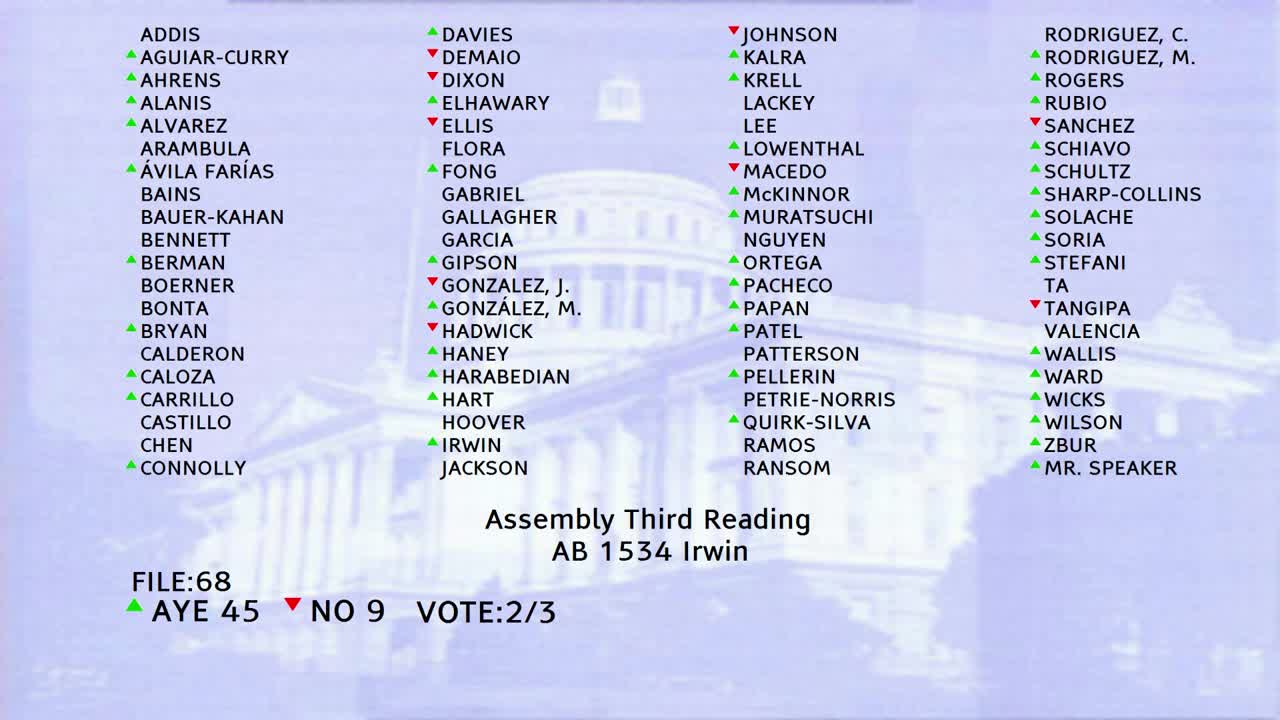 42SEC
Assembly Floor
 8MIN
Assembly Standing Committee on Transportation
Bill Author