AB 1604: Product safety: proofs of purchase: intentionally added bisphenols.
- Session Year: 2025-2026
- House: Assembly
- Latest Version Date: 2026-09-30
Current Status:
Passed
(2026-09-30: Chaptered by Secretary of State - Chapter 882, Statutes of 2026.)
Introduced
In Committee
Awaiting First Chamber Vote
Passed First Chamber
In Committee
Awaiting Second Chamber Vote
Passed Second Chamber
Enacted
What does this bill do?
The bill bans adding bisphenol A (BPA) and, later, all bisphenols to paper receipts and other paper proofs of purchase, affecting manufacturers, distributors, and sellers of receipt paper. It requires manufacturers to choose the least-toxic replacement and forbids swapping bisphenols for chemicals known or listed to cause cancer or reproductive or developmental harm.
The summary is provided by generative AI which can make mistakes. For original language, please view the details in the table below.
Existing law prohibits a person from manufacturing, selling, or distributing in commerce any juveniles feeding product or juveniles sucking or teething product, as defined, that contains any form of bisphenol, as defined, at a detectable level above the practical quantitation limit, as determined by the Department of Toxic Substances Control, except as provided.
This bill would prohibit, on and after January 1, 2028, a person from manufacturing, distributing, or offering for sale a paper proof of purchase containing intentionally added bisphenol A, as defined, and, on and after January 1, 2029, containing any intentionally added bisphenols, as defined. The bill would require a manufacturer to use the least toxic alternative when replacing any form of bisphenol in a paper proof of purchase product. The bill would also prohibit a manufacturer from replacing any form of bisphenol pursuant to these provisions with a chemical known to cause cancer or reproductive or developmental harm, as specified.
This bill would authorize the department to enforce a violation of those provisions by considering, on a case-by-case basis, the enforcement mechanism and an administrative penalty not to exceed $5,000 for a first violation, and not to exceed $10,000 for each subsequent violation. The bill would require all penalties collected pursuant to this bill to be deposited into the Toxic Substances Control Account, to be available for expenditure by the department upon appropriation by the Legislature, as specified. The bill would require the department to post any substantiated violation or final enforcement action of these provisions on the departments internet website.
Existing law prohibits a person from manufacturing, selling, or distributing in commerce any juveniles feeding product or juveniles sucking or teething product, as defined, that contains any form of bisphenol, as defined, at a detectable level above the practical quantitation limit, as determined by the Department of Toxic Substances Control, except as provided.
This bill would prohibit, on and after January 1, 2028, a person from manufacturing, distributing, or offering for sale a paper proof of purchase containing intentionally added bisphenol A, as defined, and, on and after January 1, 2029, containing any intentionally added bisphenols, as defined. The bill would authorize the department to enforce a violation of those provisions by considering, on a case-by-case basis, the enforcement mechanism and an administrative penalty not to exceed $5,000 for a first violation, and not to exceed $10,000 for each subsequent violation. The bill would require all penalties collected pursuant to this bill to be deposited into the Toxic Substances Control Account, to be available for expenditure by the department upon appropriation by the Legislature, as specified. The bill would require a manufacturer to use the least toxic alternative when replacing any form of bisphenol in a paper proof of purchase product. The bill would also prohibit a manufacturer from replacing any form of bisphenol pursuant to these provisions with a chemical known to cause cancer or reproductive harm, or with any chemical identified by the department as a Candidate Chemical, or developmental harm, as specified.
This bill would authorize the department to enforce a violation of those provisions by considering, on a case-by-case basis, the enforcement mechanism and an administrative penalty not to exceed $5,000 for a first violation, and not to exceed $10,000 for each subsequent violation. The bill would require all penalties collected pursuant to this bill to be deposited into the Toxic Substances Control Account, to be available for expenditure by the department upon appropriation by the Legislature, as specified. The bill would require the department to post any substantiated violation or final enforcement action of these provisions on the departments internet website.
Existing law prohibits a person from manufacturing, selling, or distributing in commerce any juveniles feeding product or juveniles sucking or teething product, as defined, that contains any form of bisphenol, as defined, at a detectable level above the practical quantitation limit, as determined by the Department of Toxic Substances Control, except as provided.
This bill would prohibit, on and after January 1, 2028, a person from manufacturing, distributing, or offering for sale a paper proof of purchase containing intentionally added bisphenol A, as defined, and, on and after January 1, 2029, containing any intentionally added bisphenols, as defined. The bill would specify that a violation would be punishable by a civil authorize the department to enforce a violation of those provisions by considering, on a case-by-case basis, the enforcement mechanism and an administrative penalty not to exceed $5,000 for a first violation, and not to exceed $10,000 for each subsequent violation. The bill would require all penalties collected pursuant to this bill to be deposited into the Toxic Substances Control Account, to be available for expenditure by the Department of Toxic Substances Control department upon appropriation by the Legislature, as specified. The bill would authorize the department, the Attorney General, a county counsel, a district attorney, or a city attorney to enforce these provisions and would entitle a prevailing plaintiff who establishes a violation of these provisions to an award of reasonable attorneys fees and costs. The bill would require a manufacturer to use the least toxic alternative when replacing any form of bisphenol in a paper proof of purchase product. The bill would also prohibit a manufacturer from replacing any form of bisphenol pursuant to these provisions with chemicals a chemical known to cause cancer or reproductive harm, or with any chemical identified by the department as a Candidate Chemical, as specified.
Existing law prohibits a person from manufacturing, selling, or distributing in commerce any juveniles feeding product or juveniles sucking or teething product, as defined, that contains any form of bisphenol, as defined, at a detectable level above the practical quantitation limit, as determined by the Department of Toxic Substances Control, except as provided.
This bill would prohibit, on and after January 1, 2027, 2028, a person from manufacturing, distributing, or offering for sale a paper proof of purchase provided to a consumer by a business or created by a manufacturer from containing intentionally added bisphenol A, as defined, and, on and after January 1, 2028, from 2029, containing any intentionally added bisphenols, as defined. The bill would specify that a violation would be punishable by a civil penalty not to exceed $5,000 for a first violation, and not to exceed $10,000 for each subsequent violation. The bill would require all penalties collected pursuant to this bill to be deposited into the Toxic Substances Control Account, to be available for expenditure by the Department of Toxic Substances Control upon appropriation by the Legislature, as specified. The bill would authorize the department, the Attorney General, a county counsel, a district attorney, or a city attorney to enforce these provisions and would entitle a prevailing plaintiff who establishes a violation of these provisions to an award of reasonable attorneys fees and costs. The bill would require a manufacturer to use the least toxic alternative when replacing any form of bisphenol in a paper proof of purchase product. The bill would also prohibit a manufacturer from replacing any form of bisphenol pursuant to these provisions with chemicals known to cause cancer or reproductive harm, or with any chemical identified by the department as a Candidate Chemical, as specified.
Existing law prohibits a person from manufacturing, selling, or distributing in commerce any juveniles feeding product or juveniles sucking or teething product, as defined, that contains any form of bisphenol, as defined, at a detectable level above the practical quantitation limit, as determined by the Department of Toxic Substances Control, except as provided.
This bill would prohibit, on and after January 1, 2027, a paper proof of purchase provided to a consumer by a business or created by a manufacturer from containing intentionally added bisphenol A, as defined, and, on and after January 1, 2028, from containing any intentionally added bisphenols, as defined. The bill would specify that a violation would be punishable by a civil penalty not to exceed $5,000 for a first violation, and not to exceed $10,000 for each subsequent violation. The bill would require all penalties collected pursuant to this bill to be deposited into the Toxic Substances Control Account, to be available for expenditure by the Department of Toxic Substances Control upon appropriation by the Legislature, as specified. The bill would authorize the department, the Attorney General, a county counsel, a district attorney, or a city attorney to enforce these provisions and would entitle a prevailing plaintiff who establishes a violation of these provisions to an award of reasonable attorneys fees and costs. The bill would require a manufacturer to use the least toxic alternative when replacing any form of bisphenol in a paper proof of purchase product. The bill would also prohibit a manufacturer from replacing any form of bisphenol pursuant to these provisions with chemicals known to cause cancer or reproductive harm, or with any chemical identified by the department as a Candidate Chemical, as specified.
Existing law prohibits a person from manufacturing, selling, or distributing in commerce any juveniles feeding product or juveniles sucking or teething product, as defined, that contains any form of bisphenol, as defined, at a detectable level above the practical quantitation limit, as determined by the Department of Toxic Substances Control, except as provided.
This bill would prohibit, on and after January 1, 2027, a paper proof of purchase provided to a consumer by a business or created by a manufacturer from containing intentionally added bisphenol A, as defined, and, on and after January 1, 2028, from containing any intentionally added bisphenols, as defined. The bill would specify that a violation would be punishable by a civil penalty not to exceed $5,000 for a first violation, and not to exceed $10,000 for each subsequent violation. The bill would require all penalties collected pursuant to this bill to be deposited into the Toxic Substances Control Account, to be available for expenditure by the Department of Toxic Substances Control upon appropriation by the Legislature, as specified. The bill would authorize the department, the Attorney General, a county counsel, a district attorney, or a city attorney to enforce these provisions and would entitle a prevailing plaintiff who establishes a violation of these provisions to an award of reasonable attorneys fees and costs.
The Legislature finds and declares all of the following:
(a)Paper receipts generate 334,000,000 pounds of waste and over 5,000,000,000 pounds of carbon dioxide, the equivalent of more than 471,000 cars on the road, and most paper receipts contain chemicals that contaminate other recyclable paper materials.
(b)The Ecology Center has found that 80 percent of paper receipts are coated with bisphenol A (BPA) or bisphenol S (BPS) chemicals.
(c)A definitive and growing body of scientific research has shown bisphenols disrupt our hormones and are linked to an increased risk of cardiovascular disease, fertility problems, obesity, diabetes, and cancer, including breast and prostate cancer.
(d)The BPA or BPS on receipts can enter peoples bodies simply through touch, which poses a major risk to retail workers, who have 30 percent more BPA or BPS found in their bodies than others who do not have regular contact with receipts, according to the Environmental Working Group and the federal Centers for Disease Control and Prevention.
(e)The State of Connecticut banned the use of receipt paper containing BPA in 2011, the State of Illinois banned receipt paper containing BPA in 2019, the State of Washington banned all bisphenols in thermal paper as of 2026, and the European Union restricted the use of BPA in thermal paper beginning in 2020 and is also investigating similar restrictions on the use of BPS.
SEC. 2.Chapter 12.3 (commencing with Section 108943) is added to Part 3 of Division 104 of the Health and Safety Code, to read:12.3.Proof of Purchase108943.For purposes of this chapter, the following definitions apply:
(a)Bisphenol means a chemical with two phenol rings connected by a single linker atom. The linker atom and phenol rings may have additional substituents.
(b)Department means the Department of Toxic Substances Control.
(c)Intentionally added bisphenol A means bisphenol A (CAS no. 80-05-7) that a manufacturer has intentionally added to a product and that has a functional or technical effect in the product, including bisphenol A that is an intentional breakdown product of an added chemical that also has a functional or technical effect in the product.
(d)Intentionally added bisphenols means bisphenols that a manufacturer has intentionally added to a product and that have a functional or technical effect in the product, including if the bisphenol is a component of an intentionally added chemical or is the intentional breakdown product of an added chemical that also has a functional or technical effect in the product.
(e)Manufacturer means the person that makes the paper for the paper proof of purchase using raw materials, machinery, or both.
(f)Person means any individual, firm, association, organization, partnership, limited liability company, business trust, corporation, or company.
(g)Proof of purchase means a receipt for the retail sale of food, alcohol, or other tangible personal property, or for the provision of services, provided at the point of sale.
108943.1.(a)(1)On and after January 1, 2028, no person shall manufacture, distribute, sell, or offer for sale a paper proof of purchase that contains intentionally added bisphenol A.
(2)On and after January 1, 2029, no person shall manufacture, distribute, sell, or offer for sale a paper proof of purchase that contains intentionally added bisphenols.
(b)The department may adopt regulations to implement, interpret, or make specific this chapter.
(c)The department shall post any substantiated violation or final enforcement action of this chapter on the departments internet website.
(d)The department shall deposit all penalties collected pursuant to this chapter into the Toxic Substances Control Account for the department to use upon appropriation by the Legislature to enforce this chapter.
(e)The department may enforce this section and may consider, on a case-by-case basis, the enforcement mechanism and the amount of any administrative penalty to be imposed, not to exceed five thousand dollars ($5,000) for a first violation, and not to exceed ten thousand dollars ($10,000) for each subsequent violation. In determining the amount of an administrative penalty, the department shall consider the following factors:
(1)The nature and severity of the violation.
(2)The good or bad faith of the person in violation.
(3)The history of prior violations, if any.
(4)Evidence that the violation was willful.
(5)The extent that the person has cooperated with the department.
108943.2.(a)A manufacturer shall use the least toxic alternative when replacing any form of bisphenol in a paper proof of purchase product in accordance with this chapter.
(b)A manufacturer shall not replace any form of bisphenol pursuant to this chapter with a chemical classified by the United States Environmental Protection Agency as carcinogenic to humans, likely to be carcinogenic to humans, or for which there is suggestive evidence of carcinogenic potential, or identified by the state to cause cancer as listed in the Safe Drinking Water and Toxic Enforcement Act of 1986 (Chapter 6.6 (commencing with Section 25249.5) of Division 20) list of chemicals known to cause cancer or reproductive toxicity.
(c)A manufacturer shall not replace any form of bisphenol pursuant to this chapter with a reproductive toxicant that causes birth defects, reproductive harm, or developmental harm as identified by the United States Environmental Protection Agency or listed in the Safe Drinking Water and Toxic Enforcement Act of 1986 (Chapter 6.6 (commencing with Section 25249.5) of Division 20) list of chemicals known to cause cancer or reproductive toxicity.
108943.3.The duties and obligations imposed by this chapter are cumulative with any other duties or obligations imposed under other law, shall not be construed to relieve any party from any duties or obligations imposed under other law, and do not limit any rights or remedies under existing law.
The Legislature finds and declares all of the following:
(a)Paper receipts generate 334,000,000 pounds of waste and over 5,000,000,000 pounds of carbon dioxide, the equivalent of more than 471,000 cars on the road, and most paper receipts contain chemicals that contaminate other recyclable paper materials.
(b)The Ecology Center has found that 80 percent of paper receipts are coated with bisphenol A (BPA) or bisphenol S (BPS) chemicals.
(c)A definitive and growing body of scientific research has shown bisphenols disrupt our hormones and are linked to an increased risk of cardiovascular disease, fertility problems, obesity, diabetes, and cancer, including breast and prostate cancer.
(d)The BPA or BPS on receipts can enter peoples bodies simply through touch, which poses a major risk to retail workers, who have 30 percent more BPA or BPS found in their bodies than others who do not have regular contact with receipts, according to the Environmental Working Group and the federal Centers for Disease Control and Prevention.
(e)The State of Connecticut banned the use of receipt paper containing BPA in 2011, the State of Illinois banned receipt paper containing BPA in 2019, the State of Washington banned all bisphenols in thermal paper as of 2026, and the European Union restricted the use of BPA in thermal paper beginning in 2020 and is also investigating similar restrictions on the use of BPS.
SEC. 2.Chapter 12.3 (commencing with Section 108943) is added to Part 3 of Division 104 of the Health and Safety Code, to read:12.3.Proof of Purchase108943.For purposes of this chapter, the following definitions apply:
(a)Bisphenol means a chemical with two phenol rings connected by a single linker atom. The linker atom and phenol rings may have additional substituents.
(b)Department means the Department of Toxic Substances Control.
(c)Intentionally added bisphenol A means bisphenol A (CAS no. 80-05-7) that a manufacturer has intentionally added to a product and that has a functional or technical effect in the product, including bisphenol A that is an intentional breakdown product of an added chemical that also has a functional or technical effect in the product.
(d)Intentionally added bisphenols means bisphenols that a manufacturer has intentionally added to a product and that have a functional or technical effect in the product, including bisphenols that are intentional breakdown products if the bisphenol is a component of an intentionally added chemical or is the intentional breakdown product of an added chemical that also have has a functional or technical effect in the product.
(e)Manufacturer means the person that makes the paper for the paper proof of purchase using raw materials, machinery, or both.
(f)Person means any individual, firm, association, organization, partnership, limited liability company, business trust, corporation, or company.
(g)Proof of purchase means a receipt for the retail sale of food, alcohol, or other tangible personal property, or for the provision of services, provided at the point of sale.
108943.1.(a)(1)On and after January 1, 2028, no person shall manufacture, distribute, sell, or offer for sale a paper proof of purchase that contains intentionally added bisphenol A.
(2)On and after January 1, 2029, no person shall manufacture, distribute, sell, or offer for sale a paper proof of purchase that contains intentionally added bisphenols.
(b)The department may adopt regulations to implement, interpret, or make specific this chapter.
(c)The department shall post any substantiated violation or final enforcement action of this chapter on the departments internet website.
(d)The department shall deposit all penalties collected pursuant to this chapter into the Toxic Substances Control Account for the department to use upon appropriation by the Legislature to enforce this chapter.
(e)The department may enforce this section and may consider, on a case-by-case basis, the enforcement mechanism and the amount of any administrative penalty to be imposed, not to exceed five thousand dollars ($5,000) for a first violation, and not to exceed ten thousand dollars ($10,000) for each subsequent violation. In determining the amount of an administrative penalty, the department shall consider the following factors:
(1)The nature and severity of the violation.
(2)The good or bad faith of the person in violation.
(3)The history of prior violations, if any.
(4)Evidence that the violation was willful.
(5)The extent that the person has cooperated with the department.
108943.2.(a)A manufacturer shall use the least toxic alternative when replacing any form of bisphenol in a paper proof of purchase product in accordance with this chapter.
(b)A manufacturer shall not replace any form of bisphenol pursuant to this chapter with a chemical classified by the United States Environmental Protection Agency as carcinogenic to humans, likely to be carcinogenic to humans, or for which there is suggestive evidence of carcinogenic potential, or identified by the state to cause cancer as listed in the Safe Drinking Water and Toxic Enforcement Act of 1986 (Chapter 6.6 (commencing with Section 25249.5) of Division 20) list of chemicals known to cause cancer or reproductive toxicity.
(c)A manufacturer shall not replace any form of bisphenol pursuant to this chapter with a reproductive toxicant that causes birth defects, reproductive harm, or developmental harm as identified by the United States Environmental Protection Agency or listed in the Safe Drinking Water and Toxic Enforcement Act of 1986 (Chapter 6.6 (commencing with Section 25249.5) of Division 20) list of chemicals known to cause cancer or reproductive toxicity.
(d)A manufacturer shall not replace any form of bisphenol pursuant to this chapter with any chemical identified by the department as a Candidate Chemical pursuant to Section 69502.2 of Title 22 of the California Code of Regulations.108943.3.The duties and obligations imposed by this act chapter are cumulative with any other duties or obligations imposed under other law, shall not be construed to relieve any party from any duties or obligations imposed under other law, and do not limit any rights or remedies under existing law.
The Legislature finds and declares all of the following:
(a)Paper receipts generate 334,000,000 pounds of waste and over 5,000,000,000 pounds of carbon dioxide, the equivalent of more than 471,000 cars on the road, and most paper receipts contain chemicals that contaminate other recyclable paper materials.
(b)The Ecology Center has found that 80 percent of paper receipts are coated with bisphenol A (BPA) or bisphenol S (BPS) chemicals.
(c)A definitive and growing body of scientific research has shown bisphenols disrupt our hormones and are linked to an increased risk of cardiovascular disease, fertility problems, obesity, diabetes, and cancer, including breast and prostate cancer.
(d)The BPA or BPS on receipts can enter peoples bodies simply through touch, which poses a major risk to retail workers, who have 30 percent more BPA or BPS found in their bodies than others who do not have regular contact with receipts, according to the Environmental Working Group and the federal Centers for Disease Control and Prevention.
(e)The State of Connecticut banned the use of receipt paper containing BPA in 2011, the State of Illinois banned receipt paper containing BPA in 2019, the State of Washington banned all bisphenols in thermal paper as of 2026, and the European Union restricted the use of BPA in thermal paper beginning in 2020 and is also investigating similar restrictions on the use of BPS.
SEC. 2.Chapter 12.3 (commencing with Section 108943) is added to Part 3 of Division 104 of the Health and Safety Code, to read:12.3.Proof of Purchase108943.For purposes of this chapter, the following definitions apply:
(a)Bisphenol means a chemical with two phenol rings connected by a single linker atom. The linker atom and phenol rings may have additional substituents.
(b)(1)Business means a person that accepts payment through cash, credit, or debit transactions.(2)Business does not include either of the following:(A)A health care provider, as defined in Section 123105.(B)An entity organized as a nonprofit institution that has annual gross sales receipts of less than two million dollars ($2,000,000).(c)Consumer means a person who purchases, and does not offer for resale, food, alcohol, other tangible personal property, or services.(d)(b)Department means the Department of Toxic Substances Control.
(e)(c)Intentionally added bisphenol A means bisphenol A (CAS no. 80-05-7) that a manufacturer has intentionally added to a product and that has a functional or technical effect in the product, including bisphenol A that is an intentional breakdown product of an added chemical that also has a functional or technical effect in the product.
(f)(d)Intentionally added bisphenols means bisphenols that a manufacturer has intentionally added to a product and that have a functional or technical effect in the product, including bisphenols that are intentional breakdown products of an added chemical that also have a functional or technical effect in the product.
(g)(e)Manufacturer means the person that makes the paper for the paper proof of purchase using raw materials, machinery, or both.
(h)(f)Person means any individual, firm, association, organization, partnership, limited liability company, business trust, corporation, or company.
(i)(g)Proof of purchase means a receipt for the retail sale of food, alcohol, or other tangible personal property, or for the provision of services, provided at the point of sale.
108943.1.(a)(1)On and after January 1, 2028, no person shall manufacture, distribute, sell, or offer for sale a paper proof of purchase that contains intentionally added bisphenol A.
(2)On and after January 1, 2029, no person shall manufacture, distribute, sell, or offer for sale a paper proof of purchase that contains intentionally added bisphenols.
(b)The department may adopt regulations to implement, interpret, or make specific this chapter.
(c)The department shall post any substantiated violation or final enforcement action of this chapter on the departments internet website.
(d)The department shall deposit all penalties collected pursuant to this chapter into the Toxic Substances Control Account for the department to use upon appropriation by the Legislature to enforce this chapter.
(e)(1)The department, the Attorney General, a district attorney, a county counsel, or a city attorney department may enforce this section. A violation shall be punishable by a civil penalty section and may consider, on a case-by-case basis, the enforcement mechanism and the amount of any administrative penalty to be imposed, not to exceed five thousand dollars ($5,000) for a first violation, and not to exceed ten thousand dollars ($10,000) for each subsequent violation. In determining the amount of an administrative penalty, the department shall consider the following factors:
(2)A prevailing plaintiff who establishes a violation of this chapter shall be entitled to an award of reasonable attorneys fees and costs.(1)The nature and severity of the violation.
(2)The good or bad faith of the person in violation.
(3)The history of prior violations, if any.
(4)Evidence that the violation was willful.
(5)The extent that the person has cooperated with the department.
108943.2.(a)A manufacturer shall use the least toxic alternative when replacing any form of bisphenol in a paper proof of purchase product in accordance with this chapter.
(b)A manufacturer shall not replace any form of bisphenol pursuant to this chapter with chemicals a chemical classified by the United States Environmental Protection Agency as carcinogenic to humans, likely to be carcinogenic to humans, or for which there is suggestive evidence of carcinogenic potential, or identified by the state to cause cancer as listed in the Safe Drinking Water and Toxic Enforcement Act of 1986 (Chapter 6.6 (commencing with Section 25249.5) of Division 20) list of chemicals known to cause cancer or reproductive toxicity.
(c)A manufacturer shall not replace any form of bisphenol pursuant to this chapter with a reproductive toxicants toxicant that cause causes birth defects, reproductive harm, or developmental harm as identified by the United States Environmental Protection Agency or listed in the Safe Drinking Water and Toxic Enforcement Act of 1986 (Chapter 6.6 (commencing with Section 25249.5) of Division 20) list of chemicals known to cause cancer or reproductive toxicity.
(d)A manufacturer shall not replace any form of bisphenol pursuant to this chapter with any chemical identified by the Department of Toxic Substances Control department as a Candidate Chemical pursuant to Section 69502.2 of Title 22 of the California Code of Regulations.
108943.3.The duties and obligations imposed by this act are cumulative with any other duties or obligations imposed under other law and law, shall not be construed to relieve any party from any duties or obligations imposed under other law law, and do not limit any rights or remedies under existing law.
The Legislature finds and declares all of the following:
(a)Paper receipts generate 334,000,000 pounds of waste and over 5,000,000,000 pounds of carbon dioxide, the equivalent of more than 471,000 cars on the road, and most paper receipts contain chemicals that contaminate other recyclable paper materials.
(b)The Ecology Center has found that 80 percent of paper receipts are coated with bisphenol A (BPA) or bisphenol S (BPS) chemicals.
(c)A definitive and growing body of scientific research has shown bisphenols disrupt our hormones and are linked to an increased risk of cardiovascular disease, fertility problems, obesity, diabetes, and cancer, including breast and prostate cancer.
(d)The BPA or BPS on receipts can enter peoples bodies simply through touch, which poses a major risk to retail workers, who have 30 percent more BPA or BPS found in their bodies than others who do not have regular contact with receipts, according to the Environmental Working Group and the federal Centers for Disease Control and Prevention.
(e)The State of Connecticut banned the use of receipt paper containing BPA in 2011, the State of Illinois banned receipt paper containing BPA in 2019, the State of Washington banned all bisphenols in thermal paper as of 2026, and the European Union restricted the use of BPA in thermal paper beginning in 2020 and is also investigating similar restrictions on the use of BPS.
SEC. 2.Chapter 12.3 (commencing with Section 108943) is added to Part 3 of Division 104 of the Health and Safety Code, to read:12.3.Proof of Purchase108943.For purposes of this chapter, the following definitions apply:
(a)Bisphenol means a chemical with two phenol rings connected by a single linker atom. The linker atom and phenol rings may have additional substituents.
(b)(1)Business means a person that accepts payment through cash, credit, or debit transactions.
(2)Business does not include either of the following:
(A)A health care provider, as defined in Section 123105.
(B)An entity organized as a nonprofit institution that has annual gross sales receipts of less than two million dollars ($2,000,000).
(c)Consumer means a person who purchases, and does not offer for resale, food, alcohol, other tangible personal property, or services.
(d)Department means the Department of Toxic Substances Control.
(e)Intentionally added bisphenol A means bisphenol A (CAS no. 80-05-7) that a manufacturer has intentionally added to a product and that has a functional or technical effect in the product, including bisphenol A that is an intentional breakdown product of an added chemical that also has a functional or technical effect in the product.
(f)Intentionally added bisphenols means bisphenols that a manufacturer has intentionally added to a product and that have a functional or technical effect in the product, including bisphenols that are intentional breakdown products of an added chemical that also have a functional or technical effect in the product.
(g)Manufacturer means the person that makes the paper for the paper proof of purchase using raw materials, machinery, or both.
(h)Person means any individual, firm, association, organization, partnership, limited liability company, business trust, corporation, or company.
(i)Proof of purchase means a receipt for the retail sale of food, alcohol, or other tangible personal property, or for the provision of services, provided at the point of sale.
108943.1.(a)(1)On and after January 1, 2027, 2028, no person shall manufacture, distribute, sell, or offer for sale a paper proof of purchase provided to a consumer by a business or created by a manufacturer shall not contain that contains intentionally added bisphenol A.
(2)On and after January 1, 2028, 2029, no person shall manufacture, distribute, sell, or offer for sale a paper proof of purchase provided to a consumer by a business or created by a manufacturer shall not contain any that contains intentionally added bisphenols.
(b)The department may adopt regulations to implement, interpret, or make specific this chapter.
(c)The department shall post any violation or enforcement action of this chapter on the departments internet website.
(d)The department shall deposit all penalties collected pursuant to this chapter into the Toxic Substances Control Account for the department to use upon appropriation by the Legislature to enforce this chapter.
(e)(1)The department, the Attorney General, a district attorney, a county counsel, or a city attorney may enforce this section. A violation shall be punishable by a civil penalty not to exceed five thousand dollars ($5,000) for a first violation, and not to exceed ten thousand dollars ($10,000) for each subsequent violation.
(2)A prevailing plaintiff who establishes a violation of this chapter shall be entitled to an award of reasonable attorneys fees and costs.
108943.2.(a)A manufacturer shall use the least toxic alternative when replacing any form of bisphenol in a paper proof of purchase product in accordance with this chapter.
(b)A manufacturer shall not replace any form of bisphenol pursuant to this chapter with chemicals classified by the United States Environmental Protection Agency as carcinogenic to humans, likely to be carcinogenic to humans, or for which there is suggestive evidence of carcinogenic potential, or identified by the state to cause cancer as listed in the Safe Drinking Water and Toxic Enforcement Act of 1986 (Chapter 6.6 (commencing with Section 25249.5) of Division 20) list of chemicals known to cause cancer or reproductive toxicity.
(c)A manufacturer shall not replace any form of bisphenol pursuant to this chapter with reproductive toxicants that cause birth defects, reproductive harm, or developmental harm as identified by the United States Environmental Protection Agency or listed in the Safe Drinking Water and Toxic Enforcement Act of 1986 (Chapter 6.6 (commencing with Section 25249.5) of Division 20) list of chemicals known to cause cancer or reproductive toxicity.
(d)A manufacturer shall not replace any form of bisphenol pursuant to this chapter with any chemical identified by the Department of Toxic Substances Control as a Candidate Chemical pursuant to Section 69502.2 of Title 22 of the California Code of Regulations.
108943.3.The duties and obligations imposed by this act are cumulative with any other duties or obligations imposed under other law and shall not be construed to relieve any party from any duties or obligations imposed under other law and do not limit any rights or remedies under existing law.
The Legislature finds and declares all of the following:
(a)Paper receipts generate 334,000,000 pounds of waste and over 5,000,000,000 pounds of carbon dioxide, the equivalent of more than 471,000 cars on the road, and most paper receipts contain chemicals that contaminate other recyclable paper materials.
(b)The Ecology Center has found that 80 percent of paper receipts are coated with bisphenol A (BPA) or bisphenol S (BPS) chemicals.
(c)A definitive and growing body of scientific research has shown bisphenols disrupt our hormones and are linked to an increased risk of cardiovascular disease, fertility problems, obesity, diabetes, and cancer, including breast and prostate cancer.
(d)The BPA or BPS on receipts can enter peoples bodies simply through touch, which poses a major risk to retail workers, who have 30 percent more BPA or BPS found in their bodies than others who do not have regular contact with receipts, according to the Environmental Working Group and the federal Centers for Disease Control and Prevention.
(e)The State of Connecticut banned the use of receipt paper containing BPA in 2011, the State of Illinois banned receipt paper containing BPA in 2019, the State of Washington banned all bisphenols in thermal paper as of 2026, and the European Union restricted the use of BPA in thermal paper beginning in 2020 and is also investigating similar restrictions on the use of BPS.
SEC. 2.Chapter 12.3 (commencing with Section 108943) is added to Part 3 of Division 104 of the Health and Safety Code, to read:12.3.Proof of Purchase108943.For purposes of this chapter, the following definitions apply:
(a)Bisphenol means a chemical with two phenol rings connected by a single linker atom. The linker atom and phenol rings may have additional substituents.
(b)(1)Business means a person that accepts payment through cash, credit, or debit transactions.
(2)Business does not include either of the following:
(A)A health care provider, as defined in Section 123105.
(B)An entity organized as a nonprofit institution that has annual gross sales receipts of less than two million dollars ($2,000,000).
(c)Consumer means a person who purchases, and does not offer for resale, food, alcohol, other tangible personal property, or services.
(d)Department means the Department of Toxic Substances Control.
(e)Intentionally added bisphenol A means bisphenol A (CAS no. 80-05-7) that a manufacturer has intentionally added to a product and that has a functional or technical effect in the product, including bisphenol A that is an intentional breakdown product of an added chemical that also has a functional or technical effect in the product.
(f)Intentionally added bisphenols means bisphenols that a manufacturer has intentionally added to a product and that have a functional or technical effect in the product, including bisphenols that are intentional breakdown products of an added chemical that also have a functional or technical effect in the product.
(g)Manufacturer means the person that makes the paper for the paper proof of purchase using raw materials, machinery, or both.
(h)Person means any individual, firm, association, organization, partnership, limited liability company, business trust, corporation, or company.
(i)Proof of purchase means a receipt for the retail sale of food, alcohol, or other tangible personal property, or for the provision of services, provided at the point of sale.
108943.1.(a)(1)On and after January 1, 2027, a paper proof of purchase provided to a consumer by a business or created by a manufacturer shall not contain intentionally added bisphenol A.
(2)On and after January 1, 2028, a paper proof of purchase provided to a consumer by a business or created by a manufacturer shall not contain any intentionally added bisphenols.
(b)The department may adopt regulations to implement, interpret, or make specific this chapter.
(c)The department shall post any violation or enforcement action of this chapter on the departments internet website.
(d)The department shall deposit all penalties collected pursuant to this chapter into the Toxic Substances Control Account for the department to use upon appropriation by the Legislature to enforce this chapter.
(e)(1)The department, the Attorney General, a district attorney, a county counsel, or a city attorney may enforce this section. A violation shall be punishable by a civil penalty not to exceed five thousand dollars ($5,000) for a first violation, and not to exceed ten thousand dollars ($10,000) for each subsequent violation.
(2)A prevailing plaintiff who establishes a violation of this chapter shall be entitled to an award of reasonable attorneys fees and costs.
108943.2.(a)A manufacturer shall use the least toxic alternative when replacing any form of bisphenol in a paper proof of purchase product in accordance with this chapter.
(b)A manufacturer shall not replace any form of bisphenol pursuant to this chapter with chemicals classified by the United States Environmental Protection Agency as carcinogenic to humans, likely to be carcinogenic to humans, or for which there is suggestive evidence of carcinogenic potential, or identified by the state to cause cancer as listed in the Safe Drinking Water and Toxic Enforcement Act of 1986 (Chapter 6.6 (commencing with Section 25249.5) of Division 20) list of chemicals known to cause cancer or reproductive toxicity.
(c)A manufacturer shall not replace any form of bisphenol pursuant to this chapter with reproductive toxicants that cause birth defects, reproductive harm, or developmental harm as identified by the United States Environmental Protection Agency or listed in the Safe Drinking Water and Toxic Enforcement Act of 1986 (Chapter 6.6 (commencing with Section 25249.5) of Division 20) list of chemicals known to cause cancer or reproductive toxicity.
(d)A manufacturer shall not replace any form of bisphenol pursuant to this chapter with any chemical identified by the Department of Toxic Substances Control as a Candidate Chemical pursuant to Section 69502.2 of Title 22 of the California Code of Regulations.
108943.2.108943.3.The duties and obligations imposed by this act are cumulative with any other duties or obligations imposed under other law and shall not be construed to relieve any party from any duties or obligations imposed under other law and do not limit any rights or remedies under existing law.
The Legislature finds and declares all of the following:
(a)Paper receipts generate 334,000,000 pounds of waste and over 5,000,000,000 pounds of carbon dioxide, the equivalent of more than 471,000 cars on the road, and most paper receipts contain chemicals that contaminate other recyclable paper materials.
(b)The Ecology Center has found that 93 80 percent of paper receipts are coated with bisphenol A (BPA) or bisphenol S (BPS) chemicals.
(c)The United States Food and Drug Administration has banned BPA from baby bottles because those chemicals are known to disrupt hormones, causing cancerous tumors, birth defects, and other developmental issues.(c)A definitive and growing body of scientific research has shown bisphenols disrupt our hormones and are linked to an increased risk of cardiovascular disease, fertility problems, obesity, diabetes, and cancer, including breast and prostate cancer.
(d)The BPA or BPS on receipts can enter peoples bodies simply through touch, which poses a major risk to retail workers, who have 30 percent more BPA or BPS found in their bodies than others who do not have regular contact with receipts, according to the Environmental Working Group and the federal Centers for Disease Control and Prevention.
(e)The State of Connecticut banned the use of receipt paper containing BPA in 2011, the State of Illinois banned receipt paper containing BPA in 2019, the State of Washington banned all bisphenols in thermal paper as of 2026, and the European Union restricted the use of BPA in thermal paper beginning in 2020 and is also investigating similar restrictions on the use of BPS.
SEC. 2.Chapter 12.3 (commencing with Section 108943) is added to Part 3 of Division 104 of the Health and Safety Code, to read:12.3.Proof of Purchase108943.For purposes of this chapter, the following definitions apply:
(a)Bisphenol means a chemical with two phenol rings connected by a single linker atom. The linker atom and phenol rings may have additional substituents.
(a)(b)(1)Business means a person that accepts payment through cash, credit, or debit transactions.
(2)Business does not include either of the following:
(A)A health care provider, as defined in Section 123105.
(B)An entity organized as a nonprofit institution that has annual gross sales receipts of less than two million dollars ($2,000,000).
(b)(c)Consumer means a person who purchases, and does not offer for resale, food, alcohol, other tangible personal property, or services.
(c)(d)Department means the Department of Toxic Substances Control.
(d)(e)Intentionally added bisphenol A means bisphenol A (CAS no. 80-05-7) that a manufacturer has intentionally added to a product and that has a functional or technical effect in the product, including bisphenol A that is an intentional breakdown product of an added chemical that also has a functional or technical effect in the product.
(e)(f)Intentionally added bisphenols means bisphenols that a manufacturer has intentionally added to a product and that have a functional or technical effect in the product, including bisphenols that are intentional breakdown products of an added chemical that also have a functional or technical effect in the product.
(f)(g)Manufacturer means the person that makes the paper for the paper proof of purchase using raw materials, machinery, or both.
(g)(h)Person means any individual, firm, association, organization, partnership, limited liability company, business trust, corporation, or company.
(h)(i)Proof of purchase means a receipt for the retail sale of food, alcohol, or other tangible personal property, or for the provision of services, provided at the point of sale.
108943.1.(a)(1)On and after January 1, 2027, a paper proof of purchase provided to a consumer by a business or created by a manufacturer shall not contain intentionally added bisphenol A.
(2)On and after January 1, 2028, a paper proof of purchase provided to a consumer by a business or created by a manufacturer shall not contain any intentionally added bisphenols.
(b)The department may adopt regulations to implement, interpret, or make specific this chapter.
(c)The department shall post any violation or enforcement action of this chapter on the departments internet website.
(d)The department shall deposit all penalties collected pursuant to this chapter into the Toxic Substances Control Account for the department to use upon appropriation by the Legislature to enforce this chapter.
(e)(1)The department, the Attorney General, a district attorney, a county counsel, or a city attorney may enforce this section. A violation shall be punishable by a civil penalty not to exceed five thousand dollars ($5,000) for a first violation, and not to exceed ten thousand dollars ($10,000) for each subsequent violation.
(2)A prevailing plaintiff who establishes a violation of this chapter shall be entitled to an award of reasonable attorneys fees and costs.
108943.2.The duties and obligations imposed by this act are cumulative with any other duties or obligations imposed under other law and shall not be construed to relieve any party from any duties or obligations imposed under other law and do not limit any rights or remedies under existing law.
The Legislature finds and declares all of the following:
(a)Paper receipts generate 334,000,000 pounds of waste and over 5,000,000,000 pounds of carbon dioxide, the equivalent of more than 471,000 cars on the road, and most paper receipts contain chemicals that contaminate other recyclable paper materials.
(b)The Ecology Center has found that 93 percent of paper receipts are coated with bisphenol A (BPA) or bisphenol S (BPS) chemicals.
(c)The United States Food and Drug Administration has banned BPA from baby bottles because those chemicals are known to disrupt hormones, causing cancerous tumors, birth defects, and other developmental issues.
(d)The BPA or BPS on receipts can enter peoples bodies simply through touch, which poses a major risk to retail workers, who have 30 percent more BPA or BPS found in their bodies than others who do not have regular contact with receipts, according to the Environmental Working Group and the federal Centers for Disease Control and Prevention.
(e)The State of Connecticut banned the use of receipt paper containing BPA in 2011, the State of Illinois banned receipt paper containing BPA in 2019, and the European Union restricted the use of BPA in thermal paper beginning in 2020 and is also investigating similar restrictions on the use of BPS.
SEC. 2.Chapter 12.3 (commencing with Section 108943) is added to Part 3 of Division 104 of the Health and Safety Code, to read:12.3.Proof of Purchase108943.For purposes of this chapter, the following definitions apply:
(a)(1)Business means a person that accepts payment through cash, credit, or debit transactions.
(2)Business does not include either of the following:
(A)A health care provider, as defined in Section 123105.
(B)An entity organized as a nonprofit institution that has annual gross sales receipts of less than two million dollars ($2,000,000).
(b)Consumer means a person who purchases, and does not offer for resale, food, alcohol, other tangible personal property, or services.
(c)Department means the Department of Toxic Substances Control.
(d)Intentionally added bisphenol A means bisphenol A that a manufacturer has intentionally added to a product and that has a functional or technical effect in the product, including bisphenol A that is an intentional breakdown product of an added chemical that also has a functional or technical effect in the product.
(e)Intentionally added bisphenols means bisphenols that a manufacturer has intentionally added to a product and that have a functional or technical effect in the product, including bisphenols that are intentional breakdown products of an added chemical that also have a functional or technical effect in the product.
(f)Manufacturer means the person that makes the paper for the paper proof of purchase using raw materials, machinery, or both.
(g)Person means any individual, firm, association, organization, partnership, limited liability company, business trust, corporation, or company.
(h)Proof of purchase means a receipt for the retail sale of food, alcohol, or other tangible personal property, or for the provision of services, provided at the point of sale.
108943.1.(a)(1)On and after January 1, 2027, a paper proof of purchase provided to a consumer by a business or created by a manufacturer shall not contain intentionally added bisphenol A.
(2)On and after January 1, 2028, a paper proof of purchase provided to a consumer by a business or created by a manufacturer shall not contain any intentionally added bisphenols.
(b)The department may adopt regulations to implement, interpret, or make specific this chapter.
(c)The department shall post any violation or enforcement action of this chapter on the departments internet website.
(d)The department shall deposit all penalties collected pursuant to this chapter into the Toxic Substances Control Account for the department to use upon appropriation by the Legislature to enforce this chapter.
(e)(1)The department, the Attorney General, a district attorney, a county counsel, or a city attorney may enforce this section. A violation shall be punishable by a civil penalty not to exceed five thousand dollars ($5,000) for a first violation, and not to exceed ten thousand dollars ($10,000) for each subsequent violation.
(2)A prevailing plaintiff who establishes a violation of this chapter shall be entitled to an award of reasonable attorneys fees and costs.
|
Date
|
Status
|
|---|---|
| Sep 30, 2026 | Chaptered by Secretary of State - Chapter 882, Statutes of 2026. |
| Sep 30, 2026 | Approved by the Governor. |
| Sep 3, 2026 | Enrolled and presented to the Governor at 4 p.m. |
| Aug 26, 2026 | Senate amendments concurred in. To Engrossing and Enrolling. (Ayes 73. Noes 2.). |
| Aug 26, 2026 | Senate amendments concurred in. To Engrossing and Enrolling. (Ayes 73. Noes 2. Page 6565.). |
| Aug 25, 2026 | In Assembly. Concurrence in Senate amendments pending. |
| Aug 25, 2026 | Read third time. Passed. Ordered to the Assembly. (Ayes 36. Noes 0.). |
| Aug 24, 2026 | Read second time. Ordered to third reading. |
| Aug 21, 2026 | Read third time and amended. Ordered to second reading. |
| Aug 13, 2026 | Read second time. Ordered to third reading. |
| Aug 13, 2026 | From committee: Do pass. (Ayes 5. Noes 0.) (August 13). |
| Aug 3, 2026 | In committee: Referred to APPR. suspense file. |
| Jun 23, 2026 | Withdrawn from committee. |
| Jun 23, 2026 | Re-referred to Com. on APPR. |
| Jun 22, 2026 | From committee chair, with author's amendments: Amend, and re-refer to committee. Read second time, amended, and re-referred to Com. on JUD. |
| Jun 17, 2026 | From committee: Do pass and re-refer to Com. on JUD. (Ayes 7. Noes 0.) (June 17). Re-referred to Com. on JUD. |
| Jun 3, 2026 | Referred to Coms. on E.Q. and JUD. |
| May 27, 2026 | In Senate. Read first time. To Com. on RLS. for assignment. |
| May 26, 2026 | Read third time. Passed. Ordered to the Senate. (Ayes 70. Noes 2.) |
| May 26, 2026 | Read third time. Passed. Ordered to the Senate. (Ayes 70. Noes 2. Page 5357.) |
| May 26, 2026 | Read third time. Passed. Ordered to the Senate. |
| May 19, 2026 | Read second time. Ordered to third reading. |
| May 18, 2026 | Read second time and amended. Ordered returned to second reading. |
| May 14, 2026 | From committee: Amend, and do pass as amended. (Ayes 11. Noes 1.) (May 14). |
| Apr 15, 2026 | In committee: Set, first hearing. Referred to APPR. suspense file. |
| Apr 8, 2026 | From committee: Do pass and re-refer to Com. on APPR. (Ayes 12. Noes 0.) (April 7). Re-referred to Com. on APPR. |
| Mar 16, 2026 | Re-referred to Com. on JUD. |
| Mar 12, 2026 | Read second time and amended. |
| Mar 11, 2026 | From committee: Amend, and do pass as amended and re-refer to Com. on JUD. (Ayes 7. Noes 0.) (March 10). |
| Mar 4, 2026 | Re-referred to Com. on E.S & T.M. |
| Mar 3, 2026 | From committee chair, with author's amendments: Amend, and re-refer to Com. on E.S & T.M. Read second time and amended. |
| Feb 2, 2026 | Referred to Coms. on E.S & T.M. and JUD. |
| Jan 21, 2026 | From printer. May be heard in committee February 20. |
| Jan 20, 2026 | Read first time. To print. |
|
Date
|
Description
|
Location
|
Votes
|
|
|---|---|---|---|---|
| Aug 26, 2026 | AB 1604 Stefani Concurrence in Senate Amendments | Assembly Floor |
Passed |
|
| Aug 25, 2026 | Assembly 3rd Reading AB1604 Stefani et al. By Allen | Senate Floor |
Passed |
|
| Aug 13, 2026 | Do pass | Senate Standing Committee on Appropriations |
Passed |
|
| Aug 3, 2026 | Placed on suspense file | Senate Standing Committee on Appropriations |
Passed |
|
| Jun 17, 2026 | Do pass, but first be re-referred to the Committee on [Judiciary] | Senate Standing Committee on Environmental Quality |
Passed |
|
| May 26, 2026 | AB 1604 Stefani Assembly Third Reading | Assembly Floor |
Passed |
|
| May 14, 2026 | Do pass as amended. | Assembly Standing Committee on Appropriations |
Passed |
|
| Apr 7, 2026 | Do pass and be re-referred to the Committee on [Appropriations] | Assembly Standing Committee on Judiciary |
Passed |
|
| Mar 10, 2026 | Do pass as amended and be re-referred to the Committee on [Judiciary] | Assembly Standing Committee on Environmental Safety and Toxic Materials |
Passed |
This list shows positions taken on this bill by organizations on the date displayed, which is linked to the original source.
Positions by individuals are not included.
|
Organization
|
Position
|
Date
|
|---|---|---|
| 350 Bay Area Action | ** Support | |
| 350 Contra Costa Action | ** Support | |
| A Voice for Choice Advocacy | ** Support | |
| Active San Gabriel Valley | ** Support | |
| Alliance of Nurses for Healthy Environments | ** Support | |
| AMERICAN COLLEGE OF OBSTETRICIANS & GYNECOLOGISTS - DISTRICT IX | ** Support | |
| American Nurses Associaition - California | ** Support | |
| American Sustainable Business Network | ** Support | |
| Ban Single Use Plastic (SUP) | ** Support | |
| Ban SUP | ** Support | |
| Between the Waters | ** Support | |
| Beyond Plastics | ** Support | |
| Blue Ocean Warriors | ** Support | |
| Breast Cancer Prevention Partners | ** Support | |
| California Black Health Network | ** Support | |
| California Climate Action | ** Support | |
| California Climate Action Now! | ** Support | |
| California Communities Against Toxics | ** Support | |
| California Health Coalition Advocacy | ** Support | |
| California Nurses for Environmental Health and Justice | ** Support | |
| California Product Stewardship Council | ** Support | |
| California Restaurant Association | ** Against | |
| Californians Against Waste | ** Support | |
| CALPIRG, California Public Interest Research Group | ** Support | |
| Cinema Association of California | ** Against | |
| Clean Earth 4 Kids | ** Support | |
| Clean Water Action | ** Support | |
| Climate Reality Project, Los Angeles Chapter | ** Support | |
| Climate Reality Project, Orange County | ** Support | |
| Community Environmental Council | ** Support | |
| Courage California | ** Support | |
| Earthday.org | ** Support | |
| Ecology Center | ** Support | |
| Endangered Habitats League | ** Support | |
| Environmental Action Committee of West Marin | ** Support | |
| Environmental Working Group | ** Support | |
| Facts: Families Advocating for Chemical & Toxics Safety | ** Support | |
| Friends Committee On Legislation Of California | ** Support | |
| Glendale Environmental Coalition | ** Support | |
| Global Alliance for Incinerator Alternatives | ** Support | |
| Global Alliance for Incinerator Alternatives (GAIA) | ** Support | |
| Golden Gate Restaurant Association | ** Against | |
| Green America | ** Support | |
| Green Science Policy Institute | ** Support | |
| Healthy Children Project, INC. | ** Support | |
| I'm Hoi Strategies | ** Support | |
| Just Zero | ** Support | |
| Learning Disabilities Association of America | ** Support | |
| Mendez Law | ** Support | |
| National Association of Environmental Medicine | ** Support | |
| National Association of Environmental Medicine (NAEM) | ** Support | |
| Natural Resources Defense Council | ** Support | |
| Natural Resources Defense Council (NRDC) | ** Support | |
| Nontoxic Neighborhoods | ** Support | |
| Northern California Recycling Association | ** Support | |
| Pacific Environment | ** Support | |
| Physician and Scientist Network Addressing Plastics and Health | ** Support | |
| Physicians for Social Responsibility - Los Angeles | ** Support | |
| Physicians for Social Responsibility - San Francisco Bay | ** Support | |
| Physicians for Social Responsibility, San Francisco Bay | ** Support | |
| PLASTIC POLLUTION COALITION, A PROJECT OF EARTH ISLAND INSTITUTE | ** Support | |
| San Francisco Baykeeper | ** Support | |
| Santa Cruz Climate Action Network | ** Support | |
| Save The Albatross Coalition | ** Support | |
| Sunrise Bay Area | ** Support | |
| The Keep a Breast Foundation | ** Support | |
| The Last Beach Cleanup | ** Support | |
| The Last Plastic Straw | ** Support | |
| The Story of Stuff Project | ** Support | |
| Toxic Free Future | ** Support | |
| Trillium Asset Management | ** Support | |
| West Berkeley Alliance for Clean Air and Safe Jobs | ** Support | |
| West Marin Environmental Action Coalition | ** Support | |
| Worksafe | ** Support | |
| Yosemite Rivers Alliance | ** Support | |
| Zero Waste Ithaca | ** Support | |
| Zero Waste San Diego | ** Support |
CONCURRENCE IN SENATE AMENDMENTS
CSA1 Bill Id:AB 1604
Author:(Stefani)
As Amended Ver:August 21, 2026
Majority vote
SUMMARY
Prohibits, on and after January 1, 2028, a person from manufacturing, distributing, or selling a paper proof of purchase (receipt) that contains intentionally added bisphenol A (BPA); and, prohibits, on and after January 1, 2029, a person from manufacturing, distributing, or selling a paper receipt that contains intentionally added bisphenols. Authorizes the Department of Toxic Substances Control (DTSC) to enforce the prohibitions of this bill.
Senate Amendments
- Delete provisions that would have:
- Defined business and consumer.
- Conferred express authority upon a district attorney, a county counsel, or a city attorney to enforce the provisions of this bill.
- Required that a violation of the provisions of this bill be punishable by a civil penalty.
- Required that a prevailing plaintiff who establishes a violation of the provisions of this bill be entitled to an award of reasonable attorney′s fees and costs.
- Prohibited manufacturers from replacing any form of bisphenol pursuant to this bill with any chemical identified by DTSC as a Candidate Chemical pursuant to Safer Consumer Products Regulations.
- Update the definition of "intentionally added" bisphenols to align with current statute governing chemicals in consumer products.
- Authorize DTSC to consider, on a case-by-case basis, the enforcement mechanism and the amount of any administrative penalty to be imposed.
- Require DTSC, in determining the amount of an administrative penalty, to consider the following factors:
- The nature and severity of the violation.
- The good or bad faith of the person in violation.
- The history of prior violations, if any.
- Evidence that the violation was willful.
- The extent that the person has cooperated with DTSC.
- Make other technical and conforming changes.
COMMENTS
Bisphenols: Bisphenols are a group of synthetic, high-volume chemicals that are used in the manufacturing of polycarbonate plastics and epoxy resins. The most widely used and well-studied chemical in the group is BPA, but the use of other bisphenols, such as bisphenol S (BPS) and bisphenol F (BPF), is increasing as manufacturers use these chemicals to replace BPA, especially following restrictions on the use of BPA.
BPA is used as a building block in the production of polycarbonate plastics, creating plastic that is clear, tough, and used to manufacture a wide range of consumer goods, including sports equipment, impact-resistant safety equipment, automobile parts, and food containers, such as reusable beverage bottles and plastic tableware. BPA is also used in dental sealants; in the production of epoxy resins used to line food and beverage cans; to line water pipes; and, in the manufacture of thermal papers used for shop sales receipts, ATM receipts, public transport tickets, parking tickets, and airline boarding passes. Both BPS and BPF are also used in the manufacture of plastics, and BPS is increasingly used in the production of thermal papers.
Concerns with bisphenols: The 2019 article, "The adverse health effects of bisphenol A and related toxicity mechanisms," published in Environmental Research, summarizes concerns about BPA as follows: "Due to its mass productions and widespread applications, the presence of BPA is ubiquitous in the environment. BPA can enter the body via different ways such as [the] digestive tract, respiratory tract and dermal tract. As an endocrine disruptor, BPA has estrogen-like and anti-androgen effects causing damages to different tissues and organs, including [the] reproductive system, immune system and neuroendocrine system, etc. Recently, it has been shown that BPA could induce carcinogenesis and mutagenesis in animal models."
As concerns mounted over the health and environmental impacts of exposure to BPA, manufacturers replaced BPA with other, less-studied bisphenols. Unfortunately, studies indicate that these bisphenols display hazard traits similar to, and sometimes worse than, BPA. These studies include "Bisphenol S in Food Causes Hormonal and Obesogenic Effects Comparable to or Worse than Bisphenol A: A Literature Review," published in 2020 in Nature, which states,
"In recent years, bisphenol analogues such as bisphenol S (BPS) have come to replace bisphenol A in food packaging and food containers, since bisphenol A (BPA) has been shown to leach into food and water, causing numerous negative health effects. Unfortunately, little or no research was done to determine the safety of these BPA-free products before they were marketed to the public as a healthier alternative. The latest studies have shown that some of these bisphenol analogues may be even more harmful than the original BPA in some situations... It was found that BPS works via different pathways than does BPA while causing equivalent obesogenic [i.e., obesity-promoting] effects, such as activating preadipocytes, and that BPS was correlated with metabolic disorders, such as gestational diabetes, that BPA was not correlated with. BPS was also shown to be more toxic to the reproductive system than BPA and was shown to hormonally promote certain breast cancers at the same rate as BPA. Therefore, a strong argument may be made to regulate BPS in exactly the same manner as BPA."
Another study, "Bisphenol Analogues Other Than BPA: Environmental Occurrence, Human Exposure, and Toxicity: A Review," published in Environmental Science and Technology in 2016, states, "Elevated concentrations of [bisphenol AF (BPAF)], BPF, and BPS (i.e., similar to or greater than that of BPA) have been reported in the abiotic environment and human urine from some regions. Many [bisphenol] analogues exhibit endocrine disrupting effects, cytotoxicity, genotoxicity, reproductive toxicity, dioxin-like effects, and neurotoxicity in laboratory studies. BPAF, BPB, BPF, and BPS have been shown to exhibit estrogenic and/or antiandrogenic activities similar to or even greater than that of BPA."
Bisphenols in receipts: According to the 2023 article, "Bisphenols and alternative developers in thermal paper receipts from the U.S. market assessed by Fourier transform infrared spectroscopy," published in Environmental Pollution, "Cash register receipts made of thermal paper expose workers and shoppers to endocrine-disrupting chemicals and contaminate paper recycling streams." The article explains that cash register receipts are an underrecognized source of exposure to hormonally active chemicals, especially for workers who frequently handle receipts. It says that most receipts are made of thermal paper, which is coated with layers of chemicals that allow for rapid image formation under a thermal print head. Thermal paper receipts became common in the late 20th century, initially with BPA commonly used as the color developer. More recently, in response to concerns about BPA′s health hazards, manufacturers replaced BPA in thermal receipts with alternative developers, typically BPS. The article states that, "Bisphenols and other developer chemicals may continue to expose people even after disposal; they have been found in recycled paper products."
Alternatives to bisphenols in receipts: The authors of the 2023 study published in Environmental Pollution state, "The results of this study suggest the [United States] retail market has shifted substantially to BPS-based receipts as replacements for BPA-based receipts. At the same time, a shift toward non-bisphenol receipts has begun. Bisphenol-based receipts (those with BPS or BPA as developer) decreased from about 93% of collected receipts in 2017 to 86% in 2022, while non-bisphenols increased from 5% to 14% of receipts." However, the study cautions, "While BPS and BPA present greater known hazards, the nonbisphenol developers detected in this study encompass various unknowns and potential hazards. Using them to replace bisphenol receipts should be considered an interim solution, and each should be subjected to a comprehensive chemical hazard evaluation. Certain other thermal papers such as Blue4est™, not detected in this study, might offer preferable alternatives due to the use of a polymer coating rather than migratable developer chemicals. A better strategy for businesses to protect workers, customers, and natural resources, however, is to eliminate or minimize printing thermal paper receipts. This can be accomplished by offering a choice to the customer to skip the receipt or to receive a digital receipt. Non-thermal paper receipts are another option."
This bill: This bill prohibits, on and after January 1, 2028, a person from manufacturing, distributing, selling, or offering for sale a receipt that contains intentionally added BPA; and, prohibits, on and after January 1, 2029, a person from manufacturing, distributing, selling, or offering for sale a paper receipt that contains intentionally added bisphenols. This bill also authorizes DTSC to adopt regulations to implement the prohibitions delineated in the bill, and authorizes DTSC to enforce these prohibitions, including by levying an administrative penalty not to exceed $5,000 for a first violation, and $10,000 for each subsequent violation.
Intentionally added chemicals in products: This bill focuses on intentionally added bisphenols in receipt paper. Similarly, to protect human health and the environment, several provisions of state law prohibit or limit other substances in specific products. Some of these provisions restrict intentionally added substances, but establish different, potentially less stringent, requirements for unintentionally added substances. These statutes include limitations on, prohibitions of, or disclosure of specified chemicals in cosmetics and cleaning products; PFAS in textiles, juvenile products, and plant-based food packaging; and, Di(2-ethylhexyl) phthalate (DEHP) in intravenous tubing. To a large extent, legislators treated intentionally added and non-intentionally added substances differently to account for unavoidable environmental contamination of products, such as PFAS contamination from municipal water. However, recent discussions about this differential treatment of intentionally added versus non-intentionally added substances have raised critical policy questions, including whether these provisions are enforceable and truly capture the Legislature′s intent to protect public health and the environment from harmful substances in products. Discussions should continue about how to ensure that concerning substances in products are restricted or prohibited, regardless of when in the manufacturing and distribution process the substances become present in the product.
According to the Author
"AB 1604 will better protect public health and the environment in California by eliminating harmful bisphenol chemicals from paper receipts. Beginning January 1, 2028, manufacturers and businesses will no longer be allowed to use BPA in receipts, with a full phase-out of all bisphenol chemicals by January 1, 2029. These chemicals have been linked to detrimental health issues for women and children, which are known to cause reproductive, developmental, and behavioral harm. By removing bisphenols from receipts, this legislation helps reduce daily exposure to toxic substances and prevents contamination in recycling and composting systems – prioritizing health, safety, and environmental responsibility for all Californians."
Arguments in Support
A coalition of over 60 environmental, public health, environmental justice, and community organizations writes in support of the bill,
"Exposure to bisphenols is widespread and continuous. Center for Disease Control data show that roughly 90% of Americans carry [BPA] and [BPS] in their bodies. These chemicals disrupt hormonal systems that regulate growth, fertility, and development, even at very low levels. Because BPA and BPS closely resemble estrogen, they are often described as "estrogen mimickers," with early-life exposures posing the greatest risk.
Thermal receipt paper is a major and preventable source of exposure, as bisphenols are readily absorbed through the skin. While everyone who shops is affected, cashiers face the highest risk. Occupational studies show that cashiers have significantly higher BPA and BPS levels. According to 2024 U.S. Bureau of Labor Statistics data, nearly 70% of cashiers are women and over 75% are of childbearing age, a population especially vulnerable to endocrine-disrupting chemicals.
Bisphenols are linked to serious health harms, including low birth weight, infertility, obesity, and increased cancer risk, and both BPA and BPS are listed under California′s Proposition 65 for reproductive harm… Not only are intentionally added bisphenols incredibly toxic, but they also render the receipt paper unrecyclable and a persistent, hazardous contaminant in paper bales."
Arguments in Opposition
The California Restaurant Association, the Golden Gate Restaurant Association, and the Cinema Association of California write in opposition to the bill,
"The recent amendments made on June 22nd do not address our coalition′s concerns, as the bill continues to leave brick-and-mortar operators open to fines that should instead be focused on producers, importers, and distributors of the product for sale, not on the people and businesses who simply buy the paper.
…While the bill, as amended on June 22nd, currently holds manufacturers accountable, it also leaves end-user consumers vulnerable to fines of up to $5,000 for the first instance or $10,000 for every subsequent instance in which a business may provide a proof of purchase containing intentionally added bisphenols, despite not being the manufacturers, importers, or sellers of the products.
… Our coalition respectfully requests that AB 1604 be amended to explicitly levy fines against manufacturers, importers, and those who sell receipt paper to end-users, not on brick-and-mortar businesses that simply buy paper."
FISCAL COMMENTS
According to the Senate Appropriations Committee, DTSC estimates ongoing costs of about $999,000 in fiscal year 2027-2028 and $979,000 annually thereafter to develop and implement compliance and enforcement activities that would be required by this bill. These costs may require an increase to the Environmental Fee. Based on DTSC′s current assumptions, the fee would need to be increased by less than 1% to generate sufficient revenues to support the increase in expenditures.
VOTES:
ASM ENVIRONMENTAL SAFETY AND TOXIC MATERIALS: 7-0-0
YES: Connolly, Ellis, Bauer-Kahan, Castillo, Lee, McKinnor, Papan
ASM JUDICIARY: 12-0-0
YES: Kalra, Macedo, Lee, Bryan, Connolly, Dixon, Harabedian, Pacheco, Papan, Sanchez, Stefani, Zbur
ASM APPROPRIATIONS: 11-1-3
YES: Wicks, Aguiar-Curry, Calderon, Caloza, Fong, Mark González, Krell, Pacheco, Pellerin, Sharp-Collins, Solache
NO: Tangipa
ABS, ABST OR NV: Hoover, Dixon, Ta
ASSEMBLY FLOOR: 70-2-8
YES: Addis, Aguiar-Curry, Ahrens, Alanis, Alvarez, Arambula, Ávila Farías, Bains, Bauer-Kahan, Bennett, Berman, Boerner, Bonta, Bryan, Calderon, Caloza, Carrillo, Chen, Connolly, Davies, Dixon, Elhawary, Ellis, Fong, Gabriel, Garcia, Gipson, Mark González, Hadwick, Haney, Harabedian, Hart, Hoover, Irwin, Jackson, Johnson, Kalra, Krell, Lee, Lowenthal, Macedo, McKinnor, Nguyen, Ortega, Pacheco, Papan, Patel, Patterson, Pellerin, Petrie-Norris, Quirk-Silva, Ramos, Ransom, Michelle Rodriguez, Rogers, Blanca Rubio, Sanchez, Schiavo, Schultz, Sharp-Collins, Solache, Soria, Stefani, Valencia, Wallis, Ward, Wicks, Wilson, Zbur, Rivas
NO: DeMaio, Tangipa
ABS, ABST OR NV: Castillo, Flora, Gallagher, Jeff Gonzalez, Lackey, Muratsuchi, Celeste Rodriguez, Ta
UPDATED
VERSION: August 21, 2026
CONSULTANT: Shannon McKinney / E.S. & T.M. / (916) 319-3965 FN: 0004206
SENATE RULES COMMITTEE Office of Senate Floor Analyses (916) 651-4171 | AB 1604 |
THIRD READING
Bill No: AB 1604
Author: Stefani (D), et al.
Amended: 8/21/26 in Senate
Vote: 21
SENATE ENVIRONMENTAL QUALITY COMMITTEE: 7-0, 6/17/26
AYES: Blakespear, Valladares, Allen, Dahle, Gonzalez, Hurtado, Menjivar
SENATE APPROPRIATIONS COMMITTEE: 5-0, 8/13/26
AYES: Cervantes, Cabaldon, Grayson, Richardson, Wahab
NO VOTE RECORDED: Seyarto, Dahle
ASSEMBLY FLOOR: 70-2, 5/26/26 - See last page for vote
SUBJECT: Product safety: proofs of purchase: intentionally added bisphenols
SOURCE: Breast Cancer Prevention Partners, Californians Against Waste
DIGEST:
This bill prohibits the provision or manufacture of a paper proof of purchase (receipt) containing intentionally added bisphenol A (BPA), on or after January 1, 2028, or containing any intentionally added bisphenol, on or after January 1, 2029.
Senate Floor Amendments of 8/21/2026 clarify the meaning of intentionally added bisphenol and allow chemicals on the Department of Toxic Substance Control (DTSC) Candidate Chemical List to substitute for bisphenol in paper proofs of purchase.
ANALYSIS:
Existing law:
- Defines “bisphenol” as a chemical with two phenol rings connected by a single linker atom. (Health and Safety Code (HSC) § 108942(a))
- Prohibits, through SB 1266 (Limón, Chapter 790, Statutes of 2024), the manufacture or sale of any juvenile’s feeding, sucking, or teething product that contains any form of bisphenol above the practical quantitation limit determined by The Department of Toxic Substance Controls (DTSC) on or after January 1, 2026. (HSC § 108940 (a))
- Requires a manufacturer to use the least toxic alternative when replacing any form of bisphenol in a juvenile’s feeding product or juvenile’s sucking or teething product and prohibits a manufacturer from replacing any form of bisphenol pursuant to these provisions with chemicals known to cause cancer or reproductive harm, or with any chemical identified by DTSC as a Candidate Chemical through its Safer Consumer Products Program. (SB 1266 (Limón); HSC § 108941)
- Establishes, through SB 1379 (Perata, Chapter 599, Statutes of 2006), the California Environmental Contaminant Biomonitoring Program which:
- Requires the California Department of Public Health (CDPH), in collaboration with the California Environmental Protection Agency, to utilize biological specimens, as appropriate, to identify designated chemicals that are present in the bodies of Californians;
- Defines "designated chemicals" as those chemicals that are known to, or strongly suspected of, adversely impacting human health or development, based upon scientific, peer-reviewed animal, human, or in vitro studies, and according to certain parameters;
- Includes bisphenol in the list of designated chemicals. (HSC §§ 105440, 105441)
- Under the California Safe Drinking Water and Toxic Enforcement Act of 1986 (Proposition 65):
- Prohibits a person, in the course of doing business, from knowingly and intentionally exposing any individual to a chemical known to the state to cause cancer or reproductive toxicity without first giving clear and reasonable warning to such individual;
- Requires the Governor to publish a list of chemicals known to the state to cause cancer or reproductive toxicity and to revise and republish the list in light of additional knowledge at least once per year;
- Includes BPA and bisphenol S (BPS) in the list of chemicals known to the state to cause birth defects and/or other reproductive harm. (HSC §§ 25249.6, 25249.8)
- Establishes the Safer Consumer Products Program which requires DTSC to adopt regulations to establish a process to identify and prioritize chemicals or chemical ingredients in consumer products that may be considered chemicals of concern, as specified. (HSC § 25252)
This bill:
- Makes legislative findings and declarations about paper receipts and bisphenols.
- Defines the following:
- “bisphenol” as a chemical with two phenol rings connected by a single linker atom. Specifies that the linker atom and phenol rings may have additional substituents;
- "intentionally added bisphenols" as bisphenols that a manufacturer has intentionally added to a product and that have a functional or technical effect in the product, including if the bisphenol is a component of an intentionally added chemical or is the intentional breakdown product of an added chemical that also has a functional or technical effect in the product;
- “intentionally added bisphenol A” as above for BPA (CAS no. 80-05-7);
- "manufacturer" as the person that makes the paper for the paper receipt using raw materials, machinery, or both;
- "proof of purchase" as a receipt for the retail sale of food, alcohol, or other tangible personal property, or for the provision of services, provided at the point of sale;
- Prohibits a person from manufacturing, distributing, selling, or offering for sale a receipt which contains:
- intentionally added BPA, on and after January 1, 2028; or
- any intentionally added bisphenols, on and after January 1, 2029.
- Authorizes DTSC to adopt regulations to implement this bill.
- Requires DTSC:
- Authorizes DTSC to enforce the provisions of this bill by a civil penalty not to exceed $5,000 for a first violation and not to exceed $10,000 for each subsequent violation, considering:
- The nature and severity of the violation;
- The good or bad faith of the person in violation;
- The history of prior violations, if any;
- Evidence that the violation was willful; and
- The extent that the person has cooperated with the department.
- Requires manufacturers to use the least toxic alternative when replacing bisphenol in a paper receipt and prohibits any alternative which is:
- Classified by the US EPA as carcinogenic, likely to be carcinogenic in humans, or has suggestive evidence that it is carcinogenic in humans; or
- Identified by the state, pursuant to Proposition 65, to cause cancer or cause reproductive harm.
Background
What are bisphenols? Bisphenols are a group of synthetic chemicals that are used in the manufacturing of polycarbonate plastics and epoxy resins.[1] The most widely used and well-studied chemical in the group is BPA, but the use of other bisphenols, such as BPS and bisphenol F (BPF), is increasing as manufacturers use these chemicals to replace BPA, especially following restrictions on the use of BPA.[2]
The Human Biomonitoring for Europe program (HBM4EU), a joint European human biomonitoring initiative, explains in its "Bisphenols: What You Need to Know" factsheet that BPA is used as a building block in the production of polycarbonate plastics.[3] The resulting plastic is clear and tough and used to manufacture a wide range of consumer goods, including sports equipment, impact-resistant safety equipment, automobile parts, and food containers, such as reusable beverage bottles and reusable plastic tableware.[4]
Another primary use of BPA is in the production of epoxy resins used to line food and beverage cans to avoid corrosion of the metal and to avoid migration of metals into the can's contents. Epoxy resins are also used to line water pipes and in the manufacture of thermal papers used for shop sales receipts, ATM receipts, public transport tickets, parking tickets, and airline boarding passes. Finally, BPA is used in dental sealants. In terms of other bisphenols, both BPS and BPF are also used in the manufacture of plastics. Also, BPS is increasingly used in the production of thermal papers.[5]
Health impacts of bisphenols. BPA classified as an endocrine disruptor, meaning it adversely impacts the hormonal systems in humans.[6] BPA is linked to several adverse effects including neurological,[7] immunological,[8] cardiovascular effects.[9] Additionally, BPA is associated with increased cancer risk, low birth weight, and infertility.[10]
BPA largely enters the body through food, leeching into food from plastic food containers. Since BPA is so common in plastic and plastic-coated products, BPA was found in 92% of people. Food or drinks may contain very low levels of BPA that have migrated from containers and linings; however, BPA toxicity occurs on low doses.10 Small children have an increased risk of becoming exposed to BPA due to their higher food consumption compared to their size.
Widespread health concerns over BPA lead to the compound being removed from many consumer products. However, BPS is a common BPA replacement which is less well-studied and potentially just as hazardous.2
Under Proposition 65, OEHHA listed BPA for effects on the female reproductive system in 2015 and for developmental effects in 2020.[11] On December 29, 2023, OEHHA placed BPS on the Proposition 65 list for reproductive toxicity based on the female reproductive endpoint, and on January 3, 2025, it added the male reproductive toxicity endpoint.[12] However, there are other bisphenols which are not yet on the Prep 65 list.[13] Bisphenol as a chemical group is on the Safer Consumer Product’s Candidate Chemical List.[14]
Show me the receipts. Most receipts are made of thermal paper, which is coated with layers of chemicals that allow for rapid image formation. Though most people are exposed to bisphenols from food packaging, people may also be exposed to BPA through the skin by handling thermal papers, such as register receipts.[15] Retail workers, predominantly younger women and lower-income people, have 30 percent more BPA in their bodies than other adults.[16][17] Alternatives to bisphenol thermal paper exist. A 2023 study found that Bisphenol-based receipts have decreased from about 93% of receipts in 2017 to 86% in 2022. Non-bisphenols increased from 5% to 14% of receipts.[18] Starting this year, Washington State banned bisphenols from all thermal paper.[19]
However, the compounds used in non-bisphenol thermal paper are not well studied. Pergafast 201 is one such alternative used bisphenol-free thermal paper and is already found in 12% of receipts.14 Of the limited studies available on Pergafast, a 2026 paper found that Pergafast is less able to be absorbed through the skin but may remain in the body for longer.[20] The Washington State Department of Ecology concluded that Pergafast and e-receipts are safer alternatives to bisphenols in thermal paper.[21] Another alternative NKK-1304 was first reported in a medical journal in 2023.14 Other alternatives, include minimizing the use of thermal paper or eliminating it entirely. For example, businesses may allow the consumer to receive a digital receipt or skip a receipt entirely.
Chemical classes and regrettable substitutions. As with BPS becoming a common yet harmful substitution for BPA, regulating chemicals one at a time can lead to regrettable substitutions where the new chemical is less well-studied and potentially as, if not more, harmful compared to the original chemical. Regulating chemicals as a class, rather than one at a time, allows agencies to prioritize public health by minimizing substitutions with little safety data, extrapolating data from well-studied chemicals to less well-studied substitutions, taking into account cumulative health impacts, and greater regulatory efficiency.[22]
Previous legislation has regulated bisphenols and per- and polyfluoroalkyl substances (PFAS) chemicals as a class, rather than as individual chemicals, including SB 1266 (Limon) which bans bisphenols in children’s teething toys and AB 2515 (Papan, Chapter 1008, Statutes of 2024) which bans PFAS, as a chemical class, in menstrual products.
Comments
Purpose of Bill. According to the author, “AB 1604 will better protect public health and the environment in California by eliminating harmful bisphenol chemicals from paper receipts. Beginning January 1, 2028, manufacturers and businesses will no longer be allowed to use BPA in receipts, with a full phase-out of all bisphenol chemicals by January 1, 2029. These chemicals have been linked to detrimental health issues for women and children, which are known to cause reproductive, developmental, and behavioral harm. By removing bisphenols from receipts, this legislation helps reduce daily exposure to toxic substances and prevents contamination in recycling and composting systems – prioritizing health, safety, and environmental responsibility for all Californians.”
Protecting cashier health. AB 1604 takes a strong approach to protecting the health of cashiers who are currently exposed to bisphenols at their workplace. By prohibiting bisphenols as a chemical class in receipts, AB 1604 avoids a piecemeal approach which would have allowed other bisphenols to replace the commonly used BPA. Additionally, AB 1604 includes language precluding other harmful substitutes, such as chemicals identified either by the federal or the state government as being carcinogenic or endocrine disrupting. Additionally, safer and cost-effective alternatives already exist in the form of digital receipts.
FISCAL EFFECT: Appropriation: No Fiscal Com.: Yes Local: No
According to the Senate Appropriations Committee:
- The Department of Toxic Substances Control (DTSC) estimates ongoing costs of about $999,000 in fiscal year 2027-2028 and $979,000 annually thereafter (Toxic Substances Control Account [TSCA]) to develop and implement compliance and enforcement activities that would be required by this bill. These costs would be borne by TSCA, which may require an increase to the Environmental Fee. Based on DTSC’s current assumptions, the fee would need to be increased by less than 1% to generate sufficient revenues to support the increase in expenditures.
SUPPORT: (Verified 8/20/2026)
Breast Cancer Prevention Partners (co-source) Californians Against Waste (co-source) 350 Bay Area Action |
350 Contra Costa Action |
A Voice for Choice Advocacy |
Active San Gabriel Valley |
Alliance of Nurses for Healthy Environments |
American Nurses Associaition - California |
American Sustainable Business Network |
Ban Single Use Plastic (SUP) |
Between the Waters |
Beyond Plastics |
Blue Ocean Warriors |
California Black Health Network |
California Climate Action Now! |
California Communities Against Toxics |
California Health Coalition Advocacy |
California Nurses for Environmental Health and Justice |
California Product Stewardship Council |
Calpirg, California Public Interest Research Group |
Clean Earth 4 Kids |
Clean Water Action |
Climate Reality Project, Los Angeles Chapter |
Climate Reality Project, Orange County |
Community Environmental Council |
Courage California |
Earthday.org |
Ecology Center |
Endangered Habitats League |
Environmental Working Group |
Facts: Families Advocating for Chemical & Toxics Safety |
Friends Committee on Legislation of California |
Glendale Environmental Coalition |
Global Alliance for Incinerator Alternatives |
Green America |
Green Science Policy Institute |
Healthy Children Project, INC. |
I'm Hoi Strategies |
Just Zero |
Learning Disabilities Association of America |
Mendez Law |
National Association of Environmental Medicine |
Natural Resources Defense Council |
Nontoxic Neighborhoods |
Northern California Recycling Association |
Pacific Environment |
Physician and Scientist Network Addressing Plastics and Health |
Physicians for Social Responsibility - Los Angeles |
Physicians for Social Responsibility - San Francisco Bay |
Plastic Pollution Coalition, a Project of Earth Island Institute |
San Francisco Baykeeper |
Santa Cruz Climate Action Network |
Save the Albatross Coalition |
Sunrise Bay Area |
The Keep a Breast Foundation |
The Last Beach Cleanup |
The Last Plastic Straw |
The Story of Stuff Project |
Toxic Free Future |
Trillium Asset Management |
West Berkeley Alliance for Clean Air and Safe Jobs |
West Marin Environmental Action Coalition |
Worksafe |
Yosemite Rivers Alliance |
Zero Waste Ithaca |
Zero Waste San Diego |
OPPOSITION: (Verified 8/20/2026)
California Restaurant Association |
Cinema Association of California |
Golden Gate Restaurant Association |
ASSEMBLY FLOOR: 70-2, 5/26/26
AYES: Addis, Aguiar-Curry, Ahrens, Alanis, Alvarez, Arambula, Ávila Farías, Bains, Bauer-Kahan, Bennett, Berman, Boerner, Bonta, Bryan, Calderon, Caloza, Carrillo, Chen, Connolly, Davies, Dixon, Elhawary, Ellis, Fong, Gabriel, Garcia, Gipson, Mark González, Hadwick, Haney, Harabedian, Hart, Hoover, Irwin, Jackson, Johnson, Kalra, Krell, Lee, Lowenthal, Macedo, McKinnor, Nguyen, Ortega, Pacheco, Papan, Patel, Patterson, Pellerin, Petrie-Norris, Quirk-Silva, Ramos, Ransom, Michelle Rodriguez, Rogers, Blanca Rubio, Sanchez, Schiavo, Schultz, Sharp-Collins, Solache, Soria, Stefani, Valencia, Wallis, Ward, Wicks, Wilson, Zbur, Rivas
NOES: DeMaio, Tangipa
NO VOTE RECORDED: Castillo, Flora, Gallagher, Jeff Gonzalez, Lackey, Muratsuchi, Celeste Rodriguez, Ta
Prepared by: Alyssa Poletti / E.Q. / (916) 651-4108
8/24/26 11:13:57
**** END ****
Mayo Clinic (2023) What is BPA? Should I be worried about it? https://www.mayoclinic.org/healthy-lifestyle/nutrition-and-healthy-eating/expert-answers/bpa/faq-20058331 ↑
Jaskulak, M. & Zorena, K. (2025) Quantifying the metabolic health burden of increased BPA/BPF/BPS endocrine-disrupting chemical exposure: A temporal and cross-country comparative analysis from 2000 to 2024, Science of the Total Environmental. https://www.sciencedirect.com/science/article/pii/S0048969725025379 ↑
HBM4EU, Bisphenols. https://www.hbm4eu.eu/hbm4eu-substances/bisphenols/ ↑
New York State Department of Health, Bisphenol A. https://www.health.ny.gov/environmental/chemicals/bisphenol_a/ ↑
Bernier, M. R. & Vandenberg, L. N. (2017) Handling of thermal paper: Implications for dermal exposure to bisphenol A and its alternatives, PLoS One. https://pmc.ncbi.nlm.nih.gov/articles/PMC5453537/ ↑
Ma, Y., et al. (2019) The adverse health effects of bisphenol A and related toxicity mechanisms, Environmental Research. https://www.sciencedirect.com/science/article/abs/pii/S001393511930372X ↑
Costa, H. E. & Cairrao, E. (2023) Effect of bisphenol A on the neurological system: a review update, Archives of Toxicology. https://pubmed.ncbi.nlm.nih.gov/37855918/ ↑
Zhang, Q., et al. (2024) Integrated analysis reveals the immunotoxicity mechanism of BPs on human lymphocytes, Chemico-Biological Interactions. https://www.sciencedirect.com/science/article/abs/pii/S0009279724002941 ↑
Fonseco, M. I., et al. (2022) Endocrine-Disrupting Effects of Bisphenol A on the Cardiovascular System: A Review, Journal of Xenobiotics. https://pmc.ncbi.nlm.nih.gov/articles/PMC9326625/ ↑
European Environment Agency (2023) Human Exposure to Bisphenol A in Europe. https://www.eea.europa.eu/en/analysis/publications/human-exposure-to-bisphenol-a ↑
Proposition 65, Bisphenol A (BPA) Fact Sheet. https://www.p65warnings.ca.gov/fact-sheets/bisphenol-bpa ↑
https://oehha.ca.gov/proposition-65/chemicals/bisphenol-s-bps ↑
OEHHA, Chemicals Considered or Listed under Proposition 65: Bisphenol S (BPS) https://www.p65warnings.ca.gov/fact-sheets/tetrabromobisphenol-tbbpa ↑
DTSC, Candidate Chemicals. https://dtsc.ca.gov/scp/candidate-chemicals-list/ ↑
Schwartz, A. W. & Landrigan P. J. (2012) Bisphenol A in Thermal Paper Receipts: An Opportunity for Evidence-Based Prevention, Environmental Health Perspectives. https://pmc.ncbi.nlm.nih.gov/articles/PMC3261950 ↑
EWG (2010) BPA Coats Cash Register Receipts. https://www.ewg.org/research/bpa-coats-cash-register-receipts ↑
Ndaw, S., et al. (2016) Occupational exposure of cashiers to Bisphenol A via thermal paper: urinary biomonitoring study, International Archive of Occupational and Environmental Health. https://pmc.ncbi.nlm.nih.gov/articles/PMC4927604/ ↑
Miller, G. Z., et al. (2023) Bisphenols and alternative developers in thermal paper receipts from the U.S. market assessed by Fourier transform infrared spectroscopy, Environmental Pollution. https://pubmed.ncbi.nlm.nih.gov/37481030/ ↑
Ecology Center (2026) Washington state’s first-in-the-nation ban on toxic bisphenols in receipts takes effect. https://www.ecocenter.org/washington-states-first-nation-ban-toxic-bisphenols-receipts-takes-effect ↑
Tyskhotska, O., et al. (2026) Assessment of Pergafast 201 absorption and metabolism in viable human skin: A comparative study with bisphenol A and bisphenol S, Environment International. https://www.sciencedirect.com/science/article/pii/S0160412026001492 ↑
Washington Department of Ecology (2022) Regulatory Determinations Report to the Legislature:
Safer Products for Washington Cycle 1 Implementation Phase 3, Publication 22-04-018. https://apps.ecology.wa.gov/publications/documents/2204018.pdf ↑
Maffini, M. V., et al. (2023) Advancing the science on chemical classes, Environmental Health https://link.springer.com/article/10.1186/s12940-022-00919-y ↑
SENATE RULES COMMITTEE Office of Senate Floor Analyses (916) 651-4171 | AB 1604 |
THIRD READING
Bill No: AB 1604
Author: Stefani (D), et al.
Amended: 6/22/26 in Senate
Vote: 21
SENATE ENVIRONMENTAL QUALITY COMMITTEE: 7-0, 6/17/26
AYES: Blakespear, Valladares, Allen, Dahle, Gonzalez, Hurtado, Menjivar
SENATE APPROPRIATIONS COMMITTEE: 5-0, 8/13/26
AYES: Cervantes, Cabaldon, Grayson, Richardson, Wahab
NO VOTE RECORDED: Seyarto, Dahle
ASSEMBLY FLOOR: 70-2, 5/26/26 - See last page for vote
SUBJECT: Product safety: proofs of purchase: intentionally added bisphenols
SOURCE: Breast Cancer Prevention Partners, Californians Against Waste
DIGEST:
This bill prohibits the provision or manufacture of a paper proof of purchase (receipt) containing intentionally added bisphenol A (BPA), on or after January 1, 2028, or containing any intentionally added bisphenol, on or after January 1, 2029.
ANALYSIS:
Existing law:
- Defines “bisphenol” as a chemical with two phenol rings connected by a single linker atom. (Health and Safety Code (HSC) § 108942(a))
- Prohibits, through SB 1266 (Limón, Chapter 790, Statutes of 2024), the manufacture or sale of any juvenile’s feeding, sucking, or teething product that contains any form of bisphenol above the practical quantitation limit determined by The Department of Toxic Substance Controls (DTSC) on or after January 1, 2026. (HSC § 108940 (a))
- Requires a manufacturer to use the least toxic alternative when replacing any form of bisphenol in a juvenile’s feeding product or juvenile’s sucking or teething product and prohibits a manufacturer from replacing any form of bisphenol pursuant to these provisions with chemicals known to cause cancer or reproductive harm, or with any chemical identified by DTSC as a Candidate Chemical through its Safer Consumer Products Program. (SB 1266 (Limón); HSC § 108941)
- Establishes, through SB 1379 (Perata, Chapter 599, Statutes of 2006), the California Environmental Contaminant Biomonitoring Program which:
- Requires the California Department of Public Health (CDPH), in collaboration with the California Environmental Protection Agency, to utilize biological specimens, as appropriate, to identify designated chemicals that are present in the bodies of Californians;
- Defines "designated chemicals" as those chemicals that are known to, or strongly suspected of, adversely impacting human health or development, based upon scientific, peer-reviewed animal, human, or in vitro studies, and according to certain parameters;
- Includes bisphenol in the list of designated chemicals. (HSC §§ 105440, 105441)
- Under the California Safe Drinking Water and Toxic Enforcement Act of 1986 (Proposition 65):
- Prohibits a person, in the course of doing business, from knowingly and intentionally exposing any individual to a chemical known to the state to cause cancer or reproductive toxicity without first giving clear and reasonable warning to such individual;
- Requires the Governor to publish a list of chemicals known to the state to cause cancer or reproductive toxicity and to revise and republish the list in light of additional knowledge at least once per year;
- Includes BPA and bisphenol S (BPS) in the list of chemicals known to the state to cause birth defects and/or other reproductive harm. (HSC §§ 25249.6, 25249.8)
- Establishes the Safer Consumer Products Program which requires DTSC to adopt regulations to establish a process to identify and prioritize chemicals or chemical ingredients in consumer products that may be considered chemicals of concern, as specified. (HSC § 25252)
This bill:
- Makes legislative findings and declarations about paper receipts and bisphenols.
- Defines the following:
- “bisphenol” as a chemical with two phenol rings connected by a single linker atom. Specifies that the linker atom and phenol rings may have additional substituents;
- "intentionally added bisphenols" as bisphenols that a manufacturer has intentionally added to a product and that have a functional or technical effect in the product, including bisphenols that are intentional breakdown products of an added chemical that also have a functional or technical effect in the product;
- “intentionally added bisphenol A” as above for BPA (CAS no. 80-05-7);
- "manufacturer" as the person that makes the paper for the paper receipt using raw materials, machinery, or both;
- "proof of purchase" as a receipt for the retail sale of food, alcohol, or other tangible personal property, or for the provision of services, provided at the point of sale;
- Prohibits a person from manufacturing, distributing, selling, or offering for sale a receipt which contains:
- intentionally added BPA, on and after January 1, 2028; or
- any intentionally added bisphenols, on and after January 1, 2029.
- Authorizes DTSC to adopt regulations to implement this bill.
- Requires DTSC:
- Authorizes DTSC to enforce the provisions of this bill by a civil penalty not to exceed $5,000 for a first violation and not to exceed $10,000 for each subsequent violation, considering:
- The nature and severity of the violation;
- The good or bad faith of the person in violation;
- The history of prior violations, if any;
- Evidence that the violation was willful; and
- The extent that the person has cooperated with the department.
- Requires manufacturers to use the least toxic alternative when replacing bisphenol in a paper receipt and prohibits any alternative which is:
- Classified by the US EPA as carcinogenic, likely to be carcinogenic in humans, or has suggestive evidence that it is carcinogenic in humans;
- Identified by the state, pursuant to Proposition 65, to cause cancer or cause reproductive harm;
- On the Safer Consumer Products candidate chemicals list.
Background
- What are bisphenols? Bisphenols are a group of synthetic chemicals that are used in the manufacturing of polycarbonate plastics and epoxy resins.[1] The most widely used and well-studied chemical in the group is BPA, but the use of other bisphenols, such as BPS and bisphenol F (BPF), is increasing as manufacturers use these chemicals to replace BPA, especially following restrictions on the use of BPA.[2]
The Human Biomonitoring for Europe program (HBM4EU), a joint European human biomonitoring initiative, explains in its "Bisphenols: What You Need to Know" factsheet that BPA is used as a building block in the production of polycarbonate plastics.[3] The resulting plastic is clear and tough and used to manufacture a wide range of consumer goods, including sports equipment, impact-resistant safety equipment, automobile parts, and food containers, such as reusable beverage bottles and reusable plastic tableware.[4]
Another primary use of BPA is in the production of epoxy resins used to line food and beverage cans to avoid corrosion of the metal and to avoid migration of metals into the can's contents. Epoxy resins are also used to line water pipes and in the manufacture of thermal papers used for shop sales receipts, ATM receipts, public transport tickets, parking tickets, and airline boarding passes. Finally, BPA is used in dental sealants. In terms of other bisphenols, both BPS and BPF are also used in the manufacture of plastics. Also, BPS is increasingly used in the production of thermal papers.[5]
- Health impacts of bisphenols. BPA classified as an endocrine disruptor, meaning it adversely impacts the hormonal systems in humans.[6] BPA is linked to several adverse effects including neurological,[7] immunological,[8] cardiovascular effects.[9] Additionally, BPA is associated with increased cancer risk, low birth weight, and infertility.[10]
BPA largely enters the body through food, leeching into food from plastic food containers. Since BPA is so common in plastic and plastic-coated products, BPA was found in 92% of people. Food or drinks may contain very low levels of BPA that have migrated from containers and linings; however, BPA toxicity occurs on low doses.10 Small children have an increased risk of becoming exposed to BPA due to their higher food consumption compared to their size.
Widespread health concerns over BPA lead to the compound being removed from many consumer products. However, BPS is a common BPA replacement which is less well-studied and potentially just as hazardous.2
Under Proposition 65, OEHHA listed BPA for effects on the female reproductive system in 2015 and for developmental effects in 2020.[11] On December 29, 2023, OEHHA placed BPS on the Proposition 65 list for reproductive toxicity based on the female reproductive endpoint, and on January 3, 2025, it added the male reproductive toxicity endpoint.[12] However, there are other bisphenols which are not yet on the Prep 65 list.[13] Bisphenol as a chemical group is on the Safer Consumer Product’s Candidate Chemical List.[14]
- Show me the receipts. Most receipts are made of thermal paper, which is coated with layers of chemicals that allow for rapid image formation. Though most people are exposed to bisphenols from food packaging, people may also be exposed to BPA through the skin by handling thermal papers, such as register receipts.[15] Retail workers, predominantly younger women and lower-income people, have 30 percent more BPA in their bodies than other adults.[16][17] Alternatives to bisphenol thermal paper exist. A 2023 study found that Bisphenol-based receipts have decreased from about 93% of receipts in 2017 to 86% in 2022. Non-bisphenols increased from 5% to 14% of receipts.[18] Starting this year, Washington State banned bisphenols from all thermal paper.[19]
However, the compounds used in non-bisphenol thermal paper are not well studied. Pergafast 201 is one such alternative used bisphenol-free thermal paper and is already found in 12% of receipts.14 Of the limited studies available on Pergafast, a 2026 paper found that Pergafast is less able to be absorbed through the skin but may remain in the body for longer.[20] The Washington State Department of Ecology concluded that Pergafast and e-receipts are safer alternatives to bisphenols in thermal paper.[21] Another alternative NKK-1304 was first reported in a medical journal in 2023.14 Other alternatives, include minimizing the use of thermal paper or eliminating it entirely. For example, businesses may allow the consumer to receive a digital receipt or skip a receipt entirely.
- Chemical classes and regrettable substitutions. As with BPS becoming a common yet harmful substitution for BPA, regulating chemicals one at a time can lead to regrettable substitutions where the new chemical is less well-studied and potentially as, if not more, harmful compared to the original chemical. Regulating chemicals as a class, rather than one at a time, allows agencies to prioritize public health by minimizing substitutions with little safety data, extrapolating data from well-studied chemicals to less well-studied substitutions, taking into account cumulative health impacts, and greater regulatory efficiency.[22]
Previous legislation has regulated bisphenols and per- and polyfluoroalkyl substances (PFAS) chemicals as a class, rather than as individual chemicals, including SB 1266 (Limon) which bans bisphenols in children’s teething toys and AB 2515 (Papan, Chapter 1008, Statutes of 2024) which bans PFAS, as a chemical class, in menstrual products.
Comments
- Purpose of Bill. According to the author, “AB 1604 will better protect public health and the environment in California by eliminating harmful bisphenol chemicals from paper receipts. Beginning January 1, 2028, manufacturers and businesses will no longer be allowed to use BPA in receipts, with a full phase-out of all bisphenol chemicals by January 1, 2029. These chemicals have been linked to detrimental health issues for women and children, which are known to cause reproductive, developmental, and behavioral harm. By removing bisphenols from receipts, this legislation helps reduce daily exposure to toxic substances and prevents contamination in recycling and composting systems – prioritizing health, safety, and environmental responsibility for all Californians.”
- Protecting cashier health. AB 1604 takes a strong approach to protecting the health of cashiers who are currently exposed to bisphenols at their workplace. By prohibiting bisphenols as a chemical class in receipts, AB 1604 avoids a piecemeal approach which would have allowed other bisphenols to replace the commonly used BPA. Additionally, AB 1604 includes language precluding other harmful substitutes, such as chemicals identified either by the federal or the state government as being carcinogenic or endocrine disrupting. Additionally, safer and cost-effective alternatives already exist in the form of digital receipts.
FISCAL EFFECT: Appropriation: No Fiscal Com.: Yes Local: No
According to the Senate Appropriations Committee:
- The Department of Toxic Substances Control (DTSC) estimates ongoing costs of about $999,000 in fiscal year 2027-2028 and $979,000 annually thereafter (Toxic Substances Control Account [TSCA]) to develop and implement compliance and enforcement activities that would be required by this bill. These costs would be borne by TSCA, which may require an increase to the Environmental Fee. Based on DTSC’s current assumptions, the fee would need to be increased by less than 1% to generate sufficient revenues to support the increase in expenditures.
Breast Cancer Prevention Partners (co-source) Californians Against Waste (co-source) 350 Bay Area Action |
350 Contra Costa Action |
A Voice for Choice Advocacy |
Active San Gabriel Valley |
Alliance of Nurses for Healthy Environments |
American Nurses Associaition - California |
American Sustainable Business Network |
Ban Single Use Plastic (SUP) |
Between the Waters |
Beyond Plastics |
Blue Ocean Warriors |
California Black Health Network |
California Climate Action Now! |
California Communities Against Toxics |
California Health Coalition Advocacy |
California Nurses for Environmental Health and Justice |
California Product Stewardship Council |
Calpirg, California Public Interest Research Group |
Clean Earth 4 Kids |
Clean Water Action |
Climate Reality Project, Los Angeles Chapter |
Climate Reality Project, Orange County |
Community Environmental Council |
Courage California |
Earthday.org |
Ecology Center |
Endangered Habitats League |
Environmental Working Group |
Facts: Families Advocating for Chemical & Toxics Safety |
Friends Committee on Legislation of California |
Glendale Environmental Coalition |
Global Alliance for Incinerator Alternatives |
Green America |
Green Science Policy Institute |
Healthy Children Project, INC. |
I'm Hoi Strategies |
Just Zero |
Learning Disabilities Association of America |
Mendez Law |
National Association of Environmental Medicine |
Natural Resources Defense Council |
Nontoxic Neighborhoods |
Northern California Recycling Association |
Pacific Environment |
Physician and Scientist Network Addressing Plastics and Health |
Physicians for Social Responsibility - Los Angeles |
Physicians for Social Responsibility - San Francisco Bay |
Plastic Pollution Coalition, a Project of Earth Island Institute |
San Francisco Baykeeper |
Santa Cruz Climate Action Network |
Save the Albatross Coalition |
Sunrise Bay Area |
The Keep a Breast Foundation |
The Last Beach Cleanup |
The Last Plastic Straw |
The Story of Stuff Project |
Toxic Free Future |
Trillium Asset Management |
West Berkeley Alliance for Clean Air and Safe Jobs |
West Marin Environmental Action Coalition |
Worksafe |
Yosemite Rivers Alliance |
Zero Waste Ithaca |
Zero Waste San Diego |
OPPOSITION: (Verified 8/13/26)
California Restaurant Association |
Cinema Association of California |
Golden Gate Restaurant Association |
ASSEMBLY FLOOR: 70-2, 5/26/26
AYES: Addis, Aguiar-Curry, Ahrens, Alanis, Alvarez, Arambula, Ávila Farías, Bains, Bauer-Kahan, Bennett, Berman, Boerner, Bonta, Bryan, Calderon, Caloza, Carrillo, Chen, Connolly, Davies, Dixon, Elhawary, Ellis, Fong, Gabriel, Garcia, Gipson, Mark González, Hadwick, Haney, Harabedian, Hart, Hoover, Irwin, Jackson, Johnson, Kalra, Krell, Lee, Lowenthal, Macedo, McKinnor, Nguyen, Ortega, Pacheco, Papan, Patel, Patterson, Pellerin, Petrie-Norris, Quirk-Silva, Ramos, Ransom, Michelle Rodriguez, Rogers, Blanca Rubio, Sanchez, Schiavo, Schultz, Sharp-Collins, Solache, Soria, Stefani, Valencia, Wallis, Ward, Wicks, Wilson, Zbur, Rivas
NOES: DeMaio, Tangipa
NO VOTE RECORDED: Castillo, Flora, Gallagher, Jeff Gonzalez, Lackey, Muratsuchi, Celeste Rodriguez, Ta
Prepared by: Alyssa Poletti / E.Q. / (916) 651-4108
8/14/26 10:36:55
**** END ****
Mayo Clinic (2023) What is BPA? Should I be worried about it? https://www.mayoclinic.org/healthy-lifestyle/nutrition-and-healthy-eating/expert-answers/bpa/faq-20058331 ↑
Jaskulak, M. & Zorena, K. (2025) Quantifying the metabolic health burden of increased BPA/BPF/BPS endocrine-disrupting chemical exposure: A temporal and cross-country comparative analysis from 2000 to 2024, Science of the Total Environmental. https://www.sciencedirect.com/science/article/pii/S0048969725025379 ↑
HBM4EU, Bisphenols. https://www.hbm4eu.eu/hbm4eu-substances/bisphenols/ ↑
New York State Department of Health, Bisphenol A. https://www.health.ny.gov/environmental/chemicals/bisphenol_a/ ↑
Bernier, M. R. & Vandenberg, L. N. (2017) Handling of thermal paper: Implications for dermal exposure to bisphenol A and its alternatives, PLoS One. https://pmc.ncbi.nlm.nih.gov/articles/PMC5453537/ ↑
Ma, Y., et al. (2019) The adverse health effects of bisphenol A and related toxicity mechanisms, Environmental Research. https://www.sciencedirect.com/science/article/abs/pii/S001393511930372X ↑
Costa, H. E. & Cairrao, E. (2023) Effect of bisphenol A on the neurological system: a review update, Archives of Toxicology. https://pubmed.ncbi.nlm.nih.gov/37855918/ ↑
Zhang, Q., et al. (2024) Integrated analysis reveals the immunotoxicity mechanism of BPs on human lymphocytes, Chemico-Biological Interactions. https://www.sciencedirect.com/science/article/abs/pii/S0009279724002941 ↑
Fonseco, M. I., et al. (2022) Endocrine-Disrupting Effects of Bisphenol A on the Cardiovascular System: A Review, Journal of Xenobiotics. https://pmc.ncbi.nlm.nih.gov/articles/PMC9326625/ ↑
European Environment Agency (2023) Human Exposure to Bisphenol A in Europe. https://www.eea.europa.eu/en/analysis/publications/human-exposure-to-bisphenol-a ↑
Proposition 65, Bisphenol A (BPA) Fact Sheet. https://www.p65warnings.ca.gov/fact-sheets/bisphenol-bpa ↑
https://oehha.ca.gov/proposition-65/chemicals/bisphenol-s-bps ↑
OEHHA, Chemicals Considered or Listed under Proposition 65: Bisphenol S (BPS) https://www.p65warnings.ca.gov/fact-sheets/tetrabromobisphenol-tbbpa ↑
DTSC, Candidate Chemicals. https://dtsc.ca.gov/scp/candidate-chemicals-list/ ↑
Schwartz, A. W. & Landrigan P. J. (2012) Bisphenol A in Thermal Paper Receipts: An Opportunity for Evidence-Based Prevention, Environmental Health Perspectives. https://pmc.ncbi.nlm.nih.gov/articles/PMC3261950 ↑
EWG (2010) BPA Coats Cash Register Receipts. https://www.ewg.org/research/bpa-coats-cash-register-receipts ↑
Ndaw, S., et al. (2016) Occupational exposure of cashiers to Bisphenol A via thermal paper: urinary biomonitoring study, International Archive of Occupational and Environmental Health. https://pmc.ncbi.nlm.nih.gov/articles/PMC4927604/ ↑
Miller, G. Z., et al. (2023) Bisphenols and alternative developers in thermal paper receipts from the U.S. market assessed by Fourier transform infrared spectroscopy, Environmental Pollution. https://pubmed.ncbi.nlm.nih.gov/37481030/ ↑
Ecology Center (2026) Washington state’s first-in-the-nation ban on toxic bisphenols in receipts takes effect. https://www.ecocenter.org/washington-states-first-nation-ban-toxic-bisphenols-receipts-takes-effect ↑
Tyskhotska, O., et al. (2026) Assessment of Pergafast 201 absorption and metabolism in viable human skin: A comparative study with bisphenol A and bisphenol S, Environment International. https://www.sciencedirect.com/science/article/pii/S0160412026001492 ↑
Washington Department of Ecology (2022) Regulatory Determinations Report to the Legislature:
Safer Products for Washington Cycle 1 Implementation Phase 3, Publication 22-04-018. https://apps.ecology.wa.gov/publications/documents/2204018.pdf ↑
Maffini, M. V., et al. (2023) Advancing the science on chemical classes, Environmental Health https://link.springer.com/article/10.1186/s12940-022-00919-y ↑
SENATE COMMITTEE ON
Senator Sabrina Cervantes, Chair
2025 - 2026 Regular Session
AB 1604 (Stefani) - Product safety: proofs of purchase: intentionally added bisphenols
Version: | Policy Vote: |
Urgency: | Mandate: |
Hearing Date: | Consultant: |
Bill Summary:
This bill would prohibit the provision or manufacture of receipts containing intentionally added bisphenol.
Fiscal Impact:
- The Department of Toxic Substances Control (DTSC) estimates ongoing costs of about $999,000 in fiscal year 2027-2028 and $979,000 annually thereafter (Toxic Substances Control Account [TSCA]) to develop and implement compliance and enforcement activities that would be required by this bill. These costs would be borne by TSCA, which may require an increase to the Environmental Fee. Based on DTSC’s current assumptions, the fee would need to be increased by less than 1% to generate sufficient revenues to support the increase in expenditures.
Background:
Bisphenols are a family of synthetic chemicals used to make hard plastics and epoxy resins. BPA is the best known and most studied, but manufacturers increasingly use relatives like BPS and BPF as substitutes, especially where BPA has been restricted. BPA shows up in polycarbonate products such as reusable bottles, plastic tableware, sports and safety equipment, and car parts; in the epoxy linings of food and drink cans and water pipes; in dental sealants; and in thermal paper used for store and ATM receipts, transit and parking tickets, and boarding passes. BPS is also increasingly used in thermal paper.
BPA is an endocrine disruptor, meaning it interferes with the body's hormone systems. It has been linked to neurological, immune, and cardiovascular effects, and associated with higher cancer risk, low birth weight, and infertility. Most exposure comes through food, as BPA leaches from containers and can linings; it has been detected in 92% of people, and harm can occur at low doses. Small children face greater risk because they eat more relative to their size. BPS, the most common BPA replacement, is less studied but may be no safer — a 2020 literature review found it linked to metabolic problems like gestational diabetes that BPA was not, more toxic to the reproductive system than BPA, and equally capable of promoting certain breast cancers, concluding it should be regulated the same way. Under Proposition 65, OEHHA listed BPA for female reproductive effects in 2015 and developmental effects in 2020, and listed BPS for female reproductive toxicity in December 2023 and male reproductive toxicity in January 2025. Other bisphenols are not yet Prop 65-listed, though bisphenols as a group are on the Safer Consumer Products Candidate Chemical List.
Most receipts are thermal paper coated with chemicals that let images form quickly, and handling them can transfer BPA through the skin. Retail workers — disproportionately younger women and lower-income people — carry about 30% more BPA in their bodies than other adults. Alternatives already exist and are gaining ground: bisphenol-based receipts fell from roughly 93% in 2017 to 86% in 2022, while non-bisphenol versions rose from 5% to 14%, and Washington State has banned bisphenols from all thermal paper as of this year. The substitutes are not well studied, however. Pergafast 201 is in about 12% of receipts; a 2026 study found it is less readily absorbed through skin but may linger longer in the body, and Washington's Department of Ecology concluded it and digital receipts are safer than bisphenols. Another alternative, NKK-1304, was only first described in the literature in 2023. Businesses can also simply offer digital receipts or none at all.
Replacing BPA with BPS illustrates the "regrettable substitution" problem: banning chemicals one at a time can push industry toward less-studied compounds that turn out to be as bad or worse. OEHHA scientists made this point in a 2016 paper, arguing that evaluating chemicals individually is inefficient and invites replacement with uncharacterized substances, while grouping them allows earlier identification of hazards. Class-based regulation lets agencies apply what's known about well-studied chemicals to their close relatives, account for cumulative exposure, and work more efficiently. California has taken this approach before, including SB 1266 (Limón) banning bisphenols in children's teething toys and AB 2515 (Papan, Chapter 1008, Statutes of 2024) banning PFAS as a class in menstrual products.
Proposed Law:
This bill would ban paper receipts made with intentionally added bisphenol A starting January 1, 2028, and receipts made with any intentionally added bisphenol starting January 1, 2029. Specifically, this bill would:
- Prohibit, on and after January 1, 2028, a person from manufacturing, distributing, or offering for sale a paper proof of purchase (receipt) containing intentionally added bisphenol A, as defined, and, on and after January 1, 2029, containing any intentionally added bisphenols, as defined.
- Authorize DTSC to enforce a violation of those provisions by considering, on a case-by-case basis, the enforcement mechanism and an administrative penalty not to exceed $5,000 for a first violation, and not to exceed $10,000 for each subsequent violation.
- Require DTSC, in determining the amount of an administrative penalty, to consider the following factors:
- The nature and severity of the violation.
- The good or bad faith of the person in violation.
- The history of prior violations, if any.
- Evidence that the violation was willful.
- The extent that the person has cooperated with the department.
- Require DTSC, in determining the amount of an administrative penalty, to consider the following factors:
- Require all penalties collected pursuant to this bill to be deposited into TSCA, to be available for expenditure by DTSC upon appropriation by the Legislature, for its enforcement of this prohibition.
- Require a manufacturer to use the least toxic alternative when replacing any form of bisphenol in a paper proof of purchase product.
- Prohibit a manufacturer from replacing any form of bisphenol pursuant to these provisions with a chemical known to cause cancer or reproductive harm, or with any chemical identified by the department as a Candidate Chemical, as specified.
Related Legislation:
SB 1266 (Limon, Chapter 790, Statutes of 2024) revises the existing prohibition on BPA in a juvenile bottle or cup established by AB 1319 (Butler, Chapter 467, Statutes of 2011) to instead prohibit the manufacture or sale of any juvenile’s feeding, sucking, or teething product that contains any form of bisphenol above the practical quantitation limit to be determined by DTSC.
AB 347 (Ting, Chapter 932, Statutes of 2024). Requires DTSC to enforce and ensure compliance with three existing laws that set limits for PFAS in food packaging, textiles, and juvenile products.
AB 1319 (Butler, Chapter 467, Statutes of 2011) prohibits the sale, manufacture or distribution of a bottle or cup or a liquid, food or beverage in a can, jar or plastic bottle that contains BPA if the item is primarily intended for children three years of age or younger.
AB 1148 (, 2025) prohibits, on and after January 1, 2027, a person from manufacturing, distributing, selling, or offering for sale food packaging that contains intentionally added bisphenols or ortho-phthalates. The hearing for this bill in the Senate Environmental Quality Committee was canceled at the request of the author.
AB 2244 (Ting, 2024) would have prohibited a receipt provided to a consumer by a business or created by a manufacturer from containing, beginning on January 1, 2025, internationally added BPA followed by, beginning January 1, 2026, any bisphenols. This bill was held on the suspense file in the Senate Appropriations Committee.
AB 1347 (Ting, 2023) would have prohibited, on and after January 1, 2024, a paper receipt provided to a consumer by a business from containing BPA and, on and after January 1, 2025, a paper receipt provided to a consumer by a business from containing any bisphenols. The bill died in this committee.
AB 161 (Ting, 2019) would have prohibited a paper receipt provided to a consumer by a business from containing BPA or BPS. The bill died in this committee.
Staff Comments: The Environmental Fee is an annual fee paid by California businesses and organizations that use, generate, store, or conduct activities related to, hazardous materials. “Hazardous material” is defined in Health and Safety Code (HSC) section 25501 and in Title 22 of the California Code of Regulations (CCR) section 66269.40(a)(3). The amount of the Environmental Fee is based on the number of employees employed in California by an organization.
-- END --
SENATE COMMITTEE ON ENVIRONMENTAL QUALITY
Senator Blakespear, Chair
2025 - 2026 Regular
Bill No: AB 1604
Author: | Stefani | ||
Version: | 5/18/2026 | Hearing Date: | 6/17/2026 |
Urgency: | No | Fiscal: | Yes |
Consultant: | Alyssa Poletti | ||
SUBJECT: Product safety: proofs of purchase: intentionally added bisphenols
DIGEST: This bill prohibits the provision or manufacture of a paper proof of purchase (receipt) containing intentionally added bisphenol A (BPA), on or after January 1, 2028, or containing any intentionally added bisphenol, on or after January 1, 2029.
ANALYSIS:
Existing law:
- Defines “bisphenol” as a chemical with two phenol rings connected by a single linker atom. (HSC § 108942(a))
- Prohibits, through SB 1266 (Limón, Chapter 790, Statutes of 2024), the manufacture or sale of any juvenile’s feeding, sucking, or teething product that contains any form of bisphenol above the practical quantitation limit determined by DTSC on or after January 1, 2026. (HSC § 108940 (a))
- Requires a manufacturer to use the least toxic alternative when replacing any form of bisphenol in a juvenile’s feeding product or juvenile’s sucking or teething product and prohibits a manufacturer from replacing any form of bisphenol pursuant to these provisions with chemicals known to cause cancer or reproductive harm, or with any chemical identified by DTSC as a Candidate Chemical through its Safer Consumer Products Program. (SB 1266 (Limón); HSC § 108941)
- Establishes, through SB 1379 (Perata, Chapter 599, Statutes of 2006), the California Environmental Contaminant Biomonitoring Program which:
- Requires the California Department of Public Health (CDPH), in collaboration with the California Environmental Protection Agency, to utilize biological specimens, as appropriate, to identify designated chemicals that are present in the bodies of Californians;
- Defines "designated chemicals" as those chemicals that are known to, or strongly suspected of, adversely impacting human health or development, based upon scientific, peer-reviewed animal, human, or in vitro studies, and according to certain parameters;
- Includes bisphenol in the list of designated chemicals. (HSC §§ 105440, 105441)
- Under the California Safe Drinking Water and Toxic Enforcement Act of 1986 (Proposition 65):
- Prohibits a person, in the course of doing business, from knowingly and intentionally exposing any individual to a chemical known to the state to cause cancer or reproductive toxicity without first giving clear and reasonable warning to such individual;
- Requires the Governor to publish a list of chemicals known to the state to cause cancer or reproductive toxicity and to revise and republish the list in light of additional knowledge at least once per year;
- Includes BPA and bisphenol S (BPS) in the list of chemicals known to the state to cause birth defects and/or other reproductive harm. (HSC §§ 25249.6, 25249.8)
- Establishes the Safer Consumer Products Program which requires DTSC to adopt regulations to establish a process to identify and prioritize chemicals or chemical ingredients in consumer products that may be considered chemicals of concern, as specified. (HSC § 25252)
This bill:
- Makes legislative findings and declarations about paper receipts and bisphenols.
- Defines the following:
- “bisphenol” as a chemical with two phenol rings connected by a single linker atom. Specifies that the linker atom and phenol rings may have additional substituents;
- “business” as a person that accepts payment through cash, credit, or debit transactions. Exempts from the definition of business the following:
- A health care provider, as defined in Health and Safety Code (HSC); and,
- An entity organized as a nonprofit institution that has annual gross sales receipts of less than $2,000,000.
- “consumer” as a person who purchases, and does not offer for resale, food, alcohol, other tangible personal property, or services;
- "intentionally added bisphenols" as bisphenols that a manufacturer has intentionally added to a product and that have a functional or technical effect in the product, including bisphenols that are intentional breakdown products of an added chemical that also have a functional or technical effect in the product;
- “intentionally added bisphenol A” as above for BPA (CAS no. 80-05-7);
- "manufacturer" as the person that makes the paper for the paper receipt using raw materials, machinery, or both;
- "proof of purchase" as a receipt for the retail sale of food, alcohol, or other tangible personal property, or for the provision of services, provided at the point of sale;
- Prohibits a person from manufacturing, distributing, selling, or offering for sale a receipt which contains:
- intentionally added BPA, on and after January 1, 2028; or
- any intentionally added bisphenols, on and after January 1, 2029.
- Authorizes DTSC to adopt regulations to implement this bill.
- Requires DTSC:
- Authorizes DTSC, the Attorney General, a district attorney, a county counsel, or a city attorney to enforce the provisions of this bill:
- Provides that a violation of the provisions of this bill shall be punishable by a civil penalty not to exceed $5,000 for a first violation and not to exceed $10,000 for each subsequent violation.
- Provides that a prevailing plaintiff who establishes a violation of the provisions of this bill shall be entitled to an award of reasonable attorney’s fees and costs.
- Requires manufacturers to use the least toxic alternative when replacing bisphenol in a paper receipt and prohibits any alternative which is:
- Classified by the US EPA as carcinogenic, likely to be carcinogenic in humans, or has suggestive evidence that it is carcinogenic in humans;
- Identified by the state, pursuant to Proposition 65, to cause cancer or cause reproductive harm;
- On the Safer Consumer Products candidate chemicals list.
Background
- What are bisphenols? Bisphenols are a group of synthetic chemicals that are used in the manufacturing of polycarbonate plastics and epoxy resins.[1] The most widely used and well-studied chemical in the group is BPA, but the use of other bisphenols, such as BPS and bisphenol F (BPF), is increasing as manufacturers use these chemicals to replace BPA, especially following restrictions on the use of BPA.[2]
The Human Biomonitoring for Europe program (HBM4EU), a joint European human biomonitoring initiative, explains in its "Bisphenols: What You Need to Know" factsheet that BPA is used as a building block in the production of polycarbonate plastics.[3] The resulting plastic is clear and tough and used to manufacture a wide range of consumer goods, including sports equipment, impact-resistant safety equipment, automobile parts, and food containers, such as reusable beverage bottles and reusable plastic tableware.[4]
Another primary use of BPA is in the production of epoxy resins used to line food and beverage cans to avoid corrosion of the metal and to avoid migration of metals into the can's contents. Epoxy resins are also used to line water pipes and in the manufacture of thermal papers used for shop sales receipts, ATM receipts, public transport tickets, parking tickets, and airline boarding passes. Finally, BPA is used in dental sealants. In terms of other bisphenols, both BPS and BPF are also used in the manufacture of plastics. Also, BPS is increasingly used in the production of thermal papers.[5]
- Health impacts of bisphenols. BPA classified as an endocrine disruptor, meaning it adversely impacts the hormonal systems in humans.[6] BPA is linked to several adverse effects including neurological,[7] immunological,[8] cardiovascular effects.[9] Additionally, BPA is associated with increased cancer risk, low birth weight, and infertility.[10]
BPA largely enters the body through food, leeching into food from plastic food containers. Since BPA is so common in plastic and plastic-coated products, BPA was found in 92% of people. Food or drinks may contain very low levels of BPA that have migrated from containers and linings; however, BPA toxicity occurs on low doses.10 Small children have an increased risk of becoming exposed to BPA due to their higher food consumption compared to their size.
Widespread health concerns over BPA lead to the compound being removed from many consumer products. However, BPS is a common BPA replacement which is less well-studied and potentially just as hazardous.2 A 2020 Nature literature review, titled “Bisphenol S in Food Causes Hormonal and Obesogenic Effects Comparable to or Worse than Bisphenol A: A Literature Review,” states the following:
“In recent years, bisphenol analogues such as bisphenol S (BPS) have come to replace bisphenol A in food packaging and food containers, since bisphenol A (BPA) has been shown to leach into food and water, causing numerous negative health effects. Unfortunately, little or no research was done to determine the safety of these BPA-free products before they were marketed to the public as a healthier alternative. The latest studies have shown that some of these bisphenol analogues may be even more harmful than the original BPA in some situations... It was found that BPS works via different pathways than does BPA […] and that BPS was correlated with metabolic disorders, such as gestational diabetes, that BPA was not correlated with. BPS was also shown to be more toxic to the reproductive system than BPA and was shown to hormonally promote certain breast cancers at the same rate as BPA. Therefore, a strong argument may be made to regulate BPS in exactly the same manner as BPA.”[11]
Under Proposition 65, OEHHA listed BPA for effects on the female reproductive system in 2015 and for developmental effects in 2020.[12] On December 29, 2023, OEHHA placed BPS on the Proposition 65 list for reproductive toxicity based on the female reproductive endpoint, and on January 3, 2025, it added the male reproductive toxicity endpoint.[13] However, there are other bisphenols which are not yet on the Prep 65 list.[14] Bisphenol as a chemical group is on the Safer Consumer Product’s Candidate Chemical List.[15]
- Show me the receipts. Most receipts are made of thermal paper, which is coated with layers of chemicals that allow for rapid image formation. Though most people are exposed to bisphenols from food packaging, people may also be exposed to BPA through the skin by handling thermal papers, such as register receipts.[16] Retail workers, predominantly younger women and lower-income people, have 30 percent more BPA in their bodies than other adults.[17][18] Alternatives to bisphenol thermal paper exist. A 2023 study found that Bisphenol-based receipts have decreased from about 93% of receipts in 2017 to 86% in 2022. Non-bisphenols increased from 5% to 14% of receipts.[19] Starting this year, Washington State banned bisphenols from all thermal paper.[20]
However, the compounds used in non-bisphenol thermal paper are not well studied. Pergafast 201 is one such alternative used bisphenol-free thermal paper and is already found in 12% of receipts.14 Of the limited studies available on Pergafast, a 2026 paper found that Pergafast is less able to be absorbed through the skin but may remain in the body for longer.[21] The Washington State Department of Ecology concluded that Pergafast and e-receipts are safer alternatives to bisphenols in thermal paper.[22] Another alternative NKK-1304 was first reported in a medical journal in 2023.14 Other alternatives, include minimizing the use of thermal paper or eliminating it entirely. For example, businesses may allow the consumer to receive a digital receipt or skip a receipt entirely.
- Chemical classes and regrettable substitutions. As with BPS becoming a common yet harmful substitution for BPA, regulating chemicals one at a time can lead to regrettable substitutions where the new chemical is less well-studied and potentially as, if not more, harmful compared to the original chemical. In 2016, OEHHA scientists published the article, "Identifying Chemical Groups for Biomonitoring," in the journal Environmental Health Perspectives, which states:
“Regulatory agencies face daunting challenges identifying emerging chemical hazards because of the large number of chemicals in commerce and limited data on exposure and toxicology. Evaluating one chemical at a time is inefficient and can lead to replacement with uncharacterized chemicals or chemicals with structural features already linked to toxicity... Evaluating chemical groups, rather than individual chemicals, is an efficient way to respond to shifts in chemical use and the emergence of new chemicals. This strategy can enable earlier identification of important chemicals for monitoring and intervention.”[23]
Regulating chemicals as a class, rather than one at a time, allows agencies to prioritize public health by minimizing substitutions with little safety data, extrapolating data from well-studied chemicals to less well-studied substitutions, taking into account cumulative health impacts, and greater regulatory efficiency.[24]
Previous legislation has regulated bisphenols and per- and polyfluoroalkyl substances (PFAS) chemicals as a class, rather than as individual chemicals, including SB 1266 (Limon) which bans bisphenols in children’s teething toys and AB 2515 (Papan, Chapter 1008, Statutes of 2024) which bans PFAS, as a chemical class, in menstrual products.
Comments
- Purpose of Bill. According to the author, “AB 1604 will better protect public health and the environment in California by eliminating harmful bisphenol chemicals from paper receipts. Beginning January 1, 2028, manufacturers and businesses will no longer be allowed to use BPA in receipts, with a full phase-out of all bisphenol chemicals by January 1, 2029. These chemicals have been linked to detrimental health issues for women and children, which are known to cause reproductive, developmental, and behavioral harm. By removing bisphenols from receipts, this legislation helps reduce daily exposure to toxic substances and prevents contamination in recycling and composting systems – prioritizing health, safety, and environmental responsibility for all Californians.”
- Protecting cashier health. AB 1604 takes a strong approach to protecting the health of cashiers who are currently exposed to bisphenols at their workplace. By prohibiting bisphenols as a chemical class in receipts, AB 1604 avoids a piecemeal approach which would have allowed other bisphenols to replace the commonly used BPA. Additionally, AB 1604 includes language precluding other harmful substitutes, such as chemicals identified either by the federal or the state government as being carcinogenic or endocrine disrupting.
While it may prove burdensome for manufacturers or retailers to replace existing thermal paper with safer alternatives, AB 1604 provides until 2028 to replace BPA and until 2029 to replace any intentionally added bisphenol. For retailers, this provides 2 to 3 years to use existing stock and replace that stock with an alternative. For manufacturers, many have already begun to phase out BPA and have additional time to phase out other bisphenols. Retailers and manufacturers elsewhere have already have to comply with BPA and bisphenol receipt bans: Washington State has already banned bisphenol in thermal paper, and the European Union has banned BPA in receipts.[25] Additionally, safer and cost-effective alternatives already exist in the form of digital receipts.
Related/Prior Legislation
SB 1266 (Limon, Chapter 790, Statutes of 2024) revises the existing prohibition on BPA in a juvenile bottle or cup established by AB 1319 (Butler, Chapter 467, Statutes of 2011) to instead prohibit the manufacture or sale of any juvenile’s feeding, sucking, or teething product that contains any form of bisphenol above the practical quantitation limit to be determined by DTSC.
AB 347 (Ting, Chapter 932, Statutes of 2024). Requires DTSC to enforce and ensure compliance with three existing laws that set limits for PFAS in food packaging, textiles, and juvenile products.
AB 1319 (Butler, Chapter 467, Statutes of 2011) prohibits the sale, manufacture or distribution of a bottle or cup or a liquid, food or beverage in a can, jar or plastic bottle that contains BPA if the item is primarily intended for children three years of age or younger.
AB 1148 (, 2025) prohibits, on and after January 1, 2027, a person from manufacturing, distributing, selling, or offering for sale food packaging that contains intentionally added bisphenols or ortho-phthalates. The hearing for this bill in the Senate Environmental Quality Committee was canceled at the request of the author.
AB 2244 (Ting, 2024) would have prohibited a receipt provided to a consumer by a business or created by a manufacturer from containing, beginning on January 1, 2025, internationally added BPA followed by, beginning January 1, 2026, any bisphenols. This bill was held on the suspense file in the Senate Appropriations Committee.
AB 1347 (Ting, 2023) would have prohibited, on and after January 1, 2024, a paper receipt provided to a consumer by a business from containing BPA and, on and after January 1, 2025, a paper receipt provided to a consumer by a business from containing any bisphenols. This bill was held on the suspense file in the Senate Appropriations Committee.
AB 161 (Ting, 2019) would have prohibited a paper receipt provided to a consumer by a business from containing BPA or BPS. This bill was held on the suspense file in the Senate Appropriations Committee.
DOUBLE REFERRAL:
If this measure is approved by the Senate Environmental Quality Committee, the do pass motion must include the action to re-refer the bill to the Senate Judiciary Committee.
SOURCE:
Breast Cancer Prevention Partners, Californians Against Waste
SUPPORT:
350 Bay Area Action
350 Contra Costa Action
A Voice for Choice Advocacy
Active San Gabriel Valley
Alliance of Nurses for Healthy Environments
American Nurses Associaition - California
American Sustainable Business Network
Ban Single Use Plastic (SUP)
Between the Waters
Beyond Plastics
Blue Ocean Warriors
Breast Cancer Prevention Partners
California Black Health Network
California Climate Action Now!
California Communities Against Toxics
California Health Coalition Advocacy
California Nurses for Environmental Health and Justice
California Product Stewardship Council
Californians Against Waste
Calpirg, California Public Interest Research Group
Clean Earth 4 Kids
Clean Water Action
Climate Reality Project, Los Angeles Chapter
Climate Reality Project, Orange County
Community Environmental Council
Courage California
Earthday.org
Ecology Center
Endangered Habitats League
Environmental Working Group
Facts: Families Advocating for Chemical & Toxics Safety
Friends Committee on Legislation of California
Glendale Environmental Coalition
Global Alliance for Incinerator Alternatives (GAIA)
Green America
Green Science Policy Institute
Healthy Children Project, INC.
I'm Hoi Strategies
Just Zero
Learning Disabilities Association of America
Mendez Law
National Association of Environmental Medicine (NAEM)
Natural Resources Defense Council (NRDC)
Nontoxic Neighborhoods
Northern California Recycling Association
Pacific Environment
Physician and Scientist Network Addressing Plastics and Health
Physicians for Social Responsibility - Los Angeles
Physicians for Social Responsibility - San Francisco Bay
Plastic Pollution Coalition, a Project of Earth Island Institute
San Francisco Baykeeper
Santa Cruz Climate Action Network
Save the Albatross Coalition
Sunrise Bay Area
The Keep a Breast Foundation
The Last Beach Cleanup
The Last Plastic Straw
The Story of Stuff Project
Toxic Free Future
Trillium Asset Management
West Berkeley Alliance for Clean Air and Safe Jobs
West Marin Environmental Action Coalition
Worksafe
Yosemite Rivers Alliance
Zero Waste Ithaca
Zero Waste San Diego
OPPOSITION:
California Restaurant Association
-- END --
Mayo Clinic (2023) What is BPA? Should I be worried about it? https://www.mayoclinic.org/healthy-lifestyle/nutrition-and-healthy-eating/expert-answers/bpa/faq-20058331 ↑
Jaskulak, M. & Zorena, K. (2025) Quantifying the metabolic health burden of increased BPA/BPF/BPS endocrine-disrupting chemical exposure: A temporal and cross-country comparative analysis from 2000 to 2024, Science of the Total Environmental. https://www.sciencedirect.com/science/article/pii/S0048969725025379 ↑
HBM4EU, Bisphenols. https://www.hbm4eu.eu/hbm4eu-substances/bisphenols/ ↑
New York State Department of Health, Bisphenol A. https://www.health.ny.gov/environmental/chemicals/bisphenol_a/ ↑
Bernier, M. R. & Vandenberg, L. N. (2017) Handling of thermal paper: Implications for dermal exposure to bisphenol A and its alternatives, PLoS One. https://pmc.ncbi.nlm.nih.gov/articles/PMC5453537/ ↑
Ma, Y., et al. (2019) The adverse health effects of bisphenol A and related toxicity mechanisms, Environmental Research. https://www.sciencedirect.com/science/article/abs/pii/S001393511930372X ↑
Costa, H. E. & Cairrao, E. (2023) Effect of bisphenol A on the neurological system: a review update, Archives of Toxicology. https://pubmed.ncbi.nlm.nih.gov/37855918/ ↑
Zhang, Q., et al. (2024) Integrated analysis reveals the immunotoxicity mechanism of BPs on human lymphocytes, Chemico-Biological Interactions. https://www.sciencedirect.com/science/article/abs/pii/S0009279724002941 ↑
Fonseco, M. I., et al. (2022) Endocrine-Disrupting Effects of Bisphenol A on the Cardiovascular System: A Review, Journal of Xenobiotics. https://pmc.ncbi.nlm.nih.gov/articles/PMC9326625/ ↑
European Environment Agency (2023) Human Exposure to Bisphenol A in Europe. https://www.eea.europa.eu/en/analysis/publications/human-exposure-to-bisphenol-a ↑
Thoene, M., et al. (2020) Bisphenol S in Food Causes Hormonal and Obesogenic Effects Comparable to or Worse than Bisphenol A: A Literature Review, Nutrients. https://pmc.ncbi.nlm.nih.gov/articles/PMC7071457/ ↑
Proposition 65, Bisphenol A (BPA) Fact Sheet. https://www.p65warnings.ca.gov/fact-sheets/bisphenol-bpa ↑
https://oehha.ca.gov/proposition-65/chemicals/bisphenol-s-bps ↑
OEHHA, Chemicals Considered or Listed under Proposition 65: Bisphenol S (BPS) https://www.p65warnings.ca.gov/fact-sheets/tetrabromobisphenol-tbbpa ↑
DTSC, Candidate Chemicals. https://dtsc.ca.gov/scp/candidate-chemicals-list/ ↑
Schwartz, A. W. & Landrigan P. J. (2012) Bisphenol A in Thermal Paper Receipts: An Opportunity for Evidence-Based Prevention, Environmental Health Perspectives. https://pmc.ncbi.nlm.nih.gov/articles/PMC3261950 ↑
EWG (2010) BPA Coats Cash Register Receipts. https://www.ewg.org/research/bpa-coats-cash-register-receipts ↑
Ndaw, S., et al. (2016) Occupational exposure of cashiers to Bisphenol A via thermal paper: urinary biomonitoring study, International Archive of Occupational and Environmental Health. https://pmc.ncbi.nlm.nih.gov/articles/PMC4927604/ ↑
Miller, G. Z., et al. (2023) Bisphenols and alternative developers in thermal paper receipts from the U.S. market assessed by Fourier transform infrared spectroscopy, Environmental Pollution. https://pubmed.ncbi.nlm.nih.gov/37481030/ ↑
Ecology Center (2026) Washington state’s first-in-the-nation ban on toxic bisphenols in receipts takes effect. https://www.ecocenter.org/washington-states-first-nation-ban-toxic-bisphenols-receipts-takes-effect ↑
Tyskhotska, O., et al. (2026) Assessment of Pergafast 201 absorption and metabolism in viable human skin: A comparative study with bisphenol A and bisphenol S, Environment International. https://www.sciencedirect.com/science/article/pii/S0160412026001492 ↑
Washington Department of Ecology (2022) Regulatory Determinations Report to the Legislature:
Safer Products for Washington Cycle 1 Implementation Phase 3, Publication 22-04-018. https://apps.ecology.wa.gov/publications/documents/2204018.pdf ↑
Krowech, G., et al. (2016) Identifying Chemical Groups for Biomonitoring, Environmental Health Perspectives. https://pmc.ncbi.nlm.nih.gov/articles/PMC5132641/ ↑
Maffini, M. V., et al. (2023) Advancing the science on chemical classes, Environmental Health https://link.springer.com/article/10.1186/s12940-022-00919-y ↑
Maffini, M. (2026) The European Union marks one year of its BPA ban…where is the FDA? EDF Health. https://blogs.edf.org/health/2026/01/12/the-european-union-marks-one-year-of-its-bpa-banwhere-is-the-fda/ ↑
ASSEMBLY THIRD READING
ATR Bill Id:AB 1604
Author:(Stefani)
As Amended Ver:May 18, 2026
Majority vote
SUMMARY
Prohibits, on and after January 1, 2028, a person from manufacturing, distributing, or selling a paper proof of purchase (receipt) that contains intentionally added bisphenol A (BPA); and, prohibits, on and after January 1, 2029, a person from manufacturing, distributing, or selling a paper receipt that contains intentionally added bisphenols. Authorizes the Department of Toxic Substances Control (DTSC) to enforce the prohibitions of this bill.
Major Provisions
- Makes legislative findings and declarations about paper receipts and bisphenols.
- Prohibits, on and after January 1, 2028, a person from manufacturing, distributing, selling, or offering for sale a paper receipt that contains intentionally added BPA.
- Prohibits, on and after January 1, 2029, a person from manufacturing, distributing, selling, or offering for sale a paper receipt that contains intentionally added bisphenols.
- Authorizes DTSC to adopt regulations to implement, interpret, or make specific the provisions of this bill.
- Authorizes DTSC, the Attorney General, a district attorney, a county counsel, or a city attorney to enforce the provisions of this bill.
- Provides that a violation of the provisions of this bill shall be punishable by a civil penalty not to exceed $5,000 for a first violation and $10,000 for each subsequent violation.
- Provides that a prevailing plaintiff who establishes a violation of the provisions of this bill shall be entitled to an award of reasonable attorney′s fees and costs.
- Provides that the duties and obligations imposed by this bill are cumulative with any other duties or obligations imposed under other law, shall not be construed to relieve any party from any duties or obligations imposed under other law, and do not limit any rights or remedies under existing law.
COMMENTS
Bisphenols: Bisphenols are a group of synthetic, high-volume chemicals that are used in the manufacturing of polycarbonate plastics and epoxy resins. The most widely used and well-studied chemical in the group is BPA, but the use of other bisphenols, such as BPS and BPF, is increasing as manufacturers use these chemicals to replace BPA, especially following restrictions on the use of BPA.
The Human Biomonitoring for Europe program (HBM4EU), a joint European human biomonitoring initiative, explains in its ″Bisphenols: What You Need to Know″ factsheet that BPA is used as a building block in the production of polycarbonate plastics. The resulting plastic is clear and tough and used to manufacture a wide range of consumer goods, including sports equipment, impact-resistant safety equipment, automobile parts, and food containers, such as reusable beverage bottles and reusable plastic tableware. Another primary use of BPA is in the production of epoxy resins used to line food and beverage cans to avoid corrosion of the metal and to avoid migration of metals into the can′s contents. Epoxy resins are also used to line water pipes and in the manufacture of thermal papers used for shop sales receipts, ATM receipts, public transport tickets, parking tickets, and airline boarding passes. Finally, BPA is used in dental sealants. In terms of other bisphenols, both BPS and BPF are also used in the manufacture of plastics. BPS is increasingly used in the production of thermal papers.
Concerns with bisphenols: The 2019 article, ″The adverse health effects of bisphenol A and related toxicity mechanisms,″ published in Environmental Research, summarizes concerns about BPA as follows: ″Due to its mass productions and widespread applications, the presence of BPA is ubiquitous in the environment. BPA can enter the body via different ways such as [the] digestive tract, respiratory tract and dermal tract. As an endocrine disruptor, BPA has estrogen-like and anti-androgen effects causing damages to different tissues and organs, including [the] reproductive system, immune system and neuroendocrine system, etc. Recently, it has been shown that BPA could induce carcinogenesis and mutagenesis in animal models.″
Further describing the concerns with BPA, HBM4EU says, ″There is a large amount of literature on the toxicity of bisphenol A including at low doses… Studies have indicated that it could be associated with increased risk for:
- Fetal development: miscarriages, decreased birth weight at term,
- Reproductive and sexual dysfunctions,
- Breast and prostate cancer or at least significant breast tissue remodeling. Studies have indicated that those effects were associated with gestational and neonatal exposure…
- Altered immune system activity,
- Obesity and metabolic dysfunctions and diabetes in adults,
- Cardiovascular disease in adults,
- Cognitive and behavioural development in young children.″
As concerns mounted over the health and environmental impacts of exposure to BPA, manufacturers replaced BPA with other, less-studied bisphenols. Unfortunately, studies indicate that these bisphenols display hazard traits similar to, and sometimes worse than, BPA. These studies include ″Bisphenol S in Food Causes Hormonal and Obesogenic Effects Comparable to or Worse than Bisphenol A: A Literature Review,″ published in 2020 in Nature, which states,
″In recent years, bisphenol analogues such as bisphenol S (BPS) have come to replace bisphenol A in food packaging and food containers, since bisphenol A (BPA) has been shown to leach into food and water, causing numerous negative health effects. Unfortunately, little or no research was done to determine the safety of these BPA-free products before they were marketed to the public as a healthier alternative. The latest studies have shown that some of these bisphenol analogues may be even more harmful than the original BPA in some situations... It was found that BPS works via different pathways than does BPA while causing equivalent obesogenic [i.e., obesity-promoting] effects, such as activating preadipocytes, and that BPS was correlated with metabolic disorders, such as gestational diabetes, that BPA was not correlated with. BPS was also shown to be more toxic to the reproductive system than BPA and was shown to hormonally promote certain breast cancers at the same rate as BPA. Therefore, a strong argument may be made to regulate BPS in exactly the same manner as BPA.″
Another study, ″Bisphenol Analogues Other Than BPA: Environmental Occurrence, Human Exposure, and Toxicity: A Review,″ published in Environmental Science and Technology in 2016, states, ″ Elevated concentrations of BPAF, BPF, and BPS (i.e., similar to or greater than that of BPA) have been reported in the abiotic environment and human urine from some regions. Many [bisphenol] analogues exhibit endocrine disrupting effects, cytotoxicity, genotoxicity, reproductive toxicity, dioxin-like effects, and neurotoxicity in laboratory studies. BPAF, BPB, BPF, and BPS have been shown to exhibit estrogenic and/or antiandrogenic activities similar to or even greater than that of BPA.″
Under Proposition 65, the Office of Environmental Health Hazard Assessment (OEHHA) listed BPA for effects on the female reproductive system in 2015 and for developmental effects in 2020. According to OEHHA, ″BPA is on the Proposition 65 list because it may harm the developing baby, and it may harm the female reproductive system, including the ovaries and eggs.″ On December 29, 2023, OEHHA placed BPS on the Proposition 65 list for reproductive toxicity based on the female reproductive endpoint, and on January 3, 2025, it added the male reproductive toxicity endpoint. On October 27, 2017, OEHHA listed tetrabromobisphenol A as causing cancer.
Bisphenols in receipts: According to the 2023 article, ″Bisphenols and alternative developers in thermal paper receipts from the U.S. market assessed by Fourier transform infrared spectroscopy,″ published in Environmental Pollution, ″Cash register receipts made of thermal paper expose workers and shoppers to endocrine-disrupting chemicals and contaminate paper recycling streams.″ The article explains that cash register receipts are an underrecognized source of exposure to hormonally active chemicals, especially for workers who frequently handle receipts. It says that most receipts are made of thermal paper, which is coated with layers of chemicals that allow for rapid image formation under a thermal print head. Thermal paper receipts became common in the late 20th century, initially with BPA commonly used as the color developer. More recently, in response to concerns about BPA′s health hazards, manufacturers replaced BPA in thermal receipts with alternative developers, typically BPS. The article states that, ″Bisphenols and other developer chemicals may continue to expose people even after disposal; they have been found in recycled paper products.″
OEHHA, on its ″Bisphenol A (BPA)″ factsheet, states that, ″Sources of exposure to BPA include… Some thermal paper that has a glossy surface and is often used for receipts from cash registers, gas pumps, and automated teller machines (ATMs).″
Alternatives to bisphenols in receipts: The authors of the 2023 study published in Environmental Pollution state, ″The results of this study suggest the [United States] retail market has shifted substantially to BPS-based receipts as replacements for BPA-based receipts. At the same time, a shift toward non-bisphenol receipts has begun. Bisphenol-based receipts (those with BPS or BPA as developer) decreased from about 93% of collected receipts in 2017 to 86% in 2022, while non-bisphenols increased from 5% to 14% of receipts.″ However, the study cautions, ″While BPS and BPA present greater known hazards, the nonbisphenol developers detected in this study encompass various unknowns and potential hazards. Using them to replace bisphenol receipts should be considered an interim solution, and each should be subjected to a comprehensive chemical hazard evaluation. Certain other thermal papers such as Blue4est™, not detected in this study, might offer preferable alternatives due to the use of a polymer coating rather than migratable developer chemicals. A better strategy for businesses to protect workers, customers, and natural resources, however, is to eliminate or minimize printing thermal paper receipts. This can be accomplished by offering a choice to the customer to skip the receipt or to receive a digital receipt. Non-thermal paper receipts are another option.″
This bill: This bill prohibits, on and after January 1, 2028, a person from manufacturing, distributing, selling, or offering for sale a receipt that contains intentionally added BPA; and, prohibits, on and after January 1, 2029, a person from manufacturing, distributing, selling, or offering for sale a paper receipt that contains intentionally added bisphenols. This bill also authorizes DTSC to adopt regulations to implement the prohibitions delineated in the bill, and authorizes DTSC, the Attorney General, a district attorney, a county counsel, or a city attorney to enforce these prohibitions, including by levying a civil penalty not to exceed $5,000 for a first violation, and $10,000 for each subsequent violation.
According to the Author
″AB 1604 will better protect public health and the environment in California by eliminating harmful bisphenol chemicals from paper receipts. Beginning January 1, 2027, manufacturers and businesses will no longer be allowed to use BPA in receipts, with a full phase-out of all bisphenol chemicals by January 1, 2028. These chemicals have been linked to detrimental health issues for women and children, which are known to cause reproductive, developmental, and behavioral harm. By removing bisphenols from receipts, this legislation helps reduce daily exposure to toxic substances and prevents contamination in recycling and composting systems – prioritizing health, safety, and environmental responsibility for all Californians.″
Arguments in Support
A coalition of more than 40 environmental and public health organizations writes in support,
″Exposure to bisphenols is widespread and continuous. Center for Disease Control data show that roughly 90% of Americans carry bisphenol A (BPA) and bisphenol S (BPS) in their bodies. These chemicals disrupt hormonal systems that regulate growth, fertility, and development, even at very low levels. Because BPA and BPS closely resemble estrogen, they are often described as ″estrogen mimickers,″ with early-life exposures posing the greatest risk.
Thermal receipt paper is a major and preventable source of exposure, as bisphenols are readily absorbed through the skin. While everyone who shops is affected, cashiers face the highest risk. Occupational studies show that cashiers have significantly higher BPA and BPS levels. According to 2024 U.S. Bureau of Labor Statistics data, nearly 70% of cashiers are women and over 75% are of childbearing age, a population especially vulnerable to endocrine-disrupting chemicals.
Bisphenols are linked to serious health harms, including low birth weight, infertility, obesity, and increased cancer risk, and both BPA and BPS are listed under California′s Proposition 65 for reproductive harm. The shift from BPA to BPS in receipt paper represents a regrettable substitution. The 2023 Ecology Center report Receipt Deceit found that nearly 80% of receipts tested contained BPS, even as BPA declined to about 1%, underscoring the need to regulate bisphenols as a class. Encouragingly, the same study found that non-bisphenol alternatives increased from 2% of receipts in 2017 to 20% in 2023, demonstrating that safer options are feasible.
Not only are intentionally added bisphenols incredibly toxic, but they also render the receipt paper unrecyclable and a persistent, hazardous contaminant in paper bales... Peer-reviewed evidence has shown that paper recycling can carry bisphenols into recycled paper products (e.g., detectable BPA in recycled tissue/napkins), demonstrating how receipt paper acts as a contaminant in recycled fiber systems and imperils broader recycled feedstock.″
Arguments in Opposition
The California Restaurant Association writes in an ″oppose unless amended″ position,
″… As end-user consumers, restaurants, like all other consumers, purchase what is available. Unlike an upstream-focused intervention strategy that would efficiently direct enforcement entities′ resources to target the producers of these types of receipts, we are concerned that AB 1604 allows unnecessary liability to exist.
Despite restaurants having no control over what receipt paper is sold, labeled, and manufactured, AB 1604 still holds them liable for penalties of $5,000 for the initial instance, and $10,000 for all subsequent instances where a restaurant may (unknowingly) provide a proof of purchase containing BPA & S, respectively. This is true even if they purchased receipt paper that was marketed or labeled as being bisphenol-free.
…In its current form, AB 1604 does not allow for the use of existing stock. Allowing the use of manufactured stock before the effective date of the restriction would limit unnecessary waste and contribute to a smooth transition to bisphenol-free receipt products. Those products will have already been produced, so any environmental impact from that production has already occurred. Without this allowance, all existing stock of paper receipts that do not comply with AB 1604 would be discarded, resulting in double the waste sent to landfills and double the cost for restaurants to purchase receipt paper in compliance with AB 1604. This is a sensible fix and would ease compliance.
…The above-mentioned points are modeled after the upstream intervention strategy deployed by the Washington Department of Ecology′s regulations concerning Bisphenol use in consumer products, which AB 1604 directly mentions.
…We would welcome a collaborative approach over a punitive one. Ultimately, focusing on upstream solutions and allowing existing stock usage would accomplish the shared goal of phasing out the use of this paper while eliminating unwarranted harm to neighborhood restaurants, who already grapple with operating in one of the nation′s toughest restaurant operating environments.″
FISCAL COMMENTS
According to the Appropriations Committee analysis, ″While DTSC′s authority in the bill (with the exception of the requirement to post any violation or enforcement action on its website) is discretionary, if the department elects to use the authority this bill grants it to adopt implementing regulations and enforce violations, it would incur both near-term and ongoing costs of an unknown amount, possibly in the hundreds of thousands to low millions of dollars (TSCA). Some of these costs may be offset by penalty revenue resulting from enforcement actions…. For its part, DTSC estimates ongoing annual costs of $1.5 million (TSCA) to hire five staff and for equipment procurement and ongoing supply costs for its Environmental Chemistry Laboratory. Tasks include regulation and scientific method development, sample collection and testing, and enforcement-related workload. TSCA is supported by the Environmental Fee; DTSC estimates it would need to raise the fee by up to 2% to generate sufficient revenues to support implementation.″
The Appropriations Committee analysis also says that enactment of this bill would result in possible cost pressures of an unknown amount to the courts in increased workload. Actual costs will depend on the number of cases filed and the amount of court time needed to resolve each case.
VOTES
ASM ENVIRONMENTAL SAFETY AND TOXIC MATERIALS: 7-0-0
YES: Connolly, Ellis, Bauer-Kahan, Castillo, Lee, McKinnor, Papan
ASM JUDICIARY: 12-0-0
YES: Kalra, Macedo, Lee, Bryan, Connolly, Dixon, Harabedian, Pacheco, Papan, Sanchez, Stefani, Zbur
ASM APPROPRIATIONS: 11-1-3
YES: Wicks, Aguiar-Curry, Calderon, Caloza, Fong, Mark González, Krell, Pacheco, Pellerin, Sharp-Collins, Solache
NO: Tangipa
ABS, ABST OR NV: Hoover, Dixon, Ta
UPDATED
VERSION: May 18, 2026
CONSULTANT: Shannon McKinney / E.S. & T.M. / (916) 319-3965 FN: 0002854
Date of Hearing: April 15, 2026
ASSEMBLY COMMITTEE ON APPROPRIATIONS
Buffy Wicks, Chair
ABPCA Bill Id:AB 1604
Author:(Stefani) – As Amended Ver:March 12, 2026
Policy Committee: | Environmental Safety and Toxic Materials | Vote: | 7 - 0 |
Judiciary | 12 - 0 | ||
|
|
Urgency: No State Mandated Local Program: No Reimbursable: No
SUMMARY:
This bill prohibits a receipt provided to a consumer by a business or created by a manufacturer from containing intentionally added bisphenols, authorizes the Department of Toxic Substances Control (DTSC) and public prosecutors to enforce the bill’s prohibitions, and requires a manufacturer to use the least toxic alternative when replacing any form of bisphenol in a receipt.
Specifically, this bill, among other things:
- Prohibits a paper proof of purchase (receipt) provided to a consumer by a business or created by a manufacturer from containing intentionally added bisphenol A (BPA) on and after January 1, 2027, and any intentionally added bisphenols on and after January 1, 2028.
- Authorizes DTSC to adopt regulations to implement, interpret, or make specific the provisions of this bill, and requires DTSC to post any violation or enforcement action of this bill on its website; provides that a violation of this bill is punishable by a civil penalty not to exceed $5,000 for a first violation and not to exceed $10,000 for each subsequent violation; and requires DTSC to deposit all penalties collected pursuant to this bill into the Toxic Substances Control Account (TSCA) to use upon appropriation by the Legislature to enforce this bill.
- Authorizes DTSC, the Attorney General, a district attorney, a county counsel, or a city attorney to enforce this bill and provides that a prevailing plaintiff who establishes a violation of this bill shall be entitled to an award of reasonable attorney’s fees and costs.
- Requires a manufacturer to use the least toxic alternative when replacing any form of bisphenol in a paper receipt, and prohibits a manufacturer from replacing any form of bisphenol pursuant to this bill with chemicals known to cause cancer or reproductive harm, or with any chemical identified by DTSC as a Candidate Chemical, as specified.
FISCAL EFFECT:
1) While DTSC’s authority in the bill (with the exception of the requirement to post any violation or enforcement action on its website) is discretionary, if the department elects to use the authority this bill grants it to adopt implementing regulations and enforce violations, it would incur both near-term and ongoing costs of an unknown amount, possibly in the hundreds of thousands to low millions of dollars (TSCA). Some of these costs may be offset by penalty revenue resulting from enforcement actions.
For its part, DTSC estimates ongoing annual costs of $1.5 million (TSCA) to hire five staff and for equipment procurement and ongoing supply costs for its Environmental Chemistry Laboratory. Tasks include regulation and scientific method development, sample collection and testing, and enforcement-related workload. TSCA is supported by the Environmental Fee; DTSC estimates it would need to raise the fee by up to 2% to generate sufficient revenues to support implementation.
For context, as part of the Governor’s fiscal year (FY) 2026-27 budget, DTSC is requesting $3.1 million (various funds) and nine permanent positions in FY 2026-27 and $2.5 million in FY 2027-28 and ongoing to implement and enforce various product ban bills, including SB 1266 (Limón), Chapter 790, Statutes of 2024, which prohibits the manufacture, sale, or distribution of any juvenile feeding, sucking, or teething product that contains bisphenol, and requires DTSC to enforce and establish specified standards for juvenile products. DTSC contends these resources – should the Legislature approve its BCP – would be insufficient to cover any costs incurred as a result of this bill.
2) Possible cost pressures (Trial Court Trust Fund (TCTF)) of an unknown amount to the courts in increased workload. Actual costs will depend on the number of cases filed and the amount of court time needed to resolve each case. It generally costs approximately $1,000 to operate a courtroom for one hour. Although courts are not funded on the basis of workload, increased pressure on the TCTF may create a demand for increased funding for courts from the General Fund. The state budget provides annual General Fund backfills to the TCTF to offset revenue reductions, totaling approximately $117.3 million in FY 2025-26.
The Legislative Analyst’s Office recently warned of General Fund structural deficits of around $35 billion per year in the 2027-28 FY and ongoing.
3) The Department of Justice anticipates minor and absorbable costs.
COMMENTS:
1) Purpose. According to the author:
AB 1604 will better protect public health and the environment in California by eliminating harmful bisphenol chemicals from paper receipts…These chemicals have been linked to detrimental health issues for women and children, which are known to cause reproductive, developmental, and behavioral harm. By removing bisphenols from receipts, this legislation helps reduce daily exposure to toxic substances and prevents contamination in recycling and composting systems – prioritizing health, safety, and environmental responsibility for all Californians.
2) Background. Point-of-sale receipts are generally printed on white thermal paper, which is coated with BPA or bisphenol S (BPS). Bisphenols are known to be endocrine disrupters and have been linked to cancer and reproductive risks. The U.S. Environmental Protection Agency notes that exposure to BPA and BPS may occur during the manufacture and use of thermal paper and at its end-of-life. Both BPA and BPS are listed on the state’s Proposition 65 list of chemicals known to the state to cause cancer, birth defects, or other reproductive harm. The risk of exposure is greatest for cashiers, over 70% of whom are women. Supporters of this bill note that in a clear case of “regrettable substitution,” the more historical use of BPA in thermal receipt paper has almost completely been replaced by BPS:
The 2023 Ecology Center report Receipt Deceit found that nearly 80% of receipts tested contained BPS, even as BPA declined to about 1%, underscoring the need to regulate bisphenols as a class. Encouragingly, the same study found that non-bisphenol alternatives increased from 2% of receipts in 2017 to 20% in 2023, demonstrating that safer options are feasible.
To limit regrettable substitutions across chemicals, this bill requires a manufacturer to use the least toxic alternative when replacing any form of bisphenol in a paper receipt and to prohibit a manufacturer from replacing any form of bisphenol in a paper receipt with a chemical known to cause cancer or reproductive harm, or with any chemical identified by DTSC, through its Safer Consumer Products Program, as a Candidate Chemical.
Writing in an oppose-unless-amended position, the California Restaurant Association (CRA) argues that despite restaurants having no control over what receipt paper is sold, labeled, and manufactured, this bill holds restaurants liable for penalties – including in instances where a restaurant purchases receipt paper that was marketed or labeled as being bisphenol-free. CRA further argues this bill does not allow for the use of existing stock: “Allowing the use of manufactured stock before the effective date of the restriction would limit unnecessary waste and contribute to a smooth transition to bisphenol-free receipt products.”
3) Prior Legislation. AB 2244 (Ting), of the 2023-24 Legislative Session, was similar to this bill and was held on the Senate Appropriations Committee’s suspense file.
For a more comprehensive overview of prior legislation related to bisphenols in paper receipts and other consumer products, please see the Environmental Safety and Toxic Materials Committee analysis of this bill.
Analysis Prepared by: Nikita Koraddi / APPR. / (916) 319-2081
Date of Hearing: April 7, 2026
ASSEMBLY COMMITTEE ON JUDICIARY
Ash Kalra, Chair
ABPCA Bill Id:AB 1604
Author:(Stefani) – As Amended Ver:March 12, 2026
SUBJECT: Product safety: proofs of purchase: intentionally added bisphenols
KEY ISSUE: should intentionally added bisphenols be prohibited for use in paper proofs of purchase?
SYNOPSIS
Bisphenol A, or BPA, as well as other bisphenols are a widely produced chemical that can be utilized in the production of polycarbonate plastics and epoxy resins. Although the adverse health impacts of BPA and other bisphenols are well known, many consumer products still use bisphenols. Among other uses, bisphenols are used in the resins that are utilized in many paper receipts given to consumers across a myriad of transactions. The use of bisphenols in paper receipts is tied back to the way in which ink is heated to quickly print the receipt. However, because of the use of bisphenols in receipts, retail clerks have a disproportionately high level of BPA and other bisphenols in their blood stream.
Recognizing the danger of bisphenols, this bill would ban the intentional addition of the chemical to paper proofs of purchase. The bill requires retailers to utilize the least toxic alternative to bisphenols and authorizes the Department of Toxic Substances Control to adopt regulations to carry out the bill. The bill makes a violation of the bill enforceable by a civil penalty of up to ten thousand dollars.
The bill is supported by a broad coalition of environmental advocates who highlight the potential harms of bisphenols and the need to reduce retailer employees’ exposure to the toxic chemical. The bill is opposed, unless amended, by the California Restaurant Association who appear to contend that the civil penalties impose strict liability on restaurants, despite the fact that the bill seems to utilize a preponderance of the evidence standard which is the default standard in all civil penalty enforcement bills. The Restaurant Association also contends the bill does not allow businesses to utilize existing inventory and does not account for the market availability of alternative products. The latter two issues were considered by the Assembly on Environmental Safety and Toxic Materials, which passed this bill unanimously.
SUMMARY: Prohibits paper proof of purchase receipts from containing intentionally added bisphenols. Specifically, this bill:
- Prohibits, commencing January 1, 2027, a paper proof of purchase provided to a consumer by a business or created by a manufacturer from containing intentionally added bisphenol A.
- Prohibits, commencing January 1, 2028, a paper proof of purchase provided to a consumer by a business or created by a manufacturer from containing any form of intentionally added bisphenol.
- Authorizes the Department of Toxic Substances Control to adopt any regulations necessary to implement the prohibitions specified in 1) and 2).
- Requires a manufacturer to use the least toxic alternative, and prohibits any alternative that is known to be carcinogenic to humans, when replacing any form of bisphenol in a paper proof of purchase product.
- Requires the Department of Toxic Substances Control to post any violation or enforcement based on the prohibitions of 1) and 2) on its internet website.
- Authorizes the Department of Toxic Substances Control, the Attorney General, a district attorney, a county counsel, or a city attorney to enforce the prohibitions of 1) and 2) and for a violation to be punishable by a civil penalty not to exceed five thousand dollars ($5,000) for a first violation, and not to exceed ten thousand dollars ($10,000) for each subsequent violation.
- Defines the following terms:
- “Bisphenol” means a chemical with two phenol rings connected by a single linker atom, although the linker atom and phenol rings may have additional substituents;
- “Business” means a person that accepts payment through cash, credit, or debit transactions but does not include a health care provider, as defined, or an entity organized as a nonprofit institution that has annual gross sales receipts of less than two million dollars ($2,000,000);
- “Consumer” means a person who purchases, and does not offer for resale, food, alcohol, other tangible personal property, or services;
- “Intentionally added bisphenol A” means bisphenol A (CAS no. 80-05-7) that a manufacturer has intentionally added to a product and that has a functional or technical effect in the product, including bisphenol A that is an intentional breakdown product of an added chemical that also has a functional or technical effect in the product;
- “Intentionally added bisphenols” means bisphenols that a manufacturer has intentionally added to a product and that have a functional or technical effect in the product, including bisphenols that are intentional breakdown products of an added chemical that also have a functional or technical effect in the product;
- “Manufacturer” means the person that makes the paper for the paper proof of purchase using raw materials, machinery, or both;
- “Person” means any individual, firm, association, organization, partnership, limited liability company, business trust, corporation, or company; and
- “Proof of purchase” means a receipt for the retail sale of food, alcohol, or other tangible personal property, or for the provision of services, provided at the point of sale.
- Makes various findings and declarations.
EXISTING LAW:
- Defines "bisphenol," as it relates to a juvenile’s feeding product or juvenile’s sucking or teething product, as a chemical with two phenol rings connected by a single linker atom, even if the linker atom and phenol rings may have additional substituents. (Health and Safety Code Section 108942.)
- Prohibits, on or after January 1, 2026, the manufacture or sale of any juvenile’s feeding, sucking, or teething product that contains any form of bisphenol above the practical quantitation limit determined by the Department of Toxic Substances Control. (Health and Safety Code Section 108940 (a).)
- Requires a manufacturer to use the least toxic alternative when replacing any form of bisphenol in a juvenile’s feeding product or juvenile’s sucking or teething product. Prohibits a manufacturer from replacing any form of bisphenol pursuant to these provisions with chemicals known to cause cancer or reproductive harm, or with any chemical identified by the Department of Toxic Substances Control as a Candidate Chemical through its Safer Consumer Products Program. (Health and Safety Code Section 108941.)
- Requires, in accordance with the Safer Consumer Products Program, the Department of Toxic Substances Control to adopt regulations to establish a process to identify and prioritize chemicals or chemical ingredients in consumer products that may be considered chemicals of concern, as specified. (Health and Safety Code Section 25252.)
FISCAL EFFECT: As currently in print this bill is keyed fiscal.
COMMENTS: For well over a decade, a growing body of scientific evidence demonstrates the potential harms to human health that emanate from exposure to certain chemicals frequently found in plastics and other forms of packaging. Specific to this measure, bisphenols are plastic resins frequently used in a range of consumer products that have been associated with endocrine disruptions in humans and other mammals. (Rudel et al, Food Packaging and Bisphenol A and Bis(2-Ethyhexyl) Phthalate Exposure: Findings from a Dietary Intervention (Jul. 2011) 119 Enviro. Health Prospective 7, available at: https://drive.google.com/file/d/1ZNwH5x4EzjPbi0u4n9GzILWsRpjY3csi/view?usp=sharing.) One particularly dangerous, yet seemingly innocuous, form of exposure to bisphenols stems from the chemicals use in thermal papers used in paper consumer receipts. Because these receipts use thermal printing, the bisphenols are heated when the ink is applied and the chemical can then leech off the receipt onto a consumer hands, come into contact with the consumer’s purchased goods, or spread onto a consumer’s clothing should they stick the receipt in their pocket. Seeking to eliminate this avenue for exposure to toxic bisphenols, this bill would prohibit the use of any intentionally added bisphenols in consumer receipts by 2028. In support of this bill, the author states:
AB 1604 will better protect public health and the environment in California by eliminating harmful bisphenol chemicals from paper receipts. Beginning January 1, 2027, manufacturers and businesses will no longer be allowed to use BPA in receipts, with a full phase-out of all bisphenol chemicals by January 1, 2028. These chemicals have been linked to detrimental health issues for women and children, which are known to cause reproductive, developmental, and behavioral harm. By removing bisphenols from receipts, this legislation helps reduce daily exposure to toxic substances and prevents contamination in recycling and composting systems – prioritizing health, safety, and environmental responsibility for all Californians.
Bisphenols and the risk to human health. Bisphenol A, or BPA, is a widely produced chemical that is utilized in the production of polycarbonate plastics and epoxy resins. (Banadekakshan et al, Bisphenol A and its alternatives in Austrian thermal paper receipts, and the migration from reusable plastic drinking bottles into water and artificial saliva using UHPLC-MS/MS (Jan. 2022) 286 Chemosphere 3, available at: https://www.sciencedirect.com/science/article/pii/S0045653521023146?dgcid=rss_sd_all.) As the health impacts of BPA became more widely understood, many environmental regulators began to restrict the chemical’s use in consumer products. Indeed, scientific studies noted that BPA impacted the endocrine system and threatened reproductive, developmental, neurological, immune, metabolic and cardiovascular toxicity, mammary gland changes, carcinogenicity, genotoxicity and epigenetic changes. (Dong et.al, Parental exposure to bisphenol A and its analogs influences zebrafish offspring immunity (2018) 610 Sci. Total Environ. 291, 297, available at: https://doi.org/10.1016/j.scitotenv.2017.08.057.)
Seeking alternatives to BPA, many plastic manufacturers moved toward using other classes of bisphenols. However, recent European studies are beginning to suggest other categories of bisphenols posed risks to human health similar to BPA. Indeed, one study noted that 14 bisphenols migrated from plastic beverage containers into the beverages themselves. (Banadekakshan et al, Bisphenol A and its alternatives in Austrian thermal paper receipts, and the migration from reusable plastic drinking bottles into water and artificial saliva using UHPLC-MS/MS, supra.) Given that evidence suggests the BPA replacements continue to leach into food and drink products and that these chemicals pose similar risks to BPA, a growing scientific consensus suggests that bisphenols as a class of chemicals needs further regulation. (Ibid.)
One particularly insidious way that many Californians are exposed to bisphenols is through touching paper receipts utilized in virtually every in-person consumer transaction. In order to expedite the printing of consumer receipts, many retailers utilize thermal printers. These printers heat the ink and paper for the receipt to expedite the printing process. Because of the chemical’s durability, many consumer receipts are coated in bisphenols. However, because bisphenols are absorbed through the skin, these heated receipts can transmit the chemical from a paper receipt onto human skin in seconds. Indeed, one study noted that retail clerks have 30 percent higher concentrations of bisphenols in their blood than those who do not have regular contact with receipts. (John Warner, BPA Coats Cash Register Receipts, Environmental Working Group (July 27, 2010) available at: https://www.ewg.org/research/bpa-coats-cash-register-receipts.)
This bill would eliminate the use of bisphenols in consumer receipts. Recognizing the harm that bisphenols can pose to human health, this bill would ban the use of bisphenols in consumer receipts by 2028. Recognizing that BPA is particularly harmful to human health, and steps are already being taken to phase out BPA’s use across the economy, the bill would immediately ban the use of BPA in receipts. The bill adopts various definitions and limits its application to large businesses that are not non-profits or in the healthcare field. The bill would impose civil penalties, brought in a civil action instituted by public prosecutors, of $5,000 for a first violation and $10,000 for all subsequent violations of the bill’s prohibitions. Finally, the measure makes various findings and declarations regarding the harm bisphenols pose to human health.
Recognizing the highly toxic nature of bisphenols in receipts, unlike several prior bills related to the chemical, this bill outright bans their use. This bill is the latest in a series of bills heard by this Committee in recent years seeking to provide the Department of Toxic Substances Control with the authority to regulate the concentration of harmful chemicals in consumer products. In 2024, this Committee heard and approved both AB 2515 (Papan) Chap. 1008, Stats. 2024, which tasked the Department with regulating the use of PFAS chemicals in menstrual products, and SB 1266 (Limon) Chap. 790, Stats. 2024, which regulated the use of bisphenols in baby products. Both AB 2515 and SB 1266 adopted a regulatory framework that tasked the Department of Toxic Substances with determining safe chemical exposure levels and then prohibiting products with chemical concentrations above the Department’s established limits. Similarly, AB 1148 (Sharp-Collins, 2025) would have required the Department to establish a safe level of exposure to BPA and other bisphenols in food packaging.
However, this bill recognizes the extreme, and needless, risk of bisphenol exposure from touching consumer receipts. Given that paper does not have to be treated with bisphenols to create an effective receipt, this bill outright bans the substance’s presence in receipts. Unlike other consumer products where bisphenols provide some benefit to the products’ integrity, and thus should be minimized but not outright banned, the author and sponsors of this measure posit that no amount of bisphenols are merited in consumer receipts. Given the extensive research on the harms of bisphenols provided to the Committee by the author, this approach appears prudent.
Opposition appears to adopt an overly broad interpretation of the bill’s enforcement provisions. The bill is opposed, unless amended, by the California Restaurant Association. Of note to this Committee, they contend the enforcement provisions create unnecessary liability. On this topic the Restaurant Association writes:
We are concerned that AB 1604 allows unnecessary liability to exist. Despite restaurants having no control over what receipt paper is sold, labeled, and manufactured, AB 1604 still holds them liable for penalties of $5,000 for the initial instance, and $10,000 for all subsequent instances where a restaurant may (unknowingly) provide a proof of purchase containing BPA & S, respectively. This is true even if they purchased receipt paper that was marketed or labeled as being bisphenol-free.
By arguing that a restaurant would be liable even if they unknowingly utilize receipts containing bisphenols, it appears that the Restaurant Association is contending this bill imposes strict liability. However, the bill itself uses the term “intentionally added” through the prohibitions described in the bill and authorizes “civil penalties.” Traditionally, absent additional language in a bill imposing strict liability, civil penalties are still treated as traditional civil actions that must be proved by a preponderance of the evidence. This does not equate to strict liability. This is compounded by the repeated references to the intent of adding bisphenols to receipts. The use of “intent” signals the bill is designed to predicate liability on an intentional act and not an unknowing violation of the law. Nonetheless, if additional clarity to the enforcement provisions of the bill will satisfy the concerns of the opposition, should this bill advance, the author is strongly urged to consider clarifying amendments to ensure liability is not unnecessarily imposed on retailers.
ARGUMENTS IN SUPPORT: This bill is supported by a coalition of environmental advocates including Californians Against Waste and the Environmental Working Group. A coalition letter in support of this measure states:
Exposure to bisphenols is widespread and continuous. Center for Disease Control data show that roughly 90% of Americans carry bisphenol A (BPA) and bisphenol S (BPS) in their bodies. These chemicals disrupt hormonal systems that regulate growth, fertility, and development, even at very low levels. Because BPA and BPS closely resemble estrogen, they are often described as “estrogen mimickers,” with early-life exposures posing the greatest risk.
Thermal receipt paper is a major and preventable source of exposure, as bisphenols are readily absorbed through the skin. While everyone who shops is affected, cashiers face the highest risk. Occupational studies show that cashiers have significantly higher BPA and BPS levels. According to 2024 U.S. Bureau of Labor Statistics data, nearly 70% of cashiers are women and over 75% are of childbearing age, a population especially vulnerable to endocrine-disrupting chemicals.
Bisphenols are linked to serious health harms, including low birth weight, infertility, obesity, and increased cancer risk, and both BPA and BPS are listed under California’s Proposition 65 for reproductive harm. The shift from BPA to BPS in receipt paper represents a regrettable substitution. The 2023 Ecology Center report Receipt Deceit found that nearly 80% of receipts tested contained BPS, even as BPA declined to about 1%, underscoring the need to regulate bisphenols as a class. Encouragingly, the same study found that non-bisphenol alternatives increased from 2% of receipts in 2017 to 20% in 2023, demonstrating that safer options are feasible.
Not only are intentionally added bisphenols incredibly toxic, but they also render the receipt paper unrecyclable and a persistent, hazardous contaminant in paper bales. California recycling guidance commonly instructs residents to trash thermal receipts because the bisphenol coating makes them unrecyclable and toxic; when mixed into fiber bales it can spread bisphenols into the recycled pulp stream. This undermines fiber quality, the viability of recycling markets, and the safety of materials containing recycled content. Peer-reviewed evidence has shown that paper recycling can carry bisphenols into recycled paper products (e.g., detectable BPA in recycled tissue/napkins), demonstrating how receipt paper acts as a contaminant in recycled fiber systems and imperils broader recycled feedstock.
ARGUMENTS IN OPPOSITION: As noted, the bill is opposed, unless amended, by the California Restaurant Association. In addition to the above articulated concerns, the Restaurant Association notes:
In its current form, AB 1604 does not allow for the use of existing stock. Allowing the use of manufactured stock before the effective date of the restriction would limit unnecessary waste and contribute to a smooth transition to bisphenol-free receipt products. Those products will have already been produced, so any environmental impact from that production has already occurred. Without this allowance, all existing stock of paper receipts that do not comply with AB 1604 would be discarded, resulting in double the waste sent to landfills and double the cost for restaurants to purchase receipt paper in compliance with AB 1604. This is a sensible fix and would ease compliance.
The above-mentioned points are modeled after the upstream intervention strategy deployed by the Washington Department of Ecology’s regulations concerning Bisphenol use in consumer products, which AB 1604 directly mentions.
Chapter 173-337 WAC - Safer Products Restrictions And Reporting Regulations explicitly levies fines against manufacturers, not consumers, and provides an allowance for the use of existing stock. Additionally, Washington’s Department of Ecology also has a program that helps small businesses transition away from the use of these products.
We would welcome a collaborative approach over a punitive one. Ultimately, focusing on upstream solutions and allowing existing stock usage would accomplish the shared goal of phasing out the use of this paper while eliminating unwarranted harm to neighborhood restaurants, who already grapple with operating in one of the nation’s toughest restaurant operating environments.
REGISTERED SUPPORT / OPPOSITION:
Support
350 Bay Area Action
350 Contra Costa Action
A Voice for Choice Advocacy
American College of Obstetricians & Gynecologists - District IX
American Sustainable Business Network
Ban SUP
Between the Waters
Beyond Plastics
Blue Ocean Warriors
Breast Cancer Prevention Partners
California Black Health Network
California Climate Action Now!
California Communities Against Toxics
California Health Coalition Advocacy
California Product Stewardship Council
Californians Against Waste
CALPIRG, California Public Interest Research Group
Clean Earth 4 Kids
Clean Water Action
Community Environmental Council
Courage California
Earthday.org
Ecology Center
Endangered Habitats League
Environmental Action Committee of West Marin
Environmental Working Group
Facts: Families Advocating for Chemical & Toxics Safety
Friends Committee on Legislation of California
Glendale Environmental Coalition
Global Alliance for Incinerator Alternatives
Green America
Green Science Policy Institute
Healthy Children Project, Inc.
I'm Hoi Strategies
Just Zero
Natural Resources Defense Council
Northern California Recycling Association
Pacific Environment
Physician and Scientist Network Addressing Plastics and Health
Physicians for Social Responsibility - Los Angeles
Physicians for Social Responsibility - San Francisco Bay
Plastic Pollution Coalition
San Francisco Baykeeper
Santa Cruz Climate Action Network
Sunrise Bay Area
The Climate Reality Project, Los Angeles Chapter
The Keep a Breast Foundation
The Last Beach Cleanup
The Last Plastic Straw
The Story of Stuff Project
Trillium Asset Management
Worksafe
Yosemite Rivers Alliance
Zero Waste Ithaca
Zero Waste San Diego
Opposition
California Restaurant Association (unless amended)
Analysis Prepared by: Nicholas Liedtke / JUD. / (916) 319-2334
Date of Hearing: March 10, 2026
ASSEMBLY COMMITTEE ON ENVIRONMENTAL SAFETY AND TOXIC MATERIALS
Damon Connolly, Chair
ABPCA Bill Id:AB 1604 (
Author:Stefani) – As Amended Ver:March 3, 2026
SUBJECT: Product safety: proofs of purchase: intentionally added bisphenols
SUMMARY: Prohibits, on and after January 1, 2027, the provision or manufacture of a paper proof of purchase (receipt) containing intentionally added bisphenol A (BPA) and prohibits, on and after January 1, 2028, the provision or manufacture of a paper receipt containing any intentionally added bisphenols. Authorizes the Department of Toxic Substances Control (DTSC) to enforce the prohibitions of the bill. Specifically, this bill:
- Makes legislative findings and declarations about paper receipts and bisphenols.
- Defines "bisphenol" as a chemical with two phenol rings connected by a single linker atom. Specifies that the linker atom and phenol rings may have additional substituents.
- Defines "business" as a person that accepts payment through cash, credit, or debit transactions. Exempts from the definition of business the following:
- A health care provider, as defined in Health and Safety Code (HSC); and,
- An entity organized as a nonprofit institution that has annual gross sales receipts of less than $2,000,000.
- Defines "consumer" as a person who purchases, and does not offer for resale, food, alcohol, other tangible personal property, or services.
- Defines "intentionally added bisphenol A" as BPA (CAS no. 80-05-7) that a manufacturer has intentionally added to a product and that has a functional or technical effect in the product, including BPA that is an intentional breakdown product of an added chemical that also has a functional or technical effect in the product.
- Defines "intentionally added bisphenols" as bisphenols that a manufacturer has intentionally added to a product and that have a functional or technical effect in the product, including bisphenols that are intentional breakdown products of an added chemical that also have a functional or technical effect in the product.
- Defines "manufacturer" as the person that makes the paper for the paper receipt using raw materials, machinery, or both.
- Defines "proof of purchase" as a receipt for the retail sale of food, alcohol, or other tangible personal property, or for the provision of services, provided at the point of sale.
- Prohibits, on and after January 1, 2027, a paper receipt provided to a consumer by a business or created by a manufacturer from containing intentionally added BPA.
- Prohibits, on and after January 1, 2028, a paper receipt provided to a consumer by a business or created by a manufacturer from containing any intentionally added bisphenols.
- Authorizes DTSC to adopt regulations to implement, interpret, or make specific the provisions of this bill.
- Requires DTSC to post any violation or enforcement action of the provisions of this bill on its internet website.
- Requires DTSC to deposit all penalties collected pursuant to the provisions of this bill into the Toxic Substances Control Account for use to enforce the provisions of this bill.
- Authorizes DTSC, the Attorney General, a district attorney, a county counsel, or a city attorney to enforce the provisions of this bill.
- Provides that a violation of the provisions of this bill shall be punishable by a civil penalty not to exceed $5,000 for a first violation and not to exceed $10,000 for each subsequent violation.
- Provides that a prevailing plaintiff who establishes a violation of the provisions of this bill shall be entitled to an award of reasonable attorney’s fees and costs.
- Provides that the duties and obligations imposed by this bill are cumulative with any other duties or obligations imposed under other law and shall not be construed to relieve any party from any duties or obligations imposed under other law and do not limit any rights or remedies under existing law.
EXISTING LAW:
- Defines "bisphenol," as it relates to a juvenile’s feeding product or juvenile’s sucking or teething product, as a chemical with two phenol rings connected by a single linker atom. Specifies that the linker atom and phenol rings may have additional substituents. (HSC § 108942(a))
- Prohibits, on or after January 1, 2026, the manufacture or sale of any juvenile’s feeding, sucking, or teething product that contains any form of bisphenol above the practical quantitation limit determined by DTSC (HSC § 108940 (a)); authorizes DTSC or the Attorney General to enforce this prohibition (HSC § 108940 (f)(1)); and authorizes DTSC to adopt regulations to implement, enforce, interpret, or make specific this prohibition. (HSC § 108940 (g))
- Requires a manufacturer to use the least toxic alternative when replacing any form of bisphenol in a juvenile’s feeding product or juvenile’s sucking or teething product. Prohibits a manufacturer from replacing any form of bisphenol pursuant to these provisions with chemicals known to cause cancer or reproductive harm, or with any chemical identified by DTSC as a Candidate Chemical through its Safer Consumer Products Program. (HSC § 108941)
Under the California Environmental Contaminant Biomonitoring Program:
- Requires the California Department of Public Health (CDPH), in collaboration with the California Environmental Protection Agency, to establish the California Environmental Contaminant Biomonitoring Program. Requires CDPH to utilize biological specimens, as appropriate, to identify designated chemicals that are present in the bodies of Californians. (HSC § 105441)
- Defines "designated chemicals" as those chemicals that are known to, or strongly suspected of, adversely impacting human health or development, based upon scientific, peer-reviewed animal, human, or in vitro studies, and according to certain parameters. (HSC § 105440 (b)(6)) (Note: The California Environmental Contaminant Biomonitoring Program includes the bisphenol chemical group on its list of designated chemicals).
Under the Safer Consumer Products Program:
- Requires DTSC to adopt regulations to establish a process to identify and prioritize chemicals or chemical ingredients in consumer products that may be considered chemicals of concern, as specified. (HSC § 25252) (Note: The Safer Consumer Product’s Candidate Chemicals List includes the bisphenol chemical group).
- Specifies, but does not limit, regulatory responses that DTSC can take on chemicals in consumer products ranging from no action to a prohibition of the chemical in the product. (HSC § 25253)
Under the California Safe Drinking Water and Toxic Enforcement Act of 1986 (Proposition 65):
- Prohibits a person, in the course of doing business, from knowingly and intentionally exposing any individual to a chemical known to the state to cause cancer or reproductive toxicity without first giving clear and reasonable warning to such individual. (HSC § 25249.6)
- Requires the Governor to publish a list of chemicals known to the state to cause cancer or reproductive toxicity and to revise and republish the list in light of additional knowledge at least once per year. (HSC § 25249.8) (Note: Under Proposition 65, the Office of Environmental Health Hazard Assessment (OEHHA) has listed the bisphenols BPA, bisphenol S (BPS), and tetrabromobisphenol A as chemicals known to the state to cause cancer, birth defects, and/ or other reproductive harm.)
FISCAL EFFECT: Unknown.
COMMENTS:
Need for the bill: According to the author, "AB 1604 will better protect public health and the environment in California by eliminating harmful bisphenol chemicals from paper receipts. Beginning January 1, 2027, manufacturers and businesses will no longer be allowed to use BPA in receipts, with a full phase-out of all bisphenol chemicals by January 1, 2028. These chemicals have been linked to detrimental health issues for women and children, which are known to cause reproductive, developmental, and behavioral harm. By removing bisphenols from receipts, this legislation helps reduce daily exposure to toxic substances and prevents contamination in recycling and composting systems – prioritizing health, safety, and environmental responsibility for all Californians."
Bisphenols: Bisphenols are a group of synthetic, high-volume chemicals that are used in the manufacturing of polycarbonate plastics and epoxy resins. The most widely used and well-studied chemical in the group is BPA, but the use of other bisphenols, such as BPS and bisphenol F (BPF), is increasing as manufacturers use these chemicals to replace BPA, especially following restrictions on the use of BPA.
The Human Biomonitoring for Europe program (HBM4EU), a joint European human biomonitoring initiative, explains in its "Bisphenols: What You Need to Know" factsheet that BPA is used as a building block in the production of polycarbonate plastics. The resulting plastic is clear and tough and used to manufacture a wide range of consumer goods, including sports equipment, impact-resistant safety equipment, automobile parts, and food containers, such as reusable beverage bottles and reusable plastic tableware. Another primary use of BPA is in the production of epoxy resins used to line food and beverage cans to avoid corrosion of the metal and to avoid migration of metals into the can's contents. Epoxy resins are also used to line water pipes and in the manufacture of thermal papers used for shop sales receipts, ATM receipts, public transport tickets, parking tickets, and airline boarding passes. Finally, BPA is used in dental sealants. In terms of other bisphenols, both BPS and BPF are also used in the manufacture of plastics. Also, BPS is increasingly used in the production of thermal papers.
Concerns with bisphenols: The 2019, article, "The adverse health effects of bisphenol A and related toxicity mechanisms," published in Environmental Research, summarizes concerns about BPA as follows: "Due to its mass productions and widespread applications, the presence of BPA is ubiquitous in the environment. BPA can enter the body via different ways such as [the] digestive tract, respiratory tract and dermal tract. As an endocrine disruptor, BPA has estrogen-like and anti-androgen effects causing damages to different tissues and organs, including [the] reproductive system, immune system and neuroendocrine system, etc. Recently, it has been shown that BPA could induce carcinogenesis and mutagenesis in animal models."
Further describing the concerns with BPA, HBM4EU says, "There is a large amount of literature on the toxicity of bisphenol A including at low doses… Studies have indicated that it could be associated with increased risk for:
- Fetal development: miscarriages, decreased birth weight at term,
- Reproductive and sexual dysfunctions,
- Breast and prostate cancer or at least significant breast tissue remodeling. Studies have indicated that those effects were associated with gestational and neonatal exposure…
- Altered immune system activity,
- Obesity and metabolic dysfunctions and diabetes in adults,
- Cardiovascular disease in adults,
- Cognitive and behavioural development in young children."
As concerns have mounted over the health and environmental impacts of exposure to BPA, manufacturers have replaced BPA with other, less-studied bisphenols. Unfortunately, studies indicate that these bisphenols display hazard traits similar to, and sometimes worse than, BPA. These studies include "Bisphenol S in Food Causes Hormonal and Obesogenic Effects Comparable to or Worse than Bisphenol A: A Literature Review," published in 2020 in Nature, which states,
"In recent years, bisphenol analogues such as bisphenol S (BPS) have come to replace bisphenol A in food packaging and food containers, since bisphenol A (BPA) has been shown to leach into food and water, causing numerous negative health effects. Unfortunately, little or no research was done to determine the safety of these BPA-free products before they were marketed to the public as a healthier alternative. The latest studies have shown that some of these bisphenol analogues may be even more harmful than the original BPA in some situations... It was found that BPS works via different pathways than does BPA while causing equivalent obesogenic [i.e., obesity-promoting] effects, such as activating preadipocytes, and that BPS was correlated with metabolic disorders, such as gestational diabetes, that BPA was not correlated with. BPS was also shown to be more toxic to the reproductive system than BPA and was shown to hormonally promote certain breast cancers at the same rate as BPA. Therefore, a strong argument may be made to regulate BPS in exactly the same manner as BPA."
Another study, "Bisphenol Analogues Other Than BPA: Environmental Occurrence, Human Exposure, and Toxicity: A Review," published in Environmental Science and Technology in 2016, states,
"Numerous studies have investigated the environmental occurrence, human exposure, and toxicity of bisphenol A (BPA). Following stringent regulations on the production and usage of BPA, several bisphenol analogues have been produced as a replacement for BPA in various applications… Whereas BPA was still the major bisphenol analogue found in most environmental monitoring studies, BPF and BPS were also frequently detected. Elevated concentrations of BPAF, BPF, and BPS (i.e., similar to or greater than that of BPA) have been reported in the abiotic environment and human urine from some regions. Many analogues exhibit endocrine disrupting effects, cytotoxicity, genotoxicity, reproductive toxicity, dioxin-like effects, and neurotoxicity in laboratory studies. BPAF, BPB, BPF, and BPS have been shown to exhibit estrogenic and/or antiandrogenic activities similar to or even greater than that of BPA."
Under Proposition 65, OEHHA listed BPA for effects on the female reproductive system in 2015 and for developmental effects in 2020. According to OEHHA, "BPA is on the Proposition 65 list because it may harm the developing baby, and it may harm the female reproductive system, including the ovaries and eggs." On December 29, 2023, OEHHA placed BPS on the Proposition 65 list for reproductive toxicity based on the female reproductive endpoint, and on January 3, 2025, it added the male reproductive toxicity endpoint. On October 27, 2017, OEHHA listed tetrabromobisphenol A as causing cancer.
Exposure to bisphenols: HBM4EU's factsheet states that most human exposure to BPA is through the consumption of food and beverages that have been in contact with epoxy resin linings or polycarbonate plastic containers. Food or drinks may contain very low levels of BPA that have migrated from containers and linings. Small children have an increased risk of becoming exposed to BPA due to their higher food consumption compared to their size. People may also be exposed to BPA through the skin by handling thermal papers, such as register receipts. Limited exposure to BPA may also occur through breathing in contaminated air and dust.
Bisphenols in receipts: According to the 2023 article, "Bisphenols and alternative developers in thermal paper receipts from the U.S. market assessed by Fourier transform infrared spectroscopy," published in Environmental Pollution, "Cash register receipts made of thermal paper expose workers and shoppers to endocrine-disrupting chemicals and contaminate paper recycling streams." The article explains that cash register receipts are an underrecognized source of exposure to hormonally active chemicals, especially for workers who frequently handle receipts. It says that most receipts are made of thermal paper, which is coated with layers of chemicals that allow for rapid image formation under a thermal print head. Thermal paper receipts became common in the late 20th century, initially with BPA commonly used as the color developer. More recently, in response to concerns about BPA's health hazards, manufacturers replaced BPA in thermal receipts with alternative developers, typically BPS. The article states that, "Bisphenols and other developer chemicals may continue to expose people even after disposal; they have been found in recycled paper products."
OEHHA, on its "Bisphenol A (BPA)" factsheet, states that, "Sources of exposure to BPA include… Some thermal paper that has a glossy surface and is often used for receipts from cash registers, gas pumps, and automated teller machines (ATMs)."
Alternatives to bisphenols in receipts: The authors of the 2023 study published in Environmental Pollution state, "The results of this study suggest the [United States] retail market has shifted substantially to BPS-based receipts as replacements for BPA-based receipts. At the same time, a shift toward non-bisphenol receipts has begun. Bisphenol-based receipts (those with BPS or BPA as developer) decreased from about 93% of collected receipts in 2017 to 86% in 2022, while non-bisphenols increased from 5% to 14% of receipts." However, the study cautions, "While BPS and BPA present greater known hazards, the nonbisphenol developers detected in this study encompass various unknowns and potential hazards. Using them to replace bisphenol receipts should be considered an interim solution, and each should be subjected to a comprehensive chemical hazard evaluation. Certain other thermal papers such as Blue4est™, not detected in this study, might offer preferable alternatives due to the use of a polymer coating rather than migratable developer chemicals. A better strategy for businesses to protect workers, customers, and natural resources, however, is to eliminate or minimize printing thermal paper receipts. This can be accomplished by offering a choice to the customer to skip the receipt or to receive a digital receipt. Non-thermal paper receipts are another option."
This bill: This bill prohibits, on and after January 1, 2027, the provision or manufacture of a paper receipt containing intentionally added BPA and prohibits, on and after January 1, 2028, the provision or manufacture of a paper receipt containing any intentionally added bisphenols. This bill also authorizes DTSC to adopt regulations to implement the prohibitions delineated in the bill, and authorizes DTSC, the Attorney General, a district attorney, a county counsel, or a city attorney to enforce these prohibitions, including by levying a civil penalty not to exceed $5,000 for a first violation, and not to exceed $10,000 for each subsequent violation.
Regulating chemicals as a class: In 2016, OEHHA scientists published the article, "Identifying Chemical Groups for Biomonitoring," in the journal Environmental Health Perspectives, which states "Regulatory agencies face daunting challenges identifying emerging chemical hazards because of the large number of chemicals in commerce and limited data on exposure and toxicology. Evaluating one chemical at a time is inefficient and can lead to replacement with uncharacterized chemicals or chemicals with structural features already linked to toxicity... Evaluating chemical groups, rather than individual chemicals, is an efficient way to respond to shifts in chemical use and the emergence of new chemicals. This strategy can enable earlier identification of important chemicals for monitoring and intervention."
A January 2023 article, "Advancing the science on chemical classes," published in Environmental Health supports this argument, stating,
"With tens of thousands of chemicals already in use and ongoing demand for new chemicals and uses, an approach to hazard assessment, risk assessment, and risk management including bans and restrictions, based on groups or classes of compounds is needed. Furthermore, there are many advantages to assessing chemicals as classes including:
- Reducing the tendency to assume that chemicals with no data pose no risk;
- Reducing regrettable substitutions by extrapolating information from data-rich chemicals to data-poor chemicals within the same class;
- Improving risk assessment by considering the cumulative health impacts of exposure to multiple chemicals, thus correcting the underestimation of risk that results from the single-chemical approach;
- Improving public health by reducing exposure to many chemicals of concern at once;
- Increasing efficiency and reducing the use of financial and human resources, resulting in shorter decision-making times;
- Facilitating monitoring of environmental exposures, including biomonitoring; and,
- Better-informed decision-making throughout the supply chain, including among consumers."
Regulating chemicals as a class in California: California has taken regulatory and legislative action on several classes of chemicals. For example, DTSC scientists, in the 2021, Environmental Health Perspectives article, "Regulating PFAS as a Chemical Class under the California Safer Consumer Products Program," described a rationale for regulating per- and polyfluoroalkyl substances (PFAS) chemicals as a class, concluding, "it is both ineffective and impractical to regulate this complex class of chemicals with a piecemeal approach." The authors of the article state, "The widespread use, large number, and diverse chemical structures of PFAS pose challenges to any sufficiently protective regulation, emissions reduction, and remediation at contaminated sites. Regulating only a subset of PFAS has led to their replacement with other members of the class with similar hazards, that is, regrettable substitutions."
Following the rationale for regulating chemicals as a class in the above mentioned article, DTSC has taken action on the chemical class of PFAS substances under its Safer Consumer Products Program, including in 2020, when it proposed listing plant fiber-based food packaging containing any chemicals from the chemical class PFAS as Priority Products (this was no longer pursued once Governor Newsom signed AB 1200 (Ting, Chapter 503, Statutes of 2021) into law); in 2021, when it adopted as a Priority Product carpets and rugs containing PFAS; and, in 2022, when it adopted as a Priority Product any new treatments containing PFAS for use on converted textiles or leathers such as carpets, upholstery, clothing, and shoes. DTSC also listed as a Priority Product laundry detergents containing chemicals from the chemical class nonylphenol ethoxylates (NPEs) in 2024. Listing a Priority Product through rulemaking subjects those products to regulation under the Safer Consumer Products Program.
The California legislature has also taken action on prohibiting or restricting the use of classes of chemicals, including passing a slew of bills over the last 6 or so years prohibiting PFAS as a class at different levels across many product categories, including a ban on menstrual products containing PFAS (AB 2515, Papan, Chapter 1008, Statutes of 2024); a ban on textiles that contain PFAS (AB 1817, Ting, Chapter 762, Statutes of 2022); a ban on new juvenile products that contain PFAS (AB 652, Freidman, Chapter 500, Statutes of 2021); and, a ban on firefighting foam containing PFAS (SB 1044, Allen, Chapter 308, Statutes of 2020), among others.
The legislature additionally enacted a prohibition on the chemical class of bisphenols in juvenile’s feeding, sucking, or teething products under SB 1266 (Limon, Chapter 790, Statutes of 2024).
Chemical bans and the Safer Consumer Products Program: In 2008, California enacted AB 1879 (Feuer and Huffman, Chapter 559, Statutes of 2008) to establish a science-based regulatory process for identifying and prioritizing chemicals of concern in consumer products, to create methods for analyzing alternatives to existing hazardous chemicals, and to ultimately take regulatory action to reduce the level of harm from the chemicals in those products. DTSC did this by promulgating the Safer Consumer Products regulations (sometimes referred to as the Green Chemistry regulations), which took effect in October 2013.
While the intent of AB 1879 is to establish a robust and thorough regulatory process for chemicals in consumer products, it has long been recognized that DTSC does not have the resources to evaluate and take action on all, or even a significant portion of, chemicals in every consumer product application. The permutations of product and chemical combinations are virtually limitless. To that end, the Safer Consumer Products statute does not preclude the Legislature from taking action on the use of chemicals in consumer products, which, when there is credible scientific evidence to support a change in state policy to protect public health or the environment, the Legislature can do more expeditiously than can DTSC. Since AB 1879 was enacted, the Legislature has enacted legislation on various chemical-product applications, in addition to those prohibiting PFAS and bisphenols, including a ban on intravenous solution containers made with the phthalate DEHP (AB 2300, Wilson, Chapter 562, Statutes of 2024); a ban on flame retardants in children's products, mattresses, and upholstered furniture (AB 2998, Bloom, Chapter 924, Statutes of 2018); and, a ban on BPA in toddler sippy cups and bottles (AB 1319, Butler, Chapter 467, Statutes of 2011); among others.
DTSC, in fact, wrote in support of AB 1319 (Butler) stating: "DTSC does not believe that the [Safer Consumer Products] regulations should ever be viewed as excluding action that the Legislature might take to address specific product related concerns that are brought to its attention. Not only have the regulations taken longer to adopt than originally anticipated, DTSC also expects that the process to be represented in the regulations will be subject to time and resource constraints. There may be circumstances that warrant more timely action than DTSC can accommodate through its process."
Pressure for legislative action on chemical bans: Since AB 1879 was passed in 2008, DTSC has adopted nine Priority Products through their Safer Consumer Products rulemaking process, and currently has proposed seven more. A "Priority Product" is a consumer product that (1) contains one or more "candidate chemicals," which are chemicals that exhibit a hazard trait and/or an environmental or toxicological endpoint; that are found on one or more specified authoritative lists; and, that have the potential to harm people or the environment when used in the product; and, (2) has been formally listed in the California Code of Regulations through rulemaking. This means that, during more than 15 years since the enactment of AB 1879, only nine chemical/ product combinations are being regulated through the Safer Consumer Products Program.
In 2022, DTSC requested 37.0 permanent positions and $7.2 million from the Toxic Substances Control Account in 2022-23 and ongoing to provide the resources needed to fully implement the Safer Consumer Products Program. In its budget proposal, DTSC states,
"With the additional resources, DTSC will be able to completely implement the four steps of the [Safer Consumer Products] regulations... Based on the current [Safer Consumer Products] regulations implementation status and the resources requested here, the outcomes will be: …Accelerate the identification of Priority Products and the rate of regulation adoption to list new Priority Products. Previous resource increases have enabled more efficient research on the product categories in the Work Plan. In calendar year 2022, [Safer Consumer Products] expects to identify at least five possible Priority Products. With additional resources this number will increase to 12 products per year over the subsequent two years with enhanced exposure considerations. In calendar year 2022, [Safer Consumer Products] expects to initiate one to three Priority Product listing regulations and with additional resources. Beginning in calendar year 2023, [Safer Consumer Products] will increase rulemaking capacity to five Priority Product listings per year…"
DTSC's funding request was approved; however, even with increased resources, since 2023, DTSC has adopted four Priority Products, instead of the at least fifteen that it suggested was possible.
While the Safer Consumer Products Program is meant to be a rigorous program, the pace at which the rulemaking process has progressed has frustrated stakeholders and increased pressure on legislators to protect public health and the environment by taking rapid action on concerning chemicals in products. Often, this action has taken the form of legislation that prohibits or restricts the use of these chemicals. This work often requires consideration of large, complex bodies of scientific research, and/or decision-making based on emerging scientific research that reveals concerns without providing clarity on evidence-based actions that decision makers can or should take to mitigate those concerns.
Regrettable substitutions: In order to prevent regrettable substitutions, which is when a known hazardous chemical is replaced with an alternative that presents similar or greater risks to human health or the environment, often due to insufficient safety data or assessments, AB 1604 prohibits the use of all bisphenol chemicals in paper receipts. Therefore, under the provisions of this bill, manufacturers are prohibited from replacing bisphenols in their receipts with other bisphenols. However, the bill currently does not include provisions limiting regrettable substitutions of chemicals outside the bisphenol class.
Proposed amendments: To limit regrettable substitutions across chemicals, the author may wish to amend the bill to include provisions that require a manufacturer to use the least toxic alternative when replacing any form of bisphenol in a paper receipt and to prohibit a manufacturer from replacing any form of bisphenol in paper receipt with a chemical known to cause cancer or reproductive harm, or with any chemical identified by DTSC, through its Safer Consumer Products Program, as a Candidate Chemical. These provisions would be substantially similar to those in HSC § 108941, as enacted by SB 1266 (Limon, Chapter 790, Statutes of 2024), which limit regrettable substitutions for bisphenols in juvenile feeding products and juvenile sucking or teething products.
Arguments in support: A coalition of more than 40 environmental and public health organizations writes in support,
"Exposure to bisphenols is widespread and continuous. Center for Disease Control data show that roughly 90% of Americans carry bisphenol A (BPA) and bisphenol S (BPS) in their bodies. These chemicals disrupt hormonal systems that regulate growth, fertility, and development, even at very low levels. Because BPA and BPS closely resemble estrogen, they are often described as "estrogen mimickers," with early-life exposures posing the greatest risk.
Thermal receipt paper is a major and preventable source of exposure, as bisphenols are readily absorbed through the skin. While everyone who shops is affected, cashiers face the highest risk. Occupational studies show that cashiers have significantly higher BPA and BPS levels. According to 2024 U.S. Bureau of Labor Statistics data, nearly 70% of cashiers are women and over 75% are of childbearing age, a population especially vulnerable to endocrine-disrupting chemicals.
Bisphenols are linked to serious health harms, including low birth weight, infertility, obesity, and increased cancer risk, and both BPA and BPS are listed under California’s Proposition 65 for reproductive harm. The shift from BPA to BPS in receipt paper represents a regrettable substitution. The 2023 Ecology Center report Receipt Deceit found that nearly 80% of receipts tested contained BPS, even as BPA declined to about 1%, underscoring the need to regulate bisphenols as a class. Encouragingly, the same study found that non-bisphenol alternatives increased from 2% of receipts in 2017 to 20% in 2023, demonstrating that safer options are feasible.
Not only are intentionally added bisphenols incredibly toxic, but they also render the receipt paper unrecyclable and a persistent, hazardous contaminant in paper bales... Peer-reviewed evidence has shown that paper recycling can carry bisphenols into recycled paper products (e.g., detectable BPA in recycled tissue/napkins), demonstrating how receipt paper acts as a contaminant in recycled fiber systems and imperils broader recycled feedstock."
Arguments in opposition: None received.
Double referral: Should this bill pass the Assembly Committee on Environmental Safety and Toxic Materials, it will be re-referred to the Assembly Committee on Judiciary.
Related legislation:
- AB 1148 (Sharp-Collins, 2025). Would have prohibited, on and after January 1, 2027, a person from manufacturing, distributing, selling, or offering for sale food packaging that contains intentionally added bisphenols or ortho-phthalates, as specified, and would have prohibited a person from manufacturing, distributing, selling, or offering for sale food packaging that contains bisphenols or ortho-phthalates at a later date, as specified. The hearing for this bill in the Senate Environmental Quality Committee was canceled at the request of the author.
- SB 1266 (Limon, Chapter 790, Statutes of 2024). Revises the existing prohibition on BPA in a juvenile bottle or cup established by AB 1319 (Butler, Chapter 467, Statutes of 2011) to instead prohibit the manufacture or sale of any juvenile’s feeding, sucking, or teething product that contains any form of bisphenol above the practical quantitation limit to be determined by DTSC. Authorizes DTSC to enforce the bisphenol prohibition and to adopt regulations to implement, enforce, interpret, or make specific the bisphenol prohibition.
- AB 2244 (Ting, 2024). Would have prohibited a receipt provided to a consumer by a business or created by a manufacturer from containing, beginning on January 1, 2025, internationally added BPA followed by, beginning January 1, 2026, any bisphenols. AB 2244 is substantially similar to AB 1604. This bill was held on the suspense file in the Senate Appropriations Committee.
- AB 347 (Ting, Chapter 932, Statutes of 2024). Requires DTSC to enforce and ensure compliance with three existing laws that set limits for PFAS in food packaging, textiles, and juvenile products.
- AB 1347 (Ting, 2023). Would have prohibited, on and after January 1, 2024, a paper receipt provided to a consumer by a business from containing BPA and, on and after January 1, 2025, a paper receipt provided to a consumer by a business from containing any bisphenols. This bill was held on the suspense file in the Senate Appropriations Committee.
- AB 161 (Ting, 2019). Would have prohibited a paper receipt provided to a consumer by a business from containing BPA or BPS. This bill was held on the suspense file in the Senate Appropriations Committee.
- AB 1319 (Butler, Chapter 467, Statutes of 2011). Prohibits the sale, manufacture or distribution of a bottle or cup or a liquid, food or beverage in a can, jar or plastic bottle that contains BPA if the item is primarily intended for children three years of age or younger.
REGISTERED SUPPORT / OPPOSITION:
Support
350 Bay Area Action
350 Contra Costa Action
American Sustainable Business Network
Ban SUP
Between the Waters
Beyond Plastics
Blue Ocean Warriors
Breast Cancer Prevention Partners
California Climate Action
California Communities Against Toxics
California Health Coalition Advocacy
California Product Stewardship Council
Californians Against Waste
Clean Earth 4 Kids
Clean Water Action
Community Environmental Council
Courage California
Earthday.org
Endangered Habitats League
Environmental Action Committee of West Marin
Environmental Working Group
Families Advocating for Chemical & Toxics Safety
Friends Committee on Legislation of California
Glendale Environmental Coalition
I'm Hoi Strategies
Natural Resources Defense Council
Northern California Recycling Association
Pacific Environment
Physicians for Social Responsibility - San Francisco Bay
Plastic Pollution Coalition
San Francisco Baykeeper
Santa Cruz Climate Action Network
The Climate Reality Project Los Angeles Chapter
The Last Beach Cleanup
The Last Plastic Straw
The Story of Stuff Project
Yosemite Rivers Alliance
Zero Waste Ithaca
Zero Waste San Diego
Opposition
None received.
Analysis Prepared by: Shannon McKinney / E.S. & T.M. / (916) 319-3965
Discussed in Hearing
 1MIN
Assembly Floor
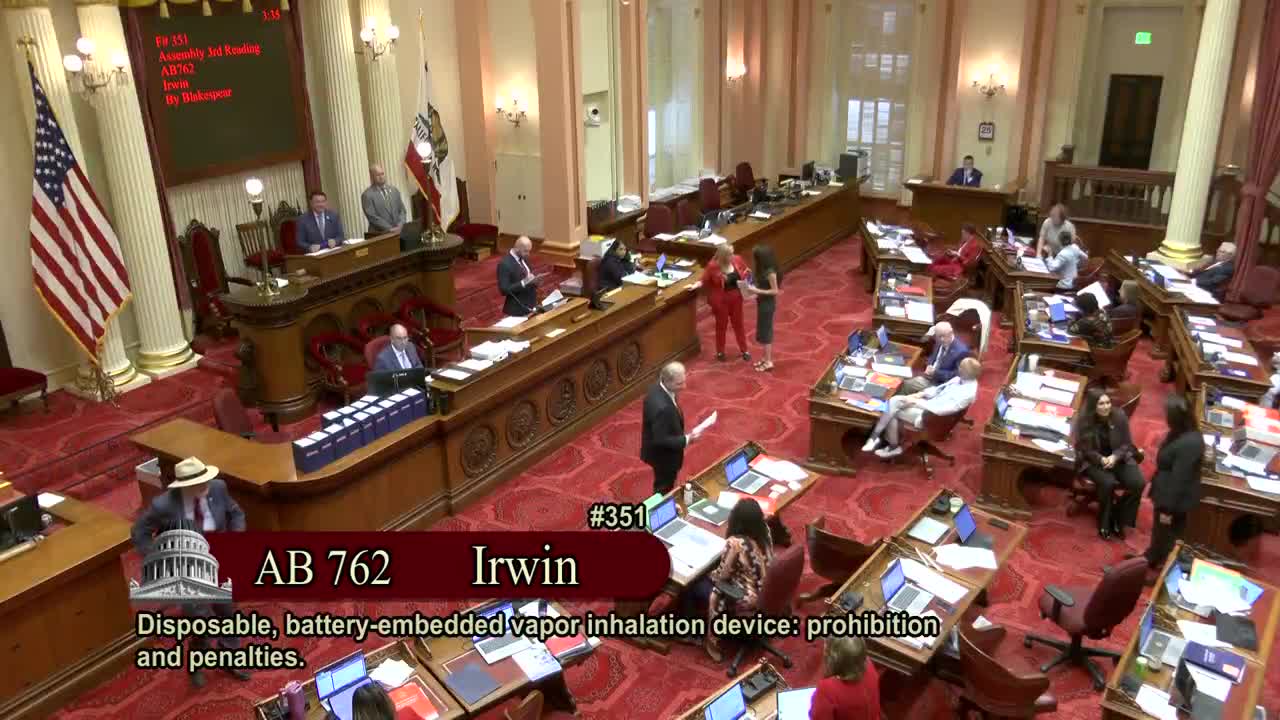 2MIN
Senate Floor
 49SEC
Senate Standing Committee on Appropriations
 10MIN
Senate Standing Committee on Environmental Quality
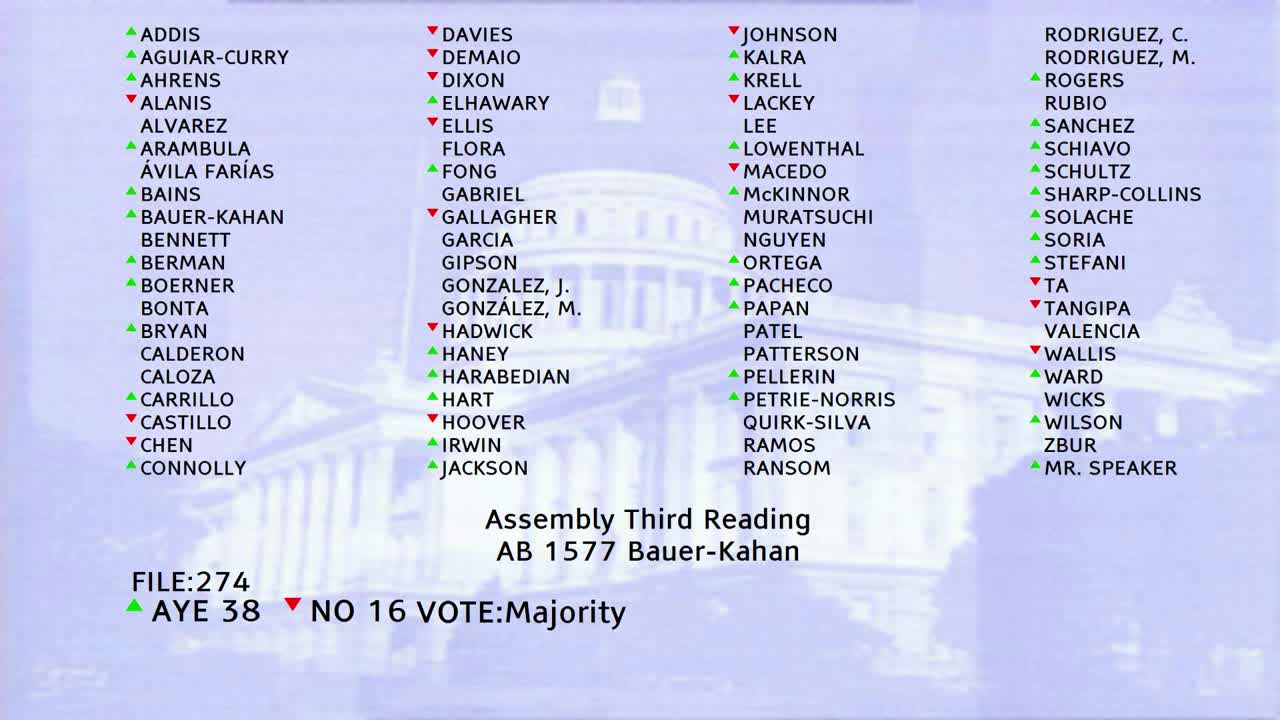 1MIN
Assembly Floor
 7MIN
Assembly Standing Committee on Judiciary
 9MIN
Assembly Standing Committee on Environmental Safety and Toxic Materials
Bill Author

Bill Co-Author(s):