AB 1655: CalWORKs: temporary absence: immigration detention.
- Session Year: 2025-2026
- House: Assembly
- Latest Version Date: 2026-09-29
Current Status:
Passed
(2026-09-29: Chaptered by Secretary of State - Chapter 742, Statutes of 2026.)
Introduced
In Committee
Awaiting First Chamber Vote
Passed First Chamber
In Committee
Awaiting Second Chamber Vote
Passed Second Chamber
Enacted
What does this bill do?
The bill allows CalWORKs families to treat a child or other member of their aid case who is held in a federal immigration detention facility as temporarily absent so the household can continue to receive its cash grant. The family remains eligible if the others still meet CalWORKs rules, the detained person intends to return if held out of state, and the detained person is otherwise eligible, and a written sworn statement from the applicant or recipient can be used to show the detention.
The summary is provided by generative AI which can make mistakes. For original language, please view the details in the table below.
Existing law establishes the California Work Opportunity and Responsibility to Kids (CalWORKs) program, under which, through a combination of federal, state, and county funds, each county provides cash assistance and other benefits to qualified low-income families.
Existing law sets forth provisions for the calculation of the amount of CalWORKs aid eligible to a household based in part on the size of the assistance unit. Under existing law and CalWORKs rules, aid is not affected for a member of the assistance unit who is temporarily absent from the home, and a child who is a patient in a public or private hospital for medical or surgical care is considered temporarily absent from the home for the duration of the hospital stay.
Under this bill, beginning July 1, 2027, or when the department notifies the Legislature that the Statewide Automated Welfare System can perform the necessary automations, whichever is later, a child or other member of the assistance unit who is detained in a federal immigration detention facility would be considered temporarily absent from the home for the duration of the detention. Under the bill, the assistance unit would remain eligible to continue receive assistance and services if specified conditions are met, including that the remaining members of the assistance unit continue to meet eligibility requirements. The bill would authorize any written sworn statement by the applicant or recipient to be sufficient to establish that a member of the assistance unit has been detained in an immigration detention facility. The bill would authorize the department to implement these provisions through all-county letters or similar written instructions until regulations are adopted. The bill would make related legislative findings.
By creating new duties for counties relating to expanded eligibility under CalWORKS, the bill would impose a state-mandated local program.
Existing law continuously appropriates moneys from the General Fund to defray a portion of county costs under the CalWORKs program.
This bill would instead provide that the continuous appropriation would not be made for purposes of the bill.
The California Constitution requires the state to reimburse local agencies and school districts for certain costs mandated by the state. Statutory provisions establish procedures for making that reimbursement.
This bill would provide that, if the Commission on State Mandates determines that the bill contains costs mandated by the state, reimbursement for those costs shall be made pursuant to the statutory provisions noted above.
Existing law establishes the California Work Opportunity and Responsibility to Kids (CalWORKs) program, under which, through a combination of federal, state, and county funds, each county provides cash assistance and other benefits to qualified low-income families.
Existing law sets forth provisions for the calculation of the amount of CalWORKs aid eligible to a household based in part on the size of the assistance unit. Under existing law and CalWORKs rules, aid is not affected for a member of the assistance unit who is temporarily absent from the home, and a child who is a patient in a public or private hospital for medical or surgical care is considered temporarily absent from the home for the duration of the hospital stay.
Under this bill, beginning July 1, 2027, or when the department notifies the Legislature that the Statewide Automated Welfare System can perform the necessary automations, whichever is later, a child or other member of the assistance unit who is detained in a federal immigration detention facility would be considered temporarily absent from the home for the duration of the detention. Under the bill, the assistance unit would remain eligible to continue receive assistance and services if specified conditions are met, including that the remaining members of the assistance unit continue to meet eligibility requirements. The bill would authorize a any written sworn statement by the applicant or recipient to be sufficient to establish that a member of the assistance unit has been detained in an immigration detention facility. The bill would authorize the department to implement these provisions through all-county letters or similar written instructions until regulations are adopted. The bill would make related legislative findings.
By creating new duties for counties relating to expanded eligibility under CalWORKS, the bill would impose a state-mandated local program.
Existing law continuously appropriates moneys from the General Fund to defray a portion of county costs under the CalWORKs program.
This bill would instead provide that the continuous appropriation would not be made for purposes of the bill.
The California Constitution requires the state to reimburse local agencies and school districts for certain costs mandated by the state. Statutory provisions establish procedures for making that reimbursement.
This bill would provide that, if the Commission on State Mandates determines that the bill contains costs mandated by the state, reimbursement for those costs shall be made pursuant to the statutory provisions noted above.
Existing law establishes the California Work Opportunity and Responsibility to Kids (CalWORKs) program, under which, through a combination of federal, state, and county funds, each county provides cash assistance and other benefits to qualified low-income families.
Existing law sets forth provisions for the calculation of the amount of CalWORKs aid eligible to a household based in part on the size of the assistance unit. Under existing law and CalWORKs rules, aid is not affected for a member of the assistance unit who is temporarily absent from the home, and a child who is a patient in a public or private hospital for medical or surgical care is considered temporarily absent from the home for the duration of the hospital stay.
Under this bill, beginning July 1, 2027, or when the department notifies the Legislature that the Statewide Automated Welfare System can perform the necessary automations, whichever is later, a child or other member of the assistance unit who is detained in a federal immigration detention facility would be considered temporarily absent from the home for the duration of the detention. Under the bill, the assistance unit would remain eligible to continue receive assistance and services if specified conditions are met, including that the remaining members of the assistance unit continue to meet eligibility requirements. The bill would authorize a sworn statement by the applicant or recipient to be sufficient to establish a report was submitted. that a member of the assistance unit has been detained in an immigration detention facility. The bill would authorize the department to implement these provisions through all-county letters or similar written instructions until regulations are adopted. The bill would make related legislative findings.
By creating new duties for counties relating to expanded eligibility under CalWORKs and reporting assistance, CalWORKS, the bill would impose a state-mandated local program.
Existing law continuously appropriates moneys from the General Fund to defray a portion of county costs under the CalWORKs program.
This bill would instead provide that the continuous appropriation would not be made for purposes of the bill.
The California Constitution requires the state to reimburse local agencies and school districts for certain costs mandated by the state. Statutory provisions establish procedures for making that reimbursement.
This bill would provide that, if the Commission on State Mandates determines that the bill contains costs mandated by the state, reimbursement for those costs shall be made pursuant to the statutory provisions noted above.
Existing law establishes the California Work Opportunity and Responsibility to Kids (CalWORKs) program, under which, through a combination of federal, state, and county funds, each county provides cash assistance and other benefits to qualified low-income families.
Existing law sets forth provisions for the calculation of the amount of CalWORKs aid eligible to a household based in part on the size of the assistance unit. Under existing law and CalWORKs rules, aid is not affected for a member of the assistance unit who is temporarily absent from the home, and a child who is a patient in a public or private hospital for medical or surgical care is considered temporarily absent from the home for the duration of the hospital stay.
Under this bill, beginning July 1, 2027, or when the department notifies the Legislature that the Statewide Automated Welfare System can perform the necessary automations, whichever is later, a child or other member of the assistance unit who is unlawfully detained in a federal immigration detention facility would be considered temporarily absent from the home for the duration of the detention. Under the bill, the member would be deemed to be unlawfully detained if a report of misconduct by federal agents is submitted to the California Attorney General. The bill would require a county human services agency, upon request, to inform and provide notice to an applicant or recipient household on how to submit that report. Under the bill, the assistance unit would remain eligible to continue receive assistance and services if specified conditions are met, including that the remaining members of the assistance unit continue to meet eligibility requirements. The bill would authorize a sworn statement by the applicant or recipient to be sufficient to establish a report was submitted. The bill would authorize the department to implement these provisions through all-county letters or similar written instructions until regulations are adopted. The bill would make related legislative findings.
By creating new duties for counties relating to expanded eligibility under CalWORKs and reporting assistance, the bill would impose a state-mandated local program.
Existing law continuously appropriates moneys from the General Fund to defray a portion of county costs under the CalWORKs program.
This bill would instead provide that the continuous appropriation would not be made for purposes of the bill.
The California Constitution requires the state to reimburse local agencies and school districts for certain costs mandated by the state. Statutory provisions establish procedures for making that reimbursement.
This bill would provide that, if the Commission on State Mandates determines that the bill contains costs mandated by the state, reimbursement for those costs shall be made pursuant to the statutory provisions noted above.
Existing law establishes the California Work Opportunity and Responsibility to Kids (CalWORKs) program, under which, through a combination of federal, state, and county funds, each county provides cash assistance and other benefits to qualified low-income families.
Existing law sets forth provisions for the calculation of the amount of CalWORKs aid eligible to a household based in part on the size of the assistance unit. Under existing law and CalWORKs rules, aid is not affected for a member of the assistance unit who is temporarily absent from the home, and a child who is a patient in a public or private hospital for medical or surgical care is considered temporarily absent from the home for the duration of the hospital stay.
Under this bill, a child or other member of the assistance unit who is unlawfully detained in a federal immigration detention facility would be considered temporarily absent from the home for the duration of the detention. Under the bill, the member would be deemed to be unlawfully detained if a report of misconduct by federal agents is submitted to the California Attorney General. The bill would require a county human services agency, upon request, to inform and provide notice to an applicant or recipient household on how to submit that report. The bill would make related legislative findings.
By creating new duties for counties relating to expanded eligibility under CalWORKs and reporting assistance, the bill would impose a state-mandated local program.
Existing law continuously appropriates moneys from the General Fund to defray a portion of county costs under the CalWORKs program.
This bill would instead provide that the continuous appropriation would not be made for purposes of the bill.
The California Constitution requires the state to reimburse local agencies and school districts for certain costs mandated by the state. Statutory provisions establish procedures for making that reimbursement.
This bill would provide that, if the Commission on State Mandates determines that the bill contains costs mandated by the state, reimbursement for those costs shall be made pursuant to the statutory provisions noted above.
Existing law establishes the California Work Opportunity and Responsibility to Kids (CalWORKs) program, under which, through a combination of federal, state, and county funds, each county provides cash assistance and other benefits to qualified low-income families.
Existing law sets forth provisions for the calculation of the amount of CalWORKs aid eligible to a household based in part on the size of the assistance unit. Under existing law and CalWORKs rules, aid is not affected for a member of the assistance unit who is temporarily absent from the home, and a child who is a patient in a public or private hospital for medical or surgical care is considered temporarily absent from the home for the duration of the hospital stay.
Under this bill, a child or other member of the assistance unit who is unlawfully detained in a federal immigration detention facility would be considered temporarily absent from the home for the duration of the detention. Under the bill, the member would be deemed to be unlawfully detained if a report of misconduct by federal agents is submitted to the California Attorney General. The bill would require a county human services agency, upon request, to provide assistance to an applicant or inform and provide notice to an applicant or recipient household with submitting on how to submit that report. The bill would make related legislative findings.
By creating new duties for counties relating to expanded eligibility under CalWORKs and reporting assistance, the bill would impose a state-mandated local program.
Existing law continuously appropriates moneys from the General Fund to defray a portion of county costs under the CalWORKs program.
This bill would instead provide that the continuous appropriation would not be made for purposes of the bill.
The California Constitution requires the state to reimburse local agencies and school districts for certain costs mandated by the state. Statutory provisions establish procedures for making that reimbursement.
This bill would provide that, if the Commission on State Mandates determines that the bill contains costs mandated by the state, reimbursement for those costs shall be made pursuant to the statutory provisions noted above.
Existing law establishes the California Work Opportunity and Responsibility to Kids (CalWORKs) program, under which, through a combination of federal, state, and county funds, each county provides cash assistance and other benefits to qualified low-income families.
Existing law sets forth provisions for the calculation of the amount of CalWORKs aid eligible to a household based in part on the size of the assistance unit. Under existing law and CalWORKs rules, aid is not affected for a member of the assistance unit who is temporarily absent from the home, and a child who is a patient in a public or private hospital for medical or surgical care is considered temporarily absent from the home for the duration of the hospital stay.
Under this bill, a child or other member of the assistance unit who is unlawfully detained in a federal immigration detention facility would be considered temporarily absent from the home for the duration of the detention. Under the bill, the member would be deemed to be unlawfully detained if a report of misconduct by federal agents is submitted to the California Attorney General. The bill would require a county human services agency, upon request, to provide assistance to an applicant or recipient household with submitting that report. The bill would make related legislative findings.
By creating new duties for counties relating to expanded eligibility under CalWORKs and reporting assistance, the bill would impose a state-mandated local program.
Existing law continuously appropriates moneys from the General Fund to defray a portion of county costs under the CalWORKs program.
This bill would instead provide that the continuous appropriation would not be made for purposes of the bill.
The California Constitution requires the state to reimburse local agencies and school districts for certain costs mandated by the state. Statutory provisions establish procedures for making that reimbursement.
This bill would provide that, if the Commission on State Mandates determines that the bill contains costs mandated by the state, reimbursement for those costs shall be made pursuant to the statutory provisions noted above.
(a)The Legislature finds and declares all of the following:
(1)All children are precious, and their childhood is sacred and worth protection by the government.
(2)Raids by the United States Immigration and Customs Enforcement (ICE) and military occupation have stolen the joy of childhood for countless children and have replaced it with fear and danger.
(3)During the first Trump administration, family separations were pursued by taking children from their parents when they crossed the southern border, but this practice was stopped with litigation.
(4)Now, under the second Trump administration, family separation is being deployed as a tactic to terrorize immigrant communities across the country.
(5)In 2025, ICE set a new record for how many children were taken into custody.
(6)There have been several high-profile cases of citizen children and other children with legal status being unlawfully arrested and detained.
(7)Here, in California, Benjamin Guerrero-Cruz, a student at Reseda Charter High School was detained by federal agents while walking his dog. He was held in ICE custody at the Adelanto Detention Center for over three months, causing him to miss the start of his senior year.
(8)This is just one of the dozens of instances in California where children have been arrested and detained, some violently, some at gunpoint.
(9)These children will forever be impacted by the violence of ICE arrests and detention. As California leaders work to find a resolution to these ICE raids, there are steps that California can take now to protect these youth and their families from economic harm as a result of childhood ICE detention.
(10)Californias CalWORKs program was established to protect the basic needs and lifetime opportunities of children in households that are impoverished.
(11)Due to an existing program rule, a childs portion of the familys very small CalWORKs grant must be reduced if the child is placed in an institution, though there are exemptions to this rule for temporary absences as set forth in law.
(b)It is the intent of the Legislature to extend statutory exemptions under the CalWORKs program in order to protect a family with an eligible child detained by ICE from losing portions of their basic needs grant as a result.
SEC. 2.Section 11269 of the Welfare and Institutions Code is amended to read:11269.(a)A child who is a patient in a public or private hospital for medical or surgical care shall be considered temporarily absent from the home for the duration of the hospital stay.
(b)This section shall become inoperative on July 1, 2027, or on the date the department notifies the Legislature that the Statewide Automated Welfare System can perform the necessary automation to implement Section 11269, as added by the act that added this subdivision, whichever date is later, and, as of January 1 of the following year, is repealed.
SEC. 3.Section 11269 is added to the Welfare and Institutions Code, to read:11269.(a)For the purposes of determining cash aid for CalWORKs, a child who is a patient in a public or private hospital for medical or surgical care shall be considered temporarily absent from the home for the duration of the hospital stay.
(b)(1)For the purposes of determining cash aid for CalWORKs, a child or other member of the assistance unit who is detained in a federal immigration detention facility shall be considered temporarily absent from the home for the duration of the detention. The assistance unit shall continue to remain eligible to receive continued assistance and services for this period if all of the following conditions are met:
(A)The remaining members of the assistance unit continue to meet eligibility requirements.
(B)If the member or members are held in detention outside of the state, the detained member or members intend to return to the state once they are released from detention.
(C)Except for the status of being detained, the detained family member is otherwise legally eligible for CalWORKs benefits.
(2)Any written sworn statement by the applicant or recipient shall be sufficient to establish that a member of the assistance unit has been detained in an immigration detention facility for purposes of this subdivision.
(c)Notwithstanding the rulemaking provisions of the Administrative Procedure Act (Chapter 3.5 (commencing with Section 11340) of Part 1 of Division 3 of Title 2 of the Government Code), the State Department of Social Services may implement and administer this section by means of all-county letters or similar instructions from the department until regulations are adopted. These all-county letters or similar written instructions shall have the same force and effect as regulations until the adoption of regulations.
(d)This section shall become operative on July 1, 2027, or on the date the department notifies the Legislature that the Statewide Automated Welfare System can perform the necessary automation to implement this section, whichever date is later.
SEC. 4.No appropriation pursuant to Section 15200 of the Welfare and Institutions Code shall be made for purposes of this act.
SEC. 5.If the Commission on State Mandates determines that this act contains costs mandated by the state, reimbursement to local agencies and school districts for those costs shall be made pursuant to Part 7 (commencing with Section 17500) of Division 4 of Title 2 of the Government Code.
(a)The Legislature finds and declares all of the following:
(1)All children are precious, and their childhood is sacred and worth protection by the government.
(2)Raids by the United States Immigration and Customs Enforcement (ICE) and military occupation have stolen the joy of childhood for countless children and have replaced it with fear and danger.
(3)During the first Trump administration, family separations were pursued by taking children from their parents when they crossed the southern border, but this practice was stopped with litigation.
(4)Now, under the second Trump administration, family separation is being deployed as a tactic to terrorize immigrant communities across the country.
(5)In 2025, ICE set a new record for how many children were taken into custody.
(6)There have been several high-profile cases of citizen children and other children with legal status being unlawfully arrested and detained.
(7)Here, in California, Benjamin Guerrero-Cruz, a student at Reseda Charter High School was detained by federal agents while walking his dog. He was held in ICE custody at the Adelanto Detention Center for over three months, causing him to miss the start of his senior year.
(8)This is just one of the dozens of instances in California where children have been arrested and detained, some violently, some at gunpoint.
(9)These children will forever be impacted by the violence of ICE arrests and detention. As California leaders work to find a resolution to these ICE raids, there are steps that California can take now to protect these youth and their families from economic harm as a result of childhood ICE detention.
(10)Californias CalWORKs program was established to protect the basic needs and lifetime opportunities of children in households that are impoverished.
(11)Due to an existing program rule, a childs portion of the familys very small CalWORKs grant must be reduced if the child is placed in an institution, though there are exemptions to this rule for temporary absences as set forth in law.
(b)It is the intent of the Legislature to extend statutory exemptions under the CalWORKs program in order to protect a family with an eligible child detained by ICE from losing portions of their basic needs grant as a result.
SEC. 2.Section 11269 of the Welfare and Institutions Code is amended to read:11269.(a)A child who is a patient in a public or private hospital for medical or surgical care shall be considered temporarily absent from the home for the duration of the hospital stay.
(b)This section shall become inoperative on July 1, 2027, or on the date the department notifies the Legislature that the Statewide Automated Welfare System can perform the necessary automation to implement Section 11269, as added by the act that added this subdivision, whichever date is later, and, as of January 1 of the following year, is repealed.
SEC. 3.Section 11269 is added to the Welfare and Institutions Code, to read:11269.(a)For the purposes of determining cash aid for CalWORKs, a child who is a patient in a public or private hospital for medical or surgical care shall be considered temporarily absent from the home for the duration of the hospital stay.
(b)(1)For the purposes of determining cash aid for CalWORKs, a child or other member of the assistance unit who is detained in a federal immigration detention facility shall be considered temporarily absent from the home for the duration of the detention. The assistance unit shall continue to remain eligible to receive continued assistance and services for this period if both all of the following conditions are met:
(A)The remaining members of the assistance unit continue to meet eligibility requirements.
(B)If the member or members are held in detention outside of the state, the detained member or members intend to return to the state once they are released from detention.
(C)Except for the status of being detained, the detained family member is otherwise legally eligible for CalWORKs benefits.
(2)A Any written sworn statement by the applicant or recipient shall be sufficient to establish that a member of the assistance unit has been detained in an immigration detention facility for purposes of this subdivision.
(c)Notwithstanding the rulemaking provisions of the Administrative Procedure Act (Chapter 3.5 (commencing with Section 11340) of Part 1 of Division 3 of Title 2 of the Government Code), the State Department of Social Services may implement and administer this section by means of all-county letters or similar instructions from the department until regulations are adopted. These all-county letters or similar written instructions shall have the same force and effect as regulations until the adoption of regulations.
(d)This section shall become operative on July 1, 2027, or on the date the department notifies the Legislature that the Statewide Automated Welfare System can perform the necessary automation to implement this section, whichever date is later.
SEC. 4.No appropriation pursuant to Section 15200 of the Welfare and Institutions Code shall be made for purposes of this act.
SEC. 5.If the Commission on State Mandates determines that this act contains costs mandated by the state, reimbursement to local agencies and school districts for those costs shall be made pursuant to Part 7 (commencing with Section 17500) of Division 4 of Title 2 of the Government Code.
(a)The Legislature finds and declares all of the following:
(1)All children are precious, and their childhood is sacred and worth protection by the government.
(2)Raids by the United States Immigration and Customs Enforcement (ICE) and military occupation have stolen the joy of childhood for countless children and have replaced it with fear and danger.
(3)During the first Trump administration, family separations were pursued by taking children from their parents when they crossed the southern border, but this practice was stopped with litigation.
(4)Now, under the second Trump administration, family separation is being deployed as a tactic to terrorize immigrant communities across the country.
(5)In 2025, ICE set a new record for how many children were taken into custody.
(6)There have been several high-profile cases of citizen children and other children with legal status being unlawfully arrested and detained.
(7)Here, in California, Benjamin Guerrero-Cruz, a student at Reseda Charter High School was detained by federal agents while walking his dog. He was held in ICE custody at the Adelanto Detention Center for over three months, causing him to miss the start of his senior year.
(8)This is just one of the dozens of instances in California where children have been arrested and detained, some violently, some at gunpoint.
(9)These children will forever be impacted by the violence of ICE arrests and detention. As California leaders work to find a resolution to these ICE raids, there are steps that California can take now to protect these youth and their families from economic harm as a result of childhood ICE detention.
(10)Californias CalWORKs program was established to protect the basic needs and lifetime opportunities of children in households that are impoverished.
(11)Due to an existing program rule, a childs portion of the familys very small CalWORKs grant must be reduced if the child is placed in an institution, though there are exemptions to this rule for temporary absences as set forth in law.
(b)It is the intent of the Legislature to extend statutory exemptions under the CalWORKs program in order to protect a family with an eligible child detained by ICE from losing portions of their basic needs grant as a result.
SEC. 2.Section 11269 of the Welfare and Institutions Code is amended to read:11269.(a)A child who is a patient in a public or private hospital for medical or surgical care shall be considered temporarily absent from the home for the duration of the hospital stay.
(b)This section shall become inoperative on July 1, 2027, or on the date the department notifies the Legislature that the Statewide Automated Welfare System can perform the necessary automation to implement Section 11269, as added by the act that added this subdivision, whichever date is later, and, as of January 1 of the following year, is repealed.
SEC. 3.Section 11269 is added to the Welfare and Institutions Code, to read:11269.(a)For the purposes of determining cash aid for CalWORKs, a child who is a patient in a public or private hospital for medical or surgical care shall be considered temporarily absent from the home for the duration of the hospital stay.
(b)(1)For the purposes of determining cash aid for CalWORKs, a child or other member of the assistance unit who is detained in a federal immigration detention facility shall be considered temporarily absent from the home for the duration of the detention. The assistance unit shall continue to remain eligible to receive continued assistance and services for this period if both of the following conditions are met:
(A)The remaining members of the assistance unit continue to meet eligibility requirements.
(B)If the member or members are held in detention outside of the state, the detained member or members intend to return to the state once they are released from detention.
(2)A sworn statement by the applicant or recipient shall be sufficient to establish a report was submitted that a member of the assistance unit has been detained in an immigration detention facility for purposes of this subdivision.
(c)Notwithstanding the rulemaking provisions of the Administrative Procedure Act (Chapter 3.5 (commencing with Section 11340) of Part 1 of Division 3 of Title 2 of the Government Code), the State Department of Social Services may implement and administer this section by means of all-county letters or similar instructions from the department until regulations are adopted. These all-county letters or similar written instructions shall have the same force and effect as regulations until the adoption of regulations.
(d)This section shall become operative on July 1, 2027, or on the date the department notifies the Legislature that the Statewide Automated Welfare System can perform the necessary automation to implement this section, whichever date is later.
SEC. 4.No appropriation pursuant to Section 15200 of the Welfare and Institutions Code shall be made for purposes of this act.
SEC. 5.If the Commission on State Mandates determines that this act contains costs mandated by the state, reimbursement to local agencies and school districts for those costs shall be made pursuant to Part 7 (commencing with Section 17500) of Division 4 of Title 2 of the Government Code.
(a)The Legislature finds and declares all of the following:
(1)All children are precious, and their childhood is sacred and worth protection by the government.
(2)Raids by the United States Immigration and Customs Enforcement (ICE) and military occupation have stolen the joy of childhood for countless children and have replaced it with fear and danger.
(3)During the first Trump administration, family separations were pursued by taking children from their parents when they crossed the southern border, but this practice was stopped with litigation.
(4)Now, under the second Trump administration, family separation is being deployed as a tactic to terrorize immigrant communities across the country.
(5)In 2025, ICE set a new record for how many children were taken into custody.
(6)There have been several high-profile cases of citizen children and other children with legal status being unlawfully arrested and detained.
(7)Here, in California, Benjamin Guerrero-Cruz, a student at Reseda Charter High School was detained by federal agents while walking his dog. He was held in ICE custody at the Adelanto Detention Center for over three months, causing him to miss the start of his senior year.
(8)This is just one of the dozens of instances in California where children have been arrested and detained, some violently, some at gunpoint.
(9)These children will forever be impacted by the violence of ICE arrests and detention. As California leaders work to find a resolution to these ICE raids, there are steps that California can take now to protect these youth and their families from economic harm as a result of childhood ICE detention.
(10)Californias CalWORKs program was established to protect the basic needs and lifetime opportunities of children in households that are impoverished.
(11)Due to an existing program rule, a childs portion of the familys very small CalWORKs grant must be reduced if the child is placed in an institution, though there are exemptions to this rule for temporary absences as set forth in law.
(b)It is the intent of the Legislature to extend statutory exemptions under the CalWORKs program in order to protect a family with an eligible child detained by ICE from losing portions of their basic needs grant as a result.
SEC. 2.Section 11269 of the Welfare and Institutions Code is amended to read:11269.(a)For the purposes of determining cash aid for CalWORKs, a child who is a patient in a public or private hospital for medical or surgical care shall be considered temporarily absent from the home for the duration of the hospital stay.(b)(1)For the purposes of determining cash aid for CalWORKs, a child or other member of the assistance unit who is unlawfully detained in a federal immigration detention facility shall be considered temporarily absent from the home for the duration of the detention.(2)(A)For purposes of this chapter, a child or other member of the assistance unit shall be deemed to be unlawfully detained in a federal immigration detention facility if a report of misconduct by federal agents is submitted to the California Attorney General. A confirmation message from the Attorney General that the submission was received shall be sufficient to establish a report was submitted for purposes of this subparagraph.(B)For purposes of this chapter, upon request, a county human services agency shall inform and provide notice to an applicant or recipient household on how to submit a report of misconduct by federal agents to the California Attorney General.SEC. 2.Section 11269 of the Welfare and Institutions Code is amended to read:11269.(a)A child who is a patient in a public or private hospital for medical or surgical care shall be considered temporarily absent from the home for the duration of the hospital stay.
(b)This section shall become inoperative on July 1, 2027, or on the date the department notifies the Legislature that the Statewide Automated Welfare System can perform the necessary automation to implement Section 11269, as added by the act that added this subdivision, whichever date is later, and, as of January 1 of the following year, is repealed.
SEC. 3.Section 11269 is added to the Welfare and Institutions Code, to read:11269.(a)For the purposes of determining cash aid for CalWORKs, a child who is a patient in a public or private hospital for medical or surgical care shall be considered temporarily absent from the home for the duration of the hospital stay.
(b)(1)For the purposes of determining cash aid for CalWORKs, a child or other member of the assistance unit who is detained in a federal immigration detention facility shall be considered temporarily absent from the home for the duration of the detention. The assistance unit shall continue to remain eligible to receive continued assistance and services for this period if both of the following conditions are met:
(A)The remaining members of the assistance unit continue to meet eligibility requirements.
(B)If the member or members are held in detention outside of the state, the detained member or members intend to return to the state once they are released from detention.
(2)A sworn statement by the applicant or recipient shall be sufficient to establish a report was submitted for purposes of this subdivision.
(c)Notwithstanding the rulemaking provisions of the Administrative Procedure Act (Chapter 3.5 (commencing with Section 11340) of Part 1 of Division 3 of Title 2 of the Government Code), the State Department of Social Services may implement and administer this section by means of all-county letters or similar instructions from the department until regulations are adopted. These all-county letters or similar written instructions shall have the same force and effect as regulations until the adoption of regulations.
(d)This section shall become operative on July 1, 2027, or on the date the department notifies the Legislature that the Statewide Automated Welfare System can perform the necessary automation to implement this section, whichever date is later.
SEC. 3.SEC. 4.No appropriation pursuant to Section 15200 of the Welfare and Institutions Code shall be made for purposes of this act.
SEC. 4.SEC. 5.If the Commission on State Mandates determines that this act contains costs mandated by the state, reimbursement to local agencies and school districts for those costs shall be made pursuant to Part 7 (commencing with Section 17500) of Division 4 of Title 2 of the Government Code.
(a)The Legislature finds and declares all of the following:
(1)All children are precious, and their childhood is sacred and worth protection by the government.
(2)Raids by the United States Immigration and Customs Enforcement (ICE) and military occupation have stolen the joy of childhood for countless children and have replaced it with fear and danger.
(3)During the first Trump administration, family separations were pursued by taking children from their parents when they crossed the southern border, but this practice was stopped with litigation.
(4)Now, under the second Trump administration, family separation is being deployed as a tactic to terrorize immigrant communities across the country.
(5)In 2025, ICE set a new record for how many children were taken into custody.
(6)There have been several high-profile cases of citizen children and other children with legal status being unlawfully arrested and detained.
(7)Here, in California, Benjamin Guerrero-Cruz, a student at Reseda Charter High School was detained by federal agents while walking his dog. He was held in ICE custody at the Adelanto Detention Center for over three months, causing him to miss the start of his senior year.
(8)This is just one of the dozens of instances in California where children have been arrested and detained, some violently, some at gunpoint.
(9)These children will forever be impacted by the violence of ICE arrests and detention. As California leaders work to find a resolution to these ICE raids, there are steps that California can take now to protect these youth and their families from economic harm as a result of childhood ICE detention.
(10)Californias CalWORKs program was established to protect the basic needs and lifetime opportunities of children in households that are impoverished.
(11)Due to an existing program rule, a childs portion of the familys very small CalWORKs grant must be reduced if the child is placed in an institution, though there are exemptions to this rule for temporary absences as set forth in law.
(b)It is the intent of the Legislature to extend statutory exemptions under the CalWORKs program in order to protect a family with an eligible child detained by ICE from losing portions of their basic needs grant as a result.
SEC. 2.Section 11269 of the Welfare and Institutions Code is amended to read:11269.(a)For the purposes of determining cash aid for CalWORKS, CalWORKs, a child who is a patient in a public or private hospital for medical or surgical care shall be considered temporarily absent from the home for the duration of the hospital stay.
(b)(1)For the purposes of determining cash aid for CalWORKS, CalWORKs, a child or other member of the assistance unit who is unlawfully detained in a federal immigration detention facility shall be considered temporarily absent from the home for the duration of the detention.
(2)(A)For purposes of this chapter, a child or other member of the assistance unit shall be deemed to be unlawfully detained in a federal immigration detention facility if a report of misconduct by federal agents is submitted to the California Attorney General. A confirmation message from the Attorney General that the submission was received shall be sufficient to establish a report was submitted for purposes of this subparagraph.
(B)For purposes of this chapter, upon request, a county human services agency shall inform and provide notice to an applicant or recipient household on how to submit a report of misconduct by federal agents to the California Attorney General.
SEC. 3.No appropriation pursuant to Section 15200 of the Welfare and Institutions Code shall be made for purposes of this act.
SEC. 4.If the Commission on State Mandates determines that this act contains costs mandated by the state, reimbursement to local agencies and school districts for those costs shall be made pursuant to Part 7 (commencing with Section 17500) of Division 4 of Title 2 of the Government Code.
(a)The Legislature finds and declares all of the following:
(1)All children are precious, and their childhood is sacred and worth protection by the government.
(2)Raids by the United States Immigration and Customs Enforcement (ICE) and military occupation have stolen the joy of childhood for countless children and have replaced it with fear and danger.
(3)During the first Trump administration, family separations were pursued by taking children from their parents when they crossed the southern border, but this practice was stopped with litigation.
(4)Now, under the second Trump administration, family separation is being deployed as a tactic to terrorize immigrant communities across the country.
(5)In 2025, ICE set a new record for how many children were taken into custody.
(6)There have been several high-profile cases of citizen children and other children with legal status being unlawfully arrested and detained.
(7)Here, in California, Benjamin Guerrero-Cruz, a student at Reseda Charter High School was detained by federal agents while walking his dog. He was held in ICE custody at the Adelanto Detention Center for over three months, causing him to miss the start of his senior year.
(8)This is just one of the dozens of instances in California where children have been arrested and detained, some violently, some at gunpoint.
(9)These children will forever be impacted by the violence of ICE arrests and detention. As California leaders work to find a resolution to these ICE raids, there are steps that California can take now to protect these youth and their families from economic harm as a result of childhood ICE detention.
(10)Californias CalWORKs program was established to protect the basic needs and lifetime opportunities of children in households that are impoverished.
(11)Due to an existing program rule, a childs portion of the familys very small CalWORKs grant must be reduced if the child is placed in an institution, though there are exemptions to this rule for temporary absences as set forth in law.
(b)It is the intent of the Legislature to extend statutory exemptions under the CalWORKs program in order to protect a family with an eligible child detained by ICE from losing portions of their basic needs grant as a result.
SEC. 2.Section 11269 of the Welfare and Institutions Code is amended to read:11269.(a)A For the purposes of determining cash aid for CalWORKS, a child who is a patient in a public or private hospital for medical or surgical care shall be considered temporarily absent from the home for the duration of the hospital stay.
(b)(1)A For the purposes of determining cash aid for CalWORKS, a child or other member of the assistance unit who is unlawfully detained in a federal immigration detention facility shall be considered temporarily absent from the home for the duration of the detention.
(2)(A)For purposes of this subdivision, chapter, a child or other member of the assistance unit shall be deemed to be unlawfully detained in a federal immigration detention facility if a report of misconduct by federal agents is submitted to the California Attorney General.
(B)For purposes of this subdivision, chapter, upon request, a county human services agency shall provide assistance to an applicant or inform and provide notice to an applicant or recipient household with submitting a report of unlawful detention on how to submit a report of misconduct by federal agents to the California Attorney General.
SEC. 3.No appropriation pursuant to Section 15200 of the Welfare and Institutions Code shall be made for purposes of this act.
SEC. 4.If the Commission on State Mandates determines that this act contains costs mandated by the state, reimbursement to local agencies and school districts for those costs shall be made pursuant to Part 7 (commencing with Section 17500) of Division 4 of Title 2 of the Government Code.
(a)The Legislature finds and declares all of the following:
(1)All children are precious, and their childhood is sacred and worth protection by the government.
(2)Raids by the United States Immigration and Customs Enforcement (ICE) and military occupation have stolen the joy of childhood for countless children and have replaced it with fear and danger.
(3)During the first Trump administration, family separations were pursued by taking children from their parents when they crossed the southern border, but this practice was stopped with litigation.
(4)Now, under the second Trump administration, family separation is being deployed as a tactic to terrorize immigrant communities across the country.
(5)In 2025, ICE set a new record for how many children were taken into custody.
(6)There have been several high-profile cases of citizen children and other children with legal status being unlawfully arrested and detained.
(7)Here, in California, Benjamin Guerrero-Cruz, a student at Reseda Charter High School was detained by federal agents while walking his dog. He was held in ICE custody at the Adelanto Detention Center for over three months, causing him to miss the start of his senior year.
(8)This is just one of the dozens of instances in California where children have been arrested and detained, some violently, some at gunpoint.
(9)These children will forever be impacted by the violence of ICE arrests and detention. As California leaders work to find a resolution to these ICE raids, there are steps that California can take now to protect these youth and their families from economic harm as a result of childhood ICE detention.
(10)Californias CalWORKs program was established to protect the basic needs and lifetime opportunities of children in households that are impoverished.
(11)Due to an existing program rule, a childs portion of the familys very small CalWORKs grant must be reduced if the child is placed in an institution, though there are exemptions to this rule for temporary absences as set forth in law.
(b)It is the intent of the Legislature to extend statutory exemptions under the CalWORKs program in order to protect a family with an eligible child detained by ICE from losing portions of their basic needs grant as a result.
SEC. 2.Section 11269 of the Welfare and Institutions Code is amended to read:11269.(a)A child who is a patient in a public or private hospital for medical or surgical care shall be considered temporarily absent from the home for the duration of the hospital stay.
(b)(1)A child or other member of the assistance unit who is unlawfully detained in a federal immigration detention facility shall be considered temporarily absent from the home for the duration of the detention.
(2)(A)For purposes of this subdivision, a child or other member of the assistance unit shall be deemed to be unlawfully detained in a federal immigration detention facility if a report of misconduct by federal agents is submitted to the California Attorney General.
(B)For purposes of this subdivision, upon request, a county human services agency shall provide assistance to an applicant or recipient household with submitting a report of unlawful detention to the California Attorney General.
SEC. 3.No appropriation pursuant to Section 15200 of the Welfare and Institutions Code shall be made for purposes of this act.
SEC. 4.If the Commission on State Mandates determines that this act contains costs mandated by the state, reimbursement to local agencies and school districts for those costs shall be made pursuant to Part 7 (commencing with Section 17500) of Division 4 of Title 2 of the Government Code.
|
Date
|
Status
|
|---|---|
| Sep 29, 2026 | Chaptered by Secretary of State - Chapter 742, Statutes of 2026. |
| Sep 29, 2026 | Approved by the Governor. |
| Aug 31, 2026 | Enrolled and presented to the Governor at 4 p.m. |
| Aug 25, 2026 | Senate amendments concurred in. To Engrossing and Enrolling. (Ayes 62. Noes 11.). |
| Aug 25, 2026 | Senate amendments concurred in. To Engrossing and Enrolling. (Ayes 62. Noes 11. Page 6447.). |
| Aug 20, 2026 | In Assembly. Concurrence in Senate amendments pending. |
| Aug 20, 2026 | Read third time. Passed. Ordered to the Assembly. (Ayes 28. Noes 10.). |
| Aug 20, 2026 | Read third time. Passed. Ordered to the Assembly. (Ayes 28. Noes 10. Page 5584.). |
| Aug 17, 2026 | Read second time. Ordered to third reading. |
| Aug 13, 2026 | Read second time and amended. Ordered returned to second reading. |
| Aug 13, 2026 | From committee: Amend, and do pass as amended. (Ayes 5. Noes 2.) (August 13). |
| Aug 3, 2026 | In committee: Referred to APPR. suspense file. |
| Jul 7, 2026 | Read second time and amended. Re-referred to Com. on APPR. |
| Jul 7, 2026 | From committee: Amend, and do pass as amended and re-refer to Com. on APPR. (Ayes 11. Noes 2.) (June 30). |
| Jun 29, 2026 | From committee: Do pass and re-refer to Com. on JUD. (Ayes 4. Noes 1.) (June 29). Re-referred to Com. on JUD. |
| Jun 22, 2026 | From committee chair, with author's amendments: Amend, and re-refer to committee. Read second time, amended, and re-referred to Com. on HUMAN S. |
| Jun 10, 2026 | Referred to Coms. on HUMAN S. and JUD. |
| May 28, 2026 | In Senate. Read first time. To Com. on RLS. for assignment. |
| May 27, 2026 | Read third time. Passed. Ordered to the Senate. (Ayes 61. Noes 14.) |
| May 27, 2026 | Read third time. Passed. Ordered to the Senate. (Ayes 61. Noes 14. Page 5428.) |
| May 27, 2026 | Read third time. Passed. Ordered to the Senate. |
| May 18, 2026 | Read second time. Ordered to third reading. |
| May 14, 2026 | From committee: Do pass. (Ayes 11. Noes 3.) (May 14). |
| May 6, 2026 | In committee: Set, first hearing. Referred to APPR. suspense file. |
| Apr 13, 2026 | Re-referred to Com. on APPR. |
| Apr 9, 2026 | Read second time and amended. |
| Apr 8, 2026 | From committee: Amend, and do pass as amended and re-refer to Com. on APPR. (Ayes 9. Noes 2.) (April 7). |
| Apr 6, 2026 | Re-referred to Com. on JUD. |
| Mar 26, 2026 | Read second time and amended. |
| Mar 25, 2026 | From committee: Amend, and do pass as amended and re-refer to Com. on JUD. (Ayes 5. Noes 0.) (March 24). |
| Feb 17, 2026 | Referred to Coms. on HUM. S. and JUD. |
| Jan 30, 2026 | From printer. May be heard in committee March 1. |
| Jan 29, 2026 | Read first time. To print. |
|
Date
|
Description
|
Location
|
Votes
|
|
|---|---|---|---|---|
| Aug 25, 2026 | AB 1655 Bryan Concurrence in Senate Amendments | Assembly Floor |
Passed |
|
| Aug 20, 2026 | Assembly 3rd Reading AB1655 Bryan et al. By Durazo | Senate Floor |
Passed |
|
| Aug 13, 2026 | Do pass as amended | Senate Standing Committee on Appropriations |
Passed |
|
| Aug 3, 2026 | Placed on suspense file | Senate Standing Committee on Appropriations |
Passed |
|
| Jun 30, 2026 | Do pass as amended, but first amend, and re-refer to the Committee on [Appropriations] | Senate Standing Committee on Judiciary |
Passed |
|
| Jun 29, 2026 | Do pass, but first be re-referred to the Committee on [Judiciary] | Senate Standing Committee on Human Services |
Passed |
|
| May 27, 2026 | AB 1655 Bryan Assembly Third Reading | Assembly Floor |
Passed |
|
| May 14, 2026 | Do pass. | Assembly Standing Committee on Appropriations |
Passed |
|
| Apr 7, 2026 | Do pass as amended and be re-referred to the Committee on [Appropriations] | Assembly Standing Committee on Judiciary |
Passed |
|
| Mar 24, 2026 | Do pass as amended and be re-referred to the Committee on [Judiciary] | Assembly Standing Committee on Human Services |
Passed |
This list shows positions taken on this bill by organizations on the date displayed, which is linked to the original source.
Positions by individuals are not included.
|
Organization
|
Position
|
Date
|
|---|---|---|
| Aclu California Action | ** Support | |
| California Association Of Food Banks | ** Support | |
| California Charter Schools Association | ** Support | |
| California Faculty Association | ** Support | |
| California Immigrant Policy Center | ** Support | |
| California Network for Immigrant and Worker Justice | ** Support | |
| California Partnership To End Domestic Violence | ** Support | |
| California Rural Legal Assistance Foundation, Inc. | ** Support | |
| California Welfare Fraud Investigators Association | ** Against | |
| California Wic Association | ** Support | |
| CFT – a Union of Educators & Classified Professionals, AFT, AFL-CIO | ** Support | |
| Coalition of California Welfare Rights Organizations (CCWRO) | ** Support | |
| Communities United for Restorative Youth Justice (CURYJ) | ** Support | |
| Community Legal Services in East Palo Alto | ** Support | |
| Courage California | ** Support | |
| Culver City Democratic Club | ** Support | |
| End Child Poverty California | ** Support | |
| First 5 La | ** Support | |
| NextGen California | ** Support | |
| Protecting Kids from ICE Act | ** Support | |
| SAN DIEGO; COUNTY OF | ** Support | |
| Santa Monica Democratic Club | ** Support | |
| SEIU California | ** Support | |
| Southeast Asia Resource Action Center | ** Support | |
| The Children's Partnership | ** Support | |
| western center on law & poverty | ** Support |
CONCURRENCE IN SENATE AMENDMENTS
CSA1 Bill Id:AB 1655
Author:(Bryan)
As Amended Ver:August 13, 2026
Majority vote
SUMMARY
Establishes that when a child or other member of the assistance unit (AU) is unlawfully detained in a federal immigration detention facility, they are to be considered temporarily absent from the home for the duration of the detention for the purposes of calculating a California Work Opportunity and Responsibility to Kids (CalWORKs) benefit amount if specified conditions are met.
Senate Amendments
- Clarify that the AU meets the following conditions:
- The remaining members of the household continue to meet CalWORKs eligibility requirements.
- If the member or members are held in detention outside of the state, the detained member or members intend to return to the state once they are released from detention.
- Except for the status of being detained, the detained family member is otherwise legally eligible for CalWORKs benefits.
- Strike the requirement that a report of misconduct must be submitted to the Attorney General, and instead provide that any sworn statement by the CalWORKs applicant or recipient shall be sufficient to establish a member of the assistance unit has been detained in an immigration detention facility for purposes of this bill.
- Allow the California Department of Social Services to implement and administer this bill through all- county letters or similar instructions until regulations are adopted.
- Make this bill operative on July 1, 2027, or on the date the department notifies the Legislature that the Statewide Automated Welfare System can perform the necessary automation to implement this section, whichever is later.
COMMENTS
CalWORKs provides monthly income assistance and employment-related services aimed at moving children out of poverty and helping families meet basic needs. CalWORKs aid payments are calculated based on family income and the number of people in the AU. In order to be eligible and counted in the AU, applicants must be United States citizens, lawful permanent residents, or qualified immigrants. Counties verify citizenship or proof of legal immigration status.
Payments are not provided to the family for any member who is not a part of the AU. In child-only CalWORKs cases, in which there is no aided adult, children are the only recipients of aid. When a child is no longer residing in the home, an AU is reduced or terminated. The only exception is when a child included in the AU experiences a prolonged hospital stay, regardless of the type of hospital, the parent is deemed "temporarily absent" from the household, and aid payments and services continue to be provided to the whole family. This bill would expand this exception to include a child or other member of the AU who is unlawfully detained in a federal immigration detention facility.
There are a few different scenarios when a family might lose CalWORKs aid due to unlawful immigration detention. For example, Parent 1 is documented, Parent 2 is undocumented, and their child is documented. U.S. Immigration and Customs Enforcement (ICE) could sweep the whole family, including the child, and detain them unlawfully while they determine whether they are documented. In that case, Parent 1 and the child may be on CalWORKs, or child-only CalWORKs, and lose aid.
According to media reports, while ICE determines documentation status, people are being unlawfully detained for weeks at a time. According to the Marshall Project, "ICE has booked at least 3,800 children into detention since Trump took office last year. At least 1,000 children were held longer than 20 days, a court-ordered limit on child detention” (Flagg and Heffernan, 2025)[1]. AP News similarly reported that, "hundreds of immigrant children lingered in federal detention beyond a court-mandated limit, including some who were held more than five months, according to court filings that alarmed legal advocates who say the government is failing to safeguard children" (Gonzalez, 2025)[2].
These families are facing legal costs, possible job loss, and education disruption. Research published in the Journal on Migration and Human Security entitled “The Household Financial Losses Triggered by an Immigration Arrest, and How State and Local Government Can Most Effectively Protect Their Constituents” found that each immigration arrest results in an average of $24,151 in accumulated and permanent financial losses to each affected household (Boyce and Launius, 2020)[3]. In addition to the major costs associated with detention, individuals who are also CalWORKs recipients are at-risk of losing CalWORKs aid because they are not allowed to be counted in the AU.
ICE is disproportionately profiling people of color in its detention operations. The recent United States Supreme Court decision Noem v. Vasquez Perdomo*, 596 U. S. (2025) allows ICE to use the following criteria when making investigative stops:
- The type of location at which they were found (such as a car wash or bus stop);
- The type of job they appeared to work;
- Whether they speak Spanish or English with an accent;
- Their apparent race or ethnicity.
Based on ICE's admitted targeting of people who present as immigrants, people of color may also disproportionately lose benefits based on profiling. This bill may help these individuals when they are wrongly and illegally targeted to maintain their lifelines.
According to the Author
"When ICE kidnaps a child, families are thrown into a traumatic situation. Parents must juggle legal battles, missed wages, and the fear of not knowing when their child will return home. Despite this trauma, California law does not clearly protect these families from losing CalWORKs support during a child's detention, exposing them to sudden income loss and jeopardizing their ability to maintain housing, food, and stability for their other children."
"[This bill] closes this harmful gap by ensuring that immigration detention counts as a temporary absence under CalWORKs for the duration of the detention. It ensures families keep their full grant and access to job training while they work to reunify with their child. It provides the stability families need to survive one of the most traumatic events a family and child can experience. "
Arguments in Support
According to First 5 LA, this bill "provides a targeted safeguard to help prevent disruptions in critical assistance that families rely on to remain housed, fed, and stable. By minimizing unnecessary benefit loss, the bill helps avoid downstream costs associated with deeper poverty, housing instability, and adverse childhood experiences. It is critical that California’s safety net programs function as intended -- supporting children and families through periods of crisis and mitigating harm where possible."
Arguments in Opposition
According to the California Welfare Fraud Investigators Association, "The reporting person should be required to sign a county Human Services/Social Services self-attestation form that is required in many other instances when requesting or continuing CalWORKS aid. The form would be signed under the penalty of perjury… All CalWORKS initial applications for aid, semi-annual reports, annual recertifications, and many other self-certifications forms filled out by recipients incorporate the signed under penalty of perjury notice. The reporting member should provide the location of the detention facility where the Assistance member is detained upon request for aid.
"Applicant fraud in the CalWORKS and CalFRESH programs has increased in the last few years. Some applicants/recipients are under stress mentally and financially when applying for aid. Their objective is to provide aid for their family. Sometimes this can cause them to make poor decisions by intentionally giving false information. The Perjury notice can cause a recipient to pause and think. This Bill due to lack of fraud protection is allowing recipients to be exposed to possible felony criminal prosecution and ultimately diverting resources away from those who truly need assistance."
FISCAL COMMENTS
According to the Senate Appropriations Committee on August 13, 2026, "Unknown ongoing General Fund costs, potentially low millions per every 100 CalWORKs families, for grants, employment services, and child care services. Unknown one-time General Fund costs, potentially low hundreds of thousands, for automation. Unknown costs to counties for administration. Costs would be potentially reimbursable by the state, subject to a determination by the Commission on State Mandates."
VOTES:
ASM HUMAN SERVICES: 5-0-2
YES: Lee, Gipson, Elhawary, Jackson, Solache
ABS, ABST OR NV: Castillo, Tangipa
ASM JUDICIARY: 9-2-1
YES: Kalra, Lee, Bryan, Connolly, Harabedian, Pacheco, Papan, Stefani, Zbur
NO: Macedo, Sanchez
ABS, ABST OR NV: Dixon
ASM APPROPRIATIONS: 11-3-1
YES: Wicks, Aguiar-Curry, Calderon, Caloza, Fong, Mark González, Krell, Pacheco, Pellerin, Sharp-Collins, Solache
NO: Dixon, Ta, Tangipa
ABS, ABST OR NV: Hoover
ASSEMBLY FLOOR: 61-14-5
YES: Addis, Aguiar-Curry, Ahrens, Alanis, Alvarez, Arambula, Ávila Farías, Bains, Bauer-Kahan, Bennett, Berman, Boerner, Bonta, Bryan, Calderon, Caloza, Carrillo, Connolly, Elhawary, Fong, Gabriel, Garcia, Gipson, Mark González, Haney, Harabedian, Hart, Irwin, Jackson, Kalra, Krell, Lee, Lowenthal, McKinnor, Muratsuchi, Nguyen, Ortega, Pacheco, Papan, Patel, Pellerin, Petrie-Norris, Quirk-Silva, Ramos, Ransom, Michelle Rodriguez, Rogers, Blanca Rubio, Schiavo, Schultz, Sharp-Collins, Solache, Soria, Stefani, Valencia, Wallis, Ward, Wicks, Wilson, Zbur, Rivas
NO: Chen, DeMaio, Dixon, Ellis, Flora, Gallagher, Hadwick, Johnson, Lackey, Macedo, Patterson, Sanchez, Ta, Tangipa
ABS, ABST OR NV: Castillo, Davies, Jeff Gonzalez, Hoover, Celeste Rodriguez
SENATE FLOOR: 28-10-2
YES: Allen, Archuleta, Arreguín, Ashby, Becker, Blakespear, Cabaldon, Caballero, Cervantes, Cortese, Durazo, Gonzalez, Grayson, Hurtado, Laird, Limón, McGuire, McNerney, Menjivar, Pérez, Richardson, Rubio, Smallwood-Cuevas, Stern, Umberg, Wahab, Weber Pierson, Wiener
NO: Alvarado-Gil, Choi, Dahle, Grove, Jones, Niello, Ochoa Bogh, Seyarto, Strickland, Valladares
ABS, ABST OR NV: Padilla, Reyes
UPDATED
VERSION: August 13, 2026
CONSULTANT: Alexandria Smith / HUM. S. / (916) 319-2089 FN: 0003903
SENATE RULES COMMITTEE Office of Senate Floor Analyses (916) 651-4171 | AB 1655 |
THIRD READING
Bill No: AB 1655
Author: Bryan (D), et al.
Amended: 8/13/26 in Senate
Vote: 21
SENATE HUMAN SERVICES COMMITTEE: 4-1, 6/29/26
AYES: Becker, Laird, Pérez, Weber Pierson
NOES: Ochoa Bogh
SENATE JUDICIARY COMMITTEE: 11-2, 6/30/26
AYES: Umberg, Allen, Ashby, Caballero, Durazo, Laird, Reyes, Stern, Wahab, Weber Pierson, Wiener
NOES: Niello, Valladares
SENATE APPROPRIATIONS COMMITTEE: 5-2, 8/13/26
AYES: Cervantes, Cabaldon, Grayson, Richardson, Wahab
NOES: Seyarto, Dahle
ASSEMBLY FLOOR: 61-14, 5/27/26 - See last page for vote
SUBJECT: CalWORKs: temporary absence: immigration detention
SOURCE: Author
DIGEST:
This bill requires, when a child or other member of a California Work Opportunity and Responsibility to Kids (CalWORKs) household is detained in a federal immigration detention facility, to consider them to be temporarily absent from the home for the duration of the detention for the purposes of determining CalWORKs aid, provided the person is otherwise eligible for CalWORKs and sworn statements are submitted.
ANALYSIS:
Existing Law:
- Establishes the federal Temporary Assistance for Needy Families (TANF) program, which permits states to implement the program under a state plan. (42 United States Code [USC] section 601 et seq.)
- Allows the arrest and detainment of an “alien”, which is defined as a person not a citizen or national of the United States, if a warrant has been issued, pending a decision whether they are to be removed from the United States (8 USC section 1226(a))
- Notwithstanding any other provision of law and except for certain emergency services, an undocumented person or immigrant who is not a qualified is not eligible for any federal public benefits. (8 USC section 1611(a))
- Defines a “qualified alien,” for purposes of applying for a federal public benefit to be:
- A person lawfully admitted for permanent residence.
- A person granted asylum.
- A person admitted as a refugee.
- A person whose deportation has stayed indefinitely.
- A Cuban and Haitian entrant.
- An individual who lawfully resides in the United States in accordance with a Compact of Free Association.
- A person who is an unqualified immigration status but has been trafficked, battered or subjected to extreme cruelty and their children. (8 USC section 1641)
- Establishes the CalWORKs program to provide cash assistance and other social services for low-income families through the federal TANF program. Under CalWORKs, each county provides assistance through a combination of state, county, and federal TANF funds. (Welfare and Institutions Code [WIC] section 11200 et seq.)
- Establishes income, asset, and real property limits used to determine eligibility for the CalWORKs program and grant amounts based on family size and county of residence. (WIC sections 11150-11160; WIC section 11450 et seq.)
- Requires county welfare departments to redetermine eligibility for CalWORKs family beneficiaries annually. Counties must require the family to complete a certificate of eligibility containing names of all children receiving aid, their present place of residence, the names and status of any other adults living in the home, the name and, if known, the social security number and present whereabouts of a parent who is not living in the home, and any outside income that may have been received through employment, gifts, or the sale of real or personal property. (WIC section 11265)
- Provides that a child who is a patient in a public or private hospital for medical or surgical care is considered temporarily absent from their home for the duration of the hospital stay, for purposes of determining CalWORKs eligibility. (WIC section 11269)
This Bill:
- Makes findings and declarations about the actions of United States Immigration and Customs Enforcement (ICE) and the detrimental effects of their arrests on children.
- States that it is the intent of the Legislature to extend statutory exemptions under the CalWORKs program in order to protect a family with an eligible child detained by ICE from losing portions of their basic needs grant as a result.
- Requires, when a child or other member of an assistance unit is unlawfully detained in a federal immigration detention facility, to consider them to be temporarily absent from the home for the duration of the detention for the purposes of determining CalWORKs aid.
- Requires, for the household to continue to remain eligible to receive continued assistance and services, all of the following conditions be met:
- The remaining members of the household continue to meet CalWORKs eligibility requirements.
- If the member or members are held in detention outside of the state, the detained member or members intend to return to the state once they are released from detention.
- Except for the status of being detained, the detained family member is otherwise legally eligible for CalWORKs benefits.
- Provides that any sworn statement by the CalWORKs applicant or recipient shall be sufficient to establish a member of the assistance unit has been detained in an immigration detention facility for purposes of this bill.
- Allows the California Department of Social Services (CDSS) to implement and administer this bill through all- county letters or similar instructions until regulations are adopted.
- Makes this bill operative on July 1, 2027 or on the date the department notifies the Legislature that the Statewide Automated Welfare System can perform the necessary automation to implement this section, whichever is later.
Background
According to the author, “When ICE kidnaps a child, families are thrown into a traumatic situation. Parents must juggle legal battles, missed wages, and the fear of not knowing when their child will return home. Despite this trauma, California law does not clearly protect these families from losing CalWORKs support during a child's detention, exposing them to sudden income loss and jeopardizing their ability to maintain housing, food, and stability for their other children. AB 1655 closes this harmful gap by ensuring that immigration detention counts as a temporary absence under CalWORKs for the duration of the detention. It ensures families keep their full grant and access to job training while they work to reunify with their child. It provides the stability families need to survive one of the most traumatic events a family and child can experience.”
CalWORKs. As California’s version of the federal TANF program, CalWORKs is the state’s largest anti-poverty program. CalWORKs provides temporary cash assistance aimed at moving children out of poverty and helping qualified low-income families meet their basic needs, such as rent, clothing, utility bills, food, and other items needed to ensure children are cared for at home and safely remain with their families. In addition to cash assistance, adult CalWORKs recipients are provided education, employment, and training services designed to help remove barriers to work and promote self-sufficiency. These services are typically outlined in a welfare-to-work plan.
Eligibility for CalWORKs is based on family size, income level, and region. Families must show economic hardship through income and asset tests and participation in the program is time limited. Adults are only allowed to use CalWORKs for 60 months in their lifetime. Children of adults who receive cash aid can continue to receive benefits until they are 18 years old in California.
CalWORKs Citizenship Eligibility Requirements. As a federally regulated and funded program, CalWORKs has citizenship requirements. In 1996, the federal government changed the way social service benefits are provided through a major reform of the Aid to Families with Dependent Children welfare program. The reform bill was called the Personal Responsibility and Work Opportunity Reconciliation Act of 1996. The bill came in response to concerns that the number of families relying on welfare was growing too quickly due to an increase in single mothers. The program was renamed the Temporary Assistance to Needy Families (TANF) program and included major changes including being funded as a block grant to states with a capped amount instead of an entitlement guaranteed by the federal government and limits on the ways immigrants can get services.
The reform also identified which immigration statuses are eligible to receive federal aid. Those statuses include:
- Lawful permanent residents, after 5 years.
- Refugees, people granted asylum or withholding of deportation/removal, and conditional entrants.
- People granted parole by the U.S. Department of Homeland Security for a period of at least one year.
- Cuban and Haitian entrants.
- Certain survivors or victims of abuse, their children, and/or their parents.
- Certain survivors of trafficking.
- Individuals residing in the U.S. pursuant to a Compact of Free Association.
Individuals and families that apply to receive CalWORKs must submit a significant amount of information about their household, income, and citizenship status to their county welfare departments and the state. The state is mandated to submit that information to the Systematic Alien Verification for Entitlements (SAVE) system. The system is administered by the United States Citizenship and Immigration Service and used to verify each noncitizen’s immigration status, which is then used to verify their eligibility for benefits. According to its website, the information submitted through SAVE is not used for administrative (non-criminal) immigration enforcement purposes.
Increased Immigration and Customs Enforment (ICE) Detentions. In the past there has not been a strong nexus between families that receive CalWORKs and people detained by ICE because of the narrow scope of statuses that are eligible for CalWORKs and because ICE historically detained people who were in criminal custody and therefore not eligible for aid.
However, the recent increase of ICE arrests since 2025 has led to people not usually subject to ICE arrests to be held in detention. These include warrantless arrests, arrests of people with qualified immigration statuses, and even citizens. A news report in February 2026 found that “in at least 4,421 cases, more than 400 federal judges ruled since the beginning of October that U.S. Immigration and Customs Enforcement is holding people illegally.”[1]
An unprecedented number of these arrests include children. For example, one ICE family detention center in Dilley, Texas, has had approximately 3,500 people detained since March 2025, and more than half of them have been children. An investigation found that over 300 children had been there for longer than 20 days.[2] In 1985, a class-action lawsuit, Flores v. Meese, led to a court settlement that established a 20-day time limit on children being detained in ICE facilities to decrease the potential harms they could experience. The Deportation Data Project found “ICE held an average of 25 babies and toddlers in custody between January 2025 and March 2026—totaling at least 500 young children [three years old and younger] since Trump took office.” This is an unprecedented number of toddlers and infants being detained by ICE, with a number of babies and toddlers detained for longer than 20 days.[3] This bill would allow a family to continue receiving CalWORKs at the same aid level if a member of their household, including a child, has been detained by ICE for the duration of their detention.
Related/Prior Legislation
AB 419 (Lowenthal, Chapter 293, Statutes of 2013) required a child who is a patient in a public or private hospital for medical or surgical care to be considered temporarily absent from the home for the duration of the hospital stay, for purposes of CalWORKs aid.
FISCAL EFFECT: Appropriation: No Fiscal Com.: Yes Local: Yes
According to the Senate Appropriations Committee: “Unknown ongoing General Fund costs, potentially low millions per every 100 CalWORKs families, for grants, employment services, and child care services. Unknown one-time General Fund costs, potentially low hundreds of thousands, for automation. Unknown costs to counties for administration. Costs would be potentially reimbursable by the state, subject to a determination by the Commission on State Mandates.”
SUPPORT: (Verified 8/14/26)
ACLU California Action
California Association of Food Banks
California Charter Schools Association
California Faculty Association
California Network for Immigrant and Worker Justice
Cft – a Union of Educators & Classified Professionals, Aft, Afl-cio
Culver City Democratic Club
First 5 LA
Nextgen California
San Diego; County of
Santa Monica Democratic Club
OPPOSITION: (Verified 8/14/26)
California Welfare Fraud Investigators Association
ARGUMENTS IN SUPPORT: According to First 5 LA, “In the past year, expanded immigration enforcement and accelerated deportation efforts have been a central priority of the federal administration. Among all states, California has experienced one of the highest levels of ICE enforcement activity. According to Reuters, between October 2025 and February 2026 there were at least 4,421 reported cases of unlawful detainment nationwide. When a parent or caregiver is detained, even temporarily, the resulting family separation can have significant and lasting impacts on young children’s healthy development.
AB 1655 (as amended on 6/22/2026) provides a targeted safeguard to help prevent disruptions in critical assistance that families rely on to remain housed, fed, and stable. By minimizing unnecessary benefit loss, the bill helps avoid downstream costs associated with deeper poverty, housing instability, and adverse childhood experiences. It is critical that California’s safety net programs function as intended -- supporting children and families through periods of crisis and mitigating harm where possible.”
ARGUMENTS IN OPPOSITION: According to the California Welfare Fraud Investigators Association, “The reporting person should be required to sign a county Human Services/Social Services self-attestation form that is required in many other instances when requesting or continuing CalWORKS aid. The form would be signed under the penalty of perjury… All CalWORKS initial applications for aid, semi-annual reports, annual recertifications, and many other self-certifications forms filled out by recipients incorporate the signed under penalty of perjury notice. The reporting member should provide the location of the detention facility where the Assistance member is detained upon request for aid.
Applicant fraud in the CalWORKS and CalFRESH programs has increased in the last few years. Some applicants/recipients are under stress mentally and financially when applying for aid. Their objective is to provide aid for their family. Sometimes this can cause them to make poor decisions by intentionally giving false information. The Perjury notice can cause a recipient to pause and think. This Bill due to lack of fraud protection is allowing recipients to be exposed to possible felony criminal prosecution and ultimately diverting resources away from those who truly need assistance.”
ASSEMBLY FLOOR: 61-14, 5/27/26
AYES: Addis, Aguiar-Curry, Ahrens, Alanis, Alvarez, Arambula, Ávila Farías, Bains, Bauer-Kahan, Bennett, Berman, Boerner, Bonta, Bryan, Calderon, Caloza, Carrillo, Connolly, Elhawary, Fong, Gabriel, Garcia, Gipson, Mark González, Haney, Harabedian, Hart, Irwin, Jackson, Kalra, Krell, Lee, Lowenthal, McKinnor, Muratsuchi, Nguyen, Ortega, Pacheco, Papan, Patel, Pellerin, Petrie-Norris, Quirk-Silva, Ramos, Ransom, Michelle Rodriguez, Rogers, Blanca Rubio, Schiavo, Schultz, Sharp-Collins, Solache, Soria, Stefani, Valencia, Wallis, Ward, Wicks, Wilson, Zbur, Rivas
NOES: Chen, DeMaio, Dixon, Ellis, Flora, Gallagher, Hadwick, Johnson, Lackey, Macedo, Patterson, Sanchez, Ta, Tangipa
NO VOTE RECORDED: Castillo, Davies, Jeff Gonzalez, Hoover, Celeste Rodriguez
Prepared by: Naima Ford Antal / HUMAN S. / (916) 651-1524
8/17/26 10:38:06
**** END ****
www.newsweek.com/ice-jailed-people-illegally-4400-times-hundreds-of-judges-rule-report-11525251 ↑
www.pbs.org/newshour/show/reporter-details-life-for-children-and-families-detained-in-texas-migrant-facility ↑
www.thedailybeast.com/ice-snatches-record-numbers-of-babies-for-immigration-detention-under-trump-administration ↑
SENATE COMMITTEE ON
Senator Sabrina Cervantes, Chair
2025 - 2026 Regular Session
AB 1655 (Bryan) - CalWORKs: temporary absence: immigration detention
Version: | Policy Vote: |
Urgency: | Mandate: |
Hearing Date: | Consultant: |
Bill Summary:
AB 1655 would require that, for purposes of determining eligibility for CalWORKs, a child or other member of the assistance unit who is detained in a federal immigration detention facility must be considered temporarily absent from the home for the duration of the detention.
*********** ANALYSIS ADDENDUM – SUSPENSE FILE ***********
The following information is revised to reflect amendments
adopted by the committee on August 13, 2026
Fiscal Impact:
- Unknown ongoing General Fund costs, potentially low millions per every 100 CalWORKs families, for grants, employment services, and child care services.
- Unknown one-time General Fund costs, potentially low hundreds of thousands, for automation.
- Unknown costs to counties for administration. Costs would be potentially reimbursable by the state, subject to a determination by the Commission on State Mandates.
Author Amendments:
Clarify requirements regarding the sworn statement.
Committee Amendments:
Clarify that except for the status of being detained, the detained family member must otherwise be legally eligible for CalWORKs benefits.
-- END --
SENATE COMMITTEE ON
Senator Sabrina Cervantes, Chair
2025 - 2026 Regular Session
AB 1655 (Bryan) - CalWORKs: temporary absence: immigration detention
Version: | Policy Vote: |
Urgency: | Mandate: |
Hearing Date: | Consultant: |
Bill Summary:
AB 1655 would require that, for purposes of determining eligibility for CalWORKs, a child or other member of the assistance unit who is detained in a federal immigration detention facility must be considered temporarily absent from the home for the duration of the detention.
Fiscal Impact:
- The California Department of Social Services (CDSS) estimates initial General Fund costs of $1.9 million and ongoing General Fund costs of $1.8 million thereafter per every 100 CalWORKs families. This includes ongoing costs for grants, employment services, child care services, and includes one-time automation costs of $126,500.
- Unknown costs to counties for administration. Costs would be potentially reimbursable by the state, subject to a determination by the Commission on State Mandates.
Background:
The CalWORKs program provides temporary cash assistance to help low-income families meet their basic needs, such as rent, clothing, utility bills, food, and other items. In addition to cash assistance, adult CalWORKs recipients are provided education and employment and training services designed to help remove barriers to work and promote self-sufficiency. These services are typically outlined in a welfare-to-work plan. CalWORKs program rules include time limits on eligibility, work requirements, and the provision of supportive services, including subsidized child care. Counties are responsible for administering the CalWORKs program at the local level.
The CalWORKs program provides for situations where a child or member of the assistance unit is “temporarily absent” for purposes of maintaining eligibility. During this time, the family remains eligible for cash aid and services. For example, state law provides that a child who is a patient in a public or private hospital for medical or surgical care must be considered temporarily absent from the home for the duration of the hospital stay for purposes of CalWORKs eligibility. Children who are removed through the child welfare system but are receiving family reunification services may be considered temporarily absent. Adults hospitalized for mental health or substance abuse may also be considered temporarily absent.
Proposed Law:
Specific provisions of the bill would:
- Require that, for the purposes of determining cash aid for CalWORKs, a child or other member of the assistance unit who is detained in a federal immigration detention facility must be considered temporarily absent from the home for the duration of the detention; and require that the assistance unit must continue to remain eligible to receive continued assistance and services for this period if both of the following conditions are met:
- The remaining members of the assistance unit continue to meet eligibility requirements.
- If the member or members are held in detention outside of the state, the detained member or members intend to return to the state once they are released from detention.
- Provide that a sworn statement by the applicant or recipient must be sufficient to establish that a member of the assistance unit has been detained in an immigration detention facility.
-- END --
Senator Thomas Umberg, Chair
2025-2026 Regular Session
Bill No: AB 1655 (Author:Bryan)
Version: June 22, 2026
Hearing Date: June 30, 2026
Fiscal: Yes
Urgency: No
Consultant: ID
SUBJECT
CalWORKs: temporary absence: immigration detention
DIGEST
This bill requires a child or other member of the assistance unit who is detained in a federal immigration detention facility to be considered temporarily absent from the home for the purposes of determining cash aid and eligibility for CalWORKS.
EXECUTIVE SUMMARY
The California Work Opportunity and Responsibility to Kids (CalWORKS) program is an essential program that provides temporary cash aid and support services to low-income, eligible families in California to help pay for basic needs like food, rent, childcare, and clothing. In the past year, the federal government has conducted unprecedented immigration enforcement raids across California and has detained a record number of immigrants and children. When a child or a member of their family unit is detained for more than 30 days pursuant to federal immigration enforcement actions, the child and the family may lose the support they have been receiving from CalWORKS. AB 1655 aims to help ensure that a child or family member who is detained for immigration enforcement purposes is deemed temporarily absent from the home, thereby allowing the child and assistance unit to continue receiving CalWORKS benefits for the duration of the detention. AB 1655 makes its provisions operative July 1, 2027, or the date that the Department of Social Services (CDSS) notifies the Legislature that the Statewide Automated Welfare System can perform the necessary automation to implement these sections, whichever is later.
AB 1655 is sponsored by Coalition of California Welfare Rights Organizations (CCWRO), End Child Poverty California, and SEIU California, and is supported by a number of other groups. It is opposed by the Welfare Fraud Investigators Association. AB 1655 will be heard in the Senate Human Services Committee on Monday June 29, 2026, the day before it is heard in this Committee.
PROPOSED CHANGES TO THE LAW
Existing law:
- Establishes in state law the CalWORKs program to provide cash assistance and other social services for low-income families through Temporary Assistance for Needy Families (TANF). Under CalWORKs, each county provides assistance through a combination of state, county and federal TANF funds. (Welf. & Inst. Code §§ 11200 et seq.)
- Establishes income, asset, and real property limits used to determine eligibility for the CalWORKs program, and CalWORKs grant amounts, based on family size and county of residence. (Welf. & Inst. Code §§ 11150-11160, 11450 et seq.)
- Requires a child who is a patient in a public or private hospital for medical or surgical care to be considered temporarily absent from the home for the duration of the hospital stay, for purposes of CalWORKs aid. (Welf. & Inst. Code § 11269.)
This bill:
- Requires, for the purposes of determining cash aid for CalWORKs, a child or other member of the assistance unit who is detained in a federal immigration detention facility to be considered temporarily absent from the home for the duration of the detention.
- Provides that the assistance unit remains eligible to receive continued assistance and services for the detention period if both of the following are met:
- The remaining members of the assistance unit continue to meet eligibility requirements; and
- If the member or members are held in detention outside of the state, the detained member or members intend to return to the state once they are released from detention.
- Specifies that a sworn statement by the applicant or recipient shall be sufficient to establish that a report was submitted for the purposes of these provisions.
- Specifies that, notwithstanding the rulemaking provisions of the Administrative Procedure Act, the State Department of Social Services may implement and administer these provisions by means of all-county letters or similar instructions from the department until regulations are adopted. Specifies that these all-county letters or similar written instructions must have the same force and effect as regulations until the adoption of regulations.
- Makes these provisions operative on July 1, 2027, or on the date that CDSS notifies the Legislature that the Statewide Automated Welfare System can perform the necessary automation to implement these provisions, whichever is later.
COMMENTS
- Author’s statement
In support of this measure, the author states:
When ICE kidnaps a child, families are thrown into a traumatic situation. Parents must juggle legal battles, missed wages, and the fear of not knowing when their child will return home. Despite this trauma, California law does not clearly protect these families from losing CalWORKs support during a child's detention, exposing them to sudden income loss and jeopardizing their ability to maintain housing, food, and stability for their other children.
AB 1655 closes this harmful gap by ensuring that immigration detention counts as a temporary absence under CalWORKs for the duration of the detention. It ensures families keep their full grant and access to job training while they work to reunify with their child. It provides the stability families need to survive one of the most traumatic events a family and child can experience.
- California’s immigrant communities
California is home to about 10.9 million immigrants, accounting for 22% of the foreign-born population nationwide.[1] In 2023, 27% of the state’s population was foreign born, the highest of any state. Of California’s foreign-born population, about 45% are non-citizens, and about 1.8 million are undocumented. There are an estimated 133,000 undocumented children in California public K-12 schools, and one in five California children live in a mixed-status household where at least one member is not a U.S. Citizen.[2] According to a report from the U.S. Department of Homeland Security, nearly 80 percent of undocumented immigrants in 2022 had been in the U.S. for more than a decade.[3] Of all of the undocumented individuals in the United States as of 2022, about 48 percent lived in California.[4] Immigrants represent a significant part of California’s residents and are important and valuable members of its communities.
- The CalWORKS program is an essential program for many families
The California Work Opportunity and Responsibility to Kids (CalWORKS) program provides temporary cash aid and support services to eligible families in California to help pay for basic needs like food, rent, childcare, and clothing. CalWORKS is meant to provide low-income families with equitable access to essential services, resources, and opportunities. The amount of monthly assistance that a family may receive depends on the number of members of the family who are eligible, the family’s income, and any special needs of any eligible family members.
Both adult caretakers or parents of minor children and children may be eligible for CalWORKS.[5] A recipient must be a U.S. citizen, a legal permanent resident, or have one of another specified immigration status. U.S.-born children can be eligible for CalWORKS even if their parents are not eligible because of their immigration status.
However, when a child is absent from the home for longer than 30 days, CalWORKS support may be reduced or eliminated. Currently, there are a number of exceptions in law for this. For example, if a child is in the hospital, they are considered “temporarily absent” for the duration of their stay even if it passes 30 days. (Welf. & Inst. Code § 11269.)
- The Trump administration’s unprecedented increase in immigration enforcement and detention
The federal government, primarily through the Immigration and Customs Enforcement agency (ICE), enforces federal immigration laws in the interior of the country by placing individuals suspected of being deportable into deportation proceedings, carrying out expedited removals in certain circumstances, or executing outstanding deportation orders.[6] When someone is arrested by ICE for immigration enforcement, they may be detained to await adjudication of their deportation case or the effectuation of their deportation. Any person in the United States who is not a citizen has some level of risk that they could be deported from the United States, and individuals of all varieties of immigration status, from lawful permanent residents to those who are applying for asylum or who are undocumented, may be detained pending adjudication of their cases or a charge of deportability. Most individuals detained can request a hearing regarding their release on bond. Immigration detention is considered civil, non-punitive.[7] Nonetheless, DHS detains many immigrants for months or even years, often subjecting them to harsh conditions of confinement.
As part of its draconian “mass deportation” agenda, the Trump Administration has substantially increased immigration detention in the past year and a half. It has asserted the power to detain virtually all immigrants indefinitely without review, despite the majority of courts repeatedly rejecting this assertion of authority.[8] This has meant an increasing number of individuals being detained for immigration enforcement, and for longer periods of time. As of February 2026, 68,289 individuals were in immigration detention, a 65 percent increase from February of last year.[9] In California, there are 6,459 individuals currently being detained in immigration detention facilities.[10]
Many of these detainees are children. Some reporting has found that the Trump administration has detained at least 3,800 children since taking office in 2025, and reporting has found that children are being held for nearly six months on average, well above the maximum of 20 days that the government is supposed to follow for child detainees.[11] These children include Liam Ramos, a five-year-old asylum seeker in Minneapolis who was detained alongside his father after being used by immigration agents to get his father to surrender to authorities. Immigration detention centers have long been plagued by reports of unsafe and inhumane conditions, including reports of inadequate medical care, a lack of access to safe drinking water, inedible or spoiled food, the use of solitary confinement and extreme temperatures or 24-hour overhead lighting, poor and unsanitary amenities, overcrowding, and harassment and abuse.[12]
- AB 1655 would help families keep their CalWORKS benefits when a child or family member is detained for immigration enforcement
Given this significant increase in immigration enforcement and detentions, including of children, in the past year and a half, AB 1655 aims to ensure that families can continue to receive the CalWORKS support they need when a child or family member is detained. It specifies that, for the purposes of determining cash aid for CalWORKS, a child or other member of the assistance unit who is detained in federal immigration detention must be considered temporarily absent from the home for the duration of the detention. It specifies that the assistance unit remains eligible to receive continued assistance and services during the period in which the child or family member is detained if: the remaining members of the assistance unit continue to meet eligibility requirements, and, if the member or members are held in detention outside of the state, they intend to return to the state once they are released from detention. To demonstrate continuing eligibility for the program, a sworn statement by the applicant or recipient can be submitted as sufficient to establish eligibility.
- Amendments
The author has agreed to clarifying amendments regarding the required sworn statement. A complete mock-up of the amendments is attached at the end of this analysis.
SUPPORT
Coalition of California Welfare Rights Organizations (CCWRO) (co-sponsor)
End Child Poverty California (co-sponsor)
SEIU California (co-sponsor)
California Faculty Association
California Partnership to End Domestic Violence
Communities United for Restorative Youth Justice (CURYJ)
County of San Diego
Courage California
The Children's Partnership
Western Center on Law & Poverty
OPPOSITION
California Welfare Fraud Investigators Association
RELATED LEGISLATION
Pending Legislation:
SB 1367 (Cervantes, 2026) prohibits a city or county from approving new land uses or changes of use that permit a detention facility, as specified. SB 1367 is currently pending before the Assembly Local Government Committee.
SB 1243 (Durazo, 2026) prohibits an owner of residential real property from initiating or continuing an unlawful detainer action to evict a tenant whose income, ability to obtain income, or financial support is impacted by immigration enforcement activities, as specified. SB 1243 was held in the Senate Appropriations Committee.
Prior Legislation:
AB 3228 (Bonta, Ch. 190, Stats. 2019) required private detention facilities in the state to comply with and adhere to the detention standards of care and confinement agreed to in the facility’s contract for operations, and permitted individuals injured by a private detention facility’s failure to comply with these standards of care to bring a civil action.
SB 54 (De Leon, Ch. 495, Stats. 2017) prohibited state and local law enforcement agencies from using money or personnel to investigate, interrogate, detain, detect, or arrest individuals for immigration enforcement purposes, among other provisions.
SB 29 (Lara, Ch. 494, Stats. 2017) prohibited a city, county, city and county, or local law enforcement agency from entering into a contract to detain noncitizens for immigration custody, and prohibited a city or county from approving or signing a deed or other document to convey land or issue a permit for the construction or reuse of a building to housing or detain noncitizens for immigration proceedings unless it has provided specified notice to the public and solicited and heard public comments regarding the proposed detention facility.
AB 419 (Lowenthal, Ch. 293, Stats. 2013) provided that a child who is a patient in a hospital for medical or surgical care is to be considered temporarily absent from the home for the purposes of CalWORKS eligibility, as specified.
PRIOR VOTES:
Senate Human Services Committee (Vote not available at the time of publishing this analysis)
Assembly Floor (Ayes 61, Noes 14)
Assembly Appropriations Committee (Ayes 11, Noes 3)
Assembly Judiciary Committee (Ayes 9, Noes 2)
Assembly Human Services Committee (Ayes 5, Noes 0)
**************
Mock-up of Proposed Amendments for 2025-2026 AB-1655 (Bryan)
(Amendments may be subject to technical amendments required by Legislative Counsel)
Mock-up based on Version Number 96 - Amended Senate 6/22/26
The people of the State of California do enact as follows:
SECTION 1. (a) The Legislature finds and declares all of the following:
(1) All children are precious, and their childhood is sacred and worth protection by the government.
(2) Raids by the United States Immigration and Customs Enforcement (ICE) and military occupation have stolen the joy of childhood for countless children and have replaced it with fear and danger.
(3) During the first Trump administration, family separations were pursued by taking children from their parents when they crossed the southern border, but this practice was stopped with litigation.
(4) Now, under the second Trump administration, family separation is being deployed as a tactic to terrorize immigrant communities across the country.
(5) In 2025, ICE set a new record for how many children were taken into custody.
(6) There have been several high-profile cases of citizen children and other children with legal status being unlawfully arrested and detained.
(7) Here, in California, Benjamin Guerrero-Cruz, a student at Reseda Charter High School was detained by federal agents while walking his dog. He was held in ICE custody at the Adelanto Detention Center for over three months, causing him to miss the start of his senior year.
(8) This is just one of the dozens of instances in California where children have been arrested and detained, some violently, some at gunpoint.
(9) These children will forever be impacted by the violence of ICE arrests and detention. As California leaders work to find a resolution to these ICE raids, there are steps that California can take now to protect these youth and their families from economic harm as a result of childhood ICE detention.
(10) California’s CalWORKs program was established to protect the basic needs and lifetime opportunities of children in households that are impoverished.
(11) Due to an existing program rule, a child’s portion of the family’s very small CalWORKs grant must be reduced if the child is placed in an institution, though there are exemptions to this rule for temporary absences as set forth in law.
(b) It is the intent of the Legislature to extend statutory exemptions under the CalWORKs program in order to protect a family with an eligible child detained by ICE from losing portions of their basic needs grant as a result.
SEC. 2. Section 11269 of the Welfare and Institutions Code is amended to read:
11269. (a) A child who is a patient in a public or private hospital for medical or surgical care shall be considered temporarily absent from the home for the duration of the hospital stay.
(b) This section shall become inoperative on July 1, 2027, or on the date the department notifies the Legislature that the Statewide Automated Welfare System can perform the necessary automation to implement Section 11269, as added by the act that added this subdivision, whichever date is later, and, as of January 1 of the following year, is repealed.
SEC. 3. Section 11269 is added to the Welfare and Institutions Code, to read:
11269. (a) For the purposes of determining cash aid for CalWORKs, a child who is a patient in a public or private hospital for medical or surgical care shall be considered temporarily absent from the home for the duration of the hospital stay.
(b) (1) For the purposes of determining cash aid for CalWORKs, a child or other member of the assistance unit who is detained in a federal immigration detention facility shall be considered temporarily absent from the home for the duration of the detention. The assistance unit shall continue to remain eligible to receive continued assistance and services for this period if both of the following conditions are met:
(A) The remaining members of the assistance unit continue to meet eligibility requirements.
(B) If the member or members are held in detention outside of the state, the detained member or members intend to return to the state once they are released from detention.
(2) A sworn statement by the applicant or recipient shall be sufficient to establish that a member of the assistance unit has been detained in an immigration detention facility a report was submitted for purposes of this subdivision.
(c) Notwithstanding the rulemaking provisions of the Administrative Procedure Act (Chapter 3.5 (commencing with Section 11340) of Part 1 of Division 3 of Title 2 of the Government Code), the State Department of Social Services may implement and administer this section by means of all-county letters or similar instructions from the department until regulations are adopted. These all-county letters or similar written instructions shall have the same force and effect as regulations until the adoption of regulations.
(d) This section shall become operative on July 1, 2027, or on the date the department notifies the Legislature that the Statewide Automated Welfare System can perform the necessary automation to implement this section, whichever date is later.
SEC. 4. No appropriation pursuant to Section 15200 of the Welfare and Institutions Code shall be made for purposes of this act.
SEC. 5. If the Commission on State Mandates determines that this act contains costs mandated by the state, reimbursement to local agencies and school districts for those costs shall be made pursuant to Part 7 (commencing with Section 17500) of Division 4 of Title 2 of the Government Code.
Marisol Cuellar Mejia et al., Fact Sheet: Immigrants in California, Public Policy Institute of California (Jan. 2026), available at https://www.ppic.org/publication/immigrants-in-california/. ↑
Migrant Policy Institute, “Profile of the unauthorized population: California” (accessed Apr. 13, 2025), https://www.migrationpolicy.org/data/unauthorized-immigrant-population/state/CA#; Office of Digital Services, “Immigration and California families,” Ca.gov (accessed Apr. 13, 2025), https://www.ca.gov/immigration/. ↑
Karen Aho, “Are more undocumented immigrants living in the U.S. now? Here’s what the numbers say,” American Immigration Council (Jun. 7, 2024) https://www.americanimmigrationcouncil.org/blog/undocumented-immigrants-living-in-united-states-now/. ↑
Id. ↑
CalWORKS, “Eligibility & Process,” (accessed Jun. 21, 2026) https://www.calworks.org/eligibility-process. ↑
Deportation proceedings are administrative proceedings that are adjudicated by an immigration judge, who must make the determination of whether the non-citizen respondent is deportable, and whether they qualify for relief from deportation, like asylum. Expedited removal is a process by which an immigration officer, not an immigration judge, may remove an individual from the United States without a hearing on their deportability. While expedited removal has historically been limited to narrow circumstances where an individual is apprehended close to the border, the Trump Administration has significantly expanded the circumstances to which it applies, despite significant due process and other constitutional concerns with the practice. ↑
Zadvydas v. Davis (2001) 533 U.S. 678, 690. ↑
Kyle Cheney, “Our running list of judges who have ruled on ICE’s mass detention policy,” Politico (Feb. 18, 2026) https://www.politico.com/news/2026/02/18/trump-judges-immigration-detention-00784614?_sp_pass_consent=true. ↑
TRAC Immigration, “ICE Detainees,” TRAC Reports (accessed Mar. 30, 2026) https://tracreports.org/immigration/detentionstats/pop_agen_table.html. ↑
Id. ↑
“Liam Ramos was just one of hundreds of children at this detention center. Release them all,” New York Times (Feb. 1, 2026) https://www.nytimes.com/2026/02/01/opinion/liam-ramos-ice-detention.html?smid=url-share; Mica Rosenberg, “ICE sent 600 immigrant kids to detention in federal shelters this year. It’s a new record,” Propublica (Nov. 24, 2025) https://www.propublica.org/article/ice-detentions-immigrant-kids-family-separations. ↑
Id.; Disability Rights California, “Newly Opened California City ICE Detention Facility: Dangerous for Disabled People” (Nov. 3, 2025) https://www.disabilityrightsca.org/reports/california-city-ice-processing-center-a-dangerous-expansion-of-immigration-detention-in; Muzaffar Chisti & Valerie Lacarte, “U.S. detention grows to record heights under Trump Administration,” Migration Policy Institute (Oct. 29, 2025) https://www.migrationpolicy.org/article/trump-immigrant-detention. ↑
SENATE COMMITTEE ON HUMAN SERVICES
Senator Becker, Chair
2025 - 2026 Regular
Bill No: | AB 1655 | ||
Author: | Bryan | ||
Version: | June 22, 2026 | Hearing Date: | June 29, 2026 |
Urgency: | No | Fiscal: | Yes |
Consultant: | Naima Ford Antal | ||
Subject: CalWORKs: temporary absence: immigration detention
SUMMARY
This bill requires, when a child or other member of a California Work Opportunity and Responsibility to Kids (CalWORKs) household is detained in a federal immigration detention facility, to consider them to be temporarily absent from the home for the duration of the detention for the purposes of determining CalWORKs aid.
ABSTRACT
Existing Law:
- Establishes the federal Temporary Assistance for Needy Families (TANF) program, which permits states to implement the program under a state plan. (42 United States Code [USC] 601 et seq.)
- Allows the arrest and detainment of an “alien”, which is defined as a person not a citizen or national of the United States, if a warrant has been issued, pending a decision whether they are to be removed from the United States (8 USC 1226(a))
- Notwithstanding any other provision of law and except for certain emergency services, an undocumented person or immigrant who is not a qualified is not eligible for any federal public benefits. (8 USC 1611(a))
- Defines a “qualified alien,” for purposes of applying for a federal public benefit to be:
- A person lawfully admitted for permanent residence.
- A person granted asylum.
- A person admitted as a refugee.
- A person whose deportation has stayed indefinitely.
- A Cuban and Haitian entrant.
- An individual who lawfully resides in the United States in accordance with a Compact of Free Association.
- A person who is an unqualified immigration status but has been trafficked, battered or subjected to extreme cruelty and their children. (8 USC 1641)
- Establishes the CalWORKs program to provide cash assistance and other social services for low-income families through the federal TANF program. Under CalWORKs, each county provides assistance through a combination of state, county, and federal TANF funds. (Welfare and Institutions Code [WIC] 11200 et seq.)
- Establishes income, asset, and real property limits used to determine eligibility for the CalWORKs program and grant amounts based on family size and county of residence. (WIC 11150-11160; WIC 11450 et seq.)
- Requires county welfare departments to redetermine eligibility for CalWORKs family beneficiaries annually. Counties must require the family to complete a certificate of eligibility containing names of all children receiving aid, their present place of residence, the names and status of any other adults living in the home, the name and, if known, the social security number and present whereabouts of a parent who is not living in the home, and any outside income that may have been received through employment, gifts, or the sale of real or personal property. (WIC 11265)
- Provides that a child who is a patient in a public or private hospital for medical or surgical care is considered temporarily absent from their home for the duration of the hospital stay, for purposes of determining CalWORKs eligibility. (WIC 11269)
This Bill:
- Makes findings and declarations about the actions of United States Immigration and Customs Enforcement (ICE) and the detrimental effects of their arrests on children.
- States that it is the intent of the Legislature to extend statutory exemptions under the CalWORKs program in order to protect a family with an eligible child detained by ICE from losing portions of their basic needs grant as a result.
- Requires, when a child or other member of an assistance unit is unlawfully detained in a federal immigration detention facility, to consider them to be temporarily absent from the home for the duration of the detention for the purposes of determining CalWORKs aid.
- Requires, for the household to continue to remain eligible to receive continued assistance and services, both of the following conditions be met:
- The remaining members of the household continue to meet CalWORKs eligibility requirements.
- If the member or members are held in detention outside of the state, the detained member or members intend to return to the state once they are released from detention.
- Provides that a sworn statement by the CalWORKs applicant or recipient shall be sufficient to establish a report was submitted a evidence that the detention is occuring.
FISCAL IMPACT
According to the Assembly Appropriations Committee:
Due to the lack of data on the number of unlawful detainments of CalWORKs recipients, CDSS provided an analysis of the costs for every 100 CalWORKs families impacted by this bill.
Using this methodology, CDSS estimates an initial General Fund (GF) cost of $1.5 million and an ongoing GF cost of $1.7 million per every 100 CalWORKs families. These costs are primarily cash aid that otherwise would not have been paid and additional social worker time, as well as one-time automation costs in the first year. Actual costs will depend on the number of CalWORKs recipients illegally detained. If only 25 families are affected, GF costs would be approximately $400,000.
Specifically, for every 100 CalWORKs families, CDSS estimates:
- One-time General Fund (GF) costs of $1.5 million in fiscal year (FY) 2026-27. This estimate includes $871,000 in CalWORKs grant aid and one hour of county social worker time per case, one-time administrative costs of $500,000 to train county staff to submit a report of misconduct by federal agents to the AG, and one-time GF automation costs of approximately $109,000 to update the California Statewide Automated Welfare System (CalSAWS).
- Ongoing GF costs of $1.7 million in FY 2027-28 and annually thereafter for CalWORKs grant aid and social worker time.
This estimate assumes an average monthly grant cost of $992 and an assistance unit with one eligible member who is being detained by the U.S. Immigration and Customs Enforcement. The estimate accounts for employment services costs and childcare costs based on recent utilization rates.
Although California's annual $3.7 billion federal TANF block grant may be used flexibly within the CalWORKs program, it is fully allocated within the existing and proposed state budgets. Thus, although the above costs are “total fund” costs to the CalWORKs program, they are considered GF costs.
Because this bill creates new duties for counties (social workers) relating to expanded eligibility under CalWORKs and reporting assistance, the bill imposes a state-mandated local program. These costs, approximately $8,000 annually per 100 CalWORKs families, are included in the above estimates.
BACKGROUND AND DISCUSSION
Purpose of the Bill:
According to the author, “When ICE kidnaps a child, families are thrown into a traumatic situation. Parents must juggle legal battles, missed wages, and the fear of not knowing when their child will return home. Despite this trauma, California law does not clearly protect these families from losing CalWORKs support during a child's detention, exposing them to sudden income loss and jeopardizing their ability to maintain housing, food, and stability for their other children. AB 1655 closes this harmful gap by ensuring that immigration detention counts as a temporary absence under CalWORKs for the duration of the detention. It ensures families keep their full grant and access to job training while they work to reunify with their child. It provides the stability families need to survive one of the most traumatic events a family and child can experience.”
CalWORKs
As California’s version of the federal TANF program, CalWORKs is the state’s largest anti-poverty program. CalWORKs provides temporary cash assistance aimed at moving children out of poverty and helping qualified low-income families meet their basic needs, such as rent, clothing, utility bills, food, and other items needed to ensure children are cared for at home and safely remain with their families. In addition to cash assistance, adult CalWORKs recipients are provided education, employment, and training services designed to help remove barriers to work and promote self-sufficiency. These services are typically outlined in a welfare-to-work plan. CDSS is the designated state agency responsible for program supervision at the state level, and counties are responsible for administering the program at the local level.
CalWORKs is funded through federal, state, county and realignments funds. The federal government gives the state a TANF block grant and CalWORKs receives a majority of that allocation. California and local governments spend a maintenance-of-effort amount as well, as required by federal law. The state also uses General Fund money for state-only programs and provides counties with a single allocation to fund many CalWORKs services. Funds from the 1991 realignment are also used to fund assistance payments and are part of the single allocation.
Eligibility for CalWORKs is based on family size, income level, and region. Families must show economic hardship through income and asset tests and participation in the program is time limited. Adults are only allowed to use CalWORKs for 60 months in their lifetime. Children of adults who receive cash aid can continue to receive benefits until they are 18 years old in California.
CalWORKs Citizenship Eligibility Requirements
As a federally regulated and funded program, CalWORKs has citizenship requirements. In 1996, the federal government changed the way social service benefits are provided through a major reform of the Aid to Families with Dependent Children welfare program. The reform bill was called the Personal Responsibility and Work Opportunity Reconciliation Act of 1996. The bill came in response to concerns that the number of families relying on welfare was growing too quickly due to an increase in single mothers. The program was renamed the Temporary Assistance to Needy Families (TANF) program and included major changes including being funded as a block grant to states with a capped amount instead of an entitlement guaranteed by the federal government and limits on the ways immigrants can get services.
The reform also identified which immigration statuses are eligible to receive federal aid. Those statuses include:
- Lawful permanent residents, after 5 years.
- Refugees, people granted asylum or withholding of deportation/removal, and conditional entrants.
- People granted parole by the U.S. Department of Homeland Security for a period of at least one year.
- Cuban and Haitian entrants.
- Certain survivors or victims of abuse, their children, and/or their parents.
- Certain survivors of trafficking.
- Individuals residing in the U.S. pursuant to a Compact of Free Association.
Individuals and families that apply to receive CalWORKs must submit a significant amount of information about their household, income, and citizenship status to their county welfare departments and the state. The state is mandated to submit that information to the Systematic Alien Verification for Entitlements (SAVE) system. The system is administered by the United States Citizenship and Immigration Service and used to verify each noncitizen’s immigration status, which is then used to verify their eligibility for benefits. According to its website, the information submitted through SAVE is not used for administrative (non-criminal) immigration enforcement purposes.
Increased Immigration and Customs Enforment (ICE) Detentions
In the past there has not been a strong nexus between families that receive CalWORKs and people detained by ICE because of the narrow scope of statuses that are eligible for CalWORKs and because ICE historically detained people who were in criminal custody and therefore not eligible for aid.
However, the recent increase of ICE arrests since 2025 has led to people not usually subject to ICE arrests to be held in detention. These include warrantless arrests, arrests of people with qualified immigration statuses, and even citizens. A news report in February 2026 found that “in at least 4,421 cases, more than 400 federal judges ruled since the beginning of October that U.S. Immigration and Customs Enforcement is holding people illegally.”[1] An unprecedented number of these arrests include children. For example, one ICE family detention center in Dilley, Texas, has had approximately 3,500 people detained since March 2025, and more than half of them have been children. An investigation found that over 300 children had been there for longer than 20 days.[2] In 1985, a class-action lawsuit, Flores v. Meese, led to a court settlement that established a 20-day time limit on children being detained in ICE facilities to decrease the potential harms they could experience. The Deportation Data Project found “ICE held an average of 25 babies and toddlers in custody between January 2025 and March 2026—totaling at least 500 young children [three years old and younger] since Trump took office.” This is an unprecedented number of toddlers and infants being detained by ICE, with a number of babies and toddlers detained for longer than 20 days.[3] This bill would allow a family to continue receiving CalWORKs at the same aid level if a member of their household, including a child, has been detained by ICE for the duration of their detention.
Related/Prior Legislation:
AB 419 (Lowenthal, Chapter 293, Statutes of 2013) required a child who is a patient in a public or private hospital for medical or surgical care to be considered temporarily absent from the home for the duration of the hospital stay, for purposes of CalWORKs aid.
COMMENTS
This bill will allow a CalWORKs family to continue to receive the same level of aid even if a family member, including a child, is arrested and detained by ICE. While families see a decrease in aid when a family member is arrested and incarcerated, this is due to the understanding that the person is being fed and housed by a law enforcement agency for a predetermined amount of time. Historically, the majority of ICE detentions have been of people who are already incarcerated. Since 2025, arrests of people that are living and working in our communities while supporting their families have significantly increased. Many times, the arrest was unexpected. Some of these families may be CalWORKs beneficiaries. This bill would allow families to continue receiving aid at the levels they would as if the ICE detained family member was still living at home to minimize the harm of an unexpected and potentially long ICE detention.
SUPPORT/OPPOSITION
Arguments in Support:
According to First 5 LA, “In the past year, expanded immigration enforcement and accelerated deportation efforts have been a central priority of the federal administration. Among all states, California has experienced one of the highest levels of ICE enforcement activity. According to Reuters, between October 2025 and February 2026 there were at least 4,421 reported cases of unlawful detainment nationwide. When a parent or caregiver is detained, even temporarily, the resulting family separation can have significant and lasting impacts on young children’s healthy development.
AB 1655 (as amended on 6/22/2026) provides a targeted safeguard to help prevent disruptions in critical assistance that families rely on to remain housed, fed, and stable. By minimizing unnecessary benefit loss, the bill helps avoid downstream costs associated with deeper poverty, housing instability, and adverse childhood experiences. It is critical that California’s safety net programs function as intended -- supporting children and families through periods of crisis and mitigating harm where possible.”
Arguments in Opposition:
According to the California Welfare Fraud Investigators Association, “The reporting person should be required to sign a county Human Services/Social Services self-attestation form that is required in many other instances when requesting or continuing CalWORKS aid. The form would be signed under the penalty of perjury… All CalWORKS initial applications for aid, semi-annual reports, annual recertifications, and many other self-certifications forms filled out by recipients incorporate the signed under penalty of perjury notice. The reporting member should provide the location of the detention facility where the Assistance member is detained upon request for aid.
Applicant fraud in the CalWORKS and CalFRESH programs has increased in the last few years. Some applicants/recipients are under stress mentally and financially when applying for aid. Their objective is to provide aid for their family. Sometimes this can cause them to make poor decisions by intentionally giving false information. The Perjury notice can cause a recipient to pause and think. This Bill due to lack of fraud protection is allowing recipients to be exposed to possible felony criminal prosecution and ultimately diverting resources away from those who truly need assistance.”
PRIOR VOTES
Assembly Floor: | 61 - 14 |
Assembly Appropriations Committee: | 11 - 3 |
Assembly Human Services Committee: | 5 - 0 |
POSITIONS
Support:
ACLU California Action
California Association of Food Banks
California Charter Schools Association
California Faculty Association
County of San Diego
Oppose:
California Welfare Fraud Investigators Association
-- END --
www.newsweek.com/ice-jailed-people-illegally-4400-times-hundreds-of-judges-rule-report-11525251 ↑
www.pbs.org/newshour/show/reporter-details-life-for-children-and-families-detained-in-texas-migrant-facility ↑
www.thedailybeast.com/ice-snatches-record-numbers-of-babies-for-immigration-detention-under-trump-administration ↑
ASSEMBLY THIRD READING
ATR Bill Id:AB 1655
Author:(Bryan)
As Amended Ver:April 9, 2026
Majority vote
SUMMARY
Establishes that when a child or other member of the assistance unit (AU) is unlawfully detained in a federal immigration detention facility, they are to be considered temporarily absent from the home for the duration of the detention for the purposes of calculating a CalWORKs benefit amount.
Major Provisions
- Deems a child or other member of the assistance unit who is unlawfully detained in a federal immigration detention facility temporarily absent from the home for the duration of the detention for purposes of determining cash aid for CalWORKS.
- Deems a child or other member of the assistance unit as unlawfully detained in a federal immigration detention facility if a report of misconduct by federal agents is submitted to the California Attorney General. Specifies that a confirmation message from the Attorney General that the submission was received is sufficient to establish a report was submitted for purposes of this paragraph.
- Requires, upon request, a county human services agency to provide assistance to an applicant or recipient household by submitting a report of unlawful detention to the California Attorney General.
COMMENTS
Background: CalWORKs provides monthly income assistance and employment-related services aimed at moving children out of poverty and helping families meet basic needs. CalWORKs aid payments are calculated based on family income and the number of people in the AU. In order to be eligible and counted in the AU, applicants must be United States citizens, lawful permanent residents, or qualified immigrants. Counties verify citizenship or proof of legal immigration status.
Payments are not provided to the family for any member who is not a part of the AU. In child-only CalWORKs cases, in which there is no aided adult, children are the only recipients of aid. When a child is no longer residing in the home, an AU is reduced or terminated. The only exception is when a child included in the AU experiences a prolonged hospital stay, regardless of the type of hospital, the parent is deemed "temporarily absent" from the household, and aid payments and services continue to be provided to the whole family. This bill would expand this exception to include a child or other member of the AU who is unlawfully detained in a federal immigration detention facility.
There are a few different scenarios when a family might lose CalWORKs aid due to unlawful immigration detention. For example, Parent 1 is documented, Parent 2 is undocumented, and their child is documented. U.S. Immigration and Customs Enforcement (ICE) could sweep the whole family, including the child, and detain them unlawfully while they determine whether they are documented. In that case, Parent 1 and the child may be on CalWORKs, or child-only CalWORKs, and lose aid.
According to media reports, while ICE determines documentation status, people are being unlawfully detained for weeks at a time. According to the Marshall Project, “ICE has booked at least 3,800 children into detention since Trump took office last year. At least 1,000 children were held longer than 20 days, a court-ordered limit on child detention” (Flagg and Heffernan, 2025)[1]. AP News similarly reported that, “hundreds of immigrant children lingered in federal detention beyond a court-mandated limit, including some who were held more than five months, according to court filings that alarmed legal advocates who say the government is failing to safeguard children” (Gonzalez, 2025)[2].
These families are facing legal costs, possible job loss, and education disruption. Research published in the Journal on Migration and Human Security entitled “The Household Financial Losses Triggered by an Immigration Arrest, and How State and Local Government Can Most Effectively Protect Their Constituents” found that each immigration arrest results in an average of $24,151 in accumulated and permanent financial losses to each affected household (Boyce and Launius, 2020)[3]. In addition to the major costs associated with detention, individuals who are also CalWORKs recipients are at-risk of losing CalWORKs aid because they are not allowed to be counted in the AU.
ICE is disproportionately profiling people of color in its detention operations. The recent United States Supreme Court decision Noem v. Vasquez Perdomo*, 596 U. S. (2025) allows ICE to use the following criteria when making investigative stops:
- The type of location at which they were found (such as a car wash or bus stop);
- The type of job they appeared to work;
- Whether they speak Spanish or English with an accent;
- Their apparent race or ethnicity.
Based on ICE's admitted targeting of people who present as immigrants, people of color may also disproportionately lose benefits based on profiling. This bill may help these individuals when they are wrongly and illegally targeted to maintain their lifelines.
According to the Author
"When ICE kidnaps a child, families are thrown into a traumatic situation. Parents must juggle legal battles, missed wages, and the fear of not knowing when their child will return home. Despite this trauma, California law does not clearly protect these families from losing CalWORKs support during a child's detention, exposing them to sudden income loss and jeopardizing their ability to maintain housing, food, and stability for their other children."
"[This bill] closes this harmful gap by ensuring that immigration detention counts as a temporary absence under CalWORKs for the duration of the detention. It ensures families keep their full grant and access to job training while they work to reunify with their child. It provides the stability families need to survive one of the most traumatic events a family and child can experience."
Arguments in Support
Sponsors write, "Under current rules, when a household member is placed in an institution, the family's grant may be reduced. However, immigration detention is not explicitly addressed in statute, creating uncertainty and additional risk for families already experiencing trauma. By contrast, California regulations governing unemployment compensation recognize the harms of unlawful detention. Under Cal. Code Regs. Tit. 22, Section 1253.1-1, claimants may remain eligible for benefits if their unemployment results from being unlawfully deprived of personal liberty by force or fear, provided they are not otherwise disqualified. Similar protections against unlawful detentions should be extended to children and families affected by immigration detention.
"ICE raids pose a continued and serious threat to the financial and emotional wellbeing of California's children and families. The Protecting Kids from ICE Act helps to support families impacted by ICE by treating unlawful detention as a temporary absence, keeping the family's full CalWORKs grant in place during the detention."
"This bill ensures children are not economically harmed because of unlawful federal actions beyond their control and reinforces California's commitment to protecting vulnerable families."
Arguments in Opposition
None on file.
FISCAL COMMENTS
According to the Assembly Appropriations Committee on May 6, 2026:
Due to the lack of data on the number of unlawful detainments of CalWORKs recipients, CDSS provided an analysis of the costs for every 100 CalWORKs families impacted by this bill.
Using this methodology, CDSS estimates an initial General Fund (GF) cost of $1.5 million and an ongoing GF cost of $1.7 million per every 100 CalWORKs families. These costs are primarily cash aid that otherwise would not have been paid and additional social worker time, as well as one-time automation costs in the first year. Actual costs will depend on the number of CalWORKs recipients illegally detained. If only 25 families are affected, GF costs would be approximately $400,000.
Specifically, for every 100 CalWORKs families, CDSS estimates:
1) One-time General Fund (GF) costs of $1.5 million in fiscal year (FY) 2026-27. This estimate includes $871,000 in CalWORKs grant aid and one hour of county social worker time per case, one-time administrative costs of $500,000 to train county staff to submit a report of misconduct by federal agents to the AG, and one-time GF automation costs of approximately $109,000 to update the California Statewide Automated Welfare System (CalSAWS).
2) Ongoing GF costs of $1.7 million in FY 2027-28 and annually thereafter for CalWORKs grant aid and social worker time.
This estimate assumes an average monthly grant cost of $992 and an assistance unit with one eligible member who is being detained by the U.S. Immigration and Customs Enforcement. The estimate accounts for employment services costs and childcare costs based on recent utilization rates.
Although California's annual $3.7 billion federal TANF block grant may be used flexibly within the CalWORKs program, it is fully allocated within the existing and proposed state budgets. Thus, although the above costs are "total fund" costs to the CalWORKs program, they are considered GF costs.
Because this bill creates new duties for counties (social workers) relating to expanded eligibility under CalWORKs and reporting assistance, the bill imposes a state-mandated local program. These costs, approximately $8,000 annually per 100 CalWORKs families, are included in the above estimates.
The Legislative Analyst's Office recently warned of General Fund structural deficits of around $35 billion per year in the 2027-28 fiscal year and ongoing.
VOTES
ASM HUMAN SERVICES: 5-0-2
YES: Lee, Gipson, Elhawary, Jackson, Solache
ABS, ABST OR NV: Castillo, Tangipa
ASM JUDICIARY: 9-2-1
YES: Kalra, Lee, Bryan, Connolly, Harabedian, Pacheco, Papan, Stefani, Zbur
NO: Macedo, Sanchez
ABS, ABST OR NV: Dixon
ASM APPROPRIATIONS: 11-3-1
YES: Wicks, Aguiar-Curry, Calderon, Caloza, Fong, Mark González, Krell, Pacheco, Pellerin, Sharp-Collins, Solache
NO: Dixon, Ta, Tangipa
ABS, ABST OR NV: Hoover
UPDATED
VERSION: April 9, 2026
CONSULTANT: Alexandria Smith / HUM. S. / (916) 319-2089 FN: 0002755
Date of Hearing: May 6, 2026
ASSEMBLY COMMITTEE ON APPROPRIATIONS
Buffy Wicks, Chair
ABPCA Bill Id:AB 1655
Author:(Bryan) – As Amended Ver:April 9, 2026
Policy Committee: | Human Services | Vote: | 5 - 0 |
Judiciary | 9 - 2 | ||
|
|
Urgency: No State Mandated Local Program: Yes Reimbursable: Yes
SUMMARY:
This bill extends a temporary absence exception to a child or other member of a California Work Opportunity and Responsibility to Kids (CalWORKS) assistance unit who is unlawfully detained in a federal immigration detention facility for purposes of receiving CalWORKS cash aid.
Specifically, this bill:
- Deems a child or other member of the assistance unit who is unlawfully detained in a federal immigration detention facility temporarily absent from the home for the duration of the detention for purposes of determining cash aid for CalWORKS.
- Deems a child or other member of the assistance unit as unlawfully detained in a federal immigration detention facility if a report of misconduct by federal agents is submitted to the California Attorney General (AG). Specifies that a confirmation message from the AG that the submission was received is sufficient to establish a report was submitted for purposes of this bill.
- Requires a county human services agency to inform and provide notice to an applicant or recipient household on how to submit a report of misconduct by federal agents to the AG upon request.
FISCAL EFFECT:
Due to the lack of data on the number of unlawful detainments of CalWORKs recipients, CDSS provided an analysis of the costs for every 100 CalWORKs families impacted by this bill.
Using this methodology, CDSS estimates an initial General Fund (GF) cost of $1.5 million and an ongoing GF cost of $1.7 million per every 100 CalWORKs families. These costs are primarily cash aid that otherwise would not have been paid and additional social worker time, as well as one-time automation costs in the first year. Actual costs will depend on the number of CalWORKs recipients illegally detained. If only 25 families are affected, GF costs would be approximately $400,000.
Specifically, for every 100 CalWORKs families, CDSS estimates:
- One-time General Fund (GF) costs of $1.5 million in fiscal year (FY) 2026-27. This estimate includes $871,000 in CalWORKs grant aid and one hour of county social worker time per case, one-time administrative costs of $500,000 to train county staff to submit a report of misconduct by federal agents to the AG, and one-time GF automation costs of approximately $109,000 to update the California Statewide Automated Welfare System (CalSAWS).
- Ongoing GF costs of $1.7 million in FY 2027-28 and annually thereafter for CalWORKs grant aid and social worker time.
This estimate assumes an average monthly grant cost of $992 and an assistance unit with one eligible member who is being detained by the U.S. Immigration and Customs Enforcement. The estimate accounts for employment services costs and childcare costs based on recent utilization rates.
Although California's annual $3.7 billion federal TANF block grant may be used flexibly within the CalWORKs program, it is fully allocated within the existing and proposed state budgets. Thus, although the above costs are “total fund” costs to the CalWORKs program, they are considered GF costs.
Because this bill creates new duties for counties (social workers) relating to expanded eligibility under CalWORKs and reporting assistance, the bill imposes a state-mandated local program. These costs, approximately $8,000 annually per 100 CalWORKs families, are included in the above estimates.
The Legislative Analyst’s Office recently warned of General Fund structural deficits of around $35 billion per year in the 2027-28 fiscal year and ongoing.
COMMENTS:
- Purpose. According to the author:
When ICE kidnaps a child, families are thrown into a traumatic situation. Parents must juggle legal battles, missed wages, and the fear of not knowing when their child will return home. Despite this trauma, California law does not clearly protect these families from losing CalWORKs support during a child’s detention, exposing them to sudden income loss and jeopardizing their ability to maintain housing, food, and stability for their other children.
“[This bill] closes this harmful gap by ensuring that immigration detention counts as a temporary absence under CalWORKs for the duration of the detention. It ensures families keep their full grant and access to job training while they work to reunify with their child.
- Background. California is home to nearly a quarter of the country’s immigrant population, totaling approximately 10.6 million people across the state. The most recent data indicated 83% of California’s immigrant population were naturalized citizens or had some form of legal residency status. Nearly half of all children in California have at least one immigrant parent, either documented or undocumented.
The CalWORKs program provides temporary cash aid and support services to eligible families in California. To be eligible, a recipient must be a U.S. citizen, a legal permanent resident, or otherwise have legal status in the United States.
Under existing law, a portion of the CalWORKs grant is reduced or terminated when a member of the assistance unit is temporarily absent from the home. Existing law provides a “temporary absence” exception for a child who is a patient in a public or private hospital for medical or surgical care, who is considered temporarily absent from the home for the duration of the hospital stay, for purposes of CalWORKs aid.
According to the Assembly Judiciary Committee’s analysis:
In the first year and four months of his second term, Donald Trump and his administration have carried out a “mass deportation” scheme with seemingly little to no care for whether those being detained were actually eligible for deportation or detention. Across the country children and adults with lawful status or even citizenship have been detained by ICE and Customs and Border Patrol (CBP) agents with no apparent justification.
In response to Immigration and Customs Enforcement’s immigration detention practices, the California Attorney General’s office launched a website for any Californian to report misconduct by a federal agent. The new portal allows any person to submit a form detailing potentially unlawful activity in California by federal agents or personnel. After the report is submitted, the user receives a confirmation page.
This bill expands the CalWORKs temporary absence exception to include a child or other member of the assistance unit who is unlawfully detained in a federal immigration detention facility for the duration of the detention. The temporary absence would apply only when the detention is unlawful and results in a child or other member of the assistance unit being held in a federal immigration facility. A confirmation message from the AG that a report of misconduct by federal agents was submitted is sufficient to deem the detention unlawful for these purposes.
Analysis Prepared by: Jennifer Swenson / APPR. / (916) 319-2081
Date of Hearing: April 7, 2026
ASSEMBLY COMMITTEE ON JUDICIARY
Ash Kalra, Chair
ABPCA Bill Id:AB 1655
Author:Bryan – As Amended Ver:March 26, 2026
As Proposed to be Amended
SUBJECT: CalWORKs: temporary absence: immigration detention
KEY ISSUE: SHOULD A CHILD OR OTHER MEMBER OF A CALWORKS ASSISTANCE UNIT WHO IS UNLAWFULLY DETAINED IN AN IMMIGRATION DETENTION FACILITY BE CONSIDERED TEMPORARILY ABSENT FROM THE HOME FOR THE DURATION OF THE DETENTION?
SYNOPSIS
Since January 2025, the second Trump administration has carried out sweeping immigration enforcement actions across the country. This campaign has not just impacted immigrants in the country without lawful status, but has also often resulted in the detention of citizens and immigrants with lawful status. In California, these detentions risk impacting low-income families’ ability to collect CalWORKS. Building on existing provisions of law, this bill would classify a child or other member of a family that is unlawfully detained in a federal immigration detention facility as temporarily absent for the purposes of receiving CalWORKS cash aid. As currently in print, the bill requires a determination of temporary absence “if a report of misconduct by federal agents is submitted to the California Attorney General.” However, the text of the bill does not make clear how a county or administrator would be aware such a report was submitted. To address this concern, the author proposes an amendment to specify that a confirmation notice provided by the Attorney General that such a report was submitted to their online portal is sufficient. This amendment is incorporated into the SUMMARY and discussed in the COMMENTS sections of this analysis.
This bill is sponsored by the Service Employees International Union (SEIU) California, End Child Poverty CA, and the Coalition of California Welfare Rights Organizations, Inc.. It is supported by a broad coalition of civil rights advocacy organizations and labor unions. It is opposed by one individual. This bill was previously heard by the Assembly Committee on Human Services where it was approved on a vote of 5-0.
SUMMARY: Classifies a child or other member of a CalWORKS assistance unit that is unlawfully detained in a federal immigration detention facility as temporarily absent for purposes of receiving CalWORKS cash aid. Specifically, this bill:
- Makes the following findings and declarations;
- All children are precious, and their childhood is sacred and worth protection by the government;
- Raids by the United States Immigration and Customs Enforcement (ICE) and military occupation have stolen the joy of childhood for countless children and replaced it with fear and danger;
- During the first Trump administration, family separations were pursued by taking children from their parents when they crossed the southern border, but this practice was stopped with litigation;
- Now, under the second Trump administration, family separation is being deployed as a tactic to terrorize immigration communities across the country;
- In 2025, ICE set a new record for how many children were taken into custody;
- There have been several high-profile cases of citizen children and other children with legal status being unlawfully arrested and detained;
- Here, in California, Benjamin Guerrero-Cruz, a student at Reseda Charter High School was detained by federal agents while walking his dog. He was held in ICE custody at the Adelanto Detention Center for over three months, causing him to miss the start of his senior year;
- This is just one of the dozens of instances in California where children have been arrested and detained, some violently, some at gunpoint;
- These children will forever be impacted by the violence of ICE arrests and detention. As California leaders work to find a resolution to these ICE raids, there are steps that California can take now to protect these youth and their families from economic harm as a result of childhood ICE detention;
- California’s CalWORKs program was established to protect the basic needs and lifetime opportunities of children in households that are impoverished;
- Due to an existing program rule, a child’s portion of the family’s very small CalWORKS grant must be reduced if the child is placed in an institution, though there are exemptions to this rule for temporary absences as set forth in law.
- States that it is the intent of the Legislature to extend statutory exemptions under the CalWORKS program in order to protect a family with an eligible child detained by ICE from losing portions of their basic needs grant as a result.
- Deems a child or other member of the assistance unit who is unlawfully detained in a federal immigration detention facility temporarily absent from the home for the duration of the detention for purposes of determining cash aid for CalWORKS.
- Deems a child or other member of the assistance unit as unlawfully detained in a federal immigration detention facility if a report of misconduct by federal agents is submitted to the California Attorney General. Specifies that a confirmation message from the Attorney General that the submission was received is sufficient to establish a report was submitted for purposes of this paragraph.
- Requires a county human services agency to inform and provide notice to an applicant or recipient household on how to submit a report of misconduct by federal agents to the California Attorney General upon request.
EXISTING LAW:
- Establishes in state law the CalWORKs program to provide cash assistance and other social services for low-income families through Temporary Assistance for Needy Families (TANF). Under CalWORKs, each county provides assistance through a combination of state, county and federal TANF funds. (Welfare and Institutions Code Section 11200 et seq.)
- Establishes income, asset, and real property limits used to determine eligibility for the CalWORKs program, and CalWORKs grant amounts, based on family size and county of residence. (Welfare and Institutions Code Sections 11150-11160, 11450 et seq.)
- Requires a child who is a patient in a public or private hospital for medical or surgical care to be considered temporarily absent from the home for the duration of the hospital stay, for purposes of CalWORKs aid. (Welfare and Institutions Code Section 11269)
- Establishes the Immigration and Nationality Act which provides guidance and procedures relating to federal immigration law. (8 U.S.C. Section 1101 et. seq.)
FISCAL EFFECT: As currently in print this bill is keyed fiscal.
COMMENTS: California is home to nearly a quarter of the country’s immigrant population, totaling approximately 10.6 million people across the state. This population consists of individuals from dozens of countries, with the most common countries of origin being Mexico, the Philippines, and China. As of the most recent data, 83% of California’s immigrant population were naturalized citizens, or had some form of legal residency status. Nearly half of all children in California have at least one immigrant parent, either documented or undocumented. (Public Policy Institute of California, Immigrants in California available at: https://www.ppic.org/publication/immigrants-in-california/.)
The California Work Opportunity and Responsibility to Kids (CalWORKS) program provides temporary cash aid and support services to eligible families in California. Immigrant families or mixed-status families, where one or more members of the family have a distinct immigration status, may be eligible for CalWORKS aid. In order to be eligible, a recipient must be a U.S. citizen, a legal permanent resident, or otherwise have legal status in the United States.
Briefly, immigrants to the United States can have a range of immigration statuses. Individuals who enter the United States with prior authorization often come with either an immigrant visa (issued to individuals with intent to stay in the United States usually through an application filed by a family member or sponsored by an employer), or a non-immigrant visa (issued to individuals for temporary visits, such as a tourist, work, or student visa). Someone who enters with a valid visa, but stays beyond the date authorized, loses their lawful immigration status, and is considered undocumented. Many immigrants, whether undocumented or otherwise, may also obtain legal permanent residency, often referred to as a green card or LPR. After that point, an individual may opt to apply for citizenship, a process referred to as naturalization.
In the first year and four months of his second term, Donald Trump and his administration have carried out a “mass deportation” scheme with seemingly little to no care for whether those being detained were actually eligible for deportation or detention. In January of this year, the world was stunned by an image of a young boy in a blue bunny hat and a Spiderman backpack being detained by immigration officials. The boy, 5-year-old Liam Conejo Ramos, is an asylum-seeker from Ecuador living in Minneapolis, Minnesota. In the midst of increased ICE raids throughout the city of Minneapolis, Liam was detained alongside his father, also an asylum-seeker. At the time of their detention, their asylum case was pending and both had lawful immigration status. (Rebecca cohen et. al, ICE detains 4 Minnesota students, including 5-year-old, school district says (January 22, 2026) NBC News available at: https://www.nbcnews.com/news/us-news/ice-detains-4-minnesota-students-5-year-old-school-district-says-rcna255366.) Unfortunately, Liam’s story is not unique. Across the country children and adults with lawful status or even citizenship have been detained by ICE and Customs and Border Patrol (CBP) agents with no apparent justification. According to the Deportation Data Project, the Trump administration quadrupled the overall number of arrests than had occurred during the Biden administration. (Graeme Blair and David Hausman, Immigration Enforcement in the First Nine Months of the Second Trump Administration (January 27, 2026) Deportation Data Project available at: https://deportationdata.org/analysis/immigration-enforcement-first-nine-months-trump.html.)
According to the Project’s analysis, the administration’s increased amount of street arrests helped bolster this increase, rather than relying on transfers from local jails and prisons. While there is no one source that can help shed light on how many of those arrested by the federal government were undocumented immigrants or immigrants with criminal convictions that could make them subject to deportation, the overwhelming amount of reporting from across the country detailing the detention and arrests of citizens, asylees, and other immigrants with lawful status tends to indicate that a devastatingly high percentage of those detentions and arrests were of individuals who had no basis for arrest.
What constitutes an unlawful detention? Up until 2025, common practice was for the federal government to detain and deport immigrants that were transitioning out of jail or prison after a sentence for a conviction that made them eligible for deportation, or after an immigration judge ruled against them in an immigration proceeding such as an asylum claim. However, as previously discussed, this administration has focused on ramping up street arrests and in so doing have often swept up immigrants with citizenship or other lawful status. In September 2025, on appeal from the Ninth Circuit, the Supreme Court stayed a district court order preventing federal immigration officers from relying on any combination of four factors – “apparent race or ethnicity,” speaking in Spanish or accented English, presence at a location where undocumented immigrants ‘are known to gather,’ and working specific jobs such as landscaping or construction – to justify stops and detentions in Southern California. In his concurrence, Justice Kavanaugh relied on the Immigration and Nationality Act’s authorization to immigration officers to “interrogate any alien or person believed to be an alien as to his right to be or to remain in the United States.” (8 U.S.C. Section 1357 (a)(1).) Justice Kavanaugh further reasoned:
“To be clear, apparent ethnicity alone cannot furnish reasonable suspicion; under this Court’s case law regarding immigration stops, however, it can be a ‘relevant factor’ when considered along with other salient factors. Under this Court’s precedents, not to mention common sense, those circumstances taken together can constitute at least reasonable suspicion of illegal presence in the United States. Importantly, reasonable suspicion means only that immigration officers may briefly stop the individual to inquire about immigration status. If the person is a U.S. citizen or otherwise lawfully in the United States, that individual will be free to go after the brief encounter. Only if the person is illegally in the United States may the stop lead to further immigration proceedings” (Noem v. Perdomo (2025) 164 S. Ct. 1, 3, internal citations omitted.)
In essence it appears the Supreme Court in Perdomo granted the federal administration the ability to profile individuals on the basis of racially-related factors to justify brief immigration stops, but that anything beyond a brief detention to ascertain someone’s immigration status may very well be unlawful and would certainly be unlawful where the person detained has lawful status. In her dissent, Justice Sotomayor signals that she would have gone much further in the opposite direction:
“The Government, and now the concurrence, has all but declared that all Latinos, U.S. citizens or not, who work low wage jobs are fair game to be seized at any time, taken away from work, and held until they provide proof of their legal status to the agents’ satisfaction. […] The Fourth Amendment thus prohibits what the Government is attempting to do here: seize individuals based solely on a set of facts that ‘describe[s] a very large category of presumably innocent people […] The Fourth Amendment protects every individual’s constitutional right to be ‘free from arbitrary interference by law officers.’ After today, that may no longer be true for those who happen to look a certain way, speak a certain way, and appear to work a certain type of legitimate job that pays very little. Because this is unconscionably irreconcilable with our Nation’s constitutional guarantees, I dissent.” (Id at 10 – 17.)
Unlawful or otherwise, immigration detentions can have debilitating impacts on whole families. If a CalWORKS-eligible family member, whether a child or parent, is detained for any amount of time, the amount provided by the program can decrease. When families are living paycheck to paycheck, even a relatively minor decrease in the amount of money flowing in to a home can impact the family’s ability to buy groceries, pay for gas, or access medical care.
Recognizing the significant harm that can flow from these unlawful detentions, this bill would require the California Department of Social Services (CDSS) to consider the time during which a CalWORKS-eligible person is unlawfully detained in a federal immigration detention facility as a temporary absence from the home thus maintaining the family’s CalWORKS award. The bill appears to cabin its application through its own specificity – the temporary absence would only apply where a detention is unlawful and results in a child or other member of the assistance unit being held in a federal immigration facility. Because recipients must be a citizen or an immigrant with some form of lawful status, the prolonged detention of any individual who receives CalWORKS is arguably more likely than not to be unlawful, even under Justice Kavanaugh’s own reasoning. Moreover, it seems a reasonable policy for the state to err on the side of maintaining a CalWORKS amount, considering the substantial impact even a minor change in an award can have on a family.
Author’s amendments. In response to Immigration and Customs Enforcement’s immigration detention practices, the California Attorney General’s office launched a website for any Californian to report misconduct by a federal agent. The new portal allows any person to submit a form detailing potentially unlawful activity in California by federal agents or personnel. After the report is submitted, the user receives a confirmation page with the following message:
“Thank you, your submission has been sent. A copy of your submission is shown below. Please use your browser’s Print function to print this page for your records.”
As currently in print, this bill would require a person to be deemed temporarily absent “if a report of misconduct by federal agents is submitted to the California Attorney General.” This language does not clearly outline how a county human services agency would know that a report has been submitted to the Attorney General’s portal. To clarify this provision, the author proposes the following amendment to establish that the AG’s confirmation page is sufficient evidence that can be shown to the county human services agency for purposes of establishing a temporary absence:
11269. (a) For the purposes of determining cash aid for CalWORKS, a child who is a patient in a public or private hospital for medical or surgical care shall be considered temporarily absent from the home for the duration of the hospital stay.
(b) (1) For the purposes of determining cash aid for CalWORKS, a child or other member of the assistance unit who is unlawfully detained in a federal immigration detention facility shall be considered temporarily absent from the home for the duration of the detention.
(2) (A) For purposes of this chapter, a child or other member of the assistance unit shall be deemed to be unlawfully detained in a federal immigration detention facility if a report of misconduct by federal agents is submitted to the California Attorney General. A confirmation message from the Attorney General that the submission was received shall be sufficient to establish a report was submitted for purposes of this subparagraph.
The California Welfare Fraud Investigators Association has submitted a position of support if amended. They contend that AB 1655 “is lacking in providing program integrity to protect the taxpayers money that funds CalWORKS from fraud. The State Legislature has a fiscal responsibility to spend the tax funds properly. A lack of program integrity in this Bill will allow fraud.” As an initial matter, the execution of the CalWORKS program falls under the jurisdiction of the Committee on Human Services. Whether to require an additional attestation or self-certification form is well within the purview of the previous committee, and this committee’s staff has no reason to second guess their determination to opt not to include such an amendment. However, it should be noted that AB 1655 does not create a new opportunity for individuals to apply for CalWORKS. Instead it only provides an avenue for reprieve for families who have already been approved to receive CalWORKS. Therefore, to the extent there is concerns of fraud within CalWORKS, this bill arguably has no impact on that issue, instead it just maintains the status quo.
ARGUMENTS IN SUPPORT: This bill is sponsored by the Service Employees International Union (SEIU) California, End Child Poverty CA, and the Coalition of California Welfare Rights Organizations, Inc. It is supported by a broad coalition of civil rights advocacy organizations and labor unions. In support of the bill the sponsors submit:
CalWORKs is our bedrock safety net program serving 659,000 of our poorest children in families overwhelmingly led by Black and Latina mothers. CalWORKs families face deep discrimination and disenfranchisement from economic prosperity. CalWORKs is designed to protect children’s basic needs when families are struggling financially. When a child is detained by ICE, families are thrown into crisis. Parents may miss work, face legal expenses, and struggle to locate or communicate with their child. During this time, the last thing a family should worry about is losing part of their CalWORKs grant. California already ranks as first in the nation for highest cost of living. Considering this, alongside skyrocketing grocery and gas prices, CalWORKs families cannot afford to lose a single dollar of cash assistance.
Research links economic sanctions that reduce cash assistance to CalWORKs households to deeper poverty and family separation. These economic penalties worsen racial and gender inequities, disproportionately harming families facing language barriers or domestic violence. By cutting vital support, economic sanctions increase the risk of homelessness and crisis for vulnerable youth and families.
Likewise, immigration detainment and deportation separates families and creates detrimental economic hardships for the household. In addition to paying out of pocket for expensive legal fees, the sudden loss of income from a parent or caretaker puts children and families at risk of falling deeper into poverty, hunger, and homelessness. A 2020 study found that an immigration arrest costs households an average of $24,151. This amount is beyond the annual salary families need to even qualify for CalWORKs, which is less than about 80% of the Federal Poverty Line ($20,000 annually for a family of three in 2024). Studies have found that when a caretaker in the household is detained, the lack of affordable child care becomes an issue for the remaining caretaker, who then needs to pay for alternative, often more expensive, sources of childcare.
As of February 2026, California averaged 6,459 people in daily ICE detainment, ranking fourth highest in the country according to TRAC Immigration. However, in the first nine months of 2025, ICE deported over 8,250 Californians, and when ICE raids surged between July and September of last year, an average of 1,520 Californians were being deported per month. In robust immigrant cities like Los Angeles, over 540 people were being arrested per week. The Marshall Project also found that there has been over a 6x rise in ICE detention of children under the Trump Administration.
The UC Merced Community and Labor Center found that during the 2025 spike in ICE raids across the state, there was a 4.9% decrease in people reporting for private sector work in California – rates similar to that of the Great Recession and COVID-19 pandemic. Out of fear that ICE agents will raid their places of work, immigrant workers are being forced to forsake the daily wages that they would otherwise be earning from their jobs. All things considered, the trauma of having a family member detained creates chronic stress and anxiety that directly increases an individual's own fear of deportation if they are also undocumented, and often adds to existing mental health issues.
Under current rules, when a household member is placed in an institution, the family’s grant may be reduced. However, immigration detention is not explicitly addressed in statute, creating uncertainty and additional risk for families already experiencing trauma. By contrast, California regulations governing unemployment compensation recognize the harms of unlawful detention. Under Cal. Code Regs. Tit. 22, §§ 1253.1-1, claimants may remain eligible for benefits if their unemployment results from being unlawfully deprived of personal liberty by force or fear, provided they are not otherwise disqualified. Similar protections against unlawful detentions should be extended to children and families affected by immigration detention.
REGISTERED SUPPORT / OPPOSITION:
Support
California State Council of Service Employees International Union (SEIU California) (co-sponsor)
California Coalition of California Welfare Rights Advocates (co-sponsor)
End Child Poverty California Powered by Grace (co-sponsor)
ACLU California Action
California Association of Food Banks
California Charter Schools Association
California Immigrant Policy Center
California Partnership to End Domestic Violence
California Rural Legal Assistance Foundation, INC.
California WIC Association
CCWRO
CFT – a Union of Educators & Classified Professionals, AFT, AFL-CIO
Coalition of California Welfare Rights Organizations
Communities United for Restorative Youth Justice (CURYJ)
Community Legal Services in East Palo Alto
Courage California
Culver City Democratic Club
Grace - End Child Poverty in California
Santa Monica Democratic Club
Southeast Asia Resource Action Center
The Children's Partnership
Western Center on Law & Poverty
Opposition
1 individual
Analysis Prepared by: Manuela Boucher-de la Cadena / JUD. / (916) 319-2334
Date of Hearing: March 24, 2026
ASSEMBLY COMMITTEE ON HUMAN SERVICES
Alex Lee, Chair
ABPCA Bill Id:AB 1655 (
Author:Bryan) – As Introduced Ver:January 29, 2026
SUBJECT: CalWORKs: temporary absence: immigration detention
SUMMARY: Establishes that when a child or other member of the assistance unit (AU) is unlawfully detained in a federal immigration detention facility, they are to be considered temporarily absent from the home for the duration of the detention for the purposes of calculating a CalWORKs benefit amount. Specifically, this bill:
- Requires that a child or other member of the AU who is unlawfully detained in a federal immigration detention facility be considered temporarily absent from the home for the duration of the detention.
- Establishes, for the purposes of determining CalWORKs benefit amount, that a child or other member of the AU is to be deemed to be unlawfully detained in a federal immigration detention facility if a report of misconduct by federal agents is submitted to the California Attorney General.
- Requires, upon request, a county human services agency to provide assistance to an applicant or recipient household with submitting a report of unlawful detention to the California Attorney General.
- Makes the following findings and declarations:
- All children are precious, and their childhood is sacred and worth protection by the government.
- Raids by the United States Immigration and Customs Enforcement (ICE) and military occupation have stolen the joy of childhood for countless children and have replaced it with fear and danger.
- During the first Trump administration, family separations were pursued by taking children from their parents when they crossed the southern border, but this practice was stopped with litigation.
- Now, under the second Trump administration, family separation is being deployed as a tactic to terrorize immigrant communities across the country.
- In 2025, ICE set a new record for how many children were taken into custody.
- There have been several high-profile cases of citizen children and other children with legal status being unlawfully arrested and detained.
- Here, in California, Benjamin Guerrero-Cruz, a student at Reseda Charter High School was detained by federal agents while walking his dog. He was held in ICE custody at the Adelanto Detention Center for over three months, causing him to miss the start of his senior year.
- This is just one of the dozens of instances in California where children have been arrested and detained, some violently, some at gunpoint.
- These children will forever be impacted by the violence of ICE arrests and detention. As California leaders work to find a resolution to these ICE raids, there are steps that California can take now to protect these youth and their families from economic harm as a result of childhood ICE detention.
- California’s CalWORKs program was established to protect the basic needs and lifetime opportunities of children in households that are impoverished.
- Due to an existing program rule, a child’s portion of the family’s very small CalWORKs grant must be reduced if the child is placed in an institution, though there are exemptions to this rule for temporary absences as set forth in law.
- It is the intent of the Legislature to extend statutory exemptions under the CalWORKs program in order to protect a family with an eligible child detained by ICE from losing portions of their basic needs grant as a result.
EXISTING LAW:
- Establishes in state law the CalWORKs program to provide cash assistance and other social services for low-income families through Temporary Assistance for Needy Families (TANF). Under CalWORKs, each county provides assistance through a combination of state, county and federal TANF funds. (Welfare and Institutions Code [WIC] § 11200 et seq.)
- Establishes income, asset, and real property limits used to determine eligibility for the CalWORKs program, and CalWORKs grant amounts, based on family size and county of residence. (WIC §§ 11150-11160, 11450 et seq.)
- Requires a child who is a patient in a public or private hospital for medical or surgical care to be considered temporarily absent from the home for the duration of the hospital stay, for purposes of CalWORKs aid. (WIC § 11269)
FISCAL EFFECT: Unknown; this bill has not been analyzed by a fiscal committee.
COMMENTS: This analysis only discusses policy issues germane to the jurisdiction of the Assembly Committee on Human Services.
Background: CalWORKs provides monthly income assistance and employment-related services aimed at moving children out of poverty and helping families meet basic needs. CalWORKs aid payments are calculated based on family income and the number of people in the AU. In order to be eligible and counted in the AU, applicants must be United States citizens, lawful permanent residents, or qualified immigrants. Counties verify citizenship or proof of legal immigration status.
Payments are not provided to the family for any member who is not a part of the AU. In child-only CalWORKs cases, in which there is no aided adult, children are the only recipients of aid. When a child is no longer residing in the home, an AU is reduced or terminated. The only exception is when a child included in the AU experiences a prolonged hospital stay, regardless of the type of hospital, the parent is deemed "temporarily absent" from the household, and aid payments and services continue to be provided to the whole family. This bill would expand this exception to include a child or other member of the AU who is unlawfully detained in a federal immigration detention facility.
There are a few different scenarios when a family might lose CalWORKs aid due to unlawful immigration detention. For example, Parent 1 is documented, Parent 2 is undocumented, and their child is documented. ICE could sweep the whole family, including the child, and detain them unlawfully while they determine whether they are documented. In that case, Parent 1 and the child may be on CalWORKs, or child-only CalWORKs, and lose aid.
According to media reports, while ICE determines documentation status, people are being unlawfully detained for weeks at a time. According to the Marshall Project, “ICE has booked at least 3,800 children into detention since Trump took office last year. At least 1,000 children were held longer than 20 days, a court-ordered limit on child detention” (Flagg and Heffernan, 2025)[1]. AP News similarly reported that, “hundreds of immigrant children lingered in federal detention beyond a court-mandated limit, including some who were held more than five months, according to court filings that alarmed legal advocates who say the government is failing to safeguard children” (Gonzalez, 2025)[2].
These families are facing legal costs, possible job loss, and education disruption. Research published in the Journal on Migration and Human Security entitled “The Household Financial Losses Triggered by an Immigration Arrest, and How State and Local Government Can Most Effectively Protect Their Constituents” found that each immigration arrest results in an average of $24,151 in accumulated and permanent financial losses to each affected household (Boyce and Launius, 2020)[3]. In addition to the major costs associated with detention, individuals who are also CalWORKs recipients are at-risk of losing CalWORKs aid because they are not allowed to be counted in the AU.
Author’s Statement: According to the Author, “When ICE kidnaps a child, families are thrown into a traumatic situation. Parents must juggle legal battles, missed wages, and the fear of not knowing when their child will return home. Despite this trauma, California law does not clearly protect these families from losing CalWORKs support during a child’s detention, exposing them to sudden income loss and jeopardizing their ability to maintain housing, food, and stability for their other children.
“[This bill] closes this harmful gap by ensuring that immigration detention counts as a temporary absence under CalWORKs for the duration of the detention. It ensures families keep their full grant and access to job training while they work to reunify with their child. It provides the stability families need to survive one of the most traumatic events a family and child can experience.”
Equity Implications: ICE is disproportionately profiling people of color in its detention operations. The recent United States Supreme Court decision Noem v. Vasquez Perdomo*, 596 U. S. \_\_\_ (2025) allows ICE to use the following criteria when making investigative stops:
- The type of location at which they were found (such as a car wash or bus stop);
- The type of job they appeared to work;
- Whether they speak Spanish or English with an accent;
- Their apparent race or ethnicity.
Based on ICE's admitted targeting of people who present as immigrants, people of color may also disproportionately lose benefits based on profiling. This bill may help these individuals when they are wrongly and illegally targeted to maintain their lifelines.
Arguments in Support: Sponsors write, “Under current rules, when a household member is placed in an institution, the family’s grant may be reduced. However, immigration detention is not explicitly addressed in statute, creating uncertainty and additional risk for families already experiencing trauma. By contrast, California regulations governing unemployment compensation recognize the harms of unlawful detention. Under Cal. Code Regs. Tit. 22, §§ 1253.1-1, claimants may remain eligible for benefits if their unemployment results from being unlawfully deprived of personal liberty by force or fear, provided they are not otherwise disqualified. Similar protections against unlawful detentions should be extended to children and families affected by immigration detention.
“ICE raids pose a continued and serious threat to the financial and emotional wellbeing of California’s children and families. The Protecting Kids from ICE Act helps to support families impacted by ICE by treating unlawful detention as a temporary absence, keeping the family’s full CalWORKs grant in place during the detention.”
“This bill ensures children are not economically harmed because of unlawful federal actions beyond their control and reinforces California’s commitment to protecting vulnerable families.”
Arguments in Opposition: None on file.
Policy Considerations: This bill directs county human services agencies to assist applicants with submitting a report of unlawful detention to the California Attorney General. However, county human service agencies are not equipped to assist in filing a report. This may cause confusion for applicants and lead to incorrect information being shared. Additionally, the California Attorney General’s office currently has a process for submitting misconduct by federal agents, which includes unlawful detention.
Should this bill move forward, the Author may wish to require county human services staff to only direct applicants to the misconduct by federal agents form to file a complaint and not assist in filing the complaint.
Proposed Committee Amendments: In order to address the above policy considerations, the Committee proposes the Author take the following amendments:
SEC. 2. Section 11269 of the Welfare and Institutions Code is amended to read:
11269. (a) For the purposes of determining cash aid for CalWORKs, A child who is a patient in a public or private hospital for medical or surgical care shall be considered temporarily absent from the home for the duration of the hospital stay.
(b) (1) For the purposes of determining cash aid for CalWORKs, A child or other member of the assistance unit who is unlawfully detained in a federal immigration detention facility shall be considered temporarily absent from the home for the duration of the detention.
(2) (A) For purposes of this subdivision chapter, a child or other member of the assistance unit shall be deemed to be unlawfully detained in a federal immigration detention facility if a report of misconduct by federal agents is submitted to the California Attorney General.
(B) For purposes of this subdivision chapter, upon request, a county human services agency shall provide assistance to inform and provide notice to an applicant or recipient household with submitting on how to submit a report of unlawful detention misconduct by federal agents to the California Attorney General.
Double referral: Should this bill pass out of this committee, it will be referred to the Assembly Committee on Judiciary.
RELATED AND PRIOR LEGISLATION:
AB 419 (Lowenthal), Chapter 293, Statutes of 2013, required a child who is a patient in a public or private hospital for medical or surgical care to be considered temporarily absent from the home for the duration of the hospital stay, for purposes of CalWORKs aid.
REGISTERED SUPPORT / OPPOSITION:
Support
SEIU California State Council (Sponsor)
Coalition of California Welfare Rights Organizations (Co-Sponsor)
GRACE - End Child Poverty in California (Co-Sponsor)
ACLU California Action
California Association of Food Banks
California Charter Schools Association
California Coalition of California Welfare Rights Advocates
California Immigrant Policy Center
California Partnership to End Domestic Violence
California Rural Legal Assistance Foundation, INC.
CFT – a Union of Educators & Classified Professionals, AFT, AFL-CIO
Communities United for Restorative Youth Justice (CURYJ)
Community Legal Services in East Palo Alto
Courage California
Culver City Democratic Club
Southeast Asia Resource Action Center
Western Center on Law & Poverty
Opposition
None on file.
Analysis Prepared by: Alexandria Smith / HUM. S. / (916) 319-2089
Discussed in Hearing
 2MIN
Assembly Floor
 2MIN
Senate Floor
 1MIN
Senate Standing Committee on Appropriations
 8MIN
Senate Standing Committee on Judiciary
 10MIN
Senate Standing Committee on Human Services
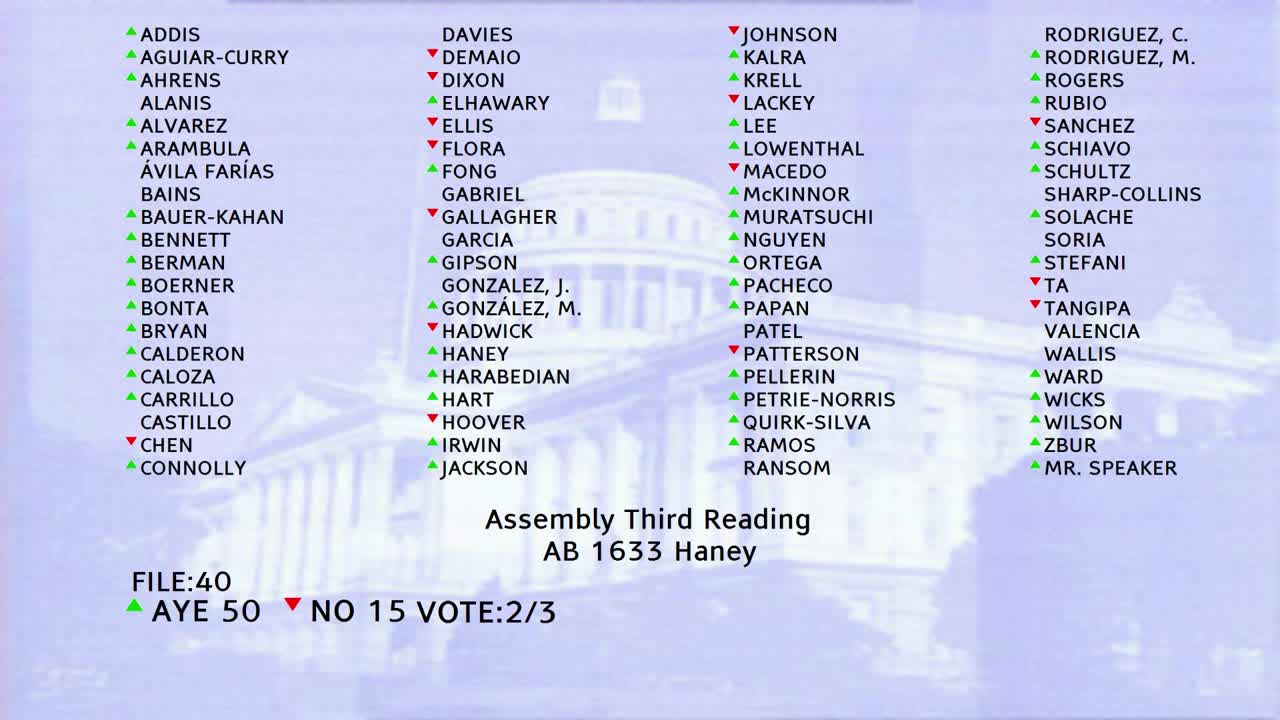 10MIN
Assembly Floor
 10MIN
Assembly Standing Committee on Human Services
Bill Author


