AB 1664: Elections: law enforcement investigations of election records or voting technology.
- Session Year: 2025-2026
- House: Assembly
- Latest Version Date: 2026-09-19
Current Status:
Passed
(2026-09-19: Chaptered by Secretary of State - Chapter 336, Statutes of 2026.)
Introduced
In Committee
Awaiting First Chamber Vote
Passed First Chamber
In Committee
Awaiting Second Chamber Vote
Passed Second Chamber
Enacted
What does this bill do?
The bill requires local agencies, political subdivisions, and elections officials to notify the Secretary of State and the Attorney General within one day if they learn of a warrant, subpoena, or active law‑enforcement investigation involving election records or certified voting machines they control. It also allows the Secretary of State or Attorney General to intervene in or start court proceedings to challenge those warrants or subpoenas or seek other relief, but does not require them to take action.
The summary is provided by generative AI which can make mistakes. For original language, please view the details in the table below.
The Secretary of State is the chief elections officer of the state, and the Attorney General is the chief law officer of the state. Existing law requires a state or local agency that files or is served with an elections-related claim arising under federal law to provide written notice to the Secretary of State and the Attorney General within 3 court days. Existing law requires a state or local agency that intends to enter into a settlement, consent decree, or other court-approved agreement related to the claim to provide a draft copy of the settlement, consent decree, or agreement to the Secretary of State and the Attorney General at least 14 court days before entering into it.
This bill would require a local agency, political subdivision, or elections official to provide notice to the Secretary of State and the Attorney General immediately, but no later than one calendar day, after becoming aware of any warrant, subpoena, or active law enforcement investigation pertaining to any election records or certified voting technology under their custody or control. The bill would authorize the Secretary of State or the Attorney General to intervene in, or initiate, any court proceedings to challenge a warrant or subpoena on any valid grounds or seek any other appropriate relief. The bill would repeal these provisions on January 1, 2030. By increasing the duties of local elections officials, this bill would create a state-mandated local program.
The California Constitution requires the state to reimburse local agencies and school districts for certain costs mandated by the state. Statutory provisions establish procedures for making that reimbursement.
This bill would provide that, if the Commission on State Mandates determines that the bill contains costs mandated by the state, reimbursement for those costs shall be made pursuant to the statutory provisions noted above.
This bill would declare that it is to take effect immediately as an urgency statute.
The Secretary of State is the chief elections officer of the state, and the Attorney General is the chief law officer of the state. Existing law requires a state or local agency that files or is served with an elections-related claim arising under federal law to provide written notice to the Secretary of State and the Attorney General within 3 court days. Existing law requires a state or local agency that intends to enter into a settlement, consent decree, or other court-approved agreement related to the claim to provide a draft copy of the settlement, consent decree, or agreement to the Secretary of State and the Attorney General at least 14 court days before entering into it.
This bill would require a local agency, political subdivision, or elections official to provide written notice to the Secretary of State and the Attorney General immediately, but no later than one calendar day day, after becoming aware of any warrant, subpoena, or active law enforcement investigation pertaining to any election records or certified voting technology under their custody or control. The bill would authorize the Secretary of State or the Attorney General to intervene in, or initiate, any court proceedings to challenge a warrant or subpoena on any valid grounds or seek any other appropriate relief. The bill would repeal these provisions on January 1, 2030. By increasing the duties of local elections officials, this bill would create a state-mandated local program.
The California Constitution requires the state to reimburse local agencies and school districts for certain costs mandated by the state. Statutory provisions establish procedures for making that reimbursement.
This bill would provide that, if the Commission on State Mandates determines that the bill contains costs mandated by the state, reimbursement for those costs shall be made pursuant to the statutory provisions noted above.
This bill would declare that it is to take effect immediately as an urgency statute.
The Secretary of State is the chief elections officer of the state, and the Attorney General is the chief law officer of the state. Existing law requires a state or local agency that files or is served with an elections-related claim arising under federal law to provide written notice to the Secretary of State and the Attorney General within 3 court days. Existing law requires a state or local agency that intends to enter into a settlement, consent decree, or other court-approved agreement related to the claim to provide a draft copy of the settlement, consent decree, or agreement to the Secretary of State and the Attorney General at least 14 court days before entering into it.
This bill would require a local agency, political subdivision, or elections official to provide written notice to the Secretary of State and the Attorney General no later than one business calendar day after becoming aware of any warrant, subpoena, or active law enforcement investigation pertaining to any election records or voting systems certified voting technology under their custody or control. The bill would authorize the Secretary of State or the Attorney General to intervene in, or initiate, any court proceedings to challenge a warrant or subpoena on any valid grounds or seek any other appropriate relief. The bill would repeal these provisions on January 1, 2030. By increasing the duties of local elections officials, this bill would create a state-mandated local program.
The California Constitution requires the state to reimburse local agencies and school districts for certain costs mandated by the state. Statutory provisions establish procedures for making that reimbursement.
This bill would provide that, if the Commission on State Mandates determines that the bill contains costs mandated by the state, reimbursement for those costs shall be made pursuant to the statutory provisions noted above.
This bill would declare that it is to take effect immediately as an urgency statute.
The Secretary of State is the chief elections officer of the state state, and the Attorney General is the chief law officer of the state. Existing law requires a state or local agency that files or is served with an elections-related claim arising under federal law to provide written notice to the Secretary of State and the Attorney General within 3 court days. Existing law requires a state or local agency that intends to enter into a settlement, consent decree, or other court-approved agreement related to the claim to provide a draft copy of the settlement, consent decree, or agreement to the Secretary of State and the Attorney General at least 14 court days before entering into it.
This bill would require a local agency, political subdivision, or elections official to provide written notice to the Secretary of State and the Attorney General no later than one business day after becoming aware of any warrant, subpoena, or active law enforcement investigation pertaining to any election records or voting systems under their custody or control. The bill would authorize the Attorney General to intervene in, or initiate, any court proceedings to challenge a warrant or subpoena on any valid grounds or seek any other appropriate relief. The bill would repeal these provisions on January 1, 2030. By increasing the duties of local elections officials, this bill would create a state-mandated local program.
The California Constitution requires the state to reimburse local agencies and school districts for certain costs mandated by the state. Statutory provisions establish procedures for making that reimbursement.
This bill would provide that, if the Commission on State Mandates determines that the bill contains costs mandated by the state, reimbursement for those costs shall be made pursuant to the statutory provisions noted above.
This bill would declare that it is to take effect immediately as an urgency statute.
The Secretary of State is the chief elections officer of the state and the Attorney General is the chief law officer of the state. Existing law requires a state or local agency that files or is served with an elections-related claim arising under federal law to provide written notice to the Secretary of State and the Attorney General within 3 court days. Existing law requires a state or local agency that intends to enter into a settlement, consent decree, or other court-approved agreement related to the claim to provide a draft copy of the settlement, consent decree, or agreement to the Secretary of State and the Attorney General at least 14 court days before entering into it.
This bill would require a local agency, political subdivision, or elections official to provide written notice to the Secretary of State and the Attorney General no later than one business day after becoming aware of any warrant, subpoena, or active law enforcement investigation pertaining to any election records or voting systems under their custody or control. The bill would authorize the Attorney General to intervene in, or initiate, any court proceedings to challenge a warrant or subpoena on any valid grounds or seek any other appropriate relief. The bill would repeal these provisions on November January 1, 2030. By increasing the duties of local elections officials, this bill would create a state-mandated local program.
The California Constitution requires the state to reimburse local agencies and school districts for certain costs mandated by the state. Statutory provisions establish procedures for making that reimbursement.
This bill would provide that, if the Commission on State Mandates determines that the bill contains costs mandated by the state, reimbursement for those costs shall be made pursuant to the statutory provisions noted above.
The Secretary of State is the chief elections officer of the state and the Attorney General is the chief law officer of the state. Existing law requires a state or local agency that files or is served with an elections-related claim arising under federal law to provide written notice to the Secretary of State and the Attorney General within 3 court days. Existing law requires a state or local agency that intends to enter into a settlement, consent decree, or other court-approved agreement related to the claim to provide a draft copy of the settlement, consent decree, or agreement to the Secretary of State and the Attorney General at least 14 court days before entering into it.
This bill would require a local agency, political subdivision, or elections official to provide written notice to the Secretary of State and the Attorney General no later than one business day after becoming aware of any warrant, subpoena, or active law enforcement investigation pertaining to any election records or voting systems under their custody or control. The bill would authorize the Attorney General to intervene in, or initiate, any court proceedings to challenge a warrant or subpoena on any valid grounds or seek any other appropriate relief. The bill would repeal these provisions on November 1, 2030. By increasing the duties of local elections officials, this bill would create a state-mandated local program.
The California Constitution requires the state to reimburse local agencies and school districts for certain costs mandated by the state. Statutory provisions establish procedures for making that reimbursement.
This bill would provide that, if the Commission on State Mandates determines that the bill contains costs mandated by the state, reimbursement for those costs shall be made pursuant to the statutory provisions noted above.
Existing law regulates vehicles and prohibits vehicles from being equipped with certain equipment, including, among other things, a device that is designed for, or is capable of, jamming, scrambling, neutralizing, disabling, or interfering with radar, laser, or any other electronic device used by a law enforcement agency to measure the speed of moving objects. Existing law also prohibits vehicles from being equipped with a device that is specifically designed for, marketed for, or being used for, neutralizing, disabling, or otherwise interfering with a driver monitoring system that is engaged when drivers are utilizing advanced driver assistance system features or autonomous technology.This bill would require the Department of General Services to establish a pilot program under which a subset of state-operated heavy duty vehicles within the state vehicle fleet are equipped with a direct driver monitoring system for at least 24 months. The bill would require the department to determine the number of state-operated heavy duty vehicles to be included in the pilot program, as specified, and, for at least the initial 24 months of the pilot program, collect and analyze data regarding the prevalence of distracted and drowsy driving events, the effectiveness of the direct driver monitoring system in mitigating these events, and any impact the direct driver monitoring system has on driver behavior. The bill would require the department to submit a report on the pilot program to the Legislature within 12 months of the completion of the initial 24-month period of the pilot program.Existing law regulates vehicles and prohibits vehicles from being equipped with certain equipment, including, among other things, a device that is designed for, or is capable of, jamming, scrambling, neutralizing, disabling, or interfering with radar, laser, or any other electronic device used by a law enforcement agency to measure the speed of moving objects. Existing law also prohibits vehicles from being equipped with a device that is specifically designed for, marketed for, or being used for, neutralizing, disabling, or otherwise interfering with a driver monitoring system that is engaged when drivers are utilizing advanced driver assistance system features or autonomous technology.
This bill would require the Department of General Services to establish a pilot program under which a subset of state-operated heavy duty vehicles within the state vehicle fleet are equipped with a direct driver monitoring system for at least 24 months. The bill would require the department to determine the number of state-operated heavy duty vehicles to be included in the pilot program, as specified, and, for at least the initial 24 months of the pilot program, collect and analyze data regarding the prevalence of distracted and drowsy driving events, the effectiveness of the direct driver monitoring system in mitigating these events, and any impact the direct driver monitoring system has on driver behavior. The bill would require the department to submit a report on the pilot program to the Legislature within 12 months of the completion of the initial 24-month period of the pilot program.
The Legislature finds and declares all of the following:
(a)Under existing law, the Secretary of State is the chief elections officer of the state and must see that elections are efficiently conducted and that state election laws are enforced.
(b)Under existing law, the Attorney General is the chief law officer of the state and must see that the laws of the state are uniformly and adequately enforced.
(c)California has a sovereign interest in creating and enforcing laws for the administration of elections, which it has exercised by adopting a comprehensive scheme for the conduct of elections.
(d)The Secretary of State, the Attorney General, and the state are injured and aggrieved by law enforcements improper search, seizure, and retention of election materials, including election records and certified voting technology or any portion thereof, which can frustrate election administration and undermine public confidence in election integrity.
SEC. 2.Section 23 is added to the Elections Code, to read:23.(a)For purposes of this section, the following terms have the following meanings:
(1)Certified voting technology has the same meaning as defined in Section 17600.
(2)Election records include, but are not limited to, any records that must be kept, retained, preserved, or sealed by elections officials under this code.
(3)Law enforcement investigation means an investigation undertaken by a federal, state, or local law enforcement agency.
(b)A local agency, political subdivision, or elections official shall provide notice to the Secretary of State and the Attorney General immediately, but no later than one calendar day, after becoming aware of a warrant, subpoena, or active law enforcement investigation pertaining to the search, seizure, or retention of any election records or certified voting technology, or any portion thereof, under their custody or control.
(c)Notwithstanding any other law, the Secretary of State or the Attorney General may, as to any matter described in subdivision (b), intervene in any court proceedings connected therewith, or initiate proceedings in any court to challenge a warrant or subpoena described in this section on any valid grounds or seek any other appropriate relief. An action pursuant to this subdivision shall be entitled to calendar preference.
(d)This section does not require the Secretary of State or the Attorney General to take any action regarding any warrant, subpoena, or active law enforcement investigation of which they receive notice pursuant to this section.
(e)The Legislature finds and declares that this section addresses a matter of statewide concern rather than a municipal affair as that term is used in Section 5 of Article XI of the California Constitution. Therefore, this section applies to all cities and counties, including charter cities and charter counties.
(f)This section shall remain in effect only until January 1, 2030, and as of that date is repealed.
SEC. 3.If the Commission on State Mandates determines that this act contains costs mandated by the state, reimbursement to local agencies and school districts for those costs shall be made pursuant to Part 7 (commencing with Section 17500) of Division 4 of Title 2 of the Government Code.
SEC. 4.This act is an urgency statute necessary for the immediate preservation of the public peace, health, or safety within the meaning of Article IV of the California Constitution and shall go into immediate effect. The facts constituting the necessity are:
In order for this bill to take effect in time for the November 3, 2026, statewide general election, it is necessary that this act take effect immediately.
The Legislature finds and declares all of the following:
(a)Under existing law, the Secretary of State is the chief elections officer of the state and must see that elections are efficiently conducted and that state election laws are enforced.
(b)Under existing law, the Attorney General is the chief law officer of the state and must see that the laws of the state are uniformly and adequately enforced.
(c)California has a sovereign interest in creating and enforcing laws for the administration of elections, which it has exercised by adopting a comprehensive scheme for the conduct of elections.
(d)The Secretary of State, the Attorney General, and the state are injured and aggrieved by law enforcements improper search, seizure, and retention of election materials, including election records and certified voting technology or any portion thereof, which can frustrate election administration and undermine public confidence in election integrity.
SEC. 2.Section 23 is added to the Elections Code, to read:23.(a)For purposes of this section, the following terms have the following meanings:
(1)Certified voting technology has the same meaning as defined in Section 17600.
(2)Election records include, but are not limited to, any records that must be kept, retained, preserved, or sealed by elections officials under this code.
(3)Law enforcement investigation means an investigation undertaken by a federal, state, or local law enforcement agency.
(b)A local agency, political subdivision, or elections official shall provide notice to the Secretary of State and the Attorney General immediately, but no later than one calendar day, after becoming aware of any a warrant, subpoena, or active law enforcement investigation pertaining to the search, seizure, or retention of any election records or certified voting technology, or any portion thereof, under their custody or control.
(c)Notwithstanding any other law, the Secretary of State or the Attorney General may, as to any matter described in subdivision (b), intervene in any court proceedings connected therewith, or initiate proceedings in any court to challenge a warrant or subpoena described in this section on any valid grounds or seek any other appropriate relief. An action pursuant to this subdivision shall be entitled to calendar preference.
(d)This section does not require the Secretary of State or the Attorney General to take any action regarding any warrant, subpoena, or active law enforcement investigation of which they receive notice pursuant to this section.
(e)The Legislature finds and declares that this section addresses a matter of statewide concern rather than a municipal affair as that term is used in Section 5 of Article XI of the California Constitution. Therefore, this section applies to all cities and counties, including charter cities and charter counties.
(f)This section shall remain in effect only until January 1, 2030, and as of that date is repealed.
SEC. 3.If the Commission on State Mandates determines that this act contains costs mandated by the state, reimbursement to local agencies and school districts for those costs shall be made pursuant to Part 7 (commencing with Section 17500) of Division 4 of Title 2 of the Government Code.
SEC. 4.This act is an urgency statute necessary for the immediate preservation of the public peace, health, or safety within the meaning of Article IV of the California Constitution and shall go into immediate effect. The facts constituting the necessity are:
In order for this bill to take effect in time for the November 3, 2026, statewide general election, it is necessary that this act take effect immediately.
The Legislature finds and declares all of the following:
(a)Under existing law, the Secretary of State is the chief elections officer of the state and must see that elections are efficiently conducted and that state election laws are enforced.
(b)Under existing law, the Attorney General is the chief law officer of the state and must see that the laws of the state are uniformly and adequately enforced.
(c)California has a sovereign interest in creating and enforcing laws for the administration of elections, which it has exercised by adopting a comprehensive scheme for the conduct of elections.
(d)The Secretary of State, the Attorney General, and the state are injured and aggrieved by law enforcements improper search, seizure, and retention of election materials, including election records and certified voting technology or any portion thereof, which can frustrate election administration and undermine public confidence in election integrity.
SEC. 2.Section 23 is added to the Elections Code, to read:23.(a)For purposes of this section, the following terms have the following meanings:
(1)Certified voting technology has the same meaning as defined in Section 17600.
(2)Election records include, but are not limited to, any records that must be kept, retained, preserved, or sealed by elections officials under this code.
(3)Law enforcement investigation means an investigation undertaken by a federal, state, or local law enforcement agency.
(b)A local agency, political subdivision, or elections official shall provide written notice to the Secretary of State and the Attorney General immediately, but no later than one calendar day day, after becoming aware of any warrant, subpoena, or active law enforcement investigation pertaining to the search, seizure, or retention of any election records or certified voting technology, or any portion thereof, under their custody or control.
(c)Notwithstanding any other law, the Secretary of State or the Attorney General may, as to any matter described in subdivision (b), intervene in any court proceedings connected therewith, or initiate proceedings in any court to challenge a warrant or subpoena described in this section on any valid grounds or seek any other appropriate relief. An action pursuant to this subdivision shall be entitled to calendar preference.
(d)This section does not require the Secretary of State or the Attorney General to take any action regarding any warrant, subpoena, or active law enforcement investigation of which they receive notice pursuant to this section.
(e)The Legislature finds and declares that this section addresses a matter of statewide concern rather than a municipal affair as that term is used in Section 5 of Article XI of the California Constitution. Therefore, this section applies to all cities and counties, including charter cities and charter counties.
(f)This section shall remain in effect only until January 1, 2030, and as of that date is repealed.
SEC. 3.If the Commission on State Mandates determines that this act contains costs mandated by the state, reimbursement to local agencies and school districts for those costs shall be made pursuant to Part 7 (commencing with Section 17500) of Division 4 of Title 2 of the Government Code.
SEC. 4.This act is an urgency statute necessary for the immediate preservation of the public peace, health, or safety within the meaning of Article IV of the California Constitution and shall go into immediate effect. The facts constituting the necessity are:
In order for this bill to take effect in time for the November 3, 2026, statewide general election, it is necessary that this act take effect immediately.
The Legislature finds and declares all of the following:
(a)Under existing law, the Secretary of State is the chief elections officer of the state and must see that elections are efficiently conducted and that state election laws are enforced.
(b)Under existing law, the Attorney General is the chief law officer of the state and must see that the laws of the state are uniformly and adequately enforced.
(c)California has a sovereign interest in creating and enforcing laws for the administration of elections, which it has exercised by adopting a comprehensive scheme for the conduct of elections.
(d)The Secretary of State, the Attorney General, and the state are injured and aggrieved by law enforcements improper search, seizure, and retention of election materials, including election records and voting systems, certified voting technology or any portion thereof, which can frustrate election administration and undermine public confidence in election integrity.
SEC. 2.Section 22 is added to the Elections Code, to read:22.SEC. 2.Section 23 is added to the Elections Code, to read:23.(a)For purposes of this section, the following terms have the following meanings:
(1)Certified voting technology has the same meaning as defined in Section 17600.
(1)(2)Election records include, but are not limited to, any records that must be kept, retained, or preserved preserved, or sealed by elections officials under this code.
(2)(3)Law enforcement investigation means any an investigation undertaken by a federal, state, or local law enforcement agency.
(b)A local agency, political subdivision, or elections official shall provide written notice to the Secretary of State and the Attorney General no later than one business calendar day after becoming aware of any warrant, subpoena, or active law enforcement investigation pertaining to the search, seizure, or retention of any election records or voting systems certified voting technology, or any portion thereof, under their custody or control.
(c)Notwithstanding any other law, the Secretary of State or the Attorney General may, as to any matter described in subdivision (a), (b), intervene in any court proceedings connected therewith, or initiate proceedings in any court to challenge a warrant or subpoena described in this section on any valid grounds or seek any other appropriate relief. An action pursuant to this subdivision shall be entitled to calendar preference.
(d)This section does not require the Secretary of State or the Attorney General to take any action regarding any warrant, subpoena, or active law enforcement investigation of which they receive written notice. notice pursuant to this section.
(e)The Legislature finds and declares that this section addresses a matter of statewide concern rather than a municipal affair as that term is used in Section 5 of Article XI of the California Constitution. Therefore, this section applies to all cities and counties, including charter cities and charter counties.
(f)This section shall remain in effect only until January 1, 2030, and as of that date is repealed.
SEC. 3.If the Commission on State Mandates determines that this act contains costs mandated by the state, reimbursement to local agencies and school districts for those costs shall be made pursuant to Part 7 (commencing with Section 17500) of Division 4 of Title 2 of the Government Code.
SEC. 4.This act is an urgency statute necessary for the immediate preservation of the public peace, health, or safety within the meaning of Article IV of the California Constitution and shall go into immediate effect. The facts constituting the necessity are:
In order for this bill to take effect in time for the June 2, 2026, statewide direct primary November 3, 2026, statewide general election, it is necessary that this act take effect immediately.
The Legislature finds and declares all of the following:
(a)Under existing law, the Secretary of State is the chief elections officer of the state and must see that elections are efficiently conducted and that state election laws are enforced.
(b)Under existing law, the Attorney General is the chief law officer of the state and must see that the laws of the state are uniformly and adequately enforced.
(c)California has a sovereign interest in creating and enforcing laws for the administration of elections, which it has exercised by adopting a comprehensive scheme for the conduct of elections.
(d)The Secretary of State, the Attorney General, and the state are injured and aggrieved by law enforcements improper search, seizure, and retention of election materials, including election records and voting systems, which can frustrate election administration and undermine public confidence in election integrity.
SEC. 2.Section 22 is added to the Elections Code, to read:22.(a)For purposes of this section, the following terms have the following meanings:
(1)Election records include, but are not limited to, any records that must be kept, retained, or preserved by elections officials under this code.
(2)Law enforcement investigation means any investigation undertaken by a federal, state, or local law enforcement agency.
(b)A local agency, political subdivision, or elections official shall provide written notice to the Secretary of State and the Attorney General no later than one business day after becoming aware of any warrant, subpoena, or active law enforcement investigation pertaining to any election records or voting systems under their custody or control.
(c)Notwithstanding any other law, the Attorney General may, as to any matter described in subdivision (a), intervene in any court proceedings connected therewith, or initiate proceedings in any court to challenge a warrant or subpoena described in this section on any valid grounds or seek any other appropriate relief. An action pursuant to this subdivision shall be entitled to calendar preference.
(d)This section does not require the Secretary of State or the Attorney General to take any action regarding any warrant, subpoena, or active law enforcement investigation of which they receive written notice.
(e)The Legislature finds and declares that this section addresses a matter of statewide concern rather than a municipal affair as that term is used in Section 5 of Article XI of the California Constitution. Therefore, this section applies to all cities and counties, including charter cities and charter counties.
(f)This section shall remain in effect only until January 1, 2030, and as of that date is repealed.
SEC. 3.If the Commission on State Mandates determines that this act contains costs mandated by the state, reimbursement to local agencies and school districts for those costs shall be made pursuant to Part 7 (commencing with Section 17500) of Division 4 of Title 2 of the Government Code.
SEC. 4.This act is an urgency statute necessary for the immediate preservation of the public peace, health, or safety within the meaning of Article IV of the California Constitution and shall go into immediate effect. The facts constituting the necessity are:
In order for this bill to take effect in time for the June 2, 2026, statewide direct primary election, it is necessary that this act take effect immediately.
The Legislature finds and declares all of the following:
(a)Under existing law, the Secretary of State is the chief elections officer of the state and must see that elections are efficiently conducted and that state election laws are enforced.
(b)Under existing law, the Attorney General is the chief law officer of the state and must see that the laws of the state are uniformly and adequately enforced.
(c)California has a sovereign interest in creating and enforcing laws for the administration of elections, which it has exercised by adopting a comprehensive scheme for the conduct of elections.
(d)The Secretary of State, the Attorney General, and the state are injured and aggrieved by law enforcements improper search, seizure, and retention of election materials, including election records and voting systems, which can frustrate election administration and undermine public confidence in election integrity.
SEC. 2.Section 22 is added to the Elections Code, to read:22.(a)For purposes of this section, the following terms have the following meanings:
(1)Election records include, but are not limited to, any records that must be kept, retained, or preserved by elections officials under this code.
(2)Law enforcement investigation means any investigation undertaken by a federal, state, or local law enforcement agency.
(b)A local agency, political subdivision, or elections official shall provide written notice to the Secretary of State and the Attorney General no later than one business day after becoming aware of any warrant, subpoena, or active law enforcement investigation pertaining to any election records or voting systems under their custody or control.
(c)Notwithstanding any other law, the Attorney General may, as to any matter described in subdivision (a), intervene in any court proceedings connected therewith, or initiate proceedings in any court to challenge a warrant or subpoena described in this section on any valid grounds or seek any other appropriate relief. An action pursuant to this subdivision shall be entitled to calendar preference.
(d)This section does not require the Secretary of State or the Attorney General to take any action regarding any warrant, subpoena, or active law enforcement investigation of which they receive written notice.
(e)The Legislature finds and declares that this section addresses a matter of statewide concern rather than a municipal affair as that term is used in Section 5 of Article XI of the California Constitution. Therefore, this section applies to all cities and counties, including charter cities and charter counties.
(f)This section shall remain in effect only until November January 1, 2030, and as of that date is repealed.
SEC. 3.If the Commission on State Mandates determines that this act contains costs mandated by the state, reimbursement to local agencies and school districts for those costs shall be made pursuant to Part 7 (commencing with Section 17500) of Division 4 of Title 2 of the Government Code.
The Legislature finds and declares all of the following:
(a)Under existing law, the Secretary of State is the chief elections officer of the state and must see that elections are efficiently conducted and that state election laws are enforced.
(b)Under existing law, the Attorney General is the chief law officer of the state and must see that the laws of the state are uniformly and adequately enforced.
(c)California has a sovereign interest in creating and enforcing laws for the administration of elections, which it has exercised by adopting a comprehensive scheme for the conduct of elections.
(d)The Secretary of State, the Attorney General, and the state are injured and aggrieved by law enforcements improper search, seizure, and retention of election materials, including election records and voting systems, which can frustrate election administration and undermine public confidence in election integrity.
SEC. 2.Section 22 is added to the Elections Code, to read:22.(a)For purposes of this section, the following terms have the following meanings:
(1)Election records include, but are not limited to, any records that must be kept, retained, or preserved by elections officials under this code.
(2)Law enforcement investigation means any investigation undertaken by a federal, state, or local law enforcement agency.
(b)A local agency, political subdivision, or elections official shall provide written notice to the Secretary of State and the Attorney General no later than one business day after becoming aware of any warrant, subpoena, or active law enforcement investigation pertaining to any election records or voting systems under their custody or control.
(c)Notwithstanding any other law, the Attorney General may, as to any matter described in subdivision (a), intervene in any court proceedings connected therewith, or initiate proceedings in any court to challenge a warrant or subpoena described in this section on any valid grounds or seek any other appropriate relief. An action pursuant to this subdivision shall be entitled to calendar preference.
(d)This section does not require the Secretary of State or the Attorney General to take any action regarding any warrant, subpoena, or active law enforcement investigation of which they receive written notice.
(e)The Legislature finds and declares that this section addresses a matter of statewide concern rather than a municipal affair as that term is used in Section 5 of Article XI of the California Constitution. Therefore, this section applies to all cities and counties, including charter cities and charter counties.
(f)This section shall remain in effect only until November 1, 2030, and as of that date is repealed.
SEC. 3.If the Commission on State Mandates determines that this act contains costs mandated by the state, reimbursement to local agencies and school districts for those costs shall be made pursuant to Part 7 (commencing with Section 17500) of Division 4 of Title 2 of the Government Code.
SECTION 1.Article 17.6 (commencing with Section 28157) is added to Chapter 5 of Division 12 of the Vehicle Code, to read:17.6.Direct Driver Monitoring Systems28157.(a)The Department of General Services shall establish a pilot program under which a subset of state-operated heavy duty vehicles within the state vehicle fleet are equipped with a direct driver monitoring system for at least 24 months.(b)The department shall determine the number of state-operated heavy duty vehicles to be included in the pilot program. However, a sufficient number shall be included to ensure a statistically significant sample size.(c)When selecting the vehicles to be included in the pilot program, the department shall ensure that the vehicles selected are housed in different regions of the state, work on diverse types of roadways and under diverse conditions, and are of a variety of types.(d)The department shall, for at least the initial 24 months of the pilot program, collect and analyze data regarding the prevalence of distracted and drowsy driving events, the effectiveness of the direct driver monitoring system in mitigating these events, and any impact the direct driver monitoring system has on driver behavior. The data collected and analyzed shall include, at a minimum, for each instance of distracted driving or drowsy driving, the type of distracted driving or indicator of drowsy driving, as applicable, time of day, location, road conditions, traffic dynamics, vehicle telemetry, and driver feedback.(e)(1)The department shall submit a report on the pilot program to the Legislature within 12 months of the completion of the initial 24-month period of the pilot program. This report shall include, at a minimum, all of the following:(A)An assessment of the rate of distracted and drowsy driving among vehicles included in the pilot program, extrapolated to provide an estimate for the complete state vehicle fleet.(B)An evaluation of the effectiveness of the technology in mitigating distracted and drowsy driving events.(C)An analysis of trends in distracted and drowsy driving behavior over the course of the pilot program.(D)Recommendations to the Legislature regarding the effectiveness of the pilot program and potential future actions, including, but not limited to, policy suggestions and expansion of the pilot program.(2)A report to be submitted pursuant to paragraph (1) shall be submitted in compliance with Section 9795 of the Government Code. (f)For the purposes of this section, direct driver monitoring system has the same meaning as in Section 28155.(a)The Department of General Services shall establish a pilot program under which a subset of state-operated heavy duty vehicles within the state vehicle fleet are equipped with a direct driver monitoring system for at least 24 months.
(b)The department shall determine the number of state-operated heavy duty vehicles to be included in the pilot program. However, a sufficient number shall be included to ensure a statistically significant sample size.
(c)When selecting the vehicles to be included in the pilot program, the department shall ensure that the vehicles selected are housed in different regions of the state, work on diverse types of roadways and under diverse conditions, and are of a variety of types.
(d)The department shall, for at least the initial 24 months of the pilot program, collect and analyze data regarding the prevalence of distracted and drowsy driving events, the effectiveness of the direct driver monitoring system in mitigating these events, and any impact the direct driver monitoring system has on driver behavior. The data collected and analyzed shall include, at a minimum, for each instance of distracted driving or drowsy driving, the type of distracted driving or indicator of drowsy driving, as applicable, time of day, location, road conditions, traffic dynamics, vehicle telemetry, and driver feedback.
(e)(1)The department shall submit a report on the pilot program to the Legislature within 12 months of the completion of the initial 24-month period of the pilot program. This report shall include, at a minimum, all of the following:
(A)An assessment of the rate of distracted and drowsy driving among vehicles included in the pilot program, extrapolated to provide an estimate for the complete state vehicle fleet.
(B)An evaluation of the effectiveness of the technology in mitigating distracted and drowsy driving events.
(C)An analysis of trends in distracted and drowsy driving behavior over the course of the pilot program.
(D)Recommendations to the Legislature regarding the effectiveness of the pilot program and potential future actions, including, but not limited to, policy suggestions and expansion of the pilot program.
(2)A report to be submitted pursuant to paragraph (1) shall be submitted in compliance with Section 9795 of the Government Code.
(f)For the purposes of this section, direct driver monitoring system has the same meaning as in Section 28155.
|
Date
|
Status
|
|---|---|
| Sep 19, 2026 | Chaptered by Secretary of State - Chapter 336, Statutes of 2026. |
| Sep 19, 2026 | Approved by the Governor. |
| Sep 3, 2026 | Enrolled and presented to the Governor at 4 p.m. |
| Aug 26, 2026 | Senate amendments concurred in. To Engrossing and Enrolling. (Ayes 59. Noes 17.). |
| Aug 26, 2026 | Senate amendments concurred in. To Engrossing and Enrolling. (Ayes 59. Noes 17. Page 6567.). |
| Aug 25, 2026 | In Assembly. Concurrence in Senate amendments pending. |
| Aug 25, 2026 | Read third time. Urgency clause adopted. Passed. Ordered to the Assembly. (Ayes 30. Noes 8.). |
| Aug 17, 2026 | Read second time. Ordered to third reading. |
| Aug 13, 2026 | Read second time and amended. Ordered returned to second reading. |
| Aug 13, 2026 | In committee: Reconsideration of a favorable vote granted. |
| Aug 13, 2026 | From committee: Amend, and do pass as amended. (Ayes 4. Noes 2.) (August 13). |
| Aug 3, 2026 | In committee: Referred to APPR. suspense file. |
| Jul 1, 2026 | From committee: Do pass and re-refer to Com. on APPR. (Ayes 5. Noes 1.) (June 30). Re-referred to Com. on APPR. |
| Jun 17, 2026 | Read second time and amended. Re-referred to Com. on PUB. S. |
| Jun 16, 2026 | From committee: Amend, and do pass as amended and re-refer to Com. on PUB. S. (Ayes 4. Noes 1.) (June 16). |
| Jun 11, 2026 | From committee chair, with author's amendments: Amend, and re-refer to committee. Read second time, amended, and re-referred to Com. on E. & C.A. |
| Jun 3, 2026 | Referred to Coms. on E. & C.A. and PUB. S. |
| May 21, 2026 | In Senate. Read first time. To Com. on RLS. for assignment. |
| May 21, 2026 | Read third time. Urgency clause adopted. Passed. Ordered to the Senate. (Ayes 56. Noes 15.). |
| May 21, 2026 | Read third time. Urgency clause adopted. Passed. Ordered to the Senate. (Ayes 56. Noes 15. Page 5208.). |
| May 11, 2026 | Read second time. Ordered to third reading. |
| May 7, 2026 | Read second time and amended. Ordered returned to second reading. |
| May 6, 2026 | From committee: Amend, and do pass as amended. (Ayes 10. Noes 4.) (May 6). |
| Apr 20, 2026 | Re-referred to Com. on APPR. |
| Apr 16, 2026 | Read second time and amended. |
| Apr 15, 2026 | From committee: Amend, and do pass as amended and re-refer to Com. on APPR. (Ayes 6. Noes 2.) (April 15). |
| Apr 14, 2026 | Re-referred to Com. on ELECTIONS. |
| Apr 13, 2026 | Referred to Com. on ELECTIONS. |
| Apr 13, 2026 | Pursuant to Assembly Rule 51. |
| Apr 13, 2026 | Joint Rule 62(a), file notice suspended. (Page 4588.) |
| Apr 13, 2026 | Joint Rule 62(a), file notice suspended. |
| Apr 13, 2026 | From committee chair, with author's amendments: Amend, and re-refer to Com. on ELECTIONS. Read second time and amended. |
| Jan 30, 2026 | From printer. May be heard in committee March 1. |
| Jan 29, 2026 | Read first time. To print. |
|
Date
|
Description
|
Location
|
Votes
|
|
|---|---|---|---|---|
| Aug 26, 2026 | AB 1664 Jackson Concurrence in Senate Amendments | Assembly Floor |
Passed |
|
| Aug 25, 2026 | Assembly 3rd Reading AB1664 Jackson et al. By Wiener Urgency Clause | Senate Floor |
Passed |
|
| Aug 13, 2026 | Do pass as amended | Senate Standing Committee on Appropriations |
Passed |
|
| Aug 13, 2026 | [08-13-2026] set for [First] hearing: Reconsideration of favorable vote granted | Senate Standing Committee on Appropriations |
Passed |
|
| Aug 13, 2026 | Do pass as amended | Senate Standing Committee on Appropriations |
Passed |
|
| Aug 3, 2026 | Placed on suspense file | Senate Standing Committee on Appropriations |
Passed |
|
| Jun 30, 2026 | Do pass, but first be re-referred to the Committee on [Appropriations] | Senate Standing Committee on Public Safety |
Passed |
|
| Jun 16, 2026 | Do pass as amended, but first amend, and re-refer to the Committee on [Public Safety] | Senate Standing Committee on Elections and Constitutional Amendments |
Passed |
|
| May 21, 2026 | AB 1664 Jackson Third Reading Urgency | Assembly Floor |
Passed |
|
| May 6, 2026 | Do pass as amended. | Assembly Standing Committee on Appropriations |
Passed |
|
| Apr 15, 2026 | Do pass as amended and be re-referred to the Committee on [Appropriations] | Assembly Standing Committee on Elections |
Passed |
This list shows positions taken on this bill by organizations on the date displayed, which is linked to the original source.
Positions by individuals are not included.
|
Organization
|
Position
|
Date
|
|---|---|---|
| Attorney General Rob Bonta | ** Support | |
| California State Sheriffs' Association | ** Against | |
| California State Sheriffs’ Association | ** Against | |
| League Of Women Voters Of California | ** Support | |
| Riverside County Sheriff’s Office | ** Against | |
| Sacramento County Sheriff Jim Cooper | ** Against |
CONCURRENCE IN SENATE AMENDMENTS
CSA1 Bill Id:AB 1664
Author:(Jackson and Berman)
As Amended Ver:August 13, 2026
2/3 vote. Urgency
SUMMARY
Requires local agencies and elections officials to notify the Secretary of State (SOS) and Attorney General (AG) of any warrant, subpoena, or active law enforcement investigation pertaining to the search, seizure, or retention of election records or certified voting technology.
Senate Amendments
- Delete a requirement that the notice to the SOS or AG must be written, and require that the notification be made immediately, but no later than one calendar day, after the agency or official becomes aware of the warrant, subpoena, or investigation.
- Permit the SOS to intervene in court proceedings connected with the warrant, subpoena, or investigation. The Assembly-approved version of the bill permitted the AG to intervene in such proceedings, but did not expressly allow the SOS to do so.
- Make minor, technical, and clarifying changes.
COMMENTS
In February, the Riverside County Sheriff′s Department obtained a search warrant to search the Registrar of Voters′ office and seize all ballots from the November 2025 statewide special election.
The supporting affidavit relied on a local watchdog group′s audit claiming a discrepancy of nearly 46,000 ballots between the number of ballots cast and the official total reported by the Registrar of Voters. The affidavit did not indicate that the Sheriff′s Department contacted the Registrar or independently verified the claim. It also fails to identify any specific individual suspected of wrongdoing or any particular crime believed to have been committed.
Just three days after receiving the allegation, the Sheriff′s Department sought the warrant to seize ballots ″to prove or disprove any criminal conduct,″ despite knowing the Registrar would present clarifying information to the Board of Supervisors the next day. At that presentation, the Registrar disputed the claim, stating the actual discrepancy was 103 ballots.
The Department later obtained two additional warrants—one for more election materials and another to appoint a special master to oversee ballot counting. By then, deputies had already opened ballot boxes and begun counting, despite state laws requiring such materials to remain sealed and in the custody of election officials.
In March, Attorney General Rob Bonta petitioned the Appellate Court to halt the investigation, citing ″grave concerns″ about the warrants′ legal sufficiency, and directed the Sheriff to pause its investigation. According to the petition, the Sheriff indicated he would comply. That, however, did not occur and the Sheriff continued to take actions related to the investigation, including obtaining the third warrant without notifying the AG.
The Appellate Court denied relief on procedural grounds, after which the AG petitioned the California Supreme Court. Last month, the Court granted review, ordered a pause in the investigation, and directed preservation of all seized materials. Proceedings are ongoing on an expedited basis.
Regardless of the outcome, the seizure of ballots without identifying a specific crime or suspect raises serious concerns about election security and chain of custody, as the ballots are no longer in the Registrar′s possession but remain with the Sheriff′s Department.
Ensuring that the SOS (as the state′s chief elections officer) and the AG (as the state′s chief law officer) are promptly notified of any warrant, subpoena, or active law enforcement investigation involving election records or voting systems would help provide appropriate oversight. Such coordination may reduce the risk of compromising election integrity and prevent disruptions to the chain of custody of election materials.
The Senate amendments provide further detail about the type of materials and equipment covered by the bill, expressly permit the SOS to intervene in court proceedings covered by the bill, and make various other minor, technical, and clarifying changes. This bill, as amended in the Senate, is consistent with prior Assembly actions.
Please see the policy committee analysis for a full discussion of this bill
According to the Author
″California′s elections are foundational to our democracy and cannot be left vulnerable to unchecked interference. When law enforcement agencies search, seize, or retain election records and voting systems without proper oversight, they risk disrupting the very machinery of democratic participation and eroding the public′s trust in election outcomes. California has long been a leader in establishing robust, transparent election administration, and it is our responsibility as legislators to ensure that the Secretary of State and the Attorney General, the state′s chief elections, and law officers, are empowered to respond swiftly when that system comes under scrutiny. By requiring local agencies and elections officials to notify state authorities within one business day of any warrant, subpoena, or active investigation touching election materials, this bill ensures that the state can intervene, protect critical records, and uphold the rule of law. Free and fair elections are not simply a procedural matter, they are the mechanism through which every Californian′s voice is heard, and we have an obligation to defend that process with every tool available to us.″
Arguments in Support
The sponsor of this bill, Attorney General Rob Bonta, writes in support, ″California has a compelling interest in safeguarding the integrity, security, and continuity of election administration. Recent incidents locally and nationwide have demonstrated that improper seizure, retention, or handling of election records and voting equipment can compromise chain-of-custody protections and undermine public confidence in democratic institutions. AB 1664 establishes a process requiring local agencies and election officials to notify the Attorney General and Secretary of State within one business day after becoming aware of a warrant, subpoena, or active law enforcement investigation pertaining to election records or voting systems. This notice requirement helps ensure that state authorities are aware of investigative actions that may affect election administration or implicate statewide election security interests. Additionally, AB 1664 supplements existing litigation tools by authorizing the Attorney General to intervene in or initiate court proceedings, where appropriate, to challenge warrants or subpoenas on valid legal grounds or seek other relief. This provision helps ensure that disputes involving sensitive election infrastructure receive appropriate statewide oversight and legal review.″
Arguments in Opposition
In opposition to this bill, the California State Sheriffs′ Association (CSSA) writes, ″The California Constitution gives the AG supervisory authority over sheriffs and district attorneys, but not supervisory authority over the judiciary. If, pursuant to this bill, the AG were effectively asking a court to nullify a magistrate′s discretionary probable-cause determination absent a direct state interest, the AG would be expanding supervisory authority into judicial review power the Constitution does not grant. There is case law to support this analysis. For example, as it relates to the issuance of a search warrant as a judicial act of the magistrate, a prosecutor cannot be vested with authority to foreclose the exercise of a judicial power and doing so violates the doctrine of separation of powers set forth in Article III, Section 1, of the California Constitution (Esteybar v. Municipal Court for Long Beach Judicial Dist., 5 Cal. 3d 119, 122). Similarly, the Attorney General cannot dictate to courts a legal result without violating separation of powers principles (People ex rel. Internat. Assn. of Firefighters, etc. v. City of Palo Alto, 102 Cal. App. 5th 602, 624). Because AB 1664 introduces the potential for political interference into a process already overseen by judges and peace officers and to the extent the bill would inappropriately (and likely constitutionally impermissibly) invite the AG to intervene in a process in a manner that runs afoul of the separation of powers, CSSA must oppose AB 1664.″
FISCAL COMMENTS
According to the Senate Appropriations Committee:
- By requiring certain local entities to notify the SOS and AG as specified, this bill creates a state-mandated local program. To the extent the Commission on State Mandates determines that the provisions of this bill create a new program or impose a higher level of service on local agencies, local agencies could claim reimbursement of those costs. The magnitude is unknown, but probably minor (General Fund).
- SOS and the AG would incur minor and absorbable administrative costs.
- To the extent that the AG intervenes in elections-related legal investigations that also receive precedence when filed in court, this bill could result in increased court workload, resulting in potentially significant cost pressures to the courts; the magnitude is unknown (Trial Court Trust Fund (TCTF)). It generally costs about $10,500 per day to operate a courtroom. Courts are not funded on the basis of workload, and increased pressure on TCTF may create a need for increased funding for courts from the General Fund. The enacted 2026-27 budget includes $70 million in ongoing support from the General Fund to continue to backfill TCTF for revenue declines.
VOTES:
ASM ELECTIONS: 6-2-0
YES: Pellerin, Bennett, Berman, Elhawary, Solache, Stefani
NO: Gallagher, Johnson
ASM APPROPRIATIONS: 10-4-1
YES: Wicks, Aguiar-Curry, Caloza, Fong, Mark González, Krell, Pacheco, Pellerin, Sharp-Collins, Solache
NO: Hoover, Dixon, Ta, Tangipa
ABS, ABST OR NV: Arambula
ASSEMBLY FLOOR: 56-15-9
YES: Addis, Aguiar-Curry, Ahrens, Alvarez, Ávila Farías, Bains, Bauer-Kahan, Bennett, Berman, Boerner, Bonta, Bryan, Calderon, Caloza, Carrillo, Connolly, Elhawary, Fong, Gabriel, Gipson, Mark González, Haney, Harabedian, Hart, Irwin, Jackson, Kalra, Krell, Lee, Lowenthal, McKinnor, Muratsuchi, Nguyen, Ortega, Pacheco, Papan, Patel, Pellerin, Petrie-Norris, Quirk-Silva, Ransom, Michelle Rodriguez, Rogers, Blanca Rubio, Schiavo, Schultz, Sharp-Collins, Solache, Soria, Stefani, Valencia, Ward, Wicks, Wilson, Zbur, Rivas
NO: Castillo, Davies, DeMaio, Dixon, Ellis, Flora, Gallagher, Jeff Gonzalez, Hadwick, Johnson, Macedo, Patterson, Sanchez, Ta, Tangipa
ABS, ABST OR NV: Alanis, Arambula, Chen, Garcia, Hoover, Lackey, Ramos, Celeste Rodriguez, Wallis
UPDATED
VERSION: June 17, 2026
CONSULTANT: Ethan Jones / ELECTIONS / (916) 319-2094 FN: 0003685
SENATE RULES COMMITTEE Office of Senate Floor Analyses (916) 651-4171 | AB 1664 |
THIRD READING
Bill No: AB 1664
Author: Jackson (D) and Berman (D), et al.
Amended: 8/13/26 in Senate
Vote: 27 - Urgency
SENATE ELECTIONS & C.A. COMMITTEE: 4-1, 6/16/26
AYES: Wiener, Allen, Cervantes, Umberg
NOES: Choi
SENATE PUBLIC SAFETY COMMITTEE: 5-1, 6/30/26
AYES: Arreguín, Caballero, Cortese, Pérez, Wiener
NOES: Seyarto
SENATE APPROPRIATIONS COMMITTEE: 4-2, 8/13/26
AYES: Cervantes, Cabaldon, Grayson, Richardson
NOES: Seyarto, Dahle
NO VOTE RECORDED: Wahab
ASSEMBLY FLOOR: 56-15, 5/21/26 - See last page for vote
SUBJECT: Elections: law enforcement investigations of election records or voting technology
SOURCE: Attorney General Rob Bonta
DIGEST:
This bill requires a local agency, political subdivision, or elections official to provide notice to the Secretary of State (SOS) and the Attorney General (AG) immediately, but no later than one calendar day, after becoming aware of any warrant, subpoena, or active law enforcement investigation pertaining to the search, seizure, or retention of any election records or certified voting technology.
ANALYSIS:
Existing law:
- Provides, pursuant to the U.S. Constitution, the times, places, and manner of holding elections for U.S. Senators and Members of the House of Representatives be prescribed by a state’s legislature. Congress may, at any time, make law or alter regulations related to elections, except as to the places of choosing U.S. Senators.
- Requires a state or local agency or political subdivision to provide notice to the SOS and the AG within three court days of the filing or service of a court action relating to an election-related claim under federal law. This notification must occur at least 14 court days before entering into a settlement, consent decree, or other court-approved agreement in such an action.
- Permits the SOS, the AG, or a county elections official to bring a civil action against any person who tampers with voting technology.
- Requires the AG, in consultation with the SOS, to provide guidance and information to county election officials regarding how election officials, precinct boards, election workers, and election volunteers should respond to requests by an agent of a law enforcement agency to access areas where ballots are cast, handled, processed, counted, tabulated, tallied, audited, or recounted.
- Requires the AG, in consultation with the SOS, to publish and provide guidance to managers of election sites regarding how to respond to requests by an agent of a law enforcement agency to access areas where ballots are cast, handled, processed, counted, tabulated, tallied, audited, or recounted.
This bill:
- Requires a local agency, political subdivision, or elections official to provide notice to the SOS and the AG immediately, but no later than one calendar day, after becoming aware, of any warrant, subpoena, or active law enforcement investigation pertaining to the search, seizure, or retention of any election records or certified voting technology, or any portion thereof, under their custody or control.
- Provides the SOS and AG may intervene, and must be entitled to calendar preference, in any court proceedings connected therewith, or initiate proceedings in any court to challenge a warrant or subpoena described in this section on any valid grounds or seek any other appropriate relief.
- Defines “certified voting technology” to mean any voting technologies certified by the SOS, including voting systems, ballot on demand printing systems, electronic poll book systems, or adjudication systems, and the hardware, firmware, software, proprietary intellectual property they contain, any components, and any products they generate, including ballots, ballot images, reports, logs, cast vote records, or electronic data.
- Provides a sunset date of January 1, 2030.
- Contains an urgency clause to take effect in time for the November 3, 2026, statewide general election.
Background
Riverside County. In early 2026, a local election watchdog group raised concerns that the number of ballots cast in the November 2025 statewide special election differed from the official total reported by the Riverside County Registrar of Voters (ROV) by nearly 46,000 ballots. Taking these concerns into consideration, the Riverside County Sheriff’s Department applied to the Superior Court and sought a warrant to seize the ballots “in order to prove or disprove any criminal conduct.” The court issued a judicial warrant on February 9, 2026.
At a presentation to the Riverside County Board of Supervisors on February 10, 2026, the ROV addressed the alleged discrepancies and disputed the watchdog group’s figures. The ROV noted the difference between ballots cast and ballots counted, based on official results, was 103 ballots.
On February 26, 2026, the Sheriff’s Department seized about 1,000 boxes of ballots and ballot materials.
The Sheriff’s Department also obtained two additional search warrants: one to seize additional election materials (beyond ballots) and another to appoint a special master to oversee the Sheriff Department’s counting of ballots.
As this process unfolded, the AG issued multiple letters directing the Riverside County Sheriff to preserve all seized ballots and pause further action. The AG further questioned whether the warrants were supported by probable cause and whether the Riverside County Sheriff’s Department presented the magistrate with all the material evidence required by law.
On April 8, 2026, the California Supreme Court ordered the Riverside County Sheriff to halt his investigation into alleged fraud in the November 2025 special election and preserve all seized items. Proceedings remain ongoing and the California Supreme Court indicated that this matter will be considered on an expedited basis.
Requesting State Voter Rolls. There have been various reports that the U.S. Department of Justice (DOJ) has requested election records or access to voting equipment in various states. According to the State Democracy Research Initiative with the University of Wisconsin Law School, the DOJ has filed federal lawsuits against the District of Colombia and 30 states, including California. These lawsuits seek orders to compel jurisdictions to submit copies of complete voter registration lists, including dates of birth, driver’s license numbers, and partial Social Security numbers. Many of these suits are being litigated, 21 federal district courts have dismissed the DOJ’s suits. The DOJ also reached a settlement with Oklahoma where the state agreed to provide its sensitive voter data in exchange for the DOJ dismissing the lawsuit.
Related and Prior Legislation. SB 73 (Cervantes, Chapter 10, Statutes of 2026), which took effect on May 27, 2026, restricts law enforcement agencies and officers from engaging in specified conduct related to elections. Among the provisions of the measure, the bill required the AG to provide guidance for county election officials and managers of election sites regarding how to respond to requests for access by law enforcement agencies for election-related materials and locations. The bill also prohibited a peace officer from interfering in any manner with the administration of any election in this state, including the seizure of specified voter data and voting technology, unless certain conditions are met. SB 1418 (Cervantes) of 2026 makes it a crime to take specified election materials or voting technology from the custody of elections officials and requires the preservation of election materials and voting technology if an election contest or criminal proceeding is ongoing.
SB 851 (Cervantes, Chapter 238, Statutes of 2025), among other provisions, required state agencies and local governments to provide written notice to the AG and the SOS within three court days after the agency or jurisdiction files or is served with a court action that contains a claim relating to elections arising under federal law.
Comments
Author’s Statement. California's elections are foundational to our democracy and cannot be left vulnerable to unchecked interference. When law enforcement agencies search, seize, or retain election records and voting systems without proper oversight, they risk disrupting the very machinery of democratic participation and eroding the public's trust in election outcomes. California has long been a leader in establishing robust, transparent election administration, and it is our responsibility as legislators to ensure that the AG and the SOS are empowered to respond swiftly when that system comes under scrutiny. By requiring local agencies and elections officials to notify state authorities within one day of any warrant, subpoena, or active investigation touching election materials, this bill ensures that the state can intervene, protect critical records, and uphold the rule of law. Free and fair elections are not simply a procedural matter, they are the mechanism through which every Californian's voice is heard, and we have an obligation to defend that process with every tool available to us.
Related/Prior Legislation
SB 73 (Cervantes, Chapter 10, Statutes of 2026) restricted law enforcement agencies and officers from engaging in specified conduct related to elections. SB 1418 (Cervantes) of 2026 makes it a crime to take specified election materials or voting technology from the custody of elections officials and requires the preservation of election materials and voting technology if an election contest or criminal proceeding is ongoing.
SB 884 (Umberg) of 2026, among other provisions, requires a law enforcement officer to notify the AG or SOS of any suspected, planned, or violation of electioneering or arrests of specified crimes near a polling location and the disruption of the operation of a polling location.
SB 851 (Cervantes, Chapter 238, Statutes of 2025) addressed potential interference in California’s elections. Among other provisions, the bill required state agencies and local governments to provide written notice to the SOS and the AG within three court days after the agency or jurisdiction files or is served with a court action that contains a claim relating to elections arising under federal law.
FISCAL EFFECT: Appropriation: No Fiscal Com.: Yes Local: Yes
According to the Senate Committee on Appropriations:
- By requiring certain local entities to notify the SOS and AG as specified, this bill creates a state-mandated local program. To the extent the Commission on State Mandates determines that the provisions of this bill create a new program or impose a higher level of service on local agencies, local agencies could claim reimbursement of those costs. The magnitude is unknown, but probably minor (General Fund).
- SOS and the AG would incur minor and absorbable administrative costs
- To the extent that the AG intervenes in elections-related legal investigations that also receive precedence when filed in court, this bill could result in increased court workload, resulting in potentially significant cost pressures to the courts; the magnitude is unknown (Trial Court Trust Fund (TCTF)). It generally costs about $10,500 per day to operate a courtroom. Courts are not funded on the basis of workload, and increased pressure on TCTF may create a need for increased funding for courts from the General Fund. The enacted 2026-27 budget includes $70 million in ongoing support from the General Fund to continue to backfill TCTF for revenue declines.
SUPPORT: (Verified 8/14/26)
Attorney General Rob Bonta (source)
League of Women Voters of California
OPPOSITION: (Verified 8/14/26)
California State Sheriffs’ Association
Riverside County Sheriff’s Office
ARGUMENTS IN SUPPORT: This bill’s sponsor, Attorney General Rob Bonta states the following:
California has a compelling interest in safeguarding the integrity, security, and continuity of election administration. Recent incidents locally and nationwide have demonstrated that improper seizure, retention, or handling of election records and voting equipment can compromise chain-of-custody protections and undermine public confidence in democratic institutions.
ARGUMENTS IN OPPOSITION: In a letter opposing this bill, the Riverside County Sheriff’s Office states the following:
Regardless of the circumstances that prompted its introduction, [this bill] establishes a framework that threatens judicial independence, undermines the separation of powers, incites executive branch intrusion into active criminal investigations, and fails to adequately protect sensitive investigative information.
ASSEMBLY FLOOR: 56-15, 5/21/26
AYES: Addis, Aguiar-Curry, Ahrens, Alvarez, Ávila Farías, Bains, Bauer-Kahan, Bennett, Berman, Boerner, Bonta, Bryan, Calderon, Caloza, Carrillo, Connolly, Elhawary, Fong, Gabriel, Gipson, Mark González, Haney, Harabedian, Hart, Irwin, Jackson, Kalra, Krell, Lee, Lowenthal, McKinnor, Muratsuchi, Nguyen, Ortega, Pacheco, Papan, Patel, Pellerin, Petrie-Norris, Quirk-Silva, Ransom, Michelle Rodriguez, Rogers, Blanca Rubio, Schiavo, Schultz, Sharp-Collins, Solache, Soria, Stefani, Valencia, Ward, Wicks, Wilson, Zbur, Rivas
NOES: Castillo, Davies, DeMaio, Dixon, Ellis, Flora, Gallagher, Jeff Gonzalez, Hadwick, Johnson, Macedo, Patterson, Sanchez, Ta, Tangipa
NO VOTE RECORDED: Alanis, Arambula, Chen, Garcia, Hoover, Lackey, Ramos, Celeste Rodriguez, Wallis
Prepared by: Scott Matsumoto / E. & C.A. / (916) 651-4106
8/17/26 10:54:39
**** END ****
SENATE COMMITTEE ON
Senator Sabrina Cervantes, Chair
2025 - 2026 Regular Session
AB 1664 (Jackson) - Elections: law enforcement investigations of election records or voting technology
Version: | Policy Vote: |
Urgency: | Mandate: |
Hearing Date: | Consultant: |
Bill Summary:
AB 1664 would require a local agency, political subdivision, or elections official to provide written notice to the Secretary of State (SOS) and the Attorney General (AG) no later than one calendar day after becoming aware of any warrant, subpoena, or active law enforcement investigation pertaining to the search, seizure, or retention of any election records or certified voting technology.
*********** ANALYSIS ADDENDUM – SUSPENSE FILE ***********
The following information is revised to reflect amendments
adopted by the committee on August 13, 2026
Fiscal Impact:
- By requiring certain local entities to notify the SOS and AG as specified, this bill creates a state-mandated local program. To the extent the Commission on State Mandates determines that the provisions of this bill create a new program or impose a higher level of service on local agencies, local agencies could claim reimbursement of those costs. The magnitude is unknown, but probably minor (General Fund).
- SOS and the AG would incur minor and absorbable administrative costs
- To the extent that the AG intervenes in elections-related legal investigations that also receive precedence when filed in court, this bill could result in increased court workload, resulting in potentially significant cost pressures to the courts; the magnitude is unknown (Trial Court Trust Fund (TCTF)). It generally costs about $10,500 per day to operate a courtroom. Courts are not funded on the basis of workload, and increased pressure on TCTF may create a need for increased funding for courts from the General Fund. The enacted 2026-27 budget includes $70 million in ongoing support from the General Fund to continue to backfill TCTF for revenue declines.
Committee Amendments:
Change Senator Cervantes from coauthor to principal coauthor.
-- END --
SENATE COMMITTEE ON
Senator Sabrina Cervantes, Chair
2025 - 2026 Regular Session
AB 1664 (Jackson) - Elections: law enforcement investigations of election records or voting technology
Version: | Policy Vote: |
Urgency: | Mandate: |
Hearing Date: | Consultant: |
Bill Summary:
AB 1664 would require a local agency, political subdivision, or elections official to provide written notice to the Secretary of State (SOS) and the Attorney General (AG) no later than one calendar day after becoming aware of any warrant, subpoena, or active law enforcement investigation pertaining to the search, seizure, or retention of any election records or certified voting technology.
Fiscal Impact:
- By requiring certain local entities to notify the SOS and AG as specified, this bill creates a state-mandated local program. To the extent the Commission on State Mandates determines that the provisions of this bill create a new program or impose a higher level of service on local agencies, local agencies could claim reimbursement of those costs. The magnitude is unknown, but probably minor (General Fund).
- SOS and the AG would incur minor and absorbable administrative costs
- To the extent that the AG intervenes in elections-related legal investigations that also receive precedence when filed in court, this bill could result in increased court workload, resulting in potentially significant cost pressures to the courts; the magnitude is unknown (Trial Court Trust Fund (TCTF)). It generally costs about $10,500 per day to operate a courtroom. Courts are not funded on the basis of workload, and increased pressure on TCTF may create a need for increased funding for courts from the General Fund. The enacted 2026-27 budget includes $70 million in ongoing support from the General Fund to continue to backfill TCTF for revenue declines.
Background:
In early 2026, questions were raised regarding the reported ballot totals from the November 2025 statewide special election in Riverside County. A local election watchdog organization asserted that the number of ballots cast differed from the official results reported by the Riverside County Registrar of Voters (ROV) by approximately 46,000 ballots. Based on these allegations, the Riverside County Sheriff's Department sought and obtained a search warrant from the Superior Court to seize election materials as part of a criminal investigation into whether election-related misconduct had occurred.
Following issuance of the warrant, the ROV publicly disputed the allegations, stating that the discrepancy identified by the watchdog group resulted from comparing different categories of election data and that the official difference between ballots cast and ballots counted was 103 ballots. On February 26, 2026, the Sheriff's Department executed the warrant and seized approximately 1,000 boxes of ballots and related election materials. The department subsequently obtained additional search warrants to collect further election records and to appoint a special master to oversee a recount of the seized ballots.
During the course of the investigation, the California AG issued multiple directives instructing the Sheriff's Department to preserve all seized election materials and suspend further investigative activity. The AG also questioned whether the search warrants were supported by probable cause and whether the warrant applications complied with applicable legal requirements. On April 8, 2026, the California Supreme Court ordered the Sheriff's Department to halt its investigation, preserve all seized materials, and maintain the status quo while the Court considers the matter on an expedited basis. The litigation remains pending.
In recent years, the U.S. Department of Justice has sought election-related records from a number of states and local election jurisdictions. According to publicly available reports, the U.S. Department of Justice has initiated litigation against numerous states, including California, seeking access to statewide voter registration records containing specified voter information. Several federal courts have dismissed these actions, while other cases remain pending.
The U.S. Department of Justice has also requested voter registration records from local election officials. For example, following a complaint involving a voter registration matter in Orange County, California, it requested voter registration records related to canceled registrations dating back to 2020. The Orange County Registrar of Voters provided responsive records but redacted confidential voter information, including driver's license numbers, identification numbers, Social Security numbers, language preferences, and voter signatures. The U.S. Department of Justice subsequently sought production of the unredacted records through litigation. Proceedings were later stayed pending related litigation involving the California SOS, which was subsequently dismissed.
Federal investigative activity involving election records has also occurred in other states. In January 2026, pursuant to a federal search warrant, the Federal Bureau of Investigation seized ballots, voting records, and other election materials from Fulton County, Georgia, relating to the 2020 General Election. The warrant encompassed ballots, tabulator records, ballot images, and voter participation records. Fulton County officials subsequently sought the return of the seized materials, and litigation remains ongoing. Separately, in April 2026, news reports indicated that the DOJ requested election records from Wayne County, Michigan, relating to the November 2024 federal election.
Proposed Law:
This bill, among other things, until January 1, 2030, would do the following:
- Require a local agency, political subdivision, or elections official to provide written notice to SOS and the AG, no later than one calendar day after becoming aware, of any warrant, subpoena, or active law enforcement investigation pertaining to the search, seizure, or retention of any election records or certified voting technology (as defined), or any portion thereof, under their custody or control.
- Provide SOS and the AG may intervene, and must be entitled to calendar preference, in any court proceedings connected therewith, or initiate proceedings in any court to challenge a warrant or subpoena described in this section on any valid grounds or seek any other appropriate relief.
Related Legislation:
- SB 73 (Cervantes, Chapter 10, Statutes of 2026) which took effect on May 27, 2026, restricts law enforcement agencies and officers from engaging in specified conduct related to elections. Among the provisions of the measure, the bill required the AG to provide guidance for county election officials and managers of election sites regarding how to respond to requests for access by law enforcement agencies for election-related materials and locations. The bill also prohibited a peace officer from interfering in any manner with the administration of any election in this state, including the seizure of specified voter data and voting technology, unless certain conditions are met.
- SB 851 (Cervantes, Chapter 238, Statutes of 2025), among other provisions, required state agencies and local governments to provide written notice to the AG and the SOS within three court days after the agency or jurisdiction files or is served with a court action that contains a claim relating to elections arising under federal law.
-- END --
SENATE COMMITTEE ON PUBLIC SAFETY
Senator Jesse Arreguín, Chair
2025 - 2026 Regular
Bill No: AB 1664 Hearing Date: June 30, 2026
Author: | Jackson | ||
Version: | June 17, 2026 | ||
Urgency: | Yes | Fiscal: | Yes |
Consultant: | AB | ||
Subject: Elections: law enforcement investigations of election records or voting technology
HISTORY
Source: Attorney General Rob Bonta
Prior Legislation: SB 73 (Cervantes), Ch. 10, Stats. of 2026
SB 851 (Cervantes), Ch. 238, Stats. of 2025
Support: League of Women Voters of California
Opposition: California State Sheriffs Association; Riverside County Sheriff’s Office
Assembly Floor Vote: 56 - 15
PURPOSE
The purpose of this bill is to require local officials to provide written notice to the Secretary of State and the Attorney General one day after becoming aware of legal efforts to search or seize specified voting records and technology, as specified.
Existing California law specifies that, subject to the powers and duties of the Governor, the Attorney General (AG) shall be the chief law officer of the State. (Cal. Const., art. V, § 13.)
Existing law states that it shall be the duty of the AG to see that the laws of the State are uniformly and adequately enforced. (Cal. Const., art. V, § 13.)
Existing law provides that the AG shall have direct supervision over every district attorney and sheriff and over such other law enforcement officers as may be designated by law, in all matters pertaining to the duties of their respective offices, and may require any of said officers to make reports concerning the investigation, detection, prosecution, and punishment of crime in their perspective jurisdictions as to the AG may seem advisable. (Cal. Const., art. V, § 13.)
Existing law specifies, whenever in the opinion of the AG any law of the State is not being adequately enforced in any county, it shall be the duty of the AG to prosecute any violations of law of which the superior court shall have jurisdiction, and in such cases the AG shall have all the powers of a district attorney. (Cal. Const., art. V, § 13.)
Existing law provides that the Secretary of State (SOS) is the chief elections officer of the state and shall administer the provisions of the Elections Code. Requires the SOS to see that elections are efficiently conducted and that state election laws are enforced. Requires the SOS, if the SOS concludes that state election laws are not being enforced, to call the violation to the attention of the district attorney of the county or to the AG. (Gov. Code, § 12172.5, Elec. Code, § 10.)
Existing law provides that within 3 court days after a state or local agency or political subdivision files or is served with a court action relating to elections that contains a claim arising under federal law, the state or local agency or political subdivision shall provide written notice to the SOS and the AG, as specified. (Elec. Code, § 21, subd. (a).)
Existing law provides that at least 14 court days before a state or local agency or political subdivision enters into a settlement, consent decree, or other court-approved agreement in a court action relating to elections that contains a claim arising under federal law, the state or local agency or political subdivision shall provide a draft copy of the settlement, consent decree, or other court-approved agreement to the Secretary of State and the Attorney General in order to provide them an opportunity to deliver guidance to the state or local agency or political subdivision to ensure that the settlement, consent decree, or other court-approved agreement is consistent with California law, as specified. (Elec. Code, § 21, subd. (b).)
Existing law requires elections officials to preserve rosters, ballots and other precinct supplies for specified time periods after an election. (Elec. Code, §§ 17300-17306.)
Existing law requires the following data to be kept by the elections official of a county, on electronic media, stored and unaltered, for 22 months from the date of the election where either the President, Vice President, United States Senator, or United States Representative are voted upon:
- All voting system electronic data.
- All ballot on demand system electronic data, if applicable.
- All adjudication electronic data.
- All remote accessible vote by mail system electronic data, if applicable.
- All electronic poll book electronic data, if applicable.
- HASH values taken from the voting technology devices, if applicable.
- All ballot images. (Elec. Code, § 17601.)
Existing law provides that for all other state or local elections to which the above provision does not apply, the following data shall be kept for 6 months by the county elections official:
- All voting system electronic data.
- All ballot on demand system electronic data, if applicable.
- All adjudication electronic data.
- All remote accessible vote by mail system electronic data, if applicable.
- All electronic poll book electronic data, if applicable.
- HASH values taken from the voting technology devices, if applicable.
- All ballot images, if applicable.
Existing law defines “certified voting technology” as any certified voting technologies certified by the SOS, including voting systems, ballot on demand printing systems, electronic poll book systems, or adjudication systems, and the hardware, firmware, software, proprietary intellectual property they contain, any components, and any products they generate, including ballots, ballot images, reports, logs, cast vote records, or electronic data. (Elec. Code, § 17600, subd. (b).)
Existing law sets forth certain procedures for the approval of voting systems by the SOS, as specified. (Elec. Code, §§ 19200, et. seq.)
Existing law sets forth a subpoena process by which a witness may be required to appear before a court or magistrate in a criminal action, which may include a subpoena compelling the production of records or other documents. (Pen. Code, § 1326.)
Existing law defines a “search warrant” as a written order in the name of the people, signed by a magistrate, directed to a peace officer, commanding him or her to search for a person or persons, a thing or things, or personal property, and, in the case of a thing or things or personal property, bring the same before the magistrate. (Pen. Code, § 1523.)
Existing law authorizes a search warrant to be issued upon several specified grounds, including when the property or things were used as the means of committing a felony, or consist of any item or constitute any evidence that tends to show a felony has been committed. (Pen. Code, § 1524, subd. (a)(1)-(22).)
This bill requires a local agency, political subdivision, or elections official to provide written notice to the Secretary of State and the Attorney General no later than one calendar day after becoming aware of any warrant, subpoena, or active law enforcement investigation pertaining to the search, seizure, or retention of any election records or certified voting technology, or any portion thereof, under their custody or control.
This bill authorizes the SOS and the AG to intervene in any court proceedings connected to the legal processes described above, and to initiate proceedings in any court to challenge a warrant or subpoena on any valid grounds or seek any other appropriate relief.
This bill provides that an action pursuant to the above shall be entitled to calendar preference.
This bill specifies that it does not require the SOS or the AG to take any action regarding any warrant, subpoena, or active law enforcement investigation of which they receive notice.
This bill defines the following terms as follows:
- “Certified voting technology” means any certified voting technologies certified by the Secretary of State, including voting systems, ballot on demand printing systems, electronic poll book systems, or adjudication systems, and the hardware, firmware, software, proprietary intellectual property they contain, any components, and any products they generate, including ballots, ballot images, reports, logs, cast vote records, or electronic data.
- “Election records” include, but are not limited to, any records that must be kept, retained, preserved, or sealed by elections officials under this code.
- “Law enforcement investigation” means an investigation undertaken by a federal, state, or local law enforcement agency.
This bill includes various legislative findings and declarations.
This bill includes a sunset date of January 1, 2030.
COMMENTS
- Need for This Bill
According to the author:
California's elections are foundational to our democracy and cannot be left vulnerable to unchecked interference. When law enforcement agencies search, seize, or retain election records and voting systems without proper oversight, they risk disrupting the very machinery of democratic participation and eroding the public's trust in election outcomes. California has long been a leader in establishing robust, transparent election administration, and it is our responsibility as legislators to ensure that the Secretary of State and the Attorney General, the state's chief elections, and law officers, are empowered to respond swiftly when that system comes under scrutiny. By requiring local agencies and elections officials to notify state authorities within one business day of any warrant, subpoena, or active investigation touching election materials, this bill ensures that the state can intervene, protect critical records, and uphold the rule of law. Free and fair elections are not simply a procedural matter, they are the mechanism through which every Californian's voice is heard, and we have an obligation to defend that process with every tool available to us.
- Riverside County Sheriff Ballot Seizure
On February 26, 2026, Riverside County Sheriff Chad Bianco executed a search warrant at the offices of the Riverside County Registrar of Voters and seized roughly 1,000 boxes of ballot materials – including over 650,000 ballots – related to the November 2025 special election.[1] Notably, this was just over two months from the date that the election was certified – December 12, 2025. Affidavits on which the search warrant was based alleged that a local election watchdog group had conducted an audit of ballots cast in the election and concluded that the number of ballots cast differed from the official total reported by the Registrar of Voters by nearly 46,000 ballots.[2] The watchdog group, the Riverside Election Integrity Team (REIT), claims to have conducted their own audit, but some voters rights groups have argued that if such an audit was conducted, it was conducted outside the confines and process set forth by the California Elections Code.[3] The Riverside County Registrar of Voters, Art Tinoco, also rejected REIT’s claims, telling county supervisors on February 10 that REIT did not understand the data on which they were basing their claims.[4]
Within weeks of the ballot seizure, two legal challenges had been filed, the first by a group of Riverside voters accusing Bianco of violating state election laws that require the ballots to remain in the custody of elections officials, and the other by Attorney General Rob Bonta, alleging similar statutory violations and that Sheriff Biano unlawfully disregarded the Attorney General’s authority in refusing to halt his seizure operation.[5] In response, on April 8, the California Supreme Court ordered Sheriff Bianco to halt his investigation into the November special election and ordered all parties to preserve all items seized in the case, “to permit further consideration of this petition for review.”[6] That same day, the search warrants supporting the seizure of ballots were unsealed by the Riverside County Superior Court, and it was revealed that they relied almost exclusively on REIT’s shaky claims, and did not identify a specific scenario or person who carried out a specific instance of voter fraud.[7]
In a press release on April 10, 2026, the California Supreme Court summarized the issues presented by the case initiated by the Attorney General:
(1) What is the scope of the Attorney General’s constitutional and statutory authority to supervise and direct the activities of a county sheriff? (See Cal. Const., art. V, § 13; Gov. Code, § 12560.) (2) Is the Attorney General entitled to a writ of mandate directing the Riverside County Sheriff to comply with the Attorney General’s directives, including the Attorney General’s directive to cease the Sheriff’s investigation into the November 2025 special election? (3) Is the Attorney General entitled to a writ of mandate directing the superior court to quash or stay execution of a search warrant if the warrant was issued in contravention of the Attorney General’s directives or deficient on its face?[8]
Although initial briefing in that case had been completed on May 26, 2026, the Court asked the parties to complete additional briefing in light of SB 73 (Cervantes) Chapter 10, Statutes of 2026 (see comment 4).[9]
- Effect of This Bill
Article V of the California Constitution states that the Attorney General is the chief law officer of the state, and “shall have direct supervision” over “every […] sheriff […] in all matters pertaining” to their duties, and may require any such officer to “make reports concerning the investigation, detection, prosecution, and punishment of crime in their respective jurisdictions.”[10] That constitutional power is reinforced by the AG’s statutory authority to “direct the activities of
any sheriff relative to the investigation or detection of crime.”[11] Similarly, existing law provides that the SOS is the chief elections officer of the state, and requires the SOS if the SOS concludes that state election laws are not being enforced, to call the violation to the attention of the district attorney of the county or to the AG.[12]
Under the auspices of this authority, the author advances this bill, the legislative findings of which assert that “California has a sovereign interest in creating and enforcing laws for the administration of elections, which it has exercised by adopting a comprehensive scheme for the conduct of elections,” and that the SOS, the AG, and the state “are injured and aggrieved by law enforcement’s improper search, seizure, and retention of election materials, including election records and certified voting technology or any portion thereof, which can frustrate election administration and undermine public confidence in election integrity.”
Accordingly, the bill provides that a local agency, political subdivision, or elections official must provide immediate notice (but no later than one business day) to both the SOS and the AG after becoming aware of any warrant, subpoena, or active law enforcement (including federal, state or local) investigation pertaining to the search, seizure, or retention of any election records or certified voting technology, under their custody or control. As to any such matter, the bill also authorizes the SOS and AG to intervene in any court proceedings or initiate proceedings to challenge a warrant or subpoena pertaining to the aforementioned records or technology on any valid grounds or seek any other appropriate relief. These provisions sunset on January 1, 2030.
It is worth noting that “intervention” by a third party in an active case generally only occurs in civil cases and is governed by Code of Civil Procedure section 387, which allows nonparties to intervene in the action if one of two conditions is met: 1) a provision of law confers an unconditional right to intervene (mandatory intervention), or 2) in the court’s opinion, the person seeking intervention has a direct, immediate interest in the case that merits intervention (permissive intervention).[13] The Supreme Court has reiterated the Attorney General’s broad powers to act in the public interest, and has affirmed that “in the absence of any legislative restriction, [he] has the power to file any civil action or proceeding directly involving the rights and interests of the state, or which he deems necessary for the enforcement of the laws of the state, the preservation of order, and the protection of public rights and interest.”[14] Other statutes have granted similar intervention rights and at least one court has upheld the right of the AG to intervene.[15]
It should also be noted that the Supremacy Clause of the United States Constitution makes clear that federal laws are supreme over state laws, and that, under the doctrine of intergovernmental immunity, states lack power to impede, burden or control the operations of constitutional federal laws and federal authorities.[16] Moreover, state courts cannot use the state judicial process to interfere with federal custody or override federal authority executed by federal officers.[17] However, because the reference to federal law enforcement officers in this bill seems to simply
be confined to a requirement that local elections officials notify the AG of certain federal actions, and there is no specific federal law or area of federal law in apparent conflict with this requirement, it is unlikely that intergovernmental immunity or other preemption-related doctrines are implicated here.
- Related Legislation
On May 27, 2026, Governor Newsom signed SB 73 (Cervantes), Chapter 10, Statutes of 2026, which included several reforms aimed at preventing interference into elections processes by local, state and federal law enforcement. Specifically, SB 73 prohibits any person from providing unauthorized access, disruption, modification or seizure of voter rolls absent a court order or investigation into specific violations; prohibits peace officers from interfering with election administration or disrupt election workers; and establishes criminal penalties for knowingly and unlawfully taking ballots from elections officials. Notably, SB 73 also expressly authorized the AG and SOS, among other persons, to bring a civil action to enforce the prohibitions against peace officer interference with election administration.[18]
- Argument in Support
According to the bill’s sponsor, Attorney General Rob Bonta:
California has a compelling interest in safeguarding the integrity, security, and continuity of election administration. Recent incidents locally and nationwide have demonstrated that improper seizure, retention, or handling of election records and voting equipment can compromise chain-of-custody protections and undermine public confidence in democratic institutions. AB 1664 establishes a process requiring local agencies and election officials to notify the Attorney General and Secretary of State within one business day after becoming aware of a warrant, subpoena, or active law enforcement investigation pertaining to election records or voting systems. This notice requirement helps ensure that state authorities are aware of investigative actions that may affect election administration or implicate statewide election security interests.
Additionally, AB 1664 supplements existing litigation tools by authorizing the Attorney General to intervene in or initiate court proceedings, where appropriate, to challenge warrants or subpoenas on valid legal grounds or seek other relief. This provision helps ensure that disputes involving sensitive election infrastructure receive appropriate statewide oversight and legal review. AB 1664 promotes transparency, coordination, and protection of election systems while preserving the integrity of ongoing investigations and maintaining public trust in California’s elections.
- Argument in Opposition
According to the California State Sheriff’s Association:
We must respectfully oppose […] Assembly Bill 1664, which requires an elections official to provide written notice to the Secretary of State and the Attorney General (AG) no later than one business day after becoming aware of any warrant, subpoena, or active law enforcement investigation pertaining to any election records or voting systems under their custody or control. Additionally, the bill would allow the AG to intervene in any court proceedings connected with such a court order or investigation, and initiate proceedings in any court to challenge such a warrant or subpoena on any valid grounds or seek any other appropriate relief. This second provision creates the most concern for CSSA.
The California Constitution gives the AG supervisory authority over sheriffs and district attorneys, but not supervisory authority over the judiciary. If, pursuant to this bill, the AG were effectively asking a court to nullify a magistrate’s discretionary probable-cause determination absent a direct state interest, the AG would be expanding supervisory authority into judicial review power the Constitution does not grant.
There is case law to support this analysis. For example, as it relates to the issuance of a search warrant as a judicial act of the magistrate, a prosecutor cannot be vested with authority to foreclose the exercise of a judicial power and doing so violates the doctrine of separation of powers set forth in Article III, Section 1, of the California Constitution (Esteybar v. Municipal Court for Long Beach Judicial Dist., 5 Cal. 3d 119, 122). Similarly, the Attorney General cannot dictate to courts a legal result without violating separation of powers principles (People ex rel. Internat. Assn. of Firefighters, etc. v. City of Palo Alto, 102 Cal. App. 5th 602, 624).
Because AB 1664 introduces the potential for political interference into a process already overseen by judges and peace officers and to the extent the bill would inappropriately (and likely constitutionally impermissibly) invite the AG to intervene in a process in a manner that runs afoul of the separation of powers, CSSA must oppose AB 1664.
-- END --
That election asked voters to weigh in on only a single ballot proposition, Prop 50, which proposed to redraw California’s congressional districts. ↑
Sabalow, Ryan, et. al. “We went to court to unseal the warrants behind Sheriff Chad Bianco’s ballot seizures. What they reveal.” Cal Matters. 9 April 2026. https://calmatters.org/politics/2026/04/chad-bianco-election-warrants/ ↑
“Petition for writ of mandate and/or other extraordinary relief and request for expedited review; memorandum of points and authorities.” Filed by UCLA Voting Rights Project on March 26, 2026, in the California Supreme Court. https://vrp.ucla.edu/wp-content/uploads/2026/03/Cervantes-v.-Bianco-Stamped-Copy.pdf ↑
See Sabalow, supra. ↑
“Petition for review and emergency stay or equivalent interim relief requested.” Filed by Attorney General in the California Supreme Court, 27 March 2026, https://www.democracydocket.com/wp-content/uploads/2026/03/2026-03-27-Petition-for-review-and-emergency-stay-or-equivalent-interim-relief-requested.pdf ; See petition cited in fn. 3, supra, for lawsuit filed by voter group. ↑
“California Supreme Court halts GOP sheriff's voter fraud investigation.” NBC News. 8 April 2026. https://www.nbcnews.com/politics/elections/california-supreme-court-halts-gop-sheriffs-voter-fraud-investigation-rcna267299 ↑
Court releases secret warrants that Riverside sheriff used to seize over 650,000 ballots.” Los Angeles Times. 8 April 2026. https://www.latimes.com/california/story/2026-04-08/court-to-unseal-warrants-riverside-sheriff-used-to-seize-ballots ↑
https://supreme.courts.ca.gov/sites/default/files/supremecourt/default/documents/ws040626.pdf ↑
“Supreme Court orders briefing on new election legislation in sheriff ballot seizure cases.” Horvitz & Levy LLP. 1 June 2026. https://www.horvitzlevy.com/supreme-court-orders-briefing-on-new-election-legislation-in-sheriff-ballot-seizure-case/ ↑
Cal. Const., art. V, § 13. ↑
Gov. Code, § 12560. ↑
Gov. Code, § 12172.5, Elec. Code, § 10. ↑
Code of Civ. Proc., § 387, subd. (d)(1). ↑
D’Amico v. Board of Medical Examiners (1974) 11 Cal.3d 1, 14-15, quoting Pierce v. Superior Court (1934) 1 Cal.2d 759. ↑
See, for instance Gov. Code, § 65585.01; Van de Kamp v. Gumbiner (1990) 221 Cal.App. 3d 1260 ↑
McCulloch v. Maryland (1819) 17 U.S. 316, 436. ↑
Ableman v. Booth (1859) 62 U.S. 506, 523. ↑
Elec. Code, § 15007; SB 73 is generally codified at Elec. Code, §§ 15006, 15007, 15553, 18544, 18545 and 19230, among other provisions. ↑
SENATE COMMITTEE ON
ELECTIONS AND CONSTITUTIONAL AMENDMENTS
Senator Scott Wiener, Chair
2025 - 2026 Regular
Bill No: Hearing Date: 6/16/26
Author: | |||
Version: | Amended | ||
Urgency: | Fiscal: | ||
Consultant: | |||
Subject:
DIGEST
This bill requires a local agency, political subdivision, or elections official to provide written notice to the Secretary of State (SOS) and the Attorney General (AG) no later than one calendar day after becoming aware of any warrant, subpoena, or active law enforcement investigation pertaining to the search, seizure, or retention of any election records or certified voting technology.
ANALYSIS
Existing law:
- Provides, pursuant to the U.S. Constitution, the times, places, and manner of holding elections for U.S. Senators and Members of the House of Representatives be prescribed by a state’s legislature. Congress may, at any time, make law or alter regulations related to elections, except as to the places of choosing U.S. Senators.
- Requires a state or local agency or political subdivision to provide notice to the SOS and the AG within three court days of the filing or service of a court action relating to an election-related claim under federal law. This notification must occur at least 14 court days before entering into a settlement, consent decree, or other court-approved agreement in such an action.
- Permits the SOS, the AG, or a county elections official to bring a civil action against any person who tampers with voting technology.
- Requires the AG, in consultation with the SOS, to provide guidance and information to county election officials regarding how election officials, precinct boards, election workers, and election volunteers should respond to requests by an agent of a law enforcement agency to access areas where ballots are cast, handled, processed, counted, tabulated, tallied, audited, or recounted.
- Requires the AG, in consultation with the SOS, to publish and provide guidance to managers of election sites regarding how to respond to requests by an agent of a law enforcement agency to access areas where ballots are cast, handled, processed, counted, tabulated, tallied, audited, or recounted.
This bill:
- Requires a local agency, political subdivision, or elections official to provide written notice to the SOS and the AG, no later than one calendar day after becoming aware, of any warrant, subpoena, or active law enforcement investigation pertaining to the search, seizure, or retention of any election records or certified voting technology, or any portion thereof, under their custody or control.
- Provides the SOS and AG may intervene, and must be entitled to calendar preference, in any court proceedings connected therewith, or initiate proceedings in any court to challenge a warrant or subpoena described in this section on any valid grounds or seek any other appropriate relief.
- Defines “certified voting technology” to mean any voting technologies certified by the SOS, including voting systems, ballot on demand printing systems, electronic poll book systems, or adjudication systems, and the hardware, firmware, software, proprietary intellectual property they contain, any components, and any products they generate, including ballots, ballot images, reports, logs, cast vote records, or electronic data.
- Provides a sunset date of January 1, 2030.
- Contains an urgency clause to take effect in time for the November 3, 2026, statewide general election.
BACKGROUND
Riverside County. In early 2026, a local election watchdog group raised concerns that the number of ballots cast in the November 2025 statewide special election differed from the official total reported by the Riverside County Registrar of Voters (ROV) by nearly 46,000 ballots. Taking these concerns into consideration, the Riverside County Sheriff’s Department applied to the Superior Court and sought a warrant to seize the ballots “in order to prove or disprove any criminal conduct.” The court issued a judicial warrant on February 9, 2026.
At a presentation to the Riverside County Board of Supervisors on February 10, 2026, the ROV addressed the alleged discrepancies and disputed the watchdog group’s figures. The ROV noted the difference between ballots cast and ballots counted, based on official results, was 103 ballots.
On February 26, 2026, the Sheriff’s Department seized about 1,000 boxes of ballots and ballot materials.
The Sheriff’s Department also obtained two additional search warrants: one to seize additional election materials (beyond ballots) and another to appoint a special master to oversee the Sheriff Department’s counting of ballots.
As this process unfolded, the AG issued multiple letters directing the Riverside County Sheriff to preserve all seized ballots and pause further action. The AG further questioned whether the warrants were supported by probable cause and whether the Riverside County Sheriff’s Department presented the magistrate with all the material evidence required by law.
On April 8, 2026, the California Supreme Court ordered the Riverside County Sheriff to halt his investigation into alleged fraud in the November 2025 special election and preserve all seized items. Proceedings remain ongoing and the California Supreme Court indicated that this matter will be considered on an expedited basis.
Requesting State Voter Rolls. There have been various reports that the U.S. Department of Justice (DOJ) has requested election records or access to voting equipment in various states. According to the State Democracy Research Initiative with the University of Wisconsin Law School, the DOJ has filed federal lawsuits against the District of Colombia and 30 states, including California. These lawsuits seek orders to compel jurisdictions to submit copies of complete voter registration lists, including dates of birth, driver’s license numbers, and the last four digits of Social Security numbers. While many of these suits are being litigated, six federal district courts have dismissed the DOJ’s suits. This includes suits against Arizona, California, Massachusetts, Michigan, Oregon, and Rhode Island. The DOJ also reached a settlement with Oklahoma where the state agreed to provide its sensitive voter data in exchange for the DOJ dismissing the lawsuit.
Requesting Local Voter Rolls. In 2025, the DOJ received a complaint of a non-citizen in Orange County, California, receiving a vote by mail ballot. The DOJ requested various voter registration records from Orange County relating to the number and information of cancelled voter registrations since 2020. The Orange County Registrar of Voters provided data, but redacted sensitive information, such as driver’s license numbers, identification numbers, Social Security numbers, language preferences, and signatures. The DOJ went to court for the requested materials. The matter was subsequently stayed while the case between the DOJ and the California SOS was pending. The case between the DOJ and the California SOS was dismissed.
In January 2026, the Federal Bureau of Investigation (FBI) raided election offices in Fulton County, Georgia and seized more than 600 boxes of ballots and other election materials from the 2020 election pursuant to a search warrant. The warrant also sought tabulator tapes for every voting machine and ballot images that were created from ballot scanning from the 2020 General Election in Fulton County. The warrant targeted voter rolls from the 2020 General Election including lists of voters who were issued and returned absentee ballots or who participated in advanced voting or Election Day voting. In February, Fulton County officials filed an emergency motion in federal court seeking the return of the election records seized by the FBI, and in April, a federal judge ordered the U.S. DOJ to turn over key details behind its seizure of the 2020 election records. The case is pending.
Additionally, in April, the New York Times reported that the DOJ sent a letter to the chief elections officer in Wayne County, Michigan requesting election records from the November 2024 federal election.
Related and Prior Legislation. SB 73 (Cervantes), Chapter 10, Statutes of 2026, which took effect on May 27, 2026, restricts law enforcement agencies and officers from engaging in specified conduct related to elections. Among the provisions of the measure, the bill required the AG to provide guidance for county election officials and managers of election sites regarding how to respond to requests for access by law enforcement agencies for election-related materials and locations. The bill also prohibited a peace officer from interfering in any manner with the administration of any election in this state, including the seizure of specified voter data and voting technology, unless certain conditions are met.
SB 851 (Cervantes), Chapter 238, Statutes of 2025, among other provisions, required state agencies and local governments to provide written notice to the AG and the SOS within three court days after the agency or jurisdiction files or is served with a court action that contains a claim relating to elections arising under federal law.
COMMENTS
- Author’s Statement. California's elections are foundational to our democracy and cannot be left vulnerable to unchecked interference. When law enforcement agencies search, seize, or retain election records and voting systems without proper oversight, they risk disrupting the very machinery of democratic participation and eroding the public's trust in election outcomes. California has long been a leader in establishing robust, transparent election administration, and it is our responsibility as legislators to ensure that the AG and the SOS are empowered to respond swiftly when that system comes under scrutiny. By requiring local agencies and elections officials to notify state authorities within one business day of any warrant, subpoena, or active investigation touching election materials, this bill ensures that the state can intervene, protect critical records, and uphold the rule of law. Free and fair elections are not simply a procedural matter, they are the mechanism through which every Californian's voice is heard, and we have an obligation to defend that process with every tool available to us.
- Suggested Amendment – Notices. This bill provides that notification of any warrant, subpoena, or active law enforcement investigation be written. If notification needs to be mailed, it may take a few days, or potentially even longer, for the written notice to arrive at an office of the AG and SOS. Committee staff recommends the bill be amended to include additional flexibility in what type of notification is required by removing the word “written.” This would allow for faster notification, such as a phone call, to the AG and SOS.
- Suggested Amendment – Timing. This bill provides written notice to the AG and SOS occur no later than one calendar day after becoming aware of any warrant, subpoena, or active law enforcement investigation. While it is a short timeframe to submit notice to the AG and SOS, if an entity is served with some kind of notice, an action might occur within a day. The committee recommends the bill be amended to require immediate notice, but no later than one calendar day.
- Sunset Date. This bill currently has a sunset date of January 1, 2030. This bill is similar to SB 73, which does not have a sunset date. The committee should consider whether a sunset date is needed for this bill or if the contents of the bill should be made permanent.
- Argument in Support. This bill’s sponsor, Attorney General Rob Bonta states the following:
California has a compelling interest in safeguarding the integrity, security, and continuity of election administration. Recent incidents locally and nationwide have demonstrated that improper seizure, retention, or handling of election records and voting equipment can compromise chain-of-custody protections and undermine public confidence in democratic institutions.
- Argument in Opposition. In a letter opposing this bill, the Riverside County Sheriff’s Office states the following:
Regardless of the circumstances that prompted its introduction, [this bill] establishes a framework that threatens judicial independence, undermines the separation of powers, incites executive branch intrusion into active criminal investigations, and fails to adequately protect sensitive investigative information.
- Double Referral. If approved by this committee, this bill will be referred to the Committee on Public Safety for additional consideration.
RELATED/PRIOR LEGISLATION
SB 73 (Cervantes), Chapter 10, Statutes of 2026, restricted law enforcement agencies and officers from engaging in specified conduct related to elections.
SB 884 (Umberg) of 2026, among other provisions, requires a law enforcement officer to notify the AG or SOS of any suspected, planned, or violation of electioneering or arrests of specified crimes near a polling location and the disruption of the operation of a polling location. The bill is pending in the Assembly.
SB 851 (Cervantes), Chapter 238, Statutes of 2025, sought to address potential interference in California’s elections. Among other provisions, the bill required state agencies and local governments to provide written notice to the SOS and the AG within three court days after the agency or jurisdiction files or is served with a court action that contains a claim relating to elections arising under federal law.
PRIOR ACTION
Assembly Floor: | |
Assembly Appropriations Committee: | |
Assembly Committee: |
|
POSITIONS
Sponsor: Attorney General Rob Bonta
Support: League of Women Voters of California
Oppose: California State Sheriffs’ Association
Riverside County Sheriff’s Office
-- END --
ASSEMBLY THIRD READING
ATR Bill Id:AB 1664
Author:(Jackson and Berman)
As Amended Ver:May 07, 2026
Majority vote
SUMMARY
Requires local agencies and elections officials to notify the Secretary of State (SOS) and Attorney General (AG) within one business day of becoming aware of any warrant, subpoena, or active law enforcement investigation pertaining to election records or voting systems.
Major Provisions
- Requires a local agency, political subdivision, or elections official to provide written notice to the SOS and the AG no later than one business day after becoming aware of any warrant, subpoena, or active law enforcement investigation pertaining to any election records or voting systems under their custody or control.
- Permits the AG to intervene in any court proceedings connected with a matter described in 1) above, or to initiate proceedings in any court to challenge such a warrant or subpoena on any valid grounds or seek any other appropriate relief. Entitles an action brought pursuant to this provision to calendar preference in court.
- Specifies that this bill does not require the SOS or the AG to take any action regarding any warrant, subpoena, or active law enforcement investigation of which they receive written notice.
- Declares that this bill addresses a matter of statewide concern rather than a municipal affair, and therefore that this bill applies to all cities and counties, including charter cities and charter counties.
- Contains an urgency clause, allowing this bill to take effect immediately upon enactment, and contains a January 1, 2030, sunset date.
COMMENTS
In February, the Riverside County Sheriff's Department obtained a search warrant to search the Registrar of Voters' office and seize all ballots from the November 2025 statewide special election.
The supporting affidavit relied on a local watchdog group's audit claiming a discrepancy of nearly 46,000 ballots between the number of ballots cast and the official total reported by the Registrar of Voters. The affidavit did not indicate that the Sheriff's Department contacted the Registrar or independently verified the claim. It also fails to identify any specific individual suspected of wrongdoing or any particular crime believed to have been committed.
Just three days after receiving the allegation, the Sheriff's Department sought the warrant to seize ballots "to prove or disprove any criminal conduct," despite knowing the Registrar would present clarifying information to the Board of Supervisors the next day. At that presentation, the Registrar disputed the claim, stating the actual discrepancy was 103 ballots.
The Department later obtained two additional warrants—one for more election materials and another to appoint a special master to oversee ballot counting. By then, deputies had already opened ballot boxes and begun counting, despite state laws requiring such materials to remain sealed and in the custody of election officials.
In March, Attorney General Rob Bonta petitioned the Appellate Court to halt the investigation, citing "grave concerns" about the warrants' legal sufficiency, and directed the Sheriff to pause its investigation. According to the petition, the Sheriff indicated he would comply. That, however, did not occur and the Sheriff continued to take actions related to the investigation, including obtaining the third warrant without notifying the AG.
The Appellate Court denied relief on procedural grounds, after which the AG petitioned the California Supreme Court. Last month, the Court granted review, ordered a pause in the investigation, and directed preservation of all seized materials. Proceedings are ongoing on an expedited basis.
Regardless of the outcome, the seizure of ballots without identifying a specific crime or suspect raises serious concerns about election security and chain of custody, as the ballots are no longer in the Registrar's possession but remain with the Sheriff's Department.
Ensuring that the SOS (as the state's chief elections officer) and the AG (as the state's chief law officer) are promptly notified of any warrant, subpoena, or active law enforcement investigation involving election records or voting systems would help provide appropriate oversight. Such coordination may reduce the risk of compromising election integrity and prevent disruptions to the chain of custody of election materials.
Please see the policy committee analysis for a full discussion of this bill.
According to the Author
"California's elections are foundational to our democracy and cannot be left vulnerable to unchecked interference. When law enforcement agencies search, seize, or retain election records and voting systems without proper oversight, they risk disrupting the very machinery of democratic participation and eroding the public's trust in election outcomes. California has long been a leader in establishing robust, transparent election administration, and it is our responsibility as legislators to ensure that the Secretary of State and the Attorney General, the state's chief elections, and law officers, are empowered to respond swiftly when that system comes under scrutiny. By requiring local agencies and elections officials to notify state authorities within one business day of any warrant, subpoena, or active investigation touching election materials, this bill ensures that the state can intervene, protect critical records, and uphold the rule of law. Free and fair elections are not simply a procedural matter, they are the mechanism through which every Californian's voice is heard, and we have an obligation to defend that process with every tool available to us."
Arguments in Support
None received.
Arguments in Opposition
In opposition to this bill, Sacramento County Sheriff Jim Cooper writes, "If, pursuant to this bill, the AG were effectively asking a court to nullify a magistrate's discretionary probable-cause determination absent a direct State interest, it would likely be a violation of separation of powers. This bill also creates the potential for political interference into a process already overseen by judges and peace officers. I understand that it's your intent to make this bill effective immediately; however, I have strong concerns that implementing it during this primary election, in less than two weeks, could complicate election administration."
FISCAL COMMENTS
According to the Assembly Appropriations Committee:
- By requiring certain local entities to notify the SOS and AG of certain elections-related investigations, this bill may create a state-mandated local program. If the Commission on State Mandates determines the provisions of this bill create a new program or impose a higher level of service for which the state must reimburse local costs, the local entity could seek reimbursement from the state (General Fund). However, any such notification costs are likely minor and absorbable.
- Likely minor and absorbable costs to the SOS to receive the written notification.
- Cost pressures of an unknown, but potentially significant amount, in excess of $150,000, to the AG to intervene in elections-related legal investigations (General Fund or special fund). The Department of Justice (DOJ) reports no significant impact from this bill. However, actual costs will depend on the frequency of such notices, how often the AG pursues such intervention, and the level of additional staffing DOJ may need to handle the related workload. In light of heightened political distrust and hostility in our nation and state, such legal investigations may become increasingly common. If DOJ hires staff to handle interventions authorized by this bill, DOJ would incur significant costs, likely in the low hundreds of thousands of dollars annually at a minimum. If DOJ does not pursue interventions as authorized by this bill, DOJ would likely not incur any costs.
- Ongoing cost pressures of an unknown amount to the courts in additional workload if this bill makes it more likely the AG will intervene in elections-related legal investigations that also receive precedence when filed in court (GF or Trial Court Trust Fund (TCTF)). It is unclear how many interventions may occur statewide and how much court time may be needed to resolve each case, but it generally costs approximately $1,000 to operate a courtroom for one hour. Although courts are not funded on the basis of workload, increased pressure on staff and the TCTF may create a demand for increased court funding from the GF. The state budget provides annual GF backfills to the TCTF to offset revenue reductions, totaling approximately $117.3 million in fiscal year 2025-26.
The Legislative Analyst's Office recently warned of GF structural deficits of around $35 billion per year in the 2027-28 fiscal year and ongoing.
VOTES
ASM ELECTIONS: 6-2-0
YES: Pellerin, Bennett, Berman, Elhawary, Solache, Stefani
NO: Gallagher, Johnson
ASM APPROPRIATIONS: 10-4-1
YES: Wicks, Aguiar-Curry, Caloza, Fong, Mark González, Krell, Pacheco, Pellerin, Sharp-Collins, Solache
NO: Hoover, Dixon, Ta, Tangipa
ABS, ABST OR NV: Arambula
UPDATED
VERSION: May 07, 2026
CONSULTANT: Ethan Jones / ELECTIONS / (916) 319-2094 FN: 0002486
ASSEMBLY THIRD READING
ATR Bill Id:AB 1664
Author:(Jackson and Berman)
As Amended Ver:May 07, 2026
Majority vote
SUMMARY
Requires local agencies and elections officials to notify the Secretary of State (SOS) and Attorney General (AG) within one business day of becoming aware of any warrant, subpoena, or active law enforcement investigation pertaining to election records or voting systems.
Major Provisions
- Requires a local agency, political subdivision, or elections official to provide written notice to the SOS and the AG no later than one business day after becoming aware of any warrant, subpoena, or active law enforcement investigation pertaining to any election records or voting systems under their custody or control.
- Permits the AG to intervene in any court proceedings connected with a matter described in 1) above, or to initiate proceedings in any court to challenge such a warrant or subpoena on any valid grounds or seek any other appropriate relief. Entitles an action brought pursuant to this provision to calendar preference in court.
- Specifies that this bill does not require the SOS or the AG to take any action regarding any warrant, subpoena, or active law enforcement investigation of which they receive written notice.
- Declares that this bill addresses a matter of statewide concern rather than a municipal affair, and therefore that this bill applies to all cities and counties, including charter cities and charter counties.
- Contains an urgency clause, allowing this bill to take effect immediately upon enactment, and contains a January 1, 2030, sunset date.
COMMENTS
In February, the Riverside County Sheriff's Department obtained a search warrant to search the Registrar of Voters' office and seize all ballots from the November 2025 statewide special election.
The supporting affidavit relied on a local watchdog group's audit claiming a discrepancy of nearly 46,000 ballots between the number of ballots cast and the official total reported by the Registrar of Voters. The affidavit did not indicate that the Sheriff's Department contacted the Registrar or independently verified the claim. It also fails to identify any specific individual suspected of wrongdoing or any particular crime believed to have been committed.
Just three days after receiving the allegation, the Sheriff's Department sought the warrant to seize ballots "to prove or disprove any criminal conduct," despite knowing the Registrar would present clarifying information to the Board of Supervisors the next day. At that presentation, the Registrar disputed the claim, stating the actual discrepancy was 103 ballots.
The Department later obtained two additional warrants—one for more election materials and another to appoint a special master to oversee ballot counting. By then, deputies had already opened ballot boxes and begun counting, despite state laws requiring such materials to remain sealed and in the custody of election officials.
In March, Attorney General Rob Bonta petitioned the Appellate Court to halt the investigation, citing "grave concerns" about the warrants' legal sufficiency, and directed the Sheriff to pause its investigation. According to the petition, the Sheriff indicated he would comply. That, however, did not occur and the Sheriff continued to take actions related to the investigation, including obtaining the third warrant without notifying the AG.
The Appellate Court denied relief on procedural grounds, after which the AG petitioned the California Supreme Court. Last month, the Court granted review, ordered a pause in the investigation, and directed preservation of all seized materials. Proceedings are ongoing on an expedited basis.
Regardless of the outcome, the seizure of ballots without identifying a specific crime or suspect raises serious concerns about election security and chain of custody, as the ballots are no longer in the Registrar's possession but remain with the Sheriff's Department.
Ensuring that the SOS (as the state's chief elections officer) and the AG (as the state's chief law officer) are promptly notified of any warrant, subpoena, or active law enforcement investigation involving election records or voting systems would help provide appropriate oversight. Such coordination may reduce the risk of compromising election integrity and prevent disruptions to the chain of custody of election materials.
Please see the policy committee analysis for a full discussion of this bill.
According to the Author
"California's elections are foundational to our democracy and cannot be left vulnerable to unchecked interference. When law enforcement agencies search, seize, or retain election records and voting systems without proper oversight, they risk disrupting the very machinery of democratic participation and eroding the public's trust in election outcomes. California has long been a leader in establishing robust, transparent election administration, and it is our responsibility as legislators to ensure that the Secretary of State and the Attorney General, the state's chief elections, and law officers, are empowered to respond swiftly when that system comes under scrutiny. By requiring local agencies and elections officials to notify state authorities within one business day of any warrant, subpoena, or active investigation touching election materials, this bill ensures that the state can intervene, protect critical records, and uphold the rule of law. Free and fair elections are not simply a procedural matter, they are the mechanism through which every Californian's voice is heard, and we have an obligation to defend that process with every tool available to us."
Arguments in Support
None received.
Arguments in Opposition
None received.
FISCAL COMMENTS
According to the Assembly Appropriations Committee:
- By requiring certain local entities to notify the SOS and AG of certain elections-related investigations, this bill may create a state-mandated local program. If the Commission on State Mandates determines the provisions of this bill create a new program or impose a higher level of service for which the state must reimburse local costs, the local entity could seek reimbursement from the state (General Fund). However, any such notification costs are likely minor and absorbable.
- Likely minor and absorbable costs to the SOS to receive the written notification.
- Cost pressures of an unknown, but potentially significant amount, in excess of $150,000, to the AG to intervene in elections-related legal investigations (General Fund or special fund). The Department of Justice (DOJ) reports no significant impact from this bill. However, actual costs will depend on the frequency of such notices, how often the AG pursues such intervention, and the level of additional staffing DOJ may need to handle the related workload. In light of heightened political distrust and hostility in our nation and state, such legal investigations may become increasingly common. If DOJ hires staff to handle interventions authorized by this bill, DOJ would incur significant costs, likely in the low hundreds of thousands of dollars annually at a minimum. If DOJ does not pursue interventions as authorized by this bill, DOJ would likely not incur any costs.
- Ongoing cost pressures of an unknown amount to the courts in additional workload if this bill makes it more likely the AG will intervene in elections-related legal investigations that also receive precedence when filed in court (GF or Trial Court Trust Fund (TCTF)). It is unclear how many interventions may occur statewide and how much court time may be needed to resolve each case, but it generally costs approximately $1,000 to operate a courtroom for one hour. Although courts are not funded on the basis of workload, increased pressure on staff and the TCTF may create a demand for increased court funding from the GF. The state budget provides annual GF backfills to the TCTF to offset revenue reductions, totaling approximately $117.3 million in fiscal year 2025-26.
The Legislative Analyst's Office recently warned of GF structural deficits of around $35 billion per year in the 2027-28 fiscal year and ongoing.
VOTES
ASM ELECTIONS: 6-2-0
YES: Pellerin, Bennett, Berman, Elhawary, Solache, Stefani
NO: Gallagher, Johnson
ASM APPROPRIATIONS: 10-4-1
YES: Wicks, Aguiar-Curry, Caloza, Fong, Mark González, Krell, Pacheco, Pellerin, Sharp-Collins, Solache
NO: Hoover, Dixon, Ta, Tangipa
ABS, ABST OR NV: Arambula
UPDATED
VERSION: May 07, 2026
CONSULTANT: Ethan Jones / ELECTIONS / (916) 319-2094 FN: 0002486
ASSEMBLY THIRD READING
ATR Bill Id:AB 1664
Author:(Jackson and Berman)
As Amended Ver:April 16, 2026
Majority vote
SUMMARY
Requires local agencies and elections officials to notify the Secretary of State (SOS) and Attorney General (AG) within one business day of becoming aware of any warrant, subpoena, or active law enforcement investigation pertaining to election records or voting systems.
Major Provisions
- Requires a local agency, political subdivision, or elections official to provide written notice to the SOS and the AG no later than one business day after becoming aware of any warrant, subpoena, or active law enforcement investigation pertaining to any election records or voting systems under their custody or control.
- Permits the AG to intervene in any court proceedings connected with a matter described in 1) above, or to initiate proceedings in any court to challenge such a warrant or subpoena on any valid grounds or seek any other appropriate relief. Entitles an action brought pursuant to this provision to calendar preference in court.
- Specifies that this bill does not require the SOS or the AG to take any action regarding any warrant, subpoena, or active law enforcement investigation of which they receive written notice.
- Declares that this bill addresses a matter of statewide concern rather than a municipal affair, and therefore that this bill applies to all cities and counties, including charter cities and charter counties.
- Contains an urgency clause, allowing this bill to take effect immediately upon enactment, and contains a January 1, 2030, sunset date.
COMMENTS
In February, the Riverside County Sheriff's Department obtained a search warrant to search the Registrar of Voters' office and seize all ballots from the November 2025 statewide special election.
The supporting affidavit relied on a local watchdog group's audit claiming a discrepancy of nearly 46,000 ballots between the number of ballots cast and the official total reported by the Registrar of Voters. The affidavit did not indicate that the Sheriff's Department contacted the Registrar or independently verified the claim. It also fails to identify any specific individual suspected of wrongdoing or any particular crime believed to have been committed.
Just three days after receiving the allegation, the Sheriff's Department sought the warrant to seize ballots "to prove or disprove any criminal conduct," despite knowing the Registrar would present clarifying information to the Board of Supervisors the next day. At that presentation, the Registrar disputed the claim, stating the actual discrepancy was 103 ballots.
The Department later obtained two additional warrants—one for more election materials and another to appoint a special master to oversee ballot counting. By then, deputies had already opened ballot boxes and begun counting, despite state laws requiring such materials to remain sealed and in the custody of election officials.
In March, Attorney General Rob Bonta petitioned the Appellate Court to halt the investigation, citing "grave concerns" about the warrants' legal sufficiency, and directed the Sheriff to pause its investigation. According to the petition, the Sheriff indicated he would comply. That, however, did not occur and the Sheriff continued to take actions related to the investigation, including obtaining the third warrant without notifying the AG.
The Appellate Court denied relief on procedural grounds, after which the AG petitioned the California Supreme Court. Last month, the Court granted review, ordered a pause in the investigation, and directed preservation of all seized materials. Proceedings are ongoing on an expedited basis.
Regardless of the outcome, the seizure of ballots without identifying a specific crime or suspect raises serious concerns about election security and chain of custody, as the ballots are no longer in the Registrar's possession but remain with the Sheriff's Department.
Ensuring that the SOS (as the state's chief elections officer) and the AG (as the state's chief law officer) are promptly notified of any warrant, subpoena, or active law enforcement investigation involving election records or voting systems would help provide appropriate oversight. Such coordination may reduce the risk of compromising election integrity and prevent disruptions to the chain of custody of election materials.
Please see the policy committee analysis for a full discussion of this bill.
According to the Author
"California's elections are foundational to our democracy and cannot be left vulnerable to unchecked interference. When law enforcement agencies search, seize, or retain election records and voting systems without proper oversight, they risk disrupting the very machinery of democratic participation and eroding the public's trust in election outcomes. California has long been a leader in establishing robust, transparent election administration, and it is our responsibility as legislators to ensure that the Secretary of State and the Attorney General, the state's chief elections, and law officers, are empowered to respond swiftly when that system comes under scrutiny. By requiring local agencies and elections officials to notify state authorities within one business day of any warrant, subpoena, or active investigation touching election materials, this bill ensures that the state can intervene, protect critical records, and uphold the rule of law. Free and fair elections are not simply a procedural matter, they are the mechanism through which every Californian's voice is heard, and we have an obligation to defend that process with every tool available to us."
Arguments in Support
None received.
Arguments in Opposition
None received.
FISCAL COMMENTS
According to the Assembly Appropriations Committee:
- By requiring certain local entities to notify the SOS and AG of certain elections-related investigations, this bill may create a state-mandated local program. If the Commission on State Mandates determines the provisions of this bill create a new program or impose a higher level of service for which the state must reimburse local costs, the local entity could seek reimbursement from the state (General Fund). However, any such notification costs are likely minor and absorbable.
- Likely minor and absorbable costs to the SOS to receive the written notification.
- Cost pressures of an unknown, but potentially significant amount, in excess of $150,000, to the AG to intervene in elections-related legal investigations (General Fund or special fund). The Department of Justice (DOJ) reports no significant impact from this bill. However, actual costs will depend on the frequency of such notices, how often the AG pursues such intervention, and the level of additional staffing DOJ may need to handle the related workload. In light of heightened political distrust and hostility in our nation and state, such legal investigations may become increasingly common. If DOJ hires staff to handle interventions authorized by this bill, DOJ would incur significant costs, likely in the low hundreds of thousands of dollars annually at a minimum. If DOJ does not pursue interventions as authorized by this bill, DOJ would likely not incur any costs.
- Ongoing cost pressures of an unknown amount to the courts in additional workload if this bill makes it more likely the AG will intervene in elections-related legal investigations that also receive precedence when filed in court (GF or Trial Court Trust Fund (TCTF)). It is unclear how many interventions may occur statewide and how much court time may be needed to resolve each case, but it generally costs approximately $1,000 to operate a courtroom for one hour. Although courts are not funded on the basis of workload, increased pressure on staff and the TCTF may create a demand for increased court funding from the GF. The state budget provides annual GF backfills to the TCTF to offset revenue reductions, totaling approximately $117.3 million in fiscal year 2025-26.
The Legislative Analyst's Office recently warned of GF structural deficits of around $35 billion per year in the 2027-28 fiscal year and ongoing.
VOTES
ASM ELECTIONS: 6-2-0
YES: Pellerin, Bennett, Berman, Elhawary, Solache, Stefani
NO: Gallagher, Johnson
ASM APPROPRIATIONS: 10-4-1
YES: Wicks, Aguiar-Curry, Caloza, Fong, Mark González, Krell, Pacheco, Pellerin, Sharp-Collins, Solache
NO: Hoover, Dixon, Ta, Tangipa
ABS, ABST OR NV: Arambula
UPDATED
VERSION: April 16, 2026
CONSULTANT: Ethan Jones / ELECTIONS / (916) 319-2094 FN: 0002486
Date of Hearing: May 6, 2026
ASSEMBLY COMMITTEE ON APPROPRIATIONS
Buffy Wicks, Chair
ABPCA Bill Id:AB 1664
Author:(Jackson) – As Amended Ver:April 16, 2026
Policy Committee: | Elections | Vote: | 6 - 2 |
|
| ||
|
|
Urgency: No State Mandated Local Program: Yes Reimbursable: Yes
SUMMARY:
This bill requires certain local entities to provide written notice to the Secretary of State (SOS) and Attorney General (AG) within one business day of becoming aware of a legal investigation of the entity’s election records or voting systems and authorizes the AG to intervene in court.
Specifically, this bill:
- Requires a local agency, political subdivision, or elections official to provide written notice to the SOS and AG no later than one business day after becoming aware of a warrant, subpoena, or active law enforcement investigation pertaining to election records or voting systems under the entity’s custody or control.
- Authorizes the AG to intervene in, or initiate, a court proceeding to challenge such a warrant or subpoena on valid grounds and seek appropriate relief, with such an action entitled to calendar preference in court.
- Provides that the SOS or AG is not required to take action in light of a written notice.
- Repeals these provisions on January 1, 2030.
FISCAL EFFECT:
- By requiring certain local entities to notify the SOS and AG of certain elections-related investigations, this bill may create a state-mandated local program. If the Commission on State Mandates determines the provisions of this bill create a new program or impose a higher level of service for which the state must reimburse local costs, the local entity could seek reimbursement from the state (General Fund). However, any such notification costs are likely minor and absorbable.
- Likely minor and absorbable costs to the SOS to receive the written notification.
- Cost pressures of an unknown, but potentially significant amount, in excess of $150,000, to the AG to intervene in elections-related legal investigations (General Fund or special fund). The Department of Justice (DOJ) reports no significant impact from this bill. However, actual costs will depend on the frequency of such notices, how often the AG pursues such intervention, and the level of additional staffing DOJ may need to handle the related workload. In light of heightened political distrust and hostility in our nation and state, such legal investigations may become increasingly common. If DOJ hires staff to handle interventions authorized by this bill, DOJ would incur significant costs, likely in the low hundreds of thousands of dollars annually at a minimum. If DOJ does not pursue interventions as authorized by this bill, DOJ would likely not incur any costs.
- Ongoing cost pressures of an unknown amount to the courts in additional workload if this bill makes it more likely the AG will intervene in elections-related legal investigations that also receive precedence when filed in court (GF or Trial Court Trust Fund (TCTF)). It is unclear how many interventions may occur statewide and how much court time may be needed to resolve each case, but it generally costs approximately $1,000 to operate a courtroom for one hour. Although courts are not funded on the basis of workload, increased pressure on staff and the TCTF may create a demand for increased court funding from the GF. The state budget provides annual GF backfills to the TCTF to offset revenue reductions, totaling approximately $117.3 million in fiscal year 2025-26.
The Legislative Analyst’s Office recently warned of GF structural deficits of around $35 billion per year in the 2027-28 fiscal year and ongoing.
COMMENTS:
- Purpose. According to the author:
When law enforcement agencies search, seize, or retain election records and voting systems without proper oversight, they risk disrupting the very machinery of democratic participation and eroding the public’s trust in election outcomes…it is our responsibility as legislators to ensure that the [SOS] and the [AG], the state’s chief elections, and law officers, are empowered to respond swiftly when that system comes under scrutiny. By requiring local agencies and elections officials to notify state authorities within one business day of any warrant, subpoena, or active investigation touching election materials, this bill ensures that the state can intervene, protect critical records, and uphold the rule of law.
- Seizure of Ballots in Riverside County. In February 2026, the Riverside County Sheriff’s Department applied to the Riverside County Superior Court for a search warrant authorizing a search of the Riverside County Registrar of Voters office and the seizure of all ballots from the November 2025 statewide special election. In March 2026, AG Rob Bonta filed a petition in the California Court of Appeal, Fourth Appellate District, Division Two, seeking an immediate stay on the sheriff’s investigation and warrant. The Court of Appeal denied the requested relief, concluding that the AG should have first sought relief in the Riverside County Superior Court. The AG subsequently petitioned the California Supreme Court for relief, which granted review, ordered a pause in the investigation, and directed all seized materials be preserved. Proceedings remain ongoing, and court has indicated the matter will be considered on an expedited basis.
As noted in the Assembly Elections Committee’s analysis of this bill, “The conditions under which those ballots are being stored, and the steps taken – if any – to preserve their chain of custody, are unclear.” This bill requires certain local entities to provide written notice to the SOS and AG within one business day of becoming aware of a legal investigation of the entity’s election records or voting systems and authorizes the AG to intervene and seek appropriate relief, with such an action entitled to calendar preference in court.
- Related Legislation. SB 73 (Cervantes) prohibits an elections official from allowing a federal government agency or the agency’s employees to inspect a voting system or device, unless authorized by a federal court order. SB 73 is pending hearing by the Assembly Elections Committee.
Analysis Prepared by: Irene Ho / APPR. / (916) 319-2081
Date of Hearing: April 15, 2026
ASSEMBLY COMMITTEE ON ELECTIONS
Gail Pellerin, Chair
ABPCA Bill Id:AB 1664 (
Author:Jackson) – As Amended Ver:April 13, 2026
SUBJECT: Elections: law enforcement investigations of election records or voting systems.
SUMMARY: Requires local agencies and elections officials to notify the Secretary of State (SOS) and Attorney General (AG) within one business day of becoming aware of any warrant, subpoena, or active law enforcement investigation pertaining to election records or voting systems. Specifically, this bill:
- Defines the following terms, for the purpose of this bill:
- “Election records” to include, but not be limited to, any records that must be kept, retained, or preserved by elections officials under the Elections Code.
- “Law enforcement investigation” to mean any investigation undertaken by a federal, state, or local law enforcement agency.
- “Election records” to include, but not be limited to, any records that must be kept, retained, or preserved by elections officials under the Elections Code.
- Requires a local agency, political subdivision, or elections official to provide written notice to the SOS and the AG no later than one business day after becoming aware of any warrant, subpoena, or active law enforcement investigation pertaining to any election records or voting systems under their custody or control.
- Permits the AG to intervene in any court proceedings connected with a matter described in 2) above, or to initiate proceedings in any court to challenge such a warrant or subpoena on any valid grounds or seek any other appropriate relief. Entitles an action brought pursuant to this provision to calendar preference in court.
- Specifies that this bill does not require the SOS or the AG to take any action regarding any warrant, subpoena, or active law enforcement investigation of which they receive written notice.
- Declares that this bill addresses a matter of statewide concern rather than a municipal affair, and therefore that this bill applies to all cities and counties, including charter cities and charter counties.
- Makes various findings and declarations, including the following:
- California has a sovereign interest in creating and enforcing laws for the administration of elections, which it has exercised by adopting a comprehensive scheme for the conduct of elections.
- The SOS, the AG, and the state are injured and aggrieved by law enforcement’s improper search, seizure, and retention of election materials, including election records and voting systems, which can frustrate election administration and undermine public confidence in election integrity.
- California has a sovereign interest in creating and enforcing laws for the administration of elections, which it has exercised by adopting a comprehensive scheme for the conduct of elections.
- Contains a November 1, 2030, sunset date.
EXISTING LAW:
- Provides that the SOS is the chief elections officer of the state and shall administer the provisions of the Elections Code. Requires the SOS to see that elections are efficiently conducted and that state election laws are enforced. Requires the SOS, if the SOS concludes that state election laws are not being enforced, to call the violation to the attention of the district attorney of the county or to the AG. (Government Code §12172.5)
- Provides that the AG is the chief law officer of the state, subject to the powers and duties of the Governor. Makes it the duty of the AG to see that the laws of the State are uniformly and adequately enforced. Gives the AG direct supervision over every district attorney and sheriff and over such other law enforcement officers as may be designated by law, in all matters pertaining to the duties of their respective offices. (California Constitution, Article V, Section 13)
- Provides that court proceedings in cases involving the registration or denial of registration of voters, the certification or denial of certification of candidates, the certification or denial of certification of ballot measures, election contests, actions related to specified laws prohibiting deceptive election and campaign communications, and actions related to specified laws governing local redistricting shall be placed on the calendar in the order of their date of filing and shall be given precedence. (Code of Civil Procedure §35)
- Requires a state or local agency or political subdivision, within three court days after filing or being served with a court action relating to elections that contains a claim arising under federal law, to provide a written notice to the SOS and the AG. Requires a state or local agency or political subdivision, at least 14 court days before entering into a settlement, consent decree, or other court-approved agreement in a court action relating to elections that contains a claim arising under federal law, to provide a draft copy of the settlement, consent decree, or agreement to the SOS and the AG in order to provide them an opportunity to deliver guidance to the state or local agency or political subdivision to ensure that the settlement, consent decree, or agreement is consistent with state law, including regulations. Declares that these provisions address a matter of statewide concern, and therefore apply to all cities and counties, including charter cities, charter counties, and charter cities and counties. (Elections Code §22)
- Requires an elections official, upon the completion of the official canvass of results for an election, to seal the ballots and other specified election materials in packages, and to preserve those packages unopened and unaltered for either six months from the date of the election (in the case of an election that did not include a candidate for federal office) or 22 months from the date of the election (in the case of an election that included a candidate for federal office). Prohibits an elections official, after counting and sealing the ballots, from opening the sealed packages or allowing them to be opened, except as expressly specified. Permits sealed election materials to be opened during the retention period only in the case of an election contest, or a criminal prosecution involving fraudulent use, marking or falsification of ballots, or forgery of vote by mail voters’ signatures. (Elections Code §§15370, 17300-17306)
FISCAL EFFECT: Unknown. State-mandated local program; contains reimbursement direction.
COMMENTS:
- Purpose of the Bill: According to the author:
California's elections are foundational to our democracy and cannot be left vulnerable to unchecked interference. When law enforcement agencies search, seize, or retain election records and voting systems without proper oversight, they risk disrupting the very machinery of democratic participation and eroding the public's trust in election outcomes. California has long been a leader in establishing robust, transparent election administration, and it is our responsibility as legislators to ensure that the Secretary of State and the Attorney General, the state's chief elections, and law officers, are empowered to respond swiftly when that system comes under scrutiny. By requiring local agencies and elections officials to notify state authorities within one business day of any warrant, subpoena, or active investigation touching election materials, this bill ensures that the state can intervene, protect critical records, and uphold the rule of law. Free and fair elections are not simply a procedural matter, they are the mechanism through which every Californian's voice is heard, and we have an obligation to defend that process with every tool available to us.
- Seizure of Ballots in Riverside County: In February, the Riverside County Sheriff’s Department applied to the Superior Court in Riverside County for a search warrant authorizing a search of the office of the Riverside County Registrar of Voters and the seizure of all ballots from the November 2025 statewide special election.
The affidavit supporting the warrant stated that a local election watchdog group had conducted an audit of ballots cast in the election and concluded that the number of ballots cast differed from the official total reported by the Registrar of Voters by nearly 46,000 ballots. However, the affidavit does not indicate that the Sheriff’s Department contacted the Registrar’s office to seek a response to these allegations. It also fails to identify any specific individual suspected of wrongdoing or any particular crime believed to have been committed.
Instead, just three days after receiving an email from the watchdog group alleging discrepancies between its audit and the certified election results, the Sheriff’s Department sought a warrant to seize the ballots “in order to prove or disprove any criminal conduct.” This application was made even though the department acknowledged that the Registrar of Voters was scheduled to present information addressing the alleged discrepancies to the Board of Supervisors the following day. At that presentation, the Registrar disputed the watchdog group’s figures, stating that the difference between ballots cast and ballots counted, based on official results, was 103 ballots.
The Sheriff’s Department later requested—and obtained—two additional search warrants related to the investigation: one authorizing the seizure of additional election materials (beyond ballots) from the Registrar’s office, and another seeking the appointment of a special master to oversee the department’s counting of ballots. By the time the third warrant was requested, the department had already opened boxes of ballots from the 2025 statewide special election and had begun counting them, notwithstanding state laws that generally require election materials to remain sealed during the retention period.
In late March, Attorney General Rob Bonta filed a petition in the California Court of Appeal, Fourth Appellate District, Division Two, seeking an immediate stay of the Sheriff’s investigation and of the warrant appointing a special master. The AG’s office expressed “grave concerns about the legal sufficiency” of the search warrants and stated that it had directed the Sheriff’s Department to pause its investigation while the state reviewed the matter and determined next steps. According to the petition, the Sheriff indicated he would comply. That, however, did not occur and the Sheriff continued to take actions related to the investigation, including obtaining a third warrant without notifying the AG.
The Court of Appeal denied the requested relief, concluding that the AG should have first sought relief in the Riverside County Superior Court. The AG subsequently petitioned the California Supreme Court for relief. Last week, the Supreme Court granted review, ordered a pause in the investigation into the November 2025 statewide special election, and directed that all seized materials be preserved. Proceedings remain ongoing, and the Court has indicated it will consider the matter on an expedited basis.
Regardless of the current procedural posture, the fact that the Sheriff’s Department was able to obtain a warrant and seize election ballots without identifying a specific crime or suspect raises significant concerns about the security and chain of custody of election materials. The ballots from the 2025 statewide special election are no longer in the custody of the county elections official but instead are held by the Sheriff’s Department. The conditions under which those ballots are being stored, and the steps taken—if any—to preserve their chain of custody, are unclear.
Ensuring that the SOS (as the state’s chief elections officer) and the AG (as the state’s chief law officer) are promptly notified of any warrant, subpoena, or active law enforcement investigation involving election records or voting systems would help provide appropriate oversight. Such coordination may reduce the risk of compromising election integrity and prevent disruptions to the chain of custody of election materials.
- Suggested Amendment: This bill currently includes a November 1, 2030, sunset date. While not unprecedented, sunset dates that fall outside of January 1 are uncommon, in part because legislation without an urgency clause typically takes effect on January 1. In addition, a November 1, 2030, sunset date would cause the bill to expire just four days before a statewide general election. Because the bill addresses the protection of election records and equipment, allowing it to sunset immediately prior to a major election is not ideal.
To ensure these provisions remain in effect for upcoming elections—while still allowing the Legislature to consider whether the policy should be made permanent—committee staff recommends amending the bill to change the sunset date to January 1, 2030.
REGISTERED SUPPORT / OPPOSITION:
Support
None on file.
Opposition
None on file.
Analysis Prepared by: Ethan Jones / ELECTIONS / (916) 319-2094
Discussed in Hearing
 1MIN
Assembly Floor
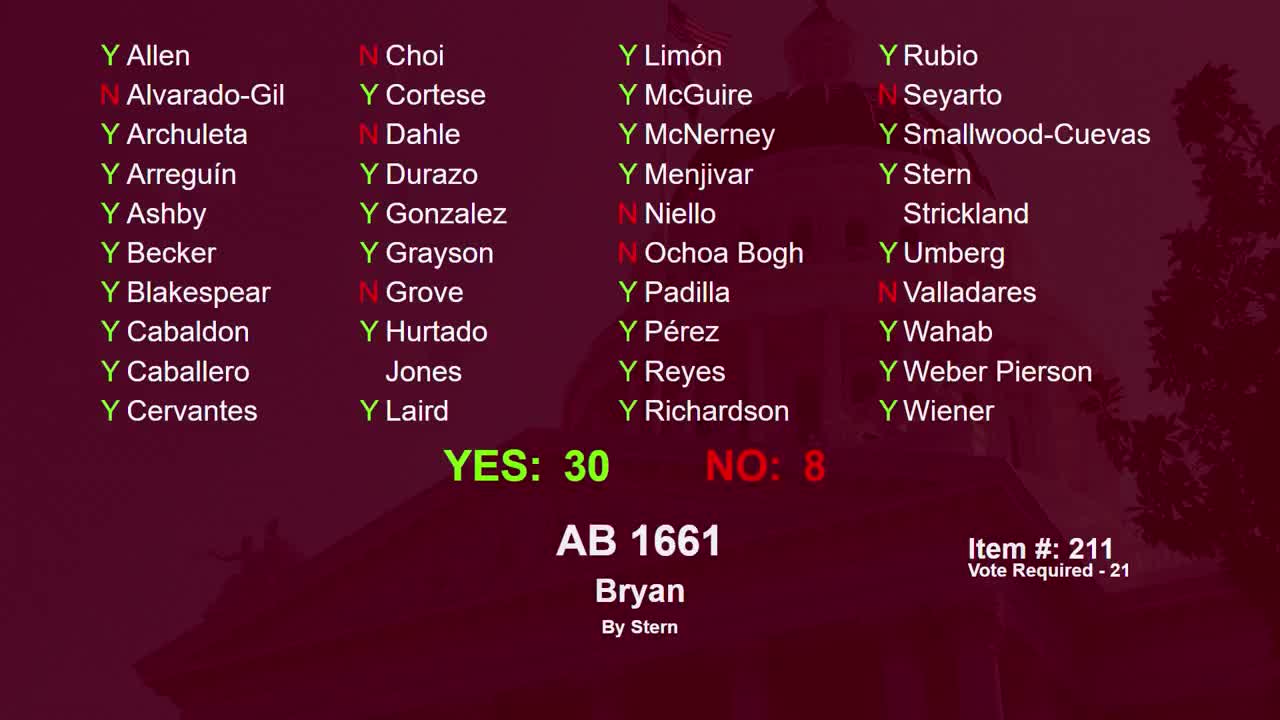 3MIN
Senate Floor
 12MIN
Senate Standing Committee on Public Safety
 13MIN
Senate Standing Committee on Elections and Constitutional Amendments
 4MIN
Assembly Floor
 8MIN



