AB 1842: California Mortgage Relief Act.
- Session Year: 2025-2026
- House: Assembly
- Latest Version Date: 2026-09-15
Current Status:
Passed
(2026-09-15: Chaptered by Secretary of State - Chapter 241, Statutes of 2026.)
Introduced
In Committee
Awaiting First Chamber Vote
Passed First Chamber
In Committee
Awaiting Second Chamber Vote
Passed Second Chamber
Enacted
What does this bill do?
The bill creates the California Mortgage Relief Act letting borrowers whose home became uninhabitable due to a federally declared disaster request mortgage forbearance by affirming the condition. Servicers must offer an initial 180‑day forbearance, extendable in 90‑day increments up to 12 months, and may not charge late fees or default interest. They must report the account as current to credit bureaus during forbearance, may not begin or carry out foreclosure or eviction while the borrower is complying, and must offer at least one post‑forbearance option that avoids a lump‑sum repayment or higher monthly principal and interest.
The summary is provided by generative AI which can make mistakes. For original language, please view the details in the table below.
Existing law authorizes a borrower who is experiencing financial hardship that prevents the borrower from making timely payments on a specified residential mortgage loan due directly to a specified state of emergency proclaimed by the Governor, or a specified federally declared disaster, to request forbearance on their residential mortgage loan, as prescribed. Existing law requires a mortgage servicer, except as specified, to offer mortgage payment forbearance for an initial 90-day period that may be extended up to a maximum forbearance period of 12 months and prohibits a mortgage servicer from assessing any late fees to the borrowers account or charging a default rate of interest during the forbearance period.
This bill would, among other things, similarly authorize a borrower to request forbearance on a residential mortgage loan, as defined, secured by residential real property that has become uninhabitable as a direct result of a disaster, which the bill would define to mean the conditions described in a declaration of a disaster issued by the federal government. The bill would require the borrower to affirm that as a direct result of a disaster, a residential unit is uninhabitable. Because the bill would expand the crime of perjury, the bill would impose a state-mandated local program.
This bill would, except as specified, require a mortgage servicer to offer mortgage payment forbearance of a period of up to an initial 180 days, to be extended at the request of the borrower in 90-day increments, up to a maximum forbearance period of 12 months. The bill would provide that the forbearance period includes any period of forbearance related to the disaster that a mortgage servicer has provided to a borrower before the date upon which a declaration of a disaster was issued. The bill would also prohibit a mortgage servicer from assessing any late fees to the borrowers account or charging a default rate of interest during the forbearance period.
This bill would require a mortgage servicer to report the credit obligations of borrowers under a disaster-related forbearance plan in compliance with the federal Fair Credit Reporting Act. For an account granted disaster-related mortgage payment relief, the bill would prohibit a mortgage servicer from furnishing information during the forbearance period indicating that the payments are in forbearance and would require the mortgage servicer to report the credit obligation or account as current.
This bill would authorize a civil action to enforce these provisions to be brought by the Attorney General, a district attorney, or a county counsel.
The California Constitution requires the state to reimburse local agencies and school districts for certain costs mandated by the state. Statutory provisions establish procedures for making that reimbursement.
This bill would provide that no reimbursement is required by this act for a specified reason.
Existing law authorizes a borrower who is experiencing financial hardship that prevents the borrower from making timely payments on a specified residential mortgage loan due directly to a specified state of emergency proclaimed by the Governor, or a specified federally declared disaster, to request forbearance on their residential mortgage loan, as prescribed. Existing law requires a mortgage servicer, except as specified, to offer mortgage payment forbearance for an initial 90-day period that may be extended up to a maximum forbearance period of 12 months and prohibits a mortgage servicer from assessing any late fees to the borrowers account or charging a default rate of interest during the forbearance period.
This bill would, among other things, similarly authorize a borrower to request forbearance on a residential mortgage loan, as defined, secured by residential real property that has become uninhabitable as a direct result of a disaster, which the bill would define to mean the conditions described in a declaration of a disaster issued by the federal government. The bill would require the borrower to affirm that as a direct result of a disaster, a residential unit is uninhabitable. Because the bill would expand the crime of perjury, the bill would impose a state-mandated local program.
This bill would, except as specified, require a mortgage servicer to offer mortgage payment forbearance of a period of up to an initial 180 days, to be extended at the request of the borrower in 90-day increments, up to a maximum forbearance period of 12 months. The bill would provide that the forbearance period includes any period of forbearance related to the disaster that a mortgage servicer has provided to a borrower before the date upon which a declaration of a disaster was issued. The bill would also prohibit a mortgage servicer from assessing any late fees to the borrowers account or charging a default rate of interest during the forbearance period.
This bill would require a mortgage servicer to report the credit obligations of borrowers under a disaster-related forbearance plan in compliance with the federal Fair Credit Reporting Act. For an account granted disaster-related mortgage payment relief, the bill would prohibit a mortgage servicer from furnishing information during the forbearance period indicating that the payments are in forbearance and would require the mortgage servicer to report the credit obligation or account as current.
This bill would authorize a civil action to enforce these provisions to be brought by the Attorney General, a district attorney, or a county counsel.
The California Constitution requires the state to reimburse local agencies and school districts for certain costs mandated by the state. Statutory provisions establish procedures for making that reimbursement.
This bill would provide that no reimbursement is required by this act for a specified reason.
Existing law authorizes a borrower who is experiencing financial hardship that prevents the borrower from making timely payments on a specified residential mortgage loan due directly to a specified state of emergency proclaimed by the Governor, or a specified federally declared disaster, to request forbearance on their residential mortgage loan, as prescribed. Existing law requires a mortgage servicer, except as specified, to offer mortgage payment forbearance for an initial 90-day period that may be extended up to a maximum forbearance period of 12 months and prohibits a mortgage servicer from assessing any late fees to the borrowers account or charging a default rate of interest during the forbearance period.
This bill would, among other things, similarly authorize a borrower to request forbearance on a residential mortgage loan, as defined, secured by residential real property that has become uninhabitable as a direct result of a disaster, which the bill would define to mean the conditions described in a declaration of a disaster issued by the federal government. The bill would require the borrower to affirm that as a direct result of a disaster, a residential unit is uninhabitable. Because the bill would expand the crime of perjury, the bill would impose a state-mandated local program.
This bill would, except as specified, require a mortgage servicer to offer mortgage payment forbearance of a period of up to an initial 180 days, to be extended at the request of the borrower in 90-day increments, up to a maximum forbearance period of 12 months. The bill would provide that the forbearance period includes any period of forbearance related to the disaster that a mortgage servicer has provided to a borrower before the date upon which a declaration of a disaster was issued. The bill would also prohibit a mortgage servicer from assessing any late fees to the borrowers account or charging a default rate of interest during the forbearance period.
This bill would require a mortgage servicer to report the credit obligations of borrowers under a disaster-related forbearance plan in compliance with the federal Fair Credit Reporting Act. For an account granted disaster-related mortgage payment relief, the bill would prohibit a mortgage servicer from furnishing information during the forbearance period indicating that the payments are in forbearance and would require the mortgage servicer to report the credit obligation or account as current or delinquent, as specified. current.
This bill would authorize a civil action to enforce these provisions to be brought by the Attorney General, a district attorney, or a county counsel.
The California Constitution requires the state to reimburse local agencies and school districts for certain costs mandated by the state. Statutory provisions establish procedures for making that reimbursement.
This bill would provide that no reimbursement is required by this act for a specified reason.
Existing law authorizes a borrower who is experiencing financial hardship that prevents the borrower from making timely payments on a specified residential mortgage loan due directly to a specified state of emergency proclaimed by the Governor, or a specified federally declared disaster, to request forbearance on their residential mortgage loan, as prescribed. Existing law requires a mortgage servicer, except as specified, to offer mortgage payment forbearance for an initial 90-day period that may be extended up to a maximum forbearance period of 12 months and prohibits a mortgage servicer from assessing any late fees to the borrowers account or charging a default rate of interest during the forbearance period.
This bill would, among other things, similarly authorize a borrower to request forbearance on a residential mortgage loan, as defined, secured by residential real property that has become uninhabitable as a direct result of a disaster, which the bill would define to mean the conditions described in a declaration of a disaster issued by the federal government. The bill would require the borrower to affirm that as a direct result of a disaster, a residential unit is uninhabitable. Because the bill would expand the crime of perjury, the bill would impose a state-mandated local program.
This bill would, except as specified, require a mortgage servicer to offer mortgage payment forbearance of a period of up to an initial 180 days, to be extended at the request of the borrower in 90-day increments, up to a maximum forbearance period of 12 months. The bill would provide that the forbearance period includes any period of forbearance related to the disaster that a mortgage servicer has provided to a borrower before the date upon which a declaration of a disaster was issued. The bill would also prohibit a mortgage servicer from assessing any late fees to the borrowers account or charging a default rate of interest during the forbearance period.
This bill would require a mortgage servicer to report the credit obligations of borrowers under a disaster-related forbearance plan in compliance with the federal Fair Credit Reporting Act. For an account granted disaster-related mortgage payment relief, the bill would prohibit a mortgage servicer from furnishing information during the forbearance period indicating that the payments are in forbearance and would require the mortgage servicer to report the credit obligation or account as current or delinquent, as specified.
This bill would authorize a civil action to enforce these provisions to be brought by the Attorney General, a district attorney, or a county counsel.
The California Constitution requires the state to reimburse local agencies and school districts for certain costs mandated by the state. Statutory provisions establish procedures for making that reimbursement.
This bill would provide that no reimbursement is required by this act for a specified reason.
Existing law authorizes a borrower who is experiencing financial hardship that prevents the borrower from making timely payments on a specified residential mortgage loan due directly to a specified state of emergency proclaimed by the Governor, or a specified federally declared disaster, to request forbearance on their residential mortgage loan, as prescribed. Existing law requires a mortgage servicer, except as specified, to offer mortgage payment forbearance for an initial 90-day period that may be extended up to a maximum forbearance period of 12 months and prohibits a mortgage servicer from assessing any late fees to the borrowers account or charging a default rate of interest during the forbearance period.
This bill would, among other things, similarly authorize a borrower to request forbearance on a residential mortgage loan, as defined, secured by residential real property that has become uninhabitable as a direct result of an emergency, as specified. a disaster, which the bill would define to mean the conditions described in a declaration of a disaster issued by the federal government. The bill would require the borrower to affirm that as a direct result of an emergency, a disaster, a residential unit is uninhabitable. Because the bill would expand the crime of perjury, the bill would impose a state-mandated local program.
This bill would, except as specified, require a mortgage servicer to offer mortgage payment forbearance of a period of up to an initial 180 days, to be extended at the request of the borrower in 90-day increments, up to a maximum forbearance period of 12 months. The bill would provide that the forbearance period includes any period of forbearance related to the emergency disaster that a mortgage servicer has provided to a borrower before the date upon which a declaration of a state of emergency disaster was issued by the Governor or the federal government. issued. The bill would also prohibit a mortgage servicer from assessing any late fees to the borrowers account or charging a default rate of interest during the forbearance period.
This bill would require a mortgage servicer to report the credit obligations of borrowers under an emergency-related a disaster-related forbearance plan in compliance with the federal Fair Credit Reporting Act. For accounts an account granted emergency-related disaster-related mortgage payment relief, the bill would prohibit mortgage servicers a mortgage servicer from furnishing information during the forbearance period indicating that the payments are in forbearance and would require them the mortgage servicer to report the credit obligation or account as current or delinquent, as specified.
This bill would authorize a civil action to enforce these provisions to be brought by the Attorney General, a district attorney, or a county counsel.
The California Constitution requires the state to reimburse local agencies and school districts for certain costs mandated by the state. Statutory provisions establish procedures for making that reimbursement.
This bill would provide that no reimbursement is required by this act for a specified reason.
Existing law authorizes a borrower who is experiencing financial hardship that prevents the borrower from making timely payments on a specified residential mortgage loan due directly to a specified state of emergency proclaimed by the Governor, or a specified federally declared disaster, to request forbearance on their residential mortgage loan, as prescribed. Existing law requires a mortgage servicer, except as specified, to offer mortgage payment forbearance for an initial 90-day period that may be extended up to a maximum forbearance period of 12 months and prohibits a mortgage servicer from assessing any late fees to the borrowers account or charging a default rate of interest during the forbearance period.
This bill would, among other things, similarly authorize a borrower to request forbearance on a residential mortgage loan, as defined, secured by residential real property that has become uninhabitable as a direct result of an emergency, as specified. The bill would require the borrower to affirm that as a direct result of an emergency, a residential unit is uninhabitable. Because the bill would expand the crime of perjury, the bill would impose a state-mandated local program.
This bill would, except as specified, require a mortgage servicer to offer mortgage payment forbearance of a period of up to an initial 180 days, to be extended at the request of the borrower in 90-day increments, up to a maximum forbearance period of 12 months. The bill would provide that the forbearance period includes any period of forbearance related to the emergency that a mortgage servicer has provided to a borrower before the effective date of these provisions. date upon which a declaration of a state of emergency was issued by the Governor or the federal government. The bill would also prohibit a mortgage servicer from assessing any late fees to the borrowers account or charging a default rate of interest during the forbearance period.
This bill would require a mortgage servicer to report the credit obligations of borrowers under an emergency-related forbearance plan in compliance with the federal Fair Credit Reporting Act. For accounts granted emergency-related mortgage payment relief, the bill would prohibit mortgage servicers from furnishing information during the forbearance period indicating that the payments are in forbearance and would require them to report the credit obligation or account as current or delinquent, as specified.
This bill would authorize a borrower to bring a certain civil action to enforce these provisions. provisions to be brought by the Attorney General, a district attorney, or a county counsel.
The California Constitution requires the state to reimburse local agencies and school districts for certain costs mandated by the state. Statutory provisions establish procedures for making that reimbursement.
This bill would provide that no reimbursement is required by this act for a specified reason.
Existing law authorizes a borrower who is experiencing financial hardship that prevents the borrower from making timely payments on a specified residential mortgage loan due directly to a specified state of emergency proclaimed by the Governor, or a specified federally declared disaster, to request forbearance on their residential mortgage loan, as prescribed. Existing law requires a mortgage servicer, except as specified, to offer mortgage payment forbearance for an initial 90-day period that may be extend extended up to a maximum forbearance period of 12 months and prohibits a mortgage servicer from assessing any late fees to the borrowers account or charging a default rate of interest during the forbearance period.
This bill would, among other things, similarly authorize a borrower to request forbearance on a residential mortgage loan, as defined, secured by a residential real property that has become uninhabitable as a direct result of an emergency, as specified. The bill would require the borrower to affirm that as a direct result of an emergency, a residential unit is uninhabitable. Because the bill would expand the crime of perjury, the bill would impose a state-mandated local program.
This bill would, except as specified, require a mortgage servicer to offer mortgage payment forbearance of a period of up to an initial 180 days, to be extended at the request of the borrower in 90-day increments, up to a maximum forbearance period of 12 months. The bill would provide that the forbearance period includes any period of forbearance related to the emergency that a mortgage servicer has provided to a borrower before the effective date of these provisions. The bill would also prohibit a mortgage servicer from assessing any late fees to the borrowers account or charging a default rate of interest during the forbearance period.
This bill would require a mortgage servicer to report the credit obligations of borrowers under an emergency-related forbearance plan in compliance with the federal Fair Credit Reporting Act. For accounts granted emergency-related mortgage payment relief, the bill would prohibit mortgage servicers from furnishing information during the forbearance period indicating that the payments are in forbearance and would require them to report the credit obligation or account as current or delinquent, as specified.
This bill would authorize a borrower to bring a certain civil action to enforce these provisions.
The California Constitution requires the state to reimburse local agencies and school districts for certain costs mandated by the state. Statutory provisions establish procedures for making that reimbursement.
This bill would provide that no reimbursement is required by this act for a specified reason.
Existing law authorizes a borrower who is experiencing financial hardship that prevents the borrower from making timely payments on a specified residential mortgage loan due directly to a specified state of emergency proclaimed by the Governor, or a specified federally declared disaster, to request forbearance on their residential mortgage loan, as prescribed. Existing law requires a mortgage servicer, except as specified, to offer mortgage payment forbearance for an initial 90-day period that may be extend up to a maximum forbearance period of 12 months and prohibits a mortgage servicer from assessing any late fees to the borrowers account or charging a default rate of interest during the forbearance period.
This bill would, among other things, similarly authorize a borrower to request forbearance on a residential mortgage loan, as defined, secured by a residential real property that has become uninhabitable as a direct result of an emergency, as specified. The bill would require the borrower to affirm that as a direct result of an emergency, a residential unit is uninhabitable. Because the bill would expand the crime of perjury, the bill would impose a state-mandated local program.
This bill would, except as specified, require a mortgage servicer to offer mortgage payment forbearance of a period of up to an initial 180 days, to be extended at the request of the borrower in 90-day increments, up to a maximum forbearance period of 12 months. The bill would provide that the forbearance period includes any period of forbearance related to the emergency that a mortgage servicer has provided to a borrower before the effective date of these provisions. The bill would also prohibit a mortgage servicer from assessing any late fees to the borrowers account or charging a default rate of interest during the forbearance period.
This bill would require a mortgage servicer to report the credit obligations of borrowers under an emergency-related forbearance plan in compliance with the federal Fair Credit Reporting Act. For accounts granted emergency-related mortgage payment relief, the bill would prohibit mortgage servicers from furnishing information during the forbearance period indicating that the payments are in forbearance and would require them to report the credit obligation or account as current or delinquent, as specified.
This bill would authorize a borrower to bring a certain civil action to enforce these provisions.
The California Constitution requires the state to reimburse local agencies and school districts for certain costs mandated by the state. Statutory provisions establish procedures for making that reimbursement.
This bill would provide that no reimbursement is required by this act for a specified reason.
This title shall be known as the California Mortgage Relief Act.
3273.32.For purposes of this title:
(a)(1)Borrower means a natural person who is a mortgagor or trustor or a person who holds a power of attorney for a mortgagor or trustor.
(2)Borrower does not include any of the following:
(A)An individual who has surrendered the secured property as evidenced by either a letter confirming the surrender or delivery of the keys to the property to the mortgagee, trustee, beneficiary, or authorized agent.
(B)An individual who has a recorded notice of default recorded against the real property that is secured by the residential mortgage loan before issuance of a declaration of a disaster unless the notice of default was rescinded.
(C)An individual who was delinquent in satisfying a residential mortgage loan credit obligation or account for a period of more than 90 days immediately before a declaration of a disaster.
(b)Disaster means the conditions described in a declaration of a disaster issued by the federal government.
(c)Disaster-related forbearance relief means the relief described in servicing guidelines for federally backed loans.
(d)Federally backed loan means a residential mortgage loan that is insured, guaranteed, purchased, or secured by a federal agency or government-sponsored entity.
(e)(1)Mortgage servicer means a person or entity who directly services a loan or who is responsible for interacting with the borrower, managing the loan account on a daily basis, including collecting and crediting periodic loan payments, managing any escrow account, or enforcing the note and security instrument, either as the current owner of the promissory note or as the current owners authorized agent.
(2)Mortgage servicer also means a subservicing agent to a master servicer by contract.
(3)Mortgage servicer does not include a trustee, or a trustees authorized agent, acting under a power of sale pursuant to a deed of trust.
(f)Residential mortgage loan means any loan that is secured by residential real property improved by four or fewer residential units.
(g)Uninhabitable means a condition in which a residential real property is inaccessible or unsuitable for living. For multiunit properties secured by a residential mortgage loan, if any unit is uninhabitable, the entire property is uninhabitable for the purposes of this section. Uninhabitability may be established by affirmation of the borrower.
3273.33.This title applies to a depository institution chartered under federal or state law, a person covered by the licensing requirements of Division 9 (commencing with Section 22000) or Division 20 (commencing with Section 50000) of the Financial Code, or a person licensed pursuant to Part 1 (commencing with Section 10000) of Division 4 of the Business and Professions Code.
3273.34.(a)A borrower may request forbearance on a residential mortgage loan secured by residential real property upon which at least one residential unit has become uninhabitable as a direct result of a disaster is or was located by doing both of the following:
(1)For initial forbearance requests, submitting a request to the borrowers mortgage loan servicer before the conclusion of six months after the date upon which a declaration of a disaster was issued. For requests for a forbearance extension, submitting a request to the mortgage loan servicer before the conclusion of the initial forbearance, pursuant to paragraph (2) of subdivision (h).
(2) Submitting a verbal or written request affirming that a residential unit is uninhabitable as a direct result of a disaster. Requests for a forbearance extension require a new affirmation that a residential unit remains uninhabitable as a direct result of an emergency. No other documentation shall be required to substantiate that a residential unit is or remains uninhabitable as a direct result of an emergency.
(b)Upon a request by an eligible borrower for forbearance under subdivision (a), a mortgage servicer shall offer mortgage payment forbearance for an initial period of 180 days, which shall be extended at the request of the borrower in 90-day increments, up to a maximum forbearance period of 12 months.
(c)The mortgage servicer shall notify the borrower in writing within 10 business days following receipt of the borrowers request whether the borrowers request for forbearance has been approved, denied pursuant to subdivision (d), or is deficient. With any notice of approval, the mortgage servicer shall provide to the borrower information about potential repayment plans that may be used pursuant to subdivision (c) of Section 3273.35.
(d)If the mortgage servicer, acting under delegated authority to make forbearance determinations on behalf of the investor, denies a forbearance request within the maximum allowable forbearance period of 12 months pursuant to subdivision (b) because compliance with subdivision (b) would conflict with Section 3273.38, the mortgage servicer shall not be in violation of this section if the mortgage servicer includes in the written notice in subdivision (c) the following:
(1)A clear and concise explanation of the specific investor provision of an existing contract that is the basis for the denial.
(2)The text of the specific existing investor guideline or contractual provision that is the basis for the denial of the borrowers forbearance request.
(e)If the written notice in subdivision (c) does not approve the borrowers request for forbearance due to any defect in the borrowers request, including an incomplete application, missing information, a failure to timely request, or due to a disqualified borrower, emergency, mortgage servicer, or residential mortgage loan, the mortgage servicer shall do all of the following:
(1)Specifically identify any defect in the written notice.
(2)Provide 21 calendar days from the electronic or postal mailing date of the written notice for the borrower to cure any identified defect.
(3)Accept the borrowers revised request for forbearance received before the 21-day period described in paragraph (2) lapses.
(4)Respond to the borrowers revised request within five business days of receipt of the revised request with notification of whether the revised request has been approved or remains deficient.
(f)The forbearance period required by subdivision (b) shall include any period of forbearance related to the disaster that a mortgage servicer has provided to a borrower before the date upon which a declaration of a disaster was issued.
(g)During the period of forbearance required by this section, a late fee shall not be assessed to the borrowers account, and the borrower shall not be charged a default rate of interest.
(h)No later than 30 calendar days before the end of an initial or extension forbearance period, a mortgage servicer shall provide written notice to the borrower disclosing both of the following:
(1)Any documentation or forms that the mortgage servicer requires the borrower to furnish or complete to be considered for an additional period of forbearance.
(2)Action required to request an additional period of forbearance.
(i)A mortgage servicer shall report the credit obligations of a borrower under a disaster-related forbearance plan in compliance with the federal Fair Credit Reporting Act (15 U.S.C. Sec. 1681 et seq.). For an account granted disaster-related mortgage payment relief pursuant to this title, a mortgage servicer shall not furnish information during the forbearance period indicating that the payments are in forbearance and shall report the credit obligation or account as current.
3273.35.(a)A mortgage servicer shall disclose to a borrower to whom a forbearance has been granted pursuant to Section 3273.34 that the forborne mortgage payments are required to be repaid.
(b)The disclosure required by subdivision (a) is required to be furnished to the borrower only once at the beginning of the forbearance period.
(c)To the extent consistent with a mortgage servicers contractual authority, at the end of a borrowers forbearance period, the mortgage servicer shall offer the borrower at least one postforbearance home retention option that does not, before satisfaction of the mortgage loan, do either of the following:
(1)Require the borrower to repay the arrearages resulting from the forbearance all at once in a lump sum.
(2)Increase in any month the borrowers preforbearance monthly principal and interest payment other than as the result of an adjustment of the applicable index pursuant to the terms of an adjustable rate mortgage.
(d)A mortgage servicer shall apply any payment received from the borrower after the forbearance period ends in compliance with the terms of the loan and any postforbearance agreement between the borrower and the mortgage servicer.
3273.36.During the time of forbearance granted pursuant to this title, a mortgage servicer shall not initiate any judicial or nonjudicial foreclosure process, move for a foreclosure judgment or order of sale, or execute a foreclosure-related eviction or foreclosure sale if the borrower is performing pursuant to the terms of the forbearance.
3273.37.Failure to comply with this title shall not affect the validity of a trustees sale or a sale to a bona fide purchaser for value.
3273.38.(a)(1)With respect to a federally backed loan, a person shall not be held liable for a violation of this title if compliance with this title conflicts with the servicing guidelines applicable to the federally backed loan.
(2)Servicing guidelines applicable to a federally backed loan includes servicing guidelines like those issued by the Federal National Mortgage Association (Fannie Mae) and the Federal Home Loan Mortgage Corporation (Freddie Mac), the Single Family Housing Policy Handbook issued by the Federal Housing Administration of the United States Department of Housing and Urban Development, the VA Servicer Handbook issued by the United States Department of Veterans Affairs, or a servicing handbook issued by the Rural Development division of the United States Department of Agriculture, as those guidelines existed on the date that the declaration of a disaster was issued that is the basis of the borrowers eligibility pursuant to this title.
(b)With respect to a residential mortgage loan that is not a federally backed loan, a person shall not be held liable for a violation of this title if compliance with this title conflicts with the servicing guidelines issued by Fannie Mae or Freddie Mac.
(c)For purposes of this section, conflicts with means that it is impossible to comply with this title and the persons obligation under the applicable servicing guidelines.
3273.40.A civil action for a violation of this title may be brought by the Attorney General, a district attorney, or a county counsel.
3273.41.The Department of Financial Protection and Innovation shall post all of the following on its internet website:
(a)Links to the provisions of servicing guidelines pertaining to disaster-related forbearance relief for federally backed loans.
(b)A summary of Fannie Mae and Freddie Mac guidance to assist borrowers in understanding their forbearance programs.
(c)A dedicated telephone number for borrowers seeking assistance.
3273.42.(a)It is the intent of the Legislature that a mortgage servicer offer a borrower forbearance that is consistent with the mortgage servicers contractual or other authority.
(b)It is the intent of the Legislature that this title not apply to servicing guidelines that are unrelated to disaster-related forbearance relief.
(c)This title does not require a mortgage servicer to take any action that would require the mortgage servicer to breach the terms of an existing contract with the investor that owns or insures the residential mortgage loan.
3273.43.The provisions of this title are severable. If any provision of this title or its application is held invalid, that invalidity shall not affect other provisions or applications that can be given effect without the invalid provision or application.
SEC. 2.No reimbursement is required by this act pursuant to Section 6 of Article XIIIB of the California Constitution because the only costs that may be incurred by a local agency or school district will be incurred because this act creates a new crime or infraction, eliminates a crime or infraction, or changes the penalty for a crime or infraction, within the meaning of Section 17556 of the Government Code, or changes the definition of a crime within the meaning of Section 6 of Article XIIIB of the California Constitution.
This title shall be known as the California Mortgage Relief Act.
3273.32.For purposes of this title:
(a)(1)Borrower means a natural person who is a mortgagor or trustor or a person who holds a power of attorney for a mortgagor or trustor.
(2)Borrower does not include any of the following:
(A)An individual who has surrendered the secured property as evidenced by either a letter confirming the surrender or delivery of the keys to the property to the mortgagee, trustee, beneficiary, or authorized agent.
(B)An individual who has a recorded notice of default recorded against the real property that is secured by the residential mortgage loan before issuance of a declaration of a disaster unless the notice of default was rescinded.
(C)An individual who was delinquent in satisfying a residential mortgage loan credit obligation or account for a period of more than 90 days immediately before a declaration of a disaster.
(b)Disaster means the conditions described in a declaration of a disaster issued by the federal government.
(c)Disaster-related forbearance relief means the relief described in servicing guidelines for federally backed loans.
(d)Federally backed loan means a residential mortgage loan that is insured, guaranteed, purchased, or secured by a federal agency or government-sponsored entity.
(e)(1)Mortgage servicer means a person or entity who directly services a loan or who is responsible for interacting with the borrower, managing the loan account on a daily basis, including collecting and crediting periodic loan payments, managing any escrow account, or enforcing the note and security instrument, either as the current owner of the promissory note or as the current owners authorized agent.
(2)Mortgage servicer also means a subservicing agent to a master servicer by contract.
(3)Mortgage servicer does not include a trustee, or a trustees authorized agent, acting under a power of sale pursuant to a deed of trust.
(f)Residential mortgage loan means any loan that is secured by residential real property improved by four or fewer residential units.
(g)Uninhabitable means a condition in which a residential real property is inaccessible or unsuitable for living. For multiunit properties secured by a residential mortgage loan, if any unit is uninhabitable, the entire property is uninhabitable for the purposes of this section. Uninhabitability may be established by affirmation of the borrower.
3273.33.This title applies to a depository institution chartered under federal or state law, a person covered by the licensing requirements of Division 9 (commencing with Section 22000) or Division 20 (commencing with Section 50000) of the Financial Code, or a person licensed pursuant to Part 1 (commencing with Section 10000) of Division 4 of the Business and Professions Code.
3273.34.(a)A borrower may request forbearance on a residential mortgage loan secured by residential real property upon which at least one residential unit has become uninhabitable as a direct result of a disaster is or was located by doing both of the following:
(1)For initial forbearance requests, submitting a request to the borrowers mortgage loan servicer before the conclusion of six months after the date upon which a declaration of a disaster was issued. For requests for a forbearance extension, submitting a request to the mortgage loan servicer before the conclusion of the initial forbearance, pursuant to paragraph (2) of subdivision (h).
(2) Submitting a verbal or written request affirming that a residential unit is uninhabitable as a direct result of a disaster. Requests for a forbearance extension require a new affirmation that a residential unit remains uninhabitable as a direct result of an emergency. No other documentation shall be required to substantiate that a residential unit is or remains uninhabitable as a direct result of an emergency.
(b)Upon a request by an eligible borrower for forbearance under subdivision (a), a mortgage servicer shall offer mortgage payment forbearance for an initial period of 180 days, which shall be extended at the request of the borrower in 90-day increments, up to a maximum forbearance period of 12 months.
(c)The mortgage servicer shall notify the borrower in writing within 10 business days following receipt of the borrowers request whether the borrowers request for forbearance has been approved, denied pursuant to subdivision (d), or is deficient. With any notice of approval, the mortgage servicer shall provide to the borrower information about potential repayment plans that may be used pursuant to subdivision (c) of Section 3273.35.
(d)If the mortgage servicer, acting under delegated authority to make forbearance determinations on behalf of the investor, denies a forbearance request within the maximum allowable forbearance period of 12 months pursuant to subdivision (b) because compliance with subdivision (b) would conflict with Section 3273.38, the mortgage servicer shall not be in violation of this section if the mortgage servicer includes in the written notice in subdivision (c) the following:
(1)A clear and concise explanation of the specific investor provision of an existing contract that is the basis for the denial.
(2)The text of the specific existing investor guideline or contractual provision that is the basis for the denial of the borrowers forbearance request.
(e)If the written notice in subdivision (c) does not approve the borrowers request for forbearance due to any defect in the borrowers request, including an incomplete application, missing information, a failure to timely request, or due to a disqualified borrower, emergency, mortgage servicer, or residential mortgage loan, the mortgage servicer shall do all of the following:
(1)Specifically identify any defect in the written notice.
(2)Provide 21 calendar days from the electronic or postal mailing date of the written notice for the borrower to cure any identified defect.
(3)Accept the borrowers revised request for forbearance received before the 21-day period described in paragraph (2) lapses.
(4)Respond to the borrowers revised request within five business days of receipt of the revised request with notification of whether the revised request has been approved or remains deficient.
(f)The forbearance period required by subdivision (b) shall include any period of forbearance related to the disaster that a mortgage servicer has provided to a borrower before the date upon which a declaration of a disaster was issued.
(g)During the period of forbearance required by this section, a late fee shall not be assessed to the borrowers account, and the borrower shall not be charged a default rate of interest.
(h)No later than 30 calendar days before the end of an initial or extension forbearance period, a mortgage servicer shall provide written notice to the borrower disclosing both of the following:
(1)Any documentation or forms that the mortgage servicer requires the borrower to furnish or complete to be considered for an additional period of forbearance.
(2)Action required to request an additional period of forbearance.
(i)A mortgage servicer shall report the credit obligations of a borrower under a disaster-related forbearance plan in compliance with the federal Fair Credit Reporting Act (15 U.S.C. Sec. 1681 et seq.). For an account granted disaster-related mortgage payment relief pursuant to this title, a mortgage servicer shall not furnish information during the forbearance period indicating that the payments are in forbearance and shall report the credit obligation or account as current.
3273.35.(a)A mortgage servicer shall disclose to a borrower to whom a forbearance has been granted pursuant to Section 3273.34 that the forborne mortgage payments are required to be repaid.
(b)The disclosure required by subdivision (a) is required to be furnished to the borrower only once at the beginning of the forbearance period.
(c)To the extent consistent with a mortgage servicers contractual authority, at the end of a borrowers forbearance period, the mortgage servicer shall offer the borrower at least one postforbearance home retention option that does not, before satisfaction of the mortgage loan, do either of the following:
(1)Require the borrower to repay the arrearages resulting from the forbearance all at once in a lump sum.
(2)Increase in any month the borrowers preforbearance monthly principal and interest payment other than as the result of an adjustment of the applicable index pursuant to the terms of an adjustable rate mortgage.
(d)A mortgage servicer shall apply any payment received from the borrower after the forbearance period ends in compliance with the terms of the loan and any postforbearance agreement between the borrower and the mortgage servicer.
3273.36.During the time of forbearance granted pursuant to this title, a mortgage servicer shall not initiate any judicial or nonjudicial foreclosure process, move for a foreclosure judgment or order of sale, or execute a foreclosure-related eviction or foreclosure sale if the borrower is performing pursuant to the terms of the forbearance.
3273.37.Failure to comply with this title shall not affect the validity of a trustees sale or a sale to a bona fide purchaser for value.
3273.38.(a)(1)With respect to a federally backed loan, a person shall not be held liable for a violation of this title if compliance with this title conflicts with the servicing guidelines applicable to the federally backed loan.
(2)Servicing guidelines applicable to a federally backed loan includes servicing guidelines like those issued by the Federal National Mortgage Association (Fannie Mae) and the Federal Home Loan Mortgage Corporation (Freddie Mac), the Single Family Housing Policy Handbook issued by the Federal Housing Administration of the United States Department of Housing and Urban Development, the VA Servicer Handbook issued by the United States Department of Veterans Affairs, or a servicing handbook issued by the Rural Development division of the United States Department of Agriculture, as those guidelines existed on the date that the declaration of a disaster was issued that is the basis of the borrowers eligibility pursuant to this title.
(b)With respect to a residential mortgage loan that is not a federally backed loan, a person shall not be held liable for a violation of this title if compliance with this title conflicts with the servicing guidelines issued by Fannie Mae or Freddie Mac.
(c)For purposes of this section, conflicts with means that it is impossible to comply with this title and the persons obligation under the applicable servicing guidelines.
3273.40.A civil action for a violation of this title may be brought by the Attorney General, a district attorney, or a county counsel.
3273.41.The Department of Financial Protection and Innovation shall post all of the following on its internet website:
(a)Links to the provisions of servicing guidelines pertaining to disaster-related forbearance relief for federally backed loans.
(b)A summary of Fannie Mae and Freddie Mac guidance to assist borrowers in understanding their forbearance programs.
(c)A dedicated telephone number for borrowers seeking assistance.
3273.42.(a)It is the intent of the Legislature that a mortgage servicer offer a borrower forbearance that is consistent with the mortgage servicers contractual or other authority.
(b)It is the intent of the Legislature that this title not apply to servicing guidelines that are unrelated to disaster-related forbearance relief.
(c)This title does not require a mortgage servicer to take any action that would require the mortgage servicer to breach the terms of an existing contract with the investor that owns or insures the residential mortgage loan.
3273.43.The provisions of this title are severable. If any provision of this title or its application is held invalid, that invalidity shall not affect other provisions or applications that can be given effect without the invalid provision or application.
SEC. 2.No reimbursement is required by this act pursuant to Section 6 of Article XIIIB of the California Constitution because the only costs that may be incurred by a local agency or school district will be incurred because this act creates a new crime or infraction, eliminates a crime or infraction, or changes the penalty for a crime or infraction, within the meaning of Section 17556 of the Government Code, or changes the definition of a crime within the meaning of Section 6 of Article XIIIB of the California Constitution.
This title shall be known as the California Mortgage Relief Act.
3273.32.For purposes of this title:
(a)(1)Borrower means a natural person who is a mortgagor or trustor or a person who holds a power of attorney for a mortgagor or trustor.
(2)Borrower does not include any of the following:
(A)An individual who has surrendered the secured property as evidenced by either a letter confirming the surrender or delivery of the keys to the property to the mortgagee, trustee, beneficiary, or authorized agent.
(B)An individual who has a recorded notice of default recorded against the real property that is secured by the residential mortgage loan before issuance of a declaration of a disaster unless the notice of default was rescinded.
(C)An individual who was delinquent in satisfying a residential mortgage loan credit obligation or account for a period of more than 90 days immediately before a declaration of a disaster.
(D)An individual against whom an unrescinded notice of default was recorded within 90 days of a declaration of a disaster.(b)Disaster means the conditions described in a declaration of a disaster issued by the federal government.
(c)Disaster-related forbearance relief means the relief described in servicing guidelines for federally backed loans.
(d)Federally backed loan means a residential mortgage loan that is insured, guaranteed, purchased, or secured by a federal agency or government-sponsored entity.
(e)(1)Mortgage servicer means a person or entity who directly services a loan or who is responsible for interacting with the borrower, managing the loan account on a daily basis, including collecting and crediting periodic loan payments, managing any escrow account, or enforcing the note and security instrument, either as the current owner of the promissory note or as the current owners authorized agent.
(2)Mortgage servicer also means a subservicing agent to a master servicer by contract.
(3)Mortgage servicer does not include a trustee, or a trustees authorized agent, acting under a power of sale pursuant to a deed of trust.
(f)Residential mortgage loan means a any loan that is secured by residential real property improved by four or fewer residential units.
(g)Uninhabitable means a condition in which a residential real property is inaccessible or unsuitable for living. For multiunit properties secured by a residential mortgage loan, if any unit is uninhabitable, the entire property is uninhabitable for the purposes of this section. Uninhabitability may be established by affirmation of the borrower.
3273.33.This title applies to a depository institution chartered under federal or state law, a person covered by the licensing requirements of Division 9 (commencing with Section 22000) or Division 20 (commencing with Section 50000) of the Financial Code, or a person licensed pursuant to Part 1 (commencing with Section 10000) of Division 4 of the Business and Professions Code.
3273.34.(a)A borrower may request forbearance on a residential mortgage loan secured by residential real property upon which a at least one residential unit that has become uninhabitable as a direct result of a disaster is or was located by doing both of the following:
(1)Submitting For initial forbearance requests, submitting a request to the borrowers mortgage loan servicer before the conclusion of six months after the date upon which a declaration of a disaster was issued. For requests for a forbearance extension, submitting a request to the mortgage loan servicer before the conclusion of the initial forbearance, pursuant to paragraph (2) of subdivision (h).
(2)Affirming Submitting a verbal or written request affirming that a residential unit is uninhabitable as a direct result of a disaster. Requests for a forbearance extension require a new affirmation that a residential unit remains uninhabitable as a direct result of an emergency. No other documentation shall be required to substantiate that a residential unit is or remains uninhabitable as a direct result of an emergency.
(b)Upon a request by an eligible borrower for forbearance under subdivision (a), a mortgage servicer shall offer mortgage payment forbearance for an initial period of 180 days, which shall be extended at the request of the borrower in 90-day increments, up to a maximum forbearance period of 12 months.
(c)The mortgage servicer shall notify the borrower in writing within 10 business days following receipt of the borrowers request whether the borrowers request for forbearance has been approved. approved, denied pursuant to subdivision (d), or is deficient. With any notice of approval, the mortgage servicer shall provide to the borrower information about potential repayment plans that may be used pursuant to subdivision (c) of Section 3273.35.
(d)If the mortgage servicer, acting under delegated authority to make forbearance determinations on behalf of the investor, denies a forbearance request within the maximum allowable forbearance period of 12 months pursuant to subdivision (b), (b) because compliance with subdivision (b) would conflict with Section 3273.38, the mortgage servicer shall not be in violation of this section if the mortgage servicer provides includes in the written notice to the borrower stating the specific reason for denial. The notice shall include both of in subdivision (c) the following:
(1)A clear and concise explanation of the specific investor provision of an existing contract that is the basis for the denial.
(2)The text of the specific existing investor guideline or contractual provision that is the basis for the denial of the borrowers forbearance request.
(e)If the written notice in subdivision (c) cites does not approve the borrowers request for forbearance due to any defect in the borrowers request, including an incomplete application or application, missing information, that is curable, a failure to timely request, or due to a disqualified borrower, emergency, mortgage servicer, or residential mortgage loan, the mortgage servicer shall do all of the following:
(1)Specifically identify any curable defect in the written notice.
(2)Provide 21 calendar days from the electronic or postal mailing date of the written notice for the borrower to cure any identified defect.
(3)Accept the borrowers revised request for forbearance received before the 21-day period described in paragraph (2) lapses.
(4)Respond to the borrowers revised request within five business days of receipt of the revised request. request with notification of whether the revised request has been approved or remains deficient.
(f)The forbearance period required by subdivision (b) shall include any period of forbearance related to the disaster that a mortgage servicer has provided to a borrower before the date upon which a declaration of a disaster was issued.
(g)During the period of forbearance required by this section, a late fee shall not be assessed to the borrowers account, and the borrower shall not be charged a default rate of interest.
(h)No later than 30 calendar days before the end of an initial or extension forbearance period, a mortgage servicer shall provide written notice to the borrower disclosing both of the following:
(1)Any documentation or forms that the mortgage servicer requires the borrower to furnish or complete to be considered for an additional period of forbearance.
(2)A description of the deadlines and timelines associated with considering the borrower for an additional period of forbearance.(2)Action required to request an additional period of forbearance.
(i)A mortgage servicer shall report the credit obligations of a borrower under a disaster-related forbearance plan in compliance with the federal Fair Credit Reporting Act (15 U.S.C. Sec. 1681 et seq.). For an account granted disaster-related mortgage payment relief pursuant to this title, a mortgage servicer shall not furnish information during the forbearance period indicating that the payments are in forbearance and shall do either of the following: report the credit obligation or account as current.
(1)Report the credit obligation or account as current.(2)If a borrower was delinquent before the disaster-related forbearance plan, the mortgage servicer shall:(A)Maintain the delinquent status during the period in which the plan is in effect.(B)If the consumer brings the account current during the forbearance period, report the account as current.3273.35.(a)A mortgage servicer shall disclose to a borrower to whom a forbearance has been granted pursuant to Section 3273.34 that the forborne mortgage payments are required to be repaid.
(b)The disclosure required by subdivision (a) is required to be furnished to the borrower only once at the beginning of the forbearance period.
(c)To the extent consistent with a mortgage servicers contractual authority, at the end of a borrowers forbearance period, the mortgage servicer shall offer the borrower at least one postforbearance home retention option that does not, before satisfaction of the mortgage loan, do either of the following:
(1)Require the borrower to repay the arrearages resulting from the forbearance all at once in a lump sum.
(2)Increase in any month the borrowers preforbearance monthly principal and interest payment other than as the result of an adjustment of the applicable index pursuant to the terms of an adjustable rate mortgage.
(d)A mortgage servicer shall apply any payment received from the borrower after the forbearance period ends in compliance with the terms of the loan and any postforbearance agreement between the borrower and the mortgage servicer.
3273.36.During the time of forbearance granted pursuant to this title, a mortgage servicer shall not initiate any judicial or nonjudicial foreclosure process, move for a foreclosure judgment or order of sale, or execute a foreclosure-related eviction or foreclosure sale if the borrower is performing pursuant to the terms of the forbearance.
3273.37.Failure to comply with this title shall not affect the validity of a trustees sale or a sale to a bona fide purchaser for value.
3273.38.(a)(1)With respect to a federally backed loan, a person shall not be held liable for a violation of this title if compliance with this title conflicts with the servicing guidelines applicable to the federally backed loan.
(2)Servicing guidelines applicable to a federally backed loan includes servicing guidelines like those issued by the Federal National Mortgage Association (Fannie Mae) and the Federal Home Loan Mortgage Corporation (Freddie Mac), the Single Family Housing Policy Handbook issued by the Federal Housing Administration of the United States Department of Housing and Urban Development, the VA Servicer Handbook issued by the United States Department of Veterans Affairs, or a servicing handbook issued by the Rural Development division of the United States Department of Agriculture, as those guidelines existed on the date that the declaration of a disaster was issued that is the basis of the borrowers eligibility pursuant to this title.
(b)With respect to a residential mortgage loan that is not a federally backed loan, a person shall not be held liable for a violation of this title if compliance with this title conflicts with the servicing guidelines issued by Fannie Mae or Freddie Mac.
(c)For purposes of this section, conflicts with means that it is impossible to comply with this title and the persons obligation under the applicable servicing guidelines.
3273.40.A civil action for a violation of this title may be brought by the Attorney General, a district attorney, or a county counsel.
3273.41.The Department of Financial Protection and Innovation shall post all of the following on its internet website:
(a)Links to the provisions of servicing guidelines pertaining to disaster-related forbearance relief for federally backed loans.
(b)A summary of Fannie Mae and Freddie Mac guidance to assist borrowers in understanding their forbearance programs.
(c)A dedicated telephone number for borrowers seeking assistance.
3273.42.(a)It is the intent of the Legislature that a mortgage servicer offer a borrower forbearance that is consistent with the mortgage servicers contractual or other authority.
(b)It is the intent of the Legislature that this title not apply to servicing guidelines that are unrelated to disaster-related forbearance relief.
(c)This title does not require a mortgage servicer to take any action that would require the mortgage servicer to breach the terms of an existing contract with the investor that owns or insures the residential mortgage loan.
3273.43.The provisions of this title are severable. If any provision of this title or its application is held invalid, that invalidity shall not affect other provisions or applications that can be given effect without the invalid provision or application.
SEC. 2.No reimbursement is required by this act pursuant to Section 6 of Article XIIIB of the California Constitution because the only costs that may be incurred by a local agency or school district will be incurred because this act creates a new crime or infraction, eliminates a crime or infraction, or changes the penalty for a crime or infraction, within the meaning of Section 17556 of the Government Code, or changes the definition of a crime within the meaning of Section 6 of Article XIIIB of the California Constitution.
This title shall be known as the California Disaster-related Mortgage Relief Act.
3273.32.For purposes of this title:
(a)(1)Borrower means a natural person who is a mortgagor or trustor or a person who holds a power of attorney for a mortgagor or trustor.
(2)Borrower does not include any of the following:
(A)An individual who has surrendered the secured property as evidenced by either a letter confirming the surrender or delivery of the keys to the property to the mortgagee, trustee, beneficiary, or authorized agent.
(B)An individual who has a recorded notice of default recorded against the real property that is secured by the residential mortgage loan before issuance of a declaration of a disaster unless the notice of default was rescinded.
(C)An individual who was delinquent in satisfying a credit obligation or account for a period of more than 90 days immediately before a declaration of a disaster.
(D)An individual against whom an unrescinded notice of default was recorded within 90 days of a declaration of a disaster.
(b)Disaster means the conditions described in a declaration of a disaster issued by the federal government.
(c)Disaster-related forbearance relief means the relief described in servicing guidelines for federally backed loans.
(d)Federally backed loan means a residential mortgage loan that is insured, guaranteed, purchased, or secured by a federal agency or government-sponsored entity.
(e)(1)Mortgage servicer means a person or entity who directly services a loan or who is responsible for interacting with the borrower, managing the loan account on a daily basis, including collecting and crediting periodic loan payments, managing any escrow account, or enforcing the note and security instrument, either as the current owner of the promissory note or as the current owners authorized agent.
(2)Mortgage servicer also means a subservicing agent to a master servicer by contract.
(3)Mortgage servicer does not include a trustee, or a trustees authorized agent, acting under a power of sale pursuant to a deed of trust.
(f)Residential mortgage loan means a loan that is secured by residential real property improved by four or fewer residential units.
3273.33.This title applies to a depository institution chartered under federal or state law, a person covered by the licensing requirements of Division 9 (commencing with Section 22000) or Division 20 (commencing with Section 50000) of the Financial Code, or a person licensed pursuant to Part 1 (commencing with Section 10000) of Division 4 of the Business and Professions Code.
3273.34.(a)A borrower may request forbearance on a residential mortgage loan secured by residential real property upon which a residential unit that has become uninhabitable as a direct result of a disaster is or was located by doing both of the following:
(1)Submitting a request to the borrowers mortgage loan servicer before the conclusion of six months after the date upon which a declaration of a disaster was issued.
(2)Affirming that a residential unit is uninhabitable as a direct result of a disaster.
(b)Upon a request by an eligible borrower for forbearance under subdivision (a), a mortgage servicer shall offer mortgage payment forbearance for an initial period of 180 days, which shall be extended at the request of the borrower in 90-day increments, up to a maximum forbearance period of 12 months.
(c)The mortgage servicer shall notify the borrower in writing within 10 business days whether the borrowers request for forbearance has been approved. With any notice of approval, the mortgage servicer shall provide to the borrower information about potential repayment plans that may be used pursuant to subdivision (c) of Section 3273.35.
(d)If the mortgage servicer, acting under delegated authority to make forbearance determinations on behalf of the investor, denies a forbearance request within the maximum allowable forbearance period of 12 months pursuant to subdivision (b), the mortgage servicer shall not be in violation of this section if the mortgage servicer provides written notice to the borrower stating the specific reason for denial. The notice shall include both of the following:
(1)A clear and concise explanation of the specific investor provision that is the basis for the denial.
(2)The text of the specific investor guideline or contractual provision that is the basis for the denial of the borrowers forbearance request.
(e)If the written notice in subdivision (c) cites any defect in the borrowers request, including an incomplete application or missing information, that is curable, the mortgage servicer shall do all of the following:
(1)Specifically identify any curable defect in the written notice.
(2)Provide 21 calendar days from the mailing date of the written notice for the borrower to cure any identified defect.
(3)Accept the borrowers revised request for forbearance received before the 21-day period described in paragraph (2) lapses.
(4)Respond to the borrowers revised request within five business days of receipt of the revised request.
(f)The forbearance period required by subdivision (b) shall include any period of forbearance related to the disaster that a mortgage servicer has provided to a borrower before the date upon which a declaration of a disaster was issued.
(g)During the period of forbearance required by this section, a late fee shall not be assessed to the borrowers account, and the borrower shall not be charged a default rate of interest.
(h)No later than 30 calendar days before the end of an initial forbearance period, a mortgage servicer shall provide written notice to the borrower disclosing both of the following:
(1)Any documentation or forms that the mortgage servicer requires the borrower to furnish or complete to be considered for an additional period of forbearance.
(2)A description of the deadlines and timelines associated with considering the borrower for an additional period of forbearance.
(i)A mortgage servicer shall report the credit obligations of a borrower under a disaster-related forbearance plan in compliance with the federal Fair Credit Reporting Act (15 U.S.C. Sec. 1681 et seq.). For an account granted disaster-related mortgage payment relief pursuant to this title, a mortgage servicer shall not furnish information during the forbearance period indicating that the payments are in forbearance and shall do either of the following:
(1)Report the credit obligation or account as current.
(2)If a borrower was delinquent before the disaster-related forbearance plan, the mortgage servicer shall:
(A)Maintain the delinquent status during the period in which the plan is in effect.
(B)If the consumer brings the account current during the forbearance period, report the account as current.
3273.35.(a)A mortgage servicer shall disclose to a borrower to whom a forbearance has been granted pursuant to Section 3273.34 that the forborne mortgage payments are required to be repaid.
(b)The disclosure required by subdivision (a) is required to be furnished to the borrower only once at the beginning of the forbearance period.
(c)To the extent consistent with a mortgage servicers contractual authority, at the end of a borrowers forbearance period, the mortgage servicer shall offer the borrower at least one postforbearance home retention option that does not, before satisfaction of the mortgage loan, do either of the following:
(1)Require the borrower to repay the arrearages resulting from the forbearance all at once in a lump sum.
(2)Increase in any month the borrowers preforbearance monthly principal and interest payment other than as the result of an adjustment of the applicable index pursuant to the terms of an adjustable rate mortgage.
(d)A mortgage servicer shall apply any payment received from the borrower after the forbearance period ends in compliance with the terms of the loan and any postforbearance agreement between the borrower and the mortgage servicer.
3273.36.During the time of forbearance granted pursuant to this title, a mortgage servicer shall not initiate any judicial or nonjudicial foreclosure process, move for a foreclosure judgment or order of sale, or execute a foreclosure-related eviction or foreclosure sale if the borrower is performing pursuant to the terms of the forbearance.
3273.37.Failure to comply with this title shall not affect the validity of a trustees sale or a sale to a bona fide purchaser for value.
3273.38.(a)(1)With respect to a federally backed loan, a person shall not be held liable for a violation of this title if compliance with this title conflicts with the servicing guidelines applicable to the federally backed loan.
(2)Servicing guidelines applicable to a federally backed loan includes servicing guidelines like those issued by the Federal National Mortgage Association (Fannie Mae) and the Federal Home Loan Mortgage Corporation (Freddie Mac), the Single Family Housing Policy Handbook issued by the Federal Housing Administration of the United States Department of Housing and Urban Development, the VA Servicer Handbook issued by the United States Department of Veterans Affairs, or a servicing handbook issued by the Rural Development division of the United States Department of Agriculture, as those guidelines existed on the date that the declaration of a disaster was issued that is the basis of the borrowers eligibility pursuant to this title.
(b)With respect to a residential mortgage loan that is not a federally backed loan, a person shall not be held liable for a violation of this title if compliance with this title conflicts with the servicing guidelines issued by Fannie Mae or Freddie Mac.
(c)For purposes of this section, conflicts with means that it is impossible to comply with this title and the persons obligation under the applicable servicing guidelines.
3273.40.A civil action for a violation of this title may be brought by the Attorney General, a district attorney, or a county counsel.
3273.41.The Department of Financial Protection and Innovation shall post all of the following on its internet website:
(a)Links to the provisions of servicing guidelines pertaining to disaster-related forbearance relief for federally backed loans.
(b)A summary of Fannie Mae and Freddie Mac guidance to assist borrowers in understanding their forbearance programs.
(c)A dedicated telephone number for borrowers seeking assistance.
3273.42.(a)It is the intent of the Legislature that a mortgage servicer offer a borrower forbearance that is consistent with the mortgage servicers contractual or other authority.
(b)It is the intent of the Legislature that this title not apply to servicing guidelines that are unrelated to disaster-related forbearance relief.
(c)This title does not require a mortgage servicer to take any action that would require the mortgage servicer to breach the terms of an existing contract with the investor that owns or insures the residential mortgage loan.
3273.43.The provisions of this title are severable. If any provision of this title or its application is held invalid, that invalidity shall not affect other provisions or applications that can be given effect without the invalid provision or application.
SEC. 2.No reimbursement is required by this act pursuant to Section 6 of Article XIIIB of the California Constitution because the only costs that may be incurred by a local agency or school district will be incurred because this act creates a new crime or infraction, eliminates a crime or infraction, or changes the penalty for a crime or infraction, within the meaning of Section 17556 of the Government Code, or changes the definition of a crime within the meaning of Section 6 of Article XIIIB of the California Constitution.
This title shall be known as the California Emergency Disaster-related Mortgage Relief Act.
3273.32.For purposes of this title:
(a)(1)Borrower means a natural person who is a mortgagor or trustor or a person who holds a power of attorney for a mortgagor or trustor.
(2)Borrower does not include any of the following:
(A)An individual who has surrendered the secured property as evidenced by either a letter confirming the surrender or delivery of the keys to the property to the mortgagee, trustee, beneficiary, or authorized agent.
(B)An individual who has a recorded notice of default recorded against the real property that is secured by the residential mortgage loan before issuance of a declaration of a state of emergency by the Governor or by the federal government disaster unless the notice of default was rescinded.
(C)An individual who was delinquent in satisfying a credit obligation or account for a period of more than 90 days immediately before a proclamation or declaration of a state of emergency by the Governor or by the federal government. disaster.
(D)An individual against whom an unrescinded notice of default was recorded within 90 days of a proclamation or declaration of a state of emergency by the Governor or by the federal government. disaster.
(b)Emergency Disaster means the conditions described in a proclamation or declaration of a state of emergency issued by the Governor or disaster issued by the federal government.
(c)Emergency-related Disaster-related forbearance relief means the relief described in servicing guidelines for federally backed loans.
(d)Federally backed loan means a residential mortgage loan that is insured, guaranteed, purchased, or secured by a federal agency or government-sponsored entity.
(e)(1)Mortgage servicer means a person or entity who directly services a loan or who is responsible for interacting with the borrower, managing the loan account on a daily basis, including collecting and crediting periodic loan payments, managing any escrow account, or enforcing the note and security instrument, either as the current owner of the promissory note or as the current owners authorized agent.
(2)Mortgage servicer also means a subservicing agent to a master servicer by contract.
(3)Mortgage servicer does not include a trustee, or a trustees authorized agent, acting under a power of sale pursuant to a deed of trust.
(f)Residential mortgage loan means a loan that is secured by residential real property improved by four or fewer residential units.
3273.33.This title applies to a depository institution chartered under federal or state law, a person covered by the licensing requirements of Division 9 (commencing with Section 22000) or Division 20 (commencing with Section 50000) of the Financial Code, or a person licensed pursuant to Part 1 (commencing with Section 10000) of Division 4 of the Business and Professions Code.
3273.34.(a)A borrower may request forbearance on a residential mortgage loan secured by residential real property upon which a residential unit that has become uninhabitable as a direct result of an emergency a disaster is or was located by doing both of the following:
(1)Submitting a request to the borrowers mortgage loan servicer before the conclusion of six months after the date upon which a proclamation or declaration of a state of emergency disaster was issued by the Governor or by the federal government. issued.
(2)Affirming that a residential unit is uninhabitable as a direct result of an emergency. a disaster.
(b)Upon a request by an eligible borrower for forbearance under subdivision (a), a mortgage servicer shall offer mortgage payment forbearance for an initial period of 180 days, which shall be extended at the request of the borrower in 90-day increments, up to a maximum forbearance period of 12 months.
(c)The mortgage servicer shall notify the borrower shall be notified in writing within 10 business days by the mortgage servicer whether the borrowers request for forbearance has been approved. With any notice of approval, the mortgage servicer shall provide to the borrower information about all potential repayment plans that may be used. used pursuant to subdivision (c) of Section 3273.35.
(d)If the mortgage servicer, acting under delegated authority to make forbearance determinations on behalf of the investor, denies a forbearance request within the maximum allowable forbearance period of 12 months pursuant to subdivision (b), the mortgage servicer shall not be in violation of this section if the mortgage servicer provides written notice to the borrower stating the specific reason for denial. The notice shall include both of the following:
(1)A clear and concise explanation of the specific investor provision that is the basis for the denial.
(2)The text of the specific investor guideline or contractual provision that is the basis for the denial of the borrowers forbearance request.
(e)If the written notice in subdivision (c) cites any defect in the borrowers request, including an incomplete application or missing information, that is curable, the mortgage servicer shall do all of the following:
(1)Specifically identify any curable defect in the written notice.
(2)Provide 21 calendar days from the mailing date of the written notice for the borrower to cure any identified defect.
(3)Accept the borrowers revised request for forbearance received before the 21-day period described in paragraph (2) lapses.
(4)Respond to the borrowers revised request within five business days of receipt of the revised request.
(f)The forbearance period required by subdivision (b) shall include any period of forbearance related to the emergency disaster that a mortgage servicer has provided to a borrower before the date upon which a declaration of a state of emergency disaster was issued by the Governor or by the federal government. issued.
(g)During the period of forbearance required by this section, a late fee shall not be assessed to the borrowers account, and the borrower shall not be charged a default rate of interest.
(h)No later than 30 calendar days before the end of an initial forbearance period, a mortgage servicer shall provide written notice to the borrower disclosing both of the following:
(1)Any documentation or forms that the mortgage servicer requires the borrower to furnish or complete to be considered for an additional period of forbearance.
(2)A description of the deadlines and timelines associated with considering the borrower for an additional period of forbearance.
(i)A mortgage servicer shall report the credit obligations of borrowers a borrower under an emergency-related a disaster-related forbearance plan in compliance with the federal Fair Credit Reporting Act (15 U.S.C. Sec. 1681 et seq.). For accounts an account granted emergency-related disaster-related mortgage payment relief pursuant to this title, a mortgage servicer shall not furnish information during the forbearance period indicating that the payments are in forbearance and shall do either of the following:
(1)Report the credit obligation or account as current.
(2)If a borrower was delinquent before the emergency-related disaster-related forbearance plan, the mortgage servicer shall:
(A)Maintain the delinquent status during the period in which the plan is in effect.
(B)If the consumer brings the account current during the forbearance period, report the account as current.
(j)A residential mortgage loan shall not be sold, assigned, or otherwise transferred to another owner or managed by another mortgage servicer without written consent from the borrower.3273.35.(a)A mortgage servicer shall disclose to a borrower to whom a forbearance has been granted pursuant to Section 3273.34 that the forborne mortgage payments are required to be repaid.
(b)The disclosure required by subdivision (a) is required to be furnished to the borrower only once at the beginning of the forbearance period.
(c)A lump-sum payment shall not be required for a borrower who was current on the residential mortgage loan when the borrower entered forbearance.(d)Cascading payment processing shall not be utilized by a mortgage servicer to collect forborne mortgage payments unless explicitly authorized by the borrower.(e)Except if prohibited by the terms of the applicable investor contract or servicing guidelines, a mortgage servicer shall, at the borrowers election, offer the borrower the option to defer repayment of forborne amounts to the end of the loan term, through a loan deferral or comparable loss mitigation option, consistent with the servicers contractual authority.(c)To the extent consistent with a mortgage servicers contractual authority, at the end of a borrowers forbearance period, the mortgage servicer shall offer the borrower at least one postforbearance home retention option that does not, before satisfaction of the mortgage loan, do either of the following:
(1)Require the borrower to repay the arrearages resulting from the forbearance all at once in a lump sum.
(2)Increase in any month the borrowers preforbearance monthly principal and interest payment other than as the result of an adjustment of the applicable index pursuant to the terms of an adjustable rate mortgage.
(d)A mortgage servicer shall apply any payment received from the borrower after the forbearance period ends in compliance with the terms of the loan and any postforbearance agreement between the borrower and the mortgage servicer.
3273.36.During the time of forbearance granted pursuant to this title, a mortgage servicer shall not initiate any judicial or nonjudicial foreclosure process, move for a foreclosure judgment or order of sale, or execute a foreclosure-related eviction or foreclosure sale if the borrower is performing pursuant to the terms of the forbearance.
3273.37.Failure to comply with this title shall not affect the validity of a trustees sale or a sale to a bona fide purchaser for value.
3273.38.(a)(1)With respect to a federally backed loan, a person shall not be held liable for a violation of this title if compliance with this title conflicts with the servicing guidelines applicable to the federally backed loan.
(2)Servicing guidelines applicable to a federally backed loan includes servicing guidelines like those issued by the Federal National Mortgage Association (Fannie Mae) and the Federal Home Loan Mortgage Corporation (Freddie Mac), the Single Family Housing Policy Handbook issued by the Federal Housing Administration of the United States Department of Housing and Urban Development, the VA Servicer Handbook issued by the United States Department of Veterans Affairs, or a servicing handbook issued by the Rural Development division of the United States Department of Agriculture, as those guidelines existed on the date that the declaration of a state of emergency disaster was issued that is the basis of the borrowers eligibility pursuant to this title.
(b)With respect to a residential mortgage loan that is not a federally backed loan, a person shall not be held liable for a violation of this title if compliance with this title conflicts with the servicing guidelines issued by Fannie Mae or Freddie Mac.
(c)For purposes of this section, conflicts with means that it is impossible to comply with this title and the persons obligation under the applicable servicing guidelines.
3273.39.(a)During a state of emergency proclaimed or declared by the Governor or by the federal government, and for 90 days thereafter, a mortgage servicer subject to this title shall submit a monthly report to the Department of Financial Protection and Innovation regarding forbearance requests made pursuant to this title.(b)The monthly report required by subdivision (a) shall include, at a minimum, all of the following, in aggregate form:(1)The total number of forbearance requests received during the reporting period.(2)The total number of forbearance requests approved during the reporting period.(3)The total number of forbearance requests denied during the reporting period.(4)For each denial of a forbearance request, the primary reason for denial, categorized by standardized denial codes established by the department.(c)A report submitted pursuant to this section shall not include personally identifiable information of any borrower.(d)The department shall prescribe the form, manner, and timing of the reports required by this section and may require the report to be submitted electronically.(e)The department may publish aggregated data collected pursuant to this section on its internet website for purposes of transparency, oversight, and public reporting.3273.40.A civil action for a violation of this title may be brought by the Attorney General, a district attorney, or a county counsel.
3273.41.The Department of Financial Protection and Innovation shall post all of the following on its internet website:
(a)Links to the provisions of servicing guidelines pertaining to emergency-related disaster-related forbearance relief for federally backed loans.
(b)A summary of Fannie Mae and Freddie Mac guidance to assist borrowers in understanding their forbearance programs.
(c)A dedicated telephone number for borrowers seeking assistance.
3273.42.(a)It is the intent of the Legislature that a mortgage servicer offer a borrower forbearance that is consistent with the mortgage servicers contractual or other authority.
(b)It is the intent of the Legislature that this title not apply to servicing guidelines that are unrelated to emergency-related disaster-related forbearance relief.
(c)This title does not require a mortgage servicer to take any action that would require the mortgage servicer to breach the terms of an existing contract with the investor that owns or insures the residential mortgage loan.
3273.43.The provisions of this title are severable. If any provision of this title or its application is held invalid, that invalidity shall not affect other provisions or applications that can be given effect without the invalid provision or application.
SEC. 2.No reimbursement is required by this act pursuant to Section 6 of Article XIIIB of the California Constitution because the only costs that may be incurred by a local agency or school district will be incurred because this act creates a new crime or infraction, eliminates a crime or infraction, or changes the penalty for a crime or infraction, within the meaning of Section 17556 of the Government Code, or changes the definition of a crime within the meaning of Section 6 of Article XIIIB of the California Constitution.
This title shall be known as the California Emergency Mortgage Relief Act.
3273.32.For purposes of this title:
(a)(1)Borrower means a natural person who is a mortgagor or trustor or a person who holds a power of attorney for a mortgagor or trustor.
(2)Borrower does not include any of the following:
(A)An individual who has surrendered the secured property as evidenced by either a letter confirming the surrender or delivery of the keys to the property to the mortgagee, trustee, beneficiary, or authorized agent.
(B)An individual who has a recorded notice of default recorded against the real property that is secured by the residential mortgage loan before issuance of a declaration of a state of emergency by the Governor or by the federal government unless the notice of default was rescinded.
(C)An individual who was delinquent in satisfying a credit obligation or account for a period of more than 90 days immediately before a proclamation or declaration of a state of emergency by the Governor or by the federal government.
(D)An individual against whom an unrescinded notice of default was recorded within 90 days of a proclamation or declaration of a state of emergency by the Governor or by the federal government.
(b)Emergency means the conditions described in a proclamation or declaration of a state of emergency issued by the Governor or by the federal government.
(c)Emergency-related forbearance relief means the relief described in servicing guidelines for federally backed loans.
(d)Federally backed loan means a residential mortgage loan that is insured, guaranteed, purchased, or secured by a federal agency or government-sponsored entity.
(e)(1)Mortgage servicer means a person or entity who directly services a loan or who is responsible for interacting with the borrower, managing the loan account on a daily basis, including collecting and crediting periodic loan payments, managing any escrow account, or enforcing the note and security instrument, either as the current owner of the promissory note or as the current owners authorized agent.
(2)Mortgage servicer also means a subservicing agent to a master servicer by contract.
(3)Mortgage servicer does not include a trustee, or a trustees authorized agent, acting under a power of sale pursuant to a deed of trust.
(f)Residential mortgage loan means a loan that is secured by residential real property improved by four or fewer residential units.
3273.33.This title applies to a depository institution chartered under federal or state law, a person covered by the licensing requirements of Division 9 (commencing with Section 22000) or Division 20 (commencing with Section 50000) of the Financial Code, or a person licensed pursuant to Part 1 (commencing with Section 10000) of Division 4 of the Business and Professions Code.
3273.34.(a)A borrower may request forbearance on a residential mortgage loan secured by residential real property upon which a residential unit that has become uninhabitable as a direct result of an emergency is or was located by doing both of the following:
(1)Submitting a request to the borrowers mortgage loan servicer before the conclusion of six months after the date upon which a proclamation or declaration of a state of emergency was issued by the Governor or by the federal government.
(2)Affirming that a residential unit is uninhabitable as a direct result of an emergency.
(b)Upon a request by an eligible borrower for forbearance under subdivision (a), a mortgage servicer shall offer mortgage payment forbearance for an initial period of 180 days, which shall be extended at the request of the borrower in 90-day increments, up to a maximum forbearance period of 12 months.
(c)The borrower shall be notified within 10 business days by the mortgage servicer whether the borrowers request for forbearance has been approved. With any notice of approval, the mortgage servicer shall provide to the borrower information about all potential repayment plans that may be used.
(d)If the mortgage servicer, acting under delegated authority to make forbearance determinations on behalf of the investor, denies a forbearance request within the maximum allowable forbearance period of 12 months pursuant to subdivision (b), the mortgage servicer shall not be in violation of this section if the mortgage servicer provides written notice to the borrower stating the specific reason for denial. The notice shall include both of the following:
(1)A clear and concise explanation of the specific investor provision that is the basis for the denial.
(2)The text of the specific investor guideline or contractual provision that is the basis for the denial of the borrowers forbearance request.
(e)If the written notice in subdivision (c) cites any defect in the borrowers request, including an incomplete application or missing information, that is curable, the mortgage servicer shall do all of the following:
(1)Specifically identify any curable defect in the written notice.
(2)Provide 21 calendar days from the mailing date of the written notice for the borrower to cure any identified defect.
(3)Accept the borrowers revised request for forbearance received before the 21-day period described in paragraph (2) lapses.
(4)Respond to the borrowers revised request within five business days of receipt of the revised request.
(f)The forbearance period required by subdivision (b) shall include any period of forbearance related to the emergency that a mortgage servicer has provided to a borrower before the effective date of this title. date upon which a declaration of a state of emergency was issued by the Governor or by the federal government.
(g)During the period of forbearance required by this section, a late fee shall not be assessed to the borrowers account, and the borrower shall not be charged a default rate of interest.
(h)No later than 30 calendar days before the end of an initial forbearance period, a mortgage servicer shall provide written notice to the borrower disclosing both of the following:
(1)Any documentation or forms that the mortgage servicer requires the borrower to furnish or complete to be considered for an additional period of forbearance.
(2)A description of the deadlines and timelines associated with considering the borrower for an additional period of forbearance.
(i)A mortgage servicer shall report the credit obligations of borrowers under an emergency-related forbearance plan in compliance with the federal Fair Credit Reporting Act (15 U.S.C. Sec. 1681 et seq.). For accounts granted emergency-related mortgage payment relief pursuant to this title, a mortgage servicer shall not furnish information during the forbearance period indicating that the payments are in forbearance and shall do either of the following:
(1)Report the credit obligation or account as current.
(2)If a borrower was delinquent before the emergency-related forbearance plan, the mortgage servicer shall:
(A)Maintain the delinquent status during the period in which the plan is in effect.
(B)If the consumer brings the account current during the forbearance period, report the account as current.
(j)A residential mortgage loan shall not be sold, assigned, or otherwise transferred to another owner or managed by another mortgage servicer without written consent from the borrower.
3273.35.(a)A mortgage servicer shall disclose to a borrower to whom a forbearance has been granted pursuant to Section 3273.34 that the forborne mortgage payments are required to be repaid.
(b)The disclosure required by subdivision (a) is required to be furnished to the borrower only once at the beginning of the forbearance period.
(c)A lump-sum payment shall not be required for a borrower who was current on the residential mortgage loan when the borrower entered forbearance.
(d)Cascading payment processing shall not be utilized by a mortgage servicer to collect forborne mortgage payments unless explicitly authorized by the borrower.
(e)Except if prohibited by the terms of the applicable investor contract or servicing guidelines, a mortgage servicer shall, at the borrowers election, offer the borrower the option to defer repayment of forborne amounts to the end of the loan term, through a loan deferral or comparable loss mitigation option, consistent with the servicers contractual authority.
3273.36.During the time of forbearance granted pursuant to this title, a mortgage servicer shall not initiate any judicial or nonjudicial foreclosure process, move for a foreclosure judgment or order of sale, or execute a foreclosure-related eviction or foreclosure sale if the borrower is performing pursuant to the terms of the forbearance.
3273.37.Failure to comply with this title shall not affect the validity of a trustees sale or a sale to a bona fide purchaser for value.
3273.38.(a)(1)With respect to a federally backed loan, a person shall not be held liable for a violation of this title if compliance with this title conflicts with the servicing guidelines applicable to the federally backed loan.
(2)Servicing guidelines applicable to a federally backed loan includes servicing guidelines like those issued by the Federal National Mortgage Association (Fannie Mae) and the Federal Home Loan Mortgage Corporation (Freddie Mac), the Single Family Housing Policy Handbook issued by the Federal Housing Administration of the United States Department of Housing and Urban Development, the VA Servicer Handbook issued by the United States Department of Veterans Affairs, or a servicing handbook issued by the Rural Development division of the United States Department of Agriculture, as those guidelines existed on the date that the declaration of a state of emergency was issued that is the basis of the borrowers eligibility pursuant to this title.
(b)With respect to a residential mortgage loan that is not a federally backed loan, a person shall not be held liable for a violation of this title if compliance with this title conflicts with the servicing guidelines issued by Fannie Mae or Freddie Mac.
(c)For purposes of this section, conflicts with means that it is impossible to comply with this title and the persons obligation under the applicable servicing guidelines.
3273.39.(a)During a state of emergency proclaimed or declared by the Governor or by the federal government, and for 90 days thereafter, a mortgage servicer subject to this title shall submit a monthly report to the Department of Financial Protection and Innovation regarding forbearance requests made pursuant to this title.
(b)The monthly report required by subdivision (a) shall include, at a minimum, all of the following, in aggregate form:
(1)The total number of forbearance requests received during the reporting period.
(2)The total number of forbearance requests approved during the reporting period.
(3)The total number of forbearance requests denied during the reporting period.
(4)For each denial of a forbearance request, the primary reason for denial, categorized by standardized denial codes established by the department.
(c)A report submitted pursuant to this section shall not include personally identifiable information of any borrower.
(d)The department shall prescribe the form, manner, and timing of the reports required by this section and may require the report to be submitted electronically.
(e)The department may publish aggregated data collected pursuant to this section on its internet website for purposes of transparency, oversight, and public reporting.
3273.40.A borrower may bring a civil action against a mortgage servicer for a A civil action for a violation of this title. title may be brought by the Attorney General, a district attorney, or a county counsel.
3273.41.The Department of Financial Protection and Innovation shall post all of the following on its internet website:
(a)Links to the provisions of servicing guidelines pertaining to emergency-related forbearance relief for federally backed loans.
(b)A summary of Fannie Mae and Freddie Mac guidance to assist borrowers in understanding their forbearance programs.
(c)A dedicated telephone number for borrowers seeking assistance.
3273.42.(a)It is the intent of the Legislature that a mortgage servicer offer a borrower forbearance that is consistent with the mortgage servicers contractual or other authority.
(b)It is the intent of the Legislature that this title not apply to servicing guidelines that are unrelated to emergency-related forbearance relief.
(c)This title does not require a mortgage servicer to take any action that would require the mortgage servicer to breach the terms of an existing contract with the investor that owns or insures the residential mortgage loan.
3273.43.The provisions of this title are severable. If any provision of this title or its application is held invalid, that invalidity shall not affect other provisions or applications that can be given effect without the invalid provision or application.
SEC. 2.No reimbursement is required by this act pursuant to Section 6 of Article XIIIB of the California Constitution because the only costs that may be incurred by a local agency or school district will be incurred because this act creates a new crime or infraction, eliminates a crime or infraction, or changes the penalty for a crime or infraction, within the meaning of Section 17556 of the Government Code, or changes the definition of a crime within the meaning of Section 6 of Article XIIIB of the California Constitution.
This title shall be known as the California Emergency Mortgage Relief Act.
3273.32.For purposes of this title:
(a)(1)Borrower means a natural person who is a mortgagor or trustor or a person who holds a power of attorney for a mortgagor or trustor.
(2)Borrower does not include any of the following:
(A)An individual who has surrendered the secured property as evidenced by either a letter confirming the surrender or delivery of the keys to the property to the mortgagee, trustee, beneficiary, or authorized agent.
(B)An individual who has a recorded notice of default recorded against the real property that is secured by the residential mortgage loan before issuance of a declaration of a state of emergency by the Governor or by the federal government unless the notice of default was rescinded.
(C)An individual who was delinquent in satisfying a credit obligation or account for a period of more than 90 days immediately before a proclamation or declaration of a state of emergency by the Governor or by the federal government.
(D)An individual against whom an unrescinded notice of default was recorded within 90 days of a proclamation or declaration of a state of emergency by the Governor or by the federal government.
(b)Emergency means the conditions described in a proclamation or declaration of a state of emergency issued by the Governor or by the federal government.
(c)Emergency-related forbearance relief means the relief described in servicing guidelines for federally backed loans.
(d)Federally backed loan means a residential mortgage loan that is insured, guaranteed, purchased, or secured by a federal agency or government-sponsored entity.
(e)(1)Mortgage servicer means a person or entity who directly services a loan or who is responsible for interacting with the borrower, managing the loan account on a daily basis, including collecting and crediting periodic loan payments, managing any escrow account, or enforcing the note and security instrument, either as the current owner of the promissory note or as the current owners authorized agent.
(2)Mortgage servicer also means a subservicing agent to a master servicer by contract.
(3)Mortgage servicer does not include a trustee, or a trustees authorized agent, acting under a power of sale pursuant to a deed of trust.
(f)Residential mortgage loan means a loan that is secured by residential real property improved by 10 four or fewer residential units.
3273.33.This title applies to a depository institution chartered under federal or state law, a person covered by the licensing requirements of Division 9 (commencing with Section 22000) or Division 20 (commencing with Section 50000) of the Financial Code, or a person licensed pursuant to Part 1 (commencing with Section 10000) of Division 4 of the Business and Professions Code.
3273.34.(a)A borrower may request forbearance on a residential mortgage loan secured by a residential real property upon which a residential unit that has become uninhabitable as a direct result of an emergency is or was located by doing both of the following:
(1)Submitting a request to the borrowers mortgage loan servicer before the conclusion of six months after the date upon which a proclamation or declaration of a state of emergency was issued by the Governor or by the federal government.
(2)Affirming that a residential unit is uninhabitable as a direct result of an emergency.
(b)Upon a request by an eligible borrower for forbearance under subdivision (a), a mortgage servicer shall offer mortgage payment forbearance for an initial period of 180 days, which shall be extended at the request of the borrower in 90-day increments, up to a maximum forbearance period of 12 months.
(c)The borrower shall be notified within 10 business days by the mortgage servicer whether the borrowers request for forbearance has been approved. With any notice of approval, the mortgage servicer shall provide to the borrower information about all potential repayment plans that may be used.
(d)If the mortgage servicer, acting under delegated authority to make forbearance determinations on behalf of the investor, denies a forbearance request within the maximum allowable forbearance period of 12 months pursuant to subdivision (b), the mortgage servicer shall not be in violation of this section if the mortgage servicer provides written notice to the borrower stating the specific reason for denial. The notice shall include both of the following:
(1)A clear and concise explanation of the specific investor provision that is the basis for the denial.
(2)The text of the specific investor guideline or contractual provision that is the basis for the denial of the borrowers forbearance request.
(e)If the written notice in subdivision (c) cites any defect in the borrowers request, including an incomplete application or missing information, that is curable, the mortgage servicer shall do all of the following:
(1)Specifically identify any curable defect in the written notice.
(2)Provide 21 calendar days from the mailing date of the written notice for the borrower to cure any identified defect.
(3)Accept the borrowers revised request for forbearance received before the 21-day period described in paragraph (2) lapses.
(4)Respond to the borrowers revised request within five business days of receipt of the revised request.
(f)The forbearance period required by subdivision (b) shall include any period of forbearance related to the emergency that a mortgage servicer has provided to a borrower before the effective date of this title.
(g)During the period of forbearance required by this section, a late fee shall not be assessed to the borrowers account, and the borrower shall not be charged a default rate of interest.
(h)No later than 30 calendar days before the end of an initial forbearance period, a mortgage servicer shall provide written notice to the borrower disclosing both of the following:
(1)Any documentation or forms that the mortgage servicer requires the borrower to furnish or complete to be considered for an additional period of forbearance.
(2)A description of the deadlines and timelines associated with considering the borrower for an additional period of forbearance.
(i)A mortgage servicer shall report the credit obligations of borrowers under an emergency-related forbearance plan in compliance with the federal Fair Credit Reporting Act (15 U.S.C. Sec. 1681 et seq.). For accounts granted emergency-related mortgage payment relief pursuant to this title, a mortgage servicer shall not furnish information during the forbearance period indicating that the payments are in forbearance and shall do either of the following:
(1)Report the credit obligation or account as current.
(2)If a borrower was delinquent before the emergency-related forbearance plan, the mortgage servicer shall:
(A)Maintain the delinquent status during the period in which the plan is in effect.
(B)If the consumer brings the account current during the forbearance period, report the account as current.
(j)A residential mortgage loan shall not be sold, assigned, or otherwise transferred to another owner or managed by another mortgage servicer without written consent from the borrower.
3273.35.(a)A mortgage servicer shall disclose to a borrower to whom a forbearance has been granted pursuant to Section 3273.34 that the forborne mortgage payments are required to be repaid.
(b)The disclosure required by subdivision (a) is required to be furnished to the borrower only once at the beginning of the forbearance period.
(c)A lump sum lump-sum payment shall not be required for a borrower who was current on the residential mortgage loan when the borrower entered forbearance.
(d)Cascading payment processing shall not be utilized by a mortgage servicer to collect forborne mortgage payments unless explicitly authorized by the borrower.
(e)Except if prohibited by the terms of the applicable investor contract or servicing guidelines, a mortgage servicer shall, at the borrowers election, offer the borrower the option to defer repayment of forborne amounts to the end of the loan term, through a loan deferral or comparable loss mitigation option, consistent with the servicers contractual authority.
3273.36.During the time of forbearance granted pursuant to this title, a mortgage servicer shall not initiate any judicial or nonjudicial foreclosure process, move for a foreclosure judgment or order of sale, or execute a foreclosure-related eviction or foreclosure sale if the borrower is performing pursuant to the terms of the forbearance.
3273.37.Failure to comply with this title shall not affect the validity of a trustees sale or a sale to a bona fide purchaser for value.
3273.38.(a)(1)With respect to a federally backed loan, a person shall not be held liable for a violation of this title if compliance with this title conflicts with the servicing guidelines applicable to the federally backed loan.
(2)Servicing guidelines applicable to a federally backed loan includes servicing guidelines like those issued by the Federal National Mortgage Association (Fannie Mae) and the Federal Home Loan Mortgage Corporation (Freddie Mac), the Single Family Housing Policy Handbook issued by the Federal Housing Administration of the United States Department of Housing and Urban Development, the VA Servicer Handbook issued by the United States Department of Veterans Affairs, or a servicing handbook issued by the Rural Development division of the United States Department of Agriculture, as those guidelines existed on the date that the declaration of a state of emergency was issued that is the basis of the borrowers eligibility pursuant to this title.
(b)With respect to a residential mortgage loan that is not a federally backed loan, a person shall not be held liable for a violation of this title if compliance with this title conflicts with the servicing guidelines issued by Fannie Mae or Freddie Mac.
(c)For purposes of this section, conflicts with means that it is impossible to comply with this title and the persons obligation under the applicable servicing guidelines.
3273.39.(a)During a state of emergency proclaimed or declared by the Governor or by the federal government, and for 90 days thereafter, a mortgage servicer subject to this title shall submit a monthly report to the Department of Financial Protection and Innovation regarding forbearance requests made pursuant to this title.
(b)The monthly report required by subdivision (a) shall include, at a minimum, all of the following, in aggregate form:
(1)The total number of forbearance requests received during the reporting period.
(2)The total number of forbearance requests approved during the reporting period.
(3)The total number of forbearance requests denied during the reporting period.
(4)For each denial of a forbearance request, the primary reason for denial, categorized by standardized denial codes established by the department.
(c)A report submitted pursuant to this section shall not include personally identifiable information of any borrower.
(d)The department shall prescribe the form, manner, and timing of the reports required by this section and may require the report to be submitted electronically.
(e)The department may publish aggregated data collected pursuant to this section on its internet website for purposes of transparency, oversight, and public reporting.
3273.40.A borrower may bring a civil action against a mortgage servicer for a violation of this title.
3273.41.The Department of Financial Protection and Innovation shall post all of the following on its internet website:
(a)Links to the provisions of servicing guidelines pertaining to emergency-related forbearance relief for federally backed loans.
(b)A summary of Fannie Mae and Freddie Mac guidance to assist borrowers in understanding their forbearance programs.
(c)A dedicated telephone number for borrowers seeking assistance.
3273.42.(a)It is the intent of the Legislature that a mortgage servicer offer a borrower forbearance that is consistent with the mortgage servicers contractual or other authority.
(b)It is the intent of the Legislature that this title not apply to servicing guidelines that are unrelated to emergency-related forbearance relief.
(c)This title does not require a mortgage servicer to take any action that would require the mortgage servicer to breach the terms of an existing contract with the investor that owns or insures the residential mortgage loan.
3273.43.The provisions of this title are severable. If any provision of this title or its application is held invalid, that invalidity shall not affect other provisions or applications that can be given effect without the invalid provision or application.
SEC. 2.No reimbursement is required by this act pursuant to Section 6 of Article XIIIB of the California Constitution because the only costs that may be incurred by a local agency or school district will be incurred because this act creates a new crime or infraction, eliminates a crime or infraction, or changes the penalty for a crime or infraction, within the meaning of Section 17556 of the Government Code, or changes the definition of a crime within the meaning of Section 6 of Article XIIIB of the California Constitution.
This title shall be known as the California Emergency Mortgage Relief Act.
3273.32.For purposes of this title:
(a)(1)Borrower means a natural person who is a mortgagor or trustor or a person who holds a power of attorney for a mortgagor or trustor.
(2)Borrower does not include any of the following:
(A)An individual who has surrendered the secured property as evidenced by either a letter confirming the surrender or delivery of the keys to the property to the mortgagee, trustee, beneficiary, or authorized agent.
(B)An individual who has a recorded notice of default recorded against the real property that is secured by the residential mortgage loan before issuance of a declaration of a state of emergency by the Governor or by the federal government unless the notice of default was rescinded.
(C)An individual who was delinquent in satisfying a credit obligation or account for a period of more than 90 days immediately before a proclamation or declaration of a state of emergency by the Governor or by the federal government.
(D)An individual against whom an unrescinded notice of default was recorded within 90 days of a proclamation or declaration of a state of emergency by the Governor or by the federal government.
(b)Emergency means the conditions described in a proclamation or declaration of a state of emergency issued by the Governor or by the federal government.
(c)Emergency-related forbearance relief means the relief described in servicing guidelines for federally backed loans.
(d)Federally backed loan means a residential mortgage loan that is insured, guaranteed, purchased, or secured by a federal agency or government-sponsored entity.
(e)(1)Mortgage servicer means a person or entity who directly services a loan or who is responsible for interacting with the borrower, managing the loan account on a daily basis, including collecting and crediting periodic loan payments, managing any escrow account, or enforcing the note and security instrument, either as the current owner of the promissory note or as the current owners authorized agent.
(2)Mortgage servicer also means a subservicing agent to a master servicer by contract.
(3)Mortgage servicer does not include a trustee, or a trustees authorized agent, acting under a power of sale pursuant to a deed of trust.
(f)Residential mortgage loan means a loan that is secured by residential real property improved by 10 or fewer residential units.
3273.33.This title applies to a depository institution chartered under federal or state law, a person covered by the licensing requirements of Division 9 (commencing with Section 22000) or Division 20 (commencing with Section 50000) of the Financial Code, or a person licensed pursuant to Part 1 (commencing with Section 10000) of Division 4 of the Business and Professions Code.
3273.34.(a)A borrower may request forbearance on a residential mortgage loan secured by a residential real property upon which a residential unit that has become uninhabitable as a direct result of an emergency is or was located by doing both of the following:
(1)Submitting a request to the borrowers mortgage loan servicer before the conclusion of six months after the date upon which a proclamation or declaration of a state of emergency was issued by the Governor or by the federal government.
(2)Affirming that a residential unit is uninhabitable as a direct result of an emergency.
(b)Upon a request by an eligible borrower for forbearance under subdivision (a), a mortgage servicer shall offer mortgage payment forbearance for an initial period of 180 days, which shall be extended at the request of the borrower in 90-day increments, up to a maximum forbearance period of 12 months.
(c)The borrower shall be notified within 10 business days by the mortgage servicer whether the borrowers request for forbearance has been approved.
(d)If the mortgage servicer, acting under delegated authority to make forbearance determinations on behalf of the investor, denies a forbearance request within the maximum allowable forbearance period of 12 months pursuant to subdivision (b), the mortgage servicer shall not be in violation of this section if the mortgage servicer provides written notice to the borrower stating the specific reason for denial. The notice shall include both of the following:
(1)A clear and concise explanation of the specific investor provision that is the basis for the denial.
(2)The text of the specific investor guideline or contractual provision that is the basis for the denial of the borrowers forbearance request.
(e)If the written notice in subdivision (c) cites any defect in the borrowers request, including an incomplete application or missing information, that is curable, the mortgage servicer shall do all of the following:
(1)Specifically identify any curable defect in the written notice.
(2)Provide 21 calendar days from the mailing date of the written notice for the borrower to cure any identified defect.
(3)Accept the borrowers revised request for forbearance received before the 21-day period described in paragraph (2) lapses.
(4)Respond to the borrowers revised request within five business days of receipt of the revised request.
(f)The forbearance period required by subdivision (b) shall include any period of forbearance related to the emergency that a mortgage servicer has provided to a borrower before the effective date of this title.
(g)During the period of forbearance required by this section, a late fee shall not be assessed to the borrowers account, and the borrower shall not be charged a default rate of interest.
(h)No later than 30 calendar days before the end of an initial forbearance period, a mortgage servicer shall provide written notice to the borrower disclosing both of the following:
(1)Any documentation or forms that the mortgage servicer requires the borrower to furnish or complete to be considered for an additional period of forbearance.
(2)A description of the deadlines and timelines associated with considering the borrower for an additional period of forbearance.
(i)A mortgage servicer shall report the credit obligations of borrowers under an emergency-related forbearance plan in compliance with the federal Fair Credit Reporting Act (15 U.S.C. Sec. 1681 et seq.). For accounts granted emergency-related mortgage payment relief pursuant to this title, a mortgage servicer shall not furnish information during the forbearance period indicating that the payments are in forbearance and shall do either of the following:
(1)Report the credit obligation or account as current.
(2)If a borrower was delinquent before the emergency-related forbearance plan, the mortgage servicer shall:
(A)Maintain the delinquent status during the period in which the plan is in effect.
(B)If the consumer brings the account current during the forbearance period, report the account as current.
3273.35.(a)A mortgage servicer shall disclose to a borrower to whom a forbearance has been granted pursuant to Section 3273.34 that the forborne mortgage payments are required to be repaid.
(b)The disclosure required by subdivision (a) is required to be furnished to the borrower only once at the beginning of the forbearance period.
(c)A lump sum payment shall not be required for a borrower who was current on the residential mortgage loan when the borrower entered forbearance.
(d)Cascading payment processing shall not be utilized by a mortgage servicer to collect forborne mortgage payments unless explicitly authorized by the borrower.
(e)Except if prohibited by the terms of the applicable investor contract or servicing guidelines, a mortgage servicer shall, at the borrowers election, offer the borrower the option to defer repayment of forborne amounts to the end of the loan term, through a loan deferral or comparable loss mitigation option, consistent with the servicers contractual authority.
3273.36.During the time of forbearance granted pursuant to this title, a mortgage servicer shall not initiate any judicial or nonjudicial foreclosure process, move for a foreclosure judgment or order of sale, or execute a foreclosure-related eviction or foreclosure sale if the borrower is performing pursuant to the terms of the forbearance.
3273.37.Failure to comply with this title shall not affect the validity of a trustees sale or a sale to a bona fide purchaser for value.
3273.38.(a)(1)With respect to a federally backed loan, a person shall not be held liable for a violation of this title if compliance with this title conflicts with the servicing guidelines applicable to the federally backed loan.
(2)Servicing guidelines applicable to a federally backed loan includes servicing guidelines like those issued by the Federal National Mortgage Association (Fannie Mae) and the Federal Home Loan Mortgage Corporation (Freddie Mac), the Single Family Housing Policy Handbook issued by the Federal Housing Administration of the United States Department of Housing and Urban Development, the VA Servicer Handbook issued by the United States Department of Veterans Affairs, or a servicing handbook issued by the Rural Development division of the United States Department of Agriculture, as those guidelines existed on the date that the declaration of a state of emergency was issued that is the basis of the borrowers eligibility pursuant to this title.
(b)With respect to a residential mortgage loan that is not a federally backed loan, a person shall not be held liable for a violation of this title if compliance with this title conflicts with the servicing guidelines issued by Fannie Mae or Freddie Mac.
(c)For purposes of this section, conflicts with means that it is impossible to comply with this title and the persons obligation under the applicable servicing guidelines.
3273.39.(a)During a state of emergency proclaimed or declared by the Governor or by the federal government, and for 90 days thereafter, a mortgage servicer subject to this title shall submit a monthly report to the Department of Financial Protection and Innovation regarding forbearance requests made pursuant to this title.
(b)The monthly report required by subdivision (a) shall include, at a minimum, all of the following, in aggregate form:
(1)The total number of forbearance requests received during the reporting period.
(2)The total number of forbearance requests approved during the reporting period.
(3)The total number of forbearance requests denied during the reporting period.
(4)For each denial of a forbearance request, the primary reason for denial, categorized by standardized denial codes established by the department.
(c)A report submitted pursuant to this section shall not include personally identifiable information of any borrower.
(d)The department shall prescribe the form, manner, and timing of the reports required by this section and may require the report to be submitted electronically.
(e)The department may publish aggregated data collected pursuant to this section on its internet website for purposes of transparency, oversight, and public reporting.
3273.40.A borrower may bring a civil action against a mortgage servicer for a violation of this title.
3273.41.The Department of Financial Protection and Innovation shall post all of the following on its internet website:
(a)Links to the provisions of servicing guidelines pertaining to emergency-related forbearance relief for federally backed loans.
(b)A summary of Fannie Mae and Freddie Mac guidance to assist borrowers in understanding their forbearance programs.
(c)A dedicated telephone number for borrowers seeking assistance.
3273.42.(a)It is the intent of the Legislature that a mortgage servicer offer a borrower forbearance that is consistent with the mortgage servicers contractual or other authority.
(b)It is the intent of the Legislature that this title not apply to servicing guidelines that are unrelated to emergency-related forbearance relief.
(c)This title does not require a mortgage servicer to take any action that would require the mortgage servicer to breach the terms of an existing contract with the investor that owns or insures the residential mortgage loan.
3273.43.The provisions of this title are severable. If any provision of this title or its application is held invalid, that invalidity shall not affect other provisions or applications that can be given effect without the invalid provision or application.
SEC. 2.No reimbursement is required by this act pursuant to Section 6 of Article XIIIB of the California Constitution because the only costs that may be incurred by a local agency or school district will be incurred because this act creates a new crime or infraction, eliminates a crime or infraction, or changes the penalty for a crime or infraction, within the meaning of Section 17556 of the Government Code, or changes the definition of a crime within the meaning of Section 6 of Article XIIIB of the California Constitution.
|
Date
|
Status
|
|---|---|
| Sep 15, 2026 | Chaptered by Secretary of State - Chapter 241, Statutes of 2026. |
| Sep 15, 2026 | Approved by the Governor. |
| Sep 3, 2026 | Enrolled and presented to the Governor at 4 p.m. |
| Aug 26, 2026 | Senate amendments concurred in. To Engrossing and Enrolling. (Ayes 76. Noes 0.). |
| Aug 26, 2026 | Senate amendments concurred in. To Engrossing and Enrolling. (Ayes 76. Noes 0. Page 6636.). |
| Aug 26, 2026 | In Assembly. Concurrence in Senate amendments pending. |
| Aug 26, 2026 | Read third time. Passed. Ordered to the Assembly. (Ayes 40. Noes 0.). |
| Aug 19, 2026 | Read second time. Ordered to third reading. |
| Aug 18, 2026 | Read third time and amended. Ordered to second reading. |
| Aug 17, 2026 | Read second time. Ordered to third reading. |
| Aug 13, 2026 | Read second time and amended. Ordered returned to second reading. |
| Aug 13, 2026 | From committee: Amend, and do pass as amended. (Ayes 7. Noes 0.) (August 13). |
| Aug 3, 2026 | In committee: Referred to APPR. suspense file. |
| Jul 1, 2026 | From committee: Do pass and re-refer to Com. on APPR. (Ayes 13. Noes 0.) (June 30). Re-referred to Com. on APPR. |
| Jun 22, 2026 | Read second time and amended. Re-referred to Com. on JUD. |
| Jun 18, 2026 | From committee: Amend, and do pass as amended and re-refer to Com. on JUD. (Ayes 7. Noes 0.) (June 17). |
| Jun 3, 2026 | Referred to Coms. on B. & F.I. and JUD. |
| May 27, 2026 | In Senate. Read first time. To Com. on RLS. for assignment. |
| May 26, 2026 | Read third time. Passed. Ordered to the Senate. (Ayes 58. Noes 14.) |
| May 26, 2026 | Read third time. Passed. Ordered to the Senate. (Ayes 58. Noes 14. Page 5364.) |
| May 26, 2026 | Read third time. Passed. Ordered to the Senate. |
| May 19, 2026 | Read second time. Ordered to third reading. |
| May 18, 2026 | Read second time and amended. Ordered returned to second reading. |
| May 14, 2026 | From committee: Amend, and do pass as amended. (Ayes 11. Noes 2.) (May 14). |
| May 6, 2026 | In committee: Set, first hearing. Referred to APPR. suspense file. |
| Apr 27, 2026 | Re-referred to Com. on APPR. |
| Apr 23, 2026 | Read second time and amended. |
| Apr 22, 2026 | From committee: Amend, and do pass as amended and re-refer to Com. on APPR. (Ayes 9. Noes 2.) (April 21). |
| Apr 21, 2026 | From committee: Do pass and re-refer to Com. on JUD. (Ayes 7. Noes 0.) (April 20). Re-referred to Com. on JUD. |
| Apr 13, 2026 | Assembly Rule 56 suspended. (Page 4580.) |
| Apr 13, 2026 | Assembly Rule 56 suspended. |
| Apr 13, 2026 | (Pending re-refer to Com. on JUD.) |
| Feb 23, 2026 | Referred to Coms. on B. & F. and JUD. |
| Feb 12, 2026 | From printer. May be heard in committee March 14. |
| Feb 11, 2026 | Read first time. To print. |
|
Date
|
Description
|
Location
|
Votes
|
|
|---|---|---|---|---|
| Aug 26, 2026 | AB 1842 Harabedian Concurrence in Senate Amendments | Assembly Floor |
Passed |
|
| Aug 26, 2026 | Assembly 3rd Reading AB1842 Harabedian et al. By Grayson | Senate Floor |
Passed |
|
| Aug 13, 2026 | Do pass as amended | Senate Standing Committee on Appropriations |
Passed |
|
| Aug 3, 2026 | Placed on suspense file | Senate Standing Committee on Appropriations |
Passed |
|
| Jun 30, 2026 | Do pass, but first be re-referred to the Committee on [Appropriations] | Senate Standing Committee on Judiciary |
Passed |
|
| Jun 17, 2026 | Do pass as amended, but first amend, and re-refer to the Committee on [Judiciary] | Senate Standing Committee on Banking and Financial Institutions |
Passed |
|
| May 26, 2026 | AB 1842 Harabedian Assembly Third Reading | Assembly Floor |
Passed |
|
| May 14, 2026 | Do pass as amended. | Assembly Standing Committee on Appropriations |
Passed |
|
| Apr 21, 2026 | Do pass as amended and be re-referred to the Committee on [Appropriations] | Assembly Standing Committee on Judiciary |
Passed |
|
| Apr 20, 2026 | Do pass and be re-referred to the Committee on [Judiciary] | Assembly Standing Committee on Banking and Finance |
Passed |
This list shows positions taken on this bill by organizations on the date displayed, which is linked to the original source.
Positions by individuals are not included.
|
Organization
|
Position
|
Date
|
|---|---|---|
| American Federation Of State, County And Municipal Employees, Afl-Cio | ** Support | |
| California Association Of Realtors | ** Against | |
| California Bankers Association | ** Against | |
| California Business Roundtable | ** Against | |
| California Chamber Of Commerce | ** Against | |
| California Charter Schools Association | ** Support | |
| California Community Banking Network | ** Against | |
| California Community Foundation | ** Support | |
| California Low-Income Consumer Coalition | ** Support | |
| California Mortgage Bankers Association | ** Against | |
| California Professional Firefighters | ** Support | |
| California's Credit Unions | ** Against | |
| Capitol Business Alliance | ** Against | |
| Center for Responsible Lending | ** Support | |
| CFT – a Union of Educators & Classified Professionals, AFT, AFL-CIO | ** Support | |
| Civil Justice Association of California (CJAC) | ** Against | |
| Consumer Attorneys Of California | ** Support | |
| Consumer Watchdog | ** Support | |
| East Bay Housing Organizations | ** Support | |
| Eaton Fire Survivors Network | ** Support | |
| Eaton Fire Survivors Network (UNREG) | ** Support | |
| Habitat For Humanity California | ** Support | |
| Los Angeles; City Of | ** Support | |
| Office of Los Angeles Mayor Karen Bass | ** Support | |
| Rise Economy | ** Support | |
| SEIU California | ** Support | |
| Southern California Rental Housing Association | ** Support | |
| University Of California Student Association | ** Support | |
| Western Center on Law & Poverty, INC. | ** Support |
CONCURRENCE IN SENATE AMENDMENTS
CSA1 Bill Id:AB 1842
Author:(Harabedian)
As Amended Ver:August 18, 2026
Majority vote
SUMMARY
- This bill would require a mortgage servicer to offer mortgage payment forbearance of a period of up to an initial 180 days, to be extended at the request of the borrower in 90-day increments, up to a maximum forbearance period of 12 months during a federally declared emergency.
- This bill would authorize a borrower to request forbearance on a residential mortgage loan secured by a residential real property that has become uninhabitable as a direct result of an emergency by affirming that as a direct result of an emergency, a residential unit is uninhabitable.
- The bill would also prohibit a mortgage servicer from assessing any late fees to the borrower′s account or charging a default rate of interest during the forbearance period.
Senate Amendments
Limits scope to federally declared emergency, not state or federally declared emergency.
Defines ″uninhabitable″ to mean a condition in which a residential real property is inaccessible or unsuitable for living. For multiunit properties secured by a residential mortgage loan, if any unit is uninhabitable, the entire property is uninhabitable for the purposes of this section. Uninhabitability may be established by affirmation of the borrower.
Replaces references of ″emergency″ with ″disaster″ or ″disaster-related″.
Clarifies for initial forbearance requests, the time period for requests expires six months after the declaration of disaster is issued. For requests to extend forbearance requires new affirmation that the residential unit remains uninhabitable as a direct result of the disaster.
Clarifies verbal or written requests are sufficient for affirmation.
Clarifies that a new affirmation of uninhabitability as a direct result of the emergency, as defined, is required for forbearance extension. No other documentation is required to substantiate this affirmation.
Clarifies that the mortgage servicer must notify the borrower in writing within 10 business days, following receipt of the request, if the request for forbearance has been approved, denied, or deficient.
Clarifies ″existing contract″ and ″existing″ investor guideline regarding referencing the specific investor provisions that is the basis for denial.
Removes credit reporting requirement guidelines, and replaces with either report the credit obligation or account as current.
Makes technical changes to repayment offering requirements.
Clarifies a mortgage servicer shall apply any payment received from the borrower after the forbearance period ends in compliance with the terms of the loan and any post-forbearance agreement between the borrower and the mortgage servicer.
Removes all reporting requirements for a mortgage servicer to the Department of Financial Protection and Innovation (DFPI) during the state of disaster.
COMMENTS
- Senate amendments
Please see previous Banking and Finance Committee Analysis for detailed examination of post--AB 238 outcomes and challenges.
The amendments to this bill in the Senate contemplate the complications of implementing mortgage forbearance during a federally declared disaster. (Please see Assembly Banking and Finance Analysis, hearing date 4/20/2026 for a detailed analysis of the high bar needed to be reached for a federal declaration of disaster.) While onerous to meet the declaration threshold, the amendments remove uncertainty of application for different mortgage servicers. The larger themes following AB 238 from both borrowers and mortgage servicers, in no order, were: 1) concerns of fraud, 2) compliance with investor guidelines, 3) difficult and confusing process to navigate.
The new amendments appear to address these major concerns while maintaining some of the underlying goal; smooth process for borrowers to request mortgage forbearance in the aftermath of a disaster. The requirement for an affirmation that the property is uninhabitable as a direct result of the disaster in order to obtain a forbearance extension should address concerns of fraud. Note, forbearance is not forgiveness and repayment is risk. Mortgage servicers cited non-compliance with investor guidelines and contracts as many do not have terms for state-declared emergencies. Again, narrowing scope to federal disasters should make this even more clear, despite a safe harbor for compliance incongruencies in the original language. There is no way to tell if the amendments will address the third concern, however, as previously stated, ease of the process is a core tenant of the bill.
One big point of contention following AB 238 was a lack of data. Terms of art may be at conflict for some mortgage services in order to comply with accurate reporting requirements. For example, one servicer pointed out that the data point ″total number of forbearance requests denied″ is like self-reporting a crime, the more accurate request is ″legally denied″. Still, the Department has the authority to request information of its licensees at its discretion.
As a result of the amendments, all opposition has been removed.
According to the Author
After the Eaton Fire, we saw firsthand how families who had just lost their homes were still expected to make mortgage payments, and we had to fight to secure relief through AB 238. No homeowner recovering from a disaster should have to navigate uncertainty or negotiate lender by lender for basic forbearance protections. AB 1842 ensures that when disaster strikes, mortgage relief is automatic, consistent, and available immediately- not months later after legislative action. As natural disasters become more frequent and severe, we must provide homeowners with stability and certainty so they can focus on rebuilding their lives, not fighting foreclosure. The California Mortgage Relief Act establishes a critical statewide safety net, ensuring families facing their darkest hours have stability, protection, and the time they need to rebuild.
Arguments in Support
Natural disasters like wildfires leave many California homeowners making mortgage payments on homes that are damaged or uninhabitable, while recovery is delayed for years by insurance backlogs, permitting delays, and rising construction costs. California currently has no consistent statewide framework for mortgage relief during declared emergencies, and without one, some households will lose their homes to foreclosure through no fault of their own.
AB 1842 fixes this gap by establishing a uniform, statewide mortgage forbearance process that activates automatically when the Governor or federal government declares an emergency, allowing eligible homeowners to pause payments without late fees, penalties, foreclosure risk, or credit harm.—Center for Responsible Lending
Arguments in Opposition
None received. Last verified 8/24/2026.
FISCAL COMMENTS
The following is from the analysis of the Senate Committee on Appropriations, hearing date August 13, 2026:
- The Department of Financial Protection and Innovation (DFPI) anticipates costs associated with the bill to be absorbable. However, DFPI notes that actual workload impacts would only materialize following a federally declared major disaster or emergency.
- The Department of Real Estate (DRE) estimates costs of $69,000 in the first year and $67,000 in the second year to promulgate regulations (Real Estate Fund). DRE also anticipates a potentially significant, but unquantifiable, enforcement workload in the event of a future disaster.
- Unknown court cost pressures, ranging from minor to significant (General Fund and special funds), to the extent the Attorney General (AG) brings civil actions to enforce the bill′s provisions. Actual costs will depend on the number of actions filed and the specific factors and duration of each case. For context, an eight-hour court day costs approximately $8,000 in staff workload. If court days exceed 10, costs to the trial courts could reach hundreds of thousands of dollars. While the courts are not funded on a workload basis, increased caseloads could delay court services and put pressure on the General Fund to support additional resources and backfill trial court operations.
- The Department of Justice (DOJ) reports that it does not anticipate a significant fiscal impact; this assessment suggests the department may not actively pursue enforcement using the authority prescribed in the bill or may absorb enforcement costs within its existing resources.
VOTES:
ASM BANKING AND FINANCE: 7-0-2
YES: Valencia, Fong, Krell, Michelle Rodriguez, Blanca Rubio, Schiavo, Soria
ABS, ABST OR NV: Chen, Dixon
ASM JUDICIARY: 9-2-1
YES: Kalra, Bauer-Kahan, Bryan, Connolly, Harabedian, Pacheco, Papan, Stefani, Zbur
NO: Macedo, Sanchez
ABS, ABST OR NV: Dixon
ASM APPROPRIATIONS: 11-2-2
YES: Wicks, Aguiar-Curry, Calderon, Caloza, Fong, Mark González, Krell, Pacheco, Pellerin, Sharp-Collins, Solache
NO: Hoover, Tangipa
ABS, ABST OR NV: Dixon, Ta
ASSEMBLY FLOOR: 58-14-8
YES: Addis, Aguiar-Curry, Ahrens, Alvarez, Arambula, Ávila Farías, Bains, Bauer-Kahan, Bennett, Berman, Boerner, Bonta, Bryan, Calderon, Caloza, Carrillo, Connolly, Elhawary, Fong, Gabriel, Garcia, Gipson, Mark González, Haney, Harabedian, Hart, Irwin, Jackson, Kalra, Krell, Lee, Lowenthal, McKinnor, Nguyen, Ortega, Pacheco, Papan, Patel, Pellerin, Petrie-Norris, Quirk-Silva, Ramos, Ransom, Michelle Rodriguez, Rogers, Blanca Rubio, Schiavo, Schultz, Sharp-Collins, Solache, Soria, Stefani, Valencia, Ward, Wicks, Wilson, Zbur, Rivas
NO: Alanis, Chen, DeMaio, Ellis, Flora, Gallagher, Jeff Gonzalez, Hadwick, Hoover, Johnson, Macedo, Patterson, Sanchez, Tangipa
ABS, ABST OR NV: Castillo, Davies, Dixon, Lackey, Muratsuchi, Celeste Rodriguez, Ta, Wallis
UPDATED
VERSION: August 18, 2026
CONSULTANT: Desiree Nguyen Orth / B. & F. / (916) 319-3081 FN: 0004066
SENATE RULES COMMITTEE Office of Senate Floor Analyses (916) 651-4171 | AB 1842 |
THIRD READING
Bill No: AB 1842
Author: Harabedian (D), et al.
Amended: 8/18/26 in Senate
Vote: 21
SENATE BANKING & F.I. COMMITTEE: 7-0, 6/17/26
AYES: Grayson, Niello, Cervantes, Hurtado, Reyes, Richardson, Strickland
SENATE JUDICIARY COMMITTEE: 13-0, 6/30/26
AYES: Umberg, Niello, Allen, Ashby, Caballero, Durazo, Laird, Reyes, Stern, Valladares, Wahab, Weber Pierson, Wiener
SENATE APPROPRIATIONS COMMITTEE: 7-0, 8/13/26
AYES: Cervantes, Seyarto, Cabaldon, Dahle, Grayson, Richardson, Wahab
ASSEMBLY FLOOR: 58-14, 5/26/26 - See last page for vote
SUBJECT: California Mortgage Relief Act
SOURCE: Author
DIGEST:
This bill establishes a streamlined mortgage forbearance framework intended to help mortgage borrowers affected by a disaster.
Senate Floor Amendments of 8/18/26 are technical and clarifying in nature.
ANALYSIS:
Existing law:
- Prohibits a mortgage servicer from recording a notice of default until at least 30 days after making contact, as specified, with a borrower to discuss options for avoiding foreclosure. (Civil Code Section 2923.5)
- Requires a mortgage servicer to provide up to 12 months of forbearance to a borrower experiencing financial hardship due to the January 2025 Los Angeles wildfire disaster. (Title 19.1, commencing with Section 3273.20, of Part 4 of Division 3 of the Civil Code).
This bill:
- Defines the following terms, among others:
- “Disaster” means the conditions described in a declaration of a disaster issued by the federal government.
- “Disaster-related forbearance relief” means the relief described in servicing guidelines for federally backed loans.
- Permits a borrower to request forbearance on a residential mortgage loan secured by residential real property that has become uninhabitable due to a disaster by:
- For initial forbearance requests, submitting a request to the borrower’s mortgage servicer before the conclusion of six months after the date upon which a declaration of a disaster was issued by the federal government. For requests for a forbearance extension, submitting a request to the mortgage loan servicer before the conclusion of the initial forbearance.
- Submitting a verbal or written request affirming that a residential unit is uninhabitable as a direct result of a disaster.
- Requires a mortgage servicer, upon a request from a borrower pursuant to #2 above, to offer mortgage payment forbearance for a period of up to an initial 180 days, which shall be extended at the request of the borrower in 90-day increments, up to a maximum forbearance period of 12 months, which shall include any period of forbearance related to the disaster provided before the date upon which a declaration of a disaster by the federal government.
- Requires the mortgage servicer to notify the borrower in writing within ten business days whether the forbearance request is approved and, if approved, information about potential repayment plans that may be used.
- Provides that a mortgage servicer, if acting under delegated authority to make forbearance determinations on behalf of the investor, shall not be in violation of #3 above if the mortgage servicer denies a forbearance request and provides written notice to the borrower stating the specific reason for denial, as specified.
- Provides a specified process for a borrower to cure a defect in the borrower’s forbearance request.
- Prohibits a mortgage servicer from the following acts:
- Assessing any late fees or charging a default rate of interest during the forbearance period.
- For accounts granted disaster-related mortgage payment relief, furnishing information during the forbearance period indicating that the payments are in forbearance.
- Initiating any judicial or nonjudicial foreclosure process, moving for a foreclosure judgment or order of sale, or executing a foreclosure-related eviction or foreclosure sale during the time of forbearance, if the borrower is performing pursuant to the terms of the forbearance.
- Requires a mortgage servicer to do the following:
- Disclose to a borrower, only once at the beginning of the forbearance period, that forborne mortgage payments must be repaid.
- Provide written notice to the borrower, no later than 30 days before the end of an initial or extension forbearance period, disclosing any documentation or forms the mortgage servicer requires the borrower to furnish to be considered for an additional period of forbearance and action required to request an additional period of forbearance.
- To the extent consistent with a mortgage servicer’s contractual authority, offer the borrower at least one postforbearance home retention option that does not, before satisfaction of the mortgage loan, do either of the following:
- Require the borrower to repay the arrearages resulting from the forbearance all at once in a lump sum.
- Increase in any month the borrower’s preforbearance monthly principal and interest payment other than as the result of an adjustment of the applicable index pursuant to the terms of an adjustable rate mortgage.
- Apply any payment received from the borrower after the forbearance period ends in compliance with the terms of the loan and any postforbearance agreement between the borrower and the mortgage servicer.
- Provides that failure to comply with the provisions of this bill shall not affect the validity of a trustee’s sale or a sale to a bona fide purchaser of value.
- Provides that a person shall not be held liable for a violation of a provision of this bill if compliance with such a provision conflicts with specified servicing guidelines.
- Provides civil enforcement authority to the Attorney General, a district attorney, or a county counsel to enforce the provisions of the act.
- Requires The Department of Financial Protection and Innovation (DFPI) to post all of the following information on its website:
- Links to the provisions of servicing guidelines pertaining to disaster-related forbearance relief for federally backed loans.
- A summary of Fannie Mae and Freddie Mac guidance to assist borrowers in understanding their forbearance programs.
- A dedicated telephone number for borrowers seeking assistance.
- Declares the intent of the Legislature that a mortgage servicer offer a borrower forbearance that is consistent with the mortgage servicer’s contractual or other authority and that this act does not apply to servicing guidelines that are unrelated to disaster-related forbearance relief. Provides that nothing in this bill requires a mortgage servicer to take any action that would require the mortgage servicer to breach the terms of an existing contract with the investor that owns or insures the residential mortgage loan.
Comments
Background. Last year, in response to the wildfires in Los Angeles, the author of this bill authored AB 238 (Harabedian, Chapter 128, Statutes of 2025) which provided streamlined access for victims of the wildfires to obtain at least 12 months forbearance of their mortgage payments. Recognizing that widespread disasters are happening more frequently, the author introduced this bill to create a statewide forbearance framework that mortgage borrowers can rely on and that mortgage servicers can expect and plan for whenever a state of disaster is declared.
Mortgage borrowers affected by wildfires or other widespread emergencies may face challenges in making their mortgage payments, particularly those borrowers who experience a loss of employment, reduced earnings, or unexpected expenses due to the disaster. As people and communities affected by a disaster have time to recover, many of these borrowers will have the opportunity to find other employment opportunities or stabilize their earnings in a manner that will allow them to afford their monthly expenses. For these mortgage borrowers, a temporary pause in their mortgage payment obligations will afford them the opportunity to get back on their feet and avoid the cascading expenses and challenges that accompany mortgage delinquency and foreclosure.
Mortgage forbearance refers to a temporary pause in monthly payments, offered to borrowers who face financial challenges. These payments are not forgiven, and the borrower is required to repay the scheduled payments at a later date, often with interest accruing over the time that the payments are deferred. As recognized by the federal Consumer Financial Protection Bureau: “Forbearance is complicated. There isn’t a ‘one size fits all’ answer, because the options depend on many factors.”[1] Forbearance is not a giveaway to borrowers; it is a tool that can be used to avoid unnecessary defaults, late fees, and foreclosures caused by temporary disruptions to a borrower’s financial situation.
Mortgage servicers typically allow a borrower to receive forbearance when dealing with a financial hardship. Servicers of federally backed mortgages are subject to guidelines that establish expectations, responsibilities, and authorities when servicing mortgages on behalf of the investors who purchase mortgage-backed securities and the government agencies that insure or guarantee certain mortgages.[2] These guidelines authorize – but do not require – servicers to offer forbearance to borrowers facing a financial hardship, whether related to a natural disaster or a more typical hardship, such as the loss of employment. Servicers of fully private mortgages, which do not receive government support, often follow federal guidelines, at least in part, when servicing these loans.
How the disaster forbearance framework is intended to work. The author takes a similar approach to constructing the forbearance framework in this bill as he did with AB 238. While the author and the mortgage servicing industry were not in complete unison on AB 238, they worked collaboratively and diligently to arrive at a set of policies that seeks to balance the interests of borrowers, mortgage servicers, and holders of mortgages and that works within existing legal and contractual requirements already in place. The compromise, however, was reached under the assumption that the bill was intended to address the borrowers affected by the Los Angeles wildfires, not to be a set of provisions that would be available to borrowers of any disaster over the longer-term. The need to move quickly to address survivors in Los Angeles last year may have prevented more deliberate policymaking and careful drafting of legislative text.
Similar to AB 238, two key principles seem to drive the author’s approach to this bill. First, refrain from directing a mortgage servicer to act in a manner that conflicts with or violates legal obligations to which the servicer is subject. Second, where a servicer has discretion in how it carries out forbearance, compel the servicer to act in a manner that is favorable to the borrower. Building from these principles, this bill contains the following key terms:
- Borrowers affected by a disaster can receive up to 12 months of forbearance.
- If denied a forbearance request, the mortgage servicer is compelled to provide the specific reason for denial, which, if curable, the borrower can remedy their request.
- For borrowers in forbearance, this bill prohibits negative credit reporting, late fees, the requirement for a lump-sum repayment at the end of the forbearance period, or the initiation of foreclosure proceedings.
- Mortgage servicers are provided a safe harbor from liability for any provisions of this bill that would require a mortgage servicer to breach the terms of an existing contract with the investor who owns the loan or that conflicts with the servicing guidelines applicable to a federally backed loan.
FISCAL EFFECT: Appropriation: No Fiscal Com.: Yes Local: Yes
According to the Senate Appropriations Committee,
- The Department of Financial Protection and Innovation (DFPI) anticipates costs associated with the bill to be absorbable. However, DFPI notes that actual workload impacts would only materialize following a federally declared major disaster or emergency.
- The Department of Real Estate (DRE) estimates costs of $69,000 in the first year and $67,000 in the second year to promulgate regulations (Real Estate Fund). DRE also anticipates a potentially significant, but unquantifiable, enforcement workload in the event of a future disaster.
- Unknown court cost pressures, ranging from minor to significant (General Fund and special funds), to the extent the Attorney General (AG) brings civil actions to enforce the bill’s provisions. Actual costs will depend on the number of actions filed and the specific factors and duration of each case. For context, an eight-hour court day costs approximately $8,000 in staff workload. If court days exceed 10, costs to the trial courts could reach hundreds of thousands of dollars. While the courts are not funded on a workload basis, increased caseloads could delay court services and put pressure on the General Fund to support additional resources and backfill trial court operations.
- The Department of Justice (DOJ) reports that it does not anticipate a significant fiscal impact; this assessment suggests the department may not actively pursue enforcement using the authority prescribed in the bill or may absorb enforcement costs within its existing resources.
SUPPORT: (Verified 8/18/26)
American Federation of State, County and Municipal Employees, AFL-CIO
California Charter Schools Association
California Community Foundation
California Low-income Consumer Coalition
California Professional Firefighters
Center for Responsible Lending
CFT – a Union of Educators & Classified Professionals, AFT, AFL-CIO
Consumer Attorneys of California
Consumer Watchdog
East Bay Housing Organizations
Eaton Fire Survivors Network (UNREG)
Habitat for Humanity California
Los Angeles; City of
Office of Los Angeles Mayor Karen Bass
SEIU California
Southern California Rental Housing Association
University of California Student Association
Western Center on Law & Poverty, Inc.
OPPOSITION: (Verified 8/18/2026)
None received
ARGUMENTS IN SUPPORT: California Community Foundation writes in support:
As California faces increasingly frequent and severe natural disasters, homeowners are often left making mortgage payments on homes that are destroyed or uninhabitable. Recovery can take multiple years due to insurance delays, permitting backlogs, labor shortages, and rising construction costs. Yet there is currently no consistent statewide framework ensuring mortgage relief during declared emergencies.
AB 1842 establishes a clear, uniform statewide forbearance process when the … federal government declares a state of emergency. The bill allows eligible homeowners to temporarily pause mortgage payments without late fees, penalties, foreclosure risk, or credit harm, while prohibiting harmful lump-sum repayment requirements. It also creates transparency and reporting requirements to ensure accountability and consumer protection.
By providing stability during times of crisis, AB 1842 reduces foreclosure risk, supports stronger community recovery, and helps families remain housed.
ASSEMBLY FLOOR: 58-14, 5/26/26
AYES: Addis, Aguiar-Curry, Ahrens, Alvarez, Arambula, Ávila Farías, Bains, Bauer-Kahan, Bennett, Berman, Boerner, Bonta, Bryan, Calderon, Caloza, Carrillo, Connolly, Elhawary, Fong, Gabriel, Garcia, Gipson, Mark González, Haney, Harabedian, Hart, Irwin, Jackson, Kalra, Krell, Lee, Lowenthal, McKinnor, Nguyen, Ortega, Pacheco, Papan, Patel, Pellerin, Petrie-Norris, Quirk-Silva, Ramos, Ransom, Michelle Rodriguez, Rogers, Blanca Rubio, Schiavo, Schultz, Sharp-Collins, Solache, Soria, Stefani, Valencia, Ward, Wicks, Wilson, Zbur, Rivas
NOES: Alanis, Chen, DeMaio, Ellis, Flora, Gallagher, Jeff Gonzalez, Hadwick, Hoover, Johnson, Macedo, Patterson, Sanchez, Tangipa
NO VOTE RECORDED: Castillo, Davies, Dixon, Lackey, Muratsuchi, Celeste Rodriguez, Ta, Wallis
Prepared by: Michael Burdick / B. & F.I. /
8/19/26 9:55:11
**** END ****
https://www.consumerfinance.gov/ask-cfpb/what-is-mortgage-forbearance-en-289/ ↑
The federal government supports the mortgage financing system through several programs designed to ensure liquidity in mortgage markets, subsidize costs for credit-challenged borrowers, aid first-time homebuyers, and to increase homeownership. Approximately 70% of mortgages nationwide are supported by federal agencies or government-sponsored enterprises, like Fannie Mae and Freddie Mac (see, e.g., https://www.urban.org/urban-wire/price-tag-keeping-29-million-families-their-homes-162-billion). Each federal program maintains maximum loan amounts to qualify. Given the higher prices of California real estate compared to the national average, it is likely that federally back mortgages comprise significantly less than 70% of outstanding mortgages in California, though there is no publicly available data to provide a more precise estimate. ↑
SENATE RULES COMMITTEE Office of Senate Floor Analyses (916) 651-4171 | AB 1842 |
THIRD READING
Bill No: AB 1842
Author: Harabedian (D), et al.
Amended: 8/13/26 in Senate
Vote: 21
SENATE BANKING & F.I. COMMITTEE: 7-0, 6/17/26
AYES: Grayson, Niello, Cervantes, Hurtado, Reyes, Richardson, Strickland
SENATE JUDICIARY COMMITTEE: 13-0, 6/30/26
AYES: Umberg, Niello, Allen, Ashby, Caballero, Durazo, Laird, Reyes, Stern, Valladares, Wahab, Weber Pierson, Wiener
SENATE APPROPRIATIONS COMMITTEE: 7-0, 8/13/26
AYES: Cervantes, Seyarto, Cabaldon, Dahle, Grayson, Richardson, Wahab
ASSEMBLY FLOOR: 58-14, 5/26/26 - See last page for vote
SUBJECT: California Mortgage Relief Act
SOURCE: Author
DIGEST:
This bill establishes a streamlined mortgage forbearance framework intended to help mortgage borrowers affected by a disaster.
ANALYSIS:
Existing law:
- Prohibits a mortgage servicer from recording a notice of default until at least 30 days after making contact, as specified, with a borrower to discuss options for avoiding foreclosure. (Civil Code Section 2923.5)
- Requires a mortgage servicer to provide up to 12 months of forbearance to a borrower experiencing financial hardship due to the January 2025 Los Angeles wildfire disaster. (Title 19.1, commencing with Section 3273.20, of Part 4 of Division 3 of the Civil Code).
This bill:
- Defines the following terms, among others:
- “Disaster” means the conditions described in a declaration of a disaster issued by the federal government.
- “Disaster-related forbearance relief” means the relief described in servicing guidelines for federally backed loans.
- Permits a borrower to request forbearance on a residential mortgage loan secured by residential real property that has become uninhabitable due to a disaster by:
- Submitting a request to the borrower’s mortgage servicer before the conclusion of six months after the date upon which a declaration of a disaster was issued by the federal government.
- Affirming that a residential unit is uninhabitable as a direct result of a disaster.
- Requires a mortgage servicer, upon a request from a borrower pursuant to #2 above, to offer mortgage payment forbearance for a period of up to an initial 180 days, which shall be extended at the request of the borrower in 90-day increments, up to a maximum forbearance period of 12 months, which shall include any period of forbearance related to the disaster provided before the date upon which a declaration of a disaster by the federal government.
- Requires the mortgage servicer to notify the borrower in writing within ten business days whether the forbearance request is approved and, if approved, information about potential repayment plans that may be used.
- Provides that a mortgage servicer, if acting under delegated authority to make forbearance determinations on behalf of the investor, shall not be in violation of #3 above if the mortgage servicer denies a forbearance request and provides written notice to the borrower stating the specific reason for denial, as specified.
- Provides a specified process for a borrower to cure a defect in the borrower’s forbearance request.
- Prohibits a mortgage servicer from the following acts:
- Assessing any late fees or charging a default rate of interest during the forbearance period.
- For accounts granted disaster-related mortgage payment relief, furnishing information during the forbearance period indicating that the payments are in forbearance.
- Initiating any judicial or nonjudicial foreclosure process, moving for a foreclosure judgment or order of sale, or executing a foreclosure-related eviction or foreclosure sale during the time of forbearance, if the borrower is performing pursuant to the terms of the forbearance.
- Requires a mortgage servicer to do the following:
- Disclose to a borrower, only once at the beginning of the forbearance period, that forborne mortgage payments must be repaid.
- Provide written notice to the borrower, no later than 30 days before the end of an initial forbearance period, disclosing any documentation or forms the mortgage servicer requires the borrower to furnish to be considered for an additional period of forbearance and a description of the deadlines and timelines associated with considering an additional period of forbearance.
- To the extent consistent with a mortgage servicer’s contractual authority, offer the borrower at least one postforbearance home retention option that does not, before satisfaction of the mortgage loan, do either of the following:
- Require the borrower to repay the arrearages resulting from the forbearance all at once in a lump sum.
- Increase in any month the borrower’s preforbearance monthly principal and interest payment other than as the result of an adjustment of the applicable index pursuant to the terms of an adjustable rate mortgage.
- Apply any payment received from the borrower after the forbearance period ends in compliance with the terms of the loan and any postforbearance agreement between the borrower and the mortgage servicer.
- Provides that failure to comply with the provisions of this bill shall not affect the validity of a trustee’s sale or a sale to a bona fide purchaser of value.
- Provides that a person shall not be held liable for a violation of a provision of this bill if compliance with such a provision conflicts with specified servicing guidelines.
- Provides civil enforcement authority to the Attorney General, a district attorney, or a county counsel to enforce the provisions of the act.
- Requires The Department of Financial Protection and Innovation (DFPI) to post all of the following information on its website:
- Links to the provisions of servicing guidelines pertaining to disaster-related forbearance relief for federally backed loans.
- A summary of Fannie Mae and Freddie Mac guidance to assist borrowers in understanding their forbearance programs.
- A dedicated telephone number for borrowers seeking assistance.
- Declares the intent of the Legislature that a mortgage servicer offer a borrower forbearance that is consistent with the mortgage servicer’s contractual or other authority and that this act does not apply to servicing guidelines that are unrelated to disaster-related forbearance relief. Provides that nothing in this bill requires a mortgage servicer to take any action that would require the mortgage servicer to breach the terms of an existing contract with the investor that owns or insures the residential mortgage loan.
Comments
Background. Last year, in response to the wildfires in Los Angeles, the author of this bill authored AB 238 (Harabedian, Chapter 128, Statutes of 2025) which provided streamlined access for victims of the wildfires to obtain at least 12 months forbearance of their mortgage payments. Recognizing that widespread disasters are happening more frequently, the author introduced this bill to create a statewide forbearance framework that mortgage borrowers can rely on and that mortgage servicers can expect and plan for whenever a state of disaster is declared.
Mortgage borrowers affected by wildfires or other widespread emergencies may face challenges in making their mortgage payments, particularly those borrowers who experience a loss of employment, reduced earnings, or unexpected expenses due to the disaster. As people and communities affected by a disaster have time to recover, many of these borrowers will have the opportunity to find other employment opportunities or stabilize their earnings in a manner that will allow them to afford their monthly expenses. For these mortgage borrowers, a temporary pause in their mortgage payment obligations will afford them the opportunity to get back on their feet and avoid the cascading expenses and challenges that accompany mortgage delinquency and foreclosure.
Mortgage forbearance refers to a temporary pause in monthly payments, offered to borrowers who face financial challenges. These payments are not forgiven, and the borrower is required to repay the scheduled payments at a later date, often with interest accruing over the time that the payments are deferred. As recognized by the federal Consumer Financial Protection Bureau: “Forbearance is complicated. There isn’t a ‘one size fits all’ answer, because the options depend on many factors.”[1] Forbearance is not a giveaway to borrowers; it is a tool that can be used to avoid unnecessary defaults, late fees, and foreclosures caused by temporary disruptions to a borrower’s financial situation.
Mortgage servicers typically allow a borrower to receive forbearance when dealing with a financial hardship. Servicers of federally backed mortgages are subject to guidelines that establish expectations, responsibilities, and authorities when servicing mortgages on behalf of the investors who purchase mortgage-backed securities and the government agencies that insure or guarantee certain mortgages.[2] These guidelines authorize – but do not require – servicers to offer forbearance to borrowers facing a financial hardship, whether related to a natural disaster or a more typical hardship, such as the loss of employment. Servicers of fully private mortgages, which do not receive government support, often follow federal guidelines, at least in part, when servicing these loans.
How the disaster forbearance framework is intended to work. The author takes a similar approach to constructing the forbearance framework in this bill as he did with AB 238. While the author and the mortgage servicing industry were not in complete unison on AB 238, they worked collaboratively and diligently to arrive at a set of policies that seeks to balance the interests of borrowers, mortgage servicers, and holders of mortgages and that works within existing legal and contractual requirements already in place. The compromise, however, was reached under the assumption that the bill was intended to address the borrowers affected by the Los Angeles wildfires, not to be a set of provisions that would be available to borrowers of any disaster over the longer-term. The need to move quickly to address survivors in Los Angeles last year may have prevented more deliberate policymaking and careful drafting of legislative text.
Similar to AB 238, two key principles seem to drive the author’s approach to this bill. First, refrain from directing a mortgage servicer to act in a manner that conflicts with or violates legal obligations to which the servicer is subject. Second, where a servicer has discretion in how it carries out forbearance, compel the servicer to act in a manner that is favorable to the borrower. Building from these principles, the bill contains the following key terms:
- Borrowers affected by a disaster can receive up to 12 months of forbearance.
- If denied a forbearance request, the mortgage servicer is compelled to provide the specific reason for denial, which, if curable, the borrower can remedy their request.
- For borrowers in forbearance, the bill prohibits negative credit reporting, late fees, the requirement for a lump-sum repayment at the end of the forbearance period, or the initiation of foreclosure proceedings.
- Mortgage servicers are provided a safe harbor from liability for any provisions of this bill that would require a mortgage servicer to breach the terms of an existing contract with the investor who owns the loan or that conflicts with the servicing guidelines applicable to a federally backed loan.
FISCAL EFFECT: Appropriation: No Fiscal Com.: Yes Local: Yes
According to the Senate Appropriations Committee,
- The Department of Financial Protection and Innovation (DFPI) anticipates costs associated with the bill to be absorbable. However, DFPI notes that actual workload impacts would only materialize following a federally declared major disaster or emergency.
- The Department of Real Estate (DRE) estimates costs of $69,000 in the first year and $67,000 in the second year to promulgate regulations (Real Estate Fund). DRE also anticipates a potentially significant, but unquantifiable, enforcement workload in the event of a future disaster.
- Unknown court cost pressures, ranging from minor to significant (General Fund and special funds), to the extent the Attorney General (AG) brings civil actions to enforce the bill’s provisions. Actual costs will depend on the number of actions filed and the specific factors and duration of each case. For context, an eight-hour court day costs approximately $8,000 in staff workload. If court days exceed 10, costs to the trial courts could reach hundreds of thousands of dollars. While the courts are not funded on a workload basis, increased caseloads could delay court services and put pressure on the General Fund to support additional resources and backfill trial court operations.
- The Department of Justice (DOJ) reports that it does not anticipate a significant fiscal impact; this assessment suggests the department may not actively pursue enforcement using the authority prescribed in the bill or may absorb enforcement costs within its existing resources.
SUPPORT: (Verified 8/13/26)
American Federation of State, County and Municipal Employees, AFL-CIO
California Charter Schools Association
California Community Foundation
California Low-income Consumer Coalition
California Professional Firefighters
Center for Responsible Lending
CFT – a Union of Educators & Classified Professionals, AFT, AFL-CIO
Consumer Attorneys of California
Consumer Watchdog
East Bay Housing Organizations
Eaton Fire Survivors Network (UNREG)
Habitat for Humanity California
Los Angeles; City of
Office of Los Angeles Mayor Karen Bass
SEIU California
Southern California Rental Housing Association
University of California Student Association
Western Center on Law & Poverty, Inc.
OPPOSITION: (Verified 8/13/26)
None received
ARGUMENTS IN SUPPORT: California Community Foundation writes in support:
As California faces increasingly frequent and severe natural disasters, homeowners are often left making mortgage payments on homes that are destroyed or uninhabitable. Recovery can take multiple years due to insurance delays, permitting backlogs, labor shortages, and rising construction costs. Yet there is currently no consistent statewide framework ensuring mortgage relief during declared emergencies.
AB 1842 establishes a clear, uniform statewide forbearance process when the … federal government declares a state of emergency. The bill allows eligible homeowners to temporarily pause mortgage payments without late fees, penalties, foreclosure risk, or credit harm, while prohibiting harmful lump-sum repayment requirements. It also creates transparency and reporting requirements to ensure accountability and consumer protection.
By providing stability during times of crisis, AB 1842 reduces foreclosure risk, supports stronger community recovery, and helps families remain housed.
ASSEMBLY FLOOR: 58-14, 5/26/26
AYES: Addis, Aguiar-Curry, Ahrens, Alvarez, Arambula, Ávila Farías, Bains, Bauer-Kahan, Bennett, Berman, Boerner, Bonta, Bryan, Calderon, Caloza, Carrillo, Connolly, Elhawary, Fong, Gabriel, Garcia, Gipson, Mark González, Haney, Harabedian, Hart, Irwin, Jackson, Kalra, Krell, Lee, Lowenthal, McKinnor, Nguyen, Ortega, Pacheco, Papan, Patel, Pellerin, Petrie-Norris, Quirk-Silva, Ramos, Ransom, Michelle Rodriguez, Rogers, Blanca Rubio, Schiavo, Schultz, Sharp-Collins, Solache, Soria, Stefani, Valencia, Ward, Wicks, Wilson, Zbur, Rivas
NOES: Alanis, Chen, DeMaio, Ellis, Flora, Gallagher, Jeff Gonzalez, Hadwick, Hoover, Johnson, Macedo, Patterson, Sanchez, Tangipa
NO VOTE RECORDED: Castillo, Davies, Dixon, Lackey, Muratsuchi, Celeste Rodriguez, Ta, Wallis
Prepared by: Michael Burdick / B. & F.I. /
8/17/26 10:42:54
**** END ****
https://www.consumerfinance.gov/ask-cfpb/what-is-mortgage-forbearance-en-289/ ↑
The federal government supports the mortgage financing system through several programs designed to ensure liquidity in mortgage markets, subsidize costs for credit-challenged borrowers, aid first-time homebuyers, and to increase homeownership. Approximately 70% of mortgages nationwide are supported by federal agencies or government-sponsored enterprises, like Fannie Mae and Freddie Mac (see, e.g., https://www.urban.org/urban-wire/price-tag-keeping-29-million-families-their-homes-162-billion). Each federal program maintains maximum loan amounts to qualify. Given the higher prices of California real estate compared to the national average, it is likely that federally back mortgages comprise significantly less than 70% of outstanding mortgages in California, though there is no publicly available data to provide a more precise estimate. ↑
SENATE COMMITTEE ON
Senator Sabrina Cervantes, Chair
2025 - 2026 Regular Session
AB 1842 (Harabedian) - California Disaster-related Mortgage Relief Act
Version: | Policy Vote: |
Urgency: | Mandate: |
Hearing Date: | Consultant: |
Bill Summary:
AB 1842 permits a borrower of a loan secured by residential real property of four or fewer residential units to request and extend mortgage forbearance for up to 12 months of total forbearance, as specified, when the borrower’s real property has become uninhabitable as a direct result of a federally-declared disaster, as specified.
*********** ANALYSIS ADDENDUM – SUSPENSE FILE ***********
The following information is revised to reflect amendments
adopted by the committee on August 13, 2026
Fiscal Impact:
- The Department of Financial Protection and Innovation (DFPI) anticipates costs associated with the bill to be absorbable. However, DFPI notes that actual workload impacts would only materialize following a federally declared major disaster or emergency.
- The Department of Real Estate (DRE) estimates costs of $69,000 in the first year and $67,000 in the second year to promulgate regulations (Real Estate Fund). DRE also anticipates a potentially significant, but unquantifiable, enforcement workload in the event of a future disaster.
- Unknown court cost pressures, ranging from minor to significant (General Fund and special funds), to the extent the Attorney General (AG) brings civil actions to enforce the bill’s provisions. Actual costs will depend on the number of actions filed and the specific factors and duration of each case. For context, an eight-hour court day costs approximately $8,000 in staff workload. If court days exceed 10, costs to the trial courts could reach hundreds of thousands of dollars. While the courts are not funded on a workload basis, increased caseloads could delay court services and put pressure on the General Fund to support additional resources and backfill trial court operations.
- The Department of Justice (DOJ) reports that it does not anticipate a significant fiscal impact; this assessment suggests the department may not actively pursue enforcement using the authority prescribed in the bill or may absorb enforcement costs within its existing resources.
Author Amendments:
Change the name of the act to the California Mortgage Relief Act.
-- END --
SENATE COMMITTEE ON
Senator Sabrina Cervantes, Chair
2025 - 2026 Regular Session
AB 1842 (Harabedian) - California Disaster-related Mortgage Relief Act
Version: | Policy Vote: |
Urgency: | Mandate: |
Hearing Date: | Consultant: |
Bill Summary:
AB 1842 permits a borrower of a loan secured by residential real property of four or fewer residential units to request and extend mortgage forbearance for up to 12 months of total forbearance, as specified, when the borrower’s real property has become uninhabitable as a direct result of a federally-declared disaster, as specified.
Fiscal Impact:
- The Department of Financial Protection and Innovation (DFPI) anticipates costs associated with the bill to be absorbable. However, DFPI notes that actual workload impacts would only materialize following a federally declared major disaster or emergency.
- The Department of Real Estate (DRE) estimates costs of $69,000 in the first year and $67,000 in the second year to promulgate regulations (Real Estate Fund). DRE also anticipates a potentially significant, but unquantifiable, enforcement workload in the event of a future disaster.
- Unknown court cost pressures, ranging from minor to significant (General Fund and special funds), to the extent the Attorney General (AG) brings civil actions to enforce the bill’s provisions. Actual costs will depend on the number of actions filed and the specific factors and duration of each case. For context, an eight-hour court day costs approximately $8,000 in staff workload. If court days exceed 10, costs to the trial courts could reach hundreds of thousands of dollars. While the courts are not funded on a workload basis, increased caseloads could delay court services and put pressure on the General Fund to support additional resources and backfill trial court operations.
- The Department of Justice (DOJ) reports that it does not anticipate a significant fiscal impact; this assessment suggests the department may not actively pursue enforcement using the authority prescribed in the bill or may absorb enforcement costs within its existing resources.
Background:
Mortgage forbearance refers to a temporary pause in monthly payments, offered to borrowers who face financial challenges. These payments are not forgiven, and the borrower is required to repay the scheduled payments at a later date, often with interest accruing over the time that the payments are deferred. As recognized by the federal Consumer Financial Protection Bureau: “Forbearance is complicated. There isn’t a ‘one size fits all’ answer, because the options depend on many factors.” Forbearance is not a giveaway to borrowers; it is a tool that can be used to avoid unnecessary defaults, late fees, and foreclosures caused by temporary disruptions to a borrower’s financial situation.
Mortgage servicers typically allow a borrower to receive forbearance when dealing with a financial hardship. Servicers of federally backed mortgages are subject to guidelines that establish expectations, responsibilities, and authorities when servicing mortgages on behalf of the investors who purchase mortgage-backed securities and the government agencies that insure or guarantee certain mortgages. These guidelines authorize, but do not require, servicers to offer forbearance to borrowers facing a financial hardship, whether related to a natural disaster or a more typical hardship, such as the loss of employment. Servicers of fully private mortgages, which do not receive government support, often follow federal guidelines, at least in part, when servicing these loans.
Proposed Law:
- Establishes the California Disaster-related Mortgage Relief Act.
- Establishes definitions for purposes of the Act.
- Specifies that the Act applies to a depository institution chartered under federal or state law, or a person licensed as a finance lender, broker, or program administrator, or a person licensed as a real estate agent, as specified.
- Permits a borrower to request forbearance on a residential mortgage loan secured by residential real property that has become uninhabitable due to an emergency by:
- Submitting a request to the borrower’s mortgage servicer within six months after the date upon which a declaration of a disaster was issued by the federal government.
- Affirming that a residential unit is uninhabitable as a direct result of an emergency.
- Requires a mortgage servicer, upon a request from a borrower pursuant to offer mortgage payment forbearance for a period of up to an initial 180 days, which shall be extended at the request of the borrower in 90-day increments, up to a maximum forbearance period of 12 months, which shall include any period of forbearance related to the disaster provided before the date upon which a declaration of a disaster was issued by the federal government.
- Requires the mortgage servicer to notify the borrower within 10 business days whether the forbearance request is approved and, if approved, provide information about all potential repayment plans that may be used.
- Provides that a mortgage servicer, if acting under delegated authority to make forbearance determinations on behalf of the investor, is not in violation of notification requirements if the mortgage servicer denies a forbearance request and provides written notice to the borrower stating the specific reason for denial, as specified.
- Provides a specified process for a borrower to cure a defect in the borrower’s forbearance request.
- Prohibits a mortgage servicer from committing the following acts:
- Assessing any late fees or charging a default rate of interest during the forbearance period.
- For accounts granted disaster-related mortgage payment relief, furnishing information during the forbearance period indicating that the payments are in forbearance.
- Initiating any judicial or nonjudicial foreclosure process, moving for a foreclosure judgment or order of sale, or executing a foreclosure-related eviction or foreclosure sale during the time of forbearance, if the borrower is performing pursuant to the terms of the forbearance.
- Requires the mortgage servicer, to the extent consistent with a mortgage servicer’s contractual authority, to offer the borrower at the end of the borrower’s forbearance period at least one post-forbearance home retention option that does not, prior to satisfaction of the mortgage loan, do either of the following:
- Require the borrower to repay the arrearages resulting from the forbearance all at once in a lump sum.
- Increase in any month the borrower’s pre-forbearance monthly principal and interest payment other than as a result of an adjustment of the applicable index pursuant to the terms of an adjustable rate mortgage.
- Requires a mortgage servicer to do the following:
- Disclose to a borrower, only once at the beginning of the forbearance period, that forborne mortgage payments must be repaid.
- Provide written notice to the borrower, no later than 30 days before the end of an initial forbearance period, disclosing any documentation or forms the mortgage servicer requires the borrower to furnish to be considered for an additional period of forbearance, and a description of the deadlines and timelines associated with considering an additional period of forbearance.
- Provides that failure to comply with the provisions of this bill shall not affect the validity of a trustee’s sale or a sale to a bona fide purchaser of value.
- Provides that a person shall not be held liable for a violation of a provision of this bill if compliance with such a provision conflicts with specified servicing guidelines.
- Permits the AG, a district attorney, or a county counsel to bring a civil action to enforce the provisions of the act.
- Requires DFPI to post all of the following information on its website:
- Links to the provisions of servicing guidelines pertaining to disaster-related forbearance relief for federally backed loans.
- A summary of Fannie Mae and Freddie Mac guidance to assist borrowers in understanding their forbearance programs.
- A dedicated telephone number for borrowers seeking assistance.
- States legislative intent.
Related Legislation:
AB 1847 (Harabedian, 2026) extends to January 7, 2029, the period by which a homeowner may request forbearance from their mortgage servicer for hardship due to the 2025 Los Angeles wildfires, and increases from 12 to 24 months the maximum allowable forbearance period. AB 1847 is pending in this committee.
-- END --
Senator Thomas Umberg, Chair
2025-2026 Regular Session
Bill No: AB 1842 (Author:Harabedian)
Version: June 22, 2026
Hearing Date: June 30, 2026
Fiscal: Yes
Urgency: No
Consultant: ID
SUBJECT
California Emergency Mortgage Relief Act
DIGEST
This bill permits a borrower of a loan secured by residential real property of four or fewer residential units to request and extend mortgage forbearance for up to 12 months of total forbearance, as specified, when the borrower’s real property has become uninhabitable as a direct result of a federally-declared disaster, as specified.
EXECUTIVE SUMMARY
In early January 2025, extremely dry conditions and high winds in Los Angeles resulted in two of the worst wildfires in state history: the Palisades and Eaton fires. To provide homeowners affected by the fires relief, the Legislature passed AB 238 (Harabedian, Ch. 547, Stats. 2025) to permit homeowners of properties with four or fewer residential units to request, and required mortgage servicers to provide, mortgage payment forbearance for an initial 90-day period, and for additional 90-day periods up to a maximum of 12 months of forbearance. However, AB 238 applied only to victims of the Eaton and Palisades fires. AB 1842 mirrors AB 238’s process to provide forbearance for borrowers for residential properties of four or fewer residential units when their residence has become uninhabitable due to a federally-declared disaster. It specifies that this forbearance will be for an initial period of 180 days, to be extended upon request of the borrower in 90-day periods, for a maximum forbearance period of 12 months.
AB 1842 is author-sponsored, and is supported by the Consumer Attorneys of California, Consumer Watchdog, the City of Los Angeles, East Bay Housing Organizations, SEIU California, and others. It is opposed by the California Association of Realtors, the California Bankers Association, the California Chamber of Commerce, and a number of other banking organizations. It previously passed the Senate Banking and Financial Institutions Committee by a vote of 7 to 0.
PROPOSED CHANGES TO THE LAW
Existing law:
- Establishes comprehensive procedures for conducting a non-judicial foreclosure sale, pursuant to a power of sale in the deed or mortgage, through an auction conducted by a trustee (also known as a “trustee’s sale”). (Civ. Code §§ 2924g & 2924h.)
- Prohibits a mortgage servicer, mortgagee, trustee, beneficiary, or authorized agent from recording a notice of default until specified actions have been taken, including the following:
- the mortgage servicer contacts the borrower in person or by telephone at least 30 days before the recording of the notice of default to assess the borrower’s financial situation and explore options for the borrower to avoid foreclosure; and
- the mortgage servicer processes a complete application for a first lien loan modification application. (Civ. Code §§ 2923.5(a)(2) & 2923.55(b)(2).)
- Prohibits a mortgage servicer from taking specified acts related to foreclosure while a borrower’s application for a loan modification is pending. (Civ. Code § 2924.11.)
- Permits a borrower experiencing financial hardship that prevents them from making timely payments on a residential mortgage loan due to the Eaton and Palisades fires or the Straight-line Winds to request payment forbearance on their residential mortgage, and requires their mortgage servicer to provide mortgage forbearance upon this request, as specified. Specifies that this forbearance period be for a period of up to 90 days, which must be extended in 90-day segments at the request of the borrower, up to a maximum forbearance period of 12 months. (Civ. Code § 3273.23.)
- Requires that the borrower submit a request for forbearance by the earlier of: six months after the termination of the state of emergency issued by the Governor on January 7, 2025; or January 7, 2027. Requires a borrower to affirm that they are experiencing financial hardship due to the wildfire disaster in this request. (Civ. Code § 3273.23(a).)
This bill:
- Defines, for the purposes of its provisions:
- “borrower” to mean a natural person who is a mortgagor or trustor or a person who holds a power of attorney for a mortgagor or trustor, but does not include:
- An individual who has surrendered the secured property, as specified;
- An individual who has a notice of default recorded against the real property that is secured by the residential mortgage loan before issuance of a declaration of a disaster, unless the notice of default was rescinded;
- An individual who was delinquent in satisfying a credit obligation or account for a period of more than 90 days immediately before a declaration of a disaster; or an
- An individual against whom an unrescinded notice of default was recorded within 90 days of a declaration of disaster;
- “emergency disaster” to mean the conditions described in a declaration of a disaster issued by the federal government;
- “disaster-related forbearance relief” to mean the relief described in servicing guidelines for federally backed loans;
- “federally backed loan” to mean a residential mortgage loan that is insured, guaranteed, purchased, or secured by a federal agency or government-sponsored entity;
- “mortgage servicer” to mean a person or entity who directly services a loan or who is responsible for interacting with the borrower, managing the loan account on a daily basis, including collecting and crediting periodic loan payments, managing any escrow account, or enforcing the note and security instrument, either as the current owner of the promissory note or as the current owner’s authorized agent, and to also mean a subservicing agent to a master servicer by contract;
- Specifies that “Mortgage servicer” does not include a trustee, or a trustee’s authorized agent, acting under a power of sale pursuant to a deed of trust; and
- “Residential mortgage loan” to mean a loan that is secured by residential real property improved by four or fewer residential units.
- “borrower” to mean a natural person who is a mortgagor or trustor or a person who holds a power of attorney for a mortgagor or trustor, but does not include:
- Specifies that its provisions apply to a depository institution chartered under federal or state law, or a person licensed as a finance lender, broker, or program administrator, or a person licensed as a real estate agent, as specified.
- Permits a borrower to request forbearance on a residential mortgage loan secured by residential real property that has become uninhabitable due to an emergency by:
- submitting a request to the borrower’s mortgage servicer within six months after the date upon which a declaration of a disaster was issued by the federal government; and
- affirming that a residential unit is uninhabitable as a direct result of an emergency.
- Requires a mortgage servicer, upon a request from a borrower pursuant to (3), above, to offer mortgage payment forbearance for a period of up to an initial 180 days, which shall be extended at the request of the borrower in 90-day increments, up to a maximum forbearance period of 12 months, which shall include any period of forbearance related to the disaster provided before the date upon which a declaration of a disaster was issued by the federal government.
- Requires the mortgage servicer to notify the borrower within 10 business days whether the forbearance request is approved and, if approved, provide information about all potential repayment plans that may be used.
- Provides that a mortgage servicer, if acting under delegated authority to make forbearance determinations on behalf of the investor, is not in violation of (4), above, if the mortgage servicer denies a forbearance request and provides written notice to the borrower stating the specific reason for denial, as specified.
- Provides a specified process for a borrower to cure a defect in the borrower’s forbearance request.
- Prohibits a mortgage servicer from committing the following acts:
- assessing any late fees or charging a default rate of interest during the forbearance period;
- for accounts granted disaster-related mortgage payment relief, furnishing information during the forbearance period indicating that the payments are in forbearance; or
- initiating any judicial or nonjudicial foreclosure process, moving for a foreclosure judgment or order of sale, or executing a foreclosure-related eviction or foreclosure sale during the time of forbearance, if the borrower is performing pursuant to the terms of the forbearance.
- Requires the mortgage servicer, to the extent consistent with a mortgage servicer’s contractual authority, to offer the borrower at the end of the borrower’s forbearance period at least one post-forbearance home retention option that does not, prior to satisfaction of the mortgage loan, do either of the following:
- require the borrower to repay the arrearages resulting from the forbearance all at once in a lump sum; or
- increase in any month the borrower’s pre-forbearance monthly principal and interest payment other than as a result of an adjustment of the applicable index pursuant to the terms of an adjustable rate mortgage.
- Requires a mortgage servicer to do the following:
- Disclose to a borrower, only once at the beginning of the forbearance period, that forborne mortgage payments must be repaid; and
- Provide written notice to the borrower, no later than 30 days before the end of an initial forbearance period, disclosing any documentation or forms the mortgage servicer requires the borrower to furnish to be considered for an additional period of forbearance, and a description of the deadlines and timelines associated with considering an additional period of forbearance.
- Provides that failure to comply with the provisions of this bill shall not affect the validity of a trustee’s sale or a sale to a bona fide purchaser of value.
- Provides that a person shall not be held liable for a violation of a provision of this bill if compliance with such a provision conflicts with specified servicing guidelines.
- Permits the Attorney General, a district attorney, or a county counsel to bring a civil action to enforce the provisions of the act.
- Requires the Department of Financial Protection and Innovation (DFPI) to post all of the following information on its website:
- Links to the provisions of servicing guidelines pertaining to disaster-related forbearance relief for federally backed loans.
- A summary of Fannie Mae and Freddie Mac guidance to assist borrowers in understanding their forbearance programs.
- A dedicated telephone number for borrowers seeking assistance.
- Declares that it is the intent of the Legislature that a mortgage servicer offer a borrower forbearance that is consistent with the mortgage servicer’s contractual or other authority and that this act does not apply to servicing guidelines that are unrelated to emergency-related forbearance relief. Provides that nothing in this bill requires a mortgage servicer to take any action that would require the mortgage servicer to breach the terms of an existing contract with the investor that owns or insures the residential mortgage loan.
COMMENTS
- Author’s statement
In support of this measure, the author states:
AB 1842 establishes a statewide mortgage forbearance program for homeowners whose primary residences are rendered uninhabitable due to a declared emergency. The bill allows eligible borrowers to pause mortgage payments for up to 12 months without late fees, foreclosure, negative credit reporting, or a lump-sum repayment requirement.
- The Palisades and Eaton fires devastated thousands of homeowners
In early January 2025, extremely dry conditions and high winds in Los Angeles resulted in two of the worst wildfires in state history: the Palisades and Eaton fires. Collectively, the fires burned 37,469 acres and damaged or destroyed almost 18,000 structures.[1] About half of all properties in the Pacific Palisades and Altadena were destroyed by the Palisades and Eaton fires, and both fires together tragically took the lives of 29 civilians and injured a dozen firefighters. Real estate losses have been estimated to be as high as $30 billion, and just under 13,000 households were displaced by the Palisades and Eaton fires.[2] An estimated 9,592 single family homes and condominiums, 678 apartment units, 2,210 duplex and bungalow courts, and 373 mobilehomes were either heavily damaged or destroyed.
- AB 238 provided forbearance relief for victims of the fires
Many homeowners were significantly affected by the wildfires, because their properties were covered by hazardous debris and ash, significantly damaged, or completely destroyed by the blazes. The wildfires also interrupted numerous businesses and many people’s jobs. Homeowners whose homes were damaged or destroyed found themselves searching for temporary housing while they worked to rebuild or clean up their properties, all while still having mortgage payments due. At the same time, rents throughout the region spiked, as thousands were displaced and in need of temporary housing. Thus, many homeowners have experienced significant financial strain as a result of the fires, strain that likely put many at risk of default on their mortgages and foreclosure.
Recognizing this, the Legislature passed AB 238 (Harabedian, Ch. 128, Stats. 2025). AB 238 required mortgage servicers to provide borrowers who are experiencing financial hardship due to the Los Angeles wildfires three months of forbearance, with the possibility to renew the forbearance period for up to 12 months of total forbearance. AB 238 included in this 12-month period any forbearance that the borrower’s mortgage servicer has already provided related to the LA wildfires.
Forbearance is a process by which a borrower may temporarily pause making payments on their mortgage without being in default of their mortgage and risking foreclosure. While forbearance does excuse a borrower from paying off their mortgage for a period of time, it does not excuse them entirely from paying; they must still pay back the mortgage and make up for the forborne payments eventually. However, it does provide borrowers experiencing financial strain a temporary reprieve as they get on more stable financial footing.
During the period of forbearance, AB 238 prohibited a mortgage servicer from charging a borrower forbearance late fees or the interest rate applicable to a mortgage that is in default. It also prohibited a mortgage servicer from initiating a foreclosure, obtaining a foreclosure judgment, or executing a foreclosure-related eviction or sale if the borrower is meeting the terms of the forbearance.
If the mortgage servicer denied the forbearance request, AB 238 provided a process by which the borrower may cure a defect in their request for forbearance, and required that the mortgage servicer provide the borrower various notices, including a notice that the borrower is still required to repay the loan once forbearance ends. Once the forbearance period ends, AB 238 prohibited a mortgage servicer from requiring that the borrower make a lump sum payment of the forborne payments at the end of the forbearance, if the borrower was current on their mortgage before entering forbearance.
- AB 1842 creates a forbearance program for other federally-declared disasters
Yet AB 238’s forbearance program was limited to victims of the Eaton and Palisades fires. While the Eaton and Palisades fires were some of the most destructive and costly wildfires in state history, they will likely not be the last. The occurrence of major wildfires has increased in the state in the last decade, in no small part due to the devastating impacts climate change is having on California’s environment. In addition, other major disasters, such as floods, are also becoming increasingly common due to climate change. The increasing prevalence of wildfires and other disasters will mean more Californians will likely face the dire financial strains currently faced by victims of the Eaton and Palisades fires, and be in need of mortgage forbearance on their home mortgages while they rebuild.
AB 1842 aims to provide a similar program to that created by AB 238 for future disasters that make a homeowner’s home uninhabitable. It permits a borrower to request forbearance on a residential mortgage on real property of one to four residential units when a residential unit on the property has become uninhabitable as a result of a federally-declared disaster, and requires the mortgage servicer to grant forbearance for up to 180 days. It also requires this initial forbearance to be extended in 90-day increments up to a total forbearance period of 12 months. This forbearance period includes any period of forbearance the mortgage servicer has already been provided to the borrower before the disaster.
To obtain forbearance, AB 1842 requires that a borrower submit a request to their mortgage servicer within six months of the issued disaster declaration and affirm that their residential unit is uninhabitable as a direct result of the disaster. The mortgage servicer must then notify the borrower within 10 business days whether the forbearance request is approved, and if it is denied, provide a reason for the denial and the text of the specific investor guideline or contractual provision that is the basis for the denial. If the reason for the denial is curable, the mortgage service must identify the curable defect and provide the borrower with 21 days to cure the defect.
During the period of forbearance, AB 1842 would prohibit the mortgage servicer from imposing any late fee or charging any default interest rate. The mortgage servicer also would be prohibited from initiating or proceeding with any foreclosure process upon the borrower during the forbearance if the borrower is performing pursuant to the terms of the forbearance.
AB 1842 also includes a number of protections for borrowers once the forbearance period ends. It requires that the mortgage servicers provide the borrower a notice at least 30 days before the end of the forbearance that discloses any documentation or forms required to be considered for an additional period of forbearance, and the deadlines and timelines associated with requesting additional forbearance. At the end of the borrower’s forbearance period, AB 1842 would require that the mortgage servicer, to the extent consistent with its contractual authority, offer the borrower at least one post-forbearance home retention option that does not require the borrower to repay the arrearages from the forbearance all at once or increase in any month the borrower’s pre-forbearance monthly principal and interest payment, other than an adjustment of the applicable index of an adjustable rate mortgage.
AB 1842 also includes a number of provisions limiting a mortgage servicer’s liability for failing to comply with these requirements. They specify that a mortgage servicer of a federally backed loan shall not be held liable for a violation of the bill’s requirements if compliance with those requirements conflicts with the servicing guidelines applicable to the federally backed loan. For a residential mortgage loan that is not federally backed, a mortgage servicer may not be held liable for a violation of the bill’s requirements if compliance conflicts with the servicing guidelines issued by Fannie Mae or Freddie Mac. AB 1842 ensures compliance with its requirements by empowering the Attorney General, a district attorney, or a county counsel with the authority to bring a civil action for a violation of the bill’s requirements.
- The Limitations on restricting federally-backed mortgage lenders
All mortgages in the United States are either “federally-backed” mortgages, in which they are owned, insured, or guaranteed by an agency of the federal government, such as the Fair Housing Administration (FHA), or they are privately-backed mortgages. Of privately-backed mortgages, a majority are what are called “conforming mortgages,” in which they are backed by a Government-Sponsored Enterprise (GSE) like Fannie Mae or Freddie Mac. Fannie Mae and Freddie Mac historically were private companies that operated under government regulation as GSEs; however, after the 2008 financial crisis, both came under the control of the government.[3] A majority of mortgages in the United States are federally-backed mortgages or conforming mortgages.
Government-backed mortgages must follow the rules and requirements set by the agency that is backing the mortgage. Conforming loans backed by a GSE must follow specific guidelines established by the GSE for the servicing of the loan.[4] Under the servicing guidelines for Fannie Mae, mortgage servicers may provide a borrower with mortgage forbearance for six months, and for an additional six months after an initial forbearance, when they are experiencing temporary financial difficulties, but they are not required to do so. If a mortgage servicer of a conforming mortgage does provide forbearance, the servicing guidelines specify various requirements for this forbearance. For example, the mortgage servicer must counsel the borrower regarding their options and the availability of federal disaster relief that may be available when the forbearance is the result of a disaster. When forbearance is requested as a result of a disaster, the servicing guidelines authorize a mortgage servicer to provide forbearance periods of three months.
While forbearance under the servicing guidelines are permissive, the servicing guidelines do require that a mortgage servicer provide a borrower with disaster payment deferral when the borrower qualifies because they had financial hardship related to a disaster. However, deferral is different from forbearance; a deferral is typically a solution for when a borrower is coming out of forbearance, and can resume making mortgage payments, but cannot pay back the forborne amount. With payment deferral, the amount deferred is paid in a lump sum at the end of the mortgage, without accruing interest.
- Considerations
The Supremacy Clause of the U.S. Constitution provides that federal law is “the supreme law of the land.” (U.S. Const., Art. VI, § 2.) State law is generally preempted by federal law under the Supremacy Clause if: there is an explicit statement within the federal law that state laws in the area are preempted; if the state law conflicts with the federal law; or if Congress legislated in such a comprehensive way as to occupy the entire field of law. Banks in the United States are generally comprehensively regulated by a number of federal laws and agencies, including the National Bank Act of 1863, the Federal Insurance Deposit Act, and the Dodd Frank Act of 2008, and the regulations set by the GSEs Fannie Mae and Freddie Mac. Because of this comprehensive regulation, state laws that regulate banks or mortgage lenders may risk being preempted under the Supremacy Clause. In addition, a seminal case found that state laws regarding national banks are preempted if they “prevent or significantly interfere” with a national bank’s exercise of its lawful powers. (Barnett Bank of Marion County, N.A., v. Nelson (1996) 517 U.S. 25.)
Under the Supremacy Clause and the extensive federal regulation of the banking industry, state laws must be careful not to conflict with federal law or interfere with a national bank’s otherwise lawful powers. This makes regulating in the banking space difficult for the state. Thus, AB 1842 includes language in a variety of its provisions that permit exceptions to its requirements where federal law or regulations conflict with AB 1842’s requirements. Additionally, AB 1842 makes its forbearance available upon a federally-declared emergency, and not a state-declared emergency, recognizing that federal regulations only deal with federally-declared emergencies. AB 1842 strikes this balance in order to provide Californians with additional protections and forbearance, while ensuring it does not conflict with federal regulations or requirements. Nonetheless, given the extensive federal regulation and administrative oversight in the banking industry, it is uncertain that AB 1842 is immune to claims of federal preemption. Where its requirements and those of the federal servicing guidelines or the various federal banking laws possibly conflict, there is a risk that AB 1842’s provisions could be found to be preempted by federal law or regulation.
- Arguments in support
According to Los Angeles Mayor Karen Bass, who supports AB 1842:
Los Angeles is on the frontlines of the climate crisis, frequently experiencing emergencies like wildfires and extreme storms. When disaster strikes, families face the devastating reality of losing their homes or having them rendered uninhabitable. AB 1842 provides relief by requiring mortgage servicers to offer an initial 180-day forbearance period, extendible up to 12 months, for impacted homeowners. Furthermore, it protects vulnerable residents from financial ruin by prohibiting mortgage servicers from assessing late fees or charging a rate of interest during this period.
AB 1842 also takes steps to safeguard residents’ financial futures. By requiring servicers to report accounts under emergency-relief forbearance as current, prohibiting servicers from initiating foreclosures while the borrower is performing under the terms of the forbearance, and preventing lump-sum repayment requirements for borrowers who were current prior to the emergency, this bill ensures that utilizing forbearance does not destroy a homeowner’s credit.
- Opposition
Previous opposition to this bill has removed its opposition following amendments to AB 1842 that were taken in the Senate Banking and Financial Institutions Committee.
SUPPORT
American Federation of State, County and Municipal Employees, AFL-CIO
California Community Foundation
Center for Responsible Lending
Consumer Attorneys of California
Consumer Watchdog
East Bay Housing Organizations
Office of Los Angeles Mayor Karen Bass
SEIU California
OPPOSITION
None received
RELATED LEGISLATION
Pending Legislation: AB 1847 (Harabedian, 2026) extends to January 7, 2029, the period by which a homeowner may request forbearance from their mortgage servicer for hardship due to the 2025 Los Angeles wildfires, and increases from 12 to 24 months the maximum allowable forbearance period.
Prior Legislation:
SB 610 (Pérez, Ch. 547, Stats. 2025) required, among other things, that the Commissioner of Financial Protection and Innovation of the Department of Financial Protection and Innovation to coordinate with mortgage lenders and servicers operating in the state to facilitate and monitor the implementation and promotion of mortgage forbearance, foreclosure prevention, and loss mitigation programs available to borrowers who experience a material decrease in household income or an increase in household expenses due to a wildfire, upon the declaration of a state of emergency due to wildfire.
AB 238 (Harabedian, Ch. 128, Stats. 2025). See Comment 3.
AB 3088 (Chiu, Ch. 37, Stats. 2020) enacted the COVID-19 Small Landlord and Homeowner Relief Act of 2020 that required a mortgage servicer to provide a specified notice to a borrower if the mortgage servicer denies forbearance when the borrower was otherwise current on their mortgage payments and was experiencing a financial hardship due to the COVID-19 pandemic.
AB 2501 (Limón, 2020) would have established the COVID-19 Homeowner, Tenant, and Consumer Relief Law of 2020 that, among other things, permitted a borrower on a residential mortgage who was experiencing financial hardship during the COVID-19 pandemic to request forbearance for six months, up to a total of 12 months. AB 2501 failed passage on the Assembly floor.
AB 1436 (Chiu, 2020) would have established, among other things, the Small Landlord and Homeowner Relief Act of 2020 to permit a borrower on a residential mortgage or mortgage on a mobilehome who was experiencing financial hardship during the COVID-19 pandemic to request forbearance for six months, up to a total of 360 days. AB 1436 died in the Senate Appropriations Committee.
PRIOR VOTES:
Senate Banking and Financial Institutions Committee (Ayes 7, Noes 0)
Assembly Floor (Ayes 58, Noes 14)
Assembly Appropriations Committee (Ayes 11, Noes 2)
Assembly Judiciary Committee (Ayes 9, Noes 2)
Assembly Banking and Finance Committee (Ayes 7, Noes 0)
**************
CalFire, “Palisades Fire,” (3/27/2025) https://www.fire.ca.gov/incidents/2025/1/7/palisades-fire; CalFire, “Eaton Fire,” (3/04/2025) https://www.fire.ca.gov/incidents/2025/1/7/eaton-fire. ↑
Doug Smith and Sandhya Kambhampati, “Real Estate losses from fires may top $30 billion, from old mobile homes to $23-million mansions,” Los Angeles Times (Feb. 21, 2025) https://www.latimes.com/california/story/2025-02-21/real-estate-losses-from-palisades-and-eaton-fires-top-30-billion#:~:text=Los%20Angeles%20Housing%20Department%20records,the%20city's%20rent%20stabilization%20ordinance. ↑
Consumer Financial Protection Bureau, “What are Fannie Mae and Freddie Mac?” (Feb. 2, 2024), https://www.consumerfinance.gov/ask-cfpb/what-are-fannie-mae-and-freddie-mac-en-1959/. ↑
See Fannie Mae, Servicing Guide: Fannie Mae Single Family (Jun. 11, 2025), available at https://servicing-guide.fanniemae.com/. ↑
SENATE COMMITTEE ON
BANKING AND FINANCIAL INSTITUTIONS
Senator Timothy Grayson, Chair
2025 - 2026 Regular
Bill No: AB 1842 Hearing Date: June 17, 2026
Author: | Harabedian | ||
Version: | May 18, 2026 Amended | ||
Urgency: | No | Fiscal: | Yes |
Consultant: | Michael Burdick | ||
Subject: California Emergency Mortgage Relief Act
SUMMARY
This bill establishes a streamlined mortgage forbearance framework intended to help mortgage borrowers affected by an emergency, as specified.
EXISTING LAW
- Prohibits a mortgage servicer from recording a notice of default until at least 30 days after making contact, as specified, with a borrower to discuss options for avoiding foreclosure. (Civil Code Section 2923.5)
- Requires a mortgage servicer to provide up to 12 months of forbearance to a borrower experiencing financial hardship due to the January 2025 Los Angeles wildfire disaster. (Title 19.1, commencing with Section 3273.20, of Part 4 of Division 3 of the Civil Code).
THIS BILL
- Defines the following terms, among others:
- “Emergency” means the conditions described in a proclamation or declaration of a state of emergency issued by the Governor or by the federal government.
- “Emergency-related forbearance relief” means the relief described in servicing guidelines for federally backed loans.
- Permits a borrower to request forbearance on a residential mortgage loan secured by residential real property that has become uninhabitable due to an emergency by:
- Submitting a request to the borrower’s mortgage servicer before the conclusion of six months after the date upon which a proclamation or declaration of a state of emergency was issued by the Governor or by the federal government.
- Affirming that a residential unit is uninhabitable as a direct result of an emergency.
- Requires a mortgage servicer, upon a request from a borrower pursuant to #2 above, to offer mortgage payment forbearance for a period of up to an initial 180 days, which shall be extended at the request of the borrower in 90-day increments, up to a maximum forbearance period of 12 months, which shall include any period of forbearance related to the emergency provided before the date upon which a declaration of a state of emergency was issued by the Governor or by the federal government.
- Requires the mortgage servicer to notify the borrower within ten business days whether the forbearance request is approved and, if approved, information about all potential repayment plans that may be used.
- Provides that a mortgage servicer, if acting under delegated authority to make forbearance determinations on behalf of the investor, shall not be in violation of #3 above if the mortgage servicer denies a forbearance request and provides written notice to the borrower stating the specific reason for denial, as specified.
- Provides a specified process for a borrower to cure a defect in the borrower’s forbearance request.
- Prohibits a mortgage servicer from the following acts:
- Assessing any late fees or charging a default rate of interest during the forbearance period.
- Requiring a lump sum payment for a borrower who was current on the residential mortgage loan when the borrower entered forbearance.
- For accounts granted disaster-related mortgage payment relief, furnishing information during the forbearance period indicating that the payments are in forbearance.
- Using cascading payment processing to collect forborne mortgage payments unless explicitly authorized by the borrower.
- Initiating any judicial or nonjudicial foreclosure process, moving for a foreclosure judgment or order of sale, or executing a foreclosure-related eviction or foreclosure sale during the time of forbearance, if the borrower is performing pursuant to the terms of the forbearance.
- Requires a mortgage servicer to do the following:
- Disclose to a borrower, only once at the beginning of the forbearance period, that forborne mortgage payments must be repaid.
- Provide written notice to the borrower, no later than 30 days before the end of an initial forbearance period, disclosing any documentation or forms the mortgage servicer requires the borrower to furnish to be considered for an additional period of forbearance and a description of the deadlines and timelines associated with considering an additional period of forbearance.
- Offer the borrower, at the borrower’s election, the option to defer repayment of forborne amounts to the end of the loan term, through a loan deferral or comparable loss mitigation option, consistent with the servicer’s contractual authority and not if prohibited by the terms of the applicable investor contract or servicing guidelines.
- Prohibits a residential mortgage loan from being sold, assigned, or otherwise transferred to another owner or managed by another mortgage servicer without written consent from the borrower.
- Provides that failure to comply with the provisions of this bill shall not affect the validity of a trustee’s sale or a sale to a bona fide purchaser of value.
- Provides that a person shall not be held liable for a violation of a provision of this bill if compliance with such a provision conflicts with specified servicing guidelines.
- Requires a mortgage servicer to report specified information to the Department of Financial Protection and Innovation during a state of emergency and for 90 days thereafter, related to the number of forbearance requests received, approved, and denied, and the reasons for denials, as specified.
- Provides civil enforcement authority to the Attorney General, a district attorney, or a county counsel to enforce the provisions of the act.
- Requires DFPI to post all of the following information on its website:
- Links to the provisions of servicing guidelines pertaining to emergency-related forbearance relief for federally backed loans.
- A summary of Fannie Mae and Freddie Mac guidance to assist borrowers in understanding their forbearance programs.
- A dedicated telephone number for borrowers seeking assistance.
- Declares the intent of the Legislature that a mortgage servicer offer a borrower forbearance that is consistent with the mortgage servicer’s contractual or other authority and that this act does not apply to servicing guidelines that are unrelated to emergency-related forbearance relief. Provides that nothing in this bill requires a mortgage servicer to take any action that would require the mortgage servicer to breach the terms of an existing contract with the investor that owns or insures the residential mortgage loan.
COMMENTS
- Purpose
According to the author:
California homeowners who lose or cannot safely occupy their homes due to wildfires, floods, and other disasters often face immediate financial hardship while still being required to make mortgage payments. Current mortgage relief is inconsistent, frequently depending on loan type, investor requirements, or voluntary lender programs, leaving many disaster survivors without clear protections and at risk of foreclosure, penalties, or credit damage during recovery.
AB 1842 is needed to establish a consistent statewide framework that ensures eligible homeowners can access mortgage forbearance after a declared emergency. As natural disasters become more frequent and severe, the bill provides certainty and stability so families can focus on rebuilding their homes and lives rather than navigating inconsistent mortgage relief options.
- Background
Last year, in response to the wildfires in Los Angeles, the author of this bill authored AB 238 (Harabedian, Chapter 128, Statutes of 2025) which provided streamlined access for victims of the wildfires to obtain at least 12 months forbearance of their mortgage payments. Recognizing that widespread disasters are happening more frequently, the author introduced this bill to create a statewide emergency forbearance framework that mortgage borrowers can rely on and that mortgage servicers can expect and plan for whenever a state of emergency is declared.
Mortgage borrowers affected by wildfires or other widespread emergencies may face challenges in making their mortgage payments, particularly those borrowers who experience a loss of employment, reduced earnings, or unexpected expenses due to the emergency. As people and communities affected by an emergency have time to recover, many of these borrowers will have the opportunity to find other employment opportunities or stabilize their earnings in a manner that will allow them to afford their monthly expenses. For these mortgage borrowers, a temporary pause in their mortgage payment obligations will afford them the opportunity to get back on their feet and avoid the cascading expenses and challenges that accompany mortgage delinquency and foreclosure.
Mortgage forbearance refers to a temporary pause in monthly payments, offered to borrowers who face financial challenges. These payments are not forgiven, and the borrower is required to repay the scheduled payments at a later date, often with interest accruing over the time that the payments are deferred. As recognized by the federal Consumer Financial Protection Bureau: “Forbearance is complicated. There isn’t a ‘one size fits all’ answer, because the options depend on many factors.”[1] Forbearance is not a giveaway to borrowers; it is a tool that can be used to avoid unnecessary defaults, late fees, and foreclosures caused by temporary disruptions to a borrower’s financial situation.
Mortgage servicers typically allow a borrower to receive forbearance when dealing with a financial hardship. Servicers of federally backed mortgages are subject to guidelines that establish expectations, responsibilities, and authorities when servicing mortgages on behalf of the investors who purchase mortgage-backed securities and the government agencies that insure or guarantee certain mortgages.[2] These guidelines authorize – but do not require – servicers to offer forbearance to borrowers facing a financial hardship, whether related to a natural disaster or a more typical hardship, such as the loss of employment. Servicers of fully private mortgages, which do not receive government support, often follow federal guidelines, at least in part, when servicing these loans.
- How the emergency forbearance framework is intended to work
The author takes a similar approach to constructing the forbearance framework in this bill as he did with AB 238. While the author and the mortgage servicing industry were not in complete unison on AB 238, they worked collaboratively and diligently to arrive at a set of policies that seeks to balance the interests of borrowers, mortgage servicers, and holders of mortgages and that works within existing legal and contractual requirements already in place. The compromise, however, was reached under the assumption that the bill was intended to address the borrowers affected by the Los Angeles wildfires, not to be a set of provisions that would be available to borrowers of any emergency over the longer-term. The need to move quickly to address survivors in Los Angeles last year may have prevented more deliberate policymaking and careful drafting of legislative text.
Similar to AB 238, two key principles seem to drive the author’s approach to this bill. First, refrain from directing a mortgage servicer to act in a manner that conflicts with or violates legal obligations to which the servicer is subject. Second, where a servicer has discretion in how it carries out forbearance, compel the servicer to act in a manner that is favorable to the borrower. Building from these principles, the bill contains the following key terms:
- Borrowers affected by an emergency can receive up to 12 months of forbearance.
- If denied a forbearance request, the mortgage servicer is compelled to provide the specific reason for denial, which, if curable, the borrower can remedy their request.
- For borrowers in forbearance, the bill prohibits negative credit reporting, late fees, the requirement for a lump-sum repayment at the end of the forbearance period, or the initiation of foreclosure proceedings.
- Mortgage servicers are provided a safe harbor from liability for any provisions of this bill that would require a mortgage servicer to breach the terms of an existing contract with the investor who owns the loan or that conflicts with the servicing guidelines applicable to a federally backed loan.
- How does AB 238 inform policy related to emergency forbearance?
AB 238 was crafted in the wake of a devastating disaster, informed by the challenges that borrowers were facing in the immediate weeks and months after the wildfires. The provisions of AB 238 went into effect on September 22, 2025, more than eight months after the onset of the disaster. During an oversight hearing held by the Assembly Banking and Finance Committee on March 20, 2026, testimony from the Department of Financial Protection and Innovation (DFPI) indicated that the department had received 233 consumer complaints regarding mortgage forbearance, with many of those complaints coming prior to the enactment of AB 238; however, the department has received complaints after enactment, primarily related to required lump sum payments at the end of a forbearance period.
The March 2026 hearing was framed as an “outcomes review” hearing, but it remains difficult to answer key questions about AB 238 related to its effectiveness, factors that contribute to borrowers’ expectations remaining unmet, or how to improve the policy framework. The hearing, however, was effective in surfacing the perspectives of wildfire survivors. Several themes emerged from the testimonies of survivors:
- Survivors often feel that they have done nothing wrong, that they have paid their mortgages on time, and that they should essentially be held harmless related to any mortgage obligations. Based on these premises, they believe that they should be able to pause their mortgage payments and shift any deferred payments to the end of the mortgage loan.
- Survivors feel strongly about protecting their credit scores. They do not believe that their credit reports should be negatively affected by entering into a forbearance plan. Some survivors are actively shopping for construction loans or other forms of financing to aid in rebuilding, and negative information on their credit report could hinder their recovery.
- The risk or threat of being required to pay a lump sum payment at the end of the forbearance period is a material factor for some borrowers in deciding whether to accept a forbearance offer. Survivors generally yearn for clarity, if not certainty, in how the deferred payments will be treated at the end of the forbearance period.
- Survivors received varying responses from their servicers when the survivor asked about forbearance options, sometimes even hearing conflicting information from the same company depending on which person they speak with on a given day. Some survivors were satisfied with how their servicer handled the forbearance process, though a majority expressed dissatisfaction. Committee staff is unaware of any data to inform whether these survivors’ experiences generally represent the experiences of all survivors who sought forbearance after the LA wildfires.
- A 12-month forbearance period is not well-aligned with the realities of disaster recovery. Rebuilding a house after a total loss event is a process that takes two or more years in many cases. The financial health of survivors is heavily reliant on their insurance coverage, particularly how much of their rebuild costs will be covered by insurance and the extent of their coverage for additional living expenses. Important to the forbearance issue, several survivors discussed the concerning prospect of losing coverage for additional living expenses in the coming months – which will lead to a difficult reality of needing to pay rent at their temporary residence while facing a mortgage payment on a property that is uninhabitable.
- Some national banks have allegedly told survivors that the bank is not bound by the requirements of AB 238. If a national bank held such a opinion, there are several legal arguments upon which a national bank could rely. Irrespective of the arguments or whether a court would agree, the immediate effect is that survivors may believe that AB 238 provides them with legally enforceable rights, but their servicer may perceive the law differently.
These perspectives of survivors may force the Legislature to confront questions of legal authority, enforcement, and trade-offs. One challenging reality is that a “mortgage” is not a uniform product governed by one set of rules or provided by similarly incentivized holders and servicers. While it is understandable to yearn for a one-size-fits-all, simple approach to forbearance, that is not an outcome that the state of California has legally authority to achieve. An attempt to enact policy on this topic must grapple with the fact that the federal government provides backing to many mortgage products – a support that comes with differing requirements, policies, and guidelines that private sector mortgage originators and servicers must follow. Additionally, national banks play prominent roles in mortgage markets, especially in the non-government-backed space, and states are limited in the types of policies that can be enforced against national banks. Furthermore, contract law and attendant constitutional concerns may constrain the Legislature’s ability to enact laws that impair existing contractual obligations. With such a wide array of mortgage-related contracts that are held and/or serviced by a variety of entities, a simple and standardized approach to dealing with emergency-related forbearance is not possible for a state to implement.
For policy goals that are attainable, the Legislature may confront how to allocate the costs imposed by a disaster among stakeholders who had no hand in causing the underlying disaster. Some wildfire survivors argue that they did everything right and are only victims of bad luck, so they should be granted relief on their mortgages. The mortgage servicer and mortgage holder could also argue that they have done nothing wrong and may question whether they should bear the costs of mortgage deferrals. Important to the issue of mortgage forbearance, some proponents seem to believe that deferring mortgage payments and adding those payments to the end of the mortgage term imposes no costs to the mortgage holder, but that argument ignores the time value of money and opportunity costs. Particularly when the rate on an outstanding mortgage affected by an emergency is much lower than the prevailing mortgage rates at the time a borrower enters forbearance, the economic costs to a mortgage servicer or holder can be significant. Unavoidably, large-scale disasters impose significant costs on society, and oftentimes, one or more groups of innocent parties are forced to bear those costs.
- Arguments in Support
California Community Foundation writes in support:
As California faces increasingly frequent and severe natural disasters, homeowners are often left making mortgage payments on homes that are destroyed or uninhabitable. Recovery can take multiple years due to insurance delays, permitting backlogs, labor shortages, and rising construction costs. Yet there is currently no consistent statewide framework ensuring mortgage relief during declared emergencies.
AB 1842 establishes a clear, uniform statewide forbearance process when the Governor or federal government declares a state of emergency. The bill allows eligible homeowners to temporarily pause mortgage payments without late fees, penalties, foreclosure risk, or credit harm, while prohibiting harmful lump-sum repayment requirements. It also creates transparency and reporting requirements to ensure accountability and consumer protection.
By providing stability during times of crisis, AB 1842 reduces foreclosure risk, supports stronger community recovery, and helps families remain housed.
- Arguments in Opposition
A coalition of trade associations that represent mortgage servicers and holders, including the California Bankers Association and California Mortgage Bankers Association, writes in an oppose unless amended position:
While we strongly support efforts to assist homeowners whose properties become uninhabitable because of a declared emergency, California lenders have consistently worked with borrowers during wildfires, floods, and other disasters to provide meaningful and timely relief.
However, AB 1842 contains several provisions that are operationally unworkable, conflict with federal mortgage servicing requirements, and could create unintended harm for borrowers and the housing finance system.
The letter identifies six concerns to address with amendments: delete the state-only emergency declarations as it creates compliance risks; delete the “cascading payment” provision; delete the provision requiring a borrower’s approval prior to a servicing transfer or transfer of ownership of the mortgage; clarify the scope of forbearance repayment options that must be disclosed concurrent with an offer of forbearance; narrow the requirements related to credit reporting to a restatement of existing federal law; and delete the required reporting to DFPI.
- Amendments
Committee staff recommends the following amendments to reduce legal risks associated with federal preemption or constitutional concerns and address concerns from opposition.
- Delete the state-proclaimed option from the definition of “emergency” and make clarifying and conforming changes throughout the bill
Mortgage servicers have obligations under existing servicing guidelines, investor rules, or contractual provisions related to servicing a mortgage that is affected by a disaster. Servicers have systems in place to monitor for federally-declared disasters, but no similar mechanisms to monitor for any proclamations of emergencies at the state level. Further, under the federal Stafford Act, the President is authorized to declare a “major disaster” or an “emergency.” Based on the author’s stated intent, this bill should likely use the term “major disaster” to define the triggering event that would unlock the streamlined forbearance program for borrowers.
States proclaim emergencies for smaller scale issues that arguably do not warrant the triggering of a streamlined forbearance program. In California, under Government Code Section 8558, one factor that supports a state proclamation of emergency is that the conditions caused by an event are beyond the capacity of a single local government to address.
Amendment: delete the definition of “emergency,” recast with consistent language to define “disaster,” and make conforming changes throughout the bill.
(b) “Emergency” means the conditions described in a proclamation or declaration of a state of emergency issued by the Governor or by the federal government.
“Disaster” means the conditions described in a declaration of a major disaster under the federal Stafford Act.
- Clarify provisions related to repayment of forborne amounts and related notifications.
This bill prohibits a servicer from requiring a borrower to repay forborne amounts in a lump sum and requires the servicer to inform the borrower, along with a notice of approval for forbearance, of all potential repayment plans that may be used. The intent motivating these provisions is to make the forbearance offer workable for the borrower and to provide clarity on how the forborne amounts will be repaid. The complexity of mortgage markets, however, makes these provisions ripe for conflict and place the servicer is a challenging position of being in conflict between the law and the expectations of entities that are financially exposed to the underlying mortgage loan. To make these provisions fit better with the complexities of mortgage markets, the following amendment is recommended.
Amendment: Delete subdivision (e) of Section 3273.35 and replace prohibition on lump sum repayment with a more flexible framework and tether the upfront notification of repayment options to the more flexible language.
3273.35 (c) A lump-sum payment shall not be required for a borrower who was current on the residential mortgage loan when the borrower entered forbearance. To the extent consistent with a mortgage servicer’s contractual authority, at the end of a borrower’s forbearance period, the mortgage servicer shall offer the borrower at least one post-forbearance home retention option that does not, prior to satisfaction of the mortgage loan, do either of the following:
(1) Require the borrower to repay the arrearages resulting from the forbearance all at once in a lump sum.
(2) Increase in any month the borrower’s pre-forbearance monthly principal and interest payment other than as the result of an adjustment of the applicable index pursuant to the terms of an adjustable rate mortgage. …
(e) Except if prohibited by the terms of the applicable investor contract or servicing guidelines, a mortgage servicer shall, at the borrower’s election, offer the borrower the option to defer repayment of forborne amounts to the end of the loan term, through a loan deferral or comparable loss mitigation option, consistent with the servicer’s contractual authority.
3273.34 (c) The mortgage servicer shall notify the borrower in writing shall be notified within 10 business days by the mortgage servicer whether the borrower’s request for forbearance has been approved. With any notice of approval, the mortgage servicer shall provide to the borrower information about all potential repayment plans that may be used pursuant to subdivision (c) of Section 3273.35.
- Delete the prohibition on selling, assigning, or transferring a loan or loan servicing without consent of borrower.
This bill requires a borrower’s written consent before their mortgage is sold, assigned, or transferred to another owner or servicer. This provision raises significant legal risks related to interference with private property rights and is not supported by a compelling purpose. The provision would also create considerable problems for affected servicers and holders and, if somehow enforceable, would establish a jarring precedent for the mortgage finance system.
Amendment: delete subdivision (j) of Section 3273.34.
- Clarify the “cascading payment processing” provision.
This bill contains a provision related to so-called “cascading payment processing” which is an undefined term that has no widely held meaning within the loan servicing space. The following amendment is offered to clarify the intent of this provision.
Amendment: replace existing subdivision (d) of Section 3273.35 with the following:
3273.35 (d) Cascading payment processing shall not be utilized by a mortgage servicer to collect forborne mortgage payments unless explicitly authorized by the borrower. A mortgage servicer shall apply all payments received from the borrower after the forbearance period ends in compliance with the terms of the loan and any post-forbearance agreement between the borrower and the mortgage servicer.
- Delete the reporting requirements.
This bill requires mortgage servicers to report information about emergency-related forbearance to DFPI. This provision cannot be enforced against national banks due to restrictions on states exercising visitorial powers such institutions. For institutions under the authority of DFPI, the department can require reporting of information under existing authorities.
Amendment: delete Section 3273.39 from the bill.
- Double Referral
This bill is double referred to the Committee on Judiciary.
LIST OF REGISTERED SUPPORT/OPPOSITION
Support
American Federation of State, County and Municipal Employees, AFL-CIO
California Charter Schools Association
California Community Foundation
California Low-income Consumer Coalition
California Professional Firefighters
Consumer Attorneys of California
Consumer Watchdog
East Bay Housing Organizations
Eaton Fire Survivors Network (UNREG)
Habitat for Humanity California
Los Angeles; City of
Office of Los Angeles Mayor Karen Bass
SEIU California
Southern California Rental Housing Association
University of California Student Association
Western Center on Law & Poverty, Inc.
Opposition
California Association of Realtors
California Bankers Association
California Business Roundtable
California Chamber of Commerce
California Community Banking Network
California Mortgage Bankers Association
California's Credit Unions
Capitol Business Alliance
Civil Justice Association of California (CJAC)
-- END --
https://www.consumerfinance.gov/ask-cfpb/what-is-mortgage-forbearance-en-289/ ↑
The federal government supports the mortgage financing system through several programs designed to ensure liquidity in mortgage markets, subsidize costs for credit-challenged borrowers, aid first-time homebuyers, and to increase homeownership. Approximately 70% of mortgages nationwide are supported by federal agencies or government-sponsored enterprises, like Fannie Mae and Freddie Mac (see, e.g., https://www.urban.org/urban-wire/price-tag-keeping-29-million-families-their-homes-162-billion). Each federal program maintains maximum loan amounts to qualify. Given the higher prices of California real estate compared to the national average, it is likely that federally back mortgages comprise significantly less than 70% of outstanding mortgages in California, though there is no publicly available data to provide a more precise estimate. ↑
ASSEMBLY THIRD READING
ATR Bill Id:AB 1842
Author:(Harabedian)
As Amended Ver:May 18, 2026
Majority vote
SUMMARY
- This bill would require a mortgage servicer to offer mortgage payment forbearance of a period of up to an initial 180 days, to be extended at the request of the borrower in 90-day increments, up to a maximum forbearance period of 12 months during a state or federally declared emergency.
- This bill would authorize a borrower to request forbearance on a residential mortgage loan secured by a residential real property that has become uninhabitable as a direct result of an emergency by affirming that as a direct result of an emergency, a residential unit is uninhabitable.
- The bill would also prohibit a mortgage servicer from assessing any late fees to the borrower′s account or charging a default rate of interest during the forbearance period.
Major Provisions
Please see the Banking and Finance Committee analysis for a detailed list of major provisions.
Specifically, this bill:
- Permits a borrower to request forbearance on a residential mortgage loan secured by a residential real property upon which a residential unit that has become uninhabitable as a direct result of an emergency is or was located by making an attestation for need and requesting forbearance.
- Requires a mortgage servicer, upon request pursuant to #2, to offer mortgage payment forbearance for an initial period of 180 days, which shall be extended at the request of the borrower in 90-day increments, up to a maximum forbearance period of 12 months.
- Permits denial of a forbearance request on the basis of an investor contract or guideline.
- Denial of forbearance requires the mortgage service to provide the borrower both a concise explanation of the specific investor provision and the text of the specific investor guideline or contractual provision that is the basis for the denial of the borrower′s forbearance request.
- Prohibits late fees from being incurred during the forbearance period and prohibits a mortgage servicer from charging the borrower a rate of interest that would apply to loans that are in default.
- Committee amendments based on outcomes review hearing are still fluid to meet stakeholder′s operational needs. Generally 1) provide borrowers with all potential repayment possibilities and information to a repayment calculator at the outset of offering forbearance, and 2) provide all disclosures for sale, transfer or assignment to borrower with information about borrower′s right to request information at any time prominently displayed.
- Enforcement through the Attorney General, a district attorney, or county counsel.
COMMENTS
- An increase in frequency and severity of natural disasters
Worldwide, a study published in the journal Science reveals that 43% of catastrophic wildfire disasters struck in the past 10 years.[1] Researchers analyzing 44 years of disaster data found that economic disasters increased more than four times and fatal disasters causing 10 or more deaths tripled since 1980, with particularly sharp increases in recent years.
Most recently, in January 2025, lives for families in Los Angeles County changed overnight in the costliest fire in the world.[2] These wildfires, often referred to as firestorms due to the intense hurricane-force winds that helped the fires quickly spread, destroyed more than 17,000 structures and has led to widespread hardship for victims and the surrounding communities. On January 18, 2025, Governor Gavin Newsom announced ″commitments from major lenders to provide firestorm survivors with forbearance relief.″ Under these commitments, qualified borrowers could receive 90 days of forbearance with no lump sum payment at the end of the period under a streamlined request process, relief from mortgage-related late fees accruing during the forbearance period for 90 days, protection from new foreclosures or evictions for at least 60 days, and no reporting of late payments of forborne amounts to credit agencies.
- Understanding the impact
According to data provided by Intercontinental Exchange, Inc. (ICE) more than 17,000 single family homes and condos were in the direct path of the recent Palisades and Eaton wildfires, with underlying values exceeding $45 billion.[3] Roughly one-third of that value is tied to structures which were severely damaged or destroyed by the recent fires. More than 13,000 (>70% of) homes in the path of the recent fires have an active mortgage, with aggregate outstanding debt of roughly $11 billion. More than 6 in 10 affected mortgages are portfolio-held loans, with Government Sponsored Enterprise (GSE) mortgages (Fannie Mae and Freddie Mac) accounting for another one-third according to ICE mortgage performance data.[4] 18% of mortgages affected by the Palisades fire are in GSE securities, with a minimal share of FHA or VA mortgages, while roughly half of mortgages in the Eaton area are held in GSE securities.
Further review of monthly reported mortgage data for February 2025 revealed a -4.8% and -4.7% change in mortgage payments in the wildfire zones of Eaton and Palisades respectively compared to -0.6% for California as a whole, and -1.0% for Los Angeles. However, this data reflects mortgage payments collected before the 17th of the month with the fires starting on January 7; it is likely that a portion of payments were not impacted by the fires for this reporting period. Thus, the monthly reported data for March 2025 better represents wildfire impact on mortgage payments across all affected survivors as February payments came due approximately three weeks after the outset of the fires. While California as a whole reported a +0.2% change in mortgage payments received by the 14th business day of the month and Los Angeles reported -0.1%, Eaton and Palisade wildfire zones reported -16.7% and -23.9% respectively.[5]
- AB 238(Harabedian) Chapter 128, Statutes of 2025 the Mortgage Forbearance Act
On January 13, 2025, AB 238 co-authored by Assemblymembers Harabedian and Irwin, was introduced to codify similar terms of the commitment announced by the Governor on January 18, 2025. Given the nature of the subject matter, AB 238 was introduced as an urgency measure to take effect immediately upon enactment, opposed to the standard default effective date of January 1 of the following year for non-urgency bills.
Industry stakeholders engaged in the legislative process with the author to collaborate on a final bill that would be inclusive, immediately actualized, and not impede federal contractual obligations for some lenders. Pertinent terms of the existing law are outlined above in the so titled section.
- Consumer Usability
In December 2025, the Los Angeles Times reported frustrations from some survivors. ″Some homeowners said they were unaware of the fine print in the law, including that it doesn′t guarantee forbearance in all circumstances and could involve a costly repayment plan.″[6] The article describes acknowledgement from housing advocates about complexities of forbearance terms that may not be clearly communicated to borrowers, such as other forms of repayment like loan modifications. Most importantly, servicers don′t have to offer forbearance at all if prohibited by a mortgage contract or guidelines, though they must disclose the exact provision.
Two specific borrower examples that described issues with the process of seeking forbearance in the article highlight failure of the servicer to provide clear provisions that prohibit forbearance and loan modification. In the first example, the borrower reported receiving a response from his mortgage servicer after two emails requesting forbearance. The response was that the servicer no longer offered forbearance. Despite requesting a specific reason for denial, the servicer only responded by stating ″′the current loan type does not qualify for a short-term forbearance′ and that the law ″ does not require servicers to extend these options when the loan type itself no longer permits them′″ rather than citing a provision of his loan agreement.
The second example describes a borrower who successfully obtained forbearance before AB 238 passed, but received a delinquency notice. This borrower ″was told he could either pay back what he owed in a lump sum, or have his loan modified. The loan modification would carry the same 2.875% interest rate and would lower his payments — but extend his loan by 15 years.″[7]
- One year After the Firestorms–and Outcome Reviews Learning
On March 20, 2026, this committee held an Outcomes Review Hearing[8] at Pasadena City College to hear directly from survivors and community supporters who provide aid to impacted families, as well as representatives from the Department of Financial Protection and Innovation (DFPI), the California Bankers Association, and the California Residential Mortgage Lenders. Survivors shared several different aspects of navigating existing state emergency mortgage forbearance relief.
- Confusion Around Qualifying Mortgages and a Trouble Navigating the Process
Unlike the COVID-19 era forbearance, there is not a federal law requiring streamlined and automatic forbearance for fire victims. And, most servicers are subject to GSE (government-sponsored enterprise) guidelines that were agreed to when a GSE backed a loan, and these guidelines outline how a servicer may offer forbearance during a natural disaster. The potential differences between the GSE guidelines and bulk of this bill requirements mean that in some situations, servicers could be forced to choose between complying with state law or with guidelines that were agreed to as part of the GSE backing process. In consideration of this challenge, the author and stakeholders previously agreed to language that would permit the mortgage servicer to comply with its guidelines if it could produce the specific contract clause.
All ten testimonial witnesses and additional public commenters at the Outcomes Review Hearing shared their experience navigating a twisting and confusing process to request forbearance. Many shared frustrations over receiving contradictory information from their financial institutions, at times, in contradiction to itself. Of the many that were denied, none received documentation that meets the requirements in the above provision. Additional comments from community members bore a common thread of frustration over being rerouted over multiple calls and letters. A representative of the DFPI posited that early confusion likely stemmed from executive level management committing publicly to forbearance before internal practices could be adopted and implemented. Industry stakeholders echo the same sentiments as borrowers; there are concerns of public confusion over which mortgages will qualify under this bill, as there is currently with AB 238.
- Unpermitted Credit Reporting and Repayment Terms and Process Unclear
This bill, like AB 238 and the previous federal CARES Act, prohibits reporting the mortgage as in forbearance on a credit report for borrowers in an emergency-related mortgage forbearance. Opposition argues that the requirement to report mortgage accounts in emergency forbearance as current would conflict with the Fair Credit Reporting Act (FCRA). However, the terms in this bill are copies, in pertinent part, from the language of the previous federal CARES Act.[9]
In the previous AB 238, repayment terms were largely silent with the exception of a COVID-19 era prohibition on the requirement of a lump sum reinstatement. Still, several testimony witnesses and public commenters reported significant drops in credit scores and bills for lump sum repayment.
As to the lump sum repayments, nearly all borrowers were able to go back to their servicer to obtain a loan modification, but one public commenter was not successful in altering the course of a looming balloon payment at the end of her forbearance period. This commenter was not able to access insurance funds which were in CDs. This commenter was only able to make the balloon payment because she became the recipient of a grant to assist survivors.
Another common thread among witnesses was uncertainty and fears over uncertainty about what their repayment terms will look like. (See ″Consumer Usability″ section) However, one seemingly unanticipated problem is the paperchase some borrowers are facing as their mortgages are sold and resold without notice during their displacement. While the practice is common, this adds another layer of confusion and contradiction, which can increase the potential for unintentional delinquency for borrowers.
- Pace of Recovery and Enforcement
Rebuilding is chronically slow. Relative to reconstruction efforts within the Eaton Canyon wildfire zone, which significantly impacted Altadena, current data indicates 511 homes are in the rebuilding process, with an additional 370 in the Palisades.[10] A substantial portion of survivors find themselves financially unable to initiate reconstruction, often a result of being uninsured, underinsured, or receiving settlements that proved insufficient to meet actual costs. Consequently, many are attempting to mitigate their losses by divesting properties to institutional or corporate investors; however, the resulting surplus of available lots has triggered a decline in localized market values. Analysts have identified an aggregate loss of $8.3 billion in residential property value across the Altadena and Palisades regions as a direct consequence of these catastrophic events.[11] Few witnesses spoke about rebuilding, likely because of the scope of the hearing, but one witness′ account of the process describes a specific sequence of requirements like domino pieces that must be in place before insurance can be accessed. This witness
Several witnesses asked for accountability to ensure that the terms of the law are followed. While it is unclear if requests for enforcement are in response to denial for forbearance, which could be inline with the safe harbor provision for GSE-backed loans, there is clear evidence of non-compliance with other provisions such as credit reporting, lump sum repayment, and interest accrual. Borrowers seek an accountability component of the law as means of ensuring compliance and certainty during a chaotic time, however, the high number of mortgages that fall outside the purview of state jurisdiction would make an enforcement mechanism applicable to a minority of borrowers. Arguably, considering that more than 6 in 10 affected mortgages were GSE-backed, emergency-mortgage forbearance participation has been largely voluntary.
According to the Author
″After the Eaton Fire, we saw firsthand how families who had just lost their homes were still expected to make mortgage payments, and we had to fight to secure relief through AB 238. No homeowner recovering from a disaster should have to navigate uncertainty or negotiate lender by lender for basic forbearance protections. AB 1842 ensures that when disaster strikes, mortgage relief is automatic, consistent, and available immediately—not months later after legislative action. As natural disasters become more frequent and severe, we must provide homeowners with stability and certainty so they can focus on rebuilding their lives, not fighting foreclosure. The California Emergency Mortgage Relief Act establishes a critical statewide safety net, ensuring families facing their darkest hours have stability, protection, and the time they need to rebuild.″
Arguments in Support
″This legislation will ensure families are not further burdened by mortgage payments on destroyed or uninhabitable homes while they rebuild their lives. This bill has been referred to the Assembly Banking and Finance Committee for consideration, and we respectfully request your ″AYE″ vote on this measure when it comes before you.
Specifically, this measure expands the protections established by AB 238 (Harabedian, 2025) to all homeowners by allowing borrowers to request mortgage payment deferment for an initial 180 day period with extensions of 90 days for a period of up to 12 months. During this period, no late fees, penalties, or additional interest will be assessed, and foreclosure proceedings will be prohibited. These provisions will give displaced homeowners the financial breathing room needed to secure temporary housing, file insurance claims, and plan for reconstruction.
The impacts [of] wildfires across California in the last decade have been catastrophic. From the Camp Fire to the wildfires in Los Angeles, firefighters have been on the front lines protecting life and property, some of them while their own homes burned during the fires. The devastation seen by our members is difficult to recount but we are heartened by the resilience of the communities impacted by the fires.
As communities affected by wildfire work to rebuild and recover, it is critical that we provide protections to residents who have had their entire life upended by disaster.″ California Professional Firefighters
Arguments in Opposition
″The bill establishes detailed timelines, notice requirements, cure periods, credit reporting standards, and monthly reporting obligations to the Department of Financial Protection and Innovation (DFPI). While transparency is important, layering new state-specific procedural requirements onto existing federal disaster frameworks creates duplicative compliance obligations.
Servicers already operate under strict federal timelines for borrower communication and loss mitigation. Adding additional California-specific mandates increases complexity, raises compliance costs, and heightens the risk of technical violations even where a borrower is receiving relief…
Section 3273.34(i) requires servicers to report loans in forbearance as current and restricts reporting that payments are in forbearance. Although the provision references the federal Fair Credit Reporting Act (FCRA), it may create tension with federal credit reporting standards and investor reporting obligations.
Credit reporting is governed primarily by federal law. State-level deviations, even if well-intentioned, can create inconsistencies in national reporting systems and increase litigation exposure…
Defining a ″residential mortgage loan″ as property with up to 10 units is overly broad and extends beyond traditional consumer mortgage protections, which typically apply to 1–4 unit properties. Including 5–10 unit properties would capture many commercial or business-purpose loans that are underwritten and serviced differently than owner-occupied mortgages and are often subject to distinct investor requirements.
Expanding the definition may create conflicts with federal disaster forbearance frameworks, increase lending risk, and reduce credit availability for small multifamily housing providers. We recommend narrowing the definition to 1–4 unit, owner-occupied consumer loans to better target relief while preserving market stability.″ California Bankers Association
FISCAL COMMENTS
The following comments are from the analysis of the Assembly Appropriations Committee.
- DFPI anticipates a material but absorbable impact from this bill related to an increased examination scope for mortgage lenders and servicers, with examinations requiring more examiner training, hours to conduct, and post-corrective action monitoring. However, DFPI notes that while revenue from examinations may help offset ongoing administration and enforcement costs, actual costs will depend on the number of examinations conducted and borrower complaints received. Given the complexity of providing forbearance relief in light of federal requirements and the importance of relief to borrowers after a disaster, it is reasonable to anticipate a significant volume of examination issues and complaints related to this bill, resulting in costs to DFPI in excess of $150,000 (Financial Protection Fund).
- Similarly, the Department of Real Estate (DRE), which regulates DRE licensees who service mortgages, anticipates minor and absorbable costs to process, review, investigate, and adjudicate consumer complaints and answer public inquiries, but notes that workload will ultimately depend on the number of disasters annually, the volume of complaints, and the complexity of any subsequent case.
- Ongoing cost pressures of an unknown amount to the courts in additional workload by authorizing a new civil action against a mortgage servicer that violates forbearance provisions (GF or Trial Court Trust Fund (TCTF)). It is unclear how many civil actions may be filed statewide and how much court time may be needed to resolve each case, but it generally costs approximately $1,000 to operate a courtroom for one hour. Although courts are not funded on the basis of workload, increased pressure on staff and the TCTF may create a demand for increased court funding from the GF. The state budget provides annual GF backfills to the TCTF to offset revenue reductions, totaling approximately $117.3 million in fiscal year 2025-26.
VOTES
ASM BANKING AND FINANCE: 7-0-2
YES: Valencia, Fong, Krell, Michelle Rodriguez, Blanca Rubio, Schiavo, Soria
ABS, ABST OR NV: Chen, Dixon
ASM JUDICIARY: 9-2-1
YES: Kalra, Bauer-Kahan, Bryan, Connolly, Harabedian, Pacheco, Papan, Stefani, Zbur
NO: Macedo, Sanchez
ABS, ABST OR NV: Dixon
ASM APPROPRIATIONS: 11-2-2
YES: Wicks, Aguiar-Curry, Calderon, Caloza, Fong, Mark González, Krell, Pacheco, Pellerin, Sharp-Collins, Solache
NO: Hoover, Tangipa
ABS, ABST OR NV: Dixon, Ta
UPDATED
VERSION: May 18, 2026
CONSULTANT: Desiree Nguyen Orth / B. & F. / (916) 319-3081 FN: 0002994
Cunningham, C. et al. (2025) Climate-linked escalation of societally disastrous wildfires. Science, 390 (6768): 53-58. DOI: 10.1126/science.adr5127 ↑
https://www.sfchronicle.com/california-wildfires/article/los-angeles-palisades-eaton-insurance-20775841.php ↑
Intercontinental Exchange, Inc. Mortgage Monitor Report- February 20225 at page 7. ↑
Id. ↑
Intercontinental Exchange, Inc. Mortgage Monitor Report- March 20225 at page 6 ↑
“ They lost their homes in the L.A. wildfires. Now they can’t get the mortgage relief the state promised” Los Angeles Times, Laurence Darmiento, December 15, 2025. ↑
Id. ↑
On November 20, 2025, California Assembly Speaker Rivas announced an initiative to examine the impact of past policy measures and increase legislative accountability. https://speaker.asmdc.org/press-releases/20251120-speaker-rivas-announces-first-its-kind-outcomes-review-legislative. Last visited 3/15/2026. ↑
15 U.S. Code § 1681s-2 (a)(1)(F) (The term “accommodation” includes an agreement to forbear and delinquent amount, among other options” 15 U.S. Code § 1681s-2(a)(F)(ii)). ↑
https://www.theguardian.com/us-news/2026/jan/07/los-angeles-ca-wildfires-prevention. ↑
Cho, R. (2026, January 12) It’s Been One Year Since Wildfires Devastated Los Angeles. What Have We Learned? State of the Planet, Columbia Climate School. ↑
Date of Hearing: May 6, 2026
ASSEMBLY COMMITTEE ON APPROPRIATIONS
Buffy Wicks, Chair
ABPCA Bill Id:AB 1842
Author:(Harabedian) – As Amended Ver:April 23, 2026
Policy Committee: | Banking and Finance | Vote: | 7 - 0 |
Judiciary | 9 - 2 | ||
|
|
Urgency: No State Mandated Local Program: Yes Reimbursable: No
SUMMARY:
This bill provides mortgage forbearance to a borrower whose property has become uninhabitable as a direct result of an emergency, in a manner similar to existing forbearance for certain borrowers impacted by the 2025 Los Angeles-area wildfire disaster.
Specifically, this bill:
- Authorizes a borrower to request forbearance on a mortgage loan secured by residential real property that has become uninhabitable, as affirmed by the borrower, as a direct result of an emergency described in a state of emergency issued by the Governor or federal government
- Requires a mortgage servicer to offer forbearance for an initial period of 180 days, which must be extended at the request of the borrower in 90-day increments, up to a maximum forbearance period of 12 months, during which the servicer must abide by certain requirements regarding late fees, credit reporting, forbearance repayment, and foreclosure.
- Provides that a person is not liable for a violation if forbearance compliance for a federally backed loan conflicts with applicable federal servicing guidelines and requires a mortgage servicer that denies a forbearance request to provide a written notice to the borrower stating the specific reason for the denial, which must include a clear and concise explanation and the text of the specific investor guideline or contractual provision that is the basis for the denial.
- Requires a mortgage servicer to submit a monthly report to the Department of Financial Protection and Innovation (DFPI) with certain data regarding forbearance requests during the state of emergency and 90 days thereafter, which DFPI may publish online in an aggregated form, along with other forbearance resources.
- Authorizes a borrower to bring a civil action against a mortgage servicer for a violation of these provisions.
FISCAL EFFECT:
- DFPI anticipates a material but absorbable impact from this bill related to an increased examination scope for mortgage lenders and servicers, with examinations requiring more examiner training, hours to conduct, and post-corrective action monitoring. However, DFPI notes that while revenue from examinations may help offset ongoing administration and enforcement costs, actual costs will depend on the number of examinations conducted and borrower complaints received. Given the complexity of providing forbearance relief in light of federal requirements and the importance of relief to borrowers after a disaster, it is reasonable to anticipate a significant volume of examination issues and complaints related to this bill, resulting in costs to DFPI in excess of $150,000 (Financial Protection Fund).
- Similarly, the Department of Real Estate (DRE), which regulates DRE licensees who service mortgages, anticipates minor and absorbable costs to process, review, investigate, and adjudicate consumer complaints and answer public inquiries, but notes that workload will ultimately depend on the number of disasters annually, the volume of complaints, and the complexity of any subsequent case.
- Ongoing cost pressures of an unknown amount to the courts in additional workload by authorizing a new civil action against a mortgage servicer that violates forbearance provisions (GF or Trial Court Trust Fund (TCTF)). It is unclear how many civil actions may be filed statewide and how much court time may be needed to resolve each case, but it generally costs approximately $1,000 to operate a courtroom for one hour. Although courts are not funded on the basis of workload, increased pressure on staff and the TCTF may create a demand for increased court funding from the GF. The state budget provides annual GF backfills to the TCTF to offset revenue reductions, totaling approximately $117.3 million in fiscal year 2025-26.
The Legislative Analyst’s Office recently warned of GF structural deficits of around $35 billion per year in the 2027-28 fiscal year and ongoing.
COMMENTS:
- Purpose. According to the author:
After the Eaton Fire, we saw firsthand how families who had just lost their homes were still expected to make mortgage payments, and we had to fight to secure relief through AB 238. No homeowner recovering from a disaster should have to navigate uncertainty or negotiate lender by lender for basic forbearance protections. AB 1842 ensures that when disaster strikes, mortgage relief is automatic, consistent, and available immediately – not months later after legislative action. As natural disasters become more frequent and severe, we must provide homeowners with stability and certainty so they can focus on rebuilding their lives, not fighting foreclosure.
- Background. Mortgage Forbearance. Mortgage forbearance provides temporary relief to a borrower when the borrower experiences unexpected financial hardship. Under a forbearance plan, a borrower and lender agree to allow the borrower to pause or reduce mortgage payments during the period of hardship, with the borrower paying that outstanding amount at a later time (usually with interest). Thus, the borrower receives a temporary (albeit potentially costly) reprieve from payments in hopes of regaining financial stability, while the lender avoids a lengthy and expensive foreclosure process.
During the COVID-19 pandemic, federal law provided mortgage payment forbearance for borrowers who, directly or indirectly, suffered a financial hardship due to the COVID-19 national emergency. As part of that unprecedented intervention, no documentation was required to prove hardship beyond an attestation that the borrower was suffering, and a borrower was eligible for up to 180 days of relief, which could be extended another 180 days.
2025 Los Angeles-area Wildfire Disaster. On January 23, 2025, Governor Newsom announced a commitment from 270 (a number that quickly grew to over 420) state-chartered banks, credit unions, lenders, and servicers to provide 90 days of mortgage forbearance for property owners in certain zip codes following the Los Angeles-area wildfire disaster. The commitment also included: (a) streamlined processes for requesting initial relief, opportunities for additional relief, and payment options that do not require immediate repayment of unpaid amounts; (b) relief from late fees accruing during the 90-day forbearance period; (c) foreclosure and eviction protection for at least 60 days; and (d) no reporting of late payments to credit agencies by financial institutions.
AB 238 (Harabedian), Chapter 128, Statutes of 2025, required a mortgage servicer to offer forbearance to a borrower experiencing financial hardship due directly to the 2025 Los Angeles-area wildfire disaster for a period of 90 days, which must be extended at the request of the borrower in 90-day increments for a total maximum forbearance period of one year. This bill generally models AB 238 provisions and expands mortgage forbearance to a borrower whose property has become uninhabitable as a direct result of an emergency. This bill’s key differences from AB 238 include requiring forbearance for a state-declared emergency that may not receive a corresponding federal declaration, a longer 180-day initial forbearance period, and the private right of action. As noted in the Assembly Judiciary Committee’s analysis of this bill, this bill’s private right of action “is somewhat vague and does not delineate clear penalties” and, “at least at the start of the new statewide program, the author may wish to consider limiting the cause of action to the Attorney General and local public prosecutors to ensure that the industry can assist disaster victims without facing excessive litigation.”
AB 238 Outcomes Review. As noted in the Assembly Banking and Finance Committee’s analysis of this bill:
Unlike the COVID-19 era forbearance, there is not a federal law requiring streamlined and automatic forbearance for fire victims. And, most servicers are subject to GSE (government-sponsored enterprise) guidelines that were agreed to when a GSE backed a loan, and these guidelines outline how a servicer may offer forbearance during a natural disaster. The potential differences between the GSE guidelines and the bulk of AB 1842’s requirements mean that in some situations, servicers could be forced to choose between complying with state law or with guidelines that were agreed to as part of the GSE backing process.
It is unclear how significant or common these conflicts will be, and after seven months of implementation as of the date of this writing, this information is still unknown.”
AB 238, which this bill generally models, does not prohibit a mortgage servicer from denying a forbearance request that violates GSE guidelines, but requires a mortgage servicer that denies a forbearance request to provide a written notice to the borrower stating the specific reason for the denial. The notice must include a clear and concise explanation and the text of the specific investor guideline or contractual provision that is the basis for the denial. During the Assembly Banking and Finance Committee’s March 20, 2026, Outcomes Review Hearing on AB 238, ten testimonial witnesses “shared their experience navigating a twisting and confusing process to request forbearance…Of the many that were denied, none received documentation that meets the requirements in the above provision.” A borrower may also experience confusion to the extent this bill prescribes a forbearance process out of sync with GSE guidelines, while allowing denial of a forbearance request that violates GSE guidelines.
- Support and Opposition. This bill is supported by labor organizations, local community groups, and consumer groups, with Consumer Watchdog arguing that families displaced after a disaster “often face prolonged recovery timelines due to insurance delays, permitting backlogs, labor shortages, and the high cost of rebuilding” but “are still required to make mortgage payments on homes they cannot live in. Without a consistent, statewide framework for relief, these families face an unacceptable risk of foreclosure, financial instability, and permanent displacement.”
This bill is opposed by a coalition of financial services and business groups, led by the California Bankers Association, which argues, “California lenders have consistently worked with borrowers during wildfires, floods, and other disasters to provide meaningful and timely relief” but “this proposal raises significant legal, operational, and safety-and-soundness concerns that could unintentionally disrupt mortgage markets and reduce access to credit.”
- Related Legislation. AB 1847 (Harabedian) extends the AB 238 forbearance period from 12 months to 36 months and requires a mortgage servicer to offer the borrower the option to defer forbearance repayment to the end of the loan term, unless the servicer is prohibited from doing so by the terms of the applicable investor contract or servicing guidelines. AB 1847 is pending hearing in this committee.
Analysis Prepared by: Irene Ho / APPR. / (916) 319-2081
Date of Hearing: April 21, 2026
ASSEMBLY COMMITTEE ON JUDICIARY
Ash Kalra, Chair
ABPCA Bill Id:AB 1842
Author:(Harabedian) – As Introduced Ver:February 11, 2026
As Proposed to be Amended
SUBJECT: California Emergency Mortgage Relief Act
KEY ISSUE: should any homeowner whose home is rendered uninhabitable by a state of emergency declared by the state or federal government be eligible for mortgage forbearance?
SYNOPSIS
Existing law authorizes a borrower who is experiencing financial hardship due to a declared state of emergency related to the 2025 Los Angeles County Wildfire to request and receive forbearance on their mortgage for an initial 90-day period, with potential extensions of up to one year. That law also prohibits a mortgage servicer from assessing any late fees to the qualifying borrower’s account or charging a default rate of interest during the forbearance period.
This bill would expand the above provisions to permit a borrower to request and receive mortgage relief when the property has become uninhabitable due to a state of emergency. The bill requires a mortgage servicer to offer mortgage payment forbearance for an initial period of up to 180 days, to be extended at the request of the borrower in 90-day increments, up to a maximum forbearance period of one year. The bill also prohibits a mortgage servicer from assessing any late fees to the borrower’s account or charging a default rate of interest during the forbearance period, and imposes certain transparency and reporting requirements on the mortgage servicer. Finally, the bill authorizes a borrower to bring a civil action to enforce these provisions.
The author-sponsored bill is supported by the City of Los Angeles, the Eaton Fire Survivors Network, and several labor organizations. The proponents note that when the next disaster inevitably strikes California, mortgage forbearance may be needed outside of the disaster areas currently provided such relief. The bill is opposed by a coalition of interests from the financial services sector. The opposition contends this bill is preempted by federal law, unworkable, and may leave disaster victims frustrated and confused. This bill will be heard by the Committee on Banking and Finance one day prior to its rereferral to this Committee.
SUMMARY: Establishes the Emergency Mortgage Relief Act to provide mortgage relief to borrowers whose residential property has become uninhabitable as a result of a declared state of emergency. Specifically, this bill:
- Authorizes a borrower to request forbearance on a residential mortgage loan, as defined, secured by a residential real property that has become uninhabitable as a direct result of an emergency, by doing the following:
- Submitting a request to the borrower’s mortgage loan servicer before the conclusion of six months after the date upon which a proclamation or declaration of a state of emergency was issued by the Governor or by the federal government; and
- Affirming that a residential unit is uninhabitable as a direct result of an emergency.
- Requires a mortgage servicer to offer mortgage payment forbearance of a period of up to an initial 180 days, to be extended at the request of the borrower in 90-day increments, up to a maximum forbearance period of 12 months.
- Requires a mortgage service to inform a borrower within 10 days if the mortgage forbearance has been approved, and simultaneously provide to the borrower information about all potential repayment plans that may be used.
- Provides that if the mortgage servicer, acting under delegated authority to make forbearance determinations on behalf of the investor, denies a forbearance request within the maximum allowable forbearance period of 12 months, the mortgage servicer is not in violation of the provisions of this bill if the mortgage servicer provides written notice to the borrower stating the specific reason for denial. The notice shall include both of the following:
- A clear and concise explanation of the specific investor provision that is the basis for the denial; and
- The text of the specific investor guideline or contractual provision that is the basis for the denial of the borrower’s forbearance request.
- Requires, if the notice provided a borrower pursuant to 4) cites any defect in the borrower’s request, including an incomplete application or missing information, that is curable, the mortgage servicer to do all of the following:
- Specifically identify any curable defect in the written notice;
- Provide 21 calendar days from the mailing date of the written notice for the borrower to cure any identified defect;
- Accept the borrower’s revised request for forbearance received before the 21-day period lapses; and
- Respond to the borrower’s revised request within five business days of receipt of the revised request.
- Requires the forbearance period required by the bill to include any period of forbearance related to the emergency that a mortgage servicer has provided to a borrower before the effective date of the bill.
- Prohibits, during the forbearance period, any late fees from being assessed to the borrower’s account, and the borrower being charged a default rate of interest.
- Requires, no later than 30 calendar days before the end of an initial forbearance period, a mortgage servicer to provide written notice to the borrower disclosing both of the following:
- Any documentation or forms that the mortgage servicer requires the borrower to furnish or complete to be considered for an additional period of forbearance;
- A description of the deadlines and timelines associated with considering the borrower for an additional period of forbearance.
- Requires the mortgage servicer to report the credit obligations of borrowers under an emergency-related forbearance plan in compliance with the federal Fair Credit Reporting Act (15 U.S.C. Sec. 1681 et seq.), as specified.
- Prohibits a residential mortgage loan from being sold, assigned, or otherwise transferred to another owner or managed by another mortgage servicer without written consent from the borrower.
- Prohibits a lump sum payment following a forbearance and prohibits cascading payments to collect forborne mortgage payments unless specifically authorized.
- Prohibits foreclosure, order of sale, foreclosure-related eviction during the forbearance period if the borrower is performing pursuant to the terms of the forbearance.
- Specifies with respect to a federally backed loan, a person is not liable for a violation of this bill if compliance with this title conflicts with the servicing guidelines applicable to the federally backed loan.
- Specifies with respect to a residential mortgage loan that is not a federally backed loan, a person is not liable for a violation of this bill if compliance with this title conflicts with the servicing guidelines issued by Fannie Mae or Freddie Mac.
- Requires periodic reporting regarding the number of applications received, approved and denied to the Department of Financial Protection and Innovation (DFPI) during the state of emergency.
- Authorizes a borrower to bring a civil action against a mortgage servicer for a violation of the provisions of this bill.
- Defines numerous terms including the following:
- “Emergency” means the conditions described in a proclamation or declaration of a state of emergency issued by the Governor or by the federal government;
- “Residential mortgage loan” means a loan that is secured by residential real property improved by 4 or fewer residential units.
EXISTING LAW:
- Authorizes a borrower who is experiencing financial hardship that prevents the borrower from making timely payments on a residential mortgage loan due directly to the wildfire disaster may request forbearance on the residential mortgage loan by doing both of the following:
- Submitting a request to the borrower’s mortgage loan servicer before the earlier of either of the following:
- Six months after the date upon which the state of emergency issued by Governor Gavin Newsom on January 7, 2025, is terminated; or
- January 7, 2027.
- Affirming that the borrower is experiencing a financial hardship due to the wildfire disaster. (Civil Code Section 3273.23 (a).)
- Submitting a request to the borrower’s mortgage loan servicer before the earlier of either of the following:
- Requires, upon a request by a borrower for forbearance under 1), a mortgage servicer to offer mortgage payment forbearance for a period of up to an initial 90 days, which must be extended at the request of the borrower in 90-day increments, up to a maximum forbearance period of 12 months. (Civil Code Section 3273.23 (c).)
- Provides that if the mortgage servicer, acting under delegated authority to make forbearance determinations on behalf of the investor, denies a forbearance request within the maximum allowable forbearance period of 12 months the mortgage servicer is not in violation of the law if the mortgage servicer provides written notice to the borrower stating the specific reason for denial as follows:
- A clear and concise explanation of the specific investor provision that is the basis for the denial;
- The text of the specific investor guideline or contractual provision that is the basis for the denial of the borrower’s forbearance request. (Civil Code Section 3273.23 (d).)
- Prohibits late fees from being assessed to the borrower’s account and the borrower from being charged a default rate of interest during the period of forbearance. (Civil Code Section 3273.23 (g).)
- Requires a mortgage servicer granting a forbearance in accordance with 2) to disclose to a borrower that the forborne mortgage payments are required to be repaid. (Civil Code Section 3273.24 (a).)
- Prohibits the imposition of a lump sum payment upon the conclusion of a forbearance for a borrower who was current on the residential mortgage loan when the borrower entered forbearance. (Civil Code Section 3273.4 (c).)
- Defines “wildfire disaster” to mean the conditions described in the proclamation of a state of emergency issued by Governor Gavin Newsom on January 7, 2025, or the federally declared disaster, declared on January 8, 2025, related to the Eaton Wildfire, the Palisades Fire, and the Straight-line Winds (DR-4856-CA). (Civil Code Section 3273.21 (f).)
- Requires, pursuant to the Homeowner Bill of Rights, that a lender who foreclosed on 175 or more homes in the last year to undertake a series of steps to explore loan modification and loss mitigation with a residential owner-occupant borrower who is delinquent on their home loan, prior to foreclosing on the home. (Civil Code Sections 2923.6, 2923.7, 2923.55, 2924.9, 2924.10, 2924.11, and 2924.17.)
FISCAL EFFECT: As currently in print this bill is keyed fiscal.
COMMENTS: On January 7, 2025, the Palisades Fire in Pacific Palisades and the Eaton Fire in Altadena and Pasadena destroyed more than 11,000 homes in a matter of hours. Recognizing that rebuilding these communities would take time, and that displaced families would need to pay both rent for a temporary shelter and the mortgage on their destroyed property, last year, the author of this bill shepherded AB 238 (Harabedian) Chap. 128, Stats. 2025, through the Legislature to provide one-year of mortgage forbearance to homeowners within the Palisades and Eaton Fire burn areas. Understanding that California is frequently rocked by natural disasters and other calamities that may force families out of their homes, this bill would authorize one-year of mortgage forbearance to any resident living within a state or federally declared disaster area if that resident is unable to inhabit the property subject to the mortgage. In support of this bill the author states:
After the Eaton Fire, we saw firsthand how families who had just lost their homes were still expected to make mortgage payments, and we had to fight to secure relief through AB 238. No homeowner recovering from a disaster should have to navigate uncertainty or negotiate lender by lender for basic forbearance protections. AB 1842 ensures that when disaster strikes, mortgage relief is automatic, consistent, and available immediately—not months later after legislative action. As natural disasters become more frequent and severe, we must provide homeowners with stability and certainty so they can focus on rebuilding their lives, not fighting foreclosure. The California Emergency Mortgage Relief Act establishes a critical statewide safety net, ensuring families facing their darkest hours have stability, protection, and the time they need to rebuild.
Post-disaster rebuilding is a time-consuming process. Rebuilding from a natural disaster can be an emotionally fraught process. Obtaining various disaster loans, finding temporary shelter, and managing the trauma of the underlying disaster can take its toll. Unfortunately, California’s own recent experiences with natural disasters show that although communities show remarkable resilience in the wake of disaster, full recovery takes time. For example, following the 2017 Tubbs Fire which destroyed more than 3,000 homes and large portions of several neighborhoods in Santa Rosa, it took the city more than five years to fully recover. (Paulina Pineda, Santa Rosa wrote the playbook for the long road to recovery after 2017 Tubbs Fire. These lessons could aid Los Angeles, The Santa Rosa Press Democrat (Feb. 2, 2025) available at: https://www.pressdemocrat.com/article/news/santa-rosa-fire-lessons-los-angeles/#:~:text=More%20than%20seven%20years%20since,risen%20in%20the%20burn%20area.) Indeed, a large scale study of post-fire rebuilding efforts notes that nearly 60 percent of properties destroyed in wildfires were rebuilt within six years of the fire and that virtually all properties were restored within 20 years. (Kramer et at, Post-wildfire rebuilding and new development in California indicates minimal adaptation to fire risk (2021) 107 Land Use Policy 105502, available at: https://www.sciencedirect.com/science/article/abs/pii/S0264837721002258#:~:text=Rebuilding%20was%20common%3A%2058%25%20of,course%20of%2013%E2%80%9325%20yr.)
Similar timelines are expected to be experienced following an earthquake. Studies by the insurance industry suggest that it will take at least ten months to restore heavily damaged buildings to a state of habitability and over a year to rebuild those structures that are fully destroyed. (https://blog.jumpstartinsurance.com/recovery-time-after-a-major-earthquake/.)
Unfortunately, life’s financial obligations are one of the few things left unscathed in a wildfire. These financial obligations include mortgages and other loans related to properties destroyed in the conflagration. The original mortgage must be paid on top of the rent and other expenses fire victims must pay in order to obtain alternate shelter while their original property is rebuilt.
This bill builds on the author’s prior measure, AB 238, and recognizes that California’s vulnerabilities to natural disasters are not limited to several communities in Los Angeles County. To that end, the bill authorizes a statewide mortgage forbearance program for any person whose home is rendered uninhabitable following a state or federally declared disaster. The bill would permit a person to seek forbearance and if approved, have their mortgage payments cease for up to 12 months. Seeking to prevent borrowers from having to tender balloon payments at the end of the mortgage forbearance period, the bill permits a borrower to tack the deferred cost onto the end of the original loan, unless such an action is prohibited by the terms of the applicable investor contract or servicing guidelines. The bill also requires extensive reporting to the Department of Financial Protection and Innovation, and specifies what information may, or may not, be transmitted to credit reporting agencies regarding the mortgage in forbearance. The bill also authorizes a private right of action against a mortgage servicer who violates the terms of the bill. Finally, the measure defines various operative terms to guide the implementation of the bill.
State versus federal disasters and the impact on federally backed mortgages. This bill is opposed by an array of interests from within the larger financial services sector. While many of their concerns fall under the jurisdiction of the Committee on Banking and Finance, two fall within the jurisdiction of this Committee. For a more thorough vetting of the lending standards and processes of concern to industry please see the analysis of this bill by the Committee on Banking and Finance (Assem. Com. on Banking & Fin., Analysis of Assem. Bill No. 1842 (2025-26 Reg. Session) as introduced Feb. 11, 2026.)
As it relates to the jurisdiction of this Committee, the first issue raised by opposition notes that unlike AB 238, this bill would be triggered by an emergency declared by either the state or federal government. The opposition notes that many of the federal lending guidelines that they are legally obligated to follow only contemplate mortgage relief when the federal government certifies a state of emergency. This is true, and in yesteryears when a major disaster spurred Americans to come together to help their fellow citizens, this was an appropriate response.
Unfortunately, the present federal regime has utilized disaster relief as a political cudgel. Since retaking office in late January 2025, President Trump has approved 89 percent of the disaster requests from the Governor’s of states who voted for him and only 23 percent of the request from states that did not. (Thomas Frank, It's 3 times harder for blue states to get disaster funding under Trump, Politico (Mar. 23, 2026) available at: https://www.politico.com/news/2026/03/23/trump-denies-disaster-aid-for-democratic-led-states-00831199?utm_medium=twitter&utm_source=dlvr.it.)
Notably, this was not an issue when the Legislature debated AB 238. Perhaps the one bit of good fortune to befall the victims of the Palisades and Eaton Fire is that the conflagrations occurred two weeks before Donald Trump’s return to power. That enabled then-President Biden to authorize the state of emergency and the accompanying federal aid. Based on President Trump’s refusal to provide the state any additional relief it is not clear he would have authorized such a request. Although California was spared a severe wildfire season in 2025, given that President Trump still believes that California must “rake” its forests and convey more water south of the Sacramento-San Joaquin Delta (which has no appreciable impact on wildfire risk), the next (and inevitable) urban wildfire may not be provided a federal disaster declaration. Similarly, the federal government’s support following a major earthquake is not guaranteed. While it is harder to envision how President Trump will be able to lay blame for a naturally occurring geological phenomenon at the feet of Governor Newsom, or his successor, one must assume the President will certainly try.
This is all to say while the concerns of industry about the scope of the disaster declarations that may trigger mortgage forbearance are well founded, the reality facing California government is not as black and white as federal lending standards. While the author is encouraged to continue to work with industry and may wish to consider an amendment to adopt a 2029 or 2030 sunset to the above-described provisions to allow the Legislature to revisit the issue, under the current political climate the above-described provisions appear to be an unfortunate necessity to protect everyday Californians.
Unlike prior forbearance measures, this bill authorizes a private right of action to enforce its mandate. The other major difference in this bill, when compared to AB 238, is that this measure adopts a private right of action to enforce the provisions of the bill. Understandably, this is raising alarm bells within the industry who must comply with the provisions of the bill. The new private right of action appears to stem from the author’s constituents’ frustrations with the implementation of AB 238. In March 2026, the Committee on Banking and Finance held an Outcomes Review hearing on AB 238 in the author’s district. That Committee heard testimony describing fire victims navigating a twisting and confusing process to request forbearance. Many Altadena residents shared their frustrations to that Committee over receiving contradictory information from their financial institutions, at times, in contradiction of itself. Of the many borrowers that were denied forbearance, testimony suggested that few received documentation that meets the requirements of the existing law.
Seeking to avoid the experience of his constituents, the author added the private right of action to this bill in order to provide disaster victims with new tools to force industry to comply with the law. This is supplemented by the bill’s new reporting requirements to the Department of Financial Protection and Innovation.
However, the existing private right of action in the bill is somewhat vague and does not delineate clear penalties. This may be one aspect of the industry’s consternation with the bill. Given that the author is committing to ongoing discussions with the opposition, and based on the experience of AB 238 is genuinely seeking a workable compromise, the Committee is not proposing amendments to the private right of action. However, the author is encouraged to clarify the penalties that may be sought in the private right of action. Alternatively, as frustrating as the experience in the Eaton Fire burn zone has been, as more mortgage forbearance programs are inevitably needed across California, the industry may improve the process. Accordingly, at least at the start of the new statewide program, the author may wish to consider limiting the cause of action to the Attorney General and local public prosecutors to ensure that the industry can assist disaster victims without facing excessive litigation.
Due to timing constraints this Committee will adopt amendments agreed to between the author and the Committee on Banking and Finance. This bill will be heard by the Committee on Banking and Finance on Monday April 20, 2026, before being heard in this Committee the following day. The author and the prior Committee agreed to several technical amendments, that due to the close proximity of the hearings, must be taken in this Committee. Those amendments are as follows:
Civil Code Section 3273.32:
(f) “Residential mortgage loan” means a loan that is secured by residential real property improved by 4 10 or fewer residential units.
Civil Code Section 3273.34:
(c) The borrower shall be notified within 10 business days by the mortgage servicer whether the borrower’s request for forbearance has been approved. With any notice of approval, the mortgage servicer shall provide to the borrower information about all potential repayment plans that may be used.
…
(j) A residential mortgage loan shall not be sold, assigned, or otherwise transferred to another owner or managed by another mortgage servicer without written consent from the borrower.
ARGUMENTS IN SUPPORT: This bill is supported by a coalition of fire survivor advocates and labor organizations. In support of the bill, the Eaton Fire Survivor’s Network states:
As California faces increasingly frequent and severe natural disasters, homeowners are often left making mortgage payments on homes that are destroyed or uninhabitable. Recovery can take years due to insurance delays, permitting backlogs, labor shortages, and rapidly rising construction costs. Yet California currently lacks a consistent statewide framework that ensures mortgage relief during declared emergencies.
AB 1842 establishes a clear, uniform statewide forbearance process when the Governor or federal government declares a state of emergency. The bill allows eligible homeowners to temporarily pause mortgage payments without late fees, penalties, foreclosure risk, or credit harm, while preventing harmful lump-sum repayment requirements. It also creates transparency and reporting requirements to ensure accountability and consumer protection.
ARGUMENTS IN OPPOSITION: As noted this bill is opposed, unless amended, by the financial services industry. A coalition letter for the opposition states:
While we strongly support efforts to assist homeowners whose properties become uninhabitable as a result of a declared emergency. California lenders have consistently worked with borrowers during wildfires, floods, and other disasters to provide meaningful and timely relief. However, as currently drafted, this proposal raises significant legal, operational, and safety-and-soundness concerns that could unintentionally disrupt mortgage markets and reduce access to credit.
We respectfully urge that any emergency mortgage relief policy be clearly aligned with existing federal and GSE disaster forbearance frameworks, rather than establishing parallel or potentially conflicting requirements. Alignment with these established programs will help ensure borrowers receive meaningful and consistent relief while preserving contractual certainty, market stability, and continued access to mortgage credit.
REGISTERED SUPPORT / OPPOSITION:
Support
American Federation of State, County and Municipal Employees, AFL-CIO
California Charter Schools Association
California Community Foundation
California Professional Firefighters
California State Council of Service Employees International Union
CFT – a Union of Educators & Classified Professionals, Aft, AFL-CIO
City of Los Angeles
Consumer Attorneys of California
Consumer Watchdog
Eaton Fire Survivors Network
Rise Economy
Southern California Rental Housing Association
University of California Student Association
Opposition (unless amended)
CalChamber
California Association of Realtors
California Bankers Association
California Business Roundtable
California Community Banking Network
California Mortgage Bankers Association
California's Credit Unions
Analysis Prepared by: Tom Clark & Nicholas Liedtke / JUD. / (916) 319-2334
Date of Hearing: April 20, 2026
ASSEMBLY COMMITTEE ON BANKING AND FINANCE
Avelino Valencia, Chair
ABPCA Bill Id:AB 1842 (
Author:Harabedian) – As Introduced Ver:February 11, 2026
SUBJECT: California Emergency Mortgage Relief Act
SUMMARY: Specifically, this bill:
- Defines “borrower” to mean a natural person who is a mortgagor or trustor or a person who holds a power of attorney for a mortgagor or trustor.
- Excludes the following from the definition of “borrower”
- individual who has surrendered the secured property, or
- An individual who has a recorded notice of default recorded against the real property that is secured by the residential mortgage loan before issuance of a declaration of a state of emergency by the Governor or by the federal government unless the notice of default was rescinded, or
- An individual who was delinquent in satisfying a credit obligation or account for a period of more than 90 days immediately before a proclamation or declaration of a state of emergency by the Governor or by the federal government, or
- An individual against whom an unrescinded notice of default was recorded within 90 days of a proclamation or declaration of a state of emergency by the Governor or by the federal government.
- Excludes the following from the definition of “borrower”
- Defines “emergency” as the conditions described in a proclamation or declaration of a state of emergency issued by the Governor or by the federal government.
- Defines “emergency-related forbearance relief” means the relief described in servicing guidelines for federally backed loans.
- Defines “federally backed loan” as a residential mortgage loan that is insured, guaranteed, purchased, or secured by a federal agency or government-sponsored entity.
- Defines “mortgage servicer” as a person or entity who directly services a loan or who is responsible for interacting with the borrower, managing the loan account on a daily basis, including collecting and crediting periodic loan payments, managing any escrow account, or enforcing the note and security instrument, either as the current owner of the promissory note or as the current owner’s authorized agent.
- Clarifies that “mortgage servicer” also means a subservicing agent to a master servicer by contract.
- But does not include a trustee, or a trustee’s authorized agent, acting under a power of sale pursuant to a deed of trust.
- Defines “residential mortgage loan” as a loan that is secured by residential real property improved by 10 or fewer residential units.
- Applies to a depository institution chartered under federal or state law; and a person covered by the licensing requirements of the California Financing Law, the Residential Mortgage Lending Act, or the Real Estate Law.
- Permits a borrower to request forbearance on a residential mortgage loan secured by a residential real property upon which a residential unit that has become uninhabitable as a direct result of an emergency is or was located by doing both of the following:
- Submitting a request to the borrower’s mortgage loan servicer before the conclusion of six months after the date upon which a proclamation or declaration of a state of emergency was issued by the Governor or by the federal government, and
- Affirming that a residential unit is uninhabitable as a direct result of an emergency.
- Requires a mortgage servicer, upon request pursuant to #7, to offer mortgage payment forbearance for an initial period of 180 days, which shall be extended at the request of the borrower in 90-day increments, up to a maximum forbearance period of 12 months.
- Permits denial of a forbearance request on the basis of an investor contract or guideline
- Denial of forbearance requires the mortgage service to provide the borrower both a concise explanation of the specific investor provision and the text of the specific investor guideline or contractual provision that is the basis for the denial of the borrower’s forbearance request.
- Where a forbearance request is denied for curable defects in the request, the mortgage servicer shall identify the defect and give the borrower 21 days from the date of written notice of defect to cure.
- Clarifies that the required forbearance period includes any period of forbearance related to an emergency that a mortgage servicer has provided to a borrower before the effective date of this title.
- Prohibits late fees from being incurred during the forbearance period and prohibits a mortgage servicer from charging the borrower a rate of interest that would apply to loans that are in default.
- Requires a mortgage servicer to notify a borrower of any forms or documents needed to request additional forbearance, and a description of deadlines and timelines to complete the request no less than 30 days before the end of the initial forbearance period.
- Provides requirements for credit reporting of loans in forbearance.
- Prohibits a lump sum payment. Prohibits cascading payments to collect foreborn mortgage payments unless specifically authorized.
- Prohibits foreclosure, order of sale, foreclosure-related eviction during the forbearance period if the borrower is performing pursuant to the terms of the forbearance.
- Specifies with respect to a federally backed loan, a person shall not be held liable for a violation of this title if compliance with this title conflicts with the servicing guidelines applicable to the federally backed loan.
- Specifies with respect to a residential mortgage loan that is not a federally backed loan, a person shall not be held liable for a violation of this title if compliance with this title conflicts with the servicing guidelines issued by Fannie Mae or Freddie Mac.
- Requires periodic reporting regarding the number of applications received, approved and denied to the Department of Financial Protection and Innovation (DFPI) during the state of emergency.
EXISTING LAW:
California: AB 238 (2025), which was drafted in response to the Los Angeles area wildfires of 2025, contains the same terms as the proposed legislation with the following consequential difference. Existing law:
- Defines “residential mortgage loan” to mean a loan that is secured by residential real property improved by four or fewer residential units, instead of the proposed ten. California Civil Code (Cal.Civ.Code), section 3273.21(e)
- Contains a definition for “wildfire disaster”, instead of “emergency”, which means the conditions described in the proclamation of a state of emergency issued by Governor Gavin Newsom on January 7, 2025, or the federally declared disaster, declared on January 8, 2025, related to the Eaton Wildfire, the Palisades Fire, and the Straight-line Winds (DR-4856-CA). Cal.Civ.Code, section 3273.21(f)
- Contains a termination period for forbearance requests determined as the earlier of:
- Six months after the date upon which the state of emergency issued by Governor Gavin Newsom on January 7, 2025, is terminated, or
- January 7, 2027. Cal.Civ.Code, section 3273.23(a)(1).
- Is silent as to cascading repayment of forborn amounts.
- Requires the DFPI to provide information as specified for borrowers to navigate forbearance. Cal.Civ.Code, section 3273.28.
- Is silent to mortgage services’ requirement to report specified information to the DFPI.
Federal: During the COVID- 19 pandemic, Congress passed the Coronavirus Aid, Relief, and Economic Security Act (CARES Act) which encompassed a panoply of issue areas to ensure housing security and economic security. Regarding mortgage forbearance during the state of emergency, the CARES Act:
- Defined the term “covered period” means the period beginning on March 27, 2020, and ending on the sooner of—
- the termination date of the national emergency concerning the novel coronavirus disease (COVID–19) outbreak declared by the President on March 13, 2020 under the National Emergencies Act (50 United States Code (U.S. Code) 1601 et seq.); or
- December 31, 2020. 15 U.S. Code § 9057(f)(5).
- During the covered period, a borrower with a Federally backed mortgage loan experiencing a financial hardship due, directly or indirectly, to the COVID–19 emergency could request forbearance on the Federally backed mortgage loan, regardless of delinquency status, by—
- submitting a request to the borrower’s servicer; and
- affirming that the borrower is experiencing a financial hardship during the COVID–19 emergency.15 U.S. Code § 9056 (b)(1).
- Upon a request by a borrower for forbearance under paragraph (1), such forbearance was required to be granted for up to 180 days, and required to be extended for an additional period of up to 180 days at the request of the borrower, provided that, at the borrower’s request, either the initial or extended period of forbearance may be shortened. 15 U.S. Code § 9056 (b)(2).
- During a period of forbearance, no fees, penalties, or interest beyond the amounts scheduled or calculated as if the borrower made all contractual payments on time and in full under the terms of the mortgage contract, could accrue on the borrower’s account. 15 U.S. Code § 9056 (b)(3).
- Upon receiving a request for forbearance from a borrower, the servicer was required, with no additional documentation required other than the borrower’s attestation to a financial hardship caused by the COVID–19 emergency and with no fees, penalties, or interest charged to the borrower in connection with the forbearance, provide the forbearance for up to 180 days, which could be extended for an additional period of up to 180 days at the request of the borrower if the borrower’s request for an extension was made during the covered period, and, at the borrower’s request, either the initial or extended period of forbearance may be shortened. 15 U.S. Code § 9056(c)(1).
- During the covered period, a multifamily borrower with a Federally backed multifamily mortgage loan experiencing a financial hardship due, directly or indirectly, to the COVID–19 emergency could request a forbearance.15 U.S. Code § 9057(a).
- If a furnisher of credit information provided an accommodation to a consumer affected by the COVID-19 outbreak, and the consumer complies with the terms of the accommodation, the creditor generally had to report the account as current.15 U.S. Code § 1681s-2 (a)(1)(F).
- The Federal Housing Administration (FHA) outlined how and when total missed payments will need to be repaid,[1] clarified that borrowers would not be required to pay a “lump-sum” repayment at the end of the forbearance period.[2]
- The FHA required mortgage servicers to offer eligible borrowers a “COVID-19 Standalone Partial Claim,” and if a borrower is not eligible for a COVID-19 Standalone Partial Claim, the servicer had to evaluate the borrower for other standard loss-mitigation options.[3]
Requirements for Federal Declaration of Emergency:
- When an incident occurs or threatens to occur in a State, the Governor (or acting Governor) of a State may request that the President declare an emergency as specified. 44 Code of Federal Regulations (C.F.R.), section 206.35(a).
- The basis for the Governor's request must be the finding that the situation:
- Is of such severity and magnitude that effective response is beyond the capability of the State and the affected local government(s); and
- Requires supplementary Federal emergency assistance to save lives and to protect property, public health and safety, or to lessen or avert the threat of a disaster.
- In addition to the above findings, the complete request shall include:
- Confirmation that the Governor has taken appropriate action under State law and directed the execution of the State emergency plan;
- Information describing the State and local efforts and resources which have been or will be used to alleviate the emergency;
- Information describing other Federal agency efforts and resources which have been or will be used in responding to this incident; and
- Identification of the type and extent of additional Federal aid required. 44 C.F.R section 206.35(b).
- Factors considered when evaluating a Governor's request for a major disaster declaration.
- Public Assistance Program.
- Estimated cost of the assistance.
- Localized impacts.
- Insurance coverage in force.
- Hazard mitigation.
- Recent multiple disasters.
- Programs of other Federal assistance.
- Factors for the Individual Assistance Program.
- State fiscal capacity and resource availability.
- Fiscal capacity (principal factor for individuals and households program).
- Total taxable resources (TTR) of the State.
- Gross domestic product (GDP) by State.
- Per capita personal income by local area.
- Other factors. Other limits on a State's treasury or ability to collect funds may be considered.
- Resource availability.
- State, tribal, and local government; non-governmental organizations (NGO); and Private Sector Activity.
- Cumulative effect of recent disasters.
- Uninsured home and personal property losses (principal factor for individuals and households program). The State may provide the following preliminary damage assessment data:
- The cause of damage.
- The jurisdictions impacted and concentration of damage.
- The number of homes impacted and degree of damage.
- The estimated cost of assistance.
- The homeownership rate of impacted homes.
- The percentage of affected households with sufficient insurance coverage appropriate to the peril, and
- Other relevant preliminary damage assessment data.
- Disaster impacted population profile. FEMA will consider demographics of the impacted communities for the following data points as reported by the U.S. Census Bureau or other Federal agencies:
- The percentage of the population for whom poverty status is determined.
- The percentage of the population already receiving government assistance such as Supplemental Security Income and Supplemental Nutrition Assistance Program benefits.
- The pre-disaster unemployment rate.
- The percentage of the population that is 65 years old and older.
- The percentage of the population 18 years old and younger.
- The percentage of the population with a disability.
- The percentage of the population who speak a language other than English and speak English less than “very well.”
- Any unique considerations regarding American Indian and Alaskan Native Tribal populations raised in the State's request for a major disaster declaration that may not be reflected in the data points referenced in paragraphs (b)(3)(i) through (vii) of this section.
- Impact to community infrastructure.
- Life saving and life sustaining services.
- Essential community services.
- Transportation infrastructure and utilities.
- Casualties.
- Disaster related unemployment. 44 C.F.R. section 206.48 et seq.
- Public Assistance Program.
FISCAL EFFECT: This bill is keyed Fiscal by Legislative Counsel.
COMMENTS:
- Purpose
According to the Author
“After the Eaton Fire, we saw firsthand how families who had just lost their homes were still expected to make mortgage payments, and we had to fight to secure relief through AB 238. No homeowner recovering from a disaster should have to navigate uncertainty or negotiate lender by lender for basic forbearance protections. AB 1842 ensures that when disaster strikes, mortgage relief is automatic, consistent, and available immediately—not months later after legislative action. As natural disasters become more frequent and severe, we must provide homeowners with stability and certainty so they can focus on rebuilding their lives, not fighting foreclosure. The California Emergency Mortgage Relief Act establishes a critical statewide safety net, ensuring families facing their darkest hours have stability, protection, and the time they need to rebuild.”
Argument in Support
“This legislation will ensure families are not further burdened by mortgage payments on destroyed or uninhabitable homes while they rebuild their lives. This bill has been referred to the Assembly Banking and Finance Committee for consideration, and we respectfully request your “AYE” vote on this measure when it comes before you.
Specifically, this measure expands the protections established by AB 238 (Harabedian, 2025) to all homeowners by allowing borrowers to request mortgage payment deferment for an initial 180 day period with extensions of 90 days for a period of up to 12 months. During this period, no late fees, penalties, or additional interest will be assessed, and foreclosure proceedings will be prohibited. These provisions will give displaced homeowners the financial breathing room needed to secure temporary housing, file insurance claims, and plan for reconstruction.
The impacts [of] wildfires across California in the last decade have been catastrophic. From the Camp Fire to the wildfires in Los Angeles, firefighters have been on the front lines protecting life and property, some of them while their own homes burned during the fires. The devastation seen by our members is difficult to recount but we are heartened by the resilience of the communities impacted by the fires.
As communities affected by wildfire work to rebuild and recover, it is critical that we provide protections to residents who have had their entire life upended by disaster.” –California Professional Firefighters
Argument in Opposition
“The bill establishes detailed timelines, notice requirements, cure periods, credit reporting standards, and monthly reporting obligations to the Department of Financial Protection and Innovation (DFPI). While transparency is important, layering new state-specific procedural requirements onto existing federal disaster frameworks creates duplicative compliance obligations.
Servicers already operate under strict federal timelines for borrower communication and loss mitigation. Adding additional California-specific mandates increases complexity, raises compliance costs, and heightens the risk of technical violations even where a borrower is receiving relief…
Section 3273.34(i) requires servicers to report loans in forbearance as current and restricts reporting that payments are in forbearance. Although the provision references the federal Fair Credit Reporting Act (FCRA), it may create tension with federal credit reporting standards and investor reporting obligations.
Credit reporting is governed primarily by federal law. State-level deviations, even if well-intentioned, can create inconsistencies in national reporting systems and increase litigation exposure…
Defining a “residential mortgage loan” as property with up to 10 units is overly broad and extends beyond traditional consumer mortgage protections, which typically apply to 1–4 unit properties. Including 5–10 unit properties would capture many commercial or business-purpose loans that are underwritten and serviced differently than owner-occupied mortgages and are often subject to distinct investor requirements.
Expanding the definition may create conflicts with federal disaster forbearance frameworks, increase lending risk, and reduce credit availability for small multifamily housing providers. We recommend narrowing the definition to 1–4 unit, owner-occupied consumer loans to better target relief while preserving market stability.”-- California Bankers Association
- Background
An increase in frequency and severity of natural disasters
Worldwide, a study published in the journal Science reveals that 43% of catastrophic wildfire disasters struck in the past 10 years.[4] Researchers analyzing 44 years of disaster data found that economic disasters increased more than four times and fatal disasters causing 10 or more deaths tripled since 1980, with particularly sharp increases in recent years. Between 2017 and 2020 in California, prolonged wildfire seasons claimed 200 lives and destroyed 45,000 structures. In 2020 alone, the total economic losses from wildfires exceeded $19 billion and claimed 33 lives.[5] And the January 2025 wildfires spread across the Los Angeles region resulted in damages estimated from $65 billion[6] to as much as $250 billion[7] and 31 lives lost.[8]
According to the National Centers for Environmental Information (NCEI)[9] , from 1980-2024, there were 46 confirmed weather/climate disaster events with losses exceeding $1 billion each to affect California. These events included 14 drought events, 6 flooding events, 3 freeze events, 4 severe storm events, and 19 wildfire events. The 1980–2024 annual average is 1.0 event, while the annual average for the most recent 5 years (2020–2024) is 1.6 events.[10]
NCEI states “the number and cost of disasters are increasing over time due to a combination of increased exposure (i.e., values at risk of possible loss), vulnerability (i.e., where we build; how we build) changes in the frequency of some types of extremes that lead to billion-dollar disasters. More specifically, these trends are further complicated by the fact that much of the growth has taken place in vulnerable areas like coasts and river floodplains. Vulnerability is especially high where building codes are insufficient for reducing damage from extreme events. Climate variability can alter frequency of some types of extreme weather that lead to billion-dollar disasters - most notably the rise in vulnerability to drought, lengthening wildfire seasons in the Western states, and the potential for extremely heavy rainfall becoming more common in the eastern states.”[11]
- Recent wildfire response
Most recently, in January 2025, lives for families in Los Angeles County changed overnight in the costliest fire in the world.[12] These wildfires, often referred to as firestorms due to the intense hurricane-force winds that helped the fires quickly spread, destroyed more than 17,000 structures and has led to widespread hardship for victims and the surrounding communities. On January 18, 2025, Governor Gavin Newsom announced “commitments from major lenders to provide firestorm survivors with forbearance relief.” Under these commitments, qualified borrowers could receive 90 days of forbearance with no lump sum payment at the end of the period under a streamlined request process, relief from mortgage-related late fees accruing during the forbearance period for 90 days, protection from new foreclosures or evictions for at least 60 days, and no reporting of late payments of forborne amounts to credit agencies. Less than a week later on January 23, 2025, the Governor’s office announced that the same commitment was adopted by additional financial institutions, and mortgage servicers. The commitments were made by 270 state-chartered institutions, with collaboration from the California Bankers Association, the California Credit Union League, and the California Mortgage Bankers Association.
The widely read press releases offered little detail beyond the four commitments detailed above, though a link to an important document detailing the terms of the commitments was included at the bottom.[13] The copy of the terms includes an essential qualifier for eligibility not explicitly provided in any press release; “Financial institutions will, consistent with applicable guidelines and investor and insurer contractual obligations, offer mortgage payment forbearances of up to 90 days…”[14] (emphasis added).
- Understanding the impact
According to data provided by Intercontinental Exchange, Inc. (ICE) more than 17,000 single family homes and condos were in the direct path of the recent Palisades and Eaton wildfires, with underlying values exceeding $45 billion.[15] Roughly one-third of that value is tied to structures which were severely damaged or destroyed by the recent fires. More than 13,000 (>70% of) homes in the path of the recent fires have an active mortgage, with aggregate outstanding debt of roughly $11 billion. More than 6 in 10 affected mortgages are portfolio-held loans, with Government Sponsored Enterprise (GSE) mortgages (Fannie Mae and Freddie Mac) accounting for another one-third according to ICE mortgage performance data.[16] 18% of mortgages affected by the Palisades fire are in GSE securities, with a minimal share of FHA or VA mortgages, while roughly half of mortgages in the Eaton area are held in GSE securities.
Further review of monthly reported mortgage data for February 2025 revealed a -4.8% and -4.7% change in mortgage payments in the wildfire zones of Eaton and Palisades respectively compared to -0.6% for California as a whole, and -1.0% for Los Angeles. However, this data reflects mortgage payments collected before the 17th of the month with the fires starting on January 7; it is likely that a portion of payments were not impacted by the fires for this reporting period. Thus the monthly reported data for March 2025 better represents wildfire impact on mortgage payments across all affected survivors as February payments came due approximately three weeks after the outset of the fires. While California as a whole reported a +0.2% change in mortgage payments received by the 14th business day of the month and Los Angeles reported -0.1%, Eaton and Palisade wildfire zones reported -16.7% and -23.9% respectively.[17]
- AB 238 The Mortgage Forbearance Act
On January 13, 2025, AB 238 co-authored by Assemblymembers Harabedian and Irwin, was introduced to codify similar terms of the commitment announced by the Governor on January 18, 2025. Given the nature of the subject matter, AB 238 was introduced as an urgency measure to take effect immediately upon enactment, opposed to the standard default effective date of January 1 of the following year for non-urgency bills.
Industry stakeholders engaged in the legislative process with the author to collaborate on a final bill that would be inclusive, immediately actualized, and not impede federal contractual obligations for some lenders. Pertinent terms of the existing law are outlined above in the so titled section.
- Agency Support
The Department of Financial Protection and Innovation’s (DFPI) Consumer Services Office established a dedicated task force to manage complaints and support consumers throughout the dispute resolution process. Since January 2025, DFPI has received 233 consumer complaints regarding mortgage forbearance. 224 of those complaints were resolved, with 9 still in review, and 207, or 92%, were resolved in the consumer’s favor.[18] The DFPI has also provided easily accessible flyers on mortgage relief resources and fraud and scam prevention for consumers on its website.
The DFPI has created a hub dedicated to mortgage relief information for consumers including providing a list of lenders and servicers committed to providing additional relief, information for Fannie Mae and Freddie Mac disaster relief, help with any mortgage issues, renters’ rights, and emergency housing.[19]
- Consumer Usability
In December 2025, the Los Angeles Times reported frustrations from some survivors. “Some homeowners said they were unaware of the fine print in the law, including that it doesn’t guarantee forbearance in all circumstances and could involve a costly repayment plan.”[20] The article describes acknowledgement from housing advocates about complexities of forbearance terms that may not be clearly communicated to borrowers, such as other forms of repayment like loan modifications. Most importantly, servicers don’t have to offer forbearance at all if prohibited by a mortgage contract or guidelines, though they must disclose the exact provision.
Two specific borrower examples that described issues with the process of seeking forbearance in the article highlight failure of the servicer to provide clear provisions that prohibit forbearance and loan modification. In the first example, the borrower reported receiving a response from his mortgage servicer after two emails requesting forbearance. The response was that the servicer no longer offered forbearance. Despite requesting a specific reason for denial, the servicer only responded by stating “‘the current loan type does not qualify for a short-term forbearance’ and that the law “ does not require servicers to extend these options when the loan type itself no longer permits them’” rather than citing a provision of his loan agreement.
The second example describes a borrower who successfully obtained forbearance before AB 238 passed, but received a delinquency notice. This borrower “was told he could either pay back what he owed in a lump sum, or have his loan modified. The loan modification would carry the same 2.875% interest rate and would lower his payments — but extend his loan by 15 years.”
Lisa Sitkin, an expert advocate who worked with consumers through the 2008 housing crisis stated “many borrowers assume the missed payments will be tacked on to the end of the mortgage interest-free and extend the term for an equivalent period. But… that is unusual because many mortgages are securitized, meaning they are sold to investors in a package that generate[s] an expected rate of return and are governed by specific rules.
More common... are loan modifications that extend the loan but charge interest on the missed payments, though that still offers borrowers flexibility, because the loan can be paid off early.” She noted that modifications with higher interest rates are not barred by the bill, because it prohibits penalty rates only during the forbearance period.[21]
- One year After the Firestorms–and Outcome Reviews Learning
On March 20, 2026, this committee held an Outcomes Review Hearing[22] at Pasadena City College to hear directly from survivors and community supporters who provide aid to impacted families, as well as representatives from the DFPI, the California Bankers Association, and the California Residential Mortgage Lenders. Survivors shared several different aspects of navigating existing state emergency mortgage forbearance relief.
- Confusion Around Qualifying Mortgages and a Trouble Navigating the Process
Unlike the COVID-19 era forbearance, there is not a federal law requiring streamlined and automatic forbearance for fire victims. And, most servicers are subject to GSE (government-sponsored enterprise) guidelines that were agreed to when a GSE backed a loan, and these guidelines outline how a servicer may offer forbearance during a natural disaster. The potential differences between the GSE guidelines and bulk of AB 1842’s requirements mean that in some situations, servicers could be forced to choose between complying with state law or with guidelines that were agreed to as part of the GSE backing process. In consideration of this challenge, the author and stakeholders previously agreed to the following language for in AB 238, which is also in this bill:
“(d) If the mortgage servicer, acting under delegated authority to make forbearance determinations on behalf of the investor, denies a forbearance request within the maximum allowable forbearance period of 12 months pursuant to subdivision (b), the mortgage servicer shall not be in violation of this section if the mortgage servicer provides written notice to the borrower stating the specific reason for denial. The notice shall include both of the following:
(1) A clear and concise explanation of the specific investor provision that is the basis for the denial.
(2) The text of the specific investor guideline or contractual provision that is the basis for the denial of the borrower’s forbearance request.”
All ten testimonial witnesses and additional public commenters at the Outcomes Review Hearing shared their experience navigating a twisting and confusing process to request forbearance. Many shared frustrations over receiving contradictory information from their financial institutions, at times, in contradiction of itself. Of the many that were denied, none received documentation that meets the requirements in the above provision. Additional comments from community members bore a common thread of frustration over being rerouted over multiple calls and letters. A representative of the DFPI posited that early confusion likely stemmed from executive level management committing publicly to forbearance before internal practices could be adopted and implemented. Industry stakeholders echo the same sentiments as borrowers; there are concerns of public confusion over which mortgages will qualify under AB 1842, as there is currently with AB 238.
- Unpermitted Credit Reporting and Repayment Terms and Process Unclear
AB 1842, like AB 238 and the previous federal CARES Act, prohibits reporting the mortgage as in forbearance on a credit report for borrowers in an emergency-related mortgage forbearance. Opposition argues that the requirement to report mortgage accounts in emergency forbearance as current would conflict with the Fair Credit Reporting Act (FCRA). However, the terms in AB 1842 are copies, in pertinent part, from the previous federal CARES Act:
“If a furnisher of credit information provided an accommodation to a consumer affected by the COVID-19 outbreak, and the consumer complies with the terms of the accommodation, the creditor generally had to report the account as current.”15 U.S. Code § 1681s-2 (a)(1)(F) (The term “accommodation” includes an agreement to forbear and delinquent amount, among other options” 15 U.S. Code § 1681s-2(a)(F)(ii). Additionally, legal challenges require an injured party in order to have standing. Because the credit reports of consumers affect the specific consumer, preventing negative credit reporting during an emergency forbearance, modeled after federal precedent is highly unlikely.
In the previous AB 238, repayment terms were largely silent with the exception of a COVID-19 era prohibition on the requirement of a lump sum reinstatement. Still, several testimony witnesses and public commenters reported significant drops in credit scores and bills for lump sum repayment.
As to the lump sum repayments, nearly all were able to go back to their servicer to obtain a loan modification, but one public commenter was not successful in altering the course of a looming balloon payment at the end of her forbearance period. This commenter was not able to access insurance funds which were in CDs. This commenter was only able to make the balloon payment because she became the recipient of a grant to assist survivors.
Another common thread among witnesses was uncertainty and fears over uncertainty about what their repayment terms will look like. (See “Consumer Usability” section) However, one seemingly unanticipated problem is the paperchase some borrowers are facing as their mortgages are sold and resold without notice during their displacement. While the practice is common, this adds another layer of confusion and contradiction, which can increase the potential for unintentional delinquency for borrowers.
- Pace of Recovery and Enforcement
Rebuilding is chronically slow. Relative to reconstruction efforts within the Eaton Canyon wildfire zone, which significantly impacted Altadena, current data indicates 511 homes are in the rebuilding process, with an additional 370 in the Palisades.[23] A substantial portion of survivors find themselves financially unable to initiate reconstruction, often a result of being uninsured, underinsured, or receiving settlements that proved insufficient to meet actual costs. Consequently, many are attempting to mitigate their losses by divesting properties to institutional or corporate investors; however, the resulting surplus of available lots has triggered a decline in localized market values. Analysts have identified an aggregate loss of $8.3 billion in residential property value across the Altadena and Palisades regions as a direct consequence of these catastrophic events.[24] Few witnesses spoke about rebuilding, likely because of the scope of the hearing, but one witness’ account of the process describes a specific sequence of requirements like domino pieces that must be in place before insurance can be accessed. This witness
Several witnesses asked for accountability to ensure that the terms of the law are followed. While it is unclear if requests for enforcement are in response to denial for forbearance, which could be inline with the safe harbor provision for GSE-backed loans, there is clear evidence of non-compliance with other provisions such as credit reporting, lump sum repayment, and interest accrual. Borrowers seek an accountability component of the law as means of ensuring compliance and certainty during a chaotic time, however, the high number of mortgages that fall outside the purview of state jurisdiction would make an enforcement mechanism applicable to a minority of borrowers. Arguably, considering that more than 6 in 10 affected mortgages were GSE-backed, emergency-mortgage forbearance participation has been largely voluntary.
- Additional Policy Considerations
State and/or Federal Declaration of Emergency
Opponents of the bill raise the issue of compliance under only a state-declared emergency. As is the case with AB 238, for GSE loans, during an emergency-related forbearance stemming from a federally declared emergency, mortgage servicers are generally required to advance payments to investors for a limited period—often up to four months—even if they do not receive them from borrowers in forbearance. However, no such limitation exists for servicers of GSE loans who provide state-declared emergency forbearance for its borrowers. As a result, the servicer continues to make payments to the investors on behalf of the borrower during the forbearance period when the emergency is not a federally-declared emergency. An extension of forbearance is financially strenuous, especially on smaller servicers who operate in California where underlying mortgages are already high.
Conversely, reliance on a federal declaration of emergency is not prudent as the factors required to qualify for a federal emergency are very high and can be political.[25] California tends to rank 20-25% higher[26] in comparison to the national average in terms of median household income and rates of poverty (broad generalizations of the factors considered for a federal declaration of emergency), which makes California appear to be less in need of federal services. But wildfires, and other natural disasters indiscriminately affect people and neighborhoods of all demographics.
COMMITTEE AMENDMENTS
The following amendments are recommended by the committee:
- To address the issue of concern over unknown repayment plans, amend Section 3273.34:
(c) The borrower shall be notified within 10 business days by the mortgage servicer whether the borrower’s request for forbearance has been approved. With any notice of approval, the mortgage servicer shall provide to the borrower information about all potential repayment plans that may be used.
- To address the issue of mortgage information and communication getting lost due to multiple sales or transfers, add to Section 3273.34:
(j) A residential mortgage loan shall not be sold, assigned, or otherwise transferred to another owner or managed by another mortgage servicer without written consent from the borrower.
- To address the concern that the term “residential mortgage loan” as property with up to 10 units is overly broad and extends beyond traditional consumer mortgage protections, change 10 units to four units, amend Section 3273.32:
(f) “Residential mortgage loan” means a loan that is secured by residential real property improved by 10 four or fewer residential units.
REGISTERED SUPPORT / OPPOSITION:
Support
Last Verified 4/15/2026
American Federation of State, County and Municipal Employees, Afl-cio
California Charter Schools Association
California Community Foundation
California Professional Firefighters
California State Council of Service Employees International Union (seiu California)
Cft – a Union of Educators & Classified Professionals, Aft, Afl-cio
Consumer Attorneys of California
Consumer Watchdog
Eaton Fire Survivors Network (UNREG)
Los Angeles; City of
Rise Economy
University of California Student Association
Opposition
Last Verified 4/15/2026
None received.
Analysis Prepared by: Desiree NguyenOrth / B. & F. / (916) 319-3081
See Mortgagee Letter 2020-06. https://www.hud.gov/sites/dfiles/OCHCO/documents/20-06hsngml.pdf ↑
https://www.rd.usda.gov/sites/default/files/Interagency_COVID19_Housing_Forbearance_FS_Lenders.pdf ↑
Id. ↑
Cunningham, C. et al. (2025) Climate-linked escalation of societally disastrous wildfires. Science, 390 (6768): 53-58. DOI: 10.1126/science.adr5127 ↑
H.D. Safford, A.K. Paulson, Z.L. Steel, D.J.N. Young, R.B. Wayman, The 2020 California fire season: a year like no other, a return to the past or a harbinger of the future? Global Ecol. Biogeogr. 31 (10) (2022) 2005–2025, https://doi.org/10.1111/geb.13498. ↑
https://www.sfchronicle.com/california-wildfires/article/los-angeles-palisades-eaton-insurance-20775841.php ↑
S. Greene, S. Kambhampati, C. Shalby, N. Haggerty, Mapping the damage from the Eaton and Palisades fires: Map of damaged buildings in altadena, Los Angeles Times. https://www.latimes.com/california/story/2025-01-16/mapping-los-angeles-damage-from-the-eaton-and-palisades-fires-altadena-pasadena. (Accessed 11 April 2026) ↑
Cho, R. (2026, January 12) It’s Been One Year Since Wildfires Devastated Los Angeles. What Have We Learned? State of the Planet, Columbia Climate School. https://news.climate.columbia.edu/2026/01/12/its-been-one-year-since-wildfires-devastated-los-angeles-what-have-we-learned/ Last visited April 11, 2026. ↑
National Oceanic and Atmospheric Administration (NOAA) division responsible for hosting, archiving, and providing access to one of the world's largest environmental data collections, spanning from the sun to the ocean floor. It serves as a trusted authority on climate, weather, and geophysical data for scientists, businesses, and the public ↑
NOAA National Centers for Environmental Information (NCEI) U.S. Billion-Dollar Weather and Climate Disasters (2025). https://www.ncei.noaa.gov/access/billions/, DOI: 10.25921/stkw-7w73. The averages are CPI (consumer price index) adjusted. ↑
https://www.ncei.noaa.gov/access/billions/faq. “Are U.S. billion-dollar disasters increasing in cost and frequency?” Last visited April 11, 2026. ↑
https://www.sfchronicle.com/california-wildfires/article/los-angeles-palisades-eaton-insurance-20775841.php ↑
The statement reads “A copy of the commitments can be found here” with the word “here” as a hyperlink to the pdf document referenced in fn.7. ↑
https://www.gov.ca.gov/wp-content/uploads/2025/01/2025-1-17.Mortgage-relief-commitments.FINAL_.pdf Last visited 3/17/2026. ↑
Intercontinental Exchange, Inc. Mortgage Monitor Report- February 20225 at page 7. ↑
Id. ↑
Intercontinental Exchange, Inc. Mortgage Monitor Report- March 20225 at page 6 ↑
https://dfpi.ca.gov/lafires/response/ Last visited 3/17/2026. ↑
dfpi.ca.gov/LAFires. Last visited 3/18/2026. ↑
“ They lost their homes in the L.A. wildfires. Now they can’t get the mortgage relief the state promised” Los Angeles Times, Laurence Darmiento, December 15, 2025. ↑
Id. ↑
On November 20, 2025, California Assembly Speaker Rivas announced an initiative to examine the impact of past policy measures and increase legislative accountability. https://speaker.asmdc.org/press-releases/20251120-speaker-rivas-announces-first-its-kind-outcomes-review-legislative. Last visited 3/15/2026. ↑
https://www.theguardian.com/us-news/2026/jan/07/los-angeles-ca-wildfires-prevention. ↑
Cho, R. (2026, January 12) It’s Been One Year Since Wildfires Devastated Los Angeles. What Have We Learned? State of the Planet, Columbia Climate School. ↑
https://oag.ca.gov/news/press-releases/attorney-general-bonta-challenges-withholding-disaster-relief-transportation. Last visited 4/14/26 ↑
https://fred.stlouisfed.org/release/tables?eid=259515&rid=249 Last visited 4/14/26 ↑
Discussed in Hearing
 38SEC
Assembly Floor
 2MIN
Senate Floor
 2MIN
Senate Standing Committee on Judiciary
 6MIN
Senate Standing Committee on Banking and Financial Institutions
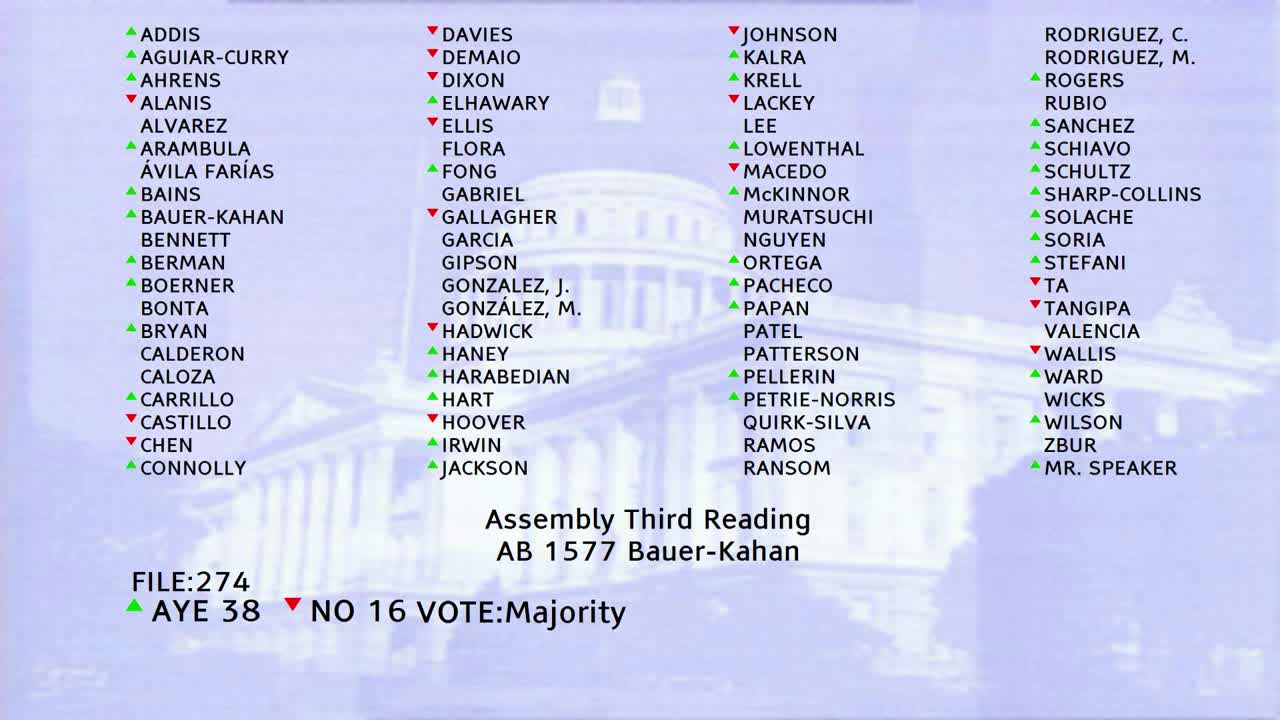 2MIN
Assembly Floor
 19MIN
Assembly Standing Committee on Judiciary
 30MIN
Assembly Standing Committee on Banking and Finance
Bill Author