AB 1904: Teachers: credentialed educator apprenticeship programs.
- Session Year: 2025-2026
- House: Assembly
- Latest Version Date: 2026-09-30
Current Status:
Passed
(2026-09-30: Chaptered by Secretary of State - Chapter 906, Statutes of 2026.)
Introduced
In Committee
Awaiting First Chamber Vote
Passed First Chamber
In Committee
Awaiting Second Chamber Vote
Passed Second Chamber
Enacted
What does this bill do?
This bill allows the state's Commission on Teacher Credentialing and the Division of Apprenticeship Standards to create, approve, and oversee apprenticeship pathways to California teaching credentials, affecting teacher candidates and school employers. It lets the commission issue apprenticeship permits to employed candidates, requires programs to include at least 300 hours of paid on‑the‑job training and 200 hours of mentoring per year, requires a bachelor's degree before serving as the educator of record (the teacher responsible for a class), lets the Division withdraw approval if the linked preparation program loses accreditation, and adds apprenticeship permits to the annual teacher supply report.
The summary is provided by generative AI which can make mistakes. For original language, please view the details in the table below.
Under existing law, it is the public policy of this state to encourage the utilization of apprenticeship as a form of on-the-job training, when such training is cost effective in developing skills needed to perform public services. Existing law requires state and local public agencies to make a diligent effort to establish apprenticeship programs for apprenticeable occupations in their respective workforces.
Existing law requires the Commission on Teacher Credentialing to, among other duties, establish standards for the issuance and renewal of credentials. Existing law requires, as a minimum requirement for a preliminary multiple subject, single subject, or education specialist teaching credential, the satisfactory completion of a program of professional preparation, as specified.
This bill would require the commission and the Division of Apprenticeship Standards to partner in the dissemination, approval, and monitoring of credentialed educator apprenticeship programs in California, and to communicate apprenticeship requirements to professional preparation programs, local educational agencies, and other potential sponsors of credentialed educator apprenticeship programs. The bill, notwithstanding any other law, would authorize the commission to issue apprenticeship certificates or permits to educator candidates without a credential who are employed by local educational agencies and participating in commission-approved credentialed educator apprenticeship programs, as specified, and would require the commission to adopt regulations for that purpose.
The bill would authorize the commission and the division to enter into a memorandum of understanding to establish processes and procedures for information sharing, application review, and data collection and reporting, and would authorize the Chief of the Division of Apprenticeship Standards, in consultation with the commission, to issue rules and regulations that govern credentialed educator apprenticeship programs, including the approval and denial of programs, registration of agreements, program administration and procedures, evaluations, working conditions, and minimum standards, as specified. The bill would require an applicant for a new credentialed educator apprenticeship program or for the expansion of an existing credentialed educator apprenticeship program into a new geographic or credential area to submit specified documentation to the chief. The bill would require the division to present the apprenticeship program application to the commission for its review, as provided, and would require the commission, if it is satisfied that specified conditions have been met, to provide written notice of that fact to the chief. The bill would require the commission to, among other things, publish on its internet website guidance for prospective and commission-approved apprenticeship sponsors, commission-accredited professional preparation programs, and employing local educational agencies on the relationship between educator apprenticeships and professional preparation programs, as specified, and to support the development and expansion of educator apprenticeships in credential shortage areas and geographic areas with persistent educator workforce needs, including, but not limited to, through commission-administered grant programs, as applicable.
Existing law requires the commission, by April 15 of each year, to report to the Legislature and the Governor information on the availability of teachers in California, including, among other things, the number and percentage of individuals serving pursuant to an emergency permit or credential waiver, as specified.
This bill would require that report to also include the number and percentage of individuals serving pursuant to an apprenticeship certificate or permit, as specified.
Under existing law, it is the public policy of this state to encourage the utilization of apprenticeship as a form of on-the-job training, when such training is cost effective in developing skills needed to perform public services. Existing law requires state and local public agencies to make a diligent effort to establish apprenticeship programs for apprenticeable occupations in their respective workforces.
Existing law requires the Commission on Teacher Credentialing to, among other duties, establish standards for the issuance and renewal of credentials. Existing law requires, as a minimum requirement for a preliminary multiple subject, single subject, or education specialist teaching credential, the satisfactory completion of a program of professional preparation, as specified.
This bill would require the commission and the Division of Apprenticeship Standards to partner in the dissemination, approval, and monitoring of credentialed educator apprenticeship programs in California, and to communicate apprenticeship requirements to professional preparation programs, local educational agencies, and other potential sponsors of credentialed educator apprenticeship programs. The bill, notwithstanding any other law, would authorize the commission to issue apprenticeship certificates or permits to educator candidates without a credential who are employed by local educational agencies and participating in commission-approved credentialed educator apprenticeship programs, as specified, and would authorize require the commission to adopt regulations for that purpose.
The bill would authorize the commission and the division to enter into a memorandum of understanding to establish processes and procedures for information sharing, application review, and data collection and reporting, and would authorize the Chief of the Division of Apprenticeship Standards, in consultation with the commission, to issue rules and regulations that govern credentialed educator apprenticeship programs, including the approval and denial of programs, registration of agreements, program administration and procedures, evaluations, working conditions, and minimum standards, as specified. The bill would require an applicant for a new credentialed educator apprenticeship program or for the expansion of an existing credentialed educator apprenticeship program into a new geographic or credential area to submit specified documentation to the chief. The bill would require the division to present the apprenticeship program application to the commission for its review, as provided, and would require the commission, if it is satisfied that specified conditions have been met, to provide written notice of that fact to the chief. The bill would require the commission to, among other things, publish on its internet website guidance for prospective and commission-approved apprenticeship sponsors, commission-accredited professional preparation programs, and employing local educational agencies on the relationship between educator apprenticeships and professional preparation programs, as specified, and to support the development and expansion of educator apprenticeships in credential shortage areas and geographic areas with persistent educator workforce needs, including, but not limited to, through commission-administered grant programs, as applicable.
Existing law requires the commission, by April 15 of each year, to report to the Legislature and the Governor information on the availability of teachers in California, including, among other things, the number and percentage of individuals serving pursuant to an emergency permit or credential waiver, as specified.
This bill would require that report to also include the number and percentage of individuals serving pursuant to an apprenticeship certificate or permit, as specified.
Under existing law, it is the public policy of this state to encourage the utilization of apprenticeship as a form of on-the-job training, when such training is cost effective in developing skills needed to perform public services. Existing law requires state and local public agencies to make a diligent effort to establish apprenticeship programs for apprenticeable occupations in their respective workforces.
Existing law requires the Commission on Teacher Credentialing to, among other duties, establish standards for the issuance and renewal of credentials. Existing law requires, as a minimum requirement for a preliminary multiple subject, single subject, or education specialist teaching credential, the satisfactory completion of a program of professional preparation, as specified.
This bill would require the commission and the Division of Apprenticeship Standards to partner in the dissemination, approval, and monitoring of credentialed educator apprenticeship programs in California, and to communicate apprenticeship requirements to professional preparation programs, local educational agencies, and other potential sponsors of credentialed educator apprenticeship programs. The bill, notwithstanding any other law, would authorize the commission to issue apprenticeship certificates or permits to educator candidates without a credential who are employed by local educational agencies and participating in approved commission-approved credentialed educator apprenticeship programs, as specified. specified, and would authorize the commission to adopt regulations for that purpose.
The bill would authorize the commission and the division to enter into a memorandum of understanding to establish processes and procedures for information sharing, application review, and data collection and reporting, and would authorize the Chief of the Division of Apprenticeship Standards, in consultation with the commission, to issue rules and regulations that govern credentialed educator apprenticeship programs, including the approval and denial of programs, registration of agreements, program administration and procedures, evaluations, working conditions, and minimum standards, as specified. The bill would require an applicant for a new credentialed educator apprenticeship program or for the expansion of an existing credentialed educator apprenticeship program into a new geographic or credential area to submit specified documentation to the chief. The bill would require the division to present the apprenticeship program application to the commission for its review, as provided, and would require the commission, if it is satisfied that specified conditions have been met, to provide written notice of that fact to the chief.
Under existing law, it is the public policy of this state to encourage the utilization of apprenticeship as a form of on-the-job training, when such training is cost effective in developing skills needed to perform public services. Existing law requires state and local public agencies to make a diligent effort to establish apprenticeship programs for apprenticeable occupations in their respective workforces.
Existing law requires the Commission on Teacher Credentialing to, among other duties, establish standards for the issuance and renewal of credentials. Existing law requires, as a minimum requirement for a preliminary multiple subject, single subject, or education specialist teaching credential, the satisfactory completion of a program of professional preparation, as specified.
This bill would require the commission and the Division of Apprenticeship Standards to partner in the dissemination, approval, and monitoring of credentialed educator apprenticeship programs in California, and to communicate apprenticeship requirements to professional preparation programs, local educational agencies, and other potential sponsors of credentialed educator apprenticeship programs. The bill, notwithstanding any other law, would authorize the commission to issue apprenticeship certificates or permits to educator candidates without a credential who are employed by local educational agencies and participating in approved credentialed educator apprenticeship programs, as specified.
The bill would authorize the commission and the division to enter into a memorandum of understanding to establish processes and procedures for information sharing, application review, and data collection and reporting, and would authorize the Chief of the Division of Apprenticeship Standards, in consultation with the commission, to issue rules and regulations that govern credentialed educator apprenticeship programs, including the approval and denial of programs, registration of agreements, program administration and procedures, evaluations, working conditions, and minimum standards, as specified. The bill would require an applicant for a new credentialed educator apprenticeship program or for the expansion of an existing credentialed educator apprenticeship program into a new geographic or credential area to submit specified documentation to the chief. The bill would require the division to present the apprenticeship program application to the commission for its review, as provided, and would require the commission, if it is satisfied that specified conditions have been met, to provide written notice of that fact to the chief.
The Legislature finds and declares all of the following:
(a)Traditional credentialed educator preparation requires candidates to student teach or serve pupils as part of a postbaccalaureate certification program. For most credentialed educator candidates, this service is unpaid and can present an obstacle to entering the profession.
(b)Clinically rich pathways, such as educator residencies, are linked to strong preparation and retention. Apprenticeship, which relies on robust on-the-job training, similarly supports a learning-by-doing approach, but has not traditionally been associated with credentialed educator preparation.
(c)Credentialed educator apprenticeship presents an opportunity for educator preparation programs and local educational agencies, along with their labor and community partners, to leverage state and federal funding to organize apprenticeship programs. Apprenticeship also presents the opportunity for candidates to be compensated for their time and increases their options to enter the profession through clinically rich pathways. In this way, credentialed educator apprenticeships can help remove barriers to recruitment and support retention, particularly in key shortage and growth areas, such as special education, early childhood education, bilingual education, and school counseling. Apprenticeship can also help to cultivate a workforce reflective of the states diverse school communities.
(d)Apprenticeship should be an option for any existing credentialed educator preparation pathway and sponsored by a variety of entities, including county offices of education, institutions of higher education with credentialed educator preparation programs approved by the Commission on Teacher Credentialing, local educational agencies and consortiums of local educational agencies, labor organizations, and nonprofit organizations with experience and expertise in credentialed educator preparation.
(e)California requirements for credentialed educator apprenticeships should build upon existing state and federal requirements so that programs can be approved at the state and federal levels and avail themselves of multiple funding opportunities. In order to meet these requirements and align with credentialed educator preparation standards in California, the programs described pursuant to this act should align with competency-based or hybrid-based apprenticeship programs, as described in Section 3078.5 of the Labor Code.
(f)The credentialed educator preparation pathway could begin as early as high school with youth apprenticeships in education that bridge high school and college coursework aligned to paid work-based learning. There are already many apprenticeship programs in early care and education, expanded learning, and teacher aide roles that are registered with the Division of Apprenticeship Standards and align with associate degree-level college courses. This act does not impact these existing programs, but rather it creates alignment between the Education Code and Labor Code to allow for apprenticeships that culminate in credentials and credentialed educator roles.
SEC. 2.Section 44225.6 of the Education Code is amended to read:44225.6.(a)By April 15 of each year, the commission shall report to the Legislature and the Governor on the availability of teachers in California. This report shall include all of the following information:
(1)The number of individuals recommended for credentials by institutions of higher education and each type of credential, certificate, or authorization for which they were recommended, including authorizations issued pursuant to Sections 44253.3 and 44253.4.
(2)The number of individuals recommended for credentials by school districts operating district internship programs and each type of credential, certificate, or authorization for which they were recommended, including authorizations issued pursuant to Sections 44253.3 and 44253.4.
(3)The number of individuals receiving an initial credential based on a program completed outside of California and each type of credential, certificate, or authorization for which they were recommended, including authorizations issued pursuant to Sections 44253.3 and 44253.4.
(4)The number of individuals receiving an emergency permit or credential waiver.
(5)The number of individuals receiving the certificate of completion of staff development in methods of specially designed content instruction delivered in English pursuant to paragraph (1) of subdivision (d) of Section 44253.11.
(6)Statewide, by county, and by school district, the number of individuals serving in the following capacities and as a percentage of the total number of individuals serving as teachers statewide, in the county, and in the school district:
(A)University internship.
(B)District internship.
(C)Emergency-style permit, including any emergency permit, short-term staff permit, or provisional intern permit.
(D)Waiver of certification.
(E)Teaching permit for statutory leave issued pursuant to Division 8 of Title 5 of the California Code of Regulations.
(F)Preliminary or clear credential.
(G)An authorization issued pursuant to Section 44253.3.
(H)Certificates or authorizations issued pursuant to Section 44253.3, 44253.4, 44253.10, or 44253.11, if available.
(I)The number of individuals serving English learner pupils in settings calling for English language development, in settings calling for specially designed academic instruction in English, or in primary language instruction, without the appropriate authorization under Section 44253.3, 44253.4, 44253.10, or 44253.11, or under another statute, if available. The commission may use data from the departments Annual Language Census Survey to report the data required pursuant to this paragraph.
(J)Apprenticeship certificate or permit pursuant to Section 44378.
(7)The specific subjects and teaching areas in which there are a sufficient number of new holders of credentials to fill the positions currently held by individuals with emergency permits.
(b)The commission shall make this report available to school districts and county offices of education to assist them in the recruitment of credentialed teachers and shall make the report and supporting data publicly available on the commissions internet website.
(c)A common measure of whether teacher preparation programs are meeting the challenge of preparing increasing numbers of new teachers is the number of teaching credentials awarded. The number of teaching credentials recommended by these programs and awarded by the commission are indicators of the productivity of teacher preparation programs. The commission shall include in the report prepared for the Legislature and the Governor pursuant to subdivision (a) the total number of teaching credentials recommended by all accredited teacher preparation programs authorized by the commission and the number recommended by each of the following:
(1)The University of California system.
(2)The California State University system.
(3)Independent colleges and universities that offer teacher preparation programs approved by the commission.
(4)Other institutions that offer teacher preparation programs approved by the commission.
(d)The commission shall periodically provide reports and recommendations to the Legislature, in compliance with Section 9795 of the Government Code, regarding the states teacher workforce for purposes of developing and reviewing state policy, identifying workforce trends, and identifying future needs. These reports shall be made publicly available on the commissions internet website. The commission may make use of information obtained from the department, including, but not necessarily limited to, information obtained pursuant to Section 44258.9, for these purposes.
(e)The commission may use information obtained from the department garnered through the California Longitudinal Pupil Achievement Data System to facilitate the development of the annual Teacher Supply Report as outlined in subdivision (a) and to analyze and publicly report educator workforce trends, including, but not limited to, recipients of commission-issued grants, teacher shortage indicators defined in subdivision (b) of Section 44258.9, preparation program workforce placements, and workforce mobility, retention, and attrition.
(f)For purposes of this section, authorization has the same meaning as defined in subdivision (a) of Section 44203.
SEC. 3.Article 10.5 (commencing with Section 44375) is added to Chapter 2 of Part 25 of Division 3 of Title 2 of the Education Code, to read:10.5.Credentialed Educator Apprenticeships Act44375.This article shall be known, and may be cited, as the Credentialed Educator Apprenticeships Act.
44376.For purposes of this article, the following definitions apply:
(a)Division means the Division of Apprenticeship Standards.
(b)Educator of record means an individual with a credential issued by the commission demonstrating at least current enrollment in, and partial completion of, a professional preparation program and who is responsible for the delivery of instruction or services authorized by that credential to a class or caseload of pupils.
(c)Regionally accredited institution of higher education means any institution of higher education accredited by any of the following accrediting bodies or their successor organizations:
(1)The Higher Learning Commission.
(2)The Middle States Association of Colleges and Schools.
(3)The Middle States Commission on Higher Education.
(4)The New England Commission of Higher Education.
(5)The Northwest Commission on Colleges and Universities.
(6)The Southern Association of Colleges and Schools Commission on Colleges.
(7)The Western Association of Schools and Colleges-Accrediting Commission for Community and Junior Colleges.
(8)The Western Association of Schools and Colleges-Accrediting Commission for Senior Colleges and Universities.
44377.(a)The commission shall partner with the division in the dissemination, approval, and monitoring of credentialed educator apprenticeship programs in California, as described in Section 3075.45 of the Labor Code.
(b)The commission shall partner with the division to communicate apprenticeship requirements to professional preparation programs, local educational agencies, and other potential sponsors of credentialed educator apprenticeship programs.
(c)When the commission receives a credentialed educator apprenticeship program application from the division, it shall confirm all of the following:
(1)The applicant is, or is partnering with, a professional preparation program and, if applicable, an induction program, accredited by the commission to offer the program or programs with no major or probationary stipulations that it is proposing to offer for credentialed educator apprenticeships.
(2)The credentialed educator apprenticeship program includes at least 300 hours of paid on-the-job training that complies with the standards set by the commission before an educator apprentice may serve as an educator of record.
(3)The credentialed educator apprenticeship program requires an educator apprentice to earn their baccalaureate degree from a regionally accredited institution of higher education before serving as an educator of record.
(4)The credentialed educator apprenticeship program includes at least 200 hours of support, mentoring, and supervision per school year that complies with standards set by the commission.
(d)If a professional preparation program or an induction program associated with a commission-approved credentialed educator apprenticeship program fails to maintain accreditation from the commission, the commission shall immediately notify the division.
(e)The commission shall include data on commission-approved credentialed educator apprenticeship programs on its internet website and in its relevant annual reports to the Legislature on teacher preparation and accreditation pursuant to this chapter.
(f)The commission shall publish on its internet website guidance for prospective and commission-approved apprenticeship sponsors, commission-accredited professional preparation programs, and employing local educational agencies on the relationship between educator apprenticeships and professional preparation programs, including, but not limited to, applicable credentialing, clinical preparation, support, and supervision requirements.
(g)The commission shall clearly identify on its internet website commission-approved professional preparation programs offering commission-approved credentialed educator apprenticeship pathways, include commission-approved credentialed educator apprenticeship programs in its searchable commission-approved professional preparation program directory, and incorporate the credentialed educator apprenticeship pathway into the Roadmap to Teaching internet website developed under the Roadmap to Educational Careers Initiative established by Provision 2 of Item 6360-001-0001 of Section 2.00 of the Budget Act of 2022 (Chs. 43, 45, and 249, Stats. 2022).
(h)The commission shall support the development and expansion of educator apprenticeships in credential shortage areas and geographic areas with persistent educator workforce needs, including, but not limited to, through commission-administered grant programs, as applicable.
(i)The commission may enter into a memorandum of understanding with the division to establish processes and procedures for information sharing, application review, and data collection and reporting.
(j)This section does not apply to existing or future apprenticeship programs in the education field that do not result in a credential issued by the commission, including, but not limited to, permits issued pursuant to Section 8301.
44378.(a)Notwithstanding any other law, the commission may issue apprenticeship certificates or permits to educator candidates without a credential who are employed by local educational agencies and participating in commission-approved credentialed educator apprenticeship programs, and who have successfully completed a criminal background check conducted under Sections 44339, 44340, and 44341 for credentialing purposes.
(b)The commission shall adopt regulations to implement this section.
SEC. 4.Section 3075.4 is added to the Labor Code, to read:3075.4.(a)An applicant for a new credentialed educator apprenticeship program or for the expansion of an existing credentialed educator apprenticeship program into a new geographic or credential area shall submit documentation showing all of the following to the Chief of the Division of Apprenticeship Standards:
(1)The applicant is, or is partnering with, an educator professional preparation program and, if applicable, an induction program, accredited by the commission to offer the program or programs with no major or probationary stipulations that it is proposing to offer educator apprentices.
(2)The proposed credentialed educator apprenticeship program includes at least 300 hours of paid on-the-job training before the educator apprentices may serve as educators of record, in compliance with standards set by the commission and as required by Section 44377 of the Education Code.
(3)The proposed credentialed educator apprenticeship program requires educator apprentices to earn their baccalaureate degree from a regionally accredited institution of higher education before serving as educators of record.
(4)The proposed credentialed educator apprenticeship program provides mentorship to apprentices throughout their apprenticeship, as required by Section 44377 of the Education Code.
(b)(1)Before approving an application for a credentialed educator apprenticeship program, the division shall present the apprenticeship program application to the commission for its review pursuant to Section 44377 of the Education Code.
(2)If the commission confirms that the requirements of Section 44377 of the Education Code have been met, it shall provide written notice of that fact to the chief.
(3)If the commission does not provide written notice pursuant to paragraph (2), the chief shall not approve the credentialed educator apprenticeship program.
(c)Notwithstanding subdivision (a) of Section 3075, a credentialed educator apprenticeship program shall be administered by a joint apprenticeship committee, or unilateral management or labor apprenticeship committee. Where a collective bargaining agreement exists, a program shall be jointly sponsored. Joint apprenticeship committees shall be composed of an equal number of employer and employee representatives.
(d)An apprentice pursuant to this section may be employed as a classified employee while also separately employed as a classified employee in another position, but the apprentice shall not perform the duties of their other classified position during their apprenticeship hours.
(e)For purposes of this section, the following definitions apply:
(1)Commission means the Commission on Teacher Credentialing.
(2)Educator of record means an individual with a credential issued by the commission demonstrating at least current enrollment in, and partial completion of, a professional preparation program and who is responsible for the delivery of instruction or services authorized by that credential to a class or caseload of pupils.
(3)Regionally accredited institution of higher education means any institution of higher education accredited by any of the following accrediting bodies or their successor organizations:
(A)The Higher Learning Commission.
(B)The Middle States Association of Colleges and Schools.
(C)The Middle States Commission on Higher Education.
(D)The New England Commission of Higher Education.
(E)The Northwest Commission on Colleges and Universities.
(F)The Southern Association of Colleges and Schools Commission on Colleges.
(G)The Western Association of Schools and Colleges-Accrediting Commission for Community and Junior Colleges.
(H)The Western Association of Schools and Colleges-Accrediting Commission for Senior Colleges and Universities.
(f)The requirements of this section are in addition to other requirements that may be imposed by statute or by regulation.
(g)This section does not apply to existing or future apprenticeship programs in the education field that do not result in a credential issued by the commission, including, but not limited to, permits issued pursuant to Section 8301 of the Education Code.
SEC. 5.Section 3075.45 is added to the Labor Code, to read:3075.45.(a)The division may initiate deregistration proceedings to withdraw state approval of a credentialed educator apprenticeship program if its associated educator preparation program or induction program fails to maintain accreditation from the Commission on Teacher Credentialing.
(b)The division shall partner with the Commission on Teacher Credentialing in the dissemination, approval, and monitoring of credentialed educator apprenticeship programs in California, as described in Section 44377 of the Education Code.
(c)The division may enter into a memorandum of understanding with the Commission on Teacher Credentialing to establish processes and procedures for information sharing, application review, and data collection and reporting.
(d)(1)The chief, in consultation with the Commission on Teacher Credentialing, may issue rules and regulations that govern credentialed educator apprenticeship programs, including the approval and denial of programs, registration of agreements, program administration and procedures, evaluations, working conditions, and minimum standards.
(2)All rules and regulations adopted pursuant to paragraph (1) shall be consistent with Section 44377 of the Education Code and the rules and regulations adopted by the Commission on Teacher Credentialing.
The Legislature finds and declares all of the following:
(a)Traditional credentialed educator preparation requires candidates to student teach or serve pupils as part of a postbaccalaureate certification program. For most credentialed educator candidates, this service is unpaid and can present an obstacle to entering the profession.
(b)Clinically rich pathways, such as educator residencies, are linked to strong preparation and retention. Apprenticeship, which relies on robust on-the-job training, similarly supports a learning-by-doing approach, but has not traditionally been associated with credentialed educator preparation.
(c)Credentialed educator apprenticeship presents an opportunity for educator preparation programs and local educational agencies, along with their labor and community partners, to leverage state and federal funding to organize apprenticeship programs. Apprenticeship also presents the opportunity for candidates to be compensated for their time and increases their options to enter the profession through clinically rich pathways. In this way, credentialed educator apprenticeships can help remove barriers to recruitment and support retention, particularly in key shortage and growth areas, such as special education, early childhood education, bilingual education, and school counseling. Apprenticeship can also help to cultivate a workforce reflective of the states diverse school communities.
(d)Apprenticeship should be an option for any existing credentialed educator preparation pathway and sponsored by a variety of entities, including county offices of education, institutions of higher education with credentialed educator preparation programs approved by the Commission on Teacher Credentialing, local educational agencies and consortiums of local educational agencies, labor organizations, and nonprofit organizations with experience and expertise in credentialed educator preparation.
(e)California requirements for credentialed educator apprenticeships should build upon existing state and federal requirements so that programs can be approved at the state and federal levels and avail themselves of multiple funding opportunities. In order to meet these requirements and align with credentialed educator preparation standards in California, the programs described pursuant to this act should align with competency-based or hybrid-based apprenticeship programs, as described in Section 3078.5 of the Labor Code.
(f)The credentialed educator preparation pathway could begin as early as high school with youth apprenticeships in education that bridge high school and college coursework aligned to paid work-based learning. There are already many apprenticeship programs in early care and education, expanded learning, and teacher aide roles that are registered with the Division of Apprenticeship Standards and align with associate degree-level college courses. This act does not impact these existing programs, but rather it creates alignment between the Education Code and Labor Code to allow for apprenticeships that culminate in credentials and credentialed educator roles.
SEC. 2.Section 44225.6 of the Education Code is amended to read:44225.6.(a)By April 15 of each year, the commission shall report to the Legislature and the Governor on the availability of teachers in California. This report shall include all of the following information:
(1)The number of individuals recommended for credentials by institutions of higher education and each type of credential, certificate, or authorization for which they were recommended, including authorizations issued pursuant to Sections 44253.3 and 44253.4.
(2)The number of individuals recommended for credentials by school districts operating district internship programs and each type of credential, certificate, or authorization for which they were recommended, including authorizations issued pursuant to Sections 44253.3 and 44253.4.
(3)The number of individuals receiving an initial credential based on a program completed outside of California and each type of credential, certificate, or authorization for which they were recommended, including authorizations issued pursuant to Sections 44253.3 and 44253.4.
(4)The number of individuals receiving an emergency permit or credential waiver.
(5)The number of individuals receiving the certificate of completion of staff development in methods of specially designed content instruction delivered in English pursuant to paragraph (1) of subdivision (d) of Section 44253.11.
(6)Statewide, by county, and by school district, the number of individuals serving in the following capacities and as a percentage of the total number of individuals serving as teachers statewide, in the county, and in the school district:
(A)University internship.
(B)District internship.
(C)Emergency-style permit, including any emergency permit, short-term staff permit, or provisional intern permit.
(D)Waiver of certification.
(E)Teaching permit for statutory leave issued pursuant to Division 8 of Title 5 of the California Code of Regulations.
(F)Preliminary or clear credential.
(G)An authorization issued pursuant to Section 44253.3.
(H)Certificates or authorizations issued pursuant to Section 44253.3, 44253.4, 44253.10, or 44253.11, if available.
(I)The number of individuals serving English learner pupils in settings calling for English language development, in settings calling for specially designed academic instruction in English, or in primary language instruction, without the appropriate authorization under Section 44253.3, 44253.4, 44253.10, or 44253.11, or under another statute, if available. The commission may use data from the departments Annual Language Census Survey to report the data required pursuant to this paragraph.
(J)Apprenticeship certificate or permit pursuant to Section 44378.
(7)The specific subjects and teaching areas in which there are a sufficient number of new holders of credentials to fill the positions currently held by individuals with emergency permits.
(b)The commission shall make this report available to school districts and county offices of education to assist them in the recruitment of credentialed teachers and shall make the report and supporting data publicly available on the commissions internet website.
(c)A common measure of whether teacher preparation programs are meeting the challenge of preparing increasing numbers of new teachers is the number of teaching credentials awarded. The number of teaching credentials recommended by these programs and awarded by the commission are indicators of the productivity of teacher preparation programs. The commission shall include in the report prepared for the Legislature and the Governor pursuant to subdivision (a) the total number of teaching credentials recommended by all accredited teacher preparation programs authorized by the commission and the number recommended by each of the following:
(1)The University of California system.
(2)The California State University system.
(3)Independent colleges and universities that offer teacher preparation programs approved by the commission.
(4)Other institutions that offer teacher preparation programs approved by the commission.
(d)The commission shall periodically provide reports and recommendations to the Legislature, in compliance with Section 9795 of the Government Code, regarding the states teacher workforce for purposes of developing and reviewing state policy, identifying workforce trends, and identifying future needs. These reports shall be made publicly available on the commissions internet website. The commission may make use of information obtained from the department, including, but not necessarily limited to, information obtained pursuant to Section 44258.9, for these purposes.
(e)The commission may use information obtained from the department garnered through the California Longitudinal Pupil Achievement Data System to facilitate the development of the annual Teacher Supply Report as outlined in subdivision (a) and to analyze and publicly report educator workforce trends, including, but not limited to, recipients of commission-issued grants, teacher shortage indicators defined in subdivision (b) of Section 44258.9, preparation program workforce placements, and workforce mobility, retention, and attrition.
(f)For purposes of this section, authorization has the same meaning as defined in subdivision (a) of Section 44203.
SEC. 2.SEC. 3.Article 10.5 (commencing with Section 44375) is added to Chapter 2 of Part 25 of Division 3 of Title 2 of the Education Code, to read:10.5.Credentialed Educator Apprenticeships Act44375.This article shall be known, and may be cited, as the Credentialed Educator Apprenticeships Act.
44376.For purposes of this article, the following definitions apply:
(a)Division means the Division of Apprenticeship Standards.
(b)Educator of record means an individual with a credential issued by the commission demonstrating at least current enrollment in, and partial completion of, a professional preparation program and who is responsible for the delivery of instruction or services authorized by that credential to a class or caseload of pupils.
(c)Regionally accredited institution of higher education means any institution of higher education accredited by any of the following accrediting bodies or their successor organizations:
(1)The Higher Learning Commission.
(2)The Middle States Association of Colleges and Schools.
(3)The Middle States Commission on Higher Education.
(4)The New England Commission of Higher Education.
(5)The Northwest Commission on Colleges and Universities.
(6)The Southern Association of Colleges and Schools Commission on Colleges.
(7)The Western Association of Schools and Colleges-Accrediting Commission for Community and Junior Colleges.
(8)The Western Association of Schools and Colleges-Accrediting Commission for Senior Colleges and Universities.
44377.(a)The commission shall partner with the division in the dissemination, approval, and monitoring of credentialed educator apprenticeship programs in California, as described in Section 3075.45 of the Labor Code.
(b)The commission shall partner with the division to communicate apprenticeship requirements to professional preparation programs, local educational agencies, and other potential sponsors of credentialed educator apprenticeship programs.
(c)When the commission receives a credentialed educator apprenticeship program application from the division, it shall confirm all of the following:
(1)The applicant is, or is partnering with, a professional preparation program and, if applicable, an induction program, accredited by the commission to offer the program or programs with no major or probationary stipulations that it is proposing to offer for credentialed educator apprenticeships.
(2)The credentialed educator apprenticeship program includes at least 300 hours of paid on-the-job training that complies with the standards set by the commission before an educator apprentice may serve as an educator of record.
(3)The credentialed educator apprenticeship program requires an educator apprentice to earn their baccalaureate degree from a regionally accredited institution of higher education before serving as an educator of record.
(4)The credentialed educator apprenticeship program includes at least 200 hours of support, mentoring, and supervision per school year that complies with standards set by the commission.
(d)If an educator a professional preparation program or an induction program associated with a commission-approved credentialed educator apprenticeship program fails to maintain accreditation from the commission, the commission shall immediately notify the division.
(e)The commission shall include data on commission-approved credentialed educator apprenticeship programs on its internet website and in its relevant annual reports to the Legislature on teacher preparation and accreditation pursuant to this chapter.
(f)The commission shall publish on its internet website guidance for prospective and commission-approved apprenticeship sponsors, commission-accredited professional preparation programs, and employing local educational agencies on the relationship between educator apprenticeships and professional preparation programs, including, but not limited to, applicable credentialing, clinical preparation, support, and supervision requirements.
(g)The commission shall clearly identify on its internet website commission-approved professional preparation programs offering commission-approved credentialed educator apprenticeship pathways, include commission-approved credentialed educator apprenticeship programs in its searchable commission-approved professional preparation program directory, and incorporate the credentialed educator apprenticeship pathway into the Roadmap to Teaching internet website developed under the Roadmap to Educational Careers Initiative established by Provision 2 of Item 6360-001-0001 of Section 2.00 of the Budget Act of 2022 (Chs. 43, 45, and 249, Stats. 2022).
(h)The commission shall support the development and expansion of educator apprenticeships in credential shortage areas and geographic areas with persistent educator workforce needs, including, but not limited to, through commission-administered grant programs, as applicable.
(f)(i)The commission may enter into a memorandum of understanding with the division to establish processes and procedures for information sharing, application review, and data collection and reporting.
(g)(j)This section does not apply to existing or future apprenticeship programs in the education field that do not result in a credential issued by the commission, including, but not limited to, permits issued pursuant to Section 8301.
44378.(a)Notwithstanding any other law, the commission may issue apprenticeship certificates or permits to educator candidates without a credential who are employed by local educational agencies and participating in commission-approved credentialed educator apprenticeship programs, and who have successfully completed a criminal background check conducted under Sections 44339, 44340, and 44341 for credentialing purposes.
(b)The commission may shall adopt regulations to implement this section.
SEC. 3.SEC. 4.Section 3075.4 is added to the Labor Code, to read:3075.4.(a)An applicant for a new credentialed educator apprenticeship program or for the expansion of an existing credentialed educator apprenticeship program into a new geographic or credential area shall submit documentation showing all of the following to the Chief of the Division of Apprenticeship Standards:
(1)The applicant is, or is partnering with, an educator professional preparation program and, if applicable, an induction program, accredited by the commission to offer the program or programs with no major or probationary stipulations that it is proposing to offer educator apprentices.
(2)The proposed credentialed educator apprenticeship program includes at least 300 hours of paid on-the-job training before the educator apprentices may serve as educators of record, in compliance with standards set by the commission and as required by Section 44377 of the Education Code.
(3)The proposed credentialed educator apprenticeship program requires educator apprentices to earn their baccalaureate degree from a regionally accredited institution of higher education before serving as educators of record.
(4)The proposed credentialed educator apprenticeship program provides mentorship to apprentices throughout their apprenticeship, as required by Section 44377 of the Education Code.
(b)(1)Before approving an application for a credentialed educator apprenticeship program, the division shall present the apprenticeship program application to the commission for its review pursuant to Section 44377 of the Education Code.
(2)If the commission confirms that the requirements of Section 44377 of the Education Code have been met, it shall provide written notice of that fact to the chief.
(3)If the commission does not provide written notice pursuant to paragraph (2), the chief shall not approve the credentialed educator apprenticeship program.
(c)Notwithstanding subdivision (a) of Section 3075, a credentialed educator apprenticeship program shall be administered by a joint apprenticeship committee, or unilateral management or labor apprenticeship committee. Where a collective bargaining agreement exists, a program shall be jointly sponsored. Joint apprenticeship committees shall be composed of an equal number of employer and employee representatives.
(d)An apprentice pursuant to this section may be employed as a classified employee while also separately employed as a classified employee in another position, but the apprentice shall not perform the duties of their other classified position during their apprenticeship hours.
(e)For purposes of this section, the following definitions apply:
(1)Commission means the Commission on Teacher Credentialing.
(2)Educator of record means an individual with a credential issued by the commission demonstrating at least current enrollment in, and partial completion of, a professional preparation program and who is responsible for the delivery of instruction or services authorized by that credential to a class or caseload of pupils.
(3)Regionally accredited institution of higher education means any institution of higher education accredited by any of the following accrediting bodies or their successor organizations:
(A)The Higher Learning Commission.
(B)The Middle States Association of Colleges and Schools.
(C)The Middle States Commission on Higher Education.
(D)The New England Commission of Higher Education.
(E)The Northwest Commission on Colleges and Universities.
(F)The Southern Association of Colleges and Schools Commission on Colleges.
(G)The Western Association of Schools and Colleges-Accrediting Commission for Community and Junior Colleges.
(H)The Western Association of Schools and Colleges-Accrediting Commission for Senior Colleges and Universities.
(f)The requirements of this section are in addition to other requirements that may be imposed by statute or by regulation.
(g)This section does not apply to existing or future apprenticeship programs in the education field that do not result in a credential issued by the commission, including, but not limited to, permits issued pursuant to Section 8301 of the Education Code.
SEC. 4.SEC. 5.Section 3075.45 is added to the Labor Code, to read:3075.45.(a)The division may initiate deregistration proceedings to withdraw state approval of a credentialed educator apprenticeship program if its associated educator preparation program or induction program fails to maintain accreditation from the Commission on Teacher Credentialing.
(b)The division shall partner with the Commission on Teacher Credentialing in the dissemination, approval, and monitoring of credentialed educator apprenticeship programs in California, as described in Section 44377 of the Education Code.
(c)The division may enter into a memorandum of understanding with the Commission on Teacher Credentialing to establish processes and procedures for information sharing, application review, and data collection and reporting.
(d)(1)The chief, in consultation with the Commission on Teacher Credentialing, may issue rules and regulations that govern credentialed educator apprenticeship programs, including the approval and denial of programs, registration of agreements, program administration and procedures, evaluations, working conditions, and minimum standards.
(2)All rules and regulations adopted pursuant to paragraph (1) shall be consistent with Section 44377 of the Education Code and the rules and regulations adopted by the Commission on Teacher Credentialing.
The Legislature finds and declares all of the following:
(a)Traditional credentialed educator preparation requires candidates to student teach or serve pupils as part of a postbaccalaureate certification program. For most credentialed educator candidates, this service is unpaid and can present an obstacle to entering the profession.
(b)Clinically rich pathways, such as educator residencies, are linked to strong preparation and retention. Apprenticeship, which relies on robust on-the-job training, similarly supports a learning-by-doing approach, but has not traditionally been associated with credentialed educator preparation.
(c)Credentialed educator apprenticeship presents an opportunity for preparation programs and local educational agencies, along with their labor and community partners, to leverage state and federal funding to organize apprenticeship programs. Apprenticeship also presents the opportunity for candidates to be compensated for their time and increases their options to enter the profession through clinically rich pathways. In this way, credentialed educator apprenticeships can help remove barriers to recruitment and support retention, particularly in key shortage and growth areas, such as special education, early childhood education, bilingual education, and school counseling. Apprenticeship can also help to cultivate a workforce reflective of the states diverse school communities.
(d)Apprenticeship should be an option for any existing credentialed educator preparation pathway and sponsored by a variety of entities, including county offices of education, institutions of higher education with credentialed educator preparation programs approved by the Commission on Teacher Credentialing, local educational agencies and consortiums of local educational agencies, labor organizations, and nonprofit organizations with experience and expertise in credentialed educator preparation.
(e)California requirements for credentialed educator apprenticeships should build upon existing state and federal requirements so that programs can be approved at the state and federal levels and avail themselves of multiple funding opportunities. In order to meet these requirements and align with credentialed educator preparation standards in California, the programs described pursuant to this act should align with competency-based or hybrid-based apprenticeship programs, as described in Section 3078.5 of the Labor Code.
(f)The credentialed educator preparation pathway could begin as early as high school with youth apprenticeships in education that bridge high school and college coursework aligned to paid work-based learning. There are already many apprenticeship programs in early care and education, expanded learning, and teacher aide roles that are registered with the Division of Apprenticeship Standards and align with associate degree-level college courses. This act does not impact these existing programs, but rather it creates alignment between the Education Code and Labor Code to allow for apprenticeships that culminate in credentials and credentialed educator roles.
SEC. 2.Article 10.5 (commencing with Section 44375) is added to Chapter 2 of Part 25 of Division 3 of Title 2 of the Education Code, to read:10.5.Credentialed Educator Apprenticeships Act44375.This article shall be known, and may be cited, as the Credentialed Educator Apprenticeships Act.
44376.For purposes of this article, the following definitions apply:
(a)Division means the Division of Apprenticeship Standards.
(b)Educator of record means an individual with a credential issued by the commission demonstrating at least current enrollment in, and partial completion of, a professional preparation program and who is responsible for the delivery of instruction or services authorized by that credential to a class or caseload of pupils.
(c)Regionally accredited institution of higher education means any institution of higher education accredited by any of the following accrediting bodies or their successor organizations:
(1)The Higher Learning Commission.
(2)The Middle States Association of Colleges and Schools.
(3)The Middle States Commission on Higher Education.
(4)The New England Commission of Higher Education.
(5)The Northwest Commission on Colleges and Universities.
(6)The Southern Association of Colleges and Schools Commission on Colleges.
(7)The Western Association of Schools and Colleges-Accrediting Commission for Community and Junior Colleges.
(8)The Western Association of Schools and Colleges-Accrediting Commission for Senior Colleges and Universities.
44377.(a)The commission shall partner with the division in the dissemination, approval, and monitoring of credentialed educator apprenticeship programs in California, as described in Section 3075.45 of the Labor Code.
(b)The commission shall partner with the division to communicate apprenticeship requirements to professional preparation programs, local educational agencies, and other potential sponsors of credentialed educator apprenticeship programs.
(c)When the commission receives a credentialed educator apprenticeship program application from the division, it shall confirm all of the following:
(1)The applicant is, or is partnering with, a professional preparation program and, if applicable, an induction program, accredited by the commission to offer the program or programs with no major or probationary stipulations that it is proposing to offer for credentialed educator apprenticeships.
(2)The credentialed educator apprenticeship program includes at least 300 hours of paid on-the-job training that complies with the standards set by the commission before an educator apprentice may serve as an educator of record.
(3)The credentialed educator apprenticeship program requires an educator apprentice to earn their baccalaureate degree from a regionally accredited institution of higher education before serving as an educator of record.
(4)The credentialed educator apprenticeship program includes at least 200 hours of support, mentoring, and supervision per school year that complies with standards set by the commission.
(d)If an educator preparation program or an induction program associated with an approved a commission-approved credentialed educator apprenticeship program fails to maintain accreditation from the commission, the commission shall immediately notify the division.
(e)The commission shall include data on approved commission-approved credentialed educator apprenticeship programs on its internet website and in its relevant annual reports to the Legislature on teacher preparation and accreditation pursuant to this chapter.
(f)The commission may enter into a memorandum of understanding with the division to establish processes and procedures for information sharing, application review, and data collection and reporting.
(g)This section does not apply to existing or future apprenticeship programs in the education field that do not result in a credential issued by the commission, including, but not limited to, permits issued pursuant to Section 8301.
44378.(a)Notwithstanding any other law, the commission may issue apprenticeship certificates or permits to educator candidates without a credential who are employed by local educational agencies and participating in approved commission-approved credentialed educator apprenticeship programs, and who have successfully completed a criminal background check conducted under Sections 44339, 44340, and 44341 for credentialing purposes.
(b)The commission may adopt regulations to implement this section.
SEC. 3.Section 3075.4 is added to the Labor Code, to read:3075.4.(a)An applicant for a new credentialed educator apprenticeship program or for the expansion of an existing credentialed educator apprenticeship program into a new geographic or credential area shall submit documentation showing all of the following to the Chief of the Division of Apprenticeship Standards:
(1)The applicant is, or is partnering with, an educator professional preparation program and, if applicable, an induction program, accredited by the commission to offer the program or programs with no major or probationary stipulations that it is proposing to offer educator apprentices.
(2)The proposed credentialed educator apprenticeship program includes at least 300 hours of paid on-the-job training before the educator apprentices may serve as educators of record, in compliance with standards set by the commission and as required by Section 44377 of the Education Code.
(3)The proposed credentialed educator apprenticeship program requires educator apprentices to earn their baccalaureate degree from a regionally accredited institution of higher education before serving as educators of record.
(4)The proposed credentialed educator apprenticeship program provides mentorship to apprentices throughout their apprenticeship, as required by Section 44377 of the Education Code.
(b)(1)Before approving an application for a credentialed educator apprenticeship program, the division shall present the apprenticeship program application to the commission for its review pursuant to Section 44377 of the Education Code.
(2)If the commission confirms that the requirements of Section 44377 of the Education Code have been met, it shall provide written notice of that fact to the chief.
(3)If the commission does not provide written notice pursuant to paragraph (2), the chief shall not approve the credentialed educator apprenticeship program.
(c)Notwithstanding subdivision (a) of Section 3075, a credentialed educator apprenticeship program shall be administered by a joint apprenticeship committee, or unilateral management or labor apprenticeship committee. Where a collective bargaining agreement exists, a program shall be jointly sponsored. Joint apprenticeship committees shall be composed of an equal number of employer and employee representatives.
(d)An apprentice pursuant to this section may be employed as a classified employee while also separately employed as a classified employee in another position, but the apprentice shall not perform the duties of their other classified position during their apprenticeship hours.
(e)For purposes of this section, the following definitions apply:
(1)Commission means the Commission on Teacher Credentialing.
(2)Educator of record means an individual with a credential issued by the commission demonstrating at least current enrollment in, and partial completion of, a professional preparation program and who is responsible for the delivery of instruction or services authorized by that credential to a class or caseload of pupils.
(3)Regionally accredited institution of higher education means any institution of higher education accredited by any of the following accrediting bodies or their successor organizations:
(A)The Higher Learning Commission.
(B)The Middle States Association of Colleges and Schools.
(C)The Middle States Commission on Higher Education.
(D)The New England Commission of Higher Education.
(E)The Northwest Commission on Colleges and Universities.
(F)The Southern Association of Colleges and Schools Commission on Colleges.
(G)The Western Association of Schools and Colleges-Accrediting Commission for Community and Junior Colleges.
(H)The Western Association of Schools and Colleges-Accrediting Commission for Senior Colleges and Universities.
(f)The requirements of this section are in addition to other requirements that may be imposed by statute or by regulation.
(g)This section does not apply to existing or future apprenticeship programs in the education field that do not result in a credential issued by the commission, including, but not limited to, permits issued pursuant to Section 8301 of the Education Code.
SEC. 4.Section 3075.45 is added to the Labor Code, to read:3075.45.(a)The division may initiate deregistration proceedings to withdraw state approval of a credentialed educator apprenticeship program if its associated educator preparation program or induction program fails to maintain accreditation from the Commission on Teacher Credentialing.
(b)The division shall partner with the Commission on Teacher Credentialing in the dissemination, approval, and monitoring of credentialed educator apprenticeship programs in California, as described in Section 44377 of the Education Code.
(c)The division may enter into a memorandum of understanding with the Commission on Teacher Credentialing to establish processes and procedures for information sharing, application review, and data collection and reporting.
(d)(1)The chief, in consultation with the Commission on Teacher Credentialing, may issue rules and regulations that govern credentialed educator apprenticeship programs, including the approval and denial of programs, registration of agreements, program administration and procedures, evaluations, working conditions, and minimum standards.
(2)All rules and regulations adopted pursuant to paragraph (1) shall be consistent with Section 44377 of the Education Code and the rules and regulations adopted by the Commission on Teacher Credentialing.
The Legislature finds and declares all of the following:
(a)Traditional credentialed educator preparation requires candidates to student teach or serve pupils as part of a postbaccalaureate certification program. For most credentialed educator candidates, this service is unpaid and can present an obstacle to entering the profession.
(b)Clinically rich pathways, such as educator residencies, are linked to strong preparation and retention. Apprenticeship, which relies on robust on-the-job training, similarly supports a learning-by-doing approach, but has not traditionally been associated with credentialed educator preparation.
(c)Credentialed educator apprenticeship presents an opportunity for preparation programs and local educational agencies, along with their labor and community partners, to leverage state and federal funding to organize apprenticeship programs. Apprenticeship also presents the opportunity for candidates to be compensated for their time and increases their options to enter the profession through clinically rich pathways. In this way, credentialed educator apprenticeships can help remove barriers to recruitment and support retention, particularly in key shortage and growth areas, such as special education, early childhood education, bilingual education, and school counseling. Apprenticeship can also help to cultivate a workforce reflective of the states diverse school communities.
(d)Apprenticeship should be an option for any existing credentialed educator preparation pathway and sponsored by a variety of entities, including county offices of education, institutions of higher education with credentialed educator preparation programs approved by the Commission on Teacher Credentialing, local educational agencies and consortiums of local educational agencies, labor organizations, and nonprofit organizations with experience and expertise in credentialed educator preparation.
(e)California requirements for credentialed educator apprenticeships should build upon existing state and federal requirements so that programs can be approved at the state and federal levels and avail themselves of multiple funding opportunities. In order to meet these requirements and align with credentialed educator preparation standards in California, the programs described pursuant to this act should align with competency-based or hybrid-based apprenticeship programs, as described in Section 3078.5 of the Labor Code.
(f)The credentialed educator preparation pathway could begin as early as high school with youth apprenticeships in education that bridge high school and college coursework aligned to paid work-based learning. There are already many apprenticeship programs in early care and education, expanded learning, and teacher aide roles that are registered with the Division of Apprenticeship Standards and align with associate degree-level college courses. This act does not impact these existing programs, but rather it creates alignment between the Education Code and Labor Code to allow for apprenticeships that culminate in credentials and credentialed educator roles.
SEC. 2.Article 10.5 (commencing with Section 44375) is added to Chapter 2 of Part 25 of Division 3 of Title 2 of the Education Code, to read:10.5.Credentialed Educator Apprenticeships Act44375.This article shall be known, and may be cited, as the Credentialed Educator Apprenticeships Act.
44376.For purposes of this article, the following definitions apply:
(a)Division means the Division of Apprenticeship Standards.
(b)Educator of record means an individual with a credential issued by the commission demonstrating at least current enrollment in, and partial completion of, a professional preparation program and who is responsible for the delivery of instruction or services authorized by that credential to a class or caseload of pupils.
(c)Regionally accredited institution of higher education means any institution of higher education accredited by any of the following accrediting bodies or their successor organizations:
(1)The Higher Learning Commission.
(2)The Middle States Association of Colleges and Schools.
(3)The Middle States Commission on Higher Education.
(4)The New England Commission of Higher Education.
(5)The Northwest Commission on Colleges and Universities.
(6)The Southern Association of Colleges and Schools Commission on Colleges.
(7)The Western Association of Schools and Colleges-Accrediting Commission for Community and Junior Colleges.
(8)The Western Association of Schools and Colleges-Accrediting Commission for Senior Colleges and Universities.
44377.(a)The commission shall partner with the division in the dissemination, approval, and monitoring of credentialed educator apprenticeship programs in California, as described in Section 3075.45 of the Labor Code.
(b)The commission shall partner with the division to communicate apprenticeship requirements to professional preparation programs, local educational agencies, and other potential sponsors of credentialed educator apprenticeship programs.
(c)When the commission receives a credentialed educator apprenticeship program application from the division, it shall confirm all of the following:
(1)The applicant is, or is partnering with, a professional preparation program and, if applicable, an induction program, accredited by the commission to offer the program or programs with no major or probationary stipulations that it is proposing to offer for credentialed educator apprenticeships.
(2)The credentialed educator apprenticeship program includes at least 300 hours of paid on-the-job training that complies with the standards set by the commission before an educator apprentice may serve as an educator of record.
(3)The credentialed educator apprenticeship program requires an educator apprentice to earn their baccalaureate degree from a regionally accredited institution of higher education before serving as an educator of record.
(4)The credentialed educator apprenticeship program includes at least 200 hours of support, mentoring, and supervision per school year that complies with standards set by the commission.
(d)If an educator preparation program or an induction program associated with an approved credentialed educator apprenticeship program fails to maintain accreditation from the commission, the commission shall immediately notify the division.
(e)The commission shall include data on approved credentialed educator apprenticeship programs on its internet website and in its relevant annual reports to the Legislature on teacher preparation and accreditation pursuant to this chapter.
(f)The commission may enter into a memorandum of understanding with the division to establish processes and procedures for information sharing, application review, and data collection and reporting.
(g)This section does not apply to existing or future apprenticeship programs in the education field that do not result in a credential issued by the commission, including, but not limited to, permits issued pursuant to Section 8301.
44378.Notwithstanding any other law, the commission may issue apprenticeship certificates or permits to educator candidates without a credential who are employed by local educational agencies and participating in approved credentialed educator apprenticeship programs, and who have successfully completed a criminal background check conducted under Sections 44339, 44340, and 44341 for credentialing purposes.
SEC. 3.Section 3075.4 is added to the Labor Code, to read:3075.4.(a)An applicant for a new credentialed educator apprenticeship program or for the expansion of an existing credentialed educator apprenticeship program into a new geographic or credential area shall submit documentation showing all of the following to the Chief of the Division of Apprenticeship Standards:
(1)The applicant is, or is partnering with, an educator professional preparation program and, if applicable, an induction program, accredited by the commission to offer the program or programs with no major or probationary stipulations that it is proposing to offer educator apprentices.
(2)The proposed credentialed educator apprenticeship program includes at least 300 hours of paid on-the-job training before the educator apprentices may serve as educators of record, in compliance with standards set by the commission and as required by Section 44377 of the Education Code.
(3)The proposed credentialed educator apprenticeship program requires educator apprentices to earn their baccalaureate degree from a regionally accredited institution of higher education before serving as educators of record.
(4)The proposed credentialed educator apprenticeship program provides mentorship to apprentices throughout their apprenticeship, as required by Section 44377 of the Education Code.
(b)(1)Before approving an application for a credentialed educator apprenticeship program, the division shall present the apprenticeship program application to the commission for its review pursuant to Section 44377 of the Education Code.
(2)If the commission confirms that the requirements of Section 44377 of the Education Code have been met, it shall provide written notice of that fact to the chief.
(3)If the commission does not provide written notice pursuant to paragraph (2), the chief shall not approve the credentialed educator apprenticeship program.
(c)Notwithstanding subdivision (a) of Section 3075, a credentialed educator apprenticeship program shall be administered by a joint apprenticeship committee, or unilateral management or labor apprenticeship committee. Where a collective bargaining agreement exists, a program shall be jointly sponsored. Joint apprenticeship committees shall be composed of an equal number of employer and employee representatives.
(d)An apprentice pursuant to this section may be employed as a classified employee while also separately employed as a classified employee in another position, but the apprentice shall not perform the duties of their other classified position during their apprenticeship hours.
(e)For purposes of this section, the following definitions apply:
(1)Commission means the Commission on Teacher Credentialing.
(2)Educator of record means an individual with a credential issued by the commission demonstrating at least current enrollment in, and partial completion of, a professional preparation program and who is responsible for the delivery of instruction or services authorized by that credential to a class or caseload of pupils.
(3)Regionally accredited institution of higher education means any institution of higher education accredited by any of the following accrediting bodies or their successor organizations:
(A)The Higher Learning Commission.
(B)The Middle States Association of Colleges and Schools.
(C)The Middle States Commission on Higher Education.
(D)The New England Commission of Higher Education.
(E)The Northwest Commission on Colleges and Universities.
(F)The Southern Association of Colleges and Schools Commission on Colleges.
(G)The Western Association of Schools and Colleges-Accrediting Commission for Community and Junior Colleges.
(H)The Western Association of Schools and Colleges-Accrediting Commission for Senior Colleges and Universities.
(f)The requirements of this section are in addition to other requirements that may be imposed by statute or by regulation.
(g)This section does not apply to existing or future apprenticeship programs in the education field that do not result in a credential issued by the commission, including, but not limited to, permits issued pursuant to Section 8301 of the Education Code.
SEC. 4.Section 3075.45 is added to the Labor Code, to read:3075.45.(a)The division may initiate deregistration proceedings to withdraw state approval of a credentialed educator apprenticeship program if its associated educator preparation program or induction program fails to maintain accreditation from the Commission on Teacher Credentialing.
(b)The division shall partner with the Commission on Teacher Credentialing in the dissemination, approval, and monitoring of credentialed educator apprenticeship programs in California, as described in Section 44377 of the Education Code.
(c)The division may enter into a memorandum of understanding with the Commission on Teacher Credentialing to establish processes and procedures for information sharing, application review, and data collection and reporting.
(d)(1)The chief, in consultation with the Commission on Teacher Credentialing, may issue rules and regulations that govern credentialed educator apprenticeship programs, including the approval and denial of programs, registration of agreements, program administration and procedures, evaluations, working conditions, and minimum standards.
(2)All rules and regulations adopted pursuant to paragraph (1) shall be consistent with Section 44377 of the Education Code and the rules and regulations adopted by the Commission on Teacher Credentialing.
|
Date
|
Status
|
|---|---|
| Sep 30, 2026 | Chaptered by Secretary of State - Chapter 906, Statutes of 2026. |
| Sep 30, 2026 | Approved by the Governor. |
| Sep 8, 2026 | Enrolled and presented to the Governor at 3:30 p.m. |
| Aug 28, 2026 | Senate amendments concurred in. To Engrossing and Enrolling. (Ayes 78. Noes 0.). |
| Aug 28, 2026 | Senate amendments concurred in. To Engrossing and Enrolling. (Ayes 78. Noes 0. Page 6797.). |
| Aug 27, 2026 | In Assembly. Concurrence in Senate amendments pending. |
| Aug 27, 2026 | Read third time. Passed. Ordered to the Assembly. (Ayes 39. Noes 0.). |
| Aug 25, 2026 | Ordered to special consent calendar. |
| Aug 17, 2026 | Read second time. Ordered to third reading. |
| Aug 13, 2026 | Read second time and amended. Ordered returned to second reading. |
| Aug 13, 2026 | From committee: Amend, and do pass as amended. (Ayes 7. Noes 0.) (August 13). |
| Aug 3, 2026 | In committee: Referred to APPR. suspense file. |
| Jun 24, 2026 | From committee: Do pass and re-refer to Com. on APPR. with recommendation: To Consent Calendar. (Ayes 5. Noes 0.) (June 24). Re-referred to Com. on APPR. |
| Jun 17, 2026 | From committee: Do pass and re-refer to Com. on L., P.E. & R. with recommendation: To Consent Calendar. (Ayes 7. Noes 0.) (June 17). Re-referred to Com. on L., P.E. & R. |
| Jun 3, 2026 | Referred to Coms. on ED. and L., P.E. & R. |
| May 22, 2026 | In Senate. Read first time. To Com. on RLS. for assignment. |
| May 22, 2026 | Read third time. Passed. Ordered to the Senate. (Ayes 74. Noes 0.) |
| May 22, 2026 | Read third time. Passed. Ordered to the Senate. (Ayes 74. Noes 0. Page 5259.) |
| May 18, 2026 | Read second time. Ordered to third reading. |
| May 14, 2026 | From committee: Do pass. (Ayes 15. Noes 0.) (May 14). |
| May 6, 2026 | In committee: Set, first hearing. Referred to APPR. suspense file. |
| Apr 23, 2026 | From committee: Do pass and re-refer to Com. on APPR. with recommendation: To Consent Calendar. (Ayes 7. Noes 0.) (April 22). Re-referred to Com. on APPR. |
| Mar 19, 2026 | From committee: Do pass and re-refer to Com. on L. & E. with recommendation: To Consent Calendar. (Ayes 8. Noes 0.) (March 18). Re-referred to Com. on L. & E. |
| Mar 10, 2026 | Re-referred to Com. on ED. |
| Mar 9, 2026 | From committee chair, with author's amendments: Amend, and re-refer to Com. on ED. Read second time and amended. |
| Mar 2, 2026 | Referred to Coms. on ED. and L. & E. |
| Feb 13, 2026 | From printer. May be heard in committee March 15. |
| Feb 12, 2026 | Read first time. To print. |
|
Date
|
Description
|
Location
|
Votes
|
|
|---|---|---|---|---|
| Aug 28, 2026 | AB 1904 Gipson Concurrence in Senate Amendments | Assembly Floor |
Passed |
|
| Aug 27, 2026 | Special Consent AB1904 Gipson et al. By Smallwood-Cuevas | Senate Floor |
Passed |
|
| Aug 13, 2026 | Do pass as amended | Senate Standing Committee on Appropriations |
Passed |
|
| Aug 3, 2026 | Placed on suspense file | Senate Standing Committee on Appropriations |
Passed |
|
| Jun 24, 2026 | Do pass, but first be re-referred to the Committee on [Appropriations] with the recommendation: To Consent Calendar | Senate Standing Committee on Labor, Public Employment and Retirement |
Passed |
|
| Jun 17, 2026 | Do pass, but first be re-referred to the Committee on [Labor, Public Employment and Retirement ] with the recommendation: To Consent Calendar | Senate Standing Committee on Education |
Passed |
|
| May 22, 2026 | AB 1904 Gipson Assembly Third Reading | Assembly Floor |
Passed |
|
| May 14, 2026 | Do pass. | Assembly Standing Committee on Appropriations |
Passed |
|
| Apr 22, 2026 | Do pass and be re-referred to the Committee on [Appropriations] with recommendation: To Consent Calendar | Assembly Standing Committee on Labor and Employment |
Passed |
|
| Mar 18, 2026 | Do pass and be re-referred to the Committee on [Labor and Employment] with recommendation: To Consent Calendar | Assembly Standing Committee on Education |
Passed |
This list shows positions taken on this bill by organizations on the date displayed, which is linked to the original source.
Positions by individuals are not included.
|
Organization
|
Position
|
Date
|
|---|---|---|
| Alliance for Children’s Rights | ** Support | |
| Association Of California School Administrators | ** Support | |
| California Association For Bilingual Education | ** Support | |
| California Charter Schools Association | ** Support | |
| California Federation Of Teachers | ** Support | |
| California Teachers Association | ** Support | |
| Californians Together | ** Support | |
| CFT– a Union of Educators & Classified Professionals, AFT, AFL-CIO | ** Support | |
| Children Now | ** Support | |
| EdTrust-West | ** Support | |
| Edvoice | ** Support | |
| Greater Sacramento Urban League | ** Support | |
| Hispanas Organized for Political Equality | ** Support | |
| Legislative Action Committee - San Mateo County School Boards Association | ** Support | |
| Los Angeles County Office Of Education | ** Support | |
| Partnership for Children & Youth | ** Support | |
| Public Advocates | ** Support | |
| San Mateo County Office Of Education | ** Support | |
| San Mateo County Office of Education (UNREG) | ** Support | |
| San Mateo County School Boards Association | ** Support | |
| Santa Clara County Office Of Education | ** Support | |
| Small School Districts Association | ** Support | |
| United Administrators of Southern California (UASC) | ** Support | |
| Western Governors University | ** Support |
CONCURRENCE IN SENATE AMENDMENTS
CSA1 Bill Id:AB 1904
Author:(Gipson and Muratsuchi)
As Amended Ver:August 13, 2026
Majority vote
SUMMARY
Establishes the Credentialed Educator Apprenticeships Act and creates a framework for the approval, oversight, and operation of credentialed educator apprenticeship programs in California. Requires the Commission on Teacher Credentialing (CTC) and the Division of Apprenticeship Standards (DAS) to jointly oversee educator apprenticeship programs. Authorizes the CTC to issue apprenticeship certificates or permits to participating educator candidates. Establishes minimum requirements for apprenticeship programs seeking state approval. Requires the CTC to provide guidance and support for the development and expansion of educator apprenticeships.
Senate Amendments
- Require the CTC to adopt regulations for the issuance of apprenticeship certificates, publish guidance and support for prospective and commission-approved apprenticeship sponsors on its website, as specified, and include information on the number and percentage of individuals pursuant to an apprenticeship certificate or permit on the teacher supply report.
COMMENTS
Continued investments in multiple educator workforce strategies. California continues to face staffing challenges in certain credential areas, particularly special education, bilingual education, and other hard-to-staff assignments. In response, the Legislature has invested in a variety of initiatives intended to recruit, prepare, and retain educators, including teacher residency grants, classified employee teacher credentialing programs, Golden State Teacher Grants, and other teacher pipeline efforts.
This measure represents the latest in a series of proposals intended to expand workforce-based approaches to educator preparation. Similar educator apprenticeship measures have been introduced in recent legislative sessions, reflecting ongoing interest among education, labor, and workforce-development stakeholders in creating additional pathways into the teaching profession. Unlike traditional educator preparation models, apprenticeship programs are generally structured around an “earn while you learn” framework that allows participants to receive compensation while completing training requirements. Proponents argue that such models may help address financial barriers that discourage otherwise qualified individuals from pursuing a teaching career.
Continued investment in teacher residency programs. Over the last several years, the Legislature has made teacher residency programs a central component of its educator workforce strategy. Teacher residencies are intended to provide candidates with extensive clinical practice, mentoring, and financial support while completing their preparation requirements, particularly in shortage fields such as special education, bilingual education, STEM, and transitional kindergarten. For the purposes of the Teacher Residency Grant Programs, a teacher residency program is defined as an LEA-based partnership between an LEA and an IHE with a CTC-approved preliminary teacher preparation program, and in which a prospective teacher teaches at least half time alongside a teacher of record, who is designated as the experienced mentor teacher, for at least one full school year while engaging in initial preparation coursework. Grantees may receive up to $40,000 per participating teacher resident each year.
Since 2018, the state has appropriated hundreds of millions of dollars to support teacher residency programs. Most recently, the Governor proposed an additional $250 million one-time Proposition 98 augmentation for the Teacher Residency Grant Program, and the Senate Budget Subcommittee on Education recently approved that proposal as part of its budget package. If ultimately adopted, the augmentation would represent a substantial additional state investment in residency-based educator preparation. These ongoing investments reflect a legislative belief that reducing financial barriers and strengthening clinical preparation can improve educator recruitment, preparation, and retention. The continued expansion of residency funding provides important context for evaluating this bill and its proposed apprenticeship framework.
This bill does not change existing requirements for becoming a teacher. Although this bill is framed as creating educator apprenticeships, it does not establish a new credential, modify credentialing standards, or alter existing requirements for becoming a teacher. Rather, the bill establishes a framework through which educator preparation programs may participate in California’s apprenticeship system. The proposal formalizes a partnership between the CTC and DAS, establishes minimum requirements for educator apprenticeship programs, authorizes the issuance of apprenticeship certificates or permits, and creates a process for program approval, oversight, and monitoring. As a result, the primary policy question presented by the bill is whether California's educator preparation system would benefit from greater integration with the state's workforce development infrastructure.
According to the Author
According to the author, "AB 1904 aims to address the ongoing teacher shortage by establishing the California Teacher Residency Apprenticeship Program, a pathway that helps schools recruit and train teachers from the communities they serve. This approach can be especially impactful in high-need schools serving low-income families, many of which are located in Assembly District 65. One of the primary barriers preventing aspiring teachers from entering the profession is the high cost of obtaining a teaching credential. AB 1904 would help alleviate these financial barriers by allowing prospective teachers to earn while they learn through paid, on-the-job training and mentorship from experienced educator. Additionally, the bill would align California's existing teacher residency programs with a federal and state apprenticeship framework, enabling participating programs to leverage both federal and state funding. This approach would expand resources available to train and support future educators while strengthening long-term teacher pipelines for California's schools."
Arguments in Support
Children Now states, "California has made substantial investments to expand the transitional kindergarten (TK) through grade 12 educator pipeline…yet the system continues to produce shortfalls: post-pandemic attrition, declining teacher preparation program enrollment, and the staffing pressures of TK expansion and Proposition 28 have compounded to leave too many classrooms without fully prepared teachers. AB 1904 would respond to this challenge by creating conditions for a credentialed educator apprenticeship program built on high-quality and accountability. Specifically, it would:
- Empower local educational agencies (LEAs), alongside labor and community partners, to leverage state and federal funding to recruit and retain teacher candidates – compensating them for on-the-job preparation and providing mentorship throughout the program.
- Enable LEAs, institutions of higher education, and their consortiums to target key shortages and growth areas, including special education, early childhood education, bilingual education, and school counseling.
- Require the CTC) and the DAS to partner in the approval and monitoring of apprenticeship programs, with strong accountability, reporting requirements, and supportive working conditions for every apprentice.”
Arguments in Opposition
None on file.
FISCAL COMMENTS
According to the Senate Appropriations Committee,
- The CTC estimates General Fund costs of $419,000 in the first year and ongoing costs of $413,000 to support 3.0 additional positions to implement various activities associated with establishing and overseeing educator apprenticeship pathways that lead to a credential.
- The Department of Industrial Relations estimates General Fund costs of $450,000 in the first year and $425,000 ongoing to comply with the bill's requirements.
VOTES:
ASM EDUCATION: 8-0-0
YES: Patel, Hoover, Alvarez, Bonta, Castillo, Garcia, Lowenthal, Zbur
ASM LABOR AND EMPLOYMENT: 7-0-0
YES: Ortega, Alanis, Chen, Elhawary, Kalra, Lee, Ward
ASM APPROPRIATIONS: 15-0-0
YES: Wicks, Hoover, Aguiar-Curry, Calderon, Caloza, Dixon, Fong, Mark González, Krell, Pacheco, Pellerin, Sharp-Collins, Solache, Ta, Tangipa
ASSEMBLY FLOOR: 74-0-6
YES: Addis, Aguiar-Curry, Ahrens, Alanis, Alvarez, Ávila Farías, Bains, Bauer-Kahan, Bennett, Berman, Boerner, Bonta, Bryan, Calderon, Caloza, Carrillo, Castillo, Connolly, Davies, DeMaio, Dixon, Elhawary, Ellis, Flora, Fong, Gallagher, Garcia, Gipson, Jeff Gonzalez, Mark González, Hadwick, Haney, Harabedian, Hart, Hoover, Irwin, Jackson, Johnson, Kalra, Krell, Lackey, Lee, Lowenthal, Macedo, McKinnor, Muratsuchi, Nguyen, Ortega, Pacheco, Papan, Patel, Patterson, Pellerin, Petrie-Norris, Quirk-Silva, Ramos, Ransom, Michelle Rodriguez, Rogers, Blanca Rubio, Sanchez, Schiavo, Schultz, Sharp-Collins, Solache, Soria, Stefani, Tangipa, Valencia, Wallis, Ward, Wilson, Zbur, Rivas
ABS, ABST OR NV: Arambula, Chen, Gabriel, Celeste Rodriguez, Ta, Wicks
UPDATED
VERSION: August 13, 2026
CONSULTANT: Chelsea Kelley / ED. / (916) 319-2087 FN: 0004240
SENATE RULES COMMITTEE Office of Senate Floor Analyses (916) 651-4171 | AB 1904 |
THIRD READING
Bill No: AB 1904
Author: Gipson (D) and Muratsuchi (D)
Amended: 8/13/26 in Senate
Vote: 21
SENATE EDUCATION COMMITTEE: 7-0, 6/17/26
AYES: Pérez, Ochoa Bogh, Cabaldon, Choi, Cortese, Gonzalez, Reyes
SENATE LABOR, PUB. EMP. & RET. COMMITTEE: 5-0, 6/24/26
AYES: Smallwood-Cuevas, Strickland, Cortese, Durazo, Laird
SENATE APPROPRIATIONS COMMITTEE: 7-0, 8/13/26
AYES: Cervantes, Seyarto, Cabaldon, Dahle, Grayson, Richardson, Wahab
ASSEMBLY FLOOR: 74-0, 5/22/26 - See last page for vote
SUBJECT: Teachers: credentialed educator apprenticeship programs
SOURCE: Children Now
DIGEST:
This bill (1) establishes the Credentialed Educator Apprenticeships Act and creates a framework for the approval, oversight, and operation of credentialed educator apprenticeship programs in California; (2) requires the Commission on Teacher Credentialing (CTC) and the Division of Apprenticeship Standards (DAS) to jointly oversee educator apprenticeship programs; (3) authorizes the CTC to issue apprenticeship certificates or permits to participating educator candidates; (4) establishes minimum requirements for apprenticeship programs seeking state approval; and (5) requires the CTC to provide guidance and support for the development and expansion of educator apprenticeships.
ANALYSIS
Existing law:
- Declares it the policy of the state to encourage the use of apprenticeship as a form of on-the-job training and requires public agencies to make diligent efforts to establish apprenticeship programs for apprenticeable occupations.
- Establishes the DAS within the Department of Industrial Relations to oversee apprenticeship programs in California.
- Requires the CTC to establish standards for the issuance and renewal of teaching credentials.
- Requires candidates for a preliminary multiple subject, single subject, or education specialist credential to complete a commission-approved professional preparation program.
- Establishes the Teacher Residency Grant Program to support partnerships between local educational agencies (LEAs) and commission-accredited teacher preparation programs that provide year-long clinical preparation and mentoring for teacher candidates.
This bill:
- Establishes the Credentialed Educator Apprenticeships Act within the Education Code.
- Requires the CTC and DAS to partner in the dissemination, approval, and monitoring of credentialed educator apprenticeship programs.
- Requires the CTC to communicate apprenticeship requirements to professional preparation programs, LEAs, and other prospective apprenticeship sponsors.
- Requires the CTC, when reviewing educator apprenticeship program applications submitted through DAS, to verify that:
- The program is operated by, or partnered with, a commission-accredited preparation program and, where applicable, an induction program in good standing.
- Apprentices receive at least 300 hours of paid on-the-job training before serving as an educator of record.
- Apprentices earn a bachelor's degree from a regionally accredited institution before serving as an educator of record.
- Apprentices receive at least 200 hours annually of support, mentoring, and supervision meeting commission standards.
- Requires the CTC to notify DAS if a preparation or induction program associated with an approved educator apprenticeship loses accreditation.
- Requires the CTC to provide information regarding approved educator apprenticeship programs on its website and through relevant reports to the Legislature.
- Requires the CTC to publish guidance on its website for prospective and approved apprenticeship sponsors, commission-accredited professional preparation programs, and employing LEAs regarding the relationship between educator apprenticeships and professional preparation programs, as specified.
- Requires the CTC to support the development and expansion of educator apprenticeships in credential shortage areas and geographic areas with persistent educator workforce needs, including, as applicable, through commission-administered grant programs.
- Authorizes the CTC and DAS to enter into a memorandum of understanding governing information sharing, application review, data collection, and reporting.
- Authorizes the CTC to issue apprenticeship certificates or permits to educator candidates who:
- Are employed by an LEA;
- Are participating in a CTC-approved educator apprenticeship program; and
- Have successfully completed credentialing background check requirements.
- Requires the CTC to adopt regulations implementing the apprenticeship certificate or permit process.
- Requires applicants seeking approval of a new educator apprenticeship program, or expansion of an existing program into a new credential area or geographic region, to submit specified documentation to DAS demonstrating compliance with program requirements.
- Requires DAS to submit educator apprenticeship applications to the CTC for review before approval and prohibits DAS from approving a program unless the CTC confirms that statutory requirements have been met.
- Requires educator apprenticeship programs to be administered through a joint apprenticeship committee, or unilateral management or labor apprenticeship committee, and requires joint sponsorship where a collective bargaining agreement exists.
- Clarifies that apprentices may simultaneously hold another classified position but may not perform the duties of that separate position during apprenticeship hours.
- Authorizes DAS to initiate deregistration proceedings if an apprenticeship program's associated preparation or induction program loses CTC accreditation.
- Authorizes the Chief of DAS, in consultation with the CTC, to adopt rules and regulations governing educator apprenticeship programs, including approval standards, program administration, evaluations, working conditions, and minimum standards.
- Requires the CTC’s annual report to the Legislature and Governor regarding teacher availability to include the number and percentage of individuals serving pursuant to an apprenticeship certificate or permit, including specified information regarding those individuals.
- Specifies that the act does not apply to apprenticeship programs in the education field that do not result in a credential issued by the CTC.
Comments
- Need for the bill. According to the author, “AB 1904 aims to address the ongoing teacher shortage by establishing the California Teacher Residency Apprenticeship Program, a pathway that helps schools recruit and train teachers from the communities they serve. This approach can be especially impactful in high-need schools serving low-income families, many of which are located in Assembly District 65. One of the primary barriers preventing aspiring teachers from entering the profession is the high cost of obtaining a teaching credential. AB 1904 would help alleviate these financial barriers by allowing prospective teachers to earn while they learn through paid, on-the-job training and mentorship from experienced educator. Additionally, the bill would align California’s existing teacher residency programs with a federal and state apprenticeship framework, enabling participating programs to leverage both federal and state funding. This approach would expand resources available to train and support future educators while strengthening long-term teacher pipelines for California’s schools.”
- Continued investments in multiple educator workforce strategies. California continues to face staffing challenges in certain credential areas, particularly special education, bilingual education, and other hard-to-staff assignments. In response, the Legislature has invested in a variety of initiatives intended to recruit, prepare, and retain educators, including teacher residency grants, classified employee teacher credentialing programs, Golden State Teacher Grants, and other teacher pipeline efforts.
This measure represents the latest in a series of proposals intended to expand workforce-based approaches to educator preparation. Similar educator apprenticeship measures have been introduced in recent legislative sessions, reflecting ongoing interest among education, labor, and workforce-development stakeholders in creating additional pathways into the teaching profession. Unlike traditional educator preparation models, apprenticeship programs are generally structured around an “earn while you learn” framework that allows participants to receive compensation while completing training requirements. Proponents argue that such models may help address financial barriers that discourage otherwise qualified individuals from pursuing a teaching career.
- Continued investment in teacher residency programs. Over the last several years, the Legislature has made teacher residency programs a central component of its educator workforce strategy. Teacher residencies are intended to provide candidates with extensive clinical practice, mentoring, and financial support while completing their preparation requirements, particularly in shortage fields such as special education, bilingual education, STEM, and transitional kindergarten.
Since 2018, the state has appropriated hundreds of millions of dollars to support teacher residency programs. Most recently, the Governor proposed an additional $250 million one-time Proposition 98 augmentation for the Teacher Residency Grant Program, and the Senate Budget Subcommittee on Education recently approved that proposal as part of its budget package. If ultimately adopted, the augmentation would represent a substantial additional state investment in residency-based educator preparation.
These ongoing investments reflect a legislative belief that reducing financial barriers and strengthening clinical preparation can improve educator recruitment, preparation, and retention. The continued expansion of residency funding provides important context for evaluating this bill and its proposed apprenticeship framework.
- Relationship between teacher residencies and educator apprenticeships. This bill raises a broader policy question regarding how educator preparation programs should be structured and funded in the future. While teacher residencies and registered apprenticeships originate from different policy arenas, education and workforce development, they share many common characteristics, including paid work-based learning, structured mentoring, and partnerships between employers and training providers.
Supporters argue that educator apprenticeships could complement existing residency programs by connecting educator preparation to California’s workforce development infrastructure and potentially creating access to additional funding streams, technical assistance, and support services. Under this view, apprenticeship designation may represent less of a new preparation model and more of an opportunity to build upon and strengthen existing workforce development efforts.
As California continues to invest in teacher residency programs, policymakers may wish to consider whether educator apprenticeships should operate as a separate preparation pathway or as a complementary framework layered onto existing residency investments. The answer may have implications for how future educator workforce investments are coordinated across the state’s education and workforce systems.
- This bill is primarily about governance and infrastructure. Although this bill is framed as creating educator apprenticeships, it does not establish a new credential, modify credentialing standards, or alter existing requirements for becoming a teacher. Rather, the bill establishes a framework through which educator preparation programs may participate in California’s apprenticeship system.
The measure formalizes a partnership between the CTC and DAS, establishes minimum requirements for educator apprenticeship programs, authorizes the issuance of apprenticeship certificates or permits, and creates a process for program approval, oversight, and monitoring. As a result, the primary policy question presented by the bill is not whether educator candidates should satisfy different preparation requirements, but whether California’s educator preparation system would benefit from greater integration with the state’s workforce development infrastructure.
FISCAL EFFECT: Appropriation: No Fiscal Com.: Yes Local: No
According to the Senate Appropriations Committee:
- The CTC estimates General Fund costs of $419,000 in the first year and ongoing costs of $413,000 to support 3.0 additional positions to implement various activities associated with establishing and overseeing educator apprenticeship pathways that lead to a credential.
- The Department of Industrial Relations estimates General Fund costs of $450,000 in the first year and $425,000 ongoing to comply with the bill’s requirements.
SUPPORT: (Verified 8/13/26)
Children Now (source)
Alliance for Children’s Rights
Association of California School Administrators
California Association for Bilingual Education
California Charter Schools Association
California Federation of Teachers
California Teachers Association
EdTrust-West
Hispanas Organized for Political Equality
Legislative Action Committee - San Mateo County School Boards Association
Los Angeles County Office of Education
Partnership for Children & Youth
Public Advocates
Santa Clara County Office of Education
Small School Districts Association
Western Governors University
OPPOSITION: (Verified 8/13/26)
None received
ASSEMBLY FLOOR: 74-0, 5/22/26
AYES: Addis, Aguiar-Curry, Ahrens, Alanis, Alvarez, Ávila Farías, Bains, Bauer-Kahan, Bennett, Berman, Boerner, Bonta, Bryan, Calderon, Caloza, Carrillo, Castillo, Connolly, Davies, DeMaio, Dixon, Elhawary, Ellis, Flora, Fong, Gallagher, Garcia, Gipson, Jeff Gonzalez, Mark González, Hadwick, Haney, Harabedian, Hart, Hoover, Irwin, Jackson, Johnson, Kalra, Krell, Lackey, Lee, Lowenthal, Macedo, McKinnor, Muratsuchi, Nguyen, Ortega, Pacheco, Papan, Patel, Patterson, Pellerin, Petrie-Norris, Quirk-Silva, Ramos, Ransom, Michelle Rodriguez, Rogers, Blanca Rubio, Sanchez, Schiavo, Schultz, Sharp-Collins, Solache, Soria, Stefani, Tangipa, Valencia, Wallis, Ward, Wilson, Zbur, Rivas
NO VOTE RECORDED: Arambula, Chen, Gabriel, Celeste Rodriguez, Ta, Wicks
Prepared by: Ian Johnson / ED. / (916) 651-4105
8/17/26 10:42:59
**** END ****
SENATE COMMITTEE ON
Senator Sabrina Cervantes, Chair
2025 - 2026 Regular Session
AB 1904 (Gipson) - Teachers: credentialed educator apprenticeship programs
Version: | Policy Vote: |
Urgency: | Mandate: |
Hearing Date: | Consultant: |
Bill Summary:
This bill establishes a framework for the approval, oversight, and operation of credentialed educator apprenticeship programs in California. Specifically, this bill requires the Commission on Teacher Credentialing (CTC) and the Division of Apprenticeship Standards (DAS) to jointly oversee educator apprenticeship programs, and authorizes the CTC to issue apprenticeship certificates or permits to participating educator candidates.
*********** ANALYSIS ADDENDUM – SUSPENSE FILE ***********
The following information is revised to reflect amendments
adopted by the committee on August 13, 2026
Fiscal Impact:
- The CTC estimates General Fund costs of $419,000 in the first year and ongoing costs of $413,000 to support 3.0 additional positions to implement various activities associated with establishing and overseeing educator apprenticeship pathways that lead to a credential.
- The Department of Industrial Relations estimates General Fund costs of $450,000 in the first year and $425,000 ongoing to comply with the bill’s requirements.
Author Amendments:
Require the CTC to adopt regulations for the issuance of apprenticeship certificates, publish guidance and support for prospective and commission-approved apprenticeship sponsors on its website, as specified, and include information on the number of percentage of individuals pursuant to an apprenticeship certificate or permit on the teacher supply report.
-- END --
SENATE COMMITTEE ON
Senator Sabrina Cervantes, Chair
2025 - 2026 Regular Session
AB 1904 (Gipson) - Teachers: credentialed educator apprenticeship programs
Version: | Policy Vote: |
Urgency: | Mandate: |
Hearing Date: | Consultant: |
Bill Summary:
This bill establishes a framework for the approval, oversight, and operation of credentialed educator apprenticeship programs in California. Specifically, this bill requires the Commission on Teacher Credentialing (CTC) and the Division of Apprenticeship Standards (DAS) to jointly oversee educator apprenticeship programs, and authorizes the CTC to issue apprenticeship certificates or permits to participating educator candidates.
Fiscal Impact:
- The CTC estimates General Fund costs of $419,000 in the first year and ongoing costs of $413,000 to support 3.0 additional positions to implement various activities associated with establishing and overseeing educator apprenticeship pathways that lead to a credential.
- The Department of Industrial Relations estimates General Fund costs of $450,000 in the first year and $425,000 ongoing to comply with the bill’s requirements.
Background:
Existing law establishes the DAS within the Department of Industrial Relations to oversee apprenticeship programs in California.
Existing law requires the CTC to establish standards for the issuance and renewal of teaching credentials. The law requires candidates for a preliminary multiple subject, single subject, or education specialist credential to complete a commission-approved professional preparation program.
Existing law establishes the Teacher Residency Grant Program to support partnerships between local educational agencies (LEAs) and commission-accredited teacher preparation programs that provide year-long clinical preparation and mentoring for teacher candidates.
Proposed Law:
This bill establishes the Credentialed Educator Apprenticeships Act within the Education Code and requires the CTC and DAS to partner in the dissemination, approval, and monitoring of credentialed educator apprenticeship programs.
This bill requires the CTC to communicate apprenticeship requirements to professional preparation programs, LEAs, and other prospective apprenticeship sponsors.
This bill requires the CTC, when reviewing educator apprenticeship program applications submitted through DAS, to verify that:
The program is operated by, or partnered with, a commission-accredited preparation program and, where applicable, an induction program in good standing.
Apprentices receive at least 300 hours of paid on-the-job training before serving as an educator of record.
Apprentices earn a bachelor’s degree from a regionally accredited institution before serving as an educator of record.
Apprentices receive at least 200 hours annually of support, mentoring, and supervision meeting commission standards.
This bill requires the CTC to notify DAS if a preparation or induction program associated with an approved educator apprenticeship loses accreditation. It also requires the CTC to report information regarding approved educator apprenticeship programs on its website and through existing teacher preparation and accreditation reports to the Legislature.
This bill authorizes the CTC and DAS to enter into a memorandum of understanding governing information sharing, application review, data collection, and reporting. It also authorizes the CTC to issue apprenticeship certificates or permits to educator candidates who are employed by an LEA; participating in a CTC-approved educator apprenticeship program; and have successfully completed credentialing background check requirements.
This bill authorizes the CTC to adopt regulations implementing the apprenticeship certificate or permit process.
This bill requires applicants seeking approval of a new educator apprenticeship program, or expansion of an existing program into a new credential area or geographic region, to submit specified documentation to DAS demonstrating compliance with program requirements.
This bill requires DAS to submit educator apprenticeship applications to the CTC for review before approval and prohibits DAS from approving a program unless the CTC confirms that statutory requirements have been met.
This bill requires educator apprenticeship programs to be administered through a joint apprenticeship committee or unilateral labor-management apprenticeship committee and requires joint sponsorship where a collective bargaining agreement exists. It also clarifies that apprentices may simultaneously hold another classified position but may not perform the duties of that separate position during apprenticeship hours.
This bill authorizes DAS to initiate deregistration proceedings if an apprenticeship program’s associated preparation or induction program loses CTC accreditation. The bill also authorizes the Chief of DAS, in consultation with the CTC, to adopt rules and regulations governing educator apprenticeship programs, including approval standards, program administration, evaluations, working conditions, and minimum standards.
The bill provides that the act does not apply to apprenticeship programs in the education field that do not result in a credential issued by the CTC.
Staff Comments:
This bill establishes a framework through which educator preparation programs may participate in California’s apprenticeship system. Specifically, the bill formalizes a partnership between the CTC and DAS and establishes minimum requirements for educator apprenticeship programs. It authorizes the issuance of apprenticeship certificates or permits and creates a process for program approval, oversight, and monitoring. According to the author, “AB 1904 aims to address the ongoing teacher shortage by establishing the California Teacher Residency Apprenticeship Program, a pathway that helps schools recruit and train teachers from the communities they serve. This approach can be especially impactful in high-need schools serving low-income families, many of which are located in Assembly District 65. One of the primary barriers preventing aspiring teachers from entering the profession is the high cost of obtaining a teaching credential. AB 1904 would help alleviate these financial barriers by allowing prospective teachers to earn while they learn through paid, on-the-job training and mentorship from experienced educator. Additionally, the bill would align California’s existing teacher residency programs with a federal and state apprenticeship framework, enabling participating programs to leverage both federal and state funding. This approach would expand resources available to train and support future educators while strengthening long-term teacher pipelines for California’s schools.”
-- END --
SENATE COMMITTEE ON LABOR, PUBLIC EMPLOYMENT AND RETIREMENT
Senator Lola Smallwood-Cuevas, Chair
2025 - 2026 Regular
Bill No: AB 1904 Hearing Date: June 24, 2026
Author: | Gipson | ||
Version: | March 9, 2026 | ||
Urgency: | No | Fiscal: | Yes |
Consultant: | Jazmin Marroquin | ||
SUBJECT: Teachers: credentialed educator apprenticeship programs
KEY ISSUE
This bill establishes the Credentialed Educator Apprenticeships Act, which requires the Commission on Teacher Credentialing (CTC) and the Division of Apprenticeship Standards (DAS) to disseminate, approve, and monitor credentialed educator apprenticeship programs in California.
ANALYSIS
Existing law:
- Establishes the Division of Apprenticeship Standards (DAS) within the Department of Industrial Relations (DIR) to oversee apprenticeship programs and requires the Chief of the Division (Chief) to perform various functions to promote the welfare of apprentices. (Labor Code §3070 et seq.)
- Creates, within DAS, the Interagency Advisory Committee on Apprenticeship (IACA), which provides advice and guidance to the Administrator of Apprenticeship and Chief on the development and administration of standards governing preapprenticeship, certification, and on-the-job training and retraining programs outside the building and construction trades and firefighters. (Labor Code §3071.5)
- Requires DAS to evaluate apprenticeship programs to ensure compliance with specified standards, including that all on-the-job training is properly supervised, that classroom instruction is provided, and that funds were properly obtained and expended. (Labor Code §3073.1)
- Authorizes a joint apprenticeship committee, unilateral management or labor apprenticeship committee, or an individual employer to administer an apprenticeship program. The Chief may approve programs in any trade in the state or in a city or trade area, whenever the apprentice training needs justify the establishment. Where a collective bargaining agreement exists, a program shall be jointly sponsored unless either party to the agreement waives its right to representation in writing. (Labor Code §3075(a))
- Defines “apprentice” to mean a person at least 16 years of age who has entered into a written agreement, or apprentice agreement, with an employer or program sponsor. The Chief shall approve the term of apprenticeship for each apprenticeable occupation, as specified. (Labor Code §3077)
- Provides that the term of apprenticeship may be measured either through the completion of the industry standard for hours of on-the-job learning and related and supplemental instruction, attainment of competency, or a hybrid blend of the time-based and competency-based approaches, as specified, but that programs in the building and construction trades and for firefighters shall use the time-based approach. (Labor Code §3078.5)
- Requires the local joint apprenticeship committee or the parties to a collective bargaining agreement, or the administrator where there is no collective bargaining agreement or joint committee to approve apprentice agreements. Every apprentice agreement shall be signed by the employer, or his or her agent, or by a program sponsor, as specified, and by the apprentice. (Labor Code §3079)
- Provides that neither existing law nor approved apprentice agreements can operate to invalidate any apprenticeship provision in any collective bargaining agreement between employers and employees setting up higher apprenticeship standards. (Labor Code §3086)
- Provides that acceptance of an application for entrance into an apprenticeship program shall not be predicated on the payment of any fee, but that reasonable costs for expense incurred may be charged after an applicant has been accepted into the program. (Labor Code §3091)
- Specifies that it is the public policy of this state to encourage the utilization of apprenticeship as a form of on-the-job training, when such training is cost-effective in developing skills needed to perform public services. State and local public agencies shall make a diligent effort to establish apprenticeship programs for apprenticeable occupations in their respective work forces. In furtherance of this policy, public agencies shall take into consideration (a) the extent to which a continuous supply of trained personnel is readily available to public agencies to meet their skill requirements in the various occupations which are determined to be apprenticeable, and (b) the application of established programs in the private sector, where appropriate. Public sector apprenticeship programs should be fully compatible with affirmative action goals for the participation of minorities and women in apprenticeship programs. (Labor Code §3075.1)
- Establishes the Teacher Residency Grant Program to support teacher candidates through one-year residencies in high-need areas, including special education, bilingual education, and Science, Technology, Engineering, and Mathematics (STEM). (Education Code §44415)
This bill:
- Establishes the Credentialed Educator Apprenticeships Act in the Education Code.
- Defines the following:
- “Division” means DAS.
- “Educator of record” means an individual with a credential issued by the CTC demonstrating at least current enrollment in, and partial completion of, a professional preparation program and who is responsible for the delivery of instruction or services authorized by that credential to a class or caseload of pupils.
- “Regionally accredited institution of higher education” means any institution of higher education accredited by any of the following accrediting bodies or their successor organizations:
- The Higher Learning Commission.
- The Middle States Association of Colleges and Schools.
- The Middle States Commission on Higher Education.
- The New England Commission of Higher Education.
- The Northwest Commission on Colleges and Universities.
- The Southern Association of Colleges and Schools Commission on Colleges.
- The Western Association of Schools and Colleges-Accrediting Commission for Community and Junior Colleges.
- The Western Association of Schools and Colleges-Accrediting Commission for Senior Colleges and Universities.
- Requires CTC to partner with DAS in the dissemination, approval, and monitoring of credentialed educator apprenticeship programs in California, as specified.
- Requires CTC to partner with DAS to communicate apprenticeship requirements to professional preparation programs, local educational agencies, and other potential sponsors of credentialed educator apprenticeship programs.
- Requires CTC to confirm all the following when they receive a credentialed educator apprenticeship program application from DAS:
- The applicant is, or is partnering with, a professional preparation program and, if applicable, an induction program, accredited by CTC to offer the program or programs with no major or probationary stipulations that it is proposing to offer for credentialed educator apprenticeships.
- The credentialed educator apprenticeship program includes at least 300 hours of paid on-the-job training that complies with the standards set by CTC before an educator apprentice may serve as an educator of record.
- The credentialed educator apprenticeship program requires an educator apprentice to earn their baccalaureate degree from a regionally accredited institution of higher education before serving as an educator of record.
- The credentialed educator apprenticeship program includes at least 200 hours of support, mentoring, and supervision per school year that complies with standards set by CTC.
- Requires CTC to immediately notify DAS if an educator preparation program or an induction program associated with a commission-approved credentialed educator apprenticeship program fails to maintain accreditation from CTC.
- Requires CTC to include data on CTC-approved credentialed educator apprenticeship programs on its internet website and in its relevant annual reports to the Legislature on teacher preparation and accreditation pursuant to this chapter.
- Authorizes CTC to enter into a memorandum of understanding (MOU) with DAS to establish processes and procedures for information sharing, application review, and data collection and reporting.
- Specifies that this section does not apply to existing or future apprenticeship programs in the education field that do not result in a credential issued by the commission, including, but not limited to, permits issued pursuant to Section 8301.
- Authorizes CTC, notwithstanding any other law, to issue apprenticeship certificates or permits to educator candidates without a credential who are employed by local educational agencies and participating in CTC-approved credentialed educator apprenticeship programs, and who have successfully completed a criminal background check conducted, as specified, for credentialing purposes.
- Authorizes CTC to adopt regulations to implement this section.
- Requires an applicant for a new credentialed educator apprenticeship program or for the expansion of an existing credentialed educator apprenticeship program into a new geographic or credential area to submit documentation showing all of the following to the Chief of DAS:
- The applicant is, or is partnering with, an educator professional preparation program and, if applicable, an induction program, accredited by CTC to offer the program or programs with no major or probationary stipulations that it is proposing to offer educator apprentices.
- The proposed credentialed educator apprenticeship program includes at least 300 hours of paid on-the-job training before the educator apprentices may serve as educators of record, in compliance with standards set by CTC and as specified.
- The proposed credentialed educator apprenticeship program requires educator apprentices to earn their baccalaureate degree from a regionally accredited institution of higher education before serving as educators of record.
- The proposed credentialed educator apprenticeship program provides mentorship to apprentices throughout their apprenticeship, as specified.
- Requires DAS, before approving an application for a credentialed educator apprenticeship program, to present the apprenticeship program application to CTC for its review, as specified.
- If CTC confirms that the requirements of Section 44377 of the Education Code have been met, it shall provide written notice of that fact to the Chief.
- If CTC does not provide written notice, as specified, the Chief shall not approve the credentialed educator apprenticeship program.
- Provides that a credentialed educator apprenticeship program will be administered by a joint apprenticeship committee, or unilateral management or labor apprenticeship committee, as specified. Where a collective bargaining agreement exists, a program shall be jointly sponsored. Joint apprenticeship committees shall be composed of an equal number of employer and employee representatives.
- Specifies that an apprentice pursuant to this section may be employed as a classified employee while also separately employed as a classified employee in another position, but the apprentice shall not perform the duties of their other classified position during their apprenticeship hours.
- Defines the following:
- “Commission” means the Commission on Teacher Credentialing.
- “Educator of record” means an individual with a credential issued by the commission demonstrating at least current enrollment in, and partial completion of, a professional preparation program and who is responsible for the delivery of instruction or services authorized by that credential to a class or caseload of pupils.
- “Regionally accredited institution of higher education” means any institution of higher education accredited by any of the following accrediting bodies or their successor organizations:
- The Higher Learning Commission.
- The Middle States Association of Colleges and Schools.
- The Middle States Commission on Higher Education.
- The New England Commission of Higher Education.
- The Northwest Commission on Colleges and Universities.
- The Southern Association of Colleges and Schools Commission on Colleges.
- The Western Association of Schools and Colleges-Accrediting Commission for Community and Junior Colleges.
- The Western Association of Schools and Colleges-Accrediting Commission for Senior Colleges and Universities.
- Specifies the requirements are in addition to other requirements that may be imposed by statute or by regulation.
- Specifies this section does not apply to existing or future apprenticeship programs in the education field that do not result in a credential issued by the commission, as specified.
- Defines the following:
- Authorizes DAS to initiate deregistration proceedings to withdraw state approval of a credentialed educator apprenticeship program if its associated educator preparation program or induction program fails to maintain accreditation from CTC.
- Requires DAS to partner with CTC in the dissemination, approval, and monitoring of credentialed educator apprenticeship programs in California, as specified.
- Authorizes DAS to enter into a memorandum of understanding with CTC to establish processes and procedures for information sharing, application review, and data collection and reporting.
- Authorizes the Chief, in consultation with CTC, to issue rules and regulations that govern credentialed educator apprenticeship programs, including the approval and denial of programs, registration of agreements, program administration and procedures, evaluations, working conditions, and minimum standards.
- Specifies that all rules and regulations, as specified, must be consistent with Section 44377 of the Education Code and the rules and regulations adopted by CTC.
COMMENTS
1. Background:
Apprenticeships
DAS administers the state’s apprenticeship laws and enforces apprenticeship standards for wages, hours, working conditions and the specific skills required for state certification as a journey person in an apprenticeable occupation. In general, apprenticeship programs provide instruction that combines a formal course of in-class instruction with practical “on-the-job” training.
Under DAS, the California Apprenticeship Council (CAC) establishes standards for minimum wages, maximum hours, and working conditions for apprenticeship agreements in the building and construction trades and for firefighter occupations. The Interagency Advisory Committee on Apprenticeship (IACA) establishes similar standards apprentice agreements in all industries other than the building and construction trades and firefighter occupations, such as in healthcare, technology, advanced manufacturing, education, etc.
Employers that participate in apprenticeship programs have the ability to develop the curriculum and tailor it to their needs. As a result, apprenticeships create a diverse, flexible pool of employees with coveted skills. Decreased workforce turnover and increased employee morale are also associated with apprenticeship programs.
In 2018, then gubernatorial candidate, Gavin Newsom pledged to serve 500,000 apprentices by 2029. In the years since, the number of apprentices has increased dramatically. Initiatives to expand apprentices include the Apprenticeship Innovation Funding to scale and expand apprenticeship programs in nontraditional industries, the California Opportunity Youth Apprenticeship grant program to increase opportunities for at-risk youth in the state, and the Equal Representation in Construction Apprenticeships grant program to help women and other underserved populations enter the building and construction trades. Currently, DAS supports over 99,173 active registered apprentices.[1]
Educator Apprenticeships
In February 2023, the Labor Workforce and Development Agency commenced a multi-stakeholder initiative that convened leaders in the education, labor and policy spaces to design, launch, and scale Registered Apprenticeship Programs (RAPs) to train educators across California. The working group was tasked with developing a roadmap for implementing RAPs that builds upon existing educator preparation pathways and investments.
California has invested in several initiatives to recruit, prepare, and retain diverse teachers. The $500 million Golden State Teacher Grant Program provides grants of up to $20,000 to cover the cost of attendance for students enrolled in professional preparation programs including teaching, counseling, social work and psychology. Furthermore, the $550 million Teacher Residency Grant Program aims to launch new and expand existing teacher residency programs that integrate coursework and a yearlong placement in a classroom under the guidance of a mentor teacher.
While in office, the Biden Administration took several steps to expand apprenticeships for educators and invest in teacher preparation programs. In August 2022, the Administration’s Departments of Labor and Education issued a Dear Colleague Letter calling on states to establish high quality paid registered apprenticeship programs for teaching, to increase collaboration across workforce and education systems, and to ensure teachers receive a livable and competitive wage. The two departments further collaborated to fund an Educator Registered Apprenticeship Intermediary to provide no-cost technical assistance and support to state education agencies, districts, education preparation programs, teacher unions, and other partners to develop educator apprenticeship programs. Additionally, the federal government awarded over $200 million to 46 states and territories to develop and scale educator apprenticeship programs. Unfortunately, the Trump Administration defunded the Educator Registered Apprenticeship Intermediary on May 2, 2025, ending the program in the middle of its second year.
[NOTE: See the Senate Education Committee analysis for detailed background on CTC and educator preparation programs.]
2. Need for this bill?
According to the author, “AB 1904 aims to address the ongoing teacher shortage by establishing the California Teacher Residency Apprenticeship Program, a pathway that helps schools recruit and train teachers from the communities they serve. This approach can be especially impactful in high-need schools serving low-income families, many of which are located in Assembly District 65.
One of the primary barriers preventing aspiring teachers from entering the profession is the high cost of obtaining a teaching credential. AB 1904 would help alleviate these financial barriers by allowing prospective teachers to earn while they learn through paid, on-the-job training and mentorship from experienced educator.
Additionally, the bill would align California’s existing teacher residency programs with a federal and state apprenticeship framework, enabling participating programs to leverage both federal and state funding. This approach would expand resources available to train and support future educators while strengthening long-term teacher pipelines for California’s schools.”
3. Proponent Arguments:
According to the sponsors, Children Now:
“By creating a paid, work-based entry point into teaching with compensation, mentorship, and coursework aligned from day one, AB 1904 addresses the financial barriers that California’s current system places in the way of talented individuals who want to teach. This bill represents a critical step toward the stable, diverse educator workforce California’s children deserve.
[AB 1904 would respond to workforce challenges] by creating conditions for a credentialed educator apprenticeship program built on high-quality and accountability. Specifically, it would:
- Empower LEAs, alongside labor and community partners, to leverage state and federal funding to recruit and retain teacher candidates – compensating them for on-the-job preparations and providing mentorship throughout the program.
- Enable LEAs, institutions of higher education, and their consortiums to target key shortage and growth areas, including special education, early childhood education, bilingual education, and school counseling.
- Require [CTC and DAS] to partner in the approval and monitoring of apprenticeship program, with strong accountability, reporting requirements, and supportive working conditions for every apprentice.
This approach offers California a compensation and recruitment strategy that can build a stronger, more diverse pipeline into the profession – supporting candidates to enter, persist, and thrive in this worthy and important profession.”
4. Opponent Arguments:
None received.
5. Prior Legislation:
AB 291 (Gipson, 2025) would have required CTC and DAS to jointly disseminate, approve, and monitor credentialed educator apprenticeship programs in California, as specified. This bill was held in the Senate Appropriations Committee.
AB 694 (Gipson, 2024) would have authorized the establishment of a Teacher Residency Apprenticeship Program to address shortages in the educator workforce, expand the pipeline into the teaching profession, and grow a diverse, local pathway into teaching. This bill was held in the Senate Appropriations Committee.
SUPPORT
Children Now (Sponsor)
Alliance for Children's Rights
Association of California School Administrators
California Association for Bilingual Education (CABE)
California Charter Schools Association
California Teachers Association
Californians Together
CFT – a Union of Educators & Classified Professionals
Edtrust-west
Edvoice
Greater Sacramento Urban League
Hispanas Organized for Political Equality
Legislative Action Committee - San Mateo County School Boards Association
Los Angeles County Office of Education
Partnership for Children & Youth
Public Advocates
San Mateo County Office of Education (UNREG)
San Mateo County School Boards Association
Santa Clara County Office of Education
Small School Districts Association
United Administrators of Southern California (UASC)
Western Governors University
OPPOSITION
None received
-- END --
SENATE COMMITTEE ON EDUCATION
Senator Sasha Renée Pérez, Chair
2025 - 2026 Regular
Bill No: Hearing Date: June 17, 2026
Author: | |||
Version: |
| ||
Urgency: | Fiscal: | ||
Consultant: | |||
Subject:
NOTE: This bill has been referred to the Committees on Education and Labor, Public Employment and Retirement. A “do pass” motion should include referral to the Committee on Labor, Public Employment and Retirement.
SUMMARY
This bill establishes the Credentialed Educator Apprenticeships Act and creates a framework for the approval, oversight, and operation of credentialed educator apprenticeship programs in California. The bill requires the Commission on Teacher Credentialing (CTC) and the Division of Apprenticeship Standards (DAS) to jointly oversee educator apprenticeship programs, authorizes the CTC to issue apprenticeship certificates or permits to participating educator candidates, and establishes minimum requirements for apprenticeship programs seeking state approval.
BACKGROUND
Existing law:
- Declares it the policy of the state to encourage the use of apprenticeship as a form of on-the-job training and requires public agencies to make diligent efforts to establish apprenticeship programs for apprenticeable occupations.
- Establishes the DAS within the Department of Industrial Relations to oversee apprenticeship programs in California.
- Requires the CTC to establish standards for the issuance and renewal of teaching credentials.
- Requires candidates for a preliminary multiple subject, single subject, or education specialist credential to complete a commission-approved professional preparation program.
- Establishes the Teacher Residency Grant Program to support partnerships between local educational agencies (LEAs) and commission-accredited teacher preparation programs that provide year-long clinical preparation and mentoring for teacher candidates.
ANALYSIS
This bill:
- Establishes the Credentialed Educator Apprenticeships Act within the Education Code.
- Requires the CTC and DAS to partner in the dissemination, approval, and monitoring of credentialed educator apprenticeship programs.
- Requires the CTC to communicate apprenticeship requirements to professional preparation programs, LEAs, and other prospective apprenticeship sponsors.
- Requires the CTC, when reviewing educator apprenticeship program applications submitted through DAS, to verify that:
- The program is operated by, or partnered with, a commission-accredited preparation program and, where applicable, an induction program in good standing.
- Apprentices receive at least 300 hours of paid on-the-job training before serving as an educator of record.
- Apprentices earn a bachelor’s degree from a regionally accredited institution before serving as an educator of record.
- Apprentices receive at least 200 hours annually of support, mentoring, and supervision meeting commission standards.
- Requires the CTC to notify DAS if a preparation or induction program associated with an approved educator apprenticeship loses accreditation.
- Requires the CTC to report information regarding approved educator apprenticeship programs on its website and through existing teacher preparation and accreditation reports to the Legislature.
- Authorizes the CTC and DAS to enter into a memorandum of understanding governing information sharing, application review, data collection, and reporting.
- Authorizes the CTC to issue apprenticeship certificates or permits to educator candidates who:
- Are employed by an LEA;
- Are participating in a CTC-approved educator apprenticeship program; and
- Have successfully completed credentialing background check requirements.
- Authorizes the CTC to adopt regulations implementing the apprenticeship certificate or permit process.
- Requires applicants seeking approval of a new educator apprenticeship program, or expansion of an existing program into a new credential area or geographic region, to submit specified documentation to DAS demonstrating compliance with program requirements.
- Requires DAS to submit educator apprenticeship applications to the CTC for review before approval and prohibits DAS from approving a program unless the CTC confirms that statutory requirements have been met.
- Requires educator apprenticeship programs to be administered through a joint apprenticeship committee or unilateral labor-management apprenticeship committee and requires joint sponsorship where a collective bargaining agreement exists.
- Clarifies that apprentices may simultaneously hold another classified position but may not perform the duties of that separate position during apprenticeship hours.
- Authorizes DAS to initiate deregistration proceedings if an apprenticeship program’s associated preparation or induction program loses CTC accreditation.
- Authorizes the Chief of DAS, in consultation with the CTC, to adopt rules and regulations governing educator apprenticeship programs, including approval standards, program administration, evaluations, working conditions, and minimum standards.
- Specifies that the act does not apply to apprenticeship programs in the education field that do not result in a credential issued by the CTC.
STAFF COMMENTS
- Need for the bill. According to the author, “AB 1904 aims to address the ongoing teacher shortage by establishing the California Teacher Residency Apprenticeship Program, a pathway that helps schools recruit and train teachers from the communities they serve. This approach can be especially impactful in high-need schools serving low-income families, many of which are located in Assembly District 65. One of the primary barriers preventing aspiring teachers from entering the profession is the high cost of obtaining a teaching credential. AB 1904 would help alleviate these financial barriers by allowing prospective teachers to earn while they learn through paid, on-the-job training and mentorship from experienced educator. Additionally, the bill would align California’s existing teacher residency programs with a federal and state apprenticeship framework, enabling participating programs to leverage both federal and state funding. This approach would expand resources available to train and support future educators while strengthening long-term teacher pipelines for California’s schools.”
- Continued investments in multiple educator workforce strategies. California continues to face staffing challenges in certain credential areas, particularly special education, bilingual education, and other hard-to-staff assignments. In response, the Legislature has invested in a variety of initiatives intended to recruit, prepare, and retain educators, including teacher residency grants, classified employee teacher credentialing programs, Golden State Teacher Grants, and other teacher pipeline efforts.
This measure represents the latest in a series of proposals intended to expand workforce-based approaches to educator preparation. Similar educator apprenticeship measures have been introduced in recent legislative sessions, reflecting ongoing interest among education, labor, and workforce-development stakeholders in creating additional pathways into the teaching profession. Unlike traditional educator preparation models, apprenticeship programs are generally structured around an “earn while you learn” framework that allows participants to receive compensation while completing training requirements. Proponents argue that such models may help address financial barriers that discourage otherwise qualified individuals from pursuing a teaching career.
- Continued investment in teacher residency programs. Over the last several years, the Legislature has made teacher residency programs a central component of its educator workforce strategy. Teacher residencies are intended to provide candidates with extensive clinical practice, mentoring, and financial support while completing their preparation requirements, particularly in shortage fields such as special education, bilingual education, STEM, and transitional kindergarten.
Since 2018, the state has appropriated hundreds of millions of dollars to support teacher residency programs. Most recently, the Governor proposed an additional $250 million one-time Proposition 98 augmentation for the Teacher Residency Grant Program, and the Senate Budget Subcommittee on Education recently approved that proposal as part of its budget package. If ultimately adopted, the augmentation would represent a substantial additional state investment in residency-based educator preparation.
These ongoing investments reflect a legislative belief that reducing financial barriers and strengthening clinical preparation can improve educator recruitment, preparation, and retention. The continued expansion of residency funding provides important context for evaluating this bill and its proposed apprenticeship framework.
- Relationship between teacher residencies and educator apprenticeships. This bill raises a broader policy question regarding how educator preparation programs should be structured and funded in the future. While teacher residencies and registered apprenticeships originate from different policy arenas, education and workforce development, they share many common characteristics, including paid work-based learning, structured mentoring, and partnerships between employers and training providers.
Supporters argue that educator apprenticeships could complement existing residency programs by connecting educator preparation to California’s workforce development infrastructure and potentially creating access to additional funding streams, technical assistance, and support services. Under this view, apprenticeship designation may represent less of a new preparation model and more of an opportunity to build upon and strengthen existing workforce development efforts.
As California continues to invest in teacher residency programs, policymakers may wish to consider whether educator apprenticeships should operate as a separate preparation pathway or as a complementary framework layered onto existing residency investments. The answer may have implications for how future educator workforce investments are coordinated across the state’s education and workforce systems.
- This bill is primarily about governance and infrastructure. Although this bill is framed as creating educator apprenticeships, it does not establish a new credential, modify credentialing standards, or alter existing requirements for becoming a teacher. Rather, the bill establishes a framework through which educator preparation programs may participate in California’s apprenticeship system.
The measure formalizes a partnership between the CTC and DAS, establishes minimum requirements for educator apprenticeship programs, authorizes the issuance of apprenticeship certificates or permits, and creates a process for program approval, oversight, and monitoring. As a result, the primary policy question presented by the bill is not whether educator candidates should satisfy different preparation requirements, but whether California’s educator preparation system would benefit from greater integration with the state’s workforce development infrastructure.
- Potential opportunities and tradeoffs. The apprenticeship model may offer several potential advantages. By creating a formal connection to California’s apprenticeship infrastructure, educator preparation programs may become eligible for workforce development resources and funding opportunities that are not traditionally available through education programs alone. The model may also create additional pathways for paraprofessionals, instructional aides, and other school employees to transition into certificated positions while remaining employed.
At the same time, participation in the apprenticeship system may introduce additional administrative, reporting, governance, and labor-management requirements. LEAs, educator preparation programs, and other sponsors would need to determine whether the benefits associated with apprenticeship designation outweigh any additional compliance obligations. The extent to which educator apprenticeship programs are adopted may ultimately depend on whether sponsors view the apprenticeship framework as providing meaningful value beyond existing preparation pathways.
- Significant implementation decisions remain ahead. While this bill establishes a statutory framework for educator apprenticeships, many key implementation decisions would be addressed after enactment through regulations, guidance, and agreements between the CTC and DAS. Questions regarding program approval standards, data reporting requirements, accountability measures, candidate participation, and coordination with existing preparation pathways would largely be resolved through future implementation activities.
Consequently, the long-term impact of this bill may depend less on the statutory framework itself and more on how the two agencies implement the program and whether LEAs, educator preparation programs, labor organizations, and educator candidates ultimately determine that participation provides sufficient value to justify the additional administrative structure created by the measure.
SUPPORT
Children Now (sponsor)
Alliance for Children’s Rights
Association of California School Administrators
California Association for Bilingual Education
California Charter Schools Association
California Teachers Association
EdTrust-West
Hispanas Organized for Political Equality
Legislative Action Committee - San Mateo County School Boards Association
Partnership for Children & Youth
Small School Districts Association
Western Governors University
OPPOSITION
None received
-- END --
ASSEMBLY THIRD READING
ATR Bill Id:AB 1904
Author:(Gipson and Muratsuchi)
As Amended Ver:March 9, 2026
Majority vote
SUMMARY
Establishes the Credentialed Educator Apprenticeship Act at the Commission on Teacher Credentialing (CTC), in partnership with the Division of Apprenticeship Standards (DAS).
Major Provisions
- Requires, before approving an application for a credentialed educator apprenticeship program, the DAS to present the apprenticeship program application to the CTC for its review. Requires that when the CTC confirms that the requirements have been met, it shall provide written notice of that fact to the chief. Requires if the CTC does not provide written notice, the DAS shall not approve the credentialed educator apprenticeship program.
- Requires, if an educator preparation program or an induction program associated with an approved credentialed educator apprenticeship program fails to maintain accreditation from the CTC, the CTC to immediately notify the DAS.
- States that these requirements do not apply to existing or future apprenticeship programs in the education field that do not result in a credential issued by the CTC.
- Authorizes the CTC to issue apprenticeship certificates or permits to educator candidates who are enrolled in professional preparation programs associated with commission-approved credentialed educator apprenticeship programs, and who have successfully completed a criminal background check for credentialing purposes.
- Requires a credentialed educator apprenticeship program to be administered by a joint apprenticeship committee, or unilateral management or labor apprenticeship committee. Requires that where a collective bargaining agreement exists, a program to be jointly sponsored and composed of an equal number of employer and employee representatives.
COMMENTS
What does this bill do? This bill establishes the Credentialed Educator Apprenticeship Act and enacts requirements for educator apprenticeship programs to meet before they are approved by the State. The intent of this bill is to merge California's existing teacher residency grant program with an approved federal and state apprenticeship program, thereby accessing both federal and state funding designated for apprenticeships. The long-term goal of merging these programs is promising, based on the success in other states.
Teacher residency grant program. For the purposes of the Teacher Residency Grant Programs, a teacher residency program is defined as an LEA-based partnership between an LEA and an Institution of Higher Education (IHE) with a CTC-approved preliminary teacher preparation program, and in which a prospective teacher teaches at least half time alongside a teacher of record, who is designated as the experienced mentor teacher, for at least one full school year while engaging in initial preparation coursework. Grantees may receive up to $40,000 per participating teacher resident each year.
The Teacher Residency Grant Programs were initially authorized in the 2018-19 Budget Act and the budget trailer bill to support the development, implementation, and expansion of teacher residency programs, with a total of $75 million for competitive grants. The program requires LEAs to work in partnership with IHEs offering CTC-approved programs to offer a teacher residency pathway to earn a teaching credential in special education, STEM, or bilingual education through 2023.
The 2021-22 Budget Act provided $350 million through the 2025-26 fiscal year for Teacher Residency Programs including Capacity, Expansion, and Implementation grants for "designated shortage fields" including special education, bilingual education, computer science, STEM, transitional kindergarten, or kindergarten, and any other fields identified by the CTC based on an annual analysis of hiring and vacancy data, and/or for recruiting, developing support systems for, providing outreach and communication strategies to, and retaining a diverse teacher workforce that reflects the LEA community's diversity.
Of the $350 million, $25 million is set aside for Teacher Residency Capacity Grants. Grant awards may be up to $250,000 for eligible LEAs, which is an increase of $200,000 per grant award from the 2018-19 fiscal year. Teacher Residency Capacity Grants are intended to support a collaborative partnership between eligible LEAs with one or more CTC-approved teacher preparation programs offered by a regionally accredited IHE to expand, strengthen, improve access to, or create a teacher residency program. The remaining $325 million is set aside for Teacher Residency Expansion and/or Implementation grants.
According to the Assembly Budget Committee, for Year One of the Teacher Residency Grant Programs, LEAs reported a total of 309 teacher residents in the thirty-one programs that began a Teacher Residency Program between July 2019 and June 2020.
The Governor's January 2026 budget proposes a $250 million augmentation from the General Fund for the Teacher Residency Grant program, to be encumbered until June 30, 2030.
What are other states doing? The state of Tennessee has developed an innovative approach to address teacher shortages. Tennessee developed a teacher residency apprenticeship program that was the first in the nation to be approved as a registered apprenticeship by the U.S. Department of Labor in 2022. Tennessee's Teacher Apprenticeship Program aligns best practices from the initial Tennessee Grow Your Own programs with the funding and rigors of national apprenticeship standards. This model was designed to address the financial, recruitment, and preparation challenges school districts experience when recruiting candidates to become educators, particularly educators of color. In Tennessee, the state leverages both state and federal workforce dollars that preserve locally designed programs while also meeting a national apprenticeship standard.
In Tennessee, an LEA partners with an IHE to provide a three year tuition free path for high school students and district teacher aides to earn elementary and special education credentials. The district programs were given waivers to hire paid fellows to teach while completing their degrees, partnering with teacher unions to cover textbooks, and placing residents in Title I schools to leverage Title funds for staff and program support. The teacher's apprentices begin work at community college, earn an associate's degree, and then transfer to a state university to complete a bachelor's degree and earn a teaching credential. Simultaneously, residents earn salary/benefits working as an educator assistant under the guidance of a mentor teacher.
New York has established the Classroom Academy residency model, which is a state Registered Apprenticeship Program (RAP). This program places graduate-level candidates pursuing initial New York state certification in a two year full-time, paid classroom placement with a matched expert teacher. Participants earn a $22,000 yearly stipend while completing coursework and working in a partner school district under guidance of a mentor teacher. Candidates are given $5,000 in tuition assistance for State University of New York (SUNY) candidates.
According to the Author
According to the author, "AB 1904 aims to address the ongoing teacher shortage by establishing the California Teacher Residency Apprenticeship Program, a pathway that helps schools recruit and train teachers from the communities they serve. This approach can be especially impactful in high-need schools serving low-income families, many of which are located in Assembly District 65. One of the primary barriers preventing aspiring teachers from entering the profession is the high cost of obtaining a teaching credential. AB 1904 would help alleviate these financial barriers by allowing prospective teachers to earn while they learn through paid, on-the-job training and mentorship from experienced educators. Additionally, the bill would align California's existing teacher residency programs with a federal and state apprenticeship framework, enabling participating programs to leverage both federal and state funding. This approach would expand resources available to train and support future educators while strengthening long-term teacher pipelines for California's schools."
Arguments in Support
Children Now states, "To address the [teacher shortage] as well as lack of diversity in the field, AB 1904 would establish the conditions for a credentialed educator apprenticeship program that would maintain high-quality and accountability in the following ways:
• Provide an opportunity for LEAs, alongside labor and community partners, to leverage state and federal funding, to break down barriers such as recruitment and retention of teaching candidates who would be compensated for on the job preparation and mentored throughout the program.
• Offer the opportunity for LEAs, institutions of higher education, and their consortiums of labor associations and community partners to address key shortages and growth areas, such as special education, early childhood education, bilingual education, and school counseling.
• Require the Commission on Teacher Credentialing (CTC) and the Division of Apprenticeship Standards (DAS) to partner in the dissemination, approval and monitoring of the credentialed educator apprenticeship programs. The CTC and DAS will work in partnership to establish processes that ensure strong accountability and reporting requirements that these programs be of high-quality, provide supportive working conditions, and meet compensation requirements with high-support mentorship for every apprentice."
Arguments in Opposition
None
FISCAL COMMENTS
According to the Assembly Appropriations Committee,
- One-time General Fund costs of $419,000 and $413,000 ongoing to the CTC to support three additional staff to carry out the activities associated with establishing and overseeing educator apprenticeship pathways.
- Ongoing General Fund costs of an unknown amount, potentially in the low hundreds of thousands of dollars, to the Department of Industrial Relations (DIR) for the DAS to oversee approval and monitoring of credentialed educator apprenticeship programs.
VOTES
ASM EDUCATION: 8-0-0
YES: Patel, Hoover, Alvarez, Bonta, Castillo, Garcia, Lowenthal, Zbur
ASM LABOR AND EMPLOYMENT: 7-0-0
YES: Ortega, Alanis, Chen, Elhawary, Kalra, Lee, Ward
ASM APPROPRIATIONS: 15-0-0
YES: Wicks, Hoover, Aguiar-Curry, Calderon, Caloza, Dixon, Fong, Mark González, Krell, Pacheco, Pellerin, Sharp-Collins, Solache, Ta, Tangipa
UPDATED
VERSION: March 9, 2026
CONSULTANT: Chelsea Kelley / ED. / (916) 319-2087 FN: 0002683
Date of Hearing: May 6, 2026
ASSEMBLY COMMITTEE ON APPROPRIATIONS
Buffy Wicks, Chair
ABPCA Bill Id:AB 1904
Author:(Gipson) – As Amended Ver:March 9, 2026
Policy Committee: | Education | Vote: | 8 - 0 |
Labor and Employment | 7 - 0 | ||
|
|
Urgency: No State Mandated Local Program: No Reimbursable: No
SUMMARY:
This bill establishes criteria for a credentialed educator apprenticeship program approved by the Division of Apprenticeship Standards (DAS) and requires the California Commission on Teacher Credentialing (CTC) to partner with DAS to disseminate, approve, and monitor credentialed apprenticeship programs in California, as prescribed.
FISCAL EFFECT:
- One-time General Fund costs of $419,000 and $413,000 ongoing to the CTC to support three additional staff to carry out the activities associated with establishing and overseeing educator apprenticeship pathways.
- Ongoing General Fund costs of an unknown amount, potentially in the low hundreds of thousands of dollars, to the Department of Industrial Relations (DIR) for the DAS to oversee approval and monitoring of credentialed educator apprenticeship programs.
The Legislative Analyst’s Office recently warned of General Fund structural deficits of around $35 billion per year in the 2027-28 fiscal year and ongoing.
COMMENTS:
- Purpose. According to the author:
One of the primary barriers preventing aspiring teachers from entering the profession is the high cost of obtaining a teaching credential. AB 1904 would help alleviate these financial barriers by allowing prospective teachers to earn while they learn through paid, on-the-job training and mentorship from experienced educators. Additionally, the bill would align California’s existing teacher residency programs with a federal and state apprenticeship framework, enabling participating programs to leverage both federal and state funding.
- Background. Apprenticeships in California. Apprenticeship is a system of training in a trade or profession combining both classroom study and on-the-job training. The DAS within DIR administers California apprenticeship law and establishes apprenticeship standards for wages, hours, working conditions and the specific skills required for state certification as a journeyperson in an apprenticeable occupation. The DAS promotes apprenticeship training, consults with program sponsors, and monitors programs to ensure high standards for on-the-job training and supplemental classroom instruction. Although “traditional” apprenticeship programs are in the building and construction trades, registered apprenticeship programs now exist in a wide variety of industries, including healthcare, technology, advanced manufacturing, public service and more.
Teacher Supply and Apprenticeships. According to the Learning Policy Institute, half as many new teachers graduated through a California-based traditional teacher preparation program (TPP) in 2022 as in 2004, the peak year. As a result, substandard credentials and permits—issued to teachers who haven’t yet earned full teacher certification—have increased, tripling between 2013 and 2023.
In early 2023, the Labor & Workforce Development Agency commenced a multi-stakeholder initiative convening leaders in the education, labor and policy spaces to design, launch and scale Registered Apprenticeship Programs (RAPs) in teaching across California. Funded with philanthropic support, this working group of stakeholders is responsible for developing a roadmap for implementing and scaling RAPs in teaching for the state. In this effort, California joined at least 30 other states that committed to launching registered teacher apprenticeship programs at the encouragement of the federal government under the Biden Administration.
In July 2023, the Biden Administration’s Labor Department developed new national guidelines and standards for registered apprenticeship programs for K-12 teachers and provided funding to develop and expand programs. At least twenty states have started registered teacher apprenticeship programs.
Popular Existing Teacher Prep Pathways. Teacher residencies are a teacher preparation pathway whereby a teacher candidate works alongside an experienced teacher for a year of clinical training while completing required coursework in a teacher preparation program at an institution of higher education. The Budget Act of 2018 included $75 million in one-time General Fund to CTC for the Teacher Residency Grant Program to support teacher residency programs. CTC competitively awards grant funding to teacher residency programs that partner with one or more teacher preparation programs accredited by CTC. AB 185 (Committee on Budget), Chapter 571, Statutes of 2022, appropriated an additional $350 million in one-time General Fund to the program. Grantees may receive up to $25,000 per participating teacher resident each year to support teacher residencies.
Many teacher candidates participate in residency, internship, and other types of teacher preparation pathways with little to no financial support. Most teacher preparation programs also do not pair a teacher candidate with a mentor teacher to supplement their study and training. While an existing teacher preparation program could seek approval from DAS to establish a credentialed educator apprenticeship program, existing law provides no set criteria for what such a program must include. This bill establishes criteria for a credentialed educator apprenticeship program by requiring at least 300 hours of paid on-the-job training and at least 200 hours of support, mentoring, and supervision per school year, among other requirements, and requires DAS and the CTC to partner in the dissemination, approval, and monitoring of these programs.
- Related Legislation. AB 291 (Gipson), of the current legislative session, was substantially similar to this bill. AB 291 was held in the Senate Appropriations committee.
Analysis Prepared by: Aaron Heredia / APPR. / (916) 319-2081
Date of Hearing: April 22, 2026
ASSEMBLY COMMITTEE ON LABOR AND EMPLOYMENT
Liz Ortega, Chair
ABPCA Bill Id:AB 1904 (
Author:Gipson) – As Amended Ver:March 9, 2026
SUBJECT: Teachers: credentialed educator apprenticeship programs
SUMMARY: Establishes the Credentialed Educator Apprenticeship Act at the Commission on Teacher Credentialing (commission) in partnership with the Division of Apprenticeship Standards (DAS). Specifically, this bill:
- Establishes the Credentialed Educator Apprenticeships Act.
Provisions related to the commission:
- Requires the commission to partner with the DAS in the dissemination, approval, and monitoring of credentialed educator apprenticeship programs in California, as described in (17)-(21) below.
- Requires the commission to partner with the DAS to communicate apprenticeship requirements to professional preparation programs, local educational agencies, and other potential sponsors of credentialed educator apprenticeship programs.
- Requires the commission, when it receives a credentialed educator apprenticeship program application from the DAS, to confirm all of the following:
- The applicant is, or is partnering with, a professional preparation program and, if applicable, an induction program, accredited by the commission to offer the program or programs with no major or probationary stipulations that it is proposing to offer for credentialed educator apprenticeships.
- The credentialed educator apprenticeship program includes at least 300 hours of paid on-the-job training that complies with the standards set by the commission before an educator apprentice may serve as an educator of record.
- The credentialed educator apprenticeship program requires an educator apprentice to earn their baccalaureate degree from a regionally accredited institution of higher education before serving as an educator of record.
- The credentialed educator apprenticeship program includes at least 200 hours of support, mentoring, and supervision per school year that complies with standards set by the commission.
- Requires, if an educator preparation program or an induction program associated with a commission-approved credentialed educator apprenticeship program fails to maintain accreditation from the commission, the commission to immediately notify the DAS.
- Requires the commission to include data on commission-approved credentialed educator apprenticeship programs on its website and in its relevant annual reports to the Legislature on teacher preparation and accreditation pursuant to the provisions of this bill.
- Authorizes the commission to enter into a memorandum of understanding with the DAS to establish processes and procedures for information sharing, application review, and data collection and reporting.
- Authorizes, notwithstanding any other law, the commission to issue apprenticeship certificates or permits to educator candidates without a credential who are employed by local educational agencies and participating in commission-approved credentialed educator apprenticeship programs, and who have successfully completed a criminal background check as specified for credentialing purposes.
- Authorizes the commission to adopt regulations to implement this provision.
Provisions related to the DAS:
- Requires an applicant for a new credentialed educator apprenticeship program or for the expansion of an existing credentialed educator apprenticeship program into a new geographic or credential area to submit documentation to the Chief of the DAS showing compliance with the requirements of (4) above.
- Requires the DAS, before approving an application for a credentialed educator apprenticeship program, to present the apprenticeship program application to the commission for its review pursuant to (4) above.
- Requires the commission, if it confirms that the requirements of (4) above have been met, to provide written notice of that fact to the chief of the DAS.
- Prohibits, if the commission does not provide written notice pursuant to (11) above, the chief of the DAS from approving the credentialed educator apprenticeship program.
- Requires a credentialed educator apprenticeship program to be administered by a joint apprenticeship committee, or unilateral management or labor apprenticeship committee.
- Requires, where a collective bargaining agreement exists, a program to be jointly sponsored.
- Requires joint apprenticeship committees to be composed of an equal number of employer and employee representatives.
- Authorizes an apprentice pursuant to this bill’s provisions to be employed as a classified employee while also separately employed as a classified employee in another position, but prohibits the apprentice from performing the duties of their other classified position during their apprenticeship hours.
- Provides that the requirements in (9)-(14) above are in addition to other requirements that may be imposed by statute or by regulation.
- Provides that the bill’s provisions do not apply to existing or future apprenticeship programs in the education field that do not result in a credential issued by the commission, including, but not limited to, permits issued for childcare and development programs, as specified.
- Authorizes the DAS to initiate deregistration proceedings to withdraw state approval of a credentialed educator apprenticeship program if its associated educator preparation program or induction program fails to maintain accreditation from the commission.
- Requires the DAS to partner with the commission in the dissemination, approval, and monitoring of credentialed educator apprenticeship programs in California, as described in (2)-(7) above.
- Authorizes the DAS to enter into a memorandum of understanding with the commission to establish processes and procedures for information sharing, application review, and data collection and reporting.
- Authorizes the chief of the DAS, in consultation with the commission, to issue rules and regulations that govern credentialed educator apprenticeship programs, including the approval and denial of programs, registration of agreements, program administration and procedures, evaluations, working conditions, and minimum standards.
- Requires all rules and regulations adopted pursuant to (20) above to be consistent with (2)-(7) above and the rules and regulations adopted by the commission.
- Makes related findings and declarations.
Definitions:
- Defines “educator of record” to mean an individual with a credential issued by the commission demonstrating at least current enrollment in, and partial completion of, a professional preparation program and who is responsible for the delivery of instruction or services authorized by that credential to a class or caseload of pupils.
- Defines “regionally accredited institution of higher education” to mean any institution of higher education accredited by any of the following accrediting bodies or their successor organizations:
- The Higher Learning Commission.
- The Middle States Association of Colleges and Schools.
- The Middle States Commission on Higher Education.
- The New England Commission of Higher Education.
- The Northwest Commission on Colleges and Universities.
- The Southern Association of Colleges and Schools Commission on Colleges.
- The Western Association of Schools and Colleges-Accrediting Commission for Community and Junior Colleges.
- The Western Association of Schools and Colleges-Accrediting Commission for Senior Colleges and Universities.
EXISTING LAW: Note: this analysis only considers the Labor Code provisions. Please see the Assembly Education Committee’s analysis for the Education Code provisions.
- Provides for apprenticeship programs within the DAS within the Department of Industrial Relations (DIR), sponsored by specific entities and employers, and requires the Chief of the DAS to perform various functions with respect to apprenticeship programs and the welfare of apprentices. Labor Code § 3070 et seq.
- Establishes the Interagency Advisory Committee on Apprenticeship to provide advice and guidance to the Administrator of Apprenticeship and the Chief of the DAS on apprenticeship programs, and agreements that are not within the jurisdiction of the California Apprenticeship Council and on the development and administration of standards governing preapprenticeship, certification, and on-the-job training and retraining programs outside the building and construction trades and firefighters. Labor Code § 3071.5.
- Requires the DAS to evaluate apprenticeship programs to ensure standards compliance, proper supervision, required classroom instruction is provided, work processes in the standards are covered, graduates have completed program requirements, and funds were properly obtained and appropriately expended. Labor Code § 3073.1.
- Provides that an apprenticeship program may be administered by a joint apprenticeship committee, unilateral management or labor apprenticeship committee, or an individual employer; that programs may be approved by the Chief of the DAS in any trade or area of the state; and that, where a collective bargaining agreement exists, requires a program to be jointly sponsored, as specified. Labor Code § 3075(a).
- Establishes that it is the public policy of this state to encourage the utilization of apprenticeship as a form of on-the-job training, when training is cost-effective in developing skills needed to perform public services; requires state and local public agencies to make a diligent effort to establish apprenticeship programs for apprenticeable occupations in their respective workforces; in furtherance of this policy, requires public agencies to take into consideration, a) the extent to which a continuous supply of trained personnel is readily available to public agencies to meet their skills requirements in the various occupations which are determined to be apprenticeable, and (b) the application of established programs in the private sector, where appropriate; and provides that public sector apprenticeship programs should be fully compatible with affirmative action goals for the participation of minorities and women in apprenticeship programs. Labor Code § 3075.1.
- Requires apprenticeship program sponsors to establish selection procedures and make them available to applicants and the Chief of the DAS, as specified. Labor Code § 3076.3.
- Defines the term “apprentice” to mean a person at least 16 years of age who has entered into an apprentice agreement with an employer or program sponsor and requires the term of apprenticeship for each apprenticeable occupation to be approved by the Chief of the DAS. Labor Code § 3077.
- Provides that the term of apprenticeship may be measured either through the completion of the industry standard for hours of on-the-job learning and related and supplemental instruction, attainment of competency, or a hybrid blend of the time-based and competency-based approaches, as specified, but that programs in the building and construction trades and for firefighters shall use the time-based approach. Labor Code § 3078.5.
- Requires apprentice agreements to be approved by the local joint apprenticeship committee or the parties to a collective bargaining agreement, or by the administrator where there is no collective bargaining agreement or joint committee, and be signed by the employer, or his or her agent, or by a program sponsor, as specified, and by the apprentice, as specified. Labor Code § 3079.
- Allows, in certain circumstances, an apprentice agreement to be signed by an association of employers or an organization of employees instead of by an individual employer, as specified. Labor Code § 3080.
- Provides that neither existing law nor approved apprentice agreements can operate to invalidate any apprenticeship provision in any collective bargaining agreement between employers and employees setting up higher apprenticeship standards. Labor Code § 3086.
- Provides that acceptance of an application for entrance into an apprenticeship training program shall not be predicated on the payment of any fee, but that reasonable costs for expense incurred may be charged after an applicant has been accepted into the program. Labor Code § 3091.
FISCAL EFFECT: Unknown
COMMENTS: Apprenticeship is a system of training in a trade or profession that combines both classroom study and on-the-job training. The DAS within the DIR administers California apprenticeship law and establishes apprenticeship standards for wages, hours, working conditions and the specific skills required for state certification. It promotes apprenticeship training, consults with program sponsors, and monitors programs to ensure high standards for on-the-job training and supplemental classroom instruction. Although “traditional” apprenticeship programs are in the building and construction trades, registered apprenticeship programs now exist in a wide variety of industries, including healthcare, technology, advanced manufacturing, public service and more.
Governor Newsom has set a goal for the state to serve 500,000 apprentices by 2029. The number of apprentices in California has increased dramatically in recent years, in part due to new and increased funding by the State of California. This includes Apprenticeship Innovation Funding to scale and expand apprenticeship programs in nontraditional industries, the California Opportunity Youth Apprenticeship grant program to increase opportunities for at-risk youth in the state, and the Equal Representation in Construction Apprenticeships grant program to provide funding to help women and other underserved populations enter the building and construction trades.
Teacher supply issues in California:
According to a 2025 report by the Learning Policy Institute, “Like many states, California faces persistent teacher shortages, and school districts find it difficult to fill vacancies with fully credentialed teachers, especially in math, science, special education, and bilingual education. To address shortages, districts often hire underprepared, inexperienced, and substitute teachers, increase class sizes, and cut course offerings altogether. Students of color and those from low-income backgrounds bear the brunt of these consequences, as teacher shortages are most severe in schools serving more of these students. For example…fewer than half of new math teachers in schools serving the greatest concentrations of high-need students are fully qualified for their positions, as compared to 70% in lowest-need schools.
Teacher production has declined for many years. In 2022, half as many new teachers graduated through a California-based traditional teacher preparation program (TPP) as in 2004, the peak year. As a result, substandard credentials and permits—issued to teachers who haven’t yet earned full teacher certification—have increased, tripling between 2013 and 2023.”[1]
Teacher apprenticeship as a solution to teacher shortages and related efforts in California:
There are currently some teacher apprenticeship programs operating in California. However, existing law doesn’t have a formal framework for credentialed educator apprenticeships, which would allow programs to tap into state and federal apprenticeship funding.
In early 2023, the Labor & Workforce Development Agency commenced a multi-stakeholder initiative convening leaders in the education, labor and policy spaces to design, launch and scale Registered Apprenticeship Programs (RAPs) in teaching across California. Funded with philanthropic support, this working group of stakeholders will develop a roadmap for implementing and scaling RAPs in teaching for the state.
In this effort, California joined at least 30 other states that committed to launching registered teacher apprenticeship programs at the encouragement of the federal government under the Biden Administration. In July 2023, the Biden Administration’s Labor Department developed new national guidelines and standards for registered apprenticeship programs for K-12 teachers and provided funding to develop and expand programs.
Beyond apprenticeship, California has invested in several initiatives to recruit, prepare and retain diverse teachers, including:
- The Golden State Teacher Grant Program, which provides grants of up to $20,000 to cover the cost of attendance for students enrolled in professional preparation programs including teaching, counseling, social work and psychology.
- The Teacher Residency Grant Program, which aims to launch new and expand existing teacher residency programs that integrate coursework and a yearlong placement in a classroom under the guidance of a mentor teacher. For more information on the Teacher Residency Grant Program, please see the Assembly Education Committee’s analysis of this bill.
- The Student Teacher Stipend Program, which provides a $10,000 stipend to eligible student teachers who complete a minimum of 500 hours of student teaching.
Author’s Statements:
According to the author, “AB 1904 aims to address the ongoing teacher shortage by establishing the California Teacher Residency Apprenticeship Program, a pathway that will help schools recruit and train teachers directly from the communities they serve. This alternative approach will be especially impactful in high-need schools serving low-income families, many of which are in Assembly District 65.
One of the primary barriers preventing aspiring teachers from entering the profession is the high cost of obtaining a teaching credential. AB 1904 would help alleviate these financial barriers by allowing prospective teachers to earn while they learn through paid, on-the-job training and mentorship from experienced educators.
Additionally, the bill would align California’s existing teacher residency programs with a federal and state apprenticeship framework, enabling participating programs to leverage both federal and state funding. This approach would expand resources available to train and support future educators while strengthening long-term teacher pipelines for California’s schools.”
The author adds that, per HR 39 (Gipson, 2021), “This bill advances equity for underserved and marginalized communities by addressing two well-documented barriers to entering the teaching profession: the high cost of credential preparation and insufficient mentorship and support during preparation and the early years of teaching. The data also show that these barriers disproportionately impact potential educators of color and potential educators from low-income families.
This bill also seeks to increase the number of teachers in the profession, thereby reducing the number of teacher vacancies, which disproportionately impact schools and districts with higher percentages of students from low-income families, English learners, and youth in foster care.”
Arguments in Support
Children Now, sponsor of this measure, states that “this approach would provide an effective compensation and recruitment strategy, to facilitate preparing candidates with a stronger foundation early in their career path. The credentialed teacher apprenticeship program can assist in recruiting a more diverse pool of candidates and be a new pathway that would strengthen the preparation process of these new educators, provide a financial incentive to enter the profession, and offer high-quality, ongoing professional learning for candidates to help ensure they are supported, can be effective, and persist in the profession.”
Arguments in Opposition
None on file.
Prior and Related Legislation
AB 291 (Gipson) of 2025 was substantially similar to this bill. Held in the Senate Appropriations Committee.
AB 694 (Gipson) of 2024 would have authorized the establishment of a Teacher Residency Apprenticeship Program to address shortages in the educator workforce, expand the pipeline into the teaching profession, and grow a diverse, local pathway into teaching. Held in the Senate Appropriations Committee.
REGISTERED SUPPORT / OPPOSITION:
Support
Children Now (Sponsor)
Alliance for Children's Rights
California Association for Bilingual Education
California Charter Schools Association
California Teachers Association
CFT– a Union of Educators & Classified Professionals, AFT, AFL-CIO
Edtrust-west
Edvoice
Greater Sacramento Urban League
San Mateo County Office of Education
San Mateo County School Boards Association
Western Governors University
Opposition
None on File
Analysis Prepared by: Erin Hickey / L. & E. /
Learning Policy Institute. (2025). Tackling Teacher Shortages: What We Know About California’s Teacher Workforce Investments [Fact sheet]. https://learningpolicyinstitute.org/product/ca-teacher-shortages-workforce-factsheet ↑
Date of Hearing: March 18, 2025
ASSEMBLY COMMITTEE ON EDUCATION
Darshana R. Patel, Chair
ABPCA Bill Id:AB 1904 (
Author:Gipson) – As AmendedVer:March 9, 2026
SUBJECT: Teachers: credentialed educator apprenticeship programs
[Note: This bill is double referred to the Assembly Labor & Employment Committee and will be heard by that Committee as it relates to issues under its jurisdiction.]
SUBJECT: Teachers: credentialed educator apprenticeship programs
SUMMARY: Establishes the Credentialed Educator Apprenticeship Act at the Commission on Teacher Credentialing (CTC), in partnership with the Division of Apprenticeship Standards (DAS). Specifically, this bill:
- Establishes the Credentialed Educator Apprenticeship Act at the CTC, in partnership with the DAS.
- Requires, when the CTC receives a credentialed educator apprenticeship program application from the DAS, the CTC to confirm all of the following:
- The applicant is, or is partnering with, a professional preparation program and, if applicable, an induction program, accredited by the CTC to offer the program or programs with no major or probationary stipulations that it is proposing to offer for credentialed educator apprenticeships;
- The credentialed educator apprenticeship program includes at least 300 hours of paid on-the-job training that complies with the standards set by the CTC before an educator apprentice may serve as an educator of record;
- The credentialed educator apprenticeship program requires an educator apprentice to earn their baccalaureate degree from a regionally accredited institution of higher education (IHE) before serving as an educator of record; and
- The credentialed educator apprenticeship program includes at least 200 hours of support, mentoring, and supervision per school year that complies with standards set by the CTC.
- Requires, if an educator preparation program or an induction program associated with an approved credentialed educator apprenticeship program fails to maintain accreditation from the CTC, the CTC to immediately notify the DAS.
- States that these requirements do not apply to existing or future apprenticeship programs in the education field that do not result in a credential issued by the CTC.
- Authorizes the CTC to issue apprenticeship certificates or permits to educator candidates who are enrolled in professional preparation programs associated with commission-approved credentialed educator apprenticeship programs, and who have successfully completed a criminal background check for credentialing purposes.
- Requires an applicant for a new credentialed educator apprenticeship program or for the expansion of an existing credentialed educator apprenticeship program into a new geographic or credential area to submit documentation showing all of the following to the Chief of the DAS:
- The applicant is, or is partnering with, an educator professional preparation program and, if applicable, an induction program accredited by the CTC to offer the program or programs with no major or probationary stipulations that it is proposing to offer educator apprentices;
- The proposed credentialed educator apprenticeship program includes at least 300 hours of paid on-the-job training before the educator apprentices may serve as educators of record, in compliance with standards set by the CTC;
- The proposed credentialed educator apprenticeship program requires educator apprentices to earn their baccalaureate degree from a regionally accredited institution of higher education (IHE) before serving as educators of record; and
- The proposed credentialed educator apprenticeship program provides mentorship to apprentices throughout their apprenticeship, as required.
- Requires, before approving an application for a credentialed educator apprenticeship program, the DAS to present the apprenticeship program application to the CTC for its review. Requires that when the CTC confirms that the requirements have been met, it shall provide written notice of that fact to the chief. Requires if the CTC does not provide written notice, the DAS shall not approve the credentialed educator apprenticeship program.
- Requires a credentialed educator apprenticeship program to be administered by a joint apprenticeship committee, or unilateral management or labor apprenticeship committee. Requires that where a collective bargaining agreement exists, a program to be jointly sponsored and composed of an equal number of employer and employee representatives.
- States that an apprentice may be employed as a classified employee while also separately employed as a classified employee in another position, but the apprentice shall not perform the duties of their other classified position during their apprenticeship hours.
- Authorizes the DAS to initiate deregistration proceedings to withdraw state approval of a credentialed educator apprenticeship program if its associated educator preparation program or induction program fails to maintain accreditation from the CTC.
- Requires the DAS to partner with the CTC in the dissemination, approval, and monitoring of credentialed educator apprenticeship programs in California. Authorizes the DAS to enter into a memorandum of understanding with the CTC to establish processes and procedures for information sharing, application review, and data collection and reporting.
- Authorizes the DAS, in consultation with the CTC, to issue rules and regulations that govern credentialed educator apprenticeship programs, including the approval and denial of programs, registration of agreements, program administration and procedures, evaluations, working conditions, and minimum standards.
- Authorizes the CTC to adopt regulations to implement this measure.
- Makes findings and declarations regarding educator preparation programs and the value of educator apprenticeships.
EXISTING LAW establishes the Teacher Residency Grant Program, funded until June 30, 2026, to provide funding to programs that partner with one or more teacher preparation programs accredited by the CTC, in which a prospective teacher teaches at least one-half time alongside a teacher of record, who is designated as the experienced mentor teacher, for at least one full school year while engaging in initial preparation coursework as follows:
- Requires grants allocated to be up to $40,000 per teacher candidate in the residency program of the jurisdiction of the grant recipient, matched by that grant recipient on a dollar-for-dollar basis. Requires grant program funding to be used for, but is not limited to, any of the following: teacher preparation costs, stipends for mentor teachers, stipends for teacher candidates, and mentoring and beginning teacher induction costs following initial preparation. (Education Code (EC) 44415 and 44415.5)
- Requires grant recipients to do all of the following:
- Ensure that candidates are prepared to earn a preliminary teaching credential that will authorize the candidate to teach special education, bilingual education, science, technology, engineering, or mathematics (STEM) upon completion of the program.
- Ensure that candidates are provided instruction in all of the following:
- Teaching the content area or areas in which the teacher will become certified to teach;
- Planning, curriculum development, and assessment;
- Learning and child development;
- Management of the classroom environment;
- Use of culturally responsive practices, supports for language development, and supports for serving pupils with disabilities; and
- Professional responsibilities, including interaction with families and colleagues.
- Prepare candidates to teach at the same grant recipient in which they will work and learn the instructional initiatives and curriculum of the grant recipient.
- Group teacher candidates in cohorts to facilitate professional collaboration among residents, and place candidates in teaching schools or professional development programs that are organized to support a high-quality teacher learning experience in a supportive work environment. (EC 44415)
- Requires, when selecting grant recipients, the CTC to do both of the following:
- Require applicants to demonstrate a need for special education, bilingual education, STEM teachers and to propose to establish a new or expand an existing teacher residency program in a school within the jurisdiction of the sponsoring grant applicant; and
- Give priority consideration to grant applicants with one or more schools that exhibit one or more of the following characteristics:
- A school where 50% or more of the enrolled pupils are eligible for free and reduced-price meals;
- A school where at least 5% of the teachers are misassigned, as determined by the CTC, or working on a short-term staffing permit, a provisional intern permit, or a waiver;
- A school that is located in either a rural location or a densely populated region; or
- A school with a cumulative voluntary teacher attrition rate that exceeded 20% over the three preceding school years. (EC 44415)
- Requires a candidate in a teacher residency program to agree in writing to either (1) work as an education specialist serving a caseload of pupils who receive special education services in a special education setting or (2) be placed in a bilingual education or STEM assignment, in a school within the grant recipient that sponsored the candidate for a period of at least four school years beginning with the school year that begins after the candidate successfully completes the initial year of preparation and obtains a preliminary teaching credential. A candidate who fails to earn a preliminary credential or complete the period of the placement is required to reimburse the sponsoring grant recipient the amount of grant funding invested in the candidate’s residency training. Requires the amount to be reimbursed to be adjusted proportionately to reflect the service provided, if the candidate taught for at least one year but less than four years at the sponsoring grant recipient. Requires a candidate to have five school years to complete the four-school-year teaching commitment. (EC 44415)
FISCAL EFFECT: Unknown
COMMENTS:
Need for the bill. According to the author, “AB 1904 aims to address the ongoing teacher shortage by establishing the California Teacher Residency Apprenticeship Program, a pathway that helps schools recruit and train teachers from the communities they serve. This approach can be especially impactful in high-need schools serving low-income families, many of which are located in Assembly District 65. One of the primary barriers preventing aspiring teachers from entering the profession is the high cost of obtaining a teaching credential. AB 1904 would help alleviate these financial barriers by allowing prospective teachers to earn while they learn through paid, on-the-job training and mentorship from experienced educator. Additionally, the bill would align California’s existing teacher residency programs with a federal and state apprenticeship framework, enabling participating programs to leverage both federal and state funding. This approach would expand resources available to train and support future educators while strengthening long-term teacher pipelines for California’s schools.”
What does this bill do? This bill establishes the Credentialed Educator Apprenticeship Act and enacts requirements for educator apprenticeship programs to meet before they are approved by the State. The intent of this bill is to merge California’s existing teacher residency grant program with an approved federal and state apprenticeship program, thereby accessing both federal and state funding designated for apprenticeships. The long-term goal of merging these programs is promising, based on the success in other states.
Teacher residency grant program. For the purposes of the Teacher Residency Grant Programs, a teacher residency program is defined as an LEA-based partnership between an LEA and an IHE with a CTC-approved preliminary teacher preparation program, and in which a prospective teacher teaches at least half time alongside a teacher of record, who is designated as the experienced mentor teacher, for at least one full school year while engaging in initial preparation coursework. Grantees may receive up to $40,000 per participating teacher resident each year.
The Teacher Residency Grant Programs were initially authorized in the 2018-19 Budget Act and the budget trailer bill to support the development, implementation, and expansion of teacher residency programs, with a total of $75 million for competitive grants. The program requires LEAs to work in partnership with IHEs offering CTC-approved programs to offer a teacher residency pathway to earn a teaching credential in special education, STEM, or bilingual education through 2023.
The 2021-22 Budget Act provided $350 million through the 2025-26 fiscal year for Teacher Residency Programs including Capacity, Expansion, and Implementation grants for “designated shortage fields” including special education, bilingual education, computer science, STEM, transitional kindergarten, or kindergarten, and any other fields identified by the CTC based on an annual analysis of hiring and vacancy data, and/or for recruiting, developing support systems for, providing outreach and communication strategies to, and retaining a diverse teacher workforce that reflects the LEA community’s diversity.
Of the $350 million, $25 million is set aside for Teacher Residency Capacity Grants. Grant awards may be up to $250,000 for eligible LEAs, which is an increase of $200,000 per grant award from the 2018-19 fiscal year. Teacher Residency Capacity Grants are intended to support a collaborative partnership between eligible LEAs with one or more CTC-approved teacher preparation programs offered by a regionally accredited IHE to expand, strengthen, improve access to, or create a teacher residency program. The remaining $325 million is set aside for Teacher Residency Expansion and/or Implementation grants.
According to the Assembly Budget Committee, for Year One of the Teacher Residency Grant Programs, LEAs reported a total of 309 teacher residents in the thirty-one programs that began a Teacher Residency Program between July 2019 and June 2020.
The Governor’s January 2026 budget proposes a $250 million augmentation from the General Fund for the Teacher Residency Grant program, to be encumbered until June 30, 2030.
Registered apprenticeship programs (RAPs). Registered apprenticeship programs are approved through the U.S. Department of Labor and the California Department of Apprenticeship Standards (DAS). Teacher apprenticeship programs must meet the requirements of the U.S. Department of Labor, DAS, and teacher preparation program requirements established by the CTC. Below is an outline of the requirements for each:
DAS requirements for RAPs:
- On the job training:
- 2,000 hours of working/learning on-the-job (time-based); and
- 1,000 hours of on-the-job training (competency-based).
- Related Supplemental instruction (RSI); and
- 144 hours of classroom-based RSI (equivalent of 3 lecture courses in a college context).
- Paid employee with progressive wage:
- Progressive wage scale with at least one step increase over time; and
- Ideally, with benefits.
Commission on Teacher Credentialing requirements for teacher credentialing:
- Earn a bachelor’s degree;
- Complete CTC-accredited teacher preparation program;
- Complete 600 hours of clinical practice;
- Demonstrate subject basic skills proficiency (through one of several methods);
- Demonstrate subject matter competence through a major, coursework, or subject area exam (CSET);
- Complete a course on the principles of the U.S. Constitution;
- Earn a recommendation from a CTC-accredited teacher preparation program; and
- Be fingerprinted and pass a background check.
Funding for RAPs. The two largest sources of funding for RAPs are the US Apprenticeship Building America Grants and the State Apprenticeship Innovation Funding (AIF).
The federal US Apprenticeship Building America Grants provide funding for apprenticeship programs. The grant application requires the Governor or another chief elected official to provide a commitment letter demonstrating the state’s commitment to this grant effort. In early 2022, the US Department of Labor announced the Apprenticeship Building America (ABA) Grant Program, with an allocation of $113 million, including up to $50 million to support partnerships and pre-apprenticeship activities to increase enrollment in Registered Apprenticeship Programs.
The AIF is a new funding source in California as of 2022 for new and innovative apprenticeship programs, defined as apprenticeships associated with the Interagency Advisory Committee on Apprenticeships (IACA). The AIF aims to support IACA apprenticeship program sponsors in sustaining and scaling their programs and training apprentices. The state has allocated $175 million over 3 years to support ongoing costs of these programs and classroom training, with $55 million specifically allocated to Fiscal Year 2022-2023. The third round of applications for Fiscal Year 2024-25 opened February 18, 2025, and will close on April 17, 2025, with $52 million remaining available. Butte COE and San Joaquin COE participated in the first two rounds of this funding. The intent of the funding is to support both new and existing IACA Apprenticeship programs in growing and scaling to meet the needs of more employers and creating more earn-and-learn pathways for job seekers. AIF funding provides both support to run apprenticeship programs and funding to train apprentices. The program provides $3,500 per active apprentice per year and a $1,000 completion bonus. Further, the program provides $8.83 per training hour per apprentice to cover training costs for an Interagency Advisory Committee.
Additionally, once registered by the US Department of Labor or a state apprenticeship agency, state and local workforce boards can use Workforce Innovation and Opportunity Act (WIOA) Title I funds to support these programs.
What are other states doing? The state of Tennessee has developed an innovative approach to address teacher shortages. Tennessee developed a teacher residency apprenticeship program that was the first in the nation to be approved as a registered apprenticeship by the U.S. Department of Labor in 2022. Tennessee’s Teacher Apprenticeship Program aligns best practices from the initial Tennessee Grow Your Own programs with the funding and rigors of national apprenticeship standards. This model was designed to address the financial, recruitment, and preparation challenges school districts experience when recruiting candidates to become educators, particularly educators of color. In Tennessee, the state leverages both state and federal workforce dollars that preserve locally designed programs while also meeting a national apprenticeship standard.
In Tennessee, an LEA partners with an IHE to provide a 3-year tuition free path for high school students and district teacher aides to earn elementary and special education credentials. The district programs were given waivers to hire paid fellows to teach while completing their degrees, partnering with teacher unions to cover textbooks, and placing residents in Title I schools to leverage Title funds for staff and program support. The teacher apprentices begin work at community college, earn an associate’s degree, and then transfer to a state university to complete a bachelor’s degree and earn a teaching credential. Simultaneously, residents earn salary/benefits working as an educator assistant under the guidance of a mentor teacher.
New York has established the Classroom Academy residency model, which is a state RAP. This program places graduate-level candidates pursuing initial New York state certification in a 2 year full-time, paid classroom placement with a matched expert teacher. Participants earn a $22,000 yearly stipend while completing coursework and working in a partner school district under guidance of a mentor teacher. Candidates are given $5,000 in tuition assistance for State University of New York (SUNY) candidates.
Arguments in support. Children Now states, “To address the [teacher shortage] as well as lack of diversity in the field, AB 1904 would establish the conditions for a credentialed educator apprenticeship program that would maintain high-quality and accountability in the following ways:
• Provide an opportunity for LEAs, alongside labor and community partners, to leverage state and federal funding, to break down barriers such as recruitment and retention of teaching candidates who would be compensated for on the job preparation and mentored throughout the program.
• Offer the opportunity for LEAs, institutions of higher education, and their consortiums of labor associations and community partners to address key shortages and growth areas, such as special education, early childhood education, bilingual education, and school counseling.
• Require the Commission on Teacher Credentialing (CTC) and the Division of Apprenticeship Standards (DAS) to partner in the dissemination, approval and monitoring of the credentialed educator apprenticeship programs. The CTC and DAS will work in partnership to establish processes that ensure strong accountability and reporting requirements that these programs be of high-quality, provide supportive working conditions, and meet compensation requirements with high-support mentorship for every apprentice.”
Related legislation. AB 291 (Gipson) of the 2025-26 Session would have established the Credentialed Educator Apprenticeship Act at the CTC in partnership with the Division of Apprenticeship Standards (DAS). This bill was held in the Senate Appropriations Committee.
AB 694 (Gipson) of the 2023-24 Session would have authorized the establishment of a Teacher Residency Apprenticeship Program to address shortages in the educator workforce, expand the pipeline into the teaching profession, and grow a diverse, local pathway into teaching. This bill was held in the Senate Appropriations Committee.
REGISTERED SUPPORT / OPPOSITION:
Support
Alliance for Children's Rights
California Charter Schools Association
Cft – a Union of Educators & Classified Professionals, Aft, Afl-cio
Children Now
Edvoice
Western Governors University
Opposition
None on file
Analysis Prepared by: Chelsea Kelley / ED. / (916) 319-2087
Discussed in Hearing
View Older Hearings
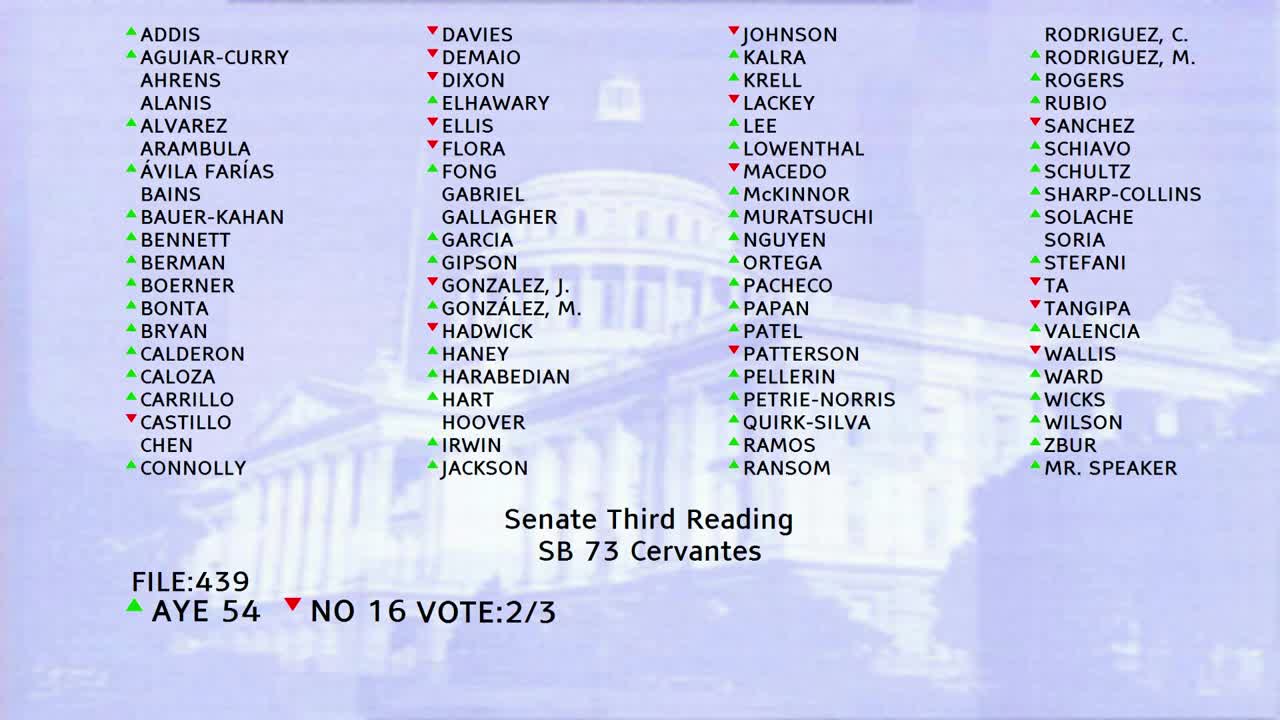


Bill Co-Author(s):