AB 1919: Santa Cruz Metropolitan Transit District: transactions and use tax: qualified voter initiative.
- Session Year: 2025-2026
- House: Assembly
- Latest Version Date: 2026-08-06
Current Status:
Passed
(2026-08-06: Chaptered by Secretary of State - Chapter 107, Statutes of 2026.)
Introduced
In Committee
Awaiting First Chamber Vote
Passed First Chamber
In Committee
Awaiting Second Chamber Vote
Passed Second Chamber
Enacted
What does this bill do?
The bill allows voters in Santa Cruz County to place the Santa Cruz Metropolitan Transit District’s special tax measures on the ballot by a qualified voter initiative, not just by a board proposal. It requires those tax measures to be held with a statewide election and makes the County of Santa Cruz elections official run the district’s ballot process. The district must reimburse the county for the extra election costs, and the district’s legal counsel will prepare an impartial analysis (a neutral description of the measure) subject to county counsel review.
The summary is provided by generative AI which can make mistakes. For original language, please view the details in the table below.
Existing law provides for the establishment of the Santa Cruz Metropolitan Transit District, with specified powers and duties related to the operation of public transit services serving the County of Santa Cruz. Existing law, among other things, authorizes the board of directors of the district to impose transactions and use taxes in accordance with the Transactions and Use Tax Law by an ordinance approved by the electors voting on the measure at a special election called by the board of directors for that purpose.
This bill would also authorize those special taxes to be imposed by a qualified voter initiative. The bill would require the special election for a tax measure proposed by the board of directors or a qualified voter initiative to be consolidated with a statewide general election by the board of supervisors of the County of Santa Cruz and would require the tax measure to be submitted to the voters in accordance with specified elections provisions. The bill would also require the county elections official for the County of Santa Cruz to serve as the elections official of the district for purposes of administering the ballot measure process and any election for purposes of specified provisions of law. To the extent that the bill would impose additional duties on a county elections official, the bill would impose a state-mandated local program.
The California Constitution requires the state to reimburse local agencies and school districts for certain costs mandated by the state. Statutory provisions establish procedures for making that reimbursement.
This bill would provide that, if the Commission on State Mandates determines that the bill contains costs mandated by the state, reimbursement for those costs shall be made pursuant to the statutory provisions noted above.
This bill would declare that it is to take effect immediately as an urgency statute.
Notwithstanding any other law, the special taxes authorized in this article may also be imposed by qualified voter initiative, including a qualified voter initiative for which a petition has been circulated on or after January 1, 2026.
SEC. 2.Section 98290.2 is added to the Public Utilities Code, to read:98290.2.(a)If the board or a qualified voter initiative proposes a measure pursuant to this article, the special election shall be consolidated with a statewide election by the board of supervisors of the County of Santa Cruz and the measure shall be submitted to the voters of the County of Santa Cruz.
(b)For the purpose of placement of a measure on the ballot, the district is a district, as defined in Section 317 of the Elections Code. Except as otherwise provided in this section, a measure proposed by the board or by a qualified voter initiative that requires voter approval shall be submitted to the voters of the County of Santa Cruz, as determined by the district, in accordance with the provisions of the Elections Code applicable to districts, including the provisions of Chapter 4 (commencing with Section 9300) of Division 9 of the Elections Code.
(c)(1)Notwithstanding Section 10520 of the Elections Code, for any election at which the board or a qualified voter initiative proposes a measure pursuant to this article, the district shall reimburse the County of Santa Cruz for the incremental costs incurred by the county elections official related to submitting the measure to the voters with any eligible funds transferred to the district.
(2)For purposes of this subdivision, incremental costs includes all of the following:
(A)The cost to prepare, review, and revise the impartial analysis of the measure.
(B)The cost to prepare a translation of ballot materials into a language other than English by the county.
(C)The additional costs that exceed the costs incurred for other election races or ballot measures, if any, appearing on the same ballot in the County of Santa Cruz, including both of the following:
(i)The printing and mailing of ballot materials.
(ii)The canvass of the vote regarding the measure pursuant to Division 15 (commencing with Section 15000) of the Elections Code.
(d)Notwithstanding Section 9313 of the Elections Code, the legal counsel for the board shall prepare an impartial analysis of the measure. The impartial analysis prepared by the legal counsel for the board shall be subject to review and revision by the county counsel.
(e)The county elections official for the County of Santa Cruz shall serve as the elections official of the district for purposes of administering the ballot measure process and any election for the purposes set forth in this chapter.
(f)This section applies to any measure proposed by the board on or after January 1, 2026, or by a qualified voter initiative for which a petition has been circulated on or after January 1, 2026.
SEC. 3.If the Commission on State Mandates determines that this act contains costs mandated by the state, reimbursement to local agencies and school districts for those costs shall be made pursuant to Part 7 (commencing with Section 17500) of Division 4 of Title 2 of the Government Code.
SEC. 4.This act is an urgency statute necessary for the immediate preservation of the public peace, health, or safety within the meaning of Article IV of the California Constitution and shall go into immediate effect. The facts constituting the necessity are:
In order to avert a reduction in transit service provided by the Santa Cruz Metropolitan Transit District, and to address the financial condition of that district through a tax measure proposed by a qualified voter initiative to be approved in an election occurring in 2026, it is necessary that this act take effect immediately.
|
Date
|
Status
|
|---|---|
| Aug 6, 2026 | Chaptered by Secretary of State - Chapter 107, Statutes of 2026. |
| Aug 6, 2026 | Approved by the Governor. |
| Aug 4, 2026 | Enrolled and presented to the Governor at 2 p.m. |
| Aug 3, 2026 | In Assembly. Ordered to Engrossing and Enrolling. |
| Aug 3, 2026 | Read third time. Urgency clause adopted. Passed. Ordered to the Assembly. (Ayes 27. Noes 8.). |
| Aug 3, 2026 | Read third time. Urgency clause adopted. Passed. Ordered to the Assembly. (Ayes 27. Noes 8. Page 5252.). |
| Jun 30, 2026 | Read second time. Ordered to third reading. |
| Jun 29, 2026 | From committee: Be ordered to second reading pursuant to Senate Rule 28.8. |
| Jun 24, 2026 | From committee: Do pass and re-refer to Com. on APPR. (Ayes 8. Noes 4.) (June 23). Re-referred to Com. on APPR. |
| Jun 16, 2026 | From committee: Do pass and re-refer to Com. on TRANS. (Ayes 4. Noes 1.) (June 16). Re-referred to Com. on TRANS. |
| Jun 10, 2026 | Referred to Coms. on E. & C.A. and TRANS. |
| May 28, 2026 | In Senate. Read first time. To Com. on RLS. for assignment. |
| May 27, 2026 | Read third time. Urgency clause adopted. Passed. Ordered to the Senate. (Ayes 54. Noes 20.). |
| May 27, 2026 | Read third time. Urgency clause adopted. Passed. Ordered to the Senate. (Ayes 54. Noes 20. Page 5463.). |
| May 27, 2026 | Read third time. Urgency clause adopted. Passed. Ordered to the Senate. |
| Apr 23, 2026 | Read second time. Ordered to third reading. |
| Apr 22, 2026 | From committee: Do pass. (Ayes 9. Noes 4.) (April 22). |
| Apr 20, 2026 | Joint Rule 62(a), file notice suspended. (Ayes 54. Noes 16. Page 4716.) |
| Apr 20, 2026 | Joint Rule 62(a), file notice suspended. |
| Apr 16, 2026 | From committee: Do pass and re-refer to Com. on APPR. (Ayes 8. Noes 2.) (April 15). Re-referred to Com. on APPR. |
| Mar 25, 2026 | From committee: Do pass and re-refer to Com. on L. GOV. (Ayes 6. Noes 2.) (March 25). Re-referred to Com. on L. GOV. |
| Mar 16, 2026 | Referred to Coms. on ELECTIONS and L. GOV. |
| Feb 13, 2026 | From printer. May be heard in committee March 15. |
| Feb 12, 2026 | Read first time. To print. |
|
Date
|
Description
|
Location
|
Votes
|
|
|---|---|---|---|---|
| Aug 3, 2026 | Assembly 3rd Reading AB1919 Pellerin et al. By Laird Urgency Clause | Senate Floor |
Passed |
|
| Jun 23, 2026 | Do pass, but first be re-referred to the Committee on [Appropriations] | Senate Standing Committee on Transportation |
Passed |
|
| Jun 16, 2026 | Do pass, but first be re-referred to the Committee on [Transportation] | Senate Standing Committee on Elections and Constitutional Amendments |
Passed |
|
| May 27, 2026 | AB 1919 Pellerin Third Reading Urgency | Assembly Floor |
Passed |
|
| Apr 22, 2026 | Do pass. | Assembly Standing Committee on Appropriations |
Passed |
|
| Apr 15, 2026 | Do pass and be re-referred to the Committee on [Appropriations] | Assembly Standing Committee on Local Government |
Passed |
|
| Mar 25, 2026 | Do pass and be re-referred to the Committee on [Local Government] | Assembly Standing Committee on Elections |
Passed |
This list shows positions taken on this bill by organizations on the date displayed, which is linked to the original source.
Positions by individuals are not included.
|
Organization
|
Position
|
Date
|
|---|---|---|
| American Council of Engineering Companies of California | ** Support | |
| California Association Of Realtors | ** Against | |
| California Legislative Central Coast Caucus | ** Support | |
| California Safety and Legislative Board of Sheet Metal, Air, Rail, and Transportation Workers, SMART – Transportation Division (SMART – TD) | ** Support | |
| California Safety and Legislative Board of Smart – Transportation Division | ** Support | |
| California Safety and Legislative Board, Smart – Transportation Division | ** Support | |
| California Taxpayers Association | ** Against | |
| Eden Housing | ** Support | |
| Howard Jarvis Taxpayers Association | ** Against | |
| Metro | ** Support | |
| Santa Cruz Metropolitan Transit District | ** Support | |
| SC Metro | ** Support |
SENATE RULES COMMITTEE Office of Senate Floor Analyses (916) 651-4171 | AB 1919 |
THIRD READING
Bill No: AB 1919
Author: Pellerin (D) and Addis (D), et al.
Introduced: 2/12/26
Vote: 27 - Urgency
SENATE ELECTIONS & C.A. COMMITTEE: 4-1, 6/16/26
AYES: Wiener, Allen, Cervantes, Umberg
NOES: Choi
SENATE TRANSPORTATION COMMITTEE: 8-4, 6/23/26
AYES: Cortese, Archuleta, Arreguín, Blakespear, Gonzalez, Menjivar, Richardson, Wiener
NOES: Strickland, Dahle, Seyarto, Valladares
NO VOTE RECORDED: Grayson
SENATE APPROPRIATIONS COMMITTEE: Senate Rule 28.8
ASSEMBLY FLOOR: 54-20, 5/27/26 - See last page for vote
SUBJECT: Santa Cruz Metropolitan Transit District: transactions and use tax: qualified voter initiative
SOURCE: Santa Cruz Metropolitan Transit District
California Safety and Legislative Board of SMART – Transportation Division
DIGEST:
This bill permits the Santa Cruz Metropolitan Transit District (SC Metro) to impose special taxes by an initiative.
ANALYSIS:
Existing law:
- Provides that the initiative is the power of the electors to propose statutes and amendments to the California Constitution and to adopt or reject them. A state initiative measure must receive a majority of votes cast thereon in order to take effect.
- Permits initiative powers to be exercised by the electors of each city or county under procedures that the Legislature shall provide. If a majority of the voters voting on a proposed local initiative ordinance vote in its favor, the initiative takes effect.
- Provides that ordinances may be enacted by most districts through the initiative process, with the following exceptions:
- Irrigation districts.
- A district formed under a law that does not provide a procedure for elections.
- A district formed under a law which does not provide for action by ordinance.
- A district governed by an election procedure that permits voters, in electing the district’s directors or trustees, to cast more than one vote per voter.
- A district in which the directors are empowered to cast more than one vote per director when acting on any matter.
The term “district,” for these purposes, includes any regional agency that has the power to tax, to regulate land use, or to condemn and purchase land.
- Prohibits a local government from imposing, extending, or increasing a general tax unless it is submitted to the electorate and approved by a majority vote. The general tax proposal must be submitted to the voters at an election that is consolidated with a regularly scheduled general election for members of the governing body of the local government.
- Prohibits a local government from imposing, extending, or increasing any special tax unless it is submitted to the electorate and approved by a two-thirds vote. Any tax levied by a special purpose district or agency is a special tax.
- Provides for the creation of SC Metro, subject to the approval of electors in the district, and authorizes it to operate a public transit system in incorporated and unincorporated territory within Santa Cruz County.
- Authorizes an authority to impose a retail transaction and use tax (TUT) ordinance applicable in the incorporated and unincorporated territory of a county if the ordinance is adopted by a two-thirds vote of the authority and the tax is subsequently approved by voters.
- Requires a county transportation expenditure plan to be prepared for the expenditure of the revenues for the period during which the tax is to be imposed, and prohibits the plan from being adopted until it has received the approval of the board of supervisors and of the city councils representing both a majority of the cities in the county and a majority of the population residing in the incorporated areas of the county.
This bill:
- Specifies that a TUT authorized under existing law in SC Metro may be imposed by initiative, including an initiative for which a petition has been circulated on or after January 1, 2026.
- Provides all the following for the purposes of a TUT proposed by SC Metro or by initiative on or after January 1, 2026:
- The ordinance imposing the TUT must be submitted to voters of Santa Cruz County at a special election that is consolidated with a statewide election.
- The measure must comply with existing provisions of the Elections Code related to district ballot measures.
- SC Metro must reimburse Santa Cruz County for the incremental costs incurred by the county for submitting such a measure to the voters and includes the following:
- The cost to prepare, review, and revise the impartial analysis of the measure.
- The cost to translate ballot materials into languages other than English.
- Additional costs that exceed costs incurred for other races or measures appearing on the same ballot in the county, including the printing and mailing of ballot materials and the canvass of the vote of the measure.
- Requires SC Metro’s legal counsel to prepare the impartial analysis of the measure, rather than having the analysis be prepared by the county counsel as is required under existing law. The analysis prepared by SC Metro’s counsel must be subject to review and revision by the county counsel.
- Specifies that the Santa Cruz County elections official shall serve as the elections official for the purpose of administering a ballot measure for SC Metro.
- Contains an urgency clause.
Background
Initiatives. The California Constitution guarantees the right of voters to propose statutes and amendments to the Constitution and to adopt or reject them. It also requires the Legislature to provide for initiative powers that may be exercised by voters in cities and counties. Although not required by the California Constitution, the Legislature has adopted procedures in the Elections Code to allow voters to exercise initiative powers in some other local districts.
Other types of measures can appear on the ballot for voters’ consideration. These include referenda, recalls, and measures that a governing body places on the ballot.
Upland Decision. The California Constitution prohibits a local government from imposing, extending, or increasing a special tax unless it is approved by a two-thirds vote of the electorate. The California Constitution also imposes other restrictions on taxes imposed by local governments, including a requirement that a general tax must be approved by the voters at a general election for members of the local government’s governing body, except in an emergency.
In August 2017, the California Supreme Court issued its ruling in California Cannabis Coalition v. City of Upland, 3 Cal. 5th 924 (2017). The court was asked to address whether the requirement that a local government must submit a proposed general tax to the voters at a regularly scheduled general election applies to measures that are placed on the ballot not by the governing body, but instead by the voters through the initiative process.
The court concluded the California Constitution “does not limit voters’ power to propose and adopt initiatives concerning taxation,” and that local general taxes proposed through the initiative process could appear on the ballot at elections other than regularly scheduled general elections. In reaching that conclusion, the majority opinion noted the court has consistently taken the position that courts should protect and liberally construe the people’s initiative power, and that it would not construe the California Constitution as limiting that power “[u]nless a provision explicitly constrains the initiative power or otherwise provides a similarly clear indication that its purpose includes constraining the voters’ initiative power.”
The Upland decision did not directly address whether a local initiative measure that proposes special taxes must comply with the two-thirds vote requirement found in Article XIII C, Section 2, Subdivision (d) of the California Constitution.
Since Upland, several lower courts have been asked to consider whether local special taxes imposed through the initiative process require a two-thirds vote for approval. California Appellate Courts have considered seven such cases and have uniformly concluded that the two-thirds vote requirement in California Constitution does not apply to special taxes proposed through the initiative process. In six of those seven cases, the California Supreme Court declined to review the Appellate Court decision. In the seventh case, no review was sought.
Santa Cruz Metropolitan Transit District. According to their website, SC Metro was established in 1968 with a mission of providing environmentally sustainable transportation to Santa Cruz County and operates countywide, fixed route, and commuter services. SC Metro operates 104 buses on 20 fixed-routes and 32 paratransit vehicles.
SC Metro’s Initiative Effort. There is currently an effort to place an initiative measure that proposes to implement a sales tax to support SC Metro. According to the Santa Cruz County Clerk, the petition was cleared for circulation for signatures on February 20, 2026. The proponents have until August 19, 2026, to submit 10,417 signatures in order for the measure to be considered at a future statewide election. The next statewide election after the November 3, 2026, statewide general election is scheduled for March 7, 2028.
Comments
Author’s Statement. Efficient and well-planned public transit is an important infrastructure for every city. To address growing demands and needs, in 2022, SC Metro rolled out “Reimagine METRO” to expand and improve their service network. This effort has subsequently resulted in significantly increased ridership by 43%. This service expansion was partly funded by state dollars that will run out in 2026. Without additional funds, service reduction and job cuts will occur. In early 2026, local voters formed the coalition “Friends of METRO” to place a citizen’s initiative to secure a local transaction and use tax to benefit SC Metro and prevent this loss of service. Unfortunately, there is ambiguity in existing law about whether voters in the district may use the citizen’s initiative process. This is what this bill seeks to address and also outlines election procedures in SC Metro’s statutes to explicitly allow local electors to place a citizen’s initiative on the ballot.
District Initiatives. Existing law already provides for an initiative process in some, but not all, districts. State law provides the initiative process is not available in a district “formed under a law that does not provide a procedure for elections.” That being said, the Madera County Transportation Authority became the first special district without a clear exception from the Elections Code to approve a special tax as a majority vote initiative in November 2024.
By providing that voters in these districts may impose a TUT for transportation purposes through the initiative process, this bill seeks to resolve any ambiguity about whether the initiative process is available in those districts for that purpose. It should be noted that this bill does not resolve any existing ambiguity about whether voters in those districts may pursue initiative measures that do not meet the requirements within existing law about special taxes.
Majority versus Two-Thirds. As previously mentioned, the California Constitution prohibits a local government from imposing, extending, or increasing a special tax unless it is approved by a two-thirds vote of the electorate. An initiative requires a majority vote of the electorate to be approved.
Related/Prior Legislation
AB 2484 (Alvarez) of 2026, among other provisions, specifies that special taxes may be imposed through the initiative process in the San Diego Metropolitan Transit System.
SB 512 (Pérez) of 2025, would have specified that voters of a district may impose TUTs for transportation purposes by a citizen’s initiative. SB 512 was vetoed by Governor Newsom who stated: “This bill reaffirms that jurisdictions may use the initiative process to impose transactions and use taxes for transportation purposes. The courts have consistently and repeatedly affirmed this existing authority; therefore, this bill is unnecessary.”
SB 63 (Wiener, Chapter 740, Statutes of 2025) established the Public Transit Revenue Measure District including Alameda, Contra Costa, Santa Clara, and San Mateo Counties and the City and County of San Francisco, and specified that special taxes may be imposed through the initiative process in that district, among other provisions.
SB 904 (Dodd, Chapter 866, Statutes of 2024) specified that special taxes may be imposed through the initiative process in the Sonoma-Marin Area Rail Transit District, among other provisions.
FISCAL EFFECT: Appropriation: No Fiscal Com.: Yes Local: Yes
SUPPORT: (Verified 6/29/26)
Santa Cruz Metropolitan Transit District (co-source)
California Safety and Legislative Board of SMART – Transportation Division (co-source)
California Legislative Central Coast Caucus
Eden Housing
OPPOSITION: (Verified 6/29/26)
California Association of Realtors
California Taxpayers Association
Howard Jarvis Taxpayers Association
ASSEMBLY FLOOR: 54-20, 5/27/26
AYES: Addis, Aguiar-Curry, Ahrens, Alvarez, Arambula, Ávila Farías, Bauer-Kahan, Bennett, Berman, Bonta, Bryan, Calderon, Caloza, Carrillo, Connolly, Elhawary, Fong, Gabriel, Garcia, Gipson, Mark González, Haney, Harabedian, Hart, Irwin, Jackson, Kalra, Krell, Lowenthal, McKinnor, Muratsuchi, Nguyen, Ortega, Pacheco, Papan, Pellerin, Petrie-Norris, Quirk-Silva, Ramos, Ransom, Michelle Rodriguez, Rogers, Blanca Rubio, Schultz, Sharp-Collins, Solache, Soria, Stefani, Valencia, Ward, Wicks, Wilson, Zbur, Rivas
NOES: Alanis, Castillo, Chen, Davies, DeMaio, Dixon, Ellis, Flora, Gallagher, Jeff Gonzalez, Hadwick, Hoover, Johnson, Lackey, Macedo, Patterson, Sanchez, Ta, Tangipa, Wallis
NO VOTE RECORDED: Bains, Boerner, Lee, Patel, Celeste Rodriguez, Schiavo
Prepared by: Scott Matsumoto / E. & C.A. / (916) 651-4106
7/1/26 16:55:04
**** END ****
SENATE COMMITTEE ON TRANSPORTATION
Senator Dave Cortese, Chair
2025 - 2026 Regular
Bill No: Hearing Date: 6/23/2026
Author: | Pellerin | ||
Version: | 2/12/2026 Introduced | ||
Urgency: | Yes | Fiscal: | Yes |
Consultant: | Melissa White | ||
SUBJECT:
DIGEST: This bill specifies that a transaction and use tax (TUT) may be imposed by a qualified voter initiative in the Santa Cruz Metropolitan Transit District (SC Metro) and establishes procedures for its placement on the ballot for the consideration of SC Metro voters.
ANALYSIS:
Existing law:
- Provides for the creation of SC Metro, subject to the approval of electors in the district, and authorizes it to operate a public transit system in incorporated and unincorporated territory within the County of Santa Cruz. Provides for SC Metro to be governed by a board of directors of between 7 and 11 members who are appointed by the governing bodies of cities in Santa Cruz County and by the Santa Cruz County Board of Supervisors.
- Provides that a retail TUT may be adopted by the SC Metro board in accordance with law, provided that two-thirds of the electors voting on the measure vote to authorize its enactment at a special election called for by the SC Metro board.
- Specifies that a TUT rate imposed pursuant to current law, on or before January 1, 2020, shall not be considered for the purposes of the combined rate limit established by law.
- Provides that, the board may impose a retail TUT pursuant to current law, above, after January 1, 2024, if both of the following conditions are met:
- The board adopts the ordinance approving the tax before January 1, 2035.
- The total tax rate under this subdivision is set at a rate of no more than 0.5%.
- Specifies that a TUT rate imposed shall not be considered for purposes of the combined rate limit.
- Provides that the initiative is the power of the electors to propose statutes and amendments to the Constitution and to adopt or reject them. Permits initiative powers to be exercised by the electors of each city or county under procedures that the Legislature shall provide.
- Requires a state initiative measure to receive a majority of votes cast thereon to take effect.
- Provides that if a majority of the voters voting on a proposed local initiative ordinance vote in its favor, the initiative shall take effect, as specified.
- Provides that in addition to any other method provided by law, ordinances may be enacted by a district through the initiative process, except in irrigation districts; a district formed under a law that does not provide a procedure for elections; a district formed under a law which does not provide for action by ordinance; a district governed by an election procedure that permits voters, in electing the district’s directors or trustees, to cast more than one vote per voter; or a district in which the directors are empowered to cast more than one vote per director when acting on any matter. Provides, for these purposes, that the term “district” includes any regional agency that has the power to tax, to regulate land use, or to condemn and purchase land.
- Prohibits a local government from imposing, extending, or increasing a general tax unless it is submitted to the electorate and approved by a majority vote. Requires the general tax proposal to be submitted to the voters at an election that is consolidated with a regularly scheduled general election for members of the governing body of the local government, except as specified. Prohibits a local government from imposing, extending, or increasing any special tax unless and until it is submitted to the electorate and approved by a two-thirds vote. Provides that any tax levied by a special purpose district or agency is a special tax.
- Requires the district elections official, for each district initiative measure that will be submitted to voters, to transmit a copy of the measure to the county counsel, or to the district attorney if there is no county counsel, of the county that contains the largest number of registered voters of the district, and requires the county counsel or district attorney to prepare an impartial analysis of the measure, except as specified.
This bill:
- Provides that the special taxes authorized in SC Metro Law may also be imposed by qualified voter initiative, including a qualified voter initiative for which a petition has been circulated on or after January 1, 2026.
- Specifies that, if the SC Metro Board or a qualified voter initiative proposes a measure pursuant to SC Metro Law, the special election shall be consolidated with a statewide election by the board of supervisors of Santa Cruz County and the measure shall be submitted to the voters of Santa Cruz County.
- Provides that, for the purpose of placement of a measure on the ballot, SC Metro is a “district” as defined in existing law. Except as otherwise provided, a measure proposed by the SC Metro Board or by a qualified voter initiative that requires voter approval shall be submitted to the voters of Santa Cruz County, as determined by SC Metro, in accordance with the provisions of the Elections Code applicable to districts, as specified.
- Specifies that for any election at which the SC Metro Board or a qualified voter initiative proposes a measure pursuant to SC Metro Law, SC Metro shall reimburse Santa Cruz County for the incremental costs incurred by the county elections official related to submitting the measure to the voters with any eligible funds transferred to the district.
- Provides that “incremental costs” includes all of the following:
- The cost to prepare, review, and revise the impartial analysis of the measure.
- The cost to prepare a translation of ballot materials into a language other than English by the county.
- The additional costs that exceed the costs incurred for other election races or ballot measures, if any, appearing on the same ballot in Santa Cruz County, including both of the following:
- The printing and mailing of ballot materials.
- The canvass of the vote regarding the measure pursuant to existing law.
- Specifies that legal counsel for the SC Metro board shall prepare an impartial analysis of the measure. The impartial analysis prepared by the legal counsel for the SC Metro board shall be subject to review and revision by the county counsel.
- Requires the county elections official for Santa Cruz County to serve as the elections official of SC Metro for purposes of administering the ballot measure process and any election for the purposes set forth in SC Metro Law.
- Specifies that this bill applies to any measure proposed by the SC Metro Board on or after January 1, 2026, or by a qualified voter initiative for which a petition has been circulated on or after January 1, 2026.
- Provides that if the Commission on State Mandates determines that this bill contains costs mandated by the state, reimbursement to local agencies and school district for those costs shall be made.
- Contains an urgency clause.
COMMENTS:
- Purpose of the bill. According to the author, “Efficient and well-planned public transit is an important infrastructure for every city. The Santa Cruz Metropolitan Transit District (METRO) connects my district in Santa Cruz with the surrounding areas bringing in jobs and growth to the region. To address growing demands and needs, in 2022, METRO rolled out “Reimagine METRO” to expand and improve their service network. This effort has subsequently resulted in significantly increased ridership by 43%. This service expansion was partly funded by state dollars that will run out in 2026. Without additional funds, service reduction and job cuts will occur. In early 2026, local voters formed the coalition “Friends of METRO” to place a citizen’s initiative on the November 2026 ballot to secure a local transaction and use tax to benefit METRO and prevent this loss of service. Unfortunately, there is ambiguity in existing law about whether voters in the district may use the citizen’s initiative process. This is what AB 1919 seeks to address. This bill will outline elections procedures in METRO’s statutes to explicitly allow local electors to place a citizen’s initiative on the ballot.”
- Who is SC Metro? SC Metro was established in 1968 for the purpose of providing public, fixed route bus service in Santa Cruz County. Additionally, they assumed operation of paratransit services in 2004. Specifically, SC Metro operates 119 buses on 22 routes throughout Santa Cruz County. The service connects Santa Cruz, Capitola, Watsonville, and Scotts Valley, as well as the unincorporated areas of Aptos, Soquel, Live Oak, Bonny Doon, Davenport, and the San Lorenzo Valley in the Santa Cruz Mountains.
In addition to operating bus and paratransit service, SC Metro also operates an express commuter bus service connecting downtown San Jose, as well as several Bay Area transit systems. According to SC Metro, for 2026 ridership is on track to exceed 5.5 million annual trips. SC Metro is governed by a Board of Directors consisting of eleven voting members and two ex-officio members.
SC Metro currently receives a 0.5% sales tax, imposed in 1978, on all taxable sales in Santa Cruz County, which generates roughly $27 million annually. Additionally, in November 2016, Santa Cruz County voters approved Measure D, a 0.5% sales tax measure designed to fund a comprehensive package of transportation improvements in the county. SC Metro receives 16% of Measure D. Specifically, Measure D funds generates roughly $4 million annually for SC Metro operations to help stabilize fixed-route bus and paratransit service levels. According to SC Metro, sales tax revenues account for approximately 45% of their operating revenue.
- Transit Fiscal Cliff. With the onset of the COVID-19 pandemic during the first half of 2020, transit ridership plunged from 50% to as much as 94% in California. In an effort to stave off financial losses from declining transit ridership, the federal government provided relief for transit operators across the country through three successive COVID relief packages: Coronavirus Aid, Relief and Economic Security (CARES) Act, Coronavirus Response and Relief Appropriations Act (CRRSSA), and American Rescue Plan (ARP). As federal pandemic relief funds are expended, transit operators are facing fiscal emergencies.
To help support public transit throughout the state, in June 2023 the Legislature passed and Governor Newsom signed into law the 2023-24 State Budget and accompanying trailer bill, SB 125 (Committee on Budget and Fiscal Review, Chapter 125, Statutes of 2023), which provides $5.1 billion for transit agencies to use for both capital and operating expenditures. Specifically, $4 billion (General Fund) will be allocated to Regional Transportation Planning Agencies (RTPAs) through a population-based formula. The additional $1.1 billion (Greenhouse Gas Reduction Fund) will be allocated via existing formulas and is available for the purchase of zero-emission buses or overall operating costs. Funding is administered by the California State Transportation Agency (CalSTA) through the Transit and Intercity Rail Capital Program (TIRCP), with specific requirements for short and long-term financial plans from transit operators and the collection of transit data. To date, SC Metro has received $28.3 million in SB 125 funds.
- Reimagine METRO. According to SC Metro, they have recovered all of their pre-COVID ridership and have actually added riders since 2019. Specifically, SC Metro estimates 5.5 million riders for 2026, which is nearly 450,000 more than pre-pandemic levels. SC Metro attributes this success to the Reimagine METRO program.
Reimagine METRO launched in 2023, after working with communities across SC Metro’s service territory to plan a network of bus services that would be faster, more frequent, and reliable in areas of high transit demand. The goal was to test whether better frequency, stronger regional connections, and more useful service would increase ridership and community access.
Reimagine METRO Phase 1, which began in December 2023, implemented new, higher frequency routes from Watsonville to Santa Cruz. Reimagine METRO Phase 2, which began in March 2024, expanded SC Metro’s network of frequent routes and increased service by 35%. The program has been successful, with overall ridership up and youth ridership growing significantly.
Reimagine METRO Phase 1 and 2 were funded with SC Metro’s SB 125 funds, which run out this year. To retain current service levels, and avoid job cuts, SC Metro is exploring ways to secure additional, predictable operations funding.
- What is Transaction and Use Tax? State law allows cities, counties, and specified special districts to increase the sales and use tax applicable in their jurisdiction, also known as district taxes or TUTs. Generally, the combined TUT tax rate imposed within a local jurisdiction cannot exceed 2%. To determine whether a county has reached this rate limitation, all countywide taxes and the highest combined rate imposed by a city within the county are counted towards the county's rate limit. For example, if a county imposes three 0.5% countywide taxes and two cities within the county each impose a 0.5% tax, the combined rate in those two cities would be 2%. In such a circumstance, the two cities could not impose another TUT, and the county could not impose another countywide TUT, absent special authority to exceed the rate limitation.
Prior to 2003, cities lacked the ability to place TUTs before their voters without first obtaining approval by the Legislature to bring an ordinance before the city council, and, if approved at the council level, to the voters. This was remedied by SB 566 (Scott, Chapter 709, Statutes of 2003), which imposed the uniform 2% countywide cap.
As of April 1, 2026, local agencies impose 486 district taxes for general or special purposes: 408 imposed citywide, 72 imposed countywide, and six imposed in unincorporated county areas. Generally, local agencies impose these taxes throughout the entire area of a single county, the entire unincorporated area within a single county, or a single incorporated city. However, three transportation operators in the Bay Area have regional district taxes: the Bay Area Rapid Transit (BART) District, which covers Alameda, Contra Costa, and San Francisco; the Peninsula Corridor Joint Powers Board (Caltrain), which covers San Francisco, San Mateo, and Santa Clara counties; and Sonoma-Marin Rail Transit District (SMART), which includes Sonoma and Marin counties.
- Upland and Citizens’ Initiatives. On August 28, 2017, the California Supreme Court entered a decision in California Cannabis Coalition v. City of Upland, 3 Cal. 5th 924, which held that the requirement in Article XIIIC, Section Two, subdivision (b) of the California Constitution that general taxes be submitted to the electorate at a regularly scheduled general election where members of the local governing board are subject to election did not apply to taxes proposed by voter initiative. Groups seeking to impose special taxes by majority vote by initiative soon argued that if the Court held that the general election requirement in subdivision (b) did not apply to initiatives, then neither did the 2/3 vote requirement for special taxes in subdivision (d). At least seven such taxes imposed by voters in various local agencies across the state have been approved, and no court thus far has invalidated them.
- What does Upland mean for SC Metro and other transportation districts? Existing state law already provides for an initiative process in some, but not all, districts. Specifically, section 9300 of the Elections Code provides that ordinances may be enacted in districts through the initiative process, except in districts that meet one of five enumerated conditions. Four of those conditions clearly do not apply to SC Metro, but it is less clear whether the fifth condition applies. Accordingly, there may be some ambiguity about whether a voter can propose to enact a TUT through the initiative process in SC Metro.
Specifically, state law provides that the initiative process is not available in a district “formed under a law that does not provide a procedure for elections.” State law does not further elaborate on what it means for a law to provide “a procedure for elections,” nor is there relevant case law that interprets the meaning of that phrase.
Existing law does already provide for submission of a proposed TUT ordinance to SC Metro voters. Furthermore, state law required voter approval to form SC Metro. It could be argued that these provisions are “a procedure for elections.” On the other hand, the board of directors of SC Metro is appointed, rather than elected, so SC Metro does not hold regularly scheduled elections for the purpose of electing board members. That fact may support an argument that the laws governing SC Metro do not provide a procedure for elections.
To attempt to clear any confusion, last year the Legislature approved SB 512 (Pérez, 2025), which would have expanded the types of jurisdictions that may impose TUTs for transportation purposes by a voter initiative. SB 512 was vetoed by Governor Newsom, stating, “this bill reaffirms that jurisdictions may use the initiative process to impose transactions and use taxes for transportation purposes. The courts have consistently and repeatedly affirmed this existing authority; therefore, this bill is unnecessary.”
- AB 1919 resolves any ambiguity about the initiative process for SC Metro. AB 1919 specifies that a TUT may be imposed by a qualified voter initiative for a petition that has been circulated on or after January 1, 2026. As detailed above, current elections law appears to not allow SC Metro to provide for an initiative process.
Additionally, the bill requires SC Metro to reimburse Santa Cruz County for the incremental costs incurred by the county elections official related to submitting the measure to the voters.
A group called the Friends of Santa Cruz Metro is currently seeking to place an initiative measure on the ballot that proposes to implement a sales tax measure aimed to supporting SC Metro. According to the Santa Cruz County Clerk, the petition was cleared for circulation and to gather signatures on February 20, 2026. The proponents have until August 19, 2026, to submit 10,417 signatures in order for the measure to be considered at a future statewide election, likely 2028.
As proposed, the initiative would generate nearly $27 million annually and the funds would be used to continue the service enhancements of Reimagine METRO, as detailed above.
- We’ve done this before. The Legislature has, on numerous occasions, granted specific statutory authority to exceed the general 2% rate limitation. Specifically, such authority has been granted to the Counties of Alameda, Contra Costa, Humboldt, Los Angeles, Monterey, San Mateo, Santa Clara, Solano, Sonoma, and Ventura. This authority has also been granted to the cities of Alameda, Berkeley, Campbell, El Cerrito, Lancaster, Palmdale, Pinole, Santa Fe Springs, any cities in the County of Solano, Victorville, and to BART and Caltrain.
Additionally, in recent years, the Legislature has authorized specific transportation districts to facilitate the imposition of a revenue measure through a qualified voter initiative. For example, SB 904 (Dodd, Chapter 866, Statutes of 2024) for SMART in Sonoma and Marin Counties, and SB 63 (Wiener, Chapter 740, Statutes of 2025) for a regional measure for San Fransico Bay Area transit.
- Support and opposition. Writing as the co-sponsor of the bill, the California Safety and Legislative Board of the Sheet Metal, Air, Rail, and Transportation Workers, SMART – Transportation Division (SMART – TD) states, “SMART – TD represents hundreds of bus operators at Santa Cruz Metropolitan Transit District (SCMTD). SCMTD is at a critical moment. Through its Reimagine SCMTD program, the agency now provides frequent service - every 20 minutes or better – within one-half mile of approximately 100,000 count residents. SCMTD’s Youth Cruz Free program has driven a 400% increase in student ridership.
“Despite these achievements, METRO is facing reductions in multiple funding sources while operating costs such as fuel and insurance continue to rise. Without a new local funding measure, SCMTD would be forced to reduce service by approximately 33%, eliminate the Youth Cruz Free program and lay off more than 100 employees earning livable wages.”
Further, “AB 1919 creates a statutorily defined election procedures for METRO to allow voters to propose a special tax through a qualified voter initiative.”
Writing in opposition, a coalition of the California Taxpayers Association, the California Association of Realtors, and the Howard Jarvis Taxpayers Association, detail numerous reasons for opposing the bill, including that it makes regressive transportation taxes more prevalent, it harms California workers, increases the cost of providing government services, undermines the two-thirds vote requirement for special taxes, misapplies the Upland decision, and encourages strategic manipulation of elections and erodes public trust.
- Double referral. The bill was double referred to the Senate Elections and Constitutional Amendments Committee, where it passed out on a vote of 4-1 at their June 16, 2026, hearing.
Related/PREVIOUS Legislation:
AB 2484 (Alvarez) – Authorizes the San Diego Metropolitan Transit System (MTS) to impose a TUT that exceeds the 2% statutory limitation, and specifies that the TUT may be imposed by a qualified voter initiative. AB 2484 is pending in this committee.
SB 762 (Arreguín) – Authorizes the City of Hercules to impose a TUT, by ordinance or voter initiative, up to 1% even if it exceeds the 2% cap. This bill is pending on the Assembly Floor.
SB 1408 (Arreguín) – Authorizes the Contra Costa Transportation Authority (CCTA) to impose or extend a TUT for the support of countywide transportation programs at up to 1% even if it exceeds the combined countywide rate limit of 2%. This bill is pending in the Assembly Revenue and Taxation Committee.
AB 1768 (Bryan, Chapter 11, Stutes of 2026) – Allows Los Angeles County to impose a TUT of up to .5%, even if it exceeds the 2% cap. Allows Contra Costa County to impose a TUT of up to 0.625%, even if it exceeds the 2% cap.
SB 63 (Wiener, Chapter 740, Statutes of 2025) – Among other provisions, created the Transportation Revenue Measure District and authorized the District to impose a retail TUT and generally in the amount of 0.5%, to be administered by MTC, for a duration of 14 years, to be placed on the November 2026 ballot to fund transit operations for Bay Area transit operators.
SB 333 (Laird, Chapter 750, Statutes of 2025) – Would authorize the San Luis Obispo Council of Governments to impose a district tax by ordinance of up to 1% even if it exceeds the 2% cap.
SB 512 (Pérez, 2025) – Would have expanded the types of jurisdictions that may, by an initiative, impose TUTs for transportation purposes. This bill was vetoed by Governor Newsom.
SB 904 (Dodd, Chapter 866, Statutes of 2024) – Specified that special taxes may be imposed through the initiative process in the Sonoma-Marin Area Rail Transit District, among other provisions.
AB 3259 (Wilson, Chapter 852, Statutes of 2024) – Allowed the cities of Campbell and Pinole, the Solano County Board of Supervisors and a city council in Solano County to impose a TUT, by ordinance or voter initiative, of up to 0.5% even if it exceeds the 2% cap.
AB 2443 (Carrillo, Chapter 961, Statutes of 2024) – Authorized the cities of Lancaster, Palmdale, and Victorville to impose a TUT that exceeds the 2% statutory limitation.
AB 2431 (Mathis, 2024) – Would have authorized a city, county, or city and county to impose a TUT at an unspecified rate that exceeds the 2% statutory limitation if certain conditions are met. This bill died in the Assembly Local Government Committee.
SB 862 (Laird, Chapter 296, Statutes of 2023) – Authorized the board of directors of the Santa Cruz Metropolitan Transit District to impose a retail TUT of up to .5% after January 1, 2024, that is excluded from the 2% combined rate limit, if certain conditions are met.
SB 335 (Cortese, Chapter 391, Statutes of 2023) – Allows the Santa Clara County Board of Supervisors to propose a TUT of up to .625% in Santa Clara County that exceeds the 2% cap and shifted the authority to impose a TUT for countywide transportation purposes in Ventura County that exceeds the 2% cap from the Ventura County Transportation Commission to the County.
AB 1679 (Santiago, Chapter 731, Statutes of 2023) – Authorized Los Angeles County to impose a TUT of up to .5% that exceeds the 2% statutory limitation, as specified.
AB 1385 (Garcia, Chapter 578, Statutes of 2023) – Raised the maximum TUT that RCTC may impose, from 1% to 1.5%.
AB 1256 (Wood, Chapter 572, Statutes of 2023) – Authorized Humboldt County to impose a TUT of up to 1% that exceeds the 2% statutory limitation.
AB 2453 (Bennett, Chapter 286, Statutes of 2022) – Authorized the Ventura County Transportation Commission to impose a TUT of no more than 0.5% that does not count against the cap in Ventura County.
SB 1349 (Glazer, Chapter 369, Statutes of 2020) – Permitted Contra Costa County, and cities within Contra Costa County, additional legal flexibility to impose local TUTs.
AB 723 (Quirk, Chapter 747, Statutes of 2019) – Provided that neither the tax imposed by BART nor the tax imposed by the Alameda County Transportation Commission counts against the 2% cap, and made a similar change in Santa Cruz County.
SB 142 (Deddeh, Chapter 786, Statutes of 1987) – Local Transportation Authority and Improvement Act provided a process for individual counties to create a local transportation authority and implement local sales taxes of up to 1% for transportation purposes.
FISCAL EFFECT: Appropriation: Fiscal Com.: Local:
POSITIONS: (Communicated to the committee before noon on Wednesday,
June 17, 2026.)
SUPPORT:
Santa Cruz Metropolitan Transit District (sponsor)
American Council of Engineering Companies of California
California Legislative Central Coast Caucus
California Safety and Legislative Board, Smart – Transportation Division (Smart - TD)
Eden Housing
OPPOSITION:
California Association of Realtors
California Taxpayers Association
Howard Jarvis Taxpayers Association
-- END --
SENATE COMMITTEE ON
ELECTIONS AND CONSTITUTIONAL AMENDMENTS
Senator Scott Wiener, Chair
2025 - 2026 Regular
Bill No: Hearing Date: 6/16/26
Author: | |||
Version: |
| ||
Urgency: | Fiscal: | ||
Consultant: | |||
Subject:
DIGEST
This bill permits the Santa Cruz Metropolitan Transit District (SC Metro) to impose special taxes by an initiative.
ANALYSIS
- Provides that the initiative is the power of the electors to propose statutes and amendments to the California Constitution and to adopt or reject them. A state initiative measure must receive a majority of votes cast thereon in order to take effect.
- Permits initiative powers to be exercised by the electors of each city or county under procedures that the Legislature shall provide. If a majority of the voters voting on a proposed local initiative ordinance vote in its favor, the initiative takes effect.
- Provides that ordinances may be enacted by most districts through the initiative process, with the following exceptions:
- Irrigation districts.
- A district formed under a law that does not provide a procedure for elections.
- A district formed under a law which does not provide for action by ordinance.
- A district governed by an election procedure that permits voters, in electing the district’s directors or trustees, to cast more than one vote per voter.
- A district in which the directors are empowered to cast more than one vote per director when acting on any matter.
The term “district,” for these purposes, includes any regional agency that has the power to tax, to regulate land use, or to condemn and purchase land.
- Prohibits a local government from imposing, extending, or increasing a general tax unless it is submitted to the electorate and approved by a majority vote. The general tax proposal must be submitted to the voters at an election that is consolidated with a regularly scheduled general election for members of the governing body of the local government.
- Prohibits a local government from imposing, extending, or increasing any special tax unless it is submitted to the electorate and approved by a two-thirds vote. Any tax levied by a special purpose district or agency is a special tax.
- Provides for the creation of SC Metro, subject to the approval of electors in the district, and authorizes it to operate a public transit system in incorporated and unincorporated territory within Santa Cruz County.
- Authorizes an authority to impose a retail transaction and use tax (TUT) ordinance applicable in the incorporated and unincorporated territory of a county if the ordinance is adopted by a two-thirds vote of the authority and the tax is subsequently approved by voters.
- Requires a county transportation expenditure plan to be prepared for the expenditure of the revenues for the period during which the tax is to be imposed, and prohibits the plan from being adopted until it has received the approval of the board of supervisors and of the city councils representing both a majority of the cities in the county and a majority of the population residing in the incorporated areas of the county.
This bill:
- Specifies that a TUT authorized under existing law in SC Metro may be imposed by initiative, including an initiative for which a petition has been circulated on or after January 1, 2026.
- Provides all the following for the purposes of a TUT proposed by SC Metro or by initiative on or after January 1, 2026:
- The ordinance imposing the TUT must be submitted to voters of Santa Cruz County at a special election that is consolidated with a statewide election.
- The measure must comply with existing provisions of the Elections Code related to district ballot measures.
- SC Metro must reimburse Santa Cruz County for the incremental costs incurred by the county for submitting such a measure to the voters and includes the following:
- The cost to prepare, review, and revise the impartial analysis of the measure.
- The cost to translate ballot materials into languages other than English.
- Additional costs that exceed costs incurred for other races or measures appearing on the same ballot in the county, including the printing and mailing of ballot materials and the canvass of the vote of the measure.
- Requires SC Metro’s legal counsel to prepare the impartial analysis of the measure, rather than having the analysis be prepared by the county counsel as is required under existing law. The analysis prepared by SC Metro’s counsel must be subject to review and revision by the county counsel.
- Specifies that the Santa Cruz County elections official shall serve as the elections official for the purpose of administering a ballot measure for SC Metro.
- Contains an urgency clause.
BACKGROUND
Initiatives. The California Constitution guarantees the right of voters to propose statutes and amendments to the Constitution and to adopt or reject them. It also requires the Legislature to provide for initiative powers that may be exercised by voters in cities and counties. Although not required by the California Constitution, the Legislature has adopted procedures in the Elections Code to allow voters to exercise initiative powers in some other local districts.
Other types of measures can appear on the ballot for voters’ consideration. These include referenda, recalls, and measures that a governing body places on the ballot.
Upland Decision. The California Constitution prohibits a local government from imposing, extending, or increasing a special tax unless it is approved by a two-thirds vote of the electorate. The California Constitution also imposes other restrictions on taxes imposed by local governments, including a requirement that a general tax must be approved by the voters at a general election for members of the local government’s governing body, except in an emergency.
In August 2017, the California Supreme Court issued its ruling in California Cannabis Coalition v. City of Upland, 3 Cal. 5th 924 (2017). The court was asked to address whether the requirement that a local government must submit a proposed general tax to the voters at a regularly scheduled general election applies to measures that are placed on the ballot not by the governing body, but instead by the voters through the initiative process.
The court concluded the California Constitution “does not limit voters’ power to propose and adopt initiatives concerning taxation,” and that local general taxes proposed through the initiative process could appear on the ballot at elections other than regularly scheduled general elections. In reaching that conclusion, the majority opinion noted the court has consistently taken the position that courts should protect and liberally construe the people’s initiative power, and that it would not construe the California Constitution as limiting that power “[u]nless a provision explicitly constrains the initiative power or otherwise provides a similarly clear indication that its purpose includes constraining the voters’ initiative power.”
The Upland decision did not directly address whether a local initiative measure that proposes special taxes must comply with the two-thirds vote requirement found in Article XIII C, Section 2, Subdivision (d) of the California Constitution.
Since Upland, several lower courts have been asked to consider whether local special taxes imposed through the initiative process require a two-thirds vote for approval. California Appellate Courts have considered seven such cases and have uniformly concluded that the two-thirds vote requirement in California Constitution does not apply to special taxes proposed through the initiative process. In six of those seven cases, the California Supreme Court declined to review the Appellate Court decision. In the seventh case, no review was sought.
Santa Cruz Metropolitan Transit District. According to their website, SC Metro was established in 1968 with a mission of providing environmentally sustainable transportation to Santa Cruz County and operates countywide, fixed route, and commuter services. SC Metro operates 104 buses on 20 fixed-routes and 32 paratransit vehicles.
SC Metro’s Initiative Effort. There is currently an effort to place an initiative measure that proposes to implement a sales tax to support SC Metro. According to the Santa Cruz County Clerk, the petition was cleared for circulation for signatures on February 20, 2026. The proponents have until August 19, 2026, to submit 10,417 signatures in order for the measure to be considered at a future statewide election. The next statewide election after the November 3, 2026, statewide general election is scheduled for March 7, 2028.
COMMENTS
- Author’s Statement. Efficient and well-planned public transit is an important infrastructure for every city. To address growing demands and needs, in 2022, SC Metro rolled out “Reimagine METRO” to expand and improve their service network. This effort has subsequently resulted in significantly increased ridership by 43%. This service expansion was partly funded by state dollars that will run out in 2026. Without additional funds, service reduction and job cuts will occur. In early 2026, local voters formed the coalition “Friends of METRO” to place a citizen’s initiative to secure a local transaction and use tax to benefit SC Metro and prevent this loss of service. Unfortunately, there is ambiguity in existing law about whether voters in the district may use the citizen’s initiative process. This is what this bill seeks to address and also outlines election procedures in SC Metro’s statutes to explicitly allow local electors to place a citizen’s initiative on the ballot.
- District Initiatives. Existing law already provides for an initiative process in some, but not all, districts. State law provides the initiative process is not available in a district “formed under a law that does not provide a procedure for elections.” That being said, the Madera County Transportation Authority became the first special district without a clear exception from the Elections Code to approve a special tax as a majority vote initiative in November 2024.
By providing that voters in these districts may impose a TUT for transportation purposes through the initiative process, this bill seeks to resolve any ambiguity about whether the initiative process is available in those districts for that purpose. It should be noted that this bill does not resolve any existing ambiguity about whether voters in those districts may pursue initiative measures that do not meet the requirements within existing law about special taxes.
- Majority versus Two-Thirds. As previously mentioned, the California Constitution prohibits a local government from imposing, extending, or increasing a special tax unless it is approved by a two-thirds vote of the electorate. An initiative requires a majority vote of the electorate to be approved.
- Double Referral. If approved by this committee, this bill will be referred to the Committee on Transportation for further consideration.
RELATED/PRIOR LEGISLATION
AB 2484 (Alvarez) of 2026, among other provisions, specifies that special taxes may be imposed through the initiative process in the San Diego Metropolitan Transit System.
SB 512 (Pérez) of 2025, would have specified that voters of a district may impose TUTs for transportation purposes by a citizen’s initiative. SB 512 was vetoed by Governor Newsom who stated: “This bill reaffirms that jurisdictions may use the initiative process to impose transactions and use taxes for transportation purposes. The courts have consistently and repeatedly affirmed this existing authority; therefore, this bill is unnecessary.”
SB 63 (Wiener), Chapter 740, Statutes of 2025, established the Public Transit Revenue Measure District including Alameda, Contra Costa, Santa Clara, and San Mateo Counties and the City and County of San Francisco, and specified that special taxes may be imposed through the initiative process in that district, among other provisions.
SB 904 (Dodd), Chapter 866, Statutes of 2024, specified that special taxes may be imposed through the initiative process in the Sonoma-Marin Area Rail Transit District, among other provisions.
PRIOR ACTION
Assembly Floor: | |
Assembly Appropriations Committee: |
|
Assembly Local Government: | 8 - 2 |
Assembly Committee: |
|
POSITIONS
Sponsor: Santa Cruz Metropolitan Transit District
California Safety and Legislative Board of SMART – Transportation Division
Support: None received
Oppose: California Association of Realtors
California Taxpayers Association
Howard Jarvis Taxpayers Association
-- END --
ASSEMBLY THIRD READING
ATR Bill Id:AB 1919
Author:(Pellerin and Addis)
As Introduced Ver:February 12, 2026
2/3 vote. Urgency
SUMMARY
Specifies that special taxes may be imposed through the initiative process in the Santa Cruz Metropolitan Transit District (SC Metro). Establishes procedures for the placement of a retail transactions and use tax (TUT) ordinance on the ballot for the consideration of SC Metro voters.
Major Provisions
- Specifies that a TUT authorized under existing law in SC Metro may be imposed by qualified voter initiative, including an initiative for which a petition has been circulated on or after January 1, 2026.
- Requires SC Metro to reimburse Santa Cruz County for the incremental costs incurred by the county for submitting a TUT measure to the voters, as specified.
- Requires SC Metro's legal counsel to prepare the impartial analysis of a TUT measure in the district, rather than having the analysis be prepared by the county counsel as is required under existing law. Provides that the analysis prepared by SC Metro's counsel is subject to review and revision by the county counsel.
- Contains an urgency clause, allowing this bill to take effect immediately upon enactment.
COMMENTS
According to information from SC Metro, the district was formed in 1969 for the purpose of providing public, fixed route bus service in Santa Cruz County, and it assumed operation of paratransit services in Santa Cruz County in 2004. In addition to operating bus and paratransit service throughout Santa Cruz County, SC Metro also operates a commuter bus service to Santa Clara County in cooperation with other governmental agencies. SC Metro is governed by a Board of Directors consisting of eleven voting members and two ex-officio members.
As used in this analysis, the term "initiative" applies exclusively to measures initiated by the voters of a jurisdiction through the collection of voters' signatures on initiative petitions. Existing state law provides for an initiative process in some, but not all, districts. Among other provisions, state law provides that the initiative process is not available in a district "formed under a law that does not provide a procedure for elections." State law does not further elaborate on what it means for a law to provide "a procedure for elections," nor is there relevant case law that interprets the meaning of that phrase. SC Metro board members are appointed, rather than elected, but state law provides for submission of a proposed TUT tax ordinance to SC Metro voters and required voter approval to form SC Metro. Accordingly, it is somewhat unclear whether the initiative process is available in SC Metro under existing law. By expressly providing that the voters in SC Metro may impose a TUT through the initiative process, this bill should resolve any ambiguity about whether the initiative process is available for that purpose.
In August 2017, the California Supreme Court issued its ruling in California Cannabis Coalition v. City of Upland, 3 Cal. 5th 924 (2017). In that case, the Court was asked to address whether a requirement that a local government must submit a proposed general tax to the voters at a regularly scheduled general election applies to measures that are placed on the ballot by the voters through the initiative process. The Court concluded that the California Constitution "does not limit voters' power to propose and adopt initiatives concerning taxation," and thus that local general taxes proposed through the initiative process could appear on the ballot at elections other than regularly scheduled general elections.
Since Upland and based on the logic of the Supreme Court in that case, several lower courts have been asked to consider whether local special taxes imposed through the initiative process require a two-thirds vote for approval pursuant to Article XIII C, Section 2 of the California Constitution. California Appellate Courts have considered eight such cases and have uniformly concluded that the two-thirds vote requirement in article XIII C, section 2, subdivision (d) does not apply to special taxes proposed through the initiative process.
Opponents of this bill argue that, notwithstanding Upland, the California Constitution requires local special taxes to be approved by a two-thirds vote of the voters, regardless of whether the measure is placed on the ballot by a governing body or through an initiative. Nothing in this bill, however, affects the vote threshold for approval of initiative measures in SC Metro. Rather, this bill merely specifies that special taxes may be adopted by initiative in SC Metro.
If opponents believe that local jurisdictions are misapplying Upland, nothing in this bill prevents them from challenging those interpretations in court.
Please see the policy committee analysis for a full discussion of this bill.
According to the Author
"Efficient and well-planned public transit is an important infrastructure for every city. The Santa Cruz Metropolitan Transit District (METRO) connects my district in Santa Cruz with the surrounding areas bringing in jobs and growth to the region. To address growing demands and needs, in 2022, METRO rolled out 'Reimagine METRO' to expand and improve their service network. This effort has subsequently resulted in significantly increased ridership by 43%. This service expansion was partly funded by state dollars that will run out in 2026. Without additional funds, service reduction and job cuts are a real possibility. In early 2026, local voters formed the coalition 'Friends of METRO' to place a citizen's initiative on the November 2026 ballot to secure a local transaction and use tax to benefit METRO and prevent this loss of service. Unfortunately, there is ambiguity in existing law about whether voters in the district may use the citizen's initiative process. This is what AB 1919 seeks to address. This bill will outline elections procedures in METRO's statutes to explicitly allow local electors to place a citizen's initiative on the ballot."
Arguments in Support
One of the co-sponsors of this bill, SC Metro, writes in support, "In 2026, in response to METRO's fiscal challenges, local stakeholders formed 'Friends of METRO,' a coalition of residents committed to running a 'citizen's initiative' to generate additional local funding for METRO through a 2026 ballot initiative. While METRO welcomes this citizen's initiative, we have observed that, under current law, it is unclear how the Friends of METRO can place the initiative on the ballot. Current law permits electors of local jurisdictions with statutorily defined elections procedures (e.g. cities, counties, and some special districts) to exercise initiative powers; however, current law does not explicitly permit electors of local jurisdictions without statutorily defined elections procedures, like METRO, to exercise initiative powers and the Courts have provided no further clarity on this matter. This bill would address this uncertainty by adding election procedures to METRO's authorizing statutes."
Arguments in Opposition
In a joint letter of opposition to this bill, the California Association of Realtors, California Taxpayers Association, and Howard Jarvis Taxpayers Association write, "By lowering the threshold for passage of a tax increase in the countywide Santa Cruz Metropolitan Transit District, AB 1919 would make it easier to enact a transactions and use tax in an area that already has a very high tax burden. This tax is among the most regressive forms of taxation, and has an especially heavy impact on low-income Californians because it increases the cost of necessities. As inflation, tariffs, shipping costs and other factors drive up the prices of goods, the sales tax burden grows in tandem, further straining household budgets and exacerbating economic inequality. Santa Cruz County is the least affordable area in the entire country for renters, according to the annual 'Out of Reach' report released in 2025, and a tax increase on everyday items would only make things worse."
FISCAL COMMENTS
According to the Assembly Appropriations Committee, to the extent this bill requires a qualified TUT measure be put on the ballot, with resultant workload costs for the Santa Cruz County elections official, this bill may create a state-mandated local program. If the Commission on State Mandates determines the provisions of this bill create a new program or impose a higher level of service for which the state must reimburse local costs, Santa Cruz County could seek reimbursement from the state. However, since SC Metro must reimburse Santa Cruz County for the costs of administering the election, these costs are likely non-reimbursable by the state. Additionally, costs incurring to SC Metro are also likely non-reimbursable by the state because SC Metro requested this legislation within the meaning of Section 17556 of the Government Code and Section 6 of Article XIIIB of the California Constitution.
VOTES
ASM ELECTIONS: 6-2-0
YES: Pellerin, Addis, Berman, Elhawary, Solache, Stefani
NO: Gallagher, Johnson
ASM LOCAL GOVERNMENT: 8-2-0
YES: Carrillo, Pacheco, Ramos, Ransom, Blanca Rubio, Stefani, Ward, Wilson
NO: Ta, Johnson
ASM APPROPRIATIONS: 9-4-2
YES: Wicks, Arambula, Caloza, Fong, Mark González, Krell, Pacheco, Pellerin, Solache
NO: Hoover, Dixon, Ta, Tangipa
ABS, ABST OR NV: Calderon, Muratsuchi
UPDATED
VERSION: February 12, 2026
CONSULTANT: Ethan Jones / ELECTIONS / (916) 319-2094 FN: 0002386
Date of Hearing: April 22, 2026
ASSEMBLY COMMITTEE ON APPROPRIATIONS
Buffy Wicks, Chair
ABPCA Bill Id:AB 1919
Author:(Pellerin) – As Introduced Ver:February 12, 2026
Policy Committee: | Elections | Vote: | 6 - 2 |
Local Government | 8 - 2 | ||
|
|
Urgency: Yes State Mandated Local Program: Yes Reimbursable: No
SUMMARY:
This bill authorizes the imposition of a transaction and use tax (TUT) by an initiative measure in the Santa Cruz Metropolitan Transit District (METRO).
Specifically, this bill:
- Authorizes the imposition of a TUT by a qualified voter initiative in the METRO, including an initiative petition circulated on or after January 1, 2026.
- Requires the Santa Cruz County board of supervisors consolidate the election for a TUT proposed by the METRO board of directors or via initiative with a statewide general election.
- Requires METRO to reimburse Santa Cruz County for the incremental costs incurred by the county elections official related to submitting the TUT measure to voters at the election.
- Requires METRO’s legal counsel, instead of the county counsel, to prepare the impartial analysis of the measure, which must be subject to review and revision by the county counsel.
- Requires the county elections official for Santa Cruz County to serve as the elections official of METRO for purposes of administering the ballot measure process and election.
FISCAL EFFECT:
To the extent this bill requires a qualified TUT measure be put on the ballot, with resultant workload costs for the Santa Cruz County elections official, this bill may create a state-mandated local program. If the Commission on State Mandates determines the provisions of this bill create a new program or impose a higher level of service for which the state must reimburse local costs, Santa Cruz County could seek reimbursement from the state. However, since METRO must reimburse Santa Cruz County for the costs of administering the election, these costs are likely non-reimbursable by the state. Additionally, costs incurring to METRO are also likely non-reimbursable by the state because METRO requested this legislation within the meaning of Section 17556 of the Government Code and Section 6 of Article XIIIB of the California Constitution.
COMMENTS:
- Purpose. According to the author:
In early 2026, local voters formed the coalition ‘Friends of METRO’ to place a citizen’s initiative on the November 2026 ballot to secure a local [TUT] to benefit METRO and prevent this loss of service. Unfortunately, there is ambiguity in existing law about whether voters in the district may use the citizen’s initiative process. That is what AB 1919 seeks to address. This bill will outline elections procedures in METRO’s statutes to explicitly allow local electors to place a citizen’s initiative on the ballot.
- Background. METRO and TUTs. METRO was established in 1968 and operates bus and paratransit service throughout Santa Cruz County, as well as a commuter bus service to Santa Clara County. METRO is governed by a board of directors consisting of eleven voting members and two ex-officio members.
Existing law allows cities, counties, and certain special districts to increase the sales and use tax rate applicable in their jurisdiction, also known as a district tax or TUT. METRO currently receives revenue from a 0.5% TUT in Santa Cruz County, as well as 16% of the revenue from another countywide 0.5% TUT.
Different Voter Thresholds. Existing law provides for the approval of any state ballot measure with a simple majority vote. However, some local ballot measures are subject to different vote thresholds. For example, a special tax (proceeds restricted for a specific purpose, such as transportation) proposed by a local government body must be approved by a two-thirds vote of the electorate. In contrast, a general tax (proceeds designated for general purposes) proposed by a local government body can be approved with a majority vote. Additionally, recent court rulings have determined that the two-thirds vote requirement for special taxes imposed by a local government does not apply if the special tax is enacted by local initiative. In other words, a special tax proposed by voters who gather enough signatures to qualify a local initiative measure can be approved by majority vote.
District Initiative Measures and Special Taxes. Existing law provides that an ordinance may be enacted in a special district, such as a transportation district, via the initiative process, unless the district meets one of five specified conditions. According to the Assembly Elections Committee analysis of this bill, it is unclear whether METRO meets one of those disqualifying conditions:
Specifically, state law provides that the initiative process is not available in a district “formed under a law that does not provide a procedure for elections.” State law does not further elaborate on what it means for a law to provide “a procedure for elections,” nor is there relevant case law…existing law already provides for submission of a proposed TUT tax ordinance to [METRO] voters. Furthermore, state law required voter approval to form [METRO]. It could be argued that these provisions are “a procedure for elections.” On the other hand, the board of directors of [METRO] is appointed, rather than elected, so [METRO] does not hold regularly-scheduled elections for the purpose of electing board members. That fact may support an argument that the laws governing [METRO] do not provide a procedure for elections.
This bill expressly allows METRO to impose a TUT through a qualified voter initiative following certain election procedures, thus allowing imposition of such a special tax by a majority vote.
- Support and Opposition. This bill is sponsored by METRO, which argues “this bill would build on current law enacted for other local jurisdictions which established election procedures for individual transportation authorities and transit districts” and “in doing so, this bill would clarify how a ‘citizen’s initiative’ benefitting METRO can be placed on the ballot and take effect, if passed by a majority of the voters.” This bill is also supported by a labor organization and an engineering council.
This bill is opposed by realtor and taxpayer groups, led by the California Taxpayers Association, which argues this bill “would undermine taxpayer protections and make California’s affordability crisis worse by paving the way for regressive tax increases in Santa Cruz County – where the combined state and local sales tax rate is already close to 10 percent.”
- Related Legislation. SB 63 (Wiener), Chapter 470, Statutes of 2025, established the Public Transit Revenue Measure District with jurisdiction extending throughout certain Bay Area counties and authorized the imposition of a TUT applicable to the entire district by the district board or an initiative measure, among other governance provisions.
AB 2484 (Alvarez) authorizes the imposition of a TUT by an initiative measure in the San Diego Metropolitan Transit System (MTS) and allows MTS to impose a TUT in excess of the 2% rate cap. AB 2484 is pending hearing by the Assembly Local Government Committee.
SB 512 (Perez) authorizes the voters of a special district that has existing authority to impose a TUT for transportation purposes to impose a TUT by an initiative measure. SB 512 was vetoed by Governor Newsom, who stated, “This bill reaffirms that jurisdictions may use the initiative process to impose [TUTs] for transportation purposes. The courts have consistently and repeatedly affirmed this existing authority; therefore, this bill is unnecessary.”
- Prior Legislation. SB 904 (Dodd), Chapter 866, Statutes of 2024, authorized the imposition of a TUT by an initiative measure in the Sonoma-Marin Area Rail Transit District, among other changes to district operations.
Analysis Prepared by: Irene Ho / APPR. / (916) 319-2081
Date of Hearing: April 15, 2026
ASSEMBLY COMMITTEE ON LOCAL GOVERNMENT
Juan Carrillo, Chair
ABPCA Bill Id:AB 1919 (
Author:Pellerin) – As Introduced Ver:February 12, 2026
SUBJECT: Santa Cruz Metropolitan Transit District: transactions and use tax: qualified voter initiative.
SUMMARY: Specifies that special taxes may be imposed through the initiative process in the Santa Cruz Metropolitan Transit District (SC Metro) and establishes procedures for the placement of a retail transactions and use tax (TUT) ordinance on the ballot for the consideration of SC Metro voters. Specifically, this bill:
- Provides that the special taxes authorized in SC Metro Law may also be imposed by qualified voter initiative, including a qualified voter initiative for which a petition has been circulated on or after January 1, 2026.
- Specifies that, if the SC Metro Board or a qualified voter initiative proposes a measure pursuant to SC Metro Law, the special election shall be consolidated with a statewide election by the board of supervisors of Santa Cruz County and the measure shall be submitted to the voters of Santa Cruz County.
- Provides that, for the purpose of placement of a measure on the ballot, SC Metro is a “district” as defined in existing law. Except as otherwise provided, a measure proposed by the SC Metro Board or by a qualified voter initiative that requires voter approval shall be submitted to the voters of Santa Cruz County, as determined by SC Metro, in accordance with the provisions of the Elections Code applicable to districts, as specified.
- Specifies that for any election at which the SC Metro Board or a qualified voter initiative proposes a measure pursuant to SC Metro Law, SC Metro shall reimburse Santa Cruz County for the incremental costs incurred by the county elections official related to submitting the measure to the voters with any eligible funds transferred to the district.
- Provides that “incremental costs” includes all of the following:
- The cost to prepare, review, and revise the impartial analysis of the measure.
- The cost to prepare a translation of ballot materials into a language other than English by the county.
- The additional costs that exceed the costs incurred for other election races or ballot measures, if any, appearing on the same ballot in Santa Cruz County, including both of the following:
- The printing and mailing of ballot materials.
- The canvass of the vote regarding the measure pursuant to existing law.
- Specifies that legal counsel for the SC Metro board shall prepare an impartial analysis of the measure. The impartial analysis prepared by the legal counsel for the SC Metro board shall be subject to review and revision by the county counsel.
- Requires the county elections official for Santa Cruz County to serve as the elections official of SC Metro for purposes of administering the ballot measure process and any election for the purposes set forth in SC Metro Law.
- Specifies that this bill applies to any measure proposed by the SC Metro Board on or after January 1, 2026, or by a qualified voter initiative for which a petition has been circulated on or after January1, 2026.
- Provides that if the Commission on State Mandates determines that this bill contains costs mandated by the state, reimbursement to local agencies and school district for those costs shall be made.
- Contains an urgency clause.
EXISTING LAW:
- Provides that the initiative is the power of the electors to propose statutes and amendments to the Constitution and to adopt or reject them. Permits initiative powers to be exercised by the electors of each city or county under procedures that the Legislature shall provide. (California Constitution, Article II, §§8, 11)
- Requires a state initiative measure to receive a majority of votes cast thereon to take effect. (California Constitution, Article II, §10(a); Article XVIII, §4)
- Provides that if a majority of the voters voting on a proposed local initiative ordinance vote in its favor, the initiative shall take effect, as specified. (Elections Code §§9122, 9217, 9320)
- Provides that in addition to any other method provided by law, ordinances may be enacted by a district through the initiative process, except in irrigation districts; a district formed under a law that does not provide a procedure for elections; a district formed under a law which does not provide for action by ordinance; a district governed by an election procedure that permits voters, in electing the district’s directors or trustees, to cast more than one vote per voter; or a district in which the directors are empowered to cast more than one vote per director when acting on any matter. Provides, for these purposes, that the term “district” includes any regional agency that has the power to tax, to regulate land use, or to condemn and purchase land. (Elections Code §§317, 9300)
- Prohibits a local government from imposing, extending, or increasing a general tax unless it is submitted to the electorate and approved by a majority vote. Requires the general tax proposal to be submitted to the voters at an election that is consolidated with a regularly scheduled general election for members of the governing body of the local government, except as specified. Prohibits a local government from imposing, extending, or increasing any special tax unless and until it is submitted to the electorate and approved by a two-thirds vote. Provides that any tax levied by a special purpose district or agency is a special tax. (California Constitution, Article XIII C, §2)
- Requires the district elections official, for each district initiative measure that will be submitted to voters, to transmit a copy of the measure to the county counsel, or to the district attorney if there is no county counsel, of the county that contains the largest number of registered voters of the district, and requires the county counsel or district attorney to prepare an impartial analysis of the measure, except as specified. (Elections Code §9313)
- Provides for the creation of SC Metro, subject to the approval of electors in the district, and authorizes it to operate a public transit system in incorporated and unincorporated territory within the County of Santa Cruz. Provides for SC Metro to be governed by a board of directors of between 7 and 11 members who are appointed by the governing bodies of cities in Santa Cruz County and by the Santa Cruz County Board of Supervisors. [Public Utilities Code (PUC) §§98000 et seq.]
- Provides that a retail TUT may be adopted by the SC Metro board in accordance with law, provided that two-thirds of the electors voting on the measure vote to authorize its enactment at a special election called for that purpose by the SC Metro board. (PUC § 98290)
- Specifies that a TUT rate imposed pursuant to 9) above, on or before January 1, 2020, shall not be considered for the purposes of the combined rate limit established by law. (PUC § 98290)
- Provides that, the board may impose a retail TUT pursuant to 9), above, after January 1, 2024, if both of the following conditions are met (PUC § 98290):
- The board adopts the ordinance approving the tax before January 1, 2035.
- The total tax rate under this subdivision is set at a rate of no more than 0.5 percent.
- Specifies that a TUT rate imposed pursuant to 11), above, shall not be considered for purposes of the combined rate limit. (PUC § 98290)
FISCAL EFFECT: This bill is keyed fiscal and contains a state-mandated local program.
COMMENTS:
- Bill Summary and Author’s Statement. This bill authorizes SC Metro to impose TUTs by a qualified voter initiative. Additionally, this bill requires the special election for a tax measure proposed by the board of directors or a qualified voter initiative to be consolidated with a statewide general election by the board of supervisors of the County of Santa Cruz and requires the tax measure to be submitted to the voters in accordance with specified elections provisions. SC Metro is the sponsor of this bill.
According to the author, “Efficient and well-planned public transit is an important infrastructure for every city. The Santa Cruz Metropolitan Transit District (METRO) connects my district in Santa Cruz with the surrounding areas bringing in jobs and growth to the region. To address growing demands and needs, in 2022, METRO rolled out ‘Reimagine METRO’ to expand and improve their service network. This effort has subsequently resulted in significantly increased ridership by 43%. This service expansion was partly funded by state dollars that will run out in 2026. Without additional funds, service reduction and job cuts are a real possibility. In early 2026, local voters formed the coalition ‘Friends of METRO’ to place a citizen’s initiative on the November 2026 ballot to secure a local transaction and use tax to benefit METRO and prevent this loss of service. Unfortunately, there is ambiguity in existing law about whether voters in the district may use the citizen’s initiative process. This is what AB 1919 seeks to address. This bill will outline elections procedures in METRO’s statutes to explicitly allow local electors to place a citizen’s initiative on the ballot.”
- SC Metro. According to SC Metro, the district was established in 1968 for the purpose of providing public, fixed route bus service in Santa Cruz County, and it assumed operation of paratransit services in Santa Cruz County in 2004. In addition to operating bus and paratransit service throughout Santa Cruz County, SC Metro also operates a commuter bus service to Santa Clara County. SC Metro is governed by a Board of Directors consisting of eleven voting members and two ex-officio members. SC metro has 22 bus routes, and in 2024, conducted 3.8 million annual trips.
SC Metro currently receives a .5% sales tax on all taxable sales in Santa Cruz County. Additionally, in November 2016, the majority of Santa Cruz County approved Measure D, an additional one-half cent sales tax measure designed to fund a comprehensive and inclusive package of transportation improvements in the County. SC Metro receives 16% of the Measure D Sales Tax.
- Sales and Use Taxes. State law imposes the sales tax on every retailer “engaged in business in this state” that sells tangible personal property and requires them to register with the California Department of Tax and Fee Administration (CDTFA), as well as collect the appropriate tax at purchase and remit the amount to CDFTA. Sales tax applies whenever a retail sale occurs, which is generally any sale other than one for resale in the regular course of business. The current rate is 7.25% as shown in the table below.
Rate | Jurisdiction | Purpose/Authority | |
|---|---|---|---|
3.9375% | State (General Fund) | State general purposes | |
1.0625% |
| Local governments to fund local public safety services | |
0.50% | State (1991 Realignment) | Local governments to fund health and welfare programs | |
0.50% | State (Proposition 172 - 1993) | Local governments to fund public safety services | |
1.25% | Local (City/County) |
| |
7.25% | Total Statewide Rate |
Unless the purchaser pays the sales tax to the retailer, he or she is liable for the use tax, which the law imposes on any person consuming tangible personal property in the state. The use tax is the same rate as the sales tax, and also like the sales tax, must be remitted on or before the last day of the month following the quarterly period in which the person made the purchase.
- Transactions and Use Taxes. The California Constitution states that taxes levied by local governments are either general taxes, subject to majority approval of its voters, or special taxes, subject to 2/3 vote (Article XIII C). Proposition 13 (1978) required a 2/3 vote of each house of the Legislature for state tax increases, and a 2/3 vote for local special taxes. Proposition 62 (1986) prohibited local agencies from imposing general taxes without majority approval of local voters, and a 2/3 vote for special taxes. Proposition 218 (1996) extended those vote thresholds to charter cities, and limited local agencies' powers to levy new assessments, fees, and taxes. Local agencies generally propose to increase taxes by adopting an ordinance or a resolution at a public hearing.
State law allows cities, counties, and specified special districts to increase the sales and use tax applicable in their jurisdiction, also known as district taxes or TUTs. Generally, the combined TUT tax rate imposed within a local jurisdiction cannot exceed 2%. To determine whether a county has reached this rate limitation, all countywide taxes and the highest combined rate imposed by a city within the county are counted towards the county's rate limit. For example, if a county imposes three 0.5% countywide taxes and two cities within the county each impose a 0.5% tax, the combined rate in those two cities would be 2%. In such a circumstance, the two cities could not impose another TUT, and the county could not impose another countywide TUT, absent special authority to exceed the rate limitation.
Prior to 2003, cities lacked the ability to place TUTs before their voters without first obtaining approval by the Legislature to bring an ordinance before the city council, and, if approved at the council level, to the voters. This was remedied by SB 566 (Scott), Chapter 709, Statutes of 2003, which imposed the uniform 2% countywide cap.
AB 464 (Mullin) of 2015 would have increased the maximum combined rate of all TUTs that may be levied by authorized entities within a county from 2% to 3%. This bill was vetoed by Governor Brown stating, "This bill would raise, on a blanket basis, the limit on local transactions and use tax for all counties and cities from two percent to three percent. Although I have approved raising the limit for individual counties, I am reluctant to approve this measure in view of all the taxes being discussed and proposed for the 2016 ballot."
State law allows cities, counties, and specified special districts to increase the sales and use tax applicable in their jurisdiction, also known as district or transactions and use taxes. As of April 1, 2026, local agencies impose 486 district taxes for general or special purposes: 408 imposed citywide, 72 imposed countywide, and six imposed in unincorporated county areas. Generally, local agencies impose these taxes throughout the entire area of a single county, the entire unincorporated area within a single county, or a single incorporated city. However, three transportation operators in the Bay Area have regional district taxes:
- The Bay Area Rapid Transit (BART) District, which covers Alameda, Contra Costa, and San Francisco counties.
- The Peninsula Corridor Joint Powers Board (CalTrain), which covers San Francisco, San Mateo, and Santa Clara counties.
- The Sonoma-Marin Rail Transit District, which includes Sonoma and Marin counties.
- The Bay Area Rapid Transit (BART) District, which covers Alameda, Contra Costa, and San Francisco counties.
- Santa Cruz County TUTs. Santa Cruz County has 14 TUTs levied within its borders—three countywide taxes (two for transportation purposes and one for public library purpose), two county unincorporated area taxes, and 9 city-wide taxes. Currently, two of the three Santa Cruz County countywide district taxes remain subject to the 2.00% combined rate limitation, while one, the SC Metro, is exempt. The current TUT rate in the cities of Santa Cruz, Scotts Valley, and Watsonville is 9.75%.
AB 723 (Quirk), Chapter 747, Statutes of 2019, exempted specified TUTs imposed by the San Francisco Bay Area Rapid Transit District (BART), the Alameda County Transportation Commission, and SC Metro from counting against the combined tax rate limit in Alameda County and Santa Cruz County, respectively.
- Upland. On August 28, 2017, the California Supreme Court entered a decision in California Cannabis Coalition v. City of Upland, 3 Cal. 5th 924, which held that the requirement in Article XIIIC, Section Two, subdivision (b) of the California Constitution that general taxes be submitted to the electorate at a regularly scheduled general election where members of the local governing board are subject to election did not apply to taxes proposed by voter initiative. As discussed in a March 7, 2018, joint oversight hearing, “Uproar over Upland? Assessing the California Supreme Court’s Decision,” groups seeking to impose special taxes by majority vote by initiative argued if the Court held the general election requirement in subdivision (b) did not apply to initiatives, then neither did the 2/3 vote requirement for special taxes in subdivision (d). Numerous such taxes imposed by voters in various local agencies across the state have been approved, and committee staff is not aware of any court that has thus far has invalidated them.
- District Initiative Measures: Existing state law already provides for an initiative process in some, but not all, districts. Specifically, section 9300 of the Elections Code provides that ordinances may be enacted in districts through the initiative process, except in districts that meet one of five enumerated conditions. Four of those conditions clearly do not apply to SC Metro, but it is less clear whether the fifth condition applies. Accordingly, there may be some ambiguity about whether a voter can propose to enact a TUT through the initiative process in SC Metro.
Specifically, state law provides that the initiative process is not available in a district “formed under a law that does not provide a procedure for elections.” State law does not further elaborate on what it means for a law to provide “a procedure for elections,” nor is there relevant case law that interprets the meaning of that phrase.
As detailed above, existing law already provides for submission of a proposed TUT tax ordinance to SC Metro voters. Furthermore, state law required voter approval to form SC Metro. It could be argued that these provisions are “a procedure for elections.” On the other hand, the board of directors of SC Metro is appointed, rather than elected, so SC Metro does not hold regularly-scheduled elections for the purpose of electing board members. That fact may support an argument that the laws governing SC Metro do not provide a procedure for elections.
By expressly providing that the voters in SC Metro may impose a TUT through the initiative process, this bill should resolve any ambiguity about whether the initiative process is available for that purpose. - Related Legislation. AB 1768 (Bryan) allows Los Angeles County to impose a TUT of up to .5%, even if it exceeds the 2% cap. This bill is currently in the Assembly Local Government Committee
AB 2484 (Alvarez) allows a TUT to be imposed by a qualified voter initiative for the San Diego Metropolitan Transit System (MTS), and it allows MTS to impose a TUT of up to .5%, even if it exceeds the 2% cap. This bill is currently in the Assembly Elections Committee.
SB 762 (Arreguín) allows the City of Hercules to impose a TUT of up to 1%, even if it exceeds the 2% cap. This bill is currently in the Assembly.
- Previous Legislation. AB 618 (Stone) of 2019 would have permitted the Cities of Emeryville (Alameda County) and Scotts Valley (Santa Cruz County) to impose a tax of up to 0.25% that exceeds the 2% cap. 9.75AB 618 was vetoed with a message that stated, “The Cities of Emeryville and Scotts Valley have not yet reached the statewide cap of 2 percent, making it unclear why additional tax authority is needed.”
AB 723 (Quirk), Chapter 747, Statutes of 2019, provided that neither the tax imposed by BART nor the tax imposed by the Alameda County Transportation Commission counts against the 2% cap, and made a similar change in Santa Cruz County.
SB 1349 (Glazer), Chapter 369, Statutes of 2020, permitted Contra Costa County, and cities within Contra Costa County, additional legal flexibility to impose local TUTs.
AB 2453 (Bennett), Chapter 286, Statutes of 2022, authorized the Ventura County Transportation Commission to impose a TUT of no more than 0.5% that does not count against the cap in Ventura County.
AB 1256 (Wood), Chapter 572, Statutes of 2023, authorized Humboldt County to impose a TUT of up to 1% that exceeds the 2% statutory limitation.
AB 1385 (Garcia), Chapter 578, Statutes of 2023, raised the maximum TUT that RCTC may impose, from 1% to 1.5%.
AB 1679 (Santiago), Chapter 731, Statutes of 2023, authorizes Los Angeles County to impose a TUT of up to .5% that exceeds the 2% statutory limitation, as specified.
SB 335 (Cortese), Chapter 391, Statutes of 2023, allows the Santa Clara County Board of Supervisors to propose a TUT of up to .625% in Santa Clara County that exceeds the 2% cap and shifted the authority to impose a TUT for countywide transportation purposes in Ventura County that exceeds the 2% cap from the Ventura County Transportation Commission to the County.
SB 862 (Laird), Chapter 296, Statutes of 2023, authorized the board of directors of the Santa Cruz Metropolitan Transit District to impose a retail TUT of up to .5% after January 1, 2024, that is excluded from the 2% combined rate limit, if certain conditions are met.
SB 904 (Dodd), Chapter 866, Statutes of 2024, specified that special taxes may be imposed through the initiative process in the Sonoma-Marin Area Rail Transit District, among other provisions.
AB 2431 (Mathis) of 2024 would have authorized a city, county, or city and county to impose a TUT at an unspecified rate that exceeds the 2% statutory limitation if certain conditions are met. This bill died in the Assembly Local Government Committee.
AB 2443 (Carrillo), Chapter 961, Statutes of 2024, authorized the cities of Lancaster, Palmdale, and Victorville to impose a transaction and use tax (TUT) that exceeds the 2% statutory limitation.
AB 3259 (Wilson), Chapter 852, Statutes of 2024, allowed the cities of Campbell and Pinole, the Solano County Board of Supervisors and a city council in Solano County to impose a TUT, by ordinance or voter initiative, of up to 0.5% even if it exceeds the 2% cap. This bill is currently pending on the Senate Floor.
AB 761 (Addis), Chapter 706, Statutes of 2025, made changes to Monterey-Salinas Transit District’s authority to impose a TUT.
SB 63 (Wiener), Chapter 740, Statutes of 2025, established the Public Transit Revenue Measure District including Alameda, Contra Costa, Santa Clara, and San Mateo Counties and the City and County of San Francisco, and specified that special taxes may be imposed through the initiative process in that district, among other provisions.
SB 333 (Laird), Chapter 750, Statutes of 2025, allowed the San Luis Obispo Council of Governments to impose a TUT by ordinance of up to 1% even if it exceeds the 2% cap.
SB 512 (Pérez) of 2025, would have specified that voters of a district may impose TUTs for transportation purposes by a citizen’s initiative. SB 512 was vetoed by Governor Newsom. In his veto message, the Governor wrote, “This bill reaffirms that jurisdictions may use the initiative process to impose transactions and use taxes for transportation purposes. The courts have consistently and repeatedly affirmed this existing authority; therefore, this bill is unnecessary.”
- Arguments in Support. According to SC Metro, the sponsors of this bill, “In 2022 and 2023, METRO worked with communities across its service territory to plan a network of bus service – dubbed ‘Reimagine METRO’ – that is faster, more frequent, and reliable in areas of high transit demand. Reimagine METRO Phase 1, implemented in December 2023, was focused on maintaining current service levels while implementing new, higher frequency routes connecting residents of disadvantaged communities in Watsonville to jobs and opportunities in Santa Cruz. Reimagine METRO Phase 2, which began implementation in March 2024, expands METRO’s network of frequent routes and increased ridership by 43%. Implementation of Reimagine METRO Phases 1 and 2 was funded by a one-time infusion of $28.3 million from the Santa Cruz County Transportation Commission’s share of Senate Bill 125 (2023) funding. Unfortunately, this one-time funding will run out in 2026. To prevent significant service and jobs cuts after this funding runs out, METRO must secure additional state or local funding.
“In 2026, in response to METRO’s fiscal challenges, local stakeholders formed “Friends of METRO,” a coalition of residents committed to running a ‘citizen’s initiative’ to generate additional local funding for METRO through a 2026 ballot initiative. While METRO welcomes this citizen’s initiative, we have observed that, under current law, it is unclear how the Friends of METRO can place the initiative on the ballot. Current law permits electors of local jurisdictions with statutorily defined elections procedures (e.g. cities, counties, and some special districts) to exercise initiative powers; however, current law does not explicitly permit electors of local jurisdictions without statutorily defined elections procedures, like METRO, to exercise initiative powers and the Courts have provided no further clarity on this matter.
“This bill would address this uncertainty by adding election procedures to METRO’s authorizing statutes. In doing so, this bill would build on current law enacted for other local jurisdictions which established election procedures for individual transportation authorities and transit districts. Furthermore, in doing so, this bill would clarify how a “citizen’s initiative” benefitting METRO can be placed on the ballot and take effect, if passed by a majority of the voters. This bill includes an urgency clause to ensure that these procedures are in place for the November 2026 General Election.”
- Arguments in Opposition. According to the California Association of Realtors, The California Taxpayers Association, and the Howard Jarvis Taxpayers Association, “…After comparing the costs of operating in California with the costs in other states, many employers have left our state in recent years. A Hoover Institution report found that from 2018 to 2022, at least 352 companies relocated their headquarters out of California – with many businesses citing the state’s tax burden as the deciding factor in their relocation. Many other large employers have left since that report was released. The relocation of these companies and their employees to lower-cost states has a major impact on state and local tax revenue, causes unemployment for workers who cannot move to the new location, and is a sign that California must find ways to be more competitive. AB 1919 takes a large step in the wrong direction, paving the way for additional taxes that will encourage more employers to move workers and investments to other states.
“…Since the passage of Proposition 13 in 1978, California’s Constitution has required a two-thirds vote of the electorate to approve local special taxes – those earmarked for specific purposes. This safeguard was reaffirmed by Proposition 218 in 1996, which extended the two-thirds vote requirement to all local governments and clarified that any new or increased local tax requires voters’
“…This bill would codify and expand a misinterpretation of the California Supreme Court’s 2017 decision in California Cannabis Coalition v. City of Upland, a ruling that addressed only the timing of elections for citizen initiatives and did not alter the substantive vote thresholds for tax approval. The Supreme Court declined to comment on whether altering vote thresholds for taxes would be illegal, thus creating ambiguity and uncertainty. Legal experts have consistently interpreted the decision as preserving the two-thirds vote requirement for special taxes, regardless of whether a measure is placed on the ballot by a governing body or through a citizens’ initiative.
“Despite this, some local governments have exploited the ambiguity by advancing tax measures through initiatives to bypass the two-thirds threshold. AB 1919 would codify this tactic, allowing transportation-related special taxes in Santa Cruz County to be enacted with a simple majority vote, contrary to the intent of voter-approved Propositions 13 and 218.
“…AB 1919 invites local officials and interest groups to use the initiative process to impose taxes that otherwise would be rejected by voters under the constitutionally required two-thirds standard. This approach has been used in San Francisco, Los Angeles, and elsewhere, with elected officials acting in their “individual capacity” to sponsor tax initiatives to avoid the appropriate two-thirds threshold. This undermines the integrity of the electoral process and diminishes public confidence in local governance.”
- Double-Referral. This bill is double referred to the Elections Committee, where it passed on 6-2 vote on March 25, 2026.
REGISTERED SUPPORT / OPPOSITION:
Support
Santa Cruz Metropolitan Transit District [SPONSOR]
California Safety and Legislative Board of Sheet Metal, Air, Rail, and Transportation Workers, SMART – Transportation Division (SMART – TD) [SPONSOR]
American Council of Engineering Companies of California
Opposition
California Association of Realtors
California Taxpayers Association
Howard Jarvis Taxpayers Association
Analysis Prepared by: Jimmy MacDonald / L. GOV. / (916) 319-3958
Date of Hearing: March 25, 2026
ASSEMBLY COMMITTEE ON ELECTIONS
Gail Pellerin, Chair
ABPCA Bill Id:AB 1919 (
Author:Pellerin and Addis) – As Introduced Ver:February 12, 2026
SUBJECT: Santa Cruz Metropolitan Transit District: transactions and use tax: qualified voter initiative.
SUMMARY: Specifies that special taxes may be imposed through the initiative process in the Santa Cruz Metropolitan Transit District (SC Metro), as specified. Establishes procedures for the placement of a retail transactions and use tax (TUT) ordinance on the ballot for the consideration of SC Metro voters. Specifically, this bill:
- Specifies that a TUT authorized under existing law in SC Metro may be imposed by qualified voter initiative, including an initiative for which a petition has been circulated on or after January 1, 2026.
- Provides all the following, for the purposes of a TUT proposed in SC Metro on or after January 1, 2026, as specified:
- Requires the ordinance imposing the TUT to be submitted to voters of Santa Cruz County at a special election that is consolidated with a statewide election.
- Requires the measure to comply with existing provisions of the Elections Code related to district ballot measures.
- Requires the SC Metro to reimburse Santa Cruz County for the incremental costs incurred by the county for submitting such a measure to the voters. Specifies, for these purposes, that incremental costs include the following:
- The cost to prepare, review, and revise the impartial analysis of the measure.
- The cost to translate ballot materials into languages other than English.
- Additional costs that exceed costs incurred for other races or measures appearing on the same ballot in the county, including the printing and mailing of ballot materials and the canvass of the vote of the measure.
- Requires SC Metro’s legal counsel to prepare the impartial analysis of the measure, rather than having the analysis be prepared by the county counsel as is required under existing law. Provides that the analysis prepared by SC Metro’s counsel is subject to review and revision by the county counsel.
- Specifies that the Santa Cruz County elections official shall serve as the elections official for the purpose of administering a ballot measure for SC Metro.
- Contains an urgency clause, allowing this bill to take effect immediately upon enactment.
EXISTING LAW:
- Provides that the initiative is the power of the electors to propose statutes and amendments to the Constitution and to adopt or reject them. Permits initiative powers to be exercised by the electors of each city or county under procedures that the Legislature shall provide. (California Constitution, Article II, §§8, 11)
- Requires a state initiative measure to receive a majority of votes cast thereon to take effect. (California Constitution, Article II, §10(a); Article XVIII, §4)
- Provides that if a majority of the voters voting on a proposed local initiative ordinance vote in its favor, the initiative shall take effect, as specified. (Elections Code §§9122, 9217, 9320)
- Provides that in addition to any other method provided by law, ordinances may be enacted by a district through the initiative process, except in irrigation districts; a district formed under a law that does not provide a procedure for elections; a district formed under a law which does not provide for action by ordinance; a district governed by an election procedure that permits voters, in electing the district’s directors or trustees, to cast more than one vote per voter; or a district in which the directors are empowered to cast more than one vote per director when acting on any matter. Provides, for these purposes, that the term “district” includes any regional agency that has the power to tax, to regulate land use, or to condemn and purchase land. (Elections Code §§317, 9300)
- Prohibits a local government from imposing, extending, or increasing a general tax unless it is submitted to the electorate and approved by a majority vote. Requires the general tax proposal to be submitted to the voters at an election that is consolidated with a regularly scheduled general election for members of the governing body of the local government, except as specified. Prohibits a local government from imposing, extending, or increasing any special tax unless and until it is submitted to the electorate and approved by a two-thirds vote. Provides that any tax levied by a special purpose district or agency is a special tax. (California Constitution, Article XIII C, §2)
- Provides for the creation of SC Metro, subject to the approval of electors in the district, and authorizes it to operate a public transit system in incorporated and unincorporated territory within the County of Santa Cruz. Provides for SC Metro to be governed by a board of directors of between 7 and 11 members who are appointed by the governing bodies of cities in Santa Cruz County and by the Santa Cruz County Board of Supervisors. (Public Utilities Code §§98000 et seq.)
- Permits the SC Metro board of directors to adopt a TUT ordinance, provided that two-thirds of the electors voting on the measure vote to authorize its enactment at a special election called for that purpose. (Public Utilities Code §98290)
- Requires the district elections official, for each district initiative measure that will be submitted to voters, to transmit a copy of the measure to the county counsel, or to the district attorney if there is no county counsel, of the county that contains the largest number of registered voters of the district, and requires the county counsel or district attorney to prepare an impartial analysis of the measure, except as specified. (Elections Code §9313)
FISCAL EFFECT: Unknown. State-mandated local program; contains reimbursement direction.
COMMENTS:
- Purpose of the Bill: According to the author:
Efficient and well-planned public transit is an important infrastructure for every city. The Santa Cruz Metropolitan Transit District (METRO) connects my district in Santa Cruz with the surrounding areas bringing in jobs and growth to the region. To address growing demands and needs, in 2022, METRO rolled out “Reimagine METRO” to expand and improve their service network. This effort has subsequently resulted in significantly increased ridership by 43%. This service expansion was partly funded by state dollars that will run out in 2026. Without additional funds, service reduction and job cuts are a real possibility. In early 2026, local voters formed the coalition “Friends of METRO” to place a citizen’s initiative on the November 2026 ballot to secure a local transaction and use tax to benefit METRO and prevent this loss of service. Unfortunately, there is ambiguity in existing law about whether voters in the district may use the citizen’s initiative process. This is what AB 1919 seeks to address. This bill will outline elections procedures in METRO’s statutes to explicitly allow local electors to place a citizen’s initiative on the ballot.
- SC Metro Background: According to information from SC Metro, the district was formed in 1969 for the purpose of providing public, fixed route bus service in Santa Cruz County, and it assumed operation of paratransit services in Santa Cruz County in 2004. In addition to operating bus and paratransit service throughout Santa Cruz County, SC Metro also operates a commuter bus service to Santa Clara County in cooperation with other governmental agencies. SC Metro is governed by a Board of Directors consisting of eleven voting members and two ex-officio members.
- Initiative Process, Defined: As detailed above, the California Constitution guarantees the right of voters to propose statutes and amendments to the Constitution and to adopt or reject them, and requires the Legislature to provide for initiative powers that may be exercised by city and county electors. Additionally, although not required by the California Constitution, the Legislature has adopted procedures in the Elections Code to allow voters to exercise initiative powers in some districts.
As used in this analysis, the term “initiative” applies exclusively to measures initiated by the voters of a jurisdiction through the collection of voters’ signatures on initiative petitions. Other types of measures that appear on the ballot for voters’ consideration, including measures that a governing body of a local government places on the ballot, are not considered initiative measures under state law or for the purpose of this analysis. - Local Taxes, Initiative Measures, and Vote Thresholds: As detailed above, the California Constitution prohibits a local government from imposing, extending, or increasing a special tax unless it is approved by a two-thirds vote of the electorate. The California Constitution imposes other restrictions on taxes imposed by local governments, including a requirement that a general tax must be approved by the voters at a general election for members of the local government’s governing body, except in an emergency.
In August 2017, the California Supreme Court issued its ruling in California Cannabis Coalition v. City of Upland, 3 Cal. 5th 924 (2017). In that case, the Court was asked to address whether the requirement that a local government must submit a proposed general tax to the voters at a regularly scheduled general election applies to measures that are placed on the ballot not by the governing body, but instead by the voters through the initiative process.
The Court concluded that the California Constitution “does not limit voters’ power to propose and adopt initiatives concerning taxation,” and thus that local general taxes proposed through the initiative process could appear on the ballot at elections other than regularly scheduled general elections. In reaching that conclusion, the majority opinion noted that the Court has consistently taken the position that courts should protect and liberally construe the people’s initiative power, and that it would not construe the Constitution as limiting that power “[u]nless a provision explicitly constrains the initiative power or otherwise provides a similarly clear indication that its purpose includes constraining the voters’ initiative power.”
Because the issue was not before the Court, the majority decision in Upland did not directly address whether a local initiative measure that proposes special taxes must comply with the two-thirds vote requirement found in article XIII C, section 2, subdivision (d) of the California Constitution. Nonetheless, following the Court's decision, many commentators speculated about the ruling's potential implications on the vote threshold required to approve local special tax initiatives. (In fact, one justice, in an opinion concurring in part and dissenting in part from the majority opinion in Upland, concluded that the logic of the majority’s opinion meant that “from here on out, special taxes can be enacted by a simple majority of the electorate, as long as proponents can muster the necessary quantum of support to require consideration of the measure.”)
Since Upland, several lower courts have been asked to consider whether local special taxes imposed through the initiative process require a two-thirds vote for approval. California Appellate Courts have considered eight such cases and have uniformly concluded that the two-thirds vote requirement in article XIII C, section 2, subdivision (d) does not apply to special taxes proposed through the initiative process. In six of those eight cases, the California Supreme Court declined to review the Appellate Court decision (in one of the other two cases, no review was sought, and in the final case, the period for requesting review of the decision has not yet expired). Moreover, in a unanimous decision in Legislature of the State of California v. Weber, 16 Cal. 5th 237 (2024), the Supreme Court said that the Upland ruling included dicta—non-binding commentary— “that special taxes introduced by initiative are not subject to [the] two-thirds vote requirement” found in article XIII C, section 2, subdivision (d). Committee staff, however, could not locate such a statement in the cited portion of the Upland decision. - District Initiative Measures: As detailed above, existing state law already provides for an initiative process in some, but not all, districts. Specifically, section 9300 of the Elections Code provides that ordinances may be enacted in districts through the initiative process, except in districts that meet one of five enumerated conditions. Four of those conditions clearly do not apply to SC Metro, but it is less clear whether the fifth condition applies. Accordingly, there may be some ambiguity about whether a voter can propose to enact a TUT through the initiative process in SC Metro.
Specifically, state law provides that the initiative process is not available in a district “formed under a law that does not provide a procedure for elections.” State law does not further elaborate on what it means for a law to provide “a procedure for elections,” nor is there relevant case law that interprets the meaning of that phrase.
As detailed above, existing law already provides for submission of a proposed TUT tax ordinance to SC Metro voters. Furthermore, state law required voter approval to form SC Metro. It could be argued that these provisions are “a procedure for elections.” On the other hand, the board of directors of SC Metro is appointed, rather than elected, so SC Metro does not hold regularly-scheduled elections for the purpose of electing board members. That fact may support an argument that the laws governing SC Metro do not provide a procedure for elections.
By expressly providing that the voters in SC Metro may impose a TUT through the initiative process, this bill should resolve any ambiguity about whether the initiative process is available for that purpose. - Arguments in Support: The sponsor of this bill, SC Metro, writes in support:
In 2022 and 2023, METRO worked with communities across its service territory to plan a network of bus service – dubbed “Reimagine METRO” – that is faster, more frequent, and reliable in areas of high transit demand…Implementation of Reimagine METRO …was funded by a one-time infusion of $28.3 million from the Santa Cruz County Transportation Commission’s share of Senate Bill 125 (2023) funding. Unfortunately, this one-time funding will run out in 2026. To prevent significant service and jobs cuts after this funding runs out, METRO must secure additional state or local funding.
In 2026, in response to METRO’s fiscal challenges, local stakeholders formed “Friends of METRO,” a coalition of residents committed to running a “citizen’s initiative” to generate additional local funding for METRO through a 2026 ballot initiative. While METRO welcomes this citizen’s initiative, we have observed that, under current law, it is unclear how the Friends of METRO can place the initiative on the ballot…This bill would address this uncertainty by adding election procedures to METRO’s authorizing statutes.
- Arguments in Opposition: In their joint letter of opposition, the opponents of this bill write:
AB 1919 would make it easier to enact a transactions and use tax in an area that already has a very high tax burden. This tax is among the most regressive forms of taxation, and has an especially heavy impact on low-income Californians because it increases the cost of necessities… Santa Cruz County is the least affordable area in the entire country for renters, according to the annual “Out of Reach” report released in 2025, and a tax increase on everyday items would only make things worse…
Unlike the federal government, state and local agencies must pay sales tax on their purchases. As more sales taxes are enacted, the cost of government operations – including schools, universities, and municipal services – will rise, diverting resources away from core public functions.
The opponents go on to argue that Upland did not lower the threshold for approval of local special taxes imposed through the initiative process and claim this bill would lower the threshold for passing special taxes in SC Metro. Committee staff notes, however, that nothing in this bill affects the vote threshold for approval of initiative measures in SC Metro. Rather, this bill merely specifies that special taxes may be adopted by initiative in SC Metro.
If opponents believe that local jurisdictions are misapplying Upland, nothing in this bill prevents them from challenging those interpretations in court. However, as noted above, the California Supreme Court has repeatedly declined to review Appellate Court decisions that concluded that local special tax initiatives are not subject to the two-thirds vote requirement.
- Previous Legislation: SB 512 (Pérez) of 2025, would have specified that voters of a district may impose TUTs for transportation purposes by a citizen’s initiative. SB 512 was vetoed by Governor Newsom. In his veto message, the Governor wrote, “This bill reaffirms that jurisdictions may use the initiative process to impose transactions and use taxes for transportation purposes. The courts have consistently and repeatedly affirmed this existing authority; therefore, this bill is unnecessary.”
SB 63 (Wiener), Chapter 740, Statutes of 2025, established the Public Transit Revenue Measure District including Alameda, Contra Costa, Santa Clara, and San Mateo Counties and the City and County of San Francisco, and specified that special taxes may be imposed through the initiative process in that district, among other provisions.
SB 904 (Dodd), Chapter 866, Statutes of 2024, specified that special taxes may be imposed through the initiative process in the Sonoma-Marin Area Rail Transit District, among other provisions. - Related Legislation: AB 2484 (Alvarez), which is pending in this Committee, specifies that special taxes may be imposed through the initiative process in the San Diego Metropolitan Transit System, among other provisions.
- Double Referral: This bill is double-referred to the Assembly Local Government Committee.
REGISTERED SUPPORT / OPPOSITION:
Support
Santa Cruz Metropolitan Transit District (Sponsor)
California Safety and Legislative Board of the Sheet Metal, Air, Rail, and Transportation Workers, SMART – Transportation Division (SMART – TD)
Opposition
California Association of Realtors
California Taxpayers Association
Howard Jarvis Taxpayers Association
Analysis Prepared by: Ethan Jones / ELECTIONS / (916) 319-2094
Discussed in Hearing
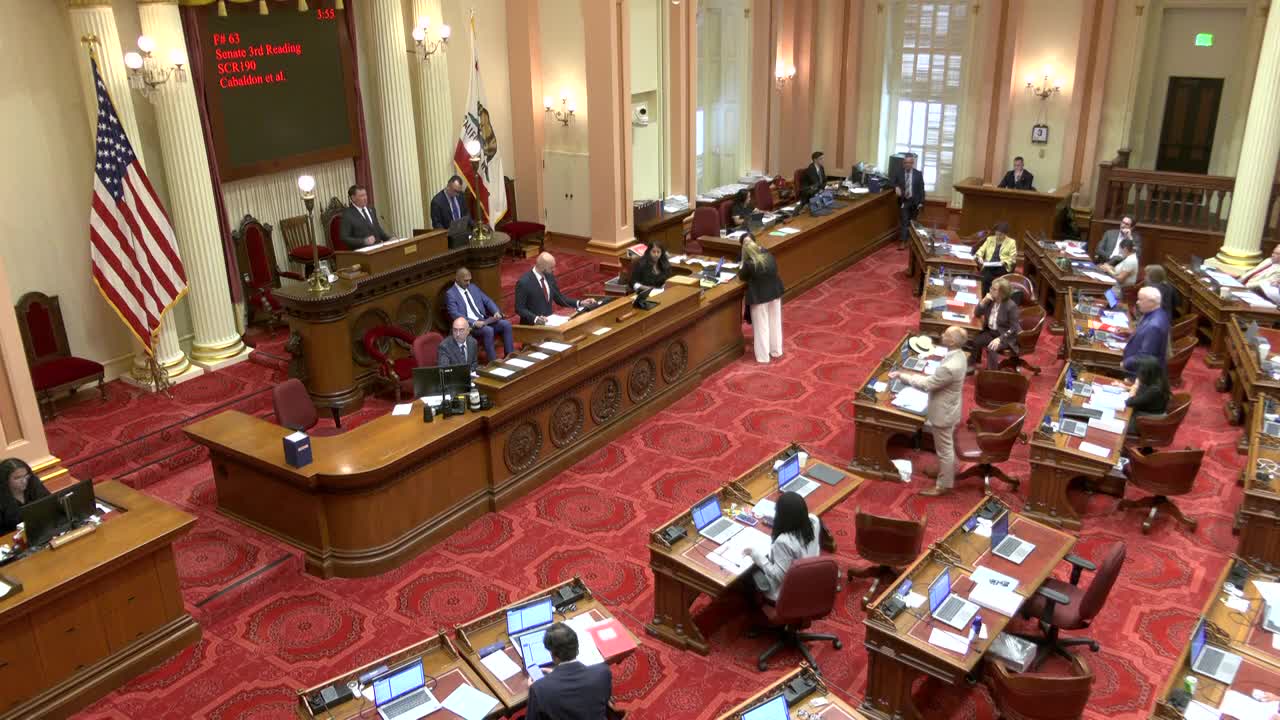 5MIN
Senate Floor
 6MIN
Senate Standing Committee on Transportation
 5MIN
Senate Standing Committee on Elections and Constitutional Amendments
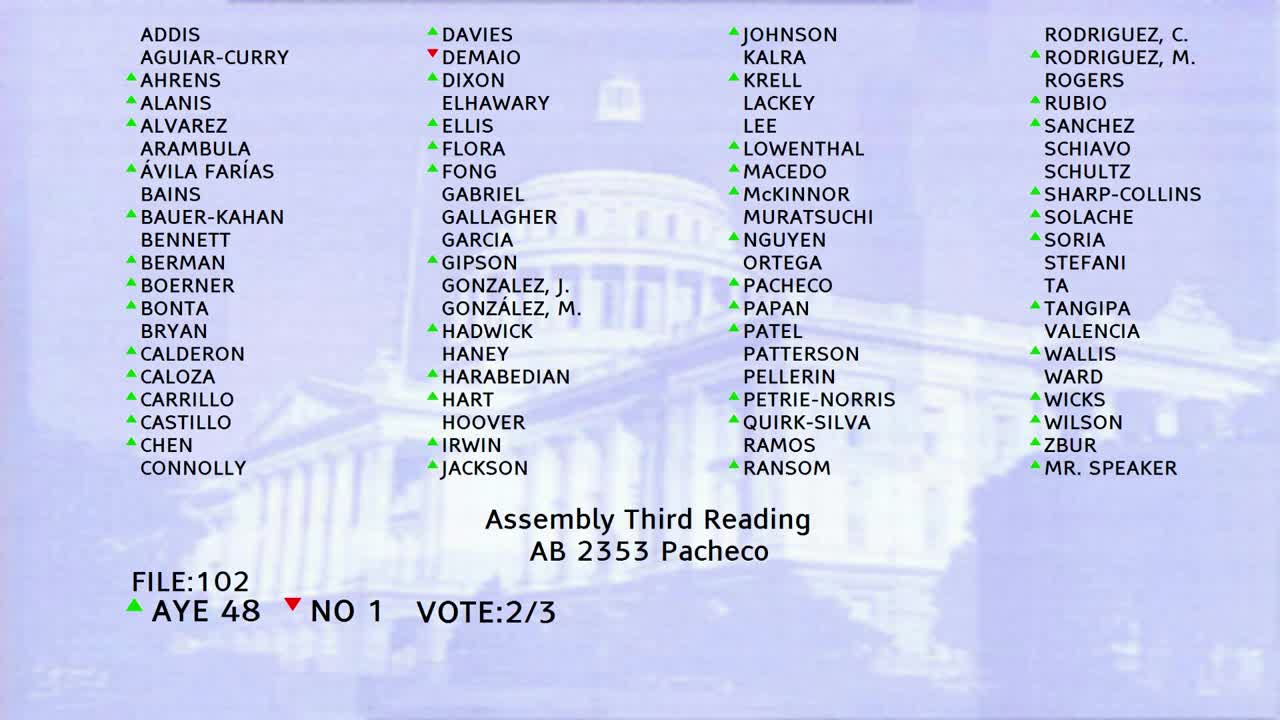 6MIN
Assembly Floor
 32MIN
Assembly Standing Committee on Appropriations
 8MIN
Assembly Standing Committee on Local Government
 13MIN
Assembly Standing Committee on Elections


Bill Co-Author(s):