AB 2018: Missing persons: DNA testing.
- Session Year: 2025-2026
- House: Assembly
- Latest Version Date: 2026-07-16
Current Status:
Passed
(2026-07-16: Chaptered by Secretary of State - Chapter 93, Statutes of 2026.)
Introduced
In Committee
Awaiting First Chamber Vote
Passed First Chamber
In Committee
Awaiting Second Chamber Vote
Passed Second Chamber
Enacted
Existing law requires the Department of Justice to develop a DNA database for all cases involving the report of an unidentified deceased person or a high-risk missing person and provides for the collection of DNA samples from unidentified deceased persons and from potential sources for comparison, as specified. Existing law requires that the database be funded by a $2 increase on death certificates issued by a local government agency or by the State of California. Existing law specifies the procedure for identifying the backlog of unidentified remains. Under existing law, all samples and DNA extracted from a living person are required to be destroyed after a positive identification is made and a report is issued, except as specified.
This bill would require the DNA database be used for all cases involving the report of an unidentified person, whether living or deceased, and would delete provisions relating to the reporting of high-risk missing persons. The bill would additionally authorize the retention of DNA extracted from a living person under these provisions if the identified human remains are incomplete and there is a reasonable expectation that additional remains requiring identification may be found in the future. The bill would also make conforming changes.
Existing law requires the Department of Justice to develop a DNA database for all cases involving the report of an unidentified deceased person or a high-risk missing person and provides for the collection of DNA samples from unidentified deceased persons and from potential sources for comparison, as specified. Existing law requires that the database be funded by a $2 increase on death certificates issued by a local government agency or by the State of California. Existing law specifies the procedure for identifying the backlog of unidentified remains. Under existing law, all samples and DNA extracted from a living person are required to be destroyed after a positive identification is made and a report is issued, except as specified.
This bill would require the DNA database be used for all cases involving the report of an unidentified person, whether living or deceased. The bill would authorize the department to utilize other scientifically valid DNA testing methods and comparison procedures for the purpose of identifying an unidentified person or locating a high-risk missing person. The bill would require the department to take all reasonable steps to ensure that the genetic data be used and disclosed only in a manner consistent with, and designed to advance, the purposes of identifying an unidentified person or locating a high-risk missing person. deceased, and would delete provisions relating to the reporting of high-risk missing persons. The bill would additionally authorize the retention of DNA extracted from a living person under these provisions if the identified human remains are incomplete and there is a reasonable expectation that additional remains requiring identification may be found in the future. The bill would also make conforming changes.
Existing law requires the Department of Justice to develop a DNA database for all cases involving the report of an unidentified deceased person or a high-risk missing person and provides for the collection of DNA samples from unidentified deceased persons and from potential sources for comparison, as specified. Existing law requires that the database be funded by a $2 increase on death certificates issued by a local government agency or by the State of California. Existing law specifies the procedure for identifying the backlog of unidentified remains. Under existing law, all samples and DNA extracted from a living person are required to be destroyed after a positive identification is made and a report is issued, except as specified.
This bill would require the DNA database be used for all cases involving the report of an unidentified person, whether living or deceased. The bill would authorize the department to utilize other scientifically valid DNA testing methods and comparison procedures for the purpose of identifying an unidentified person or locating a high-risk missing person. The bill would require the department to take all reasonable steps to ensure that the genetic data be used and disclosed only in a manner consistent with, and designed to advance, the purposes of identifying an unidentified person or locating a high-risk missing person. The bill would additionally authorize the retention of DNA extracted from a living person under these provisions if the identified human remains are incomplete and there is a reasonable expectation that additional remains requiring identification may be found in the future. The bill would also make conforming changes.
(a)(1)The Department of Justices Missing Persons DNA Program shall develop a DNA database for all cases involving the report of an unidentified person, whether living or deceased.
(2)The database required in paragraph (1) shall be comprised of DNA data from genetic markers that are appropriate for human identification but have no capability to predict biological function other than gender. These markers may change as the technology for DNA typing progresses. DNA typing methods shall produce results compatible with and uploaded into the CODIS DNA database established by the Federal Bureau of Investigation. The sole purpose of this database shall be to identify missing persons and shall be kept separate from the database established under Chapter 6 (commencing with Section 295) of Title 9 of Part 1.
(3)The department shall compare DNA samples taken from unidentified persons with DNA samples taken from personal articles belonging to the missing persons, or from the parents or appropriate relatives of missing persons.
(b)The departments Missing Persons DNA Program shall develop standards and guidelines for the preservation and storage of DNA samples. Any agency that is required to collect samples from unidentified remains for DNA testing shall follow these standards and guidelines. These guidelines shall address all scientific methods used for the identification of remains, including DNA, anthropology, odontology, and fingerprints.
(c)(1)A coroner shall collect samples for DNA testing from the remains of all unidentified persons and shall send those samples to the departments Missing Persons DNA Program for DNA testing and DNA database searching. After the department has taken a sample from the remains for DNA analysis and completed all DNA testing, the remaining evidence shall be returned to the appropriate local coroner.
(2)After a report has been made of a missing person, the responsible investigating law enforcement agency shall inform the parents or other appropriate relatives that they may give a voluntary sample for DNA testing or may collect a DNA sample from a personal article belonging to the missing person if available. The samples shall be taken by the appropriate law enforcement agency in a manner prescribed by the Department of Justice. The responsible investigating law enforcement agency shall wait no longer than 30 days after a report has been made to inform the parents or other relatives of their right to give a sample.
(3)The department shall develop a standard release form that authorizes a mother, father, or other relative to voluntarily provide the sample. The release shall explain that DNA is to be used only for the purpose of identifying the missing person and that the DNA sample and profile will be destroyed upon request. No incentive or coercion shall be used to compel a parent or relative to provide a sample.
(4)The department shall develop a model kit that law enforcement shall use when taking samples from parents and relatives.
(5)Before submitting the sample to the department for analysis, law enforcement shall reverify the status of the missing person. After 30 days has elapsed from the date the report was filed, law enforcement shall send the sample to the department for DNA testing and inclusion in the DNA database, with a copy of the crime report, and any supplemental information.
(6)All retained samples and DNA extracted from a living person, and profiles developed therefrom, shall be used solely for the purpose of identification of the deceaseds remains. All samples and DNA extracted from a living person, and profiles developed therefrom, shall be destroyed after a positive identification with the deceaseds remains is made and a report is issued, unless any of the following has occurred:
(A)The coroner has made a report to a law enforcement agency pursuant to Section 27491.1 of the Government Code, that they have a reasonable ground to suspect that the identified persons death has been occasioned by another by criminal means.
(B)A law enforcement agency makes a determination that the identified persons death has been occasioned by another by criminal means.
(C)The evidence is needed in an active criminal investigation to determine whether the identified persons death has been occasioned by another by criminal means.
(D)A governmental entity is required to retain the material pursuant to Section 1417.9.
(E)The identified human remains are incomplete and there is a reasonable expectation that additional remains requiring identification may be found in the future.
(7)Notwithstanding any other provisions of this section, upon the request of any living person who submits their DNA sample and profile pursuant to this section, including the parent or guardian of a child who submits a DNA sample of the child, the DNA sample shall be removed from the DNA database.
(d)All DNA samples and profiles developed therefrom shall be confidential and shall only be disclosed to personnel of the Department of Justice, law enforcement officers, coroners, medical examiners, district attorneys, and persons who need access to a DNA sample for purposes of the prosecution or defense of a criminal case, except that a law enforcement officer or agency may publicly disclose the fact of a DNA profile match after taking reasonable measures to first notify the family of an unidentified deceased person or the family of a missing person that there has been an identification.
(e)All DNA, forensic identification profiles, and other identification information retained by the Department of Justice pursuant to this section are exempt from any law requiring disclosure of information to the public.
(f)(1)Any person who knowingly discloses DNA or other forensic identification information developed pursuant to this section to an unauthorized individual or agency, or for any purpose other than for identification or for use in a criminal investigation, prosecution, or defense, is guilty of a misdemeanor.
(2)A person who collects, processes, or stores DNA or DNA samples from a living person that are used for DNA testing pursuant to this section who does either of the following is liable in civil damages to the donor of the DNA in the amount of five thousand dollars ($5,000) for each violation, plus attorneys fees and costs:
(A)Fails to destroy samples or DNA extracted from a living person pursuant to paragraph (6) of subdivision (c).
(B)Discloses DNA samples in violation of subdivision (d).
(g)(1)If a disclosure or failure to destroy samples described in paragraph (2) of subdivision (f) is made by an employee of the Department of Justice, the department shall be liable for those actions of its employee.
(2)Notwithstanding any other law, the remedy in this section shall be the sole and exclusive remedy against the department and its employees available to the donor of the DNA against the department and its employees.
(3)The department employee disclosing DNA or other forensic identification information or otherwise violating this section shall be absolutely immune from civil liability under this or any other law.
(h)It is not an unauthorized disclosure or violation of this section to release DNA and other forensic identification information as part of a judicial or administrative proceeding, to a jury or grand jury, or in a document filed with a court or administrative agency, or for this information to become part of the public transcript or record of proceedings.
(i)In order to maintain computer system security, the computer software and database structures used by the DNA laboratory of the department to implement this chapter are confidential.
SEC. 2.Section 14251 of the Penal Code is amended to read:14251.(a)The Missing Persons DNA Database shall be funded by a two dollar ($2) fee increase on death certificates issued by a local governmental agency or by the State of California. The issuing agencies may retain up to 5 percent of the funds from the fee increase for administrative costs.
(b)Funds shall be directed on a quarterly basis to the Missing Persons DNA Data Base Fund, hereby established, to be administered by the department for establishing and maintaining laboratory infrastructure, DNA sample storage, DNA analysis, and labor costs for cases of missing persons and unidentified persons. Funds may also be distributed by the department to various counties for the purposes of pathology and exhumation consistent with this title. The department may also use those funds to publicize the database for the purpose of contacting parents and relatives so that they may provide a DNA sample for training law enforcement officials about the database and DNA sampling and for outreach.
(c)The processing of any backlog of unidentified persons samples or samples donated by a family member or from a personal article belonging to the missing person may be outsourced to other laboratories at the departments discretion.
(d)(1)The department shall retain the authority to prioritize case analysis, giving priority to those cases involving children and those involving homicide victims.
(2)If federal funding is made available, it shall be used to assist in the identification of the backlog of missing person cases and long-term unidentified remains.
(a)(1)The Department of Justice Justices Missing Persons DNA Program shall develop a DNA database for all cases involving the report of an unidentified person, whether living or deceased, or a high-risk missing person. deceased.
(2)The database required in paragraph (1) shall be comprised of DNA data from genetic markers that are appropriate for human identification. The results of DNA typing shall be identification but have no capability to predict biological function other than gender. These markers may change as the technology for DNA typing progresses. DNA typing methods shall produce results compatible with and uploaded into the CODIS DNA database established by the Federal Bureau of Investigation. The sole purpose of this database shall be to identify missing persons and shall be kept separate from the database established under Chapter 6 (commencing with Section 295) of Title 9 of Part 1.
(3)The department shall compare DNA samples taken from unidentified persons with DNA samples taken from personal articles belonging to the missing persons, or from the parents or appropriate relatives of high-risk missing persons.
(4)For the purpose of this database, high-risk missing person means a person missing as a result of a stranger abduction, a person missing under suspicious circumstances, a person missing under unknown circumstances, or where there is reason to assume that the person is in danger, or deceased, and that person has been missing more than 30 days, or less than 30 days in the discretion of the investigating agency.(b)In addition to CODIS-compatible DNA testing and CODIS database searches as provided in subdivision (a), in order to enhance the likelihood of identifying an unidentified person or locating a high-risk missing person, the department may, at its discretion, utilize other scientifically valid DNA testing methods and comparison procedures for that sole and exclusive purpose. If those efforts involve the sharing of genetic data with nondepartment entities, the department shall take all reasonable steps to ensure that the data be used and disclosed only in a manner consistent with, and designed to advance, the purpose of identifying an unidentified person or locating a high-risk missing person. (c)(b)The department departments Missing Persons DNA Program shall develop standards and guidelines for the preservation and storage of DNA samples. Any agency that is required to collect samples from unidentified remains for DNA testing shall follow these standards and guidelines. These guidelines shall address all scientific methods used for the identification of remains, including DNA, anthropology, odontology, and fingerprints.
(d)(c)(1)A coroner shall collect samples for DNA testing from the remains of all unidentified persons and shall send those samples to the Department of Justice departments Missing Persons DNA Program for DNA testing and inclusion in the DNA database. DNA database searching. After the department has taken a sample from the remains for DNA analysis and completed all DNA testing, the remaining evidence shall be returned to the appropriate local coroner.
(2)After a report has been made of a person missing under high-risk circumstances, missing person, the responsible investigating law enforcement agency shall inform the parents or other appropriate relatives that they may give a voluntary sample for DNA testing or may collect a DNA sample from a personal article belonging to the missing person if available. The samples shall be taken by the appropriate law enforcement agency in a manner prescribed by the Department of Justice. The responsible investigating law enforcement agency shall wait no longer than 30 days after a report has been made to inform the parents or other relatives of their right to give a sample.
(3)The Department of Justice department shall develop a standard release form that authorizes a mother, father, or other relative to voluntarily provide the sample. The release shall explain that DNA is to be used only for the purpose of identifying the missing person and that the DNA sample and profile will be destroyed upon request. No incentive or coercion shall be used to compel a parent or relative to provide a sample.
(4)The Department of Justice department shall develop a model kit that law enforcement shall use when taking samples from parents and relatives.
(5)Before submitting the sample to the department for analysis, law enforcement shall reverify the status of the missing person. After 30 days has elapsed from the date the report was filed, law enforcement shall send the sample to the department for DNA testing and inclusion in the DNA database, with a copy of the crime report, and any supplemental information.
(6)All retained samples and DNA extracted from a living person, and profiles developed therefrom, shall be used solely for the purpose of identification of the deceaseds remains. All samples and DNA extracted from a living person, and profiles developed therefrom, shall be destroyed after a positive identification with the deceaseds remains is made and a report is issued, unless any of the following has occurred:
(A)The coroner has made a report to a law enforcement agency pursuant to Section 27491.1 of the Government Code, that they have a reasonable ground to suspect that the identified persons death has been occasioned by another by criminal means.
(B)A law enforcement agency makes a determination that the identified persons death has been occasioned by another by criminal means.
(C)The evidence is needed in an active criminal investigation to determine whether the identified persons death has been occasioned by another by criminal means.
(D)A governmental entity is required to retain the material pursuant to Section 1417.9.
(E)The identified human remains are incomplete and there is a reasonable expectation that additional remains requiring identification may be found in the future.
(7)Notwithstanding any other provisions of this section, upon the request of any living person who submits their DNA sample and profile pursuant to this section, including the parent or guardian of a child who submits a DNA sample of the child, the DNA sample shall be removed from the DNA database.
(e)(d)All DNA samples and profiles developed therefrom shall be confidential and shall only be disclosed to personnel of the Department of Justice, law enforcement officers, coroners, medical examiners, district attorneys, collaborating entities as provided in subdivision (b), and persons who need access to a DNA sample for purposes of the prosecution or defense of a criminal case, except that a law enforcement officer or agency may publicly disclose the fact of a DNA profile match after taking reasonable measures to first notify the family of an unidentified deceased person or the family of a high-risk missing person that there has been an identification.
(f)(e)All DNA, forensic identification profiles, and other identification information retained by the Department of Justice pursuant to this section are exempt from any law requiring disclosure of information to the public.
(g)(f)(1)Any person who knowingly discloses DNA or other forensic identification information developed pursuant to this section to an unauthorized individual or agency, or for any purpose other than for identification or for use in a criminal investigation, prosecution, or defense, is guilty of a misdemeanor.
(2)A person who collects, processes, or stores DNA or DNA samples from a living person that are used for DNA testing pursuant to this section who does either of the following is liable in civil damages to the donor of the DNA in the amount of five thousand dollars ($5,000) for each violation, plus attorneys fees and costs:
(A)Fails to destroy samples or DNA extracted from a living person pursuant to paragraph (6) of subdivision (d). (c).
(B)Discloses DNA samples in violation of subdivision (e). (d).
(h)(g)(1)If a disclosure or failure to destroy samples described in paragraph (2) of subdivision (g) (f) is made by an employee of the Department of Justice, the department shall be liable for those actions of its employee.
(2)Notwithstanding any other law, the remedy in this section shall be the sole and exclusive remedy against the department and its employees available to the donor of the DNA against the department and its employees.
(3)The department employee disclosing DNA or other forensic identification information or otherwise violating this section shall be absolutely immune from civil liability under this or any other law.
(i)(h)It is not an unauthorized disclosure or violation of this section to release DNA and other forensic identification information as part of a judicial or administrative proceeding, to a jury or grand jury, or in a document filed with a court or administrative agency, or for this information to become part of the public transcript or record of proceedings.
(j)(i)In order to maintain computer system security, the computer software and database structures used by the DNA laboratory of the department to implement this chapter are confidential.
SEC. 2.Section 14251 of the Penal Code is amended to read:14251.(a)The Missing Persons DNA Database shall be funded by a two dollar ($2) fee increase on death certificates issued by a local governmental agency or by the State of California. The issuing agencies may retain up to 5 percent of the funds from the fee increase for administrative costs.
(b)Funds shall be directed on a quarterly basis to the Missing Persons DNA Data Base Fund, hereby established, to be administered by the department for establishing and maintaining laboratory infrastructure, DNA sample storage, DNA analysis, and labor costs for cases of missing persons and unidentified persons. Funds may also be distributed by the department to various counties for the purposes of pathology and exhumation consistent with this title. The department may also use those funds to publicize the database for the purpose of contacting parents and relatives so that they may provide a DNA sample for training law enforcement officials about the database and DNA sampling and for outreach.
(c)The processing of any backlog of unidentified persons persons samples or samples donated by a family member or from a personal article belonging to the missing person may be outsourced to other laboratories at the departments discretion.
(d)(1)The department shall retain the authority to prioritize case analysis, giving priority to those cases involving children and those involving homicide victims.
(2)If federal funding is made available, it shall be used to assist in the identification of the backlog of high-risk missing person cases and long-term unidentified remains.
REVISIONS: HeadingLine 2.(a)(1)The Department of Justice shall develop a DNA database for all cases involving the report of an unidentified deceased person person, whether living or deceased, or a high-risk missing person.
(2)The database required in paragraph (1) shall be comprised of DNA data from genetic markers that are appropriate for human identification, but have no capability to predict biological function other than gender. These markers shall be selected by the department and may change as the technology for DNA typing progresses. identification. The results of DNA typing shall be compatible with and uploaded into the CODIS DNA database established by the Federal Bureau of Investigation. The sole purpose of this database shall be to identify missing persons and shall be kept separate from the database established under Chapter 6 (commencing with Section 295) of Title 9 of Part 1.
(3)The Department of Justice department shall compare DNA samples taken from the remains of unidentified deceased persons with DNA samples taken from personal articles belonging to the missing person, persons, or from the parents or appropriate relatives of high-risk missing persons.
(4)For the purpose of this database, high-risk missing person means a person missing as a result of a stranger abduction, a person missing under suspicious circumstances, a person missing under unknown circumstances, or where there is reason to assume that the person is in danger, or deceased, and that person has been missing more than 30 days, or less than 30 days in the discretion of the investigating agency.
(b)In addition to CODIS-compatible DNA testing and CODIS database searches as provided in subdivision (a), in order to enhance the likelihood of identifying an unidentified person or locating a high-risk missing person, the department may, at its discretion, utilize other scientifically valid DNA testing methods and comparison procedures for that sole and exclusive purpose. If those efforts involve the sharing of genetic data with nondepartment entities, the department shall take all reasonable steps to ensure that the data be used and disclosed only in a manner consistent with, and designed to advance, the purpose of identifying an unidentified person or locating a high-risk missing person.
(b)(c)The department shall develop standards and guidelines for the preservation and storage of DNA samples. Any agency that is required to collect samples from unidentified remains for DNA testing shall follow these standards and guidelines. These guidelines shall address all scientific methods used for the identification of remains, including DNA, anthropology, odontology, and fingerprints.
(c)(d)(1)A coroner shall collect samples for DNA testing from the remains of all unidentified persons and shall send those samples to the Department of Justice for DNA testing and inclusion in the DNA databank. database. After the department has taken a sample from the remains for DNA analysis and completed all DNA testing, the remaining evidence shall be returned to the appropriate local coroner.
(2)After a report has been made of a person missing under high-risk circumstances, the responsible investigating law enforcement agency shall inform the parents or other appropriate relatives that they may give a voluntary sample for DNA testing or may collect a DNA sample from a personal article belonging to the missing person if available. The samples shall be taken by the appropriate law enforcement agency in a manner prescribed by the Department of Justice. The responsible investigating law enforcement agency shall wait no longer than 30 days after a report has been made to inform the parents or other relatives of their right to give a sample.
(3)The Department of Justice shall develop a standard release form that authorizes a mother, father, or other relative to voluntarily provide the sample. The release shall explain that DNA is to be used only for the purpose of identifying the missing person and that the DNA sample and profile will be destroyed upon request. No incentive or coercion shall be used to compel a parent or relative to provide a sample.
(4)The Department of Justice shall develop a model kit that law enforcement shall use when taking samples from parents and relatives.
(5)Before submitting the sample to the department for analysis, law enforcement shall reverify the status of the missing person. After 30 days has elapsed from the date the report was filed, law enforcement shall send the sample to the department for DNA testing and inclusion in the DNA database, with a copy of the crime report, and any supplemental information.
(6)All retained samples and DNA extracted from a living person, and profiles developed therefrom, shall be used solely for the purpose of identification of the deceaseds remains. All samples and DNA extracted from a living person, and profiles developed therefrom, shall be destroyed after a positive identification with the deceaseds remains is made and a report is issued, unless any of the following has occurred:
(A)The coroner has made a report to a law enforcement agency pursuant to Section 27491.1 of the Government Code, that he or she has they have a reasonable ground to suspect that the identified persons death has been occasioned by another by criminal means.
(B)A law enforcement agency makes a determination that the identified persons death has been occasioned by another by criminal means.
(C)The evidence is needed in an active criminal investigation to determine whether the identified persons death has been occasioned by another by criminal means.
(D)A governmental entity is required to retain the material pursuant to Section 1417.9.
(E)The identified human remains are incomplete and there is a reasonable expectation that additional remains requiring identification may be found in the future.
(7)Notwithstanding any other provisions of this section, upon the request of any living person who submits his or her their DNA sample and profile pursuant to this section, including the parent or guardian of a child who submits a DNA sample of the child, the DNA sample shall be removed from the DNA database.
(d)(e)All DNA samples and profiles developed therefrom shall be confidential and shall only be disclosed to personnel of the Department of Justice, law enforcement officers, coroners, medical examiners, district attorneys, collaborating entities as provided in subdivision (b), and persons who need access to a DNA sample for purposes of the prosecution or defense of a criminal case, except that a law enforcement officer or agency may publicly disclose the fact of a DNA profile match after taking reasonable measures to first notify the family of an unidentified deceased person or the family of a high-risk missing person that there has been an identification.
(e)(f)All DNA, forensic identification profiles, and other identification information retained by the Department of Justice pursuant to this section are exempt from any law requiring disclosure of information to the public.
(f)(g)(1)Any person who knowingly discloses DNA or other forensic identification information developed pursuant to this section to an unauthorized individual or agency, or for any purpose other than for identification or for use in a criminal investigation, prosecution, or defense, is guilty of a misdemeanor.
(2)A person who collects, processes, or stores DNA or DNA samples from a living person that are used for DNA testing pursuant to this section who does either of the following is liable in civil damages to the donor of the DNA in the amount of five thousand dollars ($5,000) for each violation, plus attorneys fees and costs:
(A)Fails to destroy samples or DNA extracted from a living person pursuant to paragraph (6) of subdivision (c). (d).
(B)Discloses DNA samples in violation of subdivision (d). (e).
(g)(h)(1)If a disclosure or failure to destroy samples described in paragraph (2) of subdivision (f) (g) is made by an employee of the Department of Justice, the department shall be liable for those actions of its employee.
(2)Notwithstanding any other law, the remedy in this section shall be the sole and exclusive remedy against the department and its employees available to the donor of the DNA against the department and its employees.
(3)The department employee disclosing DNA or other forensic identification information or otherwise violating this section shall be absolutely immune from civil liability under this or any other law.
(h)(i)It is not an unauthorized disclosure or violation of this section to release DNA and other forensic identification information as part of a judicial or administrative proceeding, to a jury or grand jury, or in a document filed with a court or administrative agency, or for this information to become part of the public transcript or record of proceedings.
(i)(j)In order to maintain computer system security, the computer software and database structures used by the DNA laboratory of the Department of Justice department to implement this chapter are confidential.
SEC. 2.Section 14251 of the Penal Code is amended to read:14251.(a)The Missing Persons DNA Database shall be funded by a two dollar ($2) fee increase on death certificates issued by a local governmental agency or by the State of California. The issuing agencies may retain up to 5 percent of the funds from the fee increase for administrative costs.
(b)Funds shall be directed on a quarterly basis to the Missing Persons DNA Data Base Fund, hereby established, to be administered by the department for establishing and maintaining laboratory infrastructure, DNA sample storage, DNA analysis, and labor costs for cases of missing persons and unidentified remains. persons. Funds may also be distributed by the department to various counties for the purposes of pathology and exhumation consistent with this title. The department may also use those funds to publicize the database for the purpose of contacting parents and relatives so that they may provide a DNA sample for training law enforcement officials about the database and DNA sampling and for outreach.
(c)The identification of any backlog of human remain processing of any backlog of unidentified persons samples or samples donated by a family member or from a personal article belonging to the missing person may be outsourced to other laboratories at the departments discretion.
(d)(1)The Department of Justice department shall retain the authority to prioritize case analysis, giving priority to those cases involving children and those involving homicide victims.
(2)If federal funding is made available, it shall be used to assist in the identification of the backlog of high-risk missing person cases and long-term unidentified remains.
|
Date
|
Status
|
|---|---|
| Jul 16, 2026 | Chaptered by Secretary of State - Chapter 93, Statutes of 2026. |
| Jul 16, 2026 | Approved by the Governor. |
| Jul 15, 2026 | Enrolled and presented to the Governor at 11:15 a.m. |
| Jul 2, 2026 | In Assembly. Ordered to Engrossing and Enrolling. |
| Jul 2, 2026 | Read third time. Passed. Ordered to the Assembly. (Ayes 37. Noes 0.). |
| Jul 2, 2026 | Read third time. Passed. Ordered to the Assembly. (Ayes 37. Noes 0. Page 5189.). |
| Jun 30, 2026 | Read second time. Ordered to Consent Calendar. |
| Jun 29, 2026 | From committee: Be ordered to second reading file pursuant to Senate Rule 28.8 and ordered to Consent Calendar. |
| Jun 16, 2026 | From committee: Do pass and re-refer to Com. on APPR. with recommendation: To Consent Calendar. (Ayes 6. Noes 0.) (June 16). Re-referred to Com. on APPR. |
| Jun 3, 2026 | Referred to Com. on PUB. S. |
| May 27, 2026 | In Senate. Read first time. To Com. on RLS. for assignment. |
| May 26, 2026 | Read third time. Passed. Ordered to the Senate. |
| May 26, 2026 | Read third time. Passed. Ordered to the Senate. (Ayes 78. Noes 0.) |
| May 26, 2026 | Read third time. Passed. Ordered to the Senate. (Ayes 78. Noes 0. Page 5306.) |
| May 18, 2026 | Read second time. Ordered to third reading. |
| May 14, 2026 | Joint Rule 62(a), file notice suspended. (Page 5030.) |
| May 14, 2026 | Joint Rule 62(a), file notice suspended. |
| May 14, 2026 | From committee: Do pass. (Ayes 15. Noes 0.) (May 14). |
| May 13, 2026 | In committee: Set, first hearing. Referred to APPR. suspense file. |
| Apr 15, 2026 | From committee: Do pass and re-refer to Com. on APPR. (Ayes 9. Noes 0.) (April 14). Re-referred to Com. on APPR. |
| Apr 15, 2026 | Coauthors revised. |
| Apr 8, 2026 | Re-referred to Com. on PUB. S. |
| Apr 7, 2026 | In committee: Hearing postponed by committee. |
| Apr 7, 2026 | From committee chair, with author's amendments: Amend, and re-refer to Com. on PUB. S. Read second time and amended. |
| Mar 18, 2026 | In committee: Hearing postponed by committee. |
| Mar 2, 2026 | Referred to Com. on PUB. S. |
| Feb 18, 2026 | From printer. May be heard in committee March 20. |
| Feb 17, 2026 | Read first time. To print. |
|
Date
|
Description
|
Location
|
Votes
|
|
|---|---|---|---|---|
| Jul 2, 2026 | Consent Calendar 2nd AB2018 Ramos et al. | Senate Floor |
Passed |
|
| Jun 16, 2026 | Do pass, but first be re-referred to the Committee on [Appropriations] with the recommendation: To Consent Calendar | Senate Standing Committee on Public Safety |
Passed |
|
| May 26, 2026 | AB 2018 Ramos Assembly Third Reading | Assembly Floor |
Passed |
|
| May 14, 2026 | Do pass. | Assembly Standing Committee on Appropriations |
Passed |
|
| Apr 14, 2026 | Do pass and be re-referred to the Committee on [Appropriations] | Assembly Standing Committee on Public Safety |
Passed |
This list shows positions taken on this bill by organizations on the date displayed, which is linked to the original source.
Positions by individuals are not included.
|
Organization
|
Position
|
Date
|
|---|---|---|
| Aclu California Action | ** Against | |
| California Department of Justice | ** Support | |
| California District Attorneys Association | ** Support | |
| Initiate Justice | ** Against | |
| Justice2jobs Coalition | ** Against | |
| LA Defensa | ** Against | |
| Los Angeles County District Attorney’s Office | ** Support | |
| Oakland Privacy | ** Against | |
| Riverside County District Attorney | ** Support | |
| San Francisco Public Defender | ** Against | |
| Yurok Tribe | ** Support |
SENATE RULES COMMITTEE Office of Senate Floor Analyses (916) 651-4171 | AB 2018 |
CONSENT
Bill No: AB 2018
Author: Ramos (D), et al.
Amended: 4/7/26 in Assembly
Vote: 21
SENATE PUBLIC SAFETY COMMITTEE: 6-0, 6/16/26
AYES: Arreguín, Seyarto, Caballero, Cortese, Pérez, Wiener
SENATE APPROPRIATIONS COMMITTEE: Senate Rule 28.8
ASSEMBLY FLOOR: 78-0, 5/26/26 - See last page for vote
SUBJECT: Missing persons: DNA testing
SOURCE: Author
DIGEST:
This bill 1) requires the DNA database be used for all cases involving the report of an unidentified person, whether living or deceased; 2) deletes provisions relating to the reporting of high-risk missing persons; 3) authorizes the retention of DNA extracted from a living person under these provisions if the identified human remains are incomplete and there is a reasonable expectation that additional remains requiring identification may be found in the future; and 4) makes conforming changes.
ANALYSIS:
Existing law:
- The DNA and Forensic Identification Data Base and Data Bank Act of 1998, as amended by Proposition 69 in 2004, created a DNA database known as the Criminal Offender DNA Database, which applies to sex offenses and other crimes as well as to the identification of missing and unidentified persons.
- Requires that for this database, the results of DNA typing must be compatible with and uploaded into the Federal Bureau of Investigation’s Combined DNA Index System (CODIS) DNA database and allows the Department of Justice DNA Laboratory to contract with other public or private laboratories that have capability to analyze DNA specimens. (Penal (Pen.) Code, § 295; Pen. Code, § 298.3; Pen. Code, § 299.6.)
- Requires the Department of Justice (DOJ) to develop a DNA database for all cases involving the report of an unidentified deceased person or a high-risk missing person, called the Missing Persons DNA Program. (Pen. Code, § 14250, subd. (a)(1); Pen. Code, § 14251.)
- States that the sole purpose of this database shall be to identify missing persons and shall be kept separate from the database established pursuant to the DNA and Forensic Identification Database and Data Bank Act of 1998. (Pen. Code, § 14250, subd. (a)(2).)
- Mandates the DNA database be comprised of DNA data from genetic markers that are appropriate for human identification but have no capability to predict biological function other than gender. These markers are selected by the DOJ and may change as the technology for DNA typing progresses. (Pen. Code, § 14250, subd. (a)(2).)
- Mandates the DNA data from the Missing Persons DNA Program be uploaded into the Federal Bureau of Investigations’ CODIS DNA database, but remain separate from the Crime Offender DNA Database, as established in Penal Code Section 295. (Pen. Code, § 14250, subd. (a)(2).)
- Requires the DOJ to compare DNA samples taken from the remains of unidentified deceased persons with DNA samples taken from personal articles belonging to the missing person, or from the parents or appropriate relatives of high-risk missing persons. (Pen. Code, § 14250, subd. (a)(3).)
- Defines “high-risk missing person” as a person missing as a result of a stranger abduction, a person missing under suspicious circumstances, a person missing under unknown circumstances, or where there is reason to assume that the person is in danger, or deceased, and that person has been missing more than 30 days, or less than 30 days in the discretion of the investigating agency. (Pen. Code, § 14250, subd. (a)(4).)
- Requires the DOJ to develop standards and guidelines for the preservation and storage of DNA samples. Requires any agency that is required to collect samples from unidentified remains for DNA testing to follow these standards and guidelines. Existing law requires these guidelines to address all scientific methods used for the identification of remains, including DNA, anthropology, odontology, and fingerprints. (Pen. Code, § 14250, subd. (b).)
- Requires a coroner to collect samples for DNA testing from the remains of all unidentified persons and send those samples to the DOJ for DNA testing and inclusion in the DNA databank. After the DOJ has taken a sample from the remains for DNA analysis and completed all DNA testing, the remaining evidence shall be returned to the appropriate local coroner. (Pen. Code, § 14250, subd. (c)(1).)
- Requires that after a report has been made of a person missing under high-risk circumstances, the responsible investigating law enforcement agency inform the parents or other appropriate relatives that they may give a voluntary sample for DNA testing or may collect a DNA sample from a personal article belonging to the missing person if available. These samples must be taken by the appropriate law enforcement agency in a manner prescribed by the DOJ, and the responsible investigating law enforcement agency to wait no longer than 30 days after a report has been made to inform the parents or other relatives of their right to give a sample. (Pen. Code, § 14250, subd. (c)(2).)
This bill requires the DNA database for the Missing Persons DNA Program be used for all cases involving the report of an unidentified person, whether living or deceased, and deletes provisions relating to the reporting of “high-risk” missing persons. This bill authorizes the retention of DNA extracted from a living person under these provisions if the identified human remains are incomplete and there is a reasonable expectation that additional remains requiring identification may be found in the future.
Background
Federal Missing Persons DNA Program. CODIS, the Combined DNA Index System, is a broad network of DNA databases on the local, state, and federal level. The DNA Identification Act of 1994 authorized the establishment of this National DNA Index. (42 U.S.C. § 14132.) The DNA Act specifies the categories of data that may be maintained in NDIS (convicted offenders, arrestees, legal, detainees, forensic [casework], unidentified human remains, missing persons, and relatives of missing persons) as well as requirements for participating laboratories relating to quality assurance, privacy, and expungement.
According to the U.S. Department of Justice, families of missing persons who are presumed dead face tremendous emotional turmoil when they are unable to learn about the fates of their loved ones. Despite tremendous scientific advancements, DNA technology is not routinely used in missing persons cases. According to statistics maintained by the FBI’s National Crime Information Center (NCIC), there are nearly 5,000 reported unidentified persons in the United States.
The FBI’s Missing Persons DNA Database Program currently provides the essential infrastructure for identifying human remains. This database maintains two indices of DNA samples. The first index contains DNA profiles of relatives of missing persons and the second contains DNA profiles of unidentified human remains.
California’s Missing Persons DNA Program. The Missing Persons DNA Program compares DNA from unidentified persons and unidentified human remains with DNA from personal articles belonging to missing persons, or from the parents or appropriate relatives of high-risk missing persons. (Pen. Code, § 14250, subd. (a)(3).) Existing law defines “high-risk missing person” as a person missing as a result of a stranger abduction, a person missing under suspicious circumstances, a person missing under unknown circumstances, or where there is reason to assume that the person is in danger, or deceased, and that person has been missing more than 30 days, or less than 30 days in the discretion of the investigating agency. (Pen. Code, § 14250, subd. (a)(4).)
This bill requires the DNA database for the Missing Persons DNA Program be used for all cases involving the report of an unidentified person, whether living or deceased, and deletes provisions relating to the reporting of “high-risk” missing persons.
According to the California Department of Justice, Bureau of Forensic Services:
The Missing Persons DNA Program stores DNA profiles in two different databases. One database contains DNA profiles from unidentified persons and human remains. The other database is considered a family reference database and it contains the DNA profiles of relatives of missing persons and DNA profiles from personal items that belonged to a missing person (like a toothbrush). As a family member of a missing person, your DNA profile will be stored in the family reference database.
[. . .]
Family reference samples are NEVER searched against databases that contain DNA profiles of evidence from criminal investigations or DNA profiles of persons arrested or convicted of crimes. They are ONLY searched against the unidentified person and remains database to help identify missing persons.
(State of California, Department of Justice, Office of the Attorney General. Missing Persons DNA Program FAQ https://oag.ca.gov/system/files/media/onaa-mpdp-dna-faq-flyer.pdf.) The sole purpose of the program is to contribute to the effort of identifying missing persons. Parents and other relatives of missing persons are neither given an incentive to provide a DNA sample, nor will they be coerced or compelled to provide a sample. Further, DNA samples from relatives of missing persons are not searched against any criminal or offender DNA databases. They are only searched against the DNA samples from unidentified persons and unidentified human remains. This bill authorizes the retention of DNA extracted from a living person under these provisions if the identified human remains are incomplete and there is a reasonable expectation that additional remains requiring identification may be found in the future. This bill could, therefore, increase the likelihood of positive identification by expanding the information held in this DNA Database. This bill would increase the amount of genetic information that could be shared with the federal government.
FISCAL EFFECT: Appropriation: No Fiscal Com.: Yes Local: No
SUPPORT: (Verified 6/29/26)
California Department of Justice
California District Attorneys Association
Los Angeles County District Attorney’s Office
Yurok Tribe
OPPOSITION: (Verified 6/29/26)
None received
ASSEMBLY FLOOR: 78-0, 5/26/26
AYES: Addis, Aguiar-Curry, Ahrens, Alanis, Alvarez, Arambula, Ávila Farías, Bains, Bauer-Kahan, Bennett, Berman, Boerner, Bonta, Bryan, Calderon, Caloza, Carrillo, Castillo, Chen, Connolly, Davies, DeMaio, Dixon, Elhawary, Ellis, Flora, Fong, Gabriel, Gallagher, Garcia, Gipson, Jeff Gonzalez, Mark González, Hadwick, Haney, Harabedian, Hart, Hoover, Irwin, Jackson, Johnson, Kalra, Krell, Lackey, Lee, Lowenthal, Macedo, McKinnor, Nguyen, Ortega, Pacheco, Papan, Patel, Patterson, Pellerin, Petrie-Norris, Quirk-Silva, Ramos, Ransom, Michelle Rodriguez, Rogers, Blanca Rubio, Sanchez, Schiavo, Schultz, Sharp-Collins, Solache, Soria, Stefani, Ta, Tangipa, Valencia, Wallis, Ward, Wicks, Wilson, Zbur, Rivas
NO VOTE RECORDED: Muratsuchi, Celeste Rodriguez
Prepared by: Natalia DaSilva Telles / PUB. S. / 916-651-4118
7/1/26 16:55:08
**** END ****
SENATE COMMITTEE ON PUBLIC SAFETY
Senator Jesse Arreguín, Chair
2025 - 2026 Regular
Bill No: AB 2018 Hearing Date: June 16, 2026
Author: | Ramos | ||
Version: | April 7, 2026 | ||
Urgency: | No | Fiscal: | Yes |
Consultant: | NDT | ||
Subject: Missing persons: DNA testing
HISTORY
Source: California Department of Justice
Prior Legislation: AB 3099 (Ramos), Ch. 170, Stats. of 2020
AB 275 (Solorio), Ch. 228, Stats. of 2009
AB 1975 (Solorio), vetoed, 2008
AB 940 (Chu), Ch. 471, Stats. of 2005
SB 297 (Speier), Ch. 467, Stats. of 2001
SB 1818 (Speier), Ch. 822, Stats. of 2000
Support: California District Attorneys Association; Yurok Tribe
Opposition: None known
Assembly Floor Vote: 78 - 0
PURPOSE
The purpose of this bill is to increase instances of positive identification of missing persons, whether living or deceased, through the DNA database maintained under the Missing Person DNA Program by deleting the requirement that the DNA database be used for “high-risk” missing persons only and authorizing the retention of DNA extracted from a living person, as specified, if identified human remains are incomplete and there is a reasonable expectation that additional remains requiring identification may be found in the future.
Existing law, the DNA and Forensic Identification Data Base and Data Bank Act of 1998, as amended by Proposition 69 in 2004, created a DNA database known as the Criminal Offender DNA Database, which applies to sex offenses and other crimes as well as to the identification of missing and unidentified persons.
Existing law requires that for this database, the results of DNA typing must be compatible with and uploaded into the Federal Bureau of Investigation’s Combined DNA Index System (CODIS) DNA database and allows the Department of Justice DNA Laboratory to contract with other public or private laboratories that have capability to analyze DNA specimens. (Pen. Code, § 295; Pen. Code, § 298.3; Pen. Code, § 299.6.)
Existing law requires the Department of Justice (DOJ) to develop a DNA database for all cases involving the report of an unidentified deceased person or a high-risk missing person, called the Missing Persons DNA Program. (Pen. Code, § 14250, subd. (a)(1); Pen. Code, § 14251.)
Existing law states that the sole purpose of this database shall be to identify missing persons and shall be kept separate from the database established pursuant to the DNA and Forensic Identification Database and Data Bank Act of 1998. (Pen. Code, § 14250, subd. (a)(2).)
Existing law mandates the DNA database be comprised of DNA data from genetic markers that are appropriate for human identification but have no capability to predict biological function other than gender. These markers are selected by the DOJ and may change as the technology for DNA typing progresses. (Pen. Code, § 14250, subd. (a)(2).)
Existing law mandates the DNA data from the Missing Persons DNA Program be uploaded into the Federal Bureau of Investigations’ CODIS DNA database, but remain separate from the Crime Offender DNA Database, as established in Penal Code Section 295. (Pen. Code, § 14250, subd. (a)(2).)
Existing law requires the DOJ to compare DNA samples taken from the remains of unidentified deceased persons with DNA samples taken from personal articles belonging to the missing person, or from the parents or appropriate relatives of high-risk missing persons. (Pen. Code, § 14250, subd. (a)(3).)
Existing law defines “high-risk missing person” as a person missing as a result of a stranger abduction, a person missing under suspicious circumstances, a person missing under unknown circumstances, or where there is reason to assume that the person is in danger, or deceased, and that person has been missing more than 30 days, or less than 30 days in the discretion of the investigating agency. (Pen. Code, § 14250, subd. (a)(4).)
Existing law requires the DOJ to develop standards and guidelines for the preservation and storage of DNA samples. Requires any agency that is required to collect samples from unidentified remains for DNA testing to follow these standards and guidelines. Existing law requires these guidelines to address all scientific methods used for the identification of remains, including DNA, anthropology, odontology, and fingerprints. (Pen. Code, § 14250, subd. (b).)
Existing law requires a coroner to collect samples for DNA testing from the remains of all unidentified persons and send those samples to the DOJ for DNA testing and inclusion in the DNA databank. After the DOJ has taken a sample from the remains for DNA analysis and completed all DNA testing, the remaining evidence shall be returned to the appropriate local coroner. (Pen. Code, § 14250, subd. (c)(1).)
Existing law requires that after a report has been made of a person missing under high-risk circumstances, the responsible investigating law enforcement agency inform the parents or other appropriate relatives that they may give a voluntary sample for DNA testing or may collect a DNA sample from a personal article belonging to the missing person if available. These samples must be taken by the appropriate law enforcement agency in a manner prescribed by the DOJ, and the responsible investigating law enforcement agency to wait no longer than 30 days after a report has been made to inform the parents or other relatives of their right to give a sample. (Pen. Code, § 14250, subd. (c)(2).)
This bill requires the DNA database for the Missing Persons DNA Program be used for all cases involving the report of an unidentified person, whether living or deceased, and deletes provisions relating to the reporting of “high-risk” missing persons.
This bill authorizes the retention of DNA extracted from a living person under these provisions if the identified human remains are incomplete and there is a reasonable expectation that additional remains requiring identification may be found in the future.
COMMENTS
- Need for this Bill:
According to the author:
AB 2018 does three key things: it explicitly adds unidentified living persons to the program, removes the unduly restrictive “high-risk” label previously required to trigger DNA collection, and allows retention of family reference samples for partial remains. By updating the state’s approach to missing persons DNA analysis and identification, the bill would strengthen the California Department of Justice’s ability to resolve missing persons cases and provide answers to families.
This modernization is particularly urgent given the disproportionate number of missing persons from communities of color in California, particularly Indigenous people impacted by the Missing and Murdered Indigenous Peoples (MMIP) crisis.
- Missing Persons DNA Programs
Federal Missing Persons DNA Program
CODIS, the Combined DNA Index System, is a broad network of DNA databases on the local, state, and federal level. The DNA Identification Act of 1994[1] authorized the establishment of this National DNA Index. The DNA Act specifies the categories of data that may be maintained in NDIS (convicted offenders, arrestees, legal, detainees, forensic [casework], unidentified human remains, missing persons, and relatives of missing persons) as well as requirements for participating laboratories relating to quality assurance, privacy, and expungement.
According to the U.S. Department of Justice, families of missing persons who are presumed dead face tremendous emotional turmoil when they are unable to learn about the fates of their loved ones. Despite tremendous scientific advancements, DNA technology is not routinely used in missing persons cases. According to statistics maintained by the FBI’s National Crime Information Center (NCIC), there are nearly 5,000 reported unidentified persons in the United States.
The FBI’s Missing Persons DNA Database Program currently provides the essential infrastructure for identifying human remains. This database maintains two indices of DNA samples. The first index contains DNA profiles of relatives of missing persons and the second contains DNA profiles of unidentified human remains.
California’s Missing Persons DNA Program
The Missing Persons DNA Program compares DNA from unidentified persons and unidentified human remains with DNA from personal articles belonging to missing persons and DNA from relatives of missing persons.
According to the California Department of Justice, Bureau of Forensic Services[2]:
The Missing Persons DNA Program stores DNA profiles in two different databases.
One database contains DNA profiles from unidentified persons and human remains.
The other database is considered a family reference database and it contains the
DNA profiles of relatives of missing persons and DNA profiles from personal items
that belonged to a missing person (like a toothbrush). As a family member of a
missing person, your DNA profile will be stored in the family reference database.
[. . .]
Family reference samples are NEVER searched against databases that contain DNA profiles of evidence from criminal investigations or DNA profiles of persons arrested or convicted of crimes. They are ONLY searched against the unidentified person and remains database to help identify missing persons.
The sole purpose of the program is to contribute to the effort of identifying missing persons. Parents and other relatives of missing persons are neither given an incentive to provide a DNA sample, nor will they be coerced or compelled to provide a sample. Further, DNA samples from relatives of missing persons are not searched against any criminal or offender DNA databases. They are only searched against the DNA samples from unidentified persons and unidentified human remains.
- Constitutional Right to Privacy
In 2013, the U.S. Supreme Court upheld mandatory DNA collection from arrestees as part of the booking process, likening check swaps to fingerprinting, in Maryland v. King.[3] The King court reviewed the CODIS system, finding it constitutional. Since 2013, DNA technology has continued to evolve, increasing the potential amount of information shared with the FBI.[4]
In 2018, the U.S. Supreme Court determined, in Carpenter v. United States, that the police need a warrant to obtain a person’s cell site location information from private cell phone companies.[5] While not about DNA, the Carpenter court deepened privacy protections for cell-phone usage and refused to apply the third-party doctrine since the suspect has a legitimate privacy interest in the records held by the third party. It also recounted the two “guideposts” of the Fourth Amendment: (a) securing “the privacies of life” against “arbitrary power,” and (b) placing “obstacles in the way of a too permeating police surveillance.”[6] Furthermore, Justice Gorsuch, in his dissent, indicated that he may vote differently on the use of the third-party doctrine when deciding on the use of Forensic Genetic Genealogy:
The problem isn’t with the Sixth Circuit’s application of Smith and Miller but with the cases themselves. Can the government demand a copy of all your e-mails from Google or Microsoft without implicating your Fourth Amendment rights? Can it secure your DNA from 23andMe without a warrant or probable cause? Smith and Miller say yes it can—at least without running afoul of Katz. But that result strikes most lawyers and judges today—me included—as pretty unlikely. In the years since its adoption, countless scholars, too, have come to conclude that the “third-party doctrine is not only wrong, but horribly wrong.”[7]
- Effect of This Bill
This bill relates only to the Missing Person DNA Database and allows the database to be used for identification of unidentified persons, both living and deceased, as opposed to only unidentified deceased person or high-risk missing persons. This bill therefore expands the number of missing individuals whose data could be added to the database. This bill also allows DNA retention for identified human remains that remain incomplete when there is a reasonable expectation that additional remains may be found in the future.
This bill could, therefore, increase the likelihood of positive identification by expanding the information held in this DNA Database. This bill would increase the amount of genetic information that could be shared with the federal government.
- Argument in Support
According to the California District Attorneys Association:
AB 2018 expands currently existing law related to utilizing a DNA database to identify currently unidentified human remains, and locate high-risk missing persons. AB 2018 will allow the Department of Justice to utilize third-parties and third-party testing methods to increase the likelihood of an identification based on DNA analysis. Additionally, this bill would allow DOJ to retain DNA from living contributors if there is a reasonable expectation that additional remains requiring identification may be found in the future.
It is well known that DOJ is understaffed for the immense volume of work they are tasked with. In addition to DNA testing, DOJ conducts all manner of other forensic testing procedures for the majority of counties throughout the state, including fingerprint analysis, biological substance analysis, ballistics matching, and blood and physical substance analysis for the presence of alcohol and controlled substances. This work is generally for currently-active cases, which can on occasion involve time-waiver issues, so cold case, missing persons, and unidentified human remains cases are understandably often put towards the bottom of task lists for analysts.
Allowing DOJ to share DNA information with third parties for testing purposes will relieve some of the workload from DOJ, and allow for a speedier resolution to cases that have historically been ignored. As recent high-profile cases in California and elsewhere have shown, there is a vast array of untapped, highly-competent third-party DNA testing laboratories willing and available to conduct this analysis. Any effort to more quickly and efficiently clear out the backlog of unidentified human remains and high-risk missing persons cases would better serve the families of these individuals, and bring them closure.
-- END --
42 U.S.C. § 14132 ↑
State of California, Department of Justice, Office of the Attorney General. Missing Persons DNA Program FAQ https://oag.ca.gov/system/files/media/onaa-mpdp-dna-faq-flyer.pdf ↑
Maryland v. King (2013) 569 U.S. 435. ↑
The Petrie-Flom Center at Harvard Law School (Feb. 2026). Rethinking Maryland v. King Amid the Changing Landscape of Technology and Privacy https://petrieflom.law.harvard.edu/2026/02/24/rethinking-maryland-v-king-amid-the-changing-landscape-of-technology-and-privacy/ ↑
Carpenter v. United States (2018) 585 U.S. 296. ↑
Id., 585 U.S. at 305. ↑
Carpenter, supra, 585 U.S. at 388, referencing United States v. Miller (1976) 425 U.S. 435 (no search of third-party bank records) and Smith v. Maryland, (1979) 442 U.S. 735 (no search of third-party phone numbers). ↑
ASSEMBLY THIRD READING
ATR Bill Id:AB 2018
Author:(Ramos)
As Amended Ver:April 7, 2026
Majority vote
SUMMARY
Requires the Missing Person DNA Program to be used for all cases involving the report of an unidentified person, whether living or deceased.
Major Provisions
- Deletes existing law related to use of the Missing Person DNA Program for "high-risk missing persons.
- Authorizes the retention of DNA extracted from a living person, as specified, if the identified human remains are incomplete and there is a reasonable expectation that additional remains requiring identification may be found in the future.
COMMENTS
According to the Author
"AB 2018 modernizes California's Missing Persons DNA Program to reflect significant technological advancements in science. By expanding and updating the state's approach to missing persons DNA analysis and identification, the bill would strengthen the Department of Justice's ability to resolve missing persons cases, deliver answers to families, and remain a national leader in the field. This modernization is particularly urgent given the disproportionate number of missing persons of color in California, particularly Indigenous communities impacted by the MMIP crisis."
Arguments in Support
According to the California District Attorneys Association, "AB 2018 expands currently existing law related to utilizing a DNA database to identify currently unidentified human remains and locate high-risk missing persons. AB 2018 will allow the Department of Justice to utilize third parties and third-party testing methods to increase the likelihood of an identification based on DNA analysis. Additionally, this bill would allow DOJ to retain DNA from living contributors if there is a reasonable expectation that additional remains requiring identification may be found in the future.
"It is well known that DOJ is understaffed for the immense volume of work they are tasked with. In addition to DNA testing, DOJ conducts all manner of other forensic testing procedures for the majority of counties throughout the state, including fingerprint analysis, biological substance analysis, ballistics matching, and blood and physical substance analysis for the presence of alcohol and controlled substances. This work is generally for currently active cases, which can on occasion involve time-waiver issues, so cold case, missing persons, and unidentified human remains cases are understandably often put towards the bottom of task lists for analysts.
"Allowing DOJ to share DNA information with third parties for testing purposes will relieve some of the workload from DOJ and allow for a speedier resolution to cases that have historically been ignored. As recent high-profile cases in California and elsewhere have shown, there is a vast array of untapped, highly competent third-party DNA testing laboratories willing and available to conduct this analysis. Any effort to more quickly and efficiently clear out the backlog of unidentified human remains, and high-risk missing persons cases would better serve the families of these individuals, and bring them closure."
Arguments in Opposition
According to La Defensa, "While perhaps well-intended AB 2018 would allow for the collection of a missing person's family members' DNA with no privacy protections or guardrails. There are insufficient privacy protections and no guardrails to protect the family members' DNA samples.
"In other words, AB 2018 provides no privacy protections and essentially permits the Department of Justice to do whatever they want with DNA from a family member of a missing person. It would allow law enforcement to obtain without a judicial warrant a DNA sample from a family member of a missing person and conduct any type of testing including genealogy or even medical testing under the guise of trying to identify an individual. Moreover, there is no requirement that the DNA samples be destroyed once analyzed. These unintended consequences are not speculative. In 2022, San Francisco Police Chief Scott stated, "that he had discovered 17 crime victim profiles, 11 of them from rape kits, that were matched as potential suspects using a crime victims database during unrelated investigations."
FISCAL COMMENTS
According to the Assembly Appropriations Committee:
- Ongoing workload costs to the Department of Justice (Missing Persons DNA Database Fund), unknown but likely in the low to mid six figures annually, to process an expanded universe of cases now eligible for the Missing Persons DNA Program — including additional sample intake, DNA testing (autosomal STR, Y-STR, and mitochondrial DNA), CODIS uploads, and case management. Costs are funded by the existing $2 fee on death certificates under Penal Code Section 14251, which supports laboratory infrastructure, sample storage, analysis, and related labor costs. The bill expressly authorizes DOJ to outsource processing of unidentified persons' samples to other laboratories. To the extent DOJ exercises this authority, outsourced processing could reduce in-house workload but would shift costs to contracts with third-party laboratories, with net fiscal impact dependent on per-sample pricing. The DOJ was unable to provide a cost estimate at this time.
- Minor ongoing potential state liability associated with the $5,000 civil damages (plus attorney's fees) remedy under existing law for failure to destroy retained samples or unauthorized disclosure. DOJ is liable for employee violations.
VOTES
ASM PUBLIC SAFETY: 9-0-0
YES: Schultz, Alanis, Mark González, Haney, Harabedian, Lackey, Nguyen, Ramos, Sharp-Collins
ASM APPROPRIATIONS: 15-0-0
YES: Wicks, Hoover, Aguiar-Curry, Calderon, Caloza, Dixon, Fong, Mark González, Krell, Pacheco, Pellerin, Sharp-Collins, Solache, Ta, Tangipa
UPDATED
VERSION: April 7, 2026
CONSULTANT: Kimberly Horiuchi / PUB. S. / (916) 319-3744 FN: 0002840
Date of Hearing: May 13, 2026
ASSEMBLY COMMITTEE ON APPROPRIATIONS
Buffy Wicks, Chair
ABPCA Bill Id:AB 2018
Author:(Ramos) – As Amended Ver:April 7, 2026
Policy Committee: | Public Safety | Vote: | 9 - 0 |
|
| ||
|
|
Urgency: No State Mandated Local Program: No Reimbursable: No
SUMMARY:
This bill extends the Department of Justice (DOJ) Missing Persons DNA Program to all cases involving the report of an unidentified person, whether living or deceased, authorizes the retention of DNA extracted from a living person in specified circumstances, and authorizes DOJ to outsource processing of unidentified persons’ samples to other laboratories.
FISCAL EFFECT:
- Ongoing workload costs to the Department of Justice (Missing Persons DNA Database Fund), unknown but likely in the low to mid six figures annually, to process an expanded universe of cases now eligible for the Missing Persons DNA Program — including additional sample intake, DNA testing (autosomal STR, Y-STR, and mitochondrial DNA), CODIS uploads, and case management. Costs are funded by the existing $2 fee on death certificates under Penal Code Section 14251, which supports laboratory infrastructure, sample storage, analysis, and related labor costs. The bill expressly authorizes DOJ to outsource processing of unidentified persons’ samples to other laboratories. To the extent DOJ exercises this authority, outsourced processing could reduce in-house workload but would shift costs to contracts with third-party laboratories, with net fiscal impact dependent on per-sample pricing. The DOJ was unable to provide a cost estimate at this time.
- Minor ongoing potential state liability associated with the $5,000 civil damages (plus attorney’s fees) remedy under existing law for failure to destroy retained samples or unauthorized disclosure. DOJ is liable for employee violations.
COMMENTS:
- Purpose. According to the author:
AB 2018 modernizes California’s Missing Persons DNA Program to reflect significant technological advancements in science. By expanding and updating the state’s approach to missing persons DNA analysis and identification, the bill would strengthen the Department of Justice’s ability to resolve missing persons cases, deliver answers to families, and remain a national leader in the field. This modernization is particularly urgent given the disproportionate number of missing persons of color in California, particularly Indigenous communities impacted by the MMIP crisis.
- Background. Existing law requires DOJ to maintain a DNA database for cases involving unidentified deceased persons or “high-risk missing persons,” defined as persons missing under stranger abduction, suspicious or unknown circumstances, or where there is reason to assume the person is in danger or deceased and has been missing more than 30 days. Samples from unidentified remains are compared against DNA from personal articles of missing persons and from voluntarily submitted samples by relatives. Profiles are uploaded to the federal Combined DNA Index System (CODIS). Existing law keeps the Missing Persons DNA Program separate from the Criminal Offender DNA database, restricts disclosure of samples and profiles, and generally requires destruction of retained samples from living persons after positive identification, subject to specified exceptions. Existing law also provides for $5,000 civil damages per violation for unauthorized disclosure or failure to destroy.
The existing program is funded under Penal Code Section 14251 by an existing $2 fee on death certificates directed to the Missing Persons DNA Database Fund, which supports laboratory infrastructure, sample storage, DNA analysis, and labor costs. The bill retains this funding structure and amends Section 14251 to cover “unidentified persons” consistent with the scope expansion, and expressly authorizes DOJ to outsource sample processing to other laboratories at its discretion.
This bill removes the “high-risk” threshold and extends the program to all cases involving a report of an unidentified person, whether living or deceased. The bill also adds a new exception to the mandatory destruction rule to allow retention of DNA from living contributors — typically relatives of a missing person — in cases where identified human remains are incomplete and additional remains may be found in the future.
Analysis Prepared by: Shiran Zohar / APPR. / (916) 319-2081
Date of Hearing:
Counsel: Kimberly Horiuchi
ASSEMBLY COMMITTEE ON
Nick Schultz, Chair
ABPCA Bill Id:
Author:() – As Ver:
SUMMARY:
Requires the Missing Person DNA Program to be used for all cases involving the report of an unidentified person, whether living or deceased. Specifically, this bill:
- Deletes existing law related to use of the Missing Person DNA Program for “high-risk missing persons.
- Authorizes the retention of DNA extracted from a living person, as specified, if the identified human remains are incomplete and there is a reasonable expectation that additional remains requiring identification may be found in the future.
EXISTING LAW:
- Requires the Department of Justice (DOJ) to develop a DNA database for all cases involving the report of an unidentified deceased person or a high-risk missing person. (Pen. Code, § 14250, subd. (a)(1).)
- Mandates the DNA database be comprised of DNA data from genetic markers that are appropriate for human identification but have no capability to predict biological function other than gender. These markers shall be selected by the DOJ and may change as the technology for DNA typing progresses. (Pen. Code, § 14250, subd. (a)(2).)
- Requires the results of DNA typing be compatible with and uploaded into the CODIS DNA database established by the Federal Bureau of Investigation. The sole purpose of this database shall be to identify missing persons and shall be kept separate from the database established pursuant to the DNA and Forensic Identification Database and Data Bank Act of 1998. (Ibid.)
- Requires the DOJ to compare DNA samples taken from the remains of unidentified deceased persons with DNA samples taken from personal articles belonging to the missing person, or from the parents or appropriate relatives of high-risk missing persons. (Pen. Code, § 14250, subd. (a)(3).)
- Defines “high-risk missing person” as a person missing as a result of a stranger abduction, a person missing under suspicious circumstances, a person missing under unknown circumstances, or where there is reason to assume that the person is in danger, or deceased, and that person has been missing more than 30 days, or less than 30 days in the discretion of the investigating agency. (Pen. Code, § 14250, subd. (a)(4).)
- Requires the DOJ to develop standards and guidelines for the preservation and storage of DNA samples. Any agency that is required to collect samples from unidentified remains for DNA testing shall follow these standards and guidelines. These guidelines shall address all scientific methods used for the identification of remains, including DNA, anthropology, odontology, and fingerprints. (Pen. Code, § 14250, subd. (b).)
- Mandates a coroner to collect samples for DNA testing from the remains of all unidentified persons and send those samples to the DOJ for DNA testing and inclusion in the DNA databank. After the DOJ has taken a sample from the remains for DNA analysis and completed all DNA testing, the remaining evidence shall be returned to the appropriate local coroner. (Pen. Code, § 14250, subd. (c)(1).)
- Requires that after a report has been made of a person missing under high-risk circumstances, the responsible investigating law enforcement agency shall inform the parents or other appropriate relatives that they may give a voluntary sample for DNA testing or may collect a DNA sample from a personal article belonging to the missing person if available. The samples shall be taken by the appropriate law enforcement agency in a manner prescribed by the DOJ. The responsible investigating law enforcement agency shall wait no longer than 30 days after a report has been made to inform the parents or other relatives of their right to give a sample. (Pen. Code, § 14250, subd. (c)(2).)
FISCAL EFFECT:
Unknown
COMMENTS:
- Author's Statement: According to the author, “AB 2018 modernizes California’s Missing Persons DNA Program to reflect significant technological advancements in science. By expanding and updating the state’s approach to missing persons DNA analysis and identification, the bill would strengthen the Department of Justice’s ability to resolve missing persons cases, deliver answers to families, and remain a national leader in the field. This modernization is particularly urgent given the disproportionate number of missing persons of color in California, particularly Indigenous communities impacted by the MMIP crisis.”
- Missing Person DNA Database: CODIS, the Combined DNA Index System, is a broad network of DNA databases on the local, state, and federal level. The DNA Identification Act of 1994 (42 U.S.C. § 14132) authorized the establishment of this National DNA Index. The DNA Act specifies the categories of data that may be maintained in NDIS (convicted offenders, arrestees, legal, detainees, forensic [casework], unidentified human remains, missing persons, and relatives of missing persons) as well as requirements for participating laboratories relating to quality assurance, privacy, and expungement.
According to the U.S. Department of Justice, families of missing persons who are presumed dead face tremendous emotional turmoil when they are unable to learn about the fates of their loved ones. Despite tremendous scientific advancements, DNA technology is not routinely used in missing persons cases. According to statistics maintained by the FBI’s National Crime Information Center (NCIC), there are nearly 5,000 reported unidentified persons in the United States.
The FBI’s Missing Persons DNA Database Program currently provides the essential infrastructure for identifying human remains. This database maintains two indices of DNA samples. The first index contains DNA profiles of relatives of missing persons and the second contains DNA profiles of unidentified human remains.
According to the DOJ, these indices are not part of the database of profiles from crime scenes and arrested or convicted people. The Missing and Unidentified Persons Section (MUPS) works closely with the Department of Justice Division of Law Enforcement’s Bureau of Forensic Services Missing Persons DNA Program (MPDP). The Missing Persons DNA Program compares DNA from unidentified persons and unidentified human remains with DNA from personal articles belonging to missing persons and DNA from relatives of missing persons. According to the DOJ:
The Missing Persons DNA Program provides the following services related to missing and unidentified persons investigations: Autosomal STR testing, Y-STR (Y-chromosome) testing, and mitochondrial DNA testing.
The DNA profiles from missing and unidentified persons investigations are uploaded to the FBI’s Combined DNA Index System (CODIS) for searching and comparison with the DNA samples from missing persons cases throughout the nation, not just in California.
DNA samples related to a missing person or unidentified humans remains case should be submitted to the Missing Persons DNA Program through a law enforcement agency. All samples should be submitted with the appropriate Missing Persons DNA submission paperwork which can be found in the Missing Persons DNA collection kits.
The Missing Persons DNA Program services are provided at no cost to the public or to law enforcement agencies. The sole purpose of the program is to contribute to the effort of identifying missing persons. Parents and other relatives of missing persons are neither given an incentive to provide a DNA sample, nor will they be coerced or compelled to provide a sample. Further, DNA samples from relatives of missing persons are not searched against any criminal or offender DNA databases. They are only searched against the DNA samples from unidentified persons and unidentified human remains.
- Forensic Genetic Genealogy (FGG) and Privacy: FGG has been used repeatedly since 2018 following the success in identifying the Golden State Killer. FGG combines genetic testing and traditional genealogical research to identify individuals in criminal investigations. This emerging field has become particularly prominent in solving cold cases and identifying unidentified remains.
Use of FGG in criminal investigations occurs as follows: Investigators collect a DNA sample from a crime scene. The DNA is analyzed to create a genetic profile, typically through methods like SNP (single nucleotide polymorphism) testing. The genetic profile is then compared against public databases such as GEDmatch, which contains genetic data voluntarily uploaded by users for genealogy purposes. A family tree is constructed using the matched genetic information, helping to narrow down potential suspects or identify individuals. Finally, identified individuals are verified through additional DNA testing.
Currently, the U.S. Supreme Court has not ruled whether use of FGG in the context of criminal investigations demands a warrant. However, the Court in Carpenter v. United States (2018) 585 U.S. 296 gave some indication of how it might rule on FGG. In Carpenter, the Court held the FBI conducted a “search” pursuant to the Fourth Amendment when it accessed third-party historical records of a suspect's cell-phone location.
In its decision, the Court deepened privacy protections for cell-phone usage and refused to apply the third-party doctrine since the suspect has a legitimate privacy interest in the records held by the third party. It also recounted the two "guideposts" of the Fourth Amendment: (a) securing “the privacies of life” against “arbitrary power,” and (b) placing “obstacles in the way of a too permeating police surveillance.” (Id., 585 U.S. at 305.) Furthermore, Justice Gorsuch, in his dissent, indicated that he may vote differently on the use of the third-party doctrine when deciding on the use of FGG:
The problem isn’t with the Sixth Circuit’s application of Smith and Miller but with the cases themselves. Can the government demand a copy of all your e-mails from Google or Microsoft without implicating your Fourth Amendment rights? Can it secure your DNA from 23andMe without a warrant or probable cause? Smith and Miller say yes it can—at least without running afoul of Katz. But that result strikes most lawyers and judges today—me included—as pretty unlikely. In the years since its adoption, countless scholars, too, have come to conclude that the “third-party doctrine is not only wrong, but horribly wrong.”[1] (Carpenter, supra, 585 U.S. at 388.)
This bill relates only to the Missing Person DNA Database, as opposed to the Criminal Offender DNA database and allows the Missing Persons DNA Program to be used for both deceased and living people for purposes of identification. According to the Federal Bureau of Investigation:
- Argument in Support: According to the California District Attorneys Association, “AB 2018 expands currently existing law related to utilizing a DNA database to identify currently unidentified human remains and locate high-risk missing persons. AB 2018 will allow the Department of Justice to utilize third parties and third-party testing methods to increase the likelihood of an identification based on DNA analysis. Additionally, this bill would allow DOJ to retain DNA from living contributors if there is a reasonable expectation that additional remains requiring identification may be found in the future.
“It is well known that DOJ is understaffed for the immense volume of work they are tasked with. In addition to DNA testing, DOJ conducts all manner of other forensic testing procedures for the majority of counties throughout the state, including fingerprint analysis, biological substance analysis, ballistics matching, and blood and physical substance analysis for the presence of alcohol and controlled substances. This work is generally for currently active cases, which can on occasion involve time-waiver issues, so cold case, missing persons, and unidentified human remains cases are understandably often put towards the bottom of task lists for analysts.
“Allowing DOJ to share DNA information with third parties for testing purposes will relieve some of the workload from DOJ and allow for a speedier resolution to cases that have historically been ignored. As recent high-profile cases in California and elsewhere have shown, there is a vast array of untapped, highly competent third-party DNA testing laboratories willing and available to conduct this analysis. Any effort to more quickly and efficiently clear out the backlog of unidentified human remains, and high-risk missing persons cases would better serve the families of these individuals, and bring them closure.”
- Argument in Opposition: According to La Defensa, “While perhaps well-intended AB 2018 would allow for the collection of a missing person’s family members’ DNA with no privacy protections or guardrails. There are insufficient privacy protections and no guardrails to protect the family members’ DNA samples.
“In other words, AB 2018 provides no privacy protections and essentially permits the Department of Justice to do whatever they want with DNA from a family member of a missing person. It would allow law enforcement to obtain without a judicial warrant a DNA sample from a family member of a missing person and conduct any type of testing including genealogy or even medical testing under the guise of trying to identify an individual. Moreover, there is no requirement that the DNA samples be destroyed once analyzed. These unintended consequences are not speculative. In 2022, San Francisco Police Chief Scott stated, “that he had discovered 17 crime victim profiles, 11 of them from rape kits, that were matched as potential suspects using a crime victims database during unrelated investigations.”
- Related Legislation:
- AB 1063 (Dixon) authorize the Department of Public Health (DPH) to release a physical blood test taken from a newborn to law enforcement in response to a search warrant only if the objective of the warrant is to obtain the DNA of a missing person suspected to be a victim of homicide, child abuse resulting in death, or manslaughter in order to compare the DNA to other samples in the Department of Justice Missing Persons DNA Database and to upload the sample for future identification of the person. AB 1063 was referred to, but never heard in the Assembly Health Committee.
- AB 2661 (Patterson) authorize the department to release a portion of the newborn blood specimen card taken from a newborn pursuant to a formal request from a coroner to identify unidentified human remains or to law enforcement in response to a search warrant if the objective of the warrant is to obtain the DNA of a missing person suspected to be a victim of homicide, kidnapping, child abuse resulting in death, or manslaughter. AB 2661 is pending hearing in the Assembly Health Committee.
REGISTERED SUPPORT / OPPOSITION:
Support
California Department of Justice
California District Attorneys Association
Riverside County District Attorney
Oppose
ACLU California Action
Initiate Justice
Justice2jobs Coalition
LA Defensa
Oakland Privacy
San Francisco Public Defender
Analysis Prepared by:
United States v. Miller (1976) 425 U.S. 435; (no search of third-party bank records) and Smith v. Maryland, (1979) 442 U.S. 735 (no search of third-party phone numbers).) ↑
Discussed in Hearing
View Older Hearings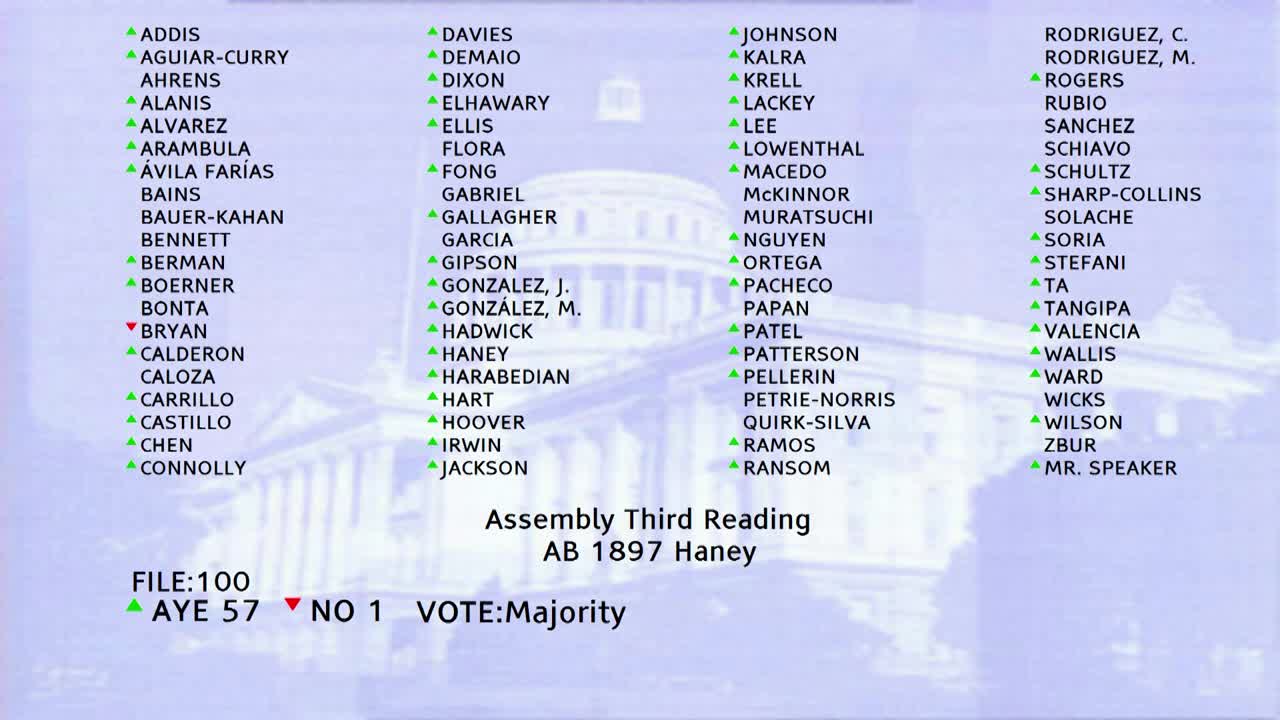
Bill Author