AB 2030: Dietary supplements for weight loss and over-the-counter diet pills.
- Session Year: 2025-2026
- House: Assembly
- Latest Version Date: 2026-09-28
Current Status:
Passed
(2026-09-28: Chaptered by Secretary of State - Chapter 720, Statutes of 2026.)
Introduced
In Committee
Awaiting First Chamber Vote
Passed First Chamber
In Committee
Awaiting Second Chamber Vote
Passed Second Chamber
Enacted
Existing law regulates the safety of various consumer products, including, among other things, specific additives in foods, chemicals in products for young children, and lead in tableware.
This bill would prohibit a person from selling, offering to sell, or giving away as either a retail or wholesale promotion, and a delivery seller from selling, delivering, or causing to be delivered, an over-the-counter diet pill or dietary supplement for weight loss or muscle building, as defined, to any person in this state under 18 years of age, except as specified, by requiring a specified identification check. The bill would make a person who violates these provisions liable for a civil penalty of no more than $500 for each violation, as specified, and would authorize the Attorney General, a county counsel, or a city attorney to apply to a court for, and would authorize that court to have jurisdiction upon hearing and for cause shown to grant, a temporary or permanent injunction enjoining or restraining any person or entity from violating any of the prohibitions. The bill would make a prevailing plaintiff in an action under these provisions entitled to an award of reasonable attorneys fees and costs.
Existing law regulates the safety of various consumer products, including, among other things, specific additives in foods, chemicals in products for young children, and lead in tableware.
This bill would prohibit a person from selling, offering to sell, or giving away as either a retail or wholesale promotion, and a delivery seller from selling, delivering, or causing to be delivered, an over-the-counter diet pill or dietary supplement for weight loss or muscle building, as defined, to any person in this state under 18 years of age, except as specified, by requiring a specified identification check. The bill would make a person who violates these provisions liable for a civil penalty of no more than $1,000 $500 for each violation, as specified, and would authorize the Attorney General, a county counsel, or a city attorney to apply to a court for, and would authorize that court to have jurisdiction upon hearing and for cause shown to grant, a temporary or permanent injunction enjoining or restraining any person or entity from violating any of the prohibitions. The bill would make a prevailing plaintiff in an action under these provisions entitled to an award of reasonable attorneys fees and costs. Under the bill, the above-described criminal penalty would not apply to a violation of these provisions.
Existing law, the Sherman Food, Drug, and Cosmetic Law, provides for the regulation of various subjects relating to the processing, labeling, advertising, and sale of food, drugs, and cosmetics, including dietary supplements, under the administration and enforcement of the State Department of Public Health. A violation of those provisions is a crime. Under existing law, it is a misdemeanor for any manufacturer, wholesaler, retailer, or other person to sell, transfer, or otherwise furnish a dietary supplement containing ephedrine group alkaloids or other specified substances to a person under 18 years of age, and a seller is required to request a valid identification of prospective purchasers who reasonably appear to be under 18 years of age.
This bill would prohibit a person from selling, offering to sell, or giving away as either a retail or wholesale promotion, and a delivery seller from selling, delivering, or causing to be delivered, an over-the-counter diet pill or dietary supplement for weight loss or muscle building, as defined, to any person in this state under 18 years of age, except as specified, by requiring a specified identification check. The bill would make a person who violates these provisions liable for a civil penalty of no more than $1,000 for each violation, as specified, and would authorize the Attorney General, a county counsel, or a city attorney to apply to a court for, and would authorize that court to have jurisdiction upon hearing and for cause shown to grant, a temporary or permanent injunction enjoining or restraining any person or entity from violating any of the prohibitions. The bill would make a prevailing plaintiff in an action under these provisions entitled to an award of reasonable attorneys fees and costs. Under the bill, the above-described criminal penalty would not apply to a violation of these provisions.
Existing law, the Sherman Food, Drug, and Cosmetic Law, provides for the regulation of various subjects relating to the processing, labeling, advertising, and sale of food, drugs, and cosmetics, including dietary supplements, under the administration and enforcement of the State Department of Public Health. A violation of those provisions is a crime. Under existing law, it is a misdemeanor for any manufacturer, wholesaler, retailer, or other person to sell, transfer, or otherwise furnish a dietary supplement containing ephedrine group alkaloids or other specified substances to a person under 18 years of age, and a seller is required to request a valid identification of prospective purchasers who reasonably appear to be under 18 years of age.
This bill would prohibit a person from selling, offering to sell, or giving away as either a retail or wholesale promotion, and a delivery seller from selling, delivering, or causing to be delivered, an over-the-counter diet pill or dietary supplement for weight loss or muscle building, as defined, to any person under 18 years of age, except as specified, by requiring a specified identification check. The bill would make a person who violates these provisions liable for a civil penalty of no more than $1,000 for each violation, as specified, and would authorize the Attorney General or any district attorney, General, a county counsel, or a city attorney to apply to a court for, and would authorize that court shall to have jurisdiction upon hearing and for cause shown to grant, a temporary or permanent injunction enjoining or restraining any person or entity from violating any of the prohibitions. The bill would make a prevailing plaintiff in an action under these provisions entitled to an award of reasonable attorneys fees and costs. Under the bill, the above-described criminal penalty would not apply to a violation of these provisions.
Existing law, the Sherman Food, Drug, and Cosmetic Law, provides for the regulation of various subjects relating to the processing, labeling, advertising, and sale of food, drugs, and cosmetics, including dietary supplements, under the administration and enforcement of the State Department of Public Health. A violation of those provisions is a crime. Under existing law, it is a misdemeanor for any manufacturer, wholesaler, retailer, or other person to sell, transfer, or otherwise furnish a dietary supplement containing ephedrine group alkaloids or other specified substances to a person under 18 years of age, and a seller is required to request a valid identification of prospective purchasers who reasonably appear to be under 18 years of age.
This bill would prohibit a person from selling, offering to sell, or giving away as either a retail or wholesale promotion, and a delivery seller from selling, delivering, or causing to be delivered, an over-the-counter diet pill or dietary supplement for weight loss or muscle building, as defined, to any person under 18 years of age age, except as specified, by requiring a specified identification check. The bill would make a person who violates these provisions liable for a civil penalty of no more than $1,000 for each violation, as specified, and would authorize the Attorney General or any district attorney, county counsel, or city attorney to apply to a court for, and that court shall have jurisdiction upon hearing and for cause shown to grant, a temporary or permanent injunction enjoining or restraining any person or entity from violating any of the prohibitions. Under the bill, the above-described criminal penalty would not apply to a violation of these provisions.
Existing law, the Sherman Food, Drug, and Cosmetic Law, provides for the regulation of various subjects relating to the processing, labeling, advertising, and sale of food, drugs, and cosmetics, including dietary supplements, under the administration and enforcement of the State Department of Public Health. A violation of those provisions is a crime. Under existing law, it is a misdemeanor for any manufacturer, wholesaler, retailer, or other person to sell, transfer, or otherwise furnish a dietary supplement containing ephedrine group alkaloids or other specified substances to a person under 18 years of age, and a seller is required to request a valid identification of prospective purchasers who reasonably appear to be under 18 years of age.
This bill would prohibit a person from selling, offering to sell, or giving away as either a retail or wholesale promotion, and a delivery seller from selling, delivering, or causing to be delivered, an over-the-counter diet pill or dietary supplement for weight loss or muscle building, as defined, to any person under 18 years of age by requiring a specified identification check. The bill would make a person who violates these provisions liable for a civil penalty of no more than $1,000 for each violation, as specified, and would authorize the Attorney General or any district attorney, county counsel, or city attorney to apply to a court for, and that court shall have jurisdiction upon hearing and for cause shown to grant, a temporary or permanent injunction enjoining or restraining any person or entity from violating any of the prohibitions. Under the bill, the above-described criminal penalty would not apply to a violation of these provisions.
(a)For purposes of this section, the following terms shall have the following meanings:
(1)Dietary supplement for weight loss or muscle building means a dietary supplement, as defined in 21 U.S.C. 321(ff), that is labeled, marketed, or otherwise represented for the purpose of achieving weight loss or building muscle.
(2)Over-the-counter diet pill means a drug, as defined in 21 U.S.C. 321(g)(1), that is labeled, marketed, or otherwise represented for the purpose of achieving weight loss for which a prescription is not required under the Federal Food, Drug and Cosmetic Act (21 U.S.C. Sec. 301 et seq.).
(3)Retail establishment means any vendor that, in the regular course of business, sells dietary supplements for weight loss or muscle building or over-the-counter diet pills at retail directly to the public, including, but not limited to, pharmacies, grocery stores, other retail stores, and vendors that accept orders placed by mail, telephone, electronic mail, internet website, online catalog, or software application.
(4)Delivery sale means any sale of over-the-counter diet pills or dietary supplements for weight loss or muscle building to a buyer in either of the following cases:
(A)The buyer submits the order for the sale by means of a telephone or other method of voice transmission, the mail, or the internet or other online service, or the seller is otherwise not in the physical presence of the buyer when the request for purchase or order is made.
(B)The over-the-counter diet pills or dietary supplements for weight loss or muscle building are delivered to the buyer by common carrier, private delivery service, or other method of remote delivery, or the seller is not in the physical presence of the buyer when the buyer obtains possession of the over-the-counter diet pills or dietary supplements for weight loss or muscle building.
(5)Delivery seller means a person, including online retailers, who makes delivery sales of over-the-counter diet pills or dietary supplements for weight loss or muscle building.
(b)(1)A person shall not sell, offer to sell, or give away as either a retail or wholesale promotion, an over-the-counter diet pill or dietary supplement for weight loss or muscle building to any person in this state under 18 years of age.
(2)For purposes of paragraph (1), and subject to subdivision (c), a retail establishment shall request valid identification from any person in this state who attempts to purchase over-the-counter diet pills or dietary supplements for weight loss or muscle building if the retail establishment cannot reasonably determine that the person appears to be under 18 years of age.
(3)Any retail establishment that sells over-the-counter diet pills or dietary supplements for weight loss or muscle building in this state may limit access to those products in a manner designed to prevent unauthorized access to those products.
(c)(1)Notwithstanding paragraph (2) of subdivision (b), a delivery seller, including an online retailer, who mails or ships over-the-counter diet pills or dietary supplements for weight loss or muscle building to consumers in this state shall adhere to all of the following:
(A)Shall not sell, deliver, or cause to be delivered any over-the-counter diet pills or dietary supplements for weight loss or muscle building to a person in this state under 18 years of age.
(B)Shall not accept a delivery sale order from a person without doing either or both of the following:
(i)Obtaining the full name, birth date, and residential address of that person and verifying this through the use of a commercially available database or aggregate of databases, consisting primarily of data from government sources, that are regularly used by government and businesses for the purpose of age and identity verification and authentication, to ensure that the purchaser is at least 18 years of age.
(ii)Use a method of mailing or shipping that requires an adult who is at least 18 years of age to sign to accept delivery of the shipping container at the delivery address. The person who signs to accept delivery of the shipping container shall provide proof, in the form of a valid, government-issued identification bearing a photograph of the individual, that the person is at least 18 years of age.
(2)A database being used for age and identity verification under clause (i) of subparagraph (B) of paragraph (1) shall not be in the possession or under the control of the delivery seller, or be subject to any changes or supplementation by the delivery seller.
(d)(1)Section 111825 does not apply to a violation of this section.
(2)The Attorney General, a county counsel, or a city attorney may apply to a court for, and that court shall have jurisdiction upon hearing and for cause shown to grant, a temporary or permanent injunction enjoining or restraining any person or entity from violating any provision of this section.
(3)A person who violates this section shall be liable for a civil penalty of no more than five hundred dollars ($500) for each violation, which may be assessed and recovered in a civil action brought in the name of the people of the State of California by the Attorney General, a county counsel, or a city attorney in any court of competent jurisdiction.
(4)A prevailing plaintiff in an action brought pursuant to this section shall be entitled to an award of reasonable attorneys fees and costs.
(e)When determining whether a supplement is labeled, marketed, or otherwise represented for the purpose of achieving weight loss or muscle building, the court may consider, but is not limited to, all of the following factors:
(1)Whether the product contains any of the following:
(A)An ingredient approved by the United States Food and Drug Administration for weight loss or muscle building.
(B)A steroid.
(C)Creatine, green tea extract, raspberry ketone, garcinia cambogia, or green coffee bean extract.
(2)Whether the products labeling or marketing bears statements or images that express or imply that the product will help with either of the following:
(A)Modify, maintain, or reduce body weight, fat, appetite, overall metabolism, or the process by which nutrients are metabolized.
(B)Maintain or increase muscle or strength.
(3)Whether the product or its ingredients are otherwise represented for the purpose of achieving weight loss or building muscle.
(4)Whether the retail establishment or delivery seller has done any of the following:
(A)Placed signs, categorized, or tagged the product with statements described in paragraph (2).
(B)Grouped the product with other weight loss or muscle building products in a display, advertisement, internet website, or area of the store.
(C)Otherwise representing that the product is for weight loss or muscle building.
(f)This section does not apply to a person under 18 years of age with a prescription for an over-the-counter diet pill or dietary supplement for weight loss or muscle building.
(g)This section does not apply to a person 18 years of age or older.
(h)The penalties established by this section are cumulative and shall not diminish rights, remedies, or penalties established under other laws.
(a)For purposes of this section, the following terms shall have the following meanings:
(1)Dietary supplement for weight loss or muscle building means a dietary supplement, as defined in 21 U.S.C. 321(ff), that is labeled, marketed, or otherwise represented for the purpose of achieving weight loss or building muscle.
(2)Over-the-counter diet pill means a drug, as defined in 21 U.S.C. 321(g)(1), that is labeled, marketed, or otherwise represented for the purpose of achieving weight loss for which a prescription is not required under the Federal Food, Drug and Cosmetic Act (21 U.S.C. Sec. 301 et seq.).
(3)Retail establishment means any vendor that, in the regular course of business, sells dietary supplements for weight loss or muscle building or over-the-counter diet pills at retail directly to the public, including, but not limited to, pharmacies, grocery stores, other retail stores, and vendors that accept orders placed by mail, telephone, electronic mail, internet website, online catalog, or software application.
(4)Delivery sale means any sale of over-the-counter diet pills or dietary supplements for weight loss or muscle building to a buyer in either of the following cases:
(A)The buyer submits the order for the sale by means of a telephone or other method of voice transmission, the mail, or the internet or other online service, or the seller is otherwise not in the physical presence of the buyer when the request for purchase or order is made.
(B)The over-the-counter diet pills or dietary supplements for weight loss or muscle building are delivered to the buyer by common carrier, private delivery service, or other method of remote delivery, or the seller is not in the physical presence of the buyer when the buyer obtains possession of the over-the-counter diet pills or dietary supplements for weight loss or muscle building.
(5)Delivery seller means a person, including online retailers, who makes delivery sales of over-the-counter diet pills or dietary supplements for weight loss or muscle building.
(b)(1)A person shall not sell, offer to sell, or give away as either a retail or wholesale promotion, an over-the-counter diet pill or dietary supplement for weight loss or muscle building to any person in this state under 18 years of age.
(2)For purposes of paragraph (1), and subject to subdivision (c), a retail establishment shall request valid identification from any person in this state who attempts to purchase over-the-counter diet pills or dietary supplements for weight loss or muscle building if the retail establishment cannot reasonably determine that the person appears to be under 18 years of age.
(3)Any retail establishment that sells over-the-counter diet pills or dietary supplements for weight loss or muscle building in this state may limit access to those products in a manner designed to prevent unauthorized access to those products.
(c)(1)Notwithstanding paragraph (2) of subdivision (b), a delivery seller, including an online retailer, who mails or ships over-the-counter diet pills or dietary supplements for weight loss or muscle building to consumers in this state shall adhere to all of the following:
(A)Shall not sell, deliver, or cause to be delivered any over-the-counter diet pills or dietary supplements for weight loss or muscle building to a person in this state under 18 years of age.
(B)Shall use a method of mailing or shipping that requires both of the following:(i)The purchaser placing the delivery sale order, or an adult who is at least 18 years of age, to sign to accept delivery of the shipping container at the delivery address.(ii)The person who signs to accept delivery of the shipping container to provide proof, in the form of a valid, government-issued identification bearing a photograph of the individual, that the person is at least 18 years of age. (C)(B)Shall not accept a delivery sale order from a person without doing either or both of the following:
(i)Obtaining the full name, birth date, and residential address of that person. (ii)Verifying the information provided in clause (i),(i)Obtaining the full name, birth date, and residential address of that person and verifying this through the use of a commercially available database or aggregate of databases, consisting primarily of data from government sources, that are regularly used by government and businesses for the purpose of age and identity verification and authentication, to ensure that the purchaser is at least 18 years of age.
(ii)Use a method of mailing or shipping that requires an adult who is at least 18 years of age to sign to accept delivery of the shipping container at the delivery address. The person who signs to accept delivery of the shipping container shall provide proof, in the form of a valid, government-issued identification bearing a photograph of the individual, that the person is at least 18 years of age.
(2)A database being used for age and identity verification under clause (ii) (i) of subparagraph (C) (B) of paragraph (1) shall not be in the possession or under the control of the delivery seller, or be subject to any changes or supplementation by the delivery seller.
(d)(1)Section 111825 does not apply to a violation of this section.
(2)The Attorney General, a county counsel, or a city attorney may apply to a court for, and that court shall have jurisdiction upon hearing and for cause shown to grant, a temporary or permanent injunction enjoining or restraining any person or entity from violating any provision of this section.
(3)A person who violates this section shall be liable for a civil penalty of no more than five hundred dollars ($500) for each violation, which may be assessed and recovered in a civil action brought in the name of the people of the State of California by the Attorney General, a county counsel, or a city attorney in any court of competent jurisdiction.
(4)A prevailing plaintiff in an action brought pursuant to this section shall be entitled to an award of reasonable attorneys fees and costs.
(e)When determining whether a supplement is labeled, marketed, or otherwise represented for the purpose of achieving weight loss or muscle building, the court may consider, but is not limited to, all of the following factors:
(1)Whether the product contains any of the following:
(A)An ingredient approved by the United States Food and Drug Administration for weight loss or muscle building.
(B)A steroid.
(C)Creatine, green tea extract, raspberry ketone, garcinia cambogia, or green coffee bean extract.
(2)Whether the products labeling or marketing bears statements or images that express or imply that the product will help with either of the following:
(A)Modify, maintain, or reduce body weight, fat, appetite, overall metabolism, or the process by which nutrients are metabolized.
(B)Maintain or increase muscle or strength.
(3)Whether the product or its ingredients are otherwise represented for the purpose of achieving weight loss or building muscle.
(4)Whether the retail establishment or delivery seller has done any of the following:
(A)Placed signs, categorized, or tagged the product with statements described in paragraph (2).
(B)Grouped the product with other weight loss or muscle building products in a display, advertisement, internet website, or area of the store.
(C)Otherwise representing that the product is for weight loss or muscle building.
(f)This section does not apply to a person under 18 years of age with a prescription for an over-the-counter diet pill or dietary supplement for weight loss or muscle building.
(g)This section does not apply to a person 18 years of age or older.
(g)(h)The penalties established by this section are cumulative and shall not diminish rights, remedies, or penalties established under other laws.
(a)For purposes of this section, the following terms shall have the following meanings:
(1)Dietary supplement for weight loss or muscle building means a dietary supplement, as defined in 21 U.S.C. 321(ff), that is labeled, marketed, or otherwise represented for the purpose of achieving weight loss or building muscle.
(2)Over-the-counter diet pill means a drug, as defined in 21 U.S.C. 321(g)(1), that is labeled, marketed, or otherwise represented for the purpose of achieving weight loss for which a prescription is not required under the Federal Food, Drug and Cosmetic Act (21 U.S.C. Sec. 301 et seq.).
(3)Retail establishment means any vendor that, in the regular course of business, sells dietary supplements for weight loss or muscle building or over-the-counter diet pills at retail directly to the public, including, but not limited to, pharmacies, grocery stores, other retail stores, and vendors that accept orders placed by mail, telephone, electronic mail, internet website, online catalog, or software application.
(4)Delivery sale means any sale of over-the-counter diet pills or dietary supplements for weight loss or muscle building to a buyer in either of the following cases:
(A)The buyer submits the order for the sale by means of a telephone or other method of voice transmission, the mail, or the internet or other online service, or the seller is otherwise not in the physical presence of the buyer when the request for purchase or order is made.
(B)The over-the-counter diet pills or dietary supplements for weight loss or muscle building are delivered to the buyer by common carrier, private delivery service, or other method of remote delivery, or the seller is not in the physical presence of the buyer when the buyer obtains possession of the over-the-counter diet pills or dietary supplements for weight loss or muscle building.
(5)Delivery seller means a person, including online retailers, who makes delivery sales of over-the-counter diet pills or dietary supplements for weight loss or muscle building.
(b)(1)A person shall not sell, offer to sell, or give away as either a retail or wholesale promotion, an over-the-counter diet pill or dietary supplement for weight loss or muscle building to any person in this state under 18 years of age.
(2)For purposes of paragraph (1), and subject to subdivision (c), a retail establishment shall request valid identification from any person in this state who attempts to purchase over-the-counter diet pills or dietary supplements for weight loss or muscle building if the retail establishment cannot reasonably determine that the person appears to be under 18 years of age.
(3)Any retail establishment that sells over-the-counter diet pills or dietary supplements for weight loss or muscle building in this state may limit access to those products in a manner designed to prevent unauthorized access to those products.
(c)(1)Notwithstanding paragraph (2) of subdivision (b), a delivery seller, including an online retailer, who mails or ships over-the-counter diet pills or dietary supplements for weight loss or muscle building to consumers in this state shall adhere to all of the following:
(A)Shall not sell, deliver, or cause to be delivered any over-the-counter diet pills or dietary supplements for weight loss or muscle building to a person in this state under 18 years of age.
(B)Shall use a method of mailing or shipping that requires both of the following:
(i)The purchaser placing the delivery sale order, or an adult who is at least 18 years of age, to sign to accept delivery of the shipping container at the delivery address.
(ii)The person who signs to accept delivery of the shipping container to provide proof, in the form of a valid, government-issued identification bearing a photograph of the individual, that the person is at least 18 years of age.
(C)Shall not accept a delivery sale order from a person without doing both of the following:
(i)Obtaining the full name, birth date, and residential address of that person.
(ii)Verifying the information provided in clause (i), through the use of a commercially available database or aggregate of databases, consisting primarily of data from government sources, that are regularly used by government and businesses for the purpose of age and identity verification and authentication, to ensure that the purchaser is at least 18 years of age.
(2)A database being used for age and identity verification under clause (ii) of subparagraph (C) of paragraph (1) shall not be in the possession or under the control of the delivery seller, or be subject to any changes or supplementation by the delivery seller.
(d)(1)Section 111825 does not apply to a violation of this section.
(2)The Attorney General, a county counsel, or a city attorney may apply to a court for, and that court shall have jurisdiction upon hearing and for cause shown to grant, a temporary or permanent injunction enjoining or restraining any person or entity from violating any provision of this section.
(3)A person who violates this section shall be liable for a civil penalty of no more than five hundred dollars ($500) for each violation, which may be assessed and recovered in a civil action brought in the name of the people of the State of California by the Attorney General, a county counsel, or a city attorney in any court of competent jurisdiction.
(4)A prevailing plaintiff in an action brought pursuant to this section shall be entitled to an award of reasonable attorneys fees and costs.
(e)When determining whether a supplement is labeled, marketed, or otherwise represented for the purpose of achieving weight loss or muscle building, the court may consider, but is not limited to, all of the following factors:
(1)Whether the product contains any of the following:
(A)An ingredient approved by the United States Food and Drug Administration for weight loss or muscle building.
(B)A steroid.
(C)Creatine, green tea extract, raspberry ketone, garcinia cambogia, or green coffee bean extract.
(2)Whether the products labeling or marketing bears statements or images that express or imply that the product will help with either of the following:
(A)Modify, maintain, or reduce body weight, fat, appetite, overall metabolism, or the process by which nutrients are metabolized.
(B)Maintain or increase muscle or strength.
(3)Whether the product or its ingredients are otherwise represented for the purpose of achieving weight loss or building muscle.
(4)Whether the retail establishment or delivery seller has done any of the following:
(A)Placed signs, categorized, or tagged the product with statements described in paragraph (2).
(B)Grouped the product with other weight loss or muscle building products in a display, advertisement, internet website, or area of the store.
(C)Otherwise representing that the product is for weight loss or muscle building.
(f)This section does not apply to a person under 18 years of age with a prescription for an over-the-counter diet pill or dietary supplement for weight loss or muscle building.
(g)The penalties established by this section are cumulative and shall not diminish rights, remedies, or penalties established under other laws.
SECTION 1.Section 110423.7 is added to the Health and Safety Code, to read:110423.7.(a)For purposes of this section, the following terms shall have the following meanings:(1)Dietary supplement for weight loss or muscle building means a dietary supplement, as defined in 21 U.S.C. 321(ff), that is labeled, marketed, or otherwise represented for the purpose of achieving weight loss or building muscle.(2)Over-the-counter diet pill means a drug, as defined in 21 U.S.C. 321(g)(1), that is labeled, marketed, or otherwise represented for the purpose of achieving weight loss for which a prescription is not required under the Federal Food, Drug and Cosmetic Act (21 U.S.C. Sec. 301 et seq.).(3)Retail establishment means any vendor that, in the regular course of business, sells dietary supplements for weight loss or muscle building or over-the-counter diet pills at retail directly to the public, including, but not limited to, pharmacies, grocery stores, other retail stores, and vendors that accept orders placed by mail, telephone, electronic mail, internet website, online catalog, or software application.(4)Delivery sale means any sale of over-the-counter diet pills or dietary supplements for weight loss or muscle building to a buyer in either of the following cases:(A)The buyer submits the order for the sale by means of a telephone or other method of voice transmission, the mail, or the internet or other online service, or the seller is otherwise not in the physical presence of the buyer when the request for purchase or order is made.(B)The over-the-counter diet pills or dietary supplements for weight loss or muscle building are delivered to the buyer by common carrier, private delivery service, or other method of remote delivery, or the seller is not in the physical presence of the buyer when the buyer obtains possession of the over-the-counter diet pills or dietary supplements for weight loss or muscle building.(5)Delivery seller means a person, including online retailers, who makes delivery sales of over-the-counter diet pills or dietary supplements for weight loss or muscle building.(b)(1)A person shall not sell, offer to sell, or give away as either a retail or wholesale promotion, an over-the-counter diet pill or dietary supplement for weight loss or muscle building to any person in this state under 18 years of age.(2)For purposes of paragraph (1), and subject to subdivision (c), a retail establishment shall request valid identification from any person in this state who attempts to purchase over-the-counter diet pills or dietary supplements for weight loss or muscle building if the retail establishment cannot reasonably determine that the person appears to be under 18 years of age.(3)Any retail establishment that sells over-the-counter diet pills or dietary supplements for weight loss or muscle building in this state may limit access to those products in a manner designed to prevent unauthorized access to those products.(c)(1)Notwithstanding paragraph (2) of subdivision (b), a delivery seller, including an online retailer, who mails or ships over-the-counter diet pills or dietary supplements for weight loss or muscle building to consumers in this state shall adhere to all of the following:(A)Shall not sell, deliver, or cause to be delivered any over-the-counter diet pills or dietary supplements for weight loss or muscle building to a person in this state under 18 years of age.(B)Shall use a method of mailing or shipping that requires both of the following:(i)The purchaser placing the delivery sale order, or an adult who is at least 18 years of age, to sign to accept delivery of the shipping container at the delivery address.(ii)The person who signs to accept delivery of the shipping container to provide proof, in the form of a valid, government-issued identification bearing a photograph of the individual, that the person is at least 18 years of age.(C)Shall not accept a delivery sale order from a person without doing both of the following:(i)Obtaining the full name, birth date, and residential address of that person.(ii)Verifying the information provided in clause (i), through the use of a commercially available database or aggregate of databases, consisting primarily of data from government sources, that are regularly used by government and businesses for the purpose of age and identity verification and authentication, to ensure that the purchaser is at least 18 years of age.(2)A database being used for age and identity verification under clause (ii) of subparagraph (C) of paragraph (1) shall not be in the possession or under the control of the delivery seller, or be subject to any changes or supplementation by the delivery seller.(d)(1)Section 111825 does not apply to a violation of this section.(2)The Attorney General, a county counsel, or a city attorney may apply to a court for, and that court shall have jurisdiction upon hearing and for cause shown to grant, a temporary or permanent injunction enjoining or restraining any person or entity from violating any provision of this section.(3)A person who violates this section shall be liable for a civil penalty of no more than one thousand dollars ($1,000) for each violation, which may be assessed and recovered in a civil action brought in the name of the people of the State of California by the Attorney General, a county counsel, or a city attorney in any court of competent jurisdiction.(4)A prevailing plaintiff in an action brought pursuant to this section shall be entitled to an award of reasonable attorneys fees and costs.(e)When determining whether a supplement is labeled, marketed, or otherwise represented for the purpose of achieving weight loss or muscle building, the court may consider, but is not limited to, all of the following factors:(1)Whether the product contains any of the following:(A)An ingredient approved by the United States Food and Drug Administration for weight loss or muscle building.(B)A steroid.(C)Creatine, green tea extract, raspberry ketone, garcinia cambogia, or green coffee bean extract.(2)Whether the products labeling or marketing bears statements or images that express or imply that the product will help with either of the following:(A)Modify, maintain, or reduce body weight, fat, appetite, overall metabolism, or the process by which nutrients are metabolized.(B)Maintain or increase muscle or strength.(3)Whether the product or its ingredients are otherwise represented for the purpose of achieving weight loss or building muscle.(4)Whether the retail establishment or delivery seller has done any of the following:(A)Placed signs, categorized, or tagged the product with statements described in paragraph (2).(B)Grouped the product with other weight loss or muscle building products in a display, advertisement, internet website, or area of the store.(C)Otherwise representing that the product is for weight loss or muscle building.(f)This section does not apply to a person under 18 years of age with a prescription for an over-the-counter diet pill or dietary supplement for weight loss or muscle building.(g)The penalties established by this section are cumulative and shall not diminish rights, remedies, or penalties established under other laws.(a)For purposes of this section, the following terms shall have the following meanings:
(1)Dietary supplement for weight loss or muscle building means a dietary supplement, as defined in 21 U.S.C. 321(ff), that is labeled, marketed, or otherwise represented for the purpose of achieving weight loss or building muscle.
(2)Over-the-counter diet pill means a drug, as defined in 21 U.S.C. 321(g)(1), that is labeled, marketed, or otherwise represented for the purpose of achieving weight loss for which a prescription is not required under the Federal Food, Drug and Cosmetic Act (21 U.S.C. Sec. 301 et seq.).
(3)Retail establishment means any vendor that, in the regular course of business, sells dietary supplements for weight loss or muscle building or over-the-counter diet pills at retail directly to the public, including, but not limited to, pharmacies, grocery stores, other retail stores, and vendors that accept orders placed by mail, telephone, electronic mail, internet website, online catalog, or software application.
(4)Delivery sale means any sale of over-the-counter diet pills or dietary supplements for weight loss or muscle building to a buyer in either of the following cases:
(A)The buyer submits the order for the sale by means of a telephone or other method of voice transmission, the mail, or the internet or other online service, or the seller is otherwise not in the physical presence of the buyer when the request for purchase or order is made.
(B)The over-the-counter diet pills or dietary supplements for weight loss or muscle building are delivered to the buyer by common carrier, private delivery service, or other method of remote delivery, or the seller is not in the physical presence of the buyer when the buyer obtains possession of the over-the-counter diet pills or dietary supplements for weight loss or muscle building.
(5)Delivery seller means a person, including online retailers, who makes delivery sales of over-the-counter diet pills or dietary supplements for weight loss or muscle building.
(b)(1)A person shall not sell, offer to sell, or give away as either a retail or wholesale promotion, an over-the-counter diet pill or dietary supplement for weight loss or muscle building to any person in this state under 18 years of age.
(2)For purposes of paragraph (1), and subject to subdivision (c), a retail establishment shall request valid identification from any person in this state who attempts to purchase over-the-counter diet pills or dietary supplements for weight loss or muscle building if the retail establishment cannot reasonably determine that the person appears to be under 18 years of age.
(3)Any retail establishment that sells over-the-counter diet pills or dietary supplements for weight loss or muscle building in this state may limit access to those products in a manner designed to prevent unauthorized access to those products.
(c)(1)Notwithstanding paragraph (2) of subdivision (b), a delivery seller, including an online retailer, who mails or ships over-the-counter diet pills or dietary supplements for weight loss or muscle building to consumers in this state shall adhere to all of the following:
(A)Shall not sell, deliver, or cause to be delivered any over-the-counter diet pills or dietary supplements for weight loss or muscle building to a person in this state under 18 years of age.
(B)Shall use a method of mailing or shipping that requires both of the following:
(i)The purchaser placing the delivery sale order, or an adult who is at least 18 years of age, to sign to accept delivery of the shipping container at the delivery address.
(ii)The person who signs to accept delivery of the shipping container to provide proof, in the form of a valid, government-issued identification bearing a photograph of the individual, that the person is at least 18 years of age.
(C)Shall not accept a delivery sale order from a person without doing both of the following:
(i)Obtaining the full name, birth date, and residential address of that person.
(ii)Verifying the information provided in clause (i), through the use of a commercially available database or aggregate of databases, consisting primarily of data from government sources, that are regularly used by government and businesses for the purpose of age and identity verification and authentication, to ensure that the purchaser is at least 18 years of age.
(2)A database being used for age and identity verification under clause (ii) of subparagraph (C) of paragraph (1) shall not be in the possession or under the control of the delivery seller, or be subject to any changes or supplementation by the delivery seller.
(d)(1)Section 111825 does not apply to a violation of this section.
(2)The Attorney General, a county counsel, or a city attorney may apply to a court for, and that court shall have jurisdiction upon hearing and for cause shown to grant, a temporary or permanent injunction enjoining or restraining any person or entity from violating any provision of this section.
(3)A person who violates this section shall be liable for a civil penalty of no more than one thousand dollars ($1,000) for each violation, which may be assessed and recovered in a civil action brought in the name of the people of the State of California by the Attorney General, a county counsel, or a city attorney in any court of competent jurisdiction.
(4)A prevailing plaintiff in an action brought pursuant to this section shall be entitled to an award of reasonable attorneys fees and costs.
(e)When determining whether a supplement is labeled, marketed, or otherwise represented for the purpose of achieving weight loss or muscle building, the court may consider, but is not limited to, all of the following factors:
(1)Whether the product contains any of the following:
(A)An ingredient approved by the United States Food and Drug Administration for weight loss or muscle building.
(B)A steroid.
(C)Creatine, green tea extract, raspberry ketone, garcinia cambogia, or green coffee bean extract.
(2)Whether the products labeling or marketing bears statements or images that express or imply that the product will help with either of the following:
(A)Modify, maintain, or reduce body weight, fat, appetite, overall metabolism, or the process by which nutrients are metabolized.
(B)Maintain or increase muscle or strength.
(3)Whether the product or its ingredients are otherwise represented for the purpose of achieving weight loss or building muscle.
(4)Whether the retail establishment or delivery seller has done any of the following:
(A)Placed signs, categorized, or tagged the product with statements described in paragraph (2).
(B)Grouped the product with other weight loss or muscle building products in a display, advertisement, internet website, or area of the store.
(C)Otherwise representing that the product is for weight loss or muscle building.
(f)This section does not apply to a person under 18 years of age with a prescription for an over-the-counter diet pill or dietary supplement for weight loss or muscle building.
(g)The penalties established by this section are cumulative and shall not diminish rights, remedies, or penalties established under other laws.
(a)For purposes of this section, the following terms shall have the following meanings:
(1)Dietary supplement for weight loss or muscle building means a dietary supplement, as defined in 21 U.S.C. 321(ff), that is labeled, marketed, or otherwise represented for the purpose of achieving weight loss or building muscle.
(2)Over-the-counter diet pill means a drug, as defined in 21 U.S.C. 321(g)(1), that is labeled, marketed, or otherwise represented for the purpose of achieving weight loss for which a prescription is not required under the Federal Food, Drug and Cosmetic Act (21 U.S.C. Sec. 301 et seq.).
(3)Retail establishment means any vendor that, in the regular course of business, sells dietary supplements for weight loss or muscle building or over-the-counter diet pills at retail directly to the public, including, but not limited to, pharmacies, grocery stores, other retail stores, and vendors that accept orders placed by mail, telephone, electronic mail, internet website, online catalog, or software application.
(4)Delivery sale means any sale of over-the-counter diet pills or dietary supplements for weight loss or muscle building to a buyer in either of the following cases:
(A)The buyer submits the order for the sale by means of a telephone or other method of voice transmission, the mail, or the internet or other online service, or the seller is otherwise not in the physical presence of the buyer when the request for purchase or order is made.
(B)The over-the-counter diet pills or dietary supplements for weight loss or muscle building are delivered to the buyer by common carrier, private delivery service, or other method of remote delivery, or the seller is not in the physical presence of the buyer when the buyer obtains possession of the over-the-counter diet pills or dietary supplements for weight loss or muscle building.
(5)Delivery seller means a person, including online retailers, who makes delivery sales of over-the-counter diet pills or dietary supplements for weight loss or muscle building.
(b)(1)A person shall not sell, offer to sell, or give away as either a retail or wholesale promotion, an over-the-counter diet pill or dietary supplement for weight loss or muscle building to any person under 18 years of age.
(2)For purposes of paragraph (1), and subject to subdivision (c), a retail establishment shall request valid identification from any person who attempts to purchase over-the-counter diet pills or dietary supplements for weight loss or muscle building if the retail establishment cannot reasonably determine that the person appears to be under 18 years of age.
(3)Any retail establishment that sells over-the-counter diet pills or dietary supplements for weight loss or muscle building may limit access to those products in a manner designed to prevent unauthorized access to those products.
(c)(1)Notwithstanding paragraph (2) of subdivision (b), a delivery seller, including an online retailer, who mails or ships over-the-counter diet pills or dietary supplements for weight loss or muscle building to consumers shall adhere to all of the following:
(A)Shall not sell, deliver, or cause to be delivered any over-the-counter diet pills or dietary supplements for weight loss or muscle building to a person under 18 years of age.
(B)Shall use a method of mailing or shipping that requires both of the following:
(i)The purchaser placing the delivery sale order, or an adult who is at least 18 years of age, to sign to accept delivery of the shipping container at the delivery address.
(ii)The person who signs to accept delivery of the shipping container to provide proof, in the form of a valid, government-issued identification bearing a photograph of the individual, that the person is at least 18 years of age.
(C)Shall not accept a delivery sale order from a person without doing both of the following:
(i)Obtaining the full name, birth date, and residential address of that person.
(ii)Verifying the information provided in clause (i), through the use of a commercially available database or aggregate of databases, consisting primarily of data from government sources, that are regularly used by government and businesses for the purpose of age and identity verification and authentication, to ensure that the purchaser is at least 18 years of age.
(2)A database being used for age and identity verification under clause (ii) of subparagraph (C) of paragraph (1) shall not be in the possession or under the control of the delivery seller, or be subject to any changes or supplementation by the delivery seller.
(d)(1)Section 111825 does not apply to a violation of this section.
(2)The Attorney General or any district attorney, General, a county counsel, or a city attorney may apply to a court for, and that court shall have jurisdiction upon hearing and for cause shown to grant, a temporary or permanent injunction enjoining or restraining any person or entity from violating any provision of this section.
(3)A person who violates this section shall be liable for a civil penalty of no more than one thousand dollars ($1,000) for each violation, which may be assessed and recovered in a civil action brought in the name of the people of the State of California by the Attorney General or by any district attorney, General, a county counsel, or a city attorney in any court of competent jurisdiction.
(4)A prevailing plaintiff in an action brought pursuant to this section shall be entitled to an award of reasonable attorneys fees and costs.
(e)When determining whether a supplement is labeled, marketed, or otherwise represented for the purpose of achieving weight loss or muscle building, the court may consider, but is not limited to, all of the following factors:
(1)Whether the product contains any of the following:
(A)An ingredient approved by the United States Food and Drug Administration for weight loss or muscle building.
(B)A steroid.
(C)Creatine, green tea extract, raspberry ketone, garcinia cambogia, or green coffee bean extract.
(2)Whether the products labeling or marketing bears statements or images that express or imply that the product will help with either of the following:
(A)Modify, maintain, or reduce body weight, fat, appetite, overall metabolism, or the process by which nutrients are metabolized.
(B)Maintain or increase muscle or strength.
(3)Whether the product or its ingredients are otherwise represented for the purpose of achieving weight loss or building muscle.
(4)Whether the retail establishment or delivery seller has done any of the following:
(A)Placed signs, categorized, or tagged the product with statements described in paragraph (2).
(B)Grouped the product with other weight loss or muscle building products in a display, advertisement, internet website, or area of the store.
(C)Otherwise representing that the product is for weight loss or muscle building.
(f)This section does not apply to a person under 18 years of age with a prescription for an over-the-counter diet pill or dietary supplement for weight loss or muscle building.
(g)The penalties established by this section are cumulative and shall not diminish rights, remedies, or penalties established under other laws.
(a)For purposes of this section, the following terms shall have the following meanings:
(1)Dietary supplement for weight loss or muscle building means a dietary supplement, as defined in 21 U.S.C. 321(ff), that is labeled, marketed, or otherwise represented for the purpose of achieving weight loss or building muscle.
(2)Over-the-counter diet pill means a drug, as defined in 21 U.S.C. 321(g)(1), that is labeled, marketed, or otherwise represented for the purpose of achieving weight loss for which a prescription is not required under the Federal Food, Drug and Cosmetic Act (21 U.S.C. Sec. 301 et seq.).
(3)Retail establishment means any vendor that, in the regular course of business, sells dietary supplements for weight loss or muscle building or over-the-counter diet pills at retail directly to the public, including, but not limited to, pharmacies, grocery stores, other retail stores, and vendors that accept orders placed by mail, telephone, electronic mail, internet website, online catalog, or software application.
(4)Delivery sale means any sale of over-the-counter diet pills or dietary supplements for weight loss or muscle building to a buyer in either of the following cases:
(A)The buyer submits the order for the sale by means of a telephone or other method of voice transmission, the mail, or the internet or other online service, or the seller is otherwise not in the physical presence of the buyer when the request for purchase or order is made.
(B)The over-the-counter diet pills or dietary supplements for weight loss or muscle building are delivered to the buyer by common carrier, private delivery service, or other method of remote delivery, or the seller is not in the physical presence of the buyer when the buyer obtains possession of the over-the-counter diet pills or dietary supplements for weight loss or muscle building.
(5)Delivery seller means a person, including online retailers, who makes delivery sales of over-the-counter diet pills or dietary supplements for weight loss or muscle building.
(b)(1)No A person shall not sell, offer to sell, or give away as either a retail or wholesale promotion, an over-the-counter diet pill or dietary supplement for weight loss or muscle building to any person under 18 years of age.
(2)For purposes of paragraph (1), and subject to subdivision (c), a retail establishment shall request valid identification from any person who attempts to purchase over-the-counter diet pills or dietary supplements for weight loss or muscle building if the retail establishment cannot reasonably determine that the person appears to be under 18 years of age.
(3)Any retail establishment that sells over-the-counter diet pills or dietary supplements for weight loss or muscle building shall may limit access to those products in a manner designed to prevent unauthorized access to those products. The products shall not be directly accessible by customers, and may be accessed only by employees of the establishment at a location such as behind a retail counter or in a locked case.
(c)(1)Notwithstanding paragraph (2) of subdivision (b), a delivery seller, including an online retailer, who mails or ships over-the-counter diet pills or dietary supplements for weight loss or muscle building to consumers shall adhere to all of the following:
(A)Shall not sell, deliver, or cause to be delivered any over-the-counter diet pills or dietary supplements for weight loss or muscle building to a person under 18 years of age.
(B)Shall use a method of mailing or shipping that requires both of the following:
(i)The purchaser placing the delivery sale order, or an adult who is at least 18 years of age, to sign to accept delivery of the shipping container at the delivery address.
(ii)The person who signs to accept delivery of the shipping container to provide proof, in the form of a valid, government-issued identification bearing a photograph of the individual, that the person is at least 18 years of age.
(C)Shall not accept a delivery sale order from a person without doing both of the following:
(i)Obtaining the full name, birth date, and residential address of that person.
(ii)Verifying the information provided in clause (i), through the use of a commercially available database or aggregate of databases, consisting primarily of data from government sources, that are regularly used by government and businesses for the purpose of age and identity verification and authentication, to ensure that the purchaser is at least 18 years of age.
(2)No A database being used for age and identity verification under clause (ii) of subparagraph (C) of paragraph (1) shall not be in the possession or under the control of the delivery seller, or be subject to any changes or supplementation by the delivery seller.
(d)(1)Section 111825 does not apply to a violation of this section.
(2)The Attorney General or any district attorney, county counsel, or city attorney may apply to a court for, and that court shall have jurisdiction upon hearing and for cause shown to grant, a temporary or permanent injunction enjoining or restraining any person or entity from violating any provision of this section.
(3)A person who violates this section shall be liable for a civil penalty of no more than one thousand dollars ($1,000) for each violation, which may be assessed and recovered in a civil action brought in the name of the people of the State of California by the Attorney General or by any district attorney, county counsel, or city attorney in any court of competent jurisdiction.
(e)When determining whether a supplement is labeled, marketed, or otherwise represented for the purpose of achieving weight loss or muscle building, the Attorney General shall court may consider, but is not limited to, all of the following factors:
(1)Whether the product contains any of the following:
(A)An ingredient approved by the United States Food and Drug Administration for weight loss or muscle building.
(B)A steroid.
(C)Creatine, green tea extract, raspberry ketone, garcinia cambogia, or green coffee bean extract.
(2)Whether the products labeling or marketing bears statements or images that express or imply that the product will help with either of the following:
(A)Modify, maintain, or reduce body weight, fat, appetite, overall metabolism, or the process by which nutrients are metabolized.
(B)Maintain or increase muscle or strength.
(3)Whether the product or its ingredients are otherwise represented for the purpose of achieving weight loss or building muscle.
(4)Whether the retail establishment or delivery seller has done any of the following:
(A)Placed signs, categorized, or tagged the product with statements described in paragraph (2).
(B)Grouped the product with other weight loss or muscle building products in a display, advertisement, internet website, or area of the store.
(C)Otherwise representing that the product is for weight loss or muscle building.
(f)This section does not apply to a person under 18 years of age with a prescription for an over-the-counter diet pill or dietary supplement for weight loss or muscle building.
(a)For purposes of this section, the following terms shall have the following meanings:
(1)Dietary supplement for weight loss or muscle building means a dietary supplement, as defined in 21 U.S.C. 321(ff), that is labeled, marketed, or otherwise represented for the purpose of achieving weight loss or building muscle.
(2)Over-the-counter diet pill means a drug, as defined in 21 U.S.C. 321(g)(1), that is labeled, marketed, or otherwise represented for the purpose of achieving weight loss for which a prescription is not required under the Federal Food, Drug and Cosmetic Act (21 U.S.C. Sec. 301 et seq.).
(3)Retail establishment means any vendor that, in the regular course of business, sells dietary supplements for weight loss or muscle building or over-the-counter diet pills at retail directly to the public, including, but not limited to, pharmacies, grocery stores, other retail stores, and vendors that accept orders placed by mail, telephone, electronic mail, internet website, online catalog, or software application.
(4)Delivery sale means any sale of over-the-counter diet pills or dietary supplements for weight loss or muscle building to a buyer in either of the following cases:
(A)The buyer submits the order for the sale by means of a telephone or other method of voice transmission, the mail, or the internet or other online service, or the seller is otherwise not in the physical presence of the buyer when the request for purchase or order is made.
(B)The over-the-counter diet pills or dietary supplements for weight loss or muscle building are delivered to the buyer by common carrier, private delivery service, or other method of remote delivery, or the seller is not in the physical presence of the buyer when the buyer obtains possession of the over-the-counter diet pills or dietary supplements for weight loss or muscle building.
(5)Delivery seller means a person, including online retailers, who makes delivery sales of over-the-counter diet pills or dietary supplements for weight loss or muscle building.
(b)(1)No person shall sell, offer to sell, or give away as either a retail or wholesale promotion, an over-the-counter diet pill or dietary supplement for weight loss or muscle building to any person under 18 years of age.
(2)For purposes of paragraph (1), and subject to subdivision (c), a retail establishment shall request valid identification from any person who attempts to purchase over-the-counter diet pills or dietary supplements for weight loss or muscle building if the retail establishment cannot reasonably determine that the person appears to be under 18 years of age.
(3)Any retail establishment that sells over-the-counter diet pills or dietary supplements for weight loss or muscle building shall limit access to those products in a manner designed to prevent unauthorized access to those products. The products shall not be directly accessible by customers, and may be accessed only by employees of the establishment at a location such as behind a retail counter or in a locked case.
(c)(1)Notwithstanding paragraph (2) of subdivision (b), a delivery seller, including an online retailer, who mails or ships over-the-counter diet pills or dietary supplements for weight loss or muscle building to consumers shall adhere to all of the following:
(A)Shall not sell, deliver, or cause to be delivered any over-the-counter diet pills or dietary supplements for weight loss or muscle building to a person under 18 years of age.
(B)Shall use a method of mailing or shipping that requires both of the following:
(i)The purchaser placing the delivery sale order, or an adult who is at least 18 years of age, to sign to accept delivery of the shipping container at the delivery address.
(ii)The person who signs to accept delivery of the shipping container to provide proof, in the form of a valid, government-issued identification bearing a photograph of the individual, that the person is at least 18 years of age.
(C)Shall not accept a delivery sale order from a person without doing both of the following:
(i)Obtaining the full name, birth date, and residential address of that person.
(ii)Verifying the information provided in clause (i), through the use of a commercially available database or aggregate of databases, consisting primarily of data from government sources, that are regularly used by government and businesses for the purpose of age and identity verification and authentication, to ensure that the purchaser is at least 18 years of age.
(2)No database being used for age and identity verification under clause (ii) of subparagraph (C) of paragraph (1) shall be in the possession or under the control of the delivery seller, or be subject to any changes or supplementation by the delivery seller.
(d)(1)Section 111825 does not apply to a violation of this section.
(2)The Attorney General or any district attorney, county counsel, or city attorney may apply to a court for, and that court shall have jurisdiction upon hearing and for cause shown to grant, a temporary or permanent injunction enjoining or restraining any person or entity from violating any provision of this section.
(3)A person who violates this section shall be liable for a civil penalty of no more than one thousand dollars ($1,000) for each violation, which may be assessed and recovered in a civil action brought in the name of the people of the State of California by the Attorney General or by any district attorney, county counsel, or city attorney in any court of competent jurisdiction.
(e)When determining whether a supplement is labeled, marketed, or otherwise represented for the purpose of achieving weight loss or muscle building, the Attorney General shall consider, but is not limited to, all of the following factors:
(1)Whether the product contains any of the following:
(A)An ingredient approved by the United States Food and Drug Administration for weight loss or muscle building.
(B)A steroid.
(C)Creatine, green tea extract, raspberry ketone, garcinia cambogia, or green coffee bean extract.
(2)Whether the products labeling or marketing bears statements or images that express or imply that the product will help with either of the following:
(A)Modify, maintain, or reduce body weight, fat, appetite, overall metabolism, or the process by which nutrients are metabolized.
(B)Maintain or increase muscle or strength.
(3)Whether the product or its ingredients are otherwise represented for the purpose of achieving weight loss or building muscle.
(4)Whether the retail establishment or delivery seller has done any of the following:
(A)Placed signs, categorized, or tagged the product with statements described in paragraph (2).
(B)Grouped the product with other weight loss or muscle building products in a display, advertisement, internet website, or area of the store.
(C)Otherwise representing that the product is for weight loss or muscle building.
REVISIONS: HeadingLine 2.|
Date
|
Status
|
|---|---|
| Sep 28, 2026 | Chaptered by Secretary of State - Chapter 720, Statutes of 2026. |
| Sep 28, 2026 | Approved by the Governor. |
| Sep 4, 2026 | Enrolled and presented to the Governor at 4 p.m. |
| Aug 27, 2026 | Senate amendments concurred in. To Engrossing and Enrolling. (Ayes 61. Noes 6.). |
| Aug 27, 2026 | Senate amendments concurred in. To Engrossing and Enrolling. (Ayes 61. Noes 6. Page 6713.). |
| Aug 27, 2026 | In Assembly. Concurrence in Senate amendments pending. |
| Aug 26, 2026 | Read third time. Passed. Ordered to the Assembly. (Ayes 31. Noes 2. Page 5872.). |
| Aug 26, 2026 | Read third time. Passed. Ordered to the Assembly. (Ayes 31. Noes 2.). |
| Aug 24, 2026 | Read second time. Ordered to third reading. |
| Aug 21, 2026 | Read third time and amended. Ordered to second reading. |
| Aug 17, 2026 | Read second time. Ordered to third reading. |
| Aug 13, 2026 | Read second time and amended. Ordered returned to second reading. |
| Aug 13, 2026 | From committee: Amend, and do pass as amended. (Ayes 5. Noes 0.) (August 13). |
| Aug 3, 2026 | In committee: Referred to APPR. suspense file. |
| Jul 2, 2026 | Read second time and amended. Re-referred to Com. on APPR. |
| Jul 1, 2026 | From committee: Amend, and do pass as amended and re-refer to Com. on APPR. (Ayes 11. Noes 0.) (June 30). |
| Jun 25, 2026 | From committee: Do pass and re-refer to Com. on JUD. (Ayes 9. Noes 0.) (June 24). Re-referred to Com. on JUD. |
| Jun 3, 2026 | Referred to Coms. on HEALTH and JUD. |
| May 21, 2026 | In Senate. Read first time. To Com. on RLS. for assignment. |
| May 21, 2026 | Read third time. Passed. Ordered to the Senate. (Ayes 57. Noes 7.) |
| May 21, 2026 | Read third time. Passed. Ordered to the Senate. (Ayes 57. Noes 7. Page 5209.) |
| May 18, 2026 | Read second time. Ordered to third reading. |
| May 14, 2026 | From committee: Do pass. (Ayes 11. Noes 3.) (May 14). |
| May 6, 2026 | In committee: Set, first hearing. Referred to APPR. suspense file. |
| Apr 20, 2026 | Re-referred to Com. on APPR. |
| Apr 16, 2026 | Read second time and amended. |
| Apr 15, 2026 | From committee: Amend, and do pass as amended and re-refer to Com. on APPR. (Ayes 9. Noes 2.) (April 14). |
| Apr 8, 2026 | Re-referred to Com. on JUD. |
| Apr 7, 2026 | From committee chair, with author's amendments: Amend, and re-refer to Com. on JUD. Read second time and amended. |
| Mar 25, 2026 | From committee: Do pass and re-refer to Com. on JUD. (Ayes 12. Noes 1.) (March 24). Re-referred to Com. on JUD. |
| Mar 25, 2026 | Coauthors revised. |
| Mar 2, 2026 | Referred to Coms. on HEALTH and JUD. |
| Feb 18, 2026 | From printer. May be heard in committee March 20. |
| Feb 17, 2026 | Read first time. To print. |
|
Date
|
Description
|
Location
|
Votes
|
|
|---|---|---|---|---|
| Aug 27, 2026 | AB 2030 Lowenthal Concurrence in Senate Amendments By RODRIGUEZ, C. | Assembly Floor |
Passed |
|
| Aug 26, 2026 | Assembly 3rd Reading AB2030 Lowenthal et al. By Weber Pierson | Senate Floor |
Passed |
|
| Aug 13, 2026 | Do pass as amended | Senate Standing Committee on Appropriations |
Passed |
|
| Aug 3, 2026 | Placed on suspense file | Senate Standing Committee on Appropriations |
Passed |
|
| Jun 30, 2026 | Do pass as amended, but first amend, and re-refer to the Committee on [Appropriations] | Senate Standing Committee on Judiciary |
Passed |
|
| Jun 24, 2026 | Do pass, but first be re-referred to the Committee on [Judiciary] | Senate Standing Committee on Health |
Passed |
|
| May 21, 2026 | AB 2030 Lowenthal Assembly Third Reading | Assembly Floor |
Passed |
|
| May 14, 2026 | Do pass. | Assembly Standing Committee on Appropriations |
Passed |
|
| Apr 14, 2026 | Do pass as amended and be re-referred to the Committee on [Appropriations] | Assembly Standing Committee on Judiciary |
Passed |
|
| Mar 24, 2026 | Do pass and be re-referred to the Committee on [Judiciary] | Assembly Standing Committee on Health |
Passed |
This list shows positions taken on this bill by organizations on the date displayed, which is linked to the original source.
Positions by individuals are not included.
|
Organization
|
Position
|
Date
|
|---|---|---|
| Academy for Eating Disorders | ** Support | |
| Alaska Eating Disorders Alliance | ** Support | |
| American Herbal Products Association | ** Against | |
| American Herbal Products Association (AHPA) | ** Against | |
| Be Real | ** Support | |
| Be Real USA | ** Support | |
| Be Real. | ** Support | |
| California Access Coalition | ** Support | |
| California Commission on the Status of Women and Girls | ** Support | |
| California Pharmacists Association | ** Against | |
| Center for Science in the Public Interest | ** Support | |
| Children’s Advocacy Institute | ** Support | |
| Consumer Federation Of California | ** Support | |
| Consumer Healthcare Products Association | ** Against | |
| Council For Responsible Nutrition | ** Against | |
| Eating Disorder Resource Center | ** Support | |
| Eating Disorders Coalition | ** Support | |
| Eating Disorders Resource Center | ** Support | |
| Erevna | ** Support | |
| Finxerunt Policy Institute | ** Support | |
| For You | ** Support | |
| iCure Health International | ** Support | |
| International Federation of Eating Disorder Dietitians | ** Support | |
| International Socioeconomics Laboratory | ** Support | |
| Multi-service Eating Disorders Association | ** Support | |
| National Association of Anorexia Nervosa and Associated Disorders | ** Support | |
| National Eating Disorders Association | ** Support | |
| National Products Association | ** Against | |
| Natural Products Association | ** Against | |
| Ncarth | ** Support | |
| Policy for the People | ** Support | |
| Project Heal | ** Support | |
| Realize Your Beauty | ** Support | |
| Renfrew Center for Eating Disorders | ** Support | |
| Seven Individuals | ** Support | |
| Strategic Training Initiative for The Prevention of Eating Disorders | ** Support | |
| Strategic Training Initiative for the Prevention of Eating Disorders (STRIPED) | ** Support | |
| The Alliance for Eating Disorders Awareness | ** Support | |
| The Eating Disorder Foundation | ** Support | |
| The International Federation of Eating Disorder Dietitians | ** Support | |
| The Strategic Training Initiative for the Prevention of Eating Disorders | ** Support |
CONCURRENCE IN SENATE AMENDMENTS
CSA1 Bill Id:AB 2030
Author:(Lowenthal)
As Amended Ver:August 21, 2026
Majority vote
SUMMARY
Prohibits dietary supplements for weight loss or muscle building and over-the-counter (OTC) diet pills from being sold, delivered, or given away in this state as either a retail or wholesale promotion to any person under 18 years of age, subject to an identification check, except if the person has a prescription for such a product. Makes a person who violates this bill liable for a civil penalty of no more than $500 for each violation and authorizes the Attorney General (AG), a county counsel, or a city attorney to apply to a court for a temporary injunction enjoining or restraining any person or entity from violating this bill, as specified. Makes a prevailing plaintiff in an action under this bill entitled to an award of reasonable attorney's fees and costs. Specifies that the penalties established by this bill are cumulative and do not diminish rights, remedies, or penalties established under other laws.
Senate Amendments
Specify that this bill applies to the sale, delivery, or giving away of dietary supplements for weight loss or muscle building and OTC diet pills by retailers in this state to persons under 18 years of age. Change the amount of the civil penalty from $1000 to $500. Recast the provisions of the bill in a new section of code.
COMMENTS
Young people and diet pills. According to a 2024 study published in JAMA Network Open titled "Global Prevalence of Adolescent Use of Nonprescription Weight-Loss Products: A Systematic Review and Meta-Analysis," nearly 1 in 10 adolescents have used nonprescribed, medically unapproved weight loss products. The authors of the study highlight that the use of non-prescribed weight loss products increases the risk of being diagnosed with an eating disorder in the future and unhealthful weight gain in adulthood.
According to a 2022 publication by the University of Minnesota School of Public Health, most muscle-building supplements, such as protein powders and pills, can be bought OTC by minors with little or no regulation. Muscle-building supplements are not screened by the United States Food and Drug Administration (FDA) for safety or effectiveness before they enter the market. Many muscle-building supplements are often mislabeled or tainted with harmful products, such as steroids. Steroid use can lead to heart disease, kidney problems, and liver damage, which makes it critical to understand how young people might be using them.
Workgroup Report. Governor Newsom vetoed AB 1341 (Cristina Garcia) of 2021, which similarly would have prohibited the sale of dietary supplements for weight loss and OTC diet pills subject to an identification check, further described in previous legislation below. The veto message directed the Department of Public Health (DPH) to form a workgroup, inclusive of academic and medical experts, for the purpose of developing public policy recommendations on the best way to address this important public health challenge. DPH issued a summary report in February 2024, highlighting that the concepts proposed by the workgroup do not represent a position of the California Health and Human Services Agency, DPH, or the Governor's Office.
The workgroup put forward several policy ideas, many of which are similar to provisions of this bill, including restricting the sale of OTC diet pills and weight loss dietary supplements to adults 18-years-old and over, mandating that such products are kept behind the counter or otherwise made inaccessible to minors, and granting the AG authority to enforce proposed restrictions and specify the factors that the AG and retailers can look for such as: those currently approved for weight loss by the FDA in prescription drugs and possible ingredients such as green tea extract, raspberry ketone, green coffee bean extract, garcinia cambogia, and any other product marketed for weight loss.
According to the Author
The growing public health threat posed by youth access to OTC diet bills and muscle-building supplements is concerning and deserves immediate action. The author states that nearly 1 in 10 young people report to have used these potentially harmful weight loss products in their lifetime. The author continues that these products are aggressively marketed to young people, often online and on social media platforms, with promises of rapid weight loss, dramatic body transformation, and increased muscle mass, despite carrying serious risks including organ failure, heart attack, stroke, severe liver injury, testicular cancer, and even death. The author notes that many have been found to contain undisclosed ingredients such as illegal steroids, pharmaceutical drugs, heavy metals, or previously banned thermogenic stimulants. The author explains that because dietary supplements are not subject to the same premarket approval standards as prescription medications, dangerous products often remain on store shelves until after significant harm occurs. The author argues that federal oversight by the FDA usually only occurs after injuries have been reported, leaving our young population vulnerable to unsafe and misleading products. The author states that this bill addresses this gap by establishing clear, enforceable age restrictions on the sale of products marketed as weight loss or muscle building supplements by creating meaningful safeguards like those already in place for other age restricted products such as tobacco and alcohol.
Arguments in Support
This bill is sponsored by the Strategic Training Initiative for the Prevention of Eating Disorders (STRIPED), who writes in support, while these dietary supplements deceptively claim to promote healthy weight loss, some using celebrity endorsers, these products are not required to demonstrate rigorous testing for safety or efficacy before entering the market, are not medically recommended, and are inadequately regulated by the FDA. STRIPED continues that alarmingly, there are no age restrictions on the sale of these products, leaving young people, who are particularly vulnerable to deceptive marketing claims, with no protection from purchasing these dangerous products.
Arguments in Opposition
The American Herbal Products Association (AHPA) opposes this bill and states that restricting access to lawful and beneficial dietary supplement products and creates major confusion for consumers and retailers, all without addressing the social forces that are the root cause of eating disorders. AHPA continues that as this bill is written, enforcing counsel and courts would be left to make individual case-by-case determinations about what ingredients, what mechanisms of action, and what communications would count as an implicit claim regarding any of the described biomechanical processes. AHPA continues that a wide range of products not normally considered weight loss or musclebuilding supplements would thus be subject to the proposed restriction based solely on the identification of their ingredients. AHPA notes that the net effect will be consumer confusion regarding what products are actually safe. AHPA states that this bill's requirement for signature upon receipt for delivery sale carries major running costs; responsible and compliant companies operating through delivery sale may remove themselves from the California market rather than undergo these costs, leaving those parties least likely to follow the law in their place.
FISCAL COMMENTS
According to the Senate Appropriations Committee, DPH and the California Department of Justice indicate no fiscal impact to the departments. Unknown, potential workload costs to the courts related to civil action filings (Trial Court Trust Fund, General Fund). While the courts are not funded on a workload basis, an increase in workload could result in delayed court services and would put pressure on the General Fund to increase the amount appropriated for trial court operations.
VOTES:
ASM HEALTH: 12-1-3
YES: Bonta, Addis, Aguiar-Curry, Pacheco, Caloza, Carrillo, Mark González, Patel, Rogers, Schiavo, Sharp-Collins, Stefani
NO: Sanchez
ABS, ABST OR NV: Chen, Johnson, Patterson
ASM JUDICIARY: 9-2-1
YES: Kalra, Bauer-Kahan, Bryan, Connolly, Harabedian, Pacheco, Papan, Stefani, Zbur
NO: Macedo, Sanchez
ABS, ABST OR NV: Dixon
ASM APPROPRIATIONS: 11-3-1
YES: Wicks, Aguiar-Curry, Calderon, Caloza, Fong, Mark González, Krell, Pacheco, Pellerin, Sharp-Collins, Solache
NO: Hoover, Ta, Tangipa
ABS, ABST OR NV: Dixon
ASSEMBLY FLOOR: 57-7-16
YES: Addis, Aguiar-Curry, Ahrens, Alvarez, Ávila Farías, Bains, Bauer-Kahan, Bennett, Berman, Boerner, Bonta, Bryan, Calderon, Caloza, Carrillo, Connolly, Elhawary, Fong, Gabriel, Gipson, Mark González, Haney, Harabedian, Hart, Irwin, Jackson, Kalra, Krell, Lee, Lowenthal, McKinnor, Muratsuchi, Nguyen, Ortega, Pacheco, Papan, Patel, Pellerin, Petrie-Norris, Quirk-Silva, Ransom, Michelle Rodriguez, Rogers, Blanca Rubio, Schiavo, Schultz, Sharp-Collins, Solache, Soria, Stefani, Valencia, Wallis, Ward, Wicks, Wilson, Zbur, Rivas
NO: Davies, DeMaio, Jeff Gonzalez, Hadwick, Macedo, Sanchez, Tangipa
ABS, ABST OR NV: Alanis, Arambula, Castillo, Chen, Dixon, Ellis, Flora, Gallagher, Garcia, Hoover, Johnson, Lackey, Patterson, Ramos, Celeste Rodriguez, Ta
UPDATED
VERSION: August 21, 2026
CONSULTANT: Lara Flynn / HEALTH / (916) 319-2097 FN: 0004137
SENATE RULES COMMITTEE Office of Senate Floor Analyses (916) 651-4171 | AB 2030 |
THIRD READING
Bill No: AB 2030
Author: Lowenthal (D), et al.
Amended: 8/21/26 in Senate
Vote: 21
SENATE HEALTH COMMITTEE: 9-0, 6/24/26
AYES: Weber Pierson, Caballero, Durazo, Gonzalez, Menjivar, Padilla, Pérez, Rubio, Smallwood-Cuevas
NO VOTE RECORDED: Valladares, Grove
SENATE JUDICIARY COMMITTEE: 11-0, 6/30/26
AYES: Umberg, Allen, Ashby, Caballero, Durazo, Laird, Reyes, Stern, Wahab, Weber Pierson, Wiener
NO VOTE RECORDED: Niello, Valladares
SENATE APPROPRIATIONS COMMITTEE: 5-0, 8/13/26
AYES: Cervantes, Cabaldon, Grayson, Richardson, Wahab
NO VOTE RECORDED: Seyarto, Dahle
ASSEMBLY FLOOR: 57-7, 5/21/26 - See last page for vote
SUBJECT: Dietary supplements for weight loss and over-the-counter diet pills
SOURCE: Center for Science in the Public Interest
Strategic Training Initiative for the Prevention of Eating Disorders
DIGEST:
This bill prohibits a person from selling an over-the-counter diet pill or dietary supplement for weight loss or muscle building to any person under 18 years of age.
Senate Floor Amendments of 8/21/2026 allow a delivery seller the option of verifying the age of the purchaser at the point of purchase using a database, or to have a person who is age 18 or older sign for delivery, rather than both of these methods.
ANALYSIS:
Existing federal law:
- Establishes, through the U.S. Food and Drug Administration (FDA), various requirements for food labels under the Federal Food, Drug, and Cosmetic Act (FD&C Act), which includes the Nutritional Labeling and Education Act and the Food Allergen Labeling and Consumer Protection Act. These include requiring specified nutrition information, a listing of all ingredients, and whether a produce contains any of eight major food allergens, such as milk, eggs, shellfish, tree nuts, etc. [21 United States Code (USC) §301, et seq. and 21 Code of Federal Regulations (CFR) §101, et seq.]
- Defines “dietary supplement” as a product intended to supplement the diet that bears or contains one or more of the following dietary ingredients: a vitamin; a mineral; an herb or other botanical; an amino acid; a dietary substance to supplement the diet by increasing the total dietary intake; or, a concentrate, metabolite, constituent, extract, or combination of any of these ingredients. Excludes from this definition something that is represented for use as a conventional food or as a sole item of a meal or the diet. [21 USC §321(ff)]
Existing state law:
- Enacts the Sherman Food, Drug and Cosmetic Law (Sherman Law), enforced by the California Department of Public Health (CDPH), which provides broad authority for CDPH to enforce food safety requirements, including that food is not adulterated, misbranded, or falsely advertised. Food labeling requirements generally adopt federal food labeling laws as the state requirement, including nutrition labeling and allergen labeling, but CDPH is permitted, by regulation, to adopt additional food labeling regulations. [Health and Safety Code (HSC) §109875, et seq.]
- Requires, whenever a warning label is included on any product defined as a dietary supplement pursuant to federal law, the label to be clear and conspicuous. [HSC §110422]
- Prohibits any manufacturer, wholesaler, retailer, or other person to sell, transfer, or otherwise furnish a dietary supplement containing either of following to a person under 18 years of age:
- A dietary supplement containing an ephedrine group alkaloid; or,
- A dietary supplement containing any of the following: androstanediol, androstanedione, androstenedione, norandrostenediol, norandrostenedione, or dehydroepiandrosterone. [HSC §110423.2]
- Specifies that a retail establishment that sells a dietary supplement product in violation of 3) above is not guilty of the misdemeanor penalties if the retailer met certain conditions, including that every checkout clerk has completed standardized training, every programmable checkout scanner is programmed to identify dietary supplement products subject to the age requirement, and that every checkout clerk has received a written list of dietary supplement products subject to the age requirement. [HSC §110423.6]
- Requires all persons engaging in the retail sale of tobacco products to check the identification of tobacco purchasers, to establish the age of the purchaser, if the purchaser reasonably appears to be under 21. [Business & Professions Code (BPC) §22956]
- Permits an enforcing agency, as specified, to assess civil penalties against any person, firm, or corporation that sells, gives, or in any way furnishes to another person who is under 21 any tobacco product, instrument, or paraphernalia that is designed for the smoking or ingestion of tobacco products, as specified, ranging from $400 to $6,000 for a first or subsequent violation. [Business and Professions Code (BPC) §22958]
This bill:
- Prohibits a person from selling, offering to sell, or giving away as either a retail or wholesale promotion, an over-the-counter (OTC) diet pill or dietary supplement for weight loss or muscle building to any person under 18 years of age. Requires a retail establishment to request valid identification from any person who attempts to purchase OTC diet pills or dietary supplements for weight loss or muscle building if the retail establishment cannot reasonably determine that the person appears to be under 18 years of age.
- Defines the following terms for purposes of this bill:
- “Dietary supplements for weight loss or muscle building” is defined as a dietary supplement, as defined in federal law, that is labeled, marketed, or otherwise represented for achieving weight loss or building muscle;
- “OTC diet pills” is defined as a drug, as defined in the FD&C Act, that is labeled, marketed, or otherwise represented for the purpose of achieving weight loss for which a prescription is not required under the FD&C Act;
- “Retail establishment” is defined as any vendor that, in the regular course of business, sells dietary supplements for weight loss or muscle building or OTC diet pills at retail directly to the public, including pharmacies, grocery stores, other retail stores, and vendors that accept orders placed by mail, telephone, internet website, online catalog, or software application;
- “Delivery sale” is defined as any sale of OTC dietary pills or dietary supplements for weight loss or muscle building to a buyer in either of the following cases:
- The buyer submits the order for the sale by means of a telephone or other method of voice transmission, the mail, or the internet or other online service, or the seller is otherwise not in the physical presence of the buyer when the request for purchase or order is made; or,
- The OTC diet pills or dietary supplements for weight loss or muscle building are delivered to the buyer by common carrier, private delivery service, or other method of remote delivery, or the seller is not in the physical presence of the buyer when the buyer obtains possession of the OTC diet pills or dietary supplements; and,
- “Delivery seller” is defined as a person, including online retailers, who makes delivery sales of OTC diet pills or dietary supplements for weight loss or muscle building.
- Permits a retail establishment to limit access to OTC diet pills or dietary supplements for weight loss or muscle building in a manner designed to prevent unauthorized access to these products.
- Prohibits a delivery seller, including an online retailer, who mails or ships OTC diet pills or dietary supplements for weight loss or muscle building to consumers to adhere to all of the following:
- Prohibits the delivery seller from selling, delivering, or causing to be delivered any OTC diet pills or dietary supplements for weight loss or muscle building to a person under 18 years of age;
- Prohibits the delivery seller from accepting a delivery sale order from a person without doing either or both of the following:
- Obtaining the full name, birth date, and residential address of that person, and verifying this information through the use of a commercially available database or aggregate of databases, consisting primarily of data from government sources, that are regularly used by government and businesses for the purpose of age and identity verification, to ensure that the purchaser is at least 18 years of age; or,
- Using a method of mailing or shipping that requires both of the following: the purchaser placing the delivery sale order, or an adult who is at least 18 years of age, to sign to accept delivery of the shipping container at the delivery address; and, the person who signs to accept delivery of the shipping container to provide proof, in the form of a valid, government-issued identification bearing a photograph of the individual, that the person is at least 18 years of age.
- Prohibits the database being used for age and identity verification pursuant to 4) above from being in the possession or under the control of the delivery seller, or be subject to any changes or supplementation by the delivery seller.
- Permits the Attorney General, a county counsel, or a city attorney to apply to a court for a temporary or permanent injunction enjoining or restraining any person or entity from violating any provision of this bill.
- Subjects a person who violates this bill to a civil penalty of no more than $500 for each violation, which may be assessed and recovered in a civil action brought by the Attorney General, a county counsel, or a city attorney in any court of competent jurisdiction. Requires a prevailing plaintiff in an action under this bill to be entitled to an award of reasonable attorney’s fees and costs.
- Permits a court, when determining whether a supplement is “labeled, marketed, or otherwise represented for the purpose of achieving weight loss or muscle building,” to consider, but not be limited to, all of the following factors:
- Whether the product contains any of the following:
- An ingredient approved by the FDA for weight loss or muscle building;
- A steroid; or,
- Creatine, green tea extract, raspberry ketone, garcinia cambogia, or green coffee bean extract.
- Whether the product’s labeling or marketing bears statements or images that express or imply that the product will help with either of the following:
- Modify, maintain, or reduce body weight, fat, appetite, overall metabolism, or the process by which nutrients are metabolized; or,
- Maintain or increase muscle or strength.
- Whether the product or its ingredients are otherwise represented for the purpose of achieving weight loss or building muscle; and,
- Whether the retail establishment or seller has done any of the following:
- Placed signs or categorized the product with statements in b) above;
- Grouped the product with other weight loss or muscle building products in a display, advertisement, internet website, or area of the store; or,
- Otherwise represented that the product is for weight loss or muscle building.
- Whether the product contains any of the following:
- Exempts persons under 18 years of age from the prohibitions in this bill if they have a prescription for an OTC diet pill or dietary supplement for weight loss or muscle building.
- Specifies that this bill does not apply to a person 18 years of age or older.
- Specifies that the penalties established by this bill are cumulative and do not diminish rights, remedies, or penalties established under other laws.
Background
According to the author of this bill:
The growing public health threat posed by youth access to OTC diet pills and muscle-building supplements deserves immediate action. Nearly one in ten young people report using these products, which are aggressively marketed online and on social media with promises of rapid weight loss, dramatic body transformation, and increased muscle mass. Yet many carry serious risks, including heart attack, stroke, severe liver injury, organ failure, cancer, and even death. Some products have been found to contain undisclosed ingredients such as illegal steroids, pharmaceutical drugs, heavy metals, or banned stimulants. Because dietary supplements are not subject to the same premarket approval standards as prescription medications, dangerous products often remain on store shelves until after significant harm occurs. This bill addresses this gap by establishing clear, enforceable age restrictions on the sale of products marketed for weight loss or muscle building. Research also links these products to higher rates of eating disorders, body dysmorphia, depression, and other mental health challenges among adolescents. This bill is a practical step to protect California’s youth from preventable harm and ensure their health and well-being come before deceptive marketing and unsafe products.
FDA regulation of dietary supplements. Under the FD&C Act, as amended in 1994 by the Dietary Supplement Health and Education Act (often referred to as DSHEA), the FDA does not have the authority to approve dietary supplements for safety and effectiveness, or to approve their labeling, before the supplements are sold to the public. Instead, dietary supplements are regulated by FDA in much the same manner as food, which means they are subject to requirements relating to good manufacturing practices, and must meet certain labeling standards, among other requirements. According to the FDA, it is the responsibility of dietary supplement companies to ensure their products meet the safety standards for dietary supplements and are not otherwise in violation of the law. Dietary supplement labels are required to have nutrition information in the form of a Supplement Facts label that includes the serving size, the number of servings per container, a listing of all dietary ingredients in the product, and the amount per serving of those ingredients. They also must have a statement on the front of the product identifying it as a “dietary supplement” or similar descriptive term (e.g., “herbal supplement” or “calcium supplement”). The FD&C Act requires that manufacturers and distributors who wish to market dietary supplements that contain a “new dietary ingredient” (NDI) to notify the FDA about these ingredients. An NDI is an ingredient that was not marketed in a dietary supplement in the U.S. prior to October 15, 1994. When notifying the FDA about an NDI, the notification must include information that is the basis on which the manufacturer or distributor has concluded that a dietary supplement containing the NDI will reasonably be expected to be safe under the conditions of use recommended or suggested in the labeling. While the FDA is not required to formally approve an NDI, it will consider a dietary supplement “adulterated” unless the NDI has been present in the food supply in the same chemical form that is planned to use in the dietary supplement, or the manufacturer has shown evidence of safety at least 75 days before being introduced or delivered for introduction into interstate commerce, including any citation to published articles.
Dietary supplements for weight loss. According to a National Institutes for Health fact sheet called “Dietary Supplements for Weight Loss” (fact sheet), dietary supplements promoted for weight loss encompass a wide variety of products and come in a variety of forms, including capsules, tablets, liquids, powders, and bars. Manufacturers market these products with various claims, including that these products reduce macronutrient absorption, appetite, body fat, and weight, and increase metabolism and thermogenesis. Weight-loss products can contain dozens of ingredients, and some contain more than 90. Common ingredients in these supplements include botanicals (herbs and other plant components), dietary fiber, caffeine, and minerals. The fact sheet cites the U.S. Government Accountability Office’s report on dietary supplements for weight loss, which concluded that “little is known about whether weight loss supplements are effective, but some supplements have been associated with the potential for physical harm.” The fact sheet states that people who are considering using weight-loss supplements should talk with their healthcare provider to discuss these products’ potential benefits and risks. The fact sheet states this is especially important for those who have medical conditions, yet less than one-third of adults who use weight-loss dietary supplements discuss this use with a healthcare professional. This fact sheet lists 24 common ingredients in weight loss dietary supplements: African mango, beta-glucans, bitter orange, caffeine, calcium, capsaicin, carnitine, chitosan, chromium, coleus forskohlii, conjugated linoleic acid, fucoxanthin, garcinia cambogia (hydroxycitric acid), glucomannan, green coffee bean extract, green tea, guar gum, hoodia, probiotics, pyruvate, raspberry ketone, vitamin D, white kidney bean, and yohimbe. For several of these ingredients, the fact sheet noted that “some safety concerns” were reported, and for yohimbe, the fact sheet stated that “significant safety concerns were reported, especially for yohimbine doses of 20mg or higher, with reported adverse effects including cardiac failure and death.
FDA caution against bodybuilding products. The FDA’s website includes a page urging caution about bodybuilding products, stating that they have found that some bodybuilding products may illegally contain steroids or steroid-like substances associated with potentially serious health risks which can be life-threatening. The FDA is aware of adverse event reports, including those showing evidence of serious liver injury. According to the FDA, many bodybuilding products are often promoted as hormone products and/or as alternatives to anabolic steroids for increasing muscle mass and strength. Many of these products make claims about the ability of active ingredients to enhance or diminish androgen, estrogen, or progestin-like effects in the body, but actually contain anabolic steroids or steroid-like substances, synthetic hormones related to the male hormone testosterone.
FDA initiative against contaminated weight loss products. According to the FDA, it has identified an emerging trend where OTC products, frequently represented as dietary supplements, contain hidden active ingredients that could be harmful. The FDA states that it cannot test and identify all weight loss products on the market that have potentially harmful contaminants in order to assure their safety, and that enforcement actions and consumer advisories for unapproved products only cover a small fraction of the potentially hazardous weight loss products marketed to consumers on the internet and at some retail establishments. According to the FDA, its tests have revealed the presence of sibutramine, fenproporex, fluoxetine, bumetanide, furosemide, phenytoin, rimonabant, cetilistat, and phenolphthalein.
There is currently only one approved OTC weight loss pill. Orlistat, which is sold under the brand names Xenical, has been available by prescription as a weight loss aid in the U.S. since 1999. In 2007, orlistat was also approved by the FDA for nonprescription sales under the brand name of Alli, at one-half the daily dose of the prescription product (60mg vs 120mg). Currently, Alli is the only FDA-approved weight loss medication available over the counter. The FDA only approved Alli for overweight patients ages 18 and older. Orlistat’s pharmacological effect occurs through the inhibition of gastric and pancreatic lipases in the gastrointestinal tract, which prevents triglyceride hydrolysis and results in the decreased absorption of dietary fats. Alli reduces dietary fat absorption by approximately 25% at the recommended dosage.
FISCAL EFFECT: Appropriation: No Fiscal Com.: Yes Local: No
According to the Senate Appropriations Committee, unknown, potential workload costs to the courts related to civil action filings (Trial Court Trust Fund, General Fund). While the courts are not funded on a workload basis, an increase in workload could result in delayed court services and would put pressure on the General Fund to increase the amount appropriated for trial court operations.
SUPPORT: (Verified 8/21/26)
Center for Science in the Public Interest (co-source)
Strategic Training Initiative for the Prevention of Eating Disorders (co-source)
Academy for Eating Disorders
Alaska Eating Disorders Alliance
Be Real
California Access Coalition
California Commission on the Status of Women and Girls
Center for Science in the Public Interest
Children’s Advocacy Institute
Consumer Federation of California
Eating Disorders Coalition
Eating Disorders Resource Center
Erevna
Finxerunt Policy Institute
For You
iCure Health International
International Federation of Eating Disorder Dietitians
International Socioeconomics Laboratory
Multi-Service Eating Disorders Association
National Association of Anorexia Nervosa and Associated Disorders
NCARTH
Project Heal
Realize Your Beauty
Renfrew Center for Eating Disorders
The Alliance for Eating Disorders Awareness
The Eating Disorder Foundation
Seven individuals
OPPOSITION: (Verified 8/21/26)
American Herbal Products Association
Consumer Healthcare Products Association
Council for Responsible Nutrition
Natural Products Association
ARGUMENTS IN SUPPORT: This bill is co-sponsored by the Center for Science in the Public Interest and the Strategic Training Initiative for the Prevention of Eating Disorders, and is supported by numerous organizations. Supporters argue that while these dietary supplements deceptively claim to promote healthy weight loss – some by celebrity endorsers – these products are not required to demonstrate rigorous testing for safety or efficacy before entering the market, are not medically recommended, and are inadequately regulated by the FDA. Alarmingly, there are no age restrictions on the sale of these products, leaving young people, who are particularly vulnerable to deceptive marketing claims, with no protection from purchasing these dangerous products. Supporters point to statements by the American Academy of Pediatrics strongly cautioning against teens using weight-loss supplements, and also points to a recent study documenting a 50% increase in calls to poison control centers over the past decade due to dietary supplements, many of which claimed to promote weight loss. Restricting access puts California’s public health approach in line with physician recommendations.
ARGUMENTS IN OPPOSITION: The American Herbal Products Association (AHPA), and the Natural Products Association (NPA) oppose this bill. AHPA and NPA both argue that dietary supplements are subject to well-established regulation and enforcement systems, and the FDA has clear authority over dietary supplements through the FD&C Act and related laws and regulations. These opponents point out that products labeled as dietary supplements that contain substances such as steroids or that are adulterated with contaminants are already prohibited by federal law. Opponents state that this bill’s scope is overbroad and vague, and will limit consumer access to beneficial products.
Oppose unless amended. The Council for Responsible Nutrition (CRN) is opposed to this bill unless amended to focus on products that may contribute to specified health conditions, as determined by CDPH. CRN believes this targeted approach establishes an actual health basis on which to impose a sales restriction rather than doing so merely because of what is contained on a label or advertisement, or due to the mere presence of common ingredients. The Consumer Healthcare Products Association (CHPA) opposes the ingredient-based triggers, which direct the Attorney General to consider the mere presence of ingredients such as creatine, green tea extract, green coffee bean extract, raspberry ketone, and garcinia cambogia when determining whether a product falls within the bill’s coverage. CHPA states that this approach is fundamentally flawed, as these ingredients appear in thousands of general health, wellness, energy, and nutritional products that are not marketed, labeled, or intended for weight loss or muscle building. CHPA states that creatine, for example, is widely used in general sports nutrition and energy products, and that green tea extract is a common ingredient in everyday wellness supplements and functional beverages.
ASSEMBLY FLOOR: 57-7, 5/21/26
AYES: Addis, Aguiar-Curry, Ahrens, Alvarez, Ávila Farías, Bains, Bauer-Kahan, Bennett, Berman, Boerner, Bonta, Bryan, Calderon, Caloza, Carrillo, Connolly, Elhawary, Fong, Gabriel, Gipson, Mark González, Haney, Harabedian, Hart, Irwin, Jackson, Kalra, Krell, Lee, Lowenthal, McKinnor, Muratsuchi, Nguyen, Ortega, Pacheco, Papan, Patel, Pellerin, Petrie-Norris, Quirk-Silva, Ransom, Michelle Rodriguez, Rogers, Blanca Rubio, Schiavo, Schultz, Sharp-Collins, Solache, Soria, Stefani, Valencia, Wallis, Ward, Wicks, Wilson, Zbur, Rivas
NOES: Davies, DeMaio, Jeff Gonzalez, Hadwick, Macedo, Sanchez, Tangipa
NO VOTE RECORDED: Alanis, Arambula, Castillo, Chen, Dixon, Ellis, Flora, Gallagher, Garcia, Hoover, Johnson, Lackey, Patterson, Ramos, Celeste Rodriguez, Ta
Prepared by: Vincent D. Marchand / HEALTH / (916) 651-4111
8/24/26 14:07:05
**** END ****
SENATE RULES COMMITTEE Office of Senate Floor Analyses (916) 651-4171 | AB 2030 |
THIRD READING
Bill No: AB 2030
Author: Lowenthal (D), et al.
Amended: 8/13/26 in Senate
Vote: 21
SENATE HEALTH COMMITTEE: 9-0, 6/24/26
AYES: Weber Pierson, Caballero, Durazo, Gonzalez, Menjivar, Padilla, Pérez, Rubio, Smallwood-Cuevas
NO VOTE RECORDED: Valladares, Grove
SENATE JUDICIARY COMMITTEE: 11-0, 6/30/26
AYES: Umberg, Allen, Ashby, Caballero, Durazo, Laird, Reyes, Stern, Wahab, Weber Pierson, Wiener
NO VOTE RECORDED: Niello, Valladares
SENATE APPROPRIATIONS COMMITTEE: 5-0, 8/13/26
AYES: Cervantes, Cabaldon, Grayson, Richardson, Wahab
NO VOTE RECORDED: Seyarto, Dahle
ASSEMBLY FLOOR: 57-7, 5/21/26 - See last page for vote
SUBJECT: Dietary supplements for weight loss and over-the-counter diet pills
SOURCE: Center for Science in the Public Interest
Strategic Training Initiative for the Prevention of Eating Disorders
DIGEST:
This bill prohibits a person from selling an over-the-counter diet pill or dietary supplement for weight loss or muscle building to any person under 18 years of age.
ANALYSIS:
Existing federal law:
- Establishes, through the U.S. Food and Drug Administration (FDA), various requirements for food labels under the Federal Food, Drug, and Cosmetic Act (FD&C Act), which includes the Nutritional Labeling and Education Act and the Food Allergen Labeling and Consumer Protection Act. These include requiring specified nutrition information, a listing of all ingredients, and whether a produce contains any of eight major food allergens, such as milk, eggs, shellfish, tree nuts, etc. [21 USC §301, et seq. and 21 CFR §101, et seq.]
- Defines “dietary supplement” as a product intended to supplement the diet that bears or contains one or more of the following dietary ingredients: a vitamin; a mineral; an herb or other botanical; an amino acid; a dietary substance to supplement the diet by increasing the total dietary intake; or, a concentrate, metabolite, constituent, extract, or combination of any of these ingredients. Excludes from this definition something that is represented for use as a conventional food or as a sole item of a meal or the diet. [21 USC §321(ff)]
Existing state law:
- Enacts the Sherman Food, Drug and Cosmetic Law (Sherman Law), enforced by the California Department of Public Health (CDPH), which provides broad authority for CDPH to enforce food safety requirements, including that food is not adulterated, misbranded, or falsely advertised. Food labeling requirements generally adopt federal food labeling laws as the state requirement, including nutrition labeling and allergen labeling, but CDPH is permitted, by regulation, to adopt additional food labeling regulations. [Health and Safety Code (HSC) §109875, et seq.]
- Requires, whenever a warning label is included on any product defined as a dietary supplement pursuant to federal law, the label to be clear and conspicuous. [HSC §110422]
- Prohibits any manufacturer, wholesaler, retailer, or other person to sell, transfer, or otherwise furnish a dietary supplement containing either of following to a person under 18 years of age:
- A dietary supplement containing an ephedrine group alkaloid; or,
- A dietary supplement containing any of the following: androstanediol, androstanedione, androstenedione, norandrostenediol, norandrostenedione, or dehydroepiandrosterone. [HSC §110423.2]
- Specifies that a retail establishment that sells a dietary supplement product in violation of 3) above is not guilty of the misdemeanor penalties if the retailer met certain conditions, including that every checkout clerk has completed standardized training, every programmable checkout scanner is programmed to identify dietary supplement products subject to the age requirement, and that every checkout clerk has received a written list of dietary supplement products subject to the age requirement. [HSC §110423.6]
- Requires all persons engaging in the retail sale of tobacco products to check the identification of tobacco purchasers, to establish the age of the purchaser, if the purchaser reasonably appears to be under 21. [BPC §22956]
- Permits an enforcing agency, as specified, to assess civil penalties against any person, firm, or corporation that sells, gives, or in any way furnishes to another person who is under 21 any tobacco product, instrument, or paraphernalia that is designed for the smoking or ingestion of tobacco products, as specified, ranging from $400 to $6,000 for a first or subsequent violation. [Business and Professions Code (BPC) §22958]
This bill:
- Prohibits a person from selling, offering to sell, or giving away as either a retail or wholesale promotion, an over-the-counter (OTC) diet pill or dietary supplement for weight loss or muscle building to any person under 18 years of age. Requires a retail establishment to request valid identification from any person who attempts to purchase OTC diet pills or dietary supplements for weight loss or muscle building if the retail establishment cannot reasonably determine that the person appears to be under 18 years of age.
- Defines the following terms for purposes of this bill:
- “Dietary supplements for weight loss or muscle building” is defined as a dietary supplement, as defined in federal law, that is labeled, marketed, or otherwise represented for achieving weight loss or building muscle;
- “OTC diet pills” is defined as a drug, as defined in the FD&C Act, that is labeled, marketed, or otherwise represented for the purpose of achieving weight loss for which a prescription is not required under the FD&C Act;
- “Retail establishment” is defined as any vendor that, in the regular course of business, sells dietary supplements for weight loss or muscle building or OTC diet pills at retail directly to the public, including pharmacies, grocery stores, other retail stores, and vendors that accept orders placed by mail, telephone, internet website, online catalog, or software application;
- “Delivery sale” is defined as any sale of OTC dietary pills or dietary supplements for weight loss or muscle building to a buyer in either of the following cases:
- The buyer submits the order for the sale by means of a telephone or other method of voice transmission, the mail, or the internet or other online service, or the seller is otherwise not in the physical presence of the buyer when the request for purchase or order is made; or,
- The OTC diet pills or dietary supplements for weight loss or muscle building are delivered to the buyer by common carrier, private delivery service, or other method of remote delivery, or the seller is not in the physical presence of the buyer when the buyer obtains possession of the OTC diet pills or dietary supplements; and,
- “Delivery seller” is defined as a person, including online retailers, who makes delivery sales of OTC diet pills or dietary supplements for weight loss or muscle building.
- Permits a retail establishment to limit access to OTC diet pills or dietary supplements for weight loss or muscle building in a manner designed to prevent unauthorized access to these products.
- Prohibits a delivery seller, including an online retailer, who mails or ships OTC diet pills or dietary supplements for weight loss or muscle building to consumers to adhere to all of the following:
- Prohibits the delivery seller from selling, delivering, or causing to be delivered any OTC diet pills or dietary supplements for weight loss or muscle building to a person under 18 years of age;
- Requires the delivery seller to use a method of mailing or shipping that requires both of the following: the purchaser placing the delivery sale order, or an adult who is at least 18 years of age, to sign to accept delivery of the shipping container at the delivery address; and, the person who signs to accept delivery of the shipping container to provide proof, in the form of a valid, government-issued identification bearing a photograph of the individual, that the person is at least 18 years of age; and,
- Prohibits the delivery seller from accepting a delivery sale order from a person without doing both of the following: obtaining the full name, birth date, and residential address of that person; and, verifying this information through the use of a commercially available database or aggregate of databases, consisting primarily of data from government sources, that are regularly used by government and businesses for the purpose of age and identity verification, to ensure that the purchaser is at least 18 years of age.
- Prohibits the database being used for age and identity verification pursuant to 4) c) above from being in the possession or under the control of the delivery seller, or be subject to any changes or supplementation by the delivery seller.
- Permits the Attorney General, a county counsel, or a city attorney to apply to a court for a temporary or permanent injunction enjoining or restraining any person or entity from violating any provision of this bill.
- Subjects a person who violates this bill to a civil penalty of no more than $500 for each violation, which may be assessed and recovered in a civil action brought by the Attorney General, a county counsel, or a city attorney in any court of competent jurisdiction. Requires a prevailing plaintiff in an action under this bill to be entitled to an award of reasonable attorney’s fees and costs.
- Permits a court, when determining whether a supplement is “labeled, marketed, or otherwise represented for the purpose of achieving weight loss or muscle building,” to consider, but not be limited to, all of the following factors:
- Whether the product contains any of the following:
- An ingredient approved by the FDA for weight loss or muscle building;
- A steroid; or,
- Creatine, green tea extract, raspberry ketone, garcinia cambogia, or green coffee bean extract.
- Whether the product’s labeling or marketing bears statements or images that express or imply that the product will help with either of the following:
- Modify, maintain, or reduce body weight, fat, appetite, overall metabolism, or the process by which nutrients are metabolized; or,
- Maintain or increase muscle or strength.
- Whether the product or its ingredients are otherwise represented for the purpose of achieving weight loss or building muscle; and,
- Whether the retail establishment or seller has done any of the following:
- Placed signs or categorized the product with statements in b) above;
- Grouped the product with other weight loss or muscle building products in a display, advertisement, internet website, or area of the store; or,
- Otherwise represented that the product is for weight loss or muscle building.
- Whether the product contains any of the following:
- Exempts persons under 18 years of age from the prohibitions in this bill if they have a prescription for an OTC diet pill or dietary supplement for weight loss or muscle building.
- Specifies that the penalties established by this bill are cumulative and do not diminish rights, remedies, or penalties established under other laws.
Background
FDA regulation of dietary supplements. Under the FD&C Act, as amended in 1994 by the Dietary Supplement Health and Education Act (often referred to as DSHEA), the FDA does not have the authority to approve dietary supplements for safety and effectiveness, or to approve their labeling, before the supplements are sold to the public. Instead, dietary supplements are regulated by FDA in much the same manner as food, which means they are subject to requirements relating to good manufacturing practices, and must meet certain labeling standards, among other requirements. According to the FDA, it is the responsibility of dietary supplement companies to ensure their products meet the safety standards for dietary supplements and are not otherwise in violation of the law. Dietary supplement labels are required to have nutrition information in the form of a Supplement Facts label that includes the serving size, the number of servings per container, a listing of all dietary ingredients in the product, and the amount per serving of those ingredients. They also must have a statement on the front of the product identifying it as a “dietary supplement” or similar descriptive term (e.g., “herbal supplement” or “calcium supplement”). The FD&C Act requires that manufacturers and distributors who wish to market dietary supplements that contain a “new dietary ingredient” (NDI) to notify the FDA about these ingredients. An NDI is an ingredient that was not marketed in a dietary supplement in the U.S. prior to October 15, 1994. When notifying the FDA about an NDI, the notification must include information that is the basis on which the manufacturer or distributor has concluded that a dietary supplement containing the NDI will reasonably be expected to be safe under the conditions of use recommended or suggested in the labeling. While the FDA is not required to formally approve an NDI, it will consider a dietary supplement “adulterated” unless the NDI has been present in the food supply in the same chemical form that is planned to use in the dietary supplement, or the manufacturer has shown evidence of safety at least 75 days before being introduced or delivered for introduction into interstate commerce, including any citation to published articles.
Dietary supplements for weight loss. According to a National Institutes for Health fact sheet called “Dietary Supplements for Weight Loss” (fact sheet), dietary supplements promoted for weight loss encompass a wide variety of products and come in a variety of forms, including capsules, tablets, liquids, powders, and bars. Manufacturers market these products with various claims, including that these products reduce macronutrient absorption, appetite, body fat, and weight, and increase metabolism and thermogenesis. Weight-loss products can contain dozens of ingredients, and some contain more than 90. Common ingredients in these supplements include botanicals (herbs and other plant components), dietary fiber, caffeine, and minerals. The fact sheet cites the U.S. Government Accountability Office’s report on dietary supplements for weight loss, which concluded that “little is known about whether weight loss supplements are effective, but some supplements have been associated with the potential for physical harm.” The fact sheet states that people who are considering using weight-loss supplements should talk with their healthcare provider to discuss these products’ potential benefits and risks. The fact sheet states this is especially important for those who have medical conditions, yet less than one-third of adults who use weight-loss dietary supplements discuss this use with a healthcare professional. This fact sheet lists 24 common ingredients in weight loss dietary supplements: African mango, beta-glucans, bitter orange, caffeine, calcium, capsaicin, carnitine, chitosan, chromium, coleus forskohlii, conjugated linoleic acid, fucoxanthin, garcinia cambogia (hydroxycitric acid), glucomannan, green coffee bean extract, green tea, guar gum, hoodia, probiotics, pyruvate, raspberry ketone, vitamin D, white kidney bean, and yohimbe. For several of these ingredients, the fact sheet noted that “some safety concerns” were reported, and for yohimbe, the fact sheet stated that “significant safety concerns were reported, especially for yohimbine doses of 20mg or higher, with reported adverse effects including cardiac failure and death.
FDA caution against bodybuilding products. The FDA’s website includes a page urging caution about bodybuilding products, stating that they have found that some bodybuilding products may illegally contain steroids or steroid-like substances associated with potentially serious health risks which can be life-threatening. The FDA is aware of adverse event reports, including those showing evidence of serious liver injury. According to the FDA, many bodybuilding products are often promoted as hormone products and/or as alternatives to anabolic steroids for increasing muscle mass and strength. Many of these products make claims about the ability of active ingredients to enhance or diminish androgen, estrogen, or progestin-like effects in the body, but actually contain anabolic steroids or steroid-like substances, synthetic hormones related to the male hormone testosterone.
FDA initiative against contaminated weight loss products. According to the FDA, it has identified an emerging trend where OTC products, frequently represented as dietary supplements, contain hidden active ingredients that could be harmful. The FDA states that it cannot test and identify all weight loss products on the market that have potentially harmful contaminants in order to assure their safety, and that enforcement actions and consumer advisories for unapproved products only cover a small fraction of the potentially hazardous weight loss products marketed to consumers on the internet and at some retail establishments. According to the FDA, its tests have revealed the presence of sibutramine, fenproporex, fluoxetine, bumetanide, furosemide, phenytoin, rimonabant, cetilistat, and phenolphthalein.
There is currently only one approved OTC weight loss pill. Orlistat, which is sold under the brand names Xenical, has been available by prescription as a weight loss aid in the U.S. since 1999. In 2007, orlistat was also approved by the FDA for nonprescription sales under the brand name of Alli, at one-half the daily dose of the prescription product (60mg vs 120mg). Currently, Alli is the only FDA-approved weight loss medication available over the counter. The FDA only approved Alli for overweight patients ages 18 and older. Orlistat’s pharmacological effect occurs through the inhibition of gastric and pancreatic lipases in the gastrointestinal tract, which prevents triglyceride hydrolysis and results in the decreased absorption of dietary fats. Alli reduces dietary fat absorption by approximately 25% at the recommended dosage.
Comments
According to the author of this bill:
The growing public health threat posed by youth access to OTC diet pills and muscle-building supplements deserves immediate action. Nearly one in ten young people report using these products, which are aggressively marketed online and on social media with promises of rapid weight loss, dramatic body transformation, and increased muscle mass. Yet many carry serious risks, including heart attack, stroke, severe liver injury, organ failure, cancer, and even death. Some products have been found to contain undisclosed ingredients such as illegal steroids, pharmaceutical drugs, heavy metals, or banned stimulants. Because dietary supplements are not subject to the same premarket approval standards as prescription medications, dangerous products often remain on store shelves until after significant harm occurs. This bill addresses this gap by establishing clear, enforceable age restrictions on the sale of products marketed for weight loss or muscle building. Research also links these products to higher rates of eating disorders, body dysmorphia, depression, and other mental health challenges among adolescents. This bill is a practical step to protect California’s youth from preventable harm and ensure their health and well-being come before deceptive marketing and unsafe products.
FISCAL EFFECT: Appropriation: No Fiscal Com.: Yes Local: No
According to the Senate Appropriations Committee, unknown, potential workload costs to the courts related to civil action filings (Trial Court Trust Fund, General Fund). While the courts are not funded on a workload basis, an increase in workload could result in delayed court services and would put pressure on the General Fund to increase the amount appropriated for trial court operations.
Center for Science in the Public Interest (co-source)
Strategic Training Initiative for the Prevention of Eating Disorders (co-source)
Academy for Eating Disorders
Alaska Eating Disorders Alliance
Be Real
California Access Coalition
California Commission on the Status of Women and Girls
Center for Science in the Public Interest
Children’s Advocacy Institute
Consumer Federation of California
Eating Disorders Coalition
Eating Disorders Resource Center
Erevna
Finxerunt Policy Institute
For You
iCure Health International
International Federation of Eating Disorder Dietitians
International Socioeconomics Laboratory
Multi-Service Eating Disorders Association
National Association of Anorexia Nervosa and Associated Disorders
NCARTH
Project Heal
Realize Your Beauty
Renfrew Center for Eating Disorders
The Alliance for Eating Disorders Awareness
The Eating Disorder Foundation
Seven individuals
OPPOSITION: (Verified 8/14/26)
American Herbal Products Association
Consumer Healthcare Products Association
Council for Responsible Nutrition
Natural Products Association
ARGUMENTS IN SUPPORT: This bill is co-sponsored by the Center for Science in the Public Interest and the Strategic Training Initiative for the Prevention of Eating Disorders, and is supported by numerous organizations. Supporters argue that while these dietary supplements deceptively claim to promote healthy weight loss – some by celebrity endorsers – these products are not required to demonstrate rigorous testing for safety or efficacy before entering the market, are not medically recommended, and are inadequately regulated by the FDA. Alarmingly, there are no age restrictions on the sale of these products, leaving young people, who are particularly vulnerable to deceptive marketing claims, with no protection from purchasing these dangerous products. Supporters point to statements by the American Academy of Pediatrics strongly cautioning against teens using weight-loss supplements, and also points to a recent study documenting a 50% increase in calls to poison control centers over the past decade due to dietary supplements, many of which claimed to promote weight loss. Restricting access puts California’s public health approach in line with physician recommendations.
ARGUMENTS IN OPPOSITION: The American Herbal Products Association (AHPA), and the Natural Products Association (NPA) oppose this bill. AHPA and NPA both argue that dietary supplements are subject to well-established regulation and enforcement systems, and the FDA has clear authority over dietary supplements through the FD&C Act and related laws and regulations. These opponents point out that products labeled as dietary supplements that contain substances such as steroids or that are adulterated with contaminants are already prohibited by federal law. Opponents state that this bill’s scope is overbroad and vague, and will limit consumer access to beneficial products.
Oppose unless amended. The Council for Responsible Nutrition (CRN) is opposed to this bill unless amended to focus on products that may contribute to specified health conditions, as determined by CDPH. CRN believes this targeted approach establishes an actual health basis on which to impose a sales restriction rather than doing so merely because of what is contained on a label or advertisement, or due to the mere presence of common ingredients. CRN also states that this bill would impose a two-step age verification process for online and delivery sales, with verification at the point of sale, and again at the point of physical delivery. This two-step identification process would be unprecedented in that there is no such requirement for other age-restricted products sold online in California. CRN states that this two-step process would impose significant and unnecessary logistical and cost burdens and disrupt ordinary commerce for adults purchasing these products lawfully. The Consumer Healthcare Products Association (CHPA) also opposes this bill unless amended, and similarly opposes the two-step age verification process, stating that requiring a physical ID check at delivery effectively eliminates the primary benefit of home delivery for the vast majority of adult consumers. Additionally, CHPA opposes the ingredient-based triggers, which direct the Attorney General to consider the mere presence of ingredients such as creatine, green tea extract, green coffee bean extract, raspberry ketone, and garcinia cambogia when determining whether a product falls within the bill’s coverage. CHPA states that this approach is fundamentally flawed, as these ingredients appear in thousands of general health, wellness, energy, and nutritional products that are not marketed, labeled, or intended for weight loss or muscle building. CHPA states that creatine, for example, is widely used in general sports nutrition and energy products, and that green tea extract is a common ingredient in everyday wellness supplements and functional beverages.
ASSEMBLY FLOOR: 57-7, 5/21/26
AYES: Addis, Aguiar-Curry, Ahrens, Alvarez, Ávila Farías, Bains, Bauer-Kahan, Bennett, Berman, Boerner, Bonta, Bryan, Calderon, Caloza, Carrillo, Connolly, Elhawary, Fong, Gabriel, Gipson, Mark González, Haney, Harabedian, Hart, Irwin, Jackson, Kalra, Krell, Lee, Lowenthal, McKinnor, Muratsuchi, Nguyen, Ortega, Pacheco, Papan, Patel, Pellerin, Petrie-Norris, Quirk-Silva, Ransom, Michelle Rodriguez, Rogers, Blanca Rubio, Schiavo, Schultz, Sharp-Collins, Solache, Soria, Stefani, Valencia, Wallis, Ward, Wicks, Wilson, Zbur, Rivas
NOES: Davies, DeMaio, Jeff Gonzalez, Hadwick, Macedo, Sanchez, Tangipa
NO VOTE RECORDED: Alanis, Arambula, Castillo, Chen, Dixon, Ellis, Flora, Gallagher, Garcia, Hoover, Johnson, Lackey, Patterson, Ramos, Celeste Rodriguez, Ta
Prepared by: Vincent D. Marchand / HEALTH / (916) 651-4111
8/17/26 10:47:37
**** END ****
SENATE COMMITTEE ON
Senator Sabrina Cervantes, Chair
2025 - 2026 Regular Session
AB 2030 (Lowenthal) - Dietary supplements for weight loss and over-the-counter diet pills
Version: | Policy Vote: |
Urgency: | Mandate: |
Hearing Date: | Consultant: |
Bill Summary:
AB 2030 would prohibit a person from selling, offering to sell, or giving away as either a retail or wholesale promotion, an over-the-counter diet pill or dietary supplement for weight loss or muscle building to any person in this state under 18 years of age, as specified.
*********** ANALYSIS ADDENDUM – SUSPENSE FILE ***********
The following information is revised to reflect amendments
adopted by the committee on August 13, 2026
Fiscal Impact:
Unknown, potential workload costs to the courts related to civil action filings (Trial Court Trust Fund, General Fund). While the courts are not funded on a workload basis, an increase in workload could result in delayed court services and would put pressure on the General Fund to increase the amount appropriated for trial court operations.
Author Amendments:
Reduce the civil penalty amount from $1,000 to $500; and shift the provisions of the bill from the Health and Safety Code section governing food safety to the Health and Safety Code section governing product safety.
-- END --
SENATE COMMITTEE ON
Senator Sabrina Cervantes, Chair
2025 - 2026 Regular Session
AB 2030 (Lowenthal) - Dietary supplements for weight loss and over-the-counter diet pills
Version: | Policy Vote: |
Urgency: | Mandate: |
Hearing Date: | Consultant: |
Bill Summary:
AB 2030 would prohibit a person from selling, offering to sell, or giving away as either a retail or wholesale promotion, an over-the-counter diet pill or dietary supplement for weight loss or muscle building to any person in this state under 18 years of age, as specified.
Fiscal Impact:
- The California Department of Public Health (CDPH) and the California Department of Justice indicate no fiscal impact to the departments.
- Unknown, potential workload costs to the courts related to civil action filings (Trial Court Trust Fund, General Fund). While the courts are not funded on a workload basis, an increase in workload could result in delayed court services and would put pressure on the General Fund to increase the amount appropriated for trial court operations.
Background:
California’s Sherman Food, Drug and Cosmetic Law provides broad authority for CDPH to enforce food safety requirements, including that food is not adulterated, misbranded, or falsely advertised. Food labeling requirements generally adopt federal food labeling laws as the state requirement, including nutrition labeling and allergen labeling, but CDPH is permitted, by regulation, to adopt additional food labeling regulations.
Current state law prohibits any manufacturer, wholesaler, retailer, or other person to sell, transfer, or otherwise furnish a dietary supplement containing either of the following to a person under 18 years of age:
- A dietary supplement containing an ephedrine group alkaloid; or
- A dietary supplement containing any of the following: androstanediol, androstanedione, androstenedione, norandrostenediol, norandrostenedione, or dehydroepiandrosterone.
In February 2024, CDPH released a summary report on the use of dietary supplements for weight loss, involving academic and medical experts, to develop public policy recommendations on the best way to address this topic. This report summarized policy recommendations from academic and medical experts that participated in the workgroup, but did not make recommendations of its own.
Proposed Law:
Specific provisions of the bill would:
- Prohibit a person from selling, offering to sell, or giving away as either a retail or wholesale promotion, an over-the-counter diet pill or dietary supplement for weight loss or muscle building to any person in this state under 18 years of age, as specified.
- Provide that the Attorney General, a county counsel, or a city attorney may apply to a court for, and that court must have jurisdiction upon hearing and for cause shown to grant, a temporary or permanent injunction enjoining or restraining any person or entity from violating these provisions; provide that a person who violates these provisions is liable for a civil penalty of no more than $1,000 for each violation, which may be assessed and recovered in a civil action brought in the name of the people of the State of California by the Attorney General, a county counsel, or a city attorney in any court of competent jurisdiction; and provide that a prevailing plaintiff in an action is entitled to an award of reasonable attorney’s fees and costs.
- Provide that when determining whether a supplement is “labeled, marketed, or otherwise represented for the purpose of achieving weight loss or muscle building,” the court may consider certain factors, as specified.
- Specify that these provisions do not apply to a person under 18 years of age with a prescription for an over-the-counter diet pill or dietary supplement for weight loss or muscle building.
-- END --
Senator Thomas Umberg, Chair
2025-2026 Regular Session
Bill No: AB 2030 (Author:Lowenthal)
Version: April 16, 2026
Hearing Date: June 30, 2026
Fiscal: Yes
Urgency: No
Consultant: AM
SUBJECT
Dietary supplements for weight loss and over-the-counter diet pills
DIGEST
This bill prohibits a person and a delivery seller from selling, offering to sell, or giving away as either a retail or wholesale promotion over-the-counter diet pills or dietary supplements for weight loss or muscle building, as defined, to any person under 18 years of age and requires a specified age identification check be conducted. The bill provides an exception for a person under 18 years of age who has a prescription. The bill provides that a person who violates this section is liable for a civil penalty of no more than $1,000 for each violation to be assessed and recovered in a civil action brought in the name of the people of the State of California by the Attorney General or by a county counsel, or a city attorney in any court of competent jurisdiction.
EXECUTIVE SUMMARY
The author and proponents of the bill argue that dietary supplements for weight loss or over-the-counter (OTC) diet pills or dietary supplement for weight loss or muscle building pose a serious risk to children, noting that the American Academy of Pediatrics has strongly cautioned against teens using weight-loss supplements. In light if these concerns, the bill prohibits a retail establishment from these OTC supplements and pills to any person under 18 years of age without a prescription. The bill requires age verification to be conducted. This bill was previously analyzed by the Senate Health Committee—where it passed by a vote of 9 to 0—regarding issues relating to the public health implications of the bill’s provisions. This analysis, however, is limited to the issues within the Committee’s jurisdiction—namely, the enforcement and potential legal issues implicated by the bill’s provisions.
The bill is sponsored by The Strategic Training Initiative for the Prevention of Eating Disorders and supported by numerous health and advocacy organizations regarding eating disorders, the California Commission on the Status of Women and Girls, the Consumer Federation of California, and 6 individuals. The bill is opposed by the American Herbal Products Association and the Consumer Healthcare Products Association. The Senate Health Committee passed this bill with a vote of 9 to 0.
PROPOSED CHANGES TO THE LAW
Existing federal law:
- Establishes the Federal Food, Drug, and Cosmetics Act (FDCA), which, among other things, grants the Food and Drug Administration (FDA) authority to oversee the safety of food, drugs, medical devices, and cosmetics. (21 U.S.C. §§ 301 to 399i.)
- Establishes the Nutrition Labeling and Education Act, which amends the FDCA to prescribe requirements for nutrition labeling. (Pub. L. 101-535, 104 Stat. 2353.)
- Establishes the Dietary Supplement Health and Education Act, which amends the FDCA to regulate dietary supplements. (Pub. L. No. 103-417, 108 Stat. 4325.)
- Establishes various requirements for food labels including requiring specified nutrition information, a listing of all ingredients, and whether a produce contains any of eight major food allergens, such as milk, eggs, shellfish, tree nuts, etc. (Id.; 21 C.F.R. §§ 101, et seq.)
Existing state law:
- Establishes the Sherman Food, Drug, and Cosmetic Law (Sherman Law), which regulates the packaging, labeling, and advertising of food, drugs, medical devices, and cosmetics and is administered by the California Department of Public Health (CDPH). (Health & Saf. Code §§ 109875-111915.)
This bill:
- Prohibits a person from selling, offering to sell, or giving away as either a retail or wholesale promotion, over-the-counter diet pills or dietary supplements for weight loss or muscle building to any person under 18 years of age.
- Requires a retail establishment to request valid identification from any person who attempts to purchase over-the-counter diet pills or dietary supplements for weight loss or muscle building if the retail establishment cannot reasonably determine that the person appears to be under 18 years of age.
- Any retail establishment that sells over-the-counter diet pills or dietary supplements for weight loss or muscle building may limit access to those products in a manner designed to prevent unauthorized access to those products.
- Requires a delivery seller, including an online retailer, who mails or ships over-the-counter diet pills or dietary supplements for weight loss or muscle building to
consumers to adhere to all of the following:
- Shall not sell, deliver, or cause to be delivered any over-the-counter diet pills or dietary supplements for weight loss or muscle building to a person under 18 years of age;
- Shall use a method of mailing or shipping that requires both of the following:
- The purchaser placing the delivery sale order, or an adult who is at least 18 years of age, to sign to accept delivery of the shipping container at the delivery address.
- (ii) The person who signs to accept delivery of the shipping container to provide proof, in the form of a valid, government-issued identification bearing a photograph of the individual, that the person is at least 18 years of age.
- Shall not accept a delivery sale order from a person without doing both of the following:
- Obtaining the full name, birth date, and residential address of that person.
- Verifying the information provided in clause (i), through the use of a commercially available database or aggregate of databases, consisting primarily of data from government sources, that are regularly used by government and businesses for the purpose of age and identity verification and authentication, to ensure that the purchaser is at least 18 years of age.
- A database being used for age and identity verification under (ii) shall not be in the possession or under the control of the delivery seller, or be subject to any changes or supplementation by the delivery seller.
- Defines various terms for these purposes.
- “Dietary supplement for weight loss or muscle building” means a dietary supplement, as defined in 21 U.S.C. 321(ff), that is labeled, marketed, or otherwise represented for the purpose of achieving weight loss or building muscle.
- “Over-the-counter diet pill” means a drug, as defined in 21 U.S.C. § 321(g)(1), that is labeled, marketed, or otherwise represented for the purpose of achieving weight loss for which a prescription is not required under the Federal Food, Drug and Cosmetic Act (21 U.S.C. §§ 301 et seq.).
- “Retail establishment” means any vendor that, in the regular course of business, sells dietary supplements for weight loss or muscle building or over-the-counter diet pills at retail directly to the public, including, but not limited to, pharmacies, grocery stores, other retail stores, and vendors that accept orders placed by mail, telephone, electronic mail, internet website, online catalog, or software application.
- “Delivery sale” means any sale of over-the-counter diet pills or dietary supplements for weight loss or muscle building to a buyer in either of the following cases:
- The buyer submits the order for the sale by means of a telephone or other method of voice transmission, the mail, or the internet or other online service, or the seller is otherwise not in the physical presence of the buyer when the request for purchase or order is made.
- The over-the-counter diet pills or dietary supplements for weight loss or muscle building are delivered to the buyer by common carrier, private delivery service, or other method of remote delivery, or the seller is not in the physical presence of the buyer when the buyer obtains possession of the over-the-counter diet pills or dietary supplements for weight loss or muscle building.
- “Delivery seller” means a person, including online retailers, who makes delivery sales of over-the-counter diet pills or dietary supplements for weight loss or muscle building.
- Authorizes the Attorney General, a county counsel, or a city attorney to apply to a court for, and that court shall have jurisdiction upon hearing and for cause shown to grant, a temporary or permanent injunction enjoining or restraining any person or entity from violating these provisions.
- Provides that a person who violates this section is liable for a civil penalty of no more than $1,000 for each violation, which may be assessed and recovered in a civil action brought in the name of the people of the State of California by the Attorney General, a county counsel, or a city attorney.
- A prevailing plaintiff in an action is entitled to an award of reasonable attorney’s fees and costs.
- The penalties established by this bill are cumulative and do not diminish rights, remedies, or penalties established under other laws.
- Authorizes the court to consider, when determining whether a supplement is “labeled, marketed, or otherwise represented for the purpose of achieving weight loss or muscle building,” certain factors.
- Provides that these provisions do not apply to a person under 18 years of age with a prescription for an over-the-counter diet pill or dietary supplement for weight loss or muscle building.
- Provides that specified existing penalties under the Sherman Food, Drug, and Cosmetic Act do not apply.
COMMENTS
- Stated need for the bill
The author writes:
The growing public health threat posed by youth access to over-the-counter diet bills and muscle-building supplements is concerning and deserves immediate action. Nearly 1 in 10 young people report to have used these potentially harmful weight loss products in their lifetime. These products are aggressively marketed to young people, often online and on social media platforms, with promises of rapid weight loss, dramatic body transformation, and increased muscle mass, despite carrying serious risks including organ failure, heart attack, stroke, severe liver injury, testicular cancer, and even death. Many have been found to contain undisclosed ingredients such as illegal steroids, pharmaceutical drugs, heavy metals, or previously banned thermogenic stimulants. Because dietary supplements are not subject to the same premarket approval standards as prescription medications, dangerous products often remain on store shelves until after significant harm occurs. Federal oversight by the FDA usually only occurs after injuries have been reported, leaving our young population vulnerable to unsafe and misleading products.
AB 2030 addresses this gap by establishing clear, enforceable age restrictions on the sale of products marketed as weight loss or muscle building supplements. This bill created meaningful safeguards like those already in place for other age restricted products such as Tabacco and alcohol. Research shows that the use of weight-loss and muscle-building supplements is associated with higher rates of eating disorders, body dysmorphia, depression, and other mental health vulnerabilities among adolescents. AB 2030 represents a practical, immediate step to protect California’s young people from preventable harm and to ensure that their health and well-being come before deceptive marketing and unregulated industry practices.
- Prior Legislation
In 2022, the Legislature passed AB 1341 (Cristina Garcia, 2022), which was similar to this bill but was vetoed by Governor Newsom. In the Governor’s veto message of AB 1341, he wrote:
I commend the work of the author as this bill raises an important public health issue related to the safety of diet or weight loss pills that can result in injury. However, dietary supplements for weight loss are not considered drugs and, therefore, this measure would require CDPH to evaluate every individual weight loss and dietary supplement product for safety, which is beyond the scope of the department's capabilities.
Recognizing the need to educate and protect the public-particularly California's youth-of the dangers of using dietary supplements for weight loss, I am directing CDPH to form a workgroup, inclusive of academic and medical experts, that would develop public policy recommendations on the best way to address this important public health challenge.
CDPH is prepared to work with the legislature next session to address sales age limits and other potential legislative actions to address the responsible sale of dietary supplements for weight loss and over-the-counter diet pills that do not require the state to undertake lengthy and costly pharmacological studies on the many supplements on the market today.
The California Department of Public Health established an AB 1341 Workgroup in response to the Governor’s veto to address the potential risks associated with the use of dietary supplements for weight loss and over-the-counter (OTC) diet pills by youth. The Workgroup came up with various policy recommendations; however, the recommendations did not represent a position of the California Health and Human Services Agency, the California Department of Health, or the Governor’s Office. Some of the Legislative proposals included:
- restricting the sale of OTC diet pills and weight loss dietary supplements to adults 18-years-old and over;
- mandating these products are kept behind the counter; and
- restricting access to OTC diet pills carrying drug facts panel to adults 18-years-old and over, but do not restrict access to dietary supplements.[1]
In 2024, this Committee heard AB 82 (Weber), which was substantially similar to this bill. AB 82 passed this Committee on a vote of 10 to 0 but died in the Senate Appropriations Committee.
- Legal issues raised by the bill and enforcement
- FDCA and dietary supplements
Under the FDCA, the FDA does not have pre-market approval like it does for drugs. Dietary supplements are regulated by FDA in a similar manner as food, meaning they are subject to requirements relating to food manufacturing practices and must meet certain labeling standards, among other requirements. According to the FDA, “it is the responsibility of dietary supplement companies to ensure their products meet the safety standards for dietary supplements and are not otherwise in violation of the law. Dietary supplement labels are required to have nutrition information in the form of a Supplement Facts label that includes the serving size, the number of servings per container, a listing of all dietary ingredients in the product, and the amount per serving of those ingredients. They also must have a statement on the front of the product identifying it as a “dietary supplement” or similar descriptive term (e.g., “herbal supplement” or “calcium supplement”).
- Federal preemption
The courts have held that when Congress acts under its constitutional powers, it may preempt state laws by one of the following means: (1) an express preemption provision that “withdraw[s] specified powers from the States”; (2) field preemption that “precludes [States] from regulating conduct in a field that Congress . . . has determined must be regulated by its exclusive governance”; or (3) conflict preemption, which occurs when either “compliance with both federal and state regulations is a physical impossibility,” or the “state law stands as an obstacle to the accomplishment and execution of the full purposes and objectives of Congress.” (Arizona v. United States (2012) 567 U.S. 387, 399 [internal quotation marks omitted].)
On the other hand, courts also apply a strong presumption against federal preemption of state law, particularly with respect to matters within states’ traditional police powers. “[T]he structure and limitations of federalism . . . allow the States great latitude under their police powers to legislate as to the protection of the lives, limbs, health, comfort, and quiet of all persons.” (Gonzales v. Oregon (2006) 546 U.S. 243, 270 [internal quotation marks omitted].) “[Police] regulations may validly be imposed if they constitute a reasonable exertion of governmental authority for the public good.” (In re Fuller (1940) 15 Cal. 2d 425, 428.) Ensuring the safety of minors by prohibiting the sale of dietary supplements and drugs to minors is at least presumptively within the state’s power to regulate for the “protection of the lives, limbs, health, comfort, and quiet of all persons.” (Gonzales v. Oregon, supra, at 270.)
The bill ensures that a minor could be sold a dietary supplement or OTC diet pill if they have a valid prescription. As noted in this Committee’s analysis of AB 1321, existing state law bars the sale of FDA-approved OTC drugs to minors that contain any quantity of dextromethorphan without a prescription, as well as 16 other states, and that none of these laws have been struck down by courts as federally preempted. (Health & Saf. Code §§ 11110-11111.) The FDA has approved at least one weight loss drug for over-the-counter sale. This exception aids against claims that bill is somehow an obstacle to the federal law.
- Enforcement
The bill provides that a person who violates this section is liable for a civil penalty of no more than $1,000 for each violation to be assessed and recovered in a civil action brought in the name of the people of the State of California by the Attorney General, a county counsel, or a city attorney in any court of competent jurisdiction. These same public prosecutors can also seek injunctive relief. Under the bill, a prevailing plaintiff entitled to an award of reasonable attorney’s fees and costs.
- Dormant Commerce Clause
Section 8 of Article I of the United States Constitution grants the United States Congress the power to regulate interstate commerce. The converse proposition—that states may not usurp Congress’s express power to regulate interstate commerce—is known as the Dormant Commerce Clause—“the [Commerce] Clause also contains a further, negative command, one effectively forbidding the enforcement of certain state economic regulations even when Congress has failed to legislate on the subject.” The United States Supreme Court recently affirmed that the dormant Commerce Clause generally does not prohibit a state from regulating commerce within its borders, even if the prohibition affects out-of-state sellers, unless the prohibition acts to discriminate against out-of-state interests for the benefit of in-state commerce. The Court has held that “[s]tate laws that ‘regulat[e] even-handedly [across all in-state and out-of-state businesses] to effectuate a legitimate local public interest…will be upheld unless the burden imposed upon such commerce is clearly excessive in relation to the putative local benefits.’”
The bill currently does not state that its provisions apply to sales made to a person in this state. In order to avoid any arguments that the bill is trying to regulate commerce outside of the state, which would be a violation of the federal constitution, the author has agreed to amend the bill. The specific amendments are described in Comment 4, below.
With the amendments, the bill’s prohibition on the sale of specified weight loss products to minors does not implicate the dormant Commerce Clause as they will apply equally to all retailers that sell to Californians, regardless of whether they are physically located within the state. There is no implication that the bill benefits in-state retailers over out-of-state retailers. A statute may also violate the dormant Commerce Clause, even if it "regulates even handedly to effectuate a legitimate local public interest, and its effects on interstate commerce are only incidental" and the burden imposed on commerce “is clearly excessive in relation to the putative local benefits" or substantially burdens interstate commerce. (Pike v. Bruce Church, Inc. (1970) 397 U.S. 137, 142.) As the rationale for the bill is to ensure the health and safety of minors, which is a valid exercise of the state’s police powers, this bill would likely not be found to substantially burden interstate commerce in violation of the Dormant Commerce Clause.
- Amendments
The amendments to address the potential Commerce Clause issues raised in Comment 3)d) (subject to any technical changes Legislative Counsel may make) are:
SECTION 1. Section 110423.7 as added to the Health and Safety Code, is amended to read:
110423.7. (a) For purposes of this section, the following terms shall have the following meanings:
(1) “Dietary supplement for weight loss or muscle building” means a dietary supplement, as defined in 21 U.S.C. 321(ff), that is labeled, marketed, or otherwise represented for the purpose of achieving weight loss or building muscle.
(2) “Over-the-counter diet pill” means a drug, as defined in 21 U.S.C. 321(g)(1), that is labeled, marketed, or otherwise represented for the purpose of achieving weight loss for which a prescription is not required under the Federal Food, Drug and Cosmetic Act (21 U.S.C. Sec. 301 et seq.).
(3) “Retail establishment” means any vendor that, in the regular course of business, sells dietary supplements for weight loss or muscle building or over-the-counter diet pills at retail directly to the public, including, but not limited to, pharmacies, grocery stores, other retail stores, and vendors that accept orders placed by mail, telephone, electronic mail, internet website, online catalog, or software application.
(4) “Delivery sale” means any sale of over-the-counter diet pills or dietary supplements for weight loss or muscle building to a buyer in either of the following cases:
(A) The buyer submits the order for the sale by means of a telephone or other method of voice transmission, the mail, or the internet or other online service, or the seller is otherwise not in the physical presence of the buyer when the request for purchase or order is made.
(B) The over-the-counter diet pills or dietary supplements for weight loss or muscle building are delivered to the buyer by common carrier, private delivery service, or other method of remote delivery, or the seller is not in the physical presence of the buyer when the buyer obtains possession of the over-the-counter diet pills or dietary supplements for weight loss or muscle building.
(5) “Delivery seller” means a person, including online retailers, who makes delivery sales of over-the-counter diet pills or dietary supplements for weight loss or muscle building.
(b) (1) A person shall not sell, offer to sell, or give away as either a retail or wholesale promotion, an over-the-counter diet pill or dietary supplement for weight loss or muscle building to any person in this state under 18 years of age.
(2) For purposes of paragraph (1), and subject to subdivision (c), a retail establishment shall request valid identification from any person in this state who attempts to purchase over-the-counter diet pills or dietary supplements for weight loss or muscle building if the retail establishment cannot reasonably determine that the person appears to be under 18 years of age.
(3) Any retail establishment that sells over-the-counter diet pills or dietary supplements for weight loss or muscle building in this state may limit access to those products in a manner designed to prevent unauthorized access to those products.
(c) (1) Notwithstanding paragraph (2) of subdivision (b), a delivery seller, including an online retailer, who mails or ships over-the-counter diet pills or dietary supplements for weight loss or muscle building to consumers in this state shall adhere to all of the following:
(A) Shall not sell, deliver, or cause to be delivered any over-the-counter diet pills or dietary supplements for weight loss or muscle building to a person in this state under 18 years of age. […]
- Stakeholder statements
A coalition of health and advocacy organizations regarding eating disorders, including the sponsor of the bill, write in support stating:
[…] While these dietary supplements deceptively claim to promote healthy weight loss – some using celebrity endorsers – these products are not required to demonstrate rigorous testing for safety or efficacy before entering the market, are not medically recommended, and are inadequately regulated by the U.S. Food and Drug Administration (FDA). Alarmingly, there are no age restrictions on the sale of these products, leaving young people, who are particularly vulnerable to deceptive marketing claims, with no protection from purchasing these dangerous products. […]
We must take action now to protect the children of California by making it harder for children to be targeted by the empty promises of under-regulated weight-loss supplements. These products pose a serious risk to children of all ethnicity groups, genders, and ages across the state. The American Academy of Pediatrics has strongly cautioned against teens using these products. The Food and Drug Administration has yet to approve any over-the-counter weight-loss products for children.
Restricting access puts California’s public health approach in line with physician recommendations. […]
The American Herbal Products Association writes in opposition stating:
[…] Dietary supplements are subject to well-established regulation and enforcement systems. The U.S. Federal Food and Drug Administration (FDA) has clear authority over dietary supplements through the Federal Food, Drug and Cosmetic Act and related laws and regulations. FDA is charged with inspecting manufacturing facilities, reviewing labeling and monitoring products for safety. Under federal law, products labeled as dietary supplements that contain drug substances not considered valid dietary ingredients (such as steroids) are already classified as unlawfully marketed drugs and should not be sold to anyone under any circumstances. Dietary supplement products adulterated with contaminants that can cause serious adverse events are similarly already prohibited under federal law. This bill does not address the harms caused by these unlawful products.
AHPA has addressed legislation similar to AB 2030 in California in previous years as well as in several other states, where it has consistently faced legal challenge or failed to pass into law. A common issue preventing the passage of such bills is that the scope of coverage is untenably broad.
As amended, enforcing counsel and court would be left to make individual case-by-case determinations about what ingredients, what mechanisms of action, and what communications would count as an implicit claim regarding any of the described biomechanical processes. Many basic nutrients play a role in muscle development and metabolic systems, including protein and vitamin D (creatine, explicitly mentioned in the bill, is similarly a deeply studied ingredient used safely across many demographics). A wide range of products not normally considered weight loss or musclebuilding supplements would thus be subject to the proposed restriction based solely on the identification of their ingredients. […]
The Consumer Healthcare Products Association writes in an opposed unless amended position stating:
In the interest of reaching a workable agreement, CHPA is prepared to change our position to neutral on an age 18 restriction on the sale of dietary supplements and OTC weight loss drugs, provided that restriction is:
- Limited exclusively to products that are explicitly marketed or labeled for weight loss or muscle building.
- Implemented through a single, clearly defined verification standard at the point of sale, whether in person or online, without duplicative verification obligations.
We have accepted this general framework in other legislation in California and are prepared to do so again. […]
SUPPORT
The Strategic Training Initiative for the Prevention of Eating Disorders (sponsor)
Academy for Eating Disorders
Alaska Eating Disorders Alliance
Be Real USA
California Commission on the Status of Women and Girls
Center for Science in the Public Interest
Children's Advocacy Institute
Consumer Federation of California
Eating Disorders Coalition
Eating Disorder Resource Center
Finxerunt Policy Institute,
For You
iCure Health International
International Socioeconomics Laboratory
Multi-Service Eating Disorders Association
National Association of Anorexia Nervosa and Associated Disorders
National Eating Disorders Association
NCARTH
Policy for the People
Project Heal
Realize Your Beauty
Renfrew Center for Eating Disorders
The Alliance for Eating Disorders Awareness
The Eating Disorder Foundation
9 individuals
OPPOSITION
American Herbal Products Association
Consumer Healthcare Products Association
RELATED LEGISLATION
Pending Legislation: None known.
Prior Legislation: See Comment 2.
PRIOR VOTES
Senate Health Committee (Ayes 9, Noes 0)
Assembly Floor (Ayes 57, Noes 7)
Assembly Appropriations Committee (Ayes 11, Noes 3)
Assembly Judiciary Committee (Ayes 9, Noes 2)
Assembly Health Committee (Ayes 12, Noes 1)
**************
Cal. Dept. of Pub. Health, AB 1341 Workgroup Report, (Feb. 2024), p. 2. ↑
SENATE COMMITTEE ON HEALTH
Senator Akilah Weber Pierson, Chair
BILL NO: AB 2030
AUTHOR: | Lowenthal | ||
VERSION: | April 16, 2026 | ||
HEARING DATE: | June 24, 2026 | ||
CONSULTANT: | Vincent D. Marchand | ||
SUBJECT: Dietary supplements for weight loss and over-the-counter diet pills
SUMMARY:
Prohibits a person from selling, offering to sell, or giving away as either a retail or wholesale promotion, an over-the-counter diet pill or dietary supplement for weight loss or muscle building to any person under 18 years of age.
Existing law:
- Enacts the Sherman Food, Drug and Cosmetic Law (Sherman Law), enforced by the California Department of Public Health (CDPH), which provides broad authority for CDPH to enforce food safety requirements, including that food is not adulterated, misbranded, or falsely advertised. Food labeling requirements generally adopt federal food labeling laws as the state requirement, including nutrition labeling and allergen labeling, but CDPH is permitted, by regulation, to adopt additional food labeling regulations. [HSC §109875, et seq.]
- Establishes criminal penalties for violations of the Sherman Law, including a fine of up to $1,000, or up to $10,000 for repeated violations. [HSC §111825]
- Requires, whenever a warning label is included on any product defined as a dietary supplement pursuant to federal law, the label to be clear and conspicuous. [HSC §110422]
- Prohibits any manufacturer, wholesaler, retailer, or other person to sell, transfer, or otherwise furnish a dietary supplement containing either of following to a person under 18 years of age:
- A dietary supplement containing an ephedrine group alkaloid; or,
- A dietary supplement containing any of the following: androstanediol, androstanedione, androstenedione, norandrostenediol, norandrostenedione, or dehydroepiandrosterone. [HSC §110423.2]
- Specifies that a retail establishment that sells a dietary supplement product in violation of 4) above is not guilty of the misdemeanor penalties if the retailer met certain conditions, including that every checkout clerk has completed standardized training, every programmable checkout scanner is programmed to identify dietary supplement products subject to the age requirement, and that every checkout clerk has received a written list of dietary supplement products subject to the age requirement. [HSC §110423.6]
- Requires all persons engaging in the retail sale of tobacco products to check the identification of tobacco purchasers, to establish the age of the purchaser, if the purchaser reasonably appears to be under 21. [BPC §22956]
- Permits an enforcing agency, as specified, to assess civil penalties against any person, firm, or corporation that sells, gives, or in any way furnishes to another person who is under 21 any tobacco product, instrument, or paraphernalia that is designed for the smoking or ingestion of tobacco products, as specified, ranging from $400 to $6,000 for a first, second, third, fourth, or fifth violation within a five-year period. [BPC §22958]
Existing federal law:
- Establishes, through the U.S. Food and Drug Administration (FDA), various requirements for food labels under the Federal Food, Drug, and Cosmetic Act (FD&C Act), which includes the Nutritional Labeling and Education Act and the Food Allergen Labeling and Consumer Protection Act. These include requiring specified nutrition information, a listing of all ingredients, and whether a produce contains any of eight major food allergens, such as milk, eggs, shellfish, tree nuts, etc. [21 USC §301, et seq. and 21 CFR §101, et seq.]
- Defines “dietary supplement” as a product intended to supplement the diet that bears or contains one or more of the following dietary ingredients: a vitamin; a mineral; an herb or other botanical; an amino acid; a dietary substance to supplement the diet by increasing the total dietary intake; or, a concentrate, metabolite, constituent, extract, or combination of any of these ingredients. Excludes from this definition something that is represented for use as a conventional food or as a sole item of a meal or the diet. [21 USC §321(ff)]
This bill:
- Prohibits a person from selling, offering to sell, or giving away as either a retail or wholesale promotion, an over-the-counter (OTC) diet pill or dietary supplement for weight loss or muscle building to any person under 18 years of age. Requires a retail establishment to request valid identification from any person who attempts to purchase OTC diet pills or dietary supplements for weight loss or muscle building if the retail establishment cannot reasonably determine that the person appears to be under 18 years of age.
- Defines the following terms for purposes of this bill:
- “Dietary supplements for weight loss or muscle building” is defined as a dietary supplement, as defined in federal law, that is labeled, marketed, or otherwise represented for the purpose of achieving weight loss or building muscle;
- “OTC diet pills” is defined as a drug, as defined in the FD&C Act, that is labeled, marketed, or otherwise represented for the purpose of achieving weight loss for which a prescription is not required under the FD&C Act;
- “Retail establishment” is defined as any vendor that, in the regular course of business, sells dietary supplements for weight loss or muscle building or OTC diet pills at retail directly to the public, including, but not limited to, pharmacies, grocery stores, other retail stores, and vendors that accept orders placed by mail, telephone, electronic mail, internet website, online catalog, or software application;
- “Delivery sale” is defined as any sale of OTC dietary pills or dietary supplements for weight loss or muscle building to a buyer in either of the following cases:
- The buyer submits the order for the sale by means of a telephone or other method of voice transmission, the mail, or the internet or other online service, or the seller is otherwise not in the physical presence of the buyer when the request for purchase or order is made; or,
- The OTC diet pills or dietary supplements for weight loss or muscle building are delivered to the buyer by common carrier, private delivery service, or other method of remote delivery, or the seller is not in the physical presence of the buyer when the buyer obtains possession of the OTC diet pills or dietary supplements; and,
- “Delivery seller” is defined as a person, including online retailers, who makes delivery sales of OTC diet pills or dietary supplements for weight loss or muscle building.
- Permits a retail establishment to limit access to OTC diet pills or dietary supplements for weight loss or muscle building in a manner designed to prevent unauthorized access to these products.
- Prohibits a delivery seller, including an online retailer, who mails or ships OTC diet pills or dietary supplements for weight loss or muscle building to consumers to adhere to all of the following:
- Prohibits the delivery seller from selling, delivering, or causing to be delivered any OTC diet pills or dietary supplements for weight loss or muscle building to a person under 18 years of age;
- Requires the delivery seller to use a method of mailing or shipping that requires both of the following: the purchaser placing the delivery sale order, or an adult who is at least 18 years of age, to sign to accept delivery of the shipping container at the delivery address; and, the person who signs to accept delivery of the shipping container to provide proof, in the form of a valid, government-issued identification bearing a photograph of the individual, that the person is at least 18 years of age; and,
- Prohibits the delivery seller from accepting a delivery sale order from a person without doing both of the following: obtaining the full name, birth date, and residential address of that person; and, verifying this information through the use of a commercially available database or aggregate of databases, consisting primarily of data from government sources, that are regularly used by government and businesses for the purpose of age and identity verification, to ensure that the purchaser is at least 18 years of age.
- Prohibits the database being used for age and identity verification pursuant to 4) c) above from being in the possession or under the control of the delivery seller, or be subject to any changes or supplementation by the delivery seller.
- Exempts violations of this bill from criminal penalties under the Sherman Law.
- Permits the Attorney General, a county counsel, or a city attorney to apply to a court for a temporary or permanent injunction enjoining or restraining any person or entity from violating any provision of this bill.
- Subjects a person who violates this bill to a civil penalty of no more than $1,000 for each violation, which may be assessed and recovered in a civil action brought by the Attorney General, a county counsel, or a city attorney in any court of competent jurisdiction. Requires a prevailing plaintiff in an action under this bill to be entitled to an award of reasonable attorney’s fees and costs.
- Permits a court, when determining whether a supplement is “labeled, marketed, or otherwise represented for the purpose of achieving weight loss or muscle building,” to consider, but not be limited to, all of the following factors:
- Whether the product contains any of the following:
- An ingredient approved by the FDA for weight loss or muscle building;
- A steroid; or,
- Creatine, green tea extract, raspberry ketone, garcinia cambogia, or green coffee bean extract.
- Whether the product’s labeling or marketing bears statements or images that express or imply that the product will help with either of the following:
- Modify, maintain, or reduce body weight, fat, appetite, overall metabolism, or the process by which nutrients are metabolized; or,
- Maintain or increase muscle or strength.
- Whether the product or its ingredients are otherwise represented for the purpose of achieving weight loss or building muscle; and,
- Whether the retail establishment or delivery seller has done any of the following:
- Placed signs, categorized, or tagged the product with statements in b) above;
- Grouped the product with other weight loss or muscle building products in a display, advertisement, internet website, or area of the store; or,
- Otherwise represented that the product is for weight loss or muscle building.
- Whether the product contains any of the following:
- Exempts persons under 18 years of age from the prohibitions in this bill if they have a prescription for an OTC diet pill or dietary supplement for weight loss or muscle building.
- Specifies that the penalties established by this bill are cumulative and do not diminish rights, remedies, or penalties established under other laws.
FISCAL EFFECT:
According to the Assembly Committee on Appropriations, cost pressures (Trial Court Trust Fund, General Fund) of an unknown but potentially significant amount to the courts to adjudicate any additional civil action filings. Actual costs will depend on the number of cases filed and the amount of court time needed to resolve each case. It generally costs approximately $1,000 to operate a courtroom for one hour. Although courts are not funded based on workload, increased pressure on the Trial Court Trust Fund may create a demand for increased funding for courts from the General Fund. The state budget provides annual General Fund backfills to the Trial Court Trust Fund to offset revenue reductions, totaling approximately $117.3 million in 2025-26. The Department of Justice anticipates no costs.
PRIOR VOTES:
Assembly Floor: | 57 - 7 |
Assembly Appropriations Committee: | 11 - 3 |
Assembly Judiciary Committee | 9 - 2 |
Assembly Health Committee: | 12 - 1 |
COMMENTS:
- Author’s statement. According to the author, the growing public health threat posed by youth access to OTC diet pills and muscle-building supplements deserves immediate action. Nearly one in ten young people report using these products, which are aggressively marketed online and on social media with promises of rapid weight loss, dramatic body transformation, and increased muscle mass. Yet many carry serious risks, including heart attack, stroke, severe liver injury, organ failure, cancer, and even death. Some products have been found to contain undisclosed ingredients such as illegal steroids, pharmaceutical drugs, heavy metals, or banned stimulants. Because dietary supplements are not subject to the same premarket approval standards as prescription medications, dangerous products often remain on store shelves until after significant harm occurs. This bill addresses this gap by establishing clear, enforceable age restrictions on the sale of products marketed for weight loss or muscle building. Research also links these products to higher rates of eating disorders, body dysmorphia, depression, and other mental health challenges among adolescents. This bill is a practical step to protect California’s youth from preventable harm and ensure their health and well-being come before deceptive marketing and unsafe products.
- FDA regulation of dietary supplements. Under the FD&C Act, as amended in 1994 by the Dietary Supplement Health and Education Act (often referred to as DSHEA), the FDA does not have the authority to approve dietary supplements for safety and effectiveness, or to approve their labeling, before the supplements are sold to the public. Instead, dietary supplements are regulated by FDA in much the same manner as food, which means they are subject to requirements relating to good manufacturing practices, and must meet certain labeling standards, among other requirements. According to the FDA, it is the responsibility of dietary supplement companies to ensure their products meet the safety standards for dietary supplements and are not otherwise in violation of the law. Dietary supplement labels are required to have nutrition information in the form of a Supplement Facts label that includes the serving size, the number of servings per container, a listing of all dietary ingredients in the product, and the amount per serving of those ingredients. They also must have a statement on the front of the product identifying it as a “dietary supplement” or similar descriptive term (e.g., “herbal supplement” or “calcium supplement”). The FD&C Act requires that manufacturers and distributors who wish to market dietary supplements that contain a “new dietary ingredient” (NDI) to notify the FDA about these ingredients. An NDI is an ingredient that was not marketed in a dietary supplement in the U.S. prior to October 15, 1994. When notifying the FDA about an NDI, the notification must include information that is the basis on which the manufacturer or distributor has concluded that a dietary supplement containing the NDI will reasonably be expected to be safe under the conditions of use recommended or suggested in the labeling. While the FDA is not required to formally approve an NDI, it will consider a dietary supplement “adulterated” unless the NDI has been present in the food supply in the same chemical form that is planned to use in the dietary supplement, or the manufacturer has shown evidence of safety at least 75 days before being introduced or delivered for introduction into interstate commerce, including any citation to published articles.
- Dietary supplements for weight loss. According to a National Institutes for Health fact sheet called “Dietary Supplements for Weight Loss” (fact sheet), dietary supplements promoted for weight loss encompass a wide variety of products and come in a variety of forms, including capsules, tablets, liquids, powders, and bars. Manufacturers market these products with various claims, including that these products reduce macronutrient absorption, appetite, body fat, and weight, and increase metabolism and thermogenesis. Weight-loss products can contain dozens of ingredients, and some contain more than 90. Common ingredients in these supplements include botanicals (herbs and other plant components), dietary fiber, caffeine, and minerals. The fact sheet cites the U.S. Government Accountability Office’s report on dietary supplements for weight loss, which concluded that “little is known about whether weight loss supplements are effective, but some supplements have been associated with the potential for physical harm.” The fact sheet states that people who are considering using weight-loss supplements should talk with their healthcare provider to discuss these products’ potential benefits and risks. The fact sheet states this is especially important for those who have medical conditions, yet less than one-third of adults who use weight-loss dietary supplements discuss this use with a healthcare professional. This fact sheet lists 24 common ingredients in weight loss dietary supplements: African mango, beta-glucans, bitter orange, caffeine, calcium, capsaicin, carnitine, chitosan, chromium, coleus forskohlii, conjugated linoleic acid, fucoxanthin, garcinia cambogia (hydroxycitric acid), glucomannan, green coffee bean extract, green tea, guar gum, hoodia, probiotics, pyruvate, raspberry ketone, vitamin D, white kidney bean, and yohimbe. For several of these ingredients, the fact sheet noted that “some safety concerns” were reported, and for yohimbe, the fact sheet stated that “significant safety concerns were reported, especially for yohimbine doses of 20mg or higher, with reported adverse effects including cardiac failure and death.
- FDA caution against bodybuilding products. The FDA’s website includes a page urging caution about bodybuilding products, stating that they have found that some bodybuilding products may illegally contain steroids or steroid-like substances associated with potentially serious health risks which can be life-threatening. The FDA is aware of adverse event reports, including those showing evidence of serious liver injury. According to the FDA, many bodybuilding products are often promoted as hormone products and/or as alternatives to anabolic steroids for increasing muscle mass and strength. Many of these products make claims about the ability of active ingredients to enhance or diminish androgen, estrogen, or progestin-like effects in the body, but actually contain anabolic steroids or steroid-like substances, synthetic hormones related to the male hormone testosterone.
- Creatine, green tea extract, and other listed substances. In addition to steroids and ingredients approved by the FDA for weight loss or muscle building, this bill identifies several substances that a court can consider when determining if a supplement meets the definition of being “labeled, marketed, or otherwise represented” as being for weight loss or muscle building. The substances listed in this bill include the following:
- Creatine is a naturally occurring amino acid-like compound involved in making energy for muscle contractions. Man-made creatine is often sold as a powder or pill and in drink mixes, and studies show that it can help athletes have short bursts of intense exercise with short recovery times and increase lean muscle mass. According to the 2022 Monitoring the Future Survey, nearly 12% of 12th graders reported they had used creatine without a doctor’s supervision in the past year, and in all grades, the increase in reported creatine use from 2021 to 2022 was the largest on record for this outcome. According to a review of the literature by researchers at Nationwide Children’s Hospital, only a handful of studies focused on patients under 18, and no studies were designed to address the topic of safety or explore adverse effects of creatine supplementation in adolescents. The identified studies did suggest that short-term creatine supplementation may be potentially beneficial for adolescent athletes, and that concerns regarding the risk of acute, adverse effects in a healthy population have largely been eliminated. However, because these studies included small sample sizes and lacked diversity among their participants, their findings are not generalizable. The researchers noted that healthy adolescents experience rapid growth in lean muscle around the time of puberty, and that the effects of increased muscle volume that could be induced by creatine supplementation are not well understood.
- Green tea extract has been touted as having various benefits, including weight loss. The benefits of green tea extract are largely attributed to certain polyphenols. A randomized, placebo-controlled clinical trial published in Clinical Nutrition in 2016, which enrolled 102 women with central obesity were randomly assigned to either a high-dose green tea group or a placebo group. Significant weight loss, as well as decreases in body mass index and waist circumference were observed in the treatment group after 12 weeks of high dose green tea extract. According to the National Institutes of Health (NIH), side effects of green tea extract supplements include nausea, constipation, abdominal discomfort, and increased blood pressure. Although uncommon, liver injury has been reported in some people who use green tea extracts in tablet or capsule form, and individuals with a specific variant of a gene appear to be especially susceptible (NIH estimates that between 5% and 15% of Americans have this variant).
- Raspberry ketone is a naturally occurring chemical in red raspberries that contribute to their aroma, it is found in tiny amounts, so the raspberry ketone that is found as a dietary supplement is synthetically produced in a laboratory. Raspberry ketone has been promoted as a weight loss supplement, and rodent studies given large amounts of raspberry ketone had reduced appetite and gained less weight. However, there have been no human studies, and there is not enough research to say that consuming the high level of raspberry ketone marketed as a dietary supplement is safe.
- Garcinia Cambogia is a tree native to India and Southeast Asia, whose fruit has been used as a tea in folk medicine for inflammation and stomach complaints. The fruit rind contains a chemical called hydroxycitric acid (HCA), and garcinia cambogia products with HCA are promoted as a dietary supplement for appetite control and weight loss. According to the NIH, some evidence suggests a modest effect with weight loss, while other evidence shows no effect. Several cases of liver damage have been reported. Some of these cases were severe, but this appears to be uncommon.
- Green coffee bean extract, as the name suggests, is made of coffee beans that have not yet been roasted; only raw, unroasted coffee beans contain chlorogenic acid, which proponents say is the key to health benefits. According to the Cleveland Clinic, chlorogenic acid could help with blood sugar because it decreases the amount of carbohydrates absorbed into the gastrointestinal tract, which is where people are making the correlation with some desirable weight loss. However, there have been only a couple of studies, and they are not large or robust enough to say whether the benefits are real. Green coffee bean extract contains caffeine, and too much can cause anxiety or jitteriness, increased heart rate, trouble sleeping, and an upset stomach.
- FDA initiative against contaminated weight loss products. According to the FDA, it has identified an emerging trend where OTC products, frequently represented as dietary supplements, contain hidden active ingredients that could be harmful. The FDA states that it cannot test and identify all weight loss products on the market that have potentially harmful contaminants in order to assure their safety, and that enforcement actions and consumer advisories for unapproved products only cover a small fraction of the potentially hazardous weight loss products marketed to consumers on the internet and at some retail establishments. According to the FDA, its tests have revealed the presence of sibutramine, fenproporex, fluoxetine, bumetanide, furosemide, phenytoin, rimonabant, cetilistat, and phenolphthalein.
- Federal regulation of OTC drugs. There are two regulatory pathways to bring a nonprescription drug to market in the U.S.: a review using the OTC Monograph process; or, through a new drug application (NDA). The FDA publishes an OTC monograph, which establishes conditions under which an OTC drug is generally recognized as safe and effective and can be marketed without an NDA or pre-market approval, including what active ingredients are allowed, doses, labeling, and testing. If approval is sought for an OTC drug that contains active ingredients that are not part of the OTC monograph, then an NDA is required, which includes premarket approval by the FDA.
- There is currently only one approved OTC weight loss pill. Orlistat, which is sold under the brand names Xenical, has been available by prescription as a weight loss aid in the U.S. since 1999. In 2007, orlistat was also approved by the FDA for nonprescription sales under the brand name of Alli, at one-half the daily dose of the prescription product (60mg vs 120mg). Currently, Alli is the only FDA-approved weight loss medication available over the counter. The FDA only approved Alli for overweight patients ages 18 and older. Orlistat’s pharmacological effect occurs through the inhibition of gastric and pancreatic lipases in the gastrointestinal tract, which prevents triglyceride hydrolysis and results in the decreased absorption of dietary fats. Alli reduces dietary fat absorption by approximately 25% at the recommended dosage. The adverse effect profile associated with orlistat predominately consists of a variety of gastrointestinal side effects such as soft stools, abdominal pain, steatorrhea, fecal urgency, flatulence, and less common side effects such as fecal incontinence.
- Similar law in New York subject to lawsuit. In 2023, legislation was signed into law in New York to ban the sale to minors of OTC diet pills and dietary supplements for weight loss and muscle building, with the exception of protein drinks and powders. The Counsel for Responsible Nutrition (CRN) brought a lawsuit against the bill, arguing that the law violates the First Amendment rights of supplement makers and retailers by “restricting truthful commercial speech and access to lawful products without clear scientific justification.” CRN also filed for a preliminary injunction to prevent the law from going into effect pending the lawsuit, but a federal judge denied that motion, allowing the law to take effect commencing April 22, 2024. CRN is continuing its efforts to overturn the law.
- AB 1341 Workgroup report. As described in “Prior Legislation” below, this bill is somewhat similar to AB 1341 (Garcia of 2021), which was vetoed by Governor Newsom, who stated that requiring CDPH to evaluate every individual weight loss and dietary supplement product for safety is beyond the scope of CDPH’s capabilities. As part of the Governor’s veto message, he stated that he would direct CDPH to form a workgroup to develop policy recommendations on the best way to address this important public health challenge. In February of 2024, CDPH released a summary report on the work of the AB 1341 Workgroup. This report summarized policy recommendations from academic and medical experts that participated in the Workgroup, but did not make recommendations of its own. According to CDPH, it convened and facilitated two virtual meetings of subject matter experts on March 7 and June 8 of 2023. CDPH stated that while the report summarizes the policy ideas generated during these meetings, it did not independently evaluate or analyze the Workgroup’s proposals, nor did CDPH assess the resource needs and responsible agencies for possible implementation of any of the concepts. The proposals were organized into one of four categories: Legislative Actions; Educational Initiatives and Outreach Activities; Enforcement; and, Improve Social and Economic Resources. Within the Legislative Actions category, the recommendations included: age restrictions for both dietary supplements and OTC drugs (similar to this bill); restricting access to just OTC diet pills; granting the Attorney General authority to enforce various restrictions (such as on certain ingredients or claims to promote weight loss); and, requiring manufacturers to substantiate claims with data for effectiveness and safety. Educational Initiatives recommendations included providing outreach to specific targeted populations at greatest risk with educational programs on the dangers of weight loss supplements, and including outreach within the Health Education Curriculum Framework.
- Double referral. This bill is double referred. Should it pass out of this Committee, it will be referred to the Senate Judiciary Committee.
- Prior legislation. AB 82 (Weber Pierson of 2024) was similar to this bill, and also prohibited dietary supplements for weight loss or OTC diet pills to be sold to any person under 18 years of age. However, AB 82 did not include dietary supplements intended for muscle building. Additionally, AB 82 would have required CDPH to determine which dietary supplements and OTC diet bills would be subject to the ban, and to develop a notice for distribution to retail establishments for posting. AB 82 was held on the Senate Appropriations Committee suspense file.
AB 1341 (Christina Garcia of 2021) was substantially similar to AB 82 (Weber Pierson of 2024). AB 1341 was vetoed by the Governor, who stated: “I commend the work of the author as this bill raises an important public health issue related to the safety of diet or weight loss pills that can result in injury. However, dietary supplements for weight loss are not considered drugs and, therefore, this measure would require CDPH to evaluate every individual weight loss and dietary supplement product for safety, which is beyond the scope of the department's capabilities. Recognizing the need to educate and protect the public-particularly California's youth-of the dangers of using dietary supplements for weight loss, I am directing CDPH to form a workgroup, inclusive of academic and medical experts, that would develop public policy recommendations on the best way to address this important public health challenge. CDPH is prepared to work with the legislature next session to address sales age limits and other potential legislative actions to address the responsible sale of dietary supplements for weight loss and over-the-counter diet pills that do not require the state to undertake lengthy and costly pharmacological studies on the many supplements on the market today.” - Support. This bill is co-sponsored by the Center for Science in the Public Interest and the Strategic Training Initiative for the Prevention of Eating Disorders, and is supported by numerous organizations. Supporters argue that while these dietary supplements deceptively claim to promote healthy weight loss – some by celebrity endorsers – these products are not required to demonstrate rigorous testing for safety or efficacy before entering the market, are not medically recommended, and are inadequately regulated by the FDA. Alarmingly, there are no age restrictions on the sale of these products, leaving young people, who are particularly vulnerable to deceptive marketing claims, with no protection from purchasing these dangerous products. Supporters point to statements by the American Academy of Pediatrics strongly cautioning against teens using weight-loss supplements, and also points to a recent study documenting a 50% increase in calls to poison control centers over the past decade due to dietary supplements, many of which claimed to promote weight loss. Restricting access puts California’s public health approach in line with physician recommendations.
- Oppose unless amended. The Council for Responsible Nutrition (CRN) is opposed to this bill unless amended to focus on products that may contribute to specified health conditions, as determined by CDPH. CRN believes this targeted approach establishes an actual health basis on which to impose a sales restriction rather than doing so merely because of what is contained on a label or advertisement, or due to the mere presence of common ingredients. CRN also states that this bill would impose a two-step age verification process for online and delivery sales, with verification at the point of sale, and again at the point of physical delivery. This two-step identification process would be unprecedented in that there is no such requirement for other age-restricted products sold online in California. CRN states that this two-step process would impose significant and unnecessary logistical and cost burdens and disrupt ordinary commerce for adults purchasing these products lawfully. The Consumer Healthcare Products Association (CHPA) also opposes this bill unless amended, and similarly opposes the two-step age verification process, stating that requiring a physical ID check at delivery effectively eliminates the primary benefit of home delivery for the vast majority of adult consumers. Additionally, CHPA opposes the ingredient-based triggers, which direct the Attorney General to consider the mere presence of ingredients such as creatine, green tea extract, green coffee bean extract, raspberry ketone, and garcinia cambogia when determining whether a product falls within the bill’s coverage. CHPA states that this approach is fundamentally flawed, as these ingredients appear in thousands of general health, wellness, energy, and nutritional products that are not marketed, labeled, or intended for weight loss or muscle building. CHPA states that creatine, for example, is widely used in general sports nutrition and energy products, and that green tea extract is a common ingredient in everyday wellness supplements and functional beverages.
- Opposition. The American Herbal Products Association (AHPA), and the Natural Products Association (NPA) oppose this bill. AHPA and NPA both argue that dietary supplements are subject to well-established regulation and enforcement systems, and the FDA has clear authority over dietary supplements through the FD&C Act and related laws and regulations. These opponents point out that products labeled as dietary supplements that contain substances such as steroids or that are adulterated with contaminants are already prohibited by federal law. Opponents state that this bill’s scope is overbroad and vague, and will limit consumer access to beneficial products.
The California Pharmacists Association (CPhA) opposes this bill, pointing to the civil penalties of up to $1,000 per day, which CPhA states is an excessive amount given the practical challenges of ensuring perfect compliance in a busy retail setting. CPhA states that California prohibits the sale of dextromethorphan-containing products to individuals under 18, but fines are generally capped at $250. This bill significantly increases penalties and operational requirements without justification, and fails to account for real-world pharmacy conditions.
SUPPORT AND OPPOSITION:
Support: Center for Science in the Public Interest (co-sponsor)
Strategic Training Initiative for the Prevention of Eating Disorders (co-sponsor)
Academy for Eating Disorders
Alaska Eating Disorders Alliance
Be Real.
California Access Coalition
California Commission on the Status of Women and Girls
Children’s Advocacy Institute
Consumer Federation of California
Eating Disorders Coalition
Eating Disorders Resource Center
Erevna
Finxerunt Policy Institute
For You
iCure Health International
International Federation of Eating Disorder Dietitians
International Socioeconomics Laboratory
Multi-Service Eating Disorders Association
National Association of Anorexia Nervosa and Associated Disorders
NCARTH
Project Heal
Realize Your Beauty
Renfrew Center for Eating Disorders
The Alliance for Eating Disorders Awareness
The Eating Disorder Foundation
Seven individuals
Oppose: American Herbal Products Association
California Pharmacists Association
Consumer Healthcare Products Association (unless amended)
Council for Responsible Nutrition (unless amended)
Natural Products Association
-- END --
ASSEMBLY THIRD READING
ATR Bill Id:AB 2030
Author:(Lowenthal)
As Amended Ver:April 16, 2026
Majority vote
SUMMARY
Prohibits dietary supplements for weight loss or muscle building and over-the-counter (OTC) diet pills from being sold, delivered, or given away as either a retail or wholesale promotion to any person under 18 years of age, subject to an identification check, except if the person has a prescription for such a product. Authorizes any retail establishment that sells OTC diet pills or dietary supplements for weight loss or muscle building to limit access to those products in a manner designed to prevent unauthorized access to those products. Authorizes the Attorney General (AG) to consider specified factors when determining whether a supplement is labeled, marketed, or otherwise represented for the purpose of achieving weight loss of muscle building. Makes a person who violates this bill liable for a civil penalty of no more than $1,000 for each violation and authorizes the AG, a county counsel, or a city attorney to apply to a court for a temporary injunction enjoining or restraining any person or entity from violating this bill, as specified. Makes a prevailing plaintiff in an action under this bill entitled to an award of reasonable attorney's fees and costs. Specifies that the penalties established by this bill are cumulative and do not diminish rights, remedies, or penalties established under other laws.
Major Provisions
COMMENTS
Young people and diet pills. According to a 2024 study published in JAMA Network Open titled "Global Prevalence of Adolescent Use of Nonprescription Weight-Loss Products: A Systematic Review and Meta-Analysis", nearly 1 in 10 adolescents have used nonprescribed, medically unapproved weight loss products. The authors of the study highlight that the use of non-prescribed weight loss products increases the risk of being diagnosed with an eating disorder in the future and unhealthful weight gain in adulthood.
According to a 2022 publication by the University of Minnesota School of Public Health, most muscle-building supplements, such as protein powders and pills, can be bought OTC by minors with little or no regulation. Muscle-building supplements are not screened by the United States Food and Drug Administration (FDA) for safety or effectiveness before they enter the market. Many muscle-building supplements are often mislabeled or tainted with harmful products, such as steroids. Steroid use can lead to heart disease, kidney problems, and liver damage, which makes it critical to understand how young people might be using them. The article highlights that researchers who conducted a study published in the journal Preventive Medicine Reports found that:
- 55% of males and 33% of females reported using protein supplements, such as powders and shakes, during adolescence and adulthood;
- 6.7% of males and 5.4% of females reported using steroids during adolescence and adulthood;
- Adolescent boys who used protein supplements were twice as likely to subsequently use steroids eight years later in young adulthood; and,
- Adolescent girls who used protein supplements were five times as likely to subsequently use steroids eight years later.
Workgroup Report. The Governor vetoed AB 1341 (C. Garcia) of 2021, which similarly would have prohibited the sale of dietary supplements for weight loss and OTC diet pills subject to an identification check, further described in previous legislation below. The veto message directed the Department of Public Health (DPH) to form a workgroup, inclusive of academic and medical experts, for the purpose of developing public policy recommendations on the best way to address this important public health challenge. DPH issued a summary report in February 2024, highlighting that the concepts proposed by the workgroup do not represent a position of the California Health and Human Services Agency, DPH, or the Governor's Office.
The workgroup put forward several policy ideas, many of which are similar to provisions of this bill, including restricting the sale of OTC diet pills and weight loss dietary supplements to adults 18-years-old and over, mandating that such products are kept behind the counter or otherwise made inaccessible to minors, and granting the AG authority to enforce proposed restrictions and specify the factors that the AG and retailers can look for such as: those currently approved for weight loss by the FDA in prescription drugs and possible ingredients such as green tea extract, raspberry ketone, green coffee bean extract, garcinia cambogia, and any other product marketed for weight loss.
Delivery Sales. This bill restricts the sale and delivery of a dietary supplement for weight loss or muscle-building or over-the-counter diet pill from a delivery seller, including an online retailer. This bill prohibits the delivery seller from accepting a delivery sale order without obtaining the full name, birth date, and residential address of that person and verifying this information using a commercially available database or aggregate of databases. According to information provided by the author and sponsor, there are multiple existing databases that could be utilized for this purpose since federal law already requires tobacco delivery sellers to use such databases.
Other States. In 2023, New York enacted a similar bill prohibiting the sale of muscle building supplements and OTC diet pills to individuals under 18 years of age, subject to an identification check. The New York bill explicitly exempted protein powders, protein drinks, and foods marketed as containing protein unless the protein powder, protein drink, or food contains an ingredient other than protein which would, considered alone, constitute a dietary supplement for weight loss or muscle building.
In 2024, Colorado enacted legislation prohibiting the sale of OTC diet pills to persons under 18 years of age, subject to an identification check.
Protein Powder. Relevant to protein powder, this bill specifically applies to OTC diet pills and dietary supplements marketed for weight loss or muscle building. If a protein powder, food, or drink is being sold as a dietary supplement with an FDA-mandated "Supplement Facts" label, it is because it has other ingredients that go beyond what is federally allowed to be marketed as "food."
According to the Author
The growing public health threat posed by youth access to OTC diet bills and muscle-building supplements is concerning and deserves immediate action. The author states that nearly 1 in 10 young people report to have used these potentially harmful weight loss products in their lifetime. The author continues that these products are aggressively marketed to young people, often online and on social media platforms, with promises of rapid weight loss, dramatic body transformation, and increased muscle mass, despite carrying serious risks including organ failure, heart attack, stroke, severe liver injury, testicular cancer, and even death. The author continues that many have been found to contain undisclosed ingredients such as illegal steroids, pharmaceutical drugs, heavy metals, or previously banned thermogenic stimulants. The author continues that because dietary supplements are not subject to the same premarket approval standards as prescription medications, dangerous products often remain on store shelves until after significant harm occurs. The author continues that federal oversight by the FDA usually only occurs after injuries have been reported, leaving our young population vulnerable to unsafe and misleading products. The author states that this bill addresses this gap by establishing clear, enforceable age restrictions on the sale of products marketed as weight loss or muscle building supplements by creating meaningful safeguards like those already in place for other age restricted products such as tobacco and alcohol. Research shows that the use of weight-loss and muscle-building supplements is associated with higher rates of eating disorders, body dysmorphia, depression, and other mental health vulnerabilities among adolescents. The author concludes that this bill represents a practical, immediate step to protect California's young people from preventable harm and to ensure that their health and well-being come before deceptive marketing and unregulated industry practices.
Arguments in Support
This bill is sponsored by the Strategic Training Initiative for the Prevention of Eating Disorders (STRIPED), who writes in support, while these dietary supplements deceptively claim to promote healthy weight loss, some using celebrity endorsers, these products are not required to demonstrate rigorous testing for safety or efficacy before entering the market, are not medically recommended, and are inadequately regulated by the FDA. STRIPED continues that alarmingly, there are no age restrictions on the sale of these products, leaving young people, who are particularly vulnerable to deceptive marketing claims, with no protection from purchasing these dangerous products. STRIPED notes products pose a serious risk to children of all ethnicity groups, genders, and ages across the state. STRIPED continues that the American Academy of Pediatrics has strongly cautioned against teens using these products, and the FDA has yet to approve any OTC weight-loss products for children. STRIPED contends that restricting access puts California's public health approach in line with physician recommendations. STRIPED concludes by urging support of this bill to protect young people in California from these dangerous products.
Arguments in Opposition
The American Herbal Products Association (AHPA) opposes this bill, stating that this bill restricts access to lawful and beneficial dietary supplement products and creates major confusion for consumers and retailers, all without addressing the social forces that are the root cause of eating disorders. AHPA continues that as this bill is written, enforcing counsel and courts would be left to make individual case-by-case determinations about what ingredients, what mechanisms of action, and what communications would count as an implicit claim regarding any of the described biomechanical processes. AHPA continues that a wide range of products not normally considered weight loss or musclebuilding supplements would thus be subject to the proposed restriction based solely on the identification of their ingredients. AHPA notes that the net effect will be consumer confusion regarding what products are actually safe. AHPA continues that rather than face potential liability and increased cost of physical access restriction, physical retailers may simply remove potentially covered dietary supplements from commerce. Even where such products are not removed, the diversity of safe, lawful products available in physical retail will be greatly reduced due to space constraints. AHPA states that this bill's requirement for signature upon receipt for delivery sale similarly carries major running costs; responsible and compliant companies operating through delivery sale may remove themselves from the California market rather than undergo these costs, leaving those parties least likely to follow the law in their place. AHPA concludes absent a direct, explicit connection between specific covered products and/or ingredients and a causal mechanism of public health risk to those under the age of 18, such legislation will continue to generate fundamental problems of scope, enforcement, and scientific accuracy.
FISCAL COMMENTS
According to the Assembly Committee on Appropriations, cost pressures (Trial Court Trust Fund, General Fund) of an unknown but potentially significant amount to the courts to adjudicate any additional civil action filings. Actual costs will depend on the number of cases filed and the amount of court time needed to resolve each case. It generally costs approximately $1,000 to operate a courtroom for one hour. Although courts are not funded based on workload, increased pressure on the Trial Court Trust Fund may create a demand for increased funding for courts from the General Fund. The state budget provides annual General Fund backfills to the Trial Court Trust Fund to offset revenue reductions, totaling approximately $117.3 million in 2025-26. The Department of Justice anticipates no costs. The Legislative Analyst's Office recently warned of General Fund structural deficits of around $35 billion per year in the 2027-28 fiscal year and ongoing.
VOTES
ASM HEALTH: 12-1-3
YES: Bonta, Addis, Aguiar-Curry, Pacheco, Caloza, Carrillo, Mark González, Patel, Rogers, Schiavo, Sharp-Collins, Stefani
NO: Sanchez
ABS, ABST OR NV: Chen, Johnson, Patterson
ASM JUDICIARY: 9-2-1
YES: Kalra, Bauer-Kahan, Bryan, Connolly, Harabedian, Pacheco, Papan, Stefani, Zbur
NO: Macedo, Sanchez
ABS, ABST OR NV: Dixon
ASM APPROPRIATIONS: 11-3-1
YES: Wicks, Aguiar-Curry, Calderon, Caloza, Fong, Mark González, Krell, Pacheco, Pellerin, Sharp-Collins, Solache
NO: Hoover, Ta, Tangipa
ABS, ABST OR NV: Dixon
UPDATED
VERSION: April 16, 2026
CONSULTANT: Eliza Brooks / HEALTH / (916) 319-2097 FN: 0003038
Date of Hearing: May 6, 2026
ASSEMBLY COMMITTEE ON APPROPRIATIONS
Buffy Wicks, Chair
ABPCA Bill Id:AB 2030
Author:(Lowenthal) – As Amended Ver:April 16, 2026
Policy Committee: | Health | Vote: | 12 - 1 |
Judiciary | 9 - 2 | ||
|
|
Urgency: No State Mandated Local Program: No Reimbursable: No
SUMMARY:
This bill prohibits a person or retailer from selling over-the-counter (OTC) diet pills and weight loss supplements to minors, unless the minor has a physician’s prescription.
Specifically, this bill does the following, among other things:
- Prohibits a person from selling, offering to sell, or giving away an OTC diet pill or dietary supplement for weight loss or muscle building (collectively, diet pill) to any person under 18 years of age.
- Requires a retail establishment to request valid identification from any person who attempts to purchase diet pills if the retail establishment cannot reasonably determine that the person appears to be under 18 years of age.
- Provides that a retail establishment may limit access to diet pills in a manner designed to prevent unauthorized access to those products.
- Requires a delivery seller, including an online retailer, who mails or ships diet pills to consumers, to adhere to specified restrictions to prevent access to a person under 18 years of age.
- Authorizes the Attorney General (AG), a county counsel, or a city attorney to apply to a court for a temporary or permanent injunction enjoining or restraining any person or entity from violating any provisions of this bill.
- Makes a person who violates any provisions of this bill liable for a civil penalty of no more than $1,000 for each violation, and specifies that these penalties may be assessed and recovered in a civil action brought in the name of the people of the State of California by the AG, a county counsel, or a city attorney in any court of competent jurisdiction.
- Provides that the penalties established by this bill are cumulative.
- Entitles a prevailing party in an action brought pursuant to this bill’s provisions to an award of reasonable attorney’s fees and costs.
- Provides that a court, when determining whether a supplement is “labeled, marketed, or otherwise represented for the purpose of achieving weight loss or muscle building,” may consider specified factors, including ingredients, labeling or marketing, or how the retail establishment or delivery seller has placed, grouped, or represented the product.
- Specifies that the bill’s provisions do not apply to a person under 18 years of age with a prescription for a diet pill.
FISCAL EFFECT:
Cost pressures (Trial Court Trust Fund, General Fund) of an unknown but potentially significant amount to the courts to adjudicate any additional civil action filings. Actual costs will depend on the number of cases filed and the amount of court time needed to resolve each case. It generally costs approximately $1,000 to operate a courtroom for one hour. Although courts are not funded based on workload, increased pressure on the Trial Court Trust Fund may create a demand for increased funding for courts from the General Fund. The state budget provides annual General Fund backfills to the Trial Court Trust Fund to offset revenue reductions, totaling approximately $117.3 million in 2025-26.
The Department of Justice anticipates no costs.
The Legislative Analyst’s Office recently warned of General Fund structural deficits of around $35 billion per year in the 2027-28 fiscal year and ongoing.
COMMENTS:
- Purpose. This bill is sponsored by the Strategic Training Initiative for the Prevention of Eating Disorders. According to the author:
The growing public health threat posed by youth access to over-the-counter diet pills and muscle-building supplements is concerning and deserves immediate action. Nearly 1 in 10 young people report to have used these potentially harmful weight loss products in their lifetime. These products are aggressively marketed to young people, often online and on social media platforms, with promises of rapid weight loss, dramatic body transformation, and increased muscle mass, despite carrying serious risks including organ failure, heart attack, stroke, severe liver injury, testicular cancer, and even death. Many have been found to contain undisclosed ingredients such as illegal steroids, pharmaceutical drugs, heavy metals, or previously banned thermogenic stimulants. Because dietary supplements are not subject to the same premarket approval standards as prescription medications, dangerous products often remain on store shelves until after significant harm occurs…
[This bill] addresses this gap by establishing clear, enforceable age restrictions on the sale of products marketed as weight loss or muscle building supplements. This bill creates meaningful safeguards like those already in place for other age restricted products such as tobacco and alcohol. Research shows that the use of weight-loss and muscle-building supplements is associated with higher rates of eating disorders, body dysmorphia, depression, and other mental health vulnerabilities among adolescents. [This bill] represents a practical, immediate step to protect California’s young people from preventable harm and to ensure that their health and well-being come before deceptive marketing and unregulated industry practices.
- Background. Governor Newsom vetoed AB 1341 (C. Garcia), of the 2021-22 Legislative Session, which would have prohibited the sale of diet pills to any person under 18 years of age and would have required a retailer to check identification. The veto message directed the California Department of Public Health to form a workgroup for the purpose of developing public policy recommendations on the best way to address this important public health challenge. The workgroup put forward several policy ideas, many of which are similar to provisions of this bill, including restricting the sale of diet pills to adults, mandating that such products be kept behind the counter or otherwise made inaccessible to minors, and granting the AG authority to enforce proposed restrictions and specifying the factors that the AG and retailers can look for, such as: those ingredients currently approved for weight loss by the FDA in prescription drugs and possible ingredients such as green tea extract, raspberry ketone, green coffee bean extract, garcinia cambogia, and any other product marketed for weight loss.
- Opposition. The National Products Association notes dietary supplements are already subject to a comprehensive federal framework and there is no evidence linking lawful supplements to eating disorders. Further, the Association contends that the bill would disproportionately burden independent health food stores, pharmacies, convenience retailers, and small regional chains, noting “[t]hese businesses rely on lawful supplement sales and would be forced to implement age-verification systems and compliance protocols without clear evidence of public health benefit.”
Analysis Prepared by: Allegra Kim / APPR. / (916) 319-2081
Date of Hearing: April 14, 2026
ASSEMBLY COMMITTEE ON JUDICIARY
Ash Kalra, Chair
ABPCA Bill Id:AB 2030
Author:(Lowenthal) – As Amended Ver:April 7, 2026
As Proposed to be Amended
SUBJECT: Dietary supplements for weight loss and over-the-counter diet pills
KEY ISSUE: SHOULD A RETAIL ESTABLISHMENT BE PROHIBITED FROM SELLING DIETARY SUPPLEMENTS FOR WEIGHT LOSS AND OVER-THE-COUNTER DIET PILLS TO MINORS, UNLESS PRESCRIBED BY A PHYSICIAN?
SYNOPSIS
According to the author and supporters of this bill, although some over-the-counter diet pills and weight loss supplements contain substances which may be harmful to minors, such products are easily purchased by children and teens without parental or physician approval. This bill, therefore, would prohibit any person or retailer from selling such products to minors, unless the minor has a physician’s prescription. The bill also requires retailers to request valid identification from any person seeking to buy these products if it cannot reasonably determine whether the person appears to be under 18 years of age. Finally, the bill provides the Attorney General, city attorneys, and county counsels with the ability to enforce the provisions of this bill and imposes civil penalties for violation of the bill’s provisions.
This bill is sponsored by the Strategic Training Initiative for the Prevention of Eating Disorders. It also enjoys the support of several individuals and groups, especially those concerned with childhood eating disorders. Generally, they contend that social and cultural pressures lead many young people to use, and sometimes abuse, diet pills and weight loss supplements. The bill is opposed by various trade associations, particularly those involved in the marketing, manufacturing, or sale of dietary supplements. Opponents contend that restrictions on dietary supplements are unwarranted because these products are already regulated under federal law and there is little to no evidence linking lawful supplements to eating disorders.
This bill was previously heard and approved by the Committee on Health by a vote of 12-1.
SUMMARY: Prohibits the sale and distribution of over-the-counter (OTC) diet pills and dietary supplements to minors without a prescription. Specifically, this bill:
- Prohibits a person from selling, offering to sell, or giving away as either a retail or wholesale promotion, an OTC diet pill or dietary supplement for weight loss or muscle building to any person under 18 years of age.
- Requires a retail establishment to request valid identification from any person who attempts to purchase OTC diet pills or dietary supplements for weight loss or muscle building if the retail establishment cannot reasonably determine that the person appears to be under 18 years of age.
- Allows any retail establishment that sells OTC diet pills or dietary supplements for weight loss or muscle building to limit access to those products in a manner designed to prevent unauthorized access to those products.
- Requires a delivery seller, including an online retailer, who mails or ships over-the counter diet pills or dietary supplements for weight loss or muscle building to consumers to adhere to all of the following:
- Not selling, delivering, or causing to be delivered any OTC diet pills or dietary supplements for weight loss or muscle building to a person under 18 years of age.
- Using a method of mailing or shipping that requires both of the following:
- The purchaser placing the delivery sale order, or an adult who is at least 18 years of age, to sign to accept delivery of the shipping container at the delivery address; and,
- The person who signs to accept delivery to provide proof, in the form of a valid, government-issued identification bearing a photograph of the individual, that the person is at least 18 years of age.
- Prohibiting a delivery seller from accepting an order from a person without doing both of the following:
- Obtaining the full name, birth date, and residential address of that person; and,
- Verifying the information provided in clause (i), through the use of a commercially available or aggregate of databases, consisting primarily of data from government sources, that are regularly used by government and businesses for the purpose of age and identify verification and authentication, to ensure that the purchaser is at least 18 years of age.
- Prohibiting a database being used for age and identity verification from being in the possession or under the control of the delivery seller or be subject to any changes or supplementation by the delivery seller.
- Authorizes the Attorney General, a county counsel, or a city attorney to apply to a court for, and that court shall have jurisdiction upon hearing and for cause shown to grant, a temporary or permanent injunction enjoining or restraining any person or entity from violating any provision of this section.
- Makes a person who violates this bill’s provisions liable for a civil penalty of no more than one thousand dollars ($1,000) for each violation. Specifies that these penalties may be assessed and recovered in a civil action brought in the name of the people of the State of California by the Attorney General, a county counsel, or a city attorney in any court of competent jurisdiction.
- Provides that the penalties established by this bill are cumulative and will not limit or diminish rights, remedies, or penalties established under other laws.
- Entitles a prevailing party in an action brought pursuant to this bill’s provisions to an award of reasonable attorney’s fees and costs.
- Provides that a court, when determining whether a supplement is “labeled, marketed, or otherwise represented for the purpose of achieving weight loss or muscle building,” may consider, but is not limited to, all of the following factors:
- Whether the product contains any of the following:
- An ingredient approved by the United States Food and Drug Administration for weight loss or muscle building.
- A steroid.
- Creatine, green tea extract, raspberry ketone, garcinia cambogia, or green coffee bean extract.
- Whether the product’s labeling or marketing bears statements or images that express or imply that the product will help with either of the following:
- Modify, maintain, or reduce body weight, fat, appetite, overall metabolism, or the process by which nutrients are metabolized.
- Maintain or increase muscle or strength.
- Whether the product or its ingredients are otherwise represented for the purpose of achieving weight loss or building muscle.
- Whether the retail establishment or delivery seller has done any of the following:
- Placed signs, categorized, or tagged the product with statements described in 9 (b).
- Grouped the product with other weight loss or muscle building products in a display, advertisement, internet website, or area of the store.
- Otherwise representing that the product is for weight loss or muscle building.
- Whether the product contains any of the following:
- Specifies that the bill’s provisions do not apply to a person under 18 years of age with a prescription for an OTC diet pill or dietary supplement for weight loss or muscle building.
- Defines all of the following for purposes of the bill:
- “Dietary supplement for weight loss or muscle building” to mean a dietary supplement, as defined by federal law, that is labeled, marketed, or otherwise represented for the purpose of achieving weight loss or building muscle.
- “OTC diet pill” to mean a drug, as defined by federal law, that is labeled, marketed, or otherwise represented for the purpose of achieving weight loss for which a prescription is not required.
- “Retail establishment” to mean any vendor that, in the regular course of business, sells dietary supplements for weight loss or muscle building or OTC diet pills at retail directly to the public, including but not limited to, pharmacies, grocery stores, other retail stores, and vendors that accept orders places by mail, telephone, electronic mail, internet website, online catalog, or software application.
- “Delivery sale” to mean any sale of OTC diet pills or dietary supplements for weight loss or muscle building to a buyer in either of the following cases:
- The buyer submits the order for the sale by means of a telephone or other method of voice transmission, the mail, or the internet or other online service, or the seller is otherwise not in the physical presence of the buyer when the request for purchase or order is made; or,
- The OTC diet pills or dietary supplements for weight loss or muscle building are delivered to the buyer by common carrier, private delivery service, or other method of remote delivery, or the seller is not in the physical presence of the buyer when the buyer obtains possession of the over-the-counter diet pills or dietary supplements for weight loss or muscle building.
- Defines “delivery seller” to mean a person, including online retailers, who makes delivery sales of OTC diet pills or dietary supplements for weight loss or muscle building.
EXISTING LAW:
- Grants the FDA authority to oversee the safety of food, drugs, medical devices, and cosmetics, and defines a dietary supplement as a vitamin; mineral; herb or other botanical; amino acid; or other substance used to supplement the diet by increasing the total dietary intake; or a concentrate, metabolite, constituent, extract, or combination of the preceding substances. (21 U.S.C. Section 301, et seq.)
- Establishes under federal law, the Dietary Supplement Health and Education Act (DSHEA), administered by the FDA, which among other things, regulates the manufacture, distribution, and labeling of dietary supplements and prohibits marketing products that are adulterated or misbranded. (21 U.S.C. Section 342.)
- Establishes the state Sherman Food, Drug, and Cosmetic Law, administered by the California Department of Public Health, which regulates the packaging, labeling, and advertising of drugs and devices, including dietary supplements. (Health & Safety Code Section 109875 et. seq.)
- Regulates the sale or distribution of any dietary supplement that contains ephedrine group alkaloids and makes it a misdemeanor to sell such products to persons under 18 years of age. Requires the seller of such products to request a valid identification of any prospective purchaser that reasonably appears to be under 18 years of age. Requires a label to contain specified warnings, including a warning that such products should not be used by persons under 18 years of age. (Health & Safety Code Sections 110423 and 110423.2.)
- Makes it a misdemeanor to sell, furnish, give, or cause to be sold, furnished, or given away, any alcoholic beverage to any person under 21 years of age. Makes it a misdemeanor for any person under the age of 21 years to purchase any alcoholic beverage, or to consume any alcoholic beverage, as specified. (Business & Professions Code Section 25658.)
- Requires all persons engaging in the retail sale of tobacco products to check the ID of prospective tobacco purchasers in order to determine their age, if the purchaser reasonably appears to be under 21 years of age. (Business & Professions Code Section 22956.)
- Defines “drug” to mean:
- Articles recognized in the official United States Pharmacopoeia, official Homoeopathic Pharmacopoeia of the United States, or official National Formulary, or any supplement to any of them;
- Articles intended for use in the diagnosis, cure, mitigation, treatment, or prevention of disease in man or other animals;
- Articles (other than food) intended to affect the structure or any function of the body of man or other animals; and,
- Articles intended for use as a component of a) b) or c) above. (21 U.S.C. Section 321 (g)(1).)
- Defines a “dietary supplement” to mean a product (other than tobacco) intended to supplement the diet that bears or contains one or more of the following dietary ingredients: a vitamin, mineral, an herb or botanical, an amino acid, a dietary substance for use by man to supplement the diet by increasing the total dietary intake; or a concentrate, metabolite, constituent, extract, or combination of any aforementioned ingredient. (21 U.S.C. Section 321) (ff).)
FISCAL EFFECT: As currently in print this bill is keyed fiscal.
COMMENTS: In the last few years, lawmakers, health experts, and researchers have become increasingly concerned about the effects of diet pills and other dietary supplements for weight loss on teens and children. Concerns specifically stem from the alleged connection between the use of the products and the risk of being diagnosed with an eating disorder. In a recent meta-analysis of studies reporting the prevalence of weight-loss product use over a period of time, researchers found that nearly 1 in 10 adolescents have used ineffective and potentially harmful nonprescribed weight-loss products in their lifetime. (Natasha Yvonne Hall et al., Global Prevalence of Adolescent Use of Nonprescription Weight-Loss Products: A Systematic Review and Meta-Analysis, (Jan. 10, 2024) JAMA Network Open, available at: https://pubmed.ncbi.nlm.nih.gov/38198138/.) Among other things, the authors emphasized that nonprescription use of weight loss products has been associated with an increased risk of being diagnosed with an eating disorder within several years of the onset of use. (Id.) Accordingly, they concluded that “interventions are urgently required to prevent and regulate use of weight-loss products in this population.” This bill attempts to address these issues by prohibiting the sale of diet pills and other dietary supplements for weight loss to minors, and imposing penalties on those who do so. According to the author:
The growing public health threat posed by youth access to over-the-counter diet bills and muscle-building supplements is concerning and deserves immediate action. Nearly 1 in 10 young people report to have used these potentially harmful weight loss products in their lifetime. These products are aggressively marketed to young people, often online and on social media platforms, with promises of rapid weight loss, dramatic body transformation, and increased muscle mass, despite carrying serious risks including organ failure, heart attack, stroke, severe liver injury, testicular cancer, and even death. Many have been found to contain undisclosed ingredients such as illegal steroids, pharmaceutical drugs, heavy metals, or previously banned thermogenic stimulants. Because dietary supplements are not subject to the same premarket approval standards as prescription medications, dangerous products often remain on store shelves until after significant harm occurs. Federal oversight by the FDA usually only occurs after injuries have been reported, leaving our young population vulnerable to unsafe and misleading products.
AB 2030 addresses this gap by establishing clear, enforceable age restrictions on the sale of products marketed as weight loss or muscle building supplements. This bill created meaningful safeguards like those already in place for other age restricted products such as Tabacco and alcohol. Research shows that the use of weight-loss and muscle-building supplements is associated with higher rates of eating disorders, body dysmorphia, depression, and other mental health vulnerabilities among adolescents. AB 2030 represents a practical, immediate step to protect California’s young people from preventable harm and to ensure that their health and well-being come before deceptive marketing and unregulated industry practices.
AB 1341 Work Group & Policy Recommendations. This bill is substantially similar to AB 1341 (C. Garcia, 2022), which was vetoed by Governor Newsom. In his veto message, the Governor directed the California Department of Public Health (CDPH) “to form a workgroup, inclusive of academic and medical experts, to develop public policy recommendations on the best way to address this important public health challenge.”
Accordingly, CDPH established the AB 1341 Workgroup to address the potential risks associated with the use of dietary supplements for weight loss and OTC diet pills, with a specific focus on the risks to youth. While the Workgroup developed various policy recommendations, these recommendations do not represent a position of CDPH, the California Health and Human Services Agency, or the Governor’s Office. Among other things, the Workgroup proposed that the Legislature could restrict the sale of OTC diet pills and weight loss dietary supplements to adults 18-years-old and over, and grant California’s Attorney General authority to enforce these proposed restrictions.
This bill similarly prohibits any person from selling, giving way or otherwise distributing OTC diet pills and dietary supplements for weight loss or muscle building to minors, without a physician’s prescription. The bill further provides that retailers must request valid identification before selling these products to individuals in cases where a person cannot reasonably determine whether a purchaser is under 18 years of age. Under the bill, retailers may limit access to these products by placing them behind a counter or other means.
Additionally, the bill provides the Attorney General, city attorneys, and county counsels with the ability to enforce the above-mentioned provisions. Any person who violates the bill’s provisions could be held liable for a civil penalty of up to one thousand ($1,000) dollars for each violation.
Finally, the bill provides a list of factors that a court may consider when determining whether a supplement is “labeled, marketed or is otherwise represented for the purpose of achieving weight loss or muscle building.” Among other things, the factors allow the court to consider the makeup of the ingredients in the product, the product’s labeling or marketing, and the product’s grouping with other weight loss or muscle building products in a display, advertisement, internet website or in a particular area of a store.
Restrictions on over-the-counter supplements for minors and the ability of minors to consent. By definition, “over-the-counter” products do not require a prescription and thus, with few exceptions, there is no barrier on who may purchase them. One notable exception includes the regulation and sale of over-the-counter products that contain ephedrine. Although no prescription is required for an adult, retailers must keep such products in a secure location, check the IDs of all purchasers, and refrain from selling the product to anyone under 18 years of age. However, regulations of ephedrine had less to do with protecting minors, per se, than with regulating a product that is used in the production of methamphetamine.
Other prohibitions on the sale of harmful products to a minor – most notably alcohol and tobacco products – are rooted in the age-old presumption (whether justified or not) that minors have less capacity than adults to make rational decisions about their health. As a general rule, for example, a minor cannot consent to medical treatments or procedures without parental approval. In recent years, the Legislature has made notable exceptions to this general rule when it comes to reproductive care, some mental health counseling, and certain substance abuse treatments. However, those exceptions still represent unique situations in which requiring parental consent could pose a risk to the minor that is greater than the risk posed by the medical treatment or procedure. Under this bill, however, denying minors the right to purchase potentially harmful weight loss supplements or diet pills without a prescription does not pose any health risk to the minor.
Proposed Amendments. The author proposes these minor amendments to: 1) remove references to public prosecutors that are less likely to have the bandwidth to enforce civil laws, such as this bill; 2) incentivize enforcement by local government attorneys by allowing recovery of reasonable attorney’s fees and costs; and 3) ensure that this bill’s provisions do not alter any existing rights or remedies provided by other laws. The amendments will be as follows:
(2) The Attorney General or any district attorney, a county counsel, or a city attorney may apply to a court for, and that court shall have jurisdiction upon hearing and for cause shown to grant, a temporary or permanent injunction enjoining or restraining any person or entity from violating any provision of this section.
(3) A person who violates this section shall be liable for a civil penalty of no more than one thousand dollars ($1,000) for each violation, which may be assessed and recovered in a civil action brought in the name of the people of the State of California by the Attorney General or by any district attorney, a county counsel, or a city attorney in any court of competent jurisdiction.
(4) A prevailing plaintiff in an action brought pursuant to this section shall be entitled to an award of reasonable attorney’s fees and costs.
[….]
(g) The penalties established by this section are cumulative and shall not dimmish rights, remedies or penalties established under other laws.
ARGUMENTS IN SUPPORT: Writing on behalf of several organizations and individuals, the Strategic Initiative for the Prevention of Eating Disorders, the bill’s sponsor, states “this important legislation would protect children across California by prohibiting the sale of weight-loss dietary supplements and over-the-counter (OTC) diet pills in stores or online to any person under 18 years of age.” They continue:
While these dietary supplements deceptively claim to promote healthy weight loss – some using celebrity endorsers – these products are not required to demonstrate rigorous testing for safety or efficacy before entering the market, are not medically recommended, and are inadequately regulated by the U.S. Food and Drug Administration (FDA). Alarmingly, there are no age restrictions on the sale of these products, leaving young people, who are particularly vulnerable to deceptive marketing claims, with no protection from purchasing these dangerous products.
[…]
We must take action now to protect the children of California by making it harder for children to be targeted by the empty promises of under-regulated weight-loss supplements. These products pose a serious risk to children of all ethnicity groups, genders, and ages across the state. The American Academy of Pediatrics has strongly cautioned against teens using these products. The Food and Drug Administration has yet to approve any over-the-counterweight-loss products for children.
Restricting access puts California’s public health approach in line with physician
recommendations.
ARGUMENTS IN OPPOSITION: In opposition to the bill, the National Products Association notes that dietary supplements are already subject to a comprehensive federal framework and that there is no evidence linking lawful supplements to eating disorders. Further, the Association contends that the bill would disproportionately burden independent health food stores, pharmacies, convenience retailers, and small regional chains, noting “[t]hese businesses rely on lawful supplement sales and would be forced to implement age-verification systems and compliance protocols without clear evidence of public health benefit.”
Other associations, especially those representing manufacturers or sellers of dietary supplements, submitted opposition letters to a prior version of the bill. It is unclear whether these groups still oppose the bill, given recent amendments.
REGISTERED SUPPORT / OPPOSITION:
Support
The Strategic Training Initiative for the Prevention of Eating Disorders (sponsor)
CA Commission on the Status of Women and Girls
Center for Science in the Public Interest
International Federation of Eating Disorder Dietitians
7 individuals
Opposition
American Herbal Products Association
California Pharmacists Association
Consumer Healthcare Products Association
Natural Products Association
Oppose (unless amended)
Council for Responsible Nutrition
Analysis Prepared by: Kristian Wright / JUD. / (916) 319-2334
Date of Hearing: March 24, 2026
ASSEMBLY COMMITTEE ON HEALTH
Mia Bonta, Chair
ABPCA Bill Id:AB 2030
Author:(Lowenthal) – As Introduced Ver:February 17, 2026
SUBJECT: Dietary supplements for weight loss and over-the-counter diet pills.
SUMMARY: Prohibits dietary supplements for weight loss or muscle building and over-the-counter (OTC) diet pills from being sold, delivered, or given away as either a retail or wholesale promotion to any person under 18 years of age, subject to an identification check. Makes a person who violates these provisions liable for a civil penalty of no more than $1,000 for each violation and authorizes the Attorney General (AG), or any district attorney, county counsel, or city counsel to apply to a court for a temporary injunction enjoining or restraining any person or entity from violating this bill, as specified. Specifically, this bill:
- Prohibits a person from selling, offering to sell, or giving away as either a retail or wholesale promotion, an OTC diet pill or dietary supplement for weight loss or muscle building to any person under 18 years of age.
- Requires a retail establishment to request valid identification from any person who attempts to purchase OTC diet pills or dietary supplements for weight loss or muscle building if the retail establishment cannot reasonably determine that the person appears to be under 18 years of age.
- Requires any retail establishment that sells OTC diet pills or dietary supplements for weight loss or muscle building to limit access to those products in a manner designed to prevent unauthorized access to those products. Prohibits the products from being directly accessible to customers and authorizes the products to be accessed only by employees of the establishment at a location such as behind a retail counter or in a locked case.
- Requires a delivery seller, including an online retailer, who mails or ships OTC diet pills or dietary supplements for weight loss or muscle building to consumers to adhere to all of the following:
- Not sell, deliver, or cause to be delivered any OTC diet pills or dietary supplements for weight loss or muscle building to a person under 18 years of age.
- Use a method of mailing or shipping that requires both of the following:
- The purchaser placing the delivery sale order, or an adult who is at least 18 years of age, to sign to accept delivery of the shipping container at the delivery address; and,
- The person who signs to accept delivery to provide proof, in the form of a valid, government-issued identification bearing a photograph of the individual, that the person is at least 18 years of age.
- Prohibits a delivery seller from accepting an order from a person without doing both of the following:
- Obtaining the full name, birth date, and residential address of that person; and,
- Verifying the information provided in clause (i), through the use of a commercially available or aggregate of databases, consisting primarily of data from government sources, that are regularly used by government and businesses for the purpose of age and identify verification and authentication, to ensure that the purchaser is at least 18 years of age.
- Prohibits the database being used for age and identity verification to be in the possession or under the control of the delivery seller or be subject to any changes or supplementation by the delivery seller.
- Exempts a violation of this bill from the penalties and remedies of the Sherman Food, Drug and Cosmetic Act (Sherman Law) as described in 5) of existing law below.
- Authorizes the AG or any district attorney, county counsel, or city attorney to apply to a court for, and requires that court to have jurisdiction upon hearing and for cause shown to grant, a temporary or permanent injunction enjoining or restraining any person from violating any provision of this bill.
- Makes a person who violates this bill liable for a civil penalty of no more than $1,000 (one thousand dollars) for each violation.
- Authorizes the civil penalty to be assessed and recovered in a civil action brought in the name of the people of the State of California by the AG or by any district attorney, county counsel, or city attorney in any court of competent jurisdiction.
- When determining whether a supplement is labeled, marketed, or otherwise represented for the purpose of achieving weight loss or muscle building, requires the AG to consider (but not be limited to) the following factors:
- Whether the product contains any of the following:
- An ingredient approved by the United States Food and Drug Administration for weight loss or muscle building;
- A steroid; or,
- Creatine, green tea extract, raspberry ketone, garcinia cambogia, or green coffee bean extract;
- Whether the product’s labeling or marketing bears statements or images that express or imply that the product will help with either of the following:
- Modify, maintain, or reduce body weight, fat, appetite, overall metabolism, or the process by which nutrients are metabolized; or,
- Maintain or increase muscle or strength;
- Whether the product or its ingredients are otherwise represented for the purpose of achieving weight loss or building muscle;
- Whether the retail establishment or delivery seller has done any of the following:
- Placed signs, categorized or tagged the products with statements described in b) above;
- Grouped the product with other weight loss or muscle building products in a display, advertisement, internet website or area of the store; or,
- Otherwise representing that the product is for weight loss or muscle building.
- Whether the product contains any of the following:
- Defines “dietary supplement for weight loss or muscle building” to mean a dietary supplement, as defined in 14) of existing law below in that is labeled, marketed, or otherwise represented for the purpose of achieving weight loss or building muscle.
- Defines “OTC diet pill” to mean a drug, as defined in 13) of existing law below, that is labeled, marketed, or otherwise represented for the purpose of achieving weight loss for which a prescription is not required.
- Defines “retail establishment” to mean any vendor that, in the regular course of business, sells dietary supplements for weight loss or muscle building or OTC diet pills at retail directly to the public, including but not limited to, pharmacies, grocery stores, other retail stores, and vendors that accept orders places by mail, telephone, electronic mail, internet website, online catalog, or software application.
- Defines “delivery sale” to mean any sale of OTC diet pills or dietary supplements for weight loss or muscle building to a buyer in either of the following cases:
- The buyer submits the order for the sale by means of a telephone or other method of voice transmission, the mail, or the internet or other online service, or the seller is otherwise not in the physical presence of the buyer when the request for purchase or order is made; or,
- The OTC diet pills or dietary supplements for weight loss or muscle building are delivered to the buyer by common carrier, private delivery service, or other method of remote delivery, or the seller is not in the physical presence of the buyer when the buyer obtains possession of the over-the-counter diet pills or dietary supplements for weight loss or muscle building.
- Defines “delivery seller” to mean a person, including online retailers, who makes delivery sales of OTC diet pills or dietary supplements for weight loss or muscle building.
EXISTING LAW:
State Law
- Establishes the Sherman Law, which provides for the regulation of various subjects relating to the processing, labeling, advertising, and sale of food, drugs, and cosmetics, including dietary supplements, under the administration and enforcement of the State Department of Public Health (DPH). [Health & Safety Code (HSC) § 109875, et seq.]
- Defines the following under the Sherman Law:
- A “label” to mean a display of written, printed, or graphic matter upon a food, drug, device, or cosmetic or upon its immediate container. [HSC § 109955]
- “Manufacture” to mean the preparation, compounding, propagation, processing, or fabrication of any food, drug, device, or cosmetic. Includes in the definition repackaging or otherwise changing the container, wrapper, or labeling of any food, drug, device, or cosmetic in furtherance of the distribution of the food, drug, device, or cosmetic. Does not include repackaging from a bulk container by a retailer at the time of sale to its ultimate consumer. [HSC § 109970]
- Requires all labels of foods, drugs, devices, or cosmetics to conform to federal requirements, as specified. [HSC § 110340]
- Makes it a misdemeanor for any manufacturer, wholesaler, retailer, or other person to sell, transfer, or otherwise furnish a dietary supplement containing ephedrine group alkaloids or other specified substances to a person under 18 years of age, and requires a seller to request valid identification of prospective purchasers who reasonably appear to be under 18 years of age. [HSC § 110423.2]
- Requires a person who violates the Sherman Law or regulations adopted pursuant to the Sherman Law, if convicted, to be subject to imprisonment for not more than one year in a county jail or a fine of not more than one thousand dollars ($1,000), or both the imprisonment and fine. [HSC § 111825]
- Prohibits the sale or distribution of any dietary supplement product that contains ephedrine group alkaloids unless the product contains a specified statement: “THIS PRODUCT HAS (INSERT THE AMOUNT OF PRODUCT) MILLIGRAMS OF CONCENTRATED EPHEDRINE GROUP ALKALOIDS PER SERVING IN THE FORM OF HERBAL EXTRACTS.” [HSC § 110423]
- Prohibits the sale of any dietary supplement containing ephedrine if the product label clearly and conspicuously contains specific warning, including the following:
- “WARNING: NOT FOR USE BY INDIVIDUALS UNDER THE AGE OF 18 YEARS. DO NOT USE IF PREGNANT OR NURSING. Consult a physician or licensed qualified health care professional before using this product if you have, or have a family history of, heart disease, thyroid disease, diabetes, high blood pressure, depression or other psychiatric condition, glaucoma, difficulty in urinating, prostate enlargement, or seizure disorder, or if you are using a monoamine oxidase inhibitor or any other dietary supplement, prescription drug, or over-the-counter drug containing ephedrine, pseudoephedrine, or phenylpropanolamine (ingredients found in certain allergy, asthma, cough or cold, and weight control products).”
- “Do not exceed recommended serving. Exceeding recommended serving may cause serious adverse health effects, including heart attack and stroke.”
- “Discontinue use and call a physician or licensed qualified health care professional immediately if you experience rapid heartbeat, dizziness, severe headache, shortness of breath, or other similar symptoms.”
- “Individuals who are sensitive to the effects of caffeine should consult a licensed health care professional before consuming this product.”
- “KEEP OUT OF REACH OF CHILDREN.” [Ibid.]
- Prohibits the sale or distribution of dietary supplements containing steroid hormone precursors unless the product label for these dietary supplements clearly and conspicuously contains the following warning:
“WARNING: NOT FOR USE BY INDIVIDUALS UNDER THE AGE OF 18 YEARS. DO NOT USE IF PREGNANT OR NURSING. Consult a physician or licensed qualified health care professional before using this product if you have, or have a family history of, prostate cancer, prostate enlargement, heart disease, low “good” cholesterol, or if you are using any other dietary supplement, prescription drug, or over-the-counter drug. Do not exceed recommended serving. Exceeding recommended serving may cause serious adverse health effects. Possible side effects include acne, hair loss, hair growth on the face (in women), aggressiveness, irritability, and increased levels of estrogen. Discontinue use and call a physician or licensed qualified health care professional immediately if you experience rapid heartbeat, dizziness, blurred vision, or other similar symptoms. KEEP OUT OF REACH OF CHILDREN.” [Ibid.]
- Requires the product label for any dietary supplement product containing ephedrine group alkaloids or steroid hormone precursors to clearly and conspicuously display the following statement: “To report any adverse events call 1-800-332-1088.” [Ibid.]
- Makes it a misdemeanor to sell, furnish, give, or cause to be sold, furnished, or given away, any alcoholic beverage to any person under the age of 21 years. Makes it a misdemeanor for any person under the age of 21 years to purchase any alcoholic beverage, or to consume any alcoholic beverage, as specified. [Business and Professions Code (BPC) § 25658]
- Requires all persons engaging in the retail sale of tobacco products to check the identification of tobacco purchasers, to establish the age of the purchaser, if the purchaser reasonably appears to be under 21. [BPC § 25956]
Federal Law
- Establishes federal Food, Drug and Cosmetic Act (FDCA) which provides for the regulation of various subjects relating to the processing, labeling, advertising, and sale of food, drugs, and cosmetics, including dietary supplements, enforced by the federal Food and Drug Administration (FDA). [21 United States Code (USC) § 301, et seq.]
- Defines “drug” to mean:
- Articles recognized in the official United States Pharmacopoeia, official Homoeopathic Pharmacopoeia of the United States, or official National Formulary, or any supplement to any of them;
- Articles intended for use in the diagnosis, cure, mitigation, treatment, or prevention of disease in man or other animals;
- Articles (other than food) intended to affect the structure or any function of the body of man or other animals; and,
- Articles intended for use as a component of a) b) or c) above. [21 USC § 321(g)(1]
- Defines a “dietary supplement” to mean a product (other than tobacco) intended to supplement the diet that bears or contains one or more of the following dietary ingredients: a vitamin, mineral, an herb or botanical, an amino acid, a dietary substance for use by man to supplement the diet by increasing the total dietary intake; or a concentrate, metabolite, constituent, extract, or combination of any aforementioned ingredient.
- Further provides that a “dietary supplement” means a product that is intended for ingestion in a form described in ingestion in tablet, capsule, powder, softgel, gelcap, or liquid form, as specified and is not represented for use as a conventional food or as a sole item of a meal or the diet; and is labeled as a dietary supplement. [21 USC § 321 (ff)]
- Requires a food to be deemed misbranded if its labeling is false or misleading. Establishes labeling requirements as specified in regulations for dietary supplement products, including a requirement that nutrition information first list dietary ingredients present in a product in a significant amount as well as a requirement to include the quantity of dietary ingredients or of a proprietary blend of such ingredients per serving. [21 USC § 343]
- Establishes the Current Good Manufacturing Practice (cGMP) for manufacturing, packaging, labeling, and holding operations for dietary supplements. [21 Code of Federal Regulations, Part 111].
FISCAL EFFECT: Unknown. This bill has not been analyzed by a fiscal committee.
COMMENTS:
- PURPOSE OF THIS BILL. According to the author, the growing public health threat posed by youth access to OTC diet bills and muscle-building supplements is concerning and deserves immediate action. The author states that nearly 1 in 10 young people report to have used these potentially harmful weight loss products in their lifetime. The author continues that these products are aggressively marketed to young people, often online and on social media platforms, with promises of rapid weight loss, dramatic body transformation, and increased muscle mass, despite carrying serious risks including organ failure, heart attack, stroke, severe liver injury, testicular cancer, and even death. The author continues that many have been found to contain undisclosed ingredients such as illegal steroids, pharmaceutical drugs, heavy metals, or previously banned thermogenic stimulants. The author continues that because dietary supplements are not subject to the same premarket approval standards as prescription medications, dangerous products often remain on store shelves until after significant harm occurs. The author continues that federal oversight by the FDA usually only occurs after injuries have been reported, leaving our young population vulnerable to unsafe and misleading products. The author states that this bill addresses this gap by establishing clear, enforceable age restrictions on the sale of products marketed as weight loss or muscle building supplements by creating meaningful safeguards like those already in place for other age restricted products such as tobacco and alcohol. Research shows that the use of weight-loss and muscle-building supplements is associated with higher rates of eating disorders, body dysmorphia, depression, and other mental health vulnerabilities among adolescents. The author concludes that this bill represents a practical, immediate step to protect California’s young people from preventable harm and to ensure that their health and well-being come before deceptive marketing and unregulated industry practices.
- BACKGROUND.
- Young people and diet pills. According to a 2024 study published in JAMA Network Open titled “Global Prevalence of Adolescent Use of Nonprescription Weight-Loss Products: A Systematic Review and Meta-Analysis”, nearly 1 in 10 adolescents have used nonprescribed, medically unapproved weight loss products. The authors of the study highlight that the use of non-prescribed weight loss products increases the risk of being diagnosed with an eating disorder in the future and unhealthful weight gain in adulthood.
According to a 2022 publication by the University of Minnesota School of Public Health, most muscle-building supplements, such as protein powders and pills, can be bought OTC by minors with little or no regulation. Muscle-building supplements are not screened by the FDA for safety or effectiveness before they enter the market. Many muscle-building supplements are often mislabeled or tainted with harmful products, such as steroids. Steroid use can lead to heart disease, kidney problems, and liver damage, which makes it critical to understand how young people might be using them. The article highlights that researchers who conducted a study published in the journal Preventive Medicine Reports found that:
- 55% of males and 33% of females reported using protein supplements, such as powders and shakes, during adolescence and adulthood;
- 6.7% of males and 5.4% of females reported using steroids during adolescence and adulthood;
- Adolescent boys who used protein supplements were twice as likely to subsequently use steroids eight years later in young adulthood; and,
- Adolescent girls who used protein supplements were five times as likely to subsequently use steroids eight years later.
- Workgroup Report. The Governor vetoed AB 1341 (C. Garcia) of 2021, which similarly would have prohibited the sale of dietary supplements for weight loss and OTC diet pills subject to an identification check, further described in previous legislation below. The veto message directed DPH to form a workgroup, inclusive of academic and medical experts, for the purpose of developing public policy recommendations on the best way to address this important public health challenge. DPH issued a summary report in February 2024, highlighting that the concepts proposed by the workgroup do not represent a position of the California Health and Human Services Agency, DPH, or the Governor’s Office.
The workgroup put forward several policy ideas, many of which are similar to provisions of this bill, including restricting the sale of OTC diet pills and weight loss dietary supplements to adults 18-years-old and over, mandating that such products are kept behind the counter or otherwise made inaccessible to minors, and granting the AG authority to enforce proposed restrictions and specify the factors that the AG and retailers can look for such as: those currently approved for weight loss by the FDA in prescription drugs and possible ingredients such as green tea extract, raspberry ketone, green coffee bean extract, garcinia cambogia, and any other product marketed for weight loss.
- Delivery Sales. This bill restricts the sale and delivery of a dietary supplement for weight loss or muscle-building or over-the-counter diet pill from a delivery seller, including an online retailer. This bill prohibits the delivery seller from accepting a delivery sale order without obtaining the full name, birth date, and residential address of that person and verifying this information using a commercially available database or aggregate of databases. According to information provided by the author and sponsor, there are multiple existing databases that could be utilized for this purpose since federal law already requires tobacco delivery sellers to use such databases.
- Other States. In 2023, New York enacted a similar bill prohibiting the sale of muscle building supplements and OTC diet pills to individuals under 18 years of age, subject to an identification check. The New York bill explicitly exempted protein powders, protein drinks, and foods marketed as containing protein unless the protein powder, protein drink, or food contains an ingredient other than protein which would, considered alone, constitute a dietary supplement for weight loss or muscle building.
In 2024, Colorado enacted legislation prohibiting the sale of OTC diet pills to persons under 18 years of age, subject to an identification check.
- Protein Powder. Relevant to protein powder, this bill specifically applies to OTC diet pills and dietary supplements marketed for weight loss or muscle building. If a protein powder, food, or drink is being sold as a dietary supplement with an FDA-mandated “Supplement Facts” label, it is because it has other ingredients that go beyond what is federally allowed to be marketed as “food.”
- SUPPORT. This bill is sponsored by the Strategic Training Initiative for the Prevention of Eating Disorders (STRIPED), who writes in support, while these dietary supplements deceptively claim to promote healthy weight loss, some using celebrity endorsers, these products are not required to demonstrate rigorous testing for safety or efficacy before entering the market, are not medically recommended, and are inadequately regulated by the FDA. STRIPED continues that alarmingly, there are no age restrictions on the sale of these products, leaving young people, who are particularly vulnerable to deceptive marketing claims, with no protection from purchasing these dangerous products. STRIPED notes products pose a serious risk to children of all ethnicity groups, genders, and ages across the state. STRIPED continues that the American Academy of Pediatrics has strongly cautioned against teens using these products, and the FDA has yet to approve any OTC weight-loss products for children. STRIPED contends that restricting access puts California’s public health approach in line with physician recommendations. STRIPED concludes by urging support of this bill to protect young people in California from these dangerous products.
- OPPOSITION. The American Herbal Products Association (AHPA) opposes this bill, stating that this bill restricts access to lawful and beneficial dietary supplement products and creates major confusion for consumers and retailers, all without addressing the social forces that are the root cause of eating disorders. AHPA continues that as this bill is written, enforcing counsel and courts would be left to make individual case-by-case determinations about what ingredients, what mechanisms of action, and what communications would count as an implicit claim regarding any of the described biomechanical processes. AHPA continues that a wide range of products not normally considered weight loss or musclebuilding supplements would thus be subject to the proposed restriction based solely on the identification of their ingredients. AHPA notes that the net effect will be consumer confusion regarding what products are actually safe. AHPA continues that rather than face potential liability and increased cost of physical access restriction, physical retailers may simply remove potentially covered dietary supplements from commerce. Even where such products are not removed, the diversity of safe, lawful products available in physical retail will be greatly reduced due to space constraints. AHPA states that this bill’s requirement for signature upon receipt for delivery sale similarly carries major running costs; responsible and compliant companies operating through delivery sale may remove themselves from the California market rather than undergo these costs, leaving those parties least likely to follow the law in their place. AHPA concludes absent a direct, explicit connection between specific covered products and/or ingredients and a causal mechanism of public health risk to those under the age of 18, such legislation will continue to generate fundamental problems of scope, enforcement, and scientific accuracy.
- OPPOSE UNLESS AMENDED. The Consumer Healthcare Products Association (CHPA), which represents the manufacturers and marketers of OTC medicines, dietary supplements, and OTC medical devices opposes this bill unless amended. CHPA notes that in the interest of reaching a workable agreement, it is prepared to remain neutral on an age-18 restriction on the sale of dietary supplements, provided the restriction is: (1) limited exclusively to products that are explicitly marketed or labeled for weight loss or muscle building; (2) implemented through a single point-of-sale identification check, with no additional verification at the point of delivery; and (3) the only regulatory requirement imposed, with no additional mandates regarding product placement, display, or merchandising. CHPA states designating a product as age-restricted based on the presence of specified ingredients rather than on explicit marketing claims will sweep in a vast array of entirely legitimate consumer products that have no connection whatsoever to the bill’s stated purpose and create serious compliance uncertainty for manufacturers and retailers. CHPA contends that this bill imposes a two-step age verification process for online and delivery sales, once at the time of purchase and again at the point of physical delivery via government-issued photo ID, which is not only redundant, but also commercially disruptive and seemingly more burdensome than what is required for any comparable age-restricted product sold online in California. Regarding this bill’s requirement that retailers place covered products behind the counter or in a locked case, CHPA states that restricting physical access for all customers including the adults who are the overwhelming majority of purchasers is unnecessary, disproportionate, and commercially burdensome without any clear public safety justification.
- RELATED LEGISLATION. AB 2302 (Celeste Rodriguez) would require infant formula manufacturers to test toxic elements (aluminum, arsenic, cadmium, lead, and mercury) and make results available on their internet website. AB 2302 is pending a hearing in the Assembly Health Committee.
- PREVIOUS LEGISLATION.
- AB 1341 (C. Garcia) of 2022 would have prohibited a retail establishment from selling, transferring, or otherwise furnishing dietary supplements for weight loss or over-the-counter diet pills to any person under 18 years of age without a prescription and would have required a retail establishment to request valid identification from any person attempting to purchase a dietary supplement for weight loss or OTC diet pill if that person reasonably appears to be under 18 years of age. Would have required DPH to post a notice for distribution to retail establishments including that certain dietary supplements for weight loss or OTC diet pills may contribute to specified health conditions or death. Would have required DPH, in consultation with the FDA and stakeholders including but not limited to representatives from the eating disorders community to determine which dietary supplements for weight loss or OTC diet pills are subject to AB 1341 as specified. Would have made violations subject to a civil penalty. Would have exempted retail clerks from being subject to civil penalty, except a retail clerk who is a willful participant in an ongoing conspiracy to violate AB 1341. The Governor’s veto message stated in part:
“I commend the work of the author as this bill raises an important public health issue related to the safety of diet or weight loss pills that can result in injury. However, dietary supplements for weight loss are not considered drugs and, therefore, this measure would require DPH to evaluate every individual weight loss and dietary supplement product for safety, which is beyond the scope of the department's capabilities.
Recognizing the need to educate and protect the public, particularly California's youth, of the dangers of using dietary supplements for weight loss, I am directing DPH to form a workgroup, inclusive of academic and medical experts, that would develop public policy recommendations on the best way to address this important public health challenge.
DPH is prepared to work with the legislature next session to address sales age limits and other potential legislative actions to address the responsible sale of dietary supplements for weight loss and OTC diet pills that do not require the state to undertake lengthy and costly pharmacological studies on the many supplements on the market today.”
- AB 82 (Weber) of 2024 would have prohibited a retail establishment from selling, transferring, or otherwise furnishing dietary supplements for weight loss or over-the-counter diet pills to any person under 18 years of age without a prescription and would have required a retail establishment to request valid identification from anyone attempting to purchase a dietary supplement for weight loss or OTC diet pill if that person reasonably appears to under 18 years of age. Would have required DPH, in consultation with the FDA and stakeholders including but not limited to representatives from the eating disorders community to determine which OTC diet pills and diet supplements would be subject to this section. Would have made violators of this bill subject to a civil penalty for each violation. Would have exempted retail clerks from being subject to a civil penalty for a violation, except a retail clerk who is a willful participant in an ongoing conspiracy to violate AB 82. AB 82 was held on the Senate Appropriations suspense file.
- DOUBLE REFERRAL. This bill is double referred, upon passage in this Committee, it will be referred to the Assembly Committee on Judiciary.
- POLICY COMMENT. Similar previous legislation described above created civil penalties as a means of enforcement but explicitly exempted retail clerks from these penalties. As the bill moves forward, the author may wish to consider ensuring that retailer clerks are not subject to civil penalty or retaliation if a retailer is illegally selling dietary supplements marketed for weight loss or muscle building or OTC diet pills to individuals under 18 years of age.
REGISTERED SUPPORT / OPPOSITION:
Support
The Strategic Training Initiative for the Prevention of Eating Disorders (sponsor)
CA Commission on the Status of Women and Girls
Center for Science in the Public Interest (UNREG)
The International Federation of Eating Disorder Dietitians
Several individuals
Opposition
American Herbal Products Association
Natural Products Association
Analysis Prepared by: Eliza Brooks / HEALTH / (916) 319-2097
Date of Hearing: March 24, 2026
ASSEMBLY COMMITTEE ON HEALTH
Mia Bonta, Chair
ABPCA Bill Id:AB 2030
Author:(Lowenthal) – As Introduced Ver:February 17, 2026
SUBJECT: Dietary supplements for weight loss and over-the-counter diet pills.
SUMMARY: Prohibits dietary supplements for weight loss or muscle building and over-the-counter (OTC) diet pills from being sold, delivered, or given away as either a retail or wholesale promotion to any person under 18 years of age, subject to an identification check. Makes a person who violates these provisions liable for a civil penalty of no more than $1,000 for each violation and authorizes the Attorney General (AG), or any district attorney, county counsel, or city counsel to apply to a court for a temporary injunction enjoining or restraining any person or entity from violating this bill, as specified. Specifically, this bill:
- Prohibits a person from selling, offering to sell, or giving away as either a retail or wholesale promotion, an OTC diet pill or dietary supplement for weight loss or muscle building to any person under 18 years of age.
- Requires a retail establishment to request valid identification from any person who attempts to purchase OTC diet pills or dietary supplements for weight loss or muscle building if the retail establishment cannot reasonably determine that the person appears to be under 18 years of age.
- Requires any retail establishment that sells OTC diet pills or dietary supplements for weight loss or muscle building to limit access to those products in a manner designed to prevent unauthorized access to those products. Prohibits the products from being directly accessible to customers and authorizes the products to be accessed only by employees of the establishment at a location such as behind a retail counter or in a locked case.
- Requires a delivery seller, including an online retailer, who mails or ships OTC diet pills or dietary supplements for weight loss or muscle building to consumers to adhere to all of the following:
- Not sell, deliver, or cause to be delivered any OTC diet pills or dietary supplements for weight loss or muscle building to a person under 18 years of age.
- Use a method of mailing or shipping that requires both of the following:
- The purchaser placing the delivery sale order, or an adult who is at least 18 years of age, to sign to accept delivery of the shipping container at the delivery address; and,
- The person who signs to accept delivery to provide proof, in the form of a valid, government-issued identification bearing a photograph of the individual, that the person is at least 18 years of age.
- Prohibits a delivery seller from accepting an order from a person without doing both of the following:
- Obtaining the full name, birth date, and residential address of that person; and,
- Verifying the information provided in clause (i), through the use of a commercially available or aggregate of databases, consisting primarily of data from government sources, that are regularly used by government and businesses for the purpose of age and identify verification and authentication, to ensure that the purchaser is at least 18 years of age.
- Prohibits the database being used for age and identity verification to be in the possession or under the control of the delivery seller or be subject to any changes or supplementation by the delivery seller.
- Exempts a violation of this bill from the penalties and remedies of the Sherman Food, Drug and Cosmetic Act (Sherman Law) as described in 5) of existing law below.
- Authorizes the AG or any district attorney, county counsel, or city attorney to apply to a court for, and requires that court to have jurisdiction upon hearing and for cause shown to grant, a temporary or permanent injunction enjoining or restraining any person from violating any provision of this bill.
- Makes a person who violates this bill liable for a civil penalty of no more than $1,000 (one thousand dollars) for each violation.
- Authorizes the civil penalty to be assessed and recovered in a civil action brought in the name of the people of the State of California by the AG or by any district attorney, county counsel, or city attorney in any court of competent jurisdiction.
- When determining whether a supplement is labeled, marketed, or otherwise represented for the purpose of achieving weight loss or muscle building, requires the AG to consider (but not be limited to) the following factors:
- Whether the product contains any of the following:
- An ingredient approved by the United States Food and Drug Administration for weight loss or muscle building;
- A steroid; or,
- Creatine, green tea extract, raspberry ketone, garcinia cambogia, or green coffee bean extract;
- Whether the product’s labeling or marketing bears statements or images that express or imply that the product will help with either of the following:
- Modify, maintain, or reduce body weight, fat, appetite, overall metabolism, or the process by which nutrients are metabolized; or,
- Maintain or increase muscle or strength;
- Whether the product or its ingredients are otherwise represented for the purpose of achieving weight loss or building muscle;
- Whether the retail establishment or delivery seller has done any of the following:
- Placed signs, categorized or tagged the products with statements described in b) above;
- Grouped the product with other weight loss or muscle building products in a display, advertisement, internet website or area of the store; or,
- Otherwise representing that the product is for weight loss or muscle building.
- Whether the product contains any of the following:
- Defines “dietary supplement for weight loss or muscle building” to mean a dietary supplement, as defined in 14) of existing law below in that is labeled, marketed, or otherwise represented for the purpose of achieving weight loss or building muscle.
- Defines “OTC diet pill” to mean a drug, as defined in 13) of existing law below, that is labeled, marketed, or otherwise represented for the purpose of achieving weight loss for which a prescription is not required.
- Defines “retail establishment” to mean any vendor that, in the regular course of business, sells dietary supplements for weight loss or muscle building or OTC diet pills at retail directly to the public, including but not limited to, pharmacies, grocery stores, other retail stores, and vendors that accept orders places by mail, telephone, electronic mail, internet website, online catalog, or software application.
- Defines “delivery sale” to mean any sale of OTC diet pills or dietary supplements for weight loss or muscle building to a buyer in either of the following cases:
- The buyer submits the order for the sale by means of a telephone or other method of voice transmission, the mail, or the internet or other online service, or the seller is otherwise not in the physical presence of the buyer when the request for purchase or order is made; or,
- The OTC diet pills or dietary supplements for weight loss or muscle building are delivered to the buyer by common carrier, private delivery service, or other method of remote delivery, or the seller is not in the physical presence of the buyer when the buyer obtains possession of the over-the-counter diet pills or dietary supplements for weight loss or muscle building.
- Defines “delivery seller” to mean a person, including online retailers, who makes delivery sales of OTC diet pills or dietary supplements for weight loss or muscle building.
EXISTING LAW:
State Law
- Establishes the Sherman Law, which provides for the regulation of various subjects relating to the processing, labeling, advertising, and sale of food, drugs, and cosmetics, including dietary supplements, under the administration and enforcement of the State Department of Public Health (DPH). [Health & Safety Code (HSC) § 109875, et seq.]
- Defines the following under the Sherman Law:
- A “label” to mean a display of written, printed, or graphic matter upon a food, drug, device, or cosmetic or upon its immediate container. [HSC § 109955]
- “Manufacture” to mean the preparation, compounding, propagation, processing, or fabrication of any food, drug, device, or cosmetic. Includes in the definition repackaging or otherwise changing the container, wrapper, or labeling of any food, drug, device, or cosmetic in furtherance of the distribution of the food, drug, device, or cosmetic. Does not include repackaging from a bulk container by a retailer at the time of sale to its ultimate consumer. [HSC § 109970]
- Requires all labels of foods, drugs, devices, or cosmetics to conform to federal requirements, as specified. [HSC § 110340]
- Makes it a misdemeanor for any manufacturer, wholesaler, retailer, or other person to sell, transfer, or otherwise furnish a dietary supplement containing ephedrine group alkaloids or other specified substances to a person under 18 years of age, and requires a seller to request valid identification of prospective purchasers who reasonably appear to be under 18 years of age. [HSC § 110423.2]
- Requires a person who violates the Sherman Law or regulations adopted pursuant to the Sherman Law, if convicted, to be subject to imprisonment for not more than one year in a county jail or a fine of not more than one thousand dollars ($1,000), or both the imprisonment and fine. [HSC § 111825]
- Prohibits the sale or distribution of any dietary supplement product that contains ephedrine group alkaloids unless the product contains a specified statement: “THIS PRODUCT HAS (INSERT THE AMOUNT OF PRODUCT) MILLIGRAMS OF CONCENTRATED EPHEDRINE GROUP ALKALOIDS PER SERVING IN THE FORM OF HERBAL EXTRACTS.” [HSC § 110423]
- Prohibits the sale of any dietary supplement containing ephedrine if the product label clearly and conspicuously contains specific warning, including the following:
- “WARNING: NOT FOR USE BY INDIVIDUALS UNDER THE AGE OF 18 YEARS. DO NOT USE IF PREGNANT OR NURSING. Consult a physician or licensed qualified health care professional before using this product if you have, or have a family history of, heart disease, thyroid disease, diabetes, high blood pressure, depression or other psychiatric condition, glaucoma, difficulty in urinating, prostate enlargement, or seizure disorder, or if you are using a monoamine oxidase inhibitor or any other dietary supplement, prescription drug, or over-the-counter drug containing ephedrine, pseudoephedrine, or phenylpropanolamine (ingredients found in certain allergy, asthma, cough or cold, and weight control products).”
- “Do not exceed recommended serving. Exceeding recommended serving may cause serious adverse health effects, including heart attack and stroke.”
- “Discontinue use and call a physician or licensed qualified health care professional immediately if you experience rapid heartbeat, dizziness, severe headache, shortness of breath, or other similar symptoms.”
- “Individuals who are sensitive to the effects of caffeine should consult a licensed health care professional before consuming this product.”
- “KEEP OUT OF REACH OF CHILDREN.” [Ibid.]
- Prohibits the sale or distribution of dietary supplements containing steroid hormone precursors unless the product label for these dietary supplements clearly and conspicuously contains the following warning:
“WARNING: NOT FOR USE BY INDIVIDUALS UNDER THE AGE OF 18 YEARS. DO NOT USE IF PREGNANT OR NURSING. Consult a physician or licensed qualified health care professional before using this product if you have, or have a family history of, prostate cancer, prostate enlargement, heart disease, low “good” cholesterol, or if you are using any other dietary supplement, prescription drug, or over-the-counter drug. Do not exceed recommended serving. Exceeding recommended serving may cause serious adverse health effects. Possible side effects include acne, hair loss, hair growth on the face (in women), aggressiveness, irritability, and increased levels of estrogen. Discontinue use and call a physician or licensed qualified health care professional immediately if you experience rapid heartbeat, dizziness, blurred vision, or other similar symptoms. KEEP OUT OF REACH OF CHILDREN.” [Ibid.]
- Requires the product label for any dietary supplement product containing ephedrine group alkaloids or steroid hormone precursors to clearly and conspicuously display the following statement: “To report any adverse events call 1-800-332-1088.” [Ibid.]
- Makes it a misdemeanor to sell, furnish, give, or cause to be sold, furnished, or given away, any alcoholic beverage to any person under the age of 21 years. Makes it a misdemeanor for any person under the age of 21 years to purchase any alcoholic beverage, or to consume any alcoholic beverage, as specified. [Business and Professions Code (BPC) § 25658]
- Requires all persons engaging in the retail sale of tobacco products to check the identification of tobacco purchasers, to establish the age of the purchaser, if the purchaser reasonably appears to be under 21. [BPC § 25956]
Federal Law
- Establishes federal Food, Drug and Cosmetic Act (FDCA) which provides for the regulation of various subjects relating to the processing, labeling, advertising, and sale of food, drugs, and cosmetics, including dietary supplements, enforced by the federal Food and Drug Administration (FDA). [21 United States Code (USC) § 301, et seq.]
- Defines “drug” to mean:
- Articles recognized in the official United States Pharmacopoeia, official Homoeopathic Pharmacopoeia of the United States, or official National Formulary, or any supplement to any of them;
- Articles intended for use in the diagnosis, cure, mitigation, treatment, or prevention of disease in man or other animals;
- Articles (other than food) intended to affect the structure or any function of the body of man or other animals; and,
- Articles intended for use as a component of a) b) or c) above. [21 USC § 321(g)(1]
- Defines a “dietary supplement” to mean a product (other than tobacco) intended to supplement the diet that bears or contains one or more of the following dietary ingredients: a vitamin, mineral, an herb or botanical, an amino acid, a dietary substance for use by man to supplement the diet by increasing the total dietary intake; or a concentrate, metabolite, constituent, extract, or combination of any aforementioned ingredient.
- Further provides that a “dietary supplement” means a product that is intended for ingestion in a form described in ingestion in tablet, capsule, powder, softgel, gelcap, or liquid form, as specified and is not represented for use as a conventional food or as a sole item of a meal or the diet; and is labeled as a dietary supplement. [21 USC § 321 (ff)]
- Requires a food to be deemed misbranded if its labeling is false or misleading. Establishes labeling requirements as specified in regulations for dietary supplement products, including a requirement that nutrition information first list dietary ingredients present in a product in a significant amount as well as a requirement to include the quantity of dietary ingredients or of a proprietary blend of such ingredients per serving. [21 USC § 343]
- Establishes the Current Good Manufacturing Practice (cGMP) for manufacturing, packaging, labeling, and holding operations for dietary supplements. [21 Code of Federal Regulations, Part 111].
FISCAL EFFECT: Unknown. This bill has not been analyzed by a fiscal committee.
COMMENTS:
- PURPOSE OF THIS BILL. According to the author, the growing public health threat posed by youth access to OTC diet bills and muscle-building supplements is concerning and deserves immediate action. The author states that nearly 1 in 10 young people report to have used these potentially harmful weight loss products in their lifetime. The author continues that these products are aggressively marketed to young people, often online and on social media platforms, with promises of rapid weight loss, dramatic body transformation, and increased muscle mass, despite carrying serious risks including organ failure, heart attack, stroke, severe liver injury, testicular cancer, and even death. The author continues that many have been found to contain undisclosed ingredients such as illegal steroids, pharmaceutical drugs, heavy metals, or previously banned thermogenic stimulants. The author continues that because dietary supplements are not subject to the same premarket approval standards as prescription medications, dangerous products often remain on store shelves until after significant harm occurs. The author continues that federal oversight by the FDA usually only occurs after injuries have been reported, leaving our young population vulnerable to unsafe and misleading products. The author states that this bill addresses this gap by establishing clear, enforceable age restrictions on the sale of products marketed as weight loss or muscle building supplements by creating meaningful safeguards like those already in place for other age restricted products such as tobacco and alcohol. Research shows that the use of weight-loss and muscle-building supplements is associated with higher rates of eating disorders, body dysmorphia, depression, and other mental health vulnerabilities among adolescents. The author concludes that this bill represents a practical, immediate step to protect California’s young people from preventable harm and to ensure that their health and well-being come before deceptive marketing and unregulated industry practices.
- BACKGROUND.
- Young people and diet pills. According to a 2024 study published in JAMA Network Open titled “Global Prevalence of Adolescent Use of Nonprescription Weight-Loss Products: A Systematic Review and Meta-Analysis”, nearly 1 in 10 adolescents have used nonprescribed, medically unapproved weight loss products. The authors of the study highlight that the use of non-prescribed weight loss products increases the risk of being diagnosed with an eating disorder in the future and unhealthful weight gain in adulthood.
According to a 2022 publication by the University of Minnesota School of Public Health, most muscle-building supplements, such as protein powders and pills, can be bought OTC by minors with little or no regulation. Muscle-building supplements are not screened by the FDA for safety or effectiveness before they enter the market. Many muscle-building supplements are often mislabeled or tainted with harmful products, such as steroids. Steroid use can lead to heart disease, kidney problems, and liver damage, which makes it critical to understand how young people might be using them. The article highlights that researchers who conducted a study published in the journal Preventive Medicine Reports found that:
- 55% of males and 33% of females reported using protein supplements, such as powders and shakes, during adolescence and adulthood;
- 6.7% of males and 5.4% of females reported using steroids during adolescence and adulthood;
- Adolescent boys who used protein supplements were twice as likely to subsequently use steroids eight years later in young adulthood; and,
- Adolescent girls who used protein supplements were five times as likely to subsequently use steroids eight years later.
- Workgroup Report. The Governor vetoed AB 1341 (C. Garcia) of 2021, which similarly would have prohibited the sale of dietary supplements for weight loss and OTC diet pills subject to an identification check, further described in previous legislation below. The veto message directed DPH to form a workgroup, inclusive of academic and medical experts, for the purpose of developing public policy recommendations on the best way to address this important public health challenge. DPH issued a summary report in February 2024, highlighting that the concepts proposed by the workgroup do not represent a position of the California Health and Human Services Agency, DPH, or the Governor’s Office.
The workgroup put forward several policy ideas, many of which are similar to provisions of this bill, including restricting the sale of OTC diet pills and weight loss dietary supplements to adults 18-years-old and over, mandating that such products are kept behind the counter or otherwise made inaccessible to minors, and granting the AG authority to enforce proposed restrictions and specify the factors that the AG and retailers can look for such as: those currently approved for weight loss by the FDA in prescription drugs and possible ingredients such as green tea extract, raspberry ketone, green coffee bean extract, garcinia cambogia, and any other product marketed for weight loss.
- Delivery Sales. This bill restricts the sale and delivery of a dietary supplement for weight loss or muscle-building or over-the-counter diet pill from a delivery seller, including an online retailer. This bill prohibits the delivery seller from accepting a delivery sale order without obtaining the full name, birth date, and residential address of that person and verifying this information using a commercially available database or aggregate of databases. According to information provided by the author and sponsor, there are multiple existing databases that could be utilized for this purpose since federal law already requires tobacco delivery sellers to use such databases.
- Other States. In 2023, New York enacted a similar bill prohibiting the sale of muscle building supplements and OTC diet pills to individuals under 18 years of age, subject to an identification check. The New York bill explicitly exempted protein powders, protein drinks, and foods marketed as containing protein unless the protein powder, protein drink, or food contains an ingredient other than protein which would, considered alone, constitute a dietary supplement for weight loss or muscle building.
In 2024, Colorado enacted legislation prohibiting the sale of OTC diet pills to persons under 18 years of age, subject to an identification check.
- Protein Powder. Relevant to protein powder, this bill specifically applies to OTC diet pills and dietary supplements marketed for weight loss or muscle building. If a protein powder, food, or drink is being sold as a dietary supplement with an FDA-mandated “Supplement Facts” label, it is because it has other ingredients that go beyond what is federally allowed to be marketed as “food.”
- SUPPORT. This bill is sponsored by the Strategic Training Initiative for the Prevention of Eating Disorders (STRIPED), who writes in support, while these dietary supplements deceptively claim to promote healthy weight loss, some using celebrity endorsers, these products are not required to demonstrate rigorous testing for safety or efficacy before entering the market, are not medically recommended, and are inadequately regulated by the FDA. STRIPED continues that alarmingly, there are no age restrictions on the sale of these products, leaving young people, who are particularly vulnerable to deceptive marketing claims, with no protection from purchasing these dangerous products. STRIPED notes products pose a serious risk to children of all ethnicity groups, genders, and ages across the state. STRIPED continues that the American Academy of Pediatrics has strongly cautioned against teens using these products, and the FDA has yet to approve any OTC weight-loss products for children. STRIPED contends that restricting access puts California’s public health approach in line with physician recommendations. STRIPED concludes by urging support of this bill to protect young people in California from these dangerous products.
- OPPOSITION. The Consumer Healthcare Products Association (CHPA), which represents the manufacturers and marketers of OTC medicines, dietary supplements, and OTC medical devices opposes this bill. CHPA notes that in the interest of reaching a workable agreement, it is prepared to remain neutral on an age-18 restriction on the sale of dietary supplements, provided the restriction is: (1) limited exclusively to products that are explicitly marketed or labeled for weight loss or muscle building; (2) implemented through a single point-of-sale identification check, with no additional verification at the point of delivery; and (3) the only regulatory requirement imposed, with no additional mandates regarding product placement, display, or merchandising. CHPA states designating a product as age-restricted based on the presence of specified ingredients rather than on explicit marketing claims will sweep in a vast array of entirely legitimate consumer products that have no connection whatsoever to the bill’s stated purpose and create serious compliance uncertainty for manufacturers and retailers. CHPA contends that this bill imposes a two-step age verification process for online and delivery sales, once at the time of purchase and again at the point of physical delivery via government-issued photo ID, which is not only redundant, but also commercially disruptive and seemingly more burdensome than what is required for any comparable age-restricted product sold online in California. Regarding this bill’s requirement that retailers place covered products behind the counter or in a locked case, CHPA states that restricting physical access for all customers including the adults who are the overwhelming majority of purchasers is unnecessary, disproportionate, and commercially burdensome without any clear public safety justification.
- RELATED LEGISLATION. AB 2302 (Celeste Rodriguez) would require infant formula manufacturers to test toxic elements (aluminum, arsenic, cadmium, lead, and mercury) and make results available on their internet website. AB 2302 is pending a hearing in the Assembly Health Committee.
- PREVIOUS LEGISLATION.
- AB 1341 (C. Garcia) of 2022 would have prohibited a retail establishment from selling, transferring, or otherwise furnishing dietary supplements for weight loss or over-the-counter diet pills to any person under 18 years of age without a prescription and would have required a retail establishment to request valid identification from any person attempting to purchase a dietary supplement for weight loss or OTC diet pill if that person reasonably appears to be under 18 years of age. Would have required DPH to post a notice for distribution to retail establishments including that certain dietary supplements for weight loss or OTC diet pills may contribute to specified health conditions or death. Would have required DPH, in consultation with the FDA and stakeholders including but not limited to representatives from the eating disorders community to determine which dietary supplements for weight loss or OTC diet pills are subject to AB 1341 as specified. Would have made violations subject to a civil penalty. Would have exempted retail clerks from being subject to civil penalty, except a retail clerk who is a willful participant in an ongoing conspiracy to violate AB 1341. The Governor’s veto message stated in part:
“I commend the work of the author as this bill raises an important public health issue related to the safety of diet or weight loss pills that can result in injury. However, dietary supplements for weight loss are not considered drugs and, therefore, this measure would require DPH to evaluate every individual weight loss and dietary supplement product for safety, which is beyond the scope of the department's capabilities.
Recognizing the need to educate and protect the public, particularly California's youth, of the dangers of using dietary supplements for weight loss, I am directing DPH to form a workgroup, inclusive of academic and medical experts, that would develop public policy recommendations on the best way to address this important public health challenge.
DPH is prepared to work with the legislature next session to address sales age limits and other potential legislative actions to address the responsible sale of dietary supplements for weight loss and OTC diet pills that do not require the state to undertake lengthy and costly pharmacological studies on the many supplements on the market today.”
- AB 82 (Weber) of 2024 would have prohibited a retail establishment from selling, transferring, or otherwise furnishing dietary supplements for weight loss or over-the-counter diet pills to any person under 18 years of age without a prescription and would have required a retail establishment to request valid identification from anyone attempting to purchase a dietary supplement for weight loss or OTC diet pill if that person reasonably appears to under 18 years of age. Would have required DPH, in consultation with the FDA and stakeholders including but not limited to representatives from the eating disorders community to determine which OTC diet pills and diet supplements would be subject to this section. Would have made violators of this bill subject to a civil penalty for each violation. Would have exempted retail clerks from being subject to a civil penalty for a violation, except a retail clerk who is a willful participant in an ongoing conspiracy to violate AB 82. AB 82 was held on the Senate Appropriations suspense file.
- DOUBLE REFERRAL. This bill is double referred, upon passage in this Committee, it will be referred to the Assembly Committee on Judiciary.
- POLICY COMMENT. Similar previous legislation described above created civil penalties as a means of enforcement but explicitly exempted retail clerks from these penalties. As the bill moves forward, the author may wish to consider ensuring that retailer clerks are not subject to civil penalty or retaliation if a retailer is illegally selling dietary supplements marketed for weight loss or muscle building or OTC diet pills to individuals under 18 years of age.
REGISTERED SUPPORT / OPPOSITION:
Support
The Strategic Training Initiative for the Prevention of Eating Disorders (sponsor)
CA Commission on the Status of Women and Girls
Center for Science in the Public Interest (UNREG)
The International Federation of Eating Disorder Dietitians
Several individuals
Opposition
American Herbal Products Association
Consumer Healthcare Products Association
Natural Products Association
Analysis Prepared by: Eliza Brooks / HEALTH / (916) 319-2097
Discussed in Hearing
 1MIN
Assembly Floor
 8MIN
Senate Floor
 10MIN
Senate Standing Committee on Judiciary
 21MIN
Senate Standing Committee on Health
 2MIN
Assembly Floor
 19MIN
Assembly Standing Committee on Judiciary
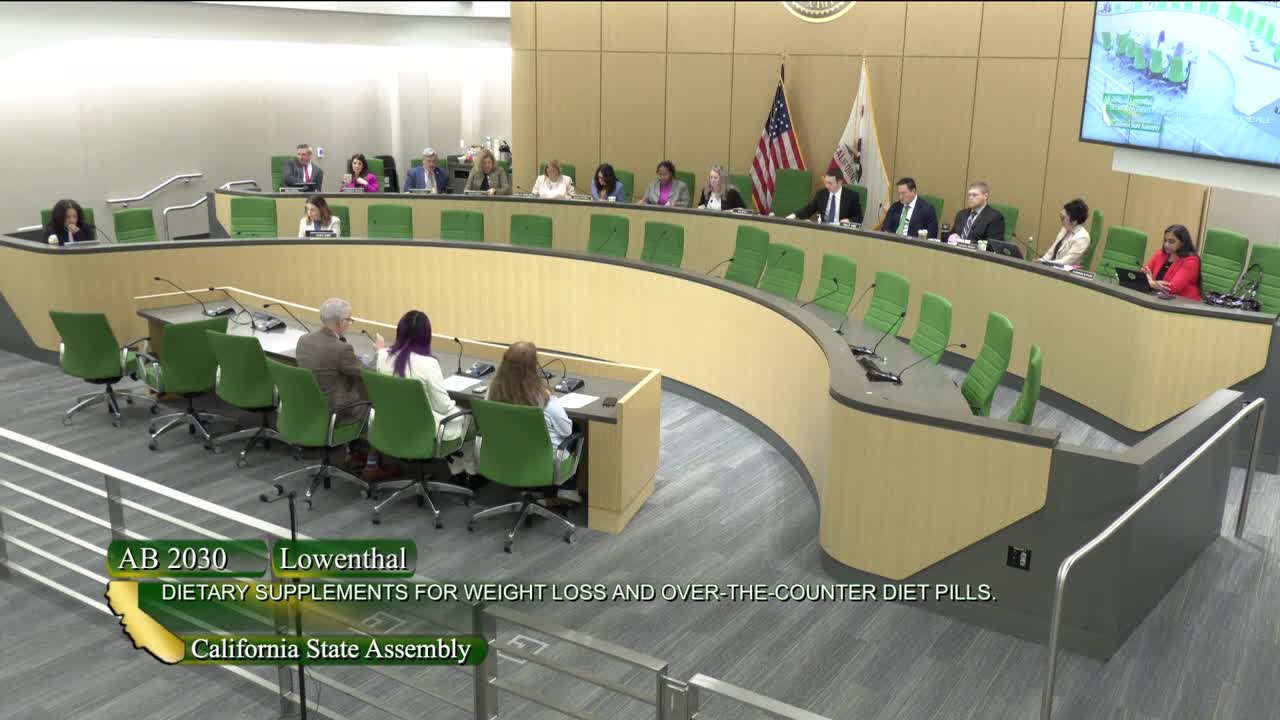 13MIN
Assembly Standing Committee on Health
1MIN
Assembly Standing Committee on Health
Bill Author

Bill Co-Author(s):