AB 2038: Residential property insurance: cancellations and nonrenewals.
- Session Year: 2025-2026
- House: Assembly
- Latest Version Date: 2026-09-30
Current Status:
Passed
(2026-09-30: Chaptered by Secretary of State - Chapter 917, Statutes of 2026.)
Introduced
In Committee
Awaiting First Chamber Vote
Passed First Chamber
In Committee
Awaiting Second Chamber Vote
Passed Second Chamber
Enacted
What does this bill do?
The bill requires insurers to renew residential property insurance for at least three annual renewal periods (no less than 36 months) after a disaster-caused total loss of a primary home and to consult with the homeowner to adjust coverage while the home is rebuilt. It also bars insurers from canceling or refusing to renew policies for properties in ZIP codes within or adjacent to a wildfire perimeter for two years after a declared state of emergency, except for intentional or seriously negligent acts, unrelated losses, or physical changes that make the property uninsurable.
The summary is provided by generative AI which can make mistakes. For original language, please view the details in the table below.
Existing law generally regulates classes of insurance, including residential property insurance. Existing law requires an insurer, in the case of a total loss to the primary insured structure under a policy of residential property insurance, for at least the next two annual renewal periods, but no less than 24 months of coverage from the date of the loss, to renew the policy under certain circumstances, including that the total loss to the primary insured structure was caused by a disaster. Existing law prohibits an insurer from canceling or refusing to renew a policy of residential property insurance for a property located in a ZIP Code within or adjacent to a fire perimeter for one year after the declaration of a state of emergency, if the cancellation or nonrenewal is based solely on the fact that the insured structure is located in an area in which a wildfire has occurred.
This bill would instead require an insurer to renew the policy of residential property insurance, under the above-described circumstances, for at least the next three annual renewal periods, but no less than 36 months of coverage from the date of the loss. The bill would also prohibit an insurer from canceling or refusing to renew a policy of residential property insurance for a property located in a ZIP Code within or adjacent to a fire perimeter for two years after the declaration of a state of emergency.
Existing law generally regulates classes of insurance, including residential property insurance. Existing law requires an insurer, in the case of a total loss to the primary insured structure under a policy of residential property insurance, for at least the next two annual renewal periods, but no less than 24 months of coverage from the date of the loss, to renew the policy under certain circumstances, including that the total loss to the primary insured structure was caused by a disaster. Existing law prohibits an insurer from canceling or refusing to renew a policy of residential property insurance for a property located in a ZIP Code within or adjacent to a fire perimeter for one year after the declaration of a state of emergency, if the cancellation or nonrenewal is based solely on the fact that the insured structure is located in an area in which a wildfire has occurred.
This bill would instead require an insurer to renew the policy of residential property insurance, under the above-described circumstances, for at least the next three annual renewal periods, but no less than 36 months of coverage from the date of the loss. The bill would also prohibit an insurer from canceling or refusing to renew a policy of residential property insurance for a property located in a ZIP Code within or adjacent to a fire perimeter for two years after the declaration of a state of emergency.
Existing law generally regulates classes of insurance, including residential property insurance. Existing law requires an insurer, in the case of a total loss to the primary insured structure under a policy of residential property insurance, for at least the next two annual renewal periods, but no less than 24 months of coverage from the date of the loss, to renew the policy under certain circumstances, including that the total loss to the primary insured structure was caused by a disaster. Existing law prohibits an insurer from canceling or refusing to renew a policy of residential property insurance for a property located in a ZIP Code within or adjacent to a fire perimeter for one year after the declaration of a state of emergency, if the cancellation or nonrenewal is based solely on the fact that the insured structure is located in an area in which a wildfire has occurred.
This bill would instead require an insurer to renew the policy of residential property insurance, under the above-described circumstances, for at least the next three annual renewal periods, but no less than 36 months of coverage from the date of the loss. The bill would also prohibit an insurer from canceling or refusing to renew a policy of residential property insurance for a property located in a ZIP Code within or adjacent to a fire perimeter for two years after the declaration of a state of emergency.
Existing law requires the Insurance Commissioner, upon application, to issue a crop insurance adjuster license to a person who has met specified requirements, including that they have satisfactorily completed the loss adjustment training curriculum and competency testing required by the Federal Crop Insurance Corporation Standard Reinsurance Agreement.This bill would make technical, nonsubstantive changes to this provision.Existing law requires the Insurance Commissioner, upon application, to issue a crop insurance adjuster license to a person who has met specified requirements, including that they have satisfactorily completed the loss adjustment training curriculum and competency testing required by the Federal Crop Insurance Corporation Standard Reinsurance Agreement.
This bill would make technical, nonsubstantive changes to this provision.
The Legislature finds and declares all of the following:
(a)Wildfires continue to cause widespread destruction of homes across California, displacing families and destabilizing insurance markets in affected communities.
(b)Senate Bill 824 (Chapter 616 of the Statutes of 2018) established a mandatory one-year moratorium on residential insurance cancellations and nonrenewals following a wildfire-related state of emergency.
(c)In practice, recovery and rebuilding following a catastrophic wildfire routinely takes multiple years, particularly for homeowners who suffer a total loss of their residence.
(d)Extending and tailoring the nonrenewal moratorium based on the severity of loss is necessary to ensure housing stability, prevent displacement, and allow homeowners a meaningful opportunity to rebuild and mitigate risk.
(e)It is the intent of the Legislature to strengthen consumer protections by expanding the Insurance Commissioners authority to prohibit residential insurance nonrenewals following wildfires while maintaining a narrowly tailored, loss-based framework.
SEC. 2.Section 675.1 of the Insurance Code is amended to read:675.1.(a)In the case of a total loss to the primary insured structure under a policy of residential property insurance subject to Section 675, the following provisions apply:
(1)If reconstruction of the primary insured structure has not been completed by the time of policy renewal, the insurer, prior to or at the time of renewal, and after consultation by the insurer or its representative with the insured as to what limits and coverages might or might not be needed, shall adjust the limits and coverages, write an additional policy, or attach an endorsement to the policy that reflects the change, if any, in the insureds exposure to loss. The insurer shall adjust the premium charged to reflect any change in coverage.
(2)The insurer shall not cancel coverage while the primary insured structure is being rebuilt, except for the reasons specified in subdivisions (a) to (e), inclusive, of Section 676. The insurer shall not use the fact that the primary insured structure is in damaged condition as a result of the total loss as the sole basis for a decision to cancel the policy pursuant to subdivision (e) of that section.
(3)Except for the reasons specified in subdivisions (a) to (e), inclusive, of Section 676, the insurer shall offer, for at least the next three annual renewal periods, but no less than 36 months of coverage from the date of the loss, to renew the policy in accordance with paragraph (1) if the total loss to the primary insured structure was caused by a disaster, as defined in subdivision (b) of Section 1689.14 of the Civil Code, the loss was not also due to the negligence of the insured, and losses have not occurred subsequent to the disaster-related total loss that relate to physical or risk changes to the insured property that result in the property becoming uninsurable.
(4)With respect to policies of residential earthquake insurance, the California Earthquake Authority, or any insurer, including a participating insurer, as defined in subdivision (i) of Section 10089.5, may defer its initial implementation of this section until no later than October 1, 2005.
(5)With respect to a residential earthquake insurance policy issued by the California Earthquake Authority, the following provisions apply:
(A)The participating insurer that issued the underlying policy of residential property insurance on the primary insured structure shall consult with the insured as to what limits and coverages might or might not be needed as required by paragraph (1).
(B)The California Earthquake Authority, in lieu of meeting the requirements of paragraph (1), shall establish procedures and practices that allow it to reasonably accommodate the needs and interests of consumers in maintaining appropriate earthquake insurance coverage, within the statutory and regulatory limitations on the types of insurance coverages and the coverage limits of the policies that the authority may issue.
(b)(1)An insurer shall not cancel or refuse to renew a policy of residential property insurance for a property located in any ZIP Code within or adjacent to the fire perimeter, for two years after the declaration of a state of emergency, as defined in Section 8558 of the Government Code, based solely on the fact that the insured structure is located in an area in which a wildfire has occurred. This prohibition applies to all policies of residential property insurance in effect at the time of the declared emergency.
(2)For the purposes of this section, the fire perimeter shall be determined by the Department of Forestry and Fire Protection in consultation with the Office of Emergency Services. The department shall provide the commissioner with data describing the fire perimeter sufficient for the commissioner to determine which ZIP Codes are within or adjacent to the fire perimeter. The commissioner shall then issue a bulletin to inform insurers which ZIP Codes are subject to this subdivision.
(c)Subdivision (b) does not apply in any of the following circumstances:
(1)If willful or grossly negligent acts or omissions by the named insured, or his or her representatives, are discovered that materially increase any of the risks insured against.
(2)If losses unrelated to the postdisaster loss condition of the property have occurred that would collectively render the risk ineligible for renewal.
(3)If there are physical or risk changes to the insured property beyond the catastrophe-damaged condition of the structures and surface landscape that result in the property becoming uninsurable.
(d)For the purposes of this section, policy of residential property insurance has the meaning described in subdivision (a) of Section 10087.
The Legislature finds and declares all of the following:
(a)Wildfires continue to cause widespread destruction of homes across California, displacing families and destabilizing insurance markets in affected communities.
(b)Senate Bill 824 (Chapter 616 of the Statutes of 2018) established a mandatory one-year moratorium on residential insurance cancellations and nonrenewals following a wildfire-related state of emergency.
(c)In practice, recovery and rebuilding following a catastrophic wildfire routinely takes multiple years, particularly for homeowners who suffer a total loss of their residence.
(d)Extending and tailoring the nonrenewal moratorium based on the severity of loss is necessary to ensure housing stability, prevent displacement, and allow homeowners a meaningful opportunity to rebuild and mitigate risk.
(e)It is the intent of the Legislature to strengthen consumer protections by expanding the Insurance Commissioners authority to prohibit residential insurance nonrenewals following wildfires while maintaining a narrowly tailored, loss-based framework.
SEC. 2.Section 675.1 of the Insurance Code is amended to read:675.1.(a)In the case of a total loss to the primary insured structure under a policy of residential property insurance subject to Section 675, the following provisions apply:
(1)If reconstruction of the primary insured structure has not been completed by the time of policy renewal, the insurer, prior to or at the time of renewal, and after consultation by the insurer or its representative with the insured as to what limits and coverages might or might not be needed, shall adjust the limits and coverages, write an additional policy, or attach an endorsement to the policy that reflects the change, if any, in the insureds exposure to loss. The insurer shall adjust the premium charged to reflect any change in coverage.
(2)The insurer shall not cancel coverage while the primary insured structure is being rebuilt, except for the reasons specified in subdivisions (a) to (e), inclusive, of Section 676. The insurer shall not use the fact that the primary insured structure is in damaged condition as a result of the total loss as the sole basis for a decision to cancel the policy pursuant to subdivision (e) of that section.
(3)Except for the reasons specified in subdivisions (a) to (e), inclusive, of Section 676, the insurer shall offer, for at least the next three annual renewal periods, but no less than 36 months of coverage from the date of the loss, to renew the policy in accordance with paragraph (1) if the total loss to the primary insured structure was caused by a disaster, as defined in subdivision (b) of Section 1689.14 of the Civil Code, the loss was not also due to the negligence of the insured, and losses have not occurred subsequent to the disaster-related total loss that relate to physical or risk changes to the insured property that result in the property becoming uninsurable.
(4)With respect to policies of residential earthquake insurance, the California Earthquake Authority, or any insurer, including a participating insurer, as defined in subdivision (i) of Section 10089.5, may defer its initial implementation of this section until no later than October 1, 2005.
(5)With respect to a residential earthquake insurance policy issued by the California Earthquake Authority, the following provisions apply:
(A)The participating insurer that issued the underlying policy of residential property insurance on the primary insured structure shall consult with the insured as to what limits and coverages might or might not be needed as required by paragraph (1).
(B)The California Earthquake Authority, in lieu of meeting the requirements of paragraph (1), shall establish procedures and practices that allow it to reasonably accommodate the needs and interests of consumers in maintaining appropriate earthquake insurance coverage, within the statutory and regulatory limitations on the types of insurance coverages and the coverage limits of the policies that the authority may issue.
(b)(1)An insurer shall not cancel or refuse to renew a policy of residential property insurance for a property located in any ZIP Code within or adjacent to the fire perimeter, for two years after the declaration of a state of emergency, as defined in Section 8558 of the Government Code, based solely on the fact that the insured structure is located in an area in which a wildfire has occurred. This prohibition applies to all policies of residential property insurance in effect at the time of the declared emergency.
(2)For the purposes of this section, the fire perimeter shall be determined by the Department of Forestry and Fire Protection in consultation with the Office of Emergency Services. The department shall provide the commissioner with data describing the fire perimeter sufficient for the commissioner to determine which ZIP Codes are within or adjacent to the fire perimeter. The commissioner shall then issue a bulletin to inform insurers which ZIP Codes are subject to this subdivision.
(c)Subdivision (b) does not apply in any of the following circumstances:
(1)If willful or grossly negligent acts or omissions by the named insured, or his or her representatives, are discovered that materially increase any of the risks insured against.
(2)If losses unrelated to the postdisaster loss condition of the property have occurred that would collectively render the risk ineligible for renewal.
(3)If there are physical or risk changes to the insured property beyond the catastrophe-damaged condition of the structures and surface landscape that result in the property becoming uninsurable.
(d)For the purposes of this section, policy of residential property insurance has the meaning described in subdivision (a) of Section 10087.
The Legislature finds and declares all of the following:
(a)Wildfires continue to cause widespread destruction of homes across California, displacing families and destabilizing insurance markets in affected communities.
(b)Senate Bill 824 (Chapter 616 of the Statutes of 2018) established a mandatory one-year moratorium on residential insurance cancellations and nonrenewals following a wildfire-related state of emergency.
(c)In practice, recovery and rebuilding following a catastrophic wildfire routinely takes multiple years, particularly for homeowners who suffer a total loss of their residence.
(d)Extending and tailoring the nonrenewal moratorium based on the severity of loss is necessary to ensure housing stability, prevent displacement, and allow homeowners a meaningful opportunity to rebuild and mitigate risk.
(e)It is the intent of the Legislature to strengthen consumer protections by expanding the Insurance Commissioners authority to prohibit residential insurance nonrenewals following wildfires while maintaining a narrowly tailored, loss-based framework.
SEC. 2.Section 675.1 of the Insurance Code is amended to read:675.1.(a)In the case of a total loss to the primary insured structure under a policy of residential property insurance subject to Section 675, the following provisions apply:
(1)If reconstruction of the primary insured structure has not been completed by the time of policy renewal, the insurer, prior to or at the time of renewal, and after consultation by the insurer or its representative with the insured as to what limits and coverages might or might not be needed, shall adjust the limits and coverages, write an additional policy, or attach an endorsement to the policy that reflects the change, if any, in the insureds exposure to loss. The insurer shall adjust the premium charged to reflect any change in coverage.
(2)The insurer shall not cancel coverage while the primary insured structure is being rebuilt, except for the reasons specified in subdivisions (a) to (e), inclusive, of Section 676. The insurer shall not use the fact that the primary insured structure is in damaged condition as a result of the total loss as the sole basis for a decision to cancel the policy pursuant to subdivision (e) of that section.
(3)Except for the reasons specified in subdivisions (a) to (e), inclusive, of Section 676, the insurer shall offer, for at least the next two three annual renewal periods, but no less than 24 36 months of coverage from the date of the loss, to renew the policy in accordance with paragraph (1) if the total loss to the primary insured structure was caused by a disaster, as defined in subdivision (b) of Section 1689.14 of the Civil Code, the loss was not also due to the negligence of the insured, and losses have not occurred subsequent to the disaster-related total loss that relate to physical or risk changes to the insured property that result in the property becoming uninsurable.
(4)With respect to policies of residential earthquake insurance, the California Earthquake Authority, or any insurer, including a participating insurer, as defined in subdivision (i) of Section 10089.5, may defer its initial implementation of this section until no later than October 1, 2005.
(5)With respect to a residential earthquake insurance policy issued by the California Earthquake Authority, the following provisions apply:
(A)The participating insurer that issued the underlying policy of residential property insurance on the primary insured structure shall consult with the insured as to what limits and coverages might or might not be needed as required by paragraph (1).
(B)The California Earthquake Authority, in lieu of meeting the requirements of paragraph (1), shall establish procedures and practices that allow it to reasonably accommodate the needs and interests of consumers in maintaining appropriate earthquake insurance coverage, within the statutory and regulatory limitations on the types of insurance coverages and the coverage limits of the policies that the authority may issue.
(b)(1)An insurer shall not cancel or refuse to renew a policy of residential property insurance for a property located in any ZIP Code within or adjacent to the fire perimeter, for one year two years after the declaration of a state of emergency, as defined in Section 8558 of the Government Code, based solely on the fact that the insured structure is located in an area in which a wildfire has occurred. This prohibition applies to all policies of residential property insurance in effect at the time of the declared emergency.
(2)For the purposes of this section, the fire perimeter shall be determined by the Department of Forestry and Fire Protection in consultation with the Office of Emergency Services. The department shall provide the commissioner with data describing the fire perimeter sufficient for the commissioner to determine which ZIP Codes are within or adjacent to the fire perimeter. The commissioner shall then issue a bulletin to inform insurers which ZIP Codes are subject to this subdivision.
(c)Subdivision (b) does not apply in any of the following circumstances:
(1)If willful or grossly negligent acts or omissions by the named insured, or his or her representatives, are discovered that materially increase any of the risks insured against.
(2)If losses unrelated to the postdisaster loss condition of the property have occurred that would collectively render the risk ineligible for renewal.
(3)If there are physical or risk changes to the insured property beyond the catastrophe-damaged condition of the structures and surface landscape that result in the property becoming uninsurable.
(d)For the purposes of this section, policy of residential property insurance has the meaning described in subdivision (a) of Section 10087.
SECTION 1.Section 14085 of the Insurance Code is amended to read:14085.(a)Upon application, the commissioner shall issue a crop insurance adjuster license to a person who meets both of the following requirements:(1)Obtains an insurance adjuster license, with the exception of the examination requirement of Section 14026.(2)Provides evidence that they have satisfactorily completed the loss adjustment training curriculum and competency testing required by the Federal Crop Insurance Corporation Standard Reinsurance Agreement.(b)For the purposes of this article, the following definitions apply:(1)Crop insurance means insurance provided by the private insurance market that indemnifies for damage to crops from unfavorable weather conditions, fire, lightning, flood, hail, insect infestation, disease, or other yield-reducing conditions or perils, and multiple peril crop insurance reinsured by the federal crop insurance corporation.(2)Crop insurance adjuster means a person who investigates, negotiates, or settles crop insurance claims.(c)A person shall not act as or purport to be a crop insurance adjuster unless licensed as a crop insurance adjuster.(d)A person shall not contract, employ, or use any other person to adjust claims made under a crop insurance policy unless the other person is licensed as a crop insurance adjuster.(e)All provisions of this chapter and any regulations adopted pursuant to this chapter shall apply to crop insurance adjusters, unless exempted by, or in conflict with, this article or the regulations adopted pursuant to this article.(f)The commissioner may adopt regulations to implement this article, including, but not limited to, regulations that require applicants to satisfy other competency requirements in addition to or instead of those referred to in paragraph (2) of subdivision (a), and regulations that establish standards of practice for crop insurance adjusters.(a)Upon application, the commissioner shall issue a crop insurance adjuster license to a person who meets both of the following requirements:
(1)Obtains an insurance adjuster license, with the exception of the examination requirement of Section 14026.
(2)Provides evidence that he or she has they have satisfactorily completed the loss adjustment training curriculum and competency testing required by the Federal Crop Insurance Corporation Standard Reinsurance Agreement.
(b)For the purposes of this article, the following definitions apply:
(1)Crop insurance means insurance provided by the private insurance market that indemnifies for damage to crops from unfavorable weather conditions, fire, lightning, flood, hail, insect infestation, disease, or other yield-reducing conditions or perils, and multiple peril crop insurance reinsured by the federal crop insurance corporation.
(2)Crop insurance adjuster means a person who investigates, negotiates, or settles crop insurance claims.
(c)A person shall not act as or purport to be a crop insurance adjuster unless licensed as a crop insurance adjuster.
(d)A person shall not contract, employ, or use any other person to adjust claims made under a crop insurance policy unless the other person is licensed as a crop insurance adjuster.
(e)All provisions of this chapter and any regulations adopted pursuant to this chapter shall apply to crop insurance adjusters, unless exempted by by, or in conflict with with, this article or the regulations adopted pursuant to this article.
(f)The commissioner may adopt regulations to implement this article, including, but not limited to, regulations that require applicants to satisfy other competency requirements in addition to or instead of those referred to in paragraph (2) of subdivision (a), and regulations that establish standards of practice for crop insurance adjusters.
|
Date
|
Status
|
|---|---|
| Sep 30, 2026 | Chaptered by Secretary of State - Chapter 917, Statutes of 2026. |
| Sep 30, 2026 | Approved by the Governor. |
| Sep 3, 2026 | Enrolled and presented to the Governor at 4 p.m. |
| Aug 27, 2026 | In Assembly. Ordered to Engrossing and Enrolling. |
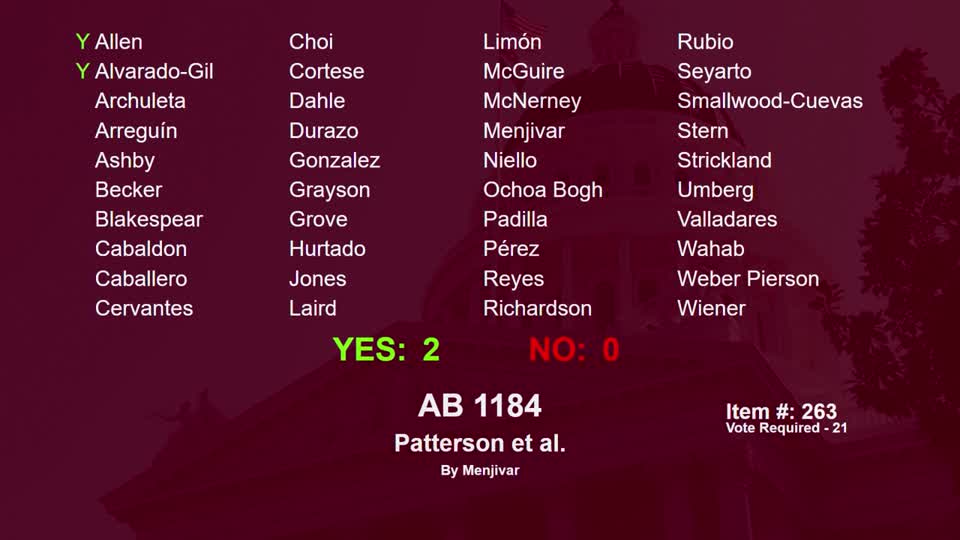
| Aug 26, 2026 | Read third time. Passed. Ordered to the Assembly. (Ayes 27. Noes 5.). |
| Aug 13, 2026 | Read second time. Ordered to third reading. |
| Aug 13, 2026 | From committee: Do pass. (Ayes 6. Noes 1.) (August 13). |
| Jun 29, 2026 | In committee: Referred to APPR. suspense file. |
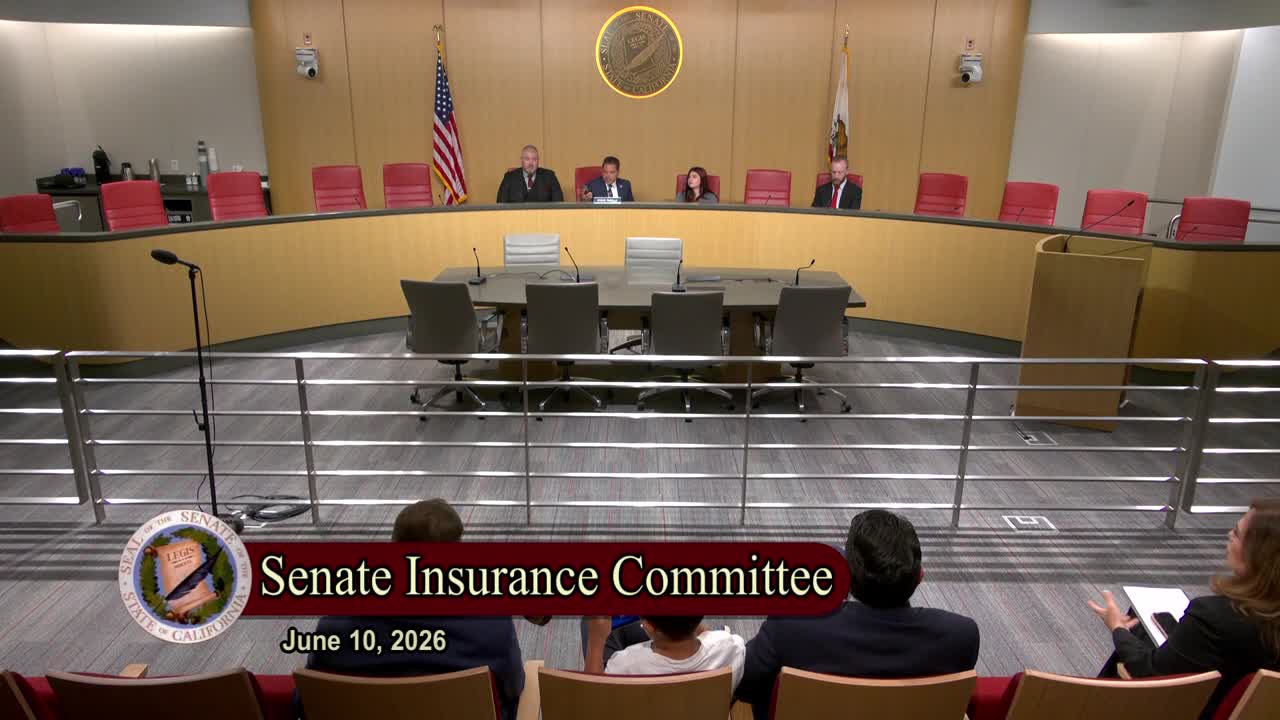
| Jun 10, 2026 | From committee: Do pass and re-refer to Com. on APPR. (Ayes 4. Noes 0.) (June 10). Re-referred to Com. on APPR. |
| May 20, 2026 | Referred to Com. on INS. |
| May 12, 2026 | In Senate. Read first time. To Com. on RLS. for assignment. |
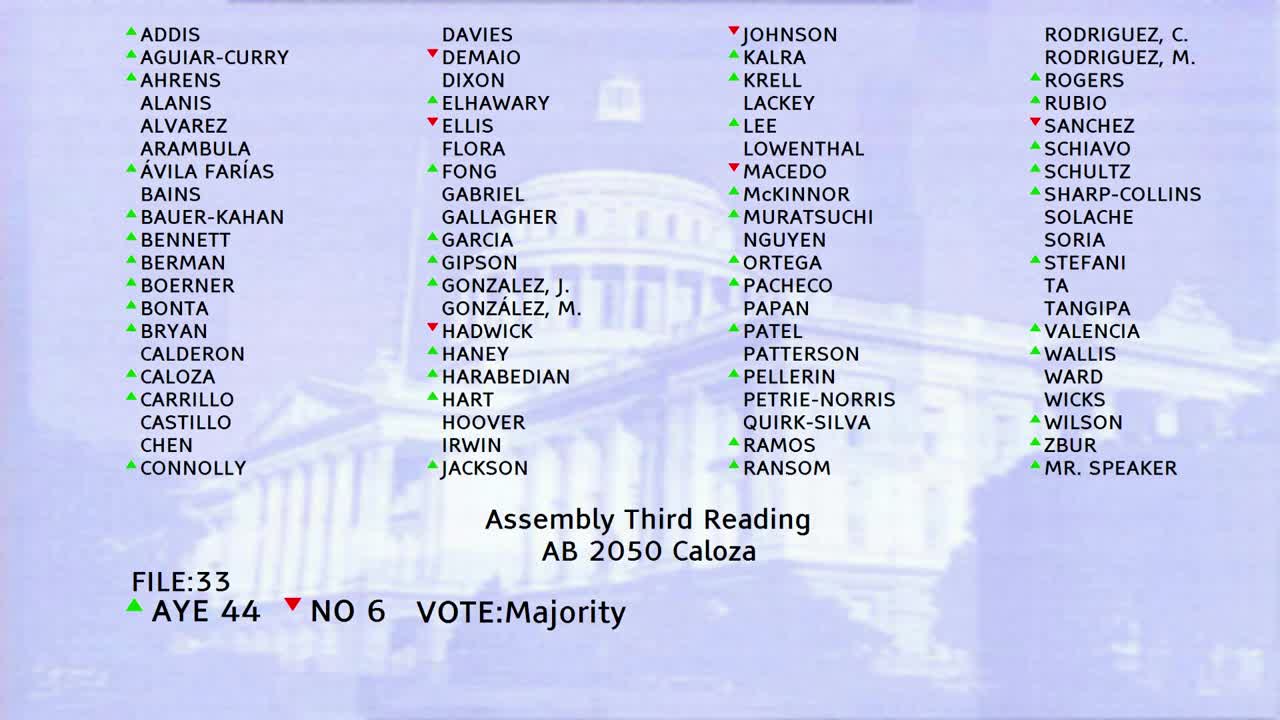
| May 11, 2026 | Read third time. Passed. Ordered to the Senate. (Ayes 53. Noes 9.) |
| May 11, 2026 | Read third time. Passed. Ordered to the Senate. (Ayes 53. Noes 9. Page 4991.) |
| May 11, 2026 | Read third time. Passed. Ordered to the Senate. |
| Apr 30, 2026 | Read second time. Ordered to third reading. |
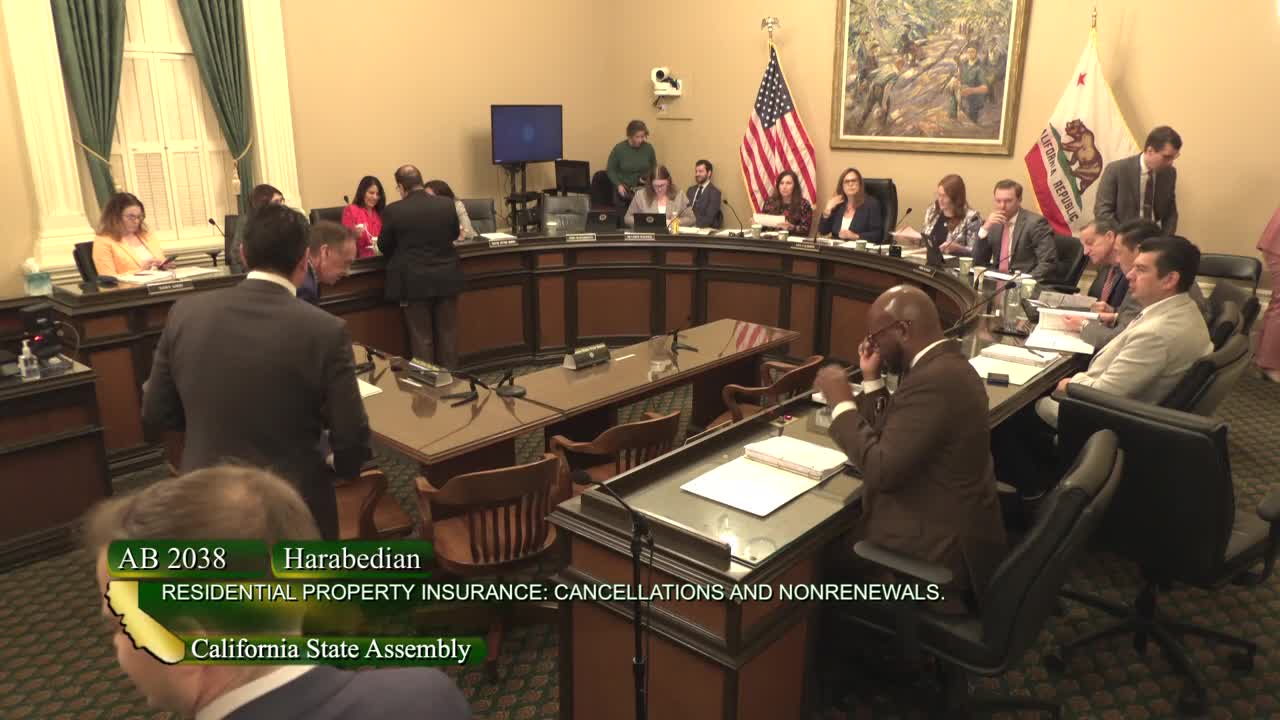
| Apr 29, 2026 | From committee: Do pass. (Ayes 10. Noes 1.) (April 29). |
| Apr 15, 2026 | From committee: Do pass and re-refer to Com. on APPR. (Ayes 13. Noes 3.) (April 15). Re-referred to Com. on APPR. |
| Mar 17, 2026 | Re-referred to Com. on INS. |
| Mar 16, 2026 | Referred to Com. on INS. |
| Mar 16, 2026 | From committee chair, with author's amendments: Amend, and re-refer to Com. on INS. Read second time and amended. |
| Feb 18, 2026 | From printer. May be heard in committee March 20. |
| Feb 17, 2026 | Read first time. To print. |
|
Date
|
Description
|
Location
|
Votes
|
|
|---|---|---|---|---|
| Aug 26, 2026 | Assembly 3rd Reading AB2038 Harabedian et al. By Pérez | Senate Floor |
Passed |
|
| Aug 13, 2026 | Do pass | Senate Standing Committee on Appropriations |
Passed |
|
| Jun 29, 2026 | Placed on suspense file | Senate Standing Committee on Appropriations |
Passed |
|
| Jun 10, 2026 | Do pass, but first be re-referred to the Committee on [Appropriations] | Senate Standing Committee on Insurance |
Passed |
|
| May 11, 2026 | AB 2038 Harabedian Assembly Third Reading | Assembly Floor |
Passed |
|
| Apr 29, 2026 | Do pass. | Assembly Standing Committee on Appropriations |
Passed |
|
| Apr 15, 2026 | Do pass and be re-referred to the Committee on [Appropriations] | Assembly Standing Committee on Insurance |
Passed |
This list shows positions taken on this bill by organizations on the date displayed, which is linked to the original source.
Positions by individuals are not included.
|
Organization
|
Position
|
Date
|
|---|---|---|
| American Property Casualty Insurance Association | ** Against | |
| California Community Foundation | ** Support | |
| Consumer Attorneys Of California | ** Support | |
| Consumer Federation of America | ** Support | |
| Consumer Federation Of California | ** Support | |
| Consumer Watchdog | ** Support | |
| Courage California | ** Support | |
| Extreme Weather Survivors Action Fund | ** Support | |
| Insurance Commissioner Ricardo Lara / California Department of Insurance | ** Support | |
| League Of California Cities | ** Support | |
| National Association of Mutual Insurance Companies | ** Against | |
| Nevada County Board of Supervisors | ** Support | |
| Pacific Association Of Domestic Insurance Companies | ** Against | |
| Pasadenans Organizing for Progress | ** Support | |
| Personal Insurance Federation Of California | ** Against | |
| Rise Economy | ** Support | |
| Rural County Representatives of California | ** Support |
SENATE RULES COMMITTEE Office of Senate Floor Analyses (916) 651-4171 | AB 2038 |
THIRD READING
Bill No: AB 2038
Author: Harabedian (D) and Zbur (D)
Amended: 3/16/26 in Assembly
Vote: 21
SENATE INSURANCE COMMITTEE: 4-0, 6/10/26
AYES: Padilla, Becker, Menjivar, Richardson
NO VOTE RECORDED: Niello, Jones, Rubio
SENATE APPROPRIATIONS COMMITTEE: 6-1, 8/13/26
AYES: Cervantes, Cabaldon, Dahle, Grayson, Richardson, Wahab
NOES: Seyarto
ASSEMBLY FLOOR: 53-9, 5/11/26 - See last page for vote
SUBJECT: Residential property insurance: cancellations and nonrenewals
SOURCE: Author
DIGEST:
This bill requires an insurer to offer to their policyholders, when a disaster-related total loss of a primary residential property occurs, coverage for at least the next three annual renewal periods, but no less than 36 months of coverage from the date of the total loss. Additionally, this bill prohibits an insurer from canceling or refusing to renew a policy of residential property insurance for a property located in any ZIP Code within or adjacent to a fire perimeter for two years after the declaration of a state of emergency.
ANALYSIS:
Existing law:
- States that for one year after the declaration of a state of emergency, an insurer cannot cancel or refuse to renew a residential property insurance policy for a property located in any ZIP Code within or adjacent to a fire perimeter, based on the fact that the insured structure is located in a wildfire area.
- Describes that such a fire perimeter is determined by Department of Forestry and Fire Protection (CAL FIRE) in consultation with the Office of Emergency Services (Cal OES). Subsequently, CAL FIRE must provide the Insurance Commissioner with data describing the fire perimeter so that the Commissioner may determine which ZIP Codes are within or adjacent to the fire perimeter. The Commissioner must then issue a bulletin to inform insurers which ZIP Codes are subject to this one-year moratorium.
- Creates exceptions to this moratorium in cases where the policyholder was willfully or grossly negligent, or if there are losses, physical, or risk changes to the property unrelated to the damage caused by the catastrophe.
- Defines a “state of emergency” as the duly proclaimed existence of conditions of disaster or extreme peril to the safety of persons and property within the state, caused by conditions such as air pollution, fire, flood, storm, epidemic, riot, drought, cyberterrorism, sudden and severe energy shortage, electromagnetic pulse attack, plant or animal infestation or disease, among other conditions.
This bill:
- Requires an insurer to offer to policyholders coverage for at least the next three annual renewal periods, but no less than 36 months of coverage from the date when a disaster-related total loss of a primary residential property occurs.
- Prohibits an insurer from canceling or refusing to renew a policy of residential property insurance for a property located in any ZIP Code within or adjacent to a fire perimeter for two years after the declaration of a state of emergency.
Related/Prior Legislation
SB 547 (Perez, Chapter 544, Statutes of 2025). Expanded to commercial property insurance the prohibition against an insurer cancelling or refusing to renew a residential property insurance policy for one year from the declaration of a state of emergency, if the residential property is located within the perimeter of a wildfire or in an adjacent ZIP Code.
SB 824 (Lara, Chapter 616, Statutes of 2018). Instituted, among other things, the one-year cancellation and nonrenewal moratorium after a wildfire emergency for residential property insurance policyholders in ZIP Codes within or adjacent to a fire perimeter.
SB 894 (Dodd, Chapter 618, Statues of 2018). Required, among other things, an insurer to offer a homeowner who suffers a total loss two renewals of the property insurance policy covering the home, and at least 24 months of coverage after the loss, subject to exceptions.
FISCAL EFFECT: Appropriation: No Fiscal Com.: Yes Local: No
According to the Senate Appropriations Committee:
The California Department of Insurance reports costs of $75,000 in Fiscal Year (FY) 2026-27, $150,000 in FY 2027-28, and $100,000 in FY 2028-29 and ongoing (Insurance Fund). These costs are associated with notifying insurers about the extended coverage requirements and updating bulletins, as well as additional enforcement workload for complaint intake and resolution. Additionally, CDI notes concerns that this bill may impact the resolution of future insurance company concentration risks. While the one-year moratorium in current law aligns with the standard timeframe of one-year insurance policies, the bill’s proposed two-year moratorium will increase the number of overlapping moratoriums statewide. Consequently, CDI anticipates this will lead to an increase in consumer questions and complaints.
SUPPORT: (Verified 8/13/26)
Insurance Commissioner Ricardo Lara / California Department of Insurance
California Community Foundation
Consumer Attorneys of California
Consumer Federation of America
Consumer Federation of California
Consumer Watchdog
Courage California
Extreme Weather Survivors Action Fund
League of California Cities
Nevada County Board of Supervisors
Pasadenans Organizing for Progress
Rise Economy
Rural County Representatives of California
OPPOSITION: (Verified 8/13/26)
American Property Casualty Insurance Association
National Association of Mutual Insurance Companies
Pacific Association of Domestic Insurance Companies
Personal Insurance Federation of California
ARGUMENTS IN SUPPORT:
According to Consumer Watchdog:
“Wildfires continue to devastate communities across California, displacing families and destroying homes at an alarming scale. The January 2025 Eaton and Palisades fires alone left nearly 192,000 residents displaced throughout Altadena and Los Angeles County. For these families, recovery is not a matter of months, it is a process that takes years, often accompanied by significant financial and emotional strain.
Current law establishes a one-year moratorium for properties located within or adjacent to fire perimeter ZIP Codes, and a two-year moratorium for total losses, timelines that don’t reflect the reality of rebuilding today. Homeowners frequently face prolonged delays in insurance payouts and are forced to cover substantial out-of-pocket costs while navigating an already difficult recovery process.
By extending the moratorium period this bill ensures that homeowners are not at risk of losing their insurance coverage while they are still working to rebuild their lives. This added stability is critical for families trying to recover and for maintaining the long-term resilience of our communities. AB 2038 aligns policy protections with the real-world challenges Californians face after disasters.”
ARGUMENTS IN OPPOSITION:
The insurance associations known as the “Trades” state:
“Limiting insurers’ capacity to appropriately manage and rebalance risk for extended periods of time eliminates insurers’ ability to respond to changing conditions, including increased wildfire exposure, inflation in rebuilding costs, and evolving catastrophe modeling. Without the ability to appropriately adjust portfolios, insurers are forced to retain risks that may no longer be actuarially sound.
Over time, this imbalance can have serious consequences. Restricting insurers’ ability to adjust their portfolios may lead to increased financial strain, reduced capacity, and ultimately fewer coverage options for consumers. If an insurer cannot manage their risk concentration in one area of the state, under AB 2038 they may be forced to nonrenew properties outside of these emergency declaration ZIP Codes. This could result in more properties that are lower risk being driven to the FAIR Plan.
California’s property insurance market is already under significant pressure. Measures that further restrict insurers’ ability to manage risk will exacerbate existing challenges, ultimately reducing availability and choice for consumers. A healthy insurance market depends on a balanced legislative and regulatory framework that allows insurers to operate responsibly while maintaining the flexibility necessary to remain solvent and competitive.”
ASSEMBLY FLOOR: 53-9, 5/11/26
AYES: Addis, Aguiar-Curry, Ahrens, Alvarez, Ávila Farías, Bains, Bauer-Kahan, Bennett, Berman, Boerner, Bonta, Bryan, Calderon, Caloza, Carrillo, Connolly, Elhawary, Fong, Gabriel, Garcia, Gipson, Mark González, Haney, Harabedian, Hart, Irwin, Jackson, Kalra, Krell, Lee, McKinnor, Muratsuchi, Nguyen, Ortega, Pacheco, Papan, Patel, Pellerin, Petrie-Norris, Ramos, Ransom, Rogers, Blanca Rubio, Schiavo, Schultz, Sharp-Collins, Stefani, Valencia, Ward, Wicks, Wilson, Zbur, Rivas
NOES: Chen, DeMaio, Ellis, Hadwick, Johnson, Lackey, Macedo, Patterson, Tangipa
NO VOTE RECORDED: Alanis, Arambula, Castillo, Davies, Dixon, Flora, Gallagher, Jeff Gonzalez, Hoover, Lowenthal, Quirk-Silva, Celeste Rodriguez, Michelle Rodriguez, Sanchez, Solache, Soria, Ta, Wallis
Prepared by: Brandon Seto / INS. / (916) 651-4110
8/15/26 11:07:01
**** END ****
SENATE COMMITTEE ON
Senator Sabrina Cervantes, Chair
2025 - 2026 Regular Session
AB 2038 (Harabedian) - Residential property insurance: cancellations and nonrenewals
Version: | Policy Vote: |
Urgency: | Mandate: |
Hearing Date: | Consultant: |
Bill Summary:
AB 2038 requires insurers to offer their policyholders coverage for at least the next three annual renewal periods (no less than 36 months from the date of the loss) following a disaster-related total loss of a primary residence, and prohibits insurers from canceling or refusing to renew residential property policies for properties in ZIP Codes within or adjacent to a fire perimeter for two years after a declared state of emergency.
Fiscal Impact:
The California Department of Insurance (CDI) reports costs of $75,000 in Fiscal Year (FY) 2026-27, $150,000 in FY 2027-28, and $100,000 in FY 2028-29 and ongoing (Insurance Fund). These costs are associated with notifying insurers about the extended coverage requirements and updating bulletins, as well as additional enforcement workload for complaint intake and resolution. Additionally, CDI notes concerns that this bill may impact the resolution of future insurance company concentration risks. While the one-year moratorium in current law aligns with the standard timeframe of one-year insurance policies, the bill’s proposed two-year moratorium will increase the number of overlapping moratoriums statewide. Consequently, CDI anticipates this will lead to an increase in consumer questions and complaints.
Background:
Current law requires insurers to offer their policyholders coverage for at least the next two annual renewal periods (no less than 24 months from the date of the loss) following a disaster-related total loss of a primary residence.
Current law also prohibits insurers from canceling or refusing to renew residential property policies for properties in ZIP Codes within or adjacent to a fire perimeter for one year after a declared state of emergency. Affected ZIP codes are identified through a multi-agency process. First, the Department of Forestry and Fire Protection (CAL FIRE) and the Office of Emergency Services (OES) establish the official fire perimeter and share this geographical data with the Insurance Commissioner. The Commissioner then uses this data to map out exactly which ZIP codes fall within or adjacent to the fire zone, ultimately issuing a formal bulletin to notify insurers of the areas subject to the moratorium.
Proposed Law:
- Requires an insurer to offer to their policyholders, when a disaster-related total loss of a primary residential property occurs, coverage for at least the next three annual renewal periods, but no less than 36 months of coverage from the date of the total loss.
- Prohibits an insurer from canceling or refusing to renew a policy of residential property insurance for a property located in any ZIP Code within or adjacent to a fire perimeter for two years after the declaration of a state of emergency.
- States legislative findings and declarations.
-- END --
SENATE COMMITTEE ON INSURANCE
Senator Stephen Padilla, Chair
2025 - 2026 Regular
Bill No: AB 2038 Hearing Date: June 10, 2026
Author: | Harabedian | ||
Version: | March 16, 2026 Amended | ||
Urgency: | No | Fiscal: | Yes |
Consultant: | Brandon Seto | ||
SUBJECT: Residential property insurance: cancellations and nonrenewals
DIGEST:
Requires an insurer to offer to their policyholders, when a disaster-related total loss of a primary residential property occurs, coverage for at least the next three annual renewal periods, but no less than 36 months of coverage from the date of the total loss. Additionally, prohibits an insurer from canceling or refusing to renew a policy of residential property insurance for a property located in any ZIP Code within or adjacent to a fire perimeter for two years after the declaration of a state of emergency.
ANALYSIS:
Existing law:
- States that for one year after the declaration of a state of emergency, an insurer cannot cancel or refuse to renew a residential property insurance policy for a property located in any ZIP Code within or adjacent to a fire perimeter, based on the fact that the insured structure is located in a wildfire area.
- Describes that such a fire perimeter is determined by Department of Forestry and Fire Protection (CAL FIRE) in consultation with the Office of Emergency Services (Cal OES). Subsequently, CAL FIRE must provide the Insurance Commissioner with data describing the fire perimeter so that the Commissioner may determine which ZIP Codes are within or adjacent to the fire perimeter. The Commissioner must then issue a bulletin to inform insurers which ZIP Codes are subject to this one-year moratorium.
- Creates exceptions to this moratorium in cases where the policyholder was willfully or grossly negligent, or if there are losses, physical, or risk changes to the property unrelated to the damage caused by the catastrophe.
- Defines a “state of emergency” as the duly proclaimed existence of conditions of disaster or extreme peril to the safety of persons and property within the state, caused by conditions such as air pollution, fire, flood, storm, epidemic, riot, drought, cyberterrorism, sudden and severe energy shortage, electromagnetic pulse attack, plant or animal infestation or disease, among other conditions.
This bill:
- Requires an insurer to offer to policyholders coverage for at least the next three annual renewal periods, but no less than 36 months of coverage from the date when a disaster-related total loss of a primary residential property occurs.
- Prohibits an insurer from canceling or refusing to renew a policy of residential property insurance for a property located in any ZIP Code within or adjacent to a fire perimeter for two years after the declaration of a state of emergency.
Background
According to the author:
More than a year after the Eaton and Palisades fires, many of the families I represent are still trying to rebuild what they lost. Recovery has not been a straight path: debris removal and permits take time, and insurance payments often come slowly, delaying construction. I also continue to hear from homeowners who are anxious about whether they will even be able to maintain or secure insurance coverage by the time they are finally able to rebuild. AB 2038 better aligns these protections with the realities of recovery by extending the moratorium from one to two years for homes located in or adjacent to a fire perimeter ZIP Code; and extending the moratorium from two to three years for homes declared a total loss. This bill is supported by a strong coalition including the League of California Cities, Rural County Representatives of California, consumer advocates and our Insurance Commissioner. Wildfire survivors should not have to worry about losing their insurance coverage while they are still trying to rebuild their homes and their lives.
Related/Prior Legislation
SB 547 (Perez, Chapter 544, Statutes of 2025). Expanded to commercial property insurance the prohibition against an insurer cancelling or refusing to renew a residential property insurance policy for one year from the declaration of a state of emergency, if the residential property is located within the perimeter of a wildfire or in an adjacent ZIP Code.
SB 824 (Lara, Chapter 616, Statutes of 2018). Instituted, among other things, the one-year cancellation and nonrenewal moratorium after a wildfire emergency for residential property insurance policyholders in ZIP Codes within or adjacent to a fire perimeter.
SB 894 (Dodd, Chapter 618, Statues of 2018). Required, among other things, an insurer to offer a homeowner who suffers a total loss two renewals of the property insurance policy covering the home, and at least 24 months of coverage after the loss, subject to exceptions.
ARGUMENTS IN SUPPORT:
According to Consumer Watchdog:
“Wildfires continue to devastate communities across California, displacing families and
destroying homes at an alarming scale. The January 2025 Eaton and Palisades fires alone left
nearly 192,000 residents displaced throughout Altadena and Los Angeles County. For these
families, recovery is not a matter of months, it is a process that takes years, often accompanied
by significant financial and emotional strain.
Current law establishes a one-year moratorium for properties located within or adjacent to fire
perimeter ZIP Codes, and a two-year moratorium for total losses, timelines that don’t reflect the
reality of rebuilding today. Homeowners frequently face prolonged delays in insurance payouts
and are forced to cover substantial out-of-pocket costs while navigating an already difficult
recovery process.
By extending the moratorium period this bill ensures that homeowners are not at risk of losing
their insurance coverage while they are still working to rebuild their lives. This added stability is
critical for families trying to recover and for maintaining the long-term resilience of our
communities. AB 2038 aligns policy protections with the real-world challenges Californians face
after disasters.”
ARGUMENTS IN OPPOSITION:
The insurance associations known as the “Trades” state:
“Limiting insurers’ capacity to appropriately manage and rebalance risk for extended periods of time eliminates insurers’ ability to respond to changing conditions, including increased wildfire exposure, inflation in rebuilding costs, and evolving catastrophe modeling. Without the ability to appropriately adjust portfolios, insurers are forced to retain risks that may no longer be actuarially sound.
Over time, this imbalance can have serious consequences. Restricting insurers’ ability to adjust their portfolios may lead to increased financial strain, reduced capacity, and ultimately fewer coverage options for consumers. If an insurer cannot manage their risk concentration in one area of the state, under AB 2038 they may be forced to nonrenew properties outside of these emergency declaration ZIP Codes. This could result in more properties that are lower risk being driven to the FAIR Plan.
California’s property insurance market is already under significant pressure. Measures that further restrict insurers’ ability to manage risk will exacerbate existing challenges, ultimately reducing availability and choice for consumers. A healthy insurance market depends on a balanced legislative and regulatory framework that allows insurers to operate responsibly while maintaining the flexibility necessary to remain solvent and competitive.”
SUPPORT:
California Community Foundation
Consumer Federation of California
Consumer Watchdog
Insurance Commissioner Ricardo Lara / California Department of Insurance
League of California Cities
Nevada County Board of Supervisors
Rural County Representatives of California
OPPOSITION:
American Property Casualty Insurance Association
National Association of Mutual Insurance Companies
Pacific Association of Domestic Insurance Companies
Personal Insurance Federation of California
-- END --
ASSEMBLY THIRD READING
ATR Bill Id:AB 2038
Author:(Harabedian and Zbur)
As Amended Ver:March 16, 2026
Majority vote
SUMMARY
Requires an insurer to offer to their policyholder, when a disaster-related total loss of a primary residential property occurs, coverage for at least the next three annual renewal periods, but no less than 36 months of coverage from the date of the total loss.
Major Provisions
- Prohibits an insurer from canceling or refusing to renew a policy of residential property insurance for a property located in any ZIP Code within or adjacent to the fire perimeter for two years after the declaration of a state of emergency.
- Makes findings and declarations.
COMMENTS
AB 2038 extends the one-year moratorium to two years for residential properties within the wildfire perimeter after a declared state of emergency. Under existing law, following the Governor declaring a state of emergency, California Department of Insurance (CDI) partners with CAL FIRE and CalOES to identify the wildfire perimeter and adjacent ZIP Codes. Once the area is determined, CDI issues a mandatory one-year moratorium on insurance companies from cancelling or non-renewing residential property insurance policies. The one year moratorium begins on the date the Governor declares a state of emergency. Since 2019, the Insurance Commissioner has issued 40 moratoriums in various counties across the state.
Additionally, AB 2038 requires an insurer to offer a homeowner who suffers a total loss three renewals (instead of two) of the property insurance policy covering the home, and at least 36 (instead of 24) months of coverage after the loss, subject to exceptions.
Pacific Palisades and Eaton Wildfires: CAL FIRE estimated that the Palisades Fire burned more than 6,600 structures and the Eaton Fire burned over 9,400. Rebuilding is taking longer than expected with many survivors still displaced. AB 2038 seeks to provide a little peace of mind for a longer period of time (under specified circumstances) by extending the period where a policyholder cannot be nonrenewed.
According to the Author
"More than a year after the Eaton and Palisades fires, many of the families I represent are still trying to rebuild what they lost. Recovery has not been a straight path: debris removal and permits take time, and insurance payments often come slowly, delaying construction. I also continue to hear from homeowners who are anxious about whether they will even be able to maintain or secure insurance coverage by the time they are finally able to rebuild.
When the Legislature passed SB 824 (Lara, 2018), it created important protections to prevent insurance companies from canceling policies right after a disaster. But in the years since, we've seen that rebuilding often takes much longer than those timelines anticipated.
That's why we introduced AB 2038 (Harabedian & Zbur), which simply extends those protections to better match the reality on the ground, so families don't have to worry about losing their insurance coverage while they are still working to rebuild their homes."
Arguments in Support
According to Consumer Watchdog, "Wildfires continue to devastate communities across California, displacing families and destroying homes at an alarming scale. The January 2025 Eaton and Palisades fires alone left nearly 192,000 residents displaced throughout Altadena and Los Angeles County. For these families, recovery is not a matter of months, it is a process that takes years, often accompanied by significant financial and emotional strain.
Current law establishes a one-year moratorium for properties located within or adjacent to fire perimeter ZIP Codes, and a two-year moratorium for total losses, timelines that don't reflect the reality of rebuilding today. Homeowners frequently face prolonged delays in insurance payouts and are forced to cover substantial out-of-pocket costs while navigating an already difficult recovery process.
By extending the moratorium period this bill ensures that homeowners are not at risk of losing their insurance coverage while they are still working to rebuild their lives. This added stability is critical for families trying to recover and for maintaining the long-term resilience of our communities. AB 2038 aligns policy protections with the real-world challenges Californians face after disasters."
Arguments in Opposition
According to the "Trades" (American Property Casualty Insurance Association (APCIA), National Association of Mutual Insurance Companies (NAMIC), Pacific Association of Domestic Insurance Companies (PADIC) & Personal Insurance Federation of California (PIFC)), "Limiting insurers' capacity to appropriately manage and rebalance risk for extended periods of time eliminates insurers' ability to respond to changing conditions, including increased wildfire exposure, inflation in rebuilding costs, and evolving catastrophe modeling. Without the ability to appropriately adjust portfolios, insurers are forced to retain risks that may no longer be actuarially sound.
Over time, this imbalance can have serious consequences. Restricting insurers' ability to adjust their portfolios may lead to increased financial strain, reduced capacity, and ultimately fewer coverage options for consumers. If an insurer cannot manage their risk concentration in one area of the state, under AB 2038 they may be forced to nonrenew properties outside of these emergency declaration ZIP Codes. This could result in more properties that are lower risk being driven to the FAIR Plan.
California's property insurance market is already under significant pressure. Measures that further restrict insurers' ability to manage risk will exacerbate existing challenges, ultimately reducing availability and choice for consumers. A healthy insurance market depends on a balanced legislative and regulatory framework that allows insurers to operate responsibly while maintaining the flexibility necessary to remain solvent and competitive."
FISCAL COMMENTS
According to the Assembly Appropriations Committee, costs of approximately $45,000 in fiscal year (FY) 2026-27, $94,000 in FY 2027-28, and $81,000 in FY 2028-29 and annually thereafter to CDI to notify insurers of the extended coverage requirements and provide related enforcement efforts.
VOTES
ASM INSURANCE: 13-3-1
YES: Calderon, Addis, Alvarez, Ávila Farías, Berman, Gipson, Harabedian, Krell, Nguyen, Ortega, Petrie-Norris, Michelle Rodriguez, Valencia
NO: Chen, Ellis, Hadwick
ABS, ABST OR NV: Wallis
ASM APPROPRIATIONS: 10-1-4
YES: Wicks, Arambula, Calderon, Caloza, Fong, Mark González, Krell, Pacheco, Pellerin, Solache
NO: Tangipa
ABS, ABST OR NV: Hoover, Dixon, Muratsuchi, Ta
UPDATED
VERSION: March 16, 2026
CONSULTANT: Kathleen O'Malley / INS. / (916) 319-2086 FN: 0002446
Date of Hearing: April 29, 2026
ASSEMBLY COMMITTEE ON APPROPRIATIONS
Buffy Wicks, Chair
ABPCA Bill Id:AB 2038
Author:(Harabedian) – As Amended Ver:March 16, 2026
Policy Committee: | Insurance | Vote: | 13 - 3 |
|
| ||
|
|
Urgency: No State Mandated Local Program: No Reimbursable: No
SUMMARY:
This bill increases by one year the time periods for which an insurer must renew or is prohibited from canceling or non-renewing certain residential property insurance policies after a disaster.
Specifically, this bill:
- Requires, in the case of a total loss of an insured structure under a residential property insurance policy due to a disaster, an insurer to renew the policy for at least the next three (instead of two) annual periods, for no less than 36 (instead of 24) months of coverage from the date of the loss.
- Prohibits an insurer from canceling or refusing to renew a residential property insurance policy for a property in a zip code within or adjacent to a fire perimeter for two (instead of one) years after the declaration of a state of emergency.
FISCAL EFFECT:
Costs of approximately $45,000 in fiscal year (FY) 2026-27, $94,000 in FY 2027-28, and $81,000 in FY 2028-29 and annually thereafter to the Department of Insurance (CDI) to notify insurers of the extended coverage requirements and provide related enforcement efforts.
COMMENTS:
- Purpose. The author notes that “More than a year after the Eaton and Palisades fires, many of the families I represent are still trying to rebuild what they lost.” According to the author:
When the Legislature passed SB 824 (Lara, 2018), it created important protections to prevent insurance companies from canceling policies right after a disaster. But in the years since, we’ve seen that rebuilding often takes much longer than those timelines anticipated.
That’s why we introduced [this bill], which simply extends those protections to better match the reality on the ground, so families don’t have to worry about losing their insurance coverage while they are still working to rebuild their homes.
- Continuous Coverage. SB 894 (Dodd), Chapter 618, Statutes of 2018, required an insurer to offer a policyholder who suffers a total loss of an insured structure caused by a disaster at least two renewals of the residential property insurance policy covering the structure, and at least 24 months of coverage after the loss. This bill extends the required offer period to at least three renewals and at least 36 months of coverage after the loss.
SB 824 (Lara), Chapter 616, Statutes of 2018, instituted a one-year cancellation and non-renewal moratorium for residential property insurance policyholders in zip codes within or adjacent to a fire perimeter set by CDI after the Governor has declared a state of emergency for a wildfire. The Insurance Commissioner has issued 40 moratoriums under this law since 2019. SB 547 (Perez), Chapter 544, Statutes of 2025, expanded the one-year moratorium period to cover commercial property insurance for certain small business properties, such as homeowners associations, apartment complexes, and senior living facilities. This bill extends the one-year cancellation and non-renewal moratorium for residential property insurance policyholders only.
- Support and Opposition. This bill is supported by local government associations and consumer groups, with the Consumer Federation of California arguing this bill correctly aligns state law “with the sad reality of the amount of time necessary to rebuild.”
This bill is opposed by a coalition of insurance associations led by the American Property Casualty Insurance Association, which notes “California’s property insurance market is already under significant pressure” and argues:
If an insurer cannot manage their risk concentration in one area of the state, under AB 2038 they may be forced to nonrenew properties outside of these emergency declaration ZIP Codes. This could result in more properties that are lower risk being driven to the FAIR Plan.
Analysis Prepared by: Irene Ho / APPR. / (916) 319-2081
Date of Hearing: April 15, 2026
ASSEMBLY COMMITTEE ON INSURANCE
Lisa Calderon, Chair
ABPCA Bill Id:AB 2038 (
Author:Harabedian & Zbur) – As Amended Ver:March 16, 2026
SUBJECT: Residential property insurance: cancellations and nonrenewals
SUMMARY: Requires an insurer to offer to their policyholder, when a disaster-related total loss of a primary residential property occurs, coverage for at least the next three annual renewal periods, but no less than 36 months of coverage from the date of the total loss. Specifically, this bill:
- Prohibits an insurer from canceling or refusing to renew a policy of residential property insurance for a property located in any ZIP Code within or adjacent to the fire perimeter for two years after the declaration of a state of emergency.
- Makes findings and declarations.
EXISTING LAW:
- Provides for the regulation of insurance by the California Department of Insurance (CDI), which is under the control of the Insurance Commissioner. (Insurance Code, Section 12921)
- States that for one year after the declaration of a state of emergency, an insurer cannot cancel or refuse to renew a residential property insurance policy for a property located in any ZIP Code within or adjacent to a fire perimeter, based on the fact that the insured structure is located in a wildfire area. (Insurance Code, Section 675.1)
- Requires an insurer to offer a homeowner who suffers a total loss two renewals of the property insurance policy covering the home, and at least 24 months of coverage after the loss, subject to exceptions. (Insurance Code, Section 675.1)
- Describes that such a fire perimeter is determined by the Department of Forestry and Fire Protection (CAL FIRE) in consultation with the Office of Emergency Services (CalOES) Subsequently, CAL FIRE must provide the Insurance Commissioner with data describing the fire perimeter so that the Commissioner may determine which ZIP Codes are within or adjacent to the fire perimeter. The Commissioner must then issue a bulletin to inform insurers which ZIP Codes are subject to this one-year moratorium. (Insurance Code, Section
- Creates exceptions to this moratorium in cases where the policyholder was willfully or grossly negligent, or if there are losses, physical, or risk changes to the property unrelated to the damage caused by the catastrophe. (Insurance Code, Section 675.1)
- Defines “state of emergency” as the duly proclaimed existence of conditions of disaster or of extreme peril to the safety of persons and property within the state caused by conditions such as air pollution, fire, flood, storm, epidemic, riot, drought, cyberterrorism, sudden and severe energy shortage, electromagnetic pulse attack, plant or animal infestation or disease, the Governor’s warning of an earthquake or volcanic prediction, or an earthquake, or other conditions, other than conditions resulting from a labor controversy or conditions causing a “state of war emergency,” which, by reason of their magnitude, are or are likely to be beyond the control of the services, personnel, equipment, and facilities of any single county, city and county, or city and require the combined forces of a mutual aid region or regions to combat, or with respect to regulated energy utilities, a sudden and severe energy shortage requires extraordinary measures beyond the authority vested in the Public Utilities Commission. (Insurance Code, Section 2051.5; Government Code, Section 8558)
FISCAL EFFECT: Unknown
COMMENTS:
- Purpose of bill: According to the Authors, “More than a year after the Eaton and Palisades fires, many of the families I represent are still trying to rebuild what they lost. Recovery has not been a straight path: debris removal and permits take time, and insurance payments often come slowly, delaying construction. I also continue to hear from homeowners who are anxious about whether they will even be able to maintain or secure insurance coverage by the time they are finally able to rebuild.
When the Legislature passed SB 824 (Lara, 2018), it created important protections to prevent insurance companies from canceling policies right after a disaster. But in the years since, we’ve seen that rebuilding often takes much longer than those timelines anticipated.
That’s why we introduced AB 2038 (Harabedian & Zbur), which simply extends those protections to better match the reality on the ground, so families don’t have to worry about losing their insurance coverage while they are still working to rebuild their homes.”
- Background: AB 2038 extends the one-year moratorium to two years for residential properties within the wildfire perimeter after a declared state of emergency. Under existing law, following the Governor declaring a state of emergency, CDI partners with CAL FIRE and CalOES to identify the wildfire perimeter and adjacent ZIP Codes. Once the area is determined, CDI issues a mandatory one-year moratorium on insurance companies from cancelling or non-renewing residential property insurance policies. The one year moratorium begins on the date the Governor declares a state of emergency.
Since 2019, the Insurance Commissioner has issued 40 moratoriums in various counties across the state.
Additionally, AB 2038 requires an insurer to offer a homeowner who suffers a total loss three renewals (instead of two) of the property insurance policy covering the home, and at least 36 (instead of 24) months of coverage after the loss, subject to exceptions.
- Pacific Palisades and Eaton Wildfires: CAL FIRE estimated that the Palisades Fire burned more than 6,600 structures and the Eaton Fire burned over 9,400. Rebuilding is taking longer than expected with many survivors still displaced. AB 2038 seeks to provide a little peace of mind for a longer period of time (under specified circumstances) by extending the period where a policyholder cannot be nonrenewed.
- Previous Legislation: SB 547 (Perez, Chapter 544, Statutes of 2025) This bill expanded to commercial property insurance the prohibition against an insurer cancelling or refusing to renew a residential property insurance policy for one year from the declaration of a state of emergency, if the residential property is located within the perimeter of a wildfire or in an adjacent ZIP Code.
SB 824 (Lara, Chapter 616, Statutes of 2018) Instituted, among other things, the one-year cancellation and nonrenewal moratorium after a wildfire emergency for residential property insurance policyholders in ZIP Codes within or adjacent to a fire perimeter.
SB 894 (Dodd, Chapter 618, Statues of 2018) Required, among other things, an insurer to offer a homeowner who suffers a total loss two renewals of the property insurance policy covering the home, and at least 24 months of coverage after the loss, subject to exceptions.
- Area of thought and consideration: It is undeniable that this measure strengthens existing consumer protections for those who have lost a home or live in the vicinity of a disaster, but it should be noted that it could carry insurance market implications. Should the measure move forward, it will be important to fully understand how measures such as these along with others moving through the Legislature will impact the ability for the insurance market to recover and write more policies in California.
- Arguments in Support: According to Consumer Watchdog, “Wildfires continue to devastate communities across California, displacing families and destroying homes at an alarming scale. The January 2025 Eaton and Palisades fires alone left nearly 192,000 residents displaced throughout Altadena and Los Angeles County. For these families, recovery is not a matter of months, it is a process that takes years, often accompanied by significant financial and emotional strain.
Current law establishes a one-year moratorium for properties located within or adjacent to fire perimeter ZIP Codes, and a two-year moratorium for total losses, timelines that don’t reflect the reality of rebuilding today. Homeowners frequently face prolonged delays in insurance payouts and are forced to cover substantial out-of-pocket costs while navigating an already difficult recovery process.
By extending the moratorium period this bill ensures that homeowners are not at risk of losing their insurance coverage while they are still working to rebuild their lives. This added stability is critical for families trying to recover and for maintaining the long-term resilience of our communities. AB 2038 aligns policy protections with the real-world challenges Californians face after disasters.”
- Arguments in Opposition: According to the “Trades” (APCIA, NAMIC, PADIC & PIFC), “Limiting insurers’ capacity to appropriately manage and rebalance risk for extended periods of time eliminates insurers’ ability to respond to changing conditions, including increased wildfire exposure, inflation in rebuilding costs, and evolving catastrophe modeling. Without the ability to appropriately adjust portfolios, insurers are forced to retain risks that may no longer be actuarially sound.
Over time, this imbalance can have serious consequences. Restricting insurers’ ability to adjust their portfolios may lead to increased financial strain, reduced capacity, and ultimately fewer coverage options for consumers. If an insurer cannot manage their risk concentration in one area of the state, under AB 2038 they may be forced to nonrenew properties outside of these emergency declaration ZIP Codes. This could result in more properties that are lower risk being driven to the FAIR Plan.
California’s property insurance market is already under significant pressure. Measures that further restrict insurers’ ability to manage risk will exacerbate existing challenges, ultimately reducing availability and choice for consumers. A healthy insurance market depends on a balanced legislative and regulatory framework that allows insurers to operate responsibly while maintaining the flexibility necessary to remain solvent and competitive.”
REGISTERED SUPPORT / OPPOSITION:
Support
California Community Foundation
Consumer Federation of California
Consumer Watchdog
League of California Cities
Rural County Representatives of California (RCRC)
Opposition
American Property Casualty Insurance Association
National Association of Mutual Insurance Companies
Pacific Association of Domestic Insurance Companies
Personal Insurance Federation of California
Analysis Prepared by: Kathleen O'Malley / INS. / (916) 319-2086
Discussed in Hearing
 3MIN
Senate Floor
 38MIN
Senate Standing Committee on Insurance
 3MIN
Assembly Floor
 29MIN
Assembly Standing Committee on Insurance


Bill Co-Author(s):