AB 2076: The Parent’s Accountability and Child Protection Act: online marketplaces: nitrous oxide.
- Session Year: 2025-2026
- House: Assembly
- Latest Version Date: 2026-09-30
Current Status:
Passed
(2026-09-30: Chaptered by Secretary of State - Chapter 920, Statutes of 2026.)
Introduced
In Committee
Awaiting First Chamber Vote
Passed First Chamber
In Committee
Awaiting Second Chamber Vote
Passed Second Chamber
Enacted
Existing law requires a person or business that conducts business in California and that seeks to sell specified products or services, to take reasonable steps, as specified, to ensure that the purchaser is of legal age at the time of purchase or delivery, including, but not limited to, verifying the age of the purchaser. That law specifies that a person or business that violates these provisions is subject to a civil penalty not exceeding $7,500 for each violation.
This bill would add nitrous oxide, as provided, to the above-referenced list of specified products or services. The bill would prohibit an online seller from allowing a purchaser to use a gift card or store credit for specified products or services that are illegal to sell to a minor. The bill would increase the amount of the civil penalty that may be imposed upon a person or business that violates these provisions to $7,500 for each violation, and would also authorize a court to exercise its discretion to increase the civil penalty imposed upon a business if it had annual gross revenues in excess of $25,000,000 in the preceding calendar year, to an amount not exceeding $250,000 per violation if it finds that doing so is necessary to deter future violations. The bill would specify that a public prosecutor that brings an action for violation of these provisions may also seek injunctive relief and attorneys fees and costs.
Existing law requires a person or business that conducts business in California and that seeks to sell specified products or services, to take reasonable steps, as specified, to ensure that the purchaser is of legal age at the time of purchase or delivery, including, but not limited to, verifying the age of the purchaser. That law specifies that a person or business that violates these provisions is subject to a civil penalty not exceeding $7,500 for each violation.
This bill would add nitrous oxide, as provided, to the above-referenced list of specified products or services. The bill would prohibit an online seller from allowing a purchaser to use a gift card for specified products or services that are illegal to sell to a minor. The bill would increase the amount of the civil penalty that may be imposed upon a person or business that violates these provisions to $7,500 for each violation, and would also authorize a court to exercise its discretion to increase the civil penalty imposed upon a business if it had annual gross revenues in excess of $25,000,000 in the preceding calendar year, to an amount not exceeding $250,000 per violation if it finds that doing so is necessary to deter future violations. The bill would specify that a public prosecutor that brings an action for violation of these provisions may also seek injunctive relief and attorneys fees and costs.
Existing law requires a person or business that conducts business in California and that seeks to sell specified products or services, to take reasonable steps, as specified, to ensure that the purchaser is of legal age at the time of purchase or delivery, including, but not limited to, verifying the age of the purchaser. That law specifies that a person or business that violates these provisions is subject to a civil penalty not exceeding $7,500 for each violation.
This bill would add nitrous oxide, as provided, to the above-referenced list of specified products or services. The bill would also prohibit an online marketplace, as defined, from offering any of the specified products for sale to any customer located in California. The bill would specify that an online marketplace that violates these provisions is subject to a civil penalty not exceed $1,500,000 for each violation. The bill would prohibit an online seller from allowing a purchaser to use a gift card for specified products or services that are illegal to sell to a minor. The bill would increase the amount of the civil penalty that may be imposed upon a person or business that violates these provisions to $7,500 for each violation, and would also authorize a court to exercise its discretion to increase the civil penalty imposed upon a business if it had annual gross revenues in excess of $25,000,000 in the preceding calendar year, to an amount not exceeding $250,000 per violation if it finds that doing so is necessary to deter future violations. The bill would specify that a public prosecutor that brings an action for violation of these provisions may also seek injunctive relief and attorneys fees and costs.
Existing law requires a person or business that conducts business in California and that seeks to sell specified products or services, to take reasonable steps, as specified, to ensure that the purchaser is of legal age at the time of purchase or delivery, including, but not limited to, verifying the age of the purchaser. That law specifies that a person or business that violates these provisions is subject to a civil penalty not exceeding $7,500 for each violation.
This bill would add nitrous oxide, as provided, to the above-referenced list of specified products or services. The bill would also prohibit an online marketplace, as defined, from offering any of the specified products for sale to any customer located in California. The bill would specify that an online marketplace that violates these provisions is subject to a civil penalty not exceed $1,500,000 for each violation.
(a)(1)A person or business that conducts business in California, and that seeks to sell any product or service in or into California that is illegal under state law to sell to a minor, as described in subdivisions (b) and (c), shall, notwithstanding any general term or condition, take reasonable steps to ensure that the purchaser is of legal age at the time of purchase or delivery, including, but not limited to, verifying the age of the purchaser.
(2)Reasonable steps as used in paragraph (1) for the purchase of products or services described in subdivision (b) include, but are not limited to, any of the following:
(A)Requiring the purchaser or recipient to input, scan, provide, or display a government-issued identification, provided that the person or business complies with all laws governing the retention, use, and disclosure of personally identifiable information, including, but not limited to, subdivision (a) of Section 1749.65, paragraphs (3) to (7), inclusive, of subdivision (b) of, and subdivisions (c) to (f), inclusive, of, Section 1798.90, paragraph (1) of subdivision (a) of Section 1798.90.1, Sections 1798.29, 1798.81.5, and 1798.82, and Sections 22575 to 22579, inclusive, of the Business and Professions Code.
(B)Requiring the purchaser to use a nonprepaid credit card for an online purchase.
(C)Implementing a system that restricts individuals with accounts designated as minor accounts from purchasing the products listed in subdivision (b).
(D)Shipping the product or service to an individual who is of legal age.
(3)(A)Reasonable steps as used in paragraph (1) for the purchase of products or services described in subdivision (c) include, but are not limited to, any of the following:
(i)Requiring the purchaser or recipient to input, scan, provide, or display a government-issued identification, provided that the person or business complies with all laws governing the retention, use, and disclosure of personally identifiable information, including, but not limited to, subdivision (a) of Section 1749.65, paragraphs (3) to (7), inclusive, of subdivision (b) of, and subdivisions (c) to (f), inclusive, of, Section 1798.90, paragraph (1) of subdivision (a) of Section 1798.90.1, Sections 1798.29, 1798.81.5, and 1798.82, and Sections 22575 to 22579, inclusive, of the Business and Professions Code.
(ii)Shipping the product or service to an individual who is of legal age.
(B)An online seller shall not allow a purchaser to use a gift card or store credit for products or services described in subdivision (c).
(4)Reasonable steps as used in paragraph (1) shall not include consent obtained through the minor.
(5)A sellers reasonable and good faith reliance on bona fide evidence of the purchaser or recipients age shall constitute an affirmative defense to any action under this subdivision.
(6)A person or business required to comply with this section shall not retain, use, or disclose any information it receives from a purchaser or recipient in an effort to verify age pursuant to this section for any purpose other than as required to comply with, or as needed to demonstrate compliance with, this section, California law, or a state or federal court order.
(b)Products or services that are illegal to sell to a minor under state law that are subject to subdivision (a) include all of the following:
(1)An aerosol container of paint that is capable of defacing property, as referenced in Section 594.1 of the Penal Code.
(2)Etching cream that is capable of defacing property, as referenced in Section 594.1 of the Penal Code.
(3)Dangerous fireworks, as referenced in Sections 12505 and 12689 of the Health and Safety Code.
(4)Tanning in an ultraviolet tanning device, as referenced in Sections 22702 and 22706 of the Business and Professions Code.
(5)Dietary supplement products containing ephedrine group alkaloids, as referenced in Section 110423.2 of the Health and Safety Code.
(6)Body branding, as referenced in Sections 119301 and 119302 of the Health and Safety Code.
(c)Products or services that are illegal to sell to a minor under state law that are subject to subdivision (a) include all of the following:
(1)Firearms or handguns, as referenced in Sections 16520, 16640, and 27505 of the Penal Code.
(2)A BB device, as referenced in Sections 16250 and 19910 of the Penal Code.
(3)Ammunition or reloaded ammunition, as referenced in Sections 16150 and 30300 of the Penal Code.
(4)Any tobacco, cigarette, cigarette papers, blunt wraps, any other preparation of tobacco, any other instrument or paraphernalia that is designed for the smoking or ingestion of tobacco, products prepared from tobacco, or any controlled substance, as referenced in Division 8.5 (commencing with Section 22950) of the Business and Professions Code, and Sections 308, 308.1, 308.2, and 308.3 of the Penal Code.
(5)Electronic cigarettes, as referenced in Section 119406 of the Health and Safety Code.
(6)A less lethal weapon, as referenced in Sections 16780 and 19405 of the Penal Code.
(7)Nitrous oxide, as referenced in Section 381c of the Penal Code.
(d)A public prosecutor may bring an action against a business or person that violates this section and may seek all of the following:
(1)(A)A civil penalty of seven thousand five hundred dollars ($7,500) for each violation.
(B)If the business had annual gross revenues in excess of twenty-five million dollars ($25,000,000) in the preceding calendar year, the court may exercise its discretion to increase the penalty described in subparagraph (A) up to two hundred fifty thousand dollars ($250,000) per violation if it finds that doing so is necessary to deter future violations.
(2)Injunctive relief.
(3)Reasonable attorneys fees and costs recoverable by a prevailing plaintiff.
(e)The provisions of this section do not apply to a business that is regulated by state or federal law providing greater protection to personal information or requiring greater age verification than provided by this section in regard to the subjects addressed by this section. Compliance with state or federal law shall be deemed compliance with this section with regard to those subjects. This subdivision does not relieve a business from a duty to comply with any other requirements of other state and federal law regarding the protection and privacy of personal information or age verification.
(f)For purposes of this section, government-issued identification means any of the following:
(1)A document issued by a federal, state, county, or municipal government, or subdivision or agency thereof, including, but not limited to, an identification card or a valid motor vehicle operators license, including licenses or identification cards issued pursuant to Section 12801.9 of the Vehicle Code, that contains the name, date of birth, description, and picture of the person.
(2)A valid passport issued by the United States or by a foreign government.
(3)A valid identification card issued to a member of the United States Armed Forces that includes the date of birth and picture of the person.
(4)A valid consular identification document.
(5)An identification card issued by a federally recognized tribal government.
(a)(1)A person or business that conducts business in California, and that seeks to sell any product or service in or into California that is illegal under state law to sell to a minor, as described in subdivisions (b) and (c), shall, notwithstanding any general term or condition, take reasonable steps to ensure that the purchaser is of legal age at the time of purchase or delivery, including, but not limited to, verifying the age of the purchaser.
(2)Reasonable steps as used in paragraph (1) for the purchase of products or services described in subdivision (b) include, but are not limited to, any of the following:
(A)Requiring the purchaser or recipient to input, scan, provide, or display a government-issued identification, provided that the person or business complies with all laws governing the retention, use, and disclosure of personally identifiable information, including, but not limited to, subdivision (a) of Section 1749.65, paragraphs (3) to (7), inclusive, of subdivision (b) of, and subdivisions (c) to (f), inclusive, of, Section 1798.90, paragraph (1) of subdivision (a) of Section 1798.90.1, Sections 1798.29, 1798.81.5, and 1798.82, and Sections 22575 to 22579, inclusive, of the Business and Professions Code.
(B)Requiring the purchaser to use a nonprepaid credit card for an online purchase.
(C)Implementing a system that restricts individuals with accounts designated as minor accounts from purchasing the products listed in subdivision (b).
(D)Shipping the product or service to an individual who is of legal age.
(3)(A)Reasonable steps as used in paragraph (1) for the purchase of products or services described in subdivision (c) include, but are not limited to, any of the following:
(i)Requiring the purchaser or recipient to input, scan, provide, or display a government-issued identification, provided that the person or business complies with all laws governing the retention, use, and disclosure of personally identifiable information, including, but not limited to, subdivision (a) of Section 1749.65, paragraphs (3) to (7), inclusive, of subdivision (b) of, and subdivisions (c) to (f), inclusive, of, Section 1798.90, paragraph (1) of subdivision (a) of Section 1798.90.1, Sections 1798.29, 1798.81.5, and 1798.82, and Sections 22575 to 22579, inclusive, of the Business and Professions Code.
(ii)Shipping the product or service to an individual who is of legal age.
(B)An online seller shall not allow a purchaser to use a gift card for products or services described in subdivision (c).
(4)Reasonable steps as used in paragraph (1) shall not include consent obtained through the minor.
(5)A sellers reasonable and good faith reliance on bona fide evidence of the purchaser or recipients age shall constitute an affirmative defense to any action under this subdivision.
(6)A person or business required to comply with this section shall not retain, use, or disclose any information it receives from a purchaser or recipient in an effort to verify age pursuant to this section for any purpose other than as required to comply with, or as needed to demonstrate compliance with, this section, California law, or a state or federal court order.
(b)Products or services that are illegal to sell to a minor under state law that are subject to subdivision (a) include all of the following:
(1)An aerosol container of paint that is capable of defacing property, as referenced in Section 594.1 of the Penal Code.
(2)Etching cream that is capable of defacing property, as referenced in Section 594.1 of the Penal Code.
(3)Dangerous fireworks, as referenced in Sections 12505 and 12689 of the Health and Safety Code.
(4)Tanning in an ultraviolet tanning device, as referenced in Sections 22702 and 22706 of the Business and Professions Code.
(5)Dietary supplement products containing ephedrine group alkaloids, as referenced in Section 110423.2 of the Health and Safety Code.
(6)Body branding, as referenced in Sections 119301 and 119302 of the Health and Safety Code.
(c)Products or services that are illegal to sell to a minor under state law that are subject to subdivision (a) include all of the following:
(1)Firearms or handguns, as referenced in Sections 16520, 16640, and 27505 of the Penal Code.
(2)A BB device, as referenced in Sections 16250 and 19910 of the Penal Code.
(3)Ammunition or reloaded ammunition, as referenced in Sections 16150 and 30300 of the Penal Code.
(4)Any tobacco, cigarette, cigarette papers, blunt wraps, any other preparation of tobacco, any other instrument or paraphernalia that is designed for the smoking or ingestion of tobacco, products prepared from tobacco, or any controlled substance, as referenced in Division 8.5 (commencing with Section 22950) of the Business and Professions Code, and Sections 308, 308.1, 308.2, and 308.3 of the Penal Code.
(5)Electronic cigarettes, as referenced in Section 119406 of the Health and Safety Code.
(6)A less lethal weapon, as referenced in Sections 16780 and 19405 of the Penal Code.
(7)Nitrous oxide, as referenced in Section 381c of the Penal Code.
(d)A public prosecutor may bring an action against a business or person that violates this section and may seek all of the following:
(1)(A)A civil penalty of seven thousand five hundred dollars ($7,500) for each violation.
(B)If the business had annual gross revenues in excess of twenty-five million dollars ($25,000,000) in the preceding calendar year, the court may exercise its discretion to increase the penalty described in subparagraph (A) up to two hundred fifty thousand dollars ($250,000) per violation if it finds that doing so is necessary to deter future violations.
(2)Injunctive relief.
(3)Reasonable attorneys fees and costs recoverable by a prevailing plaintiff.
(e)The provisions of this section do not apply to a business that is regulated by state or federal law providing greater protection to personal information or requiring greater age verification than provided by this section in regard to the subjects addressed by this section. Compliance with state or federal law shall be deemed compliance with this section with regard to those subjects. This subdivision does not relieve a business from a duty to comply with any other requirements of other state and federal law regarding the protection and privacy of personal information or age verification.
(f)For purposes of this section, the following definitions apply: government-issued identification means any of the following:
(1)Government-issued identification means any of the following: (A)(1)A document issued by a federal, state, county, or municipal government, or subdivision or agency thereof, including, but not limited to, an identification card or a valid motor vehicle operators license, including licenses or identification cards issued pursuant to Section 12801.9 of the Vehicle Code, that contains the name, date of birth, description, and picture of the person.
(B)(2)A valid passport issued by the United States or by a foreign government.
(C)(3)A valid identification card issued to a member of the United States Armed Forces that includes the date of birth and picture of the person.
(D)(4)A valid consular identification document.
(E)(5)An identification card issued by a federally recognized tribal government.
(2)(A)Online marketplace means a consumer-directed, electronically accessed platform that includes features that allow for, facilitate, or enable a third-party seller to engage in the sale, purchase, payment, storage, shipment, or delivery of a consumer product in this state.(B)Notwithstanding subparagraph (A), online marketplace shall not include a platform that generated less than one billion dollars ($1,000,000,000) in gross revenue during the preceding calendar year.(C)For purposes of this paragraph, platform includes a social media platform as defined in Section 22675 of the Business and Professions Code.(a)(1)A person or business that conducts business in California, and that seeks to sell any product or service in or into California that is illegal under state law to sell to a minor, as described in subdivisions (c) and (d), (b) and (c), shall, notwithstanding any general term or condition, take reasonable steps to ensure that the purchaser is of legal age at the time of purchase or delivery, including, but not limited to, verifying the age of the purchaser.
(2)Reasonable steps as used in paragraph (1) for the purchase of products or services described in subdivision (c) (b) include, but are not limited to, any of the following:
(A)Requiring the purchaser or recipient to input, scan, provide, or display a government-issued identification, provided that the person or business complies with all laws governing the retention, use, and disclosure of personally identifiable information, including, but not limited to, subdivision (a) of Section 1749.65, paragraphs (3) to (7), inclusive, of subdivision (b) of, and subdivisions (c) to (f), inclusive, of, Section 1798.90, paragraph (1) of subdivision (a) of Section 1798.90.1, Sections 1798.29, 1798.81.5, and 1798.82, and Sections 22575 to 22579, inclusive, of the Business and Professions Code.
(B)Requiring the purchaser to use a nonprepaid credit card for an online purchase.
(C)Implementing a system that restricts individuals with accounts designated as minor accounts from purchasing the products listed in subdivision (c). (b).
(D)Shipping the product or service to an individual who is of legal age.
(3)(A)Reasonable steps as used in paragraph (1) for the purchase of products or services described in subdivision (d) (c) include, but are not limited to, any of the following:
(A)(i)Requiring the purchaser or recipient to input, scan, provide, or display a government-issued identification, provided that the person or business complies with all laws governing the retention, use, and disclosure of personally identifiable information, including, but not limited to, subdivision (a) of Section 1749.65, paragraphs (3) to (7), inclusive, of subdivision (b) of, and subdivisions (c) to (f), inclusive, of, Section 1798.90, paragraph (1) of subdivision (a) of Section 1798.90.1, Sections 1798.29, 1798.81.5, and 1798.82, and Sections 22575 to 22579, inclusive, of the Business and Professions Code.
(B)(ii)Shipping the product or service to an individual who is of legal age.
(B)An online seller shall not allow a purchaser to use a gift card for products or services described in subdivision (c).
(4)Reasonable steps as used in paragraph (1) shall not include consent obtained through the minor.
(5)A sellers reasonable and good faith reliance on bona fide evidence of the purchaser or recipients age shall constitute an affirmative defense to any action under this subdivision.
(6)A person or business required to comply with this section shall not retain, use, or disclose any information it receives from a purchaser or recipient in an effort to verify age pursuant to this section for any purpose other than as required to comply with, or as needed to demonstrate compliance with, this section, California law, or a state or federal court order.
(b)An online marketplace shall not offer any product listed in subdivision (c) or (d) for sale to any customer located in California.(c)(b)Products or services that are illegal to sell to a minor under state law that are subject to subdivision (a) include all of the following:
(1)An aerosol container of paint that is capable of defacing property, as referenced in Section 594.1 of the Penal Code.
(2)Etching cream that is capable of defacing property, as referenced in Section 594.1 of the Penal Code.
(3)Dangerous fireworks, as referenced in Sections 12505 and 12689 of the Health and Safety Code.
(4)Tanning in an ultraviolet tanning device, as referenced in Sections 22702 and 22706 of the Business and Professions Code.
(5)Dietary supplement products containing ephedrine group alkaloids, as referenced in Section 110423.2 of the Health and Safety Code.
(6)Body branding, as referenced in Sections 119301 and 119302 of the Health and Safety Code.
(7)Nitrous oxide, as referenced in Section 381c of the Penal Code. (d)(c)Products or services that are illegal to sell to a minor under state law that are subject to subdivision (a) include all of the following:
(1)Firearms or handguns, as referenced in Sections 16520, 16640, and 27505 of the Penal Code.
(2)A BB device, as referenced in Sections 16250 and 19910 of the Penal Code.
(3)Ammunition or reloaded ammunition, as referenced in Sections 16150 and 30300 of the Penal Code.
(4)Any tobacco, cigarette, cigarette papers, blunt wraps, any other preparation of tobacco, any other instrument or paraphernalia that is designed for the smoking or ingestion of tobacco, products prepared from tobacco, or any controlled substance, as referenced in Division 8.5 (commencing with Section 22950) of the Business and Professions Code, and Sections 308, 308.1, 308.2, and 308.3 of the Penal Code.
(5)Electronic cigarettes, as referenced in Section 119406 of the Health and Safety Code.
(6)A less lethal weapon, as referenced in Sections 16780 and 19405 of the Penal Code.
(e)(1)In an action brought by a public prosecutor, a business or person, other than an online marketplace, that violates this section shall be subject to a civil penalty not exceeding seven thousand five hundred dollars ($7,500) for each violation.(2)In an action brought by a public prosecutor, an online marketplace that violates this section shall be subject to a civil penalty not exceeding one million five hundred thousand dollars ($1,500,000) for each violation.(7)Nitrous oxide, as referenced in Section 381c of the Penal Code.
(d)A public prosecutor may bring an action against a business or person that violates this section and may seek all of the following:
(1)(A)A civil penalty of seven thousand five hundred dollars ($7,500) for each violation.
(B)If the business had annual gross revenues in excess of twenty-five million dollars ($25,000,000) in the preceding calendar year, the court may exercise its discretion to increase the penalty described in subparagraph (A) up to two hundred fifty thousand dollars ($250,000) per violation if it finds that doing so is necessary to deter future violations.
(2)Injunctive relief.
(3)Reasonable attorneys fees and costs recoverable by a prevailing plaintiff.
(f)(e)The provisions of this section do not apply to a business or online marketplace that is regulated by state or federal law providing greater protection to personal information or requiring greater age verification than provided by this section in regard to the subjects addressed by this section. Compliance with state or federal law shall be deemed compliance with this section with regard to those subjects. This subdivision does not relieve a business from a duty to comply with any other requirements of other state and federal law regarding the protection and privacy of personal information or age verification.
(g)(f)For purposes of this section, the following definitions apply:
(1)Government-issued identification means any of the following:
(A)A document issued by a federal, state, county, or municipal government, or subdivision or agency thereof, including, but not limited to, an identification card or a valid motor vehicle operators license, including licenses or identification cards issued pursuant to Section 12801.9 of the Vehicle Code, that contains the name, date of birth, description, and picture of the person.
(B)A valid passport issued by the United States or by a foreign government.
(C)A valid identification card issued to a member of the United States Armed Forces that includes the date of birth and picture of the person.
(D)A valid consular identification document.
(E)An identification card issued by a federally recognized tribal government.
(2)(A)Online marketplace means a consumer-directed, electronically accessed platform that includes features that allow for, facilitate, or enable a third-party seller to engage in the sale, purchase, payment, storage, shipment, or delivery of a consumer product in this state.
(B)Notwithstanding subparagraph (A), online marketplace shall not include a platform that generated less than one billion dollars ($1,000,000,000) in gross revenue during the preceding calendar year.
(C)For purposes of this paragraph, platform includes a social media platform as defined in Section 22675 of the Business and Professions Code.
(h)This section shall become operative on January 1, 2020. REVISIONS: HeadingLine 2.(a)(1)A person or business that conducts business in California, and that seeks to sell any product or service in or into California that is illegal under state law to sell to a minor, as described in subdivisions (b) and (c), (c) and (d), shall, notwithstanding any general term or condition, take reasonable steps to ensure that the purchaser is of legal age at the time of purchase or delivery, including, but not limited to, verifying the age of the purchaser.
(2)Reasonable steps as used in paragraph (1) for the purchase of items described in subdivision (b) products or services described in subdivision (c) include, but are not limited to, any of the following:
(A)Requiring the purchaser or recipient to input, scan, provide, or display a government-issued identification, provided that the person or business complies with all laws governing the retention, use, and disclosure of personally identifiable information, including, but not limited to, subdivision (a) of Section 1749.65, paragraphs (3) to (7), inclusive, of subdivision (b) of, and subdivisions (c) to (f), inclusive, of, Section 1798.90, paragraph (1) of subdivision (a) of Section 1798.90.1, Sections 1798.29, 1798.81.5, and 1798.82, and Sections 22575 to 22579, inclusive, of the Business and Professions Code.
(B)Requiring the purchaser to use a nonprepaid credit card for an online purchase.
(C)Implementing a system that restricts individuals with accounts designated as minor accounts from purchasing the products listed in subdivision (b). (c).
(D)Shipping the product or service to an individual who is of legal age.
(3)Reasonable steps as used in paragraph (1) for the purchase of items described in subdivision (c) products or services described in subdivision (d) include, but are not limited to, any of the following:
(A)Requiring the purchaser or recipient to input, scan, provide, or display a government-issued identification, provided that the person or business complies with all laws governing the retention, use, and disclosure of personally identifiable information, including, but not limited to, subdivision (a) of Section 1749.65, paragraphs (3) to (7), inclusive, of subdivision (b) of, and subdivisions (c) to (f), inclusive, of, Section 1798.90, paragraph (1) of subdivision (a) of Section 1798.90.1, Sections 1798.29, 1798.81.5, and 1798.82, and Sections 22575 to 22579, inclusive, of the Business and Professions Code.
(B)Shipping the product or service to an individual who is of legal age.
(4)Reasonable steps as used in paragraph (1) shall not include consent obtained through the minor.
(5)A sellers reasonable and good faith reliance on bona fide evidence of the purchaser or recipients age shall constitute an affirmative defense to any action under this subdivision.
(6)A person or business required to comply with this section shall not retain, use, or disclose any information it receives from a purchaser or recipient in an effort to verify age pursuant to this section for any purpose other than as required to comply with, or as needed to demonstrate compliance with, this section, California law, or a state or federal court order.
(b)An online marketplace shall not offer any product listed in subdivision (c) or (d) for sale to any customer located in California.
(b)(c)Products or services that are illegal to sell to a minor under state law that are subject to subdivision (a) include all of the following:
(1)An aerosol container of paint that is capable of defacing property, as referenced in Section 594.1 of the Penal Code.
(2)Etching cream that is capable of defacing property, as referenced in Section 594.1 of the Penal Code.
(3)Dangerous fireworks, as referenced in Sections 12505 and 12689 of the Health and Safety Code.
(4)Tanning in an ultraviolet tanning device, as referenced in Sections 22702 and 22706 of the Business and Professions Code.
(5)Dietary supplement products containing ephedrine group alkaloids, as referenced in Section 110423.2 of the Health and Safety Code.
(6)Body branding, as referenced in Sections 119301 and 119302 of the Health and Safety Code.
(7)Nitrous oxide, as referenced in Section 381c of the Penal Code.
(c)(d)Products or services that are illegal to sell to a minor under state law that are subject to subdivision (a) include all of the following:
(1)Firearms or handguns, as referenced in Sections 16520, 16640, and 27505 of the Penal Code.
(2)A BB device, as referenced in Sections 16250 and 19910 of the Penal Code.
(3)Ammunition or reloaded ammunition, as referenced in Sections 16150 and 30300 of the Penal Code.
(4)Any tobacco, cigarette, cigarette papers, blunt wraps, any other preparation of tobacco, any other instrument or paraphernalia that is designed for the smoking or ingestion of tobacco, products prepared from tobacco, or any controlled substance, as referenced in Division 8.5 (commencing with Section 22950) of the Business and Professions Code, and Sections 308, 308.1, 308.2, and 308.3 of the Penal Code.
(5)Electronic cigarettes, as referenced in Section 119406 of the Health and Safety Code.
(6)A less lethal weapon, as referenced in Sections 16780 and 19405 of the Penal Code.
(d)(e)(1)In an action brought by a public prosecutor, a business or person person, other than an online marketplace, that violates this section shall be subject to a civil penalty not exceeding seven thousand five hundred dollars ($7,500) for each violation.
(2)In an action brought by a public prosecutor, an online marketplace that violates this section shall be subject to a civil penalty not exceeding one million five hundred thousand dollars ($1,500,000) for each violation.
(e)(f)The provisions of this section do not apply to a business or online marketplace that is regulated by state or federal law providing greater protection to personal information or requiring greater age verification than provided by this section in regard to the subjects addressed by this section. Compliance with state or federal law shall be deemed compliance with this section with regard to those subjects. This subdivision does not relieve a business from a duty to comply with any other requirements of other state and federal law regarding the protection and privacy of personal information or age verification.
(f)(g)For purposes of this section, a government-issued identification means any of the following: the following definitions apply:
(1)Government-issued identification means any of the following:
(1)(A)A document issued by a federal, state, county, or municipal government, or subdivision or agency thereof, including, but not limited to, an identification card or a valid motor vehicle operators license, including licenses or identification cards issued pursuant to Section 12801.9 of the Vehicle Code, that contains the name, date of birth, description, and picture of the person.
(2)(B)A valid passport issued by the United States or by a foreign government.
(3)(C)A valid identification card issued to a member of the United States Armed Forces that includes the date of birth and picture of the person.
(4)(D)A valid consular identification document.
(5)(E)An identification card issued by a federally recognized tribal government.
(2)(A)Online marketplace means a consumer-directed, electronically accessed platform that includes features that allow for, facilitate, or enable a third-party seller to engage in the sale, purchase, payment, storage, shipment, or delivery of a consumer product in this state.
(B)Notwithstanding subparagraph (A), online marketplace shall not include a platform that generated less than one billion dollars ($1,000,000,000) in gross revenue during the preceding calendar year.
(C)For purposes of this paragraph, platform includes a social media platform as defined in Section 22675 of the Business and Professions Code.
(g)(h)This section shall become operative on January 1, 2020.
|
Date
|
Status
|
|---|---|
| Sep 30, 2026 | Chaptered by Secretary of State - Chapter 920, Statutes of 2026. |
| Sep 30, 2026 | Approved by the Governor. |
| Aug 31, 2026 | Enrolled and presented to the Governor at 4 p.m. |
| Aug 25, 2026 | Senate amendments concurred in. To Engrossing and Enrolling. (Ayes 78. Noes 0.). |
| Aug 25, 2026 | Senate amendments concurred in. To Engrossing and Enrolling. (Ayes 78. Noes 0. Page 6466.). |
| Aug 24, 2026 | In Assembly. Concurrence in Senate amendments pending. |
| Aug 24, 2026 | Read third time. Passed. Ordered to the Assembly. (Ayes 39. Noes 0.). |
| Aug 13, 2026 | Read second time. Ordered to third reading. |
| Aug 13, 2026 | From committee: Do pass. (Ayes 7. Noes 0.) (August 13). |
| Aug 3, 2026 | In committee: Referred to APPR. suspense file. |
| Jun 23, 2026 | From committee: Do pass and re-refer to Com. on APPR. (Ayes 9. Noes 0.) (June 22). Re-referred to Com. on APPR. |
| Jun 17, 2026 | From committee: Do pass and re-refer to Com. on P., D.T., & C.P. (Ayes 11. Noes 0.) (June 16). Re-referred to Com. on P., D.T., & C.P. |
| Jun 4, 2026 | From committee chair, with author's amendments: Amend, and re-refer to committee. Read second time, amended, and re-referred to Com. on JUD. |
| Jun 3, 2026 | Referred to Coms. on JUD., P., D.T., & C.P. and APPR. |
| May 21, 2026 | In Senate. Read first time. To Com. on RLS. for assignment. |
| May 21, 2026 | Read third time. Passed. Ordered to the Senate. (Ayes 65. Noes 3.) |
| May 21, 2026 | Read third time. Passed. Ordered to the Senate. (Ayes 65. Noes 3. Page 5209.) |
| May 18, 2026 | Read second time. Ordered to third reading. |
| May 14, 2026 | From committee: Do pass. (Ayes 12. Noes 0.) (May 14). |
| Apr 22, 2026 | In committee: Set, first hearing. Referred to APPR. suspense file. |
| Apr 13, 2026 | Re-referred to Com. on APPR. |
| Apr 9, 2026 | Read second time and amended. |
| Apr 8, 2026 | From committee: Amend, and do pass as amended and re-refer to Com. on APPR. (Ayes 11. Noes 0.) (April 7). |
| Mar 25, 2026 | From committee: Do pass and re-refer to Com. on JUD. (Ayes 12. Noes 2.) (March 25). Re-referred to Com. on JUD. |
| Mar 25, 2026 | Coauthors revised. |
| Mar 24, 2026 | Re-referred to Com. on P. & C.P. |
| Mar 23, 2026 | From committee chair, with author's amendments: Amend, and re-refer to Com. on P. & C.P. Read second time and amended. |
| Mar 9, 2026 | Referred to Coms. on P. & C.P., JUD. and APPR. |
| Feb 19, 2026 | From printer. May be heard in committee March 21. |
| Feb 18, 2026 | Read first time. To print. |
|
Date
|
Description
|
Location
|
Votes
|
|
|---|---|---|---|---|
| Aug 25, 2026 | AB 2076 Lowenthal Concurrence in Senate Amendments By RODRIGUEZ, C. | Assembly Floor |
Passed |
|
| Aug 24, 2026 | Assembly 3rd Reading AB2076 Lowenthal et al. By Blakespear | Senate Floor |
Passed |
|
| Aug 13, 2026 | Do pass | Senate Standing Committee on Appropriations |
Passed |
|
| Aug 3, 2026 | Placed on suspense file | Senate Standing Committee on Appropriations |
Passed |
|
| Jun 22, 2026 | Do pass, but first be re-referred to the Committee on [Appropriations] | Senate Standing Committee on Privacy, Digital Technologies, and Consumer Protection |
Passed |
|
| Jun 16, 2026 | Do pass, but first be re-referred to the Committee on [Privacy, Digital Technologies, and Consumer Protection] | Senate Standing Committee on Judiciary |
Passed |
|
| May 21, 2026 | AB 2076 Lowenthal Assembly Third Reading | Assembly Floor |
Passed |
|
| May 14, 2026 | Do pass. | Assembly Standing Committee on Appropriations |
Passed |
|
| Apr 7, 2026 | Do pass as amended and be re-referred to the Committee on [Appropriations] | Assembly Standing Committee on Judiciary |
Passed |
|
| Mar 25, 2026 | Do pass and be re-referred to the Committee on [Judiciary] | Assembly Standing Committee on Privacy and Consumer Protection |
Passed |
This list shows positions taken on this bill by organizations on the date displayed, which is linked to the original source.
Positions by individuals are not included.
|
Organization
|
Position
|
Date
|
|---|---|---|
| American Academy Of Pediatrics, California | ** Support | |
| Arcadia Police Officers’ Association | ** Support | |
| Brea Police Association | ** Support | |
| Burbank Police Officers’ Association | ** Support | |
| CalChamber | ** Against | |
| California Association of School Police Chiefs | ** Support | |
| California Children's Hospital Assn | ** Support | |
| California Children’s Hospital Association | ** Support | |
| California Coalition for Children's Safety and Health | ** Support | |
| California Coalition of School Safety Professionals | ** Support | |
| California District Attorneys Association | ** Support | |
| California Federation of Labor Unions, Afl-cio | ** Support | |
| California Medical Association | ** Support | |
| California Narcotic Officers’ Association | ** Support | |
| California Reserve Peace Officers Association | ** Support | |
| California Retailers Association | ** Against | |
| Children Now | ** Support | |
| Children's Advocacy Institute at the University of San Diego School of Law | ** Support | |
| Children’s Advocacy Institute (co-sponsor) | ** Support | |
| Children’s Advocacy Institute at the University of San Diego School of Law | ** Support | |
| Children’s Advocacy Institute at the University of San Diego School of Law (co-source) | ** Support | |
| City of Alameda | ** Support | |
| City of Tulare | ** Support | |
| Civil Justice Association Of California | ** Against | |
| CLAREMONT POLICE OFFICERS ASSOCIATION | ** Support | |
| Computer And Communications Industry Association | ** Against | |
| Consumer Federation Of California | ** Support | |
| Consumer Protection Policy Center/USD School of Law | ** Support | |
| Corona Police Officers Association | ** Support | |
| County of Humboldt | ** Support | |
| County of Santa Clara | ** Support | |
| Culver City Police Officers’ Association | ** Support | |
| Fullerton Police Officers’ Association | ** Support | |
| Hammond Climate Solutions Foundation | ** Support | |
| Internet Accountability Project | ** Support | |
| Internet Works | ** Against | |
| Jewish Family and Children's Services of San Francisco, the Peninsula, Marin and Sonoma Counties | ** Support | |
| League Of California Cities | ** Support | |
| Los Angeles School Police Management Association | ** Support | |
| los angeles school police officers association | ** Support | |
| Murrieta Police Officers’ Association | ** Support | |
| Newport Beach Police Officers’ Association | ** Support | |
| Orange County | ** Support | |
| Palos Verdes Police Officers’ Association | ** Support | |
| Placer County Deputy Sheriffs’ Association | ** Support | |
| Pomona Police Officers’ Association | ** Support | |
| Riverside Police Officers’ Association | ** Support | |
| Riverside Sheriffs’ Association | ** Support | |
| San Diego County District Attorney’s Office (co-source) | ** Support | |
| San Diego County District Attorney’s Office (co-sponsor) | ** Support | |
| Teamsters California | ** Support | |
| Technet | ** Against | |
| United Food And Commercial Workers Western States Council | ** Support |
CONCURRENCE IN SENATE AMENDMENTS
CSA1 Bill Id:AB 2076
Author:(Lowenthal)
As Amended Ver:June 4, 2026
Majority vote
SUMMARY
Expands the Parent′s Accountability and Child Protection Act (PACPA) by (1) adding nitrous oxide to the list of highly dangerous products that are banned for minors; (2) prohibiting the use of gift cards or store credit to purchase such products; and (3) enhancing liability for businesses that make over $25 million a year.
Senate Amendments
Add store credit to the provision prohibiting online sellers from allowing a purchaser to use a gift card to purchase highly dangerous products banned for minors.
COMMENTS
The Parent′s Accountability and Child Protection Act. PACPA requires sellers of products or services that are illegal to sell to minors to take reasonable steps to ensure that the purchaser is of legal age at the time of the purchase or delivery, including but not limited to verifying the age of the purchaser. Reasonable steps include (1) the provision of a government-issued identification, subject to all laws governing retention, use, and disclosure of personally identifiable information, (2) requiring the purchaser to use a nonprepaid credit card for an online purchase, or (3) implementing a system that restricts individuals with accounts designated as minor accounts from purchasing the prohibited products. The act prohibits a person from retaining, using, or disclosing any information it receives from a purchaser or recipient to verify age, unless required by law. Violators are liable for a civil penalty of up to $7500 in actions brought by public prosecutors.[1]
A 2025 report by the bill′s co-sponsor, the Children′s Advocacy Institute at the University of San Diego School of Law, found that PACPA is being flouted by one particular large online platform. The report, entitled “Amazon: Breaking the Law and Placing Children at Risk?” concludes "When it comes to many products that are illegal to sell to minors – some of which are potentially dangerous to children – Amazon is not engaging in any of the required steps to ensure children cannot buy certain products." Researchers found that the platform:
Accepted fabricated credentials, including incorrect driver′s license numbers paired with made-up birthdates, to complete age verification.
- Permitted payment with prepaid credit cards and gift cards for restricted items.
- Ceased prompting for age verification altogether after a single transaction, allowing subsequent purchases of restricted items with no verification.
- Delivered dangerous products, including BB weapons, with no adult signature required.
Adds nitrous oxide to the list of highly dangerous products under PACPA. AB 2076 adds to PACPA′s list of banned products nitrous oxide. Although nitrous oxide has legitimate uses in food preparation and dentistry, when inhaled it can have an intoxicating effect. The misuse of nitrous oxide can entail serious health consequences, including loss of consciousness, paralysis, spinal cord and brain damage, and death.[2]
The bill incorporates an existing definition of “nitrous oxide” under Penal Code section 381c, which provides that the term refers to any of the following substances: N2O, dinitrogen monoxide, dinitrogen oxide, nitrogen oxide, or laughing gas. That section expressly excludes the sale of nitrous oxide contained in food products for use as a propellant. This definition is incorporated into PACPA′s provisions governing highly dangerous products, such as guns, ammunition, other weapons, and tobacco. Age verification under existing law for such products can only be accomplished by provision of a government-issued identification or shipping the product or service to an individual who is of legal age.
Prohibits the use of gift cards or store credit to purchase highly dangerous products. The aforementioned report highlights how pre-paid gift cards can be used to make purchases without having to provide identifying information, leading to an easy end-run around age verification requirements. This bill would, for the list of highly dangerous banned products under PACPA, prohibit the use of gift cards or store credit for the purchase of such products, closing a significant loophole.
Enhances liability for larger businesses. According to the sponsors, PACPA′s current $7,500 civil penalty cap is insufficient to ensure meaningful compliance with PACPA, undermining its effectiveness on the platforms where the law′s impact ought to be its greatest. To increase accountability under PACPA, the bill (1) makes the civil penalty $7,500 instead of capping it at that amount; (2) grants courts discretion to increase the civil penalty to up to $250,000 if the defendant′s revenues in the prior year were over $25,000,000 and the court finds that increasing the penalty is necessary to deter future violations; and (3) authorizes public prosecutors to seek injunctive relief and attorney′s fees.
According to the Author
Young people represent a disproportionate share of recreational nitrous oxide users, drawn in by its low cost and easy availability. Repeated recreational use carries severe consequences, including nerve damage, paralysis, loss of consciousness, and in some cases, death. Yet nothing in current law requires online sellers to verify a buyer′s age before this dangerous gas lands at their door – leaving a critical gap in protections for California′s children.
AB 2076 closes that gap. This bill adds nitrous oxide to the list of products requiring age verification for online purchase under California′s Parents′ Accountability and Child Protection Act. However, preventing access is only part of the solution. When businesses fail to follow the law, there must be real consequences. The bill strengthens enforcement by increasing penalties for sellers who fail to comply with age verification requirements, helping protect children from products that can severely harm them.
Arguments in Support
According to the United Food and Commercial Workers Western States Council and the California Federation of Labor Unions, AFL-CIO:
UFCW was a supporter of the 2018 bill upon which AB 2076 is based, AB 2511 (Chau). Aside from UFCW caring about child protection like every other Californian, the reason UFCW supports AB 2076 is the same reason we supported AB 2511: competitive fairness. Amazon should not be able to earn money and a competitive advantage from selling items that are unlawful to sell to children without Amazon engaging in the kind of age verification expected of every small corner store or brick-and-mortar retail employer of our members.
The evidence that Amazon is not complying with the current age verification law can fairly be attributable to the less-than-small-claims-court financial consequences for violating the law. If California is going to get serious about ensuring multibillion dollar Big Tech corporations obey the laws California enacts, it must expose these corporations to the kind of financial consequences that will make the world′s richest people think twice about violating the law. Said another way, the cost of violating the law cannot, as it currently is here, be an easily absorbable cost of doing an otherwise profitable business.
Arguments in Opposition
None on file.
FISCAL COMMENTS
According to the Senate Appropriations Committee:
Minor to moderate cost pressures annually to adjudicate civil offenses by expressly authorizing public prosecutors to bring enforcement actions pertaining to the sale of nitrous oxide to minors. Actual costs will depend on the number of cases filed and the amount of court time needed to resolve each case. An eight-hour court day costs approximately $10,500 based on the hourly rate of court personnel including at minimum the judge, clerk, bailiff, court reporter, jury administrator, administrative staff, and jury per-diems. While the courts are not funded on a workload basis, an increase in workload could result in delayed court services and would put pressure on the General Fund to fund additional staff and resources. The FY 2026–27 Budget appropriated $70 million General Fund for this purpose (Trial Court Trust Fund, General Fund).
VOTES:
ASM PRIVACY AND CONSUMER PROTECTION: 12-2-1
YES: Bauer-Kahan, Bryan, Irwin, Lowenthal, McKinnor, Ortega, Patterson, Pellerin, Petrie-Norris, Ward, Wicks, Wilson
NO: Macedo, DeMaio
ABS, ABST OR NV: Hoover
ASM JUDICIARY: 11-0-1
YES: Kalra, Lee, Bryan, Connolly, Dixon, Harabedian, Pacheco, Papan, Sanchez, Stefani, Zbur
ABS, ABST OR NV: Macedo
ASM APPROPRIATIONS: 12-0-3
YES: Wicks, Aguiar-Curry, Calderon, Caloza, Dixon, Fong, Mark González, Krell, Pacheco, Pellerin, Sharp-Collins, Solache
ABS, ABST OR NV: Hoover, Ta, Tangipa
ASSEMBLY FLOOR: 65-3-12
YES: Addis, Aguiar-Curry, Ahrens, Alanis, Alvarez, Ávila Farías, Bains, Bauer-Kahan, Bennett, Berman, Boerner, Bonta, Bryan, Calderon, Caloza, Carrillo, Castillo, Connolly, Davies, Dixon, Elhawary, Fong, Gabriel, Gallagher, Gipson, Jeff Gonzalez, Mark González, Hadwick, Haney, Harabedian, Hart, Irwin, Jackson, Kalra, Krell, Lee, Lowenthal, McKinnor, Muratsuchi, Nguyen, Ortega, Pacheco, Papan, Patel, Pellerin, Petrie-Norris, Quirk-Silva, Ransom, Michelle Rodriguez, Rogers, Blanca Rubio, Sanchez, Schiavo, Schultz, Sharp-Collins, Solache, Soria, Stefani, Valencia, Wallis, Ward, Wicks, Wilson, Zbur, Rivas
NO: DeMaio, Ellis, Macedo
ABS, ABST OR NV: Arambula, Chen, Flora, Garcia, Hoover, Johnson, Lackey, Patterson, Ramos, Celeste Rodriguez, Ta, Tangipa
SENATE FLOOR: 40-0-0
YES: Allen, Alvarado-Gil, Archuleta, Arreguín, Ashby, Becker, Blakespear, Cabaldon, Caballero, Cervantes, Choi, Cortese, Dahle, Durazo, Gonzalez, Grayson, Grove, Hurtado, Jones, Laird, Limón, McGuire, McNerney, Menjivar, Niello, Ochoa Bogh, Padilla, Pérez, Reyes, Richardson, Rubio, Seyarto, Smallwood-Cuevas, Stern, Strickland, Umberg, Valladares, Wahab, Weber Pierson, Wiener
UPDATED
VERSION: June 4, 2026
CONSULTANT: Josh Tosney / P. & C.P. / (916) 319-2200 FN: 0004089
CONCURRENCE IN SENATE AMENDMENTS
CSA1 Bill Id:AB 2076
Author:(Lowenthal)
As Amended Ver:June 4, 2026
Majority vote
SUMMARY
Expands the Parent′s Accountability and Child Protection Act (PACPA) by (1) adding nitrous oxide to the list of highly dangerous products that are banned for minors; (2) prohibiting the use of gift cards or store credit to purchase such products; and (3) enhancing liability for businesses that make over $25 million a year.
Senate Amendments
Add store credit to the provision prohibiting online sellers from allowing a purchaser to use a gift card to purchase highly dangerous products banned for minors.
COMMENTS
The Parent′s Accountability and Child Protection Act. PACPA requires sellers of products or services that are illegal to sell to minors to take reasonable steps to ensure that the purchaser is of legal age at the time of the purchase or delivery, including but not limited to verifying the age of the purchaser. Reasonable steps include (1) the provision of a government-issued identification, subject to all laws governing retention, use, and disclosure of personally identifiable information, (2) requiring the purchaser to use a nonprepaid credit card for an online purchase, or (3) implementing a system that restricts individuals with accounts designated as minor accounts from purchasing the prohibited products. The act prohibits a person from retaining, using, or disclosing any information it receives from a purchaser or recipient to verify age, unless required by law. Violators are liable for a civil penalty of up to $7500 in actions brought by public prosecutors.[1]
A 2025 report by the bill′s co-sponsor, the Children′s Advocacy Institute at the University of San Diego School of Law, found that PACPA is being flouted by one particular large online platform. The report, entitled “Amazon: Breaking the Law and Placing Children at Risk?” concludes "When it comes to many products that are illegal to sell to minors – some of which are potentially dangerous to children – Amazon is not engaging in any of the required steps to ensure children cannot buy certain products." Researchers found that the platform:
Accepted fabricated credentials, including incorrect driver′s license numbers paired with made-up birthdates, to complete age verification.
- Permitted payment with prepaid credit cards and gift cards for restricted items.
- Ceased prompting for age verification altogether after a single transaction, allowing subsequent purchases of restricted items with no verification.
- Delivered dangerous products, including BB weapons, with no adult signature required.
Adds nitrous oxide to the list of highly dangerous products under PACPA. AB 2076 adds to PACPA′s list of banned products nitrous oxide. Although nitrous oxide has legitimate uses in food preparation and dentistry, when inhaled it can have an intoxicating effect. The misuse of nitrous oxide can entail serious health consequences, including loss of consciousness, paralysis, spinal cord and brain damage, and death.[2]
The bill incorporates an existing definition of “nitrous oxide” under Penal Code section 381c, which provides that the term refers to any of the following substances: N2O, dinitrogen monoxide, dinitrogen oxide, nitrogen oxide, or laughing gas. That section expressly excludes the sale of nitrous oxide contained in food products for use as a propellant. This definition is incorporated into PACPA′s provisions governing highly dangerous products, such as guns, ammunition, other weapons, and tobacco. Age verification under existing law for such products can only be accomplished by provision of a government-issued identification or shipping the product or service to an individual who is of legal age.
Prohibits the use of gift cards or store credit to purchase highly dangerous products. The aforementioned report highlights how pre-paid gift cards can be used to make purchases without having to provide identifying information, leading to an easy end-run around age verification requirements. This bill would, for the list of highly dangerous banned products under PACPA, prohibit the use of gift cards or store credit for the purchase of such products, closing a significant loophole.
Enhances liability for larger businesses. According to the sponsors, PACPA′s current $7,500 civil penalty cap is insufficient to ensure meaningful compliance with PACPA, undermining its effectiveness on the platforms where the law′s impact ought to be its greatest. To increase accountability under PACPA, the bill (1) makes the civil penalty $7,500 instead of capping it at that amount; (2) grants courts discretion to increase the civil penalty to up to $250,000 if the defendant′s revenues in the prior year were over $25,000,000 and the court finds that increasing the penalty is necessary to deter future violations; and (3) authorizes public prosecutors to seek injunctive relief and attorney′s fees.
According to the Author
Young people represent a disproportionate share of recreational nitrous oxide users, drawn in by its low cost and easy availability. Repeated recreational use carries severe consequences, including nerve damage, paralysis, loss of consciousness, and in some cases, death. Yet nothing in current law requires online sellers to verify a buyer′s age before this dangerous gas lands at their door – leaving a critical gap in protections for California′s children.
AB 2076 closes that gap. This bill adds nitrous oxide to the list of products requiring age verification for online purchase under California′s Parents′ Accountability and Child Protection Act. However, preventing access is only part of the solution. When businesses fail to follow the law, there must be real consequences. The bill strengthens enforcement by increasing penalties for sellers who fail to comply with age verification requirements, helping protect children from products that can severely harm them.
Arguments in Support
According to the United Food and Commercial Workers Western States Council and the California Federation of Labor Unions, AFL-CIO:
UFCW was a supporter of the 2018 bill upon which AB 2076 is based, AB 2511 (Chau). Aside from UFCW caring about child protection like every other Californian, the reason UFCW supports AB 2076 is the same reason we supported AB 2511: competitive fairness. Amazon should not be able to earn money and a competitive advantage from selling items that are unlawful to sell to children without Amazon engaging in the kind of age verification expected of every small corner store or brick-and-mortar retail employer of our members.
The evidence that Amazon is not complying with the current age verification law can fairly be attributable to the less-than-small-claims-court financial consequences for violating the law. If California is going to get serious about ensuring multibillion dollar Big Tech corporations obey the laws California enacts, it must expose these corporations to the kind of financial consequences that will make the world′s richest people think twice about violating the law. Said another way, the cost of violating the law cannot, as it currently is here, be an easily absorbable cost of doing an otherwise profitable business.
Arguments in Opposition
None on file.
FISCAL COMMENTS
According to the Senate Appropriations Committee:
Minor to moderate cost pressures annually to adjudicate civil offenses by expressly authorizing public prosecutors to bring enforcement actions pertaining to the sale of nitrous oxide to minors. Actual costs will depend on the number of cases filed and the amount of court time needed to resolve each case. An eight-hour court day costs approximately $10,500 based on the hourly rate of court personnel including at minimum the judge, clerk, bailiff, court reporter, jury administrator, administrative staff, and jury per-diems. While the courts are not funded on a workload basis, an increase in workload could result in delayed court services and would put pressure on the General Fund to fund additional staff and resources. The FY 2026–27 Budget appropriated $70 million General Fund for this purpose (Trial Court Trust Fund, General Fund).
VOTES:
ASM PRIVACY AND CONSUMER PROTECTION: 12-2-1
YES: Bauer-Kahan, Bryan, Irwin, Lowenthal, McKinnor, Ortega, Patterson, Pellerin, Petrie-Norris, Ward, Wicks, Wilson
NO: Macedo, DeMaio
ABS, ABST OR NV: Hoover
ASM JUDICIARY: 11-0-1
YES: Kalra, Lee, Bryan, Connolly, Dixon, Harabedian, Pacheco, Papan, Sanchez, Stefani, Zbur
ABS, ABST OR NV: Macedo
ASM APPROPRIATIONS: 12-0-3
YES: Wicks, Aguiar-Curry, Calderon, Caloza, Dixon, Fong, Mark González, Krell, Pacheco, Pellerin, Sharp-Collins, Solache
ABS, ABST OR NV: Hoover, Ta, Tangipa
ASSEMBLY FLOOR: 65-3-12
YES: Addis, Aguiar-Curry, Ahrens, Alanis, Alvarez, Ávila Farías, Bains, Bauer-Kahan, Bennett, Berman, Boerner, Bonta, Bryan, Calderon, Caloza, Carrillo, Castillo, Connolly, Davies, Dixon, Elhawary, Fong, Gabriel, Gallagher, Gipson, Jeff Gonzalez, Mark González, Hadwick, Haney, Harabedian, Hart, Irwin, Jackson, Kalra, Krell, Lee, Lowenthal, McKinnor, Muratsuchi, Nguyen, Ortega, Pacheco, Papan, Patel, Pellerin, Petrie-Norris, Quirk-Silva, Ransom, Michelle Rodriguez, Rogers, Blanca Rubio, Sanchez, Schiavo, Schultz, Sharp-Collins, Solache, Soria, Stefani, Valencia, Wallis, Ward, Wicks, Wilson, Zbur, Rivas
NO: DeMaio, Ellis, Macedo
ABS, ABST OR NV: Arambula, Chen, Flora, Garcia, Hoover, Johnson, Lackey, Patterson, Ramos, Celeste Rodriguez, Ta, Tangipa
UPDATED
VERSION: June 4, 2026
CONSULTANT: Josh Tosney / P. & C.P. / (916) 319-2200 FN: 0004089
SENATE RULES COMMITTEE Office of Senate Floor Analyses (916) 651-4171 | AB 2076 |
THIRD READING
Bill No: AB 2076
Author: Lowenthal (D), et al.
Amended: 6/4/26 in Senate
Vote: 21
SENATE JUDICIARY COMMITTEE: 11-0, 6/16/26
AYES: Umberg, Niello, Allen, Caballero, Durazo, Laird, Reyes, Stern, Valladares, Wahab, Wiener
NO VOTE RECORDED: Ashby, Weber Pierson
SENATE PRIV., DIGITAL TECH., & CONS. PROT. COMMITTEE: 9-0, 6/22/26
AYES: Cabaldon, Jones, Gonzalez, McNerney, Ochoa Bogh, Padilla, Reyes, Umberg, Wiener
SENATE APPROPRIATIONS COMMITTEE: 7-0, 8/13/26
AYES: Cervantes, Seyarto, Cabaldon, Dahle, Grayson, Richardson, Wahab
ASSEMBLY FLOOR: 65-3, 5/21/26 - See last page for vote
SUBJECT: The Parent’s Accountability and Child Protection Act: online marketplaces: nitrous oxide
SOURCE: Children’s Advocacy Institute at the University of San Diego School
of Law
San Diego County District Attorney’s Office
DIGEST:
This bill amends the Parent’s Accountability and Child Protection Act (PACPA) to prohibit the use of gift cards to purchase covered products, add nitrous oxide to the list of covered products, and increases the remedies recoverable by a public prosecutor in an action for a violation of PACPA.
ANALYSIS:
Existing law:
- Establishes PACPA, which requires a person or business that sells any product or service into California that is illegal under state law to sell to a minor, notwithstanding any general term or condition, to take reasonable steps to ensure that the purchaser is of legal age at the time of the purchase or delivery, including, but not limited to, verifying the age of the purchaser. (Civil (Civ.) Code, § 1798.99.1(a).)
- Establishes two categories of products or services that are illegal to sell to a minor in this state, as follows:
- Category 1: spray paint or etching cream capable of defacing property; dangerous fireworks; tanning in an ultraviolet tanning device; dietary supplements containing ephedrine group alkaloids; and body branding. (Civ. Code, § 1798.99.1(b).)
- Category 2: firearms or handguns; a bb device; ammunition or reloaded ammunition; any tobacco, cigarette, cigarette papers, blunt wraps, any other preparation of tobacco, any other instrument or paraphernalia that is designed for the smoking or ingestion of tobacco, products prepared from tobacco, or any controlled substance; electronic cigarettes; and a less-lethal weapon, as defined. (Civ. Code, § 1798.99.1(c).)
- Provides that reasonable steps for age verification for the sale of products or services in Category 1 include, but are not limited to, any of the following:
- Requiring the purchaser or recipient to input, scan, provide, or display a government-issued identification, as defined, provided that the person or business complies with all laws governing the retention, use, and disclosure of personally identifiable information, as specified.
- Requiring the purchaser to use a nonprepaid credit card for an online purchase.
- Implementing a system that restricts individuals with accounts from purchasing prohibited products.
- Shipping the product or service to an individual who is of legal age. (Civ. Code, § 1798.99.1(a)(2).)
- Provides that reasonable steps for age verification for the sale of products or services in Category 2 include, but are not limited to, any of the following:
- Requiring the purchaser or recipient to input, scan, provide, or display a government-issued identification, as defined, provided that the person or business complies with all laws governing the retention, use, and disclosure of personally identifiable information, as specified.
- Shipping the product to an individual who is of legal age. (Civ. Code, § 1798.99.1(a)(3).)
- Provides that reasonable steps under 3) and 4) shall not include consent obtained through the minor. (Civ. Code, § 1798.99.1(a)(4).)
- Provides that a seller’s reasonable and good faith reliance on bona fide evidence of the purchaser’s age shall constitute an affirmative defense to any action under PACPA. (Civ. Code, § 1798.99.1(a)(5).)
- Provides that, in any action brought by a public prosecutor, a business or person who violates PACPA shall be subject to a civil penalty not exceeding $7,500 for each violation. (Civ. Code, § 1798.99.1(d).)
- Provides that PACPA does not apply to a business that is regulated by state or federal law providing greater protection to personal information or requiring greater age verification than provided by PACPA, and that compliance with state or federal law shall be deemed compliance with PACPA with respect to covered products and services. (Civ. Code, § 1798.99.1(e).)
- Makes it a misdemeanor to sell, furnish, administer, distribute, or give away, or to offer to sell, furnish, administer, distribute, or give away, a device, canister, tank, or receptacle exclusively containing nitrous oxide, as defined, or exclusively containing a chemical compound mixed with nitrous oxide, to a minor. (Penal (Pen.) Code, § 381c.)
This bill:
- Prohibits a person or business from allowing a purchaser to use a gift card for products and services within Category 2 of PACPA.
- Adds, to the list of PACPA Category 2 products, nitrous oxide, as defined.
- Adds the following to the available remedies available in a public prosecutor’s action for a violation of PACPA:
- If the defendant had annual gross revenues in excess of $25 million in the preceding calendar year, the court may, in its discretion, increase the statutory penalty up to $250,000 per violation if it finds that doing so is necessary to deter violations.
- Injunctive relief.
- Reasonable attorney’s fees and costs recoverable by the prevailing plaintiff.
- Makes nonsubstantive and technical conforming changes.
Comments
PACPA requires a person or business that seeks to sell any product or service that is illegal under state law to sell to a minor, notwithstanding any general term or condition, to take reasonable steps to ensure that the purchaser is of legal age at the time of purchase or delivery, including, but not limited to, verifying the age of the purchaser. Covered products and services under PACPA include dangerous fireworks, tanning, firearms, cigarettes, blunt wraps, and controlled substances. PACPA provides non-exhaustive lists of examples of age verification methods that constitute “reasonable steps.” A public prosecutor may bring a civil action against a business or person that violates PACPA to recover a civil penalty not exceeding $7,500 per violation.
This bill modifies PACPA in three ways. First, this bill prohibits specified products and services covered by PACPA from being purchased with a gift card or store credit. Second, this bill adds nitrous oxide to the list of substances requiring age verification under PACPA. Third, this bill increases the remedies available under PACPA, by (1) increasing the available civil remedy to up to $250,000 per violation, if the defendant has annual revenues in excess of $25 million and the court finds that the increased civil penalty is necessary to deter violations; and (2) permitting the court to award injunctive relief and reasonable attorney’s fees and costs to a prevailing plaintiff.
FISCAL EFFECT: Appropriation: No Fiscal Com.: No Local: No
According to the Senate Appropriations Committee, the fiscal effect is as follows:
Minor to moderate cost pressures annually to adjudicate civil offenses by expressly authorizing public prosecutors to bring enforcement actions pertaining to the sale of nitrous oxide to minors. Actual costs will depend on the number of cases filed and the amount of court time needed to resolve each case. An eight-hour court day costs approximately $10,500 based on the hourly rate of court personnel including at minimum the judge, clerk, bailiff, court reporter, jury administrator, administrative staff, and jury per-diems. While the courts are not funded on a workload basis, an increase in workload could result in delayed court services and would put pressure on the General Fund to fund additional staff and resources. The FY 2026–27 Budget appropriated $70 million General Fund for this purpose (Trial Court Trust Fund, General Fund).
SUPPORT: (Verified 8/13/26)
Children’s Advocacy Institute at the University of San Diego School of Law (co-
source)
San Diego County District Attorney’s Office (co-source)
Arcadia Police Officers’ Association
Brea Police Association
Burbank Police Officers’ Association
California Association of School Police Chiefs
California Children’s Hospital Association
California Coalition of School Safety Professionals
California Federation of Labor Unions, AFL-CIO
California Medical Association
California Narcotic Officers’ Association
California Reserve Peace Officers Association
Children Now
City of Alameda
City of Tulare
Claremont Police Officers Association
Consumer Federation of California
Corona Police Officers Association
County of Humboldt
County of Santa Clara
Culver City Police Officers’ Association
Fullerton Police Officers’ Association
League of California Cities
Los Angeles School Police Management Association
Los Angeles School Police Officers Association
Murrieta Police Officers’ Association
Newport Beach Police Officers Association
Palos Verdes Police Officers Association
Placer County Deputy Sheriffs’ Association
Pomona Police Officers’ Association
Riverside Police Officers Association
Riverside Sheriffs’ Association
Teamsters California
United Food and Commercial Workers Western States Council
OPPOSITION: (Verified 8/13/26)
Civil Justice Association of California
ARGUMENTS IN SUPPORT: According to the United Food and Commercial Workers Western States Council and the California Federation of Labor Unions, AFL-CIO:
UFCW was a supporter of the 2018 bill upon which AB 2076 is based, AB 2511 (Chau). Aside from UFCW caring about child protection like every other Californian, the reason UFCW supports AB 2076 is the same reason we supported AB 2511: competitive fairness. Amazon should not be able to earn money and a competitive advantage from selling items that are unlawful to sell to children without Amazon engaging in the kind of age verification expected of every small corner store or brick-and-mortar retail employer of our members.
The evidence that Amazon is not complying with the current age verification law can fairly be attributable to the less-than-small-claims-court financial consequences for violating the law. If California is going to get serious about ensuring multibillion dollar Big Tech corporations obey the laws California enacts, it must expose these corporations to the kind of financial consequences that will make the world’s richest people think twice about violating the law. Said another way, the cost of violating the law cannot, as it currently is here, be an easily absorbable cost of doing an otherwise profitable business.
ARGUMENTS IN OPPOSITION: According to the Civil Justice Association of California:
While amendments reduce the civil penalties per violation, the penalties remain disproportionate to the alleged violation as they scale based solely on a business’s annual gross revenue. Although deterrence is an important goal, increasing penalties from $7,500 to up to $250,000 based on revenue thresholds alone is not appropriate…
AB 2076 continues to raise concerns under the Equal Protection Clauses of the U.S. and California Constitutions. While the bill no longer includes a marketplace-only prohibition, the bill now prohibits online sellers from allowing purchasers of any age to use a gift card or store credit for specified products or services that are unlawful to sell to a minor.
This restriction appears to extend beyond the intended scope of the Parent’s Accountability and Child Protection Act and results in similarly situated purchasers being treated differently based solely on their method of payment. Such distinctions raise constitutional concerns where there is no clear, rational basis for the differential treatment.
ASSEMBLY FLOOR: 65-3, 5/21/26
AYES: Addis, Aguiar-Curry, Ahrens, Alanis, Alvarez, Ávila Farías, Bains, Bauer-Kahan, Bennett, Berman, Boerner, Bonta, Bryan, Calderon, Caloza, Carrillo, Castillo, Connolly, Davies, Dixon, Elhawary, Fong, Gabriel, Gallagher, Gipson, Jeff Gonzalez, Mark González, Hadwick, Haney, Harabedian, Hart, Irwin, Jackson, Kalra, Krell, Lee, Lowenthal, McKinnor, Muratsuchi, Nguyen, Ortega, Pacheco, Papan, Patel, Pellerin, Petrie-Norris, Quirk-Silva, Ransom, Michelle Rodriguez, Rogers, Blanca Rubio, Sanchez, Schiavo, Schultz, Sharp-Collins, Solache, Soria, Stefani, Valencia, Wallis, Ward, Wicks, Wilson, Zbur, Rivas
NOES: DeMaio, Ellis, Macedo
NO VOTE RECORDED: Arambula, Chen, Flora, Garcia, Hoover, Johnson, Lackey, Patterson, Ramos, Celeste Rodriguez, Ta, Tangipa
Prepared by: Allison Whitt Meredith / JUD. / (916) 651-4113
8/15/26 14:09:24
**** END ****
SENATE COMMITTEE ON
Senator Sabrina Cervantes, Chair
2025 - 2026 Regular Session
AB 2076 (Lowenthal) - The Parent’s Accountability and Child Protection Act: online marketplaces: nitrous oxide
Version: | Policy Vote: |
Urgency: | Mandate: |
Hearing Date: | Consultant: |
Bill Summary:
AB 2076 would include in the Parent’s Accountability and Child Protection Act a prohibition on the use of gift cards or store credit to purchase covered products, including nitrous oxide. The bill would increase civil penalties and permit the awarding of injunctive relief and reasonable attorney fees and costs to a prevailing party.
Fiscal Impact: Minor to moderate cost pressures annually to adjudicate civil offenses by expressly authorizing public prosecutors to bring enforcement actions pertaining to the sale of nitrous oxide to minors. Actual costs will depend on the number of cases filed and the amount of court time needed to resolve each case. An eight-hour court day costs approximately $10,500 based on the hourly rate of court personnel including at minimum the judge, clerk, bailiff, court reporter, jury administrator, administrative staff, and jury per-diems. While the courts are not funded on a workload basis, an increase in workload could result in delayed court services and would put pressure on the General Fund to fund additional staff and resources. The FY 2026-27 Budget appropriated $70 million General Fund for this purpose (Trial Court Trust Fund, General Fund).
Proposed Law:
The bill would prohibit an online seller from allowing a purchaser to use a gift card or store credit for specified products or services that are illegal to sell to a minor. The bill would increase the amount of the civil penalty that may be imposed upon a person or business that violates these provisions to $7,500 for each violation, and would also authorize a court to exercise its discretion to increase the civil penalty imposed upon a business if it had annual gross revenues in excess of $25,000,000 in the preceding calendar year, to an amount not exceeding $250,000 per violation if it finds that doing so is necessary to deter future violations. The bill would specify that a public prosecutor that brings an action for violation of these provisions may also seek injunctive relief and attorney’s fees and costs.
Related Legislation:
SB 758 (Umberg) would ban the sale of nitrous oxide by tobacco retailers. That bill is pending in the Assembly Appropriations Committee.
SB 936 (Blakespear) would prohibit the sale and distribution of a nitrous oxide container that can hold more than eight grams of nitrous oxide or from which a person may directly inhale nitrous oxide. That bill is pending in the Assembly Appropriations Committee.
SENATE PRIVACY, DIGITAL TECHNOLOGIES, AND CONSUMER PROTECTION COMMITTEE
Senator Christopher Cabaldon, Chair
2025-2026 Regular Session
Bill No: AB 2076 (Author:Lowenthal)
Version: June 4, 2026
Hearing Date: June 22, 2026
Fiscal: No
Urgency: No
Consultant: CK
SUBJECT
The Parent’s Accountability and Child Protection Act: online marketplaces: nitrous oxide
DIGEST
This bill bolsters the Parent’s Accountability and Child Protection Act (PACPA) by adding nitrous oxide to the list of prohibited items, prohibiting online sellers from accepting gift cards or store credit for purchases of specified products or services, and increasing the potential civil penalties to be assessed against violators.
EXECUTIVE SUMMARY
PACPA requires a person or business that seeks to sell any product or service that is illegal under state law to sell to a minor to, notwithstanding any general term or condition, take reasonable steps, as specified, to ensure that the purchaser is of legal age at the time of purchase or delivery, including, but not limited to, verifying the age of the purchaser. This includes products and services such as dangerous fireworks, tanning, firearms, cigarettes, blunt wraps, and controlled substances. Public prosecutors are authorized to bring a civil action against a business or person that violates the law seeking a civil penalty not exceeding $7,500.
This bill establishes $7,500 as the civil penalty and provides for larger penalties against larger businesses. The bill also adds nitrous oxide to the list of covered products or services and prohibits online sellers from accepting gift cards or store credit in purchases of certain covered products and services. The bill is sponsored by the San Diego County District Attorney’s Office and the Children’s Advocacy Institute. It is supported by various law enforcement organizations and labor groups, including the California Narcotic Officers’ Association and United Food and Commercial Workers, Western States Council. No timely opposition has been received by the Committee. The bill passed out of the Senate Judiciary Committee on a vote of 11-0.
PROPOSED CHANGES TO THE LAW
Existing law:
- Requires, pursuant to PACPA, a person or business that conducts business in California, and that seeks to sell any product or service in or into California that is illegal under state law to sell to a minor to, notwithstanding any general term or condition, take reasonable steps, as specified, to ensure that the purchaser is of legal age at the time of purchase or delivery, including verifying the age of the purchaser. (Civ. Code § 1798.99.1(a)(1).)
- Provides that reasonable steps include:
- Requiring the purchaser or recipient to input, scan, provide, or display a government-issued identification, provided that the person or business complies with all laws governing the retention, use, and disclosure of personally identifiable information, as specified.
- Requiring the purchaser to use a nonprepaid credit card for an online purchase.
- Implementing a system that restricts individuals with accounts designated as minor accounts from purchasing the products listed.
- Shipping the product or service to an individual who is of legal age. (Civ. Code § 1798.99.1(a)(2).)
- Lists the items subject to PACPA, including cigarettes, dangerous fireworks, and firearms. (Civ. Code § 1798.99.1(b)-(c).)
- Prohibits a person or business subject to PACPA from retaining, using, or disclosing any information it receives from a purchaser or recipient in an effort to verify age for any purpose other than as required by law. (Civ. Code § 1798.99.1(a)(6).)
- Subjects violators to a civil penalty of up to $7,500 in actions brought by public prosecutors. (Civ. Code § 1798.99.1(d).)
This bill:
- Prohibits, pursuant to PACPA, an online seller from allowing a purchaser to use a gift card or store credit for certain products or services described therein.
- Adds nitrous oxide to the list of products that are covered by PACPA.
- Increases the civil penalty to $7,500 per violation and allows for injunctive relief and attorney’s fees and costs for a prevailing plaintiff.
- Authorizes the court to increase the civil penalty to up to $250,000 per violation against a business with annual gross revenues in excess of $25,000,000 if it finds that doing so is necessary to deter future violations.
COMMENTS
- PACPA overview
There are many laws protecting children in California from harmful materials. AB 2511 (Chau, Ch. 872, Stats. 2018) established PACPA to ensure that minors are not able to purchase specified products or services that they are not legally allowed to purchase. It requires businesses to take reasonable steps to ensure that the purchaser is of legal age at the time of purchase or delivery, including, but not limited to, verifying the age of the purchaser. The law lists various conduct that meets this threshold, including requiring the purchaser or recipient to input, scan, provide, or display a government-issued identification, requiring the purchaser to use a nonprepaid credit card for an online purchase, and implementing a system that restricts individuals with accounts designated as minor accounts from purchasing the products listed.
The products or services that are illegal to sell to a minor under state law that are subject to PACPA include:
- An aerosol container of paint that is capable of defacing property
- Etching cream that is capable of defacing property
- Dangerous fireworks
- Tanning in an ultraviolet tanning device
- Dietary supplement products containing ephedrine group alkaloids
- Body branding
- Firearms or handguns
- A BB device
- Ammunition or reloaded ammunition
- Any tobacco, cigarette, cigarette papers, blunt wraps, any other preparation of tobacco, any other instrument or paraphernalia that is designed for the smoking or ingestion of tobacco, products prepared from tobacco, or any controlled substance
- Electronic cigarettes
- A less lethal weapon
There are increasing reports that online businesses, in particular, are not adequately abiding by the procedures laid out in PACPA. The federal Food and Drug Administration (FDA) recently issued warning letters to online sellers with respect to their sales of prohibited products to minors:
On August 23, 2023, FDA issued warning letters to 15 online retailers for selling and/or distributing unauthorized e-cigarette products packaged to look like youth-appealing characters, school supplies, toys, and drinks. Since the appearance of these illegal products can be deceiving, the agency is also seeking to raise awareness among parents, teachers, and other adults headed into the new school year.[1]
A recent report by the Children’s Advocacy Institute (CAI) at the University of San Diego School of Law, a sponsor of the bill, examined whether Amazon.com is complying with PACPA:
The aim of the law is to prevent children from buying products online that they may not lawfully buy in brick-and-mortar stores. The law was enacted after several investigative news reports documented how a minor was able to buy dangerous weapons on the marketplace. The examination found that Amazon is currently not complying with §1798.99.1. When it comes to many products that are illegal to sell to minors – some of which are potentially dangerous to children -- Amazon is not engaging in any of the required steps to ensure children cannot buy certain products.[2]
- Expanding PACPA enforcement
This bill bolsters the protections laid out in PACPA and the consequences for failing to comply. According to the author:
Young people represent a disproportionate share of recreational nitrous oxide users, drawn in by its low cost and easy availability. Repeated recreational use carries severe consequences, including nerve damage, paralysis, loss of consciousness, and in some cases, death. Yet nothing in current law requires online sellers to verify a buyer's age before this dangerous gas lands at their door — leaving a critical gap in protections for California's children.
AB 2076 closes that gap. This bill adds nitrous oxide to the list of products requiring age verification for online purchase under California's Parents' Accountability and Child Protection Act. Preventing access is only part of the solution. When businesses fail to follow the law, the consequences must be real. The bill strengthens enforcement by increasing penalties for sellers who fail to comply with age verification requirements, helping protect children from products that can severely harm them.
First, the bill adds nitrous oxide to the list of prohibited products or services. The author argues:
[B]ecause nitrous oxide is not currently listed among the products subject to online age verification requirements under Cal. Civ. Code §1798.99.1, minors are able to purchase it online without any legal obligation on the retailer to verify their age. Adding nitrous oxide to the statute directly closes this gap, bringing it in line with other already-restricted products like spray paint, tobacco, and BB guns, and requiring online retailers to take reasonable steps to confirm a purchaser's age before completing a sale.
Second, the bill increases the penalties and remedies available. Currently, public prosecutors can seek a penalty not exceeding $7,500 per violation. The bill sets the civil penalty at $7,500 and allows for increased penalties of up to $250,000 per violation against businesses with over $25 million in gross revenue the preceding calendar year if the court finds that doing so is necessary to deter future violations. The bill also explicitly provides for injunctive relief and reasonable attorneys’ fees and costs.
Finally, online sellers are prohibited from allowing a purchaser to use a gift card or store credit for certain products or services identified in PACPA. The author explains:
[E]ven where age verification measures do exist, the problem notes they are frequently bypassed through fabricated credentials. Gift cards exacerbate this vulnerability because they are typically purchased with cash, carry no identity information, and generate no traceable financial record — making them a convenient tool for anonymous purchases. Prohibiting their use for dangerous age-restricted products removes one of the most accessible workarounds to age verification, adding a meaningful layer of protection even when other safeguards prove inadequate.
- Stakeholder positions
The San Diego County District Attorney’s Office, a co-sponsor of the bill, writes:
Nitrous oxide has been used and abused for centuries. What has changed is its availability, the mechanism of delivery, and its popularity. Small 8-gram chargers containing the gas have largely given way to large multi-liter sized canisters accompanied by devices designed specifically to facilitate the drug’s ingestion. These large canisters are brightly colored and the gas within flavored with the taste of fruit, candy, and desserts. Labels affixed to the canisters advise against inhalation and express “for culinary use only.” The transparency of this façade is evident when one considers that these large canisters are regularly being distributed to, and sold out of, smoke shops, convenience stores, and online retailers direct to consumers.
This bill will add nitrous oxide to the list of products and services that are illegal to sell to minors under state law that require a person or business that conducts business in California to take reasonable steps to verify the age of the purchaser at the time of purchase or upon delivery, as provided by California Civil Code section 1798.99.1. The bill will further prohibit the use of a gift card or store credit for specified products or services that are illegal to sell to minors and would impose civil penalties for each violation.
Writing in support, the California Medical Association asserts:
Nitrous oxide has legitimate uses in medical, dental, and culinary settings, but its recreational misuse has escalated sharply in recent years, particularly among young people. Users are drawn in by its low cost and easy availability online. The health consequences are severe and well-documented: recreational inhalation can cause loss of consciousness, permanent nerve damage, spinal cord and brain damage, and death.
California law has prohibited selling nitrous oxide to minors since 2009, yet online retailers continue to do so with little to no meaningful age verification. A 2025 report by the Children's Advocacy Institute at the University of San Diego School of Law found that large online platforms are in violation of nearly every provision of California's existing age-verification requirements. The law is being ignored, and children are being put at risk.
AB 2076 addresses both the access problem and the enforcement problem.
SUPPORT
Children’s Advocacy Institute (co-sponsor)
San Diego County District Attorney’s Office (co-sponsor)
Arcadia Police Officers' Association
Brea Police Association
Burbank Police Officers' Association
California Association of School Police Chiefs
California Children's Hospital Assn
California Coalition of School Safety Professionals
California District Attorneys Association
California Labor Federation, AFL-CIO
California Medical Association (CMA)
California Narcotic Officers' Association
California Reserve Peace Officers Association
Claremont Police Officers Association
Consumer Federation of California
Consumer Protection Policy Center/USD School of Law
Corona Police Officers Association
County of Santa Clara
Culver City Police Officers' Association
Fullerton Police Officers' Association
Hammond Climate Solutions Foundation
Los Angeles School Police Management Association
Los Angeles School Police Officers Association
Murrieta Police Officers' Association
Newport Beach Police Association
Palos Verdes Police Officers Association
Placer County Deputy Sheriffs' Association
Pomona Police Officers' Association
Riverside Police Officers Association
Riverside Sheriffs' Association
United Food and Commercial Workers, Western States Council
OPPOSITION
None received
RELATED LEGISLATION
SB 659 (Reyes, 2025) would have allowed public prosecutors and a parent or legal guardian of a minor acquiring a specified product to bring an action for enhanced civil penalties against an online business in violation of PACPA. SB 659 died in the Senate Appropriations Committee.
AB 3080 (Alanis, 2024) would have amended PACPA to include providing access to pornographic internet websites and updating what constitutes reasonable steps to ensure the user is of legal age at the time of access, including by verifying the age of the user. AB 3080 died in the Senate Appropriations Committee.
AB 2511 (Chau, Ch. 872, Stats. 2018) See Comment 1.
PRIOR VOTES:
Assembly Floor (Ayes 65, Noes 3)
Assembly Appropriations Committee (Ayes 12, Noes 0)
Assembly Judiciary Committee (Ayes 11, Noes 0)
Assembly Privacy and Consumer Protection Committee (Ayes 12, Noes 2)
**************
Retailers Warned to Stop Selling Illegal E-Cigarettes Resembling Youth-Appealing Characters, School Supplies, Toys, and Drinks (August 23, 2023) FDA, https://www.fda.gov/tobacco-products/ctp-newsroom/retailers-warned-stop-selling-illegal-e-cigarettes-resembling-youth-appealing-characters-school. All internet citations current as of June 6, 2026. ↑
Amazon: Breaking the Law and Placing Children at Risk? (April 8, 2025) CAI, https://catcher.sandiego.edu/items/usdlaw/04032025__REPORT_FINAL_AMAZON.pdf. ↑
Senator Thomas Umberg, Chair
2025-2026 Regular Session
Bill No: AB 2076 (Author:Lowenthal)
Version: June 4, 2026
Hearing Date: June 16, 2026
Fiscal: No
Urgency: No
Consultant: AWM
SUBJECT
The Parent’s Accountability and Child Protection Act: online marketplaces: nitrous oxide
DIGEST
This bill amends the Parent’s Accountability and Child Protection Act (PACPA) to prohibit the use of gift cards to purchase covered products, add nitrous oxide to the list of covered products, and increases the remedies recoverable by a public prosecutor in an action for a violation of PACPA.
EXECUTIVE SUMMARY
PACPA requires a person or business that seeks to sell any product or service that is illegal under state law to sell to a minor, notwithstanding any general term or condition, to take reasonable steps to ensure that the purchaser is of legal age at the time of purchase or delivery, including, but not limited to, verifying the age of the purchaser. Covered products and services under PACPA include dangerous fireworks, tanning, firearms, cigarettes, blunt wraps, and controlled substances. PACPA provides non-exhaustive lists of examples of age verification methods that constitute “reasonable steps.” A public prosecutor may bring a civil action against a business or person that violates PACPA to recover a civil penalty not exceeding $7,500 per violation.
This bill modifies PACPA in three ways. First, the bill prohibits specified products and services covered by PACPA from being purchased with a gift card or store credit. Second, the bill adds nitrous oxide to the list of substances requiring age verification under PACPA. Third, the bill increases the remedies available under PACPA, by (1) increasing the available civil remedy to up to $250,000 per violation, if the defendant has annual revenues in excess of $25 million and the court finds that the increased civil penalty is necessary to deter violations; and (2) permitting the court to award injunctive relief and reasonable attorney’s fees and costs to a prevailing plaintiff.
This bill is sponsored by the Children’s Advocacy Institute at the University of San Diego School of Law and the San Diego County District Attorney’s Office, and is supported by nearly 30 groups including labor organizations, consumer protection groups, law enforcement associations, and medical organizations. This bill is opposed by the Civil Justice Association of California. If this Committee passes this bill, it will be referred to the Senate Privacy, Digital Technologies, and Consumer Protection Committee.
PROPOSED CHANGES TO THE LAW
Existing law:
- Establishes PACPA, which requires a person or business that sells any product or service into California that is illegal under state law to sell to a minor, notwithstanding any general term or condition, to take reasonable steps to ensure that the purchaser is of legal age at the time of the purchase or delivery, including, but not limited to, verifying the age of the purchaser. (Civ. Code, § 1798.99.1(a).)
- Establishes two categories of products or services that are illegal to sell to a minor in this state, as follows:
- Category 1: spray paint or etching cream capable of defacing property; dangerous fireworks; tanning in an ultraviolet tanning device; dietary supplements containing ephedrine group alkaloids; and body branding. (Civ. Code, § 1798.99.1(b).)
- Category 2: firearms or handguns; a bb device; ammunition or reloaded ammunition; any tobacco, cigarette, cigarette papers, blunt wraps, any other preparation of tobacco, any other instrument or paraphernalia that is designed for the smoking or ingestion of tobacco, products prepared from tobacco, or any controlled substance; electronic cigarettes; and a less-lethal weapon, as defined. (Civ. Code, § 1798.99.1(c).)
- Provides that reasonable steps for age verification for the sale of products or services in Category 1 include, but are not limited to, any of the following:
- Requiring the purchaser or recipient to input, scan, provide, or display a government-issued identification, as defined, provided that the person or business complies with all laws governing the retention, use, and disclosure of personally identifiable information, as specified.
- Requiring the purchaser to use a nonprepaid credit card for an online purchase.
- Implementing a system that restricts individuals with accounts from purchasing prohibited products.
- Shipping the product or service to an individual who is of legal age. (Civ. Code, § 1798.99.1(a)(2).)
- Provides that reasonable steps for age verification for the sale of products or services in Category 2 include, but are not limited to, any of the following:
- Requiring the purchaser or recipient to input, scan, provide, or display a government-issued identification, as defined, provided that the person or business complies with all laws governing the retention, use, and disclosure of personally identifiable information, as specified.
- Shipping the product to an individual who is of legal age. (Civ. Code, § 1798.99.1(a)(3).)
- Provides that reasonable steps under 3) and 4) shall not include consent obtained through the minor. (Civ. Code, § 1798.99.1(a)(4).)
- Provides that a seller’s reasonable and good faith reliance on bona fide evidence of the purchaser’s age shall constitute an affirmative defense to any action under PACPA. (Civ. Code, § 1798.99.1(a)(5).)
- Provides that, in any action brought by a public prosecutor, a business or person who violates PACPA shall be subject to a civil penalty not exceeding $7,500 for each violation. (Civ. Code, § 1798.99.1(d).)
- Provides that PACPA does not apply to a business that is regulated by state or federal law providing greater protection to personal information or requiring greater age verification than provided by PACPA, and that compliance with state or federal law shall be deemed compliance with PACPA with respect to covered products and services. (Civ. Code, § 1798.99.1(e).)
- Makes it a misdemeanor to sell, furnish, administer, distribute, or give away, or to offer to sell, furnish, administer, distribute, or give away, a device, canister, tank, or receptacle exclusively containing nitrous oxide, as defined, or exclusively containing a chemical compound mixed with nitrous oxide, to a minor. (Pen. Code, § 381c.)
This bill:
- Prohibits a person or business from allowing a purchaser to use a gift card for products and services within Category 2 of PACPA.
- Adds, to the list of PACPA Category 2 products, nitrous oxide, as defined.
- Adds the following to the available remedies available in a public prosecutor’s action for a violation of PACPA:
- If the defendant had annual gross revenues in excess of $25 million in the preceding calendar year, the court may, in its discretion, increase the statutory penalty up to $250,000 per violation if it finds that doing so is necessary to deter violations.
- Injunctive relief.
- Reasonable attorney’s fees and costs recoverable by the prevailing plaintiff.
- Makes nonsubstantive and technical conforming changes.
COMMENTS
- Author’s comment
According to the author:
Young people represent a disproportionate share of recreational nitrous oxide users, drawn in by its low cost and easy availability. Repeated recreational use carries severe consequences, including nerve damage, paralysis, loss of consciousness, and in some cases, death. Yet nothing in current law requires online sellers to verify a buyer's age before this dangerous gas lands at their door — leaving a critical gap in protections for California's children.
AB 2076 closes that gap. This bill adds nitrous oxide to the list of products requiring age verification for online purchase under California's Parents' Accountability and Child Protection Act. Preventing access is only part of the solution. When businesses fail to follow the law, the consequences must be real. The bill strengthens enforcement by increasing penalties for sellers who fail to comply with age verification requirements, helping protect children from products that can severely harm them.
2. Background on PACPA
AB 2511 (Chau, Ch. 872, Stats. 2018) established PACPA to ensure that minors cannot circumvent age restrictions on purchasing products and services by buying them online. To that end, PACPA requires businesses to take reasonable steps to ensure that a purchaser is of legal age at the time of purchase or delivery, including, but not limited to, verifying the age of the purchaser.[1] The products or services that are illegal to sell to a minor under state law that are subject to PACPA include:
- An aerosol container of paint that is capable of defacing property.
- Etching cream that is capable of defacing property.
- Dangerous fireworks.
- Tanning in an ultraviolet tanning device.
- Dietary supplement products containing ephedrine group alkaloids.
- Body branding.
- Firearms or handguns.
- A BB device.
- Ammunition or reloaded ammunition.
- Any tobacco, cigarette, cigarette papers, blunt wraps, any other preparation of tobacco, any other instrument or paraphernalia that is designed for the smoking or ingestion of tobacco, products prepared from tobacco, or any controlled substance.
- Electronic cigarettes.
- A less lethal weapon.[2]
Items 1-6 are grouped together, and PACPA permits a business to satisfy its age verification obligation for these products and services through acts including requiring the purchaser or recipient to input, scan, provide, or display a government-issued identification; requiring the purchaser to use a nonprepaid credit card for an online purchase; and implementing a system that restricts individuals with accounts designated as minor accounts from purchasing the products listed.[3] Items 7-12 are grouped together and considered more dangerous than items 1-6; for this group, PACPA lists only two acceptable methods of age verification: the presentation of government-issued identification or shipping the product or service to a person who is of legal age.[4]
PACPA may be enforced by a public prosecutor, who may seek a civil penalty of up to $7,500 per violation.[5] A seller’s reasonable and good faith reliance on bona fide evidence of the purchaser or recipient’s age is an affirmative defense to a PACPA claim.[6]
3. This bill updates PACPA and increases the remedies available for a PACPA violation
This bill makes three changes to PACPA.
First, the bill prohibits an online seller from permitting a user to use a gift card or store credit to purchase products and services in PACPA’s more-dangerous-product classification (including firearms, ammunition, and controlled substances). This measure is intended to prevent a minor from circumventing PACPA through a payment method that does not have an age floor.
Second, the bill adds nitrous oxide, as defined in the Penal Code, to the list of more-dangerous products covered by PACPA. As explained by the Office of the San Diego District Attorney, one of the bill’s sponsors, “there has been a dramatic increase in the use of nitrous oxide and a corresponding increase in both direct and indirect harms to both users of the drug and innocent third parties,” including injuries caused by persons driving while impaired by nitrous oxide and deaths directly caused by nitrous oxide poisoning. It is already illegal to sell nitrous oxide to a minor in California,[7] so adding an age verification requirement for online sales appears consistent with existing law.
Third, this bill increases PACPA’s remedies. Under this bill, a public prosecutor in a civil action for a violation of PACPA may seek a civil penalty of up to $250,000 if the defendant had annual gross revenues of over $25 million in the preceding calendar year. The court may, in its discretion, award the heightened civil penalty if it determines that doing so is necessary to deter future violations. The bill also permits, in every PACPA suit, the court to award injunctive relief and reasonable attorney’s fees and costs to the prevailing plaintiff.
4. Arguments in support
According to the United Food and Commercial Workers Western States Council and the California Federation of Labor Unions, AFL-CIO:
UFCW was a supporter of the 2018 bill upon which AB 2076 is based, AB 2511 (Chau). Aside from UFCW caring about child protection like every other Californian, the reason UFCW supports AB 2076 is the same reason we supported AB 2511: competitive fairness. Amazon should not be able to earn money and a competitive advantage from selling items that are unlawful to sell to children without Amazon engaging in the kind of age verification expected of every small corner store or brick-and-mortar retail employer of our members.
The evidence that Amazon is not complying with the current age verification law can fairly be attributable to the less-than-small-claims-court financial consequences for violating the law. If California is going to get serious about ensuring multibillion dollar Big Tech corporations obey the laws California enacts, it must expose these corporations to the kind of financial consequences that will make the world’s richest people think twice about violating the law. Said another way, the cost of violating the law cannot, as it currently is here, be an easily absorbable cost of doing an otherwise profitable business.
5. Arguments in opposition
According to the Civil Justice Association of California:
While amendments reduce the civil penalties per violation, the penalties remain disproportionate to the alleged violation as they scale based solely on a business’s annual gross revenue. Although deterrence is an important goal, increasing penalties from $7,500 to up to $250,000 based on revenue thresholds alone is not appropriate…
AB 2076 continues to raise concerns under the Equal Protection Clauses of the U.S. and California Constitutions. While the bill no longer includes a marketplace-only prohibition, the bill now prohibits online sellers from allowing purchasers of any age to use a gift card or store credit for specified products or services that are unlawful to sell to a minor.
This restriction appears to extend beyond the intended scope of the Parent’s Accountability and Child Protection Act and results in similarly situated purchasers being treated differently based solely on their method of payment. Such distinctions raise constitutional concerns where there is no clear, rational basis for the differential treatment.
SUPPORT
Children’s Advocacy Institute at the University of San Diego School of Law (co-
sponsor)
San Diego County District Attorney’s Office (co-sponsor)
Arcadia Police Officers’ Association
Brea Police Association
Burbank Police Officers’ Association
California Association of School Police Chiefs
California Children’s Hospital Association
California Coalition of School Safety Professionals
California Federation of Labor Unions, AFL-CIO
California Medical Association
California Narcotic Officers’ Association
California Reserve Peace Officers Association
Children Now
Claremont Police Officers Association
Consumer Federation of California
Corona Police Officers Association
County of Santa Clara
Culver City Police Officers’ Association
Fullerton Police Officers’ Association
League of California Cities
Los Angeles School Police Management Association
Los Angeles School Police Officers Association
Murrieta Police Officers’ Association
Newport Beach Police Officers Association
Palos Verdes Police Officers Association
Placer County Deputy Sheriffs’ Association
Pomona Police Officers’ Association
Riverside Police Officers Association
Riverside Sheriffs’ Association
United Food and Commercial Workers Western States Council
OPPOSITION
Civil Justice Association of California[8]
RELATED LEGISLATION
Pending legislation: None known
Prior legislation:
SB 659 (Reyes, 2025) would have expanded PACPA to (1) create a private right of action for a parent or legal guardian of a minor who acquired a product or service in violation of PACPA; (2) increased the available statutory penalties for a violation, including creating tiered penalties based on whether the violation was negligent, knowing or willful, or intentional; and (3) excluded PACPA from applying to an online business that generates less than $100 million in gross revenue in the preceding calendar year. SB 659 died in the Senate Appropriations Committee.
AB 3080 (Alanis, 2024) would have amended PACPA to include providing access to pornographic internet websites and updating what constitutes reasonable steps to ensure the user is of legal age at the time of access, including by verifying the age of the user. AB 3080 died in the Senate Appropriations Committee.
AB 2511 (Chau, Ch. 872, Stats. 2018) established PACPA. AB 2511 is discussed further in Comment 2 of this analysis.
PRIOR VOTES
Assembly Floor (Ayes 65, Noes 3)
Assembly Appropriations Committee (Ayes 12, Noes 0)
Assembly Judiciary Committee (Ayes 11, Noes 0)
Assembly Privacy and Consumer Protection Committee (Ayes 12, Noes 2)
**************
Civ. Code, § 1798.99.1(a). ↑
Id., § 1798.99.1(b) & (c). ↑
Id., § 1798.99.1(a)(2). ↑
Id., § 1798.99.1(a)(3). ↑
Id., § 1798.99.1(d). ↑
Id., § 1798.99.1(a)(5). ↑
See Pen. Code, § 381c. ↑
Several other organizations that opposed prior versions of the bill removed their opposition following the June 4, 2026, amendments. ↑
ASSEMBLY THIRD READING
ATR Bill Id:AB 2076
Author:(Lowenthal)
As Amended Ver:April 9, 2026
Majority vote
SUMMARY
Expands the Parent's Accountability and Child Protection Act (PACPA) by (1) adding nitrous oxide to the list of highly dangerous products that are banned for minors; (2) prohibiting the use of gift cards to purchase such products; and (3) enhancing liability for businesses that make over $25 million a year.
Major Provisions
- Adds nitrous oxide to the list of highly dangerous products that are illegal to sell to minors under PACPA.
- Prohibits the use of gift cards to make a purchase of a highly dangerous product under PACPA.
- With respect to a civil action under PACPA, does the following:
- Makes the civil penalty $7,500 instead of up to $7,500.
- Grants courts discretion to increase the civil penalty to up to $250,000 if the defendant's revenues in the prior year were over $25,000,000 and the court finds that increasing the penalty is necessary to deter future violations.
- Authorizes public prosecutors to seek injunctive relief and attorney's fees.
COMMENTS
The Parent's Accountability and Child Protection Act. PACPA requires sellers of products or services that are illegal to sell to minors to take reasonable steps to ensure that the purchaser is of legal age at the time of the purchase or delivery, including but not limited to verifying the age of the purchaser. Reasonable steps include (1) the provision of a government-issued identification, subject to all laws governing retention, use, and disclosure of personally identifiable information, (2) requiring the purchaser to use a nonprepaid credit card for an online purchase, or (3) implementing a system that restricts individuals with accounts designated as minor accounts from purchasing the prohibited products. The act prohibits a person from retaining, using, or disclosing any information it receives from a purchaser or recipient to verify age, unless required by law. Violators are liable for a civil penalty of up to $7500 in actions brought by public prosecutors.[1]
A 2025 report by the bill's co-sponsor, the Children's Advocacy Institute at the University of San Diego School of Law, found that PACPA is being flouted by one particular large online platform. The report, entitled "Amazon: Breaking the Law and Placing Children at Risk?" concludes "When it comes to many products that are illegal to sell to minors – some of which are potentially dangerous to children – Amazon is not engaging in any of the required steps to ensure children cannot buy certain products." Researchers found that the platform:
Accepted fabricated credentials, including incorrect driver’s license numbers paired with made-up birthdates, to complete age verification.
- Permitted payment with prepaid credit cards and gift cards for restricted items.
- Ceased prompting for age verification altogether after a single transaction, allowing subsequent purchases of restricted items with no verification.
- Delivered dangerous products, including BB weapons, with no adult signature required.
Adds nitrous oxide to the list of highly dangerous products under PACPA. AB 2076 adds to PACPA's list of banned products nitrous oxide. Although nitrous oxide has legitimate uses in food preparation and dentistry, when inhaled it can have an intoxicating effect. The misuse of nitrous oxide can entail serious health consequences, including loss of consciousness, paralysis, spinal cord and brain damage, and death.[2]
The bill incorporates an existing definition of "nitrous oxide" under Penal Code section 381c, which provides that the term refers to any of the following substances: N2O, dinitrogen monoxide, dinitrogen oxide, nitrogen oxide, or laughing gas. That section expressly excludes the sale of nitrous oxide contained in food products for use as a propellant. This definition is incorporated into PACPA's provisions governing highly dangerous products, such as guns, ammunition, other weapons, and tobacco. Age verification under existing law for such products can only be accomplished by provision of a government-issued identification or shipping the product or service to an individual who is of legal age.
Prohibits the use of gift cards to purchase highly dangerous products. The aforementioned report highlights how pre-paid gift cards can be used to make purchases without having to provide identifying information, leading to an easy end-run around age verification requirements. This bill would, for the list of highly dangerous banned products under PACPA, prohibit the use of gift cards for the purchase of such products, closing a significant loophole.
Enhances liability for larger businesses. According to the sponsors, PACPA's current $7,500 civil penalty cap is insufficient to ensure meaningful compliance with PACPA, undermining its effectiveness on the platforms where the law's impact ought to be its greatest. To increase accountability under PACPA, the bill (1) makes the civil penalty $7,500 instead of capping it at that amount; (2) grants courts discretion to increase the civil penalty to up to $250,000 if the defendant's revenues in the prior year were over $25,000,000 and the court finds that increasing the penalty is necessary to deter future violations; and (3) authorizes public prosecutors to seek injunctive relief and attorney's fees.
According to the Author
Young people represent a disproportionate share of recreational nitrous oxide users, drawn in by its low cost and easy availability. Repeated recreational use carries severe consequences, including nerve damage, paralysis, loss of consciousness, and in some cases, death. Yet nothing in current law requires online sellers to verify a buyer's age before this dangerous gas lands at their door – leaving a critical gap in protections for California's children.
AB 2076 closes that gap. This bill adds nitrous oxide to the list of products requiring age verification for online purchase under California's Parents' Accountability and Child Protection Act. However, preventing access is only part of the solution. When businesses fail to follow the law, there must be real consequences. The bill strengthens enforcement by increasing penalties for sellers who fail to comply with age verification requirements, helping protect children from products that can severely harm them.
Arguments in Support
Children's Advocacy Institute at the University of San Diego School of Law, co-sponsors of the bill, write:
The maximum financial penalty under current law that can be obtained ($7,500) is about half of what is available in small claims court against a natural person, woefully insufficient for a public prosecutor – the only enforcers expressly permitted to enforce the law – to divert its limited resources to sue a corporation with infinite resources.
It is actually quite easy to quantify why this has not worked. Consider: the maximum financial penalty for littering in California is $1,000, 1.6% of an average Californian's income.
In feckless contrast, $7,500 for violating a far more serious law protecting children is .00000125% of $600 billion, Amazon's 2024 income from sales. To have a penalty for Amazon violating a child-protection law roughly match the penalty for an average Californian for littering, the maximum penalty for Amazon would have to be 1.6% of $600 billion, or about $9 billion dollars.
. . . [AB 2076] will offer much more substantial financial consequences for corporations that earn more than $25 million a year. A court will be empowered to award the prosecutor up to $250,000 if the court finds such amounts are needed to deter future violations. The bill will also permit injunctive relief to enforce the law and a prevailing prosecutor to be reimbursed for hours and costs associated with enforcing the law.
[. . . ]
In response to the growing concern over the use of nitrous oxide as a recreational drug, AB 2076 amends Section 1798.99.1 to include nitrous oxide among the inherently dangerous products for which a retailer must verify the age of a purchaser or else face a civil penalty. And, inspired by the willingness of the giant company to violate California law, AB 2076 will take the additional step of preventing inherently child-endangering, age-restricted items – laughing gas, weapons, tobacco products – from being bought with a gift card. Children cannot lawfully obtain credit cards to buy these items on Amazon, but they can lawfully buy gift cards with their allowance money. Thus, under Amazon's nonexistent age verification, children can use these cards to buy these dangerous products. By enacting a bright-line rule that these products cannot be bought with gift cards, AB 2076 facilitates enforcement of the most important age-verifying laws by making illegal the easiest way for both Amazon and children to evade them.
Arguments in Opposition
Writing about the prior version of the bill, TechNet lists the following concerns:
Limiting Legitimate Commerce
The bill is framed around adding nitrous oxide to the list of prohibited items that minors are prohibited from purchasing online. However, AB 2076 extends well beyond this new addition and would create sweeping consequences for lawful online commerce in California. The bill as written would prevent online marketplaces from facilitating lawful sales of numerous regulated products that adults are legally permitted to purchase. In practice, this would strongly limit legitimate commerce in California, particularly for transactions conducted through online marketplaces.
Targeting Online Retailers
The bill raises significant concerns regarding the targeting of online marketplaces that facilitate the sales of items and brick-and-mortar stores and direct to consumer online retailers. The bill as written appears to apply only to online marketplaces, while traditional retail stores and direct to consumer online retailers would continue operating under the existing framework. If the goal is to address youth access and safety, it is unclear why online retailers should face dramatically different requirements than other retailers selling the same products. This uneven structure risks distorting the marketplace and unfairly favoring certain business models over others.
Consequences on Businesses
AB 2076 would have significant consequences for businesses that rely on online marketplaces to reach customers and engage in lawful commerce. Many businesses, particularly small and medium sized companies depend on established online marketplaces to sell their products because these platforms provide the infrastructure for payments, logistics, fraud prevention, and customer reach that would otherwise be difficult and costly to build independently. Not all businesses have the resources or technical capacity to operate and maintain their own direct-to- consumer e-commerce websites. If online marketplaces are forced to prohibit entire categories of lawful products due to the bill’s sweeping restrictions and disproportionate penalties, many legitimate sellers could lose access to their primary sales channels. Thus, AB 2076 could significantly disrupt lawful commerce in California, reduce opportunities for small businesses, and limit consumer access to products otherwise legal to sell and purchase.
Extraordinary Penalties
AB 2076 would impose extraordinary and disproportionate penalties on online markets. Under the existing statute, violations are subject to civil penalties of up to $7,500 per violation. Under AB 2076, violations are subject to civil penalties of up to $1.5 million per violation, an increase of up to 200 times the current level. While the civil penalty of $7,500 would remain for individuals and brick-and-mortar retailers. Given the scale of modern online marketplaces and the number of third-party sellers they host, such penalties would force platforms to remove entire categories of products rather than attempt to facilitate lawful, compliant sales.
Aligning with other states on Nitrous Oxide
TechNet strongly support policies that protect minors while preserving lawful commerce and encouraging responsible compliance practices. If the Legislature wishes to address the sale of nitrous oxide, specifically, we encourage the committee to examine how other states (Louisiana and soon to be Virginia) have approached this issue to avoid creating a fragmented patchwork of policies across jurisdictions. A more targeted approach that addresses the specific concern without broadly restricting lawful commerce would better serve consumers and businesses.
FISCAL COMMENTS
According to the Appropriations Committee:
- Unknown but likely minor costs to the Department of Justice (General Fund) to the extent the bill’s enhanced penalty and fee-recovery provisions lead public prosecutors to bring enforcement actions under PACPA. Under existing law, PACPA is enforceable only by public prosecutors, and no data is publicly available on the number of enforcement actions brought under the act since it took effect in 2020. The sponsor contends that the current $7,500 maximum penalty is insufficient to incentivize public prosecutors to divert resources to PACPA enforcement. By making the $7,500 penalty mandatory, authorizing penalties up to $250,000 for larger businesses, and allowing recovery of attorney’s fees and costs, the bill is designed to make PACPA enforcement self-sustaining for public prosecutors. To the extent the bill succeeds in generating enforcement activity, any costs to DOJ would likely be offset by penalty revenue and fee recovery.
- Cost pressures (Trial Court Trust Fund) of an unknown but potentially significant amount to the courts, possibly in the hundreds of thousands of dollars annually. This bill expressly authorizes public prosecutors to bring civil enforcement actions pertaining to the sale of nitrous oxide to minors. Actual costs will depend on the number of cases filed and the amount of court time needed to resolve each case. It generally costs approximately $1,000 to operate a courtroom for one hour. Although courts are not funded on the basis of workload, increased pressure on the Trial Court Trust Fund may create a demand for increased funding for courts from the General Fund. The state budget provides annual General Fund backfills to the Trial Court Trust Fund to offset revenue reductions, totaling approximately $117.3 million in 2025-26.
VOTES
ASM PRIVACY AND CONSUMER PROTECTION: 12-2-1
YES: Bauer-Kahan, Bryan, Irwin, Lowenthal, McKinnor, Ortega, Patterson, Pellerin, Petrie-Norris, Ward, Wicks, Wilson
NO: Macedo, DeMaio
ABS, ABST OR NV: Hoover
ASM JUDICIARY: 11-0-1
YES: Kalra, Lee, Bryan, Connolly, Dixon, Harabedian, Pacheco, Papan, Sanchez, Stefani, Zbur
ABS, ABST OR NV: Macedo
ASM APPROPRIATIONS: 12-0-3
YES: Wicks, Aguiar-Curry, Calderon, Caloza, Dixon, Fong, Mark González, Krell, Pacheco, Pellerin, Sharp-Collins, Solache
ABS, ABST OR NV: Hoover, Ta, Tangipa
UPDATED
VERSION: April 9, 2026
CONSULTANT: Josh Tosney / P. & C.P. / (916) 319-2200 FN: 0002954
Date of Hearing: April 22, 2026
ASSEMBLY COMMITTEE ON APPROPRIATIONS
Buffy Wicks, Chair
ABPCA Bill Id:AB 2076
Author:(Lowenthal) – As Amended Ver:April 9, 2026
Policy Committee: | Privacy and Consumer Protection | Vote: | 12 - 2 |
Judiciary | 11 - 0 | ||
|
|
Urgency: No State Mandated Local Program: No Reimbursable: No
SUMMARY:
This bill adds nitrous oxide to the list of highly dangerous products that are illegal to sell to minors under Parent’s Accountability and Child Protection Act (PACPA) and modifies the existing civil penalty structure for businesses that violate PACPA.
Specifically, this bill:
- Makes the civil penalty $7,500 instead of up to $7,500.
- Grants courts discretion to increase the civil penalty to up to $250,000 if the defendant’s revenues in the prior year were over $25,000,000 and the court finds that increasing the penalty is necessary to deter future violations.
- Authorizes public prosecutors to seek injunctive relief and attorney’s fees
FISCAL EFFECT:
- Unknown but likely minor costs to the Department of Justice (General Fund) to the extent the bill’s enhanced penalty and fee-recovery provisions lead public prosecutors to bring enforcement actions under PACPA. Under existing law, PACPA is enforceable only by public prosecutors, and no data is publicly available on the number of enforcement actions brought under the act since it took effect in 2020. The sponsor contends that the current $7,500 maximum penalty is insufficient to incentivize public prosecutors to divert resources to PACPA enforcement. By making the $7,500 penalty mandatory, authorizing penalties up to $250,000 for larger businesses, and allowing recovery of attorney’s fees and costs, the bill is designed to make PACPA enforcement self-sustaining for public prosecutors. To the extent the bill succeeds in generating enforcement activity, any costs to DOJ would likely be offset by penalty revenue and fee recovery.
- Cost pressures (Trial Court Trust Fund) of an unknown but potentially significant amount to the courts, possibly in the hundreds of thousands of dollars annually. This bill expressly authorizes public prosecutors to bring civil enforcement actions pertaining to the sale of nitrous oxide to minors. Actual costs will depend on the number of cases filed and the amount of court time needed to resolve each case. It generally costs approximately $1,000 to operate a courtroom for one hour. Although courts are not funded on the basis of workload, increased pressure on the Trial Court Trust Fund may create a demand for increased funding for courts from the General Fund. The state budget provides annual General Fund backfills to the Trial Court Trust Fund to offset revenue reductions, totaling approximately $117.3 million in 2025-26.
The Legislative Analyst’s Office recently warned of General Fund structural deficits of around $35 billion per year beginning in the 2027-28 fiscal year.
COMMENTS:
- Purpose. According to the author, young people represent a disproportionate share of recreational nitrous oxide users, drawn in by its low cost and easy availability. Repeated recreational use carries severe consequences, including nerve damage, paralysis, loss of consciousness, and in some cases, death. Yet nothing in current law requires online sellers to verify a buyer’s age before the product is delivered. This bill closes that gap by adding nitrous oxide to PACPA’s strict age-verification requirements and strengthens enforcement by increasing penalties for sellers who fail to comply.
- Background. Nitrous oxide — commonly known as “laughing gas” or “whippets” — is a colorless gas with legitimate medical, dental, and culinary uses. It is legally available as a propellant in whipped cream dispensers and is used as an anesthetic in clinical settings. However, recreational misuse of the substance has escalated sharply in recent years, particularly among young people. Users typically puncture small metal canisters, release the gas into a balloon, and inhale it for a brief euphoric high.
California has regulated nitrous oxide for decades. Possession of nitrous oxide for intoxication has been illegal since 1989, and selling or furnishing it to a minor has been a misdemeanor since 2009 (Penal Code Section 381c). In 2014, AB 1735 (Hall), Chapter 747, required sellers to record transactions, obtain government-issued identification from purchasers, and provide written warnings about the dangers of recreational use (Penal Code Section 381e).
PACPA, enacted in 2018, provides a civil enforcement framework requiring sellers of products that are illegal to sell to minors to take affirmative steps to verify purchaser age, with enforcement through civil penalties brought by public prosecutors. Nitrous oxide is not currently listed under PACPA. While PC 381c makes it a crime to sell nitrous oxide to a minor, it does not require sellers to take proactive age-verification steps before the sale occurs. This bill would close that gap by adding nitrous oxide to PACPA’s list of highly dangerous products.
- Related Legislation. SB 758 (Umberg) bans the sale of nitrous oxide by tobacco retailers. That bill is pending in the Assembly.
AB 1107 (Flora, 2025) ties nitrous oxide distribution violations to business license suspension under the Cigarette and Tobacco Products Licensing Act. That bill was held on this committee’s suspense file.
Analysis Prepared by: Shiran Zohar / APPR. / (916) 319-2081
Date of Hearing: April 7, 2026
ASSEMBLY COMMITTEE ON JUDICIARY
Ash Kalra, Chair
ABPCA Bill Id:AB 2076
Author:(Lowenthal) – As Amended Ver:March 23, 2026
As Proposed to be Amended
SUBJECT: The Parent’s Accountability and Child Protection Act: nitrous oxide
KEY ISSUES:
- SHOULD NITROUS OXIDE BE INCLUDED UNDER THE PARENT’S ACCOUNTABILITY AND CHILD PROTECTION ACT (PACPA) TO REQUIRE SELLERS TO COMPLY WITH AGE-VERIFICATION REQUIREMENTS BEFORE SELLING THE PRODUCT?
- SHOULD COURTS BE AUTHORIZED TO AWARD A CIVIL PENALTY FOR A VIOLATION OF PACPA OF UP TO $250,000?
SYNOPSIS
The Parent’s Accountability and Child Protection Act imposes age-verification requirements on sellers of certain products that minors are prohibited from purchasing. The author and sponsors contend that despite PACPA’s prohibitions, minors have continued to purchase prohibited products, particularly online. In particular, it seems that minors have been able to purchase nitrous oxide online. This bill proposes to amend PACPA in two main ways: include nitrous oxide under its list of more-dangerous products requiring stricter age-verification compliance, and expand the Act’s penalty provisions to encourage public prosecutors to bring claims to enforce against violations. Amendments taken in the previous Committee inadvertently left in the bill’s definition of “online marketplace.” In order to fully capture the intent of the original amendments, the author is proposing to further amend this bill to remove that definition which is reflected in the SUMMARY section of this analysis.
This bill is sponsored by the Children’s Advocacy Institute. It is supported by a number of local governments, labor unions, law enforcement organizations, the California District Attorneys Association, the San Diego County District Attorney’s Office, the Internet Accountability Project, and the Jewish Family and Children’s Services of San Francisco, the Peninsula, Marin and Sonoma Counties. It is opposed by the California Justice Association of California (CJAC). The California Chamber of Commerce, the California Retailers Association, the Computer and Communications Industry Association, Internet Works, and TechNet have all taken a position of oppose unless amended. The bill was previously heard by the Assembly Committee on Privacy and Consumer Protection where it was approved on a vote of 12-2.
SUMMARY: Adds nitrous oxide to the list of highly dangerous products that are illegal to sell to minors under PACPA and modifies the existing civil penalty structure for businesses that violate PACPA. Specifically, this bill:
- Adds nitrous oxide to the list of highly dangerous products that are illegal to sell to minors under PACPA.
- Prohibits the use of gift cards to make a purchase of a highly dangerous product under PACPA.
- With respect to a civil action under PACPA, does the following:
- Makes the civil penalty $7,500 instead of up to $7,500.
- Grants courts discretion to increase the civil penalty to up to $250,000 if the defendant’s revenues in the prior year were over $25,000,000 and the court finds that increasing the penalty is necessary to deter future violations.
- Authorizes public prosecutors to seek injunctive relief and attorney’s fees.
EXISTING LAW:
- Establishes Parents Accountability and Child Protection Act (PACPA), which requires sellers of specified products or services that are illegal to sell to minors to take reasonable steps to ensure that the purchaser is of legal age at the time of the purchase or delivery, including but not limited to verifying the age of the purchaser. (Civil Code Section 1798.99.1 (a). All further statutory references are to the Civil Code unless otherwise noted.)
- Provides that reasonable steps with respect to certain products banned for minors – including spray paint, dangerous fireworks, and etching cream – include:
- The provision of a government-issued identification, subject to all laws governing retention, use, and disclosure of personally identifiable information;
- Requiring the purchaser to use a nonprepaid credit card for an online purchase;
- Implementing a system that restricts individuals with accounts designated as minor accounts from purchasing the prohibited products; and
- Shipping the product or service to an individual who is of legal age. (Section 1798.99.1 (a)(2), (c).)
- With respect to other products that are banned and highly dangerous for minors – including firearms, dangerous weapons, BB guns, and tobacco – limits the reasonable steps for verifying the minor’s age to 2(a) and 2(d). (Section 1798.99.1 (a)(3), (d).)
- Provides that reasonable steps do not include consent obtained through the minor. (Section 1798.99.1 (a)(4).)
- Provides that a seller’s reasonable and good faith reliance on bona fide evidence of the purchaser or recipient’s age constitutes an affirmative defense to liability under these provisions. (Section 1798.99.1 (a)(5).)
- Prohibits a person or business subject to 1) from retaining, using, or disclosing any information it receives from a purchaser or recipient in an effort to verify age for any purpose other than as required by law. (Section 1798.99.1 (a)(6).)
- Subjects a person who violates PACPA to a civil penalty of up to $7500 in actions brought by public prosecutors. (Section 1798.99.1 (d).)
- Provides that “nitrous oxide” refers to any of the following substances: N2O, dinitrogen monoxide, dinitrogen oxide, nitrogen oxide, or laughing gas. Excludes the sale of nitrous oxide contained in food products for use as a propellant. (Penal Code Section 381c (a).)
- Provides that every person who sells, furnishes, administers, distributes, gives away, or offers to sell, furnish, administer, distribute, or give away a device, canister, tank, or receptacle either exclusively containing nitrous oxide or exclusively containing a chemical compound mixed with nitrous oxide, to a person under 18 years of age is guilty of a misdemeanor. (Penal Code Section 381c (b).)
- Requires a court to order the suspension of the business license, for a period of up to one year, of a person who knowingly violates this section after having been previously convicted of a violation of 9), unless the owner of the business license can demonstrate a good faith attempt to prevent illegal sales or deliveries by the owner’s employees. (Penal Code Section 381c (e).)
- Excludes from 9) any person who administers nitrous oxide for the purpose of providing medical or dental care, if administered by a medical or dental practitioner licensed by this state or at the direction or under the supervision of a practitioner licensed by this state. (Penal Code Section 381c (f).)
FISCAL EFFECT: As currently in print this bill is keyed non-fiscal.
COMMENTS: Enacted in 2018, AB 2511 (Chau) Chap. 872, Stats. 2018, established the Parent’s Accountability and Child Protection Act (PACPA). As detailed in the legislative history, the purpose of the statute was to protect children by ensuring they are unable to buy items they are not legally allowed to purchase. Under the existing statute, businesses in California that make certain products available that are illegal for purchase by a minor must take “reasonable steps” to ensure the purchaser is of legal age prior to purchase or delivery, including but not limited to, verifying the purchaser’s age. PACPA authorizes public prosecutors to enforce against violations by bringing a civil claim against a business in violation of the statute’s requirement and collecting civil penalties of up to $7,500. According to the author:
Young people represent a disproportionate share of recreational nitrous oxide users, drawn in by its low cost and easy availability. Repeated recreational use carries severe consequences, including nerve damage, paralysis, loss of consciousness, and in some cases, death. Yet nothing in current law requires online sellers to verify a buyer's age before this dangerous gas lands at their door – leaving a critical gap in protections for California's children.
AB 2076 closes that gap. This bill adds nitrous oxide to the list of products requiring age verification for online purchase under California's Parents' Accountability and Child Protection Act. However, preventing access is only part of the solution. When businesses fail to follow the law, there must be real consequences. The bill strengthens enforcement by increasing penalties for sellers who fail to comply with age verification requirements, helping protect children from products that can severely harm them.
PACPA divides products into two categories: those that pose some danger to minors and those that pose an extreme danger to minors. The first category captures items such as spray paint, fireworks, tanning devices, and dietary supplements. The second includes firearms; BB guns; ammunition; tobacco and tobacco products; e-cigarettes; and “a less than lethal weapon” such as a taser. PACPA requires all sellers to take “reasonable steps” to ensure the purchaser is an adult, but what may constitute a “reasonable step” differs for the two categories. Sellers of products in the “less dangerous” category have more options, such as requiring the use of a nonprepaid credit card for an online purchase or implementing a process that restricts individuals with an account designated for a minor to purchase such products. Sellers of “more dangerous” products must verify the buyers age by either requiring the buyer to input or otherwise provide their government-issued ID or require the product to be shipped to an adult.
This bill modifies PACPA in two principal ways. First, it includes nitrous oxide under PACPA’s list of “more dangerous” products, thereby limiting sellers of nitrous oxide to the more exclusive list for age-verification and theoretically bolstering the likelihood that sellers will actually only sell nitrous oxide to those legally authorized to buy it. The bill also prohibits online sellers of “more dangerous” products from accepting payment via gift card.
Second, in an effort to encourage all businesses to comply with PACPA’s requirements AB 2076 also strengthens the Act’s enforcement provisions. As the law currently stands, a seller who fails to comply with PACPA’s requirements risks liability for a civil penalty of up to $7,500 per violation in a claim brought by a public prosecutor. As the sponsors point out, the risk of a $7,500 penalty may not constitute sufficient deterrence to engage in effective age-verification practices. The revenue they may gain from selling products that are prohibited for minors may outweigh any risk of a meager $7,500 civil penalty. Moreover, the cost of successful litigation for a public prosecutor may far outstrip the existing penalty. Recognizing that higher recovery may serve to encourage public prosecutors to bring litigation to enforce against violations of PACPA, thereby serving as a greater deterrence for businesses to wave away PACPA’s age verification requirements, this bill would increase the available civil penalty and expand the types of recovery a court could award a successful plaintiff. The bill would guarantee the $7,500 civil penalty for an initial violation, rather than make it discretionary. Additionally, for higher-earning businesses, the bill would grant courts discretion to increase the $7,500 penalty up to $250,000 for each violation if the court believes that a higher penalty is necessary to deter future violations. Third, the bill authorizes public prosecutors to seek both injunctive relief and attorney’s fees and costs, to help offset the price of litigation.
A number of business organizations have modified their opposition to a position of oppose-unless-amended. The California Retailers Association, the Computer and Communications Industry Association, InternetWorks, and TechNet had all formally opposed a prior version of this bill. They had raised concerns about the original version’s heightened penalties for online marketplaces, as well as a blanket prohibition on the sale of any item listed under PACPA by an online marketplace. However, amendments taken in the Assembly Committee on Privacy and Consumer Protection which were negotiated in conjunction with this Committee’s staff appear to have assuaged most, although not all, of their concerns. The organizations remain concerned about the bill’s new restriction on the use of gift cards to purchase items from the “more dangerous” category.
They also request “language that explicitly confirms that the bill’s associated penalties apply uniformly to all retailers.” Although it is not explicitly stated, it seems this concern may stem from the bill’s reference to “online marketplace,” that was originally incorporated to allow for the distinct penalties and prohibitions on those online sellers. This definition was left in after the latest round of amendments as an oversight, and will be corrected by striking subdivision (f)(2) in its entirety as follows:
(f) For purposes of this section, the following definitions apply:
(1) “Government-issued identification” means any of the following:
(A) A document issued by a federal, state, county, or municipal government, or subdivision or agency thereof, including, but not limited to, an identification card or a valid motor vehicle operator’s license, including licenses or identification cards issued pursuant to Section 12801.9 of the Vehicle Code, that contains the name, date of birth, description, and picture of the person.
(B) A valid passport issued by the United States or by a foreign government.
(C) A valid identification card issued to a member of the United States Armed Forces that includes the date of birth and picture of the person.
(D) A valid consular identification document.
(E) An identification card issued by a federally recognized tribal government.
(2) (A) “Online marketplace” means a consumer-directed, electronically accessed platform that includes features that allow for, facilitate, or enable a third-party seller to engage in the sale, purchase, payment, storage, shipment, or delivery of a consumer product in this state.
(B) Notwithstanding subparagraph (A), “online marketplace” shall not include a platform that generated less than one billion dollars ($1,000,000,000) in gross revenue during the preceding calendar year.
(C) For purposes of this paragraph, “platform” includes a social media platform as defined in Section 22675 of the Business and Professions Code.
The Civil Justice Association of California (CJAC) remains opposed. Despite the significant amendments taken in the prior Committee, CJAC remains opposed. They argue that, while significantly lower than the bill’s original authorized penalties, the increase in penalties for certain business from $7,500 to $250,000 is inappropriate. First, it is important to note that the increased penalty up to $250,000 is not a required increase, but rather the bill would give a judge discretion to increase the penalty if it found that doing so was necessary to deter future violations. Considering that a $7,500 penalty is pennies to some retailers, it seems reasonable to allow a case-by-case determination, including consideration of whether a single violation is part of a greater pattern of practice for the retailer, to ensure the intent of the Act is achieved. It is also reasonable to assume that not every retailer will be hit with a higher penalty, particularly if the sale occurred despite the retailer employing reasonable steps to verify the purchaser’s age.
Second, CJAC contends that the bill’s new prohibition on the use of gift cards by a buyer of any age for purchases of prohibited products constitutes a violation of principles of equal protection. Assuming that the equal protection violation is suffered by the user of an online gift card because of their gift card use, the statute would need to meet the rational basis standard of review to survive constitutional scrutiny. It seems reasonable that a court may find that the state has a legitimate interest in protecting the safety of minors and that a law that prohibits the use of gift cards for online purchases, which pose more challenges to age verification, is rationally related to that interest. A similar argument could be made if the equal protection claim is made as to the online sellers who would be prohibited from accepting payment via gift card.
ARGUMENTS IN SUPPORT: This bill is sponsored by the Children’s Advocacy Institute. It enjoys broad support from local governments, children’s safety advocacy organizations, law enforcement, and a number of labor unions. In support of the bill the sponsor submits:
WHY HAS CURRENT LAW NOT WORKED? AB 2076 PROPOSES ENFORCEMENT REFORM
The maximum financial penalty under current law that can be obtained ($7,500) is about half of what is available in small claims court against a natural person, woefully insufficient for a public prosecutor – the only enforcers expressly permitted to enforce the law – to divert its limited resources to sue a corporation with infinite resources.
It is actually quite easy to quantify why this has not worked. Consider: the maximum financial penalty for littering in California is $1,000, 1.6% of an average Californian’s income.
In feckless contrast, $7,500 for violating a far more serious law protecting children is .00000125% of $600 billion, Amazon’s 2024 income from sales. To have a penalty for Amazon violating a child-protection law roughly match the penalty for an average Californian for littering, the maximum penalty for Amazon would have to be 1.6% of $600 billion, or about $9 billion dollars.
AB 2076 does not propose going anywhere near that far, but it does, as proposed to be amended after collaborations with the Assembly Privacy and Judiciary Committees, propose two kinds of enforcement reforms:
First, the bill will prohibit the use of gift cards to purchase the age-restricted products that are inherently dangerous – even potentially lethal – to children. In this way, children cannot use gift cards online to evade age verification.
Second, the bill will offer much more substantial financial consequences for corporations that earn more than $25 million a year. A court will be empowered to award the prosecutor up to $250,000 if the court finds such amounts are needed to deter future violations. The bill will also permit injunctive relief to enforce the law and a prevailing prosecutor to be reimbursed for hours and costs associated with enforcing the law.
ARGUMENTS IN OPPOSITION: This bill is opposed by the Civil Justice Association of California (CJAC). They submit:
Disproportionate Liability
AB 2076 singles out online marketplaces by prohibiting the sale of certain products on those platforms, while permitting the same products to be sold through direct-to-consumer websites and brick-and-mortar retailers. The bill further imposes dramatically different penalty structures depending on the sales channel, exposing online marketplaces to civil penalties of up to $1,500,000 per violation, while violations involving direct-to-consumer or brick-and-mortar sales are subject to penalties of up to $7,500 per violation. As a result, a business may lawfully sell a product through its own website or physical store yet face complete prohibition and substantially greater financial liability for offering that identical product through a third-party online marketplace.
Equal Protection Concerns
This disparate treatment raises significant concerns under the Equal Protection Clauses of the U.S. and California Constitutions. AB 2076 distinguishes between sellers based solely on the channel through which a product is sold, rather than by the nature of the product or the underlying conduct. As a result, similarly situated businesses are subject to materially different restrictions and penalties without a clear or rational basis for that distinction. This is just the situation that is prohibited by the Equal Protection Clauses.
The controls used by online retailers, including online marketplaces, to prevent sales to minors are comparable to those used by brick-and-mortar establishments and direct-to-consumer online retail settings. Age verification methods, however, are not infallible even in brick-and-mortar settings. It is therefore inappropriate to single out online marketplaces for heightened penalties and liability where similar risks exist across all sales channels.
Broad Scope
AB 2076 applies a single penalty framework across a wide range of products without differentiation. Treating dissimilar products under the same approach raises the question of how the current language is appropriately tailored or evidence-based. For example, the bill applies the same regulatory structure to fundamentally different product categories, including items such as nitrous oxide, dietary supplements, and firearms, without distinguishing between varying levels of risk or existing regulatory frameworks.
REGISTERED SUPPORT / OPPOSITION:
Support
Children’s Advocacy Institute (sponsor)
American Academy of Pediatrics, California
Arcadia Police Officers' Association
Brea Police Association
Burbank Police Officers' Association
California Association of School Police Chiefs
California Coalition for Children's Safety and Health
California Coalition of School Safety Professionals
California District Attorneys Association
California Labor Federation, AFL-CIO
California Narcotic Officers' Association
California Reserve Peace Officers Association
Children Now
Claremont Police Officers Association
Consumer Protection Policy Center/USD School of Law
Corona Police Officers Association
Culver City Police Officers' Association
Fullerton Police Officers' Association
Internet Accountability Project
Jewish Family and Children's Services of San Francisco, the Peninsula, Marin and Sonoma Counties
League of California Cities
Los Angeles School Police Management Association
Los Angeles School Police Officers Association
Murrieta Police Officers' Association
Newport Beach Police Association
Orange; County of
Palos Verdes Police Officers Association
Placer County Deputy Sheriffs' Association
Pomona Police Officers' Association
Riverside Police Officers Association
Riverside Sheriffs' Association
San Diego County District Attorney's Office
Teamsters California
United Food and Commercial Workers (UFCW)
Opposition
Civil Justice Association of California
Oppose unless amended
Calchamber
California Retailers Association
Computer and Communications Industry Association
Internet Works
Technet
Analysis Prepared by: Manuela Boucher-de la Cadena / JUD. / (916) 319-2334
Date of Hearing: March 25, 2026
Fiscal:
ASSEMBLY COMMITTEE ON PRIVACY AND CONSUMER PROTECTION
Rebecca Bauer-Kahan, Chair
ABPCA Bill Id:AB 2076 (
Author:Lowenthal) – As amended Ver:March 23, 2026
SUBJECT: The Parent’s Accountability and Child Protection Act: online marketplaces: nitrous oxide
SYNOPSIS
AB 2511 (Chau, Ch. 872, Stats. 2018) established the Parent’s Accountability and Child Protection Act (PACPA), which requires businesses in California that sell certain products that are illegal for minors to purchase to take reasonable steps to ensure that the purchaser is of legal age. This bill expands PACPA by (1) adding nitrous oxide to the list of highly dangerous products that are banned for minors; (2) prohibiting the use of gift cards to purchase such products; and (3) enhancing liability for businesses that make over $25 million a year.
The bill is co-sponsored by the Children’s Advocacy Institute at the University of San Diego School of Law and the San Diego County District Attorney’s Office, who argue that certain large online marketplaces are not complying with PACPA and that enhanced liability is necessary to ensure that they do so. Supporters include the California District Attorneys Association, League of California Cities, and the Consumer Protection Policy Center at the University of San Diego School of Law.
The bill is opposed by California Retailers Association, Civil Justice Association of California, Computer and Communications Industry Association, and TechNet. Recent amendments address a key concern of theirs by removing provisions that singled out large online marketplaces for heighted liability and altogether banned the sale of covered products on the those marketplaces. Recent amendments also reduce the potential civil penalty for a violation from $1.5 million to $250,000.
If passed by this Committee, the bill will be heard in the Judiciary Committee.
EXISTING LAW:
- Establishes PACPA, which requires sellers of specified products or services that are illegal to sell to minors to take reasonable steps to ensure that the purchaser is of legal age at the time of the purchase or delivery, including but not limited to verifying the age of the purchaser. (Civ. Code § 1798.99.1(a).)
- Provides that reasonable steps with respect to certain products banned for minors – including spray paint, dangerous fireworks, and etching cream – include:
- The provision of a government-issued identification, subject to all laws governing retention, use, and disclosure of personally identifiable information;
- Requiring the purchaser to use a nonprepaid credit card for an online purchase;
- Implementing a system that restricts individuals with accounts designated as minor accounts from purchasing the prohibited products; and
- Shipping the product or service to an individual who is of legal age. (Id. at (a)(2), (c).)
- With respect to other products that are banned and highly dangerous for minors – including firearms, dangerous weapons, BB guns, and tobacco – limits the reasonable steps for verifying minor age to 2(a) and 2(d). (Id. at (a)(3), (d).)
- Provides that reasonable steps described in 1) do not include consent obtained through the minor. (Id. at (a)(4).)
- Provides that a seller’s reasonable and good faith reliance on bona fide evidence of the purchaser or recipient’s age constitutes an affirmative defense to liability under these provisions. (Id. at (a)(5).)
- Prohibits a person or business subject to 1) from retaining, using, or disclosing any information it receives from a purchaser or recipient in an effort to verify age for any purpose other than as required by law. (Id. at (a)(6).)
- Subjects violators of 1) to a civil penalty of up to $7500 in actions brought by public prosecutors. (Id. at (d).)
- Provides that “nitrous oxide” refers to any of the following substances: N2O, dinitrogen monoxide, dinitrogen oxide, nitrogen oxide, or laughing gas. Excludes the sale of nitrous oxide contained in food products for use as a propellant. (Pen. Code § 381c(a).)
- Provides that every person who sells, furnishes, administers, distributes, gives away, or offers to sell, furnish, administer, distribute, or give away a device, canister, tank, or receptacle either exclusively containing nitrous oxide or exclusively containing a chemical compound mixed with nitrous oxide, to a person under 18 years of age is guilty of a misdemeanor. (Id. at (b).)
- Requires a court to order the suspension of the business license, for a period of up to one year, of a person who knowingly violates this section after having been previously convicted of a violation of 9), unless the owner of the business license can demonstrate a good faith attempt to prevent illegal sales or deliveries by the owner’s employees. (Id. at (e).)
- Excludes from 9) any person who administers nitrous oxide for the purpose of providing medical or dental care, if administered by a medical or dental practitioner licensed by this state or at the direction or under the supervision of a practitioner licensed by this state. (Id. at (f).)
THIS BILL:
- Adds nitrous oxide, as defined in 8) above, to the list of highly dangerous products that are illegal to sell to minors under PACPA.
- Prohibits the use of gift cards to make a purchase of a highly dangerous product under PACPA.
- With respect to a civil action under PACPA, does the following:
- Makes the civil penalty $7,500 instead of up to $7,500.
- Grants courts discretion to increase the civil penalty to up to $250,000 if the defendant’s revenues in the prior year were over $25,000,000 and the court finds that increasing the penalty is necessary to deter future violations.
- Authorizes public prosecutors to seek injunctive relief and attorney’s fees.
COMMENTS:
1) Author’s statement. According to the author:
Young people represent a disproportionate share of recreational nitrous oxide users, drawn in by its low cost and easy availability. Repeated recreational use carries severe consequences, including nerve damage, paralysis, loss of consciousness, and in some cases, death. Yet nothing in current law requires online sellers to verify a buyer's age before this dangerous gas lands at their door – leaving a critical gap in protections for California's children.
AB 2076 closes that gap. This bill adds nitrous oxide to the list of products requiring age verification for online purchase under California's Parents' Accountability and Child Protection Act. However, preventing access is only part of the solution. When businesses fail to follow the law, there must be real consequences. The bill strengthens enforcement by increasing penalties for sellers who fail to comply with age verification requirements, helping protect children from products that can severely harm them.
2) The Parent’s Accountability and Child Protection Act. PACPA requires sellers of products or services that are illegal to sell to minors to take reasonable steps to ensure that the purchaser is of legal age at the time of the purchase or delivery, including but not limited to verifying the age of the purchaser. Reasonable steps include (1) the provision of a government-issued identification, subject to all laws governing retention, use, and disclosure of personally identifiable information, (2) requiring the purchaser to use a nonprepaid credit card for an online purchase, or (3) implementing a system that restricts individuals with accounts designated as minor accounts from purchasing the prohibited products. The act prohibits a person from retaining, using, or disclosing any information it receives from a purchaser or recipient to verify age, unless required by law. Violators are liable for a civil penalty of up to $7500 in actions brought by public prosecutors.[1]
A 2025 report by the bill’s co-sponsor, the Children’s Advocacy Institute at the University of San Diego School of Law, found that PACPA is being flouted by one particular large online platform. The report, entitled “Amazon: Breaking the Law and Placing Children at Risk?” concludes “When it comes to many products that are illegal to sell to minors – some of which are potentially dangerous to children – Amazon is not engaging in any of the required steps to ensure children cannot buy certain products.” Researchers found that the platform:
- Accepted fabricated credentials, including incorrect driver’s license numbers paired with made-up birthdates, to complete age verification.
- Permitted payment with prepaid credit cards and gift cards for restricted items.
- Ceased prompting for age verification altogether after a single transaction, allowing subsequent purchases of restricted items with no verification.
- Delivered dangerous products, including BB weapons, with no adult signature required.
3) This bill seeks to strengthen PACPA. To help ensure PACPA’s goal of protecting children from dangerous products is realized, the bill makes three key changes:
Adds nitrous oxide to the list of highly dangerous products under PACPA. AB 2076 also adds to PACPA’s list of banned products nitrous oxide. Although nitrous oxide has legitimate uses in food preparation and dentistry, when inhaled it can have an intoxicating effect. The misuse of nitrous oxide can entail serious health consequences, including loss of consciousness, paralysis, spinal cord and brain damage, and death.[2] Although California has criminalized the sale of nitrous oxide to young people, San Diego District Attorney Summer Stephan, who co-sponsors the bill, writes:
Nitrous oxide has been used and abused for centuries. What has changed is its availability, the mechanism of delivery, and its popularity. Small 8-gram chargers containing the gas have largely given way to large multi-liter sized canisters accompanied by devices designed specifically to facilitate the drug’s ingestion. These large canisters are brightly colored and the gas within flavored with the taste of fruit, candy, and desserts. Labels affixed to the canisters advise against inhalation and express “for culinary use only.” The transparency of this façade is evident when one considers that these large canisters are regularly being distributed to, and sold out of, smoke shops, convenience stores, and online retailers direct to consumers.
The California District Attorneys Association, also in support, adds:
Nitrous oxide use is increasing. Its availability, mechanism of delivery, and its popularity is growing. Inhalation of nitrous oxide can cause oxygen deprivation, neurological damage, loss of consciousness, and in some cases death. The availability of nitrous oxide from purchase online significantly increases its availability and its potential for abuse, encouraging minors to consume dangerous quantities of this addictive drug. By preventing online sales to underage minors, AB 2076 curbs the potential for misuse of nitrous oxide and other dangerous products while preserving legitimate uses of these goods.
The bill incorporates an existing definition of “nitrous oxide” under Penal Code section 381c, which provides that the term refers to any of the following substances: N2O, dinitrogen monoxide, dinitrogen oxide, nitrogen oxide, or laughing gas. That section expressly excludes the sale of nitrous oxide contained in food products for use as a propellant. This definition is incorporated into PACPA’s provisions governing highly dangerous products, such as guns, ammunition, other weapons, and tobacco. Age verification under existing law for such products can only be accomplished by provision of a government-issued identification or shipping the product or service to an individual who is of legal age.
Prohibits the use of gift cards to purchase highly dangerous products. The aforementioned report highlights how pre-paid gift cards can be used to make purchases without having to provide identifying information, leading to an easy end-run around age verification requirements. This bill would, for the list of highly dangerous banned products under PACPA, prohibit the use of gift cards for the purchase of such products, closing a significant loophole.
Enhances liability for larger businesses. According to the sponsors, PACPA’s current $7,500 civil penalty cap is insufficient to ensure meaningful compliance with PACPA, undermining its effectiveness on the platforms where the law’s impact ought to be its greatest. To increase accountability under PACPA, the bill (1) makes the civil penalty $7,500 instead of capping it at that amount; (2) grants courts discretion to increase the civil penalty to up to $250,000 if the defendant’s revenues in the prior year were over $25,000,000 and the court finds that increasing the penalty is necessary to deter future violations; and (3) authorizes public prosecutors to seek injunctive relief and attorney’s fees.
ARGUMENTS IN SUPPORT: Children’s Advocacy Institute at the University of San Diego School of Law, co-sponsors of the bill, write:
The maximum financial penalty under current law that can be obtained ($7,500) is about half of what is available in small claims court against a natural person, woefully insufficient for a public prosecutor – the only enforcers expressly permitted to enforce the law – to divert its limited resources to sue a corporation with infinite resources.
It is actually quite easy to quantify why this has not worked. Consider: the maximum financial penalty for littering in California is $1,000, 1.6% of an average Californian’s income.
In feckless contrast, $7,500 for violating a far more serious law protecting children is .00000125% of $600 billion, Amazon’s 2024 income from sales. To have a penalty for Amazon violating a child-protection law roughly match the penalty for an average Californian for littering, the maximum penalty for Amazon would have to be 1.6% of $600 billion, or about $9 billion dollars.
. . . [AB 2076] will offer much more substantial financial consequences for corporations that earn more than $25 million a year. A court will be empowered to award the prosecutor up to $250,000 if the court finds such amounts are needed to deter future violations. The bill will also permit injunctive relief to enforce the law and a prevailing prosecutor to be reimbursed for hours and costs associated with enforcing the law.
[. . . ]
In response to the growing concern over the use of nitrous oxide as a recreational drug, AB 2076 amends §1798.99.1 to include nitrous oxide among the inherently dangerous products for which a retailer must verify the age of a purchaser or else face a civil penalty. And, inspired by the willingness of the giant company to violate California law, AB 2076 will take the additional step of preventing inherently child-endangering, age-restricted items – laughing gas, weapons, tobacco products – from being bought with a gift card. Children cannot lawfully obtain credit cards to buy these items on Amazon, but they can lawfully buy gift cards with their allowance money. Thus, under Amazon’s nonexistent age verification, children can use these cards to buy these dangerous products. By enacting a bright-line rule that these products cannot be bought with gift cards, AB 2076 facilitates enforcement of the most important age-verifying laws by making illegal the easiest way for both Amazon and children to evade them.
ARGUMENTS IN OPPOSITION: Writing about the prior version of the bill, TechNet lists the following concerns:
Limiting Legitimate Commerce
The bill is framed around adding nitrous oxide to the list of prohibited items that
minors are prohibited from purchasing online. However, AB 2076 extends well
beyond this new addition and would create sweeping consequences for lawful online
commerce in California. The bill as written would prevent online marketplaces from
facilitating lawful sales of numerous regulated products that adults are legally
permitted to purchase. In practice, this would strongly limit legitimate commerce in
California, particularly for transactions conducted through online marketplaces.
Targeting Online Retailers
The bill raises significant concerns regarding the targeting of online marketplaces
that facilitate the sales of items and brick-and-mortar stores and direct to consumer
online retailers. The bill as written appears to apply only to online marketplaces,
while traditional retail stores and direct to consumer online retailers would continue
operating under the existing framework. If the goal is to address youth access and
safety, it is unclear why online retailers should face dramatically different
requirements than other retailers selling the same products. This uneven structure
risks distorting the marketplace and unfairly favoring certain business models over
others.
Consequences on Businesses
AB 2076 would have significant consequences for businesses that rely on online
marketplaces to reach customers and engage in lawful commerce. Many
businesses, particularly small and medium sized companies depend on established
online marketplaces to sell their products because these platforms provide the
infrastructure for payments, logistics, fraud prevention, and customer reach that
would otherwise be difficult and costly to build independently. Not all businesses
have the resources or technical capacity to operate and maintain their own direct-to-
consumer e-commerce websites. If online marketplaces are forced to prohibit
entire categories of lawful products due to the bill’s sweeping restrictions and
disproportionate penalties, many legitimate sellers could lose access to their
primary sales channels. Thus, AB 2076 could significantly disrupt lawful commerce
in California, reduce opportunities for small businesses, and limit consumer access
to products otherwise legal to sell and purchase.
Extraordinary Penalties
AB 2076 would impose extraordinary and disproportionate penalties on online
markets. Under the existing statute, violations are subject to civil penalties of up to
$7,500 per violation. Under AB 2076, violations are subject to civil penalties of up
to $1.5 million per violation, an increase of up to 200 times the current level. While
the civil penalty of $7,500 would remain for individuals and brick-and-mortar
retailers. Given the scale of modern online marketplaces and the number of third-party
sellers they host, such penalties would force platforms to remove entire
categories of products rather than attempt to facilitate lawful, compliant sales.
Aligning with other states on Nitrous Oxide
TechNet strongly support policies that protect minors while preserving lawful
commerce and encouraging responsible compliance practices. If the Legislature
wishes to address the sale of nitrous oxide, specifically, we encourage the
committee to examine how other states (Louisiana and soon to be Virginia) have
approached this issue to avoid creating a fragmented patchwork of policies across
jurisdictions. A more targeted approach that addresses the specific concern without
broadly restricting lawful commerce would better serve consumers and businesses.
REGISTERED SUPPORT / OPPOSITION:
Support
Children’s Advocacy Institute (Co-Sponsor)
San Diego County District Attorney's Office (Co-Sponsor)
California Coalition for Children's Safety and Health
California District Attorneys Association
California Labor Federation, Afl-cio
Children Now
Consumer Protection Policy Center/usd School of Law
Internet Accountability Project
Jewish Family and Children's Services of San Francisco, the Peninsula, Marin and Sonoma Counties
League of California Cities
Teamsters California
United Food and Commercial Workers (UFCW)
Opposition
California Retailers Association
Civil Justice Association of California (CJAC)
Computer and Communications Industry Association
Technet
Analysis Prepared by: Josh Tosney / P. & C.P. / (916) 319-2200
Civ. Code § 1798.99.1. ↑
US Food & Drug Administration, “FDA Advises Consumers Not to Inhale Nitrous Oxide Products,” https://www.fda.gov/food/alerts-advisories-safety-information/fda-advises-consumers-not-inhale-nitrous-oxide-products. ↑
Discussed in Hearing
 1MIN
Assembly Floor
 2MIN
Senate Floor
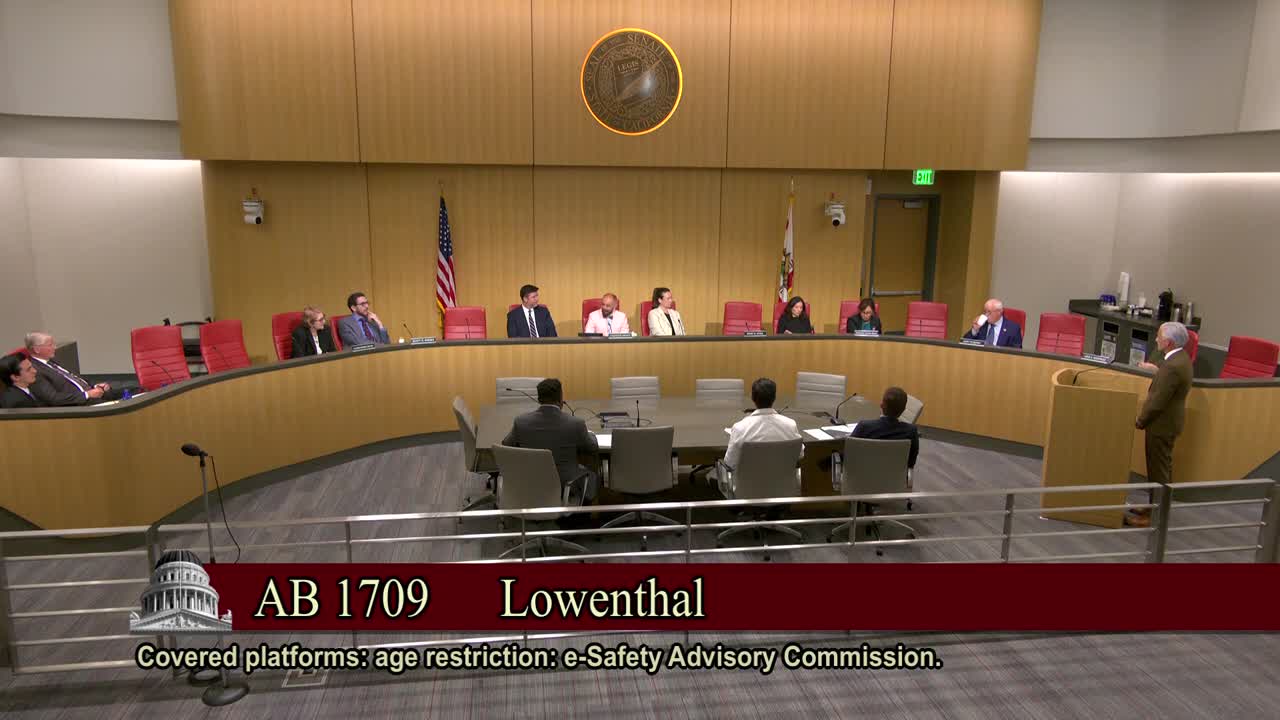 7MIN
Senate Standing Committee on Privacy, Digital Technologies, and Consumer Protection
 9MIN
Senate Standing Committee on Judiciary
 2MIN
Assembly Floor
 32MIN
Assembly Standing Committee on Appropriations
 19MIN
Assembly Standing Committee on Judiciary
 21MIN
Assembly Standing Committee on Privacy and Consumer Protection
Bill Author

Bill Co-Author(s):
