AB 2124: Electricity and natural gas: legislation imposing mandated programs and requirements: third-party review.
- Session Year: 2025-2026
- House: Assembly
- Latest Version Date: 2026-09-01
Current Status:
Failed
(2026-09-18: Vetoed by Governor.)
Introduced
In Committee
Awaiting First Chamber Vote
Passed First Chamber
In Committee
Awaiting Second Chamber Vote
Passed Second Chamber
Enacted
Existing law vests the Public Utilities Commission with regulatory authority over public utilities, including electrical corporations and gas corporations.
Existing law finds and declares that the California Council on Science and Technology (CCST) was organized as a nonprofit corporation at the request of the Legislature for the specific purpose of offering expert advice to the state government on public policy issues significantly related to science and technology. Existing law requests the CCST, every 3 years, to assess the infrastructure project types, scale, and pace necessary to achieve the states energy, climate change, and air quality goals, as specified.
This bill would require the CCST to establish, on or before March 1, 2027, upon appropriation by the Legislature, a program to, upon request of the Legislature, analyze legislation that would establish a mandated requirement or program, as defined, or otherwise affect electrical corporation or gas corporation ratepayers, as specified. The bill would require the analysis to include, among other things, whether the legislation will increase electricity or natural gas utility rates, and if so, would require an assessment of specified financial impacts. The bill would require the CCST to develop and implement conflict-of-interest provisions to prohibit a person from participating in an analysis for which the person knows or has reasons to know that the person has a material financial interest. The bill would repeal these provisions on January 1, 2032.
Existing law vests the Public Utilities Commission with regulatory authority over public utilities, including electrical corporations and gas corporations.
Existing law finds and declares that the California Council on Science and Technology (CCST) was organized as a nonprofit corporation at the request of the Legislature for the specific purpose of offering expert advice to the state government on public policy issues significantly related to science and technology. Existing law requests the CCST, every 3 years, to assess the infrastructure project types, scale, and pace necessary to achieve the states energy, climate change, and air quality goals, as specified.
This bill would require the CCST to establish, on or before January March 1, 2027, upon appropriation by the Legislature, a program to, upon request of the Legislature, analyze legislation that would establish a mandated requirement or program, as defined, or otherwise affect electrical corporation or gas corporation ratepayers, as specified. The bill would require the CCST to develop and implement conflict-of-interest provisions to prohibit a person from participating in an analysis for which the person knows or has reasons to know that the person has a material financial interest. The bill would repeal these provisions on January 1, 2032.
Existing law vests the Public Utilities Commission with regulatory authority over public utilities, including electrical corporations and gas corporations.
Existing law finds and declares that the California Council on Science and Technology (CCST) was organized as a nonprofit corporation at the request of the Legislature for the specific purpose of offering expert advice to the state government on public policy issues significantly related to science and technology. Existing law requests the CCST, every 3 years, to assess the infrastructure project types, scale, and pace necessary to achieve the states energy, climate change, and air quality goals, as specified.
This bill would require the CCST to establish, on or before January 1, 2027, upon appropriation by the Legislature, a program to, upon request of the Legislature, analyze legislation that would establish a mandated requirement or program, as defined, or otherwise affect electrical corporation or gas corporation ratepayers, as specified. The bill would require the CCST to develop and implement conflict-of-interest provisions to prohibit a person from participating in an analysis for which the person knows or has reasons to know that the person has a material financial interest. The bill would repeal these provisions on January 1, 2032.
Existing law vests the Public Utilities Commission with regulatory authority over public utilities, including electrical corporations and gas corporations.
Existing law finds and declares that the California Council on Science and Technology (CCST) was organized as a nonprofit corporation at the request of the Legislature for the specific purpose of offering expert advice to the state government on public policy issues significantly related to science and technology. Existing law requests the CCST, every 3 years, to assess the infrastructure project types, scale, and pace necessary to achieve the states energy, climate change, and air quality goals, as specified.
This bill would require the CCST to establish, on or before January 1, 2027, a program to, upon request of the Legislature, analyze legislation that would establish a mandated requirement or program, as defined, or otherwise affect electrical corporation or gas corporation ratepayers, as specified. The bill would require the CCST to develop and implement conflict-of-interest provisions to prohibit a person from participating in an analysis for which the person knows or has reasons to know that the person has a material financial interest. The bill would repeal these provisions on January 1, 2032.
(a)The Legislature finds and declares all of the following:
(1)There are an increasing number of proposals that mandate certain programs be paid by ratepayers of electrical corporations and gas corporations.
(2)Many of the proposals would potentially result in positive outcomes that would be in the public interest.
(3)Those proposals providing benefits may also contribute to the cost and affordability of electricity and natural gas service.
(b)It is the intent of the Legislature to do all of the following:
(1)Promote affordable electricity and natural gas utility rates while also addressing the critical climate issues of the time, including the requirements for renewable and zero-carbon electricity and economywide decarbonization in law.
(2)Preemptively address the issue that electricity and natural gas utility rates are increasing.
(3)Analyze the estimated costs and efficacy of a new program or requirement imposed under proposed legislation that would be paid for by ratepayers of electrical corporations and gas corporations to ensure the cost impact and potential benefits may be fully weighed and carefully considered before enacting the legislation.
(c)It is further the intent of the Legislature that the California Council on Science and Technology conduct a systematic review of proposed programs or requirements imposed under proposed legislation that would be paid for by ratepayers of electrical corporations and gas corporations to inform the Legislature in determining whether mandating a particular program or requirement is in the ratepayers interests, and for the California Council on Science and Technology to publish a written analysis of the estimated cost and efficacy of each legislative proposal, including relevant expert data.
SEC. 2.Section 3261 is added to the Public Utilities Code, to read:3261.(a)For purposes of this section, all of the following definitions apply:
(1)Council means the California Council on Science and Technology, as defined in Section 12100 of the Government Code.
(2)Electrical or gas corporation means an electrical corporation, as defined in Section 218, or a gas corporation, as defined in Section 222, with more than 100,000 service connections.
(3)Mandated program or requirement means any of the following:
(A)A new requirement imposed on an electrical or gas corporation.
(B)A new program that would be paid for by the ratepayers of an electrical or gas corporation.
(C)A revision to an existing requirement imposed on an electrical or gas corporation or to an existing program paid for by the ratepayers of an electrical or gas corporation.
(b)(1)The council shall establish, on or before March 1, 2027, upon appropriation by the Legislature, a program to, upon request of the Legislature and in a manner and pursuant to a timeline agreed to by the Legislature and the council, analyze legislation that would establish a mandated program or requirement or otherwise affect electrical or natural gas ratepayers, including relevant data on all of the following:
(A)Whether the legislation will increase electricity or natural gas utility rates, and, if so, the analysis shall assess the financial impacts, including, but not limited to, of all of the following:
(i)The extent to which the legislation will increase or decrease costs recoverable from ratepayers, including potential costs to all categories of ratepayers.
(ii)The impact of the legislation on the total cost of electrical or natural gas service.
(iii)The extent to which costs resulting from the legislation are, or would be, shifted to other ratepayers, including both public and private entities.
(iv)The extent to which the legislation would affect access to currently available electrical or natural gas service.
(v)The extent to which the activity, service, infrastructure, or resource required by the legislation is generally used by a significant portion of the population.
(vi)The extent to which the activity, service, infrastructure, or resource required by the legislation is already generally available.
(vii)The level of public demand for the activity, service, infrastructure, or resource required by the legislation.
(B)The potential benefits to all categories of ratepayers resulting from the legislation, with a specific focus on tangible benefits related to the safe, reliable delivery of electricity or natural gas including whether the legislation is directly related to, or necessary for, the delivery of safe, reliable electricity and natural gas utility service.
(C)Similar mandated programs or requirements applicable at the time of the analysis, the costs associated with those mandated programs or requirements, and if those mandated programs or requirements are consistent with the states climate change policy requirements, including, but not limited to, reducing the emissions of greenhouse gases, the carbon neutrality targets set forth in Section 454.53 of this code or Section 38562.2 of the Health and Safety Code, and the California Renewables Portfolio Standard Program (Article 16 (commencing with Section 399.11) of Chapter 2.3 of Part 1).
(D)All existing legislatively mandated programs applicable at the time of the analysis that are paid for by the ratepayers of electrical and gas corporations.
(E)The impacts of the legislation on jobs, the economy, and communities that are identified as disadvantaged communities under Section 39711 of the Health and Safety Code or low-income communities as defined in Section 39713 of the Health and Safety Code.
(F)The costs and benefits of the legislation in relation to its intended outcomes, including, but not limited to, impacts beyond the electricity or natural gas market and any identified nonmonetary effects, including, but not limited to, improvements in environmental quality, public health, and climate conditions.
(G)Available funding sources for the mandated program or requirement, including, but not limited to, sources other than the ratepayers of electrical or gas corporations, including, but not limited to, the General Fund, environmental funds, or low-income programs, including, but not limited to, CalFresh (Chapter 10 (commencing with Section 18900) of Part 6 of Division 9 of the Welfare and Institutions Code).
(2)The request may be made only by any of the following persons:
(A)The chairperson or staff of the appropriate policy committee.
(B)The chairperson or staff of the appropriate fiscal committee.
(C)The Speaker of the Assembly.
(D)The President pro Tempore of the Senate.
(3)The legislation shall be provided to the council at the time the request for analysis is made.
(4)The council shall conduct each analysis based on the best available data at the time of the analysis. The state shall indemnify, defend, and hold harmless the council and its officers, directors, employees, subcontractors, agents, and expert partners for any claim arising out of the analysis.
(c)To avoid conflicts of interests, the council shall develop and implement conflict-of-interest provisions to prohibit a person from participating in conducting an analysis described in this section for which the person knows or has reasons to know that the person has a material financial interest, including, but not limited to, a person who has a consulting or other agreement with another person or organization that would be affected by the legislation.
(d)This section shall remain in effect only until January 1, 2032, and as of that date is repealed.
(a)The Legislature finds and declares all of the following:
(1)There are an increasing number of proposals that mandate certain programs be paid by ratepayers of electrical corporations and gas corporations.
(2)Many of the proposals would potentially result in positive outcomes that would be in the public interest.
(3)Those proposals providing benefits may also contribute to the cost and affordability of electricity and natural gas service.
(b)It is the intent of the Legislature to do all of the following:
(1)Promote affordable electricity and natural gas utility rates while also addressing the critical climate issues of the time, including the requirements for renewable and zero-carbon electricity and economywide decarbonization in law.
(2)Preemptively address the issue that electricity and natural gas utility rates are increasing.
(3)Analyze the estimated costs and efficacy of a new program or requirement imposed under proposed legislation that would be paid for by ratepayers of electrical corporations and gas corporations to ensure the cost impact and potential benefits may be fully weighed and carefully considered before enacting the legislation.
(c)It is further the intent of the Legislature that the California Council on Science and Technology conduct a systematic review of proposed programs or requirements imposed under proposed legislation that would be paid for by ratepayers of electrical corporations and gas corporations to inform the Legislature in determining whether mandating a particular program or requirement is in the ratepayers interests, and for the California Council on Science and Technology to publish a written analysis of the estimated cost and efficacy of each legislative proposal, including relevant expert data.
SEC. 2.Section 3261 is added to the Public Utilities Code, to read:3261.(a)For purposes of this section, all of the following definitions apply:
(1)Council means the California Council on Science and Technology, as defined in Section 12100 of the Government Code.
(2)Electrical or gas corporation means an electrical corporation, as defined in Section 218, or a gas corporation, as defined in Section 222, with more than 100,000 service connections.
(3)Mandated program or requirement means any of the following:
(A)A new requirement imposed on an electrical or gas corporation.
(B)A new program that would be paid for by the ratepayers of an electrical or gas corporation.
(C)A revision to an existing requirement imposed on an electrical or gas corporation or to an existing program paid for by the ratepayers of an electrical or gas corporation.
(b)(1)The council shall establish, on or before March 1, 2027, upon appropriation by the Legislature, a program to, upon request of the Legislature and in a manner and pursuant to a timeline agreed to by the Legislature and the council, analyze legislation that would establish a mandated program or requirement or otherwise affect electrical or natural gas ratepayers, including relevant data on all of the following:
(A)Whether the legislation will increase electricity or natural gas utility rates, and, if so, the analysis shall assess the potential costs to all categories of ratepayers. financial impacts, including, but not limited to, of all of the following:
(i)The extent to which the legislation will increase or decrease costs recoverable from ratepayers, including potential costs to all categories of ratepayers.
(ii)The impact of the legislation on the total cost of electrical or natural gas service.
(iii)The extent to which costs resulting from the legislation are, or would be, shifted to other ratepayers, including both public and private entities.
(iv)The extent to which the legislation would affect access to currently available electrical or natural gas service.
(v)The extent to which the activity, service, infrastructure, or resource required by the legislation is generally used by a significant portion of the population.
(vi)The extent to which the activity, service, infrastructure, or resource required by the legislation is already generally available.
(vii)The level of public demand for the activity, service, infrastructure, or resource required by the legislation.
(B)The potential benefits to all categories of ratepayers resulting from the legislation, with a specific focus on tangible benefits related to the safe, reliable delivery of electricity or natural gas including whether the legislation is directly related to, or necessary for, the delivery of safe, reliable electricity and natural gas utility service.
(C)Similar mandated programs or requirements applicable at the time of the analysis, the costs associated with those mandated programs or requirements, and if those mandated programs or requirements are consistent with the states climate change policy requirements, including, but not limited to, reducing the emissions of greenhouse gases, the carbon neutrality targets set forth in Section 454.53 of this code or Section 38562.2 of the Health and Safety Code, and the California Renewables Portfolio Standard Program (Article 16 (commencing with Section 399.11) of Chapter 2.3 of Part 1).
(D)All existing legislatively mandated programs applicable at the time of the analysis that are paid for by the ratepayers of electrical and gas corporations.
(E)The impacts of the legislation on jobs, the economy, and communities that are identified as disadvantaged communities under Section 39711 of the Health and Safety Code or low-income communities as defined in Section 39713 of the Health and Safety Code.
(F)The analysis of the costs and benefits of the legislation in relation to its intended outcomes, including, but not limited to, impacts beyond the electricity or natural gas market and any identified nonmonetary effects, including, but not limited to, improvements in environmental quality, public health, and climate conditions.
(G)The analysis of available Available funding sources for the mandated program or requirement, including, but not limited to, sources other than the ratepayers of electrical or gas corporations, including, but not limited to, the General Fund, environmental funds, or low-income programs, including, but not limited to, CalFresh (Chapter 10 (commencing with Section 18900) of Part 6 of Division 9 of the Welfare and Institutions Code).
(2)The request may be made by the chairperson of the appropriate policy or fiscal committee or committee staff, the Speaker of the Assembly, or the President pro Tempore of the Senate, and the legislation shall be provided to the council for analysis. only by any of the following persons:
(A)The chairperson or staff of the appropriate policy committee.
(B)The chairperson or staff of the appropriate fiscal committee.
(C)The Speaker of the Assembly.
(D)The President pro Tempore of the Senate.
(3)The legislation shall be provided to the council at the time the request for analysis is made.
(3)(4)The council shall conduct each analysis based on the best available data at the time of the analysis. The state shall indemnify, defend, and hold harmless the council and its officers, directors, employees, subcontractors, agents, and expert partners for any claim arising out of the analysis.
(c)To avoid conflicts of interests, the council shall develop and implement conflict-of-interest provisions to prohibit a person from participating in conducting an analysis described in this section for which the person knows or has reasons to know that the person has a material financial interest, including, but not limited to, a person who has a consulting or other agreement with another person or organization that would be affected by the legislation.
(d)This section shall remain in effect only until January 1, 2032, and as of that date is repealed.
(a)The Legislature finds and declares all of the following:
(1)There are an increasing number of proposals that mandate certain programs be paid by ratepayers of electrical corporations and gas corporations.
(2)Many of the proposals would potentially result in positive outcomes that would be in the public interest.
(3)Those proposals providing benefits may also contribute to the cost and affordability of electricity and natural gas service.
(b)It is the intent of the Legislature to do all of the following:
(1)Promote affordable electricity and natural gas utility rates while also addressing the critical climate issues of the time, including the requirements for renewable and zero-carbon electricity and economywide decarbonization in law.
(2)Preemptively address the issue that electricity and natural gas utility rates are increasing.
(3)Analyze the estimated costs and efficacy of a new program or requirement imposed under proposed legislation that would be paid for by ratepayers of electrical corporations and gas corporations to ensure the cost impact and potential benefits may be fully weighed and carefully considered before enacting the legislation.
(c)It is further the intent of the Legislature that the California Council on Science and Technology conduct a systematic review of proposed programs or requirements imposed under proposed legislation that would be paid for by ratepayers of electrical corporations and gas corporations to inform the Legislature in determining whether mandating a particular program or requirement is in the ratepayers interests, and for the California Council on Science and Technology to publish a written analysis of the estimated cost and efficacy of each legislative proposal, including relevant expert data.
SEC. 2.Section 3261 is added to the Public Utilities Code, to read:3261.(a)For purposes of this section, all of the following definitions apply:
(1)Council means the California Council on Science and Technology, as defined in Section 12100 of the Government Code.
(2)Electrical or gas corporation means an electrical corporation, as defined in Section 218, or a gas corporation, as defined in Section 222, with more than 100,000 service connections.
(3)Mandated program or requirement means any of the following:
(A)A new requirement imposed on an electrical or gas corporation.
(B)A new program that would be paid for by the ratepayers of an electrical or gas corporation.
(C)A revision to an existing requirement imposed on an electrical or gas corporation or to an existing program paid for by the ratepayers of an electrical or gas corporation.
(b)(1)The council shall establish, on or before January March 1, 2027, upon appropriation by the Legislature, a program to, upon request of the Legislature and in a manner and pursuant to a timeline agreed to by the Legislature and the council, analyze legislation that would establish a mandated program or requirement or otherwise affect electrical or gas ratepayers, including relevant data on all of the following:
(A)Whether the legislation will increase electricity or natural gas utility rates, and, if so, the analysis shall assess the potential costs to all categories of ratepayers.
(B)The potential benefits to all categories of ratepayers resulting from the legislation, with a specific focus on tangible benefits related to the safe, reliable delivery of electricity or natural gas including whether the legislation is directly related to, or necessary for, the delivery of safe, reliable electricity and natural gas utility service.
(C)Similar mandated programs or requirements applicable at the time of the analysis, the costs associated with those mandated programs or requirements, and if those mandated programs or requirements are consistent with the states climate change policy requirements, including, but not limited to, reducing the emissions of greenhouse gases, the carbon neutrality targets set forth in Section 454.53 of this code or Section 38562.2 of the Health and Safety Code, and the California Renewables Portfolio Standard Program (Article 16 (commencing with Section 399.11) of Chapter 2.3 of Part 1).
(D)All existing legislatively mandated programs applicable at the time of the analysis that are paid for by the ratepayers of electrical and gas corporations.
(E)The impacts of the legislation on jobs, the economy, and communities that are identified as disadvantaged communities under Section 39711 of the Health and Safety Code or low-income communities as defined in Section 39713 of the Health and Safety Code.
(F)The analysis of the costs and benefits of the legislation in relation to its intended outcomes, including, but not limited to, impacts beyond the electricity or natural gas market and any identified nonmonetary effects, including, but not limited to, improvements in environmental quality, public health, and climate conditions.
(G)The analysis of available funding sources for the mandated program or requirement, including, but not limited to, sources other than the ratepayers of electrical or gas corporations, including, but not limited to, the General Fund, environmental funds, or low-income programs, including, but not limited to, CalFresh (Chapter 10 (commencing with Section 18900) of Part 6 of Division 9 of the Welfare and Institutions Code).
(2)The request may be made by the chairperson of the appropriate policy or fiscal committee or committee staff, the Speaker of the Assembly, or the President pro Tempore of the Senate, and the legislation shall be provided to the council for analysis.
(3)The council shall conduct each analysis based on the best available data at the time of the analysis. The state shall indemnify, defend, and hold harmless the council and its officers, directors, employees, subcontractors, agents, and expert partners for any claim arising out of the analysis.
(c)To avoid conflicts of interests, the council shall develop and implement conflict-of-interest provisions to prohibit a person from participating in conducting an analysis described in this section for which the person knows or has reasons to know that the person has a material financial interest, including, but not limited to, a person who has a consulting or other agreement with another person or organization that would be affected by the legislation.
(d)This section shall remain in effect only until January 1, 2032, and as of that date is repealed.
(a)The Legislature finds and declares all of the following:
(1)There are an increasing number of proposals that mandate certain programs be paid by ratepayers of electrical corporations and gas corporations.
(2)Many of the proposals would potentially result in positive outcomes that would be in the public interest.
(3)Those proposals providing benefits may also contribute to the cost and affordability of electricity and natural gas service.
(b)It is the intent of the Legislature to do all of the following:
(1)Promote affordable electricity and natural gas utility rates while also addressing the critical climate issues of the time, including the requirements for renewable and zero-carbon electricity and economywide decarbonization in law.
(2)Preemptively address the issue that electricity and natural gas utility rates are increasing.
(3)Analyze the estimated costs and efficacy of a new program or requirement imposed under proposed legislation that would be paid for by ratepayers of electrical corporations and gas corporations to ensure the cost impact and potential benefits may be fully weighed and carefully considered before enacting the legislation.
(c)It is further the intent of the Legislature that the California Council on Science and Technology conduct a systematic review of proposed programs or requirements imposed under proposed legislation that would be paid for by ratepayers of electrical corporations and gas corporations to assist inform the Legislature in determining whether mandating a particular program or requirement is in the ratepayers interests, and for the California Council on Science and Technology to publish a written analysis of the estimated cost and efficacy of each legislative proposal, including relevant expert data.
SEC. 2.Section 3261 is added to the Public Utilities Code, to read:3261.(a)For purposes of this section, all of the following definitions apply:
(1)Council means the California Council on Science and Technology, as defined in Section 12100 of the Government Code.
(2)Electrical or gas corporation means an electrical corporation, as defined in Section 218, or a gas corporation, as defined in Section 222, with more than 100,000 service connections.
(3)Mandated program or requirement means any of the following:
(A)A new requirement imposed on an electrical or gas corporation.
(B)A new program that would be paid for by the ratepayers of an electrical or gas corporation.
(C)A revision to an existing requirement imposed on an electrical or gas corporation or to an existing program paid for by the ratepayers of an electrical or gas corporation.
(b)(1)The council shall establish, on or before January 1, 2027, upon appropriation by the Legislature, a program to, upon request of the Legislature and in a manner and pursuant to a timeline agreed to by the Legislature and the council, analyze legislation that would establish a mandated program or requirement or otherwise affect electrical or gas ratepayers, including relevant data on all of the following:
(A)Whether the legislation will increase electricity or natural gas utility rates, and, if so, the analysis shall assess the potential costs to all categories of ratepayers.
(B)The potential benefits to all categories of ratepayers resulting from the legislation, with a specific focus on tangible benefits related to the safe, reliable delivery of electricity or natural gas including whether the legislation is directly related to, or necessary for, the delivery of safe, reliable electricity and natural gas utility service.
(C)Similar mandated programs or requirements applicable at the time of the analysis, the costs associated with those mandated programs or requirements, and if those mandated programs or requirements are consistent with the states climate change policy requirements, including, but not limited to, reducing the emissions of greenhouse gases, the carbon neutrality targets set forth in Section 454.53 of this code or Section 38562.2 of the Health and Safety Code, and the California Renewables Portfolio Standard Program (Article 16 (commencing with Section 399.11) of Chapter 2.3 of Part 1).
(D)All existing legislatively mandated programs applicable at the time of the analysis that are paid for by the ratepayers of electrical and gas corporations.
(E)The impacts of the legislation on jobs, the economy, and communities that are identified as disadvantaged communities under Section 39711 of the Health and Safety Code or low-income communities as defined in Section 39713 of the Health and Safety Code.
(F)Whether the legislation is the most cost-effective and appropriate means to achieve the desired outcomes, including costs and benefits beyond the electricity or natural gas market and nonmonetary benefits, such as improvements in environmental quality, public health, and climate stability. If nonmonetary societal benefits are noted, the written analysis shall clearly indicate how all Californians would benefit. (G)Whether funding sources other than the ratepayers of electrical or gas corporations, such as the General Fund, environmental funds, or other low-income programs, such as CalFresh, could be more appropriately used for the mandated program or requirement.(F)The analysis of the costs and benefits of the legislation in relation to its intended outcomes, including, but not limited to, impacts beyond the electricity or natural gas market and any identified nonmonetary effects, including, but not limited to, improvements in environmental quality, public health, and climate conditions.
(G)The analysis of available funding sources for the mandated program or requirement, including, but not limited to, sources other than the ratepayers of electrical or gas corporations, including, but not limited to, the General Fund, environmental funds, or low-income programs, including, but not limited to, CalFresh (Chapter 10 (commencing with Section 18900) of Part 6 of Division 9 of the Welfare and Institutions Code).
(2)The request may be made by the chairperson of the appropriate policy or fiscal committee or committee staff, the Speaker of the Assembly, or the President pro Tempore of the Senate, and the legislation shall be provided to the council for analysis.
(3)The council shall conduct each analysis based on the best available data at the time of the analysis. The state shall indemnify, defend, and hold harmless the council and its officers, directors, employees, subcontractors, agents, and expert partners for any claim arising out of the analysis.
(c)To avoid conflicts of interests, the council shall develop and implement conflict-of-interest provisions to prohibit a person from participating in conducting an analysis described in this section for which the person knows or has reasons to know that the person has a material financial interest, including, but not limited to, a person who has a consulting or other agreement with another person or organization that would be affected by the legislation.
(d)This section shall remain in effect only until January 1, 2032,, 2032, and as of that date is repealed.
(a)The Legislature finds and declares all of the following:
(1)There are an increasing number of proposals that mandate certain programs be paid by ratepayers of electrical corporations and gas corporations.
(2)Many of the proposals would potentially result in positive outcomes that would be in the public interest.
(3)Those proposals providing benefits may also contribute to the cost and affordability of electricity and natural gas service.
(b)It is the intent of the Legislature to do all of the following:
(1)Promote affordable electricity and natural gas utility rates while also addressing the critical climate issues of the time, including the requirements for renewable and zero-carbon electricity and economywide decarbonization in law.
(2)Preemptively address the issue that electricity and natural gas utility rates are increasing.
(3)Analyze the estimated costs and efficacy of a new program or requirement imposed under proposed legislation that would be paid for by ratepayers of electrical corporations and gas corporations to ensure the cost impact and potential benefits may be fully weighed and carefully considered before enacting the legislation.
(c)It is further the intent of the Legislature that the California Council on Science and Technology conduct a systematic review of proposed programs or requirements imposed under proposed legislation that would be paid for by ratepayers of electrical corporations and gas corporations to assist the Legislature in determining whether mandating a particular program or requirement is in the ratepayers interests, and for the California Council on Science and Technology to publish a written analysis of the estimated cost and efficacy of each legislative proposal, including expert data.
SEC. 2.Section 3261 is added to the Public Utilities Code, to read:3261.(a)For purposes of this section, all of the following definitions apply:
(1)Council means the California Council on Science and Technology, as defined in Section 12100 of the Government Code.
(2)Electrical or gas corporation means an electrical corporation, as defined in Section 218, or a gas corporation, as defined in Section 222, with more than 100,000 service connections.
(3)Mandated program or requirement means any of the following:
(A)A new requirement imposed on an electrical or gas corporation.
(B)A new program that would be paid for by the ratepayers of an electrical or gas corporation.
(C)A revision to an existing requirement imposed on an electrical or gas corporation or to an existing program paid for by the ratepayers of an electrical or gas corporation.
(b)(1)The council shall establish, on or before January 1, 2027, a program to, upon request of the Legislature and in a manner and pursuant to a timeline agreed to by the Legislature and the council, analyze legislation that would establish a mandated program or requirement or otherwise affect electrical or gas ratepayers, including relevant data on all of the following:
(A)Whether the legislation will increase electricity or natural gas utility rates, and, if so, the analysis shall assess the potential costs to all categories of ratepayers.
(B)The potential benefits to all categories of ratepayers resulting from the legislation, with a specific focus on tangible benefits related to the safe, reliable delivery of electricity or natural gas including whether the legislation is directly related to, or necessary for, the delivery of safe, reliable electricity and natural gas utility service.
(C)Similar mandated programs or requirements applicable at the time of the analysis, the costs associated with those mandated programs or requirements, and if those mandated programs or requirements are consistent with the states climate change policy requirements, including, but not limited to, reducing the emissions of greenhouse gases, the carbon neutrality targets set forth in Section 454.53 of this code or Section 38562.2 of the Health and Safety Code, and the California Renewables Portfolio Standard Program (Article 16 (commencing with Section 399.11) of Chapter 2.3 of Part 1).
(D)All existing legislatively mandated programs applicable at the time of the analysis that are paid for by the ratepayers of electrical and gas corporations.
(E)The impacts of the legislation on jobs, the economy, and communities that are identified as disadvantaged communities under Section 39711 of the Health and Safety Code or low-income communities as defined in Section 39713 of the Health and Safety Code.
(F)Whether the legislation is the most cost-effective and appropriate means to achieve the desired outcomes, including costs and benefits beyond the electricity or natural gas market and nonmonetary benefits, such as improvements in environmental quality, public health, and climate stability. If nonmonetary societal benefits are noted, the written analysis shall clearly indicate how all Californians would benefit.
(G)Whether funding sources other than the ratepayers of electrical or gas corporations, such as the General Fund, environmental funds, or other low-income programs, such as CalFresh, could be more appropriately used for the mandated program or requirement.
(2)The request may be made by the chairperson of the appropriate policy or fiscal committee or committee staff, the Speaker of the Assembly, or the President pro Tempore of the Senate, and the legislation shall be provided to the council for analysis.
(3)The council shall conduct each analysis based on the best available data at the time of the analysis. The state shall indemnify, defend, and hold harmless the council and its officers, directors, employees, subcontractors, agents, and expert partners for any claim arising out of the analysis.
(c)To avoid conflicts of interests, the council shall develop and implement conflict-of-interest provisions to prohibit a person from participating in conducting an analysis described in this section for which the person knows or has reasons to know that the person has a material financial interest, including, but not limited to, a person who has a consulting or other agreement with another person or organization that would be affected by the legislation.
(d)This shall remain in effect only until January 1, 2032,, and as of that date is repealed.
|
Date
|
Status
|
|---|---|
| Sep 18, 2026 | Vetoed by Governor. |
| Sep 4, 2026 | Enrolled and presented to the Governor at 4 p.m. |
| Aug 27, 2026 | Senate amendments concurred in. To Engrossing and Enrolling. (Ayes 72. Noes 0.). |
| Aug 27, 2026 | Senate amendments concurred in. To Engrossing and Enrolling. (Ayes 72. Noes 0. Page 6689.). |
| Aug 27, 2026 | In Assembly. Concurrence in Senate amendments pending. |
| Aug 26, 2026 | Read third time. Passed. Ordered to the Assembly. (Ayes 31. Noes 6.). |
| Aug 17, 2026 | Read second time. Ordered to third reading. |
| Aug 13, 2026 | Read second time and amended. Ordered returned to second reading. |
| Aug 13, 2026 | From committee: Amend, and do pass as amended. (Ayes 7. Noes 0.) (August 13). |
| Aug 3, 2026 | In committee: Referred to APPR. suspense file. |
| Jul 2, 2026 | Read second time and amended. Re-referred to Com. on APPR. |
| Jul 2, 2026 | From committee: Amend, and do pass as amended and re-refer to Com. on APPR. (Ayes 14. Noes 0.) (June 30). |
| Jun 3, 2026 | Referred to Com. on E., U & C. |
| May 21, 2026 | In Senate. Read first time. To Com. on RLS. for assignment. |
| May 21, 2026 | Read third time. Passed. Ordered to the Senate. (Ayes 71. Noes 0.) |
| May 21, 2026 | Read third time. Passed. Ordered to the Senate. (Ayes 71. Noes 0. Page 5222.) |
| May 18, 2026 | Read second time. Ordered to third reading. |
| May 14, 2026 | From committee: Do pass. (Ayes 15. Noes 0.) (May 14). |
| Apr 29, 2026 | In committee: Set, first hearing. Referred to APPR. suspense file. |
| Apr 14, 2026 | Re-referred to Com. on APPR. |
| Apr 13, 2026 | Read second time and amended. |
| Apr 9, 2026 | From committee: Amend, and do pass as amended and re-refer to Com. on APPR. with recommendation: To Consent Calendar. (Ayes 17. Noes 0.) (April 8). |
| Mar 2, 2026 | Referred to Com. on U. & E. |
| Feb 19, 2026 | From printer. May be heard in committee March 21. |
| Feb 18, 2026 | Read first time. To print. |
|
Date
|
Description
|
Location
|
Votes
|
|
|---|---|---|---|---|
| Aug 27, 2026 | AB 2124 Pacheco Concurrence in Senate Amendments | Assembly Floor |
Passed |
|
| Aug 26, 2026 | Assembly 3rd Reading AB2124 Pacheco et al. By Hurtado | Senate Floor |
Passed |
|
| Aug 13, 2026 | Do pass as amended | Senate Standing Committee on Appropriations |
Passed |
|
| Aug 3, 2026 | Placed on suspense file | Senate Standing Committee on Appropriations |
Passed |
|
| Jun 30, 2026 | Do pass as amended, but first amend, and re-refer to the Committee on [Appropriations] | Senate Standing Committee on Energy, Utilities and Communications |
Passed |
|
| May 21, 2026 | AB 2124 Pacheco Assembly Third Reading | Assembly Floor |
Passed |
|
| May 14, 2026 | Do pass. | Assembly Standing Committee on Appropriations |
Passed |
|
| Apr 8, 2026 | Do pass as amended, and be re-referred to the Committee on [Appropriations] with recommendation: To Consent Calendar | Assembly Standing Committee on Utilities and Energy |
Passed |
This list shows positions taken on this bill by organizations on the date displayed, which is linked to the original source.
Positions by individuals are not included.
|
Organization
|
Position
|
Date
|
|---|---|---|
| California Chamber Of Commerce | ** Support | |
| California Council For Environmental And Economic Balance | ** Support | |
| California Large Energy Consumers Association | ** Support | |
| California State Association Of Electrical Workers | ** Support | |
| Coalition of California Utility Employees | ** Support | |
| Governor | ** Against | |
| Pacific Gas And Electric Company | ** Support | |
| San Diego Gas and Electric Company | ** Support | |
| Southern California Edison | ** Support | |
| Southern California Gas Company | ** Support | |
| Southern California Rental Housing Association | ** Support |
GOVERNOR'S VETO
GV Bill Id:AB 2124
Author:(Pacheco and Bauer-Kahan)
As Enrolled Ver:September 1, 2026
2/3 vote
SUMMARY
Requires the California Council on Science and Technology (CCST), upon appropriation, to establish a program to analyze, at the request of the Legislature, legislation that would establish a mandated program or requirement or otherwise affect electrical or natural gas ratepayers.
Senate Amendments
- Requires the analysis of legislation that would increase electricity or natural gas utility rates to assess specified financial impacts, including, but not limited to, the following:
- The extent to which the legislation will increase or decrease costs recoverable from ratepayers, including potential costs to all categories of ratepayers.
- The impact of the legislation on the total cost of electrical or natural gas service.
- The extent to which costs resulting from the legislation are, or would be, shifted to other ratepayers, including both public and private entities.
- The extent to which the legislation would affect access to currently available electrical or natural gas service.
- The extent to which the activity, service, infrastructure, or resource required by the legislation is generally used by a significant portion of the population.
- The extent to which the activity, service, infrastructure, or resource required by the legislation is already generally available.
- The level of public demand for the activity, service, infrastructure, or resource required by the legislation.
- Limits who may make the request to any of the following persons:
- The chairperson or staff of the appropriate policy committee.
- The chairperson or staff of the appropriate fiscal committee.
- The Speaker of the Assembly.
- The President pro Tempore of the Senate.
- Requires the legislation to be provided to CCST at the time the request for analysis is made.
- Makes minor and technical changes for clarification purposes.
Governor’s Veto Message
This bill would require the CCST to create a program to review pending legislation upon request by legislators for impacts related to electricity or natural gas ratepayers.
The Legislature already employs professional staff to analyze pending legislation, and their work should include the potential impacts on ratepayers. Additionally, the Legislature has access to the resources and analysis of the Legislative Analyst’s Office, which could also achieve the goals of this bill. Lastly, the resources required to implement this bill were not considered in the context of this year's budget agreement.
In partnership with the Legislature this year, my administration has enacted a balanced budget that recognizes the challenging fiscal landscape our state faces while maintaining our commitment to working families and our most vulnerable communities. With significant fiscal pressures and the federal government’s hostile economic policies, it is vital that we remain disciplined when considering bills with significant fiscal implications that are not included in the budget, such as this measure.
COMMENTS
California Council on Science and Technology (CCST). The CCST was established to provide independent, science-based, and evidence-based advice to inform state policymaking and regularly convenes subject-matter experts from academia, industry, and research institutions. CCST has indicated that its model includes engaging experts with experience in utility ratemaking, energy markets, and utility regulation. This may allow CCST to bring in the relevant expertise needed to evaluate complex ratepayer and cost impacts contemplated by this bill, although the Governor's veto notes that the Legislature already employs professional staff to analyze pending legislation and has access to the resources and analysis of the Legislative Analyst's Office.
The Burden of Rising Utility Costs. California's electricity rates are among the highest in the nation. The Public Advocates Office (PAO) has reported that the primary drivers of recent electric utility cost increases include wildfire mitigation, distribution and transmission infrastructure investments, and rooftop solar incentives provided through net energy metering (NEM) programs. AB 2124 is based on two contentions: first, that utility rates have increased significantly in recent years, and second, that state policy decisions can influence utility rates.
As California continues implementing its clean energy and climate policies, utilities are often directed to implement new programs funded through rates rather than the state General Fund. Legislative committees regularly consider bills that would impose new utility requirements or expand existing programs, and those measures are evaluated by the Legislature's fiscal committees for their ratepayer and fiscal impacts. However, due to legislative deadlines, committees may not always have sufficient time to conduct detailed analysis of potential ratepayer impacts before a bill is voted in a committee. Therefore, providing independent cost estimates could help inform those deliberations by giving Members more information about a bill's potential ratepayer impacts before a vote.
According to the Author
According to the author, "Californians are struggling with soaring costs of goods and services, and low-income customers are disproportionately burdened. The monthly strain created by utility bills is more pronounced than ever before. According to the January 2025 Legislative Analyst’s Office (LAO) report on residential electricity rates, California’s residential electricity rates are now the second highest in the nation, nearly double the national average. Rates have surged in California by about 47% from 2019 to 2023, far outpacing the overall 18% increase in consumer prices. AB 2124 requires the California Council on Science and Technology (CCST) to conduct a review of every legislative proposal that mandates or requires services or programs that result in increased costs for electrical or natural gas corporation customers. The CCST would prepare a written analysis with relevant data on the efficacy, cost impact and overall effect of each proposed mandate before a vote in legislative committees."
Arguments in Support
AB 2124 is supported by business organizations, utilities, labor groups, and large industrial customers who contend that legislative and regulatory mandates have contributed to rising electricity and natural gas rates over time. They further argue that this bill would provide the Legislature with independent analysis of the ratepayer impacts of proposed mandates, improve transparency regarding utility cost drivers, and help inform decisions regarding whether certain policy costs are more appropriately funded through utility rates or other funding sources.
Arguments in Opposition
None on file.
FISCAL COMMENTS
According to the Senate Committee on Appropriations, this measure would result in ongoing cost pressure of an unknown but significant amount from the General Fund or another funding source to fund CCST's implementation of the program.
VOTES
ASM UTILITIES AND ENERGY: 17-0-1
YES: Petrie-Norris, Patterson, Boerner, Calderon, Davies, Mark González, Harabedian, Hart, Irwin, Kalra, Papan, Rogers, Schiavo, Schultz, Ta, Wallis, Zbur
ABS, ABST OR NV: Chen
ASM APPROPRIATIONS: 15-0-0
YES: Wicks, Hoover, Aguiar-Curry, Calderon, Caloza, Dixon, Fong, Mark González, Krell, Pacheco, Pellerin, Sharp-Collins, Solache, Ta, Tangipa
ASSEMBLY FLOOR: 71-0-9
YES: Aguiar-Curry, Ahrens, Alanis, Alvarez, Ávila Farías, Bains, Bauer-Kahan, Bennett, Berman, Boerner, Bonta, Bryan, Calderon, Caloza, Carrillo, Castillo, Connolly, Davies, DeMaio, Dixon, Elhawary, Ellis, Flora, Fong, Gabriel, Gallagher, Gipson, Jeff Gonzalez, Mark González, Hadwick, Haney, Harabedian, Hart, Irwin, Jackson, Johnson, Kalra, Krell, Lee, Lowenthal, Macedo, McKinnor, Muratsuchi, Nguyen, Pacheco, Papan, Patel, Patterson, Pellerin, Petrie-Norris, Quirk-Silva, Ransom, Michelle Rodriguez, Rogers, Blanca Rubio, Sanchez, Schiavo, Schultz, Sharp-Collins, Solache, Soria, Stefani, Ta, Tangipa, Valencia, Wallis, Ward, Wicks, Wilson, Zbur, Rivas
ABS, ABST OR NV: Addis, Arambula, Chen, Garcia, Hoover, Lackey, Ortega, Ramos, Celeste Rodriguez
SENATE FLOOR: 32-6-2
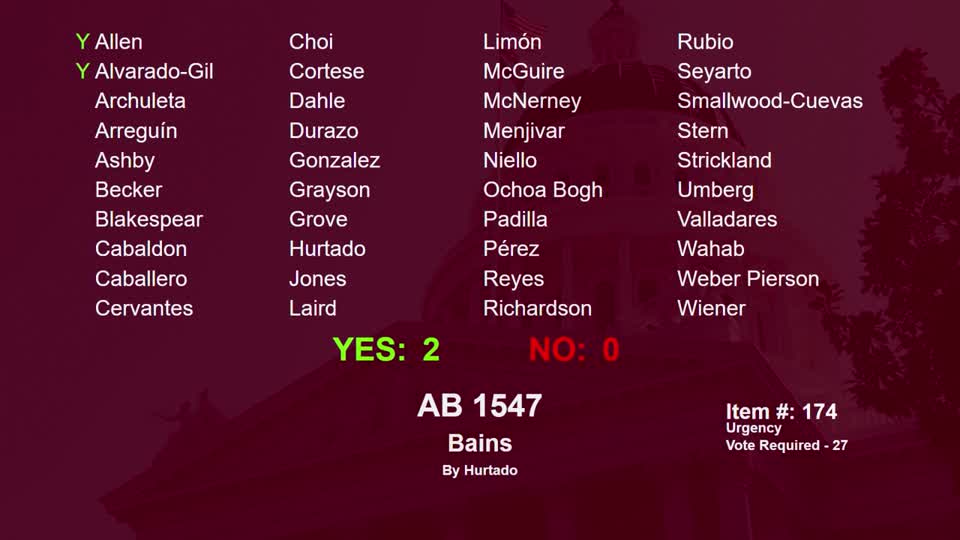
YES: Allen, Alvarado-Gil, Archuleta, Arreguín, Ashby, Blakespear, Cabaldon, Caballero, Cervantes, Choi, Cortese, Dahle, Durazo, Grayson, Grove, Hurtado, Jones, Laird, Limón, McGuire, McNerney, Niello, Ochoa Bogh, Padilla, Richardson, Rubio, Seyarto, Strickland, Umberg, Valladares, Wahab, Weber Pierson
NO: Becker, Gonzalez, Menjivar, Smallwood-Cuevas, Stern, Wiener
ABS, ABST OR NV: Pérez, Reyes
ASSEMBLY FLOOR: 72-0-7
YES: Aguiar-Curry, Ahrens, Alanis, Alvarez, Arambula, Ávila Farías, Bains, Bauer-Kahan, Bennett, Berman, Boerner, Bonta, Bryan, Calderon, Caloza, Carrillo, Castillo, Chen, Connolly, Davies, DeMaio, Dixon, Elhawary, Ellis, Flora, Fong, Gabriel, Garcia, Gipson, Jeff Gonzalez, Mark González, Hadwick, Haney, Harabedian, Hart, Hoover, Irwin, Johnson, Kalra, Krell, Lackey, Lowenthal, Macedo, Muratsuchi, Nguyen, Pacheco, Papan, Patel, Patterson, Pellerin, Petrie-Norris, Quirk-Silva, Ramos, Ransom, Celeste Rodriguez, Michelle Rodriguez, Rogers, Blanca Rubio, Sanchez, Schiavo, Sharp-Collins, Solache, Soria, Stefani, Ta, Tangipa, Valencia, Wallis, Wicks, Wilson, Zbur, Rivas
ABS, ABST OR NV: Addis, Jackson, Lee, McKinnor, Ortega, Schultz, Ward
UPDATED
VERSION: September 1, 2026
CONSULTANT: Lina V. Malova / U. & E. / (916) 319-2083 FN: 0004592
CONCURRENCE IN SENATE AMENDMENTS
CSA1 Bill Id:AB 2124
Author:(Pacheco and Bauer-Kahan)
As Amended Ver:August 13, 2026
Majority vote
SUMMARY
Requires the California Council on Science and Technology (CCST), upon appropriation, to establish a program to analyze, at the request of the Legislature, legislation that would establish a mandated program or requirement or otherwise affect electrical or natural gas ratepayers.
Senate Amendments
- Requires the analysis of legislation that would increase electricity or natural gas utility rates to assess specified financial impacts, including, but not limited to, the following:
- The extent to which the legislation will increase or decrease costs recoverable from ratepayers, including potential costs to all categories of ratepayers.
- The impact of the legislation on the total cost of electrical or natural gas service.
- The extent to which costs resulting from the legislation are, or would be, shifted to other ratepayers, including both public and private entities.
- The extent to which the legislation would affect access to currently available electrical or natural gas service.
- The extent to which the activity, service, infrastructure, or resource required by the legislation is generally used by a significant portion of the population.
- The extent to which the activity, service, infrastructure, or resource required by the legislation is already generally available.
- The level of public demand for the activity, service, infrastructure, or resource required by the legislation.
- Limits who may make the request to any of the following persons:
- The chairperson or staff of the appropriate policy committee.
- The chairperson or staff of the appropriate fiscal committee.
- The Speaker of the Assembly.
- The President pro Tempore of the Senate.
- Requires the legislation to be provided to CCST at the time the request for analysis is made.
- Makes minor and technical changes for clarification purposes.
COMMENTS
California Council on Science and Technology (CCST). The CCST was established to provide independent, science-based, and evidence-based advice to inform state policymaking and regularly convenes subject-matter experts from academia, industry, and research institutions. CCST has indicated that its model includes engaging experts with experience in utility ratemaking, energy markets, and utility regulation. This structure may allow CCST to bring in the relevant expertise needed to evaluate complex ratepayer and cost impacts contemplated by this bill.
The Burden of Rising Utility Costs. California’s electricity rates are among the highest in the nation. The Public Advocates Office (PAO) has reported that the primary drivers of recent electric utility cost increases include wildfire mitigation, distribution and transmission infrastructure investments, and rooftop solar incentives provided through net energy metering (NEM) programs. AB 2124 is based on two contentions: first, that utility rates have increased significantly in recent years, and second, that state policy decisions can influence utility rates.
As California continues implementing its clean energy and climate policies, utilities are often directed to implement new programs funded through rates rather than the state General Fund. Legislative committees regularly consider bills that would impose new utility requirements or expand existing programs, and those measures are evaluated by the Legislature’s fiscal committees for their ratepayer and fiscal impacts. However, due to legislative deadlines, committees may not always have sufficient time to conduct detailed analysis of potential ratepayer impacts before a bill is voted in a committee. Therefore, providing independent cost estimates could help inform those deliberations by giving Members more information about a bill’s potential ratepayer impacts before a vote.
According to the Author
According to the author, “Californians are struggling with soaring costs of goods and services, and low-income customers are disproportionately burdened. The monthly strain created by utility bills is more pronounced than ever before. According to the January 2025 Legislative Analyst’s Office (LAO) report on residential electricity rates, California’s residential electricity rates are now the second highest in the nation, nearly double the national average. Rates have surged in California by about 47% from 2019 to 2023, far outpacing the overall 18% increase in consumer prices. AB 2124 requires the California Council on Science and Technology (CCST) to conduct a review of every legislative proposal that mandates or requires services or programs that result in increased costs for electrical or natural gas corporation customers. The CCST would prepare a written analysis with relevant data on the efficacy, cost impact and overall effect of each proposed mandate before a vote in legislative committees.”
Arguments in Support
AB 2124 is supported by business organizations, utilities, labor groups, and large industrial customers who contend that legislative and regulatory mandates have contributed to rising electricity and natural gas rates over time. Therefore, supporters further argue that this bill would provide the Legislature with independent analysis of the ratepayer impacts of proposed mandates, improve transparency regarding utility cost drivers, and help inform decisions regarding whether certain policy costs are more appropriately funded through utility rates or other funding sources.
Arguments in Opposition
None on file.
FISCAL COMMENTS
According to the Senate Committee on Appropriations, this bill would result in ongoing cost pressure of an unknown but significant amount from the General Fund or another funding source to fund CCST’s implementation of the program.
VOTES:
ASM UTILITIES AND ENERGY: 17-0-1
YES: Petrie-Norris, Patterson, Boerner, Calderon, Davies, Mark González, Harabedian, Hart, Irwin, Kalra, Papan, Rogers, Schiavo, Schultz, Ta, Wallis, Zbur
ABS, ABST OR NV: Chen
ASM APPROPRIATIONS: 15-0-0
YES: Wicks, Hoover, Aguiar-Curry, Calderon, Caloza, Dixon, Fong, Mark González, Krell, Pacheco, Pellerin, Sharp-Collins, Solache, Ta, Tangipa
ASSEMBLY FLOOR: 71-0-9
YES: Aguiar-Curry, Ahrens, Alanis, Alvarez, Ávila Farías, Bains, Bauer-Kahan, Bennett, Berman, Boerner, Bonta, Bryan, Calderon, Caloza, Carrillo, Castillo, Connolly, Davies, DeMaio, Dixon, Elhawary, Ellis, Flora, Fong, Gabriel, Gallagher, Gipson, Jeff Gonzalez, Mark González, Hadwick, Haney, Harabedian, Hart, Irwin, Jackson, Johnson, Kalra, Krell, Lee, Lowenthal, Macedo, McKinnor, Muratsuchi, Nguyen, Pacheco, Papan, Patel, Patterson, Pellerin, Petrie-Norris, Quirk-Silva, Ransom, Michelle Rodriguez, Rogers, Blanca Rubio, Sanchez, Schiavo, Schultz, Sharp-Collins, Solache, Soria, Stefani, Ta, Tangipa, Valencia, Wallis, Ward, Wicks, Wilson, Zbur, Rivas
ABS, ABST OR NV: Addis, Arambula, Chen, Garcia, Hoover, Lackey, Ortega, Ramos, Celeste Rodriguez
UPDATED
VERSION: August 13, 2026
CONSULTANT: Lina V. Malova / U. & E. / (916) 319-2083 FN: 0004313
SENATE RULES COMMITTEE Office of Senate Floor Analyses (916) 651-4171 | AB 2124 |
THIRD READING
Bill No: AB 2124
Author: Pacheco (D) and Bauer-Kahan (D), et al.
Amended: 8/13/26 in Senate
Vote: 21
SENATE ENERGY, U. & C. COMMITTEE: 14-0, 6/30/26
AYES: Allen, Ochoa Bogh, Archuleta, Arreguín, Ashby, Caballero, Dahle, Grove, Hurtado, McNerney, Reyes, Richardson, Strickland, Wahab
NO VOTE RECORDED: Becker, Gonzalez, Stern
SENATE APPROPRIATIONS COMMITTEE: 7-0, 8/13/26
AYES: Cervantes, Seyarto, Cabaldon, Dahle, Grayson, Richardson, Wahab
ASSEMBLY FLOOR: 71-0, 5/21/26 - See last page for vote
SUBJECT: Electricity and natural gas: legislation imposing mandated programs and requirements: third-party review
SOURCE: San Diego Gas and Electric Company
DIGEST:
This bill requires the California Council on Science and Technology (CCST) to establish, on or before March 1, 2027, upon appropriation by the Legislature, a program to, upon request of the Legislature, analyze legislation that would establish a mandated requirement or program or otherwise affect electrical corporation or gas corporation ratepayers.
ANALYSIS:
Existing law:
- Establishes and vests the California Public Utilities Commission (CPUC) with regulatory authority over public utilities, including electrical corporations and gas corporations. (Article XII of the California Constitution)
- Authorizes the CPUC to fix the rates and charges for every public utility, including electrical and gas corporations, and requires that those rates and charges be just and reasonable. (Public Utilities Code §451)
- Requires the CPUC, in establishing residential electric and natural gas utility rates, to ensure that the rates are sufficient to enable the electric or natural gas corporation to recover a just and reasonable amount of revenue. (Public Utilities Code §739)
- Requires the CPUC to prepare a written report on the costs of programs and activities conducted by the four major electric and gas companies regulated by the CPUC. (Public Utilities Code §913.1)
- Finds and declares that the CCST was organized as a nonprofit corporation at the request of the Legislature for the specific purpose of offering expert advice to the state government on public policy issues significantly related to science and technology. (Government Code §8924.5)
This bill:
- Requires the CCST to establish, on or before March 1, 2027, upon appropriation by the Legislature, a program to, upon request of the Legislature, analyze legislation that would establish a mandated requirement or program, as defined, or otherwise affect electrical corporation or gas corporation ratepayers, as specified.
- Requires the analysis to include, among other things, whether the legislation will increase electricity and natural gas utility rates, the potential costs to all categories of ratepayers, the extent the proposal will affect to currently available utility service, and other requirements.
- Requires the CCST to develop and implement conflict-of-interest provisions to prohibit a person from participating in an analysis for which the person knows or has reasons to know that the person has a material financial interest. Repeals these provisions on January 1, 2032.
Background
Electric utility rates outpace growth of inflation. Californians generally enjoyed lower energy bills when compared to the rest of the country, largely due to milder weather and investments in energy efficiency, even as electric rates have been higher than many other states. However, in more recent years, these trends have been changing as California’s higher energy rates are also resulting in higher electricity utility bills. As such, there are growing concerns about the affordability of utility bills on household budgets and commercial and industrial entities’ balance sheets.
Drivers affecting energy utility bills. Several drivers are increasing costs within IOU electricity bills. According to the CPUC’s 2025 Annual SB 695 Report (published September 2025), since 2016, bundled residential average rates have increased at an annual average rate greater than the rate of inflation: about 10% for PG&E, 8% for SCE, and 6% for SDG&E.[1] The primary drivers include wildfire mitigation investments, and transmission and distribution costs. The following chart is from the SB 695 Report showing the combined authorized electric revenue requirement for the three large investor-owned utilities (IOUs) – Pacific Gas & Electric (PG&E), San Diego Gas & Electric (SDG&E), Southern California Edison (SCE). According to the report, the distribution costs – both for wildfire and other system upgrades/maintenance – are a significant driver of increased utility bills. This includes expenses related to replacement of poles and powerlines, transformers and other equipment, as well as vegetation management, wildfire insurance, and infrastructure hardening.
State Auditor’s Report. In August 2023, the State Auditor released an audit report, Electricity and Natural Gas Rates: The California Public Utilities Commission and Cal Advocates [PAO] Can Better Ensure That Rate Increases Are Necessary. The audit focused on electricity and natural gas rate increases of four large utilities – PG&E, SDG&E, SCE, and Southern California Gas Company (SoCalGas) – and the oversight conducted by the CPUC and the PAO. The report noted several factors that have contributed to increases in electricity and natural gas rates for the four utilities. These include:
- Utilities’ operating costs have been increasing, though the largest category of increases vary by utility: distribution costs for PG&E, administrative costs for SCE, and higher property and non-income taxes for SDG&E.
- Wildfire costs, including insurance, has also been a key factor in increased utility expenses.
- Decreasing electricity sales due to installation of solar power systems has required utilities to raise rates to recover fixed costs.
- Market forces have contributed to rising natural gas rates.
California Council on Science and Technology. CCST is operated as a 501(c)(3) nonprofit governed by a Board of Directors composed of representatives from academic institutions, the corporate and business community, and the philanthropic community. CCST convenes experts from California's academic and research institutions to provide impartial advice and analysis in response to requests from the Governor, Legislature and other state entities on policy issues affecting the State of California relating to science and technology. Its core funding is provided by higher-educational institutions, research centers, and national laboratories.
Comments
Need for this bill. According to the author:
Californians are struggling with soaring costs of goods and services, and low-income customers are disproportionately burdened. The monthly strain created by utility bills is more pronounced than ever before. According to the January 2025 Legislative Analyst’s Office (LAO) report on residential electricity rates, California’s residential electricity rates are now the second highest in the nation, nearly double the national average. Rates have surged in California by about 47 percent from 2019 to 2023, far outpacing the overall 18 percent increase in consumer prices. AB 2124 requires the California Council on Science and Technology (CCST) to conduct a review of every legislative proposal that mandates or requires services or programs that result in increased costs for electrical or natural gas corporation customers. The CCST would prepare a written analysis with relevant data on the efficacy, cost impact and overall effect of each proposed mandate before a vote in legislative policy committees.
Continued focus on affordability. As electricity rates, and consequently utility bills, have risen and trend above inflation, there is a continued desire for opportunities to reduce utility bills. Last year, in response to an executive order by the Governor[2], the CPUC and California Energy Commission, presented their recommendations for opportunities to reduce costs on electricity utility bills at this committee’s hearing focused on affordability.[3] Additionally, both at the hearing and during the legislative session there were many proposals considered, including those that culminated into a negotiated agreement in the waning days of the legislative session by the Governor, Assembly leadership and Senate leadership which are reflected in the passage of SB 254 (Becker, Chapter 119, Statutes of 2025). Among the myriad of policies in the bill are several to address utility wildfire mitigation costs by requiring a cost-efficiency framework to more judiciously consider costs shouldered by utility customers, limitations on the ability of electric IOUs to earn a profit on an additional $6 billion of wildfire mitigation (adding to the $5 billion of expenses included in AB 1054 (Holden, Chapter 79, Statutes of 2019) that were also prohibited from a return on equity), as well as, opportunities for public financing of transmission projects. Additionally, the bill removed a requirement that IOUs utilize mechanisms (memorandum accounts) to recover wildfire mitigation costs. Instead, the bill defers to the CPUC to determine their necessity thereby allowing these costs to be folded into the IOUs general rate case. SB 254 also included policies addressing wildfire liabilities for utility equipment-ignited wildfires, including authorizing an extension of the Wildfire Fund (should it be depleted) and authorizing financing of liabilities for fires post January 1, 2025. As part of the broader negotiation, there was a related bill on the Cap-and-Invest program, AB 1207 (Irwin, Chapter 117, Statutes of 2025) that included provisions to direct 5% of the electric IOUs’ allowance revenue over five years for transmission financing and makes adjustments to the Climate Credit provided to utility customers, including directing their distribution to the high-bill months of the year. These policies are in various stages of being implemented by the responsible agencies.
Modeled after the California Health Benefits Review Program (CHBRP). This bill is modeled after the CHBRP, which was established in 2002 and responds to requests from the Legislature to provide independent analysis of the medical, financial, and public health impacts of proposed health insurance benefit mandates and repeals. AB 1996 (Thomson, Chapter 795 Statutes of 2002) required a review of the impacts on health insurance related legislation to help inform legislative decisions.
Is the third time a charm? This proposal requires the Legislature to request an analysis by CCST on proposed legislation with specified information. CCST would need to analyze the utility bill impacts, along with several other criteria, including impacts on jobs, the economy and disadvantaged communities. While such analysis could be useful, its likely legislative timelines may not allow for a timely comprehensive analysis, particularly as legislation is amended frequently. The Little Hoover Commission also proposed recommendations to address affordability in a report released in released in October 2025, “The High Cost of Electricity in California.”[4] The report includes ten recommendations, including one to require a feasibility study and criteria-based framework for shifting some costs to non-ratepayer funding sources. CCST or another academic institution, such as the Energy Institute at Haas Business School, may be well-suited to provide such a study to the Legislature which could help develop systematic framework to inform future legislative proposals and criteria for consideration of future proposals that might seek cost recovery from energy utility bills.
Related/Prior Legislation
AB 61 (Pacheco, 2025) contained nearly identical language, except the bill tasked the PAO with conducting the requested analysis. The bill was held by the Senate Appropriations Committee.
AB 1912 (Pacheco, 2024) contained nearly identical language as this bill with an early version requesting the CCST to conduct the study, though the bill was amended in the Senate to apply to PAO. The bill was held by the Senate Committee on Appropriations.
AB 1083 (Burke, Chapter 818, Statutes of 2019) authorized the CCST, until January 1, 2023, to conduct independent analyses of energy-related legislation upon request of specified legislative leaders and committees, with analyses to be completed within 60 days. However, the program was contingent on the availability of funding, which was never appropriated by the Legislature.
FISCAL EFFECT: Appropriation: No Fiscal Com.: Yes Local: No
According to the Senate Appropriations Committee, ongoing cost pressure of an unknown but significant amount (General Fund or some other funding source) to provide funding to the CCST for the program described by this bill.
SUPPORT: (Verified 8/13/26)
San Diego Gas and Electric Company (Source)
California Chamber of Commerce
California Council for Environmental and Economic Balance
California Large Energy Consumers Association
California State Association of Electrical Workers
Coalition of California Utility Employees
Pacific Gas and Electric Company
Southern California Edison
Southern California Gas Company
Southern California Rental Housing Association
OPPOSITION: (Verified 8/13/26)
None received
ARGUMENTS IN SUPPORT: According to San Diego Gas & Electric and Southern California Gas Company:
Based on several other bills introduced this session that required some form of cost analysis prior to adoption of new mandates or regulations, there appears to be broad interest in better understanding the true impacts that legislative mandates have on customers. AB 2124 is the vehicle that can provide this transparency. Today, when an average electric customer pays their bill, roughly 37 cents of every dollar pays for state mandates and public programs that are unrelated to the electric service they receive. That translates to more than $825 per year for the average household. Notably, costs for public purpose programs (PPP), a subset of these mandated costs, have skyrocketed at an unsustainable pace, growing by 130% since 2012.
AB 2124 creates a simple solution modeled after the successful process established by the Legislature in 2003 for healthcare costs.4 Upon request from the Legislature, the California Council on Science and Technology (CCST) will analyze proposed mandates before they become law, answering critical questions:
ASSEMBLY FLOOR: 71-0, 5/21/26
AYES: Aguiar-Curry, Ahrens, Alanis, Alvarez, Ávila Farías, Bains, Bauer-Kahan, Bennett, Berman, Boerner, Bonta, Bryan, Calderon, Caloza, Carrillo, Castillo, Connolly, Davies, DeMaio, Dixon, Elhawary, Ellis, Flora, Fong, Gabriel, Gallagher, Gipson, Jeff Gonzalez, Mark González, Hadwick, Haney, Harabedian, Hart, Irwin, Jackson, Johnson, Kalra, Krell, Lee, Lowenthal, Macedo, McKinnor, Muratsuchi, Nguyen, Pacheco, Papan, Patel, Patterson, Pellerin, Petrie-Norris, Quirk-Silva, Ransom, Michelle Rodriguez, Rogers, Blanca Rubio, Sanchez, Schiavo, Schultz, Sharp-Collins, Solache, Soria, Stefani, Ta, Tangipa, Valencia, Wallis, Ward, Wicks, Wilson, Zbur, Rivas
NO VOTE RECORDED: Addis, Arambula, Chen, Garcia, Hoover, Lackey, Ortega, Ramos, Celeste Rodriguez
Prepared by: Nidia Bautista / E., U. & C. / (916) 651-4107
8/17/26 10:47:45
**** END ****
CPUC “2025 Senate Bill 695 Report,” September 2025. https://www.cpuc.ca.gov/-/media/cpuc-website/divisions/office-of-governmental-affairs-division/reports/2025/2025-sb-695-report_093025.pdf ↑
https://seuc.senate.ca.gov/system/files/2025-02/2-19-25-governor-newsom-energy-eo-10-30-24.pdf ↑
See Senate Energy, Utilities, and Communications Committee hearing on February 19, 2025. https://seuc.senate.ca.gov/system/files/2025-05/cpuc-response-to-eo-n-5-24_0.pdf and https://seuc.senate.ca.gov/system/files/2025-05/cec-response-to-eo-n-5-24-ada.pdf. ↑
Milton Marks “Little Hoover” Commission on California State Government Organization and Economy, “The High Cost of Electricity in California,” Report #290: October 2025. https://lhc.ca.gov/wp-content/uploads/LHC-Report-290-The-High-Cost-of-Electricity-in-California-FINAL-1.pdf ↑
SENATE COMMITTEE ON
Senator Sabrina Cervantes, Chair
2025 - 2026 Regular Session
AB 2124 (Pacheco) - Electricity and natural gas: legislation imposing mandated programs and requirements: third-party review
Version: | Policy Vote: |
Urgency: | Mandate: |
Hearing Date: | Consultant: |
Bill Summary:
This bill would require the California Council on Science and Technology (CCST) to establish, upon appropriation, a program to, upon request of the Legislature, analyze legislation that would establish a mandated requirement or program or otherwise affect electrical corporation or gas corporation ratepayers.
*********** ANALYSIS ADDENDUM – SUSPENSE FILE ***********
The following information is revised to reflect amendments
adopted by the committee on August 13, 2026
Fiscal Impact:
- Ongoing cost pressure of an unknown but significant amount (General Fund or some other funding source) to provide funding to the CCST for the program described by this bill.
Author Amendments:
Author amendments would specify who can request an analysis and what information an analysis must include.
-- END --
SENATE COMMITTEE ON
Senator Sabrina Cervantes, Chair
2025 - 2026 Regular Session
AB 2124 (Pacheco) - Electricity and natural gas: legislation imposing mandated programs and requirements: third-party review
Version: | Policy Vote: |
Urgency: | Mandate: |
Hearing Date: | Consultant: |
Bill Summary:
This bill would require the California Council on Science and Technology (CCST) to establish, upon appropriation, a program to, upon request of the Legislature, analyze legislation that would establish a mandated requirement or program or otherwise affect electrical corporation or gas corporation ratepayers.
Fiscal Impact:
- This bill will result in cost pressure of an unknown, but significant amount, to provide funding to the CCST for the program described by this bill (General Fund or some other funding source).
Background:
Electric utility rates outpace growth of inflation. Californians generally enjoyed lower energy bills when compared to the rest of the country, largely due to milder weather and investments in energy efficiency, even as electric rates have been higher than many other states. However, in more recent years, these trends have been changing as California’s higher energy rates are also resulting in higher electricity utility bills. As such, there are growing concerns about the affordability of utility bills on household budgets and commercial and industrial entities’ balance sheets.
Drivers affecting energy utility bills. Several drivers are increasing costs within IOU electricity bills. According to the CPUC’s 2025 Annual SB 695 Report (published September 2025), since 2016, bundled residential average rates have increased at an annual average rate greater than the rate of inflation: about ten percent for PG&E, 8 percent for SCE, and 6 percent for SDG&E. The primary drivers include wildfire mitigation investments, and transmission and distribution costs. The following chart is from the SB 695 Report showing the combined authorized electric revenue requirement for the three large investor-owned utilities (IOUs) – Pacific Gas & Electric (PG&E), San Diego Gas & Electric (SDG&E), Southern California Edison (SCE). According to the report, the distribution costs – both for wildfire and others – are a significant driver of increased utility bills. This includes expenses related to replacement of poles and powerlines, transformers and other equipment, as well as vegetation management, wildfire insurance, and infrastructure hardening.
State Auditor’s Report. In August 2023, the State Auditor released an audit report, Electricity and Natural Gas Rates: The California Public Utilities Commission and Cal Advocates [PAO] Can Better Ensure That Rate Increases Are Necessary. The audit focused on electricity and natural gas rate increases of four large utilities – PG&E, SDG&E, SCE, and Southern California Gas Company (SoCalGas) – and the oversight conducted by the CPUC and the PAO. The report noted several factors have contributed to increases in electricity and natural gas rates for the four utilities. These include:
- Utilities’ operating costs have been increasing, though the largest category of increases vary by utility: distribution costs for PG&E, administrative costs for SCE, and higher property and non-income taxes for SDG&E.
- Wildfire costs, including insurance, has also been a key factor in increased utility expenses.
- Decreasing electricity sales due to installation of solar power systems has required utilities to raise rates to recover fixed costs.
- Market forces have contributed to rising natural gas rates.
California Council on Science and Technology. CCST is operated as a 501(c)(3) nonprofit governed by a Board of Directors composed of representatives from academic institutions, the corporate and business community, and the philanthropic community. CCST convenes experts from California's academic and research institutions to provide impartial advice and analysis in response to requests from the Governor, Legislature and other state entities on policy issues affecting the State of California relating to science and technology. Its core funding is provided by higher-educational institutions, research centers, and national laboratories.
Proposed Law:
This bill would:
- Require the CCST to establish, on or before March 1, 2027, upon appropriation by the Legislature, a program to, upon request of the Legislature and in a manner and pursuant to a timeline agreed to by the Legislature and the council, analyze legislation that would establish a mandated requirement or program, as defined, or otherwise affect electrical corporation or gas corporation ratepayers, as specified.
- Require the CCST to develop and implement conflict-of-interest provisions to prohibit a person from participating in an analysis for which the person knows or has reason to know that the person has a material financial interest. Repeal these provisions on January 1, 2032.
Related Legislation:
AB 61 (Pacheco, 2025) contained nearly identical language, except the bill tasked the PAO with conducting the requested analysis. The bill died in this committee.
AB 1912 (Pacheco, 2024) contained nearly identical language as this bill. However, an early version would have requested the CCST to conduct the study, though the bill was amended in the Senate to apply to the PAO. The bill died in this committee.
AB 1083 (Burke, 2019) authorized the CCST, until January 1, 2023, to conduct independent analyses of energy-related legislation upon request of specified legislative leaders and committees, with analyses to be completed within 60 days. However, the program was contingent on the availability of funding, which was never appropriated by the Legislature.
SB 695 (Kehoe, 2009) required the CPUC to annually report on recommendations for actions that can be undertaken during the succeeding 12 months to limit utility cost and rate increases, consistent with the state's energy and environmental goals.
AB 67 (Levine, 2005) required the CPUC to prepare a written report on the costs of programs and activities conducted by the four major electric and gas companies regulated by the CPUC.
Staff Comments:
This proposal would allow the Legislature to request an analysis by CCST on proposed legislation. CCST would need to analyze the utility bill impacts, along with several other criteria, including impacts on jobs, the economy, and disadvantaged communities. While such analysis could be useful, legislative timelines may not allow for a timely comprehensive analysis, particularly as legislation is amended frequently. The Little Hoover Commission also proposed recommendations to address affordability in a report released in October 2025, "The High Cost of Electricity in California." The report includes ten recommendations, including one to require a feasibility study and criteria-based framework for shifting some costs to non-ratepayer funding sources. CCST or another academic institution, such as the Energy Institute at Haas Business School, may be well-suited to provide such a study to the Legislature, which could inform future legislative proposals and criteria for consideration of future proposals that might seek cost recovery from energy utility bills.
-- END --
SENATE COMMITTEE ON ENERGY, UTILITIES AND COMMUNICATIONS
Senator Benjamin Allen, Chair
2025 - 2026 Regular
Bill No: Hearing Date: 6/30/2026
Author: | |||
Version: | Amended | ||
Urgency: | Fiscal: | ||
Consultant: | |||
SUBJECT:
DIGEST: This bill requires the California Council on Science and Technology (CCST) to establish, on or before January 1, 2027, upon appropriation by the Legislature, a program to, upon request of the Legislature, analyze legislation that would establish a mandated requirement or program or otherwise affect electrical corporation or gas corporation ratepayers.
ANALYSIS:
Existing law:
- Establishes and vests the California Public Utilities Commission (CPUC) with regulatory authority over public utilities, including electrical corporations and gas corporations. (Article XII of the California Constitution)
- Authorizes the CPUC to fix the rates and charges for every public utility, including electrical and gas corporations, and requires that those rates and charges be just and reasonable. (Public Utilities Code §451)
- Requires the CPUC, in establishing residential electric and natural gas utility rates, to ensure that the rates are sufficient to enable the electric or natural gas corporation to recover a just and reasonable amount of revenue. (Public Utilities Code §739)
- Requires the CPUC to prepare a written report on the costs of programs and activities conducted by the four major electric and gas companies regulated by the CPUC. (Public Utilities Code §913.1)
- Requires electric, gas, water, and telephone corporations to notify affected customers of proposed revenue changes that will impact their utility bill, by displaying rate impacts of the proposed revenue change in dollars and percentage degree of change. (Public Utilities Code §454)
- Requires the CPUC to require each electrical corporation to identify a separate rate component to collect the revenues used to fund certain programs. (Public Utilities Code §381)
- Establishes a natural gas surcharge to fund cost-effective energy efficiency and other public purpose programs. (Public Utilities Code §§890-900)
- Establishes that it is the policy of the state that eligible renewable energy resources and zero-carbon resources supply 100% of all retail sales of electricity to California end-use customers and 100% of electricity procured to serve all state agencies by December 31, 2045. (Public Utilities Code §454.53)
- Finds and declares that the CCST was organized as a nonprofit corporation at the request of the Legislature for the specific purpose of offering expert advice to the state government on public policy issues significantly related to science and technology. (Government Code §8924.5)
- Requests the CCST, every three years, to assess the infrastructure project types, scale, and pace necessary to achieve the state’s energy, climate change, and air quality goals, as specified. (Health and Safety Code §38592.1)
This bill:
- Requires the CCST to establish, on or before January 1, 2027, upon appropriation by the Legislature, a program to, upon request of the Legislature, analyze legislation that would establish a mandated requirement or program, as defined, or otherwise affect electrical corporation or gas corporation ratepayers, as specified.
- Requires the CCST to develop and implement conflict-of-interest provisions to prohibit a person from participating in an analysis for which the person knows or has reasons to know that the person has a material financial interest. This bill would repeal these provisions on January 1, 2032.
Background
Electric utility rates outpace growth of inflation. Californians generally enjoyed lower energy bills when compared to the rest of the country, largely due to milder weather and investments in energy efficiency, even as electric rates have been higher than many other states. However, in more recent years, these trends have been changing as California’s higher energy rates are also resulting in higher electricity utility bills. As such, there are growing concerns about the affordability of utility bills on household budgets and commercial and industrial entities’ balance sheets.
PG&E, SCE, and SDG&E January 1 Bundled System Average Rate,
Nominal and Inflation-Adjusted Comparison[1]

Source: California Public Utilities Commission. Energy Division analysis. SB 695 Report (published September 2025)
Note: The chart displays total system average rates which reflect total authorized revenue requirement and total forecasted sales for bundled customers.
Drivers affecting energy utility bills. Several drivers are increasing costs within IOU electricity bills. According to the CPUC’s 2025 Annual SB 695 Report (published September 2025), since 2016, bundled residential average rates have increased at an annual average rate greater than the rate of inflation: about ten percent for PG&E, 8 percent for SCE, and 6 percent for SDG&E.[2] The primary drivers include wildfire mitigation investments, and transmission and distribution costs. The following chart is from the SB 695 Report showing the combined authorized electric revenue requirement for the three large investor-owned utilities (IOUs) – Pacific Gas & Electric (PG&E), San Diego Gas & Electric (SDG&E), Southern California Edison (SCE). According to the report, the distribution costs – both for wildfire and others – are a significant driver of increased utility bills. This includes expenses related to replacement of poles and powerlines, transformers and other equipment, as well as vegetation management, wildfire insurance, and infrastructure hardening.
PG&E, SCE, and SDG&E Combined Authorized Electric Revenue Requirement, by Rate Component Category (January 1, $Millions)[3]

State Auditor’s Report. In August 2023, the State Auditor released an audit report, Electricity and Natural Gas Rates: The California Public Utilities Commission and Cal Advocates [PAO] Can Better Ensure That Rate Increases Are Necessary. The audit focused on electricity and natural gas rate increases of four large utilities – PG&E, SDG&E, SCE, and Southern California Gas Company (SoCalGas) – and the oversight conducted by the CPUC and the PAO. The report noted several factors have contributed to increases in electricity and natural gas rates for the four utilities. These include:
- Utilities’ operating costs have been increasing, though the largest category of increases vary by utility: distribution costs for PG&E, administrative costs for SCE, and higher property and non-income taxes for SDG&E.
- Wildfire costs, including insurance, has also been a key factor in increased utility expenses.
- Decreasing electricity sales due to installation of solar power systems has required utilities to raise rates to recover fixed costs.
- Market forces have contributed to rising natural gas rates.
California Council on Science and Technology. CCST is operated as a 501(c)(3) nonprofit governed by a Board of Directors composed of representatives from academic institutions, the corporate and business community, and the philanthropic community. CCST convenes experts from California's academic and research institutions to provide impartial advice and analysis in response to requests from the Governor, Legislature and other state entities on policy issues affecting the State of California relating to science and technology. Its core funding is provided by higher-educational institutions, research centers, and national laboratories.
Comments
Need for this bill. According to the author:
Californians are struggling with soaring costs of goods and services, and low-income customers are disproportionately burdened. The monthly strain created by utility bills is more pronounced than ever before. According to the January 2025 Legislative Analyst’s Office (LAO) report on residential electricity rates, California’s residential electricity rates are now the second highest in the nation, nearly double the national average. Rates have surged in California by about 47 percent from 2019 to 2023, far outpacing the overall 18 percent increase in consumer prices. AB 2124 requires the California Council on Science and Technology (CCST) to conduct a review of every legislative proposal that mandates or requires services or programs that result in increased costs for electrical or natural gas corporation customers. The CCST would prepare a written analysis with relevant data on the efficacy, cost impact and overall effect of each proposed mandate before a vote in legislative policy committees.
Continued focus on affordability. As electricity rates, and consequently utility bills, have risen and trend above inflation, there is a continued desire for opportunities to reduce utility bills. Last year, in response to an executive order by the Governor[4], the CPUC and California Energy Commission, presented their recommendations for opportunities to reduce costs on electricity utility bills at this committee’s hearing focused on affordability.[5] Additionally, both at the hearing and during the legislative session there were many proposals considered, including those that culminated into a negotiated agreement in the waning days of the legislative session by the Governor, Assembly leadership and Senate leadership which are reflected in the passage of SB 254 (Becker, Chapter 119, Statutes of 2025). Among the myriads of policies in the bill are several to address utility wildfire mitigation costs by requiring a cost-efficiency framework to more judiciously consider costs shouldered by utility customers, limitations on the ability of electric IOUs to earn a profit on an additional $6 billion of wildfire mitigation (adding to the $5 billion of expenses included in AB 1054 (Holden, Chapter 79, Statutes of 2019) that were also prohibited from a return on equity), as well as, opportunities for public financing of transmission projects. Additionally, the bill removed a requirement that IOUs utilize mechanisms (memorandum accounts) to recover wildfire mitigation costs. Instead, the bill defers to the CPUC to determine their necessity thereby allowing these costs to be folded into the IOUs general rate case. The bill also included policies addressing wildfire liabilities for utility equipment-ignited wildfires, including authorizing an extension of the Wildfire Fund (should it be depleted) and authorizing financing of liabilities for fires post January 1, 2025. As part of the broader negotiation, there was a related bill on the Cap-and-Invest program, AB 1207 (Irwin, Chapter 117, Statutes of 2025) that included provisions to direct five percent of the electric IOUs’ allowance revenue over five years for transmission financing and makes adjustments to the Climate Credit provided to utility customers, including directing their distribution to the high-bill months of the year. These policies are in various stages of being implemented by the responsible agencies. There continue to be new proposals to help address utility costs, including those this session focused on reducing the electric utility’s return on equity – a growing concern that utility profits increase as customers struggle to pay utility bills.
Modeled after the California Health Benefits Review Program (CHBRP). This bill is modeled after the CHBRP which was established in 2002 and responds to requests from the Legislature to provide independent analysis of the medical, financial, and public health impacts of proposed health insurance benefit mandates and repeals. AB 1996 (Thomson, Chapter 795 Statutes of 2002) required a review of the impacts on health insurance related legislation to help inform legislative decisions.
Third times a charm? This proposal requires the Legislature to request an analysis by CCST on proposed legislation. CCST would need to analyze the utility bill impacts, along with several other criteria, including impacts on jobs, the economy and disadvantaged communities. While such analysis could be useful, its likely legislative timelines may not allow for a timely comprehensive analysis, particularly as legislation is amended frequently. The Little Hoover Commission also proposed recommendations to address affordability in a report released in released in October 2025, “The High Cost of Electricity in California.”[6] The report includes ten recommendations, including one to require a feasibility study and criteria-based framework for shifting some costs to non-ratepayer funding sources. CCST or another academic institution, such as the Energy Institute at Haas Business School, may be well-suited to provide such a study to the Legislature which could inform future legislative proposals and criteria for consideration of future proposals that might seek cost recovery from energy utility bills.
Need for amendments. The author and committee may wish to amend this bill to adjust the date by when the CCST must establish the program from January 1, 2027 to March 31, 2027 or later.
Prior/Related Legislation
AB 61 (Pacheco, 2025) contained nearly identical language, except the bill tasked the PAO with conducting the requested analysis. The bill was held by the Senate Appropriations Committee.
AB 1912 (Pacheco, 2024) contained nearly identical language as this bill. However, an early version would have requested the CCST to conduct the study, though the bill was amended in the Senate apply to PAO. The bill was held by the Senate Committee on Appropriations.
AB 1083 (Burke, Chapter 818, Statutes of 2019) authorized the CCST, until January 1, 2023, to conduct independent analyses of energy-related legislation upon request of specified legislative leaders and committees, with analyses to be completed within 60 days. However, the program was contingent on the availability of funding, which was never appropriated by the Legislature.
SB 695 (Kehoe, Chapter 337, Statutes of 2009) required the CPUC to annually report on recommendations for actions that can be undertaken during the succeeding 12 months to limit utility cost and rate increases, consistent with the state’s energy and environmental goals.
AB 67 (Levine, Chapter 562, Statutes of 2005) required the CPUC to prepare a written report on the costs of programs and activities conducted by the four major electric and gas companies regulated by the CPUC.
FISCAL EFFECT: Appropriation: Fiscal Com.: Local:
SUPPORT:
San Diego Gas and Electric Company (Sponsor)
California Chamber of Commerce
California Council for Environmental and Economic Balance
California Large Energy Consumers Association
California State Association of Electrical Workers
Coalition of California Utility Employees
Pacific Gas and Electric Company
Southern California Edison
Southern California Gas Company
Southern California Rental Housing Association
OPPOSITION:
None received
ARGUMENTS IN SUPPORT: According to San Diego Gas & Electric and Southern California Gas Company:
Based on several other bills introduced this session that required some form of cost analysis prior to adoption of new mandates or regulations, there appears to be broad interest in better understanding the true impacts that legislative mandates have on customers. AB 2124 is the vehicle that can provide this transparency. Today, when an average electric customer pays their bill, roughly 37 cents of every dollar pays for state mandates and public programs that are unrelated to the electric service they receive. That translates to more than $825 per year for the average household. Notably, costs for public purpose programs (PPP), a subset of these mandated costs, have skyrocketed at an unsustainable pace, growing by 130% since 2012.
AB 2124 creates a simple solution modeled after the successful process established by the Legislature in 2003 for healthcare costs.4 Upon request from the Legislature, the California Council on Science and Technology (CCST) will analyze proposed mandates before they become law, answering critical questions:
-- END --
Ibid., p. 19 ↑
CPUC “2025 Senate Bill 695 Report,” September 2025. https://www.cpuc.ca.gov/-/media/cpuc-website/divisions/office-of-governmental-affairs-division/reports/2025/2025-sb-695-report_093025.pdf ↑
Ibid., p. 16 ↑
https://seuc.senate.ca.gov/system/files/2025-02/2-19-25-governor-newsom-energy-eo-10-30-24.pdf ↑
See Senate Energy, Utilities, and Communications Committee hearing on February 19, 2025. https://seuc.senate.ca.gov/system/files/2025-05/cpuc-response-to-eo-n-5-24_0.pdf and https://seuc.senate.ca.gov/system/files/2025-05/cec-response-to-eo-n-5-24-ada.pdf. ↑
Milton Marks “Little Hoover” Commission on California State Government Organization and Economy, “The High Cost of Electricity in California,” Report #290: October 2025. https://lhc.ca.gov/wp-content/uploads/LHC-Report-290-The-High-Cost-of-Electricity-in-California-FINAL-1.pdf ↑
ASSEMBLY THIRD READING
ATR Bill Id:AB 2124
Author:(Pacheco and Bauer-Kahan)
As Amended Ver:April 13, 2026
Majority vote
SUMMARY
Requires the California Council on Science and Technology (CCST), upon legislative appropriation, to establish a program to independently analyze certain energy-related bills that could affect electric or gas utility ratepayers.
Major Provisions
- Requires the CCST, on or before January 1, 2027, to establish a program under which, upon request of the Legislature and pursuant to a timeline agreed to by the Legislature and the council, the CCST would analyze legislation that would establish a mandated program or requirement or otherwise affect electrical or gas ratepayers, including relevant specified data.
- Authorizes requests for analysis to be submitted by the chairperson of the relevant policy or fiscal committee (or committee staff), the Speaker of the Assembly, or the President pro Tempore of the Senate, and requires that the legislation be provided to the council for analysis.
- Requires the CCST to conduct each analysis using the best available data at the time of the analysis, and requires the state to indemnify, defend, and hold harmless the council and its officers, directors, employees, subcontractors, agents, and expert partners from any claim arising out of the analysis.
- Requests CCST to develop and implement conflict-of-interest provisions to prohibit a person from participating in conducting an analysis for which the person knows or has reasons to know that the person has a material financial interest
COMMENTS
California Council on Science and Technology (CCST). The CCST was established to provide independent, science-based, and evidence-based advice to inform state policymaking and regularly convenes subject-matter experts from academia, industry, and research institutions. CCST has indicated that its model includes engaging experts with experience in utility ratemaking, energy markets, and utility regulation. This structure may allow CCST to bring in the relevant expertise needed to evaluate complex ratepayer and cost impacts contemplated by this bill.
The Burden of Rising Utility Costs. California′s electricity rates are among the highest in the nation. The Public Advocates Office (PAO) has reported that the primary drivers of recent electric utility cost increases include wildfire mitigation, distribution and transmission infrastructure investments, and rooftop solar incentives provided through net energy metering (NEM) programs. AB 2124 is based on two contentions: first, that utility rates have increased significantly in recent years, and second, that state policy decisions can influence utility rates.
As California continues implementing its clean energy and climate policies, utilities are often directed to implement new programs funded through rates rather than the state General Fund. Legislative committees regularly consider bills that would impose new utility requirements or expand existing programs, and those measures are evaluated by the Legislature′s fiscal committees for their ratepayer and fiscal impacts. However, due to legislative deadlines, committees may not always have sufficient time to conduct detailed analysis of potential ratepayer impacts before a bill is voted in a committee. Therefore, providing independent cost estimates could help inform those deliberations by giving Members more information about a bill′s potential ratepayer impacts before a vote.
According to the Author
According to the author, ″Californians are struggling with soaring costs of goods and services, and low-income customers are disproportionately burdened. The monthly strain created by utility bills is more pronounced than ever before. According to the January 2025 Legislative Analyst′s Office (LAO) report on residential electricity rates, California′s residential electricity rates are now the second highest in the nation, nearly double the national average. Rates have surged in California by about 47 % from 2019 to 2023, far outpacing the overall 18 % increase in consumer prices. AB 2124 requires the California Council on Science and Technology (CCST) to conduct a review of every legislative proposal that mandates or requires services or programs that result in increased costs for electrical or natural gas corporation customers. The CCST would prepare a written analysis with relevant data on the efficacy, cost impact and overall effect of each proposed mandate before a vote in legislative policy committees.″
Arguments in Support
AB 2124 is supported by business organizations, utilities, labor groups, and large industrial customers who contend that legislative and regulatory mandates have contributed to rising electricity and natural gas rates over time. Therefore, supporters further argue that this bill would provide the Legislature with independent analysis of the ratepayer impacts of proposed mandates, improve transparency regarding utility cost drivers, and help inform decisions regarding whether certain policy costs are more appropriately funded through utility rates or other funding sources.
Arguments in Opposition
None on file.
FISCAL COMMENTS
According to the Assembly Committee on Appropriations, this measure would create potentially significant cost pressures associated with funding the program described by the bill, although the exact amount is currently unknown and would likely be paid from the General Fund or another funding source.
VOTES
ASM UTILITIES AND ENERGY: 17-0-1
YES: Petrie-Norris, Patterson, Boerner, Calderon, Davies, Mark González, Harabedian, Hart, Irwin, Kalra, Papan, Rogers, Schiavo, Schultz, Ta, Wallis, Zbur
ABS, ABST OR NV: Chen
ASM APPROPRIATIONS: 15-0-0
YES: Wicks, Hoover, Aguiar-Curry, Calderon, Caloza, Dixon, Fong, Mark González, Krell, Pacheco, Pellerin, Sharp-Collins, Solache, Ta, Tangipa
UPDATED
VERSION: April 13, 2026
CONSULTANT: Lina V. Malova / U. & E. / (916) 319-2083 FN: 0002706
Date of Hearing: April 29, 2026
ASSEMBLY COMMITTEE ON APPROPRIATIONS
Buffy Wicks, Chair
ABPCA Bill Id:AB 2124
Author:(Pacheco) – As Amended Ver:April 13, 2026
Policy Committee: | Utilities and Energy | Vote: | 17 - 0 |
|
| ||
|
|
Urgency: No State Mandated Local Program: No Reimbursable: No
SUMMARY:
This bill, until January 1, 2032, creates a process by which the Legislature may request the California Council on Science and Technology (CCST) to assess legislation that would establish a mandated program or requirement that would affect the ratepayers of electrical and gas investor-owned utilities (IOU), the rates and terms of service of which are regulated by the California Public Utilities Commission (CPUC).
Specifically, this bill directs the CCST to establish a program, upon appropriation by the Legislature, by which the Legislature—through the chairperson of the appropriate policy committee or fiscal committee or their staff, the Speaker of the Assembly or the President pro Tempore of the Senate—may request the CCST assess legislation that would establish a mandated program or requirement or otherwise affect electrical ratepayers. The bill specifies topics upon which CCST’s assessment is to provide data, including whether the proposed legislation will increase rates for IOU ratepayers; the benefits of the proposed legislation to ratepayers and the costs and benefits of the legislation, more broadly; mandated programs or requirements similar to the proposed legislation; the effect of the proposed legislation on jobs, the economy and disadvantaged communities and whether funding sources besides electrical IOU ratepayers could be used to fund the legislation.
FISCAL EFFECT:
This bill will result in cost pressure of an unknown, but significant amount, to provide funding to the CCST for the program described by this bill (General Fund or some other funding source).
COMMENTS:
The CPUC regulates the rates charged by the state’s IOUs for each unit of electricity the IOUs sell to their customers. Traditionally, the rates charged by California’s electric IOUs have been higher than the average rates charged by electric utilities nationally; however, the average bill paid by a customer of a California electric IOU has been lower than the national average. Nonetheless, rates have increased considerably over the past decade. According to the Public Advocates Office (PAO) at the CPUC, the rates for electricity charged by Pacific Gas and Electric, Southern California Edison (SCE) and San Diego Gas and Electric (SDG&E) have increased over the past ten years by 127%, 91% and 72%, respectively. Similarly, many IOU customers have seen their electric utility bills increase, in some cases dramatically from month to month.
Electric bill increases are, in part, an effect of electric rate increases, which the PAO attributes, in part, to wildfire mitigation, transmission and distribution investments and rooftop solar incentives, though the PAO also notes higher bills often coincide with increased electricity use, such as greater reliance on air conditioning. In any case, the higher cost of electricity, and the jump in monthly electric bills, has led to concerns over affordability and about the ability of the state to meet its climate goals through widespread electrification (electric vehicle adoption and installation of heat pumps, for example). Some of the principal cost drivers of rate increases are legislative mandates, such as the requirement that IOUs procure greater amounts of renewable energy (though the cost to procure electricity generated by renewable resources is now oftentimes comparable to that of electricity produced by air-polluting resources).
The author notes the high cost of utility bills in California and sees review of proposals that might further increase utility costs by CCST as providing useful information to the Legislature, regulators and others. The Legislature has tried this approach before.
In 2019, the Legislature approved a measure (AB 1083 (Burke), Chapter 818, Statutes of 2019) to authorize CCST, upon request by the Legislature, to complete an analysis of the impacts of legislation related to procurement of electricity, electricity and gas products, energy storage, electrical or gas infrastructure by an electrical corporation and community choice aggregation. Established in legislation, the CCST describes itself as:
Provid[ing] objective advice from California's scientists and research institutions, we respond to the Governor, the Legislature, and other state entities who request independent assessment of public policy issues affecting the State of California relating to science and technology.
The CCST seems well qualified to conduct the assessments on ratepayers the author envisions. However, the CCST never received funding to complete this work and so, it never did so. The legislative authorization provided by AB 1083 expired on January 1, 2023.
In, 2024, the author of this bill introduced legislation—AB 1912—to create a process, like the one created by this bill, by which the Legislature may request the CCST to assess legislation that would establish a mandated program or requirement that would affect the ratepayers of electrical utilities. Unlike this bill, and unlike AB 1083 before it, AB 1912 proposed to establish an annual tax on the state’s IOUs to fund the work of the CCST and prohibited the IOUs from recovering the cost of the tax from their ratepayers. Later, the bill was amended to require the PAO of the CPUC to conduct the assessment. Ultimately, AB 1912 was held on the Senate Appropriations Committee’s suspense file.
Analysis Prepared by: Jay Dickenson / APPR. / (916) 319-2081
Date of Hearing: April 8, 2026
ASSEMBLY COMMITTEE ON UTILITIES AND ENERGY
Cottie Petrie-Norris, Chair
ABPCA Bill Id:AB 2124 (
Author:Pacheco) – As Introduced Ver:February 18, 2026
SUBJECT: Electricity and natural gas: legislation imposing mandated programs and requirements: third-party review
SUMMARY: Requires the California Council on Science and Technology (CCST) to establish a program to, upon request of the Legislature, analyze legislation that would establish a mandated requirement or otherwise affect electrical corporation or gas corporation ratepayers, as specified.
Specifically, this bill:
- Requires the CCST on or before January 1, 2027, to establish a program to, upon request of the Legislature and in a manner and pursuant to a timeline agreed to by the Legislature and the council, analyze legislation that would establish a mandated program or requirement or otherwise affect electrical or gas ratepayers, including relevant data on all of the following:
- Whether the legislation will increase electricity or natural gas utility rates, and, if so, the analysis shall assess the potential costs to all categories of ratepayers.
- The potential benefits to all categories of ratepayers resulting from the legislation, with a specific focus on tangible benefits related to the safe, reliable delivery of electricity or natural gas, including whether the legislation is directly related to, or necessary for, the delivery of safe, reliable electricity and natural gas utility service.
- Similar mandated programs or requirements applicable at the time of the analysis, the costs associated with those mandated programs or requirements, and if those mandated programs or requirements are consistent with the state’s climate change policy requirements, including, but not limited to, reducing the emissions of greenhouse gases.
- All existing legislatively mandated programs applicable at the time of the analysis that are paid for by the ratepayers of electrical and gas corporations.
- The impacts of the legislation on jobs, the economy, and communities that are identified as disadvantaged.
- Whether the legislation is the most cost-effective and appropriate means to achieve the desired outcomes, including costs and benefits beyond the electricity or natural gas market and non-monetary benefits, such as improvements in environmental quality, public health, and climate stability. If non-monetary societal benefits are noted, the written analysis shall clearly indicate how all Californians would benefit.
- Whether funding sources other than the ratepayers of electrical or gas corporations, such as the General Fund, environmental funds, or other low-income programs, such as CalFresh, could be more appropriately used for the mandated program or requirement.
- Authorizes requests for analysis to be submitted by the chairperson of the relevant policy or fiscal committee (or committee staff), the Speaker of the Assembly, or the President pro Tempore of the Senate, and requires that the legislation be provided to the council for analysis.
- Requires the CCST to conduct each analysis using the best available data at the time of the analysis, and requires the state to indemnify, defend, and hold harmless the council and its officers, directors, employees, subcontractors, agents, and expert partners from any claim arising out of the analysis.
- Requests CCST to develop and implement conflict-of-interest provisions to prohibit a person from participating in conducting an analysis for which the person knows or has reasons to know that the person has a material financial interest, including, but not limited to, a person who has a consulting or other agreement with another person or organization that would be affected by the legislation.
- Repeals these provisions on January 1, 2032.
EXISTING LAW:
- Authorizes the California Public Utilities Commission (CPUC) to fix the rates and charges for every public utility, including electrical and gas corporations, and requires those rates and charges be just and reasonable. (Public Utilities Code §451)
- Requires the CPUC, in establishing residential electric and gas rates, to ensure that the rates are sufficient to enable the electric or gas corporation to recover a just and reasonable amount of revenue. (Public Utilities Code §739(d)(2))
- Requires the CPUC to prepare a written report on the costs of programs and activities conducted by the four major electric and gas companies regulated by the CPUC. (Public Utilities Code § 913.1)
- Requires electric, gas, water, and telephone corporations to notify affected customers of proposed revenue changes that will impact their utility bill, by displaying rate impacts of the proposed revenue change in dollars and degree of change (percentage). (Public Utilities Code §454)
- Requires the CPUC to require each electrical corporation to identify a separate rate component to collect the revenues used to fund certain programs. (Public Utilities Code § 381)
- Requires the CPUC, in consultation with the California Energy Commission, by December 31, 2026, to develop a framework for assessing, tracking, and analyzing total annual energy costs paid by residential households in California. Requires specified reporting and elements, including:
- total annual energy costs for residential household energy sources, not limited to, electricity, natural gas, propane, gasoline, and diesel;
- a requirement for scenarios that may lead to specified reductions in total annual energy costs paid by residential households in 2035 relative to 2024; and
- an assessment of the actions from the scenarios and their effects on public health, safety, energy system reliability, and achieving the state’s clean energy and climate goals
- Authorizes the CPUC to use the framework for purposes of evaluating any request by an electrical corporation and gas corporation to track new spending eligible for recovery or to adjust a revenue requirement. (Public Utilities Code § 369.5)
- Establishes that it is the policy of the state that eligible renewable energy resources and zero-carbon resources supply 100% of all retail sales of electricity to California end-use customers and 100% of electricity procured to serve all state agencies by December 31, 2045. (Public Utilities Code § 454.53)
- Urges the President of the University of California, in collaboration with the Presidents’ of the University of Southern California, the California Institute of Technology, Stanford University, and the Chancellor of the California State University, to establish the California Council on Science and Technology (CCST). CCST reports to the president and chancellor and responds appropriately to the Governor and Legislature on public policy issues significantly related to science and technology. Membership of CCST is comprised of academia, experts, scientists and engineers from California. Assembly Concurrent Resolution 162, (Farr, 1988)
- Requests the California Council on Science and Technology (CCST), every three years and at its discretion, to assess the infrastructure project types, scale, and pace needed to achieve the state’s energy, climate, and air quality goals. (Health & Safety Code § 38592.1)
- Provides independent analysis of legislation proposing to mandate a benefit or healthcare related service through the California Health Benefits Review Program and a National Advisory Council. (Health and Safety Code § 127660-127665)
- Provides independent analysis of legislation proposing to mandate a benefit or healthcare related service through the California Health Benefits Review Program and a National Advisory Council. (Health and Safety Code § 127660-127665)
FISCAL EFFECT: Unknown. This bill is keyed fiscal and will be referred to the Committee on Appropriations for its review.
BACKGROUND:
The Burden of Rising Utility Costs – California’s electricity rates are among the highest in the nation. Currently, the state has the second highest residential electricity rates after Hawaii, with average rates that are close to double the national average.[1] Similarly, California has the 10th-highest average residential natural gas prices of any of the states. Rates refer to the amount paid per unit of energy (e.g., per kilowatt-hour), while bills reflect the total monthly amount paid by a customer. Despite high rates, the actual electric bill the average California residential and industrial customer pays is below the national average. This is largely attributable to the state’s mild climate and longstanding investments in energy efficiency, which reduce overall energy consumption.[2] However, affordability challenges persist. According to the PAO as of late 2024 (based on October 2024 utility filings), nearly 2.2 million customers of the state’s three largest utilities are behind on their bills, with an average of $821 owed, with low-income households carrying a disproportionate share of arrearages.[3]
Primary Drivers of High Utility Bills – The PAO has reported that the primary drivers of electric utility cost increases in recent years, as illustrated in Figure 1,[4] include wildfire mitigation, distribution and transmission infrastructure investments, and rooftop solar incentives provided through net energy metering (NEM) programs. A 2023 report by the State Auditor reached similar conclusions, identifying wildfire-related costs and insurance as a key driver of rising utility expenses. The report also found that declining electricity sales associated with increased rooftop solar adaption have required investor-owned utilities IOUs) to raise rates to recover fixed costs over a reduced volume of electricity sales. The audit further identified increases in IOU operating costs as an additional contributing factor, including higher distribution costs for PG&E, increased administrative costs for Southern California Edison (SCE), and elevated property and non-income tax expenses for San Diego Gas & Electric (SDG&E). While many of these cost drivers are associated with core utility functions (e.g., distribution system investments) or from how utilities perform those functions (e.g., wildfire mitigation), others are policy-driven or externally imposed and may not directly reflect the provision of electric service (e.g., NEM incentives), despite their material impact on rates.
A 2023 report by the State Auditor concurs with those findings— that wildfire costs, including insurance, are a key factor in increased utility expenses.[5]Decreasing electricity sales due to solar system adoption was noted to have led to investor-owned utilities (IOUs) raising rates to recover fixed costs. Further, the audit found increases in IOU operating costs, which may be inclusive of these other categories, as contributing to increased rates; specifically, distribution costs for PG&E, administrative costs for Southern California Edison (SCE), and higher property and non-income taxes for San Diego Gas and Electric (SDG&E). While many of these costs are associated with core utility functions (e.g., distribution) or result from how utilities carry out those functions (e.g., wildfire mitigation), others are policy-driven or externally imposed (e.g., solar incentives) and do not directly reflect the cost of providing electric service.
In an analysis by the CPUC, increases in natural gas rates in recent years, as seen in Figure 2, were primarily driven by increased commodity prices, which felt upward pressure from gas market conditions, colder winter weather, and gas pipeline infrastructure and storage issues.[6]Due to a mild 2023 winter, natural gas rates have come back down.[7] The State Auditor’s report had similar findings to the CPUC on the causes for increasing natural gas rates.[8]
Figure 1. California IOU electric rates over Figure 2. California IOU natural gas rates over
recent years recent years
|


Components of an Electric Bill – In Figure 3, as shared by the Public Advocates Office, a typical residential electric bill is comprised of three components:[9]
- Procurement Costs – Costs to procure electricity from generation sources, including power purchase agreements and fuel costs.
- Transmission & Distribution (T&D) – Costs to move the electricity from generation sources to homes and businesses. Distribution costs are approved by the CPUC, while transmission costs are primarily regulated by the Federal Energy Regulatory Commission (FERC).
- Public Purpose Surcharge & Other – Costs associated with state-mandated programs and policy objectives funded by ratepayers, including the California Alternate Rates for Energy (CARE) program, energy efficiency programs and research programs, among others.
Specifically, Figure 3 illustrates the combined revenue requirement (PG&E, SCE, SDG&E) in 2020 vs. 2023, in which costs increased by category: 43% for distribution, 35% for transmission, 110% for PPPs, and only 4% for generation (procurement) costs. These data suggest that growth in rates is driven predominantly by the cost of transmission, distribution and ratepayer-funded programs, rather than generation (procurement). This trend goes beyond 2023. Between January 2023 and April 2024, total revenue requirements increased, with wildfire-related costs making up about 10% to 24% of total revenue requirements, depending on the utility.[10]
Annual CPUC Report – The CPUC already evaluates the costs of utility programs. AB 67 (Levine, Chapter 562, Statutes of 2005) requires the CPUC to prepare a written report on the costs of programs and activities being undertaken by the four IOUs: PG&E, SCE, SDG&E, and Southern California Gas Company (SoCalGas). This legislation was enacted in part to determine the outcome of numerous legislative and administrative mandates, and to provide more transparency into the drivers of electric and gas rates. The report is to be submitted to the Governor and the Legislature by April 1st of each year and is required to include the following:
- Each program mandated by statute and its annual cost to ratepayers.
- Each program mandated by the CPUC and its annual cost to ratepayers.
- Energy purchase contract costs and bond-related costs (commonly known as Department of Water Resources (DWR) related costs).
- All other accumulated categories of costs currently recovered in retail rates as determined by the CPUC.
2023 Costs of Legislative Programs – The California Legislature has mandated a number of public policy programs that IOUs operate, as illustrated in Table 1[11]. However, this reflects a partial list. Many of these programs aim to provide the state with clean energy, while some programs provide subsidies to various customer groups. Some bonds and regulatory fees may also be mandated by the State.
Table 1 shows the 2024 electric revenue requirement for some programs required by state law with varying purposes (Dollars in Thousands ($000).[12]
Program | Legislation | PG&E | SCE | SDG&E | Total |
Renewable Portfolio Standard | AB 32, SB 1078, SB 350, SB 100 | 1,888,270 | 2,449,949 | 506,239 | 4,840,458 |
Wildfire Fund Non-Bypassable Charge | AB 1054 (Holden, Burke, and Mayes, 2019) | 393,053 | 408,912 | 84,674 | 886,639 |
Energy Efficiency | SB 350, AB 1330, AB 802, AB 32, AB 1890, AB 841 | 159,005 | 288,997 | 32,776 | 480,778 |
Energy Savings Assistance Program/California Alternate Rates for Energy (CARE) Program Administrative Expense | Public Utilities Code § 2790, §382, SB 580, SB 691, AB 327, AB 793, AB 2140, AB 2857 | 1,019,380 | 929,330 | 207,446 | 2,156,156 |
School Energy Efficiency Stimulus Program | AB 841(ting, 2020) | 0 | 0 | 2,900 | 2,900 |
Self-Generation Incentive Program | SB 700, AB 970, AB 1144 | 59,877 | 56,626 | 22,022 | 138,525 |
Total | 3,519,585 | 4,133,814 | 856,057 | 8,505,456 |
Each of these illustrative programs above, and others reported in the CPUC’s annual AB 67 report, has a purpose(s) that prompted the Legislature and the Governor at the time to create them. This ranges from increasing renewable energy resources, increasing energy efficiency programs, supporting low-income households, incentivizing the use of distributed energy resources, and others. Each program has a purpose, and a cost to match.
COMMENTS:
- Author’s Statement. According to the author, “Californians are struggling with soaring costs of goods and services, and low-income customers are disproportionately burdened. The monthly strain created by utility bills is more pronounced than ever before. According to the January 2025 Legislative Analyst’s Office (LAO) report on residential electricity rates, California’s residential electricity rates are now the second highest in the nation, nearly double the national average. Rates have surged in California by about 47 percent from 2019 to 2023, far outpacing the overall 18 percent increase in consumer prices. AB 2124 requires the California Council on Science and Technology (CCST) to conduct a review of every legislative proposal that mandates or requires services or programs that result in increased costs for electrical or natural gas corporation customers. The CCST would prepare a written analysis with relevant data on the efficacy, cost impact and overall effect of each proposed mandate before a vote in legislative policy committees.”
- Purpose of the bill. AB 2124 is based on two contentions: first, that utility rates have been extremely high in recent years, and second, that state policy decisions can influence utility rates. Utilities are making significant investments in wildfire mitigation, transmission, infrastructure upgrades, transportation electrification, and decarbonization. These investments are generally reviewed in CPUC proceedings, such as General Rate Cases and Wildfire Mitigation Plan proceedings, and, if approved, the associated costs are recovered by customers through rates. In addition, emerging large loads, including data centers, have raised related questions about infrastructure planning and how the costs of necessary upgrades should be allocated among customers.
As California implements its clean energy and climate policies, utilities are often directed to implement new programs funded through rates rather than the state General Fund. Legislative committees regularly consider bills that would impose new requirements on utilities or expand existing programs, and those measures are evaluated by the Legislature’s two fiscal committees for their ratepayer and fiscal impacts. However, due to established legislative deadlines, committees may not have sufficient time to conduct detailed analysis of ratepayer impacts before a bill is voted on by members of the Legislature. Providing independent cost estimates would help inform those deliberations by giving Members a clearer understanding of a bill’s potential ratepayer impacts before a vote. Therefore, AB 2124 could improve the information available to Members when evaluating measures.
- Example nearer at hand. The California Health Benefits Review Program (CHBRP) was established in 2002 to provide independent analysis of the medical, financial, and public health impacts of proposed health insurance benefit mandates. CHBRP evaluates the medical effectiveness, cost and coverage impacts, and public health outcomes of proposed legislation to inform policymaking. A team of analytic staff at UC Berkeley works with faculty from several UC campuses, as well as consultants, to complete each analysis in a 60-day period, typically prior to formal legislative consideration of the bill in a committee. Each report summarizes scientific evidence but does not make recommendations, deferring policy decision-making to the Legislature. The program is funded through an annual assessment of health plans and insurers in California. CHBRP typically analyzes approximately 15 to 20 bills annually, with the number varying each year based on the volume of health insurance benefit mandate legislation referred by the Legislature.
- Authority Without Funding. AB 1083 (Burke, Chapter 818, Statutes of 2019) authorized the California Council on Science and Technology (CCST) to conduct independent analyses of energy-related legislation upon request of specified legislative leaders and committees, with analyses to be completed within 60 days. However, the program was contingent on the availability of funding, which was never appropriated. As a result, CCST did not perform analyses under this authority, and the program was not operational before it sunset on January 1, 2023.
- Institutional Fit. The CCST was established to provide independent, science-based, and evidence-based advice to inform state policymaking and regularly convenes subject-matter experts from academia, industry, and research institutions. CCST has indicated that its model includes engaging experts with experience in utility ratemaking, energy markets, and utility regulation. This structure may allow CCST to bring in the relevant expertise needed to evaluate complex ratepayer and cost impacts.
In considering which entity is best positioned to conduct this analysis, the author may also wish to evaluate whether other academic institutions within the University of California system could serve a similar role. For example, the University of California Energy Institute, a multi-campus research unit based at the UC Berkeley Haas School of Business, has established expertise in energy policy and is widely recognized for its contributions to environmental and energy analysis. Leveraging existing expertise within the University of California system or other research entities may provide additional capacity or specialized knowledge; however, it is unclear whether such entities have the capacity or willingness to take on this role.
- Mandate Without Funding. AB 2124 authorizes the California Council on Science and Technology (CCST) to conduct independent analyses of legislative proposals that may impose new ratepayer-funded programs or requirements. However, the bill does not identify a dedicated or ongoing funding source to support this work. Therefore, the Committee recommends including a provision making implementation of this measure contingent upon legislative appropriation.
- Cost-Effective and Appropriate Standard. Subdivision (b)(1)(F) requires the analysis to determine whether the legislation is the “most cost-effective and appropriate” means to achieve the desired outcomes, including consideration of costs and benefits beyond the electricity or natural gas market and nonmonetary benefits, such as improvements in environmental quality, public health, and climate stability. This provision requires judgments about cost-effectiveness and what constitutes an “appropriate” approach. Some impacts, particularly non-monetary effects such as environmental or public health outcomes, may be difficult to quantify and may be interpreted differently. However, CCST’s role is to provide objective analysis to support legislative deliberations, while determinations of cost-effectiveness and appropriateness are made by the Legislature. As such, the Committee recommends clarifying that the analysis is intended to provide a descriptive assessment of costs, benefits, and impacts, rather than determine what is “most cost-effective and appropriate.”
- Funding Source Determination. Subdivision (b)(1)(G) requires the analysis to assess whether funding sources other than ratepayers, such as the General Fund, environmental funds, or low-income programs like CalFresh, could be more appropriate to support the mandated program or requirement. This requirement calls for a determination as to whether one funding source is more appropriate than another. Therefore, the analysis may extend beyond identifying funding sources and into determining a preferred funding approach. What is “appropriate” is determined by the Legislature, with CCST providing objective, informational analysis to support those policy decisions. As a result, the Committee recommends clarifying that the analysis identifies and compares potential funding sources, rather than determining which source is most appropriate to fund the program.
- Prior Legislation.
AB 1912 (Pacheco, 2024), an early version would have requested the California Council on Science and Technology (CCST) to establish by January 1, 2026, a program to, upon request of the Legislature, assess legislation that would establish a mandated requirement or program or otherwise affect electrical ratepayers. It was later amended to apply to PAO. Status: Held under submission in the Senate Committee on Appropriations.
SB 429 (Bradford, 2023), a previous version of this bill, required investor-owned natural gas utilities to provide customers with an annual credit (known as the California Climate Credit) to coincide with the highest usage month, on or as close to the February utility billing cycle, as feasible. Status: amended outside this committee’s jurisdiction; pending hearing in the Assembly Committee on Appropriations.
AB 2765 (Santiago, 2022) would have eliminated from electric IOU rates the costs of various programs, including utility bill discount programs for low-income customers, and instead established a Public Utilities Public Purpose Programs Fund in the State Treasury to fund the programs. Status: Held under submission in the Assembly Committee on Appropriations
AB 205 (Committee on Budget), among its many provisions, provided an additional $1.2 billion to cover outstanding energy utility arrears accrued during the COVID-19 pandemic, and made other programmatic changes. Status: Chapter 61, Statutes of 2022.
AB 135 (Committee on Budget) provided over $2 billion in relief for customer energy debt accrued during the pandemic. Status: Chapter 85, Statutes of 2021.
AB 1083 (Burke) requested the California Council on Science and Technology, if the Council determines it has sufficient funds, to undertake and complete an analysis of the effects of legislation proposing to mandate procurement of electricity products, upon request. Status: Chapter 818, Statutes of 2019.
SB 695 (Kehoe) required the CPUC to annually report on recommendations for actions that can be undertaken during the succeeding 12 months to limit utility cost and rate increases, consistent with the state’s energy and environmental goals. Status: Chapter 337, Statutes of 2009.
AB 67 (Levine) requires the CPUC to prepare a written report on the costs of programs and activities conducted by the four major electric and gas companies regulated by the CPUC. Status: Chapter 562, Statutes of 2005.
SB 608 (Leonard) provides funding to strengthen ORA autonomy over its budget and staffing resources. Chapter 440, Statutes of 2005.
AB 1996 (Thomson) requested the University of California to prepare a written analysis with relevant data on the medical, economic, and public health impacts of such proposed legislation, which then became the California Health Benefits Review Program (CHBRP). Status: Chapter 795, Statutes of 2002.
SB 608 (Leonard) restructured the Division and renamed it the Office of Ratepayer Advocates (ORA) to “obtain the lowest possible rate for service consistent with reliable and safe service levels”. The statute also directed the CPUC to assign personnel and resources to the division sufficient to “ensure that customer and subscriber interests are effectively represented in all significant proceedings and forums. Status: Chapter 856, Statutes of 1996.
REGISTERED SUPPORT / OPPOSITION:
Support
California Chamber of Commerce
California Council for Environmental & Economic Balance (CCEEB)
California Large Energy Consumers Association
California State Association of Electrical Workers
Coalition of California Utility Employees
Edison International and Affiliates, Including Southern California Edison
Pacific Gas and Electric Company and its Affiliated Entities
San Diego Gas and Electric Company
Southern California Gas Company
Opposition
None on file.
Analysis Prepared by: Lina V. Malova / U. & E. / (916) 319-2083
Pg.12, Legislative Analyst office, Assessing California’s Climate Policies— Residential Electricity Rates in California; January 2025 ↑
Data from the U.S. Energy Information Administration EIA-861 schedules 4A-D, EIA-861S and EIA-861U; https://www.eia.gov/electricity/sales_revenue_price/pdf/table5_a.pdf and https://www.eia.gov/electricity/sales_revenue_price/pdf/table5_c.pdf ↑
November 2023 Disconnection Settlement Monthly Reports of PG&E, Southern California Edison, and SDG&E (R.18-07-005). ↑
Slide 6, PAO slidedeck “Q4 2023 Electric Rates Report;” January 19, 2024;
https://www.publicadvocates.cpuc.ca.gov/-/media/cal-advocates-website/files/press-room/reports-and-
analyses/240119-caladvocates-q4-2023-quarterly-rate-report.pdf ↑
Pg. 3, California State Auditor Report; “Electricity and Natural Gas Rates”; August 2023 ↑
CPUC; “2022 California Electric and Gas Utility Costs Report: AB 67 Annual Report to the Governor and Legislature”; April 2023. ↑
CPUC; “Utility Costs and Affordability of the Grid of the Future: An Evaluation of Electric Costs, Rates, and Equity Issues Pursuant to P.U. Code Section 913.1”; May 2021. ↑
Pg.2; State Auditor; “Electricity and Natural Gas Rates: The California Public Utilities Commission and Cal Advocates Can Better Ensure That Rate Increases are Necessary”; August 2023. ↑
While this basic categorization of costs reflects major areas of utility operations, it is also used to determine what portions of utility costs should be paid by different types of customers. For instance, some customers do not receive full or bundled service from the utility and may generate their own electricity on site or buy electricity from a non-utility source (e.g., an Electric Service Provider (ESP), or a CCA). Customers who receive electricity from a CCA or ESP do not typically pay generation costs but do pay transmission and distribution costs. However, these customers are also required to pay non-bypassable charges for generation procured on their behalf before they departed from bundled service. Additionally, some larger customers receive service at transmission voltage levels and are not charged for use of the utility distribution system. ↑
PAO; “2023-2024 Wildfire-Related Cost Increases of California’s Three Major Investor-Owned Electric Utilities”; https://www.publicadvocates.cpuc.ca.gov/press-room/reports-and-analyses/wildfire-cost-increases-of-california-electric-ious ↑
Pg. 82-83, “2024 AB 67 Annual Report to the Governor and Legislature Report”; September 2025. ↑
Pg. 66-68, “2023 AB 67 Annual Report to the Governor and Legislature Report”; April 2024. https://www.cpuc.ca.gov/-/media/cpuc-website/divisions/office-of-governmental-affairs-division/reports/2025/2025-sb-695-report_093025.pdf ↑