AB 2129: State employees: compensation: firefighters.
- Session Year: 2025-2026
- House: Assembly
- Latest Version Date: 2026-09-27
Current Status:
Passed
(2026-09-27: Chaptered by Secretary of State - Chapter 581, Statutes of 2026.)
Introduced
In Committee
Awaiting First Chamber Vote
Passed First Chamber
In Committee
Awaiting Second Chamber Vote
Passed Second Chamber
Enacted
What does this bill do?
The bill would require the state to negotiate with frontline CAL FIRE firefighters in State Bargaining Unit 8 to bring their pay within 15% of the average salary for the same ranks at 20 agreed California fire departments. The state and the union must jointly survey and report those average salaries, and any pay changes must be approved through a labor contract rather than happen automatically.
The summary is provided by generative AI which can make mistakes. For original language, please view the details in the table below.
Existing law provides that in order for the state to recruit skilled firefighters for the Department of Forestry and Fire Protection, it is the policy of the state to consider prevailing salaries and benefits prior to making salary recommendations. Existing law requires the Department of Human Resources, in order to provide comparability in pay, to take into consideration the salary and benefits of other jurisdictions employing 75 or more full-time firefighters who work in California.
This bill would require the state to bargain in good faith with firefighters who are rank-and-file members of State Bargaining Unit 8, employed by the Department of Forestry and Fire Protection, to reach a competitive range within 15% of the average salary for corresponding ranks in 20 California fire departments agreed to by the exclusive bargaining representative for Bargaining Unit 8 and the Department of Human Resources. The bill would require the state and the exclusive representative for State Bargaining Unit 8 to jointly survey the estimated average salaries for those 20 fire departments and report the findings, as provided.
The bill would provide that nothing in the bill creates an entitlement to an automatic salary increase. The bill would require any salary increase for firefighters under these provisions to be implemented through a memorandum of understanding, in accordance with specified procedures governing collective bargaining agreements. The bill would include legislative findings and declarations related to its provisions.
Existing law provides that in order for the state to recruit skilled firefighters for the Department of Forestry and Fire Protection, it is the policy of the state to consider prevailing salaries and benefits prior to making salary recommendations. Existing law requires the Department of Human Resources, in order to provide comparability in pay, to take into consideration the salary and benefits of other jurisdictions employing 75 or more full-time firefighters who work in California.
This bill would require the state to bargain in good faith with firefighters who are rank-and-file members of State Bargaining Unit 8, employed by the Department of Forestry and Fire Protection, to reach a competitive range within 15% of the average salary for corresponding ranks in 20 listed California fire departments. departments agreed to by the exclusive bargaining representative for Bargaining Unit 8 and the Department of Human Resources. The bill would require the state and the exclusive representative for State Bargaining Unit 8 to jointly survey annually and calculate the estimated average salaries for those 20 fire departments. The bill would also require the Department of Human Resources, on or before March 31, 2027, for purposes of the bargaining unit contract renewal to be conducted on July 1, 2027, to conduct and report to the Department of Forestry and Fire Protection a cursory survey on the salaries and benefits for the prior year of, among other positions, each of the fire chiefs for 5 listed California fire departments. departments and report the findings, as provided.
The bill would provide that when determining compensation for uniformed classifications of the Department of Forestry and Fire Protection, it is the policy of the state to consider the salary of corresponding ranks within the comparable jurisdictions listed, as well as other factors, including internal comparisons. nothing in the bill creates an entitlement to an automatic salary increase. The bill would require any salary increase for firefighters under these provisions to be implemented through a memorandum of understanding, in accordance with specified procedures governing collective bargaining agreements. The bill would include legislative findings and declarations related to its provisions.
Existing law provides that in order for the state to recruit skilled firefighters for the Department of Forestry and Fire Protection, it is the policy of the state to consider prevailing salaries and benefits prior to making salary recommendations. Existing law requires the Department of Human Resources, in order to provide comparability in pay, to take into consideration the salary and benefits of other jurisdictions employing 75 or more full-time firefighters who work in California.
This bill would require the state to bargain in good faith with firefighters who are rank-and-file members of State Bargaining Unit 8, employed by the Department of Forestry and Fire Protection, to reach a competitive range within 15% of the average salary for corresponding ranks in 20 listed California fire departments. The bill would require the state and the exclusive representative for State Bargaining Unit 8 to jointly survey annually and calculate the estimated average salaries for those fire departments. The bill would also require the Department of Human Resources, on or before March 31, 2027, for purposes of the bargaining unit contract renewal to be conducted on July 1, 2027, to conduct and report to the Department of Forestry and Fire Protection a cursory survey on the salaries and benefits for the prior year of, among other positions, each of the fire chiefs for 5 listed California fire departments.
The bill would provide that when determining compensation for uniformed classifications of the Department of Forestry and Fire Protection, it is the policy of the state to consider the salary of corresponding ranks within the comparable jurisdictions listed, as well as other factors, including internal comparisons. The bill would require any salary increase for firefighters under these provisions to be implemented through a memorandum of understanding, in accordance with specified procedures governing collective bargaining agreements. The bill would include legislative findings and declarations related to its provisions.
The Legislature finds and declares all of the following:
(a)Historic fires of the past decade have resulted in well over 100 deaths, caused billions of dollars in damage, destroyed entire communities, and placed overworked firefighters at risk.
(b)Firefighters with the Department of Forestry and Fire Protection (CAL-FIRE) have the most diverse work responsibilities of any firefighters, which includes fire of all types, floods, earthquakes, and all natural disasters.
(c)CAL-FIRE must compete with higher paying local departments to retain their firefighters.
(d)Climate change is creating an environment where wildfires burn with greater ferocity and that trend is systemic.
(e)The mental health of CAL-FIRE firefighters is placed at risk by the extremely long hours working under extreme duress, sometimes for a month on duty without a day off.
(f)The physical risk of working long hours at point zero at these fires that burn for weeks and send dangerous particulates into the air causes immediate and long-term physical and mental health risks.
SEC. 2.Section 19827.4 is added to the Government Code, to read:19827.4.(a)Notwithstanding any other law, in order to recruit and retain the highest qualified and skilled firefighters for the Department of Forestry and Fire Protection, the state shall bargain in good faith with firefighters who are rank-and-file members of State Bargaining Unit 8 to reach a competitive range within 15 percent of the average of the salary for corresponding ranks in the 20 California fire departments, agreed to by the exclusive bargaining representative for Bargaining Unit 8 and the Department of Human Resources.
(b)(1)The state and the exclusive representative for State Bargaining Unit 8 shall jointly survey the estimated average salaries of the fire departments agreed to as provided in subdivision (a), and shall report the findings in accordance with subdivision (c) of Section 19826.
(2)A salary adjustment contemplated by this section shall only be implemented upon agreement between the state and the exclusive representative through a memorandum of understanding.
(c)When determining compensation for uniformed classifications of the Department of Forestry and Fire Protection, it is the policy of the state to consider the salary of corresponding ranks within the comparable jurisdictions agreed to as provided in subdivision (a), as well as other factors, including internal comparisons.
(d)Nothing in this section creates an entitlement to an automatic salary increase.
(e)Any increase in salary for firefighters who are members of State Bargaining Unit 8 resulting from this section shall be implemented through a memorandum of understanding negotiated pursuant to the Ralph C. Dills Act (Chapter 10.3 (commencing with Section 3512) of Division 4 of Title 1).
(f)If the provisions of this section are in conflict with the provisions of a memorandum of understanding reached pursuant to Section 3517.5, the memorandum of understanding shall be controlling without further legislative action, except that if the provisions of a memorandum of understanding require the expenditure of funds, the provision shall not become effective unless approved by the Legislature and the annual Budget Act.
The Legislature finds and declares all of the following:
(a)Historic fires of the past decade have resulted in well over 100 deaths, caused billions of dollars in damage, destroyed entire communities, and placed overworked firefighters at risk.
(b)Firefighters with the Department of Forestry and Fire Protection (CAL-FIRE) have the most diverse work responsibilities of any firefighters, which includes fire of all types, floods, earthquakes, and all natural disasters.
(c)CAL-FIRE must compete with higher paying local departments to retain their firefighters.
(d)Climate change is creating an environment where wildfires burn with greater ferocity and that trend is systemic.
(e)The mental health of CAL-FIRE firefighters is placed at risk by the extremely long hours working under extreme duress, sometimes for a month on duty without a day off.
(f)The physical risk of working long hours at point zero at these fires that burn for weeks and send dangerous particulates into the air causes immediate and long-term physical and mental health risks.
SEC. 2.Section 19827.4 is added to the Government Code, to read:19827.4.(a)Notwithstanding any other law, in order to recruit and retain the highest qualified and skilled firefighters for the Department of Forestry and Fire Protection, the state shall bargain in good faith with firefighters who are rank-and-file members of State Bargaining Unit 8 to reach a competitive range within 15 percent of the average of the salary for corresponding ranks in the 20 California fire departments, agreed to by the exclusive bargaining representative for Bargaining Unit 8 and the Department of Human Resources in 2024 as follows: Resources.
(1)The City of Bakersfield.(2)The City of Chula Vista.(3)The City of Corona.(4)The City of Escondido.(5)The City of Fullerton.(6)The City of Hayward.(7)Livermore-Pleasanton Fire Department.(8)The County of Los Angeles.(9)The City of Milpitas.(10)Novato Fire District.(11)The City of Ontario.(12)The City of Oxnard.(13)The City of Rialto.(14)The City of Roseville.(15)The County of San Bernardino.(16)The City of San Mateo.(17)The City of Santa Monica.(18)The City of Stockton.(19)The City of Torrance.(20)The County of Ventura.(b)(1)The state and the exclusive representative for State Bargaining Unit 8 shall jointly survey annually and calculate the estimated average salaries of the departments listed in paragraphs (1) to (20), inclusive, of subdivision (a), based on the projected average total salary for those departments as of July 1 of the year in which the survey is conducted.(2)In addition to paragraph (1), the department shall, on or before March 31, 2027, for purposes of the bargaining unit contract renewal to be conducted on July 1, 2027, conduct and report to the Department of Forestry and Fire Protection a cursory survey on all of the following:(A)The salaries and benefits for the prior year of each of the fire chiefs for the following five California fire departments in all of the following:(i)The City of Fresno.(ii)The County of Los Angeles.(iii)The County of San Bernardino.(iv)The City of San Diego.(v)The City and County of San Francisco.(B)The salaries and benefits for the prior year of other city and county fire departments similar to those described in subparagraph (A).(C)The salaries and benefits for the prior year of other heads of state departments.(b)(1)The state and the exclusive representative for State Bargaining Unit 8 shall jointly survey the estimated average salaries of the fire departments agreed to as provided in subdivision (a), and shall report the findings in accordance with subdivision (c) of Section 19826.
(2)A salary adjustment contemplated by this section shall only be implemented upon agreement between the state and the exclusive representative through a memorandum of understanding.
(c)When determining compensation for uniformed classifications of the Department of Forestry and Fire Protection, it is the policy of the state to consider the salary of corresponding ranks within the comparable jurisdictions listed in paragraphs (1) to (20) of subdivision (a), inclusive, agreed to as provided in subdivision (a), as well as other factors, including internal comparisons.
(d)Nothing in this section creates an entitlement to an automatic salary increase.
(d)(e)Any increase in salary for firefighters who are members of State Bargaining Unit 8 resulting from this section shall be implemented through a memorandum of understanding negotiated pursuant to the Ralph C. Dills Act (Chapter 10.3 (commencing with Section 3512) of Division 4 of Title 1).
(e)(f)If the provisions of this section are in conflict with the provisions of a memorandum of understanding reached pursuant to Section 3517.5, the memorandum of understanding shall be controlling without further legislative action, except that if the provisions of a memorandum of understanding require the expenditure of funds, the provision shall not become effective unless approved by the Legislature and the annual Budget Act.
The Legislature finds and declares all of the following:
(a)Historic fires of the past decade have resulted in well over 100 deaths, caused billions of dollars in damage, destroyed entire communities, and placed overworked firefighters at risk.
(b)Firefighters with the Department of Forestry and Fire Protection (CAL-FIRE) have the most diverse work responsibilities of any firefighters, which includes fire of all types, floods, earthquakes, and all natural disasters.
(c)CAL-FIRE must compete with higher paying local departments to retain their firefighters.
(d)Climate change is creating an environment where wildfires burn with greater ferocity and that trend is systemic.
(e)The mental health of CAL-FIRE firefighters is placed at risk by the extremely long hours working under extreme duress, sometimes for a month on duty without a day off.
(f)The physical risk of working long hours at point zero at these fires that burn for weeks and send dangerous particulates into the air causes immediate and long-term physical and mental health risks.
SEC. 2.Section 19827.4 is added to the Government Code, to read:19827.4.(a)Notwithstanding any other law, in order to recruit and retain the highest qualified and skilled firefighters for the Department of Forestry and Fire Protection, the state shall bargain in good faith with firefighters who are rank-and-file members of State Bargaining Unit 8 to reach a competitive range within 15 percent of the average of the salary for corresponding ranks in the 20 California fire departments, agreed to by the exclusive bargaining representative for Bargaining Unit 8 and the Department of Human Resources in 2024 as follows:
(1)The City of Bakersfield.
(2)The City of Chula Vista.
(3)The City of Corona.
(4)The City of Escondido.
(5)The City of Fullerton.
(6)The City of Hayward.
(7)Livermore-Pleasanton Fire Department.
(8)The County of Los Angeles.
(9)The City of Milpitas.
(10)Novato Fire District.
(11)The City of Ontario.
(12)The City of Oxnard.
(13)The City of Rialto.
(14)The City of Roseville.
(15)The County of San Bernardino.
(16)The City of San Mateo.
(17)The City of Santa Monica.
(18)The City of Stockton.
(19)The City of Torrance.
(20)The County of Ventura.
(b)(1)The state and the exclusive representative for State Bargaining Unit 8 shall jointly survey annually and calculate the estimated average salaries of the departments listed in paragraphs (1) to (20), inclusive, of subdivision (a), based on the projected average total salary for those departments as of July 1 of the year in which the survey is conducted.
(2)In addition to paragraph (1), the department shall, on or before March 31, 2027, for purposes of the bargaining unit contract renewal to be conducted on July 1, 2027, conduct and report to the Department of Forestry and Fire Protection a cursory survey on all of the following:
(A)The salaries and benefits for the prior year of each of the fire chiefs for the following five California fire departments in all of the following:
(i)The City of Fresno.
(ii)The County of Los Angeles.
(iii)The County of San Bernardino.
(iv)The City of San Diego.
(v)The City and County of San Francisco.
(B)The salaries and benefits for the prior year of other city and county fire departments similar to those described in subparagraph (A).
(C)The salaries and benefits for the prior year of other heads of state departments.
(c)When determining compensation for uniformed classifications of the Department of Forestry and Fire Protection, it is the policy of the state to consider the salary of corresponding ranks within the comparable jurisdictions listed in paragraphs (1) to (20) of subdivision (a), inclusive, as well as other factors, including internal comparisons.
(d)Any increase in salary for firefighters who are members of State Bargaining Unit 8 resulting from this section shall be implemented through a memorandum of understanding negotiated pursuant to the Ralph C. Dills Act (Chapter 10.3 (commencing with Section 3512) of Division 4 of Title 1).
(e)If the provisions of this section are in conflict with the provisions of a memorandum of understanding reached pursuant to Section 3517.5, the memorandum of understanding shall be controlling without further legislative action, except that if the provisions of a memorandum of understanding require the expenditure of funds, the provision shall not become effective unless approved by the Legislature and the annual Budget Act.
|
Date
|
Status
|
|---|---|
| Sep 27, 2026 | Chaptered by Secretary of State - Chapter 581, Statutes of 2026. |
| Sep 27, 2026 | Approved by the Governor. |
| Sep 8, 2026 | Enrolled and presented to the Governor at 3:30 p.m. |
| Aug 28, 2026 | Senate amendments concurred in. To Engrossing and Enrolling. (Ayes 75. Noes 1.). |
| Aug 28, 2026 | Senate amendments concurred in. To Engrossing and Enrolling. (Ayes 75. Noes 1. Page 6780.). |
| Aug 25, 2026 | In Assembly. Concurrence in Senate amendments pending. |
| Aug 25, 2026 | Read third time. Passed. Ordered to the Assembly. (Ayes 38. Noes 0.). |
| Aug 24, 2026 | Read second time. Ordered to third reading. |
| Aug 21, 2026 | Read third time and amended. Ordered to second reading. |
| Aug 13, 2026 | Read second time. Ordered to third reading. |
| Aug 13, 2026 | From committee: Do pass. (Ayes 7. Noes 0.) (August 13). |
| Aug 3, 2026 | In committee: Referred to APPR. suspense file. |
| Jun 24, 2026 | From committee: Do pass and re-refer to Com. on APPR. (Ayes 5. Noes 0.) (June 24). Re-referred to Com. on APPR. |
| Jun 10, 2026 | Referred to Com. on L., P.E. & R. |
| Jun 1, 2026 | In Senate. Read first time. To Com. on RLS. for assignment. |
| May 28, 2026 | Read third time. Passed. Ordered to the Senate. (Ayes 77. Noes 1.) |
| May 28, 2026 | Read third time. Passed. Ordered to the Senate. (Ayes 77. Noes 1. Page 5526.) |
| May 18, 2026 | Read second time. Ordered to third reading. |
| May 14, 2026 | From committee: Do pass. (Ayes 15. Noes 0.) (May 14). |
| May 6, 2026 | In committee: Set, first hearing. Referred to APPR. suspense file. |
| Apr 8, 2026 | From committee: Do pass and re-refer to Com. on APPR. (Ayes 6. Noes 0.) (April 8). Re-referred to Com. on APPR. |
| Mar 9, 2026 | Referred to Com. on P. E. & R. |
| Feb 19, 2026 | From printer. May be heard in committee March 21. |
| Feb 18, 2026 | Read first time. To print. |
|
Date
|
Description
|
Location
|
Votes
|
|
|---|---|---|---|---|
| Aug 28, 2026 | AB 2129 Flora Concurrence in Senate Amendments | Assembly Floor |
Passed |
|
| Aug 25, 2026 | Assembly 3rd Reading AB2129 Flora By Cabaldon | Senate Floor |
Passed |
|
| Aug 13, 2026 | Do pass | Senate Standing Committee on Appropriations |
Passed |
|
| Aug 3, 2026 | Placed on suspense file | Senate Standing Committee on Appropriations |
Passed |
|
| Jun 24, 2026 | Do pass, but first be re-referred to the Committee on [Appropriations] | Senate Standing Committee on Labor, Public Employment and Retirement |
Passed |
|
| May 28, 2026 | AB 2129 Flora Assembly Third Reading | Assembly Floor |
Passed |
|
| May 14, 2026 | Do pass. | Assembly Standing Committee on Appropriations |
Passed |
|
| Apr 8, 2026 | Do pass and be re-referred to the Committee on [Appropriations] | Assembly Standing Committee on Public Employment and Retirement |
Passed |
This list shows positions taken on this bill by organizations on the date displayed, which is linked to the original source.
Positions by individuals are not included.
|
Organization
|
Position
|
Date
|
|---|---|---|
| Cal Fire Local 2881 | ** Support | |
| California Professional Firefighters | ** Support |
CONCURRENCE IN SENATE AMENDMENTS
CSA1 Bill Id:AB 2129
Author:(Flora)
As Amended Ver:August 21, 2026
Majority vote
SUMMARY
Requires the state to bargain in good faith with State Bargaining Unit (BU) 9 rank-and-file firefighters employed by the Department of Forestry and Fire Protection (CAL FIRE) to reach a competitive range within 15 percent of the average salary for corresponding ranks in 20 California fire departments, among other provisions.
Senate Amendments
- Remove the specific fire departments previously enumerated and, instead, provide that the state and BU 8 exclusive representative jointly survey the estimated average salaries for those 20 fire departments and report the findings in accordance with exiting law.
- Add by providing that a contemplated salary adjustment pursuant to these provisions must only be implemented upon an agreement between the state and BU 8 through a memorandum of understanding (MOU).
- Add by providing that the provisions of this bill must not be interpreted to create an entitlement to an automatic salary increase.
- Make other technical and clarifying changes.
COMMENTS
Collective Bargaining Under the Dills Act. The Dills Act provides for its primary purposes and objectives, and in the public sector, the core mechanics of collective bargaining are twofold: i) Each party must give up something to receive something in return to, ii) achieve the manifestation of the art of compromise represented by a written and signed agreement that is formally executed as a MOU. Achieving the agreement, i.e., contract, is identical to the common law principles of the formation of a contract, i.e., offer, acceptance, and exchange of consideration. However, to achieve an agreement assumes that the collective bargaining process and negotiation strategy or tactics used by both the employer and employee organization are in good faith and not to reach an impasse, nor the employer driving negotiations in a manner ultimately to be able to unilaterally implement (also commonly referred to by employee organizations as "impose") what might be considered by the employee organization as an unfair or objectionable contract.
The mandatory subjects of collective bargaining under the Dills Act's scope of representation covers "wages, hours, and other terms and conditions of employment," and excludes certain matters. (Section 3516, Gov. Code.)
State BU 8 (Firefighters) MOU Fiscal Analysis by the Legislative Analyst's Office.[1] On July 25, 2025, the administration submitted a proposed MOU between the state and state BU 8 to the Legislative Analyst's Office (LAO) for review. Relating to State BU 8 workforce and compensation, the LAO discussed the following:
- About Two-Thirds of Unit 8 Payroll Paid From General Fund. As of March 2025, the rank-and-file, managerial, and supervisorial employees associated with [BU] 8 include 9,220 full-time equivalent (FTE) employees. [BU] 8 rank-and-file, managerial, and supervisorial employees account for less than 4 percent of the total FTE in the state workforce and about 4 percent of the state's General Fund payroll expenditures. The estimated salary and salary-driven costs for these employees in 2024-25 totaled $1.1 billion with about two-thirds of these costs being paid from the General Fund.
- Firefighters Compensated Differently Than Most Employees. Firefighters historically worked, on average, four 72-hour workweeks in a 28-consecutive-day cycle. Under the 72-hour duty week, employees receive overtime pay for any hours worked in excess of 212 hours during the 28-day period. […] in our August 2024 analysis, the Legislature approved a reduction of the duty week from 72 hours to 66 hours as part of the 2024-25 budget. Implementation of the 66-hour duty week began in 2024-25 and will continue until at least 2028-29.
- Overtime Built Into Work Schedule, Constitutes Significant Source of Compensation to Unit 8 Members. Both the 72-hour and 66-hour duty weeks build overtime payments into [BU] 8 compensation. In the case of the 72-hour duty week, employees regularly receive 19 hours of planned overtime (also referred to as Extended Duty Week Compensation, or EDWC) per duty week. In the case of the 66-hour duty week, employees regularly receive 13 hours of planned overtime. In addition, Unit 8 members often work unplanned overtime. The result is that overtime – paid at 1.5 times regular pay – constitutes a substantial portion of [BU] 8 compensation. In calendar year 2024, data from the State Controller's Office indicate that rank-and-file [BU] 8 salaries totaled $518 million and overtime payments to these employees totaled $294 million – 57 percent of their base salary.
- Recent Shift From Seasonal to Permanent Workforce. Historically, the state has staffed its firefighters to coincide with the fire season – relying on seasonal firefighters to ramp up staffing during fire season. […] in our March 2024 analysis, the annual wildfire seasons have lengthened and have produced particularly large and destructive wildfires in recent years. This has raised concerns of wildfires becoming a year-round phenomenon. To address this concern, the 2025-26 budget provides some funding to shift a number of seasonal firefighter positions to permanent positions.
- Compensation Survey Found State Compensation Lags Compensation Provided by 20 Local Fire Departments… When establishing state firefighter compensation, [Section 19827.3, Gov. Code] requires CalHR to "take into consideration the salary and benefits of other jurisdictions employing 75 or more full-time firefighters who work in California." The [MOU] establishes additional requirements for CalHR to conduct a compensation survey. The most recent compensation study compares four state firefighter classifications (Firefighter II, Fire Apparatus Engineers, Fire Captain [Range A], and Battalion Chief). The study compares employer costs for salaries, cash benefits, health and retirement benefits, EDWC, and the value of accrued leave. The study compares the state with 20 fire departments across California. The study found that state compensation for firefighters lags compensation provided to local fire department firefighters by between 11 percent to 29 percent, depending on the classification. The survey found that while both state and local firefighters work 24-hour shifts, state firefighters work more days of the year (156 days compared with 121 days for the local fire departments in the survey). The result is that state firefighters work more hours of scheduled overtime than local firefighters.
- And Excluded Comparison With Federal Wildland Firefighter Classifications. About 3,600 U.S. Forest Service firefighters are employed in California as of July 2025. These federal firefighters defend federal lands from wildfire, a job very similar to CalFire's responsibility to defend against wildfire. While [BU] 8 compensation regularly is found to lag local government firefighter compensation, in the past, [BU] 8 compensation has been significantly higher than federal firefighters. We do not know how [BU] 8 compensation currently compares with federal firefighters because it was not included in the compensation survey.
Please refer to the various policy committee analyses for a full discussion of this bill.
According to the Author
"[This bill] would create wage parity for CAL FIRE firefighters to support recruitment during increasingly severe statewide fire seasons. By aligning pay with other fire departments, the bill aims to improve hiring and retention and reduce the loss of firefighters to higher-paying jurisdictions, helping [the CAL FIRE] meet the state's public safety needs."
Arguments in Support
The CAL FIRE Local 2881 states, "[the] CAL FIRE has the most diverse mission and with a new pattern of historically catastrophic fires, our men and women work onerous schedules that have physical and psychological risk. Comparative pay is essential. Because of low pay, more than 400 firefighters in the past couple of years have left CAL FIRE for better paying departments. [This bill] creates a structured framework to ensure CAL FIRE firefighter pay is more competitive in California's labor market amid the department's recruitment/retention crisis. [This bill] is similar to AB 1309 [Flora, 2025] which was vetoed by Governor Newsom last year. The Governor cited his concerns with circumventing the established collective bargaining process as well as other budget concerns. [This bill] places a clearer emphasis on "good faith bargaining" language, reinforcing that implementation still occurs through MOUs, and establishes the bill as a benchmarking tool rather than a mandate.
Arguments in Opposition
None.
FISCAL COMMENTS
According to the Senate Committee on Appropriations, this bill would increase personnel costs for CAL FIRE by requiring compensation for BU 8 firefighters to be comparable to that of firefighters in local fire departments. At a minimum, the resulting costs would likely reach the mid-hundreds of millions of dollars annually (General Fund and special funds). The bill could also create additional cost pressures if comparable salary increases are extended to BU 8 supervisors and other employees performing similar work. The total fiscal impact would depend on the results of the required compensation survey and any resulting salary adjustments. Historically, automatic compensation adjustments of this type have resulted in significant, unpredictable, and unbudgeted increases in state costs.
VOTES:
ASM PUBLIC EMPLOYMENT AND RETIREMENT: 6-0-1
YES: McKinnor, Lackey, Boerner, Garcia, Nguyen, Michelle Rodriguez
ABS, ABST OR NV: Alanis
ASM APPROPRIATIONS: 15-0-0
YES: Wicks, Hoover, Aguiar-Curry, Calderon, Caloza, Dixon, Fong, Mark González, Krell, Pacheco, Pellerin, Sharp-Collins, Solache, Ta, Tangipa
ASSEMBLY FLOOR: 77-1-2
YES: Addis, Aguiar-Curry, Ahrens, Alanis, Alvarez, Arambula, Ávila Farías, Bains, Bauer-Kahan, Bennett, Berman, Boerner, Bonta, Bryan, Calderon, Caloza, Carrillo, Castillo, Chen, Connolly, Davies, Dixon, Elhawary, Ellis, Flora, Fong, Gabriel, Gallagher, Garcia, Gipson, Jeff Gonzalez, Mark González, Hadwick, Haney, Harabedian, Hart, Hoover, Irwin, Jackson, Johnson, Kalra, Krell, Lackey, Lee, Lowenthal, Macedo, McKinnor, Muratsuchi, Nguyen, Ortega, Pacheco, Papan, Patel, Patterson, Pellerin, Petrie-Norris, Ramos, Ransom, Michelle Rodriguez, Rogers, Blanca Rubio, Sanchez, Schiavo, Schultz, Sharp-Collins, Solache, Soria, Stefani, Ta, Tangipa, Valencia, Wallis, Ward, Wicks, Wilson, Zbur, Rivas
NO: DeMaio
ABS, ABST OR NV: Quirk-Silva, Celeste Rodriguez
UPDATED
VERSION: August 21, 2026
CONSULTANT: Michael Bolden / P. E. & R. / (916) 319-3957 FN: 0004194
"MOU Fiscal Analysis: Bargaining Unit 8 (Firefighters)." LAO, August 19, 2025. ↑
SENATE RULES COMMITTEE Office of Senate Floor Analyses (916) 651-4171 | AB 2129 |
THIRD READING
Bill No: AB 2129
Author: Flora (R)
Amended: 8/21/26 in Senate
Vote: 21
SENATE LABOR, PUB. EMP. & RET. COMMITTEE: 5-0, 6/24/26
AYES: Smallwood-Cuevas, Strickland, Cortese, Durazo, Laird
SENATE APPROPRIATIONS COMMITTEE: 7-0, 8/13/26
AYES: Cervantes, Seyarto, Cabaldon, Dahle, Grayson, Richardson, Wahab
ASSEMBLY FLOOR: 77-1, 5/28/26 - See last page for vote
SUBJECT: State employees: compensation: firefighters
SOURCE: CAL FIRE Local 2881
DIGEST:
This bill requires the state to bargain in good faith with Department of Forestry and Fire Protection (CALFIRE) Bargaining Unit 8 (BU-8) firefighters to reach a competitive range within 15% of the average salary for corresponding ranks in 20 California fire departments agreed to by the exclusive bargaining representative for BU-8 and the Department of Human Resources (CalHR).
Senate Floor Amendments of 8/21/26 1) direct the state to bargain in good faith with BU-8 firefighters to reach a competitive range within 15% of the average of the salary for corresponding ranks in 20 California fire departments agreed to by the exclusive bargaining representative for BU-8 and CalHR instead of specifying 20 California fire departments; 2) modify the requirement for the state and the exclusive bargaining representative for BU-8 to jointly survey the estimated average salaries of the agreed upon fire departments so that the survey is no longer annual 3) strike the requirement for CalHR to conduct a survey on the salaries and benefits of specified fire chiefs; 4) clarify that a salary adjustment contemplated by these provisions shall only be implemented through a memorandum of understanding (MOU); and 5) provide that nothing in these provisions creates an entitlement to an automatic salary increase.
ANALYSIS:
Existing law:
- Creates the state civil service that includes every officer and employee of the state except a limited number of specified, exempted officers and employees. Existing law also requires that the state make “permanent appointment and promotion in the civil service under a general system based on merit ascertained by competitive examination.” Case law and custom refer to this provision as the merit principle and it governs the administration of the state’s civil service system. (California Constitution (CA CONST.) art. VII, §1 and §4)
- Creates, under the Dills Act, a system of collective bargaining between the state and its employees’ exclusive representatives to negotiate for terms and conditions of employment. (Government Code §3512 et seq.)
- Requires CalHR to 1) establish and adjust salary ranges for each class of position, as specified, on the principle that the state shall pay like salaries for comparable duties and responsibilities; and 2) consider the prevailing rates for comparable service in other public employment and in private business in establishing or changing these ranges. (Government Code §19826 (a))
- Prohibits, however, CalHR from establishing, adjusting, or recommending a salary range for any employees represented by an exclusive representative, as specified. Instead, existing law requires CalHR to submit to the respective parties that are meeting and conferring over the salaries and to the Legislature, a report containing CalHR’s findings relating to the salaries of employees in comparable occupations in private industry and other governmental agencies at least six months before the end of an MOU or as otherwise specified. (Government Code §19826 (b)-(c))
- Requires the CalHR to post, in a clear and conspicuous manner on its internet website, each MOU that has been submitted to the Legislature for determination, as provided, and that has been ratified by the affected union membership, among other provisions. (Government Code §19829.6)
- Requires the state to pay, as specified, sworn members of the California Highway Patrol who are rank-and-file members of State Bargaining Unit 5 the estimated average total compensation for each corresponding rank for the Los Angeles Police Department, Los Angeles County Sheriff’s Office, San Diego Police Department, Oakland Police Department, and San Francisco Police Department. Total compensation shall include base salary, educational incentive pay, physical performance pay, longevity pay, and retirement contributions made by the employer on behalf of the employee. (Government Code §19827)
- Declares that it is the state’s policy to consider prevailing salaries and benefits prior to making salary recommendations in order for the state to recruit skilled firefighters for CAL FIRE and requires CalHR to take into consideration the salary and benefits of other jurisdictions employing 75 or more full-time firefighters who work in California in order to provide comparability in pay. (Government Code §19827.3)
This bill:
- Requires the state to bargain in good faith with rank-and-file BU-8 firefighters to reach a competitive range within 15 percent of the average of the salary for corresponding ranks in 20 California fire departments agreed to by the exclusive bargaining representative for BU-8 and CalHR.
- Requires the state and the exclusive representative for BU-8 to jointly survey the estimated average salaries of the fire departments agreed to in 1) and to report the findings, as specified.
- Provides that a salary adjustment contemplated by these provisions shall only be implemented upon agreement between the state and the exclusive representative through an MOU.
- Provides that, when determining compensation for CAL FIRE's uniformed classifications, it is the state’s policy to consider the salary of corresponding ranks within the comparable jurisdictions agreed to in 1), as well as other factors, including internal comparisons.
- Provides that nothing in these provisions creates an entitlement to an automatic salary increase.
- Requires the state to implement any increase in salary for BU 8 firefighters resulting from this bill’s provisions through an MOU negotiated pursuant to the Ralph C. Dills Act (Chapter 10.3 (commencing with Section 3512) of Division 4 of Title 1).
- Provides that if this bill’s provisions and an MOU conflict, the MOU shall control without further legislative action except that if the MOU’s provisions require the expenditure of funds, the provision shall not become effective unless approved by the Legislature and the annual Budget Act.
- Makes various findings and declarations.
Background
Bargaining Unit 8 (BU-8). BU-8 represents state-employed firefighters, almost all of whom work for CALFIRE. As of March 2025, the rank-and-file, managerial, and supervisorial employees associated with BU-8 include 9,220 full-time equivalent employees. The estimated salary and salary-driven costs for these employees in 2024-25 totaled $1.1 billion with about two-thirds of these costs being paid from the General Fund. BU-8’s current MOU went into effect on July 1, 2024, and expires on June 30, 2027. Initially, the MOU was set to expire June 30, 2026, but a side letter between CalHR and BU-8 extended the agreement by one year.
As wildfire seasons become longer and increasingly destructive, the State has taken steps to shift some seasonal firefighter positions to permanent ones and to increase firefighter retention. The MOU discussed above (pre side letter) includes several provisions intended to increase retention. Specifically, it began implementing a shift from a 72-hour workweek to a 66-hour workweek, modified staffing schedules, increased general base pay by about 2.5 percent, and specified special salary adjustments. For the most part, the side letter maintains provisions of the ratified MOU. However, the letter also includes a general salary increase of 2.5 percent, a commitment that the 2027 successor MOU negotiations will include the 56-hour industry standard work week, and a guarantee that CALFIRE Local 2881 will meet with CalHR to present a deferred retirement option program (DROP program) on or before February 1, 2026.
Existing law requires CalHR, when determining compensation for state firefighters, to take into consideration the compensation provided by jurisdictions employing 75 or more full-time firefighters who work in California. The most recent compensation survey found that state compensation for firefighters lags behind compensation provided to local fire department firefighters by as much as 11 percent to 29 percent, depending on the classification. Additionally, the survey found that state firefighters work more days of the year than local department firefighters.
Bargaining Unit 5 (BU-5) Highway Patrol (CHP). AB 2129’s provisions are modeled after BU-5’s pay structure. Existing law requires CalHR to survey the total compensation provided to peace officers in five specified jurisdictions to determine salary increases for sworn members of the CHP who are rank-and-file members of BU-5. The five jurisdictions are Los Angeles County and the Cities of Los Angeles, Oakland, San Diego, and San Francisco. This statutory requirement, established in 1974, predates the state employee collective bargaining process established by the Dills Act. The five jurisdictions used in the formula were the five largest police jurisdictions in 1974. At the time, they were possibly a representative sample of the cost of living where CHP officers worked, however these five jurisdictions today represent the most expensive regions of the state and are not where many CHP officers work. Sworn members of the CHP are the only state employees who automatically receive adjustments to their salary ranges each year. Due to this compensation formula, BU-5’s base pay has continued to grow faster than inflation.
The Legislative Analyst’s Office has long argued that, although BU-5’s formula has precedent, it should be improved or repealed. The formula makes it difficult to forecast future salary increases, which can vary significantly from year to year. Furthermore, the formula limits legislative oversight of state employee compensation and hinders the Legislature’s ability to respond to fiscal crises. If the formula’s survey methodology was updated to use a more representative sample of employers, it could better reflect the cost of living for the average CHP officer.
Comments
AB 2129 would require the state to bargain in good faith with BU-8 firefighters to reach a competitive range within 15 percent of the average salary for corresponding ranks in 20 local fire districts, as agreed to by the exclusive bargaining representative for BU-8 and CalHR.
The author’s previous versions of this bill (AB 1254, 2023 and AB 1309, 2025) would have instead required the state to pay BU-8 firefighters within 15 percent of the average salary for corresponding ranks in specified local fire districts. AB 1254 was ordered to the inactive file on the Senate Floor and AB 1309 was ultimately vetoed by the Governor. The concerns raised in the Governor’s veto message, as well as the LAO’s concerns with automatic salary increases, discussed above, remain relevant. Given the LAO’s concerns with BU-5’s compensation formula, should the Legislature extend a similar formula to BU-8?
Related/Prior legislation
AB 1383 (McKinnor, 2026) would require, among other things, public employers to raise their firefighter and peace officer safety pension formulas effective January 1, 2027, to give at age 55 what their specific PEPRA formula gives at age 57 unless the parties bargain for a higher or lower formula, as specified. This bill is currently pending on the Senate Floor.
AB 1309 (Flora, 2025) would have 1) required the state to pay CALFIRE BU-8 firefighters within 15 percent of the average salary for corresponding ranks in specified local fire departments; and 2) required CalHR, on or before January 1, 2027, to conduct a survey on the salaries and benefits for fire chiefs and report to CALFIRE, as specified. AB 2129 is nearly identical to AB 1309. This bill was vetoed by Governor Newsom.
AB 1254 (Flora, 2023) was nearly identical to AB 1309 and AB 2129 and would have required the state to pay CAL-FIRE firefighters within 15 percent of the average salary for corresponding ranks in 20 listed California fire departments. This bill was ordered to the Inactive File on the Senate Floor.
FISCAL EFFECT: Appropriation: No Fiscal Com.: Yes Local: No
According to the Senate Appropriations Committee:
“This bill would increase personnel costs for CAL FIRE by requiring compensation for BU 8 firefighters to be comparable to that of firefighters in local fire departments. At a minimum, the resulting costs would likely reach the mid-hundreds of millions of dollars annually (General Fund and special funds). The bill could also create additional cost pressures if comparable salary increases are extended to BU 8 supervisors and other employees performing similar work. The total fiscal impact would depend on the results of the required compensation survey and any resulting salary adjustments. Historically, automatic compensation adjustments of this type have resulted in significant, unpredictable, and unbudgeted increases in state costs.”
SUPPORT: (Verified 8/21/26)
CAL FIRE Local 2881 (Source)
California Professional Firefighters
OPPOSITION: (Verified 8/21/26)
None received
ARGUMENTS IN SUPPORT: The source of the measure, CAL FIRE Local 2881, argues:
“On behalf of the 10,000 CAL FIRE firefighters who confront California’s disasters on the front line, CAL FIRE Local 2881 are proud to sponsor Assembly Bill 2129 which requires the state to bargain in good faith to achieve firefighter salaries within 15% of the average pay for comparable ranks across 20 California local fire departments…
AB 2129 creates a structured framework to ensure CAL FIRE firefighter pay is more competitive in California’s labor market amid the department’s recruitment/retention crisis.”
ASSEMBLY FLOOR: 77-1, 5/28/26
AYES: Addis, Aguiar-Curry, Ahrens, Alanis, Alvarez, Arambula, Ávila Farías, Bains, Bauer-Kahan, Bennett, Berman, Boerner, Bonta, Bryan, Calderon, Caloza, Carrillo, Castillo, Chen, Connolly, Davies, Dixon, Elhawary, Ellis, Flora, Fong, Gabriel, Gallagher, Garcia, Gipson, Jeff Gonzalez, Mark González, Hadwick, Haney, Harabedian, Hart, Hoover, Irwin, Jackson, Johnson, Kalra, Krell, Lackey, Lee, Lowenthal, Macedo, McKinnor, Muratsuchi, Nguyen, Ortega, Pacheco, Papan, Patel, Patterson, Pellerin, Petrie-Norris, Ramos, Ransom, Michelle Rodriguez, Rogers, Blanca Rubio, Sanchez, Schiavo, Schultz, Sharp-Collins, Solache, Soria, Stefani, Ta, Tangipa, Valencia, Wallis, Ward, Wicks, Wilson, Zbur, Rivas
NOES: DeMaio
NO VOTE RECORDED: Quirk-Silva, Celeste Rodriguez
Prepared by: Emma Bruce / L., P.E. & R. / (916) 651-1556
8/24/26 12:05:07
**** END ****
SENATE RULES COMMITTEE Office of Senate Floor Analyses (916) 651-4171 | AB 2129 |
THIRD READING
Bill No: AB 2129
Author: Flora (R)
Introduced: 2/18/26
Vote: 21
SENATE LABOR, PUB. EMP. & RET. COMMITTEE: 5-0, 6/24/26
AYES: Smallwood-Cuevas, Strickland, Cortese, Durazo, Laird
SENATE APPROPRIATIONS COMMITTEE: 7-0, 8/13/26
AYES: Cervantes, Seyarto, Cabaldon, Dahle, Grayson, Richardson, Wahab
ASSEMBLY FLOOR: 77-1, 5/28/26 - See last page for vote
SUBJECT: State employees: compensation: firefighters
SOURCE: CAL FIRE Local 2881
DIGEST:
This bill 1) requires the state to bargain in good faith with Department of Forestry and Fire Protection (CALFIRE) Bargaining Unit 8 (BU-8) firefighters to reach a competitive range within 15 percent of the average salary for corresponding ranks in specified local fire departments; and 2) requires CalHR, on or before March 31, 2027, to conduct a survey on the salaries and benefits of specified fire chiefs, among others.
ANALYSIS:
Existing law:
- Creates the state civil service that includes every officer and employee of the state except a limited number of specified, exempted officers and employees. Existing law also requires that the state make “permanent appointment and promotion in the civil service under a general system based on merit ascertained by competitive examination.” Case law and custom refer to this provision as the merit principle and it governs the administration of the state’s civil service system. (California Constitution (CA CONST.) art. VII, §1 and §4)
- Creates, under the Dills Act, a system of collective bargaining between the state and its employees’ exclusive representatives to negotiate for terms and conditions of employment (Government Code §3512 et seq.)
- Requires CalHR to 1) establish and adjust salary ranges for each class of position, as specified, on the principle that the state shall pay like salaries for comparable duties and responsibilities; and 2) consider the prevailing rates for comparable service in other public employment and in private business in establishing or changing these ranges. (Government Code §19826 (a))
- Prohibits, however, CalHR from establishing, adjusting, or recommending a salary range for any employees represented by an exclusive representative, as specified. Instead, existing law requires CalHR to submit to the respective parties that are meeting and conferring over the salaries and to the Legislature, a report containing CalHR’s findings relating to the salaries of employees in comparable occupations in private industry and other governmental agencies at least six months before the end of an existing memorandum of understanding (MOU) or as otherwise specified. (Government Code §19826 (b)-(c))
- Requires the CalHR to post, in a clear and conspicuous manner on its internet website, each MOU that has been submitted to the Legislature for determination, as provided, and that has been ratified by the affected union membership, among other provisions. (Government Code §19829.6)
- Requires the state to pay, as specified, sworn members of the California Highway Patrol who are rank-and-file members of State Bargaining Unit 5 the estimated average total compensation for each corresponding rank for the Los Angeles Police Department, Los Angeles County Sheriff’s Office, San Diego Police Department, Oakland Police Department, and San Francisco Police Department. Total compensation shall include base salary, educational incentive pay, physical performance pay, longevity pay, and retirement contributions made by the employer on behalf of the employee. (Government Code §19827)
- Declares that it is the state’s policy to consider prevailing salaries and benefits prior to making salary recommendations in order for the state to recruit skilled firefighters for CAL FIRE and requires CalHR to take into consideration the salary and benefits of other jurisdictions employing 75 or more full-time firefighters who work in California in order to provide comparability in pay. (Government Code §19827.3)
This bill:
- Requires the state to bargain in good faith with rank-and-file BU-8 firefighters to reach a competitive range within 15 percent of the average of the salary for corresponding ranks in the following 20 California fire departments, as agreed to by BU-8 and CalHR in 2024:
- The cities of Bakersfield, Chula Vista, Corona, Escondido, Fullerton, Hayward, Milpitas, Ontario, Oxnard, Rialto, Roseville, San Mateo, Santa Monica, Stockton, and Torrance.
- The Livermore-Pleasanton Fire Department.
- The Novato Fire District.
- The counties of Los Angeles, San Bernadino, and Ventura.
- Requires the state and BU-8’s exclusive bargaining representative to jointly survey and calculate the estimated average salaries of the departments in 1) based on the projected average total salary for those departments as of July 1 of the year in which the survey is conducted.
- Requires CalHR, on or before March 31, 2027, for purposes of the bargaining unit contract renewal to be conducted July 1, 2027, to conduct and report to CALFIRE a cursory survey on all of the following:
- The salaries and benefits for the prior year of each of the fire chiefs for the following five California fire departments:
- The City of Fresno
- The County of Los Angeles
- The County of San Bernadino
- The City of San Diego
- The City and County of San Francisco
- The salaries and benefits for the prior year of other city and county fire departments similar to those described in a).
- The salaries and benefits for the prior year of other heads of state departments.
- Provides that, when determining compensation for CAL FIRE's uniformed classifications, it is the state’s policy to consider the salary of corresponding ranks within the comparable jurisdictions listed in 1), as well as other factors, including internal comparisons.
- Requires the state to implement any increase in salary for BU 8 firefighters resulting from this bill’s provisions through an MOU negotiated pursuant to the Ralph C. Dills Act (Chapter 10.3 (commencing with Section 3512) of Division 4 of Title 1).
- Provides that if this bill’s provisions and an MOU conflict, the MOU shall control without further legislative action except that if the MOU’s provisions require the expenditure of funds, the provision shall not become effective unless approved by the Legislature and the annual Budget Act.
- Makes various findings and declarations.
Background
Bargaining Unit 8 (BU-8). BU-8 represents state-employed firefighters, almost all of whom work for CALFIRE. As of March 2025, the rank-and-file, managerial, and supervisorial employees associated with BU-8 include 9,220 full-time equivalent employees. The estimated salary and salary-driven costs for these employees in 2024-25 totaled $1.1 billion with about two-thirds of these costs being paid from the General Fund. BU-8’s current MOU went into effect on July 1, 2024, and expires on June 30, 2027. Initially, the MOU was set to expire June 30, 2026, but a side letter between CalHR and BU-8 extended the agreement by one year.
As wildfire seasons become longer and increasingly destructive, the State has taken steps to shift some seasonal firefighter positions to permanent ones and to increase firefighter retention. The MOU discussed above (pre side letter) includes several provisions intended to increase retention. Specifically, it began implementing a shift from a 72-hour workweek to a 66-hour workweek, modified staffing schedules, increased general base pay by about 2.5 percent, and specified special salary adjustments. For the most part, the side letter maintains provisions of the ratified MOU. However, the letter also includes a general salary increase of 2.5 percent, a commitment that the 2027 successor MOU negotiations will include the 56-hour industry standard work week, and a guarantee that CALFIRE Local 2881 will meet with CalHR to present a deferred retirement option program (DROP program) on or before February 1, 2026.
Existing law requires CalHR, when determining compensation for state firefighters, to take into consideration the compensation provided by jurisdictions employing 75 or more full-time firefighters who work in California. The most recent compensation survey found that state compensation for firefighters lags behind compensation provided to local fire department firefighters by as much as 11 percent to 29 percent, depending on the classification. Additionally, the survey found that state firefighters work more days of the year than local department firefighters.
Bargaining Unit 5 (BU-5) Highway Patrol (CHP). AB 2129’s provisions are modeled after BU-5’s pay structure. Existing law requires CalHR to survey the total compensation provided to peace officers in five specified jurisdictions to determine salary increases for sworn members of the CHP who are rank-and-file members of BU-5. The five jurisdictions are Los Angeles County and the Cities of Los Angeles, Oakland, San Diego, and San Francisco. This statutory requirement, established in 1974, predates the state employee collective bargaining process established by the Dills Act. The five jurisdictions used in the formula were the five largest police jurisdictions in 1974. At the time, they were possibly a representative sample of the cost of living where CHP officers worked, however these five jurisdictions today represent the most expensive regions of the state and are not where many CHP officers work. Sworn members of the CHP are the only state employees who automatically receive adjustments to their salary ranges each year. Due to this compensation formula, BU-5’s base pay has continued to grow faster than inflation.
The Legislative Analyst’s Office has long argued that, although BU-5’s formula has precedent, it should be improved or repealed. The formula makes it difficult to forecast future salary increases, which can vary significantly from year to year. Furthermore, the formula limits legislative oversight of state employee compensation and hinders the Legislature’s ability to respond to fiscal crises. If the formula’s survey methodology was updated to use a more representative sample of employers, it could better reflect the cost of living for the average CHP officer.
Comments
AB 2129 would require the state to bargain in good faith with BU-8 firefighters to reach a competitive range within 15 percent of the average salary for corresponding ranks in specified local fire districts. Additionally, this bill would require CalHR to, on or before March 31, 2027, conduct a survey on the salaries and benefits of specified fire chiefs, of other city and county fire departments, and of other heads of state departments.
The author’s previous versions of this bill (AB 1254, 2023 and AB 1309, 2025) would have instead required the state to pay BU-8 firefighters within 15 percent of the average salary for corresponding ranks in specified local fire districts. AB 1254 was ordered to the inactive file on the Senate Floor and AB 1309 was ultimately vetoed by the Governor. The concerns raised in the Governor’s veto message, as well as the LAO’s concerns with automatic salary increases, discussed above, remain relevant. Given the LAO’s concerns with BU-5’s compensation formula, should the Legislature extend a similar formula to BU-8?
Related/Prior legislation
AB 1383 (McKinnor, 2026) would require, among other things, public employers to raise their firefighter and peace officer safety pension formulas effective January 1, 2027, to give at age 55 what their specific PEPRA formula gives at age 57 unless the parties bargain for a higher or lower formula, as specified. This bill is currently pending on the Senate Floor.
AB 1309 (Flora, 2025) would have 1) required the state to pay CALFIRE BU-8 firefighters within 15 percent of the average salary for corresponding ranks in specified local fire departments; and 2) required CalHR, on or before January 1, 2027, to conduct a survey on the salaries and benefits for fire chiefs and report to CALFIRE, as specified. AB 2129 is nearly identical to AB 1309. This bill was vetoed by Governor Newsom.
AB 1254 (Flora, 2023) was nearly identical to AB 1309 and AB 2129 and would have required the state to pay CAL-FIRE firefighters within 15 percent of the average salary for corresponding ranks in 20 listed California fire departments. This bill was ordered to the Inactive File on the Senate Floor.
FISCAL EFFECT: Appropriation: No Fiscal Com.: Yes Local: No
According to the Senate Appropriations Committee:
“This bill would increase personnel costs for CAL FIRE by requiring compensation for BU 8 firefighters to be comparable to that of firefighters in local fire departments. At a minimum, the resulting costs would likely reach the mid-hundreds of millions of dollars annually (General Fund and special funds). The bill could also create additional cost pressures if comparable salary increases are extended to BU 8 supervisors and other employees performing similar work. The total fiscal impact would depend on the results of the required compensation survey and any resulting salary adjustments. Historically, automatic compensation adjustments of this type have resulted in significant, unpredictable, and unbudgeted increases in state costs.”
SUPPORT: (Verified 8/13/26)
CAL FIRE Local 2881 (Source)
California Professional Firefighters
OPPOSITION: (Verified 8/13/26)
None received
ARGUMENTS IN SUPPORT: The sponsor of the measure, CAL FIRE Local 2881, argues:
“On behalf of the 10,000 CAL FIRE firefighters who confront California’s disasters on the front line, CAL FIRE Local 2881 are proud to sponsor Assembly Bill 2129 which requires the state to bargain in good faith to achieve firefighter salaries within 15% of the average pay for comparable ranks across 20 California local fire departments…
AB 2129 creates a structured framework to ensure CAL FIRE firefighter pay is more competitive in California’s labor market amid the department’s recruitment/retention crisis.”
ASSEMBLY FLOOR: 77-1, 5/28/26
AYES: Addis, Aguiar-Curry, Ahrens, Alanis, Alvarez, Arambula, Ávila Farías, Bains, Bauer-Kahan, Bennett, Berman, Boerner, Bonta, Bryan, Calderon, Caloza, Carrillo, Castillo, Chen, Connolly, Davies, Dixon, Elhawary, Ellis, Flora, Fong, Gabriel, Gallagher, Garcia, Gipson, Jeff Gonzalez, Mark González, Hadwick, Haney, Harabedian, Hart, Hoover, Irwin, Jackson, Johnson, Kalra, Krell, Lackey, Lee, Lowenthal, Macedo, McKinnor, Muratsuchi, Nguyen, Ortega, Pacheco, Papan, Patel, Patterson, Pellerin, Petrie-Norris, Ramos, Ransom, Michelle Rodriguez, Rogers, Blanca Rubio, Sanchez, Schiavo, Schultz, Sharp-Collins, Solache, Soria, Stefani, Ta, Tangipa, Valencia, Wallis, Ward, Wicks, Wilson, Zbur, Rivas
NOES: DeMaio
NO VOTE RECORDED: Quirk-Silva, Celeste Rodriguez
Prepared by: Emma Bruce / L., P.E. & R. / (916) 651-1556
8/14/26 13:51:34
**** END ****
SENATE COMMITTEE ON
Senator Sabrina Cervantes, Chair
2025 - 2026 Regular Session
AB 2129 (Flora) - State employees: compensation: firefighters
Version: | Policy Vote: |
Urgency: | Mandate: |
Hearing Date: | Consultant: |
Bill Summary:
AB 2129 would require (1) the State to bargain in good faith with Department of Forestry and Fire Protection (CAL FIRE) Bargaining Unit 8 (BU-8) firefighters to reach a competitive range within 15 percent of the average salary for corresponding ranks in specified local fire departments, and (2) the California Department of Human Resources (CalHR), on or before March 31, 2027, to conduct a survey on the salaries and benefits of specified fire chiefs, among other personnel.
Fiscal Impact: This bill would increase personnel costs for CAL FIRE by requiring compensation for BU 8 firefighters to be comparable to that of firefighters in local fire departments. At a minimum, the resulting costs would likely reach the mid-hundreds of millions of dollars annually (General Fund and special funds). The bill could also create additional cost pressures if comparable salary increases are extended to BU 8 supervisors and other employees performing similar work. The total fiscal impact would depend on the results of the required compensation survey and any resulting salary adjustments. Historically, automatic compensation adjustments of this type have resulted in significant, unpredictable, and unbudgeted increases in state costs.
Background:
BU-8 represents state-employed firefighters, nearly all of whom are employed by CAL FIRE. As of March 2025, BU-8 included 9,220 full-time equivalent positions across rank-and-file, supervisory, and managerial classifications. In 2024-25, salary and salary-driven costs for these employees totaled approximately $1.1 billion, of which roughly two-thirds are supported by the General Fund. BU-8’s current memorandum of understanding (MOU) took effect on July 1, 2024, and was originally set to expire on June 30, 2026. A subsequent side letter between CalHR and BU-8 extended the agreement through June 30, 2027.
In response to longer and more severe wildfire seasons, the State has taken steps to increase firefighter retention and transition some seasonal firefighter positions to permanent positions. The current BU-8 MOU includes several provisions intended to improve recruitment and retention, including beginning the transition from a 72-hour workweek to a 66-hour workweek, modifying staffing schedules, providing a 2.5 percent general salary increase, and establishing special salary adjustments. The side letter largely maintains these provisions, while also providing an additional 2.5 percent general salary increase, requiring that successor MOU negotiations in 2027 address implementation of the 56-hour industry-standard workweek, and requiring CAL FIRE Local 2881 to meet with CalHR by February 1, 2026, to present a deferred retirement option program (DROP) proposal.
Existing law requires CalHR, when determining compensation for state firefighters, to consider compensation provided by California local governments employing 75 or more full-time firefighters. The most recent compensation survey found that state firefighter compensation trails comparable local government fire departments by approximately 11 percent to 29 percent, depending on classification. The survey also found that state firefighters generally work more days per year than their local government counterparts.
Proposed Law:
This bill, among other things, would do the following:
- Require the State to bargain in good faith with rank-and-file BU-8 firefighters to reach a competitive range within 15 percent of the average of the salary for corresponding ranks in 20 specific California fire departments, as agreed to by BU-8 and CalHR in 2024, as specified.
- Require CalHR, by March 31, 2027, to conduct a compensation survey in advance of the July 1, 2027, collective bargaining negotiations and provide the results to CAL FIRE. The survey must compare the prior year's salaries and benefits for CAL FIRE leadership with those of fire chiefs from specified large California local fire departments, comparable city and county fire departments, and the heads of other state departments.
- Require the state to implement any increase in salary for BU 8 firefighters resulting from this bill’s provisions through an MOU negotiated pursuant to the Ralph C. Dills Act (Chapter 10.3 (commencing with Section 3512) of Division 4 of Title 1).
- Provide that if this bill’s provisions and an MOU conflict, the MOU shall control without further legislative action except that if the MOU’s provisions require the expenditure of funds, the provision shall not become effective unless approved by the Legislature and the annual Budget Act.
Related Legislation:
- AB 1383 (McKinnor) would require, among other things, public employers to raise their firefighter and peace officer safety pension formulas effective January 1, 2027, to give at age 55 what their specific PEPRA formula gives at age 57 unless the parties bargain for a higher or lower formula, as specified. This bill is currently pending in this Committee.
- AB 1309 (Flora, 2025) is nearly identical to this bill and would have (1) required the state to pay CALFIRE BU-8 firefighters within 15 percent of the average salary for corresponding ranks in specified local fire departments, and (2) required CalHR, on or before January 1, 2027, to conduct a survey on the salaries and benefits for fire chiefs and report to CALFIRE, as specified. This bill was vetoed by Governor Newsom.
- AB 2872 (Calderon, 2024) would have required the state to pay sworn members of the Department of Insurance who are rank-and-file members of Bargaining Unit 7 the same compensation paid to corresponding rank-and-file sworn peace officers of the Department of Justice. This bill was vetoed by Governor Newsom.
- AB 1254 (Flora, 2023) was nearly identical to AB 1309 and AB 2129 and would have required the state to pay CAL-FIRE firefighters within 15 percent of the average salary for corresponding ranks in 20 listed California fire departments. This bill was ordered to the Inactive File on the Senate Floor.
Staff Comments:
This bill is modeled after the compensation structure for BU-5, which represents sworn California Highway Patrol (CHP) officers. Existing law requires CalHR to conduct a compensation survey of five specified local law enforcement agencies—Los Angeles County and the cities of Los Angeles, Oakland, San Diego, and San Francisco—to determine salary adjustments for rank-and-file CHP officers. This statutory formula was established in 1974, before enactment of the Dills Act, which created the state's collective bargaining system for state employees.
When adopted, these jurisdictions were the state's five largest law enforcement employers and may have reflected a representative sample of CHP's labor market. Today, however, they are among California's highest-cost regions and may no longer reflect the labor markets or cost-of-living conditions experienced by many CHP officers throughout the state. BU-5 remains the only state bargaining unit that receives automatic annual salary range adjustments through a statutory formula rather than the collective bargaining process. As a result, BU-5 base salaries have grown more rapidly than inflation.
The Legislative Analyst's Office has previously recommended modifying or repealing the BU-5 compensation formula, citing concerns that it reduces legislative oversight of employee compensation, makes future salary costs difficult to forecast because of significant year-to-year variability, and limits the Legislature's flexibility to adjust compensation policies during periods of fiscal constraint. The LAO has suggested that a broader and more representative sample of public safety employers would better align compensation adjustments with prevailing labor market conditions.
Because this bill adopts a compensation structure modeled on the BU-5 formula, it could create pressure for other bargaining units to seek similar statutory compensation mechanisms. To the extent additional bargaining units pursue comparable treatment, the bill could result in significant statewide cost pressures.
CalHR has also noted that statutory compensation formulas can produce salary increases beyond the state's fiscal control. Historically, when the state has been unable to fund a formula-driven salary increase, alternative agreements have been negotiated in collective bargaining. In some cases, these agreements substituted other forms of compensation, such as enhanced health benefits, which may have reduced near-term costs but increased the state's long-term obligations.
-- END --
SENATE COMMITTEE ON LABOR, PUBLIC EMPLOYMENT AND RETIREMENT
Senator Lola Smallwood-Cuevas, Chair
2025 - 2026 Regular
Bill No: AB 2129 Hearing Date: June 24, 2026
Author: | Flora | ||
Version: | February 18, 2026 | ||
Urgency: | No | Fiscal: | Yes |
Consultant: | Emma Bruce | ||
SUBJECT: State employees: compensation: firefighters
KEY ISSUE
This bill 1) requires the state to bargain in good faith with Department of Forestry and Fire Protection (CALFIRE) Bargaining Unit 8 (BU-8) firefighters to reach a competitive range within 15 percent of the average salary for corresponding ranks in specified local fire departments; and 2) requires CalHR, on or before March 31, 2027, to conduct a survey on the salaries and benefits of specified fire chiefs, among others.
ANALYSIS
Existing law:
- Creates the state civil service that includes every officer and employee of the state except a limited number of specified, exempted officers and employees. Existing law also requires that the state make “permanent appointment and promotion in the civil service under a general system based on merit ascertained by competitive examination.” Case law and custom refer to this provision as the merit principle and it governs the administration of the state’s civil service system. (CA CONST. art. VII, §1 and §4)
- Creates, under the Dills Act, a system of collective bargaining between the state and its employees’ exclusive representatives to negotiate for terms and conditions of employment (Government Code §3512 et seq.)
- Requires CalHR to 1) establish and adjust salary ranges for each class of position, as specified, on the principle that the state shall pay like salaries for comparable duties and responsibilities; and 2) consider the prevailing rates for comparable service in other public employment and in private business in establishing or changing these ranges. (Government Code §19826 (a))
- Prohibits, however, CalHR from establishing, adjusting, or recommending a salary range for any employees represented by an exclusive representative, as specified. Instead, existing law requires CalHR to submit to the respective parties that are meeting and conferring over the salaries and to the Legislature, a report containing CalHR’s findings relating to the salaries of employees in comparable occupations in private industry and other governmental agencies at least six months before the end of an existing memorandum of understanding (MOU) or as otherwise specified. (Government Code §19826 (b)-(c))
- Requires the CalHR to post, in a clear and conspicuous manner on its internet website, each MOU that has been submitted to the Legislature for determination, as provided, and that has been ratified by the affected union membership, among other provisions. (Government Code §19829.6)
- Requires the state to pay, as specified, sworn members of the California Highway Patrol who are rank-and-file members of State Bargaining Unit 5 the estimated average total compensation for each corresponding rank for the Los Angeles Police Department, Los Angeles County Sheriff’s Office, San Diego Police Department, Oakland Police Department, and San Francisco Police Department. Total compensation shall include base salary, educational incentive pay, physical performance pay, longevity pay, and retirement contributions made by the employer on behalf of the employee. (Government Code §19827)
- Declares that it is the state’s policy to consider prevailing salaries and benefits prior to making salary recommendations in order for the state to recruit skilled firefighters for CAL FIRE and requires CalHR to take into consideration the salary and benefits of other jurisdictions employing 75 or more full-time firefighters who work in California in order to provide comparability in pay. (Government Code §19827.3)
This bill:
- Requires the state to bargain in good faith with rank-and-file BU-8 firefighters to reach a competitive range within 15 percent of the average of the salary for corresponding ranks in the following 20 California fire departments, as agreed to by BU-8 and CalHR in 2024:
- The cities of Bakersfield, Chula Vista, Corona, Escondido, Fullerton, Hayward, Milpitas, Ontario, Oxnard, Rialto, Roseville, San Mateo, Santa Monica, Stockton, and Torrance.
- The Livermore-Pleasanton Fire Department.
- The Novato Fire District.
- The counties of Los Angeles, San Bernadino, and Ventura.
- Requires the state and BU-8’s exclusive bargaining representative to jointly survey and calculate the estimated average salaries of the departments in 1) based on the projected average total salary for those departments as of July 1 of the year in which the survey is conducted.
- Requires CalHR, on or before March 31, 2027, for purposes of the bargaining unit contract renewal to be conducted July 1, 2027, to conduct and report to CALFIRE a cursory survey on all of the following:
- The salaries and benefits for the prior year of each of the fire chiefs for the following five California fire departments:
- The City of Fresno
- The County of Los Angeles
- The County of San Bernadino
- The City of San Diego
- The City and County of San Francisco
- The salaries and benefits for the prior year of other city and county fire departments similar to those described in a).
- The salaries and benefits for the prior year of other heads of state departments.
- Provides that, when determining compensation for CAL FIRE's uniformed classifications, it is the state’s policy to consider the salary of corresponding ranks within the comparable jurisdictions listed in 1), as well as other factors, including internal comparisons.
- Requires the state to implement any increase in salary for BU 8 firefighters resulting from this bill’s provisions through an MOU negotiated pursuant to the Ralph C. Dills Act (Chapter 10.3 (commencing with Section 3512) of Division 4 of Title 1).
- Provides that if this bill’s provisions and an MOU conflict, the MOU shall control without further legislative action except that if the MOU’s provisions require the expenditure of funds, the provision shall not become effective unless approved by the Legislature and the annual Budget Act.
- Makes various findings and declarations.
COMMENTS
1. Background:
Bargaining Unit 8 (BU-8)
BU-8 represents state-employed firefighters, almost all of whom work for CALFIRE. As of March 2025, the rank-and-file, managerial, and supervisorial employees associated with BU-8 include 9,220 full-time equivalent employees.[1] The estimated salary and salary-driven costs for these employees in 2024-25 totaled $1.1 billion with about two-thirds of these costs being paid from the General Fund.[2] BU-8’s current MOU went into effect on July 1, 2024, and expires on June 30, 2027. Initially, the MOU was set to expire June 30, 2026, but a side letter between CalHR and BU-8 extended the agreement by one year.
As wildfire seasons become longer and increasingly destructive, the State has taken steps to shift some seasonal firefighter positions to permanent ones and to increase firefighter retention. The MOU discussed above (pre side letter) includes several provisions intended to increase retention. Specifically, it began implementing a shift from a 72-hour workweek to a 66-hour workweek, modified staffing schedules, increased general base pay by about 2.5 percent, and specified special salary adjustments. For the most part, the side letter maintains provisions of the ratified MOU. However, the letter also includes a general salary increase of 2.5 percent, a commitment that the 2027 successor MOU negotiations will include the 56-hour industry standard work week, and a guarantee that CALFIRE Local 2881 will meet with CalHR to present a deferred retirement option program (DROP program) on or before February 1, 2026.[3]
Existing law requires CalHR, when determining compensation for state firefighters, to take into consideration the compensation provided by jurisdictions employing 75 or more full-time firefighters who work in California. The most recent compensation survey found that state compensation for firefighters lags behind compensation provided to local fire department firefighters by as much as 11 percent to 29 percent, depending on the classification.[4] Additionally, the survey found that state firefighters work more days of the year than local department firefighters.
Bargaining Unit 5 (BU-5) Highway Patrol (CHP)
AB 2129’s provisions are modeled after BU-5’s pay structure. Existing law requires CalHR to survey the total compensation provided to peace officers in five specified jurisdictions to determine salary increases for sworn members of the CHP who are rank-and-file members of BU-5. The five jurisdictions are Los Angeles County and the Cities of Los Angeles, Oakland, San Diego, and San Francisco. This statutory requirement, established in 1974, predates the state employee collective bargaining process established by the Dills Act. The five jurisdictions used in the formula were the five largest police jurisdictions in 1974. At the time, they were possibly a representative sample of the cost of living where CHP officers worked, however these five jurisdictions today represent the most expensive regions of the state and are not where many CHP officers work.[5] Sworn members of the CHP are the only state employees who automatically receive adjustments to their salary ranges each year. Due to this compensation formula, BU-5’s base pay has continued to grow faster than inflation.[6]
The Legislative Analyst’s Office has long argued that, although BU-5’s formula has precedent, it should be improved or repealed. The formula makes it difficult to forecast future salary increases, which can vary significantly from year to year. Furthermore, the formula limits legislative oversight of state employee compensation and hinders the Legislature’s ability to respond to fiscal crises. If the formula’s survey methodology was updated to use a more representative sample of employers, it could better reflect the cost of living for the average CHP officer.
2. Committee Comments:
AB 2129 would require the state to bargain in good faith with BU-8 firefighters to reach a competitive range within 15 percent of the average salary for corresponding ranks in specified local fire districts. Additionally, the bill would require CalHR to, on or before March 31, 2027, conduct a survey on the salaries and benefits of specified fire chiefs, of other city and county fire departments, and of other heads of state departments.
The author’s previous versions of this bill (AB 1254, 2023 and AB 1309, 2025) would have instead required the state to pay BU-8 firefighters within 15 percent of the average salary for corresponding ranks in specified local fire districts. AB 1254 was ordered to the inactive file on the Senate Floor and AB 1309 was ultimately vetoed by the Governor.[7] The concerns raised in the Governor’s veto message, as well as the LAO’s concerns with automatic salary increases, discussed above, remain relevant. Given the LAO’s concerns with BU-5’s compensation formula, should the Legislature extend a similar formula to BU-8?
3. Need for this bill?
According to the author:
“CAL FIRE rank-and-file firefighters are overworked and significantly underpaid compared to their counterparts in local fire departments. CAL FIRE firefighters work 72-hour workweeks, compared to a typical 54-hour workweek for local fire departments. For many years, wages for CAL FIRE’s all risk firefighters have lagged behind municipal and county departments, devaluing the critical work they perform and making it increasingly difficult to recruit and retain firefighters where they are most urgently needed. Short staffing exacerbates the inherent dangers of firefighting by increasing exhaustion and stress, while also contributing to long-term health impacts from prolonged exposure to toxic smoke, limited respiratory protection, chronic sleep deprivation, and extended periods away from family. As climate change drives longer and more destructive fire seasons, ensuring competitive compensation is essential to maintaining a skilled, healthy, and stable firefighting workforce capable of protecting public safety statewide.”
4. Proponent Arguments:
The sponsor of the measure, CAL FIRE Local 2881, argues:
“On behalf of the 10,000 CAL FIRE firefighters who confront California’s disasters on the front line, CAL FIRE Local 2881 are proud to sponsor Assembly Bill 2129 which requires the state to bargain in good faith to achieve firefighter salaries within 15% of the average pay for comparable ranks across 20 California local fire departments.
AB 2129 is similar to AB 1309 which was vetoed by Governor Newsom last year. The Governor cited his concerns with circumventing the established collective bargaining process as well as other budget concerns. AB 2129 places a clearer emphasis on “good faith bargaining” language, reinforcing that implementation still occurs through MOUs, and establishes the bill as a benchmarking tool rather than a mandate.
CAL FIRE has the most diverse mission and with a new pattern of historically catastrophic fires, our men and women work onerous schedules that have physical and psychological risk. Comparative pay is essential. Because of low pay, more than 400 firefighters in the past couple of years have left CAL FIRE for better paying departments.
AB 2129 creates a structured framework to ensure CAL FIRE firefighter pay is more competitive in California’s labor market amid the department’s recruitment/retention crisis.”
5. Opponent Arguments:
None received.
6. Prior Legislation:
AB 1381 (McKinnor, 2026) would require, among other things, public employers to raise their firefighter and peace officer safety pension formulas effective January 1, 2027, to give at age 55 what their specific PEPRA formula gives at age 57 unless the parties bargain for a higher or lower formula, as specified. This bill is pending in the Senate Labor, Public Employment and Retirement Committee.
AB 1309 (Flora, 2025) would have 1) required the state to pay CALFIRE BU-8 firefighters within 15 percent of the average salary for corresponding ranks in specified local fire departments; and 2) required CalHR, on or before January 1, 2027, to conduct a survey on the salaries and benefits for fire chiefs and report to CALFIRE, as specified. AB 2129 is nearly identical to AB 1309. This bill was vetoed by Governor Newsom, who stated:
“This bill would require the Department of Forestry and Fire Protection to pay firefighters within 15 percent of the average salary for corresponding ranks in certain local fire departments. This measure would also require an annual survey of the salaries and benefits for fire chiefs in five specified fire departments.
While I appreciate the author's intent, this bill would create significant cost pressures for the state and circumvent the collective bargaining process. State employee salaries, along with other components of compensation such as health and pension benefits, should be determined through collective bargaining. Establishing a statutory salary floor for employees of a single department undermines this process, to the detriment of both the state and other bargaining units.”
AB 252 (Bains, 2025) would have required CAL FIRE to maintain no less than full staffing levels throughout the calendar year and meet specified staffing requirements. This bill was held in the Assembly Appropriations Committee.
AB 2872 (Calderon, 2024) would have required the state to pay sworn members of the Department of Insurance who are rank-and-file members of Bargaining Unit 7 the same compensation paid to corresponding rank-and-file sworn peace officers of the Department of Justice. This bill was vetoed by Governor Newsom.
AB 1254 (Flora, 2023) was nearly identical to AB 1309 and AB 2129 and would have required the state to pay CAL-FIRE firefighters within 15 percent of the average salary for corresponding ranks in 20 listed California fire departments. This bill was ordered to the Inactive File on the Senate Floor.
SUPPORT
CAL FIRE Local 2881 (Sponsor)
California Professional Firefighters
OPPOSITION
None received
-- END --
Schroeder, Nick. “MOU Fiscal Analysis: Bargaining Unit 8 (Firefighters).” LAO. August 19, 2025. ↑
Ibid. ↑
Ibid. ↑
“2023 California Firefighter Total Compensation Survey,” CalHR, May 2024, 2023-California-Firefighter-Total-Compensation-Survey.pdf ↑
Schroeder, Nick. “MOU Analysis: Bargaining Unit 5 (Highway Patrol).” LAO. August 23, 2024. ↑
Ibid. ↑
See prior legislation for the veto message. ↑
ASSEMBLY THIRD READING
ATR Bill Id:AB 2129
Author:(Flora)
As Introduced Ver:February 18, 2026
Majority vote
SUMMARY
Requires comparative pay for firefighters employed by the California Department of Forestry and Fire Protection (CAL FIRE) similar to those of certain other California fire departments, among other provisions.
Major Provisions
- Toward recruiting and retaining the highest qualified and skilled firefighters for CAL FIRE, require the state to pay rank-and-file state Bargaining Unit (BU) 8 firefighters within 15 percent of the average salary for corresponding ranks in the following 20 California fire departments, as agreed to by state BU 8 and the California Department of Human Resources (CalHR) in 2017:
- The cities of Bakersfield, Chula Vista, Corona, Escondido, Fullerton, Hayward, Milpitas, Ontario, Oxnard, Rialto, Roseville, San Bernardino, San Mateo, Santa Monica, Stockton, Torrance, and Ventura;
- The Livermore-Pleasanton Fire Department;
- The Novato Fire District; and,
- The County of Los Angeles.
- Require the state and the state BU 8 exclusive representative to jointly survey annually and calculate the estimated average salaries of the immediately aforementioned departments based on the projected average total salary for those departments as of July 1 of the year in which the survey is conducted.
- Require, on or before March 31, 2027, for purposes of bargaining unit contract renewal to be conducted on July 1, 2027, the CalHR and BU 8 to conduct and report to the CAL FIRE a cursory survey on the salaries and benefits for the prior year of each of the fire chiefs for the following fire departments, as well as those of other similar cities, counties, and heads of state departments:
- The cities of Fresno and San Diego.
- The counties of Los Angeles and San Bernardino.
- The City and County of San Francisco.
- Establish, when determining compensation for uniformed CAL FIRE classifications, that it is the policy of the state to consider the salary of corresponding ranks within the comparable jurisdictions, as specified, as well as other factors, including internal comparison.
- Require any salary for BU 8 firefighters resulting from these provisions to be implemented via memorandum of understanding (MOU) pursuant to the Ralph C. Dills Act (Dills Act), and establish that if these provisions are in conflict with those in a MOU, the MOU must be controlling without further legislative action, except if the MOU requires the expenditure of funds, then the provision must not become effective unless approved by the Legislature and the Annual Budget Act.
COMMENTS
Collective Bargaining Under the Dills Act
The Dills Act provides for its primary purposes and objectives, and in the public sector, the core mechanics of collective bargaining are twofold: i) Each party must give up something to receive something in return to, ii) achieve the manifestation of the art of compromise represented by a written and signed agreement that is formally executed as a MOU. Achieving the agreement, i.e., contract, is identical to the common law principles of the formation of a contract, i.e., offer, acceptance, and exchange of consideration. However, to achieve an agreement assumes that the collective bargaining process and negotiation strategy or tactics used by both the employer and employee organization are in good faith and not to reach an impasse, nor the employer driving negotiations in a manner ultimately to be able to unilaterally implement (also commonly referred to by employee organizations as ″impose″) what might be considered by the employee organization as an unfair or objectionable contract.
The mandatory subjects of collective bargaining under the Dills Act’s scope of representation covers ″wages, hours, and other terms and conditions of employment,″ and excludes certain matters. (Section 3516, Government. Code.)
State BU 8 (Firefighters) MOU Fiscal Analysis by the Legislative Analyst’s Office[1]
On July 25, 2025, the administration submitted a proposed MOU between the state and state BU 8 to the Legislative Analyst’s Office (LAO) for review. Relating to State BU 8 workforce and compensation, the LAO discussed the following:
- About Two-Thirds of Unit 8 Payroll Paid From General Fund. As of March 2025, the rank-and-file, managerial, and supervisorial employees associated with [BU] 8 include 9,220 full-time equivalent (FTE) employees. [BU] 8 rank-and-file, managerial, and supervisorial employees account for less than 4 percent of the total FTE in the state workforce and about 4 percent of the state’s General Fund payroll expenditures. The estimated salary and salary-driven costs for these employees in 2024-25 totaled $1.1 billion with about two-thirds of these costs being paid from the General Fund.
- Firefighters Compensated Differently Than Most Employees. Firefighters historically worked, on average, four 72-hour workweeks in a 28-consecutive-day cycle. Under the 72-hour duty week, employees receive overtime pay for any hours worked in excess of 212 hours during the 28-day period. […] in our August 2024 analysis, the Legislature approved a reduction of the duty week from 72 hours to 66 hours as part of the 2024-25 budget. Implementation of the 66-hour duty week began in 2024-25 and will continue until at least 2028-29.
- Overtime Built Into Work Schedule, Constitutes Significant Source of Compensation to Unit 8 Members. Both the 72-hour and 66-hour duty weeks build overtime payments into [BU] 8 compensation. In the case of the 72-hour duty week, employees regularly receive 19 hours of planned overtime (also referred to as Extended Duty Week Compensation, or EDWC) per duty week. In the case of the 66-hour duty week, employees regularly receive 13 hours of planned overtime. In addition, Unit 8 members often work unplanned overtime. The result is that overtime – paid at 1.5 times regular pay – constitutes a substantial portion of [BU] 8 compensation. In calendar year 2024, data from the State Controller’s Office indicate that rank-and-file [BU] 8 salaries totaled $518 million and overtime payments to these employees totaled $294 million – 57% of their base salary.
- Recent Shift From Seasonal to Permanent Workforce. Historically, the state has staffed its firefighters to coincide with the fire season – relying on seasonal firefighters to ramp up staffing during fire season. […] in our March 2024 analysis, the annual wildfire seasons have lengthened and have produced particularly large and destructive wildfires in recent years. This has raised concerns of wildfires becoming a year-round phenomenon. To address this concern, the 2025-26 budget provides some funding to shift a number of seasonal firefighter positions to permanent positions.
- Compensation Survey Found State Compensation Lags Compensation Provided by 20 Local Fire Departments… When establishing state firefighter compensation, [Section 19827.3, Government Code] requires CalHR to ″take into consideration the salary and benefits of other jurisdictions employing 75 or more full-time firefighters who work in California.″ The [MOU] establishes additional requirements for CalHR to conduct a compensation survey. The most recent compensation study compares four state firefighter classifications (Firefighter II, Fire Apparatus Engineers, Fire Captain [Range A], and Battalion Chief). The study compares employer costs for salaries, cash benefits, health and retirement benefits, EDWC, and the value of accrued leave. The study compares the state with 20 fire departments across California. The study found that state compensation for firefighters lags compensation provided to local fire department firefighters by between 11 percent to 29 percent, depending on the classification. The survey found that while both state and local firefighters work 24-hour shifts, state firefighters work more days of the year (156 days compared with 121 days for the local fire departments in the survey). The result is that state firefighters work more hours of scheduled overtime than local firefighters.
- …And Excluded Comparison With Federal Wildland Firefighter Classifications. About 3,600 U.S. Forest Service firefighters are employed in California as of July 2025. These federal firefighters defend federal lands from wildfire, a job very similar to CalFire’s responsibility to defend against wildfire. While [BU] 8 compensation regularly is found to lag local government firefighter compensation, in the past, [BU] 8 compensation has been significantly higher than federal firefighters. We do not know how [BU] 8 compensation currently compares with federal firefighters because it was not included in the compensation survey.
Please refer to the policy committee analysis for a full discussion of this bill.
According to the Author
″[This bill] would create wage parity for CAL FIRE firefighters to support recruitment during increasingly severe statewide fire seasons. By aligning pay with other fire departments, the bill aims to improve hiring and retention and reduce the loss of firefighters to higher-paying jurisdictions, helping [the CAL FIRE] meet the state’s public safety needs.″
Arguments in Support
The CAL FIRE Local 2881 states, ″[the] CAL FIRE has the most diverse mission and with a new pattern of historically catastrophic fires, our men and women work onerous schedules that have physical and psychological risk. Comparative pay is essential. Because of low pay, more than 400 firefighters in the past couple of years have left CAL FIRE for better paying departments. [This bill] creates a structured framework to ensure CAL FIRE firefighter pay is more competitive in California’s labor market amid the department’s recruitment/retention crisis. [This bill] is similar to AB 1309 [Flora, 2025] which was vetoed by Governor Newsom last year. The Governor cited his concerns with circumventing the established collective bargaining process as well as other budget concerns. [This bill] places a clearer emphasis on ″good faith bargaining″ language, reinforcing that implementation still occurs through MOUs, and establishes the bill as a benchmarking tool rather than a mandate.
Arguments in Opposition
None on file.
FISCAL COMMENTS
According to the Assembly Appropriations Committee, this bill would result in costs between approximately $373.4 million to $609.1 million ($245.6 million to $400.7 million General Fund (GF)) in the first year of implementation, and between $28 million to $114.6 million ($18.4 million to $75.4 million GF) annually thereafter, to the state to increase BU 8 compensation. The CalHR notes that the range of costs for initial implementation depends heavily on the results of the state’s next salary survey, which will be the state’s first opportunity to account for BU 8 wage increases related to the recent transition to a 66-hour work week. If the wages for local jurisdictions do not increase at the same pace as state wages, costs would likely be at the lower end of the range.
VOTES
ASM PUBLIC EMPLOYMENT AND RETIREMENT: 6-0-1
YES: McKinnor, Lackey, Boerner, Garcia, Nguyen, Michelle Rodriguez
ABS, ABST OR NV: Alanis
ASM APPROPRIATIONS: 15-0-0
YES: Wicks, Hoover, Aguiar-Curry, Calderon, Caloza, Dixon, Fong, Mark González, Krell, Pacheco, Pellerin, Sharp-Collins, Solache, Ta, Tangipa
UPDATED
VERSION: February 18, 2026
CONSULTANT: Michael Bolden / P. E. & R. / (916) 319-3957 FN: 0002828
“MOU Fiscal Analysis: Bargaining Unit 8 (Firefighters).” LAO, August 19, 2025. ↑
Date of Hearing: May 6, 2026
ASSEMBLY COMMITTEE ON APPROPRIATIONS
Buffy Wicks, Chair
ABPCA Bill Id:AB 2129
Author:(Flora) – As Introduced Ver:February 18, 2026
Policy Committee: | Public Employment and Retirement | Vote: | 6 - 0 |
|
| ||
|
|
Urgency: No State Mandated Local Program: No Reimbursable: No
SUMMARY:
This bill requires the state to pay State Bargaining Unit (BU) 8 firefighters within 15% of the average salary for corresponding ranks in certain local fire departments.
Specifically, this bill:
- Requires the state to pay rank-and-file BU 8 firefighters employed by the Department of Forestry and Fire Protection (CAL FIRE) within 15% of the average salary for corresponding ranks in 20 specified local fire departments.
- Requires the state and BU 8 to annually jointly survey and calculate the estimated average salaries for those specified local fire departments.
- Requires, by January 1, 2027, the Department of Human Resources (CalHR) to report to CAL FIRE a cursory survey of the prior-year salaries and benefits of each of the fire chiefs in five specified local fire departments.
- Sets the policy of the state when determining compensation for CAL FIRE’s uniformed classifications and requires a salary increase be implemented through a memorandum of understanding (MOU).
FISCAL EFFECT:
Costs between approximately $373.4 million to $609.1 million ($245.6 million to $400.7 million General Fund (GF)) in the first year of implementation, and between $28 million to $114.6 million ($18.4 million to $75.4 million GF) annually thereafter, to the state to increase BU 8 compensation. CalHR notes that the range of costs for initial implementation depends heavily on the results of the state’s next salary survey, which will be the state’s first opportunity to account for BU 8 wage increases related to the recent transition to a 66-hour work week. If the wages for local jurisdictions do not increase at the same pace as state wages, costs would likely be at the lower end of the range.
COMMENTS:
- Purpose. According to the author:
This bill would create wage parity for CAL FIRE firefighters to support recruitment during increasingly severe statewide fire seasons. By aligning pay with other fire departments, the bill aims to improve hiring and retention and reduce the loss of firefighters to higher-paying jurisdictions, helping the CAL FIRE meet the state’s public safety needs.
This bill is sponsored by CAL FIRE Local 2881.
- State Firefighter Compensation. The current BU 8 MOU, which is effective from July 1, 2024, through June 30, 2026, includes provisions relating to a reduction in the duty workweek from 72 hours to 66 hours to address concerns about firefighter welfare, a 2.5% general base pay salary increase, specified special salary adjustments for each of the two covered fiscal years, and other provisions related to pay. Existing law requires CalHR, when determining compensation for state firefighters, to take into consideration the compensation provided by jurisdictions employing 75 or more full-time firefighters who work in California. Regarding this survey, which compared the state with 20 fire departments across California, an analysis of the current MOU conducted by the Legislative Analyst’s Office concluded:
The 2023 compensation survey found that state compensation for firefighters lags compensation provided to local fire department firefighters by between 11 percent to 29 percent, depending on the classification. The survey found that while both state and local firefighters work 24-hour shifts, state firefighters work more days of the year (156 days compared with 121 days for the local fire departments in the survey). The result is that state firefighters work more hours of scheduled overtime than local firefighters. Based solely on local government compensation levels and hours, the pay increases proposed in the agreement appear reasonable.
This bill requires the state to pay BU 8 firefighters within 15% of the average of the salary for corresponding ranks at 20 local fire departments, with the salary increase implemented through an MOU.
- Related Legislation. AB 1309 (Flora), of the current legislative session, was substantially similar to this bill. The Governor vetoed AB 1309 citing significant cost pressures and concern that it would circumvent the collective bargaining process.
AB 252 (Bains), of the current legislative session, requires CAL FIRE to maintain full staffing levels throughout the calendar year. AB 252 was held in this committee.
- Prior Legislation. AB 1254 (Flora), of the 2023-24 Legislative Session, was substantively similar to this bill, except AB 1254 did not include this bill’s fire chief survey. AB 1254 was ordered to the Senate Inactive File.
Analysis Prepared by: Aaron Heredia / APPR. / (916) 319-2081
Date of Hearing: April 8, 2026
ASSEMBLY COMMITTEE ON PUBLIC EMPLOYMENT AND RETIREMENT
Tina S. McKinnor, Chair
ABPCA Bill Id:AB 2129 (
Author:Flora) – As Introduced Ver:February 18, 2026
SUBJECT: State employees: compensation: firefighters
SUMMARY: Requires comparative pay for firefighters employed by the California Department of Forestry and Fire Protection (CAL FIRE) similar to those of other specified California fire departments, among other provisions. Specifically, this bill:
- Towards recruiting and retaining the highest qualified and skilled firefighters for CAL FIRE, requires the state to pay rank-and-file state Bargaining Unit (BU) 8 firefighters within 15 percent of the average salary for corresponding ranks in the following 20 California fire departments, as agreed to by state BU 8 and the California Department of Human Resources (CalHR) in 2017:
- The cities of Bakersfield, Chula Vista, Corona, Escondido, Fullerton, Hayward, Milpitas, Ontario, Oxnard, Rialto, Roseville, San Bernardino, San Mateo, Santa Monica, Stockton, Torrance, and Ventura;
- The Livermore-Pleasanton Fire Department;
- The Novato Fire District; and,
- The County of Los Angeles.
- Requires the state and the state BU 8 exclusive representative to jointly survey annually and calculate the estimated average salaries of the immediately aforementioned departments based on the projected average total salary for those departments as of July 1 of the year in which the survey is conducted.
- Requires, on or before March 31, 2027, for purposes of bargaining unit contract renewal to be conducted on July 1, 2027, the CalHR and BU 8 to conduct and report to the CAL FIRE a cursory survey on the salaries and benefits for the prior year of each of the fire chiefs for the following fire departments, as well as those of other similar cities, counties, and heads of state departments:
- The cities of Fresno and San Diego.
- The counties of Los Angeles and San Bernardino.
- The City and County of San Francisco.
- Establishes, when determining compensation for uniformed CAL FIRE classifications, that it is the policy of the state to consider the salary of corresponding ranks within the comparable jurisdictions, as specified, as well as other factors, including internal comparison.
- Requires any salary for BU 8 firefighters resulting from these provisions to be implemented via memorandum of understanding (MOU) pursuant to the Ralph C. Dills Act (Dills Act), and establishes that if these provisions are in conflict with those in a MOU, the MOU must be controlling without further legislative action, except if the MOU requires the expenditure of funds, then the provision must not become effective unless approved by the Legislature and the Annual Budget Act.
- Includes uncodified legislative findings and declarations for these purposes.
EXISTING LAW:
- Provides and establishes that, in order for the state to recruit skilled firefighters for CAL FIRE, it is the policy of the state to consider prevailing salaries and benefits prior to making salary recommendations. In addition, to provide for comparability in pay, the CalHR must take into consideration the salary and benefits of jurisdictions employing 75 or more full-time firefighters who work in California. (Section 19827.3, Government (Gov.) Code.)
- Requires the CalHR to post, in a clear and conspicuous manner on its internet website, each MOU that has been submitted to the Legislature for determination, as provided, and that has been ratified by the affected union membership, among other provisions. (Section 19829.6, Gov. Code.)
- Governs collective bargaining in the private sector under the federal National Labor Relations Act (NLRA) but leaves to the states the regulation of collective bargaining in their respective public sectors. (Sections 151 et seq., Title 29, United States Code.) While the NLRA and the decisions of its National Labor Relations Board (NLRB) often provide persuasive precedent in interpreting state collective bargaining law, public employees generally have no collective bargaining rights absent specific statutory authority establishing those rights.
- Provides several statutory frameworks under California law to provide public employees collective bargaining rights, govern public employer-employee relations, and limit labor strife and economic disruption in the public sector through a reasonable method of resolving disputes regarding wages, hours and other terms and conditions of employment between public employers and recognized public employee organizations or their exclusive representatives. These include the Dills Act, which provides collective bargaining for state employees of the executive branch and establishes a process for determining wages, hours, and other terms and conditions of employment for represented employees. (Sections 3512 et seq., Gov. Code.)
- Requires the Governor and the recognized state employee organizations to meet and confer in good faith regarding wages, hours, and other terms and conditions of employment and, if they reach an agreement, to jointly prepare a written memorandum of understanding (MOU), which the Governor shall present, when appropriate, to the Legislature for determination. (Sections 3517 et seq., Gov. Code.)
- Establishes the Public Employment Relations Board (PERB), a quasi-judicial administrative agency, charged with administering the several statewide collective bargaining statutes covering public employees including school, college, state, local agency, and trial court employees. (Sections 3541 et seq., Gov. Code)
- Provides for the payment of compensation and specified state employees through the annual Budget Act. (Sections 19829.7 et seq., Gov. Code.)
- Recognizes the historic problem of recruitment and retention of peace officers of the Department of Corrections and Department of Youth Authority; the trend in recent years to improve salaries and benefits for correctional peace officers; the need to fill vacancies to recruit and retain such officers; provide for compatibility of pay with large peace officer employers, and that salaries must be improved and maintained by the state for officers in the Departments of Corrections and Youth Authority, respectively. In addition, the department is required to take into consideration the salary and benefits of other large employers of peace officers in California. (Section 19827.1, Gov. Code.)
- Requires after completion of the first year in a position, each employee must receive a merit salary adjustment equal to one of the intermediate steps during each year when the employee meets the standards of efficiency as the department must prescribe by rule, and includes provisions relating to the supremacy of a Dills Act MOU if the provisions of the statute are in conflict with those in a MOU. (Section 19832, Gov. Code.)
FISCAL EFFECT: Unknown. This bill is flagged as fiscal by Legislative Counsel.
COMMENTS:
Among other things, information provided by the author states, “[e]xisting law provides that, for the state to recruit skilled firefighters for the [CAL FIRE], it is the policy of the state to consider prevailing salaries and benefits prior to making salary recommendations. Existing law also requires the [CalHR], in order to provide comparability in pay, to take into consideration the salary and benefits of other California jurisdictions employing 75 or more full-time firefighters. CAL FIRE rank-and-file firefighters are overworked and significantly underpaid compared to their counterparts in local fire departments. CAL FIRE firefighters work 72-hour workweeks, compared to a typical 54-hour workweek for local fire departments. For many years, wages for CAL FIRE’s all risk firefighters have lagged behind municipal and county departments, devaluing the critical work they perform and making it increasingly difficult to recruit and retain firefighters where they are most urgently needed. Short staffing exacerbates the inherent dangers of firefighting by increasing exhaustion and stress, while also contributing to long-term health impacts from prolonged exposure to toxic smoke, limited respiratory protection, chronic sleep deprivation, and extended periods away from family. As climate change drives longer and more destructive fire seasons, ensuring competitive compensation is essential to maintaining a skilled, healthy, and stable firefighting workforce capable of protecting public safety statewide.”
Brief Background Regarding the Eponymous Dills Act
Resulting from legislative efforts during the 1970s to enact a single and comprehensive statute that would cover all public employees in California, proponents of collective bargaining for state employees were successful when former Senator Ralph C. Dills introduced a measure (i.e., the “Dills Act”), backed by the California State Employees Association, that was passed in 1977 and signed into law by former Governor Edmund “Jerry” G. Brown, Jr. in July1978.
Collective Bargaining Under the Dills Act
As previously enumerated, the Dills Act provides for its primary purposes and objectives.[1]
In the public sector, the core mechanics of collective bargaining are twofold: i) Each party must give up something to receive something in return to, ii) achieve the manifestation of the art of compromise represented by a written and signed agreement that is formally executed as a MOU. Achieving the agreement, i.e., contract, is identical to the common law principles of the formation of a contract, i.e., offer, acceptance, and exchange of consideration. However, to achieve an agreement assumes that the collective bargaining process and negotiation strategy or tactics used by both the employer and employee organization are in good faith and not to reach an impasse, nor the employer driving negotiations in a manner ultimately to be able to unilaterally implement (also commonly referred to by employee organizations as “impose”) what might be considered by the employee organization as an unfair or objectionable contract.
Subjects Within the Scope of Representation Under the Dills Act
The mandatory subjects of collective bargaining under the Dills Act’s scope of representation covers “wages, hours, and other terms and conditions of employment,” and excludes certain matters. (Section 3516, Gov. Code.)
What is “good faith”? “The phrase “good faith” is used in a variety of contexts, and its meaning varies somewhat with the context. Good faith performance or enforcement of a contract emphasizes faithfulness to an agreed common purpose and consistency with the justified expectations of the other party; it excludes a variety of types of conduct characterized as involving “bad faith” because they violate community standards of decency, fairness, and reasonableness. The appropriate remedy for a breach of the duty of good faith also varies with the circumstances.”[2] “[G]ood faith is an elusive idea, taking on different meanings and emphases as we move from one context to another – whether the particular context is supplied by the type of legal system (e.g., common law, civilian, or hybrid), the type of contract (e.g., commercial or consumer), or the nature of the subject matter of the contract (e.g., insurance, employment, sale of goods, financial services, and so on).” [3] Generally, “good faith” means a state of mind consisting in: i) honesty in belief or purpose, ii) faithfulness to one’s duty or obligation, iii) observance of reasonable commercial standards of fair dealing in a given trade or business, or iv) absence of intent to defraud or to seek unconscionable advantage.
What is “bad faith”? A complete catalogue of types of bad faith is impossible, but the following are among those which have been recognized in judicial decisions: evasion of the spirit of the bargain, lack of diligence and slacking off, willful rendering of imperfect performance, abuse of a power to specify terms, and interference with or failure to cooperate in the other party’s performance.”[4] Generally, “bad faith” means the opposite of good faith. That is, dishonesty of belief, purpose, or motive.
The subject of “wages” under the scope is relatively self-explanatory. Generally, this refers to pay, salary, wages, compensation, or remuneration for official work performed by the employee for, or on behalf of, the employer. The subject of “hours” under the scope also is relatively self-explanatory. Generally, this refers to the hours in which an employee works to perform official work for, or on behalf of, the employer. The category of “other terms of conditions of employment” is not as readily self-explanatory. Here, “terms and conditions of employment” acts similarly as a category of “other” when compared to the specific categories of “hours” and “wages.” It is not specifically defined, but the PERB has interpreted the Dills Act’s scope of representation which has resulted in what is largely a well-settled rule. That is, subjects are within the scope of bargaining “if they involve the employment relationship and are of such concern to both management and employees that conflict is likely to occur, and if the mediatory influence of collective negotiation is an appropriate means of resolving the conflict.” However, decisions that concern “essential managerial prerogatives” are not within the scope of representation under the (Dills) Act.” (California State Employees Assn. v. State of California (Dept. of Transportation) (1983) PERB Decision No. 361.)
State BU 8 (Firefighters) MOU Fiscal Analysis by the Legislative Analyst’s Office
On July 25, 2025, the administration submitted a proposed MOU between the state and state BU 8 to the Legislative Analyst’s Office (LAO) for review.
Relating to State BU 8 workforce and compensation, the LAO discussed the following:
- About Two-Thirds of Unit 8 Payroll Paid From General Fund. As of March 2025, the rank-and-file, managerial, and supervisorial employees associated with [BU] 8 include 9,220 full-time equivalent (FTE) employees. [BU] 8 rank-and-file, managerial, and supervisorial employees account for less than 4 percent of the total FTE in the state workforce and about 4 percent of the state’s General Fund payroll expenditures. The estimated salary and salary-driven costs for these employees in 2024-25 totaled $1.1 billion with about two-thirds of these costs being paid from the General Fund.
- Firefighters Compensated Differently Than Most Employees. Firefighters historically worked, on average, four 72-hour workweeks in a 28-consecutive-day cycle. Under the 72-hour duty week, employees receive overtime pay for any hours worked in excess of 212 hours during the 28-day period. […] in our August 2024 analysis, the Legislature approved a reduction of the duty week from 72 hours to 66 hours as part of the 2024-25 budget. Implementation of the 66-hour duty week began in 2024-25 and will continue until at least 2028-29.
- Overtime Built Into Work Schedule, Constitutes Significant Source of Compensation to Unit 8 Members. Both the 72-hour and 66-hour duty weeks build overtime payments into [BU] 8 compensation. In the case of the 72-hour duty week, employees regularly receive 19 hours of planned overtime (also referred to as Extended Duty Week Compensation, or EDWC) per duty week. In the case of the 66-hour duty week, employees regularly receive 13 hours of planned overtime. In addition, Unit 8 members often work unplanned overtime. The result is that overtime – paid at 1.5 times regular pay – constitutes a substantial portion of [BU] 8 compensation. In calendar year 2024, data from the State Controller’s Office indicate that rank-and-file [BU] 8 salaries totaled $518 million and overtime payments to these employees totaled $294 million – 57 percent of their base salary.
- Recent Shift From Seasonal to Permanent Workforce. Historically, the state has staffed its firefighters to coincide with the fire season – relying on seasonal firefighters to ramp up staffing during fire season. […] in our March 2024 analysis, the annual wildfire seasons have lengthened and have produced particularly large and destructive wildfires in recent years. This has raised concerns of wildfires becoming a year-round phenomenon. To address this concern, the 2025-26 budget provides some funding to shift a number of seasonal firefighter positions to permanent positions.
- Compensation Survey Found State Compensation Lags Compensation Provided by 20 Local Fire Departments… When establishing state firefighter compensation, [Section 19827.3, Gov. Code] requires CalHR to “take into consideration the salary and benefits of other jurisdictions employing 75 or more full-time firefighters who work in California.” The [MOU] establishes additional requirements for CalHR to conduct a compensation survey. The most recent compensation study compares four state firefighter classifications (Firefighter II, Fire Apparatus Engineers, Fire Captain [Range A], and Battalion Chief). The study compares employer costs for salaries, cash benefits, health and retirement benefits, EDWC, and the value of accrued leave. The study compares the state with 20 fire departments across California. The study found that state compensation for firefighters lags compensation provided to local fire department firefighters by between 11 percent to 29 percent, depending on the classification. The survey found that while both state and local firefighters work 24-hour shifts, state firefighters work more days of the year (156 days compared with 121 days for the local fire departments in the survey). The result is that state firefighters work more hours of scheduled overtime than local firefighters.
- …And Excluded Comparison With Federal Wildland Firefighter Classifications. About 3,600 U.S. Forest Service firefighters are employed in California as of July 2025. These federal firefighters defend federal lands from wildfire, a job very similar to CalFire’s responsibility to defend against wildfire. While [BU] 8 compensation regularly is found to lag local government firefighter compensation, in the past, [BU] 8 compensation has been significantly higher than federal firefighters. We do not know how [BU] 8 compensation currently compares with federal firefighters because it was not included in the compensation survey.[5]
Author’s Statement
“[This bill] would create wage parity for CAL FIRE firefighters to support recruitment during increasingly severe statewide fire seasons. By aligning pay with other fire departments, the bill aims to improve hiring and retention and reduce the loss of firefighters to higher-paying jurisdictions, helping [the CAL FIRE] meet the state’s public safety needs.“
Comments by Supporters
The CAL FIRE Local 2881 states, “[the] CAL FIRE has the most diverse mission and with a new pattern of historically catastrophic fires, our men and women work onerous schedules that have physical and psychological risk. Comparative pay is essential. Because of low pay, more than 400 firefighters in the past couple of years have left CAL FIRE for better paying departments. [This bill] creates a structured framework to ensure CAL FIRE firefighter pay is more competitive in California’s labor market amid the department’s recruitment/retention crisis. [This bill] is similar to AB 1309 [Flora, 2025] which was vetoed by Governor Newsom last year. The Governor cited his concerns with circumventing the established collective bargaining process as well as other budget concerns. [This bill] places a clearer emphasis on “good faith bargaining” language, reinforcing that implementation still occurs through MOUs, and establishes the bill as a benchmarking tool rather than a mandate.
Comments by Opponents
None on file.
Prior or Related Legislation
Senate Bill 581 (McGuire, 2025) proposes to amend existing law relating to state firefighter classifications within the CAL FIRE. This bill is currently on the Assembly Inactive File.
Assembly Bill 1309 (Flora, 2025) proposed to require comparative pay for rank-and-file state CAL FIRE BU 8 firefighters similar to those of other California fire departments, as specified, and among other provisions. This bill was vetoed by the Governor stating:
“While I appreciate the author's intent, this bill would create significant cost pressures for the state and circumvent the collective bargaining process. State employee salaries, along with other components of compensation such as health and pension benefits, should be determined through collective bargaining. Establishing a statutory salary floor for employees of a single department undermines this process, to the detriment of both the state and other bargaining units.”
Assembly Bill 252 (Bains, 2025) proposes to require the CAL FIRE, on or before January 1, 2028, to maintain full staffing levels throughout the calendar year at all fire stations and facilities under its jurisdiction; implement staffing requirements on a schedule; and to annually report to the Legislature on progress toward implementation, among other provisions. This bill was held in the Assembly Committee on Appropriations.
Assembly Bill 1254 (Flora, 2023) proposed to require comparative pay for rank-and-file state CAL FIRE BU 8 firefighters similar to those of other California fire departments, as specified, and among other provisions. This bill was held on the Senate Inactive File.
REGISTERED SUPPORT / OPPOSITION:
Support
Cal Fire Local 2881 (Sponsor)
Opposition
None on file.
Analysis Prepared by: Michael Bolden / P. E. & R. / (916) 319-3957
Ref. “Existing Law,” No. “4).” ↑
Section 205, Restatement (Second) of Contracts, cmt. a (1979). ↑
“Good Faith in Contract,” in Good Faith in Contract: Concept and Context 1, 3. Roger Brownsword, et al. (Roger Brownsword, ed., 1999). ↑
Section 205, Restatement (Second) of Contracts, cmt. d (1979). ↑
“MOU Fiscal Analysis: Bargaining Unit 8 (Firefighters).” LAO, August 19, 2025. ↑
Discussed in Hearing
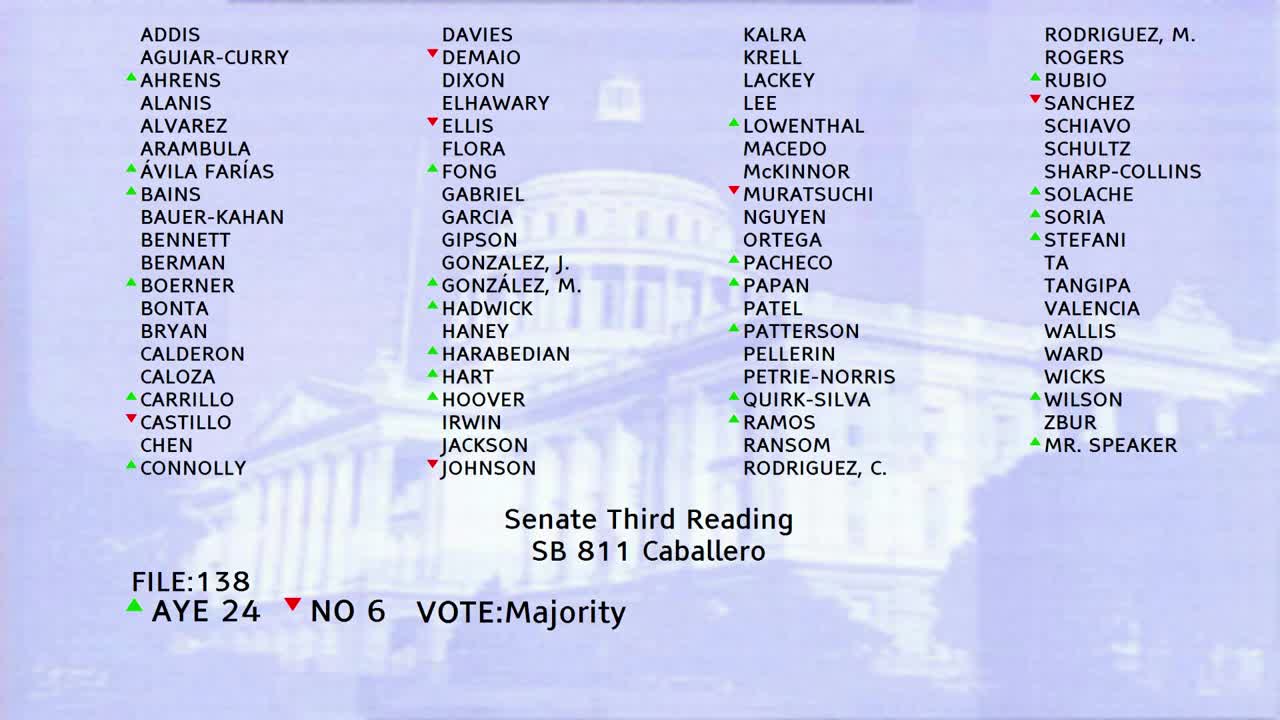 49SEC
Assembly Floor
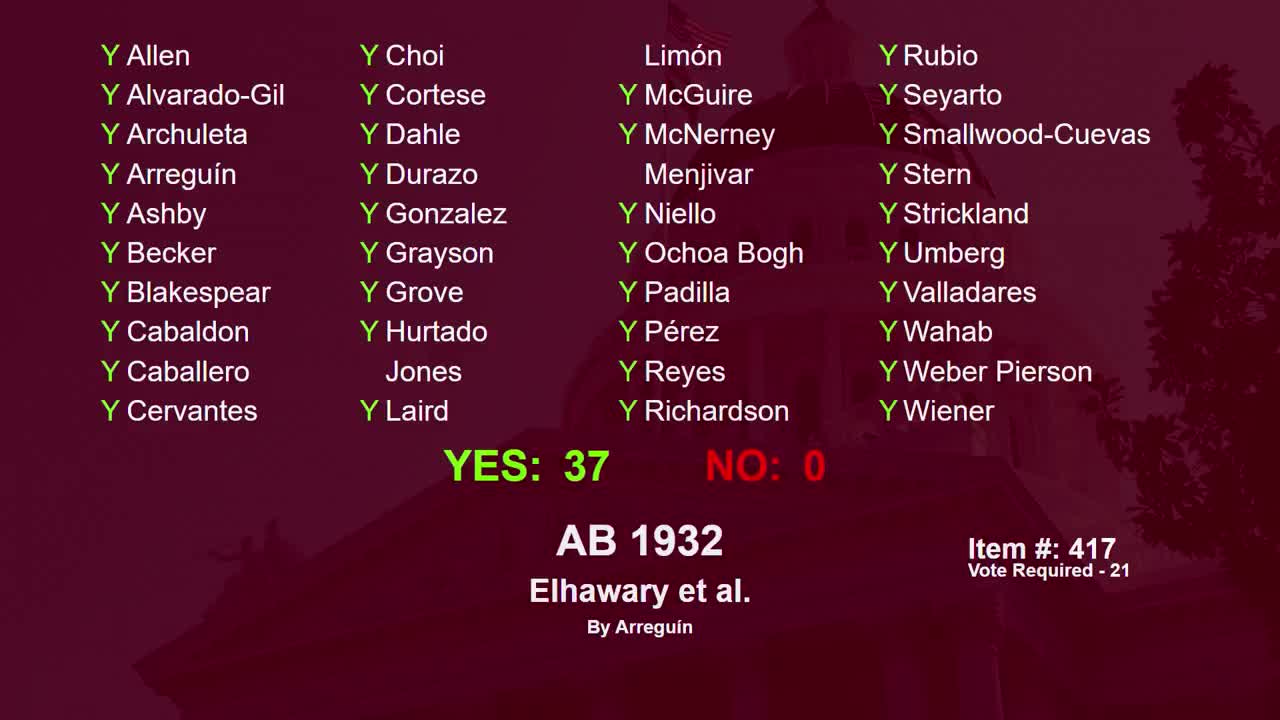 2MIN
Senate Floor
 2MIN
Senate Standing Committee on Labor, Public Employment and Retirement
 1MIN
Assembly Floor
 3MIN
Assembly Standing Committee on Public Employment and Retirement
Bill Author

Bill Co-Author(s):