AB 2134: City council members: absences without permission.
- Session Year: 2025-2026
- House: Assembly
- Latest Version Date: 2026-08-24
Current Status:
Passed
(2026-08-24: Chaptered by Secretary of State - Chapter 123, Statutes of 2026.)
Introduced
In Committee
Awaiting First Chamber Vote
Passed First Chamber
In Committee
Awaiting Second Chamber Vote
Passed Second Chamber
Enacted
What does this bill do?
The bill requires cities to set up a process so city council members can take parental leave without that time counting toward the absences that could make their office become vacant. Council members would notify the city clerk or other official in writing (not at a public meeting), and parental leave covers birth, adoption, or foster placement for up to 12 workweeks or the longer leave the city already gives employees.
The summary is provided by generative AI which can make mistakes. For original language, please view the details in the table below.
Existing law provides that if a city council member is absent without permission from all regular city council meetings for a specified number of days from the last regular meeting they attended, their office becomes vacant and shall be filled as any other vacancy.
This bill would require a city to establish a process for a city council member to notify the city clerk or other designated official in writing that they are taking parental leave, as defined, for 12 workweeks or longer if the city council members city provides a parental leave period longer than 12 workweeks for their employees. The bill would exclude parental leave from counting toward the number of allowed absences allotted to each council member. The bill would prohibit the process from requiring a council member to make the declaration at a public hearing.
The bill would include findings that changes proposed by this bill address a matter of statewide concern rather than a municipal affair and, therefore, apply to all cities, including charter cities.
Existing constitutional provisions require that a statute that limits the right of access to the meetings of public bodies or the writings of public officials and agencies be adopted with findings demonstrating the interest protected by the limitation and the need for protecting that interest.
This bill would make legislative findings to that effect.
Existing law provides that if a city council member is absent without permission from all regular city council meetings for a specified number of days from the last regular meeting they attended, their office becomes vacant and shall be filled as any other vacancy.
This bill would prohibit a city from refusing permission for a council member to take absences for require a city to establish a process for a city council member to notify the city clerk or other designated official in writing that they are taking parental leave, as defined, for 12 workweeks or longer if the city council members city provides a parental leave period longer than 12 workweeks for their employees. The bill would exclude parental leave from counting toward the number of allowed absences allotted to each council member. The bill would prohibit a city the process from requiring a council member to request approval for their parental leave make the declaration at a public hearing.
The bill would include findings that changes proposed by this bill address a matter of statewide concern rather than a municipal affair and, therefore, apply to all cities, including charter cities.
Existing constitutional provisions require that a statute that limits the right of access to the meetings of public bodies or the writings of public officials and agencies be adopted with findings demonstrating the interest protected by the limitation and the need for protecting that interest.
This bill would make legislative findings to that effect.
Existing law provides that if a city council member is absent without permission from all regular city council meetings for a specified number of days from the last regular meeting they attended, their office becomes vacant and shall be filled as any other vacancy.
This bill would prohibit a city from refusing permission for a council member to take absences for parental leave and leave, as defined, for 12 workweeks or longer if the city council members city provides a parental leave period longer than 12 workweeks for their employees. The bill would exclude parental leave from counting toward the number of allowed absences allotted to each council member. The bill would prohibit a city from requiring a council member to request approval for their parental leave at a public hearing.
The bill would include findings that changes proposed by this bill address a matter of statewide concern rather than a municipal affair and, therefore, apply to all cities, including charter cities.
Existing constitutional provisions require that a statute that limits the right of access to the meetings of public bodies or the writings of public officials and agencies be adopted with findings demonstrating the interest protected by the limitation and the need for protecting that interest.
This bill would make legislative findings to that effect.
Existing law provides that if a city council member is absent without permission from all regular city council meetings for a specified number of days from the last regular meeting they attended, their office becomes vacant and shall be filled as any other vacancy.
This bill would make nonsubstantive changes to that provision. prohibit a city from refusing permission for a council member to take absences for parental leave and would exclude parental leave from counting toward the number of allowed absences allotted to each council member. The bill would prohibit a city from requiring a council member to request approval for their parental leave at a public hearing.
The bill would include findings that changes proposed by this bill address a matter of statewide concern rather than a municipal affair and, therefore, apply to all cities, including charter cities.
Existing constitutional provisions require that a statute that limits the right of access to the meetings of public bodies or the writings of public officials and agencies be adopted with findings demonstrating the interest protected by the limitation and the need for protecting that interest.
This bill would make legislative findings to that effect.
Existing law provides that if a city council member is absent without permission from all regular city council meetings for a specified number of days from the last regular meeting they attended, their office becomes vacant and shall be filled as any other vacancy.
This bill would make nonsubstantive changes to that provision.
(a)If a city council member is absent without permission from all regular city council meetings for 60 days consecutively from the last regular meeting they attended, their office becomes vacant and shall be filled as any other vacancy.
(b)Notwithstanding subdivision (a), if a city council meets monthly or less frequently than monthly and a city council member is absent without permission from all regular city council meetings for 70 days consecutively from the last regular meeting they attended, their office becomes vacant and shall be filled as any other vacancy.
(c)A city shall establish a process for a city council member to notify the city clerk or other designated official, in writing, that they are taking parental leave. The process shall not require the city council member to make that declaration at a public meeting.
(d)Parental leave shall not count toward the existing number of allowed absences allotted to each council member.
(e)For purposes of this section, parental leave means leave for reasons of the birth of a child of the city council member, or the placement of a child with a city council member in connection with the adoption or foster care of the child by the city council member. Parental leave shall be limited to 12 workweeks or the length of time allowed pursuant to the parental leave provided to employees of the applicable council members city, whichever is longer.
SEC. 2.The Legislature finds and declares that, because all councilmembers across the State of California should have uniform protections when starting or growing a family, this act is a matter of statewide concern and is not a municipal affair, as that term is used in Section 5 of Article XI of the California Constitution. Therefore, Section 1 of this act amending Section 36513 of the Government Code applies to all cities, including charter cities.
SEC. 3.The Legislature finds and declares that Section 1 of this act, which amends Section 36513 of the Government Code, imposes a limitation on the publics right of access to the meetings of public bodies or the writings of public officials and agencies within the meaning of Section 3 of Article I of the California Constitution. Pursuant to that constitutional provision, the Legislature makes the following findings to demonstrate the interest protected by this limitation and the need for protecting that interest:
In order to protect the privacy of city council members, the limitation on the publics right of access imposed by Section 1 of this act is necessary.
(a)If a city council member is absent without permission from all regular city council meetings for 60 days consecutively from the last regular meeting they attended, their office becomes vacant and shall be filled as any other vacancy.
(b)Notwithstanding subdivision (a), if a city council meets monthly or less frequently than monthly and a city council member is absent without permission from all regular city council meetings for 70 days consecutively from the last regular meeting they attended, their office becomes vacant and shall be filled as any other vacancy.
(c)A city shall establish a process for a city council member to notify the city clerk or other designated official, in writing, that they are taking parental leave. The process shall not require the city council member to make that declaration at a public meeting.
(d)Parental leave shall not count toward the existing number of allowed absences allotted to each council member.
(e)For purposes of this section, parental leave means leave for reasons of the birth of a child of the employee, city council member, or the placement of a child with an employee a city council member in connection with the adoption or foster care of the child by the employee. city council member. Parental leave shall be limited to 12 workweeks or the length of time allowed pursuant to the parental leave provided to employees of the applicable council members city, whichever is longer.
SEC. 2.The Legislature finds and declares that, because all councilmembers across the State of California should have uniform protections when starting or growing a family, this act is a matter of statewide concern and is not a municipal affair, as that term is used in Section 5 of Article XI of the California Constitution. Therefore, Section 1 of this act amending Section 36513 of the Government Code applies to all cities, including charter cities.
SEC. 3.The Legislature finds and declares that Section 1 of this act, which amends Section 36513 of the Government Code, imposes a limitation on the publics right of access to the meetings of public bodies or the writings of public officials and agencies within the meaning of Section 3 of Article I of the California Constitution. Pursuant to that constitutional provision, the Legislature makes the following findings to demonstrate the interest protected by this limitation and the need for protecting that interest:
In order to protect the privacy of city council members, the limitation on the publics right of access imposed by Section 1 of this act is necessary.
(a)If a city council member is absent without permission from all regular city council meetings for 60 days consecutively from the last regular meeting they attended, their office becomes vacant and shall be filled as any other vacancy.
(b)Notwithstanding subdivision (a), if a city council meets monthly or less frequently than monthly and a city council member is absent without permission from all regular city council meetings for 70 days consecutively from the last regular meeting they attended, their office becomes vacant and shall be filled as any other vacancy.
(c)A city shall establish a process for a city council member to notify the city clerk or other designated official, in writing, that they are taking parental leave. The process shall not require the city council member to make that declaration at a public meeting.
(c)(d)Parental leave shall not count toward the existing number of allowed absences allotted to each council member.
(d)A city shall not refuse permission for a council member to take absences for parental leave.(e)Notwithstanding the Ralph M. Brown Act (Chapter 9 (commencing with Section 54950) of Part 1 of Division 2 of Title 5), a city shall not require a council member to request approval for their parental leave at a public hearing.(f)(e)For purposes of this section, parental leave means leave for reasons of the birth of a child of the employee, or the placement of a child with an employee in connection with the adoption or foster care of the child by the employee. Parental leave shall be limited to 12 workweeks or the length of time allowed pursuant to the parental leave provided to employees of the applicable council members city, whichever is longer.
SEC. 2.The Legislature finds and declares that Section 1 of this act amending Section 36513 of the Government Code addresses a matter of statewide concern rather than a municipal affair as that term is used in Section 5 of Article XI of the California Constitution. Therefore, Section 1 of this act applies to all cities, including charter cities.SEC. 2.The Legislature finds and declares that, because all councilmembers across the State of California should have uniform protections when starting or growing a family, this act is a matter of statewide concern and is not a municipal affair, as that term is used in Section 5 of Article XI of the California Constitution. Therefore, Section 1 of this act amending Section 36513 of the Government Code applies to all cities, including charter cities.
SEC. 3.The Legislature finds and declares that Section 1 of this act, which amends Section 36513 of the Government Code, imposes a limitation on the publics right of access to the meetings of public bodies or the writings of public officials and agencies within the meaning of Section 3 of Article I of the California Constitution. Pursuant to that constitutional provision, the Legislature makes the following findings to demonstrate the interest protected by this limitation and the need for protecting that interest:
In order to protect the privacy of city council members, the limitation on the publics right of access imposed by Section 1 of this act is necessary.
(a)If a city council member is absent without permission from all regular city council meetings for 60 days consecutively from the last regular meeting they attended, their office becomes vacant and shall be filled as any other vacancy.
(b)Notwithstanding subdivision (a), if a city council meets monthly or less frequently than monthly and a city council member is absent without permission from all regular city council meetings for 70 days consecutively from the last regular meeting they attended, their office becomes vacant and shall be filled as any other vacancy.
(c)Parental leave shall not count toward the existing number of allowed absences allotted to each council member.
(d)A city shall not refuse permission for a council member to take absences for parental leave.
(e)Notwithstanding the Ralph M. Brown Act (Chapter 9 (commencing with Section 54950) of Part 1 of Division 2 of Title 5), a city shall not require a council member to request approval for their parental leave at a public hearing.
(f)For purposes of this section, parental leave means leave for reasons of the birth of a child of the employee, or the placement of a child with an employee in connection with the adoption or foster care of the child by the employee. Parental leave shall be limited to 12 workweeks or the length of time allowed pursuant to the parental leave provided to employees of the applicable council members city, whichever is longer.
SEC. 2.The Legislature finds and declares that Section 1 of this act amending Section 36513 of the Government Code addresses a matter of statewide concern rather than a municipal affair as that term is used in Section 5 of Article XI of the California Constitution. Therefore, Section 1 of this act applies to all cities, including charter cities.
SEC. 3.The Legislature finds and declares that Section 1 of this act, which amends Section 36513 of the Government Code, imposes a limitation on the publics right of access to the meetings of public bodies or the writings of public officials and agencies within the meaning of Section 3 of Article I of the California Constitution. Pursuant to that constitutional provision, the Legislature makes the following findings to demonstrate the interest protected by this limitation and the need for protecting that interest:
In order to protect the privacy of city council members, the limitation on the publics right of access imposed by Section 1 of this act is necessary.
(a)If a city council member is absent without permission from all regular city council meetings for 60 days consecutively from the last regular meeting they attended, their office becomes vacant and shall be filled as any other vacancy.
(b)Notwithstanding subdivision (a), if a city council meets monthly or less frequently than monthly and a city council member is absent without permission from all regular city council meetings for 70 days consecutively from the last regular meeting they attended, their office becomes vacant and shall be filled as any other vacancy.
(c)Parental leave shall not count toward the existing number of allowed absences allotted to each council member.
(d)A city shall not refuse permission for a council member to take absences for parental leave.
(e)Notwithstanding the Ralph M. Brown Act (Chapter 9 (commencing with Section 54950) of Part 1 of Division 2 of Title 5), a city shall not require a council member to request approval for their parental leave at a public hearing.
SEC. 2.The Legislature finds and declares that Section 1 of this act amending Section 36513 of the Government Code addresses a matter of statewide concern rather than a municipal affair as that term is used in Section 5 of Article XI of the California Constitution. Therefore, Section 1 of this act applies to all cities, including charter cities.
SEC. 3.The Legislature finds and declares that Section 1 of this act, which amends Section 36513 of the Government Code, imposes a limitation on the publics right of access to the meetings of public bodies or the writings of public officials and agencies within the meaning of Section 3 of Article I of the California Constitution. Pursuant to that constitutional provision, the Legislature makes the following findings to demonstrate the interest protected by this limitation and the need for protecting that interest:
In order to protect the privacy of city council members, the limitation on the publics right of access imposed by Section 1 of this act is necessary.
(a)If a city councilmember council member is absent without permission from all regular city council meetings for 60 days consecutively from the last regular meeting he or she they attended, his or her their office becomes vacant and shall be filled as any other vacancy.
(b)Notwithstanding subdivision (a), if a city council meets monthly or less frequently than monthly and a city councilmember council member is absent without permission from all regular city council meetings for 70 days consecutively from the last regular meeting he or she they attended, his or her their office becomes vacant and shall be filled as any other vacancy.
|
Date
|
Status
|
|---|---|
| Aug 24, 2026 | Chaptered by Secretary of State - Chapter 123, Statutes of 2026. |
| Aug 24, 2026 | Approved by the Governor. |
| Aug 10, 2026 | Enrolled and presented to the Governor at 1 p.m. |
| Aug 3, 2026 | Senate amendments concurred in. To Engrossing and Enrolling. (Ayes 72. Noes 0.). |
| Aug 3, 2026 | Senate amendments concurred in. To Engrossing and Enrolling. (Ayes 72. Noes 0. Page 6033.). |
| Jul 2, 2026 | In Assembly. Concurrence in Senate amendments pending. |
| Jul 2, 2026 | Read third time. Passed. Ordered to the Assembly. (Ayes 37. Noes 0.). |
| Jul 2, 2026 | Read third time. Passed. Ordered to the Assembly. (Ayes 37. Noes 0. Page 5187.). |
| Jun 25, 2026 | Read second time and amended. Ordered to consent calendar. |
| Jun 24, 2026 | From committee: Amend, and do pass as amended. To Consent Calendar. (Ayes 13. Noes 0.) (June 23). |
| Jun 10, 2026 | From committee: Do pass and re-refer to Com. on JUD. (Ayes 7. Noes 0.) (June 10). Re-referred to Com. on JUD. |
| Jun 4, 2026 | From committee chair, with author's amendments: Amend, and re-refer to committee. Read second time, amended, and re-referred to Com. on L. GOV. |
| May 20, 2026 | Referred to Coms. on L. GOV. and JUD. |
| May 12, 2026 | In Senate. Read first time. To Com. on RLS. for assignment. |
| May 11, 2026 | Read third time. Passed. Ordered to the Senate. (Ayes 72. Noes 0.) |
| May 11, 2026 | Read third time. Passed. Ordered to the Senate. (Ayes 72. Noes 0. Page 5001.) |
| May 11, 2026 | Read third time. Passed. Ordered to the Senate. |
| May 5, 2026 | Read second time. Ordered to third reading. |
| May 4, 2026 | Read second time and amended. Ordered returned to second reading. |
| Apr 30, 2026 | From committee: Amend, and do pass as amended. (Ayes 10. Noes 0.) (April 29). |
| Mar 17, 2026 | Re-referred to Com. on L. GOV. |
| Mar 16, 2026 | Referred to Com. on L. GOV. |
| Mar 16, 2026 | From committee chair, with author's amendments: Amend, and re-refer to Com. on L. GOV. Read second time and amended. |
| Feb 19, 2026 | From printer. May be heard in committee March 21. |
| Feb 18, 2026 | Read first time. To print. |
|
Date
|
Description
|
Location
|
Votes
|
|
|---|---|---|---|---|
| Aug 3, 2026 | AB 2134 Addis Concurrence in Senate Amendments | Assembly Floor |
Passed |
|
| Jul 2, 2026 | Consent Calendar 2nd AB2134 Addis et al. | Senate Floor |
Passed |
|
| Jun 23, 2026 | Do pass as amended, and be ordered to the Consent Calendar | Senate Standing Committee on Judiciary |
Passed |
|
| Jun 10, 2026 | Do pass, but first be re-referred to the Committee on [Judiciary] | Senate Standing Committee on Local Government |
Passed |
|
| May 11, 2026 | AB 2134 Addis Assembly Third Reading | Assembly Floor |
Passed |
|
| Apr 29, 2026 | Do pass as amended. | Assembly Standing Committee on Local Government |
Passed |
This list shows positions taken on this bill by organizations on the date displayed, which is linked to the original source.
Positions by individuals are not included.
|
Organization
|
Position
|
Date
|
|---|---|---|
| City of Foster City | ** Support | |
| City of Glendale | ** Support | |
| City Of San Mateo | ** Support | |
| City of Sunnyvale | ** Support | |
| Close the Gap Catalyst | ** Support | |
| League Of California Cities | ** Support | |
| Legislative Women's Caucus | ** Support | |
| Lieutenant Governor Eleni Kounalakis | ** Support |
CONCURRENCE IN SENATE AMENDMENTS
CSA1 Bill Id:AB 2134
Author:(Addis)
As Amended Ver:June 25, 2026
Majority vote
SUMMARY
Requires cities to establish a process for a city council member to provide notification that they are taking parental leave, prohibits that process from requiring the city council member to make that declaration at a public meeting, and prohibits parental leave from counting toward allowed absences for a city council member.
Senate Amendments
- Require a city to establish a process for a city council member to notify the city clerk or other designated official, in writing, that they are taking parental leave. The process shall not require the city council member to make that declaration at a public meeting.
- Remove a provision that a city shall not refuse permission for a council member to take absences for parental leave.
- Make technical, conforming and clarifying changes.
COMMENTS
Existing law limits the number of days a city councilmember may be absent without permission from all regular city council meetings. If a councilmember is absent for 60 days consecutively from the last regular meeting he or she attended, his or her office becomes vacant and shall be filled as any other vacancy. If a city council meets monthly or less frequently than monthly, this absence without permission is allowed for 70 days consecutively from the last regular meeting the councilmember attended before the office becomes vacant.
The California Family Rights Act provides certain employees up to 12 weeks of unpaid, job-protected leave a year for the purpose of bonding with a child, caring for a parent, spouse, or child with a serious health condition, or due to an employee's own serious health condition, and requires group health benefits to be maintained during the leave as if employees continued to work instead of taking leave.
Under the Fair Employment and Housing Act (FEHA) and associated regulations, it is an unlawful employment practice, unless based upon a bona fide occupational qualification, for an employer to refuse to allow a female employee disabled by pregnancy, childbirth, or a related medical condition to take a leave for a reasonable period of time not to exceed four months and thereafter return to work. The employee is entitled to utilize any accrued vacation leave during this period of time. Also under FEHA, reasonable accommodation of a disability related to pregnancy can include an extended leave of absence.
Because city councilmembers are elected, and are not employees of the city they represent, they are not covered under these laws for any absences from city council meetings for the purpose of parental leave.
According to the author's office, "…because existing law lacks protections for councilmembers, cities may deny them parental leave, forcing them to make the difficult choice between taking necessary leave or keeping their council seat. In other cases, cities may allow leave but make the process for seeking approval public and invasive. For example, according to reporting by San Jose Mercury News, Sunnyvale City Councilmember Alysa Cisneros, who recently had her second child, was required to get her leave approved by her fellow councilmembers at a public hearing. Councilmember Cisneros was forced to share personal information about her health in a public forum."
According to the Author
"Local elected office can launch careers in public service, serving as a pathway to higher office. With that in mind, local elected office must be accessible to all Californians, including those who want to start or grow their families. AB 2134 will establish standard minimum protections for parental leave for city councilmembers across California, ensuring that councilmembers can take absences for parental leave without losing their council seat."
Arguments in Support
The Legislative Women's Caucus, in support, writes, "The Legislative Women's Caucus has voted to designate AB 2134 (Addis) as a top priority bill for the Caucus. This bill will establish baseline protections for parental leave for city councilmembers across California. It ensures that councilmembers can take parental leave without risk of losing their seat and clarifies that such leave will not count toward absence limits."
"The absence of these protections should not deter Californians from pursuing local office or force elected officials to choose between public service and starting or growing their families. Nor should councilmembers be required to disclose sensitive personal or medical information to colleagues or the public to take parental leave. While accountability is essential, public officials deserve the same basic privacy afforded to other workers."
"This bill ends the invasive practice of requiring councilmembers to seek approval for parental leave in a public hearing, promoting a more equitable and respectful standard for those who serve."
Arguments in Opposition
None on file.
FISCAL COMMENTS
None
VOTES:
ASM LOCAL GOVERNMENT: 10-0-0
YES: Carrillo, Ta, Johnson, Pacheco, Ramos, Ransom, Blanca Rubio, Caloza, Ward, Wilson
ASSEMBLY FLOOR: 72-0-8
YES: Addis, Aguiar-Curry, Ahrens, Alanis, Alvarez, Ávila Farías, Bains, Bauer-Kahan, Bennett, Berman, Boerner, Bonta, Bryan, Calderon, Caloza, Carrillo, Castillo, Chen, Connolly, Davies, DeMaio, Dixon, Elhawary, Ellis, Flora, Fong, Gabriel, Garcia, Gipson, Jeff Gonzalez, Mark González, Hadwick, Haney, Harabedian, Hart, Hoover, Irwin, Jackson, Johnson, Kalra, Krell, Lackey, Lee, Macedo, McKinnor, Muratsuchi, Nguyen, Ortega, Pacheco, Papan, Patel, Patterson, Pellerin, Petrie-Norris, Ramos, Ransom, Rogers, Blanca Rubio, Sanchez, Schiavo, Schultz, Sharp-Collins, Stefani, Ta, Tangipa, Valencia, Wallis, Ward, Wicks, Wilson, Zbur, Rivas
ABS, ABST OR NV: Arambula, Gallagher, Lowenthal, Quirk-Silva, Celeste Rodriguez, Michelle Rodriguez, Solache, Soria
SENATE FLOOR: 37-0-3
YES: Allen, Archuleta, Arreguín, Ashby, Becker, Blakespear, Cabaldon, Caballero, Cervantes, Choi, Cortese, Dahle, Durazo, Gonzalez, Grayson, Grove, Hurtado, Jones, Laird, Limón, McGuire, McNerney, Menjivar, Niello, Ochoa Bogh, Padilla, Pérez, Reyes, Seyarto, Smallwood-Cuevas, Stern, Strickland, Umberg, Valladares, Wahab, Weber Pierson, Wiener
ABS, ABST OR NV: Alvarado-Gil, Richardson, Rubio
UPDATED
VERSION: June 25, 2026
CONSULTANT: Angela Mapp / L. GOV. / (916) 319-3958 FN: 0003303
SENATE RULES COMMITTEE Office of Senate Floor Analyses (916) 651-4171 | AB 2134 |
CONSENT
Bill No: AB 2134
Author: Addis (D), et al.
Amended: 6/25/26 in Senate
Vote: 21
SENATE LOCAL GOVERNMENT COMMITTEE: 7-0, 6/10/26
AYES: Durazo, Choi, Arreguín, Ashby, Cervantes, Laird, Seyarto
SENATE JUDICIARY COMMITTEE: 13-0, 6/23/26
AYES: Umberg, Niello, Allen, Ashby, Caballero, Durazo, Laird, Reyes, Stern, Valladares, Wahab, Weber Pierson, Wiener
ASSEMBLY FLOOR: 72-0, 5/11/26 - See last page for vote
SUBJECT: City council members: absences without permission
SOURCE: Author
DIGEST:
This bill allows a city to establish a process for parental leave and prohibits parental leave from counting toward allowed absences for a city council member.
ANALYSIS:
Existing law:
- Makes it an unlawful employment practice, under the California Family Rights Act, for an employer, as defined, to refuse to grant a request by an eligible employee to take up to 12 workweeks of unpaid, job-protected leave during any 12-month period to, among other things, care for a child born to, adopted by, or placed for foster care with the employee.
- Affirms that the people have the right of access to information concerning the conduct of the people’s business, and, therefore, the meetings of public bodies and the writings of public officials and agencies shall be open to public scrutiny.
- Requires a statute that limits the public’s right of access to be adopted with findings demonstrating the interest protected by the limitation and the need for protecting that interest.
- Establishes the Brown Act, which secures public access to the meetings of public commissions, boards, councils, and agencies in the state. The Brown Act defines the following relevant terms:
- A “local agency” is a county, city, whether general law or chartered, city and county, town, school district, municipal corporation, district, political subdivision, or any board, commission, or agency thereof, or any other local public agency.
- A “legislative body” is the governing board of a local agency or any other local body created by state or federal statute; a commission, committee, board, or other body of a local agency, as specified; a board, commission, or other multimember body that governs a private corporation, limited liability company, or other entity that is either created by an elected legislative body to exercise delegated authority or receives funds from a local agency and includes a member of the legislative body of the local agency; or the lessee of any hospital leased pursuant to Health and Safety Code section 21131, where the lessee exercises any material authority delegated by the legislative body.
- Requires all meetings of the legislative body of a local agency to be open and public, and all persons shall be permitted to attend any meeting of the legislative body of a local agency, except as otherwise provided in the Brown Act.
- Provides that if a city council member is absent without permission from all regular city council meetings for 60 days consecutively from the last regular meeting they attended, their office becomes vacant and shall be filled as any other vacancy.
- If a city council meets monthly or less frequently than monthly and a city council member is absent without permission from all regular city council meetings for 70 days consecutively from the last regular meeting they attended, their office becomes vacant and shall be filled as any other vacancy.
This bill:
- Requires a city to establish a process for a city council member to notify the city clerk or other designated official in writing that they are taking parental leave for 12 workweeks or longer if the city council member’s city provides a parental leave period longer than 12 workweeks for their employees.
- Prohibits the process from requiring a council member to make the declaration at a public hearing.
- Excludes parental leave from counting toward the number of allowed absences allotted to each council member before an office is considered vacant.
- Defines “parental leave” for these purposes to mean eave for reasons of the birth of a child of the city council member, or the placement of a child with an city council member in connection with the adoption or foster care of the child by the city council member. Parental leave shall be limited to 12 workweeks or the length of time allowed pursuant to the parental leave provided to employees of the applicable council member’s city, whichever is longer.
- Provides that the Legislature finds and declares that this act is a matter of statewide concern and is not a municipal affair, as that term is used in Section 5 of Article XI of the California Constitution. Therefore, this bill applies to all cities, including charter cities.
- Provides that the Legislature finds and declares that the limitation on the access to public meetings is needed in order to protect the privacy of city council members.
Background
City council absences. Existing law limits the number of days a city council member may be absent without permission from regular city council meetings. If a city council member is absent for 60 days consecutively from the last regular meeting the councilmember attended, their office becomes vacant and must be filled as any other vacancy. If a city council meets monthly or less frequently than monthly, a city council member may be absent without permission for 70 consecutive days from the last regular meeting the council member attended before the office becomes vacant.
California Family Rights Act (CFRA). State law provides employees with several types of protected medial leave, depending on the size of their employer and the reason for the leave. The CFRA provides certain employees up to 12 weeks of unpaid, job protected leave for a year to bond with a child, care for a parent, spouse, or child with a serious health condition or address the employee’s own serious health condition. The CFRA also requires employers to maintain group health benefits during the leave under the same terms and conditions as if the employee had continued working. Under the CFRA and the Fair Employment and Housing Act, it is an unlawful employment practice for an employer to refuse an eligible employee’s request to take protected leave for a qualifying purpose. Because city councilmembers are elected, and are not employees of the city they represent, they are not covered under these laws for any absences from city council meetings for the purpose of parental leave.
City of Sunnyvale. The City of Sunnyvale is a charter city located in Santa Clara County with approximately 157,000 residents. As the second most populous city in the county, Sunnyvale is one of the major cities that make up California’s Silicon Valley. In 2024, the San Jose Mercury News reported that, “Sunnyvale City Councilmember Alysa Cisneros, who recently had her second child, was required to get her leave approved by her fellow councilmembers at a public hearing. Councilmember Cisneros was forced to share personal information about her health in a public forum.” Although the City Council ultimately permitted Councilmember Cisneros to take leave and retain her seat, the circumstance highlighted potential challenges that local elected officials may face when seeking parental leave.
Comments
According to the author, “Local elected office can launch careers in public service, serving as a pathway to higher office. With that in mind, local elected office must be accessible to all Californians, including those who want to start or grow their families. AB 2134 will establish standard minimum protections for parental leave for city councilmembers across California, ensuring that councilmembers can take absences for parental leave without losing their council seat.”
Balancing act. City council members serve as the elected representatives of their constituents and fulfil that role by attending public meetings, participating in discussions, and voting on local matters. Their presence is an important component of local governance, as council actions often require participation to establish a quorum, conduct business, and make decisions. At the same time, parental leave policies recognize the importance of allowing new parents time to care for and bond with their children during a critical period of family development. AB 2134 allows city council members a minimum of 12 weeks of parental leave following the birth, adoption or fostering of a child. While parental leave may allow elected officials to balance public service with family responsibilities, extended absences, even for legitimate reasons like parental leave, may temporarily reduce representation for the residents they were elected to represent. Such absences may also affect a council’s ability to conduct business. Does AB 2134 appropriately balance the benefits for city councilmembers and their growing family with the potential impacts that extended absences may have on effective governance?
FISCAL EFFECT: Appropriation: No Fiscal Com.: No Local: No
SUPPORT: (Verified 6/30/26)
Lieutenant Governor Eleni Kounalakis
California Legislative Women's Caucus
City of Foster City
City of Glendale
City of San Mateo
City of Sunnyvale
League of California Cities
OPPOSITION: (Verified 6/30/26)
None received
ASSEMBLY FLOOR: 72-0, 5/11/26
AYES: Addis, Aguiar-Curry, Ahrens, Alanis, Alvarez, Ávila Farías, Bains, Bauer-Kahan, Bennett, Berman, Boerner, Bonta, Bryan, Calderon, Caloza, Carrillo, Castillo, Chen, Connolly, Davies, DeMaio, Dixon, Elhawary, Ellis, Flora, Fong, Gabriel, Garcia, Gipson, Jeff Gonzalez, Mark González, Hadwick, Haney, Harabedian, Hart, Hoover, Irwin, Jackson, Johnson, Kalra, Krell, Lackey, Lee, Macedo, McKinnor, Muratsuchi, Nguyen, Ortega, Pacheco, Papan, Patel, Patterson, Pellerin, Petrie-Norris, Ramos, Ransom, Rogers, Blanca Rubio, Sanchez, Schiavo, Schultz, Sharp-Collins, Stefani, Ta, Tangipa, Valencia, Wallis, Ward, Wicks, Wilson, Zbur, Rivas
NO VOTE RECORDED: Arambula, Gallagher, Lowenthal, Quirk-Silva, Celeste Rodriguez, Michelle Rodriguez, Solache, Soria
Prepared by: Itzel Vargas / L. GOV. / (916) 651-4119
6/30/26 10:37:03
**** END ****
Senator Thomas Umberg, Chair
2025-2026 Regular Session
Bill No: AB 2134 (Author:Addis)
Version: June 4, 2026
Hearing Date: June 23, 2026
Fiscal: No
Urgency: No
Consultant: AM
SUBJECT
City council members: absences without permission
DIGEST
This bill requires a city to establish a process for a city council member to notify the city clerk or other designated official in writing that they are taking parental leave, as defined, for 12 workweeks or longer if the city council member’s city provides a parental leave period longer than 12 workweeks for their employees. The bill prohibits the process from requiring a council member to make the declaration at a public hearing. The bill also excludes parental leave from counting toward the number of allowed absences allotted to each council member before an office is considered vacant.
EXECUTIVE SUMMARY
This bill is based on a real situation that occurred when Councilmember Alysa Cisneros of the Sunnyvale City Council was required to seek approval for parental leave from the Sunnyvale City Council at a public hearing in 2024. This bill seeks to ensure that individuals who choose to become public servants are provided similar parental leave protections as employees of the city they serve and are not forced to publicly make a request for parental leave. Additionally, the bill provides that parental leave taken will not count toward the number of allowed absences allotted to each council member under existing law before their office is considered vacant. The jurisdiction of this Committee is the limitation of access to public meetings that is implicated by the bill, and as such, this analysis will focus solely on those provisions.
The bill is author sponsored and supported by the California Legislative Women's Caucus, the City of San Mateo, the City of Sunnyvale, and the League of California Cities. No timely opposition was received by the Committee. The bill passed the Senate Local Government Committee on a vote of 7 to 0.
PROPOSED CHANGES TO THE LAW
Existing law:
- Makes it an unlawful employment practice, under the California Family Rights Act, for an employer, as defined, to refuse to grant a request by an eligible employee to take up to 12 workweeks of unpaid, job-protected leave during any 12-month period to, among other things, care for a child born to, adopted by, or placed for foster care with the employee. (Government Code §12945.2)
- Affirms that the people have the right of access to information concerning the conduct of the people’s business, and, therefore, the meetings of public bodies and the writings of public officials and agencies shall be open to public scrutiny. (Cal. Const., art. I, § 3(b)(1).)
- Requires a statute that limits the public’s right of access to be adopted with findings demonstrating the interest protected by the limitation and the need for protecting that interest. (Cal. const. art. I, § 3(b)(1).)
- Establishes the Brown Act, which secures public access to the meetings of public commissions, boards, councils, and agencies in the state. (Gov. Code, tit. 5, div. 2, pt. 1, ch. 9, §§ 54950 et seq.) The Brown Act defines the following relevant terms:
- A “local agency” is a county, city, whether general law or chartered, city and county, town, school district, municipal corporation, district, political subdivision, or any board, commission, or agency thereof, or any other local public agency. (Gov. Code § 54951.)
- A “legislative body” is the governing board of a local agency or any other local body created by state or federal statute; a commission, committee, board, or other body of a local agency, as specified; a board, commission, or other multimember body that governs a private corporation, limited liability company, or other entity that is either created by an elected legislative body to exercise delegated authority or receives funds from a local agency and includes a member of the legislative body of the local agency; or the lessee of any hospital leased pursuant to Health and Safety Code section 21131, where the lessee exercises any material authority delegated by the legislative body. (Gov. Code § 54952.)
- Requires all meetings of the legislative body of a local agency to be open and public, and all persons shall be permitted to attend any meeting of the legislative body of a local agency, except as otherwise provided in the Brown Act. (Gov. Code § 54953.)
- Provides that if a city council member is absent without permission from all regular city council meetings for 60 days consecutively from the last regular meeting they attended, their office becomes vacant and shall be filled as any other vacancy.
- If a city council meets monthly or less frequently than monthly and a city council member is absent without permission from all regular city council meetings for 70 days consecutively from the last regular meeting they attended, their office becomes vacant and shall be filled as any other vacancy. (Gov. Code § 36513.)
This bill:
- Requires a city to establish a process for a city council member to notify the city clerk or other designated official in writing that they are taking parental leave for 12 workweeks or longer if the city council member’s city provides a parental leave period longer than 12 workweeks for their employees.
- Prohibits the process from requiring a council member to make the declaration at a public hearing.
- Excludes parental leave from counting toward the number of allowed absences allotted to each council member before an office is considered vacant.
- Defines “parental leave” for these purposes to mean eave for reasons of the birth of a child of the employee, or the placement of a child with an employee in connection with the adoption or foster care of the child by the employee. Parental leave shall be limited to 12 workweeks or the length of time allowed pursuant to the parental leave provided to employees of the applicable council member’s city, whichever is longer.
- Provides that the Legislature finds and declares that this act is a matter of statewide concern and is not a municipal affair, as that term is used in Section 5 of Article XI of the California Constitution. Therefore, the bill applies to all cities, including charter cities.
- Provides that the Legislature finds and declares that the limitation on the access to public meetings is needed in order to protect the privacy of city council members.
COMMENTS
- Author statement
The author writes:
Local elected office can launch careers in public service, serving as a pathway to higher office. With that in mind, local elected office must be accessible to all Californians, including those who want to start or grow their families. AB 2134 will establish standard minimum protections for parental leave for city councilmembers across California, ensuring that councilmembers can take absences for parental leave without losing their council seat.
- The bill limits access to public meetings
- California Family Rights Act
California employees may be entitled to several medical leaves depending on the size of their employer and the reason for the leave. SB 1383 (Jackson, Chapter 86, Statutes of 2020) made historic changes to the CFRA after almost a decade of attempts to reform the act. Prior to 2021, CFRA (and its federal counterpart, the Family and Medical Leave Act) provided for up to 12 weeks per year of unpaid job protected leave for an employee who takes time for bonding or care, however, these protections were only available to employees of businesses with 50 or more workers. Effective January 1, 2021, among other things, SB 1383 extended CFRA’s medical and family leave protections to an employer with at least five employees.
- The Brown Act and right to access public meetings
In 2004, the right of public access was enshrined in the California Constitution with the passage of Proposition 59 (Nov. 3, 2004, statewide general election),[1] which amended the California Constitution to specifically protect the right of the public to access the meetings of public bodies: “The people have the right of access to information concerning the conduct of the people’s business, and therefore the meetings of public bodies and the writings of public officials and agencies shall be open to public scrutiny.” (Cal. Const., art. I, sec. 3 (b)(1).) The California Constitution requires a statute to be broadly construed if it furthers the people’s right of access, and narrowly construed if it limits the right of access, and requires a statute that limits the public’s right of access to be adopted with findings demonstrating the interest protected by the limitation and the need for protecting that interest. (Cal. const. art. I, § 3(b)(1).)
The Brown Act provides guidelines and requirements for how local bodies must guarantee open and public access to their meetings. The Brown Act generally requires that meetings of the legislative body of a local agency be open and accessible to the public, and requires local agencies to provide notice of the meeting, its agenda, and its location in advance of a meeting to ensure that the people have adequate notice and opportunity to attend.
This bill seeks to ensure that city council members are able to take parental leave in a similar manner as employees of the cities they serve. Under the bill, a city is prohibited from requiring a city council member from declaring they are taking parental leave in a public hearing and requires a city to establish a process for a council member to inform the city they will be taking parental leave. This provision by implication limits access to public meetings. The bill provides that this limitation is necessary in order to protect the privacy of city council members.
- Amendment[2]
The definition for parental leave in the bill refers to an employee, when the reference should be to city council member. To correct this the author has agreed to amend the definition of parental leave as follows:
(e) For purposes of this section, “parental leave” means leave for reasons of the birth of a child of the employee, city council member, or the placement of a child with an employee a city council member in connection with the adoption or foster care of the child by the employee. city council member. Parental leave shall be limited to 12 workweeks or the length of time allowed pursuant to the parental leave provided to employees of the applicable council member’s city, whichever is longer.
- Statements in support
The California Legislative Women's Caucus writes in support sating:
The Legislative Women’s Caucus has voted to designate AB 2134 (Addis) as a top priority bill for the Caucus. This bill will establish baseline protections for parental leave for city councilmembers across California. It ensures that councilmembers can take parental leave without risk of losing their seat and clarifies that such leave will not count toward absence limits.
The absence of these protections should not deter Californians from pursuing local office or force elected officials to choose between public service and starting or growing their families. Nor should councilmembers be required to disclose sensitive personal or medical information to colleagues or the public to take parental leave. While accountability is essential, public officials deserve the same basic privacy afforded to other workers.
This bill ends the invasive practice of requiring councilmembers to seek approval for parental leave in a public hearing, promoting a more equitable and respectful standard for those who serve.
SUPPORT
California Legislative Women's Caucus
City of San Mateo
City of Sunnyvale
League of California Cities
OPPOSITION
None received
RELATED LEGISLATION
Pending Legislation: None known.
Prior Legislation: None known.
PRIOR VOTES
Senate Local Government Committee (Ayes 7, Noes 0)
Assembly Floor (Ayes 72, Noes 0)
Assembly Local Government Committee (Ayes 10, Noes 0)
**************
SENATE COMMITTEE ON LOCAL GOVERNMENT
Senator María Elena Durazo, Chair
2025 - 2026 Regular
Bill No: | AB 2134 | Hearing Date: | 6/10/26 |
Author: | Addis | Fiscal: | No |
Version: | 6/4/26 | Consultant: | Vargas |
City council members: absences without permission
Allows a city to establish a process for parental leave and prohibits parental leave from counting toward allowed absences for a city council member.
Background
Cities. California cities fall into one of two types: general law or charter cities. General law cities must follow all general, statewide laws. The California Constitution allows cities that adopt charters to control their own “municipal affairs.” In all other matters, charter cities must also follow the general, statewide laws. Because the Constitution doesn't define “municipal affairs,” the courts determine whether a topic is a municipal affair or an issue of statewide concern. City charters specify the governance structure of the city, including the number of officers and their compensation.
City council absences. Existing law limits the number of days a city council member may be absent without permission from regular city council meetings. If a city council member is absent for 60 days consecutively from the last regular meeting the councilmember attended, their office becomes vacant and must be filled as any other vacancy. If a city council meets monthly or less frequently than monthly, a city council member may be absent without permission for 70 consecutive days from the last regular meeting the council member attended before the office becomes vacant.
California Family Rights Act (CFRA). State law provides employees with several types of protected medial leave, depending on the size of their employer and the reason for the leave. The CFRA provides certain employees up to 12 weeks of unpaid, job protected leave for a year to bond with a child, care for a parent, spouse, or child with a serious health condition or address the employee’s own serious health condition. The CFRA also requires employers to maintain group health benefits during the leave under the same terms and conditions as if the employee had continued working. Under the CFRA and the Fair Employment and Housing Act, it is an unlawful employment practice for an employer to refuse an eligible employee’s request to take protected leave for a qualifying purpose. Because city councilmembers are elected, and are not employees of the city they represent, they are not covered under these laws for any absences from city council meetings for the purpose of parental leave.
City of Sunnyvale. The City of Sunnyvale is a charter city located in Santa Clara County with approximately 157,000 residents. As the second most populous city in the county, Sunnyvale is one of the major cities that make up California’s Silicon Valley. In 2024, the San Jose Mercury News reported that, “Sunnyvale City Councilmember Alysa Cisneros, who recently had her second child, was required to get her leave approved by her fellow councilmembers at a public hearing. Councilmember Cisneros was forced to share personal information about her health in a public forum.” Although the City Council ultimately permitted Councilmember Cisneros to take leave and retain her seat, the circumstance highlighted potential challenges that local elected officials may face when seeking parental leave.
To avoid having a council member vacate their seat because they took time off to bond with their child, the author wants to allow city council members to take parental leave without vacating their seat.
Proposed Law
Assembly Bill 2134 requires cities to establish a process for city council members to notify the city clerk, or other designated official, in writing they are taking parental leave.
The process must not require city council members to make that declaration at a public meeting and parental leave must not count towards the existing number of allowed absences allotted to each city council member.
AB 2134 defines parental leave to mean leave for reasons related to giving birth or adopting or fostering a child. Parental leave must be 12 work weeks or the length of time allowed to city employees of the applicable council member city’s, whichever is longer.
Comments
1. Purpose of the bill. According to the author, “Local elected office can launch careers in public service, serving as a pathway to higher office. With that in mind, local elected office must be accessible to all Californians, including those who want to start or grow their families. AB 2134 will establish standard minimum protections for parental leave for city councilmembers across California, ensuring that councilmembers can take absences for parental leave without losing their council seat.”
2. Balancing act. City council members serve as the elected representatives of their constituents and fulfil that role by attending public meetings, participating in discussions, and voting on local matters. Their presence is an important component of local governance, as council actions often require participation to establish a quorum, conduct business, and make decisions. At the same time, parental leave policies recognize the importance of allowing new parents time to care for and bond with their children during a critical period of family development. AB 2134 allows city council members a minimum of 12 weeks of parental leave following the birth, adoption or fostering of a child. While parental leave may allow elected officials to balance public service with family responsibilities, extended absences, even for legitimate reasons like parental leave, may temporarily reduce representation for the residents they were elected to represent. Such absences may also affect a council’s ability to conduct business. Does AB 2134 appropriately balance the benefits for city councilmembers and their growing family with the potential impacts that extended absences may have on effective governance?
3. Charter city. The California Constitution allows cities that adopt charters to control their own “municipal affairs.” In all other matters, charter cities must follow the general, statewide laws. Because the Constitution does not define “municipal affairs,” the courts determine whether a topic is a municipal affair or an issue of statewide concern. AB 2134 says its statutory provisions apply to charter cities. To support this assertion, the bill includes a legislative finding that councilmembers across the state of California having uniform protections when starting or growing a family is a matter of statewide concern.
4. Coming and going. The Senate Rules Committee has ordered a double referral of AB 2134: first to the Committee on Local Government to consider its impact on local agencies, and second to the Committee on Judiciary.
Assembly Actions
Assembly Local Government Committee: 10-0
Assembly Floor: 72-0
Support and Opposition
(6/5/2026)
Support: California Legislative Women's Caucus
City of San Mateo
City of Sunnyvale
Opposition: None Submitted
-- END --
ASSEMBLY THIRD READING
ATR Bill Id:AB 2134
Author:(Addis)
As Amended Ver:May 4, 2026
Majority vote
SUMMARY
Prohibits parental leave from counting toward allowed absences for city council members, prohibits a city from refusing permission for a city council member to take absences for parental leave, and prohibits a city from requiring a city council member to request approval for parental leave at a public hearing.
Major Provisions
- Provides that parental leave shall not count toward the existing number of allowed absences allotted to each city council member, pursuant to existing law limiting those absences.
- Provides that a city shall not refuse permission for a council member to take absences for parental leave.
- Provides, notwithstanding the Ralph M. Brown Act, a city shall not require a council member to request approval for their parental leave at a public hearing.
- Provides that, for purposes of this bill, "parental leave" means leave for reasons of the birth of a child of the employee, or the placement of a child with an employee in connection with the adoption or foster care of the child by the employee. Parental leave shall be limited to 12 workweeks or the length of time allowed pursuant to the parental leave provided to employees of the applicable council member's city, whichever is longer.
COMMENTS
Existing law limits the number of days a city councilmember may be absent without permission from all regular city council meetings. If a councilmember is absent for 60 days consecutively from the last regular meeting he or she attended, his or her office becomes vacant and shall be filled as any other vacancy. If a city council meets monthly or less frequently than monthly, this absence without permission is allowed for 70 days consecutively from the last regular meeting the councilmember attended before the office becomes vacant.
The California Family Rights Act provides certain employees up to 12 weeks of unpaid, job-protected leave a year for the purpose of bonding with a child, caring for a parent, spouse, or child with a serious health condition, or due to an employee's own serious health condition, and requires group health benefits to be maintained during the leave as if employees continued to work instead of taking leave.
Under the Fair Employment and Housing Act (FEHA) and associated regulations, it is an unlawful employment practice, unless based upon a bona fide occupational qualification, for an employer to refuse to allow a female employee disabled by pregnancy, childbirth, or a related medical condition to take a leave for a reasonable period of time not to exceed four months and thereafter return to work. The employee is entitled to utilize any accrued vacation leave during this period of time. Also under FEHA, reasonable accommodation of a disability related to pregnancy can include an extended leave of absence.
Because city councilmembers are elected, and are not employees of the city they represent, they are not covered under these laws for any absences from city council meetings for the purpose of parental leave.
According to the author's office, "…because existing law lacks protections for councilmembers, cities may deny them parental leave, forcing them to make the difficult choice between taking necessary leave or keeping their council seat. In other cases, cities may allow leave but make the process for seeking approval public and invasive. For example, according to reporting by San Jose Mercury News, Sunnyvale City Councilmember Alysa Cisneros, who recently had her second child, was required to get her leave approved by her fellow councilmembers at a public hearing. Councilmember Cisneros was forced to share personal information about her health in a public forum."
According to the Author
"Local elected office can launch careers in public service, serving as a pathway to higher office. With that in mind, local elected office must be accessible to all Californians, including those who want to start or grow their families. AB 2134 will establish standard minimum protections for parental leave for city councilmembers across California, ensuring that councilmembers can take absences for parental leave without losing their council seat."
Arguments in Support
The Legislative Women's Caucus, in support, writes, "The Legislative Women's Caucus has voted to designate AB 2134 (Addis) as a top priority bill for the Caucus. This bill will establish baseline protections for parental leave for city councilmembers across California. It ensures that councilmembers can take parental leave without risk of losing their seat and clarifies that such leave will not count toward absence limits.
"The absence of these protections should not deter Californians from pursuing local office or force elected officials to choose between public service and starting or growing their families. Nor should councilmembers be required to disclose sensitive personal or medical information to colleagues or the public to take parental leave. While accountability is essential, public officials deserve the same basic privacy afforded to other workers.
"This bill ends the invasive practice of requiring councilmembers to seek approval for parental leave in a public hearing, promoting a more equitable and respectful standard for those who serve."
Arguments in Opposition
None on file.
FISCAL COMMENTS
None
VOTES
ASM LOCAL GOVERNMENT: 10-0-0
YES: Carrillo, Ta, Johnson, Pacheco, Ramos, Ransom, Blanca Rubio, Caloza, Ward, Wilson
UPDATED
VERSION: May 4, 2026
CONSULTANT: Angela Mapp / L. GOV. / (916) 319-3958 FN: 0002479
Date of Hearing: April 29, 2026
ASSEMBLY COMMITTEE ON LOCAL GOVERNMENT
Juan Carrillo, Chair
ABPCA Bill Id:AB 2134 (
Author:Addis) – As Amended Ver:March 16, 2026
SUBJECT: City council members: absences without permission
SUMMARY: Prohibits parental leave from counting toward allowed absences for city council members, prohibits a city from refusing permission for a city council member to take absences for parental leave, and prohibits a city from requiring a city council member to request approval for parental leave at a public hearing. Specifically, this bill:
- Provides that parental leave shall not count toward the existing number of allowed absences allotted to each city council member, pursuant to existing law limiting those absences.
- Provides that a city shall not refuse permission for a council member to take absences for parental leave.
- Provides, notwithstanding the Ralph M. Brown Act, a city shall not require a council member to request approval for their parental leave at a public hearing.
- Finds and declares that this bill addresses a matter of statewide concern rather than a municipal affair as that term is used in Section 5 of Article XI of the California Constitution. Therefore, this bill applies to all cities, including charter cities.
- Finds and declares that this bill imposes a limitation on the public’s right of access to the meetings of public bodies or the writings of public officials and agencies within the meaning of Section 3 of Article I of the California Constitution. Pursuant to that constitutional provision, the Legislature makes the following findings to demonstrate the interest protected by this limitation and the need for protecting that interest: in order to protect the privacy of city council members, the limitation on the public’s right of access imposed by this bill is necessary.
EXISTING LAW:
- Establishes the California Family Rights Act (CFRA), which makes it an unlawful employment practice for an employer to refuse to grant a request by an eligible employee to take up to 12 workweeks of unpaid protected leave during any 12-month period for the following reasons:
- To care for a child born to, adopted by, or placed for foster care with the employee.
- To care for the employee's child, parent, grandparent, grandchild, siblings, spouse, or domestic partner who has a serious health condition, as defined.
- To address an employee's own serious health condition rendering them unable to perform the functions of their job. [Government Code (GOV) 12945.2]
- Defines employer as any person that directly employees five or more employees including, the state, and any political or civil subdivision of the state and cities. (GOV 12945.2)
- Defines eligible employee as one that has more than 12 months of service with the employer and at least 1,250 hours of service with the employer within the last 12 months. (GOV 12945.2)
- Allows an employer to require that an employee's request for leave to take care of a family member, as specified, to be supported by a certification issued by the health care provider of the individual requiring care. (GOV 12945.2)
- Under Fair Employment and Housing Act (FEHA) and associated regulations, it is an unlawful employment practice, unless based upon a bona fide occupational qualification, for an employer to refuse to allow a female employee disabled by pregnancy, childbirth, or a related medical condition to take a leave for a reasonable period of time not to exceed four months and thereafter return to work. The employee is entitled to utilize any accrued vacation leave during this period of time. Also under the FEHA, reasonable accommodation of a disability related to pregnancy can include an extended leave of absence. (GOV 12945)
- Establishes the State Disability Insurance (SDI) program as a partial wage-replacement plan funded through employee payroll deductions that is available (through the Disability Insurance and paid family leave or PFL programs) to eligible individuals who are unable to work due to sickness or injury of the employee (including pregnancy), the sickness or injury of a family member, or the birth, adoption, or foster care placement of a new child. [Unemployment Insurance (UI) Code 2601-3308)
- Provides eligible employees with up to eight weeks of wage replacement benefits through PFL within a 12-month period to those who need to take time off work for the following reasons:
- To care for a seriously ill family member, as defined;
- To bond with a minor child within one year of the birth or placement of the child in connection with foster care or adoption; or,
- To participate in a qualifying event because of a family member’s military deployment. (UI Code §3301)
- Provides, if a city councilmember is absent without permission from all regular city council meetings for 60 days consecutively from the last regular meeting he or she attended, his or her office becomes vacant and shall be filled as any other vacancy. (GOV 36513)
- Provides, notwithstanding 8), above, if a city council meets monthly or less frequently than monthly and a city councilmember is absent without permission from all regular city council meetings for 70 days consecutively from the last regular meeting he or she attended, his or her office becomes vacant and shall be filled as any other vacancy.
- Provides, pursuant to Article I, Section 3 of the California Constitution, the following:
- The people have the right to instruct their representatives, petition government for redress of grievances, and assemble freely to consult for the common good.
- The people have the right of access to information concerning the conduct of the people’s business, and, therefore, the meetings of public bodies and the writings of public officials and agencies shall be open to public scrutiny.
- In order to ensure public access to the meetings of public bodies and the writings of public officials and agencies, as specified in b), above, each local agency is required to comply with the California Public Records Act, the Brown Act, and with any subsequent statutory enactment amending either act, enacting a successor act, or amending any successor act that contains findings demonstrating that the statutory enactment furthers the purposes of these constitutional provisions.
- Provides, pursuant to the Brown Act, requirements for local agency meetings. [Government Code (GOV) §§ 54950 – 54963]
- Authorizes the legislative body of a local agency to use teleconferencing, which is generally subject to a number of requirements that include posting agendas at all teleconference locations, identifying each teleconference location in the notice and agenda for the meeting or proceeding, making each teleconference location accessible to the public, and requiring at least a quorum of the members of the legislative body to participate from locations within the boundaries of the territory over which the local agency exercises jurisdiction, as specified. [GOV § 54953(b)(3)]
FISCAL EFFECT: None
COMMENTS:
- Author’s Statement. “Local elected office can launch careers in public service, serving as a pathway to higher office. With that in mind, local elected office must be accessible to all Californians, including those who want to start or grow their families. AB 2134 will establish standard minimum protections for parental leave for city councilmembers across California, ensuring that councilmembers can take absences for parental leave without losing their council seat.”
- Background. Existing law limits the number of days a city councilmember may be absent without permission from all regular city council meetings. If a councilmember is absent for 60 days consecutively from the last regular meeting he or she attended, his or her office becomes vacant and shall be filled as any other vacancy. If a city council meets monthly or less frequently than monthly, this absence without permission is allowed for 70 days consecutively from the last regular meeting the councilmember attended before the office becomes vacant.
- Leave for Childcare, Bonding or Pregnancy-related Reasons. CFRA provides certain employees up to 12 weeks of unpaid, job-protected leave a year for the purpose of bonding with a child, caring for a parent, spouse, or child with a serious health condition, or due to an employee's own serious health condition, and requires group health benefits to be maintained during the leave as if employees continued to work instead of taking leave.
Under FEHA and associated regulations, it is an unlawful employment practice, unless based upon a bona fide occupational qualification, for an employer to refuse to allow a female employee disabled by pregnancy, childbirth, or a related medical condition to take a leave for a reasonable period of time not to exceed four months and thereafter return to work. The employee is entitled to utilize any accrued vacation leave during this period of time. Also under FEHA, reasonable accommodation of a disability related to pregnancy can include an extended leave of absence.
Because city councilmembers are elected, and are not employees of the city they represent, they are not covered under these laws for any absences from city council meetings for the purpose of parental leave.
According to the author’s office, “…because existing law lacks protections for councilmembers, cities may deny them parental leave, forcing them to make the difficult choice between taking necessary leave or keeping their council seat. In other cases, cities may allow leave but make the process for seeking approval public and invasive. For example, according to reporting by San Jose Mercury News, Sunnyvale City Councilmember Alysa Cisneros, who recently had her second child, was required to get her leave approved by her fellow councilmembers at a public hearing. Councilmember Cisneros was forced to share personal information about her health in a public forum.”
- The Brown Act. The Brown Act was enacted in 1953 and has been amended numerous times since then. The legislative intent of the Brown Act was expressly declared in its original statute, which remains unchanged:
“The Legislature finds and declares that the public commissions, boards and councils and other public agencies in this State exist to aid in the conduct of the people’s business. It is the intent of the law that their actions be taken openly and that their deliberations be conducted openly. The people of this State do not yield their sovereignty to the agencies which serve them. The people, in delegating authority, do not give their public servants the right to decide what is good for the people to know and what is not good for them to know. The people insist on remaining informed so that they may retain control over the instruments they have created.”
The Brown Act generally requires meetings to be noticed in advance, including the posting of an agenda, and generally requires meetings to be open and accessible to the public. The Brown Act also generally requires members of the public to have an opportunity to comment on agenda items and generally prohibits deliberation or action on items not listed on the agenda.
- Brown Act Legislation Post-COVID. Responding to the conflict between the Brown Act’s requirements for in-person attendance and associated notice and posting requirements, and public health concerns with in-person meetings during the COVID-19 pandemic, a number of bills were approved by the Legislature to provide relaxed teleconferencing requirements under specified circumstances or for specified types of legislative bodies, or both.
SB 707 (Durazo), Chapter 327, Statutes of 2025, consolidated and reorganized these provisions, one of which authorizes a member of a legislative body of a local agency to use teleconferencing without identifying each teleconference location in the notice and agenda of the meeting, and without making each teleconference location accessible to the public, for “just cause.” Just cause includes childcare or caregiving need of a child. However, a city councilmember would still have to participate remotely using both audio and visual technology and would be limited to participating remotely as follows:
- Two meetings per year, if the legislative body regularly meets once per month or less.
- Five meetings per year, if the legislative body regularly meets twice per month.
- Seven meetings per year, if the legislative body regularly meets three or more times per month.
In addition, the minutes for the meeting must identify the specific “just cause” reason that the member relied upon to participate remotely (although the member would not be required to disclose any medical diagnosis or disability, or any personal medical information that is otherwise exempt under existing law).
- Policy Considerations. The Committee may wish to consider the following:
- This bill contains no definition of “parental leave.” The Committee may wish to add one consistent with existing law.
- This bill contains no limit on the length of parental leave time that shall not count toward a city councilmember’s absence. The Committee may wish to specify a time certain.
- Committee Amendments. The Committee may wish to amend this bill as follows:
- Define “parental leave” to mean leave for reason of the birth of a child of the employee, or the placement of a child with an employee in connection with the adoption or foster care of the child by the employee.
- Specify that parental leave for the purposes of the bill shall be limited to 12 workweeks or the length of time allowed pursuant to the parental leave provided to employees of the applicable councilmember’s city, whichever is longer.
- Related Legislation. AB 65 Requires K-12 public schools and community college districts to provide up to 14 weeks of paid leave for employees experiencing pregnancy, miscarriage, childbirth, termination of pregnancy, or recovery from those conditions. AB 65 is pending in the Senate Education Committee.
- Previous Legislation. AB 2012 (Medina), Chapter 994, Statutes of 2018, required a person employed in a position requiring certification qualifications, a person employed in an academic position, or a classified employee to receive no less than 50% of his or her regular salary for the remaining portion of the 12-workweek period of parental leave, regardless of the type of differential pay system used by the school district or community college district.
AB 568 (Gonzalez Fletcher) of 2017, would have required school districts, charter schools, and community colleges to provide at least six weeks of full pay for pregnancy-related leaves of absence taken by certificated, academic, and classified employees. AB 568 was vetoed.
AB 2393 (Campos), Chapter 883, Statutes of 2016, required classified school employees and community college instructors on parental leave to receive up to 12 weeks of differential pay, as specified, and clarified provisions requiring certificated school employees on parental leave to receive differential pay.
AB 375 (Campos), Chapter 400, Statutes of 2015, required certificated school employees on maternity or paternity leave to receive differential pay.
- Arguments in Support. The Legislative Women’s Caucus, in support, writes, “The Legislative Women’s Caucus has voted to designate AB 2134 (Addis) as a top priority bill for the Caucus. This bill will establish baseline protections for parental leave for city councilmembers across California. It ensures that councilmembers can take parental leave without risk of losing their seat and clarifies that such leave will not count toward absence limits.
“The absence of these protections should not deter Californians from pursuing local office or force elected officials to choose between public service and starting or growing their families. Nor should councilmembers be required to disclose sensitive personal or medical information to colleagues or the public to take parental leave. While accountability is essential, public officials deserve the same basic privacy afforded to other workers.
“This bill ends the invasive practice of requiring councilmembers to seek approval for parental leave in a public hearing, promoting a more equitable and respectful standard for those who serve.”
- Arguments in Opposition. None on file.
REGISTERED SUPPORT / OPPOSITION:
Support
California Legislative Women's Caucus
Close the Gap Catalyst
Opposition
None on file
Analysis Prepared by: Angela Mapp / L. GOV. / (916) 319-3958
Discussed in Hearing
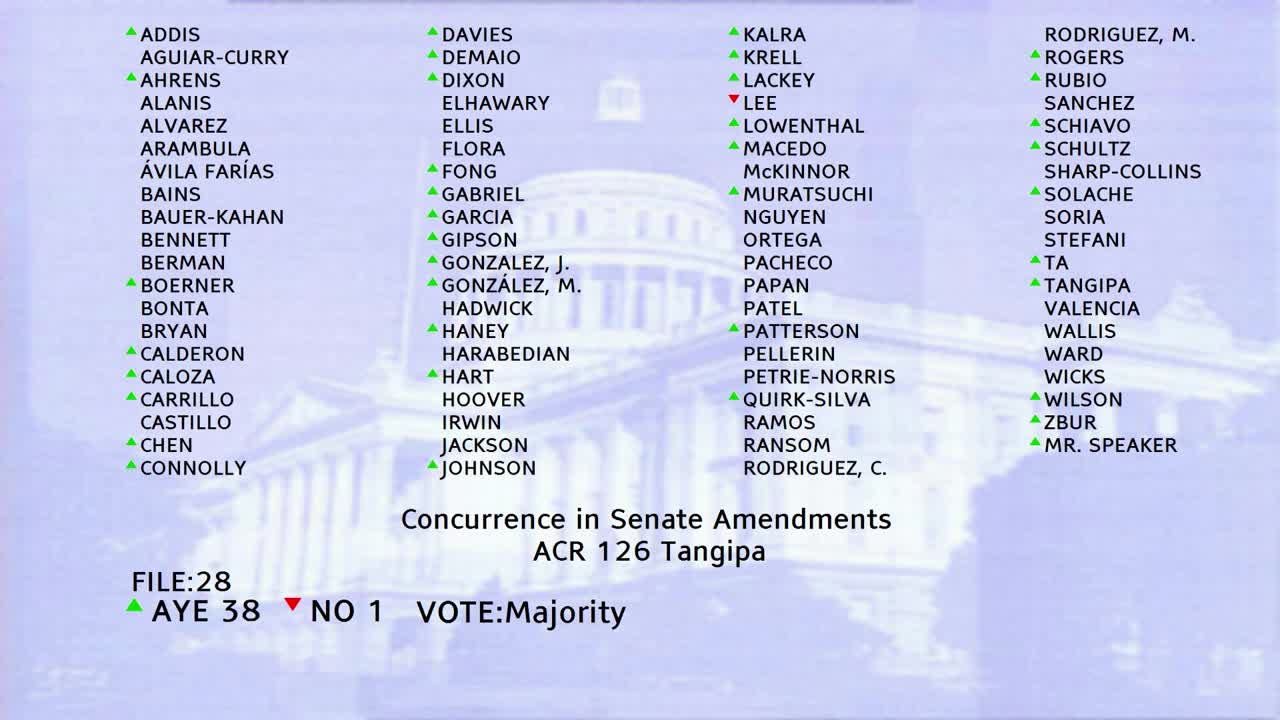 1MIN
Assembly Floor
 5MIN
Senate Standing Committee on Local Government
 1MIN
Assembly Floor
 9MIN
Assembly Standing Committee on Local Government
Bill Author