AB 2250: Cannabis: cannabinoids.
- Session Year: 2025-2026
- House: Assembly
- Latest Version Date: 2026-09-27
Current Status:
Passed
(2026-09-27: Chaptered by Secretary of State - Chapter 593, Statutes of 2026.)
Introduced
In Committee
Awaiting First Chamber Vote
Passed First Chamber
In Committee
Awaiting Second Chamber Vote
Passed Second Chamber
Enacted
Chapter 248 of the Statutes of 2025 (AB 8) revised the Sherman Food, Drug, and Cosmetic Law to prohibit industrial hemp raw extract from being incorporated into food, food additives, beverages, or dietary supplements unless the industrial hemp raw extract is comprised of cannabidiol (CBD) or cannabinol (CBN) isolate with a purity level greater than 99% and does not contain any tetrahydrocannabinols or synthetic cannabinoids. AB 8, beginning January 1, 2028, revises and recasts various provisions in conformity with that prohibition. Among those conforming changes, AB 8 excludes CBD isolate from the definition of cannabis concentrate for purposes of the California Uniform Controlled Substances Act, which imposes various penalties for the unlawful possession or sale of cannabis concentrate.
This bill, beginning on January 1, 2028, would also exclude CBN isolate from that definition of cannabis concentrate.
AB 8 revised certain Cannabis Tax Law enforcement provisions by establishing a presumption that a product that contains or purports to contain a cannabinoid is a cannabis product, as specified. AB 8 authorized this presumption to be rebutted by evidence showing either that the product complies with the Sherman Food, Drug, and Cosmetic Law provisions regulating industrial hemp or that it meets the definition of industrial hemp as defined in the California Uniform Controlled Substances Act.
This bill would make organizational and clarifying changes to those presumption provisions. The bill would consolidate and make other clarifying changes to definitional provisions of the Cannabis Tax Law revised by AB 8.
The Cannabis Tax Law authorizes the California Department of Tax and Fee Administration or a law enforcement agency to seize cannabis or cannabis products from a person who possesses, stores, owns, or has made a sale of those cannabis or cannabis products under certain circumstances. AB 8 expanded the seizure authority under the Cannabis Tax Law to include a circumstance in which the product is possessed, stored, offered for sale, or sold by an unlicensed person or at an unlicensed premises, and is presumed to be a cannabis product for containing or purporting to contain a cannabinoid, including a synthetic cannabinoid, as defined.
This bill would remove that AB 8 provision and, instead, would expand that seizure authority to include a circumstance in which the cannabis or cannabis product is possessed, stored, offered for sale, or sold at an unlicensed premises.
AB 8 revised the Medicinal and Adult-Use Cannabis Regulation and Safety Act (MAUCRSA) to subject industrial hemp that enters the licensed market under MAUCRSA or is used in a cannabis product to the regulatory requirements of cannabis or cannabis products under MAUCRSA, including identification in a track and trace program established by the Department of Cannabis Control for reporting the movement of cannabis and cannabis products throughout the distribution chain, as specified. MAUCRSA, as revised by AB 8, requires the track and trace program to include an electronic software tracking system to capture data and track movement of cannabis through the commercial supply chain from cultivation to sale.
This bill would specify that the data captured and movement tracked includes cultivation, harvest, processing, manufacturing, distribution, inventory, sale, and delivery.
AB 8 revised the Cigarette and Tobacco Products Licensing Act of 2003 (act) to prohibit a person that is engaged in the business of selling cigarettes or tobacco products from possessing, storing, owning, or making a retail sale of cannabis, cannabis products, or a product presumed to be cannabis, and makes a violation of that prohibition subject to a specified fine and license suspension or revocation, as applicable. The act authorizes the California Department of Tax and Fee Administration to seize cannabis or cannabis products that were possessed, stored, owned, or sold at retail by a person in violation of that prohibition. The act also makes a violation of its provisions a crime, as specified.
This bill would expand the above-described prohibition on making a retail sale of cannabis, cannabis products, or a product presumed to be cannabis to, instead, prohibit a person that is engaged in the business of selling cigarettes or tobacco products from making any sale of cannabis, cannabis products, or a product presumed to be cannabis. By expanding the scope of a crime under the act, the bill would impose a state-mandated local program. The bill would also expand the departments seizure authority to include the seizure of cannabis, cannabis products, or a product presumed to be cannabis that a person sells in violation of the prohibition, as expanded by the bill.
Existing law requires all moneys collected pursuant to the Cigarette and Tobacco Products Licensing Act of 2003 to be deposited in the Cigarette and Tobacco Products Compliance Fund and makes all moneys in the fund available for expenditure, upon appropriation by the Legislature, solely for the purpose of implementing, enforcing, and administering the act, including the seizure and destruction of cigarettes and tobacco products.
This bill would revise that funding provision to specify that the purpose of implementing, enforcing, and administering the act includes the seizure and destruction of any product seized pursuant to the act. The bill would make clarifying changes, including to the definitions of cannabis and cannabis product for purposes of those provisions.
The California Constitution requires the state to reimburse local agencies and school districts for certain costs mandated by the state. Statutory provisions establish procedures for making that reimbursement.
This bill would provide that no reimbursement is required by this act for a specified reason.
Chapter 248 of the Statutes of 2025 (AB 8) revised the Sherman Food, Drug, and Cosmetic Law to prohibit industrial hemp raw extract from being incorporated into food, food additives, beverages, or dietary supplements unless the industrial hemp raw extract is comprised of cannabidiol (CBD) or cannabinol (CBN) isolate with a purity level greater than 99% and does not contain any tetrahydrocannabinols or synthetic cannabinoids. AB 8, beginning January 1, 2028, revises and recasts various provisions in conformity with that prohibition. Among those conforming changes, AB 8 excludes CBD isolate from the definition of cannabis concentrate for purposes of the California Uniform Controlled Substances Act, which imposes various penalties for the unlawful possession or sale of cannabis concentrate.
This bill, beginning on January 1, 2028, would also exclude CBN isolate from that definition of cannabis concentrate.
AB 8 revised certain Cannabis Tax Law enforcement provisions by establishing a presumption that a product that contains or purports to contain a cannabinoid is a cannabis product, as specified. AB 8 authorized this presumption to be rebutted by evidence showing either that the product complies with the Sherman Food, Drug, and Cosmetic Law provisions regulating industrial hemp or that it meets the definition of industrial hemp as defined in the California Uniform Controlled Substances Act.
This bill would make organizational and clarifying changes to those presumption provisions. The bill would consolidate and make other clarifying changes to definitional provisions of the Cannabis Tax Law revised by AB 8.
The Cannabis Tax Law authorizes the California Department of Tax and Fee Administration or a law enforcement agency to seize cannabis or cannabis products from a person who possesses, stores, owns, or has made a sale of those cannabis or cannabis products under certain circumstances. AB 8 expanded the seizure authority under the Cannabis Tax Law to include a circumstance in which the product is possessed, stored, offered for sale, or sold by an unlicensed person or at an unlicensed premises, and is presumed to be a cannabis product for containing or purporting to contain a cannabinoid, including a synthetic cannabinoid, as defined.
This bill would make nonsubstantive changes to the definitional provisions that AB 8 added to the Cannabis Tax Law. Specifically, the bill would delete a redundant definition of synthetic cannabinoid and would delete a definition of CBD isolate, which is a term that is not used in the Cannabis Tax Law provisions. remove that AB 8 provision and, instead, would expand that seizure authority to include a circumstance in which the cannabis or cannabis product is possessed, stored, offered for sale, or sold at an unlicensed premises.
AB 8 revised the Cigarette and Tobacco Products Licensing Act of 2003 (act) to prohibit a person that is engaged in the business of selling cigarettes or tobacco products from possessing, storing, owning, or making a retail sale of cannabis, cannabis products, or a product presumed to be cannabis, and makes a violation of that prohibition subject to a specified fine and license suspension or revocation, as applicable. Existing The act authorizes the California Department of Tax and Fee Administration to seize cannabis or cannabis products that were possessed, stored, owned, or sold at retail by a person in violation of that prohibition. The act also makes a violation of its provisions a crime, as specified.
This bill would expand the above-described prohibition on making a retail sale of cannabis, cannabis products, or a product presumed to be cannabis to, instead, prohibit a person that is engaged in the business of selling cigarettes or tobacco products from making any sale of cannabis, cannabis products, or a product presumed to be cannabis. By expanding the scope of a crime under the act, the bill would impose a state-mandated local program. The bill would also expand the departments seizure authority to include the seizure of cannabis, cannabis products, or a product presumed to be cannabis that a person sells in violation of the prohibition, as expanded by the bill.
Existing law requires all moneys collected pursuant to these provisions the Cigarette and Tobacco Products Licensing Act of 2003 to be deposited in the Cigarette and Tobacco Products Compliance Fund and makes all moneys in the fund available for expenditure, upon appropriation by the Legislature, solely for the purpose of implementing, enforcing, and administering the act, including the seizure and destruction of cigarettes and tobacco products.
This bill would revise that funding provision to specify that the purpose of implementing, enforcing, and administering the act includes the seizure and destruction of cannabis, cannabis products, and products presumed to be cannabis. any product seized pursuant to the act. The bill would make clarifying changes, including to the definitions of cannabis and cannabis product for purposes of those provisions.
The California Constitution requires the state to reimburse local agencies and school districts for certain costs mandated by the state. Statutory provisions establish procedures for making that reimbursement.
This bill would provide that no reimbursement is required by this act for a specified reason.
Chapter 248 of the Statutes of 2025 (AB 8) revised the Sherman Food, Drug, and Cosmetic Law to prohibit industrial hemp raw extract from being incorporated into food, food additives, beverages, or dietary supplements unless the industrial hemp raw extract is comprised of cannabidiol (CBD) or cannabinol (CBN) isolate with a purity level greater than 99% and does not contain any tetrahydrocannabinols or synthetic cannabinoids. AB 8, beginning January 1, 2028, revises and recasts various provisions in conformity with that prohibition. Among those conforming changes, AB 8 excludes CBD isolate from the definition of cannabis concentrate for purposes of the California Uniform Controlled Substances Act, which imposes various penalties for the unlawful possession or sale of cannabis concentrate.
This bill, beginning on January 1, 2028, would also exclude CBN isolate from that definition of cannabis concentrate.
The Cannabis Tax Law authorizes the California Department of Tax and Fee Administration or a law enforcement agency to seize cannabis or cannabis products from a person who possesses, stores, owns, or has made a sale of those cannabis or cannabis products under certain circumstances. AB 8 expanded the seizure authority under the Cannabis Tax Law to include a circumstance in which the product is possessed, stored, offered for sale, or sold by an unlicensed person or at an unlicensed premises, and is presumed to be a cannabis product for containing or purporting to contain a cannabinoid, including a synthetic cannabinoid, as defined.
This bill would make nonsubstantive changes to the definitional provisions that AB 8 added to the Cannabis Tax Law. Specifically, the bill would delete a redundant definition of synthetic cannabinoid and would delete a definition of CBD isolate, which is a term that is not used in the Cannabis Tax Law provisions.
AB 8 revised the Cigarette and Tobacco Products Licensing Act of 2003 (act) to prohibit a person that is engaged in the business of selling cigarettes or tobacco products from possessing, storing, owning, or making a retail sale of cannabis, cannabis products, or a product presumed to be cannabis, and makes a violation of that prohibition subject to a specified fine and license suspension or revocation, as applicable. Existing law requires all moneys collected pursuant to these provisions to be deposited in the Cigarette and Tobacco Products Compliance Fund and makes all moneys in the fund available for expenditure, upon appropriation by the Legislature, solely for the purpose of implementing, enforcing, and administering the act, including the seizure and destruction of cigarettes and tobacco products.
This bill would revise that funding provision to specify that the purpose of implementing, enforcing, and administering the act includes the seizure and destruction of cannabis, cannabis products, and products presumed to be cannabis.
(a)A person that is engaged in the business of selling cigarettes or tobacco products in this state shall not possess, store, own, or make a sale of cannabis, cannabis products, or a product presumed to be a cannabis product pursuant to subdivision (b), or any regulations promulgated pursuant to that chapter, at any site where cigarettes or tobacco products are stored or sold. A person that violates this subdivision is subject to civil penalties and suspension or revocation of their license pursuant to subdivision (d).
(b)For purposes of this section, it shall be presumed that a product that contains or purports to contain a cannabinoid, including a synthetic cannabinoid, is a cannabis product, regardless of the nature or source of the cannabinoid. This presumption may be rebutted by evidence showing that the product does either of the following:
(1)Complies with Chapter 9 (commencing with Section 111920) of Part 5 of Division 104 of the Health and Safety Code and any regulations promulgated pursuant to that chapter.
(2)Meets the definition of industrial hemp, as that term is defined in Section 11018.5 of the Health and Safety Code.
(c)(1)In addition to the authority provided pursuant to Section 34016 of the Revenue and Taxation Code, upon discovery by the department that any person possesses, stores, owns, or has made a sale of cannabis or cannabis products in violation of this section, the department is authorized to seize such products at the persons location. Any cannabis or cannabis products seized by the department pursuant to this subdivision shall be deemed forfeited and the department shall comply with the procedures set forth in Sections 30436 to 30449, inclusive, of the Revenue and Taxation Code.
(2)Any seizures or penalties authorized pursuant to this section are in addition to any criminal or civil penalties that may be imposed by law.
(d)(1)(A)A first violation of subdivision (a) involving the seizure of cannabis or cannabis products shall be punishable as follows:
(i)Cannabis or cannabis products with an aggregate retail value of less than two hundred dollars ($200) shall be punishable by a civil penalty of one thousand dollars ($1,000).
(ii)Cannabis or cannabis product with an aggregate retail value of two hundred dollars ($200) or more shall be punishable by a civil penalty of two thousand dollars ($2,000).
(B)A second violation of subdivision (a) within five years involving a seizure of cannabis or cannabis products shall be punishable as follows:
(i)Cannabis or cannabis products with an aggregate retail value of less than two hundred dollars ($200) shall be punishable by a civil penalty of two thousand dollars ($2,000) and shall result in a five-day suspension of the license.
(ii)Cannabis or cannabis product with an aggregate retail value of two hundred dollars ($200) or more shall be punishable by a civil penalty of five thousand dollars ($5,000) and shall result in a 10-day suspension of the license.
(C)A third violation of subdivision (a) within five years involving a seizure of cannabis or cannabis products shall be punishable as follows:
(i)Cannabis or cannabis products with an aggregate retail value of less than two hundred dollars ($200) shall be punishable by a civil penalty of five thousand dollars ($5,000) and shall result in a revocation of the license.
(ii)Cannabis or cannabis products with an aggregate retail value of two hundred dollars ($200) or more shall be punishable by a civil penalty of ten thousand dollars ($10,000) and shall result in a revocation of the license.
(2)The department shall ascertain as best it may the retail value based on any information within the departments possession or that may come into its possession of the cannabis or cannabis product.
(3)The department shall issue the civil penalty in accordance with the procedures applicable to the civil penalty authorized under Section 22974.7.
(4)The department shall revoke or suspend the license of a person who violates subdivision (a) in accordance with the procedures set forth in Section 22980.3.
(e)For purposes of this section:
(1)Cannabis shall have the same meaning as provided in Section 11018 of the Health and Safety Code.
(2)Cannabis products shall have the same meaning as provided in subdivision (a) of Section 11018.1 of the Health and Safety Code.
(3)Cannabinoid and synthetic cannabinoid shall have the same meaning as provided in Division 10 (commencing with Section 26000).
(f)Civil penalties collected pursuant to this section shall be deposited into the Cigarette and Tobacco Products Compliance Fund created pursuant to Section 22990.
SEC. 2.Section 22990 of the Business and Professions Code is amended to read:22990.(a)All moneys collected pursuant to this division shall be deposited in the Cigarette and Tobacco Products Compliance Fund, which is hereby created in the State Treasury. No moneys in the Cigarette and Tobacco Products Compliance Fund shall be used to supplant state or local General Fund money for any purpose.
(b)All moneys in the Cigarette and Tobacco Products Compliance Fund are available for expenditure, upon appropriation by the Legislature, solely for the purpose of implementing, enforcing, and administering this division, including the seizure and destruction of any product seized pursuant to this division.
SEC. 3.Section 26068 of the Business and Professions Code is amended to read:26068.(a)The department, in consultation with the California Department of Tax and Fee Administration, shall ensure that the track and trace program can also track and trace the amount of the cultivation tax due pursuant to Part 14.5 (commencing with Section 34010) of Division 2 of the Revenue and Taxation Code. The track and trace program shall include an electronic software tracking system to capture data and track movement of cannabis through the commercial supply chain from cultivation to sale, including, but not limited to, cultivation, harvest, processing, manufacturing, distribution, inventory, sale, and delivery.
(b)The department shall ensure that licensees under this division are allowed to use third-party applications, programs, and information technology systems to comply with the requirements of the expanded track and trace program described in subdivision (a) to report the movement of cannabis and cannabis products throughout the distribution chain and communicate the information to licensing agencies as required by law.
(c)Any software, database, or other information technology system utilized by the department to implement the expanded track and trace program shall support interoperability with third-party cannabis business software applications and allow all licensee-facing system activities to be performed through a secure application programming interface (API) or comparable technology that is well documented, bi-directional, and accessible to any third-party application that has been validated and has appropriate credentials. The API or comparable technology shall have version control and provide adequate notice of updates to third-party applications. The system should provide a test environment for third-party applications to access that mirrors the production environment.
(d)(1)The department shall incorporate delivery into the track and trace program no later than January 1, 2023.
(2)Notwithstanding any other law, provisions related to inclusion of information related to delivery in the track and trace system in Sections 26067 and 26090 shall only become effective after the department incorporates delivery into the track and trace program as required by this subdivision.
(3)Notwithstanding any other law, the department may adopt and readopt emergency regulations to implement this subdivision. The provisions of Section 26013 shall be applicable to emergency regulations adopted or readopted pursuant to this section. The emergency regulations authorized by this paragraph shall be deemed an emergency and necessary for the immediate preservation of public peace, health, safety, or general welfare.
SEC. 4.Section 11006.5 of the Health and Safety Code is amended to read:11006.5.(a)Before January 1, 2026, concentrated cannabis means the separated resin, whether crude or purified, obtained from cannabis.
(b)Beginning on January 1, 2026, and until January 1, 2028, concentrated cannabis or cannabis concentrate means cannabis that has undergone a process to concentrate one or more active cannabinoids, thereby increasing potency, and includes extracts, oils, hash, dab, shatter, rosin, wax, and the separated resin, whether crude or purified.
(c)Beginning on January 1, 2028, the following apply:
(1)Concentrated cannabis or cannabis concentrate means cannabis or industrial hemp that has undergone a process to concentrate one or more active cannabinoids, thereby increasing potency, and includes extracts, oils, hash, dab, shatter, rosin, wax, and the separated resin, whether crude or purified.
(2)Cannabis concentrate does not include CBD isolate or CBN isolate, as defined in Section 26001 of the Business and Professions Code.
SEC. 5.Section 34010 of the Revenue and Taxation Code is amended to read:34010.(a)This part shall be known, and may be cited, as the Cannabis Tax Law.
(b)For purposes of this part:
(1)202021 fiscal year baseline means the total amount of funds disbursed in the sub-trust accounts in fiscal year 202122 for the third allocation of the fiscal year 202021 revenue, pursuant to subdivision (f) of Section 34019, as determined by the Department of Finance.
(2)Arms length transaction shall mean a sale entered into in good faith and for valuable consideration that reflects the fair market value in the open market between two informed and willing parties, neither under any compulsion to participate in the transaction.
(3)Average market price shall mean both of the following:
(A)(i)In an arms length transaction, the average retail price determined by the wholesale cost of the cannabis or cannabis products sold or transferred to a cannabis retailer, plus a mark-up, as determined by the department on a biannual basis in six-month intervals on or before July 1, 2022.
(ii)Notwithstanding clause (i), the department shall not increase the mark-up amount during the period beginning on and after the operative date of the act amending this section by adding this clause and before July 1, 2021.
(B)In a nonarms length transaction, the cannabis retailers gross receipts from the retail sale of the cannabis or cannabis products.
(4)Cannabis has the same meaning as set forth in Section 11018 of the Health and Safety Code and shall also mean medicinal cannabis.
(5)Cannabis products has the same meaning as set forth in subdivision (a) of Section 11018.1 of the Health and Safety Code and shall also mean medicinal concentrates and medicinal cannabis products.
(6)Cannabis flowers means the dried flowers of the cannabis plant as defined by the department.
(7)Cannabis leaves means all parts of the cannabis plant other than cannabis flowers that are sold or consumed.
(8)Cannabis retailer means a person required to be licensed pursuant to Division 10 (commencing with Section 26000) of the Business and Professions Code as a retailer, non-storefront retailer, microbusiness, or nonprofit, or any other person otherwise authorized under Division 10 (commencing with Section 26000) of the Business and Professions Code to engage in retail sales.
(9)Cultivator means all persons required to be licensed to cultivate cannabis pursuant to Division 10 (commencing with Section 26000) of the Business and Professions Code.
(10)Department means the California Department of Tax and Fee Administration or its successor agency.
(11)Designated for donation means medicinal cannabis donated by a cultivator to a cannabis retailer for subsequent donation to a medicinal cannabis patient pursuant to Section 26071 of the Business and Professions Code.
(12)Distributor means a person required to be licensed as a distributor pursuant to Division 10 (commencing with Section 26000) of the Business and Professions Code.
(13)Enters the commercial market means cannabis or cannabis products, except for immature cannabis plants and seeds, that complete and comply with a quality assurance review and testing, as described in Section 26110 of the Business and Professions Code.
(14)Gross receipts has the same meaning as set forth in Section 6012.
(15)Manufacturer means a person required to be licensed as a manufacturer pursuant to Division 10 (commencing with Section 26000) of the Business and Professions Code.
(16)Medicinal cannabis patient means a qualified patient, as defined in Section 11362.7 of the Health and Safety Code, who possesses a physicians recommendation that complies with Article 25 (commencing with Section 2525) of Chapter 5 of Division 2 of the Business and Professions Code, or a qualified patient or primary caregiver for a qualified patient issued a valid identification card pursuant to Section 11362.71 of the Health and Safety Code.
(17)Microbusiness has the same meaning as set forth in Section 26001 of the Business and Professions Code.
(18)Nonprofit has the same meaning as set forth in Section 26070.5 of the Business and Professions Code.
(19)Person has the same meaning as set forth in Section 6005.
(20)Retail sale has the same meaning as set forth in Section 6007.
(21)Sale and purchase mean any change of title or possession, exchange, or barter, conditional or otherwise, in any manner or by any means whatsoever, for consideration.
(22)Sub-trust accounts means the sub-trust accounts created under subdivision (f) of Section 34019.
(23)Tax fund means the California Cannabis Tax Fund created by Section 34018.
(24)Transfer means to grant, convey, hand over, assign, sell, exchange, or barter, in any manner or by any means, with or without consideration.
(25)Unprocessed cannabis includes cannabis flowers, cannabis leaves, or other categories of harvested cannabis, categories for unprocessed or frozen cannabis or immature plants, or cannabis that is shipped directly to manufacturers.
SEC. 6.Section 34016 of the Revenue and Taxation Code is amended to read:34016.(a)Any peace officer or department employee granted limited peace officer status pursuant to paragraph (6) of subdivision (a) of Section 830.11 of the Penal Code, upon presenting appropriate credentials, is authorized to enter any place as described in paragraph (2) and to conduct inspections in accordance with the following paragraphs, inclusive.
(1)Inspections shall be performed in a reasonable manner and at times that are reasonable under the circumstances, taking into consideration the normal business hours of the place to be entered.
(2)Inspections may be at any place at which cannabis or cannabis products are sold to purchasers, cultivated, or stored, at any site where evidence of activities involving evasion of tax may be discovered, or at any place where any package, label, advertisement, or other document or object of any kind bearing the universal symbol as described in paragraph (7) of subdivision (c) of Section 26130 of the Business and Professions Code and any applicable regulations, are sold or stored in violation of Section 26031.6 of the Business and Professions Code.
(3)Inspections shall be conducted no more than once in a 24-hour period.
(b)Any person who fails or refuses to allow an inspection shall be guilty of a misdemeanor. Each offense shall be punished by a fine not to exceed five thousand dollars ($5,000), or imprisonment not exceeding one year in a county jail, or both the fine and imprisonment. The court shall order any fines assessed be deposited in the California Cannabis Tax Fund.
(c)(1)(A)The department or a law enforcement agency may seize cannabis or cannabis products from a person who possesses, stores, owns, or has made a retail sale of those cannabis or cannabis products if any of the following apply:
(i)Until January 1, 2023, the cannabis or cannabis products are without evidence of tax payment.
(ii)The cannabis or cannabis products are not contained in secure packaging.
(iii)The person is an unlicensed person specified in paragraph (1) of subdivision (a) of Section 34015.1.
(iv)The cannabis or cannabis product is possessed, stored, offered for sale, or sold at an unlicensed premises.
(v)The cannabis or cannabis products were not reported in the track and trace system, as specified in subdivision (b) of Section 34015.1.
(B)For purposes of this section, it shall be presumed that a product that contains or purports to contain a cannabinoid, including a synthetic cannabinoid, is a cannabis product, regardless of the nature or source of the cannabinoid. This presumption may be rebutted by evidence showing that the product complies with either of the following:
(i)Chapter 9 (commencing with Section 111920) of Part 5 of Division 104 of the Health and Safety Code, and any regulations promulgated pursuant to that chapter.
(ii)Meets the definition of industrial hemp, as that term is defined in Section 11018.5 of the Health and Safety Code.
(C)The department may seize any package, label, advertisement, or other document or object of any kind bearing the universal symbol or bearing any likeness or simulation of the universal symbol in violation of Section 26031.6 of the Business and Professions Code. Any package, label, advertisement, or other document or object seized by the department pursuant to this paragraph shall be deemed forfeited and the department shall comply with the procedures set forth in Sections 30436 to 30449, inclusive.
(D)Any cannabis or cannabis products seized by a law enforcement agency or the department shall be deemed forfeited and the department shall comply with the procedures set forth in Sections 30436 through 30449, inclusive.
(2)Any seizures authorized pursuant to paragraph (1) of this subdivision are in addition to any criminal or civil penalties that may be imposed by law, including subdivision (e) of this section.
(3)For purposes of this section, cannabinoid and synthetic cannabinoid shall have the same meanings as provided in Division 10 (commencing with Section 26000) of the Business and Professions Code.
(d)Any person who renders a false or fraudulent report is guilty of a misdemeanor and subject to a fine not to exceed one thousand dollars ($1,000) for each offense.
(e)Any violation of any provisions of this part, except as otherwise provided, is a misdemeanor and is punishable as such.
(f)All moneys remitted to the department under this part shall be credited to the California Cannabis Tax Fund.
SEC. 7.No reimbursement is required by this act pursuant to Section 6 of Article XIIIB of the California Constitution because the only costs that may be incurred by a local agency or school district will be incurred because this act creates a new crime or infraction, eliminates a crime or infraction, or changes the penalty for a crime or infraction, within the meaning of Section 17556 of the Government Code, or changes the definition of a crime within the meaning of Section 6 of Article XIIIB of the California Constitution.
(a)A person that is engaged in the business of selling cigarettes or tobacco products in this state shall not possess, store, own, or make a sale of cannabis, cannabis products, or a product presumed to be a cannabis product pursuant to subdivision (b), or any regulations promulgated pursuant to that chapter, at any site where cigarettes or tobacco products are stored or sold. A person that violates this subdivision is subject to civil penalties and suspension or revocation of their license pursuant to subdivision (d).
(b)For purposes of this section, it shall be presumed that a product that contains or purports to contain a cannabinoid, including a synthetic cannabinoid, is a cannabis product, regardless of the nature or source of the cannabinoid. This presumption may be rebutted by evidence showing that the product does either of the following:
(1)Complies with Chapter 9 (commencing with Section 111920) of Part 5 of Division 104 of the Health and Safety Code and any regulations promulgated pursuant to that chapter.
(2)Meets the definition of industrial hemp, as that term is defined in Section 11018.5 of the Health and Safety Code.
(c)(1)In addition to the authority provided pursuant to Section 34016 of the Revenue and Taxation Code, upon discovery by the department that any person possesses, stores, owns, or has made a sale of cannabis or cannabis products in violation of this section, the department is authorized to seize such products at the persons location. Any cannabis or cannabis products seized by the department pursuant to this subdivision shall be deemed forfeited and the department shall comply with the procedures set forth in Sections 30436 to 30449, inclusive, of the Revenue and Taxation Code.
(2)Any seizures or penalties authorized pursuant to this section are in addition to any criminal or civil penalties that may be imposed by law.
(d)(1)(A)A first violation of subdivision (a) involving the seizure of cannabis or cannabis products shall be punishable as follows:
(i)Cannabis or cannabis products with an aggregate retail value of less than two hundred dollars ($200) shall be punishable by a civil penalty of one thousand dollars ($1,000).
(ii)Cannabis or cannabis product with an aggregate retail value of two hundred dollars ($200) or more shall be punishable by a civil penalty of two thousand dollars ($2,000).
(B)A second violation of subdivision (a) within five years involving a seizure of cannabis or cannabis products shall be punishable as follows:
(i)Cannabis or cannabis products with an aggregate retail value of less than two hundred dollars ($200) shall be punishable by a civil penalty of two thousand dollars ($2,000) and shall result in a five-day suspension of the license.
(ii)Cannabis or cannabis product with an aggregate retail value of two hundred dollars ($200) or more shall be punishable by a civil penalty of five thousand dollars ($5,000) and shall result in a 10-day suspension of the license.
(C)A third violation of subdivision (a) within five years involving a seizure of cannabis or cannabis products shall be punishable as follows:
(i)Cannabis or cannabis products with an aggregate retail value of less than two hundred dollars ($200) shall be punishable by a civil penalty of five thousand dollars ($5,000) and shall result in a revocation of the license.
(ii)Cannabis or cannabis products with an aggregate retail value of two hundred dollars ($200) or more shall be punishable by a civil penalty of ten thousand dollars ($10,000) and shall result in a revocation of the license.
(2)The department shall ascertain as best it may the retail value based on any information within the departments possession or that may come into its possession of the cannabis or cannabis product.
(3)The department shall issue the civil penalty in accordance with the procedures applicable to the civil penalty authorized under Section 22974.7.
(4)The department shall revoke or suspend the license of a person who violates subdivision (a) in accordance with the procedures set forth in Section 22980.3.
(e)For purposes of this section:
(1)Cannabis shall have the same meaning as provided in Section 11018 of the Health and Safety Code.
(2)Cannabis products shall have the same meaning as provided in subdivision (a) of Section 11018.1 of the Health and Safety Code.
(3)Cannabinoid and synthetic cannabinoid shall have the same meaning as provided in Division 10 (commencing with Section 26000).
(f)Civil penalties collected pursuant to this section shall be deposited into the Cigarette and Tobacco Products Compliance Fund created pursuant to Section 22990.
SEC. 2.Section 22990 of the Business and Professions Code is amended to read:22990.(a)All moneys collected pursuant to this division shall be deposited in the Cigarette and Tobacco Products Compliance Fund, which is hereby created in the State Treasury. No moneys in the Cigarette and Tobacco Products Compliance Fund shall be used to supplant state or local General Fund money for any purpose.
(b)All moneys in the Cigarette and Tobacco Products Compliance Fund are available for expenditure, upon appropriation by the Legislature, solely for the purpose of implementing, enforcing, and administering this division, including the seizure and destruction of any product seized pursuant to this division.
SEC. 3.Section 26068 of the Business and Professions Code is amended to read:26068.(a)The department, in consultation with the California Department of Tax and Fee Administration, shall ensure that the track and trace program can also track and trace the amount of the cultivation tax due pursuant to Part 14.5 (commencing with Section 34010) of Division 2 of the Revenue and Taxation Code. The track and trace program shall include an electronic software tracking system to capture data and track movement of cannabis through the commercial supply chain from cultivation to sale. sale, including, but not limited to, cultivation, harvest, processing, manufacturing, distribution, inventory, sale, and delivery.
(b)The department shall ensure that licensees under this division are allowed to use third-party applications, programs, and information technology systems to comply with the requirements of the expanded track and trace program described in subdivision (a) to report the movement of cannabis and cannabis products throughout the distribution chain and communicate the information to licensing agencies as required by law.
(c)Any software, database, or other information technology system utilized by the department to implement the expanded track and trace program shall support interoperability with third-party cannabis business software applications and allow all licensee-facing system activities to be performed through a secure application programming interface (API) or comparable technology that is well documented, bi-directional, and accessible to any third-party application that has been validated and has appropriate credentials. The API or comparable technology shall have version control and provide adequate notice of updates to third-party applications. The system should provide a test environment for third-party applications to access that mirrors the production environment.
(d)(1)The department shall incorporate delivery into the track and trace program no later than January 1, 2023.
(2)Notwithstanding any other law, provisions related to inclusion of information related to delivery in the track and trace system in Sections 26067 and 26090 shall only become effective after the department incorporates delivery into the track and trace program as required by this subdivision.
(3)Notwithstanding any other law, the department may adopt and readopt emergency regulations to implement this subdivision. The provisions of Section 26013 shall be applicable to emergency regulations adopted or readopted pursuant to this section. The emergency regulations authorized by this paragraph shall be deemed an emergency and necessary for the immediate preservation of public peace, health, safety, or general welfare.
SEC. 3.SEC. 4.Section 11006.5 of the Health and Safety Code is amended to read:11006.5.(a)Before January 1, 2026, concentrated cannabis means the separated resin, whether crude or purified, obtained from cannabis.
(b)Beginning on January 1, 2026, and until January 1, 2028, concentrated cannabis or cannabis concentrate means cannabis that has undergone a process to concentrate one or more active cannabinoids, thereby increasing potency, and includes extracts, oils, hash, dab, shatter, rosin, wax, and the separated resin, whether crude or purified.
(c)Beginning on January 1, 2028, the following apply:
(1)Concentrated cannabis or cannabis concentrate means cannabis or industrial hemp that has undergone a process to concentrate one or more active cannabinoids, thereby increasing potency, and includes extracts, oils, hash, dab, shatter, rosin, wax, and the separated resin, whether crude or purified.
(2)Cannabis concentrate does not include CBD isolate or CBN isolate, as defined in Section 26001 of the Business and Professions Code.
SEC. 4.SEC. 5.Section 34010 of the Revenue and Taxation Code is amended to read:34010.(a)This part shall be known, and may be cited, as the Cannabis Tax Law.
(b)For purposes of this part:
(1)202021 fiscal year baseline means the total amount of funds disbursed in the sub-trust accounts in fiscal year 202122 for the third allocation of the fiscal year 202021 revenue, pursuant to subdivision (f) of Section 34019, as determined by the Department of Finance.
(2)Arms length transaction shall mean a sale entered into in good faith and for valuable consideration that reflects the fair market value in the open market between two informed and willing parties, neither under any compulsion to participate in the transaction.
(3)Average market price shall mean both of the following:
(A)(i)In an arms length transaction, the average retail price determined by the wholesale cost of the cannabis or cannabis products sold or transferred to a cannabis retailer, plus a mark-up, as determined by the department on a biannual basis in six-month intervals on or before July 1, 2022.
(ii)Notwithstanding clause (i), the department shall not increase the mark-up amount during the period beginning on and after the operative date of the act amending this section by adding this clause and before July 1, 2021.
(B)In a nonarms length transaction, the cannabis retailers gross receipts from the retail sale of the cannabis or cannabis products.
(4)Cannabis has the same meaning as set forth in Section 11018 of the Health and Safety Code and shall also mean medicinal cannabis.
(5)Cannabis products has the same meaning as set forth in subdivision (a) of Section 11018.1 of the Health and Safety Code and shall also mean medicinal concentrates and medicinal cannabis products.
(6)Cannabis flowers means the dried flowers of the cannabis plant as defined by the department.
(7)Cannabis leaves means all parts of the cannabis plant other than cannabis flowers that are sold or consumed.
(8)Cannabis retailer means a person required to be licensed pursuant to Division 10 (commencing with Section 26000) of the Business and Professions Code as a retailer, non-storefront retailer, microbusiness, or nonprofit, or any other person otherwise authorized under Division 10 (commencing with Section 26000) of the Business and Professions Code to engage in retail sales.
(9)Cultivator means all persons required to be licensed to cultivate cannabis pursuant to Division 10 (commencing with Section 26000) of the Business and Professions Code.
(10)Department means the California Department of Tax and Fee Administration or its successor agency.
(11)Designated for donation means medicinal cannabis donated by a cultivator to a cannabis retailer for subsequent donation to a medicinal cannabis patient pursuant to Section 26071 of the Business and Professions Code.
(12)Distributor means a person required to be licensed as a distributor pursuant to Division 10 (commencing with Section 26000) of the Business and Professions Code.
(13)Enters the commercial market means cannabis or cannabis products, except for immature cannabis plants and seeds, that complete and comply with a quality assurance review and testing, as described in Section 26110 of the Business and Professions Code.
(14)Gross receipts has the same meaning as set forth in Section 6012.
(15)Manufacturer means a person required to be licensed as a manufacturer pursuant to Division 10 (commencing with Section 26000) of the Business and Professions Code.
(16)Medicinal cannabis patient means a qualified patient, as defined in Section 11362.7 of the Health and Safety Code, who possesses a physicians recommendation that complies with Article 25 (commencing with Section 2525) of Chapter 5 of Division 2 of the Business and Professions Code, or a qualified patient or primary caregiver for a qualified patient issued a valid identification card pursuant to Section 11362.71 of the Health and Safety Code.
(17)Microbusiness has the same meaning as set forth in Section 26001 of the Business and Professions Code.
(18)Nonprofit has the same meaning as set forth in Section 26070.5 of the Business and Professions Code.
(19)Person has the same meaning as set forth in Section 6005.
(20)Retail sale has the same meaning as set forth in Section 6007.
(21)Sale and purchase mean any change of title or possession, exchange, or barter, conditional or otherwise, in any manner or by any means whatsoever, for consideration.
(22)Sub-trust accounts means the sub-trust accounts created under subdivision (f) of Section 34019.
(23)Tax fund means the California Cannabis Tax Fund created by Section 34018.
(24)Transfer means to grant, convey, hand over, assign, sell, exchange, or barter, in any manner or by any means, with or without consideration.
(25)Unprocessed cannabis includes cannabis flowers, cannabis leaves, or other categories of harvested cannabis, categories for unprocessed or frozen cannabis or immature plants, or cannabis that is shipped directly to manufacturers.
SEC. 5.SEC. 6.Section 34016 of the Revenue and Taxation Code is amended to read:34016.(a)Any peace officer or department employee granted limited peace officer status pursuant to paragraph (6) of subdivision (a) of Section 830.11 of the Penal Code, upon presenting appropriate credentials, is authorized to enter any place as described in paragraph (2) and to conduct inspections in accordance with the following paragraphs, inclusive.
(1)Inspections shall be performed in a reasonable manner and at times that are reasonable under the circumstances, taking into consideration the normal business hours of the place to be entered.
(2)Inspections may be at any place at which cannabis or cannabis products are sold to purchasers, cultivated, or stored, at any site where evidence of activities involving evasion of tax may be discovered, or at any place where any package, label, advertisement, or other document or object of any kind bearing the universal symbol as described in paragraph (7) of subdivision (c) of Section 26130 of the Business and Professions Code and any applicable regulations, are sold or stored in violation of Section 26031.6 of the Business and Professions Code.
(3)Inspections shall be conducted no more than once in a 24-hour period.
(b)Any person who fails or refuses to allow an inspection shall be guilty of a misdemeanor. Each offense shall be punished by a fine not to exceed five thousand dollars ($5,000), or imprisonment not exceeding one year in a county jail, or both the fine and imprisonment. The court shall order any fines assessed be deposited in the California Cannabis Tax Fund.
(c)(1)(A)The department or a law enforcement agency may seize cannabis or cannabis products from a person who possesses, stores, owns, or has made a retail sale of those cannabis or cannabis products if any of the following apply:
(i)Until January 1, 2023, the cannabis or cannabis products are without evidence of tax payment.
(ii)The cannabis or cannabis products are not contained in secure packaging.
(iii)The person is an unlicensed person specified in paragraph (1) of subdivision (a) of Section 34015.1.
(iv)The cannabis or cannabis product is possessed, stored, offered for sale, or sold at an unlicensed premises.
(v)The cannabis or cannabis products were not reported in the track and trace system, as specified in subdivision (b) of Section 34015.1.
(B)For purposes of this section, it shall be presumed that a product that contains or purports to contain a cannabinoid, including a synthetic cannabinoid, is a cannabis product, regardless of the nature or source of the cannabinoid. This presumption may be rebutted by evidence showing that the product complies with either of the following:
(i)Chapter 9 (commencing with Section 111920) of Part 5 of Division 104 of the Health and Safety Code, and any regulations promulgated pursuant to that chapter.
(ii)Meets the definition of industrial hemp, as that term is defined in Section 11018.5 of the Health and Safety Code.
(C)The department may seize any package, label, advertisement, or other document or object of any kind bearing the universal symbol or bearing any likeness or simulation of the universal symbol in violation of Section 26031.6 of the Business and Professions Code. Any package, label, advertisement, or other document or object seized by the department pursuant to this paragraph shall be deemed forfeited and the department shall comply with the procedures set forth in Sections 30436 to 30449, inclusive.
(D)Any cannabis or cannabis products seized by a law enforcement agency or the department shall be deemed forfeited and the department shall comply with the procedures set forth in Sections 30436 through 30449, inclusive.
(2)Any seizures authorized pursuant to paragraph (1) of this subdivision are in addition to any criminal or civil penalties that may be imposed by law, including subdivision (e) of this section.
(3)For purposes of this section, cannabinoid and synthetic cannabinoid shall have the same meaning meanings as provided in Division 10 (commencing with Section 26000) of the Business and Professions Code.
(d)Any person who renders a false or fraudulent report is guilty of a misdemeanor and subject to a fine not to exceed one thousand dollars ($1,000) for each offense.
(e)Any violation of any provisions of this part, except as otherwise provided, is a misdemeanor and is punishable as such.
(f)All moneys remitted to the department under this part shall be credited to the California Cannabis Tax Fund.
SEC. 6.SEC. 7.No reimbursement is required by this act pursuant to Section 6 of Article XIIIB of the California Constitution because the only costs that may be incurred by a local agency or school district will be incurred because this act creates a new crime or infraction, eliminates a crime or infraction, or changes the penalty for a crime or infraction, within the meaning of Section 17556 of the Government Code, or changes the definition of a crime within the meaning of Section 6 of Article XIIIB of the California Constitution.
(a)A person that is engaged in the business of selling cigarettes or tobacco products in this state shall not possess, store, own, or make a retail sale of cannabis, cannabis products, or a product presumed to be a cannabis product pursuant to subdivision (b), or any regulations promulgated pursuant to that chapter, at any site where cigarettes or tobacco products are stored or sold. A person that violates this subdivision is subject to civil penalties and suspension or revocation of their license pursuant to subdivision (d).
(b)For purposes of this section, it shall be presumed that a product that contains or purports to contain a cannabinoid, including a synthetic cannabinoid, is a cannabis product, regardless of the nature or source of the cannabinoid. This presumption may be rebutted by evidence showing that the product does either of the following:
(1)Complies with Chapter 9 (commencing with Section 111920) of Part 5 of Division 104 of the Health and Safety Code and any regulations promulgated pursuant to that chapter.
(2)Meets the definition of industrial hemp, as that term is defined in Section 11018.5 of the Health and Safety Code.
(c)(1)In addition to the authority provided pursuant to Section 34016 of the Revenue and Taxation Code, upon discovery by the department that any person possesses, stores, owns, or has made a retail sale of cannabis or cannabis products in violation of this section, the department is authorized to seize such products at the persons location. Any cannabis or cannabis products seized by the department pursuant to this subdivision shall be deemed forfeited and the department shall comply with the procedures set forth in Sections 30436 to 30449, inclusive, of the Revenue and Taxation Code.
(2)Any seizures or penalties authorized pursuant to this section are in addition to any criminal or civil penalties that may be imposed by law.
(d)(1)(A)A first violation of subdivision (a) involving the seizure of cannabis or cannabis products shall be punishable as follows:
(i)Cannabis or cannabis products with an aggregate retail value of less than two hundred dollars ($200) shall be punishable by a civil penalty of one thousand dollars ($1,000).
(ii)Cannabis or cannabis product with an aggregate retail value of two hundred dollars ($200) or more shall be punishable by a civil penalty of two thousand dollars ($2,000).
(B)A second violation of subdivision (a) within five years involving a seizure of cannabis or cannabis products shall be punishable as follows:
(i)Cannabis or cannabis products with an aggregate retail value of less than two hundred dollars ($200) shall be punishable by a civil penalty of two thousand dollars ($2,000) and shall also result in a five-day suspension of the license.
(ii)Cannabis or cannabis product with an aggregate retail value of two hundred dollars ($200) or more shall be punishable by a civil penalty of five thousand dollars ($5,000) and shall result in a 10-day suspension of the license.
(C)A third violation of subdivision (a) within five years involving a seizure of cannabis or cannabis products shall be punishable as follows:
(i)Cannabis or cannabis products with an aggregate retail value of less than two hundred dollars ($200) shall be punishable by a civil penalty of five thousand dollars ($5,000) and shall also result in a revocation of the license.
(ii)Cannabis or cannabis products with an aggregate retail value of two hundred dollars ($200) or more shall be punishable by a civil penalty of ten thousand dollars ($10,000) and shall result in a revocation of the license.
(2)The department shall ascertain as best it may the retail value based on any information within the departments possession or that may come into its possession of the cannabis or cannabis product.
(3)The department shall issue the civil penalty in accordance with the procedures applicable to the civil penalty authorized under Section 22974.7.
(4)The department shall revoke or suspend the license of a person who violates subdivision (a) in accordance with the procedures set forth in Section 22980.3.
(e)For purposes of this section:
(1)Cannabis and cannabis products shall have the same meaning as provided in Part 14.5 (commencing with Section 34010) of Division 2 of the Revenue and Taxation Code. Section 11018 of the Health and Safety Code.
(2)Cannabis products shall have the same meaning as provided in subdivision (a) of Section 11018.1 of the Health and Safety Code.
(2)(3)Cannabinoid and synthetic cannabinoid shall have the same meaning as provided in Division 10 (commencing with Section 26000).
(f)Civil penalties collected pursuant to this section shall be deposited into the Cigarette and Tobacco Products Compliance Fund created pursuant to Section 22990.
SECTION 1.SEC. 2.Section 22990 of the Business and Professions Code is amended to read:22990.(a)All moneys collected pursuant to this division shall be deposited in the Cigarette and Tobacco Products Compliance Fund, which is hereby created in the State Treasury. No moneys in the Cigarette and Tobacco Products Compliance Fund shall be used to supplant state or local General Fund money for any purpose.
(b)All moneys in the Cigarette and Tobacco Products Compliance Fund are available for expenditure, upon appropriation by the Legislature, solely for the purpose of implementing, enforcing, and administering the California Cigarette and Tobacco Products Licensing Act of 2003, this division, including the seizure and destruction of cigarettes, tobacco products, cannabis, cannabis products, and products presumed to be cannabis. any product seized pursuant to this division.
SEC. 2.SEC. 3.Section 11006.5 of the Health and Safety Code is amended to read:11006.5.(a)Before January 1, 2026, concentrated cannabis means the separated resin, whether crude or purified, obtained from cannabis.
(b)Beginning on January 1, 2026, and until January 1, 2028, concentrated cannabis or cannabis concentrate means cannabis that has undergone a process to concentrate one or more active cannabinoids, thereby increasing potency, and includes extracts, oils, hash, dab, shatter, rosin, wax, and the separated resin, whether crude or purified.
(c)Beginning on January 1, 2028, the following apply:
(1)Concentrated cannabis or cannabis concentrate means cannabis or industrial hemp that has undergone a process to concentrate one or more active cannabinoids, thereby increasing potency, and includes extracts, oils, hash, dab, shatter, rosin, wax, and the separated resin, whether crude or purified.
(2)Cannabis concentrate does not include CBD isolate or CBN isolate, as defined in Section 26001 of the Business and Professions Code.
SEC. 3.SEC. 4.Section 34010 of the Revenue and Taxation Code is amended to read:34010.(a)This part shall be known, and may be cited, as the Cannabis Tax Law.
(b)For purposes of this part:
(1)202021 fiscal year baseline means the total amount of funds disbursed in the sub-trust accounts in fiscal year 202122 for the third allocation of the fiscal year 202021 revenue, pursuant to subdivision (f) of Section 34019, as determined by the Department of Finance.
(2)Arms length transaction shall mean a sale entered into in good faith and for valuable consideration that reflects the fair market value in the open market between two informed and willing parties, neither under any compulsion to participate in the transaction.
(3)Average market price shall mean both of the following:
(A)(i)In an arms length transaction, the average retail price determined by the wholesale cost of the cannabis or cannabis products sold or transferred to a cannabis retailer, plus a mark-up, as determined by the department on a biannual basis in six-month intervals on or before July 1, 2022.
(ii)Notwithstanding clause (i), the department shall not increase the mark-up amount during the period beginning on and after the operative date of the act amending this section by adding this clause and before July 1, 2021.
(B)In a nonarms length transaction, the cannabis retailers gross receipts from the retail sale of the cannabis or cannabis products.
(4)Cannabis has the same meaning as set forth in Section 11018 of the Health and Safety Code and shall also mean medicinal cannabis.
(5)Cannabis products has the same meaning as set forth in subdivision (a) of Section 11018.1 of the Health and Safety Code and shall also mean medicinal concentrates and medicinal cannabis products.
(6)Cannabis flowers means the dried flowers of the cannabis plant as defined by the department.
(7)Cannabis leaves means all parts of the cannabis plant other than cannabis flowers that are sold or consumed.
(8)Cannabis retailer means a person required to be licensed pursuant to Division 10 (commencing with Section 26000) of the Business and Professions Code as a retailer, non-storefront retailer, microbusiness, or nonprofit, or any other person otherwise authorized under Division 10 (commencing with Section 26000) of the Business and Professions Code to engage in retail sales.
(9)Cultivator means all persons required to be licensed to cultivate cannabis pursuant to Division 10 (commencing with Section 26000) of the Business and Professions Code.
(10)Department means the California Department of Tax and Fee Administration or its successor agency.
(11)Designated for donation means medicinal cannabis donated by a cultivator to a cannabis retailer for subsequent donation to a medicinal cannabis patient pursuant to Section 26071 of the Business and Professions Code.
(12)Distributor means a person required to be licensed as a distributor pursuant to Division 10 (commencing with Section 26000) of the Business and Professions Code.
(13)Enters the commercial market means cannabis or cannabis products, except for immature cannabis plants and seeds, that complete and comply with a quality assurance review and testing, as described in Section 26110 of the Business and Professions Code.
(14)Gross receipts has the same meaning as set forth in Section 6012.
(15)Manufacturer means a person required to be licensed as a manufacturer pursuant to Division 10 (commencing with Section 26000) of the Business and Professions Code.
(16)Medicinal cannabis patient means a qualified patient, as defined in Section 11362.7 of the Health and Safety Code, who possesses a physicians recommendation that complies with Article 25 (commencing with Section 2525) of Chapter 5 of Division 2 of the Business and Professions Code, or a qualified patient or primary caregiver for a qualified patient issued a valid identification card pursuant to Section 11362.71 of the Health and Safety Code.
(17)Microbusiness has the same meaning as set forth in Section 26001 of the Business and Professions Code.
(18)Nonprofit has the same meaning as set forth in Section 26070.5 of the Business and Professions Code.
(19)Person has the same meaning as set forth in Section 6005.
(20)Retail sale has the same meaning as set forth in Section 6007.
(21)Sale and purchase mean any change of title or possession, exchange, or barter, conditional or otherwise, in any manner or by any means whatsoever, for consideration.
(22)Sub-trust accounts means the sub-trust accounts created under subdivision (f) of Section 34019.
(23)Tax fund means the California Cannabis Tax Fund created by Section 34018.
(24)Transfer means to grant, convey, hand over, assign, sell, exchange, or barter, in any manner or by any means, with or without consideration.
(25)Unprocessed cannabis includes cannabis flowers, cannabis leaves, or other categories of harvested cannabis, categories for unprocessed or frozen cannabis or immature plants, or cannabis that is shipped directly to manufacturers.
SEC. 5.Section 34016 of the Revenue and Taxation Code is amended to read:34016.(a)Any peace officer or department employee granted limited peace officer status pursuant to paragraph (6) of subdivision (a) of Section 830.11 of the Penal Code, upon presenting appropriate credentials, is authorized to enter any place as described in paragraph (2) and to conduct inspections in accordance with the following paragraphs, inclusive.
(1)Inspections shall be performed in a reasonable manner and at times that are reasonable under the circumstances, taking into consideration the normal business hours of the place to be entered.
(2)Inspections may be at any place at which cannabis or cannabis products are sold to purchasers, cultivated, or stored, at any site where evidence of activities involving evasion of tax may be discovered, or at any place where any package, label, advertisement, or other document or object of any kind bearing the universal symbol as described in paragraph (7) of subdivision (c) of Section 26130 of the Business and Professions Code and any applicable regulations, are sold or stored in violation of Section 26031.6 of the Business and Professions Code.
(3)Inspections shall be conducted no more than once in a 24-hour period.
(b)Any person who fails or refuses to allow an inspection shall be guilty of a misdemeanor. Each offense shall be punished by a fine not to exceed five thousand dollars ($5,000), or imprisonment not exceeding one year in a county jail, or both the fine and imprisonment. The court shall order any fines assessed be deposited in the California Cannabis Tax Fund.
(c)(1)(A)The department or a law enforcement agency may seize cannabis or cannabis products from a person who possesses, stores, owns, or has made a retail sale of those cannabis or cannabis products if any of the following apply:
(i)Until January 1, 2023, the cannabis or cannabis products are without evidence of tax payment.
(ii)The cannabis or cannabis products are not contained in secure packaging.
(iii)The person is an unlicensed person specified in paragraph (1) of subdivision (a) of Section 34015.1.
(iv)The cannabis or cannabis product is possessed, stored, offered for sale, or sold at an unlicensed premises.
(iv)(v)The cannabis or cannabis products were not reported in the track and trace system, as specified in subdivision (b) of Section 34015.1.
(v)The product is presumed to be a cannabis product as provided in subparagraph (B) and is possessed, stored, offered for sale, or sold by an unlicensed person or at an unlicensed premises.(B)(i)For purposes of this section, it shall be presumed that a product that contains or purports to contain a cannabinoid, including a synthetic cannabinoid, is a cannabis product, regardless of the nature or source of the cannabinoid.
(ii) cannabinoid. This presumption may be rebutted by evidence showing that the product complies with Chapter either of the following:
(i)Chapter 9 (commencing with Section 111920) of Part 5 of Division 104 of the Health and Safety Code, and any regulations promulgated pursuant to that chapter or meets chapter.
(ii)Meets the definition of industrial hemp, as that term is defined in Section 11018.5 of the Health and Safety Code.
(C)The department may seize any package, label, advertisement, or other document or object of any kind bearing the universal symbol or bearing any likeness or simulation of the universal symbol in violation of Section 26031.6 of the Business and Professions Code. Any package, label, advertisement, or other document or object seized by the department pursuant to this paragraph shall be deemed forfeited and the department shall comply with the procedures set forth in Sections 30436 to 30449, inclusive.
(D)Any cannabis or cannabis products seized by a law enforcement agency or the department shall be deemed forfeited and the department shall comply with the procedures set forth in Sections 30436 through 30449, inclusive.
(2)Any seizures authorized pursuant to paragraph (1) of this subdivision are in addition to any criminal or civil penalties that may be imposed by law, including subdivision (e) of this section.
(3)For purposes of this section, cannabinoid and synthetic cannabinoid shall have the same meaning as provided in Division 10 (commencing with Section 26000) of the Business and Professions Code.
(d)Any person who renders a false or fraudulent report is guilty of a misdemeanor and subject to a fine not to exceed one thousand dollars ($1,000) for each offense.
(e)Any violation of any provisions of this part, except as otherwise provided, is a misdemeanor and is punishable as such.
(f)All moneys remitted to the department under this part shall be credited to the California Cannabis Tax Fund.
SEC. 6.No reimbursement is required by this act pursuant to Section 6 of Article XIIIB of the California Constitution because the only costs that may be incurred by a local agency or school district will be incurred because this act creates a new crime or infraction, eliminates a crime or infraction, or changes the penalty for a crime or infraction, within the meaning of Section 17556 of the Government Code, or changes the definition of a crime within the meaning of Section 6 of Article XIIIB of the California Constitution.
(a)All moneys collected pursuant to this division shall be deposited in the Cigarette and Tobacco Products Compliance Fund, which is hereby created in the State Treasury. No moneys in the Cigarette and Tobacco Products Compliance Fund shall be used to supplant state or local General Fund money for any purpose.
(b)All moneys in the Cigarette and Tobacco Products Compliance Fund are available for expenditure, upon appropriation by the Legislature, solely for the purpose of implementing, enforcing, and administering the California Cigarette and Tobacco Products Licensing Act of 2003, including the seizure and destruction of cigarettes and cigarettes, tobacco products. products, cannabis, cannabis products, and products presumed to be cannabis.
SEC. 2.Section 11006.5 of the Health and Safety Code is amended to read:11006.5.(a)Before January 1, 2026, concentrated cannabis means the separated resin, whether crude or purified, obtained from cannabis.
(b)Beginning on January 1, 2026, and until January 1, 2028, concentrated cannabis or cannabis concentrate means cannabis that has undergone a process to concentrate one or more active cannabinoids, thereby increasing potency, and includes extracts, oils, hash, dab, shatter, rosin, wax, and the separated resin, whether crude or purified.
(c)Beginning on January 1, 2028, the following apply:
(1)Concentrated cannabis or cannabis concentrate means cannabis or industrial hemp that has undergone a process to concentrate one or more active cannabinoids, thereby increasing potency, and includes extracts, oils, hash, dab, shatter, rosin, wax, and the separated resin, whether crude or purified.
(2)Cannabis concentrate does not include CBD isolate or CBN isolate, as defined in Section 26001 of the Business and Professions Code.
SEC. 3.Section 34010 of the Revenue and Taxation Code is amended to read:34010.(a)This part shall be known, and may be cited, as the Cannabis Tax Law.
(b)For purposes of this part:
(1)202021 fiscal year baseline means the total amount of funds disbursed in the sub-trust accounts in fiscal year 202122 for the third allocation of the fiscal year 202021 revenue, pursuant to subdivision (f) of Section 34019, as determined by the Department of Finance.
(2)Arms length transaction shall mean a sale entered into in good faith and for valuable consideration that reflects the fair market value in the open market between two informed and willing parties, neither under any compulsion to participate in the transaction.
(3)Average market price shall mean both of the following:
(A)(i)In an arms length transaction, the average retail price determined by the wholesale cost of the cannabis or cannabis products sold or transferred to a cannabis retailer, plus a mark-up, as determined by the department on a biannual basis in six-month intervals on or before July 1, 2022.
(ii)Notwithstanding clause (i), the department shall not increase the mark-up amount during the period beginning on and after the operative date of the act amending this section by adding this clause and before July 1, 2021.
(B)In a nonarms length transaction, the cannabis retailers gross receipts from the retail sale of the cannabis or cannabis products.
(4)Cannabis has the same meaning as set forth in Section 11018 of the Health and Safety Code and shall also mean medicinal cannabis.
(5)Cannabis products has the same meaning as set forth in Section 11018.1 of the Health and Safety Code and shall also mean medicinal concentrates and medicinal cannabis products.
(6)Cannabis flowers means the dried flowers of the cannabis plant as defined by the department.
(7)Cannabis leaves means all parts of the cannabis plant other than cannabis flowers that are sold or consumed.
(8)Cannabis retailer means a person required to be licensed pursuant to Division 10 (commencing with Section 26000) of the Business and Professions Code as a retailer, non-storefront retailer, microbusiness, or nonprofit, or any other person otherwise authorized under Division 10 (commencing with Section 26000) of the Business and Professions Code to engage in retail sales.
(9)CBD isolate has the same meaning as set forth in Section 26001 of the Business and Professions Code.(10)(9)Cultivator means all persons required to be licensed to cultivate cannabis pursuant to Division 10 (commencing with Section 26000) of the Business and Professions Code.
(11)(10)Department means the California Department of Tax and Fee Administration or its successor agency.
(12)(11)Designated for donation means medicinal cannabis donated by a cultivator to a cannabis retailer for subsequent donation to a medicinal cannabis patient pursuant to Section 26071 of the Business and Professions Code.
(13)(12)Distributor means a person required to be licensed as a distributor pursuant to Division 10 (commencing with Section 26000) of the Business and Professions Code.
(14)(13)Enters the commercial market means cannabis or cannabis products, except for immature cannabis plants and seeds, that complete and comply with a quality assurance review and testing, as described in Section 26110 of the Business and Professions Code.
(15)(14)Gross receipts has the same meaning as set forth in Section 6012.
(16)(15)Manufacturer means a person required to be licensed as a manufacturer pursuant to Division 10 (commencing with Section 26000) of the Business and Professions Code.
(17)(16)Medicinal cannabis patient means a qualified patient, as defined in Section 11362.7 of the Health and Safety Code, who possesses a physicians recommendation that complies with Article 25 (commencing with Section 2525) of Chapter 5 of Division 2 of the Business and Professions Code, or a qualified patient or primary caregiver for a qualified patient issued a valid identification card pursuant to Section 11362.71 of the Health and Safety Code.
(18)(17)Microbusiness has the same meaning as set forth in Section 26001 of the Business and Professions Code.
(19)(18)Nonprofit has the same meaning as set forth in Section 26070.5 of the Business and Professions Code.
(20)(19)Person has the same meaning as set forth in Section 6005.
(21)(20)Retail sale has the same meaning as set forth in Section 6007.
(22)(21)Sale and purchase mean any change of title or possession, exchange, or barter, conditional or otherwise, in any manner or by any means whatsoever, for consideration.
(23)(22)Sub-trust accounts means the sub-trust accounts created under subdivision (f) of Section 34019.
(24)Synthetic cannabinoid has the same meaning as set forth in Section 26001 of the Business and Professions Code. (25)(23)Tax fund means the California Cannabis Tax Fund created by Section 34018.
(26)(24)Transfer means to grant, convey, hand over, assign, sell, exchange, or barter, in any manner or by any means, with or without consideration.
(27)(25)Unprocessed cannabis includes cannabis flowers, cannabis leaves, or other categories of harvested cannabis, categories for unprocessed or frozen cannabis or immature plants, or cannabis that is shipped directly to manufacturers.
|
Date
|
Status
|
|---|---|
| Sep 27, 2026 | Chaptered by Secretary of State - Chapter 593, Statutes of 2026. |
| Sep 27, 2026 | Approved by the Governor. |
| Sep 3, 2026 | Enrolled and presented to the Governor at 4 p.m. |
| Aug 26, 2026 | Senate amendments concurred in. To Engrossing and Enrolling. (Ayes 78. Noes 0.). |
| Aug 26, 2026 | Senate amendments concurred in. To Engrossing and Enrolling. (Ayes 78. Noes 0. Page 6581.). |
| Aug 25, 2026 | In Assembly. Concurrence in Senate amendments pending. |
| Aug 25, 2026 | Read third time. Passed. Ordered to the Assembly. (Ayes 38. Noes 0.). |
| Aug 24, 2026 | Read second time. Ordered to third reading. |
| Aug 21, 2026 | Read third time and amended. Ordered to second reading. |
| Aug 13, 2026 | Read second time. Ordered to third reading. |
| Aug 13, 2026 | From committee: Do pass. (Ayes 7. Noes 0.) (August 13). |
| Aug 3, 2026 | In committee: Referred to APPR. suspense file. |
| Jun 24, 2026 | From committee: Do pass and re-refer to Com. on APPR. (Ayes 4. Noes 0.) (June 24). Re-referred to Com. on APPR. |
| Jun 15, 2026 | From committee: Do pass and re-refer to Com. on REV. & TAX. (Ayes 11. Noes 0.) (June 15). Re-referred to Com. on REV. & TAX. |
| Jun 3, 2026 | Referred to Coms. on B. P. & E.D. and REV. & TAX. |
| May 22, 2026 | In Senate. Read first time. To Com. on RLS. for assignment. |
| May 22, 2026 | Read third time. Passed. Ordered to the Senate. (Ayes 72. Noes 0.) |
| May 22, 2026 | Read third time. Passed. Ordered to the Senate. (Ayes 72. Noes 0. Page 5267.) |
| May 18, 2026 | Read second time. Ordered to third reading. |
| May 14, 2026 | From committee: Do pass. (Ayes 14. Noes 0.) (May 14). |
| May 6, 2026 | In committee: Set, first hearing. Referred to APPR. suspense file. |
| Apr 21, 2026 | From committee: Do pass and re-refer to Com. on APPR. (Ayes 7. Noes 0.) (April 20). Re-referred to Com. on APPR. |
| Apr 20, 2026 | In committee: Set, first hearing. Referred to REV. & TAX. suspense file. |
| Apr 7, 2026 | From committee: Do pass and re-refer to Com. on REV. & TAX. with recommendation: To Consent Calendar. (Ayes 19. Noes 0.) (April 7). Re-referred to Com. on REV. & TAX. |
| Mar 12, 2026 | Re-referred to Com. on B. & P. |
| Mar 11, 2026 | From committee chair, with author's amendments: Amend, and re-refer to Com. on B. & P. Read second time and amended. |
| Mar 9, 2026 | Referred to Coms. on B. & P. and REV. & TAX. |
| Feb 20, 2026 | From printer. May be heard in committee March 22. |
| Feb 19, 2026 | Read first time. To print. |
|
Date
|
Description
|
Location
|
Votes
|
|
|---|---|---|---|---|
| Aug 26, 2026 | AB 2250 Aguiar-Curry Concurrence in Senate Amendments | Assembly Floor |
Passed |
|
| Aug 25, 2026 | Assembly 3rd Reading AB2250 Aguiar-Curry By Wiener | Senate Floor |
Passed |
|
| Aug 13, 2026 | Do pass | Senate Standing Committee on Appropriations |
Passed |
|
| Aug 3, 2026 | Placed on suspense file | Senate Standing Committee on Appropriations |
Passed |
|
| Jun 24, 2026 | Do pass, but first be re-referred to the Committee on [Appropriations] | Senate Standing Committee on Revenue and Taxation |
Passed |
|
| Jun 15, 2026 | Do pass, but first be re-referred to the Committee on [Revenue and Taxation] | Senate Standing Committee on Business, Professions and Economic Development |
Passed |
|
| May 22, 2026 | AB 2250 Aguiar-Curry Assembly Third Reading | Assembly Floor |
Passed |
|
| May 14, 2026 | Do pass. | Assembly Standing Committee on Appropriations |
Passed |
|
| Apr 20, 2026 | Do pass and be re-referred to the Committee on [Appropriations] | Assembly Standing Committee on Revenue and Taxation |
Passed |
|
| Apr 7, 2026 | Do pass and be re-referred to the Committee on [Revenue and Taxation] with recommendation: To Consent Calendar | Assembly Standing Committee on Business and Professions |
Passed |
This list shows positions taken on this bill by organizations on the date displayed, which is linked to the original source.
Positions by individuals are not included.
|
Organization
|
Position
|
Date
|
|---|---|---|
| California Cannabis Operators Association | ** Support | |
| California Cannabis Operators Association (CaCOA) | ** Support | |
| Capitol Business Alliance | ** Against | |
| Capitol Business Alliance | ** Against | |
| Good Farmers Great Neighbors | ** Support | |
| NUG, INC. | ** Support | |
| Origins Council | ** Support | |
| Origins Counsil | ** Support |
CONCURRENCE IN SENATE AMENDMENTS
CSA1 Bill Id:AB 2250
Author:(Aguiar-Curry)
As Amended Ver:August 21, 2026
Majority vote
SUMMARY
Makes various minor and technical changes to provisions of law providing for the regulation and enforcement of products containing cannabinoids derived from industrial hemp.
Senate Amendments
- Specify that specify that the data captured and movement tracked through the commercial supply chain by the California Department of Tax and Fee Administration (CDTFA) includes cultivation, harvest, processing, manufacturing, distribution, inventory, sale, and delivery.
- Make an additional technical correction.
COMMENTS
Integration of Cannabis and Hemp. Notwithstanding the biological and chemical similarities of cannabis and hemp, hemp products are considered ″non-cannabis goods″ for purpose of the Medicinal and Adult-Use Cannabis Regulation and Safety Act (MAUCRSA). Under Section 15407 of Department of Cannabis Control (DCC) regulations, licensed cannabis retailers are prohibited from selling any non-cannabis goods besides cannabis accessories, branded merchandise, and, subject to local authorization, prepackaged non-cannabis infused and food and beverages. While presumably an individual or entity could both engage in a licensed cannabis business and in a business involving hemp, it is understood that the two supply chains must remain fully distinct.
Whether hemp and cannabis products should be allowed to coexist in a regulatory context has been debated consistently over the past several years. Because both plants contain the same cannabinoids, it is often the case that two essentially identical products—CBD gummies, for example—are regulated and sold differently based on whether the CBD was derived from cannabis or industrial hemp. Many cannabis retailers may wish to also sell products derived from hemp. However, some in the cannabis industry may see hemp as an unwelcomed competitor, and concerns have been expressed that the difference in regulatory systems and consumer safety requirements should keep the two products separated.
AB 45 included language requiring the DCC to prepare a report to the Governor and the Legislature outlining the steps necessary to allow for the incorporation of hemp cannabinoids into the cannabis supply chain. The report is required to include, but is not be limited to, the incorporation of hemp cannabinoids into manufactured cannabis products and the sale of hemp products at cannabis retailers. Language in AB 45 also stated the intent of the Legislature to consider, in light of the DCC′s report, ″whether and how to take legislative action concerning the incorporation of hemp into the cannabis supply chain.″
The DCC published The Hemp Report: Steps and Considerations for Incorporating Hemp Into the Commercial Cannabis Supply Chain and submitted it to the Legislature in January of 2023. The report submitted by the DCC stated that ″incorporating hemp into the regulated commercial cannabis supply chain presents both policy and implementation challenges. From the policy perspective, several determinations would need to be made to move forward with the inclusion of hemp.″ In the report′s conclusion, the DCC summarized its determinations and conclusions as follows:
As detailed in this report, the inclusion of hemp into the commercial cannabis supply chain is complex and requires careful consideration of significant policy questions to arrive at an approach that is in the best interests of California. The approach utilized to accomplish this end would directly impact the cannabis industry, hemp industry, standard commercial market, medicinal and adult-use consumers, and the Department and other responsible California state agencies. While this report raises significant policy considerations to inspire and support deliberations between policy makers and stakeholders, it should not be interpreted as containing every single issue that may need to be considered and addressed by policy makers to determine when or if to incorporate hemp into the cannabis supply chain. If California chooses to allow hemp into the commercial cannabis supply chain, irrespective of which approach California adopts, implementation will likely require significant time and resources.
Intoxicating Hemp. Concerns have grown over the past several years regarding the perceived proliferation of intoxicating hemp products. In 2022, the California Cannabis Industry Association (CCIA) issued a white paper in October 2022 titled Pandora′s Box: The Dangers of a National, Unregulated, Hemp-Derived Intoxicating Cannabinoid Market. The CCIA report argued that loopholes in the 2018 Farm Bill, which defined industrial hemp as having no more than 0.3% delta-9 THC content by dry weight, inadvertently created led to the proliferation of intoxicating hemp products. Specifically, the white paper points to a Ninth Circuit decision that the CCIA says ″unleashed a Wild West of intoxicants when it ruled that products containing delta-8 THC meet the statutory definition of industrial hemp.″
According to the FDA, delta-8 THC is a cannabinoid typically synthetically manufactured from hemp-derived CBD that has significant psychoactive and intoxicating effects. The FDA has expressed concern that delta-8 THC products ″likely expose consumers to much higher levels of the substance than are naturally occurring in hemp cannabis raw extracts.″ There were reportedly 104 reports made to the FDA of adverse events in patients who consumed delta-8 THC products between December 1, 2020, and February 28, 2022, over half of which resulted in medical intervention or hospital admission.
In April 2023, the Cannabis Regulators Association (CANNRA), a coalition of regulatory agencies overseeing cannabis and hemp industries in more than 40 states and territories in the United States, wrote a letter to congressional leadership requesting action at the federal level provide a regulatory framework for products containing THC derived from hemp. CANNRA specifically called attention to the fact that a 0.3% threshold of delta-9 THC by weight is a relatively small amount of THC in a hemp plant, but is significantly more when included as an ingredient in edible products and beverages. A 50-gram chocolate bar, for example, would have around 150 milligrams of THC at the 0.3% THC limit – 30 times the standard 5 milligram THC dose established by the National Institute on Drug Abuse.
In February 2025, a white paper titled The Great Hemp Hoax was published with funding by the San Diego/Imperial Counties Joint Labor Management Cannabis Committee, UFCW, and March and Ash. This paper discussed findings that out of more than 100 intoxicating hemp products from 68 brands available to California consumers through online purchases, 95% contained synthetic cannabinoids prohibited under California law. Additionally, over 88% of tested products exceed the maximum amount of THC allowed to be classified as hemp products in California. The white paper found that on average, vape products supposedly derived from hemp had THC equivalency levels 268% above the state′s threshold for adult-use cannabis.
Efforts to Integrate and Regulate Hemp Products Containing Cannabinoids. In 2023, AB 420 (Aguiar-Curry) was introduced to as a vehicle for continued discussions around how California might integrate industrial hemp into the supply chain for cannabis. Initially, the bill contained a statement that nothing in MAUCRSA prohibits integration. Subsequent amendments to the bill that were made in the Senate provided for greater details regarding how integration would be achieved. The amendments also expanded prohibitions against industrial hemp containing synthetic THC or similar cannabinoids. However, the bill was ultimately held under submission on the suspense file in the Senate Committee on Appropriations.
The following year, AB 2223 (Aguiar-Curry) was introduced to again seek to strengthen California laws governing the cultivation, manufacturing, and sale of hemp products. Language in the bill would have expressly allowed for the integration of industrial hemp into the licensed cannabis supply chain, with additional requirements to ensure that integration occurs safely. The bill also sought to close loopholes created in federal law by explicitly prohibiting intoxicating hemp products from being manufactured and sold in California. However, this bill was also held under submission on the suspense file in the Senate Committee on Appropriations.
In September 2024, Governor Gavin Newsom announced that the CDPH was issuing emergency regulations banning the sale of consumable hemp products containing any detectable levels of THC or other intoxicating cannabinoids in California. The regulations additionally prohibited sales of hemp products to individuals under 21 and limited servings to five per package. State regulators indicated that sellers would be required to implement purchase restrictions and remove consumable hemp products containing any levels of detectable THC from shelves immediately upon the effective date of the regulations.
The Governor′s emergency regulations were challenged in court by a coalition led by the U.S. Hemp Roundtable and several hemp businesses, who sought to halt enforcement and argued that the ban exceeded CDPH′s rulemaking authority, specifically pointing to the failure of AB 2223 to pass the Legislature. However, in October 2024, the request for a temporary restraining order was denied by the Los Angeles County Superior Court, who found that the state had a compelling interest in protecting public health, especially that of children, from unregulated intoxicating hemp products. In March 2025, the CDPH extended the ban for through June 2025.
In 2026, the Legislature enacted AB 8, which was intended to build on the state′s prohibition against the sale of intoxicating hemp products while allowing products containing cannabinoids derived from hemp to be manufactured and sold through the cannabis supply chain. The bill expanded the definition of ″cannabis products″ in the Uniform Controlled Substances Act, and aligned that definition with MAUCRSA, to include any product containing cannabis or cannabis concentrate including, but is not limited to, edible, topical, and inhaled products, and products intended for use on, or consumption by, an animal.
Under the framework established in AB 8, any product containing a concentrated cannabinoid derived from hemp, with the exception of pure CBD isolate, would fall under the definition of a cannabis product. Under that reclassification, cannabis products derived from industrial hemp are eligible for integration into the cannabis supply chain. Various provisions of MAUCRSA would apply to those products, including track and trace identification, advertising restrictions, security and transportation safety requirements, quality assurance standards, and laboratory testing. Industrial hemp or cannabis products derived exclusively from industrial hemp may still be shipped through California without entering the licensed cannabis market, provided they are not sold in California, or shipped out of California by a cannabis licensee. AB 8 also subjected cannabis products derived from industrial hemp to the state′s 15% cannabis excise tax.
In addition to language classifying products containing concentrated cannabinoids derived from industrial hemp as cannabis products and incorporating those products into the cannabis supply chain, AB 8 made a number of additional technical and corresponding changes to ensure that regulators are able to oversee and enforce MAUCRSA and other state laws governing cannabis and hemp. A majority of the bill will not go into effect until January 1, 2028, allowing time for the industry and the state to prepare for the changes proposed by the bill. During that interim period, licensed cannabis manufacturers are only allowed to use cannabinoid concentrates and extracts that were manufactured or processed exclusively from cannabis obtained from a licensed cannabis cultivator and are not allowed to possess, transport, distribute, manufacture, or sell industrial hemp on or from a licensed premises, except that a licensed testing laboratory may test industrial hemp.
This bill would make a series of technical and clarifying changes to provisions of law enacted or amended through AB 8 in anticipation of the January 1, 2028 implementation date. Language in the bill would specifically clarify statutory cannabinoid definitions (to ensure consistency across code sections), seizure authority, and rules for tobacco retailers. These changes are intended to ensure that regulators are able to clearly and equitably enforce the law once AB 8 fully goes into effect.
According to the Author
″Last year, I authored AB 8 (Aguiar-Curry, Chapter 248, Statutes of 2025) to protect public health and licensed businesses by strengthening enforcement against illegal hemp products, ensuring that all intoxicating cannabinoids are regulated and taxed as cannabis, and creating a pathway for responsible hemp and cannabis operators to participate in the federal and state legal markets. AB 2250 is a technical clean up bill that will make sure that AB 8 can be implemented effectively. These changes are needed to ensure that state agencies have the tools they need to provide oversight and enforcement for California′s cannabis marketplace.″
Arguments in Support
The California Cannabis Operators Association (CaCOA) supports this bill, writing: ″CaCOA was proud to sponsor AB 8 (Aguiar-Curry, 2025), landmark legislation that fundamentally restructured California′s approach to intoxicating hemp-derived cannabinoids by codifying emergency regulations prohibiting the manufacture and sale of these products outside the regulated cannabis supply chain. The measure also strengthened enforcement authority, clarified regulatory jurisdiction, and reinforced the state′s commitment to public health, consumer safety, and market integrity. As with any comprehensive statutory reform of this scale, technical and conforming amendments are both expected and necessary to ensure consistent interpretation and effective implementation across agencies. AB 2250 serves precisely that purpose.″
Arguments in Opposition
None on file.
FISCAL COMMENTS
According to the Senate Committee on Appropriations, the CDTFA estimates $1.7 million to $2.0 million in cannabis excise tax revenue losses and $150,000 to $170,000 in sales and use tax revenue losses for the 2028 calendar year resulting from the exclusion of cannabinol (CBN) from the cannabis excise tax; any additional administrative and enforcement workload for CDTFA is expected to be absorbable; the DCC does not anticipate a fiscal impact.
VOTES:
ASM BUSINESS AND PROFESSIONS: 19-0-0
YES: Berman, Johnson, Addis, Ahrens, Alanis, Bains, Aguiar-Curry, Caloza, Chen, Elhawary, Hadwick, Haney, Hart, Irwin, Jackson, Lowenthal, Macedo, Nguyen, Pellerin
ASM REVENUE AND TAXATION: 7-0-0
YES: Gipson, Sanchez, Carrillo, DeMaio, McKinnor, Quirk-Silva, Michelle Rodriguez
ASM APPROPRIATIONS: 14-0-1
YES: Wicks, Hoover, Aguiar-Curry, Calderon, Caloza, Dixon, Fong, Mark González, Krell, Pacheco, Pellerin, Sharp-Collins, Solache, Tangipa
ABS, ABST OR NV: Ta
ASSEMBLY FLOOR: 72-0-8
YES: Addis, Aguiar-Curry, Ahrens, Alanis, Alvarez, Ávila Farías, Bains, Bennett, Berman, Boerner, Bonta, Bryan, Calderon, Caloza, Carrillo, Castillo, Connolly, Davies, DeMaio, Dixon, Elhawary, Ellis, Flora, Fong, Gallagher, Garcia, Gipson, Jeff Gonzalez, Mark González, Hadwick, Haney, Harabedian, Hart, Hoover, Irwin, Jackson, Johnson, Kalra, Krell, Lee, Lowenthal, Macedo, McKinnor, Muratsuchi, Nguyen, Ortega, Pacheco, Papan, Patel, Patterson, Pellerin, Petrie-Norris, Quirk-Silva, Ramos, Ransom, Michelle Rodriguez, Rogers, Blanca Rubio, Sanchez, Schiavo, Schultz, Sharp-Collins, Solache, Soria, Stefani, Tangipa, Valencia, Wallis, Ward, Wilson, Zbur, Rivas
ABS, ABST OR NV: Arambula, Bauer-Kahan, Chen, Gabriel, Lackey, Celeste Rodriguez, Ta, Wicks
UPDATED
VERSION: August 21, 2026
CONSULTANT: Robert Sumner / B. & P. / (916) 319-3301 FN: 0004186
SENATE RULES COMMITTEE Office of Senate Floor Analyses (916) 651-4171 | AB 2250 |
THIRD READING
Bill No: AB 2250
Author: Aguiar-Curry (D)
Amended: 8/21/26 in Senate
Vote: 21
SENATE BUS., PROF. & ECON. DEV. COMMITTEE: 11-0, 6/15/26
AYES: Wahab, Choi, Archuleta, Arreguín, Caballero, Grayson, Menjivar, Niello, Smallwood-Cuevas, Strickland, Umberg
SENATE REVENUE AND TAXATION COMMITTEE: 4-0, 6/24/26
AYES: McNerney, Ashby, Becker, Grayson
NO VOTE RECORDED: Alvarado-Gil
SENATE APPROPRIATIONS COMMITTEE: 7-0, 8/13/26
AYES: Cervantes, Seyarto, Cabaldon, Dahle, Grayson, Richardson, Wahab
ASSEMBLY FLOOR: 72-0, 5/22/26 - See last page for vote
SUBJECT: Cannabis: cannabinoids
SOURCE: Author
DIGEST:
This bill makes various technical and conforming changes to various provisions of law which provide for the regulation and enforcement of products containing cannabinoids derived from industrial hemp.
Senate Floor Amendments of 8/21/26 specify that sale of cannabis or cannabis products includes cultivation, harvest, processing, manufacturing, distributing, inventory, sale and delivery.
ANALYSIS:
Existing law:
- Establishes the Medicinal and Adult-Use Cannabis Regulation and Safety Act (MAUCRSA) to regulate the cultivation, distribution, transport, storage, manufacturing, processing, and sale of both medicinal cannabis and adult-use cannabis. (Business and Professions Code (BPC) § 26000 et seq.)
- Establishes the Department of Cannabis Control (DCC), under the jurisdiction, of the Business, Consumer Services, and Housing Agency, to administer and regulate provisions of MAUCRSA and requires the DCC to set reasonable rules and regulations as necessary to implement, administer, and enforce its duties, which must be consistent with the purpose and intent of MAUCRSA. (BPC §§ 26010, 26013, )
- Defines “industrial hemp” to mean types of the plant Cannabis sativa Linnaeus or any part of that plant with a total tetrahydrocannabinol concentration of no more than 0.3% on a dry weight basis and is limited to only agricultural products, including seeds, propagated plant material, immature or mature plants, harvested plants, mature stalks of the plant, fiber produced from the stalks, oil or cake made from the seeds of the plant, or any preparation that does not contain cannabinoids. (Health and Safety Code (HSC) § 11018.5(a))
- Provides the California Department of Food and Agriculture (CDFA) with responsibility for administering and enforcing laws governing the growing, cultivating, and distributing of industrial hemp. (Food and Agricultural Code (FAC) §§ 81000 et seq.)
- Requires a retailer to have in place and maintain a license issued by the California Department of Tax and Fee Administration (CDTFA) to engage in the sale of cigarettes or tobacco products and further requires a retailer that owns or controls more than one retail location to obtain a separate license for each location, as specified. (BPC § 22972(a))
- Prohibits a person that is engaged in the business of selling cigarettes or tobacco products from possessing, storing, owning, or making a retail sale of cannabis, cannabis products, or a product presumed to be a cannabis product at any site where cigarettes or tobacco products are stored or sold. (BPC § 22980.6(a))
- Establishes the Cannabis Tax Law. (Revenue and Taxation Code (RTC) § 34010 et seq.)
This bill:
- Conforms the definition of cannabis and cannabis products under the cigarette and tobacco licensing act of 2003 (Act of 2003), with the definition of cannabis products in the HSC.
- Clarifies that a person engaged in the business of selling cigarette or tobacco products is prohibited from making any sale, not just a retail sale, of cannabis, cannabis products, or a product presumed to be cannabis.
- Authorizes the CDTFA or a law enforcement agency to seize cannabis or cannabis products that are possessed, stored, offered for sale, or sold at an unlicensed premises.
- Removes the definition of “CBD isolate” and “synthetic cannabinoid” from the Cannabis Tax Law.
- Makes other technical and clarifying changes.
Background
Cannabis and Cannabis Product Regulation until January 1, 2028. The regulated commercial cannabis market in California operates as a closed system. Cannabis or cannabis products are strictly prohibited from being transported outside of California and cannabis sourced in other states is not allowed into California’s cannabis marketplace. California’s cannabis products must meet safety standards prior to retail sale and are subject to product testing. Under current law, a separate license is required for every corner of the cannabis market, which includes growing cannabis, transporting cannabis, making cannabis products, testing cannabis products, selling cannabis, and holding an event where cannabis is sold. DCC regulated testing labs test cannabis goods to make sure they are free of contaminants and labeled with accurate amounts of cannabinoids and terpenes, or other additives. Hemp is prohibited under the provisions of MAUCRSA, until January 1, 2028. The DCC has responsibility for the licensure and regulation of cannabis and enforcement of the provisions of MAUCRSA. The CDTFA is the lead agency responsible for oversight and regulation of the Cannabis Tax Law.
January 1, 2028: Integration of Hemp Under MAUCRSA. In 2025, the Legislature passed, and the Governor signed into law, AB 8 (Aguiar-Curry, Chapter 248, Statutes of 2025). AB 8 created a legal framework for the integration of cannabinoids derived from hemp into the cannabis supply chain beginning January 1, 2028. AB 8 allows hemp plant material to enter the cannabis supply chain and be used in manufacturing of cannabis or hemp products and sold by cannabis retailers or transported out of state. AB 8 is intended to ensure that all cannabinoid products – whether derived from cannabis or hemp – are subject to the same regulatory standards.
Any business in California that sells cigarette and tobacco products is required to obtain a cigarette and tobacco retailer license (in addition to any local permit) issued by the CDTFA. If CDTFA discovers that a retailer, or any of its agents or employees, sells or offers to sell unstamped cigarette packages, it can seize the packages. Similar authority exists for CDTFA to seize cannabis products under specified circumstances. Current law under the provisions of MAUCRSA specifically prohibit tobacco or alcohol products from being sold at a cannabis retail location and cannabis or cannabis products may not be sold at a cigarette and tobacco retailer. This bill clarifies that CDTFA’s enforcement funds are available for enforcing cannabis sales at unlicensed premises.
Hemp cultivation is primarily regulated by the CDFA, and hemp manufacturing is regulated under the Sherman Food, Drug, and Cosmetic Law by the California Department of Public Health. As part of the regulatory framework to allow cannabinoids derived from hemp to be integrated into MAUCRSA. AB 8 updated numerous definitions across code sections including the BPC, the HSC, and the RTC.
This bill makes several clarifying and conforming changes to clarify regulatory authority to address the integration of cannabinoids derived from hemp into the cannabis regulatory framework. This bill clarifies the definition of cannabinoids across code sections to provide consistency for each of the regulatory bodies who are responsible for their delegated regulatory oversight of cannabis products. The changes in this bill are to ensure a smooth transition of integration of hemp-based cannabinoids into the legal cannabis marketplace and oversight framework.
Comments
Origins Council supports this bill if it is “…amended to include additional clean-up language to ensure that AB 8’s integration provisions - currently slated for implementation on January 1, 2028 - do not undermine licensed California cultivators or the integrity of the California licensed cannabis market.”
FISCAL EFFECT: Appropriation: No Fiscal Com.: Yes Local: Yes
According to the Senate Committee on Appropriations, CDTFA) estimates revenue losses for the 2028 calendar year resulting from the exclusion of cannabinol (CBN) from the cannabis excise tax and any additional administrative and enforcement workload for CDTFA is expected to be absorbable. DCC does not anticipate a fiscal impact.
SUPPORT: (Verified 8/20/26)
California Cannabis Operators Association
Good Farmers Great Neighbors
Nug, INC.
OPPOSITION: (Verified 8/20/26)
None received
ARGUMENTS IN SUPPORT: Supporters note generally that this bill provides necessary technical updates and clarifications.
ASSEMBLY FLOOR: 72-0, 5/22/26
AYES: Addis, Aguiar-Curry, Ahrens, Alanis, Alvarez, Ávila Farías, Bains, Bennett, Berman, Boerner, Bonta, Bryan, Calderon, Caloza, Carrillo, Castillo, Connolly, Davies, DeMaio, Dixon, Elhawary, Ellis, Flora, Fong, Gallagher, Garcia, Gipson, Jeff Gonzalez, Mark González, Hadwick, Haney, Harabedian, Hart, Hoover, Irwin, Jackson, Johnson, Kalra, Krell, Lee, Lowenthal, Macedo, McKinnor, Muratsuchi, Nguyen, Ortega, Pacheco, Papan, Patel, Patterson, Pellerin, Petrie-Norris, Quirk-Silva, Ramos, Ransom, Michelle Rodriguez, Rogers, Blanca Rubio, Sanchez, Schiavo, Schultz, Sharp-Collins, Solache, Soria, Stefani, Tangipa, Valencia, Wallis, Ward, Wilson, Zbur, Rivas
NO VOTE RECORDED: Arambula, Bauer-Kahan, Chen, Gabriel, Lackey, Celeste Rodriguez, Ta, Wicks
Prepared by: Elissa Silva / B., P. & E.D. / 916-651-4104
8/24/26 11:23:54
**** END ****
SENATE RULES COMMITTEE Office of Senate Floor Analyses (916) 651-4171 | AB 2250 |
THIRD READING
Bill No: AB 2250
Author: Aguiar-Curry (D)
Amended: 3/11/26 in Assembly
Vote: 21
SENATE BUS., PROF. & ECON. DEV. COMMITTEE: 11-0, 6/15/26
AYES: Wahab, Choi, Archuleta, Arreguín, Caballero, Grayson, Menjivar, Niello, Smallwood-Cuevas, Strickland, Umberg
SENATE REVENUE AND TAXATION COMMITTEE: 4-0, 6/24/26
AYES: McNerney, Ashby, Becker, Grayson
NO VOTE RECORDED: Alvarado-Gil
SENATE APPROPRIATIONS COMMITTEE: 7-0, 8/13/26
AYES: Cervantes, Seyarto, Cabaldon, Dahle, Grayson, Richardson, Wahab
ASSEMBLY FLOOR: 72-0, 5/22/26 - See last page for vote
SUBJECT: Cannabis: cannabinoids
SOURCE: Author
DIGEST:
This bill makes various technical and conforming changes to various provisions of law which provide for the regulation and enforcement of products containing cannabinoids derived from industrial hemp.
ANALYSIS:
Existing law:
- Establishes the Medicinal and Adult-Use Cannabis Regulation and Safety Act (MAUCRSA) to regulate the cultivation, distribution, transport, storage, manufacturing, processing, and sale of both medicinal cannabis and adult-use cannabis. (Business and Professions Code (BPC) § 26000 et seq.)
- Establishes the Department of Cannabis Control (DCC), under the jurisdiction, of the Business, Consumer Services, and Housing Agency, to administer and regulate provisions of MAUCRSA and requires the DCC to set reasonable rules and regulations as necessary to implement, administer, and enforce its duties, which must be consistent with the purpose and intent of MAUCRSA. (BPC §§ 26010, 26013, )
- Defines “industrial hemp” to mean types of the plant Cannabis sativa Linnaeus or any part of that plant with a total tetrahydrocannabinol concentration of no more than 0.3% on a dry weight basis and is limited to only agricultural products, including seeds, propagated plant material, immature or mature plants, harvested plants, mature stalks of the plant, fiber produced from the stalks, oil or cake made from the seeds of the plant, or any preparation that does not contain cannabinoids. (Health and Safety Code (HSC) § 11018.5(a))
- Provides the California Department of Food and Agriculture (CDFA) with responsibility for administering and enforcing laws governing the growing, cultivating, and distributing of industrial hemp. (Food and Agricultural Code (FAC) §§ 81000 et seq.)
- Requires a retailer to have in place and maintain a license issued by the California Department of Tax and Fee Administration (CDTFA) to engage in the sale of cigarettes or tobacco products and further requires a retailer that owns or controls more than one retail location to obtain a separate license for each location, as specified. (BPC § 22972(a))
- Prohibits a person that is engaged in the business of selling cigarettes or tobacco products from possessing, storing, owning, or making a retail sale of cannabis, cannabis products, or a product presumed to be a cannabis product at any site where cigarettes or tobacco products are stored or sold. (BPC § 22980.6(a))
- Establishes the Cannabis Tax Law. (Revenue and Taxation Code (RTC) § 34010 et seq.)
This bill:
- Conforms the definition of cannabis and cannabis products under the cigarette and tobacco licensing act of 2003 (Act of 2003), with the definition of cannabis products in the HSC.
- Clarifies that a person engaged in the business of selling cigarette or tobacco products is prohibited from making any sale, not just a retail sale, of cannabis, cannabis products, or a product presumed to be cannabis.
- Authorizes the CDTFA or a law enforcement agency to seize cannabis or cannabis products that are possessed, stored, offered for sale, or sold at an unlicensed premises.
- Removes the definition of “CBD isolate” and “synthetic cannabinoid” from the Cannabis Tax Law.
- Makes other technical changes.
Background
Cannabis and Cannabis Product Regulation until January 1, 2028. The regulated commercial cannabis market in California operates as a closed system. Cannabis or cannabis products are strictly prohibited from being transported outside of California and cannabis sourced in other states is not allowed into California’s cannabis marketplace. California’s cannabis products must meet safety standards prior to retail sale and are subject to product testing. Under current law, a separate license is required for every corner of the cannabis market, which includes growing cannabis, transporting cannabis, making cannabis products, testing cannabis products, selling cannabis, and holding an event where cannabis is sold. DCC regulated testing labs test cannabis goods to make sure they are free of contaminants and labeled with accurate amounts of cannabinoids and terpenes, or other additives. Hemp is prohibited under the provisions of MAUCRSA, until January 1, 2028. The DCC has responsibility for the licensure and regulation of cannabis and enforcement of the provisions of MAUCRSA. The CDTFA is the lead agency responsible for oversight and regulation of the Cannabis Tax Law.
January 1, 2028: Integration of Hemp Under MAUCRSA. In 2025, the Legislature passed, and the Governor signed into law, AB 8 (Aguiar-Curry, Chapter 248, Statutes of 2025). AB 8 created a legal framework for the integration of cannabinoids derived from hemp into the cannabis supply chain beginning January 1, 2028. AB 8 allows hemp plant material to enter the cannabis supply chain and be used in manufacturing of cannabis or hemp products and sold by cannabis retailers or transported out of state. AB 8 is intended to ensure that all cannabinoid products – whether derived from cannabis or hemp – are subject to the same regulatory standards.
Any business in California that sells cigarette and tobacco products is required to obtain a cigarette and tobacco retailer license (in addition to any local permit) issued by the CDTFA. If CDTFA discovers that a retailer, or any of its agents or employees, sells or offers to sell unstamped cigarette packages, it can seize the packages. Similar authority exists for CDTFA to seize cannabis products under specified circumstances. Current law under the provisions of MAUCRSA specifically prohibit tobacco or alcohol products from being sold at a cannabis retail location and cannabis or cannabis products may not be sold at a cigarette and tobacco retailer. This bill clarifies that CDTFA’s enforcement funds are available for enforcing cannabis sales at unlicensed premises.
Hemp cultivation is primarily regulated by the CDFA, and hemp manufacturing is regulated under the Sherman Food, Drug, and Cosmetic Law by the California Department of Public Health. As part of the regulatory framework to allow cannabinoids derived from hemp to be integrated into MAUCRSA. AB 8 updated numerous definitions across code sections including the BPC, the HSC, and the RTC.
This bill makes several clarifying and conforming changes to clarify regulatory authority to address the integration of cannabinoids derived from hemp into the cannabis regulatory framework. This bill clarifies the definition of cannabinoids across code sections to provide consistency for each of the regulatory bodies who are responsible for their delegated regulatory oversight of cannabis products. The changes in this bill are to ensure a smooth transition of integration of hemp-based cannabinoids into the legal cannabis marketplace and oversight framework.
Comments
Origins Council supports this bill if it is “…amended to include additional clean-up language to ensure that AB 8’s integration provisions - currently slated for implementation on January 1, 2028 - do not undermine licensed California cultivators or the integrity of the California licensed cannabis market.”
FISCAL EFFECT: Appropriation: No Fiscal Com.: Yes Local: Yes
According to the Senate Committee on Appropriations, CDTFA) estimates revenue losses for the 2028 calendar year resulting from the exclusion of cannabinol (CBN) from the cannabis excise tax and any additional administrative and enforcement workload for CDTFA is expected to be absorbable. DCC does not anticipate a fiscal impact.
SUPPORT: (Verified 8/14/26)
California Cannabis Operators Association
Good Farmers Great Neighbors
Nug, INC.
OPPOSITION: (8/14/26)
None received
ARGUMENTS IN SUPPORT: Supporters note generally that this bill provides necessary technical updates and clarifications.
ASSEMBLY FLOOR: 72-0, 5/22/26
AYES: Addis, Aguiar-Curry, Ahrens, Alanis, Alvarez, Ávila Farías, Bains, Bennett, Berman, Boerner, Bonta, Bryan, Calderon, Caloza, Carrillo, Castillo, Connolly, Davies, DeMaio, Dixon, Elhawary, Ellis, Flora, Fong, Gallagher, Garcia, Gipson, Jeff Gonzalez, Mark González, Hadwick, Haney, Harabedian, Hart, Hoover, Irwin, Jackson, Johnson, Kalra, Krell, Lee, Lowenthal, Macedo, McKinnor, Muratsuchi, Nguyen, Ortega, Pacheco, Papan, Patel, Patterson, Pellerin, Petrie-Norris, Quirk-Silva, Ramos, Ransom, Michelle Rodriguez, Rogers, Blanca Rubio, Sanchez, Schiavo, Schultz, Sharp-Collins, Solache, Soria, Stefani, Tangipa, Valencia, Wallis, Ward, Wilson, Zbur, Rivas
NO VOTE RECORDED: Arambula, Bauer-Kahan, Chen, Gabriel, Lackey, Celeste Rodriguez, Ta, Wicks
Prepared by: Elissa Silva / B., P. & E.D. / 916-651-4104
8/14/26 14:45:29
**** END ****
SENATE COMMITTEE ON
Senator Sabrina Cervantes, Chair
2025 - 2026 Regular Session
AB 2250 (Aguiar-Curry) - Cannabis: cannabinoids
Version: | Policy Vote: |
Urgency: | Mandate: |
Hearing Date: | Consultant: |
Bill Summary:
AB 2250 makes various technical and conforming changes to the various provisions of law which provide for the regulation and enforcement of products containing cannabinoids derived from industrial hemp.
Fiscal Impact:
- The California Department of Tax and Fee Administration (CDTFA) estimates the following revenue losses for the 2028 calendar year resulting from the exclusion of cannabinol (CBN) from the cannabis excise tax:
- $1.7 million to $2.0 million in cannabis excise tax revenue losses (California Cannabis Tax Fund).
- $150,000 to $170,000 in sales and use tax revenue losses (Cigarette and Tobacco Products Compliance Fund).
Any additional administrative and enforcement workload for CDTFA is expected to be absorbable.
- The Department of Cannabis Control (DCC) does not anticipate a fiscal impact (Cannabis Control Fund).
Background:
In 2025, the Legislature passed, and the Governor signed into law, AB 8 (Aguiar-Curry, Chapter 248, Statutes of 2025). AB 8 created a legal framework for the integration of cannabinoids derived from hemp to be integrated into the cannabis supply chain beginning January 1, 2028. AB 8 allows hemp plant material to enter the cannabis supply chain and be used in manufacturing of cannabis or hemp products and sold by cannabis retailers or transported out of state. AB 8 is intended to ensure that all cannabinoid products – whether derived from cannabis or hemp – are subject to the same regulatory standards.
AB 8 allows cannabinoids derived from hemp, outside of the regulated cannabis cultivator framework under MAUCRSA, to enter the cannabis supply chain at the point of laboratory testing and manufacturing and additionally allows hemp products to exit the system, either as raw ingredients (non-intoxicating cannabinoid isolates) for use in non-cannabis manufacturing or as finished products for transport outside of the state.
The DCC has responsibility for the licensure and regulation of cannabis and enforcement of the provisions of MAUCRSA. A cannabis retailer must have a license issued by the DCC. Current law under the provisions of MAUCRSA specifically prohibit tobacco or alcohol products from being sold at a cannabis retail location. The CDTFA is the lead agency responsible for oversight and regulation of the Cannabis Tax Law.
Under the California Cigarette and Tobacco Products Licensing Act of 2003 (Act of 2003), any business in California that sells cigarette and tobacco products is required to obtain a cigarette and tobacco retailer license (in addition to any local permit) issued by the CDTFA. If CDTFA discovers that a retailer, or any of its agents or employees, sells or offers to sell unstamped cigarette packages, it can seize the packages. Similar authority exists for CDTFA to seize cannabis products under specified circumstances. This bill clarifies that CDTFA’s enforcement funds are available for enforcing cannabis sales at unlicensed premises.
Hemp cultivation is primarily regulated by the California Department of Food and Agriculture, and hemp manufacturing is regulated under the Sherman Food, Drug, and Cosmetic Law by the California Department of Public Health. As part of the regulatory framework to allow cannabinoids derived from hemp to be integrated into MAUCRSA. AB 8 updated numerous definitions across code sections including the Business and Professions Code, the Health and Safety Code (HSC), and the Revenue and Taxation Code.
Proposed Law:
- Conforms the definition of cannabis and cannabis products under the Act of 2003, with the definition of cannabis products in the HSC.
- Clarifies that a person engaged in the business of selling cigarette or tobacco products is prohibited from making any sale, not just a retail sale, of cannabis, cannabis products, or a product presumed to be cannabis.
- Authorizes the CDTFA or a law enforcement agency to seize cannabis or cannabis products that are possessed, stored, offered for sale, or sold at an unlicensed premises.
- Removes the definition of “CBD isolate” and “synthetic cannabinoid” from the Cannabis Tax Law.
- Makes other technical changes.
-- END --
SENATE COMMITTEE ON REVENUE AND TAXATION
Senator Jerry McNerney, Chair
2025 - 2026 Regular
Bill No: | AB 2250 | Hearing Date: | 6/24/26 |
Author: | Aguiar-Curry | Tax Levy: | No |
Version: | 3/11/26 | Fiscal: | Yes |
Consultant: | Grinnell | ||
Cannabis: cannabinoids
Makes necessary technical and conforming changes to provisions of state law arising from enactment of AB 8 (Aguiar Curry, 2025).
Background
Federal law relating to cannabis. Federal law prohibits the manufacture, possession, sale, or distribution of cannabis. In 1970, Congress enacted the Controlled Substances Act (CSA), which sets forth five schedules of specified drugs. For a drug to be designated a Schedule I controlled substance, CSA states the substance must have “a high potential for abuse,” and have “no currently accepted medical use” in the United States. Federal law lists cannabis as a Schedule I controlled substance, although a recent executive order from the President directs the U.S. Department of Justice to “take all necessary steps to complete the rulemaking process related to rescheduling marijuana to Schedule III of the CSA in the most expeditious manner in accordance with Federal law.”
Cannabis licensing. In 1996, California voters approved Proposition 215, known as the Compassionate Use Act of 1996 (CUA). Under CUA, qualified patients with specified illnesses, and their primary caregivers, cannot be prosecuted for possessing or cultivating medical cannabis upon the written or oral recommendation or approval of an attending physician.
The medical cannabis industry remained largely unregulated at the state level until 2015, when the Legislature enacted the Medical Marijuana Regulation and Safety Act (MMRSA). MMRSA comprised a package of legislation that comprehensively regulated many aspects of the medicinal use of cannabis, including cultivation, manufacturing, transportation, distribution, sale, and product safety. In 2016, several bills made slight changes to MMRSA, including renaming MMRSA the Medical Cannabis Regulation and Safety Act.
On November 8, 2016, California voters approved Proposition 64 (Prop. 64), the Control, Regulate and Tax Adult Use of Marijuana Act, which legalized commercial adult-use cannabis for adults age 21 and older. The Act allows for the licensure and regulation of both commercial adult-use and medicinal use cannabis activities by various state agencies.
Less than a year later, in June 2017, the Legislature enacted SB 94 (Committee on Budget & Fiscal Review), which integrated MMRSA with the Act to create the Medicinal and Adult Use Cannabis Regulation and Safety Act (MAUCRSA). Among other things, MAUCRSA consolidated the licensure and regulation of both commercial adult-use and medicinal use cannabis activities. It established a system of over 20 license categories, which include distributor, retailer, and microbusiness, among others. The Department of Cannabis Control (DCC) administers the licensing system. Commercial cannabis activity may only be conducted between licensees, and only licensed cannabis retail businesses can make cannabis sales to consumers. Until last year, MAUCRSA excluded industrial hemp, so it could not be integrated into the cannabis supply chain.
Cannabis taxes. Prop. 64 contained two specific taxes on cannabis: the excise tax and the cultivation tax. A customer who purchases cannabis or cannabis products in the state is subject to the cannabis excise tax, which is equal to 15% of the gross receipts of any cannabis or cannabis products retail sale. The cultivator, who grows the cannabis, is subject to the cultivation tax, which applied to all harvested cannabis prior to its suspension.
The California Department of Tax and Fee Administration (CDTFA) administers both taxes. Prop. 64 directed tax revenues into a special fund, referred to as the California Cannabis Tax Fund, and allocates them in a specific order. In 2022, the Legislature comprehensively reformed cannabis taxation, including suspending the cultivation tax and shifting the point of collection of the excise tax from cannabis distributors to retailers (AB 195, Committee on Budget, 2022).
Cigarette & Tobacco Products Licensing Act. In 2003, the Cigarette and Tobacco Products Licensing Act (AB 71, Horton, 2003) required the Board of Equalization (BOE) to license manufacturers, distributors, wholesalers, importers, and retailers of cigarette or tobacco products who are engaged in business in California. In 2017, the Legislature enacted AB 102 (Committee on Budget), which transferred duties, powers, and responsibilities related to the administration of taxes and fees from BOE to CDTFA. CDTFA also administers the Cigarette and Tobacco Products Tax.
Under the Licensing Act, retailers, distributors, manufacturers, wholesalers, and importers must have and maintain a license to sell cigarettes or tobacco products to purchasers. Licenses are valid for one year and must be renewed annually. Approximately 29,000 cigarette and tobacco product retail locations are licensed to sell cigarettes and tobacco products in California. CDTFA annually conducts about 3,318 inspections of licensed cigarette and tobacco product retailers to ensure compliance with the Licensing Act and applicable tax laws. When CDTFA discovers that a retailer, or any of its agents or employees, sells or offers to sell unstamped cigarette packages, it can seize the packages. Similar authority exists for CDTFA to seize cannabis products under specified circumstances.
Hemp product regulation. The U.S. Agriculture Improvement Act of 2018 (known as the Farm Bill) federally legalized the growing, cultivating, and transporting of industrial hemp between states by amending the definition of marijuana to exclude hemp, as defined in the act, and thus allowing for hemp cultivation in the United States. In the legislation, Congress preserved the authority of the Food and Drug Administration (FDA) to regulate hemp-derived products. However, the Farm Bill’s definition of hemp excluded products containing less than 0.3% Delta-9 tetrahydrocannabinols (THC) products, so products with less than 0.3%, which could contain significant amounts of other psychoactive compounds, would be considered legal hemp.
These products soon proliferated, marketed as hemp that contains other cannabinoids, such as delta-8 THC, and sold as gummies, drinks, and candies, with some packaged in containers similar to existing snack food brands. Some of these products contain cannabinoids other than delta-9 THC at concentrations that can make the products intoxicating. In February 2025, a white paper titled The Great Hemp Hoax discussed findings that out of more than 100 intoxicating hemp products from 68 brands available to California consumers through online purchases, 95% contained synthetic cannabinoids prohibited under California law.[1] Additionally, over 88% of tested products exceed the maximum amount of THC allowed to be classified as hemp products in California. The white paper found that on average, vape products supposedly derived from hemp had THC equivalency levels 268% above the state’s threshold for adult-use cannabis.
AB 45. In 2021, the Legislature enacted AB 45 (Aguiar-Curry, 2021) to significantly expand and clarify the framework under which CBD derived from industrial hemp can be used in food, beverages, and dietary supplements. The bill revised or added various definitions relating to hemp products and placed new requirements on hemp manufacturers in exchange for more explicit authority to produce manufactured goods containing CBD derived from hemp. In doing so, the bill expressly specified that foods, beverages, dietary supplements, cosmetics, and pet food are not adulterated by the inclusion of industrial hemp cannabinoids. Under AB 45, hemp cultivation is primarily regulated by the California Department of Food and Agriculture, and hemp manufacturing is regulated under the Sherman Food, Drug, and Cosmetic Law by the California Department of Public Health (CDPH).
Integration of cannabis and hemp. AB 45 included language requiring the DCC to prepare a report to the Governor and the Legislature outlining the steps necessary to allow for the incorporation of hemp cannabinoids into the commercial cannabis supply chain, along with a discussion of allowing the use of hemp cannabinoids in manufactured cannabis products and the sale of hemp products by cannabis retailers. In January 2023, the DCC published The Hemp Report: Steps and Considerations for Incorporating Hemp Into the Commercial Cannabis Supply Chain.[2] The report submitted by the DCC stated that “incorporating hemp into the regulated commercial cannabis supply chain presents both policy and implementation challenges. From the policy perspective, several determinations would need to be made to move forward with the inclusion of hemp.”
AB 8. Last year, the Legislature enacted a legal framework for the integration of cannabinoids derived from hemp to be integrated into the cannabis supply chain beginning January 1, 2028 (AB 8, Aguiar-Curry). AB 8 allows hemp plant material to enter the cannabis supply chain and be used in manufacturing of cannabis or hemp products and sold by cannabis retailers or transported out of state. Under the framework established in AB 8, any product containing a concentrated cannabinoid derived from hemp, with the exception of pure CBD isolate, would fall under the definition of a cannabis product. Under that reclassification, cannabis products derived from industrial hemp are eligible for integration into the cannabis supply chain.
AB 8 amended the Cigarette and Tobacco Products Licensing Act to prohibit those engaged in selling tobacco products from possessing, storing, owning, or selling cannabis, cannabis products, or products that contain or purport to contain a comparable cannabinoid that is not regulated under the Sherman Law for food, beverage, and cosmetic products containing industrial hemp. The measure defined “cannabis” and “cannabis products” by reference to the Cannabis Tax Law, which in turn said that they have the same meaning as defined by the California Uniform Controlled Substance Act (CUCSA).
AB 8 also expanded CDTFA’s seizure authority under the Licensing Act and CTL to include presumed cannabis products. To do so, the bill established three rebuttable presumptions that certain products are cannabis products – identical presumptions in the Licensing Act and the CTL, and a third, slightly different presumption within the “cannabis products” definition in the CUCSA. However, the “cannabis products” definition in the CUCSA does not provide how this rebuttable presumption is to be administered or by which agency, nor which presumption should prevail.
AB 8 amended several key and complex statutes, including the Sherman Food, Drug, and Cosmetic Law, the California Uniform Controlled Substances Act, MAUCRSA, the Cigarette and Tobacco Products Licensing Act, and the Cannabis Tax Law. Those statutes have several intertwined provisions and definitions. The author identified some necessary changes to ensure that AB 8 can be effectively implemented.
Proposed Law
Assembly Bill 2250 makes technical and conforming changes to provisions of state law arising from AB 8’s enactment. Specifically, the bill:
- Amends the Licensing Act to replace references to the Cannabis Tax Law when defining “cannabis” and “cannabis product” instead directly referencing those provisions in the California Uniform Controlled Substance Law.
- Amends the Licensing Act to delete “retail,” therefore ensuring that the restriction on tobacco retailers selling cannabis applies to any sale, not just a retail sale, of cannabis, cannabis products, or a product presumed to be cannabis.
- Limits the reference in the Licensing Act to CUCSA to remove any conflict regarding presumed cannabis products.
- Updates the definition of “cannabis concentrate” in the California Uniform Controlled Substance Law to include CBN isolate, by reference to its definition in the Business and Professions Code. As a result, CBN isolate will similarly not be subject to tax, consistent with CBD isolate.
- Clarifies CDTFA’s authority to seize cannabis products that are not contained in secure packaging or reported in track and trace.
- Removes the definition of “CBD isolate” and “synthetic cannabinoid” from the Cannabis Tax Law.
- Makes other technical and conforming changes.
State Revenue Impact
According to CDTFA, “CDTFA estimates a loss of $1.73 million to $2.0 million in cannabis excise tax revenue and $0.15 million to $0.17 million in sales and use tax revenue for calendar year 2028 due to the exclusion of CBN isolate from the definition of cannabis concentrate.”
Comments
1. Purpose of the bill. According to the author, “Last year, I authored AB 8 (Aguiar-Curry, Chapter 248, Statutes of 2025) to protect public health and licensed businesses by strengthening enforcement against illegal hemp products, ensuring that all intoxicating cannabinoids are regulated and taxed as cannabis, and creating a pathway for responsible hemp and cannabis operators to participate in the federal and state legal markets. AB 2250 is a technical clean-up bill that will make sure that AB 8 can be implemented effectively. These changes are needed to ensure that state agencies have the tools they need to provide oversight and enforcement for California’s cannabis marketplace.”
2. Timing is everything. The Legislature enacted AB 8 last year, after several years of wrestling with the difficulty of regulating intoxicating products derived from industrial hemp, by incorporating them into the cannabis regulatory framework, including MAUCRSA, the Cannabis Tax Law, the Cigarette and Tobacco Products Licensing Act, and the Sherman Law. AB 8’s implementation was delayed until January 1, 2028, allowing time for the industry and the state to prepare for the changes proposed by the bill. During that interim period, licensed cannabis manufacturers are only allowed to use cannabinoid concentrates and extracts that were manufactured or processed exclusively from cannabis obtained from a licensed cannabis cultivator and are not allowed to possess, transport, distribute, manufacture, or sell industrial hemp on or from a licensed premises, except that a licensed testing laboratory may test industrial hemp.
3. P.L. 119-37. Earlier this year, Congress approved the Continuing Appropriations, Agriculture, Legislative Branch, Military Construction and Veterans Affairs, and Extensions Act, 2026 (P.L. 119-37), which amended the statutory definition of hemp in federal law. The revised definition includes a total THC concentration of not more than 0.3% on a dry weight basis. According to the Congressional Research Service, while the 2018 farm bill definition of hemp contains a limit of 0.3% delta-9 THC on a dry weight basis, using total THC concentration instead reflects the fact that delta-9 THC is not the only potentially intoxicating THC in the cannabis plant (e.g., delta-8 THC).[3]
4. Double-referred. The Senate Committee on Business, Professions, and Economic Development Committee approved AB 2250 unanimously on June 15th, 2026. The Revenue & Taxation Committee is hearing the measure as the Committee of second reference.
Assembly Actions
Assembly Business and Professions Committee: 19-0
Assembly Revenue and Taxation Committee: 7-0
Assembly Appropriations Committee: 14-0
Assembly Floor: 72-0
Support and Opposition
(6/18/26)
Support: California Cannabis Operators Association
Good Farmers Great Neighbors
Nug, Inc.
Opposition: Capitol Business Alliance
-- END --
SENATE COMMITTEE ON REVENUE AND TAXATION
Senator Jerry McNerney, Chair
2025 - 2026 Regular
Bill No: | AB 2250 | Hearing Date: | 6/24/26 |
Author: | Aguiar-Curry | Tax Levy: | No |
Version: | 3/11/26 > | Fiscal: | Yes |
Consultant: | Grinnell | ||
Cannabis: cannabinoids
Makes necessary technical and conforming changes to provisions of state law arising from enactment of AB 8 (Aguiar Curry, 2025).
Background
Federal law relating to cannabis. Federal law prohibits the manufacture, possession, sale, or distribution of cannabis. In 1970, Congress enacted the Controlled Substances Act (CSA), which sets forth five schedules of specified drugs. For a drug to be designated a Schedule I controlled substance, CSA states the substance must have “a high potential for abuse,” and have “no currently accepted medical use” in the United States. Federal law lists cannabis as a Schedule I controlled substance, although a recent executive order from the President directs the U.S. Department of Justice to “take all necessary steps to complete the rulemaking process related to rescheduling marijuana to Schedule III of the CSA in the most expeditious manner in accordance with Federal law.”
Cannabis licensing. In 1996, California voters approved Proposition 215, known as the Compassionate Use Act of 1996 (CUA). Under CUA, qualified patients with specified illnesses, and their primary caregivers, cannot be prosecuted for possessing or cultivating medical cannabis upon the written or oral recommendation or approval of an attending physician.
The medical cannabis industry remained largely unregulated at the state level until 2015, when the Legislature enacted the Medical Marijuana Regulation and Safety Act (MMRSA). MMRSA comprised a package of legislation that comprehensively regulated many aspects of the medicinal use of cannabis, including cultivation, manufacturing, transportation, distribution, sale, and product safety. In 2016, several bills made slight changes to MMRSA, including renaming MMRSA the Medical Cannabis Regulation and Safety Act.
On November 8, 2016, California voters approved Proposition 64 (Prop. 64), the Control, Regulate and Tax Adult Use of Marijuana Act, which legalized commercial adult-use cannabis for adults age 21 and older. The Act allows for the licensure and regulation of both commercial adult-use and medicinal use cannabis activities by various state agencies.
Less than a year later, in June 2017, the Legislature enacted SB 94 (Committee on Budget & Fiscal Review), which integrated MMRSA with the Act to create the Medicinal and Adult Use Cannabis Regulation and Safety Act (MAUCRSA). Among other things, MAUCRSA consolidated the licensure and regulation of both commercial adult-use and medicinal use cannabis activities. It established a system of over 20 license categories, which include distributor, retailer, and microbusiness, among others. The Department of Cannabis Control (DCC) administers the licensing system. Commercial cannabis activity may only be conducted between licensees, and only licensed cannabis retail businesses can make cannabis sales to consumers. Until last year, MAUCRSA excluded industrial hemp, so it could not be integrated into the cannabis supply chain.
Cannabis taxes. Prop. 64 contained two specific taxes on cannabis: the excise tax and the cultivation tax. A customer who purchases cannabis or cannabis products in the state is subject to the cannabis excise tax, which is equal to 15% of the gross receipts of any cannabis or cannabis products retail sale. The cultivator, who grows the cannabis, is subject to the cultivation tax, which applied to all harvested cannabis prior to its suspension.
The California Department of Tax and Fee Administration (CDTFA) administers both taxes. Prop. 64 directed tax revenues into a special fund, referred to as the California Cannabis Tax Fund, and allocates them in a specific order. In 2022, the Legislature comprehensively reformed cannabis taxation, including suspending the cultivation tax and shifting the point of collection of the excise tax from cannabis distributors to retailers (AB 195, Committee on Budget, 2022).
Cigarette & Tobacco Products Licensing Act. In 2003, the Cigarette and Tobacco Products Licensing Act (AB 71, Horton, 2003) required the Board of Equalization (BOE) to license manufacturers, distributors, wholesalers, importers, and retailers of cigarette or tobacco products who are engaged in business in California. In 2017, the Legislature enacted AB 102 (Committee on Budget), which transferred duties, powers, and responsibilities related to the administration of taxes and fees from BOE to CDTFA. CDTFA also administers the Cigarette and Tobacco Products Tax.
Under the Licensing Act, retailers, distributors, manufacturers, wholesalers, and importers must have and maintain a license to sell cigarettes or tobacco products to purchasers. Licenses are valid for one year and must be renewed annually. Approximately 29,000 cigarette and tobacco product retail locations are licensed to sell cigarettes and tobacco products in California. CDTFA annually conducts about 3,318 inspections of licensed cigarette and tobacco product retailers to ensure compliance with the Licensing Act and applicable tax laws. When CDTFA discovers that a retailer, or any of its agents or employees, sells or offers to sell unstamped cigarette packages, it can seize the packages. Similar authority exists for CDTFA to seize cannabis products under specified circumstances.
Hemp product regulation. The U.S. Agriculture Improvement Act of 2018 (known as the Farm Bill) federally legalized the growing, cultivating, and transporting of industrial hemp between states by amending the definition of marijuana to exclude hemp, as defined in the act, and thus allowing for hemp cultivation in the United States. In the legislation, Congress preserved the authority of the Food and Drug Administration (FDA) to regulate hemp-derived products. However, the Farm Bill’s definition of hemp excluded products containing less than 0.3% Delta-9 tetrahydrocannabinols (THC) products, so products with less than 0.3%, which could contain significant amounts of other psychoactive compounds, would be considered legal hemp.
These products soon proliferated, marketed as hemp that contains other cannabinoids, such as delta-8 THC, and sold as gummies, drinks, and candies, with some packaged in containers similar to existing snack food brands. Some of these products contain cannabinoids other than delta-9 THC at concentrations that can make the products intoxicating. In February 2025, a white paper titled The Great Hemp Hoax discussed findings that out of more than 100 intoxicating hemp products from 68 brands available to California consumers through online purchases, 95% contained synthetic cannabinoids prohibited under California law.[1] Additionally, over 88% of tested products exceed the maximum amount of THC allowed to be classified as hemp products in California. The white paper found that on average, vape products supposedly derived from hemp had THC equivalency levels 268% above the state’s threshold for adult-use cannabis.
AB 45. In 2021, the Legislature enacted AB 45 (Aguiar-Curry, 2021) to significantly expand and clarify the framework under which CBD derived from industrial hemp can be used in food, beverages, and dietary supplements. The bill revised or added various definitions relating to hemp products and placed new requirements on hemp manufacturers in exchange for more explicit authority to produce manufactured goods containing CBD derived from hemp. In doing so, the bill expressly specified that foods, beverages, dietary supplements, cosmetics, and pet food are not adulterated by the inclusion of industrial hemp cannabinoids. Under AB 45, hemp cultivation is primarily regulated by the California Department of Food and Agriculture, and hemp manufacturing is regulated under the Sherman Food, Drug, and Cosmetic Law by the California Department of Public Health (CDPH).
Integration of cannabis and hemp. AB 45 included language requiring the DCC to prepare a report to the Governor and the Legislature outlining the steps necessary to allow for the incorporation of hemp cannabinoids into the commercial cannabis supply chain, along with a discussion of allowing the use of hemp cannabinoids in manufactured cannabis products and the sale of hemp products by cannabis retailers. In January 2023, the DCC published The Hemp Report: Steps and Considerations for Incorporating Hemp Into the Commercial Cannabis Supply Chain.[2] The report submitted by the DCC stated that “incorporating hemp into the regulated commercial cannabis supply chain presents both policy and implementation challenges. From the policy perspective, several determinations would need to be made to move forward with the inclusion of hemp.”
AB 8. Last year, the Legislature enacted a legal framework for the integration of cannabinoids derived from hemp to be integrated into the cannabis supply chain beginning January 1, 2028 (AB 8, Aguiar-Curry). AB 8 allows hemp plant material to enter the cannabis supply chain and be used in manufacturing of cannabis or hemp products and sold by cannabis retailers or transported out of state. Under the framework established in AB 8, any product containing a concentrated cannabinoid derived from hemp, with the exception of pure CBD isolate, would fall under the definition of a cannabis product. Under that reclassification, cannabis products derived from industrial hemp are eligible for integration into the cannabis supply chain.
AB 8 amended the Cigarette and Tobacco Products Licensing Act to prohibit those engaged in selling tobacco products from possessing, storing, owning, or selling cannabis, cannabis products, or products that contain or purport to contain a comparable cannabinoid that is not regulated under the Sherman Law for food, beverage, and cosmetic products containing industrial hemp. The measure defined “cannabis” and “cannabis products” by reference to the Cannabis Tax Law, which in turn said that they have the same meaning as defined by the California Uniform Controlled Substance Act (CUCSA).
AB 8 also expanded CDTFA’s seizure authority under the Licensing Act and CTL to include presumed cannabis products. To do so, the bill established three rebuttable presumptions that certain products are cannabis products – identical presumptions in the Licensing Act and the CTL, and a third, slightly different presumption within the “cannabis products” definition in the CUCSA. However, the “cannabis products” definition in the CUCSA does not provide how this rebuttable presumption is to be administered or by which agency, nor which presumption should prevail.
AB 8 amended several key and complex statutes, including the Sherman Food, Drug, and Cosmetic Law, the California Uniform Controlled Substances Act, MAUCRSA, the Cigarette and Tobacco Products Licensing Act, and the Cannabis Tax Law. Those statutes have several intertwined provisions and definitions. The author identified some necessary changes to ensure that AB 8 can be effectively implemented.
Proposed Law
Assembly Bill 2250 makes technical and conforming changes to provisions of state law arising from AB 8’s enactment. Specifically, the bill:
- Amends the Licensing Act to replace references to the Cannabis Tax Law when defining “cannabis” and “cannabis product” instead directly referencing those provisions in the California Uniform Controlled Substance Law.
- Amends the Licensing Act to delete “retail,” therefore ensuring that the restriction on tobacco retailers selling cannabis applies to any sale, not just a retail sale, of cannabis, cannabis products, or a product presumed to be cannabis.
- Limits the reference in the Licensing Act to CUCSA to remove any conflict regarding presumed cannabis products.
- Updates the definition of “cannabis concentrate” in the California Uniform Controlled Substance Law to include CBN isolate, by reference to its definition in the Business and Professions Code. As a result, CBN isolate will similarly not be subject to tax, consistent with CBD isolate.
- Clarifies CDTFA’s authority to seize cannabis products that are not contained in secure packaging or reported in track and trace.
- Removes the definition of “CBD isolate” and “synthetic cannabinoid” from the Cannabis Tax Law.
- Makes other technical and conforming changes.
State Revenue Impact
According to CDTFA, “CDTFA estimates a loss of $1.73 million to $2.0 million in cannabis excise tax revenue and $0.15 million to $0.17 million in sales and use tax revenue for calendar year 2028 due to the exclusion of CBN isolate from the definition of cannabis concentrate.”
Comments
1. Purpose of the bill. According to the author, “Last year, I authored AB 8 (Aguiar-Curry, Chapter 248, Statutes of 2025) to protect public health and licensed businesses by strengthening enforcement against illegal hemp products, ensuring that all intoxicating cannabinoids are regulated and taxed as cannabis, and creating a pathway for responsible hemp and cannabis operators to participate in the federal and state legal markets. AB 2250 is a technical clean-up bill that will make sure that AB 8 can be implemented effectively. These changes are needed to ensure that state agencies have the tools they need to provide oversight and enforcement for California’s cannabis marketplace.”
2. Timing is everything. The Legislature enacted AB 8 last year, after several years of wrestling with the difficulty of regulating intoxicating products derived from industrial hemp, by incorporating them into the cannabis regulatory framework, including MAUCRSA, the Cannabis Tax Law, the Cigarette and Tobacco Products Licensing Act, and the Sherman Law. AB 8’s implementation was delayed until January 1, 2028, allowing time for the industry and the state to prepare for the changes proposed by the bill. During that interim period, licensed cannabis manufacturers are only allowed to use cannabinoid concentrates and extracts that were manufactured or processed exclusively from cannabis obtained from a licensed cannabis cultivator and are not allowed to possess, transport, distribute, manufacture, or sell industrial hemp on or from a licensed premises, except that a licensed testing laboratory may test industrial hemp.
3. P.L. 119-37. Earlier this year, Congress approved the Continuing Appropriations, Agriculture, Legislative Branch, Military Construction and Veterans Affairs, and Extensions Act, 2026 (P.L. 119-37), which amended the statutory definition of hemp in federal law. The revised definition includes a total THC concentration of not more than 0.3% on a dry weight basis. According to the Congressional Research Service, while the 2018 farm bill definition of hemp contains a limit of 0.3% delta-9 THC on a dry weight basis, using total THC concentration instead reflects the fact that delta-9 THC is not the only potentially intoxicating THC in the cannabis plant (e.g., delta-8 THC).[3]
4. Double-referred. The Senate Committee on Business, Professions, and Economic Development Committee approved AB 2250 unanimously on June 15th, 2026. The Revenue & Taxation Committee is hearing the measure as the Committee of second reference.
Assembly Actions
Assembly Business and Professions Committee: 19-0
Assembly Revenue and Taxation Committee: 7-0
Assembly Appropriations Committee: 14-0
Assembly Floor: 72-0
Support and Opposition
(6/18/26)
Support: California Cannabis Operators Association
Good Farmers Great Neighbors
Nug, Inc.
Opposition: Capitol Business Alliance
-- END --
SENATE COMMITTEE ON
BUSINESS, PROFESSIONS AND ECONOMIC DEVELOPMENT
Senator Dr. Aisha Wahab, Chair
2025 - 2026 Regular
Bill No: Hearing Date: June 15, 2026
Author: | |||
Version: |
| ||
Urgency: | Fiscal: | ||
Consultant: | |||
Subject:
SUMMARY:
Makes various technical and conforming changes to the various provisions of law which provide for the regulation and enforcement of products containing cannabinoids derived from industrial hemp.
NOTE:
This bill is double-referred to the Senate Committee on Revenue and Taxation, second.
Existing law:
- Establishes the Medicinal and Adult-Use Cannabis Regulation and Safety Act (MAUCRSA) to regulate the cultivation, distribution, transport, storage, manufacturing, processing, and sale of both medicinal cannabis and adult-use cannabis. (Business and Professions Code (BPC) § 26000)
- Establishes the DCC, under the jurisdiction, of the Business, Consumer Services, and Housing Agency, to administer and regulate provisions of MAUCRSA. (BPC § 26010)
- Requires the DCC to make and prescribe reasonable rules and regulations as necessary to implement, administer, and enforce its duties, which must be consistent with the purpose and intent of the Control, Regulate and Tax Adult Use of Marijuana Act. (BPC § 26013)
- Establishes grounds for disciplinary action against cannabis licensees, including failure to comply with state requirements as well as local laws and ordinances. (BPC § 26030)
- Prohibits the sale of cannabis products that are alcoholic beverages, including through an infusion of cannabis or cannabinoids derived from industrial hemp into alcoholic beverages. (BPC § 26070.2)
- Defines “industrial hemp” to mean types of the plant Cannabis sativa Linnaeus or any part of that plant with a total tetrahydrocannabinol concentration of no more than 0.3 percent on a dry weight basis and is limited to only agricultural products, including seeds, propagated plant material, immature or mature plants, harvested plants, mature stalks of the plant, fiber produced from the stalks, oil or cake made from the seeds of the plant, or any preparation that does not contain cannabinoids. (Health and Safety Code (HSC) § 11018.5(a))
- Prohibits industrial hemp products from being labeled or advertised with any health-related statement that is untrue in any particular manner as to the health effects of consuming products containing industrial hemp or cannabinoids, extracts, or derivatives from industrial hemp. (HSC § 110407(a))
- Exempts industrial hemp from the provisions of the Uniform Controlled Substances Act, or the provisions of MAUCRSA except upon entry into the legal market under MAUCRSA and must be regulated by the CDFA. (HSC § 11018.5(b))
- Provides the California Department of Food and Agriculture (CDFA) with responsibility for administering and enforcing laws governing the growing, cultivating, and distributing of industrial hemp. (Food and Agricultural Code(FAC) §§ 81000 et seq.)
- Defines “industrial hemp” or hemp” to mean an agricultural product, whether growing or not, that is limited to types of the plant Cannabis sativa L. and any part of that plant, including the seeds of the plant and all derivatives, extracts, the resin extracted from any part of the plant, cannabinoids, isomers, acids, salts, and salts of isomers, with a delta-9 tetrahydrocannabinol concentration of no more than 0.3 percent on a dry weight basis. (FAC § 81000(a)(7))
- Requires a retailer to have in place and maintain a license issued by the California Department of Tax and Fee Administration (CDTFA) to engage in the sale of cigarettes or tobacco products and further requires a retailer that owns or controls more than one retail location to obtain a separate license for each location, as specified. (BPC § 22972(a))
- Prohibits a person that is engaged in the business of selling cigarettes or tobacco products from possessing, storing, owning, or making a retail sale of cannabis, cannabis products, or a product presumed to be a cannabis product at any site where cigarettes or tobacco products are stored or sold. (BPC § 22980.6(a))
- Requires all moneys collected pursuant to a violation of the Cigarette and Tobacco Products Licensing Act of 2003 to be deposited in the Cigarette and Tobacco Products Compliance fund (compliance fund), and all moneys in the compliance fund are available for expenditure upon appropriation by the Legislature solely for purposes of implementing, enforcing, and administering the Cigarette and Tobacco Products Licensing Act of 2003, including the seizure and destruction of cigarettes and tobacco product. (BPC § 22990)
- Requires the CDTFA upon request, to provide to the State Department of Public Health, the office of the Attorney General, a law enforcement agency, a local lead agency, and any agency authorized to enforce or administer state or local tobacco control laws to access to the CDTFA’s database of licensed retailers within the jurisdiction of that agency, local agency, lead agency or law enforcement agency for purposes of enforcing tobacco control laws and adhere to all state laws pertaining to the protection of personal information and individual privacy. (BPC § 22973.2)
- Authorizes the CDTFA to seize flavored tobacco products or tobacco product flavor enhancers at the retail location if a retailer or any of the tobacco retailer’s agents or employees sell or offer to sell a flavored tobacco product, as specified. (BPC § 22974.2)
- Establishes the Cannabis Tax Law. (Revenue and Taxation Code (RTC) § 34010 et seq.)
- Authorizes the CDTFA or a law enforcement agency to seize cannabis or cannabis products from a person who possesses, stores, owns, or has made a retail sale of specified cannabis products if any of the following apply:
- Until January 1, 2023, the cannabis or cannabis products are without evidence of tax payment.
- The cannabis or cannabis products are not contained in secure packaging.
- The person is an unlicensed person
- The cannabis or cannabis products were not reported in the track and trace system
- The product is presumed to be a cannabis product and is possessed, stored, offered for sale, or sold by an unlicensed person or at an unlicensed premises. (BPC § 34016(c)(1)(A)
This bill:
- Conforms the definition of cannabis and cannabis products under the cigarette and tobacco licensing act of 2003 (Act of 2003), with the definition of cannabis products in the Health and Safety Code (HSC).
- Clarifies that a person engaged in the business of selling cigarette or tobacco products is prohibited from making any sale, not just a retail sale, of cannabis, cannabis products, or a product presumed to be cannabis.
- Authorizes the CDTFA or a law enforcement agency to seize cannabis or cannabis products that are possessed, stored, offered for sale, or sold at an unlicensed premises.
- Removes the definition of “CBD isolate” and “synthetic cannabinoid” from the Cannabis Tax Law.
- Makes other technical changes.
FISCAL EFFECT:
According to the Assembly Committee on Appropriations, “The CDTFA estimates that this bill will result in losses of $1.7 million to $2.0 million in cannabis excise tax revenue (California Cannabis Tax Fund), and $150,000 to $170,000 in sales and use tax revenue for the 2028 calendar year (Cigarette and Tobacco Products Compliance Fund). CDTFA will also incur absorbable costs to conduct additional seizures of cannabis products.”
COMMENTS:
- Purpose. The Author is the sponsor of this bill. According to the Author, “Last year, I authored AB 8 (Aguiar-Curry, Chapter 248, Statutes of 2025) to protect public health and licensed businesses by strengthening enforcement against illegal hemp products, ensuring that all intoxicating cannabinoids are regulated and taxed as cannabis, and creating a pathway for responsible hemp and cannabis operators to participate in the federal and state legal markets. AB 2250 is a technical clean-up bill that will make sure that AB 8 can be implemented effectively. These changes are needed to ensure that state agencies have the tools they need to provide oversight and enforcement for California’s cannabis marketplace.”
- Background.
Cannabis and Cannabis Product Regulation until January 1, 2028. Pursuant to the provisions of MAUCRSA, the regulated commercial cannabis market in California operates as a closed system. Cannabis or cannabis products are strictly prohibited from being transported outside of California and cannabis sourced in other states is not allowed into California’s cannabis marketplace. Cannabis products in California must meet strict regulatory requirements, derived from the voter initiative Proposition 64, The Control, Regulate and Tax Adult Use of Marijuana Act (Prop 64). California’s cannabis products are required to meet safety standards prior to retail sale and are subject to product testing requirements. Under current law, a separate license is required for every corner of the cannabis market, which includes growing cannabis, transporting cannabis, making cannabis products, testing cannabis products, selling cannabis, and holding an event where cannabis is sold. Each license type is distinct and must be approved before operating. The DCC requires all batches of cannabis goods to be tested before they can be sold. DCC regulated testing labs test cannabis goods to make sure they are free of contaminants and labeled with accurate amounts of cannabinoids and terpenes, or other additives. Hemp is prohibited under the provisions of MAUCRSA, until January 1, 2028.
January 1, 2028: Integration of Hemp Under MAUCRSA. In 2025, the Legislature passed, and the Governor signed into law, AB 8 (Aguiar-Curry, Chapter 248, Statutes of 2025). AB 8 created a legal framework for the integration of cannabinoids derived from hemp to be integrated into the cannabis supply chain beginning January 1, 2028. AB 8 allows hemp plant material to enter the cannabis supply chain and be used in manufacturing of cannabis or hemp products and sold by cannabis retailers or transported out of state. AB 8 is intended to ensure that all cannabinoid products – whether derived from cannabis or hemp – are subject to the same regulatory standards.
AB 8 allows cannabinoids derived from hemp, outside of the regulated cannabis cultivator framework under MAUCRSA, to enter the cannabis supply chain at the point of laboratory testing and manufacturing and additionally allows hemp products to exit the system, either as raw ingredients (non-intoxicating cannabinoid isolates) for use in non-cannabis manufacturing or as finished products for transport outside of the state.
The DCC has responsibility for the licensure and regulation of cannabis and enforcement of the provisions of MAUCRSA. A cannabis retailer must have a license issued by the DCC. Current law under the provisions of MAUCRSA specifically prohibit tobacco or alcohol products from being sold at a cannabis retail location. The CDTFA is the lead agency responsible for oversight and regulation of the Cannabis Tax Law.
Under the California Cigarette and Tobacco Products Licensing Act of 2003, any business in California that sells cigarette and tobacco products is required to obtain a cigarette and tobacco retailer license (in addition to any local permit) issued by the CDTFA. If CDTFA discovers that a retailer, or any of its agents or employees, sells or offers to sell unstamped cigarette packages, it can seize the packages. Similar authority exists for CDTFA to seize cannabis products under specified circumstances. This bill clarifies that CDTFA’s enforcement funds are available for enforcing cannabis sales at unlicensed premises.
Hemp cultivation is primarily regulated by the California Department of Food and Agriculture, and hemp manufacturing is regulated under the Sherman Food, Drug, and Cosmetic Law by the California Department of Public Health. As part of the regulatory framework to allow cannabinoids derived from hemp to be integrated into MAUCRSA. AB 8 updated numerous definitions across code sections including the BPC, the HSC, and the RTC.
This bill makes several clarifying and conforming changes to clarify regulatory authority to address the integration of cannabinoids derived from hemp into the cannabis regulatory framework. This bill would clarify the definition of cannabinoids across code sections to provide consistency for each of the regulatory bodies who are responsible for their delegated regulatory oversight of cannabis products. The changes in this bill are to ensure a smooth transition of integration of hemp-based cannabinoids into the legal cannabis marketplace and oversight framework.
- Arguments in Support. The California Cannabis Operators Association writes in support and notes, “…(CaCOA) is pleased to support your bill, Assembly Bill 2250, a technical clean-up measure to AB 8 that clarifies statutory language, addresses key technical issues, and supports implementation of the state’s intoxicating hemp framework.”
Good Farmers Great Neighbors, and NUG write in support and note, “AB 2250 provides timely technical amendments complementing AB 8 by excluding CBN from the definition of cannabis concentrate. Additionally, the Bill clarifies timelines and enforcement penalties when there’s a violation of the statute.”
- Comments. Origins Counsil is support if amended and notes, “…we are writing to support AB 2250 if amended to include additional clean-up language to ensure that AB 8’s integration provisions - currently slated for implementation on January 1, 2028 - do not undermine licensed California cultivators or the integrity of the California licensed cannabis market. To summarize, the amendments we are requesting are the following:
1. Require cannabis products derived in whole or in part from industrial hemp to be labeled as such.
2. Require CBD-only products sold in the cannabis supply chain to be regulated as cannabis products (regarding testing, packaging, labeling, etc.)
3. Prohibit hemp-derived THC in all cannabis products, not just inhalable products.
4. Require DCC to provide the legislature with a report on AB 8 implementation following hemp integration.
5. Ensure that hemp integration does not undermine the integrity of existing legal protections for city of origin, county of origin, and appellation of origin.”
SUPPORT AND OPPOSITION:
Support:
California Cannabis Operators Association
Good Farmers Great Neighbors
Nug, INC.
Opposition:
None received
-- END --
ASSEMBLY THIRD READING
ATR Bill Id:AB 2250
Author:(Aguiar-Curry)
As Amended Ver:March 11, 2026
Majority vote
SUMMARY
Makes various minor and technical changes to provisions of law providing for the regulation and enforcement of products containing cannabinoids derived from industrial hemp.
Major Provisions
- Align the definitions of ″cannabis″ and ″cannabis products″ for purposes of the Cigarette and Tobacco Products Licensing Act of 2003 with definitions in the Health and Safety Code.
- Exempt cannabinol (CBN) isolate from the definition of ″cannabis concentrate.″
- Authorize the California Department of Tax and Fee Administration (CDTFA) or a law enforcement agency to seize cannabis or cannabis products that are possessed, stored, offered for sale, or sold at an unlicensed premises.
- Make additional technical, clarifying, and conforming changes.
COMMENTS
Integration of Cannabis and Hemp. Notwithstanding the biological and chemical similarities of cannabis and hemp, hemp products are considered ″non-cannabis goods″ for purpose of the Medicinal and Adult-Use Cannabis Regulation and Safety Act (MAUCRSA). Under Section 15407 of Department of Cannabis Control (DCC) regulations, licensed cannabis retailers are prohibited from selling any non-cannabis goods besides cannabis accessories, branded merchandise, and, subject to local authorization, prepackaged non-cannabis infused and food and beverages. While presumably an individual or entity could both engage in a licensed cannabis business and in a business involving hemp, it is understood that the two supply chains must remain fully distinct.
Whether hemp and cannabis products should be allowed to coexist in a regulatory context has been debated consistently over the past several years. Because both plants contain the same cannabinoids, it is often the case that two essentially identical products—CBD gummies, for example—are regulated and sold differently based on whether the CBD was derived from cannabis or industrial hemp. Many cannabis retailers may wish to also sell products derived from hemp. However, some in the cannabis industry may see hemp as an unwelcomed competitor, and concerns have been expressed that the difference in regulatory systems and consumer safety requirements should keep the two products separated.
AB 45 included language requiring the DCC to prepare a report to the Governor and the Legislature outlining the steps necessary to allow for the incorporation of hemp cannabinoids into the cannabis supply chain. The report is required to include, but is not be limited to, the incorporation of hemp cannabinoids into manufactured cannabis products and the sale of hemp products at cannabis retailers. Language in AB 45 also stated the intent of the Legislature to consider, in light of the DCC′s report, ″whether and how to take legislative action concerning the incorporation of hemp into the cannabis supply chain.″
The DCC published The Hemp Report: Steps and Considerations for Incorporating Hemp Into the Commercial Cannabis Supply Chain and submitted it to the Legislature in January of 2023. The report submitted by the DCC stated that ″incorporating hemp into the regulated commercial cannabis supply chain presents both policy and implementation challenges. From the policy perspective, several determinations would need to be made to move forward with the inclusion of hemp.″ In the report′s conclusion, the DCC summarized its determinations and conclusions as follows:
As detailed in this report, the inclusion of hemp into the commercial cannabis supply chain is complex and requires careful consideration of significant policy questions to arrive at an approach that is in the best interests of California. The approach utilized to accomplish this end would directly impact the cannabis industry, hemp industry, standard commercial market, medicinal and adult-use consumers, and the Department and other responsible California state agencies. While this report raises significant policy considerations to inspire and support deliberations between policy makers and stakeholders, it should not be interpreted as containing every single issue that may need to be considered and addressed by policy makers to determine when or if to incorporate hemp into the cannabis supply chain. If California chooses to allow hemp into the commercial cannabis supply chain, irrespective of which approach California adopts, implementation will likely require significant time and resources.
Intoxicating Hemp. Concerns have grown over the past several years regarding the perceived proliferation of intoxicating hemp products. In 2022, the California Cannabis Industry Association (CCIA) issued a white paper in October 2022 titled Pandora′s Box: The Dangers of a National, Unregulated, Hemp-Derived Intoxicating Cannabinoid Market. The CCIA report argued that loopholes in the 2018 Farm Bill, which defined industrial hemp as having no more than 0.3 % delta-9 THC content by dry weight, inadvertently created led to the proliferation of intoxicating hemp products. Specifically, the white paper points to a Ninth Circuit decision that the CCIA says ″unleashed a Wild West of intoxicants when it ruled that products containing delta-8 THC meet the statutory definition of industrial hemp.″
According to the FDA, delta-8 THC is a cannabinoid typically synthetically manufactured from hemp-derived CBD that has significant psychoactive and intoxicating effects. The FDA has expressed concern that delta-8 THC products ″likely expose consumers to much higher levels of the substance than are naturally occurring in hemp cannabis raw extracts.″ There were reportedly 104 reports made to the FDA of adverse events in patients who consumed delta-8 THC products between December 1, 2020, and February 28, 2022, over half of which resulted in medical intervention or hospital admission.
In April 2023, the Cannabis Regulators Association (CANNRA), a coalition of regulatory agencies overseeing cannabis and hemp industries in more than 40 states and territories in the United States, wrote a letter to congressional leadership requesting action at the federal level provide a regulatory framework for products containing THC derived from hemp. CANNRA specifically called attention to the fact that a 0.3 % threshold of delta-9 THC by weight is a relatively small amount of THC in a hemp plant, but is significantly more when included as an ingredient in edible products and beverages. A 50-gram chocolate bar, for example, would have around 150 milligrams of THC at the 0.3 % THC limit – 30 times the standard 5 milligram THC dose established by the National Institute on Drug Abuse.
In February 2025, a white paper titled The Great Hemp Hoax was published with funding by the San Diego/Imperial Counties Joint Labor Management Cannabis Committee, UFCW, and March and Ash. This paper discussed findings that out of more than 100 intoxicating hemp products from 68 brands available to California consumers through online purchases, 95 % contained synthetic cannabinoids prohibited under California law. Additionally, over 88 % of tested products exceed the maximum amount of THC allowed to be classified as hemp products in California. The white paper found that on average, vape products supposedly derived from hemp had THC equivalency levels 268% above the state′s threshold for adult-use cannabis.
Efforts to Integrate and Regulate Hemp Products Containing Cannabinoids. In 2023, AB 420 (Aguiar-Curry) was introduced to as a vehicle for continued discussions around how California might integrate industrial hemp into the supply chain for cannabis. Initially, the bill contained a statement that nothing in MAUCRSA prohibits integration. Subsequent amendments to the bill that were made in the Senate provided for greater details regarding how integration would be achieved. The amendments also expanded prohibitions against industrial hemp containing synthetic THC or similar cannabinoids. However, the bill was ultimately held under submission on the suspense file in the Senate Committee on Appropriations.
The following year, AB 2223 (Aguiar-Curry) was introduced to again seek to strengthen California laws governing the cultivation, manufacturing, and sale of hemp products. Language in the bill would have expressly allowed for the integration of industrial hemp into the licensed cannabis supply chain, with additional requirements to ensure that integration occurs safely. The bill also sought to close loopholes created in federal law by explicitly prohibiting intoxicating hemp products from being manufactured and sold in California. However, this bill was also held under submission on the suspense file in the Senate Committee on Appropriations.
In September 2024, Governor Gavin Newsom announced that the CDPH was issuing emergency regulations banning the sale of consumable hemp products containing any detectable levels of THC or other intoxicating cannabinoids in California. The regulations additionally prohibited sales of hemp products to individuals under 21 and limited servings to five per package. State regulators indicated that sellers would be required to implement purchase restrictions and remove consumable hemp products containing any levels of detectable THC from shelves immediately upon the effective date of the regulations.
The Governor′s emergency regulations were challenged in court by a coalition led by the U.S. Hemp Roundtable and several hemp businesses, who sought to halt enforcement and argued that the ban exceeded CDPH′s rulemaking authority, specifically pointing to the failure of AB 2223 to pass the Legislature. However, in October 2024, the request for a temporary restraining order was denied by the Los Angeles County Superior Court, who found that the state had a compelling interest in protecting public health, especially that of children, from unregulated intoxicating hemp products. In March 2025, the CDPH extended the ban for through June 2025.
In 2026, the Legislature enacted AB 8, which was intended to build on the state′s prohibition against the sale of intoxicating hemp products while allowing products containing cannabinoids derived from hemp to be manufactured and sold through the cannabis supply chain. The bill expanded the definition of ″cannabis products″ in the Uniform Controlled Substances Act, and aligned that definition with MAUCRSA, to include any product containing cannabis or cannabis concentrate including, but is not limited to, edible, topical, and inhaled products, and products intended for use on, or consumption by, an animal.
Under the framework established in AB 8, any product containing a concentrated cannabinoid derived from hemp, with the exception of pure CBD isolate, would fall under the definition of a cannabis product. Under that reclassification, cannabis products derived from industrial hemp are eligible for integration into the cannabis supply chain. Various provisions of MAUCRSA would apply to those products, including track and trace identification, advertising restrictions, security and transportation safety requirements, quality assurance standards, and laboratory testing. Industrial hemp or cannabis products derived exclusively from industrial hemp may still be shipped through California without entering the licensed cannabis market, provided they are not sold in California, or shipped out of California by a cannabis licensee. AB 8 also subjected cannabis products derived from industrial hemp to the state′s 15 percent cannabis excise tax.
In addition to language classifying products containing concentrated cannabinoids derived from industrial hemp as cannabis products and incorporating those products into the cannabis supply chain, AB 8 made a number of additional technical and corresponding changes to ensure that regulators are able to oversee and enforce MAUCRSA and other state laws governing cannabis and hemp. A majority of the bill will not go into effect until January 1, 2028, allowing time for the industry and the state to prepare for the changes proposed by the bill. During that interim period, licensed cannabis manufacturers are only allowed to use cannabinoid concentrates and extracts that were manufactured or processed exclusively from cannabis obtained from a licensed cannabis cultivator and are not allowed to possess, transport, distribute, manufacture, or sell industrial hemp on or from a licensed premises, except that a licensed testing laboratory may test industrial hemp.
This bill would make a series of technical and clarifying changes to provisions of law enacted or amended through AB 8 in anticipation of the January 1, 2028 implementation date. Language in the bill would specifically clarify statutory cannabinoid definitions (to ensure consistency across code sections), seizure authority, and rules for tobacco retailers. These changes are intended to ensure that regulators are able to clearly and equitably enforce the law once AB 8 fully goes into effect.
According to the Author
″Last year, I authored AB 8 (Aguiar-Curry, Chapter 248, Statutes of 2025) to protect public health and licensed businesses by strengthening enforcement against illegal hemp products, ensuring that all intoxicating cannabinoids are regulated and taxed as cannabis, and creating a pathway for responsible hemp and cannabis operators to participate in the federal and state legal markets. AB 2250 is a technical clean up bill that will make sure that AB 8 can be implemented effectively. These changes are needed to ensure that state agencies have the tools they need to provide oversight and enforcement for California′s cannabis marketplace.″
Arguments in Support
The California Cannabis Operators Association (CaCOA) supports this bill, writing: ″CaCOA was proud to sponsor AB 8 (Aguiar-Curry, 2025), landmark legislation that fundamentally restructured California′s approach to intoxicating hemp-derived cannabinoids by codifying emergency regulations prohibiting the manufacture and sale of these products outside the regulated cannabis supply chain. The measure also strengthened enforcement authority, clarified regulatory jurisdiction, and reinforced the state′s commitment to public health, consumer safety, and market integrity. As with any comprehensive statutory reform of this scale, technical and conforming amendments are both expected and necessary to ensure consistent interpretation and effective implementation across agencies. AB 2250 serves precisely that purpose.″
Arguments in Opposition
None on file.
FISCAL COMMENTS
According to the Assembly Committee on Appropriations, the CDTFA estimates that this bill will result in losses of $1.7 million to $2.0 million in cannabis excise tax revenue and $150,000 to $170,000 in sales and use tax revenue for the 2028 calendar year; the CDTFA will also incur absorbable costs to conduct additional seizures of cannabis products.
VOTES
ASM BUSINESS AND PROFESSIONS: 19-0-0
YES: Berman, Johnson, Addis, Ahrens, Alanis, Bains, Aguiar-Curry, Caloza, Chen, Elhawary, Hadwick, Haney, Hart, Irwin, Jackson, Lowenthal, Macedo, Nguyen, Pellerin
ASM REVENUE AND TAXATION: 7-0-0
YES: Gipson, Sanchez, Carrillo, DeMaio, McKinnor, Quirk-Silva, Michelle Rodriguez
ASM APPROPRIATIONS: 14-0-1
YES: Wicks, Hoover, Aguiar-Curry, Calderon, Caloza, Dixon, Fong, Mark González, Krell, Pacheco, Pellerin, Sharp-Collins, Solache, Tangipa
ABS, ABST OR NV: Ta
UPDATED
VERSION: March 11, 2026
CONSULTANT: Robert Sumner / B. & P. / (916) 319-3301 FN: 0002595
Date of Hearing: May 6, 2026
ASSEMBLY COMMITTEE ON APPROPRIATIONS
Buffy Wicks, Chair
ABPCA Bill Id:AB 2250
Author:(Aguiar-Curry) – As Amended Ver:March 11, 2026
Policy Committee: | Business and Professions | Vote: | 19 - 0 |
Revenue and Taxation | 7 - 0 | ||
|
|
Urgency: No State Mandated Local Program: Yes Reimbursable: No
SUMMARY:
This bill expands the California Department of Tax and Fee Administration's (CDTFA) seizure authority and revises and clarifies certain provisions related to the regulation and enforcement of products containing cannabinoids derived from industrial hemp.
Specifically, this bill:
- Provides that, beginning on or after January 1, 2028, a cannabinol (CBN) isolate is excluded from the definition of "cannabis concentrate," under the California Uniform Controlled Substances Act.
- Removes the authorization under the Cannabis Tax Law to seize product that is a presumed cannabis product that is possessed, stored, offered for sale, or sold by an unlicensed person or at an unlicensed premises, and instead authorizes the CDTFA to seize cannabis or a cannabis product that is possessed, stored, offered for sale, or sold at an unlicensed premises.
- Organizes and clarifies, under the Cannabis Tax Law, the presumption that a product that contains or purports to contain a cannabinoid is a cannabis product, which may be overcome with certain evidence that the product complies with specified laws.
- Prohibits a person that is engaged in the business of selling cigarettes or tobacco products from making any sale of cannabis, cannabis products, or a product presumed to be cannabis.
- Expands the CDTFA's seizure authority under the Cigarette and Tobacco Products Licensing Act of 2003 (Licensing Act) to include the seizure of cannabis, cannabis products, or a product presumed to be cannabis sold in violation of the above prohibition.
- Amends, under the Licensing Act, funding provisions to include the seizure and destruction of any product seized pursuant to this bill as a purpose of implementing, enforcing, and administering the Licensing Act.
FISCAL EFFECT:
The CDTFA estimates that this bill will result in losses of $1.7 million to $2.0 million in cannabis excise tax revenue (California Cannabis Tax Fund), and $150,000 to $170,000 in sales and use tax revenue for the 2028 calendar year (Cigarette and Tobacco Products Compliance Fund).
CDTFA will also incur absorbable costs to conduct additional seizures of cannabis products.
COMMENTS:
Purpose. According to the author:
Last year, I authored AB 8 (Aguiar-Curry), Chapter 248, Statutes of 2025, to protect public health and licensed businesses by strengthening enforcement against illegal hemp products, ensuring that all intoxicating cannabinoids are regulated and taxed as cannabis, and creating a pathway for responsible hemp and cannabis operators to participate in the federal and state legal markets. [This bill] is a technical clean-up bill that will make sure that AB 8 can be implemented effectively. These changes are needed to ensure that state agencies have the tools they need to provide oversight and enforcement for California's cannabis marketplace.
Analysis Prepared by: Allegra Kim / APPR. / (916) 319-2081
Date of Hearing: April 20, 2026
ASSEMBLY COMMITTEE ON REVENUE AND TAXATION
Mike Gipson, Chair
ABPCA Bill Id:AB 2250 (
Author:Aguiar-Curry) – As Amended Ver:March 11, 2026
Majority vote. Fiscal committee.
SUBJECT: Cannabis: cannabinoids
SUMMARY: Expands the California Department of Tax and Fee Administration's (CDTFA's) seizure authority, and revises and clarifies certain provisions related to the treatment of cannabis and cannabis products under various laws. Specifically, this bill:
- Provides that, beginning on or after January 1, 2028, a cannabinol (CBN) isolate is excluded from the definition of "cannabis concentrate," under the California Uniform Controlled Substances Act (CUCSA).
- Removes the authorization, under the Cannabis Tax Law, to seize product that is a presumed cannabis product that is possessed, stored, offered for sale, or sold by an unlicensed person or at an unlicensed premises, and instead authorizes the CDTFA to seize cannabis or a cannabis product that is possessed, stored, offered for sale, or sold at an unlicensed premises.
- Organizes and clarifies, under the Cannabis Tax Law, the presumption that a product that contains or purports to contain a cannabinoid is a cannabis product, which may be overcome with certain evidence that the product complies with specified laws.
- Prohibits a person that is engaged in the business of selling cigarettes or tobacco products from making any sale of cannabis, cannabis products, or a product presumed to be cannabis.
- Expands the CDTFA's seizure authority under the Cigarette and Tobacco Products Licensing Act of 2003 (Licensing Act) to include the seizure of cannabis, cannabis products, or a product presumed to be cannabis sold in violation of the above prohibition.
- Amends, under the Licensing Act, funding provisions to include the seizure and destruction of any product seized pursuant to this bill as a purpose of implementing, enforcing, and administering the Licensing Act.
- Provides that no reimbursement to a local agency or school district is required by this bill, as specified.
EXISTING LAW:
- Enacts the Medicinal and Adult-Use Cannabis Regulation and Safety Act (MAUCRSA) to implement and consolidate Proposition (Prop.) 64, the Control, Regulate, and Tax Adult Use of Marijuana Act, which authorized the licensure and regulation of commercial adult-use cannabis, and the Medical Marijuana Regulation and Safety Act (MMRSA), which established a regulatory framework for the cultivation, manufacture, distribution, sale, and product safety of medicinal-use cannabis. The MAUCRSA defines "CBN isolate" as a compound extracted from cannabis or industrial hemp consisting of CBN, as specified, with a purity level greater than 99%and that does not contain any form of tetrahydrocannabinol (THC) or synthetic cannabinoid. "CBD isolate" is similarly defined under the MAUCRSA, except that the compound must have been extracted from cannabis or industrial hemp consisting of cannabidiol. (Business and Professions Code (B&PC) Section 26000 et seq.)
- Enacts the CUCSA, which establishes a schedule to define and classify controlled substances, and prescribes the method by which these substances may be legally manufactured, furnished, or sold in the state. (Health and Safety Code (H&SC) Section 11000 et. seq.) The term "concentrated cannabis" or "cannabis concentrate" is, beginning on January 1, 2026 and until January 1, 2028, defined as cannabis that has undergone a process to concentrate one or more active cannabinoids, thereby increasing potency, and includes extracts, oils, hash, dab, shatter, rosin, wax, and the separated resin, whether crude or purified. Beginning on January 1, 2028, "concentrated cannabis" or "cannabis concentrate" includes industrial hemp that has undergone the same process as stipulated above, but excludes from the term "cannabis concentrate" cannabidiol (CBD) isolate.
- Defines "cannabis" as all parts of the plant Cannabis sativa Linnaeus, Cannabis indica, or Cannabis ruderalis, whether growing or not; the seeds thereof; the resin from glandular trichomes or extracted from any part of the plant; and every compound, manufacture, salt, derivative, mixture, or preparation of the plant, its seeds or resin. "Industrial hemp" is excluded from the definition of cannabis. (H&SC Section 11018.)
- Defines "industrial hemp" or "hemp" as types of the plant Cannabis sativa Linnaeus, or any part of the plant with a total THC concentration of no more than 0.3% on a dry-weight basis and is limited to only agricultural products, including seeds, propagated plant material, immature or mature plants, harvested plants, mature stalks of the plant, fiber produced from the stalks, oil or cake made from the seeds of the plant, or any preparation that does not contain cannabinoids.
- Establishes a comprehensive regulatory framework for industrial hemp under the Sherman Food, Drug, and Cosmetic Law that governs the treatment of industrial hemp and its raw extract. (H&SC Section 111920 et. seq.)
- Enacts the Cigarette and Tobacco Products Tax (CTPT) Law, which imposes a tax on distributors of cigarettes. (Revenue and Taxation Code (R&TC) Section 30101.)
- Imposes, in addition to the CTPT, a surtax on the distribution of cigarettes. This surtax is also imposed on tobacco products at a rate equivalent to the combined CTPT Law rate and surtax rate imposed on cigarette distributors. (R&TC Section 30123.)
- Enacts the Licensing Act, which requires the CDTFA to administer a statewide cigarette and tobacco products license program to enforce the CTPT Law, and grants the CDTFA the authority to seize products in violation of the CTPT Law or the Licensing Act. Under the Licensing Act, a person engaged in the business of selling cigarettes or tobacco products in the state is prohibited from making retail sales of cannabis, cannabis products, or a product presumed to be a cannabis product. The prohibited products are subject to seizure by the CDTFA. Fines and penalties resulting from violations of this prohibition must be deposited in the Cigarette and Tobacco Products Compliance (CTPC) Fund, which is established and makes funds available for expenditure, upon appropriation by the Legislature, for the sole purpose of implementing, enforcing, and administering the Licensing Act. (B&PC Section 22970 et seq.)
- Imposes an excise tax, on and after January 1, 2023, on purchasers of cannabis or cannabis products equal to 15% of the gross receipts of any retail sale by a cannabis retailer, as adjusted. (R&TC Section 34011.2.) The CDTFA is assigned as the administering agency, and the CDTFA, or another law enforcement agency, is authorized to seize cannabis or cannabis products from a person who possesses, stores, owns, or has made a retail sale of cannabis or cannabis products if any of the following apply:
- Until January 1, 2023, the cannabis or cannabis products are without evidence of tax payment;
- The cannabis or cannabis products are not contained in secure packaging;
- The person is an unlicensed person, as defined in existing law;
- The cannabis or cannabis products were not reported in the track and trace system, as specified in existing law; or,
- The product is presumed to be a cannabis product, as provided, and is possessed, stored, offered for sale, or sold by an unlicensed person or at an unlicensed premises.
Under this seizure authority, a product is presumed to be a cannabis product if the product contains, or purports to contain, a cannabinoid, including a synthetic cannabinoid, regardless of the nature or source of the cannabinoid. This presumption may be overcome by evidence showing that the product complies with the Sherman Food, Drug, and Cosmetic Law, or meets the definition of industrial hemp. Any seized cannabis is considered forfeited, and must be consistently treated with forfeited products under the CTPT Law. (R&TC Section 34010 et. seq.)
FISCAL EFFECT: The CDTFA estimates that this bill would result in an estimated loss of $1.73 million to $2.0 million in cannabis excise tax revenue, and of $150,000 to $170,000 in sales and use tax revenue for the 2028 calendar year.
COMMENTS:
- The author has provided the following statement in support of this bill:
Last year, I authored AB 8 (Aguiar-Curry), Chapter 248, Statutes of 2025, to protect public health and licensed businesses by strengthening enforcement against illegal hemp products, ensuring that all intoxicating cannabinoids are regulated and taxed as cannabis, and creating a pathway for responsible hemp and cannabis operators to participate in the federal and state legal markets. AB 2250 is a technical clean-up bill that will make sure that AB 8 can be implemented effectively. These changes are needed to ensure that state agencies have the tools they need to provide oversight and enforcement for California's cannabis marketplace.
- The California Cannabis Operators Association, writing in support of this bill, states, in part:
[The California Cannabis Operators Association] was proud to sponsor AB 8 (Aguiar-Curry), landmark legislation that fundamentally restructured California's approach to intoxicating hemp-derived cannabinoids by codifying emergency regulations prohibiting the manufacture and sale of these products outside the regulated cannabis supply chain. [AB 8] also strengthened enforcement authority, clarified regulatory jurisdiction, and reinforced the state's commitment to public health, consumer safety, and market integrity.
As with any comprehensive statutory reform of this scale, technical and conforming amendments are both expected and necessary to ensure consistent interpretation and effective implementation across agencies. AB 2250 service precisely that purpose.
- Committee Staff Comments:
- Federal cannabis treatment: Cannabis under federal law, where it is termed “marijuana”, is classified as a Schedule 1 drug under the Controlled Substances Act (CSA). The CSA distinguishes between different types of drugs and classifies them according to their medical use, potential for abuse, and safety or dependence liability. The schedule ranges from 1 to 5 in decreasing severity, with Schedule 1 drugs defined as having no currently accepted medical use and a high potential for abuse.
- Hemp and cannabis: Hemp and what has been traditionally called "marijuana" are both derived from the same plant species, Cannabis sativa. Both federal and state law, however, distinguish between the two types of products. As noted previously, marijuana is federally classified as a Schedule 1 drug. With the passage of the Agriculture Improvement Act of 2018, hemp was federally distinguished from marijuana, and defined as the plant species Cannabis sativa with a delta-9 THC concentration of 0.3% or less[1], as specified. California, with the passage of AB 8 (Aguiar-Curry), Chapter 248, Statutes of 2025, incorporated this distinction by establishing a comprehensive regulatory framework for industrial hemp, and subjecting products containing concentrated cannabinoids derived from industrial hemp to the provisions of MAUCRSA governing cannabis, except for concentrations derived from CBD isolate.
- State cannabis regulation: In 2015, the Legislature enacted the MMRSA, commencing the regulation of cannabis at the state level. The MMRSA was composed of numerous proposals that regulated the cultivation, manufacturing, transportation, distribution, sale, and product safety of medicinal-use cannabis. The MMRSA was subsequently renamed to the Medical Cannabis Regulation and Safety Act.
In November 2016, California voters approved Proposition 64 (Prop. 64), which legalized adult use cannabis for people 21 years of age or older. Prop. 64 provided for the licensure and regulation of commercial adult-use cannabis and medicinal use cannabis by various state agencies, and permitted local jurisdictions to apply additional taxes and regulate cannabis businesses through local zoning, land-use requirements, and business license requirements.
To implement Prop. 64, the Legislature enacted the MAUCRSA in June 2017. The MAUCRSA integrated the licensing and regulation of adult-use and medicinal-use cannabis activities. Enacted by SB 94 (Committee on Budget and Fiscal Review), Chapter 27, Statutes of 2017, MAUCRSA replaced references to “marijuana” with “cannabis” in existing law. Subsequently, in 2021, the Legislature consolidated the various state agencies responsible for administering the licensure and regulation of cannabis into the Department of Cannabis Control by passing AB 141 (Committee on Budget) Chapter 70, Statutes of 2021.
- This bill: This bill would make a number of changes to AB 8. First, this bill excludes from the definition of "cannabis concentrate" CBN isolate. Thus, concentrations derived from CBN isolate would not be subject to the MAUCRSA and, by extension, the Cannabis Tax Law. This would bring parity with the treatment of CBD isolate under existing law.
Second, this bill would recast the seizure authority provisions under the Cannabis Tax Law to instead authorize the seizure of cannabis or cannabis products if they are possessed, stored, offered for sale, or sold at an unlicensed premises only, rather than by an unlicensed person[2]. As a result of this change, this bill would reorganize the provisions stipulating the evidence that may be used to overcome the presumption that a product containing or purporting to contain a cannabinoid, or synthetic cannabinoid, is a cannabis product.
Finally, this bill would expand the seizure authority of the CDTFA under the Licensing Act by prohibiting a person engaged in the business of selling cigarettes or tobacco products from making any sale of cannabis, cannabis products, or a presumed cannabis product, rather than only a retail sale. This would ensure that illicit sales of cannabis made by cigarette and tobacco product businesses would not go unenforced if the illicit sale occurs somewhere in the supply chain that is not a retail storefront. Product seized pursuant to this expansion would be considered a purpose of implementing, enforcing, and administering the Licensing Act under the funding provisions governing the CTPC Fund, thereby making those activities eligible to receive disbursements from the CTPC Fund.
- Dazed, but not confused: As currently drafted, this bill's provisions include minor and technical changes that support the implementation of AB 8. These changes bring parity amongst similarly situated products and ensure that certain derivatives of industrial hemp are not erroneously included in the Cannabis Tax Law, that cigarette and tobacco businesses do not evade prohibitions on their sale of cannabis or cannabis products, that update CDTFA's seizure authority to reflect these changes, and that clarify that these changes are eligible activities to receive moneys from the CTPC Fund.
REGISTERED SUPPORT / OPPOSITION:
Support
California Cannabis Operators Association
Good Farmers Great Neighbors
NUG, Inc.
Opposition
None on file
Analysis Prepared by: Harrison Bowlby / REV. & TAX. / (916) 319-2098
Delta-9 THC is the psycho active chemical component of cannabis, and is the chemical that is often attributed as the compound responsible for the "high" experienced by consumption of cannabis. ↑
Committee staff notes that existing law provides the CDTFA seizure authority when an unlicensed person is selling, possessing, storing, or making a retail sale of cannabis or cannabis products, and this bill does not rescind that authority. ↑
Date of Hearing:
ASSEMBLY COMMITTEE ON BUSINESS AND PROFESSIONS
Marc Berman, Chair
ABPCA Bill Id:AB 2250
Author:(Aguiar-Curry) – As Amended Ver:March 11, 2026
NOTE: This bill is double referred and if passed by this Committee will be re-referred to the Assembly Committee on Revenue and Taxation.
SUBJECT: Cannabis: cannabinoids.
SUMMARY: Makes various minor and technical changes to provisions of law providing for the regulation and enforcement of products containing cannabinoids derived from industrial hemp.
EXISTING LAW:
- Beginning January 1, 2028, defines “concentrated cannabis” or “cannabis concentrate” to mean cannabis or industrial hemp that has undergone a process to concentrate one or more active cannabinoids, thereby increasing potency, and includes extracts, oils, hash, dab, shatter, rosin, wax, and the separated resin, whether crude or purified; excludes cannabidiol (CBD) isolate from that definition. (Health and Safety Code (HSC) § 11006.5)
- Defines “cannabis” as all parts of the plant Cannabis sativa Linnaeus, Cannabis indica, or Cannabis ruderalis, whether growing or not; the seeds thereof; the resin from glandular trichomes or extracted from any part of the plant; and every compound, manufacture, salt, derivative, mixture, or preparation of the plant, its seeds or resin; excludes industrial hemp from this definition. (HSC § 11018)
- Defines “industrial hemp” as types of the plant Cannabis sativa Linnaeus or any part of that plant with a total tetrahydrocannabinol (THC) concentration of no more than 0.3 percent on a dry weight basis and is limited to only agricultural products, including seeds, propagated plant material, immature or mature plants, harvested plants, mature stalks of the plant, fiber produced from the stalks, oil or cake made from the seeds of the plant, or any preparation that does not contain cannabinoids. (HSC § 11018.5)
- Establishes a regulatory framework for industrial hemp under the Sherman Food, Drug, and Cosmetic Law administered by the California Department of Public Health (CDPH), under which manufacturers of products containing industrial hemp are required to obtain a process food registration and comply with good manufacturing practices. (HSC §§ 111920 et seq.)
- Requires the distribution or sale of industrial hemp products to include documentation of a certificate of analysis from an independent testing laboratory that confirms that the industrial hemp raw extract, in its final form, does not exceed THC concentration of an amount determined allowable by the CDPH in regulation, or that the mass of the industrial hemp extract used in the final form product does not exceed a THC concentration of 0.3 percent. (HSC § 111921)
- Authorizes the CDPH to exclude from the definition of “THC or comparable cannabinoid” isomers that do not cause intoxication, but that the CDPH may include any other cannabinoids that the CDPH determines do cause intoxication. (HSC § 111921.7)
- Authorizes the CDPH to adopt regulations to determine maximum serving sizes for hemp-derived cannabinoids, hemp extract, and products derived therefrom, active cannabinoid concentration per serving size, the number of servings per container, and any other requirements for foods and beverages. (HSC § 111922)
- Requires hemp manufacturers to register with the CDPH. (HSC § 111923.3)
- Requires a manufacturer, distributor, or seller of an industrial hemp product to follow packaging, labeling, and advertising laws applicable to cannabis businesses. (HSC § 111926)
- Requires industrial hemp products to meet specified packaging and labeling requirements. (HSC § 111926.3)
- Provides the California Department of Food and Agriculture (CDFA) with responsibility for administering and enforcing laws governing the growing, cultivating, and distributing of industrial hemp. (Food and Agricultural Code §§ (FAC) 81000 et seq.)
- Imposes limitations and prohibitions on the growth of industrial hemp and requires each crop of industrial hemp to be tested by a laboratory to determine the THC levels of a random sampling of its dried flowering tops. (FAC § 81006)
- Enacts the Cigarette and Tobacco Products Licensing Act of 2003, which provides for the licensing of manufacturers, importers, distributors, wholesalers, and retailers of cigarettes and tobacco products by the California Department of Tax and Fee Administration (CDTFA). (Business and Professions Code (BPC) §§ 22970 et seq.)
- Prohibits a seller of cigarettes or tobacco products from possessing, storing, owning, or making a retail sale of cannabis, cannabis products, or a product presumed to be a cannabis product due to its inclusion of a cannabinoid, regardless of the source of that cannabinoid, and authorizes the CDTFA to seize those products upon discovery. (BPC § 22980.6)
- Provides that moneys in the Cigarette and Tobacco Products Compliance Fund are available for expenditure, upon appropriation by the Legislature, solely for the purpose of implementing, enforcing, and administering the California Cigarette and Tobacco Products Licensing Act of 2003, including the seizure and destruction of cigarettes and tobacco products. (BPC § 22990)
- Enacts the Medicinal and Adult-Use Cannabis Regulation and Safety Act (MAUCRSA) to provide for a comprehensive regulatory framework for the cultivation, distribution, transport, storage, manufacturing, processing, and sale of medicinal and adult-use cannabis. (BPC §§ 26000 et seq.)
- Defines “cannabinoid” as a chemical compound found in cannabis and industrial hemp that binds to or otherwise activates cannabinoid receptors in humans and animals, including THC and CBD. (BPC § 26001)
- Excludes products that are regulated pursuant to and meet the requirements of the Sherman Food, Drug, and Cosmetic Law, including products that do not contain cannabinoids other than CBD isolate, from MAUCRSA. (BPC § 26002)
- Establishes the Department of Cannabis Control (DCC) within the Business, Consumer Services, and Housing Agency for purposes of administering and enforcing MAUCRSA. (BPC § 26010)
- Establishes grounds for disciplinary action against cannabis licensees, including failures to comply with state requirements as well as local laws and ordinances. (BPC § 26030)
- Specifically provides that the unlicensed use of the cannabis universal symbol is a violation of MAUCRSA and empowers the CDTFA to seize unlicensed cannabis products bearing the universal symbol as contraband. (BPC § 26031.6)
- Prohibits a person or entity from engaging in commercial cannabis activity without a state license issued by the DCC pursuant to MAUCRSA. (BPC § 26037.5)
- Provides for various specified types of cannabis licenses including subtypes for cultivation, manufacturing, testing, retail, distribution, and microbusiness; requires each licensee except for testing laboratories to clearly designate whether their license is for adult-use or medicinal cannabis. (BPC § 26050)
- Prohibits the sale of cannabis products that are alcoholic beverages, including through an infusion of cannabis or cannabinoids derived from industrial hemp into alcoholic beverages. (BPC § 26070.2)
- Authorizes state and local prosecutors to bring an action for injunctive relief and civil penalties against licensed cannabis businesses or an industrial hemp registrants for violations of laws intended to restrict the advertising and marketing of cannabis products to minors by licensed cannabis businesses. (BPC § 26152.2)
- Expresses that state cannabis laws shall not be interpreted to supersede or limit the authority of a local jurisdiction to adopt and enforce local ordinances to regulate cannabis businesses. (BPC § 26200)
- Defines “industrial hemp” as a crop that is limited to types of the plant Cannabis sativa L. having no more than three-tenths of 1 percent tetrahydrocannabinol (THC) contained in the dried flowering tops, whether growing or not; the seeds of the plant; the resin extracted from any part of the plant; and every compound, manufacture, salt, derivative, mixture, or preparation of the plant, its seeds or resin produced therefrom; exempts industrial hemp from the provisions of MAUCRSA. (Health and Safety Code (HSC) § 11018.5)
- Establishes the Cannabis Tax Law. (Revenue and Tax Code (RTC) §§ 34010 et seq.)
- Provides the CDTFA with responsibility for administering and collecting taxes on cannabis businesses. (RTC § 34013)
- Authorizes the CDTFA or a law enforcement agency to seize cannabis or cannabis products from a person who possesses, stores, owns, or has made a retail sale of those cannabis or cannabis products under specified circumstances, and provides that a product is presumed to be a cannabis product if it contains or purports to contain a cannabinoid, regardless of the nature or source of the cannabinoid. (RTC § 34016)
THIS BILL:
- Aligns the definitions of “cannabis” and “cannabis products” for purposes of the Cigarette and Tobacco Products Licensing Act of 2003 with definitions established in the Health and Safety Code.
- Exempts cannabinol (CBN) isolate from the definition of “cannabis concentrate.”
- Authorizes the CDTFA or a law enforcement agency to seize cannabis or cannabis products that are possessed, stored, offered for sale, or sold at an unlicensed premises.
- Makes additional technical, clarifying, and conforming changes.
FISCAL EFFECT: Unknown; this bill is keyed fiscal by the Legislative Counsel.
COMMENTS:
Purpose. This bill is sponsored by the author. According to the author:
Last year, I authored AB 8 (Aguiar-Curry, Chapter 248, Statutes of 2025) to protect public health and licensed businesses by strengthening enforcement against illegal hemp products, ensuring that all intoxicating cannabinoids are regulated and taxed as cannabis, and creating a pathway for responsible hemp and cannabis operators to participate in the federal and state legal markets. AB 2250 is a technical clean up bill that will make sure that AB 8 can be implemented effectively. These changes are needed to ensure that state agencies have the tools they need to provide oversight and enforcement for California’s cannabis marketplace.
Background.
Cannabis versus Hemp. Botanically speaking, both industrial hemp and what has historically been referred to as marijuana are members of the same plant species, Cannabis sativa. Under California law, the term “cannabis” typically refers to varieties of the species that contain sufficient levels of the cannabinoid THC to produce an intoxicating psychoactive effect, or “high”; this plant and its associated products are regulated by the DCC under MAUCRSA. Hemp, meanwhile, is commonly regarded more as an agricultural plant and has historically been used for products such as paper, textiles, cosmetics, and fabric. California law has historically required industrial hemp to contain less than 0.3 percent THC, which is considered trace amounts compared to psychoactive cannabis (which frequently contains between 15-40 percent THC). Hemp is regulated by the CDFA for agricultural purposes, and by the CDPH when it is used in food, beverage, and cosmetic products.
While industrial hemp does not share the same psychoactive properties as cannabis due to its significantly lower amount of THC, both hemp and cannabis contain another cannabinoid known as CBD. According to the National Institute of Health, CBD has pain relieving, anti-inflammatory, anti-psychotic, and tumor-inhibiting properties. There are currently over 100 clinical trials of CBD listed on the National Library of Medicine’s website. These trials are testing CBD’s utility in treating epilepsy, substance use disorders, pain, psychosis, and anxiety, among other disorders and conditions. Similar research is being conducted on the cannabinoid CBN, with early studies exploring its potential positive effects on sleep, inflammation, and neuroprotection.
Regulation of Cannabis. Consumption of cannabis was first made lawful in California in 1996 when voters approved Proposition 215, the Compassionate Use Act. Proposition 215 protected qualified patients and caregivers from prosecution relating to the possession and cultivation of cannabis for medicinal purposes, if recommended by a physician. This regulatory scheme was further refined by SB 420 (Vasconcellos) in 2003, which established the state’s Medical Marijuana Program. However, a lack of a uniform regulatory framework led to persistent problems across the state due to cannabis’s continued illegality under the federal Controlled Substances Act, which classifies cannabis as a Schedule I drug ineligible for prescription.
After several prior attempts to improve the state’s regulation of cannabis, the Legislature passed the Medical Marijuana Regulation and Safety Act—subsequently retitled the Medical Cannabis Regulation and Safety Act (MCRSA)—in 2015. MCRSA established, for the first time, a comprehensive statewide licensing and regulatory framework for the cultivation, manufacture, transportation, testing, distribution, and sale of medicinal cannabis. While entrusting state agencies to promulgate regulations governing the implementation of the state’s cannabis laws, MCRSA preserved local control. Under MCRSA, local governments could establish their own ordinances to regulate medicinal cannabis activity, or choose to ban cannabis activity altogether.
Not long after the Legislature enacted MCRSA, California voters passed Proposition 64, the Adult Use of Marijuana Act (AUMA). The passage of the AUMA legalized cannabis for non-medicinal adult use in a private home or licensed business; allowed adults 21 and over to possess and give away up to approximately one ounce of cannabis and up to eight grams of concentrate; and permitted the personal cultivation of up to six plants. The proponents of the AUMA sought to make use of much of the regulatory framework and authorities set out by MCRSA while making a few notable changes to the structure still being implemented.
In the spring of 2017, SB 94 (Committee on Budget and Fiscal Review) was passed to reconcile the distinct systems for the regulation, licensing, and enforcement of legal cannabis that had been established under the respective authorities of MCRSA and the AUMA. The single consolidated system established by the bill—known as the Medicinal and Adult-Use Cannabis Regulation and Safety Act (MAUCRSA)—created a unified series of cannabis laws. On January 16, 2019, the state’s three cannabis licensing authorities—the Bureau of Cannabis Control, the California Department of Food and Agriculture, and the California Department of Public Health—officially announced that the Office of Administrative Law had approved final cannabis regulations promulgated by the three agencies respectively.
In early 2021, the Department of Finance released trailer bill language to create a new Department with centralized authority for cannabis licensing and enforcement activities. This new department was created through a consolidation of the three prior licensing authorities’ cannabis programs. As of July 1, 2021, the DCC has been the single entity responsible for administering and enforcing the majority of MAUCRSA. New regulations went into effect on January 1, 2023 to effectuate the consolidation and make other changes to cannabis regulation.
Regulation of Hemp. SB 566 (Leno) of 2013 established the Industrial Hemp Farming Act, which would provide a regulatory scheme for the cultivation and processing of industrial hemp in California upon approval by the federal government. SB 566 required growers of hemp for commercial purposes to register with the county agricultural commissioner of the county in which the grower intends to engage in industrial hemp cultivation among various provisions. Established agricultural research institutions were exempted from these requirements.
The U.S. Agriculture Improvement Act of 2018 (known as the Farm Bill) federally legalized the growing, cultivating, and the transporting of industrial hemp between states. However, the Farm Bill resulted in CBD containing products that have been approved by the Food and Drug Administration (FDA) to be removed from the list of Schedule I substances under the CSA and reclassified as a Schedule V drug. This policy was enacted because of the findings that it does not contain any psychoactive or addictive properties and has a very low abuse potential. This separates industrial hemp from marijuana specific cannabis products, which remains a Schedule I drug on the federal level. The Farm Bill also classifies CBD as a food product.
Importantly, the Farm Bill also requires states to devise their own sale restrictions and regulations, of which the U.S. Department of Agriculture (USDA) is responsible for overseeing. SB 153 (Wilk) of 2019 revised provisions in SB 566 regulating the cultivation and testing of industrial hemp to conform to the requirements for a state plan under the 2018 Farm Bill. SB 292 (Wilk) of 2021 additionally conformed state law to the USDA Interim Final Rule regarding reporting and testing of industrial hemp in the United States.
In 2021, AB 45 (Aguiar-Curry) was enacted to significantly expand and clarify the framework under which CBD derived from industrial hemp can be used in food, beverages and dietary supplements. The bill revised or added various definitions relating to hemp products and placed new requirements on hemp manufacturers in exchange for more explicit authority to produce manufactured goods containing CBD derived from hemp. In doing so, the bill expressly specified that foods, beverages, dietary supplements, cosmetics, and pet food are not adulterated by the inclusion of industrial hemp cannabinoids.
Integration of Cannabis and Hemp. Notwithstanding the biological and chemical similarities of cannabis and hemp, hemp products are considered “non-cannabis goods” for purpose of MAUCRSA. Under Section 15407 of the DCC’s regulations, licensed cannabis retailers are prohibited from selling any non-cannabis goods besides cannabis accessories, branded merchandise, and, subject to local authorization, prepackaged non-cannabis infused and food and beverages. While presumably an individual or entity could both engage in a licensed cannabis business and in a business involving hemp, it is understood that the two supply chains must remain fully distinct.
Whether hemp and cannabis products should be allowed to coexist in a regulatory context has been debated consistently over the past several years. Because both plants contain the same cannabinoids, it is often the case that two essentially identical products—CBD gummies, for example—are regulated and sold differently based on whether the CBD was derived from cannabis or industrial hemp. Many cannabis retailers may wish to also sell products derived from hemp. However, some in the cannabis industry may see hemp as an unwelcomed competitor, and concerns have been expressed that the difference in regulatory systems and consumer safety requirements should keep the two products separated.
AB 45 included language requiring the DCC to prepare a report to the Governor and the Legislature outlining the steps necessary to allow for the incorporation of hemp cannabinoids into the cannabis supply chain. The report is required to include, but is not be limited to, the incorporation of hemp cannabinoids into manufactured cannabis products and the sale of hemp products at cannabis retailers. Language in AB 45 also stated the intent of the Legislature to consider, in light of the DCC’s report, “whether and how to take legislative action concerning the incorporation of hemp into the cannabis supply chain.”
The DCC published The Hemp Report: Steps and Considerations for Incorporating Hemp Into the Commercial Cannabis Supply Chain and submitted it to the Legislature in January of 2023. The report submitted by the DCC stated that “incorporating hemp into the regulated commercial cannabis supply chain presents both policy and implementation challenges. From the policy perspective, several determinations would need to be made to move forward with the inclusion of hemp.” In the report’s conclusion, the DCC summarized its determinations and conclusions as follows:
As detailed in this report, the inclusion of hemp into the commercial cannabis supply chain is complex and requires careful consideration of significant policy questions to arrive at an approach that is in the best interests of California. The approach utilized to accomplish this end would directly impact the cannabis industry, hemp industry, standard commercial market, medicinal and adult-use consumers, and the Department and other responsible California state agencies. While this report raises significant policy considerations to inspire and support deliberations between policy makers and stakeholders, it should not be interpreted as containing every single issue that may need to be considered and addressed by policy makers to determine when or if to incorporate hemp into the cannabis supply chain. If California chooses to allow hemp into the commercial cannabis supply chain, irrespective of which approach California adopts, implementation will likely require significant time and resources.
Intoxicating Hemp. Concerns have grown over the past several years regarding the perceived proliferation of intoxicating hemp products. In 2022, the California Cannabis Industry Association (CCIA) issued a white paper in October 2022 titled Pandora’s Box: The Dangers of a National, Unregulated, Hemp-Derived Intoxicating Cannabinoid Market. The CCIA report argued that loopholes in the 2018 Farm Bill, which defined industrial hemp as having no more than 0.3 percent delta-9 THC content by dry weight, inadvertently created led to the proliferation of intoxicating hemp products. Specifically, the white paper points to a Ninth Circuit decision that the CCIA says “unleashed a Wild West of intoxicants when it ruled that products containing delta-8 THC meet the statutory definition of industrial hemp.”
According to the FDA, delta-8 THC is a cannabinoid typically synthetically manufactured from hemp-derived CBD that has significant psychoactive and intoxicating effects. The FDA has expressed concern that delta-8 THC products “likely expose consumers to much higher levels of the substance than are naturally occurring in hemp cannabis raw extracts.” There were reportedly 104 reports made to the FDA of adverse events in patients who consumed delta-8 THC products between December 1, 2020, and February 28, 2022, over half of which resulted in medical intervention or hospital admission.
In April 2023, the Cannabis Regulators Association (CANNRA), a coalition of regulatory agencies overseeing cannabis and hemp industries in more than 40 states and territories in the United States, wrote a letter to congressional leadership requesting action at the federal level provide a regulatory framework for products containing THC derived from hemp. CANNRA specifically called attention to the fact that a 0.3 percent threshold of delta-9 THC by weight is a relatively small amount of THC in a hemp plant, but is significantly more when included as an ingredient in edible products and beverages. A 50-gram chocolate bar, for example, would have around 150 milligrams of THC at the 0.3 percent THC limit – 30 times the standard 5 milligram THC dose established by the National Institute on Drug Abuse.
In February 2025, a white paper titled The Great Hemp Hoax was published with funding by the San Diego/Imperial Counties Joint Labor Management Cannabis Committee, UFCW, and March and Ash. This paper discussed findings that out of more than 100 intoxicating hemp products from 68 brands available to California consumers through online purchases, 95 percent contained synthetic cannabinoids prohibited under California law. Additionally, over 88 percent of tested products exceed the maximum amount of THC allowed to be classified as hemp products in California. The white paper found that on average, vape products supposedly derived from hemp had THC equivalency levels 268 percent above the state’s threshold for adult-use cannabis.
Efforts to Integrate and Regulate Hemp Products Containing Cannabinoids. In 2023, AB 420 (Aguiar-Curry) was introduced to as a vehicle for continued discussions around how California might integrate industrial hemp into the supply chain for cannabis. Initially, the bill contained a statement that nothing in MAUCRSA prohibits integration. Subsequent amendments to the bill that were made in the Senate provided for greater details regarding how integration would be achieved. The amendments also expanded prohibitions against industrial hemp containing synthetic THC or similar cannabinoids. However, the bill was ultimately held under submission on the suspense file in the Senate Committee on Appropriations.
The following year, AB 2223 (Aguiar-Curry) was introduced to again seek to strengthen California laws governing the cultivation, manufacturing, and sale of hemp products. Language in the bill would have expressly allowed for the integration of industrial hemp into the licensed cannabis supply chain, with additional requirements to ensure that integration occurs safely. The bill also sought to close loopholes created in federal law by explicitly prohibiting intoxicating hemp products from being manufactured and sold in California. However, this bill was also held under submission on the suspense file in the Senate Committee on Appropriations.
In September 2024, Governor Gavin Newsom announced that the CDPH was issuing emergency regulations banning the sale of consumable hemp products containing any detectable levels of THC or other intoxicating cannabinoids in California. The regulations additionally prohibited sales of hemp products to individuals under 21 and limited servings to five per package. State regulators indicated that sellers would be required to implement purchase restrictions and remove consumable hemp products containing any levels of detectable THC from shelves immediately upon the effective date of the regulations.
The Governor’s emergency regulations were challenged in court by a coalition led by the U.S. Hemp Roundtable and several hemp businesses, who sought to halt enforcement and argued that the ban exceeded CDPH’s rulemaking authority, specifically pointing to the failure of AB 2223 to pass the Legislature. However, in October 2024, the request for a temporary restraining order was denied by the Los Angeles County Superior Court, who found that the state had a compelling interest in protecting public health, especially that of children, from unregulated intoxicating hemp products. In March 2025, the CDPH extended the ban for through June 2025.
In 2026, the Legislature enacted AB 8, which was intended to build on the state’s prohibition against the sale of intoxicating hemp products while allowing products containing cannabinoids derived from hemp to be manufactured and sold through the cannabis supply chain. The bill expanded the definition of “cannabis products” in the Uniform Controlled Substances Act, and aligned that definition with MAUCRSA, to include any product containing cannabis or cannabis concentrate including, but is not limited to, edible, topical, and inhaled products, and products intended for use on, or consumption by, an animal.
Under the framework established in AB 8, any product containing a concentrated cannabinoid derived from hemp, with the exception of pure CBD isolate, would fall under the definition of a cannabis product. Under that reclassification, cannabis products derived from industrial hemp are eligible for integration into the cannabis supply chain. Various provisions of MAUCRSA would apply to those products, including track and trace identification, advertising restrictions, security and transportation safety requirements, quality assurance standards, and laboratory testing. Industrial hemp or cannabis products derived exclusively from industrial hemp may still be shipped through California without entering the licensed cannabis market, provided they are not sold in California, or shipped out of California by a cannabis licensee. AB 8 also subjected cannabis products derived from industrial hemp to the state’s 15 percent cannabis excise tax.
In addition to language classifying products containing concentrated cannabinoids derived from industrial hemp as cannabis products and incorporating those products into the cannabis supply chain, AB 8 made a number of additional technical and corresponding changes to ensure that regulators are able to oversee and enforce MAUCRSA and other state laws governing cannabis and hemp. A majority of the bill will not go into effect until January 1, 2028, allowing time for the industry and the state to prepare for the changes proposed by the bill. During that interim period, licensed cannabis manufacturers are only allowed to use cannabinoid concentrates and extracts that were manufactured or processed exclusively from cannabis obtained from a licensed cannabis cultivator and are not allowed to possess, transport, distribute, manufacture, or sell industrial hemp on or from a licensed premises, except that a licensed testing laboratory may test industrial hemp.
This bill would make a series of technical and clarifying changes to provisions of law enacted or amended through AB 8 in anticipation of the January 1, 2028 implementation date. Language in the bill would specifically clarify statutory cannabinoid definitions (to ensure consistency across code sections), seizure authority, and rules for tobacco retailers. These changes are intended to ensure that regulators are able to clearly and equitably enforce the law once AB 8 fully goes into effect.
Prior Related Legislation. AB 8 (Aguiar-Curry), Chapter 248, Statutes of 2025 required products containing concentrated cannabinoids other than CBD isolate that are derived from industrial hemp to comply with provisions of MAUCRA; established a framework for industrial hemp to enter the licensed cannabis market; revised various definitions for purposes of MAUCRSA and other state cannabis laws; prohibited the sale of synthetic cannabis products and inhalable cannabis products containing cannabinoids derived from hemp; placed restrictions on the incorporation of industrial hemp raw extract into food and beverage products; and expanded the authority for state and local enforcement agencies to inspect, seize, and destroy unlawful cannabis products.
AB 2223 (Aguiar-Curry) of 2024 would have allowed for cannabis licensees to manufacture, distribute, or sell products that contain industrial hemp and placed additional restrictions on industrial hemp products containing THC or comparable cannabinoids. This bill died on suspense in the Senate Committee on Appropriations.
AB 420 (Aguiar-Curry) of 2023 would have authorized the integration of industrial hemp into the licensed cannabis supply chain and strengthened prohibitions against industrial hemp containing synthesized cannabinoids. This bill died on suspense in the Senate Committee on Appropriations.
AB 1656 (Aguiar-Curry) of 2022 would have authorized the integration of industrial hemp into the licensed cannabis supply chain. This bill died on the Senate inactive file.
AB 45 (Aguiar-Curry), Chapter 576, Statutes of 2021 established a regulatory framework for industrial hemp under the Sherman Food, Drug, and Cosmetic Law.
SB 292 (Wilk), Chapter 485, Statutes of 2021 conformed current state law to the United States Department of Agriculture’s Interim Final Rule regarding reporting and testing of industrial hemp.
SB 153 (Wilk), Chapter 838, Statutes of 2019 revised provisions regulating the cultivation and testing of industrial hemp to conform to the requirements for a state plan under the 2018 Farm Bill.
AB 228 (Aguiar-Curry) of 2019 would have established a regulatory framework for industrial hemp under the Sherman Food, Drug, and Cosmetic Law. This bill was held on suspense in the Senate Committee on Appropriations.
SB 94 (Committee on Budget and Fiscal Review), Chapter 27, Statutes of 2017 combined AUMA and MCRSA into a unified system for the regulation of cannabis, MAUCRSA.
SB 566 (Leno), Chapter 398, Statutes of 2013 allowed hemp to be grown in California, upon federal approval, by excluding “industrial hemp” from the definition of “marijuana.”
ARGUMENTS IN SUPPORT:
The California Cannabis Operators Association (CaCOA) supports this bill, writing: “CaCOA was proud to sponsor AB 8 (Aguiar-Curry, 2025), landmark legislation that fundamentally restructured California’s approach to intoxicating hemp-derived cannabinoids by codifying emergency regulations prohibiting the manufacture and sale of these products outside the regulated cannabis supply chain. The measure also strengthened enforcement authority, clarified regulatory jurisdiction, and reinforced the state’s commitment to public health, consumer safety, and market integrity. As with any comprehensive statutory reform of this scale, technical and conforming amendments are both expected and necessary to ensure consistent interpretation and effective implementation across agencies. AB 2250 serves precisely that purpose.”
ARGUMENTS IN OPPOSITION:
None on file.
REGISTERED SUPPORT:
California Cannabis Operators Association
Good Farmers Great Neighbors
NUG, Inc.
REGISTERED OPPOSITION:
None on file
Analysis Prepared by: Robert Sumner / B. & P. / (916) 319-3301
Discussed in Hearing
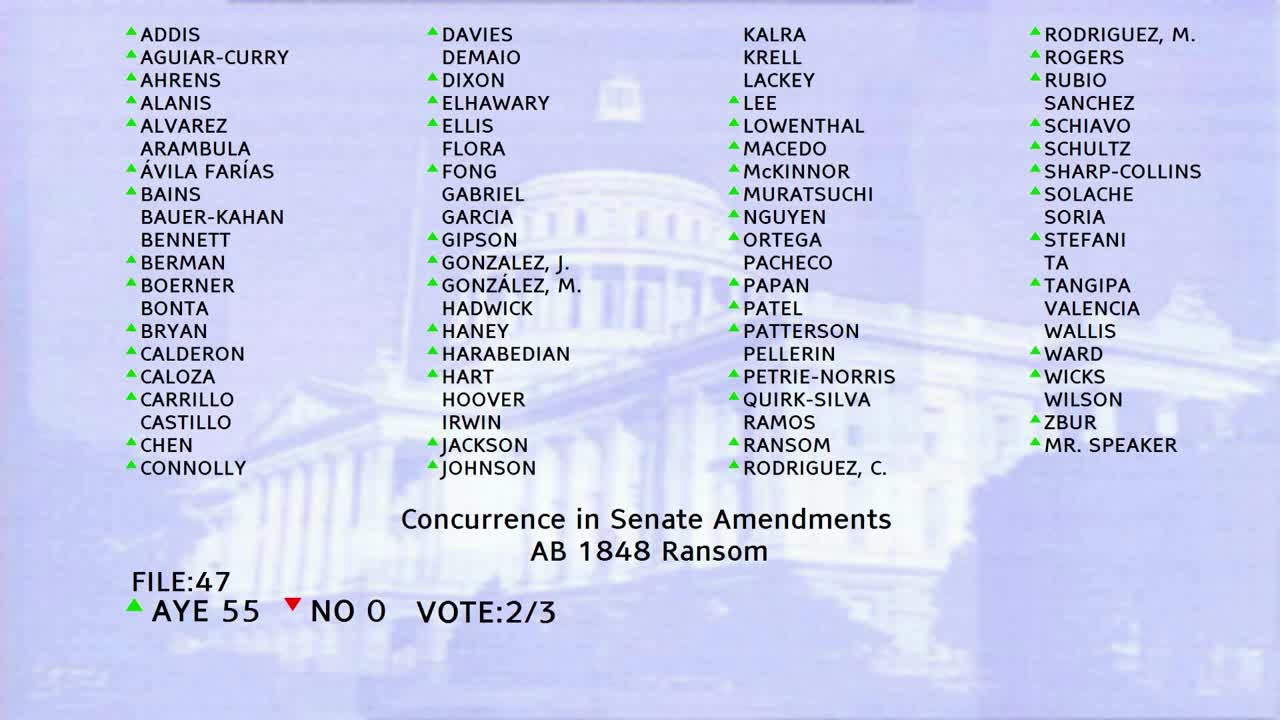 37SEC
Assembly Floor
 1MIN
Senate Floor
 3MIN
Senate Standing Committee on Revenue and Taxation
 2MIN
Senate Standing Committee on Business, Professions and Economic Development
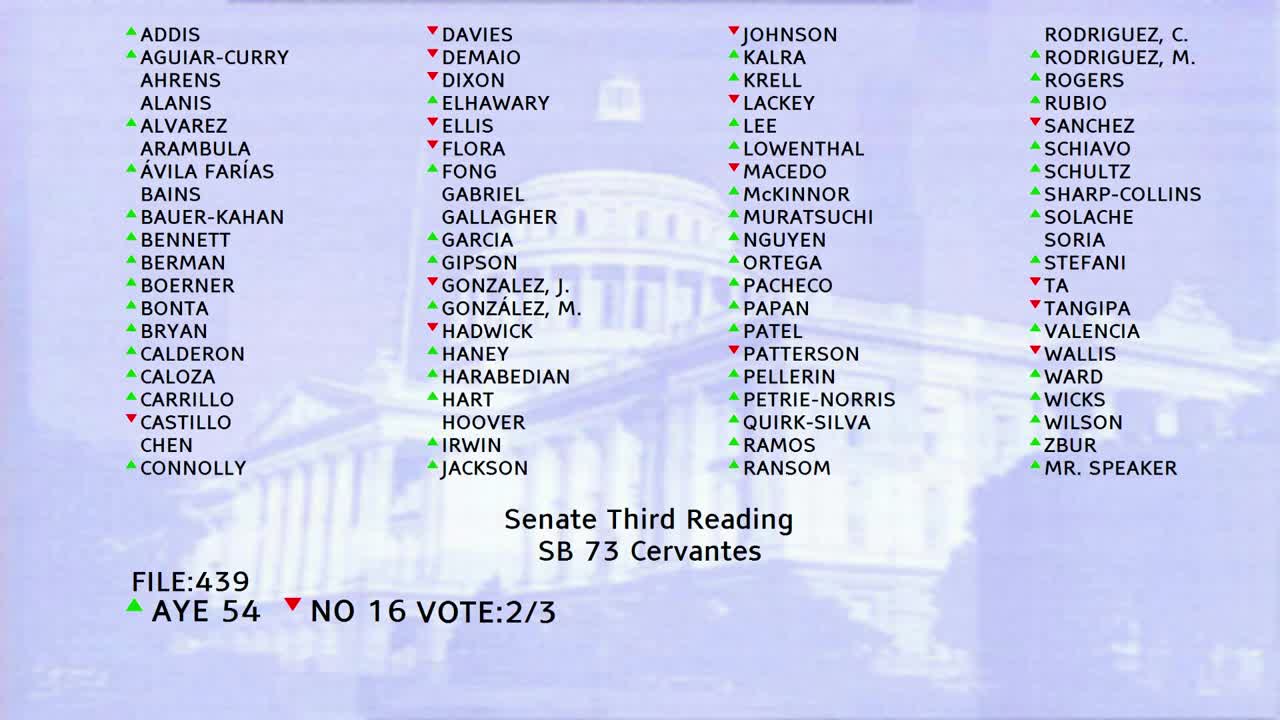 1MIN
Assembly Floor
 5MIN
Assembly Standing Committee on Revenue and Taxation
Bill Author

Bill Co-Author(s):