AB 226: California FAIR Plan Association.
- Session Year: 2025-2026
- House: Assembly
- Latest Version Date: 2025-10-09
Current Status:
Passed
(2025-10-09: Chaptered by Secretary of State - Chapter 473, Statutes of 2025.)
Introduced
In Committee
Awaiting First Chamber Vote
Passed First Chamber
In Committee
Awaiting Second Chamber Vote
Passed Second Chamber
Enacted
What does this bill do?
The bill lets the California FAIR Plan Association, with prior approval from the Insurance Commissioner, ask the California Infrastructure and Economic Development Bank to issue bonds or provide loans or lines of credit to pay claims or boost its cash and claims‑paying capacity, and to secure those financings with FAIR Plan assets. If the FAIR Plan cannot repay those obligations, it must charge its participating member insurers assessments as needed to cover payments, and the bonds would be payable only from the pledged assets rather than from the state’s general funds.
The summary is provided by generative AI which can make mistakes. For original language, please view the details in the table below.
The California FAIR Plan Association is a joint reinsurance association in which all insurers licensed to write basic property insurance participate in administering a program for the equitable apportionment of basic property insurance for persons who are unable to obtain that coverage through normal channels. Existing law requires the associations plan of operation and any amendment to the plan to be approved by the Insurance Commissioner. Existing law establishes the California Infrastructure and Economic Development Bank and authorizes it to issue bonds to provide funds for the payment of costs of a project for a participating party or upon request by a state entity.
This bill would authorize the association, if granted prior approval from the commissioner, to request the California Infrastructure and Economic Development Bank to issue bonds, and would authorize the bank to issue those bonds to finance the costs of claims, to increase liquidity and claims-paying capacity of the association, and to refund bonds previously issued for that purpose. The bill would specify that the association is a participating party and that financing all or any portion of the costs of claims or to increase liquidity and the claims-paying capacity of the association is a project for bond purposes. The bill would authorize the bank to loan the proceeds of issued bonds to the association, and would authorize the association to enter into a loan agreement with the bank and to enter into a line of credit agreement or other agreement
This bill would require the association, if the above-described bonds, loan agreements, or lines of credit received the prior approval of the commissioner, and if the association is unable to timely and fully meet its repayment obligation, to assess members in the amounts and at the times necessary to timely pay in full all obligations of the association with respect to those bonds, loan agreements, lines of credit, and other agreements, as specified. The bill would authorize the association to secure those bonds, loan agreements, lines of credit, and other agreements by a statutory lien, as specified.
Existing law establishes the California Infrastructure and Economic Development Bank Fund, a continuously appropriated fund, for the purpose of implementing the objectives of the bank.
To the extent that the bill would result in additional revenues being deposited into the California Infrastructure and Economic Development Bank Fund, the bill would make an appropriation.
This bill would declare that it is to take effect immediately as an urgency statute.
The California FAIR Plan Association is a joint reinsurance association in which all insurers licensed to write basic property insurance participate in administering a program for the equitable apportionment of basic property insurance for persons who are unable to obtain that coverage through normal channels. Existing law requires the associations plan of operation and any amendment to the plan to be approved by the Insurance Commissioner. Existing law establishes the California Infrastructure and Economic Development Bank and authorizes it to issue bonds to provide funds for the payment of costs of a project for a participating party or upon request by a state entity.
This bill would authorize the association, if granted prior approval from the commissioner, to request the California Infrastructure and Economic Development Bank to issue bonds, and would authorize the bank to issue those bonds to finance the costs of claims, to increase liquidity and claims-paying capacity of the association, and to refund bonds previously issued for that purpose. The bill would specify that the association is a participating party and that financing all or any portion of the costs of claims or to increase liquidity and the claims-paying capacity of the association is a project for bond purposes. The bill would authorize the bank to loan the proceeds of issued bonds to the association, and would authorize the association to enter into a loan agreement with the bank and to enter into a line of credit agreement with an institutional lender or broker-dealer. or other agreement
This bill would require the association, if the above-described bonds, loan agreements, or lines of credit received the prior approval of the commissioner, and if the association is unable to timely and fully meet its repayment obligation, to assess members in the amounts and at the times necessary to timely pay in full all obligations of the association with respect to those bonds, loan agreements, or lines of credit and related credit, and other agreements, as specified. The bill would authorize the association to secure those bonds, loan agreements, lines of credit, and other agreements by a statutory lien, as specified.
Existing law establishes the California Infrastructure and Economic Development Bank Fund, a continuously appropriated fund, for the purpose of implementing the objectives of the bank.
To the extent that the bill would result in additional revenues being deposited into the California Infrastructure and Economic Development Bank Fund, the bill would make an appropriation.
This bill would declare that it is to take effect immediately as an urgency statute.
The California FAIR Plan Association is a joint reinsurance association in which all insurers licensed to write basic property insurance participate in administering a program for the equitable apportionment of basic property insurance for persons who are unable to obtain that coverage through normal channels. Existing law requires the associations plan of operation and any amendment to the plan to be approved by the Insurance Commissioner. Existing law establishes the California Infrastructure and Economic Development Bank and authorizes it to issue bonds to provide funds for the payment of costs of a project for a participating party or upon request by a state entity.
This bill would authorize the association, if granted prior approval from the commissioner, to request the California Infrastructure and Economic Development Bank to issue bonds, and would authorize the bank to issue those bonds to finance the costs of claims, to increase liquidity and claims-paying capacity of the association, and to refund bonds previously issued for that purpose. The bill would specify that the association is a participating party and that financing all or any portion of the costs of claims or to increase liquidity and the claims-paying capacity of the association is a project for bond purposes. The bill would authorize the bank to loan the proceeds of issued bonds to the association, and would authorize the association to enter into a loan agreement with the bank and to enter into a line of credit agreement with an institutional lender or broker-dealer.
This bill would require the association, if the above-described bonds, loan agreements, or lines of credit received the prior approval of the commissioner, to assess members in the amounts and at the times necessary to timely pay in full all obligations of the association with respect to those bonds, loan agreements, or lines of credit and related agreements, as specified.
Existing law establishes the California Infrastructure and Economic Development Bank Fund, a continuously appropriated fund, for the purpose of implementing the objectives of the bank.
To the extent that the bill would result in additional revenues being deposited into the California Infrastructure and Economic Development Bank Fund, the bill would make an appropriation.
This bill would declare that it is to take effect immediately as an urgency statute.
(a)Notwithstanding any other provision of this division, pursuant to Section 10100.3 of the Insurance Code and upon approval of the bank, a financing of the costs of claims or to increase liquidity and claims-paying capacity upon the request of the California FAIR Plan Association shall be deemed to be in the public interest and eligible for financing by the bank. Article 3 (commencing with Section 63040), Article 4 (commencing with Section 63042), Article 5 (commencing with Section 63043), Article 5.5 (commencing with Section 63047.1), Article 6 (commencing with Section 63048), Article 6.3 (commencing with Section 63048.55), Article 6.5 (commencing with Section 63048.6), Article 6.7 (commencing with Section 63048.91), Article 7 (commencing with Section 63049), Article 8 (commencing with Section 63049.6), Article 9 (commencing with Section 63049.67), and Article 10 (commencing with Section 63049.70) shall not apply to that financing provided by the bank.
(b)Notwithstanding any other provision of this division, the bank shall not have authority over any matter that is subject to the approval of, or otherwise regulated by, the Insurance Commissioner under Part 1 (commencing with Section 1880) of Division 2 of the Insurance Code. The bank shall have the right to enforce all obligations of the California FAIR Plan Association under the agreements relating to bonds issued under this section.
(c)The bank may issue taxable or tax-exempt bonds pursuant to Chapter 5 (commencing with Section 63070) to finance the costs of claims or to increase liquidity and claims-paying capacity of the California FAIR Plan Association, and to refund bonds previously issued for that purpose, and may loan the proceeds thereof to the California FAIR Plan Association. Bond proceeds may also be used to fund necessary reserves, capitalized interest, credit or liquidity enhancement costs, and costs of issuance.
(d)Bonds issued under this section shall not be deemed to constitute a debt or liability of the state or of any political subdivision thereof, other than the bank, or a pledge of the faith and credit of the state or of any political subdivision, but shall be payable solely from the revenues and assets securing the bonds. All bonds issued under this article shall contain on the face of the bonds a statement to that effect.
SEC. 2.Section 63087.5 is added to the Government Code, immediately following Section 63087, to read:63087.5.For purposes of this chapter:
(a)Participating party includes the California FAIR Plan Association.
(b)Project has the same meaning as defined in Section 63010, and also includes financing all or any portion of the costs of claims or to increase liquidity and the claims-paying capacity of the California FAIR Plan Association in an amount, together with necessary reserves, capitalized interest, credit or liquidity enhancement costs, or costs of issuance, that may be determined by the California FAIR Plan Association, with prior approval from the Insurance Commissioner, in a request to the bank made pursuant to Section 63049.75.
SEC. 3.Section 10100.3 is added to the Insurance Code, immediately following Section 10100.2, to read:10100.3.(a)If granted prior approval from the commissioner, the association may do all of the following:
(1)Request the California Infrastructure and Economic Development Bank to issue bonds from time to time to finance all or any portion of the costs of claims or to increase liquidity and claims-paying capacity, pursuant to Section 63049.75 of the Government Code.
(2)Enter into loan agreements with the California Infrastructure and Economic Development Bank, pursuant to Section 63049.75 of the Government Code.
(3)Enter into line of credit agreements with one or more entities for the purpose of financing the costs of claims or to increase liquidity and claims-paying capacity and to refund lines of credit previously incurred for that purpose.
(4)Secure those loan agreements, line of credit agreements, or agreements described in paragraph (5) by a pledge of, and the grant of a lien and security interest in, collateral, which may include premiums, revenues, receivables, assessments, and any other assets of the association. That pledge, lien, and security interest is subject to Division 9 (commencing with Section 9101) of the Commercial Code.
(5)Enter into any other agreement or take any other action necessary or convenient to the execution and delivery of bonds, loan agreements, or line of credit agreements.
(b)(1)If the bonds, loan agreements, or lines of credit described in subdivision (a) have received the prior approval of the commissioner as provided in subdivision (a), and if the association is otherwise unable to timely and fully meet its repayment obligation, the association shall assess members in the amounts and at the times necessary to timely pay in full all obligations of the association with respect to those bonds, loan agreements, lines of credit, and all obligations of the association under agreements entered into pursuant to paragraph (5) of subdivision (a).
(2)The FAIR Plan shall not act pursuant to this subdivision without the prior review and approval of the commissioner.
(c)(1)Once approved by the commissioner, specific repayment terms shall not be altered by subsequent amendment to the plan of operation, and amendments to the plan of operation shall not impair the timely payment in full of any obligations of the association with respect to those bonds, loan agreements, lines of credit, and all obligations of the association under agreements entered into pursuant to paragraph (5) of subdivision (a).
(2)The state shall not alter, amend, or restrict the provisions of this section in a manner adverse to the rights and interests of bondholders, credit providers, or other parties who have entered into bonds, line of credit agreements, or other agreements pursuant to paragraph (5) of subdivision (a), for so long as the bonds, lines of credit, or other agreements pursuant to paragraph (5) of subdivision (a) remain outstanding. This subdivision does not preclude altering, amending, or restricting this section if it expressly applies only to agreements issued or entered into on or after the effective date of that alteration, amendment, or restriction.
(3)The association may include the terms of paragraph (2) in an agreement relating to bonds, lines of credit, or other agreements entered into pursuant to paragraph (5) of subdivision (a).
(d)(1)The bonds, loan agreements, lines of credit, and agreements described in paragraph (5) of subdivision (a) may be secured by a statutory lien on all collateral in favor of the bond trustee, line of credit providers, and lenders, as applicable, to secure the payment and performance of all obligations of the association. This shall be a continuous lien on collateral effective from the time the first bond is issued, or the first line of credit agreement is executed and delivered, whether or not a particular item of collateral exists at the time of the issuance or execution and delivery.
(2)The statutory lien shall be valid, effective, prior, perfected, binding, and enforceable without the need for notification, physical delivery, recordation, filing, or further action.
(3)For purposes of this subdivision, the beneficiary of the statutory lien becomes entitled to enforce the lien in accordance with the statute under which it was created if a payment default occurs in connection with a lien.
(e)As long as a bond, loan agreement, or line of credit is outstanding, the association shall not be subject to Article 14 (commencing with Section 1010) or Article 14.3 (commencing with Section 1064.1) of Chapter 1 of Part 2 of Division 1.
SEC. 4.This act is an urgency statute necessary for the immediate preservation of the public peace, health, or safety within the meaning of Article IV of the California Constitution and shall go into immediate effect. The facts constituting the necessity are:
California is now experiencing a severe property insurance availability crisis resulting in needed coverage, typically provided by admitted insurers and licensed surplus line brokers, often being unavailable in the normal insurance market. Consumers who cannot obtain property insurance through admitted or surplus lines insurers are also having to purchase more insurance through the California FAIR Plan Association, and the number of policies in the association has continued to grow. Because of this increase and the growing wildfire risk in the state, the FAIR Plan must be ready for catastrophic events, for which the FAIR Plan needs access to as many financial tools as possible at all times.
The Legislature finds that access to basic property insurance suitable for protection of all types of habitational risk, including personal and commercial lines of insurance, has become increasingly unavailable and that, as a result, all Californians may suffer because of this unavailability. In order for insurance consumers to obtain adequate policy coverage from the California FAIR Plan, which is subject to regulation by the commissioner, as soon as possible, it is necessary that this act take effect immediately.
(a)Notwithstanding any other provision of this division, pursuant to Section 10100.3 of the Insurance Code and upon approval of the bank, a financing of the costs of claims or to increase liquidity and claims-paying capacity upon the request of the California FAIR Plan Association shall be deemed to be in the public interest and eligible for financing by the bank. Article 3 (commencing with Section 63040), Article 4 (commencing with Section 63042), Article 5 (commencing with Section 63043), Article 5.5 (commencing with Section 63047.1), Article 6 (commencing with Section 63048), Article 6.3 (commencing with Section 63048.55), Article 6.5 (commencing with Section 63048.6), Article 6.7 (commencing with Section 63048.91), Article 7 (commencing with Section 63049), Article 8 (commencing with Section 63049.6), Article 9 (commencing with Section 63049.67), and Article 10 (commencing with Section 63049.70) shall not apply to that financing provided by the bank.
(b)Notwithstanding any other provision of this division, the bank shall not have authority over any matter that is subject to the approval of, or otherwise regulated by, the Insurance Commissioner under Part 1 (commencing with Section 1880) of Division 2 of the Insurance Code. The bank shall have the right to enforce all obligations of the California FAIR Plan Association under the agreements relating to bonds issued under this section.
(c)The bank may issue taxable or tax-exempt bonds pursuant to Chapter 5 (commencing with Section 63070) to finance the costs of claims or to increase liquidity and claims-paying capacity of the California FAIR Plan Association, and to refund bonds previously issued for that purpose, and may loan the proceeds thereof to the California FAIR Plan Association. Bond proceeds may also be used to fund necessary reserves, capitalized interest, credit or liquidity enhancement costs, and costs of issuance.
(d)Bonds issued under this section shall not be deemed to constitute a debt or liability of the state or of any political subdivision thereof, other than the bank, or a pledge of the faith and credit of the state or of any political subdivision, but shall be payable solely from the revenues and assets securing the bonds. All bonds issued under this article shall contain on the face of the bonds a statement to that effect.
SEC. 2.Section 63087.5 is added to the Government Code, immediately following Section 63087, to read:63087.5.For purposes of this chapter:
(a)Participating party includes the California FAIR Plan Association.
(b)Project has the same meaning as defined in Section 63010, and also includes financing all or any portion of the costs of claims or to increase liquidity and the claims-paying capacity of the California FAIR Plan Association in an amount, together with necessary reserves, capitalized interest, credit or liquidity enhancement costs, or costs of issuance, that may be determined by the California FAIR Plan Association, with prior approval from the Insurance Commissioner, in a request to the bank made pursuant to Section 63049.75.
SEC. 3.Section 10100.3 is added to the Insurance Code, immediately following Section 10100.2, to read:10100.3.(a)If granted prior approval from the commissioner, the association may do all of the following:
(1)Request the California Infrastructure and Economic Development Bank to issue bonds from time to time to finance all or any portion of the costs of claims or to increase liquidity and claims-paying capacity, pursuant to Section 63049.75 of the Government Code.
(2)Enter into loan agreements with the California Infrastructure and Economic Development Bank, pursuant to Section 63049.75 of the Government Code.
(3)Enter into line of credit agreements with one or more entities for the purpose of financing the costs of claims or to increase liquidity and claims-paying capacity and to refund lines of credit previously incurred for that purpose.
(4)Secure those loan agreements, line of credit agreements, or agreements described in paragraph (5) by a pledge of, and the grant of a lien and security interest in, collateral, which may include premiums, revenues, receivables, assessments, and any other assets of the association. That pledge, lien, and security interest is subject to Division 9 (commencing with Section 9101) of the Commercial Code.
(5)Enter into any other agreement or take any other action necessary or convenient to the execution and delivery of bonds, loan agreements, or line of credit agreements.
(b)(1)If the bonds, loan agreements, or lines of credit described in subdivision (a) have received the prior approval of the commissioner as provided in subdivision (a), and if the association is otherwise unable to timely and fully meet its repayment obligation, the association shall assess members in the amounts and at the times necessary to timely pay in full all obligations of the association with respect to those bonds, loan agreements, lines of credit, and all obligations of the association under agreements entered into pursuant to paragraph (5) of subdivision (a).
(2)The FAIR Plan shall not act pursuant to this subdivision without the prior review and approval of the commissioner.
(c)(1)Once approved by the commissioner, specific repayment terms shall not be altered by subsequent amendment to the plan of operation, and amendments to the plan of operation shall not impair the timely payment in full of any obligations of the association with respect to those bonds, loan agreements, lines of credit, and all obligations of the association under agreements entered into pursuant to paragraph (5) of subdivision (a).
(2)The state shall not alter, amend, or restrict the provisions of this section in a manner adverse to the rights and interests of bondholders, credit providers, or other parties who have entered into bonds, line of credit agreements, or other agreements pursuant to paragraph (5) of subdivision (a), for so long as the bonds, lines of credit, or other agreements pursuant to paragraph (5) of subdivision (a) remain outstanding. This subdivision does not preclude altering, amending, or restricting this section if it expressly applies only to agreements issued or entered into on or after the effective date of that alteration, amendment, or restriction.
(3)The association may include the terms of paragraph (2) in an agreement relating to bonds, lines of credit, or other agreements entered into pursuant to paragraph (5) of subdivision (a).
(d)(1)The bonds, loan agreements, lines of credit, and agreements described in paragraph (5) of subdivision (a) may be secured by a statutory lien on all collateral in favor of the bond trustee, line of credit providers, and lenders, as applicable, to secure the payment and performance of all obligations of the association. This shall be a continuous lien on collateral effective from the time the first bond is issued, or the first line of credit agreement is executed and delivered, whether or not a particular item of collateral exists at the time of the issuance or execution and delivery.
(2)The statutory lien shall be valid, effective, prior, perfected, binding, and enforceable without the need for notification, physical delivery, recordation, filing, or further action.
(3)For purposes of this subdivision, the beneficiary of the statutory lien becomes entitled to enforce the lien in accordance with the statute under which it was created if a payment default occurs in connection with a lien.
(e)As long as a bond, loan agreement agreement, or line of credit is outstanding, the association shall not be subject to Article 14 (commencing with Section 1010) or Article 14.3 (commencing with Section 1064.1) of Chapter 1 of Part 2 of Division 1.
SEC. 4.This act is an urgency statute necessary for the immediate preservation of the public peace, health, or safety within the meaning of Article IV of the California Constitution and shall go into immediate effect. The facts constituting the necessity are:
California is now experiencing a severe property insurance availability crisis resulting in needed coverage, typically provided by admitted insurers and licensed surplus line brokers, often being unavailable in the normal insurance market. Consumers who cannot obtain property insurance through admitted or surplus lines insurers are also having to purchase more insurance through the California FAIR Plan Association, and the number of policies in the association has continued to grow. Because of this increase and the growing wildfire risk in the state, the FAIR Plan must be ready for catastrophic events, for which the FAIR Plan needs access to as many financial tools as possible at all times.
The Legislature finds that access to basic property insurance suitable for protection of all types of habitational risk, including personal and commercial lines of insurance, has become increasingly unavailable and that, as a result, all Californians may suffer because of this unavailability. In order for insurance consumers to obtain adequate policy coverage from the California FAIR Plan, which is subject to regulation by the commissioner, as soon as possible, it is necessary that this act take effect immediately.
(a)Notwithstanding any other provision of this division, pursuant to Section 10100.3 of the Insurance Code and upon approval of the bank, a financing of the costs of paid claims or to increase liquidity and claims-paying capacity upon the request of the California FAIR Plan Association shall be deemed to be in the public interest and eligible for financing by the bank. Article 3 (commencing with Section 63040), Article 4 (commencing with Section 63042), Article 5 (commencing with Section 63043), Article 5.5 (commencing with Section 63047.1), Article 6 (commencing with Section 63048), Article 6.3 (commencing with Section 63048.55), Article 6.5 (commencing with Section 63048.6), Article 6.7 (commencing with Section 63048.91), Article 7 (commencing with Section 63049), Article 8 (commencing with Section 63049.6), Article 9 (commencing with Section 63049.67), and Article 10 (commencing with Section 63049.70) shall not apply to that financing provided by the bank.
(b)Notwithstanding any other provision of this division, the bank shall not have authority over any matter that is subject to the approval of, or otherwise regulated by, the Insurance Commissioner under Part 1 (commencing with Section 1880) of Division 2 of the Insurance Code. The bank shall have the right to enforce all obligations of the California FAIR Plan Association under the agreements relating to bonds issued under this section.
(c)The bank may issue taxable or tax-exempt bonds pursuant to Chapter 5 (commencing with Section 63070) to finance the costs of claims or to increase liquidity and claims-paying capacity of the California FAIR Plan Association, and to refund bonds previously issued for that purpose, and may loan the proceeds thereof to the California FAIR Plan Association. Bond proceeds may also be used to fund necessary reserves, capitalized interest, credit or liquidity enhancement costs, and costs of issuance.
(d)Bonds issued under this section shall not be deemed to constitute a debt or liability of the state or of any political subdivision thereof, other than the bank, or a pledge of the faith and credit of the state or of any political subdivision, but shall be payable solely from the fund and other revenues and assets securing the bonds. All bonds issued under this article shall contain on the face of the bonds a statement to that effect.
SEC. 2.Section 63087.5 is added to the Government Code, immediately following Section 63087, to read:63087.5.For purposes of this chapter:
(a)Participating party includes the California FAIR Plan Association.
(b)Project has the same meaning as defined in Section 63010, and also includes financing all or any portion of the costs of claims or to increase liquidity and the claims-paying capacity of the California FAIR Plan Association in an amount, together with necessary reserves, capitalized interest, credit or liquidity enhancement costs, or costs of issuance, that may be determined by the California FAIR Plan Association, with prior approval from the Insurance Commissioner, in a request to the bank made pursuant to Section 63049.75.
SEC. 3.Section 10100.3 is added to the Insurance Code, to read:SEC. 3.Section 10100.3 is added to the Insurance Code, immediately following Section 10100.2, to read:10100.3.(a)If granted prior approval from the commissioner, the association may do all of the following:
(1)Request the California Infrastructure and Economic Development Bank to issue bonds from time to time to finance all or any portion of the costs of claims or to increase liquidity and claims-paying capacity, pursuant to Section 63049.75 of the Government Code.
(2)Enter into loan agreements with the California Infrastructure and Economic Development Bank, pursuant to Section 63049.75 of the Government Code.
(3)Enter into line of credit agreements with one or more institutional lenders, as defined in Section 22600 of the Financial Code, or one or more broker-dealers, as defined in Section 25004 of the Corporations Code, entities for the purpose of financing the costs of claims or to increase liquidity and claims-paying capacity and to refund lines of credit previously incurred for that purpose.
(4)Secure those loan agreements or agreements, line of credit agreements agreements, or agreements described in paragraph (5) by a pledge of, and the grant of a lien and security interest in, collateral, including which may include premiums, revenues, and receivables. receivables, and any other assets of the association. That pledge, lien, and security interest is subject to Division 9 (commencing with Section 9101) of the Commercial Code.
(5)Enter into any other agreement or take any other action necessary or convenient to the execution and delivery of bonds, loan agreements, or line of credit agreements.
(b)(1)If the bonds, loan agreements, or lines of credit described in subdivision (a) have received the prior approval of the commissioner as provided in subdivision (a), and if the association is otherwise unable to timely and fully meet its repayment obligation, the association shall assess members in the amounts and at the times necessary to timely pay in full all obligations of the association with respect to those bonds, loan agreements, and lines of credit credit, and all obligations of the association under agreements entered into pursuant to paragraph (5) of subdivision (a). Once
(2)The FAIR Plan shall not act pursuant to this subdivision without the prior review and approval of the commissioner.
(c)(1)Once approved by the commissioner, specific repayment terms, including those relating to assessment, terms shall not be altered by subsequent amendment to the plan of operation, and amendments to the plan of operation shall not impair the timely payment in full of any obligations of the association with respect to those bonds, loan agreements, and lines of credit credit, and all obligations of the association under agreements entered into pursuant to paragraph (5) of subdivision (a).
(2)The state shall not alter, amend, or restrict the provisions of this section in a manner adverse to the rights and interests of bondholders, credit providers, or other parties who have entered into bonds, line of credit agreements, or other agreements pursuant to paragraph (5) of subdivision (a), for so long as the bonds, lines of credit, or other agreements pursuant to paragraph (5) of subdivision (a) remain outstanding. This subdivision does not preclude altering, amending, or restricting this section if it expressly applies only to agreements issued or entered into on or after the effective date of that alteration, amendment, or restriction.
(3)The association may include the terms of paragraph (2) in an agreement relating to bonds, lines of credit, or other agreements entered into pursuant to paragraph (5) of subdivision (a).
(d)(1)The bonds, loan agreements, lines of credit, and agreements described in paragraph (5) of subdivision (a) may be secured by a statutory lien on all collateral in favor of the bond trustee, line of credit providers, and lenders, as applicable, to secure the payment and performance of all obligations of the association. This shall be a continuous lien on collateral effective from the time the first bond is issued, or the first line of credit agreement is executed and delivered, whether or not a particular item of collateral exists at the time of the issuance or execution and delivery.
(2)The statutory lien shall be valid, effective, prior, perfected, binding, and enforceable without the need for notification, physical delivery, recordation, filing, or further action.
(3)For purposes of this subdivision, the beneficiary of the statutory lien becomes entitled to enforce the lien in accordance with the statute under which it was created if a payment default occurs in connection with a lien.
(e)As long as a bond, loan agreement or line of credit is outstanding, the association shall not be subject to Article 14 (commencing with Section 1010) or Article 14.3 (commencing with Section 1064.1) of Chapter 1 of Part 2 of Division 1.
SEC. 4.This act is an urgency statute necessary for the immediate preservation of the public peace, health, or safety within the meaning of Article IV of the California Constitution and shall go into immediate effect. The facts constituting the necessity are:
California is now experiencing a severe property insurance availability crisis in the state. This crisis in availability within the property insurance market normally provided by admitted insurers and licensed surplus line brokers is having the result that needed coverage is often unavailable in the normal insurance market, forcing consumers to resort to the nonadmitted or secondary market, which are insurance alternatives not overseen by the Department of Insurance. Consumers are also having to purchase much more insurance through the California FAIR Plan Association, and the association has grown to such an extent that its financial capacity to pay claims after a catastrophic fire is unlikely.California is now experiencing a severe property insurance availability crisis resulting in needed coverage, typically provided by admitted insurers and licensed surplus line brokers, often being unavailable in the normal insurance market. Consumers who cannot obtain property insurance through admitted or surplus lines insurers are also having to purchase more insurance through the California FAIR Plan Association, and the number of policies in the association has continued to grow. Because of this increase and the growing wildfire risk in the state, the FAIR Plan must be ready for catastrophic events, for which FAIR Plan needs access to as many financial tools as possible at all times.
The Legislature finds that access to basic property insurance suitable for protection of all types of habitational risk, including personal and commercial lines of insurance, has become increasingly unavailable and that, as a result, all Californians may suffer because of this unavailability. In order for insurance consumers to obtain adequate policy coverage from the California FAIR Plan, which is subject to regulation by the commissioner, as soon as possible, it is necessary that this act take effect immediately.
(a)Notwithstanding any other provision of this division, pursuant to Section 10100.3 of the Insurance Code and upon approval of the bank, a financing of the costs of paid claims or to increase liquidity and claims-paying capacity upon the request of the California FAIR Plan Association shall be deemed to be in the public interest and eligible for financing by the bank. Article 3 (commencing with Section 63040), Article 4 (commencing with Section 63042), Article 5 (commencing with Section 63043), Article 5.5 (commencing with Section 63047.1), Article 6 (commencing with Section 63048), Article 6.3 (commencing with Section 63048.55), Article 6.5 (commencing with Section 63048.6), Article 6.7 (commencing with Section 63048.91), Article 7 (commencing with Section 63049), Article 8 (commencing with Section 63049.6), Article 9 (commencing with Section 63049.67), and Article 10 (commencing with Section 63049.70) shall not apply to that financing provided by the bank.
(b)Notwithstanding any other provision of this division, the bank shall not have authority over any matter that is subject to the approval of, or otherwise regulated by, the Insurance Commissioner under Part 1 (commencing with Section 1880) of Division 2 of the Insurance Code. The bank shall have the right to enforce all obligations of the California FAIR Plan Association under the agreements relating to bonds issued under this section.
(c)The bank may issue taxable or tax-exempt bonds pursuant to Chapter 5 (commencing with Section 63070) to finance the costs of claims or to increase liquidity and claims-paying capacity of the California FAIR Plan Association, and to refund bonds previously issued for that purpose, and may loan the proceeds thereof to the California FAIR Plan Association. Bond proceeds may also be used to fund necessary reserves, capitalized interest, credit or liquidity enhancement costs, and costs of issuance.
(d)Bonds issued under this section shall not be deemed to constitute a debt or liability of the state or of any political subdivision thereof, other than the bank, or a pledge of the faith and credit of the state or of any political subdivision, but shall be payable solely from the fund and other revenues and assets securing the bonds. All bonds issued under this article shall contain on the face of the bonds a statement to that effect.
SEC. 2.Section 63087.5 is added to the Government Code, immediately following Section 63087, to read:63087.5.For purposes of this chapter:
(a)Participating party includes the California FAIR Plan Association.
(b)Project has the same meaning as defined in Section 63010, and also includes financing all or any portion of the costs of claims or to increase liquidity and the claims-paying capacity of the California FAIR Plan Association in an amount, together with necessary reserves, capitalized interest, credit or liquidity enhancement costs, or costs of issuance, that may be determined by the California FAIR Plan Association, with prior approval from the Insurance Commissioner, in a request to the bank made pursuant to Section 63049.75.
SEC. 3.Section 10100.3 is added to the Insurance Code, to read:10100.3.(a)If granted prior approval from the commissioner, the association may do all of the following:
(1)Request the California Infrastructure and Economic Development Bank to issue bonds from time to time to finance all or any portion of the costs of claims or to increase liquidity and claims-paying capacity, pursuant to Section 63049.75 of the Government Code.
(2)Enter into loan agreements with the California Infrastructure and Economic Development Bank, pursuant to Section 63049.75 of the Government Code.
(3)Enter into line of credit agreements with one or more institutional lenders, as defined in Section 22600 of the Financial Code, or one or more broker-dealers, as defined in Section 25004 of the Corporations Code, for the purpose of financing the costs of claims or to increase liquidity and claims-paying capacity and to refund lines of credit previously incurred for that purpose.
(4)Secure those loan agreements or line of credit agreements by a pledge of, and the grant of a lien and security interest in, collateral, including premiums, revenues, and receivables. That pledge, lien, and security interest is subject to Division 9 (commencing with Section 9101) of the Commercial Code.
(5)Enter into any other agreement or take any other action necessary or convenient to the execution and delivery of bonds, loan agreements, or line of credit agreements.
(b)If the bonds, loan agreements, or lines of credit described in subdivision (a) have received the prior approval of the commissioner as provided in subdivision (a), the association shall assess members in the amounts and at the times necessary to timely pay in full all obligations of the association with respect to those bonds, loan agreements, and lines of credit and all obligations of the association under agreements entered into pursuant to paragraph (5) of subdivision (a). Once approved by the commissioner, specific repayment terms, including those relating to assessment, shall not be altered by subsequent amendment to the plan of operation, and amendments to the plan of operation shall not impair the timely payment in full of any obligations of the association with respect to those bonds, loan agreements, and lines of credit and all obligations of the association under agreements entered into pursuant to paragraph (5) of subdivision (a).
SEC. 4.This act is an urgency statute necessary for the immediate preservation of the public peace, health, or safety within the meaning of Article IV of the California Constitution and shall go into immediate effect. The facts constituting the necessity are:
California is now experiencing a severe property insurance availability crisis in the state. This crisis in availability within the property insurance market normally provided by admitted insurers and licensed surplus line brokers is having the result that needed coverage is often unavailable in the normal insurance market, forcing consumers to resort to the nonadmitted or secondary market, which are insurance alternatives not overseen by the Department of Insurance. Consumers are also having to purchase much more insurance through the California FAIR Plan Association, and the association has grown to such an extent that its financial capacity to pay claims after a catastrophic fire is unlikely.
The Legislature finds that access to basic property insurance suitable for protection of all types of habitational risk, including personal and commercial lines of insurance, has become increasingly unavailable and that, as a result, all Californians may suffer because of this unavailability. In order for insurance consumers to obtain adequate policy coverage from the California FAIR Plan, which is subject to regulation by the commissioner, as soon as possible, it is necessary that this act take effect immediately.
REVISIONS: HeadingLine 4.|
Date
|
Status
|
|---|---|
| Oct 9, 2025 | Chaptered by Secretary of State - Chapter 473, Statutes of 2025. |
| Oct 9, 2025 | Approved by the Governor. |
| Sep 24, 2025 | Enrolled and presented to the Governor at 3 p.m. |
| Sep 18, 2025 | Enrolled measure version corrected. |
| Sep 17, 2025 | Enrolled measure version corrected. |
| Sep 13, 2025 | Joint Rules 61(a)(14) and 51(a)(4) suspended. (Ayes 59. Noes 20. Page 3413.) |
| Sep 13, 2025 | Assembly Rule 63 suspended. (Page 3484.) |
| Sep 13, 2025 | In Assembly. Concurrence in Senate amendments pending. |
| Sep 13, 2025 | Senate amendments concurred in. To Engrossing and Enrolling. (Ayes 74. Noes 0. Page 3494.). |
| Sep 13, 2025 | Read third time. Urgency clause adopted. Passed. Ordered to the Assembly. (Ayes 37. Noes 0. Page 3047.). |
| Sep 3, 2025 | Ordered to third reading. |
| Sep 3, 2025 | From special consent calendar. |
| Sep 2, 2025 | Ordered to special consent calendar. |
| Aug 29, 2025 | Read second time. Ordered to third reading. |
| Aug 29, 2025 | From committee: Do pass. (Ayes 7. Noes 0.) (August 29). |
| Aug 18, 2025 | In committee: Referred to suspense file. |
| Jul 9, 2025 | In committee: Hearing postponed by committee. |
| Jun 25, 2025 | From committee: Do pass and re-refer to Com. on APPR. with recommendation: To Consent Calendar. (Ayes 7. Noes 0.) (June 25). Re-referred to Com. on APPR. |
| Jun 16, 2025 | From committee chair, with author's amendments: Amend, and re-refer to committee. Read second time, amended, and re-referred to Com. on INS. |
| Jun 9, 2025 | From committee: Do pass and re-refer to Com. on INS. (Ayes 8. Noes 0.) (June 9). Re-referred to Com. on INS. |
| May 29, 2025 | From committee chair, with author's amendments: Amend, and re-refer to committee. Read second time, amended, and re-referred to Com. on B. P. & E.D. |
| May 7, 2025 | Referred to Coms. on B. P. & E.D. and INS. |
| Apr 2, 2025 | In Senate. Read first time. To Com. on RLS. for assignment. |
| Apr 1, 2025 | Read third time. Urgency clause adopted. Passed. Ordered to the Senate. (Ayes 77. Noes 0. Page 951.). |
| Mar 20, 2025 | Read second time. Ordered to third reading. |
| Mar 19, 2025 | In committee: Set, first hearing. Referred to APPR. suspense file. |
| Mar 19, 2025 | From committee: Do pass. (Ayes 15. Noes 0.) (March 19). |
| Mar 5, 2025 | From committee: Do pass and re-refer to Com. on APPR. (Ayes 12. Noes 0.) (March 5). Re-referred to Com. on APPR. |
| Mar 5, 2025 | Coauthors revised. |
| Feb 19, 2025 | Coauthors revised. |
| Feb 18, 2025 | Referred to Com. on INS. |
| Jan 10, 2025 | From printer. May be heard in committee February 9. |
| Jan 9, 2025 | Read first time. To print. |
|
Date
|
Description
|
Location
|
Votes
|
|
|---|---|---|---|---|
| Sep 13, 2025 | AB 226 CALDERON Concurrence in Senate Amendments | Assembly Floor |
Passed |
|
| Sep 13, 2025 | Assembly 3rd Reading AB226 Calderon et al. By Umberg Urgency Clause | Senate Floor |
Passed |
|
| Sep 12, 2025 | Assembly 3rd Reading AB226 Calderon et al. By Umberg Urgency Clause | Senate Floor |
Passed |
|
| Aug 29, 2025 | Do pass | Senate Standing Committee on Appropriations |
Passed |
|
| Aug 18, 2025 | Placed on suspense file | Senate Standing Committee on Appropriations |
Passed |
|
| Jun 25, 2025 | Do pass, but first be re-referred to the Committee on [Appropriations] with the recommendation: To Consent Calendar | Senate Standing Committee on Insurance |
Passed |
|
| Jun 9, 2025 | Do pass, but first be re-referred to the Committee on [Insurance] | Senate Standing Committee on Business, Professions and Economic Development |
Passed |
|
| Apr 1, 2025 | AB 226 Calderon Third Reading Urgency | Assembly Floor |
Passed |
|
| Mar 19, 2025 | Do pass. | Assembly Standing Committee on Appropriations |
Passed |
|
| Mar 5, 2025 | Do pass and be re-referred to the Committee on [Appropriations] | Assembly Standing Committee on Insurance |
Passed |
This list shows positions taken on this bill by organizations on the date displayed, which is linked to the original source.
Positions by individuals are not included.
|
Organization
|
Position
|
Date
|
|---|---|---|
| American Property Casualty Insurance Association | ** Support | |
| Association of California Cities - Orange County | ** Support | |
| BOMA California | ** Support | |
| California Apartment Association | ** Support | |
| California Association Of Community Managers | ** Support | |
| California Association Of Realtors | ** Support | |
| California Association Of Winegrape Growers | ** Support | |
| California Building Industry Association (co-source) | ** Support | |
| California Building Officials | ** Support | |
| California Business Properties Association | ** Support | |
| California Business Roundtable | ** Support | |
| California Chamber Of Commerce | ** Support | |
| California Fair Plan Association | ** Support | |
| California Farm Bureau Federation | ** Support | |
| California Mortgage Bankers Association | ** Support | |
| California State Association Of Counties | ** Support | |
| City Of Lake Forest | ** Support | |
| City of Los Alamitos | ** Support | |
| City of Riverside | ** Support | |
| County of Monterey | ** Support | |
| East Bay Wildfire Coalition of Governments | ** Support | |
| Eden Housing | ** Support | |
| Fieldstead And Company | ** Support | |
| Habitat For Humanity California | ** Support | |
| Independent Insurance Agents & Brokers of California, Inc. | ** Support | |
| Institute of Real Estate Management | ** Support | |
| Los Angeles County Business Federation | ** Support | |
| Monterey; County Of | ** Support | |
| Naiop California | ** Support | |
| New California Coalition | ** Support | |
| Orange County | ** Support | |
| Orange County Business Council | ** Support | |
| Orange County Taxpayers Association | ** Support | |
| Pacific Association Of Domestic Insurance Companies | ** Support | |
| Personal Insurance Federation Of California | ** Support | |
| Ricardo Lara | ** Support | |
| San Bernardino County | ** Support | |
| San Diego County | ** Support | |
| San Gabriel Valley Council Of Governments | ** Support | |
| Southern California Association Of Governments | ** Support | |
| Southern California Leadership Council | ** Support | |
| Southwest California Legislative Council | ** Support | |
| SPUR | ** Support | |
| The Two Hundred | ** Support | |
| Tri County Chamber Alliance | ** Support | |
| United Policyholders | ** Support |
CONCURRENCE IN SENATE AMENDMENTS
CSA1 Bill Id:AB 226
Author:(Calderon and Alvarez)
As Amended Ver:June 16, 2025
2/3 vote. Urgency
SUMMARY
Establishes the FAIR Plan Stabilization Act, which authorizes the California Infrastructure and Economic Development Bank (IBank), upon the request of the California Fair Access to Insurance Requirements Plan (FAIR Plan), to issue bonds to finance the costs of claims, to increase liquidity, and claims-paying capacity of the FAIR Plan, and to refund bonds previously issued for that purpose.
- Specifies that a financing of the costs of claims or to increase liquidity and claims-paying capacity upon the request of the FAIR Plan are in the public interest and eligible for financing by IBank.
- Authorizes IBank to issue taxable or tax-exempt bonds to finance the costs of claims or to increase liquidity and the FAIR Plan’s claims-paying capacity and to refund bonds previously issued for that purpose.
- Authorizes IBank to loan the proceeds of bonds to the FAIR Plan and specifies that bond proceeds may also be used to fund necessary reserves, capitalized interest, credit or liquidity enhancement costs, and costs of issuance.
- Clarifies that IBank shall not have authority over any matter subject to the approval of the Insurance Commissioner but that IBank has the right to enforce all obligations of the FAIR Plan under the agreements relating to bonds issued.
- Authorizes the FAIR Plan, if granted prior approval from the Insurance Commissioner, to:
- Request that IBank issue bonds from time to time to finance all or any portion of the costs of claims or to increase liquidity and claims-paying capacity
- Enter into loan agreements with IBank.
- Enter into line of credit agreements with one or more institutional lenders or one or more broker-dealers for the purpose of financing the costs of claims or to increase liquidity and claims paying capacity and to refund lines of credit previously incurred for that purpose.
- Secure those loan agreements or line of credit agreements by a pledge of, and the grant of a lien and security interest in, collateral, including premiums, revenues, and receivables.
- Enter into any other agreement or take any other action necessary or convenient to the execution and delivery of loan agreements or line of credit agreements.
- Requires the FAIR Plan, with the approval of the Insurance Commissioner, to assess all members to repay all loan agreement obligations and all lines of credit.
Senate Amendments
- Authorized the FAIR Plan to secure bonds, loan agreements, lines of credit, and other agreements by a statutory lien.
- Made clarifying changes.
COMMENTS
- A new and necessary financial tool for the FAIR Plan: This measure allows the FAIR Plan to utilize the IBank for the purpose of enhancing solvency, by issuing bonds. It is a sound assumption that if this measure was already enacted prior to the most recent Southern California wildfires, the FAIR Plan would have had the ability to utilize these financial tools. These tools would only be used following a large and costly catastrophe where the FAIR Plan needs additional resources for claims paying capacity, like the one the FAIR Plan just faced.
Under existing law, as well as in the FAIR Plan’s Plan of Operation, the FAIR Plan determines whether to seek approval from the Insurance Commissioner to assess their members (based on market share). Once approved and member insurers are notified, those members (insurers) must remit payment to the FAIR Plan within 30 days. The FAIR Plan would need immediate capital as to not delay paying claims to their policyholders.
- No longer a Looming Fear of an Assessment, but a Reality: As it works right now, if there is a catastrophic event in an area where the FAIR Plan is heavily concentrated, and if the FAIR Plan is unable to pay claims, with prior approval from the Insurance Commissioner, the FAIR Plan has the ability to assess the admitted market. The admitted market is the financial backstop to the FAIR Plan in case of an “emergency.” The amount of the assessment is based on the insurer’s market share with a two year look-back. From 1968 to 2024, the FAIR Plan had assessed twice, between 1993 and 1995 for about $260 million total, due to the Northridge earthquake.
Unfortunately, on February 11, 2025, due to FAIR Plan exposure in the Los Angeles wildfire area and the amount of damage incurred, the FAIR Plan for the first time in 30 years sought approval to assess their member insurers. The Insurance Commissioner approved the FAIR Plan to assess $1 billion from their membership. Historically, member insurers did not pass on this assessment to policyholders, but recently, the Insurance Commissioner announced the ability for member insurers to recoup a portion of an assessment from policyholders. Perhaps with additional financial tools provided under this measure, the burden on insurers and ultimately policyholders could be lessened.
- The FAIR Plan: The California FAIR Plan – “Fair Access to Insurance Requirements” – is an “association” of all insurance companies licensed by the California Department of Insurance (CDI) that provides basic property and casualty insurance in California. It was created in 1968, following urban disturbances, notably the Watts Riots in Los Angeles.
Simply stated, the purpose of the FAIR Plan is to be the “insurer of last resort” for “basic” property insurance in the event of a market failure. At inception, that was essentially urban commercial property. Ultimately, it has expanded to include homeowners’ insurance anywhere in the state, provided that insurance “cannot be obtained” in the normal manner in the market. At origination, the FAIR Plan was not intended to compete with the admitted, market but that point is now debatable.
FAIR Plan policies are capped at $3.3 million in coverage for residential properties and $20 million per structure for commercial properties. These caps were increased by the Insurance Commissioner in 2020 for residential and 2023 for commercial. Commercial went from $8.4 million per location in 2021, to $20 million per location in 2023, to $20 million per structure subsequently in 2023.
According to the Author
“The FAIR Plan does not currently have statute allowing them to use the financial tools included in this measure. AB 226 increases the financial tools available to offset the increased exposure to the FAIR Plan. Through the financial tools that AB 226 establishes, it ensures the admitted market is better positioned to absorb the costs of an assessment in the case of a catastrophe by giving admitted insurers a much longer runway to pay off the debts of the FAIR Plan, and the FAIR Plan more options to try and avoid requesting an assessment.”
Arguments in Support
According to California’s Insurance Commissioner Ricardo Lara, “No one should face the kind of unprecedented devastation we are seeing today without adequate insurance coverage. AB 226 would establish a critical funding buffer for the FAIR Plan with access to bonds, loans, and lines of credit to help prevent the financial burden of a catastrophic wildfire from spilling over into the broader insurance market, while also supporting the prompt payment of claims to FAIR Plan consumers in its aftermath. This measure helps strengthen the overall financial resilience of the FAIR Plan, enabling it to better prepare for and respond to catastrophic events, safeguard long-term solvency, and serve as a safety net ready to help when consumers need it most.”
Arguments in Opposition
None on file.
FISCAL COMMENTS
According to the Senate Appropriations Committee, unknown, one-time significant costs for IBank to facilitate the bond transaction, which will be recovered from bond sale proceeds. IBank’s overall costs of issuance will depend on the size of the bond.
For comparison, IBank issued approximately $750 million in bonds to the California Insurance Guarantee Association in 2004. IBank’s total costs of issuance were approximately $14 million. To the extent that a bond of similar size is issued to the FAIR Plan, IBank’s cost of issuance may range into the tens of millions of dollars. IBank notes that since its costs will be recovered from bond sale proceeds and the FAIR Plan will be responsible for bond repayment, IBank does not anticipate any General Fund costs pressures.
The California Department of Insurance does not anticipate a fiscal impact.
VOTES:
ASM INSURANCE: 12-0-5
YES: Calderon, Wallis, Addis, Alvarez, Ávila Farías, Berman, Chen, Macedo, Gipson, Krell, Nguyen, Valencia
ABS, ABST OR NV: Hadwick, Harabedian, Ortega, Petrie-Norris, Michelle Rodriguez
ASM APPROPRIATIONS: 15-0-0
YES: Wicks, Sanchez, Arambula, Calderon, Caloza, Dixon, Elhawary, Fong, Mark González, Hadwick, Hart, Pacheco, Pellerin, Solache, Ta
ASSEMBLY FLOOR: 77-0-3
YES: Addis, Aguiar-Curry, Ahrens, Alanis, Arambula, Ávila Farías, Bains, Bauer-Kahan, Bennett, Berman, Boerner, Bonta, Bryan, Calderon, Caloza, Carrillo, Castillo, Chen, Connolly, DeMaio, Dixon, Elhawary, Ellis, Essayli, Flora, Fong, Gabriel, Gallagher, Garcia, Gipson, Jeff Gonzalez, Mark González, Hadwick, Haney, Harabedian, Hart, Hoover, Irwin, Jackson, Kalra, Krell, Lackey, Lee, Lowenthal, Macedo, McKinnor, Muratsuchi, Nguyen, Ortega, Pacheco, Papan, Patel, Patterson, Pellerin, Petrie-Norris, Quirk-Silva, Ramos, Ransom, Celeste Rodriguez, Michelle Rodriguez, Rogers, Blanca Rubio, Sanchez, Schiavo, Schultz, Sharp-Collins, Solache, Soria, Stefani, Ta, Tangipa, Valencia, Wallis, Ward, Wilson, Zbur, Rivas
ABS, ABST OR NV: Alvarez, Davies, Wicks
UPDATED
VERSION: June 16, 2025
CONSULTANT: Kathleen O'Malley / INS. / (916) 319-2086 FN: 0001817
SENATE RULES COMMITTEE Office of Senate Floor Analyses (916) 651-1520 Fax: (916) 327-4478 | AB 226 |
THIRD READING
Bill No: AB 226
Author: Calderon (D) and Alvarez (D), et al.
Amended: 6/16/25 in Senate
Vote: 27 - Urgency
SENATE BUS., PROF. & ECON. DEV. COMMITTEE: 8-0, 6/9/25
AYES: Ashby, Choi, Archuleta, Arreguín, Grayson, Niello, Strickland, Umberg
NO VOTE RECORDED: Menjivar, Smallwood-Cuevas, Weber Pierson
SENATE INSURANCE COMMITTEE: 7-0, 6/25/25
AYES: Rubio, Niello, Becker, Caballero, Jones, Padilla, Wahab
SENATE APPROPRIATIONS COMMITTEE: 7-0, 8/29/25
AYES: Caballero, Seyarto, Cabaldon, Dahle, Grayson, Richardson, Wahab
ASSEMBLY FLOOR: 77-0, 4/1/25 - See last page for vote
SUBJECT: California FAIR Plan Association
SOURCE: California Department of Insurance and California Building Industry Association
DIGEST:
This bill is an urgency measure that authorizes the California Infrastructure and Economic Development Bank (IBank), upon the request of the California Fair Access to Insurance Requirements Plan Association (FAIR Plan) to issue bonds to finance the costs of claims, to increase liquidity, and claims-paying capacity of the FAIR Plan, and to refund bonds previously issued for that purpose. This bill requires the FAIR Plan, with the approval of the Insurance Commissioner, to assess all members to pay all loan payments and the costs and expenses relating to a loan agreement with IBank, as well as to assess all members to repay a line of credit and its related costs and expenses.
ANALYSIS:
Existing Law:
- Establishes the Bergeson-Peace Infrastructure and Economic Development Bank Act and creates the IBank and authorizes IBank to make loans, issue bonds, and provide other economic development assistance, among other things. (Government Code (GC) §§ 63000 and 63050 et seq.)
- Establishes the FAIR Plan formed by insurers licensed to write and engaged in writing basic property insurance in California to assist persons in securing basic property insurance and to formulate and administer a program for the equitable apportionment among insurers of basic property insurance. (Insurance Code (IC) § 10091 (a))
- States that the FAIR Plan was established to assure stability, to assure the availability, to encourage maximum use, and to provide for equitable distribution among admitted insurers of the responsibility for insuring qualified property for which basic property insurance cannot be obtained through the normal insurance market. (IC § 10090)
- Specifies that rates for the FAIR Plan shall not be excessive, inadequate, or unfairly discriminatory, and shall be actuarially sound so that premiums are adequate to cover expected losses, expenses and taxes, and shall reflect investment income of the plan. (IC § 10100.2)
This bill:
- Specifies that a financing of the costs of claims or to increase liquidity and claims-paying capacity upon the request of the FAIR Plan are in the public interest and eligible for financing by IBank. Authorizes IBank to issue taxable or tax-exempt bonds to finance the costs of claims or to increase liquidity and the FAIR Plan’s claims-paying capacity and to refund bonds previously issued for that purpose. Authorizes IBank to loan the proceeds of bonds to the FAIR Plan and specifies that bond proceeds may also be used to fund necessary reserves, capitalized interest, credit or liquidity enhancement costs, and costs of issuance. Clarifies that IBank shall not have authority over any matter subject to the approval of the Insurance Commissioner but that IBank has the right to enforce all obligations of the FAIR Plan under the agreements relating to bonds issued.
- Authorizes the FAIR Plan, if granted prior approval from the Insurance Commissioner, to:
- Request that IBank issue bonds from time to time to finance all or any portion of the costs of claims or to increase liquidity and claims-paying capacity
- Enter into loan agreements with IBank.
- Enter into line of credit agreements with one or more institutional lenders or one or more broker-dealers for the purpose of financing the costs of claims or to increase liquidity and claims paying capacity and to refund lines of credit previously incurred for that purpose.
- Secure those loan agreements or line of credit agreements by a pledge of, and the grant of a lien and security interest in, collateral, including premiums, revenues, and receivables.
- Enter into any other agreement or take any other action necessary or convenient to the execution and delivery of loan agreements or line of credit agreements.
- Requires the FAIR Plan, with the approval of the Insurance Commissioner, to assess all members to repay all loan agreement obligations and all lines of credit.
Background
IBank and Infrastructure Loans. According to its website, IBank exists within GO-Biz and “was created in 1994 to finance public infrastructure and private development that promote a healthy climate for jobs, contribute to a strong economy and improve the quality of life in California communities. IBank has broad authority to issue tax-exempt and taxable revenue bonds, provide financing to public agencies, provide credit enhancements, acquire or lease facilities, and leverage State and Federal funds. IBank’s current programs include the Infrastructure State Revolving Fund Loan Program, California Lending for Energy and Environmental Needs Center, the Climate Catalyst Revolving Loan fund, Small Business Finance Center and the Bond Financing Program.”
FAIR Plan. According to a background report prepared in advance of an Assembly Committee on Insurance oversight hearing of the FAIR Plan held in March 2024, the FAIR Plan is an association of all insurance companies licensed by the California Department of Insurance that provides basic property and casualty insurance in California. It was created in 1968, following urban disturbances, notably the Watts Riots in Los Angeles. The purpose of the FAIR Plan is to be the insurer of last resort for basic property insurance in the event of a market failure. At inception, that was urban commercial property. Ultimately, it has expanded to include homeowners’ insurance anywhere in the state, provided that the insurance cannot be obtained in the normal manner in the market. At origination, the FAIR Plan was not intended to compete with the admitted market but that point is now debatable. The FAIR Plan was established to ensure that urban property owners, mostly businesses, would have fair access to the property insurance necessary to continue to operate in a market that insurers viewed as too risky to cover.
On September 21, 2023, Governor Newsom issued an Executive Order that directed the Insurance Commissioner to “take prompt regulatory action to strengthen and stabilize California’s marketplace for homeowners insurance and commercial property insurance, and to consider whether the recent sudden deterioration of the private insurance market presents facts that support emergency regulatory action.” It included direction to maintain the solvency of the FAIR Plan to protect its policyholders and promote long-term resiliency in the face of climate change, including identifying mechanisms to reduce its share of the overall market in underserved areas and move its customers into the admitted insurance market.
As noted in the background report, “the FAIR Plan was created as a temporary safety net for policyholders. The goal should continue to be moving FAIR Plan policyholders back into the admitted market, hence the creation of the clearinghouse programs. Fortunately, the Insurance Commissioner’s Sustainable Insurance Strategy seeks to tackle the bigger insurance market picture in its entirety. Actions taken that continue to encourage FAIR Plan growth should be considered temporary solutions, if the goal is to return the FAIR Plan back into the ‘insurer of last resort.’ When the growth of the FAIR Plan begins to stabilize or decrease, that will be the signal that the admitted market is back in business.”
FISCAL EFFECT: Appropriation: Yes Fiscal Com.: Yes Local: No
This bill is keyed fiscal by Legislative Counsel. According to the Senate Committee on Appropriations, the bill will result in one-time costs of an unknown, but likely significant amount to the IBank to facilitate the bond transaction, which would likely be recovered from bond sale proceeds. The bill is not anticipated to have any fiscal impact on the California Department of Insurance.
SUPPORT: (Verified 8/29/25)
California Building Industry Association (co-source)
Insurance Commissioner Ricardo Lara / California Department of Insurance (co-source)
American Property Casualty Insurance Association
Association of California Cities - Orange County
Boma California
California Apartment Association
California Association of Community Managers
California Association of Realtors
California Association of Winegrape Growers
California Building Officials
California Business Properties Association
California Business Roundtable
California Chamber of Commerce
California Fair Plan Association
California Farm Bureau Federation
California Mortgage Bankers Association
California State Association of Counties
City of Lake Forest
City of Los Alamitos
City of Riverside
East Bay Wildfire Coalition of Governments
Eden Housing
Fieldstead and Company
Habitat for Humanity California
Independent Insurance Agents & Brokers of California, Inc.
Institute of Real Estate Management
Los Angeles County Business Federation
NAIOP California
New California Coalition
Orange County
Orange County Business Council
Orange County Taxpayers Association
Pacific Association of Domestic Insurance Companies
Personal Insurance Federation of California
San Bernardino County
San Diego County
San Gabriel Valley Council of Governments
Southern California Association of Governments
Southern California Leadership Council
Southwest California Legislative Council
SPUR
The Two Hundred
Tri County Chamber Alliance
United Policyholders
OPPOSITION: (Verified 8/29/25)
None received
ARGUMENTS IN SUPPORT: Supporters write that “Without AB 226, under current California law, there is no mechanism for insurers to immediately address these assessments, and their only option to reduce exposure is to non-renew existing policies (Some insurers have already started non-renewing policies due, in part, to the FAIR Plan exposure.). To ensure financial stability of the FAIR Plan, AB 226 would authorize the FAIR Plan to request IBank issue bonds and levy special bond payment assessments upon member insurers. This will allow for a more gradual repayment process of the IBank loan over a period of time (normally 10 years). Under current law, insurers must pay FAIR Plan assessments within 30 days.”
ARGUMENTS IN OPPOSITION:
ASSEMBLY FLOOR: 77-0, 4/1/25
AYES: Addis, Aguiar-Curry, Ahrens, Alanis, Arambula, Ávila Farías, Bains, Bauer-Kahan, Bennett, Berman, Boerner, Bonta, Bryan, Calderon, Caloza, Carrillo, Castillo, Chen, Connolly, DeMaio, Dixon, Elhawary, Ellis, Essayli, Flora, Fong, Gabriel, Gallagher, Garcia, Gipson, Jeff Gonzalez, Mark González, Hadwick, Haney, Harabedian, Hart, Hoover, Irwin, Jackson, Kalra, Krell, Lackey, Lee, Lowenthal, Macedo, McKinnor, Muratsuchi, Nguyen, Ortega, Pacheco, Papan, Patel, Patterson, Pellerin, Petrie-Norris, Quirk-Silva, Ramos, Ransom, Celeste Rodriguez, Michelle Rodriguez, Rogers, Blanca Rubio, Sanchez, Schiavo, Schultz, Sharp-Collins, Solache, Soria, Stefani, Ta, Tangipa, Valencia, Wallis, Ward, Wilson, Zbur, Rivas
NO VOTE RECORDED: Alvarez, Davies, Wicks
Prepared by: Sarah Mason / B., P. & E.D. /
8/29/25 20:27:47
**** END ****
SENATE COMMITTEE ON
Senator Anna Caballero, Chair
2025 - 2026 Regular Session
AB 226 (Calderon) - California FAIR Plan Association
Version: | Policy Vote: |
Urgency: | Mandate: |
Hearing Date: | Consultant: |
Bill Summary:
AB 226 authorizes the California Infrastructure and Economic Development Bank (IBank), upon the request of the California Fair Access to Insurance Requirements Plan Association (FAIR Plan), to issue bonds to finance the costs of claims, to increase liquidity, and claims-paying capacity of the FAIR Plan, and to refund bonds previously issued for that purpose. AB 226 also requires the FAIR Plan, with the approval of the Insurance Commissioner, to assess all members to pay all loan payments and the costs and expenses relating to a loan agreement with IBank, as well as to assess all members to repay a line of credit and its related costs and expenses.
Fiscal Impact:
- Unknown, one-time significant costs for IBank to facilitate the bond transaction, which will be recovered from bond sale proceeds. IBank’s overall costs of issuance will depend on the size of the bond.
For comparison, IBank issued approximately $750 million in bonds to the California Insurance Guarantee Association in 2004. IBank’s total costs of issuance were approximately $14 million. To the extent that a bond of similar size is issued to the FAIR Plan, IBank’s cost of issuance may range into the tens of millions of dollars. IBank notes that since its costs will be recovered from bond sale proceeds and the FAIR Plan will be responsible for bond repayment, IBank does not anticipate any General Fund costs pressures.
- The California Department of Insurance does not anticipate a fiscal impact.
Background:
According to IBank’s website, IBank was created in 1994 to finance public infrastructure and private development that promote a healthy climate for jobs, contribute to a strong economy and improve the quality of life in California communities. IBank has broad authority to issue tax-exempt and taxable revenue bonds, provide financing to public agencies, provide credit enhancements, acquire or lease facilities, and leverage State and Federal funds. IBank’s current programs include the Infrastructure State Revolving Fund Loan Program, California Lending for Energy and Environmental Needs Center, the Climate Catalyst Revolving Loan fund, Small Business Finance Center and the Bond Financing Program.
Proposed Law:
- Provides that that a financing of the costs of claims or to increase liquidity and claims-paying capacity upon the request of the FAIR Plan are in the public interest and eligible for financing by IBank.
- Provides that IBank shall not have authority over any matter subject to the approval of the Insurance Commissioner but that IBank has the right to enforce all obligations of the FAIR Plan under the agreements relating to bonds issued.
- Authorizes IBank to issue taxable or tax-exempt bonds to finance the costs of claims or to increase liquidity and the FAIR Plan’s claims-paying capacity and to refund bonds previously issued for that purpose.
- Authorizes IBank to loan the proceeds of bonds to the FAIR Plan and specifies that bond proceeds may also be used to fund necessary reserves, capitalized interest, credit or liquidity enhancement costs, and costs of issuance.
- Provides that bonds issued pursuant to this bill shall not be deemed to constitute debt or liability to the state or a pledge of the faith and credit of the state, but shall be payable solely from the fund and other revenues and assets securing the bond.
- Authorizes the FAIR Plan to request the IBank to: issue bonds from time to time to finance all or any portion of the costs of claims or to increase liquidity and claims-paying capacity; enter into loan agreements with the IBank; enter into line of credit agreements with one or more institutional lenders, or one or more broker-dealers, for the purpose of financing the costs of claims or to increase liquidity and claims paying capacity and to refund lines of credit previously incurred for that purpose; secure those loan agreements or line of credit agreements by a pledge of, and the grant of a lien and security interest in, collateral, including premiums, revenues, and receivables; and, enter into any other agreement or take any other action necessary or convenient to the execution and delivery of loan agreements or line of credit agreements.
- Requires the FAIR Plan to, with the approval of the commissioner, assess all members to repay all obligations with respect to a loan agreement or a line of credit and all the costs and expenses with respect to that loan agreement or line of credit.
- States the measure is an urgency statute necessary for insurance consumers to obtain adequate policy coverage from the FAIR Plan as soon as possible in light of California’s severe property insurance availability crisis.
Related Legislation:
AB 2996 (Alvarez, 2024) was identical to this bill and would have likewise authorized the IBank, upon the request of the FAIR Plan, to issue bonds to finance the costs of claims, to increase liquidity, and claims-paying capacity of the FAIR Plan. AB 2996 died on the Senate Inactive File.
-- END --
SENATE COMMITTEE ON INSURANCE
Senator Susan Rubio, Chair
2025 - 2026 Regular
Bill No: AB 226 Hearing Date: June 25, 2025
Author: | Calderon | ||
Version: | June 16, 2025 Amended | ||
Urgency: | Yes | Fiscal: | Yes |
Consultant: | Brandon Seto | ||
SUBJECT: California FAIR Plan Association
DIGEST:
Authorizes the California Infrastructure and Economic Development Bank (IBank), upon the request of the California Fair Access to Insurance Requirements Plan (FAIR Plan), and with prior approval of the Insurance Commissioner, to issue bonds to finance the costs of claims, to increase liquidity, and claims-paying capacity of the FAIR Plan, and to refund bonds previously issued for that purpose.
ANALYSIS:
Existing law:
- Authorizes IBank to make loans, issue bonds, and provide certain economic development assistance, among other things.
- Establishes the California Infrastructure and Economic Development Bank Fund for the purpose of implementing the objectives of IBank.
- Establishes the FAIR Plan to assure the stability of the property insurance market, to assure the availability of basic property insurance, as defined, to encourage maximum use of the normal insurance market in obtaining basic property insurance provided by admitted insurers and licensed surplus line brokers.
- Provides, as part of the FAIR Plan, for the equitable distribution among admitted insurers of the responsibility for insuring qualified property for which basic property insurance cannot be obtained through the normal insurance market.
This bill:
- Specifies that financing the costs of claims or increasing liquidity and claims-paying capacity upon the request of the FAIR Plan are in the public interest and eligible for financing by IBank.
- Stipulates that IBank will not have authority over any matter subject to the approval of the Insurance Commissioner, however IBank has the right to enforce all obligations of the FAIR Plan under the agreements relating to bonds issued pursuant to the bill’s provisions.
- Allows IBank to issue taxable or tax-exempt bonds to finance the costs of claims, or to increase liquidity, and the claims-paying capacity of the FAIR Plan, and to refund bonds previously issued for that purpose.
- Authorizes IBank to loan the proceeds of such bonds to the FAIR Plan and specifies that bond proceeds may also be used to fund necessary reserves, capitalized interest, credit or liquidity enhancement costs, and costs of issuance.
- If the FAIR Plan is granted prior approval from the Insurance Commissioner, the Plan may:
- Request that IBank issue bonds from time to time to finance all or any portion of the costs of claims or to increase liquidity and claims-paying capacity
- Enter into loan agreements with IBank
- Enter into line of credit agreements with one or more entities, as specified
- Secure those loan agreements or line of credit agreements by a pledge of, and the grant of a lien and security interest in, collateral including premiums, revenues, receivables, assessments, or any other FAIR Plan assets
- Enter into any other agreement or take any other action necessary or convenient to the execution and delivery of bonds, loan agreements, or line of credit agreements
- Requires the FAIR Plan, if it is otherwise unable to meet its repayment obligation in a timely and fully manner, and with the prior approval of the Insurance Commissioner, to assess all member insurers to repay all bonds, loan agreement obligations, and lines of credit.
- States that once approved by the Insurance Commissioner, specific repayment terms cannot be altered by subsequent amendments to the FAIR Plan’s Plan of Operation, and that subsequent amendments to the Plan of Operation cannot impair the timely payment of any of the FAIR Plan’s obligations, as specified.
- Specifies that the state can only change the provisions of this arrangement between IBank and the FAIR Plan if those changes expressly apply to agreements issued or entered into on or after the effective date of that change.
- States that if the FAIR Plan enters into any other agreement or takes any other action necessary or convenient to the execution and delivery of bonds, loan agreements, or line of credit agreements, as described above, that these arrangements may be secured by a statutory lien or claim on the FAIR Plan’s collateral.
- Contains an urgency clause and rationale of the need for the bill to take immediate effect.
Background
According to the Author:
“The FAIR Plan does not currently have statute allowing them to use the financial tools included in this measure. AB 226 increases the financial tools available to offset the increased exposure to the FAIR Plan. Through the financial tools that AB 226 establishes, it ensures the admitted market is better positioned to absorb the costs of an assessment in the case of a catastrophe by giving admitted insurers a much longer runway to pay off the debts of the FAIR Plan, and the FAIR Plan more options to try and avoid requesting an assessment.”
IBank
The California Infrastructure and Economic Development Bank (IBank) was created in 1994 to finance public infrastructure and private development that promote a healthy climate for jobs, contribute to a strong economy, and improve the quality of life in California communities. IBank has broad authority to issue tax-exempt and taxable revenue bonds, provide financing to public agencies, provide credit enhancements, acquire or lease facilities, and leverage State and Federal funds.
Status of the FAIR Plan’s Exposure and Policy Count
According to the FAIR Plan, as of March 2025, the FAIR Plan’s total exposure, or total potential for loss, is $599 billion, reflecting a 31% increase since September 2024 (prior fiscal year-end) and a 259% increase since September 2021 (Fiscal Year End 2021). Furthermore, as of March 2025, the FAIR Plan’s total number of dwelling and commercial policies is 573,739 reflecting a 23% increase since September 2024 (prior fiscal year-end) and a 139% increase since September 2021 (Fiscal Year End 2021).
Related/Prior Legislation
AB 2996 (Alvarez, 2024): Would have authorized the IBank, upon the request of the FAIR Plan, to issue bonds to finance the costs of claims, to increase liquidity, and claims-paying capacity of the FAIR Plan, and to refund bonds previously issued for that purpose. This bill died on the Senate Inactive File.
Double Referral
This bill was previously heard in Senate Business, Professions and Economic Development Committee, which analyzed the issues in this bill under its purview.
ARGUMENTS IN SUPPORT:
Supporters state:
“Without AB 226, under current California law, there is no mechanism for insurers to immediately address these assessments, and their only option to reduce exposure is to non-renew existing policies (Some insurers have already started non-renewing policies due, in part, to the FAIR Plan exposure). To ensure financial stability of the FAIR Plan, AB 226 would authorize the FAIR Plan to request IBank issue bonds and levy special bond payment assessments upon member insurers. This will allow for a more gradual repayment process of the IBank loan over a period of time (normally 10 years). Under current law, insurers must pay FAIR Plan assessments within 30 days.”
ARGUMENTS IN OPPOSITION:
None received.
SUPPORT:
Insurance Commissioner Ricardo Lara / California Department of Insurance (Sponsor)
American Property Casualty Insurance Association
Association of California Cities - Orange County (ACC-OC)
Boma California
California Apartment Association
California Association of Community Managers
California Association of Realtors
California Association of Winegrape Growers
California Building Industry Association (CBIA)
California Building Officials
California Business Properties Association
California Business Roundtable
California Chamber of Commerce
California Fair Plan Association
California Farm Bureau Federation
California Mortgage Bankers Association
California State Association of Counties (CSAC)
City of Los Alamitos
City of Riverside
County of Monterey
Eden Housing
Fieldstead and Company, INC.
Habitat for Humanity California
Independent Insurance Agents & Brokers of California, INC.
Institute of Real Estate Management (IREM)
Los Angeles County Business Federation (BIZ-FED)
Monterey; County of
NAIOP California
New California Coalition
Orange County Business Council
Orange County Taxpayers Association
Orange; County of
Pacific Association of Domestic Insurance Companies
Personal Insurance Federation of California
San Bernardino County
San Gabriel Valley Council of Governments
Southern California Association of Governments (SCAG)
Southern California Leadership Council
Southwest California Legislative Council
Spur
The Two Hundred
Tri County Chamber Alliance
United Policyholders
OPPOSITION:
None.
-- END --
SENATE COMMITTEE ON
BUSINESS, PROFESSIONS AND ECONOMIC DEVELOPMENT
Senator Angelique Ashby, Chair
2025 - 2026 Regular
Bill No: Hearing Date: June 9, 2025
Author: | |||
Version: | May 29, 2025 | ||
Urgency: | Yes | Fiscal: | Yes |
Consultant: | Sarah Mason | ||
Subject:
SUMMARY:
An urgency measure that authorizes the California Infrastructure and Economic Development Bank (IBank), upon the request of the California Fair Access to Insurance Requirements Plan Association (FAIR Plan) to issue bonds to finance the costs of claims, to increase liquidity, and claims-paying capacity of the FAIR Plan, and to refund bonds previously issued for that purpose. Requires the FAIR Plan, with the approval of the Insurance Commissioner, to assess all members to pay all loan payments and the costs and expenses relating to a loan agreement with IBank, as well as to assess all members to repay a line of credit and its related costs and expenses.
NOTE: This bill is double-referred to the Senate Committee on Insurance, second.
Existing law:
- Establishes the Governor’s Office of Business and Economic Development (GO-Biz) within the Governor's Office for the purpose of serving as the lead state entity for economic strategy and marketing of California on issues relating to business development, private sector investment and economic growth. (Government Code (GC) §§ 12096 – 12098.5)
- Establishes the Bergeson-Peace Infrastructure and Economic Development Bank Act and creates the IBank. (GC § 63000 et seq.)
- Establishes the GO-Biz as the administrator of the Fund. (GC § 63021)
- Authorizes IBank to make loans, issue bonds, and provide other economic development assistance, among other things. (GC § 63050 et seq.)
- Establishes the FAIR Plan formed by insurers licensed to write and engaged in writing basic property insurance in California to assist persons in securing basic property insurance and to formulate and administer a program for the equitable apportionment among insurers of basic property insurance. (Insurance Code (IC) § 10091 (a))
- States that the FAIR Plan was established to assure stability, to assure the availability, to encourage maximum use, and to provide for equitable distribution among admitted insurers of the responsibility for insuring qualified property for which basic property insurance cannot be obtained through the normal insurance market. (IC § 10090)
- Specifies that rates for the FAIR Plan shall not be excessive, inadequate, or unfairly discriminatory, and shall be actuarially sound so that premiums are adequate to cover expected losses, expenses and taxes, and shall reflect investment income of the plan. (IC § 10100.2)
This bill:
- Specifies that a financing of the costs of claims or to increase liquidity and claims-paying capacity upon the request of the FAIR Plan are in the public interest and eligible for financing by IBank.
- Authorizes IBank to issue taxable or tax-exempt bonds to finance the costs of claims or to increase liquidity and the FAIR Plan’s claims-paying capacity and to refund bonds previously issued for that purpose. Authorizes IBank to loan the proceeds of bonds to the FAIR Plan and specifies that bond proceeds may also be used to fund necessary reserves, capitalized interest, credit or liquidity enhancement costs, and costs of issuance.
- Clarifies that IBank shall not have authority over any matter subject to the approval of the Insurance Commissioner but that IBank has the right to enforce all obligations of the FAIR Plan under the agreements relating to bonds issued.
- Authorizes the FAIR Plan, if granted prior approval from the Insurance Commissioner, to:
- Request that IBank issue bonds from time to time to finance all or any portion of the costs of claims or to increase liquidity and claims-paying capacity
- Enter into loan agreements with IBank.
- Enter into line of credit agreements with one or more institutional lenders or one or more broker-dealers for the purpose of financing the costs of claims or to increase liquidity and claims paying capacity and to refund lines of credit previously incurred for that purpose.
- Secure those loan agreements or line of credit agreements by a pledge of, and the grant of a lien and security interest in, collateral, including premiums, revenues, and receivables.
- Enter into any other agreement or take any other action necessary or convenient to the execution and delivery of loan agreements or line of credit agreements.
- Requires the FAIR Plan, with the approval of the Insurance Commissioner, to assess all members to repay all loan agreement obligations and all lines of credit.
- Makes this bill an urgency necessary for the immediate preservation of the public peace, health, or safety because California is now experiencing a severe property insurance availability crisis resulting in needed coverage, typically provided by admitted insurers and licensed surplus line brokers, often being unavailable in the normal insurance market. Consumers who cannot obtain property insurance through admitted or surplus lines insurers are also having to purchase more insurance through the California FAIR Plan Association, and the number of policies in the association has continued to grow. Because of this increase and the growing wildfire risk in the state, the FAIR Plan must be ready for catastrophic events, for which FAIR Plan needs access to as many financial tools as possible at all times.
FISCAL EFFECT:
This bill is keyed fiscal by Legislative Counsel. According to the Assembly Committee on Appropriations, the bill will result in one-time costs of an unknown, but likely significant amount, in excess of $150,000, to the IBank to facilitate the bond transaction, which would likely be recovered from bond sale proceeds. IBank’s overall costs of issuance depend on the size of the bond. For reference, IBank issued approximately $750 million in bonds to the California Insurance Guarantee Association in 2004, with IBank’s costs of issuance totaling approximately $14 million. To the extent a bond of similar size is issued to the FAIR Plan, IBank’s costs of issuance may range into the tens of millions of dollars. IBank does not anticipate any General Fund cost pressures, as IBank’s costs would likely be recovered from bond sale proceeds and the FAIR Plan is responsible for bond repayment. The bill will also result in negligible costs to the California Department of Insurance to approve the FAIR Plan’s requests for IBank bonds and to enter into related agreements.
COMMENTS:
- Purpose. This bill is sponsored by the California Department of Insurance and the California Building Industry Association. According to the Author, “FAIR Plan does not currently have statute allowing them to use the financial tools included in this measure. AB 226 increases the financial tools available to offset the increased exposure to the FAIR Plan. Through the financial tools that AB 226 establishes, it ensures the admitted market is better positioned to absorb the costs of an assessment in the case of a catastrophe by giving admitted insurers a much longer runway to pay off the debts of the FAIR Plan, and FAIR Plan more options to try and avoid requesting an assessment.”
- Background.
GO-Biz. In February 2010, the Little Hoover Commission undertook a review of the state's economic and workforce development programs. In its final report, Making up for Lost Ground: Creating a Governor's Office of Economic Development, it analyzed the status and effectiveness of current programs since the 2003 demise of the Technology, Trade and Commerce Agency (TTCA) and recommended the creation of a new governmental entity to fill the void left by the dismantled agency.
The report called for a single entity that would promote greater economic development, foster job creation, serve as a policy advisor and deliver specific services (i.e., permitting, tax, regulatory, and other information) directly to the California business community. In April 2010, Governor Schwarzenegger issued Executive Order S-05-10 as a means to operationalize the report recommendations including the creation of the Governor's Office of Economic Development (GOED).
In October 2011, the Governor signed AB 29 (John A. Pérez, Chapter 475, Statutes of 2011), which effectively codified GOED and changed its name to GO-Biz. Since its inception, the office has served thousands of businesses, 95 percent of which are small businesses. The most frequent types of assistance include help with permit streamlining, starting a business, relocation and expansion of businesses, and regulatory challenges.
In March 2012, Governor Brown initiated a reorganization process to realign the state's administrative structure. Key changes include dismantling of the Business, Transportation and Housing Agency and the shifting of a number of key programs to GO-Biz including the Small Business Loan Guarantee Program, the California Travel and Tourism Commission, the California Film Commission, the Film California First Program, and the Infrastructure and Economic Development Bank (IBank). Currently, GO-Biz administers the following programs and units:
- Made In California program for the purpose of encouraging consumer product awareness and to foster the purchases of products manufactured in California.
- The California Inclusive Innovation Hub Program (iHub2) to incubate and/or accelerate technology and science-based firms, with a focus on underserved regions and communities.
- The California Competes Tax Credit Program under which “businesses who want to come to California or stay and grow in California” can receive an income tax credit.
- The California Business Investment Services Unit, which provides no-fee, tailored site selection services to employers and others who may be considering California for relocation or expansion.
- The California Business Portal, which provides information to California businesses about common questions, permitting, financial options, and more.
- The California Community Reinvestment Grants Program, which was included in Proposition 64, authorized GO-Biz to award grants to local health departments and certain nonprofit organizations to support communities disproportionately affected by the War on Drugs.
- Office of the Small Business Advocate which provides information and assistance to small businesses.
- The Zero Emission Vehicles (ZEV) Infrastructure Unit which works to accelerate the deployment of ZEV infrastructure.
- The International Affairs and Business Development Unit, which serves as California’s primary point of contact for expanding international trade and investment relations. This unit focuses on foreign direct investment (services for foreign investors, foreign investment technical assistance, and the EB-5 Investor Visa Program), international trade promotion (STEP program, trade missions, export assistance, and the California-China Trade Office), and international agreements.
IBank and Infrastructure Loans. According to its website, IBank exists within GO-Biz and “was created in 1994 to finance public infrastructure and private development that promote a healthy climate for jobs, contribute to a strong economy and improve the quality of life in California communities. IBank has broad authority to issue tax-exempt and taxable revenue bonds, provide financing to public agencies, provide credit enhancements, acquire or lease facilities, and leverage State and Federal funds. IBank’s current programs include the Infrastructure State Revolving Fund (ISRF) Loan Program, California Lending for Energy and Environmental Needs (CLEEN) Center, the Climate Catalyst Revolving Loan fund, Small Business Finance Center and the Bond Financing Program.”
FAIR Plan. According to a background report prepared in advance of an Assembly Committee on Insurance oversight hearing of The California Fair Access to Insurance Requirements (FAIR) Plan held in March 2024, the FAIR Plan is an association of all insurance companies licensed by the California Department of Insurance that provides basic property and casualty insurance in California. It was created in 1968, following urban disturbances, notably the Watts Riots in Los Angeles. The purpose of the FAIR Plan is to be the insurer of last resort for basic property insurance in the event of a market failure. At inception, that was urban commercial property. Ultimately, it has expanded to include homeowners’ insurance anywhere in the state, provided that the insurance cannot be obtained in the normal manner in the market. At origination, the FAIR Plan was not intended to compete with the admitted market but that point is now debatable.
The FAIR Plan was established to ensure that urban property owners, mostly businesses, would have fair access to the property insurance necessary to continue to operate in a market that insurers viewed as too risky to cover. That risk evaluation resulted in a substantial market withdrawal by insurers from the urban property market. Despite its initial creation as an urban/business insurer of last resort, the FAIR Plan expanded to provide coverage in designated brush fire regions of the state. It operated fairly well in this manner until the mid1990’s, when, as a consequence of the genuine homeowners’ insurance crisis that followed the
Northridge earthquake in 1994, the entire state was designated as the appropriate FAIR Plan coverage region.
On September 21, 2023, Governor Newsom issued an Executive Order that directed the Insurance Commissioner to “take prompt regulatory action to strengthen and stabilize California’s marketplace for homeowners insurance and commercial property insurance, and to consider whether the recent sudden deterioration of the private insurance market presents facts that support emergency regulatory action.” It included direction to maintain the solvency of the FAIR Plan to protect its policyholders and promote long-term resiliency in the face of climate change, including identifying mechanisms to reduce its share of the overall market in underserved areas and move its customers into the admitted insurance market.
As noted in the background report, “the FAIR Plan was created as a temporary safety net for policyholders. The goal should continue to be moving FAIR Plan policyholders back into the admitted market, hence the creation of the clearinghouse programs. Fortunately, the Insurance Commissioner’s Sustainable Insurance Strategy seeks to tackle the bigger insurance market picture in its entirety. Actions taken that continue to encourage FAIR Plan growth should be considered temporary solutions, if the goal is to return the FAIR Plan back into the ‘insurer of last resort.’ When the growth of the FAIR Plan begins to stabilize or decrease, that will be the signal that the admitted market is back in business.”
- Arguments in Support. Supporters write that “Without AB 226, under current California law, there is no mechanism for insurers to immediately address these assessments, and their only option to reduce exposure is to non-renew existing policies (Some insurers have already started non-renewing policies due, in part, to the FAIR Plan exposure.). To ensure financial stability of the FAIR Plan, AB 226 would authorize the FAIR Plan to request IBank issue bonds and levy special bond payment assessments upon member insurers. This will allow for a more gradual repayment process of the IBank loan over a period of time (normally 10 years). Under current law, insurers must pay FAIR Plan assessments within 30 days.”
SUPPORT AND OPPOSITION:
Support:
American Property Casualty Insurance Association
Association of California Cities - Orange County
Boma California
California Apartment Association
California Association of Community Managers
California Association of Realtors
California Association of Winegrape Growers
California Building Industry Association
California Building Industry Association
California Building Officials
California Business Properties Association
California Business Roundtable
California Chamber of Commerce
California Fair Plan Association
California Farm Bureau Federation
California Mortgage Bankers Association
California State Association of Counties
City of Riverside
Eden Housing
Habitat for Humanity California
Independent Insurance Agents & Brokers of California, Inc.
Institute of Real Estate Management
Insurance Commissioner Ricardo Lara / California Department of Insurance
Los Angeles County Business Federation
NAIOP California
New California Coalition
Orange County Business Council
Orange County Taxpayers Association
Orange; County of
Pacific Association of Domestic Insurance Companies
Personal Insurance Federation of California
San Bernardino County
San Gabriel Valley Council of Governments
Southern California Association of Governments
Southern California Leadership Council
Southwest California Legislative Council
Spur
The Two Hundred
Tri County Chamber Alliance
United Policyholders
Opposition:
None received
-- END --
ASSEMBLY THIRD READING
ATR Bill Id:AB 226
Author:(Calderon and Alvarez)
As Introduced Ver:January 9, 2025
2/3 vote. Urgency
SUMMARY
Establishes the FAIR Plan Stabilization Act, which authorizes the California Infrastructure and Economic Development Bank (IBank), upon the request of the California Fair Access to Insurance Requirements Plan (FAIR Plan), to issue bonds to finance the costs of claims, to increase liquidity, and claims-paying capacity of the FAIR Plan, and to refund bonds previously issued for that purpose.
Major Provisions
- Requires the FAIR Plan, with the approval of the Insurance Commissioner, to assess all member insurers to pay all loan payments and the costs and expenses relating to a loan agreement with IBank, as well as to assess all member insurers to repay a line of credit and its related costs and expenses.
- Specifies that financing the costs of claims and increasing liquidity and claims-paying capacity upon the request of the FAIR Plan are in the public interest and eligible for financing by IBank.
- Authorizes IBank to issue taxable or tax-exempt bonds to finance the costs of claims or to increase liquidity and the FAIR Plan's claims-paying capacity and to refund bonds previously issued for that purpose. Authorizes IBank to loan the proceeds of bonds to the FAIR Plan and specifies that bond proceeds may also be used to fund necessary reserves, capitalized interest, credit or liquidity enhancement costs, and costs of issuance.
- Clarifies that IBank shall not have authority over any matter subject to the approval of the Insurance Commissioner but that IBank has the right to enforce all obligations of the FAIR Plan under the agreements relating to bonds issued.
- Authorizes the FAIR Plan to:
- Request that IBank issue bonds to finance all or any portion of the costs of claims or to increase liquidity and claims-paying capacity.
- Enter into loan agreements with IBank.
- Enter into line of credit agreements with one or more institutional lenders or one or more broker-dealers for the purpose of financing the costs of claims or to increase liquidity and claims paying capacity and to refund lines of credit previously incurred for that purpose.
- Secure those loan agreements or line of credit agreements by a pledge of, and the grant of a lien and security interest in, collateral, including premiums, revenues, and receivables.
- Enter into any other agreement or take any other action necessary or convenient to the execution and delivery of loan agreements or line of credit agreements.
- Contains an urgency clause.
COMMENTS
- This measure allows the FAIR Plan to utilize the IBank for the purpose of enhancing solvency, by issuing bonds. It is a sound assumption that if this measure was already enacted prior to the most recent Southern California wildfires, the FAIR Plan would have had the ability to utilize these financial tools. These tools would only be used following a large and costly catastrophe where the FAIR Plan needs additional resources for claims paying capacity, like the one the FAIR Plan just faced.
Under existing law, as well as in the FAIR Plan's Plan of Operation, the FAIR Plan determines whether to seek approval from the Insurance Commissioner to assess their members (based on market share). Once approved and member insurers are notified, those members (insurers) must remit payment to the FAIR Plan within 30 days. The FAIR Plan would need immediate capital as to not delay paying claims to their policyholders.
According to the Author
According to the authors, "California's insurance crisis is forcing families and condo developers into the overburdened FAIR Plan, risking market collapse if a major disaster strikes. AB 226 stabilizes the FAIR Plan by allowing bonds to spread costs over time, preventing sudden insurer assessments that could spike premiums or bankrupt small companies. This urgent fix protects homeowners, keeps condo construction moving, and safeguards our insurance market from catastrophic failure—ensuring affordable coverage remains available when Californians need it most."
Arguments in Support
According to the sponsor, the California Department of Insurance, "No one should face the kind of unprecedented devastation we are seeing today without adequate insurance coverage. AB 226 would establish a critical funding buffer for the FAIR Plan with access to bonds, loans, and lines of credit to help prevent the financial burden of a catastrophic wildfire from spilling over into the broader insurance market, while also supporting the prompt payment of claims to FAIR Plan consumers in its aftermath. This measure helps strengthen the overall financial resilience of the FAIR Plan, enabling it to better prepare for and respond to catastrophic events, safeguard long-term solvency, and serve as a safety net ready to help when consumers need it most."
Arguments in Opposition
None on file.
FISCAL COMMENTS
- According to the Assembly Appropriations Committee, One-time costs of an unknown, but likely significant amount, in excess of $150,000, to the IBank to facilitate the bond transaction, which would likely be recovered from bond sale proceeds (special fund). IBank's overall costs of issuance depend on the size of the bond.
For reference, IBank issued approximately $750 million in bonds to the California Insurance Guarantee Association in 2004, with IBank's costs of issuance totaling approximately $14 million. To the extent a bond of similar size is issued to the FAIR Plan, IBank's costs of issuance may range into the tens of millions of dollars. IBank does not anticipate any General Fund cost pressures, as IBank's costs would likely be recovered from bond sale proceeds and the FAIR Plan is responsible for bond repayment.
- Negligible costs to the California Department of Insurance to approve the FAIR Plan's requests for IBank bonds and to enter into related agreements.
VOTES
ASM INSURANCE: 12-0-5
YES: Calderon, Wallis, Addis, Alvarez, Ávila Farías, Berman, Chen, Macedo, Gipson, Krell, Nguyen, Valencia
ABS, ABST OR NV: Hadwick, Harabedian, Ortega, Petrie-Norris, Michelle Rodriguez
ASM APPROPRIATIONS: 15-0-0
YES: Wicks, Sanchez, Arambula, Calderon, Caloza, Dixon, Elhawary, Fong, Mark González, Hadwick, Hart, Pacheco, Pellerin, Solache, Ta
UPDATED
VERSION: January 9, 2025
CONSULTANT: Kathleen O'Malley / INS. / (916) 319-2086 FN: 0000171
Date of Hearing: March 19, 2025
ASSEMBLY COMMITTEE ON APPROPRIATIONS
Buffy Wicks, Chair
ABPCA Bill Id:AB 226
Author:(Calderon) – As Introduced Ver:January 9, 2025
Policy Committee: | Insurance | Vote: | 12 - 0 |
|
| ||
|
|
Urgency: Yes State Mandated Local Program: No Reimbursable: No
SUMMARY:
This bill authorizes the California Infrastructure and Economic Development Bank (IBank), upon request of the California FAIR Plan Association (FAIR Plan), to issue bonds to finance the costs of FAIR Plan claims.
Specifically, this bill:
- Authorizes the FAIR Plan, upon approval from the Insurance Commissioner (IC), to request the IBank issue bonds to finance the costs of FAIR Plan claims and increase the liquidity and claims-paying capacity of the FAIR Plan.
- Authorizes the IBank to issue such bonds and loan bond proceeds to the FAIR Plan.
- Authorizes the FAIR Plan to enter into such a loan agreement with the IBank, and also enter into a line of credit agreement with an intuitional lender or broker-dealer to finance the costs of claims and increase liquidity and claims-paying capacity.
- Requires the FAIR Plan to assess members at the amounts and times necessary to timely pay in full all bond, loan, and line of credit obligations.
- Prohibits issued bonds from being deemed to constitute a debt or liability of the state, other than the IBank, and requires bonds be payable solely from the special fund, revenues, and assets securing the bonds.
FISCAL EFFECT:
- One-time costs of an unknown, but likely significant amount, in excess of $150,000, to the IBank to facilitate the bond transaction, which would likely be recovered from bond sale proceeds (special fund). IBank’s overall costs of issuance depend on the size of the bond.
For reference, IBank issued approximately $750 million in bonds to the California Insurance Guarantee Association in 2004, with IBank’s costs of issuance totaling approximately $14 million. To the extent a bond of similar size is issued to the FAIR Plan, IBank’s costs of issuance may range into the tens of millions of dollars. IBank does not anticipate any General Fund cost pressures, as IBank’s costs would likely be recovered from bond sale proceeds and the FAIR Plan is responsible for bond repayment.
- Negligible costs to the California Department of Insurance to approve the FAIR Plan’s requests for IBank bonds and to enter into related agreements.
COMMENTS:
- Purpose. According to the author:
California’s insurance crisis is forcing families and condo developers into the overburdened FAIR Plan, risking market collapse if a major disaster strikes. AB 226 stabilizes the FAIR Plan by allowing bonds to spread costs over time, preventing sudden insurer assessments that could spike premiums or bankrupt small companies.
This bill is co-sponsored by IC Ricardo Lara and the California Building Industry Association.
- Background.
Evolution of the FAIR Plan. The FAIR Plan is a private association of all licensed insurance companies created by the Legislature in 1968 to serve as the “insurer of last resort” for basic property insurance in the event of a market failure. Although originally envisioned to cover urban commercial property following the Watts Riots, the FAIR Plan expanded to include homeowners’ insurance across the state and, more recently, due to the continued risk of catastrophic wildfires and admitted market withdrawal, expanded to commercial coverage of farms, ranches, and other agricultural businesses. As noted in the Assembly Insurance Committee’s analysis of this bill, “At origination, the FAIR Plan was not intended to compete with the admitted market but that point is now debatable.”
FAIR Plan Assessments. Reliance on the FAIR Plan has grown to such an extent that its financial ability to pay claims after a catastrophic event, such as a fire, is unlikely. Existing law allows the FAIR Plan, upon approval from the IC, to assess its membership (licensed insurers) to pay claims to FAIR Plan policyholders after a catastrophic event. Thus, the admitted market serves as the financial backstop for FAIR Plan claims. The amount of the assessment is based on the insurer’s market share and the payment must be remitted to the FAIR Plan within 30 days.
Prior to 2025, the FAIR Plan assessed its members twice, between 1993 and 1995, for a total of approximately $260 million, following the Northridge earthquake. However, following the January 2025 Los Angeles-area wildfire disaster and resultant FAIR Plan exposure due to significant property damage, the IC approved the FAIR Plan’s request to assess $1 billion from its membership to pay FAIR Plan policyholder claims. Each FAIR Plan member may recoup a portion of this assessment from the member’s own policyholders.
Role of the IBank. The IBank is a general-purpose finance authority with a broad mandate to help finance public infrastructure and private development. The IBank is governed by a five-member board of directors, with operations generally funded from the interest earnings of the IBank’s financing programs.
This bill authorizes the IBank to issue bonds to finance the costs of FAIR Plan claims and increase the FAIR Plan’s liquidity and claims-paying capacity. Thus, this bill provides the FAIR Plan with another tool to enhance its solvency following a large and costly catastrophe. Although the FAIR Plan may request a bond issuance of any size, the proposal brought to the IBank would ultimately need market appeal for the bonds to sell. This bill requires the FAIR Plan to assess its membership to pay back IC-approved bond and related obligations.
- Prior Legislation. AB 2996 (Alvarez), of the 2023-24 Legislative Session, was identical to this bill. AB 2996 was ordered to the Senate Inactive File.
Analysis Prepared by: Irene Ho / APPR. / (916) 319-2081
Date of Hearing: March 5, 2025
ASSEMBLY COMMITTEE ON INSURANCE
Lisa Calderon, Chair
ABPCA Bill Id:AB 226 (
Author:Calderon & Alvarez) – As Introduced Ver:January 9, 2025
SUBJECT: California FAIR Plan Association
SUMMARY: Establishes the FAIR Plan Stabilization Act, which authorizes the California Infrastructure and Economic Development Bank (IBank), upon the request of the California Fair Access to Insurance Requirements Plan (FAIR Plan), to issue bonds to finance the costs of claims, to increase liquidity, and claims-paying capacity of the FAIR Plan, and to refund bonds previously issued for that purpose. Specifically, this bill:
- Requires the FAIR Plan, with the approval of the Insurance Commissioner, to assess all member insurers to pay all loan payments and the costs and expenses relating to a loan agreement with IBank, as well as to assess all member insurers to repay a line of credit and its related costs and expenses.
- Specifies that financing the costs of claims and increasing liquidity and claims-paying capacity upon the request of the FAIR Plan are in the public interest and eligible for financing by IBank.
- Authorizes IBank to issue taxable or tax-exempt bonds to finance the costs of claims or to increase liquidity and the FAIR Plan’s claims-paying capacity and to refund bonds previously issued for that purpose. Authorizes IBank to loan the proceeds of bonds to the FAIR Plan and specifies that bond proceeds may also be used to fund necessary reserves, capitalized interest, credit or liquidity enhancement costs, and costs of issuance.
- Clarifies that IBank shall not have authority over any matter subject to the approval of the Insurance Commissioner but that IBank has the right to enforce all obligations of the FAIR Plan under the agreements relating to bonds issued.
- Authorizes the FAIR Plan to:
- Request that IBank issue bonds to finance all or any portion of the costs of claims or to increase liquidity and claims-paying capacity.
- Enter into loan agreements with IBank.
- Enter into line of credit agreements with one or more institutional lenders or one or more broker-dealers for the purpose of financing the costs of claims or to increase liquidity and claims paying capacity and to refund lines of credit previously incurred for that purpose.
- Secure those loan agreements or line of credit agreements by a pledge of, and the grant of a lien and security interest in, collateral, including premiums, revenues, and receivables.
- Enter into any other agreement or take any other action necessary or convenient to the execution and delivery of loan agreements or line of credit agreements.
- Contains an urgency clause.
EXISTING LAW:
- States that the FAIR Plan was established to assure stability, to assure the availability, to encourage maximum use, and to provide for equitable distribution among admitted insurers of the responsibility for insuring qualified property for which basic property insurance cannot be obtained through the normal insurance market. (Insurance (Ins.) Code, Section 10090)
- Specifies that rates for the FAIR Plan shall not be excessive, inadequate, or unfairly discriminatory, and shall be actuarially sound so that premiums are adequate to cover expected losses, expenses and taxes, and shall reflect investment income of the plan. (Ins. Code, Section 10100.2)
- Allows the FAIR Plan, with approval from the Insurance Commissioner, to assess all members in amounts sufficient to operate the facility. (Ins. Code, Section 10094)
- Requires all members of the FAIR Plan to participate in the writings, expenses, profits, and losses of the FAIR Plan in the proportion that its premiums written during the second preceding calendar year bear to the aggregate premiums written by all insurers. (Ins Code, Section 10095)
- Establishes the IBank within the Governor’s Office of Business and Economic Development, which is under the direction of an executive director appointed by the Governor, and serves at the pleasure of the Governor, while subject to confirmation by the Senate. (Government Code, Section 63021)
FISCAL EFFECT: Unknown.
COMMENTS:
- Purpose: According to the authors, “California’s insurance crisis is forcing families and condo developers into the overburdened FAIR Plan, risking market collapse if a major disaster strikes. AB 226 stabilizes the FAIR Plan by allowing bonds to spread costs over time, preventing sudden insurer assessments that could spike premiums or bankrupt small companies. This urgent fix protects homeowners, keeps condo construction moving, and safeguards our insurance market from catastrophic failure—ensuring affordable coverage remains available when Californians need it most.”
- A new and necessary financial tool for the FAIR Plan: This measure allows the FAIR Plan to utilize the IBank for the purpose of enhancing solvency, by issuing bonds. It is a sound assumption that if this measure was already enacted prior to the most recent Southern California wildfires, the FAIR Plan would have had the ability to utilize these financial tools. These tools would only be used following a large and costly catastrophe where the FAIR Plan needs additional resources for claims paying capacity, like the one the FAIR Plan just faced.
Under existing law, as well as in the FAIR Plan’s Plan of Operation, the FAIR Plan determines whether to seek approval from the Insurance Commissioner to assess their members (based on market share). Once approved and member insurers are notified, those members (insurers) must remit payment to the FAIR Plan within 30 days. The FAIR Plan would need immediate capital as to not delay paying claims to their policyholders.
- No longer a Looming Fear of an Assessment, but a Reality: As it works right now, if there is a catastrophic event in an area where the FAIR Plan is heavily concentrated, and if the FAIR Plan is unable to pay claims, with prior approval from the Insurance Commissioner, the FAIR Plan has the ability to assess the admitted market. The admitted market is the financial backstop to the FAIR Plan in case of an “emergency.” The amount of the assessment is based on the insurer’s market share with a two year look-back. From 1968 to 2024, the FAIR Plan had assessed twice, between 1993 and 1995 for about $260 million total, due to the Northridge earthquake.
Unfortunately, on February 11, 2025, due to FAIR Plan exposure in the Los Angeles wildfire area and the amount of damage incurred, the FAIR Plan for the first time in 30 years sought approval to assess their member insurers. The Insurance Commissioner approved the FAIR Plan to assess $1 billion from their membership. Historically, member insurers did not pass on this assessment to policyholders, but recently, the Insurance Commissioner announced the ability for member insurers to recoup a portion of an assessment from policyholders. Perhaps with additional financial tools provided under this measure, the burden on insurers and ultimately policyholders could be lessened.
- The FAIR Plan: The California FAIR Plan – “Fair Access to Insurance Requirements” – is an “association” of all insurance companies licensed by the California Department of Insurance (CDI) that provides basic property and casualty insurance in California. It was created in 1968, following urban disturbances, notably the Watts Riots in Los Angeles.
Simply stated, the purpose of the FAIR Plan is to be the “insurer of last resort” for “basic” property insurance in the event of a market failure. At inception, that was essentially urban commercial property. Ultimately, it has expanded to include homeowners’ insurance anywhere in the state, provided that insurance “cannot be obtained” in the normal manner in the market. At origination, the FAIR Plan was not intended to compete with the admitted, market but that point is now debatable.
FAIR Plan policies are capped at $3.3 million in coverage for residential properties and $20 million per structure for commercial properties. These caps were increased by the Insurance Commissioner in 2020 for residential and 2023 for commercial. Commercial went from $8.4 million per location in 2021, to $20 million per location in 2023, to $20 million per structure subsequently in 2023.
- The Sustainable Insurance Strategy (SIS) and the FAIR Plan: On September 21, 2023, Governor Newsom issued an Executive Order that directed the Insurance Commissioner to “take prompt regulatory action to strengthen and stabilize California’s marketplace for homeowners insurance and commercial property insurance, and to consider whether the recent sudden deterioration of the private insurance market presents facts that support emergency regulatory action.”
A part of the executive order included: to maintain the solvency of the FAIR Plan to protect its policyholders and promote long-term resiliency in the face of climate change, including identifying mechanisms to reduce its share of the overall market in underserved areas and move its customers into the admitted insurance market. The Insurance Commissioner responded promptly by announcing the SIS. Provisions of the SIS specific to the FAIR Plan include:
- Transitioning homeowners and businesses from the FAIR Plan back into the normal insurance market with commitments from insurance companies to cover all parts of California by writing no less than 85% of their statewide market share in high wildfire risk communities;
- Giving FAIR Plan policyholders who comply with the new Safer from Wildfires regulation first priority for transition to the normal market;
- Directing the FAIR Plan to further expand commercial coverage to $20 million per building to close insurance gaps for homeowners associations and condominium developments to help meet the state’s housing goals, and to provide required coverage to other large businesses in the state;
- Increasing data reporting by the FAIR Plan to the Department, Legislature, and Governor to monitor progress toward reducing its policyholders; and,
- Ordering changes to the FAIR Plan to prevent it from going bankrupt in the case of an extraordinary catastrophic event, including building its reserves and financial safeguards.
- IBank: The mission of the IBank is to provide financial assistance to support infrastructure and economic development in California. The IBank was created in 1994 to finance public infrastructure and private development that promote a healthy climate for jobs, and contribute to a strong economy. IBank has broad authority to issue tax-exempt and taxable revenue bonds, provide financing to public agencies, provide credit enhancements, acquire or lease facilities, and leverage State and Federal funds. When investors purchase bonds, they essentially lend money to the borrower (the FAIR Plan) through the issuer (IBank). In return for the bond proceeds, the borrower (the FAIR Plan) promises to pay the investors/bondholders the principal amount plus a specified rate of interest over the life of the bonds based on the bond’s debt service payment schedule. AB 226 carries no cap, so it is unclear what amount the FAIR Plan could or would want to request. The process is an all-or-nothing sale, so if the FAIR Plan requested $5 billion, the market would need to purchase all $5 billion thus any proposal brought to the IBank would need to appeal to the market in order for it to sell.
- California Insurance Guarantee Association (CIGA): The bonding authority in this measure is modeled after CIGA. However, a difference between CIGA and the FAIR Plan is that the FAIR Plan is entirely privately funded and receives no taxpayer or state funding. CIGA was created by legislation in 1969 as an association of insurers that makes payments to policyholders of property/casualty, workers’ compensation, and “miscellaneous” insurers when a member insurance company becomes insolvent and is unable to do so. It is a statutory entity that depends on the establishing legislation for its existence and for a definition of the scope of its powers, duties, and protections. All states have an insurance guarantee association, and most, including CIGA, are based on the National Association of Insurance Commissioners Model Act of 1969.
CIGA is funded by premium surcharges upon applicable lines of insurance. CIGA issues no policies, collects no premiums, makes no profits, and assumes no contractual obligations to insureds. Generally speaking, CIGA accepts the assets and liabilities of companies and makes payments from the assets, earnings on investments, and assessments levied on member insurance companies. Since its inception, CIGA has never failed to pay a claim.
CIGA is unique as a regulated entity, even among California’s hybrid state/private entities such as the California Earthquake Authority and the State Compensation Insurance Fund, because by statute it is established by insurance companies as an involuntary association as a condition of those companies transacting insurance business in California, much like the FAIR Plan. The purpose of CIGA is to pay “covered claims” of member companies that have failed. CIGA’s total liability for any single claim is $500,000, other than claims for workers’ compensation, which are not limited. CIGA does not have to pay a claim if other insurance is available to pay the claim.
- Previous Legislation and Urgency:
A substantially similar measure was heard in this committee last year and received no “no” votes. Considering the recent wildfires, this measure is even more important to move forward quickly.
AB 2996 (Alvarez) Would have authorized the IBank, upon the request of the California Fair FAIR Plan to issue bonds to finance the costs of claims, to increase liquidity, and claims-paying capacity of the FAIR Plan, and to refund bonds previously issued for that purpose. (Died on the Senate Inactive File)
REGISTERED SUPPORT / OPPOSITION:
Support
American Property Casualty Insurance Association
Boma California
California Apartment Association
California Association of Community Managers
California Association of Realtors
California Association of Winegrape Growers
California Building Industry Association
California Business Properties Association
California Farm Bureau Federation
California Mortgage Bankers Association
City of Riverside
County of Monterey, Board of Supervisors
Habitat for Humanity California
Independent Insurance Agents & Brokers of California, INC.
Institute of Real Estate Management (IREM)
Insurance Commissioner Ricardo Lara / California Department of Insurance
Los Angeles County Business Federation (BIZ-FED)
Naiop of California
New California Coalition
Orange County Business Council
Orange County Taxpayers Association
Personal Insurance Federation of California
Southern California Leadership Council
Spur
The Two Hundred
Opposition
None on file.
Analysis Prepared by: Kathleen O'Malley / INS. / (916) 319-2086
Discussed in Hearing
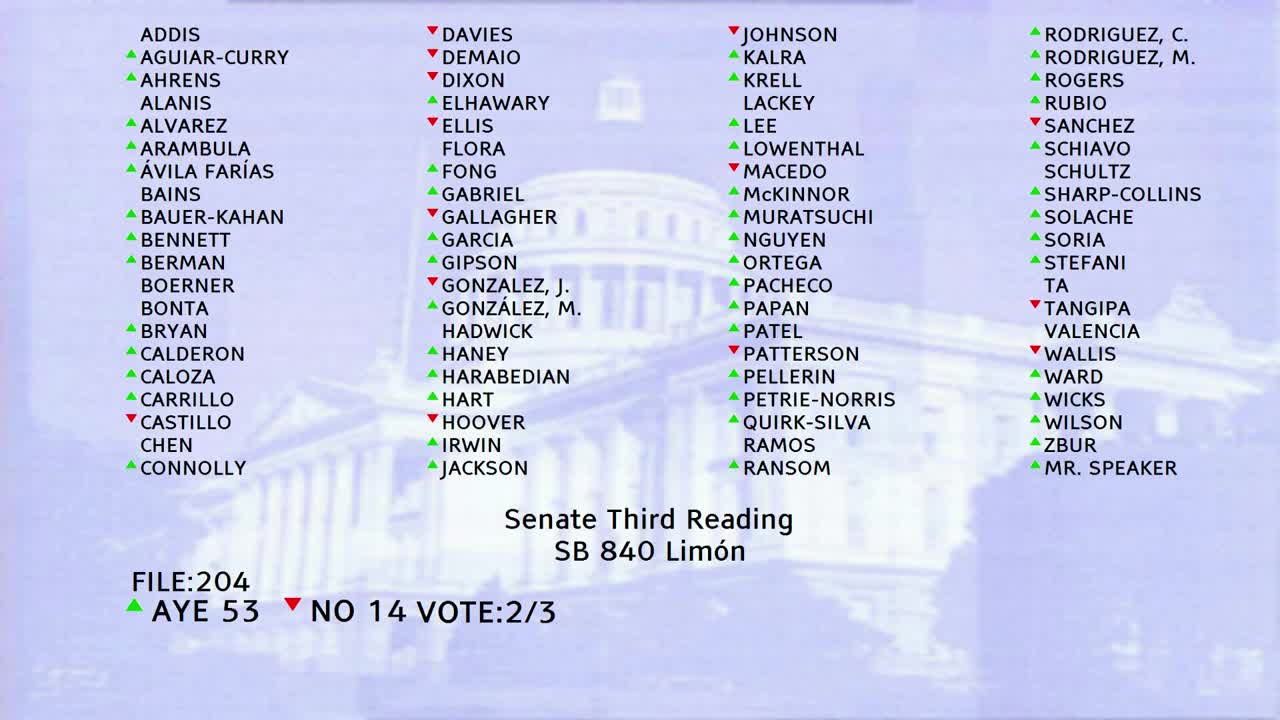 41SEC
Assembly Floor
 9MIN
Senate Floor
 37SEC
Senate Standing Committee on Appropriations
 7MIN
Senate Standing Committee on Business, Professions and Economic Development
 2MIN
Assembly Floor
 8MIN
Assembly Standing Committee on Appropriations
 28MIN