AB 2308: Redevelopment: successor agency debt: City and County of San Francisco.
- Session Year: 2025-2026
- House: Assembly
- Latest Version Date: 2026-09-30
Current Status:
Passed
(2026-09-30: Chaptered by Secretary of State - Chapter 932, Statutes of 2026.)
Introduced
In Committee
Awaiting First Chamber Vote
Passed First Chamber
In Committee
Awaiting Second Chamber Vote
Passed Second Chamber
Enacted
What does this bill do?
The bill lets the successor agency to San Francisco’s former redevelopment agency issue bonds or take on debt to pay for Transbay project infrastructure and related affordable housing, and to make agreements with the Transbay Joint Powers Authority and the City to extend pledges of gross sales proceeds and net tax increment (the share of property-tax growth used for redevelopment). It clarifies that net tax increment does not include city administrative fees, amounts set aside for the agency’s affordable housing fund, portions owed to other local governments, or amounts the state may require for education funds. It also authorizes financing for up to 5,842 affordable homes with minimum affordability periods (at least 55 years for rentals and 45 years for owner-occupied units).
The summary is provided by generative AI which can make mistakes. For original language, please view the details in the table below.
Existing law dissolved redevelopment agencies and community development agencies as of February 1, 2012, and provides for the designation of successor agencies to, among other things, wind down the affairs of the dissolved redevelopment agencies and make payments due for enforceable obligations. Existing law, among other powers granted to successor agencies generally, additionally vests the successor agency to the former Redevelopment Agency of the City and County of San Francisco with the authority, rights, and powers of that former redevelopment agency solely for the purpose of issuing bonds or incurring other indebtedness, subject to the approval of the oversight board of the successor agency, to finance the construction of affordable housing and infrastructure required by specified development agreements, including the infrastructure required by the Transbay Implementation Agreement. Under existing law, these bonds and indebtedness are considered indebtedness incurred by the dissolved redevelopment agency secured by moneys deposited in the Redevelopment Property Tax Trust Fund established for that agency.
This bill would specify this authority to issue bonds or incur other indebtedness to finance the infrastructure required by the Transbay Implementation Agreement includes entering into arrangements with the Transbay Joint Powers Authority and the City and County of San Francisco to extend the time period for pledges of gross sales proceeds and net tax increments, as specified.
This bill would make legislative findings and declarations as to the necessity of a special statute for the City and County of San Francisco.
Existing law dissolved redevelopment agencies and community development agencies as of February 1, 2012, and provides for the designation of successor agencies to, among other things, wind down the affairs of the dissolved redevelopment agencies and make payments due for enforceable obligations. Existing law, among other powers granted to successor agencies generally, additionally vests the successor agency to the former Redevelopment Agency of the City and County of San Francisco with the authority, rights, and powers of that former redevelopment agency solely for the purpose of issuing bonds or incurring other indebtedness, subject to the approval of the oversight board of the successor agency, to finance the construction of affordable housing and infrastructure required by specified development agreements, including the infrastructure required by the Transbay Implementation Agreement. Under existing law, these bonds and indebtedness are considered indebtedness incurred by the dissolved redevelopment agency secured by moneys deposited in the Redevelopment Property Tax Trust Fund established for that agency.
This bill would specify this authority to issue bonds or incur other indebtedness to finance the infrastructure required by the Transbay Implementation Agreement includes entering into arrangements with the Transbay Joint Powers Authority and the City and County of San Francisco to extend the time period for pledges of gross sales proceeds and net tax increments. increments, as specified.
This bill would make legislative findings and declarations as to the necessity of a special statute for the City and County of San Francisco.
Existing law dissolved redevelopment agencies and community development agencies as of February 1, 2012, and provides for the designation of successor agencies to, among other things, wind down the affairs of the dissolved redevelopment agencies and make payments due for enforceable obligations. Existing law, among other powers granted to successor agencies generally, additionally vests the successor agency to the former Redevelopment Agency of the City and County of San Francisco with the authority, rights, and powers of that former redevelopment agency solely for the purpose of issuing bonds or incurring other indebtedness, subject to the approval of the oversight board of the successor agency, to finance the construction of affordable housing and infrastructure required by specified development agreements, including the infrastructure required by the Transbay Implementation Agreement. Under existing law, these bonds and indebtedness are considered indebtedness incurred by the dissolved redevelopment agency secured by moneys deposited in the Redevelopment Property Tax Trust Fund established for that agency.
This bill would specify this authority to issue bonds or incur other indebtedness to finance the infrastructure required by the Transbay Implementation Agreement includes entering into arrangements with the Transbay Joint Powers Authority and the City and County of San Francisco to extend the time period for pledges of gross sales proceeds and net tax increments.
This bill would make legislative findings and declarations as to the necessity of a special statute for the City and County of San Francisco.
(a)(1)In addition to the powers granted to each successor agency, and notwithstanding anything in the act adding this part, including, but not limited to, Sections 34162 and 34189, the successor agency to the Redevelopment Agency of the City and County of San Francisco shall have the authority, rights, and powers of the Redevelopment Agency to which it succeeded solely for the purpose of issuing bonds or incurring other indebtedness to finance:
(A)The affordable housing required by the Mission Bay North Owner Participation Agreement, the Mission Bay South Owner Participation Agreement, the Disposition and Development Agreement for Hunters Point Shipyard Phase 1, the Candlestick Point-Hunters Point Shipyard Phase 2 Disposition and Development Agreement, and the Transbay Implementation Agreement.
(B)(i)The infrastructure required by the Transbay Implementation Agreement.
(ii)(I)For the purposes of this subparagraph, and notwithstanding Section 34177.3, the authority, rights, and powers of the successor agency to the Redevelopment Agency of the City and County of San Francisco to issue bonds or incur other indebtedness to finance the infrastructure required by the Transbay Implementation Agreement includes the authority to enter into arrangements with the Transbay Joint Powers Authority and the City and County of San Francisco to extend the time period for pledges of gross sales proceeds and net tax increment.
(II)For the purposes of this clause, net tax increment excludes all of the following:
(ia)Administrative charges, fees, or costs for the City and County of San Francisco.
(ib)The portion of the tax increment revenues that the successor agency to the Redevelopment Agency of the City and County of San Francisco is required by law to set aside in the agencys Affordable Housing Fund pursuant to law.
(ic)A portion of the net tax increment revenues equal to the percentage of the revenue that the successor agency to the Redevelopment Agency of the City and County of San Francisco is required to pay to all governmental entities as required by law.
(id)The portion of the tax increment revenues equal to the percentage of the revenues that the State of California may mandate the successor agency to the Redevelopment Agency of the City and County of San Francisco to pay from time to time in the future, including any payments which the successor agency to the Redevelopment Agency of the City and County of San Francisco may be required to pay to the Education Revenue Augmentation Fund pursuant to law.
(ie)The portion of the tax increment revenues equal to the percentage of the revenues that the successor agency to the Redevelopment Agency of the City and County of San Francisco would otherwise pay to school entities, including the Education Revenue Augmentation Fund, pursuant to paragraph (4) of subdivision (a) of Section 34183 after the effective term of the existing pledge of net tax increment.
(C)(i)The development, construction, repair, renovation, or reconstruction of up to 5,842 units of affordable housing by or on behalf of the City and County of San Francisco that shall be or remain affordable to, and occupied by, persons and families of low-, moderate-, extremely low, and very low income households for the longest feasible time, but not less than 55 years for rental units and 45 years for owner-occupied units.
(ii)For purposes of this subparagraph, and notwithstanding Section 34177.3, the successor agency to the Redevelopment Agency of the City and County of San Francisco may create enforceable obligations that are related to the issuance of bonds or incurrence of other indebtedness and may enter into any contracts or arrangements that are related to the development, construction, repair, renovation, or reconstruction of the units of affordable housing, so long as the expenses of any of those arrangements are paid solely from property tax revenues available in the Redevelopment Property Tax Trust Fund to the extent the property tax revenues represent the amount of revenues on deposit in the Redevelopment Property Tax Trust Fund that otherwise would have been distributed to the City and County of San Francisco pursuant to paragraph (4) of subdivision (a) of Section 34183 remaining after the payment of debt service on the bonds or debt for the applicable fiscal year.
(iii)The successor agency to the Redevelopment Agency of the City and County of San Francisco may enter into arrangements with the City and County of San Francisco for the purpose of providing the proceeds from the issuance of bonds or the incurrence of debt under this subparagraph to the City and County of San Francisco for development, construction, repair, renovation, or reconstruction of the units of affordable housing described in this subparagraph and to facilitate compliance with any obligations of the successor agency resulting from the issuance of bonds or incurrence of debt.
(iv)Any costs related to the issuance and administration of bonds issued or debt incurred that are not paid with the proceeds from the sale of those bonds or incurrence of debt shall be repaid solely from property tax revenues available in the Redevelopment Property Tax Trust Fund to the extent the property tax revenues represent the amount of revenues on deposit in the Redevelopment Property Tax Trust Fund that otherwise would have been distributed to the City and County of San Francisco pursuant to paragraph (4) of subdivision (a) of Section 34183 remaining after the payment of debt service on the bonds or debt for the applicable fiscal year.
(2)(A)For purposes of financing the obligations described in subparagraphs (A) and (B) of paragraph (1), the successor agency to the Redevelopment Agency of the City and County of San Francisco may pledge to the bonds or other indebtedness the property tax revenues available in the successor agencys Redevelopment Property Tax Trust Fund that are not otherwise obligated.
(B)For purposes of financing the development, construction, repair, renovation, or reconstruction of the units of affordable housing described in subparagraph (C) of paragraph (1), the successor agency to the Redevelopment Agency of the City and County of San Francisco may pledge to the bonds or other indebtedness issued, incurred, or entered into by the successor agency to the Redevelopment Agency of the City and County of San Francisco the property tax revenues available in the Redevelopment Property Tax Trust Fund to the extent the property tax revenues represent the amount of revenues on deposit in the Redevelopment Property Tax Trust Fund that otherwise would have been distributed to the City and County of San Francisco pursuant to paragraph (4) of subdivision (a) of Section 34183. Property tax revenues allocated to the successor agency pursuant to this subparagraph for the development, construction, repair, renovation, or reconstruction of the units of affordable housing shall not include any moneys that are payable to local agencies other than the City and County of San Francisco, school districts that maintain kindergarten and grades 1 to 12, inclusive, community college districts, or the Educational Revenue Augmentation Fund, pursuant to paragraph (4) of subdivision (a) of Section 34183.
(b)Bonds issued pursuant to this section may be sold pursuant to either a negotiated or a competitive sale. The bonds issued or other indebtedness obligations incurred pursuant to this section may be issued or incurred on a parity basis with outstanding bonds or other indebtedness obligations of the successor agency to the Redevelopment Agency of the City and County of San Francisco and may pledge the revenues pledged to those outstanding bonds or other indebtedness obligations to the issuance of bonds or other obligations pursuant to this section. The pledge, when made in connection with the issuance of bonds or other indebtedness obligations under this section, shall have the same lien priority as the pledge of outstanding bonds or other indebtedness obligations, and shall be valid, binding, and enforceable in accordance with its terms.
(c)(1)Prior to issuing any bonds or incurring other indebtedness pursuant to subparagraph (A) or (B) of paragraph (1) of subdivision (a), the successor agency to the Redevelopment Agency of the City and County of San Francisco may subordinate to the bonds or other indebtedness the amount required to be paid to an affected taxing entity pursuant to paragraph (1) of subdivision (a) of Section 34183, provided that the affected taxing entity has approved the subordinations pursuant to this subdivision.
(2)At the time the agency requests an affected taxing entity to subordinate the amount to be paid to it, the agency shall provide the affected taxing entity with substantial evidence that sufficient funds will be available to pay both the debt service on the bonds or other indebtedness and the payments required by paragraph (1) of subdivision (a) of Section 34183, when due.
(3)Within 45 days after receipt of the agencys request, the affected taxing entity shall approve or disapprove the request for subordination. An affected taxing entity may disapprove a request for subordination only if it finds, based upon substantial evidence, that the successor agency will not be able to pay the debt service payments and the amount required to be paid to the affected taxing entity. If the affected taxing entity does not act within 45 days after receipt of the agencys request, the request to subordinate shall be deemed approved and shall be final and conclusive.
(d)Prior to issuing any bonds or incurring other indebtedness pursuant to subparagraph (C) of paragraph (1) of subdivision (a), the successor agency to the Redevelopment Agency of the City and County of San Francisco may subordinate to the bonds or other indebtedness the amount required to be paid to the City and County of San Francisco pursuant to paragraph (1) of subdivision (a) of Section 34183, provided that the City and County of San Francisco has approved the subordinations.
(e)An action may be brought pursuant to Chapter 9 (commencing with Section 860) of Title 10 of Part 2 of the Code of Civil Procedure to determine the validity of bonds or other obligations authorized by this section, the pledge of revenues to those bonds or other obligations authorized by this section, the legality and validity of all proceedings theretofore taken and, as provided in the resolution of the legislative body of the successor agency to the Redevelopment Agency of the City and County of San Francisco authorizing the bonds or other indebtedness obligations authorized by this section, proposed to be taken for the authorization, execution, issuance, sale, and delivery of the bonds or other obligations authorized by this section, and for the payment of debt service on the bonds or the payment of amounts under other obligations authorized by this section. Subdivision (c) of Section 33501 shall not apply to any such action. The department shall be notified of the filing of any action as an affected party.
(f)Notwithstanding any other law, including, but not limited to, Section 33501, an action to challenge the issuance of bonds or the incurrence of indebtedness by the successor agency to the Redevelopment Agency of the City and County of San Francisco shall be brought within 30 days after the date on which the oversight board approves the resolution of the agency approving the issuance of bonds or the incurrence of indebtedness under this section.
(g)The actions authorized in this section shall be subject to the approval of the oversight board, as provided in Section 34180. Additionally, the oversight board may direct the successor agency to the Redevelopment Agency of the City and County of San Francisco to commence any of the transactions described in subdivision (a) so long as the agency is able to recover its related costs in connection with the transaction. After the agency, with approval of the oversight board, issues any bonds or incurs any indebtedness pursuant to subdivision (a), the oversight board shall not unilaterally approve any amendments to or early termination of the bonds or indebtedness. If, under the authority granted to it by subdivision (h) of Section 34179, the department either reviews and approves or fails to request review within five business days of an oversight board approval of an action authorized by this section, the scheduled payments on the bonds or other indebtedness shall be listed in the Recognized Obligation Payment Schedule and shall not be subject to further review and approval by the department or the Controller. The department may extend its review time to 60 days for actions authorized in this section and may seek the assistance of the Treasurer in evaluating proposed actions under this section.
(h)(1)A bond or indebtedness authorized by this section shall be considered indebtedness incurred by the dissolved redevelopment agency, with the same legal effect as if the bonds or other indebtedness had been issued, incurred, or entered into prior to June 28, 2011, in full conformity with the applicable provisions of the Community Redevelopment Law that existed prior to that date, shall be included in the successor agency to the Redevelopment Agency of the City and County of San Franciscos Recognized Obligation Payment Schedule, and shall be secured by a pledge of, and lien on, and shall be repaid from moneys deposited from time to time in the Redevelopment Property Tax Trust Fund established pursuant to subdivision (b) of Section 34170.5, as provided in paragraph (2) of subdivision (a) of Section 34183. Property tax revenues pledged to any bonds or other indebtedness obligations authorized by this section are taxes allocated to the successor agency pursuant to subdivision (b) of Section 33670 and Section 16 of Article XVI of the California Constitution.
(2)Notwithstanding paragraph (1), a bond or other indebtedness issued, incurred, or entered into pursuant to subparagraph (C) of paragraph (1) of subdivision (a) shall be secured by a pledge of, and lien on, and shall be repaid from, moneys deposited in the Redevelopment Property Tax Trust Fund, established pursuant to subdivision (b) of Section 34170.5, as provided in paragraph (2) of subdivision (a) of Section 34183 only to the extent the moneys represent the amount of moneys on deposit in the Redevelopment Property Tax Trust Fund that otherwise would have been distributed to the City and County of San Francisco pursuant to paragraph (4) of subdivision (a) of Section 34183. Property tax revenues pledged to any bonds or other indebtedness obligations authorized by this paragraph are taxes allocated to the successor agency pursuant to subdivision (b) of Section 33670 and Section 16 of Article XVI of the California Constitution.
(i)The successor agency to the Redevelopment Agency of the City and County of San Francisco shall make diligent efforts to ensure that the lowest long-term cost financing is obtained. The financing shall not provide for any bullets or spikes and shall not use variable rates. The agency shall make use of an independent financial advisor in developing financing proposals and shall make the work products of the financial advisor available to the department at its request.
(j)(1)(A)For the development of the project described in the Candlestick Point-Hunters Point Shipyard Phase 2 Disposition and Development Agreement, the limitations relating to time for establishing loans, advances, and indebtedness, the effectiveness of the redevelopment plans, the time to repay indebtedness, the time for applying tax increment, the number of tax dollars, or any other matters set forth in Section 33333.2 and Section 33492.13 shall not apply.
(B)The Candlestick Point-Hunters Point Shipyard Phase 2 project agreements shall establish the applicable limitations relating to time for establishing loans, advances, and indebtedness, the effectiveness of the redevelopment plans, the time to repay indebtedness, the time for applying tax increment, number of tax dollars, or any other matters set forth in Section 33333.2 and Section 33492.13. Any amendments to Candlestick Point-Hunters Point Shipyard Phase 2 project agreements to establish or change those time limits shall be approved by the oversight board, and shall be subject to department approval, as described in this part.
(2)This part shall not be construed to limit the receipt and use of property tax revenues generated from the Hunters Point Redevelopment Plan project area or Zone 1 of the Bayview Hunters Point Redevelopment Plan project area for the project described in the Candlestick Point-Hunters Point Shipyard Phase 2 Disposition and Development Agreement.
SEC. 2.The Legislature finds and declares that a special statute is necessary and that a general statute cannot be made applicable within the meaning of Section 16 of Article IV of the California Constitution because of the unique transportation and development needs in the City and County of San Francisco and the unique role the Transbay Project has played in enhancing downtown San Francisco property values.
(a)(1)In addition to the powers granted to each successor agency, and notwithstanding anything in the act adding this part, including, but not limited to, Sections 34162 and 34189, the successor agency to the Redevelopment Agency of the City and County of San Francisco shall have the authority, rights, and powers of the Redevelopment Agency to which it succeeded solely for the purpose of issuing bonds or incurring other indebtedness to finance:
(A)The affordable housing required by the Mission Bay North Owner Participation Agreement, the Mission Bay South Owner Participation Agreement, the Disposition and Development Agreement for Hunters Point Shipyard Phase 1, the Candlestick Point-Hunters Point Shipyard Phase 2 Disposition and Development Agreement, and the Transbay Implementation Agreement.
(B)(i)The infrastructure required by the Transbay Implementation Agreement.
(ii)(I)For the purposes of this subparagraph, and notwithstanding Section 34177.3, the authority, rights, and powers of the successor agency to the Redevelopment Agency of the City and County of San Francisco to issue bonds or incur other indebtedness to finance the infrastructure required by the Transbay Implementation Agreement includes the authority to enter into arrangements with the Transbay Joint Powers Authority and the City and County of San Francisco to extend the time period for pledges of gross sales proceeds and net tax increment.
(II)For the purposes of this clause, net tax increment excludes all of the following:
(ia)Administrative charges, fees, or costs for the City and County of San Francisco.
(ib)The portion of the tax increment revenues that the successor agency to the Redevelopment Agency of the City and County of San Francisco is required by law to set-aside set aside in the agencys Affordable Housing Fund pursuant to law.
(ic)A portion of the net tax increment revenues equal to the percentage of the revenue that the successor agency to the Redevelopment Agency of the City and County of San Francisco is required to pay to all governmental entities as required by law.
(id)The portion of the tax increment revenues equal to the percentage of the revenues that the State of California may mandate the successor agency to the Redevelopment Agency of the City and County of San Francisco to pay from time to time in the future, including any payments which the successor agency to the Redevelopment Agency of the City and County of San Francisco may be required to pay to the Education Revenue Augmentation Fund pursuant to law.
(ie)The portion of the tax increment revenues equal to the percentage of the revenues that the successor agency to the Redevelopment Agency of the City and County of San Francisco would otherwise pay to school entities, including the Education Revenue Augmentation Fund, pursuant to paragraph (4) of subdivision (a) of Section 34183 after the effective term of the existing pledge of net tax increment.
(C)(i)The development, construction, repair, renovation, or reconstruction of up to 5,842 units of affordable housing by or on behalf of the City and County of San Francisco that shall be or remain affordable to, and occupied by, persons and families of low-, moderate-, extremely low, and very low income households for the longest feasible time, but not less than 55 years for rental units and 45 years for owner-occupied units.
(ii)For purposes of this subparagraph, and notwithstanding Section 34177.3, the successor agency to the Redevelopment Agency of the City and County of San Francisco may create enforceable obligations that are related to the issuance of bonds or incurrence of other indebtedness and may enter into any contracts or arrangements that are related to the development, construction, repair, renovation, or reconstruction of the units of affordable housing, so long as the expenses of any of those arrangements are paid solely from property tax revenues available in the Redevelopment Property Tax Trust Fund to the extent the property tax revenues represent the amount of revenues on deposit in the Redevelopment Property Tax Trust Fund that otherwise would have been distributed to the City and County of San Francisco pursuant to paragraph (4) of subdivision (a) of Section 34183 remaining after the payment of debt service on the bonds or debt for the applicable fiscal year.
(iii)The successor agency to the Redevelopment Agency of the City and County of San Francisco may enter into arrangements with the City and County of San Francisco for the purpose of providing the proceeds from the issuance of bonds or the incurrence of debt under this subparagraph to the City and County of San Francisco for development, construction, repair, renovation, or reconstruction of the units of affordable housing described in this subparagraph and to facilitate compliance with any obligations of the successor agency resulting from the issuance of bonds or incurrence of debt.
(iv)Any costs related to the issuance and administration of bonds issued or debt incurred that are not paid with the proceeds from the sale of those bonds or incurrence of debt shall be repaid solely from property tax revenues available in the Redevelopment Property Tax Trust Fund to the extent the property tax revenues represent the amount of revenues on deposit in the Redevelopment Property Tax Trust Fund that otherwise would have been distributed to the City and County of San Francisco pursuant to paragraph (4) of subdivision (a) of Section 34183 remaining after the payment of debt service on the bonds or debt for the applicable fiscal year.
(2)(A)For purposes of financing the obligations described in subparagraphs (A) and (B) of paragraph (1), the successor agency to the Redevelopment Agency of the City and County of San Francisco may pledge to the bonds or other indebtedness the property tax revenues available in the successor agencys Redevelopment Property Tax Trust Fund that are not otherwise obligated.
(B)For purposes of financing the development, construction, repair, renovation, or reconstruction of the units of affordable housing described in subparagraph (C) of paragraph (1), the successor agency to the Redevelopment Agency of the City and County of San Francisco may pledge to the bonds or other indebtedness issued, incurred, or entered into by the successor agency to the Redevelopment Agency of the City and County of San Francisco the property tax revenues available in the Redevelopment Property Tax Trust Fund to the extent the property tax revenues represent the amount of revenues on deposit in the Redevelopment Property Tax Trust Fund that otherwise would have been distributed to the City and County of San Francisco pursuant to paragraph (4) of subdivision (a) of Section 34183. Property tax revenues allocated to the successor agency pursuant to this subparagraph for the development, construction, repair, renovation, or reconstruction of the units of affordable housing shall not include any moneys that are payable to local agencies other than the City and County of San Francisco, school districts that maintain kindergarten and grades 1 to 12, inclusive, community college districts, or the Educational Revenue Augmentation Fund, pursuant to paragraph (4) of subdivision (a) of Section 34183.
(b)Bonds issued pursuant to this section may be sold pursuant to either a negotiated or a competitive sale. The bonds issued or other indebtedness obligations incurred pursuant to this section may be issued or incurred on a parity basis with outstanding bonds or other indebtedness obligations of the successor agency to the Redevelopment Agency of the City and County of San Francisco and may pledge the revenues pledged to those outstanding bonds or other indebtedness obligations to the issuance of bonds or other obligations pursuant to this section. The pledge, when made in connection with the issuance of bonds or other indebtedness obligations under this section, shall have the same lien priority as the pledge of outstanding bonds or other indebtedness obligations, and shall be valid, binding, and enforceable in accordance with its terms.
(c)(1)Prior to issuing any bonds or incurring other indebtedness pursuant to subparagraph (A) or (B) of paragraph (1) of subdivision (a), the successor agency to the Redevelopment Agency of the City and County of San Francisco may subordinate to the bonds or other indebtedness the amount required to be paid to an affected taxing entity pursuant to paragraph (1) of subdivision (a) of Section 34183, provided that the affected taxing entity has approved the subordinations pursuant to this subdivision.
(2)At the time the agency requests an affected taxing entity to subordinate the amount to be paid to it, the agency shall provide the affected taxing entity with substantial evidence that sufficient funds will be available to pay both the debt service on the bonds or other indebtedness and the payments required by paragraph (1) of subdivision (a) of Section 34183, when due.
(3)Within 45 days after receipt of the agencys request, the affected taxing entity shall approve or disapprove the request for subordination. An affected taxing entity may disapprove a request for subordination only if it finds, based upon substantial evidence, that the successor agency will not be able to pay the debt service payments and the amount required to be paid to the affected taxing entity. If the affected taxing entity does not act within 45 days after receipt of the agencys request, the request to subordinate shall be deemed approved and shall be final and conclusive.
(d)Prior to issuing any bonds or incurring other indebtedness pursuant to subparagraph (C) of paragraph (1) of subdivision (a), the successor agency to the Redevelopment Agency of the City and County of San Francisco may subordinate to the bonds or other indebtedness the amount required to be paid to the City and County of San Francisco pursuant to paragraph (1) of subdivision (a) of Section 34183, provided that the City and County of San Francisco has approved the subordinations.
(e)An action may be brought pursuant to Chapter 9 (commencing with Section 860) of Title 10 of Part 2 of the Code of Civil Procedure to determine the validity of bonds or other obligations authorized by this section, the pledge of revenues to those bonds or other obligations authorized by this section, the legality and validity of all proceedings theretofore taken and, as provided in the resolution of the legislative body of the successor agency to the Redevelopment Agency of the City and County of San Francisco authorizing the bonds or other indebtedness obligations authorized by this section, proposed to be taken for the authorization, execution, issuance, sale, and delivery of the bonds or other obligations authorized by this section, and for the payment of debt service on the bonds or the payment of amounts under other obligations authorized by this section. Subdivision (c) of Section 33501 shall not apply to any such action. The department shall be notified of the filing of any action as an affected party.
(f)Notwithstanding any other law, including, but not limited to, Section 33501, an action to challenge the issuance of bonds or the incurrence of indebtedness by the successor agency to the Redevelopment Agency of the City and County of San Francisco shall be brought within 30 days after the date on which the oversight board approves the resolution of the agency approving the issuance of bonds or the incurrence of indebtedness under this section.
(g)The actions authorized in this section shall be subject to the approval of the oversight board, as provided in Section 34180. Additionally, the oversight board may direct the successor agency to the Redevelopment Agency of the City and County of San Francisco to commence any of the transactions described in subdivision (a) so long as the agency is able to recover its related costs in connection with the transaction. After the agency, with approval of the oversight board, issues any bonds or incurs any indebtedness pursuant to subdivision (a), the oversight board shall not unilaterally approve any amendments to or early termination of the bonds or indebtedness. If, under the authority granted to it by subdivision (h) of Section 34179, the department either reviews and approves or fails to request review within five business days of an oversight board approval of an action authorized by this section, the scheduled payments on the bonds or other indebtedness shall be listed in the Recognized Obligation Payment Schedule and shall not be subject to further review and approval by the department or the Controller. The department may extend its review time to 60 days for actions authorized in this section and may seek the assistance of the Treasurer in evaluating proposed actions under this section.
(h)(1)A bond or indebtedness authorized by this section shall be considered indebtedness incurred by the dissolved redevelopment agency, with the same legal effect as if the bonds or other indebtedness had been issued, incurred, or entered into prior to June 28, 2011, in full conformity with the applicable provisions of the Community Redevelopment Law that existed prior to that date, shall be included in the successor agency to the Redevelopment Agency of the City and County of San Franciscos Recognized Obligation Payment Schedule, and shall be secured by a pledge of, and lien on, and shall be repaid from moneys deposited from time to time in the Redevelopment Property Tax Trust Fund established pursuant to subdivision (b) of Section 34170.5, as provided in paragraph (2) of subdivision (a) of Section 34183. Property tax revenues pledged to any bonds or other indebtedness obligations authorized by this section are taxes allocated to the successor agency pursuant to subdivision (b) of Section 33670 and Section 16 of Article XVI of the California Constitution.
(2)Notwithstanding paragraph (1), a bond or other indebtedness issued, incurred, or entered into pursuant to subparagraph (C) of paragraph (1) of subdivision (a) shall be secured by a pledge of, and lien on, and shall be repaid from, moneys deposited in the Redevelopment Property Tax Trust Fund, established pursuant to subdivision (b) of Section 34170.5, as provided in paragraph (2) of subdivision (a) of Section 34183 only to the extent the moneys represent the amount of moneys on deposit in the Redevelopment Property Tax Trust Fund that otherwise would have been distributed to the City and County of San Francisco pursuant to paragraph (4) of subdivision (a) of Section 34183. Property tax revenues pledged to any bonds or other indebtedness obligations authorized by this paragraph are taxes allocated to the successor agency pursuant to subdivision (b) of Section 33670 and Section 16 of Article XVI of the California Constitution.
(i)The successor agency to the Redevelopment Agency of the City and County of San Francisco shall make diligent efforts to ensure that the lowest long-term cost financing is obtained. The financing shall not provide for any bullets or spikes and shall not use variable rates. The agency shall make use of an independent financial advisor in developing financing proposals and shall make the work products of the financial advisor available to the department at its request.
(j)(1)(A)For the development of the project described in the Candlestick Point-Hunters Point Shipyard Phase 2 Disposition and Development Agreement, the limitations relating to time for establishing loans, advances, and indebtedness, the effectiveness of the redevelopment plans, the time to repay indebtedness, the time for applying tax increment, the number of tax dollars, or any other matters set forth in Section 33333.2 and Section 33492.13 shall not apply.
(B)The Candlestick Point-Hunters Point Shipyard Phase 2 project agreements shall establish the applicable limitations relating to time for establishing loans, advances, and indebtedness, the effectiveness of the redevelopment plans, the time to repay indebtedness, the time for applying tax increment, number of tax dollars, or any other matters set forth in Section 33333.2 and Section 33492.13. Any amendments to Candlestick Point-Hunters Point Shipyard Phase 2 project agreements to establish or change those time limits shall be approved by the oversight board, and shall be subject to department approval, as described in this part.
(2)This part shall not be construed to limit the receipt and use of property tax revenues generated from the Hunters Point Redevelopment Plan project area or Zone 1 of the Bayview Hunters Point Redevelopment Plan project area for the project described in the Candlestick Point-Hunters Point Shipyard Phase 2 Disposition and Development Agreement.
SEC. 2.The Legislature finds and declares that a special statute is necessary and that a general statute cannot be made applicable within the meaning of Section 16 of Article IV of the California Constitution because of the unique transportation and development needs in the City and County of San Francisco and the unique role the Transbay Project has played in enhancing downtown San Francisco property values.
(a)(1)In addition to the powers granted to each successor agency, and notwithstanding anything in the act adding this part, including, but not limited to, Sections 34162 and 34189, the successor agency to the Redevelopment Agency of the City and County of San Francisco shall have the authority, rights, and powers of the Redevelopment Agency to which it succeeded solely for the purpose of issuing bonds or incurring other indebtedness to finance:
(A)The affordable housing required by the Mission Bay North Owner Participation Agreement, the Mission Bay South Owner Participation Agreement, the Disposition and Development Agreement for Hunters Point Shipyard Phase 1, the Candlestick Point-Hunters Point Shipyard Phase 2 Disposition and Development Agreement, and the Transbay Implementation Agreement.
(B)(i)The infrastructure required by the Transbay Implementation Agreement.
(ii)(I)For the purposes of this subparagraph, and notwithstanding Section 34177.3, the authority, rights, and powers of the successor agency to the Redevelopment Agency of the City and County of San Francisco to issue bonds or incur other indebtedness to finance the infrastructure required by the Transbay Implementation Agreement includes the authority to enter into arrangements with the Transbay Joint Powers Authority and the City and County of San Francisco to extend the time period for pledges of gross sales proceeds and net tax increment.
(II)For the purposes of this clause, net tax increment excludes all of the following:
(ia)Administrative charges, fees, or costs for the City and County of San Francisco.
(ib)The portion of the tax increment revenues that the successor agency to the Redevelopment Agency of the City and County of San Francisco is required by law to set-aside in the agencys Affordable Housing Fund pursuant to law.
(ic)A portion of the net tax increment revenues equal to the percentage of the revenue that the successor agency to the Redevelopment Agency of the City and County of San Francisco is required to pay to all governmental entities as required by law.
(id)The portion of the tax increment revenues equal to the percentage of the revenues that the State of California may mandate the successor agency to the Redevelopment Agency of the City and County of San Francisco to pay from time to time in the future, including any payments which the successor agency to the Redevelopment Agency of the City and County of San Francisco may be required to pay to the Education Revenue Augmentation Fund pursuant to law.
(C)(i)The development, construction, repair, renovation, or reconstruction of up to 5,842 units of affordable housing by or on behalf of the City and County of San Francisco that shall be or remain affordable to, and occupied by, persons and families of low-, moderate-, extremely low, and very low income households for the longest feasible time, but not less than 55 years for rental units and 45 years for owner-occupied units.
(ii)For purposes of this subparagraph, and notwithstanding Section 34177.3, the successor agency to the Redevelopment Agency of the City and County of San Francisco may create enforceable obligations that are related to the issuance of bonds or incurrence of other indebtedness and may enter into any contracts or arrangements that are related to the development, construction, repair, renovation, or reconstruction of the units of affordable housing, so long as the expenses of any of those arrangements are paid solely from property tax revenues available in the Redevelopment Property Tax Trust Fund to the extent the property tax revenues represent the amount of revenues on deposit in the Redevelopment Property Tax Trust Fund that otherwise would have been distributed to the City and County of San Francisco pursuant to paragraph (4) of subdivision (a) of Section 34183 remaining after the payment of debt service on the bonds or debt for the applicable fiscal year.
(iii)The successor agency to the Redevelopment Agency of the City and County of San Francisco may enter into arrangements with the City and County of San Francisco for the purpose of providing the proceeds from the issuance of bonds or the incurrence of debt under this subparagraph to the City and County of San Francisco for development, construction, repair, renovation, or reconstruction of the units of affordable housing described in this subparagraph and to facilitate compliance with any obligations of the successor agency resulting from the issuance of bonds or incurrence of debt.
(iv)Any costs related to the issuance and administration of bonds issued or debt incurred that are not paid with the proceeds from the sale of those bonds or incurrence of debt shall be repaid solely from property tax revenues available in the Redevelopment Property Tax Trust Fund to the extent the property tax revenues represent the amount of revenues on deposit in the Redevelopment Property Tax Trust Fund that otherwise would have been distributed to the City and County of San Francisco pursuant to paragraph (4) of subdivision (a) of Section 34183 remaining after the payment of debt service on the bonds or debt for the applicable fiscal year.
(2)(A)For purposes of financing the obligations described in subparagraphs (A) and (B) of paragraph (1), the successor agency to the Redevelopment Agency of the City and County of San Francisco may pledge to the bonds or other indebtedness the property tax revenues available in the successor agencys Redevelopment Property Tax Trust Fund that are not otherwise obligated.
(B)For purposes of financing the development, construction, repair, renovation, or reconstruction of the units of affordable housing described in subparagraph (C) of paragraph (1), the successor agency to the Redevelopment Agency of the City and County of San Francisco may pledge to the bonds or other indebtedness issued, incurred, or entered into by the successor agency to the Redevelopment Agency of the City and County of San Francisco the property tax revenues available in the Redevelopment Property Tax Trust Fund to the extent the property tax revenues represent the amount of revenues on deposit in the Redevelopment Property Tax Trust Fund that otherwise would have been distributed to the City and County of San Francisco pursuant to paragraph (4) of subdivision (a) of Section 34183. Property tax revenues allocated to the successor agency pursuant to this subparagraph for the development, construction, repair, renovation, or reconstruction of the units of affordable housing shall not include any moneys that are payable to local agencies other than the City and County of San Francisco, school districts that maintain kindergarten and grades 1 to 12, inclusive, community college districts, or the Educational Revenue Augmentation Fund, pursuant to paragraph (4) of subdivision (a) of Section 34183.
(b)Bonds issued pursuant to this section may be sold pursuant to either a negotiated or a competitive sale. The bonds issued or other indebtedness obligations incurred pursuant to this section may be issued or incurred on a parity basis with outstanding bonds or other indebtedness obligations of the successor agency to the Redevelopment Agency of the City and County of San Francisco and may pledge the revenues pledged to those outstanding bonds or other indebtedness obligations to the issuance of bonds or other obligations pursuant to this section. The pledge, when made in connection with the issuance of bonds or other indebtedness obligations under this section, shall have the same lien priority as the pledge of outstanding bonds or other indebtedness obligations, and shall be valid, binding, and enforceable in accordance with its terms.
(c)(1)Prior to issuing any bonds or incurring other indebtedness pursuant to subparagraph (A) or (B) of paragraph (1) of subdivision (a), the successor agency to the Redevelopment Agency of the City and County of San Francisco may subordinate to the bonds or other indebtedness the amount required to be paid to an affected taxing entity pursuant to paragraph (1) of subdivision (a) of Section 34183, provided that the affected taxing entity has approved the subordinations pursuant to this subdivision.
(2)At the time the agency requests an affected taxing entity to subordinate the amount to be paid to it, the agency shall provide the affected taxing entity with substantial evidence that sufficient funds will be available to pay both the debt service on the bonds or other indebtedness and the payments required by paragraph (1) of subdivision (a) of Section 34183, when due.
(3)Within 45 days after receipt of the agencys request, the affected taxing entity shall approve or disapprove the request for subordination. An affected taxing entity may disapprove a request for subordination only if it finds, based upon substantial evidence, that the successor agency will not be able to pay the debt service payments and the amount required to be paid to the affected taxing entity. If the affected taxing entity does not act within 45 days after receipt of the agencys request, the request to subordinate shall be deemed approved and shall be final and conclusive.
(d)Prior to issuing any bonds or incurring other indebtedness pursuant to subparagraph (C) of paragraph (1) of subdivision (a), the successor agency to the Redevelopment Agency of the City and County of San Francisco may subordinate to the bonds or other indebtedness the amount required to be paid to the City and County of San Francisco pursuant to paragraph (1) of subdivision (a) of Section 34183, provided that the City and County of San Francisco has approved the subordinations.
(e)An action may be brought pursuant to Chapter 9 (commencing with Section 860) of Title 10 of Part 2 of the Code of Civil Procedure to determine the validity of bonds or other obligations authorized by this section, the pledge of revenues to those bonds or other obligations authorized by this section, the legality and validity of all proceedings theretofore taken and, as provided in the resolution of the legislative body of the successor agency to the Redevelopment Agency of the City and County of San Francisco authorizing the bonds or other indebtedness obligations authorized by this section, proposed to be taken for the authorization, execution, issuance, sale, and delivery of the bonds or other obligations authorized by this section, and for the payment of debt service on the bonds or the payment of amounts under other obligations authorized by this section. Subdivision (c) of Section 33501 shall not apply to any such action. The department shall be notified of the filing of any action as an affected party.
(f)Notwithstanding any other law, including, but not limited to, Section 33501, an action to challenge the issuance of bonds or the incurrence of indebtedness by the successor agency to the Redevelopment Agency of the City and County of San Francisco shall be brought within 30 days after the date on which the oversight board approves the resolution of the agency approving the issuance of bonds or the incurrence of indebtedness under this section.
(g)The actions authorized in this section shall be subject to the approval of the oversight board, as provided in Section 34180. Additionally, the oversight board may direct the successor agency to the Redevelopment Agency of the City and County of San Francisco to commence any of the transactions described in subdivision (a) so long as the agency is able to recover its related costs in connection with the transaction. After the agency, with approval of the oversight board, issues any bonds or incurs any indebtedness pursuant to subdivision (a), the oversight board shall not unilaterally approve any amendments to or early termination of the bonds or indebtedness. If, under the authority granted to it by subdivision (h) of Section 34179, the department either reviews and approves or fails to request review within five business days of an oversight board approval of an action authorized by this section, the scheduled payments on the bonds or other indebtedness shall be listed in the Recognized Obligation Payment Schedule and shall not be subject to further review and approval by the department or the Controller. The department may extend its review time to 60 days for actions authorized in this section and may seek the assistance of the Treasurer in evaluating proposed actions under this section.
(h)(1)A bond or indebtedness authorized by this section shall be considered indebtedness incurred by the dissolved redevelopment agency, with the same legal effect as if the bonds or other indebtedness had been issued, incurred, or entered into prior to June 28, 2011, in full conformity with the applicable provisions of the Community Redevelopment Law that existed prior to that date, shall be included in the successor agency to the Redevelopment Agency of the City and County of San Franciscos Recognized Obligation Payment Schedule, and shall be secured by a pledge of, and lien on, and shall be repaid from moneys deposited from time to time in the Redevelopment Property Tax Trust Fund established pursuant to subdivision (b) of Section 34170.5, as provided in paragraph (2) of subdivision (a) of Section 34183. Property tax revenues pledged to any bonds or other indebtedness obligations authorized by this section are taxes allocated to the successor agency pursuant to subdivision (b) of Section 33670 and Section 16 of Article XVI of the California Constitution.
(2)Notwithstanding paragraph (1), a bond or other indebtedness issued, incurred, or entered into pursuant to subparagraph (C) of paragraph (1) of subdivision (a) shall be secured by a pledge of, and lien on, and shall be repaid from, moneys deposited in the Redevelopment Property Tax Trust Fund, established pursuant to subdivision (b) of Section 34170.5, as provided in paragraph (2) of subdivision (a) of Section 34183 only to the extent the moneys represent the amount of moneys on deposit in the Redevelopment Property Tax Trust Fund that otherwise would have been distributed to the City and County of San Francisco pursuant to paragraph (4) of subdivision (a) of Section 34183. Property tax revenues pledged to any bonds or other indebtedness obligations authorized by this paragraph are taxes allocated to the successor agency pursuant to subdivision (b) of Section 33670 and Section 16 of Article XVI of the California Constitution.
(i)The successor agency to the Redevelopment Agency of the City and County of San Francisco shall make diligent efforts to ensure that the lowest long-term cost financing is obtained. The financing shall not provide for any bullets or spikes and shall not use variable rates. The agency shall make use of an independent financial advisor in developing financing proposals and shall make the work products of the financial advisor available to the department at its request.
(j)(1)(A)For the development of the project described in the Candlestick Point-Hunters Point Shipyard Phase 2 Disposition and Development Agreement, the limitations relating to time for establishing loans, advances, and indebtedness, the effectiveness of the redevelopment plans, the time to repay indebtedness, the time for applying tax increment, the number of tax dollars, or any other matters set forth in Section 33333.2 and Section 33492.13 shall not apply.
(B)The Candlestick Point-Hunters Point Shipyard Phase 2 project agreements shall establish the applicable limitations relating to time for establishing loans, advances, and indebtedness, the effectiveness of the redevelopment plans, the time to repay indebtedness, the time for applying tax increment, number of tax dollars, or any other matters set forth in Section 33333.2 and Section 33492.13. Any amendments to Candlestick Point-Hunters Point Shipyard Phase 2 project agreements to establish or change those time limits shall be approved by the oversight board, and shall be subject to department approval, as described in this part.
(2)This part shall not be construed to limit the receipt and use of property tax revenues generated from the Hunters Point Redevelopment Plan project area or Zone 1 of the Bayview Hunters Point Redevelopment Plan project area for the project described in the Candlestick Point-Hunters Point Shipyard Phase 2 Disposition and Development Agreement.
SEC. 2.The Legislature finds and declares that a special statute is necessary and that a general statute cannot be made applicable within the meaning of Section 16 of Article IV of the California Constitution because of the unique transportation and development needs in the City and County of San Francisco and the unique role the Transbay Project has played in enhancing downtown San Francisco property values.
(a)(1)In addition to the powers granted to each successor agency, and notwithstanding anything in the act adding this part, including, but not limited to, Sections 34162 and 34189, the successor agency to the Redevelopment Agency of the City and County of San Francisco shall have the authority, rights, and powers of the Redevelopment Agency to which it succeeded solely for the purpose of issuing bonds or incurring other indebtedness to finance:
(A)The affordable housing required by the Mission Bay North Owner Participation Agreement, the Mission Bay South Owner Participation Agreement, the Disposition and Development Agreement for Hunters Point Shipyard Phase 1, the Candlestick Point-Hunters Point Shipyard Phase 2 Disposition and Development Agreement, and the Transbay Implementation Agreement.
(B)(i)The infrastructure required by the Transbay Implementation Agreement.
(ii)For the purposes of this subparagraph, and notwithstanding Section 34177.3, the authority, rights, and powers of the successor agency to the Redevelopment Agency of the City and County of San Francisco to issue bonds or incur other indebtedness to finance the infrastructure required by the Transbay Implementation Agreement includes the authority to enter into arrangements with the Transbay Joint Powers Authority and the City and County of San Francisco to extend the time period for pledges of gross sales proceeds and net tax increment.
(C)(i)The development, construction, repair, renovation, or reconstruction of up to 5,842 units of affordable housing by or on behalf of the City and County of San Francisco that shall be or remain affordable to, and occupied by, persons and families of low-, moderate-, extremely low, and very low income households for the longest feasible time, but not less than 55 years for rental units and 45 years for owner-occupied units.
(ii)For purposes of this subparagraph, and notwithstanding Section 34177.3, the successor agency to the Redevelopment Agency of the City and County of San Francisco may create enforceable obligations that are related to the issuance of bonds or incurrence of other indebtedness and may enter into any contracts or arrangements that are related to the development, construction, repair, renovation, or reconstruction of the units of affordable housing, so long as the expenses of any of those arrangements are paid solely from property tax revenues available in the Redevelopment Property Tax Trust Fund to the extent the property tax revenues represent the amount of revenues on deposit in the Redevelopment Property Tax Trust Fund that otherwise would have been distributed to the City and County of San Francisco pursuant to paragraph (4) of subdivision (a) of Section 34183 remaining after the payment of debt service on the bonds or debt for the applicable fiscal year.
(iii)The successor agency to the Redevelopment Agency of the City and County of San Francisco may enter into arrangements with the City and County of San Francisco for the purpose of providing the proceeds from the issuance of bonds or the incurrence of debt under this subparagraph to the City and County of San Francisco for development, construction, repair, renovation, or reconstruction of the units of affordable housing described in this subparagraph and to facilitate compliance with any obligations of the successor agency resulting from the issuance of bonds or incurrence of debt.
(iv)Any costs related to the issuance and administration of bonds issued or debt incurred that are not paid with the proceeds from the sale of those bonds or incurrence of debt shall be repaid solely from property tax revenues available in the Redevelopment Property Tax Trust Fund to the extent the property tax revenues represent the amount of revenues on deposit in the Redevelopment Property Tax Trust Fund that otherwise would have been distributed to the City and County of San Francisco pursuant to paragraph (4) of subdivision (a) of Section 34183 remaining after the payment of debt service on the bonds or debt for the applicable fiscal year.
(2)(A)For purposes of financing the obligations described in subparagraphs (A) and (B) of paragraph (1), the successor agency to the Redevelopment Agency of the City and County of San Francisco may pledge to the bonds or other indebtedness the property tax revenues available in the successor agencys Redevelopment Property Tax Trust Fund that are not otherwise obligated.
(B)For purposes of financing the development, construction, repair, renovation, or reconstruction of the units of affordable housing described in subparagraph (C) of paragraph (1), the successor agency to the Redevelopment Agency of the City and County of San Francisco may pledge to the bonds or other indebtedness issued, incurred, or entered into by the successor agency to the Redevelopment Agency of the City and County of San Francisco the property tax revenues available in the Redevelopment Property Tax Trust Fund to the extent the property tax revenues represent the amount of revenues on deposit in the Redevelopment Property Tax Trust Fund that otherwise would have been distributed to the City and County of San Francisco pursuant to paragraph (4) of subdivision (a) of Section 34183. Property tax revenues allocated to the successor agency pursuant to this subparagraph for the development, construction, repair, renovation, or reconstruction of the units of affordable housing shall not include any moneys that are payable to local agencies other than the City and County of San Francisco, school districts that maintain kindergarten and grades 1 to 12, inclusive, community college districts, or the Educational Revenue Augmentation Fund, pursuant to paragraph (4) of subdivision (a) of Section 34183.
(b)Bonds issued pursuant to this section may be sold pursuant to either a negotiated or a competitive sale. The bonds issued or other indebtedness obligations incurred pursuant to this section may be issued or incurred on a parity basis with outstanding bonds or other indebtedness obligations of the successor agency to the Redevelopment Agency of the City and County of San Francisco and may pledge the revenues pledged to those outstanding bonds or other indebtedness obligations to the issuance of bonds or other obligations pursuant to this section. The pledge, when made in connection with the issuance of bonds or other indebtedness obligations under this section, shall have the same lien priority as the pledge of outstanding bonds or other indebtedness obligations, and shall be valid, binding, and enforceable in accordance with its terms.
(c)(1)Prior to issuing any bonds or incurring other indebtedness pursuant to subparagraph (A) or (B) of paragraph (1) of subdivision (a), the successor agency to the Redevelopment Agency of the City and County of San Francisco may subordinate to the bonds or other indebtedness the amount required to be paid to an affected taxing entity pursuant to paragraph (1) of subdivision (a) of Section 34183, provided that the affected taxing entity has approved the subordinations pursuant to this subdivision.
(2)At the time the agency requests an affected taxing entity to subordinate the amount to be paid to it, the agency shall provide the affected taxing entity with substantial evidence that sufficient funds will be available to pay both the debt service on the bonds or other indebtedness and the payments required by paragraph (1) of subdivision (a) of Section 34183, when due.
(3)Within 45 days after receipt of the agencys request, the affected taxing entity shall approve or disapprove the request for subordination. An affected taxing entity may disapprove a request for subordination only if it finds, based upon substantial evidence, that the successor agency will not be able to pay the debt service payments and the amount required to be paid to the affected taxing entity. If the affected taxing entity does not act within 45 days after receipt of the agencys request, the request to subordinate shall be deemed approved and shall be final and conclusive.
(d)Prior to issuing any bonds or incurring other indebtedness pursuant to subparagraph (C) of paragraph (1) of subdivision (a), the successor agency to the Redevelopment Agency of the City and County of San Francisco may subordinate to the bonds or other indebtedness the amount required to be paid to the City and County of San Francisco pursuant to paragraph (1) of subdivision (a) of Section 34183, provided that the City and County of San Francisco has approved the subordinations.
(e)An action may be brought pursuant to Chapter 9 (commencing with Section 860) of Title 10 of Part 2 of the Code of Civil Procedure to determine the validity of bonds or other obligations authorized by this section, the pledge of revenues to those bonds or other obligations authorized by this section, the legality and validity of all proceedings theretofore taken and, as provided in the resolution of the legislative body of the successor agency to the Redevelopment Agency of the City and County of San Francisco authorizing the bonds or other indebtedness obligations authorized by this section, proposed to be taken for the authorization, execution, issuance, sale, and delivery of the bonds or other obligations authorized by this section, and for the payment of debt service on the bonds or the payment of amounts under other obligations authorized by this section. Subdivision (c) of Section 33501 shall not apply to any such action. The department shall be notified of the filing of any action as an affected party.
(f)Notwithstanding any other law, including, but not limited to, Section 33501, an action to challenge the issuance of bonds or the incurrence of indebtedness by the successor agency to the Redevelopment Agency of the City and County of San Francisco shall be brought within 30 days after the date on which the oversight board approves the resolution of the agency approving the issuance of bonds or the incurrence of indebtedness under this section.
(g)The actions authorized in this section shall be subject to the approval of the oversight board, as provided in Section 34180. Additionally, the oversight board may direct the successor agency to the Redevelopment Agency of the City and County of San Francisco to commence any of the transactions described in subdivision (a) so long as the agency is able to recover its related costs in connection with the transaction. After the agency, with approval of the oversight board, issues any bonds or incurs any indebtedness pursuant to subdivision (a), the oversight board shall not unilaterally approve any amendments to or early termination of the bonds or indebtedness. If, under the authority granted to it by subdivision (h) of Section 34179, the department either reviews and approves or fails to request review within five business days of an oversight board approval of an action authorized by this section, the scheduled payments on the bonds or other indebtedness shall be listed in the Recognized Obligation Payment Schedule and shall not be subject to further review and approval by the department or the Controller. The department may extend its review time to 60 days for actions authorized in this section and may seek the assistance of the Treasurer in evaluating proposed actions under this section.
(h)(1)A bond or indebtedness authorized by this section shall be considered indebtedness incurred by the dissolved redevelopment agency, with the same legal effect as if the bonds or other indebtedness had been issued, incurred, or entered into prior to June 28, 2011, in full conformity with the applicable provisions of the Community Redevelopment Law that existed prior to that date, shall be included in the successor agency to the Redevelopment Agency of the City and County of San Franciscos Recognized Obligation Payment Schedule, and shall be secured by a pledge of, and lien on, and shall be repaid from moneys deposited from time to time in the Redevelopment Property Tax Trust Fund established pursuant to subdivision (b) of Section 34170.5, as provided in paragraph (2) of subdivision (a) of Section 34183. Property tax revenues pledged to any bonds or other indebtedness obligations authorized by this section are taxes allocated to the successor agency pursuant to subdivision (b) of Section 33670 and Section 16 of Article XVI of the California Constitution.
(2)Notwithstanding paragraph (1), a bond or other indebtedness issued, incurred, or entered into pursuant to subparagraph (C) of paragraph (1) of subdivision (a) shall be secured by a pledge of, and lien on, and shall be repaid from, moneys deposited in the Redevelopment Property Tax Trust Fund, established pursuant to subdivision (b) of Section 34170.5, as provided in paragraph (2) of subdivision (a) of Section 34183 only to the extent the moneys represent the amount of moneys on deposit in the Redevelopment Property Tax Trust Fund that otherwise would have been distributed to the City and County of San Francisco pursuant to paragraph (4) of subdivision (a) of Section 34183. Property tax revenues pledged to any bonds or other indebtedness obligations authorized by this paragraph are taxes allocated to the successor agency pursuant to subdivision (b) of Section 33670 and Section 16 of Article XVI of the California Constitution.
(i)The successor agency to the Redevelopment Agency of the City and County of San Francisco shall make diligent efforts to ensure that the lowest long-term cost financing is obtained. The financing shall not provide for any bullets or spikes and shall not use variable rates. The agency shall make use of an independent financial advisor in developing financing proposals and shall make the work products of the financial advisor available to the department at its request.
(j)(1)(A)For the development of the project described in the Candlestick Point-Hunters Point Shipyard Phase 2 Disposition and Development Agreement, the limitations relating to time for establishing loans, advances, and indebtedness, the effectiveness of the redevelopment plans, the time to repay indebtedness, the time for applying tax increment, the number of tax dollars, or any other matters set forth in Section 33333.2 and Section 33492.13 shall not apply.
(B)The Candlestick Point-Hunters Point Shipyard Phase 2 project agreements shall establish the applicable limitations relating to time for establishing loans, advances, and indebtedness, the effectiveness of the redevelopment plans, the time to repay indebtedness, the time for applying tax increment, number of tax dollars, or any other matters set forth in Section 33333.2 and Section 33492.13. Any amendments to Candlestick Point-Hunters Point Shipyard Phase 2 project agreements to establish or change those time limits shall be approved by the oversight board, and shall be subject to department approval, as described in this part.
(2)This part shall not be construed to limit the receipt and use of property tax revenues generated from the Hunters Point Redevelopment Plan project area or Zone 1 of the Bayview Hunters Point Redevelopment Plan project area for the project described in the Candlestick Point-Hunters Point Shipyard Phase 2 Disposition and Development Agreement.
SEC. 2.The Legislature finds and declares that a special statute is necessary and that a general statute cannot be made applicable within the meaning of Section 16 of Article IV of the California Constitution because of the unique transportation and development needs in the City and County of San Francisco and the unique role the Transbay Project has played in enhancing downtown San Francisco property values.
|
Date
|
Status
|
|---|---|
| Sep 30, 2026 | Chaptered by Secretary of State - Chapter 932, Statutes of 2026. |
| Sep 30, 2026 | Approved by the Governor. |
| Aug 31, 2026 | Enrolled and presented to the Governor at 4 p.m. |
| Aug 25, 2026 | Senate amendments concurred in. To Engrossing and Enrolling. (Ayes 75. Noes 0.). |
| Aug 25, 2026 | Senate amendments concurred in. To Engrossing and Enrolling. (Ayes 75. Noes 0. Page 6509.). |
| Aug 25, 2026 | In Assembly. Concurrence in Senate amendments pending. |
| Aug 25, 2026 | Read third time. Passed. Ordered to the Assembly. (Ayes 30. Noes 10.). |
| Aug 6, 2026 | Read second time. Ordered to third reading. |
| Aug 5, 2026 | Withdrawn from committee. |
| Aug 5, 2026 | Ordered to second reading. |
| Aug 4, 2026 | From committee chair, with author's amendments: Amend, and re-refer to committee. Read second time, amended, and re-referred to Com. on APPR. |
| Jun 10, 2026 | From committee: Do pass and re-refer to Com. on APPR. (Ayes 6. Noes 1.) (June 10). Re-referred to Com. on APPR. |
| Jun 3, 2026 | From committee chair, with author's amendments: Amend, and re-refer to committee. Read second time, amended, and re-referred to Com. on L. GOV. |
| May 20, 2026 | Referred to Coms. on L. GOV. and APPR. |
| May 7, 2026 | In Senate. Read first time. To Com. on RLS. for assignment. |
| May 7, 2026 | Read third time. Passed. Ordered to the Senate. (Ayes 66. Noes 0.) |
| May 7, 2026 | Read third time. Passed. Ordered to the Senate. (Ayes 66. Noes 0. Page 4967.) |
| Apr 30, 2026 | Read second time. Ordered to Consent Calendar. |
| Apr 29, 2026 | From committee: Do pass. To Consent Calendar. (Ayes 12. Noes 0.) (April 29). |
| Apr 16, 2026 | From committee: Do pass and re-refer to Com. on H. & C.D. (Ayes 10. Noes 0.) (April 15). Re-referred to Com. on H. & C.D. |
| Mar 9, 2026 | Referred to Coms. on L. GOV. and H. & C.D. |
| Feb 20, 2026 | From printer. May be heard in committee March 22. |
| Feb 19, 2026 | Read first time. To print. |
|
Date
|
Description
|
Location
|
Votes
|
|
|---|---|---|---|---|
| Aug 25, 2026 | AB 2308 Haney Concurrence in Senate Amendments | Assembly Floor |
Passed |
|
| Aug 25, 2026 | Assembly 3rd Reading AB2308 Haney By Wiener | Senate Floor |
Passed |
|
| Jun 10, 2026 | Do pass, but first be re-referred to the Committee on [Appropriations] | Senate Standing Committee on Local Government |
Passed |
|
| May 7, 2026 | AB 2308 Haney Consent Calendar Second Day Regular Session | Assembly Floor |
Passed |
|
| Apr 29, 2026 | Do pass. To Consent Calendar. | Assembly Standing Committee on Housing and Community Development |
Passed |
|
| Apr 15, 2026 | Do pass and be re-referred to the Committee on [Housing and Community Development] | Assembly Standing Committee on Local Government |
Passed |
This list shows positions taken on this bill by organizations on the date displayed, which is linked to the original source.
Positions by individuals are not included.
|
Organization
|
Position
|
Date
|
|---|---|---|
| Friends of the Downtown Rail Extension | ** Support | |
| Metropolitan Transportation Commission | ** Support | |
| Peninsula Corridor Joint Powers Board | ** Support | |
| San Francisco Building and Construction Trades Council | ** Support | |
| San Francisco Chamber of Commerce | ** Support | |
| San Francisco County Transportation Authority | ** Support | |
| South Beach and Rincon and Mission Bay Neighborhood Association Board of Directors | ** Support | |
| SPUR | ** Support | |
| Transbay Joint Powers Authority | ** Support | |
| Transform | ** Support |
CONCURRENCE IN SENATE AMENDMENTS
CSA1 Bill Id:AB 2308
Author:(Haney)
As Amended Ver:August 4, 2026
Majority vote
SUMMARY
Allows the successor agency to the former San Francisco redevelopment agency (RDA) to extend its authority to issue bonds to finance infrastructure required by the Transbay Implementation Agreement (TIA) by specifying that arrangements to extend the time period for pledges of gross sales proceeds and tax increment entered into with the Transbay Joint Powers Authority (TJPA) and San Francisco are included within its existing authority to issue bonds for these purposes.
Senate Amendments
- Specify that, for the purposes of this bill, "net tax increment" excludes all of the following:
- Administrative charges, fees, or costs for the City and County of San Francisco.
- The portion of the tax increment revenues that the successor agency to the RDA of the City and County of San Francisco is required by law to set aside in the agency's Affordable Housing Fund pursuant to law.
- A portion of the net tax increment revenues equal to the percentage of the revenue that the successor agency to the RDA of the City and County of San Francisco is required to pay all governmental entities as required by law.
- The portion of the tax increment revenues equal to the percentage of the revenues that the State of California may mandate the successor agency to the RDA of the City and County of San Francisco to pay from time to time in the future, including any payments which the successor agency to the RDA of the City and County of San Francisco may be required to pay to the Education Revenue Augmentation Fund pursuant to law.
- The portion of the tax increment revenues equal to the percentage of the revenues that the successor agency to the RDA of the City and County of San Francisco would otherwise pay to school entities, including the Education Revenue Augmentation Fund, pursuant to existing law after the effective term of the existing pledge of net tax increment.
COMMENTS
- Redevelopment. Article XVI, Section 16 of the California Constitution authorizes the Legislature to provide for the formation of RDAs to eliminate blight in an area by means of a self-financing schedule that pays for the redevelopment project with tax increment derived from any increase in the assessed value of property within the redevelopment project area (or tax increment). Generally, property tax increment financing involves a local government forming a tax increment financing district to issue bonds and use the bond proceeds to pay project costs within the boundaries of a specified project area. To repay the bonds, the district captures increased property tax revenues that are generated when projects financed by the bonds increase assessed property values within the project area.
To calculate the increased property tax revenues captured by the district, the amount of property tax revenues received by any local government participating in the district is "frozen" at the amount it received within a project area prior to the project area's formation. In future years, as the project area's assessed valuation grows above the frozen base, the resulting additional property tax revenues — the so-called property tax "increment" revenues — flow to the tax increment financing district instead of other local governments that would have received those funds absent the formation of the RDA. After the bonds have been fully repaid using the incremental property tax revenues, the RDA is dissolved, ending the diversion of tax increment revenues from participating local governments.
Prior to Proposition 13, very few RDAs existed; however, after its passage, RDAs became a source of funding for a variety of local infrastructure activities. RDAs were required to set-aside approximately 20% of funding generated in a project area to increase the supply of low and moderate income housing in the project areas [AB 3674 (Montoya), Chapter 1337, Statutes of 1976]. At the time of dissolution, over 400 RDAs statewide were diverting roughly 12% of property taxes, over $5.6 billion yearly.
In 2011, facing a severe budget shortfall, the Governor proposed eliminating RDAs in order to deliver more property taxes to other local agencies. Ultimately, the Legislature approved and the Governor signed two measures, ABX1 26 (Blumenfield), Chapter 5 and ABX1 27 (Blumenfield), Chapter 6 that together dissolved RDAs as they existed at the time and created a voluntary redevelopment program on a smaller scale. In response, the California Redevelopment Association (CRA) and the League of California Cities, along with other parties, filed suit challenging the two measures. The Supreme Court denied the petition for peremptory writ of mandate with respect to ABX1 26. However, the Court did grant CRA's petition with respect to ABX1 27. As a result, all RDAs were required to dissolve as of February 1, 2012.
- RDA Dissolution. ABX1 26 established successor agencies to manage the process of unwinding former RDA affairs, generally prohibited RDAs from incurring new or expanding existing monetary or legal obligations, and removed the authority for RDAs to engage in most activities except continuing to pay off enforceable obligations. With the exception of seven cities, the city or county that created each former RDA now serves as that RDA's successor agency. One of a successor agency's primary responsibilities is to make payments for the enforceable obligations RDAs entered into. These payments are supported by property tax revenues that would have gone to RDAs, but are instead deposited in the Redevelopment Property Tax Trust Fund (RPTTF). Enforceable obligations include bonds, bond-related payments, some loans, payments required by the federal government, obligations to the state or imposed by state law, payments to RDA employees, judgements or settlements, and other legally binding and enforceable agreements or contracts. Any remaining property tax revenues that exceed these enforceable obligations return to cities, counties, special districts, and school and community college districts to support core services.
Each successor agency has an oversight board responsible for supervising and approving its actions. The Department of Finance (DOF) can review and request reconsideration of an oversight board's decision. Once a successor agency takes over for an RDA, it reviews the RDA's outstanding assets and obligations, and develops a plan to resolve those obligations, also known as a Recognized Obligation Payment Schedule (ROPS). To obtain required DOF approval, a successor agency submits a series of ROPS to DOF. If DOF agrees with the plan, it issues a Finding of Completion acknowledging their progress towards paying off their obligations. Successor agencies issued a Finding of Completion can submit a Last and Final ROPS, meaning that (1) the remaining debt is limited to administrative costs and payments pursuant to enforceable obligations with defined payment schedules, (2) all remaining obligations have been previously listed on the ROPS and approved by DOF, and (3) the agency is not a party to outstanding or unresolved litigation. Successor agencies had until December 31, 2015 to receive their Finding of Completion from DOF. RDA dissolution law states that successor agencies that did not receive their Finding of Completion by this date, or did not enter into a written installment payment plan with DOF, were to never receive a Finding of Completion. Approximately nine successor agencies did not receive a Finding of Completion by the deadline.
- San Francisco's RDA. In 2015, the Legislature passed, and the Governor signed, SB 107 (Committee on Budget and Fiscal Review), Chapter 325, Statutes of 2015, which authorized San Francisco’s successor agency to issue bonds and incur debt for other projects using RPTTF, including housing projects in Mission Bay, Hunters Point, and pursuant to the TIA. Using RPTTF to fund these projects extended the expected lifespan of the successor agency until 2058. Like its obligations under dissolution law, the successor agency must receive approval for these projects from its oversight board and DOF.
SB 593 (Wiener), Chapter 782, Statutes of 2023, authorized the successor agency to the SFRDA to issue bonds or incur indebtedness to finance the replacement of up to 5,842 units of affordable housing to satisfy the replacement housing obligation of the SFRDA as described in existing law and subsequently certified by the Department of Housing and Community Development.
- Transbay Joint Powers Authority. TJPA has primary jurisdiction with respect to all matters concerning the financing, design, development, construction, and operation of the Transbay Program. The TJPA is a joint exercise of powers authority created in 2001 by San Francisco, the Alameda-Contra Costa Transit District and the Peninsula Corridor Joint Powers Board; subsequently, in 2017, the California High Speed Rail Authority was added as a member. The TJPA is governed by an 8-member Board of Directors.
According to the TJPA, "The Transbay Program is a transportation and housing project that has transformed downtown San Francisco and the San Francisco Bay Area’s regional transportation system by creating a world class transportation hub in the heart of a new neighborhood. The project replaced the former Transbay Terminal at First and Mission streets in San Francisco with a modern regional transit hub connecting the Bay Area and ultimately the State of California through: AC Transit, BART, Caltrain, Golden Gate Transit, Greyhound, Muni, SamTrans, WestCAT Lynx, Amtrak, Paratransit and future High-Speed Rail from the San Francisco to Los Angeles/Anaheim."
- Transbay Agreement. In 2003, TJPA, San Francisco, and the State of California entered into an agreement in which the State agreed to transfer specified state-owned parcels to San Francisco and the TJPA, subject to certain restrictions. Under the agreement, City and TJPA title to the state-owned parcels is subject to a deed restriction requiring that any such parcel may be sold for development only when the gross sales proceeds are provided to the TJPA to finance development of the Transbay Terminal Project. The agreement further requires that a portion of tax increment revenues attributable to the state-owned parcels, the "net tax increment (NTI)," must be provided to the TJPA to finance development of the Transbay Terminal Project.
According to the Office of Community Investment and Infrastructure (OCII), the successor agency to San Francisco’s RDA, the Transbay Redevelopment Plan was adopted in June 2005. The Transbay Plan, its Design for Development, and its Open Space and Streetscape Plan call for the redevelopment, rehabilitation, and revitalization of the area generally bounded by Mission, Main, Second and Folsom Streets in downtown San Francisco.
The Transbay Redevelopment Project Area consists of approximately forty acres of land that previously contained the now-demolished Embarcadero Freeway and ramps to the former Transbay Terminal, which were heavily damaged by the 1989 Loma Prieta earthquake, and surrounding properties.
Transbay is divided into two zones. OCII has land use authority over Zone One, which is located in the southern portion of the Project Area. The Transbay Plan and its Development Controls and Design Guidelines direct the transformation of Zone One from public land previously occupied by the former freeway and ramps into a new, master-planned, high-density, mixed use/residential community. Zone Two is in the northern portion of Transbay and includes the Salesforce Transit Center, Salesforce Tower, and mostly commercial properties along Mission and Howard Streets. Zone Two falls under the land use authority of the San Francisco Planning Department, under the Transbay Plan and the Transit Center District Plan, as provided for in the Transbay Delegation Agreement between the former Agency and the Planning Department.
OCII and the TJPA are responsible for executing the Transbay Plan, pursuant to a 2005 Implementation Agreement. Other agreements that enable the redevelopment of Transbay are between TJPA, OCII, the San Francisco, and the State of California, and include the Transbay Transit Terminal Cooperative Agreement, the Option Agreement for the Purchase and Sale of Property between the City and County of San Francisco, the TJPA and the RDA, and, the Transbay RDA Project Tax Increment Allocation and Sales Proceeds Pledge Agreement.
According to the Author
"San Francisco needs modern, connected transit infrastructure to support our growing economy, build housing near jobs, and revitalize our downtowns. The Transbay Program is a transformative investment that will expand regional transit capacity, connect Caltrain and future high-speed rail to the Salesforce Transit Center, and unlock thousands of homes and new economic activity in the heart of San Francisco.
"However, the COVID-19 pandemic significantly affected the project's bonding capacity, and at a time when federal transit funding opportunities have become less certain, the project needs additional financial stability to move forward. AB 2308 addresses this challenge by extending the timeline for an existing value-capture financing tool tied to former state-owned parcels in the Transbay Redevelopment Area by 25 years. This targeted extension will help ensure the project can secure the financing needed to complete the Downtown Rail Extension, delivering increased transit capacity, new housing, downtown revitalization, and thousands of good, labor-backed construction jobs for California's workers – all without adding any new taxes."
Arguments in Support
According to the TJPA, the sponsors of this bill, "The Transbay Redevelopment Plan ("Transbay Plan") was adopted in June 2005. Together with its Design for Development and Open Space and Streetscape Plan, the Transbay Plan calls for the redevelopment, rehabilitation, and revitalization of approximately forty acres in downtown San Francisco, generally bounded by Mission, Main, Second, and Folsom Streets. The Plan is centered on construction of the Salesforce Transit Center (already completed) and the Caltrain Downtown Extension (DTX) also known as The Portal, which is still in preconstruction.
"Much of the project area consists of former state-owned land previously occupied by the Embarcadero Freeway and the ramps to the original Transbay Terminal, both of which were severely damaged in the 1989 Loma Prieta earthquake. The State agreed to convey this land to the TJPA at no cost, with the understanding that it would be used either for new public transit infrastructure or redeveloped for housing and other uses. In return, land sale proceeds and NTI generated from these parcels were pledged to support construction for the TJPA’s delivery of the Transbay Program.
"The Office of Community Investment and Infrastructure (OCII), as successor to the former Redevelopment Agency, and the TJPA jointly implement the Transbay Plan pursuant to a series of agreements, including the 2005 Transbay Implementation Agreement and the 2008 Transbay Pledge Agreement. These agreements pledge NTI from the former state-owned parcels to the TJPA. Following the dissolution of redevelopment agencies, the California Department of Finance confirmed that these agreements constitute enforceable obligations of OCII as successor agency.
"The TJPA anticipates completing delivery of The Portal, Phase 2 of the Transbay Program, in 2036 when rail service begins operations into the Transit Center. However, COVID-related impacts and shifts in the development market on the former state-owned parcels have significantly reduced projected tax increment revenues. As a result, the Project Area's bonding capacity has declined by an estimated $275 million, jeopardizing the TJPA's ability to generate the required local match to secure approximately $3.38 billion in federal funding for The Portal.
"Extending the term for collection of Net Tax Increment from 2050 to 2075 would reclaim an estimated $188 million in net present value bonding capacity. This extension is essential to preserving the financial viability of the project and unlocking critical federal investment.
"Importantly, AB 2308 does not alter or reduce revenues from non-state parcels, nor does it change the structure or purpose of the existing NTI pledge. The legislation simply extends the duration of the current pledge on former state-owned parcels from 2050 to 2075 to allow for TJPA to obtain future bond proceeds as intended when the original legislation was approved. It does not create new obligations, redirect funds from other entities, or modify the fundamental financing framework already approved and recognized as enforceable."
Arguments in Opposition
None on file
FISCAL COMMENTS
None.
VOTES:
ASM LOCAL GOVERNMENT: 10-0-0
YES: Carrillo, Ta, Johnson, Pacheco, Ramos, Ransom, Blanca Rubio, Stefani, Ward, Wilson
ASM HOUSING AND COMMUNITY DEVELOPMENT: 12-0-0
YES: Haney, Patterson, Ávila Farías, Caloza, Garcia, Kalra, Lee, Quirk-Silva, Ta, Tangipa, Wicks, Wilson
ASSEMBLY FLOOR: 66-0-14
YES: Addis, Aguiar-Curry, Ahrens, Alanis, Alvarez, Ávila Farías, Bains, Bauer-Kahan, Bennett, Berman, Boerner, Bryan, Calderon, Caloza, Carrillo, Castillo, Connolly, Davies, DeMaio, Dixon, Elhawary, Ellis, Fong, Gabriel, Garcia, Gipson, Jeff Gonzalez, Mark González, Hadwick, Haney, Harabedian, Jackson, Johnson, Kalra, Krell, Lackey, Lee, Lowenthal, Macedo, McKinnor, Muratsuchi, Nguyen, Ortega, Pacheco, Patel, Patterson, Pellerin, Quirk-Silva, Ramos, Ransom, Michelle Rodriguez, Rogers, Blanca Rubio, Sanchez, Schiavo, Schultz, Sharp- Collins, Solache, Soria, Stefani, Ta, Tangipa, Ward, Wilson, Zbur, Rivas
ABS, ABST OR NV: Arambula, Bonta, Chen, Flora, Gallagher, Hart, Hoover, Irwin, Papan, Petrie-Norris, Celeste Rodriguez, Valencia, Wallis, Wicks
UPDATED
VERSION: August 4, 2026
CONSULTANT: Jimmy MacDonald / L. GOV. / (916) 319-3958 FN: 0004030
SENATE RULES COMMITTEE Office of Senate Floor Analyses (916) 651-4171 | AB 2308 |
THIRD READING
Bill No: AB 2308
Author: Haney (D)
Amended: 8/4/26 in Senate
Vote: 21
SENATE LOCAL GOVERNMENT COMMITTEE: 6-1, 6/10/26
AYES: Durazo, Arreguín, Ashby, Cervantes, Laird, Seyarto
NOES: Choi
ASSEMBLY FLOOR: 66-0, 5/7/26 (Consent) - See last page for vote
SUBJECT: Redevelopment: successor agency debt: City and County of San Francisco
SOURCE: Transbay Joint Powers Authority
DIGEST:
This bill allows the successor agency to the former San Francisco redevelopment agency to extend its authority to issue bonds to finance the Transbay Program.
ANALYSIS:
Existing law:
- Establishes the Community Redevelopment Law, which governs the authority to establish a redevelopment agency (RDA) and the authority for a RDA to function as an agency and to adopt and implement a redevelopment plan.
- Provides that RDA plans adopted on or before December 31, 1993, had to terminate no more than 40 years from their adoption or January 1, 2009, whichever is later. After this point, the RDA had no authority to act pursuant to the redevelopment plan except to pay previously incurred indebtedness, comply with affordable housing production requirements, and enforce existing covenants, contracts, or other obligations.
- Requires each RDA to make deposits into a Low and Moderate Income Housing Fund the agency maintained to increase, improve, and preserve the community’s supply of low- and moderate-income housing, generally not less than 20% of all taxes allocated to the agency.
- Requires RDAs to replace low- or moderate-income housing units destroyed or removed as part of their previous projects.
- Dissolves redevelopment agencies as of February 1, 2012.
- Establishes successor agencies to manage the process of unwinding former RDAs’ affairs, and oversight boards to approve successor agency decisions.
- Allows the Department of Finance (DOF) to review and request reconsideration of an oversight board’s decision.
- Requires the successor agency to submit specified information on its outstanding assets and obligations, also known as a Recognized Obligation Payment Schedule (ROPS).
- Allows DOF to issue a finding of completion to a successor agency acknowledging their progress towards paying off their obligations provided that its Final ROPS contains specified information.
- Allows a successor agency to make payments for the enforceable obligations RDAs entered into listed on the ROPS. These payments are supported by property tax revenues that would have gone to RDAs, but are instead deposited in a Redevelopment Property Tax Trust Fund (RPTTF). Enforceable obligations include bonds, bond-related payments, some loans, payments required by the federal government, obligations to the state or imposed by state law, payments to RDA employees, judgements or settlements, and other legally binding and enforceable agreements or contracts.
- Authorizes San Francisco’s successor agency to issue bonds and incur debt for other projects using RPTTF, including housing projects in Mission Bay, Hunters Point, and pursuant to the Transbay Implementation Agreement (TIA).
This bill:
- Allows the successor agency to the former San Francisco redevelopment agency (RDA) to extend its authority to issue bonds to finance infrastructure required by the TIA by specifying that arrangements to extend the time period for pledges of gross sales proceeds and net tax increment (NTI) entered into with the Transbay Joint Powers Authority (TJPA) and San Francisco are included within its existing authority to issue bonds for these purposes.
- Defines NTI to exclude administrative costs, affordable housing set aside payments from the former redevelopment agency, contributions to the city and county’s Educational Revenue Augmentation Fund, and residual payments the successor agency would otherwise pay to school entities after the effective term of the existing pledge of net tax increment.
Background
Redevelopment agencies. Citing a significant State General Fund deficit, Governor Brown’s 2011-12 budget proposed eliminating RDAs and returning billions of dollars of property tax revenues to schools, cities, and counties to fund core services. Among the statutory changes that the Legislature adopted to implement the 2011-12 budget, AB X1 26 (Blumenfield, Chapter 5, Statutes of 2011, First Extraordinary Session) dissolved all RDAs. The California Supreme Court's 2011 ruling in California Redevelopment Association v. Matosantos upheld AB X1 26, but invalidated AB X1 27 (Blumenfield, Chapter 6, Statutes of 2011, First Extraordinary Session 2011), which would have allowed most RDAs to avoid dissolution. In response, the California Redevelopment Association challenged the two measures. The Supreme Court denied the petition for peremptory writ of mandate with respect to AB X1 26, but granted it with respect to AB X1 27. As a result, all RDAs dissolved as of February 1, 2012. At the time of dissolution, over 400 RDAs statewide were diverting 12% of property taxes, over $5.6 billion yearly.
RDAs’ dissolution deprived many local agencies of the primary tool they used to eliminate physical and economic blight, finance new construction, improve public infrastructure, rehabilitate existing buildings, and increase the supply of affordable housing. At the time the state dissolved RDAs, the Controller estimated that statewide, the requirement to set aside 20% of funding generated in a project area for low- and moderate-income housing obligated RDAs to spend $1 billion on affordable housing.
City and County of San Francisco. San Francisco’s RDA completed various redevelopment projects dating back to the 1960s. The RDA project areas diverted funds from the City and County of San Francisco and other taxing entities, including Bay Area Rapid Transit District, San Francisco Unified School District, San Francisco Community College District, and the city and county’s Educational Revenue Augmentation Fund (ERAF), for its redevelopment projects. In 2015, the Legislature passed, and the Governor signed, SB 107 (Committee on Budget and Fiscal Review, Chapter 325, Statutes of 2015), which authorized the successor agency to issue bonds and incur debt for other projects using RPTTF, including the housing projects in Mission Bay, Hunters Point, and pursuant to the TIA. Using RPTTF to fund these projects extended the expected lifespan of the successor agency until 2058.
Transbay Joint Powers Authority (TJPA). The TJPA is a joint exercise of powers authority created in 2001 by San Francisco, the Alameda-Contra Costa Transit District and the Peninsula Corridor Joint Powers Board; subsequently, in 2017, the California High Speed Rail Authority was added as a member. An 8-member board governs the TJPA. TJPA has primary jurisdiction with respect to all matters concerning the financing, design, development, construction, and operation of the Transbay Program.
In 2003, TJPA, San Francisco, and the State of California entered into an agreement in which the State agreed to transfer specified state-owned parcels to San Francisco and the TJPA, subject to certain restrictions. Under the agreement, known as TIA, the state-owned parcels are subject to a deed restriction requiring that TJPA can only sell these parcels when the proceeds go to the TJPA to finance the Transbay Terminal Project. The agreement further requires that a portion of tax increment revenues attributable to the state-owned parcels, the “net tax increment (NTI),” go to TJPA to finance development of the Transbay Terminal Project.
Comments
- Purpose of the bill. According to the author, “San Francisco needs modern, connected transit infrastructure to support our growing economy, build housing near jobs, and revitalize our downtowns. The Transbay Program is a transformative investment that will expand regional transit capacity, connect Caltrain and future high-speed rail to the Salesforce Transit Center, and unlock thousands of homes and new economic activity in the heart of San Francisco. However, the COVID-19 pandemic significantly affected the project’s bonding capacity, and at a time when federal transit funding opportunities have become less certain, the project needs additional financial stability to move forward. AB 2308 addresses this challenge by extending the timeline for an existing value-capture financing tool tied to former state-owned parcels in the Transbay Redevelopment Area by 25 years. This targeted extension will help ensure the project can secure the financing needed to complete the Downtown Rail Extension, delivering increased transit capacity, new housing, downtown revitalization, and thousands of good, labor-backed construction jobs for California’s workers – all without adding any new taxes.”
- The song that never ends. AB X1 26 created successor agencies to unwind RDAs obligations so that property tax revenues previously going to RDAs flow back to the local agencies generating the revenue. The property tax revenue used to issue these bonds originates from not just the successor agency, which is the city in many cases, but also the county, special districts, and school and community college districts, which impacts the state by way of the Proposition 98 minimum funding guarantee. This bill allows San Francisco to extend its authority to issue bonds for the Transbay Project. By doing so, this bill delays the dissolution of its successor agency for another couple decades until the new bonds are fully paid off, which pushes the estimated dissolution date for the successor agency to 2075.
FISCAL EFFECT: Appropriation: No Fiscal Com.: No Local: No
SUPPORT: (Verified 8/5/26)
Transbay Joint Powers Authority (Source)
Metropolitan Transportation Commission
Peninsula Corridor Joint Powers Board
OPPOSITION: (Verified 8/5/26)
None received
ASSEMBLY FLOOR: 66-0, 5/7/26
AYES: Addis, Aguiar-Curry, Ahrens, Alanis, Alvarez, Ávila Farías, Bains, Bauer-Kahan, Bennett, Berman, Boerner, Bryan, Calderon, Caloza, Carrillo, Castillo, Connolly, Davies, DeMaio, Dixon, Elhawary, Ellis, Fong, Gabriel, Garcia, Gipson, Jeff Gonzalez, Mark González, Hadwick, Haney, Harabedian, Jackson, Johnson, Kalra, Krell, Lackey, Lee, Lowenthal, Macedo, McKinnor, Muratsuchi, Nguyen, Ortega, Pacheco, Patel, Patterson, Pellerin, Quirk-Silva, Ramos, Ransom, Michelle Rodriguez, Rogers, Blanca Rubio, Sanchez, Schiavo, Schultz, Sharp-Collins, Solache, Soria, Stefani, Ta, Tangipa, Ward, Wilson, Zbur, Rivas
NO VOTE RECORDED: Arambula, Bonta, Chen, Flora, Gallagher, Hart, Hoover, Irwin, Papan, Petrie-Norris, Celeste Rodriguez, Valencia, Wallis, Wicks
Prepared by: Jonathan Peterson / L. GOV. / (916) 651-4119
8/7/26 14:40:36
**** END ****
SENATE COMMITTEE ON LOCAL GOVERNMENT
Senator María Elena Durazo, Chair
2025 - 2026 Regular
Bill No: | AB 2308 | Hearing Date: | 6/10/26 |
Author: | Haney | Fiscal: | No |
Version: | 6/3/26 | Consultant: | Peterson |
Redevelopment: successor agency debt: City and County of San Francisco
Allows the successor agency to the former San Francisco redevelopment agency to extend its authority to issue bonds to finance the Transbay Program.
Background
Redevelopment agencies. From the early 1950s until the state dissolved them in 2011, California redevelopment agencies (RDAs) used property tax increment financing to pay for economic development projects in blighted areas. Generally, property tax increment financing involves a city or county forming a tax increment financing district to issue bonds and use the bond proceeds to pay project costs within the boundaries of a specified project area. To repay the bonds, the district captures increased property tax revenues generated when projects financed by the bonds increase assessed property values within the project area. To calculate the increased property tax revenues captured by the district, the amount of property tax revenues obtained by any local agency that receives a share of property tax revenues from property within a project area is “frozen” at the amount it received from that property prior to the project area’s formation. In future years, as the project area’s assessed valuation grows above the frozen base, the resulting additional property tax revenues—the increment—flows to the tax increment financing district instead of other local agencies. After the bonds have been fully repaid, the district is dissolved, ending the diversion of tax increment revenues from participating local agencies. Property tax revenues then flow back to each local agency that receives a share of the property tax.
RDA plans adopted on or before December 31, 1993, had to terminate no more than 40 years from their adoption or January 1, 2009, whichever is later. After this point, the RDA had no authority to act pursuant to the redevelopment plan except to pay previously incurred indebtedness, comply with affordable housing production requirements, and enforce existing covenants, contracts, or other obligations.
RDA law required each RDA to make deposits into a Low and Moderate Income Housing Fund (Housing Fund) the agency maintained to increase, improve, and preserve the community’s supply of low- and moderate-income housing, generally not less than 20% of all taxes allocated to the agency. In 1975, the Legislature amended RDA law to require RDAs to replace low- or moderate-income housing units destroyed or removed as part of their previous projects (AB 1018, Sieroty).
Citing a significant State General Fund deficit, Governor Brown’s 2011-12 budget proposed eliminating RDAs and returning billions of dollars of property tax revenues to schools, cities, and counties to fund core services. Among the statutory changes that the Legislature adopted to implement the 2011-12 budget, AB X1 26 (Blumenfield, 2011) dissolved all RDAs. The California Supreme Court's 2011 ruling in California Redevelopment Association v. Matosantos upheld AB X1 26, but invalidated AB X1 27 (Blumenfield, 2011), which would have allowed most RDAs to avoid dissolution. In response, the California Redevelopment Association (CRA) challenged the two measures. The Supreme Court denied the petition for peremptory writ of mandate with respect to AB X1 26, but granted it with respect to AB X1 27. As a result, all RDAs dissolved as of February 1, 2012. At the time of dissolution, over 400 RDAs statewide were diverting 12% of property taxes, over $5.6 billion yearly.
RDAs’ dissolution deprived many local agencies of the primary tool they used to eliminate physical and economic blight, finance new construction, improve public infrastructure, rehabilitate existing buildings, and increase the supply of affordable housing. At the time the state dissolved RDAs, the Controller estimated that statewide, the requirement to set aside 20% of funding generated in a project area for low- and moderate-income housing obligated RDAs to spend $1 billion on affordable housing.
RDA dissolution. AB X1 26 prohibited RDAs from incurring new or expanding existing monetary or legal obligations unless otherwise specified, removed the authority for RDAs to engage in most activities except continuing to pay off enforceable obligations, and established successor agencies to manage the process of unwinding former RDA affairs. With the exception of seven cities, the city or county that created each former RDA now serves as that RDA’s successor agency.
One of a successor agency’s primary responsibilities is to make payments for RDAs’ enforceable obligations: bonds, bond-related payments, some loans, payments required by the federal government, obligations to the state or imposed by state law, payments to RDA employees, judgements or settlements, and other legally binding and enforceable agreements or contracts. These payments are supported by property tax revenues that would have gone to RDAs, but are instead deposited in a Redevelopment Property Tax Trust Fund (RPTTF).
Any remaining property tax revenues that exceed these enforceable obligations return to cities, counties, special districts, and school and community college districts to support core services. The amount that these taxing entities receive increases as the successor agency pays off these enforceable obligations. As a successor agency adds additional enforceable obligations, or takes more time to pay off existing enforceable obligations, the slower this stream of property tax revenue returns to these taxing entities.
Each successor agency has an oversight board responsible for supervising and approving its actions. The oversight board includes one member of the legislative body from the county and a city, special district, school district, and community college district within the territory of the successor agency. Additionally, the county board of supervisors appoints a public member, and the mayor or board of supervisors appoints one member to represent RDA employees.
The Department of Finance (DOF) can review and request reconsideration of an oversight board’s decision. Once a successor agency takes over for an RDA, it reviews the RDA’s outstanding assets and obligations, and develops a plan to resolve those obligations, also known as a Recognized Obligation Payment Schedule (ROPS). To obtain required DOF approval, a successor agency submits a series of ROPS to the department. If DOF agrees with the plan, it issues a Finding of Completion acknowledging their progress towards paying off their obligations. Successor agencies issued a Finding of Completion can submit a Last and Final ROPS, meaning that: (1) the remaining debt is limited to administrative costs and payments pursuant to enforceable obligations with defined payment schedules; (2) all remaining obligations have been previously listed on the ROPS and approved by DOF; and (3) the agency is not a party to outstanding or unresolved litigation. Successor agencies had until December 31, 2015, to receive their Finding of Completion from DOF. Nine successor agencies did not receive a Finding of Completion by the deadline.
City and County of San Francisco. San Francisco’s RDA completed various redevelopment projects dating back to the 1960s. The RDA project areas diverted funds from the City and County of San Francisco and other taxing entities, including Bay Area Rapid Transit District, San Francisco Unified School District, San Francisco Community College District, and the city and county’s Educational Revenue Augmentation Fund (ERAF), for its redevelopment projects. Current estimates show that San Francisco RDA’s successor agency won’t dissolve until around 2058.
In 2003, the Department of Housing and Community Development (HCD) determined that San Francisco’s RDA demolished 14,207 affordable housing units and replaced only 7,498 units, certifying a net loss of 6,709 units. Under AB 1018 (Sieroty, 1975), the City had to replace the remaining units. However, RDA law limited the effectiveness to 40 years after the redevelopment plan’s adoption or 2009, whichever is later. SB 2113 (Burton, 2000) granted San Francisco until January 1, 2014, or until the agency replaces all the housing units demolished, to incur debt to replace the demolished affordable housing units. It also gave the RDA until 2044 to repay this indebtedness. Prior to RDA dissolution in 2011, San Francisco had only developed 867 of the 6,709 units, and this outstanding balance of 5,842 units remains.
In 2015, the Legislature passed, and the Governor signed, SB 107 (Committee on Budget and Fiscal Review), which authorized the successor agency to issue bonds and incur debt for other projects using RPTTF, including the housing projects in Mission Bay, Hunters Point, and pursuant to the Transbay Implementation Agreement, but did not include projects to satisfy the replacement housing obligation. Using RPTTF to fund these projects extended the expected lifespan of the successor agency until 2058. Like its obligations under dissolution law, the successor agency must receive approval for these projects from its oversight board and DOF. For these obligations, the successor agency must make diligent efforts to ensure it obtains the lowest long-term financing, make use of an independent financial advisor, and follow other financial safeguards.
SB 593 (Wiener, 2023) authorized the successor agency to the SFRDA to issue bonds or incur indebtedness to finance the replacement of up to 5,842 units of affordable housing to satisfy the replacement housing obligation of the SFRDA as described in existing law and subsequently certified by the Department of Housing and Community Development. SB 593 includes provisions to ensure that only property tax revenues that would be returned to San Francisco, not other taxing entities, are used to finance these affordable housing obligations, and allowed the successor agency to incur new debt for these affordable housing projects, which could delay dissolution beyond the current 2058 estimate.
Transbay Joint Powers Authority (TJPA). The TJPA is a joint exercise of powers authority created in 2001 by San Francisco, the Alameda-Contra Costa Transit District and the Peninsula Corridor Joint Powers Board; subsequently, in 2017, the California High Speed Rail Authority was added as a member. An 8-member board governs the TJPA. TJPA has primary jurisdiction with respect to all matters concerning the financing, design, development, construction, and operation of the Transbay Program.
According to the TJPA, “The Transbay Program is a transportation and housing project that has transformed downtown San Francisco and the San Francisco Bay Area’s regional transportation system by creating a world class transportation hub in the heart of a new neighborhood. The project replaced the former Transbay Terminal at First and Mission streets in San Francisco with a modern regional transit hub connecting the Bay Area and ultimately the State of California through: AC Transit, BART, Caltrain, Golden Gate Transit, Greyhound, Muni, SamTrans, WestCAT Lynx, Amtrak, Paratransit and future High-Speed Rail from the San Francisco to Los Angeles/Anaheim.”
In 2003, TJPA, San Francisco, and the State of California entered into an agreement in which the State agreed to transfer specified state-owned parcels to San Francisco and the TJPA, subject to certain restrictions. Under the agreement, the state-owned parcels are subject to a deed restriction requiring that TJPA can only sell these parcels when the proceeds go to the TJPA to finance the Transbay Terminal Project. The agreement further requires that a portion of tax increment revenues attributable to the state-owned parcels, the “net tax increment (NTI),” go to TJPA to finance development of the Transbay Terminal Project.
The Transbay Redevelopment Project Area consists of approximately forty acres of land that previously contained the now-demolished Embarcadero Freeway and ramps to the former Transbay Terminal, which were heavily damaged by the 1989 Loma Prieta earthquake, and surrounding properties.
TJPA wants to allow the successor agency to the former San Francisco RDA to extend its authority to issue bonds to finance infrastructure for the Transbay Project.
Proposed Law
Assembly Bill 2308 allows the successor agency to the former San Francisco redevelopment agency (RDA) to extend its authority to issue bonds to finance infrastructure required by the Transbay Implementation Agreement (TIA) by specifying that arrangements to extend the time period for pledges of gross sales proceeds and NTI entered into with the Transbay Joint Powers Authority (TJPA) and San Francisco are included within its existing authority to issue bonds for these purposes. AB 2308 defines NTI to exclude administrative costs, affordable housing set aside payments from the former redevelopment agency, and contributions to the city and county’s ERAF.
Comments
1. Purpose of the bill. According to the author, “San Francisco needs modern, connected transit infrastructure to support our growing economy, build housing near jobs, and revitalize our downtowns. The Transbay Program is a transformative investment that will expand regional transit capacity, connect Caltrain and future high-speed rail to the Salesforce Transit Center, and unlock thousands of homes and new economic activity in the heart of San Francisco.
“However, the COVID-19 pandemic significantly affected the project’s bonding capacity, and at a time when federal transit funding opportunities have become less certain, the project needs additional financial stability to move forward. AB 2308 addresses this challenge by extending the timeline for an existing value-capture financing tool tied to former state-owned parcels in the Transbay Redevelopment Area by 25 years. This targeted extension will help ensure the project can secure the financing needed to complete the Downtown Rail Extension, delivering increased transit capacity, new housing, downtown revitalization, and thousands of good, labor-backed construction jobs for California’s workers – all without adding any new taxes.”
2. The song that never ends. AB X1 26 created successor agencies to unwind RDAs obligations so that property tax revenues previously going to RDAs flow back to the local agencies generating the revenue. The property tax revenue used to issue these bonds originates from not just the successor agency, which is the city in many cases, but also the county, special districts, and school and community college districts, which impacts the state by way of the Proposition 98 minimum funding guarantee. AB 2308 allows San Francisco to extend its authority to issue bonds for the Transbay Project. By doing so, AB 2308 delays the dissolution of its successor agency for another couple decades until the new bonds are fully paid off, which pushes the estimated dissolution date for the successor agency to 2075.
3. Special legislation. The California Constitution prohibits special legislation when a general law can apply (Section 16 of Article IV). AB 2308 contains findings and declarations explaining the need for legislation that applies only to the Transbay Project in the City and County of San Francisco due to the unique transportation and development needs of the jurisdiction and the unique role the Transbay Project has played in enhancing downtown San Francisco property values.
4. Coming and going. The Senate Committee on Rules has ordered a double referral of AB 2308: first to the Committee on Local Government to hear issues related to local government powers, and second to the Committee on Appropriations.
Assembly Actions
Assembly Local Government Committee: 10-0
Assembly Housing and Community Development Committee: 12-0
Assembly Floor: 66-0
Support and Opposition
(6/5/2026)
Support: None Submitted
Opposition: None Submitted
-- END --
Date of Hearing: April 29, 2026
ASSEMBLY COMMITTEE ON HOUSING AND COMMUNITY DEVELOPMENT
Matt Haney, Chair
ABPCA Bill Id:AB 2308 (
Author:Haney) – As Introduced Ver:February 19, 2026
SUBJECT: Redevelopment: successor agency debt: City and County of San Francisco
SUMMARY: Allows the successor agency to the former San Francisco redevelopment agency (RDA) to extend its authority to issue bonds to finance infrastructure required by the Transbay Implementation Agreement (TIA) by specifying that arrangements to extend the time period for pledges of gross sales proceeds and tax increment entered into with the Transbay Joint Powers Authority (TJPA) and San Francisco are included within its existing authority to issue bonds for these purposes. Specifically, this bill:
- Specifies that the authority, rights, and powers of the successor agency to the RDA of San Francisco to issue bonds or incur other indebtedness to finance the infrastructure required by the TIA includes the authority to enter into arrangements with the TJPA and San Francisco to extend the time period for pledges of gross sales proceeds and net tax increment.
- Finds and declares that a special statute is necessary and that a general statute cannot be made applicable because of the unique transportation and development needs in San Francisco and the unique role the Transbay Project has played in enhancing downtown San Francisco property values.
EXISTING LAW:
- Article XVI, Section 16 of the California Constitution authorizes the Legislature to provide for the formation of RDAs to eliminate blight in an area by means of a self-financing schedule that pays for the redevelopment project with tax increment derived from any increase in the assessed value of property within the redevelopment project area (or tax increment).
- Establishes successor agencies to RDAs that would, except in certain situations, be the city, county, or city and county in the territorial jurisdiction of the former RDA. (Health and Safety Code (HSC) Section 34177)
- Allows a city or county that authorized the creation of an RDA to elect to retain the housing assets and functions previously performed by the RDA. (HSC 34177)
- Requires the entity assuming the housing functions of the former RDA to submit a list of all housing assets to DOF by August 1, 2012, as specified. (HSC 34177)
- Allows the entity that assumed the housing functions to designate the use of and commit indebtedness obligation proceeds that remain after the satisfaction of enforceable obligations that have been approved in a Recognized Obligation Payment Schedule and that are consistent with the indebtedness obligation covenants. (HSC 34177)
- Requires the proceeds to be derived from indebtedness obligations that were issued for the purposes of affordable housing prior to January 1, 2011, and were backed by the Low- and Moderate-Income Housing Fund. (HSC 34177)
- Allows the RDA of the City and County of San Francisco to, subject to the approval of the Board of Supervisors of the City and County of San Francisco, retain its ability to incur indebtedness exclusively for Low- and Moderate-Income Housing Fund activities, as specified, until January 1, 2014, or until the agency replaces all of the housing units demolished prior to the enactment of the replacement housing obligations in Chapter 970 of the Statutes of 1975, whichever occurs earlier. (HSC 34177.7)
- Allows the ability of the RDA of the City and County of San Francisco to receive tax increment revenues to repay indebtedness incurred for these Low- and Moderate- Income Housing Fund activities to be extended until no later than January 1, 2044. (HSC 34177.7)
FISCAL EFFECT: None. This bill was keyed non-fiscal by Legislative Counsel.
COMMENTS:
Author’s Statement: According to the author, “San Francisco needs modern, connected transit infrastructure to support our growing economy, build housing near jobs, and revitalize our downtowns. The Transbay Program is a transformative investment that will expand regional transit capacity, connect Caltrain and future high-speed rail to the Salesforce Transit Center, and unlock thousands of homes and new economic activity in the heart of San Francisco. However, the COVID-19 pandemic significantly affected the project’s bonding capacity, and at a time when federal transit funding opportunities have become less certain, the project needs additional financial stability to move forward. AB 2308 addresses this challenge by extending the timeline for an existing value-capture financing tool tied to former state-owned parcels in the Transbay Redevelopment Area by 25 years. This targeted extension will help ensure the project can secure the financing needed to complete the Downtown Rail Extension, delivering increased transit capacity, new housing, downtown revitalization, and thousands of good, labor-backed construction jobs for California’s workers – all without adding any new taxes.”
Redevelopment: Article XVI, Section 16 of the California Constitution authorizes the Legislature to provide for the formation of RDAs to eliminate blight in an area by means of a self-financing schedule that pays for the redevelopment project with tax increment derived from any increase in the assessed value of property within the redevelopment project area (or tax increment). Generally, property tax increment financing involves a local government forming a tax increment financing district to issue bonds and use the bond proceeds to pay project costs within the boundaries of a specified project area. To repay the bonds, the district captures increased property tax revenues that are generated when projects financed by the bonds increase assessed property values within the project area.
To calculate the increased property tax revenues captured by the district, the amount of property tax revenues received by any local government participating in the district is “frozen” at the amount it received within a project area prior to the project area’s formation. In future years, as the project area's assessed valuation grows above the frozen base, the resulting additional property tax revenues — the so-called property tax “increment” revenues — flow to the tax increment financing district instead of other local governments that would have received those funds absent the formation of the RDA. After the bonds have been fully repaid using the incremental property tax revenues, the RDA is dissolved, ending the diversion of tax increment revenues from participating local governments.
Prior to Proposition 13, very few RDAs existed; however, after its passage, RDAs became a source of funding for a variety of local infrastructure activities. RDAs were required to set-aside approximately 20% of funding generated in a project area to increase the supply of low and moderate income housing in the project areas [AB 3674 (Montoya), Chapter 1337, Statutes of 1976]. At the time of dissolution, over 400 RDAs statewide were diverting roughly 12% of property taxes, over $5.6 billion yearly.
In 2011, facing a severe budget shortfall, the Governor proposed eliminating RDAs in order to deliver more property taxes to other local agencies. Ultimately, the Legislature approved and the Governor signed two measures, ABX1 26 (Blumenfield), Chapter 5 and ABX1 27 (Blumenfield), Chapter 6 that together dissolved RDAs as they existed at the time and created a voluntary redevelopment program on a smaller scale. In response, the California Redevelopment Association (CRA) and the League of California Cities, along with other parties, filed suit challenging the two measures. The Supreme Court denied the petition for peremptory writ of mandate with respect to ABX1 26. However, the Court did grant CRA's petition with respect to ABX1 27. As a result, all RDAs were required to dissolve as of February 1, 2012.
RDA Dissolution: ABX1 26 established successor agencies to manage the process of unwinding former RDA affairs, generally prohibited RDAs from incurring new or expanding existing monetary or legal obligations, and removed the authority for RDAs to engage in most activities except continuing to pay off enforceable obligations. With the exception of seven cities, the city or county that created each former RDA now serves as that RDA’s successor agency. One of a successor agency’s primary responsibilities is to make payments for the enforceable obligations RDAs entered into. These payments are supported by property tax revenues that would have gone to RDAs, but are instead deposited in the Redevelopment Property Tax Trust Fund (RPTTF). Enforceable obligations include bonds, bond-related payments, some loans, payments required by the federal government, obligations to the state or imposed by state law, payments to RDA employees, judgements or settlements, and other legally binding and enforceable agreements or contracts. Any remaining property tax revenues that exceed these enforceable obligations return to cities, counties, special districts, and school and community college districts to support core services.
Each successor agency has an oversight board responsible for supervising and approving its actions. The Department of Finance (DOF) can review and request reconsideration of an oversight board’s decision. Once a successor agency takes over for an RDA, it reviews the RDA’s outstanding assets and obligations, and develops a plan to resolve those obligations, also known as a Recognized Obligation Payment Schedule (ROPS). To obtain required DOF approval, a successor agency submits a series of ROPS to DOF. If DOF agrees with the plan, it issues a Finding of Completion acknowledging their progress towards paying off their obligations. Successor agencies issued a Finding of Completion can submit a Last and Final ROPS, meaning that (1) the remaining debt is limited to administrative costs and payments pursuant to enforceable obligations with defined payment schedules, (2) all remaining obligations have been previously listed on the ROPS and approved by DOF, and (3) the agency is not a party to outstanding or unresolved litigation. Successor agencies had until December 31, 2015 to receive their Finding of Completion from DOF. RDA dissolution law states that successor agencies that did not receive their Finding of Completion by this date, or did not enter into a written installment payment plan with DOF, were to never receive a Finding of Completion. Approximately nine successor agencies did not receive a Finding of Completion by the deadline.
San Francisco’s RDA: In 2015, the Legislature passed, and the Governor signed, SB 107 (Committee on Budget and Fiscal Review), Chapter 325, Statutes of 2015, which authorized San Francisco’s successor agency to issue bonds and incur debt for other projects using RPTTF, including housing projects in Mission Bay, Hunters Point, and pursuant to the TIA. Using RPTTF to fund these projects extended the expected lifespan of the successor agency until 2058. Like its obligations under dissolution law, the successor agency must receive approval for these projects from its oversight board and DOF.
SB 593 (Wiener), Chapter 782, Statutes of 2023, authorized the successor agency to the SFRDA to issue bonds or incur indebtedness to finance the replacement of up to 5,842 units of affordable housing to satisfy the replacement housing obligation of the SFRDA as described in existing law and subsequently certified by the Department of Housing and Community Development.
Transbay Joint Powers Authority: TJPA has primary jurisdiction with respect to all matters concerning the financing, design, development, construction, and operation of the Transbay Program. The TJPA is a joint exercise of powers authority created in 2001 by San Francisco, the Alameda-Contra Costa Transit District and the Peninsula Corridor Joint Powers Board; subsequently, in 2017, the California High Speed Rail Authority was added as a member. The TJPA is governed by an 8-member Board of Directors.
According to the TJPA, “The Transbay Program is a transportation and housing project that has transformed downtown San Francisco and the San Francisco Bay Area’s regional transportation system by creating a world class transportation hub in the heart of a new neighborhood. The project replaced the former Transbay Terminal at First and Mission streets in San Francisco with a modern regional transit hub connecting the Bay Area and ultimately the State of California through: AC Transit, BART, Caltrain, Golden Gate Transit, Greyhound, Muni, SamTrans, WestCAT Lynx, Amtrak, Paratransit and future High-Speed Rail from the San Francisco to Los Angeles/Anaheim.”
Transbay Agreement: In 2003, TJPA, San Francisco, and the State of California entered into an agreement in which the State agreed to transfer specified state-owned parcels to San Francisco and the TJPA, subject to certain restrictions. Under the agreement, City and TJPA title to the state-owned parcels is subject to a deed restriction requiring that any such parcel may be sold for development only when the gross sales proceeds are provided to the TJPA to finance development of the Transbay Terminal Project. The agreement further requires that a portion of tax increment revenues attributable to the state-owned parcels, the "net tax increment (NTI)," must be provided to the TJPA to finance development of the Transbay Terminal Project.
According to the Office of Community Investment and Infrastructure (OCII), the successor agency to San Francisco’s RDA, the Transbay Redevelopment Plan was adopted in June 2005. The Transbay Plan, its Design for Development, and its Open Space and Streetscape Plan call for the redevelopment, rehabilitation, and revitalization of the area generally bounded by Mission, Main, Second and Folsom Streets in downtown San Francisco.
The Transbay Redevelopment Project Area consists of approximately forty acres of land that previously contained the now-demolished Embarcadero Freeway and ramps to the former Transbay Terminal, which were heavily damaged by the 1989 Loma Prieta earthquake, and surrounding properties.
Transbay is divided into two zones. OCII has land use authority over Zone One, which is located in the southern portion of the Project Area. The Transbay Plan and its Development Controls and Design Guidelines direct the transformation of Zone One from public land previously occupied by the former freeway and ramps into a new, master-planned, high-density, mixed use/residential community. Zone Two is in the northern portion of Transbay and includes the Salesforce Transit Center, Salesforce Tower, and mostly commercial properties along Mission and Howard Streets. Zone Two falls under the land use authority of the San Francisco Planning Department, under the Transbay Plan and the Transit Center District Plan, as provided for in the Transbay Delegation Agreement between the former Agency and the Planning Department.
OCII and the TJPA are responsible for executing the Transbay Plan, pursuant to a 2005 Implementation Agreement. Other agreements that enable the redevelopment of Transbay are between TJPA, OCII, the San Francisco, and the State of California, and include the Transbay Transit Terminal Cooperative Agreement, the Option Agreement for the Purchase and Sale of Property between the City and County of San Francisco, the TJPA and the RDA, and, the Transbay RDA Project Tax Increment Allocation and Sales Proceeds Pledge Agreement.
Arguments in Support: According to the TJPA, the sponsors of this bill, “The Transbay Redevelopment Plan (“Transbay Plan”) was adopted in June 2005. Together with its Design for Development and Open Space and Streetscape Plan, the Transbay Plan calls for the redevelopment, rehabilitation, and revitalization of approximately forty acres in downtown San Francisco, generally bounded by Mission, Main, Second, and Folsom Streets. The Plan is centered on construction of the Salesforce Transit Center (already completed) and the Caltrain Downtown Extension (DTX) also known as The Portal, which is still in preconstruction.
“Much of the project area consists of former state-owned land previously occupied by the Embarcadero Freeway and the ramps to the original Transbay Terminal, both of which were severely damaged in the 1989 Loma Prieta earthquake. The State agreed to convey this land to the TJPA at no cost, with the understanding that it would be used either for new public transit infrastructure or redeveloped for housing and other uses. In return, land sale proceeds and NTI generated from these parcels were pledged to support construction for the TJPA’s delivery of the Transbay Program.
“The Office of Community Investment and Infrastructure (OCII), as successor to the former Redevelopment Agency, and the TJPA jointly implement the Transbay Plan pursuant to a series of agreements, including the 2005 Transbay Implementation Agreement and the 2008 Transbay Pledge Agreement. These agreements pledge NTI from the former state-owned parcels to the TJPA. Following the dissolution of redevelopment agencies, the California Department of Finance confirmed that these agreements constitute enforceable obligations of OCII as successor agency.
“The TJPA anticipates completing delivery of The Portal, Phase 2 of the Transbay Program, in 2036 when rail service begins operations into the Transit Center. However, COVID-related impacts and shifts in the development market on the former state-owned parcels have significantly reduced projected tax increment revenues. As a result, the Project Area’s bonding capacity has declined by an estimated $275 million, jeopardizing the TJPA’s ability to generate the required local match to secure approximately $3.38 billion in federal funding for The Portal.
“Extending the term for collection of Net Tax Increment from 2050 to 2075 would reclaim an estimated $188 million in net present value bonding capacity. This extension is essential to preserving the financial viability of the project and unlocking critical federal investment.
“Importantly, AB 2308 does not alter or reduce revenues from non-state parcels, nor does it change the structure or purpose of the existing NTI pledge. The legislation simply extends the duration of the current pledge on former state-owned parcels from 2050 to 2075 to allow for TJPA to obtain future bond proceeds as intended when the original legislation was approved. It does not create new obligations, redirect funds from other entities, or modify the fundamental financing framework already approved and recognized as enforceable.”
Arguments in Opposition: None on file.
Double referred: This bill is double referred. It was heard in the Assembly Committee on Local Government and passed on a vote of 10-0 on April 15, 2026.
REGISTERED SUPPORT / OPPOSITION:
Support
Transbay Joint Powers Authority (Sponsor)
Friends of the Downtown Rail Extension
San Francisco Building and Construction Trades Council
San Francisco Chamber of Commerce
San Francisco County Transportation Authority
South Beach and Rincon and Mission Bay Neighborhood Association Board of Directors
SPUR
Transform
Opposition
None on file.
Analysis Prepared by: Lisa Engel / H. & C.D. / (916) 319-2085
Date of Hearing: April 15, 2026
ASSEMBLY COMMITTEE ON LOCAL GOVERNMENT
Juan Carrillo, Chair
ABPCA Bill Id:AB 2308 (
Author:Haney) – As Introduced Ver:February 19, 2026
SUBJECT: Redevelopment: successor agency debt: City and County of San Francisco.
SUMMARY: Allows the successor agency to the former San Francisco redevelopment agency (RDA) to extend its authority to issue bonds to finance infrastructure required by the Transbay Implementation Agreement (TIA) by specifying that arrangements to extend the time period for pledges of gross sales proceeds and tax increment entered into with the Transbay Joint Powers Authority (TJPA) and San Francisco are included within its existing authority to issue bonds for these purposes. Specifically, this bill:
- Specifies that the authority, rights, and powers of the successor agency to the RDA of San Francisco to issue bonds or incur other indebtedness to finance the infrastructure required by the TIA includes the authority to enter into arrangements with the TJPA and San Francisco to extend the time period for pledges of gross sales proceeds and net tax increment.
- Finds and declares that a special statute is necessary and that a general statute cannot be made applicable because of the unique transportation and development needs in San Francisco and the unique role the Transbay Project has played in enhancing downtown San Francisco property values.
FISCAL EFFECT: None.
COMMENTS:
- Bill Summary and Author’s Statement. This bill allows the successor agency to the former San Francisco RDA to extend its authority to issue bonds to finance infrastructure required by the TIA by specifying that arrangements to extend the time period for pledges of gross sales proceeds and tax increment entered into with the TJPA and San Francisco are included within its existing authority to issue bonds for these purposes. The TJPA is the sponsor of this bill.
According to the author, “San Francisco needs modern, connected transit infrastructure to support our growing economy, build housing near jobs, and revitalize our downtowns. The Transbay Program is a transformative investment that will expand regional transit capacity, connect Caltrain and future high-speed rail to the Salesforce Transit Center, and unlock thousands of homes and new economic activity in the heart of San Francisco.
“However, the COVID-19 pandemic significantly affected the project’s bonding capacity, and at a time when federal transit funding opportunities have become less certain, the project needs additional financial stability to move forward. AB 2308 addresses this challenge by extending the timeline for an existing value-capture financing tool tied to former state-owned parcels in the Transbay Redevelopment Area by 25 years. This targeted extension will help ensure the project can secure the financing needed to complete the Downtown Rail Extension, delivering increased transit capacity, new housing, downtown revitalization, and thousands of good, labor-backed construction jobs for California’s workers – all without adding any new taxes.”
- Redevelopment. Article XVI, Section 16 of the California Constitution authorizes the Legislature to provide for the formation of RDAs to eliminate blight in an area by means of a self-financing schedule that pays for the redevelopment project with tax increment derived from any increase in the assessed value of property within the redevelopment project area (or tax increment). Generally, property tax increment financing involves a local government forming a tax increment financing district to issue bonds and use the bond proceeds to pay project costs within the boundaries of a specified project area. To repay the bonds, the district captures increased property tax revenues that are generated when projects financed by the bonds increase assessed property values within the project area.
To calculate the increased property tax revenues captured by the district, the amount of property tax revenues received by any local government participating in the district is “frozen” at the amount it received within a project area prior to the project area’s formation. In future years, as the project area's assessed valuation grows above the frozen base, the resulting additional property tax revenues — the so-called property tax “increment” revenues — flow to the tax increment financing district instead of other local governments that would have received those funds absent the formation of the RDA. After the bonds have been fully repaid using the incremental property tax revenues, the RDA is dissolved, ending the diversion of tax increment revenues from participating local governments.
Prior to Proposition 13, very few RDAs existed; however, after its passage, RDAs became a source of funding for a variety of local infrastructure activities. RDAs were required to set-aside approximately 20% of funding generated in a project area to increase the supply of low and moderate income housing in the project areas [AB 3674 (Montoya), Chapter 1337, Statutes of 1976]. At the time of dissolution, over 400 RDAs statewide were diverting roughly 12% of property taxes, over $5.6 billion yearly.
In 2011, facing a severe budget shortfall, the Governor proposed eliminating RDAs in order to deliver more property taxes to other local agencies. Ultimately, the Legislature approved and the Governor signed two measures, ABX1 26 (Blumenfield), Chapter 5 and ABX1 27 (Blumenfield), Chapter 6 that together dissolved RDAs as they existed at the time and created a voluntary redevelopment program on a smaller scale. In response, the California Redevelopment Association (CRA) and the League of California Cities, along with other parties, filed suit challenging the two measures. The Supreme Court denied the petition for peremptory writ of mandate with respect to ABX1 26. However, the Court did grant CRA's petition with respect to ABX1 27. As a result, all RDAs were required to dissolve as of February 1, 2012.
- RDA Dissolution. ABX1 26 established successor agencies to manage the process of unwinding former RDA affairs, generally prohibited RDAs from incurring new or expanding existing monetary or legal obligations, and removed the authority for RDAs to engage in most activities except continuing to pay off enforceable obligations. With the exception of seven cities, the city or county that created each former RDA now serves as that RDA’s successor agency. One of a successor agency’s primary responsibilities is to make payments for the enforceable obligations RDAs entered into. These payments are supported by property tax revenues that would have gone to RDAs, but are instead deposited in the Redevelopment Property Tax Trust Fund (RPTTF). Enforceable obligations include bonds, bond-related payments, some loans, payments required by the federal government, obligations to the state or imposed by state law, payments to RDA employees, judgements or settlements, and other legally binding and enforceable agreements or contracts. Any remaining property tax revenues that exceed these enforceable obligations return to cities, counties, special districts, and school and community college districts to support core services.
Each successor agency has an oversight board responsible for supervising and approving its actions. The Department of Finance (DOF) can review and request reconsideration of an oversight board’s decision. Once a successor agency takes over for an RDA, it reviews the RDA’s outstanding assets and obligations, and develops a plan to resolve those obligations, also known as a Recognized Obligation Payment Schedule (ROPS). To obtain required DOF approval, a successor agency submits a series of ROPS to DOF. If DOF agrees with the plan, it issues a Finding of Completion acknowledging their progress towards paying off their obligations. Successor agencies issued a Finding of Completion can submit a Last and Final ROPS, meaning that (1) the remaining debt is limited to administrative costs and payments pursuant to enforceable obligations with defined payment schedules, (2) all remaining obligations have been previously listed on the ROPS and approved by DOF, and (3) the agency is not a party to outstanding or unresolved litigation. Successor agencies had until December 31, 2015 to receive their Finding of Completion from DOF. RDA dissolution law states that successor agencies that did not receive their Finding of Completion by this date, or did not enter into a written installment payment plan with DOF, were to never receive a Finding of Completion. Approximately nine successor agencies did not receive a Finding of Completion by the deadline.
- San Francisco’s RDA. In 2015, the Legislature passed, and the Governor signed, SB 107 (Committee on Budget and Fiscal Review), Chapter 325, Statutes of 2015, which authorized San Francisco’s successor agency to issue bonds and incur debt for other projects using RPTTF, including housing projects in Mission Bay, Hunters Point, and pursuant to the TIA. Using RPTTF to fund these projects extended the expected lifespan of the successor agency until 2058. Like its obligations under dissolution law, the successor agency must receive approval for these projects from its oversight board and DOF.
SB 593 (Wiener), Chapter 782, Statutes of 2023, authorized the successor agency to the SFRDA to issue bonds or incur indebtedness to finance the replacement of up to 5,842 units of affordable housing to satisfy the replacement housing obligation of the SFRDA as described in existing law and subsequently certified by the Department of Housing and Community Development.
- Transbay Joint Powers Authority. TJPA has primary jurisdiction with respect to all matters concerning the financing, design, development, construction, and operation of the Transbay Program. The TJPA is a joint exercise of powers authority created in 2001 by San Francisco, the Alameda-Contra Costa Transit District and the Peninsula Corridor Joint Powers Board; subsequently, in 2017, the California High Speed Rail Authority was added as a member. The TJPA is governed by an 8-member Board of Directors.
According to the TJPA, “The Transbay Program is a transportation and housing project that has transformed downtown San Francisco and the San Francisco Bay Area’s regional transportation system by creating a world class transportation hub in the heart of a new neighborhood. The project replaced the former Transbay Terminal at First and Mission streets in San Francisco with a modern regional transit hub connecting the Bay Area and ultimately the State of California through: AC Transit, BART, Caltrain, Golden Gate Transit, Greyhound, Muni, SamTrans, WestCAT Lynx, Amtrak, Paratransit and future High-Speed Rail from the San Francisco to Los Angeles/Anaheim.”
- Transbay Agreement. In 2003, TJPA, San Francisco, and the State of California entered into an agreement in which the State agreed to transfer specified state-owned parcels to San Francisco and the TJPA, subject to certain restrictions. Under the agreement, City and TJPA title to the state-owned parcels is subject to a deed restriction requiring that any such parcel may be sold for development only when the gross sales proceeds are provided to the TJPA to finance development of the Transbay Terminal Project. The agreement further requires that a portion of tax increment revenues attributable to the state-owned parcels, the "net tax increment (NTI)," must be provided to the TJPA to finance development of the Transbay Terminal Project.
According to the Office of Community Investment and Infrastructure (OCII), the successor agency to San Francisco’s RDA, the Transbay Redevelopment Plan was adopted in June 2005. The Transbay Plan, its Design for Development, and its Open Space and Streetscape Plan call for the redevelopment, rehabilitation, and revitalization of the area generally bounded by Mission, Main, Second and Folsom Streets in downtown San Francisco.
The Transbay Redevelopment Project Area consists of approximately forty acres of land that previously contained the now-demolished Embarcadero Freeway and ramps to the former Transbay Terminal, which were heavily damaged by the 1989 Loma Prieta earthquake, and surrounding properties.
Transbay is divided into two zones. OCII has land use authority over Zone One, which is located in the southern portion of the Project Area. The Transbay Plan and its Development Controls and Design Guidelines direct the transformation of Zone One from public land previously occupied by the former freeway and ramps into a new, master-planned, high-density, mixed use/residential community. Zone Two is in the northern portion of Transbay and includes the Salesforce Transit Center, Salesforce Tower, and mostly commercial properties along Mission and Howard Streets. Zone Two falls under the land use authority of the San Francisco Planning Department, under the Transbay Plan and the Transit Center District Plan, as provided for in the Transbay Delegation Agreement between the former Agency and the Planning Department.
OCII and the TJPA are responsible for executing the Transbay Plan, pursuant to a 2005 Implementation Agreement. Other agreements that enable the redevelopment of Transbay are between TJPA, OCII, the San Francisco, and the State of California, and include the Transbay Transit Terminal Cooperative Agreement, the Option Agreement for the Purchase and Sale of Property between the City and County of San Francisco, the TJPA and the RDA, and, the Transbay RDA Project Tax Increment Allocation and Sales Proceeds Pledge Agreement.
- Previous Legislation. SB 1404 (Leno) of 2014 would have allowed San Francisco's successor agency to receive tax increment revenues and issue debt to pay for specified replacement housing obligations. SB 1404 was vetoed by Governor Brown saying, “This bill allows the Successor Agency of the former City and County of San Francisco Redevelopment Agency to create a new enforceable obligation to replace approximately 5,800 units of affordable housing.
“Without a doubt, San Francisco faces extraordinary housing affordability challenges, compounded by the number of affordable units previously destroyed by the former redevelopment agency. I applaud the author and the mayor's continued efforts to increase affordability in this area. This bill as drafted, however, would grant this particular Successor Agency the ability to use tax increment and redevelopment law in a way that no other successor agency in the state has been granted.” - Arguments in Support. According to the TJPA, the sponsors of this bill, “The Transbay Redevelopment Plan (“Transbay Plan”) was adopted in June 2005. Together with its Design for Development and Open Space and Streetscape Plan, the Transbay Plan calls for the redevelopment, rehabilitation, and revitalization of approximately forty acres in downtown San Francisco, generally bounded by Mission, Main, Second, and Folsom Streets. The Plan is centered on construction of the Salesforce Transit Center (already completed) and the Caltrain Downtown Extension (DTX) also known as The Portal, which is still in preconstruction.
“Much of the project area consists of former state-owned land previously occupied by the Embarcadero Freeway and the ramps to the original Transbay Terminal, both of which were severely damaged in the 1989 Loma Prieta earthquake. The State agreed to convey this land to the TJPA at no cost, with the understanding that it would be used either for new public transit infrastructure or redeveloped for housing and other uses. In return, land sale proceeds and NTI generated from these parcels were pledged to support construction for the TJPA’s delivery of the Transbay Program.
“The Office of Community Investment and Infrastructure (OCII), as successor to the former Redevelopment Agency, and the TJPA jointly implement the Transbay Plan pursuant to a series of agreements, including the 2005 Transbay Implementation Agreement and the 2008 Transbay Pledge Agreement. These agreements pledge NTI from the former state-owned parcels to the TJPA. Following the dissolution of redevelopment agencies, the California Department of Finance confirmed that these agreements constitute enforceable obligations of OCII as successor agency.
“The TJPA anticipates completing delivery of The Portal, Phase 2 of the Transbay Program, in 2036 when rail service begins operations into the Transit Center. However, COVID-related impacts and shifts in the development market on the former state-owned parcels have significantly reduced projected tax increment revenues. As a result, the Project Area’s bonding capacity has declined by an estimated $275 million, jeopardizing the TJPA’s ability to generate the required local match to secure approximately $3.38 billion in federal funding for The Portal.
“Extending the term for collection of Net Tax Increment from 2050 to 2075 would reclaim an estimated $188 million in net present value bonding capacity. This extension is essential to preserving the financial viability of the project and unlocking critical federal investment.
“Importantly, AB 2308 does not alter or reduce revenues from non-state parcels, nor does it change the structure or purpose of the existing NTI pledge. The legislation simply extends the duration of the current pledge on former state-owned parcels from 2050 to 2075 to allow for TJPA to obtain future bond proceeds as intended when the original legislation was approved. It does not create new obligations, redirect funds from other entities, or modify the fundamental financing framework already approved and recognized as enforceable.”
- Arguments in Opposition. None on file.
- Double-referral. This bill has been double-referred to the Assembly Committee on Housing and Community Development.
REGISTERED SUPPORT / OPPOSITION:
Support
Transbay Joint Powers Authority [SPONSOR]
Opposition
None on file
Analysis Prepared by: Jimmy MacDonald / L. GOV. / (916) 319-3958
Discussed in Hearing
 59SEC
Assembly Floor
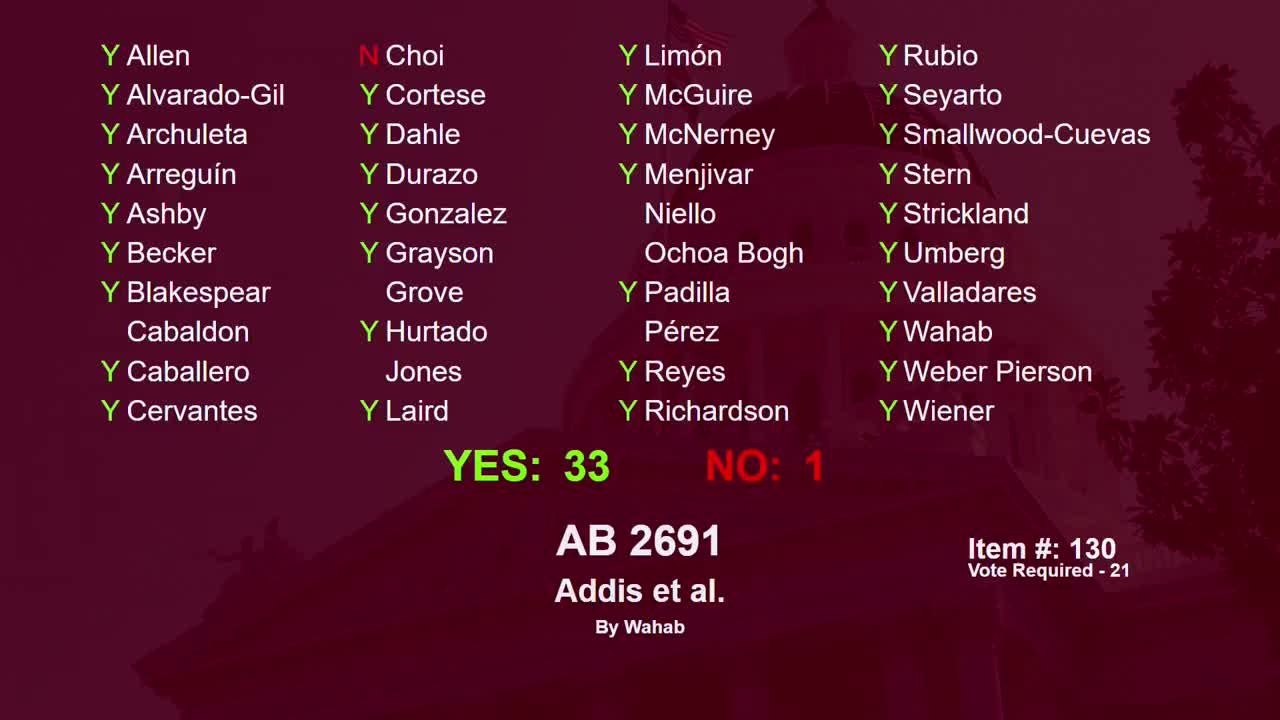 2MIN
Senate Floor
 10MIN
Senate Standing Committee on Local Government
 5MIN
Assembly Standing Committee on Local Government
Bill Author

Bill Co-Author(s):