AB 2422: Student financial aid: delayed financial aid awards: extensions.
- Session Year: 2025-2026
- House: Assembly
- Latest Version Date: 2026-09-27
Current Status:
Passed
(2026-09-27: Chaptered by Secretary of State - Chapter 605, Statutes of 2026.)
Introduced
In Committee
Awaiting First Chamber Vote
Passed First Chamber
In Committee
Awaiting Second Chamber Vote
Passed Second Chamber
Enacted
What does this bill do?
The bill requires California State University campuses, community college districts, and private and independent colleges that receive state aid to extend enrollment and payment deadlines and to avoid punitive actions when a student’s financial aid is delayed for reasons beyond the student’s control, and asks the University of California to do the same. Schools may ask students for documentation to verify delays from scholarships, grants, loans, or school processing errors, and may require renewed proof if the delay continues beyond the term; punitive actions include holds, late fees, or being dropped from classes.
The summary is provided by generative AI which can make mistakes. For original language, please view the details in the table below.
Existing law establishes the California Community Colleges, the California State University, the University of California, independent institutions of higher education, and private postsecondary educational institutions as the segments of postsecondary education in the state. Existing law establishes various programs that provide financial aid to students attending institutions in each of the segments.
This bill would, commencing with the 202728 academic year, require the California State University, community college districts, and private postsecondary educational institutions and independent institutions of higher education that receive state financial assistance to, and would request the University of California to, for a student whose financial aid award is delayed due to factors that are outside of the students control, extend specified enrollment and financial deadlines and refrain from imposing punitive actions, as defined. The bill would authorize those institutions to require documentation relating to those delays under certain conditions. By imposing new duties on community college districts, the bill would impose a state-mandated local program.
The California Constitution requires the state to reimburse local agencies and school districts for certain costs mandated by the state. Statutory provisions establish procedures for making that reimbursement.
This bill would provide that, if the Commission on State Mandates determines that the bill contains costs mandated by the state, reimbursement for those costs shall be made pursuant to the statutory provisions noted above.
Existing law establishes the California Community Colleges, the California State University, the University of California, independent institutions of higher education, and private postsecondary educational institutions as the segments of postsecondary education in the state. Existing law establishes various programs that provide financial aid to students attending institutions in each of the segments.
This bill would, commencing with the 202728 academic year, require the California State University, community college districts, and private postsecondary educational institutions and independent institutions of higher education that receive state financial assistance to, and would request the University of California to, for a student whose financial aid award is delayed due to factors that are outside of the students control, extend specified enrollment and financial deadlines and refrain from imposing punitive actions, as defined. By imposing new duties on community college districts, the bill would impose a state-mandated local program.
The California Constitution requires the state to reimburse local agencies and school districts for certain costs mandated by the state. Statutory provisions establish procedures for making that reimbursement.
This bill would provide that, if the Commission on State Mandates determines that the bill contains costs mandated by the state, reimbursement for those costs shall be made pursuant to the statutory provisions noted above.
(a)Commencing with the 202728 academic year, the California State University, each community college district, and private postsecondary educational institutions and independent institutions of higher education that receive state financial assistance shall, and the University of California is requested to, for a student whose financial aid award is delayed due to factors that are outside of the students control, do all of the following:
(1)Extend enrollment deadlines that may result in a student receiving a hold or being dropped from a class through the end of the academic term in which the delay occurs or until the funds are received. Once the funds are received, the extension of enrollment deadlines ceases.
(2)Extend financial deadlines for all required payments related to enrollment fees and costs through the end of the academic term in which the delay occurs if deemed necessary by the institution. The deadline extension applies only to the amount of financial aid award that has been delayed.
(3)Refrain from imposing punitive actions.
(b)The University of California, the California State University, each community college district, and private postsecondary educational institutions and independent institutions of higher education that receive state financial assistance may do either or both of the following:
(1)Require documentation for students to verify delays in funding from private scholarships, grants, and loans.
(2)If a financial aid award is delayed due to factors that are outside of the students control beyond the term in which the delay occurred, require documentation for the student to renew enrollment and the financial aid award while the delay continues.
(c)For purposes of this section, the following definitions apply:
(1)Factors outside of a students control means all of the following:
(A)Delays in the processing of the Free Application for Federal Student Aid or the California Dream Act application.
(B)Delays in the disbursement of awards under the Cal Grant Program, the Middle Class Scholarship Program, or the federal Pell Grant program.
(C)Delays in scholarship funding from postsecondary educational institutions.
(D)Processing errors or delays by the postsecondary educational institutions financial aid office.
(E)Delays in federal loan disbursements.
(F)Institutional, state, or federal backlogs.
(G)Delays in scholarship or grant funding from external sources.
(2)Financial aid award includes, but is not limited to, institutional, state, and federal aid sources.
(3)Punitive action includes, but is not limited to, all of the following:
(A)Restricting a student from future enrollment.
(B)Charging late fees or interest.
(C)Imposing administrative or registration holds on an academic transcript.
SEC. 2.If the Commission on State Mandates determines that this act contains costs mandated by the state, reimbursement to local agencies and school districts for those costs shall be made pursuant to Part 7 (commencing with Section 17500) of Division 4 of Title 2 of the Government Code.
(a)Commencing with the 202728 academic year, the California State University, each community college district, and private postsecondary educational institutions and independent institutions of higher education that receive state financial assistance shall, and the University of California is requested to, for a student whose financial aid award is delayed due to factors that are outside of the students control, do all of the following:
(1)Extend enrollment deadlines that may result in a student receiving a hold or being dropped from a class through the end of the academic term in which the delay occurs or until the funds are received. Once the funds are received, the extension of enrollment deadlines ceases.
(2)Extend financial deadlines for all required payments related to enrollment fees and costs through the end of the academic term in which the delay occurs if deemed necessary by the institution. The deadline extension applies only to the amount of financial aid award that has been delayed.
(3)Refrain from imposing punitive actions.
(b)The University of California, the California State University, each community college district, and private postsecondary educational institutions and independent institutions of higher education that receive state financial assistance may do either or both of the following:
(1)Require documentation for students to verify delays in funding from private scholarships, grants, and loans.
(2)If a financial aid award is delayed due to factors that are outside of the students control beyond the term in which the delay occurred, require documentation for the student to renew enrollment and the financial aid award while the delay continues.
(c)For purposes of this section, the following definitions apply:
(1)Factors outside of a students control include, but are not limited to, means all of the following:
(A)Delays in the processing of the Free Application for Federal Student Aid or the California Dream Act Application. application.
(B)Delays in the disbursement of awards under the Cal Grant Program, the Middle Class Scholarship Program, or the federal Pell Grant program.
(C)Delays in scholarship funding from postsecondary educational institutions.
(D)Processing errors or delays by the postsecondary educational institutions financial aid office.
(E)Delays in federal loan disbursements.
(F)Institutional, state, or federal backlogs.
(G)Delays in scholarship or grant funding from external sources.
(2)Financial aid award includes, but is not limited to, institutional, state, and federal aid sources.
(3)Punitive action includes, but is not limited to, all of the following:
(A)Restricting a student from future enrollment.
(B)Charging late fees or interest.
(C)Imposing administrative or registration holds on an academic transcript.
SEC. 2.If the Commission on State Mandates determines that this act contains costs mandated by the state, reimbursement to local agencies and school districts for those costs shall be made pursuant to Part 7 (commencing with Section 17500) of Division 4 of Title 2 of the Government Code.
(a)Commencing with the 202728 academic year, the California State University, each community college district, and private postsecondary educational institutions and independent institutions of higher education that receive state financial assistance shall, and the University of California is requested to, for a student whose financial aid award is delayed due to factors that are outside of the students control, do all of the following:
(1)Extend enrollment deadlines that may result in a student receiving a hold or being dropped from a class. class through the end of the academic term in which the delay occurs or until the funds are received. Once the funds are received, the extension of enrollment deadlines ceases.
(2)Extend financial deadlines for all required payments related to enrollment fees and costs. costs through the end of the academic term in which the delay occurs if deemed necessary by the institution. The deadline extension applies only to the amount of financial aid award that has been delayed.
(3)Refrain from imposing punitive actions.
(b)The University of California, the California State University, each community college district, and private postsecondary educational institutions and independent institutions of higher education that receive state financial assistance may do either or both of the following:
(1)Require documentation for students to verify delays in funding from private scholarships, grants, and loans.
(2)If a financial aid award is delayed due to factors that are outside of the students control beyond the term in which the delay occurred, require documentation for the student to renew enrollment and the financial aid award while the delay continues.
(b)(c)For purposes of this section, the following definitions apply:
(1)Factors outside of a students control include, but are not limited to, all of the following:
(A)Delays in the processing of the Free Application for Federal Student Aid or the California Dream Act Application.
(B)Delays in the disbursement of awards under the Cal Grant Program, the Middle Class Scholarship Program, or the federal Pell Grant program.
(C)Delays in scholarship funding from postsecondary educational institutions.
(D)Processing errors or delays by the postsecondary educational institutions financial aid office.
(E)Delays in federal loan disbursements.
(F)Institutional, state, or federal backlogs.
(2)Financial aid award includes, but is not limited to, scholarships, grants, and loans. institutional, state, and federal aid sources.
(3)Punitive action includes, but is not limited to, all of the following:
(A)Restricting a student from future enrollment.
(B)Charging late fees or interest.
(C)Imposing administrative or registration holds on an academic transcript.
SEC. 2.If the Commission on State Mandates determines that this act contains costs mandated by the state, reimbursement to local agencies and school districts for those costs shall be made pursuant to Part 7 (commencing with Section 17500) of Division 4 of Title 2 of the Government Code.
(a)Commencing with the 202728 academic year, the California State University, each community college district, and private postsecondary educational institutions and independent institutions of higher education that receive state financial assistance shall, and the University of California is requested to, for a student whose financial aid award is delayed due to factors that are outside of the students control, do all of the following:
(1)Extend enrollment deadlines that may result in a student receiving a hold or being dropped from a class.
(2)Extend financial deadlines for all required payments related to enrollment fees and costs.
(3)Refrain from imposing punitive actions.
(b)For purposes of this section, the following definitions apply:
(1)Factors outside of a students control include, but are not limited to, all of the following:
(A)Delays in the processing of the Free Application for Federal Student Aid or the California Dream Act Application.
(B)Delays in the disbursement of awards under the Cal Grant Program, the Middle Class Scholarship Program, or the federal Pell Grant program.
(C)Delays in scholarship funding from postsecondary educational institutions.
(D)Processing errors or delays by the postsecondary educational institutions financial aid office.
(E)Delays in federal loan disbursements.
(F)Institutional, state, or federal backlogs.
(2)Financial aid award includes, but is not limited to, scholarships, grants, and loans.
(3)Punitive action includes, but is not limited to, all of the following:
(A)Restricting a student from future enrollment.
(B)Charging late fees or interest.
(C)Imposing administrative or registration holds on an academic transcript.
SEC. 2.If the Commission on State Mandates determines that this act contains costs mandated by the state, reimbursement to local agencies and school districts for those costs shall be made pursuant to Part 7 (commencing with Section 17500) of Division 4 of Title 2 of the Government Code.
|
Date
|
Status
|
|---|---|
| Sep 27, 2026 | Chaptered by Secretary of State - Chapter 605, Statutes of 2026. |
| Sep 27, 2026 | Approved by the Governor. |
| Aug 28, 2026 | Enrolled and presented to the Governor at 3:30 p.m. |
| Aug 24, 2026 | Senate amendments concurred in. To Engrossing and Enrolling. (Ayes 78. Noes 0.). |
| Aug 24, 2026 | Senate amendments concurred in. To Engrossing and Enrolling. (Ayes 78. Noes 0. Page 6411.). |
| Aug 24, 2026 | Senate amendments concurred in. To Engrossing and Enrolling. |
| Aug 20, 2026 | In Assembly. Concurrence in Senate amendments pending. |
| Aug 20, 2026 | Read third time. Passed. Ordered to the Assembly. (Ayes 39. Noes 0.). |
| Aug 20, 2026 | Read third time. Passed. Ordered to the Assembly. (Ayes 39. Noes 0. Page 5592.). |
| Aug 18, 2026 | Ordered to special consent calendar. |
| Aug 13, 2026 | Read second time. Ordered to third reading. |
| Aug 13, 2026 | From committee: Do pass. (Ayes 7. Noes 0.) (August 13). |
| Aug 3, 2026 | In committee: Referred to APPR. suspense file. |
| Jun 25, 2026 | From committee: Do pass and re-refer to Com. on APPR. with recommendation: To Consent Calendar. (Ayes 7. Noes 0.) (June 24). Re-referred to Com. on APPR. |
| Jun 15, 2026 | From committee chair, with author's amendments: Amend, and re-refer to committee. Read second time, amended, and re-referred to Com. on ED. |
| Jun 10, 2026 | Referred to Com. on ED. |
| May 27, 2026 | In Senate. Read first time. To Com. on RLS. for assignment. |
| May 26, 2026 | Read third time. Passed. Ordered to the Senate. (Ayes 78. Noes 0.) |
| May 26, 2026 | Read third time. Passed. Ordered to the Senate. (Ayes 78. Noes 0. Page 5395.) |
| May 26, 2026 | Read third time. Passed. Ordered to the Senate. |
| May 18, 2026 | Read second time. Ordered to third reading. |
| May 14, 2026 | From committee: Do pass. (Ayes 15. Noes 0.) (May 14). |
| May 6, 2026 | In committee: Set, first hearing. Referred to APPR. suspense file. |
| Apr 20, 2026 | Re-referred to Com. on APPR. |
| Apr 16, 2026 | Read second time and amended. |
| Apr 15, 2026 | From committee: Amend, and do pass as amended and re-refer to Com. on APPR. (Ayes 9. Noes 0.) (April 14). |
| Mar 9, 2026 | Referred to Com. on HIGHER ED. |
| Feb 21, 2026 | From printer. May be heard in committee March 23. |
| Feb 20, 2026 | Read first time. To print. |
|
Date
|
Description
|
Location
|
Votes
|
|
|---|---|---|---|---|
| Aug 24, 2026 | AB 2422 Caloza Concurrence in Senate Amendments | Assembly Floor |
Passed |
|
| Aug 20, 2026 | Special Consent AB2422 Caloza et al. By Rubio | Senate Floor |
Passed |
|
| Aug 13, 2026 | Do pass | Senate Standing Committee on Appropriations |
Passed |
|
| Aug 3, 2026 | Placed on suspense file | Senate Standing Committee on Appropriations |
Passed |
|
| Jun 24, 2026 | Do pass, but first be re-referred to the Committee on [Appropriations] with the recommendation: To Consent Calendar | Senate Standing Committee on Education |
Passed |
|
| May 26, 2026 | AB 2422 Caloza Assembly Third Reading | Assembly Floor |
Passed |
|
| May 14, 2026 | Do pass. | Assembly Standing Committee on Appropriations |
Passed |
|
| Apr 14, 2026 | Do pass as amended and be re-referred to the Committee on [Appropriations] | Assembly Standing Committee on Higher Education |
Passed |
This list shows positions taken on this bill by organizations on the date displayed, which is linked to the original source.
Positions by individuals are not included.
|
Organization
|
Position
|
Date
|
|---|---|---|
| Alliance for A Better Community | ** Support | |
| Alliance for Children's Rights | ** Support | |
| Asian Americans Advancing Justice Southern California | ** Support | |
| Boys & Girls Clubs of San Francisco | ** Support | |
| Cal State Student Association | ** Support | |
| Central American Resource Center of California | ** Support | |
| College for All Coalition | ** Support | |
| Consejo de Federaciones Mexicanas | ** Support | |
| Future Leaders Of America | ** Support | |
| InnerCity Struggle | ** Support | |
| Journey House | ** Support | |
| Kid City Hope Place | ** Support | |
| Latino and Latina Roundtable of the San Gabriel and Pomona Valley | ** Support | |
| Los Angeles Unified School District | ** Support | |
| Los Angeles Urban Foundation | ** Support | |
| NextGen California | ** Support | |
| Office of the Riverside County Superintendent of Schools | ** Support | |
| Puente Learning Center | ** Support | |
| San Jose-Evergreen Community College District | ** Support | |
| Southern California College Attainment Network | ** Support | |
| The California Center for Civic Participation | ** Support | |
| The Institute for College Access & Success | ** Support | |
| uAspire | ** Support | |
| Unite-LA | ** Support | |
| University Of California Student Association | ** Support | |
| What We All Deserve | ** Support | |
| What We All Deserve (sponsor) | ** Support | |
| Young Invincibles | ** Support |
CONCURRENCE IN SENATE AMENDMENTS
CSA1 Bill Id:AB 2422
Author:(Caloza)
As Amended Ver:June 15, 2026
Majority vote
SUMMARY
Requires the California State University (CSU), each California Community College (CCC) district, private postsecondary educational institutions, and independent institutions of higher education receiving financial assistance, and requests the University of California (UC), commencing with the 2027-28 academic year, to extend enrollment and fee deadlines and refrain from imposing punitive actions for a student whose financial award is delayed due to factors outside the student's control.
Senate Amendments
- Add delays in scholarship or grant funding from external sources to the definition of "factors outside of a student's control."
- Make clarifying and technical changes.
COMMENTS
The Free Application for Federal Student Aid (FAFSA). There are currently three kinds of Cal Grants, A, B and C, of which eligibility is determined by the FAFSA or the California Dream Act Application (CADAA), a student's verified Cal Grant GPA, the type of California colleges a student listed on their FAFSA, and whether they are a recent high school graduate. Students are considered for a Cal Grant A, B, or C after they either establish eligibility for an Entitlement award (if they graduated from high school less than one year ago or transfer from a community college before age 28) or secure one of a limited number of Competitive awards (for any students that do not qualify for an Entitlement).
Federal changes. As part of federal COVID-19 related legislation signed into law in late December 2020, the process for applying for and receiving federal aid was simplified. The federal changes, initially were to commence with the 2023-24 academic year. However, the changes were delayed in June 2021, and went into effect commencing with the 2024-25 academic year. In part, the changes do the following:
- Simplify the FAFSA form. The FAFSA is the form students need to complete in order to receive any financial aid from the federal government to help pay for college.
Each year, over 13 million students who file the FAFSA get more than $120 billion in grants, work-study, and low-interest loans from the USDE. Additionally, many states, including California, and colleges use the FAFSA to determine which students will receive state and institutional financial aid—and how much they will receive.Simplifying the FAFSA was to not only make the form easier to fill out by eliminating two-thirds of the questions, but to also affect the determination of financial need for low, middle, and high-income students.
- Change the Expected Family Contribution (EFC) to the Student Aid Index (SAI). While the SAI is similar in nature to the EFC, according to the Institute for College Access and Success, the name change will more accurately reflect the meaning of the calculation when determining student aid eligibility rather than an expectation of what a family can afford to pay for college. Under the new model, a student applicant's SAI can be as low as -$1,500; whereas, the lowest EFC under the existing model is $0.
- Change how Pell Grant eligibility will be determined. Using the simplified FAFSA form, the Pell Grant amounts will generally be determined by subtracting the SAI from the maximum Pell Grant award. Students who have a negative or zero SAI will receive the maximum amount available. Applicants whose family adjusted gross income (AGI) fall below a specified percentage of the federal poverty level, will be guaranteed eligibility (regardless of their SAI). Further, applicants whose family AGI is up to 225% of the federal poverty level could also be eligible for the maximum award, and up to 400% of the federal poverty level for the minimum Pell award.
Continued challenges with the rollout of the new FAFSA application. As noted in the Federal changes section of the policy committee analysis, the U.S. Department of Education (USDE) made myriad changes to the federal FAFSA. While the changes seek to simplify the application form by reducing the number of questions students and families need to answer and transfer data directly from their previous tax filings, after over a year delay in implementing or launching the form, the USDE still did not release the new form for the 2024-25 award year until three months later than all prior years (released on December 30, 2023 instead of October 1, 2023). The USDE, on March 12, 2024, announced that it had made long-awaited technical updates that would enable mixed-status families to submit the FAFSA. However, the USDE also indicated that it had, "uncovered separate issues that still need to be resolved."
The 2025-26 cycle was also delayed. The USDE announced on August 7, 2024, that the upcoming FAFSA form would not be open to all students until December 1, 2024 – about two months later than the typical release date. There was also a phased rollout, including a testing period in which a limited number of students and institutions had access to the form beginning October 1, 2024, as a way to preventively address potential problems before it officially went live.
According to the Author
According to the author, "financial aid is meant to lift our students up, not hold them back. Delays in disbursement leave students facing harsh penalties that drive students deeper into debt. Amid the ongoing federal uncertainty, including actions by the Trump Administration to restructure and pause financial aid programs, safeguarding students from instability is vital. AB 2422 protects our students and ensures that they are not punished for circumstances beyond their control."
The author states that, "California—home to the largest higher education system in the nation—has a duty to support students at every step of their education. AB 2422 protects students from fines when aid is delayed, making higher education more affordable, fair, and accessible for all."
Additionally, the author contends that, "voluntary institutional 'grace periods' are inconsistent across California's 116 community colleges and 23 CSU campuses. Research indicates that financial uncertainty is the primary driver for students 'stopping out,' with 56% of adult learners and 20% of all students citing financial stress as the reason for dropping out. Legislation is required to codify a uniform state standard, ensuring that a student's enrollment status is protected statewide, regardless of which public or state-funded private institution they attend."
This measure requires specified postsecondary institutions, beginning in the 2027–28 academic year, to provide protections for students whose financial aid awards are delayed due to factors outside their control by extending deadlines and prohibiting punitive actions.
Arguments in Support
According to the Alliance for Children's Rights, "AB 2422 addresses a clearly documented and ongoing problem in California and nationally: systemic delays in federal, state, and institutional financial aid processing that can result in students being dropped from courses, charged late fees, or blocked from enrollment through no fault of their own. The bill establishes overdue guardrails to ensure that students are not penalized for administrative failures they did not cause."
Arguments in Opposition
None on file.
FISCAL COMMENTS
According to the Senate Committee on Appropriations:
- The CCC Chancellor's Office estimates one-time Proposition 98 General Fund costs of $1.1 million to $2.2 million for all community college districts to develop and update their financial aid policies. This estimate assumes an average costs of between $15,000 and $30,000 for each of the 72 districts in the state and could be lower to the extent that existing policies meet the bill's requirements.
- The UC and CSU estimate minor and absorbable costs to update financial aid policies.
VOTES:
ASM HIGHER EDUCATION: 9-0-1
YES: Fong, DeMaio, Boerner, Jeff Gonzalez, Jackson, Muratsuchi, Patel, Sharp-Collins, Tangipa
ABS, ABST OR NV: Celeste Rodriguez
ASM APPROPRIATIONS: 15-0-0
YES: Wicks, Hoover, Aguiar-Curry, Calderon, Caloza, Dixon, Fong, Mark González, Krell, Pacheco, Pellerin, Sharp-Collins, Solache, Ta, Tangipa
ASSEMBLY FLOOR: 78-0-2
YES: Addis, Aguiar-Curry, Ahrens, Alanis, Alvarez, Arambula, Ávila Farías, Bains, Bauer-Kahan, Bennett, Berman, Boerner, Bonta, Bryan, Calderon, Caloza, Carrillo, Castillo, Chen, Connolly, Davies, DeMaio, Dixon, Elhawary, Ellis, Flora, Fong, Gabriel, Gallagher, Garcia, Gipson, Jeff Gonzalez, Mark González, Hadwick, Haney, Harabedian, Hart, Hoover, Irwin, Jackson, Johnson, Kalra, Krell, Lackey, Lee, Lowenthal, Macedo, McKinnor, Nguyen, Ortega, Pacheco, Papan, Patel, Patterson, Pellerin, Petrie-Norris, Quirk-Silva, Ramos, Ransom, Michelle Rodriguez, Rogers, Blanca Rubio, Sanchez, Schiavo, Schultz, Sharp-Collins, Solache, Soria, Stefani, Ta, Tangipa, Valencia, Wallis, Ward, Wicks, Wilson, Zbur, Rivas
ABS, ABST OR NV: Muratsuchi, Celeste Rodriguez
SENATE FLOOR: 39-0-1
YES: Allen, Alvarado-Gil, Archuleta, Arreguín, Ashby, Becker, Blakespear, Cabaldon, Caballero, Cervantes, Choi, Cortese, Dahle, Durazo, Gonzalez, Grayson, Grove, Hurtado, Jones, Laird, Limón, McGuire, McNerney, Menjivar, Niello, Ochoa Bogh, Padilla, Pérez, Richardson, Rubio, Seyarto, Smallwood-Cuevas, Stern, Strickland, Umberg, Valladares, Wahab, Weber Pierson, Wiener
ABS, ABST OR NV: Reyes
UPDATED
VERSION: June 15, 2026
CONSULTANT: Jeanice Warden / HIGHER ED. / (916) 319-3960 FN: 0003939
SENATE RULES COMMITTEE Office of Senate Floor Analyses (916) 651-4171 | AB 2422 |
THIRD READING
Bill No: AB 2422
Author: Caloza (D), et al.
Amended: 6/15/26 in Senate
Vote: 21
SENATE EDUCATION COMMITTEE: 7-0, 6/24/26
AYES: Pérez, Ochoa Bogh, Cabaldon, Choi, Cortese, Gonzalez, Reyes
SENATE APPROPRIATIONS COMMITTEE: 7-0, 8/13/26
AYES: Cervantes, Seyarto, Cabaldon, Dahle, Grayson, Richardson, Wahab
ASSEMBLY FLOOR: 78-0, 5/26/26 - See last page for vote
SUBJECT: Student financial aid: delayed financial aid awards: extensions
SOURCE: What We All Deserve
DIGEST:
This bill requires the California State University (CSU), each community college district, private postsecondary educational institutions, and independent institutions of higher education receiving financial assistance, and requests the University of California (UC), commencing with the 2027-28 academic year, to extend enrollment and fee deadlines and refrain from imposing punitive actions for a student whose financial award is delayed due to factors outside the student’s control.
ANALYSIS:
Existing federal law:
- Under federal law, establishes the federal Pell Grant to provide aid to students who demonstrate financial need. The Pell Grant award can be used for tuition and fees, books, and supplies, transportation, and living expenses for the equivalent of up to six years of full-time enrollment. The maximum Pell Grant for the 2025-26 academic year (which covers the period from July 1, 2025 – June 30, 2026) is $7,395. The minimum Pell Grant award for the same time frame is $740. (United States Code (USC) Title 20 § 1070)
Existing state law:
1) Establishes the Donahoe Higher Education Act, setting forth the mission of
the UC, CSU, and California Community College (CCC); and defines “independent institutions of higher education” as nonpublic higher education institutions that grant undergraduate degrees, graduate degrees, or both, and that are formed as nonprofit corporations in California and are accredited by an agency recognized by the United States Department of Education (USDE). Specifies that for purposes of any code or statute, a national or regional accrediting agency recognized by the USDE as of January 1, 2025, shall retain that recognition until July 1, 2029, provided that the accrediting agency continues to operate in substantially the same manner as it did on January 1, 2025. (Education Code (EC) § 66010, et seq.)
- Establishes the Student Aid Commission (CSAC) as the state agency charged with administering state financial aid programs to qualifying students enrolled in qualifying institutions of higher education throughout the State. Existing law requires CSAC to prescribe the use of standardized student financial aid applications for California. (EC § 69433; § 69510, et seq.)
- Establishes the Cal Grant Reform Act commencing in the 2024-2025 fiscal year, if General Fund moneys over the multiyear forecasts are available to support ongoing augmentations and actions, and if funding is provided in the annual Budget Act. Under the Act, the Cal Grant 2 and Cal Grant 4 programs are created. The Cal Grant 2 is for CCC students and provides non-tuition support that grows annually with inflation. The Cal Grant 4 program is for students at the UC, CSU, and other institutions. The Act also states legislative intent that UC and CSU use institutional aid to cover non-tuition costs for their students. (EC §§ 69424, 69425, and 69428)
4) Establishes the Middle Class Scholarship (MCS) Program to offset a portion of tuition costs for students attending the UC and the CSU. Starting in the 2022-23 academic year, MCS awards may be used to cover the total cost of attendance at UC and CSU. (EC § 70020 et seq.)
5) Authorizes CSAC to grant up to an additional 30 calendar days beyond an
application deadline for any financial aid program administered by CSAC if CSAC receives and approves a formal request to postpone the application deadline from either the superintendent of a school district or community college district or from the president or chancellor of a California institution of higher education that is eligible to receive state funds for student financial assistance and CSAC finds that a “qualifying event” has occurred. Defines “qualifying event” as any event or extenuating circumstance outside of the control of the pupils or students in an affected school district, community college district, or area or region that has had an adverse effect on the ability of students within the district to successfully complete and submit their financial aid applications by an established statutory deadline. The qualifying event must have occurred or been ongoing during the period for which financial aid applications were available to submit for the following academic year, and includes, but is not limited to, any of the following types of events:
- A natural disaster;
- A state of emergency declared by the Governor or the President of the United States; or,
c) A labor action.
Further, allows CSAC to extend by 30 calendar days the application deadline for any financial aid program administered by CSAC if it determines that a delay in the opening of the Free Application for Federal Student Aid (FAFSA) has occurred. (EC § 69513.2)
6) Extends the Cal Grant priority deadline for financial aid programs
administered by CSAC, if the FAFSA application form is not available on or before October 1, 2023, to April 2, 2024, for the 2024-25 award year only; and, extends the Cal Grant application for financial aid programs administered by CSAC, by one month, from April 2, 2024, to May 2, 2024, for the 2024-25 award year only. (§ 22 of Chapter 50 of the Statutes of 2023)
This bill:
- Requires, commencing with the 2027-28 academic year, the CSU, each community college district, and private postsecondary educational institutions and independent institutions of higher education that receive state financial assistance, and requests the UC, for a student whose financial aid award is delayed due to factors that are outside of the student’s control, do all of the following:
- Extend enrollment deadlines that may result in a student receiving a
hold or being dropped from a class through the end of the academic term in which the delay occurs or until the funds are received. Once funds are received, the extension of enrollment deadlines ceases.
- Extend financial deadlines for all required payments related to
enrollment fees and costs, in the amount of the delayed financial aid award, through the end of the academic term in which the delay occurs if deemed necessary by the institution.
- Refrain from imposing punitive actions.
- Authorizes each institution to do either or both of the following:
- Require documentation for students to verify delays in funding from
private scholarships, grants, and loans.
- If a financial aid award is delayed due to factors that are outside of the
student’s control beyond the term in which the delay occurred requires documentation for the student to renew enrollment and the financial aid award while the delay continues.
- Defines for purposes of the bill all of the following terms:
- “Factors outside of a student’s control” to mean all of the following:
delays in the processing of the FAFSA or the California Dream Act application (CADAA); delays in the specified state and federal financial aid awards; delays in institutional aid; delays or process errors caused by the financial aid office; delays in scholarship or grant funding from external sources; and institutional, state, and federal backlogs.
- “Financial aid award” includes, but is not limited to, institutional,
state, and federal aid sources.
- “Punitive action” includes, but is not limited to, all of the following:
restricting a student from future enrollment; charging late fees or interest and imposing administrative or registration holds on an academic transcript.
Comments
Need for the bill. According to the author, “financial aid is meant to lift our students up, not hold them back. Delays in disbursement leave students facing harsh penalties that drive students deeper into debt. Amid the ongoing federal uncertainty, including actions by the Trump Administration to restructure and pause financial aid programs, safeguarding students from instability is vital. AB 2422 protects our students and ensures that they are not punished for circumstances beyond their control.”
Recent rollout of FAFSA delayed the opening of the application. In 2020, the process for applying for financial aid using the FAFSA was simplified. The federal changes initially were to commence with the 2023-24 academic year. However, the changes were delayed in June 2021 and went into effect in the 2024-2025 academic year. The USDE delayed the release of the new form for the 2024-25 award year by three months, later than all prior years (released on December 30, 2023, instead of October 1, 2023), thereby shortening the window for which students may apply for aid. The USDE, on March 12, 2024, announced that it had made long awaited technical updates that would enable mixed-status families to submit the FAFSA. However, the USDE also indicated that it had uncovered other issues to resolve. The 2025-26 cycle was also delayed, pushing the application release date to December. The state responded by extending the application window for any financial programs administered by CSAC from March to April. The one-month extension helped to ensure that students who have encountered difficulties due to complications with the launch of the FAFSA application could submit their applications. This bill includes delays in processing the FAFSA application as a qualifying situation outside of the student’s control for which punitive action cannot be taken.
Existing extension authority. Existing law grants CSAC the authority to approve financial aid deadline extension requests from local education agencies and institutions of higher education when extenuating circumstances outside the control of students create adverse effects on students’ ability to apply for aid by the statutory deadline. Qualifying events include natural disasters, state of emergency, delayed FAFSA opening, or labor action. In recent years, it has exercised this authority, extending deadlines statewide using this process due to the COVID-19 emergency at the request of higher education institutions and many K-12 districts and, on a separate occasion, locally for areas impacted by wildfires. When granting postponement of the application deadline, CSAC is required to publicly announce it and directly notify CSU, UC, and CCCs. This bill also includes delays in state and federal financial aid awards, the majority of which are administered by CSAC, as a factor outside of the students’ control.
Creates a grace period. According to the author, “voluntary institutional ‘grace periods’ are inconsistent across California’s 116 community colleges and 23 CSU campuses. Research indicates that financial uncertainty is the primary driver for students ‘stopping out’, with 56% of adult learners and 20% of all students citing financial stress as the reason for dropping out.” This bill attempts to impose a uniform grace period across public and private higher education institutions during the period between aid eligibility and disbursement. It requires any higher education institution receiving state financial assistance to extend course enrollment deadlines that may result in a hold or being dropped from a class through the end of the academic term for students whose financial aid awards are delayed until funds are received. Institutions may require documentation for students to verify delays in student aid funding.
FISCAL EFFECT: Appropriation: No Fiscal Com.: Yes Local: Yes
According to the Senate Appropriations Committee analysis, this bill would have the following fiscal impact:
- The Chancellor’s Office estimates one-time Proposition 98 General Fund costs of $1.1 million to $2.2 million for all community college districts to develop and update their financial aid policies. This estimate assumes an average costs of between $15,000 and $30,000 for each of the 72 districts in the state and could be lower to the extent that existing policies meet the bill’s requirements.
- The UC and CSU estimate minor and absorbable costs to update financial aid policies.
SUPPORT: (Verified 8/14/26)
What We All Deserve (source)
Alliance for a Better Community
Alliance for Children’s Rights
Asian Americans Advancing Justice Southern California
Boys & Girls Clubs of San Francisco
Cal State Student Association
Central American Resource Center of California
College for All Coalition
Consejo de Federaciones Mexicanas
Future Leaders of America
Innercity Struggle
Journey House
Kid City Hope Place
Latino and Latina Roundtable of the San Gabriel and Pomona Valley
Los Angeles Urban Foundation
NextGen California
Office of the Riverside County Superintendent of Schools
Puente Learning Center
San Jose-Evergreen Community College District
Southern California College Attainment Network
The Institute for College Access & Success
uAspire
Unite-LA
University of California Student Association
Young Invincibles
OPPOSITION: (Verified 8/14/26)
None received
ASSEMBLY FLOOR: 78-0, 5/26/26
AYES: Addis, Aguiar-Curry, Ahrens, Alanis, Alvarez, Arambula, Ávila Farías, Bains, Bauer-Kahan, Bennett, Berman, Boerner, Bonta, Bryan, Calderon, Caloza, Carrillo, Castillo, Chen, Connolly, Davies, DeMaio, Dixon, Elhawary, Ellis, Flora, Fong, Gabriel, Gallagher, Garcia, Gipson, Jeff Gonzalez, Mark González, Hadwick, Haney, Harabedian, Hart, Hoover, Irwin, Jackson, Johnson, Kalra, Krell, Lackey, Lee, Lowenthal, Macedo, McKinnor, Nguyen, Ortega, Pacheco, Papan, Patel, Patterson, Pellerin, Petrie-Norris, Quirk-Silva, Ramos, Ransom, Michelle Rodriguez, Rogers, Blanca Rubio, Sanchez, Schiavo, Schultz, Sharp-Collins, Solache, Soria, Stefani, Ta, Tangipa, Valencia, Wallis, Ward, Wicks, Wilson, Zbur, Rivas
NO VOTE RECORDED: Muratsuchi, Celeste Rodriguez
Prepared by: Olgalilia Ramirez / ED. / (916) 651-4105
8/15/26 12:03:51
**** END ****
SENATE COMMITTEE ON
Senator Sabrina Cervantes, Chair
2025 - 2026 Regular Session
AB 2422 (Caloza) - Student financial aid: delayed financial aid awards: extensions
Version: | Policy Vote: |
Urgency: | Mandate: |
Hearing Date: | Consultant: |
Bill Summary:
This bill requires the California State University (CSU), each community college district, private postsecondary educational institutions, and independent institutions of higher education receiving financial assistance, and requests the University of California (UC), to extend enrollment and fee deadlines and refrain from imposing punitive actions to students whose financial awards are delayed due to factors outside the student’s control.
Fiscal Impact:
The Chancellor’s Office estimates one-time Proposition 98 General Fund costs of $1.1 million to $2.2 million for all community college districts to develop and update their financial aid policies. This estimate assumes an average costs of between $15,000 and $30,000 for each of the 72 districts in the state and could be lower to the extent that existing policies meet the bill’s requirements.
The UC and CSU estimate minor and absorbable costs to update financial aid policies.
Background:
Existing law grants the California Student Aid Commission (CSAC) with authority to approve financial aid deadline extension requests from local education agencies and institutions of higher education when extenuating circumstances outside the control of students create adverse effects on students’ ability to apply for aid by the statutory deadline. Qualifying events include natural disasters, state of emergency, delayed FAFSA opening, or labor action. The CSAC has exercised this authority in recent years, extending deadlines statewide and also using this process due to the COVID-19 emergency at the request of higher education institutions and many K-12 districts. When granting postponement of the application deadline, the CSAC is required to publicly announce it and directly notify CSU, UC, and the California Community Colleges.
Proposed Law:
This bill requires, commencing with the 2027-28 academic year, the CSU, each community college district, and private postsecondary educational institutions and independent institutions of higher education that receive state financial assistance, and requests the UC, for a student whose financial aid award is delayed due to factors that are outside of the student’s control, do all of the following:
Extend enrollment deadlines that may result in a student receiving a hold or being dropped from a class through the end of the academic term in which the delay occurs or until the funds are received. Once funds are received, the extension of enrollment deadlines ceases.
- Extend financial deadlines for all required payments related to enrollment fees and costs, in the amount of the delayed financial aid award, through the end of the academic term in which the delay occurs if deemed necessary by the institution.
- Refrain from imposing punitive actions.
This bill authorizes each institution to do either or both of the following: require documentation for students to verify delays in funding from private scholarships, grants, and loans; and if a financial aid award is delayed due to factors that are outside of the student’s control beyond the term in which the delay occurred requires documentation for the student to renew enrollment and the financial aid award while the delay continues.
This bill defines “factors outside of a student’s control” to mean all of the following: delays in the processing of the FAFSA or the California Dream Act application (CADAA); delays in the specified state and federal financial aid awards; delays in institutional aid; delays or process errors caused by the financial aid office; delays in scholarship or grant funding from external sources; and institutional, state, and federal backlogs.
Staff Comments:
This bill seeks to establish a uniform grace period across public and private higher education institutions during the period between aid eligibility and disbursement. Specifically, the bill requires any higher education institution receiving state financial assistance to extend course enrollment deadlines that may result in a hold or being dropped from a class through the end of the academic term for students whose financial aid awards are delayed until funds are received. Institutions may require documentation for students to verify delays in student aid funding. According to the author, “financial aid is meant to lift our students up, not hold them back. Delays in disbursement leave students facing harsh penalties that drive students deeper into debt. Amid the ongoing federal uncertainty, including actions by the Trump Administration to restructure and pause financial aid programs, safeguarding students from instability is vital. AB 2422 protects our students and ensures that they are not punished for circumstances beyond their control”.
-- END --
SENATE COMMITTEE ON EDUCATION
Senator Sasha Renée Pérez, Chair
2025 - 2026 Regular
Bill No: Hearing Date: June 24, 2026
Author: | |||
Version: |
| ||
Urgency: | Fiscal: | ||
Consultant: | |||
Subject: .
SUMMARY
This bill requires the California State University (CSU), each community college district, private postsecondary educational institutions, and independent institutions of higher education receiving financial assistance, and requests the University of California (UC), commencing with the 2027-28 academic year, to extend enrollment and fee deadlines and refrain from imposing punitive actions for a student whose financial award is delayed due to factors outside the student’s control.
BACKGROUND
Existing federal law:
- Under federal law, establishes the federal Pell Grant to provide aid to students who demonstrate financial need. The Pell Grant award can be used for tuition and fees, books, and supplies, transportation, and living expenses for the equivalent of up to six years of full-time enrollment. The maximum Pell Grant for the 2025-26 academic year (which covers the period from July 1, 2025 – June 30, 2026) is $7,395. The minimum Pell Grant award for the same time frame is $740. (United States Code (USC) Title 20 § 1070)
Existing state law:
1) Establishes the Donahoe Higher Education Act, setting forth the mission of the
UC, CSU, and California Community College (CCC); and defines “independent institutions of higher education” as nonpublic higher education institutions that grant undergraduate degrees, graduate degrees, or both, and that are formed as nonprofit corporations in California and are accredited by an agency recognized by the United States Department of Education (USDE). Specifies that for purposes of any code or statute, a national or regional accrediting agency recognized by the USDE as of January 1, 2025, shall retain that recognition until July 1, 2029, provided that the accrediting agency continues to operate in substantially the same manner as it did on January 1, 2025. (Education Code (EC) § 66010, et seq.)
- Establishes the Student Aid Commission (CSAC) as the state agency charged with administering state financial aid programs to qualifying students enrolled in qualifying institutions of higher education throughout the State. Existing law requires CSAC to prescribe the use of standardized student financial aid applications for California. (EC § 69433; § 69510, et seq.)
- Establishes the Cal Grant Reform Act commencing in the 2024-2025 fiscal year,
if General Fund moneys over the multiyear forecasts are available to support ongoing augmentations and actions, and if funding is provided in the annual Budget Act. Under the Act, the Cal Grant 2 and Cal Grant 4 programs are created. The Cal Grant 2 is for CCC students and provides non-tuition support that grows annually with inflation. The Cal Grant 4 program is for students at the UC, CSU, and other institutions. The Act also states legislative intent that UC and CSU use institutional aid to cover non-tuition costs for their students. (EC §§ 69424, 69425, and 69428)
4) Establishes the Middle Class Scholarship (MCS) Program to offset a portion of tuition costs for students
attending the UC and the CSU. Starting in the 2022-23 academic year, MCS awards may be used to cover the total cost of attendance at UC and CSU. (EC § 70020 et seq.)
5) Authorizes CSAC to grant up to an additional 30 calendar days beyond an
application deadline for any financial aid program administered by CSAC if CSAC receives and approves a formal request to postpone the application deadline from either the superintendent of a school district or community college district or from the president or chancellor of a California institution of higher education that is eligible to receive state funds for student financial assistance and CSAC finds that a “qualifying event” has occurred. Defines “qualifying event” as any event or extenuating circumstance outside of the control of the pupils or students in an affected school district, community college district, or area or region that has had an adverse effect on the ability of students within the district to successfully complete and submit their financial aid applications by an established statutory deadline. The qualifying event must have occurred or been ongoing during the period for which financial aid applications were available to submit for the following academic year, and includes, but is not limited to, any of the following types of events:
- A natural disaster;
- A state of emergency declared by the Governor or the President of the United States; or,
c) A labor action.
Further, allows CSAC to extend by 30 calendar days the application deadline for any financial aid program administered by CSAC if it determines that a delay in the opening of the Free Application for Federal Student Aid (FAFSA) has occurred. (EC § 69513.2)
6) Extends the Cal Grant priority deadline for financial aid programs administered
by CSAC, if the FAFSA application form is not available on or before October 1, 2023, to April 2, 2024, for the 2024-25 award year only; and, extends the Cal Grant application for financial aid programs administered by CSAC, by one month, from April 2, 2024, to May 2, 2024, for the 2024-25 award year only. (§ 22 of Chapter 50 of the Statutes of 2023)
ANALYSIS
This bill:
- Requires, commencing with the 2027-28 academic year, the CSU, each community college district, and private postsecondary educational institutions and independent institutions of higher education that receive state financial assistance, and requests the UC, for a student whose financial aid award is delayed due to factors that are outside of the student’s control, do all of the following:
- Extend enrollment deadlines that may result in a student receiving a hold
or being dropped from a class through the end of the academic term in which the delay occurs or until the funds are received. Once funds are received, the extension of enrollment deadlines ceases.
- Extend financial deadlines for all required payments related to enrollment
fees and costs, in the amount of the delayed financial aid award, through the end of the academic term in which the delay occurs if deemed necessary by the institution.
- Refrain from imposing punitive actions.
- Authorizes each institution to do either or both of the following:
- Require documentation for students to verify delays in funding from private
scholarships, grants, and loans.
- If a financial aid award is delayed due to factors that are outside of the
student’s control beyond the term in which the delay occurred requires documentation for the student to renew enrollment and the financial aid award while the delay continues.
- Defines for purposes of the bill all of the following terms:
- “Factors outside of a student’s control” to mean all of the following: delays
in the processing of the FAFSA or the California Dream Act application (CADAA); delays in the specified state and federal financial aid awards; delays in institutional aid; delays or process errors caused by the financial aid office; delays in scholarship or grant funding from external sources; and institutional, state, and federal backlogs.
- “Financial aid award” includes, but is not limited to, institutional, state, and
federal aid sources.
- “Punitive action” includes, but is not limited to, all of the following:
restricting a student from future enrollment; charging late fees or interest and imposing administrative or registration holds on an academic transcript.
STAFF COMMENTS
- Need for the bill. According to the author, “financial aid is meant to lift our students up, not hold them back. Delays in disbursement leave students facing harsh penalties that drive students deeper into debt. Amid the ongoing federal uncertainty, including actions by the Trump Administration to restructure and pause financial aid programs, safeguarding students from instability is vital. AB 2422 protects our students and ensures that they are not punished for circumstances beyond their control”.
- Recent rollout FAFSA delayed the opening of the application. In 2020, the process for applying for financial aid using the FAFSA was simplified. The federal changes initially were to commence with the 2023-24 academic year. However, the changes were delayed in June 2021 and went into effect in the 2024-2025 academic year. The USDE delayed the release of the new form for the 2024-25 award year by three months, later than all prior years (released on December 30, 2023, instead of October 1, 2023), thereby shortening the window for which students may apply for aid. The USDE, on March 12, 2024, announced that it had made long awaited technical updates that would enable mixed-status families to submit the FAFSA. However, the USDE also indicated that it had uncovered other issues to resolve. The 2025-26 cycle was also delayed, pushing the application release date to December. The state responded by extending the application window for any financial programs administered by CSAC from March to April. The one-month extension helped to ensure that students who have encountered difficulties due to complications with the launch of the FAFSA application could submit their applications. It’s unclear whether the one month extension impacted the timing of award disbursement. This bill includes delays in processing the FAFSA application as a qualifying situation outside of the student’s control for which the bill’s provisions may be applied.
- Existing extension authority. Existing law grants CSAC the authority to approve financial aid deadline extension requests from local education agencies and institutions of higher education when extenuating circumstances outside the control of students create adverse effects on students’ ability to apply for aid by the statutory deadline. Qualifying events include natural disasters, state of emergency, delayed FAFSA opening, or labor action. In recent years, it has exercised this authority, extending deadlines statewide using this process due to the COVID-19 emergency at the request of higher education institutions and many K-12 districts and, on a separate occasion, locally for areas impacted by wildfires. When granting postponement of the application deadline, CSAC is required to publicly announce it and directly notify CSU, UC, and CCCs. This bill also includes delays in state and federal financial aid awards, the majority of which are administered by CSAC, as a factor outside of the students’ control.
- Creates a grace period. According to the author, “voluntary institutional ‘grace periods’ are inconsistent across California’s 116 community colleges and 23 CSU campuses. Research indicates that financial uncertainty is the primary driver for students ‘stopping out’, with 56% of adult learners and 20% of all students citing financial stress as the reason for dropping out.” This bill attempts to impose a uniform grace period across public and private higher education institutions during the period between aid eligibility and disbursement. It requires any higher education institution receiving state financial assistance to extend course enrollment deadlines that may result in a hold or being dropped from a class through the end of the academic term for students whose financial aid awards are delayed until funds are received. Institutions may require documentation for students to verify delays in student aid funding. Recent amendments further clarify the types of qualifying factors that would trigger implementation of the bill’s provisions.
SUPPORT
What We All Deserve (sponsor)
Alliance for a Better Community
Alliance for Children’s Rights
Asian Americans Advancing Justice Southern California
College for All Coalition
Latino and Latina Roundtable of the San Gabriel and Pomona Valley
Office of the Riverside County Superintendent of Schools
San Jose-Evergreen Community College District
Southern California College Attainment Network
The Institute for College Access & Success
University of California Student Association
OPPOSITION
None received
-- END --
ASSEMBLY THIRD READING
ATR Bill Id:AB 2422
Author:(Caloza)
As Amended Ver:April 16, 2026
Majority vote
SUMMARY
Requires the California State University (CSU), each community college district (CCD), private postsecondary educational institution, and independent institution of higher education receiving state financial assistance, and requests the University of California (UC), beginning with the 2027-28 academic year, to extend enrollment and fee deadlines and refrain from imposing punitive actions for a student whose financial aid award is delayed due to factors outside the student's control.
Major Provisions
- Requires the CSU, CCDs, and state-aided independent institutions to, and requests the UC to:
- Extend enrollment deadlines to prevent students from being dropped from classes;
- Extend financial payment deadlines related to enrollment costs; and,
- Refrain from imposing punitive actions on affected students.
- Authorizes the UC, CSU, CCDs, and state-aided independent institutions that receive state financial assistance to do either or both of the following:
- Require documentation for students to verify delays in funding form private scholarships, grants, and loans; and,
- If a financial aid award is delayed due to factors that are outside of the student's control beyond the term in which the delay occurred, require documentation for the student to renew enrollment and the financial aid award while the delay continues.
- Defines "factors outside of a student's control" to include:
- Free Application for Federal Student Aid (FAFSA) or California Dream Act Application (CADAA) processing delays;
- Delayed disbursement of Cal Grants, Pell Grants, or Middle Class Scholarship (MCS);
- Institutional financial aid processing delays or errors;
- Federal loan disbursement delays; and,
- State, federal, or institutional backlogs.
- Defines "punitive actions" to include:
- Dropping or restricting enrollment;
- Charging late fees or interest; and,
- Placing administrative or transcript holds.
- Defines "financial aid award" to include, but not be limited to, institutional, state, and federal sources.
COMMENTS
The FAFSA. There are currently three kinds of Cal Grants, A, B and C, of which eligibility is determined by the FAFSA or the CADAA, a student's verified Cal Grant GPA, the type of California colleges a student listed on their FAFSA, and whether they are a recent high school graduate. Students are considered for a Cal Grant A, B, or C after they either establish eligibility for an Entitlement award (if they graduated from high school less than one year ago or transfer from a community college before age 28) or secure one of a limited number of Competitive awards (for any students that do not qualify for an Entitlement).
Federal changes. As part of federal COVID-19 related legislation signed into law in late December 2020, the process for applying for and receiving federal aid was simplified. The federal changes, initially were to commence with the 2023-24 academic year. However, the changes were delayed in June 2021, and went into effect commencing with the 2024-25 academic year. In part, the changes do the following:
- Simplify the FAFSA form. The FAFSA is the form students need to complete in order to receive any financial aid from the federal government to help pay for college.
Each year, over 13 million students who file the FAFSA get more than $120 billion in grants, work-study, and low-interest loans from the USDE. Additionally, many states, including California, and colleges use the FAFSA to determine which students will receive state and institutional financial aid—and how much they will receive.Simplifying the FAFSA was to not only make the form easier to fill out by eliminating two-thirds of the questions, but to also affect the determination of financial need for low, middle, and high-income students.
- Change the Expected Family Contribution (EFC) to the Student Aid Index (SAI). While the SAI is similar in nature to the EFC, according to the Institute for College Access and Success, the name change will more accurately reflect the meaning of the calculation when determining student aid eligibility rather than an expectation of what a family can afford to pay for college. Under the new model, a student applicant's SAI can be as low as -$1,500; whereas, the lowest EFC under the existing model is $0.
- Change how Pell Grant eligibility will be determined. Using the simplified FAFSA form, the Pell Grant amounts will generally be determined by subtracting the SAI from the maximum Pell Grant award. Students who have a negative or zero SAI will receive the maximum amount available. Applicants whose family adjusted gross income (AGI) fall below a specified percentage of the federal poverty level, will be guaranteed eligibility (regardless of their SAI). Further, applicants whose family AGI is up to 225% of the federal poverty level could also be eligible for the maximum award, and up to 400% of the federal poverty level for the minimum Pell award.
Continued challenges with the rollout of the new FAFSA application. As noted in the Federal changes section of this analysis, the U.S. Department of Education (USDE) made myriad changes to the federal FAFSA. While the changes seek to simplify the application form by reducing the number of questions students and families need to answer and transfer data directly from their previous tax filings, after over a year delay in implementing or launching the form, the USDE still did not release the new form for the 2024-25 award year until three months later than all prior years (released on December 30, 2023 instead of October 1, 2023). The USDE, on March 12, 2024, announced that it had made long-awaited technical updates that would enable mixed-status families to submit the FAFSA. However, the USDE also indicated that it had, "uncovered separate issues that still need to be resolved."
The 2025-26 cycle was also delayed. The USDE announced on August 7, 2024, that the upcoming FAFSA form would not be open to all students until December 1, 2024 – about two months later than the typical release date. There was also a phased rollout, including a testing period in which a limited number of students and institutions had access to the form beginning October 1, 2024, as a way to preventively address potential problems before it officially went live.
According to the Author
According to the author, "financial aid is meant to lift our students up, not hold them back. Delays in disbursement leave students facing harsh penalties that drive students deeper into debt. Amid the ongoing federal uncertainty, including actions by the Trump Administration to restructure and pause financial aid programs, safeguarding students from instability is vital. AB 2422 protects our students and ensures that they are not punished for circumstances beyond their control."
The author states that, "California—home to the largest higher education system in the nation—has a duty to support students at every step of their education. AB 2422 protects students from fines when aid is delayed, making higher education more affordable, fair, and accessible for all."
Additionally, the author contends that, "voluntary institutional 'grace periods' are inconsistent across California's 116 community colleges and 23 CSU campuses. Research indicates that financial uncertainty is the primary driver for students 'stopping out,' with 56% of adult learners and 20% of all students citing financial stress as the reason for dropping out. Legislation is required to codify a uniform state standard, ensuring that a student's enrollment status is protected statewide, regardless of which public or state-funded private institution they attend."
This measure requires specified postsecondary institutions, beginning in the 2027–28 academic year, to provide protections for students whose financial aid awards are delayed due to factors outside their control by extending deadlines and prohibiting punitive actions.
Arguments in Support
According to the Alliance for Children's Rights, "AB 2422 addresses a clearly documented and ongoing problem in California and nationally: systemic delays in federal, state, and institutional financial aid processing that can result in students being dropped from courses, charged late fees, or blocked from enrollment through no fault of their own. The bill establishes overdue guardrails to ensure that students are not penalized for administrative failures they did not cause."
Arguments in Opposition
None on file.
FISCAL COMMENTS
According to the Assembly Committee on Higher Education:
- One-time Proposition 98 General Fund costs between $1.1 million and $2.2 million for all 72 CCDs, cumulatively statewide, to update financial aid policies as needed. According to the California Community Colleges Chancellor's Office, this estimate assumes an average costs of between $15,000 and $30,000 per district.
- Minor and absorbable costs to the CSU and UC to update financial aid policies as needed.
VOTES
ASM HIGHER EDUCATION: 9-0-1
YES: Fong, DeMaio, Boerner, Jeff Gonzalez, Jackson, Muratsuchi, Patel, Sharp-Collins, Tangipa
ABS, ABST OR NV: Celeste Rodriguez
ASM APPROPRIATIONS: 15-0-0
YES: Wicks, Hoover, Aguiar-Curry, Calderon, Caloza, Dixon, Fong, Mark González, Krell, Pacheco, Pellerin, Sharp-Collins, Solache, Ta, Tangipa
UPDATED
VERSION: April 16, 2026
CONSULTANT: Jeanice Warden / HIGHER ED. / (916) 319-3960 FN: 0002820
Date of Hearing: May 6, 2026
ASSEMBLY COMMITTEE ON APPROPRIATIONS
Buffy Wicks, Chair
ABPCA Bill Id:AB 2422
Author:(Caloza) – As Amended Ver:April 16, 2026
Policy Committee: | Higher Education | Vote: | 9 - 0 |
|
| ||
|
|
Urgency: No State Mandated Local Program: Yes Reimbursable: Yes
SUMMARY:
This bill requires the California State University, each community college district (CCD), private postsecondary educational institution, and independent institution of higher education receiving state financial assistance, and requests the University of California (UC), beginning with the 2027-28 academic year, to extend enrollment and fee deadlines and refrain from imposing punitive actions for a student whose financial aid award is delayed due to factors outside the student’s control.
FISCAL EFFECT:
- One-time Proposition 98 General Fund costs between $1.1 million and $2.2 million for all 72 CCDs, cumulatively statewide, to update financial aid policies as needed. According to the California Community Colleges Chancellor’s Office, this estimate assumes an average costs of between $15,000 and $30,000 per district.
- Minor and absorbable costs to the CSU and UC to update financial aid policies as needed.
COMMENTS:
- Purpose. The author and proponents of this bill argue that actions by the Trump administration, such as restructuring or pausing financial aid programs, have led to increased uncertainty for students and delays in disbursement of assistance due to “circumstances beyond their control.” The author also points to inconsistent policies across higher education institutions regarding grace periods for students even with “56% of adult learners and 20% of all students citing financial stress as the reason for dropping out.” According to the Alliance for Children’s Rights:
AB 2422 addresses a clearly documented and ongoing problem in California and nationally: systemic delays in federal, state, and institutional financial aid processing that can result in students being dropped from courses, charged late fees, or blocked from enrollment through no fault of their own. The bill establishes overdue guardrails to ensure that students are not penalized for administrative failures they did not cause.
- Background. FAFSA and California College Students. Many states, including California, and colleges use the FAFSA to determine which students will receive state and institutional financial aid—and how much each student will receive. There are currently three kinds of state financial aid via Cal Grants: A, B and C, of which eligibility is determined by the FAFSA or California Dream Act Application, a student’s verified Cal Grant GPA, the type of California colleges a student listed on their FAFSA, and whether the student is a recent high school graduate. Students are considered for a Cal Grant A, B, or C award after they either establish eligibility for an entitlement award (if they graduated from high school less than one year ago or transferred from a community college before age 28) or secure one of a limited number of competitive awards (for any students that do not qualify for an entitlement). The FAFSA is the form students need to complete in order to receive any financial aid from the federal government to help pay for college.
The United States Department of Education (USDOE) administers FAFSA, but it is unclear if current proposals at the federal level to abolish USDOE, successful or not, will impact administration of FAFSA in the future and lead to delays. Thus far, both the 2024-25 and 2025-26 academic year FAFSA form application timelines were delayed by USDOE.
Current Extension Authority. While the California Student Aid Commission, which administers Cal Grants, may grant up to an additional 30 calendar days when “qualifying events”, such as a natural disaster or Governor’s declaration of a State of Emergency, occur and either the superintendent of a school district or community college district or the president or chancellor of a California institution of higher education formally request a postponement, the extension applies to filing the application for financial aid, not disbursement of financial aid awards and is not applied statewide. This bill requires a college or university to extend enrollment and financial deadlines for a student whose financial aid award is delayed due to factors outside the student’s control, including but not limited to delays in processing of the FAFSA or California Dream Act Application, delays in disbursements of financial aid awards, delays in scholarship funding disbursements, processing errors, or delays in federal loan disbursements.
Analysis Prepared by: Aaron Heredia / APPR. / (916) 319-2081
Date of Hearing: April 14, 2026
ASSEMBLY COMMITTEE ON HIGHER EDUCATION
Mike Fong, Chair
ABPCA Bill Id:AB 2422 (
Author:Caloza) – As Introduced Ver:February 20, 2026
SUBJECT: Student financial aid: delayed financial aid awards: extensions.
SUMMARY: Requires specified postsecondary institutions, beginning in the 2027–28 academic year, to provide protections for students whose financial aid awards are delayed due to factors outside their control by extending deadlines and prohibiting punitive actions. Specifically, this bill:
- Requires the California State University (CSU), California Community Colleges (CCC) districts, and state-aided independent institutions to, and requests the University of California (UC) to:
- Extend enrollment deadlines to prevent students from being dropped from classes;
- Extend financial payment deadlines related to enrollment costs; and,
- Refrain from imposing punitive actions on affected students.
- Defines “factors outside of a student’s control” to include:
- Free Application for Federal Student Aid (FAFSA) or California Dream Act Application (CADAA) processing delays;
- Delayed disbursement of Cal Grants, Pell Grants, or Middle Class Scholarship (MCS);
- Institutional financial aid processing delays or errors;
- Federal loan disbursement delays; and,
- State, federal, or institutional backlogs.
- Defines “punitive actions” to include:
- Dropping or restricting enrollment;
- Charging late fees or interest; and,
- Placing administrative or transcript holds.
- Applies to delays involving all forms of financial aid, including grants, scholarships, and loans.
EXISTING LAW: Federal. Establishes the federal Pell Grant to provide aid to students who demonstrate financial need. The Pell Grant award can be used for tuition and fees, books, and supplies, transportation, and living expenses for the equivalent of up to six years of full-time enrollment. The maximum Pell Grant for the 2025-26 academic year (which covers the period from July 1, 2025 – June 30, 2026) is $7,395. The minimum Pell Grant award for the same time frame is $740 (20 U.S.C. Section 1070).
State.
- Establishes the Donahoe Higher Education Act, setting forth the mission of the UC, CSU, and CCC; and, defines "independent institutions of higher education" as nonpublic higher education institutions that grant undergraduate degrees, graduate degrees, or both, and that are formed as nonprofit corporations in California and are accredited by an agency recognized by the United States Department of Education (USDE). Specifies that for purposes of any code or statute, a national or regional accrediting agency recognized by the USDE as of January 1, 2025, shall retain that recognition until July 1, 2029, provided that the accrediting agency continues to operate in substantially the same manner as it did on January 1, 2025. (Education Code (EC) Section 66010, et seq.).
- Establishes the Student Aid Commission (CSAC) as the state agency charged with administering state financial aid programs to qualifying students enrolled in qualifying institutions of higher education throughout the State. Existing law requires CSAC to prescribe the use of standardized student financial aid applications for California (EC Section 69433 and Section 69510, et seq.).
- Establishes, the Cal Grant Reform Act commencing in the 2024-2025 fiscal year, if General Fund moneys over the multiyear forecasts are available to support ongoing augmentations and actions, and if funding is provided in the annual Budget Act. Under the Act, the Cal Grant 2 and Cal Grant 4 programs are created. The Cal Grant 2 is for CCC students, and provides non-tuition support that grows annually with inflation. The Cal Grant 4 program is for students at the UC, CSU, and other institutions. The Act also states legislative intent that UC and CSU use institutional aid to cover non-tuition costs for their students (EC Sections 69424, 69425, and 69428).
- Establishes the MCS Program to offset a portion of tuition costs for students attending the UC and the CSU. Starting in the 2022-23 academic year, MCS awards may be used to cover the total cost of attendance at UC and CSU (EC Section 70020, et seq.).
The maximum annual household income to qualify for an award is $234,000 for dependent students in 2025-26.
- Authorizes CSAC to grant up to an additional 30 calendar days beyond an application deadline for any financial aid program administered CSAC if CSAC receives and approves a formal request to postpone the application deadline from either the superintendent of a school district or community college district or from the president or chancellor of a California institution of higher education that is eligible to receive state funds for student financial assistance and CSAC finds that a “qualifying event” has occurred. Defines “qualifying event” as any event or extenuating circumstance outside of the control of the pupils or students in an affected school district, community college district, or area or region that has had an adverse effect on the ability of students within the district to successfully complete and submit their financial aid applications by an established statutory deadline. The qualifying event must have occurred or been ongoing during the period for which financial aid applications were available to submit for the following academic year, and includes, but is not limited to, any of the following types of events:
- A natural disaster;
- A state of emergency declared by the Governor or the President of the United States; or,
- A labor action.
Further, allows CSAC to extend by 30 calendar days the application deadline for any financial aid program administered by CSAC if it determines that a delay in the opening of FAFSA has occurred (EC Section 69513.2).
- Extends the Cal Grant priority deadline for financial aid programs administered by CSAC, if the FAFSA application form is not available on or before October 1, 2023, to April 2, 2024, for the 2024-25 award year only; and, extends the Cal Grant application for financial aid programs administered by CSAC, by one month, from April 2, 2024, to May 2, 2024, for the 2024-25 award year only (Section 22 of Chapter 50 of the Statutes of 2023).
FISCAL EFFECT: Unknown
COMMENTS: Need for the measure. According to the author, “financial aid is meant to lift our students up, not hold them back. Delays in disbursement leave students facing harsh penalties that drive students deeper into debt. Amid the ongoing federal uncertainty, including actions by the Trump Administration to restructure and pause financial aid programs, safeguarding students from instability is vital. AB 2422 protects our students and ensures that they are not punished for circumstances beyond their control.”
The author states that, “California—home to the largest higher education system in the nation—has a duty to support students at every step of their education. AB 2422 protects students from fines when aid is delayed, making higher education more affordable, fair, and accessible for all.”
Additionally, the author contends that, “voluntary institutional ‘grace periods’ are inconsistent across California’s 116 community colleges and 23 CSU campuses. Research indicates that financial uncertainty is the primary driver for students ‘stopping out,’ with 56% of adult learners and 20% of all students citing financial stress as the reason for dropping out. Legislation is required to codify a uniform state standard, ensuring that a student's enrollment status is protected statewide, regardless of which public or state-funded private institution they attend.”
This measure requires specified postsecondary institutions, beginning in the 2027–28 academic year, to provide protections for students whose financial aid awards are delayed due to factors outside their control by extending deadlines and prohibiting punitive actions.
The FAFSA. There are currently three kinds of Cal Grants, A, B and C, of which eligibility is determined by the FAFSA or the CADAA, a student’s verified Cal Grant GPA, the type of California colleges a student listed on their FAFSA, and whether they are a recent high school graduate. Students are considered for a Cal Grant A, B, or C after they either establish eligibility for an Entitlement award (if they graduated from high school less than one year ago or transfer from a community college before age 28) or secure one of a limited number of Competitive awards (for any students that do not qualify for an Entitlement).
Federal changes. As part of federal COVID-19 related legislation signed into law in late December 2020, the process for applying for and receiving federal aid was simplified. The federal changes, initially were to commence with the 2023-24 academic year. However, the changes were delayed in June 2021, and went into effect commencing with the 2024-25 academic year. In part, the changes do the following:
- Simplify the FAFSA form. The FAFSA is the form students need to complete in order to receive any financial aid from the federal government to help pay for college.
Each year, over 13 million students who file the FAFSA get more than $120 billion in grants, work-study, and low-interest loans from the USDE. Additionally, many states, including California, and colleges use the FAFSA to determine which students will receive state and institutional financial aid—and how much they will receive.
Simplifying the FAFSA was to not only make the form easier to fill out by eliminating two-thirds of the questions, but to also affect the determination of financial need for low, middle, and high-income students.
- Change the Expected Family Contribution (EFC) to the Student Aid Index (SAI). While the SAI is similar in nature to the EFC, according to the Institute for College Access and Success, the name change will more accurately reflect the meaning of the calculation when determining student aid eligibility rather than an expectation of what a family can afford to pay for college. Under the new model, a student applicant’s SAI can be as low as -$1,500; whereas, the lowest EFC under the existing model is $0.
Committee Staff understands that the goal of the negative SAI is to provide states and postsecondary institutions of learning a more nuanced picture of student need in order to best target institutional and campus-based aid.
- Change how Pell Grant eligibility will be determined. Using the simplified FAFSA form, the Pell Grant amounts will generally be determined by subtracting the SAI from the maximum Pell Grant award. Students who have a negative or zero SAI will receive the maximum amount available.
Applicants whose family adjusted gross income (AGI) fall below a specified percentage of the federal poverty level, will be guaranteed eligibility (regardless of their SAI). Further, applicants whose family AGI is up to 225% of the federal poverty level could also be eligible for the maximum award, and up to 400% of the federal poverty level for the minimum Pell award.
Committee Staff understands that this additional eligibility layer is intended to enable students and families to make a simpler and earlier determination of their Pell eligibility than what was possible under the former system.
Continued challenges with the rollout of the new FAFSA application. As noted in the Federal changes section of this analysis, the U.S. Department of Education (USDE) made myriad changes to the federal FAFSA. While the changes seek to simplify the application form by reducing the number of questions students and families need to answer and transfer data directly from their previous tax filings, after over a year delay in implementing or launching the form, the USDE still did not release the new form for the 2024-25 award year until three months later than all prior years (released on December 30, 2023 instead of October 1, 2023).
The USDE, on March 12, 2024, announced that it had made long-awaited technical updates that would enable mixed-status families to submit the FAFSA. However, the USDE also indicated that it had, “uncovered separate issues that still need to be resolved.”
The 2025-26 cycle was also delayed. The USDE announced on August 7, 2024, that the upcoming FAFSA form would not be open to all students until December 1, 2024 – about two months later than the typical release date. There was also a phased rollout, including a testing period in which a limited number of students and institutions had access to the form beginning October 1, 2024, as a way to preventively address potential problems before it officially went live.
Committee Staff understands that students who were a part of that test period did not have to resubmit their form when it officially opened to everyone else.
Committee comments and amendments. As stated by the author, “existing law mandates the reporting of financial aid awards but lacks consumer protections for students during the period between aid eligibility and actual disbursement. Current statutes do not prohibit institutions from taking punitive academic or financial actions when a student is waiting for state-authorized funds. This creates a protection gap where a student's right to remain enrolled is contingent on the processing speed of government and institutional bureaucracies rather than their eligibility for aid.”
While this measure appears to promote flexibility for students, it may introduce an operational complexity for institutions managing large student populations and high volumes of financial aid transactions. Further, as drafted, additional standardization and guidance on how campuses are to implement this measure will strengthen the provisions of the measure. In keeping with the intent of the author and being cognizant of staffing shortages at various campuses, the Committee recommends, and the author has agreed to accept, the following amendments:
69509.8. (1) Extend enrollment deadlines that may result in a student receiving a hold or being dropped from a class, through the end of the academic term in which the delay occurs or until the funds are received. Once the funds arrive, the enrollment deadlines extension ceases.
(2) Extend financial deadlines for all required payments related to enrollment fees and costs, through the end of the academic term in which the delay occurs if deemed necessary by the institution. The deadline extension only applies to the amount of financial aid award that has been delayed.
(b) For purposes of this section, the following definitions apply:
(2) “Financial aid award” includes, but is not limited to, scholarships, grants, and loans. institutional, state, and federal aid sources.
(4) A postsecondary educational institution may require documentation for students to verify delays in funding from private scholarships, grants, and loans.
(c) If a financial aid award is delayed due to factors that are outside of the student’s control beyond the term in which the delay occurred, a postsecondary educational institution may require documentation to renew enrollment and financial aid award while the delay continues
Arguments in support. According to the Alliance for Children's Rights, “AB 2422 addresses a clearly documented and ongoing problem in California and nationally: systemic delays in federal, state, and institutional financial aid processing that can result in students being dropped from courses, charged late fees, or blocked from enrollment through no fault of their own. The bill establishes overdue guardrails to ensure that students are not penalized for administrative failures they did not cause.”
Prior legislation. AB 313 (Ortega), Chapter 31, Statutes of 2025, in part, allows CSAC to extend by 30 calendar days the application deadline for any financial aid program administered by CSAC if it determines that a delay in the opening of the FAFSA has occurred.
REGISTERED SUPPORT / OPPOSITION:
Support
Alliance for Children's Rights
Los Angeles Unified School District
The California Center for Civic Participation
What We All Deserve (Sponsor)
Opposition
None on file.
Analysis Prepared by: Jeanice Warden / HIGHER ED. / (916) 319-3960
Discussed in Hearing
 44SEC
Assembly Floor
 1MIN
Senate Standing Committee on Appropriations
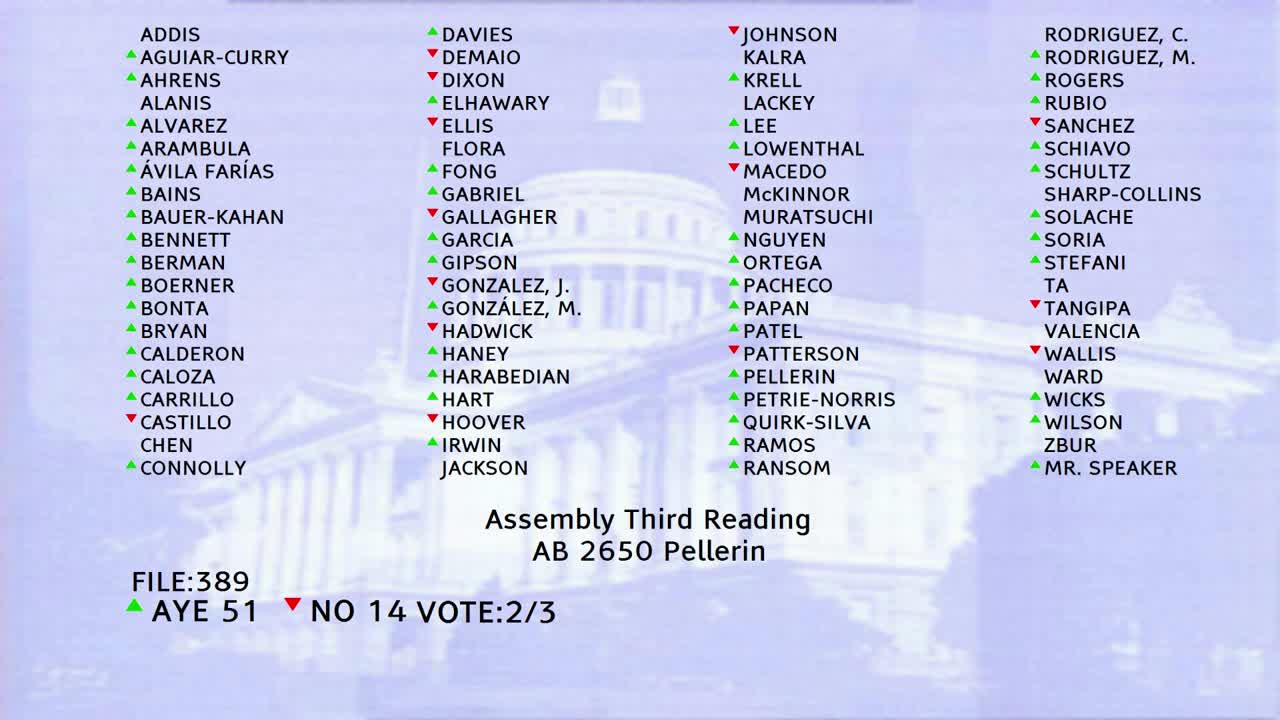 48SEC
Assembly Floor
 10MIN
Assembly Standing Committee on Higher Education
Bill Author

Bill Co-Author(s):