AB 246: Social Security Tenant Protection Act of 2025.
- Session Year: 2025-2026
- House: Assembly
- Latest Version Date: 2025-10-06
Current Status:
Passed
(2025-10-06: Chaptered by Secretary of State - Chapter 337, Statutes of 2025.)
Introduced
In Committee
Awaiting First Chamber Vote
Passed First Chamber
In Committee
Awaiting Second Chamber Vote
Passed Second Chamber
Enacted
Existing law provides that a tenant is guilty of unlawful detainer if the tenant continues to possess the property without permission of the landlord after the tenant defaults on rent or fails to perform a condition or covenant of the lease under which the property is held, among other reasons. Existing law requires a tenant be served a 3 days notice in writing to cure a default or perform a condition of the lease, or return possession of the property to the landlord, as specified. Existing law, until January 1, 2030, prohibits an owner of residential real property from terminating a tenancy without just cause, as specified.
This bill would, until January 20, 2029, enact the Social Security Tenant Protection Act of 2025 (the Act). The Act would authorize a tenant of residential real property to assert Social Security hardship as an affirmative defense in an unlawful detainer proceeding based on the nonpayment of rent. The Act would define Social Security hardship as a loss of income due to an interruption in the payment of Social Security benefits due to the action or inaction of the federal government. The Act would require a tenant asserting Social Security hardship as an affirmative defense to provide, to the satisfaction of the court, evidence that Social Security payments typically received by the tenants household have been terminated, delayed, or reduced due to no fault of the tenant and that the hardship prevented the tenant from paying the rent. If the tenant successfully provides this evidence, the Act would require the court to issue a stay of the unlawful detainer action, as specified.
The Act would not relieve a tenant of their obligation to pay past due rent, and it would require a tenant, within 14 days of the Social Security benefits being restored, to either pay all past due rent or enter into a mutually agreed upon payment plan with the owner of the residential real property. If the tenant pays all past due rent or enters into a payment plan with the owner, the Act would require the court to either dismiss the unlawful detainer action with prejudice or set aside the judgment against all named and unnamed defendants in the action. The Act would further require the Judicial Council, by January 1, 2027, to adopt or modify forms as needed to implement the Act.
Existing law provides that a tenant is guilty of unlawful detainer if the tenant continues to possess the property without permission of the landlord after the tenant defaults on rent or fails to perform a condition or covenant of the lease under which the property is held, among other reasons. Existing law requires a tenant be served a 3 days notice in writing to cure a default or perform a condition of the lease, or return possession of the property to the landlord, as specified. The Mobilehome Residency Law prohibits a tenancy from being terminated unless specified conditions are met, including that the tenant fails to pay rent, utility charges, or reasonable incidental service charges, and 3 days notice in writing is provided to the tenant, as specified. Existing law, until January 1, 2030, prohibits an owner of residential real property from terminating a tenancy without just cause, as specified.
This bill would, until January 20, 2029, enact the Social Security Tenant Protection Act of 2025 (the Act). The Act would prohibit a court, during a declared social security benefit payment interruption, from issuing a summons on a complaint for unlawful detainer in any action that seeks possession of residential real property and that is based, in whole or in part, on nonpayment of rent or other charges, if the defendant experiences a loss of household income due to the social security benefit payment interruption. authorize a tenant of residential real property to assert Social Security hardship as an affirmative defense in an unlawful detainer proceeding based on the nonpayment of rent. The Act would define Social Security hardship as a loss of income due to an interruption in the payment of Social Security benefits due to the action or inaction of the federal government. The Act would require a tenant asserting Social Security hardship as an affirmative defense to provide, to the satisfaction of the court, evidence that Social Security payments typically received by the tenants household have been terminated, delayed, or reduced due to no fault of the tenant and that the hardship prevented the tenant from paying the rent. If the tenant successfully provides this evidence, the Act would require the court to issue a stay of the unlawful detainer action, as specified.
The Act would not relieve a tenant of their obligation to pay past due rent, and it would require a tenant, within 14 days of the Social Security benefits being restored, to either pay all past due rent or enter into a mutually agreed upon payment plan with the owner of the residential real property. If the tenant pays all past due rent or enters into a payment plan with the owner, the Act would require the court to either dismiss the unlawful detainer action with prejudice or set aside the judgment against all named and unnamed defendants in the action. The Act would further require the Judicial Council, by January 1, 2027, to adopt or modify forms as needed to implement the Act.
The Act would define social security benefit payment interruption for purposes of these provisions to mean any disruption in the administration or disbursement of any benefit payments administered by the Social Security Administration that results in a delay of 3 or more calendar days beyond the scheduled payment disbursement date. The Act would require the Department of Justice, if it determines there is a social security benefit payment interruption and files an action to restore social security benefit payments, to deliver notice of the filing to the Joint Legislative Budget Committee and to the Judicial Council within 5 court days. A declared social security benefit payment interruption under the Act begins on the day that the Joint Legislative Budget Committee receives that notice from the Department of Justice and ends when the Department of Justice delivers a determination that social security benefit payments have been restored or 6 months after the commencement of the declared interruption, whichever occurs first.The Act would also require any 3 days notice that demands payment of covered rental debt, as defined, to meet specified criteria, including that the notice include an unsigned copy of a declaration of social security-related financial distress and that the notice advise the tenant that the tenant will not be evicted for failure to comply with the notice if the tenant delivers a signed declaration and documentation that they rely upon their social security benefit payments to the landlord, as specified. The Act would deem a 3 days notice that fails to comply with this criteria void and insufficient to support a judgment for unlawful detainer or to terminate a tenancy. The Act would prohibit a tenant that delivers a declaration, under penalty of perjury, of social security-related financial distress and documentation that they rely upon their social security benefit payments pursuant to these provisions from being deemed in default with regard to the covered rental debt, as specified. By expanding the crime of perjury, this bill would create a state-mandated local program.The California Constitution requires the state to reimburse local agencies and school districts for certain costs mandated by the state. Statutory provisions establish procedures for making that reimbursement.This bill would provide that no reimbursement is required by this act for a specified reason.Existing law provides that a tenant is guilty of unlawful detainer if the tenant continues to possess the property without permission of the landlord after the tenant defaults on rent or fails to perform a condition or covenant of the lease under which the property is held, among other reasons. Existing law requires a tenant be served a 3 days notice in writing to cure a default or perform a condition of the lease, or return possession of the property to the landlord, as specified. The Mobilehome Residency Law prohibits a tenancy from being terminated unless specified conditions are met, including that the tenant fails to pay rent, utility charges, or reasonable incidental service charges, and 3 days notice in writing is provided to the tenant, as specified.
This bill would, until January 20, 2029, enact the Social Security Tenant Protection Act of 2025 (the Act). The Act would prohibit a court, during a declared social security benefit payment interruption, from issuing a summons on a complaint for unlawful detainer in any action that seeks possession of residential real property and that is based, in whole or in part, on nonpayment of rent or other charges, if the defendant experiences a loss of household income due to the social security benefit payment interruption.
The Act would define social security benefit payment interruption for purposes of these provisions to mean any disruption in the administration or disbursement of any benefit payments administered by the Social Security Administration that results in a delay of 3 or more calendar days beyond the scheduled payment disbursement date. The Act would require the Department of Justice, if it determines there is a social security benefit payment interruption and files an action to restore social security benefit payments, to deliver notice of the filing to the Joint Legislative Budget Committee and to the Judicial Council within 5 court days. A declared social security benefit payment interruption under the Act begins on the day that the Joint Legislative Budget Committee receives that notice from the Department of Justice and ends when the Department of Justice delivers a determination that social security benefit payments have been restored or 6 months after the commencement of the declared interruption, whichever occurs first.
The Act would also require any 3 days notice that demands payment of covered rental debt, as defined, to meet specified criteria, including that the notice include an unsigned copy of a declaration of social security-related financial distress and that the notice advise the tenant that the tenant will not be evicted for failure to comply with the notice if the tenant delivers a signed declaration and documentation that they rely upon their social security benefit payments to the landlord, as specified. The Act would deem a 3 days notice that fails to comply with this criteria void and insufficient to support a judgment for unlawful detainer or to terminate a tenancy. The Act would prohibit a tenant that delivers a declaration, under penalty of perjury, of social security-related financial distress and documentation that they rely upon their social security benefit payments pursuant to these provisions from being deemed in default with regard to the covered rental debt, as specified. By expanding the crime of perjury, this bill would create a state-mandated local program.
The California Constitution requires the state to reimburse local agencies and school districts for certain costs mandated by the state. Statutory provisions establish procedures for making that reimbursement.
This bill would provide that no reimbursement is required by this act for a specified reason.
Existing law provides that a tenant is guilty of unlawful detainer if the tenant continues to possess the property without permission of the landlord after the tenant defaults on rent or fails to perform a condition or covenant of the lease under which the property is held, among other reasons. Existing law requires a tenant be served a 3 days notice in writing to cure a default or perform a condition of the lease, or return possession of the property to the landlord, as specified. The Mobilehome Residency Law prohibits a tenancy from being terminated unless specified conditions are met, including that the tenant fails to pay rent, utility charges, or reasonable incidental service charges, and 3 days notice in writing is provided to the tenant, as specified.
This bill would, until January 20, 2029, enact the Social Security Tenant Protection Act of 2025 (the Act). The Act would prohibit a court, during a declared social security benefit payment interruption, from issuing a summons on a complaint for unlawful detainer in any action that seeks possession of residential real property and that is based, in whole or in part, on nonpayment of rent or other charges, if the defendant experiences a loss of household income due to the social security benefit payment interruption.
The Act would define social security benefit payment interruption for purposes of these provisions to mean any disruption in the administration or disbursement of any benefit payments administered by the Social Security Administration that results in a delay of 3 or more calendar days beyond the scheduled payment disbursement date. The Act would require the Department of Finance to monitor the status of social security benefit payments, and Justice, if it determines there is a social security benefit payment interruption, interruption and files an action to restore social security benefit payments, to deliver notice of its determination the filing to the Joint Legislative Budget Committee and to the Judicial Council. Council within 5 court days. A declared social security benefit payment interruption under the Act begins on the day that the Joint Legislative Budget Committee receives that determination notice from the Department of Justice and ends when the Department of Finance Justice delivers a determination that social security benefit payments have been restored or 6 months after the commencement of the declared interruption, whichever occurs first.
The Act would also require any 3 days notice that demands payment of covered rental debt, as defined, that is served on a tenant during a declared social security benefit payment interruption to meet specified criteria, including that the notice include an unsigned copy of a declaration of social security-related financial distress and that the notice advise the tenant that the tenant will not be evicted for failure to comply with the notice if the tenant delivers a signed declaration to the landlord, as specified. The Act would deem a 3 days notice that fails to comply with this criteria void and insufficient to support a judgment for unlawful detainer or to terminate a tenancy. The Act would prohibit a tenant that delivers a declaration, under penalty of perjury, of social security-related financial distress pursuant to these provisions from being deemed in default with regard to the covered rental debt, as specified. By expanding the crime of perjury, this bill would create a state-mandated local program.
The California Constitution requires the state to reimburse local agencies and school districts for certain costs mandated by the state. Statutory provisions establish procedures for making that reimbursement.
This bill would provide that no reimbursement is required by this act for a specified reason.
Existing law provides that a tenant is guilty of unlawful detainer if the tenant continues to possess the property without permission of the landlord after the tenant defaults on rent or fails to perform a condition or covenant of the lease under which the property is held, among other reasons. Existing law requires a tenant be served a 3 days notice in writing to cure a default or perform a condition of the lease, or return possession of the property to the landlord, as specified. The Mobilehome Residency Law prohibits a tenancy from being terminated unless specified conditions are met, including that the tenant fails to pay rent, utility charges, or reasonable incidental service charges, and 3 days notice in writing is provided to the tenant, as specified.
This bill would, until January 20, 2029, enact the Social Security Tenant Protection Act of 2025 (the Act). The Act would prohibit a court, during a declared social security benefit payment interruption, from issuing a summons on a complaint for unlawful detainer in any action that seeks possession of residential real property and that is based, in whole or in part, on nonpayment of rent or other charges, if the defendant experiences a loss of income due to the social security benefit payment interruption.
The Act would define social security benefit payment interruption for purposes of these provisions to mean any disruption in the administration or disbursement of any benefit payments administered by the Social Security Administration that results in a delay of 3 or more calendar days beyond the scheduled payment disbursement date. The Act would require the Department of Finance to monitor the status of social security benefit payments, and if it determines there is a social security benefit payment interruption, to deliver notice of its determination to the Joint Legislative Budget Committee and to the Judicial Council. A declared social security benefit payment interruption under the Act begins on the day that the Joint Legislative Budget Committee receives that determination and ends when the Department of Finance delivers a determination that social security benefit payments have been restored or 6 months after the commencement of the declared interruption, whichever occurs first.
The Act would also require any 3 days notice that demands payment of covered rental debt, as defined, that is served on a tenant during a declared social security benefit payment interruption to meet specified criteria, including that the notice include an unsigned copy of a declaration of social security-related financial distress and that the notice advise the tenant that the tenant will not be evicted for failure to comply with the notice if the tenant delivers a signed declaration to the landlord, as specified. The Act would deem a 3 days notice that fails to comply with this criteria void and insufficient to support a judgment for unlawful detainer or to terminate a tenancy. The Act would prohibit a tenant that delivers a declaration, under penalty of perjury, of social security-related financial distress pursuant to these provisions from being deemed in default with regard to the covered rental debt, as specified. By expanding the crime of perjury, this bill would create a state-mandated local program.
The California Constitution requires the state to reimburse local agencies and school districts for certain costs mandated by the state. Statutory provisions establish procedures for making that reimbursement.
This bill would provide that no reimbursement is required by this act for a specified reason.
Existing law, the Costa-Hawkins Rental Housing Act, among other things, authorizes an owner of residential real property to establish initial and subsequent rental rates for a dwelling or unit that meets specified conditions, subject to certain exceptions. Existing law, until January 1, 2030, prohibits an owner of residential real property from, over the course of any 12-month period, increasing the gross rental rate, as specified, for a dwelling or a unit more than 5% plus the percentage change in the cost of living, or 10%, whichever is lower, of the lowest gross rental rate charged for that dwelling or unit at any time during the 12 months before the effective date of the increase, subject to specified conditions.This bill, notwithstanding any other law, would prohibit an owner of residential real property from increasing the rental rate for a dwelling or a unit that had a tenant in lawful possession of the residential real property on or before January 7, 2025, and is located in the County of Los Angeles by more than 3% of the rental rate charged for that dwelling or unit on January 7, 2025, subject to specified limitations and exceptions. The bill would authorize the district attorney, county counsel, or city attorney to enforce these provisions and subject a violation of these provisions to a civil penalty of not more than $10,000. The bill would remain in effect until March 1, 2026, and would be repealed as of that date.This bill would make legislative findings and declarations as to the necessity of a special statute for County of Los Angeles.Existing law, the Costa-Hawkins Rental Housing Act, among other things, authorizes an owner of residential real property to establish initial and subsequent rental rates for a dwelling or unit that meets specified conditions, subject to certain exceptions. Existing law, until January 1, 2030, prohibits an owner of residential real property from, over the course of any 12-month period, increasing the gross rental rate, as specified, for a dwelling or a unit more than 5% plus the percentage change in the cost of living, or 10%, whichever is lower, of the lowest gross rental rate charged for that dwelling or unit at any time during the 12 months before the effective date of the increase, subject to specified conditions.
This bill, notwithstanding any other law, would prohibit an owner of residential real property from charging a increasing the rental rate for a dwelling or a unit that had a tenant in lawful possession of the residential real property on or before January 7, 2025, and is located in the County of Los Angeles in excess of by more than 3% of the rental rate charged for the that dwelling or unit charged on January 7, 2025, except as specified. subject to specified limitations and exceptions. The bill would authorize the district attorney, county counsel, or city attorney to enforce these provisions and subject a violation of these provisions to a civil penalty of not more than $10,000. The bill would remain in effect until March 1, 2026, and would be repealed as of that date.
This bill would make legislative findings and declarations as to the necessity of a special statute for County of Los Angeles.
This bill would declare that it is to take effect immediately as an urgency statute.Existing law, the Costa-Hawkins Rental Housing Act, among other things, authorizes an owner of residential real property to establish initial and subsequent rental rates for a dwelling or unit that meets specified conditions, subject to certain exceptions. Existing law, until January 1, 2030, prohibits an owner of residential real property from, over the course of any 12-month period, increasing the gross rental rate, as specified, for a dwelling or a unit more than 5% plus the percentage change in the cost of living, or 10%, whichever is lower, of the lowest gross rental rate charged for that dwelling or unit at any time during the 12 months before the effective date of the increase, subject to specified conditions. Existing law, the California Emergency Services Act, authorizes the Governor to proclaim a state of emergency when specified conditions of disaster or extreme peril to the safety of persons and property exist, as specified.
This bill, notwithstanding any other law, would prohibit an owner of residential real property from charging a rental rate for a dwelling or a unit that had a tenant in lawful possession of the residential real property on or before January 7, 2025, and is located in the County of Los Angeles in excess of the rental rate for the dwelling or unit charged on January 7, 2025, except as specified. The bill would authorize the district attorney attorney, county counsel, or city attorney to enforce these provisions and subject a violation of these provisions to a civil penalty of not more than $10,000. The bill would remain in effect until 12 months after the state of emergency, proclaimed by the Governor on January 7, 2025, in the Counties of Los Angeles and Ventura due to the Palisades Fire, Eaton Fire, and windstorm conditions has been terminated, as specified, March 1, 2026, and would be repealed as of that date.
This bill would make legislative findings and declarations as to the necessity of a special statute for County of Los Angeles.
This bill would declare that it is to take effect immediately as an urgency statute.
Existing law, the Costa-Hawkins Rental Housing Act, among other things, authorizes an owner of residential real property to establish initial and subsequent rental rates for a dwelling or unit that meets specified conditions, subject to certain exceptions. Existing law, until January 1, 2030, prohibits an owner of residential real property from, over the course of any 12-month period, increasing the gross rental rate, as specified, for a dwelling or a unit more than 5% plus the percentage change in the cost of living, or 10%, whichever is lower, of the lowest gross rental rate charged for that dwelling or unit at any time during the 12 months before the effective date of the increase, subject to specified conditions. Existing law, the California Emergency Services Act, authorizes the Governor to proclaim a state of emergency when specified conditions of disaster or extreme peril to the safety of persons and property exist, as specified.
This bill, notwithstanding any other law, would prohibit an owner of residential real property from increasing the charging a rental rate for a dwelling or a unit that had a tenant in lawful possession of the residential real property on or before January 7, 2025, and is located in the County of Los Angeles in excess of the rental rate for the dwelling or unit charged on January 7, 2025. 2025, except as specified. The bill would authorize the district attorney or city attorney to enforce these provisions and subject a violation of these provisions to a civil penalty of not more than $10,000. The bill would remain in effect until 12 months after the state of emergency, proclaimed by the Governor on January 7, 2025, in the Counties of Los Angeles and Ventura due to the Palisades Fire Fire, Eaton Fire, and windstorm condition conditions has been terminated, as specified, and would be repealed as of that date.
(2)Under existing law, upon the proclamation of a state of emergency by the President of the United States or the Governor, or upon the declaration of a local emergency by an official, board, or other governing body of any county, city, or city and county, it is a misdemeanor for a person, contractor, business, or other entity to increase the price of certain goods or services by greater than 10%, as specified, or evict tenants. Existing law makes the district attorney the public prosecutor, except as otherwise provided by law.This bill would specify that the district attorney may prosecute violations of the above-described prohibition on price increases and evictions during a state of emergency or local emergency.(3)ThisThis bill would make legislative findings and declarations as to the necessity of a special statute for County of Los Angeles.
(4)ThisThis bill would declare that it is to take effect immediately as an urgency statute.
(1)Existing law, the Costa-Hawkins Rental Housing Act, among other things, authorizes an owner of residential real property to establish initial and subsequent rental rates for a dwelling or unit that meets specified conditions, subject to certain exceptions. Existing law, until January 1, 2030, prohibits an owner of residential real property from, over the course of any 12-month period, increasing the gross rental rate, as specified, for a dwelling or a unit more than 5% plus the percentage change in the cost of living, or 10%, whichever is lower, of the lowest gross rental rate charged for that dwelling or unit at any time during the 12 months before the effective date of the increase, subject to specified conditions. Existing law, the California Emergency Services Act, authorizes the Governor to proclaim a state of emergency when specified conditions of disaster or extreme peril to the safety of persons and property exist, as specified.
This bill, notwithstanding any other law, would prohibit an owner of residential real property from increasing the rental rate for a dwelling or a unit located in the County of Los Angeles in excess of the rental rate for the dwelling or unit charged on January 7, 2025. The bill would authorize the district attorney to enforce these provisions and subject a violation of these provisions to a civil penalty of not more than $10,000. The bill would remain in effect until 12 months after the state of emergency, proclaimed by the Governor on January 7, 2025, in the Counties of Los Angeles and Ventura due to the Palisades Fire and windstorm condition has been terminated, as specified, and would be repealed as of that date.
(2)Under existing law, upon the proclamation of a state of emergency by the President of the United States or the Governor, or upon the declaration of a local emergency by an official, board, or other governing body of any county, city, or city and county, it is a misdemeanor for a person, contractor, business, or other entity to increase the price of certain goods or services by greater than 10%, as specified, or evict tenants. Existing law makes the district attorney the public prosecutor, except as otherwise provided by law.
This bill would specify that the district attorney may prosecute violations of the above-described prohibition on price increases and evictions during a state of emergency or local emergency.
(3)This bill would make legislative findings and declarations as to the necessity of a special statute for County of Los Angeles.
(4)This bill would declare that it is to take effect immediately as an urgency statute.
(a)This section is known, and may be cited, as the Social Security Tenant Protection Act of 2025.
(b)For purposes of this section:
(1)Residential real property means any dwelling or unit that is intended for human habitation, including any dwelling or unit in a mobilehome park.
(2)Restored means a reinstated Social Security benefit that has been received by the Social Security beneficiary.
(3)Social Security hardship means a loss of income due to an interruption in the payment of Social Security benefits due to the action or inaction of the federal government.
(c)Notwithstanding any other law, a tenant of residential real property may assert Social Security hardship as an affirmative defense in any unlawful detainer proceeding based on the nonpayment of rent. A tenant that asserts Social Security hardship as a defense shall provide evidence of all of the following to the satisfaction of the court:
(1)That Social Security benefits typically received by the tenants household have been terminated, delayed, or reduced due to no fault of the tenant.
(2)That the Social Security hardship prevented the tenant from paying the unpaid rent alleged in the unlawful detainer action.
(d)If the tenant successfully provides all evidence required by subdivision (c) the court shall stay the unlawful detainer action until the earlier of either of the following:
(1)Fourteen days after the tenants Social Security benefits are restored.
(2)Six months after the stay is issued.
(e)(1)This section does not relieve the tenant of their obligation to pay past due rent.
(2)Within 14 days of their Social Security benefits being restored by the Social Security Administration, a tenant shall do one of the following:
(A)Pay all past due rent.
(B)Enter into a mutually agreed upon payment plan with the owner of the residential real property.
(f)If the tenant has complied with paragraph (2) of subdivision (e), the court shall restore the tenant to their former estate or tenancy and either dismiss the unlawful detainer action with prejudice or set aside the judgment against all named and unnamed defendants in the action.
(g)By January 1, 2027, the Judicial Council shall adopt or modify forms, as needed, to implement this section.
(h)The affirmative defense created by this section does not apply to any unlawful detainer action other than an action based on the nonpayment of rent.
(i)This section does not prohibit or preempt the Governor from using existing emergency powers to declare a moratorium on evictions for individuals experiencing Social Security hardship or from taking any other emergency actions.
(j)This section shall remain in effect until January 20, 2029, and as of that date is repealed.
All matter omitted in this version of the bill appears in the bill as amended in the Senate, July 17, 2025. (JR11)A tenancy shall be terminated by the management only for one or more of the following reasons:
(a)Failure of the homeowner or resident to comply with a local ordinance or state law or regulation relating to mobilehomes within a reasonable time after the homeowner receives a notice of noncompliance from the appropriate governmental agency.
(b)Conduct by the homeowner or resident, upon the park premises, that constitutes a substantial annoyance to other homeowners or residents.
(c)(1)Conviction of the homeowner or resident for prostitution, for a violation of subdivision (d) of Section 243, paragraph (2) of subdivision (a), or subdivision (b), of Section 245, Section 288, or Section 451, of the Penal Code, or a felony controlled substance offense, if the act resulting in the conviction was committed anywhere on the premises of the mobilehome park, including, but not limited to, within the homeowners mobilehome.
(2)However, the tenancy may not be terminated for the reason specified in this subdivision if the person convicted of the offense has permanently vacated, and does not subsequently reoccupy, the mobilehome.
(d)Failure of the homeowner or resident to comply with a reasonable rule or regulation of the park that is part of the rental agreement or any amendment thereto.
No act or omission of the homeowner or resident shall constitute a failure to comply with a reasonable rule or regulation unless and until the management has given the homeowner written notice of the alleged rule or regulation violation and the homeowner or resident has failed to adhere to the rule or regulation within seven days. However, if a homeowner has been given a written notice of an alleged violation of the same rule or regulation on three or more occasions within a 12-month period after the homeowner or resident has violated that rule or regulation, no written notice shall be required for a subsequent violation of the same rule or regulation.
Nothing in this subdivision shall relieve the management from its obligation to demonstrate that a rule or regulation has in fact been violated.
(e)(1)Except as provided for in the Social Security Tenant Protection Act of 2025 (Chapter 6 (commencing with Section 1179.20) of Title 3 of Part 3 of the Code of Civil Procedure), nonpayment of rent, utility charges, or reasonable incidental service charges; provided that the amount due has been unpaid for a period of at least five days from its due date, and provided that the homeowner shall be given a three-day written notice subsequent to that five-day period to pay the amount due or to vacate the tenancy. For purposes of this subdivision, the five-day period does not include the date the payment is due. The three-day written notice shall be given to the homeowner in the manner prescribed by Section 1162 of the Code of Civil Procedure. A copy of this notice shall be sent to the persons or entities specified in subdivision (b) of Section 798.55 within 10 days after notice is delivered to the homeowner. If the homeowner cures the default, the notice need not be sent. The notice may be given at the same time as the 60 days notice required for termination of the tenancy. A three-day notice given pursuant to this subdivision shall contain the following provisions printed in at least 12-point boldface type at the top of the notice, with the appropriate number written in the blank:
Warning: This notice is the (insert number) three-day notice for nonpayment of rent, utility charges, or other reasonable incidental services that has been served upon you in the last 12 months. Pursuant to Civil Code Section 798.56 (e) (5), if you have been given a three-day notice to either pay rent, utility charges, or other reasonable incidental services or to vacate your tenancy on three or more occasions within a 12-month period, management is not required to give you a further three-day period to pay rent or vacate the tenancy before your tenancy can be terminated.
(2)Payment by the homeowner prior to the expiration of the three-day notice period shall cure a default under this subdivision. If the homeowner does not pay prior to the expiration of the three-day notice period, the homeowner shall remain liable for all payments due up until the time the tenancy is vacated.
(3)Payment by the legal owner, as defined in Section 18005.8 of the Health and Safety Code, any junior lienholder, as defined in Section 18005.3 of the Health and Safety Code, or the registered owner, as defined in Section 18009.5 of the Health and Safety Code, if other than the homeowner, on behalf of the homeowner prior to the expiration of 30 calendar days following the mailing of the notice to the legal owner, each junior lienholder, and the registered owner provided in subdivision (b) of Section 798.55, shall cure a default under this subdivision with respect to that payment.
(4)Cure of a default of rent, utility charges, or reasonable incidental service charges by the legal owner, any junior lienholder, or the registered owner, if other than the homeowner, as provided by this subdivision, may not be exercised more than twice during a 12-month period.
(5)If a homeowner has been given a three-day notice to pay the amount due or to vacate the tenancy on three or more occasions within the preceding 12-month period and each notice includes the provisions specified in paragraph (1), no written three-day notice shall be required in the case of a subsequent nonpayment of rent, utility charges, or reasonable incidental service charges.
In that event, the management shall give written notice to the homeowner in the manner prescribed by Section 1162 of the Code of Civil Procedure to remove the mobilehome from the park within a period of not less than 60 days, which period shall be specified in the notice. A copy of this notice shall be sent to the legal owner, each junior lienholder, and the registered owner of the mobilehome, if other than the homeowner, as specified in subdivision (b) of Section 798.55, by certified or registered mail, return receipt requested, within 10 days after notice is sent to the homeowner.
(6)When a copy of the 60 days notice described in paragraph (5) is sent to the legal owner, each junior lienholder, and the registered owner of the mobilehome, if other than the homeowner, the default may be cured by any of them on behalf of the homeowner prior to the expiration of 30 calendar days following the mailing of the notice, if all of the following conditions exist:
(A)A copy of a three-day notice sent pursuant to subdivision (b) of Section 798.55 to a homeowner for the nonpayment of rent, utility charges, or reasonable incidental service charges was not sent to the legal owner, junior lienholder, or registered owner, of the mobilehome, if other than the homeowner, during the preceding 12-month period.
(B)The legal owner, junior lienholder, or registered owner of the mobilehome, if other than the homeowner, has not previously cured a default of the homeowner during the preceding 12-month period.
(C)The legal owner, junior lienholder, or registered owner, if other than the homeowner, is not a financial institution or mobilehome dealer.
If the default is cured by the legal owner, junior lienholder, or registered owner within the 30-day period, the notice to remove the mobilehome from the park described in paragraph (5) shall be rescinded.
(f)Condemnation of the park.
(g)Change of use of the park or any portion thereof, provided:
(1)The management gives the homeowners at least 60 days written notice that the management will be appearing before a local governmental board, commission, or body to request permits for a change of use of the mobilehome park.
(2)(A)After all required permits requesting a change of use have been approved by the local governmental board, commission, or body, the management shall give the homeowners six months or more written notice of termination of tenancy.
(B)If the change of use requires no local governmental permits, then notice shall be given 12 months or more prior to the managements determination that a change of use will occur. The management in the notice shall disclose and describe in detail the nature of the change of use.
(3)The management gives each proposed homeowner written notice thereof prior to the inception of the proposed homeowners tenancy that the management is requesting a change of use before local governmental bodies or that a change of use request has been granted.
(4)The notice requirements for termination of tenancy set forth in Sections 798.56 and 798.57 shall be followed if the proposed change actually occurs.
(5)A notice of a proposed change of use given prior to January 1, 1980, that conforms to the requirements in effect at that time shall be valid. The requirements for a notice of a proposed change of use imposed by this subdivision shall be governed by the law in effect at the time the notice was given.
(h)The report required pursuant to subdivisions (b) and (i) of Section 65863.7 of the Government Code shall be given to the homeowners or residents at the same time that notice is required pursuant to subdivision (g) of this section.
(i)A tenancy shall not be terminated pursuant to subdivision (e) or (g), and a notice of termination based thereon shall not be issued pursuant to Section 798.55 unless the park has a valid permit to operate issued by the enforcement agency pursuant to Chapter 4 (commencing with Section 18500) of Part 2.1 of Division 13 of the Health and Safety Code.
(j)For purposes of this section, financial institution means a state or national bank, state or federal savings and loan association or credit union, or similar organization, and mobilehome dealer as defined in Section 18002.6 of the Health and Safety Code or any other organization that, as part of its usual course of business, originates, owns, or provides loan servicing for loans secured by a mobilehome.
(k)This section shall remain in effect until January 20, 2029, and as of that date is repealed.
SEC. 2.Section 798.56 is added to the Civil Code, to read:798.56.A tenancy shall be terminated by the management only for one or more of the following reasons:
(a)Failure of the homeowner or resident to comply with a local ordinance or state law or regulation relating to mobilehomes within a reasonable time after the homeowner receives a notice of noncompliance from the appropriate governmental agency.
(b)Conduct by the homeowner or resident, upon the park premises, that constitutes a substantial annoyance to other homeowners or residents.
(c)(1)Conviction of the homeowner or resident for prostitution, for a violation of subdivision (d) of Section 243, paragraph (2) of subdivision (a), or subdivision (b), of Section 245, Section 288, or Section 451, of the Penal Code, or a felony controlled substance offense, if the act resulting in the conviction was committed anywhere on the premises of the mobilehome park, including, but not limited to, within the homeowners mobilehome.
(2)However, the tenancy may not be terminated for the reason specified in this subdivision if the person convicted of the offense has permanently vacated, and does not subsequently reoccupy, the mobilehome.
(d)Failure of the homeowner or resident to comply with a reasonable rule or regulation of the park that is part of the rental agreement or any amendment thereto.
No act or omission of the homeowner or resident shall constitute a failure to comply with a reasonable rule or regulation unless and until the management has given the homeowner written notice of the alleged rule or regulation violation and the homeowner or resident has failed to adhere to the rule or regulation within seven days. However, if a homeowner has been given a written notice of an alleged violation of the same rule or regulation on three or more occasions within a 12-month period after the homeowner or resident has violated that rule or regulation, no written notice shall be required for a subsequent violation of the same rule or regulation.
Nothing in this subdivision shall relieve the management from its obligation to demonstrate that a rule or regulation has in fact been violated.
(e)(1)Nonpayment of rent, utility charges, or reasonable incidental service charges; provided that the amount due has been unpaid for a period of at least five days from its due date, and provided that the homeowner shall be given a three-day written notice subsequent to that five-day period to pay the amount due or to vacate the tenancy. For purposes of this subdivision, the five-day period does not include the date the payment is due. The three-day written notice shall be given to the homeowner in the manner prescribed by Section 1162 of the Code of Civil Procedure. A copy of this notice shall be sent to the persons or entities specified in subdivision (b) of Section 798.55 within 10 days after notice is delivered to the homeowner. If the homeowner cures the default, the notice need not be sent. The notice may be given at the same time as the 60 days notice required for termination of the tenancy. A three-day notice given pursuant to this subdivision shall contain the following provisions printed in at least 12-point boldface type at the top of the notice, with the appropriate number written in the blank:
Warning: This notice is the (insert number) three-day notice for nonpayment of rent, utility charges, or other reasonable incidental services that has been served upon you in the last 12 months. Pursuant to Civil Code Section 798.56 (e) (5), if you have been given a three-day notice to either pay rent, utility charges, or other reasonable incidental services or to vacate your tenancy on three or more occasions within a 12-month period, management is not required to give you a further three-day period to pay rent or vacate the tenancy before your tenancy can be terminated.
(2)Payment by the homeowner prior to the expiration of the three-day notice period shall cure a default under this subdivision. If the homeowner does not pay prior to the expiration of the three-day notice period, the homeowner shall remain liable for all payments due up until the time the tenancy is vacated.
(3)Payment by the legal owner, as defined in Section 18005.8 of the Health and Safety Code, any junior lienholder, as defined in Section 18005.3 of the Health and Safety Code, or the registered owner, as defined in Section 18009.5 of the Health and Safety Code, if other than the homeowner, on behalf of the homeowner prior to the expiration of 30 calendar days following the mailing of the notice to the legal owner, each junior lienholder, and the registered owner provided in subdivision (b) of Section 798.55, shall cure a default under this subdivision with respect to that payment.
(4)Cure of a default of rent, utility charges, or reasonable incidental service charges by the legal owner, any junior lienholder, or the registered owner, if other than the homeowner, as provided by this subdivision, may not be exercised more than twice during a 12-month period.
(5)If a homeowner has been given a three-day notice to pay the amount due or to vacate the tenancy on three or more occasions within the preceding 12-month period and each notice includes the provisions specified in paragraph (1), no written three-day notice shall be required in the case of a subsequent nonpayment of rent, utility charges, or reasonable incidental service charges.
In that event, the management shall give written notice to the homeowner in the manner prescribed by Section 1162 of the Code of Civil Procedure to remove the mobilehome from the park within a period of not less than 60 days, which period shall be specified in the notice. A copy of this notice shall be sent to the legal owner, each junior lienholder, and the registered owner of the mobilehome, if other than the homeowner, as specified in subdivision (b) of Section 798.55, by certified or registered mail, return receipt requested, within 10 days after notice is sent to the homeowner.
(6)When a copy of the 60 days notice described in paragraph (5) is sent to the legal owner, each junior lienholder, and the registered owner of the mobilehome, if other than the homeowner, the default may be cured by any of them on behalf of the homeowner prior to the expiration of 30 calendar days following the mailing of the notice, if all of the following conditions exist:
(A)A copy of a three-day notice sent pursuant to subdivision (b) of Section 798.55 to a homeowner for the nonpayment of rent, utility charges, or reasonable incidental service charges was not sent to the legal owner, junior lienholder, or registered owner, of the mobilehome, if other than the homeowner, during the preceding 12-month period.
(B)The legal owner, junior lienholder, or registered owner of the mobilehome, if other than the homeowner, has not previously cured a default of the homeowner during the preceding 12-month period.
(C)The legal owner, junior lienholder, or registered owner, if other than the homeowner, is not a financial institution or mobilehome dealer.
If the default is cured by the legal owner, junior lienholder, or registered owner within the 30-day period, the notice to remove the mobilehome from the park described in paragraph (5) shall be rescinded.
(f)Condemnation of the park.
(g)Change of use of the park or any portion thereof, provided:
(1)The management gives the homeowners at least 60 days written notice that the management will be appearing before a local governmental board, commission, or body to request permits for a change of use of the mobilehome park.
(2)(A)After all required permits requesting a change of use have been approved by the local governmental board, commission, or body, the management shall give the homeowners six months or more written notice of termination of tenancy.
(B)If the change of use requires no local governmental permits, then notice shall be given 12 months or more prior to the managements determination that a change of use will occur. The management in the notice shall disclose and describe in detail the nature of the change of use.
(3)The management gives each proposed homeowner written notice thereof prior to the inception of the proposed homeowners tenancy that the management is requesting a change of use before local governmental bodies or that a change of use request has been granted.
(4)The notice requirements for termination of tenancy set forth in Sections 798.56 and 798.57 shall be followed if the proposed change actually occurs.
(5)A notice of a proposed change of use given prior to January 1, 1980, that conforms to the requirements in effect at that time shall be valid. The requirements for a notice of a proposed change of use imposed by this subdivision shall be governed by the law in effect at the time the notice was given.
(h)The report required pursuant to subdivisions (b) and (i) of Section 65863.7 of the Government Code shall be given to the homeowners or residents at the same time that notice is required pursuant to subdivision (g) of this section.
(i)A tenancy shall not be terminated pursuant to subdivision (e) or (g), and a notice of termination based thereon shall not be issued pursuant to Section 798.55 unless the park has a valid permit to operate issued by the enforcement agency pursuant to Chapter 4 (commencing with Section 18500) of Part 2.1 of Division 13 of the Health and Safety Code.
(j)For purposes of this section, financial institution means a state or national bank, state or federal savings and loan association or credit union, or similar organization, and mobilehome dealer as defined in Section 18002.6 of the Health and Safety Code or any other organization that, as part of its usual course of business, originates, owns, or provides loan servicing for loans secured by a mobilehome.
(k)This section shall become operative on January 20, 2029.
SEC. 3.Section 1161 of the Code of Civil Procedure, as amended by Section 6 of Chapter 287 of the Statutes of 2024, is amended to read:1161.A tenant of real property, for a term less than life, or the executor or administrator of the tenants estate heretofore qualified and now acting or hereafter to be qualified and act, is guilty of unlawful detainer:
1.When the tenant continues in possession, in person or by subtenant, of the property, or any part thereof, after the expiration of the term for which it is let to the tenant; provided the expiration is of a nondefault nature however brought about without the permission of the landlord, or the successor in estate of the landlord, if applicable; including the case where the person to be removed became the occupant of the premises as a servant, employee, agent, or licensee and the relation of master and servant, or employer and employee, or principal and agent, or licensor and licensee, has been lawfully terminated or the time fixed for occupancy by the agreement between the parties has expired; but nothing in this subdivision shall be construed as preventing the removal of the occupant in any other lawful manner; but in case of a tenancy at will, it shall first be terminated by notice, as prescribed in the Civil Code.
2.When the tenant continues in possession, in person or by subtenant, without the permission of the landlord, or the successor in estate of the landlord, if applicable, after default in the payment of rent, pursuant to the lease or agreement under which the property is held, and three days notice, excluding Saturdays and Sundays and other judicial holidays, in writing, requiring its payment, stating the amount that is due, the name, telephone number, and address of the person to whom the rent payment shall be made, and, if payment may be made personally, the usual days and hours that person will be available to receive the payment (provided that, if the address does not allow for personal delivery, then it shall be conclusively presumed that upon the mailing of any rent or notice to the owner by the tenant to the name and address provided, the notice or rent is deemed received by the owner on the date posted, if the tenant can show proof of mailing to the name and address provided by the owner), or the number of an account in a financial institution into which the rental payment may be made, and the name and street address of the institution (provided that the institution is located within five miles of the rental property), or if an electronic funds transfer procedure has been previously established, that payment may be made pursuant to that procedure, or possession of the property, shall have been served upon the tenant and if there is a subtenant in actual occupation of the premises, also upon the subtenant.
The notice may be served at any time within one year after the rent becomes due. In all cases of tenancy upon agricultural lands, if the tenant has held over and retained possession for more than 60 days after the expiration of the term without any demand of possession or notice to quit by the landlord or the successor in estate of the landlord, if applicable, the tenant shall be deemed to be holding by permission of the landlord or successor in estate of the landlord, if applicable, and shall be entitled to hold under the terms of the lease for another full year, and shall not be guilty of an unlawful detainer during that year, and the holding over for that period shall be taken and construed as a consent on the part of a tenant to hold for another year.
An unlawful detainer action under this paragraph shall be subject to the Social Security Tenant Protection Act of 2025 (Chapter 6 (commencing with Section 1179.20)) if the default in the payment of rent is based upon covered rental debt, as defined in Section 1179.21.
3.When the tenant continues in possession, in person or by subtenant, after a neglect or failure to perform other conditions or covenants of the lease or agreement under which the property is held, including any covenant not to assign or sublet, than the one for the payment of rent, and three days notice, excluding Saturdays and Sundays and other judicial holidays, in writing, requiring the performance of those conditions or covenants, or the possession of the property, shall have been served upon the tenant, and if there is a subtenant in actual occupation of the premises, also, upon the subtenant. Within three days, excluding Saturdays and Sundays and other judicial holidays, after the service of the notice, the tenant, or any subtenant in actual occupation of the premises, or any mortgagee of the term, or other person interested in its continuance, may perform the conditions or covenants of the lease or pay the stipulated rent, as the case may be, and thereby save the lease from forfeiture; provided, if the conditions and covenants of the lease, violated by the lessee, cannot afterward be performed, then no notice, as last prescribed herein, need be given to the lessee or the subtenant, demanding the performance of the violated conditions or covenants of the lease.
A tenant may take proceedings, similar to those prescribed in this chapter, to obtain possession of the premises let to a subtenant or held by a servant, employee, agent, or licensee, in case of that persons unlawful detention of the premises underlet to or held by that person.
An unlawful detainer action under this paragraph shall be subject to the Social Security Tenant Protection Act of 2025 (Chapter 6 (commencing with Section 1179.20)) if the neglect or failure to perform other conditions or covenants of the lease or agreement is based upon covered rental debt, as defined in Section 1179.21.
4.Any tenant, subtenant, or executor or administrator of that persons estate heretofore qualified and now acting, or hereafter to be qualified and act, assigning or subletting or committing waste upon the demised premises, contrary to the conditions or covenants of the lease, or maintaining, committing, or permitting the maintenance or commission of a nuisance upon the demised premises or using the premises for an unlawful purpose, thereby terminates the lease, and the landlord, or the landlords successor in estate, shall upon service of three days notice to quit upon the person or persons in possession, be entitled to restitution of possession of the demised premises under this chapter. For purposes of this subdivision, a person who commits or maintains a public nuisance as described in Section 3482.8 of the Civil Code, or who commits an offense described in subdivision (c) of Section 3485 of the Civil Code, or subdivision (c) of Section 3486 of the Civil Code, or uses the premises to further the purpose of that offense shall be deemed to have committed a nuisance upon the premises.
5.When the tenant gives written notice as provided in Section 1946 of the Civil Code of the tenants intention to terminate the hiring of the real property, or makes a written offer to surrender which is accepted in writing by the landlord, but fails to deliver possession at the time specified in that written notice, without the permission of the landlord, or the successor in estate of the landlord, if applicable.
6.A landlord or its agent shall not charge a tenant a fee for serving, posting, or otherwise delivering any notice, as described in this section.
7.As used in this section, tenant includes any person who hires real property except those persons whose occupancy is described in subdivision (b) of Section 1940 of the Civil Code.
8.This section shall remain in effect until January 20, 2029, and as of that date is repealed.
SEC. 4.Section 1161 is added to the Code of Civil Procedure, to read:1161.A tenant of real property, for a term less than life, or the executor or administrator of the tenants estate heretofore qualified and now acting or hereafter to be qualified and act, is guilty of unlawful detainer:
1.When the tenant continues in possession, in person or by subtenant, of the property, or any part thereof, after the expiration of the term for which it is let to the tenant; provided the expiration is of a nondefault nature however brought about without the permission of the landlord, or the successor in estate of the landlord, if applicable; including the case where the person to be removed became the occupant of the premises as a servant, employee, agent, or licensee and the relation of master and servant, or employer and employee, or principal and agent, or licensor and licensee, has been lawfully terminated or the time fixed for occupancy by the agreement between the parties has expired; but nothing in this subdivision shall be construed as preventing the removal of the occupant in any other lawful manner; but in case of a tenancy at will, it shall first be terminated by notice, as prescribed in the Civil Code.
2.When the tenant continues in possession, in person or by subtenant, without the permission of the landlord, or the successor in estate of the landlord, if applicable, after default in the payment of rent, pursuant to the lease or agreement under which the property is held, and three days notice, excluding Saturdays and Sundays and other judicial holidays, in writing, requiring its payment, stating the amount that is due, the name, telephone number, and address of the person to whom the rent payment shall be made, and, if payment may be made personally, the usual days and hours that person will be available to receive the payment (provided that, if the address does not allow for personal delivery, then it shall be conclusively presumed that upon the mailing of any rent or notice to the owner by the tenant to the name and address provided, the notice or rent is deemed received by the owner on the date posted, if the tenant can show proof of mailing to the name and address provided by the owner), or the number of an account in a financial institution into which the rental payment may be made, and the name and street address of the institution (provided that the institution is located within five miles of the rental property), or if an electronic funds transfer procedure has been previously established, that payment may be made pursuant to that procedure, or possession of the property, shall have been served upon the tenant and if there is a subtenant in actual occupation of the premises, also upon the subtenant.
The notice may be served at any time within one year after the rent becomes due. In all cases of tenancy upon agricultural lands, if the tenant has held over and retained possession for more than 60 days after the expiration of the term without any demand of possession or notice to quit by the landlord or the successor in estate of the landlord, if applicable, the tenant shall be deemed to be holding by permission of the landlord or successor in estate of the landlord, if applicable, and shall be entitled to hold under the terms of the lease for another full year, and shall not be guilty of an unlawful detainer during that year, and the holding over for that period shall be taken and construed as a consent on the part of a tenant to hold for another year.
3.When the tenant continues in possession, in person or by subtenant, after a neglect or failure to perform other conditions or covenants of the lease or agreement under which the property is held, including any covenant not to assign or sublet, than the one for the payment of rent, and three days notice, excluding Saturdays and Sundays and other judicial holidays, in writing, requiring the performance of those conditions or covenants, or the possession of the property, shall have been served upon the tenant, and if there is a subtenant in actual occupation of the premises, also, upon the subtenant. Within three days, excluding Saturdays and Sundays and other judicial holidays, after the service of the notice, the tenant, or any subtenant in actual occupation of the premises, or any mortgagee of the term, or other person interested in its continuance, may perform the conditions or covenants of the lease or pay the stipulated rent, as the case may be, and thereby save the lease from forfeiture; provided, if the conditions and covenants of the lease, violated by the lessee, cannot afterward be performed, then no notice, as last prescribed herein, need be given to the lessee or the subtenant, demanding the performance of the violated conditions or covenants of the lease.
A tenant may take proceedings, similar to those prescribed in this chapter, to obtain possession of the premises let to a subtenant or held by a servant, employee, agent, or licensee, in case of that persons unlawful detention of the premises underlet to or held by that person.
4.Any tenant, subtenant, or executor or administrator of that persons estate heretofore qualified and now acting, or hereafter to be qualified and act, assigning or subletting or committing waste upon the demised premises, contrary to the conditions or covenants of the lease, or maintaining, committing, or permitting the maintenance or commission of a nuisance upon the demised premises or using the premises for an unlawful purpose, thereby terminates the lease, and the landlord, or the landlords successor in estate, shall upon service of three days notice to quit upon the person or persons in possession, be entitled to restitution of possession of the demised premises under this chapter. For purposes of this subdivision, a person who commits or maintains a public nuisance as described in Section 3482.8 of the Civil Code, or who commits an offense described in subdivision (c) of Section 3485 of the Civil Code, or subdivision (c) of Section 3486 of the Civil Code, or uses the premises to further the purpose of that offense shall be deemed to have committed a nuisance upon the premises.
5.When the tenant gives written notice as provided in Section 1946 of the Civil Code of the tenants intention to terminate the hiring of the real property, or makes a written offer to surrender which is accepted in writing by the landlord, but fails to deliver possession at the time specified in that written notice, without the permission of the landlord, or the successor in estate of the landlord, if applicable.
6.A landlord or its agent shall not charge a tenant a fee for serving, posting, or otherwise delivering any notice, as described in this section.
7.As used in this section, tenant includes any person who hires real property except those persons whose occupancy is described in subdivision (b) of Section 1940 of the Civil Code.
8.This section shall become operative on January 20, 2029.
SEC. 5.Chapter 6 (commencing with Section 1179.20) is added to Title 3 of Part 3 of the Code of Civil Procedure, to read:6.Social Security Tenant Protection Act of 20251179.20.This chapter is known, and may be cited, as the Social Security Tenant Protection Act of 2025.
1179.21.(a)Covered rental debt means unpaid rent or any other unpaid financial obligation of a tenant under the tenancy that came due during a declared social security benefit payment interruption.
(b)Declaration of social security-related financial distress means the following written statement:
I am currently unable to pay my rent or other financial obligations under the lease in full because of the loss of income caused by an interruption in the payment of social security benefits.
Any income that my household has received since the start of the social security benefits interruption does not fully make up for the loss of income from the interruption in the payment of my households social security benefits.
Signed under penalty of perjury:
Dated:
(c)Declared social security benefit payment interruption means the period beginning on the date the Joint Legislative Budget Committee receives notice from the Department of Justice that it filed an action against the federal government to restore social security benefit payments pursuant to subdivision (a) of Section 1179.22 and ending on the earlier of the following:
(1)The date that the Joint Legislative Budget Committee receives a determination from the Department of Justice pursuant to subdivision (b) of Section 1179.22 that social security benefit payments have been restored.
(2)The date that is six months after the commencement of the declared social security benefit payment interruption.
(d)Department means the Department of Justice.
(e)Landlord includes all of the following or the agent of any of the following:
(1)An owner of residential real property.
(2)An owner of a residential rental unit.
(3)An owner of a mobilehome park.
(4)An owner of a mobilehome park space or lot.
(f)Rental payment means rent or any other financial obligation of a tenant under the tenancy.
(g)Social security benefit payment interruption means any disruption in the administration or disbursement of social security benefit payments that results in a delay of three or more calendar days beyond the scheduled payment disbursement date.
(h)Social security benefit payments means any benefit payments administered by the Social Security Administration.
(i)Social security-related financial distress means loss of income caused by a social security benefits interruption.
(j)Tenant means any natural person who hires real property except any of the following:
(1)Tenants of commercial property, as defined in subdivision (c) of Section 1162 of the Civil Code.
(2)Those persons whose occupancy is described in subdivision (b) of Section 1940 of the Civil Code.
1179.22.(a)If the department determines there is a social security benefit payment interruption and files an action against the federal government to restore social security benefit payments, it shall, within five court days, deliver notice that filing to the Joint Legislative Budget Committee, other relevant fiscal and policy committees of the Legislature, and to the Judicial Council. The Judicial Council shall inform the courts of the departments filing and that a declared social security benefit payment interruption is in effect within five court days of receiving notice from the department.
(b)If, during a social security benefit payment interruption, the department determines that social security benefit payments have been restored, it shall deliver notice of this determination to the Joint Legislative Budget Committee, other relevant fiscal and policy committees of the Legislature, and to the Judicial Council.
1179.23.(a)Notwithstanding any other law, during a declared social security benefit payment interruption a court shall not issue a summons on a complaint for unlawful detainer in any action that seeks possession of residential real property and that is based, in whole or in part, on nonpayment of rent or other charges, if the defendant experiences a loss of income due to the social security benefit payment interruption.
(b)(1)A plaintiff in an unlawful detainer action during a declared social security benefit payment interruption shall file a cover sheet in the form specified in paragraph (2) that indicates all of the following:
(A)Whether the action seeks possession of residential real property.
(B)If the action seeks possession of residential real property, whether the action is based, in whole or part, on an alleged default in payment of rent or other charges.
(C)If the action is based, in whole or part, on an alleged default in payment of rent or other charges, whether the defendants household is experiencing a loss of income due to a social security benefit payment interruption.
(2)The cover sheet specified in paragraph (1) shall be in the following form:
UNLAWFUL DETAINER SUPPLEMENTAL COVER SHEET
1. This action seeks possession of real property that is:
a. [ ] Residential
b. [ ] Commercial
2. (Complete only if paragraph 1(a) is checked) This action is based, in whole or in part, on an alleged default in payment of rent or other charges.
a. [ ] Yes
b. [ ] No
3. (Complete only if paragraph 2(a) is checked) A defendant in this action is experiencing a loss of income due to a social security benefit payment interruption.
a. [ ] Yes
b. [ ] No
Date:__________________
Type Or Print Name Signature Of Party Or Attorney For Party
(3)The cover sheet required by this subdivision shall be in addition to any civil case cover sheet or other form required by law, the California Rules of Court, or a local court rule.
(4)The Judicial Council shall develop a form for mandatory use that includes the information in paragraph (2).
(c)This section does not prevent a court from issuing a summons or entering default in any of the following:
(1)An unlawful detainer action that seeks possession of residential real property and that is not based, in whole or in part, on nonpayment of rent or other charges.
(2)An unlawful detainer action that seeks possession of residential real property and that is based, in whole or in part, on nonpayment of rent or other charges, but the defendant household in the action does not receive social security benefit payments.
(3)An unlawful detainer action that had a summons on a complaint issued before the commencement of the declared social security benefit payment interruption.
1179.24.(a)(1)Any notice that demands payment of covered rental debt served pursuant to subdivision (e) of Section 798.56 of the Civil Code or paragraph (2) or (3) of Section 1161 shall be modified pursuant to this section. A notice that demands payment of covered rental debt that fails to meet the requirements of this section shall not be sufficient to establish a cause of action for unlawful detainer or a basis for default judgment.
(2)Any case based solely on a notice that demands payment of covered rental debt served pursuant to subdivision (e) of Section 798.56 of the Civil Code or paragraph (2) or (3) of Section 1161 may be dismissed if the notice was issued during a declared social security benefit payment interruption and does not meet the requirements of this section.
(b)If the notice demands payment of covered rental debt the notice shall comply with all of the following:
(1)The time period in which the tenant may pay the amount due or deliver possession of the property shall be no shorter than 14 days, excluding Saturdays, Sundays, and other judicial holidays.
(2)The notice shall set forth the amount of rent demanded and the date each amount became due.
(3)The notice shall advise the tenant that the tenant cannot be evicted for failure to comply with the notice if the tenant delivers a signed declaration of social security-related financial distress and documentation that they rely upon their social security benefit payments to the landlord on or before the date that the notice to pay rent or quit or notice to perform covenants or quit expires, by any of the methods specified in subdivision (d).
(4)The notice shall include the following text in at least 12-point font:
NOTICE FROM THE STATE OF CALIFORNIA: If you are unable to pay the amount demanded in this notice, and have decreased household income due to a social security benefit payment interruption, your landlord will not be able to evict you for this missed payment if you or an authorized representative sign and deliver the declaration form included with your notice and documentation that they rely on upon social security benefit payments for at least 25 percent of their income to your landlord within 14 days, excluding Saturdays, Sundays, and other judicial holidays, but you will still owe this money to your landlord. If you do not sign and deliver the declaration within this time period, you may lose the eviction protections available to you. You must return this form to be protected. You should keep a copy or picture of the signed form for your records.
You will still owe this money to your landlord and can be sued for the money, but you cannot be evicted from your home if you comply with these requirements until social security benefit payments are restored. You should keep careful track of what you have paid and any amount you still owe to protect your rights and avoid future disputes. Failure to respond to this notice may result in an unlawful detainer action (eviction) being filed against you.
For information about legal resources that may be available to you, visit lawhelpca.org.
(c)An unsigned copy of a declaration of social security-related financial distress shall accompany each notice delivered to a tenant to which subdivision (b) applies. If the landlord was required, pursuant to Section 1632 of the Civil Code, to provide a translation of the rental contract or agreement in the language in which the contract or agreement was negotiated, the landlord shall also provide the unsigned copy of a declaration of social security-related financial distress to the tenant in the language in which the contract or agreement was negotiated. The Department of Housing and Community Development shall make available an official translation of the text required by paragraph (4) of subdivision (b) in the languages specified in Section 1632 of the Civil Code by no later than January 15, 2026.
(d)A tenant may deliver the declaration of social security-related financial distress to the landlord by any of the following methods:
(1)In person, if the landlord indicates in the notice an address at which the declaration may be delivered in person.
(2)By electronic transmission, if the landlord indicates an email address in the notice to which the declaration may be delivered.
(3)Through United States mail to the address indicated by the landlord in the notice. If the landlord does not provide an address pursuant to paragraph (1), then it shall be conclusively presumed that upon the mailing of the declaration by the tenant to the address provided by the landlord, the declaration is deemed received by the landlord on the date posted, if the tenant can show proof of mailing to the address provided by the landlord.
(4)Through any of the same methods that the tenant can use to deliver the payment pursuant to the notice if delivery of the declaration by that method is possible.
(e)A tenant who, within 14 days of service of the notice specified in subdivision (b), excluding Saturdays, Sundays, and other judicial holidays, demanding payment of covered rental debt delivers a declaration of social security-related financial distress and documentation that they rely upon their social security benefit payments for at least 25 percent of their income to the landlord by any of the methods provided in subdivision (d) shall not then or thereafter be deemed to be in default with regard to that covered rental debt for purposes of subdivision (e) of Section 798.56 of the Civil Code or paragraphs (2) and (3) of Section 1161.
(f)(1)(A)Within the time prescribed in Section 1167, a tenant shall be permitted to file a signed declaration of social security-related financial distress with the court.
(B)If the tenant files a signed declaration of social security-related financial distress and documentation that they rely upon their social security benefit payments for at least 25 percent of their income with the court pursuant to this subdivision, the court shall dismiss the case, pursuant to paragraph (2), if the court finds, after a noticed hearing on the matter, that the tenants failure to return a declaration of social security-related financial distress within the time required by subdivision (e) was the result of mistake, inadvertence, surprise, or excusable neglect, as those terms have been interpreted under subdivision (b) of Section 473.
(C)The noticed hearing required by this paragraph shall be held with not less than 5 days notice and not more than 10 days notice, to be given by the court, and may be held separately or in conjunction with any regularly noticed hearing in the case, other than a trial.
(2)If the court dismisses the case pursuant to paragraph (1), that dismissal shall be without prejudice.
(3)If the court dismisses the case pursuant to this subdivision, the tenant shall not be considered the prevailing party for purposes of Section 1032, any attorneys fee provision appearing in contract or statute, or any other law.
1179.25.(a)A court may not find a tenant guilty of an unlawful detainer action filed during a declared social security benefit payment interruption unless it finds that one of the following applies:
(1)The tenant was guilty of the unlawful detainer before the commencement of the declared social security benefit payment interruption.
(2)In response to service of a notice demanding payment of covered rental debt pursuant to subdivision (e) of Section 798.56 of the Civil Code or paragraph (2) or (3) of Section 1161, the tenant failed to comply with the requirements of Section 1179.24.
(b)(1)This section does not require a landlord to assist the tenant to relocate through the payment of relocation costs if the landlord would not otherwise be required to do so pursuant to Section 1946.2 of the Civil Code or any other law.
(2)A landlord who is required to assist the tenant to relocate pursuant to Section 1946.2 of the Civil Code or any other law, may offset the tenants covered rental debt against their obligation to assist the tenant to relocate.
1179.26.Notwithstanding Sections 1470, 1947, and 1950 of the Civil Code, or any other law, for the duration of any tenancy that existed during the declared social security benefit payment interruption, the landlord shall not do either of the following:
(a)Apply a security deposit to satisfy covered rental debt, unless the tenant has agreed, in writing, to allow the deposit to be so applied. This subdivision does not prohibit a landlord from applying a security deposit to satisfy covered rental debt after the tenancy ends, in accordance with Section 1950.5 of the Civil Code.
(b)Apply a monthly rental payment to any covered rental debt other than the prospective months rent, unless the tenant has agreed, in writing, to allow the payment to be so applied.
1179.27.Any provision of a stipulation, settlement agreement, or other agreement entered into on or after the effective date of this chapter, including a lease agreement, that purports to waive the provisions of this chapter is prohibited and is void as contrary to public policy.
1179.28.This chapter shall remain in effect until January 20, 2029, and as of that date is repealed.
SEC. 6.No reimbursement is required by this act pursuant to Section 6 of Article XIIIB of the California Constitution because the only costs that may be incurred by a local agency or school district will be incurred because this act creates a new crime or infraction, eliminates a crime or infraction, or changes the penalty for a crime or infraction, within the meaning of Section 17556 of the Government Code, or changes the definition of a crime within the meaning of Section 6 of Article XIIIB of the California Constitution.
A tenancy shall be terminated by the management only for one or more of the following reasons:
(a)Failure of the homeowner or resident to comply with a local ordinance or state law or regulation relating to mobilehomes within a reasonable time after the homeowner receives a notice of noncompliance from the appropriate governmental agency.
(b)Conduct by the homeowner or resident, upon the park premises, that constitutes a substantial annoyance to other homeowners or residents.
(c)(1)Conviction of the homeowner or resident for prostitution, for a violation of subdivision (d) of Section 243, paragraph (2) of subdivision (a), or subdivision (b), of Section 245, Section 288, or Section 451, of the Penal Code, or a felony controlled substance offense, if the act resulting in the conviction was committed anywhere on the premises of the mobilehome park, including, but not limited to, within the homeowners mobilehome.
(2)However, the tenancy may not be terminated for the reason specified in this subdivision if the person convicted of the offense has permanently vacated, and does not subsequently reoccupy, the mobilehome.
(d)Failure of the homeowner or resident to comply with a reasonable rule or regulation of the park that is part of the rental agreement or any amendment thereto.
No act or omission of the homeowner or resident shall constitute a failure to comply with a reasonable rule or regulation unless and until the management has given the homeowner written notice of the alleged rule or regulation violation and the homeowner or resident has failed to adhere to the rule or regulation within seven days. However, if a homeowner has been given a written notice of an alleged violation of the same rule or regulation on three or more occasions within a 12-month period after the homeowner or resident has violated that rule or regulation, no written notice shall be required for a subsequent violation of the same rule or regulation.
Nothing in this subdivision shall relieve the management from its obligation to demonstrate that a rule or regulation has in fact been violated.
(e)(1)Except as provided for in the Social Security Tenant Protection Act of 2025 (Chapter 6 (commencing with Section 1179.20) of Title 3 of Part 3 of the Code of Civil Procedure), nonpayment of rent, utility charges, or reasonable incidental service charges; provided that the amount due has been unpaid for a period of at least five days from its due date, and provided that the homeowner shall be given a three-day written notice subsequent to that five-day period to pay the amount due or to vacate the tenancy. For purposes of this subdivision, the five-day period does not include the date the payment is due. The three-day written notice shall be given to the homeowner in the manner prescribed by Section 1162 of the Code of Civil Procedure. A copy of this notice shall be sent to the persons or entities specified in subdivision (b) of Section 798.55 within 10 days after notice is delivered to the homeowner. If the homeowner cures the default, the notice need not be sent. The notice may be given at the same time as the 60 days notice required for termination of the tenancy. A three-day notice given pursuant to this subdivision shall contain the following provisions printed in at least 12-point boldface type at the top of the notice, with the appropriate number written in the blank:
Warning: This notice is the (insert number) three-day notice for nonpayment of rent, utility charges, or other reasonable incidental services that has been served upon you in the last 12 months. Pursuant to Civil Code Section 798.56 (e) (5), if you have been given a three-day notice to either pay rent, utility charges, or other reasonable incidental services or to vacate your tenancy on three or more occasions within a 12-month period, management is not required to give you a further three-day period to pay rent or vacate the tenancy before your tenancy can be terminated.
(2)Payment by the homeowner prior to the expiration of the three-day notice period shall cure a default under this subdivision. If the homeowner does not pay prior to the expiration of the three-day notice period, the homeowner shall remain liable for all payments due up until the time the tenancy is vacated.
(3)Payment by the legal owner, as defined in Section 18005.8 of the Health and Safety Code, any junior lienholder, as defined in Section 18005.3 of the Health and Safety Code, or the registered owner, as defined in Section 18009.5 of the Health and Safety Code, if other than the homeowner, on behalf of the homeowner prior to the expiration of 30 calendar days following the mailing of the notice to the legal owner, each junior lienholder, and the registered owner provided in subdivision (b) of Section 798.55, shall cure a default under this subdivision with respect to that payment.
(4)Cure of a default of rent, utility charges, or reasonable incidental service charges by the legal owner, any junior lienholder, or the registered owner, if other than the homeowner, as provided by this subdivision, may not be exercised more than twice during a 12-month period.
(5)If a homeowner has been given a three-day notice to pay the amount due or to vacate the tenancy on three or more occasions within the preceding 12-month period and each notice includes the provisions specified in paragraph (1), no written three-day notice shall be required in the case of a subsequent nonpayment of rent, utility charges, or reasonable incidental service charges.
In that event, the management shall give written notice to the homeowner in the manner prescribed by Section 1162 of the Code of Civil Procedure to remove the mobilehome from the park within a period of not less than 60 days, which period shall be specified in the notice. A copy of this notice shall be sent to the legal owner, each junior lienholder, and the registered owner of the mobilehome, if other than the homeowner, as specified in subdivision (b) of Section 798.55, by certified or registered mail, return receipt requested, within 10 days after notice is sent to the homeowner.
(6)When a copy of the 60 days notice described in paragraph (5) is sent to the legal owner, each junior lienholder, and the registered owner of the mobilehome, if other than the homeowner, the default may be cured by any of them on behalf of the homeowner prior to the expiration of 30 calendar days following the mailing of the notice, if all of the following conditions exist:
(A)A copy of a three-day notice sent pursuant to subdivision (b) of Section 798.55 to a homeowner for the nonpayment of rent, utility charges, or reasonable incidental service charges was not sent to the legal owner, junior lienholder, or registered owner, of the mobilehome, if other than the homeowner, during the preceding 12-month period.
(B)The legal owner, junior lienholder, or registered owner of the mobilehome, if other than the homeowner, has not previously cured a default of the homeowner during the preceding 12-month period.
(C)The legal owner, junior lienholder, or registered owner, if other than the homeowner, is not a financial institution or mobilehome dealer.
If the default is cured by the legal owner, junior lienholder, or registered owner within the 30-day period, the notice to remove the mobilehome from the park described in paragraph (5) shall be rescinded.
(f)Condemnation of the park.
(g)Change of use of the park or any portion thereof, provided:
(1)The management gives the homeowners at least 60 days written notice that the management will be appearing before a local governmental board, commission, or body to request permits for a change of use of the mobilehome park.
(2)(A)After all required permits requesting a change of use have been approved by the local governmental board, commission, or body, the management shall give the homeowners six months or more written notice of termination of tenancy.
(B)If the change of use requires no local governmental permits, then notice shall be given 12 months or more prior to the managements determination that a change of use will occur. The management in the notice shall disclose and describe in detail the nature of the change of use.
(3)The management gives each proposed homeowner written notice thereof prior to the inception of the proposed homeowners tenancy that the management is requesting a change of use before local governmental bodies or that a change of use request has been granted.
(4)The notice requirements for termination of tenancy set forth in Sections 798.56 and 798.57 shall be followed if the proposed change actually occurs.
(5)A notice of a proposed change of use given prior to January 1, 1980, that conforms to the requirements in effect at that time shall be valid. The requirements for a notice of a proposed change of use imposed by this subdivision shall be governed by the law in effect at the time the notice was given.
(h)The report required pursuant to subdivisions (b) and (i) of Section 65863.7 of the Government Code shall be given to the homeowners or residents at the same time that notice is required pursuant to subdivision (g) of this section.
(i)A tenancy shall not be terminated pursuant to subdivision (e) or (g), and a notice of termination based thereon shall not be issued pursuant to Section 798.55 unless the park has a valid permit to operate issued by the enforcement agency pursuant to Chapter 4 (commencing with Section 18500) of Part 2.1 of Division 13 of the Health and Safety Code.
(j)For purposes of this section, financial institution means a state or national bank, state or federal savings and loan association or credit union, or similar organization, and mobilehome dealer as defined in Section 18002.6 of the Health and Safety Code or any other organization that, as part of its usual course of business, originates, owns, or provides loan servicing for loans secured by a mobilehome.
(k)This section shall remain in effect until January 20, 2029, and as of that date is repealed.
SEC. 2.Section 798.56 is added to the Civil Code, to read:798.56.A tenancy shall be terminated by the management only for one or more of the following reasons:
(a)Failure of the homeowner or resident to comply with a local ordinance or state law or regulation relating to mobilehomes within a reasonable time after the homeowner receives a notice of noncompliance from the appropriate governmental agency.
(b)Conduct by the homeowner or resident, upon the park premises, that constitutes a substantial annoyance to other homeowners or residents.
(c)(1)Conviction of the homeowner or resident for prostitution, for a violation of subdivision (d) of Section 243, paragraph (2) of subdivision (a), or subdivision (b), of Section 245, Section 288, or Section 451, of the Penal Code, or a felony controlled substance offense, if the act resulting in the conviction was committed anywhere on the premises of the mobilehome park, including, but not limited to, within the homeowners mobilehome.
(2)However, the tenancy may not be terminated for the reason specified in this subdivision if the person convicted of the offense has permanently vacated, and does not subsequently reoccupy, the mobilehome.
(d)Failure of the homeowner or resident to comply with a reasonable rule or regulation of the park that is part of the rental agreement or any amendment thereto.
No act or omission of the homeowner or resident shall constitute a failure to comply with a reasonable rule or regulation unless and until the management has given the homeowner written notice of the alleged rule or regulation violation and the homeowner or resident has failed to adhere to the rule or regulation within seven days. However, if a homeowner has been given a written notice of an alleged violation of the same rule or regulation on three or more occasions within a 12-month period after the homeowner or resident has violated that rule or regulation, no written notice shall be required for a subsequent violation of the same rule or regulation.
Nothing in this subdivision shall relieve the management from its obligation to demonstrate that a rule or regulation has in fact been violated.
(e)(1)Nonpayment of rent, utility charges, or reasonable incidental service charges; provided that the amount due has been unpaid for a period of at least five days from its due date, and provided that the homeowner shall be given a three-day written notice subsequent to that five-day period to pay the amount due or to vacate the tenancy. For purposes of this subdivision, the five-day period does not include the date the payment is due. The three-day written notice shall be given to the homeowner in the manner prescribed by Section 1162 of the Code of Civil Procedure. A copy of this notice shall be sent to the persons or entities specified in subdivision (b) of Section 798.55 within 10 days after notice is delivered to the homeowner. If the homeowner cures the default, the notice need not be sent. The notice may be given at the same time as the 60 days notice required for termination of the tenancy. A three-day notice given pursuant to this subdivision shall contain the following provisions printed in at least 12-point boldface type at the top of the notice, with the appropriate number written in the blank:
Warning: This notice is the (insert number) three-day notice for nonpayment of rent, utility charges, or other reasonable incidental services that has been served upon you in the last 12 months. Pursuant to Civil Code Section 798.56 (e) (5), if you have been given a three-day notice to either pay rent, utility charges, or other reasonable incidental services or to vacate your tenancy on three or more occasions within a 12-month period, management is not required to give you a further three-day period to pay rent or vacate the tenancy before your tenancy can be terminated.
(2)Payment by the homeowner prior to the expiration of the three-day notice period shall cure a default under this subdivision. If the homeowner does not pay prior to the expiration of the three-day notice period, the homeowner shall remain liable for all payments due up until the time the tenancy is vacated.
(3)Payment by the legal owner, as defined in Section 18005.8 of the Health and Safety Code, any junior lienholder, as defined in Section 18005.3 of the Health and Safety Code, or the registered owner, as defined in Section 18009.5 of the Health and Safety Code, if other than the homeowner, on behalf of the homeowner prior to the expiration of 30 calendar days following the mailing of the notice to the legal owner, each junior lienholder, and the registered owner provided in subdivision (b) of Section 798.55, shall cure a default under this subdivision with respect to that payment.
(4)Cure of a default of rent, utility charges, or reasonable incidental service charges by the legal owner, any junior lienholder, or the registered owner, if other than the homeowner, as provided by this subdivision, may not be exercised more than twice during a 12-month period.
(5)If a homeowner has been given a three-day notice to pay the amount due or to vacate the tenancy on three or more occasions within the preceding 12-month period and each notice includes the provisions specified in paragraph (1), no written three-day notice shall be required in the case of a subsequent nonpayment of rent, utility charges, or reasonable incidental service charges.
In that event, the management shall give written notice to the homeowner in the manner prescribed by Section 1162 of the Code of Civil Procedure to remove the mobilehome from the park within a period of not less than 60 days, which period shall be specified in the notice. A copy of this notice shall be sent to the legal owner, each junior lienholder, and the registered owner of the mobilehome, if other than the homeowner, as specified in subdivision (b) of Section 798.55, by certified or registered mail, return receipt requested, within 10 days after notice is sent to the homeowner.
(6)When a copy of the 60 days notice described in paragraph (5) is sent to the legal owner, each junior lienholder, and the registered owner of the mobilehome, if other than the homeowner, the default may be cured by any of them on behalf of the homeowner prior to the expiration of 30 calendar days following the mailing of the notice, if all of the following conditions exist:
(A)A copy of a three-day notice sent pursuant to subdivision (b) of Section 798.55 to a homeowner for the nonpayment of rent, utility charges, or reasonable incidental service charges was not sent to the legal owner, junior lienholder, or registered owner, of the mobilehome, if other than the homeowner, during the preceding 12-month period.
(B)The legal owner, junior lienholder, or registered owner of the mobilehome, if other than the homeowner, has not previously cured a default of the homeowner during the preceding 12-month period.
(C)The legal owner, junior lienholder, or registered owner, if other than the homeowner, is not a financial institution or mobilehome dealer.
If the default is cured by the legal owner, junior lienholder, or registered owner within the 30-day period, the notice to remove the mobilehome from the park described in paragraph (5) shall be rescinded.
(f)Condemnation of the park.
(g)Change of use of the park or any portion thereof, provided:
(1)The management gives the homeowners at least 60 days written notice that the management will be appearing before a local governmental board, commission, or body to request permits for a change of use of the mobilehome park.
(2)(A)After all required permits requesting a change of use have been approved by the local governmental board, commission, or body, the management shall give the homeowners six months or more written notice of termination of tenancy.
(B)If the change of use requires no local governmental permits, then notice shall be given 12 months or more prior to the managements determination that a change of use will occur. The management in the notice shall disclose and describe in detail the nature of the change of use.
(3)The management gives each proposed homeowner written notice thereof prior to the inception of the proposed homeowners tenancy that the management is requesting a change of use before local governmental bodies or that a change of use request has been granted.
(4)The notice requirements for termination of tenancy set forth in Sections 798.56 and 798.57 shall be followed if the proposed change actually occurs.
(5)A notice of a proposed change of use given prior to January 1, 1980, that conforms to the requirements in effect at that time shall be valid. The requirements for a notice of a proposed change of use imposed by this subdivision shall be governed by the law in effect at the time the notice was given.
(h)The report required pursuant to subdivisions (b) and (i) of Section 65863.7 of the Government Code shall be given to the homeowners or residents at the same time that notice is required pursuant to subdivision (g) of this section.
(i)A tenancy shall not be terminated pursuant to subdivision (e) or (g), and a notice of termination based thereon shall not be issued pursuant to Section 798.55 unless the park has a valid permit to operate issued by the enforcement agency pursuant to Chapter 4 (commencing with Section 18500) of Part 2.1 of Division 13 of the Health and Safety Code.
(j)For purposes of this section, financial institution means a state or national bank, state or federal savings and loan association or credit union, or similar organization, and mobilehome dealer as defined in Section 18002.6 of the Health and Safety Code or any other organization that, as part of its usual course of business, originates, owns, or provides loan servicing for loans secured by a mobilehome.
(k)This section shall become operative on January 20, 2029.
SEC. 3.Section 1161 of the Code of Civil Procedure, as amended by Section 6 of Chapter 287 of the Statutes of 2024, is amended to read:1161.A tenant of real property, for a term less than life, or the executor or administrator of the tenants estate heretofore qualified and now acting or hereafter to be qualified and act, is guilty of unlawful detainer:
1.When the tenant continues in possession, in person or by subtenant, of the property, or any part thereof, after the expiration of the term for which it is let to the tenant; provided the expiration is of a nondefault nature however brought about without the permission of the landlord, or the successor in estate of the landlord, if applicable; including the case where the person to be removed became the occupant of the premises as a servant, employee, agent, or licensee and the relation of master and servant, or employer and employee, or principal and agent, or licensor and licensee, has been lawfully terminated or the time fixed for occupancy by the agreement between the parties has expired; but nothing in this subdivision shall be construed as preventing the removal of the occupant in any other lawful manner; but in case of a tenancy at will, it shall first be terminated by notice, as prescribed in the Civil Code.
2.When the tenant continues in possession, in person or by subtenant, without the permission of the landlord, or the successor in estate of the landlord, if applicable, after default in the payment of rent, pursuant to the lease or agreement under which the property is held, and three days notice, excluding Saturdays and Sundays and other judicial holidays, in writing, requiring its payment, stating the amount that is due, the name, telephone number, and address of the person to whom the rent payment shall be made, and, if payment may be made personally, the usual days and hours that person will be available to receive the payment (provided that, if the address does not allow for personal delivery, then it shall be conclusively presumed that upon the mailing of any rent or notice to the owner by the tenant to the name and address provided, the notice or rent is deemed received by the owner on the date posted, if the tenant can show proof of mailing to the name and address provided by the owner), or the number of an account in a financial institution into which the rental payment may be made, and the name and street address of the institution (provided that the institution is located within five miles of the rental property), or if an electronic funds transfer procedure has been previously established, that payment may be made pursuant to that procedure, or possession of the property, shall have been served upon the tenant and if there is a subtenant in actual occupation of the premises, also upon the subtenant.
The notice may be served at any time within one year after the rent becomes due. In all cases of tenancy upon agricultural lands, if the tenant has held over and retained possession for more than 60 days after the expiration of the term without any demand of possession or notice to quit by the landlord or the successor in estate of the landlord, if applicable, the tenant shall be deemed to be holding by permission of the landlord or successor in estate of the landlord, if applicable, and shall be entitled to hold under the terms of the lease for another full year, and shall not be guilty of an unlawful detainer during that year, and the holding over for that period shall be taken and construed as a consent on the part of a tenant to hold for another year.
An unlawful detainer action under this paragraph shall be subject to the Social Security Tenant Protection Act of 2025 (Chapter 6 (commencing with Section 1179.20)) if the default in the payment of rent is based upon covered rental debt, as defined in Section 1179.21.
3.When the tenant continues in possession, in person or by subtenant, after a neglect or failure to perform other conditions or covenants of the lease or agreement under which the property is held, including any covenant not to assign or sublet, than the one for the payment of rent, and three days notice, excluding Saturdays and Sundays and other judicial holidays, in writing, requiring the performance of those conditions or covenants, or the possession of the property, shall have been served upon the tenant, and if there is a subtenant in actual occupation of the premises, also, upon the subtenant. Within three days, excluding Saturdays and Sundays and other judicial holidays, after the service of the notice, the tenant, or any subtenant in actual occupation of the premises, or any mortgagee of the term, or other person interested in its continuance, may perform the conditions or covenants of the lease or pay the stipulated rent, as the case may be, and thereby save the lease from forfeiture; provided, if the conditions and covenants of the lease, violated by the lessee, cannot afterward be performed, then no notice, as last prescribed herein, need be given to the lessee or the subtenant, demanding the performance of the violated conditions or covenants of the lease.
A tenant may take proceedings, similar to those prescribed in this chapter, to obtain possession of the premises let to a subtenant or held by a servant, employee, agent, or licensee, in case of that persons unlawful detention of the premises underlet to or held by that person.
An unlawful detainer action under this paragraph shall be subject to the Social Security Tenant Protection Act of 2025 (Chapter 6 (commencing with Section 1179.20)) if the neglect or failure to perform other conditions or covenants of the lease or agreement is based upon covered rental debt, as defined in Section 1179.21.
4.Any tenant, subtenant, or executor or administrator of that persons estate heretofore qualified and now acting, or hereafter to be qualified and act, assigning or subletting or committing waste upon the demised premises, contrary to the conditions or covenants of the lease, or maintaining, committing, or permitting the maintenance or commission of a nuisance upon the demised premises or using the premises for an unlawful purpose, thereby terminates the lease, and the landlord, or the landlords successor in estate, shall upon service of three days notice to quit upon the person or persons in possession, be entitled to restitution of possession of the demised premises under this chapter. For purposes of this subdivision, a person who commits or maintains a public nuisance as described in Section 3482.8 of the Civil Code, or who commits an offense described in subdivision (c) of Section 3485 of the Civil Code, or subdivision (c) of Section 3486 of the Civil Code, or uses the premises to further the purpose of that offense shall be deemed to have committed a nuisance upon the premises.
5.When the tenant gives written notice as provided in Section 1946 of the Civil Code of the tenants intention to terminate the hiring of the real property, or makes a written offer to surrender which is accepted in writing by the landlord, but fails to deliver possession at the time specified in that written notice, without the permission of the landlord, or the successor in estate of the landlord, if applicable.
6.A landlord or its agent shall not charge a tenant a fee for serving, posting, or otherwise delivering any notice, as described in this section.
7.As used in this section, tenant includes any person who hires real property except those persons whose occupancy is described in subdivision (b) of Section 1940 of the Civil Code.
8.This section shall remain in effect until January 20, 2029, and as of that date is repealed.
SEC. 4.Section 1161 is added to the Code of Civil Procedure, to read:1161.A tenant of real property, for a term less than life, or the executor or administrator of the tenants estate heretofore qualified and now acting or hereafter to be qualified and act, is guilty of unlawful detainer:
1.When the tenant continues in possession, in person or by subtenant, of the property, or any part thereof, after the expiration of the term for which it is let to the tenant; provided the expiration is of a nondefault nature however brought about without the permission of the landlord, or the successor in estate of the landlord, if applicable; including the case where the person to be removed became the occupant of the premises as a servant, employee, agent, or licensee and the relation of master and servant, or employer and employee, or principal and agent, or licensor and licensee, has been lawfully terminated or the time fixed for occupancy by the agreement between the parties has expired; but nothing in this subdivision shall be construed as preventing the removal of the occupant in any other lawful manner; but in case of a tenancy at will, it shall first be terminated by notice, as prescribed in the Civil Code.
2.When the tenant continues in possession, in person or by subtenant, without the permission of the landlord, or the successor in estate of the landlord, if applicable, after default in the payment of rent, pursuant to the lease or agreement under which the property is held, and three days notice, excluding Saturdays and Sundays and other judicial holidays, in writing, requiring its payment, stating the amount that is due, the name, telephone number, and address of the person to whom the rent payment shall be made, and, if payment may be made personally, the usual days and hours that person will be available to receive the payment (provided that, if the address does not allow for personal delivery, then it shall be conclusively presumed that upon the mailing of any rent or notice to the owner by the tenant to the name and address provided, the notice or rent is deemed received by the owner on the date posted, if the tenant can show proof of mailing to the name and address provided by the owner), or the number of an account in a financial institution into which the rental payment may be made, and the name and street address of the institution (provided that the institution is located within five miles of the rental property), or if an electronic funds transfer procedure has been previously established, that payment may be made pursuant to that procedure, or possession of the property, shall have been served upon the tenant and if there is a subtenant in actual occupation of the premises, also upon the subtenant.
The notice may be served at any time within one year after the rent becomes due. In all cases of tenancy upon agricultural lands, if the tenant has held over and retained possession for more than 60 days after the expiration of the term without any demand of possession or notice to quit by the landlord or the successor in estate of the landlord, if applicable, the tenant shall be deemed to be holding by permission of the landlord or successor in estate of the landlord, if applicable, and shall be entitled to hold under the terms of the lease for another full year, and shall not be guilty of an unlawful detainer during that year, and the holding over for that period shall be taken and construed as a consent on the part of a tenant to hold for another year.
3.When the tenant continues in possession, in person or by subtenant, after a neglect or failure to perform other conditions or covenants of the lease or agreement under which the property is held, including any covenant not to assign or sublet, than the one for the payment of rent, and three days notice, excluding Saturdays and Sundays and other judicial holidays, in writing, requiring the performance of those conditions or covenants, or the possession of the property, shall have been served upon the tenant, and if there is a subtenant in actual occupation of the premises, also, upon the subtenant. Within three days, excluding Saturdays and Sundays and other judicial holidays, after the service of the notice, the tenant, or any subtenant in actual occupation of the premises, or any mortgagee of the term, or other person interested in its continuance, may perform the conditions or covenants of the lease or pay the stipulated rent, as the case may be, and thereby save the lease from forfeiture; provided, if the conditions and covenants of the lease, violated by the lessee, cannot afterward be performed, then no notice, as last prescribed herein, need be given to the lessee or the subtenant, demanding the performance of the violated conditions or covenants of the lease.
A tenant may take proceedings, similar to those prescribed in this chapter, to obtain possession of the premises let to a subtenant or held by a servant, employee, agent, or licensee, in case of that persons unlawful detention of the premises underlet to or held by that person.
4.Any tenant, subtenant, or executor or administrator of that persons estate heretofore qualified and now acting, or hereafter to be qualified and act, assigning or subletting or committing waste upon the demised premises, contrary to the conditions or covenants of the lease, or maintaining, committing, or permitting the maintenance or commission of a nuisance upon the demised premises or using the premises for an unlawful purpose, thereby terminates the lease, and the landlord, or the landlords successor in estate, shall upon service of three days notice to quit upon the person or persons in possession, be entitled to restitution of possession of the demised premises under this chapter. For purposes of this subdivision, a person who commits or maintains a public nuisance as described in Section 3482.8 of the Civil Code, or who commits an offense described in subdivision (c) of Section 3485 of the Civil Code, or subdivision (c) of Section 3486 of the Civil Code, or uses the premises to further the purpose of that offense shall be deemed to have committed a nuisance upon the premises.
5.When the tenant gives written notice as provided in Section 1946 of the Civil Code of the tenants intention to terminate the hiring of the real property, or makes a written offer to surrender which is accepted in writing by the landlord, but fails to deliver possession at the time specified in that written notice, without the permission of the landlord, or the successor in estate of the landlord, if applicable.
6.A landlord or its agent shall not charge a tenant a fee for serving, posting, or otherwise delivering any notice, as described in this section.
7.As used in this section, tenant includes any person who hires real property except those persons whose occupancy is described in subdivision (b) of Section 1940 of the Civil Code.
8.This section shall become operative on January 20, 2029.
SEC. 5.Chapter 6 (commencing with Section 1179.20) is added to Title 3 of Part 3 of the Code of Civil Procedure, to read:6.Social Security Tenant Protection Act of 20251179.20.This chapter is known, and may be cited, as the Social Security Tenant Protection Act of 2025.
1179.21.(a)Covered rental debt means unpaid rent or any other unpaid financial obligation of a tenant under the tenancy that came due during a declared social security benefit payment interruption.
(b)Declaration of social security-related financial distress means the following written statement:
I am currently unable to pay my rent or other financial obligations under the lease in full because of the loss of income caused by an interruption in the payment of social security benefits.
Any income that I have my household has received since the start of the social security benefits interruption does not fully make up for my the loss of income from the interruption in the payment of my households social security benefits.
Signed under penalty of perjury:
Dated:
(c)Declared social security benefit payment interruption means the period beginning on the date the Joint Legislative Budget Committee receives a determination notice from the Department of Finance Justice that it filed an action against the federal government to restore social security benefit payments pursuant to subdivision (b) (a) of Section 1179.22 that there is a social security benefits interruption and ending on the earlier of the following:
(1)The date that the Joint Legislative Budget Committee receives a determination from the Department of Finance Justice pursuant to subdivision (c) (b) of Section 1179.22 that social security benefit payments have been restored.
(2)The date that is six months after the commencement of the declared social security benefit payment interruption.
(d)Department means the Department of Finance. Justice.
(e)Landlord includes all of the following or the agent of any of the following:
(1)An owner of residential real property.
(2)An owner of a residential rental unit.
(3)An owner of a mobilehome park.
(4)An owner of a mobilehome park space or lot.
(f)Rental payment means rent or any other financial obligation of a tenant under the tenancy.
(g)Social security benefit payment interruption means any disruption in the administration or disbursement of social security benefit payments that results in a delay of three or more calendar days beyond the scheduled payment disbursement date.
(h)Social security benefit payments means any benefit payments administered by the Social Security Administration.
(i)Social security-related financial distress means loss of income caused by a social security benefits interruption.
(j)Tenant means any natural person who hires real property except any of the following:
(1)Tenants of commercial property, as defined in subdivision (c) of Section 1162 of the Civil Code.
(2)Those persons whose occupancy is described in subdivision (b) of Section 1940 of the Civil Code.
1179.22.(a)The Department of Finance shall monitor the status of social security benefit payments. (b)(a)If the department determines there is a social security benefit payment interruption, interruption and files an action against the federal government to restore social security benefit payments, it shall shall, within five court days, deliver notice of its determination that filing to the Joint Legislative Budget Committee, other relevant fiscal and policy committees of the Legislature, and to the Judicial Council. Council. The Judicial Council shall inform the courts of the departments filing and that a declared social security benefit payment interruption is in effect within five court days of receiving notice from the department.
(c)(b)If, during a social security benefit payment interruption, the department determines that social security benefit payments have been restored, it shall deliver notice of this determination to the Joint Legislative Budget Committee, other relevant fiscal and policy committees of the Legislature, and to the Judicial Council.
1179.23.(a)Notwithstanding any other law, during a declared social security benefit payment interruption a court shall not issue a summons on a complaint for unlawful detainer in any action that seeks possession of residential real property and that is based, in whole or in part, on nonpayment of rent or other charges, if the defendant experiences a loss of income due to the social security benefit payment interruption.
(b)(1)A plaintiff in an unlawful detainer action during a declared social security benefit payment interruption shall file a cover sheet in the form specified in paragraph (2) that indicates all of the following:
(A)Whether the action seeks possession of residential real property.
(B)If the action seeks possession of residential real property, whether the action is based, in whole or part, on an alleged default in payment of rent or other charges.
(C)If the action is based, in whole or part, on an alleged default in payment of rent or other charges, whether the defendant defendants household is experiencing a loss of income due to a social security benefit payment interruption.
(2)The cover sheet specified in paragraph (1) shall be in the following form:
UNLAWFUL DETAINER SUPPLEMENTAL COVER SHEET
1. This action seeks possession of real property that is:
a. [ ] Residential
b. [ ] Commercial
2. (Complete only if paragraph 1(a) is checked) This action is based, in whole or in part, on an alleged default in payment of rent or other charges.
a. [ ] Yes
b. [ ] No
3. (Complete only if paragraph 2(a) is checked) A defendant in this action is experiencing a loss of income due to a social security benefit payment interruption.
a. [ ] Yes
b. [ ] No
Date:__________________
_____________________________ _______________________________
Type Or Print Name Signature Of Party Or Attorney For Party
(3)The cover sheet required by this subdivision shall be in addition to any civil case cover sheet or other form required by law, the California Rules of Court, or a local court rule.
(4)The Judicial Council shall develop a form for mandatory use that includes the information in paragraph (2).
(c)This section does not prevent a court from issuing a summons or entering default in any of the following:
(1)An unlawful detainer action that seeks possession of residential real property and that is not based, in whole or in part, on nonpayment of rent or other charges.
(2)An unlawful detainer action that seeks possession of residential real property and that is based, in whole or in part, on nonpayment of rent or other charges, but no the defendant household in the action receives does not receive social security benefit payments.
(3)An unlawful detainer action that had a summons on a complaint issued before the commencement of the declared social security benefit payment interruption.
1179.24.(a)(1)Any notice that demands payment of covered rental debt served pursuant to subdivision (e) of Section 798.56 of the Civil Code or paragraph (2) or (3) of Section 1161 shall be modified pursuant to this section. A notice that does not demands payment of covered rental debt that fails to meet the requirements of this section issued during a declared social security benefit payment interruption shall not be sufficient to establish a cause of action for unlawful detainer or a basis for default judgment.
(2)Any case based solely on a notice that demands payment of covered rental debt served pursuant to subdivision (e) of Section 798.56 of the Civil Code or paragraph (2) or (3) of Section 1161 may be dismissed if the notice was issued during a declared social security benefit payment interruption and does not meet the requirements of this section.
(b)If the notice demands payment of rent that came due during a declared social security benefit payment interruption covered rental debt the notice shall comply with all of the following:
(1)The time period in which the tenant may pay the amount due or deliver possession of the property shall be no shorter than 15 14 days, excluding Saturdays, Sundays, and other judicial holidays.
(2)The notice shall set forth the amount of rent demanded and the date each amount became due.
(3)The notice shall advise the tenant that the tenant cannot be evicted for failure to comply with the notice if the tenant delivers a signed declaration of social security-related financial distress to the landlord on or before the date that the notice to pay rent or quit or notice to perform covenants or quit expires, by any of the methods specified in subdivision (d).
(4)The notice shall include the following text in at least 12-point font:
NOTICE FROM THE STATE OF CALIFORNIA: If you are unable to pay the amount demanded in this notice, and have decreased household income due to a social security benefit payment interruption, your landlord will not be able to evict you for this missed payment if you or an authorized representative sign and deliver the declaration form included with your notice to your landlord within 15 14 days, excluding Saturdays, Sundays, and other judicial holidays, but you will still owe this money to your landlord. If you do not sign and deliver the declaration within this time period, you may lose the eviction protections available to you. You must return this form to be protected. You should keep a copy or picture of the signed form for your records.
You will still owe this money to your landlord and can be sued for the money, but you cannot be evicted from your home if you comply with these requirements until social security benefit payments are restored. You should keep careful track of what you have paid and any amount you still owe to protect your rights and avoid future disputes. Failure to respond to this notice may result in an unlawful detainer action (eviction) being filed against you.
For information about legal resources that may be available to you, visit lawhelpca.org.
(c)An unsigned copy of a declaration of social security-related financial distress shall accompany each notice delivered to a tenant to which subdivision (b) applies. If the landlord was required, pursuant to Section 1632 of the Civil Code, to provide a translation of the rental contract or agreement in the language in which the contract or agreement was negotiated, the landlord shall also provide the unsigned copy of a declaration of social security-related financial distress to the tenant in the language in which the contract or agreement was negotiated. The Department of Housing and Community Development shall make available an official translation of the text required by paragraph (4) of subdivision (b) in the languages specified in Section 1632 of the Civil Code by no later than January 15, 2026.
(d)A tenant may deliver the declaration of social security-related financial distress to the landlord by any of the following methods:
(1)In person, if the landlord indicates in the notice an address at which the declaration may be delivered in person.
(2)By electronic transmission, if the landlord indicates an email address in the notice to which the declaration may be delivered.
(3)Through United States mail to the address indicated by the landlord in the notice. If the landlord does not provide an address pursuant to subparagraph paragraph (1), then it shall be conclusively presumed that upon the mailing of the declaration by the tenant to the address provided by the landlord, the declaration is deemed received by the landlord on the date posted, if the tenant can show proof of mailing to the address provided by the landlord.
(4)Through any of the same methods that the tenant can use to deliver the payment pursuant to the notice if delivery of the declaration by that method is possible.
(e)A tenant who, within 15 14 days of service of the notice specified in subdivision (b), excluding Saturdays, Sundays, and other judicial holidays, demanding payment of covered rental debt delivers a declaration of social security-related financial distress to the landlord by any of the methods provided in subdivision (d) shall not then or thereafter be deemed to be in default with regard to that covered rental debt for purposes of subdivision (e) of Section 798.56 of the Civil Code or paragraphs (2) and (3) of Section 1161.
(f)(1)(A)Within the time prescribed in Section 1167, a tenant shall be permitted to file a signed declaration of social security-related financial distress with the court.
(B)If the tenant files a signed declaration of social security-related financial distress with the court pursuant to this subdivision, the court shall dismiss the case, pursuant to paragraph (2), if the court finds, after a noticed hearing on the matter, that the tenants failure to return a declaration of social security-related financial distress within the time required by subdivision (e) was the result of mistake, inadvertence, surprise, or excusable neglect, as those terms have been interpreted under subdivision (b) of Section 473.
(C)The noticed hearing required by this paragraph shall be held with not less than 5 days notice and not more than 10 days notice, to be given by the court, and may be held separately or in conjunction with any regularly noticed hearing in the case, other than a trial.
(2)If the court dismisses the case pursuant to paragraph (1), that dismissal shall be without prejudice.
(3)If the court dismisses the case pursuant to this subdivision, the tenant shall not be considered the prevailing party for purposes of Section 1032, any attorneys fee provision appearing in contract or statute, or any other law.
1179.25.(a)A court may not find a tenant guilty of an unlawful detainer action filed during a declared social security benefit payment interruption unless it finds that one of the following applies:
(1)The tenant was guilty of the unlawful detainer before the commencement of the declared social security benefit payment interruption.
(2)In response to service of a notice demanding payment of covered rental debt pursuant to subdivision (e) of Section 798.56 of the Civil Code or paragraph (2) or (3) of Section 1161, the tenant failed to comply with the requirements of Section 1179.24.
(b)(1)This section does not require a landlord to assist the tenant to relocate through the payment of relocation costs if the landlord would not otherwise be required to do so pursuant to Section 1946.2 of the Civil Code or any other law.
(2)A landlord who is required to assist the tenant to relocate pursuant to Section 1946.2 of the Civil Code or any other law, may offset the tenants covered rental debt against their obligation to assist the tenant to relocate.
1179.26.Notwithstanding Sections 1470, 1947, and 1950 of the Civil Code, or any other law, for the duration of any tenancy that existed during the declared social security benefit payment interruption, the landlord shall not do either of the following:
(a)Apply a security deposit to satisfy covered rental debt, unless the tenant has agreed, in writing, to allow the deposit to be so applied. This subdivision does not prohibit a landlord from applying a security deposit to satisfy covered rental debt after the tenancy ends, in accordance with Section 1950.5 of the Civil Code.
(b)Apply a monthly rental payment to any covered rental debt other than the prospective months rent, unless the tenant has agreed, in writing, to allow the payment to be so applied.
1179.27.Any provision of a stipulation, settlement agreement, or other agreement entered into on or after the effective date of this chapter, including a lease agreement, that purports to waive the provisions of this chapter is prohibited and is void as contrary to public policy.
1179.28.This chapter shall remain in effect until January 20, 2029, and as of that date is repealed.
SEC. 6.No reimbursement is required by this act pursuant to Section 6 of Article XIIIB of the California Constitution because the only costs that may be incurred by a local agency or school district will be incurred because this act creates a new crime or infraction, eliminates a crime or infraction, or changes the penalty for a crime or infraction, within the meaning of Section 17556 of the Government Code, or changes the definition of a crime within the meaning of Section 6 of Article XIIIB of the California Constitution.
A tenancy shall be terminated by the management only for one or more of the following reasons:
(a)Failure of the homeowner or resident to comply with a local ordinance or state law or regulation relating to mobilehomes within a reasonable time after the homeowner receives a notice of noncompliance from the appropriate governmental agency.
(b)Conduct by the homeowner or resident, upon the park premises, that constitutes a substantial annoyance to other homeowners or residents.
(c)(1)Conviction of the homeowner or resident for prostitution, for a violation of subdivision (d) of Section 243, paragraph (2) of subdivision (a), or subdivision (b), of Section 245, Section 288, or Section 451, of the Penal Code, or a felony controlled substance offense, if the act resulting in the conviction was committed anywhere on the premises of the mobilehome park, including, but not limited to, within the homeowners mobilehome.
(2)However, the tenancy may not be terminated for the reason specified in this subdivision if the person convicted of the offense has permanently vacated, and does not subsequently reoccupy, the mobilehome.
(d)Failure of the homeowner or resident to comply with a reasonable rule or regulation of the park that is part of the rental agreement or any amendment thereto.
No act or omission of the homeowner or resident shall constitute a failure to comply with a reasonable rule or regulation unless and until the management has given the homeowner written notice of the alleged rule or regulation violation and the homeowner or resident has failed to adhere to the rule or regulation within seven days. However, if a homeowner has been given a written notice of an alleged violation of the same rule or regulation on three or more occasions within a 12-month period after the homeowner or resident has violated that rule or regulation, no written notice shall be required for a subsequent violation of the same rule or regulation.
Nothing in this subdivision shall relieve the management from its obligation to demonstrate that a rule or regulation has in fact been violated.
(e)(1)Except as provided for in the Social Security Tenant Protection Act of 2025 (Chapter 6 (commencing with Section 1179.20) of Title 3 of Part 3 of the Code of Civil Procedure), nonpayment of rent, utility charges, or reasonable incidental service charges; provided that the amount due has been unpaid for a period of at least five days from its due date, and provided that the homeowner shall be given a three-day written notice subsequent to that five-day period to pay the amount due or to vacate the tenancy. For purposes of this subdivision, the five-day period does not include the date the payment is due. The three-day written notice shall be given to the homeowner in the manner prescribed by Section 1162 of the Code of Civil Procedure. A copy of this notice shall be sent to the persons or entities specified in subdivision (b) of Section 798.55 within 10 days after notice is delivered to the homeowner. If the homeowner cures the default, the notice need not be sent. The notice may be given at the same time as the 60 days notice required for termination of the tenancy. A three-day notice given pursuant to this subdivision shall contain the following provisions printed in at least 12-point boldface type at the top of the notice, with the appropriate number written in the blank:
Warning: This notice is the (insert number) three-day notice for nonpayment of rent, utility charges, or other reasonable incidental services that has been served upon you in the last 12 months. Pursuant to Civil Code Section 798.56 (e) (5), if you have been given a three-day notice to either pay rent, utility charges, or other reasonable incidental services or to vacate your tenancy on three or more occasions within a 12-month period, management is not required to give you a further three-day period to pay rent or vacate the tenancy before your tenancy can be terminated.
(2)Payment by the homeowner prior to the expiration of the three-day notice period shall cure a default under this subdivision. If the homeowner does not pay prior to the expiration of the three-day notice period, the homeowner shall remain liable for all payments due up until the time the tenancy is vacated.
(3)Payment by the legal owner, as defined in Section 18005.8 of the Health and Safety Code, any junior lienholder, as defined in Section 18005.3 of the Health and Safety Code, or the registered owner, as defined in Section 18009.5 of the Health and Safety Code, if other than the homeowner, on behalf of the homeowner prior to the expiration of 30 calendar days following the mailing of the notice to the legal owner, each junior lienholder, and the registered owner provided in subdivision (b) of Section 798.55, shall cure a default under this subdivision with respect to that payment.
(4)Cure of a default of rent, utility charges, or reasonable incidental service charges by the legal owner, any junior lienholder, or the registered owner, if other than the homeowner, as provided by this subdivision, may not be exercised more than twice during a 12-month period.
(5)If a homeowner has been given a three-day notice to pay the amount due or to vacate the tenancy on three or more occasions within the preceding 12-month period and each notice includes the provisions specified in paragraph (1), no written three-day notice shall be required in the case of a subsequent nonpayment of rent, utility charges, or reasonable incidental service charges.
In that event, the management shall give written notice to the homeowner in the manner prescribed by Section 1162 of the Code of Civil Procedure to remove the mobilehome from the park within a period of not less than 60 days, which period shall be specified in the notice. A copy of this notice shall be sent to the legal owner, each junior lienholder, and the registered owner of the mobilehome, if other than the homeowner, as specified in subdivision (b) of Section 798.55, by certified or registered mail, return receipt requested, within 10 days after notice is sent to the homeowner.
(6)When a copy of the 60 days notice described in paragraph (5) is sent to the legal owner, each junior lienholder, and the registered owner of the mobilehome, if other than the homeowner, the default may be cured by any of them on behalf of the homeowner prior to the expiration of 30 calendar days following the mailing of the notice, if all of the following conditions exist:
(A)A copy of a three-day notice sent pursuant to subdivision (b) of Section 798.55 to a homeowner for the nonpayment of rent, utility charges, or reasonable incidental service charges was not sent to the legal owner, junior lienholder, or registered owner, of the mobilehome, if other than the homeowner, during the preceding 12-month period.
(B)The legal owner, junior lienholder, or registered owner of the mobilehome, if other than the homeowner, has not previously cured a default of the homeowner during the preceding 12-month period.
(C)The legal owner, junior lienholder, or registered owner, if other than the homeowner, is not a financial institution or mobilehome dealer.
If the default is cured by the legal owner, junior lienholder, or registered owner within the 30-day period, the notice to remove the mobilehome from the park described in paragraph (5) shall be rescinded.
(f)Condemnation of the park.
(g)Change of use of the park or any portion thereof, provided:
(1)The management gives the homeowners at least 60 days written notice that the management will be appearing before a local governmental board, commission, or body to request permits for a change of use of the mobilehome park.
(2)(A)After all required permits requesting a change of use have been approved by the local governmental board, commission, or body, the management shall give the homeowners six months or more written notice of termination of tenancy.
(B)If the change of use requires no local governmental permits, then notice shall be given 12 months or more prior to the managements determination that a change of use will occur. The management in the notice shall disclose and describe in detail the nature of the change of use.
(3)The management gives each proposed homeowner written notice thereof prior to the inception of the proposed homeowners tenancy that the management is requesting a change of use before local governmental bodies or that a change of use request has been granted.
(4)The notice requirements for termination of tenancy set forth in Sections 798.56 and 798.57 shall be followed if the proposed change actually occurs.
(5)A notice of a proposed change of use given prior to January 1, 1980, that conforms to the requirements in effect at that time shall be valid. The requirements for a notice of a proposed change of use imposed by this subdivision shall be governed by the law in effect at the time the notice was given.
(h)The report required pursuant to subdivisions (b) and (i) of Section 65863.7 of the Government Code shall be given to the homeowners or residents at the same time that notice is required pursuant to subdivision (g) of this section.
(i)A tenancy shall not be terminated pursuant to subdivision (e) or (g), and a notice of termination based thereon shall not be issued pursuant to Section 798.55 unless the park has a valid permit to operate issued by the enforcement agency pursuant to Chapter 4 (commencing with Section 18500) of Part 2.1 of Division 13 of the Health and Safety Code.
(j)For purposes of this section, financial institution means a state or national bank, state or federal savings and loan association or credit union, or similar organization, and mobilehome dealer as defined in Section 18002.6 of the Health and Safety Code or any other organization that, as part of its usual course of business, originates, owns, or provides loan servicing for loans secured by a mobilehome.
(k)This section shall remain in effect until January 20, 2029, and as of that date is repealed.
SEC. 2.Section 798.56 is added to the Civil Code, to read:798.56.A tenancy shall be terminated by the management only for one or more of the following reasons:
(a)Failure of the homeowner or resident to comply with a local ordinance or state law or regulation relating to mobilehomes within a reasonable time after the homeowner receives a notice of noncompliance from the appropriate governmental agency.
(b)Conduct by the homeowner or resident, upon the park premises, that constitutes a substantial annoyance to other homeowners or residents.
(c)(1)Conviction of the homeowner or resident for prostitution, for a violation of subdivision (d) of Section 243, paragraph (2) of subdivision (a), or subdivision (b), of Section 245, Section 288, or Section 451, of the Penal Code, or a felony controlled substance offense, if the act resulting in the conviction was committed anywhere on the premises of the mobilehome park, including, but not limited to, within the homeowners mobilehome.
(2)However, the tenancy may not be terminated for the reason specified in this subdivision if the person convicted of the offense has permanently vacated, and does not subsequently reoccupy, the mobilehome.
(d)Failure of the homeowner or resident to comply with a reasonable rule or regulation of the park that is part of the rental agreement or any amendment thereto.
No act or omission of the homeowner or resident shall constitute a failure to comply with a reasonable rule or regulation unless and until the management has given the homeowner written notice of the alleged rule or regulation violation and the homeowner or resident has failed to adhere to the rule or regulation within seven days. However, if a homeowner has been given a written notice of an alleged violation of the same rule or regulation on three or more occasions within a 12-month period after the homeowner or resident has violated that rule or regulation, no written notice shall be required for a subsequent violation of the same rule or regulation.
Nothing in this subdivision shall relieve the management from its obligation to demonstrate that a rule or regulation has in fact been violated.
(e)(1)Nonpayment of rent, utility charges, or reasonable incidental service charges; provided that the amount due has been unpaid for a period of at least five days from its due date, and provided that the homeowner shall be given a three-day written notice subsequent to that five-day period to pay the amount due or to vacate the tenancy. For purposes of this subdivision, the five-day period does not include the date the payment is due. The three-day written notice shall be given to the homeowner in the manner prescribed by Section 1162 of the Code of Civil Procedure. A copy of this notice shall be sent to the persons or entities specified in subdivision (b) of Section 798.55 within 10 days after notice is delivered to the homeowner. If the homeowner cures the default, the notice need not be sent. The notice may be given at the same time as the 60 days notice required for termination of the tenancy. A three-day notice given pursuant to this subdivision shall contain the following provisions printed in at least 12-point boldface type at the top of the notice, with the appropriate number written in the blank:
Warning: This notice is the (insert number) three-day notice for nonpayment of rent, utility charges, or other reasonable incidental services that has been served upon you in the last 12 months. Pursuant to Civil Code Section 798.56 (e) (5), if you have been given a three-day notice to either pay rent, utility charges, or other reasonable incidental services or to vacate your tenancy on three or more occasions within a 12-month period, management is not required to give you a further three-day period to pay rent or vacate the tenancy before your tenancy can be terminated.
(2)Payment by the homeowner prior to the expiration of the three-day notice period shall cure a default under this subdivision. If the homeowner does not pay prior to the expiration of the three-day notice period, the homeowner shall remain liable for all payments due up until the time the tenancy is vacated.
(3)Payment by the legal owner, as defined in Section 18005.8 of the Health and Safety Code, any junior lienholder, as defined in Section 18005.3 of the Health and Safety Code, or the registered owner, as defined in Section 18009.5 of the Health and Safety Code, if other than the homeowner, on behalf of the homeowner prior to the expiration of 30 calendar days following the mailing of the notice to the legal owner, each junior lienholder, and the registered owner provided in subdivision (b) of Section 798.55, shall cure a default under this subdivision with respect to that payment.
(4)Cure of a default of rent, utility charges, or reasonable incidental service charges by the legal owner, any junior lienholder, or the registered owner, if other than the homeowner, as provided by this subdivision, may not be exercised more than twice during a 12-month period.
(5)If a homeowner has been given a three-day notice to pay the amount due or to vacate the tenancy on three or more occasions within the preceding 12-month period and each notice includes the provisions specified in paragraph (1), no written three-day notice shall be required in the case of a subsequent nonpayment of rent, utility charges, or reasonable incidental service charges.
In that event, the management shall give written notice to the homeowner in the manner prescribed by Section 1162 of the Code of Civil Procedure to remove the mobilehome from the park within a period of not less than 60 days, which period shall be specified in the notice. A copy of this notice shall be sent to the legal owner, each junior lienholder, and the registered owner of the mobilehome, if other than the homeowner, as specified in subdivision (b) of Section 798.55, by certified or registered mail, return receipt requested, within 10 days after notice is sent to the homeowner.
(6)When a copy of the 60 days notice described in paragraph (5) is sent to the legal owner, each junior lienholder, and the registered owner of the mobilehome, if other than the homeowner, the default may be cured by any of them on behalf of the homeowner prior to the expiration of 30 calendar days following the mailing of the notice, if all of the following conditions exist:
(A)A copy of a three-day notice sent pursuant to subdivision (b) of Section 798.55 to a homeowner for the nonpayment of rent, utility charges, or reasonable incidental service charges was not sent to the legal owner, junior lienholder, or registered owner, of the mobilehome, if other than the homeowner, during the preceding 12-month period.
(B)The legal owner, junior lienholder, or registered owner of the mobilehome, if other than the homeowner, has not previously cured a default of the homeowner during the preceding 12-month period.
(C)The legal owner, junior lienholder, or registered owner, if other than the homeowner, is not a financial institution or mobilehome dealer.
If the default is cured by the legal owner, junior lienholder, or registered owner within the 30-day period, the notice to remove the mobilehome from the park described in paragraph (5) shall be rescinded.
(f)Condemnation of the park.
(g)Change of use of the park or any portion thereof, provided:
(1)The management gives the homeowners at least 60 days written notice that the management will be appearing before a local governmental board, commission, or body to request permits for a change of use of the mobilehome park.
(2)(A)After all required permits requesting a change of use have been approved by the local governmental board, commission, or body, the management shall give the homeowners six months or more written notice of termination of tenancy.
(B)If the change of use requires no local governmental permits, then notice shall be given 12 months or more prior to the managements determination that a change of use will occur. The management in the notice shall disclose and describe in detail the nature of the change of use.
(3)The management gives each proposed homeowner written notice thereof prior to the inception of the proposed homeowners tenancy that the management is requesting a change of use before local governmental bodies or that a change of use request has been granted.
(4)The notice requirements for termination of tenancy set forth in Sections 798.56 and 798.57 shall be followed if the proposed change actually occurs.
(5)A notice of a proposed change of use given prior to January 1, 1980, that conforms to the requirements in effect at that time shall be valid. The requirements for a notice of a proposed change of use imposed by this subdivision shall be governed by the law in effect at the time the notice was given.
(h)The report required pursuant to subdivisions (b) and (i) of Section 65863.7 of the Government Code shall be given to the homeowners or residents at the same time that notice is required pursuant to subdivision (g) of this section.
(i)A tenancy shall not be terminated pursuant to subdivision (e) or (g), and a notice of termination based thereon shall not be issued pursuant to Section 798.55 unless the park has a valid permit to operate issued by the enforcement agency pursuant to Chapter 4 (commencing with Section 18500) of Part 2.1 of Division 13 of the Health and Safety Code.
(j)For purposes of this section, financial institution means a state or national bank, state or federal savings and loan association or credit union, or similar organization, and mobilehome dealer as defined in Section 18002.6 of the Health and Safety Code or any other organization that, as part of its usual course of business, originates, owns, or provides loan servicing for loans secured by a mobilehome.
(k)This section shall become operative on January 20, 2029.
SEC. 2.Section 789.56 is added to the Civil Code, to read:789.56.A tenancy shall be terminated by the management only for one or more of the following reasons:(a)Failure of the homeowner or resident to comply with a local ordinance or state law or regulation relating to mobilehomes within a reasonable time after the homeowner receives a notice of noncompliance from the appropriate governmental agency.(b)Conduct by the homeowner or resident, upon the park premises, that constitutes a substantial annoyance to other homeowners or residents.(c)(1)Conviction of the homeowner or resident for prostitution, for a violation of subdivision (d) of Section 243, paragraph (2) of subdivision (a), or subdivision (b), of Section 245, Section 288, or Section 451, of the Penal Code, or a felony controlled substance offense, if the act resulting in the conviction was committed anywhere on the premises of the mobilehome park, including, but not limited to, within the homeowners mobilehome.(2)However, the tenancy may not be terminated for the reason specified in this subdivision if the person convicted of the offense has permanently vacated, and does not subsequently reoccupy, the mobilehome.(d)Failure of the homeowner or resident to comply with a reasonable rule or regulation of the park that is part of the rental agreement or any amendment thereto.No act or omission of the homeowner or resident shall constitute a failure to comply with a reasonable rule or regulation unless and until the management has given the homeowner written notice of the alleged rule or regulation violation and the homeowner or resident has failed to adhere to the rule or regulation within seven days. However, if a homeowner has been given a written notice of an alleged violation of the same rule or regulation on three or more occasions within a 12-month period after the homeowner or resident has violated that rule or regulation, no written notice shall be required for a subsequent violation of the same rule or regulation.Nothing in this subdivision shall relieve the management from its obligation to demonstrate that a rule or regulation has in fact been violated.(e)(1)Nonpayment of rent, utility charges, or reasonable incidental service charges; provided that the amount due has been unpaid for a period of at least five days from its due date, and provided that the homeowner shall be given a three-day written notice subsequent to that five-day period to pay the amount due or to vacate the tenancy. For purposes of this subdivision, the five-day period does not include the date the payment is due. The three-day written notice shall be given to the homeowner in the manner prescribed by Section 1162 of the Code of Civil Procedure. A copy of this notice shall be sent to the persons or entities specified in subdivision (b) of Section 798.55 within 10 days after notice is delivered to the homeowner. If the homeowner cures the default, the notice need not be sent. The notice may be given at the same time as the 60 days notice required for termination of the tenancy. A three-day notice given pursuant to this subdivision shall contain the following provisions printed in at least 12-point boldface type at the top of the notice, with the appropriate number written in the blank:Warning: This notice is the (insert number) three-day notice for nonpayment of rent, utility charges, or other reasonable incidental services that has been served upon you in the last 12 months. Pursuant to Civil Code Section 798.56 (e) (5), if you have been given a three-day notice to either pay rent, utility charges, or other reasonable incidental services or to vacate your tenancy on three or more occasions within a 12-month period, management is not required to give you a further three-day period to pay rent or vacate the tenancy before your tenancy can be terminated.(2)Payment by the homeowner prior to the expiration of the three-day notice period shall cure a default under this subdivision. If the homeowner does not pay prior to the expiration of the three-day notice period, the homeowner shall remain liable for all payments due up until the time the tenancy is vacated.(3)Payment by the legal owner, as defined in Section 18005.8 of the Health and Safety Code, any junior lienholder, as defined in Section 18005.3 of the Health and Safety Code, or the registered owner, as defined in Section 18009.5 of the Health and Safety Code, if other than the homeowner, on behalf of the homeowner prior to the expiration of 30 calendar days following the mailing of the notice to the legal owner, each junior lienholder, and the registered owner provided in subdivision (b) of Section 798.55, shall cure a default under this subdivision with respect to that payment.(4)Cure of a default of rent, utility charges, or reasonable incidental service charges by the legal owner, any junior lienholder, or the registered owner, if other than the homeowner, as provided by this subdivision, may not be exercised more than twice during a 12-month period.(5)If a homeowner has been given a three-day notice to pay the amount due or to vacate the tenancy on three or more occasions within the preceding 12-month period and each notice includes the provisions specified in paragraph (1), no written three-day notice shall be required in the case of a subsequent nonpayment of rent, utility charges, or reasonable incidental service charges.In that event, the management shall give written notice to the homeowner in the manner prescribed by Section 1162 of the Code of Civil Procedure to remove the mobilehome from the park within a period of not less than 60 days, which period shall be specified in the notice. A copy of this notice shall be sent to the legal owner, each junior lienholder, and the registered owner of the mobilehome, if other than the homeowner, as specified in subdivision (b) of Section 798.55, by certified or registered mail, return receipt requested, within 10 days after notice is sent to the homeowner.(6)When a copy of the 60 days notice described in paragraph (5) is sent to the legal owner, each junior lienholder, and the registered owner of the mobilehome, if other than the homeowner, the default may be cured by any of them on behalf of the homeowner prior to the expiration of 30 calendar days following the mailing of the notice, if all of the following conditions exist:(A)A copy of a three-day notice sent pursuant to subdivision (b) of Section 798.55 to a homeowner for the nonpayment of rent, utility charges, or reasonable incidental service charges was not sent to the legal owner, junior lienholder, or registered owner, of the mobilehome, if other than the homeowner, during the preceding 12-month period.(B)The legal owner, junior lienholder, or registered owner of the mobilehome, if other than the homeowner, has not previously cured a default of the homeowner during the preceding 12-month period.(C)The legal owner, junior lienholder, or registered owner, if other than the homeowner, is not a financial institution or mobilehome dealer.If the default is cured by the legal owner, junior lienholder, or registered owner within the 30-day period, the notice to remove the mobilehome from the park described in paragraph (5) shall be rescinded.(f)Condemnation of the park.(g)Change of use of the park or any portion thereof, provided:(1)The management gives the homeowners at least 60 days written notice that the management will be appearing before a local governmental board, commission, or body to request permits for a change of use of the mobilehome park.(2)(A)After all required permits requesting a change of use have been approved by the local governmental board, commission, or body, the management shall give the homeowners six months or more written notice of termination of tenancy.(B)If the change of use requires no local governmental permits, then notice shall be given 12 months or more prior to the managements determination that a change of use will occur. The management in the notice shall disclose and describe in detail the nature of the change of use.(3)The management gives each proposed homeowner written notice thereof prior to the inception of the proposed homeowners tenancy that the management is requesting a change of use before local governmental bodies or that a change of use request has been granted.(4)The notice requirements for termination of tenancy set forth in Sections 798.56 and 798.57 shall be followed if the proposed change actually occurs.(5)A notice of a proposed change of use given prior to January 1, 1980, that conforms to the requirements in effect at that time shall be valid. The requirements for a notice of a proposed change of use imposed by this subdivision shall be governed by the law in effect at the time the notice was given.(h)The report required pursuant to subdivisions (b) and (i) of Section 65863.7 of the Government Code shall be given to the homeowners or residents at the same time that notice is required pursuant to subdivision (g) of this section.(i)A tenancy shall not be terminated pursuant to subdivision (e) or (g), and a notice of termination based thereon shall not be issued pursuant to Section 798.55 unless the park has a valid permit to operate issued by the enforcement agency pursuant to Chapter 4 (commencing with Section 18500) of Part 2.1 of Division 13 of the Health and Safety Code.(j)For purposes of this section, financial institution means a state or national bank, state or federal savings and loan association or credit union, or similar organization, and mobilehome dealer as defined in Section 18002.6 of the Health and Safety Code or any other organization that, as part of its usual course of business, originates, owns, or provides loan servicing for loans secured by a mobilehome.(k)This section shall become operative on January 20, 2029.SEC. 3.Section 1161 of the Code of Civil Procedure, as amended by Section 6 of Chapter 287 of the Statutes of 2024, is amended to read:1161.A tenant of real property, for a term less than life, or the executor or administrator of the tenants estate heretofore qualified and now acting or hereafter to be qualified and act, is guilty of unlawful detainer:
1.When the tenant continues in possession, in person or by subtenant, of the property, or any part thereof, after the expiration of the term for which it is let to the tenant; provided the expiration is of a nondefault nature however brought about without the permission of the landlord, or the successor in estate of the landlord, if applicable; including the case where the person to be removed became the occupant of the premises as a servant, employee, agent, or licensee and the relation of master and servant, or employer and employee, or principal and agent, or licensor and licensee, has been lawfully terminated or the time fixed for occupancy by the agreement between the parties has expired; but nothing in this subdivision shall be construed as preventing the removal of the occupant in any other lawful manner; but in case of a tenancy at will, it shall first be terminated by notice, as prescribed in the Civil Code.
2.When the tenant continues in possession, in person or by subtenant, without the permission of the landlord, or the successor in estate of the landlord, if applicable, after default in the payment of rent, pursuant to the lease or agreement under which the property is held, and three days notice, excluding Saturdays and Sundays and other judicial holidays, in writing, requiring its payment, stating the amount that is due, the name, telephone number, and address of the person to whom the rent payment shall be made, and, if payment may be made personally, the usual days and hours that person will be available to receive the payment (provided that, if the address does not allow for personal delivery, then it shall be conclusively presumed that upon the mailing of any rent or notice to the owner by the tenant to the name and address provided, the notice or rent is deemed received by the owner on the date posted, if the tenant can show proof of mailing to the name and address provided by the owner), or the number of an account in a financial institution into which the rental payment may be made, and the name and street address of the institution (provided that the institution is located within five miles of the rental property), or if an electronic funds transfer procedure has been previously established, that payment may be made pursuant to that procedure, or possession of the property, shall have been served upon the tenant and if there is a subtenant in actual occupation of the premises, also upon the subtenant.
The notice may be served at any time within one year after the rent becomes due. In all cases of tenancy upon agricultural lands, if the tenant has held over and retained possession for more than 60 days after the expiration of the term without any demand of possession or notice to quit by the landlord or the successor in estate of the landlord, if applicable, the tenant shall be deemed to be holding by permission of the landlord or successor in estate of the landlord, if applicable, and shall be entitled to hold under the terms of the lease for another full year, and shall not be guilty of an unlawful detainer during that year, and the holding over for that period shall be taken and construed as a consent on the part of a tenant to hold for another year.
An unlawful detainer action under this paragraph shall be subject to the Social Security Tenant Protection Act of 2025 (Chapter 6 (commencing with Section 1179.20)) if the default in the payment of rent is based upon covered rental debt, as defined in Section 1179.21.
3.When the tenant continues in possession, in person or by subtenant, after a neglect or failure to perform other conditions or covenants of the lease or agreement under which the property is held, including any covenant not to assign or sublet, than the one for the payment of rent, and three days notice, excluding Saturdays and Sundays and other judicial holidays, in writing, requiring the performance of those conditions or covenants, or the possession of the property, shall have been served upon the tenant, and if there is a subtenant in actual occupation of the premises, also, upon the subtenant. Within three days, excluding Saturdays and Sundays and other judicial holidays, after the service of the notice, the tenant, or any subtenant in actual occupation of the premises, or any mortgagee of the term, or other person interested in its continuance, may perform the conditions or covenants of the lease or pay the stipulated rent, as the case may be, and thereby save the lease from forfeiture; provided, if the conditions and covenants of the lease, violated by the lessee, cannot afterward be performed, then no notice, as last prescribed herein, need be given to the lessee or the subtenant, demanding the performance of the violated conditions or covenants of the lease.
A tenant may take proceedings, similar to those prescribed in this chapter, to obtain possession of the premises let to a subtenant or held by a servant, employee, agent, or licensee, in case of that persons unlawful detention of the premises underlet to or held by that person.
An unlawful detainer action under this paragraph shall be subject to the Social Security Tenant Protection Act of 2025 (Chapter 6 (commencing with Section 1179.20)) if the neglect or failure to perform other conditions or covenants of the lease or agreement is based upon covered rental debt, as defined in Section 1179.21.
4.Any tenant, subtenant, or executor or administrator of that persons estate heretofore qualified and now acting, or hereafter to be qualified and act, assigning or subletting or committing waste upon the demised premises, contrary to the conditions or covenants of the lease, or maintaining, committing, or permitting the maintenance or commission of a nuisance upon the demised premises or using the premises for an unlawful purpose, thereby terminates the lease, and the landlord, or the landlords successor in estate, shall upon service of three days notice to quit upon the person or persons in possession, be entitled to restitution of possession of the demised premises under this chapter. For purposes of this subdivision, a person who commits or maintains a public nuisance as described in Section 3482.8 of the Civil Code, or who commits an offense described in subdivision (c) of Section 3485 of the Civil Code, or subdivision (c) of Section 3486 of the Civil Code, or uses the premises to further the purpose of that offense shall be deemed to have committed a nuisance upon the premises.
5.When the tenant gives written notice as provided in Section 1946 of the Civil Code of the tenants intention to terminate the hiring of the real property, or makes a written offer to surrender which is accepted in writing by the landlord, but fails to deliver possession at the time specified in that written notice, without the permission of the landlord, or the successor in estate of the landlord, if applicable.
6.A landlord or its agent shall not charge a tenant a fee for serving, posting, or otherwise delivering any notice, as described in this section.
7.As used in this section, tenant includes any person who hires real property except those persons whose occupancy is described in subdivision (b) of Section 1940 of the Civil Code.
8.This section shall remain in effect until January 20, 2029, and as of that date is repealed.
SEC. 4.Section 1161 is added to the Code of Civil Procedure, to read:1161.A tenant of real property, for a term less than life, or the executor or administrator of the tenants estate heretofore qualified and now acting or hereafter to be qualified and act, is guilty of unlawful detainer:
1.When the tenant continues in possession, in person or by subtenant, of the property, or any part thereof, after the expiration of the term for which it is let to the tenant; provided the expiration is of a nondefault nature however brought about without the permission of the landlord, or the successor in estate of the landlord, if applicable; including the case where the person to be removed became the occupant of the premises as a servant, employee, agent, or licensee and the relation of master and servant, or employer and employee, or principal and agent, or licensor and licensee, has been lawfully terminated or the time fixed for occupancy by the agreement between the parties has expired; but nothing in this subdivision shall be construed as preventing the removal of the occupant in any other lawful manner; but in case of a tenancy at will, it shall first be terminated by notice, as prescribed in the Civil Code.
2.When the tenant continues in possession, in person or by subtenant, without the permission of the landlord, or the successor in estate of the landlord, if applicable, after default in the payment of rent, pursuant to the lease or agreement under which the property is held, and three days notice, excluding Saturdays and Sundays and other judicial holidays, in writing, requiring its payment, stating the amount that is due, the name, telephone number, and address of the person to whom the rent payment shall be made, and, if payment may be made personally, the usual days and hours that person will be available to receive the payment (provided that, if the address does not allow for personal delivery, then it shall be conclusively presumed that upon the mailing of any rent or notice to the owner by the tenant to the name and address provided, the notice or rent is deemed received by the owner on the date posted, if the tenant can show proof of mailing to the name and address provided by the owner), or the number of an account in a financial institution into which the rental payment may be made, and the name and street address of the institution (provided that the institution is located within five miles of the rental property), or if an electronic funds transfer procedure has been previously established, that payment may be made pursuant to that procedure, or possession of the property, shall have been served upon the tenant and if there is a subtenant in actual occupation of the premises, also upon the subtenant.
The notice may be served at any time within one year after the rent becomes due. In all cases of tenancy upon agricultural lands, if the tenant has held over and retained possession for more than 60 days after the expiration of the term without any demand of possession or notice to quit by the landlord or the successor in estate of the landlord, if applicable, the tenant shall be deemed to be holding by permission of the landlord or successor in estate of the landlord, if applicable, and shall be entitled to hold under the terms of the lease for another full year, and shall not be guilty of an unlawful detainer during that year, and the holding over for that period shall be taken and construed as a consent on the part of a tenant to hold for another year.
3.When the tenant continues in possession, in person or by subtenant, after a neglect or failure to perform other conditions or covenants of the lease or agreement under which the property is held, including any covenant not to assign or sublet, than the one for the payment of rent, and three days notice, excluding Saturdays and Sundays and other judicial holidays, in writing, requiring the performance of those conditions or covenants, or the possession of the property, shall have been served upon the tenant, and if there is a subtenant in actual occupation of the premises, also, upon the subtenant. Within three days, excluding Saturdays and Sundays and other judicial holidays, after the service of the notice, the tenant, or any subtenant in actual occupation of the premises, or any mortgagee of the term, or other person interested in its continuance, may perform the conditions or covenants of the lease or pay the stipulated rent, as the case may be, and thereby save the lease from forfeiture; provided, if the conditions and covenants of the lease, violated by the lessee, cannot afterward be performed, then no notice, as last prescribed herein, need be given to the lessee or the subtenant, demanding the performance of the violated conditions or covenants of the lease.
A tenant may take proceedings, similar to those prescribed in this chapter, to obtain possession of the premises let to a subtenant or held by a servant, employee, agent, or licensee, in case of that persons unlawful detention of the premises underlet to or held by that person.
4.Any tenant, subtenant, or executor or administrator of that persons estate heretofore qualified and now acting, or hereafter to be qualified and act, assigning or subletting or committing waste upon the demised premises, contrary to the conditions or covenants of the lease, or maintaining, committing, or permitting the maintenance or commission of a nuisance upon the demised premises or using the premises for an unlawful purpose, thereby terminates the lease, and the landlord, or the landlords successor in estate, shall upon service of three days notice to quit upon the person or persons in possession, be entitled to restitution of possession of the demised premises under this chapter. For purposes of this subdivision, a person who commits or maintains a public nuisance as described in Section 3482.8 of the Civil Code, or who commits an offense described in subdivision (c) of Section 3485 of the Civil Code, or subdivision (c) of Section 3486 of the Civil Code, or uses the premises to further the purpose of that offense shall be deemed to have committed a nuisance upon the premises.
5.When the tenant gives written notice as provided in Section 1946 of the Civil Code of the tenants intention to terminate the hiring of the real property, or makes a written offer to surrender which is accepted in writing by the landlord, but fails to deliver possession at the time specified in that written notice, without the permission of the landlord, or the successor in estate of the landlord, if applicable.
6.A landlord or its agent shall not charge a tenant a fee for serving, posting, or otherwise delivering any notice, as described in this section.
7.As used in this section, tenant includes any person who hires real property except those persons whose occupancy is described in subdivision (b) of Section 1940 of the Civil Code.
8.This section shall become operative on January 20, 2029.
SEC. 5.Chapter 6 (commencing with Section 1179.20) is added to Title 3 of Part 3 of the Code of Civil Procedure, to read:6.Social Security Tenant Protection Act of 20251179.20.This chapter is known, and may be cited, as the Social Security Tenant Protection Act of 2025.
1179.21.(a)Covered rental debt means unpaid rent or any other unpaid financial obligation of a tenant under the tenancy that came due during a declared social security benefit payment interruption.
(b)Declaration of social security-related financial distress means the following written statement:
I am currently unable to pay my rent or other financial obligations under the lease in full because of the loss of income caused by an interruption in the payment of social security benefits.
Any income that I have received since the start of the social security benefits interruption does not fully make up for my loss of income from the interruption in the payment of my social security benefits.
Signed under penalty of perjury:
Dated:
(c)Declared social security benefit payment interruption means the period beginning on the date the Joint Legislative Budget Committee receives a determination from the Department of Finance pursuant to subdivision (b) of Section 1179.22 that there is a social security benefits interruption and ending on the earlier of the following:
(1)The date that the Joint Legislative Budget Committee receives a determination from the Department of Finance pursuant to subdivision (c) of Section 1179.22 that social security benefit payments have been restored.
(2)The date that is six months after the commencement of the declared social security benefit payment interruption.
(d)Department means the Department of Finance.
(e)Landlord includes all of the following or the agent of any of the following:
(1)An owner of residential real property.
(2)An owner of a residential rental unit.
(3)An owner of a mobilehome park.
(4)An owner of a mobilehome park space or lot.
(f)Rental payment means rent or any other financial obligation of a tenant under the tenancy.
(g)Social security benefit payment interruption means any disruption in the administration or disbursement of social security benefit payments that results in a delay of three or more calendar days beyond the scheduled payment disbursement date.
(h)Social security benefit payments means any benefit payments administered by the Social Security Administration.
(i)Social security-related financial distress means loss of income caused by a social security benefits interruption.
(j)Tenant means any natural person who hires real property except any of the following:
(1)Tenants of commercial property, as defined in subdivision (c) of Section 1162 of the Civil Code.
(2)Those persons whose occupancy is described in subdivision (b) of Section 1940 of the Civil Code.
1179.22.(a)The Department of Finance shall monitor the status of social security benefit payments.
(b)If the department determines there is a social security benefit payment interruption, it shall deliver notice of its determination to the Joint Legislative Budget Committee, other relevant fiscal and policy committees of the Legislature, and to the Judicial Council.
(c)If, during a social security benefit payment interruption, the department determines that social security benefit payments have been restored, it shall deliver notice of this determination to the Joint Legislative Budget Committee, other relevant fiscal and policy committees of the Legislature, and to the Judicial Council.
1179.23.(a)Notwithstanding any other law, during a declared social security benefit payment interruption a court shall not issue a summons on a complaint for unlawful detainer in any action that seeks possession of residential real property and that is based, in whole or in part, on nonpayment of rent or other charges, if the defendant experiences a loss of income due to the social security benefit payment interruption.
(b)(1)A plaintiff in an unlawful detainer action during a declared social security benefit payment interruption shall file a cover sheet in the form specified in paragraph (2) that indicates all of the following:
(A)Whether the action seeks possession of residential real property.
(B)If the action seeks possession of residential real property, whether the action is based, in whole or part, on an alleged default in payment of rent or other charges.
(C)If the action is based, in whole or part, on an alleged default in payment of rent or other charges, whether the defendant is experiencing a loss of income due to a social security benefit payment interruption.
(2)The cover sheet specified in paragraph (1) shall be in the following form:
UNLAWFUL DETAINER SUPPLEMENTAL COVER SHEET
1. This action seeks possession of real property that is:
a. [ ] Residential
b. [ ] Commercial
2. (Complete only if paragraph 1(a) is checked) This action is based, in whole or in part, on an alleged default in payment of rent or other charges.
a. [ ] Yes
b. [ ] No
3. (Complete only if paragraph 2(a) is checked) A defendant in this action is experiencing a loss of income due to a social security benefit payment interruption.
a. [ ] Yes
b. [ ] No
Date:__________________
_____________________________ _______________________________
Type Or Print Name Signature Of Party Or Attorney For Party
(3)The cover sheet required by this subdivision shall be in addition to any civil case cover sheet or other form required by law, the California Rules of Court, or a local court rule.
(4)The Judicial Council shall develop a form for mandatory use that includes the information in paragraph (2).
(c)This section does not prevent a court from issuing a summons or entering default in any of the following:
(1)An unlawful detainer action that seeks possession of residential real property and that is not based, in whole or in part, on nonpayment of rent or other charges.
(2)An unlawful detainer action that seeks possession of residential real property and that is based, in whole or in part, on nonpayment of rent or other charges, but no defendant in the action receives social security benefit payments.
(3)An unlawful detainer action that had a summons on a complaint issued before the commencement of the declared social security benefit payment interruption.
1179.24.(a)(1)Any notice that demands payment of covered rental debt served pursuant to subdivision (e) of Section 798.56 of the Civil Code or paragraph (2) or (3) of Section 1161 shall be modified pursuant to this section. A notice that does not meet the requirements of this section issued during a declared social security benefit payment interruption shall not be sufficient to establish a cause of action for unlawful detainer or a basis for default judgment.
(2)Any case based solely on a notice that demands payment of covered rental debt served pursuant to subdivision (e) of Section 798.56 of the Civil Code or paragraph (2) or (3) of Section 1161 may be dismissed if the notice was issued during a declared social security benefit payment interruption and does not meet the requirements of this section.
(b)If the notice demands payment of rent that came due during a declared social security benefit payment interruption the notice shall comply with all of the following:
(1)The time period in which the tenant may pay the amount due or deliver possession of the property shall be no shorter than 15 days, excluding Saturdays, Sundays, and other judicial holidays.
(2)The notice shall set forth the amount of rent demanded and the date each amount became due.
(3)The notice shall advise the tenant that the tenant cannot be evicted for failure to comply with the notice if the tenant delivers a signed declaration of social security-related financial distress to the landlord on or before the date that the notice to pay rent or quit or notice to perform covenants or quit expires, by any of the methods specified in subdivision (d).
(4)The notice shall include the following text in at least 12-point font:
NOTICE FROM THE STATE OF CALIFORNIA: If you are unable to pay the amount demanded in this notice, and have decreased income due to a social security benefit payment interruption, your landlord will not be able to evict you for this missed payment if you sign and deliver the declaration form included with your notice to your landlord within 15 days, excluding Saturdays, Sundays, and other judicial holidays, but you will still owe this money to your landlord. If you do not sign and deliver the declaration within this time period, you may lose the eviction protections available to you. You must return this form to be protected. You should keep a copy or picture of the signed form for your records.
You will still owe this money to your landlord and can be sued for the money, but you cannot be evicted from your home if you comply with these requirements until social security benefit payments are restored. You should keep careful track of what you have paid and any amount you still owe to protect your rights and avoid future disputes. Failure to respond to this notice may result in an unlawful detainer action (eviction) being filed against you.
For information about legal resources that may be available to you, visit lawhelpca.org.
(c)An unsigned copy of a declaration of social security-related financial distress shall accompany each notice delivered to a tenant to which subdivision (b) applies. If the landlord was required, pursuant to Section 1632 of the Civil Code, to provide a translation of the rental contract or agreement in the language in which the contract or agreement was negotiated, the landlord shall also provide the unsigned copy of a declaration of social security-related financial distress to the tenant in the language in which the contract or agreement was negotiated. The Department of Housing and Community Development shall make available an official translation of the text required by paragraph (4) of subdivision (b) in the languages specified in Section 1632 of the Civil Code by no later than January 15, 2026.
(d)A tenant may deliver the declaration of social security-related financial distress to the landlord by any of the following methods:
(1)In person, if the landlord indicates in the notice an address at which the declaration may be delivered in person.
(2)By electronic transmission, if the landlord indicates an email address in the notice to which the declaration may be delivered.
(3)Through United States mail to the address indicated by the landlord in the notice. If the landlord does not provide an address pursuant to subparagraph (1), then it shall be conclusively presumed that upon the mailing of the declaration by the tenant to the address provided by the landlord, the declaration is deemed received by the landlord on the date posted, if the tenant can show proof of mailing to the address provided by the landlord.
(4)Through any of the same methods that the tenant can use to deliver the payment pursuant to the notice if delivery of the declaration by that method is possible.
(e)A tenant who, within 15 days of service of the notice specified in subdivision (b), excluding Saturdays, Sundays, and other judicial holidays, demanding payment of covered rental debt delivers a declaration of social security-related financial distress to the landlord by any of the methods provided in subdivision (d) shall not then or thereafter be deemed to be in default with regard to that covered rental debt for purposes of subdivision (e) of Section 798.56 of the Civil Code or paragraphs (2) and (3) of Section 1161.
(f)(1)(A)Within the time prescribed in Section 1167, a tenant shall be permitted to file a signed declaration of social security-related financial distress with the court.
(B)If the tenant files a signed declaration of social security-related financial distress with the court pursuant to this subdivision, the court shall dismiss the case, pursuant to paragraph (2), if the court finds, after a noticed hearing on the matter, that the tenants failure to return a declaration of social security-related financial distress within the time required by subdivision (e) was the result of mistake, inadvertence, surprise, or excusable neglect, as those terms have been interpreted under subdivision (b) of Section 473.
(C)The noticed hearing required by this paragraph shall be held with not less than 5 days notice and not more than 10 days notice, to be given by the court, and may be held separately or in conjunction with any regularly noticed hearing in the case, other than a trial.
(2)If the court dismisses the case pursuant to paragraph (1), that dismissal shall be without prejudice.
(3)If the court dismisses the case pursuant to this subdivision, the tenant shall not be considered the prevailing party for purposes of Section 1032, any attorneys fee provision appearing in contract or statute, or any other law.
1179.25.(a)A court may not find a tenant guilty of an unlawful detainer action filed during a declared social security benefit payment interruption unless it finds that one of the following applies:
(1)The tenant was guilty of the unlawful detainer before the commencement of the declared social security benefit payment interruption.
(2)In response to service of a notice demanding payment of covered rental debt pursuant to subdivision (e) of Section 798.56 of the Civil Code or paragraph (2) or (3) of Section 1161, the tenant failed to comply with the requirements of Section 1179.24.
(b)(1)This section does not require a landlord to assist the tenant to relocate through the payment of relocation costs if the landlord would not otherwise be required to do so pursuant to Section 1946.2 of the Civil Code or any other law.
(2)A landlord who is required to assist the tenant to relocate pursuant to Section 1946.2 of the Civil Code or any other law, may offset the tenants covered rental debt against their obligation to assist the tenant to relocate.
1179.26.Notwithstanding Sections 1470, 1947, and 1950 of the Civil Code, or any other law, for the duration of any tenancy that existed during the declared social security benefit payment interruption, the landlord shall not do either of the following:
(a)Apply a security deposit to satisfy covered rental debt, unless the tenant has agreed, in writing, to allow the deposit to be so applied. This subdivision does not prohibit a landlord from applying a security deposit to satisfy covered rental debt after the tenancy ends, in accordance with Section 1950.5 of the Civil Code.
(b)Apply a monthly rental payment to any covered rental debt other than the prospective months rent, unless the tenant has agreed, in writing, to allow the payment to be so applied.
1179.27.Any provision of a stipulation, settlement agreement, or other agreement entered into on or after the effective date of this chapter, including a lease agreement, that purports to waive the provisions of this chapter is prohibited and is void as contrary to public policy.
1179.28.This chapter shall remain in effect until January 20, 2029, and as of that date is repealed.
SEC. 6.No reimbursement is required by this act pursuant to Section 6 of Article XIIIB of the California Constitution because the only costs that may be incurred by a local agency or school district will be incurred because this act creates a new crime or infraction, eliminates a crime or infraction, or changes the penalty for a crime or infraction, within the meaning of Section 17556 of the Government Code, or changes the definition of a crime within the meaning of Section 6 of Article XIIIB of the California Constitution.
A tenancy shall be terminated by the management only for one or more of the following reasons:
(a)Failure of the homeowner or resident to comply with a local ordinance or state law or regulation relating to mobilehomes within a reasonable time after the homeowner receives a notice of noncompliance from the appropriate governmental agency.
(b)Conduct by the homeowner or resident, upon the park premises, that constitutes a substantial annoyance to other homeowners or residents.
(c)(1)Conviction of the homeowner or resident for prostitution, for a violation of subdivision (d) of Section 243, paragraph (2) of subdivision (a), or subdivision (b), of Section 245, Section 288, or Section 451, of the Penal Code, or a felony controlled substance offense, if the act resulting in the conviction was committed anywhere on the premises of the mobilehome park, including, but not limited to, within the homeowners mobilehome.
(2)However, the tenancy may not be terminated for the reason specified in this subdivision if the person convicted of the offense has permanently vacated, and does not subsequently reoccupy, the mobilehome.
(d)Failure of the homeowner or resident to comply with a reasonable rule or regulation of the park that is part of the rental agreement or any amendment thereto.
No act or omission of the homeowner or resident shall constitute a failure to comply with a reasonable rule or regulation unless and until the management has given the homeowner written notice of the alleged rule or regulation violation and the homeowner or resident has failed to adhere to the rule or regulation within seven days. However, if a homeowner has been given a written notice of an alleged violation of the same rule or regulation on three or more occasions within a 12-month period after the homeowner or resident has violated that rule or regulation, no written notice shall be required for a subsequent violation of the same rule or regulation.
Nothing in this subdivision shall relieve the management from its obligation to demonstrate that a rule or regulation has in fact been violated.
(e)(1)Nonpayment Except as provided for in the Social Security Tenant Protection Act of 2025 (Chapter 6 (commencing with Section 1179.20) of Title 3 of Part 3 of the Code of Civil Procedure), nonpayment of rent, utility charges, or reasonable incidental service charges; provided that the amount due has been unpaid for a period of at least five days from its due date, and provided that the homeowner shall be given a three-day written notice subsequent to that five-day period to pay the amount due or to vacate the tenancy. For purposes of this subdivision, the five-day period does not include the date the payment is due. The three-day written notice shall be given to the homeowner in the manner prescribed by Section 1162 of the Code of Civil Procedure. A copy of this notice shall be sent to the persons or entities specified in subdivision (b) of Section 798.55 within 10 days after notice is delivered to the homeowner. If the homeowner cures the default, the notice need not be sent. The notice may be given at the same time as the 60 days notice required for termination of the tenancy. A three-day notice given pursuant to this subdivision shall contain the following provisions printed in at least 12-point boldface type at the top of the notice, with the appropriate number written in the blank:
Warning: This notice is the (insert number) three-day notice for nonpayment of rent, utility charges, or other reasonable incidental services that has been served upon you in the last 12 months. Pursuant to Civil Code Section 798.56 (e) (5), if you have been given a three-day notice to either pay rent, utility charges, or other reasonable incidental services or to vacate your tenancy on three or more occasions within a 12-month period, management is not required to give you a further three-day period to pay rent or vacate the tenancy before your tenancy can be terminated.
(2)Payment by the homeowner prior to the expiration of the three-day notice period shall cure a default under this subdivision. If the homeowner does not pay prior to the expiration of the three-day notice period, the homeowner shall remain liable for all payments due up until the time the tenancy is vacated.
(3)Payment by the legal owner, as defined in Section 18005.8 of the Health and Safety Code, any junior lienholder, as defined in Section 18005.3 of the Health and Safety Code, or the registered owner, as defined in Section 18009.5 of the Health and Safety Code, if other than the homeowner, on behalf of the homeowner prior to the expiration of 30 calendar days following the mailing of the notice to the legal owner, each junior lienholder, and the registered owner provided in subdivision (b) of Section 798.55, shall cure a default under this subdivision with respect to that payment.
(4)Cure of a default of rent, utility charges, or reasonable incidental service charges by the legal owner, any junior lienholder, or the registered owner, if other than the homeowner, as provided by this subdivision, may not be exercised more than twice during a 12-month period.
(5)If a homeowner has been given a three-day notice to pay the amount due or to vacate the tenancy on three or more occasions within the preceding 12-month period and each notice includes the provisions specified in paragraph (1), no written three-day notice shall be required in the case of a subsequent nonpayment of rent, utility charges, or reasonable incidental service charges.
In that event, the management shall give written notice to the homeowner in the manner prescribed by Section 1162 of the Code of Civil Procedure to remove the mobilehome from the park within a period of not less than 60 days, which period shall be specified in the notice. A copy of this notice shall be sent to the legal owner, each junior lienholder, and the registered owner of the mobilehome, if other than the homeowner, as specified in subdivision (b) of Section 798.55, by certified or registered mail, return receipt requested, within 10 days after notice is sent to the homeowner.
(6)When a copy of the 60 days notice described in paragraph (5) is sent to the legal owner, each junior lienholder, and the registered owner of the mobilehome, if other than the homeowner, the default may be cured by any of them on behalf of the homeowner prior to the expiration of 30 calendar days following the mailing of the notice, if all of the following conditions exist:
(A)A copy of a three-day notice sent pursuant to subdivision (b) of Section 798.55 to a homeowner for the nonpayment of rent, utility charges, or reasonable incidental service charges was not sent to the legal owner, junior lienholder, or registered owner, of the mobilehome, if other than the homeowner, during the preceding 12-month period.
(B)The legal owner, junior lienholder, or registered owner of the mobilehome, if other than the homeowner, has not previously cured a default of the homeowner during the preceding 12-month period.
(C)The legal owner, junior lienholder, or registered owner, if other than the homeowner, is not a financial institution or mobilehome dealer.
If the default is cured by the legal owner, junior lienholder, or registered owner within the 30-day period, the notice to remove the mobilehome from the park described in paragraph (5) shall be rescinded.
(f)Condemnation of the park.
(g)Change of use of the park or any portion thereof, provided:
(1)The management gives the homeowners at least 60 days written notice that the management will be appearing before a local governmental board, commission, or body to request permits for a change of use of the mobilehome park.
(2)(A)After all required permits requesting a change of use have been approved by the local governmental board, commission, or body, the management shall give the homeowners six months or more written notice of termination of tenancy.
(B)If the change of use requires no local governmental permits, then notice shall be given 12 months or more prior to the managements determination that a change of use will occur. The management in the notice shall disclose and describe in detail the nature of the change of use.
(3)The management gives each proposed homeowner written notice thereof prior to the inception of the proposed homeowners tenancy that the management is requesting a change of use before local governmental bodies or that a change of use request has been granted.
(4)The notice requirements for termination of tenancy set forth in Sections 798.56 and 798.57 shall be followed if the proposed change actually occurs.
(5)A notice of a proposed change of use given prior to January 1, 1980, that conforms to the requirements in effect at that time shall be valid. The requirements for a notice of a proposed change of use imposed by this subdivision shall be governed by the law in effect at the time the notice was given.
(h)The report required pursuant to subdivisions (b) and (i) of Section 65863.7 of the Government Code shall be given to the homeowners or residents at the same time that notice is required pursuant to subdivision (g) of this section.
(i)A tenancy shall not be terminated pursuant to subdivision (e) or (g), and a notice of termination based thereon shall not be issued pursuant to Section 798.55 unless the park has a valid permit to operate issued by the enforcement agency pursuant to Chapter 4 (commencing with Section 18500) of Part 2.1 of Division 13 of the Health and Safety Code.
(j)For purposes of this section, financial institution means a state or national bank, state or federal savings and loan association or credit union, or similar organization, and mobilehome dealer as defined in Section 18002.6 of the Health and Safety Code or any other organization that, as part of its usual course of business, originates, owns, or provides loan servicing for loans secured by a mobilehome.
(k)This section shall become operative on February 1, 2025. remain in effect until January 20, 2029, and as of that date is repealed.
SEC. 2.Section 789.56 is added to the Civil Code, to read:789.56.A tenancy shall be terminated by the management only for one or more of the following reasons:
(a)Failure of the homeowner or resident to comply with a local ordinance or state law or regulation relating to mobilehomes within a reasonable time after the homeowner receives a notice of noncompliance from the appropriate governmental agency.
(b)Conduct by the homeowner or resident, upon the park premises, that constitutes a substantial annoyance to other homeowners or residents.
(c)(1)Conviction of the homeowner or resident for prostitution, for a violation of subdivision (d) of Section 243, paragraph (2) of subdivision (a), or subdivision (b), of Section 245, Section 288, or Section 451, of the Penal Code, or a felony controlled substance offense, if the act resulting in the conviction was committed anywhere on the premises of the mobilehome park, including, but not limited to, within the homeowners mobilehome.
(2)However, the tenancy may not be terminated for the reason specified in this subdivision if the person convicted of the offense has permanently vacated, and does not subsequently reoccupy, the mobilehome.
(d)Failure of the homeowner or resident to comply with a reasonable rule or regulation of the park that is part of the rental agreement or any amendment thereto.
No act or omission of the homeowner or resident shall constitute a failure to comply with a reasonable rule or regulation unless and until the management has given the homeowner written notice of the alleged rule or regulation violation and the homeowner or resident has failed to adhere to the rule or regulation within seven days. However, if a homeowner has been given a written notice of an alleged violation of the same rule or regulation on three or more occasions within a 12-month period after the homeowner or resident has violated that rule or regulation, no written notice shall be required for a subsequent violation of the same rule or regulation.
Nothing in this subdivision shall relieve the management from its obligation to demonstrate that a rule or regulation has in fact been violated.
(e)(1)Nonpayment of rent, utility charges, or reasonable incidental service charges; provided that the amount due has been unpaid for a period of at least five days from its due date, and provided that the homeowner shall be given a three-day written notice subsequent to that five-day period to pay the amount due or to vacate the tenancy. For purposes of this subdivision, the five-day period does not include the date the payment is due. The three-day written notice shall be given to the homeowner in the manner prescribed by Section 1162 of the Code of Civil Procedure. A copy of this notice shall be sent to the persons or entities specified in subdivision (b) of Section 798.55 within 10 days after notice is delivered to the homeowner. If the homeowner cures the default, the notice need not be sent. The notice may be given at the same time as the 60 days notice required for termination of the tenancy. A three-day notice given pursuant to this subdivision shall contain the following provisions printed in at least 12-point boldface type at the top of the notice, with the appropriate number written in the blank:
Warning: This notice is the (insert number) three-day notice for nonpayment of rent, utility charges, or other reasonable incidental services that has been served upon you in the last 12 months. Pursuant to Civil Code Section 798.56 (e) (5), if you have been given a three-day notice to either pay rent, utility charges, or other reasonable incidental services or to vacate your tenancy on three or more occasions within a 12-month period, management is not required to give you a further three-day period to pay rent or vacate the tenancy before your tenancy can be terminated.
(2)Payment by the homeowner prior to the expiration of the three-day notice period shall cure a default under this subdivision. If the homeowner does not pay prior to the expiration of the three-day notice period, the homeowner shall remain liable for all payments due up until the time the tenancy is vacated.
(3)Payment by the legal owner, as defined in Section 18005.8 of the Health and Safety Code, any junior lienholder, as defined in Section 18005.3 of the Health and Safety Code, or the registered owner, as defined in Section 18009.5 of the Health and Safety Code, if other than the homeowner, on behalf of the homeowner prior to the expiration of 30 calendar days following the mailing of the notice to the legal owner, each junior lienholder, and the registered owner provided in subdivision (b) of Section 798.55, shall cure a default under this subdivision with respect to that payment.
(4)Cure of a default of rent, utility charges, or reasonable incidental service charges by the legal owner, any junior lienholder, or the registered owner, if other than the homeowner, as provided by this subdivision, may not be exercised more than twice during a 12-month period.
(5)If a homeowner has been given a three-day notice to pay the amount due or to vacate the tenancy on three or more occasions within the preceding 12-month period and each notice includes the provisions specified in paragraph (1), no written three-day notice shall be required in the case of a subsequent nonpayment of rent, utility charges, or reasonable incidental service charges.
In that event, the management shall give written notice to the homeowner in the manner prescribed by Section 1162 of the Code of Civil Procedure to remove the mobilehome from the park within a period of not less than 60 days, which period shall be specified in the notice. A copy of this notice shall be sent to the legal owner, each junior lienholder, and the registered owner of the mobilehome, if other than the homeowner, as specified in subdivision (b) of Section 798.55, by certified or registered mail, return receipt requested, within 10 days after notice is sent to the homeowner.
(6)When a copy of the 60 days notice described in paragraph (5) is sent to the legal owner, each junior lienholder, and the registered owner of the mobilehome, if other than the homeowner, the default may be cured by any of them on behalf of the homeowner prior to the expiration of 30 calendar days following the mailing of the notice, if all of the following conditions exist:
(A)A copy of a three-day notice sent pursuant to subdivision (b) of Section 798.55 to a homeowner for the nonpayment of rent, utility charges, or reasonable incidental service charges was not sent to the legal owner, junior lienholder, or registered owner, of the mobilehome, if other than the homeowner, during the preceding 12-month period.
(B)The legal owner, junior lienholder, or registered owner of the mobilehome, if other than the homeowner, has not previously cured a default of the homeowner during the preceding 12-month period.
(C)The legal owner, junior lienholder, or registered owner, if other than the homeowner, is not a financial institution or mobilehome dealer.
If the default is cured by the legal owner, junior lienholder, or registered owner within the 30-day period, the notice to remove the mobilehome from the park described in paragraph (5) shall be rescinded.
(f)Condemnation of the park.
(g)Change of use of the park or any portion thereof, provided:
(1)The management gives the homeowners at least 60 days written notice that the management will be appearing before a local governmental board, commission, or body to request permits for a change of use of the mobilehome park.
(2)(A)After all required permits requesting a change of use have been approved by the local governmental board, commission, or body, the management shall give the homeowners six months or more written notice of termination of tenancy.
(B)If the change of use requires no local governmental permits, then notice shall be given 12 months or more prior to the managements determination that a change of use will occur. The management in the notice shall disclose and describe in detail the nature of the change of use.
(3)The management gives each proposed homeowner written notice thereof prior to the inception of the proposed homeowners tenancy that the management is requesting a change of use before local governmental bodies or that a change of use request has been granted.
(4)The notice requirements for termination of tenancy set forth in Sections 798.56 and 798.57 shall be followed if the proposed change actually occurs.
(5)A notice of a proposed change of use given prior to January 1, 1980, that conforms to the requirements in effect at that time shall be valid. The requirements for a notice of a proposed change of use imposed by this subdivision shall be governed by the law in effect at the time the notice was given.
(h)The report required pursuant to subdivisions (b) and (i) of Section 65863.7 of the Government Code shall be given to the homeowners or residents at the same time that notice is required pursuant to subdivision (g) of this section.
(i)A tenancy shall not be terminated pursuant to subdivision (e) or (g), and a notice of termination based thereon shall not be issued pursuant to Section 798.55 unless the park has a valid permit to operate issued by the enforcement agency pursuant to Chapter 4 (commencing with Section 18500) of Part 2.1 of Division 13 of the Health and Safety Code.
(j)For purposes of this section, financial institution means a state or national bank, state or federal savings and loan association or credit union, or similar organization, and mobilehome dealer as defined in Section 18002.6 of the Health and Safety Code or any other organization that, as part of its usual course of business, originates, owns, or provides loan servicing for loans secured by a mobilehome.
(k)This section shall become operative on January 20, 2029.
SEC. 3.Section 1161 of the Code of Civil Procedure, as amended by Section 6 of Chapter 287 of the Statutes of 2024, is amended to read:1161.A tenant of real property, for a term less than life, or the executor or administrator of the tenants estate heretofore qualified and now acting or hereafter to be qualified and act, is guilty of unlawful detainer:
1.When the tenant continues in possession, in person or by subtenant, of the property, or any part thereof, after the expiration of the term for which it is let to the tenant; provided the expiration is of a nondefault nature however brought about without the permission of the landlord, or the successor in estate of the landlord, if applicable; including the case where the person to be removed became the occupant of the premises as a servant, employee, agent, or licensee and the relation of master and servant, or employer and employee, or principal and agent, or licensor and licensee, has been lawfully terminated or the time fixed for occupancy by the agreement between the parties has expired; but nothing in this subdivision shall be construed as preventing the removal of the occupant in any other lawful manner; but in case of a tenancy at will, it shall first be terminated by notice, as prescribed in the Civil Code.
2.When the tenant continues in possession, in person or by subtenant, without the permission of the landlord, or the successor in estate of the landlord, if applicable, after default in the payment of rent, pursuant to the lease or agreement under which the property is held, and three days notice, excluding Saturdays and Sundays and other judicial holidays, in writing, requiring its payment, stating the amount that is due, the name, telephone number, and address of the person to whom the rent payment shall be made, and, if payment may be made personally, the usual days and hours that person will be available to receive the payment (provided that, if the address does not allow for personal delivery, then it shall be conclusively presumed that upon the mailing of any rent or notice to the owner by the tenant to the name and address provided, the notice or rent is deemed received by the owner on the date posted, if the tenant can show proof of mailing to the name and address provided by the owner), or the number of an account in a financial institution into which the rental payment may be made, and the name and street address of the institution (provided that the institution is located within five miles of the rental property), or if an electronic funds transfer procedure has been previously established, that payment may be made pursuant to that procedure, or possession of the property, shall have been served upon the tenant and if there is a subtenant in actual occupation of the premises, also upon the subtenant.
The notice may be served at any time within one year after the rent becomes due. In all cases of tenancy upon agricultural lands, if the tenant has held over and retained possession for more than 60 days after the expiration of the term without any demand of possession or notice to quit by the landlord or the successor in estate of the landlord, if applicable, the tenant shall be deemed to be holding by permission of the landlord or successor in estate of the landlord, if applicable, and shall be entitled to hold under the terms of the lease for another full year, and shall not be guilty of an unlawful detainer during that year, and the holding over for that period shall be taken and construed as a consent on the part of a tenant to hold for another year.
An unlawful detainer action under this paragraph shall be subject to the Social Security Tenant Protection Act of 2025 (Chapter 6 (commencing with Section 1179.20)) if the default in the payment of rent is based upon covered rental debt, as defined in Section 1179.21.
3.When the tenant continues in possession, in person or by subtenant, after a neglect or failure to perform other conditions or covenants of the lease or agreement under which the property is held, including any covenant not to assign or sublet, than the one for the payment of rent, and three days notice, excluding Saturdays and Sundays and other judicial holidays, in writing, requiring the performance of those conditions or covenants, or the possession of the property, shall have been served upon the tenant, and if there is a subtenant in actual occupation of the premises, also, upon the subtenant. Within three days, excluding Saturdays and Sundays and other judicial holidays, after the service of the notice, the tenant, or any subtenant in actual occupation of the premises, or any mortgagee of the term, or other person interested in its continuance, may perform the conditions or covenants of the lease or pay the stipulated rent, as the case may be, and thereby save the lease from forfeiture; provided, if the conditions and covenants of the lease, violated by the lessee, cannot afterward be performed, then no notice, as last prescribed herein, need be given to the lessee or the subtenant, demanding the performance of the violated conditions or covenants of the lease.
A tenant may take proceedings, similar to those prescribed in this chapter, to obtain possession of the premises let to a subtenant or held by a servant, employee, agent, or licensee, in case of that persons unlawful detention of the premises underlet to or held by that person.
An unlawful detainer action under this paragraph shall be subject to the Social Security Tenant Protection Act of 2025 (Chapter 6 (commencing with Section 1179.20)) if the neglect or failure to perform other conditions or covenants of the lease or agreement is based upon covered rental debt, as defined in Section 1179.21.
4.Any tenant, subtenant, or executor or administrator of that persons estate heretofore qualified and now acting, or hereafter to be qualified and act, assigning or subletting or committing waste upon the demised premises, contrary to the conditions or covenants of the lease, or maintaining, committing, or permitting the maintenance or commission of a nuisance upon the demised premises or using the premises for an unlawful purpose, thereby terminates the lease, and the landlord, or the landlords successor in estate, shall upon service of three days notice to quit upon the person or persons in possession, be entitled to restitution of possession of the demised premises under this chapter. For purposes of this subdivision, a person who commits or maintains a public nuisance as described in Section 3482.8 of the Civil Code, or who commits an offense described in subdivision (c) of Section 3485 of the Civil Code, or subdivision (c) of Section 3486 of the Civil Code, or uses the premises to further the purpose of that offense shall be deemed to have committed a nuisance upon the premises.
5.When the tenant gives written notice as provided in Section 1946 of the Civil Code of the tenants intention to terminate the hiring of the real property, or makes a written offer to surrender which is accepted in writing by the landlord, but fails to deliver possession at the time specified in that written notice, without the permission of the landlord, or the successor in estate of the landlord, if applicable.
6.A landlord or its agent shall not charge a tenant a fee for serving, posting, or otherwise delivering any notice, as described in this section.
7.As used in this section, tenant includes any person who hires real property except those persons whose occupancy is described in subdivision (b) of Section 1940 of the Civil Code.
8.This section shall become operative on February 1, 2025. remain in effect until January 20, 2029, and as of that date is repealed.
SEC. 4.Section 1161 is added to the Code of Civil Procedure, to read:1161.A tenant of real property, for a term less than life, or the executor or administrator of the tenants estate heretofore qualified and now acting or hereafter to be qualified and act, is guilty of unlawful detainer:
1.When the tenant continues in possession, in person or by subtenant, of the property, or any part thereof, after the expiration of the term for which it is let to the tenant; provided the expiration is of a nondefault nature however brought about without the permission of the landlord, or the successor in estate of the landlord, if applicable; including the case where the person to be removed became the occupant of the premises as a servant, employee, agent, or licensee and the relation of master and servant, or employer and employee, or principal and agent, or licensor and licensee, has been lawfully terminated or the time fixed for occupancy by the agreement between the parties has expired; but nothing in this subdivision shall be construed as preventing the removal of the occupant in any other lawful manner; but in case of a tenancy at will, it shall first be terminated by notice, as prescribed in the Civil Code.
2.When the tenant continues in possession, in person or by subtenant, without the permission of the landlord, or the successor in estate of the landlord, if applicable, after default in the payment of rent, pursuant to the lease or agreement under which the property is held, and three days notice, excluding Saturdays and Sundays and other judicial holidays, in writing, requiring its payment, stating the amount that is due, the name, telephone number, and address of the person to whom the rent payment shall be made, and, if payment may be made personally, the usual days and hours that person will be available to receive the payment (provided that, if the address does not allow for personal delivery, then it shall be conclusively presumed that upon the mailing of any rent or notice to the owner by the tenant to the name and address provided, the notice or rent is deemed received by the owner on the date posted, if the tenant can show proof of mailing to the name and address provided by the owner), or the number of an account in a financial institution into which the rental payment may be made, and the name and street address of the institution (provided that the institution is located within five miles of the rental property), or if an electronic funds transfer procedure has been previously established, that payment may be made pursuant to that procedure, or possession of the property, shall have been served upon the tenant and if there is a subtenant in actual occupation of the premises, also upon the subtenant.
The notice may be served at any time within one year after the rent becomes due. In all cases of tenancy upon agricultural lands, if the tenant has held over and retained possession for more than 60 days after the expiration of the term without any demand of possession or notice to quit by the landlord or the successor in estate of the landlord, if applicable, the tenant shall be deemed to be holding by permission of the landlord or successor in estate of the landlord, if applicable, and shall be entitled to hold under the terms of the lease for another full year, and shall not be guilty of an unlawful detainer during that year, and the holding over for that period shall be taken and construed as a consent on the part of a tenant to hold for another year.
3.When the tenant continues in possession, in person or by subtenant, after a neglect or failure to perform other conditions or covenants of the lease or agreement under which the property is held, including any covenant not to assign or sublet, than the one for the payment of rent, and three days notice, excluding Saturdays and Sundays and other judicial holidays, in writing, requiring the performance of those conditions or covenants, or the possession of the property, shall have been served upon the tenant, and if there is a subtenant in actual occupation of the premises, also, upon the subtenant. Within three days, excluding Saturdays and Sundays and other judicial holidays, after the service of the notice, the tenant, or any subtenant in actual occupation of the premises, or any mortgagee of the term, or other person interested in its continuance, may perform the conditions or covenants of the lease or pay the stipulated rent, as the case may be, and thereby save the lease from forfeiture; provided, if the conditions and covenants of the lease, violated by the lessee, cannot afterward be performed, then no notice, as last prescribed herein, need be given to the lessee or the subtenant, demanding the performance of the violated conditions or covenants of the lease.
A tenant may take proceedings, similar to those prescribed in this chapter, to obtain possession of the premises let to a subtenant or held by a servant, employee, agent, or licensee, in case of that persons unlawful detention of the premises underlet to or held by that person.
4.Any tenant, subtenant, or executor or administrator of that persons estate heretofore qualified and now acting, or hereafter to be qualified and act, assigning or subletting or committing waste upon the demised premises, contrary to the conditions or covenants of the lease, or maintaining, committing, or permitting the maintenance or commission of a nuisance upon the demised premises or using the premises for an unlawful purpose, thereby terminates the lease, and the landlord, or the landlords successor in estate, shall upon service of three days notice to quit upon the person or persons in possession, be entitled to restitution of possession of the demised premises under this chapter. For purposes of this subdivision, a person who commits or maintains a public nuisance as described in Section 3482.8 of the Civil Code, or who commits an offense described in subdivision (c) of Section 3485 of the Civil Code, or subdivision (c) of Section 3486 of the Civil Code, or uses the premises to further the purpose of that offense shall be deemed to have committed a nuisance upon the premises.
5.When the tenant gives written notice as provided in Section 1946 of the Civil Code of the tenants intention to terminate the hiring of the real property, or makes a written offer to surrender which is accepted in writing by the landlord, but fails to deliver possession at the time specified in that written notice, without the permission of the landlord, or the successor in estate of the landlord, if applicable.
6.A landlord or its agent shall not charge a tenant a fee for serving, posting, or otherwise delivering any notice, as described in this section.
7.As used in this section, tenant includes any person who hires real property except those persons whose occupancy is described in subdivision (b) of Section 1940 of the Civil Code.
8.This section shall become operative on January 20, 2029.
SEC. 5.Chapter 6 (commencing with Section 1179.20) is added to Title 3 of Part 3 of the Code of Civil Procedure, to read:6.Social Security Tenant Protection Act of 20251179.20.This chapter is known, and may be cited, as the Social Security Tenant Protection Act of 2025.
1179.21.(a)Covered rental debt means unpaid rent or any other unpaid financial obligation of a tenant under the tenancy that came due during a declared social security benefit payment interruption.
(b)Declaration of social security-related financial distress means the following written statement:
I am currently unable to pay my rent or other financial obligations under the lease in full because of the loss of income caused by an interruption in the payment of social security benefits.
Any income that I have received since the start of the social security benefits interruption does not fully make up for my loss of income from the interruption in the payment of my social security benefits.
Signed under penalty of perjury:
Dated:
(c)Declared social security benefit payment interruption means the period beginning on the date the Joint Legislative Budget Committee receives a determination from the Department of Finance pursuant to subdivision (b) of Section 1179.22 that there is a social security benefits interruption and ending on the earlier of the following:
(1)The date that the Joint Legislative Budget Committee receives a determination from the Department of Finance pursuant to subdivision (c) of Section 1179.22 that social security benefit payments have been restored.
(2)The date that is six months after the commencement of the declared social security benefit payment interruption.
(d)Department means the Department of Finance.
(e)Landlord includes all of the following or the agent of any of the following:
(1)An owner of residential real property.
(2)An owner of a residential rental unit.
(3)An owner of a mobilehome park.
(4)An owner of a mobilehome park space or lot.
(f)Rental payment means rent or any other financial obligation of a tenant under the tenancy.
(g)Social security benefit payment interruption means any disruption in the administration or disbursement of social security benefit payments that results in a delay of three or more calendar days beyond the scheduled payment disbursement date.
(h)Social security benefit payments means any benefit payments administered by the Social Security Administration.
(i)Social security-related financial distress means loss of income caused by a social security benefits interruption.
(j)Tenant means any natural person who hires real property except any of the following:
(1)Tenants of commercial property, as defined in subdivision (c) of Section 1162 of the Civil Code.
(2)Those persons whose occupancy is described in subdivision (b) of Section 1940 of the Civil Code.
1179.22.(a)The Department of Finance shall monitor the status of social security benefit payments.
(b)If the department determines there is a social security benefit payment interruption, it shall deliver notice of its determination to the Joint Legislative Budget Committee, other relevant fiscal and policy committees of the Legislature, and to the Judicial Council.
(c)If, during a social security benefit payment interruption, the department determines that social security benefit payments have been restored, it shall deliver notice of this determination to the Joint Legislative Budget Committee, other relevant fiscal and policy committees of the Legislature, and to the Judicial Council.
1179.23.(a)Notwithstanding any other law, during a declared social security benefit payment interruption a court shall not issue a summons on a complaint for unlawful detainer in any action that seeks possession of residential real property and that is based, in whole or in part, on nonpayment of rent or other charges, if the defendant experiences a loss of income due to the social security benefit payment interruption.
(b)(1)A plaintiff in an unlawful detainer action during a declared social security benefit payment interruption shall file a cover sheet in the form specified in paragraph (2) that indicates all of the following:
(A)Whether the action seeks possession of residential real property.
(B)If the action seeks possession of residential real property, whether the action is based, in whole or part, on an alleged default in payment of rent or other charges.
(C)If the action is based, in whole or part, on an alleged default in payment of rent or other charges, whether the defendant is experiencing a loss of income due to a social security benefit payment interruption.
(2)The cover sheet specified in paragraph (1) shall be in the following form:
UNLAWFUL DETAINER SUPPLEMENTAL COVER SHEET
1. This action seeks possession of real property that is:
a. [ ] Residential
b. [ ] Commercial
2. (Complete only if paragraph 1(a) is checked) This action is based, in whole or in part, on an alleged default in payment of rent or other charges.
a. [ ] Yes
b. [ ] No
3. (Complete only if paragraph 2(a) is checked) A defendant in this action is experiencing a loss of income due to a social security benefit payment interruption.
a. [ ] Yes
b. [ ] No
Date:__________________
_____________________________ _______________________________
Type Or Print Name Signature Of Party Or Attorney For Party
(3)The cover sheet required by this subdivision shall be in addition to any civil case cover sheet or other form required by law, the California Rules of Court, or a local court rule.
(4)The Judicial Council shall develop a form for mandatory use that includes the information in paragraph (2).
(c)This section does not prevent a court from issuing a summons or entering default in any of the following:
(1)An unlawful detainer action that seeks possession of residential real property and that is not based, in whole or in part, on nonpayment of rent or other charges.
(2)An unlawful detainer action that seeks possession of residential real property and that is based, in whole or in part, on nonpayment of rent or other charges, but no defendant in the action receives social security benefit payments.
(3)An unlawful detainer action that had a summons on a complaint issued before the commencement of the declared social security benefit payment interruption.
1179.24.(a)(1)Any notice that demands payment of covered rental debt served pursuant to subdivision (e) of Section 798.56 of the Civil Code or paragraph (2) or (3) of Section 1161 shall be modified pursuant to this section. A notice that does not meet the requirements of this section issued during a declared social security benefit payment interruption shall not be sufficient to establish a cause of action for unlawful detainer or a basis for default judgment.
(2)Any case based solely on a notice that demands payment of covered rental debt served pursuant to subdivision (e) of Section 798.56 of the Civil Code or paragraph (2) or (3) of Section 1161 may be dismissed if the notice was issued during a declared social security benefit payment interruption and does not meet the requirements of this section.
(b)If the notice demands payment of rent that came due during a declared social security benefit payment interruption the notice shall comply with all of the following:
(1)The time period in which the tenant may pay the amount due or deliver possession of the property shall be no shorter than 15 days, excluding Saturdays, Sundays, and other judicial holidays.
(2)The notice shall set forth the amount of rent demanded and the date each amount became due.
(3)The notice shall advise the tenant that the tenant cannot be evicted for failure to comply with the notice if the tenant delivers a signed declaration of social security-related financial distress to the landlord on or before the date that the notice to pay rent or quit or notice to perform covenants or quit expires, by any of the methods specified in subdivision (d).
(4)The notice shall include the following text in at least 12-point font:
NOTICE FROM THE STATE OF CALIFORNIA: If you are unable to pay the amount demanded in this notice, and have decreased income due to a social security benefit payment interruption, your landlord will not be able to evict you for this missed payment if you sign and deliver the declaration form included with your notice to your landlord within 15 days, excluding Saturdays, Sundays, and other judicial holidays, but you will still owe this money to your landlord. If you do not sign and deliver the declaration within this time period, you may lose the eviction protections available to you. You must return this form to be protected. You should keep a copy or picture of the signed form for your records.
You will still owe this money to your landlord and can be sued for the money, but you cannot be evicted from your home if you comply with these requirements until social security benefit payments are restored. You should keep careful track of what you have paid and any amount you still owe to protect your rights and avoid future disputes. Failure to respond to this notice may result in an unlawful detainer action (eviction) being filed against you.
For information about legal resources that may be available to you, visit lawhelpca.org.
(c)An unsigned copy of a declaration of social security-related financial distress shall accompany each notice delivered to a tenant to which subdivision (b) applies. If the landlord was required, pursuant to Section 1632 of the Civil Code, to provide a translation of the rental contract or agreement in the language in which the contract or agreement was negotiated, the landlord shall also provide the unsigned copy of a declaration of social security-related financial distress to the tenant in the language in which the contract or agreement was negotiated. The Department of Housing and Community Development shall make available an official translation of the text required by paragraph (4) of subdivision (b) in the languages specified in Section 1632 of the Civil Code by no later than January 15, 2026.
(d)A tenant may deliver the declaration of social security-related financial distress to the landlord by any of the following methods:
(1)In person, if the landlord indicates in the notice an address at which the declaration may be delivered in person.
(2)By electronic transmission, if the landlord indicates an email address in the notice to which the declaration may be delivered.
(3)Through United States mail to the address indicated by the landlord in the notice. If the landlord does not provide an address pursuant to subparagraph (1), then it shall be conclusively presumed that upon the mailing of the declaration by the tenant to the address provided by the landlord, the declaration is deemed received by the landlord on the date posted, if the tenant can show proof of mailing to the address provided by the landlord.
(4)Through any of the same methods that the tenant can use to deliver the payment pursuant to the notice if delivery of the declaration by that method is possible.
(e)A tenant who, within 15 days of service of the notice specified in subdivision (b), excluding Saturdays, Sundays, and other judicial holidays, demanding payment of covered rental debt delivers a declaration of social security-related financial distress to the landlord by any of the methods provided in subdivision (d) shall not then or thereafter be deemed to be in default with regard to that covered rental debt for purposes of subdivision (e) of Section 798.56 of the Civil Code or paragraphs (2) and (3) of Section 1161.
(f)(1)(A)Within the time prescribed in Section 1167, a tenant shall be permitted to file a signed declaration of social security-related financial distress with the court.
(B)If the tenant files a signed declaration of social security-related financial distress with the court pursuant to this subdivision, the court shall dismiss the case, pursuant to paragraph (2), if the court finds, after a noticed hearing on the matter, that the tenants failure to return a declaration of social security-related financial distress within the time required by subdivision (e) was the result of mistake, inadvertence, surprise, or excusable neglect, as those terms have been interpreted under subdivision (b) of Section 473.
(C)The noticed hearing required by this paragraph shall be held with not less than 5 days notice and not more than 10 days notice, to be given by the court, and may be held separately or in conjunction with any regularly noticed hearing in the case, other than a trial.
(2)If the court dismisses the case pursuant to paragraph (1), that dismissal shall be without prejudice.
(3)If the court dismisses the case pursuant to this subdivision, the tenant shall not be considered the prevailing party for purposes of Section 1032, any attorneys fee provision appearing in contract or statute, or any other law.
1179.25.(a)A court may not find a tenant guilty of an unlawful detainer action filed during a declared social security benefit payment interruption unless it finds that one of the following applies:
(1)The tenant was guilty of the unlawful detainer before the commencement of the declared social security benefit payment interruption.
(2)In response to service of a notice demanding payment of covered rental debt pursuant to subdivision (e) of Section 798.56 of the Civil Code or paragraph (2) or (3) of Section 1161, the tenant failed to comply with the requirements of Section 1179.24.
(b)(1)This section does not require a landlord to assist the tenant to relocate through the payment of relocation costs if the landlord would not otherwise be required to do so pursuant to Section 1946.2 of the Civil Code or any other law.
(2)A landlord who is required to assist the tenant to relocate pursuant to Section 1946.2 of the Civil Code or any other law, may offset the tenants covered rental debt against their obligation to assist the tenant to relocate.
1179.26.Notwithstanding Sections 1470, 1947, and 1950 of the Civil Code, or any other law, for the duration of any tenancy that existed during the declared social security benefit payment interruption, the landlord shall not do either of the following:
(a)Apply a security deposit to satisfy covered rental debt, unless the tenant has agreed, in writing, to allow the deposit to be so applied. This subdivision does not prohibit a landlord from applying a security deposit to satisfy covered rental debt after the tenancy ends, in accordance with Section 1950.5 of the Civil Code.
(b)Apply a monthly rental payment to any covered rental debt other than the prospective months rent, unless the tenant has agreed, in writing, to allow the payment to be so applied.
1179.27.Any provision of a stipulation, settlement agreement, or other agreement entered into on or after the effective date of this chapter, including a lease agreement, that purports to waive the provisions of this chapter is prohibited and is void as contrary to public policy.
1179.28.This chapter shall remain in effect until January 20, 2029, and as of that date is repealed.
SEC. 6.No reimbursement is required by this act pursuant to Section 6 of Article XIIIB of the California Constitution because the only costs that may be incurred by a local agency or school district will be incurred because this act creates a new crime or infraction, eliminates a crime or infraction, or changes the penalty for a crime or infraction, within the meaning of Section 17556 of the Government Code, or changes the definition of a crime within the meaning of Section 6 of Article XIIIB of the California Constitution.
SECTION 1.Section 1947.14 is added to the Civil Code, to read:1947.14.(a)Notwithstanding any other law, and except as provided in subdivision (d), an owner of residential real property shall not increase the rental rate for a dwelling or a unit that had a tenant in lawful possession of the residential real property on or before January 7, 2025, and is located in the County of Los Angeles by more than 3 percent of the rental rate charged for that dwelling or unit on January 7, 2025.(b)Notwithstanding subdivision (a), an owner of residential real property that would otherwise be subject to this section may increase the rental rate for a dwelling or a unit in accordance with a notice of rental rate increase issued on or before January 7, 2025.(c)(1)A district attorney, county counsel, or city attorney may enforce this section.(2)In addition to any other penalty allowed by law, a violation of this section shall result in a civil penalty of not more than ten thousand dollars ($10,000).(d)This section does not apply to either of the following:(1)Housing restricted by deed, regulatory restriction contained in an agreement with a governmental agency, or other recorded document as affordable housing for persons and families of very low, low, or moderate income, as defined in Section 50093 of the Health and Safety Code, or subject to an agreement that provides housing subsidies for affordable housing for persons and families of very low, low, or moderate income, as defined in Section 50093 of the Health and Safety Code or comparable federal statutes.(2)Residential real property owned or operated by an institution of higher education or a kindergarten and grades 1 to 12, inclusive, school.(e)This section does not affect the existing authority of a local government to adopt or maintain rent controls or price controls consistent with this section.(f)This section shall remain in effect until March 1, 2026, and as of that date is repealed.SEC. 2.The Legislature finds and declares, with respect to Section 1 of this act, that a special statute is necessary and that a general statute cannot be made applicable within the meaning of Section 16 of Article IV of the California Constitution because of the immediate need to prevent price increases in the County of Los Angeles during the state of emergency in the Counties of Los Angeles and Ventura due to the Palisades Fire, Eaton Fire, and windstorm conditions.(a)Notwithstanding any other law, and except as provided in subdivision (d), an owner of residential real property shall not charge a increase the rental rate for a dwelling or a unit that had a tenant in lawful possession of the residential real property on or before January 7, 2025, and is located in the County of Los Angeles in excess of by more than 3 percent of the rental rate charged for the that dwelling or unit on January 7, 2025.
(b)Notwithstanding subdivision (a), an owner of residential real property that would otherwise be subject to this section may increase the rental rate for a dwelling or a unit in accordance with a notice of rental rate increase issued on or before January 7, 2025.
(c)(1)A district attorney, county counsel, or city attorney may enforce this section.
(2)In addition to any other penalty allowed by law, a violation of this section shall result in a civil penalty of not more than ten thousand dollars ($10,000).
(d)This section does not apply to either of the following:
(1)Housing restricted by deed, regulatory restriction contained in an agreement with a governmental agency, or other recorded document as affordable housing for persons and families of very low, low, or moderate income, as defined in Section 50093 of the Health and Safety Code, or subject to an agreement that provides housing subsidies for affordable housing for persons and families of very low, low, or moderate income, as defined in Section 50093 of the Health and Safety Code or comparable federal statutes.
(2)Residential real property owned or operated by an institution of higher education or a kindergarten and grades 1 to 12, inclusive, school.
(e)This section does not affect the existing authority of a local government to adopt or maintain rent controls or price controls consistent with this section.
(d)(f)This section shall remain in effect until March 1, 2026, and as of that date is repealed.
SEC. 2.The Legislature finds and declares, with respect to Section 1 of this act, that a special statute is necessary and that a general statute cannot be made applicable within the meaning of Section 16 of Article IV of the California Constitution because of the immediate need to prevent price increases in the County of Los Angeles during the state of emergency in the Counties of Los Angeles and Ventura due to the Palisades Fire, Eaton Fire, and windstorm conditions.
SEC. 3.This act is an urgency statute necessary for the immediate preservation of the public peace, health, or safety within the meaning of Article IV of the California Constitution and shall go into immediate effect. The facts constituting the necessity are:There is an immediate need to prevent price increases in the County of Los Angeles during the state of emergency in the Counties of Los Angeles and Ventura due to the Palisades Fire, Eaton Fire, and windstorm conditions.(a)Notwithstanding any other law, an owner of residential real property shall not charge a rental rate for a dwelling or a unit that had a tenant in lawful possession of the residential real property on or before January 7, 2025, and is located in the County of Los Angeles in excess of the rental rate charged for the dwelling or unit on January 7, 2025.
(b)Notwithstanding subdivision (a), an owner of residential real property that would otherwise be subject to this section may increase the rental rate for a dwelling or a unit in accordance with a notice of rental rate increase issued on or before January 7, 2025.
(c)(1)A district attorney attorney, county counsel, or city attorney may enforce this section.
(2)In addition to any other penalty allowed by law, a violation of this section shall result in a civil penalty of not more than ten thousand dollars ($10,000).
(d)This section shall remain in effect until 12 months after the state of emergency, proclaimed by the Governor on January 7, 2025, in the Counties of Los Angeles and Ventura due to the Palisades Fire, Eaton Fire, and windstorm conditions has been terminated by proclamation of the Governor or by concurrent resolution of the Legislature declaring it at an end, pursuant to Section 8629 of the Government Code, March 1, 2026, and as of that date is repealed.
SEC. 2.The Legislature finds and declares, with respect to Section 1 of this act, that a special statute is necessary and that a general statute cannot be made applicable within the meaning of Section 16 of Article IV of the California Constitution because of the immediate need to prevent price increases in the County of Los Angeles during the state of emergency in the Counties of Los Angeles and Ventura due to the Palisades Fire, Eaton Fire, and windstorm conditions.
SEC. 3.This act is an urgency statute necessary for the immediate preservation of the public peace, health, or safety within the meaning of Article IV of the California Constitution and shall go into immediate effect. The facts constituting the necessity are:
There is an immediate need to prevent price increases in the County of Los Angeles during the state of emergency in the Counties of Los Angeles and Ventura due to the Palisades Fire, Eaton Fire, and windstorm conditions.
(a)Notwithstanding any other law, an owner of residential real property shall not increase the charge a rental rate for a dwelling or a unit that had a tenant in lawful possession of the residential real property on or before January 7, 2025, and is located in the County of Los Angeles in excess of the rental rate charged for the dwelling or unit on January 7, 2025.
(b)Notwithstanding subdivision (a), an owner of residential real property that would otherwise be subject to this section may increase the rental rate for a dwelling or a unit in accordance with a notice of rental rate increase issued on or before January 7, 2025.
(b)(c)(1)A district attorney or city attorney may enforce this section.
(2)In addition to any other penalty allowed by law, a violation of this section shall result in a civil penalty of not more than ten thousand dollars ($10,000).
(c)(d)This section shall remain in effect until 12 months after the state of emergency, proclaimed by the Governor on January 7, 2025, in the Counties of Los Angeles and Ventura due to the Palisades Fire Fire, Eaton Fire, and windstorm conditions has been terminated by proclamation of the Governor or by concurrent resolution of the Legislature declaring it at an end, pursuant to Section 8629 of the Government Code, and as of that date is repealed.
SEC. 2.Section 396 of the Penal Code is amended to read:396.(a)The Legislature hereby finds that during a state of emergency or local emergency, including, but not limited to, an earthquake, flood, fire, riot, storm, drought, plant or animal infestation or disease, pandemic or epidemic disease outbreak, or other natural or manmade disaster, some merchants have taken unfair advantage of consumers by greatly increasing prices for essential consumer goods and services. While the pricing of consumer goods and services is generally best left to the marketplace under ordinary conditions, when a declared state of emergency or local emergency results in abnormal disruptions of the market, the public interest requires that excessive and unjustified increases in the prices of essential consumer goods and services be prohibited. It is the intent of the Legislature in enacting this act to protect citizens from excessive and unjustified increases in the prices charged during or shortly after a declared state of emergency or local emergency for goods and services that are vital and necessary for the health, safety, and welfare of consumers, whether those goods and services are offered or sold in person, in stores, or online. Further, it is the intent of the Legislature that this section be liberally construed so that its beneficial purposes may be served.(b)Upon the proclamation of a state of emergency declared by the President of the United States or the Governor, or upon the declaration of a local emergency by an official, board, or other governing body vested with authority to make that declaration in any county, city, or city and county, and for a period of 30 days following that proclamation or declaration, it is unlawful for a person, contractor, business, or other entity to sell or offer to sell any consumer food items or goods, goods or services used for emergency cleanup, emergency supplies, medical supplies, home heating oil, building materials, housing, transportation, freight, and storage services, or gasoline or other motor fuels for a price of more than 10 percent greater than the price charged by that person for those goods or services immediately prior to the proclamation or declaration of emergency, or prior to a date set in the proclamation or declaration. However, a greater price increase is not unlawful if that person can prove that the increase in price was directly attributable to additional costs imposed on it by the supplier of the goods, or directly attributable to additional costs for labor or materials used to provide the services, during the state of emergency or local emergency, and the price is no more than 10 percent greater than the total of the cost to the seller plus the markup customarily applied by that seller for that good or service in the usual course of business immediately prior to the onset of the state of emergency or local emergency. If the person, contractor, business, or other entity did not charge a price for the goods or services immediately prior to the proclamation or declaration of emergency, it may not charge a price that is more than 50 percent greater than the cost thereof to the vendor as cost is defined in Section 17026 of the Business and Professions Code.(c)Upon the proclamation of a state of emergency declared by the President of the United States or the Governor, or upon the declaration of a local emergency by an official, board, or other governing body vested with authority to make that declaration in any county, city, or city and county, and for a period of 180 days following that proclamation or declaration, it is unlawful for a contractor to sell or offer to sell any repair or reconstruction services or any services used in emergency cleanup for a price of more than 10 percent above the price charged by that person for those services immediately prior to the proclamation or declaration of emergency. However, a greater price increase is not unlawful if that person can prove that the increase in price was directly attributable to additional costs imposed on it by the supplier of the goods, or directly attributable to additional costs for labor or materials used to provide the services, during the state of emergency or local emergency, and the price represents no more than 10 percent greater than the total of the cost to the contractor plus the markup customarily applied by the contractor for that good or service in the usual course of business immediately prior to the onset of the state of emergency or local emergency.(d)Upon the proclamation of a state of emergency declared by the President of the United States or the Governor, or upon the declaration of a local emergency by an official, board, or other governing body vested with authority to make that declaration in any county, city, or city and county, and for a period of 30 days following that proclamation or declaration, it is unlawful for an owner or operator of a hotel or motel to increase the hotel or motels regular rates, as advertised immediately prior to the proclamation or declaration of emergency, by more than 10 percent. However, a greater price increase is not unlawful if the owner or operator can prove that the increase in price is directly attributable to additional costs imposed on it for goods or labor used in its business, to seasonal adjustments in rates that are regularly scheduled, or to previously contracted rates.(e)Upon the proclamation of a state of emergency declared by the President of the United States or the Governor, or upon the declaration of a local emergency by an official, board, or other governing body vested with authority to make that declaration in any city, county, or city and county, and for a period of 30 days following that proclamation or declaration, or any period the proclamation or declaration is extended by the applicable authority, it is unlawful for any person, business, or other entity, to increase the rental price, as defined in paragraph (11) of subdivision (j), advertised, offered, or charged for housing, to an existing or prospective tenant, by more than 10 percent. However, a greater rental price increase is not unlawful if that person can prove that the increase is directly attributable to additional costs for repairs or additions beyond normal maintenance that were amortized over the rental term that caused the rent to be increased greater than 10 percent or that an increase was contractually agreed to by the tenant prior to the proclamation or declaration. It shall not be a defense to a prosecution under this subdivision that an increase in rental price was based on the length of the rental term, the inclusion of additional goods or services, except as provided in paragraph (11) of subdivision (j) with respect to furniture, or that the rent was offered by, or paid by, an insurance company, or other third party, on behalf of a tenant. This subdivision does not authorize a landlord to charge a price greater than the amount authorized by a local rent control ordinance.(f)It is unlawful for a person, business, or other entity to evict any residential tenant of residential housing after the proclamation of a state of emergency declared by the President of the United States or the Governor, or upon the declaration of a local emergency by an official, board, or other governing body vested with authority to make that declaration in any city, county, or city and county, and for a period of 30 days following that proclamation or declaration, or any period that the proclamation or declaration is extended by the applicable authority and rent or offer to rent to another person at a rental price greater than the evicted tenant could be charged under this section. It shall not be a violation of this subdivision for a person, business, or other entity to continue an eviction process that was lawfully begun prior to the proclamation or declaration of emergency.(g)The prohibitions of this section may be extended for additional periods, as needed, by a local legislative body, local official, the Governor, or the Legislature, if deemed necessary to protect the lives, property, or welfare of the citizens. Each extension by a local legislative body or local official shall not exceed 30 days. An extension may also authorize specified price increases that exceed the amount that would be permissible under this section during the initial 30 or 180 days after a proclamation or declaration of emergency.(h)(1)A violation of this section is a misdemeanor punishable by imprisonment in a county jail for a period not exceeding one year, by a fine of not more than ten thousand dollars ($10,000), or by both that fine and imprisonment.(2)The district attorney may prosecute a violation of this section. (i)A violation of this section shall constitute an unlawful business practice and an act of unfair competition within the meaning of Section 17200 of the Business and Professions Code. The remedies and penalties provided by this section are cumulative to each other, the remedies under Section 17200 of the Business and Professions Code, and the remedies or penalties available under all other laws of this state.(j)For the purposes of this section, the following terms have the following meanings:(1)State of emergency means a natural or manmade emergency resulting from an earthquake, flood, fire, riot, storm, drought, plant or animal infestation or disease, pandemic or epidemic disease outbreak, or other natural or manmade disaster for which a state of emergency has been declared by the President of the United States or the Governor.(2)Local emergency means a natural or manmade emergency resulting from an earthquake, flood, fire, riot, storm, drought, plant or animal infestation or disease, pandemic or epidemic disease outbreak, or other natural or manmade disaster for which a local emergency has been declared by an official, board, or other governing body vested with authority to make that declaration in any county, city, or city and county in California.(3)Consumer food item means any article that is used or intended for use for food, drink, confection, or condiment by a person or animal.(4)Repair or reconstruction services means services performed by any person who is required to be licensed under the Contractors State License Law (Chapter 9 (commencing with Section 7000) of Division 3 of the Business and Professions Code), for repairs to residential or commercial property of any type that is damaged as a result of a disaster.(5)Emergency supplies includes, but is not limited to, water, flashlights, radios, batteries, candles, blankets, soaps, diapers, temporary shelters, tape, toiletries, plywood, nails, and hammers.(6)Medical supplies includes, but is not limited to, prescription and nonprescription medications, bandages, gauze, isopropyl alcohol, and antibacterial products.(7)Building materials means lumber, construction tools, windows, and anything else used in the building or rebuilding of property.(8)Gasoline means any fuel used to power any motor vehicle or power tool.(9)Transportation, freight, and storage services means any service that is performed by any company that contracts to move, store, or transport personal or business property or that rents equipment for those purposes, including towing services.(10)Housing means any rental housing with an initial lease term of no longer than one year, including, but not limited to, a space rented in a mobilehome park or campground.(11)Rental price for housing means any of the following:(A)For housing rented within one year prior to the time of the proclamation or declaration of emergency, the actual rental price paid by the tenant. For housing not rented at the time of the declaration or proclamation, but rented, or offered for rent, within one year prior to the proclamation or declaration of emergency, the most recent rental price offered before the proclamation or declaration of emergency. For housing rented at the time of the proclamation or declaration of emergency but which becomes vacant while the proclamation or declaration of emergency remains in effect and which is subject to any ordinance, rule, regulation, or initiative measure adopted by any local governmental entity that establishes a maximum amount that a landlord may charge a tenant for rent, the actual rental price paid by the previous tenant or the amount specified in subparagraph (B), whichever is greater. This amount may be increased by 5 percent if the housing was previously rented or offered for rent unfurnished, and it is now being offered for rent fully furnished. This amount shall not be adjusted for any other good or service, including, but not limited to, gardening or utilities currently or formerly provided in connection with the lease.(B)For housing not rented and not offered for rent within one year prior to the proclamation or declaration of emergency, 160 percent of the fair market rent established by the United States Department of Housing and Urban Development. This amount may be increased by 5 percent if the housing is offered for rent fully furnished. This amount shall not be adjusted for any other good or service, including, but not limited to, gardening or utilities currently or formerly provided in connection with the lease.(C)Housing advertised, offered, or charged, at a daily rate at the time of the declaration or proclamation of emergency, shall be subject to the rental price described in subparagraph (A), if the housing continues to be advertised, offered, or charged, at a daily rate. Housing advertised, offered, or charged, on a daily basis at the time of the declaration or proclamation of emergency, shall be subject to the rental price in subparagraph (B), if the housing is advertised, offered, or charged, on a periodic lease agreement after the declaration or proclamation of emergency.(D)For mobilehome spaces rented to existing tenants at the time of the proclamation or declaration of emergency and subject to a local rent control ordinance, the amount authorized under the local rent control ordinance. For new tenants who enter into a rental agreement for a mobilehome space that is subject to rent control but not rented at the time of the proclamation or declaration of emergency, the amount of rent last charged for a space in the same mobilehome park. For mobilehome spaces not subject to a local rent control ordinance and not rented at the time of the proclamation or declaration of emergency, the amount of rent last charged for the space.(12)Goods has the same meaning as defined in subdivision (c) of Section 1689.5 of the Civil Code.(k)This section does not preempt any local ordinance prohibiting the same or similar conduct or imposing a more severe penalty for the same conduct prohibited by this section.(l)A business offering an item for sale, or a service, at a reduced price immediately prior to the proclamation or declaration of the emergency may use the price it normally charges for the item or service to calculate the price pursuant to subdivision (b) or (c).(m)This section does not prohibit an owner from evicting a tenant for any lawful reason, including pursuant to Section 1161 of the Code of Civil Procedure.SEC. 3.SEC. 2.The Legislature finds and declares, with respect to Section 1 of this act, that a special statute is necessary and that a general statute cannot be made applicable within the meaning of Section 16 of Article IV of the California Constitution because of the immediate need to prevent price increases in the County of Los Angeles during the state of emergency in the Counties of Los Angeles and Ventura due to the Palisades Fire Fire, Eaton Fire, and windstorm conditions.
SEC. 4.SEC. 3.This act is an urgency statute necessary for the immediate preservation of the public peace, health, or safety within the meaning of Article IV of the California Constitution and shall go into immediate effect. The facts constituting the necessity are:
The There is an immediate need to prevent price increases in the County of Los Angeles during the state of emergency in the Counties of Los Angeles and Ventura due to the Palisades Fire Fire, Eaton Fire, and windstorm conditions.
(a)Notwithstanding any other law, an owner of residential real property shall not increase the rental rate for a dwelling or a unit located in the County of Los Angeles in excess of the rental rate charged for the dwelling or unit on January 7, 2025.
(b)(1)A district attorney may enforce this section.
(2)In addition to any other penalty allowed by law, a violation of this section shall result in a civil penalty of not more than ten thousand dollars ($10,000).
(c)This section shall remain in effect until 12 months after the state of emergency, proclaimed by the Governor on January 7, 2025, in the Counties of Los Angeles and Ventura due to the Palisades Fire and windstorm conditions has been terminated by proclamation of the Governor or by concurrent resolution of the Legislature declaring it at an end, pursuant to Section 8629 of the Government Code, and as of that date is repealed.
SEC. 2.Section 396 of the Penal Code is amended to read:396.(a)The Legislature hereby finds that during a state of emergency or local emergency, including, but not limited to, an earthquake, flood, fire, riot, storm, drought, plant or animal infestation or disease, pandemic or epidemic disease outbreak, or other natural or manmade disaster, some merchants have taken unfair advantage of consumers by greatly increasing prices for essential consumer goods and services. While the pricing of consumer goods and services is generally best left to the marketplace under ordinary conditions, when a declared state of emergency or local emergency results in abnormal disruptions of the market, the public interest requires that excessive and unjustified increases in the prices of essential consumer goods and services be prohibited. It is the intent of the Legislature in enacting this act to protect citizens from excessive and unjustified increases in the prices charged during or shortly after a declared state of emergency or local emergency for goods and services that are vital and necessary for the health, safety, and welfare of consumers, whether those goods and services are offered or sold in person, in stores, or online. Further, it is the intent of the Legislature that this section be liberally construed so that its beneficial purposes may be served.
(b)Upon the proclamation of a state of emergency declared by the President of the United States or the Governor, or upon the declaration of a local emergency by an official, board, or other governing body vested with authority to make that declaration in any county, city, or city and county, and for a period of 30 days following that proclamation or declaration, it is unlawful for a person, contractor, business, or other entity to sell or offer to sell any consumer food items or goods, goods or services used for emergency cleanup, emergency supplies, medical supplies, home heating oil, building materials, housing, transportation, freight, and storage services, or gasoline or other motor fuels for a price of more than 10 percent greater than the price charged by that person for those goods or services immediately prior to the proclamation or declaration of emergency, or prior to a date set in the proclamation or declaration. However, a greater price increase is not unlawful if that person can prove that the increase in price was directly attributable to additional costs imposed on it by the supplier of the goods, or directly attributable to additional costs for labor or materials used to provide the services, during the state of emergency or local emergency, and the price is no more than 10 percent greater than the total of the cost to the seller plus the markup customarily applied by that seller for that good or service in the usual course of business immediately prior to the onset of the state of emergency or local emergency. If the person, contractor, business, or other entity did not charge a price for the goods or services immediately prior to the proclamation or declaration of emergency, it may not charge a price that is more than 50 percent greater than the cost thereof to the vendor as cost is defined in Section 17026 of the Business and Professions Code.
(c)Upon the proclamation of a state of emergency declared by the President of the United States or the Governor, or upon the declaration of a local emergency by an official, board, or other governing body vested with authority to make that declaration in any county, city, or city and county, and for a period of 180 days following that proclamation or declaration, it is unlawful for a contractor to sell or offer to sell any repair or reconstruction services or any services used in emergency cleanup for a price of more than 10 percent above the price charged by that person for those services immediately prior to the proclamation or declaration of emergency. However, a greater price increase is not unlawful if that person can prove that the increase in price was directly attributable to additional costs imposed on it by the supplier of the goods, or directly attributable to additional costs for labor or materials used to provide the services, during the state of emergency or local emergency, and the price represents no more than 10 percent greater than the total of the cost to the contractor plus the markup customarily applied by the contractor for that good or service in the usual course of business immediately prior to the onset of the state of emergency or local emergency.
(d)Upon the proclamation of a state of emergency declared by the President of the United States or the Governor, or upon the declaration of a local emergency by an official, board, or other governing body vested with authority to make that declaration in any county, city, or city and county, and for a period of 30 days following that proclamation or declaration, it is unlawful for an owner or operator of a hotel or motel to increase the hotel or motels regular rates, as advertised immediately prior to the proclamation or declaration of emergency, by more than 10 percent. However, a greater price increase is not unlawful if the owner or operator can prove that the increase in price is directly attributable to additional costs imposed on it for goods or labor used in its business, to seasonal adjustments in rates that are regularly scheduled, or to previously contracted rates.
(e)Upon the proclamation of a state of emergency declared by the President of the United States or the Governor, or upon the declaration of a local emergency by an official, board, or other governing body vested with authority to make that declaration in any city, county, or city and county, and for a period of 30 days following that proclamation or declaration, or any period the proclamation or declaration is extended by the applicable authority, it is unlawful for any person, business, or other entity, to increase the rental price, as defined in paragraph (11) of subdivision (j), advertised, offered, or charged for housing, to an existing or prospective tenant, by more than 10 percent. However, a greater rental price increase is not unlawful if that person can prove that the increase is directly attributable to additional costs for repairs or additions beyond normal maintenance that were amortized over the rental term that caused the rent to be increased greater than 10 percent or that an increase was contractually agreed to by the tenant prior to the proclamation or declaration. It shall not be a defense to a prosecution under this subdivision that an increase in rental price was based on the length of the rental term, the inclusion of additional goods or services, except as provided in paragraph (11) of subdivision (j) with respect to furniture, or that the rent was offered by, or paid by, an insurance company, or other third party, on behalf of a tenant. This subdivision does not authorize a landlord to charge a price greater than the amount authorized by a local rent control ordinance.
(f)It is unlawful for a person, business, or other entity to evict any residential tenant of residential housing after the proclamation of a state of emergency declared by the President of the United States or the Governor, or upon the declaration of a local emergency by an official, board, or other governing body vested with authority to make that declaration in any city, county, or city and county, and for a period of 30 days following that proclamation or declaration, or any period that the proclamation or declaration is extended by the applicable authority and rent or offer to rent to another person at a rental price greater than the evicted tenant could be charged under this section. It shall not be a violation of this subdivision for a person, business, or other entity to continue an eviction process that was lawfully begun prior to the proclamation or declaration of emergency.
(g)The prohibitions of this section may be extended for additional periods, as needed, by a local legislative body, local official, the Governor, or the Legislature, if deemed necessary to protect the lives, property, or welfare of the citizens. Each extension by a local legislative body or local official shall not exceed 30 days. An extension may also authorize specified price increases that exceed the amount that would be permissible under this section during the initial 30 or 180 days after a proclamation or declaration of emergency.
(h)(1)A violation of this section is a misdemeanor punishable by imprisonment in a county jail for a period not exceeding one year, by a fine of not more than ten thousand dollars ($10,000), or by both that fine and imprisonment.
(2)The district attorney may prosecute a violation of this section.
(i)A violation of this section shall constitute an unlawful business practice and an act of unfair competition within the meaning of Section 17200 of the Business and Professions Code. The remedies and penalties provided by this section are cumulative to each other, the remedies under Section 17200 of the Business and Professions Code, and the remedies or penalties available under all other laws of this state.
(j)For the purposes of this section, the following terms have the following meanings:
(1)State of emergency means a natural or manmade emergency resulting from an earthquake, flood, fire, riot, storm, drought, plant or animal infestation or disease, pandemic or epidemic disease outbreak, or other natural or manmade disaster for which a state of emergency has been declared by the President of the United States or the Governor.
(2)Local emergency means a natural or manmade emergency resulting from an earthquake, flood, fire, riot, storm, drought, plant or animal infestation or disease, pandemic or epidemic disease outbreak, or other natural or manmade disaster for which a local emergency has been declared by an official, board, or other governing body vested with authority to make that declaration in any county, city, or city and county in California.
(3)Consumer food item means any article that is used or intended for use for food, drink, confection, or condiment by a person or animal.
(4)Repair or reconstruction services means services performed by any person who is required to be licensed under the Contractors State License Law (Chapter 9 (commencing with Section 7000) of Division 3 of the Business and Professions Code), for repairs to residential or commercial property of any type that is damaged as a result of a disaster.
(5)Emergency supplies includes, but is not limited to, water, flashlights, radios, batteries, candles, blankets, soaps, diapers, temporary shelters, tape, toiletries, plywood, nails, and hammers.
(6)Medical supplies includes, but is not limited to, prescription and nonprescription medications, bandages, gauze, isopropyl alcohol, and antibacterial products.
(7)Building materials means lumber, construction tools, windows, and anything else used in the building or rebuilding of property.
(8)Gasoline means any fuel used to power any motor vehicle or power tool.
(9)Transportation, freight, and storage services means any service that is performed by any company that contracts to move, store, or transport personal or business property or that rents equipment for those purposes, including towing services.
(10)Housing means any rental housing with an initial lease term of no longer than one year, including, but not limited to, a space rented in a mobilehome park or campground.
(11)Rental price for housing means any of the following:
(A)For housing rented within one year prior to the time of the proclamation or declaration of emergency, the actual rental price paid by the tenant. For housing not rented at the time of the declaration or proclamation, but rented, or offered for rent, within one year prior to the proclamation or declaration of emergency, the most recent rental price offered before the proclamation or declaration of emergency. For housing rented at the time of the proclamation or declaration of emergency but which becomes vacant while the proclamation or declaration of emergency remains in effect and which is subject to any ordinance, rule, regulation, or initiative measure adopted by any local governmental entity that establishes a maximum amount that a landlord may charge a tenant for rent, the actual rental price paid by the previous tenant or the amount specified in subparagraph (B), whichever is greater. This amount may be increased by 5 percent if the housing was previously rented or offered for rent unfurnished, and it is now being offered for rent fully furnished. This amount shall not be adjusted for any other good or service, including, but not limited to, gardening or utilities currently or formerly provided in connection with the lease.
(B)For housing not rented and not offered for rent within one year prior to the proclamation or declaration of emergency, 160 percent of the fair market rent established by the United States Department of Housing and Urban Development. This amount may be increased by 5 percent if the housing is offered for rent fully furnished. This amount shall not be adjusted for any other good or service, including, but not limited to, gardening or utilities currently or formerly provided in connection with the lease.
(C)Housing advertised, offered, or charged, at a daily rate at the time of the declaration or proclamation of emergency, shall be subject to the rental price described in subparagraph (A), if the housing continues to be advertised, offered, or charged, at a daily rate. Housing advertised, offered, or charged, on a daily basis at the time of the declaration or proclamation of emergency, shall be subject to the rental price in subparagraph (B), if the housing is advertised, offered, or charged, on a periodic lease agreement after the declaration or proclamation of emergency.
(D)For mobilehome spaces rented to existing tenants at the time of the proclamation or declaration of emergency and subject to a local rent control ordinance, the amount authorized under the local rent control ordinance. For new tenants who enter into a rental agreement for a mobilehome space that is subject to rent control but not rented at the time of the proclamation or declaration of emergency, the amount of rent last charged for a space in the same mobilehome park. For mobilehome spaces not subject to a local rent control ordinance and not rented at the time of the proclamation or declaration of emergency, the amount of rent last charged for the space.
(12)Goods has the same meaning as defined in subdivision (c) of Section 1689.5 of the Civil Code.
(k)This section does not preempt any local ordinance prohibiting the same or similar conduct or imposing a more severe penalty for the same conduct prohibited by this section.
(l)A business offering an item for sale, or a service, at a reduced price immediately prior to the proclamation or declaration of the emergency may use the price it normally charges for the item or service to calculate the price pursuant to subdivision (b) or (c).
(m)This section does not prohibit an owner from evicting a tenant for any lawful reason, including pursuant to Section 1161 of the Code of Civil Procedure.
SEC. 3.The Legislature finds and declares, with respect to Section 1 of this act, that a special statute is necessary and that a general statute cannot be made applicable within the meaning of Section 16 of Article IV of the California Constitution because of the immediate need to prevent price increases in the County of Los Angeles during the state of emergency in the Counties of Los Angeles and Ventura due to the Palisades Fire and windstorm conditions.
SEC. 4.This act is an urgency statute necessary for the immediate preservation of the public peace, health, or safety within the meaning of Article IV of the California Constitution and shall go into immediate effect. The facts constituting the necessity are:
The immediate need to prevent price increases in the County of Los Angeles during the state of emergency in the Counties of Los Angeles and Ventura due to the Palisades Fire and windstorm conditions.
|
Date
|
Status
|
|---|---|
| Oct 6, 2025 | Chaptered by Secretary of State - Chapter 337, Statutes of 2025. |
| Oct 6, 2025 | Approved by the Governor. |
| Sep 22, 2025 | Enrolled and presented to the Governor at 3 p.m. |
| Sep 10, 2025 | Senate amendments concurred in. To Engrossing and Enrolling. (Ayes 50. Noes 17. Page 3233.). |
| Sep 9, 2025 | In Assembly. Concurrence in Senate amendments pending. |
| Sep 9, 2025 | Read third time. Passed. Ordered to the Assembly. (Ayes 27. Noes 11. Page 2699.). |
| Aug 29, 2025 | Read second time. Ordered to third reading. |
| Aug 29, 2025 | From committee: Do pass. (Ayes 5. Noes 2.) (August 29). |
| Aug 25, 2025 | In committee: Referred to suspense file. |
| Aug 18, 2025 | From committee chair, with author's amendments: Amend, and re-refer to committee. Read second time, amended, and re-referred to Com. on APPR. |
| Aug 18, 2025 | (Ayes 27. Noes 0. Page 2174.) |
| Aug 13, 2025 | In committee: Hearing postponed by committee. |
| Jul 17, 2025 | Read second time and amended. Re-referred to Com. on APPR. |
| Jul 16, 2025 | From committee: Amend, and do pass as amended and re-refer to Com. on APPR. (Ayes 11. Noes 2.) (July 15). |
| Jul 3, 2025 | From committee chair, with author's amendments: Amend, and re-refer to committee. Read second time, amended, and re-referred to Com. on JUD. |
| Jun 18, 2025 | Referred to Com. on JUD. |
| Jun 5, 2025 | In Senate. Read first time. To Com. on RLS. for assignment. |
| Jun 4, 2025 | Read third time. Passed. Ordered to the Senate. (Ayes 49. Noes 13. Page 2077.) |
| May 27, 2025 | Read second time. Ordered to third reading. |
| May 23, 2025 | From committee: Do pass. (Ayes 11. Noes 2.) (May 23). |
| May 14, 2025 | In committee: Set, first hearing. Referred to suspense file. |
| May 5, 2025 | Re-referred to Com. on APPR. |
| May 1, 2025 | Read second time and amended. |
| Apr 30, 2025 | From committee: Amend, and do pass as amended and re-refer to Com. on APPR. (Ayes 8. Noes 3.) (April 29). |
| Apr 10, 2025 | Re-referred to Com. on JUD. pursuant to Assembly Rule 77.2. |
| Apr 10, 2025 | Read third time and amended. Ordered to third reading. (Page 1104.) |
| Mar 28, 2025 | Read third time and amended. Ordered to third reading. (Page 939.) |
| Mar 6, 2025 | Read second time. Ordered to third reading. |
| Mar 5, 2025 | Read second time and amended. Ordered returned to second reading. |
| Mar 4, 2025 | From committee: Amend, and do pass as amended. (Ayes 8. Noes 3.) (March 4). |
| Feb 25, 2025 | Re-referred to Com. on JUD. |
| Feb 24, 2025 | From committee chair, with author's amendments: Amend, and re-refer to Com. on JUD. Read second time and amended. |
| Feb 10, 2025 | Referred to Coms. on JUD. and PUB. S. |
| Jan 16, 2025 | From printer. May be heard in committee February 15. |
| Jan 15, 2025 | Read first time. To print. |
|
Date
|
Description
|
Location
|
Votes
|
|
|---|---|---|---|---|
| Sep 10, 2025 | AB 246 Bryan Concurrence in Senate Amendments | Assembly Floor |
Passed |
|
| Sep 9, 2025 | Assembly 3rd Reading AB246 Bryan et al. By Wahab | Senate Floor |
Passed |
|
| Aug 29, 2025 | Do pass | Senate Standing Committee on Appropriations |
Passed |
|
| Aug 25, 2025 | Placed on suspense file | Senate Standing Committee on Appropriations |
Passed |
|
| Jul 15, 2025 | Do pass as amended, but first amend, and re-refer to the Committee on [Appropriations] | Senate Standing Committee on Judiciary |
Passed |
|
| Jun 4, 2025 | AB 246 Bryan Assembly Third Reading | Assembly Floor |
Passed |
|
| May 23, 2025 | Do pass. | Assembly Standing Committee on Appropriations |
Passed |
|
| Apr 29, 2025 | Do pass as amended and be re-referred to the Committee on [Appropriations] | Assembly Standing Committee on Judiciary |
Passed |
|
| Mar 4, 2025 | Do pass as amended. | Assembly Standing Committee on Judiciary |
Passed |
This list shows positions taken on this bill by organizations on the date displayed, which is linked to the original source.
Positions by individuals are not included.
|
Organization
|
Position
|
Date
|
|---|---|---|
| AFSCME LOCAL 3299 | ** Support | |
| Alameda County Homeless Action Center | ** Support | |
| ALL HOME, A PROJECT OF TIDES CENTER | ** Support | |
| Apartment Association Of Orange County | ** Against | |
| Asian Americans Advancing Justice Southern California | ** Support | |
| California Apartment Association | ** Against | |
| California Association Of Realtors | ** Against | |
| California Association of Social Rehabilitation Agencies | ** Support | |
| California Building Industry Association | ** Against | |
| California Chamber Of Commerce | ** Against | |
| California Community Foundation | ** Support | |
| California Council Of The Blind | ** Support | |
| California Democratic Renters Council | ** Support | |
| California Teachers Association | ** Support | |
| Californians for SSI | ** Support | |
| Change Well Project | ** Support | |
| City of San Jose | ** Support | |
| City of Santa Monica | ** Support | |
| cleanearth4kids.org | ** Support | |
| Coalition for Economic Survival | ** Support | |
| Coalition of California Welfare Rights Organizations | ** Support | |
| Culver City Democratic Club | ** Support | |
| Dayle Mcintosh Center for The Disabled | ** Support | |
| Disability Rights California | ** Support | |
| Disability Services and Legal Center | ** Support | |
| East Bay Rental Housing Association | ** Against | |
| Grace Institute - End Child Poverty in Ca | ** Support | |
| Housing is a Human Right | ** Support | |
| Howard Jarvis Taxpayers Association | ** Against | |
| Hunger Action Los Angeles INC | ** Support | |
| Justice in Aging | ** Support | |
| Keep LA Housed Coalition | ** Support | |
| Legal Assistance for Seniors | ** Support | |
| Long Beach Area Chamber of Commerce | ** Against | |
| Personal Assistance Services Council | ** Support | |
| San Francisco-Marin Food Bank | ** Support | |
| Santa Monica Democratic Club | ** Support | |
| SEIU California | ** Support | |
| Southern California Rental Housing Association | ** Against | |
| Tenants Together | ** Support | |
| Tri-county Independent Living | ** Support | |
| West Hollywood/hernan Molina, Governmental Affairs Liaison | ** Support | |
| western center on law & poverty | ** Support | |
| Western Manufactured Housing Communities Association | ** Against |
CONCURRENCE IN SENATE AMENDMENTS
CSA1 Bill Id:AB 246
Author:(Bryan)
As Amended Ver:August 18, 2025
Majority vote
SUMMARY
Establishes the Social Security Tenant Protection Act of 2025. The Act authorizes a tenant of residential real property to assert Social Security hardship as an affirmative defense in an unlawful detainer proceeding based on the nonpayment of rent.
Major Provisions
- Defines "Social Security hardship" as a loss of income due to an interruption in the payment of Social Security benefits due to the action or inaction of the federal government.
- Requires, a tenant asserting Social Security hardship as an affirmative defense to provide, to the satisfaction of the court, evidence that Social Security payments typically received by the tenant's household have been terminated, delayed, or reduced due to no fault of the tenant and that the hardship prevented the tenant from paying the rent. If the tenant successfully provides this evidence, the Act would require the court to issue a stay of the unlawful detainer action, as specified.
- Specifies that a tenant would not be relieved of their obligation to pay past due rent, and it would require a tenant, within 14 days of the Social Security benefits being restored, to either pay all past due rent or enter into a mutually agreed upon payment plan with the owner of the residential real property. If the tenant pays all past due rent or enters into a payment plan with the owner, the Act would require the court to either dismiss the unlawful detainer action with prejudice or set aside the judgment against all named and unnamed defendants in the action.
- Requires the Judicial Council, by January 1, 2027, to adopt or modify forms as needed to implement the Act.
Senate Amendments
- Define "Social Security hardship" as a loss of income due to an interruption in the payment of Social Security benefits due to the action or inaction of the federal government.
- Eliminate provisions that would have prohibited a court from issuing a summons on a complaint of unlawful detainer when there has been a disruption of Social Security and instead require a tenant asserting a hardship to provide evidence, a specified.
- Require the Judicial Council, by January 1, 2027, to adopt or modify forms as needed to implement the Act.
COMMENTS
The Department of Governmental Efficiency and the Social Security Administration. According to recent news reports, and at least one lawsuit, the current Presidential administration's Department of Governmental Efficiency (DOGE) has, in the name of "efficiency," terminated thousands of federal employees and closed federal offices. DOGE's targets included the Social Security Administration (SSA), which lost 7,000 employees and was forced to close two offices, its Office of Civil Rights and Equal Opportunity and its Office of Transformation. It is possible that many more SSA field offices will close.
Earlier this month, organizations representing the elderly and people with disabilities filed a lawsuit in the United States District Court for the District of Columbia. The lawsuit alleges that the actions of DOGE violate various federal statutes as well as separation of powers principles. The lawsuit seeks injunctive relief to prevent the harm that these actions will pose to people who benefit from Social Security programs. The lawsuit alleges, in particular, these actions will increase the time it takes for SSA to process applications, greatly delaying the benefits to which applicants are duly entitled. (American Association of People with Disabilities, et.al. v. Leland Dudek, et.al. U.S. District Court for the District of Columbia, Case 1-25-cv-00977, April 2, 2025.)
While the lawsuit stresses the delay in processing applications and commencement of benefits, this bill stresses the likelihood that the actions of DOGE, and the Trump Administration more generally, could lead to a disruption of social security payments. If these payments cease, tenants who rely in whole or in part on Social Security checks may default on their rental payments and find themselves facing eviction. This bill, as detailed below, would prohibit the eviction of residential tenants who experience a loss of income due to an interruption of social security payments.
Eviction process for failure to pay rent. An eviction of a tenant for failure to pay rent typically begins when the landlord serves the tenant with a "three-day notice to pay or quit" (that is, pay the amount of rent due or vacate the premises.) If the tenant fails to pay or move within the three days, the landlord may file an unlawful detainer (UD) complaint with the court for recovery of the property. The landlord must simultaneously serve a copy of the complaint and summons on the tenant. Because the UD action is considered a "summary" proceeding, timelines are accelerated. The tenant has only 10 days to file an answer to the complaint. If the tenant does not respond within 10 days, the court may grant a default judgment to the landlord. If the tenant responds on time, however, then the court must hear the matter within 20 days (subject to certain delays). If, after trial, the judge decides in the landlord's favor, the landlord is provided with a "writ of eviction" that orders a sheriff to remove the tenant and their property from the premises.
This bill would authorize a tenant of residential real property to assert Social Security hardship as an affirmative defense in an unlawful detainer proceeding based on the nonpayment of rent. The bill would define "Social Security hardship" as a loss of income due to an interruption in the payment of Social Security benefits due to the action or inaction of the federal government. The bill would require a tenant asserting this defense to provide evidence that Social Security payments typically received by the tenant's household have been terminated, delayed, or reduced due to no fault of the tenant and that the hardship prevented the tenant from paying the rent. If the tenant successfully provides this evidence, the Act would require the court to issue a stay of the unlawful detainer action, as specified
The bill would not relieve a tenant of their obligation to pay past due rent, and it would require a tenant, within 14 days of the Social Security benefits being restored, to either pay all past due rent or enter into a mutually agreed upon payment plan with the owner of the residential real property. Finally, the bill would further require the Judicial Council, by January 1, 2027, to adopt or modify forms as needed to implement the Act.
According to the Author
Mass firings and shuttering Social Security offices have left seniors and people with disabilities terrified they'll have nowhere to turn if their checks don't arrive on time. Seniors are already the fastest growing population of people experiencing homelessness. We cannot stand idly by while Trump forces our grandparents onto the streets. AB 246 is a precautionary measure that will protect seniors and people with disabilities from unjust evictions if there is a declared interruption in their SSA payments.
Arguments in Support
This bill is co-sponsored by Californians for SSI, Disability Rights California, and SEIU California. The co-sponsors write in support:
The threat of federal disruptions to Social Security payments is no longer hypothetical. Recent actions by federal officials—including deep staffing cuts and office closures—have put the timely delivery of benefits at risk. Should these payments be interrupted, even briefly, the consequences for California's seniors and people with disabilities could be catastrophic. For those who rent, a missed Social Security payment can mean the difference between keeping a roof over their head and facing eviction.
AB 246 offers a targeted, temporary pause on eviction proceedings for Social Security recipients when federal payments are disrupted for more than three days. This commonsense measure will provide a crucial buffer, allowing vulnerable tenants to remain housed while federal issues are resolved, and preventing a wave of unnecessary and devastating evictions.
Arguments in Opposition
The Apartment Association of Orange County and the East Bay Rental Housing Association opposes this bill for many reasons, including the following:
AB 246 is an unjust and unfair bill which aims to penalize residential rental property owners due to the operation of the federal government and any social security beneficiary that delays or modifies their payment schedule, contact information, or any other reason associated with the social security administration. Property owners are not involved in the process of which social security benefits are administered or modified. This bill would reduce an owner's remedy to seek payment due to no fault of their own.
AB 246 is narrowly tailored to only subject property owners to the penalties identified in AB 246. No other creditor is singled out. This is unjust.
AB 246 does not account for tenants who are having their social security benefits paused because of fraudulent or unlawful means.
The solution to resolving significant issues relating to social security payments was to modernize the SSA's phone system and enhance its technology. This was just completed with the active participation of thousands of Americans. We believe the issues associated with the operation of the SSA was just achieved. No further changes in law are necessary.
FISCAL COMMENTS
According to the Senate Appropriations Committee:
Unknown, potential costs to the state funded trial court system (Trial Court Trust Fund, General Fund) to adjudicate new affirmative defenses in unlawful detainer proceedings. The fiscal impact of this bill to the courts will depend on many unknowns, including the number of cases filed and the factors unique to each case. An eight-hour court day costs approximately $10,500 in staff in workload. If court days exceed 10, costs to the trial courts could reach hundreds of thousands of dollars. In 2023–24, over 4.8 million cases were filed statewide in the superior courts. While the courts are not funded on a workload basis, an increase in workload could result in delayed court services and would put pressure on the General Fund to fund additional staff and resources and to increase the amount appropriated to backfill for trial court operations.
VOTES:
ASM JUDICIARY: 8-3-1
YES: Kalra, Bauer-Kahan, Bryan, Connolly, Harabedian, Papan, Stefani, Zbur
NO: Dixon, Macedo, Sanchez
ABS, ABST OR NV: Pacheco
ASM APPROPRIATIONS: 11-2-2
YES: Wicks, Arambula, Calderon, Caloza, Elhawary, Fong, Mark González, Hart, Pacheco, Pellerin, Solache
NO: Dixon, Tangipa
ABS, ABST OR NV: Sanchez, Ta
ASSEMBLY FLOOR: 49-13-17
YES: Addis, Aguiar-Curry, Ahrens, Arambula, Ávila Farías, Bains, Bennett, Berman, Boerner, Bonta, Bryan, Calderon, Caloza, Carrillo, Connolly, Elhawary, Fong, Gabriel, Garcia, Gipson, Mark González, Haney, Harabedian, Hart, Irwin, Jackson, Kalra, Krell, Lee, Lowenthal, McKinnor, Muratsuchi, Ortega, Pellerin, Quirk-Silva, Ransom, Celeste Rodriguez, Rogers, Schiavo, Schultz, Sharp-Collins, Solache, Soria, Stefani, Ward, Wicks, Wilson, Zbur, Rivas
NO: Chen, Davies, DeMaio, Dixon, Ellis, Gallagher, Hadwick, Hoover, Macedo, Patterson, Sanchez, Tangipa, Wallis
ABS, ABST OR NV: Alanis, Alvarez, Bauer-Kahan, Castillo, Flora, Jeff Gonzalez, Lackey, Nguyen, Pacheco, Papan, Patel, Petrie-Norris, Ramos, Michelle Rodriguez, Blanca Rubio, Ta, Valencia
ASM JUDICIARY: 8-3-1
YES: Kalra, Bauer-Kahan, Bryan, Connolly, Harabedian, Papan, Stefani, Zbur
NO: Chen, Essayli, Sanchez
ABS, ABST OR NV: Pacheco
UPDATED
VERSION: July 3, 2025
CONSULTANT: Tom Clark / JUD. / (916) 319-2334 FN: 0001709
SENATE RULES COMMITTEE Office of Senate Floor Analyses (916) 651-1520 Fax: (916) 327-4478 | AB 246 |
THIRD READING
Bill No: AB 246
Author: Bryan (D), et al.
Amended: 8/18/25 in Senate
Vote: 21
SENATE JUDICIARY COMMITTEE: 11-2, 7/15/25
AYES: Umberg, Allen, Arreguín, Ashby, Caballero, Durazo, Laird, Stern, Wahab, Weber Pierson, Wiener
NOES: Niello, Valladares
SENATE APPROPRIATIONS COMMITTEE: 5-2, 8/29/25
AYES: Caballero, Cabaldon, Grayson, Richardson, Wahab
NOES: Seyarto, Dahle
ASSEMBLY FLOOR: 49-13, 6/4/25 - See last page for vote
SUBJECT: Social Security Tenant Protection Act of 2025
SOURCE: Disability Rights California
Californians for SSI
SEIU California
DIGEST:
This bill permits a tenant of residential real property, until January 20, 2029, to assert as an affirmative defense in an unlawful detainer action for nonpayment of rent that they experienced a loss of income due to an interruption in the payment of social security benefits do to the action or inaction of the federal government, when the tenant provides evidence to the satisfaction of the court that the benefits have been terminated, delayed, or reduced due to no fault of the tenant and the interruption in social security benefits prevented the tenant from paying the unpaid rent, as specified.
ANALYSIS:
Existing law:
- Establishes generally the relations between and responsibilities of landlords and tenants in residential leases (hiring of real property). (Civil (Civ.) Code §§ 1940 et seq.)
- Establishes the Tenant Protection Act of 2019, which prohibits landlords of certain properties, until January 1, 2030, from evicting a residential tenant who has resided in the unit for 12 months or more, unless the landlord has at-fault or no-fault just cause.
- Defines “at-fault” just cause to mean a tenant’s:
- default in the payment of rent;
- breach of a material term of the lease;
- maintaining or permitting a nuisance on the premises;
- committing waste on the premises;
- refusal to execute a written extension or renewal of a lease for a tenancy in a mobilehome, as prescribed;
- criminal activity on the residential property;
- assigning or subletting the premises in violation of the lease;
- refusal to allow the owner to enter the property as authorized;
- using the premises for an unlawful purpose;
- failure to vacate when the tenant is an employee, agent, or licensee, and the tenant is terminated as an employee, agent, or licensee; and
- failure to deliver possession of property after providing the owner written notice of the tenant’s intent to terminate the lease.
- Defines “no-fault” just cause to mean:
- when the owner or owner’s spouse, domestic partner, children, grandchildren, parents, or grandparents intend to occupy the property for at least 12 months as their primary residence;
- a withdrawal of the property from the rental market;
- when the owner must evict the tenant to comply with a local ordinance or an order of a government agency or court, as prescribed; or
- when the owner intends to demolish or substantially remodel the property. (Civ. Code § 1946.2)
- Defines “at-fault” just cause to mean a tenant’s:
- Specifies that the just-cause eviction requirements described in (2), above, do not apply to the following:
- a transient and tourist hotel occupancy, as defined;
- housing accommodations in a nonprofit hospital, religious facility, extended care facility, licensed residential care facility for the elderly, or an adult residential facility;
- dormitories owned and operated by an institution of higher education or a K-12 school;
- housing accommodations in which the tenant shares a bathroom or kitchen with the owner who maintains their principal residence at the property;
- single-family owner-occupied residences;
- properties containing two separate dwelling units within a single structure, in which the owner occupies one of the units as the owner’s principal place of residence at the beginning of the tenancy, as specified;
- housing that has been issued a certificate of occupancy within the last 15 years, unless the housing is a mobilehome;
- residential real property that is alienable separate from the title to any other dwelling unit when the owner is not a corporation, management of a mobilehome park, or other business entity, as specified; and
- housing that is restricted as affordable housing by deed, agreement with a government agency, or other recorded document, as defined. (Civ. Code § 1946.2(e).)
- Provides that a tenant has committed unlawful detainer when they continue in possession of the property without the landlord’s permission after:
- the tenant remains in possession of the premises after the expiration of the term of the tenancy without permission of the landlord or otherwise not permitted by law;
- the tenant’s nonpayment of rent and the service of a three-day notice to pay or quit, stating the amount that is due;
- the tenant has breached a covenant of the lease or failed to perform other conditions under the lease, and after service of a 3-day notice requiring performance of such covenants or conditions;
- the tenant has breached a covenant of the lease prohibiting subletting, assignment, or waste; has committed or permitted a nuisance on the premises; or used the premises for an unlawful purpose; and or
- the tenant gives written notice of the tenant’s intention to terminate the tenancy, but fails to deliver possession of the premises to the landlord at the specified time. (Code Civ. Proc. § 1161.)
- For residential properties, requires the notices described in (4), above, to be served by:
- delivering a copy to the tenant personally;
- if they are absent from their place of residence, and from their usual place of business, by leaving a copy with a person of suitable age and discretion at either place, and sending a copy through mail addressed to the tenant at their place of residence; or
- if the tenant’s place of residence of business cannot be ascertained or a person of suitable age found, by affixing a copy in a conspicuous place on the property, and delivering a copy to a person residing on the property, if such a person can be found, and sending a copy through mail addressed to the tenant at the property. (Civ. Code § 1162.)
- Requires a tenant defendant in an unlawful detainer action to respond to a notice of summons within ten days, excluding weekends and court holidays, of being served with the notice. Specifies that, if service is completed by mail or the Secretary of State’s address confidentiality program, the defendant must file within fifteen days. (Code Civ. Proc. § 1167.)
- Requires entry of default and default judgment against the defendant if they fail to appear and defend against the unlawful detainer action, if upon written application of the plaintiff with proof of service of the summons and complaint. Provides that the court must issue a writ of execution, and thereafter the plaintiff may apply to the court for any other relief demanded in the complaint, including costs. (Code Civ. Proc. § 1169.)
- Specifies that, if a tenant answers the unlawful detainer complaint, the trial regarding the unlawful detainer must be held within 20 days of the request to set the matter for trial. Specifies that a judgment shall be entered at the trial, and if the landlord prevails, a writ of execution must be issued immediately by the court. (Code Civ. Proc. § 1170.5.)
- Prohibits a landlord from interrupting or terminating utility services, removing outside doors or windows, removing a tenant’s personal property, or preventing a tenant from entering the property in order to terminate the tenant’s tenancy, and makes a landlord who does any such thing liable to the tenant for damages and a daily statutory penalty. (Civ. Code § 789.3.)
- Specifies that a court may restore a tenant’s tenancy, whether written or oral, and whether or not the tenancy has terminated, in the case of hardship. Specifies that an application for relief for the restoration of the tenancy may be made at any time prior to the restoration of the premises to the landlord, as specified, or may be made by the court’s own motion. Requires for this restoration that full payment of rent due be made, or full performance of any conditions or covenants stipulated. (Code Civ. Proc. § 1179.)
- Requires a plaintiff in a civil action, except as otherwise required by statute, to serve upon the defendant a summons that is signed by the clerk and under the seal of the court in which the action is pending. Requires the summons to include specified information, including directions to the defendant as to the time for responding and the consequences for failing to respond. (Civ. Code § 412.20.)
This bill:
- Establishes the “Social Security Tenant Protection Act of 2025.”
- Permits a tenant of residential property to assert as an affirmative defense in an unlawful detainer action based on nonpayment of rent that they have lost income due to an interruption in the payment of social security benefits due to the action or inaction of the federal government. For such an affirmative defense, a tenant must provide evidence to the satisfaction of the court that:
- Social security payments typically received by the tenant’s household have been terminated, delayed, or reduced due to no fault of the tenant; and
- the social security hardship prevented the tenant from paying the unpaid rent alleged in the unlawful detainer action.
- Provides that, if a tenant successfully provides all of the evidence required by (2), the court must stay the unlawful detainer action until the earlier of either:
- 14 days after the tenant’s social security benefits are restored, or
- six months after the stay is issued.
- Specifies that its provisions do not relieve the tenant of their obligation to pay past due rent, and requires that, within 14 days of their social security benefits being restored by the Social Security Administration, the tenant must either:
- Pay all past due rent; or
- Enter into a mutually-agreed upon payment plan with the owner of the residential property.
- Requires the court to restore the tenant to their former estate or tenancy and either dismiss the unlawful detainer action with prejudice, or set aside the judgment against all named and unnamed defendants in the action.
- Requires Judicial Council to adopt or modify forms for the implementation of the bill’s provisions by January 1, 2027, as needed.
- Specifies that the affirmative defense created by this bill does not apply to any unlawful detainer action other than an action based on the nonpayment of rent.
- Specifies that these provisions do not prohibit or preempt the Governor from using existing emergency powers to declare a moratorium on evictions for individuals experiencing social security hardship, or from taking any other emergency actions.
- Defines, for the purposes of these provisions, the following terms:
- “residential real property” to mean any dwelling or unit that is intended for human habitation, including any dwelling or unit in a mobilehome park;
- “restored” to mean a reinstated social security benefit that has been received by the social security beneficiary; and
- “social security hardship” to mean a loss of income due to an interruption in the payment of social security benefits due to the action or inaction of the federal government.
- Repeals its provisions on January 20, 2029.
FISCAL EFFECT: Appropriation: No Fiscal Com.: Yes Local: No
According to the Senate Appropriations Committee:
Unknown, potential costs to the state funded trial court system (Trial Court Trust Fund, General Fund) to adjudicate new affirmative defenses in unlawful detainer proceedings. The fiscal impact of this bill to the courts will depend on many unknowns, including the number of cases filed and the factors unique to each case. An eight-hour court day costs approximately $10,500 in staff in workload. If court days exceed 10, costs to the trial courts could reach hundreds of thousands of dollars. In 2023–24, over 4.8 million cases were filed statewide in the superior courts. While the courts are not funded on a workload basis, an increase in workload could result in delayed court services and would put pressure on the General Fund to fund additional staff and resources and to increase the amount appropriated to backfill for trial court operations.
SUPPORT: (Verified 8/29/25)
Californians for SSI (source)
Disability Rights California (co-source)
SEIU California (co-source)
Alameda County Homeless Action Center
All Home, a Project of Tides Center
California Association of Social Rehabilitation Agencies
California Community Foundation
California Council of the Blind
California Teachers Association
City of San Jose
City of Santa Monica
Cleanearth4kids.org
Coalition of California Welfare Rights Organizations
Culver City Democratic Club
Dayle Mcintosh Center for the Disabled
Disability Services and Legal Center
Grace Institute - End Child Poverty in CA
Hunger Action Los Angeles Inc.
Justice in Aging
Personal Assistance Services Council
San Francisco-Marin Food Bank
Santa Monica Democratic Club
Tri-county Independent Living
OPPOSITION: (Verified 8/29/25)
California Apartment Association
California Association of Realtors
California Building Industry Association
California Chamber of Commerce
Long Beach Area Chamber of Commerce
Western Manufactured Housing Communities Association
ARGUMENTS IN SUPPORT:
According to SEIU California, Disability Rights California, and Californians for SSI Coalition, the sponsors of AB 246:
Social Security, Supplemental Security Income (SSI), and Social Security Disability Insurance (SSDI) are lifelines for millions of Californians. Over 6 million residents rely on these monthly benefits, many of whom are on fixed incomes and face significant challenges in affording basic necessities, especially housing. These grants are more important than ever, as many older adults and people with disabilities will be negatively impacted by the passage of H.R. 1, which includes cuts to food and health benefits. According to the Social Security Administration, nearly a quarter of Social Security recipients are renters, with a median household income of just $24,400. Alarmingly, one-fourth of these renting households spend 57 percent or more of their income on housing, underscoring their extreme vulnerability to any interruption in benefits. This number is even higher for older adults and people with disabilities on SSI: In all 58 California counties, the 2025 “Fair Market Rent” (FMR) for a studio apartment exceeded 50% of the maximum SSI/SSP grant for an individual and rent in 28 counties is higher than the entire grant.
The threat of federal disruptions to Social Security payments is no longer hypothetical. Recent actions by federal officials—including deep staffing cuts and office closures—have put the timely delivery of benefits at risk. Should these payments be interrupted, even briefly, the consequences for California’s seniors and people with disabilities could be catastrophic. For those who rent, a missed Social Security payment can mean the difference between keeping a roof over their head and facing eviction.
If individuals who depend on Social Security lose their housing, the impact extends far beyond the loss of shelter. Homelessness among seniors and people with disabilities leads to severe health deterioration, increased reliance on emergency services, and higher public costs. It also erodes the dignity and security that these individuals have earned through a lifetime of work or in spite of lifelong challenges. Preventing such outcomes is not only a moral imperative but an economic one, as rehousing and supporting those who become homeless is far more costly than ensuring their continued stability.
AB 246 offers a targeted, temporary pause on eviction proceedings for Social Security recipients when federal payments are disrupted for more than three days. This commonsense measure will provide a crucial buffer, allowing vulnerable tenants to remain housed while federal issues are resolved, and preventing a wave of unnecessary and devastating evictions. This bill has been amended based on technical knowledge from the Department of Justice and housing experts.
ARGUMENTS IN OPPOSITION:
According to the California Apartment Association and a coalition of businesses and industry associations opposed to AB 246:
We share your concern for seniors and other Social Security recipients who may be impacted by a federal delay in benefit payments. We agree that individuals affected by a delay in benefits should not face the loss of their homes. However, AB 246 addresses only one narrow consequence of such delayed social security benefits while ignoring other critical needs like food, medical care, and transportation.
If California lawmakers truly believe a federal delay in Social Security benefits is possible, then the state must be prepared to offer direct financial assistance—not just housing-related protections—to mitigate harm to all affected Californians. We also want to emphasize that many senior citizens are themselves rental property owners who rely on rental income to supplement their Social Security. If they lose both their benefits as well as rent payments from tenants affected by the same interruption, the financial impact would be devastating.
Rather than enacting a narrowly tailored policy like AB 246, we urge you to consider a more comprehensive approach. Specifically, we recommend ensuring that California’s future budget includes emergency funding to support all Californians who may be affected by a Social Security payment disruption.
ASSEMBLY FLOOR: 49-13, 6/4/25
AYES: Addis, Aguiar-Curry, Ahrens, Arambula, Ávila Farías, Bains, Bennett, Berman, Boerner, Bonta, Bryan, Calderon, Caloza, Carrillo, Connolly, Elhawary, Fong, Gabriel, Garcia, Gipson, Mark González, Haney, Harabedian, Hart, Irwin, Jackson, Kalra, Krell, Lee, Lowenthal, McKinnor, Muratsuchi, Ortega, Pellerin, Quirk-Silva, Ransom, Celeste Rodriguez, Rogers, Schiavo, Schultz, Sharp-Collins, Solache, Soria, Stefani, Ward, Wicks, Wilson, Zbur, Rivas
NOES: Chen, Davies, DeMaio, Dixon, Ellis, Gallagher, Hadwick, Hoover, Macedo, Patterson, Sanchez, Tangipa, Wallis
NO VOTE RECORDED: Alanis, Alvarez, Bauer-Kahan, Castillo, Flora, Jeff Gonzalez, Lackey, Nguyen, Pacheco, Papan, Patel, Petrie-Norris, Ramos, Michelle Rodriguez, Blanca Rubio, Ta, Valencia
Prepared by: Ian Dougherty / JUD. / (916) 651-4113
8/30/25 10:56:53
**** END ****
SENATE COMMITTEE ON
Senator Anna Caballero, Chair
2025 - 2026 Regular Session
AB 246 (Bryan) - Social Security Tenant Protection Act of 2025
Version: | Policy Vote: |
Urgency: | Mandate: |
Hearing Date: | Consultant: |
Bill Summary:
Authorizes a residential tenant to assert Social Security hardship as an affirmative defense in unlawful detainer proceedings.
Fiscal Impact:
Unknown, potential costs to the state funded trial court system (Trial Court Trust Fund, General Fund) to adjudicate new affirmative defenses in unlawful detainer proceedings. The fiscal impact of this bill to the courts will depend on many unknowns, including the number of cases filed and the factors unique to each case. An eight-hour court day costs approximately $10,500 in staff in workload. If court days exceed 10, costs to the trial courts could reach hundreds of thousands of dollars. In 2023–24, over 4.8 million cases were filed statewide in the superior courts. While the courts are not funded on a workload basis, an increase in workload could result in delayed court services and would put pressure on the General Fund to fund additional staff and resources and to increase the amount appropriated to backfill for trial court operations.
Background:
The federal Social Security Administration administers several benefits, including retirement, disability, survivor and supplemental security income benefits. Social Security is a major source of income for most people over 65 years old. Several other programs are “social security” but not administered by SSA, such as Medicare, Medicade, the Children’s Health Insurance Program and unemployment compensation. As of April 2025, 73.9 million people, more than a fifth of the entire U.S. population, got benefits from at least one of Social Security’s programs.
The Trump administration has made deep staff cuts to the Social Security Administration. SSA had 58,409 workers as of September 2024. Cuts have left the agency struggling to serve millions of claimants and beneficiaries.[1] The Trump Administration is preparing to propose a rule to cut Supplemental Security Income benefits and strip eligibility for hundreds of thousands of low-income older people and severely disabled adults and children.[2] These changes will cause untold harm to the state’s lowest-income people. The reckless policies of the federal administration will force more people to turn to institutional care, homelessness, and incarceration if they can no longer afford rent – a significant cost burden to the state.
There is precedent for relief to residential tenants in times of uncertainty. For example, In September 2020, the Legislature passed the California COVID-19 Tenant Relief Act of 2020 (CA Relief Act) to prevent landlords from evicting residential tenants suffering COVID-related financial hardships, and in 2021, enacted SB 91 COVID-19 Relief: Tenancy and Federal Rental Assistance (SB 91), which added rental assistance.
Proposed Law:
- Authorizes a tenant of residential real property to assert Social Security hardship as an affirmative defense in any unlawful detainer proceeding based on the nonpayment of rent.
- Requires a tenant that asserts Social Security hardship as a defense to provide evidence of all of the following to the satisfaction of the court:
- That Social Security benefits typically received by the tenant’s household have been terminated, delayed, or reduced due to no fault of the tenant; and,
- That the Social Security hardship prevented the tenant from paying the unpaid rent alleged in the unlawful detainer action.
- That Social Security benefits typically received by the tenant’s household have been terminated, delayed, or reduced due to no fault of the tenant; and,
- Provides that, if the tenant successfully provides all the required evidence, the court shall stay the unlawful detainer action until the earlier of either of the following:
- Fourteen days after the tenant’s Social Security benefits are restored; or,
- Six months after the stay is issued.
- Fourteen days after the tenant’s Social Security benefits are restored; or,
- Provides that these provisions do not relieve the tenant of their obligation to pay past due rent.
- Requires, within 14 days of their Social Security benefits being restored by the Social Security Administration, a tenant to do one of the following:
- Pay all past due rent; or,
- Enter into a mutually agreed upon payment plan with the owner of the residential real property.
- Pay all past due rent; or,
- Defines all of the following:
- “Residential real property” as any dwelling or unit that is intended for human habitation, including any dwelling or unit in a mobilehome park.
- “Restored” as a reinstated Social Security benefit that has been received by the Social Security beneficiary.
- “Social Security hardship” as a loss of income due to an interruption in the payment of Social Security benefits due to the action or inaction of the federal government.
- “Residential real property” as any dwelling or unit that is intended for human habitation, including any dwelling or unit in a mobilehome park.
-- END --
https://www.pewresearch.org/short-reads/2025/05/20/what-the-data-says-about-social-security/ ↑
he Office of Information and Regulatory Affairs (OIRA) lists as received on July 18, 2025, SSA’s “Rescission of Changes to the Definition of a Public Assistance Household” as a proposed rule “pending review.” See: OIRA, “Executive Order Submissions Under Review,” https://www.reginfo.gov/public/do/eoReviewSearch, accessed on August 4, 2025. ↑
Senator Thomas Umberg, Chair
2025-2026 Regular Session
Bill No: AB 246 (Author:Bryan)
Version: July 3, 2025
Hearing Date: July 15, 2025
Fiscal: Yes
Urgency: No
Consultant: ID
SUBJECT
Social Security Tenant Protection Act of 2025
DIGEST
This bill would provide a tenant protection from eviction when the tenant experiences a decrease in household income due to a social security benefits payment interruption, after such an interruption has been declared by the Department of Justice, as specified.
EXECUTIVE SUMMARY
The Social Security Administration (SSA) and the services it provides have long been vital to the health and welfare of millions of older and disabled Americans. The SSA administers Social Security, a program that provides monthly payments to retired individuals, and Social Security Disability Insurance (SSDI) and Supplemental Security Income (SSI) programs that respectively provide benefits to individuals with disabilities that prevent them from working and low-income seniors. 73.9 million people in the United States receive benefits from at least one social security program. Under the Trump Administration, the Department of Government Efficiency (DOGE) initiated steep staffing cuts, reorganization, and the closure of numerous SSA field offices. These actions have raised concerns that the SSA may cease to properly function or provide the monthly payments to the millions of Americans who rely on social security, which would be an unprecedented development that would negatively affect millions of Americans. AB 246 proposes to address this risk by providing eviction protection to tenants whose income decreases due to an interruption in social security benefit payments, when such an interruption is declared by the state Department of Justice, as specified. This protection would only last as long as social security payments are interrupted, up to a maximum of six months. AB 246 is sponsored by SEIU California, Disability Rights California, and Californians for SSI, and is supported by a variety of other organizations and the city of San Jose. It is opposed by the California Apartment Association, California Chamber of Commerce, Western Manufactured Housing Communities Association, and a number of other business groups.
PROPOSED CHANGES TO THE LAW
Existing law:
- Establishes generally the relations between and responsibilities of landlords and tenants in residential leases (hiring of real property). (Civ. Code §§ 1940 et seq.)
- Establishes the Tenant Protection Act of 2019, which prohibits landlords of certain properties, until January 1, 2030, from evicting a residential tenant who has resided in the unit for 12 months or more, unless the landlord has at-fault or no-fault just cause.
- Defines “at-fault” just cause to mean a tenant’s:
- default in the payment of rent;
- breach of a material term of the lease;
- maintaining or permitting a nuisance on the premises;
- committing waste on the premises;
- refusal to execute a written extension or renewal of a lease for a tenancy in a mobilehome, as prescribed;
- criminal activity on the residential property;
- assigning or subletting the premises in violation of the lease;
- refusal to allow the owner to enter the property as authorized;
- using the premises for an unlawful purpose;
- failure to vacate when the tenant is an employee, agent, or licensee, and the tenant is terminated as an employee, agent, or licensee; and
- failure to deliver possession of property after providing the owner written notice of the tenant’s intent to terminate the lease.
- Defines “no-fault” just cause to mean:
- when the owner or owner’s spouse, domestic partner, children, grandchildren, parents, or grandparents intend to occupy the property for at least 12 months as their primary residence;
- a withdrawal of the property from the rental market;
- when the owner must evict the tenant to comply with a local ordinance or an order of a government agency or court, as prescribed; or
- when the owner intends to demolish or substantially remodel the property. (Civ. Code § 1946.2)
- Defines “at-fault” just cause to mean a tenant’s:
- Specifies that the just-cause eviction requirements described in (2), above, do not apply to the following:
- a transient and tourist hotel occupancy, as defined;
- housing accommodations in a nonprofit hospital, religious facility, extended care facility, licensed residential care facility for the elderly, or an adult residential facility;
- dormitories owned and operated by an institution of higher education or a K-12 school;
- housing accommodations in which the tenant shares a bathroom or kitchen with the owner who maintains their principal residence at the property;
- single-family owner-occupied residences;
- properties containing two separate dwelling units within a single structure, in which the owner occupies one of the units as the owner’s principal place of residence at the beginning of the tenancy, as specified;
- housing that has been issued a certificate of occupancy within the last 15 years, unless the housing is a mobilehome;
- residential real property that is alienable separate from the title to any other dwelling unit when the owner is not a corporation, management of a mobilehome park, or other business entity, as specified; and
- housing that is restricted as affordable housing by deed, agreement with a government agency, or other recorded document, as defined. (Civ. Code § 1946.2(e).)
- Provides that a tenant has committed unlawful detainer when they continue in possession of the property without the landlord’s permission after:
- the tenant remains in possession of the premises after the expiration of the term of the tenancy without permission of the landlord or otherwise not permitted by law;
- the tenant’s nonpayment of rent and the service of a three-day notice to pay or quit, stating the amount that is due;
- the tenant has breached a covenant of the lease or failed to perform other conditions under the lease, and after service of a 3-day notice requiring performance of such covenants or conditions;
- the tenant has breached a covenant of the lease prohibiting subletting, assignment, or waste; has committed or permitted a nuisance on the premises; or used the premises for an unlawful purpose; and or
- the tenant gives written notice of the tenant’s intention to terminate the tenancy, but fails to deliver possession of the premises to the landlord at the specified time. (Code Civ. Proc. § 1161.)
- For residential properties, requires the notices described in (4), above, to be served by:
- delivering a copy to the tenant personally;
- if they are absent from their place of residence, and from their usual place of business, by leaving a copy with a person of suitable age and discretion at either place, and sending a copy through mail addressed to the tenant at their place of residence; or
- if the tenant’s place of residence of business cannot be ascertained or a person of suitable age found, by affixing a copy in a conspicuous place on the property, and delivering a copy to a person residing on the property, if such a person can be found, and sending a copy through mail addressed to the tenant at the property. (Civ. Code § 1162.)
- Requires a tenant defendant in an unlawful detainer action to respond to a notice of summons within ten days, excluding weekends and court holidays, of being served with the notice. Specifies that, if service is completed by mail or the Secretary of State’s address confidentiality program, the defendant must file within fifteen days. (Code Civ. Proc. § 1167.)
- Requires entry of default and default judgment against the defendant if they fail to appear and defend against the unlawful detainer action, if upon written application of the plaintiff with proof of service of the summons and complaint. Provides that the court must issue a writ of execution, and thereafter the plaintiff may apply to the court for any other relief demanded in the complaint, including costs. (Code Civ. Proc. § 1169.)
- Specifies that, if a tenant answers the unlawful detainer complaint, the trial regarding the unlawful detainer must be held within 20 days of the request to set the matter for trial. Specifies that a judgment shall be entered at the trial, and if the landlord prevails, a writ of execution must be issued immediately by the court. (Code Civ. Proc. § 1170.5.)
- Prohibits a landlord from interrupting or terminating utility services, removing outside doors or windows, removing a tenant’s personal property, or preventing a tenant from entering the property in order to terminate the tenant’s tenancy, and makes a landlord who does any such thing liable to the tenant for damages and a daily statutory penalty. (Civ. Code § 789.3.)
- Specifies that a court may restore a tenant’s tenancy, whether written or oral, and whether or not the tenancy has terminated, in the case of hardship. Specifies that an application for relief for the restoration of the tenancy may be made at any time prior to the restoration of the premises to the landlord, as specified, or may be made by the court’s own motion. Requires for this restoration that full payment of rent due be made, or full performance of any conditions or covenants stipulated. (Code Civ. Proc. § 1179.)
- Requires a plaintiff in a civil action, except as otherwise required by statute, to serve upon the defendant a summons that is signed by the clerk and under the seal of the court in which the action is pending. Requires the summons to include specified information, including directions to the defendant as to the time for responding and the consequences for failing to respond. (Civ. Code § 412.20.)
This bill:
- Establishes the “Social Security Tenant Protection Act of 2025.”
- Specifies that, if the California Department of Justice (DOJ) determines there is a social security benefit payment interruption and files an action against the federal government to restore social security benefit payments, it must deliver a notice within five court days to the Joint Legislative Budget Committee, other relevant fiscal and policy committees of the Legislature, and Judicial Council. Requires Judicial Council to inform the courts of the department’s filing and that a declared social security benefit payment interruption is in effect within five court days of receiving notice.
- Specifies that, if the DOJ determines during a social security benefit payment interruption that social security benefit payments have been restored, it must provide a notice of this determination to the Joint Legislative Budget Committee, other relevant fiscal and policy committees of the Legislature, and to Judicial Council.
- Prohibits a court from issuing a summons on a complaint for unlawful detainer during a declared social security benefit payment interruption when the action seeks possession of residential real property that is based, in whole or in part, on nonpayment of rent or other charges, if the defendant experienced a loss of income due to the social security benefit payment interruption.
- Requires a plaintiff in an unlawful detainer action during a declared social security benefit payment interruption to file a specified cover sheet that indicates:
- whether the action seeks possession of residential real property;
- if the action seeks possession of residential real property, whether the action is based, in whole or in part, on an alleged default in payment of rent or other charges; and
- if the action is based, in whole or in part, on an alleged default in payment of rent or other charges.
- Requires Judicial Council to develop a cover sheet for mandatory use pursuant to the specified information provided, and that this cover sheet be in addition to any civil case cover sheet or other form required.
- Specifies that it does not prevent a court from issuing a summons or entering a default in an unlawful detainer action not based on nonpayment of rent or other charges; an unlawful detainer that seeks possession of residential property when the defendant does not receive social security benefit payments; or an unlawful detainer that had a summon on a complaint issued before the commencement of the declared social security benefit payment interruption.
- Requires any notice demanding the payment of rent be modified when issued during a declared social security benefit payment interruption, to:
- Provide the tenant court 14 days to pay the amount due or deliver possession of the property;
- Set forth the amount of rent demanded and the date that each amount became due;
- Advise the tenant that the tenant cannot be evicted for failure to comply with the notice if the tenant delivers a signed declaration of social security-related financial distress on or before the date that the notice to pay or quit or perform covenants or quit expires, as provided; and
- Include a specified notice of a tenant’s protections from eviction if they have decreased household income due to the social security benefit payment interruption; and
- Include an unsigned copy of a declaration of social security-related financial distress, including a translated version if required.
- Specifies that a tenant who delivers a declaration of social security-related financial distress to the landlord within the 14-day period for repayment, as specified, may not be deemed to be in default with regard to that covered rental debt for the purposes of an unlawful detainer.
- Permits a tenant to file a signed declaration of social security-related financial distress with the court during the period during which they must file their response to an unlawful detainer action. Requires the court to dismiss without prejudice an unlawful detainer action if the tenant files such a declaration, upon finding at a hearing, as specified, that the tenant’s failure to return a declaration within the time specified in (9) was the result of mistake, inadvertence, surprise, or excusable neglect.
- Prohibits a court from finding a tenant guilty of an unlawful detainer in an action filed during a declared social security benefit payment interruption unless it finds that:
- The tenant was guilty of the unlawful detainer before the commencement of the declared social security benefit payment interruption; or
- The tenant failed to provide a timely declaration of social security-related financial distress.
- Does not require the landlord to assist the tenant to relocate through the payment of relocation costs if the landlord would not otherwise be required to do so, as specified, and permits a landlord required to provide relocation assistance to offset the tenant’s rental debt against the obligation to assist the tenant with relocation.
- Prohibits a landlord from, during any tenancy that existed before the declared social security benefit payment interruption, doing the following:
- applying a security deposit to satisfy covered rental debt, unless the tenant has agreed in writing to do so, unless the landlord is applying the debt to the security deposit after the tenancy ends; or
- applying a monthly rental payment to any covered rental debt other than the prospective month’s rent, unless the tenant agrees in writing.
- Prohibits any stipulation, settlement agreement, lease agreement, or other agreement from waiving these provisions, and makes such waiver void as contrary to public policy.
- Defines, for the purposes of its provisions, the following terms:
- “covered rental debit” to mean unpaid rent or other unpaid financial obligation of a tenant under the tenancy that came due during a declared social security benefit payment interruption;
- “declared social security benefit payment interruption” to mean the period beginning on the date that the Joint Legislative Budget Committee receives notice from the Department of Justice that it filed an action against the federal government to restore social security benefit payments, and specifies that this period ends on the earlier of either:
- the date that the Joint Legislative Budget Committee receives a determination from the Department of Justice that social security benefit payments have been restored; or
- the date that is six months after the commencement of the declared social security benefit payment interruption;
- “landlord” to mean an owner of residential real property, a residential rental unit, a mobilehome park, or an mobilehome park space or lot, or their agent;
- “social security benefit payment interruption” to mean any disruption in the administration or disbursement of social security benefit payments that results in a delay of three or more calendar days beyond the scheduled payment disbursement date;
- “social security-related financial distress” to mean a loss of income caused by a social security benefits interruption;
- “tenant” to mean any natural person who rents residential real property, except tenants in a hotel or motel, as specified.
- Repeals these provisions on January 20, 2029.
COMMENTS
- Author’s statement
According to the author:
Social security is a fundamental part of our social safety net that has kept millions of seniors and people with disabilities out of poverty and helped to remain housed.
Before the passage of social security, poverty rates for elderly was roughly 80%. Through the programs implementation that rate has dropped to under 10% . This has been a massive success that has allowed people to live their lives with dignity when they can no longer participate in the workforce.
Mass firings and shuttering of Social Security offices have left seniors and people with disabilities terrified they’ll have nowhere to turn if their checks don’t arrive on time. Seniors are already the fastest growing population of people experiencing homelessness. We cannot stand idly by while Trump forces our grandparents onto the streets. AB 246 is a precautionary measure that will protect seniors and people with disabilities from unjust evictions if there is a declared interruption in their SSA payments.
- The Trump Administration’s threats to social security
The Social Security Administration (SSA) and the services it provides have long been vital to the health and welfare of millions of older and disabled Americans. The SSA was established by the Social Security Act of 1935. (Pub. L. 74-272, 49 Stat. 620.) It administers Social Security, officially known as the Old Age and Survivors Insurance, that provides monthly payments to retired individuals. The SSA also administers the Social Security Disability Insurance (SSDI) and Supplemental Security Income (SSI) programs that provide benefits, respectively, to individuals with disabilities that prevent them from working and to low-income seniors. Social Security and SSDI are both funded through payroll taxes deducted from workers’ wages; thus, recipients of both programs pay into the programs throughout their lives so the programs are available when needed or when they retire. 73.9 million people in the United States receive benefits from at least one social security program.[1]
On February 26, 2025, President Trump issued Executive Order 14222 to establish the “Department of Government Efficiency” (DOGE), ostensibly to reduce waste, fraud, and abuse in the federal government. However, since then, DOGE has done more to wreak havoc on various important government agencies and their operations, as well as obtain questionable access to agencies’ sensitive data, than any elimination or discovery of waste or fraud. It has also attempted to severely cut the funding of various agencies and programs, despite the fact that Congress is the branch of government that holds the power to determine how and how much to spend government funds.
The SSA has been one agency that has drawn the particular ire of DOGE. In early February, DOGE employees obtained access to Department of Treasury data that they claimed showed substantial fraud in social security payments, and DOGE requested access to more of the agency’s data. When the Social Security Commissioner stepped down and an Acting Commissioner was appointed by the White House, DOGE was provided access to the agency’s data, and steep cuts to the agency’s staffing were announced. These staffing cuts, reorganization, and the closure of numerous SSA offices has raised concerns that the SSA may cease to properly function or provide the monthly payments to the millions of Americans who rely on social security.[2] The SSA has reportedly never missed a payment before.
If there was an interruption of social security benefits, the consequences could be disastrous. Millions of Americans, particularly older Americans who have no other source of income, rely on social security to cover their living expenses, including their rent. While senior poverty was pervasive and rampant before the creation of social security, modern times see a fairly low senior poverty rate, primarily because of the stability and support that social security provides older Americans.
- Landlord-tenant law and evictions
California law closely prescribes when a landlord may evict a tenant and the process that must be followed to do so. For many leases, landlords may only evict tenants for specified reasons, including for when a tenant defaults on payment of rent, violates a material term of the rental agreement without correcting it within three days of notice, commits a nuisance on the premises. (Civ. Code § 1946.2.) Moreover, landlords cannot simply change the locks on a tenant and kick the tenant out on their own. (Civ. Code § 789.3.) A landlord first must notify the tenant of the deficiency and provide a short window to correct it. If the tenant is behind on rent, the landlord must notify the tenant of the delinquent rent and request that the tenant pay the rent in three days, not including weekends and holidays, or vacate the unit. (Code Civ. Proc. § 1161(2).) If the tenant does not pay the amount due within the three days, the landlord may file an unlawful detainer action in court and request a judicial order that the tenant be evicted. If the judge or the jury rules for the landlord, the court will issue a writ of possession. The county sheriff will then execute the writ of possession by first notifying the tenant that they have five days to vacate the premises before being forcibly removed by the sheriff. If the tenant wins the case, they will be allowed to remain on the premises, and may even be owed money from the landlord.
The unlawful detainer process is governed by Code of Civil Procedure Sections 1159 to 1179, and is very similar to standard civil proceedings, though with significantly shortened timelines. The eviction laws and procedures balance a tenant’s interest in due process and staying in the unit with the interests of landlords to be able to promptly re-gain possession of their properties if the current tenant is not paying rent or is subject to eviction. Thus, the unlawful detainer process is a summary proceeding, meaning that it is a streamlined, fast-tracked judicial proceeding. The timelines are expedited, and the law requires that unlawful detainers take precedence in a court’s civil docket. (Code Civ. Proc. § 1179a.) Data shows that unlawful detainer cases are often indeed very quick proceedings: 60% of unlawful detainers are resolved within 30 days.[3]
When a landlord files an unlawful detainer complaint in court, they must serve the tenant with a copy of the complaint and a summons notifying them of the court case and the timeline to respond. The tenant must file a response to the unlawful detainer complaint within 10 court days of being served with the complaint, or, if service is completed by mail or through the Secretary of State’s address confidentiality program, within 15 days of being served. (Code Civ. Proc. §§ 1167, 1167.3.) This timeline is markedly shorter than standard civil proceedings, in which the defendant is typically provided 30 days to respond to a complaint. (Code Civ. Proc. §§ 412.20, 430.40, 471.5.) If a defendant answers the landlord’s complaint, and requests a trial, the trial must be held within 20 days of the request for a trial, unless extended by agreement of the parties. (Code Civ. Proc. § 1170.5.)
If a tenant fails to respond to the unlawful detainer complaint, the consequences can be swift and significant. In such a scenario, the landlord can immediately request that the judge rule in their favor. This is called a default judgement, and the landlord can make it immediately to the court upon the tenant’s failure to answer the complaint. (Code Civ. Proc. § 1169.) The tenant then has forfeited their right to contest the allegations and argue their case, and the court can immediately issue a writ of possession and any other remedies or relief the landlord is requesting, such as an award for unpaid rent and costs. Data suggests that around 40% of all unlawful detainer cases result in a default judgement.[4] After a default judgement, a tenant’s options to reverse the court’s decision and set aside the default are limited and not easy to obtain. They must file a motion to set aside the judgement, and generally must do so within six months for specific reasons, such as a mistake or for not having received actual notice. (Code Civ. Proc. §§ 473(b), 473.5.) If a judge issues a default judgment or rules against a tenant, the sheriff may immediately begin executing the writ of possession to remove the tenant.
- AB 246 would provide relief to tenants whose social security income is paused due to actions by the federal government
Given that many elderly or disabled Californians may rely on their social security benefits to pay rent, AB 246 aims to provide these Californians relief and protection from eviction if there were to be an interruption in social security payments. Its protections come into force when there has been an interruption in social security benefit payments, and the state Department of Justice (DOJ) files a lawsuit against the federal government to request that social security benefit payments are restored. The DOJ would need to provide a notice to the Joint Legislative Budget Committee, at which point a “social security benefit payment interruption” would have begun, triggering AB 246’s provisions. The interruption would be considered to have ended at the earlier of either: the date that the DOJ provides notice that social security benefit payments have been restored, or six months after the commencement of the declared interruption.
During a declared social security benefit payment interruption, courts would be prohibited from issuing a summons on an unlawful detainer case involving residential real property that is based in whole or in part on nonpayment of rent when the defendant has experienced a loss of income due to the interruption. Courts would also be prohibited from finding a tenant guilty of an unlawful detainer, unless the tenant was guilty of the unlawful detainer before the start of the declared interruption, or the tenant failed to provide the landlord notice of social security-related financial distress. Additionally, AB 246 requires that any notice that a tenant must pay rent or other financial obligation or leave the premises, as required under Civil Code section 1161, must provide the tenant no less than 14 days to pay when the notice is being issued during a declared social security benefit payment interruption. Any such notice during this period must include a statement regarding the tenant’s protections from eviction if they have experienced a decrease in their income due to the social security benefit interruption, as well as a blank declaration form that the tenant can sign and return to their landlord declaring that they have been impacted by the interruption. If the landlord receives such a signed declaration, they would be prohibited from evicting that tenant.
AB 246 includes a few provisions meant to protect the tenant from other actions of the landlord. It would prohibit a landlord from applying a tenant’s security deposit to cover rent during a social security benefit payment interruption, unless the tenant agrees, or from applying a monthly rental payment to any rental debt other than the prospective month’s rent during the interruption. It would make any lease agreement, stipulation, or other agreement that waives the bill’s protections prohibited and void as contrary to public policy. Lastly, AB 246’s provisions would be repealed on January 20, 2029.
- Amendments
The author has agreed to amendments that would require tenants providing a declaration of social security-related financial distress pursuant to the bill’s provisions to include with the declaration documentation that they rely upon social security benefit payments for at least 25 percent of their income. A full mock-up of the amendments is included at the end of this analysis.
- Arguments in support
According to SEIU California, Disability Rights California, and Californians for SSI Coalition, the sponsors of AB 246:
Social Security, Supplemental Security Income (SSI), and Social Security Disability Insurance (SSDI) are lifelines for millions of Californians. Over 6 million residents rely on these monthly benefits, many of whom are on fixed incomes and face significant challenges in affording basic necessities, especially housing. These grants are more important than ever, as many older adults and people with disabilities will be negatively impacted by the passage of H.R. 1, which includes cuts to food and health benefits. According to the Social Security Administration, nearly a quarter of Social Security recipients are renters, with a median household income of just $24,400. Alarmingly, one-fourth of these renting households spend 57 percent or more of their income on housing, underscoring their extreme vulnerability to any interruption in benefits. This number is even higher for older adults and people with disabilities on SSI: In all 58 California counties, the 2025 “Fair Market Rent” (FMR) for a studio apartment exceeded 50% of the maximum SSI/SSP grant for an individual and rent in 28 counties is higher than the entire grant.
The threat of federal disruptions to Social Security payments is no longer hypothetical. Recent actions by federal officials—including deep staffing cuts and office closures—have put the timely delivery of benefits at risk. Should these payments be interrupted, even briefly, the consequences for California’s seniors and people with disabilities could be catastrophic. For those who rent, a missed Social Security payment can mean the difference between keeping a roof over their head and facing eviction.
If individuals who depend on Social Security lose their housing, the impact extends far beyond the loss of shelter. Homelessness among seniors and people with disabilities leads to severe health deterioration, increased reliance on emergency services, and higher public costs. It also erodes the dignity and security that these individuals have earned through a lifetime of work or in spite of lifelong challenges. Preventing such outcomes is not only a moral imperative but an economic one, as rehousing and supporting those who become homeless is far more costly than ensuring their continued stability.
AB 246 offers a targeted, temporary pause on eviction proceedings for Social Security recipients when federal payments are disrupted for more than three days. This commonsense measure will provide a crucial buffer, allowing vulnerable tenants to remain housed while federal issues are resolved, and preventing a wave of unnecessary and devastating evictions. This bill has been amended based on technical knowledge from the Department of Justice and housing experts.
- Arguments in opposition
According to the California Apartment Association and a coalition of businesses and industry associations opposed to AB 246:
We share your concern for seniors and other Social Security recipients who may be impacted by a federal delay in benefit payments. We agree that individuals affected by a delay in benefits should not face the loss of their homes. However, AB 246 addresses only one narrow consequence of such delayed social security benefits while ignoring other critical needs like food, medical care, and transportation.
If California lawmakers truly believe a federal delay in Social Security benefits is possible, then the state must be prepared to offer direct financial assistance—not just housing-related protections—to mitigate harm to all affected Californians. We also want to emphasize that many senior citizens are themselves rental property owners who rely on rental income to supplement their Social Security. If they lose both their benefits as well as rent payments from tenants affected by the same interruption, the financial impact would be devastating.
Rather than enacting a narrowly tailored policy like AB 246, we urge you to consider a more comprehensive approach. Specifically, we recommend ensuring that California’s future budget includes emergency funding to support all Californians who may be affected by a Social Security payment disruption.
SUPPORT
Californians for SSI (sponsor)
Disability Rights California (sponsor)
SEIU California (sponsor)
Alameda County Homeless Action Center
California Association of Social Rehabilitation Agencies
California Community Foundation
California Council of the Blind
California Teachers Association
City of San Jose
Coalition of California Welfare Rights Organizations
Culver City Democratic Club
Dayle Mcintosh Center for the Disabled
Grace Institute - End Child Poverty in CA
Hunger Action Los Angeles Inc.
Justice in Aging
Personal Assistance Services Council (PASC)
San Francisco-Marin Food Bank
Santa Monica Democratic Club
OPPOSITION
California Apartment Association
California Association of Realtors
California Building Industry Association (CBIA)
California Chamber of Commerce
Long Beach Area Chamber of Commerce
Western Manufactured Housing Communities Association
RELATED LEGISLATION
Pending Legislation:
SB 610 (Pérez, 2025) among other things, extends various notice periods and deadlines for notices related to the termination of a tenancy and an unlawful detainer proceeding if housing is damaged, destroyed, or otherwise rendered uninhabitable by an event that resulted in a state of emergency declaration in the county. SB 610 is currently pending before the Senate Judiciary Committee.
SB 436 (Wahab, 2025) extends the “pay or quit” notice period required to be given by a landlord to a tenant for the nonpayment of rent before the landlord may bring an unlawful detainer action from three to fourteen days. SB 436 is currently pending before the Assembly Judiciary Committee.
Prior Legislation:
AB 3088 (Chiu, Ch. 37, Stats. 2020.) created an eviction moratorium for tenants who were unable to pay their rent due to COVID-19 related financial distress, among other provisions.
AB 2343 (Chiu, Ch. 260, Stats. 2018) provided that the three-day notice period a landlord must give a tenant in certain circumstances before filing an unlawful detainer action excludes court holidays and weekends. AB 2343 also clarified that the period in which a defendant must respond to a notice of summons in an unlawful detainer action does not include court holidays and weekends.
SB 1403 (Kuehl, Ch. 301, Stats. 2002) permitted a court to relieve a tenant against forfeiture of their tenancy, and to restore their tenancy, by the court’s own motion or an application by the tenant at any time before their eviction, at the court’s discretion in a case of hardship, as long as the tenant pays the rent due.
PRIOR VOTES:
Assembly Floor (Ayes 49, Noes 13)
Assembly Appropriations Committee (Ayes 11, Noes 2)
Assembly Judiciary Committee (Ayes 8, Noes 3)
Assembly Judiciary Committee (Ayes 8, Noes 3)
**************
Mock-up of Amendments for AB-246 (Bryan (A))
(Amendments may be subject to technical corrections by Legislative Counsel)
The people of the State of California do enact as follows:
SECTION 1. Section 798.56 of the Civil Code is amended to read:
798.56. A tenancy shall be terminated by the management only for one or more of the following reasons:
(a) Failure of the homeowner or resident to comply with a local ordinance or state law or regulation relating to mobilehomes within a reasonable time after the homeowner receives a notice of noncompliance from the appropriate governmental agency.
(b) Conduct by the homeowner or resident, upon the park premises, that constitutes a substantial annoyance to other homeowners or residents.
(c) (1) Conviction of the homeowner or resident for prostitution, for a violation of subdivision (d) of Section 243, paragraph (2) of subdivision (a), or subdivision (b), of Section 245, Section 288, or Section 451, of the Penal Code, or a felony controlled substance offense, if the act resulting in the conviction was committed anywhere on the premises of the mobilehome park, including, but not limited to, within the homeowner’s mobilehome.
(2) However, the tenancy may not be terminated for the reason specified in this subdivision if the person convicted of the offense has permanently vacated, and does not subsequently reoccupy, the mobilehome.
(d) Failure of the homeowner or resident to comply with a reasonable rule or regulation of the park that is part of the rental agreement or any amendment thereto.
No act or omission of the homeowner or resident shall constitute a failure to comply with a reasonable rule or regulation unless and until the management has given the homeowner written notice of the alleged rule or regulation violation and the homeowner or resident has failed to adhere to the rule or regulation within seven days. However, if a homeowner has been given a written notice of an alleged violation of the same rule or regulation on three or more occasions within a 12-month period after the homeowner or resident has violated that rule or regulation, no written notice shall be required for a subsequent violation of the same rule or regulation.
Nothing in this subdivision shall relieve the management from its obligation to demonstrate that a rule or regulation has in fact been violated.
(e) (1) Except as provided for in the Social Security Tenant Protection Act of 2025 (Chapter 6 (commencing with Section 1179.20) of Title 3 of Part 3 of the Code of Civil Procedure), nonpayment of rent, utility charges, or reasonable incidental service charges; provided that the amount due has been unpaid for a period of at least five days from its due date, and provided that the homeowner shall be given a three-day written notice subsequent to that five-day period to pay the amount due or to vacate the tenancy. For purposes of this subdivision, the five-day period does not include the date the payment is due. The three-day written notice shall be given to the homeowner in the manner prescribed by Section 1162 of the Code of Civil Procedure. A copy of this notice shall be sent to the persons or entities specified in subdivision (b) of Section 798.55 within 10 days after notice is delivered to the homeowner. If the homeowner cures the default, the notice need not be sent. The notice may be given at the same time as the 60 days’ notice required for termination of the tenancy. A three-day notice given pursuant to this subdivision shall contain the following provisions printed in at least 12-point boldface type at the top of the notice, with the appropriate number written in the blank:
“Warning: This notice is the (insert number) three-day notice for nonpayment of rent, utility charges, or other reasonable incidental services that has been served upon you in the last 12 months. Pursuant to Civil Code Section 798.56 (e) (5), if you have been given a three-day notice to either pay rent, utility charges, or other reasonable incidental services or to vacate your tenancy on three or more occasions within a 12-month period, management is not required to give you a further three-day period to pay rent or vacate the tenancy before your tenancy can be terminated.”
(2) Payment by the homeowner prior to the expiration of the three-day notice period shall cure a default under this subdivision. If the homeowner does not pay prior to the expiration of the three-day notice period, the homeowner shall remain liable for all payments due up until the time the tenancy is vacated.
(3) Payment by the legal owner, as defined in Section 18005.8 of the Health and Safety Code, any junior lienholder, as defined in Section 18005.3 of the Health and Safety Code, or the registered owner, as defined in Section 18009.5 of the Health and Safety Code, if other than the homeowner, on behalf of the homeowner prior to the expiration of 30 calendar days following the mailing of the notice to the legal owner, each junior lienholder, and the registered owner provided in subdivision (b) of Section 798.55, shall cure a default under this subdivision with respect to that payment.
(4) Cure of a default of rent, utility charges, or reasonable incidental service charges by the legal owner, any junior lienholder, or the registered owner, if other than the homeowner, as provided by this subdivision, may not be exercised more than twice during a 12-month period.
(5) If a homeowner has been given a three-day notice to pay the amount due or to vacate the tenancy on three or more occasions within the preceding 12-month period and each notice includes the provisions specified in paragraph (1), no written three-day notice shall be required in the case of a subsequent nonpayment of rent, utility charges, or reasonable incidental service charges.
In that event, the management shall give written notice to the homeowner in the manner prescribed by Section 1162 of the Code of Civil Procedure to remove the mobilehome from the park within a period of not less than 60 days, which period shall be specified in the notice. A copy of this notice shall be sent to the legal owner, each junior lienholder, and the registered owner of the mobilehome, if other than the homeowner, as specified in subdivision (b) of Section 798.55, by certified or registered mail, return receipt requested, within 10 days after notice is sent to the homeowner.
(6) When a copy of the 60 days’ notice described in paragraph (5) is sent to the legal owner, each junior lienholder, and the registered owner of the mobilehome, if other than the homeowner, the default may be cured by any of them on behalf of the homeowner prior to the expiration of 30 calendar days following the mailing of the notice, if all of the following conditions exist:
(A) A copy of a three-day notice sent pursuant to subdivision (b) of Section 798.55 to a homeowner for the nonpayment of rent, utility charges, or reasonable incidental service charges was not sent to the legal owner, junior lienholder, or registered owner, of the mobilehome, if other than the homeowner, during the preceding 12-month period.
(B) The legal owner, junior lienholder, or registered owner of the mobilehome, if other than the homeowner, has not previously cured a default of the homeowner during the preceding 12-month period.
(C) The legal owner, junior lienholder, or registered owner, if other than the homeowner, is not a financial institution or mobilehome dealer.
If the default is cured by the legal owner, junior lienholder, or registered owner within the 30-day period, the notice to remove the mobilehome from the park described in paragraph (5) shall be rescinded.
(f) Condemnation of the park.
(g) Change of use of the park or any portion thereof, provided:
(1) The management gives the homeowners at least 60 days’ written notice that the management will be appearing before a local governmental board, commission, or body to request permits for a change of use of the mobilehome park.
(2) (A) After all required permits requesting a change of use have been approved by the local governmental board, commission, or body, the management shall give the homeowners six months’ or more written notice of termination of tenancy.
(B) If the change of use requires no local governmental permits, then notice shall be given 12 months or more prior to the management’s determination that a change of use will occur. The management in the notice shall disclose and describe in detail the nature of the change of use.
(3) The management gives each proposed homeowner written notice thereof prior to the inception of the proposed homeowner’s tenancy that the management is requesting a change of use before local governmental bodies or that a change of use request has been granted.
(4) The notice requirements for termination of tenancy set forth in Sections 798.56 and 798.57 shall be followed if the proposed change actually occurs.
(5) A notice of a proposed change of use given prior to January 1, 1980, that conforms to the requirements in effect at that time shall be valid. The requirements for a notice of a proposed change of use imposed by this subdivision shall be governed by the law in effect at the time the notice was given.
(h) The report required pursuant to subdivisions (b) and (i) of Section 65863.7 of the Government Code shall be given to the homeowners or residents at the same time that notice is required pursuant to subdivision (g) of this section.
(i) A tenancy shall not be terminated pursuant to subdivision (e) or (g), and a notice of termination based thereon shall not be issued pursuant to Section 798.55 unless the park has a valid permit to operate issued by the enforcement agency pursuant to Chapter 4 (commencing with Section 18500) of Part 2.1 of Division 13 of the Health and Safety Code.
(j) For purposes of this section, “financial institution” means a state or national bank, state or federal savings and loan association or credit union, or similar organization, and mobilehome dealer as defined in Section 18002.6 of the Health and Safety Code or any other organization that, as part of its usual course of business, originates, owns, or provides loan servicing for loans secured by a mobilehome.
(k) This section shall remain in effect until January 20, 2029, and as of that date is repealed.
SEC. 2. Section 798.56 is added to the Civil Code, to read:
798.56. A tenancy shall be terminated by the management only for one or more of the following reasons:
(a) Failure of the homeowner or resident to comply with a local ordinance or state law or regulation relating to mobilehomes within a reasonable time after the homeowner receives a notice of noncompliance from the appropriate governmental agency.
(b) Conduct by the homeowner or resident, upon the park premises, that constitutes a substantial annoyance to other homeowners or residents.
(c) (1) Conviction of the homeowner or resident for prostitution, for a violation of subdivision (d) of Section 243, paragraph (2) of subdivision (a), or subdivision (b), of Section 245, Section 288, or Section 451, of the Penal Code, or a felony controlled substance offense, if the act resulting in the conviction was committed anywhere on the premises of the mobilehome park, including, but not limited to, within the homeowner’s mobilehome.
(2) However, the tenancy may not be terminated for the reason specified in this subdivision if the person convicted of the offense has permanently vacated, and does not subsequently reoccupy, the mobilehome.
(d) Failure of the homeowner or resident to comply with a reasonable rule or regulation of the park that is part of the rental agreement or any amendment thereto.
No act or omission of the homeowner or resident shall constitute a failure to comply with a reasonable rule or regulation unless and until the management has given the homeowner written notice of the alleged rule or regulation violation and the homeowner or resident has failed to adhere to the rule or regulation within seven days. However, if a homeowner has been given a written notice of an alleged violation of the same rule or regulation on three or more occasions within a 12-month period after the homeowner or resident has violated that rule or regulation, no written notice shall be required for a subsequent violation of the same rule or regulation.
Nothing in this subdivision shall relieve the management from its obligation to demonstrate that a rule or regulation has in fact been violated.
(e) (1) Nonpayment of rent, utility charges, or reasonable incidental service charges; provided that the amount due has been unpaid for a period of at least five days from its due date, and provided that the homeowner shall be given a three-day written notice subsequent to that five-day period to pay the amount due or to vacate the tenancy. For purposes of this subdivision, the five-day period does not include the date the payment is due. The three-day written notice shall be given to the homeowner in the manner prescribed by Section 1162 of the Code of Civil Procedure. A copy of this notice shall be sent to the persons or entities specified in subdivision (b) of Section 798.55 within 10 days after notice is delivered to the homeowner. If the homeowner cures the default, the notice need not be sent. The notice may be given at the same time as the 60 days’ notice required for termination of the tenancy. A three-day notice given pursuant to this subdivision shall contain the following provisions printed in at least 12-point boldface type at the top of the notice, with the appropriate number written in the blank:
“Warning: This notice is the (insert number) three-day notice for nonpayment of rent, utility charges, or other reasonable incidental services that has been served upon you in the last 12 months. Pursuant to Civil Code Section 798.56 (e) (5), if you have been given a three-day notice to either pay rent, utility charges, or other reasonable incidental services or to vacate your tenancy on three or more occasions within a 12-month period, management is not required to give you a further three-day period to pay rent or vacate the tenancy before your tenancy can be terminated.”
(2) Payment by the homeowner prior to the expiration of the three-day notice period shall cure a default under this subdivision. If the homeowner does not pay prior to the expiration of the three-day notice period, the homeowner shall remain liable for all payments due up until the time the tenancy is vacated.
(3) Payment by the legal owner, as defined in Section 18005.8 of the Health and Safety Code, any junior lienholder, as defined in Section 18005.3 of the Health and Safety Code, or the registered owner, as defined in Section 18009.5 of the Health and Safety Code, if other than the homeowner, on behalf of the homeowner prior to the expiration of 30 calendar days following the mailing of the notice to the legal owner, each junior lienholder, and the registered owner provided in subdivision (b) of Section 798.55, shall cure a default under this subdivision with respect to that payment.
(4) Cure of a default of rent, utility charges, or reasonable incidental service charges by the legal owner, any junior lienholder, or the registered owner, if other than the homeowner, as provided by this subdivision, may not be exercised more than twice during a 12-month period.
(5) If a homeowner has been given a three-day notice to pay the amount due or to vacate the tenancy on three or more occasions within the preceding 12-month period and each notice includes the provisions specified in paragraph (1), no written three-day notice shall be required in the case of a subsequent nonpayment of rent, utility charges, or reasonable incidental service charges.
In that event, the management shall give written notice to the homeowner in the manner prescribed by Section 1162 of the Code of Civil Procedure to remove the mobilehome from the park within a period of not less than 60 days, which period shall be specified in the notice. A copy of this notice shall be sent to the legal owner, each junior lienholder, and the registered owner of the mobilehome, if other than the homeowner, as specified in subdivision (b) of Section 798.55, by certified or registered mail, return receipt requested, within 10 days after notice is sent to the homeowner.
(6) When a copy of the 60 days’ notice described in paragraph (5) is sent to the legal owner, each junior lienholder, and the registered owner of the mobilehome, if other than the homeowner, the default may be cured by any of them on behalf of the homeowner prior to the expiration of 30 calendar days following the mailing of the notice, if all of the following conditions exist:
(A) A copy of a three-day notice sent pursuant to subdivision (b) of Section 798.55 to a homeowner for the nonpayment of rent, utility charges, or reasonable incidental service charges was not sent to the legal owner, junior lienholder, or registered owner, of the mobilehome, if other than the homeowner, during the preceding 12-month period.
(B) The legal owner, junior lienholder, or registered owner of the mobilehome, if other than the homeowner, has not previously cured a default of the homeowner during the preceding 12-month period.
(C) The legal owner, junior lienholder, or registered owner, if other than the homeowner, is not a financial institution or mobilehome dealer.
If the default is cured by the legal owner, junior lienholder, or registered owner within the 30-day period, the notice to remove the mobilehome from the park described in paragraph (5) shall be rescinded.
(f) Condemnation of the park.
(g) Change of use of the park or any portion thereof, provided:
(1) The management gives the homeowners at least 60 days’ written notice that the management will be appearing before a local governmental board, commission, or body to request permits for a change of use of the mobilehome park.
(2) (A) After all required permits requesting a change of use have been approved by the local governmental board, commission, or body, the management shall give the homeowners six months’ or more written notice of termination of tenancy.
(B) If the change of use requires no local governmental permits, then notice shall be given 12 months or more prior to the management’s determination that a change of use will occur. The management in the notice shall disclose and describe in detail the nature of the change of use.
(3) The management gives each proposed homeowner written notice thereof prior to the inception of the proposed homeowner’s tenancy that the management is requesting a change of use before local governmental bodies or that a change of use request has been granted.
(4) The notice requirements for termination of tenancy set forth in Sections 798.56 and 798.57 shall be followed if the proposed change actually occurs.
(5) A notice of a proposed change of use given prior to January 1, 1980, that conforms to the requirements in effect at that time shall be valid. The requirements for a notice of a proposed change of use imposed by this subdivision shall be governed by the law in effect at the time the notice was given.
(h) The report required pursuant to subdivisions (b) and (i) of Section 65863.7 of the Government Code shall be given to the homeowners or residents at the same time that notice is required pursuant to subdivision (g) of this section.
(i) A tenancy shall not be terminated pursuant to subdivision (e) or (g), and a notice of termination based thereon shall not be issued pursuant to Section 798.55 unless the park has a valid permit to operate issued by the enforcement agency pursuant to Chapter 4 (commencing with Section 18500) of Part 2.1 of Division 13 of the Health and Safety Code.
(j) For purposes of this section, “financial institution” means a state or national bank, state or federal savings and loan association or credit union, or similar organization, and mobilehome dealer as defined in Section 18002.6 of the Health and Safety Code or any other organization that, as part of its usual course of business, originates, owns, or provides loan servicing for loans secured by a mobilehome.
(k) This section shall become operative on January 20, 2029.
SEC. 3. Section 1161 of the Code of Civil Procedure, as amended by Section 6 of Chapter 287 of the Statutes of 2024, is amended to read:
1161. A tenant of real property, for a term less than life, or the executor or administrator of the tenant’s estate heretofore qualified and now acting or hereafter to be qualified and act, is guilty of unlawful detainer:
1. When the tenant continues in possession, in person or by subtenant, of the property, or any part thereof, after the expiration of the term for which it is let to the tenant; provided the expiration is of a nondefault nature however brought about without the permission of the landlord, or the successor in estate of the landlord, if applicable; including the case where the person to be removed became the occupant of the premises as a servant, employee, agent, or licensee and the relation of master and servant, or employer and employee, or principal and agent, or licensor and licensee, has been lawfully terminated or the time fixed for occupancy by the agreement between the parties has expired; but nothing in this subdivision shall be construed as preventing the removal of the occupant in any other lawful manner; but in case of a tenancy at will, it shall first be terminated by notice, as prescribed in the Civil Code.
2. When the tenant continues in possession, in person or by subtenant, without the permission of the landlord, or the successor in estate of the landlord, if applicable, after default in the payment of rent, pursuant to the lease or agreement under which the property is held, and three days’ notice, excluding Saturdays and Sundays and other judicial holidays, in writing, requiring its payment, stating the amount that is due, the name, telephone number, and address of the person to whom the rent payment shall be made, and, if payment may be made personally, the usual days and hours that person will be available to receive the payment (provided that, if the address does not allow for personal delivery, then it shall be conclusively presumed that upon the mailing of any rent or notice to the owner by the tenant to the name and address provided, the notice or rent is deemed received by the owner on the date posted, if the tenant can show proof of mailing to the name and address provided by the owner), or the number of an account in a financial institution into which the rental payment may be made, and the name and street address of the institution (provided that the institution is located within five miles of the rental property), or if an electronic funds transfer procedure has been previously established, that payment may be made pursuant to that procedure, or possession of the property, shall have been served upon the tenant and if there is a subtenant in actual occupation of the premises, also upon the subtenant.
The notice may be served at any time within one year after the rent becomes due. In all cases of tenancy upon agricultural lands, if the tenant has held over and retained possession for more than 60 days after the expiration of the term without any demand of possession or notice to quit by the landlord or the successor in estate of the landlord, if applicable, the tenant shall be deemed to be holding by permission of the landlord or successor in estate of the landlord, if applicable, and shall be entitled to hold under the terms of the lease for another full year, and shall not be guilty of an unlawful detainer during that year, and the holding over for that period shall be taken and construed as a consent on the part of a tenant to hold for another year.
An unlawful detainer action under this paragraph shall be subject to the Social Security Tenant Protection Act of 2025 (Chapter 6 (commencing with Section 1179.20)) if the default in the payment of rent is based upon covered rental debt, as defined in Section 1179.21.
3. When the tenant continues in possession, in person or by subtenant, after a neglect or failure to perform other conditions or covenants of the lease or agreement under which the property is held, including any covenant not to assign or sublet, than the one for the payment of rent, and three days’ notice, excluding Saturdays and Sundays and other judicial holidays, in writing, requiring the performance of those conditions or covenants, or the possession of the property, shall have been served upon the tenant, and if there is a subtenant in actual occupation of the premises, also, upon the subtenant. Within three days, excluding Saturdays and Sundays and other judicial holidays, after the service of the notice, the tenant, or any subtenant in actual occupation of the premises, or any mortgagee of the term, or other person interested in its continuance, may perform the conditions or covenants of the lease or pay the stipulated rent, as the case may be, and thereby save the lease from forfeiture; provided, if the conditions and covenants of the lease, violated by the lessee, cannot afterward be performed, then no notice, as last prescribed herein, need be given to the lessee or the subtenant, demanding the performance of the violated conditions or covenants of the lease.
A tenant may take proceedings, similar to those prescribed in this chapter, to obtain possession of the premises let to a subtenant or held by a servant, employee, agent, or licensee, in case of that person’s unlawful detention of the premises underlet to or held by that person.
An unlawful detainer action under this paragraph shall be subject to the Social Security Tenant Protection Act of 2025 (Chapter 6 (commencing with Section 1179.20)) if the neglect or failure to perform other conditions or covenants of the lease or agreement is based upon covered rental debt, as defined in Section 1179.21.
4. Any tenant, subtenant, or executor or administrator of that person’s estate heretofore qualified and now acting, or hereafter to be qualified and act, assigning or subletting or committing waste upon the demised premises, contrary to the conditions or covenants of the lease, or maintaining, committing, or permitting the maintenance or commission of a nuisance upon the demised premises or using the premises for an unlawful purpose, thereby terminates the lease, and the landlord, or the landlord’s successor in estate, shall upon service of three days’ notice to quit upon the person or persons in possession, be entitled to restitution of possession of the demised premises under this chapter. For purposes of this subdivision, a person who commits or maintains a public nuisance as described in Section 3482.8 of the Civil Code, or who commits an offense described in subdivision (c) of Section 3485 of the Civil Code, or subdivision (c) of Section 3486 of the Civil Code, or uses the premises to further the purpose of that offense shall be deemed to have committed a nuisance upon the premises.
5. When the tenant gives written notice as provided in Section 1946 of the Civil Code of the tenant’s intention to terminate the hiring of the real property, or makes a written offer to surrender which is accepted in writing by the landlord, but fails to deliver possession at the time specified in that written notice, without the permission of the landlord, or the successor in estate of the landlord, if applicable.
6. A landlord or its agent shall not charge a tenant a fee for serving, posting, or otherwise delivering any notice, as described in this section.
7. As used in this section, “tenant” includes any person who hires real property except those persons whose occupancy is described in subdivision (b) of Section 1940 of the Civil Code.
8. This section shall remain in effect until January 20, 2029, and as of that date is repealed.
SEC. 4. Section 1161 is added to the Code of Civil Procedure, to read:
1161. A tenant of real property, for a term less than life, or the executor or administrator of the tenant’s estate heretofore qualified and now acting or hereafter to be qualified and act, is guilty of unlawful detainer:
1. When the tenant continues in possession, in person or by subtenant, of the property, or any part thereof, after the expiration of the term for which it is let to the tenant; provided the expiration is of a nondefault nature however brought about without the permission of the landlord, or the successor in estate of the landlord, if applicable; including the case where the person to be removed became the occupant of the premises as a servant, employee, agent, or licensee and the relation of master and servant, or employer and employee, or principal and agent, or licensor and licensee, has been lawfully terminated or the time fixed for occupancy by the agreement between the parties has expired; but nothing in this subdivision shall be construed as preventing the removal of the occupant in any other lawful manner; but in case of a tenancy at will, it shall first be terminated by notice, as prescribed in the Civil Code.
2. When the tenant continues in possession, in person or by subtenant, without the permission of the landlord, or the successor in estate of the landlord, if applicable, after default in the payment of rent, pursuant to the lease or agreement under which the property is held, and three days’ notice, excluding Saturdays and Sundays and other judicial holidays, in writing, requiring its payment, stating the amount that is due, the name, telephone number, and address of the person to whom the rent payment shall be made, and, if payment may be made personally, the usual days and hours that person will be available to receive the payment (provided that, if the address does not allow for personal delivery, then it shall be conclusively presumed that upon the mailing of any rent or notice to the owner by the tenant to the name and address provided, the notice or rent is deemed received by the owner on the date posted, if the tenant can show proof of mailing to the name and address provided by the owner), or the number of an account in a financial institution into which the rental payment may be made, and the name and street address of the institution (provided that the institution is located within five miles of the rental property), or if an electronic funds transfer procedure has been previously established, that payment may be made pursuant to that procedure, or possession of the property, shall have been served upon the tenant and if there is a subtenant in actual occupation of the premises, also upon the subtenant.
The notice may be served at any time within one year after the rent becomes due. In all cases of tenancy upon agricultural lands, if the tenant has held over and retained possession for more than 60 days after the expiration of the term without any demand of possession or notice to quit by the landlord or the successor in estate of the landlord, if applicable, the tenant shall be deemed to be holding by permission of the landlord or successor in estate of the landlord, if applicable, and shall be entitled to hold under the terms of the lease for another full year, and shall not be guilty of an unlawful detainer during that year, and the holding over for that period shall be taken and construed as a consent on the part of a tenant to hold for another year.
3. When the tenant continues in possession, in person or by subtenant, after a neglect or failure to perform other conditions or covenants of the lease or agreement under which the property is held, including any covenant not to assign or sublet, than the one for the payment of rent, and three days’ notice, excluding Saturdays and Sundays and other judicial holidays, in writing, requiring the performance of those conditions or covenants, or the possession of the property, shall have been served upon the tenant, and if there is a subtenant in actual occupation of the premises, also, upon the subtenant. Within three days, excluding Saturdays and Sundays and other judicial holidays, after the service of the notice, the tenant, or any subtenant in actual occupation of the premises, or any mortgagee of the term, or other person interested in its continuance, may perform the conditions or covenants of the lease or pay the stipulated rent, as the case may be, and thereby save the lease from forfeiture; provided, if the conditions and covenants of the lease, violated by the lessee, cannot afterward be performed, then no notice, as last prescribed herein, need be given to the lessee or the subtenant, demanding the performance of the violated conditions or covenants of the lease.
A tenant may take proceedings, similar to those prescribed in this chapter, to obtain possession of the premises let to a subtenant or held by a servant, employee, agent, or licensee, in case of that person’s unlawful detention of the premises underlet to or held by that person.
4. Any tenant, subtenant, or executor or administrator of that person’s estate heretofore qualified and now acting, or hereafter to be qualified and act, assigning or subletting or committing waste upon the demised premises, contrary to the conditions or covenants of the lease, or maintaining, committing, or permitting the maintenance or commission of a nuisance upon the demised premises or using the premises for an unlawful purpose, thereby terminates the lease, and the landlord, or the landlord’s successor in estate, shall upon service of three days’ notice to quit upon the person or persons in possession, be entitled to restitution of possession of the demised premises under this chapter. For purposes of this subdivision, a person who commits or maintains a public nuisance as described in Section 3482.8 of the Civil Code, or who commits an offense described in subdivision (c) of Section 3485 of the Civil Code, or subdivision (c) of Section 3486 of the Civil Code, or uses the premises to further the purpose of that offense shall be deemed to have committed a nuisance upon the premises.
5. When the tenant gives written notice as provided in Section 1946 of the Civil Code of the tenant’s intention to terminate the hiring of the real property, or makes a written offer to surrender which is accepted in writing by the landlord, but fails to deliver possession at the time specified in that written notice, without the permission of the landlord, or the successor in estate of the landlord, if applicable.
6. A landlord or its agent shall not charge a tenant a fee for serving, posting, or otherwise delivering any notice, as described in this section.
7. As used in this section, “tenant” includes any person who hires real property except those persons whose occupancy is described in subdivision (b) of Section 1940 of the Civil Code.
8. This section shall become operative on January 20, 2029.
SEC. 5. Chapter 6 (commencing with Section 1179.20) is added to Title 3 of Part 3 of the Code of Civil Procedure, to read:
CHAPTER 6. Social Security Tenant Protection Act of 2025
1179.20. This chapter is known, and may be cited, as the Social Security Tenant Protection Act of 2025.
1179.21. (a) “Covered rental debt” means unpaid rent or any other unpaid financial obligation of a tenant under the tenancy that came due during a declared social security benefit payment interruption.
(b) “Declaration of social security-related financial distress” means the following written statement:
I am currently unable to pay my rent or other financial obligations under the lease in full because of the loss of income caused by an interruption in the payment of social security benefits.
Any income that my household has received since the start of the social security benefits interruption does not fully make up for the loss of income from the interruption in the payment of my household’s social security benefits.
Signed under penalty of perjury:
Dated:
(c) “Declared social security benefit payment interruption” means the period beginning on the date the Joint Legislative Budget Committee receives notice from the Department of Justice that it filed an action against the federal government to restore social security benefit payments pursuant to subdivision (a) of Section 1179.22 and ending on the earlier of the following:
(1) The date that the Joint Legislative Budget Committee receives a determination from the Department of Justice pursuant to subdivision (b) of Section 1179.22 that social security benefit payments have been restored.
(2) The date that is six months after the commencement of the declared social security benefit payment interruption.
(d) “Department” means the Department of Justice.
(e) “Landlord” includes all of the following or the agent of any of the following:
(1) An owner of residential real property.
(2) An owner of a residential rental unit.
(3) An owner of a mobilehome park.
(4) An owner of a mobilehome park space or lot.
(f) “Rental payment” means rent or any other financial obligation of a tenant under the tenancy.
(g) “Social security benefit payment interruption” means any disruption in the administration or disbursement of social security benefit payments that results in a delay of three or more calendar days beyond the scheduled payment disbursement date.
(h) “Social security benefit payments” means any benefit payments administered by the Social Security Administration.
(i) “Social security-related financial distress” means loss of income caused by a social security benefits interruption.
(j) “Tenant” means any natural person who hires real property except any of the following:
(1) Tenants of commercial property, as defined in subdivision (c) of Section 1162 of the Civil Code.
(2) Those persons whose occupancy is described in subdivision (b) of Section 1940 of the Civil Code.
1179.22. (a) If the department determines there is a social security benefit payment interruption and files an action against the federal government to restore social security benefit payments, it shall, within five court days, deliver notice that filing to the Joint Legislative Budget Committee, other relevant fiscal and policy committees of the Legislature, and to the Judicial Council. The Judicial Council shall inform the courts of the department’s filing and that a declared social security benefit payment interruption is in effect within five court days of receiving notice from the department.
(b) If, during a social security benefit payment interruption, the department determines that social security benefit payments have been restored, it shall deliver notice of this determination to the Joint Legislative Budget Committee, other relevant fiscal and policy committees of the Legislature, and to the Judicial Council.
1179.23. (a) Notwithstanding any other law, during a declared social security benefit payment interruption a court shall not issue a summons on a complaint for unlawful detainer in any action that seeks possession of residential real property and that is based, in whole or in part, on nonpayment of rent or other charges, if the defendant experiences a loss of income due to the social security benefit payment interruption.
(b) (1) A plaintiff in an unlawful detainer action during a declared social security benefit payment interruption shall file a cover sheet in the form specified in paragraph (2) that indicates all of the following:
(A) Whether the action seeks possession of residential real property.
(B) If the action seeks possession of residential real property, whether the action is based, in whole or part, on an alleged default in payment of rent or other charges.
(C) If the action is based, in whole or part, on an alleged default in payment of rent or other charges, whether the defendant’s household is experiencing a loss of income due to a social security benefit payment interruption.
(2) The cover sheet specified in paragraph (1) shall be in the following form:
“UNLAWFUL DETAINER SUPPLEMENTAL COVER SHEET
1. This action seeks possession of real property that is:
a. [ ] Residential
b. [ ] Commercial
2. (Complete only if paragraph 1(a) is checked) This action is based, in whole or in part, on an alleged default in payment of rent or other charges.
a. [ ] Yes
b. [ ] No
3. (Complete only if paragraph 2(a) is checked) A defendant in this action is experiencing a loss of income due to a social security benefit payment interruption.
a. [ ] Yes
b. [ ] No
Date:__________________
_____________________________ _______________________________
Type Or Print Name Signature Of Party Or Attorney For Party”
(3) The cover sheet required by this subdivision shall be in addition to any civil case cover sheet or other form required by law, the California Rules of Court, or a local court rule.
(4) The Judicial Council shall develop a form for mandatory use that includes the information in paragraph (2).
(c) This section does not prevent a court from issuing a summons or entering default in any of the following:
(1) An unlawful detainer action that seeks possession of residential real property and that is not based, in whole or in part, on nonpayment of rent or other charges.
(2) An unlawful detainer action that seeks possession of residential real property and that is based, in whole or in part, on nonpayment of rent or other charges, but the defendant household in the action does not receive social security benefit payments.
(3) An unlawful detainer action that had a summons on a complaint issued before the commencement of the declared social security benefit payment interruption.
1179.24. (a) (1) Any notice that demands payment of covered rental debt served pursuant to subdivision (e) of Section 798.56 of the Civil Code or paragraph (2) or (3) of Section 1161 shall be modified pursuant to this section. A notice that demands payment of covered rental debt that fails to meet the requirements of this section shall not be sufficient to establish a cause of action for unlawful detainer or a basis for default judgment.
(2) Any case based solely on a notice that demands payment of covered rental debt served pursuant to subdivision (e) of Section 798.56 of the Civil Code or paragraph (2) or (3) of Section 1161 may be dismissed if the notice was issued during a declared social security benefit payment interruption and does not meet the requirements of this section.
(b) If the notice demands payment of covered rental debt the notice shall comply with all of the following:
(1) The time period in which the tenant may pay the amount due or deliver possession of the property shall be no shorter than 14 days, excluding Saturdays, Sundays, and other judicial holidays.
(2) The notice shall set forth the amount of rent demanded and the date each amount became due.
(3) The notice shall advise the tenant that the tenant cannot be evicted for failure to comply with the notice if the tenant delivers a signed declaration of social security-related financial distress and documentation that they rely upon their social security benefit payments to the landlord on or before the date that the notice to pay rent or quit or notice to perform covenants or quit expires, by any of the methods specified in subdivision (d).
(4) The notice shall include the following text in at least 12-point font:
“NOTICE FROM THE STATE OF CALIFORNIA: If you are unable to pay the amount demanded in this notice, and have decreased household income due to a social security benefit payment interruption, your landlord will not be able to evict you for this missed payment if you or an authorized representative sign and deliver the declaration form included with your notice and documentation that they rely on upon social security benefit payments for at least 25 percent of their income to your landlord within 14 days, excluding Saturdays, Sundays, and other judicial holidays, but you will still owe this money to your landlord. If you do not sign and deliver the declaration within this time period, you may lose the eviction protections available to you. You must return this form to be protected. You should keep a copy or picture of the signed form for your records.
You will still owe this money to your landlord and can be sued for the money, but you cannot be evicted from your home if you comply with these requirements until social security benefit payments are restored. You should keep careful track of what you have paid and any amount you still owe to protect your rights and avoid future disputes. Failure to respond to this notice may result in an unlawful detainer action (eviction) being filed against you.
For information about legal resources that may be available to you, visit lawhelpca.org.”
(c) An unsigned copy of a declaration of social security-related financial distress shall accompany each notice delivered to a tenant to which subdivision (b) applies. If the landlord was required, pursuant to Section 1632 of the Civil Code, to provide a translation of the rental contract or agreement in the language in which the contract or agreement was negotiated, the landlord shall also provide the unsigned copy of a declaration of social security-related financial distress to the tenant in the language in which the contract or agreement was negotiated. The Department of Housing and Community Development shall make available an official translation of the text required by paragraph (4) of subdivision (b) in the languages specified in Section 1632 of the Civil Code by no later than January 15, 2026.
(d) A tenant may deliver the declaration of social security-related financial distress to the landlord by any of the following methods:
(1) In person, if the landlord indicates in the notice an address at which the declaration may be delivered in person.
(2) By electronic transmission, if the landlord indicates an email address in the notice to which the declaration may be delivered.
(3) Through United States mail to the address indicated by the landlord in the notice. If the landlord does not provide an address pursuant to paragraph (1), then it shall be conclusively presumed that upon the mailing of the declaration by the tenant to the address provided by the landlord, the declaration is deemed received by the landlord on the date posted, if the tenant can show proof of mailing to the address provided by the landlord.
(4) Through any of the same methods that the tenant can use to deliver the payment pursuant to the notice if delivery of the declaration by that method is possible.
(e) A tenant who, within 14 days of service of the notice specified in subdivision (b), excluding Saturdays, Sundays, and other judicial holidays, demanding payment of covered rental debt delivers a declaration of social security-related financial distress and documentation that they rely on upon social security benefit payments for at least 25 percent of their income to the landlord by any of the methods provided in subdivision (d) shall not then or thereafter be deemed to be in default with regard to that covered rental debt for purposes of subdivision (e) of Section 798.56 of the Civil Code or paragraphs (2) and (3) of Section 1161.
(f) (1) (A) Within the time prescribed in Section 1167, a tenant shall be permitted to file a signed declaration of social security-related financial distress with the court.
(B) If the tenant files a signed declaration of social security-related financial distress and documentation that they rely on upon social security benefit payments for at least 25 percent of their income with the court pursuant to this subdivision, the court shall dismiss the case, pursuant to paragraph (2), if the court finds, after a noticed hearing on the matter, that the tenant’s failure to return a declaration of social security-related financial distress within the time required by subdivision (e) was the result of mistake, inadvertence, surprise, or excusable neglect, as those terms have been interpreted under subdivision (b) of Section 473.
(C) The noticed hearing required by this paragraph shall be held with not less than 5 days’ notice and not more than 10 days’ notice, to be given by the court, and may be held separately or in conjunction with any regularly noticed hearing in the case, other than a trial.
(2) If the court dismisses the case pursuant to paragraph (1), that dismissal shall be without prejudice.
(3) If the court dismisses the case pursuant to this subdivision, the tenant shall not be considered the prevailing party for purposes of Section 1032, any attorney’s fee provision appearing in contract or statute, or any other law.
1179.25. (a) A court may not find a tenant guilty of an unlawful detainer action filed during a declared social security benefit payment interruption unless it finds that one of the following applies:
(1) The tenant was guilty of the unlawful detainer before the commencement of the declared social security benefit payment interruption.
(2) In response to service of a notice demanding payment of covered rental debt pursuant to subdivision (e) of Section 798.56 of the Civil Code or paragraph (2) or (3) of Section 1161, the tenant failed to comply with the requirements of Section 1179.24.
(b) (1) This section does not require a landlord to assist the tenant to relocate through the payment of relocation costs if the landlord would not otherwise be required to do so pursuant to Section 1946.2 of the Civil Code or any other law.
(2) A landlord who is required to assist the tenant to relocate pursuant to Section 1946.2 of the Civil Code or any other law, may offset the tenant’s covered rental debt against their obligation to assist the tenant to relocate.
1179.26. Notwithstanding Sections 1470, 1947, and 1950 of the Civil Code, or any other law, for the duration of any tenancy that existed during the declared social security benefit payment interruption, the landlord shall not do either of the following:
(a) Apply a security deposit to satisfy covered rental debt, unless the tenant has agreed, in writing, to allow the deposit to be so applied. This subdivision does not prohibit a landlord from applying a security deposit to satisfy covered rental debt after the tenancy ends, in accordance with Section 1950.5 of the Civil Code.
(b) Apply a monthly rental payment to any covered rental debt other than the prospective month’s rent, unless the tenant has agreed, in writing, to allow the payment to be so applied.
1179.27. Any provision of a stipulation, settlement agreement, or other agreement entered into on or after the effective date of this chapter, including a lease agreement, that purports to waive the provisions of this chapter is prohibited and is void as contrary to public policy.
1179.28. This chapter shall remain in effect until January 20, 2029, and as of that date is repealed.
SEC. 6. No reimbursement is required by this act pursuant to Section 6 of Article XIII B of the California Constitution because the only costs that may be incurred by a local agency or school district will be incurred because this act creates a new crime or infraction, eliminates a crime or infraction, or changes the penalty for a crime or infraction, within the meaning of Section 17556 of the Government Code, or changes the definition of a crime within the meaning of Section 6 of Article XIII B of the California Constitution.
Drew Desilver, “What the data says about Social Security,” Pew Research Center (May 20, 2025) https://www.pewresearch.org/short-reads/2025/05/20/what-the-data-says-about-social-security/. ↑
Lorie Konish, “Social Security has never missed a payment. DOGE actions threaten ‘interruption of benefits,’ ex-agency head says,” CNBC (Mar. 1, 2025) https://www.cnbc.com/2025/03/01/doge-actions-may-cause-social-security-benefit-interruption-ex-agency-head.html. ↑
Inglis, supra note 5, p. 2. ↑
Inglis, supra note 5, p. 2. ↑
ASSEMBLY THIRD READING
ATR Bill Id:AB 246
Author:(Bryan)
As Amended Ver:May 1, 2025
Majority vote
SUMMARY
Establishes the Social Security Tenant Protection Act of 2025 to prohibit evictions of tenants who experience a loss of income due to the social security payment interruption.
Major Provisions
- Requires the Department of Finance (DOF) to monitor the status of social security benefit payments and, if DOF determines that there is a social security benefit payment interruption (payment interruption) then it must deliver notice of its determination to the Joint Legislative Budget Committee, other relevant fiscal and policy committees of the Legislature, and the Judicial Council. Requires DOF to deliver notices in the same manner if it determines that payments have been restored. Provides that the declared payment interruption begins when the Joint Legislative Budget Committee receives notice from the DOF and ends when the Joint Legislative Budget Committee receives notice that payments have been restored, or six months after commencement of the declaration, whichever is earlier.
- Prohibits a court from issuing a summons on a complaint for unlawful detainer (UD) that is based, in whole or in part, on nonpayment of rent or other charges, if the defendant experiences a loss of income during the pendency of a declared payment interruption.
- Requires a plaintiff that files a UD complaint during a declared payment interruption to file a cover sheet that states whether the action seeks possession of residential real property; whether the action is based, in whole or part, on an alleged default in payment of rent or other charges; and whether the defendant is experiencing a loss of income due to a benefit interruption. Requires the Judicial Council to create the cover sheet.
- Provides that nothing prevents a court from issuing a summons or entering default in any of the following:
- An UD action that is not based, in whole or in part, on nonpayment of rent or other charges.
- An UD action that is based, in whole or in part, on nonpayment of rent or other charges, but no defendant in the action receives social security payments.
- An UD action that had a summons on a complaint issued before the commencement of the declared payment interruption.
- Requires that a notice to pay rent or quit the premises, during the pendency of a declared payment disruption, to meet specified requirements and requires dismissal of a UD action if it does not meet these requirements.
- Provides that a tenant who delivers a declaration to the landlord within 15 business days by one of the prescribed methods is not deemed to be in default of the rental debt during the pendency of the payment interruption.
- Prohibits a court from finding a tenant guilty of unlawful detainer during a declared payment interruption unless it finds that the tenant was guilty of the unlawful detainer before the commencement of the declared payment interruption, or the tenant failed to respond to notice as required.
- Clarifies that nothing in this bill requires a landlord to assist the tenant to relocate through the payment of relocation costs if the landlord would not otherwise be required to do so.
- Prohibits a landlord, during the payment interruption from applying a security deposit to satisfy covered rental debt, unless the tenant has agreed in writing, or from applying a monthly rental payment to any covered rental debt other than the prospective month′s rent, unless the tenant has agreed, in writing, to allow the payment to be so applied.
- Prohibits the contractual waiver of any of the provisions of this bill.
- Provides that the provisions of this bill sunset on January 20, 2029.
COMMENTS
The Department of Governmental Efficiency and the Social Security Administration. According to recent news reports, and at least one lawsuit, the current Presidential administration′s Department of Governmental Efficiency (DOGE) has, in the name of ″efficiency,″ terminated thousands of federal employees and closed federal offices. DOGE′s targets included the Social Security Administration (SSA), which lost 7,000 employees and was forced to close two offices, its Office of Civil Rights and Equal Opportunity and its Office of Transformation. It is possible that many more SSA field offices will close.
Earlier this month, organizations representing the elderly and people with disabilities filed a lawsuit in the United States District Court for the District of Columbia. The lawsuit alleges that the actions of DOGE violate various federal statutes as well as separation of powers principles. The lawsuit seeks injunctive relief to prevent the harm that these actions will pose to people who benefit from Social Security programs. The lawsuit alleges, in particular, these actions will increase the time it takes for SSA to process applications, greatly delaying the benefits to which applicants are duly entitled. (American Association of People with Disabilities, et.al. v. Leland Dudek, et.al. U.S. District Court for the District of Columbia, Case 1-25-cv-00977, April 2, 2025.)
While the lawsuit stresses the delay in processing applications and commencement of benefits, this bill stresses the likelihood that the actions of DOGE, and the Trump Administration more generally, could lead to a disruption of social security payments. If these payments cease, tenants who rely in whole or in part on Social Security checks may default on their rental payments and find themselves facing eviction. This bill, as detailed below, would prohibit the eviction of residential tenants who experience a loss of income due to an interruption of social security payments.
Eviction process for failure to pay rent. An eviction of a tenant for failure to pay rent typically begins when the landlord serves the tenant with a ″three-day notice to pay or quit″ (that is, pay the amount of rent due or vacate the premises.) If the tenant fails to pay or move within the three days, the landlord may file an unlawful detainer (UD) complaint with the court for recovery of the property. The landlord must simultaneously serve a copy of the complaint and summons on the tenant. Because the UD action is considered a ″summary″ proceeding, timelines are accelerated. The tenant has only 10 days to file an answer to the complaint. If the tenant does not respond within 10 days, the court may grant a default judgment to the landlord. If the tenant responds on time, however, then the court must hear the matter within 20 days (subject to certain delays). If, after trial, the judge decides in the landlord′s favor, the landlord is provided with a ″writ of eviction″ that orders a sheriff to remove the tenant and their property from the premises.
This bill would effectively suspend the eviction process described above during a ″declared″ interruption of social security payments, but only if the eviction is based, in whole or part, on failure to pay rent or other changes, and the tenant is experiencing a loss of income due to a ″declared″ interruption in social security payments.
First, the bill would require DOF to ″monitor″ social security payments and, if DOF determines that there is an interruption in payments of three days or more, then DOF must deliver notice of its determination to the Joint Legislative Budget Committee (JLBC), other relevant legislative committees, and the Judicial Council. The declared interruption officially commences when the JLBC receives the notice. The declared interruption officially ends when the JLBC receives notice from DOF that payments have resumed, or within six months of the commencement of the declaration, whichever is earlier.
Once an interruption of social security payment has been officially declared, and throughout its pendency, the bill would prohibit courts from issuing a UD summons. Because the court will need to know whether any particular UD filing falls under its provisions, the bill imposes detailed notice and filing requirements on a landlord seeking to evict a tenant during a declared interruption. Among other things, the bill requires the notice to pay or quit to be accompanied by a ″declaration of social security-related financial distress″ form. A tenant whose social security payments have been interrupted may sign this declaration, under penalty of perjury, and deliver it to the landlord within 15 business days. If the tenant delivers the declaration as required, they are not deemed to be in default of the rent and, presumably, the landlord would be barred from filing the UD complaint once they received this declaration.
Assuming the tenant has not delivered a signed declaration to the landlord, the landlord could, after the 15 business days had passed, file the UD complaint. The bill would require a landlord who files the complaint during a declared interruption of social security payments to attach a cover sheet (to be created by the Judicial Council) that indicates whether the action is brought for nonpayment of rent and whether the tenant is experiencing a loss of income due to an interruption in social security payments.
Finally, the bill includes a sunset date of January 20, 2029. This represents the date that the next U.S. President will be inaugurated.
According to the Author
Mass firings and shuttering Social Security offices have left seniors and people with disabilities terrified they′ll have nowhere to turn if their checks don′t arrive on time. Seniors are already the fastest growing population of people experiencing homelessness. We cannot stand idly by while Trump forces our grandparents onto the streets. AB 246 is a precautionary measure that will protect seniors and people with disabilities from unjust evictions if there is a declared interruption in their SSA payments.
Arguments in Support
This bill is co-sponsored by Californians for SSI, Disability Rights California, and SEIU California. The co-sponsors write in support:
The threat of federal disruptions to Social Security payments is no longer hypothetical. Recent actions by federal officials—including deep staffing cuts and office closures—have put the timely delivery of benefits at risk. Should these payments be interrupted, even briefly, the consequences for California′s seniors and people with disabilities could be catastrophic. For those who rent, a missed Social Security payment can mean the difference between keeping a roof over their head and facing eviction.
AB 246 offers a targeted, temporary pause on eviction proceedings for Social Security recipients when federal payments are disrupted for more than three days. This commonsense measure will provide a crucial buffer, allowing vulnerable tenants to remain housed while federal issues are resolved, and preventing a wave of unnecessary and devastating evictions.
Arguments in Opposition
The Apartment Association of Orange County and the East Bay Rental Housing Association opposes this bill for many reasons, including the following:
AB 246 is an unjust and unfair bill which aims to penalize residential rental property owners due to the operation of the federal government and any social security beneficiary that delays or modifies their payment schedule, contact information, or any other reason associated with the social security administration. Property owners are not involved in the process of which social security benefits are administered or modified. This bill would reduce an owner′s remedy to seek payment due to no fault of their own.
AB 246 is narrowly tailored to only subject property owners to the penalties identified in AB 246. No other creditor is singled out. This is unjust.
AB 246 does not account for tenants who are having their social security benefits paused because of fraudulent or unlawful means.
The solution to resolving significant issues relating to social security payments was to modernize the SSA′s phone system and enhance its technology. This was just completed with the active participation of thousands of Americans. We believe the issues associated with the operation of the SSA was just achieved. No further changes in law are necessary.
FISCAL COMMENTS
According to the Assembly Appropriations Committee:
- Costs (General Fund) of an unknown but potentially significant amount to DOF to monitor social security payments and make required notifications upon interruption and restoration of benefits, possibly in the hundreds of thousands of dollars annually depending on DOF′s staffing needs.
- Cost pressures (Trial Court Trust Fund, General Fund) of an unknown but potentially significant amount to the courts. Actual costs will likely depend on the number and duration of declared interruptions. Frequent and sustained eviction moratoriums may make it difficult for courts to calendar and adjudicate unlawful detainer proceedings, resulting in cost pressures. Although courts are not funded on the basis of workload, increased pressure on the Trial Court Trust Fund may create a demand for increased funding for courts from the General Fund. The fiscal year 2024-25 state budget provides $37.3 million ongoing General Fund to backfill declining revenue to the Trial Court Trust Fund.
VOTES
ASM JUDICIARY: 8-3-1
YES: Kalra, Bauer-Kahan, Bryan, Connolly, Harabedian, Papan, Stefani, Zbur
NO: Dixon, Macedo, Sanchez
ABS, ABST OR NV: Pacheco
ASM APPROPRIATIONS: 11-2-2
YES: Wicks, Arambula, Calderon, Caloza, Elhawary, Fong, Mark González, Hart, Pacheco, Pellerin, Solache
NO: Dixon, Tangipa
ABS, ABST OR NV: Sanchez, Ta
ASM JUDICIARY: 8-3-1
YES: Kalra, Bauer-Kahan, Bryan, Connolly, Harabedian, Papan, Stefani, Zbur
NO: Chen, Essayli, Sanchez
ABS, ABST OR NV: Pacheco
UPDATED
VERSION: May 1, 2025
CONSULTANT: Tom Clark / JUD. / (916) 319-2334 FN: 0000492
Date of Hearing: May 14, 2025
ASSEMBLY COMMITTEE ON APPROPRIATIONS
Buffy Wicks, Chair
ABPCA Bill Id:AB 246
Author:(Bryan) – As Amended Ver:May 1, 2025
Policy Committee: | Judiciary | Vote: | 8 - 3 |
|
| ||
Urgency: No State Mandated Local Program: Yes Reimbursable: No
SUMMARY:
This bill establishes a system for declaring a social security benefit payment interruption and prohibits an unlawful detainer action on the basis of a renter’s nonpayment of rent if the renter cannot pay due to a declared payment interruption.
Specifically, among other provisions, this bill:
- Requires the Department of Finance (DOF) to monitor the status of social security benefit payments and notify the Joint Legislative Budget Committee (JLBC), other relevant legislative committees, and the Judicial Council of any interruption or restoration of social security benefit payments. Specifies a declared social security benefit payment interruption (“declared interruption”) begins once JLBC receives notice from DOF of an interruption.
- Prohibits a court from issuing a summons on a complaint for unlawful detainer based on nonpayment of rent or other charges if the defendant experiences a loss of income due to a declared interruption.
- Requires a landlord’s notice to pay rent or quit the premises issued during a declared interruption to, among other things, notify the tenant that if they cannot pay rent because of a declared interruption, they cannot be evicted if they give the landlord a declaration of social security-related financial distress. Requires the landlord to provide the tenant a blank copy of such a declaration along with the notice to pay rent or quit the premises.
- Provides that a tenant who delivers a declaration of social security-related financial distress to their landlord within 15 business days shall not be deemed to be in default of rental debt during the declared interruption.
- Prohibits a court from finding a tenant guilty of unlawful detainer during a declared payment interruption unless the tenant was guilty of the unlawful detainer before the declared payment interruption or the tenant failed to respond to service of notice as required.
- Prohibits a landlord from applying a security deposit or monthly rental payment to satisfy covered rental debt during a declared interruption, unless the tenant agrees in writing.
- Includes a sunset date of January 20, 2029.
FISCAL EFFECT:
- Costs (General Fund) of an unknown but potentially significant amount to DOF to monitor social security payments and make required notifications upon interruption and restoration of benefits, possibly in the hundreds of thousands of dollars annually depending on DOF’s staffing needs.
- Cost pressures (Trial Court Trust Fund, General Fund) of an unknown but potentially significant amount to the courts. Actual costs will likely depend on the number and duration of declared interruptions. Frequent and sustained eviction moratoriums may make it difficult for courts to calendar and adjudicate unlawful detainer proceedings, resulting in cost pressures. Although courts are not funded on the basis of workload, increased pressure on the Trial Court Trust Fund may create a demand for increased funding for courts from the General Fund. The fiscal year 2024-25 state budget provides $37.3 million ongoing General Fund to backfill declining revenue to the Trial Court Trust Fund.
COMMENTS:
- Purpose. This bill is co-sponsored by SEIU California, Disability Rights California, and Californians for SSI. According to the author:
Mass firings and shuttering Social Security offices have left seniors and people with disabilities terrified they’ll have nowhere to turn if their checks don’t arrive on time. Seniors are already the fastest growing population of people experiencing homelessness. We cannot stand idly by while Trump forces our grandparents onto the streets. AB 246 is a precautionary measure that will protect seniors and people with disabilities from unjust evictions if there is a declared interruption in their SSA payments.
- Background. In March 2025, the Associated Press reported that the federal government planned to close 47 Social Security Administration (SSA) offices, 26 by the end of the year. This year, about 2,000 employees of the SSA have accepted buyouts and left their jobs, and the SSA plans to eliminate another 7,000 positions, or about 12% of its workforce. Although there have been no major interruptions to social security payments yet, these facility closures and staff reductions may portend future payment interruptions and reduced levels of service for people who receive social security benefits.
This bill creates a state system for declaring social security benefit payment interruption and restricts a landlord’s ability to initiate an unlawful detainer case for a renter’s failure to pay rent during a declared interruption. Unlawful detainer cases are eviction proceedings. In other words, the bill imposes an eviction moratorium during a declared interruption for people who can’t pay their rent due to the interruption. The author intends this bill as a “precautionary” measure that establishes a system to govern social security-related eviction moratoriums before payment interruptions occur. Since the committee does not know the number or frequency of future declared interruptions, it is difficult to predict with certainty the impact on the courts from this bill. The more interruptions are declared, the more significant the impact will be on court calendars, resulting in higher overall operational costs.
Analysis Prepared by: Annika Carlson / APPR. / (916) 319-2081
Date of Hearing: April 29, 2025
ASSEMBLY COMMITTEE ON JUDICIARY
Ash Kalra, Chair
ABPCA Bill Id:AB 246
Author:(Bryan) – As Amended Ver:April 10, 2025
As Proposed to be Amended
SUBJECT: Social Security Tenant Protection Act of 2025
KEY ISSUE: should an eviction action against tenants who rely upon social security payments be prohibited during a declared disruption of social security payments, if the action is for non-payment of rent?
SYNOPSIS
This bill would prohibit courts from issuing a summons on an unlawful detainer (UD) complaint during a “declared” interruption of Social Security payments, if the tenant is reliant upon social security payments for income and the UD complaint is for nonpayment of rent. According to the author, the Trump administration has cut the federal work force and closed Social Security offices, thereby creating a distinct possibility that California seniors could experience disruptions of social security payments in the next few years. This bill, therefore, is a “precautionary measure that will protect seniors and people with disabilities from unjust evictions if there is a declared interruption in their SSA payments.”
While the intent of this bill is clear and admirable, in its present form it creates a complex process for granting relief to social security beneficiaries if the checks stop coming. First, the bill would require the Department of Finance (DOF) to “monitor” social security payments and, if it determines that there is a disruption, to deliver notice of its determination to the Joint Legislative Budget Committee, other relevant legislative committees, and the Judicial Council. The “declared” disruption begins when the Joint Legislative Budget Committee receives the notice. Second, the bill prohibits courts from issuing a UD summons during a declared disruption if the action is for nonpayment of rent and the tenant receives social security payments. The bill also imposes detailed notice and filing requirements on a landlord seeking to evict a tenant during a declared disruption. Among other things, it requires the notice to pay rent or quit to be accompanied by a “declaration of social security-related financial distress” form and permits the qualified tenant to deliver the completed form to the landlord within fifteen days. If the tenant delivers the declaration as required, they are not deemed to be in default of the rental debt and cannot be evicted.
The bill is co-sponsored by SEIU, Disability Rights California, and the Californians for SSI; and supported by several other organizations representing tenants and social security beneficiaries. The bill is opposed by groups representing rental property owners. When this bill was heard by this Committee earlier in this session, it dealt with a different topic.
SUMMARY: Establishes the Social Security Tenant Protection Act of 2025 to prohibit evictions of tenants who experience a loss of income due to the social security payment interruption. Specifically, this bill:
- Requires the Department of Finance (DOF) to monitor the status of social security benefit payments and, if DOF determines that there is a social security benefit payment interruption (payment interruption) then it must deliver notice of its determination to the Joint Legislative Budget Committee, other relevant fiscal and policy committees of the Legislature, and the Judicial Council. Requires DOF to deliver notices in the same manner if it determines that payments have been restored.
- Provides that the declared payment interruption begins when the Joint Legislative Budget Committee receives notice from the DOF and ends when the Joint Legislative Budget Committee receives notice that payments have been restored, or six months after commencement of the declaration, whichever is earlier.
- Prohibits a court from issuing a summons on a complaint for unlawful detainer (UD) that is based, in whole or in part, on nonpayment of rent or other charges, if the defendant experiences a loss of income during the pendency of a declared payment interruption.
- Requires a plaintiff that files a UD complaint during a declared payment interruption to file a cover sheet that states whether the action seeks possession of residential real property; whether the action is based, in whole or part, on an alleged default in payment of rent or other charges; and whether the defendant is experiencing a loss of income due to a benefit interruption. Requires the Judicial Council to create the cover sheet.
- Provides that nothing prevents a court from issuing a summons or entering default in any of the following:
- An UD action that is not based, in whole or in part, on nonpayment of rent or other charges.
- An UD action that is based, in whole or in part, on nonpayment of rent or other charges, but no defendant in the action receives social security payments.
- An UD action that had a summons on a complaint issued before the commencement of the declared payment interruption.
- Requires that a notice to pay rent or quit the premises, during the pendency of a declared payment disruption, to meet specified requirements and requires dismissal of a UD action if the does not meet these requirements.
- Requires a notice to pay rent or quit the premises during a declared payment disruption to comply with all of the following:
- The time period for the tenant to pay the amount due or deliver possession of the property shall be no shorter than 15 business days.
- The notice must set forth the amount of rent demanded and the date due.
- The notice must advise the tenant that the tenant cannot be evicted for failure to comply with the notice if the tenant delivers a signed declaration of social security-related financial distress to the landlord, as required.
- The notice includes a statement reading, “NOTICE FROM THE STATE OF CALIFORNIA: If you are unable to pay the amount demanded in this notice, and have decreased income due to a social security benefit payment interruption, your landlord will not be able to evict you for this missed payment if you sign and deliver the declaration form included with your notice to your landlord within 15 days, excluding Saturdays, Sundays, and other judicial holidays, but you will still owe this money to your landlord. If you do not sign and deliver the declaration within this time period, you may lose the eviction protections available to you. You must return this form to be protected. You should keep a copy or picture of the signed form for your records. You will still owe this money to your landlord and can be sued for the money, but you cannot be evicted from your home if you comply with these requirements until social security benefit payments are restored. You should keep careful track of what you have paid and any amount you still owe to protect your rights and avoid future disputes. Failure to respond to this notice may result in an unlawful detainer action (eviction) being filed against you. For information about legal resources that may be available to you, visit lawhelpca.org.”
- Requires the notice referenced above to be accompanied by an unsigned copy of a declaration of social security-related financial distress [declaration] and permits a tenant to sign and deliver the declaration to the landlord by any of the following methods:
- In person, if the landlord indicates in the notice an address at which the declaration may be delivered in person.
- By electronic transmission, if the landlord indicates an email address in the notice to which the declaration may be delivered.
- Through United States mail to the address indicated by the landlord in the notice.
- Through any of the same methods that the tenant can use to deliver the payment pursuant to the notice if delivery of the declaration by that method is possible.
- Provides that a tenant who delivers a declaration to the landlord within 15 business days by one of the prescribed methods is not deemed to be in default of the rental debt during the pendency of the payment interruption.
- Prohibits a court from finding a tenant guilty of unlawful detainer during a declared payment interruption unless it finds that one of the following applies:
- The tenant was guilty of the unlawful detainer before the commencement of the declared payment interruption.
- The tenant failed to respond to service of notice as required.
- Clarifies that nothing in this bill requires a landlord to assist the tenant to relocate through the payment of relocation costs if the landlord would not otherwise be required to do so.
- Prohibits a landlord, during the payment interruption from doing either of the following:
- Applying a security deposit to satisfy covered rental debt, unless the tenant has agreed, in writing, to allow the deposit to be so applied.
- Applying a monthly rental payment to any covered rental debt other than the prospective month’s rent, unless the tenant has agreed, in writing, to allow the payment to be so applied.
- Prohibits the contractual waiver of any of the provisions of this bill.
- Provides that the provisions of this bill sunset on January 20, 2029.
EXISTING LAW:
- Establishes procedures for obtaining possession of real property, including an unlawful detainer action against a tenant who unlawfully remains in possession of rental property, and sets timelines regarding the filing of a complaint and the defendant’s response, including a demurrer or motion to strike, as specified. (Code of Civil Procedure Section 1159 et seq.; subsequent citations refer to this code unless otherwise specified.)
- Provides that a tenant has committed unlawful detainer when they continue in possession of the property without the landlord's permission after the tenant's nonpayment of rent and service of a 3-day notice to pay or quit, stating the amount that is due. (Section 1161 (2).)
- Provides that a tenant has committed unlawful detainer when he or she continues in possession of the property without the landlord's permission after the tenant has breached a covenant of the lease or failed to perform other conditions under the lease and after service of a 3-day notice requiring performance of such covenants or conditions. (Section 1161 (3).)
- Requires, in an unlawful detainer action, that the landlord serve upon the tenant a copy of the complaint. Specifies that the complaint must contain certain information, including the facts upon which the landlord is seeking recovery of the premises and the method used to serve the tenant with notice. Provides that this latter requirement may be satisfied by using and completing all items relating to service of notice in the appropriate judicial form complaint, or by attaching a proof of service of the notice or notices. (Section 1166.)
- Requires a plaintiff in a civil action, except as otherwise required by statute, to serve upon the defendant a summons that is signed by the clerk and under the seal of the court in which the action is pending. Requires the summons to include specified information, including directions to the defendant as to the time for responding and the consequences for failing to respond. (Section 412.20.)
FISCAL EFFECT: As currently in print this bill is keyed fiscal.
COMMENTS: The author explains the purpose of this bill as follows:
Social security is a fundamental part of our social safety net that has kept millions of seniors and people with disabilities out of poverty and helped to remain housed. Before the passage of social security, poverty rates for elderly was roughly 80%. Through the programs implementation that rate has dropped to under 10%. This has been a massive success that has allowed people to live their lives with dignity when they can no longer participate in the workforce.
Mass firings and shuttering Social Security offices have left seniors and people with disabilities terrified they’ll have nowhere to turn if their checks don’t arrive on time. Seniors are already the fastest growing population of people experiencing homelessness. We cannot stand idly by while Trump forces our grandparents onto the streets. AB 246 is a precautionary measure that will protect seniors and people with disabilities from unjust evictions if there is a declared interruption in their SSA payments.
The Department of Governmental Efficiency (DOGE) and the Social Security Administration. According to recent news reports, and at least one lawsuit, the current Presidential administration’s Department of Governmental Efficiency (DOGE) has, in the name of “efficiency,” terminated thousands of federal employees and closed federal offices. DOGE’s targets included the Social Security Administration (SSA), which lost 7,000 employees and was forced to close two offices, its Office of Civil Rights and Equal Opportunity and its Office of Transformation. It is possible that many more SSA field offices will close.
Earlier this month, organizations representing the elderly and people with disabilities filed a lawsuit in the United States District Court for the District of Columbia. The lawsuit alleges that the actions of DOGE violate various federal statutes as well as separation of powers principles. The lawsuit seeks injunctive relief to prevent the harm that these actions will pose to people who benefit from Social Security programs. The lawsuit alleges, in particular, these actions will increase the time it takes for SSA to process applications, greatly delaying the benefits to which applicants are duly entitled. (American Association of People with Disabilities, et.al. v. Leland Dudek, et.al. U.S. District Court for the District of Columbia, Case 1-25-cv-00977, April 2, 2025.)
While the lawsuit stresses the delay in processing applications and commencement of benefits, this bill stresses the likelihood that the actions of DOGE, and the Trump Administration more generally, could lead to a disruption of social security payments. If these payments cease, tenants who rely in whole or in part on Social Security checks may default on their rental payments and find themselves facing eviction. This bill, as detailed below, would prohibit the eviction of residential tenants who experience a loss of income due to an interruption of social security payments.
Eviction process for failure to pay rent. An eviction of a tenant for failure to pay rent typically begins when the landlord serves the tenant with a “three-day notice to pay or quit” (that is, pay the amount of rent due or vacate the premises.) If the tenant fails to pay or move within the three days, the landlord may file an unlawful detainer (UD) complaint with the court for recovery of the property. The landlord must simultaneously serve a copy of the complaint and summons on the tenant. Because the UD action is considered a “summary” proceeding, timelines are accelerated. The tenant has only 10 days to file an answer to the complaint. If the tenant does not respond within 10 days, the court may grant a default judgment to the landlord. If the tenant responds on time, however, then the court must hear the matter within 20 days (subject to certain delays). If, after trial, the judge decides in the landlord’s favor, the landlord is provided with a “writ of eviction” that orders a sheriff to remove the tenant and their property from the premises. The vast majority of cases never reach this point, as the tenant either moves or the parties reach an agreement of some sort.
This bill would effectively suspend the eviction process described above during a “declared” interruption of social security payments, but only if the eviction is based, in whole or part, on failure to pay rent or other changes, and the tenant is experiencing a loss of income due to a “declared” interruption in social security payments.
The process that the bill sets out for this is somewhat complex. To begin with, the bill would require the Department of Finance (DOF) to “monitor” social security payments and, if DOF determines that there is an interruption in payments of three days or more, then DOF must deliver notice of its determination to the Joint Legislative Budget Committee (JLBC), other relevant legislative committees, and the Judicial Council. The declared interruption officially commences when the JLBC receives the notice. The declared interruption officially ends when the JLBC receives notice from DOF that payments have resumed, or within six months of the commencement of the declaration, whichever is earlier.
Once an interruption of social security payment has been officially declared, and throughout its pendency, the bill would prohibit courts from issuing a UD summons. Because the court will need to know whether any particular UD filing falls under its provisions, the bill imposes detailed notice and filing requirements on a landlord seeking to evict a tenant during a declared interruption. Among other things, the bill requires the notice to pay or quit to be accompanied by a “declaration of social security-related financial distress” form. A tenant whose social security payments have been interrupted may sign this declaration, under penalty of perjury, and deliver it to the landlord within 15 business days. If the tenant delivers the declaration as required, they are not deemed to be in default of the rent and, presumably, the landlord would be barred from filing the UD complaint once they received this declaration.
Assuming the tenant has not delivered a signed declaration to the landlord, the landlord could, after the 15 business days had passed, file the UD complaint. The bill would require a landlord who files the complaint during a declared interruption of social security payments to attach a cover sheet (to be created by the Judicial Council) that indicates whether the action is brought for nonpayment of rent and whether the tenant is experiencing a loss of income due to an interruption in social security payments. While the cover sheet asks the landlord to check “Yes” or “No” as to whether or not the tenant is experiencing a loss of income due to an interruption of social security payments, there can presumably be only one answer to this question, for if the tenant had provided the landlord with a declaration that they were experiencing a loss of income, there would be no point in the landlord filing the complaint. The landlord would only file the complaint if the tenant had not provided the declaration, and if that is the case, then the landlord would not necessarily know if the tenant was experiencing a loss of income due to an interruption in social security payments. If the bill moves out of this Committee, the author may wishing adding a third option to the question of whether the tenant is experiencing the loss of income: “Yes” “No” or “Unknown.”
The bill makes a number of additional conforming changes to existing law. In addition to adding a new Social Security Tenant Protection Act, the bill amends existing notice and evictions provisions in the Civil Code provisions on landlord and tenant relations, as well as the statutes governing the rental relationship in mobilehome parks. In effect, these provisions would be subordinate to the provisions in this bill if there is a declared interruption of social security payments and the tenant is a social security recipient experiencing income loss due to the interruption. Finally, the bill includes a sunset date of January 20, 2029. This date, of course, represents the date that the next U.S. President will be inaugurated (assuming the current occupant of the White House does not somehow finagle a third term.)
Will this bill effectively eliminate the three-day notice to pay or quit for all UD actions during a declared interruption of social security payments? Though the apparent intent of this bill is only to implement these provisions during a declared interruption and only for tenants who rely upon social security payments, as a practical matter, the bill could affect all eviction proceedings during a declared interruption, and possibly even when there is not a declared interruption.
The reason the bill could affect more UD actions than intended stems from the potential conflict between the standard “three-day” notice to pay or quit and the 15-day response period under this bill. For example, if a landlord did not know that the tenant received social security benefits – and they may not know this – the landlord could presumably issue a standard three-day notice to pay or quit. Once the three days have passed, the landlord would, under existing law, have the right to file the UD complaint. However, under this bill, the tenant has 15 business days (that is, 15 days excluding weekends and holidays) to deliver the “declaration of social security-related financial distress” to the landlord. Because the landlord may not know if the tenant receives social security – and, indeed, may not know that there has been an interruption of social security payments – then, as a practical matter, the landlord will need to include a copy of the declaration in all notices to pay and quit. In short, the “three day notice to pay or quit” would effectively become a 15-day notice, not just for tenants who receive social security benefits, but for all tenants. In theory, a landlord could file the UD complaint after the three day period, but they would be ill-advised to do so for two reasons. First, if the tenant had not delivered the declaration, they would not have enough information to fill out the required cover sheet when they file the complaint. Second, if the landlord files the complaint after the third day, and then receives the declaration from the tenant sometime between day four and day 15, the complaint would need to be withdrawn.
Possible amendments that could reduce the costs of the bill and clarify the confusion between the 3-day notice to pay or quit and the 15-day period to deliver the declaration. This bill requires the Judicial Council to create a new cover sheet that must be included with all UD complaints filed during a declared interruption of social security payments. However, rather than producing a new form, the bill should instead require the Judicial Council to amend UD-105, the form that the tenant files to answer the UD complaint. That form already has a section headed “Defenses and Objections” that allows the tenant to check the box next to any defense that they might raise. Perhaps it would be easier to add to that form a new defense of experiencing a loss of income due to a declared interruption of social security payments. This would also address the conflict between the landlord’s right to file a UD complaint if the tenant does not pay or quit within three days and the qualified tenant’s right to have 15 days to deliver the declaration. In other words, under this potential amendment, the landlord could file UD complaint after three days had passed and the tenant would have, as they have now, 10 days to answer the complaint with the UD-105 form. However, on this amended UD-105 form, the tenant could check the social security payment interruption defense.
Proposed author amendment to correct typographical error. On page 8 line 21 change “789.56” to 798.56.
ARGUMENTS IN SUPPORT: This bill is co-sponsored by Californians for SSI, Disability Rights California, and SEIU California. The co-sponsors write in support:
This bill provides a critical tool to protect seniors and people with disabilities in the event that Social Security payments are disrupted. Social Security provides a critical safety net, preventing homelessness among California’s most vulnerable residents—seniors and people with disabilities—and AB 246 offers a pragmatic solution to safeguard their housing stability in times of federal payment disruptions.
Social Security, Supplemental Security Income (SSI), and Social Security Disability Insurance (SSDI) are lifelines for millions of Californians. Over 6 million residents rely on these monthly benefits, many of whom are on fixed incomes and face significant challenges in affording basic necessities, especially housing. . . . In all 58 California counties, the 2025 “Fair Market Rent” (FMR) for a studio apartment exceeded 50% of the maximum SSI/SSP grant for an individual and rent in 28 counties is higher than the entire grant.
The threat of federal disruptions to Social Security payments is no longer hypothetical. Recent actions by federal officials—including deep staffing cuts and office closures—have put the timely delivery of benefits at risk. Should these payments be interrupted, even briefly, the consequences for California’s seniors and people with disabilities could be catastrophic. For those who rent, a missed Social Security payment can mean the difference between keeping a roof over their head and facing eviction.
AB 246 offers a targeted, temporary pause on eviction proceedings for Social Security recipients when federal payments are disrupted for more than three days. This commonsense measure will provide a crucial buffer, allowing vulnerable tenants to remain housed while federal issues are resolved, and preventing a wave of unnecessary and devastating evictions.
ARGUMENTS IN OPPOSITION: The Apartment Association of Orange County and the East Bay Rental Housing Association opposes this bill for many reasons, including the following:
AB 246 is an unjust and unfair bill which aims to penalize residential rental property owners due to the operation of the federal government and any social security beneficiary that delays or modifies their payment schedule, contact information, or any other reason associated with the social security administration. Property owners are not involved in the process of which social security benefits are administered or modified. This bill would reduce an owner’s remedy to seek payment due to no fault of their own.
AB 246 is narrowly tailored to only subject property owners to the penalties identified in AB 246. No other creditor is singled out. This is unjust.
AB 246 does not account for tenants who are having their social security benefits paused because of fraudulent or unlawful means.
The solution to resolving significant issues relating to social security payments was to modernize the SSA’s phone system and enhance its technology. This was just completed with the active participation of thousands of Americans. We believe the issues associated with the operation of the SSA was just achieved. No further changes in law are necessary.
The Long Beach Area Chamber of Commerce (LB Chamber) opposes this bill for many of the same reasons listed above, but it also adds that the bill will restrict an already restricted market by preventing eviction of tenants who do not pay their rent. The LB Chamber also criticizes the bill’s “overly broad” language that prohibits eviction proceedings “in whole or in part, for nonpayment of rent or other charges, if the defendant experiences a loss of income due to social security benefit payments disruptions.” The LB Chamber contends that this language “could be interpreted to apply to tenants who are only partially reliant on social security income, or who experience temporary disruptions, potentially enabling continued nonpayment without clear parameters.” Finally, the LB Chamber claims that this bill amounts to “unnecessary Trump-proofing” in a state that already provides ample tenant protections.
REGISTERED SUPPORT / OPPOSITION:
Support
Californians for SSI (co-sponsor)
Disability Rights California (co-sponsor)
SEIU California (co-sponsor)
Alameda County Homeless Action Center
California Democratic Renters Council
Change Well Project
Grace Institute - End Child Poverty in CA
Hunger Action Los Angeles INC
Justice in Aging
Legal Assistance for Seniors
West Hollywood/Hernan Molina, Governmental Affairs Liaison
Western Center on Law & Poverty
Opposition
Apartment Association of Orange County
California Apartment Association
California Association of Realtors
California Building Industry Association (CBIA)
California Chamber of Commerce
East Bay Rental Housing Association
Long Beach Area Chamber of Commerce
Western Manufactured Housing Communities Association
Analysis Prepared by: Tom Clark / JUD. / (916) 319-2334
ASSEMBLY THIRD READING
ATR Bill Id:AB 246
Author:(Bryan)
As Amended Ver:March 28, 2025
Majority Vote
SUMMARY
Imposes a rent freeze in Los Angeles County through March 1, 2026 and authorizes the imposition of civil penalties upon those found to be in violation of the rent freeze.
Major Provisions
- Prohibits, notwithstanding any other law, an owner of residential real property from increasing the rental rate for a dwelling or a unit that had a tenant in lawful possession of the residential real property on or before January 7, 2025, and is located in the County of Los Angeles, in excess of 3%.
- Permits, notwithstanding 1), an owner of residential real property that would otherwise be subject to this bill to increase the rental rate for a dwelling or a unit in accordance with a notice of rental rate increase issued on or before January 7, 2025.
- Provides that an owner of residential property determined to be in violation of 1) is to be subject to a civil penalty not to exceed $10,000.
- Authorizes a district attorney, county counsel, or city attorney to seek the civil penalties provided in 3).
- Exempts university-owned housing units and deed restricted affordable housing developments from the provisions of this bill.
COMMENTS
On January 7, 2025, the Palisades Fire in Pacific Palisades and the Eaton Fire in Altadena and Pasadena destroyed more than 11,000 homes in a matter of hours. While many displaced families will be able to rebuild their homes, as demonstrated by the lived experience of those in Santa Rosa and Paradise, rebuilding after a wildfire takes time. While waiting for their homes to be rebuilt, many displaced families will need to move into rental properties, placing undue upward pressure on Los Angeles County's already precarious rental market. Seeking to avoid price gouging by unscrupulous property owners, this bill imposes a temporary rent freeze in Los Angeles County.
Unfortunately, the Palisades Fire and the Eaton Fire were not California's first experience with massive urban configurations. Since 2015, California has seen some of the most destructive wildfires in the nation's history. A prime example guiding how rebuilding in Los Angeles County is likely to unfold can be found in Santa Rosa. In 2017, the Tubbs Fire destroyed more than 3,000 homes and large portions of several neighborhoods in the Sonoma County city. Although rebuilding took several years, the overwhelming majority of the properties lost in the Tubbs Fire have been rebuilt; city infrastructure has been restored; and the parks and schools damaged by the flames have been restored. (Paulina Pineda, Santa Rosa wrote the playbook for the long road to recovery after 2017 Tubbs Fire. These lessons could aid Los Angeles, The Santa Rosa Press Democrat (Feb. 2, 2025) available at: https://www.pressdemocrat.com/article/news/santa-rosa-fire-lessons-los-angeles/#:~:text=More%20than%20seven%20years%20since,risen%20in%20the%20burn%20area.) In fact, a large scale study of post-fire rebuilding efforts notes that nearly 60% of properties destroyed in wildfires were rebuilt within six years of the fire and that virtually all properties were restored within 20 years. (Kramer et at, Post-wildfire rebuilding and new development in California indicates minimal adaptation to fire risk (2021) 107 Land Use Policy 105502, available at: https://www.sciencedirect.com/science/article/abs/pii/S0264837721002258#:~:text=Rebuilding%20was%20common%3A%2058%25%20of,course%20of%2013%E2%80%9325%20yr.)
Given the lengthy rebuilding process, displaced families will need to find temporary shelter. As demonstrated in Santa Rosa and Paradise, many families may eventually move into temporary trailers on their property, assuming the Federal Emergency Management Agency will be permitted to provide such aid under the current federal administration. Nonetheless, many displaced residents will remain in rental housing until their properties are rebuilt, and in the short-term, nearly all displaced residents of Los Angeles County will need rental housing.
This massive influx of new renters presents unscrupulous property owners with an incentive to dramatically raise the price of rental units. Unfortunately, a New York Times investigation of rental listings on the popular property website Zillow found that in the days after the fires, many landlords raised rents significantly. (Danielle Kaye, Prices Spike on Some L.A. Rentals as Fire Victims Search for Places to Stay, New York Times (Jan. 10, 2025) available at: https://www.nytimes.com/2025/01/10/business/california-fires-rent-price-gouging.html.)
Seeking to prevent a dramatic increase in the price of rental housing in Los Angeles County, this bill would cap rental increases at 3% for residential property in Los Angeles County until March 1, 2026. The bill would only apply to the supply of rental housing as it existed on the day when the Palisades and Eaton Fires started: January 7, 2025. The bill would subject any property owner found to have violated the rent freeze to a civil penalty not to exceed $10,000 and vest enforcement of the penalties in the appropriate district attorney, county counsel, or city attorney's office. Finally, this bill recognizes the unique nature of affordable housing and student housing and exempts these from the bill.
A coalition of real estate groups, developers, and the broader business community oppose this measure. They argue, "AB 246 will inadvertently reduce the availability of housing. Property owners who might otherwise consider renting out a room, accessory dwelling unit, or a second home may decide against doing so due to the increased risks and financial constraints imposed by this legislation." While some studies have suggested that broad rent control measures may result in some reduction in the availability of rental housing, it should be noted that this bill is not a sweeping rent control measure. First, the bill only applies to properties that "had a tenant in lawful possession of the residential real property on or before January 7, 2025." Thus all new and newly rented properties are exempt from this bill. This should prevent creating any disincentive for a new landlord or property developer to bring new properties into the rental market.
The opposition also highlights the disproportionate impact COVID-era rent freezes had on small property owners. Indeed, a disproportionate amount of the hardship imposed by those restrictions appear to have been felt by non-corporate property owners. However, this rent freeze would only be in effect for approximately 13 months, far shorter than the COVID-era rent increase restrictions. Furthermore, the bill provides some mechanisms for needed rent increases. In light of the relatively short duration of the prohibition on rent increases proposed by this measure, when balanced against the significant hardship experienced by wildfire survivors, this bill appears to be properly tailored to address the issue.
Finally, the opposition notes that the City of Los Angeles has yet to approve a similar measure pending before the City Council. It should be noted that while similar, the proposal under consideration by the city is not identical to this measure, and inaction on the part of the City of Los Angeles need not preclude this Legislature from acting to address rental prices in Los Angeles County.
According to the Author
History shows and research confirms that in the aftermath of a natural disaster the rental housing market in the surrounding region becomes artificially inflated, and remains that way years after the disaster is over. This trend has been consistent in the aftermath of the Eaton and Palisades Fires in California. A Washington Post analysis of listings data from RentCast revealed that rent rose by 20% across Los Angeles County because of the fires in January 2025. Existing laws are clearly not sufficient to deter landlords from profiting off of the ongoing state of emergency in LA. AB 246 will enact a temporary pause on rental price increases in LA County for the duration of the state of emergency and for 12 months after the emergency is over in order to stabilize LA's already incredibly unaffordable rental housing market. Displaced families have already lost their homes, cars, jobs, and in the worst cases, loved ones. They should not have to worry about becoming victims of an exploitative rental housing market too.
Arguments in Support
A coalition of tenants rights and affordable housing groups support this measure. Representative of the supporters, the organization Housing is a Human Right argues in favor of this measure:
While the full extent of the destruction is still unknown, thousands of Angelenos have already been displaced and are urgently seeking housing. Despite existing anti-price gouging protections, landlords are currently raising rents to take advantage of desperate home seekers. In one of the most egregious examples, a one-bedroom unit in Venice saw a price jump of 69%. LA residents have resorted to crowdsourcing a list of over 1,300 listings that have raised their rent by over 10% since the start of the emergency. An analysis of these illegal listings shows that together, they sought to overcharge tenants by $7.7 million per month, or $92.4 million per year. It should not be incumbent on Angelenos to protect each other— our elected officials must intervene so that impacted residents and families can focus on rebuilding their lives, rather than struggling in an inflated rental housing market.
AB 246 will stabilize rents and ensure that no incentive exists for bad actors to profit off of the disasters in LA. Without a freeze, rental housing prices will grow unfettered, pushing out the most vulnerable Angelenos. After the 2023 Maui wildfires, Hawaii's unhoused population increased 87%. California cannot afford to experience these same effects. We must temporarily pause rent increases to allow displaced residents to find reasonably-priced housing and to allow Los Angeles to heal from the devastation of the wildfires.
Arguments in Opposition
As noted a coalition of property owners, real estate advocates, and business organizations oppose this bill. A coalition of the opponents jointly write:
While we fully acknowledge and share your commitment to protecting victims of the recent fires from rent gouging in Los Angeles and the surrounding counties, we believe AB 246 fails to strike an equitable balance between the needs of tenants and the significant financial burdens faced by rental property owners. AB 246 overlooks the financial pressures faced by property owners, including skyrocketing insurance premiums, maintenance costs, and property fees and taxes. Protecting tenants and ensuring housing availability requires a balanced approach that considers the needs of all stakeholders, not just one side. For these reasons, we urge you to reconsider AB 246 and work toward solutions that address the challenges facing both tenants and property owners in Los Angeles and the surrounding counties.
FISCAL COMMENTS
None
VOTES
ASM JUDICIARY: 8-3-1
YES: Kalra, Bauer-Kahan, Bryan, Connolly, Harabedian, Papan, Stefani, Zbur
NO: Chen, Essayli, Sanchez
ABS, ABST OR NV: Pacheco
UPDATED
VERSION: March 28, 2025
CONSULTANT: Nicholas Liedtke / JUD. / (916) 319-2334 FN: 0000192
ASSEMBLY THIRD READING
ATR Bill Id:AB 246
Author:(Bryan)
As Amended Ver:March 05, 2025
2/3 vote. Urgency
SUMMARY
Imposes a rent freeze in Los Angeles County through March 1, 2026 and authorizes the imposition of civil penalties upon those found to be in violation of the rent freeze.
Major Provisions
- Prohibits, notwithstanding any other law, an owner of residential real property from charging a rental rate for a dwelling or a unit that had a tenant in lawful possession of the residential real property on or before January 7, 2025, and is located in the County of Los Angeles, in excess of the rental rate charged for the dwelling or unit on January 7, 2025.
- Permits, notwithstanding 1), an owner of residential real property that would otherwise be subject to this bill to increase the rental rate for a dwelling or a unit in accordance with a notice of rental rate increase issued on or before January 7, 2025.
- Provides that an owner of residential property determined to be in violation of 1) is to be subject to a civil penalty not to exceed $10,000.
- Authorizes a district attorney, county counsel, or city attorney to seek the civil penalties provided in 3).
- Provides that the bill is to remain in effect until March 1, 2026 and is repealed as of that date.
- Adopts an urgency clause.
COMMENTS
On January 7, 2025, the Palisades Fire in Pacific Palisades and the Eaton Fire in Altadena and Pasadena destroyed more than 11,000 homes in a matter of hours. While many displaced families will be able to rebuild their homes, as demonstrated by the lived experience of those in Santa Rosa and Paradise, rebuilding after a wildfire takes time. While waiting for their homes to be rebuilt, many displaced families will need to move into rental properties, placing undue upward pressure on Los Angeles County's already precarious rental market. Seeking to avoid price gouging by unscrupulous property owners, this bill imposes a temporary rent freeze in Los Angeles County.
Unfortunately, the Palisades Fire and the Eaton Fire were not California's first experience with massive urban configurations. Since 2015, California has seen some of the most destructive wildfires in the nation's history. A prime example guiding how rebuilding in Los Angeles County is likely to unfold can be found in Santa Rosa. In 2017, the Tubbs Fire destroyed more than 3,000 homes and large portions of several neighborhoods in the Sonoma County city. Although rebuilding took several years, the overwhelming majority of the properties lost in the Tubbs Fire have been rebuilt; city infrastructure has been restored; and the parks and schools damaged by the flames have been restored. (Paulina Pineda, Santa Rosa wrote the playbook for the long road to recovery after 2017 Tubbs Fire. These lessons could aid Los Angeles, The Santa Rosa Press Democrat (Feb. 2, 2025) available at: https://www.pressdemocrat.com/article/news/santa-rosa-fire-lessons-los-angeles/#:~:text=More%20than%20seven%20years%20since,risen%20in%20the%20burn%20area.) In fact, a large scale study of post-fire rebuilding efforts notes that nearly 60% of properties destroyed in wildfires were rebuilt within six years of the fire and that virtually all properties were restored within 20 years. (Kramer et at, Post-wildfire rebuilding and new development in California indicates minimal adaptation to fire risk (2021) 107 Land Use Policy 105502, available at: https://www.sciencedirect.com/science/article/abs/pii/S0264837721002258#:~:text=Rebuilding%20was%20common%3A%2058%25%20of,course%20of%2013%E2%80%9325%20yr.)
Given the lengthy rebuilding process, displaced families will need to find temporary shelter. As demonstrated in Santa Rosa and Paradise, many families may eventually move into temporary trailers on their property, assuming the Federal Emergency Management Agency will be permitted to provide such aid under the current federal administration. Nonetheless, many displaced residents will remain in rental housing until their properties are rebuilt, and in the short-term, nearly all displaced residents of Los Angeles County will need rental housing.
This massive influx of new renters presents unscrupulous property owners with an incentive to dramatically raise the price of rental units. Unfortunately, a New York Times investigation of rental listings on the popular property website Zillow found that in the days after the fires, many landlords raised rents significantly. (Danielle Kaye, Prices Spike on Some L.A. Rentals as Fire Victims Search for Places to Stay, New York Times (Jan. 10, 2025) available at: https://www.nytimes.com/2025/01/10/business/california-fires-rent-price-gouging.html.)
Seeking to prevent a dramatic increase in the price of rental housing in Los Angeles County, this bill would prohibit increasing rents for residential property in Los Angeles County until March 1, 2026. The bill would only apply to the supply of rental housing as it existed on the day when the Palisades and Eaton Fires started: January 7, 2025. The bill would subject any property owner found to have violated the rent freeze to a civil penalty not to exceed $10,000 and vest enforcement of the penalties in the appropriate district attorney, county counsel, or city attorney's office. Finally, this bill adopts an urgency clause and makes all necessary findings to demonstrate the need for the bill to take effect immediately.
A coalition of real estate groups, developers, and the broader business community oppose this measure. They argue, "AB 246 will inadvertently reduce the availability of housing. Property owners who might otherwise consider renting out a room, accessory dwelling unit, or a second home may decide against doing so due to the increased risks and financial constraints imposed by this legislation." While some studies have suggested that broad rent control measures may result in some reduction in the availability of rental housing, it should be noted that this bill is not a sweeping rent control measure. First, the bill only applies to properties that "had a tenant in lawful possession of the residential real property on or before January 7, 2025." Thus all new and newly rented properties are exempt from this bill. This should prevent creating any disincentive for a new landlord or property developer to bring new properties into the rental market.
The opposition also highlights the disproportionate impact COVID-era rent freezes had on small property owners. Indeed, a disproportionate amount of the hardship imposed by those restrictions appear to have been felt by non-corporate property owners. However, this rent freeze would only be in effect for approximately 13 months, far shorter than the COVID-era rent increase restrictions. Furthermore, the bill provides some mechanisms for needed rent increases. In light of the relatively short duration of the prohibition on rent increases proposed by this measure, when balanced against the significant hardship experienced by wildfire survivors, this bill appears to be properly tailored to address the issue.
Finally, the opposition notes that the City of Los Angeles has yet to approve a similar measure pending before the City Council. It should be noted that while similar, the proposal under consideration by the city is not identical to this measure, and inaction on the part of the City of Los Angeles need not preclude this Legislature from acting to address rental prices in Los Angeles County.
According to the Author
History shows and research confirms that in the aftermath of a natural disaster the rental housing market in the surrounding region becomes artificially inflated, and remains that way years after the disaster is over. This trend has been consistent in the aftermath of the Eaton and Palisades Fires in California. A Washington Post analysis of listings data from RentCast revealed that rent rose by 20% across Los Angeles County because of the fires in January 2025. Existing laws are clearly not sufficient to deter landlords from profiting off of the ongoing state of emergency in LA. AB 246 will enact a temporary pause on rental price increases in LA County for the duration of the state of emergency and for 12 months after the emergency is over in order to stabilize LA's already incredibly unaffordable rental housing market. Displaced families have already lost their homes, cars, jobs, and in the worst cases, loved ones. They should not have to worry about becoming victims of an exploitative rental housing market too.
Arguments in Support
A coalition of tenants rights and affordable housing groups support this measure. Representative of the supporters, the organization Housing is a Human Right argues in favor of this measure:
While the full extent of the destruction is still unknown, thousands of Angelenos have already been displaced and are urgently seeking housing. Despite existing anti-price gouging protections, landlords are currently raising rents to take advantage of desperate home seekers. In one of the most egregious examples, a one-bedroom unit in Venice saw a price jump of 69%. LA residents have resorted to crowdsourcing a list of over 1,300 listings that have raised their rent by over 10% since the start of the emergency. An analysis of these illegal listings shows that together, they sought to overcharge tenants by $7.7 million per month, or $92.4 million per year. It should not be incumbent on Angelenos to protect each other— our elected officials must intervene so that impacted residents and families can focus on rebuilding their lives, rather than struggling in an inflated rental housing market.
AB 246 will stabilize rents and ensure that no incentive exists for bad actors to profit off of the disasters in LA. Without a freeze, rental housing prices will grow unfettered, pushing out the most vulnerable Angelenos. After the 2023 Maui wildfires, Hawaii's unhoused population increased 87%. California cannot afford to experience these same effects. We must temporarily pause rent increases to allow displaced residents to find reasonably-priced housing and to allow Los Angeles to heal from the devastation of the wildfires.
Arguments in Opposition
As noted a coalition of property owners, real estate advocates, and business organizations oppose this bill. A coalition of the opponents jointly write:
While we fully acknowledge and share your commitment to protecting victims of the recent fires from rent gouging in Los Angeles and the surrounding counties, we believe AB 246 fails to strike an equitable balance between the needs of tenants and the significant financial burdens faced by rental property owners. AB 246 overlooks the financial pressures faced by property owners, including skyrocketing insurance premiums, maintenance costs, and property fees and taxes. Protecting tenants and ensuring housing availability requires a balanced approach that considers the needs of all stakeholders, not just one side.
For these reasons, we urge you to reconsider AB 246 and work toward solutions that address the challenges facing both tenants and property owners in Los Angeles and the surrounding counties.
FISCAL COMMENTS
None
VOTES
ASM JUDICIARY: 8-3-1
YES: Kalra, Bauer-Kahan, Bryan, Connolly, Harabedian, Papan, Stefani, Zbur
NO: Chen, Essayli, Sanchez
ABS, ABST OR NV: Pacheco
UPDATED
VERSION: March 05, 2025
CONSULTANT: Nicholas Liedtke / JUD. / (916) 319-2334 FN: 0000030
ASSEMBLY THIRD READING
ATR Bill Id:AB 246
Author:(Bryan)
As Amended Ver:February 24, 2025
2/3 vote. Urgency
SUMMARY
Imposes a rent freeze in Los Angeles County through March 1, 2026 and authorizes the imposition of civil penalties upon those found to be in violation of the rent freeze.
Major Provisions
- Prohibits, notwithstanding any other law, an owner of residential real property from charging a rental rate for a dwelling or a unit that had a tenant in lawful possession of the residential real property on or before January 7, 2025, and is located in the County of Los Angeles, in excess of the rental rate charged for the dwelling or unit on January 7, 2025.
- Permits, notwithstanding 1), an owner of residential real property that would otherwise be subject to this bill to increase the rental rate for a dwelling or a unit in accordance with a notice of rental rate increase issued on or before January 7, 2025.
- Provides that an owner of residential property determined to be in violation of 1) is to be subject to a civil penalty not to exceed $10,000.
- Authorizes a district attorney, county counsel, or city attorney to seek the civil penalties provided in 3).
- Provides that the bill is to remain in effect until March 1, 2026 and is repealed as of that date.
- Adopts an urgency clause.
COMMENTS
On January 7, 2025, the Palisades Fire in Pacific Palisades and the Eaton Fire in Altadena and Pasadena destroyed more than 11,000 homes in a matter of hours. While many displaced families will be able to rebuild their homes, as demonstrated by the lived experience of those in Santa Rosa and Paradise, rebuilding after a wildfire takes time. While waiting for their homes to be rebuilt, many displaced families will need to move into rental properties, placing undue upward pressure on Los Angeles County's already precarious rental market. Seeking to avoid price gouging by unscrupulous property owners, this bill imposes a temporary rent freeze in Los Angeles County.
Unfortunately, the Palisades Fire and the Eaton Fire were not California's first experience with massive urban configurations. Since 2015, California has seen some of the most destructive wildfires in the nation's history. A prime example guiding how rebuilding in Los Angeles County is likely to unfold can be found in Santa Rosa. In 2017, the Tubbs Fire destroyed more than 3,000 homes and large portions of several neighborhoods in the Sonoma County city. Although rebuilding took several years, the overwhelming majority of the properties lost in the Tubbs Fire have been rebuilt; city infrastructure has been restored; and the parks and schools damaged by the flames have been restored. (Paulina Pineda, Santa Rosa wrote the playbook for the long road to recovery after 2017 Tubbs Fire. These lessons could aid Los Angeles, The Santa Rosa Press Democrat (Feb. 2, 2025) available at: https://www.pressdemocrat.com/article/news/santa-rosa-fire-lessons-los-angeles/#:~:text=More%20than%20seven%20years%20since,risen%20in%20the%20burn%20area.) In fact, a large scale study of post-fire rebuilding efforts notes that nearly 60% of properties destroyed in wildfires were rebuilt within six years of the fire and that virtually all properties were restored within 20 years. (Kramer et at, Post-wildfire rebuilding and new development in California indicates minimal adaptation to fire risk (2021) 107 Land Use Policy 105502, available at: https://www.sciencedirect.com/science/article/abs/pii/S0264837721002258#:~:text=Rebuilding%20was%20common%3A%2058%25%20of,course%20of%2013%E2%80%9325%20yr.)
Given the lengthy rebuilding process, displaced families will need to find temporary shelter. As demonstrated in Santa Rosa and Paradise, many families may eventually move into temporary trailers on their property, assuming the Federal Emergency Management Agency will be permitted to provide such aid under the current federal administration. Nonetheless, many displaced residents will remain in rental housing until their properties are rebuilt, and in the short-term, nearly all displaced residents of Los Angeles County will need rental housing.
This massive influx of new renters presents unscrupulous property owners with an incentive to dramatically raise the price of rental units. Unfortunately, a New York Times investigation of rental listings on the popular property website Zillow found that in the days after the fires, many landlords raised rents significantly. (Danielle Kaye, Prices Spike on Some L.A. Rentals as Fire Victims Search for Places to Stay, New York Times (Jan. 10, 2025) available at: https://www.nytimes.com/2025/01/10/business/california-fires-rent-price-gouging.html.)
Seeking to prevent a dramatic increase in the price of rental housing in Los Angeles County, this bill would prohibit increasing rents for residential property in Los Angeles County until March 1, 2026. The bill would only apply to the supply of rental housing as it existed on the day when the Palisades and Eaton Fires started: January 7, 2025. The bill would subject any property owner found to have violated the rent freeze to a civil penalty not to exceed $10,000 and vest enforcement of the penalties in the appropriate district attorney, county counsel, or city attorney's office. Finally, this bill adopts an urgency clause and makes all necessary findings to demonstrate the need for the bill to take effect immediately.
A coalition of real estate groups, developers, and the broader business community oppose this measure. They argue, "AB 246 will inadvertently reduce the availability of housing. Property owners who might otherwise consider renting out a room, accessory dwelling unit, or a second home may decide against doing so due to the increased risks and financial constraints imposed by this legislation." While some studies have suggested that broad rent control measures may result in some reduction in the availability of rental housing, it should be noted that this bill is not a sweeping rent control measure. First, the bill only applies to properties that "had a tenant in lawful possession of the residential real property on or before January 7, 2025." Thus all new and newly rented properties are exempt from this bill. This should prevent creating any disincentive for a new landlord or property developer to bring new properties into the rental market.
The opposition also highlights the disproportionate impact COVID-era rent freezes had on small property owners. Indeed, a disproportionate amount of the hardship imposed by those restrictions appear to have been felt by non-corporate property owners. However, this rent freeze would only be in effect for approximately 13 months, far shorter than the COVID-era rent increase restrictions. Furthermore, the bill provides some mechanisms for needed rent increases. In light of the relatively short duration of the prohibition on rent increases proposed by this measure, when balanced against the significant hardship experienced by wildfire survivors, this bill appears to be properly tailored to address the issue.
Finally, the opposition notes that the City of Los Angeles has yet to approve a similar measure pending before the City Council. It should be noted that while similar, the proposal under consideration by the city is not identical to this measure, and inaction on the part of the City of Los Angeles need not preclude this Legislature from acting to address rental prices in Los Angeles County.
According to the Author
History shows and research confirms that in the aftermath of a natural disaster the rental housing market in the surrounding region becomes artificially inflated, and remains that way years after the disaster is over. This trend has been consistent in the aftermath of the Eaton and Palisades Fires in California. A Washington Post analysis of listings data from RentCast revealed that rent rose by 20% across Los Angeles County because of the fires in January 2025. Existing laws are clearly not sufficient to deter landlords from profiting off of the ongoing state of emergency in LA. AB 246 will enact a temporary pause on rental price increases in LA County for the duration of the state of emergency and for 12 months after the emergency is over in order to stabilize LA's already incredibly unaffordable rental housing market. Displaced families have already lost their homes, cars, jobs, and in the worst cases, loved ones. They should not have to worry about becoming victims of an exploitative rental housing market too.
Arguments in Support
A coalition of tenants rights and affordable housing groups support this measure. Representative of the supporters, the organization Housing is a Human Right argues in favor of this measure:
While the full extent of the destruction is still unknown, thousands of Angelenos have already been displaced and are urgently seeking housing. Despite existing anti-price gouging protections, landlords are currently raising rents to take advantage of desperate home seekers. In one of the most egregious examples, a one-bedroom unit in Venice saw a price jump of 69%. LA residents have resorted to crowdsourcing a list of over 1,300 listings that have raised their rent by over 10% since the start of the emergency. An analysis of these illegal listings shows that together, they sought to overcharge tenants by $7.7 million per month, or $92.4 million per year. It should not be incumbent on Angelenos to protect each other— our elected officials must intervene so that impacted residents and families can focus on rebuilding their lives, rather than struggling in an inflated rental housing market.
AB 246 will stabilize rents and ensure that no incentive exists for bad actors to profit off of the disasters in LA. Without a freeze, rental housing prices will grow unfettered, pushing out the most vulnerable Angelenos. After the 2023 Maui wildfires, Hawaii's unhoused population increased 87%. California cannot afford to experience these same effects. We must temporarily pause rent increases to allow displaced residents to find reasonably-priced housing and to allow Los Angeles to heal from the devastation of the wildfires.
Arguments in Opposition
As noted a coalition of property owners, real estate advocates, and business organizations oppose this bill. A coalition of the opponents jointly write:
While we fully acknowledge and share your commitment to protecting victims of the recent fires from rent gouging in Los Angeles and the surrounding counties, we believe AB 246 fails to strike an equitable balance between the needs of tenants and the significant financial burdens faced by rental property owners. AB 246 overlooks the financial pressures faced by property owners, including skyrocketing insurance premiums, maintenance costs, and property fees and taxes. Protecting tenants and ensuring housing availability requires a balanced approach that considers the needs of all stakeholders, not just one side.
For these reasons, we urge you to reconsider AB 246 and work toward solutions that address the challenges facing both tenants and property owners in Los Angeles and the surrounding counties.
FISCAL COMMENTS
None
VOTES
ASM JUDICIARY: 8-3-1
YES: Kalra, Bauer-Kahan, Bryan, Connolly, Harabedian, Papan, Stefani, Zbur
NO: Chen, Essayli, Sanchez
ABS, ABST OR NV: Pacheco
UPDATED
VERSION: February 24, 2025
CONSULTANT: Nicholas Liedtke / JUD. / (916) 319-2334 FN: 0000030
Date of Hearing: March 4, 2025
ASSEMBLY COMMITTEE ON JUDICIARY
Ash Kalra, Chair
ABPCA Bill Id:AB 246
Author:(Bryan) – As Amended Ver:February 24, 2025
As Proposed to be Amended
SUBJECT: State of emergency: residential rent increases: County of Los Angeles
KEY ISSUES:
- SHOULD A TEMPORARY prohibition ON most RENT INCREASES for residential properties BE IMPOSED IN LOS ANGELES COUNTY TO AVOID PRICE GOUGING IN THE WAKE OF THE JANUARY 2025 WILDFIRES THAT DESTROYED ALTADENA AND PACIFIC PALISADES?
- should local public prosecutors be provided with the sole authority to enfoRce the prohibition on rental price increases?
SYNOPSIS
On January 7, 2025, two massive wind-driven wildland fires became urban conflagrations in the greater Los Angeles Area. By the time the sun rose over Los Angeles on January 8th, more than 11,000 homes were destroyed and the Eaton and Palisades Fires had killed at least 29 Californians. The sudden loss of 11,000 housing units immediately wrought havoc upon Los Angeles County’s already precarious housing market. While many Californians came together in the wake of the January fires to support one another, unfortunately numerous reports of price gouging in the rental housing market arose after the fires. Several studies of residential listings on the popular housing website Zillow identified significant rental price increases across Los Angeles County.
Seeking to provide temporary relief from dramatic disaster-related rental price increases, as proposed to be amended, this bill will institute a rental price freeze across Los Angeles County until March 1, 2026 for all rental units that were in existence on January 7, 2025. The bill exempts all new rental units brought onto the market after January 7, 2025, as to avoid inadvertently suppressing the development of new rental units. The bill authorizes district attorneys, county counsels, and city attorneys to enforce the rent freeze; and to seek $10,000 civil penalties against entities found to violate this bill. Recognizing the need for immediate relief for fire victims, this bill adopts an urgency clause.
This measure is supported by housing advocates and several labor organizations who highlight the immediate need to stabilize the rental housing market in the Los Angeles area following the wildfires. The bill is opposed by a coalition of property owners, real estate groups, and the broader business community who contend that any rent control measures distort the free market and disproportionately harm landlords with few rental properties. Recognizing the impacts that the prolonged COVID-era rental price freezes had on the broader rental market, proposed amendments significantly lessen the duration of the rental price freeze. Despite these amendments, the opposition coalition continues to oppose the bill and appears to remain unconvinced of the merits of this measure.
SUMMARY: Imposes a rent freeze in Los Angeles County through March 1, 2026 and authorizes the imposition of civil penalties upon those found to be in violation of the rent freeze. Specifically, this bill:
- Prohibits, notwithstanding any other law, an owner of residential real property from charging a rental rate for a dwelling or a unit that had a tenant in lawful possession of the residential real property on or before January 7, 2025, and is located in the County of Los Angeles, in excess of the rental rate charged for the dwelling or unit on January 7, 2025.
- Permits, notwithstanding 1), an owner of residential real property that would otherwise be subject to this bill to increase the rental rate for a dwelling or a unit in accordance with a notice of rental rate increase issued on or before January 7, 2025.
- Provides that an owner of residential property determined to be in violation of 1) is to be subject to a civil penalty not to exceed $10,000.
- Authorizes a district attorney, county counsel, or city attorney to seek the civil penalties provided in 3).
- Provides that the bill is to remain in effect until March 1, 2026 and is repealed as of that date.
- Adopts an urgency clause.
EXISTING LAW:
- Provides that when there is no usage or contract to the contrary, rents are payable at the termination of the holding, when it does not exceed one year, and that if the holding is by the day, week, month, quarter, or year, rent is payable at the termination of the respective periods, as it successively becomes due. (Civil Code Section 1947.)
- Declares that the operation of local rent stabilization programs can be complex and that disputes often arise with regard to standards of compliance with the regulatory processes of those programs, and accordingly, states the intent of the Legislature that the imposition of penalties and sanctions against an owner of residential rental units where that person has attempted in good faith to fully comply with the regulatory processes. (Civil Code Section 1947.7 (a).)
- Requires, if a local ordinance or charter controls or establishes a system of controls on the price at which residential rental units may be offered for rent or lease and requires the registration of rents, the ordinance or charter, or any regulation adopted pursuant thereto, the local ordinance or charter to provide for the establishment and certification of permissible rent levels for the registered rental units, and any changes thereafter to those rent levels, by the local agency, as specified. (Civil Code Section 1947.8 (a).)
- Requires, in any city, county, or city and county which administers a system of controls on the price at which residential rental units may be offered for rent or lease and which requires the registration of rents, upon the establishment of a certified rent level, any owner who charges rent to a tenant in excess of the certified lawful rent ceiling to refund the excess rent to the tenant upon demand. (Civil Code Section 1947.11 (a).)
- Provides that any landlord found to be in violation of 4) may be liable for the excess rent charged to a tenant, treble damages, and attorney’s fees and court costs. (Ibid.)
- Prohibits an owner of real property from increasing the gross rental rate for a dwelling or a unit more than 5 percent plus the percentage change in the cost of living, or 10 percent, whichever is lower, of the lowest gross rental rate charged for that dwelling or unit at any time during the 12 months prior to the effective date of the increase. (Civil Code Section 1947.12.)
FISCAL EFFECT: As currently in print this bill is keyed non-fiscal.
COMMENTS: On January 7, 2025, the Palisades Fire in Pacific Palisades and the Eaton Fire in Altadena and Pasadena destroyed more than 11,000 homes in a matter of hours. While many displaced families will be able to rebuild their homes, as demonstrated by the lived experience of those in Santa Rosa and Paradise, rebuilding after a wildfire takes time. While waiting for their homes to be rebuilt, many displaced families will need to move into rental properties, placing undue upward pressure on Los Angeles County’s already precarious rental market. Seeking to avoid price gouging by unscrupulous property owners, this bill imposes a temporary rent freeze in Los Angeles County. In support of the bill, the author states:
History shows and research confirms that in the aftermath of a natural disaster the rental housing market in the surrounding region becomes artificially inflated, and remains that way years after the disaster is over. This trend has been consistent in the aftermath of the Eaton and Palisades Fires in California. A Washington Post analysis of listings data from RentCast revealed that rent rose by 20 percent across Los Angeles County because of the fires in January 2025. Existing laws are clearly not sufficient to deter landlords from profiting off of the ongoing state of emergency in LA. AB 246 will enact a temporary pause on rental price increases in LA County for the duration of the state of emergency and for 12 months after the emergency is over in order to stabilize LA’s already incredibly unaffordable rental housing market. Displaced families have already lost their homes, cars, jobs, and in the worst cases, loved ones. They should not have to worry about becoming victims of an exploitative rental housing market too.
Post-wildfire recovery is a multi-year process. Unfortunately, the Palisades Fire and the Eaton Fire were not California’s first experience with massive urban configurations. Since 2015, California has seen some of the most destructive wildfires in the nation’s history. A prime example guiding how rebuilding in Los Angeles County is likely to unfold can be found in Santa Rosa. In 2017, the Tubbs Fire destroyed more than 3,000 homes and large portions of several neighborhoods in the Sonoma County city. Although rebuilding took several years, the overwhelming majority of the properties lost in the Tubbs Fire have been rebuilt; city infrastructure has been restored; and the parks and schools damaged by the flames have been restored. (Paulina Pineda, Santa Rosa wrote the playbook for the long road to recovery after 2017 Tubbs Fire. These lessons could aid Los Angeles, The Santa Rosa Press Democrat (Feb. 2, 2025) available at: https://www.pressdemocrat.com/article/news/santa-rosa-fire-lessons-los-angeles/#:~:text=More%20than%20seven%20years%20since,risen%20in%20the%20burn%20area.) In fact, a large scale study of post-fire rebuilding efforts notes that nearly 60 percent of properties destroyed in wildfires were rebuilt within six years of the fire and that virtually all properties were restored within 20 years. (Kramer et at, Post-wildfire rebuilding and new development in California indicates minimal adaptation to fire risk (2021) 107 Land Use Policy 105502, available at: https://www.sciencedirect.com/science/article/abs/pii/S0264837721002258#:~:text=Rebuilding%20was%20common%3A%2058%25%20of,course%20of%2013%E2%80%9325%20yr.)
Given the lengthy rebuilding process, displaced families will need to find temporary shelter. As demonstrated in Santa Rosa and Paradise, many families may eventually move into temporary trailers on their property, assuming the Federal Emergency Management Agency will be permitted to provide such aid under the current federal administration. Nonetheless, many displaced residents will remain in rental housing until their properties are rebuilt, and in the short-term, nearly all displaced residents of Los Angeles County will need rental housing.
This massive influx of new renters presents unscrupulous property owners with an incentive to dramatically raise the price of rental units. Unfortunately, a New York Times investigation of rental listings on the popular property website Zillow found that in the days after the fires, many landlords raised rents significantly. (Danielle Kaye, Prices Spike on Some L.A. Rentals as Fire Victims Search for Places to Stay, New York Times (Jan. 10, 2025) available at: https://www.nytimes.com/2025/01/10/business/california-fires-rent-price-gouging.html.)
This bill. Seeking to prevent a dramatic increase in the price of rental housing in Los Angeles County, this bill would prohibit increasing rents for residential property in Los Angeles County until March 1, 2026. The bill would only apply to the supply of rental housing as it existed on the day when the Palisades and Eaton Fires started: January 7, 2025. The bill would subject any property owner found to have violated the rent freeze to a civil penalty not to exceed $10,000 and vest enforcement of the penalties in the appropriate district attorney, county counsel, or city attorney’s office. Finally, this bill adopts an urgency clause and makes all necessary findings to demonstrate the need for the bill to take effect immediately.
Despite the concerns of opposition, the relatively narrow scope of this measure is unlikely to deter the deployment of new rental housing. A coalition of real estate groups, developers, and the broader business community oppose this measure. They argue, “AB 246 will inadvertently
reduce the availability of housing. Property owners who might otherwise consider renting out a room, accessory dwelling unit, or a second home may decide against doing so due to the increased risks and financial constraints imposed by this legislation.” While some studies have suggested that broad rent control measures may result in some reduction in the availability of rental housing, it should be noted that this bill is not a sweeping rent control measure. First, the bill only applies to properties that “had a tenant in lawful possession of the residential real property on or before January 7, 2025.” Thus all new and newly rented properties are exempted from this bill. This should prevent creating any disincentive for a new landlord or property developer to bring new properties into the rental market.
The opposition also highlights the disproportionate impact COVID-era rent freezes had on small property owners. Indeed, a disproportionate amount of the hardship imposed by those restrictions appear to have been felt by non-corporate property owners. However, as proposed to be amended, this rent freeze would only be in effect for approximately 13 months, far shorter than the COVID-era rent increase restrictions. Furthermore, the bill provides some mechanisms for needed rent increases. In light of the relatively short duration of the prohibition on rent increases proposed by this measure, when balanced against the significant hardship experienced by wildfire survivors, this bill appears to be properly tailored to address the issue.
Finally, the opposition notes that the City of Los Angeles has yet to approve a similar measure pending before the City Council. It should be noted that while similar, the proposal under consideration by the city is not identical to this measure, and inaction on the part of the City of Los Angeles need not preclude this Legislature from acting to address rental prices in Los Angeles County.
Proposed amendments ensure that provisions of this bill target price gouging that occurs only in the immediate aftermath of the wildfires in Los Angeles County. As currently in print, this bill would extend the rent increase prohibition to 12 months after the wildfire-related state of emergency is lifted by the Governor. The author and Committee staff agree that this language is problematic because it would result in a rent freeze much longer than intended by the author. Given that the Governor’s state of emergency declaration underpins several subsequent executive orders designed to expedite rebuilding these communities, the state of emergency may stay in place for several years. Given that this measure is designed to prevent rental price spike in the immediate aftermath of the fires, such a prolonged rent freeze appears unwarranted. Accordingly, the author is proposing to end the rent freeze March 1, 2026. Thus, subdivision (d) of the proposed Civil Code Section 1947.14 will now read:
(d) This section shall remain in effect until March 1, 2026 12 months after the state of emergency, proclaimed by the Governor on January 7, 2025, in the Counties of Los Angeles and Ventura due to the Palisades Fire, Eaton Fire, and windstorm conditions has been terminated by proclamation of the Governor or by concurrent resolution of the Legislature declaring it at an end, pursuant to Section 8629 of the Government Code, and as of that date is repealed.
The author is also proposing two additional amendments. First, as proposed to be amended, the bill will authorize county counsel to enforce the rent increase prohibition. Additionally, amendments will add several co-authors.
ARGUMENTS IN SUPPORT: A coalition of tenants rights and affordable housing groups support this measure. Representative of the supporters, the organization Housing is a Human Right argues in favor of this measure:
While the full extent of the destruction is still unknown, thousands of Angelenos have already been displaced and are urgently seeking housing. Despite existing anti-price gouging protections, landlords are currently raising rents to take advantage of desperate home seekers. In one of the most egregious examples, a one-bedroom unit in Venice saw a price jump of 69%. LA residents have resorted to crowdsourcing a list of over 1300 listings that have raised their rent by over 10% since the start of the emergency. An analysis of these illegal listings shows that together, they sought to overcharge tenants by $7.7 million per month, or $92.4 million per year. It should not be incumbent on Angelenos to protect each other— our elected officials must intervene so that impacted residents and families can focus on rebuilding their lives, rather than struggling in an inflated rental housing market.
AB 246 will stabilize rents and ensure that no incentive exists for bad actors to profit off of the disasters in LA. Without a freeze, rental housing prices will grow unfettered, pushing out the most vulnerable Angelenos. After the 2023 Maui wildfires, Hawaii’s unhoused population increased 87%. California cannot afford to experience these same effects. We must temporarily pause rent increases to allow displaced residents to find reasonably-priced housing and to allow Los Angeles to heal from the devastation of the wildfires.
ARGUMENTS IN OPPOSITION: As noted a coalition of property owners, real estate advocates, and business organizations oppose this bill. A coalition of the opponents jointly write:
While we fully acknowledge and share your commitment to protecting victims of the recent fires from rent gouging in Los Angeles and the surrounding counties, we believe AB 246 fails to strike an equitable balance between the needs of tenants and the significant financial burdens faced by rental property owners. AB 246 overlooks the financial pressures faced by property owners, including skyrocketing insurance premiums, maintenance costs, and property fees and taxes. Protecting tenants and ensuring housing availability requires a balanced approach that considers the needs of all stakeholders, not just one side.
For these reasons, we urge you to reconsider AB 246 and work toward solutions that address the challenges facing both tenants and property owners in Los Angeles and the surrounding counties.
REGISTERED SUPPORT / OPPOSITION:
Support
AFSCME Local 3299
Asian Americans Advancing Justice-southern California
California State Council of Service Employees International Union (SEIU California)
California Teachers Association
Coalition for Economic Survival
Housing Is a Human Right
Keep LA Housed Coalition
Tenants Together
Opposition
Affordable Housing Management Association - Pacific Southwest (unless amended)
California Apartment Association
California Apartment Association
California Association of Realtors
California Building Industry Association
California Chamber of Commerce
Howard Jarvis Taxpayers Association
Southern California Rental Housing Association
Analysis Prepared by: Nicholas Liedtke / JUD. / (916) 319-2334
Discussed in Hearing
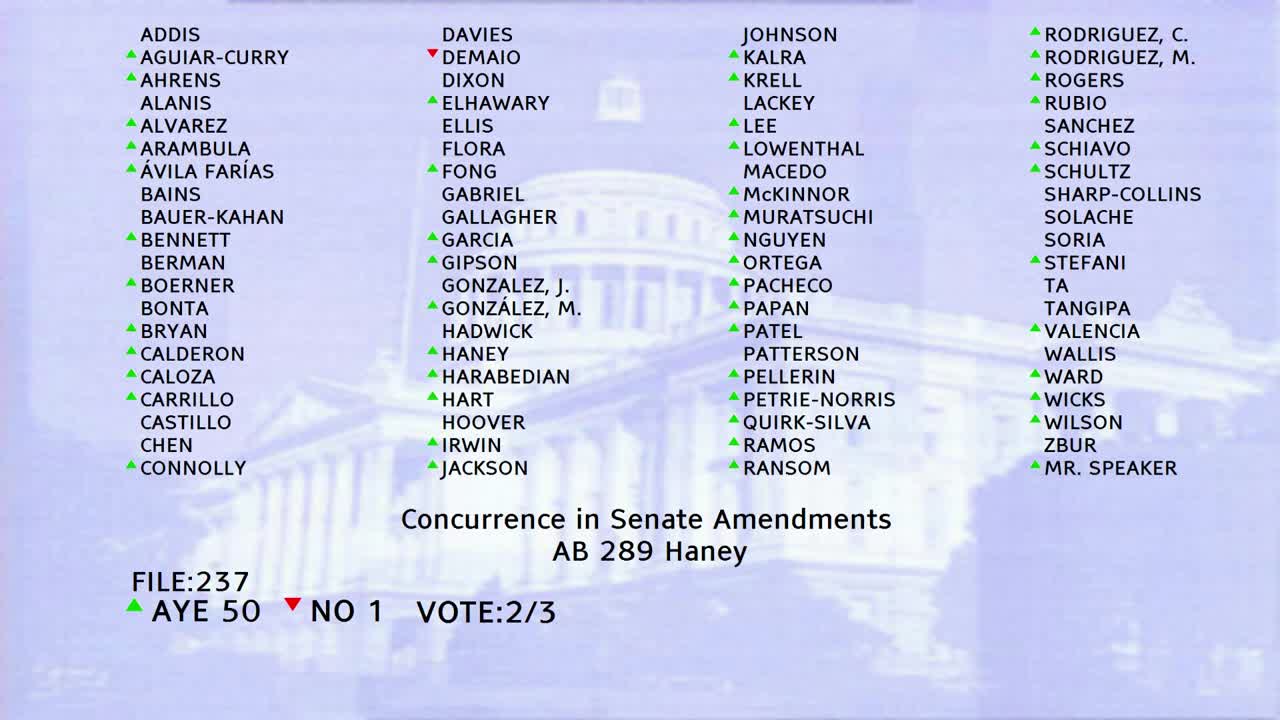 46SEC
Assembly Floor
 3MIN
Senate Floor
 21SEC
Senate Standing Committee on Appropriations
 16MIN
Senate Standing Committee on Judiciary
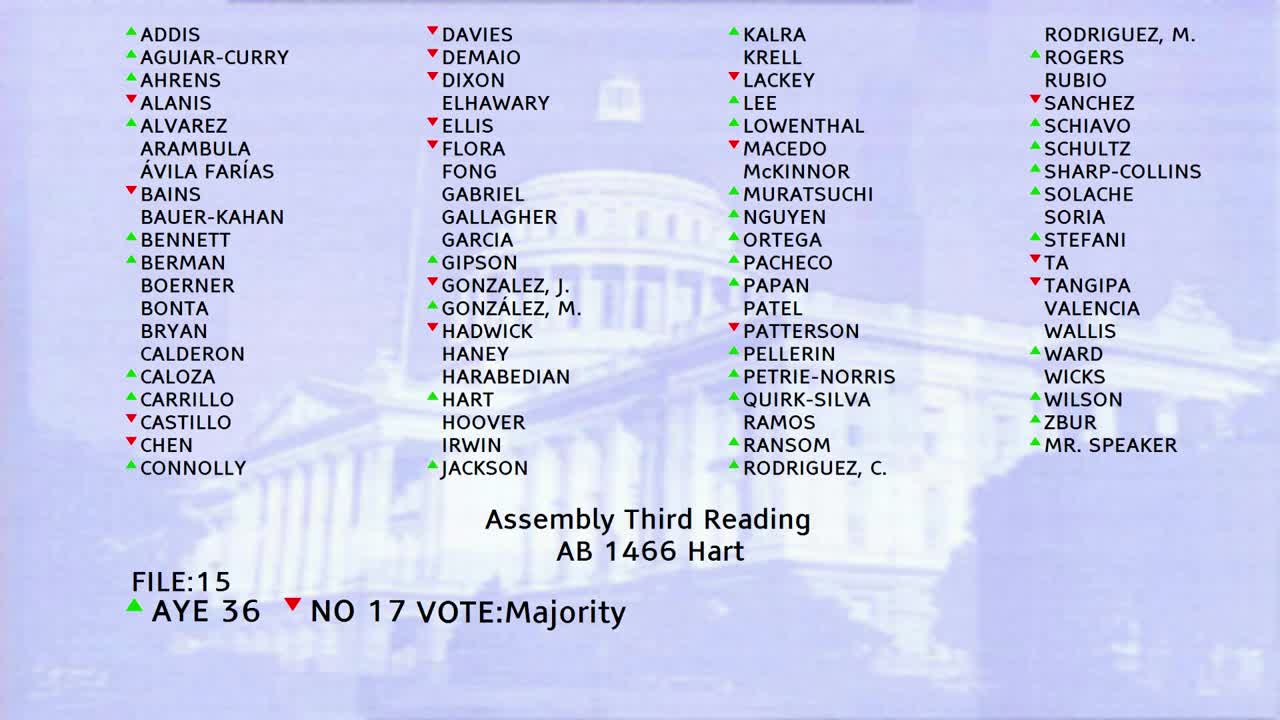 4MIN
Assembly Floor
 22MIN
Assembly Standing Committee on Judiciary
 52MIN
Assembly Standing Committee on Judiciary
Bill Author