AB 2477: Structural pest control.
- Session Year: 2025-2026
- House: Assembly
- Latest Version Date: 2026-09-18
Current Status:
Passed
(2026-09-18: Chaptered by Secretary of State - Chapter 303, Statutes of 2026.)
Introduced
In Committee
Awaiting First Chamber Vote
Passed First Chamber
In Committee
Awaiting Second Chamber Vote
Passed Second Chamber
Enacted
What does this bill do?
The bill lets unlicensed workers at registered structural pest control companies who have applied for Branch 2 or 3 applicator exams apply pesticides outdoors under the direct supervision of a licensed operator or field representative for up to 60 days. To qualify they must have filed an exam application and completed documented training that includes at least 80 hours of in-person, supervised pesticide application training plus instruction on labels, safety, equipment, and worker rights. Companies and supervisors must keep training records for at least three years, the authorization is one-time, and it does not allow indoor work or use of restricted-use pesticides.
The summary is provided by generative AI which can make mistakes. For original language, please view the details in the table below.
Existing law provides for the licensure and regulation of structural pest control by the Structural Pest Control Board in the Department of Consumer Affairs. A violation of these provisions is a misdemeanor. Existing law designates each county agricultural commissioner as the lead agency for inspections and routine investigations of structural pest control operators and registered companies. Existing law prescribes 3 classifications of structural pest control licenses, which are designated as Branch 1, Branch 2, and Branch 3, based on the types of pest control work permitted. Branch 1 relates to the control of household and wood-destroying pests or organisms by fumigation with poisonous or lethal gases. Branch 2 relates to the control of household pests, excluding fumigation with poisonous or lethal gases. Branch 3 relates to the control of wood-destroying pests or organisms by the use of insecticides, or structural repairs and corrections, excluding fumigation with poisonous or lethal gases.
Existing law prohibits an unlicensed individual in the employ of a registered company from applying pesticides included in Branch 2 or Branch 3, but authorizes an individual, for 90 days from the date of employment, to apply pesticides for the purposes of training under the direct supervision of a licensed field representative or operator employed by the company.
This bill, on and after January 1, 2028, would also authorize an unlicensed individual employed by a registered company who has applied for a structural pest control applicator examination in Branch 2 and Branch 3 to apply pesticides included in Branch 2 and Branch 3 outdoors under the supervision of a licensed operator or field representative for up to 60 days if specified conditions are met, including that the unlicensed individual has completed a minimum of 80 hours of documented in-person training in pesticide application under the direct supervision of a licensed operator or field representative, as specified. The bill would require the registered company and supervising licensee to maintain certain documentation, including documentation demonstrating completion of required training, for at least 3 years.
By expanding the scope of a crime and to the extent the bill would impose additional requirements on county agricultural commissioners, the bill would impose a state-mandated local program.
The California Constitution requires the state to reimburse local agencies and school districts for certain costs mandated by the state. Statutory provisions establish procedures for making that reimbursement.
This bill would provide that with regard to certain mandates no reimbursement is required by this act for a specified reason.
With regard to any other mandates, this bill would provide that, if the Commission on State Mandates determines that the bill contains costs so mandated by the state, reimbursement for those costs shall be made pursuant to the statutory provisions noted above.
Existing law provides for the licensure and regulation of structural pest control by the Structural Pest Control Board in the Department of Consumer Affairs. A violation of these provisions is a misdemeanor. Existing law designates each county agricultural commissioner as the lead agency for inspections and routine investigations of structural pest control operators and registered companies. Existing law prescribes 3 classifications of structural pest control licenses, which are designated as Branch 1, Branch 2, and Branch 3, based on the types of pest control work permitted. Branch 1 relates to the control of household and wood-destroying pests or organisms by fumigation with poisonous or lethal gases. Branch 2 relates to the control of household pests, excluding fumigation with poisonous or lethal gases. Branch 3 relates to the control of wood-destroying pests or organisms by the use of insecticides, or structural repairs and corrections, excluding fumigation with poisonous or lethal gases.
Existing law prohibits an unlicensed individual in the employ of a registered company from applying pesticides included in Branch 2 or Branch 3, but authorizes an individual, for 90 days from the date of employment, to apply pesticides for the purposes of training under the direct supervision of a licensed field representative or operator employed by the company.
This bill, on and after January 1, 2028, would also authorize an unlicensed individual employed by a registered company who has applied for a structural pest control applicator examination in Branch 2 and Branch 3 to apply pesticides included in Branch 2 and Branch 3 outdoors under the supervision of a licensed operator or field representative for up to 60 days if specified conditions are met, including that the unlicensed individual has completed a minimum of 80 hours of documented in-person training in pesticide application under the direct supervision of a licensed operator or field representative. The bill would require the registered company employing the individual, before the unlicensed individual performs work, to notify the board and the county agricultural commissioner in each county in which the individual will perform work. application under the direct supervision of a licensed operator or field representative, as specified. The bill would require the registered company and supervising licensee to maintain certain documentation, including documentation demonstrating completion of required training, for at least 3 years.
By expanding the scope of a crime and to the extent the bill would impose additional requirements on county agricultural commissioners, the bill would impose a state-mandated local program.
The California Constitution requires the state to reimburse local agencies and school districts for certain costs mandated by the state. Statutory provisions establish procedures for making that reimbursement.
This bill would provide that with regard to certain mandates no reimbursement is required by this act for a specified reason.
With regard to any other mandates, this bill would provide that, if the Commission on State Mandates determines that the bill contains costs so mandated by the state, reimbursement for those costs shall be made pursuant to the statutory provisions noted above.
Existing law provides for the licensure and regulation of structural pest control by the Structural Pest Control Board in the Department of Consumer Affairs. A violation of these provisions is a misdemeanor. Existing law designates each county agricultural commissioner as the lead agency for inspections and routine investigations of structural pest control operators and registered companies. Existing law prescribes 3 classifications of structural pest control licenses, which are designated as Branch 1, Branch 2, and Branch 3, based on the types of pest control work permitted. Branch 1 relates to the control of household and wood-destroying pests or organisms by fumigation with poisonous or lethal gases. Branch 2 relates to the control of household pests, excluding fumigation with poisonous or lethal gases. Branch 3 relates to the control of wood-destroying pests or organisms by the use of insecticides, or structural repairs and corrections, excluding fumigation with poisonous or lethal gases.
Existing law prohibits an unlicensed individual in the employ of a registered company from applying pesticides included in Branch 2 or Branch 3, but authorizes an individual, for 90 days from the date of employment, to apply pesticides for the purposes of training under the direct supervision of a licensed field representative or operator employed by the company.
This bill, on and after January 1, 2028, would also authorize an unlicensed individual employed by a registered company who has applied for a structural pest control applicator examination in Branch 2 or and Branch 3 to apply pesticides included in Branch 2 or and Branch 3 outdoors under the supervision, as defined, supervision of a licensed operator or field representative for up to 60 days if specified conditions are met, including that the unlicensed individual has completed a minimum of 80 hours of training in pesticide application under the direct supervision, as defined, supervision of a licensed operator or field representative. The bill would require the registered company employing the individual, before the unlicensed individual performs work, to notify the board and the county agricultural commissioner in each county in which the individual will perform work. The bill would require a the registered company and supervising licensee to maintain certain documentation, including documentation demonstrating completion of required training. training, for at least 3 years.
By expanding the scope of a crime and to the extent the bill would impose additional requirements on county agricultural commissioners, the bill would impose a state-mandated local program.
The California Constitution requires the state to reimburse local agencies and school districts for certain costs mandated by the state. Statutory provisions establish procedures for making that reimbursement.
This bill would provide that with regard to certain mandates no reimbursement is required by this act for a specified reason.
With regard to any other mandates, this bill would provide that, if the Commission on State Mandates determines that the bill contains costs so mandated by the state, reimbursement for those costs shall be made pursuant to the statutory provisions noted above.
Existing law provides for the licensure and regulation of structural pest control by the Structural Pest Control Board in the Department of Consumer Affairs. A violation of these provisions is a misdemeanor. Existing law designates each county agricultural commissioner as the lead agency for inspections and routine investigations of structural pest control operators and registered companies. Existing law prescribes 3 classifications of structural pest control licenses, which are designated as Branch 1, Branch 2, and Branch 3, based on the types of pest control work permitted. Branch 1 relates to the control of household and wood-destroying pests or organisms by fumigation with poisonous or lethal gases. Branch 2 relates to the control of household pests, excluding fumigation with poisonous or lethal gases. Branch 3 relates to the control of wood-destroying pests or organisms by the use of insecticides, or structural repairs and corrections, excluding fumigation with poisonous or lethal gases.
Existing law prohibits an unlicensed individual in the employ of a registered company from applying pesticides included in Branch 2 or Branch 3, but authorizes an individual, for 90 days from the date of employment, to apply pesticides for the purposes of training under the direct supervision of a licensed field representative or operator employed by the company.
This bill, on and after January 1, 2028, would also authorize an unlicensed individual employed by a registered company who has applied for a structural pest control applicator license examination in Branch 2 or Branch 3 to apply pesticides included in Branch 2 or Branch 3 under the supervision, as defined, of a licensed operator or field representative during a provisional supervision period of for up to 60 days if specified conditions are met, including that the unlicensed individual has completed a minimum of 80 hours of training under the direct supervision, as defined, of a licensed operator or field representative. The bill would require a supervising licensee to maintain certain documentation, including documentation demonstrating completion of training and proof of applicator license submission. required training.
By expanding the scope of a crime and to the extent the bill would impose additional requirements on county agricultural commissioners, the bill would impose a state-mandated local program.
The California Constitution requires the state to reimburse local agencies and school districts for certain costs mandated by the state. Statutory provisions establish procedures for making that reimbursement.
This bill would provide that with regard to certain mandates no reimbursement is required by this act for a specified reason.
With regard to any other mandates, this bill would provide that, if the Commission on State Mandates determines that the bill contains costs so mandated by the state, reimbursement for those costs shall be made pursuant to the statutory provisions noted above.
Existing law provides for the licensure and regulation of structural pest control by the Structural Pest Control Board in the Department of Consumer Affairs. A violation of these provisions is a misdemeanor. Existing law designates each county agricultural commissioner as the lead agency for inspections and routine investigations of structural pest control operators and registered companies. Existing law prescribes 3 classifications of structural pest control licenses, which are designated as Branch 1, Branch 2, and Branch 3, based on the types of pest control work permitted. Branch 1 relates to the control of household and wood-destroying pests or organisms by fumigation with poisonous or lethal gases. Branch 2 relates to the control of household pests, excluding fumigation with poisonous or lethal gases. Branch 3 relates to the control of wood-destroying pests or organisms by the use of insecticides, or structural repairs and corrections, excluding fumigation with poisonous or lethal gases.
Existing law prohibits an unlicensed individual in the employ of a registered company from applying pesticides included in Branch 2 or Branch 3, but authorizes an individual, for 90 days from the date of employment, to apply pesticides for the purposes of training under the direct supervision of a licensed field representative or operator employed by the company.
This bill, on and after January 1, 2028, would also authorize an unlicensed individual employed by a registered company who has applied for a structural pest control applicator license in Branch 2 or Branch 3 to apply pesticides included in Branch 2 or Branch 3 under the direct supervision supervision, as defined, of a licensed operator or field representative during a provisional supervision period of up to 60 days if specified conditions are met, including that the unlicensed individual has completed a minimum of 80 hours of training under the direct supervision supervision, as defined, of a licensed operator or field representative. The bill would require a supervising licensee to maintain documentation demonstrating completion of training and proof of applicator license submission.
By expanding the scope of a crime and to the extent the bill would impose additional requirements on county agricultural commissioners, the bill would impose a state-mandated local program.
The California Constitution requires the state to reimburse local agencies and school districts for certain costs mandated by the state. Statutory provisions establish procedures for making that reimbursement.
This bill would provide that with regard to certain mandates no reimbursement is required by this act for a specified reason.
With regard to any other mandates, this bill would provide that, if the Commission on State Mandates determines that the bill contains costs so mandated by the state, reimbursement for those costs shall be made pursuant to the statutory provisions noted above.
Existing law provides for the licensure and regulation of structural pest control by the Structural Pest Control Board in the Department of Consumer Affairs. A violation of these provisions is a misdemeanor. Existing law designates each county agricultural commissioner as the lead agency for inspections and routine investigations of structural pest control operators and registered companies. Existing law prescribes 3 classifications of structural pest control licenses, which are designated as Branch 1, Branch 2, and Branch 3, based on the types of pest control work permitted. Branch 1 relates to the control of household and wood-destroying pests or organisms by fumigation with poisonous or lethal gases. Branch 2 relates to the control of household pests, excluding fumigation with poisonous or lethal gases. Branch 3 relates to the control of wood-destroying pests or organisms by the use of insecticides, or structural repairs and corrections, excluding fumigation with poisonous or lethal gases.
Existing law prohibits an unlicensed individual in the employ of a registered company from applying pesticides included in Branch 2 or Branch 3, but authorizes an individual, for 90 days from the date of employment, to apply pesticides for the purposes of training under the direct supervision of a licensed field representative or operator employed by the company.
This bill, on and after January 1, 2028, would also authorize an unlicensed individual employed by a registered company who has applied for a structural pest control applicator license in Branch 2 or Branch 3 to apply pesticides included in Branch 2 or Branch 3 under the direct supervision of a licensed operator or field representative during a provisional supervision period of up to 60 days if specified conditions are met, including that the unlicensed individual has completed a minimum of 80 hours of training under the direct supervision of a licensed operator or field representative. The bill would require a supervising licensee to maintain documentation demonstrating completion of training and proof of applicator license submission.
By expanding the scope of a crime and to the extent the bill would impose additional requirements on county agricultural commissioners, the bill would impose a state-mandated local program.
The California Constitution requires the state to reimburse local agencies and school districts for certain costs mandated by the state. Statutory provisions establish procedures for making that reimbursement.
This bill would provide that with regard to certain mandates no reimbursement is required by this act for a specified reason.
With regard to any other mandates, this bill would provide that, if the Commission on State Mandates determines that the bill contains costs so mandated by the state, reimbursement for those costs shall be made pursuant to the statutory provisions noted above.
This act shall be known as the Small Pest Control Business Relief Act.
SEC. 2.The Legislature finds and declares all of the following:
(a)Californias structural pest control industry provides essential public health and property protection services from dangerous and deadly pests and is comprised primarily of small businesses, with a majority employing five or fewer workers.
(b)Existing law requires individuals performing structural pest control to be properly licensed, but current licensing timelines for entry-level applicators often result in delays between hiring, examination, and license issuance, during which new employees may not legally perform supervised pest control work.
(c)Existing law already allows applicants for applicator, operator, and field representative licenses to perform work under direct supervision during a limited training period, demonstrating that structured, supervised onboarding can occur safely within Californias regulatory framework.
(d)Allowing a limited, clearly defined provisional supervision period for applicator license applicants who have completed documented training will help address workforce shortages, reduce barriers to entry, and support small businesses, while maintaining full safety and regulatory oversight under Department of Pesticide Regulation supervision standards.
SEC. 3.Section 8551.6 is added to the Business and Professions Code, to read:8551.6.(a)For purposes of this section, all of the following definitions shall apply:
(1)Direct supervision means the direction of actions authorized by this section by a licensed operator or field representative who shall be physically present on location and immediately available to intervene.
(2)Outdoor applications means pesticide applications made to exterior areas, including exterior structural surfaces, exterior perimeters, landscape areas, hardscape areas, and other outdoor areas associated with a structure. Outdoor applications does not include applications made within the interior of any structure, including occupied spaces, food-handling areas, attics, crawlspaces, subareas, wall voids, or other enclosed interior areas.
(3)Supervision means either direct supervision or the direction of actions authorized by this section by a licensed operator or field representative who is immediately available to the unlicensed individual during pesticide application, either by being physically present at the site or through audio and video communication with access to the customers relevant information and the ability to intervene by directing onsite personnel.
(b)Notwithstanding any other law, an unlicensed individual employed by a registered company who has applied for a structural pest control applicator examination in Branch 2 and Branch 3 may apply pesticides included in Branch 2 and Branch 3 outdoors under the supervision of a licensed operator or field representative for a period of up to 60 days, commencing upon approval from the board, if both of the following conditions are met:
(1)The unlicensed individual has submitted a complete structural pest control applicator examination application to the board, as evidenced by written or electronic confirmation of receipt.
(2)The unlicensed individual has completed documented training in pesticide application as described in subdivision (c).
(c)(1)The training shall, at a minimum, be relevant to Branch 2 and Branch 3 structural pest control work and include sufficient instruction to ensure safe and competent pesticide application. The training shall include, for each pesticide or chemically similar group of pesticides, all of the following:
(A)The unlicensed individuals responsibility to consumer safety to protect persons, animals, and property while applying pesticides, including sensitive populations such as pregnant women and children.
(B)The format and meaning of information contained in pesticide product labeling and safety data sheets applicable to the safe use of pesticides, including how to identify if a product is either a federal restricted use pesticide or a California restricted material as described in Section 6400 of Title 3 of the California Code of Regulations.
(C)Site preparation requirements, proper pesticide application equipment use, and the necessity and appropriate use of any required personal protective equipment and measures.
(D)Safety requirements and procedures, including decontamination procedures.
(E)Hazards of pesticides, hazard communication, and hazard exposure routes for pesticides, including signs and symptoms of overexposure.
(F)Employee rights.
(2)(A)In addition to the requirements described in paragraph (1), the training pursuant to this subdivision shall include a minimum of 80 hours of documented in-person training in pesticide application under the direct supervision of a licensed operator or field representative.
(B)The training shall be in a manner the employee can understand and in a format or combination of formats determined appropriate by the registered company or supervising licensee, including classroom, field, audiovisual, electronic, written, demonstrative, supervised practical, or other substantially equivalent training methods. The training shall be provided by, or under the direction of, a licensed operator, licensed field representative, registered company, or their designee.
(3)The board may adopt regulations to further specify or modify the training components and competencies required pursuant to this subdivision. The training shall focus on pesticide handling, pesticide application, pesticide safety, label compliance, and the applicable laws and regulations.
(d)The authorization period provided by this section shall:
(1)Be granted once per individual.
(2)Commence upon approval from the board.
(3)Not be renewed or granted again, including after failure of the examination, submission of a subsequent application, or change in employment.
(4)Terminate upon license issuance, application denial, failure of the examination, or expiration of the 60-day period, whichever occurs first.
(e)The authorization period provided by this section shall not extend any training or supervision period authorized under Section 8551.5.
(f)This section does not expand or limit any laws authorizing or prohibiting an unlicensed individual from applying a pesticide classified as a restricted use pesticide pursuant to Section 3 of the Federal Insecticide, Fungicide, and Rodenticide Act (7 U.S.C. Sec. 136a) or a California restricted material as described in Section 6400 of Title 3 of the California Code of Regulations.
(g)Any pesticide application performed by the unlicensed individual pursuant to this section shall be limited to outdoor applications only.
(h)(1)The registered company and supervising licensee shall maintain for not less than three years documentation demonstrating compliance with paragraphs (1) and (2) of subdivision (b). This documentation shall include, at a minimum, all of the following:
(A)The date or date range during which training was completed and the total number of hours of training completed.
(B)The type or types of training provided.
(C)A brief description of the subject matter covered.
(D)The name and signature, which may include an electronic signature, of the licensed operator or licensed field representative responsible for the training.
(E)Proof of completion of the training required by subdivision (c).
(2)The registered company and supervising licensee shall retain the documentation described in this subdivision for not less than three years and shall make that documentation available to the board, the Department of Pesticide Regulation, the county agricultural commissioner, or the applicant upon request.
(i)This section is operative on January 1, 2028.
SEC. 4.No reimbursement is required by this act pursuant to Section 6 of Article XIIIB of the California Constitution for certain costs that may be incurred by a local agency or school district because, in that regard, this act creates a new crime or infraction, eliminates a crime or infraction, or changes the penalty for a crime or infraction, within the meaning of Section 17556 of the Government Code, or changes the definition of a crime within the meaning of Section 6 of Article XIIIB of the California Constitution.
However, if the Commission on State Mandates determines that this act contains other costs mandated by the state, reimbursement to local agencies and school districts for those costs shall be made pursuant to Part 7 (commencing with Section 17500) of Division 4 of Title 2 of the Government Code.
This act shall be known as the Small Pest Control Business Relief Act.
SEC. 2.The Legislature finds and declares all of the following:
(a)Californias structural pest control industry provides essential public health and property protection services from dangerous and deadly pests and is comprised primarily of small businesses, with a majority employing five or fewer workers.
(b)Existing law requires individuals performing structural pest control to be properly licensed, but current licensing timelines for entry-level applicators often result in delays between hiring, examination, and license issuance, during which new employees may not legally perform supervised pest control work.
(c)Existing law already allows applicants for operator applicator, operator, and field representative licenses to perform work under direct supervision during a limited training period, demonstrating that structured, supervised onboarding can occur safely within Californias regulatory framework.
(d)Allowing a limited, clearly defined provisional supervision period for applicator license applicants who have completed documented training will help address workforce shortages, reduce barriers to entry, and support small businesses, while maintaining full safety and regulatory oversight under Department of Pesticide Regulation supervision standards.
SEC. 3.Section 8551.6 is added to the Business and Professions Code, to read:8551.6.(a)For purposes of this section, all of the following definitions shall apply:
(1)Direct supervision means the direction of actions authorized by this section by a licensed operator or field representative who shall be physically present on location and immediately available to intervene.
(2)Outdoors means exterior areas, including exterior structural surfaces, exterior perimeters, landscape areas, hardscape areas, and other outdoor areas associated with a structure. Outdoors does not include the interior of any structure, including occupied spaces, food-handling areas, attics, crawlspaces, subareas, wall voids, or other enclosed interior areas.(2)Outdoor applications means pesticide applications made to exterior areas, including exterior structural surfaces, exterior perimeters, landscape areas, hardscape areas, and other outdoor areas associated with a structure. Outdoor applications does not include applications made within the interior of any structure, including occupied spaces, food-handling areas, attics, crawlspaces, subareas, wall voids, or other enclosed interior areas.
(3)Supervision means either direct supervision or the direction of actions authorized by this section by a licensed operator or field representative who is immediately available to the unlicensed individual during pesticide application, either by being physically present at the site or through audio and video communication with access to the customers relevant information and the ability to intervene by directing onsite personnel.
(b)Notwithstanding any other law, an unlicensed individual employed by a registered company who has applied for a structural pest control applicator examination in Branch 2 and Branch 3 may apply pesticides included in Branch 2 and Branch 3 outdoors under the supervision of a licensed operator or field representative for a period of up to 60 days, commencing upon Live Scan approval pursuant to paragraph (3), approval from the board, if all both of the following conditions are met:
(1)The unlicensed individual has submitted a complete structural pest control applicator examination application to the board, as evidenced by written or electronic confirmation of receipt.
(2)The unlicensed individual has completed the documented training in pesticide application as described in subdivision (c).
(3)The unlicensed individual has submitted fingerprint identification to, and completed a background investigation with, the board.(c)(1)The training shall, at a minimum, be relevant to Branch 2 and Branch 3 structural pest control work and include sufficient instruction to ensure safe and competent pesticide application. The training shall include, for each pesticide or chemically similar group of pesticides, all of the following:
(A)The unlicensed individuals responsibility to consumer safety to protect persons, animals, and property while applying pesticides, including sensitive populations such as pregnant women and children.
(B)The format and meaning of information contained in pesticide product labeling and safety data sheets applicable to the safe use of pesticides, including how to identify if a product is either a federal restricted use pesticide or a California restricted material as described in Section 6400 of Title 3 of the California Code of Regulations.
(C)Site preparation requirements, proper pesticide application equipment use, and the necessity and appropriate use of any required personal protective equipment and measures.
(D)Safety requirements and procedures, including decontamination procedures.
(E)Hazards of pesticides, hazard communication, and hazard exposure routes for pesticides, including signs and symptoms of overexposure.
(F)Employee rights.
(2)The (A)In addition to the requirements described in paragraph (1), the training pursuant to this subdivision shall include a minimum of 80 hours of documented in-person training in pesticide application under the direct supervision of a licensed operator or field representative.
(3)The training shall include at least four hours of board-approved continuing education, or equivalent board-approved training, focused on pesticide handling, pesticide application, pesticide safety, label compliance, and the applicable laws and regulations. (4)(B)The training shall be in a manner the employee can understand and in a format or combination of formats determined appropriate by the registered company or supervising licensee, including classroom, field, audiovisual, electronic, written, demonstrative, supervised practical, or other substantially equivalent training methods. The training shall be provided by, or under the direction of, a licensed operator, licensed field representative, registered company, or their designee.
(5)(3)The board may adopt regulations to further specify or modify the training components and competencies required pursuant to this subdivision. The training shall focus on pesticide handling, pesticide application, pesticide safety, label compliance, and the applicable laws and regulations.
(d)The authorization period provided by this section shall:
(1)Be granted once per individual.
(2)Commence upon Live Scan approval pursuant to paragraph (3) of subdivision (b). approval from the board.
(3)Not be renewed or granted again, including after failure of the examination, submission of a subsequent application, or change in employment.
(4)Terminate upon license issuance, application denial, failure of the examination, or expiration of the 60-day period, whichever occurs first.
(e)The authorization period provided by this section shall not overlap with or extend any training or supervision period authorized under Section 8551.5. An unlicensed individual may begin operating under subdivision (b) prior to completing the 90-day period described in Section 8551.5. However, upon commencement of the authorization under subdivision (b), the unlicensed individual shall no longer be eligible to operate pursuant to Section 8551.5 and any remaining time under Section 8551.5 is forfeited and shall not be reinstated.
(f)This section does not expand or limit any laws authorizing or prohibiting an unlicensed individual from applying a pesticide classified as a restricted use pesticide pursuant to Section 3 of the Federal Insecticide, Fungicide, and Rodenticide Act (7 U.S.C. Sec. 136a) or a California restricted material as described in Section 6400 of Title 3 of the California Code of Regulations.
(g)(1)Before an unlicensed individual performs work pursuant to this section, the registered company employing the individual shall notify the board and the county agricultural commissioner in each county in which the individual will perform work pursuant to this section. The notice may be provided electronically. The notice shall include all of the following:(A)The name of the unlicensed individual.(B)The name and registration number of the registered company.(C)The name and license number of the supervising licensee.(D)The applicable branch or branches.(E)The anticipated dates during which the individual may perform work pursuant to this section.(2)This subdivision shall not be construed to require approval by the board or the county agricultural commissioner before the unlicensed individual may perform work authorized by this section.(g)Any pesticide application performed by the unlicensed individual pursuant to this section shall be limited to outdoor applications only.
(h)(1)The registered company and supervising licensee shall maintain for not less than three years documentation demonstrating compliance with paragraphs (1) to (3), inclusive, and (2) of subdivision (b). The This documentation shall include, at a minimum, all of the following:
(A)The dates, start times, end times, and date or date range during which training was completed and the total number of hours of training completed.
(B)The type or types of training provided during each training segment, including whether the training was classroom, filed, audiovisual, electronic, written, demonstrative, supervised practical, or another substantially equivalent training method. provided.
(C)A brief description of the subject matter covered during each training segment. covered.
(D)The name, license type, license number, name and signature, which may include an electronic signature, of the licensed operator or licensed field representative who provided, supervised, or was responsible for the training.
(E)Proof of completion of the continuing education or equivalent board-approved training required by paragraph (3) of subdivision (c).
(2)The registered company and supervising licensee shall maintain documentation of the notices provided pursuant to subdivision (g). (3)(2)The registered company and supervising licensee shall retain the documentation described in this subdivision for not less than three years and shall make that documentation available to the board, the Department of Pesticide Regulation, or the county agricultural commissioner commissioner, or the applicant upon request.
(i)This section is operative on January 1, 2028.
SEC. 4.No reimbursement is required by this act pursuant to Section 6 of Article XIIIB of the California Constitution for certain costs that may be incurred by a local agency or school district because, in that regard, this act creates a new crime or infraction, eliminates a crime or infraction, or changes the penalty for a crime or infraction, within the meaning of Section 17556 of the Government Code, or changes the definition of a crime within the meaning of Section 6 of Article XIIIB of the California Constitution.
However, if the Commission on State Mandates determines that this act contains other costs mandated by the state, reimbursement to local agencies and school districts for those costs shall be made pursuant to Part 7 (commencing with Section 17500) of Division 4 of Title 2 of the Government Code.
This act shall be known as the Small Pest Control Business Relief Act.
SEC. 2.The Legislature finds and declares all of the following:
(a)Californias structural pest control industry provides essential public health and property protection services from dangerous and deadly pests and is comprised primarily of small businesses, with a majority employing five or fewer workers.
(b)Existing law requires individuals performing structural pest control to be properly licensed, but current licensing timelines for entry-level applicators often result in delays between hiring, examination, and license issuance, during which new employees may not legally perform supervised pest control work.
(c)These delays are caused by factors including examination scheduling, application processing, and postexamination requirements such as Live Scan fingerprint clearance, which may take several weeks to complete. (d)(c)Existing law already allows applicants for operator and field representative licenses to perform work under direct supervision during a limited training period, demonstrating that structured, supervised onboarding can occur safely within Californias regulatory framework.
(e)(d)Allowing a limited, clearly defined provisional supervision period for applicator license applicants who have completed documented training will help address workforce shortages, reduce barriers to entry, and support small businesses, while maintaining full safety and regulatory oversight under Department of Pesticide Regulation supervision standards.
SEC. 3.Section 8551.6 is added to the Business and Professions Code, to read:8551.6.(a)For purposes of this section, both all of the following definitions shall apply:
(1)Direct supervision means the direction of actions authorized by this section by a licensed operator or field representative who shall be physically present on location and immediately available to intervene.
(2)Outdoors means exterior areas, including exterior structural surfaces, exterior perimeters, landscape areas, hardscape areas, and other outdoor areas associated with a structure. Outdoors does not include the interior of any structure, including occupied spaces, food-handling areas, attics, crawlspaces, subareas, wall voids, or other enclosed interior areas.
(2)(3)Supervision means either direct supervision or the direction of actions authorized by this section by a licensed operator or field representative who is immediately available to the unlicensed individual during pesticide application, either by being physically present at the site or through audio and video communication with access to the customers relevant information and the ability to intervene by directing onsite personnel.
(b)Notwithstanding any other law, an unlicensed individual employed by a registered company who has applied for a structural pest control applicator examination in Branch 2 or and Branch 3 may apply pesticides included in Branch 2 or and Branch 3 outdoors under the supervision of a licensed operator or field representative for a period of up to 60 days, commencing upon Live Scan approval pursuant to paragraph (3), if all of the following conditions are met:
(1)The unlicensed individual has submitted a complete structural pest control applicator examination application to the board, as evidenced by written or electronic confirmation of receipt.
(2)The unlicensed individual has completed a minimum of 80 hours of documented, in-person training in pesticide application under the direct supervision of a licensed operator or field representative. the training in pesticide application described in subdivision (c).
(3)The unlicensed individual has submitted fingerprint identification to, and completed a background investigation with, the board.
(c)The supervising licensee shall maintain documentation demonstrating compliance with subdivision (b), including proof of completion of the required training, applicator examination application submission, and fingerprint identification to, and completed background investigation with, the board.(c)(1)The training shall, at a minimum, be relevant to Branch 2 and Branch 3 structural pest control work and include sufficient instruction to ensure safe and competent pesticide application. The training shall include, for each pesticide or chemically similar group of pesticides, all of the following:
(A)The unlicensed individuals responsibility to consumer safety to protect persons, animals, and property while applying pesticides, including sensitive populations such as pregnant women and children.
(B)The format and meaning of information contained in pesticide product labeling and safety data sheets applicable to the safe use of pesticides, including how to identify if a product is either a federal restricted use pesticide or a California restricted material as described in Section 6400 of Title 3 of the California Code of Regulations.
(C)Site preparation requirements, proper pesticide application equipment use, and the necessity and appropriate use of any required personal protective equipment and measures.
(D)Safety requirements and procedures, including decontamination procedures.
(E)Hazards of pesticides, hazard communication, and hazard exposure routes for pesticides, including signs and symptoms of overexposure.
(F)Employee rights.
(2)The training shall include a minimum of 80 hours of documented in-person training in pesticide application under the direct supervision of a licensed operator or field representative.
(3)The training shall include at least four hours of board-approved continuing education, or equivalent board-approved training, focused on pesticide handling, pesticide application, pesticide safety, label compliance, and the applicable laws and regulations.
(4)The training shall be in a manner the employee can understand and in a format or combination of formats determined appropriate by the registered company or supervising licensee, including classroom, field, audiovisual, electronic, written, demonstrative, supervised practical, or other substantially equivalent training methods. The training shall be provided by, or under the direction of, a licensed operator, licensed field representative, registered company, or their designee.
(5)The board may adopt regulations to further specify the training components and competencies required pursuant to this subdivision.
(d)The authorization period provided by this section shall:
(1)Be granted once per individual.
(2)Commence upon Live Scan approval pursuant to paragraph (3) of subdivision (b).
(3)Not be renewed or granted again, including after failure of the examination, submission of a subsequent application, or change in employment.
(4)Terminate upon license issuance, application denial, failure of the examination, or expiration of the 60-day period, whichever occurs first.
(e)The authorization period provided by this section shall not overlap with or extend any training or supervision period authorized under Section 8551.5. An unlicensed individual may begin operating under subdivision (b) prior to completing the 90-day period described in Section 8551.5. However, upon commencement of the authorization under subdivision (b), the unlicensed individual shall no longer be eligible to operate pursuant to Section 8551.5 and any remaining time under Section 8551.5 is forfeited and shall not be reinstated.
(f)This section does not expand or limit any laws authorizing or prohibiting an unlicensed individual from applying a pesticide classified as a restricted use pesticide pursuant to Section 3 of the Federal Insecticide, Fungicide, and Rodenticide Act (7 U.S.C. Sec. 136a) or a California restricted material as described in Section 6400 of Title 3 of the California Code of Regulations.
(g)(1)Before an unlicensed individual performs work pursuant to this section, the registered company employing the individual shall notify the board and the county agricultural commissioner in each county in which the individual will perform work pursuant to this section. The notice may be provided electronically. The notice shall include all of the following:
(A)The name of the unlicensed individual.
(B)The name and registration number of the registered company.
(C)The name and license number of the supervising licensee.
(D)The applicable branch or branches.
(E)The anticipated dates during which the individual may perform work pursuant to this section.
(2)This subdivision shall not be construed to require approval by the board or the county agricultural commissioner before the unlicensed individual may perform work authorized by this section.
(h)(1)The registered company and supervising licensee shall maintain documentation demonstrating compliance with paragraphs (1) to (3), inclusive, of subdivision (b). The documentation shall include, at a minimum, all of the following:
(A)The dates, start times, end times, and total number of hours of training completed.
(B)The type or types of training provided during each training segment, including whether the training was classroom, filed, audiovisual, electronic, written, demonstrative, supervised practical, or another substantially equivalent training method.
(C)A brief description of the subject matter covered during each training segment.
(D)The name, license type, license number, and signature, which may include an electronic signature, of the licensed operator or licensed field representative who provided, supervised, or was responsible for the training.
(E)Proof of completion of the continuing education or equivalent board-approved training required by paragraph (3) of subdivision (c).
(2)The registered company and supervising licensee shall maintain documentation of the notices provided pursuant to subdivision (g).
(3)The registered company and supervising licensee shall retain the documentation described in this subdivision for not less than three years and shall make that documentation available to the board, the Department of Pesticide Regulation, or the county agricultural commissioner upon request.
(f)(i)This section is operative on January 1, 2028.
SEC. 4.No reimbursement is required by this act pursuant to Section 6 of Article XIIIB of the California Constitution for certain costs that may be incurred by a local agency or school district because, in that regard, this act creates a new crime or infraction, eliminates a crime or infraction, or changes the penalty for a crime or infraction, within the meaning of Section 17556 of the Government Code, or changes the definition of a crime within the meaning of Section 6 of Article XIIIB of the California Constitution.
However, if the Commission on State Mandates determines that this act contains other costs mandated by the state, reimbursement to local agencies and school districts for those costs shall be made pursuant to Part 7 (commencing with Section 17500) of Division 4 of Title 2 of the Government Code.
This act shall be known as the Small Pest Control Business Relief Act.
SEC. 2.The Legislature finds and declares all of the following:
(a)Californias structural pest control industry provides essential public health and property protection services from dangerous and deadly pests and is comprised primarily of small businesses, with a majority employing five or fewer workers.
(b)Existing law requires individuals performing structural pest control to be properly licensed, but current licensing timelines for entry-level applicators often result in delays between hiring, examination, and license issuance, during which new employees may not legally perform supervised pest control work.
(c)These delays are caused by factors including examination scheduling, application processing, and postexamination requirements such as Live Scan fingerprint clearance, which may take several weeks to complete.
(d)Existing law already allows applicants for operator and field representative licenses to perform work under direct supervision during a limited training period, demonstrating that structured, supervised onboarding can occur safely within Californias regulatory framework.
(e)Allowing a limited, clearly defined provisional supervision period for applicator license applicants who have completed documented training will help address workforce shortages, reduce barriers to entry, and support small businesses, while maintaining full safety and regulatory oversight under Department of Pesticide Regulation supervision standards.
SEC. 3.Section 8551.6 is added to the Business and Professions Code, to read:8551.6.(a)For purposes of this section, both of the following definitions shall apply:
(1)Direct supervision means the direction of actions authorized by this section by a licensed operator or field representative who shall be physically present on location and immediately available to intervene.
(2)Supervision means either direct supervision or the direction of actions authorized by this section by a licensed operator or field representative who is immediately available via to the unlicensed individual during pesticide application, either by being physically present at the site or through audio and video communication with access to the customers relevant information and the ability to intervene by directing onsite personnel.
(b)Notwithstanding any other law, an unlicensed individual employed by a registered company who has applied for a structural pest control applicator license examination in Branch 2 or Branch 3 may apply pesticides included in Branch 2 or Branch 3 under the supervision of a licensed operator or field representative during a provisional supervision for a period of up to 60 days days, commencing upon Live Scan approval pursuant to paragraph (3), if all of the following conditions are met:
(1)The unlicensed individual has submitted a complete structural pest control applicator license examination application to the board, as evidenced by written or electronic confirmation of receipt.
(2)The unlicensed individual has completed a minimum of 80 hours of documented, in-person training in pesticide application under the direct supervision of a licensed operator or field representative.
(3)The unlicensed individual has submitted fingerprint identification to, and completed a background investigation with, the board.
(4)The unlicensed individual has submitted the applicable examination application to the board.(5)All direct supervision complies with applicable direct supervision requirements of the Department of Pesticide Regulation.(c)The supervising licensee shall maintain documentation demonstrating completion of the training required by paragraph (2) of subdivision (b) and proof of applicator license application submission. compliance with subdivision (b), including proof of completion of the required training, applicator examination application submission, and fingerprint identification to, and completed background investigation with, the board.
(d)The provisional supervision period authorized by this section shall apply only once per individual per applicator license application, shall commence upon confirmation of the satisfaction of the conditions described in paragraphs (1) to (4), inclusive, of subdivision (b), and shall terminate upon license issuance, application denial, or expiration of the 60-day period, whichever occurs first.(e)The provisional supervision period authorized by this section shall not overlap with or extend any training or supervision period authorized under Section 8551.5.(d)The authorization period provided by this section shall:
(1)Be granted once per individual.
(2)Commence upon Live Scan approval pursuant to paragraph (3) of subdivision (b).
(3)Not be renewed or granted again, including after failure of the examination, submission of a subsequent application, or change in employment.
(4)Terminate upon license issuance, application denial, or expiration of the 60-day period, whichever occurs first.
(e)The authorization period provided by this section shall not overlap with or extend any training or supervision period authorized under Section 8551.5. An unlicensed individual may begin operating under subdivision (b) prior to completing the 90-day period described in Section 8551.5. However, upon commencement of the authorization under subdivision (b), the unlicensed individual shall no longer be eligible to operate pursuant to Section 8551.5 and any remaining time under Section 8551.5 is forfeited and shall not be reinstated.
(f)This section is operative on January 1, 2028.
SEC. 4.No reimbursement is required by this act pursuant to Section 6 of Article XIIIB of the California Constitution for certain costs that may be incurred by a local agency or school district because, in that regard, this act creates a new crime or infraction, eliminates a crime or infraction, or changes the penalty for a crime or infraction, within the meaning of Section 17556 of the Government Code, or changes the definition of a crime within the meaning of Section 6 of Article XIIIB of the California Constitution.
However, if the Commission on State Mandates determines that this act contains other costs mandated by the state, reimbursement to local agencies and school districts for those costs shall be made pursuant to Part 7 (commencing with Section 17500) of Division 4 of Title 2 of the Government Code.
This act shall be known as the Small Pest Control Business Relief Act.
SEC. 2.The Legislature finds and declares all of the following:
(a)Californias structural pest control industry provides essential public health and property protection services from dangerous and deadly pests and is comprised primarily of small businesses, with a majority employing five or fewer workers.
(b)Existing law requires individuals performing structural pest control to be properly licensed, but current licensing timelines for entry-level applicators often result in delays between hiring, examination, and license issuance, during which new employees may not legally perform supervised pest control work.
(c)These delays are caused by factors including examination scheduling, application processing, and postexamination requirements such as Live Scan fingerprint clearance, which may take several weeks to complete.
(d)Existing law already allows applicants for operator and field representative licenses to perform work under direct supervision during a limited training period, demonstrating that structured, supervised onboarding can occur safely within Californias regulatory framework.
(e)Allowing a limited, clearly defined provisional supervision period for applicator license applicants who have completed documented training will help address workforce shortages, reduce barriers to entry, and support small businesses, while maintaining full safety and regulatory oversight under Department of Pesticide Regulation supervision standards.
SEC. 3.Section 8551.6 is added to the Business and Professions Code, to read:8551.6.(a)For purposes of this section, both of the following definitions shall apply:
(1)Direct supervision means the direction of actions authorized by this section by a licensed operator or field representative who shall be physically present on location and immediately available to intervene.
(2)Supervision means either direct supervision or the direction of actions authorized by this section by a licensed operator or field representative who is immediately available via audio and video communication with access to the customers relevant information and the ability to intervene by directing onsite personnel.
(a)(b)Notwithstanding any other law, an unlicensed individual employed by a registered company who has applied for a structural pest control applicator license in Branch 2 or Branch 3 may apply pesticides included in Branch 2 or Branch 3 under the direct supervision of a licensed operator or field representative during a provisional supervision period of up to 60 days if all of the following conditions are met:
(1)The unlicensed individual has submitted a complete structural pest control applicator license application to the board, as evidenced by written or electronic confirmation of receipt.
(2)The unlicensed individual has completed a minimum of 80 hours of documented, in-person training under the direct supervision of a licensed operator or field representative.
(3)The unlicensed individual has submitted fingerprint identification to, and completed a background investigation with, the board.
(4)The unlicensed individual has submitted the applicable examination application to the board.
(3)(5)All direct supervision complies with applicable direct supervision requirements of the Department of Pesticide Regulation.
(b)(c)The supervising licensee shall maintain documentation demonstrating completion of the training required by paragraph (2) of subdivision (a) (b) and proof of applicator license application submission.
(c)(d)The provisional supervision period authorized by this section shall apply only once per individual per applicator license application, shall commence upon confirmation of application submission, the satisfaction of the conditions described in paragraphs (1) to (4), inclusive, of subdivision (b), and shall terminate upon license issuance, application denial, or expiration of the 60-day period, whichever occurs first.
(d)(e)The provisional supervision period authorized by this section shall not overlap with or extend any training or supervision period authorized under Section 8551.5.
(e)(f)This section is operative on January 1, 2028.
SEC. 4.No reimbursement is required by this act pursuant to Section 6 of Article XIIIB of the California Constitution for certain costs that may be incurred by a local agency or school district because, in that regard, this act creates a new crime or infraction, eliminates a crime or infraction, or changes the penalty for a crime or infraction, within the meaning of Section 17556 of the Government Code, or changes the definition of a crime within the meaning of Section 6 of Article XIIIB of the California Constitution.
However, if the Commission on State Mandates determines that this act contains other costs mandated by the state, reimbursement to local agencies and school districts for those costs shall be made pursuant to Part 7 (commencing with Section 17500) of Division 4 of Title 2 of the Government Code.
This act shall be known as the Small Pest Control Business Relief Act.
SEC. 2.The Legislature finds and declares all of the following:
(a)Californias structural pest control industry provides essential public health and property protection services from dangerous and deadly pests and is comprised primarily of small businesses, with a majority employing five or fewer workers.
(b)Existing law requires individuals performing structural pest control to be properly licensed, but current licensing timelines for entry-level applicators often result in delays between hiring, examination, and license issuance, during which new employees may not legally perform supervised pest control work.
(c)These delays are caused by factors including examination scheduling, application processing, and postexamination requirements such as Live Scan fingerprint clearance, which may take several weeks to complete.
(d)Existing law already allows applicants for operator and field representative licenses to perform work under direct supervision during a limited training period, demonstrating that structured, supervised onboarding can occur safely within Californias regulatory framework.
(e)Allowing a limited, clearly defined provisional supervision period for applicator license applicants who have completed documented training will help address workforce shortages, reduce barriers to entry, and support small businesses, while maintaining full safety and regulatory oversight under Department of Pesticide Regulation supervision standards.
SEC. 3.Section 8551.6 is added to the Business and Professions Code, to read:8551.6.(a)Notwithstanding any other law, an unlicensed individual employed by a registered company who has applied for a structural pest control applicator license in Branch 2 or Branch 3 may apply pesticides included in Branch 2 or Branch 3 under the direct supervision of a licensed operator or field representative during a provisional supervision period of up to 60 days if all of the following conditions are met:
(1)The unlicensed individual has submitted a complete structural pest control applicator license application to the board, as evidenced by written or electronic confirmation of receipt.
(2)The unlicensed individual has completed a minimum of 80 hours of documented, in-person training under the direct supervision of a licensed operator or field representative.
(3)All supervision complies with applicable direct supervision requirements of the Department of Pesticide Regulation.
(b)The supervising licensee shall maintain documentation demonstrating completion of the training required by paragraph (2) of subdivision (a) and proof of applicator license application submission.
(c)The provisional supervision period authorized by this section shall apply only once per individual per applicator license application, shall commence upon confirmation of application submission, and shall terminate upon license issuance, application denial, or expiration of the 60-day period, whichever occurs first.
(d)The provisional supervision period authorized by this section shall not overlap with or extend any training or supervision period authorized under Section 8551.5.
(e)This section is operative on January 1, 2028.
SEC. 4.No reimbursement is required by this act pursuant to Section 6 of Article XIIIB of the California Constitution for certain costs that may be incurred by a local agency or school district because, in that regard, this act creates a new crime or infraction, eliminates a crime or infraction, or changes the penalty for a crime or infraction, within the meaning of Section 17556 of the Government Code, or changes the definition of a crime within the meaning of Section 6 of Article XIIIB of the California Constitution.
However, if the Commission on State Mandates determines that this act contains other costs mandated by the state, reimbursement to local agencies and school districts for those costs shall be made pursuant to Part 7 (commencing with Section 17500) of Division 4 of Title 2 of the Government Code.
|
Date
|
Status
|
|---|---|
| Sep 18, 2026 | Chaptered by Secretary of State - Chapter 303, Statutes of 2026. |
| Sep 18, 2026 | Approved by the Governor. |
| Sep 8, 2026 | Enrolled and presented to the Governor at 3:30 p.m. |
| Aug 28, 2026 | Senate amendments concurred in. To Engrossing and Enrolling. (Ayes 78. Noes 0.). |
| Aug 28, 2026 | Senate amendments concurred in. To Engrossing and Enrolling. (Ayes 78. Noes 0. Page 6781.). |
| Aug 26, 2026 | In Assembly. Concurrence in Senate amendments pending. |
| Aug 25, 2026 | Read third time. Passed. Ordered to the Assembly. (Ayes 39. Noes 0.). |
| Aug 24, 2026 | Read second time. Ordered to third reading. |
| Aug 21, 2026 | Read third time and amended. Ordered to second reading. |
| Aug 13, 2026 | Read second time. Ordered to third reading. |
| Aug 13, 2026 | From committee: Do pass. (Ayes 7. Noes 0.) (August 13). |
| Aug 3, 2026 | In committee: Referred to APPR. suspense file. |
| Jun 30, 2026 | Read second time and amended. Re-referred to Com. on APPR. |
| Jun 29, 2026 | From committee: Amend, and do pass as amended and re-refer to Com. on APPR. with recommendation: To Consent Calendar. (Ayes 7. Noes 0.) (June 24). |
| Jun 15, 2026 | From committee: Do pass and re-refer to Com. on E.Q. (Ayes 11. Noes 0.) (June 15). Re-referred to Com. on E.Q. |
| May 20, 2026 | Referred to Coms. on B. P. & E.D. and E.Q. |
| May 7, 2026 | In Senate. Read first time. To Com. on RLS. for assignment. |
| May 7, 2026 | Read third time. Passed. Ordered to the Senate. (Ayes 66. Noes 0.) |
| May 7, 2026 | Read third time. Passed. Ordered to the Senate. (Ayes 66. Noes 0. Page 4968.) |
| Apr 30, 2026 | Read second time. Ordered to Consent Calendar. |
| Apr 29, 2026 | From committee: Do pass. To Consent Calendar. (Ayes 14. Noes 0.) (April 29). |
| Apr 15, 2026 | From committee: Do pass and re-refer to Com. on APPR. with recommendation: To Consent Calendar. (Ayes 7. Noes 0.) (April 14). Re-referred to Com. on APPR. |
| Apr 9, 2026 | Re-referred to Com. on E.S & T.M. |
| Apr 8, 2026 | Read second time and amended. |
| Apr 7, 2026 | From committee: Amend, and do pass as amended and re-refer to Com. on E.S & T.M. (Ayes 19. Noes 0.) (April 7). |
| Mar 26, 2026 | Assembly Rule 56 suspended. (Page 4433.) |
| Mar 26, 2026 | Assembly Rule 56 suspended. |
| Mar 26, 2026 | (Pending re-refer to Com. on E.S. & T.M.) |
| Mar 23, 2026 | Re-referred to Com. on B. & P. |
| Mar 20, 2026 | From committee chair, with author's amendments: Amend, and re-refer to Com. on B. & P. Read second time and amended. |
| Mar 9, 2026 | Referred to Coms. on B. & P. and E.S & T.M. |
| Feb 21, 2026 | From printer. May be heard in committee March 23. |
| Feb 20, 2026 | Read first time. To print. |
|
Date
|
Description
|
Location
|
Votes
|
|
|---|---|---|---|---|
| Aug 28, 2026 | AB 2477 Chen Concurrence in Senate Amendments | Assembly Floor |
Passed |
|
| Aug 25, 2026 | Assembly 3rd Reading AB2477 Chen By Valladares | Senate Floor |
Passed |
|
| Aug 13, 2026 | Do pass | Senate Standing Committee on Appropriations |
Passed |
|
| Aug 3, 2026 | Placed on suspense file | Senate Standing Committee on Appropriations |
Passed |
|
| Jun 24, 2026 | Do pass as amended, but first amend, and re-refer to the Committee on [Appropriations] with the recommendation: To Consent Calendar | Senate Standing Committee on Environmental Quality |
Passed |
|
| Jun 15, 2026 | Do pass, but first be re-referred to the Committee on [Environmental Quality] | Senate Standing Committee on Business, Professions and Economic Development |
Passed |
|
| May 7, 2026 | AB 2477 Chen Consent Calendar Second Day Regular Session | Assembly Floor |
Passed |
|
| Apr 29, 2026 | Do pass. To Consent Calendar. | Assembly Standing Committee on Appropriations |
Passed |
|
| Apr 14, 2026 | Do pass and be re-referred to the Committee on [Appropriations] with recommendation: To Consent Calendar | Assembly Standing Committee on Environmental Safety and Toxic Materials |
Passed |
|
| Apr 7, 2026 | Do pass as amended and be re-referred to the Committee on [Environmental Safety and Toxic Materials] | Assembly Standing Committee on Business and Professions |
Passed |
This list shows positions taken on this bill by organizations on the date displayed, which is linked to the original source.
Positions by individuals are not included.
|
Organization
|
Position
|
Date
|
|---|---|---|
| California Pest Control Management Association | ** Support | |
| California Pest Management Association | ** Support |
CONCURRENCE IN SENATE AMENDMENTS
CSA1 Bill Id:AB 2477
Author:(Chen)
As Amended Ver:August 21, 2026
Majority vote
SUMMARY
Beginning January 1, 2028, authorizes an unlicensed individual who is employed by a registered pest control company and who has met specified training requirements and has applied for an applicator license in Branch 2 or Branch 3 to engage in the outdoor application of such pesticides under a provisional supervisory period, as defined, for up to 60 days.
Senate Amendments
- Establish specific content that must be included in the required training for prospective unlicensed applicators.
- Define "outdoor applications" for purposes of the bill and limit any pesticide application performed by the unlicensed individual to outdoor applications only.
- Require the registered company employing the individual, before the unlicensed individual performs work, to notify the board and the county agricultural commissioner in each county in which the individual will perform work.
- Require the registered company employing the unlicensed individual, and the supervising licensee, to maintain specified documentation related to training for at least three years.
- Strike the requirement that an unlicensed individual have submitted fingerprint identification to, and completed a background investigation with, the Structural Pest Control Board (SPCB).
- Make other technical and conforming changes.
COMMENTS
Structural pest control is the practice of inspecting, identifying, and eradicating pests like insects, rodents, termites, and other creatures that infest human dwellings or other structural premises. Pest control professionals use a variety of methods to identify and eliminate pests, such as structural modifications, baits, traps, and in many cases, chemical pesticides. Often, pest control professionals will also work with clients to sanitize and maintain dwellings to protect from future infestation, or provide consultation regarding lifestyle changes that can prevent further pests. Structural pest control is distinct from other types of regulated pest control, such as agricultural pest control (which is largely regulated by the Department of Pesticide Regulation), or vector pest control (which is regulated by the State Water Resources Control Board).
Structural Pest Control Board. The regulation of structural pest control in California dates back to the establishment of the Structural Pest Control Act under AB 2382 (Chapter 823, Statutes of 1935). Under this act, the profession of pest control was originally administered by the California Pest Control Association and set minimum standards for the industry including mandating practitioners' experience and continuing education requirements. In 1941, the Act was codified and Structural Pest Control Board (SPCB) was formed and then began the oversight of the profession. In 2009, the SPCB was transferred from the DCA to the Department of Pesticide Regulation, and then back again to the DCA, under former Governor Brown's 2011-2012 Reorganization Plan No. 2 and AB 1317 (Frazier, Chapter 352, Statues of 2013).
The SPCB divides different types of structural pest control work into three distinct practice areas, or "branches." "Branch 1 - Fumigation", the most stringent branch, encompasses the practice of controlling household or wood-destroying pests through the use of fumigation with poisonous or lethal gases. "Branch 2 – General Pests" encompasses the other practices relating to the control of household pests, excluding fumigation. Finally, "Branch 3 – Wood Destroying Organisms" encompasses the practices related to the control of wood-destroying pests, like termites, through the use of insecticides or structural repairs.
There are three distinct license types issued by the SPCB, separated according to ability to perform work pursuant to the different branches. While each license must be issued according to the specific branch that the applicant has demonstrated qualifications for, the SPCB may issue a license for a combination of two or more branches so long as the applicant demonstrates competency in each branch. SPCB licenses are categorized as follows:
- Applicator - An entry-level license category issued for Branch 2 and 3 only. An Applicator is an individual licensed by the SPCB to apply a pesticide, or any other medium to eliminate, exterminate, control, or prevent infestations or infections. Applicators cannot inject lethal gases used in fumigation.
- Field Representative - A full journey-level license issued in all three branches. A Field Representative secures work, makes identifications, makes inspections, submits bids, and contracts for work on behalf of a registered company.
- Operator - The highest level of licensure issued in all three branches. Depending on the license category, an Operator must have at least two years, or as many as four years, qualifying experience. Only a licensed Operator may qualify a company for registration by assuming responsibility for the company and its employees as the company Qualifying Manager.
Applicator License Process. To become a licensed applicator, individuals must pass an examination that demonstrates sufficient knowledge in pesticide equipment, pesticide mixing and formulation, pesticide application procedures and pesticide label directions. The SPCB contracts with PSI Exams, a subsidiary of Professional Services, Inc., to administer the licensure examination. Prospective applicator licensees must apply for examination, pay a $60 application fee, and schedule and take the applicator examination directly with PSI Exams within six months of submitting their application to the SPCB.
Once passed, individuals then must complete a live scan fingerprinting and background check, and upload a copy of the completed live scan, alongside a license application and a $35 license fee. In order to apply for licensure, applicants must list the name, address, and telephone number of the company the applicant will be employed by. Applicators can begin working unsupervised as soon as their license number is issued, while physical licenses typically arrive in two to four weeks.
Regulated Pesticide Supervision. Unlike the other two branches of pest control licensure, applicators are not mandated to complete specific on-the-job training prior to applying for licensure. However, current law does allow an unlicensed individual that is under the direct employ of a registered pest control company to apply pesticides under the direct supervision of a licensed field representative or operator for up to 90 days from the start date of their employment. While many employers and prospective applicators take advantage of this 90-day period for purposes of training, it is not a requirement.
Pertaining to agricultural pest control, the Department of Pesticide Regulation (DPR) regulates "pest control businesses", which are businesses that primarily deal in directly providing agricultural pest control or consult other agricultural businesses on pest control methods, and "pest control dealers", who sell pesticides for agricultural use. Further, each pest control business must maintain at least one "qualified applicator" licensee that demonstrates competency in the applications and use of pesticides, and the laws and regulations concerning pesticides in California. Only qualified applicators can provide supervision (where supervision is required in regulation), and they are authorized to provide training to agricultural employees regarding pesticide handling.
Notably, though, not every individual that applies pesticides in an agricultural setting is required to be licensed, nor does law necessarily require that they be supervised. While DPR regulations require that a qualified applicator be physically present to supervise unlicensed applicators specifically when directed by the pesticide label[1], DPR otherwise only requires that employees assigned to handle pesticides are "adequately trained in general pesticide safety and correct pesticide handling procedures before they are allowed to handle pesticides."[2]
Examination Bottlenecks. The author and sponsors of this bill, the California Pest Control Management Association, contend that the largest bottleneck in recruiting and retaining entry-level applicators in the structural pest control field is due to exam availability and administrative timelines in processing licenses. In communication with the Committee, SPCB staff corroborate that, while processing timelines once examinations are passed are generally quick, applicants are indeed waiting long stretches of time to actually book an exam with the vendor, PSI Exams. In the most egregious cases, individuals who receive an approved exam application from the SPCB risk falling outside of the required six-month window to schedule an exam.
As such, the author has put forward this measure to provide a one-time, 60-day provisional period by which a prospective applicator licensee may provide Branch 2 and Branch 3 pest control services under the indirect supervision of a licensed field representative or operator. In order to do so, the unlicensed individual must submit a completed examination application to the SPCB, alongside the fingerprinting and background check that is required of the license application, as well as complete a minimum of 80 hours of documented, in-person training under the direct, on-site supervision of a licensed field representative or operator. The supervising licensee would still need to be immediately available via audio and video communication and have the ability to direct on-site personal, and would be required to maintain proof of completion of the required training. Finally, the bill specifies that the 60-day provisional period shall not overlap or extend the optional 90-day, directly supervised training period under current law.
According to the Author
"AB 2477 provides targeted, practical relief for California's small pest control businesses while maintaining strong consumer and safety protections. The bill addresses a gap between hiring and licensure, during which new employees—despite completing training and initiating the licensing process—are unable to fully contribute to routine operations. By establishing a narrow, one-time provisional supervision period of up to 60 days, AB 2477 allows qualified applicants who have completed at least 80 hours of supervised training, submitted to background checks, and applied for licensure to perform work under enhanced supervision, including real-time audio and video oversight. This measured approach preserves regulatory integrity while reducing unnecessary workforce bottlenecks, lowering operational costs, and supporting the viability of small, often family-run pest control businesses across the state."
Arguments in Support
This bill is sponsored by the California Pest Management Association, who write: "[AB 2477] benefits both pest control businesses and the workforce they rely on. It supports continuity of service and operational efficiency for companies, while allowing employees to remain engaged, build experience, and earn income during the licensing process. In doing so, it helps strengthen workforce development and supports access to stable, good-paying jobs within the industry."
Arguments in Opposition
There is no opposition on file.
FISCAL COMMENTS
According to the Senate Committee on Appropriations:
- Unknown costs, likely ranging from the low tens of thousands to low hundreds of thousands of dollars, for the Structural Pest Control Board to implement the provisional supervision allowance. Actual costs will depend on applicant volume, the staff time required to review Live Scan documentation, and whether regulations or formal guidance are necessary to clarify operational ambiguities.
- Assuming roughly 645 provisional supervision applications annually, the Board estimates total costs of $32,000 in Fiscal Year 2026-27 and $27,000 ongoing annually (Structural Pest Control Fund). This estimate accounts for the workload to promulgate regulations, though initial costs could increase if the Board needs to convene an advisory committee during the rulemaking process. While the Board expects these costs to be absorbable, staff notes the bill lacks a cost recovery mechanism to offset the administrative workload of reviewing provisional supervision applications.
- The Office of Information Services estimates IT costs of $50,000 to make several BreEZe system updates to support the provisional supervision process.
VOTES:
ASM BUSINESS AND PROFESSIONS: 19-0-0
YES: Berman, Johnson, Addis, Ahrens, Alanis, Bains, Aguiar-Curry, Caloza, Chen, Elhawary, Hadwick, Haney, Hart, Irwin, Jackson, Lowenthal, Macedo, Nguyen, Pellerin
ASM ENVIRONMENTAL SAFETY AND TOXIC MATERIALS: 7-0-0
YES: Connolly, Ellis, Bauer-Kahan, Castillo, Lee, McKinnor, Papan
ASM APPROPRIATIONS: 14-0-1
YES: Wicks, Hoover, Arambula, Calderon, Caloza, Dixon, Fong, Mark González, Krell, Pacheco, Pellerin, Solache, Ta, Tangipa
ABS, ABST OR NV: Muratsuchi
ASSEMBLY FLOOR: 66-0-14
YES: Addis, Aguiar-Curry, Ahrens, Alanis, Alvarez, Ávila Farías, Bains, Bauer-Kahan, Bennett, Berman, Boerner, Bryan, Calderon, Caloza, Carrillo, Castillo, Connolly, Davies, DeMaio, Dixon, Elhawary, Ellis, Fong, Gabriel, Garcia, Gipson, Jeff Gonzalez, Mark González, Hadwick, Haney, Harabedian, Jackson, Johnson, Kalra, Krell, Lackey, Lee, Lowenthal, Macedo, McKinnor, Muratsuchi, Nguyen, Ortega, Pacheco, Patel, Patterson, Pellerin, Quirk-Silva, Ramos, Ransom, Michelle Rodriguez, Rogers, Blanca Rubio, Sanchez, Schiavo, Schultz, Sharp-Collins, Solache, Soria, Stefani, Ta, Tangipa, Ward, Wilson, Zbur, Rivas
ABS, ABST OR NV: Arambula, Bonta, Chen, Flora, Gallagher, Hart, Hoover, Irwin, Papan, Petrie-Norris, Celeste Rodriguez, Valencia, Wallis, Wicks
SENATE FLOOR: 40-0-0
YES: Allen, Alvarado-Gil, Archuleta, Arreguín, Ashby, Becker, Blakespear, Cabaldon, Caballero, Cervantes, Choi, Cortese, Dahle, Durazo, Gonzalez, Grayson, Grove, Hurtado, Jones, Laird, Limón, McGuire, McNerney, Menjivar, Niello, Ochoa Bogh, Padilla, Pérez, Reyes, Richardson, Rubio, Seyarto, Smallwood-Cuevas, Stern, Strickland, Umberg, Valladares, Wahab, Weber Pierson, Wiener
UPDATED
VERSION: August 21, 2026
CONSULTANT: Edward Franco / B. & P. / (916) 319-3301 FN: 0004226
SENATE RULES COMMITTEE Office of Senate Floor Analyses (916) 651-4171 | AB 2477 |
THIRD READING
Bill No: AB 2477
Author: Chen (R)
Amended: 8/21/26 in Senate
Vote: 21
SENATE BUS., PROF. & ECON. DEV. COMMITTEE: 11-0, 6/15/26
AYES: Wahab, Choi, Archuleta, Arreguín, Caballero, Grayson, Menjivar, Niello, Smallwood-Cuevas, Strickland, Umberg
SENATE ENVIRONMENTAL QUALITY COMMITTEE: 7-0, 6/24/26
AYES: Blakespear, Valladares, Allen, Dahle, Gonzalez, Hurtado, Menjivar
SENATE APPROPRIATIONS COMMITTEE: 7-0, 8/13/26
AYES: Cervantes, Seyarto, Cabaldon, Dahle, Grayson, Richardson, Wahab
ASSEMBLY FLOOR: 66-0, 5/7/26 (Consent) - See last page for vote
SUBJECT: Structural pest control
SOURCE: California Pest Management Association
DIGEST:
This bill allows an unlicensed individual, who meets specified criteria, and is employed by a registered company to apply pesticides outdoors under the supervision of a licensed operator or field representative for a period of 60 days if certain conditions are met including specified training beginning January 1, 2028.
Senate Floor Amendments of 8/21/26 remove the requirement for a non-licensed person authorized to provide outdoor pesticides under supervision to have a complete livescan and instead have approval from the Board; delete the requirement for a non-licensed person to complete four hours of continuing education and instead authorize the Board to determine specific coursework topics that may be relevant to training; delete the requirement for a registered company to notify the Board and the agricultural commissioner prior to an unlicensed person providing outdoor application services; and, make other technical updates for clarity.
ANALYSIS:
Existing law:
- Establishes the Structural Pest Control Board (Board) under the jurisdiction of the Department of Consumer Affairs (DCA) to license and regulate structural pest control operators, applicators, and field representatives, as specified. (Business and Professions Code (BPC) § 8520 et. seq.)
- Defines “structural pest control” and “pest control” to mean with respect to household pests and wood destroying pests or organisms, or other pests that may invade households or other structures, including railroad cars, ships, docks, trucks, airplanes, or the contents thereof, the engaging in, offering to engage in, advertising for, soliciting, or the performance of the identification of infestations or infections; making an inspection for purpose of identifying or attempting to identify infestations or infections of household or other structures by pests or organisms; making inspection reports, recommendations, estimates, and bids, whether oral or written, with respect to those infestations or infections; and, making contracts, or submitting bids for the performance of any work including structural repairs or replacements, or use of pesticides, or mechanical devices for the purpose of eliminating, exterminating, controlling or preventing infestations or infections of those pests, or organisms. (BPC § 8505)
- Defines a “registered company” as any sole proprietorship, partnership, corporation, or other organization or any combination thereof that is registered with the Board to engage in the practice of structural pest control which may submit bids or otherwise contract for pest control work. A registered company may employ licensed field representatives and licensed operators to identify infestations or infections, make inspections, and represent the company in the securing of pest control work. A registered company may hire or employ individuals who are not licensed under this chapter to perform work on contracts covering Branch 1, 2, or 3, or any combination of branches, only after an operator or field representative has fully completed the negotiation or signing of the contract covering a given job. (BPC § 8506.1(a)(b))
- Permits fumigation to only be performed under the direct and personal supervision of an individual who is licensed by the Board as an operator or field representative in Branch 1, as specified. (BPC §§ 8505.2 and 8505.3)
This bill:
- Defines the following:
- “direct supervision” to mean the direction of actions authorized by this bill by a licensed operator or field representative who is physically present on location and immediately available to intervene.
- “supervision” to mean either direct supervision or the direction of actions by a licensed operator or field representative who is immediately available to the unlicensed individual during pesticide application, either by being physically present at the site or through audio and video communication with access to the customer’s relevant information and the ability to intervene by directing onsite personnel.
- “outdoor applications” to mean exterior areas, including exterior structural surfaces, exterior perimeters, landscape areas, hardscape areas, and other outdoor areas associated with a structure, but does not include the interior of any structure, as specified.
- Allows an unlicensed individual employed by a registered company who has applied for a structural pest control applicator examination in Branch 2 or Branch 3 to apply pesticides included in Branch 2 or Branch 3 outdoors under supervision of a licensed operator or field representative for a period of up to 60 days if the unlicensed individual has submitted a complete structural pest control applicator examination and completed specified training.
- Requires the training in (2) above to at a minimum be relevant to Branch 2 and Branch 3 structural pest control work and include sufficient instruction to ensure safe and competent pesticide application, as specified.
- Requires the training to include the following: specified information related to each pesticide or chemically similar group; a minimum of 80 hours of documented in-person training under direct supervision; the training must be in a manner the employee can understand and in a format or combination of formats; and provided by or under the direction of a licensed operator, licensed field representative, registered company, or their designee.
- Authorizes the Board to adopt regulations to further specify the training components, which must focus on pesticide handling, pesticide application, pesticide safety, label compliance, and the applicable laws and regulations.
- Sets the parameters of the authorization period for an unlicensed individual to apply pesticides outdoor, as specified.
- Prohibits the authorization provided under this bill from overlapping with the current 90-day supervised training, as specified.
- States that the provisions of this bill do not expand or limit any laws authorizing or prohibiting an unlicensed individual from applying a pesticide classified as a restricted use pesticide, as specified.
- Requires the supervising licensee and registered company to maintain documentation of compliance as specified and requires the documentation to be retained by the registered company and supervising licensee for not less than three years and make the information available to the Board, the Department of Pesticide Regulation, the applicant, or the county agricultural commissioner upon request.
- Makes the provisions of this bill effective on January 1, 2028.
- Makes findings and declarations related to reducing employment barriers in California’s regulated pest control industry.
Background.
Structural Pest Control Board (Board). The Board issues three types of licenses for three different practice areas (branches) of pest control which include Applicator, Field Representative, and Operator. The three branches include fumigation, general pest, and termite (wood-destroying pests and organisms). Each branch covers a distinct area of pest control.
The branch types are as follows:
- Branch 1 Fumigation – the control of household and wood-destroying pests or organisms by fumigation with poisonous or lethal gases.
- Branch 2 General Pest – the control of household pests, excluding fumigation with poisonous or lethal gases.
- Branch 3 Termite –the control of wood-destroying pests or organisms using insecticides, or structural repairs and corrections, excluding fumigation with poisonous or lethal gases.
The license types are as follows:
- Applicator - An entry-level license category issued in Branch 2 and 3 only. An Applicator is an individual licensed by the Board to apply a pesticide, or any other medium to eliminate, exterminate, control, or prevent infestations or infections. Applicators cannot inject lethal gases used in fumigation.
- Field Representative - A full journey-level license issued in all three branches. A Field Representative secures work, makes identifications, makes inspections, submits bids, and contracts for work on behalf of a registered company.
- Operator - The highest level of licensure issued in all three branches. Depending on the license category, an Operator must have at least two years, or as many as four years, qualifying experience. Only a licensed Operator may qualify a company for registration by assuming responsibility for the company and its employees as the company Qualifying Manager.
The provisions of this bill are applicable only to those individuals who apply for an applicator license.
An applicator licensee applicant does not need to meet education requirements or complete specific on-the-job training prior to applying for licensure. The process for an applicator license is as follows: complete an examination application with Board. Once approved to take the examination, the Board will provide the examination authorization for registration purposes, and a candidate handbook. The applicant is required to schedule the examination via a PSI Test Center. Once the individual passes the examination, they then apply to the Board for their license. This bill is applicable only to those individuals seeking the applicator license. An applicator license is not granted unless the applicant is employed by a registered pest control company. An individual does not acquire an applicator license prior to employment.
Current law does allow an unlicensed individual who is employed by a registered pest control company to apply any pesticides in Branch 2 or 3; except, current law permits an individual under the direct supervision of a licensed field representative or operator to apply pesticides for the purposes of training for up to 90 days from the start date of their employment and the 90-day timeframe may not be extended. While many employers and prospective applicators take advantage of this 90-day period for purposes of training, it is not a requirement.
The author and sponsors note that the current licensing structure for applicator licenses is challenging from an employer standpoint, as the timeframe from hiring the employee to actual licensing takes a significant amount of time. This gap reportedly exceeds the necessary employment training timeframes. Although the Board processes the initial testing application in around two weeks, test center schedules and Live scan results can delay the final licensure application and approvals into longer time periods, anecdotally up to two months or more. As a result, this bill seeks to create a pathway for individuals who are in the applicator licensure process to provide Branch 2 and 3 services under indirect supervision, although they do not have a license (only after they have applied for a license). Indirect supervision, for purposes of this bill, means a supervisor is physically present or available via audio or video communication.
Beginning January 1, 2028, to be eligible for this limited unlicensed applicator opportunity, the individual must have first applied to the Board for examination eligibility, and the unlicensed individual must have completed 80 hours of supervised training in pesticide application and pesticides generally. The training must be relevant to Branch 2 and Branch 3 structural pest control work. The training must include specific information related to each pesticide or chemically similar group of pesticides. Although this bill establishes specific parameters for the training requirements, the Board is also authorized to adopt regulations to further specify training components and competencies.
The ability for an unlicensed person (with a pending application) to provide Branch 2 or Branch 3 outdoor only pesticide applicator work is limited to one-time only and cannot be renewed or granted again and must terminate once the license has been issued, denied, failed examination or expiration of 60-days, whichever occurs first.
For all other applicator license applicants, they are not required to complete any training for licensure purposes, although they likely receive on-the-job training as determined through each employer. Although this bill does not specify the liability, it is likely that any disciplinary issues would fall to the licensed pest control operators or businesses who employee the unlicensed individual. This bill narrows this authorization for unlicensed applicator work to 60 days, and it is not renewable.
Examinations. The Board does not maintain reciprocal agreements with other states and therefore does not accept a national exam. The Board does not offer exams in language other than English because the applicant and licensee must be able to read and understand pesticide labels and comply with California labeling laws. For each license type, applicants must successfully pass written examination with a score of 70% or better. The Board develops the licensing examinations; however, the Board does not administer the examinations.
The author and sponsor contend that this bill is necessary to help alleviate examination and licensing delays for those individuals who seek an applicator license. The author and sponsor note that issues with scheduling the examination, application processing delays, and background check and livescan requirements can delay an applicant’s time to get a license. They note that for small companies it is problematic as multiple employees must be assigned to a single job, even when the work is routine; newly hired workers cannot perform independent work while awaiting license approval; small businesses experience reduced productivity and increased labor costs. These delays can create unnecessary workforce barriers for entry-level workers while imposing disproportionate operational burdens on small pest control businesses.
FISCAL EFFECT: Appropriation: No Fiscal Com.: Yes Local: Yes
According to the Senate Committee on Appropriations, the bill will result in unknown costs, likely ranging from the low tens of thousands to low hundreds of thousands of dollars, for the Structural Pest Control Board to implement the provisional supervision allowance. The Office of Information Services estimates IT costs of $50,000 to make several BreEZe system updates to support the provisional supervision process.
SUPPORT: (Verified 8/21/26)
California Pest Management Association (source)
OPPOSITION: (Verified 8/21/26)
None received
ARGUMENTS IN SUPPORT: The California Pest Management Association writes in support and notes, “AB 2477 provides a practical, balanced solution to a challenge facing both workers and California’s licensed pest control businesses. Under the current framework, individuals entering the pest management profession can complete training and begin the licensing process, yet there is often a period where they are limited in their ability to fully participate in day-to-day operations while awaiting the completion of that process.”
ASSEMBLY FLOOR: 66-0, 5/7/26
AYES: Addis, Aguiar-Curry, Ahrens, Alanis, Alvarez, Ávila Farías, Bains, Bauer-Kahan, Bennett, Berman, Boerner, Bryan, Calderon, Caloza, Carrillo, Castillo, Connolly, Davies, DeMaio, Dixon, Elhawary, Ellis, Fong, Gabriel, Garcia, Gipson, Jeff Gonzalez, Mark González, Hadwick, Haney, Harabedian, Jackson, Johnson, Kalra, Krell, Lackey, Lee, Lowenthal, Macedo, McKinnor, Muratsuchi, Nguyen, Ortega, Pacheco, Patel, Patterson, Pellerin, Quirk-Silva, Ramos, Ransom, Michelle Rodriguez, Rogers, Blanca Rubio, Sanchez, Schiavo, Schultz, Sharp-Collins, Solache, Soria, Stefani, Ta, Tangipa, Ward, Wilson, Zbur, Rivas
NO VOTE RECORDED: Arambula, Bonta, Chen, Flora, Gallagher, Hart, Hoover, Irwin, Papan, Petrie-Norris, Celeste Rodriguez, Valencia, Wallis, Wicks
Prepared by: Elissa Silva / B., P. & E.D. / 916-651-4104
8/24/26 13:41:10
**** END ****
CONCURRENCE IN SENATE AMENDMENTS
CSA1 Bill Id:AB 2477
Author:(Chen)
As Amended Ver:June 30, 2026
Majority vote
SUMMARY
Beginning January 1, 2028, authorizes an unlicensed individual who is employed by a registered pest control company and who has met specified training requirements and has applied for an applicator license in Branch 2 or Branch 3 to apply such pesticides under a provisional supervisory period, as defined, for up to 60 days.
Senate Amendments
- Establish specific content that must be included in the required training for prospective unlicensed applicators.
- Require the registered company employing the individual, before the unlicensed individual performs work, to notify the board and the county agricultural commissioner in each county in which the individual will perform work.
- Require the registered company employing the unlicensed individual, and the supervising licensee, to maintain documentation related to training for at least three years.
- Make other technical and conforming changes.
COMMENTS
Structural pest control is the practice of inspecting, identifying, and eradicating pests like insects, rodents, termites, and other creatures that infest human dwellings or other structural premises. Pest control professionals use a variety of methods to identify and eliminate pests, such as structural modifications, baits, traps, and in many cases, chemical pesticides. Often, pest control professionals will also work with clients to sanitize and maintain dwellings to protect from future infestation, or provide consultation regarding lifestyle changes that can prevent further pests. Structural pest control is distinct from other types of regulated pest control, such as agricultural pest control (which is largely regulated by the Department of Pesticide Regulation), or vector pest control (which is regulated by the State Water Resources Control Board).
Structural Pest Control Board. The regulation of structural pest control in California dates back to the establishment of the Structural Pest Control Act under AB 2382 (Chapter 823, Statutes of 1935). Under this act, the profession of pest control was originally administered by the California Pest Control Association and set minimum standards for the industry including mandating practitioners' experience and continuing education requirements. In 1941, the Act was codified and Structural Pest Control Board (SPCB) was formed and then began the oversight of the profession. In 2009, the SPCB was transferred from the DCA to the Department of Pesticide Regulation, and then back again to the DCA, under former Governor Brown's 2011-2012 Reorganization Plan No. 2 and AB 1317 (Frazier) Chapter 352, Statues of 2013.
The SPCB divides different types of structural pest control work into three distinct practice areas, or "branches." "Branch 1 - Fumigation", the most stringent branch, encompasses the practice of controlling household or wood-destroying pests through the use of fumigation with poisonous or lethal gases. "Branch 2 – General Pests" encompasses the other practices relating to the control of household pests, excluding fumigation. Finally, "Branch 3 – Wood Destroying Organisms" encompasses the practices related to the control of wood-destroying pests, like termites, through the use of insecticides or structural repairs.
There are three distinct license types issued by the SPCB, separated according to ability to perform work pursuant to the different branches. While each license must be issued according to the specific branch that the applicant has demonstrated qualifications for, the SPCB may issue a license for a combination of two or more branches so long as the applicant demonstrates competency in each branch. SPCB licenses are categorized as follows:
- Applicator - An entry-level license category issued for Branch 2 and 3 only. An Applicator is an individual licensed by the SPCB to apply a pesticide, or any other medium to eliminate, exterminate, control, or prevent infestations or infections. Applicators cannot inject lethal gases used in fumigation.
- Field Representative - A full journey-level license issued in all three branches. A Field Representative secures work, makes identifications, makes inspections, submits bids, and contracts for work on behalf of a registered company.
- Operator - The highest level of licensure issued in all three branches. Depending on the license category, an Operator must have at least two years, or as many as four years, qualifying experience. Only a licensed Operator may qualify a company for registration by assuming responsibility for the company and its employees as the company Qualifying Manager.
Applicator License Process. To become a licensed applicator, individuals must pass an examination that demonstrates sufficient knowledge in pesticide equipment, pesticide mixing and formulation, pesticide application procedures and pesticide label directions. The SPCB contracts with PSI Exams, a subsidiary of Professional Services, Inc., to administer the licensure examination. Prospective applicator licensees must apply for examination, pay a $60 application fee, and schedule and take the applicator examination directly with PSI Exams within six months of submitting their application to the SPCB.
Once passed, individuals then must complete a live scan fingerprinting and background check, and upload a copy of the completed live scan, alongside a license application and a $35 license fee. In order to apply for licensure, applicants must list the name, address, and telephone number of the company the applicant will be employed by. Applicators can begin working unsupervised as soon as their license number is issued, while physical licenses typically arrive in 2 to 4 weeks.
Regulated Pesticide Supervision. Unlike the other two branches of pest control licensure, applicators are not mandated to complete specific on-the-job training prior to applying for licensure. However, current law does allow an unlicensed individual that is under the direct employ of a registered pest control company to apply pesticides under the direct supervision of a licensed field representative or operator for up to 90 days from the start date of their employment. While many employers and prospective applicators take advantage of this 90-day period for purposes of training, it is not a requirement.
Pertaining to agricultural pest control, the Department of Pesticide Regulation (DPR) regulates "pest control businesses", which are businesses that primarily deal in directly providing agricultural pest control or consult other agricultural businesses on pest control methods, and "pest control dealers", who sell pesticides for agricultural use. Further, each pest control business must maintain at least one "qualified applicator" licensee that demonstrates competency in the applications and use of pesticides, and the laws and regulations concerning pesticides in California. Only qualified applicators can provide supervision (where supervision is required in regulation), and they are authorized to provide training to agricultural employees regarding pesticide handling.
Notably, though, not every individual that applies pesticides in an agricultural setting is required to be licensed, nor does law necessarily require that they be supervised. While DPR regulations require that a qualified applicator be physically present to supervise unlicensed applicators specifically when directed by the pesticide label[1], DPR otherwise only requires that employees assigned to handle pesticides are "adequately trained in general pesticide safety and correct pesticide handling procedures before they are allowed to handle pesticides."[2]
Examination Bottlenecks. The author and sponsors of this bill, the California Pest Control Management Association, contend that the largest bottleneck in recruiting and retaining entry-level applicators in the structural pest control field is due to exam availability and administrative timelines in processing licenses. In communication with the Committee, SPCB staff corroborate that, while processing timelines once examinations are passed are generally quick, applicants are indeed waiting long stretches of time to actually book an exam with the vendor, PSI Exams. In the most egregious cases, individuals who receive an approved exam application from the SPCB risk falling outside of the required six-month window to schedule an exam.
As such, the author has put forward this measure to provide a one-time, 60-day provisional period by which a prospective applicator licensee may provide Branch 2 and Branch 3 pest control services under the indirect supervision of a licensed field representative or operator. In order to do so, the unlicensed individual must submit a completed examination application to the SPCB, alongside the fingerprinting and background check that is required of the license application, as well as complete a minimum of 80 hours of documented, in-person training under the direct, on-site supervision of a licensed field representative or operator. The supervising licensee would still need to be immediately available via audio and video communication and have the ability to direct on-site personal, and would be required to maintain proof of completion of the required training. Finally, the bill specifies that the 60-day provisional period shall not overlap or extend the optional 90-day, directly supervised training period under current law.
According to the Author
"AB 2477 provides targeted, practical relief for California's small pest control businesses while maintaining strong consumer and safety protections. The bill addresses a gap between hiring and licensure, during which new employees—despite completing training and initiating the licensing process—are unable to fully contribute to routine operations. By establishing a narrow, one-time provisional supervision period of up to 60 days, AB 2477 allows qualified applicants who have completed at least 80 hours of supervised training, submitted to background checks, and applied for licensure to perform work under enhanced supervision, including real-time audio and video oversight. This measured approach preserves regulatory integrity while reducing unnecessary workforce bottlenecks, lowering operational costs, and supporting the viability of small, often family-run pest control businesses across the state."
Arguments in Support
This bill is sponsored by the California Pest Management Association, who write: "[AB 2477] benefits both pest control businesses and the workforce they rely on. It supports continuity of service and operational efficiency for companies, while allowing employees to remain engaged, build experience, and earn income during the licensing process. In doing so, it helps strengthen workforce development and supports access to stable, good-paying jobs within the industry."
Arguments in Opposition
There is no opposition on file.
FISCAL COMMENTS
According to the Senate Committee on Appropriations:
- Unknown costs, likely ranging from the low tens of thousands to low hundreds of thousands of dollars, for the Structural Pest Control Board to implement the provisional supervision allowance. Actual costs will depend on applicant volume, the staff time required to review Live Scan documentation, and whether regulations or formal guidance are necessary to clarify operational ambiguities.
- Assuming roughly 645 provisional supervision applications annually, the Board estimates total costs of $32,000 in Fiscal Year 2026-27 and $27,000 ongoing annually (Structural Pest Control Fund). This estimate accounts for the workload to promulgate regulations, though initial costs could increase if the Board needs to convene an advisory committee during the rulemaking process. While the Board expects these costs to be absorbable, staff notes the bill lacks a cost recovery mechanism to offset the administrative workload of reviewing provisional supervision applications.
- The Office of Information Services estimates IT costs of $50,000 to make several BreEZe system updates to support the provisional supervision process.
VOTES:
ASM BUSINESS AND PROFESSIONS: 19-0-0
YES: Berman, Johnson, Addis, Ahrens, Alanis, Bains, Aguiar-Curry, Caloza, Chen, Elhawary, Hadwick, Haney, Hart, Irwin, Jackson, Lowenthal, Macedo, Nguyen, Pellerin
ASM ENVIRONMENTAL SAFETY AND TOXIC MATERIALS: 7-0-0
YES: Connolly, Ellis, Bauer-Kahan, Castillo, Lee, McKinnor, Papan
ASM APPROPRIATIONS: 14-0-1
YES: Wicks, Hoover, Arambula, Calderon, Caloza, Dixon, Fong, Mark González, Krell, Pacheco, Pellerin, Solache, Ta, Tangipa
ABS, ABST OR NV: Muratsuchi
ASSEMBLY FLOOR: 66-0-14
YES: Addis, Aguiar-Curry, Ahrens, Alanis, Alvarez, Ávila Farías, Bains, Bauer-Kahan, Bennett, Berman, Boerner, Bryan, Calderon, Caloza, Carrillo, Castillo, Connolly, Davies, DeMaio, Dixon, Elhawary, Ellis, Fong, Gabriel, Garcia, Gipson, Jeff Gonzalez, Mark González, Hadwick, Haney, Harabedian, Jackson, Johnson, Kalra, Krell, Lackey, Lee, Lowenthal, Macedo, McKinnor, Muratsuchi, Nguyen, Ortega, Pacheco, Patel, Patterson, Pellerin, Quirk-Silva, Ramos, Ransom, Michelle Rodriguez, Rogers, Blanca Rubio, Sanchez, Schiavo, Schultz, Sharp-Collins, Solache, Soria, Stefani, Ta, Tangipa, Ward, Wilson, Zbur, Rivas
ABS, ABST OR NV: Arambula, Bonta, Chen, Flora, Gallagher, Hart, Hoover, Irwin, Papan, Petrie-Norris, Celeste Rodriguez, Valencia, Wallis, Wicks
UPDATED
VERSION: June 30, 2026
CONSULTANT: Edward Franco / B. & P. / (916) 319-3301 FN: 0003821
SENATE RULES COMMITTEE Office of Senate Floor Analyses (916) 651-4171 | AB 2477 |
THIRD READING
Bill No: AB 2477
Author: Chen (R)
Amended: 6/30/26 in Senate
Vote: 21
SENATE BUS., PROF. & ECON. DEV. COMMITTEE: 11-0, 6/15/26
AYES: Wahab, Choi, Archuleta, Arreguín, Caballero, Grayson, Menjivar, Niello, Smallwood-Cuevas, Strickland, Umberg
SENATE ENVIRONMENTAL QUALITY COMMITTEE: 7-0, 6/24/26
AYES: Blakespear, Valladares, Allen, Dahle, Gonzalez, Hurtado, Menjivar
SENATE APPROPRIATIONS COMMITTEE: 7-0, 8/13/26
AYES: Cervantes, Seyarto, Cabaldon, Dahle, Grayson, Richardson, Wahab
ASSEMBLY FLOOR: 66-0, 5/7/26 (Consent) - See last page for vote
SUBJECT: Structural pest control
SOURCE: California Pest Management Association
DIGEST:
This bill allows an unlicensed individual, who meets specified criteria, and is employed by a registered company to apply pesticides under the supervision of a licensed operator or field representative for a period of 60 days if certain conditions are met including specified training, beginning January 1, 2028.
ANALYSIS:
Existing law:
- Establishes the Structural Pest Control Board (Board) under the jurisdiction of the Department of Consumer Affairs (DCA) to license and regulate structural pest control operators, applicators, and field representatives, as specified. (Business and Professions Code (BPC) § 8520 et. seq.)
- Defines “structural pest control” and “pest control” to mean with respect to household pests and wood destroying pests or organisms, or other pests that may invade households or other structures, including railroad cars, ships, docks, trucks, airplanes, or the contents thereof, the engaging in, offering to engage in, advertising for, soliciting, or the performance of the identification of infestations or infections; making an inspection for purpose of identifying or attempting to identify infestations or infections of household or other structures by pests or organisms; making inspection reports, recommendations, estimates, and bids, whether oral or written, with respect to those infestations or infections; and, making contracts, or submitting bids for the performance of any work including structural repairs or replacements, or use of pesticides, or mechanical devices for the purpose of eliminating, exterminating, controlling or preventing infestations or infections of those pests, or organisms. (BPC § 8505)
- Defines a “registered company” as any sole proprietorship, partnership, corporation, or other organization or any combination thereof that is registered with the Board to engage in the practice of structural pest control which may submit bids or otherwise contract for pest control work. A registered company may employ licensed field representatives and licensed operators to identify infestations or infections, make inspections, and represent the company in the securing of pest control work. A registered company may hire or employ individuals who are not licensed under this chapter to perform work on contracts covering Branch 1, 2, or 3, or any combination of branches, only after an operator or field representative has fully completed the negotiation or signing of the contract covering a given job. (BPC § 8506.1(a)(b))
- Permits fumigation to only be performed under the direct and personal supervision of an individual who is licensed by the Board as an operator or field representative in Branch 1, as specified. (BPC §§ 8505.2 and 8505.3)
This bill:
- Defines the following:
- “direct supervision” to mean the direction of actions authorized by this bill by a licensed operator or field representative who is physically present on location and immediately available to intervene.
- “supervision” to mean either direct supervision or the direction of actions by a licensed operator or field representative who is immediately available to the unlicensed individual during pesticide application, either by being physically present at the site or through audio and video communication with access to the customer’s relevant information and the ability to intervene by directing onsite personnel.
- “outdoors” to mean exterior areas, including exterior structural surfaces, exterior perimeters, landscape areas, hardscape areas, and other outdoor areas associated with a structure, but does not include the interior of any structure, as specified.
- Allows an unlicensed individual employed by a registered company who has applied for a structural pest control applicator examination in Branch 2 or Branch 3 to apply pesticides included in Branch 2 or Branch 3 outdoors under supervision of a licensed operator or field representative for a period of up to 60 days, commencing upon Live Scan approval if the unlicensed individual has submitted a complete structural pest control applicator examination; the unlicensed individual has completed training; and, the unlicensed individual has submitted fingerprint identification to and completed a background investigation.
- Requires the training in (2) above to at a minimum be relevant to Branch 2 and Branch 3 structural pest control work and include sufficient instruction to ensure safe and competent pesticide application, as specified.
- Requires the training to include the following: specified information related to each pesticide or chemically similar group; a minimum of 80 hours of documented in-person training under direct supervision; at least four hours of board-approved CE or equivalent board-approved training; the training must be in a manner the employee can understand and in a format or combination of formats; and provided by or under the direction of a licensed operator, licensed field representative, registered company, or their designee.
- Authorizes the Board to adopt regulations to further specify the training components.
- Establishes the parameters of the authorization period for an unlicensed individual to apply pesticides outdoor, as specified.
- Prohibits the authorization provided under this bill from overlapping with the current 90-day supervised training, as specified.
- States that the provisions of this bill do not expand or limit any laws authorizing or prohibiting an unlicensed individual from applying a pesticide classified as a restricted use pesticide, as specified.
- Requires a registered company employing an unlicensed individual to notify the Board and the county agricultural commissioner in each county in which the individual will perform work prior to performing work, as specified.
- Requires the notice in 9) above to contain specified information including the name of the unlicensed individual, registration number of the company, name and license number of supervisor, among others.
- Requires the supervising licensee and registered company to maintain documentation of compliance as specified and requires the documentation to be retained by the registered company and supervising licensee for not less than three years and make the information available to the Board, the Department of Pesticide Regulation, or the county agricultural commissioner upon request.
- Makes the provisions of this bill effective on January 1, 2028.
- Makes findings and declarations related to reducing employment barriers in California’s regulated pest control industry.
Background
Structural Pest Control Board (Board). The Board issues three types of licenses for three different practice areas (branches) of pest control which include Applicator, Field Representative, and Operator. The three branches include fumigation, general pest, and termite (wood-destroying pests and organisms). Each branch covers a distinct area of pest control. The branch types are as follows:
- Branch 1 Fumigation – the control of household and wood-destroying pests or organisms by fumigation with poisonous or lethal gases.
- Branch 2 General Pest – the control of household pests, excluding fumigation with poisonous or lethal gases.
- Branch 3 Termite –the control of wood-destroying pests or organisms using insecticides, or structural repairs and corrections, excluding fumigation with poisonous or lethal gases.
The license types are as follows:
- Applicator - An entry-level license category issued in Branch 2 and 3 only. An Applicator is an individual licensed by the Board to apply a pesticide, or any other medium to eliminate, exterminate, control, or prevent infestations or infections. Applicators cannot inject lethal gases used in fumigation.
- Field Representative - A full journey-level license issued in all three branches. A Field Representative secures work, makes identifications, makes inspections, submits bids, and contracts for work on behalf of a registered company.
- Operator - The highest level of licensure issued in all three branches. Depending on the license category, an Operator must have at least two years, or as many as four years, qualifying experience. Only a licensed Operator may qualify a company for registration by assuming responsibility for the company and its employees as the company Qualifying Manager.
The provisions of this bill are applicable only to those individuals who apply for an applicator license.
An applicator licensee applicant does not need to meet education requirements or complete specific on-the-job training prior to applying for licensure. The process for an applicator license is as follows: complete an examination application with Board. Once approved to take the examination, the Board will provide the examination authorization for registration purposes, and a candidate handbook. The applicant is required to schedule the examination via a PSI Test Center. Once the individual passes the examination, they then apply to the Board for their license. This bill is applicable only to those individuals seeking the applicator license. An applicator license is not granted unless the applicant is employed by a registered pest control company. An individual does not acquire an applicator license prior to employment.
Current law does allow an unlicensed individual who is employed by a registered pest control company to apply any pesticides in Branch 2 or 3; except, current law permits an individual under the direct supervision of a licensed field representative or operator to apply pesticides for the purposes of training for up to 90 days from the start date of their employment and the 90-day timeframe may not be extended. While many employers and prospective applicators take advantage of this 90-day period for purposes of training, it is not a requirement.
The author and sponsors note that the current licensing structure for applicator licenses is challenging from an employer standpoint, as the timeframe from hiring the employee to actual licensing takes a significant amount of time. This gap reportedly exceeds the necessary employment training timeframes. Although the Board processes the initial testing application in around two weeks, test center schedules and Live scan results can delay the final licensure application and approvals into longer time periods, anecdotally up to two months or more. As a result, this bill seeks to create a pathway for individuals who are in the applicator licensure process to provide Branch 2 and 3 services under indirect supervision, although they do not have a license (only after they have applied for a license). Indirect supervision, for purposes of this bill, means a supervisor is physically present or available via audio or video communication.
Beginning January 1, 2028, to be eligible for this limited unlicensed applicator opportunity, the individual must have first applied to the Board for examination eligibility and received Live scan clearance. To ensure that unlicensed individuals have met some pesticide applicator training in pesticide and application and pesticides generally, this bill also requires the unlicensed individuals to complete 80 hours of supervised training and document the training, along with four hours of Board-approved CE or equivalent training as determined appropriate by the registered company or supervising licensee. The training must, at a minimum, be relevant to Branch 2 and Branch 3 structural pest control work. The training must include specific information related to each pesticide or chemically similar group of pesticides. Although this bill establishes specific parameters for the training requirements, the Board is authorized to adopt regulations to further specify training components and competencies.
The ability for an unlicensed person (with a pending application) to provide Branch 2 or Branch 3 outdoor only pesticide applicator work is limited to one-time only and cannot be renewed or granted again and must terminate once the license has been issued, denied, failed examination or expiration of 60-days, whichever occurs first. This bill will also require the employer (registered pest control company) to notify both the Board and the county agricultural commissioner of the unlicensed individual’s work.
For all other applicator license applicants, they are not required to complete any training for licensure purposes, although they likely receive on-the-job training as determined through each employer. Although this bill does not specify the liability, it is likely that any disciplinary issues would fall to the licensed pest control operators or businesses who employee the unlicensed individual. This bill narrows this authorization for unlicensed applicator work to 60 days, and it is not renewable.
Examinations. The SPCB does not maintain reciprocal agreements with other states and therefore does not accept a national exam. The SPCB does not offer exams in language other than English because the applicant and licensee must be able to read and understand pesticide labels and comply with California labeling laws. For each license type, applicants must successfully pass written examination with a score of 70% or better. The Board develops the licensing examinations; however, the Board does not administer the examinations.
The author and sponsor contend that this bill is necessary to help alleviate examination and licensing delays for those individuals who seek an applicator license. The author and sponsor note that issues with scheduling the examination, application processing delays, and background check and livescan requirements can delay an applicant’s time to get a license. They note that for small companies it is problematic as multiple employees must be assigned to a single job, even when the work is routine; newly hired workers cannot perform independent work while awaiting license approval; small businesses experience reduced productivity and increased labor costs. These delays can create unnecessary workforce barriers for entry-level workers while imposing disproportionate operational burdens on small pest control businesses.
FISCAL EFFECT: Appropriation: No Fiscal Com.: Yes Local: Yes
According to the Senate Committee on Appropriations, the bill will result in unknown costs, likely ranging from the low tens of thousands to low hundreds of thousands of dollars, for the Structural Pest Control Board to implement the provisional supervision allowance. The Office of Information Services estimates IT costs of $50,000 to make several BreEZe system updates to support the provisional supervision process.
SUPPORT: (Verified 8/14/26)
California Pest Management Association (source)
OPPOSITION: (Verified 8/14/26)
None received
ARGUMENTS IN SUPPORT: The California Pest Management Association writes in support and notes, “AB 2477 provides a practical, balanced solution to a challenge facing both workers and California’s licensed pest control businesses. Under the current framework, individuals entering the pest management profession can complete training and begin the licensing process, yet there is often a period where they are limited in their ability to fully participate in day-to-day operations while awaiting the completion of that process.”
ASSEMBLY FLOOR: 66-0, 5/7/26
AYES: Addis, Aguiar-Curry, Ahrens, Alanis, Alvarez, Ávila Farías, Bains, Bauer-Kahan, Bennett, Berman, Boerner, Bryan, Calderon, Caloza, Carrillo, Castillo, Connolly, Davies, DeMaio, Dixon, Elhawary, Ellis, Fong, Gabriel, Garcia, Gipson, Jeff Gonzalez, Mark González, Hadwick, Haney, Harabedian, Jackson, Johnson, Kalra, Krell, Lackey, Lee, Lowenthal, Macedo, McKinnor, Muratsuchi, Nguyen, Ortega, Pacheco, Patel, Patterson, Pellerin, Quirk-Silva, Ramos, Ransom, Michelle Rodriguez, Rogers, Blanca Rubio, Sanchez, Schiavo, Schultz, Sharp-Collins, Solache, Soria, Stefani, Ta, Tangipa, Ward, Wilson, Zbur, Rivas
NO VOTE RECORDED: Arambula, Bonta, Chen, Flora, Gallagher, Hart, Hoover, Irwin, Papan, Petrie-Norris, Celeste Rodriguez, Valencia, Wallis, Wicks
Prepared by: Elissa Silva / B., P. & E.D. / 916-651-4104
8/15/26 11:45:21
**** END ****
SENATE COMMITTEE ON
Senator Sabrina Cervantes, Chair
2025 - 2026 Regular Session
AB 2477 (Chen) - Structural pest control
Version: | Policy Vote: |
Urgency: | Mandate: |
Hearing Date: | Consultant: |
Bill Summary:
AB 2477 allows an unlicensed individual who meets specified criteria and is employed by a registered company to apply pesticides under the supervision of a licensed operator or field representative for a period of 60 days if specified conditions are met.
Fiscal Impact:
Unknown costs, likely ranging from the low tens of thousands to low hundreds of thousands of dollars, for the Structural Pest Control Board to implement the provisional supervision allowance. Actual costs will depend on applicant volume, the staff time required to review Live Scan documentation, and whether regulations or formal guidance are necessary to clarify operational ambiguities.
Assuming roughly 645 provisional supervision applications annually, the Board estimates total costs of $32,000 in Fiscal Year 2026-27 and $27,000 ongoing annually (Structural Pest Control Fund). This estimate accounts for the workload to promulgate regulations, though initial costs could increase if the Board needs to convene an advisory committee during the rulemaking process. While the Board expects these costs to be absorbable, staff notes the bill lacks a cost recovery mechanism to offset the administrative workload of reviewing provisional supervision applications.
The Office of Information Services estimates IT costs of $50,000 to make several BreEZe system updates to support the provisional supervision process.
Background:
The Board was established in 1935 to regulate the pest control profession and ensure consumer protection in the application and operation of pest control activities. The Board issues three types of licenses for three different practice areas (branches) of pest control which include Applicator, Field Representative, and Operator. The three branches include fumigation, general pest, and termite (wood-destroying pests and organisms). Each branch covers a distinct area of pest control.
The branch types are as follows:
- Branch 1 Fumigation – The practice relating to the control of household and wood-destroying pests or organisms by fumigation with poisonous or lethal gases.
- Branch 2 General Pest – The practice relating to the control of household pests, excluding fumigation with poisonous or lethal gases.
- Branch 3 Termite – The practice relating to the control of wood-destroying pests or organisms by the use of insecticides, or structural repairs and corrections, excluding fumigation with poisonous or lethal gases.
The license types are as follows:
- Applicator - An entry-level license category issued in Branch 2 and 3 only. An Applicator is an individual licensed by the Board to apply a pesticide, or any other medium to eliminate, exterminate, control, or prevent infestations or infections. Applicators cannot inject lethal gases used in fumigation.
- Field Representative - A full journey-level license issued in all three branches. A Field Representative secures work, makes identifications, makes inspections, submits bids, and contracts for work on behalf of a registered company.
- Operator - The highest level of licensure issued in all three branches. Depending on the license category, an Operator must have at least two years, or as many as four years, qualifying experience. Only a licensed Operator may qualify a company for registration by assuming responsibility for the company and its employees as the company Qualifying Manager.
Proposed Law:
- Authorizes an unlicensed individual employed by a registered company to apply pesticides outdoors in Branch 2 and Branch 3 under the supervision of a licensed operator or field representative for up to 60 days, provided all the following conditions are met:
- The unlicensed individual has submitted a complete structural pest control applicator examination application to the board, evidenced by written or electronic confirmation of receipt.
- The unlicensed individual has completed specified training in pesticide application.
- The unlicensed individual has submitted fingerprint identification to, and completed a background investigation with, the board.
- Specifies that the provisional supervision authorization:
- Be granted only once per individual.
- Commence upon Live Scan approval.
- Not be renewed or granted again, including after failure of the examination, subsequent application submission, or change in employment.
- Terminate upon license issuance, application denial, failure of the examination, or expiration of the 60-day period, whichever occurs first.
- Not overlap with or extend any training or supervision period, as specified.
- Provides that the provisional supervision authorization does not expand or limit any laws authorizing or prohibiting an unlicensed individual from applying a restricted use pesticide.
- Requires the registered company employing the unlicensed individual to notify the board and the county agricultural commissioner in each county where the individual will work before work begins. Authorizes the notice to be provided electronically and require it to include:
- The name of the unlicensed individual.
- The name and registration number of the registered company.
- The name and license number of the supervising licensee.
- The applicable branch or branches.
- The anticipated work dates.
- Requires the registered company and supervising licensee to maintain documentation demonstrating that an unlicensed employee complies with all provisional supervision requirements. Requires this documentation to be retained for at least three years and include:
- The dates, start times, end times, and total number of hours of training completed.
- The type or types of training provided during each training segment, including whether the training was classroom, filed, audiovisual, electronic, written, demonstrative, supervised practical, or another substantially equivalent training method.
- A brief description of the subject matter covered during each training segment.
- The name, license type, license number, and signature, which may include an electronic signature, of the licensed operator or licensed field representative who provided, supervised, or was responsible for the training.
- Proof of completion of the continuing education or equivalent board-approved training.
- States that the provisional supervision authorization does not require approval by the board or the county agricultural commissioner before the unlicensed individual may work.
- Requires the training required to work under provisional supervision to be relevant to Branch 2 and Branch 3 structural pest control work and include:
- A minimum of 80 hours of documented in-person training in pesticide application under the direct supervision of a licensed operator or field representative.
- At least four hours of board-approved continuing education, or equivalent board-approved training, focused on pesticide handling, pesticide application, pesticide safety, label compliance, and the applicable laws and regulations
- For each pesticide or chemically similar group of pesticides, all of the following:
- The unlicensed individual’s responsibility to consumer safety to protect persons, animals, and property while applying pesticides, including sensitive populations such as pregnant women and children.
- The format and meaning of information contained in pesticide product labeling and safety data sheets applicable to the safe use of pesticides, including how to identify if a product is either a federal restricted use pesticide or a California restricted material as described in Section 6400 of Title 3 of the California Code of Regulations.
- Site preparation requirements, proper pesticide application equipment use, and the necessity and appropriate use of any required personal protective equipment and measures.
- Safety requirements and procedures, including decontamination procedures.
- Hazards of pesticides, hazard communication, and hazard exposure routes for pesticides, including signs and symptoms of overexposure.
- Employee rights.
- Requires training to be provided in a manner the employee can understand and in a format determined appropriate by the registered company or supervising licensee (including classroom, field, audiovisual, electronic, written, demonstrative, supervised practical, or other equivalent methods). The training must be provided by, or under the direction of, a licensed operator, licensed field representative, registered company, or their designee.
- Authorizes the board to adopt regulations to further specify the training components and competencies.
- Establishes the following definitions for purpose of the provisional supervision authorization:
- “Direct supervision” means the direction of actions authorized by this section by a licensed operator or field representative who shall be physically present on location and immediately available to intervene.
- “Outdoors” means exterior areas, including exterior structural surfaces, exterior perimeters, landscape areas, hardscape areas, and other outdoor areas associated with a structure. “Outdoors” does not include the interior of any structure, including occupied spaces, food-handling areas, attics, crawlspaces, subareas, wall voids, or other enclosed interior areas.
- “Supervision” means either direct supervision or the direction of actions authorized by this section by a licensed operator or field representative who is immediately available to the unlicensed individual during pesticide application, either by being physically present at the site or through audio and video communication with access to the customer’s relevant information and the ability to intervene by directing onsite personnel.
- Delays implementation to January 1, 2028.
- States legislative findings and declarations.
-- END --
SENATE COMMITTEE ON ENVIRONMENTAL QUALITY
Senator Blakespear, Chair
2025 - 2026 Regular
Bill No: AB 2477
Author: | Chen | ||
Version: | 4/8/2026 | Hearing Date: | 6/24/2026 |
Urgency: | No | Fiscal: | Yes |
Consultant: | Taylor McKie | ||
SUBJECT: Structural pest control
DIGEST: This bill authorizes an unlicensed individual employed by a structural pest control company to apply pesticides under the supervision of a licensed field representative or operator, as defined, on and after January 1, 2028.
ANALYSIS:
Existing law:
- Authorizes the state’s pesticide regulatory program and mandates the Department of Pesticide Regulation (DPR) to, among other things, provide for the proper, safe, and efficient use of pesticides essential for the production of food and fiber, for the protection of public health and safety, for the protection of the environment from environmentally harmful pesticides, and to assure agricultural and pest control workers safe working conditions where pesticides are present by prohibiting, regulating, or otherwise ensuring proper stewardship of those pesticides. (Food and Agriculture Code (FAC) §§ 11401, et seq.)
- Establishes within the Department of Consumer Affairs (DCA) the Structural Pest Control Board (SPCB), which is vested with the power to, and is required to, administer structural pest control and establishes as the intent of the Legislature that the primary mission of the SPCB is consumer protection. (Business and Professions Code (BPC) § 8520; BPC § 8520.2)
- Defines “structural pest control,” with respect to household pests and wood destroying pests or organisms, or other pests that may invade households or other structures, including railroad cars, ships, docks, trucks, airplanes, or the contents thereof, the engaging in, offering to engage in, advertising for, soliciting, or the performance of, any of the following:
- Identification of infestations or infections;
- The making of an inspection or inspections for the purpose of identifying or attempting to identify infestations or infections of household or other structures by those pests or organisms;
- The making of inspection reports, recommendations, estimates, and bids, whether oral or written, with respect to those infestations or infections; and
- The making of contracts, or the submitting of bids for, or the performance of any work including the making of structural repairs or replacements, or the use of pesticides, or mechanical devices for the purpose of eliminating, exterminating, controlling or preventing infestations or infections of those pests or organisms. (BPC § 8505)
- Establishes the following three classifications for purposes of delimiting the type and character of structural pest control work authorized by licensure:
- “Branch 1 – Fumigation,” defined as the practice relating to the control of household and wood-destroying pests or organisms by fumigation with poisonous or lethal gases.
- “Branch 2 – General pest,” defined as the practice relating to the control of household pests, excluding fumigation with poisonous or lethal gases, and
- “Branch 3 – Termite,” defined as the practice relating to the control of wood-destroying pests or organisms by the use of insecticides, or structural repairs and corrections, excluding fumigation with poisonous or lethal gases. (BPC § 8560(b))
- Defines “structural pest control applicator” as any individual who is licensed by the SPCB to apply pesticides in Branch 2 or Branch 3 on behalf of a registered company. (BPC § 8507.1)
- Specifies that a structural pest control applicator shall not contract for pest control work or perform pest control work on their own behalf. (BPC § 8507.1(a)(2))
- Establishes that protection of the public shall be the highest priority for the SPCB in exercising its licensing, regulatory, and disciplinary functions. Establishes that whenever the protection of the public is inconsistent with other interests sought to be promoted, the protection of the public shall be paramount. (BPC § 8520.1)
- Prohibits an unlicensed individual in the employ of a registered company from applying any pesticides included in Branch 2 or Branch 3, with the exception of an authorization for an individual to apply pesticides for the purposes of training under the direct supervision of a licensed field representative or operator employed by the company, for 90 days from the date of employment. Further specifies that this direct supervision means in the presence of the licensed field representative or operator at all times, and prohibits the 90-day time period from being extended. (BPC § 8551.5)
- Establishes that any individual 18 years of age or older may apply for licensure as a structural pest control applicator, subject to passage of a written examination that tests sufficient knowledge in pesticide equipment, pesticide mixing and formulation, pesticide application procedures and pesticide label directions for purposes of Branch 2 and Branch 3 services. (BPC § 8564.5)
- Requires every company that engages in the practice of structural pest control, as a sole proprietorship, partnership, corporation, or other organization or any combination thereof, to be registered with the SPCB. (BPC § 8610)
- Requires the SPCB to designate DPR as its agent to oversee the CAC structural pesticide use regulatory work. Requires the SPCB and DPR to jointly develop a training program specifically relating to the various aspects of structural pest control and train all County Agricultural Commissioners and other personnel involved in structural pest control investigations and enforcement. (BPC § 8616)
- Provides that the Legislature finds and declares that it is the joint responsibility of the Department of Food and Agriculture, the CAC under the direction and supervision of the director of DPR, and the SPCB to regulate the activities of structural pest control licensees. Provides that the SPCB has responsibility for licensing persons and companies engaged in structural pest control work. Provides that DPR has primary responsibility for enforcing pesticide laws and regulations. (FAC § 5201)
- Authorizes the director of DPR to adopt regulations to carry out the structural pest control provisions of the FAC. Requires the director to consult with the SPCB when developing regulations that pertain to the use of pesticides by structural pest control licensees. (FAC § 15203)
This bill:
- Defines “direct supervision” to mean the direction of actions authorized by these provisions by a licensed operator or field representative who shall be physically present on location and immediately available to intervene.
- Defines “supervision” to mean either direct supervision or the direction of actions authorized by these provisions by a licensed operator or field representative who is immediately available to the unlicensed individual during pesticide application, either by being physically present at the site or through audio and video communication with access to the customer's relevant information and the ability to intervene by directing onsite personnel.
- Authorizes an unlicensed individual employed by a registered company who has applied for a structural pest control applicator examination in Branch 2 or Branch 3 to apply pesticides included in Branch 2 or Branch 3 under the supervision of a licensed operator or field representative for a period of up to 60 days, commencing upon Live Scan approval, as described, if all of the following conditions are met:
- The unlicensed individual has submitted a complete structural pest control applicator examination application to the SPCB, with specified evidence;
- The unlicensed individual has completed a minimum of 80 hours of documented, in-person training in pesticide application under the direct supervision of a licensed operator or field representative; and
- The unlicensed individual has submitted fingerprint identification to, and completed a background investigation with, the board.
- Requires the supervising licensee to maintain documentation demonstrating compliance with the conditions that authorize an unlicensed individual to apply pesticides, as described, under supervision of a licensed operator or field representative.
- Requires that the authorization period of 60 days:
- Be granted once per individual;
- Commence upon Live Scan approval;
- Not be renewed or granted again, as described; and
- Terminate upon license issuance, application denial, or expiration of the 60-day period, whichever occurs first.
- Prohibits the authorization period of 60 days from overlapping with or extending any training or supervision period associated with the 90-day period of direct supervision, as described.
- Authorizes an unlicensed individual to begin operating under the supervision of a licensed operator or field representative for the authorization period of 60 days prior to completing the 90-day period of direct supervision.
- Removes eligibility of the unlicensed individual to operate under direct supervision for the 90-day period and forfeits any remaining time under the 90-day period upon commencement of the authorization period of 60 days.
- Makes these provisions operative on January 1, 2028.
- Makes related findings and declarations.
Background
- Regulating structural pest control. Structural pest control is the control of household and wood-destroying pests and organisms which may invade households or structures, including railroad cars, ships, docks, trucks, airplanes, or the contents thereof. Practicing structural pest control involves engaging in, advertising for, soliciting, or the performance of various activities, including the identification of infestations or infections, inspections, generating inspection reports or contracts (including recommendations, estimates, and bids), or the application of pesticides, insecticides, rodenticides, fumigants, or other substances or devices that eliminate, exterminate, control or prevent infestations or infections.
DPR, which is housed in CalEPA, is vested with the primary authority to regulate and enforce pesticide laws in California. DPR oversees the CAC structural pesticide use regulatory work, including inspections, investigations, and related enforcement activities. The SPCB, which is housed in the Department of Consumer Affairs, administers the licensing of structural pest control applicators, field representatives, structural pest control operators and registered companies. Both SPCB and DPR contract with CACs to monitor structural pest control activities and pesticide use at the local level. CACs conduct local enforcement of pesticide laws and perform inspections and investigations related to pesticide use, including structural applications.
- Structural pest control licensing. There are three types of structural pest control licenses administered by the SPCB: applicator, field representative, and operator licenses. Each license may be issued under the following three branches that delimit the type and character of work in practicing pest control:
- Branch 1 – Fumigation: The practice relating to the control of household and wood-destroying pests or organisms by fumigation with poisonous or lethal gases;
- Branch 2 – General Pest: The practice relating to the control of household pests, excluding fumigation with poisonous or lethal gases; and
- Branch 3 – Termite: The practice relating to the control of wood-destroying pests or organisms by the use of insecticides, or structural repairs and corrections, excluding fumigation with poisonous or lethal gases.
This bill implicates unlicensed individuals that are in the process of obtaining an applicator license. Licensed applicators apply pesticides for the purpose of eliminating, exterminating, controlling or preventing infestation or infections of pests or organisms on behalf of a registered structural pest control company. Licensed applicators are only authorized to apply pesticides in Branch 2 or Branch 3. This license is entry-level and many people begin working in the structural pest control industry as an applicator, although it is not required before becoming licensed as a field representative. Licensed applicators are prohibited from conducting the work that falls primarily under the purview of field representatives and operators, such as contracting for pest control work or performing pest control work on their own behalf.
- A long road to licensing. To become a licensed applicator, prospective licensees must submit an application for examination through the SPCB online licensing system and pay a $60 application fee. Once approved by the SPCB, the prospective licensee would schedule the applicator examination within six months of approval date. SPCB contracts with PSI Exams to administer the licensure examination. Through the examination, prospective licensees must demonstrate sufficient knowledge of pesticide equipment, pesticide mixing and formulation, pesticide application procedures, and pesticide label directions. Once they pass the exam, prospective licensees must complete a Live Scan fingerprinting and background check, submit an applicator license application, submit information to their employer, upload the completed Live Scan, and pay a $35 license fee.
This process can feel quite lengthy to employers and prospective licensee in need of employment. Processing examination applications through the SPCB can take at least two weeks, plus any lag time on the applicant’s part. Because the examination is conducted with a third-party contractor that may have scheduling limitations, scheduling and completing an exam may take around two months. Following passage of the exam, processing license applications through the SPCB can take at least another two weeks and physical licenses typically arrive in 2-4 weeks, though licensed applicators can begin work as soon as their license number is issued.
In total, this process may take at least three months, which may inconvenience smaller businesses with limited resources and prospective licensees in need of work. While there is a legal pathway for prospective licensees to perform work under direct supervision, the current authorization presents challenges, particularly for small businesses.
- Unlicensed supervision. Unlicensed individuals that have been employed by a registered structural pest control company are authorized by law to apply pesticides for the purposes of training and under the direct supervision of a licensed field representative or operator of the company. Direct supervision means that the licensed field representative or operator is physically present and immediately available to intervene. This authorization is only valid for a 90-day time period, which was extended from 30 days by SB 1244 (Lieu, Chapter 560, Statutes of 2014).
This bill expands the authorization for an unlicensed individual to apply pesticides under supervision, as defined, if certain conditions are met. AB 2477 delineates between “direct supervision” and “supervision”, as supervision can be conducted either by being physically present or through audio and video communication and “the ability to intervene by directing onsite personnel”. If the unlicensed individual has submitted an applicator examination application to the SPCB, completed at least 80 hours of in-person training under direct supervision, submitted fingerprint identification to the SPCB, and completed a background check, then the unlicensed individual would be authorized to apply pesticides under virtual supervision for a time period that does not exceed 60 days.
Additionally, this bill prohibits this 60-day unlicensed practice under supervision from conflicting with the 90-day unlicensed practice under direct supervision. If practice under the 60-day supervised period occurs, then any remaining time within the 90-day direct supervised period would be forfeited.
Comments
- Purpose of Bill. According to the author, “AB 2477 will provide a limited, carefully structured pathway for newly hired pest control employees to perform supervised pest control applications for a narrow provisional period, helping small pest control businesses maintain operations while new employees complete the state licensing process. This bill will ensure that our state’s small pest control businesses onboard new workers and maintain service capacity in an efficient manner.”
- Current limitations of unlicensed practice. With the current law, unlicensed individuals are able to obtain up to about three months of training under direct supervision of a licensed field representative or operator. This authorization allows the prospective licensee to gain hands-on experience and stay employed while awaiting the approval of applications or examination. For smaller businesses, which may consist of five or fewer employees and make up 75% of structural pest control businesses according to the sponsors, the framework of this authorization can present a challenge. Businesses may not have enough licensed and authorized personnel to accompany unlicensed individuals for this practice, and if they do, businesses may experience cost pressures when dispatching pairs of personnel for one job.
By allowing virtual supervision, if certain conditions are satisfied, businesses would be relieved of any cost pressures associated with personnel constraints while allotting time for hands-on experience and employment for unlicensed individuals undergoing the licensing process.
- Picking a pathway. With licensing time delays as a key factor that influences this need, it is worth noting that the authorization proposed by this bill could potentially shorten the amount of time available to a prospective licensee to gain hands-on experience and earn income. Current law allows for a 90-day training period under direct, in-person supervision, which is about the duration of the licensing process. This bill would allow an equivalent of 10 days of training under direct, in-person supervision (80-hour minimum training requirement), followed by 60 days of unlicensed practice with virtual supervision. At the commencement of any activity that involves virtual supervision, the 90-day training period would be forfeited, so at most, 20 days would be lost.
The trade-offs presented to structural pest control companies with the two authorization pathways include: 1) expending additional resources by dispatching a licensed supervisor to accompany the unlicensed trainee to their benefit of 20 additional days of hands-on experience; or 2) conserving resources at the expense of 20 days less of hands-on experience. The question becomes what companies may value more and whether those additional 20 days enhance the training of the prospective licensee. It could be argued that there is little incentive for companies to select the current 90-day authorization pathway, potentially making it obsolete. This is an important consideration given that more companies may take advantage of this new 60-day authorization pathway, leading to an increase in unlicensed practice without direct supervision. Because it is extremely important that pesticide application work is properly conducted and in a manner that protects public health and safety, careful policy design around this 60-day authorization is essential.
- Avoiding de facto applicators. In order to qualify for the proposed 60-day authorization pathway that allows for virtual supervision, the unlicensed individual must do all of the following:
- Submit a complete structural pest control applicator examination application;
- Complete a minimum of 80 hours of documented, in-person training in pesticide application under direct supervision; and
- Submit fingerprint identification and a completed background check to the SPCB.
The author and sponsors have indicated that these conditions provide sufficient guardrails to ensure that virtual supervision would be safe. Given that these provisions would not apply to the application of restricted use pesticides, which requires a license or direct supervision, due to federal preemption and that 80 hours of training under direct supervision must occur, the sponsors do not see a need to have a supervisor physically present for the tasks they anticipate prospective licensees to conduct. Additionally, the sponsors indicated that the work that would be conducted under virtual supervision is simple in nature. In their experience, many prospective licensees have demonstrated an understanding of the work after a few days of practice under direct supervision.
The proposed authorization does defeat the purpose and intent of the existing 90-day training period under direct supervision. An individual could complete 80 hours of training under direct, in-person supervision, which is equivalently 10 days out of the current 90-day authorization period, then receive virtual supervision after submitting an examination application and completing a background check.
This then calls to question the nature of virtual supervision. Would a supervisor be immediately available virtually only if the applicator uses their best judgement to discern when they need support to make a call? Or would a supervisor remain available on the handheld device throughout the duration of the work? The sponsors have indicated it would likely be the former to align with current unlicensed practice in agricultural settings and if support is not sought when necessary, or negligence on behalf of a licensed supervisor occurs, then an unlicensed individual would act as a de facto applicator without the required license.
There is also a possibility that an unlicensed individual practicing under this 60-day authorization could fail their licensing exam. The most recent reported data indicates an average failure rate of 40% for the applicator written exam from 2018-2022.[1] In fiscal year 2021/2022, there were 2,739 candidates that took the exam and the fail rate was 35%, therefore over 950 individuals failed the exam. Under the provisions of this bill, those 950 individuals would have been authorized to apply pesticides unlicensed and without direct supervision.
Although the bill does terminate the proposed 60-day authorization after failure of an exam, for one unlicensed individual, that termination could come two months and over a hundred homes too late (potentially thousands of homes each year with the average number of exam applicants). Anecdotally, the failure rate may not correlate with the ability to safely and properly apply a pesticide, as additional factors such as language barriers and education levels may come into play. However, the exam does set a baseline for competency to perform licensed activities, including mixing and formulating pesticides, proper application, and understanding label directions and restrictions.
It is extremely important that pesticide application work is properly conducted and in a manner that protects public health and safety. Improper use or application of pesticides can cause serious harm to the applicator or those that would be potentially exposed. With structural pest control, excessive pesticide application or deviating from label instructions in homes could put those that dwell there at risk, including infants and young children.[2],[3] These populations are especially vulnerable due to their small body-weights, developing immune systems; and immediate exposure routes with close contact to the floor and hand to mouth behavior.2,[4],[5] Research has shown that children exposed to pesticides at home have experienced acute toxic effects on their respiratory, gastrointestinal, nervous, and endocrine systems, and experience higher rates of cancer.2
With consideration of the hazards structural pesticide application pose to sensitive populations, in order to provide a pathway for virtual supervision, the training provided prior to the proposed authorization ought to follow a standard that ensures unlicensed individuals can demonstrate an appropriate level of competency. While the standard may be suited for the work that is typically expected for entry-level trainees, which may deviate from the standard for applicator examinations, it would set a consistent baseline for companies to start from.
- A framework for training. The sponsors have indicated that AB 2477’s proposed framework to allow unlicensed individuals to apply structural pesticides is inspired by a similar system that is in place for applying pesticides in an agricultural setting. However, in the case of unlicensed practice in agricultural settings, the prerequisite training has stringent requirements in regulation to ensure pesticide application is safely conducted. Allowing unlicensed individuals to apply pesticides without such training requirements, as AB 2477 currently proposes, could create undue risk of inappropriate application and unsafe exposure.
In agricultural settings, unlicensed ‘handlers’ that have been trained, pursuant to 3 CCR § 6724, may handle and apply pesticides that are not restricted materials in a field without direct supervision. Employers are prohibited from allowing or directing any employee to handle pesticides unless the employee has been trained as a handler and training must be completed before the employee is allowed to handle pesticides (3 CCR § 6764(b)(15); 3 CCR § 6724(d)). State regulations require employers to have a written training program that addresses specified subjects, including, but not limited to understanding product labeling, applicator responsibilities and requirements for safety and related procedures, appropriate use of personal protective equipment, hazards of pesticides, decontamination procedures, hazard communication, and hazards to vulnerable populations, for each pesticide or pesticide group.
These regulations provide structure and consistency in training unlicensed individuals in agricultural settings while ensuring a level of competency. AB 2477 does not specify training requirements, and the 80-hour minimum requirement may be considered arbitrary. It is also worth noting that applying pesticides in agricultural settings comes with a different set of risks compared to that of a structural setting, which includes dwellings and implications for the vulnerable populations that live there.
The SPCB could create a regulatory framework for training unlicensed individuals for structural pest control applications that reflects existing regulations for agricultural handler training to provide more structure and consistency, as well as ensures that pesticide application is conducted in a manner that protects public health and safety.
The author and sponsors of the bill have indicated that requiring SPCB to undergo regulations would place a large regulatory burden upon SPCB and desire to avoid such impacts. With the author and sponsor’s additional proposed guardrails, as described in comment 6, the statute could outline general requirements for training unlicensed individuals and regulations could be authorized, if considered necessary. The author and committee may wish to consider specifying general training requirements to align with current training requirements for unlicensed agricultural handlers and authorizing SPCB to further specify training requirements in pesticide application through regulation.
- Comments from the Senate Committee on Business, Professions, and Economic Development. This bill was heard in the Senate Committee on Business, Professions, and Economic Development on June 15, 2026. Commitments were made based on the comments raised in the committee analysis. Below are the comments discussed in the committee analysis for the Senate Committee on Business, Professions, and Economic Development and the amendments offered by the author’s office in response to some of those comments:
- Senate BPC Comment 1: “Training standards. As drafted, this bill requires an individual who will be authorized to provide branch 2 and 3 applicator services without the required license if they first have acquired 80 hours of documented in-person training under the direct supervision of a licensed operator or field representative. However, this bill currently lacks any specificity regarding what should be included in those 80 hours of training. Given that unlicensed applicators will be eligible to provide services without on-site direct supervision, moving forward, the bill should provide greater specificity on what standards should be included in this pathway to licensure.”
- Senate BPC Comment 2: “What is the Board’s Oversight of Unlicensed Trainees? Although this bill is not establishing a new license, it will require the Board to be responsible for additional workload. This bill requires that individuals eligible to work under the provisions of this bill meet certain standards: including training, live scan and examination authorization, but there is not a process for the Board to approve, verify or have any knowledge of those authorized to provide unlicensed services pursuant to the provisions of this bill. Moving forward, the bill should clarify authority for the Board in this space and ensure the Board has the appropriate statutory provisions in place to promulgate necessary regulations.”
- Senate BPC Comment 3: “Crossover with the Current Training Authorization. Under current law, an unlicensed individual employed by a registered company, is prohibited from applying pesticides included in Branch 2 or Branch 3 except the unlicensed person is permitted for 90 days from the date of employment, apply pesticides under direct supervision for training purposes. The difference between the current 90-day training period in current law, and the provision of this bill is that the unlicensed person as proposed in this bill must first obtain 80 hours of training, pass a background check by the Board, and have completed an application for education-and the unlicensed person may provide services without direct supervision. As currently drafted, this bill tries to ensure that the current unlicensed 90-day training and the unlicensed applicator practice authorized by this bill do not conflict, but as currently drafted, this bill may be confusing for employers and future applicants. Moving forward, unnecessary code references should be removed.”
- Author requested amendments. In response to some of the concerns raised above and by this analysis, the author has proposed the following amendments to be taken up by this committee:
- Define and limit the authority for unlicensed individuals to practice under supervision in outdoor applications only;
- Further specify training methods to be included in the 80-hour training requirement;
- Add four hours of SPCB-approved pesticide focused education;
- Require recordkeeping and detailed documentation of training conduct; and
- Require notice to SPCB and CACs of unlicensed work under this authorization;
The author and committee may wish to consider adopting the above author requested amendments to narrow the locations that an unlicensed individual can practice, further specify training requirements, and increase oversight of the proposed authorization.
- Committee amendments. Staff recommends the committee adopt the bolded amendments contained in comment 5 & 6 above.
DOUBLE REFERRAL:
This measure was heard in Senate Committee on Business, Professions and Economic Development on June 15, 2026, and passed out of committee with a vote of 11-0.
Related/Prior Legislation
AB 307 (Chen, Chapter 82, Statutes of 2023) extended the sunset on the Structural Fumigation Enforcement Program (SFEP) fumigation in Los Angeles, Orange, and Santa Clara Counties from January 1, 2024, to January 1, 2029. This bill was the most recent of many over the previous 30 years that extended and updated the SFEP.
SB 813 (Roth, Chapter 507, Statutes of 2023) extended the sunset date for the SPCB to January 1, 2028, and enacted various changes based on the SPCB’s sunset review process.
AB 1480 (Quirk, Chapter 152, Statutes of 2017) authorized the Director of DPR to levy a civil penalty against a person who commits fraudulent activity related to the pesticide applicator licensing process.
SB 1244 (Lieu, Chapter 560, Statutes of 2014) extended the authorization for an unlicensed individual to apply pesticides under direct supervision from 30 days to 90 days, amongst other related provisions.
AB 1053 (Tucker, Chapter 393, Statutes of 1993) established the SFEP, including establishing a two-year pilot project in Los Angeles County to perform structural fumigation inspections and enforcement activities; requiring DPR to contract with Los Angeles County for this purpose; establishing a $5 fee on each fumigation in the county to fund enforcement activities; and authorizing up to five percent of the revenue to be used for DPR or CAC administrative expenses.
SOURCE:
California Pest Management Association
SUPPORT:
None received
OPPOSITION:
None received
-- END --
Structural Pest Control Board. (2022). Sunset Review Report 2022. ↑
Sarwar, M., et. al. (2015). Indoor risks of pesticide uses are significantly linked to hazards of the family members. ↑
Oudejans, L., et. al. (2020). Remediating Indoor Pesticide Contamination from Improper Pest Control Treatments: Persistence and Decontamination Studies. ↑
Landrigan, P.J., et. al. (1999). Pesticides and inner-city children: exposures, risks, and prevention. ↑
Mott, L., et. al. (1997). Our Children At Risk. ↑
SENATE COMMITTEE ON
BUSINESS, PROFESSIONS AND ECONOMIC DEVELOPMENT
Senator Dr. Aisha Wahab, Chair
2025 - 2026 Regular
Bill No: Hearing Date: June 15, 2026
Author: | |||
Version: |
| ||
Urgency: | Fiscal: | ||
Consultant: | |||
Subject:
SUMMARY:
Allows an unlicensed individual, who meets specified criteria, and is employed by a registered company to apply pesticides under the supervision of a licensed operator or field representative for a period of 60 days if specified conditions are met.
NOTE: This bill is double referred to Senate Committee on Environmental Quality, second.
Existing law:
- Establishes the Structural Pest Control Board (Board) under the jurisdiction of the Department of Consumer Affairs (DCA) to license and regulate structural pest control operators, applicators, and field representatives, as specified. (Business and Professions Code (BPC § 8520 et. seq.)
- Defines structural pest control” and “pest control” to mean with respect to household pests and wood destroying pests or organisms, or other pests that may invade households or other structures, including railroad cars, ships, docks, trucks, airplanes, or the contents thereof, the engaging in, offering to engage in, advertising for, soliciting, or the performance of, any of the following:
- Identification of infestations or infections.
- The making of an inspection or inspections for the purpose of identifying or attempting to identify infestations or infections of household or other structures by those pests or organisms.
- The making of inspection reports, recommendations, estimates, and bids, whether oral or written, with respect to those infestations or infections.
- The making of contracts, or the submitting of bids for, or the performance of any work including the making of structural repairs or replacements, or the use of pesticides, or mechanical devices for the purpose of eliminating, exterminating, controlling or preventing infestations or infections of those pests, or organisms. (BPC § 8505)
- Identification of infestations or infections.
- Defines a “structural pest control operator” as any individual licensed by the Board to practice structural pest control. (BPC § 8506(a))
- Defines a “registered company” as any sole proprietorship, partnership, corporation, or other organization or any combination thereof that is registered with the Board to engage in the practice of structural pest control which may submit bids or otherwise contract for pest control work. A registered company may employ licensed field representatives and licensed operators to identify infestations or infections, make inspections, and represent the company in the securing of pest control work. A registered company may hire or employ individuals who are not licensed under this chapter to perform work on contracts covering Branch 1, 2, or 3, or any combination of branches, only after an operator or field representative has fully completed the negotiation or signing of the contract covering a given job. (BPC § 8506.1(a)(b))
- Defines “fumigation” for purposes of the structural pest control act to mean be the use within an enclosed space for the destruction of plant or animal life, a substance having a vapor pressure greater than 5 millimeters of mercury at 25 degrees centigrade when the substance is labeled for those purposes and includes the following lethal fumigants: Methyl bromide, sulfuryl fluoride, aluminum phosphide. (BPC § 8505.1(a))
- Permits fumigation to only be performed under the direct and personal supervision of an individual who is licensed by the Board as an operator or field representative in Branch 1, as specified, and defines “direct and personal supervision” for this purpose to mean that the Branch 1 licensee exercising that supervision is present at the site of the fumigation during the entire time the fumigants are being released, the time ventilation is commenced, and at the time property is released for occupancy. (BPC §§ 8505.2 and 8505.3)
- Makes it unlawful for any licensee to recommend or perform any pest control corrective work under any contract or agreement that the licensee knows or has reason to know is in excess of that required to eliminate the condition for which the licensee was employed, and a violation of this prohibition is punishable by imprisonment or a by a fine not exceed $10,000, or by both. (BPC § 8666)
This bill:
- Defines the following for purposes of this bill:
- “direct supervision” to mean the direction of actions authorized by this bill by a licensed operator or field representative who is physically present on location and immediately available to intervene.
- “supervision” to mean either direct supervision or the direction of actions by a licensed operator or field representative who is immediately available to the unlicensed individual during pesticide application, either by being physically present at the site or through audio and video communication with access to the customer’s relevant information and the ability to intervene by directing onsite personnel.
- Allows an unlicensed individual employed by a registered company who has applied for a structural pest control applicator examination in Branch 2 or Branch 3 to apply pesticides included in Branch 2 or Branch 3 under the supervision of a licensed operator or field representative for a period of up to 60 days, upon conclusion of a background check, if all of the following conditions are met:
- The unlicensed individual has submitted a complete structural pest control applicator examination, as evidenced by written or electronic confirmation of receipt;
- The unlicensed individual has completed a minimum of 80 hours of documented, in-person training in pesticide application under the direct supervision of a licensed operator or field representative.
- The unlicensed individual has submitted fingerprint identification to and completed a background investigation, with the Board.
- Requires the supervising licensee to maintain documentation demonstrating compliance with the requirements allowing an unlicensed person to apply the specified pesticides as authorized by this bill, including proof of completion of the required training, applicator examination application submission, fingerprint identification and background check requirements, as specified.
- Specifies that the authorization period for an unlicensed person to perform Branch 2 or Branch 3 pesticides under supervision be granted only once per individual; commence upon Live Scan approval; ;not be renewed or granted again, including after failure of the examination, submission of a subsequent application, or change in employment; and terminates upon the issuance of a license, the denial of an application, or expiration of the 60-day period.
FISCAL EFFECT:
According to the Assembly Committee on Appropriations, SPCB, anticipates minor and absorbable costs.
COMMENTS:
- Purpose. This bill allows unlicensed personnel to provide certain pest control services under supervision of a licensed structural pest control operator or field representative, while waiting to take the licensing examination for up to 60 days. The California Pest Management Association is the sponsor of this bill. According to the Author, “AB 2477 provides targeted, practical relief for California’s small pest control businesses while maintaining strong consumer and safety protections. The bill addresses a gap between hiring and licensure, during which new employees—despite completing training and initiating the licensing process—are unable to fully contribute to routine operations. By establishing a narrow, one-time provisional supervision period of up to 60 days, AB 2477 allows qualified applicants who have completed at least 80 hours of supervised training, submitted to background checks, and applied for licensure to perform work under enhanced supervision, including real-time audio and video oversight. This measured approach preserves regulatory integrity while reducing unnecessary workforce bottlenecks, lowering operational costs, and supporting the viability of small, often family-run pest control businesses across the state.”
- Background.
Structural Pest Control Board (Board). The Board was established in 1935 to regulate the pest control profession and ensure consumer protection in the application and operation of pest control activities. The Board issues three types of licenses for three different practice areas (branches) of pest control which include Applicator, Field Representative, and Operator. The three branches include fumigation, general pest, and termite (wood-destroying pests and organisms). Each branch covers a distinct area of pest control.
The branch types are as follows:
- Branch 1 Fumigation – The practice relating to the control of household and wood-destroying pests or organisms by fumigation with poisonous or lethal gases.
- Branch 2 General Pest – The practice relating to the control of household pests, excluding fumigation with poisonous or lethal gases.
- Branch 3 Termite – The practice relating to the control of wood-destroying pests or organisms by the use of insecticides, or structural repairs and corrections, excluding fumigation with poisonous or lethal gases.
The license types are as follows:
- Applicator - An entry-level license category issued in Branch 2 and 3 only. An Applicator is an individual licensed by the Board to apply a pesticide, or any other medium to eliminate, exterminate, control, or prevent infestations or infections. Applicators cannot inject lethal gases used in fumigation.
- Field Representative - A full journey-level license issued in all three branches. A Field Representative secures work, makes identifications, makes inspections, submits bids, and contracts for work on behalf of a registered company.
- Operator - The highest level of licensure issued in all three branches. Depending on the license category, an Operator must have at least two years, or as many as four years, qualifying experience. Only a licensed Operator may qualify a company for registration by assuming responsibility for the company and its employees as the company Qualifying Manager.
As reported in the DCA’s 2024-2025 Annual Report, the Board oversees approximately 24,000 licensees including 5,640 applicator licensees, 14.793 field representative licensees, and 3,853 operator licenses, and has slightly over 2,000 branch office registrations and company registrations. Applicators are licensed to provide services under Branch 2 and Branch 3. Field representatives and Operator licenses are permitted to provide services in Branch 1-3 depending on education and experience requirements. The provisions of this bill are applicable only to those individuals who would apply for an applicator license.
Structural Pest Operators and Licensees. To obtain a field representative license for a Branch 1 application an individual must meet the following experience and examination requirements: Six months’ training and experience in the practice of fumigating with poisonous or lethal gases under the immediate supervision of an individual licensed to practice fumigating. Of these six months’ experience, a minimum of 100 hours of training and experience must be in the area of preparation, fumigation, ventilation, and certification and pass an examination
For a field representative license for Branch 2 application, an individual must meet minimum of 40 hours of training and experience in the practice of pesticide application, Branch 2 pest identification and biology, pesticide application equipment, and pesticide hazards and safety practice, of which 20 hours are actual field work. The minimum hour requirement must include training and experience in Integrated Pest Management and the impact of structural pest control services on water quality.
For a field representative license for Branch 3 application, an individual must meet A minimum of 100 hours of training and experience in the practice of pesticide application, Branch 3 pest identification and biology, pesticide application equipment, pesticide hazards and safety practices, structural repairs, and structural inspection procedures and report writing, of which 80 hours are actual field work. The minimum hour requirement must include training and experience in Integrated Pest Management and the impact of structural pest control services on water quality.
For an Operator Branch 1 license an individual must complete a board-approved course in the areas of pesticides, pest identification and biology, contract law, rules and regulations, business practices, and fumigation safety, and . Two years’ actual experience in the practice relating to the control of household and wood-destroying pests or organisms by fumigation with poisonous or lethal gases. One year of experience must have been as a licensed field representative in Branch 1 and pass an examination.
For an Operator Branch 2 license, an applicant must meet the similar education requirements for the Branch 1 operator license, and two years’ actual experience in the practice relating to the control of household pests, excluding fumigation with poisonous or lethal gases. One year of the required two years’ experience must have been as a field representative in Branch 2 and pass an examination.
For an Operator Branch 3 license, an applicant must complete a board-approved course in the areas of pesticides, pest identification and biology, contract law, rules and regulations, business practices, and construction repair and preservation techniques.
Experience. Pursuant to current regulations, Title 16, California Code of Regulations (CCR) § 1937, experience for purposes of licensure requirements is defined to mean actual field work. In addition, a qualifying manager of a registered company or a licensed operator designated by a company is required to provide written certification of an employee’s or former employee’s experience and time accurately and promptly upon request of the employee.
For field representative and operator license applicants, the complete application and licensing process is as follows: Take the required educational course, dependent upon the branch an applicant will be applying for. Submit the application for the examination, which includes proof of completion of the education/experience in the examination application. Once approved to take the examination, the Board will provide the examination ID for registration purposes and a candidate handbook. Applicants schedule their own examination appointments at a PSI Test Center. Once an individual has taken and passed the examination, they then submit the licensing application to the Board.
Unlike the other two branches of pest control licensure, applicators do not need to meet education requirements or complete specific on-the-job training prior to applying for licensure. The process for an applicator license is as follows: complete an examination application with Board. Once approved to take the examination, the Board will provide the examination testing number authorization for registration purposes and a candidate handbook, and the applicant is required to schedule the examination appointment with PSI Test Center.
Once the individual passes the examination, they then apply to the Board for their license. This bill is applicable only to those persons seeking the applicator license. An applicator license is not granted unless the applicant is employed by a registered pest control company. An individual does not acquire an applicator license prior to employment.
Current law does allow an unlicensed individual who is employed by a registered pest control company to apply any pesticides in Branch 2 or 3; except, current law permits an individual under the direct supervision of a licensed field representative or operator to apply pesticides for the purposes of training for up to 90 days from the start date of their employment and the 90-day timeframe may not be extended. While many employers and prospective applicators take advantage of this 90-day period for purposes of training, it is not a requirement.
The author and sponsors note that the current licensing structure for applicator licenses is challenging from an employer standpoint, as the time from hiring the employee to actual licensing takes a significant amount of time, which likely exceeds the necessary employment training needs and standards. Although the Board processes the initial testing application around two weeks, test center schedules and Live scan results can extend the final licensure application into longer time periods, anecdotally up to two months or more. As a result, this bill seeks to create a pathway for individuals who are in the applicator licensure process to provide branch 2 and 3 services under indirect supervision, although they do not have a license. Indirect supervision, for purposes of this bill, means a supervisor is available via audio or video communication but is not physically present at the site.
To be eligible for this, the individual must have first applied to the Board for examination eligibility and submitted the required fingerprint background check. They must also complete 80 hours of supervised training and document such training. As currently drafted, this bill does not specify what the standards should be the training. For all other applicator license applicants, they are not required to complete any training for licensure purposes, although they likely receive on-the-job training as determined through each employer. Although this bill does not specify the liability, it is likely that any disciplinary issues would fall to the licensed pest control operators or businesses who employee the unlicensed individual. This bill narrows this authorization for unlicensed applicator work to 60 days, and it is not renewable.
Examinations. The SPCB does not maintain reciprocal agreements with other states and therefore does not accept a national exam. The SPCB does not offer exams in language other than English because the applicant and licensee must be able to read and understand pesticide labels and comply with California labeling laws. For each license type, applicants must successfully pass written examination with a score of 70% or better. The Board develops the licensing examinations; however, the Board does not administer the examinations. Upon receiving the application for testing authorization, the Board provides the testing access number, and it is the responsibility of the licensee to schedule their own individual examination with PSI Test Centers.
During the Board’s last sunset review, the question was posed to the Board about its application and licensing timelines, specifically, the Board was asked to: Describe any increase or decrease in the board’s average time to process applications, administer exams and/or issue licenses. Have pending applications grown at a rate that exceeds completed applications? If so, what has been done by the board to address them? What are the performance barriers and what improvement plans are in place? What has the board done and what is the board going to do to address any performance issues, i.e., process efficiencies, regulations, BCP, legislation?
In Board’s sunset review report 2022, the Board responded with the following: Pending applications do not exceed completed applications. Processing times can vary based on the volume of applications at any given time, however, they remain within the SPCB’s target cycle times. Processing delays are rare; however, if they occur, they are usually a result of factors beyond the SPCB’s or applicant’s control (i.e. response to fingerprinting submissions by the Department of Justice). Applicants are encouraged to begin the fingerprint background check as the first step in the examination/licensure process to minimize any delays. Because the SPCB’s actual processing times have historically been very low, Board members have not directed the SPCB to adopt regulations for the establishment of application processing times. DCA does, however, require all programs to establish target dates for the processing of applications and collects quarterly statistics on processing times.
The author and sponsor contend that this bill is necessary to help alleviate examination and licensing delays for those individuals who seek an applicator license. The author and sponsor note that issues with scheduling the examination, application processing delays, and background check and livescan requirements can delay an applicant’s time to get a license. They note that for small companies it is problematic as multiple employees must be assigned to a single job, even when the work is routine; newly hired workers cannot perform independent work while awaiting license approval; small businesses experience reduced productivity and increased labor costs. These delays can create unnecessary workforce barriers for entry-level workers while imposing disproportionate operational burdens on small pest control businesses.
- Arguments in Support. The California Pest Management Association writes in support and notes, “AB 2477 provides a practical, balanced solution to a challenge facing both workers and California’s licensed pest control businesses. Under the current framework, individuals entering the pest management profession can complete training and begin the licensing process, yet there is often a period where they are limited in their ability to fully participate in day-to-day operations while awaiting the completion of that process.”
- Policy Issues for Consideration.
Training standards. As drafted, this bill requires an individual who will be authorized to provide branch 2 and 3 applicator services without the required license if they first have acquired 80 hours of documented in-person training under the direct supervision of a licensed operator or field representative. However, this bill currently lacks any specificity regarding what should be included in those 80 hours of training. Given that unlicensed applicators will be eligible to provide services without on-site direct supervision, moving forward, the bill should provide greater specificity on what standards should be included in this pathway to licensure.
What is the Board’s Oversight of Unlicensed Trainees? Although this bill is not establishing a new license, it will require the Board to be responsible for additional workload. This bill requires that individuals eligible to work under the provisions of this bill meet certain standards: including training, live scan and examination authorization, but there is not a process for the Board to approve, verify or have any knowledge of those authorized to provide unlicensed services pursuant to the provisions of this bill. Moving forward, the bill should clarify authority for the Board in this space and ensure the Board has the appropriate statutory provisions in place to promulgate necessary regulations.
Crossover with the Current Training Authorization. Under current law, an unlicensed individual employed by a registered company, is prohibited from applying pesticides included in Branch 2 or Branch 3 except the unlicensed person is permitted for 90 days from the date of employment, apply pesticides under direct supervision for training purposes. The difference between the current 90-day training period in current law, and the provision of this bill is that the unlicensed person as proposed in this bill must first obtain 80 hours of training, pass a background check by the Board, and have completed an application for education-and the unlicensed person may provide services without direct supervision. As currently drafted, this bill tries to ensure that the current unlicensed 90-day training and the unlicensed applicator practice authorized by this bill do not conflict, but as currently drafted, this bill may be confusing for employers and future applicants. Moving forward, unnecessary code references should be removed.
Joint Sunset Review Oversight. The Board is subject to the Committee’s comprehensive sunset review oversight process. The sunset review oversight process provides an opportunity for the Department of Consumer Affairs, the Legislature, the boards, interested parties and stakeholders to discuss the performance of the boards and make recommendations for improvements. The sunset date for each board allows enough time for the board to be reviewed by the Committees and for legislation to be passed to extend the sunset date of the board when appropriate, as well as simultaneously make appropriate policy changes to board operations and regulation of the profession.
The Board is scheduled for the sunset review oversight next year, given that the Board is scheduled to sunset on January 1, 2028, if legislation is not introduced to extend the operations of the Board. Next year, the Board will submit its required sunset review report to the appropriate legislative policy committees, where operations of the Board will be reviewed, including licensing processing and licensure requirements among other issues. Sunset review is the appropriate time to review and discuss any challenges with licensing and review whether the current requirements for licensure are appropriate and necessary.
SUPPORT AND OPPOSITION:
Support:
California Pest Management Association
Opposition:
None received
-- END --
Date of Hearing: April 29, 2026
ASSEMBLY COMMITTEE ON APPROPRIATIONS
Buffy Wicks, Chair
ABPCA Bill Id:AB 2477
Author:(Chen) – As Amended Ver:April 8, 2026
Policy Committee: | Business and Professions | Vote: | 19 - 0 |
Environmental Safety and Toxic Materials | 7 - 0 | ||
|
|
Urgency: No State Mandated Local Program: Yes Reimbursable: Yes
SUMMARY:
This bill, beginning January 1, 2028, authorizes an unlicensed individual employed by a registered structural pest control company who has applied for a structural pest control applicator examination to apply specified pesticides under the supervision of a licensed operator or field representative for up to 60 days.
Specifically, this bill:
- Authorizes, beginning January 1, 2028, an unlicensed individual employed by a registered structural pest control company who has applied for a structural pest control applicator examination in Branch 2 or Branch 3 to apply pesticides included in Branch 2 or Branch 3 under the supervision of a licensed operator or field representative for a period of up to 60 days, commencing upon Live Scan approval, if the unlicensed individual has:
- Submitted a complete structural pest control applicator examination application to the Structural Pest Control Board (SPCB), as evidenced by written or electronic confirmation of receipt.
- Completed a minimum of 80 hours of documented, in-person training in pesticide application under the direct supervision of a licensed operator or field representative.
- Submitted fingerprint identification to, and completed a background investigation with, the SPCB.
- Requires the supervising licensee to maintain documentation demonstrating compliance with the above requirements, as specified.
- Defines “supervision” for these purposes as either direct supervision or the direction of actions by a licensed operator or field representative who is immediately available to the unlicensed individual during pesticide application, either by being physically present at the site or through audio and video communication with access to the customer’s relevant information and the ability to intervene by directing onsite personnel.
- Provides the 60-day authorization period may be granted once per individual; commences upon Live Scan approval; may not be renewed or granted again, and terminates upon license issuance, application denial, or expiration of the 60-day period, whichever occurs first.
- Prohibits the 60-day authorization period from overlapping with or extending the optional 90-day directly supervised training period authorized under existing law.
FISCAL EFFECT:
The SPCB, withing the Department of Consumer Affairs (DCA), anticipates minor and absorbable costs (special fund).
COMMENTS:
- Purpose. This bill is sponsored by the California Pest Management Association. According to the author:
This bill addresses a gap between hiring and licensure, during which new employees—despite completing training and initiating the licensing process—are unable to fully contribute to routine operations. By establishing a narrow, one-time provisional supervision period of up to 60 days, [this bill] allows qualified applicants who have completed at least 80 hours of supervised training, submitted to background checks, and applied for licensure to perform work under enhanced supervision, including real-time audio and video oversight. This measured approach preserves regulatory integrity while reducing unnecessary workforce bottlenecks, lowering operational costs, and supporting the viability of small, often family-run pest control businesses across the state.
- Background. Structural pest control, regulated by the SPCB under DCA, is the practice of inspecting, identifying, and eradicating pests like insects, rodents, termites, and other creatures that infest human dwellings or other structural premises.
Existing law establishes three classifications for purposes of delimiting the type and character of structural pest control work authorized by licensure: Branch 1 - Fumigation. Branch 2 – General Pests, and Branch 3 – Wood Destroying Organisms. The SPCB administers three types of licenses pursuant to the different branches: applicator; field representative; and operator.
The applicator license is the SPCB's entry-level license. Any individual 18 years of age or older may apply for licensure as a structural pest control applicator, subject to passage of a written examination that tests sufficient knowledge in pesticide equipment, pesticide mixing and formulation, pesticide application procedures and pesticide label directions for purposes of Branch 2 and Branch 3 services.
Existing law prohibits an unlicensed individual employed by a registered structural pest control company from applying any pesticides included in Branch 2 or Branch 3 structural pest control, but does allow an unlicensed person, for a 90-day period from the date of employment with a registered company, to apply pesticides for training purposes under the direct supervision of a licensed field representative or operator employed by the company. Direct supervision means the unlicensed person is in the presence of the licensed field representative or operator at all times.
The author and sponsors contend the largest bottleneck in recruiting and retaining entry-level applicators is exam availability and administrative timelines in processing licenses. They assert there is often a period when an employee’s 90-day training period has expired but the employee is still awaiting the completion of the licensing process.
This bill provides a one-time, 60-day period by which a prospective applicator licensee may provide Branch 2 and Branch 3 pest control services under the indirect supervision of a licensed field representative or operator, if the unlicensed individual has submitted a completed examination application, met all fingerprinting and background check requirements, and completed a minimum of 80 hours of in-person training.
Analysis Prepared by: Jennifer Swenson / APPR. / (916) 319-2081
Date of Hearing: April 14, 2026
ASSEMBLY COMMITTEE ON ENVIRONMENTAL SAFETY AND TOXIC MATERIALS
Damon Connolly, Chair
ABPCA Bill Id:AB 2477 (
Author:Chen) – As Amended Ver:April 8, 2026
SUBJECT: Structural pest control
SUMMARY: Authorizes, on and after January 1, 2028, an unlicensed individual employed by a registered structural pest control company who has applied for a structural pest control applicator examination, as specified, to apply specified pesticides under the supervision of a licensed operator or field representative for a period of up to 60 days. Specifically, this bill:
- Makes legislative findings and declarations about delays for hiring, examination, and license issuance for structural pest control applicators caused by factors including examination scheduling, application processing, and post examination requirements such as Live Scan fingerprint clearance, all of which may take several weeks to complete.
- Defines "direct supervision" as the direction of actions authorized by this bill by a licensed operator or field representative who shall be physically present on location and immediately available to intervene.
- Defines "supervision" as either direct supervision or the direction of actions authorized by this bill by a licensed operator or field representative who is immediately available to the unlicensed individual during pesticide application, either by being physically present at the site or through audio and video communication with access to the customer’s relevant information and the ability to intervene by directing onsite personnel.
- Authorizes, on and after January 1, 2028, an unlicensed individual employed by a registered structural pest control company who has applied for a structural pest control applicator examination in Branch 2 or Branch 3 to apply pesticides included in Branch 2 or Branch 3 under the supervision of a licensed operator or field representative for a period of up to 60 days, commencing upon Live Scan approval, if all of the following conditions are met:
- The unlicensed individual has submitted a complete structural pest control applicator examination application to the Structural Pest Control Board (SPCB), as evidenced by written or electronic confirmation of receipt;
- The unlicensed individual has completed a minimum of 80 hours of documented, in-person training in pesticide application under the direct supervision of a licensed operator or field representative; and,
- The unlicensed individual has submitted fingerprint identification to, and completed a background investigation with, the SPCB.
- Requires the supervising licensee to maintain documentation demonstrating compliance with this bill, including proof of completion of the required training, applicator examination application submission, and fingerprint identification to, and completed background investigation with, the SPCB.
- Provides that the authorization period provided by this section shall:
- Be granted once per individual;
- Commence upon Live Scan approval;
- Not be renewed or granted again, including after failure of the examination, submission of a subsequent application, or change in employment; and,
- Terminate upon license issuance, application denial, or expiration of the 60-day period, whichever occurs first.
- Prohibits the authorization period provided by this section from overlapping with or extending any training or supervision period authorized under current law (90 days, as specified).
- Authorizes an unlicensed individual to begin operating under the provisions of this bill prior to completing the 90-day period authorized by statute; however, upon commencement of the authorization under this bill, the unlicensed individual shall no longer be eligible to operate pursuant to current statutory authorization and any remaining time is forfeited and shall not be reinstated.
EXISTING LAW:
- Authorizes the state’s pesticide regulatory program and mandates the Department of Pesticide Regulation (DPR) to, among other things, provide for the proper, safe, and efficient use of pesticides essential for the production of food and fiber, for the protection of public health and safety, for the protection of the environment from environmentally harmful pesticides, and to assure agricultural and pest control workers safe working conditions where pesticides are present by prohibiting, regulating, or otherwise ensuring proper stewardship of those pesticides. (Food and Agriculture Code (FAC) § 11401, et seq.)
- Establishes within the Department of Consumer Affairs (DCA) the SPCB, which is vested with the power to, and is required to, administer structural pest control. Establishes as the intent of the Legislature that the primary mission of the SPCB is consumer protection. (Business and Professions Code (BPC) § 8520)
- Defines "structural pest control," with respect to household pests and wood destroying pests or organisms, or other pests that may invade households or other structures, including railroad cars, ships, docks, trucks, airplanes, or the contents thereof, the engaging in, offering to engage in, advertising for, soliciting, or the performance of, any of the following:
- Identification of infestations or infections;
- The making of an inspection or inspections for the purpose of identifying or attempting to identify infestations or infections of household or other structures by those pests or organisms;
- The making of inspection reports, recommendations, estimates, and bids, whether oral or written, with respect to those infestations or infections; and,
- The making of contracts, or the submitting of bids for, or the performance of any work including the making of structural repairs or replacements, or the use of pesticides, or mechanical devices for the purpose of eliminating, exterminating, controlling or preventing infestations or infections of those pests or organisms. (BPC § 8505)
- Defines "structural pest control applicator" as any individual who is licensed by the SPCB to apply pesticides in Branch 2 or Branch 3 on behalf of a registered company. (BPC § 8507.1)
- Specifies that a structural pest control applicator shall not contract for pest control work, or perform pest control work in their own behalf. (BPC § 8507.1(a)(2))
- Establishes that protection of the public shall be the highest priority for the SPCB in exercising its licensing, regulatory, and disciplinary functions. Establishes that whenever the protection of the public is inconsistent with other interests sought to be promoted, the protection of the public shall be paramount. (BPC § 8520.1)
- Provides that it is unlawful for any person to advertise, to engage in, or offer to engage in the business or practice of structural pest control unless he or she is licensed under structural pest control operator law. (BPC § 8550)
- Prohibits, except as provided, an unlicensed individual in the employ of a registered company from applying any pesticides included in Branch 2 or Branch 3. Specifies that an individual may, for 90 days from the date of employment, apply pesticides for the purposes of training under the direct supervision of a licensed field representative or operator employed by the company. Specifies that this direct supervision means in the presence of the licensed field representative or operator at all times. Prohibits the 90-day time period from being extended. (BPC § 8551.5)
- Exempts specific individuals performing structural pest control from SPCB licensure requirements, in specific situations, including, among others, persons engaged only in agricultural pest control work under permit or license by DPR or a county agricultural commissioner (CAC); pest control performed by persons upon property that they own, lease or rent; governmental agencies, state, federal, city, or county officials, and their employees while officially engaged. (BPC § 8555)
- Establishes the following three classifications for purposes of delimiting the type and character of structural pest control work authorized by licensure:
- "Branch 1 – Fumigation," defined as the practice relating to the control of household and wood-destroying pests or organisms by fumigation with poisonous or lethal gases.
- "Branch 2 – General pest," defined as the practice relating to the control of household pests, excluding fumigation with poisonous or lethal gases, and
- "Branch 3 – Termite," defined as the practice relating to the control of wood-destroying pests or organisms by the use of insecticides, or structural repairs and corrections, excluding fumigation with poisonous or lethal gases. (BPC § 8560(b))
- Establishes that any individual 18 years of age or older may apply for licensure as a structural pest control applicator, subject to passage of a written examination that tests sufficient knowledge in pesticide equipment, pesticide mixing and formulation, pesticide application procedures and pesticide label directions for purposes of Branch 2 and Branch 3 services. (BPC § 8564.5)
- Requires every company that engages in the practice of structural pest control, as a sole proprietorship, partnership, corporation, or other organization or any combination thereof, to be registered with the SPCB. (BPC § 8610)
- Requires the SPCB to designate DPR as its agent to oversee the CAC structural pesticide use regulatory work. Requires the SPCB and DPR to jointly develop a training program specifically relating to the various aspects of structural pest control and train all CACs and other personnel involved in structural pest control investigations and enforcement. (BPC § 8616)
- Provides that the Legislature finds and declares that it is the joint responsibility of the Department of Food and Agriculture, the CAC under the direction and supervision of the director of DPR, and the SPCB to regulate the activities of structural pest control licensees. Provides that the SPCB has responsibility for licensing persons and companies engaged in structural pest control work. Provides that DPR has primary responsibility for enforcing pesticide laws and regulations. (FAC § 5201)
- Authorizes the director of DPR to adopt regulations to carry out the structural pest control provisions of the FAC. Requires the director to consult with the SPCB when developing regulations that pertain to the use of pesticides by structural pest control licensees. (FAC § 15203)
FISCAL EFFECT: Unknown.
COMMENTS:
Need for this bill: According to the author, "AB 2477 will provide a limited, carefully structured pathway for newly hired pest control employees to perform supervised pest control applications for a narrow provisional period, helping small pest control businesses maintain operations while new employees complete the state licensing process. This bill will ensure that our state’s small pest control businesses onboard new workers and maintain service capacity in an efficient manner."
Structural pest control: According to the SPCB, "Structural pest control is the control of household pests (including but not limited to rodents, vermin and insects) and wood-destroying pests and organisms or such other pests which may invade households or structures, including railroad cars, ships, docks, trucks, airplanes, or the contents thereof. The practice of structural pest control includes the engaging in, offering to engage in, advertising for, soliciting, or the performance of any of the following: identification of infestations or infections; the making of an inspection for the purpose of identifying or attempting to identify infestations or infections of household or other structures by such pests or organisms; the making of inspection reports; recommendations, estimates, and bids, whether oral or written, with respect to such infestation or infections; and the making of contracts, or the submitting of bids for, or the performance of any work including the making of structural repairs or replacements, or the use of pesticides, insecticides, rodenticides, fumigants, or allied chemicals or substances, or mechanical devices for the purpose of eliminating, exterminating, controlling or preventing infestations or infections of such pests, or organisms."
Structural pest control oversight in California: DPR, which is housed in the California Environmental Protection Agency, is vested with the primary authority to regulate and enforce pesticide laws in California. In this capacity, DPR provides guidance and oversight to counties for planning their local outreach and enforcement programs for pesticide use. DPR is designated under BPC § 8616 as the entity to oversee CAC structural pesticide use regulatory work including inspections, investigations, and related enforcement activities.
The SPCB, which is housed in the Department of Consumer Affairs, administers the licensing of structural pest control applicators, field representatives, structural pest control operators and registered companies; enforces structural fumigation licensing provisions; and, ensures consumer protection relating to structural fumigation.
While the SPCB is the sole licensing authority for commercial structural pest control, BPC § 8555 identifies specific situations in which individuals performing structural pest control are exempt from SPCB licensure requirements. These include certain property owners or employees performing pest control applications on property they own, manage, or are employed by, and governmental agencies and state, federal, city, or county officials. In these statutorily exempt situations, DPR licensing jurisdiction may apply if the pesticide is a restricted use pesticide. DPR licenses qualified applicators for non-structural uses and certain public agency or institutional structural applications of restricted use pesticides.
Both the SPCB and DPR contract with CACs to monitor, at the local level, pesticide use and structural pest control activities under each entity's jurisdiction. CACs conduct local enforcement of pesticide laws and perform inspections and investigations related to pesticide use (including structural applications). CACs also support SPCB through cooperative enforcement agreements.
The SPCB states, "The Structural Pest Control Board’s highest priority is to protect and benefit the public by regulating the pest control industry."
Three branches of structural pest control in California: The SPCB categorizes structural pest control licenses into three branches based on the type of work performed:
- Branch 1 (fumigation)- the practice relating to the control of household and wood-destroying pests or organisms by fumigation with poisonous or lethal gases;
- Branch 2 (general pest)- the practice relating to the control of household pests excluding fumigation with poisonous or lethal gases; and,
- Branch 3 (wood destroying organisms)- the practice relating to the control of wood-destroying pests or organisms by the use of insecticides or structural repairs and corrections, excluding fumigation with poisonous or lethal gases.
Structural pest control licenses: The SPCB administers three types of licenses: structural pest control applicator licenses; structural pest control field representative licenses; and, structural pest control operator licenses. Structural pest control applicators are individuals who are licensed by the SPCB to apply a pesticide, rodenticide, or allied chemicals or substances for the purpose of eliminating, exterminating, controlling, or preventing infestation or infections of pests or organisms included in Branch 2 or Branch 3 on behalf of a registered structural pest control company. Structural pest control field representatives are individuals who are licensed by the SPCB to secure structural pest control work, identify infestations or infections, make inspections, apply pesticides, and submit bids for or otherwise contract, on behalf of a registered structural pest control company. Structural pest control operators are individuals who are licensed by the SPCB to secure structural pest control work, identify infestations or infections, make inspections, and submit bids for or otherwise contract, on behalf of a registered company. AB 2477 focuses on structural pest control applicators.
Structural pest control applicators: The applicator license is the SPCB's entry level license. As mentioned above, structural pest control applicators are licensed by the SPCB to apply a pesticide, rodenticide, or allied chemicals or substances for the purpose of eliminating, exterminating, controlling, or preventing infestation or infections of pests or organisms included in Branch 2 or Branch 3 on behalf of a registered structural pest control company. Many people begin working in the structural pest control industry as an applicator, although it is not required to hold an applicator license before becoming licensed as a field representative. Structural pest control applicators are prohibited by law from contracting for pest control work or from performing pest control work on their own behalf.
Structural pest control applicator license process: To become a licensed applicator, prospective licensees must apply through the SPCB online licensing system to take the examination, pay a $60 application fee, and, once approved by the SPCB, schedule and take the applicator examination directly with PSI Exams within six months of submitting their application to the SPCB. The SPCB contracts with PSI Exams, to administer the licensure examination. Through the examination, applicants must demonstrate sufficient knowledge of pesticide equipment, pesticide mixing and formulation, pesticide application procedures, and pesticide label directions.
Once they pass the exam, applicants must complete a Live Scan fingerprinting and background check (Live Scan results can take 2 weeks to 2 months or more to arrive), fill out the applicator license application using the SPCB online licensing system, upload a copy of the completed
Live Scan, and submit a $35 license fee. In order to apply for licensure, applicants must list the name, address, and telephone number of the company the applicant will be employed by. Applicators can begin working as soon as their license number is issued, while physical licenses typically arrive in 2 to 4 weeks.
Supervision of unlicensed applicators: Current statute, BPC § 8551.5, prohibits, except as provided, an unlicensed individual employed by a registered structural pest control company from applying any pesticides included in Branch 2 or Branch 3 structural pest control. However, BPC § 8551.5 authorizes an individual to, for 90 days, not to be extended, from the date of employment, apply pesticides for the purposes of training under the direct supervision of a licensed field representative or operator employed by the company. Direct supervision means applying pesticides for the purposes of training in the presence of the licensed field representative or operator at all times.
This bill: This bill authorizes, on and after January 1, 2028, an unlicensed individual employed by a registered company who has applied for a structural pest control applicator examination in Branch 2 or Branch 3 to apply pesticides included in Branch 2 or Branch 3 under the supervision of a licensed operator or field representative for a period of up to 60 days, commencing upon Live Scan approval, if certain conditions are met. This bill defines "supervision" as either direct supervision or supervision by a licensed operator or field representative who is immediately available to the unlicensed individual during pesticide application, either by being physically present at the site or through audio and video communication with access to the customer’s relevant information and the ability to intervene by directing onsite personnel. The authorization for remote supervision in this bill is a departure from current statutory requirements.
This bill includes additional conditions that must be met in order for an unlicensed individual to be authorized to apply pesticides during the 60-day provisional period authorized by this bill, including that the unlicensed individual has submitted a complete structural pest control applicator examination application to the SPCB, as evidenced by written or electronic confirmation of receipt; the unlicensed individual has completed a minimum of 80 hours of documented, in-person training in pesticide application under the direct supervision of a licensed operator or field representative; and, the unlicensed individual has submitted fingerprint identification to, and completed a background investigation with, the SPCB.
This bill additionally requires the supervising licensee of an unlicensed individual to maintain documentation demonstrating compliance with this bill, including proof of completion of the required training, applicator examination application submission, and fingerprint identification to, and completed background investigation with, the SPCB.
Enforcement: The SPCB explained that currently the SPCB receives verification that an unlicensed individual has submitted a complete structural pest control applicator examination application and has received fingerprint identification clearance through an electronic confirmation system. Per the provisions of this bill, the licensee supervising the unlicensed individual will also be required to maintain documentation demonstrating that the unlicensed individual has completed a minimum of 80 hours of documented, in-person training under the direct supervision of a licensed operator or field representative and proof that the unlicensed individual has submitted an applicator examination application. Should this bill be signed into law, it is anticipated that during the course of an investigation (such as an on-site visit, or a result of a complaint), CAC or SPCB investigators would be able to determine compliance with the provisions of the bill by reviewing documentation from the unlicensed individual or the supervising licensee, or by contacting the SPCB to confirm the status of the individual. Any violations would then be forwarded to the SPCB's Enforcement Unit for further investigation.
Arguments in support: According to the sponsor of the bill, the California Pest Management Association (CAPMA),
"AB 2477 provides a practical, balanced solution to a challenge facing both workers and California’s licensed pest control businesses. Under the current framework, individuals entering the pest management profession can complete training and begin the licensing process, yet there is often a period where they are limited in their ability to fully participate in day-to-day operations while awaiting the completion of that process.
For pest control businesses, particularly small and locally owned companies, this dynamic can create real operational constraints. At the same time, employees who are ready and trained to continue developing their skills are limited in their ability to work and earn income. In practice, the current process can unintentionally hinder both the business and the employee.
AB 2477 addresses this issue by creating a narrow, time-limited pathway that allows individuals who are already progressing through the licensing process to continue gaining practical experience within a structured and supervised environment as they complete the remaining steps toward licensure.
…Importantly, AB 2477 is carefully structured. It applies only to individuals who have completed training, initiated the licensing process, and met background check requirements. It is limited in duration and operates fully within the existing regulatory framework overseen by the Structural Pest Control Board.
…At its core, this bill is about aligning policy with real-world conditions. It recognizes that the pathway into a licensed profession should support both strong protections and meaningful opportunity for workers, while ensuring that pest control businesses can continue to serve their communities effectively."
Arguments in opposition: None received.
Related legislation:
- AB 307 (Chen, Chapter 82, Statutes of 2023). Extended the sunset on the Structural Fumigation Enforcement Program (SFEP) fumigation in Los Angeles, Orange, and Santa Clara Counties from January 1, 2024, to January 1, 2029. This bill was the most recent of many over the previous 30 years that extended and updated the SFEP.
- SB 813 (Roth, Chapter 507, Statutes of 2023). extended the sunset date for the SPCB to January 1, 2028, and enacted various changes based on the SPCB’s sunset review process.
- AB 1480 (Quirk, Chapter 152, Statutes of 2017). authorized the Director of the DPR to levy a civil penalty against a person who commits fraudulent activity related to the pesticide applicator licensing process.
- AB 1053 (Tucker, Chapter 393, Statutes of 1993). Established the SFEP, including establishing a two-year pilot project in Los Angeles County to perform structural fumigation inspections and enforcement activities; requiring DPR to contract with Los Angeles County for this purpose; establishing a $5 fee on each fumigation in the county to fund enforcement activities; and, authorizing up to five percent of the revenue to be used for DPR or CAC administrative expenses.
Double referral: This bill was double referred to the Assembly Environmental Safety and Toxic Materials Committee and the Assembly Business and Professions Committee, where it passed on a 19 – 0 vote on April 7, 2026.
REGISTERED SUPPORT / OPPOSITION:
Support
California Pest Management Association
Opposition
None on file.
Analysis Prepared by: Shannon McKinney / E.S. & T.M. / (916) 319-3965, Shannon McKinney / E.S. & T.M. / (916) 319-3965
Date of Hearing:
ASSEMBLY COMMITTEE ON BUSINESS AND PROFESSIONS
Marc Berman, Chair
ABPCA Bill Id:AB 2477
Author:(Chen) – As Amended Ver:March 20, 2026
NOTE: This bill is double referred and if passed by this Committee will be re-referred to the Assembly Committee on Environmental Safety and Toxic Materials.
SUBJECT: Structural pest control.
SUMMARY: Beginning January 1, 2028, authorizes an unlicensed individual who is employed by a registered pest control company and who has met specified training requirements and has applied for an applicator license in Branch 2 or Branch 3 to apply such pesticides under a provisional supervisory period, as defined, for up to 60 days.
EXISTING LAW:
- Licenses and regulates structural pest control applicators, field representatives, operators, and structural pest control companies, and establishes the Structural Pest Control Board (SPCB) within the Department of Consumer Affairs (DCA) to administer and enforce the licensing program until January 1, 2028. (Business and Professions Code (BPC) §§ 8500-8697.4)
- Defines, for purposes of licensure, “structural pest control” and “pest control,” with respect to household pests and wood-destroying pests or organisms, or other pests that may invade households or other structures, including railroad cars, ships, docks, trucks, airplanes, or the contents thereof, the engaging in, offering to engage in, advertising for, soliciting, or the performance of, any of the following:
- Identification of infestations or infections. (BPC § 8505(a)(1))
- The making of an inspection or inspections for the purpose of identifying or attempting to identify infestations or infections of household or other structures by those pests or organisms. (BPC § 8505(a)(2))
- The making of inspection reports, recommendations, estimates, and bids, whether oral or written, with respect to those infestations or infections. (BPC § 8505(a)(3))
- The making of contracts, or the submitting of bids for, or the performance of any work including the making of structural repairs or replacements, or the use of pesticides, or mechanical devices for the purpose of eliminating, exterminating, controlling, or preventing infestations or infections of those pests, or organisms. (BPC § 8505(a)(4))
- Defines a “structural pest control applicator” as any individual who is licensed by the SPCB to apply pesticides in Branch 2 or Branch 3 on behalf of a registered company. (BPC § 8507.1(a)(1))
- Specifies that a structural pest control applicator shall not contract for pest control work, or perform pest control work in their own behalf. (BPC § 8507.1(a)(2))
- Makes it unlawful for any person to advertise, to engage in, or offer to engage in the business or practice of structural pest control unless they possess a licensed issued by the SPCB. (BPC § 8550(a))
- Authorizes an unlicensed person to solicit pest control work on behalf of a structural pest control company, so long as the company is registered with the SPCB and that person does not perform any licensed structural pest control activities. (BPC § 8550(b))
- Authorizes an unlicensed person, for a 90-day, nonrenewable period from the date of employment with a registered company, to apply pesticides for purposes of training under the direct supervision of a licensed field representative or operator employed by the same company, and mandates that supervision means the unlicensed person is always in the presence of the licensee. (BPC § 8551.5)
- Establishes the following three classifications for purposes of delimiting the type and character of structural pest control work authorized by licensure:
- “Branch 1 – Fumigation”, defined as the practice relating to the control of household and wood-destroying pests or organisms by fumigation with poisonous or lethal gases.
- “Branch 2 – General pest”, defined as the practice relating to the control of household pests, excluding fumigation with poisonous or lethal gases, and
- “Branch 3 – Termite”, defined as the practice relating to the control of wood-destroying pests or organisms by the use of insecticides, or structural repairs and corrections, excluding fumigation with poisonous or lethal gases.
(BPC § 8560(b))
- Establishes that any individual 18 years of age or older may apply for licensure as a structural pest control applicator, subject to passage of a written examination that tests sufficient knowledge in pesticide equipment, pesticide mixing and formulation, pesticide application procedures and pesticide label directions for purposes of Branch 2 and Branch 3 services. (BPC § 8564.5)
THIS BILL:
- Establishes a provisional, 60-day period whereby an unlicensed individual employed by a registered pest control company, and who has applied for a structural pest control applicator license in Branch 2 or Branch 3, to apply such pesticides under the supervision of a licensed operator or field representative subject to the following conditions:
- The unlicensed individual has submitted a complete structural pest control applicator license application to the SPCB, as evidenced by written or electronic confirmation of receipt;
- The unlicensed individual has completed a minimum of 80 hours of documented, in-person training under the direct supervision of a licensed operator or field representative;
- The unlicensed individual has submitted fingerprint identification to, and completed a background investigation with, the SPCB;
- The unlicensed individual has submitted the applicable examination application to the SPCB; and
- All direct supervision must comply with applicable direct supervision requirements of the Department of Pesticide Regulation.
- Requires the supervising licensee to maintain documentation demonstrating proof of completion of training, and proof of application submission, by the unlicensed individual.
- Mandates that the 60-day provisional period shall:
- Only apply once per individual, per applicator license;
- Commence upon satisfaction of the above conditions; and
- Terminate upon issuance of a license, denial of an application, or expiration of the 60-day period, whichever occurs first.
- Specifies that the 60-day provisional period shall not overlap with, or extend, the optional 90-day supervised training period authorized under current law.
- Defines “direct supervision” for purposes of the bill as “the direction of actions … by a licensed operator or field representative who shall be physically present on location and immediately available to intervene.”
- Defines “supervision” for purposes of the bill as “either direct supervision or the direction of actions … by a licensed operator or field representative who is immediately available via audio and video communication with access to the customer’s relevant information and the ability to intervene by directing onsite personnel.”
- Makes various legislative findings and declarations.
- Delays implementation until January 1, 2028.
FISCAL EFFECT: Unknown; this bill is keyed fiscal by the Legislative Counsel.
COMMENTS:
Purpose. This bill is sponsored by the California Pest Management Association. According to the author:
AB 2477 provides targeted, practical relief for California’s small pest control businesses while maintaining strong consumer and safety protections. The bill addresses a gap between hiring and licensure, during which new employees—despite completing training and initiating the licensing process—are unable to fully contribute to routine operations. By establishing a narrow, one-time provisional supervision period of up to 60 days, AB 2477 allows qualified applicants who have completed at least 80 hours of supervised training, submitted to background checks, and applied for licensure to perform work under enhanced supervision, including real-time audio and video oversight. This measured approach preserves regulatory integrity while reducing unnecessary workforce bottlenecks, lowering operational costs, and supporting the viability of small, often family-run pest control businesses across the state.
Background. Structural pest control is the practice of inspecting, identifying, and eradicating pests like insects, rodents, termites, and other creatures that infest human dwellings or other structural premises. Pest control professionals use a variety of methods to identify and eliminate pests, such as structural modifications, baits, traps, and in many cases, chemical pesticides. Often, pest control professionals will also work with clients to sanitize and maintain dwellings to protect from future infestation, or provide consultation regarding lifestyle changes that can prevent further pests. Structural pest control is distinct from other types of regulated pest control, such as agricultural pest control (which is largely regulated by the Department of Pesticide Regulation), or vector pest control (which is regulated by the State Water Resources Control Board).
Structural Pest Control Board. The regulation of structural pest control in California dates back to the establishment of the Structural Pest Control Act under AB 2382 (Chapter 823, Statutes of 1935). Under this act, the profession of pest control was originally administered by the California Pest Control Association and set minimum standards for the industry including mandating practitioners’ experience and continuing education requirements. In 1941, the Act was codified and Structural Pest Control Board (SPCB) was formed and then began the oversight of the profession. In 2009, the SPCB was transferred from the DCA to the Department of Pesticide Regulation, and then back again to the DCA, under former Governor Brown’s 2011-2012 Reorganization Plan No. 2 and AB 1317 (Frazier, Chapter 352, Statues of 2013).
The SPCB divides different types of structural pest control work into three distinct practice areas, or “branches.” “Branch 1 - Fumigation”, the most stringent branch, encompasses the practice of controlling household or wood-destroying pests through the use of fumigation with poisonous or lethal gases. “Branch 2 – General Pests” encompasses the other practices relating to the control of household pests, excluding fumigation. Finally, “Branch 3 – Wood Destroying Organisms” encompasses the practices related to the control of wood-destroying pests, like termites, through the use of insecticides or structural repairs.
There are three distinct license types issued by the SPCB, separated according to ability to perform work pursuant to the different branches. While each license must be issued according to the specific branch that the applicant has demonstrated qualifications for, the SPCB may issue a license for a combination of two or more branches so long as the applicant demonstrates competency in each branch. SPCB licenses are categorized as follows:
- Applicator - An entry-level license category issued for Branch 2 and 3 only. An Applicator is an individual licensed by the SPCB to apply a pesticide, or any other medium to eliminate, exterminate, control, or prevent infestations or infections. Applicators cannot inject lethal gases used in fumigation.
- Field Representative - A full journey-level license issued in all three branches. A Field Representative secures work, makes identifications, makes inspections, submits bids, and contracts for work on behalf of a registered company.
- Operator - The highest level of licensure issued in all three branches. Depending on the license category, an Operator must have at least two years, or as many as four years, qualifying experience. Only a licensed Operator may qualify a company for registration by assuming responsibility for the company and its employees as the company Qualifying Manager.
Applicator License Process. To become a licensed applicator, individuals must pass an examination that demonstrates sufficient knowledge in pesticide equipment, pesticide mixing and formulation, pesticide application procedures and pesticide label directions. The SPCB contracts with PSI Exams, a subsidiary of Professional Services, Inc., to administer the licensure examination. Prospective applicator licensees must apply for examination, pay a $60 application fee, and schedule and take the applicator examination directly with PSI Exams within six months of submitting their application to the SPCB.
Once passed, individuals then must complete a live scan fingerprinting and background check, and upload a copy of the completed live scan, alongside a license application and a $35 license fee. In order to apply for licensure, applicants must list the name, address, and telephone number of the company the applicant will be employed by. Applicators can begin working unsupervised as soon as their license number is issued, while physical licenses typically arrive in 2 to 4 weeks.
Regulated Pesticide Supervision. Unlike the other two branches of pest control licensure, applicators are not mandated to complete specific on-the-job training prior to applying for licensure. However, current law does allow an unlicensed individual that is under the direct employ of a registered pest control company to apply pesticides under the direct supervision of a licensed field representative or operator for up to 90 days from the start date of their employment. While many employers and prospective applicators take advantage of this 90-day period for purposes of training, it is not a requirement.
Pertaining to agricultural pest control, the Department of Pesticide Regulation (DPR) regulates “pest control businesses”, which are businesses that primarily deal in directly providing agricultural pest control or consult other agricultural businesses on pest control methods, and “pest control dealers”, who sell pesticides for agricultural use. Further, each pest control business must maintain at least one “qualified applicator” licensee that demonstrates competency in the applications and use of pesticides, and the laws and regulations concerning pesticides in California. Only qualified applicators can provide supervision (where supervision is required in regulation), and they are authorized to provide training to agricultural employees regarding pesticide handling.
Notably, though, not every individual that applies pesticides in an agricultural setting is required to be licensed, nor does law necessarily require that they be supervised. While DPR regulations require that a qualified applicator be physically present to supervise unlicensed applicators specifically when directed by the pesticide label[1], DPR otherwise only requires that employees assigned to handle pesticides are “adequately trained in general pesticide safety and correct pesticide handling procedures before they are allowed to handle pesticides.”[2]
Examination Bottlenecks. The author and sponsors of this bill, the California Pest Control Management Association, contend that the largest bottleneck in recruiting and retaining entry-level applicators in the structural pest control field is due to exam availability and administrative timelines in processing licenses. In communication with the Committee, SPCB staff corroborate that, while processing timelines once examinations are passed are generally quick, applicants are indeed waiting long stretches of time to actually book an exam with the vendor, PSI Exams. In the most egregious cases, individuals who receive an approved exam application from the SPCB risk falling outside of the required six-month window to schedule an exam.
As such, the author has put forward this measure to provide a one-time, 60-day provisional period by which a prospective applicator licensee may provide Branch 2 and Branch 3 pest control services under the indirect supervision of a licensed field representative or operator. In order to do so, the unlicensed individual must submit a completed examination application to the SPCB, alongside the fingerprinting and background check that is required of the license application, as well as complete a minimum of 80 hours of documented, in-person training under the direct, on-site supervision of a licensed field representative or operator. The supervising licensee would still need to be immediately available via audio and video communication and have the ability to direct on-site personal, and would be required to maintain proof of completion of the required training. Finally, the bill specifies that the 60-day provisional period shall not overlap or extend the optional 90-day, directly supervised training period under current law.
Prior Related Legislation. AB 307 (Chen), Chapter 82, Statutes of 2023, extended the sunset date for the Structural Fumigation Enforcement Program under the Department of Pesticide Regulation to January 1, 2029.
SB 813 (Roth), Chapter 507, Statutes of 2023, extended the sunset date for the Structural Pest Control Board to January 1, 2028, and enacted various changes based on the SPCB’s sunset review process.
AB 1480 (Quirk), Chapter 152, Statutes of 2017, authorized the Director of the DPR to levy a civil penalty against a person who commits fraudulent activity related to the pesticide applicator licensing process.
ARGUMENTS IN SUPPORT:
This bill is sponsored by the California Pest Management Association, who write: “[AB 2477] benefits both pest control businesses and the workforce they rely on. It supports continuity of service and operational efficiency for companies, while allowing employees to remain engaged, build experience, and earn income during the licensing process. In doing so, it helps strengthen workforce development and supports access to stable, good-paying jobs within the industry.”
POLICY ISSUE(S) FOR CONSIDERATION:
Consumer awareness. The provisional license period established by this bill will allow an unlicensed, albeit trained and live scanned, individual to perform Branch 2 and Branch 3 pest control services without the direct oversight of an SPCB licensee. While the mandated training, background check requirements, and limited duration of this provisional period satisfy Committee staff’s concerns related to consumer protection, a provisional licensee under this bill would not be discernable by the public from fully licensed applicator.
Other licensed professions under the DCA have similar “provisional” or “trainee” subcategories of licensure with distinct, separate public titles. For example, prospective professional engineering licensees can apply for a specific “engineer-in-training” certification under the Board of Professional Engineers, Land Surveyors, and Geologists. Similar to the intent of this bill, this “in training” designation means the individual has satisfied background check requirements, received specific training, and is on track toward completing the required professional examinations. “Engineers-in-training” have many of the same freedoms and supervisorial requirements respective to their profession as provisional applicators would under this bill.
As such, the author and sponsors may wish to specify a title or specific designation for this prospective license category as the bill moves through the process.
IMPLEMENTATION ISSUES:
Supervision requirements. As written, the bill currently defines “direct supervision” and “supervision” as separate degrees of supervision for purposes of the training and provisional licensure provisions, respectfully. However, paragraph (b)(5) of the bill further requires that “all direct supervision complies with applicable direct supervision requirements of the Department of Pesticide Regulation”. This additional reference to DPR requirements is confusing, as the DPR’s standards for “direct” supervision deviate from the definition established under this bill, as well as the author’s intent. Additionally, the SPCB has no authority to regulate requirements set forth by the DPR (and vice versa), so the enforceability of this provision is impractical. As such, the author should strike paragraph (b)(5) from the language.
Application terminology. As drafted, the bill requires a prospective applicator licensee who wants to take advantage of the 60-day provisional period to submit both a complete structural pest control applicator license (paragraph (b)(1)) and to submit an examination application (paragraph (b)(4)) to the SPCB prior to commencement. However, this is practically impossible: a completed structural pest control applicator license cannot be submitted without first passing the examination, which is the specific bottleneck this bill seeks to remedy. As such, this bill should strike references to the license application and clarify that only the examination application must be submitted to the SPCB in order to commence the provisional period.
AMENDMENTS:
In order to address implementation concerns raised in the analysis, and in response to technical feedback sent to the Committee from SPCB staff, amend the bill as follows:
On page 2, after line 26:
(2) “Supervision” means either direct supervision or the direction of actions authorized by this section by a licensed operator or field representative who is immediately available to the unlicensed individual during pesticide application, either by being physically present at the site or through via audio and video communication with access to the customer’s relevant information and the ability to intervene by directing onsite personnel.
(b) Notwithstanding any other law, an unlicensed individual employed by a registered company who has applied for a structural pest control applicator examination license in Branch 2 or Branch 3 may apply pesticides included in Branch 2 or Branch 3 under the supervision of a licensed operator or field representative for a during a provisional supervision period of up to 60 days, commencing upon Live Scan approval pursuant to paragraph (3), if all of the following conditions are met:
(1) The unlicensed individual has submitted a complete structural pest control applicator examination license application to the board, as evidenced by written or electronic confirmation of receipt.
(2) The unlicensed individual has completed a minimum of 80 hours of documented, in-person training in pesticide application under the direct supervision of a licensed operator or field representative.
(3) The unlicensed individual has submitted fingerprint identification to, and completed a background investigation with, the board.
(4) The unlicensed individual has submitted the applicable examination application to the board.
(5) All direct supervision complies with applicable direct supervision requirements of the Department of Pesticide Regulation.
(c) The supervising licensee shall maintain documentation demonstrating compliance with completion of the training required by paragraph (2) of subdivision (b), including and proof of completion of the required training, applicator examination license application submission, and fingerprint identification to, and completed background investigation with, the board.
(d) The authorization period provided by this section provisional supervision period authorized by this section shall:
(1) Be granted apply only once per individual, per applicator license application, shall
(2) Ccommence upon Live Scan approval pursuant to confirmation of the satisfaction of the conditions described in paragraphs (1) to (4), inclusive, of subdivision (b),
(3) Not be renewed or granted again, including after failure of the examination, submission of a subsequent application, or change in employment.
and shall (4) terminate upon license issuance, application denial, or expiration of the 60-day period, whichever occurs first.
(e) The authorization period provided by this section provisional supervision period authorized by this section shall not overlap with or extend any training or supervision period authorized under Section 8551.5. An unlicensed individual may begin operating under subdivision (b) prior to completing the 90-day period described in Section 8551.5. However, upon commencement of the authorization under subdivision (b), the unlicensed individual shall no longer be eligible to pursuant to Section 8551.5, and any remaining time under Section 8551.5 is forfeited and shall not be reinstated.
REGISTERED SUPPORT:
California Pest Management Association (Sponsor)
REGISTERED OPPOSITION:
None on file
Analysis Prepared by:
Discussed in Hearing
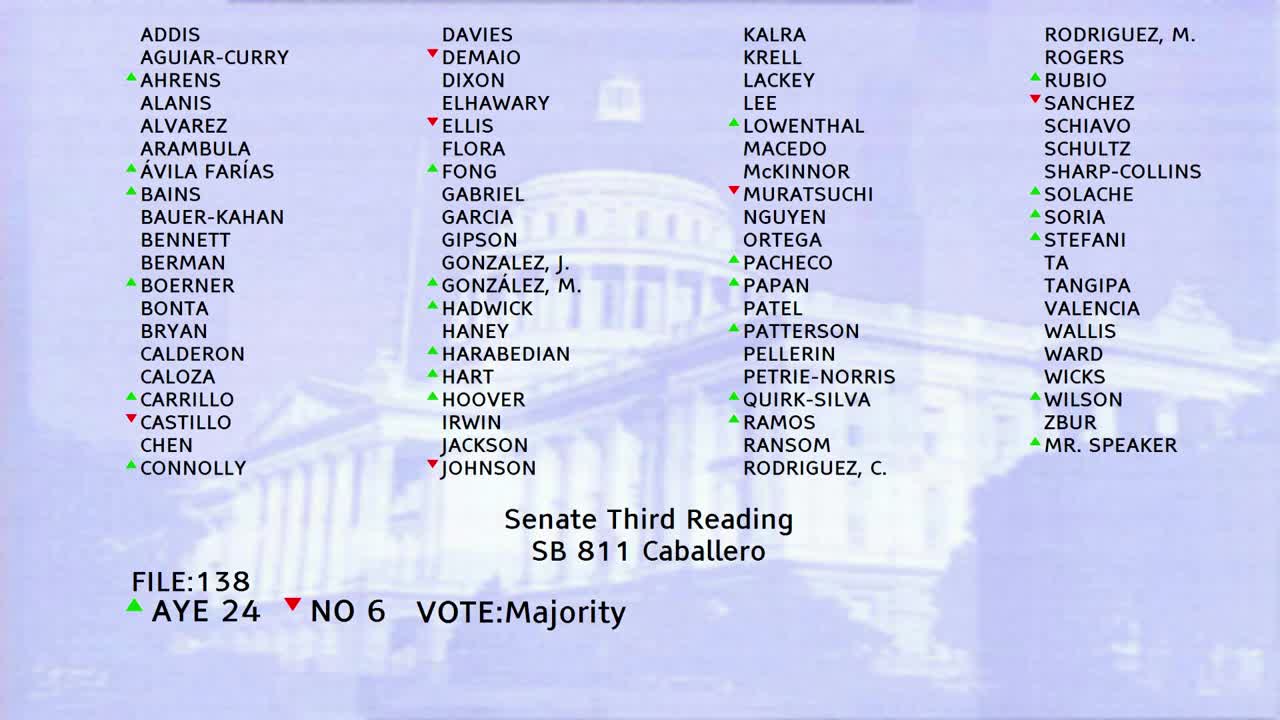 38SEC
Assembly Floor
 59SEC
Senate Floor
 7MIN
Senate Standing Committee on Business, Professions and Economic Development
 5MIN
Assembly Standing Committee on Business and Professions
Bill Author

Bill Co-Author(s):