AB 2484: San Diego Metropolitan Transit System: transactions and use tax: voter initiatives.
- Session Year: 2025-2026
- House: Assembly
- Latest Version Date: 2026-09-27
Current Status:
Passed
(2026-09-27: Chaptered by Secretary of State - Chapter 613, Statutes of 2026.)
Introduced
In Committee
Awaiting First Chamber Vote
Passed First Chamber
In Committee
Awaiting Second Chamber Vote
Passed Second Chamber
Enacted
What does this bill do?
This bill lets the San Diego Metropolitan Transit System (MTS) or a voter initiative impose a new local sales (transactions and use) tax of up to 0.5% in all or part of MTS’s service area to pay for transit services, infrastructure, and related projects. That 0.5% would not count toward the usual combined local sales tax cap, and the ballot measure may also ask voters to allow bonds paid from the tax. The bill requires MTS to reimburse the County of San Diego for the extra election costs of putting the measure on the ballot.
The summary is provided by generative AI which can make mistakes. For original language, please view the details in the table below.
The Mills-Deddeh Transit Development Act establishes the San Diego Metropolitan Transit Development Board, also known as the San Diego Metropolitan Transit System (MTS), governed by a 15-member board with specified powers and duties related to the operation of public transit services in the southern portion of the County of San Diego. The act authorizes MTS to impose a transactions and use tax of up to 0.5% for public transit purposes within its jurisdiction, or a portion of its jurisdiction, pursuant to the Transactions and Use Tax Law and subject to voter approval and various other requirements.
This bill would also authorize those taxes to be imposed by a qualified voter initiative. To the extent that the bill would impose additional duties on a county elections official, the bill would impose a state-mandated local program.
The Transactions and Use Tax Law limits the combined rate of all taxes that may be imposed in accordance with that law in any county to 2%.
This bill would prohibit the tax rate of 0.5% described above that may be imposed by MTS or a qualified voter initiative from being considered for purposes of the combined rate limit under the Transactions and Use Tax Law.
The California Constitution requires the state to reimburse local agencies and school districts for certain costs mandated by the state. Statutory provisions establish procedures for making that reimbursement.
This bill would provide that, if the Commission on State Mandates determines that the bill contains costs mandated by the state, reimbursement for those costs shall be made pursuant to the statutory provisions noted above.
The Mills-Deddeh Transit Development Act establishes the San Diego Metropolitan Transit Development Board, also known as the San Diego Metropolitan Transit System (MTS), governed by a 15-member board with specified powers and duties related to the operation of public transit services in the southern portion of the County of San Diego. The act authorizes MTS to impose a transactions and use tax of up to 0.5% for public transit purposes within its jurisdiction, or a portion of its jurisdiction, pursuant to the Transactions and Use Tax Law and subject to voter approval and various other requirements.
This bill would also authorize those taxes to be imposed by a qualified voter initiative. To the extent that the bill would impose additional duties on a county elections official, the bill would impose a state-mandated local program.
The Transactions and Use Tax Law limits the combined rate of all taxes that may be imposed in accordance with that law in any county to 2%.
This bill would prohibit the tax rate of 0.5% described above that may be imposed by MTS or a qualified voter initiative from being considered for purposes of the combined rate limit under the Transactions and Use Tax Law.
The California Constitution requires the state to reimburse local agencies and school districts for certain costs mandated by the state. Statutory provisions establish procedures for making that reimbursement.
This bill would provide that, if the Commission on State Mandates determines that the bill contains costs mandated by the state, reimbursement for those costs shall be made pursuant to the statutory provisions noted above.
The Mills-Deddeh Transit Development Act establishes the San Diego Metropolitan Transit Development Board, also known as the San Diego Metropolitan Transit System (MTS), governed by a 15-member board with specified powers and duties related to the operation of public transit services in the southern portion of the County of San Diego. The act authorizes MTS to impose a transactions and use tax of up to 0.5% for public transit purposes within its jurisdiction, or a portion of its jurisdiction, pursuant to the Transactions and Use Tax Law and subject to voter approval and various other requirements.
This bill would also authorize those taxes to be imposed by a qualified voter initiative. To the extent that the bill would impose additional duties on a county elections official, the bill would impose a state-mandated local program.
The Transactions and Use Tax Law limits the combined rate of all taxes that may be imposed in accordance with that law in any county to 2%.
This bill would prohibit the tax rate of 0.5% described above that may be imposed by MTS or a qualified voter initiative from being considered for purposes of the combined rate limit under the Transactions and Use Tax Law.
The California Constitution requires the state to reimburse local agencies and school districts for certain costs mandated by the state. Statutory provisions establish procedures for making that reimbursement.
This bill would provide that, if the Commission on State Mandates determines that the bill contains costs mandated by the state, reimbursement for those costs shall be made pursuant to the statutory provisions noted above.
The Mills-Deddeh Transit Development Act establishes the San Diego Metropolitan Transit Development Board, also known as the San Diego Metropolitan Transit System (MTS), governed by a 15-member board with specified powers and duties related to the operation of public transit services in the southern portion of the County of San Diego. The act authorizes MTS to impose a transactions and use tax of up to 0.5% for public transit purposes within its jurisdiction, or a portion of its jurisdiction, pursuant to the Transactions and Use Tax Law and subject to voter approval and various other requirements.
This bill would also authorize those taxes to be imposed by a qualified voter initiative. To the extent that the bill would impose additional duties on a county elections official, the bill would impose a state-mandated local program.
The Transactions and Use Tax Law limits the combined rate of all taxes that may be imposed in accordance with that law in any county to 2%.
This bill would prohibit the tax rate of 0.5% described above that may be imposed by MTS or a qualified voter initiative from being considered for purposes of the combined rate limit under the Transactions and Use Tax Law.
The California Constitution requires the state to reimburse local agencies and school districts for certain costs mandated by the state. Statutory provisions establish procedures for making that reimbursement.
This bill would provide that, if the Commission on State Mandates determines that the bill contains costs mandated by the state, reimbursement for those costs shall be made pursuant to the statutory provisions noted above.
The Mills-Deddeh Transit Development Act establishes the San Diego Metropolitan Transit Development Board, also known as the San Diego Metropolitan Transit System (MTS), governed by a 15-member board with specified powers and duties related to the operation of public transit services in the southern portion of the County of San Diego. The act authorizes MTS to impose a transactions and use tax of up to 0.5% for public transit purposes within its jurisdiction, or a portion of its jurisdiction, pursuant to the Transactions and Use Tax Law and subject to voter approval and various other requirements.
This bill would also authorize those taxes to be imposed by a qualified voter initiative. To the extent that the bill would impose additional duties on a county elections official, the bill would impose a state-mandated local program.
The Transactions and Use Tax Law limits the combined rate of all taxes that may be imposed in accordance with that law in any county to 2%.
This bill would prohibit the tax rate of 0.5% described above that may be imposed by MTS or a qualified voter initiative from being considered for purposes of the combined rate limit under the Transactions and Use Tax Law.
The California Constitution requires the state to reimburse local agencies and school districts for certain costs mandated by the state. Statutory provisions establish procedures for making that reimbursement.
This bill would provide that, if the Commission on State Mandates determines that the bill contains costs mandated by the state, reimbursement for those costs shall be made pursuant to the statutory provisions noted above.
The Legislature finds and declares all of the following:
(a)The San Diego Metropolitan Transit System, also referred to as MTS, provides public transit services to the urbanized areas of the County of San Diego, including 10 cities and a portion of the unincorporated areas of the county, serving approximately 3,000,000 people in the County of San Diego.
(b)MTS connects to other local and regional transportation systems in southern California.
(c)The MTS transit network is a critical component of the overall transportation network in the County of San Diego, and as such MTS has aggressively taken steps to improve and optimize public transportation for the benefit of all communities in the County of San Diego.
(d)Through these improvements, MTS has realized a strong transit ridership recovery, having recovered more than 95 percent of its ridership compared to pre-COVID-19 levels and recording 81.1 million trips in the 202526 fiscal year.
(e)MTS has prioritized ridership recovery lost from the COVID-19 pandemic, rising eight spots nationwide to the 13th ranked system on ridership as of the 202526 fiscal year.
(f)While MTS has seen success and ridership growth since the COVID-19 pandemic, it is still experiencing a structural deficit and approaching what is commonly known as the transit fiscal cliff in 2030.
(g)Since the COVID-19 pandemic, MTS has seen the onset of a fiscal cliff due to reasons such as regaining lost ridership from the pandemic, rising workforce costs, higher operating expenses, flat sales tax revenues, and limited local funding.
(h)MTS has developed a comprehensive financial sustainability strategy to delay its fiscal cliff to the 203031 fiscal year. This includes delaying noncritical infrastructure improvements, finding more sources of nonfare revenue, such as advertising and property leases, extending timelines for pension bond payments, exploring fare increase opportunities, and more.
(i)Also, as part of the financial sustainability strategy, MTS is pursuing a Comprehensive Operational Analysis to analyze MTS services and to provide strategic data necessary for making decisions on major network changes, while also exploring viability of a local revenue measure in 2028.
(j)The County of San Diego is at the forefront of housing expansion and leads the state in housing production per capita. MTS has contributed to regional housing goals in the County of San Diego with its own Transit-Oriented Development Program with a focus on affordable housing. MTS has built 476 homes since 2019, is under construction on 79 homes, has 147 homes at the permitting and financing stage, and has 929 homes in the negotiation stage.
(k)Continuing this housing growth requires robust transit service to match and ultimately grow with the region to sustain the needs of its residents, particularly those who are transit dependent, of which 78 percent of MTS ridership is classified.
(l)Public transit is of regional and local benefit, serving both regional and local trips for residents of all income levels. As of the most recent customer survey, more than two-thirds of current MTS riders are using bus and trolley services primarily to access jobs or education.
(m)MTS plays a vital role in transportation access to major events, conventions, and sports and entertainment venues in the San Diego region, including Comic-Con, Snapdragon Stadium, and Petco Park, enabling residents, workers, and visitors to attend sporting events and other large-scale gatherings while reducing traffic congestion, parking demand, and greenhouse gas emissions. In the 202526 fiscal year, MTS provided roughly over 1,000,000 trips to special events in the San Diego region.
(n)The County of San Diego needs a world-class, reliable, affordable, and connected transportation network that meets the needs of San Diego residents, businesses, and visitors while also helping combat the climate crisis. Furthermore, MTS serves as a critical binational economic connector between the United States and Mexico at the busiest land port of entry in the Western Hemisphere. MTS carries more than one-half of the pedestrians crossing every day at the Otay Mesa and San Ysidro ports of entry.
(o)The County of San Diego needs a public transit network that offers safe, clean, frequent, accessible, easy-to-navigate, and reliable service that gets transit riders where they want and need to go safely, affordably, quickly, and seamlessly.
(p)Preserving, improving, and expanding public transit to ensure a world-class transit network is critical to enhance access to opportunity, lower emissions of greenhouse gases, strengthen the regions economy, support increased housing production, and improve quality of life.
(q)To achieve these goals, local funding is critical to sustaining and improving public transit service in the County of San Diego for future generations to come.
(r)This act is critical to ensure ample time for planning and preparation in advance of a local funding initiative effort.
SEC. 2.Section 120480 of the Public Utilities Code is amended to read:120480.(a)(1)A retail transactions and use tax ordinance applicable to the entirety of, or a portion of, the incorporated and unincorporated territory within the area of the board pursuant to Section 120054 shall be imposed by the board in accordance with Section 120485, the Transactions and Use Tax Law (Part 1.6 (commencing with Section 7251) of Division 2 of the Revenue and Taxation Code), and Section 2 of Article XIIIC of the California Constitution. The county shall conduct an election called by the board pursuant to this paragraph in the same manner as provided by law for the conduct of elections by a county.
(2)Notwithstanding Section 9300 of the Elections Code or any other law, the retail transactions and use tax ordinance described in paragraph (1) may also be imposed by a qualified voter initiative pursuant to Chapter 4 (commencing with Section 9300) of Division 9 of the Elections Code and in accordance with Section 120485 and the Transactions and Use Tax Law (Part 1.6 (commencing with Section 7251) of Division 2 of the Revenue and Taxation Code).
(3)(A)Notwithstanding Section 10520 of the Elections Code, for any election at which the board or a qualified voter initiative proposes a measure pursuant to this article, the board shall reimburse the County of San Diego for the incremental costs incurred by the county elections official related to submitting the measure to the voters with any eligible funds transferred to the board.
(B)For purposes of this paragraph, incremental costs includes all of the following:
(i)The cost to prepare, review, and revise the impartial analysis of the measure.
(ii)The cost to prepare a translation of ballot materials into a language other than English by the county.
(iii)The additional costs that exceed the costs incurred for other election races or ballot measures, if any, appearing on the same ballot in the County of San Diego, including the printing and mailing of ballot materials and the canvass of the vote regarding the measure pursuant to Division 15 (commencing with Section 15000) of the Elections Code.
(b)The tax ordinance shall take effect at the close of the polls on the day of the election at which the proposition is adopted. The initial collection of the transactions and use tax shall take place in accordance with Section 120483.
(c)If, at any time, the voters do not approve the imposition of the transactions and use tax, this chapter remains in full force and effect. At any time thereafter, the same, or a different, measure may be submitted to the voters by the board or a qualified voter initiative in accordance with this chapter.
(d)The portion of the area of the board to which the tax would apply shall be determined by the board or the qualified voter initiative, as applicable, before the electors vote on the measure.
(e)If the tax only applies to a portion of an area of the board, both of the following shall apply:
(1)(A)The incorporated area of each city and of contiguous cities within the area of the board shall be either wholly included within that portion or wholly excluded from that portion. For purposes of this subparagraph, contiguous cities means two or more cities with shared borders.
(B)The entire unincorporated area of the board shall either be wholly included within that portion or wholly excluded from that portion.
(2)(A)The board shall not enter into a construction contract over one million dollars ($1,000,000) that would be in part or wholly financed through the tax with any entity unless the entity provides to the board an enforceable commitment that the entity and its subcontractors at every tier will use a skilled and trained workforce to perform all work on the project or a contract that falls within an apprenticeship occupation in the building and construction trades in accordance with Chapter 2.9 (commencing with Section 2600) of Part 1 of Division 2 of the Public Contract Code.
(B)This paragraph shall not apply if any of the following requirements are met:
(i)The board has entered into a project labor agreement that will bind all contractors and subcontractors performing work on the project.
(ii)The board has contracted to use a skilled and trained workforce and the entity has agreed to be bound by that project labor agreement.
(iii)The project or contract is being performed under the extension or renewal of a project labor agreement that was entered into by the board before January 1, 2019.
(iv)The entity has entered into a project labor agreement that will bind the entity and all its subcontractors at every tier performing the project or the entity has contracted to use a skilled and trained workforce.
(C)For purposes of this paragraph, project labor agreement has the same meaning as defined in paragraph (1) of subdivision (b) of Section 2500 of the Public Contract Code.
(f)The revenues derived from the tax shall be spent within, or for the benefit of, the portion of the area of the board to which the tax applies, and shall be spent only on transportation and transit infrastructure and services.
(g)Any revenues derived from the tax shall supplement, and not supplant, other transportation revenues available to the portion of the area of the board to which the tax applies.
SEC. 3.Section 120481 of the Public Utilities Code is amended to read:120481.(a)The ordinance shall state the nature of the tax to be imposed, the tax rate or the maximum tax rate, the purposes for which the revenue derived from the tax will be used, the portion of the area of the board to which the tax would apply, and may set a term during which the tax will be imposed. The purposes for which the tax revenues may be used shall be limited to public transit purposes serving the area of jurisdiction of the board, including the administration of this division and legal actions related thereto. These purposes include expenditures for planning, environmental reviews, engineering and design costs, and related right-of-way acquisition. The ordinance shall contain an expenditure plan that shall include the allocation of revenues for the purposes authorized by this section.
(b)As used in this section, public transit purposes includes the public transit responsibilities under the jurisdiction of the board and any repair, redesign, or ongoing maintenance of a right-of-way upon which transit is intended to travel, or any bikeway, bicycle path, sidewalk, trail, pedestrian access, or pedestrian accessway.
SEC. 4.Section 120482 of the Public Utilities Code is repealed.SEC. 5.Section 120485 of the Public Utilities Code is amended to read:120485.(a)Subject to the approval of the voters within the portion of the county to which the tax would apply, a maximum tax rate of one-half of 1 percent may be imposed under this article and the Transactions and Use Tax Law (Part 1.6 (commencing with Section 7251) of Division 2 of the Revenue and Taxation Code). The tax at a rate other than one-half or one-fourth of 1 percent shall not be levied unless specifically authorized by the Legislature.
(b)A retail transactions and use tax may be imposed pursuant to subdivision (a) that, in combination with all taxes imposed in accordance with Part 1.6 (commencing with Section 7251) of Division 2 of the Revenue and Taxation Code, exceeds the limit established in Section 7251.1 of the Revenue and Taxation Code.
(c)Notwithstanding Section 7251.1 of the Revenue and Taxation Code, the tax rate authorized pursuant to this section shall not be considered for purposes of the combined rate limit established by Section 7251.1 of the Revenue and Taxation Code.
SEC. 6.Section 120486 of the Public Utilities Code is amended to read:120486.The board or a qualified voter initiative, as part of the ballot proposition to approve the imposition of a retail transactions and use tax, may seek authorization to issue bonds payable from the proceeds of the tax.
SEC. 7.If the Commission on State Mandates determines that this act contains costs mandated by the state, reimbursement to local agencies and school districts for those costs shall be made pursuant to Part 7 (commencing with Section 17500) of Division 4 of Title 2 of the Government Code.
The Legislature finds and declares all of the following:
(a)The San Diego Metropolitan Transit System, also referred to as MTS, provides public transit services to the urbanized areas of the County of San Diego, including 10 cities and a portion of the unincorporated areas of the county, serving approximately 3,000,000 people in the County of San Diego.
(b)MTS connects to other local and regional transportation systems in southern California.
(c)The MTS transit network is a critical component of the overall transportation network in the County of San Diego, and as such MTS has aggressively taken steps to improve and optimize public transportation for the benefit of all communities in the County of San Diego.
(d)Through these improvements, MTS has realized a strong transit ridership recovery, having recovered more than 95 percent of its ridership compared to pre-COVID-19 levels and recording 81.1 million trips in the 202526 fiscal year.
(e)MTS has prioritized ridership recovery lost from the COVID-19 pandemic, rising eight spots nationwide to the 13th ranked system on ridership as of the 202526 fiscal year.
(f)While MTS has seen success and ridership growth since the COVID-19 pandemic, it is still experiencing a structural deficit and approaching what is commonly known as the transit fiscal cliff in 2030.
(g)Since the COVID-19 pandemic, MTS has seen the onset of a fiscal cliff due to reasons such as regaining lost ridership from the pandemic, rising workforce costs, higher operating expenses, flat sales tax revenues, and limited local funding.
(h)MTS has developed a comprehensive financial sustainability strategy to delay its fiscal cliff to the 203031 fiscal year. This includes delaying noncritical infrastructure improvements, finding more sources of nonfare revenue, such as advertising and property leases, extending timelines for pension bond payments, exploring fare increase opportunities, and more.
(i)Also, as part of the financial sustainability strategy, MTS is pursuing a Comprehensive Operational Analysis to analyze MTS services and to provide strategic data necessary for making decisions on major network changes, while also exploring viability of a local revenue measure in 2028.
(j)The County of San Diego is at the forefront of housing expansion and leads the state in housing production per capita. MTS has contributed to regional housing goals in the County of San Diego with its own Transit-Oriented Development Program with a focus on affordable housing. MTS has built 476 homes since 2019, is under construction on 79 homes, has 147 homes at the permitting and financing stage, and has 929 homes in the negotiation stage.
(k)Continuing this housing growth requires robust transit service to match and ultimately grow with the region to sustain the needs of its residents, particularly those who are transit dependent, of which 78 percent of MTS ridership is classified.
(l)Public transit is of regional and local benefit, serving both regional and local trips for residents of all income levels. As of the most recent customer survey, more than two-thirds of current MTS riders are using bus and trolley services primarily to access jobs or education.
(m)MTS plays a vital role in transportation access to major events, conventions, and sports and entertainment venues in the San Diego region, including Comic-Con, Snapdragon Stadium, and Petco Park, enabling residents, workers, and visitors to attend sporting events and other large-scale gatherings while reducing traffic congestion, parking demand, and greenhouse gas emissions. In the 202526 fiscal year, MTS provided roughly over 1,000,000 trips to special events in the San Diego region.
(n)The County of San Diego needs a world-class, reliable, affordable, and connected transportation network that meets the needs of San Diego residents, businesses, and visitors while also helping combat the climate crisis. Furthermore, MTS serves as a critical binational economic connector between the United States and Mexico at the busiest land port of entry in the Western Hemisphere. MTS carries more than one-half of the pedestrians crossing every day at the Otay Mesa and San Ysidro ports of entry.
(o)The County of San Diego needs a public transit network that offers safe, clean, frequent, accessible, easy-to-navigate, and reliable service that gets transit riders where they want and need to go safely, affordably, quickly, and seamlessly.
(p)Preserving, improving, and expanding public transit to ensure a world-class transit network is critical to enhance access to opportunity, lower emissions of greenhouse gases, strengthen the regions economy, support increased housing production, and improve quality of life.
(q)To achieve these goals, local funding is critical to sustaining and improving public transit service in the County of San Diego for future generations to come.
(r)This act is critical to ensure ample time for planning and preparation in advance of a local funding initiative effort.
SEC. 2.Section 120480 of the Public Utilities Code is amended to read:120480.(a)(1)A retail transactions and use tax ordinance applicable to the entirety of, or a portion of, the incorporated and unincorporated territory within the area of the board pursuant to Section 120054 shall be imposed by the board in accordance with Section 120485, the Transactions and Use Tax Law (Part 1.6 (commencing with Section 7251) of Division 2 of the Revenue and Taxation Code), and Section 2 of Article XIIIC of the California Constitution. The county shall conduct an election called by the board pursuant to this paragraph in the same manner as provided by law for the conduct of elections by a county.
(2)Notwithstanding Section 9300 of the Elections Code or any other law, the retail transactions and use tax ordinance described in paragraph (1) may also be imposed by a qualified voter initiative pursuant to Chapter 4 (commencing with Section 9300) of Division 9 of the Elections Code and in accordance with Section 120485 and the Transactions and Use Tax Law (Part 1.6 (commencing with Section 7251) of Division 2 of the Revenue and Taxation Code).
(3)(A)Notwithstanding Section 10520 of the Elections Code, for any election at which the board or a qualified voter initiative proposes a measure pursuant to this article, the board shall reimburse the County of San Diego for the incremental costs incurred by the county elections official related to submitting the measure to the voters with any eligible funds transferred to the board.
(B)For purposes of this paragraph, incremental costs includes all of the following:
(i)The cost to prepare, review, and revise the impartial analysis of the measure.
(ii)The cost to prepare a translation of ballot materials into a language other than English by the county.
(iii)The additional costs that exceed the costs incurred for other election races or ballot measures, if any, appearing on the same ballot in the County of San Diego, including the printing and mailing of ballot materials and the canvass of the vote regarding the measure pursuant to Division 15 (commencing with Section 15000) of the Elections Code.
(b)The tax ordinance shall take effect at the close of the polls on the day of the election at which the proposition is adopted. The initial collection of the transactions and use tax shall take place in accordance with Section 120483.
(c)If, at any time, the voters do not approve the imposition of the transactions and use tax, this chapter remains in full force and effect. At any time thereafter, the same, or a different, measure may be submitted to the voters by the board or a qualified voter initiative in accordance with this chapter.
(d)The portion of the area of the board to which the tax would apply shall be determined by the board or the qualified voter initiative, as applicable, before the electors vote on the measure.
(e)If the tax only applies to a portion of an area of the board, both of the following shall apply:
(1)(A)The incorporated area of each city and of contiguous cities within the area of the board shall be either wholly included within that portion or wholly excluded from that portion. For purposes of this subparagraph, contiguous cities means two or more cities with shared borders.
(B)The entire unincorporated area of the board shall either be wholly included within that portion or wholly excluded from that portion.
(2)(A)The board shall not enter into a construction contract over one million dollars ($1,000,000) that would be in part or wholly financed through the tax with any entity unless the entity provides to the board an enforceable commitment that the entity and its subcontractors at every tier will use a skilled and trained workforce to perform all work on the project or a contract that falls within an apprenticeship occupation in the building and construction trades in accordance with Chapter 2.9 (commencing with Section 2600) of Part 1 of Division 2 of the Public Contract Code.
(B)This paragraph shall not apply if any of the following requirements are met:
(i)The board has entered into a project labor agreement that will bind all contractors and subcontractors performing work on the project.
(ii)The board has contracted to use a skilled and trained workforce and the entity has agreed to be bound by that project labor agreement.
(iii)The project or contract is being performed under the extension or renewal of a project labor agreement that was entered into by the board before January 1, 2019.
(iv)The entity has entered into a project labor agreement that will bind the entity and all its subcontractors at every tier performing the project or the entity has contracted to use a skilled and trained workforce.
(C)For purposes of this paragraph, project labor agreement has the same meaning as defined in paragraph (1) of subdivision (b) of Section 2500 of the Public Contract Code.
(f)The revenues derived from the tax shall be spent within, or for the benefit of, the portion of the area of the board to which the tax applies, and shall be spent only on transportation and transit infrastructure and services.
(g)Any revenues derived from the tax shall supplement, and not supplant, other transportation revenues available to the portion of the area of the board to which the tax applies.
SEC. 3.Section 120481 of the Public Utilities Code is amended to read:120481.(a)The ordinance shall state the nature of the tax to be imposed, the tax rate or the maximum tax rate, the purposes for which the revenue derived from the tax will be used, the portion of the area of the board to which the tax would apply, and may set a term during which the tax will be imposed. The purposes for which the tax revenues may be used shall be limited to public transit purposes serving the area of jurisdiction of the board, including the administration of this division and legal actions related thereto. These purposes include expenditures for planning, environmental reviews, engineering and design costs, and related right-of-way acquisition. The ordinance shall contain an expenditure plan that shall include the allocation of revenues for the purposes authorized by this section.
(b)As used in this section, public transit purposes includes the public transit responsibilities under the jurisdiction of the board and any repair, redesign, or ongoing maintenance of a right-of-way upon which transit is intended to travel, or any bikeway, bicycle path, sidewalk, trail, pedestrian access, or pedestrian accessway.
SEC. 4.Section 120482 of the Public Utilities Code is repealed.SEC. 5.Section 120485 of the Public Utilities Code is amended to read:120485.(a)Subject to the approval of the voters within the portion of the county to which the tax would apply, a maximum tax rate of one-half of 1 percent may be imposed under this article and the Transactions and Use Tax Law (Part 1.6 (commencing with Section 7251) of Division 2 of the Revenue and Taxation Code). The tax at a rate other than one-half or one-fourth of 1 percent shall not be levied unless specifically authorized by the Legislature.
(b)A retail transactions and use tax may be imposed pursuant to subdivision (a) that, in combination with all taxes imposed in accordance with Part 1.6 (commencing with Section 7251) of Division 2 of the Revenue and Taxation Code, exceeds the limit established in Section 7251.1 of the Revenue and Taxation Code.
(c)Notwithstanding Section 7251.1 of the Revenue and Taxation Code, the tax rate authorized pursuant to this section shall not be considered for purposes of the combined rate limit established by Section 7251.1 of the Revenue and Taxation Code.
SEC. 6.Section 120486 of the Public Utilities Code is amended to read:120486.The board or a qualified voter initiative, as part of the ballot proposition to approve the imposition of a retail transactions and use tax, may seek authorization to issue bonds payable from the proceeds of the tax.
SEC. 7.If the Commission on State Mandates determines that this act contains costs mandated by the state, reimbursement to local agencies and school districts for those costs shall be made pursuant to Part 7 (commencing with Section 17500) of Division 4 of Title 2 of the Government Code.
The Legislature finds and declares all of the following:
(a)The San Diego Metropolitan Transit System, also referred to as MTS, provides public transit services to the urbanized areas of the County of San Diego, including 10 cities and a portion of the unincorporated areas of the county, serving approximately 3,000,000 people in the County of San Diego.
(b)MTS connects to other local and regional transportation systems in southern California.
(c)The MTS transit network is a critical component of the overall transportation network in the County of San Diego, and as such MTS has aggressively taken steps to improve and optimize public transportation for the benefit of all communities in the County of San Diego.
(d)Through these improvements, MTS has realized a strong transit ridership recovery, having recovered more than 95 percent of its ridership compared to pre-COVID-19 levels and recording 81.1 million trips in the 202526 fiscal year.
(e)MTS has prioritized ridership recovery lost from the COVID-19 pandemic, rising eight spots nationwide to the 13th ranked system on ridership as of the 202526 fiscal year.
(f)While MTS has seen success and ridership growth since the COVID-19 pandemic, it is still experiencing a structural deficit and approaching what is commonly known as the transit fiscal cliff in 2030.
(g)Since the COVID-19 pandemic, MTS has seen the onset of a fiscal cliff due to reasons such as regaining lost ridership from the pandemic, rising workforce costs, higher operating expenses, flat sales tax revenues, and limited local funding.
(h)MTS has developed a comprehensive financial sustainability strategy to delay its fiscal cliff to the 203031 fiscal year. This includes delaying noncritical infrastructure improvements, finding more sources of nonfare revenue, such as advertising and property leases, extending timelines for pension bond payments, exploring fare increase opportunities, and more.
(i)Also, as part of the financial sustainability strategy, MTS is pursuing a Comprehensive Operational Analysis to analyze MTS services and to provide strategic data necessary for making decisions on major network changes, while also exploring viability of a local revenue measure in 2028.
(j)The County of San Diego is at the forefront of housing expansion and leads the state in housing production per capita. MTS has contributed to regional housing goals in the County of San Diego with its own Transit-Oriented Development Program with a focus on affordable housing. MTS has built 476 homes since 2019, is under construction on 79 homes, has 147 homes at the permitting and financing stage, and has 929 homes in the negotiation stage.
(k)Continuing this housing growth requires robust transit service to match and ultimately grow with the region to sustain the needs of its residents, particularly those who are transit dependent, of which 78 percent of MTS ridership is classified.
(l)Public transit is of regional and local benefit, serving both regional and local trips for residents of all income levels. As of the most recent customer survey, more than two-thirds of current MTS riders are using bus and trolley services primarily to access jobs or education.
(m)MTS plays a vital role in transportation access to major events, conventions, and sports and entertainment venues in the San Diego region, including Comic-Con, Snapdragon Stadium, and Petco Park, enabling residents, workers, and visitors to attend sporting events and other large-scale gatherings while reducing traffic congestion, parking demand, and greenhouse gas emissions. In the 202526 fiscal year, MTS provided roughly over 1,000,000 trips to special events in the San Diego region.
(n)The County of San Diego needs a world-class, reliable, affordable, and connected transportation network that meets the needs of San Diego residents, businesses, and visitors while also helping combat the climate crisis. Furthermore, MTS serves as a critical binational economic connector between the United States and Mexico at the busiest land port of entry in the Western Hemisphere. MTS carries more than one-half of the pedestrians crossing every day at the Otay Mesa and San Ysidro ports of entry.
(o)The County of San Diego needs a public transit network that offers safe, clean, frequent, accessible, easy-to-navigate, and reliable service that gets transit riders where they want and need to go safely, affordably, quickly, and seamlessly.
(p)Preserving, improving, and expanding public transit to ensure a world-class transit network is critical to enhance access to opportunity, lower emissions of greenhouse gases, strengthen the regions economy, support increased housing production, and improve quality of life.
(q)To achieve these goals, local funding is critical to sustaining and improving public transit service in the County of San Diego for future generations to come.
(r)This act is critical to ensure ample time for planning and preparation in advance of a local funding initiative effort.
SEC. 2.Section 120480 of the Public Utilities Code is amended to read:120480.(a)(1)A retail transactions and use tax ordinance applicable to the entirety of, or a portion of, the incorporated and unincorporated territory within the area of the board pursuant to Section 120054 shall be imposed by the board in accordance with Section 120485, the Transactions and Use Tax Law (Part 1.6 (commencing with Section 7251) of Division 2 of the Revenue and Taxation Code), and Section 2 of Article XIIIC of the California Constitution. The county shall conduct an election called by the board pursuant to this paragraph in the same manner as provided by law for the conduct of elections by a county.
(2)Notwithstanding Section 9300 of the Elections Code or any other law, the retail transactions and use tax ordinance described in paragraph (1) may also be imposed by a qualified voter initiative pursuant to Chapter 4 (commencing with Section 9300) of Division 9 of the Elections Code and in accordance with Section 120485 and the Transactions and Use Tax Law (Part 1.6 (commencing with Section 7251) of Division 2 of the Revenue and Taxation Code).
(3)(A)Notwithstanding Section 10520 of the Elections Code, for any election at which the board or a qualified voter initiative proposes a measure pursuant to this article, the board shall reimburse the County of San Diego for the incremental costs incurred by the county elections official related to submitting the measure to the voters with any eligible funds transferred to the board.
(B)For purposes of this paragraph, incremental costs includes all of the following:
(i)The cost to prepare, review, and revise the impartial analysis of the measure.
(ii)The cost to prepare a translation of ballot materials into a language other than English by the county.
(iii)The additional costs that exceed the costs incurred for other election races or ballot measures, if any, appearing on the same ballot in the County of San Diego, including the printing and mailing of ballot materials and the canvass of the vote regarding the measure pursuant to Division 15 (commencing with Section 15000) of the Elections Code.
(b)The tax ordinance shall take effect at the close of the polls on the day of the election at which the proposition is adopted. The initial collection of the transactions and use tax shall take place in accordance with Section 120483.
(c)If, at any time, the voters do not approve the imposition of the transactions and use tax, this chapter remains in full force and effect. At any time thereafter, the same, or a different, measure may be submitted to the voters by the board or a qualified voter initiative in accordance with this chapter.
(d)The portion of the area of the board to which the tax would apply shall be determined by the board or the qualified voter initiative, as applicable, before the electors vote on the measure.
(e)If the tax only applies to a portion of an area of the board, both of the following shall apply:
(1)(A)The incorporated area of each city and of contiguous cities within the area of the board shall be either wholly included within that portion or wholly excluded from that portion. For purposes of this subparagraph, contiguous cities means two or more cities with shared borders.
(B)The entire unincorporated area of the board shall either be wholly included within that portion or wholly excluded from that portion.
(2)(A)The board shall not enter into a construction contract over one million dollars ($1,000,000) that would be in part or wholly financed through the tax with any entity unless the entity provides to the board an enforceable commitment that the entity and its subcontractors at every tier will use a skilled and trained workforce to perform all work on the project or a contract that falls within an apprenticeship occupation in the building and construction trades in accordance with Chapter 2.9 (commencing with Section 2600) of Part 1 of Division 2 of the Public Contract Code.
(B)This paragraph shall not apply if any of the following requirements are met:
(i)The board has entered into a project labor agreement that will bind all contractors and subcontractors performing work on the project.
(ii)The board has contracted to use a skilled and trained workforce and the entity has agreed to be bound by that project labor agreement.
(iii)The project or contract is being performed under the extension or renewal of a project labor agreement that was entered into by the board before January 1, 2019.
(iv)The entity has entered into a project labor agreement that will bind the entity and all its subcontractors at every tier performing the project or the entity has contracted to use a skilled and trained workforce.
(C)For purposes of this paragraph, project labor agreement has the same meaning as defined in paragraph (1) of subdivision (b) of Section 2500 of the Public Contract Code.
(f)The revenues derived from the tax shall be spent within, or for the benefit of, the portion of the area of the board to which the tax applies, and shall be spent only on transportation and transit infrastructure and services.
(g)Any revenues derived from the tax shall supplement, and not supplant, other transportation revenues available to the portion of the area of the board to which the tax applies.
SEC. 3.Section 120481 of the Public Utilities Code is amended to read:120481.(a)The ordinance shall state the nature of the tax to be imposed, the tax rate or the maximum tax rate, the purposes for which the revenue derived from the tax will be used, the portion of the area of the board to which the tax would apply, and may set a term during which the tax will be imposed. The purposes for which the tax revenues may be used shall be limited to public transit purposes serving the area of jurisdiction of the board, including the administration of this division and legal actions related thereto. These purposes include expenditures for planning, environmental reviews, engineering and design costs, and related right-of-way acquisition. The ordinance shall contain an expenditure plan that shall include the allocation of revenues for the purposes authorized by this section.
(b)As used in this section, public transit purposes includes the public transit responsibilities under the jurisdiction of the board and any repair, redesign, or ongoing maintenance of a right-of-way upon which transit is intended to travel, or any bikeway, bicycle path, sidewalk, trail, pedestrian access, or pedestrian accessway.
SEC. 4.Section 120482 of the Public Utilities Code is repealed.SEC. 5.Section 120485 of the Public Utilities Code is amended to read:120485.(a)Subject to the approval of the voters within the portion of the county to which the tax would apply, a maximum tax rate of one-half of 1 percent may be imposed under this article and the Transactions and Use Tax Law (Part 1.6 (commencing with Section 7251) of Division 2 of the Revenue and Taxation Code). The tax at a rate other than one-half or one-fourth of 1 percent shall not be levied unless specifically authorized by the Legislature.
(b)A retail transactions and use tax may be imposed pursuant to subdivision (a) that, in combination with all taxes imposed in accordance with Part 1.6 (commencing with Section 7251) of Division 2 of the Revenue and Taxation Code, exceeds the limit established in Section 7251.1 of the Revenue and Taxation Code.
(c)Notwithstanding Section 7251.1 of the Revenue and Taxation Code, the tax rate authorized pursuant to this section shall not be considered for purposes of the combined rate limit established by Section 7251.1 of the Revenue and Taxation Code.
SEC. 6.Section 120486 of the Public Utilities Code is amended to read:120486.The board or a qualified voter initiative, as part of the ballot proposition to approve the imposition of a retail transactions and use tax, may seek authorization to issue bonds payable from the proceeds of the tax.
SEC. 7.If the Commission on State Mandates determines that this act contains costs mandated by the state, reimbursement to local agencies and school districts for those costs shall be made pursuant to Part 7 (commencing with Section 17500) of Division 4 of Title 2 of the Government Code.
The Legislature finds and declares all of the following:
(a)The San Diego Metropolitan Transit System, also referred to as MTS, provides public transit services to the urbanized areas of the County of San Diego, including 10 cities and a portion of the unincorporated areas of the county, serving approximately 3,000,000 people in the County of San Diego.
(b)MTS connects to other local and regional transportation systems in southern California.
(c)The MTS transit network is a critical component of the overall transportation network in the County of San Diego, and as such MTS has aggressively taken steps to improve and optimize public transportation for the benefit of all communities in the County of San Diego.
(d)Through these improvements, MTS has realized a strong transit ridership recovery, having recovered more than 95 percent of its ridership compared to pre-COVID-19 levels and recording 81.1 million trips in the 202526 fiscal year.
(e)MTS has prioritized ridership recovery lost from the COVID-19 pandemic, rising eight spots nationwide to the 13th ranked system on ridership as of the 202526 fiscal year.
(f)While MTS has seen success and ridership growth since the COVID-19 pandemic, it is still experiencing a structural deficit and approaching what is commonly known as the transit fiscal cliff in 2030.
(g)Since the COVID-19 pandemic, MTS has seen the onset of a fiscal cliff due to reasons such as regaining lost ridership from the pandemic, rising workforce costs, higher operating expenses, flat sales tax revenues, and limited local funding.
(h)MTS has developed a comprehensive financial sustainability strategy to delay its fiscal cliff to the 203031 fiscal year. This includes delaying noncritical infrastructure improvements, finding more sources of nonfare revenue, such as advertising and property leases, extending timelines for pension bond payments, exploring fare increase opportunities, and more.
(i)Also, as part of the financial sustainability strategy, MTS is pursuing a Comprehensive Operational Analysis to analyze MTS services and to provide strategic data necessary for making decisions on major network changes, while also exploring viability of a local revenue measure in 2028.
(j)The County of San Diego is at the forefront of housing expansion and leads the state in housing production per capita. MTS has contributed to regional housing goals in the County of San Diego with its own Transit-Oriented Development Program with a focus on affordable housing. MTS has built 476 homes since 2019, is under construction on 79 homes, has 147 homes at the permitting and financing stage, and has 929 homes in the negotiation stage.
(k)Continuing this housing growth requires robust transit service to match and ultimately grow with the region to sustain the needs of its residents, particularly those who are transit dependent, of which 78 percent of MTS ridership is classified.
(l)Public transit is of regional and local benefit, serving both regional and local trips for residents of all income levels. As of the most recent customer survey, more than two-thirds of current MTS riders are using bus and trolley services primarily to access jobs or education.
(m)MTS plays a vital role in transportation access to major events, conventions, and sports and entertainment venues in the San Diego region, including Comic-Con, Snapdragon Stadium, and Petco Park, enabling residents, workers, and visitors to attend sporting events and other large-scale gatherings while reducing traffic congestion, parking demand, and greenhouse gas emissions. In the 202526 fiscal year, MTS provided roughly over 1,000,000 trips to special events in the San Diego region.
(n)The County of San Diego needs a world-class, reliable, affordable, and connected transportation network that meets the needs of San Diego residents, businesses, and visitors while also helping combat the climate crisis. Furthermore, MTS serves as a critical binational economic connector between the United States and Mexico at the busiest land port of entry in the Western Hemisphere. MTS carries more than one-half of the pedestrians crossing every day at the Otay Mesa and San Ysidro ports of entry.
(o)The County of San Diego needs a public transit network that offers safe, clean, frequent, accessible, easy-to-navigate, and reliable service that gets transit riders where they want and need to go safely, affordably, quickly, and seamlessly.
(p)Preserving, improving, and expanding public transit to ensure a world-class transit network is critical to enhance access to opportunity, lower emissions of greenhouse gases, strengthen the regions economy, support increased housing production, and improve quality of life.
(q)To achieve these goals, local funding is critical to sustaining and improving public transit service in the County of San Diego for future generations to come.
(r)This act is critical to ensure ample time for planning and preparation in advance of a local funding initiative effort.
SECTION 1.SEC. 2.Section 120480 of the Public Utilities Code is amended to read:120480.(a)(1)A retail transactions and use tax ordinance applicable to the entirety of, or a portion of, the incorporated and unincorporated territory within the area of the board pursuant to Section 120054 shall be imposed by the board in accordance with Section 120485, the Transactions and Use Tax Law (Part 1.6 (commencing with Section 7251) of Division 2 of the Revenue and Taxation Code), and Section 2 of Article XIIIC of the California Constitution. The county shall conduct an election called by the board pursuant to this paragraph in the same manner as provided by law for the conduct of elections by a county.
(2)Notwithstanding Section 9300 of the Elections Code or any other law, the retail transactions and use tax ordinance described in paragraph (1) may also be imposed by a qualified voter initiative pursuant to Chapter 4 (commencing with Section 9300) of Division 9 of the Elections Code and in accordance with Section 120485 and the Transactions and Use Tax Law (Part 1.6 (commencing with Section 7251) of Division 2 of the Revenue and Taxation Code).
(b)The tax ordinance shall take effect at the close of the polls on the day of election at which the proposition is adopted. The initial collection of the transactions and use tax shall take place in accordance with Section 120483.
(c)If, at any time, the voters do not approve the imposition of the transactions and use tax, this chapter remains in full force and effect. At any time thereafter, the same, or a different, measure may be submitted to the voters by the board or a qualified voter initiative in accordance with this chapter.
(d)The portion of the area of the board to which the tax would apply shall be determined by the board or the qualified voter initiative, as applicable, before the electors vote on the measure.
(e)If the tax only applies to a portion of an area of the board, both of the following shall apply:
(1)(A)The incorporated area of each city and of contiguous cities within the area of the board shall be either wholly included within that portion or wholly excluded from that portion. For purposes of this subparagraph, contiguous cities means two or more cities with shared borders.
(B)The entire unincorporated area of the board shall either be wholly included within that portion or wholly excluded from that portion.
(2)(A)The board shall not enter into a construction contract over one million dollars ($1,000,000) that would be in part or wholly financed through the tax with any entity unless the entity provides to the board an enforceable commitment that the entity and its subcontractors at every tier will use a skilled and trained workforce to perform all work on the project or a contract that falls within an apprenticeship occupation in the building and construction trades in accordance with Chapter 2.9 (commencing with Section 2600) of Part 1 of Division 2 of the Public Contract Code.
(B)This paragraph shall not apply if any of the following requirements are met:
(i)The board has entered into a project labor agreement that will bind all contractors and subcontractors performing work on the project.
(ii)The board has contracted to use a skilled and trained workforce and the entity has agreed to be bound by that project labor agreement.
(iii)The project or contract is being performed under the extension or renewal of a project labor agreement that was entered into by the board before January 1, 2019.
(iv)The entity has entered into a project labor agreement that will bind the entity and all its subcontractors at every tier performing the project or the entity has contracted to use a skilled and trained workforce.
(C)For purposes of this paragraph, project labor agreement has the same meaning as defined in paragraph (1) of subdivision (b) of Section 2500 of the Public Contract Code.
(f)The revenues derived from the tax shall be spent within, or for the benefit of, the portion of the area of the board to which the tax applies, and shall be spent only on transportation and transit infrastructure and services.
(g)Any revenues derived from the tax shall supplement, and not supplant, other transportation revenues available to the portion of the area of the board to which the tax applies.
SEC. 2.SEC. 3.Section 120481 of the Public Utilities Code is amended to read:120481.(a)The ordinance shall state the nature of the tax to be imposed, the tax rate or the maximum tax rate, the purposes for which the revenue derived from the tax will be used, the portion of the area of the board to which the tax would apply, and may set a term during which the tax will be imposed. The purposes for which the tax revenues may be used shall be limited to public transit purposes serving the area of jurisdiction of the board, including the administration of this division and legal actions related thereto. These purposes include expenditures for planning, environmental reviews, engineering and design costs, and related right-of-way acquisition. The ordinance shall contain an expenditure plan that shall include the allocation of revenues for the purposes authorized by this section.
(b)As used in this section, public transit purposes includes the public transit responsibilities under the jurisdiction of the board and any repair, redesign, or ongoing maintenance of a right-of-way upon which transit is intended to travel, or any bikeway, bicycle path, sidewalk, trail, pedestrian access, or pedestrian accessway.
SEC. 3.SEC. 4.Section 120482 of the Public Utilities Code is repealed.SEC. 4.SEC. 5.Section 120485 of the Public Utilities Code is amended to read:120485.(a)Subject to the approval of the voters within the portion of the county to which the tax would apply, a maximum tax rate of one-half of 1 percent may be imposed under this article and the Transactions and Use Tax Law (Part 1.6 (commencing with Section 7251) of Division 2 of the Revenue and Taxation Code). The tax at a rate other than one-half or one-fourth of 1 percent shall not be levied unless specifically authorized by the Legislature.
(b)A retail transactions and use tax may be imposed pursuant to subdivision (a) that, in combination with all taxes imposed in accordance with Part 1.6 (commencing with Section 7251) of Division 2 of the Revenue and Taxation Code, exceeds the limit established in Section 7251.1 of the Revenue and Taxation Code.
(c)Notwithstanding Section 7251.1 of the Revenue and Taxation Code, the tax rate authorized pursuant to this section shall not be considered for purposes of the combined rate limit established by Section 7251.1 of the Revenue and Taxation Code.
SEC. 5.SEC. 6.Section 120486 of the Public Utilities Code is amended to read:120486.The board or a qualified voter initiative, as part of the ballot proposition to approve the imposition of a retail transactions and use tax, may seek authorization to issue bonds payable from the proceeds of the tax.
SEC. 6.SEC. 7.If the Commission on State Mandates determines that this act contains costs mandated by the state, reimbursement to local agencies and school districts for those costs shall be made pursuant to Part 7 (commencing with Section 17500) of Division 4 of Title 2 of the Government Code.
REVISIONS: HeadingLine 2.(a)(1)A retail transactions and use tax ordinance applicable to the entirety of, or a portion of, the incorporated and unincorporated territory within the area of the board pursuant to Section 120054 shall be imposed by the board in accordance with Section 120485, the Transactions and Use Tax Law (Part 1.6 (commencing with Section 7251) of Division 2 of the Revenue and Taxation Code), and Section 2 of Article XIIIC of the California Constitution. The tax county shall conduct an election called by the board pursuant to this paragraph in the same manner as provided by law for the conduct of elections by a county.
(2)Notwithstanding Section 9300 of the Elections Code or any other law, the retail transactions and use tax ordinance described in paragraph (1) may also be imposed by a qualified voter initiative pursuant to Chapter 4 (commencing with Section 9300) of Division 9 of the Elections Code and in accordance with Section 120485 and the Transactions and Use Tax Law (Part 1.6 (commencing with Section 7251) of Division 2 of the Revenue and Taxation Code).
(b)The tax ordinance shall take effect at the close of the polls on the day of election at which the proposition is adopted. The initial collection of the transactions and use tax shall take place in accordance with Section 120483.
(b)(c)If, at any time, the voters do not approve the imposition of the transactions and use tax, this chapter remains in full force and effect. The board may, at any time thereafter, submit the At any time thereafter, the same, or a different, measure may be submitted to the voters by the board or a qualified voter initiative in accordance with this chapter.
(c)(d)The portion of the area of the board to which the tax would apply shall be determined by the board board or the qualified voter initiative, as applicable, before the electors vote on the measure.
(d)(e)If the tax only applies to a portion of an area of the board, both of the following shall apply:
(1)(A)The incorporated area of each city and of contiguous cities within the area of the board shall be either wholly included within that portion or wholly excluded from that portion. For purposes of this subparagraph, contiguous cities means two or more cities with shared borders.
(B)The entire unincorporated area of the board shall either be wholly included within that portion or wholly excluded from that portion.
(2)(A)The board shall not enter into a construction contract over one million dollars ($1,000,000) that would be in part or wholly financed through the tax with any entity unless the entity provides to the board an enforceable commitment that the entity and its subcontractors at every tier will use a skilled and trained workforce to perform all work on the project or a contract that falls within an apprenticeship occupation in the building and construction trades in accordance with Chapter 2.9 (commencing with Section 2600) of Part 1 of Division 2 of the Public Contract Code.
(B)This paragraph shall not apply if any of the following requirements are met:
(i)The board has entered into a project labor agreement that will bind all contractors and subcontractors performing work on the project.
(ii)The board has contracted to use a skilled and trained workforce and the entity has agreed to be bound by that project labor agreement.
(iii)The project or contract is being performed under the extension or renewal of a project labor agreement that was entered into by the board before January 1, 2019.
(iv)The entity has entered into a project labor agreement that will bind the entity and all its subcontractors at every tier performing the project or the entity has contracted to use a skilled and trained workforce.
(C)For purposes of this paragraph, project labor agreement has the same meaning as defined in paragraph (1) of subdivision (b) of Section 2500 of the Public Contract Code.
(e)(f)The revenues derived from the tax shall be spent within, or for the benefit of, the portion of the area of the board to which the tax applies, and shall be spent only on transportation and transit infrastructure and services.
(f)(g)Any revenues derived from the tax shall supplement, and not supplant, other transportation revenues available to the portion of the area of the board to which the tax applies.
SEC. 2.Section 120481 of the Public Utilities Code is amended to read:120481.(a)The board, in the ordinance, ordinance shall state the nature of the tax to be imposed, the tax rate or the maximum tax rate, the purposes for which the revenue derived from the tax will be used, the portion of the area of the board to which the tax would apply, and may set a term during which the tax will be imposed. The purposes for which the tax revenues may be used shall be limited to public transit purposes serving the area of jurisdiction of the board, as determined by the board, including the administration of this division and legal actions related thereto. These purposes include expenditures for planning, environmental reviews, engineering and design costs, and related right-of-way acquisition. The ordinance shall contain an expenditure plan that shall include the allocation of revenues for the purposes authorized by this section.
(b)As used in this section, public transit purposes includes the public transit responsibilities under the jurisdiction of the board as well as and any repair, redesign, or ongoing maintenance of a right-of-way upon which transit is intended to travel, or any bikeway, bicycle path, sidewalk, trail, pedestrian access, or pedestrian accessway.
SEC. 3.Section 120482 of the Public Utilities Code is repealed.120482.(a)The county shall conduct an election called by the board pursuant to Section 120480.(b)The election shall be called and conducted in the same manner as provided by law for the conduct of elections by a county.SEC. 4.Section 120485 of the Public Utilities Code is amended to read:120485.The board, subject (a)Subject to the approval of the voters within the portion of the county to which the tax would apply, may impose a maximum tax rate of one-half of 1 percent may be imposed under this article and the Transactions and Use Tax Law (Part 1.6 (commencing with Section 7251) of Division 2 of the Revenue and Taxation Code). The board shall not levy the tax at a rate other than one-half or one-fourth of 1 percent shall not be levied unless specifically authorized by the Legislature.
(b)A retail transactions and use tax may be imposed pursuant to subdivision (a) that, in combination with all taxes imposed in accordance with Part 1.6 (commencing with Section 7251) of Division 2 of the Revenue and Taxation Code, exceeds the limit established in Section 7251.1 of the Revenue and Taxation Code.
(c)Notwithstanding Section 7251.1 of the Revenue and Taxation Code, the tax rate authorized pursuant to this section shall not be considered for purposes of the combined rate limit established by Section 7251.1 of the Revenue and Taxation Code.
SEC. 5.Section 120486 of the Public Utilities Code is amended to read:120486.The board, board or a qualified voter initiative, as part of the ballot proposition to approve the imposition of a retail transactions and use tax, may seek authorization to issue bonds payable from the proceeds of the tax.
SEC. 6.If the Commission on State Mandates determines that this act contains costs mandated by the state, reimbursement to local agencies and school districts for those costs shall be made pursuant to Part 7 (commencing with Section 17500) of Division 4 of Title 2 of the Government Code.
|
Date
|
Status
|
|---|---|
| Sep 27, 2026 | Chaptered by Secretary of State - Chapter 613, Statutes of 2026. |
| Sep 27, 2026 | Approved by the Governor. |
| Sep 3, 2026 | Enrolled and presented to the Governor at 4 p.m. |
| Aug 27, 2026 | In Assembly. Ordered to Engrossing and Enrolling. |
| Aug 26, 2026 | Read third time. Passed. Ordered to the Assembly. (Ayes 29. Noes 10.). |
| Aug 4, 2026 | Read second time. Ordered to third reading. |
| Aug 3, 2026 | From committee: Be ordered to second reading pursuant to Senate Rule 28.8. |
| Jun 24, 2026 | From committee: Do pass and re-refer to Com. on APPR. (Ayes 8. Noes 4.) (June 23). Re-referred to Com. on APPR. |
| Jun 16, 2026 | From committee: Do pass and re-refer to Com. on TRANS. (Ayes 4. Noes 0.) (June 16). Re-referred to Com. on TRANS. |
| Jun 10, 2026 | Referred to Coms. on E. & C.A. and TRANS. |
| May 27, 2026 | In Senate. Read first time. To Com. on RLS. for assignment. |
| May 26, 2026 | Read third time. Passed. Ordered to the Senate. (Ayes 46. Noes 21. Page 5384.) |
| May 26, 2026 | Read third time. Passed. Ordered to the Senate. (Ayes 46. Noes 21.) |
| May 26, 2026 | Read third time. Passed. Ordered to the Senate. |
| May 19, 2026 | Read second time. Ordered to third reading. |
| May 18, 2026 | Read second time and amended. Ordered returned to second reading. |
| May 14, 2026 | From committee: Amend, and do pass as amended. (Ayes 11. Noes 4.) (May 14). |
| May 6, 2026 | In committee: Set, first hearing. Referred to APPR. suspense file. |
| Apr 23, 2026 | From committee: Do pass and re-refer to Com. on APPR. (Ayes 8. Noes 2.) (April 22). Re-referred to Com. on APPR. |
| Apr 15, 2026 | From committee: Do pass and re-refer to Com. on L. GOV. (Ayes 6. Noes 2.) (April 15). Re-referred to Com. on L. GOV. |
| Apr 15, 2026 | Coauthors revised. |
| Mar 25, 2026 | Re-referred to Com. on ELECTIONS. |
| Mar 24, 2026 | From committee chair, with author's amendments: Amend, and re-refer to Com. on ELECTIONS. Read second time and amended. |
| Mar 16, 2026 | Referred to Coms. on ELECTIONS and L. GOV. |
| Feb 21, 2026 | From printer. May be heard in committee March 23. |
| Feb 20, 2026 | Read first time. To print. |
|
Date
|
Description
|
Location
|
Votes
|
|
|---|---|---|---|---|
| Aug 26, 2026 | Assembly 3rd Reading AB2484 Alvarez et al. By Weber Pierson | Senate Floor |
Passed |
|
| Jun 23, 2026 | Do pass, but first be re-referred to the Committee on [Appropriations] | Senate Standing Committee on Transportation |
Passed |
|
| Jun 16, 2026 | Do pass, but first be re-referred to the Committee on [Transportation] | Senate Standing Committee on Elections and Constitutional Amendments |
Passed |
|
| May 26, 2026 | AB 2484 Alvarez Assembly Third Reading | Assembly Floor |
Passed |
|
| May 14, 2026 | Do pass as amended. | Assembly Standing Committee on Appropriations |
Passed |
|
| Apr 22, 2026 | Do pass and be re-referred to the Committee on [Appropriations] | Assembly Standing Committee on Local Government |
Passed |
|
| Apr 15, 2026 | Do pass and be re-referred to the Committee on [Local Government] | Assembly Standing Committee on Elections |
Passed |
This list shows positions taken on this bill by organizations on the date displayed, which is linked to the original source.
Positions by individuals are not included.
|
Organization
|
Position
|
Date
|
|---|---|---|
| Amalgamated Transit Union | ** Support | |
| California Association Of Realtors | ** Against | |
| California Conference Board Of The Amalgamated Transit Union | ** Support | |
| California Taxpayers Association | ** Against | |
| Circulate Planning and Policy | ** Support | |
| City Of Chula Vista | ** Support | |
| City Of La Mesa | ** Support | |
| City of National City | ** Support | |
| Environmental Health Coalition | ** Support | |
| Howard Jarvis Taxpayers Association | ** Against | |
| International Brotherhood Of Electrical Workers Local 465 | ** Support | |
| Logan Heights Community Development Corporation | ** Support | |
| Mid-City CAN | ** Support | |
| Mundo Gardens | ** Support | |
| North County Transit District | ** Support | |
| North County Transit – San Diego Railroad | ** Support | |
| RideSD | ** Support | |
| San Diego Metropolitan Transit System | ** Support | |
| Streets Are For Everyone | ** Support | |
| Streets are for Everyone (SAFE) | ** Support |
SENATE RULES COMMITTEE Office of Senate Floor Analyses (916) 651-4171 | AB 2484 |
THIRD READING
Bill No: AB 2484
Author: Alvarez (D), et al.
Amended: 5/18/26 in Assembly
Vote: 21
SENATE ELECTIONS & C.A. COMMITTEE: 4-0, 6/16/26
AYES: Wiener, Allen, Cervantes, Umberg
NO VOTE RECORDED: Choi
SENATE TRANSPORTATION COMMITTEE: 8-4, 6/23/26
AYES: Cortese, Archuleta, Arreguín, Blakespear, Gonzalez, Menjivar, Richardson, Wiener
NOES: Strickland, Dahle, Seyarto, Valladares
NO VOTE RECORDED: Grayson
SENATE APPROPRIATIONS COMMITTEE: Senate Rule 28.8
ASSEMBLY FLOOR: 46-21, 5/26/26 - See last page for vote
SUBJECT: San Diego Metropolitan Transit System: transactions and use tax: voter initiatives
SOURCE: San Diego Metropolitan Transit System
DIGEST:
This bill permits the San Diego Metropolitan Transit System (SD MTS) to adopt a retail transaction and use tax (TUT) ordinance by an initiative.
ANALYSIS:
Existing law:
- Provides that the initiative is the power of the electors to propose statutes and amendments to the California Constitution and to adopt or reject them. A state initiative measure must receive a majority of votes cast thereon in order to take effect.
- Permits initiative powers to be exercised by the electors of each city or county under procedures provided by the Legislature. If a majority of the voters voting on a proposed local initiative ordinance vote in its favor, the initiative takes effect.
- Provides that ordinances may be enacted by most districts through the initiative process, with the following exceptions:
- Irrigation districts.
- A district formed under a law that does not provide a procedure for elections.
- A district formed under a law which does not provide for action by ordinance.
- A district governed by an election procedure that permits voters, in electing the district’s directors or trustees, to cast more than one vote per voter.
- A district in which the directors are empowered to cast more than one vote per director when acting on any matter.
The term “district,” for these purposes, includes any regional agency that has the power to tax, to regulate land use, or to condemn and purchase land.
- Prohibits a local government from imposing, extending, or increasing a general tax unless it is submitted to the electorate and approved by a majority vote. The general tax proposal must be submitted to the voters at an election that is consolidated with a regularly scheduled general election for members of the governing body of the local government.
- Prohibits a local government from imposing, extending, or increasing any special tax unless it is submitted to the electorate and approved by a two-thirds vote. Any tax levied by a special purpose district or agency is a special tax.
- Establishes the SD MTS and authorizes it to maintain and operate public transit systems and related transportation facilities and services as it deems necessary.
- Permits the SD MTS board to adopt a TUT ordinance applicable to the entirety of, or a portion of, the jurisdiction of SD MTS. The TUT ordinance takes effect at the close of the polls on the day of the election at which the ordinance is adopted by the voters.
- Requires San Diego County to conduct an election called by the SD MTS board and provides that such an election shall be called and conducted in the same manner as existing law provides for the conduct of elections by a county.
- Requires a county transportation expenditure plan to be prepared for the expenditure of the revenues for the period during which the tax is to be imposed, and prohibits the plan from being adopted until it has received the approval of the board of supervisors and of the city councils representing both a majority of the cities in the county and a majority of the population residing in the incorporated areas of the county.
This bill:
- Permits a TUT authorized under existing law in SD MTS to be imposed by an initiative.
- Provides a TUT imposed in SD MTS must not be considered for purposes of an existing law that limits the combined rate of all TUT taxes imposed in a county to 2%.
- Contains various findings and declarations about SD MTS, its services and operations, and the need and demand for public transit in San Diego County.
- Makes technical and conforming changes.
Background
Initiatives. The California Constitution guarantees the right of voters to propose statutes and amendments to the Constitution and to adopt or reject them. It also requires the Legislature to provide for initiative powers that may be exercised by voters in cities and counties. Although not required by the California Constitution, the Legislature has adopted procedures in the Elections Code to allow voters to exercise initiative powers in some other local districts.
Other types of measures can appear on the ballot for voters’ consideration. These include referenda, recalls, and measures that a governing body places on the ballot.
Upland Decision. The California Constitution prohibits a local government from imposing, extending, or increasing a special tax unless it is approved by a two-thirds vote of the electorate. The California Constitution also imposes other restrictions on taxes imposed by local governments, including a requirement that a general tax must be approved by the voters at a general election for members of the local government’s governing body, except in an emergency.
In August 2017, the California Supreme Court issued its ruling in California Cannabis Coalition v. City of Upland, 3 Cal. 5th 924 (2017). The court was asked to address whether the requirement that a local government must submit a proposed general tax to the voters at a regularly scheduled general election applies to measures that are placed on the ballot not by the governing body, but instead by the voters through the initiative process.
The court concluded the California Constitution “does not limit voters’ power to propose and adopt initiatives concerning taxation,” and that local general taxes proposed through the initiative process could appear on the ballot at elections other than regularly scheduled general elections. In reaching that conclusion, the majority opinion noted the court has consistently taken the position that courts should protect and liberally construe the people’s initiative power, and that it would not construe the California Constitution as limiting that power “[u]nless a provision explicitly constrains the initiative power or otherwise provides a similarly clear indication that its purpose includes constraining the voters’ initiative power.”
The Upland decision did not directly address whether a local initiative measure that proposes special taxes must comply with the two-thirds vote requirement found in Article XIII C, Section 2, Subdivision (d) of the California Constitution.
Since Upland, several lower courts have been asked to consider whether local special taxes imposed through the initiative process require a two-thirds vote for approval. California Appellate Courts have considered seven such cases and have uniformly concluded that the two-thirds vote requirement in California Constitution does not apply to special taxes proposed through the initiative process. In six of those seven cases, the California Supreme Court declined to review the Appellate Court decision. In the seventh case, no review was sought.
San Diego Metropolitan Transit System. SD MTS was created by the Legislature in 1975 pursuant to SB 101 (Mills, Chapter 294, Statutes of 1975) for the purposes of planning and implementing transit services in portions of San Diego County. The agency is also responsible for allocating certain transit funds within its area of jurisdiction.
SD MTS’ board currently consists of 15 appointed members. This includes the following:
- Four by the City of San Diego
- Two by the City of Chula Vista
- One by each of the cities of Coronado, El Cajon, Imperial Beach, La Mesa, Lemon Grove, National City, Poway, and Santee
- One by the San Diego County Board of Supervisors.
According to their website, SD MTS currently serves approximately 3 million people with light rail, bus, and freight services. According to MTS, it generates 80 million annual passenger trips or 250,000 trips each weekday using a fleet with more than 160 trolley cars and 750 buses.
Comments
Author’s Statement. “In Assembly District 80 and across San Diego County, the services provided by SD MTS are not optional, they are essential. In Fiscal Year 2025, SD MTS averaged more than 250,000 weekday trips, with nearly 78% of riders relying on transit as their primary means of getting around. These are working families, students, and seniors who depend on transit every single day. We are also seeing a significant rise in youth ridership, which has increased by 71% between 2022 and 2025, demonstrating that younger generations are choosing public transit and reinforcing the need to invest in a system that meets their future. If we do not address our public transit infrastructure’s growing budget deficit, we risk severely limiting access to jobs, education, and essential services for the very communities that rely on it most.”
District Initiatives. Existing law already provides for an initiative process in some, but not all, districts. State law provides the initiative process is not available in a district “formed under a law that does not provide a procedure for elections.” That being said, the Madera County Transportation Authority became the first special district without a clear exception from the Elections Code to approve a special tax as a majority vote initiative in November 2024.
By providing that voters in these districts may impose a TUT for transportation purposes through the initiative process, this bill seeks to resolve any ambiguity about whether the initiative process is available in those districts for that purpose. It should be noted that this bill does not resolve any existing ambiguity about whether voters in those districts may pursue initiative measures that do not meet the requirements within existing law about special taxes.
Majority versus Two-Thirds. As previously mentioned, the California Constitution prohibits a local government from imposing, extending, or increasing a special tax unless it is approved by a two-thirds vote of the electorate. An initiative requires a majority vote of the electorate to be approved.
Effective Date. Under existing law for SD MTS, if a TUT is approved by voters, the ordinance takes effect at the close of the polls (8 p.m.) on Election Day. While not directly changed by this bill, the author should consider whether the effective date and time should be changed to when the election results are certified instead of when the polls close on Election Day. Elections results are not typically known on the night of the election and may take additional time before knowing if a measure is truly adopted by voters.
Related/Prior Legislation
ACA 22 (Wicks, Resolution Chapter 132, Statutes of 2026) if approved by voters, prohibits local governments, or their voters via the initiative power, from imposing special taxes unless and until the tax receives 2/3 voter approval. The measure is known as Proposition 43 at the November 3, 2026, statewide general election.
AB 1919 (Pellerin) of 2026 permits the Santa Cruz Metropolitan Transit District to impose special taxes by an initiative.
SB 512 (Pérez) of 2025, would have specified that voters of a district may impose TUTs for transportation purposes by a citizen’s initiative. SB 512 was vetoed by Governor Newsom who stated: “This bill reaffirms that jurisdictions may use the initiative process to impose transactions and use taxes for transportation purposes. The courts have consistently and repeatedly affirmed this existing authority; therefore, this bill is unnecessary.”
SB 63 (Wiener, Chapter 740, Statutes of 2025) established the Public Transit Revenue Measure District including Alameda, Contra Costa, Santa Clara, and San Mateo Counties and the City and County of San Francisco, and specified that special taxes may be imposed through the initiative process in that district, among other provisions. SB 830 (Arreguín), Chapter 101, Statutes of 2026, prescribed additional administrative parameters for an election for an initiative in the Public Transit Revenue Measure District.
SB 904 (Dodd, Chapter 866, Statutes of 2024) specified that special taxes may be imposed through the initiative process in the Sonoma-Marin Area Rail Transit District, among other provisions.
FISCAL EFFECT: Appropriation: No Fiscal Com.: Yes Local: Yes
SUPPORT: (Verified 8/3/26)
San Diego Metropolitan Transit System (source)
Council President Joe Lacava, District 1, City of San Diego
Council President Pro Tem Kent Lee, District 6, City of San Diego
Councilmember Stephen Whitburn, District 3, City of San Diego
Councilmember Raul A. Campillo, District 7, City of San Diego
Councilmember Vivian Moreno, District 8, City of San Diego
Councilmember Sean Elo-Rivera, District 9, City of San Diego
Amalgamated Transit Union
Circulate Planning and Policy
City of Chula Vista
City of La Mesa
City of National City
Environmental Health Coalition
International Brotherhood of Electrical Workers Local Union 465
Logan Heights Community Development Corporation
Mid-City CAN
Mundo Gardens
North County Transit – San Diego Railroad
RideSD
Streets Are for Everyone
OPPOSITION: (Verified 8/3/26)
California Association of Realtors
California Taxpayers Association
Howard Jarvis Taxpayers Association
ARGUMENTS IN SUPPORT: In a letter supporting this bill, the City of Chula Vista stated, in part, the following:
[This bill] appropriately recognizes that local funding is essential to sustaining and improving transit service. Without additional resources, [SD MTS] will be forced to consider service reductions at a time when transit demand is rebounding and when San Diego is leading the state in housing production per capita. Robust transit service is necessary to support transit-oriented development and support continued housing growth.
ARGUMENTS IN OPPOSITION: In a coalition letter opposing this bill, the Howard Jarvis Taxpayers Association, California Taxpayers Association, and the California Association of Realtors, stated, in part, the following:
[This bill] would make it easier to enact a transactions and use tax in the [SD MTS] (from two-thirds to a bare majority), in an area that already has a very high tax burden. This tax is among the most regressive forms of taxation and has an especially heavy impact on low-income Californians because it increases the cost of necessities. As inflation, tariffs, shipping costs, and other factors drive up the prices of goods, the sales tax burden grows in tandem, further straining household budgets and exacerbating economic inequality.
ASSEMBLY FLOOR: 46-21, 5/26/26
AYES: Addis, Aguiar-Curry, Ahrens, Alvarez, Arambula, Ávila Farías, Bennett, Berman, Bonta, Bryan, Calderon, Caloza, Carrillo, Connolly, Elhawary, Fong, Gabriel, Garcia, Gipson, Mark González, Haney, Harabedian, Hart, Jackson, Kalra, Krell, Lowenthal, McKinnor, Nguyen, Ortega, Pacheco, Papan, Pellerin, Quirk-Silva, Ransom, Michelle Rodriguez, Rogers, Schultz, Sharp-Collins, Solache, Stefani, Ward, Wicks, Wilson, Zbur, Rivas
NOES: Alanis, Castillo, Chen, Davies, DeMaio, Dixon, Ellis, Flora, Gallagher, Jeff Gonzalez, Hadwick, Hoover, Irwin, Johnson, Lackey, Macedo, Patterson, Sanchez, Ta, Tangipa, Wallis
NO VOTE RECORDED: Bains, Bauer-Kahan, Boerner, Lee, Muratsuchi, Patel, Petrie-Norris, Ramos, Celeste Rodriguez, Blanca Rubio, Schiavo, Soria, Valencia
Prepared by: Scott Matsumoto / E. & C.A. / (916) 651-4106
8/5/26 15:12:46
**** END ****
SENATE COMMITTEE ON TRANSPORTATION
Senator Dave Cortese, Chair
2025 - 2026 Regular
Bill No: Hearing Date: 6/23/2026
Author: | Alvarez | ||
Version: | 5/18/2026 Amended | ||
Urgency: | No | Fiscal: | Yes |
Consultant: | Melissa White | ||
SUBJECT:
DIGEST: This bill authorizes the San Diego Metropolitan Transit System (MTS) to impose a transactions and use tax (TUT) that exceeds the 2% statutory limitation, and specifies that the TUT may be imposed by a qualified voter initiative.
ANALYSIS:
Existing law:
- Establishes the San Diego Metropolitan Transit Development Board (MTDB), also known as MTS.
- Authorizes the MTS board, subject to the approval of the voters within the portion of the county to which the tax would apply, to impose a maximum TUT tax rate of 0.5%. The board shall not levy the tax at a rate other than 0.5% or 0.25% unless specifically authorized by the Legislature.
- Specifies that a TUT ordinance applicable to the entirety of, or a portion of, the incorporated and unincorporated territory within the area of the MTS board shall be imposed by the MTS board in accordance with TUT law and the California Constitution. The tax ordinance shall take effect at the close of the polls on the day of election at which the proposition is adopted. The initial collection of the transactions and use tax shall take place in accordance with existing law.
- Requires the revenues derived from the tax be spent within, or to the benefit of, the portion of the area if the MTS board to which the tax applies, and be spent only on transportation and transit infrastructure and services.
- Stipulates that any revenues derived from the tax be to supplement, not supplant, other transportation revenues available, as defined.
- Provides that the initiative is the power of the electors to propose statutes and amendments to the Constitution and to adopt or reject them. Permits initiative powers to be exercised by the electors of each city or county under procedures that the Legislature shall provide.
- Requires a state initiative measure to receive a majority of votes cast thereon to take effect.
- Provides that if a majority of the voters voting on a proposed local initiative ordinance vote in its favor, the initiative shall take effect, as specified.
- Provides that in addition to any other method provided by law, ordinances may be enacted by a district through the initiative process, except in irrigation districts; a district formed under a law that does not provide a procedure for elections; a district formed under a law which does not provide for action by ordinance; a district governed by an election procedure that permits voters, in electing the district’s directors or trustees, to cast more than one vote per voter; or a district in which the directors are empowered to cast more than one vote per director when acting on any matter. Provides, for these purposes, that the term “district” includes any regional agency that has the power to tax, to regulate land use, or to condemn and purchase land.
- Prohibits a local government from imposing, extending, or increasing a general tax unless it is submitted to the electorate and approved by a majority vote. Requires the general tax proposal to be submitted to the voters at an election that is consolidated with a regularly scheduled general election for members of the governing body of the local government, except as specified. Prohibits a local government from imposing, extending, or increasing any special tax unless and until it is submitted to the electorate and approved by a two-thirds vote. Provides that any tax levied by a special purpose district or agency is a special tax.
- Requires the district elections official, for each district initiative measure that will be submitted to voters, to transmit a copy of the measure to the county counsel, or to the district attorney if there is no county counsel, of the county that contains the largest number of registered voters of the district, and requires the county counsel or district attorney to prepare an impartial analysis of the measure, except as specified.
This bill:
- Requires San Diego County to conduct an election called by the MTS board in the same manner as provided by law for the conduct of elections by a county.
- Provides that the TUT ordinance imposed by MTS may also be imposed by a qualified voter initiative pursuant existing law, as specified.
- Requires the MTS board to reimburse San Diego County for the incremental costs incurred by the county elections official related to submitting the measure to the voters.
- Defines “incremental costs” to include all of the following:
- The cost to prepare, review, and revise the impartial analysis of the measure.
- The cost to prepare a translation of ballot materials into a language other than English by the county.
- The additional costs that exceed the costs incurred for other election races or ballot measures, if any, appearing on the same ballot in the County of San Diego, including the printing and mailing of ballot materials and the canvass of the vote regarding the measure pursuant to current law.
- Specifies that MTS may impose a 0.5% TUT that, in combination with all taxes imposed, exceeds the 2% limit established by existing law.
- Provides that the tax rate shall not be considered for purposes of the 2% combined rate limit established in existing law.
- Makes numerous technical and conforming changes.
- Provides that if the Commission on State Mandates determines that this bill contains costs mandated by the State, reimbursement to local agencies and school districts for those costs shall be made.
- Contains findings and declarations to support its purposes.
COMMENTS:
- Purpose of the bill. According to the author, “In Assembly District 80 and across San Diego County, the services provided by MTS are not optional, they are essential. In Fiscal Year 2025 alone, MTS averaged more than 250,000 weekday trips, with nearly 78% of riders relying on transit as their primary means of getting around. These are working families, students, and seniors who depend on transit every single day. We are also seeing a significant rise in youth ridership, which has increased by 71% between 2022 and 2025, demonstrating that younger generations are choosing public transit and reinforcing the need to invest in a system that meets their future. If we do not address our public transit infrastructure's growing budget deficit, we risk severely limiting access to jobs, education, and essential services for the very communities that rely on it most.”
- Who is MTS? MTDB was created by the Legislature in 1975 through SB 101 (Mills, Chapter 294, Statutes of 1975), for the purpose of planning and implementing transit service in portions of San Diego County. Additionally, MTDB is responsible for allocating certain transit funds within its area of jurisdiction. In 2005, MTDB changed its name to MTS. MTS currently has a 15 member board appointed as follows: four by the City of San Diego; two by the City of Chula Vista; one by each of the cities of Coronado, El Cajon, Imperial Beach, La Mesa, Lemon Grove, National City, Poway, and Santee; and one by the County of San Diego.
MTS provides public transit service to the urbanized areas of San Diego County, including 10 cities and a portion of the unincorporated areas of the county, serving about 3 million people with light rail, bus, and freight services.
Specifically, MTS provides light rail service on five lines, the UC San Diego Blue, Orange, Green, Copper and Silver Lines with a total of 62 stations and 65 miles of rail. MTS also provides bus service with almost 100 fixed bus routes including local, urban, express, premium express and rural routes, and on-demand paratransit service. Additionally, MTS contracts with the San Diego & Imperial Valley (SD&IV) Railroad and the Baja California Rail Road, Inc. (BJRR) to provide freight service to San Diego shippers. According to MTS, they generate 80 million annual passenger trips. To handle the demand, the agency schedules 7,000 trips each weekday, and has more than 160 trolley cars and 750 buses in its fleet.
- Transit Fiscal Cliff. With the onset of the COVID-19 pandemic during the first half of 2020, transit ridership plunged from 50% to as much as 94% in California. In an effort to stave off financial losses from declining transit ridership, the federal government provided relief for transit operators across the country through three successive COVID relief packages: Coronavirus Aid, Relief and Economic Security (CARES) Act, Coronavirus Response and Relief Appropriations Act (CRRSSA), and American Rescue Plan (ARP). As federal pandemic relief funds are expended, transit operators are facing fiscal emergencies.
To help support public transit throughout the state, in June 2023 the Legislature passed and Governor Newsom signed into law the 2023-24 State Budget and accompanying trailer bill, SB 125 (Committee on Budget and Fiscal Review, Chapter 125, Statutes of 2023), which provides $5.1 billion for transit agencies to use for both capital and operating expenditures. Specifically, $4 billion (General Fund) will be allocated to Regional Transportation Planning Agencies (RTPAs) through a population-based formula. The additional $1.1 billion (Greenhouse Gas Reduction Fund) will be allocated via existing formulas and is available for the purchase of zero-emission buses or overall operating costs. Funding is administered by the California State Transportation Agency (CalSTA) through the Transit and Intercity Rail Capital Program (TIRCP), with specific requirements for short and long-term financial plans from transit operators and the collection of transit data. To date, MTS has received $195 million in SB 125 funds, with an additional $88 million still to be allocated by CalSTA.
- MTS is coming back strong but still faces a funding shortfall. According to MTS, since the pandemic, they have taken steps to improve and optimize transit service. Last year, they recovered more than 95% of their pre-COVID ridership levels, with 81.1 million trips. However, even though MTS has experienced ridership growth since the pandemic, they are still projected to have a structural deficit by 2030. Specifically, MTS projects a funding shortfall of $37.7 million in 2030, climbing to $84.1 million in 2031. Loss of farebox revenues, rising workforce costs, higher operating expenses, flat sales tax revenues, and limited local funding are all contributing factors.
MTS has instituted a comprehensive financial sustainability strategy to stave off the fiscal cliff for a few years, including delaying noncritical infrastructure improvements; identifying additional sources of non-fare revenue, such as advertising and property leases; extending timelines for pension bond payments and exploring fare increases. Additionally, MTS is undertaking a Comprehensive Operational Analysis (COA) to analyze services and provide the strategic data necessary for making decisions regarding any major network changes. A COA is a strategic evaluation method used by transit agencies to assess route performance, streamline operations, and align services with community needs.
Finally, MTS is exploring the viability of a local revenue or TUT measure for the 2028 ballot.
- What is Transaction and Use Tax? State law allows cities, counties, and specified special districts to increase the sales and use tax applicable in their jurisdiction, also known as district taxes or TUTs. Generally, the combined TUT tax rate imposed within a local jurisdiction cannot exceed 2%. To determine whether a county has reached this rate limitation, all countywide taxes and the highest combined rate imposed by a city within the county are counted towards the county's rate limit. For example, if a county imposes three 0.5% countywide taxes and two cities within the county each impose a 0.5% tax, the combined rate in those two cities would be 2%. In such a circumstance, the two cities could not impose another TUT, and the county could not impose another countywide TUT, absent special authority to exceed the rate limitation.
Prior to 2003, cities lacked the ability to place TUTs before their voters without first obtaining approval by the Legislature to bring an ordinance before the city council, and, if approved at the council level, to the voters. This was remedied by SB 566 (Scott, Chapter 709, Statutes of 2003), which imposed the uniform 2% countywide cap.
As of April 1, 2026, local agencies impose 486 district taxes for general or special purposes: 408 imposed citywide, 72 imposed countywide, and six imposed in unincorporated county areas. Generally, local agencies impose these taxes throughout the entire area of a single county, the entire unincorporated area within a single county, or a single incorporated city. However, three transportation operators in the Bay Area have regional district taxes: the Bay Area Rapid Transit (BART) District, which covers Alameda, Contra Costa, and San Francisco; the Peninsula Corridor Joint Powers Board (Caltrain), which covers San Francisco, San Mateo, and Santa Clara counties; and Sonoma-Marin Rail Transit District (SMART), which includes Sonoma and Marin counties. Under current law, MTS also has the authority to impose a TUT for its own service territory, but they have not pursued such a measure.
- Upland and Citizens’ Initiatives. On August 28, 2017, the California Supreme Court entered a decision in California Cannabis Coalition v. City of Upland, 3 Cal. 5th 924, which held that the requirement in Article XIIIC, Section Two, subdivision (b) of the California Constitution that general taxes be submitted to the electorate at a regularly scheduled general election where members of the local governing board are subject to election did not apply to taxes proposed by voter initiative. Groups seeking to impose special taxes by majority vote by initiative soon argued that if the Court held that the general election requirement in subdivision (b) did not apply to initiatives, then neither did the 2/3 vote requirement for special taxes in subdivision (d). At least seven such taxes imposed by voters in various local agencies across the state have been approved, and no court thus far has invalidated them.
- What does Upland mean for MTS and other transportation districts? Existing state law already provides for an initiative process in some, but not all, districts. Specifically, section 9300 of the Elections Code provides that ordinances may be enacted in districts through the initiative process, except in districts that meet one of five enumerated conditions. Three of those conditions do not apply to MTS. However, it appears that one of the other two conditions is applicable to MTS, while it is less clear whether the fifth condition applies. Accordingly, it appears that the initiative process is not available under existing law to voters in MTS.
Specifically, state law provides that the initiative process is not available in a district “in which the directors are empowered to cast more than one vote per director when acting on any matter.” While MTS generally operates under a procedure where each board member casts a single vote, the laws governing its operation also allow board members to call for a weighted vote after the initial vote is taken on an item, subject to certain conditions. Because the laws governing MTS allow for board members to cast more than one vote per member in certain circumstances, it appears that the district initiative procedure provided for in existing law is not available in that district.
Additionally, state law provides that the initiative process is not available in a district “formed under a law that does not provide a procedure for elections.” State law does not further elaborate on what it means for a law to provide “a procedure for elections,” nor is there relevant case law that interprets the meaning of that phrase.
Existing law does already provide for submission of a proposed TUT ordinance to MTS voters and requires San Diego County to conduct an election called by the MTS board for that purpose. It could be argued that these provisions are “a procedure for elections.” On the other hand, the board of directors of MTS is appointed, rather than elected, so MTS does not hold regularly scheduled elections for the purpose of electing board members. That fact may support an argument that the laws governing MTS do not provide a procedure for elections.
To attempt to clear any confusion, last year the Legislature approved SB 512 (Pérez), which would have expanded the types of jurisdictions that may impose TUTs for transportation purposes by a voter initiative. SB 512 was vetoed by Governor Newsom, stating, “this bill reaffirms that jurisdictions may use the initiative process to impose transactions and use taxes for transportation purposes. The courts have consistently and repeatedly affirmed this existing authority; therefore, this bill is unnecessary.”
- AB 2484 provides options for a TUT for MTS. Currently, San Diego County has 14 TUTs levied within its borders—one countywide tax, and 13 city-wide taxes. 11 of these are part of the MTS service territory. The TUT rate in the cities of Chula Vista, Del Mar, Escondido, Imperial Beach, Lemon Grove, National City, San Marcos, and Solana Beach are 8.75%.
AB 2484 allows MTS to impose a TUT that exceeds the 2% statutory limitation. As mentioned above, MTS currently has authority to impose a districtwide TUT tax but has yet to do so. According to MTS, they began the process in 2020 and developed a draft expenditure plan for the revenue. Specifically, the expenditure plan included funding to vastly expand frequencies and span on most MTS bus and trolley routes, free transit passes for youth 18 and under, trolley service to the airport, and numerous transit priority feature on highways, among others. According to MTS, these remain key priorities for any revenue measure.
This bill also specifies that a TUT may be imposed by a qualified voter initiative. As detailed above, current elections law appears to not allow MTS to provide for an initiative process.
Finally, the bill requires MTS to reimburse San Diego County for the incremental costs incurred by the county elections official related to submitting the measure to the voters.
- We’ve done this before. The Legislature has, on numerous occasions, granted specific statutory authority to exceed the general 2% rate limitation. Specifically, such authority has been granted to the Counties of Alameda, Contra Costa, Humboldt, Los Angeles, Monterey, San Mateo, Santa Clara, Solano, Sonoma, and Ventura. This authority has also been granted to the cities of Alameda, Berkeley, Campbell, El Cerrito, Lancaster, Palmdale, Pinole, Santa Fe Springs, any cities in the County of Solano, Victorville, and to BART and Caltrain.
Additionally, in recent years, the Legislature has authorized specific transportation districts to facilitate the imposition of a revenue measure through a qualified voter initiative. For example, SB 904 (Dodd, Chapter 866, Statutes of 2024) for SMART in Sonoma and Marin Counties, and SB 63 (Wiener, Chapter 740, Statutes of 2025) for a regional measure for San Fransico Bay Area transit.
- Support and opposition. Writing in support of the bill, Circulate Planning and Policy states, “MTS is a critical component of the San Diego region’s transportation network, serving approximately three million residents across ten cities and portions of unincorporated San Diego County. MTS connects communities to employment, education, healthcare, housing, special events, and binational economic opportunities. Public transit in San Diego is not only a mobility service, it is an economic engine, a climate solution, and a lifeline for working families.”
Further, “AB 2484 appropriately recognizes that local funding is essential to sustaining and improving transit service. Without additional resources, MTS will be forced to consider service reductions at a time when transit demand is rebounding and when San Diego is leading the state in housing production per capita. Robust transit service is necessary to support transit-oriented development and support continued housing growth.
“This legislation does not impose a tax. Rather, it empowers local voters to lead in the decision of whether to invest in a world-class transit system that meets the needs of residents, businesses, and visitors alike. The urgent pursuit of these statutory changes is warranted to ensure sufficient time for planning and preparation in advance of any local funding initiative effort.”
Writing in opposition, a coalition of the California Taxpayers Association, the California Association of Realtors, and the Howard Jarvis Taxpayers Association, detail numerous reasons for opposing the bill, including that it makes regressive transportation taxes more prevalent, it harms California workers, increases the cost of providing government services, undermines the two-thirds vote requirement for special taxes, misapplies the Upland decision, and encourages strategic manipulation of elections and erodes public trust.
- Double referral. This bill was double referred to the Senate Elections and Constitutional Amendments Committee, where it passed out on a vote of 4-0 at their June 16, 2026, hearing.
Related/PREVIOUS Legislation:
AB 1919 (Pellerin) – Specifies that special taxes may be imposed through the initiative process in the Santa Cruz Metropolitan Transit District (SC Metro) and establishes procedures for the placement of a retail TUT ordinance on the ballot for the consideration of SC Metro voters. This bill is currently pending in this Committee.
SB 762 (Arreguín) – Authorizes the City of Hercules to impose a TUT, by ordinance or voter initiative, up to 1% even if it exceeds the 2% cap. This bill is pending on the Assembly Floor.
SB 1408 (Arreguín) – Authorizes the Contra Costa Transportation Authority (CCTA) to impose or extend a TUT for the support of countywide transportation programs at up to 1% even if it exceeds the combined countywide rate limit of 2%. This bill is pending in the Assembly Revenue and Taxation Committee.
AB 1768 (Bryan, Chapter 11, Stutes of 2026) – Allows Los Angeles County to impose a TUT of up to .5%, even if it exceeds the 2% cap. Allows Contra Costa County to impose a TUT of up to 0.625%, even if it exceeds the 2% cap.
SB 63 (Wiener, Chapter 740, Statutes of 2025) – Among other provisions, created the Transportation Revenue Measure District and authorized the District to impose a retail TUT and generally in the amount of 0.5%, to be administered by MTC, for a duration of 14 years, to be placed on the November 2026 ballot to fund transit operations for Bay Area transit operators.
SB 333 (Laird, Chapter 750, Statutes of 2025) – Would authorize the San Luis Obispo Council of Governments to impose a district tax by ordinance of up to 1% even if it exceeds the 2% cap.
SB 512 (Pérez, 2025) – Would have expanded the types of jurisdictions that may, by an initiative, impose TUTs for transportation purposes. This bill was vetoed by Governor Newsom.
SB 904 (Dodd, Chapter 866, Statutes of 2024) – Specified that special taxes may be imposed through the initiative process in the Sonoma-Marin Area Rail Transit District, among other provisions.
AB 3259 (Wilson, Chapter 852, Statutes of 2024) – Allowed the cities of Campbell and Pinole, the Solano County Board of Supervisors and a city council in Solano County to impose a TUT, by ordinance or voter initiative, of up to 0.5% even if it exceeds the 2% cap.
AB 2443 (Carrillo, Chapter 961, Statutes of 2024) – Authorized the cities of Lancaster, Palmdale, and Victorville to impose a TUT that exceeds the 2% statutory limitation.
AB 2431 (Mathis, 2024) – Would have authorized a city, county, or city and county to impose a TUT at an unspecified rate that exceeds the 2% statutory limitation if certain conditions are met. This bill died in the Assembly Local Government Committee.
SB 862 (Laird, Chapter 296, Statutes of 2023) – Authorized the board of directors of the Santa Cruz Metropolitan Transit District to impose a retail TUT of up to .5% after January 1, 2024, that is excluded from the 2% combined rate limit, if certain conditions are met.
SB 335 (Cortese, Chapter 391, Statutes of 2023) – Allows the Santa Clara County Board of Supervisors to propose a TUT of up to .625% in Santa Clara County that exceeds the 2% cap and shifted the authority to impose a TUT for countywide transportation purposes in Ventura County that exceeds the 2% cap from the Ventura County Transportation Commission to the County.
AB 1679 (Santiago, Chapter 731, Statutes of 2023) – Authorized Los Angeles County to impose a TUT of up to .5% that exceeds the 2% statutory limitation, as specified.
AB 1385 (Garcia, Chapter 578, Statutes of 2023) – Raised the maximum TUT that RCTC may impose, from 1% to 1.5%.
AB 1256 (Wood, Chapter 572, Statutes of 2023) – Authorized Humboldt County to impose a TUT of up to 1% that exceeds the 2% statutory limitation.
AB 2453 (Bennett, Chapter 286, Statutes of 2022) – Authorized the Ventura County Transportation Commission to impose a TUT of no more than 0.5% that does not count against the cap in Ventura County.
SB 1349 (Glazer, Chapter 369, Statutes of 2020) – Permitted Contra Costa County, and cities within Contra Costa County, additional legal flexibility to impose local TUTs.
AB 723 (Quirk, Chapter 747, Statutes of 2019) – Provided that neither the tax imposed by BART nor the tax imposed by the Alameda County Transportation Commission counts against the 2% cap, and made a similar change in Santa Cruz County.
AB 805 (Gonzalez, Chapter 658, Statutes of 2017) – Made changes to the governance and financing authority of the San Diego Association of Governments, MTS, and the North County Transit District, including requirements for MTS’ TUT authority.
SB 142 (Deddeh, Chapter 786, Statutes of 1987) – Local Transportation Authority and Improvement Act provided a process for individual counties to create a local transportation authority and implement local sales taxes of up to 1% for transportation purposes.
FISCAL EFFECT: Appropriation: Fiscal Com.: Local:
POSITIONS: (Communicated to the committee before noon on Wednesday,
June 17, 2026.)
SUPPORT:
San Diego Metropolitan Transit System (sponsor)
California Conference Board of the Amalgamated Transit Union
Circulate Planning & Policy
City of Chula Vista
City of LA Mesa
City of San Diego Councilmember Raul Campillo
Councilmember Lee, City of San Diego
Councilmember Moreno, City of San Diego
Councilmember Sean Elo-Rivera, City of San Diego, District 9
Environmental Health Coalition
IBEW Local Union 465
Logan Heights Community Development Corporation
Mid-city Community Advocacy Network
Mundo Gardens
North County Transit District
Office of San Diego City Councilmember Stephen Whitburn
RideSD
San Diego City Councilmember Joe Lacava, District 1
Streets are for Everyone (SAFE)
OPPOSITION:
California Association of Realtors
California Taxpayers Association
Howard Jarvis Taxpayers Association
-- END --
SENATE COMMITTEE ON
ELECTIONS AND CONSTITUTIONAL AMENDMENTS
Senator Scott Wiener, Chair
2025 - 2026 Regular
Bill No: Hearing Date: 6/16/26
Author: | |||
Version: |
| ||
Urgency: | Fiscal: | ||
Consultant: | |||
Subject:
DIGEST
This bill permits the San Diego Metropolitan Transit System (SD MTS) to adopt a retail transaction and use tax (TUT) ordinance by an initiative.
ANALYSIS
Existing law:
- Provides that the initiative is the power of the electors to propose statutes and amendments to the California Constitution and to adopt or reject them. A state initiative measure must receive a majority of votes cast thereon in order to take effect.
- Permits initiative powers to be exercised by the electors of each city or county under procedures that the Legislature shall provide. If a majority of the voters voting on a proposed local initiative ordinance vote in its favor, the initiative takes effect.
- Provides that ordinances may be enacted by most districts through the initiative process, with the following exceptions:
- Irrigation districts.
- A district formed under a law that does not provide a procedure for elections.
- A district formed under a law which does not provide for action by ordinance.
- A district governed by an election procedure that permits voters, in electing the district’s directors or trustees, to cast more than one vote per voter.
- A district in which the directors are empowered to cast more than one vote per director when acting on any matter.
The term “district,” for these purposes, includes any regional agency that has the power to tax, to regulate land use, or to condemn and purchase land.
- Prohibits a local government from imposing, extending, or increasing a general tax unless it is submitted to the electorate and approved by a majority vote. The general tax proposal must be submitted to the voters at an election that is consolidated with a regularly scheduled general election for members of the governing body of the local government.
- Prohibits a local government from imposing, extending, or increasing any special tax unless it is submitted to the electorate and approved by a two-thirds vote. Any tax levied by a special purpose district or agency is a special tax.
- Establishes the SD MTS and authorizes it to maintain and operate public transit systems and related transportation facilities and services as it deems necessary.
- Permits the SD MTS board to adopt a TUT ordinance applicable to the entirety of, or a portion of, the jurisdiction of SD MTS. The TUT ordinance takes effect at the close of the polls on the day of the election at which the ordinance is adopted by the voters.
- Requires San Diego County to conduct an election called by the SD MTS board and provides that such an election shall be called and conducted in the same manner as existing law provides for the conduct of elections by a county.
- Requires a county transportation expenditure plan to be prepared for the expenditure of the revenues for the period during which the tax is to be imposed, and prohibits the plan from being adopted until it has received the approval of the board of supervisors and of the city councils representing both a majority of the cities in the county and a majority of the population residing in the incorporated areas of the county.
This bill:
- Permits a TUT authorized under existing law in SD MTS to be imposed by an initiative.
- Provides a TUT imposed in SD MTS must not be considered for purposes of an existing law that limits the combined rate of all TUT taxes imposed in a county to 2%.
- Contains various findings and declarations about SD MTS, its services and operations, and the need and demand for public transit in San Diego County.
- Makes technical and conforming changes.
BACKGROUND
Initiatives. The California Constitution guarantees the right of voters to propose statutes and amendments to the Constitution and to adopt or reject them. It also requires the Legislature to provide for initiative powers that may be exercised by voters in cities and counties. Although not required by the California Constitution, the Legislature has adopted procedures in the Elections Code to allow voters to exercise initiative powers in some other local districts.
Other types of measures can appear on the ballot for voters’ consideration. These include referenda, recalls, and measures that a governing body places on the ballot.
Upland Decision. The California Constitution prohibits a local government from imposing, extending, or increasing a special tax unless it is approved by a two-thirds vote of the electorate. The California Constitution also imposes other restrictions on taxes imposed by local governments, including a requirement that a general tax must be approved by the voters at a general election for members of the local government’s governing body, except in an emergency.
In August 2017, the California Supreme Court issued its ruling in California Cannabis Coalition v. City of Upland, 3 Cal. 5th 924 (2017). The court was asked to address whether the requirement that a local government must submit a proposed general tax to the voters at a regularly scheduled general election applies to measures that are placed on the ballot not by the governing body, but instead by the voters through the initiative process.
The court concluded the California Constitution “does not limit voters’ power to propose and adopt initiatives concerning taxation,” and that local general taxes proposed through the initiative process could appear on the ballot at elections other than regularly scheduled general elections. In reaching that conclusion, the majority opinion noted the court has consistently taken the position that courts should protect and liberally construe the people’s initiative power, and that it would not construe the California Constitution as limiting that power “[u]nless a provision explicitly constrains the initiative power or otherwise provides a similarly clear indication that its purpose includes constraining the voters’ initiative power.”
The Upland decision did not directly address whether a local initiative measure that proposes special taxes must comply with the two-thirds vote requirement found in Article XIII C, Section 2, Subdivision (d) of the California Constitution.
Since Upland, several lower courts have been asked to consider whether local special taxes imposed through the initiative process require a two-thirds vote for approval. California Appellate Courts have considered seven such cases and have uniformly concluded that the two-thirds vote requirement in California Constitution does not apply to special taxes proposed through the initiative process. In six of those seven cases, the California Supreme Court declined to review the Appellate Court decision. In the seventh case, no review was sought.
San Diego Metropolitan Transit System. SD MTS was created by the Legislature in 1975 pursuant to SB 101 (Mills), Chapter 294, Statutes of 1975, for the purposes of planning and implementing transit services in portions of San Diego County. The agency is also responsible for allocating certain transit funds within its area of jurisdiction.
SD MTS’ board currently consists of 15 appointed members. This includes the following:
- Four by the City of San Diego
- Two by the City of Chula Vista
- One by each of the cities of Coronado, El Cajon, Imperial Beach, La Mesa, Lemon Grove, National City, Poway, and Santee
- One by the San Diego County Board of Supervisors.
According to their website, SD MTS currently serves approximately three million people with light rail, bus, and freight services. According to MTS, it generates 80 million annual passenger trips or 250,000 trips each weekday using a fleet with more than 160 trolley cars and 750 buses.
COMMENTS
- Author’s Statement. In Assembly District 80 and across San Diego County, the services provided by SD MTS are not optional, they are essential. In Fiscal Year 2025, SD MTS averaged more than 250,000 weekday trips, with nearly 78% of riders relying on transit as their primary means of getting around. These are working families, students, and seniors who depend on transit every single day. We are also seeing a significant rise in youth ridership, which has increased by 71% between 2022 and 2025, demonstrating that younger generations are choosing public transit and reinforcing the need to invest in a system that meets their future. If we do not address our public transit infrastructure’s growing budget deficit, we risk severely limiting access to jobs, education, and essential services for the very communities that rely on it most.
- District Initiatives. Existing law already provides for an initiative process in some, but not all, districts. State law provides the initiative process is not available in a district “formed under a law that does not provide a procedure for elections.” That being said, the Madera County Transportation Authority became the first special district without a clear exception from the Elections Code to approve a special tax as a majority vote initiative in November 2024.
By providing that voters in these districts may impose a TUT for transportation purposes through the initiative process, this bill seeks to resolve any ambiguity about whether the initiative process is available in those districts for that purpose. It should be noted that this bill does not resolve any existing ambiguity about whether voters in those districts may pursue initiative measures that do not meet the requirements within existing law about special taxes.
- Majority versus Two-Thirds. As previously mentioned, the California Constitution prohibits a local government from imposing, extending, or increasing a special tax unless it is approved by a two-thirds vote of the electorate. An initiative requires a majority vote of the electorate to be approved.
- Effective Date. Under existing law for SD MTS, if a TUT is approved by voters, the ordinance takes effect at the close of the polls (8 p.m.) on Election Day. While not directly changed by this bill, the author should consider whether the effective date and time should be changed to when the election results are certified instead of when the polls close on Election Day. Elections results are not typically known on the night of the election and may take additional time before knowing if a measure is truly adopted by voters.
- Argument in Support. In a letter supporting this bill, the City of Chula Vista stated, in part, the following:
[This bill] appropriately recognizes that local funding is essential to sustaining and improving transit service. Without additional resources, [SD MTS] will be forced to consider service reductions at a time when transit demand is rebounding and when San Diego is leading the state in housing production per capita. Robust transit service is necessary to support transit-oriented development and support continued housing growth.
- Argument in Opposition. In a coalition letter opposing this bill, the Howard Jarvis Taxpayers Association, California Taxpayers Association, and the California Association of Realtors, stated, in part, the following:
[This bill] would make it easier to enact a transactions and use tax in the [SD MTS] (from two-thirds to a bare majority), in an area that already has a very high tax burden. This tax is among the most regressive forms of taxation and has an especially heavy impact on low-income Californians because it increases the cost of necessities. As inflation, tariffs, shipping costs, and other factors drive up the prices of goods, the sales tax burden grows in tandem, further straining household budgets and exacerbating economic inequality.
- Double Referral. If approved by this committee, this bill will be referred to the Committee on Transportation for further consideration.
RELATED/PRIOR LEGISLATION
AB 1919 (Pellerin) of 2026 permits the Santa Cruz Metropolitan Transit District (SC Metro) to impose special taxes by an initiative.
SB 512 (Pérez) of 2025, would have specified that voters of a district may impose TUTs for transportation purposes by a citizen’s initiative. SB 512 was vetoed by Governor Newsom who stated: “This bill reaffirms that jurisdictions may use the initiative process to impose transactions and use taxes for transportation purposes. The courts have consistently and repeatedly affirmed this existing authority; therefore, this bill is unnecessary.”
SB 63 (Wiener), Chapter 740, Statutes of 2025, established the Public Transit Revenue Measure District including Alameda, Contra Costa, Santa Clara, and San Mateo Counties and the City and County of San Francisco, and specified that special taxes may be imposed through the initiative process in that district, among other provisions.
SB 904 (Dodd), Chapter 866, Statutes of 2024, specified that special taxes may be imposed through the initiative process in the Sonoma-Marin Area Rail Transit District, among other provisions.
PRIOR ACTION
Assembly Floor: | |
Assembly Appropriations Committee: | |
Assembly Local Government: | 8 - 2 |
Assembly Committee: |
|
POSITIONS
Sponsor: San Diego Metropolitan Transit System
Support: Council President Joe Lacava, District 1, City of San Diego
Council President Pro Tem Kent Lee, District 6, City of San Diego
Councilmember Stephen Whitburn, District 3, City of San Diego
Councilmember Raul A. Campillo, District 7, City of San Diego
Councilmember Vivian Moreno, District 8, City of San Diego
Councilmember Sean Elo-Rivera, District 9, City of San Diego
Circulate Planning and Policy
City of Chula Vista
City of La Mesa
Environmental Health Coalition
International Brotherhood of Electrical Workers Local Union 465
Logan Heights Community Development Corporation
Mid-City CAN
Mundo Gardens
North County Transit – San Diego Railroad
RideSD
Streets Are For Everyone
Oppose: California Association of Realtors
California Taxpayers Association
Howard Jarvis Taxpayers Association
-- END --
ASSEMBLY THIRD READING
ATR Bill Id:AB 2484
Author:(Alvarez)
As Amended Ver:May 18, 2026
Majority vote
SUMMARY
Allows a retail transactions and use tax (TUT) ordinance to be adopted through the initiative process in the San Diego Metropolitan Transit System (MTS). Provides that a TUT imposed in MTS shall not count towards the county's limit on TUT taxes.
Major Provisions
- Permits a TUT authorized under existing law in MTS to be imposed by a qualified voter initiative, as specified.
- Provides that a TUT imposed in MTS shall not be considered for purposes of an existing law that limits the combined rate of all TUT taxes imposed in a county to 2%.
- Requires MTS to reimburse San Diego County for the incremental costs incurred by the county for submitting a TUT measure to the voters, as specified.
COMMENTS
According to information from MTS, the system was created effective January 1976 to provide policy setting and management coordination of the public transportation system in the San Diego metropolitan area. This service area encompasses approximately 3 million people residing in an area of about 570 square miles in urbanized areas of San Diego County, as well as the rural parts of eastern San Diego County, totaling 3240 square miles.
As used in this analysis, the term "initiative" applies exclusively to measures initiated by the voters of a jurisdiction through the collection of voters' signatures on initiative petitions. Existing state law provides for an initiative process in some, but not all, districts. Among other provisions, state law provides that the initiative process is not available in a district "in which the directors are empowered to cast more than one vote per director when acting on any matter." While MTS generally operates under a procedure where each board member casts a single vote, the laws governing its operation also allow board members to call for a weighted vote after the initial vote is taken on an item, subject to certain conditions. Accordingly, it appears that the initiative process is not available under existing law to voters in MTS.
In August 2017, the California Supreme Court issued its ruling in California Cannabis Coalition v. City of Upland, 3 Cal. 5th 924 (2017). In that case, the Court was asked to address whether a requirement that a local government must submit a proposed general tax to the voters at a regularly scheduled general election applies to measures that are placed on the ballot by the voters through the initiative process. The Court concluded that the California Constitution "does not limit voters' power to propose and adopt initiatives concerning taxation," and thus that local general taxes proposed through the initiative process could appear on the ballot at elections other than regularly scheduled general elections.
Since Upland and based on the logic of the Supreme Court in that case, several lower courts have been asked to consider whether local special taxes imposed through the initiative process require a two-thirds vote for approval pursuant to Article XIII C, Section 2 of the California Constitution. California Appellate Courts have considered eight such cases and have uniformly concluded that the two-thirds vote requirement in article XIII C, section 2, subdivision (d) does not apply to special taxes proposed through the initiative process.
Opponents of this bill argue that, notwithstanding Upland, the California Constitution requires local special taxes to be approved by a two-thirds vote of the voters, regardless of whether the measure is placed on the ballot by a governing body or through an initiative. Nothing in this bill, however, affects the vote threshold for approval of initiative measures. Rather, this bill merely specifies that special taxes may be adopted by initiative in MTS.
If opponents believe that local jurisdictions are misapplying Upland, nothing in this bill prevents them from challenging those interpretations in court.
SB 512 (Pérez) of 2025, would have specified that voters of a district may impose TUTs for transportation purposes by a citizen's initiative. SB 512 was vetoed by Governor Newsom. In his veto message, the Governor wrote, "This bill reaffirms that jurisdictions may use the initiative process to impose transactions and use taxes for transportation purposes. The courts have consistently and repeatedly affirmed this existing authority; therefore, this bill is unnecessary."
Please see the policy committee analysis for a full discussion of this bill.
According to the Author
"In Assembly District 80 and across San Diego County, the services provided by MTS are not optional, they are essential. In Fiscal Year 2025 alone, MTS averaged more than 250,000 weekday trips, with nearly 78% of riders relying on transit as their primary means of getting around. These are working families, students, and seniors who depend on transit every single day. We are also seeing a significant rise in youth ridership, which has increased by 71% between 2022 and 2025, demonstrating that younger generations are choosing public transit and reinforcing the need to invest in a system that meets their future. If we do not address our public transit infrastructures growing budget deficit, we risk severely limiting access to jobs, education, and essential services for the very communities that rely on it most."
Arguments in Support
The sponsor of this bill, the San Diego Metropolitan Transit System, writes in support, "Since the COVID-19 pandemic, MTS has recovered more than 95 percent of its pre-COVID ridership and now ranks among the top transit systems nationwide for ridership recovery. Despite this progress, MTS is facing an impending fiscal cliff driven by pandemic-related revenue losses, rising workforce expenses, higher operating costs, flat sales tax revenues, and limited local funding. MTS has developed a comprehensive financial sustainability strategy to delay its fiscal cliff and allow for more time to seek and pursue additional funding. This legislation provides a critical tool to allow local voters the opportunity to determine whether to invest in a sustainable future for transit in San Diego."
Arguments in Opposition
In a joint letter of opposition, the California Association of Realtors and the California Taxpayers Association write, "AB 2484 would make it easier to enact a transactions and use tax in the San Diego Metropolitan Transit System (from two-thirds to a bare majority), in an area that already has a very high tax burden. This tax is among the most regressive forms of taxation and has an especially heavy impact on low-income Californians because it increases the cost of necessities… The city of San Diego ranked as the ninth most expensive city in the United States in a February 2026 study commissioned by SelfStorage.com, while a 2025 Chapman University study ranked the San Diego market as 'impossibly unaffordable.' A tax increase on everyday items would only make things worse…Unlike the federal government, state and local agencies must pay sales tax on their purchases. As more sales taxes are enacted, the cost of government operations – including schools, universities, and municipal services – will rise, diverting resources away from core public functions."
FISCAL COMMENTS
According to the Assembly Appropriations Committee, to the extent this bill requires a qualified TUT measure election be held in the MTS, with resultant ballot and informational materials costs and staff workload costs for the San Diego County elections official, this bill may create a state-mandated local program. If the Commission on State Mandates determines the provisions of this bill create a new program or impose a higher level of service for which the state must reimburse local costs, San Diego County could seek reimbursement from the state (General Fund (GF)). However, since MTS must reimburse San Diego County for the costs of administering the election, these costs are likely non-reimbursable by the state. Additionally, costs incurring to MTS are also likely non-reimbursable by the state because MTS requested this legislation within the meaning of Section 17556 of the Government Code and Section 6 of Article XIIIB of the California Constitution.
VOTES
ASM ELECTIONS: 6-2-0
YES: Pellerin, Bennett, Berman, Elhawary, Solache, Stefani
NO: Gallagher, Johnson
ASM LOCAL GOVERNMENT: 8-2-0
YES: Carrillo, Pacheco, Ramos, Ransom, Blanca Rubio, Stefani, Ward, Wilson
NO: Ta, Johnson
ASM APPROPRIATIONS: 11-4-0
YES: Wicks, Aguiar-Curry, Calderon, Caloza, Fong, Mark González, Krell, Pacheco, Pellerin, Sharp-Collins, Solache
NO: Hoover, Dixon, Ta, Tangipa
UPDATED
VERSION: May 18, 2026
CONSULTANT: Ethan Jones / ELECTIONS / (916) 319-2094 FN: 0002849
Date of Hearing: May 6, 2026
ASSEMBLY COMMITTEE ON APPROPRIATIONS
Buffy Wicks, Chair
ABPCA Bill Id:AB 2484
Author:(Alvarez) – As Amended Ver:March 24, 2026
Policy Committee: | Elections | Vote: | 6 - 2 |
Local Government | 8 - 2 | ||
|
|
Urgency: No State Mandated Local Program: Yes Reimbursable: No
SUMMARY:
This bill authorizes the imposition of a transaction and use tax (TUT) by an initiative measure in the San Diego Metropolitan Transit System (MTS) and allows MTS to impose a TUT in excess of the 2% rate cap.
Specifically, this bill:
- Requires San Diego County to conduct an election called by the MTS board to impose a TUT in the same manner as a county election.
- Authorizes the imposition of a TUT by a qualified voter initiative in the MTS.
- Authorizes a TUT imposed in the MTS that exceeds the limit set by existing law that caps the combined rate of all TUTs imposed in a county to 2%.
FISCAL EFFECT:
To the extent this bill requires a qualified TUT measure election be held in the MTS, with resultant ballot and informational materials costs and staff workload costs for the San Diego County elections official, this bill may create a state-mandated local program. If the Commission on State Mandates determines the provisions of this bill create a new program or impose a higher level of service for which the state must reimburse local costs, San Diego County could seek reimbursement from the state (General Fund (GF)). The magnitude of costs is unknown, but potentially in excess of $150,000.
The Legislative Analyst’s Office recently warned of GF structural deficits of around $35 billion per year in the 2027-28 fiscal year and ongoing.
COMMENTS:
- Purpose. According to the author:
In Assembly District 80 and across San Diego County, the services provided by MTS are not optional, they are essential. In Fiscal Year 2025 alone, MTS averaged more than 250,000 weekday trips, with nearly 78% of riders relying on transit as their primary means of getting around…If we do not address our public transit infrastructures growing budget deficit, we risk severely limiting access to jobs, education, and essential services for the very communities that rely on it most.
- Background. MTS. MTS was established in 1976 to provide policy setting and management coordination of the public transportation system in the San Diego metropolitan area. MTS serves as an umbrella agency for San Diego Trolley, Inc., which operates five light rail service routes, and San Diego Transit Corporation, which operates 25 bus routes. MTS also contracts with outside parties for the operation of 68 fixed-route bus lines and paratransit services and owns the rail track and right-of-way of the San Diego and Arizona Eastern Railway Company. MTS is governed by a 15-member board.
TUTs. Existing law allows cities, counties, and certain special districts to increase the sales and use tax rate applicable in their jurisdiction, also known as a district tax or TUT. Generally, the combined TUT rate imposed within a local jurisdiction cannot exceed 2%. For example, if a county imposes three 0.5% countywide taxes and a city within the county imposes a 0.5% tax, the combined rate in the city would be 2% and neither the city nor the county may impose another TUT, absent special authority to exceed the rate limitation. San Diego County currently has 14 TUTs levied within its borders – one countywide tax and 13 citywide taxes. This bill allows MTS to impose a TUT in excess of the 2% cap.
Different Voter Thresholds. Existing law provides for the approval of any state ballot measure with a simple majority vote. However, some local ballot measures are subject to different vote thresholds. For example, a special tax (proceeds restricted for a specific purpose, such as transportation) proposed by a local government body must be approved by a two-thirds vote of the electorate. In contrast, a general tax (proceeds designated for general purposes) proposed by a local government body can be approved with a majority vote. Additionally, recent court rulings have determined that the two-thirds vote requirement for special taxes imposed by a local government does not apply if the special tax is enacted by local initiative. In other words, a special tax proposed by voters who gather enough signatures to qualify a local initiative measure can be approved by majority vote.
District Initiative Measures and Special Taxes. Existing law provides that an ordinance may be enacted in a special district, such as a transportation district, via the initiative process, unless the district meets one of five specified conditions. According to the Assembly Elections Committee analysis of this bill:
Three of those conditions clearly do not apply to [MTS]. However, it appears that one of the other two conditions is applicable to [MTS], while it is less clear whether the fifth condition applies. Accordingly, it appears that the initiative process is not available under existing law to voters in [MTS].
Notably, existing law provides that the initiative process is not available in a district “in which the directors are empowered to cast more than one vote per director when acting on any matter.” While MTS generally operates under a one member, one vote procedure, MTS’s enabling statute also allows board members to call for a weighted vote after the initial vote is taken on an item, subject to certain conditions. Thus, the district initiative procedure is seemingly not available in MTS because MTS allows board members to cast more than one vote per member in certain circumstances. This bill expressly allows MTS to impose a TUT through a qualified voter initiative, thus allowing imposition of such a special tax by a majority vote.
- Support and Opposition. This bill is sponsored by MTS, which argues this bill “does not impose a tax. Rather, it empowers local voters to lead in the decision of whether to invest in a world-class transit system that meets the needs of residents, businesses, and visitors alike.” This bill is also supported by local community representatives and groups.
This bill is opposed by realtor and taxpayer groups, led by the California Taxpayers Association, which argues this bill “would undermine taxpayer protections and make California’s affordability crisis worse by paving the way for a regressive tax increase in San Diego County, which already ranks as one of the most expensive places to live in the United States.”
- Related Legislation. SB 63 (Wiener), Chapter 470, Statutes of 2025, established the Public Transit Revenue Measure District with jurisdiction extending throughout certain Bay Area counties and authorized the imposition of a TUT applicable to the entire district by the district board or an initiative measure, among other governance provisions.
AB 1768 (Bryan) authorizes Los Angeles County to impose a TUT of up to 0.5% in excess of the 2% cap. AB 1768 is pending on the Assembly Floor.
AB 1919 (Pellerin) authorizes the imposition of a TUT by an initiative measure in the Santa Cruz Metropolitan Transit District. AB 1919 is pending on the Assembly Floor.
SB 512 (Perez) authorizes the voters of a special district that has existing authority to impose a TUT for transportation purposes to impose a TUT by an initiative measure. SB 512 was vetoed by Governor Newsom, who stated, “This bill reaffirms that jurisdictions may use the initiative process to impose [TUTs] for transportation purposes. The courts have consistently and repeatedly affirmed this existing authority; therefore, this bill is unnecessary.”
SB 762 (Arreguin) authorizes the City of Hercules to impose a TUT of up to 1% in excess of the 2% cap. SB 762 is pending referral at the Assembly Desk.
- Prior Legislation. SB 904 (Dodd), Chapter 866, Statutes of 2024, authorized the imposition of a TUT by an initiative measure in the Sonoma-Marin Area Rail Transit District, among other changes to district operations.
Analysis Prepared by: Irene Ho / APPR. / (916) 319-2081
Date of Hearing: April 22, 2026
ASSEMBLY COMMITTEE ON LOCAL GOVERNMENT
Juan Carrillo, Chair
ABPCA Bill Id:AB 2484 (
Author:Alvarez) – As Amended Ver:March 24, 2026
SUBJECT: San Diego Metropolitan Transit System: transactions and use tax: voter initiatives.
SUMMARY: Authorizes the San Diego Metropolitan Transit System (MTS) to impose a transactions and use tax (TUT) that exceeds the 2% statutory limitation, and specifies that the TUT may be imposed by a qualified voter initiative. Specifically, this bill:
- Requires San Diego County to conduct an election called by the MTS board in the same manner as provided by law for the conduct of elections by a county.
- Provides that, notwithstanding any other law, the TUT ordinance imposed by MTS may also be imposed by a qualified voter initiative pursuant existing law, as specified.
- Specifies that MTS may impose a .5% TUT that, in combination with all taxes imposed, exceeds the 2% limit established by existing law.
- Provides that the tax rate established pursuant to 3), above, shall not be considered for purposes of the 2% combined rate limit established in existing law.
- Makes numerous technical and conforming changes.
- Provides that if the Commission on State Mandates determines that this bill contains costs mandated by the State, reimbursement to local agencies and school districts for those costs shall be made.
- Contains findings and declarations to support its purposes.
EXISTING LAW:
- Provides that the initiative is the power of the electors to propose statutes and amendments to the Constitution and to adopt or reject them. Permits initiative powers to be exercised by the electors of each city or county under procedures that the Legislature shall provide. (California Constitution, Article II, §§ 8, 11)
- Requires a state initiative measure to receive a majority of votes cast thereon to take effect. (California Constitution, Article II, § 10(a); Article XVIII, §4)
- Provides that if a majority of the voters voting on a proposed local initiative ordinance vote in its favor, the initiative shall take effect, as specified. (Elections Code §§ 9122, 9217, 9320)
- Provides that in addition to any other method provided by law, ordinances may be enacted by a district through the initiative process, except in irrigation districts; a district formed under a law that does not provide a procedure for elections; a district formed under a law which does not provide for action by ordinance; a district governed by an election procedure that permits voters, in electing the district’s directors or trustees, to cast more than one vote per voter; or a district in which the directors are empowered to cast more than one vote per director when acting on any matter. Provides, for these purposes, that the term “district” includes any regional agency that has the power to tax, to regulate land use, or to condemn and purchase land. (Elections Code §§ 317, 9300)
- Prohibits a local government from imposing, extending, or increasing a general tax unless it is submitted to the electorate and approved by a majority vote. Requires the general tax proposal to be submitted to the voters at an election that is consolidated with a regularly scheduled general election for members of the governing body of the local government, except as specified. Prohibits a local government from imposing, extending, or increasing any special tax unless and until it is submitted to the electorate and approved by a two-thirds vote. Provides that any tax levied by a special purpose district or agency is a special tax. (California Constitution, Article XIII C, § 2)
- Requires the district elections official, for each district initiative measure that will be submitted to voters, to transmit a copy of the measure to the county counsel, or to the district attorney if there is no county counsel, of the county that contains the largest number of registered voters of the district, and requires the county counsel or district attorney to prepare an impartial analysis of the measure, except as specified. (Elections Code § 9313)
- Establishes the San Diego Metropolitan Transit Development Board (MTDB), also known as MTS [Public Utilities Code (PUC) § 120000 et. Seq.].
- Authorizes the MTS board, subject to the approval of the voters within the portion of the county to which the tax would apply, to impose a maximum tax rate of .5% pursuant to existing law. The board shall not levy the tax at a rate other than .5% or .25% of 1% unless specifically authorized by the Legislature (PUC § 120485).
- Specifies that a TUT ordinance applicable to the entirety of, or a portion of, the incorporated and unincorporated territory within the area of the MTS board shall be imposed by the MTS board in accordance with 1), above, the Transactions and Use Tax Law, and Section 2 of Article XIII C of the California Constitution. The tax ordinance shall take effect at the close of the polls on the day of election at which the proposition is adopted. The initial collection of the transactions and use tax shall take place in accordance with existing law (PUC § 120480).
FISCAL EFFECT: This bill is keyed fiscal and contains a state-mandated local program.
COMMENTS:
- Bill Summary and Author’s Statement. This bill allows MTS to impose a TUT that exceeds the 2% statutory limitation, and it specifies that the TUT may be imposed by a qualified voter initiative. MTS is the sponsor of this bill.
According to the author, “In Assembly District 80 and across San Diego County, the services provided by MTS are not optional, they are essential. In Fiscal Year 2025 alone, MTS averaged more than 250,000 weekday trips, with nearly 78% of riders relying on transit as their primary means of getting around. These are working families, students, and seniors who depend on transit every single day. We are also seeing a significant rise in youth ridership, which has increased by 71% between 2022 and 2025, demonstrating that younger generations are choosing public transit and reinforcing the need to invest in a system that meets their future.
“If we do not address our public transit infrastructures growing budget deficit, we risk severely limiting access to jobs, education, and essential services for the very communities that rely on it most.”
- San Diego Metropolitan Transit System. MTDB was created by the Legislature in 1975 [SB 101 (Mills), Chapter 294] for the purpose of planning and implementing transit service in portions of San Diego county and is responsible for allocating certain transit funds within its area of jurisdiction. In 2005, MTDB changed its name to MTS. MTS currently has a 15 member board appointed as follows: four by the City of San Diego; two by the City of Chula Vista; one by each of the cities of Coronado, El Cajon, Imperial Beach, La Mesa, Lemon Grove, National City, Poway, and Santee; and one by the County of San Diego.
MTS provides about 3 million people with light rail, bus, and freight services. According to MTS, it generates 80 million annual passenger trips or 250,000 trips each weekday. To handle the demand, the agency schedules 7,000 trips each weekday, and has more than 160 trolley cars and 750 buses in its fleet.
- Sales and Use Taxes. State law imposes the sales tax on every retailer “engaged in business in this state” that sells tangible personal property, and requires them to register with the California Department of Tax and Fee Administration (CDTFA), as well as collect the appropriate tax at purchase and remit the amount to CDFTA. Sales tax applies whenever a retail sale occurs, which is generally any sale other than one for resale in the regular course of business. The current rate is 7.25% as shown in the table below.
Rate | Jurisdiction | Purpose/Authority | |
|---|---|---|---|
3.9375% | State (General Fund) | State general purposes | |
1.0625% |
| Local governments to fund local public safety services | |
0.50% | State (1991 Realignment) | Local governments to fund health and welfare programs | |
0.50% | State (Proposition 172 - 1993) | Local governments to fund public safety services | |
1.25% | Local (City/County) |
| |
7.25% | Total Statewide Rate |
Unless the purchaser pays the sales tax to the retailer, he or she is liable for the use tax, which the law imposes on any person consuming tangible personal property in the state. The use tax is the same rate as the sales tax, and also like the sales tax, must be remitted on or before the last day of the month following the quarterly period in which the person made the purchase.
- Transactions and Use Taxes. The California Constitution states that taxes levied by local governments are either general taxes, subject to majority approval of its voters, or special taxes, subject to 2/3 vote (Article XIII C). Proposition 13 (1978) required a 2/3 vote of each house of the Legislature for state tax increases, and a 2/3 vote for local special taxes. Proposition 62 (1986) prohibited local agencies from imposing general taxes without majority approval of local voters, and a 2/3 vote for special taxes. Proposition 218 (1996) extended those vote thresholds to charter cities, and limited local agencies' powers to levy new assessments, fees, and taxes. Local agencies generally propose to increase taxes by adopting an ordinance or a resolution at a public hearing.
State law allows cities, counties, and specified special districts to increase the sales and use tax applicable in their jurisdiction, also known as district taxes or TUTs. Generally, the combined TUT tax rate imposed within a local jurisdiction cannot exceed 2%. To determine whether a county has reached this rate limitation, all countywide taxes and the highest combined rate imposed by a city within the county are counted towards the county's rate limit. For example, if a county imposes three 0.5% countywide taxes and two cities within the county each impose a 0.5% tax, the combined rate in those two cities would be 2%. In such a circumstance, the two cities could not impose another TUT, and the county could not impose another countywide TUT, absent special authority to exceed the rate limitation.
Prior to 2003, cities lacked the ability to place TUTs before their voters without first obtaining approval by the Legislature to bring an ordinance before the city council, and, if approved at the council level, to the voters. This was remedied by SB 566 (Scott), Chapter 709, Statutes of 2003, which imposed the uniform 2% countywide cap.
AB 464 (Mullin) of 2015 would have increased the maximum combined rate of all TUTs that may be levied by authorized entities within a county from 2% to 3%. This bill was vetoed by Governor Brown stating, "This bill would raise, on a blanket basis, the limit on local transactions and use tax for all counties and cities from two percent to three percent. Although I have approved raising the limit for individual counties, I am reluctant to approve this measure in view of all the taxes being discussed and proposed for the 2016 ballot."
State law allows cities, counties, and specified special districts to increase the sales and use tax applicable in their jurisdiction, also known as district or transactions and use taxes. As of April 1, 2026, local agencies impose 486 district taxes for general or special purposes: 408 imposed citywide, 72 imposed countywide, and six imposed in unincorporated county areas. Generally, local agencies impose these taxes throughout the entire area of a single county, the entire unincorporated area within a single county, or a single incorporated city. However, three transportation operators in the Bay Area have regional district taxes:
- The Bay Area Rapid Transit (BART) District, which covers Alameda, Contra Costa, and San Francisco counties.
- The Peninsula Corridor Joint Powers Board (CalTrain), which covers San Francisco, San Mateo, and Santa Clara counties.
- The Sonoma-Marin Rail Transit District, which includes Sonoma and Marin counties.
- The Bay Area Rapid Transit (BART) District, which covers Alameda, Contra Costa, and San Francisco counties.
- San Diego County TUTs. San Diego County has 14 TUTs levied within its borders—one countywide tax, and 13 city-wide taxes. The current TUT rate in the cities of Chula Vista, Del Mar, Escondido, Imperial Beach, Lemon Grove, National City, San Marcos, and Solana Beach are 8.75%.
- Upland. On August 28, 2017, the California Supreme Court entered a decision in California Cannabis Coalition v. City of Upland, 3 Cal. 5th 924, which held that the requirement in Article XIIIC, Section Two, subdivision (b) of the California Constitution that general taxes be submitted to the electorate at a regularly scheduled general election where members of the local governing board are subject to election did not apply to taxes proposed by voter initiative. As discussed in a March 7, 2018, joint oversight hearing, “Uproar over Upland? Assessing the California Supreme Court’s Decision,” groups seeking to impose special taxes by majority vote by initiative argued if the Court held the general election requirement in subdivision (b) did not apply to initiatives, then neither did the 2/3 vote requirement for special taxes in subdivision (d). Numerous such taxes imposed by voters in various local agencies across the state have been approved, and committee staff is not aware of any court that has thus far has invalidated them.
- District Initiative Measures. Existing state law already provides for an initiative process in some, but not all, districts. Specifically, section 9300 of the Elections Code provides that ordinances may be enacted in districts through the initiative process, except in districts that meet one of five enumerated conditions. Three of those conditions do not apply to MTS. However, it appears that one of the other two conditions is applicable to MTS, while it is less clear whether the fifth condition applies. Accordingly, it appears that the initiative process is not available under existing law to voters in MTS.
- Districts That Allow Board Members to Cast More than One Vote Per Member: State law provides that the initiative process is not available in a district “in which the directors are empowered to cast more than one vote per director when acting on any matter.” While MTS generally operates under a procedure where each board member casts a single vote, the laws governing its operation also allow board members to call for a weighted vote after the initial vote is taken on an item, subject to certain conditions. In the case of a weighted vote, the board representatives from the City of San Diego collectively control 50% of the total number of votes, while the remaining 50% of the votes are split among the other jurisdictions in MTS, according to the population of those jurisdictions. Approval under this weighted vote procedure requires at least 51% of the total weighted vote and approval of at least three jurisdictions to supersede the original action of the board.
Because the laws governing MTS allow for board members to cast more than one vote per member in certain circumstances, it appears that the district initiative procedure provided for in existing law is not available in that district. - Districts Without a Procedure for Elections: State law also provides that the initiative process is not available in a district “formed under a law that does not provide a procedure for elections.” State law does not further elaborate on what it means for a law to provide “a procedure for elections,” nor is there relevant case law that interprets the meaning of that phrase.
As detailed above, existing law already provides for submission of a proposed TUT ordinance to MTS voters and requires San Diego County to conduct an election called by the MTS board for that purpose. It could be argued that these provisions are “a procedure for elections.” On the other hand, the board of directors of MTS is appointed, rather than elected, so MTS does not hold regularly scheduled elections for the purpose of electing board members. That fact may support an argument that the laws governing MTS do not provide a procedure for elections.
- Districts That Allow Board Members to Cast More than One Vote Per Member: State law provides that the initiative process is not available in a district “in which the directors are empowered to cast more than one vote per director when acting on any matter.” While MTS generally operates under a procedure where each board member casts a single vote, the laws governing its operation also allow board members to call for a weighted vote after the initial vote is taken on an item, subject to certain conditions. In the case of a weighted vote, the board representatives from the City of San Diego collectively control 50% of the total number of votes, while the remaining 50% of the votes are split among the other jurisdictions in MTS, according to the population of those jurisdictions. Approval under this weighted vote procedure requires at least 51% of the total weighted vote and approval of at least three jurisdictions to supersede the original action of the board.
By expressly providing that the voters in SD MTS may impose a TUT through the initiative process, this bill would override the existing limitations in the Elections Code that otherwise make the initiative process unavailable in that district.
- Related Legislation. AB 1768 (Bryan) allows Los Angeles County to impose a TUT of up to .5%, even if it exceeds the 2% cap. This bill is currently pending in this Committee
AB 1919 (Pellerin) specifies that special taxes may be imposed through the initiative process in the Santa Cruz Metropolitan Transit District (SC Metro) and establishes procedures for the placement of a retail transactions and use tax (TUT) ordinance on the ballot for the consideration of SC Metro voters. This bill is currently pending in this Committee
SB 762 (Arreguín) allows the City of Hercules to impose a TUT of up to 1%, even if it exceeds the 2% cap. This bill is currently pending at the Assembly Desk.
- Previous Legislation. AB 618 (Stone) of 2019 would have permitted the Cities of Emeryville (Alameda County) and Scotts Valley (Santa Cruz County) to impose a tax of up to 0.25% that exceeds the 2% cap. 9.75AB 618 was vetoed with a message that stated, “The Cities of Emeryville and Scotts Valley have not yet reached the statewide cap of 2 percent, making it unclear why additional tax authority is needed.”
AB 723 (Quirk), Chapter 747, Statutes of 2019, provided that neither the tax imposed by BART nor the tax imposed by the Alameda County Transportation Commission counts against the 2% cap, and made a similar change in Santa Cruz County.
SB 1349 (Glazer), Chapter 369, Statutes of 2020, permitted Contra Costa County, and cities within Contra Costa County, additional legal flexibility to impose local TUTs.
AB 2453 (Bennett), Chapter 286, Statutes of 2022, authorized the Ventura County Transportation Commission to impose a TUT of no more than 0.5% that does not count against the cap in Ventura County.
AB 1256 (Wood), Chapter 572, Statutes of 2023, authorized Humboldt County to impose a TUT of up to 1% that exceeds the 2% statutory limitation.
AB 1385 (Garcia), Chapter 578, Statutes of 2023, raised the maximum TUT that RCTC may impose, from 1% to 1.5%.
AB 1679 (Santiago), Chapter 731, Statutes of 2023, authorizes Los Angeles County to impose a TUT of up to .5% that exceeds the 2% statutory limitation, as specified.
SB 335 (Cortese), Chapter 391, Statutes of 2023, allows the Santa Clara County Board of Supervisors to propose a TUT of up to .625% in Santa Clara County that exceeds the 2% cap and shifted the authority to impose a TUT for countywide transportation purposes in Ventura County that exceeds the 2% cap from the Ventura County Transportation Commission to the County.
SB 862 (Laird), Chapter 296, Statutes of 2023, authorized the board of directors of the Santa Cruz Metropolitan Transit District to impose a retail TUT of up to .5% after January 1, 2024, that is excluded from the 2% combined rate limit, if certain conditions are met.
SB 904 (Dodd), Chapter 866, Statutes of 2024, specified that special taxes may be imposed through the initiative process in the Sonoma-Marin Area Rail Transit District, among other provisions.
AB 2431 (Mathis) of 2024 would have authorized a city, county, or city and county to impose a TUT at an unspecified rate that exceeds the 2% statutory limitation if certain conditions are met. This bill died in the Assembly Local Government Committee.
AB 2443 (Carrillo), Chapter 961, Statutes of 2024, authorized the cities of Lancaster, Palmdale, and Victorville to impose a transaction and use tax (TUT) that exceeds the 2% statutory limitation.
AB 3259 (Wilson), Chapter 852, Statutes of 2024, allowed the cities of Campbell and Pinole, the Solano County Board of Supervisors and a city council in Solano County to impose a TUT, by ordinance or voter initiative, of up to 0.5% even if it exceeds the 2% cap. This bill is currently pending on the Senate Floor.
AB 761 (Addis), Chapter 706, Statutes of 2025, made changes to Monterey-Salinas Transit District’s authority to impose a TUT.
SB 63 (Wiener), Chapter 740, Statutes of 2025, established the Public Transit Revenue Measure District including Alameda, Contra Costa, Santa Clara, and San Mateo Counties and the City and County of San Francisco, and specified that special taxes may be imposed through the initiative process in that district, among other provisions.
SB 333 (Laird), Chapter 750, Statutes of 2025, allowed the San Luis Obispo Council of Governments to impose a TUT by ordinance of up to 1% even if it exceeds the 2% cap.
SB 512 (Pérez) of 2025, would have specified that voters of a district may impose TUTs for transportation purposes by a citizen’s initiative. SB 512 was vetoed by Governor Newsom. In his veto message, the Governor wrote, “This bill reaffirms that jurisdictions may use the initiative process to impose transactions and use taxes for transportation purposes. The courts have consistently and repeatedly affirmed this existing authority; therefore, this bill is unnecessary.”
- Arguments in Support. According to MTS, the sponsors of this bill, “MTS is a critical component of the San Diego region’s transportation network, serving approximately three million residents across ten cities and portions of unincorporated San Diego County. MTS connects communities to employment, education, healthcare, housing, special events, and binational economic opportunities. Public transit in San Diego is not only a mobility service, it is an economic engine, a climate solution, and a lifeline for working families.
“Since the COVID-19 pandemic, MTS has recovered more than 95 percent of its pre-COVID ridership and now ranks among the top transit systems nationwide for ridership recovery. Despite this progress, MTS is facing an impending fiscal cliff driven by pandemic-related revenue losses, rising workforce expenses, higher operating costs, flat sales tax revenues, and limited local funding. MTS has developed a comprehensive financial sustainability strategy to delay its fiscal cliff and allow for more time to seek and pursue additional funding.
“This legislation provides a critical tool to allow local voters the opportunity to determine whether to invest in a sustainable future for transit in San Diego. Importantly, the bill:
- Confirms that the imposition of a voter-approved retail transactions and use tax of up to one-half of one percent dedicated exclusively to transportation and public transit purposes, as authorized by Section 120480 of the Public Utilities Code (Section 120480), may also be imposed by a qualified voter initiative.
- Excludes the Section 120480 voter-approved tax rate from being considered for purposes of the combined rate limit under Section 7251.1 of the Revenue and Taxation Code.
“AB 2484 appropriately recognizes that local funding is essential to sustaining and improving transit service. Without additional resources, MTS will be forced to consider service reductions at a time when transit demand is rebounding and when San Diego is leading the state in housing production per capita. Robust transit service is necessary to support transit-oriented development and support continued housing growth.
“This legislation does not impose a tax. Rather, it empowers local voters to lead in the decision of whether to invest in a world-class transit system that meets the needs of residents, businesses, and visitors alike. The urgent pursuit of these statutory changes is warranted to ensure sufficient time for planning and preparation in advance of any local funding initiative effort.”
- Arguments in Opposition. According to the California Association of Realtors and the California Taxpayers Association, “After comparing the costs of operating in California with the costs in other states, many employers have left our state in recent years. A Hoover Institution report found that from 2018 to 2022, at least 352 companies relocated their headquarters out of California – with many businesses citing the state’s tax burden as the deciding factor in their relocation. Many other large employers have left since that report was released. The relocation of these companies and their employees to lower-cost states has a major impact on state and local tax revenue, causes unemployment for workers who cannot move to the new location, and is a sign that California must find ways to be more competitive. AB 2484 takes a large step in the wrong direction, paving the way for additional taxes that will encourage more employers to move workers and investments to other states.
“…Since the passage of Proposition 13 in 1978, California’s Constitution has required a two-thirds vote of the electorate to approve local special taxes – those earmarked for specific purposes. This safeguard was reaffirmed by Proposition 218 in 1996, which extended the two-thirds vote requirement to all local governments and clarified that any new or increased local tax requires voters’ approval. These provisions were designed to promote affordability and ensure broad public consensus before imposing new costs on Californians.
“…This bill would codify and expand a misinterpretation of the California Supreme Court’s 2017 decision in California Cannabis Coalition v. City of Upland, a ruling that addressed only the timing of elections for citizen initiatives and did not alter the substantive vote thresholds for tax approval. The Supreme Court declined to comment on whether such action would be illegal, thus creating ambiguity and uncertainty. Legal experts have consistently interpreted the decision as preserving the two-thirds vote requirement for special taxes, regardless of whether a measure is placed on the ballot by a governing body or through a citizens’ initiative.
“Despite this, some local governments have exploited the ambiguity by advancing tax measures through initiatives to bypass the two-thirds threshold. AB 2484 would codify this tactic, allowing transportation-related special taxes in San Diego County to be enacted with a simple majority vote, contrary to the intent of voter-approved Propositions 13 and 218.
“…AB 2484 invites local officials and interest groups to use the initiative process to impose taxes that otherwise would be rejected by voters under the constitutionally required two-thirds standard. This approach has been used in San Francisco, Los Angeles, and elsewhere, with elected officials acting in their “individual capacity” to sponsor tax initiatives to avoid the appropriate two-thirds threshold. This undermines the integrity of the electoral process and diminishes public confidence in local governance.
- Double-Referral. This bill is double-referred to the Elections Committee, where it passed on 6-2 vote on April 15, 2026.
REGISTERED SUPPORT / OPPOSITION:
Support
San Diego Metropolitan Transit System [SPONSOR]
Circulate Planning & Policy
Environmental Health Coalition
IBEW Local Union 465
La Mesa Councilmember Patricia Dillard
Logan Heights Community Development Corporation
North County Transit District
San Diego Councilmember, Joe Lacava
San Diego Councilmember, Kent Lee
San Diego Councilmember, Raul Campillo
San Diego Councilmember, Sean Elo-Rivera
San Diego Councilmember Stephen Whitburn
San Diego Councilmember, Vivian Moreno
Streets are For Everyone
Opposition
California Association of Realtors
California Taxpayers Association
Analysis Prepared by: Jimmy MacDonald / L. GOV. / (916) 319-3958
Date of Hearing: April 15, 2026
ASSEMBLY COMMITTEE ON ELECTIONS
Gail Pellerin, Chair
ABPCA Bill Id:AB 2484 (
Author:Alvarez) – As Amended Ver:March 24, 2026
SUBJECT: San Diego Metropolitan Transit System: transactions and use tax: voter initiatives.
SUMMARY: Allows a retail transactions and use tax (TUT) ordinance to be adopted through the initiative process in the San Diego Metropolitan Transit System (SD MTS). Provides that a TUT imposed in SD MTS shall not count towards the county’s limit on TUT taxes. Specifically, this bill:
- Permits a TUT authorized under existing law in SD MTS to be imposed by a qualified voter initiative, as specified.
- Provides that a TUT imposed in SD MTS shall not be considered for purposes of an existing law that limits the combined rate of all TUT taxes imposed in a county to 2%.
- Contains various findings and declarations about SD MTS, its services and operations, and the need and demand for public transit in San Diego County.
- Makes technical and conforming changes.
EXISTING LAW:
- Provides that the initiative is the power of the electors to propose statutes and amendments to the Constitution and to adopt or reject them. Permits initiative powers to be exercised by the electors of each city or county under procedures that the Legislature shall provide. (California Constitution, Article II, §§8, 11)
- Requires a state initiative measure to receive a majority of votes cast thereon to take effect. (California Constitution, Article II, §10(a); Article XVIII, §4)
- Provides that if a majority of the voters voting on a proposed local initiative ordinance vote in its favor, the initiative shall take effect, as specified. (Elections Code §§9122, 9217, 9320)
- Provides that in addition to any other method provided by law, ordinances may be enacted by a district through the initiative process, except in irrigation districts; a district formed under a law that does not provide a procedure for elections; a district formed under a law which does not provide for action by ordinance; a district governed by an election procedure that permits voters, in electing the district’s directors or trustees, to cast more than one vote per voter; or a district in which the directors are empowered to cast more than one vote per director when acting on any matter. Provides, for these purposes, that the term “district” includes any regional agency that has the power to tax, to regulate land use, or to condemn and purchase land. (Elections Code §§317, 9300)
- Prohibits a local government from imposing, extending, or increasing a general tax unless it is submitted to the electorate and approved by a majority vote. Requires the general tax proposal to be submitted to the voters at an election that is consolidated with a regularly scheduled general election for members of the governing body of the local government, except as specified. Prohibits a local government from imposing, extending, or increasing any special tax unless and until it is submitted to the electorate and approved by a two-thirds vote. Provides that any tax levied by a special purpose district or agency is a special tax. (California Constitution, Article XIII C, §2)
- Establishes the SD MTS in the following areas of San Diego County:
- The Cities of Chula Vista, Coronado, El Cajon, Imperial Beach, La Mesa, Lemon Grove, National City, Poway, San Diego, and Santee.
- The unincorporated area of San Diego County, except those areas included within the North San Diego County Transit Development Board, as specified. (Public Utilities Code §§120050, 120054)
- The Cities of Chula Vista, Coronado, El Cajon, Imperial Beach, La Mesa, Lemon Grove, National City, Poway, San Diego, and Santee.
- Provides that the SD MTS board consists of 15 members, as follows:
- One member of the San Diego County Board of Supervisors, appointed by the board of supervisors.
- One member of each city council appointed individually by the city councils of the Cities of Coronado, El Cajon, Imperial Beach, La Mesa, Lemon Grove, National City, Poway, and Santee.
- Four members of the City Council of the City of San Diego, one of whom shall be the mayor, and two members of the City Council of the City of Chula Vista, one of whom shall be the mayor, each appointed by their respective city council. (Public Utilities Code §120050.2)
- One member of the San Diego County Board of Supervisors, appointed by the board of supervisors.
- Authorizes SD MTS to maintain and operate public transit systems and related transportation facilities and services as it deems necessary, as specified. (Public Utilities Code §120264)
- Permits the SD MTS board to adopt a TUT ordinance applicable to the entirety of, or a portion of, the jurisdiction of SD MTS. Provides that such a tax ordinance shall take effect at the close of the polls on the day of the election at which the ordinance is adopted by the voters. Provides that a maximum TUT tax rate of one-half of one percent may be imposed in SD MTS. (Public Utilities Code §§120480, 120485)
- Requires San Diego County to conduct an election called by the SD MTS board and provides that such an election shall be called and conducted in the same manner as existing law provides for the conduct of elections by a county. (Public Utilities Code §120482)
- Provides that a majority of the members of the SD MTS board constitutes a quorum for the transaction of business. Provides that all official acts of the board require the affirmative vote of the majority of members of the board present, except as specified, but provides that after a vote of the members is taken, a weighted vote may be called by the members of any two jurisdictions, as specified. (Public Utilities Code §120102.5)
- Provides that the combined rate of all taxes that may be imposed in accordance with the TUT Law in a county shall not exceed 2%. (Revenue and Taxation Code §7251.1)
FISCAL EFFECT: Unknown. State-mandated local program; contains reimbursement direction.
COMMENTS:
- Purpose of the Bill: According to the author:
In Assembly District 80 and across San Diego County, the services provided by MTS are not optional, they are essential. In Fiscal Year 2025 alone, MTS averaged more than 250,000 weekday trips, with nearly 78% of riders relying on transit as their primary means of getting around. These are working families, students, and seniors who depend on transit every single day. We are also seeing a significant rise in youth ridership, which has increased by 71% between 2022 and 2025, demonstrating that younger generations are choosing public transit and reinforcing the need to invest in a system that meets their future.
If we do not address our public transit infrastructures growing budget deficit, we risk severely limiting access to jobs, education, and essential services for the very communities that rely on it most.
- SD MTS Background: According to information from SD MTS, the system was created effective January 1976 to provide policy setting and management coordination of the public transportation system in the San Diego metropolitan area. This service area encompasses approximately 3 million people residing in an area of about 570 square miles in urbanized areas of San Diego County, as well as the rural parts of eastern San Diego County, totaling 3240 square miles.
SD MTS is an umbrella agency. It owns the assets of San Diego Trolley, Inc. (SDTI) and San Diego Transit Corporation (SDTC), the area’s two largest transit operators. SDTI operates five light rail service routes, and SDTC operates 25 bus routes. In addition to the bus routes operated by SDTC, SD MTS contracts with outside parties for the operation of 68 fixed-route bus lines and paratransit services. SD MTS also owns the assets of the San Diego & Arizona Eastern Railway Company, which owns rail track and right-of-way; it contracts with other rail road services to provide freight service over that right-of way. - Initiative Process, Defined: As detailed above, the California Constitution guarantees the right of voters to propose statutes and amendments to the Constitution and to adopt or reject them, and requires the Legislature to provide for initiative powers that may be exercised by city and county electors. Additionally, although not required by the California Constitution, the Legislature has adopted procedures in the Elections Code to allow voters to exercise initiative powers in some districts.
As used in this analysis, the term “initiative” applies exclusively to measures initiated by the voters of a jurisdiction through the collection of voters’ signatures on initiative petitions. Other types of measures that appear on the ballot for voters’ consideration, including measures that a governing body of a local government places on the ballot, are not considered initiative measures under state law or for the purpose of this analysis. - Local Taxes, Initiative Measures, and Vote Thresholds: As detailed above, the California Constitution prohibits a local government from imposing, extending, or increasing a special tax unless it is approved by a two-thirds vote of the electorate. The California Constitution imposes other restrictions on taxes imposed by local governments, including a requirement that a general tax must be approved by the voters at a general election for members of the local government’s governing body, except in an emergency.
In August 2017, the California Supreme Court issued its ruling in California Cannabis Coalition v. City of Upland, 3 Cal. 5th 924 (2017). In that case, the Court was asked to address whether the requirement that a local government must submit a proposed general tax to the voters at a regularly scheduled general election applies to measures that are placed on the ballot not by the governing body, but instead by the voters through the initiative process.
The Court concluded that the California Constitution “does not limit voters’ power to propose and adopt initiatives concerning taxation,” and thus that local general taxes proposed through the initiative process could appear on the ballot at elections other than regularly scheduled general elections. In reaching that conclusion, the majority opinion noted that the Court has consistently taken the position that courts should protect and liberally construe the people’s initiative power, and that it would not construe the Constitution as limiting that power “[u]nless a provision explicitly constrains the initiative power or otherwise provides a similarly clear indication that its purpose includes constraining the voters’ initiative power.”
Because the issue was not before the Court, the majority decision in Upland did not directly address whether a local initiative measure that proposes special taxes must comply with the two-thirds vote requirement found in article XIII C, section 2, subdivision (d) of the California Constitution. Nonetheless, following the Court's decision, many commentators speculated about the ruling's potential implications on the vote threshold required to approve local special tax initiatives. (In fact, one justice, in an opinion concurring in part and dissenting in part from the majority opinion in Upland, concluded that the logic of the majority’s opinion meant that “from here on out, special taxes can be enacted by a simple majority of the electorate, as long as proponents can muster the necessary quantum of support to require consideration of the measure.”)
Since Upland, several lower courts have been asked to consider whether local special taxes imposed through the initiative process require a two-thirds vote for approval. California Appellate Courts have considered eight such cases and have uniformly concluded that the two-thirds vote requirement in article XIII C, section 2, subdivision (d) does not apply to special taxes proposed through the initiative process. In six of those eight cases, the California Supreme Court declined to review the Appellate Court decision (in one of the other two cases, no review was sought, and in the final case, the period for requesting review of the decision has not yet expired). Moreover, in a unanimous decision in Legislature of the State of California v. Weber, 16 Cal. 5th 237 (2024), the Supreme Court said that the Upland ruling included dicta—non-binding commentary— “that special taxes introduced by initiative are not subject to [the] two-thirds vote requirement” found in article XIII C, section 2, subdivision (d). Committee staff, however, could not locate such a statement in the cited portion of the Upland decision. - District Initiative Measures: As detailed above, existing state law already provides for an initiative process in some, but not all, districts. Specifically, section 9300 of the Elections Code provides that ordinances may be enacted in districts through the initiative process, except in districts that meet one of five enumerated conditions. Three of those conditions clearly do not apply to SD MTS. However, it appears that one of the other two conditions is applicable to SD MTS, while it is less clear whether the fifth condition applies. Accordingly, it appears that the initiative process is not available under existing law to voters in SD MTS.
- Districts That Allow Board Members to Cast More than One Vote Per Member: State law provides that the initiative process is not available in a district “in which the directors are empowered to cast more than one vote per director when acting on any matter.” While SD MTS generally operates under a procedure where each board member casts a single vote, the laws governing its operation also allow board members to call for a weighted vote after the initial vote is taken on an item, subject to certain conditions. In the case of a weighted vote, the board representatives from the City of San Diego collectively control 50% of the total number of votes, while the remaining 50% of the votes are split among the other jurisdictions in SD MTS, according to the population of those jurisdictions. Approval under this weighted vote procedure requires at least 51% of the total weighted vote and approval of at least three jurisdictions to supersede the original action of the board.
Because the laws governing SD MTS allow for board members to cast more than one vote per member in certain circumstances, it appears that the district initiative procedure provided for in existing law is not available in that district. - Districts Without a Procedure for Elections: State law also provides that the initiative process is not available in a district “formed under a law that does not provide a procedure for elections.” State law does not further elaborate on what it means for a law to provide “a procedure for elections,” nor is there relevant case law that interprets the meaning of that phrase.
As detailed above, existing law already provides for submission of a proposed TUT tax ordinance to SD MTS voters and requires San Diego County to conduct an election called by the SD MTS board for that purpose. It could be argued that these provisions are “a procedure for elections.” On the other hand, the board of directors of SD MTS is appointed, rather than elected, so SD MTS does not hold regularly scheduled elections for the purpose of electing board members. That fact may support an argument that the laws governing SD MTS do not provide a procedure for elections.
- Districts That Allow Board Members to Cast More than One Vote Per Member: State law provides that the initiative process is not available in a district “in which the directors are empowered to cast more than one vote per director when acting on any matter.” While SD MTS generally operates under a procedure where each board member casts a single vote, the laws governing its operation also allow board members to call for a weighted vote after the initial vote is taken on an item, subject to certain conditions. In the case of a weighted vote, the board representatives from the City of San Diego collectively control 50% of the total number of votes, while the remaining 50% of the votes are split among the other jurisdictions in SD MTS, according to the population of those jurisdictions. Approval under this weighted vote procedure requires at least 51% of the total weighted vote and approval of at least three jurisdictions to supersede the original action of the board.
By expressly providing that the voters in SD MTS may impose a TUT through the initiative process, this bill would override the existing limitations in the Elections Code that otherwise make the initiative process unavailable in that district.
- Arguments in Support: The sponsor of this bill, the San Diego Metropolitan Transit System, writes in support:
Since the COVID-19 pandemic, MTS has recovered more than 95 percent of its pre-COVID ridership and now ranks among the top transit systems nationwide for ridership recovery. Despite this progress, MTS is facing an impending fiscal cliff driven by pandemic-related revenue losses, rising workforce expenses, higher operating costs, flat sales tax revenues, and limited local funding. MTS has developed a comprehensive financial sustainability strategy to delay its fiscal cliff and allow for more time to seek and pursue additional funding.
This legislation provides a critical tool to allow local voters the opportunity to determine whether to invest in a sustainable future for transit in San Diego. Importantly, the bill:
- Confirms that the imposition of a voter-approved retail transactions and use tax of up to one-half of one percent dedicated exclusively to transportation and public transit purposes, as authorized by Section 120480 of the Public Utilities Code (Section 120480), may also be imposed by a qualified voter initiative.
- Excludes the Section 120480 voter-approved tax rate from being considered for purposes of the combined rate limit under Section 7251.1 of the Revenue and Taxation Code.
- Arguments in Opposition: In a joint letter of opposition, the California Association of Realtors and the California Taxpayers Association write:
AB 2484 would make it easier to enact a transactions and use tax in the San Diego Metropolitan Transit System (from two-thirds to a bare majority), in an area that already has a very high tax burden. This tax is among the most regressive forms of taxation and has an especially heavy impact on low-income Californians because it increases the cost of necessities… The city of San Diego ranked as the ninth most expensive city in the United States in a February 2026 study commissioned by SelfStorage.com, while a 2025 Chapman University study ranked the San Diego market as “impossibly unaffordable.” A tax increase on everyday items would only make things worse…
Unlike the federal government, state and local agencies must pay sales tax on their purchases. As more sales taxes are enacted, the cost of government operations – including schools, universities, and municipal services – will rise, diverting resources away from core public functions.
The opponents go on to argue that Upland did not lower the threshold for approval of local special taxes imposed through the initiative process and claim this bill would lower the threshold for passing special taxes in SD MTS. Committee staff notes, however, that nothing in this bill affects the vote threshold for approval of initiative measures in SD MTS. Rather, this bill merely specifies that special taxes may be adopted through the initiative process in SD MTS.
If opponents believe that local jurisdictions are misapplying Upland, nothing in this bill prevents them from challenging those interpretations in court. However, as noted above, the California Supreme Court has repeatedly declined to review Appellate Court decisions that concluded that local special tax initiatives are not subject to the two-thirds vote requirement.
- Previous Legislation: SB 512 (Pérez) of 2025, would have specified that voters of a district may impose TUTs for transportation purposes by a citizen’s initiative. SB 512 was vetoed by Governor Newsom. In his veto message, the Governor wrote, “This bill reaffirms that jurisdictions may use the initiative process to impose transactions and use taxes for transportation purposes. The courts have consistently and repeatedly affirmed this existing authority; therefore, this bill is unnecessary.”
SB 63 (Wiener), Chapter 740, Statutes of 2025, established the Public Transit Revenue Measure District including Alameda, Contra Costa, Santa Clara, and San Mateo Counties and the City and County of San Francisco, and specified that special taxes may be imposed through the initiative process in that district, among other provisions.
SB 904 (Dodd), Chapter 866, Statutes of 2024, specified that special taxes may be imposed through the initiative process in the Sonoma-Marin Area Rail Transit District, among other provisions. - Related Legislation: AB 1919 (Pellerin), which was approved by this committee by a 6-2 vote on March 25, 2026, and is pending in the Assembly Local Government Committee, specifies that special taxes may be imposed through the initiative process in the Santa Cruz Metropolitan Transit District, as specified.
- Double Referral: This bill is double referred to the Assembly Local Government Committee. This analysis focuses on the policy issues in the jurisdiction of the Assembly Elections Committee. Policy issues relevant to the jurisdiction of the Assembly Local Government Committee will be more thoroughly addressed by that committee.
REGISTERED SUPPORT / OPPOSITION:
Support
San Diego Metropolitan Transit System (Sponsor)
Circulate Planning & Policy
City of La Mesa
Environmental Health Coalition
IBEW Local Union 465
Logan Heights Community Development Corporation
North County Transit District
Streets Are For Everyone (SAFE)5 individuals
Opposition
California Association of Realtors
California Taxpayers Association
Analysis Prepared by: Ethan Jones / ELECTIONS / (916) 319-2094
Discussed in Hearing
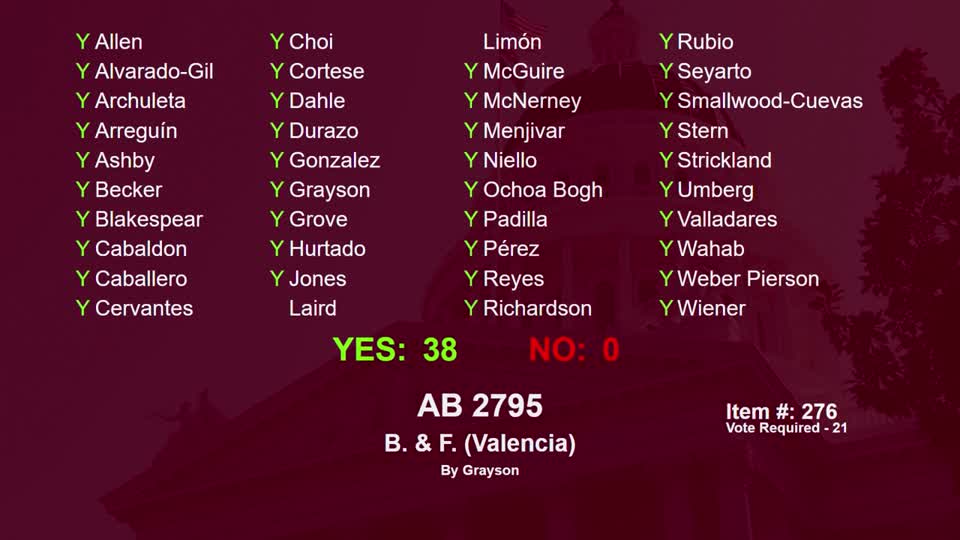 21MIN
Senate Floor
 5MIN
Senate Standing Committee on Transportation
 5MIN
Senate Standing Committee on Elections and Constitutional Amendments
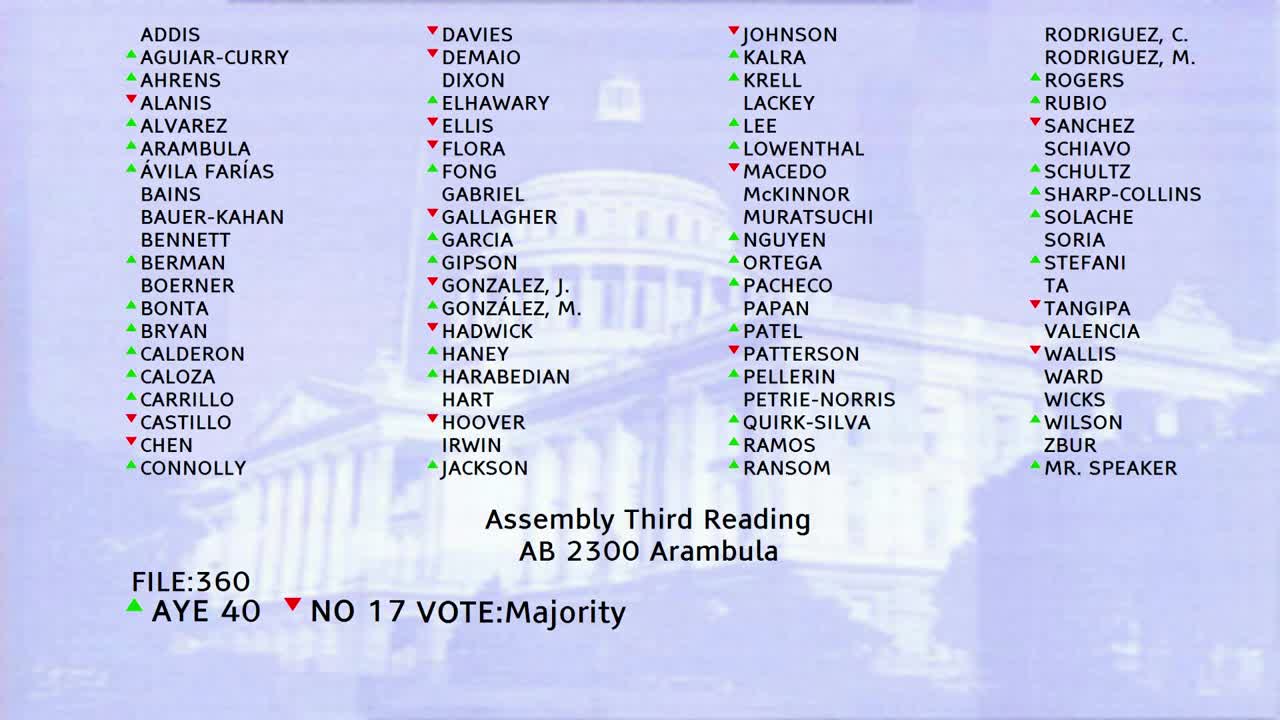 4MIN
Assembly Floor
 13MIN
Assembly Standing Committee on Local Government
 16MIN
Assembly Standing Committee on Elections
Bill Author