AB 253: California Residential Private Permitting Review Act: residential building permits.
- Session Year: 2025-2026
- House: Assembly
- Latest Version Date: 2025-10-10
Current Status:
Passed
(2025-10-10: Chaptered by Secretary of State - Chapter 487, Statutes of 2025.)
Introduced
In Committee
Awaiting First Chamber Vote
Passed First Chamber
In Committee
Awaiting Second Chamber Vote
Passed Second Chamber
Enacted
Existing law, the State Housing Law, establishes statewide construction and occupancy standards for buildings used for human habitation. Existing law authorizes a countys or citys governing body to prescribe fees for permits, certificates, or other forms or documents required or authorized under the State Housing Law.
This bill, the California Residential Private Permitting Review Act, would require a county or city to prepare a residential building permit fee schedule and post the schedule on the countys or citys internet website, if the county or city prescribes residential building permit fees.
Existing law requires a countys or citys building department to enforce the State Housing Law and the California Building Standards Code, and other rules and regulations promulgated pursuant to the State Housing Law pertaining to standards for buildings used for human habitation. Existing law requires a county or city, upon the applicants request, to contract with or employ temporarily a private entity or person to check the plans and specifications submitted with an application for a residential building permit to comply with the State Housing Law or local ordinances adopted pursuant to the State Housing Law, when the building department takes more than 30 days, as specified, to complete the plan check.
This bill would remove the above-described requirement for a county or city to contract with or employ temporarily a private entity or person to check the plans when the building department takes more than 30 days to complete the plan check. Until January 1, 2036, the bill would instead, upon an application for a residential building permit being deemed complete, as provided, require the city or county to provide the applicant with an estimated timeframe in which the city or county will determine if the completed application is compliant with permit standards. The bill would authorize an applicant to retain a private professional provider, as defined, to perform the plan check, if the estimated timeframe exceeds 30 business days or the city or county has not determined the completed application is compliant within 30 days of the application being deemed complete. The bill would require an applicant who retains a private professional provider to notify the city or county of their intent to retain the private professional provider within a prescribed timeframe. If a private professional provider performs the plan-checking function, the bill would impose additional requirements, including, among other things, requiring the private professional provider to prepare a specified affidavit, under penalty of perjury, and the applicant to submit to the city or county a specified report of the plan check. The bill would require the city or county, within 10 business days of receiving the report, to consider the report and, based on the report, either issue the residential building permit or notify the applicant that the plans and specifications do not comply, as specified. If the city or county notifies the applicant that the plans and specifications do not comply, the bill would authorize the applicant to resubmit corrected plans and specifications to the city or county, as specified. By expanding the crime of perjury and imposing new duties on local agencies, the bill would impose a state-mandated local program.
Existing law requires a local agency to determine whether an application for a postentitlement phase permit, as defined, is complete and provide written notice of this determination to the applicant not later than 15 business days after the local agency received the application. If a local agency finds that a complete application is noncompliant, existing law requires the local agency to provide the applicant with a list of items that are noncompliant and a description of how the application can be remedied by the applicant within specified time periods. Existing law requires the local agency to provide a process for an applicant to appeal a finding that the application for a postentitlement phase permit is incomplete or noncompliant, as provided.
This bill, until January 1, 2036, if a private professional provider performs the plan-checking function, as described above, would deem the local agency to be in compliance with the above-described requirements governing applications for postentitlement phase permits as those requirements pertain to the residential building permit.
Existing law, the Government Claims Act, establishes the liability and immunity of a public entity for its acts or omissions that cause harm to persons. Where a public entity is under a mandatory duty imposed by an enactment that is designed to protect against the risk of a particular kind of injury, the act makes the public entity liable for an injury of that kind proximately caused by its failure to discharge the duty unless the public entity establishes that it exercised reasonable diligence to discharge the duty.
This bill, until January 1, 2036, if a private professional provider performs the plan-checking function, as described above, would require the applicant to indemnify the local agency from any property damage or personal injury arising from construction in accordance with the plans checked by a private professional provider under the bills provisions. Notwithstanding the above-described liability of a public entity for failure to discharge certain mandatory duties, the bill would provide that a public entity or public employee is not liable for an injury caused by their discretionary or ministerial acts or omissions relating to the issuance or denial of any residential building permit pursuant to the bills provisions.
Existing law, the Planning and Zoning Law, requires each county and each city to adopt a comprehensive, long-term general plan for the physical development of the county or city, and specified land outside its boundaries, that includes, among other specified mandatory elements, a housing element. Existing law requires the planning agency of the county or city, after the legislative body has adopted a general plan, to submit an annual report to the legislative body, the Office of Land Use and Climate Innovation, and the Department of Housing and Community Development by April 1 of each year that includes, among other things, the number of units of housing demolished and new units of housing that have been issued a completed entitlement, a building permit, or a certificate of occupancy thus far in the housing element cycle, and the income category, by area median income category, that each unit of housing satisfies.
This bill, beginning April, 1, 2027, and until January 1, 2036, would require a city or county to include in the above-described annual report the number of residential building permits reviewed by the city or county, the number reviewed by a private professional provider under the bills provisions, as described above, and the number of full-time equivalent staff members directly involved in the processing of residential building permits, as provided.
The bill would include findings that changes proposed by this bill address a matter of statewide concern rather than a municipal affair and, therefore, apply to all cities, including charter cities.
The California Constitution requires the state to reimburse local agencies and school districts for certain costs mandated by the state. Statutory provisions establish procedures for making that reimbursement.
This bill would provide that no reimbursement is required by this act for specified reasons.
This bill would declare that it is to take effect immediately as an urgency statute.
Existing law, the State Housing Law, establishes statewide construction and occupancy standards for buildings used for human habitation. Existing law authorizes a countys or citys governing body to prescribe fees for permits, certificates, or other forms or documents required or authorized under the State Housing Law.
This bill, the California Residential Private Permitting Review Act, would require a county or city to prepare a residential building permit fee schedule and post the schedule on the countys or citys internet website, if the county or city prescribes residential building permit fees.
Existing law requires a countys or citys building department to enforce the State Housing Law and the California Building Standards Code, and other rules and regulations promulgated pursuant to the State Housing Law pertaining to standards for buildings used for human habitation. Existing law requires a county or city, upon the applicants request, to contract with or employ temporarily a private entity or person to check the plans and specifications submitted with an application for a residential building permit to comply with the State Housing Law or local ordinances adopted pursuant to the State Housing Law, when the building department takes more than 30 days, as specified, to complete the plan check.
This bill would remove the above-described requirement for a county or city to contract with or employ temporarily a private entity or person to check the plans when the building department takes more than 30 days to complete the plan check. Until January 1, 2036, the bill would instead, upon an application for a residential building permit being deemed complete, as provided, require the city or county to provide the applicant with an estimated timeframe in which the city or county will determine if the completed application is compliant with permit standards. The bill would authorize an applicant to retain a private professional provider, as defined, to perform the plan check, if the estimated timeframe exceeds 30 business days or the city or county has not determined the completed application is compliant within 30 days of the application being deemed complete. The bill would require an applicant who retains a private professional provider to notify the city or county of their intent to retain the private professional provider within a prescribed timeframe. If a private professional provider performs the plan-checking function, the bill would impose additional requirements, including, among other things, requiring the private professional provider to prepare a specified affidavit, under penalty of perjury, and the applicant to submit to the city or county a specified report of the plan check. The bill would require the city or county, within 10 business days of receiving the report, to consider the report and, based on the report, either issue the residential building permit or notify the applicant that the plans and specifications do not comply, as specified. If the city or county notifies the applicant that the plans and specifications do not comply, the bill would authorize the applicant to resubmit corrected plans and specifications to the city or county, as specified. The bill would make conforming changes by deleting the above-described requirement for a local agency to contract with or employ temporarily a private entity or person to check plans and specifications for a residential building permit. By expanding the crime of perjury and imposing new duties on local agencies, the bill would impose a state-mandated local program.
Existing law requires a local agency to determine whether an application for a postentitlement phase permit, as defined, is complete and provide written notice of this determination to the applicant not later than 15 business days after the local agency received the application. If a local agency finds that a complete application is noncompliant, existing law requires the local agency to provide the applicant with a list of items that are noncompliant and a description of how the application can be remedied by the applicant within specified time periods. Existing law requires the local agency to provide a process for an applicant to appeal a finding that the application for a postentitlement phase permit is incomplete or noncompliant, as provided.
This bill, until January 1, 2036, if a private professional provider performs the plan-checking function, as described above, would deem the local agency to be in compliance with the above-described requirements governing applications for postentitlement phase permits as those requirements pertain to the residential building permit.
Existing law, the Government Claims Act, establishes the liability and immunity of a public entity for its acts or omissions that cause harm to persons. Where a public entity is under a mandatory duty imposed by an enactment that is designed to protect against the risk of a particular kind of injury, the act makes the public entity liable for an injury of that kind proximately caused by its failure to discharge the duty unless the public entity establishes that it exercised reasonable diligence to discharge the duty.
This bill, until January 1, 2036, if a private professional provider performs the plan-checking function, as described above, would require the applicant to indemnify the local agency from any property damage or personal injury arising from construction in accordance with the plans checked by a private professional provider under the bills provisions. Notwithstanding the above-described liability of a public entity for failure to discharge certain mandatory duties, the bill would provide that a public entity or public employee is not liable for an injury caused by their discretionary or ministerial acts or omissions relating to the issuance or denial of any residential building permit pursuant to the bills provisions.
Existing law, the Planning and Zoning Law, requires each county and each city to adopt a comprehensive, long-term general plan for the physical development of the county or city, and specified land outside its boundaries, that includes, among other specified mandatory elements, a housing element. Existing law requires the planning agency of the county or city, after the legislative body has adopted a general plan, to submit an annual report to the legislative body, the Office of Land Use and Climate Innovation, and the Department of Housing and Community Development by April 1 of each year that includes, among other things, the number of units of housing demolished and new units of housing that have been issued a completed entitlement, a building permit, or a certificate of occupancy thus far in the housing element cycle, and the income category, by area median income category, that each unit of housing satisfies.
This bill, beginning April, 1, 2027, and until January 1, 2036, would require a city or county to include in the above-described annual report the number of residential building permits reviewed by the city or county and county, the number reviewed by a private professional provider under the bills provisions, as described above. above, and the number of full-time equivalent staff members directly involved in the processing of residential building permits, as provided.
The bill would include findings that changes proposed by this bill address a matter of statewide concern rather than a municipal affair and, therefore, apply to all cities, including charter cities.
The California Constitution requires the state to reimburse local agencies and school districts for certain costs mandated by the state. Statutory provisions establish procedures for making that reimbursement.
This bill would provide that no reimbursement is required by this act for specified reasons.
This bill would declare that it is to take effect immediately as an urgency statute.
Existing law, the State Housing Law, establishes statewide construction and occupancy standards for buildings used for human habitation. Existing law authorizes a countys or citys governing body to prescribe fees for permits, certificates, or other forms or documents required or authorized under the State Housing Law.
This bill, the California Residential Private Permitting Review Act, would require a county or city to prepare a residential building permit fee schedule and post the schedule on the countys or citys internet website, if the county or city prescribes residential building permit fees.
Existing law requires a countys or citys building department to enforce the State Housing Law and the California Building Standards Code, and other rules and regulations promulgated pursuant to the State Housing Law pertaining to standards for buildings used for human habitation. Existing law requires a county or city, upon the applicants request, to contract with or employ temporarily a private entity or person to check the plans and specifications submitted with an application for a residential building permit to comply with the State Housing Law or local ordinances adopted pursuant to the State Housing Law, when the building department takes more than 30 days, as specified, to complete the plan check.
This bill would instead instead, upon an application for a residential building permit being deemed complete, as provided, require the building department city or county to provide the applicant with an estimated timeframe to complete the plan check, upon receiving a completed application for a residential building permit, as defined. in which the city or county will determine if the completed application is compliant with permit standards. The bill would authorize an applicant to retain a private professional provider, as defined, to perform the plan check, if the estimated timeframe exceeds 30 business days or the building department city or county has not completed the plan check determined the completed application is compliant within 30 days of receiving the application. the application being deemed complete. The bill would require an applicant who retains a private professional provider to notify the building department city or county of their intent to retain the private professional provider within a prescribed timeframe. If a private professional provider performs the plan-checking function, the bill would impose additional requirements, including, among other things, requiring the private professional provider to prepare a specified affidavit, under penalty of perjury, and the applicant to submit to the building department city or county a specified report of the plan check. The bill would require the building department, city or county, within 10 business days of receiving the report, to consider the report and, based on the report, either issue the residential building permit or notify the applicant that the plans and specifications do not comply, as specified. If the building department city or county notifies the applicant that the plans and specifications do not comply, the bill would authorize the applicant to resubmit corrected plans and specifications to the building department or contract with or employ a private professional provider to check the corrected plans and specifications, city or county, as specified. The bill would make conforming changes by deleting the above-described requirement for a local agency to contract with or employ temporarily a private entity or person to check plans and specifications for a residential building permit. By expanding the crime of perjury and imposing new duties on local agencies, the bill would impose a state-mandated local program.
Existing law requires a local agency to determine whether an application for a postentitlement phase permit, as defined, is complete and provide written notice of this determination to the applicant not later than 15 business days after the local agency received the application. If a local agency finds that a complete application is noncompliant, existing law requires the local agency to provide the applicant with a list of items that are noncompliant and a description of how the application can be remedied by the applicant within specified time periods. Existing law requires the local agency to provide a process for an applicant to appeal a finding that the application for a postentitlement phase permit is incomplete or noncompliant, as provided.
This bill, if a private professional provider performs the plan-checking function, as described above, would deem the local agency to be in compliance with the above-described requirements governing applications for postentitlement phase permits as those requirements pertain to the residential building permit.
Existing law, the Government Claims Act, establishes the liability and immunity of a public entity for its acts or omissions that cause harm to persons. Where a public entity is under a mandatory duty imposed by an enactment that is designed to protect against the risk of a particular kind of injury, the act makes the public entity liable for an injury of that kind proximately caused by its failure to discharge the duty unless the public entity establishes that it exercised reasonable diligence to discharge the duty.
This bill, if a private professional provider performs the plan-checking function, as described above, would require the applicant to indemnify the local agency from any property damage or personal injury arising from construction permitted in accordance with the plans checked by a private professional provider under the bills provisions. Notwithstanding the above-described liability of a public entity for failure to discharge certain mandatory duties, the bill would provide that a public entity or public employee is not liable for an injury caused by their discretionary or ministerial acts or omissions relating to the issuance or denial of any residential building permit pursuant to the bills provisions.
Existing law, the Planning and Zoning Law, requires each county and each city to adopt a comprehensive, long-term general plan for the physical development of the county or city, and specified land outside its boundaries, that includes, among other specified mandatory elements, a housing element. Existing law requires the planning agency of the county or city, after the legislative body has adopted a general plan, to submit an annual report to the legislative body, the Office of Land Use and Climate Innovation, and the Department of Housing and Community Development by April 1 of each year that includes, among other things, the number of units of housing demolished and new units of housing that have been issued a completed entitlement, a building permit, or a certificate of occupancy thus far in the housing element cycle, and the income category, by area median income category, that each unit of housing satisfies.
This bill, beginning April, 1, 2027, would require a city or county to include in the above-described annual report the number of residential building permits reviewed by the city or county and the number reviewed by a private professional provider under the bills provisions, as described above.
The bill would include findings that changes proposed by this bill address a matter of statewide concern rather than a municipal affair and, therefore, apply to all cities, including charter cities.
The California Constitution requires the state to reimburse local agencies and school districts for certain costs mandated by the state. Statutory provisions establish procedures for making that reimbursement.
This bill would provide that no reimbursement is required by this act for specified reasons.
This bill would declare that it is to take effect immediately as an urgency statute.
Existing law, the State Housing Law, establishes statewide construction and occupancy standards for buildings used for human habitation. Existing law authorizes a countys or citys governing body to prescribe fees for permits, certificates, or other forms or documents required or authorized under the State Housing Law.
This bill, the California Residential Private Permitting Review Act, would require a countys or citys building department county or city to prepare a residential building permit fee schedule and post the schedule on the countys or citys internet website, if the county or city prescribes residential building permit fees.
Existing law requires a countys or citys building department to enforce the State Housing Law and the California Building Standards Code, and other rules and regulations promulgated pursuant to the State Housing Law pertaining to standards for buildings used for human habitation. Existing law requires a county or city, upon the applicants request, to contract with or employ temporarily a private entity or person to check the plans and specifications submitted with an application for a residential building permit to comply with the State Housing Law or local ordinances adopted pursuant to the State Housing Law, when the building department takes more than 30 days, as specified, to complete the plan check.
This bill would additionally instead require the building department to provide the applicant with an estimated timeframe to complete the plan check, upon receiving a completed application. application for a residential building permit, as defined. The bill would authorize an applicant to contract with or employ retain a private professional provider, as defined, to perform the plan check, if the estimated timeframe exceeds 30 business days or the building department has not completed the plan check within 30 days of receiving the application. The bill would require an applicant who retains a private professional provider to notify the building department of their intent to retain the private professional provider within a prescribed timeframe. If a private professional provider performs the plan-checking function, the bill would impose additional requirements, including, among other things, requiring the private professional provider to prepare a specified affidavit, under penalty of perjury, and the applicant to submit to the building department a specified report of the plan check. The bill would require the building department, within 14 10 business days of receiving the report, to consider the report and, based on the report, either issue the residential building permit or notify the applicant that the plans and specifications do not comply, as specified. If the building department notifies the applicant that the plans and specifications do not comply, the bill would authorize the applicant to resubmit corrected plans and specifications to the building department or contract with or employ a private professional provider to check the corrected plans and specifications, as specified. The bill would apply these provisions only to specified new residential constructions of a building and residential additions to, or remodels of, an existing building. The bill would make conforming changes by deleting the above-described requirement for a local agency to contract with or employ temporarily a private entity or person to check plans and specifications for a residential building permit. By expanding the crime of perjury and imposing new duties on local agencies, the bill would impose a state-mandated local program.
Existing law requires a local agency to determine whether an application for a postentitlement phase permit, as defined, is complete and provide written notice of this determination to the applicant not later than 15 business days after the local agency received the application. If a local agency finds that a complete application is noncompliant, existing law requires the local agency to provide the applicant with a list of items that are noncompliant and a description of how the application can be remedied by the applicant within specified time periods. Existing law requires the local agency to provide a process for an applicant to appeal a finding that the application for a postentitlement phase permit is incomplete or noncompliant, as provided.
This bill, if a private professional provider performs the plan-checking function, as described above, would deem the local agency to be in compliance with the above-described requirements governing applications for postentitlement phase permits as those requirements pertain to the residential building permit.
Existing law, the Government Claims Act, establishes the liability and immunity of a public entity for its acts or omissions that cause harm to persons. Where a public entity is under a mandatory duty imposed by an enactment that is designed to protect against the risk of a particular kind of injury, the act makes the public entity liable for an injury of that kind proximately caused by its failure to discharge the duty unless the public entity establishes that it exercised reasonable diligence to discharge the duty.
This bill, if a private professional provider performs the plan-checking function, as described above, would require the applicant to indemnify the local agency from any property damage or personal injury arising from construction permitted under the bills provisions. Notwithstanding the above-described liability of a public entity for failure to discharge certain mandatory duties, the bill would provide that a public entity or public employee is not liable for an injury caused by their discretionary or ministerial acts or omissions relating to the issuance or denial of any residential building permit pursuant to the bills provisions.
The bill would include findings that changes proposed by this bill address a matter of statewide concern rather than a municipal affair and, therefore, apply to all cities, including charter cities.
The California Constitution requires the state to reimburse local agencies and school districts for certain costs mandated by the state. Statutory provisions establish procedures for making that reimbursement.
This bill would provide that no reimbursement is required by this act for specified reasons.
This bill would declare that it is to take effect immediately as an urgency statute.
Existing law, the State Housing Law, establishes statewide construction and occupancy standards for buildings used for human habitation. Existing law authorizes a countys or citys governing body to prescribe fees for permits, certificates, or other forms or documents required or authorized under the State Housing Law.
This bill, the California Residential Private Permitting Review Act, would require a countys or citys building department to prepare a residential building permit fee schedule and post the schedule on the countys or citys internet website, if the county or city prescribes residential building permit fees.
Existing law requires a countys or citys building department to enforce the State Housing Law and the California Building Standards Code, and other rules and regulations promulgated pursuant to the State Housing Law pertaining to standards for buildings used for human habitation. Existing law requires a county or city, upon the applicants request, to contract with or employ temporarily a private entity or person to check the plans and specifications submitted with an application for a residential building permit to comply with the State Housing Law or local ordinances adopted pursuant to the State Housing Law, when the building department takes more than 30 days, as specified, to complete the plan check.
This bill would additionally require the building department to provide the applicant with an estimated timeframe to complete the plan check, upon receiving a completed application. The bill would authorize an applicant to contract with or employ a private professional provider, as defined, to perform the plan check, if the estimated timeframe exceeds 30 days or the building department has not completed the plan check within 30 days of receiving the application. The bill would require the private professional provider to prepare a specified affidavit, under penalty of perjury, and the applicant to submit to the building department a specified report of the plan check. The bill would require the building department, within 14 days of receiving the report, to consider the report and, based on the report, either issue the residential building permit or notify the applicant that the plans and specifications do not comply, as specified. If the building department notifies the applicant that the plans and specifications do not comply, the bill would authorize the applicant to resubmit corrected plans and specifications to the building department or contract with or employ a private professional provider to check the corrected plans and specifications, as specified. The bill would apply these provisions only to specified new residential constructions of a building and residential additions to, or remodels of, an existing building. By expanding the crime of perjury and imposing new duties on local agencies, the bill would impose a state-mandated local program.
By expanding the crime of perjury and imposing new duties on local agencies, the bill would impose a state-mandated local program.The bill would include findings that changes proposed by this bill address a matter of statewide concern rather than a municipal affair and, therefore, apply to all cities, including charter cities.
The California Constitution requires the state to reimburse local agencies and school districts for certain costs mandated by the state. Statutory provisions establish procedures for making that reimbursement.
This bill would provide that no reimbursement is required by this act for specified reasons.
This bill would declare that it is to take effect immediately as an urgency statute.
Existing law, the State Housing Law, establishes statewide construction and occupancy standards for buildings used for human habitation. Existing law authorizes a countys or citys governing body to prescribe fees for permits, certificates, or other forms or documents required or authorized under the State Housing Law.
This bill, the California Residential Private Permitting Review Act, would require a countys or citys building department to prepare a residential building permit fee schedule and post the schedule on the countys or citys internet website, if the county or city prescribes residential building permit fees.
Existing law requires a countys or citys building department to enforce the State Housing Law and the California Building Standards Code, and other rules and regulations promulgated pursuant to the State Housing Law pertaining to standards for buildings used for human habitation. Existing law requires a county or city, upon the applicants request, to contract with or employ temporarily a private entity or person to check the plans and specifications submitted with an application for a residential building permit to comply with the State Housing Law or local ordinances adopted pursuant to the State Housing Law, when the building department takes more than 30 days, as specified, to complete the plan check.
This bill would additionally require the building department to provide the applicant with an estimated timeframe to complete the plan check, upon receiving a completed application. The bill would authorize an applicant to contract with or employ a private professional provider, as defined, to perform the plan check, if the estimated timeframe exceeds 30 days or the building department has not completed the plan check within 30 days of receiving the application. The bill would require the private professional provider to prepare a specified affidavit, under penalty of perjury, and the applicant to submit to the building department a specified report of the plan check. The bill would require the building department, within 14 days of receiving the report, to consider the report and, based on the report, either issue the residential building permit or notify the applicant that the plans and specifications do not comply, as specified. If the building department notifies the applicant that the plans and specifications do not comply, the bill would authorize the applicant to resubmit corrected plans and specifications to the building department or contract with or employ a private professional provider to check the corrected plans and specifications, as specified. The bill would apply these provisions only to specified new residential constructions of a building and residential additions to, or remodels of, an existing building.
By expanding the crime of perjury and imposing new duties on local agencies, the bill would impose a state-mandated local program.
The bill would include findings that changes proposed by this bill address a matter of statewide concern rather than a municipal affair and, therefore, apply to all cities, including charter cities.
The California Constitution requires the state to reimburse local agencies and school districts for certain costs mandated by the state. Statutory provisions establish procedures for making that reimbursement.
This bill would provide that no reimbursement is required by this act for specified reasons.
This act shall be known, and may be cited, as the California Residential Private Permitting Review Act.
SEC. 2.The Legislature finds and declares all of the following:
(a)Local building plan-checking functions are subject to extensive swings in workload, which can result in significant delays in processing residential building permits.
(b)Prolonged delays in building plan-checking functions at the local level can negatively impact the states housing production pipeline, and ultimately state and local economies.
(c)The state faces a housing crisis of availability and affordability of housing, in large part due to severe shortage of housing.
(d)It is the intent of the Legislature to establish a set of options for local jurisdictions to augment, not replace, existing building plan-checking functions and prevent excessive delays in this critical administrative process.
SEC. 3.Section 17951 of the Health and Safety Code is amended to read:17951.(a)(1)The governing body of any county or city, including a charter city, may prescribe fees for permits, certificates, or other forms or documents required or authorized by this part or rules and regulations adopted pursuant to this part.
(2)If a governing body of any county or city, including a charter city, prescribes fees for a residential building permit, pursuant to paragraph (1), the city or county shall prepare a schedule of the fees for a residential building permit and post the schedule on the countys or citys internet website.
(b)The governing body of any county or city, including a charter city, or fire protection district, may prescribe fees to defray the costs of enforcement required by this part to be carried out by local enforcement agencies.
(c)The amount of the fees prescribed pursuant to paragraph (1) of subdivision (a) and subdivision (b) shall not exceed the amount reasonably required to administer or process these permits, certificates, or other forms or documents, or to defray the costs of enforcement required by this part to be carried out by local enforcement agencies, and shall not be levied for general revenue purposes. The fees shall be imposed pursuant to Section 66016 of the Government Code.
(d)If the local enforcement agency fails to conduct an inspection of permitted work for which permit fees have been charged pursuant to this section within 60 days of receiving notice of the completion of the permitted work, the permittee shall be entitled to reimbursement of the permit fees. The local enforcement agency shall disclose in clear language on each permit or on a document that accompanies the permit that the permittee may be entitled to reimbursement of permit fees pursuant to this subdivision.
(e)(1)The provisions of this part are not intended to prevent the use of any manufactured home, mobilehome, multiunit manufactured home, material, appliance, installation, device, arrangement, or method of construction not specifically prescribed by the California Building Standards Code or this part, provided that this alternate has been approved by the building department.
(2)The building department of any city or county may approve an alternate material, appliance, installation, device, arrangement, method, or work on a case-by-case basis if it finds that the proposed design is satisfactory and that each such material, appliance, installation, device, arrangement, method, or work offered is, for the purpose intended, at least the equivalent of that prescribed in the California Building Standards Code or this part in performance, safety, and for the protection of life and health.
(3)The building department of any city or county shall require evidence that any material, appliance, installation, device, arrangement, or method of construction conforms to, or that the proposed alternate is at least equivalent to, the requirements of this part, building standards published in the California Building Standards Code, or the other rules and regulations promulgated pursuant to this part and in order to substantiate claims for alternates, the building department of any city or county may require tests as proof of compliance to be made at the expense of the owner or the owners agent by an approved testing agency selected by the owner or the owners agent.
SEC. 4.Section 17960.1 of the Health and Safety Code is amended to read:17960.1.(a)The governing body of a local agency may authorize its enforcement agency to contract with or employ a private entity or persons on a temporary basis to perform the plan-checking function.
(b)A local agency need not enter into a contract or employ persons if it determines that no entities or persons are available or qualified to perform the plan-checking services.
(c)Entities or persons employed by a local agency may, pursuant to agreement with the local agency, perform all functions necessary to check the plans and specifications to comply with other requirements imposed pursuant to this part or by local ordinances adopted pursuant to this part, except those functions reserved by this part or local ordinance to the legislative body. A local agency may charge the applicant fees in an amount necessary to defray costs directly attributable to employing or contracting with entities or persons performing services pursuant to this section which the applicant requested.
(d)For purposes of this section:
(1)Enforcement agency means the building department or building division of a local agency.
(2)Local agency means a city, county, or city and county.
SEC. 5.Section 17960.3 is added to the Health and Safety Code, to read:17960.3.(a)(1)Upon an application for a residential building permit being deemed complete pursuant to Section 65913.3 of the Government Code, a city or county shall provide the applicant with an estimated timeframe in which the city or county will determine if the complete application is compliant with permit standards. If the estimated timeframe exceeds 30 business days, the applicant may retain, at the applicants sole expense, a private professional provider to check the plans and specifications for their compliance with the requirements imposed pursuant to this part and by local ordinances adopted pursuant to this part.
(2)If, within 30 business days of an application for a residential building permit being deemed complete pursuant to Section 65913.3 of the Government Code, the city or county has not determined that the completed application is compliant with permit standards, the applicant may retain, at the applicants sole expense, a private professional provider to check the plans and specifications for their compliance with the requirements imposed pursuant to this part and by local ordinances adopted pursuant to this part.
(b)An applicant who retains a private professional provider shall notify the city or county of the applicants intent to retain a private professional provider no later than five business days after either of the following, as applicable:
(1)Provision of the estimated timeframe in paragraph (1) of subdivision (a).
(2)The time period in paragraph (2) of subdivision (a) elapses.
(c)If a private professional provider performs the plan-checking function, all of the following shall apply:
(1)The private professional provider shall prepare an affidavit, under penalty of perjury, stating both of the following:
(A)That the plans and specifications do or do not comply with the requirements imposed pursuant to this part and local ordinances adopted pursuant to this part.
(B)The private professional provider performed the plan-checking function.
(2)The applicant shall submit to the city or county a report of the plan-checking function. The report shall include all of the following:
(A)The affidavit described in paragraph (1).
(B)If the plan and specifications do not comply with the requirements imposed pursuant to this part or local ordinances adopted pursuant to this part, modifications to the plans and specifications that are necessary to comply with the other requirements imposed pursuant to this part and the local ordinances adopted pursuant to this part.
(C)Additional information required by the city or county.
(3)Within 10 business days of receiving the report pursuant to paragraph (2), the city or county shall consider the report and based on the report shall do either of the following:
(A)Issue the residential building permit if the plans and specifications comply with the other requirements imposed pursuant to this part or local ordinances adopted pursuant to this part.
(B)Notify the applicant in writing that the plans and specifications do not comply with the other requirements imposed pursuant to this part or local ordinances adopted pursuant to this part, if the plans and specifications do not comply with the other requirements imposed pursuant to this part or local ordinances adopted pursuant to this part. The notice shall specify the requirements for the plans and specifications to comply with the other requirements imposed pursuant to this part or local ordinances adopted pursuant to this part.
(4)If the city or county does not issue the residential building permit or notify the applicant within 10 business days pursuant to paragraph (3), and the affidavit provided pursuant to paragraph (1) states that the plans and specifications comply with the other requirements imposed pursuant to this part and local ordinances adopted pursuant to this part, the plans and specifications shall be deemed compliant with the other requirements imposed pursuant to this part or local ordinances adopted pursuant to this part, and the residential building permit shall be deemed approved.
(5)The local agency shall be deemed in compliance with the requirements of Section 65913.3 of the Government Code as those requirements pertain to the residential building permit.
(6)The applicant shall indemnify the local agency from any property damage or personal injury arising from construction in accordance with the plans checked by a private professional provider pursuant to this section.
(7)Notwithstanding Section 815.6 of the Government Code, a public entity or public employee is not liable for an injury caused by their discretionary or ministerial acts or omissions relating to the issuance or denial of any residential building permit pursuant to this section.
(d)(1)If the city or county notifies the applicant pursuant to subparagraph (B) of paragraph (3) of subdivision (c), the applicant may resubmit corrected plans and specifications to the city or county to check the corrected plans and specifications.
(2)If an applicant resubmits corrected plans and specifications, the resubmitted plans and specifications shall be subject to the same timelines of a new application as specified in subdivision (c).
(e)Nothing in this section shall be construed to prohibit a city, county, or city and county from providing a self-certification program under terms that are different from those set forth in this section to the extent that the local program does not conflict with the requirements of this section.
(f)Commencing April 1, 2027, a city or county shall include all of the following in the report it submits pursuant to Section 65400 of the Government Code:
(1)The number of residential building permits that were reviewed by the city or county.
(2)The number of residential building permits that were reviewed by a private professional provider pursuant to this section.
(3)The number of full-time equivalent staff members directly involved in the processing of residential building permits, delineated by those primarily performing plan review functions and those primarily performing final permit approval or issuance functions. The reporting of these classifications shall be separate and shall not be combined.
(g)For the purposes of this section:
(1)Applicant means a person who submits an application.
(2)Application means an application for a residential building permit.
(3)Private professional provider means a professional engineer licensed pursuant to the Professional Engineers Act (Chapter 7 (commencing with Section 6700) of Division 3 of the Business and Professions Code) or an architect licensed pursuant to the Architects Practice Act (Chapter 3 (commencing with Section 5500) of Division 3 of the Business and Professions Code) who is currently certified as a residential plans examiner by the International Code Council, currently certified as a plans examiner by the International Association of Plumbing and Mechanical Officials, or currently certified by another state, national, or international association that the local agency recognizes as an acceptable certification for residential building plans examiners employed by the city or county. The private professional provider shall not have a financial interest in the residential building permit or in preparing the plans and specifications.
(4)Residential building permit means a building permit for either of the following:
(A)A new residential construction of a building that contains at least 1 dwelling unit, but no more than 10 dwelling units, contains only residential units, and has no floors used for human occupancy located more than 40 feet above ground level.
(B)A residential addition to, or a remodel of, an existing building that contains at least 1 dwelling unit, but no more than 10 dwelling units, contains only residential units, and has no floors used for human occupancy located more than 40 feet above ground level, for the purpose of adding new residential units to the existing building, not to exceed 10 total units in the building as proposed to be constructed.
(h)This section shall remain in effect only until January 1, 2036, and as of that date is repealed.
SEC. 6.The Legislature finds and declares that averting the economic and social harm as a result of natural disasters and severe lack of housing in the state is a matter of statewide concern and is not a municipal affair as that term is used in Section 5 of Article XI of the California Constitution. Therefore, Sections 3 and 4 of this act amending Section 17951 of, and adding Section 17960.3 to, the Health and Safety Code apply to all cities, including charter cities.
SEC. 7.No reimbursement is required by this act pursuant to Section 6 of Article XIIIB of the California Constitution because a local agency or school district has the authority to levy service charges, fees, or assessments sufficient to pay for the program or level of service mandated by this act or because costs that may be incurred by a local agency or school district will be incurred because this act creates a new crime or infraction, eliminates a crime or infraction, or changes the penalty for a crime or infraction, within the meaning of Section 17556 of the Government Code, or changes the definition of a crime within the meaning of Section 6 of Article XIIIB of the California Constitution.
SEC. 8.This act is an urgency statute necessary for the immediate preservation of the public peace, health, or safety within the meaning of Article IV of the California Constitution and shall go into immediate effect. The facts constituting the necessity are:
In order to avert economic and social harm as a result of natural disasters and the severe lack of housing in the state, it is necessary for this act to take effect immediately.
This act shall be known, and may be cited, as the California Residential Private Permitting Review Act.
SEC. 2.The Legislature finds and declares all of the following:
(a)Local building plan-checking functions are subject to extensive swings in workload, which can result in significant delays in processing residential building permits.
(b)Prolonged delays in building plan-checking functions at the local level can negatively impact the states housing production pipeline, and ultimately state and local economies.
(c)The state faces a housing crisis of availability and affordability of housing, in large part due to severe shortage of housing.
(d)It is the intent of the Legislature to establish a set of options for local jurisdictions to augment, not replace, existing building plan-checking functions and prevent excessive delays in this critical administrative process.
SEC. 3.Section 17951 of the Health and Safety Code is amended to read:17951.(a)(1)The governing body of any county or city, including a charter city, may prescribe fees for permits, certificates, or other forms or documents required or authorized by this part or rules and regulations adopted pursuant to this part.
(2)If a governing body of any county or city, including a charter city, prescribes fees for a residential building permit, pursuant to paragraph (1), the city or county shall prepare a schedule of the fees for a residential building permit and post the schedule on the countys or citys internet website.
(b)The governing body of any county or city, including a charter city, or fire protection district, may prescribe fees to defray the costs of enforcement required by this part to be carried out by local enforcement agencies.
(c)The amount of the fees prescribed pursuant to paragraph (1) of subdivision (a) and subdivision (b) shall not exceed the amount reasonably required to administer or process these permits, certificates, or other forms or documents, or to defray the costs of enforcement required by this part to be carried out by local enforcement agencies, and shall not be levied for general revenue purposes. The fees shall be imposed pursuant to Section 66016 of the Government Code.
(d)If the local enforcement agency fails to conduct an inspection of permitted work for which permit fees have been charged pursuant to this section within 60 days of receiving notice of the completion of the permitted work, the permittee shall be entitled to reimbursement of the permit fees. The local enforcement agency shall disclose in clear language on each permit or on a document that accompanies the permit that the permittee may be entitled to reimbursement of permit fees pursuant to this subdivision.
(e)(1)The provisions of this part are not intended to prevent the use of any manufactured home, mobilehome, multiunit manufactured home, material, appliance, installation, device, arrangement, or method of construction not specifically prescribed by the California Building Standards Code or this part, provided that this alternate has been approved by the building department.
(2)The building department of any city or county may approve an alternate material, appliance, installation, device, arrangement, method, or work on a case-by-case basis if it finds that the proposed design is satisfactory and that each such material, appliance, installation, device, arrangement, method, or work offered is, for the purpose intended, at least the equivalent of that prescribed in the California Building Standards Code or this part in performance, safety, and for the protection of life and health.
(3)The building department of any city or county shall require evidence that any material, appliance, installation, device, arrangement, or method of construction conforms to, or that the proposed alternate is at least equivalent to, the requirements of this part, building standards published in the California Building Standards Code, or the other rules and regulations promulgated pursuant to this part and in order to substantiate claims for alternates, the building department of any city or county may require tests as proof of compliance to be made at the expense of the owner or the owners agent by an approved testing agency selected by the owner or the owners agent.
SEC. 4.Section 17960.1 of the Health and Safety Code is amended to read:17960.1.(a)The governing body of a local agency may authorize its enforcement agency to contract with or employ a private entity or persons on a temporary basis to perform the plan-checking function.
(b)A local agency need not enter into a contract or employ persons if it determines that no entities or persons are available or qualified to perform the plan-checking services.
(c)Entities or persons employed by a local agency may, pursuant to agreement with the local agency, perform all functions necessary to check the plans and specifications to comply with other requirements imposed pursuant to this part or by local ordinances adopted pursuant to this part, except those functions reserved by this part or local ordinance to the legislative body. A local agency may charge the applicant fees in an amount necessary to defray costs directly attributable to employing or contracting with entities or persons performing services pursuant to this section which the applicant requested.
(d)For purposes of this section:
(1)Enforcement agency means the building department or building division of a local agency.
(2)Local agency means a city, county, or city and county.
SEC. 5.Section 17960.3 is added to the Health and Safety Code, to read:17960.3.(a)(1)Upon an application for a residential building permit being deemed complete pursuant to Section 65913.3 of the Government Code, a city or county shall provide the applicant with an estimated timeframe in which the city or county will determine if the complete application is compliant with permit standards. If the estimated timeframe exceeds 30 business days, the applicant may retain, at the applicants sole expense, a private professional provider to check the plans and specifications for their compliance with the requirements imposed pursuant to this part and by local ordinances adopted pursuant to this part.
(2)If, within 30 business days of an application for a residential building permit being deemed complete pursuant to Section 65913.3 of the Government Code, the city or county has not determined that the completed application is compliant with permit standards, the applicant may retain, at the applicants sole expense, a private professional provider to check the plans and specifications for their compliance with the requirements imposed pursuant to this part and by local ordinances adopted pursuant to this part.
(b)An applicant who retains a private professional provider shall notify the city or county of the applicants intent to retain a private professional provider no later than five business days after either of the following, as applicable:
(1)Provision of the estimated timeframe in paragraph (1) of subdivision (a).
(2)The time period in paragraph (2) of subdivision (a) elapses.
(c)If a private professional provider performs the plan-checking function, all of the following shall apply:
(1)The private professional provider shall prepare an affidavit, under penalty of perjury, stating both of the following:
(A)That the plans and specifications do or do not comply with the requirements imposed pursuant to this part and local ordinances adopted pursuant to this part.
(B)The private professional provider performed the plan-checking function.
(2)The applicant shall submit to the city or county a report of the plan-checking function. The report shall include all of the following:
(A)The affidavit described in paragraph (1).
(B)If the plan and specifications do not comply with the requirements imposed pursuant to this part or local ordinances adopted pursuant to this part, modifications to the plans and specifications that are necessary to comply with the other requirements imposed pursuant to this part and the local ordinances adopted pursuant to this part.
(C)Additional information required by the city or county.
(3)Within 10 business days of receiving the report pursuant to paragraph (2), the city or county shall consider the report and based on the report shall do either of the following:
(A)Issue the residential building permit if the plans and specifications comply with the other requirements imposed pursuant to this part or local ordinances adopted pursuant to this part.
(B)Notify the applicant in writing that the plans and specifications do not comply with the other requirements imposed pursuant to this part or local ordinances adopted pursuant to this part, if the plans and specifications do not comply with the other requirements imposed pursuant to this part or local ordinances adopted pursuant to this part. The notice shall specify the requirements for the plans and specifications to comply with the other requirements imposed pursuant to this part or local ordinances adopted pursuant to this part.
(4)If the city or county does not issue the residential building permit or notify the applicant within 10 business days pursuant to paragraph (3), and the affidavit provided pursuant to paragraph (1) states that the plans and specifications comply with the other requirements imposed pursuant to this part and local ordinances adopted pursuant to this part, the plans and specifications shall be deemed compliant with the other requirements imposed pursuant to this part or local ordinances adopted pursuant to this part, and the residential building permit shall be deemed approved.
(5)The local agency shall be deemed in compliance with the requirements of Section 65913.3 of the Government Code as those requirements pertain to the residential building permit.
(6)The applicant shall indemnify the local agency from any property damage or personal injury arising from construction in accordance with the plans checked by a private professional provider pursuant to this section.
(7)Notwithstanding Section 815.6 of the Government Code, a public entity or public employee is not liable for an injury caused by their discretionary or ministerial acts or omissions relating to the issuance or denial of any residential building permit pursuant to this section.
(d)(1)If the city or county notifies the applicant pursuant to subparagraph (B) of paragraph (3) of subdivision (c), the applicant may resubmit corrected plans and specifications to the city or county to check the corrected plans and specifications.
(2)If an applicant resubmits corrected plans and specifications, the resubmitted plans and specifications shall be subject to the same timelines of a new application as specified in subdivision (c).
(e)Nothing in this section shall be construed to prohibit a city, county, or city and county from providing a self-certification program under terms that are different from those set forth in this section to the extent that the local program does not conflict with the requirements of this section.
(f)Commencing April 1, 2027, a city or county shall include all of the following in the report it submits pursuant to Section 65400 of the Government Code:
(1)The number of residential building permits that were reviewed by the city or county.
(2)The number of residential building permits that were reviewed by a private professional provider pursuant to this section.
(3)The number of full-time equivalent staff members directly involved in the processing of residential building permits, delineated by those primarily performing plan review functions and those primarily performing final permit approval or issuance functions. The reporting of these classifications shall be separate and shall not be combined.
(g)For the purposes of this section:
(1)Applicant means a person who submits an application.
(2)Application means an application for a residential building permit.
(3)Private professional provider means a professional engineer licensed pursuant to the Professional Engineers Act (Chapter 7 (commencing with Section 6700) of Division 3 of the Business and Professions Code) or an architect licensed pursuant to the Architects Practice Act (Chapter 3 (commencing with Section 5500) of Division 3 of the Business and Professions Code) who is currently certified as a residential plans examiner by the International Code Council or by the entity that certifies Council, currently certified as a plans examiner by the International Association of Plumbing and Mechanical Officials, or currently certified by another state, national, or international association that the local agency recognizes as an acceptable certification for residential building plans examiners employed by the city or county, if applicable. county. The private professional provider shall not have a financial interest in the residential building permit or in preparing the plans and specifications.
(4)Residential building permit means a building permit for either of the following:
(A)A new residential construction of a building that contains at least 1 dwelling unit, but no more than 10 dwelling units, contains only residential units, and has no floors used for human occupancy located more than 40 feet above ground level.
(B)A residential addition to, or a remodel of, an existing building that contains at least 1 dwelling unit, but no more than 10 dwelling units, contains only residential units, and has no floors used for human occupancy located more than 40 feet above ground level, for the purpose of adding new residential units to the existing building, not to exceed 10 total units in the building as proposed to be constructed.
(h)This section shall remain in effect only until January 1, 2036, and as of that date is repealed.
SEC. 6.The Legislature finds and declares that averting the economic and social harm as a result of natural disasters and severe lack of housing in the state is a matter of statewide concern and is not a municipal affair as that term is used in Section 5 of Article XI of the California Constitution. Therefore, Sections 3 and 4 of this act amending Section 17951 of, and adding Section 17960.3 to, the Health and Safety Code apply to all cities, including charter cities.
SEC. 7.No reimbursement is required by this act pursuant to Section 6 of Article XIIIB of the California Constitution because a local agency or school district has the authority to levy service charges, fees, or assessments sufficient to pay for the program or level of service mandated by this act or because costs that may be incurred by a local agency or school district will be incurred because this act creates a new crime or infraction, eliminates a crime or infraction, or changes the penalty for a crime or infraction, within the meaning of Section 17556 of the Government Code, or changes the definition of a crime within the meaning of Section 6 of Article XIIIB of the California Constitution.
SEC. 8.This act is an urgency statute necessary for the immediate preservation of the public peace, health, or safety within the meaning of Article IV of the California Constitution and shall go into immediate effect. The facts constituting the necessity are:
In order to avert economic and social harm as a result of natural disasters and the severe lack of housing in the state, it is necessary for this act to take effect immediately.
This act shall be known, and may be cited, as the California Residential Private Permitting Review Act.
SEC. 2.The Legislature finds and declares all of the following:
(a)Local building plan-checking functions are subject to extensive swings in workload, which can result in significant delays in processing residential building permits.
(b)Prolonged delays in building plan-checking functions at the local level can negatively impact the states housing production pipeline, and ultimately state and local economies.
(c)The state faces a housing crisis of availability and affordability of housing, in large part due to severe shortage of housing.
(d)It is the intent of the Legislature to establish a set of options for local jurisdictions to augment, not replace, existing building plan-checking functions and prevent excessive delays in this critical administrative process.
SEC. 3.Section 17951 of the Health and Safety Code is amended to read:17951.(a)(1)The governing body of any county or city, including a charter city, may prescribe fees for permits, certificates, or other forms or documents required or authorized by this part or rules and regulations adopted pursuant to this part.
(2)If a governing body of any county or city, including a charter city, prescribes fees for a residential building permit, pursuant to paragraph (1), the city or county shall prepare a schedule of the fees for a residential building permit and post the schedule on the countys or citys internet website.
(b)The governing body of any county or city, including a charter city, or fire protection district, may prescribe fees to defray the costs of enforcement required by this part to be carried out by local enforcement agencies.
(c)The amount of the fees prescribed pursuant to paragraph (1) of subdivision (a) and subdivision (b) shall not exceed the amount reasonably required to administer or process these permits, certificates, or other forms or documents, or to defray the costs of enforcement required by this part to be carried out by local enforcement agencies, and shall not be levied for general revenue purposes. The fees shall be imposed pursuant to Section 66016 of the Government Code.
(d)If the local enforcement agency fails to conduct an inspection of permitted work for which permit fees have been charged pursuant to this section within 60 days of receiving notice of the completion of the permitted work, the permittee shall be entitled to reimbursement of the permit fees. The local enforcement agency shall disclose in clear language on each permit or on a document that accompanies the permit that the permittee may be entitled to reimbursement of permit fees pursuant to this subdivision.
(e)(1)The provisions of this part are not intended to prevent the use of any manufactured home, mobilehome, multiunit manufactured home, material, appliance, installation, device, arrangement, or method of construction not specifically prescribed by the California Building Standards Code or this part, provided that this alternate has been approved by the building department.
(2)The building department of any city or county may approve an alternate material, appliance, installation, device, arrangement, method, or work on a case-by-case basis if it finds that the proposed design is satisfactory and that each such material, appliance, installation, device, arrangement, method, or work offered is, for the purpose intended, at least the equivalent of that prescribed in the California Building Standards Code or this part in performance, safety, and for the protection of life and health.
(3)The building department of any city or county shall require evidence that any material, appliance, installation, device, arrangement, or method of construction conforms to, or that the proposed alternate is at least equivalent to, the requirements of this part, building standards published in the California Building Standards Code, or the other rules and regulations promulgated pursuant to this part and in order to substantiate claims for alternates, the building department of any city or county may require tests as proof of compliance to be made at the expense of the owner or the owners agent by an approved testing agency selected by the owner or the owners agent.
SEC. 4.Section 17960.1 of the Health and Safety Code is amended to read:17960.1.(a)The governing body of a local agency may authorize its enforcement agency to contract with or employ a private entity or persons on a temporary basis to perform the plan-checking function.
(b)A local agency need not enter into a contract or employ persons if it determines that no entities or persons are available or qualified to perform the plan-checking services.
(c)Entities or persons employed by a local agency may, pursuant to agreement with the local agency, perform all functions necessary to check the plans and specifications to comply with other requirements imposed pursuant to this part or by local ordinances adopted pursuant to this part, except those functions reserved by this part or local ordinance to the legislative body. A local agency may charge the applicant fees in an amount necessary to defray costs directly attributable to employing or contracting with entities or persons performing services pursuant to this section which the applicant requested.
(d)For purposes of this section:
(1)Enforcement agency means the building department or building division of a local agency.
(2)Local agency means a city, county, or city and county.
SEC. 5.Section 17960.3 is added to the Health and Safety Code, to read:17960.3.(a)(1)Upon an application for a residential building permit being deemed complete pursuant to Section 65913.3 of the Government Code, a city or county shall provide the applicant with an estimated timeframe in which the city or county will determine if the complete application is compliant with permit standards. If the estimated timeframe exceeds 30 business days, the applicant may retain, at the applicants sole expense, a private professional provider to check the plans and specifications for their compliance with the requirements imposed pursuant to this part and by local ordinances adopted pursuant to this part.
(2)If, within 30 business days of an application for a residential building permit being deemed complete pursuant to Section 65913.3 of the Government Code, the city or county has not determined that the completed application is compliant with permit standards, the applicant may retain, at the applicants sole expense, a private professional provider to check the plans and specifications for their compliance with the requirements imposed pursuant to this part and by local ordinances adopted pursuant to this part.
(b)An applicant who retains a private professional provider shall notify the city or county of the applicants intent to retain a private professional provider no later than five business days after either of the following, as applicable:
(1)Provision of the estimated timeframe in paragraph (1) of subdivision (a).
(2)The time period in paragraph (2) of subdivision (a) elapses.
(c)If a private professional provider performs the plan-checking function, all of the following shall apply:
(1)The private professional provider shall prepare an affidavit, under penalty of perjury, stating both of the following:
(A)That the plans and specifications do or do not comply with the requirements imposed pursuant to this part and local ordinances adopted pursuant to this part.
(B)The private professional provider performed the plan-checking function.
(2)The applicant shall submit to the city or county a report of the plan-checking function. The report shall include all of the following:
(A)The affidavit described in paragraph (1).
(B)If the plan and specifications do not comply with the requirements imposed pursuant to this part or local ordinances adopted pursuant to this part, modifications to the plans and specifications that are necessary to comply with the other requirements imposed pursuant to this part and the local ordinances adopted pursuant to this part.
(C)Additional information required by the city or county.
(3)Within 10 business days of receiving the report pursuant to paragraph (2), the city or county shall consider the report and based on the report shall do either of the following:
(A)Issue the residential building permit if the plans and specifications comply with the other requirements imposed pursuant to this part or local ordinances adopted pursuant to this part.
(B)Notify the applicant in writing that the plans and specifications do not comply with the other requirements imposed pursuant to this part or local ordinances adopted pursuant to this part, if the plans and specifications do not comply with the other requirements imposed pursuant to this part or local ordinances adopted pursuant to this part. The notice shall specify the requirements for the plans and specifications to comply with the other requirements imposed pursuant to this part or local ordinances adopted pursuant to this part.
(4)If the city or county does not issue the residential building permit or notify the applicant within 10 business days pursuant to paragraph (3), and the affidavit provided pursuant to paragraph (1) states that the plans and specifications comply with the other requirements imposed pursuant to this part and local ordinances adopted pursuant to this part, the plans and specifications shall be deemed compliant with the other requirements imposed pursuant to this part or local ordinances adopted pursuant to this part, and the residential building permit shall be deemed approved.
(5)The local agency shall be deemed in compliance with the requirements of Section 65913.3 of the Government Code as those requirements pertain to the residential building permit.
(6)The applicant shall indemnify the local agency from any property damage or personal injury arising from construction in accordance with the plans checked by a private professional provider pursuant to this section.
(7)Notwithstanding Section 815.6 of the Government Code, a public entity or public employee is not liable for an injury caused by their discretionary or ministerial acts or omissions relating to the issuance or denial of any residential building permit pursuant to this section.
(d)(1)If the city or county notifies the applicant pursuant to subparagraph (B) of paragraph (3) of subdivision (c), the applicant may resubmit corrected plans and specifications to the city or county to check the corrected plans and specifications.
(2)If an applicant resubmits corrected plans and specifications, the resubmitted plans and specifications shall be subject to the same timelines of a new application as specified in subdivision (c).
(e)Nothing in this section shall be construed to prohibit a city, county, or city and county from providing a self-certification program under terms that are different from those set forth in this section to the extent that the local program does not conflict with the requirements of this section.
(f)Commencing April 1, 2027, a city or county shall include both all of the following in the report it submits pursuant to Section 65400 of the Government Code:
(1)The number of residential building permits that were reviewed by the city or county.
(2)The number of residential building permits that were reviewed by a private professional provider pursuant to this section.
(3)The number of full-time equivalent staff members directly involved in the processing of residential building permits, delineated by those primarily performing plan review functions and those primarily performing final permit approval or issuance functions. The reporting of these classifications shall be separate and shall not be combined.
(g)For the purposes of this section:
(1)Applicant means a person who submits an application.
(2)Application means an application for a residential building permit.
(3)Private professional provider means a professional engineer licensed pursuant to the Professional Engineers Act (Chapter 7 (commencing with Section 6700) of Division 3 of the Business and Professions Code) or an architect licensed pursuant to the Architects Practice Act (Chapter 3 (commencing with Section 5500) of Division 3 of the Business and Professions Code) who is currently certified as a residential plans examiner by the International Code Council or by the entity that certifies residential building plans examiners employed by the city or county, if applicable. The private professional provider shall not have a financial interest in the residential building permit or in preparing the plans and specifications.
(4)Residential building permit means a building permit for either of the following:
(A)A new residential construction of a building that contains at least one 1 dwelling unit, but no more than 10 dwelling units, contains only residential units, and has no floors used for human occupancy located more than 40 feet above ground level.
(B)A residential addition to, or a remodel of, an existing building that contains at least one 1 dwelling unit, but no more than 10 dwelling units, contains only residential units, and has no floors used for human occupancy located more than 40 feet above ground level, for the purpose of adding new residential units to the existing building, not to exceed 10 total units in the building as proposed to be constructed.
(h)This section shall remain in effect only until January 1, 2036, and as of that date is repealed.
SEC. 6.The Legislature finds and declares that averting the economic and social harm as a result of natural disasters and severe lack of housing in the state is a matter of statewide concern and is not a municipal affair as that term is used in Section 5 of Article XI of the California Constitution. Therefore, Sections 3 and 4 of this act amending Section 17951 of, and adding Section 17960.3 to, the Health and Safety Code apply to all cities, including charter cities.
SEC. 7.No reimbursement is required by this act pursuant to Section 6 of Article XIIIB of the California Constitution because a local agency or school district has the authority to levy service charges, fees, or assessments sufficient to pay for the program or level of service mandated by this act or because costs that may be incurred by a local agency or school district will be incurred because this act creates a new crime or infraction, eliminates a crime or infraction, or changes the penalty for a crime or infraction, within the meaning of Section 17556 of the Government Code, or changes the definition of a crime within the meaning of Section 6 of Article XIIIB of the California Constitution.
SEC. 8.This act is an urgency statute necessary for the immediate preservation of the public peace, health, or safety within the meaning of Article IV of the California Constitution and shall go into immediate effect. The facts constituting the necessity are:
In order to avert economic and social harm as a result of natural disasters and the severe lack of housing in the state, it is necessary for this act to take effect immediately.
This act shall be known, and may be cited, as the California Residential Private Permitting Review Act.
SEC. 2.The Legislature finds and declares all of the following:
(a)Local building plan-checking functions are subject to extensive swings in workload, which can result in significant delays in processing residential building permits.
(b)Prolonged delays in building plan-checking functions at the local level can negatively impact the states housing production pipeline, and ultimately state and local economies.
(c)The state faces a housing crisis of availability and affordability of housing, in large part due to severe shortage of housing.
(d)It is the intent of the Legislature to establish a set of options for local jurisdictions to augment, not replace, existing building plan-checking functions and prevent excessive delays in this critical administrative process.
SEC. 3.Section 17951 of the Health and Safety Code is amended to read:17951.(a)(1)The governing body of any county or city, including a charter city, may prescribe fees for permits, certificates, or other forms or documents required or authorized by this part or rules and regulations adopted pursuant to this part.
(2)If a governing body of any county or city, including a charter city, prescribes fees for a residential building permit, pursuant to paragraph (1), the city or county shall prepare a schedule of the fees for a residential building permit and post the schedule on the countys or citys internet website.
(b)The governing body of any county or city, including a charter city, or fire protection district, may prescribe fees to defray the costs of enforcement required by this part to be carried out by local enforcement agencies.
(c)The amount of the fees prescribed pursuant to paragraph (1) of subdivision (a) and subdivision (b) shall not exceed the amount reasonably required to administer or process these permits, certificates, or other forms or documents, or to defray the costs of enforcement required by this part to be carried out by local enforcement agencies, and shall not be levied for general revenue purposes. The fees shall be imposed pursuant to Section 66016 of the Government Code.
(d)If the local enforcement agency fails to conduct an inspection of permitted work for which permit fees have been charged pursuant to this section within 60 days of receiving notice of the completion of the permitted work, the permittee shall be entitled to reimbursement of the permit fees. The local enforcement agency shall disclose in clear language on each permit or on a document that accompanies the permit that the permittee may be entitled to reimbursement of permit fees pursuant to this subdivision.
(e)(1)The provisions of this part are not intended to prevent the use of any manufactured home, mobilehome, multiunit manufactured home, material, appliance, installation, device, arrangement, or method of construction not specifically prescribed by the California Building Standards Code or this part, provided that this alternate has been approved by the building department.
(2)The building department of any city or county may approve an alternate material, appliance, installation, device, arrangement, method, or work on a case-by-case basis if it finds that the proposed design is satisfactory and that each such material, appliance, installation, device, arrangement, method, or work offered is, for the purpose intended, at least the equivalent of that prescribed in the California Building Standards Code or this part in performance, safety, and for the protection of life and health.
(3)The building department of any city or county shall require evidence that any material, appliance, installation, device, arrangement, or method of construction conforms to, or that the proposed alternate is at least equivalent to, the requirements of this part, building standards published in the California Building Standards Code, or the other rules and regulations promulgated pursuant to this part and in order to substantiate claims for alternates, the building department of any city or county may require tests as proof of compliance to be made at the expense of the owner or the owners agent by an approved testing agency selected by the owner or the owners agent.
SEC. 4.Section 17960.1 of the Health and Safety Code is amended to read:17960.1.(a)The governing body of a local agency may authorize its enforcement agency to contract with or employ a private entity or persons on a temporary basis to perform the plan-checking function.
(b)A local agency need not enter into a contract or employ persons if it determines that no entities or persons are available or qualified to perform the plan-checking services.
(c)Entities or persons employed by a local agency may, pursuant to agreement with the local agency, perform all functions necessary to check the plans and specifications to comply with other requirements imposed pursuant to this part or by local ordinances adopted pursuant to this part, except those functions reserved by this part or local ordinance to the legislative body. A local agency may charge the applicant fees in an amount necessary to defray costs directly attributable to employing or contracting with entities or persons performing services pursuant to this section which the applicant requested.
(d)For purposes of this section:
(1)Enforcement agency means the building department or building division of a local agency.
(2)Local agency means a city, county, or city and county.
SEC. 5.Section 17960.3 is added to the Health and Safety Code, to read:17960.3.(a)(1)Upon receipt of a completed an application for a residential building permit, the building department of every permit being deemed complete pursuant to Section 65913.3 of the Government Code, a city or county shall provide the applicant with an estimated timeframe in which checking plans and specifications submitted as a part of the application will be completed. the city or county will determine if the complete application is compliant with permit standards. If the estimated timeframe exceeds 30 business days, the applicant may retain, at the applicants sole expense, a private professional provider to check the plans and specifications for their compliance with the requirements imposed pursuant to this part and by local ordinances adopted pursuant to this part.
(2)If, within 30 business days of receiving a completed an application for a residential building permit, the building department has not completed checking plans and specifications submitted as a part of the application, permit being deemed complete pursuant to Section 65913.3 of the Government Code, the city or county has not determined that the completed application is compliant with permit standards, the applicant may retain, at the applicants sole expense, a private professional provider to check the plans and specifications for their compliance with the requirements imposed pursuant to this part and by local ordinances adopted pursuant to this part.
(b)An applicant who retains a private professional provider shall notify the building department city or county of the applicants intent to retain a private professional provider no later than five business days after either of the following, as applicable:
(1)Provision of the estimated timeframe in paragraph (1) of subdivision (a).
(2)The time period in paragraph (2) of subdivision (a) elapses.
(c)If a private professional provider performs the plan-checking function, all of the following shall apply:
(1)The private professional provider shall prepare an affidavit, under penalty of perjury, stating both of the following:
(A)That the plans and specifications do or do not comply with the requirements imposed pursuant to this part and local ordinances adopted pursuant to this part.
(B)The private professional provider performed the plan-checking function.
(2)The applicant shall submit to the building department city or county a report of the plan-checking function. The report shall include all of the following:
(A)The affidavit described in paragraph (1).
(B)If the plan and specifications do not comply with the requirements imposed pursuant to this part or local ordinances adopted pursuant to this part, modifications to the plans and specifications that are necessary to comply with the other requirements imposed pursuant to this part and the local ordinances adopted pursuant to this part.
(C)Additional information required by the building department. city or county.
(3)Within 10 business days of receiving the report pursuant to paragraph (2), the building department city or county shall consider the report and based on the report shall do either of the following:
(A)Issue the residential building permit if the plans and specifications comply with the other requirements imposed pursuant to this part or local ordinances adopted pursuant to this part.
(B)Notify the applicant in writing that the plans and specifications do not comply with the other requirements imposed pursuant to this part or local ordinances adopted pursuant to this part, if the plans and specifications do not comply with the other requirements imposed pursuant to this part or local ordinances adopted pursuant to this part. The notice shall specify the requirements for the plans and specifications to comply with the other requirements imposed pursuant to this part or local ordinances adopted pursuant to this part.
(4)If the building department city or county does not issue the residential building permit or notify the applicant within 10 business days pursuant to paragraph (3), and the affidavit provided pursuant to paragraph (1) states that the plans and specifications comply with the other requirements imposed pursuant to this part and local ordinances adopted pursuant to this part, the plans and specifications shall be deemed compliant with the other requirements imposed pursuant to this part or local ordinances adopted pursuant to this part, and the residential building permit shall be deemed approved.
(5)The local agency shall be deemed in compliance with the requirements of Section 65913.3 of the Government Code as those requirements pertain to the residential building permit.
(6)The applicant shall indemnify the local agency from any property damage or personal injury arising from construction permitted in accordance with the plans checked by a private professional provider pursuant to this section.
(7)Notwithstanding Section 815.6 of the Government Code, a public entity or public employee is not liable for an injury caused by their discretionary or ministerial acts or omissions relating to the issuance or denial of any residential building permit pursuant to this section.
(d)(1)If the building department city or county notifies the applicant pursuant to subparagraph (B) of paragraph (3) of subdivision (c), the applicant may do either of the following:
(1)Resubmit resubmit corrected plans and specifications to the building department city or county to check the corrected plans and specifications.
(2)Retain, at the applicants sole expense, a private professional provider to check the If an applicant resubmits corrected plans and specifications. The check of the corrected specifications, the resubmitted plans and specifications shall be subject to the same timelines and requirements of a new application as specified in subdivision (c).
(e)Nothing in this section shall be construed to prohibit a city, county, or city and county from providing a self-certification program under terms that are different from those set forth in this section to the extent that the local program does not conflict with the requirements of this section.
(f)Commencing April 1, 2027, a city or county shall include both of the following in the report it submits pursuant to Section 65400 of the Government Code:
(1)The number of residential building permits that were reviewed by the city or county.
(2)The number of residential building permits that were reviewed by a private professional provider pursuant to this section.
(f)(g)For the purposes of this section:
(1)Applicant means a person who submits an application.
(2)Application means an application for a residential building permit.
(3)Private professional provider means a professional engineer licensed pursuant to the Professional Engineers Act (Chapter 7 (commencing with Section 6700) of Division 3 of the Business and Professions Code) or an architect licensed pursuant to the Architects Practice Act (Chapter 3 (commencing with Section 5500) of Division 3 of the Business and Professions Code) who does is currently certified as a residential plans examiner by the International Code Council or by the entity that certifies residential building plans examiners employed by the city or county, if applicable. The private professional provider shall not have a financial interest in the residential building permit or in preparing the plans and specifications.
(4)Residential building permit means a building permit for either of the following:
(A)A new residential construction of a building that contains at least one dwelling unit, but no more than 10 dwelling units, contains only residential units, and has no floors used for human occupancy located more than 40 feet above ground level.
(B)A residential addition to, or a remodel of, an existing building that contains at least one dwelling unit, but no more than 10 dwelling units, contains only residential units, and has no floors used for human occupancy located more than 40 feet above ground level, for the purpose of adding new residential units to the existing building, not to exceed 10 total units in the building as proposed to be constructed.
SEC. 6.The Legislature finds and declares that averting the economic and social harm as a result of natural disasters and severe lack of housing in the state is a matter of statewide concern and is not a municipal affair as that term is used in Section 5 of Article XI of the California Constitution. Therefore, Sections 3 and 4 of this act amending Section 17951 of, and adding Section 17960.3 to, the Health and Safety Code apply to all cities, including charter cities.
SEC. 7.No reimbursement is required by this act pursuant to Section 6 of Article XIIIB of the California Constitution because a local agency or school district has the authority to levy service charges, fees, or assessments sufficient to pay for the program or level of service mandated by this act or because costs that may be incurred by a local agency or school district will be incurred because this act creates a new crime or infraction, eliminates a crime or infraction, or changes the penalty for a crime or infraction, within the meaning of Section 17556 of the Government Code, or changes the definition of a crime within the meaning of Section 6 of Article XIIIB of the California Constitution.
SEC. 8.This act is an urgency statute necessary for the immediate preservation of the public peace, health, or safety within the meaning of Article IV of the California Constitution and shall go into immediate effect. The facts constituting the necessity are:
In order to avert economic and social harm as a result of natural disasters and the severe lack of housing in the state, it is necessary for this act to take effect immediately.
This act shall be known, and may be cited, as the California Residential Private Permitting Review Act.
SEC. 2.The Legislature finds and declares all of the following:
(a)Local building plan-checking functions are subject to extensive swings in workload, which can result in significant delays in processing residential building permits.
(b)Prolonged delays in building plan-checking functions at the local level can negatively impact the states housing production pipeline, and ultimately state and local economies.
(c)The state faces a housing crisis of availability and affordability of housing, in large part due to severe shortage of housing.
(d)It is the intent of the Legislature to establish a set of options for local jurisdictions to augment, not replace, existing building plan-checking functions and prevent excessive delays in this critical administrative process.
SEC. 3.Section 17951 of the Health and Safety Code is amended to read:17951.(a)(1)The governing body of any county or city, including a charter city, may prescribe fees for permits, certificates, or other forms or documents required or authorized by this part or rules and regulations adopted pursuant to this part.
(2)If a governing body of any county or city, including a charter city, prescribes fees for a residential building permit, pursuant to paragraph (1), the building department of the city or county shall prepare a schedule of the fees for a residential building permit and post the schedule on the countys or citys internet website.
(b)The governing body of any county or city, including a charter city, or fire protection district, may prescribe fees to defray the costs of enforcement required by this part to be carried out by local enforcement agencies.
(c)The amount of the fees prescribed pursuant to paragraph (1) of subdivision (a) and subdivision (b) shall not exceed the amount reasonably required to administer or process these permits, certificates, or other forms or documents, or to defray the costs of enforcement required by this part to be carried out by local enforcement agencies, and shall not be levied for general revenue purposes. The fees shall be imposed pursuant to Section 66016 of the Government Code.
(d)If the local enforcement agency fails to conduct an inspection of permitted work for which permit fees have been charged pursuant to this section within 60 days of receiving notice of the completion of the permitted work, the permittee shall be entitled to reimbursement of the permit fees. The local enforcement agency shall disclose in clear language on each permit or on a document that accompanies the permit that the permittee may be entitled to reimbursement of permit fees pursuant to this subdivision.
(e)(1)The provisions of this part are not intended to prevent the use of any manufactured home, mobilehome, multiunit manufactured home, material, appliance, installation, device, arrangement, or method of construction not specifically prescribed by the California Building Standards Code or this part, provided that this alternate has been approved by the building department.
(2)The building department of any city or county may approve an alternate material, appliance, installation, device, arrangement, method, or work on a case-by-case basis if it finds that the proposed design is satisfactory and that each such material, appliance, installation, device, arrangement, method, or work offered is, for the purpose intended, at least the equivalent of that prescribed in the California Building Standards Code or this part in performance, safety, and for the protection of life and health.
(3)The building department of any city or county shall require evidence that any material, appliance, installation, device, arrangement, or method of construction conforms to, or that the proposed alternate is at least equivalent to, the requirements of this part, building standards published in the California Building Standards Code, or the other rules and regulations promulgated pursuant to this part and in order to substantiate claims for alternates, the building department of any city or county may require tests as proof of compliance to be made at the expense of the owner or the owners agent by an approved testing agency selected by the owner or the owners agent.
SEC. 4.Section 17960.1 of the Health and Safety Code is amended to read:17960.1.(a)The governing body of a local agency may authorize its enforcement agency to contract with or employ a private entity or persons on a temporary basis to perform the plan-checking function.
(b)A local agency need not enter into a contract or employ persons if it determines that no entities or persons are available or qualified to perform the plan-checking services.
(c)Entities or persons employed by a local agency may, pursuant to agreement with the local agency, perform all functions necessary to check the plans and specifications to comply with other requirements imposed pursuant to this part or by local ordinances adopted pursuant to this part, except those functions reserved by this part or local ordinance to the legislative body. A local agency may charge the applicant fees in an amount necessary to defray costs directly attributable to employing or contracting with entities or persons performing services pursuant to this section which the applicant requested.
(d) When there is an excessive delay in checking plans and specifications submitted as a part of an application for a residential building permit, the local agency shall, upon request of the applicant, contract with or employ a private entity or persons on a temporary basis to perform the plan-checking function subject to subdivisions (b) and (c).(e)(d)For purposes of this section:
(1)Enforcement agency means the building department or building division of a local agency.
(2) Excessive delay means the enforcement agency of a local agency has taken either of the following:(A) More than 30 days after submittal of a complete application to complete the structural building safety plan check of the applicants set of plans and specifications which are suitable for checking. For a discretionary building permit, the time period specified in this paragraph shall commence after certification of the environmental impact report, adoption of a negative declaration, or a determination by the local agency that the project is exempt from Division 13 (commencing with Section 21000) of the Public Resources Code.(B) Including the days actually taken in (A), more than 45 days to complete the checking of the resubmitted corrected plans and specifications suitable for checking after the enforcement agency had returned the plans and specifications to the applicant for correction.(3)(2)Local agency means a city, county, or city and county.
(4) Residential building means a one-to-four family detached structure not exceeding three stories in height.SEC. 4.SEC. 5.Section 17960.3 is added to the Health and Safety Code, to read:17960.3.(a)This section shall only apply to both of the following:(1)A new residential construction of a building that contains at least 1 unit, but no more than 10 units, and has no floors used for human occupancy located more than 40 feet above ground level.(2)A residential addition to, or remodel of, an existing building that contains 1 to 10 dwelling units and has no floors used for human occupancy located more than 40 feet above ground level.(b)17960.3.(a)(1)Upon receipt of a completed application for a residential building permit, the building department of every city or county shall provide the applicant with an estimated timeframe in which checking plans and specifications submitted as a part of the application will be completed. If the estimated timeframe exceeds 30 business days, the applicant may contract with or employ retain, at the applicants own expense sole expense, a private professional provider to check the plans and specifications to comply for their compliance with the other requirements imposed pursuant to this part or and by local ordinances adopted pursuant to this part.
(2)If within 30 days If, within 30 business days of receiving a completed application for a residential building permit, the building department has not completed checking plans and specifications submitted as a part of the application application, the applicant may contract with or employ retain, at the applicants own expense sole expense, a private professional provider to check the plans and specifications to comply for their compliance with other the requirements imposed pursuant to this part or and by local ordinances adopted pursuant to this part.
(b)An applicant who retains a private professional provider shall notify the building department of the applicants intent to retain a private professional provider no later than five business days after either of the following, as applicable:
(1)Provision of the estimated timeframe in paragraph (1) of subdivision (a).
(2)The time period in paragraph (2) of subdivision (a) elapses.
(c)If a private professional provider performs the plan-checking function, all of the following shall apply:
(1)The private professional provider shall prepare an affidavit, under penalty of perjury, stating both of the following:
(A)If That the plans and specifications do or do not comply with the other requirements imposed pursuant to this part or and local ordinances adopted pursuant to this part.
(B)The private professional provider performed the plan-checking function.
(2)The applicant shall submit to the building department a report of the plan-checking function. The report shall include all of the following:
(A)The affidavit described in paragraph (1).
(B)If the plan and specifications do not comply with the other requirements imposed pursuant to this part or local ordinances adopted pursuant to this part, the requirements for modifications to the plans and specifications that are necessary to comply with the other requirements imposed pursuant to this part or and the local ordinances adopted pursuant to this part.
(C)Additional information required by the building department.
(3)Within 14 10 business days of receiving the report pursuant to paragraph (2), the building department shall consider the report and based on the report shall do either of the following:
(A)Issue the residential building permit if the plans and specifications comply with the other requirements imposed pursuant to this part or local ordinances adopted pursuant to this part.
(B)Notify the applicant in writing that the plans and specifications do not comply with the other requirements imposed pursuant to this part or local ordinances adopted pursuant to this part, if the plans and specifications do not comply with the other requirements imposed pursuant to this part or local ordinances adopted pursuant to this part. The notice shall specify the requirements for the plans and specifications to comply with the other requirements imposed pursuant to this part or local ordinances adopted pursuant to this part.
(4)If the building department does not issue the residential building permit or notify the applicant within 14 10 business days pursuant to paragraph (3), and the affidavit provided pursuant to paragraph (1) states that the plans and specifications comply with the other requirements imposed pursuant to this part and local ordinances adopted pursuant to this part, the plans and specifications shall be deemed compliant with the other requirements imposed pursuant to this part or local ordinances adopted pursuant to this part, and the residential building permit shall be deemed approved.
(5)The local agency shall be deemed in compliance with the requirements of Section 65913.3 of the Government Code as those requirements pertain to the residential building permit.
(6)The applicant shall indemnify the local agency from any property damage or personal injury arising from construction permitted pursuant to this section.
(7)Notwithstanding Section 815.6 of the Government Code, a public entity or public employee is not liable for an injury caused by their discretionary or ministerial acts or omissions relating to the issuance or denial of any residential building permit pursuant to this section.
(d)If the building department notifies the applicant pursuant to subparagraph (B) of paragraph (3) of subdivision (c), the applicant may do either of the following:
(1)Resubmit corrected plans and specifications to the building department to check the corrected plans and specifications.
(2)Contract with or employ Retain, at the applicants own expense sole expense, a private professional provider to check the corrected plans and specifications. The check of the corrected plans and specifications shall be subject to the timelines and requirements of subdivision (c).
(e)Nothing in this section shall be construed to prohibit a city, county, or city and county from providing a self-certification program under terms that are different from those set forth in this section to the extent that the local program does not conflict with the requirements of this section.
(e)(f)For the purposes of this section:
(1)Applicant means a person who submits an application.
(2)Application means an application for a residential building permit.
(3)Private professional provider means a professional engineer licensed pursuant to the Professional Engineers Act (Chapter 7 (commencing with Section 6700) of Division 3 of the Business and Professions Code) or an architect licensed pursuant to the Architects Practice Act (Chapter 3 (commencing with Section 5500) of Division 3 of the Business and Professions Code) who does not have a financial interest in the residential building permit or preparing the plans and specifications.
(4)Residential building permit means a building permit for either of the following:
(A)A new residential construction of a building that contains at least one dwelling unit, but no more than 10 dwelling units, contains only residential units, and has no floors used for human occupancy located more than 40 feet above ground level.
(B)A residential addition to, or a remodel of, an existing building that contains at least one dwelling unit, but no more than 10 dwelling units, contains only residential units, and has no floors used for human occupancy located more than 40 feet above ground level, for the purpose of adding new residential units to the existing building, not to exceed 10 total units in the building as proposed to be constructed.
SEC. 5.SEC. 6.The Legislature finds and declares that averting the economic and social harm as a result of natural disasters and severe lack of housing in the state is a matter of statewide concern and is not a municipal affair as that term is used in Section 5 of Article XI of the California Constitution. Therefore, Sections 3 and 4 of this act amending Section 17951 of, and adding Section 17960.3 to, the Health and Safety Code apply to all cities, including charter cities.
SEC. 6.SEC. 7.No reimbursement is required by this act pursuant to Section 6 of Article XIIIB of the California Constitution because a local agency or school district has the authority to levy service charges, fees, or assessments sufficient to pay for the program or level of service mandated by this act or because costs that may be incurred by a local agency or school district will be incurred because this act creates a new crime or infraction, eliminates a crime or infraction, or changes the penalty for a crime or infraction, within the meaning of Section 17556 of the Government Code, or changes the definition of a crime within the meaning of Section 6 of Article XIIIB of the California Constitution.
SEC. 7.SEC. 8.This act is an urgency statute necessary for the immediate preservation of the public peace, health, or safety within the meaning of Article IV of the California Constitution and shall go into immediate effect. The facts constituting the necessity are:
In order to avert economic and social harm as a result of natural disasters and the severe lack of housing in the state, it is necessary for this act to take effect immediately.
This act shall be known, and may be cited, as the California Residential Private Permitting Review Act.
SEC. 2.The Legislature finds and declares all of the following:
(a)Local building plan-checking functions are subject to extensive swings in workload, which can result in significant delays in processing residential building permits.
(b)Prolonged delays in building plan-checking functions at the local level can negatively impact the states housing production pipeline, and ultimately state and local economies.
(c)The state faces a housing crisis of availability and affordability of housing, in large part due to severe shortage of housing.
(d)It is the intent of the Legislature to establish a set of options for local jurisdictions to augment, not replace, existing building plan-checking functions and prevent excessive delays in this critical administrative process.
SEC. 3.Section 17951 of the Health and Safety Code is amended to read:17951.(a)(1)The governing body of any county or city, including a charter city, may prescribe fees for permits, certificates, or other forms or documents required or authorized by this part or rules and regulations adopted pursuant to this part.
(2)If a governing body of any county or city, including a charter city, prescribes fees for a residential building permit, pursuant to paragraph (1), the building department of the city or county shall prepare a schedule of the fees for a residential building permit and post the schedule on the countys or citys internet website.
(b)The governing body of any county or city, including a charter city, or fire protection district, may prescribe fees to defray the costs of enforcement required by this part to be carried out by local enforcement agencies.
(c)The amount of the fees prescribed pursuant to paragraph (1) of subdivision (a) and subdivision (b) shall not exceed the amount reasonably required to administer or process these permits, certificates, or other forms or documents, or to defray the costs of enforcement required by this part to be carried out by local enforcement agencies, and shall not be levied for general revenue purposes. The fees shall be imposed pursuant to Section 66016 of the Government Code.
(d)If the local enforcement agency fails to conduct an inspection of permitted work for which permit fees have been charged pursuant to this section within 60 days of receiving notice of the completion of the permitted work, the permittee shall be entitled to reimbursement of the permit fees. The local enforcement agency shall disclose in clear language on each permit or on a document that accompanies the permit that the permittee may be entitled to reimbursement of permit fees pursuant to this subdivision.
(e)(1)The provisions of this part are not intended to prevent the use of any manufactured home, mobilehome, multiunit manufactured home, material, appliance, installation, device, arrangement, or method of construction not specifically prescribed by the California Building Standards Code or this part, provided that this alternate has been approved by the building department.
(2)The building department of any city or county may approve an alternate material, appliance, installation, device, arrangement, method, or work on a case-by-case basis if it finds that the proposed design is satisfactory and that each such material, appliance, installation, device, arrangement, method, or work offered is, for the purpose intended, at least the equivalent of that prescribed in the California Building Standards Code or this part in performance, safety, and for the protection of life and health.
(3)The building department of any city or county shall require evidence that any material, appliance, installation, device, arrangement, or method of construction conforms to, or that the proposed alternate is at least equivalent to, the requirements of this part, building standards published in the California Building Standards Code, or the other rules and regulations promulgated pursuant to this part and in order to substantiate claims for alternates, the building department of any city or county may require tests as proof of compliance to be made at the expense of the owner or the owners agent by an approved testing agency selected by the owner or the owners agent.
SEC. 4.Section 17960.3 is added to the Health and Safety Code, to read:17960.3.(a)This section shall only apply to both of the following:
(1)A new residential construction of a building that contains at least 1 unit, but no more than 10 units, and has no floors used for human occupancy located more than 40 feet above ground level.
(2)A residential addition to, or remodel of, an existing building that contains 1 to 10 dwelling units and has no floors used for human occupancy located more than 40 feet above ground level.
(b)(1)Upon receipt of a completed application for a residential building permit, the building department of every city or county shall provide the applicant with an estimated timeframe in which checking plans and specifications submitted as a part of the application will be completed. If the estimated timeframe exceeds 30 days, the applicant may contract with or employ at the applicants own expense a private professional provider to check the plans and specifications to comply with the other requirements imposed pursuant to this part or by local ordinances adopted pursuant to this part.
(2)If within 30 days of receiving a completed application the building department has not completed checking plans and specifications submitted as a part of the application the applicant may contract with or employ at the applicants own expense a private professional provider to check the plans and specifications to comply with other requirements imposed pursuant to this part or by local ordinances adopted pursuant to this part.
(c)If a private professional provider performs the plan-checking function, all of the following shall apply:
(1)The private professional provider shall prepare an affidavit, under penalty of perjury, stating both of the following:
(A)If the plans and specifications comply with the other requirements imposed pursuant to this part or local ordinances adopted pursuant to this part.
(B)The private professional provider performed the plan-checking function.
(2)The applicant shall submit to the building department a report of the plan-checking function. The report shall include all of the following:
(A)The affidavit described in paragraph (1).
(B)If the plan and specifications do not comply with the other requirements imposed pursuant to this part or local ordinances adopted pursuant to this part, the requirements for the plans and specifications to comply with the other requirements imposed pursuant to this part or the local ordinances adopted pursuant to this part.
(C)Additional information required by the building department.
(3)Within 14 days of receiving the report pursuant to paragraph (2), the building department shall consider the report and based on the report shall do either of the following:
(A)Issue the residential building permit if the plans and specifications comply with the other requirements imposed pursuant to this part or local ordinances adopted pursuant to this part.
(B)Notify the applicant in writing that the plans and specifications do not comply with the other requirements imposed pursuant to this part or local ordinances adopted pursuant to this part, if the plans and specifications do not comply with the other requirements imposed pursuant to this part or local ordinances adopted pursuant to this part. The notice shall specify the requirements for the plans and specifications to comply with the other requirements imposed pursuant to this part or local ordinances adopted pursuant to this part.
(4)If the building department does not issue the residential building permit or notify the applicant within 14 days pursuant to paragraph (3), the plans and specifications shall be deemed compliant with the other requirements imposed pursuant to this part or local ordinances adopted pursuant to this part, and the residential building permit shall be deemed approved.
(d)If the department notifies the applicant pursuant to subparagraph (B) of paragraph (3) of subdivision (c), the applicant may do either of the following:
(1)Resubmit corrected plans and specifications to the building department to check the corrected plans and specifications.
(2)Contract with or employ at the applicants own expense a private professional provider to check the corrected plans and specifications. The check of the corrected plans and specifications shall be subject to the timelines and requirements of subdivision (c).
(e)For the purposes of this section:
(1)Applicant means a person who submits an application.
(2)Application means an application for a residential building permit.
(3)Private professional provider means a professional engineer licensed pursuant to the Professional Engineers Act (Chapter 7 (commencing with Section 6700) of Division 3 of the Business and Professions Code) or an architect licensed pursuant to the Architects Practice Act (Chapter 3 (commencing with Section 5500) of Division 3 of the Business and Professions Code) who does not have a financial interest in the residential building permit or preparing the plans and specifications.
SEC. 5.The Legislature finds and declares that addressing the housing crisis and the severe shortage of housing averting the economic and social harm as a result of natural disasters and severe lack of housing in the state is a matter of statewide concern and is not a municipal affair as that term is used in Section 5 of Article XI of the California Constitution. Therefore, Sections 3 and 4 of this act amending Section 17951 of, and adding Section 17960.3 to, the Health and Safety Code apply to all cities, including charter cities.
SEC. 6.No reimbursement is required by this act pursuant to Section 6 of Article XIIIB of the California Constitution because a local agency or school district has the authority to levy service charges, fees, or assessments sufficient to pay for the program or level of service mandated by this act or because costs that may be incurred by a local agency or school district will be incurred because this act creates a new crime or infraction, eliminates a crime or infraction, or changes the penalty for a crime or infraction, within the meaning of Section 17556 of the Government Code, or changes the definition of a crime within the meaning of Section 6 of Article XIIIB of the California Constitution.
SEC. 7.This act is an urgency statute necessary for the immediate preservation of the public peace, health, or safety within the meaning of Article IV of the California Constitution and shall go into immediate effect. The facts constituting the necessity are:
In order to avert economic and social harm as a result of natural disasters and the severe lack of housing in the state, it is necessary for this act to take effect immediately.
This act shall be known, and may be cited, as the California Residential Private Permitting Review Act.
SEC. 2.The Legislature finds and declares all of the following:
(a)Local building plan-checking functions are subject to extensive swings in workload, which can result in significant delays in processing residential building permits.
(b)Prolonged delays in building plan-checking functions at the local level can negatively impact the states housing production pipeline, and ultimately state and local economies.
(c)The state faces a housing crisis of availability and affordability of housing, in large part due to severe shortage of housing.
(d)It is the intent of the Legislature to establish a set of options for local jurisdictions to augment, not replace, existing building plan-checking functions and prevent excessive delays in this critical administrative process.
SEC. 3.Section 17951 of the Health and Safety Code is amended to read:17951.(a)(1)The governing body of any county or city, including a charter city, may prescribe fees for permits, certificates, or other forms or documents required or authorized by this part or rules and regulations adopted pursuant to this part.
(2)If a governing body of any county or city, including a charter city, prescribes fees for a residential building permit, pursuant to paragraph (1), the building department of the city or county shall prepare a schedule of the fees for a residential building permit and post the schedule on the countys or citys internet website.
(b)The governing body of any county or city, including a charter city, or fire protection district, may prescribe fees to defray the costs of enforcement required by this part to be carried out by local enforcement agencies.
(c)The amount of the fees prescribed pursuant to subdivisions paragraph (1) of subdivision (a) and subdivision (b) shall not exceed the amount reasonably required to administer or process these permits, certificates, or other forms or documents, or to defray the costs of enforcement required by this part to be carried out by local enforcement agencies, and shall not be levied for general revenue purposes. The fees shall be imposed pursuant to Section 66016 of the Government Code.
(d)If the local enforcement agency fails to conduct an inspection of permitted work for which permit fees have been charged pursuant to this section within 60 days of receiving notice of the completion of the permitted work, the permittee shall be entitled to reimbursement of the permit fees. The local enforcement agency shall disclose in clear language on each permit or on a document that accompanies the permit that the permittee may be entitled to reimbursement of permit fees pursuant to this subdivision.
(e)(1)The provisions of this part are not intended to prevent the use of any manufactured home, mobilehome, multiunit manufactured home, material, appliance, installation, device, arrangement, or method of construction not specifically prescribed by the California Building Standards Code or this part, provided that this alternate has been approved by the building department.
(2)The building department of any city or county may approve an alternate material, appliance, installation, device, arrangement, method, or work on a case-by-case basis if it finds that the proposed design is satisfactory and that each such material, appliance, installation, device, arrangement, method, or work offered is, for the purpose intended, at least the equivalent of that prescribed in the California Building Standards Code or this part in performance, safety, and for the protection of life and health.
(3)The building department of any city or county shall require evidence that any material, appliance, installation, device, arrangement, or method of construction conforms to, or that the proposed alternate is at least equivalent to, the requirements of this part, building standards published in the California Building Standards Code, or the other rules and regulations promulgated pursuant to this part and in order to substantiate claims for alternates, the building department of any city or county may require tests as proof of compliance to be made at the expense of the owner or the owners agent by an approved testing agency selected by the owner or the owners agent.
SEC. 4.Section 17960.3 is added to the Health and Safety Code, to read:17960.3.(a)This section shall only apply to both of the following:
(1)A new residential construction of a building that contains at least 1 unit, but no more than 10 units, and has no floors used for human occupancy located more than 40 feet above ground level.
(2)A residential addition to, or remodel of, an existing building that contains 1 to 10 dwelling units and has no floors used for human occupancy located more than 40 feet above ground level.
(b)(1)Upon receipt of a completed application for a residential building permit, the building department of every city or county shall provide the applicant with an estimated timeframe in which checking plans and specifications submitted as a part of the application will be completed. If the estimated timeframe exceeds 30 days, the applicant may contract with or employ at the applicants own expense a private professional provider to check the plans and specifications to comply with the other requirements imposed pursuant to this part or by local ordinances adopted pursuant to this part.
(2)If within 30 days of receiving a completed application the building department has not completed checking plans and specifications submitted as a part of the application the applicant may contract with or employ at the applicants own expense a private professional provider to check the plans and specifications to comply with other requirements imposed pursuant to this part or by local ordinances adopted pursuant to this part.
(c)If a private professional provider performs the plan-checking function, all of the following shall apply:
(1)The private professional provider shall prepare an affidavit, under penalty of perjury, stating both of the following:
(A)If the plans and specifications comply with the other requirements imposed pursuant to this part or local ordinances adopted pursuant to this part.
(B)The private professional provider performed the plan-checking function.
(2)The applicant shall submit to the building department a report of the plan-checking function. The report shall include all of the following:
(A)The affidavit described in paragraph (1).
(B)If the plan and specifications do not comply with the other requirements imposed pursuant to this part or local ordinances adopted pursuant to this part, the requirements for the plans and specifications to comply with the other requirements imposed pursuant to this part or the local ordinances adopted pursuant to this part.
(C)Additional information required by the building department.
(3)Within 14 days of receiving the report pursuant to paragraph (2), the building department shall consider the report and based on the report shall do either of the following:
(A)Issue the residential building permit if the plans and specifications comply with the other requirements imposed pursuant to this part or local ordinances adopted pursuant to this part.
(B)Notify the applicant in writing that the plans and specifications do not comply with the other requirements imposed pursuant to this part or local ordinances adopted pursuant to this part, if the plans and specifications do not comply with the other requirements imposed pursuant to this part or local ordinances adopted pursuant to this part. The notice shall specify the requirements for the plans and specifications to comply with the other requirements imposed pursuant to this part or local ordinances adopted pursuant to this part.
(4)If the building department does not issue the residential building permit or notify the applicant within 14 days pursuant to paragraph (3), the plans and specifications shall be deemed compliant with the other requirements imposed pursuant to this part or local ordinances adopted pursuant to this part, and the residential building permit shall be deemed approved.
(d)If the department notifies the applicant pursuant to subparagraph (B) of paragraph (3) of subdivision (c), the applicant may do either of the following:
(1)Resubmit corrected plans and specifications to the building department to check the corrected plans and specifications.
(2)Contract with or employ at the applicants own expense a private professional provider to check the corrected plans and specifications. The check of the corrected plans and specifications shall be subject to the timelines and requirements of subdivision (c).
(e)For the purposes of this section:
(1)Applicant means a person who submits an application.
(2)Application means an application for a residential building permit.
(3)Private professional provider means a professional engineer licensed pursuant to the Professional Engineers Act (Chapter 7 (commencing with Section 6700) of Division 3 of the Business and Professions Code) or an architect licensed pursuant to the Architects Practice Act (Chapter 3 (commencing with Section 5500) of Division 3 of the Business and Professions Code) who does not have a financial interest in the residential building permit or preparing the plans and specifications.
SEC. 5.The Legislature finds and declares that addressing the housing crisis and the severe shortage of housing is a matter of statewide concern and is not a municipal affair as that term is used in Section 5 of Article XI of the California Constitution. Therefore, Sections 3 and 4 of this act amending Section 17951 of, and adding Section 17960.3 to, the Health and Safety Code apply to all cities, including charter cities.
SEC. 6.No reimbursement is required by this act pursuant to Section 6 of Article XIIIB of the California Constitution because a local agency or school district has the authority to levy service charges, fees, or assessments sufficient to pay for the program or level of service mandated by this act or because costs that may be incurred by a local agency or school district will be incurred because this act creates a new crime or infraction, eliminates a crime or infraction, or changes the penalty for a crime or infraction, within the meaning of Section 17556 of the Government Code, or changes the definition of a crime within the meaning of Section 6 of Article XIIIB of the California Constitution.
|
Date
|
Status
|
|---|---|
| Oct 10, 2025 | Chaptered by Secretary of State - Chapter 487, Statutes of 2025. |
| Oct 10, 2025 | Approved by the Governor. |
| Sep 24, 2025 | Enrolled and presented to the Governor at 3 p.m. |
| Sep 12, 2025 | Senate amendments concurred in. To Engrossing and Enrolling. (Ayes 77. Noes 0. Page 3369.). |
| Sep 12, 2025 | In Assembly. Concurrence in Senate amendments pending. |
| Sep 11, 2025 | Read third time. Urgency clause adopted. Passed. Ordered to the Assembly. (Ayes 40. Noes 0. Page 2906.). |
| Sep 8, 2025 | Read second time. Ordered to third reading. |
| Sep 4, 2025 | Read third time and amended. Ordered to second reading. |
| Sep 2, 2025 | Read second time. Ordered to third reading. |
| Aug 29, 2025 | Read second time and amended. Ordered returned to second reading. |
| Aug 29, 2025 | From committee: Amend, and do pass as amended. (Ayes 7. Noes 0.) (August 29). |
| Aug 18, 2025 | In committee: Referred to suspense file. |
| Jul 17, 2025 | Read second time and amended. Re-referred to Com. on APPR. |
| Jul 16, 2025 | From committee: Amend, and do pass as amended and re-refer to Com. on APPR. (Ayes 10. Noes 0.) (July 15). |
| Jul 3, 2025 | Read second time and amended. Re-referred to Com. on HOUSING. |
| Jul 2, 2025 | From committee: Amend, and do pass as amended and re-refer to Com. on HOUSING. (Ayes 6. Noes 0.) (July 2). |
| Apr 23, 2025 | Re-referred to Coms. on L. GOV. and HOUSING. |
| Apr 2, 2025 | In Senate. Read first time. To Com. on RLS. for assignment. |
| Apr 1, 2025 | Read third time. Urgency clause adopted. Passed. Ordered to the Senate. (Ayes 76. Noes 0. Page 952.). |
| Mar 20, 2025 | Read second time. Ordered to third reading. |
| Mar 19, 2025 | From committee: Do pass. (Ayes 13. Noes 0.) (March 19). |
| Mar 17, 2025 | Re-referred to Com. on APPR. |
| Mar 13, 2025 | Read second time and amended. |
| Mar 13, 2025 | Assembly Rule 56 suspended. (Page 616.) |
| Mar 13, 2025 | (Pending re-refer to Com. on APPR.) |
| Mar 12, 2025 | From committee: Do pass and re-refer to Com. on L. GOV. (Ayes 11. Noes 0.) (March 12). Re-referred to Com. on L. GOV. |
| Mar 12, 2025 | From committee: Amend, and do pass as amended and re-refer to Com. on APPR. (Ayes 10. Noes 0.) (March 12). |
| Mar 3, 2025 | Assembly Rule 56 suspended. (Page 511.) |
| Mar 3, 2025 | (Pending re-refer to Com. on L. GOV.) |
| Feb 27, 2025 | Re-referred to Coms. on H. & C.D. and L. GOV. pursuant to Assembly Rule 96. |
| Feb 10, 2025 | Referred to Coms. on L. GOV. and H. & C.D. |
| Jan 16, 2025 | From printer. May be heard in committee February 15. |
| Jan 15, 2025 | Read first time. To print. |
|
Date
|
Description
|
Location
|
Votes
|
|
|---|---|---|---|---|
| Sep 12, 2025 | AB 253 Ward Concurrence in Senate Amendments | Assembly Floor |
Passed |
|
| Sep 11, 2025 | Assembly 3rd Reading AB253 Ward et al. By Wiener Urgency Clause | Senate Floor |
Passed |
|
| Aug 29, 2025 | Do pass as amended | Senate Standing Committee on Appropriations |
Passed |
|
| Aug 18, 2025 | Placed on suspense file | Senate Standing Committee on Appropriations |
Passed |
|
| Jul 15, 2025 | Do pass as amended, but first amend, and re-refer to the Committee on [Appropriations] | Senate Standing Committee on Housing |
Passed |
|
| Jul 2, 2025 | Do pass as amended, but first amend, and re-refer to the Committee on [Housing] | Senate Standing Committee on Local Government |
Passed |
|
| Apr 1, 2025 | AB 253 Ward Third Reading Urgency | Assembly Floor |
Passed |
|
| Mar 19, 2025 | Do pass. | Assembly Standing Committee on Appropriations |
Passed |
|
| Mar 12, 2025 | Do pass and be re-referred to the Committee on [Local Government] | Assembly Standing Committee on Housing and Community Development |
Passed |
|
| Mar 12, 2025 | Do pass as amended and be re-referred to the Committee on [Appropriations] | Assembly Standing Committee on Local Government |
Passed |
This list shows positions taken on this bill by organizations on the date displayed, which is linked to the original source.
Positions by individuals are not included.
|
Organization
|
Position
|
Date
|
|---|---|---|
| Abundant Housing LA | ** Support | |
| All Voting Members of The North Westwood Neighborhood Council | ** Support | |
| American Institute Of Architects California | ** Support | |
| Bay Area Council | ** Support | |
| California Apartment Association | ** Support | |
| California Association Of Realtors | ** Support | |
| California Building Officials (CALBO) | ** Against | |
| California community builders | ** Support | |
| California Fire Chiefs Association | ** Against | |
| California State Association Of Counties | ** Against | |
| California YIMBY | ** Support | |
| Circulate San Diego | ** Support | |
| City of Belmont | ** Against | |
| city of carlsbad | ** Against | |
| City Of Menifee | ** Against | |
| City Of Merced | ** Against | |
| City of Murrieta | ** Against | |
| City of Rancho Cucamonga | ** Against | |
| Culver City Democratic Club | ** Support | |
| East Bay Leadership Council | ** Support | |
| Eastside Housing for All | ** Support | |
| Eden Housing | ** Support | |
| Fieldstead And Company, Inc. | ** Support | |
| Fire Districts Association Of California | ** Against | |
| Fremont for Everyone | ** Support | |
| Grow the Richmond | ** Support | |
| Habitat For Humanity California | ** Support | |
| House Sacramento | ** Support | |
| Housing Action Coalition | ** Support | |
| Housing Trust Silicon Valley | ** Support | |
| Institute for Responsive Government Action | ** Support | |
| LeadingAge California | ** Support | |
| League Of California Cities | ** Against | |
| Napa-Solano for Everyone | ** Support | |
| North Westwood Neighborhood Council | ** Support | |
| Northern Neighbors | ** Support | |
| NV5 | ** Support | |
| Orange County Business Council | ** Support | |
| Peninsula for Everyone | ** Support | |
| People For Housing Orange County | ** Support | |
| Rural County Representatives of California | ** Against | |
| San Diego Housing Federation | ** Support | |
| San Diego Regional Chamber Of Commerce | ** Support | |
| South Bay Cities Council of Governments | ** Against | |
| Southern California Rental Housing Association | ** Support | |
| SPUR | ** Support | |
| Student Homes Coalition | ** Support | |
| The Two Hundred | ** Support | |
| Westside for Everyone | ** Support |
CONCURRENCE IN SENATE AMENDMENTS
CSA1 Bill Id:AB 253
Author:(Ward, et al.)
As Amended Ver:September 4, 2025
2/3 vote
SUMMARY
Allows, until January 1, 2036, an applicant for specified residential building permits to contract with or employ a private professional provider to check plans and specifications if the county or city estimates a timeframe for this plan-checking function that exceeds 30 days, or does not complete this plan-checking function within 30 days.
Senate Amendments
- Remove a provision in existing law that requires counties and cities, upon the request of an applicant, to contract with or employ a private entity or persons on a temporary basis to perform the plan-checking function when there is an excessive delay in checking plans and specifications submitted as a part of an application for a residential building permit for a one-to-four family detached structure not exceeding three stories in height.
- Revise and recast the bill′s provisions to:
- Require a county or city, upon an application for a residential building permit being deemed complete pursuant to existing law governing post-entitlement phase permits, to provide an estimated timeframe in which the county or city will determine if the complete application is compliant with permit standards.
- Allow an applicant to retain a private professional provider to check plans and specifications if the county or city has not determined that the completed application is compliant with permit standards within 30 business days of an application being deemed complete, or if the estimated timeframe for doing so exceeds 30 business days.
- Require an applicant who retains a private professional provider to notify the county or city of the applicant′s intent to retain a private professional provider no later than five business days after the provision of the estimated timeframe as specified in a), above, or the 30-day timeframe specified in b), above, elapses.
- Clarify that plans and specifications shall be deemed compliant if the affidavit required by this bill states that the plans and specifications comply with State Housing Law and local ordinances adopted pursuant to State Housing Law, in addition to the other requirements of this bill that must be met in order for plans and specifications to be deemed compliant.
- Provide that the local agency shall be deemed in compliance with the requirements of existing law governing post-entitlement phase permits as those requirements pertain to the residential building permit.
- Require an applicant to indemnify the local agency from any property damage or personal injury arising from construction in accordance with the plans checked by a private professional provider pursuant to this bill.
- Specify that a public entity or public employee is not liable for an injury caused by their discretionary or ministerial acts or omissions relating to the issuance or denial of any residential building permit pursuant to this bill.
- Provide that nothing in this bill shall be construed to prohibit a city, county, or city and county from providing a self-certification program under terms that are different from those set forth in this bill to the extent that the local program does not conflict with the requirements of this bill.
- Require, commencing April 1, 2027, a city or county to include all of the following in its annual progress report (APR) to the Office of Planning and Research and the Department of Housing and Community Development regarding its General Plan and its progress in meeting its regional housing needs:
- The number of residential building permits that were reviewed by the city or county.
- The number of residential building permits that were reviewed by a private professional provider pursuant to this bill.
- The number of full-time equivalent staff members directly involved in the processing of residential building permits, as specified.
- Revise the bill′s definition of ″private professional provider″ to require a private professional provider to be certified as a plans examiner, as specified.
- Alter the language limiting the application of this bill to specified housing development projects by specifying that:
- Units are dwelling units.
- Buildings contain only residential units.
- Remodels must be for the purpose of adding new residential units to an existing building, not to exceed 10 total units in the building as proposed to be constructed.
- Specify that the timelines in this bill are in business days, and replace references to ″building department″ with references to ″city or county.″
- Add a sunset date of January 1, 2036.
- Make a number of additional technical, clarifying and conforming changes.
COMMENTS
State Housing Law establishes statewide construction and occupancy standards for buildings used for human habitation. Existing law authorizes the governing body of a county or city to prescribe fees for permits, certificates, or other forms or documents required or authorized under the State Housing Law, and fees to defray the cost of enforcement required by the law to be carried out by local enforcement agencies.
Planning for and approving new development is mainly a local responsibility. The California Constitution allows cities and counties to ″make and enforce within its limits, all local, police, sanitary and other ordinances and regulations not in conflict with general laws.″ It is from this fundamental power (commonly called the police power) that cities and counties derive their authority to regulate behavior to preserve the health, safety, and welfare of the public – including land use authority. Cities and counties enforce this land use authority through zoning regulations, as well as through a ″entitlement process″ for obtaining discretionary as well as ministerial approvals.
The scale of the proposed development, as well as the existing environmental setting determine the degree of local review that occurs. For larger developments, the local entitlement process commonly requires multiple discretionary decisions regarding the subdivision of land, environmental review pursuant to the California Environmental Quality Act (CEQA), design review, and project review by the local agency′s legislative body (city council or county board) or by a planning commission delegated by the legislative body.
The Permit Streamlining Act (PSA) requires public agencies to act fairly and promptly on applications for development proposals. Under the PSA, public agencies have 30 days to determine whether applications for development projects are complete and request additional information; failure to act results in an application being ″deemed complete.″ The PSA applies to the discretionary approval phase of a development review process; this is the phase where the agency, in its discretion, decides whether it approves of the concept outlined in the development proposal.
A development proposal that is approved and entitled by a local agency is still required to obtain approval for a range of non-discretionary permits. This includes building permits and other permits related to the physical construction of the development proposal. The timelines established in the PSA do not apply to these non-discretionary permits.
AB 2234 (Rivas), Chapter 651, Statutes of 2022, established time limits local agencies must follow to determine post-entitlement phase permit application completeness (15 days), and to then approve or deny post-entitlement permits (30 or 60 days from receipt of a complete application, as applicable). If a local agency fails to meet these time limits, it is considered a violation of the Housing Accountability Act (HAA). Housing and Community Development (HCD) has enforcement authority over the HAA and may initiate enforcement reviews based on various sources, including applicant complaints. HCD may pursue remedies for violations up to and including referring the matter to the State Attorney General for legal action.
Existing law also requires, upon the request of a permit applicant, a local agency to contract with or employ a private provider on a temporary basis to perform plan-checking functions when there is an ″excessive delay″ in checking the applicant′s plans and specifications. For a residential building permit, ″excessive delay″ generally means the building department has taken more than 30 days to complete the structural building safety plan check of the applicant′s set of plans and specifications.
According to the Author
AB 253 aims to streamline the housing production process by addressing delays in the post-entitlement plan check phase. This bill would allow homeowners and developers of residential projects up to 10 units to hire a licensed third-party professional to review building plans for compliance with state laws and local ordinances if the local building department fails to complete its review within 30 days.
Currently, post-entitlement permits—required before construction can begin—can take up to nine months for approval, creating a significant bottleneck that hinders housing production and impacts affordability. By providing an alternative review option, AB 253 eases the burden on overextended local building departments and accelerates project timelines, helping to increase housing supply and improve affordability.
Arguments in Support
A coalition in support of a prior version of this bill, including its sponsor California YIMBY, write, ″California is currently experiencing a significant housing crisis characterized by an acute shortage of homes to meet the needs of its residents. Although various laws enacted in recent years have streamlined the process to legalize more housing developments (known as ′entitlements′), many cities in California still face slow and unpredictable permitting and inspection processes after these entitlements are granted. On average, it takes 271 days—approximately nine months—to obtain a building permit for a fully-entitled apartment building with five or more units. This prolonged timeline for housing production can make it financially unviable for small, local builders, potentially jeopardizing smaller housing projects.
″AB 253 aims to accelerate the availability of housing by allowing home builders to hire licensed third parties to review and approve permits for specific projects. This program is applicable to housing projects that consist of 10 units or fewer and are a maximum of four stories tall. The third-party reviewers must be licensed engineers or architects who have no financial interest in the projects or permits. By expediting the permitting process for fully entitled projects, policymakers can effectively increase housing production without incurring additional costs.″
Arguments in Opposition
The California Building Officials (CALBO), in opposition to a prior version of this bill, write, ″…Not only do we feel that this bill would jeopardize public safety in the name of expediency, but we feel that it undermines the public sector altogether… Faster does not always mean better, and although working through the public process of permitting by a local jurisdiction can feel time-consuming, it ensures that overall building, life, and fire safety codes are followed holistically. Plan check is only one piece of the development puzzle. When a third-party plan checker is not familiar with local ordinances specific to a community, this will only delay permitting further…
″As an organization of local government officials, we believe in the public sector. We do not subscribe to the sentiment that our values are antiquated or that our work on behalf of the public is less pragmatic than our private sector counterparts. Working with the public sector ensures that first and foremost, the needs of the public are central to all decisions being made. We are not working to further private sector profits in the name of less restriction and accountability; rather, we are connected to the communities that we serve given that we inhabit them as well…Our organization in no way questions the need to lower housing costs while accelerating housing production and availability. However; with AB 253, it comes down to the best interests of the community and the need to protect the consumer. AB 253 poses large-scale concern in our local community′s ability to oversee the work of those developing our communities.″
FISCAL COMMENTS
According to the Senate Appropriations Committee:
- The Department of Housing and Community Development (HCD) indicates that this bill would impose ongoing workload to collect, validate, and store reported data on building permits reviewed by local agency staff and private professional providers, respectively, and provide technical assistance to local agencies, as well as one-time costs to update the housing element APR form and to update IT systems. HCD estimates that costs associated with this bill would be absorbable, assuming resources are approved for other APR-related bills that are pending in the Legislature. Staff estimates that ongoing workload directly attributable to this bill could exceed $50,000 in staff time, and first-year costs could be in the range of $150,000 to $200,000 if no other APR bills are enacted and HCD would still be responsible for one-time fixed costs to update forms and IT systems, and to provide ongoing data collection and technical assistance services. (General Fund)
- Local agencies would incur state-mandated costs to post residential building permit fee schedules on their websites, and for local building departments to provide estimated permit application review timeframes, review reports of the plan-checking function provided by applicants using private professional providers, issue or deny building permits within 10 business days, and include information on their APRs regarding the number of residential permits reviewed by the local agency and private providers, respectively. Some local costs could be offset by savings from performing fewer plan-checking functions to the extent those functions are performed by private professional providers. Any local costs would not be state-reimbursable because local agencies have general authority to charge and adjust planning and permitting fees to cover their administrative costs associated with new planning mandates. (local funds)
VOTES:
ASM HOUSING AND COMMUNITY DEVELOPMENT: 11-0-1
YES: Haney, Patterson, Ávila Farías, Caloza, Gallagher, Kalra, Lee, Quirk-Silva, Ta, Wicks, Wilson
ABS, ABST OR NV: Gabriel
ASM LOCAL GOVERNMENT: 10-0-0
YES: Carrillo, Ta, Hoover, Pacheco, Wicks, Ransom, Blanca Rubio, Stefani, Quirk-Silva, Wilson
ASM APPROPRIATIONS: 13-0-2
YES: Wicks, Sanchez, Arambula, Calderon, Caloza, Elhawary, Fong, Mark González, Hadwick, Pacheco, Pellerin, Solache, Ta
ABS, ABST OR NV: Dixon, Hart
ASSEMBLY FLOOR: 76-0-4
YES: Addis, Aguiar-Curry, Ahrens, Alanis, Arambula, Ávila Farías, Bains, Bauer-Kahan, Bennett, Berman, Boerner, Bonta, Bryan, Calderon, Caloza, Carrillo, Castillo, Chen, Connolly, DeMaio, Elhawary, Ellis, Essayli, Flora, Fong, Gabriel, Gallagher, Garcia, Gipson, Jeff Gonzalez, Mark González, Hadwick, Haney, Harabedian, Hart, Hoover, Irwin, Jackson, Kalra, Krell, Lackey, Lee, Lowenthal, Macedo, McKinnor, Muratsuchi, Nguyen, Ortega, Pacheco, Papan, Patel, Patterson, Pellerin, Petrie-Norris, Quirk-Silva, Ramos, Ransom, Celeste Rodriguez, Michelle Rodriguez, Rogers, Blanca Rubio, Sanchez, Schiavo, Schultz, Sharp-Collins, Solache, Soria, Stefani, Ta, Tangipa, Valencia, Wallis, Ward, Wilson, Zbur, Rivas
ABS, ABST OR NV: Alvarez, Davies, Dixon, Wicks
UPDATED
VERSION: September 4, 2025
CONSULTANT: Angela Mapp / L. GOV. / (916) 319-3958 FN: 0001861
SENATE RULES COMMITTEE Office of Senate Floor Analyses (916) 651-1520 Fax: (916) 327-4478 | AB 253 |
THIRD READING
Bill No: AB 253
Author: Ward (D), Quirk-Silva (D) and Rivas (D), et al.
Amended: 9/4/25 in Senate
Vote: 27 - Urgency
SENATE LOCAL GOVERNMENT COMMITTEE: 6-0, 7/2/25
AYES: Durazo, Choi, Arreguín, Cabaldon, Laird, Wiener
NO VOTE RECORDED: Seyarto
SENATE HOUSING COMMITTEE: 10-0, 7/15/25
AYES: Wahab, Seyarto, Arreguín, Caballero, Cortese, Durazo, Gonzalez, Grayson, Ochoa Bogh, Padilla
NO VOTE RECORDED: Cabaldon
SENATE APPROPRIATIONS COMMITTEE: 7-0, 8/29/25
AYES: Caballero, Seyarto, Cabaldon, Dahle, Grayson, Richardson, Wahab
ASSEMBLY FLOOR: 76-0, 4/1/25 - See last page for vote
SUBJECT: California Residential Private Permitting Review Act: residential building permits
SOURCE: California YIMBY
DIGEST:
This bill enacts the California Residential Private Permitting Review Act (Act), which allows an applicant for small residential building permits to contract with or employ a private professional provider to check plans and specifications if specified time periods elapse. This bill sunsets its provisions in 2036.
Senate Floor Amendments of 9/5/2025 expand the definition of “private professional provider” to include qualified individuals that are certified as a plans examiner by the International Association of Plumbing and Mechanical Officials, or by another entity that is recognized by the applicable city or county.
ANALYSIS:
Existing law:
- Allows cities and counties to “make and enforce within its limits, all local, police, sanitary, and other ordinances and regulations not in conflict with general laws.” It is from this fundamental power (commonly called the police power) that cities and counties derive their authority to regulate behavior to preserve the health, safety, and welfare of the public, including land use authority.
- Establishes the California Building Standards Commission (CBSC) within the Department of General Services, which requires CBSC to approve and adopt building standards and codify those standards in the California Building Standards Code.
- Establishes the Permit Streamlining Act, which, among other things, establishes time limits within which state and local government agencies must either approve or disapprove permits to entitle a development.
- Establishes standards and requirements for local agencies to review non-discretionary post-entitlement phase permits, including time limits within which local agencies must either approve or disapprove these permits.
- Allows the governing body of a local agency to authorize its enforcement agency to contract with or employ a private entity or persons on a temporary basis to perform plan-checking functions, as specified.
- Requires a local agency to contract with or employ a private entity or persons on a temporary basis to perform plan-checking functions upon the request of an applicant for specified structures where there is an “excessive delay” in checking the plans and specifications that are submitted as a part of the application.
- Generally defines, for a residential building permit, “excessive delay” to mean the building department or building division of a local agency has taken more than 30 days after submitting a complete application to complete the structural building safety plan check of the applicant’s set of plans and specifications that are suitable for checking. “Residential building” means a one-to-four family detached structure not exceeding three stories in height.
- Generally defines, for a nonresidential permit for a building other than a hotel or motel that is three stories or less, “excessive delay” to mean the building department or building division of the local agency has taken more than 50 days after submitting a complete application to complete the structural building safety plan check of the applicant’s set of plans and specifications that are suitable for checking.
This bill:
- Applies to housing development projects (qualified projects) that are either new construction or residential additions to, or remodels of, an existing building containing between one and 10 residential units and having no floors used for human occupancy more than 40 feet above ground level.
- Requires a local building department, upon receipt of a completed application for a building permit for a qualified project, to provide the applicant with an estimated timeframe for the department to review the building permit application.
- Allows an applicant to hire a private professional reviewer (private reviewer) to perform plan-checking services, as specified, if the local agency estimates that it will not complete plan checking within 30 days, or if the local agency fails to complete its plan checking within 30 days.
- Requires all of the following if a private reviewer conducts the plan-checking functions:
- The private reviewer must prepare an affidavit under penalty of perjury stating the provider performed the plan-checking services and whether the plans and specifications comply with all relevant state and local post-entitlement requirements.
- An applicant must submit to the local building department a report of the plan-checking services and requires the local building department, within 10-business days of receiving the report, to consider the report and either issue the building permit or notify the applicant, in writing, that the plans and specifications do not comply with all relevant state and local building requirements, as specified.
- If the local building department fails to comply with the 10-day time limit, and the affidavit prepared by the private reviewer states that the plans comply with applicable requirements, then the building permit is deemed compliant with all requirements, and the permit is deemed approved.
- Allows, if a local building department notifies an applicant there are deficiencies with the plans and specifications, the applicant to either resubmit corrected plans and specifications to the building department or employ a private reviewer to check the corrected plans and specifications, subject to the timelines provided by this bill.
- Requires an applicant to indemnify the local agency from any property damage or personal injury arising from construction permitted under the provisions of this bill.
- Specifies that a public entity or public employee is not liable of injury caused by their discretionary or ministerial acts or omissions relating to the issuance or denial of a building permits issued under the provisions of this bill.
- Provides that nothing in this bill prohibits a local agency from providing a self-certification program that does not conflict with the requirements of this bill.
- Requires the building department of a city or county that prescribes fees for a residential building permit to prepare a schedule of fees for a residential building permit and post the schedule on the local government’s internet website.
- Deletes provisions in existing law that require local agencies, upon request of an applicant, to employ a private entity on a temporary basis to perform plan checking functions when there are local agency takes more than 30 days to review a complete application for a building permit, as specified.
- Requires a private reviewer be a licensed engineer or architect that does not have a financial interest in the residential building permit or preparing the plans and specifications.
- Requires cities and counties to include information related to the building permits issued under the provisions of this bill to HCD in their Annual Progress Report.
- Sunsets this bill January 1, 2036.
Background
AB 2234 (R. Rivas) Post-entitlement permitting. In 2022, the Legislature enacted a framework establishing timelines and procedures for approving all local “post-entitlement permits,” including building permits, needed to construct housing that had already received approval from a planning department AB 2234, (R. Rivas, Chapter 651, Statutes of 2022). AB 2234 requires cities and counties to process non-discretionary permits in an expedited manner. First, the city or county must determine whether an application is complete, and notify the applicant, within 15 business days after receiving the application. If the local agency determines an application is incomplete, the local agency must provide the applicant with a list of incomplete items and a description of how the application can be made complete, but the local agency cannot request new information that was not on the original list of needed information. After receiving a notice the application was incomplete, an applicant may cure and address those items. Upon receipt of a corrected application, the local agency must notify the applicant within 15 business days whether the additional application has remedied all incomplete items. If a local agency does not meet the timelines required for determining whether an application is complete, and the application or resubmitted application states it is for a post-entitlement phase permit, AB 2234 deems the application or resubmitted application complete.
Cities and counties must then complete review of the application within 30 business days for projects with 25 units or less, and 60 business days for projects 26 units or more, unless the city or county finds that the permit might have a specific, adverse impact on public health or safety, within the applicable time limit. If the city or county requires review of the application by an outside entity, the time limits are tolled until the outside entity completes the review.
If a city or county finds a complete application is noncompliant, it must provide the applicant with a list of items that are noncompliant and a description of how the application can be remedied by the applicant within the applicable time limit and must allow the applicant to correct the application.
Cities and counties must also establish an appeals process. If an applicant appeals, the local agency must make a final determination on the appeal within:
- 60 business days of the appeal for a project of 25 units or fewer; or
- 90 business days of the appeal for a project of 26 units or more.
Comments
- Author’s statement. “AB 253 aims to streamline the housing production process by addressing delays in the postentitlement plan check phase. This bill would allow homeowners and developers of residential projects up to ten units to hire a licensed third-party professional to review building plans for compliance with state laws and local ordinances if the local building department fails to complete its review within 30 days. Currently, post-entitlement permits—required before construction can begin—can take up to nine months for approval, creating a significant bottleneck that hinders housing production and impacts affordability. By providing an alternative review option, AB 253 eases the burden on overextended local building departments and accelerates project timelines, helping to increase housing supply and improve affordability.”
- Paying for planning. Local planning and building departments are underfunded and short-staffed, leading to delays in permitting. Local staff also struggle to keep pace with the increased workload associated with building code requirements that continually increase in complexity through triennial building code updates, along with changing state mandates to act quickly on a variety of permits. One reason for this underfunding is that some city councils or boards of supervisors are reluctant to approve fee increases because they fear complaints from homebuilders or residents over the cost of permits. Many pro-housing groups also lament the cost of fees in California. This bill provides an alternative to public review of small residential building permits, but doesn’t address the challenges that building departments face in funding their work. Instead, AB 253 directs business to private firms or idnividuals, which may reduce the ability of local governments to hire qualified building officials and funnel expertise out of local governments and into private entities. A more direct solution however may be to adequately fund building departments to perform their duties, rather than allowing a parallel private system that may further erode their capacity.
- Triggering private review. Existing law requires local agencies to hire a private entity to conduct plan checking upon request of an applicant when the local agency exceeds 30-days to conduct its plan-checking review. However, the existing law provides that a local agency is not required to comply with the contracting out requirement if it finds that no entities or persons are available or qualified to perform the service. AB 253 allows applicants to directly contract with a private reviewer, rather than requesting the city to hire a private reviewer. Local agencies will retain the ability to review plans that have been plan-checked by a private reviewer, but they will be required to review these already plan-checked documents within 10 business days.
FISCAL EFFECT: Appropriation: No Fiscal Com.: Yes Local: Yes
According to the Senate Appropriations Committee:
- The Department of Housing and Community Development (HCD) indicates that this bill would impose ongoing workload to collect, validate, and store reported data on building permits reviewed by local agency staff and private professional providers, respectively, and provide technical assistance to local agencies, as well as one-time costs to update the housing element APR form and to update IT systems. HCD estimates that costs associated with this bill would be absorbable, assuming resources are approved for other APR-related bills that are pending in the Legislature. Staff estimates that ongoing workload directly attributable to this bill could exceed $50,000 in staff time, and first-year costs could be in the range of $150,000 to $200,000 if no other APR bills are enacted and HCD would still be responsible for one-time fixed costs to update forms and IT systems, and to provide ongoing data collection and technical assistance services. (General Fund)
- Local agencies would incur state-mandated costs to post residential building permit fee schedules on their websites, and for local building departments to provide estimated permit application review timeframes, review reports of the plan-checking function provided by applicants using private professional providers, issue or deny building permits within 10 business days, and include information on their APRs regarding the number of residential permits reviewed by the local agency and private providers, respectively. Some local costs could be offset by savings from performing fewer plan-checking functions to the extent those functions are performed by private professional providers. Any local costs would not be state-reimbursable because local agencies have general authority to charge and adjust planning and permitting fees to cover their administrative costs associated with new planning mandates. (local funds)
SUPPORT: (Verified 9/4/25)
California YIMBY (Source)
Abundant Housing LA
American Institute of Architects California
Bay Area Council
California Apartment Association
California Community Builders
Circulate San Diego
Culver City Democratic Club
East Bay Yimby
Eastside Housing for All
Eden Housing
Fieldstead and Company, INC.
Fremont for Everyone
Grow the Richmond
Habitat for Humanity California
House Sacramento
Housing Action Coalition
Housing Trust Silicon Valley
Institute for Responsive Government Action
Leadingage California
Mountain View Yimby
Napa-solano for Everyone
North Westwood Neighborhood Council
Northern Neighbors
Nv5
Orange County Business Council
Peninsula for Everyone
Redlands Yimby
San Diego Housing Federation
San Diego Regional Chamber of Commerce
San Francisco Yimby
Santa Cruz Yimby
Santa Rosa Yimby
Sloco Yimby
South Bay Yimby
Spur
Student Homes Coalition
The Two Hundred
Ventura County Yimby
Westside for Everyone
Yimby Action
OPPOSITION: (Verified 9/4/25)
California Building Officials
City of Carlsbad
City of Menifee
City of Merced
City of Murrieta
City of Rancho Cucamonga
South Bay Cities Council of Governments
ARGUMENTS IN SUPPORT: California YIMBY writes in support, “AB 253 aims to accelerate the availability of housing by allowing home builders to hire licensed third parties to review and approve permits for specific projects. This program is applicable to housing projects that consist of 10 units or fewer and are a maximum of four stories tall. The third-party reviewers must be licensed engineers or architects who have no financial interest in the projects or permits. By expediting the permitting process for fully entitled projects, policymakers can effectively increase housing production without incurring additional costs.”
ARGUMENTS IN OPPOSITION: The City of Menifee writes in opposition, “The bill’s provision deeming permits “approved” if the jurisdiction were to fail to respond within 10 business days of receiving a private reviewer’s report is deeply concerning. This automatic approval mechanism could allow non-compliant or unsafe plans to proceed without adequate oversight, especially in complex or resource-constrained situations.”
ASSEMBLY FLOOR: 76-0, 4/1/25
AYES: Addis, Aguiar-Curry, Ahrens, Alanis, Arambula, Ávila Farías, Bains, Bauer-Kahan, Bennett, Berman, Boerner, Bonta, Bryan, Calderon, Caloza, Carrillo, Castillo, Chen, Connolly, DeMaio, Elhawary, Ellis, Essayli, Flora, Fong, Gabriel, Gallagher, Garcia, Gipson, Jeff Gonzalez, Mark González, Hadwick, Haney, Harabedian, Hart, Hoover, Irwin, Jackson, Kalra, Krell, Lackey, Lee, Lowenthal, Macedo, McKinnor, Muratsuchi, Nguyen, Ortega, Pacheco, Papan, Patel, Patterson, Pellerin, Petrie-Norris, Quirk-Silva, Ramos, Ransom, Celeste Rodriguez, Michelle Rodriguez, Rogers, Blanca Rubio, Sanchez, Schiavo, Schultz, Sharp-Collins, Solache, Soria, Stefani, Ta, Tangipa, Valencia, Wallis, Ward, Wilson, Zbur, Rivas
NO VOTE RECORDED: Alvarez, Davies, Dixon, Wicks
Prepared by: Hank Brady / HOUSING / (916) 651-4124
9/8/25 21:08:09
**** END ****
SENATE RULES COMMITTEE Office of Senate Floor Analyses (916) 651-1520 Fax: (916) 327-4478 | AB 253 |
THIRD READING
Bill No: AB 253
Author: Ward (D), Quirk-Silva (D) and Rivas (D), et al.
Amended: 8/29/25 in Senate
Vote: 27 - Urgency
SENATE LOCAL GOVERNMENT COMMITTEE: 6-0, 7/2/25
AYES: Durazo, Choi, Arreguín, Cabaldon, Laird, Wiener
NO VOTE RECORDED: Seyarto
SENATE HOUSING COMMITTEE: 10-0, 7/15/25
AYES: Wahab, Seyarto, Arreguín, Caballero, Cortese, Durazo, Gonzalez, Grayson, Ochoa Bogh, Padilla
NO VOTE RECORDED: Cabaldon
SENATE APPROPRIATIONS COMMITTEE: 7-0, 8/29/25
AYES: Caballero, Seyarto, Cabaldon, Dahle, Grayson, Richardson, Wahab
ASSEMBLY FLOOR: 76-0, 4/1/25 - See last page for vote
SUBJECT: California Residential Private Permitting Review Act: residential building permits
SOURCE: California YIMBY
DIGEST:
This bill enacts the California Residential Private Permitting Review Act (Act), which allows an applicant for small residential building permits to contract with or employ a private professional provider to check plans and specifications if specified time periods elapse. This bill sunsets its provisions in 2036.
ANALYSIS:
Existing law:
- Allows cities and counties to “make and enforce within its limits, all local, police, sanitary, and other ordinances and regulations not in conflict with general laws.” It is from this fundamental power (commonly called the police power) that cities and counties derive their authority to regulate behavior to preserve the health, safety, and welfare of the public, including land use authority.
- Establishes the California Building Standards Commission (CBSC) within the Department of General Services, which requires CBSC to approve and adopt building standards and codify those standards in the California Building Standards Code.
- Establishes the Permit Streamlining Act, which, among other things, establishes time limits within which state and local government agencies must either approve or disapprove permits to entitle a development.
- Establishes standards and requirements for local agencies to review non-discretionary post-entitlement phase permits, including time limits within which local agencies must either approve or disapprove these permits.
- Allows the governing body of a local agency to authorize its enforcement agency to contract with or employ a private entity or persons on a temporary basis to perform plan-checking functions, as specified.
- Requires a local agency to contract with or employ a private entity or persons on a temporary basis to perform plan-checking functions upon the request of an applicant for specified structures where there is an “excessive delay” in checking the plans and specifications that are submitted as a part of the application.
- Defines, for a residential building permit, “excessive delay” to mean the building department or building division of a local agency has taken more than 30 days after submitting a complete application to complete the structural building safety plan check of the applicant’s set of plans and specifications that are suitable for checking. “Residential building” means a one-to-four family detached structure not exceeding three stories in height.
- Defines, for a nonresidential permit for a building other than a hotel or motel that is three stories or less, “excessive delay” to mean the building department or building division of the local agency has taken more than 50 days after submitting a complete application to complete the structural building safety plan check of the applicant’s set of plans and specifications that are suitable for checking.
This bill:
- Applies to housing development projects (qualified projects) that are either new construction or residential additions to, or remodels of, an existing building containing between one and 10 residential units and having no floors used for human occupancy more than 40 feet above ground level.
- Requires a local building department, upon receipt of a completed application for a building permit for a qualified project, to provide the applicant with an estimated timeframe for the department to review the building permit application.
- Allows an applicant to hire a private professional reviewer (private reviewer) to perform plan-checking services, as specified, if the local agency estimates that it will not complete plan checking within 30 days, or if the local agency fails to complete its plan checking within 30 days.
- Requires all of the following if a private reviewer conducts the plan-checking functions:
- The private reviewer must prepare an affidavit under penalty of perjury stating the provider performed the plan-checking services and whether the plans and specifications comply with all relevant state and local post-entitlement requirements.
- An applicant must submit to the local building department a report of the plan-checking services and requires the local building department, within 10-business days of receiving the report, to consider the report and either issue the building permit or notify the applicant, in writing, that the plans and specifications do not comply with all relevant state and local building requirements, as specified.
- If the local building department fails to comply with the 10-day time limit, and the affidavit prepared by the private reviewer states that the plans comply with applicable requirements, then the building permit is deemed compliant with all requirements, and the permit is deemed approved.
- Allows, if a local building department notifies an applicant there are deficiencies with the plans and specifications, the applicant to either resubmit corrected plans and specifications to the building department or employ a private reviewer to check the corrected plans and specifications, subject to the timelines provided by this bill.
- Requires an applicant to indemnify the local agency from any property damage or personal injury arising from construction permitted under the provisions of this bill.
- Specifies that a public entity or public employee is not liable of injury caused by their discretionary or ministerial acts or omissions relating to the issuance or denial of a building permits issued under the provisions of this bill.
- Provides that nothing in this bill prohibits a local agency from providing a self-certification program that does not conflict with the requirements of this bill.
- Requires the building department of a city or county that prescribes fees for a residential building permit to prepare a schedule of fees for a residential building permit and post the schedule on the local government’s internet website.
- Deletes provisions in existing law that require local agencies, upon request of an applicant, to employ a private entity on a temporary basis to perform plan checking functions when there are local agency takes more than 30 days to review a complete application for a building permit, as specified.
- Requires a private reviewer be a licensed engineer or architect that does not have a financial interest in the residential building permit or preparing the plans and specifications.
- Requires cities and counties to include information related to the building permits issued under the provisions of this bill to HCD in their Annual Progress Report.
- Sunsets this bill January 1, 2036.
Background
AB 2234 (R. Rivas) Post-entitlement permitting. In 2022, the Legislature enacted a framework establishing timelines and procedures for approving all local “post-entitlement permits,” including building permits, needed to construct housing that had already received approval from a planning department AB 2234, (R. Rivas, Chapter 651, Statutes of 2022). AB 2234 requires cities and counties to process non-discretionary permits in an expedited manner. First, the city or county must determine whether an application is complete, and notify the applicant, within 15 business days after receiving the application. If the local agency determines an application is incomplete, the local agency must provide the applicant with a list of incomplete items and a description of how the application can be made complete, but the local agency cannot request new information that was not on the original list of needed information. After receiving a notice the application was incomplete, an applicant may cure and address those items. Upon receipt of a corrected application, the local agency must notify the applicant within 15 business days whether the additional application has remedied all incomplete items. If a local agency does not meet the timelines required for determining whether an application is complete, and the application or resubmitted application states it is for a post-entitlement phase permit, AB 2234 deems the application or resubmitted application complete.
Cities and counties must then complete review of the application within 30 business days for projects with 25 units or less, and 60 business days for projects 26 units or more, unless the city or county finds that the permit might have a specific, adverse impact on public health or safety, within the applicable time limit. If the city or county requires review of the application by an outside entity, the time limits are tolled until the outside entity completes the review.
If a city or county finds a complete application is noncompliant, it must provide the applicant with a list of items that are noncompliant and a description of how the application can be remedied by the applicant within the applicable time limit and must allow the applicant to correct the application.
Cities and counties must also establish an appeals process. If an applicant appeals, the local agency must make a final determination on the appeal within:
- 60 business days of the appeal for a project of 25 units or fewer; or
- 90 business days of the appeal for a project of 26 units or more.
Comments
- Author’s statement. “AB 253 aims to streamline the housing production process by addressing delays in the postentitlement plan check phase. This bill would allow homeowners and developers of residential projects up to ten units to hire a licensed third-party professional to review building plans for compliance with state laws and local ordinances if the local building department fails to complete its review within 30 days. Currently, post-entitlement permits—required before construction can begin—can take up to nine months for approval, creating a significant bottleneck that hinders housing production and impacts affordability. By providing an alternative review option, AB 253 eases the burden on overextended local building departments and accelerates project timelines, helping to increase housing supply and improve affordability.”
- Paying for planning. Local planning and building departments are underfunded and short-staffed, leading to delays in permitting. Local staff also struggle to keep pace with the increased workload associated with building code requirements that continually increase in complexity through triennial building code updates, along with changing state mandates to act quickly on a variety of permits. One reason for this underfunding is that some city councils or boards of supervisors are reluctant to approve fee increases because they fear complaints from homebuilders or residents over the cost of permits. Many pro-housing groups also lament the cost of fees in California. This bill provides an alternative to public review of small residential building permits, but doesn’t address the challenges that building departments face in funding their work. Instead, this bill directs business to private firms or individuals, which may reduce the ability of local governments to hire qualified building officials and funnel expertise out of local governments and into private entities. A more direct solution however may be to adequately fund building departments to perform their duties, rather than allowing a parallel private system that may further erode their capacity.
- Triggering private review. Existing law requires local agencies to hire a private entity to conduct plan checking upon request of an applicant when the local agency exceeds 30-days to conduct its plan-checking review. However, the existing law provides that a local agency is not required to comply with the contracting out requirement if it finds that no entities or persons are available or qualified to perform the service. This bill allows applicants to directly contract with a private reviewer, rather than requesting the city to hire a private reviewer. Local agencies will retain the ability to review plans that have been plan-checked by a private reviewer, but they will be required to review these already plan-checked documents within 10 business days.
FISCAL EFFECT: Appropriation: No Fiscal Com.: Yes Local: Yes
According to the Senate Appropriations Committee:
- The Department of Housing and Community Development (HCD) indicates that this bill would impose ongoing workload to collect, validate, and store reported data on building permits reviewed by local agency staff and private professional providers, respectively, and provide technical assistance to local agencies, as well as one-time costs to update the housing element APR form and to update IT systems. HCD estimates that costs associated with this bill would be absorbable, assuming resources are approved for other APR-related bills that are pending in the Legislature. Staff estimates that ongoing workload directly attributable to this bill could exceed $50,000 in staff time, and first-year costs could be in the range of $150,000 to $200,000 if no other APR bills are enacted and HCD would still be responsible for one-time fixed costs to update forms and IT systems, and to provide ongoing data collection and technical assistance services. (General Fund)
- Local agencies would incur state-mandated costs to post residential building permit fee schedules on their websites, and for local building departments to provide estimated permit application review timeframes, review reports of the plan-checking function provided by applicants using private professional providers, issue or deny building permits within 10 business days, and include information on their APRs regarding the number of residential permits reviewed by the local agency and private providers, respectively. Some local costs could be offset by savings from performing fewer plan-checking functions to the extent those functions are performed by private professional providers. Any local costs would not be state-reimbursable because local agencies have general authority to charge and adjust planning and permitting fees to cover their administrative costs associated with new planning mandates. (local funds)
SUPPORT: (Verified 8/29/25)
California YIMBY (Source)
Abundant Housing LA
American Institute of Architects California
Bay Area Council
California Apartment Association
California Community Builders
Circulate San Diego
Culver City Democratic Club
East Bay Yimby
Eastside Housing for All
Eden Housing
Fieldstead and Company, INC.
Fremont for Everyone
Grow the Richmond
Habitat for Humanity California
House Sacramento
Housing Action Coalition
Housing Trust Silicon Valley
Institute for Responsive Government Action
Leadingage California
Mountain View Yimby
Napa-solano for Everyone
North Westwood Neighborhood Council
Northern Neighbors
Nv5
Orange County Business Council
Peninsula for Everyone
Redlands Yimby
San Diego Housing Federation
San Diego Regional Chamber of Commerce
San Francisco Yimby
Santa Cruz Yimby
Santa Rosa Yimby
Sloco Yimby
South Bay Yimby
Spur
Student Homes Coalition
The Two Hundred
Ventura County Yimby
Westside for Everyone
Yimby Action
OPPOSITION: (Verified 8/29/25)
California Building Officials
City of Carlsbad
City of Menifee
City of Merced
City of Murrieta
City of Rancho Cucamonga
South Bay Cities Council of Governments
ARGUMENTS IN SUPPORT: California YIMBY writes in support, “AB 253 aims to accelerate the availability of housing by allowing home builders to hire licensed third parties to review and approve permits for specific projects. This program is applicable to housing projects that consist of 10 units or fewer and are a maximum of four stories tall. The third-party reviewers must be licensed engineers or architects who have no financial interest in the projects or permits. By expediting the permitting process for fully entitled projects, policymakers can effectively increase housing production without incurring additional costs.”
ARGUMENTS IN OPPOSITION: The City of Menifee writes in opposition, “The bill’s provision deeming permits “approved” if the jurisdiction were to fail to respond within 10 business days of receiving a private reviewer’s report is deeply concerning. This automatic approval mechanism could allow non-compliant or unsafe plans to proceed without adequate oversight, especially in complex or resource-constrained situations.”
ASSEMBLY FLOOR: 76-0, 4/1/25
AYES: Addis, Aguiar-Curry, Ahrens, Alanis, Arambula, Ávila Farías, Bains, Bauer-Kahan, Bennett, Berman, Boerner, Bonta, Bryan, Calderon, Caloza, Carrillo, Castillo, Chen, Connolly, DeMaio, Elhawary, Ellis, Essayli, Flora, Fong, Gabriel, Gallagher, Garcia, Gipson, Jeff Gonzalez, Mark González, Hadwick, Haney, Harabedian, Hart, Hoover, Irwin, Jackson, Kalra, Krell, Lackey, Lee, Lowenthal, Macedo, McKinnor, Muratsuchi, Nguyen, Ortega, Pacheco, Papan, Patel, Patterson, Pellerin, Petrie-Norris, Quirk-Silva, Ramos, Ransom, Celeste Rodriguez, Michelle Rodriguez, Rogers, Blanca Rubio, Sanchez, Schiavo, Schultz, Sharp-Collins, Solache, Soria, Stefani, Ta, Tangipa, Valencia, Wallis, Ward, Wilson, Zbur, Rivas
NO VOTE RECORDED: Alvarez, Davies, Dixon, Wicks
Prepared by: Hank Brady / HOUSING / (916) 651-4124
9/2/25 17:53:05
**** END ****
SENATE COMMITTEE ON APPROPRIATIONS
Senator Anna Caballero, Chair
2025 - 2026 Regular Session
AB 253 (Ward) - California Residential Private Permitting Review Act: residential building permits
Version: July 17, 2025 | Policy Vote: L. GOV. 6 - 0, HOUSING 10 - 0 |
Urgency: Yes | Mandate: Yes |
Hearing Date: August 29, 2025 | Consultant: Mark McKenzie |
Bill Summary:
AB 253, an urgency measure, would authorize an applicant for a small-scale residential building permit to retain a “private professional provider” under certain circumstances to perform plan-checking functions to determine compliance with state housing laws and local ordinances, as specified. The bill would require cities and counties to include information in their annual progress reports (APRs) regarding the number of residential permits reviewed by the local agency and private providers, respectively.
*********** ANALYSIS ADDENDUM – SUSPENSE FILE ***********
The following information is revised to reflect amendments
adopted by the committee on August 29, 2025
Fiscal Impact:
- The Department of Housing and Community Development (HCD) indicates that this bill would impose ongoing workload to collect, validate, and store reported data on building permits reviewed by local agency staff and private professional providers, respectively, and provide technical assistance to local agencies, as well as one-time costs to update the housing element APR form and to update IT systems. HCD estimates that costs associated with this bill would be absorbable, assuming resources are approved for other APR-related bills that are pending in the Legislature. Staff estimates that ongoing workload directly attributable to this bill could exceed $50,000 in staff time, and first-year costs could be in the range of $150,000 to $200,000 if no other APR bills are enacted and HCD would still be responsible for one-time fixed costs to update forms and IT systems, and to provide ongoing data collection and technical assistance services. (General Fund)
- Local agencies would incur state-mandated costs to post residential building permit fee schedules on their websites, and for local building departments to provide estimated permit application review timeframes, review reports of the plan-checking function provided by applicants using private professional providers, issue or deny building permits within 10 business days, and include information on their APRs regarding the number of residential permits reviewed by the local agency and private providers, respectively. Some local costs could be offset by savings from performing fewer plan-checking functions to the extent those functions are performed by private professional providers. Any local costs would not be state-reimbursable because local agencies have general authority to charge and adjust planning and permitting fees to cover their administrative costs associated with new planning mandates. (local funds)
Author Amendments:
- Require cities and counties to also include information on their APRs regarding the number of full-time equivalent staff members directly involved in the processing of residential building permits, delineated by those who perform plan review and final permit approval and issuance functions, as specified.
- Add co-authors.
- Sunset the provisions of the bill on January 1, 2036.
-- END --
SENATE COMMITTEE ON APPROPRIATIONS
Senator Anna Caballero, Chair
2025 - 2026 Regular Session
AB 253 (Ward) - California Residential Private Permitting Review Act: residential building permits
Version: July 17, 2025 | Policy Vote: L.GOV. 6-0, HOUSING 10-0 |
Urgency: Yes | Mandate: Yes |
Hearing Date: August 18, 2025 | Consultant: Mark McKenzie |
Bill Summary:
AB 253, an urgency measure, would authorize an applicant for a small-scale residential building permit to retain a “private professional provider” under certain circumstances to perform plan-checking functions to determine compliance with state housing laws and local ordinances, as specified. The bill would require cities and counties to include information in their annual progress reports (APRs) regarding the number of residential permits reviewed by the local agency and private providers, respectively.
Fiscal Impact:
- The Department of Housing and Community Development (HCD) indicates that this bill would impose ongoing workload to collect, validate, and store reported data on building permits reviewed by local agency staff and private professional providers, respectively, and provide technical assistance to local agencies, as well as one-time costs to update the housing element APR form and to update IT systems. HCD estimates that costs associated with this bill would be absorbable, assuming resources are approved for other APR-related bills that are pending in the Legislature. Staff estimates that ongoing workload directly attributable to this bill could exceed $50,000 in staff time, and first-year costs could be as high as $150,000 if no other APR bills are enacted and HCD would still be responsible for one-time fixed costs to update forms and IT systems, and to provide ongoing data collection and technical assistance services. See Staff Comments. (General Fund)
- Local agencies would incur state-mandated costs to post residential building permit fee schedules on their websites, and for local building departments to provide estimated permit application review timeframes, review reports of the plan-checking function provided by applicants using private professional providers, issue or deny building permits within 10 business days, and include information on their APRs regarding the number of residential permits reviewed by the local agency and private providers, respectively. Some local costs could be offset by savings from performing fewer plan-checking functions to the extent those functions are performed by private professional providers. Any local costs would not be state-reimbursable because local agencies have general authority to charge and adjust planning and permitting fees to cover their administrative costs associated with new planning mandates. (local funds)
Background:
Existing law, the Permit Streamlining Act, requires public agencies to act fairly and promptly on applications for development permits. Local agencies must compile lists of information that applicants must provide and explain the criteria they will use to review permit applications. Local agencies generally have 30 days to determine whether applications for development projects are complete and accepted for filing; failure to act within the specified deadlines results in an application being "deemed complete."
A builder may need a range of administrative permits from a local agency in order to construct or modify a building. City and county building departments enforce the provisions of State Housing Law, the California Building Standards Code, and local zoning codes that specify the allowable forms and uses of buildings within a city or county’s jurisdiction. Within building departments, the positions responsible for evaluating building permits for compliance include building officials, inspectors, plan checkers, and civil engineers. State law also allows local agencies to hire private entities on a temporary basis to perform plan checking services, and requires local agencies to temporarily contract with a private entity to perform the plan checking function, upon request of an applicant for a building permit, if there is an excessive delay (generally over 30 days after submitting a completed application) in checking plans for a building permit for construction or a remodel or tenant improvement to non-residential buildings of up to three stories, as specified. Local agencies that are required to contract out can charge an applicant fees in an amount necessary to defray costs directly attributable to hiring someone to perform plan checking services.
Existing law requires each city and county to submit an APR to HCD and the Governor’s Office of Land Use and Climate Innovation (LCI) by April 1 of each year that includes specified information relating to the status and progress of implementing the general plan, including steps taken to meet the jurisdiction’s share of regional housing needs pursuant to its housing element. Among this information, cities and counties must report zoning and rezoning information, specified information regarding density bonuses granted, the number of housing development applications received in the prior year and the number of proposed units included in those developments, the number of units approved and disapproved in the prior year, the number of housing units that were demolished in the prior year, and the net number of new housing units issued a completed entitlement, building permit, or certificate of occupancy in the housing element cycle, and the income category of each unit.
Proposed Law:
AB 253, an urgency measure, would authorize an applicant for a small-scale residential building permit to retain a “private professional provider” to perform plan-checking functions under certain circumstances. Specifically, this bill would:
- Define a “private professional provider” as a licensed professional engineer or architect who is certified as a residential plans examiner, as specified. A private professional provider must not have a financial interest in the residential building permit or in preparing the plans and specifications they are retained to review.
- Require a city or county, upon an application for a building permit for a residential development containing 1-10 housing units, as specified, to provide the applicant with an estimated timeframe in which the city or county will determine if the completed application is compliant with permit standards.
- Authorize an applicant for such a residential building permit to retain a private professional provider at the applicant’s expense to perform plan-checking functions if the local agency estimates that it will not complete the plan check within 30 business days, or if the local agency fails to complete its plan-checking within 30 business days, as specified.
- Require a permit applicant to notify the city or county of its intent to retain a private professional provider within five business days after either of those 30 business day timeframes.
- Require all of the following if a private professional provider performs the plan-checking functions:
- Require the private provider to prepare an affidavit, under penalty of perjury, stating whether the plans and specifications comply with state housing laws and local ordinances, and that the private provider performed the plan-checking function.
- Require the applicant to submit to the local building department a specified report of the plan-checking function
- Require the local building department, within 10 business days of receiving the report, to consider the report and either issue the building permit or notify the applicant, in writing, that the plans and specifications do not comply with all relevant state and local building requirements, as specified. If the plans are not compliant, the local agency must indicate any requirements to bring the plans into compliance.
- Specify that the building permit is deemed approved if the local agency does not issue the permit or notify the applicant within the 10-day limit and the affidavit prepared by the private provider indicates that the plans and specifications comply with applicable requirements.
- Require the applicant to indemnify the local agency from any property damage or personal injury arising from construction in accordance with plans checked by a private provider, and specify that a public entity or employee is not liable for an injury caused by their discretionary or ministerial acts related to the issuance or denial of any building permit pursuant to the bill.
- Authorize an applicant to resubmit corrected plans to the city or county to check the corrected plans if a local agency notifies the applicant that plans are not compliant with applicable requirements. Any resubmitted plans would be subject to the timelines specified in the bill.
- Require cities and counties to include in their APRs, beginning on April 1, 2027, information regarding the number of building permits for small-scale residential developments that were reviewed by the local agencies and private plan-checkers, respectively.
- Require the building department of a city or county that prescribes fees for a residential building permit to prepare a schedule of fees for a residential building permit and post the schedule on the local government’s internet website.
- Delete provisions in existing law that require local agencies, upon request of an applicant, to employ a private entity on a temporary basis to perform plan checking functions when there are local agency takes more than 30 days to review a complete application for a building permit, as specified.
Related Legislation:
AB 670 (Quirk-Silva), which is currently pending on this Committee’s Suspense File, includes a provision that would require local agencies to include additional information regarding the demolition and replacement of housing units in their APRs.
AB 671 (Wicks), which is currently pending in this Committee, would require a local building or permitting department to allow an applicant to have a private “qualified professional certifier” certify that plans for certain restaurant tenant improvements comply with applicable building, health, and safety codes.
AB 726 (Avila Farias), which is currently pending in this Committee, would authorize cities and counties to include the number of units of deed-restricted affordable housing that have been substantially rehabilitated in their APRs.
AB 1131 (Ta), which is currently pending on this Committee’s Suspense File, would authorize cities and counties to include the number of units approved for congregate housing for the elderly for up to 15% of their RHNA for any income category in their APRs.
AB 2433 (Quirk-Silva), which was referred to the Senate Local Government Committee last year and never heard, would have required a city or county to contract out for plan checking services upon request of an applicant for many types of plan checks, including non-residential plan checks, if the building department does not act within 30 business days of receipt of the application.
Staff Comments:
HCD notes that there are multiple bills pending in the Legislature that would revise the information that local agencies include in their APRs, including this bill, as well as AB 670 (Quirk-Silva), AB 726 (Avila Farias), and AB 1131 (Ta), all of which would create ongoing staff workload for HCD’s Data and Innovation Unit for new data collection and coordination with local agencies, as well as one-time costs to make changes to the APR form and IT systems. HCD estimates that the one-time costs of $100,000 for APR form updates and IT changes, and ongoing staff workload costs of $230,000 for 1.0 PY of new staff that have been identified as the fiscal impacts for AB 670 (Quirk-Silva) should be sufficient to accommodate the workload associated with all three of these APR-related bills combined. As such, staff notes that the costs directly attributable to this bill would likely only represent a portion of the one-time and ongoing costs reported by the department if all of the APR-related bills are enacted. If this bill is the only bill enacted that impacts HCD’s workload, however, staff notes that HCD would likely incur General Fund costs in the range of $100,000 to $150,000 in the first year, and ongoing administrative costs in the range of $50,000 for a partial PY of staff time.
By imposing new duties on cities and counties, this bill imposes a state-mandated local program. Staff notes, however, that any local costs mandated by this bill would not be subject to state reimbursement because local agencies have the authority to charge and adjust planning and permitting fees as necessary to cover administrative costs. Existing law authorizes planning and zoning fees to “include the costs reasonably necessary to prepare and revise the plans and policies that a local agency is required to adopt before it can make any necessary findings and determinations.” Case law and previous decisions by the Commission on State Mandates support the position that local governments’ planning costs are not reimbursable when the state imposes new planning mandates.
-- END --
SENATE COMMITTEE ON HOUSING
Senator Aisha Wahab, Chair
2025 - 2026 Regular
Bill No: AB 253 Hearing Date: 7/15/2025
Author: | Ward | ||
Version: | 7/3/2025 Amended | ||
Urgency: | Yes | Fiscal: | Yes |
Consultant: | Hank Brady | ||
SUBJECT: California Residential Private Permitting Review Act: residential building permits
DIGEST: This bill enacts the California Residential Private Permitting Review Act (Act), which allows an applicant for small residential building permits to contract with or employ a private professional provider to check plans and specifications if specified time periods elapse.
ANALYSIS:
Existing law:
- Allows cities and counties to “make and enforce within its limits, all local, police, sanitary, and other ordinances and regulations not in conflict with general laws.” It is from this fundamental power (commonly called the police power) that cities and counties derive their authority to regulate behavior to preserve the health, safety, and welfare of the public, including land use authority.
- Establishes the California Building Standards Commission (CBSC) within the Department of General Services (DGS), which requires CBSC to approve and adopt building standards and codify those standards in the California Building Standards Code.
- Establishes the Permit Streamlining Act (PSA), which, among other things, establishes time limits within which state and local government agencies must either approve or disapprove permits to entitle a development.
- Establishes standards and requirements for local agencies to review non-discretionary post-entitlement phase permits, including time limits within which local agencies must either approve or disapprove these permits.
- Allows the governing body of a local agency to authorize its enforcement agency to contract with or employ a private entity or persons on a temporary basis to perform plan-checking functions, as specified.
- Requires a local agency to contract with or employ a private entity or persons on a temporary basis to perform plan-checking functions upon the request of an applicant for specified structures where there is an “excessive delay” in checking the plans and specifications that are submitted as a part of the application.
- Generally defines, for a residential building permit, “excessive delay” to mean the building department or building division of a local agency has taken more than 30 days after submitting a complete application to complete the structural building safety plan check of the applicant’s set of plans and specifications that are suitable for checking. “Residential building” means a one-to-four family detached structure not exceeding three stories in height.
- Generally defines, for a nonresidential permit for a building other than a hotel or motel that is three stories or less, “excessive delay” to mean the building department or building division of the local agency has taken more than 50 days after submitting a complete application to complete the structural building safety plan check of the applicant’s set of plans and specifications that are suitable for checking.
This bill:
- Applies to housing development projects (qualified projects) that are either new construction or residential additions to, or remodels of, an existing building containing between one and 10 residential units and having no floors used for human occupancy more than 40 feet above ground level.
- Requires a local building department, upon receipt of a completed application for a building permit for a qualified project, to provide the applicant with an estimated timeframe for the department to review the building permit application.
- Allows an applicant to hire a private professional reviewer (private reviewer) to perform plan-checking services, as specified, if the local agency estimates that it will not complete plan checking within 30 days, or if the local agency fails to complete its plan checking within 30 days.
- Requires all of the following if a private reviewer conducts the plan-checking functions:
- The private reviewer must prepare an affidavit under penalty of perjury stating the provider performed the plan-checking services and whether the plans and specifications comply with all relevant state and local post-entitlement requirements.
- An applicant must submit to the local building department a report of the plan-checking services and requires the local building department, within 10-business days of receiving the report, to consider the report and either issue the building permit or notify the applicant, in writing, that the plans and specifications do not comply with all relevant state and local building requirements, as specified.
- If the local building department fails to comply with the 10-day time limit, and the affidavit prepared by the private reviewer states that the plans comply with applicable requirements, then the building permit is deemed compliant with all requirements, and the permit is deemed approved.
- Allows, if a local building department notifies an applicant there are deficiencies with the plans and specifications, the applicant to either resubmit corrected plans and specifications to the building department or employ a private reviewer to check the corrected plans and specifications, subject to the timelines provided by this bill.
- Requires an applicant to indemnify the local agency from any property damage or personal injury arising from construction permitted under the provisions of this bill.
- Specifies that a public entity or public employee is not liable of injury caused by their discretionary or ministerial acts or omissions relating to the issuance or denial of a building permits issued under the provisions of this bill.
- Provides that nothing in this bill prohibits a local agency from providing a self-certification program that does not conflict with the requirements of this bill.
- Requires the building department of a city or county that prescribes fees for a residential building permit to prepare a schedule of fees for a residential building permit and post the schedule on the local government’s internet website.
- Deletes provisions in existing law that require local agencies, upon request of an applicant, to employ a private entity on a temporary basis to perform plan checking functions when there are local agency takes more than 30 days to review a complete application for a building permit, as specified.
- Requires a private reviewer be a licensed engineer or architect that does not have a financial interest in the residential building permit or preparing the plans and specifications.
Background
State Housing Law governing excessive delays. State Housing Law requires local agencies to contract with a private entity on a temporary basis to perform the plan checking function, upon request of an applicant for a building permit, if there is an excessive delay in checking plans as part of a building permit application for a residential building of up to four units. An excessive delay means 30 days after submittal of a completed application, or 45 days for an application that required a resubmittal, including the days elapsed in the initial review. Similar provisions apply to building permits for non-residential buildings of up to three stories, but local agencies have 50 days for initial review and a total of 60 days if there was a resubmittal of the application. Local agencies that are required to contract out under State Housing Law can charge an applicant fees in an amount necessary to defray costs directly attributable to hiring someone to perform plan checking services.
AB 2234 (R. Rivas) Post-entitlement permitting. In 2022, the Legislature enacted a framework establishing timelines and procedures for approving all local “post-entitlement permits,” including building permits, needed to construct housing that had already received approval from a planning department (AB 2234, R. Rivas, Chapter 651, Statutes of 2022). AB 2234 requires cities and counties to process non-discretionary permits in an expedited manner. First, the city or county must determine whether an application is complete, and notify the applicant, within 15 business days after receiving the application. If the local agency determines an application is incomplete, the local agency must provide the applicant with a list of incomplete items and a description of how the application can be made complete, but the local agency cannot request new information that was not on the original list of needed information. After receiving a notice the application was incomplete, an applicant may cure and address those items. Upon receipt of a corrected application, the local agency must notify the applicant within 15 business days whether the additional application has remedied all incomplete items. If a local agency does not meet the timelines required for determining whether an application is complete, and the application or resubmitted application states it is for a post-entitlement phase permit, AB 2234 deems the application or resubmitted application complete.
Cities and counties must then complete review of the application within 30 business days for projects with 25 units or less, and 60 business days for projects 26 units or more, unless the city or county finds that the permit might have a specific, adverse impact on public health or safety, within the applicable time limit. If the city or county requires review of the application by an outside entity, the time limits are tolled until the outside entity completes the review.
If a city or county finds a complete application is noncompliant, it must provide the applicant with a list of items that are noncompliant and a description of how the application can be remedied by the applicant within the applicable time limit and must allow the applicant to correct the application.
Cities and counties must also establish an appeals process. If an applicant appeals, the local agency must make a final determination on the appeal within:
- 60 business days of the appeal for a project of 25 units or fewer; or
- 90 business days of the appeal for a project of 26 units or more.
Comments
- Author’s statement. “AB 253 aims to streamline the housing production process by addressing delays in the postentitlement plan check phase. This bill would allow homeowners and developers of residential projects up to ten units to hire a licensed third-party professional to review building plans for compliance with state laws and local ordinances if the local building department fails to complete its review within 30 days. Currently, post-entitlement permits—required before construction can begin—can take up to nine months for approval, creating a significant bottleneck that hinders housing production and impacts affordability. By providing an alternative review option, AB 253 eases the burden on overextended local building departments and accelerates project timelines, helping to increase housing supply and improve affordability.”
- Paying for planning. Local planning and building departments are underfunded and short-staffed, leading to delays in permitting. Local staff also struggle to keep pace with the increased workload associated with building code requirements that continually increase in complexity through triennial building code updates, along with changing state mandates to act quickly on a variety of permits. One reason for this underfunding is that some city councils or boards of supervisors are reluctant to approve fee increases because they fear complaints from homebuilders or residents over the cost of permits. Many pro-housing groups also lament the cost of fees in California. This bill provides an alternative to public review of small residential building permits, but doesn’t address the challenges that building departments face in funding their work. Instead, AB 253 directs business to private firms or idnividuals, which may reduce the ability of local governments to hire qualified building officials and funnel expertise out of local governments and into private entities. A more direct solution however may be to adequately fund building departments to perform their duties, rather than allowing a parallel private system that may further erode their capacity.
- Triggering private review. Existing law requires local agencies to hire a private entity to conduct plan checking upon request of an applicant when the local agency exceeds 30-days to conduct its plan-checking review. However, the existing law provides that a local agency is not required to comply with the contracting out requirement if it finds that no entities or persons are available or qualified to perform the service. AB 253 allows applicants to directly contract with a private reviewer, rather than requesting the city to hire a private reviewer. Local agencies will retain the ability to review plans that have been plan-checked by a private reviewer, but they will be required to review these already plan-checked documents within 10 business days.
- Striking a balance. This bill may increase the use of plan-checking by private reviewers by empowering applicants to hire private reviewers directly when a local agency exceeds existing permitting review timelines. While this could expedite housing development by providing applicants a tool to reduce their preconstruction timeframe, it also introduces some risk. Applicants seeking to fast-track their housing project may fall prey to hiring a private reviewer with flashy advertising and exciting promises, but a poor performance history. Existing law avoids this scenario by placing the contracting duty on the local agency, allowing the local agency to limit private plan-checking to credible entities with a history of meeting local standards. This bill eliminates the ability of local agencies to screen entities entirely, which not only creates risk for residents seeking to develop small-scale housing projects, but may also further exasperate limited local planning resources by requiring local agencies to consistently review and reject subpar plans that were reviewed by incapable private reviewers. A more measured approach is warranted.
Local agencies typically require individuals employed as plan-checkers to obtain certification as a residential plan-checker from an accrediting body such as the International Code Council. The Committee may wish to consider whether the bill should require private reviewers to maintain the same level of certification that local agencies require of public staff conducting residential plan-checks.
- A replacement or a supplement? The author has indicated that this bill can help relieve overextended local building departments by allowing applicants for small housing developments to hire a private reviewer to conduct plan-checking functions. For local agencies facing increasing demands on building departments with limited resources, this bill could provide relief if its provisions are used responsibly. However, reducing barriers to hiring private reviewers for building permits could also lead to local agencies further hollowing out their local building departments to redirect resources to other functions. In order to monitor the effects of this bill, the Committee may wish to consider requiring local agencies to report on the number of permits that are reviewed by private reviewers annually.
- Committee amendments. In order to address the items noted above as well as several technical items, the committee may wish to consider the following amendments:
Technical amendments
- Clarify that the 30-days a local agency has to review a building permit begins once an application is deemed complete.
Substantive amendments.
- To address items raised in comment 4) above require private reviewers to be certified as plans examiners by the same accrediting body that certifies plan-checkers employed by the local agency.
- To address items raised in comment 5) above require local agencies to include data indicating the number of residential building permits, as defined in the bill, that are plan-checked by the local agency, and the number of residential building permits that are plan-checked by an private reviewer in the annual progress report (APR) that they submit to HCD.
- Double referral. This bill was also referred to the Local Government Committee, where it was approved on a 6-0 vote on July 2, 2025.
- Opposition. Several local agencies and the California Building Officials oppose the bill. They express concerns that the bill will transfer responsibility for plan accuracy and code compliance away from public officials and over to private professionals without adequate oversight.
Related/Prior Legislation
AB 1308 (Hoover, 2025) — requires a building department to conduct an inspection of permitted work within 10 days of receiving a notice of the completion of the permitted work authorized by a building permit issued for specified housing projects.
FISCAL EFFECT: Appropriation: Fiscal Com.: Local:
POSITIONS: (Communicated to the committee before noon on Wednesday,
July 9, 2025.)
SUPPORT:
California Yimby (Sponsor)
Abundant Housing LA
All Voting Members of the North Westwood Neighborhood Council
American Institute of Architects California
Bay Area Council
California Apartment Association
California Community Builders
Circulate San Diego
Culver City Democratic Club
East Bay Yimby
Eastside Housing for All
Eden Housing
Fieldstead and Company, INC.
Fremont for Everyone
Grow the Richmond
Habitat for Humanity California
House Sacramento
Housing Action Coalition
Housing Trust Silicon Valley
Leadingage California
Mountain View Yimby
Napa-solano for Everyone
Northern Neighbors
Nv5
Orange County Business Council
Peninsula for Everyone
Redlands Yimby
San Diego Housing Federation
San Diego Regional Chamber of Commerce
San Francisco Yimby
Santa Cruz Yimby
Santa Rosa Yimby
Sloco Yimby
South Bay Yimby
Spur
Student Homes Coalition
The Two Hundred
Ventura County Yimby
Westside for Everyone
Yimby Action
OPPOSITION:
California Building Officials
California Fire Chiefs Association
City of Carlsbad
City of Merced
City of Merced
City of Murrieta
City of Rancho Cucamonga
Fire Districts Association of California
-- END --
SENATE COMMITTEE ON LOCAL GOVERNMENT
Senator María Elena Durazo, Chair
2025 - 2026 Regular
Bill No: | AB 253 | Hearing Date: | 7/2/25 |
Author: | Ward | Fiscal: | Yes |
Version: | 3/13/25 | Consultant: | Favorini-Csorba |
California Residential Private Permitting Review Act: residential building permits
Enacts the California Residential Private Permitting Review Act, which allows an applicant for small residential building permits to contract with or employ a private professional provider to check plans and specifications if specified time periods elapse.
Background
The California Constitution allows cities and counties to “make and enforce within its limits, all local, police, sanitary and other ordinances and regulations not in conflict with general laws.” It is from this fundamental power (commonly called the police power) that cities and counties derive their authority to regulate behavior to preserve the health, safety, and welfare of the public—including land use authority.
State Housing Law. Prior to 1962, the Legislature established minimum building requirements for dwellings in statutory form, and these requirements only applied to incorporated cities, unless a county voluntarily adopted them. In 1962, the Legislature enacted State Housing Law, which provides requirements and procedures for uniform statewide code enforcement to protect the health, safety, and general welfare of the public and occupants of housing and accessory buildings. Among other things, State Housing Law delegates responsibility to state administrative agencies for the adoption of building standards, applies state building codes uniformly, and directs local agencies’ administration of code enforcement.
Building codes. The California Building Standards Code (Title 24 of the California Code of Regulations) contains building standards and regulations as adopted by the California Building Standards Commission (BSC). These standards include, among other requirements, structural standards for building safety (the Building Code), fire safety standards (the Fire Code), energy efficiency standards (the Energy Code), and standards for green buildings (CalGreen). The BSC updates the Building Standards Code on a three-year cycle—the BSC published new standards that went into effect on January 1, 2023. Once adopted at the state level, cities and counties in California then enact an ordinance to adopt the codes. New construction and improvements to existing buildings must comply with the current building codes, and improvements to an existing building may trigger additional code upgrades for other parts of a building.
Administrative permit approvals. A builder may need a range of administrative permits from the local agency in order to actually complete the work to construct or modify a building. These permits can include building permits and other permits for: demolition; grading; excavation; electrical, plumbing, or mechanical work; encroachment in the public right-of-way; roofing; water and sewer connections or septic systems; fire sprinklers; and home occupations.
City and county building departments enforce the provisions of the State Housing Law, the California Building Standards Code, and local zoning codes that specify the allowable forms and uses of buildings within a city or county’s jurisdiction. Within building departments, the positions responsible for evaluating building permits for compliance include building officials, inspectors, plan checkers, and civil engineers. State Housing Law also allows local agencies to hire private entities on a temporary basis to perform plan checking services. Some agencies contract out a portion of their workload during especially busy times, or certain portions of the building permit review process, such as reviewing compliance with energy efficiency requirements. Other local agencies contract out nearly all plan checking functions to a private firm.
Building permit approval requirements. Two state laws prescribe timelines for action on building permits by local agencies.
Excessive delay. State Housing Law requires local agencies to contract with a private entity on a temporary basis to perform the plan checking function, upon request of an applicant for a building permit, if there is an excessive delay in checking plans as part of a building permit application for a residential building of up to four units. An excessive delay means 30 days after submittal of a completed application, or 45 days for an application that required a resubmittal, including the days elapsed in the initial review. Similar provisions apply to building permits for non-residential buildings of up to three stories, but local agencies have 50 days for initial review and a total of 60 days if there was a resubmittal of the application. Local agencies that are required to contract out under State Housing Law can charge an applicant fees in an amount necessary to defray costs directly attributable to hiring someone to perform plan checking services.
Post-entitlement permitting. Additionally, in 2022, the Legislature enacted a framework establishing timelines and procedures for approving all local “post-entitlement permits,” including building permits, needed to construct housing that had already received approval from a planning department (AB 2234, R. Rivas, 2022). AB 2234 requires cities and counties to process non-discretionary permits in an expedited manner. First, the city or county must determine whether an application is complete, and notify the applicant, within 15 business days after receiving the application. If the local agency determines an application is incomplete, the local agency must provide the applicant with a list of incomplete items and a description of how the application can be made complete, but the local agency cannot request new information that was not on the original list of needed information. After receiving a notice the application was incomplete, an applicant may cure and address those items. Upon receipt of a corrected application, the local agency must notify the applicant within 15 business days whether the additional application has remedied all incomplete items. If a local agency does not meet the timelines required for determining whether an application is complete, and the application or resubmitted application states it is for a post-entitlement phase permit, AB 2234 deems the application or resubmitted application complete.
Cities and counties must then complete review of the application within 30 business days for projects with 25 units or less, and 60 business days for projects 26 units or more, unless the city or county finds that the permit might have a specific, adverse impact on public health or safety, within the applicable time limit. If the city or county requires review of the application by an outside entity, the time limits are tolled until the outside entity completes the review.
If a city or county finds a complete application is noncompliant, it must provide the applicant with a list of items that are noncompliant and a description of how the application can be remedied by the applicant within the applicable time limit and must allow the applicant to correct the application.
Cities and counties must also establish an appeals process. If an applicant appeals, the local agency must make a final determination on the appeal within:
- 60 business days of the appeal for a project of 25 units or fewer; or
- 90 business days of the appeal for a project of 26 units or more.
AB 2234 also requires cities and counties to compile one or more lists of information that will be required from any applicant for a post-entitlement permit. Cities and counties can revise these lists, but revised lists cannot apply to pending permit reviews. The city or county must post an example of a complete set of post-entitlement permits for at least five types of housing projects. Cities and counties were required to post these lists and examples by January 1, 2024.
Finally, AB 2234 requires cities and counties to process permits online. As of January 1, 2024, all local agencies in the County of Los Angeles, and all other cities and counties with populations of 75,000 or greater must process permits online, but can get a two-year extension if they make specified findings. All other cities and counties must comply by January 1, 2028, but may extend this deadline by five years if they make specified findings.
Although data since the enactment of AB 2234 is limited, as of December 2023, the timelines for projects to receive a building permit following entitlement range from 82 days for single-family homes to 277 days for apartment buildings of 5 or more units, according to the Department of Housing and Community Development’s (HCD’s) Annual Progress Report Dashboard. California YIMBY wants the Legislature to expedite the building permit process.
Proposed Law
Assembly Bill 253 enacts the California Residential Private Permitting Review Act, which allows an applicant for a small residential building permit to contract with or employ a private professional provider to check plans and specifications if specified time periods elapse.
AB 253 applies to a residential building permit for a new residential construction, addition to, or remodel of a building that contains 1 to 10 units, and isn’t a high-rise building with living space more than 40 feet above ground level.
Upon receipt of a completed application for a residential building permit, the building department of every city or county must provide the applicant with an estimated timeframe for completing a plan check. If the estimated timeframe exceeds 30 days, or if the building department doesn’t complete the plan check within 30 days, the applicant may contract with or employ at their own expense a private professional provider to check the plans and specifications to comply with State Housing Law and the building code or local ordinances implementing them.
If a private professional provider performs the plan-checking function, they must prepare an affidavit, under penalty of perjury, that says that they performed the plan check and if the plans comply with the applicable standards.
The private professional provider must be a licensed engineer or architect and cannot have a financial interest in the permit or the plans and specifications.
The applicant must then submit to the building department a report of the plan-checking function that includes:
- The affidavit;
- Necessary requirements for the plans and specifications to comply the applicable standards; and
- Additional information required by the building department.
Within 14 days of receiving the report, the building department must consider the report and, based on the report, either issue the permit or notify the applicant that the plans do not comply with the applicable laws and identify needed changes. In the case the plans don’t comply, the applicant can either resubmit corrected plans to the building department or hire a private provider to check the corrected plans
If the building department doesn’t approve the permit or notify the applicant of deficiencies within 14 days, the plans and specifications are deemed compliant, and the residential building permit is deemed approved.
AB 253 also requires the building department of a city or county that prescribes fees for checking residential building permits to post a schedule of fees on its website.
The bill defines its terms, contains an urgency clause, and contains findings and declarations to support its purposes.
Comments
1. Purpose of the bill. According to the author, “AB 253 aims to streamline the housing production process by addressing delays in the post-entitlement plan check phase. This bill would allow homeowners and developers of residential projects up to ten units to hire a licensed third-party professional to review building plans for compliance with state laws and local ordinances if the local building department fails to complete its review within 30 days.
“Currently, post-entitlement permits—required before construction can begin—can take up to nine months for approval, creating a significant bottleneck that hinders housing production and impacts affordability. By providing an alternative review option, AB 253 eases the burden on overextended local building departments and accelerates project timelines, helping to increase housing supply and improve affordability.”
2. Safe or sorry? The building code reflects decades of evolving safety requirements that were established to prevent injury and loss of life, and ensuring the safety of buildings constructed in their jurisdiction is a core municipal responsibility. Building officials are public employees of cities or counties who review building permits to ensure that structures are built in compliance with the building code. Their overriding goal and motivation in doing so is to ensure that the structures the public occupies are safe. AB 253 (Ward) allows a developer to hire a private plan checker to review a building permit for a small residential building if a local government does not act quickly enough on it. This potentially supplants the judgment of a public official with that of a private entity paid by the developer seeking approval of the permit. While the local government retains final sign-off authority on the permit under AB 253, in practice, if the building department cannot meet the timeline in the bill to review a plan, it is likely to rely heavily on the report of the private plan checker that says whether the plan complies with the building code. Such reliance may lead to the following issues:
- Approval of plans that do not fully comply with the building code. AB 253 “deems approved” the building permit if the local agency does not approve or deny the building permit within 14 days of receiving the report. If the private plan checker missed an element of code compliance or has a differing interpretation of what the code requires, and this time period elapses, this process could lead to approval of a building permit that contains safety issues. The Committee may wish to consider amending AB 253 to lengthen the timeframe that local agencies have to check a plan to reduce the frequency with which a plan is deemed approved.
- Liability. Because building officials may rely on the report by the private plan checker, they may accidentally approve permit applications that contain deficiencies believing that they are correct. To ensure that local agencies are not held liable for the actions of private plan checkers, the Committee may wish to consider amending AB 253 to require the applicant that uses a private plan checker to indemnify the local agency and specify that local agencies are not liable for any injury related to a building permit under the bill.
3. Flip or flop. AB 253 aims to speed up the homebuilding process by allowing private plan checks for small residential buildings. However, the bill also allows for private plan checks of remodels of those buildings that do not add new units to the housing market. Not only do remodels not directly add new units to address housing supply shortages, but extending this authority to remodels could slow progress on housing affordability at the lower end of the income spectrum. Remodels of lower quality but still habitable housing may enable property owners to increase the rental price of their units, potentially pricing out lower-income renters. Accordingly, it is unclear that including remodels in AB 253 will significantly address housing needs in the state.
4. Pay up. By many accounts, local building departments are underfunded and short staffed, leading to delays in permitting as they struggle to keep pace with the increased workload associated with building code requirements that continually increase in complexity through triennial building code updates, along with state mandates to act quickly on a variety of permits. One reason for this underfunding is that some city councils or boards of supervisors are reluctant to approve fee increases because they fear complaints from homebuilders or residents over the cost of permits. Many pro-housing groups also lament the cost of fees in California. AB 253 provides an alternative to public review of small residential building permits, but doesn’t address the challenges that building departments face in funding their work. Instead, AB 253 directs business to private firms, which may reduce the ability of local governments to hire qualified building officials and funnel expertise out of local governments and into private entities. A more direct solution may be to adequately fund building departments to perform their duties, rather than allowing a parallel private system that may further erode their capacity.
5. Sure, but will it work? AB 253 intends to expedite building permit reviews, but may unintentionally result in delays in permit issuance or time to construction for the following reasons:
- Local agencies have a time limit for review under the bill, but there is no time limit imposed when a private entity performs the plan check. Accordingly, plan checks by private providers could result in significant waits for permit review, despite the intent of the bill to accelerate permitting.
- The bill requires examination of the building permit for consistency with State Housing Law and the building code, but does not include consistency with local zoning codes that may also apply. Private plan checkers may not be familiar with those codes, so local agencies may identify areas of noncompliance, even if the review for consistency with State Housing Law and the building code are complete.
- Projects remain subject to inspection in the field by building inspectors. Those inspections may discover issues with the plans declared compliant by a private plan checker, resulting in changes to completed work that would have been less costly to correct at the plan check stage.
- Annual progress reports by local governments indicate that it takes much longer on average for a permitted project to be constructed than it takes for a local government to approve building permits. For example, HCD reports takes 82 days on average to permit a single-family home but 246 days for that permitted home to actually be constructed.
As a result, it is unclear whether AB 253 will be successful in significantly increasing housing production in the state.
5. Triple jeopardy. State law already provides two remedies in the case of delays in reviewing building permits. First, for residential projects of 1-4 units, local governments must contract out review of a building permit at the request of the applicant upon an excessive delay (if it takes longer than 30 days). Second, local governments that don’t approve or deny a building permit within the applicable period under the post-entitlement permitting law are deemed to have violated the Housing Accountability Act, subjecting them to fines and other consequences. AB 253 adds a third penalty for delay: the applicant gets to hire their own plan checker. This is similar to the remedy in existing law for excessive delay, with the difference that under existing law, the local government retains control of the contracting process. AB 253’s remedy also potentially subjects a local agency to penalties for violating the post-entitlement permitting timelines through no fault of the local agency: an applicant might choose to retain a private plan checker, who then sends the report to the local agency after the 30 days under the post-entitlement permitting law runs its course. In that case, the local agency will have run afoul of the HAA, but the permitting process is out of its hands. To avoid subjecting cities and counties to multiple processes and remedies for approving building permits, the Committee may wish to consider amending AB 253 to repeal the contracting out process for excessive delay under existing law and provide that if an applicant contracts out for plan checking, then the local agency is in compliance with the post-entitlement permitting law for the purposes of that permit.
6. Let’s be clear. The Committee may wish to consider the following clarifying and technical amendments to improve the functioning of the bill:
- Require notification by the applicant to the local government when they opt to use a private professional provider to ensure that work isn’t being duplicated by the private entity and the local government;
- Provide that the bill only applies to projects that are exclusively residential, rather than mixed use projects, and to projects that have a maximum of 10 units regardless of the number of units that are being added;
- Specify timelines in business days rather than calendar days; and
- Make technical changes that consolidate the definitions section, make technical changes to the definitions and terminology throughout the bill, and ensure that plans must be compliant with state housing law and local implementing ordinances.
7. Mandate. The California Constitution requires the state to reimburse local governments for the costs of new or expanded state mandated local programs. Because AB 253 expands the crime of perjury and imposes new duties on local officials, Legislative Counsel says that it imposes a new state mandate. AB 253 disclaims the state’s responsibility for providing reimbursement by citing local governments’ authority to charge for the costs of implementing the bill’s provisions and because the bill creates a new crime.
8. Charter city. The California Constitution allows cities that adopt charters to control their own “municipal affairs.” In all other matters, charter cities must follow the general, statewide laws. Because the Constitution doesn’t define “municipal affairs,” the courts determine whether a topic is a municipal affair or whether it’s an issue of statewide concern. AB 253 says that it applies to all cities, including charter cities. To support this assertion, the bill includes a legislative finding and declaration that averting the economic and social harm as a result of natural disasters and severe lack of housing in the state is a matter of statewide concern.
9. Urgent! As an urgency statute, AB 253 must be approved by a two-thirds vote of each house of the Legislature. Regular legislation takes effect on January 1 following its passage, but urgency bills take effect as soon as they are passed, signed, and chaptered.
10. This sounds familiar. AB 2433 (Quirk-Silva, 2024) would have required a city or county to contract out for plan checking services upon request of an applicant for many types of plan checks, including non-residential plan checks, if the building department does not act within 30 business days of receipt of the application. AB 2433 was held in the Senate Local Government Committee.
11. With our powers combined. The Legislature is considering several measures that affect the local building permit process, including the following:
- AB 610 (Alvarez), which has also been referred to the Committee, generally prohibits local governments from adopting or increasing the stringency of fees and certain other “covered governmental constraints” for three years following adoption of a compliant housing element.
- AB 660 (Wilson), which the Committee will also hear at its July 2nd meeting, prohibits a local agency from requiring more than two submittals of plans and specifications and makes other changes to post-entitlement permitting processes.
- AB 671 (Wicks), which the Committee will also hear at its July 2nd meeting, requires a local building or permitting department to allow a qualified professional certifier to certify compliance with applicable building, health, and safety codes for a tenant improvement plan relating to a restaurant.
- AB 1276 (Carrillo), which has also been referred to the Committee, deems housing projects compliant with state and local standards if a reasonable person could find them in compliance, including post-entitlement phase permits.
- AB 1308 (Hoover), which the Committee will also hear at its July 2nd meeting, allows an applicant for small residential building projects, under specified conditions, to hire a private licensed professional to inspect permitted work for compliance with states housing laws and building codes.
In combination these measures could have synergistic effects to significantly reduce local government ability to exercise oversight of the building permit process. For example, if both AB 253 (Ward) and AB 1308 (Hoover) are signed into law, a construction project could proceed from entitlement to completion of construction without a public official reviewing that project for compliance with the building code. Additionally, AB 610 limits local fee authority that may further reduce the ability of local governments to hire enough employees to work on building permits, which could make it more likely that a builder will use a private entity for plan checks or inspections, with the potential for consequences to building safety outlined above. The Committee may wish to consider whether the potential consequences of these bills taken together are worth the potential increase in the number of housing units built.
12. Coming and going. The Senate Rules Committee has ordered a double referral of AB 253: first to the Committee on Local Government, which has jurisdiction over local permitting, and second to the Committee on Housing.
Assembly Actions
Assembly Local Government Committee: 10-0
Assembly Housing and Community Development Committee: 11-0
Assembly Appropriations Committee: 13-0
Assembly Floor: 76-0
Support and Opposition
(6/27/25)
Support: California Yimby (Sponsor)
Abundant Housing LA
All Voting Members of the North Westwood Neighborhood Council
American Institute of Architects California
Bay Area Council
California Apartment Association
California Association of Realtors
California Community Builders
Circulate San Diego
Culver City Democratic Club
East Bay Yimby
Eastside Housing for All
Eden Housing
Fieldstead and Company, INC.
Fremont for Everyone
Grow the Richmond
Habitat for Humanity California
House Sacramento
Housing Action Coalition
Housing Trust Silicon Valley
Institute for Responsive Government Action
Leadingage California
Mountain View Yimby
Napa-solano for Everyone
Northern Neighbors
Nv5
Orange County Business Council
Peninsula for Everyone
People for Housing - Orange County
Redlands Yimby
San Diego Housing Federation
San Diego Regional Chamber of Commerce
San Francisco Yimby
Santa Cruz Yimby
Santa Rosa Yimby
Sloco Yimby
South Bay Yimby
Southern California Rental Housing Association
Spur
Student Homes Coalition
The Two Hundred
Ventura County Yimby
Westside for Everyone
Yimby Action
Yimby LA
Opposition: California Building Officials
California State Association of Counties (CSAC)
City of Belmont
City of Carlsbad
City of Merced
City of Murrieta
City of Rancho Cucamonga
League of California Cities
Rural County Representatives of California (RCRC)
South Bay Cities Council of Governments
-- END --
ASSEMBLY THIRD READING
ATR Bill Id:AB 253
Author:(Ward, et al.)
As Amended Ver:March 13, 2025
2/3 vote. Urgency
SUMMARY
Allows an applicant for specified residential building permits to contract with or employ a private professional provider to check plans and specifications if the county or city building department estimates a timeframe for this plan-checking function that exceeds 30 days, or does not complete this plan-checking function within 30 days.
Major Provisions
- Applies to housing development projects (qualified projects) that are either new construction or residential additions to, or remodels of, an existing building containing between one and 10 residential units and having no floors used for human occupancy more than 40 feet above ground level.
- Requires a local building department, upon receipt of a completed application for a residential post-entitlement building permit for a qualified project, to provide the applicant with an estimated timeframe for the department to review the building permit application.
- Allows, if the estimated timeframe provided in item 2, above, exceeds 30 days, the applicant to contract with or employ, at the applicant’s expense, a private professional reviewer (private reviewer) to perform plan-checking services and ensure the plans and specifications comply with all applicable state and local building codes and requirements.
- Allows, if a local building department takes longer than 30 days to complete the review of any permits for a qualified project once submitted, an applicant to elect to have a private reviewer conduct the review instead of the local building department.
- Applies all of the following, if a private reviewer performs the plan-check functions:
- The private reviewer must prepare an affidavit under penalty of perjury stating the provider performed the plan-checking services and whether the plans and specifications comply with all relevant state and local post-entitlement requirements.
- An applicant must submit to the local building department a report of the plan-checking services and requires the local building department, within 14 days of receiving the report, to consider the report and either issue the building permit or notify the applicant, in writing, that the plans and specifications do not comply with all relevant state and local building requirements, as specified.
- If the local building department fails to comply with the 14-day time limit, the post-entitlement permit is deemed compliant with all requirements, and the permit is deemed approved.
- Allows, if a local building department notifies an applicant there are deficiencies with the plans and specifications, the applicant to either resubmit corrected plans and specifications to the building department or employ a private reviewer to check the corrected plans and specifications, subject to the timelines provided by this bill.
- Requires the building department of a city or county that prescribes fees for a residential building permit to prepare a schedule of fees for a residential building permit and post the schedule on the local government’s internet website.
COMMENTS
State Housing Law establishes statewide construction and occupancy standards for buildings used for human habitation. Existing law authorizes the governing body of a county or city to prescribe fees for permits, certificates, or other forms or documents required or authorized under the State Housing Law, and fees to defray the cost of enforcement required by the law to be carried out by local enforcement agencies.
Planning for and approving new development is mainly a local responsibility. The California Constitution allows cities and counties to "make and enforce within its limits, all local, police, sanitary and other ordinances and regulations not in conflict with general laws." It is from this fundamental power (commonly called the police power) that cities and counties derive their authority to regulate behavior to preserve the health, safety, and welfare of the public – including land use authority. Cities and counties enforce this land use authority through zoning regulations, as well as through an "entitlement process" for obtaining discretionary as well as ministerial approvals.
The scale of the proposed development, as well as the existing environmental setting determine the degree of local review that occurs. For larger developments, the local entitlement process commonly requires multiple discretionary decisions regarding the subdivision of land, environmental review pursuant to the California Environmental Quality Act (CEQA), design review, and project review by the local agency’s legislative body (city council or county board) or by a planning commission delegated by the legislative body.
The Permit Streamlining Act (PSA) requires public agencies to act fairly and promptly on applications for development proposals. Under the PSA, public agencies have 30 days to determine whether applications for development projects are complete and request additional information; failure to act results in an application being "deemed complete." The PSA applies to the discretionary approval phase of a development review process; this is the phase where the agency, in its discretion, decides whether it approves of the concept outlined in the development proposal.
A development proposal that is approved and entitled by a local agency is still required to obtain approval for a range of non-discretionary permits. This includes building permits and other permits related to the physical construction of the development proposal. The timelines established in the PSA do not apply to these non-discretionary permits.
AB 2234 (Rivas), Chapter 651, Statutes of 2022, established time limits local agencies must follow to determine post-entitlement phase permit application completeness (15 days), and to then approve or deny post-entitlement permits (30 or 60 days from receipt of a complete application, as applicable). If a local agency fails to meet these time limits, it is considered a violation of the Housing Accountability Act (HAA). Housing and Community Development (HCD) has enforcement authority over the HAA and may initiate enforcement reviews based on various sources, including applicant complaints. HCD may pursue remedies for violations up to and including referring the matter to the State Attorney General for legal action.
Existing law also requires, upon the request of a permit applicant, a local agency to contract with or employ a private provider on a temporary basis to perform plan-checking functions when there is an "excessive delay" in checking the applicant’s plans and specifications. For a residential building permit, "excessive delay" generally means the building department has taken more than 30 days to complete the structural building safety plan check of the applicant’s set of plans and specifications.
According to the Author
AB 253 aims to streamline the housing production process by addressing delays in the post-entitlement plan check phase. This bill would allow homeowners and developers of residential projects up to 10 units to hire a licensed third-party professional to review building plans for compliance with state laws and local ordinances if the local building department fails to complete its review within 30 days.
Currently, post-entitlement permits—required before construction can begin—can take up to nine months for approval, creating a significant bottleneck that hinders housing production and impacts affordability. By providing an alternative review option, AB 253 eases the burden on overextended local building departments and accelerates project timelines, helping to increase housing supply and improve affordability.
Arguments in Support
A coalition of supporters, including the sponsor of this bill, California YIMBY, write, "We support [this bill] since it addresses a crucial administrative hurdle for developers trying to obtain post-entitlement permits. Currently, post-entitlement permits are issued once a project has earned its land use approvals and entitlements from the planning department, allowing the developer to proceed with detailed construction plans. Post-entitlement permits include building permits, grading permits, and other approvals necessary to start construction.
"Local building departments review the plans to make sure they are compliant with building codes and local ordinances, a process that is prone to delays because of immense workloads and resource constraints. California continues to have a slow and unpredictable post-entitlement permitting process, which can serve as a barrier for small, local developers and homeowners seeking to complete modest housing projects. According to self-reported annual progress report (APR) data, the average fully-entitled apartment building takes approximately nine months to secure a post-entitlement permit.
"Delays around the local government approvals process for housing developments are cited as a common reason for the housing production pipeline being stalled. This bill helps alleviate these issues by ensuring timely post-entitlement plan checks for certain residential projects and providing an alternative mechanism for applicants to use licensed private professionals at this stage. By allowing private professional providers to do these checks, it presents a solution to the ever-changing workloads and resource constraints that local building departments regularly face. This plan will specifically help small, residential projects. Unlike a public plan reviewer, third-party plan reviewers do not enjoy qualified immunity and thus have strong incentives to not approve non-compliant plans or construction. Licensed third party architects and engineers that approve poor work could lose their professional licenses and be faced with substantial personal liability.
"By ensuring clear timelines, the bill will allow local governments to remain focused on housing delivery while opening a pathway for applicants to avoid delays. These reforms are essential for advancing the state’s broader goals of housing availability and affordability."
Arguments in Opposition
The California Building Officials (CALBO) write in opposition, "Public sector staff are mandated by state law to complete and maintain certifications on the applicable codes, standards, and regulations that apply to the structures they plan check and inspect. Not only are public sector staff required to understand model codes and their applicable state amendments, they must also demonstrate knowledge of local codes specific to their community. As an organization of code officials, it is our fiduciary responsibility to ensure the safety and welfare of the citizenry that we serve…
"Faster does not always mean better, and although working through the public process of permitting by a local jurisdiction can feel time-consuming, it ensures that overall building, life, and fire safety codes are followed holistically. Plan check is only one piece of the development puzzle. When a third-party plan checker is not familiar with local ordinances specific to a community, this will only delay permitting further...
"California is a large and diverse state, which has created a necessary role for local planning departments to look past today’s needs with a vision for tomorrow. The Planning, Community Development, and Building Departments in most California cities and counties are seamlessly connected to ensure that the laudable and progressive goals are furthered. Adding a permittee selected third party plan reviewer to the mix does nothing to further goals outside of expedited housing…
"Multi-family housing is often the answer for communities susceptible to marginalization. Although your proposal cites successes in Florida, Texas, and Tennessee, we see development projects differently in California ensuring that goals of sustainability, energy efficiency, accessibility, and overall equity are community considerations…
"As an organization of local government officials, we believe in the public sector. We do not subscribe to the sentiment that our values are antiquated or that our work on behalf of the public is less pragmatic than our private sector counterparts. Working with the public sector ensures that first and foremost, the needs of the public are central to all decisions being made. We are not working to further private sector profits in the name of less restriction and accountability; rather, we are connected to the communities that we serve given that we inhabit them as well."
FISCAL COMMENTS
- HCD anticipates providing limited technical assistance and making minor adjustments to housing element review and enforcement, but indicates these costs are minor and absorbable.
- Local agencies may incur state-mandated costs to provide project applicants with estimated review times and to review reports received from private providers and issue or deny building permits within 14 days of receiving such a report. Because the cost to use a private provider will be borne by the applicant (not the local agency), local agency costs to provide timeline estimates and to review reports will be offset to the extent savings accrue from performing fewer plan-checking functions. Local costs resulting from this bill, if any, are not reimbursable by the state because local agencies have general authority to charge and adjust planning and permitting fees to cover their administrative expenses associated with new planning mandates.
VOTES
ASM HOUSING AND COMMUNITY DEVELOPMENT: 11-0-1
YES: Haney, Patterson, Ávila Farías, Caloza, Gallagher, Kalra, Lee, Quirk-Silva, Ta, Wicks, Wilson
ABS, ABST OR NV: Gabriel
ASM LOCAL GOVERNMENT: 10-0-0
YES: Carrillo, Ta, Hoover, Pacheco, Wicks, Ransom, Blanca Rubio, Stefani, Quirk-Silva, Wilson
ASM APPROPRIATIONS: 13-0-2
YES: Wicks, Sanchez, Arambula, Calderon, Caloza, Elhawary, Fong, Mark González, Hadwick, Pacheco, Pellerin, Solache, Ta
ABS, ABST OR NV: Dixon, Hart
UPDATED
VERSION: March 13, 2025
CONSULTANT: Ruby Arceo / Angela Mapp / L. GOV. / (916) 319-3958 FN: 0000167
Date of Hearing: March 19, 2025
ASSEMBLY COMMITTEE ON APPROPRIATIONS
Buffy Wicks, Chair
ABPCA Bill Id:AB 253
Author:(Ward, Quirk-Silva, and Rivas) – As Amended Ver:March 13, 2025
Policy Committee: | Housing and Community Development | Vote: | 11 - 0 |
Local Government | 10 - 0 | ||
|
|
Urgency: Yes State Mandated Local Program: Yes Reimbursable: No
SUMMARY:
This bill allows an applicant for a small-scale residential building permit, under specified conditions, to hire a private licensed professional to conduct plan-checking services for compliance with state housing laws and building codes.
Specifically, this bill:
- Applies to housing development projects (qualified projects) that are either new construction or residential additions to, or remodels of, an existing building containing between one and 10 residential units and having no floors used for human occupancy more than 40 feet above ground level.
- Requires a local building department, upon receipt of a completed application for a residential post-entitlement building permit for a qualified project, to provide the applicant with an estimated timeframe for the department to review the building permit application.
- Allows, if the estimated timeframe provided in item 2, above, exceeds 30 days, the applicant to contract with or employ, at the applicant’s expense, a private professional reviewer (private reviewer) to perform plan-checking services and ensure the plans and specifications comply with all applicable state and local building codes and requirements.
- Allows, if a local building department takes longer than 30 days to complete the review of any permits for a qualified project once submitted, an applicant to elect to have a private reviewer conduct the review instead of the local building department.
- Applies all of the following, if a private reviewer performs the plan-check functions:
- The private reviewer must prepare an affidavit under penalty of perjury stating the provider performed the plan-checking services and whether the plans and specifications comply with all relevant state and local post-entitlement requirements.
- An applicant must submit to the local building department a report of the plan-checking services and requires the local building department, within 14 days of receiving the report, to consider the report and either issue the building permit or notify the applicant, in writing, that the plans and specifications do not comply with all relevant state and local building requirements, as specified.
- If the local building department fails to comply with the 14-day time limit, the post-entitlement permit is deemed compliant with all requirements, and the permit is deemed approved.
- Allows, if a local building department notifies an applicant there are deficiencies with the plans and specifications, the applicant to either resubmit corrected plans and specifications to the building department or employ a private reviewer to check the corrected plans and specifications, subject to the timelines provided by this bill.
- Requires the building department of a city or county that prescribes fees for a residential building permit to prepare a schedule of fees for a residential building permit and post the schedule on the local government’s internet website.
FISCAL EFFECT:
- HCD anticipates providing limited technical assistance and making minor adjustments to housing element review and enforcement, but indicates these costs are minor and absorbable.
- Local agencies may incur state-mandated costs to provide project applicants with estimated review times and to review reports received from private providers and issue or deny building permits within 14 days of receiving such a report. Because the cost to use a private provider will be borne by the applicant (not the local agency), local agency costs to provide timeline estimates and to review reports will be offset to the extent savings accrue from performing fewer plan-checking functions. Local costs resulting from this bill, if any, are not reimbursable by the state because local agencies have general authority to charge and adjust planning and permitting fees to cover their administrative expenses associated with new planning mandates.
COMMENTS:
- Purpose. According to the author:
Currently, post-entitlement permits—required before construction can begin—can take up to nine months for approval, creating a significant bottleneck that hinders housing production and impacts affordability. By providing an alternative review option, [this bill] eases the burden on overextended local building departments and accelerates project timelines, helping to increase housing supply and improve affordability.
- Background.
Post-entitlement Permit Process. Once a housing project is approved (entitled) by the local planning department, the developer must obtain a range of nondiscretionary permits, referred to as “post-entitlement permits,” such as building, demolition, and grading permits, typically issued by the local building department. During the post-entitlement stage, housing project plans are reviewed for consistency with state housing law, which provides requirements and procedures to protect the health, safety, and general welfare of the public and occupants of housing and accessory buildings. Plans are also checked for consistency with the state building codes, fire codes, energy codes, and green building standards.
Existing Time Limits and Remedies. AB 2234 (Rivas), Chapter 651, Statutes of 2022, established time limits local agencies must follow to determine post-entitlement phase permit application completeness (15 days), and to then approve or deny post-entitlement permits (30 or 60 days from receipt of a complete application, as applicable). If a local agency fails to meet these time limits, it is considered a violation of the Housing Accountability Act (HAA). HCD has enforcement authority over the HAA and may initiate enforcement reviews based on various sources, including applicant complaints. HCD may pursue remedies for violations up to and including referring the matter to the State Attorney General for legal action.
Existing law also requires, upon the request of a permit applicant, a local agency to contract with or employ a private provider on a temporary basis to perform plan-checking functions when there is an “excessive delay” in checking the applicant’s plans and specifications. For a residential building permit, “excessive delay” generally means the building department has taken more than 30 days to complete the structural building safety plan check of the applicant’s set of plans and specifications.
This bill provides a third remedy for permitting delays by allowing an applicant for a small residential building permit to directly hire a private provider to perform plan-checking services if the local agency’s estimated review timeframe exceeds 30 days or the local agency fails to perform these functions within 30 days of receiving a completed application.
Los Angeles Wildfires and Executive Orders (EOs). On January 7, 2025, two wildfires, the Palisades Fire and Eaton Fire, ignited in Los Angeles County. Together, these fires destroyed over 16,000 structures, including over 13,000 housing units. The destruction of homes caused by these wildfires exacerbated the housing shortage in Los Angeles County and statewide.
In response to the Palisades and Eaton fires, Governor Newsom issued several EOs intended to help the Los Angeles region rebuild permanent housing quickly. Many of the actions authorized in the EOs expedite the housing approval process and remove permitting barriers at the state and local levels in areas impacted by the fires. Los Angeles Mayor Karen Bass also issued an EO to expedite the rebuilding process for affected residents by streamlining local permitting procedures. Notably, this EO directed Los Angeles city departments to conduct all initial permit reviews within 30 days of submission.
- Arguments in Support. This bill is sponsored by California YIMBY and supported by a large coalition of homebuilders. The California Home Building Alliance (HBA) writes in support:
Delays around the local government approvals process for housing developments are cited as a common reason for the housing production pipeline being stalled. This bill helps alleviate these issues by ensuring timely post-entitlement plan checks for certain residential projects and providing an alternative mechanism for applicants to use licensed private professionals at this stage.
- Arguments in Opposition. The California Building Officials (CALBO) write in opposition:
Faster does not always mean better, and although working through the public process of permitting by a local jurisdiction can feel time-consuming, it ensures that overall building, life, and fire safety codes are followed holistically. Plan check is only one piece of the development puzzle. When a third-party plan checker is not familiar with local ordinances specific to a community, this will only delay permitting further.
- Related Legislation. AB 301 (Schiavo and Rivas), of this legislative session, applies existing-law timeframes for a local agency to review and approve post-entitlement housing development permits to state departments involved in the housing review and approval process. AB 301 is pending with this committee.
- Prior Legislation. AB 2433 (Quirk-Silva), of the 2023-24 Legislative Session, was similar to this bill, but broader in scope. AB 2433 was referred to, but never heard by, the Senate Local Government Committee.
Analysis Prepared by: Jennifer Swenson / APPR. / (916) 319-2081
Date of Hearing: March 12, 2025
ASSEMBLY COMMITTEE ON LOCAL GOVERNMENT
Juan Carrillo, Chair 78
ABPCA Bill Id:AB 253 (
Author:Ward) – As Introduced Ver:January 15, 2025
SUBJECT: California Residential Private Permitting Review Act: residential building permits
SUMMARY: Allows an applicant for specified residential building permits to contract with or employ a private professional provider to check plans and specifications if the county or city building department estimates a timeframe for this plan-checking function that exceeds 30 days, or does not complete this plan-checking function within 30 days. Specifically, this bill:
- Creates the California Residential Private Permitting Review Act within the State Housing Law.
- Provides that the provisions in 3) through 7), below, shall only apply to both of the following:
- A new residential construction that contains at least 1 unit, but no more than 10 units, and has no floors used for human occupancy located more than 40 feet above ground level.
- A residential addition to, or remodel of, an existing building that contains 1 to 10 dwelling units and has no floors used for human occupancy located more than 40 feet above ground level.
- Requires, upon receipt of a completed application for a residential building permit, the building department of every city or county to provide the applicant with an estimated timeframe in which checking plans and specifications submitted as a part of the application will be completed. If the estimated timeframe exceeds 30 days, the applicant may contract with or employ at the applicant’s own expense a private professional provider to check the plans and specifications to comply with the other requirements imposed pursuant to State Housing Law or by local ordinances adopted pursuant to State Housing Law.
- Allows the applicant to contract with or employ at the applicant’s own expense a private professional provider to check the plans and specifications to comply with other requirements imposed pursuant to State Housing Law or by local ordinances adopted pursuant to State Housing Law, if the building department has not completed checking plans and specifications submitted as part of the application within 30 days of receiving a completed application.
- Provides that, if a private professional provider performs the plan-checking function, all of the following shall apply:
- The private professional provider shall prepare an affidavit, under penalty of perjury, stating both of the following:
- If the plans and specifications comply with the other requirements imposed pursuant to State Housing Law or local ordinances adopted pursuant State Housing Law.
- The private professional provider performed the plan-checking function.
- The applicant shall submit to the building department a report of the plan-checking function. The report shall include all of the following:
- The affidavit described in a), above.
- If the plan and specifications do not comply with the other requirements imposed pursuant to State Housing Law or local ordinances adopted pursuant to State Housing Law, the requirements for the plans and specifications to comply with the other requirements imposed pursuant to State Housing Law or the local ordinances adopted pursuant to State Housing Law.
- Additional information required by the building department.
- Within 14 days of receiving the report described in b), above, the building department shall consider the report and based on the report shall do either of the following:
- Issue the residential building permit if the plans and specifications comply with the other requirements imposed pursuant to State Housing Law or local ordinances adopted pursuant to State Housing Law.
- Notify the applicant in writing that the plans and specifications do not comply with the other requirements imposed pursuant to State Housing Law or local ordinances adopted pursuant to State Housing Law, if the plans and specifications do not comply with the other requirements imposed pursuant to State Housing Law or local ordinances adopted pursuant to State Housing Law. The notice shall specify the requirements for the plans and specifications to comply with the other requirements imposed pursuant to State Housing Law or local ordinances adopted pursuant to State Housing Law.
- Requires, if the building department does not issue the residential building permit or notify the applicant within 14 days pursuant to c), above, the plans and specifications to be deemed compliant with the other requirements imposed pursuant to State Housing Law or local ordinances adopted pursuant to State Housing Law, and the residential building permit to be deemed approved.
- The private professional provider shall prepare an affidavit, under penalty of perjury, stating both of the following:
- Allows, if the department notifies the applicant pursuant to c) ii), above, the applicant to do either of the following:
- Resubmit corrected plans and specifications to the building department to check the corrected plans and specifications.
- Contract with or employ at the applicant’s own expense a private professional provider to check the corrected plans and specifications. The check of the corrected plans and specifications shall be subject to the timelines and requirements of 5), above.
- Provides the following definitions:
- “Applicant” means a person who submits an application.
- “Application” means an application for a residential building permit.
- “Private professional provider” means a professional engineer licensed pursuant to the Professional Engineers Act or an architect licensed pursuant to the Architects Practice Act, as specified, who does not have a financial interest in the residential building permit or preparing the plans and specifications.
- Requires, if a governing body of any county or city, including a charter city, prescribes fees for a residential building permit as authorized by State Housing Law, the building department of the city or county to prepare a schedule of the fees for a residential building permit and post the schedule on the county’s or city’s internet website, and makes conforming changes.
- Finds and declares that addressing the housing crisis and the severe shortage of housing is a matter of statewide concern and is not a municipal affair as that term is used in Section 5 of Article XI of the California Constitution. Therefore, this bill applies to all cities, including charter cities.
- Contains a number of additional findings and declarations regarding the purpose and intent of this bill.
- Provides that no reimbursement is required by this bill pursuant to Section 6 of Article XIII B of the California Constitution because a local agency or school district has the authority to levy service charges, fees, or assessments sufficient to pay for the program or level of service mandated by this bill or because costs that may be incurred by a local agency or school district will be incurred because this bill creates a new crime or infraction, eliminates a crime or infraction, or changes the penalty for a crime or infraction, or changes the definition of a crime, as specified.
EXISTING LAW:
- Allows cities and counties to “make and enforce within its limits, all local, police, sanitary and other ordinances and regulations not in conflict with general laws.” It is from this fundamental power (commonly called the police power) that cities and counties derive their authority to regulate behavior to preserve the health, safety, and welfare of the public, including land use authority. (California Constitution, Article XI, § 7)
- Establishes the California Building Standards Commission (CBSC) within the Department of General Services, which requires CBSC to approve and adopt building standards and codify those standards in the California Building Standards Code. [Health and Safety Code (HSC) § 18930]
- Establishes the Permit Streamlining Act (PSA), which, among other things, establishes time limits within which state and local government agencies must either approve or disapprove permits to entitle a development. [Government Code (GOV) § 65920 - 65964.5]
- Establishes standards and requirements for local agencies to review non-discretionary post-entitlement phase permits, including time limits within which local agencies must either approve or disapprove these permits. (GOV § 65913.3)
- Allows the governing body of a local agency to authorize its enforcement agency to contract with or employ a private entity or persons on a temporary basis to perform plan-checking functions, as specified. (HSC § 17960.1 § 19837)
- Requires a local agency to contract with or employ a private entity or persons on a temporary basis to perform plan-checking functions upon the request of an applicant for specified structures where there is an “excessive delay” in checking the plans and specifications that are submitted as a part of the application. (HSC § 17960.1 § 19837)
- Generally defines, for a residential building permit, “excessive delay” to mean the building department or building division of a local agency has taken more than 30 days after submitting a complete application to complete the structural building safety plan check of the applicant’s set of plans and specifications that are suitable for checking. “Residential building” means a one-to-four family detached structure not exceeding three stories in height. (HSC § 17960.1)
- Generally defines, for a nonresidential permit for a building other than a hotel or motel that is three stories or less, “excessive delay” to mean the building department or building division of the local agency has taken more than 50 days after submitting a complete application to complete the structural building safety plan check of the applicant’s set of plans and specifications that are suitable for checking. (HSC § 19837)
FISCAL EFFECT: This bill is keyed fiscal and contains a state-mandated local program.
COMMENTS:
- Bill Summary. This bill allows applicants for specified residential building permits to hire a private professional provider to check plans and specifications if the county or city building department estimates a timeframe for this plan-checking function that exceeds 30 days, or does not complete this plan-checking function within 30 days. This bill defines private professional providers to mean licensed professional engineers or architects that do not have a financial interest in the residential building permit or preparing the plans and specifications.
This bill requires the private professional provider to prepare a specified affidavit, under penalty of perjury, and requires the applicant to submit to the building department a report of the plan check that includes the affidavit and additional specified information. Within 14 days of receiving the report, the building department must do either of the following:
- Issue the residential building permit if the plans and specifications comply with State Housing Law or local ordinances adopted pursuant to State Housing Law.
- Notify the applicant that the plans and specifications do not comply with State Housing Law or local ordinances adopted pursuant to State Housing Law, and specify the requirements to comply.
If the building department does not complete these requirements within 14 days, the plans and specifications must be deemed compliant and the residential building permit must be deemed approved.
This bill authorizes an applicant to resubmit corrected plans and specifications to the building department or hire a private professional provider to check the corrected plans and specifications.
The provisions outlined above apply only to the following types of projects:
- A new residential construction that contains at least 1 unit, but no more than 10 units, and has no floors used for human occupancy located more than 40 feet above ground level.
- A residential addition to, or remodel of, an existing building that contains 1 to 10 dwelling units and has no floors used for human occupancy located more than 40 feet above ground level.
This bill also requires counties and cities that prescribe fees for residential building permits to prepare a schedule of the fees and post the schedule on their websites. This bill applies to all cities, including charter cities.
This bill is sponsored by California YIMBY.
- Author’s Statement. According to the author, “AB 253 aims to streamline the housing production process by addressing delays in the post-entitlement plan check phase. This bill would allow homeowners and developers of residential projects up to ten units to hire a licensed third-party professional to review building plans for compliance with state laws and local ordinances if the local building department fails to complete its review within 30 days.
“Currently, post-entitlement permits—required before construction can begin—can take up to nine months for approval, creating a significant bottleneck that hinders housing production and impacts affordability. By providing an alternative review option, AB 253 eases the burden on overextended local building departments and accelerates project timelines, helping to increase housing supply and improve affordability.”
- Background. State Housing Law establishes statewide construction and occupancy standards for buildings used for human habitation. Existing law authorizes the governing body of a county or city to prescribe fees for permits, certificates, or other forms or documents required or authorized under the State Housing Law, and fees to defray the cost of enforcement required by the law to be carried out by local enforcement agencies.
- Building Codes. The California Building Standards Code contains building standards and regulations as adopted by the BSC. These standards include, among other requirements, structural standards for building safety (the Building Code), fire safety standards (the Fire Code), energy efficiency standards (the Energy Code), and standards for green buildings (CalGreen).
The BSC updates the Building Standards Code on a three-year cycle. Once adopted at the state level, cities and counties in California then enact an ordinance to adopt the codes. New construction and improvements to existing buildings must comply with the current building codes, and improvements to an existing building may trigger additional code upgrades for other parts of the building.
Existing law requires the building department of every city or county to enforce the provisions of the State Housing Law, the California Building Standards Code, and the other specified rules and regulations promulgated pursuant to the State Housing Law.
- Planning for and Approval of New Development. Planning for and approving new development is mainly a local responsibility. The California Constitution allows cities and counties to “make and enforce within its limits, all local, police, sanitary and other ordinances and regulations not in conflict with general laws.” It is from this fundamental power (commonly called the police power) that cities and counties derive their authority to regulate behavior to preserve the health, safety, and welfare of the public – including land use authority. Cities and counties enforce this land use authority through zoning regulations, as well as through an “entitlement process” for obtaining discretionary as well as ministerial approvals.
The scale of the proposed development, as well as the existing environmental setting determine the degree of local review that occurs. For larger developments, the local entitlement process commonly requires multiple discretionary decisions regarding the subdivision of land, environmental review pursuant to the California Environmental Quality Act (CEQA), design review, and project review by the local agency’s legislative body (city council or county board) or by a planning commission delegated by the legislative body.
- The Permit Streamlining Act. The PSA requires public agencies to act fairly and promptly on applications for development proposals. Under the PSA, public agencies have 30 days to determine whether applications for development projects are complete and request additional information; failure to act results in an application being “deemed complete.” The PSA applies to the discretionary approval phase of a development review process; this is the phase where the agency, in its discretion, decides whether it approves of the concept outlined in the development proposal.
- Non-discretionary Post-entitlement Permits. A development proposal that is approved and entitled by a local agency is still required to obtain approval for a range of non-discretionary permits. This includes building permits and other permits related to the physical construction of the development proposal. The timelines established in the PSA do not apply to these non-discretionary permits.
Essentially, the PSA applies to the discretionary approval phase of a development review process. This is the phase where the local agency, in its discretion, decides whether or not it approves of the concept outlined in the development proposal. Because the local agency is exercising discretion, these approval decisions are subject to CEQA. A development proposal that is approved and entitled by a local agency must also obtain approval of objective permits associated with the development proposal. This ensures the proposal is compliant with state and local building codes and other measures that protect public health, safety and the environment. This stage of the review process is often ministerial, as these post-entitlement permits are typically objective in nature. Generally, once a local agency invests the time and effort to approve and entitle a development proposal, there is an incentive for the agency to process the post-entitlement permits in a timely fashion.
- Excessive Delays for Plan Checks. Existing law requires a local agency to contract with or employ a private entity or persons on a temporary basis to perform plan-checking functions upon the request of an applicant when there is an “excessive delay” in checking the applicant’s plans and specifications.
For a nonresidential permit for a building other than a hotel or motel that is three stories or less, “excessive delay” generally means the building department or building division of the local agency has taken more than 50 days after receiving a complete application to complete the structural building safety plan check of the applicant’s set of plans and specifications that are suitable for checking.
For a residential building permit, “excessive delay” generally means the building department or building division of a local agency has taken more than 30 days after receiving a complete application to complete the structural building safety plan check of the applicant’s set of plans and specifications that are suitable for checking. “Residential building” means a one-to-four family detached structure not exceeding three stories in height.
- Author’s Amendments. The author has requested that the Committee adopt amendments to add an urgency clause and joint- and co-authors, and make clarifying changes to the bill’s findings and declarations.
- Previous Legislation. AB 2433 (Quirk-Silva) of 2024 would have required a local agency that has not completed plan-checking services within 30 business days of receiving a completed application for a building permit to complete plan-checking services and issue or deny a building permit within specified time frames, upon request by the applicant for the building permit. AB 2433 was held in Senate Local Government Committee.
AB 3012 (Grayson), Chapter 752, Statutes of 2024, required cities and counties to make available on their internet websites a fee estimate tool that the public can use to calculate an estimate of fees and exactions for a proposed housing development, and required the Department of Housing and Community Development to create a fee schedule template and a list of best practices, as specified.
AB 2234 (Robert Rivas), Chapter 651, Statutes of 2022, required local agencies to process non-discretionary permits within 30 days for small housing development projects and 60 days for large housing development projects.
- Arguments in Support. A coalition of supporters, including the sponsor of this bill, California YIMBY, write, “We support AB 253 (Ward) since it addresses a crucial administrative hurdle for developers trying to obtain post-entitlement permits. Currently, post-entitlement permits are issued once a project has earned its land use approvals and entitlements from the planning department, allowing the developer to proceed with detailed construction plans. Post-entitlement permits include building permits, grading permits, and other approvals necessary to start construction.
“Local building departments review the plans to make sure they are compliant with building codes and local ordinances, a process that is prone to delays because of immense workloads and resource constraints. California continues to have a slow and unpredictable post-entitlement permitting process, which can serve as a barrier for small, local developers and homeowners seeking to complete modest housing projects. According to self-reported annual progress report (APR) data, the average fully-entitled apartment building takes approximately nine months to secure a post-entitlement permit.
“Delays around the local government approvals process for housing developments are cited as a common reason for the housing production pipeline being stalled. This bill helps alleviate these issues by ensuring timely post-entitlement plan checks for certain residential projects and providing an alternative mechanism for applicants to use licensed private professionals at this stage. By allowing private professional providers to do these checks, it presents a solution to the ever-changing workloads and resource constraints that local building departments regularly face. This plan will specifically help small, residential projects. Unlike a public plan reviewer, third-party plan reviewers do not enjoy qualified immunity and thus have strong incentives to not approve non-compliant plans or construction. Licensed third party architects and engineers that approve poor work could lose their professional licenses and be faced with substantial personal liability.
“By ensuring clear timelines, the bill will allow local governments to remain focused on housing delivery while opening a pathway for applicants to avoid delays. These reforms are essential for advancing the state’s broader goals of housing availability and affordability.”
- Arguments in Opposition. None on file.
- Double-Referral. This bill is double-referred to the Housing and Community Development Committee, where it is scheduled to be heard on March 12, 2024.
REGISTERED SUPPORT / OPPOSITION:
Support
California YIMBY (SPONSOR)
Abundant Housing LA
Bay Area Council
California Apartment Association
California Community Builders
Circulate San Diego
East Bay Leadership Council
Fieldstead and Company, INC.
Housing Action Coalition
Housing Trust Silicon Valley
Redlands Yimby
San Diego Housing Federation
SPUR
The Two Hundred
Westside for Everyone
Support If Amended
California Association of Realtors
Opposition
None on file.
Analysis Prepared by: Ruby Arceo and Angela Mapp / L. GOV. / (916) 319-3958
Date of Hearing: March 12, 2025
ASSEMBLY COMMITTEE ON HOUSING AND COMMUNITY DEVELOPMENT
Matt Haney, Chair
ABPCA Bill Id:AB 253 (
Author:Ward) – As Introduced Ver:January 15, 2025
SUBJECT: California Residential Private Permitting Review Act: residential building permits
SUMMARY: Allows homeowners and developers to hire third-party licensed professionals to conduct building plan checks for certain small-scale housing developments, if it takes, or would take, the local building department longer than 30 days to conduct that review. Specifically, this bill:
- Creates the California Residential Private Permitting Review Act (Act).
- Requires the building department of a city or county to prepare a schedule of fees for a residential building permit and post the schedule on the local government’s internet website.
- Applies the provisions of the Act to the following housing development projects (qualified projects) containing between one and 10 residential units that are equal to, or less than, 40 feet tall:
- New construction; and
- Additions to, or remodels of, existing buildings.
- Requires a local building department, upon receipt of a completed application for a residential post-entitlement building permit for a qualified project, to provide the applicant with an estimate of how long it will take for them to review the building permit application.
- Provides that, if the estimated timeframe provided in 3) exceeds 30 days, the applicant may contract with or employ, at the applicant’s own expense, a private professional reviewer (private reviewer) to perform plan-checking services and ensure that the plans and specifications comply with all applicable state and local building codes and requirements.
- Provides that if a local building department takes longer than 30 days to complete the review of any permits for a qualified project once submitted, an applicant may elect to have the review conducted by a private reviewer instead, as stipulated in 5).
- Requires, if the private reviewer performs the plan-check functions, the private reviewer to prepare an affidavit under penalty of perjury stating all of the following:
- The provider performed the plan-checking services in 5); and
- The plans and specification comply with all relevant state and local post-entitlement requirements.
- Requires the applicant to submit to the local agency a report of the plan-checking services pursuant to this bill. The report shall include both of the following:
- The affidavit described in 7), above;
- Any deficiencies in the plans and specifications if they do not comply with all relevant state and local requirements; and
- Any additional information that may be required by the local agency.
- Requires, within 14 days of receiving the report pursuant to 8), the local agency to consider the report and, based on the report, do either of the following:
- Issue the building permit if the plans and specifications comply with all state and local requirements; or
- Notify the applicant in writing that the plans and specifications do not comply with all relevant state and local building requirements. The notice shall specify the requirements for the plans and specifications to comply with these requirements.
- If there are deficiencies with the plans and specifications, identified in 9) b), the applicant may do either of the following:
- Resubmit corrected plans and specifications to the building department; or
- Contract with, or employ at the applicant’s own expense, a private reviewer to check the corrected plans and specifications. The applicant is then required to re-submit all of the materials specified in 8) to the local agency, and the local agency is subject to the timeframes and requirements set forth in 9).
- If the local agency fails to comply with the timeframes and requirements in 9), the postentitlement permit for a qualified project shall be deemed compliant with all requirements, and the permit shall be deemed approved.
- Defines the following terms for the purposes of this bill:
- “Applicant” means a person who applies;
- “Application” means an application for a residential building permit; and
- “Private professional provider” means a professional engineer licensed pursuant to the Professional Engineers Act, or an architect licensed pursuant to the Architects Practice Act who does not have a financial interest in the residential building permit or preparing the plans and specifications.
EXISTING LAW:
- Allows cities and counties to “make and enforce within its limits, all local, police, sanitary and other ordinances and regulations not in conflict with general laws.” It is from this fundamental power (commonly called the police power) that cities and counties derive their authority to regulate behavior to preserve the health, safety, and welfare of the public, including land use authority. (California Constitution, Article XI, Section 7)
- Establishes the California Building Standards Commission (CBSC) within the Department of General Services and requires CBSC to approve and adopt building standards and to codify those standards in the California Building Standards Code. (Health and Safety Code (HSC) Section 18930)
- Establishes State Housing Law to assure the availability of affordable housing and uniform statewide code enforcement to protect the health, safety, and general welfare of the public and occupants of housing and accessory buildings. (HSC 17910)
- Establishes the Permit Streamlining Act (PSA), which, among other things, establishes time limits within which state and local government agencies must either approve or disapprove permits to entitle a development. (Government Code (GOV) Section 65920 - 65964.5)
- Establishes standards and requirements for local agencies to review non-discretionary postentitlement phase permits, including time limits within which local agencies must either approve or disapprove postentitlement permits, as follows:
- Fifteen business days to conduct a completeness review;
- Thirty business days of the application being complete for housing development projects with 25 units or fewer; and
- Sixty business days of the application being complete for housing development projects with 26 units or more. (GOV 65913.3)
- Provides that failure of a local government to meet the timeframes specified in 5) is a violation of the Housing Accountability Act (HAA). (GOV 65913.3)
- Allows the governing body of a local agency to authorize its enforcement agency to contract with or employ a private entity or persons on a temporary basis to perform plan-checking functions, as specified. (HSC 17960.1, 19837)
- Requires a local agency to contract with or employ a private entity or persons on a temporary basis to perform plan-checking functions, upon the request of an applicant, for specified structures when there is an “excessive delay” in checking the plans and specifications that are submitted as a part of the application. (HSC 17960.1, 19837)
- For a residential building permit, “excessive delay” generally means the building department or building division of a local agency has taken more than 30 days after submitting a complete application to complete the structural building safety plan check of the applicant’s set of plans and specifications that are suitable for checking. “Residential building” means a one-to-four family detached structure not exceeding three stories in height. (HSC 17960.1); and
- For a nonresidential permit for a building other than a hotel or motel that three stories or less, “excessive delay” generally means the building department or building division of the local agency has taken more than 50 days after submitting a complete application to complete the structural building safety plan check of the applicant’s set of plans and specifications that are suitable for checking. (HSC 19837)
FISCAL EFFECT: Unknown.
COMMENTS:
Author’s Statement: According to the author, “AB 253 aims to streamline the housing production process by addressing delays in the post-entitlement plan check phase. This bill would allow homeowners and developers of small residential projects to hire a licensed third-party professional to review building plans for compliance with state laws and local ordinances if the local building department has not approved them within 30 days. Currently, post-entitlement permits—which are required to begin construction—can take up to nine months for approval, creating a significant bottleneck that hinders housing production and impacts affordability. By providing an alternative review option, AB 253 offers a practical solution to alleviate the burden on overextended local building departments and accelerate project timelines.”
State and Local Housing Needs: According to the Department of Housing and Community Development (HCD), California’s housing crisis is a half-century in the making. [1] After decades of underproduction, supply is far behind need and housing and rental costs are soaring. As a result, millions of Californians must make hard decisions about paying for housing at the expense of food, health care, child care, and transportation, directly impacting the quality of life in the state. One in three households in the state doesn’t earn enough money to meet their basic needs. In 2024, over 187,000 Californians experienced homelessness on a given night.[2]
To meet this housing need, HCD determined that California must plan for more than 2.5 million new homes, and no less than one million of those homes must be affordable to lower-income households, in the 6th Regional Housing Needs Allocation (RHNA). By contrast, housing production in the past decade has been under 100,000 units per year – including less than 10,000 units of affordable housing per year.[3] To keep pace with demand, Los Angeles County was tasked with building over 812,000 new homes by 2029. The destruction of homes caused by the Palisades and Eaton fires only exacerbated this housing shortage at the state, regional, and local level.
This bill would address a key governmental constraint to housing production by providing an alternate, and potentially expedited, approval pathway for small-scale residential developments. Speeding up housing approvals as proposed in this bill reduces costs by minimizing delays that increase financing, labor, and material expenses. Faster approvals also create more certainty for developers, encouraging investment and increasing housing supply, which helps stabilize prices. Increasing the supply and availability of housing available at all income levels ultimately lowers housing costs and helps to promote a more affordable California.
Palisades and Eaton Fires: On January 7, 2025, two devastating wildfires, the Palisades Fire and Eaton Fire, both ignited in Los Angeles County. The Palisades Fire began in the Santa Monica Mountains, rapidly spreading across over 23,000 acres and destroying over 6,800 structures, primarily in the Pacific Palisades community of the City of Los Angeles.[4] The Eaton Fire ignited in Eaton Canyon near Altadena, burning more than 14,000 acres, destroying over 9,400 structures.[5] Both fires were fully contained by January 31, 2025. Of the more than 16,000 homes and other structures destroyed, the vast majority were located in what is referred to as the wildland-urban interface, or WUI.[6] The WUI is where human development meets or mixes with the undeveloped natural environment or wildlands.[7]
State and Local Executive Orders: In response to the Palisades and Eaton fires, Governor Newsom issued four executive orders in January and February 2025 intended to help the Los Angeles region rebuild permanent housing quickly. Many of the actions in the executive orders are directly related to expediting the housing approvals process, and removing permitting barriers at the state and local levels. These include requiring HCD to coordinate with local governments to identify and recommend procedures, including but not limited to exploring the use of pre-approved plans and waivers of certain permitting requirements, to establish rapid permitting and approval processes to expedite the reconstruction or replacement of residential properties destroyed or damaged by fire. Governor Newsom also committed to collaborating with the Legislature to identify and propose statutory amendments that durably address barriers impeding rapid rebuilding efforts in the areas affected by this emergency.
Furthermore, Los Angeles Mayor Karen Bass issued an Executive Order on Expedited Community Rebuilding and Recovery on January 13, 2025. This executive order aims to expedite the rebuilding process for affected residents by streamlining local permitting procedures. Notably, this Executive Order committed to expediting permit reviews and inspections. Los Angeles city departments are directed to conduct all initial permit reviews within 30 days of submission. Reviews and approvals by different departments shall be conducted simultaneously, not sequentially, to the extent practical.
This bill would help to further the objectives of Governor Newsom’s Executive Orders related to rebuilding, and Mayor Bass’ Executive Order, by addressing local permitting timelines and local capacity issues that may unduly impede efforts to rebuild properties or facilities destroyed by the Palisades and Eaton fires. Both Governor Newsom and Mayor Bass acknowledged the governmental constraints that a slow and cumbersome permitting process can impose on homeowners seeking to rebuild. Property owners would only be able to use the provisions of this bill for small developments (1-10 units) that are less than, or equal to, 40 feet tall.
The Housing Approvals Process – Entitlement Stage: Planning for, and approving, new housing developments is primarily a local responsibility. Under the California Constitution, cities and counties have broad authority, known as the police power, to regulate land use in the interest of public health, safety, and welfare. Local governments enforce this authority through an entitlement process, which includes both discretionary and ministerial approvals. Gaining “entitlement” is essentially a local government’s confirmation that a housing project conforms with all applicable local zoning regulations and design standards.
Navigating through the various stages of housing entitlement requires developers to invest time and resources early in the development process. To address this, the Legislature has enacted various laws to streamline, expedite, and standardize approvals, particularly for projects meeting objective standards. One such law is the PSA, which mandates strict deadlines for local agencies to approve or deny projects at the entitlement stage to minimize bureaucratic delays. In addition to these overarching statutes, the Legislature has also enacted more targeted laws that apply streamlined approval processes to specific housing types or circumstances.
The Housing Approvals Process – Postentitlement Stage: Once a project receives entitlement, or approval, from the local planning department, it must obtain postentitlement permits, such as building, demolition, and grading permits. Postentitlement permits are related to the physical construction of the development proposal before construction can begin. At the postentitlement stage, plans are reviewed for consistency with State Housing Law, which provides requirements and procedures for uniform statewide code enforcement to protect the health, safety, and general welfare of the public and occupants of housing and accessory buildings. Among other things, State Housing Law delegates responsibility to state administrative agencies for the adoption of building standards, applies state building codes uniformly, and directs local agencies’ administration of code enforcement. During the postentitlement stage, development proposals are checked for consistency with the Building Code, Fire Code, Energy Code, and green building standards.
AB 2234 (Rivas), Chapter 651, Statutes of 2022, extended key PSA provisions to postentitlement permitting by establishing a:
- Deemed Complete Timeframe: Agencies must determine application completeness within 15 business days of receipt;
- Substantive Review Timeframe: Agencies must approve or deny postentitlement permits within 30-60 business days, depending on project size; and
- Revision and Appeal Process: Developers have a clear process to amend applications and appeal denials or incomplete determinations.
If a local government violates the timelines stipulated in AB 2234 (Rivas), it is considered a violation of the HAA. The Department of Housing and Community Development (HCD) has enforcement authority over the HAA, among other state housing laws. HCD initiates enforcement reviews based on various sources, including stakeholder complaints. If there is suspected violation of a housing law such as the HAA, the process typically begins with discussions with the local government to understand the issue. If further action is needed, HCD may issue a letter of inquiry, technical assistance, or corrective action, usually allowing 30 days for a response. Depending on the outcome, HCD may acknowledge compliance, issue a violation notice, or revoke housing element certification. If the issue remains unresolved, HCD may escalate the matter to the California Attorney General, who may take legal action, including potentially imposing fines or other penalties.
This bill would provide an alternative option to pursuing enforcement of postentitlement permitting timeframes through HCD for developers of small-scale projects seeking a rapid permitting process.
Persistent and Excessive Delays for Plan Checks: Despite the aforementioned efforts to expedite local approvals for housing development proposals both at the entitlement and permitting stages, it still takes far too long to approve housing in California. Fluctuating workloads and understaffing in local building departments can lead to significant delays in permit processing.
HCD identifies lengthy permit processing timelines and procedures as a governmental constraint to housing development. In HCD’s San Francisco Housing Policy and Practice Review, the department found that procedural complexities associated with housing entitlement and permitting are “not only a barrier to entry to new development professionals pursuing [housing] projects,” but they may also cause developers to exit housing markets with complex permitting ecosystems and pursue developments in neighboring jurisdictions with less complex procedural requirements instead.[8] For homeowners seeking to add gentle density to their property, bureaucratic hurdles and delays can result in project abandonment, further tightening the housing production pipeline.
2023 Housing Development Approvals Timeline[9]
Development Type | Average Days: Submitted to Entitled | Average Days: Entitled to Permitted | Total Days from Submittal to Approval |
Single Family (Detached) | 160 | 151 | 311 |
Single Family (Attached) | 221 | 93 | 314 |
Accessory Dwelling Unit (ADU) | 112 | 222 | 334 |
Mobile Home | 212 | 161 | 373 |
Two to Four Units | 179 | 345 | 524 |
Five or More Units | 323 | 377 | 700 |
Existing law requires a local agency to contract with or employ a private entity or persons on a temporary basis to perform plan-checking functions, upon the request of an applicant, when there is an “excessive delay” in checking the applicant’s plans and specifications. For a residential building permit, “excessive delay” generally means the building department or building division of a local agency has taken more than 30 days after receiving a complete application to complete the structural building safety plan check of the applicant’s set of plans and specifications that are suitable for checking. In this instance, “residential building” means a one-to-four family detached structure not exceeding three stories in height. This bill would apply to housing development proposals for additions, remodels, or new constructions of buildings with 1-10 units that are greater than, or equal to, 40 feet tall. As such, this bill would also apply to a larger range of residential projects than what is currently allowed. This would also deviate from existing law which provides a pathway for the local government to contract with a private provider if there are excessive delays, rather than allowing the applicant to go directly to that private provider.
Existing laws also establish timelines for the postentitlement permitting process that local governments must follow, including clear timeframes for review and approval, but the enforcement of these laws is limited. A violation of these laws constitutes a violation of the HAA, requiring a developer to report the violation to the HCD, and then HCD to go through its enforcement process. Given that the statutory timeframes for postentitlement permits range from 15-60 business days, there may be benefit to establishing a more rapid enforcement mechanism, as provided by this bill’s “deemed approved” provisions.
This bill would allow applicants for a building permit to hire a provider to perform plan-checking services, and assess plans and specifications to ensure they comply with State Housing Law, the State Building Code, and any local requirements, if the local agency fails to perform these functions within 30 days of receiving an application for a building permit. It would also allow the applicant to elect to use a private provider if the local government estimates it will take longer than 30 days to complete this review. States like Florida, Tennessee, and Texas already allow for this practice.
This bill requires a private provider to perform plan-checking services to determine compliance with all applicable state and local post-entitlement regulations. If the plans and specifications comply, the private provider must prepare an affidavit under penalty of perjury stating that the provider performed the plan-checking services or inspection and that they comply with all relevant requirements. Unlike public plan reviewers, private providers do not enjoy qualified immunity and so face strong incentives to avoid signing off on non-compliant plans or construction.
This bill requires the applicant to submit to the local agency a report of the plan-checking services as specified. The report must include the affidavit from the private provider, a list of any deficiencies associated with the plans and specifications, and any additional information required by the local agency. Within 14 days of receiving the report, the local agency must:
- Issue the building permit if the plans and specifications or building and private professional provider complies with all applicable requirements; or
- Notify the applicant in writing that the plans and specifications do not comply with all relevant state and local building requirements. The notice shall specify the requirements for the plans and specifications to comply with these requirements.
If there are deficiencies in the plans or specifications, the applicant has the opportunity to revise the plans and resubmit them for review, either by the local building department or a private provider. The applicant may then resubmit the plans and specifications for re-review under the timelines stipulated above. A failure to meet the statutory timeframes in this bill would result in the permit being deemed approved.
The building department of a city or county is also required to prepare a schedule of fees and post the schedule on its internet website.
Arguments in Support: California YIMBY, the bill sponsor, writes in support: “By expediting the permitting process for fully entitled projects, policymakers can effectively increase housing production without incurring additional costs.”
Arguments in Opposition: The California Building Officials write in opposition: “Not only do we feel that this bill would jeopardize public safety in the name of expediency, but we feel that it undermines the public sector altogether.”
Related Legislation:
AB 2433 (Quick-Silva) of 2024 would have established the California Private Permitting Review and Inspection Act, which would have allowed for project proponents to use third-party private providers for the review of postentitlement permits and final inspections for a wider range of proposed developments. This bill died in the Senate Local Government Committee.
Double referred: This bill was also referred to the Assembly Committee on Local Government, where it will be heard should it pass out of this committee.
REGISTERED SUPPORT / OPPOSITION:
Support
California YIMBY (Sponsor)
Abundant Housing LA
Bay Area Council
California Apartment Association
California Association of Realtors (If Amended)
California Community Builders
Circulate San Diego
East Bay Leadership Council
Fieldstead and Company, Inc.
Housing Action Coalition
Housing Trust Silicon Valley
Redlands YIMBY
San Diego Housing Federation
SPUR
The Two Hundred
Westside for Everyone
Opposition
California Building Officials
Analysis Prepared by: Dori Ganetsos / H. & C.D. / (916) 319-2085
California Department of Housing and Community Development, A Home for Every Californian: 2022 Statewide Housing Plan. March 2022, https://storymaps.arcgis.com/stories/94729ab1648d43b1811c1698a748c136 ↑
U.S. Department of Housing and Urban Development, Point in Time Counts. https://www.huduser.gov/portal/datasets/ahar/2023-ahar-part-1-pit-estimates-of-homelessness-in-the-us.html ↑
https://www.hcd.ca.gov/policy-research/housing-challenges.shtml ↑
https://www.latimes.com/california/live/la-fire-updates-floods-mud-rain-closures-laguna-eaton-palisades ↑
IBID. ↑
https://calmatters.org/environment/wildfires/2025/01/la-county-fires-wildland-urban-interface/ ↑
IBID. ↑
HCD San Francisco Policy & Practice Review, Page 13. Published October 2023. Accessed from: https://www.hcd.ca.gov/policy-and-research/plans-and-reports ↑
Based on self-reported Annual Progress Report (APR) data provided by local governments to HCD for housing developments approved the year 2023. These timelines includes time where the applicant was responsible for responding to feedback or any corrections identified by the local government, so they are not entirely representative of the length of time that a local government spent reviewing any given development. https://www.hcd.ca.gov/planning-and-community-development/housing-element-implementation-and-apr-dashboard ↑
Discussed in Hearing
 4MIN
Assembly Floor
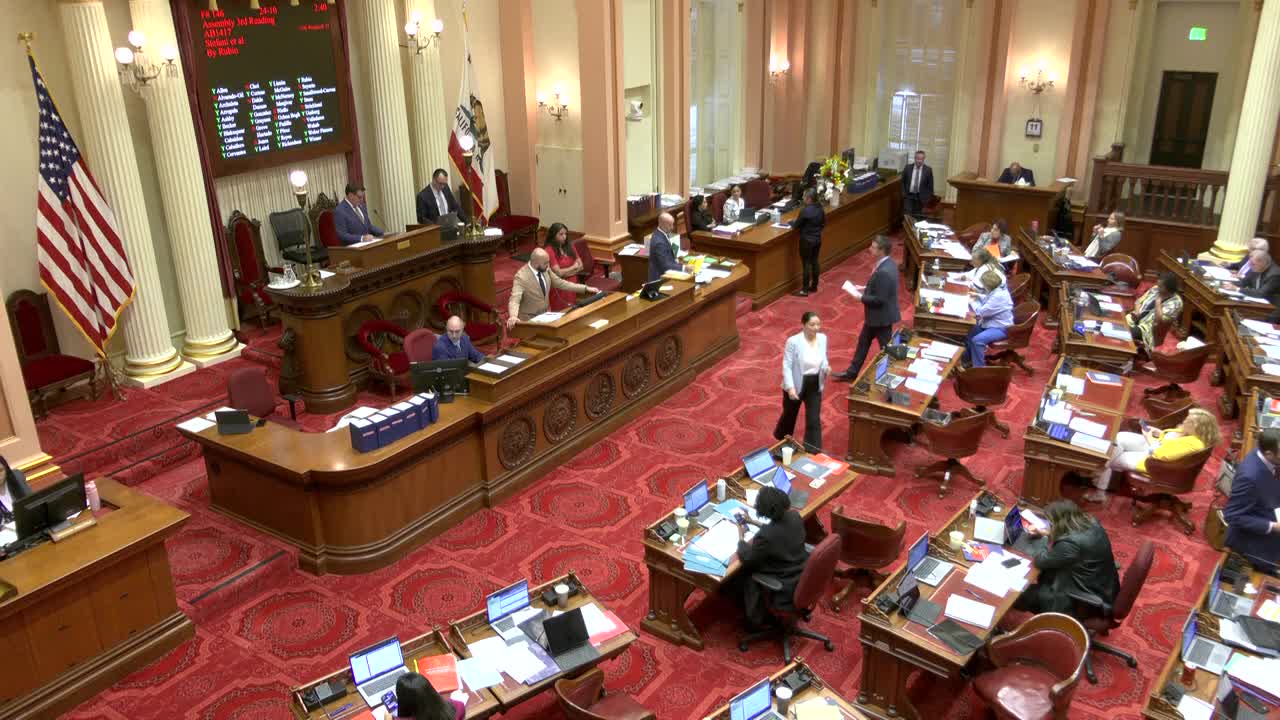 2MIN
Senate Floor
 38SEC
Senate Standing Committee on Appropriations
 14MIN
Senate Standing Committee on Housing
 37MIN
Senate Standing Committee on Local Government
 2MIN
Assembly Floor
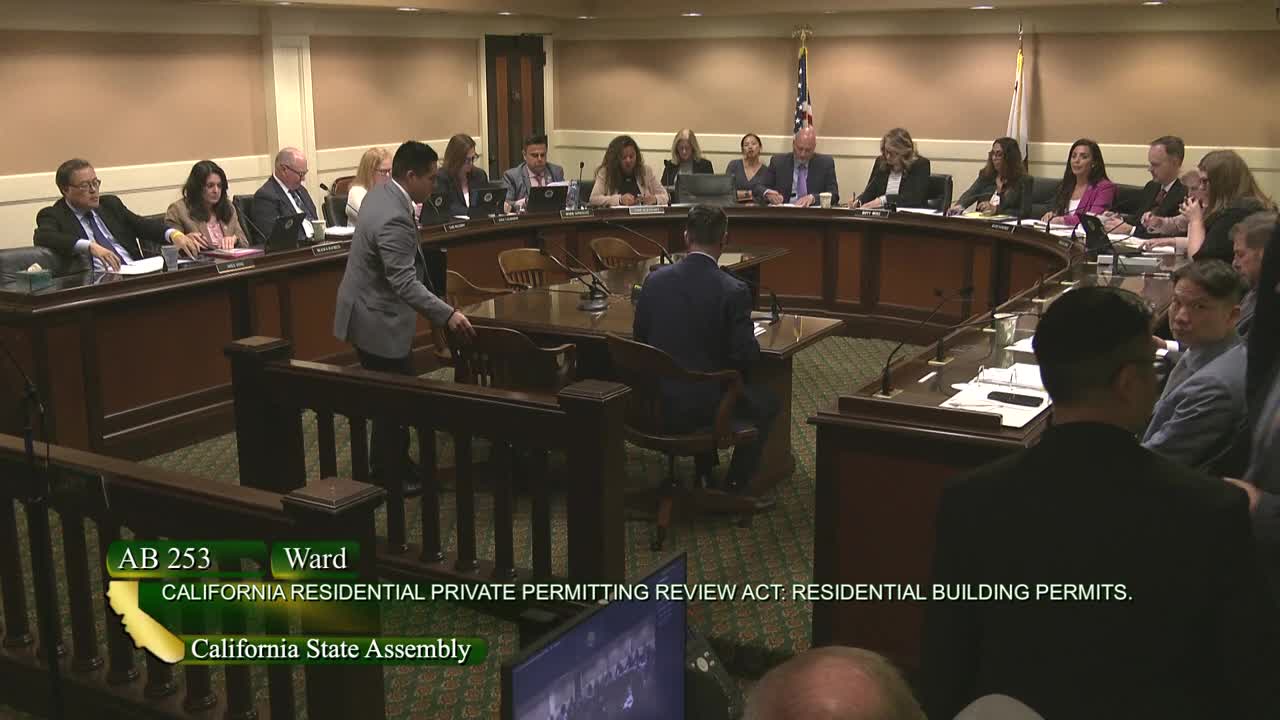 6MIN
Assembly Standing Committee on Appropriations
 12MIN