AB 2618: Public Utilities Commission: commissioners: employment.
- Session Year: 2025-2026
- House: Assembly
- Latest Version Date: 2026-09-27
Current Status:
Passed
(2026-09-27: Chaptered by Secretary of State - Chapter 630, Statutes of 2026.)
Introduced
In Committee
Awaiting First Chamber Vote
Passed First Chamber
In Committee
Awaiting Second Chamber Vote
Passed Second Chamber
Enacted
What does this bill do?
The bill bars a California Public Utilities Commission commissioner from taking a job with any company the commission regulates for two years after leaving office. It applies to firms overseen by the commission, such as public utilities and other regulated service providers.
The summary is provided by generative AI which can make mistakes. For original language, please view the details in the table below.
The California Constitution establishes the Public Utilities Commission, with jurisdiction over all public utilities, and provides for the composition and appointment of the commission. Existing law prohibits an executive of a public utility from serving as a commissioner within 2 years after leaving the employment of the public utility.
This bill would prohibit a commissioner of the commission from being employed by an entity subject to regulation by the commission for a period of 2 years after the end of the commissioners term of office.
Under existing law, a violation of the Public Utilities Act or any order, decision, rule, direction, demand, or requirement of the commission is a crime.
Because the provisions of the bill would be part of the act and a violation of a commission action implementing the bills requirements would be a crime, this bill would impose a state-mandated local program.
The California Constitution requires the state to reimburse local agencies and school districts for certain costs mandated by the state. Statutory provisions establish procedures for making that reimbursement.
This bill would provide that no reimbursement is required by this act for a specified reason.
The California Constitution establishes the Public Utilities Commission, with jurisdiction over all public utilities, and provides for the composition and appointment of the commission. Existing law prohibits an executive of a public utility from serving as a commissioner within 2 years after leaving the employment of the public utility.
This bill would prohibit a commissioner of the commission from being employed by an entity subject to regulation by the commission for a period of 5 2 years after the end of the commissioners term of office.
Under existing law, a violation of the Public Utilities Act or any order, decision, rule, direction, demand, or requirement of the commission is a crime.
Because the provisions of the bill would be part of the act and a violation of a commission action implementing the bills requirements would be a crime, this bill would impose a state-mandated local program.
The California Constitution requires the state to reimburse local agencies and school districts for certain costs mandated by the state. Statutory provisions establish procedures for making that reimbursement.
This bill would provide that no reimbursement is required by this act for a specified reason.
The California Constitution establishes the Public Utilities Commission, with jurisdiction over all public utilities, and provides for the composition and appointment of the commission. Existing law prohibits an executive of a public utility from serving as a commissioner within 2 years after leaving the employment of the public utility.
This bill would prohibit a commissioner of the commission from being employed by an entity subject to regulation by the commission for a period of 5 years after the end of the commissioners term of office.
Under existing law, a violation of the Public Utilities Act or any order, decision, rule, direction, demand, or requirement of the commission is a crime.
Because the provisions of the bill would be part of the act and a violation of a commission action implementing the bills requirements would be a crime, this bill would impose a state-mandated local program.
The California Constitution requires the state to reimburse local agencies and school districts for certain costs mandated by the state. Statutory provisions establish procedures for making that reimbursement.
This bill would provide that no reimbursement is required by this act for a specified reason.
Existing law vests the Public Utilities Commission with regulatory authority over public utilities, including electrical corporations and gas corporations. Existing law requires electrical corporations and gas corporations to annually notify the commission, as part of an ongoing proceeding or in a report otherwise required to be submitted to the commission, of each time that capital or expense revenue authorized by the commission for maintenance, safety, or reliability was redirected by the electrical corporation or gas corporation to other purposes. Existing law requires the commission to ensure that the notification is also made available in a timely fashion to the Office of the Safety Advocate, the Public Advocates Office of the Public Utilities Commission, and parties on the service list of any relevant proceeding.This bill would make nonsubstantive changes to those requirements.Existing law vests the Public Utilities Commission with regulatory authority over public utilities, including electrical corporations and gas corporations. Existing law requires electrical corporations and gas corporations to annually notify the commission, as part of an ongoing proceeding or in a report otherwise required to be submitted to the commission, of each time that capital or expense revenue authorized by the commission for maintenance, safety, or reliability was redirected by the electrical corporation or gas corporation to other purposes. Existing law requires the commission to ensure that the notification is also made available in a timely fashion to the Office of the Safety Advocate, the Public Advocates Office of the Public Utilities Commission, and parties on the service list of any relevant proceeding.
This bill would make nonsubstantive changes to those requirements.
A commissioner, for a period of two years after the end of the commissioners term of office, shall not be employed by an entity subject to regulation by the commission.
SEC. 2.No reimbursement is required by this act pursuant to Section 6 of Article XIIIB of the California Constitution because the only costs that may be incurred by a local agency or school district will be incurred because this act creates a new crime or infraction, eliminates a crime or infraction, or changes the penalty for a crime or infraction, within the meaning of Section 17556 of the Government Code, or changes the definition of a crime within the meaning of Section 6 of Article XIIIB of the California Constitution.
A commissioner, for a period of 5 two years after the end of the commissioners term of office, shall not be employed by an entity subject to regulation by the commission.
SEC. 2.No reimbursement is required by this act pursuant to Section 6 of Article XIIIB of the California Constitution because the only costs that may be incurred by a local agency or school district will be incurred because this act creates a new crime or infraction, eliminates a crime or infraction, or changes the penalty for a crime or infraction, within the meaning of Section 17556 of the Government Code, or changes the definition of a crime within the meaning of Section 6 of Article XIIIB of the California Constitution.
A commissioner, for a period of 5 years after the end of the commissioners term of office, shall not be employed by an entity subject to regulation by the commission.
SEC. 2.No reimbursement is required by this act pursuant to Section 6 of Article XIIIB of the California Constitution because the only costs that may be incurred by a local agency or school district will be incurred because this act creates a new crime or infraction, eliminates a crime or infraction, or changes the penalty for a crime or infraction, within the meaning of Section 17556 of the Government Code, or changes the definition of a crime within the meaning of Section 6 of Article XIIIB of the California Constitution.
SECTION 1.Section 591 of the Public Utilities Code is amended to read:591.(a)The commission shall require each electrical corporation or gas corporation to annually notify the commission, as part of an ongoing proceeding or in a report otherwise required to be submitted to the commission, of each time since that notification was last provided that capital or expense revenue authorized by the commission for maintenance, safety, or reliability was redirected by the electrical corporation or gas corporation to other purposes.(b)The commission shall ensure that the notification provided by each electrical corporation or gas corporation is also made available in a timely fashion to the Office of the Safety Advocate, the Public Advocates Office of the Public Utilities Commission, and parties on the service list of any relevant proceeding.(a)The commission shall require an each electrical corporation or gas corporation to annually notify the commission, as part of an ongoing proceeding or in a report otherwise required to be submitted to the commission, of each time since that notification was last provided that capital or expense revenue authorized by the commission for maintenance, safety, or reliability was redirected by the electrical corporation or gas corporation to other purposes.
(b)The commission shall ensure that the notification provided by each electrical corporation or gas corporation is also made available in a timely fashion to the Office of the Safety Advocate, the Public Advocates Office of the Public Utilities Commission, and parties on the service list of any relevant proceeding.
|
Date
|
Status
|
|---|---|
| Sep 27, 2026 | Chaptered by Secretary of State - Chapter 630, Statutes of 2026. |
| Sep 27, 2026 | Approved by the Governor. |
| Aug 25, 2026 | Enrolled and presented to the Governor at 4 p.m. |
| Aug 19, 2026 | In Assembly. Ordered to Engrossing and Enrolling. |
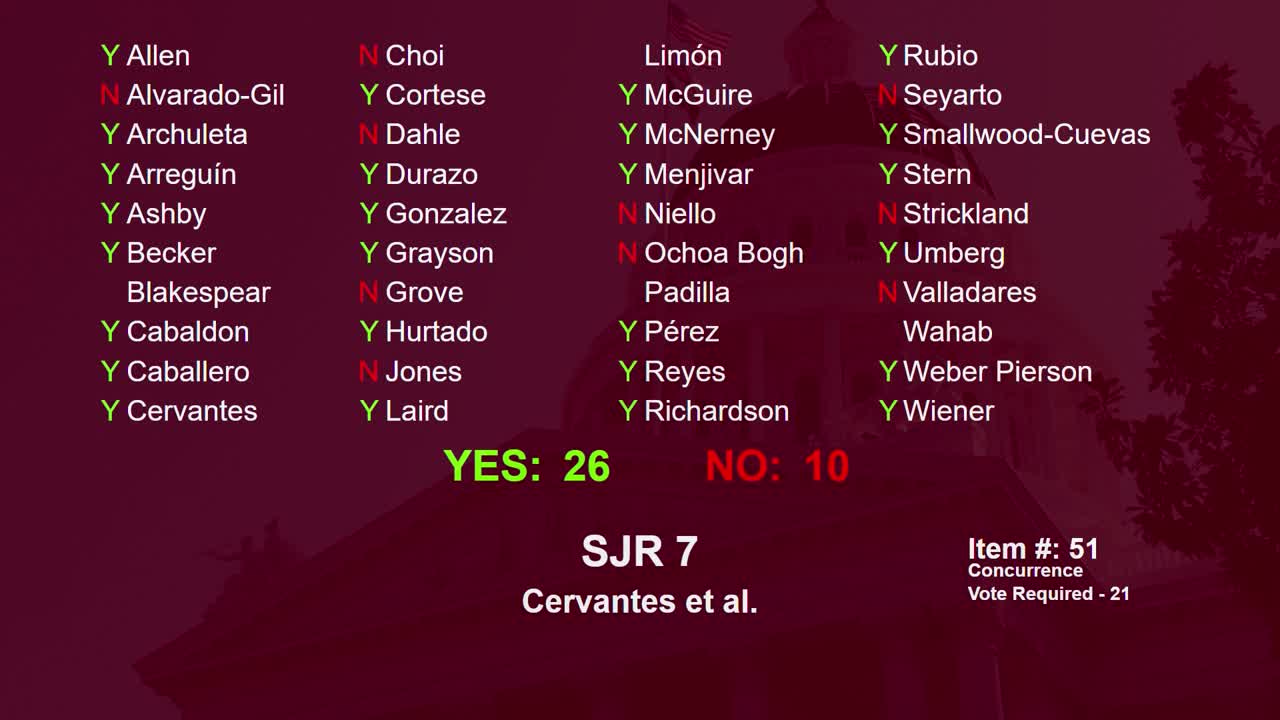
| Aug 19, 2026 | Read third time. Passed. Ordered to the Assembly. (Ayes 38. Noes 0.). |
| Aug 19, 2026 | Read third time. Passed. Ordered to the Assembly. (Ayes 38. Noes 0. Page 5545.). |
| Jun 30, 2026 | Read second time. Ordered to third reading. |
| Jun 29, 2026 | From committee: Be ordered to second reading pursuant to Senate Rule 28.8. |
| Jun 16, 2026 | From committee: Do pass and re-refer to Com. on APPR. (Ayes 17. Noes 0.) (June 16). Re-referred to Com. on APPR. |
| Jun 3, 2026 | Referred to Com. on E., U & C. |
| May 21, 2026 | In Senate. Read first time. To Com. on RLS. for assignment. |
| May 21, 2026 | Read third time. Passed. Ordered to the Senate. (Ayes 68. Noes 0. Page 5230.) |
| May 21, 2026 | Read third time. Passed. Ordered to the Senate. (Ayes 68. Noes 0.) |
| May 14, 2026 | Read second time. Ordered to Consent Calendar. |
| May 13, 2026 | From committee: Do pass. To Consent Calendar. (Ayes 15. Noes 0.) (May 13). |
| Apr 14, 2026 | Re-referred to Com. on APPR. |
| Apr 13, 2026 | Read second time and amended. |
| Apr 9, 2026 | From committee: Amend, and do pass as amended and re-refer to Com. on APPR. with recommendation: To Consent Calendar. (Ayes 17. Noes 0.) (April 8). |
| Mar 17, 2026 | Re-referred to Com. on U. & E. |
| Mar 16, 2026 | Referred to Com. on U. & E. |
| Mar 16, 2026 | From committee chair, with author's amendments: Amend, and re-refer to Com. on U. & E. Read second time and amended. |
| Feb 21, 2026 | From printer. May be heard in committee March 23. |
| Feb 20, 2026 | Read first time. To print. |
|
Date
|
Description
|
Location
|
Votes
|
|
|---|---|---|---|---|
| Aug 19, 2026 | Assembly 3rd Reading AB2618 Connolly By McNerney | Senate Floor |
Passed |
|
| Jun 16, 2026 | Do pass, but first be re-referred to the Committee on [Appropriations] | Senate Standing Committee on Energy, Utilities and Communications |
Passed |
|
| May 21, 2026 | AB 2618 Connolly Consent Calendar Second Day Regular Session | Assembly Floor |
Passed |
|
| May 13, 2026 | Do pass. To Consent Calendar. | Assembly Standing Committee on Appropriations |
Passed |
|
| Apr 8, 2026 | Do pass as amended, and be re-referred to the Committee on [Appropriations] with recommendation: To Consent Calendar | Assembly Standing Committee on Utilities and Energy |
Passed |
This list shows positions taken on this bill by organizations on the date displayed, which is linked to the original source.
Positions by individuals are not included.
|
Organization
|
Position
|
Date
|
|---|---|---|
| California Democratic Party | ** Support | |
| California Democratic Party Rural Caucus | ** Support | |
| Consumer Watchdog | ** Support | |
| Teamsters California | ** Support | |
| The Utility Reform Network | ** Support |
SENATE RULES COMMITTEE Office of Senate Floor Analyses (916) 651-4171 | AB 2618 |
THIRD READING
Bill No: AB 2618
Author: Connolly (D)
Amended: 4/13/26 in Assembly
Vote: 21
SENATE ENERGY, U. & C. COMMITTEE: 17-0, 6/16/26
AYES: Allen, Ochoa Bogh, Archuleta, Arreguín, Becker, Caballero, Gonzalez, Grove, Hurtado, McNerney, Niello, Reyes, Richardson, Rubio, Stern, Strickland, Wahab
SENATE APPROPRIATIONS COMMITTEE: Senate Rule 28.8
ASSEMBLY FLOOR: 68-0, 5/21/26 (Consent) - See last page for vote
SUBJECT: Public Utilities Commission: commissioners: employment
SOURCE: Author
DIGEST:
This bill prohibits a California Public Utilities Commission (CPUC) commissioner from obtaining employment by an entity regulated by the CPUC for two years after the end of the commissioner’s term of office.
ANALYSIS:
Existing law:
- Requires the Legislature to enact laws prohibiting a state officer, secretary of an agency, or state department director appointed by the Governor who has not resigned or retired from service prior to January 7, 1991, from lobbying before the Executive branch for 12 months after leaving office. (California Constitution, Article V, §14)
- Establishes the CPUC, which is comprised of five members appointed by the Governor and approved by the Senate, for staggered six-year terms. Existing law specifies that when a vacancy exists on the CPUC, a commissioner filling that vacancy shall serve the remainder of the term for that vacancy. Existing law also allows the Legislature to remove a CPUC commissioner with a vote of 2/3 of each house for the following reasons: incompetence, neglect of duty, or corruption. (California Constitution, Article XII, §1)
- Authorizes the CPUC to establish its own procedures, subject to statutory requirements and due process. Authorizes any designated CPUC commissioner to hold a hearing or investigation or issue an order, subject to CPUC approval. (California Constitution, Article XII, §2)
- Specifies that all the following entities are public utilities subject to control by the Legislature: private corporations and persons that own, operate, control, or manage a line, plant, or system for the transportation of people or property, transmission of telephone and telegraph messages, or the production, generation, transmission, or furnishing of heat, light, water, power, storage, or wharfage directly or indirectly to or for the public, and common carriers. Existing law authorizes the Legislature to designate additional classes of private corporations or other persons as public utilities. (California Constitution, Article XII, §6)
- Defines a “public utility” subject to the CPUC’s jurisdiction as every common carrier, toll bridge corporation, pipeline corporation, gas corporation, electrical corporation, telephone corporation, telegraph corporation, water corporation, sewer system corporation, and heat corporation, where the service is performed for, or the commodity is delivered to, the public or any portion thereof. Whenever any of these entities delivers a service or commodity to the public for compensation, the entity is a public utility subject to regulation by the CPUC. (Public Utilities Code §216)
- Prohibits a CPUC commissioner from having an official relationship with or having a financial interest in a person or corporation subject to CPUC regulation. Existing law requires a CPUC commissioner to resign from the CPUC or divest interests in a regulated entity if the commissioner acquires an interest in a person or corporation subject to CPUC regulation. Existing law also requires the CPUC to maintain updated conflict of interest code and prohibits a utility executive from serving as a commissioner within two years of leaving the utility’s employment. (Public Utilities Code §303)
- Establishes a one-year “cooling off” period for certain state employees and officers that make decisions that could materially impact financial interests. This cooling off period prohibits these employees from representing individuals before the state agency or officers of the state agency for which the state employee worked during the 12 months before leaving office. (Government Code §87406)
- Prohibits a California Energy Commission (CEC) commissioner from becoming a commissioner within two years of receiving compensation from any electric utility or engaging in the sale of any major facility component. Existing law also prohibits a CEC commissioner from obtaining employment from any electric utility, applicant before the CEC, or a person who engages in the sale or manufacture of any major facility component within two years of leaving the CEC. (Public Resources Code §25205)
This bill prohibits a CPUC commissioner from obtaining employment by an entity regulated by the CPUC for two years after the end of the commissioner’s term of office.
Background
Prior legislation attempted to address a potential imbalance of utility influence at the CPUC. Over the past decade, the Legislature has passed a number of bills aimed at addressing concerns about the degree of influence certain utilities may have over CPUC proceedings. In 2016, the Legislature passed SB 215 (Leno, Chapter 807, Statutes of 2016) to increase disclosure requirements regarding ex-parte communications and reform CPUC proceeding requirements. This legislation followed concerns about extensive ex-parte communications occurring between utility officers and certain CPUC staff and commissioners at that time. Ex-parte communication occurs when substantive discussions occur between a CPUC decision-maker and a stakeholder that has an interest in a proceeding before the CPUC. The Legislature also passed SB 19 (Hill, Chapter 421, Statutes of 2017), which established a variety of reforms at the CPUC, including prohibiting utility executives from serving as a CPUC commissioner within two years of leaving a utility’s employment. These reforms were intended to address the extent to which utilities’ relationships and communication with CPUC commissioners could provide the utilities with a disproportionate amount of influence over the CPUC and commission decision making.
Revolving doors and cooling off periods. The revolving door phenomenon occurs when an elected official or state officer leaves a government position to become an advocate for an industry for which they once made regulatory or legislative decisions. To address the potential conflicts of interest posed by revolving door employment, existing state law and rules by the Fair Political Practices Commission set requirements for “cooling off” periods that limit the ability to immediately switch from the regulatory or legislative side to the advocacy side of state decision making. Under existing law, most state officers and elected officials are subject to a one-year cooling off period. This bill establishes limitations on CPUC commissioners’ post-commission employment that are more restrictive than those applied to most other state officers or elected officials. However, existing statute also establishes a two-year cooling off period for CEC commissioners that would be similar to the limitations in this bill.
Related/Prior Legislation
ACA 9 (Boerner, 2026) modifies the CPUC’s authority over certain utilities and expand the number of commissioners on the CPUC from five to nine commissioners by adding four commissioners appointed by the Legislature. The bill also limits the CPUC’s authority to adopt procedures and limits commissioners’ ability to initiate proceedings. The bill was held by the author in the Senate Energy, Utilities and Communications Committee.
AB 2054 (Bauer-Kahan, 2023) among other provisions, would have prohibited the leadership at the CPUC and Public Advocate’s Office from receiving gifts or employment, for at least one year, from any entity subject to regulation by their body. The bill was held by the Senate Appropriations Committee.
SB 19 (Hill, Chapter 421, Statutes of 2017) established a number of CPUC reforms, including prohibiting a utility executive from serving as a commissioner on the CPUC within two years following the executive’s departure from the utility.
SB 215 (Leno, Chapter 807, Statutes of 2016) made various modifications to law governing the CPUC’s rules of practice and procedure to expand transparency for proceedings and reform rules for ex-parte communication occurring outside the official record of a proceeding.
FISCAL EFFECT: Appropriation: No Fiscal Com.: Yes Local: Yes
SUPPORT: (Verified 8/21/26)
California Democratic Party
California Democratic Party Rural Caucus
Consumer Watchdog
Teamsters California
The Utility Reform Network
OPPOSITION: (Verified 8/21/26)
None received
ARGUMENTS IN SUPPORT: According to the author:
AB 2618 helps ensure that utility rates are not being influenced by private utility companies. This bill strengthens California’s revolving-door policies by prohibiting California Public Utility Commissioners from lobbying for private utility companies for 2 years after the end of their term. As California residents continue to face out-of-control rate hikes, weak ethics rules have allowed utility corporations to gather more influence over our regulatory system by recruiting former commissioners. This bill is a common-sense measure to ensure transparency within our regulatory rate-making process by closing the revolving-door.
ASSEMBLY FLOOR: 68-0, 5/21/26
AYES: Addis, Aguiar-Curry, Ahrens, Alanis, Alvarez, Ávila Farías, Bains, Bauer-Kahan, Bennett, Berman, Boerner, Bonta, Bryan, Calderon, Caloza, Carrillo, Castillo, Connolly, Davies, DeMaio, Dixon, Elhawary, Ellis, Flora, Fong, Gallagher, Gipson, Jeff Gonzalez, Mark González, Hadwick, Haney, Harabedian, Hart, Irwin, Jackson, Johnson, Kalra, Krell, Lee, Macedo, McKinnor, Muratsuchi, Nguyen, Ortega, Pacheco, Papan, Patel, Patterson, Pellerin, Petrie-Norris, Quirk-Silva, Ransom, Michelle Rodriguez, Rogers, Blanca Rubio, Sanchez, Schiavo, Sharp-Collins, Solache, Soria, Stefani, Ta, Tangipa, Valencia, Wallis, Ward, Zbur, Rivas
NO VOTE RECORDED: Arambula, Chen, Gabriel, Garcia, Hoover, Lackey, Lowenthal, Ramos, Celeste Rodriguez, Schultz, Wicks, Wilson
Prepared by: Sarah Smith / E., U. & C. / (916) 651-4107
8/21/26 16:02:34
SENATE RULES COMMITTEE Office of Senate Floor Analyses (916) 651-4171 | AB 2618 |
THIRD READING
Bill No: AB 2618
Author: Connolly (D)
Amended: 4/13/26 in Assembly
Vote: 21
SENATE ENERGY, U. & C. COMMITTEE: 17-0, 6/16/26
AYES: Allen, Ochoa Bogh, Archuleta, Arreguín, Becker, Caballero, Gonzalez, Grove, Hurtado, McNerney, Niello, Reyes, Richardson, Rubio, Stern, Strickland, Wahab
SENATE APPROPRIATIONS COMMITTEE: Senate Rule 28.8
ASSEMBLY FLOOR: 68-0, 5/21/26 (Consent) - See last page for vote
SUBJECT: Public Utilities Commission: commissioners: employment
SOURCE: Author
DIGEST:
This bill prohibits a California Public Utilities Commission (CPUC) commissioner from obtaining employment by an entity regulated by the CPUC for two years after the end of the commissioner’s term of office.
ANALYSIS:
Existing law:
- Requires the Legislature to enact laws prohibiting a state officer, secretary of an agency, or state department director appointed by the Governor who has not resigned or retired from service prior to January 7, 1991, from lobbying before the Executive branch for 12 months after leaving office. (California Constitution, Article V, §14)
- Establishes the CPUC, which is comprised of five members appointed by the Governor and approved by the Senate, for staggered six-year terms. Existing law specifies that when a vacancy exists on the CPUC, a commissioner filling that vacancy shall serve the remainder of the term for that vacancy. Existing law also allows the Legislature to remove a CPUC commissioner with a vote of 2/3 of each house for the following reasons: incompetence, neglect of duty, or corruption. (California Constitution, Article XII, §1)
- Authorizes the CPUC to establish its own procedures, subject to statutory requirements and due process. Authorizes any designated CPUC commissioner to hold a hearing or investigation or issue an order, subject to CPUC approval. (California Constitution, Article XII, §2)
- Specifies that all the following entities are public utilities subject to control by the Legislature: private corporations and persons that own, operate, control, or manage a line, plant, or system for the transportation of people or property, transmission of telephone and telegraph messages, or the production, generation, transmission, or furnishing of heat, light, water, power, storage, or wharfage directly or indirectly to or for the public, and common carriers. Existing law authorizes the Legislature to designate additional classes of private corporations or other persons as public utilities. (California Constitution, Article XII, §6)
- Defines a “public utility” subject to the CPUC’s jurisdiction as every common carrier, toll bridge corporation, pipeline corporation, gas corporation, electrical corporation, telephone corporation, telegraph corporation, water corporation, sewer system corporation, and heat corporation, where the service is performed for, or the commodity is delivered to, the public or any portion thereof. Whenever any of these entities delivers a service or commodity to the public for compensation, the entity is a public utility subject to regulation by the CPUC. (Public Utilities Code §216)
- Prohibits a CPUC commissioner from having an official relationship with or having a financial interest in a person or corporation subject to CPUC regulation. Existing law requires a CPUC commissioner to resign from the CPUC or divest interests in a regulated entity if the commissioner acquires an interest in a person or corporation subject to CPUC regulation. Existing law also requires the CPUC to maintain updated conflict of interest code and prohibits a utility executive from serving as a commissioner within two years of leaving the utility’s employment. (Public Utilities Code §303)
- Establishes a one-year “cooling off” period for certain state employees and officers that make decisions that could materially impact financial interests. This cooling off period prohibits these employees from representing individuals before the state agency or officers of the state agency for which the state employee worked during the 12 months before leaving office. (Government Code §87406)
- Prohibits a California Energy Commission (CEC) commissioner from becoming a commissioner within two years of receiving compensation from any electric utility or engaging in the sale of any major facility component. Existing law also prohibits a CEC commissioner from obtaining employment from any electric utility, applicant before the CEC, or a person who engages in the sale or manufacture of any major facility component within two years of leaving the CEC. (Public Resources Code §25205)
This bill prohibits a CPUC commissioner from obtaining employment by an entity regulated by the CPUC for two years after the end of the commissioner’s term of office.
Background
Prior legislation attempted to address a potential imbalance of utility influence at the CPUC. Over the past decade, the Legislature has passed a number of bills aimed at addressing concerns about the degree of influence certain utilities may have over CPUC proceedings. In 2016, the Legislature passed SB 215 (Leno, Chapter 807, Statutes of 2016) to increase disclosure requirements regarding ex-parte communications and reform CPUC proceeding requirements. This legislation followed concerns about extensive ex-parte communications occurring between utility officers and certain CPUC staff and commissioners at that time. Ex-parte communication occurs when substantive discussions occur between a CPUC decision-maker and a stakeholder that has an interest in a proceeding before the CPUC. The Legislature also passed SB 19 (Hill, Chapter 421, Statutes of 2017), which established a variety of reforms at the CPUC, including prohibiting utility executives from serving as a CPUC commissioner within two years of leaving a utility’s employment. These reforms were intended to address the extent to which utilities’ relationships and communication with CPUC commissioners could provide the utilities with a disproportionate amount of influence over the CPUC and commission decision making.
Revolving doors and cooling off periods. The revolving door phenomenon occurs when an elected official or state officer leaves a government position to become an advocate for an industry for which they once made regulatory or legislative decisions. To address the potential conflicts of interest posed by revolving door employment, existing state law and rules by the Fair Political Practices Commission set requirements for “cooling off” periods that limit the ability to immediately switch from the regulatory or legislative side to the advocacy side of state decision making. Under existing law, most state officers and elected officials are subject to a one-year cooling off period. This bill establishes limitations on CPUC commissioners’ post-commission employment that are more restrictive than those applied to most other state officers or elected officials. However, existing statute also establishes a two-year cooling off period for CEC commissioners that would be similar to the limitations in this bill.
Related/Prior Legislation
ACA 9 (Boerner, 2026) modifies the CPUC’s authority over certain utilities and expand the number of commissioners on the CPUC from five to nine commissioners by adding four commissioners appointed by the Legislature. The bill also limits the CPUC’s authority to adopt procedures and limits commissioners’ ability to initiate proceedings. The bill was held by the author in the Senate Energy, Utilities and Communications Committee.
AB 2054 (Bauer-Kahan, 2023) among other provisions, would have prohibited the leadership at the CPUC and Public Advocate’s Office from receiving gifts or employment, for at least one year, from any entity subject to regulation by their body. The bill was held by the Senate Appropriations Committee.
SB 19 (Hill, Chapter 421, Statutes of 2017) established a number of CPUC reforms, including prohibiting a utility executive from serving as a commissioner on the CPUC within two years following the executive’s departure from the utility.
SB 215 (Leno, Chapter 807, Statutes of 2016) made various modifications to law governing the CPUC’s rules of practice and procedure to expand transparency for proceedings and reform rules for ex-parte communication occurring outside the official record of a proceeding.
FISCAL EFFECT: Appropriation: No Fiscal Com.: Yes Local: Yes
SUPPORT: (Verified 6/29/26)
California Democratic Party Rural Caucus
Consumer Watchdog
Teamsters California
The Utility Reform Network
OPPOSITION: (Verified 6/29/26)
None received
ARGUMENTS IN SUPPORT: According to the author:
AB 2618 helps ensure that utility rates are not being influenced by private utility companies. This bill strengthens California’s revolving-door policies by prohibiting California Public Utility Commissioners from lobbying for private utility companies for 2 years after the end of their term. As California residents continue to face out-of-control rate hikes, weak ethics rules have allowed utility corporations to gather more influence over our regulatory system by recruiting former commissioners. This bill is a common-sense measure to ensure transparency within our regulatory rate-making process by closing the revolving-door.
ASSEMBLY FLOOR: 68-0, 5/21/26
AYES: Addis, Aguiar-Curry, Ahrens, Alanis, Alvarez, Ávila Farías, Bains, Bauer-Kahan, Bennett, Berman, Boerner, Bonta, Bryan, Calderon, Caloza, Carrillo, Castillo, Connolly, Davies, DeMaio, Dixon, Elhawary, Ellis, Flora, Fong, Gallagher, Gipson, Jeff Gonzalez, Mark González, Hadwick, Haney, Harabedian, Hart, Irwin, Jackson, Johnson, Kalra, Krell, Lee, Macedo, McKinnor, Muratsuchi, Nguyen, Ortega, Pacheco, Papan, Patel, Patterson, Pellerin, Petrie-Norris, Quirk-Silva, Ransom, Michelle Rodriguez, Rogers, Blanca Rubio, Sanchez, Schiavo, Sharp-Collins, Solache, Soria, Stefani, Ta, Tangipa, Valencia, Wallis, Ward, Zbur, Rivas
NO VOTE RECORDED: Arambula, Chen, Gabriel, Garcia, Hoover, Lackey, Lowenthal, Ramos, Celeste Rodriguez, Schultz, Wicks, Wilson
Prepared by: Sarah Smith / E., U. & C. / (916) 651-4107
7/1/26 16:55:20
**** END ****
SENATE COMMITTEE ON ENERGY, UTILITIES AND COMMUNICATIONS
Senator Benjamin Allen, Chair
2025 - 2026 Regular
Bill No: Hearing Date: 6/16/2026
Author: | |||
Version: | Amended | ||
Urgency: | Fiscal: | ||
Consultant: | |||
SUBJECT:
DIGEST: This bill prohibits a California Public Utilities Commission (CPUC) commissioner from obtaining employment by an entity regulated by the CPUC for two years after the end of the commissioner’s term of office.
ANALYSIS:
Existing law:
- Requires the Legislature to enact laws prohibiting a state officer, secretary of an agency, or state department director appointed by the Governor who has not resigned or retired from service prior to January 7, 1991, from lobbying before the Executive branch for 12 months after leaving office. (California Constitution, Article V, §14)
- Establishes the CPUC, which is comprised of five members appointed by the Governor and approved by the Senate, for staggered six-year terms. Existing law specifies that when a vacancy exists on the CPUC, a commissioner filling that vacancy shall serve the remainder of the term for that vacancy. Existing law also allows the Legislature to remove a CPUC commissioner with a vote of 2/3 of each house for the following reasons: incompetence, neglect of duty, or corruption. (California Constitution, Article XII, §1)
- Authorizes the CPUC to establish its own procedures, subject to statutory requirements and due process. Authorizes any designated CPUC commissioner to hold a hearing or investigation or issue an order, subject to CPUC approval. (California Constitution, Article XII, §2)
- Specifies that all the following entities are public utilities subject to control by the Legislature: private corporations and persons that own, operate, control, or manage a line, plant, or system for the transportation of people or property, transmission of telephone and telegraph messages, or the production, generation, transmission, or furnishing of heat, light, water, power, storage, or wharfage directly or indirectly to or for the public, and common carriers. Existing law authorizes the Legislature to designate additional classes of private corporations or other persons as public utilities. (California Constitution, Article XII, §6)
- Defines a “public utility” subject to the CPUC’s jurisdiction as every common carrier, toll bridge corporation, pipeline corporation, gas corporation, electrical corporation, telephone corporation, telegraph corporation, water corporation, sewer system corporation, and heat corporation, where the service is performed for, or the commodity is delivered to, the public or any portion thereof. Whenever any of these entities delivers a service or commodity to the public for compensation, the entity is a public utility subject to regulation by the CPUC. (Public Utilities Code §216)
- Prohibits a CPUC commissioner from having an official relationship with or having a financial interest in a person or corporation subject to CPUC regulation. Existing law requires a CPUC commissioner to resign from the CPUC or divest interests in a regulated entity if the commissioner acquires an interest in a person or corporation subject to CPUC regulation. Existing law also requires the CPUC to maintain updated conflict of interest code and prohibits a utility executive from serving as a commissioner within two years of leaving the utility’s employment. (Public Utilities Code §303)
- Establishes a one-year “cooling off” period for certain state employees and officers that make decisions that could materially impact financial interests. This cooling off period prohibits these employees from representing individuals before the state agency or officers of the state agency for which the state employee worked during the 12 months before leaving office. (Government Code §87406)
- Prohibits a California Energy Commission (CEC) commissioner from becoming a commissioner within two years of receiving compensation from any electric utility or engaging in the sale of any major facility component. Existing law also prohibits a CEC commissioner from obtaining employment from any electric utility, applicant before the CEC, or a person who engages in the sale or manufacture of any major facility component within two years of leaving the CEC. (Public Resources Code §25205)
This bill prohibits a CPUC commissioner from obtaining employment by an entity regulated by the CPUC for two years after the end of the commissioner’s term of office.
Background
Prior legislation attempted to address a potential imbalance of utility influence at the CPUC. Over the past decade, the Legislature has passed a number of bills aimed at addressing concerns about the degree of influence certain utilities may have over CPUC proceedings. In 2016, the Legislature passed SB 215 (Leno, Chapter 807, Statutes of 2016) to increase disclosure requirements regarding ex-parte communications and reform CPUC proceeding requirements. This legislation followed concerns about extensive ex-parte communications occurring between utility officers and certain CPUC staff and commissioners at that time. Ex-parte communication occurs when substantive discussions occur between a CPUC decision-maker and a stakeholder that has an interest in a proceeding before the CPUC. The Legislature also passed SB 19 (Hill, Chapter 421, Statutes of 2017), which established a variety of reforms at the CPUC, including prohibiting utility executives from serving as a CPUC commissioner within two years of leaving a utility’s employment. These reforms were intended to address the extent to which utilities’ relationships and communication with CPUC commissioners could provide the utilities with a disproportionate amount of influence over the CPUC and commission decision making.
Revolving doors and cooling off periods. The revolving door phenomenon occurs when an elected official or state officer leaves a government position to become an advocate for an industry for which they once made regulatory or legislative decisions. To address the potential conflicts of interest posed by revolving door employment, existing state law and rules by the Fair Political Practices Commission (FPPC) set requirements for “cooling off” periods that limit the ability to immediately switch from the regulatory or legislative side to the advocacy side of state decision making. Under existing law, most state officers and elected officials are subject to a one-year cooling off period. This bill establishes limitations on CPUC commissioners’ post-commission employment that are more restrictive than those applied to most other state officers or elected officials. However, existing statute also establishes a two-year cooling off period for CEC commissioners that would be similar to the limitations in this bill.
Prior/Related Legislation
ACA 9 (Boerner, 2026) modifies the CPUC’s authority over certain utilities and expand the number of commissioners on the CPUC from five to nine commissioners by adding four commissioners appointed by the Legislature. The bill also limits the CPUC’s authority to adopt procedures and limits commissioners’ ability to initiate proceedings. The bill is currently in the Senate Energy, Utilities and Communications Committee.
AB 2054 (Bauer-Kahan, 2023) among other provisions, would have prohibited the leadership at the CPUC and Public Advocate’s Office from receiving gifts or employment, for at least one year, from any entity subject to regulation by their body. The bill was held in the Senate Appropriations Committee.
SB 19 (Hill, Chapter 421, Statutes of 2017) established a number of CPUC reforms, including prohibiting a utility executive from serving as a commissioner on the CPUC within two years following the executive’s departure from the utility.
SB 215 (Leno, Chapter 807, Statutes of 2016) made various modifications to law governing the CPUC’s rules of practice and procedure to expand transparency for proceedings and reform rules for ex-parte communication occurring outside the official record of a proceeding.
FISCAL EFFECT: Appropriation: Fiscal Com.: Local:
SUPPORT:
Consumer Watchdog
Teamsters California
The Utility Reform Network
OPPOSITION:
None received
ARGUMENTS IN SUPPORT: According to the author:
AB 2618 helps ensure that utility rates are not being influenced by private utility companies. This bill strengthens California’s revolving-door policies by prohibiting California Public Utility Commissioners from lobbying for private utility companies for 2 years after the end of their term. As California residents continue to face out-of-control rate hikes, weak ethics rules have allowed utility corporations to gather more influence over our regulatory system by recruiting former commissioners. This bill is a common-sense measure to ensure transparency within our regulatory rate-making process by closing the revolving-door.
-- END --
Date of Hearing: May 13, 2026
ASSEMBLY COMMITTEE ON APPROPRIATIONS
Buffy Wicks, Chair
ABPCA Bill Id:AB 2618
Author:(Connolly) – As Amended Ver:April 13, 2026
Policy Committee: | Utilities and Energy | Vote: | 17 - 0 |
|
| ||
|
|
Urgency: No State Mandated Local Program: Yes Reimbursable: No
SUMMARY:
This bill prohibits a commissioner of the California Public Utilities Commission (CPUC) from being employed by an entity subject to regulation by the CPUC for a period of two years after the end of the commissioner’s term of office.
FISCAL EFFECT:
No state costs.
COMMENTS:
The California Constitution establishes the CPUC a five-member body, each member appointed by the Governor and approved by the Senate, a majority of the membership concurring, for staggered six-year terms. The constitution charges the CPUC to, among other things, fix rates, establish rules, examine records, issue subpoenas, administer oaths, take testimony, punish for contempt and prescribe a uniform system of accounts for all public utilities subject to its jurisdiction.
Existing law restricts the future employment of a commissioner of the California Energy Commission (CEC) — no member of the commission may be employed within two years after they cease to be a member of the CEC by any person who engages in the sale or manufacture of any major component of any “facility,” meaning any electric transmission line or thermal powerplant, or both electric transmission line and thermal powerplant, regulated under Division 15 of the California Code.
Existing law also restricts the future employment of members of the Legislature and other elected officials by prohibiting such a person’s employment that influences their former body for one year after leaving office.
The law makes no restriction on the future employment of a commissioner of the CPUC. The author thinks it should:
AB 2618 helps ensure that utility rates are not being influenced by private utility companies. This bill strengthens California’s revolving-door policies by prohibiting California Public Utilities Commission Commissioners from lobbying for private utility companies…after the end of their term. As California residents continue to face out-of-control rate hikes, weak ethics rules have allowed utility corporations to gather more influence over our regulatory system by recruiting former commissioners.
Analysis Prepared by: Jay Dickenson / APPR. / (916) 319-2081
Date of Hearing: April 8, 2026
ASSEMBLY COMMITTEE ON UTILITIES AND ENERGY
Cottie Petrie-Norris, Chair
ABPCA Bill Id:AB 2618 (
Author:Connolly) – As Amended Ver:March 16, 2026
SUBJECT: Public Utilities Commission: commissioners: employment
SUMMARY: Prohibits a commissioner at the California Public Utilities Commission (CPUC) from being employed for at least 5 years following the conclusion of their term of office by any entity subject to regulation by the CPUC.
EXISTING LAW:
- Prohibits a commissioner at the California Energy Commission (CEC) from being employed for at least 2 years following the conclusion of their term of office by specified energy businesses. (Public Resources Code § 25205)
- Establishes the CPUC, consisting of five members appointed by the Governor and confirmed by the Senate for staggered 6-year terms. (California Constitution, Article XII, Section 1)
- Prohibits any CPUC commissioner from holding an official relation to or financial interest in any person or corporation subject to regulation by the CPUC. Further prohibits public utility executives from CPUC appointments for a period of 2 years following employment with the utility. (Public Utilities Code § 303)
- Establishes revolving door policies for Members of the Legislature, elected state officers, and designated executive branch employees, prohibiting employment that influences their former body for 1 year after leaving office. (Government Code § 87406)
FISCAL EFFECT: Unknown. This bill is keyed fiscal and will be referred to the Committee on Appropriations for its review.
BACKGROUND:
California law establishes several revolving-door restrictions designed to prevent conflicts of interest when public officials leave government service. Under existing law, CEC commissioners must wait at least two years after their term ends before accepting employment with certain energy businesses. Similarly, CPUC commissioners are prohibited from having any official relationship with or financial interest in the utilities they regulate, and utility executives cannot be appointed to the CPUC until two years after leaving the industry. More broadly, state legislators, elected officers, and designated executive branch employees are barred for one year from taking jobs where they would attempt to influence their former government body.
COMMENTS:
- Author’s Statement. According to the author, “AB 2618 helps ensure that utility rates are not being influenced by private utility companies. This bill strengthens California’s revolving-door policies by prohibiting California Public Utilities Commission Commissioners from lobbying for private utility companies for 5 years after the end of their term. As California residents continue to face out-of-control rate hikes, weak ethics rules have allowed utility corporations to gather more influence over our regulatory system by recruiting former commissioners. This bill is a common-sense measure to ensure transparency within our regulatory rate-making process by closing the revolving-door.”
- Purpose of Bill. The bill would create a post-employment cooling-off period for CPUC commissioners for five years. A commissioner leaving the CPUC could not accept employment with any entity subject to CPUC regulation for at least five years following the conclusion of their service.
- Revolving Door Clauses. Revolving door clauses reflect a good governance principle and exist for members of the Legislature as well as some executive branch positions. However, the degree of the prohibition put forward by this measure is significant. By comparison, statute imposes a 1-year post-employment lobbying restriction on members of the Legislature and a 2-year post-employment restriction on CEC Commissioners. This bill puts a 5-year freeze on any CPUC commissioner from employment with any entity subject to its regulation. While the principle behind such a prohibition may be laudable – namely, ensuring independence between the regulated and regulator – in practice, it may have a chilling effect on the make-up of this body. While the Legislature is made up of elected officials ranging in background, education, former employment, and experience – as well as specialties and areas of focus while in office – leadership at the CPUC is often career specialists in energy and utilities. Such expertise is crucial in properly evaluating regulations and ratemaking. This would leave these career specialists unable to return to their area of expertise for 5 years following the conclusion of their service. Such a prohibition may pose a significant barrier to getting a diverse pool of candidates for these appointments. Another unintended consequence may be rendering only out-of-state experts interested in CPUC appointments, as more businesses in their home state are unlikely to be subject to regulation by the CPUC, enabling them to more easily return to their careers following their service. Additionally, no justification has been provided for why a 5-year prohibition period is the appropriate duration. In the absence of such justification, a shorter period may be more defensible. A two-year prohibition for CPUC commissioners would be consistent with the existing standard for CEC commissioners while still serving the good governance objectives underlying this bill. The Committee recommends amending the bill to reduce the post-employment prohibition from a period of five years to two years.
- Related Legislation.
HR 7214 (Harder) would amend the Public Utility Regulatory Policies Act of 1978 to establish a federal standard requiring state utility regulatory authorities to consider adopting a two-year post-employment lobbying ban for former commissioners. Status: In Committee – House Committee on Energy and Commerce.
- Prior Legislation.
AB 2054 (Bauer-Kahan, 2024) would have, among other things, prohibited a CPUC commissioner from being employed by an entity subject to regulation by the CPUC for a period of one year after the end of the commissioner’s term of office. Status: Senate - Died – Appropriations.
REGISTERED SUPPORT / OPPOSITION:
Support
Teamsters California
The Utility Reform Network (TURN)
Opposition
None on file.
Analysis Prepared by: Suman Tatapudy / U. & E. / (916) 319-2083
Discussed in Hearing
 1MIN
Senate Floor
 8MIN
Senate Standing Committee on Energy, Utilities and Communications
Bill Author

Bill Co-Author(s):