AB 2619: Water resources: data centers.
- Session Year: 2025-2026
- House: Assembly
- Latest Version Date: 2026-09-21
Current Status:
Passed
(2026-09-21: Chaptered by Secretary of State - Chapter 437, Statutes of 2026.)
Introduced
In Committee
Awaiting First Chamber Vote
Passed First Chamber
In Committee
Awaiting Second Chamber Vote
Passed Second Chamber
Enacted
(1)Existing law authorizes the legislative body of an incorporated city and the county board of supervisors to license businesses carried on within their respective jurisdictions and to set license fees, as specified.
This bill would require a person who owns or operates a data center, prior to applying to a city or a county for an initial business license, equivalent instrument, or permit, to provide its water supplier, under penalty of perjury, a good faith estimate of the expected water use, the anticipated source of water, and the data centers projected water use volume for the maximum day, maximum month, and average year. When applying to a city or county for an initial business license, the bill would require a person who owns or operates a data center to report, under penalty of perjury, on the application, a good faith estimate of the expected water use, the anticipated source of water, and the data centers projected water use volume for the maximum day, maximum month, and average year. When applying to a city or county for a renewal of a business license, equivalent instrument, or permit, the bill would require a person who owns or operates a data center to report, under penalty of perjury, on the application, the data centers annual water use for the preceding calendar year, including total water and direct water use, as prescribed. By expanding the crime of perjury, the bill would impose a state-mandated local program. The bill would define terms for purposes of these provisions.
(2)Existing law, the Urban Water Management Planning Act, requires every public and private urban water supplier that directly or indirectly provides water for municipal purposes to prepare and adopt an urban water management plan. Existing law requires an urban retail water supplier to quantify past, current, and projected water use, identifying the uses among water use sectors, including, among others, commercial, agricultural, and industrial. Existing law requires every urban water supplier to prepare and adopt a water shortage contingency plan as part of its urban water management plan. Existing law requires the water shortage contingency plan to include the procedures used in conducting an annual water supply and demand assessment, including the key data inputs and assessment methodology used to evaluate the urban water suppliers water supply reliability for the current year and one dry year. Those key data inputs and assessment methodology used to evaluate water supply reliability include, among other things, current year unconstrained demand, considering certain factors.
This bill would specify that the current year unconstrained demand includes, but is not limited to, the unconstrained demand of data centers, irrigation, and other large water users.
(3)The bill would include findings that changes proposed by this bill address a matter of statewide concern rather than a municipal affair and, therefore, apply to all cities, including charter cities.
(4)The California Constitution requires the state to reimburse local agencies and school districts for certain costs mandated by the state. Statutory provisions establish procedures for making that reimbursement.
This bill would provide that no reimbursement is required by this act for a specified reason.
(1)Existing law authorizes the legislative body of an incorporated city and the county board of supervisors to license businesses carried on within their respective jurisdictions and to set license fees, as specified.
This bill would require a person who owns or operates a data center, prior to applying to a city or a county for an initial business license, equivalent instrument, or permit, to provide its water supplier, under penalty of perjury, a good faith estimate of the expected water use, the anticipated source of water, and the data centers projected water use volume for the maximum day, maximum month, and average year. When applying to a city or county for an initial business license, the bill would require a person who owns or operates a data center to report, under penalty of perjury, on the application, a good faith estimate of the expected water use, the anticipated source of water, and the data centers projected water use volume for the maximum day, maximum month, and average year. When applying to a city or county for a renewal of a business license, equivalent instrument, or permit, the bill would require a person who owns or operates a data center to report, under penalty of perjury, on the application, the data centers annual water use for the preceding calendar year, including total water and direct water use, as prescribed. By expanding the crime of perjury, the bill would impose a state-mandated local program. The bill would define terms for purposes of these provisions.
Existing law establishes the State Energy Resources Conservation and Development Commission with various responsibilities with respect to developing and implementing the states energy policies. Existing law establishes the Department of Water Resources and prescribes the powers and responsibilities of the department.This bill would require the Department of Water Resources and the State Energy Resources Conservation and Development Commission to develop, on or before January 1, 2029, guidelines and best practices to maximize the efficient use of natural resources to address the developing and emerging needs of technology in California that are consistent with urban water use objectives under prescribed provisions of law. The bill would specify that these guidelines and best practices include, among others, the use of closed-loop systems and nonpotable water. The bill would also require the department, in coordination with other relevant state agencies, to develop guidance that cities and counties may use for assessing projected water use, water efficiency measures, and cumulative water resource impacts of proposed data centers within the context of local and regional water management objectives.(2)Existing law, the Urban Water Management Planning Act, requires every public and private urban water supplier that directly or indirectly provides water for municipal purposes to prepare and adopt an urban water management plan. Existing law requires an urban retail water supplier to quantify past, current, and projected water use, identifying the uses among water use sectors, including, among others, commercial, agricultural, and industrial. Existing law requires every urban water supplier to prepare and adopt a water shortage contingency plan as part of its urban water management plan. Existing law requires the water shortage contingency plan to include the procedures used in conducting an annual water supply and demand assessment, including the key data inputs and assessment methodology used to evaluate the urban water suppliers water supply reliability for the current year and one dry year. Those key data inputs and assessment methodology used to evaluate water supply reliability include, among other things, current year unconstrained demand, considering certain factors.
This bill would specify that the current year unconstrained demand includes, but is not limited to, the unconstrained demand of data centers, irrigation, and other large water users.
(3)The bill would include findings that changes proposed by this bill address a matter of statewide concern rather than a municipal affair and, therefore, apply to all cities, including charter cities.
(4)The California Constitution requires the state to reimburse local agencies and school districts for certain costs mandated by the state. Statutory provisions establish procedures for making that reimbursement.
This bill would provide that no reimbursement is required by this act for a specified reason.
(1)Existing law authorizes the legislative body of an incorporated city and the county board of supervisors to license businesses carried on within their respective jurisdictions and to set license fees, as specified.
This bill would require a person who owns or operates a data center, prior to applying to a city or a county for an initial business license, equivalent instrument, or permit, to provide its water supplier, under penalty of perjury, an a good faith estimate of the expected water use, the anticipated source of water, and the data centers projected water use volume for the maximum day, maximum month, and average year. When applying to a city or county for an initial business license, the bill would require a person who owns or operates a data center to report, under penalty of perjury, on the application, an a good faith estimate of the expected water use, the anticipated source of water, and the data centers projected water use volume for the maximum day, maximum month, and average year. When applying to a city or county for a renewal of a business license, equivalent instrument, or permit, the bill would require a person who owns or operates a data center to report, under penalty of perjury, on the application, the data centers annual water use for the preceding calendar year, including total water use, direct water use, and indirect water use, and direct water use, as prescribed. By expanding the crime of perjury, the bill would impose a state-mandated local program. The bill would define terms for purposes of these provisions.
Existing law establishes the State Energy Resources Conservation and Development Commission with various responsibilities with respect to developing and implementing the states energy policies. Existing law establishes the Department of Water Resources and prescribes the powers and responsibilities of the department.
This bill would require the Department of Water Resources and the State Energy Resources Conservation and Development Commission to develop, on or before January 1, 2029, guidelines and best practices to maximize the efficient use of natural resources to address the developing and emerging needs of technology in California that are consistent with urban water use objectives under prescribed provisions of law. The bill would specify that these guidelines and best practices include, among others, the use of closed-loop systems and nonpotable water. The bill would also require the department, in coordination with other relevant state agencies, to develop guidance that cities and counties may use for assessing projected water use, water efficiency measures, and cumulative water resource impacts of proposed data centers within the context of local and regional water management objectives.
(2)Existing law, the Urban Water Management Planning Act, requires every public and private urban water supplier that directly or indirectly provides water for municipal purposes to prepare and adopt an urban water management plan. Existing law requires an urban retail water supplier to quantify past, current, and projected water use, identifying the uses among water use sectors, including, among others, commercial, agricultural, and industrial. Existing law requires every urban water supplier to prepare and adopt a water shortage contingency plan as part of its urban water management plan. Existing law requires the water shortage contingency plan to include the procedures used in conducting an annual water supply and demand assessment, including the key data inputs and assessment methodology used to evaluate the urban water suppliers water supply reliability for the current year and one dry year. Those key data inputs and assessment methodology used to evaluate water supply reliability include, among other things, current year unconstrained demand, considering certain factors.
This bill would specify that the current year unconstrained demand includes, but is not limited to, the unconstrained demand of data centers, irrigation, and other large water users.
(3)The bill would include findings that changes proposed by this bill address a matter of statewide concern rather than a municipal affair and, therefore, apply to all cities, including charter cities.
(4)The California Constitution requires the state to reimburse local agencies and school districts for certain costs mandated by the state. Statutory provisions establish procedures for making that reimbursement.
This bill would provide that no reimbursement is required by this act for a specified reason.
(1)Existing law authorizes the legislative body of an incorporated city and the county board of supervisors to license businesses carried on within their respective jurisdictions and to set license fees, as specified.
This bill would require a person who owns or operates a data center, prior to applying to a city or a county for an initial business license, equivalent instrument, or permit, to provide its water supplier, under penalty of perjury, an estimate of the expected water use, the anticipated source of water, and the data centers projected water use volume for the maximum day, maximum month, and average year. When applying to a city or county for an initial business license, the bill would require a person who owns or operates a data center to report, under penalty of perjury, on the application, an estimate of the expected water use, the anticipated source of water, and the data centers projected water use volume for the maximum day, maximum month, and average year. When applying to a city or county for a renewal of a business license, equivalent instrument, or permit, the bill would require a person who owns or operates a data center to report, under penalty of perjury, on the application, the data centers annual water use for the preceding calendar year, including total water use, direct water use, and indirect water use, as prescribed. By expanding the crime of perjury, the bill would impose a state-mandated local program. The bill would define terms for purposes of these provisions.
Existing law establishes the State Energy Resources Conservation and Development Commission with various responsibilities with respect to developing and implementing the states energy policies. Existing law establishes the Department of Water Resources and prescribes the powers and responsibilities of the department.
This bill would require the Department of Water Resources and the State Energy Resources Conservation and Development Commission to develop, on or before January 1, 2029, guidelines and best practices to maximize the efficient use of natural resources to address the developing and emerging needs of technology in California that are consistent with urban water use objectives under prescribed provisions of law. The bill would specify that these guidelines and best practices include, among others, the use of closed-loop systems and nonpotable water. The bill would also require the department, in coordination with other relevant state agencies, to develop guidance that cities and counties may use for assessing projected water use, water efficiency measures, and cumulative water resource impacts of proposed data centers within the context of local and regional water management objectives.
(2)Existing law, the Urban Water Management Planning Act, requires every public and private urban water supplier that directly or indirectly provides water for municipal purposes to prepare and adopt an urban water management plan. Existing law requires an urban retail water supplier to quantify past, current, and projected water use, identifying the uses among water use sectors, including, among others, commercial, agricultural, and industrial. Existing law requires every urban water supplier to prepare and adopt a water shortage contingency plan as part of its urban water management plan. Existing law requires the water shortage contingency plan to include the procedures used in conducting an annual water supply and demand assessment, including the key data inputs and assessment methodology used to evaluate the urban water suppliers water supply reliability for the current year and one dry year. On or before July 1 of each year, existing law requires an urban water supplier to submit an annual water shortage assessment report to the department with information for anticipated shortage, triggered shortage response actions, compliance and enforcement actions, and communication actions consistent with the suppliers water shortage contingency plan. Those key data inputs and assessment methodology used to evaluate water supply reliability include, among other things, current year unconstrained demand, considering certain factors.
This bill would require that data center demand be added to the above-described annual water supply and demand assessment and annual water shortage contingency plan, as specified. specify that the current year unconstrained demand includes, but is not limited to, the unconstrained demand of data centers, irrigation, and other large water users.
(3)The bill would include findings that changes proposed by this bill address a matter of statewide concern rather than a municipal affair and, therefore, apply to all cities, including charter cities.
(4)The California Constitution requires the state to reimburse local agencies and school districts for certain costs mandated by the state. Statutory provisions establish procedures for making that reimbursement.
This bill would provide that no reimbursement is required by this act for a specified reason.
(1)Existing law authorizes the legislative body of an incorporated city and the county board of supervisors to license businesses carried on within their respective jurisdictions and to set license fees, as specified.
This bill would require a person who owns or operates a data center, prior to applying to a city or a county for an initial business license, equivalent instrument, or permit, to provide its water supplier, under penalty of perjury, an estimate of the expected water use, the anticipated source of water, and the data centers projected water use volume for the maximum day, maximum month, and average year. When applying to a city or county for an initial business license, the bill would require a person who owns or operates a data center to report, under penalty of perjury, on the application, an estimate of the expected water use, the anticipated source of water, and the data centers projected water use volume for the maximum day, maximum month, and average year. When applying to a city or county for a renewal of a business license, equivalent instrument, or permit, the bill would require a person who owns or operates a data center to report, under penalty of perjury, on the application, the data centers annual water use for the preceding calendar year, including total water use, direct water use, and indirect water use, as prescribed. By expanding the crime of perjury, the bill would impose a state-mandated local program. The bill would define terms for purposes of these provisions.
Existing law establishes the State Energy Resources Conservation and Development Commission with various responsibilities with respect to developing and implementing the states energy policies. Existing law establishes the Department of Water Resources and prescribes the powers and responsibilities of the department.
This bill would require the Department of Water Resources and the State Energy Resources Conservation and Development Commission to develop, on or before January 1, 2029, guidelines and best practices to maximize the efficient use of natural resources to address the developing and emerging needs of technology in California that are consistent with urban water use objectives under prescribed provisions of law. The bill would specify that these guidelines and best practices include, among others, the use of closed-loop systems and nonpotable water. The bill would also require the department, in coordination with other relevant state agencies, to develop guidance that cities and counties may use for assessing projected water use, water efficiency measures, and cumulative water resource impacts of proposed data centers within the context of local and regional water management objectives.
(2)Existing law, the Urban Water Management Planning Act, requires every public and private urban water supplier that directly or indirectly provides water for municipal purposes to prepare and adopt an urban water management plan. Existing law requires an urban retail water supplier to quantify past, current, and projected water use, identifying the uses among water use sectors, including, among others, commercial, agricultural, and industrial. Existing law requires every urban water supplier to prepare and adopt a water shortage contingency plan as part of its urban water management plan. Existing law requires the water shortage contingency plan to include the procedures used in conducting an annual water supply and demand assessment, including the key data inputs and assessment methodology used to evaluate the urban water suppliers water supply reliability for the current year and one dry year. On or before July 1 of each year, existing law requires an urban water supplier to submit an annual water shortage assessment report to the department with information for anticipated shortage, triggered shortage response actions, compliance and enforcement actions, and communication actions consistent with the suppliers water shortage contingency plan.
This bill would require that data center demand be added to the above-described annual water supply and demand assessment and annual water shortage contingency plan, as specified.
(3)The bill would include findings that changes proposed by this bill address a matter of statewide concern rather than a municipal affair and, therefore, apply to all cities, including charter cities.
(4)The California Constitution requires the state to reimburse local agencies and school districts for certain costs mandated by the state. Statutory provisions establish procedures for making that reimbursement.
This bill would provide that no reimbursement is required by this act for a specified reason.
(a)It is the intent of the Legislature that data centers are considered commercial, industrial, and institutional users under the states Making Conservation a California Way of Life regulation (Article 1 (commencing with Section 965) of Chapter 3.5 of Division 3 of Title 23 of the California Code of Regulations), consistent with the urban water use objectives under Chapter 9 (commencing with Section 10609) of Part 2.55 of Division 6 of the Water Code.
(b)The Legislature finds and declares that the growth of data center operations has created increasing demand for water resources, which have implications for statewide sustainability goals. The Department of Water Resources possesses the technical expertise, planning capacity, and regulatory experience necessary to evaluate and develop efficiency standards that balance operational reliability with resource conservation. California law has long required individual businesses and facilities to report water withdrawals, discharges, and related operational data directly to state or local water agencies where those activities may affect water supply, water quality, or aquatic resources.
(c)The Legislature finds that large scale data centers increasingly function as critical infrastructure with substantial and growing demands on water resources and that a similar framework of periodic, standardized facility level reporting is necessary to support statewide water conservation, infrastructure planning, and environmental protection in California.
SEC. 2.Section 16000.4 is added to the Business and Professions Code, to read:16000.4.(a)For purposes of this section:
(1)Data center means a facility that houses computing infrastructure, including graphics and central processing units, servers, storage devices, networking equipment, and associated power and cooling systems, for the primary purpose of processing, storing, or distributing electronic data. Types of data centers include only the following:
(A)Type I data center, also commonly known as a hyperscale data center, means a data center with more than 10,000 servers or a power consumption of more than 25 megawatts.
(B)Type II data center means a data center with a power consumption of at least 2 megawatts and no more than 25 megawatts.
(C)Type III data center means a data center with a power consumption of less than two megawatts.
(2)Water supplier means either of the following:
(A)Community water system, as defined by Section 116275 of the Health and Safety Code.
(B)Urban water supplier, as defined by Section 10617 of the Water Code.
(b)(1)Prior to applying to a city for an initial business license, equivalent instrument, or permit, a person who owns or operates a data center shall provide its water supplier, under penalty of perjury, a good faith estimate of the expected water use, the anticipated source of water, and the data centers projected water use volume for the maximum day, maximum month, and average year.
(2)When applying to a city for an initial business license, equivalent instrument, or permit, a person who owns or operates a data center shall report, under penalty of perjury, on the application, a good faith estimate of the expected water use, the anticipated source of water, and the data centers projected water use volume for the maximum day, maximum month, and average year.
(3)When applying to a city for a renewal of a business license, equivalent instrument, or permit, a person who owns or operates a data center shall report, under penalty of perjury, the data centers annual water use for the preceding calendar year, including total water use and direct water use. As part of direct water use reporting, the owner or operator shall report the cooling system type of the data center. For purposes of this paragraph, direct annual water use means the volume of water withdrawn, delivered, or otherwise used onsite for data center operations, including cooling, sanitation, irrigation, and any other operational use, identified by source, including potable water, nonpotable water, or recycled water.
SEC. 3.Section 16100.4 is added to the Business and Professions Code, to read:16100.4.(a)For purposes of this section:
(1)Data center means a facility that houses computing infrastructure, including graphics and central processing units, servers, storage devices, networking equipment, and associated power and cooling systems, for the primary purpose of processing, storing, or distributing electronic data. Types of data centers include only the following:
(A)Type I data center, also commonly known as a hyperscale data center, means a data center with more than 10,000 servers or a power consumption of more than 25 megawatts.
(B)Type II data center means a data center with a power consumption of at least 2 megawatts and no more than 25 megawatts.
(C)Type III data center means a data center with a power consumption of less than two megawatts.
(2)Water supplier means either of the following:
(A)Community water system, as defined by Section 116275 of the Health and Safety Code.
(B)Urban water supplier, as defined by Section 10617 of the Water Code.
(b)(1)Prior to applying to a county for an initial business license, equivalent instrument, or permit, a person who owns or operates a data center shall provide its water supplier, under penalty of perjury, a good faith estimate of the expected water use, the anticipated source of water, and the data centers projected water use volume for the maximum day, maximum month, and average year.
(2)When applying to a county for an initial business license, equivalent instrument, or permit, a person who owns or operates a data center shall report, under penalty of perjury, on the application, a good faith estimate of the expected water use, the anticipated source of water, and the data centers projected water use volume for the maximum day, maximum month, and average year.
(3)When applying to a county for a renewal of a business license, equivalent instrument, or permit, a person who owns or operates a data center shall report, under penalty of perjury, the data centers annual water use for the preceding calendar year, including total water use and direct water use. As part of direct water use reporting, the owner or operator shall report the cooling system type of the data center. For purposes of this paragraph, direct annual water use means the volume of water withdrawn, delivered, or otherwise used onsite for data center operations, including cooling, sanitation, irrigation, and any other operational use, identified by source, including potable water, nonpotable water, or recycled water.
SEC. 4.Section 10632 of the Water Code is amended to read:10632.(a)Every urban water supplier shall prepare and adopt a water shortage contingency plan as part of its urban water management plan that consists of each of the following elements:
(1)The analysis of water supply reliability conducted pursuant to Section 10635.
(2)The procedures used in conducting an annual water supply and demand assessment that include, at a minimum, both of the following:
(A)The written decisionmaking process that an urban water supplier will use each year to determine its water supply reliability.
(B)The key data inputs and assessment methodology used to evaluate the urban water suppliers water supply reliability for the current year and one dry year, including all of the following:
(i)Current year unconstrained demand, including, but not limited to, the unconstrained demand of data centers, irrigation, and other large users, considering weather, growth, and other influencing factors, such as policies to manage current supplies to meet demand objectives in future years, as applicable.
(ii)Current year available supply, considering hydrological and regulatory conditions in the current year and one dry year. The annual supply and demand assessment may consider more than one dry year solely at the discretion of the urban water supplier.
(iii)Existing infrastructure capabilities and plausible constraints.
(iv)A defined set of locally applicable evaluation criteria that are consistently relied upon for each annual water supply and demand assessment.
(v)A description and quantification of each source of water supply.
(3)(A)Six standard water shortage levels corresponding to progressive ranges of up to 10, 20, 30, 40, and 50 percent shortages and greater than 50 percent shortage. Urban water suppliers shall define these shortage levels based on the suppliers water supply conditions, including percentage reductions in water supply, changes in groundwater levels, changes in surface elevation or level of subsidence, or other changes in hydrological or other local conditions indicative of the water supply available for use. Shortage levels shall also apply to catastrophic interruption of water supplies, including, but not limited to, a regional power outage, an earthquake, and other potential emergency events.
(B)An urban water supplier with an existing water shortage contingency plan that uses different water shortage levels may comply with the requirement in subparagraph (A) by developing and including a cross-reference relating its existing categories to the six standard water shortage levels.
(4)Shortage response actions that align with the defined shortage levels and include, at a minimum, all of the following:
(A)Locally appropriate supply augmentation actions.
(B)Locally appropriate demand reduction actions to adequately respond to shortages.
(C)Locally appropriate operational changes.
(D)Additional, mandatory prohibitions against specific water use practices that are in addition to state-mandated prohibitions and appropriate to the local conditions.
(E)For each action, an estimate of the extent to which the gap between supplies and demand will be reduced by implementation of the action.
(5)Communication protocols and procedures to inform customers, the public, interested parties, and local, regional, and state governments, regarding, at a minimum, all of the following:
(A)Any current or predicted shortages as determined by the annual water supply and demand assessment described pursuant to Section 10632.1.
(B)Any shortage response actions triggered or anticipated to be triggered by the annual water supply and demand assessment described pursuant to Section 10632.1.
(C)Any other relevant communications.
(6)For an urban retail water supplier, customer compliance, enforcement, appeal, and exemption procedures for triggered shortage response actions as determined pursuant to Section 10632.2.
(7)(A)A description of the legal authorities that empower the urban water supplier to implement and enforce its shortage response actions specified in paragraph (4) that may include, but are not limited to, statutory authorities, ordinances, resolutions, and contract provisions.
(B)A statement that an urban water supplier shall declare a water shortage emergency in accordance with Chapter 3 (commencing with Section 350) of Division 1.
(C)A statement that an urban water supplier shall coordinate with any city or county within which it provides water supply services for the possible proclamation of a local emergency, as defined in Section 8558 of the Government Code.
(8)A description of the financial consequences of, and responses for, drought conditions, including, but not limited to, all of the following:
(A)A description of potential revenue reductions and expense increases associated with activated shortage response actions described in paragraph (4).
(B)A description of mitigation actions needed to address revenue reductions and expense increases associated with activated shortage response actions described in paragraph (4).
(C)A description of the cost of compliance with Chapter 3.3 (commencing with Section 365) of Division 1.
(9)For an urban retail water supplier, monitoring and reporting requirements and procedures that ensure appropriate data is collected, tracked, and analyzed for purposes of monitoring customer compliance and to meet state reporting requirements.
(10)Reevaluation and improvement procedures for systematically monitoring and evaluating the functionality of the water shortage contingency plan in order to ensure shortage risk tolerance is adequate and appropriate water shortage mitigation strategies are implemented as needed.
(b)For purposes of developing the water shortage contingency plan pursuant to subdivision (a), an urban water supplier shall analyze and define water features that are artificially supplied with water, including ponds, lakes, waterfalls, and fountains, separately from swimming pools and spas, as defined in subdivision (a) of Section 115921 of the Health and Safety Code.
(c)The urban water supplier shall make available the water shortage contingency plan prepared pursuant to this article to its customers and any city or county within which it provides water supplies no later than 30 days after adoption of the water shortage contingency plan.
SEC. 5.The Legislature finds and declares that water conservation is a matter of statewide concern and is not a municipal affair as that term is used in Section 5 of Article XI of the California Constitution. Therefore, Section 2 of this act adding Section 16000.4 to the Business and Professions Code applies to all cities, including charter cities.
SEC. 6.No reimbursement is required by this act pursuant to Section 6 of Article XIIIB of the California Constitution because a local agency or school district has the authority to levy service charges, fees, or assessments sufficient to pay for the program or level of service mandated by this act or because costs that may be incurred by a local agency or school district will be incurred because this act creates a new crime or infraction, eliminates a crime or infraction, or changes the penalty for a crime or infraction, within the meaning of Section 17556 of the Government Code, or changes the definition of a crime within the meaning of Section 6 of Article XIIIB of the California Constitution.
(a)It is the intent of the Legislature that data centers are considered commercial, industrial, and institutional users under the states Making Conservation a California Way of Life regulation (Article 1 (commencing with Section 965) of Chapter 3.5 of Division 3 of Title 23 of the California Code of Regulations), consistent with the urban water use objectives under Chapter 9 (commencing with Section 10609) of Part 2.55 of Division 6 of the Water Code.
(b)The Legislature finds and declares that the growth of data center operations has created increasing demand for water resources, which have implications for statewide sustainability goals. The Department of Water Resources possesses the technical expertise, planning capacity, and regulatory experience necessary to evaluate and develop efficiency standards that balance operational reliability with resource conservation. California law has long required individual businesses and facilities to report water withdrawals, discharges, and related operational data directly to state or local water agencies where those activities may affect water supply, water quality, or aquatic resources.
(c)The Legislature finds that large scale data centers increasingly function as critical infrastructure with substantial and growing demands on water resources and that a similar framework of periodic, standardized facility level reporting is necessary to support statewide water conservation, infrastructure planning, and environmental protection in California.
SEC. 2.Section 16000.4 is added to the Business and Professions Code, to read:16000.4.(a)For purposes of this section:
(1)Data center means a facility that houses computing infrastructure, including graphics and central processing units, servers, storage devices, networking equipment, and associated power and cooling systems, for the primary purpose of processing, storing, or distributing electronic data. Types of data centers include only the following:
(A)Type I data center, also commonly known as a hyperscale data center, means a data center with more than 10,000 servers or a power consumption of more than 25 megawatts.
(B)Type II data center means a data center with a power consumption of at least 2 megawatts and no more than 25 megawatts.
(C)Type III data center means a data center with a power consumption of less than two megawatts.
(2)Water supplier means either of the following:
(A)Community water system, as defined by Section 116275 of the Health and Safety Code.
(B)Urban water supplier, as defined by Section 10617 of the Water Code.
(b)(1)Prior to applying to a city for an initial business license, equivalent instrument, or permit, a person who owns or operates a data center shall provide its water supplier, under penalty of perjury, a good faith estimate of the expected water use, the anticipated source of water, and the data centers projected water use volume for the maximum day, maximum month, and average year.
(2)When applying to a city for an initial business license, equivalent instrument, or permit, a person who owns or operates a data center shall report, under penalty of perjury, on the application, a good faith estimate of the expected water use, the anticipated source of water, and the data centers projected water use volume for the maximum day, maximum month, and average year.
(3)When applying to a city for a renewal of a business license, equivalent instrument, or permit, a person who owns or operates a data center shall report, under penalty of perjury, the data centers annual water use for the preceding calendar year, including total water use and direct water use. As part of direct water use reporting, the owner or operator shall report the cooling system type of the data center. For purposes of this paragraph, direct annual water use means the volume of water withdrawn, delivered, or otherwise used onsite for data center operations, including cooling, sanitation, irrigation, and any other operational use, identified by source, including potable water, nonpotable water, or recycled water.
SEC. 3.Section 16100.4 is added to the Business and Professions Code, to read:16100.4.(a)For purposes of this section:
(1)Data center means a facility that houses computing infrastructure, including graphics and central processing units, servers, storage devices, networking equipment, and associated power and cooling systems, for the primary purpose of processing, storing, or distributing electronic data. Types of data centers include only the following:
(A)Type I data center, also commonly known as a hyperscale data center, means a data center with more than 10,000 servers or a power consumption of more than 25 megawatts.
(B)Type II data center means a data center with a power consumption of at least 2 megawatts and no more than 25 megawatts.
(C)Type III data center means a data center with a power consumption of less than two megawatts.
(2)Water supplier means either of the following:
(A)Community water system, as defined by Section 116275 of the Health and Safety Code.
(B)Urban water supplier, as defined by Section 10617 of the Water Code.
(b)(1)Prior to applying to a county for an initial business license, equivalent instrument, or permit, a person who owns or operates a data center shall provide its water supplier, under penalty of perjury, a good faith estimate of the expected water use, the anticipated source of water, and the data centers projected water use volume for the maximum day, maximum month, and average year.
(2)When applying to a county for an initial business license, equivalent instrument, or permit, a person who owns or operates a data center shall report, under penalty of perjury, on the application, a good faith estimate of the expected water use, the anticipated source of water, and the data centers projected water use volume for the maximum day, maximum month, and average year.
(3)When applying to a county for a renewal of a business license, equivalent instrument, or permit, a person who owns or operates a data center shall report, under penalty of perjury, the data centers annual water use for the preceding calendar year, including total water use and direct water use. As part of direct water use reporting, the owner or operator shall report the cooling system type of the data center. For purposes of this paragraph, direct annual water use means the volume of water withdrawn, delivered, or otherwise used onsite for data center operations, including cooling, sanitation, irrigation, and any other operational use, identified by source, including potable water, nonpotable water, or recycled water.
SEC. 4.Section 10609.1 is added to the Water Code, to read:10609.1.(a)On or before January 1, 2029, the department and the State Energy Resources Conservation and Development Commission shall develop guidelines and best practices to maximize the efficient use of natural resources to address the developing and emerging needs of technology in California that are consistent with urban water use objectives under this chapter and the Energy Star program of the United States Environmental Protection Agency, as that program existed on January 1, 2025, to the extent that the Energy Star program is applicable to water usage.(b)Pursuant to subdivision (a), best practices shall include, but not be limited to, all of the following:(1)The use of closed-loop systems.(2)The use of nonpotable water.(3)The installation of rainwater and stormwater capture infrastructure.(4)Water-efficient practices for indoor and outdoor water use.(5)Water-efficient practices need to be scalable and increased for type I and type II data centers, as defined in subdivision (d).(6)Location, design, construction, and capacity of cooling water intake structures reflecting the best technology available for minimizing adverse environmental impact.(c)On or before January 1, 2029, the department, in coordination with other relevant state agencies, shall develop guidance that cities and counties may use for assessing projected water use, water efficiency measures, and cumulative water resource impacts of proposed data centers within the context of local and regional water management objectives.(d)For purposes of this section, data center means a facility that houses computing infrastructure, including graphics and central processing units, servers, storage devices, networking equipment, and associated power and cooling systems, for the primary purpose of processing, storing, or distributing electronic data. Types of data centers include only the following: (1)Type I data center, also commonly known as a hyperscale data center, means a data center with more than 10,000 servers or a power consumption of more than 25 megawatts.(2)Type II data center means a data center with a power consumption of at least 2 megawatts and no more than 25 megawatts.(3)Type III data center means a data center with a power consumption of less than two megawatts.SEC. 5.SEC. 4.Section 10632 of the Water Code is amended to read:10632.(a)Every urban water supplier shall prepare and adopt a water shortage contingency plan as part of its urban water management plan that consists of each of the following elements:
(1)The analysis of water supply reliability conducted pursuant to Section 10635.
(2)The procedures used in conducting an annual water supply and demand assessment that include, at a minimum, both of the following:
(A)The written decisionmaking process that an urban water supplier will use each year to determine its water supply reliability.
(B)The key data inputs and assessment methodology used to evaluate the urban water suppliers water supply reliability for the current year and one dry year, including all of the following:
(i)Current year unconstrained demand, including, but not limited to, the unconstrained demand of data centers, irrigation, and other large users, considering weather, growth, and other influencing factors, such as policies to manage current supplies to meet demand objectives in future years, as applicable.
(ii)Current year available supply, considering hydrological and regulatory conditions in the current year and one dry year. The annual supply and demand assessment may consider more than one dry year solely at the discretion of the urban water supplier.
(iii)Existing infrastructure capabilities and plausible constraints.
(iv)A defined set of locally applicable evaluation criteria that are consistently relied upon for each annual water supply and demand assessment.
(v)A description and quantification of each source of water supply.
(3)(A)Six standard water shortage levels corresponding to progressive ranges of up to 10, 20, 30, 40, and 50 percent shortages and greater than 50 percent shortage. Urban water suppliers shall define these shortage levels based on the suppliers water supply conditions, including percentage reductions in water supply, changes in groundwater levels, changes in surface elevation or level of subsidence, or other changes in hydrological or other local conditions indicative of the water supply available for use. Shortage levels shall also apply to catastrophic interruption of water supplies, including, but not limited to, a regional power outage, an earthquake, and other potential emergency events.
(B)An urban water supplier with an existing water shortage contingency plan that uses different water shortage levels may comply with the requirement in subparagraph (A) by developing and including a cross-reference relating its existing categories to the six standard water shortage levels.
(4)Shortage response actions that align with the defined shortage levels and include, at a minimum, all of the following:
(A)Locally appropriate supply augmentation actions.
(B)Locally appropriate demand reduction actions to adequately respond to shortages.
(C)Locally appropriate operational changes.
(D)Additional, mandatory prohibitions against specific water use practices that are in addition to state-mandated prohibitions and appropriate to the local conditions.
(E)For each action, an estimate of the extent to which the gap between supplies and demand will be reduced by implementation of the action.
(5)Communication protocols and procedures to inform customers, the public, interested parties, and local, regional, and state governments, regarding, at a minimum, all of the following:
(A)Any current or predicted shortages as determined by the annual water supply and demand assessment described pursuant to Section 10632.1.
(B)Any shortage response actions triggered or anticipated to be triggered by the annual water supply and demand assessment described pursuant to Section 10632.1.
(C)Any other relevant communications.
(6)For an urban retail water supplier, customer compliance, enforcement, appeal, and exemption procedures for triggered shortage response actions as determined pursuant to Section 10632.2.
(7)(A)A description of the legal authorities that empower the urban water supplier to implement and enforce its shortage response actions specified in paragraph (4) that may include, but are not limited to, statutory authorities, ordinances, resolutions, and contract provisions.
(B)A statement that an urban water supplier shall declare a water shortage emergency in accordance with Chapter 3 (commencing with Section 350) of Division 1.
(C)A statement that an urban water supplier shall coordinate with any city or county within which it provides water supply services for the possible proclamation of a local emergency, as defined in Section 8558 of the Government Code.
(8)A description of the financial consequences of, and responses for, drought conditions, including, but not limited to, all of the following:
(A)A description of potential revenue reductions and expense increases associated with activated shortage response actions described in paragraph (4).
(B)A description of mitigation actions needed to address revenue reductions and expense increases associated with activated shortage response actions described in paragraph (4).
(C)A description of the cost of compliance with Chapter 3.3 (commencing with Section 365) of Division 1.
(9)For an urban retail water supplier, monitoring and reporting requirements and procedures that ensure appropriate data is collected, tracked, and analyzed for purposes of monitoring customer compliance and to meet state reporting requirements.
(10)Reevaluation and improvement procedures for systematically monitoring and evaluating the functionality of the water shortage contingency plan in order to ensure shortage risk tolerance is adequate and appropriate water shortage mitigation strategies are implemented as needed.
(b)For purposes of developing the water shortage contingency plan pursuant to subdivision (a), an urban water supplier shall analyze and define water features that are artificially supplied with water, including ponds, lakes, waterfalls, and fountains, separately from swimming pools and spas, as defined in subdivision (a) of Section 115921 of the Health and Safety Code.
(c)The urban water supplier shall make available the water shortage contingency plan prepared pursuant to this article to its customers and any city or county within which it provides water supplies no later than 30 days after adoption of the water shortage contingency plan.
SEC. 6.SEC. 5.The Legislature finds and declares that water conservation is a matter of statewide concern and is not a municipal affair as that term is used in Section 5 of Article XI of the California Constitution. Therefore, Section 2 of this act adding Section 16000.4 to the Business and Professions Code applies to all cities, including charter cities.
SEC. 7.SEC. 6.No reimbursement is required by this act pursuant to Section 6 of Article XIIIB of the California Constitution because a local agency or school district has the authority to levy service charges, fees, or assessments sufficient to pay for the program or level of service mandated by this act or because costs that may be incurred by a local agency or school district will be incurred because this act creates a new crime or infraction, eliminates a crime or infraction, or changes the penalty for a crime or infraction, within the meaning of Section 17556 of the Government Code, or changes the definition of a crime within the meaning of Section 6 of Article XIIIB of the California Constitution.
(a)It is the intent of the Legislature that data centers are considered commercial, industrial, and institutional users under the states Making Conservation a California Way of Life regulation (Article 1 (commencing with Section 965) of Chapter 3.5 of Division 3 of Title 23 of the California Code of Regulations), consistent with the urban water use objectives under Chapter 9 (commencing with Section 10609) of Part 2.55 of Division 6 of the Water Code.
(b)The Legislature finds and declares that the growth of data center operations has created increasing demand for water resources, which have implications for statewide sustainability goals. The Department of Water Resources possesses the technical expertise, planning capacity, and regulatory experience necessary to evaluate and develop efficiency standards that balance operational reliability with resource conservation. California law has long required individual businesses and facilities to report water withdrawals, discharges, and related operational data directly to state or local water agencies where those activities may affect water supply, water quality, or aquatic resources.
(c)The Legislature finds that large scale data centers increasingly function as critical infrastructure with substantial and growing demands on water resources and that a similar framework of periodic, standardized facility level reporting is necessary to support statewide water conservation, infrastructure planning, and environmental protection in California.
SEC. 2.Section 16000.4 is added to the Business and Professions Code, to read:16000.4.(a)For purposes of this section:
(1)Data center means a facility that houses computing infrastructure, including graphics and central processing units, servers, storage devices, networking equipment, and associated power and cooling systems, for the primary purpose of processing, storing, or distributing electronic data. Types of data centers include only the following:
(A)Type I data center, also commonly known as a hyperscale data center, means a data center with more than 10,000 servers or a power consumption of more than 25 megawatts.
(B)Type II data center means a data center with a power consumption of at least 2 megawatts and no more than 25 megawatts.
(C)Type III data center means a data center with a power consumption of less than two megawatts.
(2)Water supplier means either of the following:
(A)Community water system, as defined by Section 116275 of the Health and Safety Code.
(B)Urban water supplier, as defined by Section 10617 of the Water Code.
(b)(1)Prior to applying to a city for an initial business license, equivalent instrument, or permit, a person who owns or operates a data center shall provide its water supplier, under penalty of perjury, an a good faith estimate of the expected water use, the anticipated source of water, and the data centers projected water use volume for the maximum day, maximum month, and average year.
(2)When applying to a city for an initial business license, equivalent instrument, or permit, a person who owns or operates a data center shall report, under penalty of perjury, on the application, an a good faith estimate of the expected water use, the anticipated source of water, and the data centers projected water use volume for the maximum day, maximum month, and average year.
(3)When applying to a city for a renewal of a business license, equivalent instrument, or permit, a person who owns or operates a data center shall report, under penalty of perjury, the data centers annual water use for the preceding calendar year, including total water use, direct water use, and indirect water use. use and direct water use. As part of direct water use reporting, the owner or operator shall report the cooling system type of the data center. For purposes of this paragraph:
(A)Direct paragraph, direct annual water use means the volume of water withdrawn, delivered, or otherwise used onsite for data center operations, including cooling, sanitation, irrigation, and any other operational use, identified by source, including potable water, nonpotable water, or recycled water.
(B)Indirect water use means the volume of water withdrawn for the purpose of generating the electricity consumed by the data center.(C)Total water use means the sum of direct water use and indirect water use.SEC. 3.Section 16100.4 is added to the Business and Professions Code, to read:16100.4.(a)For purposes of this section:
(1)Data center means a facility that houses computing infrastructure, including graphics and central processing units, servers, storage devices, networking equipment, and associated power and cooling systems, for the primary purpose of processing, storing, or distributing electronic data. Types of data centers include only the following:
(A)Type I data center, also commonly known as a hyperscale data center, means a data center with more than 10,000 servers or a power consumption of more than 25 megawatts.
(B)Type II data center means a data center with a power consumption of at least 2 megawatts and no more than 25 megawatts.
(C)Type III data center means a data center with a power consumption of less than two megawatts.
(2)Water supplier means either of the following:
(A)Community water system, as defined by Section 116275 of the Health and Safety Code.
(B)Urban water supplier, as defined by Section 10617 of the Water Code.
(b)(1)Prior to applying to a county for an initial business license, equivalent instrument, or permit, a person who owns or operates a data center shall provide its water supplier, under penalty of perjury, an a good faith estimate of the expected water use, the anticipated source of water, and the data centers projected water use volume for the maximum day, maximum month, and average year.
(2)When applying to a county for an initial business license, equivalent instrument, or permit, a person who owns or operates a data center shall report, under penalty of perjury, on the application, an a good faith estimate of the expected water use, the anticipated source of water, and the data centers projected water use volume for the maximum day, maximum month, and average year.
(3)When applying to a county for a renewal of a business license, equivalent instrument, or permit, a person who owns or operates a data center shall report, under penalty of perjury, the data centers annual water use for the preceding calendar year, including total water use, direct water use, and indirect water use. use and direct water use. As part of direct water use reporting, the owner or operator shall report the cooling system type of the data center. For purposes of this paragraph:
(A)Direct paragraph, direct annual water use means the volume of water withdrawn, delivered, or otherwise used onsite for data center operations, including cooling, sanitation, irrigation, and any other operational use, identified by source, including potable water, nonpotable water, or recycled water.
(B)Indirect water use means the volume of water withdrawn for the purpose of generating the electricity consumed by the data center.(C)Total water use means the sum of direct water use and indirect water use.SEC. 4.Section 10609.1 is added to the Water Code, to read:10609.1.(a)On or before January 1, 2029, the department and the State Energy Resources Conservation and Development Commission shall develop guidelines and best practices to maximize the efficient use of natural resources to address the developing and emerging needs of technology in California that are consistent with urban water use objectives under this chapter and the Energy Star program of the United States Environmental Protection Agency, as that program existed on January 1, 2025, to the extent that the Energy Star program is applicable to water usage.
(b)Pursuant to subdivision (a), best practices shall include, but not be limited to, all of the following:
(1)The use of closed-loop systems.
(2)The use of nonpotable water.
(3)The installation of rainwater and stormwater capture infrastructure.
(4)Water-efficient practices for indoor and outdoor water use.
(5)Water-efficient practices need to be scalable and increased for type I and type II data centers, as defined in subdivision (d).
(6)Location, design, construction, and capacity of cooling water intake structures reflecting the best technology available for minimizing adverse environmental impact.
(c)On or before January 1, 2029, the department, in coordination with other relevant state agencies, shall develop guidance that cities and counties may use for assessing projected water use, water efficiency measures, and cumulative water resource impacts of proposed data centers within the context of local and regional water management objectives.
(d)For purposes of this section, data center means a facility that houses computing infrastructure, including graphics and central processing units, servers, storage devices, networking equipment, and associated power and cooling systems, for the primary purpose of processing, storing, or distributing electronic data. Types of data centers include only the following:
(1)Type I data center, also commonly known as a hyperscale data center, means a data center with more than 10,000 servers or a power consumption of more than 25 megawatts.
(2)Type II data center means a data center with a power consumption of at least 2 megawatts and no more than 25 megawatts.
(3)Type III data center means a data center with a power consumption of less than two megawatts.
SEC. 5.Section 10632 of the Water Code is amended to read:10632.(a)Every urban water supplier shall prepare and adopt a water shortage contingency plan as part of its urban water management plan that consists of each of the following elements:
(1)The analysis of water supply reliability conducted pursuant to Section 10635.
(2)The procedures used in conducting an annual water supply and demand assessment that include, at a minimum, both of the following:
(A)The written decisionmaking process that an urban water supplier will use each year to determine its water supply reliability.
(B)The key data inputs and assessment methodology used to evaluate the urban water suppliers water supply reliability for the current year and one dry year, including all of the following:
(i)Current year unconstrained demand, including, but not limited to, the unconstrained demand of data centers, irrigation, and other large users, considering weather, growth, and other influencing factors, such as policies to manage current supplies to meet demand objectives in future years, as applicable.
(ii)Current year available supply, considering hydrological and regulatory conditions in the current year and one dry year. The annual supply and demand assessment may consider more than one dry year solely at the discretion of the urban water supplier.
(iii)Existing infrastructure capabilities and plausible constraints.
(iv)A defined set of locally applicable evaluation criteria that are consistently relied upon for each annual water supply and demand assessment.
(v)A description and quantification of each source of water supply.
(3)(A)Six standard water shortage levels corresponding to progressive ranges of up to 10, 20, 30, 40, and 50 percent shortages and greater than 50 percent shortage. Urban water suppliers shall define these shortage levels based on the suppliers water supply conditions, including percentage reductions in water supply, changes in groundwater levels, changes in surface elevation or level of subsidence, or other changes in hydrological or other local conditions indicative of the water supply available for use. Shortage levels shall also apply to catastrophic interruption of water supplies, including, but not limited to, a regional power outage, an earthquake, and other potential emergency events.
(B)An urban water supplier with an existing water shortage contingency plan that uses different water shortage levels may comply with the requirement in subparagraph (A) by developing and including a cross-reference relating its existing categories to the six standard water shortage levels.
(4)Shortage response actions that align with the defined shortage levels and include, at a minimum, all of the following:
(A)Locally appropriate supply augmentation actions.
(B)Locally appropriate demand reduction actions to adequately respond to shortages.
(C)Locally appropriate operational changes.
(D)Additional, mandatory prohibitions against specific water use practices that are in addition to state-mandated prohibitions and appropriate to the local conditions.
(E)For each action, an estimate of the extent to which the gap between supplies and demand will be reduced by implementation of the action.
(5)Communication protocols and procedures to inform customers, the public, interested parties, and local, regional, and state governments, regarding, at a minimum, all of the following:
(A)Any current or predicted shortages as determined by the annual water supply and demand assessment described pursuant to Section 10632.1.
(B)Any shortage response actions triggered or anticipated to be triggered by the annual water supply and demand assessment described pursuant to Section 10632.1.
(C)Any other relevant communications.
(6)For an urban retail water supplier, customer compliance, enforcement, appeal, and exemption procedures for triggered shortage response actions as determined pursuant to Section 10632.2.
(7)(A)A description of the legal authorities that empower the urban water supplier to implement and enforce its shortage response actions specified in paragraph (4) that may include, but are not limited to, statutory authorities, ordinances, resolutions, and contract provisions.
(B)A statement that an urban water supplier shall declare a water shortage emergency in accordance with Chapter 3 (commencing with Section 350) of Division 1.
(C)A statement that an urban water supplier shall coordinate with any city or county within which it provides water supply services for the possible proclamation of a local emergency, as defined in Section 8558 of the Government Code.
(8)A description of the financial consequences of, and responses for, drought conditions, including, but not limited to, all of the following:
(A)A description of potential revenue reductions and expense increases associated with activated shortage response actions described in paragraph (4).
(B)A description of mitigation actions needed to address revenue reductions and expense increases associated with activated shortage response actions described in paragraph (4).
(C)A description of the cost of compliance with Chapter 3.3 (commencing with Section 365) of Division 1.
(9)For an urban retail water supplier, monitoring and reporting requirements and procedures that ensure appropriate data is collected, tracked, and analyzed for purposes of monitoring customer compliance and to meet state reporting requirements.
(10)Reevaluation and improvement procedures for systematically monitoring and evaluating the functionality of the water shortage contingency plan in order to ensure shortage risk tolerance is adequate and appropriate water shortage mitigation strategies are implemented as needed.
(b)For purposes of developing the water shortage contingency plan pursuant to subdivision (a), an urban water supplier shall analyze and define water features that are artificially supplied with water, including ponds, lakes, waterfalls, and fountains, separately from swimming pools and spas, as defined in subdivision (a) of Section 115921 of the Health and Safety Code.
(c)The urban water supplier shall make available the water shortage contingency plan prepared pursuant to this article to its customers and any city or county within which it provides water supplies no later than 30 days after adoption of the water shortage contingency plan.
SEC. 6.The Legislature finds and declares that water conservation is a matter of statewide concern and is not a municipal affair as that term is used in Section 5 of Article XI of the California Constitution. Therefore, Section 2 of this act adding Section 16000.4 to the Business and Professions Code applies to all cities, including charter cities.
SEC. 7.No reimbursement is required by this act pursuant to Section 6 of Article XIIIB of the California Constitution because a local agency or school district has the authority to levy service charges, fees, or assessments sufficient to pay for the program or level of service mandated by this act or because costs that may be incurred by a local agency or school district will be incurred because this act creates a new crime or infraction, eliminates a crime or infraction, or changes the penalty for a crime or infraction, within the meaning of Section 17556 of the Government Code, or changes the definition of a crime within the meaning of Section 6 of Article XIIIB of the California Constitution.
(a)It is the intent of the Legislature that data centers are considered commercial, industrial, and institutional users under the states Making Conservation a California Way of Life regulation (Article 1 (commencing with Section 965) of Chapter 3.5 of Division 3 of Title 23 of the California Code of Regulations), consistent with the urban water use objectives under Chapter 9 (commencing with Section 10609) of Part 2.55 of Division 6 of the Water Code.
(b)The Legislature finds and declares that the growth of data center operations has created increasing demand for water resources, which have implications for statewide sustainability goals. The Department of Water Resources possesses the technical expertise, planning capacity, and regulatory experience necessary to evaluate and develop efficiency standards that balance operational reliability with resource conservation. California law has long required individual businesses and facilities to report water withdrawals, discharges, and related operational data directly to state or local water agencies where those activities may affect water supply, water quality, or aquatic resources.
(c)The Legislature finds that large scale data centers increasingly function as critical infrastructure with substantial and growing demands on water resources and that a similar framework of periodic, standardized facility level reporting is necessary to support statewide water conservation, infrastructure planning, and environmental protection in California.
SEC. 2.Section 16000.4 is added to the Business and Professions Code, to read:16000.4.(a)For purposes of this section:
(1)Data center means a facility that houses computing infrastructure, including graphics and central processing units, servers, storage devices, networking equipment, and associated power and cooling systems, for the primary purpose of processing, storing, or distributing electronic data. Types of data centers include only the following:
(A)Type I data center, also commonly known as a hyperscale data center, means a data center with more than 10,000 servers or a power consumption of more than 25 megawatts.
(B)Type II data center means a data center with a power consumption of at least 2 megawatts and no more than 25 megawatts.
(C)Type III data center means a data center with a power consumption of less than two megawatts.
(2)Water supplier means either of the following:
(A)Community water system, as defined by Section 116275 of the Health and Safety Code.
(B)Urban water supplier, as defined by Section 10617 of the Water Code.
(b)(1)Prior to applying to a city for an initial business license, equivalent instrument, or permit, a person who owns or operates a data center shall provide its water supplier, under penalty of perjury, an estimate of the expected water use, the anticipated source of water, and the data centers projected water use volume for the maximum day, maximum month, and average year.
(2)When applying to a city for an initial business license, equivalent instrument, or permit, a person who owns or operates a data center shall report, under penalty of perjury, on the application, an estimate of the expected water use, the anticipated source of water, and the data centers projected water use volume for the maximum day, maximum month, and average year.
(3)When applying to a city for a renewal of a business license, equivalent instrument, or permit, a person who owns or operates a data center shall report, under penalty of perjury, the data centers annual water use for the preceding calendar year, including total water use, direct water use, and indirect water use. As part of direct water use reporting, the owner or operator shall report the cooling system type of the data center. For purposes of this paragraph:
(A)Direct annual water use means the volume of water withdrawn, delivered, or otherwise used onsite for data center operations, including cooling, sanitation, irrigation, and any other operational use, identified by source, including potable water, nonpotable water, or recycled water.
(B)Indirect water use means the volume of water withdrawn for the purpose of generating the electricity consumed by the data center.
(C)Total water use means the sum of direct water use and indirect water use.
SEC. 3.Section 16100.4 is added to the Business and Professions Code, to read:16100.4.(a)For purposes of this section:
(1)Data center means a facility that houses computing infrastructure, including graphics and central processing units, servers, storage devices, networking equipment, and associated power and cooling systems, for the primary purpose of processing, storing, or distributing electronic data. Types of data centers include only the following:
(A)Type I data center, also commonly known as a hyperscale data center, means a data center with more than 10,000 servers or a power consumption of more than 25 megawatts.
(B)Type II data center means a data center with a power consumption of at least 2 megawatts and no more than 25 megawatts.
(C)Type III data center means a data center with a power consumption of less than two megawatts.
(2)Water supplier means either of the following:
(A)Community water system, as defined by Section 116275 of the Health and Safety Code.
(B)Urban water supplier, as defined by Section 10617 of the Water Code.
(b)(1)Prior to applying to a county for an initial business license, equivalent instrument, or permit, a person who owns or operates a data center shall provide its water supplier, under penalty of perjury, an estimate of the expected water use, the anticipated source of water, and the data centers projected water use volume for the maximum day, maximum month, and average year.
(2)When applying to a county for an initial business license, equivalent instrument, or permit, a person who owns or operates a data center shall report, under penalty of perjury, on the application, an estimate of the expected water use, the anticipated source of water, and the data centers projected water use volume for the maximum day, maximum month, and average year.
(3)When applying to a county for a renewal of a business license, equivalent instrument, or permit, a person who owns or operates a data center shall report, under penalty of perjury, the data centers annual water use for the preceding calendar year, including total water use, direct water use, and indirect water use. As part of direct water use reporting, the owner or operator shall report the cooling system type of the data center. For purposes of this paragraph:
(A)Direct annual water use means the volume of water withdrawn, delivered, or otherwise used onsite for data center operations, including cooling, sanitation, irrigation, and any other operational use, identified by source, including potable water, nonpotable water, or recycled water.
(B)Indirect water use means the volume of water withdrawn for the purpose of generating the electricity consumed by the data center.
(C)Total water use means the sum of direct water use and indirect water use.
SEC. 4.Section 10609.1 is added to the Water Code, to read:10609.1.(a)On or before January 1, 2029, the department and the State Energy Resources Conservation and Development Commission shall develop guidelines and best practices to maximize the efficient use of natural resources to address the developing and emerging needs of technology in California that are consistent with urban water use objectives under this chapter and the Energy Star program of the United States Environmental Protection Agency, as that program existed on January 1, 2025, to the extent that the Energy Star program is applicable to water usage.
(b)Pursuant to subdivision (a), best practices shall include, but not be limited to, all of the following:
(1)The use of closed-loop systems.
(2)The use of nonpotable water.
(3)The installation of rainwater and stormwater capture infrastructure.
(4)Water-efficient practices for indoor and outdoor water use.
(5)Water-efficient practices need to be scalable and increased for type I and type II data centers, as defined in subdivision (d).
(6)Location, design, construction, and capacity of cooling water intake structures reflecting the best technology available for minimizing adverse environmental impact.
(c)On or before January 1, 2029, the department, in coordination with other relevant state agencies, shall develop guidance that cities and counties may use for assessing projected water use, water efficiency measures, and cumulative water resource impacts of proposed data centers within the context of local and regional water management objectives.
(d)For purposes of this section, data center means a facility that houses computing infrastructure, including graphics and central processing units, servers, storage devices, networking equipment, and associated power and cooling systems, for the primary purpose of processing, storing, or distributing electronic data. Types of data centers include only the following:
(1)Type I data center, also commonly known as a hyperscale data center, means a data center with more than 10,000 servers or a power consumption of more than 25 megawatts.
(2)Type II data center means a data center with a power consumption of at least 2 megawatts and no more than 25 megawatts.
(3)Type III data center means a data center with a power consumption of less than two megawatts.
SEC. 5.Section 10632 of the Water Code is amended to read:10632.(a)Every urban water supplier shall prepare and adopt a water shortage contingency plan as part of its urban water management plan that consists of each of the following elements:
(1)The analysis of water supply reliability conducted pursuant to Section 10635.
(2)The procedures used in conducting an annual water supply and demand assessment that include, at a minimum, both of the following:
(A)The written decisionmaking process that an urban water supplier will use each year to determine its water supply reliability.
(B)The key data inputs and assessment methodology used to evaluate the urban water suppliers water supply reliability for the current year and one dry year, including all of the following:
(i)Current year unconstrained demand, including data center demand, including, but not limited to, the unconstrained demand of data centers, irrigation, and other large users, considering weather, growth, and other influencing factors, such as policies to manage current supplies to meet demand objectives in future years, as applicable.
(ii)Current year available supply, considering hydrological and regulatory conditions in the current year and one dry year. The annual supply and demand assessment may consider more than one dry year solely at the discretion of the urban water supplier.
(iii)Existing infrastructure capabilities and plausible constraints.
(iv)A defined set of locally applicable evaluation criteria that are consistently relied upon for each annual water supply and demand assessment.
(v)A description and quantification of each source of water supply.
(3)(A)Six standard water shortage levels corresponding to progressive ranges of up to 10, 20, 30, 40, and 50 percent shortages and greater than 50 percent shortage. Urban water suppliers shall define these shortage levels based on the suppliers water supply conditions, including percentage reductions in water supply, changes in groundwater levels, changes in surface elevation or level of subsidence, or other changes in hydrological or other local conditions indicative of the water supply available for use. Shortage levels shall also apply to catastrophic interruption of water supplies, including, but not limited to, a regional power outage, an earthquake, and other potential emergency events.
(B)An urban water supplier with an existing water shortage contingency plan that uses different water shortage levels may comply with the requirement in subparagraph (A) by developing and including a cross-reference relating its existing categories to the six standard water shortage levels.
(4)Shortage response actions that align with the defined shortage levels and include, at a minimum, all of the following:
(A)Locally appropriate supply augmentation actions.
(B)Locally appropriate demand reduction actions to adequately respond to shortages.
(C)Locally appropriate operational changes.
(D)Additional, mandatory prohibitions against specific water use practices that are in addition to state-mandated prohibitions and appropriate to the local conditions.
(E)For each action, an estimate of the extent to which the gap between supplies and demand will be reduced by implementation of the action.
(5)Communication protocols and procedures to inform customers, the public, interested parties, and local, regional, and state governments, regarding, at a minimum, all of the following:
(A)Any current or predicted shortages as determined by the annual water supply and demand assessment described pursuant to Section 10632.1.
(B)Any shortage response actions triggered or anticipated to be triggered by the annual water supply and demand assessment described pursuant to Section 10632.1.
(C)Any other relevant communications.
(6)For an urban retail water supplier, customer compliance, enforcement, appeal, and exemption procedures for triggered shortage response actions as determined pursuant to Section 10632.2.
(7)(A)A description of the legal authorities that empower the urban water supplier to implement and enforce its shortage response actions specified in paragraph (4) that may include, but are not limited to, statutory authorities, ordinances, resolutions, and contract provisions.
(B)A statement that an urban water supplier shall declare a water shortage emergency in accordance with Chapter 3 (commencing with Section 350) of Division 1.
(C)A statement that an urban water supplier shall coordinate with any city or county within which it provides water supply services for the possible proclamation of a local emergency, as defined in Section 8558 of the Government Code.
(8)A description of the financial consequences of, and responses for, drought conditions, including, but not limited to, all of the following:
(A)A description of potential revenue reductions and expense increases associated with activated shortage response actions described in paragraph (4).
(B)A description of mitigation actions needed to address revenue reductions and expense increases associated with activated shortage response actions described in paragraph (4).
(C)A description of the cost of compliance with Chapter 3.3 (commencing with Section 365) of Division 1.
(9)For an urban retail water supplier, monitoring and reporting requirements and procedures that ensure appropriate data is collected, tracked, and analyzed for purposes of monitoring customer compliance and to meet state reporting requirements.
(10)Reevaluation and improvement procedures for systematically monitoring and evaluating the functionality of the water shortage contingency plan in order to ensure shortage risk tolerance is adequate and appropriate water shortage mitigation strategies are implemented as needed.
(b)For purposes of developing the water shortage contingency plan pursuant to subdivision (a), an urban water supplier shall analyze and define water features that are artificially supplied with water, including ponds, lakes, waterfalls, and fountains, separately from swimming pools and spas, as defined in subdivision (a) of Section 115921 of the Health and Safety Code.
(c)The urban water supplier shall make available the water shortage contingency plan prepared pursuant to this article to its customers and any city or county within which it provides water supplies no later than 30 days after adoption of the water shortage contingency plan.
SEC. 6.Section 10632.1 of the Water Code is amended to read:10632.1.An urban water supplier shall conduct an annual water supply and demand assessment pursuant to subdivision (a) of Section 10632 and, on or before July 1 of each year, submit an annual water shortage assessment report to the department with information for anticipated shortage, triggered shortage response actions, compliance and enforcement actions, data center demand, and communication actions consistent with the suppliers water shortage contingency plan. An urban water supplier that relies on imported water from the State Water Project or the Bureau of Reclamation shall submit its annual water supply and demand assessment within 14 days of receiving its final allocations, or by July 1 of each year, whichever is later.SEC. 7.SEC. 6.The Legislature finds and declares that water conservation is a matter of statewide concern and is not a municipal affair as that term is used in Section 5 of Article XI of the California Constitution. Therefore, Section 2 of this act adding Section 16000.4 to the Business and Professions Code applies to all cities, including charter cities.
SEC. 8.SEC. 7.No reimbursement is required by this act pursuant to Section 6 of Article XIIIB of the California Constitution because a local agency or school district has the authority to levy service charges, fees, or assessments sufficient to pay for the program or level of service mandated by this act or because costs that may be incurred by a local agency or school district will be incurred because this act creates a new crime or infraction, eliminates a crime or infraction, or changes the penalty for a crime or infraction, within the meaning of Section 17556 of the Government Code, or changes the definition of a crime within the meaning of Section 6 of Article XIIIB of the California Constitution.
(a)It is the intent of the Legislature that data centers are considered commercial, industrial, and institutional users under the states Making Conservation a California Way of Life regulation (Article 1 (commencing with Section 965) of Chapter 3.5 of Division 3 of Title 23 of the California Code of Regulations), consistent with the urban water use objectives under Chapter 9 (commencing with Section 10609) of Part 2.55 of Division 6 of the Water Code.
(b)The Legislature finds and declares that the growth of data center operations has created increasing demand for water resources, which have implications for statewide sustainability goals. The Department of Water Resources possesses the technical expertise, planning capacity, and regulatory experience necessary to evaluate and develop efficiency standards that balance operational reliability with resource conservation. California law has long required individual businesses and facilities to report water withdrawals, discharges, and related operational data directly to state or local water agencies where those activities may affect water supply, water quality, or aquatic resources.
(c)The Legislature finds that large scale data centers increasingly function as critical infrastructure with substantial and growing demands on water resources and that a similar framework of periodic, standardized facility level reporting is necessary to support statewide water conservation, infrastructure planning, and environmental protection in California.
SEC. 2.Section 16000.4 is added to the Business and Professions Code, to read:16000.4.(a)For purposes of this section:
(1)Data center means a facility that houses computing infrastructure, including graphics and central processing units, servers, storage devices, networking equipment, and associated power and cooling systems, for the primary purpose of processing, storing, or distributing electronic data. Types of data centers include only the following:
(A)Type I data center, also commonly known as a hyperscale data center, means a data center with more than 10,000 kilograms per square meter and more than 10,000 servers with or a power consumption of more than 25 megawatts.
(B)Type II data center means a data center with at least 2,000 and no more than 50,000 kilograms per square meter and a power consumption of at least 2 megawatts and no more than 25 megawatts.
(C)Type III data center means a data center with at least 500 and no more than 5,000 kilograms per square meter and a power consumption of less than two megawatts.
(2)Water supplier means either of the following:
(A)Community water system, as defined by Section 116275 of the Health and Safety Code.
(B)Urban water supplier, as defined by Section 10617 of the Water Code.
(b)(1)Prior to applying to a city for an initial business license, equivalent instrument, or permit, a person who owns or operates a data center shall provide its water supplier, under penalty of perjury, an estimate of the expected water use, the anticipated source of water, and the data centers projected water use volume for the maximum day, maximum month, and average year.
(2)When applying to a city for an initial business license, equivalent instrument, or permit, a person who owns or operates a data center shall report, under penalty of perjury, on the application, an estimate of the expected water use, the anticipated source of water, and the data centers projected water use volume for the maximum day, maximum month, and average year.
(3)When applying to a city for a renewal of a business license, equivalent instrument, or permit, a person who owns or operates a data center shall report, under penalty of perjury, the data centers annual water use for the preceding calendar year, including total water use, direct water use, and indirect water use. As part of direct water use reporting, the owner or operator shall report the cooling system type of the data center. For purposes of this paragraph:
(A)Direct annual water use means the volume of water withdrawn, delivered, or otherwise used onsite for data center operations, including cooling, sanitation, irrigation, and any other operational use, identified by source, including potable water, nonpotable water, or recycled water.
(B)Indirect water use means the volume of water withdrawn for the purpose of generating the electricity consumed by the data center.
(C)Total water use means the sum of direct water use and indirect water use.
SEC. 3.Section 16100.4 is added to the Business and Professions Code, to read:16100.4.(a)For purposes of this section:
(1)Data center means a facility that houses computing infrastructure, including graphics and central processing units, servers, storage devices, networking equipment, and associated power and cooling systems, for the primary purpose of processing, storing, or distributing electronic data. Types of data centers include only the following:
(A)Type I data center, also commonly known as a hyperscale data center, means a data center with more than 10,000 kilograms per square meter and more than 10,000 servers with or a power consumption of more than 25 megawatts.
(B)Type II data center means a data center with at least 2,000 and no more than 50,000 kilograms per square meter and a power consumption of at least 2 megawatts and no more than 25 megawatts.
(C)Type III data center means a data center with at least 500 and no more than 5,000 kilograms per square meter and a power consumption of less than two megawatts.
(2)Water supplier means either of the following:
(A)Community water system, as defined by Section 116275 of the Health and Safety Code.
(B)Urban water supplier, as defined by Section 10617 of the Water Code.
(c)(b)(1)Prior to applying to a county for an initial business license, equivalent instrument, or permit, a person who owns or operates a data center shall provide its water supplier, under penalty of perjury, an estimate of the expected water use, the anticipated source of water, and the data centers projected water use volume for the maximum day, maximum month, and average year.
(2)When applying to a county for an initial business license, equivalent instrument, or permit, a person who owns or operates a data center shall report, under penalty of perjury, on the application, an estimate of the expected water use, the anticipated source of water, and the data centers projected water use volume for the maximum day, maximum month, and average year.
(3)When applying to a county for a renewal of a business license, equivalent instrument, or permit, a person who owns or operates a data center shall report, under penalty of perjury, the data centers annual water use for the preceding calendar year, including total water use, direct water use, and indirect water use. As part of direct water use reporting, the owner or operator shall report the cooling system type of the data center. For purposes of this paragraph:
(A)Direct annual water use means the volume of water withdrawn, delivered, or otherwise used onsite for data center operations, including cooling, sanitation, irrigation, and any other operational use, identified by source, including potable water, nonpotable water, or recycled water.
(B)Indirect water use means the volume of water withdrawn for the purpose of generating the electricity consumed by the data center.
(C)Total water use means the sum of direct water use and indirect water use.
SEC. 4.Section 10609.1 is added to the Water Code, to read:10609.1.(a)On or before January 1, 2029, the department and the State Energy Resources Conservation and Development Commission shall develop guidelines and best practices to maximize the efficient use of natural resources to address the developing and emerging needs of technology in California that are consistent with urban water use objectives under this chapter and the Energy Star program of the United States Environmental Protection Agency, as that program existed on January 1, 2025, to the extent that the Energy Star program is applicable to water usage.
(b)Pursuant to subdivision (a), best practices shall include, but not be limited to, all of the following:
(1)The use of closed-loop systems.
(2)The use of nonpotable water.
(3)The installation of rainwater and stormwater capture infrastructure.
(4)Water-efficient practices for indoor and outdoor water use.
(5)Water-efficient practices need to be scalable and increased for higher demand data centers, as defined in subdivision (c). for type I and type II data centers, as defined in subdivision (d).
(6)Location, design, construction, and capacity of cooling water intake structures reflecting the best technology available for minimizing adverse environmental impact.
(c)On or before January 1, 2029, the department, in coordination with other relevant state agencies, shall develop guidance that cities and counties may use for assessing projected water use, water efficiency measures, and cumulative water resource impacts of proposed data centers within the context of local and regional water management objectives.
(d)For purposes of this section, data center means a facility that houses computing infrastructure, including graphics and central processing units, servers, storage devices, networking equipment, and associated power and cooling systems, for the primary purpose of processing, storing, or distributing electronic data. Types of data centers include only the following:
(1)Type I data center, also commonly known as a hyperscale data center, means a data center with more than 10,000 kilograms per square meter and more than 10,000 servers with or a power consumption of more than 25 megawatts.
(2)Type II data center means a data center with at least 2,000 and no more than 50,000 kilograms per square meter and a power consumption of at least 2 megawatts and no more than 25 megawatts.
(3)Type III data center means a data center with at least 500 and no more than 5,000 kilograms per square meter and a power consumption of less than two megawatts.
SEC. 5.Section 10632 of the Water Code is amended to read:10632.(a)Every urban water supplier shall prepare and adopt a water shortage contingency plan as part of its urban water management plan that consists of each of the following elements:
(1)The analysis of water supply reliability conducted pursuant to Section 10635.
(2)The procedures used in conducting an annual water supply and demand assessment that include, at a minimum, both of the following:
(A)The written decisionmaking process that an urban water supplier will use each year to determine its water supply reliability.
(B)The key data inputs and assessment methodology used to evaluate the urban water suppliers water supply reliability for the current year and one dry year, including all of the following:
(i)Current year unconstrained demand, including data center demand, considering weather, growth, and other influencing factors, such as policies to manage current supplies to meet demand objectives in future years, as applicable.
(ii)Current year available supply, considering hydrological and regulatory conditions in the current year and one dry year. The annual supply and demand assessment may consider more than one dry year solely at the discretion of the urban water supplier.
(iii)Existing infrastructure capabilities and plausible constraints.
(iv)A defined set of locally applicable evaluation criteria that are consistently relied upon for each annual water supply and demand assessment.
(v)A description and quantification of each source of water supply.
(vi)Data center demand.(3)(A)Six standard water shortage levels corresponding to progressive ranges of up to 10, 20, 30, 40, and 50 percent shortages and greater than 50 percent shortage. Urban water suppliers shall define these shortage levels based on the suppliers water supply conditions, including percentage reductions in water supply, changes in groundwater levels, changes in surface elevation or level of subsidence, or other changes in hydrological or other local conditions indicative of the water supply available for use. Shortage levels shall also apply to catastrophic interruption of water supplies, including, but not limited to, a regional power outage, an earthquake, and other potential emergency events.
(B)An urban water supplier with an existing water shortage contingency plan that uses different water shortage levels may comply with the requirement in subparagraph (A) by developing and including a cross-reference relating its existing categories to the six standard water shortage levels.
(4)Shortage response actions that align with the defined shortage levels and include, at a minimum, all of the following:
(A)Locally appropriate supply augmentation actions.
(B)Locally appropriate demand reduction actions to adequately respond to shortages.
(C)Locally appropriate operational changes.
(D)Additional, mandatory prohibitions against specific water use practices that are in addition to state-mandated prohibitions and appropriate to the local conditions.
(E)For each action, an estimate of the extent to which the gap between supplies and demand will be reduced by implementation of the action.
(5)Communication protocols and procedures to inform customers, the public, interested parties, and local, regional, and state governments, regarding, at a minimum, all of the following:
(A)Any current or predicted shortages as determined by the annual water supply and demand assessment described pursuant to Section 10632.1.
(B)Any shortage response actions triggered or anticipated to be triggered by the annual water supply and demand assessment described pursuant to Section 10632.1.
(C)Any other relevant communications.
(6)For an urban retail water supplier, customer compliance, enforcement, appeal, and exemption procedures for triggered shortage response actions as determined pursuant to Section 10632.2.
(7)(A)A description of the legal authorities that empower the urban water supplier to implement and enforce its shortage response actions specified in paragraph (4) that may include, but are not limited to, statutory authorities, ordinances, resolutions, and contract provisions.
(B)A statement that an urban water supplier shall declare a water shortage emergency in accordance with Chapter 3 (commencing with Section 350) of Division 1.
(C)A statement that an urban water supplier shall coordinate with any city or county within which it provides water supply services for the possible proclamation of a local emergency, as defined in Section 8558 of the Government Code.
(8)A description of the financial consequences of, and responses for, drought conditions, including, but not limited to, all of the following:
(A)A description of potential revenue reductions and expense increases associated with activated shortage response actions described in paragraph (4).
(B)A description of mitigation actions needed to address revenue reductions and expense increases associated with activated shortage response actions described in paragraph (4).
(C)A description of the cost of compliance with Chapter 3.3 (commencing with Section 365) of Division 1.
(9)For an urban retail water supplier, monitoring and reporting requirements and procedures that ensure appropriate data is collected, tracked, and analyzed for purposes of monitoring customer compliance and to meet state reporting requirements.
(10)Reevaluation and improvement procedures for systematically monitoring and evaluating the functionality of the water shortage contingency plan in order to ensure shortage risk tolerance is adequate and appropriate water shortage mitigation strategies are implemented as needed.
(b)For purposes of developing the water shortage contingency plan pursuant to subdivision (a), an urban water supplier shall analyze and define water features that are artificially supplied with water, including ponds, lakes, waterfalls, and fountains, separately from swimming pools and spas, as defined in subdivision (a) of Section 115921 of the Health and Safety Code.
(c)The urban water supplier shall make available the water shortage contingency plan prepared pursuant to this article to its customers and any city or county within which it provides water supplies no later than 30 days after adoption of the water shortage contingency plan.
SEC. 6.Section 10632.1 of the Water Code is amended to read:10632.1.An urban water supplier shall conduct an annual water supply and demand assessment pursuant to subdivision (a) of Section 10632 and, on or before July 1 of each year, submit an annual water shortage assessment report to the department with information for anticipated shortage, triggered shortage response actions, compliance and enforcement actions, data center demand, and communication actions consistent with the suppliers water shortage contingency plan. An urban water supplier that relies on imported water from the State Water Project or the Bureau of Reclamation shall submit its annual water supply and demand assessment within 14 days of receiving its final allocations, or by July 1 of each year, whichever is later.
SEC. 7.The Legislature finds and declares that water conservation is a matter of statewide concern and is not a municipal affair as that term is used in Section 5 of Article XI of the California Constitution. Therefore, Sections Section 2 and 3 of this act adding Sections Section 16000.4 and 16100.4 to the Business and Professions Code and Section apply applies to all cities, including charter cities.
SEC. 8.No reimbursement is required by this act pursuant to Section 6 of Article XIIIB of the California Constitution because a local agency or school district has the authority to levy service charges, fees, or assessments sufficient to pay for the program or level of service mandated by this act or because costs that may be incurred by a local agency or school district will be incurred because this act creates a new crime or infraction, eliminates a crime or infraction, or changes the penalty for a crime or infraction, within the meaning of Section 17556 of the Government Code, or changes the definition of a crime within the meaning of Section 6 of Article XIIIB of the California Constitution.
(a)It is the intent of the Legislature that data centers are considered commercial, industrial, and institutional users under the states Making Conservation a California Way of Life regulation (Article 1 (commencing with Section 965) of Chapter 3.5 of Division 3 of Title 23 of the California Code of Regulations), consistent with the urban water use objectives under Chapter 9 (commencing with Section 10609) of Part 2.55 of Division 6 of the Water Code.
(b)The Legislature finds and declares that the growth of data center operations has created increasing demand for water resources, which have implications for statewide sustainability goals. The Department of Water Resources possesses the technical expertise, planning capacity, and regulatory experience necessary to evaluate and develop efficiency standards that balance operational reliability with resource conservation. California law has long required individual businesses and facilities to report water withdrawals, discharges, and related operational data directly to state or local water agencies where those activities may affect water supply, water quality, or aquatic resources.
(c)The Legislature finds that large scale data centers increasingly function as critical infrastructure with substantial and growing demands on water resources and that a similar framework of periodic, standardized facility level reporting is necessary to support statewide water conservation, infrastructure planning, and environmental protection in California.
SEC. 2.Section 16000.4 is added to the Business and Professions Code, to read:16000.4.(a)For purposes of this section:
(1)Data center means a facility that houses computing infrastructure, including graphics and central processing units, servers, storage devices, networking equipment, and associated power and cooling systems, for the primary purpose of processing, storing, or distributing electronic data. Types of data centers include only the following:
(A)Type I data center, also commonly known as a hyperscale data center, means a data center with more than 10,000 kilograms per square meter and more than 10,000 servers with a power consumption of more than 25 megawatts.
(B)Type II data center means a data center with at least 2,000 and no more than 50,000 kilograms per square meter and a power consumption of at least 2 megawatts and no more than 25 megawatts.
(C)Type III data center means a data center with at least 500 and no more than 5,000 kilograms per square meter and a power consumption of less than two megawatts.
(2)Water supplier means either of the following:
(A)Community water system, as defined by Section 116275 of the Health and Safety Code.
(B)Urban water supplier, as defined by Section 10617 of the Water Code.
(b)(1)Prior to applying to a city for an initial business license, equivalent instrument, or permit, a person who owns or operates a data center shall provide its water supplier, under penalty of perjury, an estimate of the expected water use, the anticipated source of water, and the data centers projected water use volume for the maximum day, maximum month, and average year.
(2)When applying to a city for an initial business license, equivalent instrument, or permit, a person who owns or operates a data center shall report, under penalty of perjury, on the application, an estimate of the expected water use, the anticipated source of water, and the data centers projected water use volume for the maximum day, maximum month, and average year.
(3)When applying to a city for a renewal of a business license, equivalent instrument, or permit, a person who owns or operates a data center shall report, under penalty of perjury, the data centers annual water use for the preceding calendar year, including total water use, direct water use, and indirect water use. As part of direct water use reporting, the owner or operator shall report the cooling system type of the data center. For purposes of this paragraph:
(A)Direct annual water use means the volume of water withdrawn, delivered, or otherwise used onsite for data center operations, including cooling, sanitation, irrigation, and any other operational use, identified by source, including potable water, nonpotable water, or recycled water.
(B)Indirect water use means the volume of water withdrawn for the purpose of generating the electricity consumed by the data center.
(C)Total water use means the sum of direct water use and indirect water use.
SEC. 3.Section 16100.4 is added to the Business and Professions Code, to read:16100.4.(a)For purposes of this section:
(1)Data center means a facility that houses computing infrastructure, including graphics and central processing units, servers, storage devices, networking equipment, and associated power and cooling systems, for the primary purpose of processing, storing, or distributing electronic data. Types of data centers include only the following:
(A)Type I data center, also commonly known as a hyperscale data center, means a data center with more than 10,000 kilograms per square meter and more than 10,000 servers with a power consumption of more than 25 megawatts.
(B)Type II data center means a data center with at least 2,000 and no more than 50,000 kilograms per square meter and a power consumption of at least 2 megawatts and no more than 25 megawatts.
(C)Type III data center means a data center with at least 500 and no more than 5,000 kilograms per square meter and a power consumption of less than two megawatts.
(2)Water supplier means either of the following:
(A)Community water system, as defined by Section 116275 of the Health and Safety Code.
(B)Urban water supplier, as defined by Section 10617 of the Water Code.
(c)(1)Prior to applying to a county for an initial business license, equivalent instrument, or permit, a person who owns or operates a data center shall provide its water supplier, under penalty of perjury, an estimate of the expected water use, the anticipated source of water, and the data centers projected water use volume for the maximum day, maximum month, and average year.
(2)When applying to a county for an initial business license, equivalent instrument, or permit, a person who owns or operates a data center shall report, under penalty of perjury, on the application, an estimate of the expected water use, the anticipated source of water, and the data centers projected water use volume for the maximum day, maximum month, and average year.
(3)When applying to a county for a renewal of a business license, equivalent instrument, or permit, a person who owns or operates a data center shall report, under penalty of perjury, the data centers annual water use for the preceding calendar year, including total water use, direct water use, and indirect water use. As part of direct water use reporting, the owner or operator shall report the cooling system type of the data center. For purposes of this paragraph:
(A)Direct annual water use means the volume of water withdrawn, delivered, or otherwise used onsite for data center operations, including cooling, sanitation, irrigation, and any other operational use, identified by source, including potable water, nonpotable water, or recycled water.
(B)Indirect water use means the volume of water withdrawn for the purpose of generating the electricity consumed by the data center.
(C)Total water use means the sum of direct water use and indirect water use.
SEC. 4.Section 10609.1 is added to the Water Code, to read:10609.1.(a)On or before January 1, 2029, the department and the State Energy Resources Conservation and Development Commission shall develop guidelines and best practices to maximize the use of natural resources to address the developing and emerging needs of technology in California that are consistent with urban water use objectives under this chapter and the Energy Star program of the United States Environmental Protection Agency, as that program existed on January 1, 2025, to the extent that the Energy Star program is applicable to water usage.
(b)Pursuant to subdivision (a), best practices shall include, but not be limited to, all of the following:
(1)The use of closed-loop systems.
(2)The use of nonpotable water.
(3)The installation of rainwater and stormwater capture infrastructure.
(4)Water-efficient practices for indoor and outdoor water use.
(5)Water-efficient practices need to be scalable and increased for higher demand data centers, as defined in subdivision (c).
(6)Location, design, construction, and capacity of cooling water intake structures reflecting the best technology available for minimizing adverse environmental impact.
(c)On or before January 1, 2029, the department, in coordination with other relevant state agencies, shall develop guidance that cities and counties may use for assessing projected water use, water efficiency measures, and cumulative water resource impacts of proposed data centers within the context of local and regional water management objectives.
(d)For purposes of this section, data center means a facility that houses computing infrastructure, including graphics and central processing units, servers, storage devices, networking equipment, and associated power and cooling systems, for the primary purpose of processing, storing, or distributing electronic data. Types of data centers include only the following:
(1)Type I data center, also commonly known as a hyperscale data center, means a data center with more than 10,000 kilograms per square meter and more than 10,000 servers with a power consumption of more than 25 megawatts.
(2)Type II data center means a data center with at least 2,000 and no more than 50,000 kilograms per square meter and a power consumption of at least 2 megawatts and no more than 25 megawatts.
(3)Type III data center means a data center with at least 500 and no more than 5,000 kilograms per square meter and a power consumption of less than two megawatts.
SEC. 5.Section 10632 of the Water Code is amended to read:10632.(a)Every urban water supplier shall prepare and adopt a water shortage contingency plan as part of its urban water management plan that consists of each of the following elements:
(1)The analysis of water supply reliability conducted pursuant to Section 10635.
(2)The procedures used in conducting an annual water supply and demand assessment that include, at a minimum, both of the following:
(A)The written decisionmaking process that an urban water supplier will use each year to determine its water supply reliability.
(B)The key data inputs and assessment methodology used to evaluate the urban water suppliers water supply reliability for the current year and one dry year, including all of the following:
(i)Current year unconstrained demand, considering weather, growth, and other influencing factors, such as policies to manage current supplies to meet demand objectives in future years, as applicable.
(ii)Current year available supply, considering hydrological and regulatory conditions in the current year and one dry year. The annual supply and demand assessment may consider more than one dry year solely at the discretion of the urban water supplier.
(iii)Existing infrastructure capabilities and plausible constraints.
(iv)A defined set of locally applicable evaluation criteria that are consistently relied upon for each annual water supply and demand assessment.
(v)A description and quantification of each source of water supply.
(vi)Data center demand.
(3)(A)Six standard water shortage levels corresponding to progressive ranges of up to 10, 20, 30, 40, and 50 percent shortages and greater than 50 percent shortage. Urban water suppliers shall define these shortage levels based on the suppliers water supply conditions, including percentage reductions in water supply, changes in groundwater levels, changes in surface elevation or level of subsidence, or other changes in hydrological or other local conditions indicative of the water supply available for use. Shortage levels shall also apply to catastrophic interruption of water supplies, including, but not limited to, a regional power outage, an earthquake, and other potential emergency events.
(B)An urban water supplier with an existing water shortage contingency plan that uses different water shortage levels may comply with the requirement in subparagraph (A) by developing and including a cross-reference relating its existing categories to the six standard water shortage levels.
(4)Shortage response actions that align with the defined shortage levels and include, at a minimum, all of the following:
(A)Locally appropriate supply augmentation actions.
(B)Locally appropriate demand reduction actions to adequately respond to shortages.
(C)Locally appropriate operational changes.
(D)Additional, mandatory prohibitions against specific water use practices that are in addition to state-mandated prohibitions and appropriate to the local conditions.
(E)For each action, an estimate of the extent to which the gap between supplies and demand will be reduced by implementation of the action.
(5)Communication protocols and procedures to inform customers, the public, interested parties, and local, regional, and state governments, regarding, at a minimum, all of the following:
(A)Any current or predicted shortages as determined by the annual water supply and demand assessment described pursuant to Section 10632.1.
(B)Any shortage response actions triggered or anticipated to be triggered by the annual water supply and demand assessment described pursuant to Section 10632.1.
(C)Any other relevant communications.
(6)For an urban retail water supplier, customer compliance, enforcement, appeal, and exemption procedures for triggered shortage response actions as determined pursuant to Section 10632.2.
(7)(A)A description of the legal authorities that empower the urban water supplier to implement and enforce its shortage response actions specified in paragraph (4) that may include, but are not limited to, statutory authorities, ordinances, resolutions, and contract provisions.
(B)A statement that an urban water supplier shall declare a water shortage emergency in accordance with Chapter 3 (commencing with Section 350) of Division 1.
(C)A statement that an urban water supplier shall coordinate with any city or county within which it provides water supply services for the possible proclamation of a local emergency, as defined in Section 8558 of the Government Code.
(8)A description of the financial consequences of, and responses for, drought conditions, including, but not limited to, all of the following:
(A)A description of potential revenue reductions and expense increases associated with activated shortage response actions described in paragraph (4).
(B)A description of mitigation actions needed to address revenue reductions and expense increases associated with activated shortage response actions described in paragraph (4).
(C)A description of the cost of compliance with Chapter 3.3 (commencing with Section 365) of Division 1.
(9)For an urban retail water supplier, monitoring and reporting requirements and procedures that ensure appropriate data is collected, tracked, and analyzed for purposes of monitoring customer compliance and to meet state reporting requirements.
(10)Reevaluation and improvement procedures for systematically monitoring and evaluating the functionality of the water shortage contingency plan in order to ensure shortage risk tolerance is adequate and appropriate water shortage mitigation strategies are implemented as needed.
(b)For purposes of developing the water shortage contingency plan pursuant to subdivision (a), an urban water supplier shall analyze and define water features that are artificially supplied with water, including ponds, lakes, waterfalls, and fountains, separately from swimming pools and spas, as defined in subdivision (a) of Section 115921 of the Health and Safety Code.
(c)The urban water supplier shall make available the water shortage contingency plan prepared pursuant to this article to its customers and any city or county within which it provides water supplies no later than 30 days after adoption of the water shortage contingency plan.
SEC. 6.Section 10632.1 of the Water Code is amended to read:10632.1.An urban water supplier shall conduct an annual water supply and demand assessment pursuant to subdivision (a) of Section 10632 and, on or before July 1 of each year, submit an annual water shortage assessment report to the department with information for anticipated shortage, triggered shortage response actions, compliance and enforcement actions, data center demand, and communication actions consistent with the suppliers water shortage contingency plan. An urban water supplier that relies on imported water from the State Water Project or the Bureau of Reclamation shall submit its annual water supply and demand assessment within 14 days of receiving its final allocations, or by July 1 of each year, whichever is later.
SEC. 7.The Legislature finds and declares that water conservation is a matter of statewide concern and is not a municipal affair as that term is used in Section 5 of Article XI of the California Constitution. Therefore, Sections 2 and 3 of this act adding Sections 16000.4 and 16100.4 to the Business and Professions Code and Section apply to all cities, including charter cities.
SEC. 8.No reimbursement is required by this act pursuant to Section 6 of Article XIIIB of the California Constitution because a local agency or school district has the authority to levy service charges, fees, or assessments sufficient to pay for the program or level of service mandated by this act or because costs that may be incurred by a local agency or school district will be incurred because this act creates a new crime or infraction, eliminates a crime or infraction, or changes the penalty for a crime or infraction, within the meaning of Section 17556 of the Government Code, or changes the definition of a crime within the meaning of Section 6 of Article XIIIB of the California Constitution.|
Date
|
Status
|
|---|---|
| Sep 21, 2026 | Chaptered by Secretary of State - Chapter 437, Statutes of 2026. |
| Sep 21, 2026 | Approved by the Governor. |
| Sep 4, 2026 | Enrolled and presented to the Governor at 4 p.m. |
| Aug 27, 2026 | Senate amendments concurred in. To Engrossing and Enrolling. (Ayes 63. Noes 7.). |
| Aug 27, 2026 | Senate amendments concurred in. To Engrossing and Enrolling. (Ayes 63. Noes 7. Page 6692.). |
| Aug 27, 2026 | In Assembly. Concurrence in Senate amendments pending. |
| Aug 26, 2026 | Read third time. Passed. Ordered to the Assembly. (Ayes 29. Noes 9.). |
| Aug 26, 2026 | Read third time. Passed. Ordered to the Assembly. (Ayes 30. Noes 9. Page 5905.). |
| Aug 24, 2026 | Read second time. Ordered to third reading. |
| Aug 21, 2026 | Read third time and amended. Ordered to second reading. |
| Aug 13, 2026 | Read second time. Ordered to third reading. |
| Aug 13, 2026 | From committee: Do pass. (Ayes 5. Noes 2.) (August 13). |
| Aug 10, 2026 | In committee: Referred to APPR. suspense file. |
| Aug 3, 2026 | In committee: Set, first hearing. Hearing canceled at the request of author. |
| Jul 2, 2026 | Read second time and amended. Re-referred to Com. on APPR. |
| Jul 2, 2026 | From committee: Amend, and do pass as amended and re-refer to Com. on APPR. (Ayes 5. Noes 1.) (July 1). |
| Jun 24, 2026 | From committee: Do pass and re-refer to Com. on L. GOV. (Ayes 5. Noes 2.) (June 23). Re-referred to Com. on L. GOV. |
| Jun 15, 2026 | From committee chair, with author's amendments: Amend, and re-refer to committee. Read second time, amended, and re-referred to Com. on N.R. & W. |
| Jun 10, 2026 | Referred to Coms. on N.R. & W. and L. GOV. |
| May 28, 2026 | In Senate. Read first time. To Com. on RLS. for assignment. |
| May 27, 2026 | Read third time. Passed. Ordered to the Senate. (Ayes 61. Noes 15.) |
| May 27, 2026 | Read third time. Passed. Ordered to the Senate. (Ayes 61. Noes 15. Page 5468.) |
| May 27, 2026 | Read third time. Passed. Ordered to the Senate. |
| May 18, 2026 | Read second time. Ordered to third reading. |
| May 14, 2026 | From committee: Do pass. (Ayes 11. Noes 4.) (May 14). |
| May 6, 2026 | In committee: Set, first hearing. Referred to APPR. suspense file. |
| Apr 23, 2026 | From committee: Do pass and re-refer to Com. on APPR. (Ayes 8. Noes 2.) (April 22). Re-referred to Com. on APPR. |
| Apr 15, 2026 | From committee: Do pass and re-refer to Com. on L. GOV. (Ayes 10. Noes 2.) (April 14). Re-referred to Com. on L. GOV. |
| Apr 9, 2026 | Re-referred to Com. on W., P., & W. |
| Apr 8, 2026 | From committee chair, with author's amendments: Amend, and re-refer to Com. on W., P., & W. Read second time and amended. |
| Mar 9, 2026 | Referred to Coms. on W., P., & W. and L. GOV. |
| Feb 21, 2026 | From printer. May be heard in committee March 23. |
| Feb 20, 2026 | Read first time. To print. |
|
Date
|
Description
|
Location
|
Votes
|
|
|---|---|---|---|---|
| Aug 27, 2026 | AB 2619 Papan Concurrence in Senate Amendments | Assembly Floor |
Passed |
|
| Aug 26, 2026 | Assembly 3rd Reading AB2619 Papan By Padilla | Senate Floor |
Passed |
|
| Aug 13, 2026 | Do pass | Senate Standing Committee on Appropriations |
Passed |
|
| Aug 10, 2026 | Placed on suspense file | Senate Standing Committee on Appropriations |
Passed |
|
| Jul 1, 2026 | Do pass as amended, but first amend, and re-refer to the Committee on [Appropriations] | Senate Standing Committee on Local Government |
Passed |
|
| Jun 23, 2026 | Do pass, but first be re-referred to the Committee on [Local Government] | Senate Standing Committee on Natural Resources and Water |
Passed |
|
| May 27, 2026 | AB 2619 Papan Assembly Third Reading | Assembly Floor |
Passed |
|
| May 14, 2026 | Do pass. | Assembly Standing Committee on Appropriations |
Passed |
|
| Apr 22, 2026 | Do pass and be re-referred to the Committee on [Appropriations] | Assembly Standing Committee on Local Government |
Passed |
|
| Apr 14, 2026 | Do pass and be re-referred to the Committee on [Local Government] | Assembly Standing Committee on Water, Parks, and Wildlife |
Passed |
This list shows positions taken on this bill by organizations on the date displayed, which is linked to the original source.
Positions by individuals are not included.
|
Organization
|
Position
|
Date
|
|---|---|---|
| 7th Generation Advisors | ** Support | |
| Associated General Contractors, California Chapters | ** Against | |
| Bay Area Council | ** Against | |
| Building Owners and Managers Association of California | ** Against | |
| Cal Broadband (unless amended) | ** Against | |
| CalAsian Chamber of Commerce | ** Against | |
| California African American Chamber Of Commerce | ** Against | |
| California Broadband & Video Association | ** Against | |
| California Broadband & Video Association (unless amended) | ** Against | |
| California Business Properties Association | ** Against | |
| California Chamber Of Commerce | ** Against | |
| California Coastal Protection Network | ** Support | |
| California Coastkeeper Alliance | ** Support | |
| California Hispanic Chambers Of Commerce | ** Against | |
| California Initiative for Technology & Democracy, a Project of California Common Cause | ** Support | |
| California Manufacturers & Technology Association (CMTA) | ** Against | |
| Center For Biological Diversity | ** Support | |
| Center For Public Environmental Oversight | ** Support | |
| Clean Water Action | ** Support | |
| cleanearth4kids.org | ** Support | |
| Community Water Center | ** Support | |
| Ctia - The Wireless Association | ** Against | |
| CTIA – The Wireless Association | ** Against | |
| CTIA – the Wireless Association (unless amended) | ** Against | |
| Data Center Coalition | ** Against | |
| Fix the World Consulting, LLC | ** Support | |
| Los Angeles Waterkeeper | ** Support | |
| Naiop California | ** Against | |
| NAOIP California | ** Against | |
| NRDC | ** Support | |
| Planning And Conservation League | ** Support | |
| Resource Renewal Institute | ** Support | |
| Restore the Delta | ** Support | |
| Santa Clara Valley Water District | ** Support | |
| Sierra Club California | ** Support | |
| Silicon Valley Leadership Group | ** Against | |
| Techca | ** Against | |
| Technet | ** Against | |
| The Data Center Coalition | ** Against | |
| The Greenlining Institute | ** Support | |
| UNITED STATES TELECOM ASSOCIATION DBA USTELECOM - THE BROADBAND ASSOCIATION | ** Against | |
| US Telecom – the Broadband Association | ** Against | |
| US Telecom – the Broadband Association (unless amended) | ** Against | |
| USTelecom – The Broadband Association | ** Against | |
| Ustelecom- the Broadband Associatioin | ** Against |
CONCURRENCE IN SENATE AMENDMENTS
CSA1 Bill Id:AB 2619
Author:(Papan)
As Amended Ver:August 21, 2026
Majority vote
SUMMARY
Requires data center developers to provide information on water use to water suppliers and local governments prior to being issued a business license and upon renewal of a business license.
Senate Amendments
- Delete the requirement that urban water suppliers include data center demand in their annual water shortage assessment reports.
- Clarify that current year unconstrained demand, for the purposes of an urban water supplier's water shortage contingency plan, includes unconstrained demand from data centers, irrigation, and other large users.
- Specify that data center developers must provide a good faith estimate of expected water usage data, as specified, on application for an initial business license.
- Delete the definitions of "indirect water use" and "total water use."
- Delete the requirement for the Department of Water Resources (DWR) and the State Energy Resources Conservation and Development Commission (CEC) to develop guidelines and best practices for data center water use.
COMMENTS
While California has been home to data centers for decades, in recent years, developments in technology have increased the demand for large data centers capable of storing, processing, and serving huge amounts of data. California is a desirable destination for data center projects, with a highly skilled workforce, proximity to computing demand, and access to large fiber optic connections around the world. Clusters of data centers exist in Silicon Valley, San Francisco, Los Angeles, and Sacramento, with other projects located around the state.
Data centers can have substantial and sometimes irregular demand for cooling water. All computer chips produce heat as waste energy from the electricity flowing through them. While this heat is minimal in the context of a personal computer, data centers with thousands of servers produce immense amounts of heat that needs to be removed from the facility to maintain safety and performance. To remove the heat, data centers may use a variety of cooling technologies, either sequentially or depending on weather conditions and server load.
Data center water use patterns can be irregular as a result of switching between cooling technologies. Research shows that the "peaking factor" (the ratio of the peak use to average use) for data centers can be double or more than the peaking factor for other large water users. These high peaks occur because data centers need to shift to evaporative cooling technologies to exhaust waste heat during hot and dry weather conditions, or use more water to remove more heat. Shifting between cooling technologies can result in large surges in demand that need to be accommodated by water distribution infrastructure, even if the average demand is far lower.
Data centers need a reliable water supply. Due to the reliability requirement to deliver the demanded water, water infrastructure (both water delivery and wastewater) must be sized to accommodate the peaks in demand. Local water suppliers are then required to build capacity well in excess of average need and potentially may build capacity in excess of any need that materializes, especially if they are building based on limited information about projected water demand.
Better data about water use, whether during the water supply assessment process (if required, see discussion below) or based on research data from across the sector, would assist local water agencies in planning for actual need. Local water utilities could also work with data centers to understand options for the times of highest demand and collaborate on strategies to deliver water supply reliability. The risk of stranded or overbuilt assets can be mitigated by requiring new large customers to pay for necessary infrastructure upgrades as part of the connection process, potentially extending beyond traditional connection fees to include upgrades to mains, pumping stations, and other infrastructure as needed.
A water supply assessment is required for a proposed project with a water use that exceeds certain thresholds and is completed as part of the California Environmental Quality Act process. To complete the water supply assessment, the project proponent must provide information to municipal planning decisionmakers about the expected water use. The water supply assessment process currently provides the primary opportunity for public input and awareness of water use by a proposed water user. This bill requires data centers to provide information regarding their water use when applying for or renewing a business license with a city or county.
Every five years, urban water suppliers (those water suppliers that provide more than 3,000 acre-feet of water annually or serve more than 3,000 connections) are required to submit urban water management plans to DWR. Each urban water management plan must include, among other information, a water shortage contingency plan. A water shortage contingency plan is a detailed proposal for how an urban water supplier intends to act in the case of an actual water shortage condition, whether caused by drought, climate change, population growth, or any other reason. The plan must include analysis of the water supply reliability assessment, the procedures for an annual water supply and demand assessment, including key data inputs and methodology, operational plans at standardized shortage levels, communications protocols, enforcement methods and authorities, a financial plan, and reporting and reevaluation procedures. This bill requires urban water suppliers to include information about data center demand as a key data input in their annual water supply and demand assessment conducted under their water shortage contingency plan.
In addition to the full update to the urban water management plan required every five years, urban water suppliers must conduct an annual water supply and demand assessment and submit an annual water shortage assessment report to DWR on or before July 1 of every year. These assessments must include information about anticipated shortage, triggered shortage response actions, compliance and enforcement actions, and communication actions consistent with the supplier’s water shortage contingency plan. This bill requires urban water suppliers to include data center demand in their annual water shortage assessment report submitted to DWR.
Following the 2012–2016 drought, the Governor and Legislature negotiated a two-bill package known as “Making Conservation a Way of Life” [SB 606 (Hertzberg) and AB 1668 (Friedman)] to establish a new foundation for long-term improvements in water conservation and drought planning to adapt to climate change. These two bills provided expanded and new authorities and requirements to enable permanent changes and actions to drive more efficient water use and better prepare the state for future droughts. A major aspect of "Making Conservation a Way of Life" is the requirement for urban water agencies to improve water use efficiency via the urban water use objective. The legislation also directed DWR to complete a report and make recommendations for "performance measures" that urban retail water suppliers can implement to incentivize water use reductions in the commercial, industrial, and institutional (CII) sector.
DWR released its report on performance measures for the CII sector, including data centers, in 2022. The report recommended the adoption of a classification system for CII water users, performance measures for outdoor irrigation, and an implementation program for best management practices. In 2024, the State Water Board adopted final regulations for “Making Conservation a Way of Life."
According to the Author
"California's water supply is finite, and recent droughts have made clear that we must plan smarter for the demands of a changing climate. At the same time, California is experiencing rapid growth in data centers that operate around the clock and rely on a dependable water supply. While California has long required reporting from water users to support sound, comprehensive planning, there remains a gap in transparency when it comes to data centers, leaving local governments and water agencies without consistent information about their water demands. [This bill] is about transparency, preparedness, and responsible growth. This bill ensures that local governments and water suppliers have the information they need to plan for new development without compromising water reliability for residents, agriculture, and businesses. [This bill] requires data centers to report their water use through the existing business licensure process . . . and integrates data center demand into drought and water supply planning. California has always led the nation in both innovation and water stewardship. [This bill] continues that tradition by making sure our policies keep pace with emerging technologies while protecting our most precious resource."
Arguments in Support
California Coastkeeper Alliance, writing for a coalition of environmental organizations, writes: "Data center construction, spurred by the artificial intelligence boom, is rapidly accelerating. But oversight has not kept pace with development, and local entities often lack critical information to help them decide whether to approve a project in their area. In particular, data centers' water use is not transparent. As decisionmakers encounter proposals for new, large facilities, they must be able to understand and assess the demand these facilities impose on water supplies."
Arguments in Opposition
The Data Center Coalition, writing for a coalition of business groups, states: "[This bill] raises concerns regarding competition, privacy, and security for data centers and data center customers, as well as the many residents and businesses across California that depend on digital infrastructure. . . . Rather than imposing disparate reporting and efficiency best practices on data centers, a more equitable approach would acknowledge that data centers are just one water consumer among many diverse industries. Data center operators are actively prioritizing responsible water use through operational best practices and innovative development strategies, often collaborating with local authorities and conservation organizations on water restoration and reclamation projects."
FISCAL COMMENTS
According to the Senate Appropriations Committee, this bill has the following fiscal impact:
- DWR estimates ongoing costs of $2 million in the first year and $1 million annually thereafter (General Fund) to develop and maintain water-use guidelines and emerging-technology guidance for data centers. First-year costs include $1 million for consulting, technical studies, stakeholder facilitation, and publication services, and $1 million for two permanent positions to develop and update the guidance as technology changes.
- The CEC anticipates its costs would be minor and absorbable.
Recent amendments delete requirements for DWR and CEC to develop guidelines and best practices and likely remove the associated fiscal impact to the state.
VOTES:
ASM WATER, PARKS, AND WILDLIFE: 10-2-1
YES: Papan, Alvarez, Ávila Farías, Bains, Bennett, Boerner, Caloza, Hart, Muratsuchi, Rogers
NO: Jeff Gonzalez, Alanis
ABS, ABST OR NV: Gallagher
ASM LOCAL GOVERNMENT: 8-2-0
YES: Carrillo, Pacheco, Ramos, Ransom, Blanca Rubio, Stefani, Ward, Wilson
NO: Ta, Johnson
ASM APPROPRIATIONS: 11-4-0
YES: Wicks, Aguiar-Curry, Calderon, Caloza, Fong, Mark González, Krell, Pacheco, Pellerin, Sharp-Collins, Solache
NO: Hoover, Dixon, Ta, Tangipa
ASSEMBLY FLOOR: 61-15-4
YES: Addis, Aguiar-Curry, Ahrens, Alvarez, Arambula, Ávila Farías, Bains, Bauer-Kahan, Bennett, Berman, Boerner, Bonta, Bryan, Calderon, Caloza, Carrillo, Connolly, Davies, Elhawary, Fong, Gabriel, Garcia, Gipson, Jeff Gonzalez, Mark González, Haney, Harabedian, Hart, Irwin, Jackson, Kalra, Krell, Lee, Lowenthal, McKinnor, Muratsuchi, Nguyen, Ortega, Pacheco, Papan, Patel, Pellerin, Petrie-Norris, Quirk-Silva, Ramos, Ransom, Michelle Rodriguez, Rogers, Blanca Rubio, Sanchez, Schiavo, Schultz, Sharp-Collins, Solache, Soria, Stefani, Ward, Wicks, Wilson, Zbur, Rivas
NO: Alanis, Castillo, Chen, DeMaio, Dixon, Ellis, Flora, Gallagher, Hadwick, Hoover, Johnson, Patterson, Ta, Tangipa, Wallis
ABS, ABST OR NV: Lackey, Macedo, Celeste Rodriguez, Valencia
UPDATED
VERSION: August 21, 2026
CONSULTANT: Sean Clair / W., P., & W. / (916) 319-2096 FN: 0004320
SENATE RULES COMMITTEE Office of Senate Floor Analyses (916) 651-4171 | AB 2619 |
THIRD READING
Bill No: AB 2619
Author: Papan (D)
Amended: 8/21/26 in Senate
Vote: 21
SENATE NATURAL RES. & WATER COMMITTEE: 5-2, 6/23/26
AYES: Becker, Allen, Cabaldon, Laird, Stern
NOES: Seyarto, Grove
SENATE LOCAL GOVERNMENT COMMITTEE: 5-1, 7/1/26
AYES: Durazo, Arreguín, Ashby, Cervantes, Laird
NOES: Seyarto
NO VOTE RECORDED: Choi
ASSEMBLY FLOOR: 61-15, 5/27/26 - See last page for vote
SUBJECT: Water resources: data centers
SOURCE: Author
DIGEST:
This bill imposes new requirements on data centers that apply for business licenses.
Senate Floor Amendments of 8/21/26 removed provisions of the bill requiring the Department of Water Resources (DWR) and the State Energy Resources Conservation and Development Commission (CEC) to develop guidelines and best practices to maximize the efficient use of natural resources.
ANALYSIS:
Existing law:
- Authorizes cities and counties to require businesses to be licensed.
- Requires the State Water Resources Control Board (SWRCB) to provide for the orderly and efficient administration of the state’s water resources.
- Requires the state to achieve a 20% reduction in urban per capita water use by December 31, 2020, and requires each urban retail water supplier to establish its own target to help the state meet this goal.
- Requires DWR, in coordination with the SWRCB, to conduct studies and investigations to develop recommendations for efficient water use by commercial, industrial, and institutional (CII) water users by October 1, 2021. The SWRCB was required to adopt performance measures for CII water use based on these recommendations by June 30, 2022.
- Requires urban water suppliers to adopt and update an urban water management plan describing how much water the agency has on a reliable basis, how much it needs for the foreseeable future, its strategy to meet its water needs, the challenges facing the agency, and other information.
- Requires the urban water management plan to include a water shortage contingency plan which includes, among other things, current year unconstrained demand.
This bill:
- Creates definitions for “data center,” “Type I data center,” “Type II data center,” “Type III data center,” “water supplier,” and “direct annual water use.”
- Requires a data center owner or operator to, before applying to a city or county for an initial business license, provide its water supplier – under penalty of perjury – with a good faith estimate of the expected water use, the anticipated source of water, and the data center’s projected water use volume for the maximum day, maximum month, and average year.
- Requires a data center owner or operator to, when applying to the city or county for an initial business license, report – under penalty of perjury – a good faith estimate of the expected water use, the anticipated source of water, and the data center’s projected water use volume for the maximum day, maximum month, and average year.
- Requires a data center owner or operator to, when applying to renew any business license, report – under penalty of perjury – the data center’s total water and direct water use for the preceding calendar year. The report must also include the cooling system type of the data center.
- Specifies that current year unconstrained demand, which existing law requires as part of the urban water supplier’s water contingency plan, includes, but is not limited to the unconstrained demand of data centers, irrigation, and other large users.
- Makes certain findings and declarations about data centers, and declares it is the intent of the Legislature that data centers are considered CII users under the state’s “Making Conservation a California Way of Life” regulation, consistent with urban water use objectives.
Background
Data centers. Data centers are facilities that support information technology (IT) servers, digital storage equipment, and network infrastructure for large-scale data processing and data storage. Increasing demand for data creation, processing, and storage from existing and emerging technologies, such as online platforms/social media, video streaming, smart and connected infrastructure, autonomous vehicles, and artificial intelligence, has led to exponential growth in data center workloads.
Data centers and water use. Although data centers are estimated to be among the top ten water consuming industries in the United States, their water use and related impacts are understudied, and approaches for managing water use and impacts have not kept pace with the industry’s rapid growth.
Water conservation in California. The Water Conservation Act of 2009 required a 20% statewide per capita urban water use reduction by 2020. According to DWR, the state has surpassed that goal, having cut per capita urban water use by 32%. About 97% (374 of 386) of urban retail water suppliers (urban suppliers) achieved their targeted 2020 water use reduction.
In 2016, then-Governor Brown issued Executive Order B-37-16, which established the goal of “making [water] conservation a California way of life” and directed his administration to develop water use targets as part of a permanent long-term water conservation framework. Including environmental water, urban water use is about 11% of the state’s annual water use. Of that 11%, over half (6%) is residential use, 3% is CII use, and 1% is “other.”
In 2018, SB 606 (Hertzberg, Chapter 14, Statutes of 2018) and AB 1668 (Friedman, Chapter 15, Statutes of 2018) established the concept of “Making Conservation a California Way of Life” and putting a long-term water conservation framework in law. This framework required DWR and the SWRCB to work together to develop urban water use conservation or efficiency goals for the roughly 400 urban suppliers that supply water to about 95% of Californians. A major aspect of “Making Conservation a Way of Life” requires urban water agencies to improve water use efficiency via the urban water use objective. The urban water use objective is the sum of: (1) indoor residential water use; (2) outdoor residential water use; (3) outdoor CII use associated with dedicated irrigation meters (DIM); (4) water losses; (5) applicable variances; and (6) applicable bonus incentives for recycled water.
In general, DWR was directed to provide recommendations to the SWRCB to enact regulations related to “Making Conservation a Way of Life,” which it did and those regulation took effect on January 1, 2025.
CII water use performance measures. Under the regulation, CII water use (other than any outdoor irrigation use) is not a part of the urban water use objective. Instead, to support the CII sector’s progress towards improving water use efficiency, DWR was directed to develop performance measures for the CII sector and those took effect in September 2022.
Business licenses. Almost every city and county in California requires businesses to have a general license to operate within their respective jurisdictions. Requirements to obtain a business license vary by jurisdiction, but typically require payment of a fee and registration of the business’s name.
Energy Star Program. A volunteer labeling program administered by the US EPA, the Energy Star Program lets entities display the “Energy Star” logo on their products that meet the US EPA’s energy efficiency specifications. The program helps create a market for energy efficient products, homes, and buildings and helps increase the production and adoption of energy-efficient technologies and practices.
Comments
Purpose of the bill. According to the author, “California’s water supply is finite, and recent droughts have made clear that we must plan smarter for the demands of a changing climate. At the same time, California is experiencing rapid growth in data centers that operate around the clock and rely on a dependable water supply. While California has long required reporting from major water users to support sound, comprehensive planning, there remains a gap in transparency when it comes to data centers, leaving local governments and water agencies without consistent information about their water demands.
“AB 2619 is about transparency, preparedness, and responsible growth. This bill ensures that local governments and water suppliers have the information they need to plan for new development without compromising water reliability for residents, agriculture, and businesses. It requires data centers to report their water use through the existing business licensure process, directs the Department of Water Resources to develop practical efficiency guidance, and integrates data center demand into drought and water supply planning.
“California has always led the nation in both innovation and water stewardship. AB 2619 continues that tradition by making sure our policies keep pace with emerging technologies while protecting our most precious resource committee.”
Getting a fuller picture when it comes to water use. Everyone agrees data centers use a tremendous amount of water, so by requiring them to provide cities, counties, and water suppliers with information on exactly how much water they are using, those entities will have a better idea how to plan for future water supply needs.
However, there may be many other businesses that also use a tremendous amount of water and likely have similar impacts on the water supply needs in a given community that aren’t included in this bill. Therefore, while the measure will give local entities a fuller picture of what is happening on the water front, it will not be a full and complete picture.
You look familiar. This measure is substantially similar to last year’s AB 93 (Papan), which was approved by the Senate on a 30-10 vote and by the Assembly on a 59-16 vote, but was subsequently vetoed by Governor Newsom. In the Governor’s veto message, he stated in part:
“… I am reluctant to impose rigid reporting requirements about operational details on this sector without understanding the full impact on businesses and the consumers of their technology.”
This bill differs from AB 93 in that it requires slightly more specific reporting from data centers and does not require DWR and the CEC to develop guidelines.
FISCAL EFFECT: Appropriation: No Fiscal Com.: Yes Local: Yes
According to the Senate Appropriations Committee’s analysis, DWR estimates first year costs of $2 million and ongoing costs of $1 million.
SUPPORT: (Verified 8/21/26)
7th Generation Advisors
California Coastal Protection Network
California Coastkeeper Alliance
California Initiative for Technology & Democracy, a Project of California Common CAUSE
Center for Biological Diversity
Center for Public Environmental Oversight
Clean Water Action
Cleanearth4kids.org
Fix the World Consulting, LLC
Los Angeles Waterkeeper
Planning and Conservation League
Resource Renewal Institute
Restore the Delta
Santa Clara Valley Water District
Sierra Club California
OPPOSITION: (Verified 8/21/26)
Associated General Contractors, California Chapters
Bay Area Council
Building Owners and Managers Association of California
CalAsian Chamber of Commerce
California Broadband & Video Association
California African American
Chamber of Commerce
California Business Properties Association
California Chamber of Commerce
California Hispanic Chambers of Commerce
CTIA – the Wireless Association
Data Center Coalition
NAOIP California
Silicon Valley Leadership Group
TechCA
TechNet
US Telecom – the Broadband Association
ASSEMBLY FLOOR: 61-15, 5/27/26
AYES: Addis, Aguiar-Curry, Ahrens, Alvarez, Arambula, Ávila Farías, Bains, Bauer-Kahan, Bennett, Berman, Boerner, Bonta, Bryan, Calderon, Caloza, Carrillo, Connolly, Davies, Elhawary, Fong, Gabriel, Garcia, Gipson, Jeff Gonzalez, Mark González, Haney, Harabedian, Hart, Irwin, Jackson, Kalra, Krell, Lee, Lowenthal, McKinnor, Muratsuchi, Nguyen, Ortega, Pacheco, Papan, Patel, Pellerin, Petrie-Norris, Quirk-Silva, Ramos, Ransom, Michelle Rodriguez, Rogers, Blanca Rubio, Sanchez, Schiavo, Schultz, Sharp-Collins, Solache, Soria, Stefani, Ward, Wicks, Wilson, Zbur, Rivas
NOES: Alanis, Castillo, Chen, DeMaio, Dixon, Ellis, Flora, Gallagher, Hadwick, Hoover, Johnson, Patterson, Ta, Tangipa, Wallis
NO VOTE RECORDED: Lackey, Macedo, Celeste Rodriguez, Valencia
Prepared by: Evan Goldberg / N.R. & W. / (916) 651-4116
8/24/26 11:07:19
**** END ****
SENATE RULES COMMITTEE Office of Senate Floor Analyses (916) 651-4171 | AB 2619 |
THIRD READING
Bill No: AB 2619
Author: Papan (D)
Amended: 7/2/26 in Senate
Vote: 21
SENATE NATURAL RES. & WATER COMMITTEE: 5-2, 6/23/26
AYES: Becker, Allen, Cabaldon, Laird, Stern
NOES: Seyarto, Grove
SENATE LOCAL GOVERNMENT COMMITTEE: 5-1, 7/1/26
AYES: Durazo, Arreguín, Ashby, Cervantes, Laird
NOES: Seyarto
NO VOTE RECORDED: Choi
SENATE APPROPRIATIONS COMMITTEE: 5-2, 8/13/26
AYES: Cervantes, Cabaldon, Grayson, Richardson, Wahab
NOES: Seyarto, Dahle
ASSEMBLY FLOOR: 61-15, 5/27/26 - See last page for vote
SUBJECT: Water resources: data centers
SOURCE: Author
DIGEST:
Imposes new requirements on data centers that apply for business licenses. Also requires the Department of Water Resources (DWR) and the State Energy Resources Conservation and Development Commission (CEC) to develop guidelines and best practices to maximize the efficient use of natural resources.
ANALYSIS:
Existing law:
- Authorizes cities and counties to require businesses to be licensed.
- Gives the CEC certain responsibilities to develop and implement the state’s energy policies.
- Requires the State Water Resources Control Board (SWRCB) to provide for the orderly and efficient administration of the state’s water resources.
- Requires the state to achieve a 20% reduction in urban per capita water use by December 31, 2020, and requires each urban retail water supplier to establish its own target to help the state meet this goal.
- Requires DWR, in coordination with the SWRCB, to conduct studies and investigations to develop recommendations for efficient water use by commercial, industrial, and institutional (CII) water users by October 1, 2021. The SWRCB was required to adopt performance measures for CII water use based on these recommendations by June 30, 2022.
- Requires urban water suppliers to adopt and update an urban water management plan describing how much water the agency has on a reliable basis, how much it needs for the foreseeable future, its strategy to meet its water needs, the challenges facing the agency, and other information.
- Requires the urban water management plan to include a water shortage contingency plan which includes, among other things, current year unconstrained demand.
This bill:
- Creates definitions for “data center,” “Type I data center,” “Type II data center,” “Type III data center,” “water supplier,” and “direct annual water use.”
- Requires a data center owner or operator to, before applying to a city or county for an initial business license, provide its water supplier – under penalty of perjury – with a good faith estimate of the expected water use, the anticipated source of water, and the data center’s projected water use volume for the maximum day, maximum month, and average year.
- Requires a data center owner or operator to, when applying to the city or county for an initial business license, report – under penalty of perjury – a good faith estimate of the expected water use, the anticipated source of water, and the data center’s projected water use volume for the maximum day, maximum month, and average year.
- Requires a data center owner or operator to, when applying to renew any business license, report – under penalty of perjury – the data center’s total water and direct water use for the preceding calendar year. The report must also include the cooling system type of the data center.
- Requires DWR and the CEC to, by January 1, 2029, develop guidelines and best practices to maximize the efficient use of natural resources to address the developing and emerging needs of technology in California that are consistent with urban water use objectives and the U.S. Environmental Protection Agency’s (US EPA) Energy Star Program.
- Requires the best practices to include using closed-loop systems, nonpotable water, rainwater and stormwater capture infrastructure, water efficient practices for indoor and outdoor water use, and water efficient practices that are scalable and increased for Type I and Type II data centers.
- Requires DWR, in coordination with other relevant state agencies, by January 1, 2029, to develop guidance cities and counties can use to assess projected water use, water efficiency measures, and cumulative water resource impacts of proposed data centers in the context of local and regional water management objectives.
- Specifies that current year unconstrained demand, which existing law requires as part of the urban water supplier’s water contingency plan, includes, but is not limited to the unconstrained demand of data centers, irrigation, and other large users.
- Makes certain findings and declarations about data centers, and declares it is the intent of the Legislature that data centers are considered CII users under the state’s “Making Conservation a California Way of Life” regulation, consistent with urban water use objectives.
Background
Data centers. Data centers are facilities that support information technology (IT) servers, digital storage equipment, and network infrastructure for large-scale data processing and data storage. Increasing demand for data creation, processing, and storage from existing and emerging technologies, such as online platforms/social media, video streaming, smart and connected infrastructure, autonomous vehicles, and artificial intelligence, has led to exponential growth in data center workloads.
Data centers and water use. Although data centers are estimated to be among the top ten water consuming industries in the United States, their water use and related impacts are understudied, and approaches for managing water use and impacts have not kept pace with the industry’s rapid growth.
Water conservation in California. The Water Conservation Act of 2009 required a 20% statewide per capita urban water use reduction by 2020. According to DWR, the state has surpassed that goal, having cut per capita urban water use by 32%. About 97% (374 of 386) of urban retail water suppliers (urban suppliers) achieved their targeted 2020 water use reduction.
In 2016, then-Governor Brown issued Executive Order B-37-16, which established the goal of “making [water] conservation a California way of life” and directed his administration to develop water use targets as part of a permanent long-term water conservation framework. Including environmental water, urban water use is about 11% of the state’s annual water use. Of that 11%, over half (6%) is residential use, 3% is CII use, and 1% is “other.”
In 2018, SB 606 (Hertzberg, Chapter 14, Statutes of 2018) and AB 1668 (Friedman, Chapter 15, Statutes of 2018) established the concept of “Making Conservation a California Way of Life” and putting a long-term water conservation framework in law. This framework required DWR and the SWRCB to work together to develop urban water use conservation or efficiency goals for the roughly 400 urban suppliers that supply water to about 95% of Californians. A major aspect of “Making Conservation a Way of Life” requires urban water agencies to improve water use efficiency via the urban water use objective. The urban water use objective is the sum of: (1) indoor residential water use; (2) outdoor residential water use; (3) outdoor CII use associated with dedicated irrigation meters (DIM); (4) water losses; (5) applicable variances; and (6) applicable bonus incentives for recycled water.
In general, DWR was directed to provide recommendations to the SWRCB to enact regulations related to “Making Conservation a Way of Life,” which it did and those regulations took effect on January 1, 2025.
CII water use performance measures. Under the regulation, CII water use (other than any outdoor irrigation use) is not a part of the urban water use objective. Instead, to support the CII sector’s progress towards improving water use efficiency, DWR was directed to develop performance measures for the CII sector and those took effect in September 2022.
Business licenses. Almost every city and county in California requires businesses to have a general license to operate within their respective jurisdictions. Requirements to obtain a business license vary by jurisdiction but typically require payment of a fee and registration of the business’s name.
Energy Star Program. A volunteer labeling program administered by the US EPA, the Energy Star Program lets entities display the “Energy Star” logo on their products that meet the US EPA’s energy efficiency specifications. The program helps create a market for energy efficient products, homes, and buildings and helps increase the production and adoption of energy-efficient technologies and practices.
Comments
Purpose of the bill. According to the author, “California’s water supply is finite, and recent droughts have made clear that we must plan smarter for the demands of a changing climate. At the same time, California is experiencing rapid growth in data centers that operate around the clock and rely on a dependable water supply. While California has long required reporting from major water users to support sound, comprehensive planning, there remains a gap in transparency when it comes to data centers, leaving local governments and water agencies without consistent information about their water demands.
“AB 2619 is about transparency, preparedness, and responsible growth. This bill ensures that local governments and water suppliers have the information they need to plan for new development without compromising water reliability for residents, agriculture, and businesses. It requires data centers to report their water use through the existing business licensure process, directs the Department of Water Resources to develop practical efficiency guidance, and integrates data center demand into drought and water supply planning.
“California has always led the nation in both innovation and water stewardship. AB 2619 continues that tradition by making sure our policies keep pace with emerging technologies while protecting our most precious resource committee.”
Getting a fuller picture when it comes to water use. Everyone agrees data centers use a tremendous amount of water, so by requiring them to provide cities, counties, and water suppliers with information on exactly how much water they are using, those entities will have a better idea how to plan for future water supply needs.
However, there may be many other businesses that also use a tremendous amount of water and likely have similar impacts on the water supply needs in a given community that aren’t included in this bill. Therefore, while the measure will give local entities a fuller picture of what is happening on the water front, it will not be a complete picture.
You look familiar. This measure is substantially similar to last year’s AB 93 (Papan), which was approved by the Senate on a 30-10 vote and by the Assembly on a 59-16 vote, but was subsequently vetoed by Governor Newsom.
In the Governor’s veto message, he stated in part:
“… I am reluctant to impose rigid reporting requirements about operational details on this sector without understanding the full impact on businesses and the consumers of their technology.”
This bill differs from AB 93 in that it requires slightly more specific reporting from data centers and requires DWR to develop some additional guidance for cities and counties.
FISCAL EFFECT: Appropriation: No Fiscal Com.: Yes Local: Yes
According to the Senate Appropriations Committee’s analysis, DWR estimates first year costs of $2 million and ongoing costs of $1 million.
SUPPORT: (Verified 8/6/26)
7th Generation Advisors
California Coastal Protection Network
California Coastkeeper Alliance
California Initiative for Technology & Democracy, a Project of California Common CAUSE
Center for Biological Diversity
Center for Public Environmental Oversight
Clean Water Action
Cleanearth4kids.org
Fix the World Consulting, LLC
Los Angeles Waterkeeper
Planning and Conservation League
Resource Renewal Institute
Restore the Delta
Santa Clara Valley Water District
Sierra Club California
OPPOSITION: (Verified 8/6/26)
Associated General Contractors, California Chapters
Bay Area Council
Building Owners and Managers Association of California
CalAsian Chamber of Commerce
California Broadband & Video Association
California African American
Chamber of Commerce
California Business Properties Association
California Chamber of Commerce
California Hispanic Chambers of Commerce (CHCC)
CTIA – the Wireless Association
Data Center Coalition
NAOIP California
Silicon Valley Leadership Group (SVLG)
TechCA
TechNet
US Telecom – the Broadband Association
ASSEMBLY FLOOR: 61-15, 5/27/26
AYES: Addis, Aguiar-Curry, Ahrens, Alvarez, Arambula, Ávila Farías, Bains, Bauer-Kahan, Bennett, Berman, Boerner, Bonta, Bryan, Calderon, Caloza, Carrillo, Connolly, Davies, Elhawary, Fong, Gabriel, Garcia, Gipson, Jeff Gonzalez, Mark González, Haney, Harabedian, Hart, Irwin, Jackson, Kalra, Krell, Lee, Lowenthal, McKinnor, Muratsuchi, Nguyen, Ortega, Pacheco, Papan, Patel, Pellerin, Petrie-Norris, Quirk-Silva, Ramos, Ransom, Michelle Rodriguez, Rogers, Blanca Rubio, Sanchez, Schiavo, Schultz, Sharp-Collins, Solache, Soria, Stefani, Ward, Wicks, Wilson, Zbur, Rivas
NOES: Alanis, Castillo, Chen, DeMaio, Dixon, Ellis, Flora, Gallagher, Hadwick, Hoover, Johnson, Patterson, Ta, Tangipa, Wallis
NO VOTE RECORDED: Lackey, Macedo, Celeste Rodriguez, Valencia
Prepared by: Evan Goldberg / N.R. & W. / (916) 651-4116
8/14/26 10:15:01
**** END ****
SENATE COMMITTEE ON
Senator Sabrina Cervantes, Chair
2025 - 2026 Regular Session
AB 2619 (Papan) - Water resources: data centers
Version: | Policy Vote: |
Urgency: | Mandate: |
Hearing Date: | Consultant: |
Bill Summary:
This bill would: (1) require data centers, when applying for a business license, to provide a good faith estimate of their expected water use to their water supplier and the appropriate city or county, and, when renewing a license, to report their annual water use; (2) require the Department of Water Resources (DWR) and the State Energy Resources Conservation and Development Commission (CEC) to develop guidelines and best practices to maximize the efficient use of natural resources; and (3) require DWR to develop guidance for cities and counties to use in assessing the water impacts of proposed data centers, among other changes.
Fiscal Impact:
- DWR estimates ongoing costs of $2 million in the first year and $1 million annually thereafter (General Fund) to develop and maintain water-use guidelines and emerging-technology guidance for data centers. First-year costs include $1 million for consulting, technical studies, stakeholder facilitation, and publication services, and $1 million for two permanent positions to develop and update the guidance as technology changes.
- The CEC anticipates its costs would be minor and absorbable.
Background:
Data centers are buildings or facilities that support servers, digital storage equipment, and network infrastructure for the purpose of large-scale data processing and data storage. Increasing demand for data creation, processing, and storage from existing and emerging technologies, such as online platforms and social media, video streaming, smart and connected infrastructure, autonomous vehicles, and artificial intelligence, has led to exponential growth in data center workloads and compute instances. There is increasing awareness of the energy and water demands, primarily related to cooling, associated with data centers as artificial intelligence and other technologies are deployed.
Data centers and water use. Data centers are estimated to be among the top ten water-consuming industries in the United States, but their water use and related impacts are understudied, and approaches for managing water use and impacts have not kept pace with the industry's growth. According to a February 2026 report by the UC Berkeley Center for Law, Energy & the Environment, Regulating Data Center Water Use in California (CLEE report), water use by data centers can strain local and regional water supplies and adversely impact ecosystems; an estimated one-fifth of U.S. data centers used water from water-stressed watersheds in 2021, and an estimated two-thirds of data centers built since 2022 are located in areas of high water stress. A data center's onsite water use depends on its location, the cooling technologies it employs, its operational water usage efficiency, and other factors. Estimates of direct onsite water consumption range from about 18,000 gallons per day for smaller wholesale and retail data centers to approximately 300,000 gallons per day for a mid-sized data center and around 550,000 gallons per day for a hyperscale data center. According to the CLEE report, the exact dimensions and site-specific details of data center water use remain opaque, and greater transparency, reporting, and data analysis would improve understanding of local data center water use and its impacts.
Water conservation in California. The Water Conservation Act of 2009 (SBx7-7, Steinberg) required a 20% statewide reduction in per capita urban water use by 2020. According to DWR, the state surpassed that target, reducing per capita urban water use by 32%, and about 97% (374 of 386) of urban retail water suppliers achieved their targeted 2020 reductions. In 2016, Executive Order B-37-16 established the goal of making water conservation a California way of life and directed the development of water use targets as part of a permanent long-term water conservation framework. Including environmental water, urban water use is about 11% of the state's annual water use; of that, over half is residential use and about 3% is commercial, industrial, and institutional (CII) use. In 2018, SB 606 (Hertzberg) and AB 1668 (Friedman), together known as "Making Conservation a California Way of Life," established the long-term water conservation framework in law. The framework required DWR and the State Water Resources Control Board (State Water Board) to work together to develop urban water use objectives for the roughly 400 urban retail water suppliers that supply water to about 95% of Californians. The urban water use objective is the sum of indoor residential water use; outdoor residential water use; outdoor CII use associated with dedicated irrigation meters; water losses; variances, if applicable; and bonus incentives for recycled water, if applicable. The State Water Board's implementing regulations became effective January 1, 2025.
CII water use performance measures. With the exception of outdoor landscape water use, CII water use is not part of the urban water use objective. Instead, to support the CII sector's progress toward improving water use efficiency, the framework directed DWR to develop performance measures for the CII sector — actions to be taken by urban retail water suppliers that will result in increased water use efficiency by CII water users. DWR published its recommendations in September 2022, including a recommendation that urban retail water suppliers classify all CII water users into one of 19 categories; data centers were specifically identified in the "manufacturing" category. The final regulations require urban retail water suppliers to classify CII users by June 30, 2027, in accordance with the Energy Star Portfolio Manager's broad categories, and to design a conservation program by June 30, 2029, that targets inefficient CII users and incorporates at least two of the recommended best management practices.
Local business licensing. State law authorizes cities and counties to license businesses carried on within their respective jurisdictions and to set license fees. Almost every city and county in California requires businesses to have a general license to operate; requirements vary by jurisdiction but typically include payment of a fee and registration of the business's name. Local governments license businesses for a range of reasons: to identify individuals operating businesses in their jurisdictions, to ensure compliance with other local laws, to facilitate contact if a problem arises, and to raise money to support public services. Some counties, including Sonoma and San Diego, do not require business licenses for businesses operating in unincorporated areas.
Energy Star program. Administered by the US Environmental Protection Agency (US EPA), the Energy Star program is a voluntary labeling program. The US EPA sets energy efficiency specifications, and products, homes, and buildings that meet those specifications can choose to display the Energy Star logo.
Proposed Law:
This bill would:
- Require a person who owns or operates a data center, before applying to a city or county for an initial business license, equivalent instrument, or permit, to provide its water supplier, under penalty of perjury, a good faith estimate of the expected water use, the anticipated source of water, and the data center's projected water use volume for the maximum day, maximum month, and average year.
- Require, when applying to the city or county for an initial business license, equivalent instrument, or permit, the person to report, under penalty of perjury, on the application, a good faith estimate of the expected water use, the anticipated source of water, and the data center's projected water use volume for the maximum day, maximum month, and average year.
- Require, when applying for a renewal, the person to report, under penalty of perjury, the data center's annual water use for the preceding calendar year, including total water use and direct water use.
- Also require the owner or operator, as part of the direct water use reporting, to report the cooling system type of the data center. Define "direct annual water use" as the volume of water withdrawn, delivered, or otherwise used onsite for data center operations, including cooling, sanitation, irrigation, and any other operational use, identified by source, including potable water, nonpotable water, or recycled water.
- Require DWR and CEC, by January 1, 2029, to develop guidelines and best practices to maximize the efficient use of natural resources to address the developing and emerging needs of technology that are consistent with urban water use objectives and the US EPA's Energy Star Program.
- Require the best practices to include the use of closed-loop systems, the use of nonpotable water, the installation of rainwater and stormwater capture infrastructure, water efficient practices for indoor and outdoor water use, and water efficient practices that are scalable and increased for type I and type II data centers, and location, design, construction, and capacity of cooling water intake structures reflecting the best technology available for minimizing adverse environmental impact.
- Require DWR, in coordination with other relevant state agencies, by January 1, 2029, to develop guidance that cities and counties may use for assessing projected water use, water efficiency measures, and cumulative water resource impacts of proposed data centers within the context of local and regional water management objectives.
- Specify that current year unconstrained demand, which existing law requires as part of the urban water supplier's water contingency plan, includes, but is not limited to, unconstrained demand of data centers, irrigation, and other large users.
- Define "data center" as a facility that houses computing infrastructure, including graphics and central processing units, servers, storage devices, networking equipment, and associated power and cooling systems, for the primary purpose of processing, storing, or distributing electronic data.
- Further define the following types of data centers:
- "Type I data center" or "hyperscale data center" as a data center with more than 10,000 servers or a power consumption of more than 25 megawatts.
- "Type II data center" as a data center with a power consumption of at least 2 megawatts and no more than 25 megawatts.
- "Type III data center" as a data center with a power consumption of less than 2 megawatts.
- Further define the following types of data centers:
- Make findings and declarations that data centers are considered CII users under the Making Conservation a California Way of Life regulations; that the growth of data center operations has created increasing demand for water resources, which have implications for statewide sustainability goals; and that large scale data centers increasingly function as critical infrastructure with substantial and growing demands on water resources and that a similar framework of periodic, standardized facility level reporting is necessary to support statewide water conservation, infrastructure planning, and environmental protection in California.
- Declare that it is the intent of the Legislature that data centers are considered commercial, industrial, and institutional users under the state's "Making Conservation a California Way of Life" regulation, consistent with urban water use objectives.
- Include findings that changes proposed by this bill address a matter of statewide concern rather than a municipal affair and, therefore, apply to all cities, including charter cities.
- Impose a state-mandated local program by expanding the crime of perjury.
- Provide that no reimbursement is required by this act for a specified reason.
Related Legislation:
AB 2469 (Papan, 2026) would prohibit a local jurisdiction from approving a discretionary or ministerial permit or other entitlement that would result in the construction, or an expansion that increases the maximum peak water use, of a data center unless certain conditions are met, including that the applicant provides the local jurisdiction with certain information such as a water scarcity plan, a water supply assessment, and a water use assessment.
AB 93 (Papan, 2025) would have required data centers to submit certain information relating to their water usage to cities and counties. The bill was vetoed by Governor Newsom.
AB 755 (Papan, 2023) requires a public entity to conduct a water usage demand analysis, before completing, or as part of, a cost-of-service analysis conducted to set fees and charges for water service.
Staff Comments:
By expanding the crime of perjury and by requiring cities and counties to collect specified water use information from data center owners and operators as part of the business license application and renewal process, this bill would impose new duties on local agencies.
If the Commission on State Mandates determines that these duties create a new program or impose a higher level of service on local agencies, the state would have to provide reimbursement, which would have a General Fund impact. This bill disclaims the state's reimbursement responsibility by citing local agencies' authority to levy service charges, fees, or assessments sufficient to pay for mandated activities and because local agency costs are related to expansion of a crime.
-- END --
SENATE COMMITTEE ON LOCAL GOVERNMENT
Senator María Elena Durazo, Chair
2025 - 2026 Regular
Bill No: | AB 2619 | Hearing Date: | 7/1/26 |
Author: | Papan | Fiscal: | Yes |
Version: | 6/15/26 | Consultant: | Peterson |
Water resources: data centers
Requires data center owners to submit specified information on water use when they apply for a local business license or renew an existing one.
Background
Local business licensing. The California Constitution allows a city or county to “make and enforce within its limits, all local, police, sanitary and other ordinances and regulations not in conflict with general laws, known as the police power of cities.” It is from this fundamental power that local governments derive their authority to regulate behaviors, business operations, and land uses. Local agencies also use this police power to abate nuisances and protect public health, safety, and welfare.
As an extension of the police power, state law lets local governments require businesses operating in their jurisdictions to obtain a license and impose related licensing fees. If a business operates in multiple jurisdictions, the fees imposed by any one jurisdiction are supposed to fairly reflect the amount of business that goes on in that jurisdiction. Local governments license businesses for lots of reasons: to identify individuals operating businesses in their jurisdictions, to ensure compliance with other local laws, to facilitate contact in case a problem arises, and to raise money to support public services that support those businesses.
While most cities and counties require businesses to operate under a business license, some counties do not require business licenses for businesses operating in unincorporated areas. For example, both Sonoma and San Diego counties do not require business licenses for businesses operating in these areas.
Data centers. Data centers are buildings or facilities that “support servers, digital storage equipment, and network infrastructure for the purpose of large-scale data processing and data storage. Increasing demand for data creation, processing, and storage from existing and emerging technologies, such as online platforms/social media, video streaming, smart and connected infrastructure, autonomous vehicles, and artificial intelligence, has led to exponential growth in data center workloads and compute instances.”[1] Data centers use a lot of water. This is because, “Like cooling systems in large office buildings, water often is evaporated in data center cooling towers, leaving behind salty wastewater known as blowdown that has to be treated by local utilities.”[2] A mid-sized data center uses 300,000 gallons of water a day, enough for 1,000 households, and data centers rank among the top ten industrial and commercial water users.[3]
To better understand data center water usage in California, the author wants to collect more information on data center water usage when they apply for, or renew, their business licenses.
Proposed Law
Assembly Bill 2619 requires a data center owner, prior to applying for an initial business license, to provide its water supplier with an estimate of the expected water use.
When the owner applies for an initial business license from a city or county, they must provide an estimate of the expected water use, the anticipated source of water, and the data center’s projected water use volume for the maximum day, maximum month, and average year.
When the owner applies for a business license renewal, it must report the data center’s annual water use for the preceding calendar year, including total water use, direct water use, indirect water use, and the cooling system type of the data center.
AB 2619 requires, on or before January 1, 2029, the Department of Water Resources (DWR) and the State Energy Resources Conservation and Development Commission to develop guidelines and best practices regarding data center water usage. On or before January 1, 2029, DWR, in coordination with other relevant state agencies, must develop guidance that cities and counties may use for assessing projected water use, water efficiency measures, and cumulative water resource impacts of proposed data centers within the context of local and regional water management objectives.
Comments
1. Purpose of the bill. According to the author, “California’s water supply is finite, and recent droughts have made clear that we must plan smarter for the demands of a changing climate. At the same time, California is experiencing rapid growth in data centers that operate around the clock and rely on a dependable water supply. While California has long required reporting from water users to support sound, comprehensive planning, there remains a gap in transparency when it comes to data centers, leaving local governments and water agencies without consistent information about their water demands.
“AB 2619 is about transparency, preparedness, and responsible growth. This bill ensures that local governments and water suppliers have the information they need to plan for new development without compromising water reliability for residents, agriculture, and businesses. It requires data centers to report their water use through the existing business licensure process, directs the Department of Water Resources to develop practical efficiency guidance, and integrates data center demand into drought and water supply planning.
“California has always led the nation in both innovation and water stewardship. AB 2619 continues that tradition by making sure our policies keep pace with emerging technologies while protecting our most precious resource.”
2. Another bite at the apple. Last year, the Legislature enacted AB 93 (Papan), which included similar reporting requirements. Governor Newsom vetoed the legislation with the following message:
I am returning Assembly Bill 93 without my signature.
This bill requires data centers, when applying for an initial business license, to provide to their water supplier an estimate of expected water use. It further requires data centers, when applying for a renewal of a business license, to provide their water supplier with a report on annual water use.
The widespread adoption of artificial intelligence technologies is driving an unprecedented demand for data center capacity throughout the nation. As the global epicenter of the technology sector, California is well positioned to support the development of this critically important digital infrastructure in the state.
While I appreciate the author's intent, I am reluctant to impose rigid reporting requirements about operational details on this sector without understanding the full impact on businesses and the consumers of their technology.
For this reason, I cannot sign this bill.
AB 2619 differs from AB 93 in a few ways. Specifically, it requires data centers to submit additional information on their expected and actual water use. Second, it restores a requirement for DWR to provide guidance to local agencies in assessing water use. This provision was initially in AB 93, but later amended out of the bill. It is unclear whether these changes address the concerns the Governor expressed in his AB 93 veto message.
3. Costs versus benefits. AB 2619 requires cities and counties to ask for new information in their business license applications to ascertain if data center owners sent water usage information to their water suppliers. This requires them to update their application processes. Local agencies may have to increase business license costs to comply with this new requirement. However, the measure does not require local agencies to do anything with this information: they just have to collect it. While interested parties could request this information, unless they do, it may collect dust in local agencies’ file cabinets. While data centers’ water usage is worthy of scrutiny, it is unclear how the benefits of incorporating reporting in the local government business license process outweigh the costs to local agencies and businesses to implement it.
4. Sure, but will it work? Since local agencies manage business licenses at the local level, jurisdictions vary in the requirements that they impose and even whether or not a particular business is required to obtain a license. For example, businesses in unincorporated areas that do not require a business license would not be subject to this new requirement, which means AB 2619 may not successfully ensure that all data centers report to their water suppliers.
5. The times they are a changin’. The Senate Committee on Rules has ordered a double referral of AB 2619: first to the Committee on Natural Resources and Water, which approved AB 2619 at its June 23rd hearing on a vote of 5-2, and second to the Committee on Local Government. At its hearing, the Committee on Natural Resources and Water approved the measure with the following amendments:
- Replace references to “estimates” with “good faith estimates”; and
- Remove references to indirect water use.
Due to timing, the Committee on Natural Resources and Water requested that these amendments be taken as committee amendments in the Committee on Local Government.
6. Related legislation. AB 2469 (Papan) prohibits a city or county from approving a discretionary or ministerial permit or entitlement that would result in construction or expansion that increases the maximum peak water use of a data center unless the data center meets specified conditions. The measure is also scheduled for the Committee’s July 1st hearing.
7. Charter city. AB 2649 says that its statutory provisions apply to charter cities. To support this assertion, the bill includes a legislative finding and declaration that water conservation is a matter of statewide concern, not a municipal affair. Because the Constitution does not define “municipal affairs,” the courts determine whether a topic is a municipal affair or whether it is an issue of statewide concern.
8. Mandate. The California Constitution requires the state to reimburse local governments for the costs of new or expanded state mandated local programs. Because AB 2649 imposes new duties on local governments, Legislative Counsel says it imposes a new state mandate. AB 2649 disclaims the state’s responsibility for providing reimbursement by citing local governments’ authority to charge for the costs of implementing the bill’s provisions and because the bill creates a new crime.
Assembly Actions
Assembly Water, Parks, and Wildlife Committee: 10-2
Assembly Local Government Committee: 8-2
Assembly Appropriations Committee: 11-4
Assembly Floor: 61-15
Support and Opposition
(6/26/26)
Support: 7th Generation Advisors
California Coastal Protection Network
California Coastkeeper Alliance
California Initiative for Technology & Democracy, a Project of California Common CAUSE
Center for Biological Diversity
Center for Public Environmental Oversight
Clean Water Action
Cleanearth4kids.org
Community Water Center
Fix the World Consulting, LLC
Los Angeles Waterkeeper
Nrdc
Planning and Conservation League
Resource Renewal Institute
Restore the Delta
Sierra Club California
The Greenlining Institute
Opposition: Associated General Contractors, California Chapters
Bay Area Council
Building Owners and Managers Association of California
Calbroadband
Calasian Chamber of Commerce
California African American Chamber of Commerce
California Business Properties Association
California Hispanic Chambers of Commerce (CHCC)
California Manufacturers & Technology Association (CMTA)
CTIA - the Wireless Association
Data Center Coalition
Naiop California
Silicon Valley Leadership Group (SVLG)
Techca
Technet
United States Telecom Association Dba Ustelecom - the Broadband Association
Ustelecom- the Broadband Associatioin
-- END --
Md Abu Bakar Siddik, Arman Shehabi, and Landon Marston, “The Environmental Footprint of Data Centers in the United States,” Environmental Research Letters, 16 (2021). ↑
https://www.npr.org/2022/08/30/1119938708/data-centers-backbone-of-the-digital-economy-face-water-scarcity-and-climate-ris ↑
Ibid. ↑
SENATE COMMITTEE ON NATURAL RESOURCES AND WATER
Senator Josh Becker, Chair
2025 - 2026 Regular
Bill No: AB Hearing Date: June 23, 2026
Author: | |||
Version: | Amended | ||
Urgency: | Fiscal: | ||
Consultant: | |||
Subject: Water resources: data centers
SUMMARY
This bill would require data centers, when applying for a business license, to provide their expected water use to their water supplier and to the appropriate city or county; and when renewing a license, to report their annual water use to the appropriate city or county. This bill would require Department of Water Resources (DWR) and State Energy Resources Conservation and Development Commission (Energy Commission or CEC) to develop guidelines and best practices to maximize the efficient use of natural resources to address developing and emerging needs of technology, and would require DWR to develop guidance that cities and counties may use for assessing projected water use, water efficiency measures, and cumulative water resources impacts of proposed data centers.
BACKGROUND AND EXISTING LAW
Data centers. Data centers are buildings or facilities that “support servers, digital storage equipment, and network infrastructure for the purpose of large-scale data processing and data storage. Increasing demand for data creation, processing, and storage from existing and emerging technologies, such as online platforms/social media, video streaming, smart and connected infrastructure, autonomous vehicles, and artificial intelligence, has led to exponential growth in data center workloads and compute instances.”[1] There is increasing awareness of the energy and water demands (primarily related to cooling) associated with data centers as AI and other technologies are being deployed.
Data centers and water use.
Although data centers are estimated to be among the top ten water consuming industries in the United States their water use and related impacts are understudied, and approaches for managing water use and impacts have not kept pace with the industry’s rapid growth.[2] According to a report by UC Berkeley Center for Law, Energy & the Environment California, Regulating Data Center Water Use in California (CLEE report), water use by data centers can strain local and regional water supplies and adversely impact ecosystems; it is estimated that about one-fifth of U.S. data centers used water from water-stressed watersheds in 2021, and an estimated two-thirds of the data centers built since 2022 are located in areas of high water stress. Some of the fastest-growing data center hubs in the United States are in semi-arid West – often in areas that experience frequent droughts or chronic water scarcity.
According to the CLEE report, data centers likely use large amounts of water, but the exact dimensions and site-specific details remain opaque. Most available figures are estimates that need refinement. However, the magnitude of those estimates indicates significant water footprint that warrants serious consideration.
A data center’s on-site water use depends on its location, the cooling technologies it employs, its operational water usage efficiency, and more. Estimates for direct-onsite water consumption vary by facility type and size. These estimates range from about 18,000 gallons per day for smaller wholesale and retail data centers to approximately 300,000 gallons per day for a mid-sized data center, and around 550,000 gallons per day for a hyperscale data center.
Acknowledging the gaps in knowledge about current water use by data centers, the report points out that it can be “difficult to craft appropriate policy and regulatory responses without a basic grasp of how much water local data centers actually use(and from what sources, how that level of use compares to other local demands, what numbers represent efficient water use (based on a data center’s size, computing power, cooling system characteristics, etc.) and where and under what conditions data center water use is likely to cause significant negative impacts” (emphasis in original). The report goes on to assert that “greater transparency, reporting, and data analysis would improve our understanding of local data center water use and its impacts.”
Water Conservation in California.
The Water Conservation Act of 2009 required a 20% statewide per capita urban water use reduction by 2020 (SBx7-7, Steinberg, Chapter 5, Statutes of 2009/10 7th Extraordinary Session). According to DWR, the state has surpassed the 20% reduction and reduced per capita urban water use by 32%. About 97% (374 of 386) of urban retail water suppliers (urban suppliers) achieved their targeted 2020 water use reduction.
In 2016, then-Governor Brown issued Executive Order B-37-16, which established the goal of “making [water] conservation a California way of life” and directed his administration to develop water use targets as part of a permanent long-term water conservation framework. Including environmental water, urban water use is about 11% of the state’s annual water use. Of that 11%, over half (6%) is residential use, 3% is commercial, industrial, and institutional (CII) use, and 1% is “other.”
In 2018, the Legislature passed and Governor Brown signed SB 606 (Hertzberg, Chapter 14, Statutes of 2018) and AB 1668 (Friedman, Chapter 15, Statutes of 2018). These two bills, known as “Making Conservation a California Way of Life,” established the long-term water conservation framework in law. This framework required DWR and the State Water Resources Control Board (State Water Board) to work together to develop urban water use conservation or efficiency goals (the objectives) for the roughly 400 urban suppliers that supply water to about 95% of Californians. A major aspect of “Making Conservation a Way of Life” are requirements for urban water agencies to improve water use efficiency via the urban water use objective. The urban water use objective is the sum of: (1) indoor residential water use; (2) outdoor residential water use; (3) outdoor CII use associated with dedicated irrigation meters (DIM); (4) water losses; (5) variances, if applicable; and (6) bonus incentives for recycled water, if applicable.
In general, DWR was directed to perform studies and investigations and provide recommendations to the State Water Board, who would then promulgate regulations. The State Water Board was required to adopt implementing regulations by June 30, 2022. The regulations to Make Conservation a California Way of Life became effective January 1, 2025.
CII Water Use Performance Measures. Under the Making Conservation a Way of Life bill package, with the exception of outdoor landscape water use associated with CII water uses, CII water use is not a part of the urban water use objective. Instead, to support the CII sector’s progress towards improving water use efficiency, the bills directed DWR to develop performance recommendations, or performance measures, for the CII sector. Performance measures means actions to be taken by urban retail water suppliers that will result in increased water use efficiency by CII water users.
DWR published the recommendations in September 2022 which include, among others, the following:
- Require urban retail water suppliers to classify all CII water users into one of 19 categories within five years of the State Water Board’s adoption of the recommendation. According to the report, the 19 categories are sufficient to address major CII water uses and provide adequate differentiation among different CII sectors to facilitate data collection. In the recommendations, data centers were specifically identified in the “manufacturing” category.
The final regulations require urban retail water suppliers to classify CII users by June 30, 2027, in accordance with Energy Star Portfolio Manager’s broad categories.
- Require urban retail water suppliers to develop a CII-Best Management Practices (BMP) implementation program targeting the highest CII water users. The BMPs should focus on those that can be implemented by urban retail water suppliers without explicit consent of CII water users or associated property owners, and BMPs that can be implemented with either voluntary actions from CII water users or their property owners, or in response to requests, incentives, or other programs. The report notes that “CII Water User BMPs considered in the CII-BMPs Performance Measure do not include process water BMPs because process water is categorically excluded from the CII water use performance measures (Water Code (WAT) §10608.12(n)). However, urban retail water suppliers are encouraged to collaborate with CII water users to implement process water BMPs, where feasible.”
The final regulations require urban retail water suppliers to design a conservation program by June 30, 2029 that targets inefficient CII users and incorporates at least two of the recommended BMPs.
- Adopt a conversion threshold of one area of landscape area irrigated by a mixed use meter on a per-parcel basis for converting to dedicated irrigation meters, allowing for suppliers to better estimate outdoor landscape use in the CII sector.
The final regulations require urban retail water suppliers to identify CII water users with large landscape areas and, either install dedicated irrigation meters, or calculate a water budget for such users, and then provide BMPs to those users.
Business licenses. Almost every city and county in California requires that businesses have a general license to operate within their respective jurisdictions. The requirements to obtain a business license vary by jurisdiction, but typically require payment of a fee and registration of the business’s name [i.e., “doing business as”].
Energy Star Program. Administered by the US Environmental Protection Agency (EPA), the Energy Star Program is a voluntary labeling program. The US EPA sets energy efficiency specifications and those that meet those specifications can choose to display the “Energy Star” logo. The program helps create a market for energy efficient products, homes, and buildings and helps to increase the production and adoption of energy-efficient technologies and practices.
Existing law:
- Authorizes the legislative body of an incorporated city or a county board of supervisors to license businesses within their respective jurisdictions. (Business and Professions Code (BPC) §§16000, 16100)
- Establishes the Energy Commission with various responsibilities with respect to developing and implementing the state’s energy policies. (Public Resources Code §25000 et seq.)
- Establishes the State Water Board to provide for the orderly and efficient administration of the state’s water resources. (WAT §174 et seq.)
- Requires the state to achieve a 20% reduction in urban per capita water use by December 31, 2020 (20x2020 target) and requires each urban retail water supplier to establish their own target to contribute towards achieving the statewide 20% reduction goal. (WAT §§10608.16, 10608.20)
- Requires DWR, in coordination with the State Water Board, to conduct studies and investigations to develop recommendations for efficient water use by commercial, industrial, and institutional (CII) water users by October 1, 2021. The State Water Board was required to adopt performance measures for CII water use based on these recommendations by June 30, 2022. (WAT §10609.10)
- Requires urban water suppliers to adopt, and update at least every 5 years, an urban water management plan which includes a description of how much water the agency has on a reliable basis, how much it needs for the foreseeable future, the agency’s strategy in meeting its water needs, the challenges facing the agency, and any other information, as prescribed. (WAT §10620 et seq.)
- Requires the urban water management plan to include a water shortage contingency plan which includes, among other things, current year unconstrained demand.
- Requires the urban water management plan to include a water shortage contingency plan which includes, among other things, current year unconstrained demand.
PROPOSED LAW
This bill would:
- Require a person who owns or operates a data center, before applying to a city or county for an initial business license, equivalent instrument, or permit, to provide its water supplier, under penalty of perjury, an estimate of the expected water use, the anticipated source of water, and the data center’s projected water use volume for the maximum day, maximum month, and average year.
- Require, when applying to the city or county for an initial business license, equivalent instrument, or permit, the person to report, under penalty of perjury, on the application, an estimate of the expected water use, the anticipated source of water, and the data center’s projected water use volume for the maximum day, maximum month, and average year. Require, when applying for a renewal, the person to report, under penalty of perjury, the data centers annual water use for the preceding calendar year, including total water use, direct water use, and indirect water use. The owner or operator would also be required, as a part of the direct water use reporting, to report the cooling system type of the data center.
- Define “direct annual water use” as the volume of water withdrawn, delivered, or otherwise used onsite for data center operations, including cooling, sanitation, irrigation, and any other operational use, identified by source, including potable water, nonpotable water, or recycled water.
- Define “indirect water use” as the volume of water withdrawn for the purpose of generating the electricity consumed by the data center.
- Define “total water use” as the sum of direct water use and indirect water use.
- Define “direct annual water use” as the volume of water withdrawn, delivered, or otherwise used onsite for data center operations, including cooling, sanitation, irrigation, and any other operational use, identified by source, including potable water, nonpotable water, or recycled water.
- Require DWR and CEC, by January 1, 2029, to develop guidelines and best practices to maximize the use of natural resources to address the developing and emerging needs of technology that are consistent with urban water use objectives and the US EPA’s Energy Star Program.
- Require the best practices to include the use of closed-loop systems, the use of nonpotable water, the installation of rainwater and stormwater capture infrastructure, water efficient practices for indoor and outdoor water use, and water efficient practices that are scalable and increased for type I and type II data centers, and location, design, construction, and capacity of cooling water intake structures reflecting the best technology available for minimizing adverse environmental impact.
- Require the best practices to include the use of closed-loop systems, the use of nonpotable water, the installation of rainwater and stormwater capture infrastructure, water efficient practices for indoor and outdoor water use, and water efficient practices that are scalable and increased for type I and type II data centers, and location, design, construction, and capacity of cooling water intake structures reflecting the best technology available for minimizing adverse environmental impact.
- Require DWR, in coordination with other relevant state agencies, by January 1, 2029, to develop guidance that cities and counties may use for assessing projected water use, water efficiency measures, and cumulative water resource impacts of proposed data centers within the context of local and regional water management objectives.
- Specify that current year unconstrained demand, which existing law requires as part of the urban water supplier’s water contingency plan, includes, but is not limited to unconstrained demand of data centers, irrigation, and other large users.
- Define “data center” as a facility that houses computing infrastructure, including graphics and central processing units, servers, storage devices, networking equipment, and associated power and cooling systems, for the primary purpose of processing, storing, or distributing electronic data. Further define the following types of data centers:
- “Type I data center” or “hyperscale data center” as a data center with more than 10,000 servers or a power consumption of more than 25 megawatts.
- “Type II data center” as a data center with a power consumption of at least 2 megawatts and no more than 25 megawatts.
- “Type III data center” as a data center with a power consumption of less than 2 megawatts.
- “Type I data center” or “hyperscale data center” as a data center with more than 10,000 servers or a power consumption of more than 25 megawatts.
- Make findings and declarations that data centers are considered CII users under the Making Conservation a California Way of Life regulations; that the growth of data center operations has created increasing demand for water resources, which have implications for statewide sustainability goals; and that large scale data centers increasingly function as critical infrastructure with substantial and growing demands on water resources and that a similar framework of periodic, standardize facility level reporting is necessary to support statewide water conservation, infrastructure planning, and environmental protection in California
- Declare that it is the intent of the Legislature that data centers are considered commercial, industrial, and institutional users under the state’s “Making Conservation a California Way of Life” regulation, consistent with urban water use objectives.
ARGUMENTS IN SUPPORT
According to the author, “California’s water supply is finite, and recent droughts have made clear that we must plan smarter for the demands of a changing climate. At the same time, California is experiencing rapid growth in data centers that operate around the clock and rely on a dependable water supply. While California has long required reporting from major water users to support sound, comprehensive planning, there remains a gap in transparency when it comes to data centers, leaving local governments and water agencies without consistent information about their water demands.”
“AB 2619 is about transparency, preparedness, and responsible growth. This bill ensures that local governments and water suppliers have the information they need to plan for new development without compromising water reliability for residents, agriculture, and businesses. It requires data centers to report their water use through the existing business licensure process, directs the Department of Water Resources to develop practical efficiency guidance, and integrates data center demand into drought and water supply planning.”
“California has always led the nation in both innovation and water stewardship. AB 2619 continues that tradition by making sure our policies keep pace with emerging technologies while protecting our most precious resource committee.”
ARGUMENTS IN OPPOSITION
A coalition letter representing groups such as TechNet, California Chamber of Commerce, and Silicon Valley Leadership Group, among others, argue that “data centers are the backbone of [the] digital economy.” The coalition argues that “selecting a cooling technology [is] a matter of balancing energy consumption and water usage. If newly proposed guidelines or best practices fail to account for this relationship, data centers risk being unable to implement the most appropriate and efficient cooling solutions based on local conditions.” Second, the coalition states that the bill imposes “disparate reporting and efficiency best practices on data centers” and that “data center operators are actively prioritizing responsible water use through operational best practices and innovative development strategies, often collaborating with local authorities and conservation organizations on water restoration and reclamation projects.” Third, the coalition argues that the “proposed water reporting requirements could force businesses to disclose sensitive trade secrets, harm their competitive edge, and risk creating safety and security vulnerabilities.”
COMMENTS
This bill is double referred. This bill is double referred with the Senate Local Government Committee, with this committee being the committee of first referral. Elements of this bill under the jurisdiction of the Senate Local Government Committee are included here for context and completeness only and will be discussed before that Committee.
Having a full picture of water usage is essential to understanding water availability. This bill requires data centers, when applying for a business license, to provide its water supplier and the appropriate city or county with an estimate of its expected water use, and when renewing a business license to report its annual water use. As acknowledged in the letter from California Chamber of Commerce, Silicon Valley Leadership Group, and TechNet, among others, the “servers, IT equipment and other hardware housed in a data center generate a significant amount of heat;” and that heat needs to be dissipated. As such data centers have the potential to use tremendous amounts of water in order to keep their equipment cool. During a time when water supply is limited, it is important for water suppliers and local jurisdictions to know how this finite resource is being used. As pointed out by the UC Berkeley report, “understanding water use and consumption…, its impact on water resources and communities, and mitigation options is important, especially in drier regions. This includes understanding in what local contexts data center water use is likely to have the most- and least-impacts.”
You look familiar. Last year, this Committee heard AB 93 (Papan), which is similar to this bill. Like this bill, AB 93 would have required data centers to submit certain information relating to its water usage to cities and counties. A comparison between this bill and AB 93, as it was heard in this committee, shows that:
- Both bills require data centers to submit their estimated water use, anticipated source of water, and projected water volume for the maximum day, maximum month, and average year to their water supplier before applying for an initial business license and to the city or county when applying for the initial business license. This bill additionally requires that the projected water volume include the maximum day, maximum month, and average year.
- Both bills require a data center, when renewing a license, to include the annual water use for the preceding year. This bill requires more specificity by requiring that the total water use, direct water use, indirect water use, and the type of cooling system used.
- Both bills require DWR to develop guidance for cities and counties to use in assessing projected water use, water efficiency measures, and cumulative water resource impacts of proposed data centers. This requirement was later removed from AB 93.
AB 93 was passed out of this committee with a vote of 5 – 2, and was passed off of the Senate Floor 30 – 10. AB 93 was vetoed by Governor Newsom. In his veto message, Governor Newsom wrote, “While I appreciate the author's intent, I am reluctant to impose rigid reporting requirements about operational details on this sector without understanding the full impact on businesses and the consumers of their technology.”
Related legislation
AB 2469 (Papan), of the current legislative session, would prohibit a local jurisdiction from approving a discretionary or ministerial permit or other entitlement that would result in the construction or expansion that increases peak water use of a data center unless certain conditions are met, including that the applicant provides the local jurisdiction with certain information such as a water scarcity plan, a water supply assessment, and a water use assessment. This bill is pending before this Committee.
AB 93 (Papan, 2025) was similar to this bill. AB 93 was vetoed.
AB 755 (Papan, Chapter 542, Statutes of 2023) requires a public entity to conduct a water usage demand analysis, before completing, or as part of, a cost-of-service analysis conducted to set fees and charges for water service.
SUGGESTED AMENDMENTS: Discussions are underway to potentially address concerns of stakeholder groups.
SUPPORT
7th Generation Advisors
California Coastal Protection Network
California Coastkeeper Alliance
California Initiative for Technology & Democracy, a Project of California Common CAUSE
Center for Biological Diversity
Center for Public Environmental Oversight
Clean Water Action
Cleanearth4kids.org
Fix the World Consulting, LLC
Los Angeles Waterkeeper
Planning and Conservation League
Resource Renewal Institute
Restore the Delta
Santa Clara Valley Water District
Sierra Club California
OPPOSITION
Associated General Contractors, California Chapters (unless amended)
Bay Area Council
Building Owners and Managers Association of California
CalAsian Chamber of Commerce
California Broadband & Video Association (unless amended)
California African American Chamber of Commerce
California Business Properties Association
California Chamber of Commerce
California Hispanic Chambers of Commerce (CHCC)
CTIA – the Wireless Association (unless amended)
Data Center Coalition
NAOIP California
Silicon Valley Leadership Group (SVLG)
TechCA
TechNet
US Telecom – the Broadband Association (unless amended)
-- END --
ASSEMBLY THIRD READING
ATR Bill Id:AB 2619
Author:(Papan)
As Amended Ver:April 8, 2026
Majority vote
SUMMARY
Requires data center developers to provide information on water use to water suppliers and local governments prior to being issued a business license and upon renewal of a business license, and requires urban water suppliers to consider data center demand in water shortage planning.
Major Provisions
- Defines "data center" as a facility that houses computing infrastructure, including graphics and central processing units, servers, storage devices, networking equipment, and associated power and cooling systems, for the primary purpose of processing, storing, or distributing electronic data, and defines three types of data center based on power consumption.
- Requires that prior to applying to a city or county for an initial business license, equivalent instrument, or permit, a person who owns or operates a data center shall provide its water supplier, under penalty of perjury, an estimate of the expected water use, the anticipated source of water, and the data center's projected water use volume for the maximum day, maximum month, and average year.
- Requires that when applying to a city or county for an initial business license, equivalent instrument, or permit, a person who owns or operates a data center shall report, under penalty of perjury, on the application, an estimate of the expected water use, the anticipated source of water, and the data center's projected water use volume for the maximum day, maximum month, and average year.
- Requires that when applying to a city or county for a renewal of a business license, equivalent instrument, or permit, a person who owns or operates a data center shall report, under penalty of perjury, the data center's annual water use for the preceding calendar year, including total water use, direct water use, indirect water use, and cooling system type.
- Requires the Department of Water Resources (DWR) and the State Energy Resources Conservation and Development Commission (California Energy Commission), by January 1, 2029, to develop guidelines and best practices, as specified, to maximize the efficient use of natural resources to address the developing and emerging needs of technology in California that are consistent with urban water use objectives under the Water Code and the Energy Star program of the U.S. Environmental Protection Agency, as that program existed on January 1, 2025, to the extent that the Energy Star program is applicable to water usage.
- Requires every urban water supplier to include data center demand in its annual water shortage assessment to DWR and as a key data input to the urban water supplier's water shortage contingency plan.
COMMENTS
While California has been home to data centers for decades, in recent years, developments in technology have increased the demand for large data centers capable of storing, processing, and serving huge amounts of data. California is a desirable destination for data center projects, with a highly skilled workforce, proximity to computing demand, and access to large fiber optic connections around the world. Clusters of data centers exist in Silicon Valley, San Francisco, Los Angeles, and Sacramento, with other projects located around the state.
Data centers can have substantial and sometimes irregular demand for cooling water. All computer chips produce heat as waste energy from the electricity flowing through them. While this heat is minimal in the context of a personal computer, data centers with thousands of servers produce immense amounts of heat that need to be removed from the facility to maintain safety and performance. To remove the heat, data centers may use a variety of cooling technologies, either sequentially or depending on weather conditions and server load.
Data center water use patterns can be irregular as a result of switching between cooling technologies. Research shows that the "peaking factor" (the factor of the peak use over average use) for data centers can be double or more than the peaking factor for other large water users. These high peaks occur because data centers need to shift to evaporative cooling technologies to exhaust waste heat during hot and dry weather conditions, or use more water to remove more heat. Shifting between cooling technologies can result in large surges in demand that need to be accommodated by water distribution infrastructure, even if the average demand is far lower.
Data centers need a reliable water supply. Due to the reliability requirement to deliver the demanded water, water infrastructure (both water delivery and wastewater) must be sized to accommodate the peaks in demand. Local water suppliers are then required to build capacity well in excess of average need and potentially may build capacity in excess of any need that materializes, especially if they are building based on limited information about projected water demand.
Better data about water use, whether during the water supply assessment process (if required, see discussion below) or based on research data from across the sector, would assist local water agencies in planning for actual need. Local water utilities could also work with data centers to understand options for the times of highest demand and collaborate on strategies to deliver water supply reliability. The risk of stranded or overbuilt assets can be mitigated by requiring new large customers to pay for necessary infrastructure upgrades as part of the connection process, potentially extending beyond traditional connection fees to include upgrades to mains, pumping stations, and other infrastructure as needed.
A water supply assessment is required for a proposed project with a water use that exceeds certain thresholds and is completed as part of the California Environmental Quality Act process. To complete the water supply assessment, the project proponent must provide information to municipal planning decisionmakers about the expected water use. The water supply assessment process currently provides the primary opportunity for public input and awareness of water use by a proposed water user. This bill requires data centers to provide information regarding their water use when applying for or renewing a business license with a city or county.
Every five years, urban water suppliers (those water suppliers that provide more than 3,000 acre-feet of water annually or serve more than 3,000 connections) are required to submit urban water management plans to DWR. Each urban water management plan must include, among other information, a water shortage contingency plan. A water shortage contingency plan is a detailed proposal for how an urban water supplier intends to act in the case of an actual water shortage condition, whether caused by drought, climate change, population growth, or any other reason. The plan must include analysis of the water supply reliability assessment, the procedures for an annual water supply and demand assessment, including key data inputs and methodology, operational plans at standardized shortage levels, communications protocols, enforcement methods and authorities, a financial plan, and reporting and reevaluation procedures. This bill requires urban water suppliers to include information about data center demand as a key data input in their annual water supply and demand assessment conducted under their water shortage contingency plan.
In addition to the full update to the urban water management plan required every five years, urban water suppliers must conduct an annual water supply and demand assessment and submit an annual water shortage assessment report to DWR on or before July 1 of every year. These assessments must include information about anticipated shortage, triggered shortage response actions, compliance and enforcement actions, and communication actions consistent with the supplier's water shortage contingency plan. This bill requires urban water suppliers to include data center demand in their annual water shortage assessment report submitted to DWR.
Following the 2012–2016 drought, the Governor and Legislature negotiated a two-bill package known as "Making Conservation a Way of Life" [SB 606 (Hertzberg) and AB 1668 (Friedman)] to establish a new foundation for long-term improvements in water conservation and drought planning to adapt to climate change. These two bills provided expanded and new authorities and requirements to enable permanent changes and actions to drive more efficient water use and better prepare the state for future droughts. A major aspect of "Making Conservation a Way of Life" is the requirements for urban water agencies to improve water use efficiency via the urban water use objective. The legislation also directed DWR to complete a report and make recommendations for "performance measures" that urban retail water suppliers can implement to incentivize water use reductions in the CII sector.
DWR released its report on performance measures for the CII sector, including data centers, in 2022. The report recommended the adoption of a classification system for CII water users, performance measures for outdoor irrigation, and an implementation program for best management practices. In 2024, the State Water Board adopted final regulations for "Making Conservation a Way of Life." This bill requires DWR and the California Energy Commission to develop guidelines and best practices for data centers, including guidance for cities and counties to use for assessing projected water use, water efficiency measures, and cumulative water resource impacts of proposed data centers.
According to the Author
According to the author, "California's water supply is finite, and recent droughts have made clear that we must plan smarter for the demands of a changing climate. At the same time, California is experiencing rapid growth in data centers that operate around the clock and rely on a dependable water supply. While California has long required reporting from water users to support sound, comprehensive planning, there remains a gap in transparency when it comes to data centers, leaving local governments and water agencies without consistent information about their water demands. [This bill] is about transparency, preparedness, and responsible growth. This bill ensures that local governments and water suppliers have the information they need to plan for new development without compromising water reliability for residents, agriculture, and businesses. [This bill] requires data centers to report their water use through the existing business licensure process, directs [DWR] to develop practical efficiency guidance, and integrates data center demand into drought and water supply planning. California has always led the nation in both innovation and water stewardship. [This bill] continues that tradition by making sure our policies keep pace with emerging technologies while protecting our most precious resource."
Arguments in Support
California Coastkeeper Alliance, writing for a coalition of environmental organizations, writes: "Data center construction, spurred by the artificial intelligence boom, is rapidly accelerating. But oversight has not kept pace with development, and local entities often lack critical information to help them decide whether to approve a project in their area. In particular, data centers' water use is not transparent. As decisionmakers encounter proposals for new, large facilities, they must be able to understand and assess the demand these facilities impose on water supplies. . . . In addition, [this bill] would put data centers on track to implement efficient and site-appropriate cooling technologies by directing state agencies to develop guidelines and best practices."
Arguments in Opposition
The Data Center Coalition, writing for a coalition of business groups, states: "[This bill] raises concerns regarding competition, privacy, and security for data centers and data center customers, as well as the many residents and businesses across California that depend on digital infrastructure. Rather than imposing disparate reporting and efficiency best practices on data centers, a more equitable approach would acknowledge that data centers are just one water consumer among many diverse industries. Data center operators are actively prioritizing responsible water use through operational best practices and innovative development strategies, often collaborating with local authorities and conservation organizations on water restoration and reclamation projects."
FISCAL COMMENTS
According to the Assembly Appropriations Committee, this bill has the following fiscal impact:
- DWR will incur annual costs until at least 2029 to develop guidelines and best practices to maximize the efficient use of natural resources to address the developing and emerging needs of technology in California, coordinate with relevant state agencies, and develop guidance that cities and counties may use for assessing projected water use, water efficiency measures, and cumulative water resource impacts of proposed data centers. DWR will need to analyze and include a fairly broad set of topics in its best practices, including the use of closed-loop systems, use of nonpotable water, installation of rainwater and stormwater capture infrastructure, water-efficient practices for indoor and outdoor water use, water-efficient practices that are scalable and higher for certain types of data centers, and location, design, construction, and capacity of cooling water intake structures reflecting the best technology available for minimizing environmental impact.
For its part, DWR estimates one-time consulting costs of $1 million as well as ongoing annual staffing costs of $1 million to complete this work (General Fund). It is not clear if this bill requires ongoing work by DWR – and whether the DWR requires ongoing funding post-2029.
- California Energy Commission anticipates minor and absorbable costs to consult with DWR (Energy Resources Programs Account).
The Legislative Analyst's Office recently warned of General Fund structural deficits of around $35 billion per year in the 2027-28 fiscal year and ongoing.
VOTES
ASM WATER, PARKS, AND WILDLIFE: 10-2-1
YES: Papan, Alvarez, Ávila Farías, Bains, Bennett, Boerner, Caloza, Hart, Muratsuchi, Rogers
NO: Jeff Gonzalez, Alanis
ABS, ABST OR NV: Gallagher
ASM LOCAL GOVERNMENT: 8-2-0
YES: Carrillo, Pacheco, Ramos, Ransom, Blanca Rubio, Stefani, Ward, Wilson
NO: Ta, Johnson
ASM APPROPRIATIONS: 11-4-0
YES: Wicks, Aguiar-Curry, Calderon, Caloza, Fong, Mark González, Krell, Pacheco, Pellerin, Sharp-Collins, Solache
NO: Hoover, Dixon, Ta, Tangipa
UPDATED
VERSION: April 8, 2026
CONSULTANT: Sean Clair / W., P., & W. / (916) 319-2096 FN: 0002707
Date of Hearing: May 6, 2026
ASSEMBLY COMMITTEE ON APPROPRIATIONS
Buffy Wicks, Chair
ABPCA Bill Id:AB 2619
Author:(Papan) – As Amended Ver:April 8, 2026
Policy Committee: | Water, Parks and Wildlife | Vote: | 10 - 2 |
Local Government | 8 - 2 | ||
|
|
Urgency: No State Mandated Local Program: Yes Reimbursable: No
SUMMARY:
This bill requires data center developers to provide information on water use to water suppliers and local governments prior to being issued a business license and upon renewal of a business license, requires urban water suppliers to consider data center demand in water shortage planning, and requires the Department of Water Resources (DWR) and the California Energy Commission (CEC) to develop guidelines.
Specifically, this bill, among other things:
- Requires a person who owns or operates a data center, prior to applying to a city or county for an initial business license, equivalent instrument, or permit, to provide its water supplier, under penalty of perjury, an estimate of the expected water use, the anticipated source of water, and the data center’s projected water use volume for the maximum day, maximum month, and average year.
- Requires a person who owns or operates a data center, when applying for an initial license, equivalent instrument, or permit, to report, under penalty of perjury, on the application, that same information and requires the person, when applying for a renewal, to report, under penalty of perjury, the data center’s annual water use for the preceding calendar year, including total water use, direct water use, and indirect water use, and, as part of direct water use reporting, the cooling system type of the data center.
- Requires DWR and CEC, by January 1, 2029, to develop guidelines and best practices (as specified) to maximize the efficient use of natural resources to address the developing and emerging needs of technology in California that are consistent with urban water use objectives under the Water Code and the Energy Star program of the U.S. Environmental Protection Agency, as that program existed on January 1, 2025, to the extent the Energy Star program is applicable to water usage.
- Requires DWR, by January 1, 2029, in coordination with other relevant state agencies, to develop guidance that cities and counties may use for assessing projected water use, water efficiency measures, and cumulative water resource impacts of proposed data centers within the context of local and regional water management objectives.
- Requires an urban water supplier to include data center demand (a) as a key data input to evaluate water supply reliability for the urban water supplier’s water shortage contingency plan and (b) in its annual water shortage assessment report to DWR.
FISCAL EFFECT:
1) DWR will incur annual costs until at least 2029 to develop guidelines and best practices to maximize the efficient use of natural resources to address the developing and emerging needs of technology in California, coordinate with relevant state agencies, and develop guidance that cities and counties may use for assessing projected water use, water efficiency measures, and cumulative water resource impacts of proposed data centers. DWR will need to analyze and include a fairly broad set of topics in its best practices, including the use of closed-loop systems, use of nonpotable water, installation of rainwater and stormwater capture infrastructure, water-efficient practices for indoor and outdoor water use, water-efficient practices that are scalable and higher for certain types of data centers, and location, design, construction, and capacity of cooling water intake structures reflecting the best technology available for minimizing environmental impact.
For its part, DWR estimates one-time consulting costs of $1 million as well as ongoing annual staffing costs of $1 million to complete this work (General Fund). It is not clear to the committee that the bill requires ongoing work of DWR – and whether the department requires ongoing funding post-2029.
2) CEC anticipates minor and absorbable costs to consult with DWR (Energy Resources Programs Account).
The Legislative Analyst’s Office recently warned of General Fund structural deficits of around $35 billion per year in the 2027-28 fiscal year and ongoing.
COMMENTS:
1) Purpose. According to the author:
While California has long required reporting from water users to support sound, comprehensive planning, there remains a gap in transparency when it comes to data centers, leaving local governments and water agencies without consistent information about their water demands. [This bill] is about transparency, preparedness, and responsible growth. This bill ensures that local governments and water suppliers have the information they need to plan for new development without compromising water reliability for residents, agriculture, and businesses.
2) Background. This bill defines a “data center” as a facility that houses computing infrastructure, including graphics and central processing units, servers, storage devices, networking equipment, and associated power and cooling systems, for the primary purpose of processing, storing, or distributing electronic data. The bill further defines three types of data centers – type one, type two, and type three – based on levels of power consumption. According to a recent study by a University of California, Riverside research team, on hot summer days, a large data center can withdraw more than one million gallons of water per day, and some facilities under construction have been allocated up to eight million gallons daily, enough to supply multiple small towns.
Writing in support, a coalition of organizations notes that while data center construction, spurred by the artificial intelligence boom, is rapidly accelerating, oversight has not kept pace with development, and local entities often lack critical information to help them decide whether to approve a project in their area. The coalition writes:
AB 2619 would address this issue by requiring a data center owner or operator to provide the relevant local entity with information about the facility’s water use both before and when applying for a business license…AB 2619 would also provide much-needed clarity on how much water data centers actually use (both directly, for cooling and other operational purposes, and indirectly, for power generation) by requiring facility owners or operators to report on water use during the preceding year when applying to renew a business license. In addition, AB 2619 would put data centers on track to implement efficient and site-appropriate cooling technologies by directing state agencies to develop guidelines and best practices.
Writing in opposition, a coalition of associations argues this bill imposes additional and disparate reporting and best practice standards for data centers. The coalition writes:
Industry is aligned with reporting approaches and best practices that: 1) apply to other similar commercial and industrial users; 2) provide clear confidentiality and public records protections for individual companies, sites, and end users; 3) target metrics that reflect actual water consumption rather than withdrawals or projections; 4) ensure that any publicly available data is aggregated and anonymized, and 5) encourage best practices that are technology neutral and reflective of technically feasible options. Unfortunately, AB 2619 as currently written would not accomplish these important benchmarks.
3) Related Legislation. AB 93 (Papan) of the current legislative session requires a data center operator to provide its estimated or actual water use to its water supplier as a condition of obtaining or renewing a business license issued by a city or county. AB 93 was vetoed by Governor Newsom.
For a more comprehensive overview of related and prior legislation regarding data centers, please see the Assembly Water, Parks, and Wildlife Committee’s analysis of this bill.
Analysis Prepared by: Nikita Koraddi / APPR. / (916) 319-2081
Date of Hearing: April 22, 2026
ASSEMBLY COMMITTEE ON LOCAL GOVERNMENT
Juan Carrillo, Chair
ABPCA Bill Id:AB 2619 (
Author:Papan) – As Amended Ver:April 8, 2026
SUBJECT: Water resources: data centers.
SUMMARY: Requires data center developers to provide information on water use to water suppliers and local governments prior to being issued a business license and upon renewal of a business license, and requires urban water suppliers to consider data center demand in water shortage planning. Specifically, this bill:
- Defines the following terms:
- “Data Center” to mean a facility that houses computing infrastructure, including graphics and central processing units, servers, storage devices, networking equipment, and associated power and cooling systems, for the primary purpose of processing, storing, or distributing electronic data. Types of data centers include only the following:
- “Type I data center,” also commonly known as a “hyperscale data center,” means a data center with more than 10,000 servers or a power consumption of more than 25 megawatts.
- “Type II data center” means a data center with a power consumption of at least 2 megawatts and no more than 25 megawatts.
- “Type III data center” means a data center with a power consumption of less than two megawatts.
- “Water supplier” to mean either of the following:
- “Community water system” means a public water system that serves at least 15 service connections used by yearlong residents or regularly serves at least 25 yearlong residents of the area served by the system.
- “Urban water supplier” means a supplier, either publicly or privately owned, providing water for municipal purposes either directly or indirectly to more than 3,000 customers or supplying more than 3,000 acre-feet of water annually. An urban water supplier includes a supplier or contractor for water, regardless of the basis of right, which distributes or sells for ultimate resale to customers, as specified.
- “Data Center” to mean a facility that houses computing infrastructure, including graphics and central processing units, servers, storage devices, networking equipment, and associated power and cooling systems, for the primary purpose of processing, storing, or distributing electronic data. Types of data centers include only the following:
- Specifies that, prior to applying to a city or county for an initial business license, equivalent instrument, or permit, a person who owns or operate a data center shall provide its water supplier, under penalty of perjury, an estimate of the expected water use, the anticipated source of water, and the data center’s projected water use volume for the maximum day, maximum month, and average year.
- Provides that, when applying to a city or county for an initial business license, equivalent instrument, or permit, a person who owns or operates a data center shall report, under penalty of perjury, on the application, an estimate of the expected water use, the anticipated source of water, and the data center’s projected water use volume for the maximum day, maximum month, and average year.
- Specifies that, when applying to a city or county for a renewal of a business license, equivalent instrument, or permit, a person who owns or operates a data center shall report, under penalty of perjury, the data center’s annual water use for the preceding calendar year, including total water use, direct water use, and indirect water use. As part of the direct water use reporting, the owner or operator shall report the cooling system type of the data center. For purposes of this provision:
- “Direct annual water use” means the volume of water withdrawn, delivered, or otherwise used onsite for data center operations, including cooling, sanitation, irrigation, and any other operational use, identified by source, including potable water, nonpotable water, or recycled water.
- “Indirect water use” means the volume of water withdrawn for the purpose of generating the electricity consumed by the data center.
- “Total water use” means the sum of direct water use and indirect water use.
- Provides that, on or before January 1, 2029, the Department of Water Resources (DWR) and the State Energy Resources Conservation and Development Commission (Energy Commission) shall develop guidelines and best practices to maximize the efficient use of natural resources to address the developing and emerging needs of technology in California that are consistent with specified urban water use objectives and the Energy Star program of the United States Environmental Protection Agency, as that program existed on January 1, 2025, to the extent that the Energy Star program is applicable to water usage.
- Requires, pursuant to 5), above, best practices to include, but not be limited to, all of the following:
- The use of closed-loop systems.
- The use of nonpotable water.
- The installation of rainwater and stormwater capture infrastructure.
- Water-efficient practices for indoor and outdoor water use.
- Water efficient practices need to be scalable and increased for type I and type II data centers, as defined.
- Location, design, construction, and capacity of cooling water intake structures reflecting the best technology available for minimizing adverse environmental impact.
- Requires, on or before January 1, 2029, DWR, in coordination with relevant state agencies, to develop guidance that cities and counties may use for assessing projected water use, water efficiency measures, and cumulative water resources impacts of proposed data centers within the context of local and regional water management objectives.
- Requires every urban water supplier to include data center demand as a data input in the urban water supplier’s water shortage contingency plan.
- Requires urban water suppliers to include information about data center demand in their annual water shortage assessment report to DWR.
- Finds and declares that water conservation is a matter of statewide concern and is not a municipal affair. Therefore, Section 2 of this bill applies to all cities, including charter cities.
- Provides that no reimbursement is required by this bill because a local agency or school district has the authority to levy service charges, fees, or assessments sufficient to pay for the program or level of service mandated by this act or because costs that may be incurred by a local agency or school district will be incurred because this act creates a new crime or infraction, eliminates a crime or infraction, or changes the penalty for a crime or infraction, or changes the definition of a crime.
- Contains other findings and declarations to support its purposes.
EXISTING LAW:
- Authorizes the legislative body of an incorporated city or a county board of supervisors to license businesses within their respective jurisdictions and to set license fees, as specified (Business and Professions Code §§ 16000, 16100).
- Establishes the California Energy Commission with various responsibilities with respect to developing and implementing the state’s energy policies (Public Resources Code § 25000 et seq.).
- Establishes the State Water Board to provide for the orderly and efficient administration of the state’s water resources (Water Code § 174 et seq.).
- Requires the state to achieve a 20% reduction in urban per capita water use by December 31, 2020 (20x2020 target) and requires each urban retail water supplier to establish their own target to contribute towards achieving the statewide 20% reduction goal (Water Code §§ 10608.16, 10608.20).
- Defines “process water” as water used by industrial users to produce a product or product content or water used for research and development. Includes water used for cooling in buildings used in the manufacturing process, control rooms, data centers, laboratories, clean rooms, and other industrial facilities (Water Code § 10608.12).
- Permits an urban retail water supplier that has a substantial percentage of industrial water use in its service territory to exclude “process water” from its calculation of its urban water use target to meet the 20x2020 target [Water Code § 10608.24(e)].
- Requires the DWR, in coordination with the State Water Board, to conduct studies and investigations to develop recommendations for efficient water use by commercial, industrial, and institutional (CII) water users by October 1, 2021. The State Water Board shall adopt performance measures for CII water use based on these recommendations by June 30, 2022 (Water Code § 10609.10).
FISCAL EFFECT: This bill is keyed fiscal and contains a state-mandated local program.
COMMENTS:
- Bill Summary. This bill requires a person who owns or operates a data center to provide its water supplier, under penalty of perjury, an estimate of its expected water use. This bill also requires a person who owns or operates a data center, when applying to a city or county for an initial business license, equivalent instrument, or permit, to provide, under penalty of perjury, on the application, an estimate of the expected water use. If the data center is applying for a renewal of a business license, equivalent instrument, or permit, the data center must provide, under penalty of perjury, a report of its annual water use.
This bill would require DWR and the Energy Commission, on or before January 1, 2029, to develop guidelines and best practices to maximize the efficient use of natural resources to address developing and emerging trends of technology in California. This bill also requires, on or before January 1, 2029, DWR, in coordination with other state agencies, to develop guidance that cities and counties can use for assessing projected water use, water efficiency measures, and cumulative water resource impacts of proposed data centers.
Lastly, this bill requires every urban water supplier to include data center demand as a data input in the urban water supplier’s water shortage contingency plan, and it requires urban water suppliers to include information about data center demand in its annual water shortage assessment report to DWR.
This bill is sponsored by the author.
- Author’s Statement. According to the author, “California’s water supply is finite, and recent droughts have made clear that we must plan smarter for the demands of a changing climate. At the same time, California is experiencing rapid growth in data centers that operate around the clock and rely on a dependable water supply. While California has long required reporting from water users to support sound, comprehensive planning, there remains a gap in transparency when it comes to data centers, leaving local governments and water agencies without consistent information about their water demands.
“AB 2619 is about transparency, preparedness, and responsible growth. This bill ensures that local governments and water suppliers have the information they need to plan for new development without compromising water reliability for residents, agriculture, and businesses. It requires data centers to report their water use through the existing business licensure process, directs the Department of Water Resources to develop practical efficiency guidance, and integrates data center demand into drought and water supply planning.
“California has always led the nation in both innovation and water stewardship. AB 2619 continues that tradition by making sure our policies keep pace with emerging technologies while protecting our most precious resource.”
- Business Licenses. Existing statutes dating back to 1901 have empowered both counties and cities to license businesses for the purpose of regulation. The California Constitution allows a city or county to “make and enforce within its limits, all local, police, sanitary and other ordinances and regulations not in conflict with general laws,” known as police powers. It is from this fundamental power that local governments derive their authority to regulate behaviors, business operations, and land uses. Local agencies also use this “police power” to abate nuisances and protect public health, safety, and welfare.
As an extension of the police power, state law allows local governments to require businesses operating in their jurisdictions to obtain a license and impose related licensing fees. Local governments license businesses for a lot of reasons: to identify individuals operating businesses in their jurisdictions, to ensure compliance with other local laws, to facilitate contact in case a problem arises, and to raise money to support public services that support those businesses.
Business license application and renewal processes vary throughout the state. Some cities use an “over-the-counter” ministerial process when issuing business licenses. While most cities and counties require businesses to operate under a business license, some cities and counties do not issue business licenses at all, including San Diego County. Some cities, like San Diego, issue business tax certificates rather than business licenses. In these jurisdictions, once businesses pay an annual tax for the benefit of operating in the city, the city issues the certificate.
- Data Centers. Data centers are buildings or facilities that “support servers, digital storage equipment, and network infrastructure for the purpose of large-scale data processing and data storage. Increasing demand for data creation, processing, and storage from existing and emerging technologies, such as online platforms/social media, video streaming, smart and connected infrastructure, autonomous vehicles, and artificial intelligence, has led to exponential growth in data center workloads and compute instances.”[1] Data centers use a lot of water. This is because, “Like cooling systems in large office buildings, water often is evaporated in data center cooling towers, leaving behind salty wastewater known as blowdown that has to be treated by local utilities.”[2] A mid-sized data center uses 300,000 gallons of water a day, enough for 1,000 households, and data centers rank among the top ten industrial and commercial water users.[3]
- Related Legislation. AB 2469 (Papan) prohibits a city, county, or city and county from approving a discretionary or ministerial permit or other entitlement that would result in the construction, or an expansion that increases the maximum peak water use, of a data center unless specified conditions are satisfied, including, among others, that the applicant provides the city, county, or city and a county prescribed information. This bill is currently in the Assembly Local Government Committee.
- Prior Legislation. AB 93 (Papan) of 2025, similar to this bill, would have required a data center operator to provide its estimated or actual water use to its water supplier as a condition of obtaining or renewing a business license issued by a city or county. The Governor vetoed AB 93, stating:
“This bill requires data centers, when applying for an initial business license, to provide to their water supplier an estimate of expected water use. It further requires data centers, when applying for a renewal of a business license, to provide their water supplier with a report on annual water use.
“The widespread adoption of artificial intelligence technologies is driving an unprecedented demand for data center capacity throughout the nation. As the global epicenter of the technology sector, California is well positioned to support the development of this critically important digital infrastructure in the state.
“While I appreciate the author's intent, I am reluctant to impose rigid reporting requirements about operational details on this sector without understanding the full impact on businesses and the consumers of their technology.”
- Arguments in Support. According to the California Coastkeeper Alliance, “Data center construction, spurred by the artificial intelligence boom, is rapidly accelerating. But oversight has not kept pace with development, and local entities often lack critical information to help them decide whether to approve a project in their area. In particular, data centers’ water use is not transparent. As decisionmakers encounter proposals for new, large facilities, they must be able to understand and assess the demand these facilities impose on water supplies.
“AB 2619 would address this issue by requiring a data center owner or operator to provide the relevant local entity with information about the facility’s water use both before and when applying for a business license. This information would include how much water the data center is expected to use, the source of that water, projected peak use on a daily and monthly basis, and projected average yearly use. AB 2619 would also provide much-needed clarity on how much water data centers actually use (both directly, for cooling and other operational purposes, and indirectly, for power generation) by requiring facility owners or operators to report on water use during the preceding year when applying to renew a business license.
“In addition, AB 2619 would put data centers on track to implement efficient and site-appropriate cooling technologies by directing state agencies to develop guidelines and best practices. There is wide variation in technologies used to cool data centers, and companies often consider water availability as a secondary priority to energy and real estate costs when making siting decisions. Many data centers currently use open-loop cooling towers to keep equipment at a regulated temperature. Water use from this type of cooling system is substantial, and the use is consumptive because most water evaporates from the cooling towers after a single pass through the system. California has recognized in other contexts, for example in its Once-Through Cooling Policy, that this type of cooling does not represent ‘best technology available.’ This bill would move data centers toward water efficiency by including closed-loop systems (which reuse cooling water) and nonpotable water in future best practices.
“Currently, the burden of decisionmaking and oversight for data center projects falls primarily on local entities. AB 2619 would support local capacity building to evaluate the water-related impacts of project proposals by directing the Department of Water Resources and other state agencies to develop guidance for cities and counties to use.
“Finally, AB 2619 would integrate data centers into urban water planning, requiring that data center demand be added to the supply and demand assessment and water shortage contingency plan portions of Urban Water Management Plans. This would ensure that data centers’ water use is not only understood but also incorporated into planning for anticipated shortages.”
- Arguments in Opposition. According to a coalition in opposition to this bill, “The servers, IT equipment, and other hardware housed in a data center generate a significant amount of heat. If that heat is not dissipated, that equipment can overheat and fail, leading to vast and costly disruptions to critical services. There is no one-size-fits-all solution for cooling, and the best approach often depends on local factors such as water stress analysis, humidity, climate, temperature, and the availability of water, including recycled, nonpotable, or reclaimed sources.
“…Rather than imposing disparate reporting and efficiency best practices on data centers, a more equitable approach would acknowledge that data centers are just one water consumer among many diverse industries. Data center operators are actively prioritizing responsible water use through operational best practices and innovative development strategies, often collaborating with local authorities and conservation organizations on water restoration and reclamation projects. A December 2024 report by Virginia’s Joint Legislative Audit & Review Commission (JLARC) confirmed that in Virginia, home to the world’s largest data center market, data center water usage is currently sustainable, and the state ensures future sustainability through regulation. The report also noted that in 2023, 83% of data centers in Virginia used the same amount of water (or less) than the average large office building. And data from Bluefield Research finds that data centers were estimated to use approximately 39 billion gallons of water per year (BGY) in 2025. For comparison, this data also shows that 2,500 BGY is lost to utility leakage, while the food and beverage industry uses 533 BGY and the semiconductor industry uses 59 BGY.
“…The proposed water reporting requirements could force businesses to disclose sensitive tradesecrets, harm their competitive edge, and risk creating safety and security vulnerabilities. Data centers may provide digital infrastructure for one occupant or tenant, multiple tenants, or even hundreds of tenants in a single facility. These tenants include a range of essential services such as federal, state, and local government agencies, law enforcement, fire and rescue services, cybersecurity, hospitals, banking, stock markets, and many others. They are repositories of vast amounts of sensitive information, including financial data, personal information, and valuable intellectual property. Data centers also support other critical infrastructure such as power grids and transportation systems.
“Mandating the disclosure of detailed proprietary and sensitive operational details indicating computer workloads, such as energy consumption and changes, water consumption and changes, water sourcing, and other elements, can be used by business competitors to deduce trade secrets and inform competitive strategies. Sharing this information may leave this critical infrastructure more exposed to cyber threats, industrial espionage, and potential exploitation by foreign adversaries.”
- Double-Referral. This bill is double-referred to the Water, Parks, and Wildlife Committee, where it passed on 10-2 vote on April 15, 2026.
REGISTERED SUPPORT / OPPOSITION:
Support
California Coastkeeper Alliance
California Initiative for Technology & Democracy
Santa Clara Valley Water District
Opposition
Associated General Contractors, California Chapters (unless amended)
Bay Area Council
Building Owners and Managers Association of California
CalAsian Chamber of Commerce
Cal Broadband (unless amended)
California African American Chamber of Commerce
California Business Properties Association
California Chamber of Commerce
California Hispanic Chambers of Commerce
CTIA (unless amended)
Data Center Coalition
NAIOP California
Silicon Valley Leadership Group
TechCA
TechNet
United State Telecom Association (unless amended)
Analysis Prepared by: Jimmy MacDonald / L. GOV. / (916) 319-3958
Md Abu Bakar Siddik, Arman Shehabi, and Landon Marston, “The Environmental Footprint of Data Centers in the United States,” Environmental Research Letters, 16 (2021). ↑
https://www.npr.org/2022/08/30/1119938708/data-centers-backbone-of-the-digital-economy-face-water-scarcity-and-climate-ris ↑
Ibid. ↑
Date of Hearing: April 14, 2026
ASSEMBLY COMMITTEE ON WATER, PARKS, AND WILDLIFE
Diane Papan, Chair
ABPCA Bill Id:AB 2619 (
Author:Papan) – As Amended Ver:April 8, 2026
SUBJECT: Water resources: data centers
SUMMARY: Requires data center developers to provide information on water use to water suppliers and local governments prior to being issued a business license and upon renewal of a business license, and requires urban water suppliers to consider data center demand in water shortage planning. Specifically, this bill:
- Defines “data center” as a facility that houses computing infrastructure, including graphics and central processing units, servers, storage devices, networking equipment, and associated power and cooling systems, for the primary purpose of processing, storing, or distributing electronic data. Further defines three types of data center:
- “Type I data center,” or “hyperscale data center,” as a data center more than 10,000 servers or a power consumption of more than 25 megawatts.
- “Type II data center” as a data center with a power consumption of at least 2 megawatts and no more than 25 megawatts.
- “Type III data center” as a data center with a power consumption of less than 2 megawatts.
- Defines “water supplier” as a community water system or an urban water supplier.
- Requires that prior to applying to a city or county for an initial business license, equivalent instrument, or permit, a person who owns or operates a data center shall provide its water supplier, under penalty of perjury, an estimate of the expected water use, the anticipated source of water, and the data center’s projected water use volume for the maximum day, maximum month, and average year.
- Requires that when applying to a city or county for an initial business license, equivalent instrument, or permit, a person who owns or operates a data center shall report, under penalty of perjury, on the application, an estimate of the expected water use, the anticipated source of water, and the data center’s projected water use volume for the maximum day, maximum month, and average year.
- Requires that when applying to a city or county for a renewal of a business license, equivalent instrument, or permit, a person who owns or operates a data center shall report, under penalty of perjury, the data center’s annual water use for the preceding calendar year, including total water use, direct water use, indirect water use, and cooling system type.”
- Defines types of water use:
- “Direct annual water use” as the volume of water withdrawn, delivered, or otherwise used onsite for data center operations, including cooling, sanitation, irrigation, and any other operational use, identified by source, including potable water, nonpotable water, or recycled water.
- “Indirect water use” as the volume of water withdrawn for the purpose of generating the electricity consumed by the data center.
- “Total water use” as the sum of direct water use and indirect water use.
- Requires the Department of Water Resources (DWR) and the State Energy Resources Conservation and Development Commission (California Energy Commission), by January 1, 2029, to develop guidelines and best practices to maximize the efficient use of natural resources to address the developing and emerging needs of technology in California that are consistent with urban water use objectives under the Water Code and the Energy Star program of the U.S. Environmental Protection Agency, as that program existed on January 1, 2025, to the extent that the Energy Star program is applicable to water usage.
- Requires that best practices include:
- The use of closed-loop systems;
- The use of nonpotable water;
- The installation of rainwater and stormwater capture infrastructure;
- Water-efficient practices for indoor and outdoor water use;
- Water-efficient practices need to be scalable and increased for Type I and Type II data centers; and
- Location, design, construction, and capacity of cooling water intake structures reflecting the best technology available for minimizing adverse environmental impact.
- Requires DWR, on or before January 1, 2029, in coordination with other relevant state agencies, to develop guidance that cities and counties may use for assessing projected water use, water efficiency measures, and cumulative water resource impacts of proposed data centers within the context of local and regional water management objectives.
- Requires every urban water supplier to include data center demand as a key data input to evaluate water supply reliability for the urban water supplier’s water shortage contingency plan.
- Requires urban water suppliers to include information about data center demand in its annual water shortage assessment report to DWR.
- Finds that water conservation is a matter of statewide importance and not a municipal affair for purposes of consistency with the State Constitution.
- Finds that this bill does not require the state to reimburse local agencies for implementing this bill as local agencies have funding mechanisms available to them or because this bill creates a new crime or infraction, eliminates a crime or infraction, or changes the penalty for a crime or infraction.
- States that it is the intent of the Legislature that data centers are considered commercial, industrial, and institutional (CII) users under the state’s “Making Conservation a California Way of Life” regulation, consistent with the urban water use objectives.
- Makes various findings and declarations about the impact of the growth of large data centers on demand for water resources.
EXISTING LAW:
- Authorizes the legislative body of an incorporated city or a county board of supervisors to license businesses within their respective jurisdictions and to set license fees, as specified (Business and Professions Code §§ 16000 and 16100).
- Establishes DWR with various responsibilities relating to the protection, conservation, development, and management of the state’s water supply (Water Code § 120 et seq.).
- Establishes the California Energy Commission with various responsibilities with respect to developing and implementing the state’s energy policies (Public Resources Code § 25200 et seq.).
- Defines “community water system” as a public water system that serves at least 15 service connections used by yearlong residents or regularly serves at least 25 yearlong residents of the area served by the system (Health and Safety Code § 116275).
- Defines “urban water supplier” as a supplier, either publicly or privately owned, providing water for municipal purposes either directly or indirectly to more than 3,000 customers or supplying more than 3,000 acre-feet of water annually (Water Code § 10617).
- Requires every urban water supplier to prepare and adopt an urban water management plan, including a water shortage contingency plan, and update it every five years (Water Code § 10620 et seq.).
- Requires every urban water supplier to conduct an annual water supply and demand assessment and submit to DWR an annual report with information for anticipated shortage, triggered shortage response actions, compliance and enforcement actions, and communications actions consistent with the supplier’s water shortage contingency plan (Water Code § 10632.1).
- Requires the State Water Resources Control Board (State Water Board), in coordination with DWR, to adopt long-term standards for the efficient use of water on or before June 30, 2022 for outdoor residential use, outdoor irrigation of landscape areas with dedicated irrigation meters in connection with CII water use, and water loss, and sets standards for indoor residential water use (Water Code §§ 10609.2–10609.4).
- Requires DWR, in coordination with the State Water Board, to conduct studies and investigations to develop recommendations for efficient water use by CII water users by October 1, 2021. The State Water Board shall adopt performance measures for CII water use based on these recommendations by June 30, 2022 (Water Code § 10609.10).
FISCAL EFFECT: Unknown. This bill is keyed fiscal.
COMMENTS:
- Purpose of this bill. According to the author, “California’s water supply is finite, and recent droughts have made clear that we must plan smarter for the demands of a changing climate. At the same time, California is experiencing rapid growth in data centers that operate around the clock and rely on a dependable water supply. While California has long required reporting from water users to support sound, comprehensive planning, there remains a gap in transparency when it comes to data centers, leaving local governments and water agencies without consistent information about their water demands. [This bill] is about transparency, preparedness, and responsible growth. This bill ensures that local governments and water suppliers have the information they need to plan for new development without compromising water reliability for residents, agriculture, and businesses. [This bill] requires data centers to report their water use through the existing business licensure process, directs [DWR] to develop practical efficiency guidance, and integrates data center demand into drought and water supply planning. California has always led the nation in both innovation and water stewardship. [This bill] continues that tradition by making sure our policies keep pace with emerging technologies while protecting our most precious resource.”
- Background. Data centers are buildings or facilities that “support servers, digital storage equipment, and network infrastructure for the purpose of large-scale data processing and data storage. Increasing demand for data creation, processing, and storage from existing and emerging technologies, such as online platforms/social media, video streaming, smart and connected infrastructure, autonomous vehicles, and artificial intelligence, has led to exponential growth in data center workloads and compute instances.”[1] There is increasing awareness of the energy and water demands (primarily related to cooling) associated with data centers as artificial intelligence (AI) and other technologies are being deployed.
While California has been home to data centers for decades, in recent years, developments in technology have increased the demand for large data centers capable of storing, processing, and serving huge amounts of data. California is a desirable destination for data center projects, with a highly skilled workforce, proximity to computing demand, and access to large fiber optic connections around the world. Clusters of data centers exist in Silicon Valley, San Francisco, Los Angeles, and Sacramento, with other projects located around the state.
Cooling technology and water demand. Data centers can have substantial and sometimes irregular demand for cooling water. All computer chips produce heat as waste energy from the electricity flowing through them. While this heat is minimal in the context of a personal computer, data centers with thousands of servers produce immense amounts of heat that need to be removed from the facility to maintain safety and performance. To manage this heat, data centers use a variety of cooling technologies, including:
- Air-based cooling. Chilled air is circulated through server racks using computer room air conditioners or air handlers to remove heat from equipment;
- Chilled water systems. Mechanical chillers produce chilled water that absorbs heat from servers through heat exchangers before the heat is rejected outdoors;
- Evaporative cooling systems. Cooling towers or evaporative coolers use the evaporation of water to remove heat, which can significantly reduce electricity use but increases water consumption;
- Liquid cooling. Coolant is delivered directly to server components or through cold plates and immersion systems, allowing heat to be removed more efficiently than with air cooling; and
- Economization technologies. Air-side or water-side economizers take advantage of cool outdoor air or water temperatures to reduce the need for mechanical cooling when environmental conditions allow.
Many data centers combine several technologies either sequentially or depending on weather conditions and server load. The blend of possible technologies introduces tradeoffs between electricity and water use (and between onsite and offsite water use).
Irregular water demand and peak use. Data center water use patterns can be irregular as a result of switching between cooling technologies. Research shows that the “peaking factor” (the factor of the peak use over average use) for data centers can be double or more than the peaking factor for other large water users.[2] These high peaks occur because data centers need to shift to evaporative cooling technologies to exhaust waste heat during hot and dry weather conditions, or use more water to remove more heat. Shifting between cooling technologies can result in large surges in demand that need to be accommodated by water distribution infrastructure, even if the average demand is far lower.
Scale of potential demand. Existing and proposed data centers range from relatively small “edge” or collocated facilities to huge “hyperscalers,” including a proposed $10 billion, 330 MW project in Imperial County that could use as much as 750,000 gallons of water per day. As data centers continue to surge in growth, concerns about data center water use are driving discussions around sustainability, evaluations of appropriate location siting and available supply.
Implications for water infrastructure. Data centers need a reliable water supply. Due to the reliability requirement to deliver the demanded water, water infrastructure (both water delivery and wastewater) must be sized to accommodate the peaks in demand. Local water suppliers are then required to build capacity well in excess of average need and potentially may build capacity in excess of any need that materializes, especially if they are building based on limited information about projected water demand.
Absent reliable information about expected usage, water infrastructure decisions are based on estimates and projections that may or may not be borne out. In practice, this limited visibility compounds the general trend across California water agencies to project (and build for) higher water use than is actually realized.[3] In addition to overbuilding for capacity, local water suppliers risk stranded assets if data center projects either do not materialize or close. In an industry characterized by many proposed projects with fewer constructed projects and rapid obsolescence of cutting-edge technology, these risks are meaningful and may exacerbate concerns over water affordability.
Improving planning and coordination. Better data about water use, whether during the water supply assessment process (if required, see discussion below) or based on research data from across the sector, would assist local water agencies in planning for actual need. Local water utilities could also work with data centers to understand options for the times of highest demand and collaborate on strategies to deliver water supply reliability.[4] The risk of stranded or overbuilt assets can be mitigated by requiring new large customers to pay for necessary infrastructure upgrades as part of the connection process, potentially extending beyond traditional connection fees to include upgrades to mains, pumping stations, and other infrastructure as needed.
Water supply assessments. A water supply assessment is required for a proposed project with a water use that exceeds certain thresholds and is completed as part of the California Environmental Quality Act (CEQA) process. The water use thresholds that trigger a water supply assessment are as follows (Water Code § 10912):
- A proposed residential development of more than 500 dwelling units;
- A proposed shopping center or business establishment employing more than 1,000 persons or having more than 500,000 square feet of floor space;
- A proposed commercial office building employing more than 1,000 persons or having more than 25,000 square feet of floor space;
- A proposed hotel or motel that has more than 500 rooms;
- A proposed industrial, manufacturing, or processing plant, or industrial park planned to house more than 1,000 persons, occupying more than 40 acres of land, or having more than 650,000 square feet of floor area;
- A proposed mixed-use project that includes one or more of the above; or
- A proposed project that would demand an amount of water equivalent to, or greater than, the amount of water required by a 500 dwelling unit project.
To complete the water supply assessment, the project proponent must provide information to municipal planning decisionmakers about the expected water use. The water supply assessment process provides the primary opportunity for public input and awareness of water use by a proposed water user.
Urban Water Management Plans. Every five years, urban water suppliers (those water suppliers that provide more than 3,000 acre-feet of water annually or serve more than 3,000 connections) are required to submit urban water management plans to DWR. Each urban water management plan must include a variety of information, including an assessment of water supply reliability over a 20-year time horizon, a description of demand management efforts, a discussion of the use and planned use of recycled water, and a water shortage contingency plan.
A water shortage contingency plan is a detailed proposal for how an urban water supplier intends to act in the case of an actual water shortage condition, whether caused by drought, climate change, population growth, or any other reason. The plan must include analysis of the water supply reliability assessment, the procedures for an annual water supply and demand assessment, including key data inputs and methodology, operational plans at standardized shortage levels, communications protocols, enforcement methods and authorities, a financial plan, and reporting and reevaluation procedures. This bill requires urban water suppliers to include information about data center demand as a key data input in their annual water supply and demand assessment conducted under their water shortage contingency plan.
In addition to the full update to the urban water management plan required every five years, urban water suppliers must conduct an annual water supply and demand assessment and submit an annual water shortage assessment report to DWR on or before July 1 of every year. These assessments must include information about anticipated shortage, triggered shortage response actions, compliance and enforcement actions, and communication actions consistent with the supplier’s water shortage contingency plan. This bill requires urban water suppliers to include data center demand in their annual water shortage assessment report submitted to DWR.
Urban Water Use Objective. Following the 2012–2016 drought, the Governor and Legislature negotiated a two-bill package known as “Making Conservation a Way of Life” [SB 606 (Hertzberg) and AB 1668 (Friedman)] to establish a new foundation for long-term improvements in water conservation and drought planning to adapt to climate change. These two bills provided expanded and new authorities and requirements to enable permanent changes and actions to drive more efficient water use and better prepare the state for future droughts. A major aspect of “Making Conservation a Way of Life” is the requirements for urban water agencies to improve water use efficiency via the urban water use objective. The urban water use objective is the sum of: (1) indoor residential water use; (2) outdoor residential water use; (3) outdoor CII use associated with dedicated irrigation meters (DIM); (4) water losses; (5) variances, if applicable; and (6) bonus incentives for recycled water, if applicable.
The legislation also directed DWR to complete a report and make recommendations for “performance measures” that urban retail water suppliers can implement to incentivize water
use reductions in the CII sector. Under Water Code § 10608.12(v), performance measures are defined as actions taken by urban retail water suppliers that result in increased water use efficiency among CII water users. Performance measures may include, but are not limited to, educating CII water users on BMPs, conducting water use audits, and preparing water management plans. Performance measures do not apply to “process water,” including data center cooling water.
DWR released its report[5] on performance measures for the CII sector, including data centers, in 2022. The report recommended the adoption of a classification system for CII water users, performance measures for outdoor irrigation, and an implementation program for best management practices (BMPs). In 2024, the State Water Board adopted final regulations for “Making Conservation a Way of Life,” requiring urban retail water suppliers to:
- Categorize by 2029 their CII accounts into one of 22 classifications (18 adopted from Energy Star Portfolio Manager and four added by the State Water Board);
- Identify their highest water users in each CII classification (those at or above the 97.5th percentile and those at or above the 80th percentile); and
- Implement BMPs to target their highest (97.5th and 80th percentiles) CII users by June 30, 2039.
This bill requires DWR and the California Energy Commission to develop guidelines and best practices for data centers, including guidance for cities and counties to use for assessing projected water use, water efficiency measures, and cumulative water resource impacts of proposed data centers.
Business licenses. Almost every city and county in California requires businesses to have a general license to operate within their respective jurisdictions. The requirements to obtain a business license vary by jurisdiction, but typically require payment of a fee and registration of the business’s name (i.e., “doing business as”). This bill requires data centers to provide information regarding their water use when applying for or renewing a business license with a city or county.
- Arguments in support. The California Initiative for Technology and Democracy writes, “[This bill] would provide baseline insight into the operations of resource-intensive data centers. . . . Today, communities are left to piece together on their own how data centers built and operated by some of the wealthiest and most powerful companies in history will affect them. Local jurisdictions cannot effectively represent or act in the best interest of their residents without access to this basic information. . . . By shining a light on how data centers affect communities, this bill will equip state and local decision-makers with the data they need to act in the public interest.” Providing specifics, the Santa Clara Valley Water District adds, “This bill would improve water planning by requiring that data center demand be added to an Urban Water Management Plan’s annual water supply and demand assessment and annual water shortage contingency plan.”
- Arguments in opposition. The Data Center Coalition, writing for a coalition of business groups, states: “[This bill] raises concerns regarding competition, privacy, and security for data centers and data center customers, as well as the many residents and business across California that depend on digital infrastructure.” The Data Center Coalition continues: “Rather than imposing disparate reporting and efficiency best practices on data centers, a more equitable approach would acknowledge that data centers are just one water consumer among many diverse industries. Data center operators are actively prioritizing responsible water use through operational best practices and innovative development strategies, often collaborating with local authorities and conservation organizations on water restoration and reclamation projects.”
- Dual referral. This bill is also referred to the Assembly Local Government Committee.
- Related legislation. AB 2469 (Papan) of the current legislative session, prohibits a local agency from approving construction of a new, or expansion of an existing, data center unless an applicant for a data center project provides the local agency with detailed information regarding the data center’s water use and meets other requirements related to workforce and infrastructure for the data center. AB 2469 is also set for hearing in the Assembly Water, Parks, and Wildlife Committee on April 14, 2026.
AB 1577 (Bauer-Kahan) of the current legislative session, among other provisions, requires a data center to submit total water consumption, potable water consumption, and water usage effectiveness to the California Energy Commission on a monthly basis. AB 1577 is pending in the Assembly Appropriations Committee.
SB 887 (Padilla) of the current legislative session specifies that development and operation of a data center is not eligible for a CEQA categorical exemption, and authorizes data centers meeting specified criteria to be eligible for the “environmental leadership development” program which provides CEQA judicial streamlining. SB 887 is pending in the Senate Energy, Utilities, and Communication Committee.
AB 93 (Papan) of 2025 would have required a data center operator to provide its estimated or actual water use to its water supplier as a condition of obtaining or renewing a business license issued by a city or county. AB 93 was vetoed by Governor Newsom. The veto message states:
This bill requires data centers, when applying for an initial business license, to provide to their water supplier an estimate of expected water use. It further requires data centers, when applying for a renewal of a business license, to provide their water supplier with a report on annual water use.
The widespread adoption of artificial intelligence technologies is driving an unprecedented demand for data center capacity throughout the nation. As the global epicenter of the technology sector, California is well positioned to support the development of this critically important digital infrastructure in the state.
While I appreciate the author's intent, I am reluctant to impose rigid reporting requirements about operational details on this sector without understanding the full impact on businesses and the consumers of their technology.
AB 222 (Bauer-Kahan) of 2025 requires developers of AI models to estimate energy use associated with using the AI model, requires data centers to report energy use to the California Energy Commission, and requires the California Energy Commission to adopt efficiency standards for data centers. AB 222 was held in the Senate Appropriations Committee.
SB 57 (Padilla), Chapter 647, Statutes of 2025, authorizes the California Public Utilities Commission to conduct a specified assessment of electrical corporations’ potential costs and rate impacts associated with serving new electrical loads from data centers.
SB 1298 (Cortese) of 2024 would have authorized the California Energy Commission to exempt from certification a thermal power plant with generating capacity of up to 150 megawatts that is to be used solely as a backup generation facility for a data center, if certain conditions are met. SB 1298 was held on the Assembly Floor.
REGISTERED SUPPORT / OPPOSITION:
Support
California Coastkeeper Alliance
California Initiative for Technology & Democracy
Santa Clara Valley Water District
Oppose unless amended
California Broadband & Video Association
CTIA – The Wireless Association
USTelecom – The Broadband Association
Opposition
Bay Area Council
Building Owners and Managers Association of California
CalAsian Chamber of Commerce
California African American Chamber of Commerce
California Business Properties Association
California Chamber of Commerce
California Hispanic Chambers of Commerce
Data Center Coalition
NAIOP California
Silicon Valley Leadership Group
TechCA
Technet
Analysis Prepared by: Sean Clair / W., P., & W. / (916) 319-2096
Md Abu Bakar Siddik, Arman Shehabi, and Landon Marston, “The Environmental Footprint of Data Centers in the United States,” Environmental Research Letters, 16 (2021). ↑
Yuelin Han, Pengfei Li, Adam Wierman, and Shaolei Ren, “Small Bottle, Big Pipe: Quantifying and Addressing the Impact of Data Centers on Public Water Systems,” arXiv preprint, doi:10.48550/arXiv.2603.02705 (2026). ↑
Johanna A. Capone and Landon T. Marston, “Water Demand Projection Accuracy and Demand Management Trends in California Cities,” Water Resources Research 61, no. 11 (2025). ↑
Marie Grimm, Nell Green Nylen, and Michael Kiparsky, Regulating Data Center Water Use in California, (Center for Law, Energy & the Environment, UC Berkeley School of Law, Berkeley, CA: 2026), 40-43. See https://www.law.berkeley.edu/data-center-water-use. ↑
DWR, “Summary of Recommendations for Performance Measures for Commercial, Industrial, and Institutional Water Use.” (Sacramento, 2022). ↑
Discussed in Hearing
 2MIN
Assembly Floor
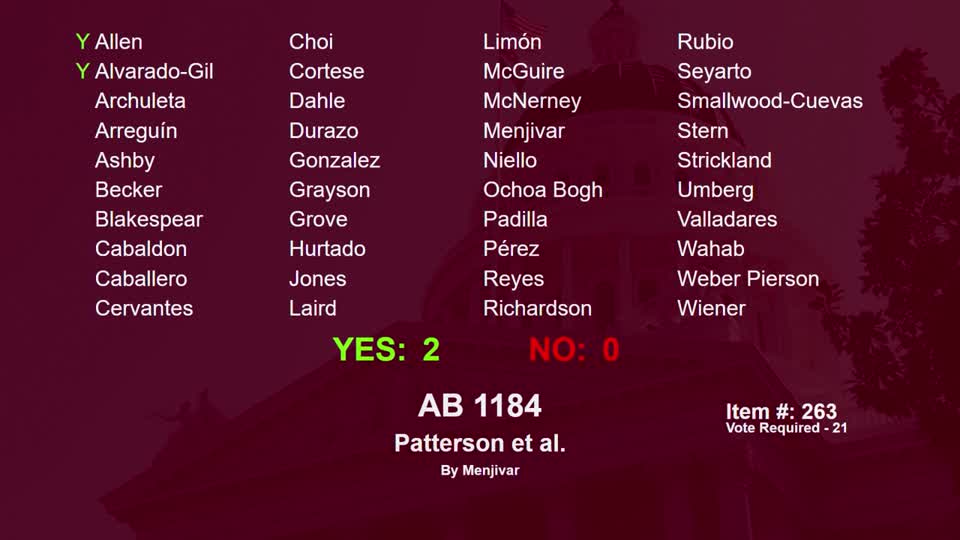 2MIN
Senate Floor
 1MIN
Senate Standing Committee on Appropriations
 14MIN
Senate Standing Committee on Local Government
 10MIN
Senate Standing Committee on Natural Resources and Water
 1MIN
Assembly Floor
 9MIN
Assembly Standing Committee on Local Government
 25MIN
Assembly Standing Committee on Water, Parks, and Wildlife
Bill Author

Bill Co-Author(s):