AB 2633: Secondhand dealers.
- Session Year: 2025-2026
- House: Assembly
- Latest Version Date: 2026-09-27
Current Status:
Passed
(2026-09-27: Chaptered by Secretary of State - Chapter 631, Statutes of 2026.)
Introduced
In Committee
Awaiting First Chamber Vote
Passed First Chamber
In Committee
Awaiting Second Chamber Vote
Passed Second Chamber
Enacted
Existing law imposes upon secondhand dealers and coin dealers a uniform, statewide, state-administered program of regulation of persons whose principal business is buying, selling, trading, auctioning, or taking in pawn tangible personal property, as defined, and requires a secondhand dealer or coin dealer to report secondhand tangible personal property that they acquire, except as specified, to the California Pawn and SecondhandDealer System (CAPSS) operated by the Department of Justice, as specified. Existing law defines tangible personal property for these purposes to include, among other things, all tangible personal property that the Attorney General statistically determines through the most recent Department of Justice crime data to constitute a significant class of stolen goods. Existing law further defines significant class of stolen goods to mean those items determined through the Department of Justices most recent OpenJustice Web portal update to constitute more than 10% of property reported stolen in the calendar year preceding the annual posting of the list of significant classes of stolen goods. Existing law makes a violation of these provisions a misdemeanor, as specified.
This bill would remove the term principal from the provisions that regulate secondhand dealers, making them applicable, instead, to persons whose business is buying, selling, trading, auctioning, or taking in pawn tangible personal property. By expanding the persons subject to the reporting requirement, the violation of which is a crime, this bill would impose a state-mandated local program. The bill would make the above-described provisions inapplicable to coin dealers and make other related and conforming changes. The bill would make the provisions that regulate secondhand dealers inapplicable to tangible personal property that has been acquired from a nonprofit organization or as a bulk purchase of donated items. The bill would also delete the definition of a significant class of stolen goods, thereby potentially expanding the definition of tangible personal property. By expanding the items subject to the reporting requirement, the violation of which is a crime, this bill would impose a state-mandated local program.
Existing law requires the chief of police, sheriff, or police commission to accept an application for licensure and to grant a license to a qualified applicant, as specified. Existing law requires the licensing authority to submit the application to the Department of Justice before granting the license. If the Department of Justice does not comment on the application within 30 days after the submission, existing law authorizes the licensing authority to grant the applicant a license.
This bill would prohibit a city, county, city and county, or any other state agency from issuing a license or permit to allow any entity to conduct business as a secondhand dealer without the entity having a state secondhand dealer license issued pursuant to the provisions described above. The bill would reiterate that any person conducting business as a secondhand dealer is required to report secondhand tangible personal property that they acquire to the CAPSS operated by the Department of Justice, as specified.
The California Constitution requires the state to reimburse local agencies and school districts for certain costs mandated by the state. Statutory provisions establish procedures for making that reimbursement.
This bill would provide that no reimbursement is required by this act for a specified reason.
Existing law imposes upon secondhand dealers and coin dealers a uniform, statewide, state-administered program of regulation of persons whose principal business is buying, selling, trading, auctioning, or taking in pawn tangible personal property, as defined, and requires a secondhand dealer or coin dealer to report secondhand tangible personal property that they acquire acquire, except as specified, to the California Pawn and SecondhandDealer System (CAPSS) operated by the Department of Justice, as specified. Existing law defines tangible personal property for these purposes to include, among other things, all tangible personal property that the Attorney General statistically determines through the most recent Department of Justice crime data to constitute a significant class of stolen goods. Existing law further defines significant class of stolen goods to mean those items determined through the Department of Justices most recent OpenJustice Web portal update to constitute more than 10% of property reported stolen in the calendar year preceding the annual posting of the list of significant classes of stolen goods. Existing law makes a violation of these provisions a misdemeanor, as specified.
This bill would remove the term principal from the provisions that regulate secondhand dealers, making them applicable, instead, to persons whose business is buying, selling, trading, auctioning, or taking in pawn tangible personal property. By expanding the persons subject to the reporting requirement, the violation of which is a crime, this bill would impose a state-mandated local program. The bill would make the above-described provisions inapplicable to coin dealers and make other related and conforming changes. The bill would expand the definition of tangible personal property to include secondhand jewelry, items, or objects. The bill would make the provisions that regulate secondhand dealers inapplicable to tangible personal property that has been acquired from a nonprofit organization or as a bulk purchase of donated items. The bill would also delete the definition of a significant class of stolen goods, thereby potentially expanding the definition of tangible personal property. By expanding the items subject to the reporting requirement, the violation of which is a crime, this bill would impose a state-mandated local program.
Existing law requires the chief of police, sheriff, or police commission to accept an application for licensure and to grant a license to a qualified applicant, as specified. Existing law requires the licensing authority to submit the application to the Department of Justice before granting the license. If the Department of Justice does not comment on the application within 30 days after the submission, existing law authorizes the licensing authority to grant the applicant a license.
This bill would prohibit a city, county, city and county, or any other state agency from issuing a license or permit to allow any entity to conduct business as a secondhand dealer without the entity having a state secondhand dealer license issued pursuant to the provisions described above. The bill would reiterate that any person conducting business as a secondhand dealer is required to report secondhand tangible personal property that they acquire to the CAPSS operated by the Department of Justice, as specified.
The California Constitution requires the state to reimburse local agencies and school districts for certain costs mandated by the state. Statutory provisions establish procedures for making that reimbursement.
This bill would provide that no reimbursement is required by this act for a specified reason.
Existing law imposes upon secondhand dealers and coin dealers a uniform, statewide, state-administered program of regulation of persons whose principal business is buying, selling, trading, auctioning, or taking in pawn tangible personal property, as defined, and requires a secondhand dealer or coin dealer to report secondhand tangible personal property that they acquired acquire to the California Pawn and SecondhandDealer System (CAPSS) operated by the Department of Justice, as specified. Existing law defines tangible personal property for these purposes to include, among other things, all tangible personal property that the Attorney General statistically determines through the most recent Department of Justice crime data to constitute a significant class of stolen goods. Existing law further defines significant class of stolen goods to mean those items determined through the Department of Justices most recent OpenJustice Web portal update to constitute more than 10% of property reported stolen in the calendar year preceding the annual posting of the list of significant classes of stolen goods. Existing law makes a violation of these provisions a misdemeanor, as specified.
This bill would remove the term principal from the provisions that regulate secondhand dealers, making them applicable, instead, to persons whose business is buying, selling, trading, auctioning, or taking in pawn tangible personal property. By expanding the persons subject to the reporting requirement, the violation of which is a crime, this bill would impose a state-mandated local program. The bill would make the above-described provisions inapplicable to coin dealers and make other related and conforming changes. The bill would expand the definition of tangible personal property to include secondhand jewelry, items, or objects. The bill would also delete the definition of a significant class of stolen goods, thereby potentially expanding the definition of tangible personal property. By expanding the items subject to the reporting requirement, the violation of which is a crime, this bill would impose a state-mandated local program.
Existing law requires the chief of police, sheriff, or police commission to accept an application for licensure and to grant a license to a qualified applicant, as specified. Existing law requires the licensing authority to submit the application to the Department of Justice before granting the license. If the Department of Justice does not comment on the application within 30 days after the submission, existing law authorizes the licensing authority to grant the applicant a license.
This bill would prohibit a city, county, city and county, or any other state agency from issuing a license or permit to allow any entity to conduct business as a secondhand dealer without the entity having a state secondhand dealer license issued pursuant to the provisions described above. The bill would reiterate that any person conducting business as a secondhand dealer is required to report secondhand tangible personal property that they acquire to the CAPSS operated by the Department of Justice, as specified.
The California Constitution requires the state to reimburse local agencies and school districts for certain costs mandated by the state. Statutory provisions establish procedures for making that reimbursement.
This bill would provide that no reimbursement is required by this act for a specified reason.
Existing law imposes upon secondhand dealers and coin dealers a uniform, statewide, state-administered program of regulation of persons whose principal business is buying, selling, trading, auctioning, or taking in pawn tangible personal property, as defined, and requires a secondhand dealer or coin dealer to report tangible personal property they acquired to the California Pawn and SecondhandDealer System (CAPSS) operated by the Department of Justice, as specified. Existing law makes a violation of these provisions a misdemeanor, as specified.
This bill would make the above-described provisions inapplicable to coin dealers and make other related and conforming changes. The bill would expand the definition of tangible personal property to include secondhand jewelry, items, or objects. By expanding the items subject to the reporting requirement, the violation of which is a crime, this bill would impose a state-mandated local program.
Existing law makes it unlawful for any person to engage in the business of a secondhand dealer without being licensed and authorizes a district attorney or the Attorney General to bring an action to enjoin the violation, or the threatened violation, of any provisions regulating secondhand dealers.This bill would also authorize a licensee to bring an action in superior court against a person engaging in the business of a secondhand dealer without a state license, as specified.Existing law requires the chief of police, sheriff, or police commission to accept an application for licensure and to grant a license to a qualified applicant, as specified. Existing law requires the licensing authority to submit the application to the Department of Justice before granting the license. If the Department of Justice does not comment on the application within 30 days after the submission, existing law authorizes the licensing authority to grant the applicant a license.
This bill would prohibit a city, county, city and county, or any other state agency from issuing a license or permit to allow any entity to conduct business as a secondhand dealer without the entity having a state secondhand dealer license issued pursuant to the provisions described above.
The California Constitution requires the state to reimburse local agencies and school districts for certain costs mandated by the state. Statutory provisions establish procedures for making that reimbursement.
This bill would provide that no reimbursement is required by this act for a specified reason.
Existing law imposes upon secondhand dealers and coin dealers a uniform, statewide, state-administered program of regulation of persons whose principal business is buying, selling, trading, auctioning, or taking in pawn tangible personal property, as defined, and requires a secondhand dealer or coin dealer to report tangible personal property they acquired to the California Pawn and SecondhandDealer System (CAPSS) operated by the Department of Justice, as specified. Existing law makes a violation of these provisions a misdemeanor, as specified.
This bill would make the above-described provisions inapplicable to coin dealers and make other related and conforming changes. The bill would expand the definition of tangible personal property to include secondhand jewelry, items, or objects. By expanding the items subject to the reporting requirement, the violation of which is a crime, this bill would impose a state-mandated local program.
Existing law makes it unlawful for any person to engage in the business of a secondhand dealer without being licensed and authorizes a district attorney or the Attorney General to bring an action to enjoin the violation, or the threatened violation, of any provisions regulating secondhand dealers.
This bill would also authorize a licensee to bring an action in superior court against a person engaging in the business of a secondhand dealer without a state license, as specified.
Existing law requires the chief of police, sheriff, or police commission to accept an application for licensure and to grant a license to a qualified applicant, as specified. Existing law requires the licensing authority to submit the application to the Department of Justice before granting the license. If the Department of Justice does not comment on the application within 30 days after the submission, existing law authorizes the licensing authority to grant the applicant a license.
This bill would prohibit a city, county, city and county, or any other state agency from issuing a license or permit to allow any entity to conduct business as a secondhand dealer without the entity having a state secondhand dealer license issued pursuant to the provisions described above.
The California Constitution requires the state to reimburse local agencies and school districts for certain costs mandated by the state. Statutory provisions establish procedures for making that reimbursement.
This bill would provide that no reimbursement is required by this act for a specified reason.
It is the intent of the Legislature in enacting this article to curtail the dissemination of stolen property and to facilitate the recovery of stolen property by means of a uniform, statewide, state-administered program of regulation of persons whose business is the buying, selling, trading, auctioning, or taking in pawn of tangible personal property and to aid the State Board of Equalization to detect possible sales tax evasion.
Further, it is the intent of the Legislature in enacting this article to require the uniform statewide reporting of tangible personal property acquired by persons whose business is the buying, selling, trading, auctioning, or taking in pawn of tangible personal property, unless the property or the transaction is specifically exempt herein, for the purpose of correlating these reports with other reports of city, county, and city and county law enforcement agencies and further utilizing the services of the Department of Justice to aid in tracing and recovering stolen property.
Further, it is the intent of the Legislature that this article shall not be superseded or supplanted by the provisions of any ordinance or charter of any city, county, or city and county.
SEC. 2.Section 21626 of the Business and Professions Code is amended to read:21626.(a)A secondhand dealer, as used in this article, means and includes any person, copartnership, firm, or corporation whose business includes buying, selling, trading, taking in pawn, accepting for sale on consignment, accepting for auctioning, or auctioning secondhand tangible personal property. A secondhand dealer does not include participants at gun shows, as defined in Section 478.100 of Title 27 of the Code of Federal Regulations, or its successor, who are not required to be licensed pursuant to Sections 26700 to 26915, inclusive, of the Penal Code, who are acting in compliance with the requirements of Sections 26500 to 26585, inclusive, and 27545 of the Penal Code, and who are not a Gun Show Trader, as described in Sections 16620 and 26525 of the Penal Code.
(b)Every entity acting as a secondhand dealer by engaging in any of the actions described in subdivision (a) shall have a valid California secondhand dealers license issued under Section 21641.
(c)Every entity acting as a secondhand dealer as described in subdivision (a) shall report to the California Pawn and SecondhandDealer System, operated by the Department of Justice, pursuant to Section 21628.
SEC. 3.Section 21627 of the Business and Professions Code is amended to read:21627.(a)As used in this article, tangible personal property means all secondhand tangible personal property that bears a serial number or personalized initials or inscription or that, at the time it is acquired by the secondhand dealer, bears evidence of having had a serial number or personalized initials or inscription.
(b)Tangible personal property also means the following:
(1)All tangible personal property, new or used, including motor vehicles, received in pledge as security for a loan by a pawnbroker.
(2)All tangible personal property that bears a serial number or personalized initials or inscription and that is purchased by a secondhand dealer or a pawnbroker or that, at the time of the purchase, bears evidence of having had a serial number or personalized initials or inscription.
(3)All tangible personal property that the Attorney General statistically determines through the most recent Department of Justice crime data, updated pursuant to Section 13010 of the Penal Code, to constitute a significant class of stolen goods. A list of that personal property shall be supplied by the Attorney General to all local law enforcement agencies and posted on the Attorney Generals internet website. That list shall be updated annually by the Attorney General, beginning January 1, 2016, to ensure that it addresses current problems with stolen goods.
(c)As used in this article, tangible personal property does not include any new goods or merchandise purchased from a bona fide manufacturer or distributor or wholesaler of the new goods or merchandise by a secondhand dealer. For the purposes of this article, however, a secondhand dealer shall retain for one year from the date of purchase, and shall make available for inspection by any law enforcement officer, any receipt, invoice, bill of sale, or other evidence of purchase of the new goods or merchandise.
(d)As used in this article, tangible personal property does not include coins, monetized bullion, or commercial grade ingots of gold, silver, or other precious metals. Commercial grade ingots means 0.99 fine or finer ingots of gold, silver, palladium, or platinum, or 0.925 fine sterling silver art bars and medallions, provided that the ingots, art bars, and medallions are marked by the refiner or fabricator as to their assay fineness.
SEC. 4.Section 21628 of the Business and Professions Code is amended to read:21628.(a)Every secondhand dealer described in Section 21626 shall report daily, or no later than the next business day excluding weekends and holidays after receipt or purchase of secondhand tangible personal property, except for firearms, to the California Pawn and SecondhandDealer System (CAPSS), all secondhand tangible personal property, except for firearms, they have purchased, taken in trade, taken in pawn, accepted for sale on consignment, or accepted for auctioning, in accordance with Section 21630 and this section. The report shall be legible, prepared in English, completed where applicable, and include the information specified in subparagraphs (A) to (C), inclusive, of paragraph (1), as applicable.
(1)(A)A property description. The property description shall be a complete and reasonably accurate description of the property, including, but not limited to, the following: serial number, personalized inscriptions, and other identifying marks or symbols, owner-applied numbers, the size, color, material, and, if known by the secondhand dealer, the manufacturers pattern name. The property description shall include the brand and model name or number of the item if known to, or reasonably ascertainable by, the secondhand dealer. The property description shall include a plain text description of the item generally accepted by the secondhand industry. Watches need not be disassembled when special skill or special tools are required to obtain the required information, unless specifically requested to do so by a peace officer. A special tool does not include a penknife, caseknife, or similar instrument and disassembling a watch with a penknife, caseknife, or similar instrument does not constitute a special skill. In all instances in which the required information may be obtained by removal of a watchband, then the watchband shall be removed. The cost associated with opening the watch shall be borne by the pawnbroker, secondhand dealer, or customer.
(B)A secondhand dealer shall utilize in the article field either an article field descriptor, the format of which shall be provided by the Department of Justice, or a properly spelled and non-abbreviated plain text descriptor commonly recognized and utilized by the pawn and secondhand dealer industry. The lack of an article field descriptor provided by the Department of Justice shall not be relevant to any determination as to whether the secondhand dealer has received evidence of authority to sell or pledge the property pursuant to paragraph (1) of subdivision (b) so long as the secondhand dealer reports an article field descriptor consistent with this subdivision.
(C)In the case of the receipt or purchase of a handheld electronic device by a secondhand dealer, the serial number reported pursuant to subparagraph (A) may be the International Mobile Station Equipment Identity (IMEI), the Mobile Equipment Identifier (MEID), or other unique identifying number assigned to that device by the device manufacturer. If none of these identifying numbers are available by the time period required for reporting pursuant to this subdivision, the report shall be updated with the IMEI, MEID, or other unique identifying number assigned to that device by the device manufacturer as soon as reasonably possible but no later than 10 working days after receipt or purchase of the handheld electronic device.
(D)For the purpose of this paragraph, handheld electronic device means any portable device that is capable of creating, receiving, accessing, or storing electronic data or communications and includes, but is not limited to, a cellular phone, smartphone, or tablet.
(2)A report submitted by a pawnbroker or secondhand dealer shall be deemed to have been accepted by the Department of Justice if a good faith effort has been made to supply all of the required information. An error or omission on the report shall be noted, and the reporting pawnbroker or secondhand dealer shall be notified of the error or omission by the Department of Justice. A reporting pawnbroker or secondhand dealer shall have three business days from that notice to amend or correct the report before being subject to any enforcement violation.
(b)(1)When a secondhand dealer complies with this section, they shall be deemed to have received from the seller or pledger adequate evidence of authority to sell or pledge the property for all purposes included in this article, and Division 8 (commencing with Section 21000) of the Financial Code.
(2)In enacting this subdivision, it is the intent of the Legislature that its provisions shall not adversely affect the implementation of, or prosecution under, any provision of the Penal Code.
(c)Any person who conducts business as a secondhand dealer at any gun show or event, as defined in Section 478.100 of Title 27 of the Code of Federal Regulations, or its successor, outside the jurisdiction that issued the secondhand dealer license in accordance with subdivision (d) of Section 21641, may be required to submit a duplicate of the transaction report prepared pursuant to this section to the local law enforcement agency where the gun show or event is conducted.
(d)(1)The Department of Justice shall recognize and accept the properly spelled and non-abbreviated plain text property descriptors generally accepted in the pawn and secondhand industries provided by pawnbrokers and secondhand dealers, as has been the longstanding practice of chiefs of police and sheriffs when they had received paper reports from pawnbrokers and secondhand dealers.
(2)A report required of a secondhand dealer pursuant to this section shall be transmitted by electronic means to CAPSS by the secondhand dealer.
(3)Unless specifically identified in this section, the Department of Justice, chiefs of police, and sheriffs shall not require a secondhand dealer to include any additional information concerning the seller, the pledger, or the property received by the secondhand dealer in the report required by this section.
(4)If there is a future change to the reporting requirements of CAPSS that substantively alters the reporting standards provided by this article, those changes shall be implemented and operated in compliance with the Administrative Procedure Act (Chapter 3.5 (commencing with Section 11340) of Part 1 of Division 3 of Title 2 of the Government Code). In implementing and operating a future change to CAPSS, the Department of Justice, chiefs of police, and sheriffs shall comply with Sections 21637 and 21638. Notwithstanding any other law, the Department of Justice shall not take any action with respect to the implementation, operation, or maintenance of CAPSS required by this chapter by adoption of an emergency regulation.
(5)On or before July 1, 2017, the Department of Justice shall convene a meeting with the Department of Technology to discuss issues pertaining to any proposed changes or upgrades to CAPSS required by this chapter. The Department of Technology may provide technological assistance for ongoing improvements, updates, or changes to CAPSS required by this chapter, as requested.
(6)A transaction shall consist of not more than one item.
(7)For purposes of this subdivision, item shall mean any single physical article. However, with respect to a commonly accepted grouping of articles that are purchased as a set, including, but not limited to, a pair of earrings or place settings of china, silverware, or other tableware, item shall mean that commonly accepted grouping.
(8)This subdivision does not exempt a secondhand dealer from the fingerprinting requirement of this section.
(e)(1)Each secondhand dealer, as defined in Section 21626, shall record and maintain the identification of the intended seller or pledger for three years from the date the item was reported to CAPSS. The identification of the seller or pledger of the property shall be verified by the person taking the information, who may use technology, including, but not limited to, cameras or software, or both, to obtain information and verify identity remotely. The verification shall be valid if the person taking the information reasonably relies on any one of the following documents, provided that the document is currently valid or has been issued within five years and contains a photograph or description, or both, of the person named on it, and, where applicable, is signed by the person, and bears a serial or other identifying number:
(A)A passport of the United States.
(B)A drivers license issued by any state or Canada.
(C)An identification card issued by any state.
(D)An identification card issued by the United States.
(E)A passport from any other country in addition to another item of identification bearing an address.
(F)A Matricula Consular, in addition to another item of identification bearing an address.
(2)Each secondhand dealer, as defined in Section 21626, shall also record and maintain a certification by the intended seller or pledger that the person is the owner of the property or has the authority of the owner to sell or pledge the property, and a legible fingerprint taken from the intended seller or pledger.
(3)(A)If local law enforcement notifies the secondhand dealer, pursuant to Section 21647 of this code or Chapter 12 (commencing with Section 1407) of Title 10 of Part 2 of the Penal Code, that the item from the intended seller or pledger has been reported lost, stolen, or embezzled, the secondhand dealer shall provide law enforcement the information recorded as required by this subdivision immediately upon request or no later than the next business day.
(B)The required fields on CAPSS, that would otherwise be used to identify the intended seller or pledger of the property, shall instead be populated by on file, and the information on that persons identity shall be recorded and maintained as required by this subdivision.
(f) This section does not exempt a person licensed as a firearms dealer pursuant to Sections 26700 to 26915, inclusive, of the Penal Code from the reporting requirements for the delivery of firearms pursuant to Sections 26700 to 26915, inclusive, of the Penal Code.
(g)This section shall become operative on January 1, 2023.
SEC. 5.Section 21629 of the Business and Professions Code is amended to read:21629.This article shall not apply to any tangible personal property that has been:
(a)Acquired from another secondhand dealer; provided the secondhand dealer selling or trading the tangible personal property states in writing under penalty of perjury, along with a description of the property, on an interdealer transfer form or an itemized bill of sale, that the report or reports required by this article have been properly made and submitted by that dealer. A copy of the form or the itemized bill of sale shall be delivered to the acquiring dealer at the time the transaction occurs. Interdealer transfer forms shall be provided at actual cost by the Department of Justice.
The dealers involved in the transaction shall retain their copy of the interdealer transfer form or itemized bill of sale for a period of three years as a matter of record, and shall make them available for inspection by any law enforcement officer.
(b)Acquired in a nonjudicial sale, transfer, assignment, assignment for the benefit of creditors, or consignment of the assets or stock in trade, in bulk, or a substantial part thereof, of an industrial or commercial enterprise for purposes of voluntary dissolution or liquidation of the sellers business, or for the purpose of disposing of an excessive quantity of personal property; or that has been acquired in a nonjudicial sale or transfer from an owner of their entire household of personal property, or a substantial part thereof; provided, the secondhand dealer retains in their place of business for a period of three years a copy of the bill of sale, receipt, inventory list, or other transfer document as a matter of record which shall be made available for inspection by any law enforcement officer; and provided further, that the secondhand dealer notifies the chief of police or the sheriff that exemption from reporting is being claimed under this subdivision. Industrial or commercial enterprise and owner as used in this subdivision do not include a secondhand dealer;
(c)Acquired in a sale made by any public officer in their official capacity, trustee in bankruptcy, executor, administrator, receiver, or public official acting under judicial process or authority, or that has been acquired in a sale made upon the execution of, or by virtue of, any process issued by a court, or under the provisions of Division 7 (commencing with Section 7101) of the Commercial Code;
(d)Acquired as the surplus property of the United States government or of a state, city, county, city and county, municipal corporation, or public district and that after requisition or acquisition by the United States government or by a state, city, county, city and county, municipal corporation, or public district has never thereafter been sold at retail; and
(e)Reported by a secondhand dealer as an acquisition or a purchase, or that has been reported as destroyed or otherwise disposed of, (1) to a state agency by the authority of any other law of this State; or (2) to a city, county, or city and county officer or agency by the authority of any other law of this State or a city, county, or city and county ordinance.
(f)Acquired by persons, firms, partnerships, or corporations who buy, sell, or trade precious metals, whether in the form of coins or commercial grade ingots, who: (1) are designated contract markets by or registered with the Commodity Futures Trading Commission under the Federal Commodities Exchange Act and acting pursuant thereto; or (2) infrequently conduct their business directly with members of the general public. As used in this subdivision, infrequently means occasional and without regularity.
(g)Acquired from a nonprofit organization or as a bulk purchase of donated items.
SEC. 6.Section 21630 of the Business and Professions Code is amended to read:21630.(a)A secondhand dealer shall electronically transmit to CAPSS no later than the next business day after the date of transaction excluding weekends and holidays or, if not then possible due to an electrical, telecommunications, or other malfunction, as soon as reasonable thereafter, the report of acquisition of tangible personal property as required by Section 21628.
(b)Notwithstanding Section 21628, submission of a tangible property acquisition report is not required if the report of an acquisition of the same property from the same customer has been submitted within the preceding 12 months.
SEC. 7.Section 21631 of the Business and Professions Code is amended to read:21631.Notwithstanding any other provisions of law, all tangible personal property that is found in the shop of a pawnbroker or secondhand dealer doing business under a California secondhand dealers license shall be reported as required under subdivisions (c) and (d) of Section 21628, including any additional information required by Section 21628 that is known by the reporting person, and shall be held as required under Section 21636. If no claim is made for the property for a period of 60 days after it is reported, the pawnbroker, secondhand dealer, or coin dealer may treat the property as property regularly acquired in the due course of business.
SEC. 8.Section 21634 of the Business and Professions Code is repealed.SEC. 9.Section 21636 of the Business and Professions Code is amended to read:21636.(a)Every secondhand dealer shall retain in their possession for a period of 30 days all firearms reported under Section 21628.2. The 30-day holding period with respect to firearms shall commence with the date the report of its acquisition was made electronically to the Department of Justice by the secondhand dealer. The Department of Justice may for good cause authorize prior disposition of any firearms described in a specific report, provided that a secondhand dealer who disposes of firearms pursuant to that authorization shall report the sale thereof to the Department of Justice.
(b)During the 30-day holding period specified in subdivision (a), every secondhand dealer shall produce any firearm reported under Section 21628.2 for inspection by any peace officer or employee designated by the Department of Justice.
(c)Firearms subject to inspection as specified in subdivision (b) and firearms held in pawn that are stored off the business premises of the licensee shall, upon request for inspection, be produced at the licensees business premises within one business day of a request.
(d)Any person who conducts business as a secondhand dealer at any gun show or event, as defined in Section 478.100 of Title 27 of the Code of Federal Regulations, or its successor, outside the jurisdiction that issued the secondhand dealer license in accordance with subdivision (d) of Section 21641, may be required to submit for inspection, as specified in subdivision (b), any firearm acquired at a gun show or event within 48 hours of the request of the local law enforcement agency in the jurisdiction where the gun show or event was conducted at a location specified by the local law enforcement agency.
SEC. 10.Section 21636.1 of the Business and Professions Code is amended to read:21636.1.(a)Every secondhand dealer shall retain in his or her possession for a period of seven days all tangible personal property, as defined in Section 21627, reported pursuant to Sections 21628 and 21630. The seven-day holding period with respect to tangible personal property shall commence with the date the report of its acquisition was made to CAPSS.
(b)During the seven-day holding period specified in subdivision (a), every secondhand dealer shall produce any tangible personal property reported pursuant to Sections 21628 and 21630 for inspection by any peace officer or employee designated by the local licensing authority or the Department of Justice.
(c)Tangible personal property subject to inspection as specified in subdivision (b) and all tangible personal property held in pawn that is stored off the business premises of the licensee shall, upon request for inspection, be produced at the licensees business premises within one business day of a request by the local licensing authority or the Department of Justice.
(d)(1)If five days have elapsed since the transmission of the report of acquisition pursuant to Section 21628 or 21630, the remainder of the seven-day hold specified in subdivision (a) shall not apply to any tangible personal property sold by the secondhand dealer if the following are present:
(A)The secondhand dealer has recorded the sale in its book of records.
(B)The record of sale includes:
(i)The name of the buyer to whom the tangible personal property was sold.
(ii)The buyers address.
(iii)At least one of the following:
(I)The buyers telephone number.
(II)The buyers email address.
(III)The buyers electronic address for receiving text messages.
(2)In documenting the record of sale as set forth in paragraph (1), the secondhand dealer shall record the information provided by the buyer and shall not have any duty to verify the accuracy of the information provided by the buyer.
(3)The information collected pursuant to this subdivision shall be retained by the secondhand dealer for 21 days following the date of sale of the property by the secondhand dealer and shall be available for inspection by a local law enforcement agency during this period.
(4)If a sale of property is made pursuant to this subdivision, and within 21 days of the sale a local law enforcement agency notifies the secondhand dealer that the property has been reported stolen, the record of the sale and all information contained therein shall be provided to that local law enforcement agency by the secondhand dealer upon written request by that agency.
SEC. 11.Section 21636.5 of the Business and Professions Code is amended to read:21636.5.No secondhand dealer shall promise a seller of tangible personal property that the seller may repurchase property sold to the secondhand dealer.
SEC. 12.Section 21637 of the Business and Professions Code is amended to read:21637.(a)Nothing contained in this section shall be deemed to excuse compliance with the provisions of any city, county, or city and county ordinance or any other state law pertaining to or covering reporting, holding, or releasing of tangible personal property, not inconsistent with the provisions of this article, except that no city, county, or city and county or any other state agency shall adopt the following:
(1)Holding, reporting, or identification requirements for transactions involving coins, monetized bullion, or commercial grade ingots of gold, silver, or other precious metals.
(2)Identification, holding, or reporting requirements for the acquisition of tangible personal property, in the ordinary course of business, by pawnbrokers and secondhand dealers, other than as set forth in Sections 21628, 21630, and 21636 of this code, and commencing July 1, 2010, Section 21628.2 of this code, and Section 21208 of the Financial Code.
(b)No city, county, or city and county or any other state agency shall issue a license or permit to allow any entity to conduct business as a secondhand dealer without the entity having a state secondhand dealer license issued pursuant to Section 21641.
(c)Any person conducting business as a secondhand dealer shall report receipt or purchase of secondhand tangible personal property to the California Pawn and SecondhandDealer System (CAPSS), operated by the Department of Justice, pursuant to Section 21628.
SEC. 13.Section 21638 of the Business and Professions Code is amended to read:21638.The provisions of this article shall not prohibit enactment, amendment, or enforcement by any city, county, or city and county of any local ordinance relating to a secondhand dealer that is not inconsistent with the provisions of this article, except that no city, county, or city and county, or any other state agency shall adopt the following:
(a)Holding, reporting, or identification requirements for transactions involving coins, monetized bullion, or commercial grade ingots of gold, silver, or other precious metals.
(b)Identification, holding, or reporting requirements for the acquisition of tangible personal property, in the ordinary course of business, by pawnbrokers and secondhand dealers, other than as set forth in Sections 21628, 21630, and 21636 of this code, and commencing July 1, 2010, Section 21628.2 of this code, and Section 21208 of the Financial Code.
SEC. 14.No reimbursement is required by this act pursuant to Section 6 of Article XIIIB of the California Constitution because the only costs that may be incurred by a local agency or school district will be incurred because this act creates a new crime or infraction, eliminates a crime or infraction, or changes the penalty for a crime or infraction, within the meaning of Section 17556 of the Government Code, or changes the definition of a crime within the meaning of Section 6 of Article XIIIB of the California Constitution.
It is the intent of the Legislature in enacting this article to curtail the dissemination of stolen property and to facilitate the recovery of stolen property by means of a uniform, statewide, state-administered program of regulation of persons whose business is the buying, selling, trading, auctioning, or taking in pawn of tangible personal property and to aid the State Board of Equalization to detect possible sales tax evasion.
Further, it is the intent of the Legislature in enacting this article to require the uniform statewide reporting of tangible personal property acquired by persons whose business is the buying, selling, trading, auctioning, or taking in pawn of tangible personal property, unless the property or the transaction is specifically exempt herein, for the purpose of correlating these reports with other reports of city, county, and city and county law enforcement agencies and further utilizing the services of the Department of Justice to aid in tracing and recovering stolen property.
Further, it is the intent of the Legislature that this article shall not be superseded or supplanted by the provisions of any ordinance or charter of any city, county, or city and county.
SEC. 2.Section 21626 of the Business and Professions Code is amended to read:21626.(a)A secondhand dealer, as used in this article, means and includes any person, copartnership, firm, or corporation whose business includes buying, selling, trading, taking in pawn, accepting for sale on consignment, accepting for auctioning, or auctioning secondhand tangible personal property. A secondhand dealer does not include participants at gun shows, as defined in Section 478.100 of Title 27 of the Code of Federal Regulations, or its successor, who are not required to be licensed pursuant to Sections 26700 to 26915, inclusive, of the Penal Code, who are acting in compliance with the requirements of Sections 26500 to 26585, inclusive, and 27545 of the Penal Code, and who are not a Gun Show Trader, as described in Sections 16620 and 26525 of the Penal Code.
(b)Every entity acting as a secondhand dealer by engaging in any of the actions described in subdivision (a) shall have a valid California secondhand dealers license issued under Section 21641.
(c)Every entity acting as a secondhand dealer as described in subdivision (a) shall report to the California Pawn and SecondhandDealer System, operated by the Department of Justice, pursuant to Section 21628.
SEC. 3.Section 21627 of the Business and Professions Code is amended to read:21627.(a)As used in this article, tangible personal property means all secondhand tangible personal property that bears a serial number or personalized initials or inscription or that, at the time it is acquired by the secondhand dealer, bears evidence of having had a serial number or personalized initials or inscription.
(b)Tangible personal property also means the following:
(1)All tangible personal property, new or used, including motor vehicles, received in pledge as security for a loan by a pawnbroker.
(2)All tangible personal property that bears a serial number or personalized initials or inscription and that is purchased by a secondhand dealer or a pawnbroker or that, at the time of the purchase, bears evidence of having had a serial number or personalized initials or inscription.
(3)All tangible personal property that the Attorney General statistically determines through the most recent Department of Justice crime data, updated pursuant to Section 13010 of the Penal Code, to constitute a significant class of stolen goods. A list of that personal property shall be supplied by the Attorney General to all local law enforcement agencies and posted on the Attorney Generals internet website. That list shall be updated annually by the Attorney General, beginning January 1, 2016, to ensure that it addresses current problems with stolen goods.
(4)All secondhand jewelry, items, or objects.(c)As used in this article, tangible personal property does not include any new goods or merchandise purchased from a bona fide manufacturer or distributor or wholesaler of the new goods or merchandise by a secondhand dealer. For the purposes of this article, however, a secondhand dealer shall retain for one year from the date of purchase, and shall make available for inspection by any law enforcement officer, any receipt, invoice, bill of sale, or other evidence of purchase of the new goods or merchandise.
(d)As used in this article, tangible personal property does not include coins, monetized bullion, or commercial grade ingots of gold, silver, or other precious metals. Commercial grade ingots means 0.99 fine or finer ingots of gold, silver, palladium, or platinum, or 0.925 fine sterling silver art bars and medallions, provided that the ingots, art bars, and medallions are marked by the refiner or fabricator as to their assay fineness.
SEC. 4.Section 21628 of the Business and Professions Code is amended to read:21628.(a)Every secondhand dealer described in Section 21626 shall report daily, or no later than the next business day excluding weekends and holidays after receipt or purchase of secondhand tangible personal property, except for firearms, to the California Pawn and SecondhandDealer System (CAPSS), all secondhand tangible personal property, except for firearms, they have purchased, taken in trade, taken in pawn, accepted for sale on consignment, or accepted for auctioning, in accordance with Section 21630 and this section. The report shall be legible, prepared in English, completed where applicable, and include the information specified in subparagraphs (A) to (C), inclusive, of paragraph (1), as applicable.
(1)(A)A property description. The property description shall be a complete and reasonably accurate description of the property, including, but not limited to, the following: serial number, personalized inscriptions, and other identifying marks or symbols, owner-applied numbers, the size, color, material, and, if known by the secondhand dealer, the manufacturers pattern name. The property description shall include the brand and model name or number of the item if known to, or reasonably ascertainable by, the secondhand dealer. The property description shall include a plain text description of the item generally accepted by the secondhand industry. Watches need not be disassembled when special skill or special tools are required to obtain the required information, unless specifically requested to do so by a peace officer. A special tool does not include a penknife, caseknife, or similar instrument and disassembling a watch with a penknife, caseknife, or similar instrument does not constitute a special skill. In all instances in which the required information may be obtained by removal of a watchband, then the watchband shall be removed. The cost associated with opening the watch shall be borne by the pawnbroker, secondhand dealer, or customer.
(B)A secondhand dealer shall utilize in the article field either an article field descriptor, the format of which shall be provided by the Department of Justice, or a properly spelled and non-abbreviated plain text descriptor commonly recognized and utilized by the pawn and secondhand dealer industry. The lack of an article field descriptor provided by the Department of Justice shall not be relevant to any determination as to whether the secondhand dealer has received evidence of authority to sell or pledge the property pursuant to paragraph (1) of subdivision (b) so long as the secondhand dealer reports an article field descriptor consistent with this subdivision.
(C)In the case of the receipt or purchase of a handheld electronic device by a secondhand dealer, the serial number reported pursuant to subparagraph (A) may be the International Mobile Station Equipment Identity (IMEI), the mobile equipment identifier Mobile Equipment Identifier (MEID), or other unique identifying number assigned to that device by the device manufacturer. If none of these identifying numbers are available by the time period required for reporting pursuant to this subdivision, the report shall be updated with the IMEI, MEID, or other unique identifying number assigned to that device by the device manufacturer as soon as reasonably possible but no later than 10 working days after receipt or purchase of the handheld electronic device.
(D)For the purpose of this paragraph, handheld electronic device means any portable device that is capable of creating, receiving, accessing, or storing electronic data or communications and includes, but is not limited to, a cellular phone, smartphone, or tablet.
(2)A report submitted by a pawnbroker or secondhand dealer shall be deemed to have been accepted by the Department of Justice if a good faith effort has been made to supply all of the required information. An error or omission on the report shall be noted, and the reporting pawnbroker or secondhand dealer shall be notified of the error or omission by the Department of Justice. A reporting pawnbroker or secondhand dealer shall have three business days from that notice to amend or correct the report before being subject to any enforcement violation.
(b)(1)When a secondhand dealer complies with this section, they shall be deemed to have received from the seller or pledger adequate evidence of authority to sell or pledge the property for all purposes included in this article, and Division 8 (commencing with Section 21000) of the Financial Code.
(2)In enacting this subdivision, it is the intent of the Legislature that its provisions shall not adversely affect the implementation of, or prosecution under, any provision of the Penal Code.
(c)Any person who conducts business as a secondhand dealer at any gun show or event, as defined in Section 478.100 of Title 27 of the Code of Federal Regulations, or its successor, outside the jurisdiction that issued the secondhand dealer license in accordance with subdivision (d) of Section 21641, may be required to submit a duplicate of the transaction report prepared pursuant to this section to the local law enforcement agency where the gun show or event is conducted.
(d)(1)The Department of Justice shall recognize and accept the properly spelled and non-abbreviated plain text property descriptors generally accepted in the pawn and secondhand industries provided by pawnbrokers and secondhand dealers, as has been the longstanding practice of chiefs of police and sheriffs when they had received paper reports from pawnbrokers and secondhand dealers.
(2)A report required of a secondhand dealer pursuant to this section shall be transmitted by electronic means to CAPSS by the secondhand dealer.
(3)Unless specifically identified in this section, the Department of Justice, chiefs of police, and sheriffs shall not require a secondhand dealer to include any additional information concerning the seller, the pledger, or the property received by the secondhand dealer in the report required by this section.
(4)If there is a future change to the reporting requirements of CAPSS that substantively alters the reporting standards provided by this article, those changes shall be implemented and operated in compliance with the Administrative Procedure Act (Chapter 3.5 (commencing with Section 11340) of Part 1 of Division 3 of Title 2 of the Government Code). In implementing and operating a future change to CAPSS, the Department of Justice, chiefs of police, and sheriffs shall comply with Sections 21637 and 21638. Notwithstanding any other law, the Department of Justice shall not take any action with respect to the implementation, operation, or maintenance of CAPSS required by this chapter by adoption of an emergency regulation.
(5)On or before July 1, 2017, the Department of Justice shall convene a meeting with the Department of Technology to discuss issues pertaining to any proposed changes or upgrades to CAPSS required by this chapter. The Department of Technology may provide technological assistance for ongoing improvements, updates, or changes to CAPSS required by this chapter, as requested.
(6)A transaction shall consist of not more than one item.
(7)For purposes of this subdivision, item shall mean any single physical article. However, with respect to a commonly accepted grouping of articles that are purchased as a set, including, but not limited to, a pair of earrings or place settings of china, silverware, or other tableware, item shall mean that commonly accepted grouping.
(8)This subdivision does not exempt a secondhand dealer from the fingerprinting requirement of this section.
(e)(1)Each secondhand dealer, as defined in Section 21626, shall record and maintain the identification of the intended seller or pledger for three years from the date the item was reported to CAPSS. The identification of the seller or pledger of the property shall be verified by the person taking the information, who may use technology, including, but not limited to, cameras or software, or both, to obtain information and verify identity remotely. The verification shall be valid if the person taking the information reasonably relies on any one of the following documents, provided that the document is currently valid or has been issued within five years and contains a photograph or description, or both, of the person named on it, and, where applicable, is signed by the person, and bears a serial or other identifying number:
(A)A passport of the United States.
(B)A drivers license issued by any state or Canada.
(C)An identification card issued by any state.
(D)An identification card issued by the United States.
(E)A passport from any other country in addition to another item of identification bearing an address.
(F)A Matricula Consular, in addition to another item of identification bearing an address.
(2)Each secondhand dealer, as defined in Section 21626, shall also record and maintain a certification by the intended seller or pledger that the person is the owner of the property or has the authority of the owner to sell or pledge the property, and a legible fingerprint taken from the intended seller or pledger.
(3)(A)If local law enforcement notifies the secondhand dealer, pursuant to Section 21647 of this code or Chapter 12 (commencing with Section 1407) of Title 10 of Part 2 of the Penal Code, that the item from the intended seller or pledger has been reported lost, stolen, or embezzled, the secondhand dealer shall provide law enforcement the information recorded as required by this subdivision immediately upon request or no later than the next business day.
(B)The required fields on CAPSS, that would otherwise be used to identify the intended seller or pledger of the property, shall instead be populated by on file, and the information on that persons identity shall be recorded and maintained as required by this subdivision.
(f) This section does not exempt a person licensed as a firearms dealer pursuant to Sections 26700 to 26915, inclusive, of the Penal Code from the reporting requirements for the delivery of firearms pursuant to Sections 26700 to 26915, inclusive, of the Penal Code.
(g)This section shall become operative on January 1, 2023.
SEC. 5.Section 21629 of the Business and Professions Code is amended to read:21629.The provisions of this article This article shall not apply to any tangible personal property which that has been:
(a)Acquired from another secondhand dealer; provided the secondhand dealer selling or trading the tangible personal property states in writing under penalty of perjury, along with a description of the property, on an interdealer transfer form or an itemized bill of sale, that the report or reports required by this article have been properly made and submitted by that dealer. A copy of the form or the itemized bill of sale shall be delivered to the acquiring dealer at the time the transaction occurs. Interdealer transfer forms shall be provided at actual cost by the Department of Justice.
The dealers involved in the transaction shall retain their copy of the interdealer transfer form or itemized bill of sale for a period of three years as a matter of record, and shall make them available for inspection by any law enforcement officer.
(b)Acquired in a nonjudicial sale, transfer, assignment, assignment for the benefit of creditors, or consignment of the assets or stock in trade, in bulk, or a substantial part thereof, of an industrial or commercial enterprise for purposes of voluntary dissolution or liquidation of the sellers business, or for the purpose of disposing of an excessive quantity of personal property; or which that has been acquired in a nonjudicial sale or transfer from an owner of his or her their entire household of personal property, or a substantial part thereof; provided, the secondhand dealer retains in his or her their place of business for a period of three years a copy of the bill of sale, receipt, inventory list, or other transfer document as a matter of record which shall be made available for inspection by any law enforcement officer; and provided further, that the secondhand dealer notifies the chief of police or the sheriff that exemption from reporting is being claimed under this subdivision. Industrial or commercial enterprise and owner as used in this subdivision do not include a secondhand dealer;
(c)Acquired in a sale made by any public officer in his or her their official capacity, trustee in bankruptcy, executor, administrator, receiver, or public official acting under judicial process or authority, or which that has been acquired in a sale made upon the execution of, or by virtue of, any process issued by a court, or under the provisions of Division 7 (commencing with Section 7101) of the Commercial Code;
(d)Acquired as the surplus property of the United States government or of a state, city, county, city and county, municipal corporation, or public district and which that after requisition or acquisition by the United States government or by a state, city, county, city and county, municipal corporation, or public district has never thereafter been sold at retail; and
(e)Reported by a secondhand dealer as an acquisition or a purchase, or which that has been reported as destroyed or otherwise disposed of, (1) to a state agency by the authority of any other law of this State; or (2) to a city, county, or city and county officer or agency by the authority of any other law of this State or a city, county, or city and county ordinance.
(f)Acquired by persons, firms, partnerships, or corporations who buy, sell, or trade precious metals, whether in the form of coins or commercial grade ingots, who: (1) are designated contract markets by or registered with the Commodity Futures Trading Commission under the Federal Commodities Exchange Act and acting pursuant thereto; or (2) infrequently conduct their business directly with members of the general public. As used in this subdivision, infrequently means occasional and without regularity.
(g)Acquired from a nonprofit organization or as a bulk purchase of donated items.
SEC. 5.SEC. 6.Section 21630 of the Business and Professions Code is amended to read:21630.(a)A secondhand dealer shall electronically transmit to CAPSS no later than the next business day after the date of transaction excluding weekends and holidays or, if not then possible due to an electrical, telecommunications, or other malfunction, as soon as reasonable thereafter, the report of acquisition of tangible personal property as required by Section 21628.
(b)Notwithstanding Section 21628, submission of a tangible property acquisition report is not required if the report of an acquisition of the same property from the same customer has been submitted within the preceding 12 months.
SEC. 6. SEC. 7.Section 21631 of the Business and Professions Code is amended to read:21631.Notwithstanding any other provisions of law, all tangible personal property that is found in the shop of a pawnbroker or secondhand dealer doing business under a California secondhand dealers license shall be reported as required under subdivisions (c) and (d) of Section 21628, including any additional information required by Section 21628 that is known by the reporting person, and shall be held as required under Section 21636. If no claim is made for the property for a period of 60 days after it is reported, the pawnbroker, secondhand dealer, or coin dealer may treat the property as property regularly acquired in the due course of business.
SEC. 7.SEC. 8.Section 21634 of the Business and Professions Code is repealed.SEC. 8.SEC. 9.Section 21636 of the Business and Professions Code is amended to read:21636.(a)Every secondhand dealer shall retain in their possession for a period of 30 days all firearms reported under Section 21628.2. The 30-day holding period with respect to firearms shall commence with the date the report of its acquisition was made electronically to the Department of Justice by the secondhand dealer. The Department of Justice may for good cause authorize prior disposition of any firearms described in a specific report, provided that a secondhand dealer who disposes of firearms pursuant to that authorization shall report the sale thereof to the Department of Justice.
(b)During the 30-day holding period specified in subdivision (a), every secondhand dealer shall produce any firearm reported under Section 21628.2 for inspection by any peace officer or employee designated by the Department of Justice.
(c)Firearms subject to inspection as specified in subdivision (b) and firearms held in pawn that are stored off the business premises of the licensee shall, upon request for inspection, be produced at the licensees business premises within one business day of a request.
(d)Any person who conducts business as a secondhand dealer at any gun show or event, as defined in Section 478.100 of Title 27 of the Code of Federal Regulations, or its successor, outside the jurisdiction that issued the secondhand dealer license in accordance with subdivision (d) of Section 21641, may be required to submit for inspection, as specified in subdivision (b), any firearm acquired at a gun show or event within 48 hours of the request of the local law enforcement agency in the jurisdiction where the gun show or event was conducted at a location specified by the local law enforcement agency.
SEC. 9.SEC. 10.Section 21636.1 of the Business and Professions Code is amended to read:21636.1.(a)Every secondhand dealer shall retain in his or her possession for a period of seven days all tangible personal property, as defined in Section 21627, reported pursuant to Sections 21628 and 21630. The seven-day holding period with respect to tangible personal property shall commence with the date the report of its acquisition was made to CAPSS.
(b)During the seven-day holding period specified in subdivision (a), every secondhand dealer shall produce any tangible personal property reported pursuant to Sections 21628 and 21630 for inspection by any peace officer or employee designated by the local licensing authority or the Department of Justice.
(c)Tangible personal property subject to inspection as specified in subdivision (b) and all tangible personal property held in pawn that is stored off the business premises of the licensee shall, upon request for inspection, be produced at the licensees business premises within one business day of a request by the local licensing authority or the Department of Justice.
(d)(1)If five days have elapsed since the transmission of the report of acquisition pursuant to Section 21628 or 21630, the remainder of the seven-day hold specified in subdivision (a) shall not apply to any tangible personal property sold by the secondhand dealer if the following are present:
(A)The secondhand dealer has recorded the sale in its book of records.
(B)The record of sale includes:
(i)The name of the buyer to whom the tangible personal property was sold.
(ii)The buyers address.
(iii)At least one of the following:
(I)The buyers telephone number.
(II)The buyers email address.
(III)The buyers electronic address for receiving text messages.
(2)In documenting the record of sale as set forth in paragraph (1), the secondhand dealer shall record the information provided by the buyer and shall not have any duty to verify the accuracy of the information provided by the buyer.
(3)The information collected pursuant to this subdivision shall be retained by the secondhand dealer for 21 days following the date of sale of the property by the secondhand dealer and shall be available for inspection by a local law enforcement agency during this period.
(4)If a sale of property is made pursuant to this subdivision, and within 21 days of the sale a local law enforcement agency notifies the secondhand dealer that the property has been reported stolen, the record of the sale and all information contained therein shall be provided to that local law enforcement agency by the secondhand dealer upon written request by that agency.
SEC. 10.SEC. 11.Section 21636.5 of the Business and Professions Code is amended to read:21636.5.No secondhand dealer shall promise a seller of tangible personal property that the seller may repurchase property sold to the secondhand dealer.
SEC. 11.SEC. 12.Section 21637 of the Business and Professions Code is amended to read:21637.(a)Nothing contained in this section shall be deemed to excuse compliance with the provisions of any city, county, or city and county ordinance or any other state law pertaining to or covering reporting, holding, or releasing of tangible personal property, not inconsistent with the provisions of this article, except that no city, county, or city and county or any other state agency shall adopt the following:
(1)Holding, reporting, or identification requirements for transactions involving coins, monetized bullion, or commercial grade ingots of gold, silver, or other precious metals.
(2)Identification, holding, or reporting requirements for the acquisition of tangible personal property, in the ordinary course of business, by pawnbrokers and secondhand dealers, other than as set forth in Sections 21628, 21630, and 21636 of this code, and commencing July 1, 2010, Section 21628.2 of this code, and Section 21208 of the Financial Code.
(b)No city, county, or city and county or any other state agency shall issue a license or permit to allow any entity to conduct business as a secondhand dealer without the entity having a state secondhand dealer license issued pursuant to Section 21641.
(c)Any person conducting business as a secondhand dealer shall report receipt or purchase of secondhand tangible personal property to the California Pawn and SecondhandDealer System (CAPSS), operated by the Department of Justice, pursuant to Section 21628.
SEC. 12.SEC. 13.Section 21638 of the Business and Professions Code is amended to read:21638.The provisions of this article shall not prohibit enactment, amendment, or enforcement by any city, county, or city and county of any local ordinance relating to a secondhand dealer that is not inconsistent with the provisions of this article, except that no city, county, or city and county, or any other state agency shall adopt the following:
(a)Holding, reporting, or identification requirements for transactions involving coins, monetized bullion, or commercial grade ingots of gold, silver, or other precious metals.
(b)Identification, holding, or reporting requirements for the acquisition of tangible personal property, in the ordinary course of business, by pawnbrokers and secondhand dealers, other than as set forth in Sections 21628, 21630, and 21636 of this code, and commencing July 1, 2010, Section 21628.2 of this code, and Section 21208 of the Financial Code.
SEC. 13.SEC. 14.No reimbursement is required by this act pursuant to Section 6 of Article XIIIB of the California Constitution because the only costs that may be incurred by a local agency or school district will be incurred because this act creates a new crime or infraction, eliminates a crime or infraction, or changes the penalty for a crime or infraction, within the meaning of Section 17556 of the Government Code, or changes the definition of a crime within the meaning of Section 6 of Article XIIIB of the California Constitution.
It is the intent of the Legislature in enacting this article to curtail the dissemination of stolen property and to facilitate the recovery of stolen property by means of a uniform, statewide, state-administered program of regulation of persons whose principal business is the buying, selling, trading, auctioning, or taking in pawn of tangible personal property and to aid the State Board of Equalization to detect possible sales tax evasion.
Further, it is the intent of the Legislature in enacting this article to require the uniform statewide reporting of tangible personal property acquired by persons whose principal business is the buying, selling, trading, auctioning, or taking in pawn of tangible personal property, unless the property or the transaction is specifically exempt herein, for the purpose of correlating these reports with other reports of city, county, and city and county law enforcement agencies and further utilizing the services of the Department of Justice to aid in tracing and recovering stolen property.
Further, it is the intent of the Legislature that this article shall not be superseded or supplanted by the provisions of any ordinance or charter of any city, county, or city and county.
SECTION 1.SEC. 2.Section 21626 of the Business and Professions Code is amended to read:21626.(a)A secondhand dealer, as used in this article, means and includes any person, copartnership, firm, or corporation whose business includes buying, selling, trading, taking in pawn, accepting for sale on consignment, accepting for auctioning, or auctioning secondhand tangible personal property. A secondhand dealer does not include participants at gun shows or events, shows, as defined in Section 478.100 of Title 27 of the Code of Federal Regulations, or its successor, who are not required to be licensed pursuant to Sections 26700 to 26915, inclusive, of the Penal Code, who are acting in compliance with the requirements of Sections 26500 to 26585, inclusive, and 27545 of the Penal Code, and who are not a Gun Show Trader, as described in Sections 16620 and 26525 of the Penal Code.
(b)Every entity acting as a secondhand dealer by engaging in any of the actions described in subdivision (a) shall have a valid California secondhand dealers license issued under Section 21641.
(c)Every entity acting as a secondhand dealer as described in subdivision (a) shall report to the California Pawn and SecondhandDealer System, operated by the Department of Justice as defined in Justice, pursuant to Section 21628.
SEC. 2.SEC. 3.Section 21627 of the Business and Professions Code is amended to read:21627.(a)As used in this article, tangible personal property means all secondhand tangible personal property that bears a serial number or personalized initials or inscription or that, at the time it is acquired by the secondhand dealer, bears evidence of having had a serial number or personalized initials or inscription.
(b)Tangible personal property also means the following:
(1)All tangible personal property, new or used, including motor vehicles, received in pledge as security for a loan by a pawnbroker.
(2)All tangible personal property that bears a serial number or personalized initials or inscription and that is purchased by a secondhand dealer or a pawnbroker or that, at the time of the purchase, bears evidence of having had a serial number or personalized initials or inscription.
(3)All tangible personal property that the Attorney General statistically determines through the most recent Department of Justice crime data, updated pursuant to Section 13010 of the Penal Code, to constitute a significant class of stolen goods. A list of that personal property shall be supplied by the Attorney General to all local law enforcement agencies and posted on the Attorney Generals internet website. That list shall be updated annually by the Attorney General, beginning January 1, 2016, to ensure that it addresses current problems with stolen goods.
(4)All secondhand jewelry, items, or objects.
(c)As used in this article, tangible personal property does not include any new goods or merchandise purchased from a bona fide manufacturer or distributor or wholesaler of the new goods or merchandise by a secondhand dealer. For the purposes of this article, however, a secondhand dealer shall retain for one year from the date of purchase, and shall make available for inspection by any law enforcement officer, any receipt, invoice, bill of sale, or other evidence of purchase of the new goods or merchandise.
(d)As used in this article, tangible personal property does not include coins, monetized bullion, or commercial grade ingots of gold, silver, or other precious metals. Commercial grade ingots means 0.99 fine or finer ingots of gold, silver, palladium, or platinum, or 0.925 fine sterling silver art bars and medallions, provided that the ingots, art bars, and medallions are marked by the refiner or fabricator as to their assay fineness.
(e)For purposes of this article, a significant class of stolen goods means those items determined through the Department of Justices most recent OpenJustice Web portal update to constitute more than 10 percent of property reported stolen in the calendar year preceding the annual posting of the list of significant classes of stolen goods.SEC. 3.SEC. 4.Section 21628 of the Business and Professions Code is amended to read:21628.(a)Every secondhand dealer described in Section 21626 shall report daily, or no later than the next business day excluding weekends and holidays after receipt or purchase of secondhand tangible personal property, except for firearms, to the California Pawn and SecondhandDealer System (CAPSS), all secondhand tangible personal property, except for firearms, they have purchased, taken in trade, taken in pawn, accepted for sale on consignment, or accepted for auctioning, in accordance with Section 21630 and this section. The report shall be legible, prepared in English, completed where applicable, and include the information specified in subparagraphs (A) to (C), inclusive, of paragraph (1), as applicable.
(1)(A)A property description. The property description shall be a complete and reasonably accurate description of the property, including, but not limited to, the following: serial number, personalized inscriptions, and other identifying marks or symbols, owner-applied numbers, the size, color, material, and, if known by the secondhand dealer, the manufacturers pattern name. The property description shall include the brand and model name or number of the item if known to, or reasonably ascertainable by, the secondhand dealer. The property description shall include a plain text description of the item generally accepted by the secondhand industry. Watches need not be disassembled when special skill or special tools are required to obtain the required information, unless specifically requested to do so by a peace officer. A special tool does not include a penknife, caseknife, or similar instrument and disassembling a watch with a penknife, caseknife, or similar instrument does not constitute a special skill. In all instances in which the required information may be obtained by removal of a watchband, then the watchband shall be removed. The cost associated with opening the watch shall be borne by the pawnbroker, secondhand dealer, or customer.
(B)A secondhand dealer shall utilize in the article field either an article field descriptor, the format of which shall be provided by the Department of Justice, or a properly spelled and non-abbreviated plain text descriptor commonly recognized and utilized by the pawn and secondhand dealer industry. The lack of an article field descriptor provided by the Department of Justice shall not be relevant to any determination as to whether the secondhand dealer has received evidence of authority to sell or pledge the property pursuant to paragraph (1) of subdivision (b) so long as the secondhand dealer reports an article field descriptor consistent with this subdivision.
(C)In the case of the receipt or purchase of a handheld electronic device by a secondhand dealer, the serial number reported pursuant to subparagraph (A) may be the International Mobile Station Equipment Identity (IMEI), the mobile equipment identifier (MEID), or other unique identifying number assigned to that device by the device manufacturer. If none of these identifying numbers are available by the time period required for reporting pursuant to this subdivision, the report shall be updated with the IMEI, MEID, or other unique identifying number assigned to that device by the device manufacturer as soon as reasonably possible but no later than 10 working days after receipt or purchase of the handheld electronic device.
(D)For the purpose of this paragraph, handheld electronic device means any portable device that is capable of creating, receiving, accessing, or storing electronic data or communications and includes, but is not limited to, a cellular phone, smartphone, or tablet.
(2)A report submitted by a pawnbroker or secondhand dealer shall be deemed to have been accepted by the Department of Justice if a good faith effort has been made to supply all of the required information. An error or omission on the report shall be noted, and the reporting pawnbroker or secondhand dealer shall be notified of the error or omission by the Department of Justice. A reporting pawnbroker or secondhand dealer shall have three business days from that notice to amend or correct the report before being subject to any enforcement violation.
(b)(1)When a secondhand dealer complies with this section, they shall be deemed to have received from the seller or pledger adequate evidence of authority to sell or pledge the property for all purposes included in this article, and Division 8 (commencing with Section 21000) of the Financial Code.
(2)In enacting this subdivision, it is the intent of the Legislature that its provisions shall not adversely affect the implementation of, or prosecution under, any provision of the Penal Code.
(c)Any person who conducts business as a secondhand dealer at any gun show or event, as defined in Section 478.100 of Title 27 of the Code of Federal Regulations, or its successor, outside the jurisdiction that issued the secondhand dealer license in accordance with subdivision (d) of Section 21641, may be required to submit a duplicate of the transaction report prepared pursuant to this section to the local law enforcement agency where the gun show or event is conducted.
(d)(1)The Department of Justice shall recognize and accept the properly spelled and non-abbreviated plain text property descriptors generally accepted in the pawn and secondhand industries provided by pawnbrokers and secondhand dealers, as has been the longstanding practice of chiefs of police and sheriffs when they had received paper reports from pawnbrokers and secondhand dealers.
(2)A report required of a secondhand dealer pursuant to this section shall be transmitted by electronic means to CAPSS by the secondhand dealer.
(3)Unless specifically identified in this section, the Department of Justice, chiefs of police, and sheriffs shall not require a secondhand dealer to include any additional information concerning the seller, the pledger, or the property received by the secondhand dealer in the report required by this section.
(4)If there is a future change to the reporting requirements of CAPSS that substantively alters the reporting standards provided by this article, those changes shall be implemented and operated in compliance with the Administrative Procedure Act (Chapter 3.5 (commencing with Section 11340) of Part 1 of Division 3 of Title 2 of the Government Code). In implementing and operating a future change to CAPSS, the Department of Justice, chiefs of police, and sheriffs shall comply with Sections 21637 and 21638. Notwithstanding any other law, the Department of Justice shall not take any action with respect to the implementation, operation, or maintenance of CAPSS required by this chapter by adoption of an emergency regulation.
(5)On or before July 1, 2017, the Department of Justice shall convene a meeting with the Department of Technology to discuss issues pertaining to any proposed changes or upgrades to CAPSS required by this chapter. The Department of Technology may provide technological assistance for ongoing improvements, updates, or changes to CAPSS required by this chapter, as requested.
(6)A transaction shall consist of not more than one item.
(7)For purposes of this subdivision, item shall mean any single physical article. However, with respect to a commonly accepted grouping of articles that are purchased as a set, including, but not limited to, a pair of earrings or place settings of china, silverware, or other tableware, item shall mean that commonly accepted grouping.
(8)This subdivision does not exempt a secondhand dealer from the fingerprinting requirement of this section.
(e)(1)Each secondhand dealer, as defined in Section 21626, shall record and maintain the identification of the intended seller or pledger for three years from the date the item was reported to CAPSS. The identification of the seller or pledger of the property shall be verified by the person taking the information, who may use technology, including, but not limited to, cameras or software, or both, to obtain information and verify identity remotely. The verification shall be valid if the person taking the information reasonably relies on any one of the following documents, provided that the document is currently valid or has been issued within five years and contains a photograph or description, or both, of the person named on it, and, where applicable, is signed by the person, and bears a serial or other identifying number:
(A)A passport of the United States.
(B)A drivers license issued by any state or Canada.
(C)An identification card issued by any state.
(D)An identification card issued by the United States.
(E)A passport from any other country in addition to another item of identification bearing an address.
(F)A Matricula Consular, in addition to another item of identification bearing an address.
(2)Each secondhand dealer, as defined in Section 21626, shall also record and maintain a certification by the intended seller or pledger that the person is the owner of the property or has the authority of the owner to sell or pledge the property, and a legible fingerprint taken from the intended seller or pledger.
(3)(A)If local law enforcement notifies the secondhand dealer, pursuant to Section 21647 of this code or Chapter 12 (commencing with Section 1407) of Title 10 of Part 2 of the Penal Code, that the item from the intended seller or pledger has been reported lost, stolen, or embezzled, the secondhand dealer shall provide law enforcement the information recorded as required by this subdivision immediately upon request or no later than the next business day.
(B)The required fields on CAPSS, that would otherwise be used to identify the intended seller or pledger of the property, shall instead be populated by on file, and the information on that persons identity shall be recorded and maintained as required by this subdivision.
(f) This section does not exempt a person licensed as a firearms dealer pursuant to Sections 26700 to 26915, inclusive, of the Penal Code from the reporting requirements for the delivery of firearms pursuant to Sections 26700 to 26915, inclusive, of the Penal Code.
(g) This section shall become operative on January 1, 2023.
SEC. 4.SEC. 5.Section 21630 of the Business and Professions Code is amended to read:21630.(a)A secondhand dealer shall electronically transmit to CAPSS no later than the next business day after the date of transaction excluding weekends and holidays or, if not then possible due to an electrical, telecommunications, or other malfunction, as soon as reasonable thereafter, the report of acquisition of tangible personal property as required by Section 21628.
(b)Notwithstanding Section 21628, submission of a tangible property acquisition report is not required if the report of an acquisition of the same property from the same customer has been submitted within the preceding 12 months.
SEC. 5.SEC. 6.Section 21631 of the Business and Professions Code is amended to read:21631.Notwithstanding any other provisions of law, all tangible personal property that is found in the shop of a pawnbroker or secondhand dealer doing business under a California secondhand dealers license shall be reported as required under subdivisions (c) and (d) of Section 21628, including any additional information required by Section 21628 that is known by the reporting person, and shall be held as required under Section 21636. If no claim is made for the property for a period of 60 days after it is reported, the pawnbroker, secondhand dealer, or coin dealer may treat the property as property regularly acquired in the due course of business.
SEC. 6.SEC. 7.Section 21634 of the Business and Professions Code is repealed.SEC. 7.SEC. 8.Section 21636 of the Business and Professions Code is amended to read:21636.(a)Every secondhand dealer shall retain in their possession for a period of 30 days all firearms reported under Section 21628.2. The 30-day holding period with respect to firearms shall commence with the date the report of its acquisition was made electronically to the Department of Justice by the secondhand dealer. The Department of Justice may for good cause authorize prior disposition of any firearms described in a specific report, provided that a secondhand dealer who disposes of firearms pursuant to that authorization shall report the sale thereof to the Department of Justice.
(b)During the 30-day holding period specified in subdivision (a), every secondhand dealer shall produce any firearm reported under Section 21628.2 for inspection by any peace officer or employee designated by the Department of Justice.
(c)Firearms subject to inspection as specified in subdivision (b) and firearms held in pawn that are stored off the business premises of the licensee shall, upon request for inspection, be produced at the licensees business premises within one business day of a request.
(d)Any person who conducts business as a secondhand dealer at any gun show or event, as defined in Section 478.100 of Title 27 of the Code of Federal Regulations, or its successor, outside the jurisdiction that issued the secondhand dealer license in accordance with subdivision (d) of Section 21641, may be required to submit for inspection, as specified in subdivision (b), any firearm acquired at a gun show or event within 48 hours of the request of the local law enforcement agency in the jurisdiction where the gun show or event was conducted at a location specified by the local law enforcement agency.
SEC. 8.SEC. 9.Section 21636.1 of the Business and Professions Code is amended to read:21636.1.(a)Every secondhand dealer shall retain in his or her possession for a period of seven days all tangible personal property, as defined in Section 21627, reported pursuant to Sections 21628 and 21630. The seven-day holding period with respect to tangible personal property shall commence with the date the report of its acquisition was made to CAPSS.
(b)During the seven-day holding period specified in subdivision (a), every secondhand dealer shall produce any tangible personal property reported pursuant to Sections 21628 and 21630 for inspection by any peace officer or employee designated by the local licensing authority or the Department of Justice.
(c)Tangible personal property subject to inspection as specified in subdivision (b) and all tangible personal property held in pawn that is stored off the business premises of the licensee shall, upon request for inspection, be produced at the licensees business premises within one business day of a request by the local licensing authority or the Department of Justice.
(d)(1)If five days have elapsed since the transmission of the report of acquisition pursuant to Section 21628 or 21630, the remainder of the seven-day hold specified in subdivision (a) shall not apply to any tangible personal property sold by the secondhand dealer if the following are present:
(A)The secondhand dealer has recorded the sale in its book of records.
(B)The record of sale includes:
(i)The name of the buyer to whom the tangible personal property was sold.
(ii)The buyers address.
(iii)At least one of the following:
(I)The buyers telephone number.
(II)The buyers email address.
(III)The buyers electronic address for receiving text messages.
(2)In documenting the record of sale as set forth in paragraph (1), the secondhand dealer shall record the information provided by the buyer and shall not have any duty to verify the accuracy of the information provided by the buyer.
(3)The information collected pursuant to this subdivision shall be retained by the secondhand dealer for 21 days following the date of sale of the property by the secondhand dealer and shall be available for inspection by a local law enforcement agency during this period.
(4)If a sale of property is made pursuant to this subdivision, and within 21 days of the sale a local law enforcement agency notifies the secondhand dealer that the property has been reported stolen, the record of the sale and all information contained therein shall be provided to that local law enforcement agency by the secondhand dealer upon written request by that agency.
SEC. 9.SEC. 10.Section 21636.5 of the Business and Professions Code is amended to read:21636.5.No secondhand dealer shall promise a seller of tangible personal property that the seller may repurchase property sold to the secondhand dealer.
SEC. 10.SEC. 11.Section 21637 of the Business and Professions Code is amended to read:21637.(a)Nothing herein contained in this section shall be deemed to excuse compliance with the provisions of any city, county, or city and county ordinance or any other state law pertaining to or covering the reporting, holding, or releasing of tangible personal property, not inconsistent with the provisions of this article, except that no city, county, or city and county or any other state agency shall adopt the following:
(1)Holding, reporting, or identification requirements for transactions involving coins, monetized bullion, or commercial grade ingots of gold, silver, or other precious metals.
(2)Identification, holding, or reporting requirements for the acquisition of tangible personal property, in the ordinary course of business, by pawnbrokers and secondhand dealers, other than as set forth in Sections 21628, 21630, and 21636 of this code, and commencing July 1, 2010, Section 21628.2 of this code, and Section 21208 of the Financial Code.
(b)No city, county, or city and county or any other state agency shall issue a license or permit to allow any entity to conduct business as a secondhand dealer without the entity having a state secondhand dealer license issued pursuant to Section 21641.
(c)Any person conducting business as a secondhand dealer shall report receipt or purchase of secondhand tangible personal property to the California Pawn and SecondhandDealer System (CAPSS), operated by the Department of Justice, pursuant to Section 21628.
SEC. 11.SEC. 12.Section 21638 of the Business and Professions Code is amended to read:21638.The provisions of this article shall not prohibit enactment, amendment, or enforcement by any city, county, or city and county of any local ordinance relating to a secondhand dealer that is not inconsistent with the provisions of this article, except that no city, county, or city and county, or any other state agency shall adopt the following:
(a)Holding, reporting, or identification requirements for transactions involving coins, monetized bullion, or commercial grade ingots of gold, silver, or other precious metals.
(b)Identification, holding, or reporting requirements for the acquisition of tangible personal property, in the ordinary course of business, by pawnbrokers and secondhand dealers, other than as set forth in Sections 21628, 21630, and 21636 of this code, and commencing July 1, 2010, Section 21628.2 of this code, and Section 21208 of the Financial Code.
SEC. 12.SEC. 13.No reimbursement is required by this act pursuant to Section 6 of Article XIIIB of the California Constitution because the only costs that may be incurred by a local agency or school district will be incurred because this act creates a new crime or infraction, eliminates a crime or infraction, or changes the penalty for a crime or infraction, within the meaning of Section 17556 of the Government Code, or changes the definition of a crime within the meaning of Section 6 of Article XIIIB of the California Constitution.
(a)A secondhand dealer, as used in this article, means and includes any person, copartnership, firm, or corporation whose business includes buying, selling, trading, taking in pawn, accepting for sale on consignment, accepting for auctioning, or auctioning secondhand tangible personal property. A secondhand dealer does not include participants at gun shows or events, as defined in Section 478.100 of Title 27 of the Code of Federal Regulations, or its successor, who are not required to be licensed pursuant to Sections 26700 to 26915, inclusive, of the Penal Code, who are acting in compliance with the requirements of Sections 26500 to 26585, inclusive, and 27545 of the Penal Code, and who are not a Gun Show Trader, as described in Sections 16620 and 26525 of the Penal Code.
(b)Every entity acting as a secondhand dealer by engaging in any of the actions described in subdivision (a) shall have a valid California secondhand dealers license issued under Section 21641.
(c)Every entity acting as a secondhand dealer as described in subdivision (a) shall report to the California Pawn and SecondhandDealer System, operated by the Department of Justice as defined in Section 21628.
SEC. 2.Section 21627 of the Business and Professions Code is amended to read:21627.(a)As used in this article, tangible personal property means all secondhand tangible personal property that bears a serial number or personalized initials or inscription or that, at the time it is acquired by the secondhand dealer, bears evidence of having had a serial number or personalized initials or inscription.
(b)Tangible personal property also means the following:
(1)All tangible personal property, new or used, including motor vehicles, received in pledge as security for a loan by a pawnbroker.
(2)All tangible personal property that bears a serial number or personalized initials or inscription and that is purchased by a secondhand dealer or a pawnbroker or that, at the time of the purchase, bears evidence of having had a serial number or personalized initials or inscription.
(3)All tangible personal property that the Attorney General statistically determines through the most recent Department of Justice crime data, updated pursuant to Section 13010 of the Penal Code, to constitute a significant class of stolen goods. A list of that personal property shall be supplied by the Attorney General to all local law enforcement agencies and posted on the Attorney Generals Internet internet website. That list shall be updated annually by the Attorney General, beginning January 1, 2016, to ensure that it addresses current problems with stolen goods.
(4)All secondhand jewelry, items, or objects.
(c)As used in this article, tangible personal property does not include any new goods or merchandise purchased from a bona fide manufacturer or distributor or wholesaler of the new goods or merchandise by a secondhand dealer. For the purposes of this article, however, a secondhand dealer shall retain for one year from the date of purchase, and shall make available for inspection by any law enforcement officer, any receipt, invoice, bill of sale, or other evidence of purchase of the new goods or merchandise.
(d)As used in this article, tangible personal property does not include coins, monetized bullion, or commercial grade ingots of gold, silver, or other precious metals. Commercial grade ingots means 0.99 fine or finer ingots of gold, silver, palladium, or platinum, or 0.925 fine sterling silver art bars and medallions, provided that the ingots, art bars, and medallions are marked by the refiner or fabricator as to their assay fineness.
(e)For purposes of this article, a significant class of stolen goods means those items determined through the Department of Justices most recent OpenJustice Web portal update to constitute more than 10 percent of property reported stolen in the calendar year preceding the annual posting of the list of significant classes of stolen goods.
SEC. 3.Section 21628 of the Business and Professions Code is amended to read:21628.(a)Every secondhand dealer described in Section 21626 shall report daily, or no later than the next business day excluding weekends and holidays after receipt or purchase of secondhand tangible personal property, except for firearms, to the California Pawn and SecondhandDealer System (CAPSS), all secondhand tangible personal property, except for firearms, they have purchased, taken in trade, taken in pawn, accepted for sale on consignment, or accepted for auctioning, in accordance with Section 21630 and this section. The report shall be legible, prepared in English, completed where applicable, and include the information specified in subparagraphs (A) to (C), inclusive, of paragraph (1), as applicable.
(1)(A)A property description. The property description shall be a complete and reasonably accurate description of the property, including, but not limited to, the following: serial number, personalized inscriptions, and other identifying marks or symbols, owner-applied numbers, the size, color, material, and, if known by the secondhand dealer, the manufacturers pattern name. The property description shall include the brand and model name or number of the item if known to, or reasonably ascertainable by, the secondhand dealer. The property description shall include a plain text description of the item generally accepted by the secondhand industry. Watches need not be disassembled when special skill or special tools are required to obtain the required information, unless specifically requested to do so by a peace officer. A special tool does not include a penknife, caseknife, or similar instrument and disassembling a watch with a penknife, caseknife, or similar instrument does not constitute a special skill. In all instances in which the required information may be obtained by removal of a watchband, then the watchband shall be removed. The cost associated with opening the watch shall be borne by the pawnbroker, secondhand dealer, or customer.
(B)A secondhand dealer shall utilize in the article field either an article field descriptor, the format of which shall be provided by the Department of Justice, or a properly spelled and non-abbreviated plain text descriptor commonly recognized and utilized by the pawn and secondhand dealer industry. The lack of an article field descriptor provided by the Department of Justice shall not be relevant to any determination as to whether the secondhand dealer has received evidence of authority to sell or pledge the property pursuant to paragraph (1) of subdivision (b) so long as the secondhand dealer reports an article field descriptor consistent with this subdivision.
(C)In the case of the receipt or purchase of a handheld electronic device by a secondhand dealer, the serial number reported pursuant to subparagraph (A) may be the International Mobile Station Equipment Identity (IMEI), the mobile equipment identifier (MEID), or other unique identifying number assigned to that device by the device manufacturer. If none of these identifying numbers are available by the time period required for reporting pursuant to this subdivision, the report shall be updated with the IMEI, MEID, or other unique identifying number assigned to that device by the device manufacturer as soon as reasonably possible but no later than 10 working days after receipt or purchase of the handheld electronic device.
(D)For the purpose of this paragraph, handheld electronic device means any portable device that is capable of creating, receiving, accessing, or storing electronic data or communications and includes, but is not limited to, a cellular phone, smartphone, or tablet.
(2)A report submitted by a pawnbroker or secondhand dealer shall be deemed to have been accepted by the Department of Justice if a good faith effort has been made to supply all of the required information. An error or omission on the report shall be noted, and the reporting pawnbroker or secondhand dealer shall be notified of the error or omission by the Department of Justice. A reporting pawnbroker or secondhand dealer shall have three business days from that notice to amend or correct the report before being subject to any enforcement violation.
(b)(1)When a secondhand dealer complies with this section, they shall be deemed to have received from the seller or pledger adequate evidence of authority to sell or pledge the property for all purposes included in this article, and Division 8 (commencing with Section 21000) of the Financial Code.
(2)In enacting this subdivision, it is the intent of the Legislature that its provisions shall not adversely affect the implementation of, or prosecution under, any provision of the Penal Code.
(c)Any person who conducts business as a secondhand dealer at any gun show or event, as defined in Section 478.100 of Title 27 of the Code of Federal Regulations, or its successor, outside the jurisdiction that issued the secondhand dealer license in accordance with subdivision (d) of Section 21641, may be required to submit a duplicate of the transaction report prepared pursuant to this section to the local law enforcement agency where the gun show or event is conducted.
(d)(1)The Department of Justice shall recognize and accept the properly spelled and non-abbreviated plain text property descriptors generally accepted in the pawn and secondhand industries provided by pawnbrokers and secondhand dealers, as has been the longstanding practice of chiefs of police and sheriffs when they had received paper reports from pawnbrokers and secondhand dealers.
(2)A report required of a secondhand dealer pursuant to this section shall be transmitted by electronic means to CAPSS by the secondhand dealer.
(3)Unless specifically identified in this section, the Department of Justice, chiefs of police, and sheriffs shall not require a secondhand dealer to include any additional information concerning the seller, the pledger, or the property received by the secondhand dealer in the report required by this section.
(4)If there is a future change to the reporting requirements of CAPSS that substantively alters the reporting standards provided by this article, those changes shall be implemented and operated in compliance with the Administrative Procedure Act (Chapter 3.5 (commencing with Section 11340) of Part 1 of Division 3 of Title 2 of the Government Code). In implementing and operating a future change to CAPSS, the Department of Justice, chiefs of police, and sheriffs shall comply with Sections 21637 and 21638. Notwithstanding any other law, the Department of Justice shall not take any action with respect to the implementation, operation, or maintenance of CAPSS required by this chapter by adoption of an emergency regulation.
(5)On or before July 1, 2017, the Department of Justice shall convene a meeting with the Department of Technology to discuss issues pertaining to any proposed changes or upgrades to CAPSS required by this chapter. The Department of Technology may provide technological assistance for ongoing improvements, updates, or changes to CAPSS required by this chapter, as requested.
(6)A transaction shall consist of not more than one item.
(7)For purposes of this subdivision, item shall mean any single physical article. However, with respect to a commonly accepted grouping of articles that are purchased as a set, including, but not limited to, a pair of earrings or place settings of china, silverware, or other tableware, item shall mean that commonly accepted grouping.
(8)This subdivision does not exempt a secondhand dealer from the fingerprinting requirement of this section.
(e)(1)Each secondhand dealer, as defined in Section 21626, shall record and maintain the identification of the intended seller or pledger for three years from the date the item was reported to CAPSS. The identification of the seller or pledger of the property shall be verified by the person taking the information, who may use technology, including, but not limited to, cameras or software, or both, to obtain information and verify identity remotely. The verification shall be valid if the person taking the information reasonably relies on any one of the following documents, provided that the document is currently valid or has been issued within five years and contains a photograph or description, or both, of the person named on it, and, where applicable, is signed by the person, and bears a serial or other identifying number:
(A)A passport of the United States.
(B)A drivers license issued by any state or Canada.
(C)An identification card issued by any state.
(D)An identification card issued by the United States.
(E)A passport from any other country in addition to another item of identification bearing an address.
(F)A Matricula Consular, in addition to another item of identification bearing an address.
(2)Each secondhand dealer, as defined in Section 21626, shall also record and maintain a certification by the intended seller or pledger that the person is the owner of the property or has the authority of the owner to sell or pledge the property, and a legible fingerprint taken from the intended seller or pledger.
(3)(A)If local law enforcement notifies the secondhand dealer, pursuant to Section 21647 of this code or Chapter 12 (commencing with Section 1407) of Title 10 of Part 2 of the Penal Code, that the item from the intended seller or pledger has been reported lost, stolen, or embezzled, the secondhand dealer shall provide law enforcement the information recorded as required by this subdivision immediately upon request or no later than the next business day.
(B)The required fields on CAPSS, that would otherwise be used to identify the intended seller or pledger of the property, shall instead be populated by on file, and the information on that persons identity shall be recorded and maintained as required by this subdivision.
(f) This section does not exempt a person licensed as a firearms dealer pursuant to Sections 26700 to 26915, inclusive, of the Penal Code from the reporting requirements for the delivery of firearms pursuant to Sections 26700 to 26915, inclusive, of the Penal Code.
(g) This section shall become operative on January 1, 2023.
SEC. 4.Section 21630 of the Business and Professions Code is amended to read:21630.(a)A secondhand dealer shall electronically transmit to CAPSS no later than the next business day after the date of transaction excluding weekends and holidays or, if not then possible due to an electrical, telecommunications, or other malfunction, as soon as reasonable thereafter, the report of acquisition of tangible personal property as required by Section 21628.
(b)Notwithstanding Section 21628, submission of a tangible property acquisition report is not required if the report of an acquisition of the same property from the same customer has been submitted within the preceding 12 months.
SEC. 5.Section 21631 of the Business and Professions Code is amended to read:21631.Notwithstanding any other provisions of law, all tangible personal property that is found in the shop of a pawnbroker or secondhand dealer doing business under a California secondhand dealers license shall be reported as required under subdivisions (c) and (d) of Section 21628, including any additional information required by Section 21628 that is known by the reporting person, and shall be held as required under Section 21636. If no claim is made for the property for a period of 60 days after it is reported, the pawnbroker, secondhand dealer, or coin dealer may treat the property as property regularly acquired in the due course of business.
SEC. 6.Section 21634 of the Business and Professions Code is repealed.SEC. 7.Section 21636 of the Business and Professions Code is amended to read:21636.(a)Every secondhand dealer shall retain in their possession for a period of 30 days all firearms reported under Section 21628.2. The 30-day holding period with respect to firearms shall commence with the date the report of its acquisition was made electronically to the Department of Justice by the secondhand dealer. The Department of Justice may for good cause authorize prior disposition of any firearms described in a specific report, provided that a secondhand dealer who disposes of firearms pursuant to that authorization shall report the sale thereof to the Department of Justice.
(b)During the 30-day holding period specified in subdivision (a), every secondhand dealer shall produce any firearm reported under Section 21628.2 for inspection by any peace officer or employee designated by the Department of Justice.
(c)Firearms subject to inspection as specified in subdivision (b) and firearms held in pawn that are stored off the business premises of the licensee shall, upon request for inspection, be produced at the licensees business premises within one business day of a request.
(d)Any person who conducts business as a secondhand dealer at any gun show or event, as defined in Section 478.100 of Title 27 of the Code of Federal Regulations, or its successor, outside the jurisdiction that issued the secondhand dealer license in accordance with subdivision (d) of Section 21641, may be required to submit for inspection, as specified in subdivision (b), any firearm acquired at a gun show or event within 48 hours of the request of the local law enforcement agency in the jurisdiction where the gun show or event was conducted at a location specified by the local law enforcement agency.
SEC. 8.Section 21636.1 of the Business and Professions Code is amended to read:21636.1.(a)Every secondhand dealer shall retain in his or her possession for a period of seven days all tangible personal property, as defined in Section 21627, reported pursuant to Sections 21628 and 21630. The seven-day holding period with respect to tangible personal property shall commence with the date the report of its acquisition was made to CAPSS.
(b)During the seven-day holding period specified in subdivision (a), every secondhand dealer shall produce any tangible personal property reported pursuant to Sections 21628 and 21630 for inspection by any peace officer or employee designated by the local licensing authority or the Department of Justice.
(c)Tangible personal property subject to inspection as specified in subdivision (b) and all tangible personal property held in pawn that is stored off the business premises of the licensee shall, upon request for inspection, be produced at the licensees business premises within one business day of a request by the local licensing authority or the Department of Justice.
(d)(1)If 5 five days have elapsed since the transmission of the report of acquisition pursuant to Section 21628 or 21630, the remainder of the seven-day hold specified in subdivision (a) shall not apply to any tangible personal property sold by the secondhand dealer if the following are present:
(A)The secondhand dealer has recorded the sale in its book of records.
(B)The record of sale includes:
(i)The name of the buyer to whom the tangible personal property was sold.
(ii)The buyers address.
(iii)At least one of the following:
(I)The buyers telephone number.
(II)The buyers email address.
(III)The buyers electronic address for receiving text messages.
(2)In documenting the record of sale as set forth in paragraph (1), the secondhand dealer shall record the information provided by the buyer and shall not have any duty to verify the accuracy of the information provided by the buyer.
(3)The information collected pursuant to this subdivision shall be retained by the secondhand dealer for 21 days following the date of sale of the property by the secondhand dealer and shall be available for inspection by a local law enforcement agency during this period.
(4)If a sale of property is made pursuant to this subdivision, and within 21 days of the sale a local law enforcement agency notifies the secondhand dealer that the property has been reported stolen, the record of the sale and all information contained therein shall be provided to that local law enforcement agency by the secondhand dealer upon written request by that agency.
SEC. 9.Section 21636.5 of the Business and Professions Code is amended to read:21636.5.No secondhand dealer shall promise a seller of tangible personal property that the seller may repurchase property sold to the secondhand dealer.
SEC. 10.Section 21637 of the Business and Professions Code is amended to read:21637.(a)Nothing herein contained shall be deemed to excuse compliance with the provisions of any city, county, or city and county ordinance or any other state law pertaining to or covering the reporting, holding, or releasing of tangible personal property, not inconsistent with the provisions of this article, except that no city, county, or city and county or any other state agency shall adopt the following:
(1)Holding, reporting, or identification requirements for transactions involving coins, monetized bullion, or commercial grade ingots of gold, silver, or other precious metals.
(2)Identification, holding, or reporting requirements for the acquisition of tangible personal property, in the ordinary course of business, by pawnbrokers and secondhand dealers, other than as set forth in Sections 21628, 21630, and 21636 of this code, and commencing July 1, 2010, Section 21628.2 of this code, and Section 21208 of the Financial Code.
(b)No city, county, or city and county or any other state agency shall issue a license or permit to allow any entity to conduct business as a secondhand dealer without the entity having a state secondhand dealer license issued pursuant to Section 21641.
SEC. 11.Section 21638 of the Business and Professions Code is amended to read:21638.The provisions of this article shall not prohibit enactment, amendment, or enforcement by any city, county, or city and county of any local ordinance relating to a secondhand dealer that is not inconsistent with the provisions of this article, except that no city, county, or city and county, or any other state agency shall adopt the following:
(a)Holding, reporting, or identification requirements for transactions involving coins, monetized bullion, or commercial grade ingots of gold, silver, or other precious metals.
(b)Identification, holding, or reporting requirements for the acquisition of tangible personal property, in the ordinary course of business, by pawnbrokers and secondhand dealers, other than as set forth in Sections 21628, 21630, and 21636 of this code, and commencing July 1, 2010, Section 21628.2 of this code, and Section 21208 of the Financial Code.
SEC. 12.Section 21640 of the Business and Professions Code is amended to read:21640.(a)It is unlawful for any person to engage in the business of a secondhand dealer, as defined in Section 21626, without being licensed as provided in this article.(b)In addition to other remedies permitted by law, a licensee under this article may bring an action in superior court against a person for violating subdivision (a).(1)In order to prevail in an action brought pursuant to this subdivision, a licensee shall demonstrate actual harm resulting from a person violating subdivision (a).(2)In an action pursuant to this subdivision, the court may enter an order enjoining the defendant from violating subdivision (a).(c)A licensee that prevails in an action brought pursuant to subdivision (b) shall be entitled to both of the following:(1)Either of the following damages, at the election of the prevailing licensee:(A)Actual damages caused by the unlicensed entity acting as a secondhand dealer.(B)Statutory damages not to exceed seventy-five thousand dollars ($75,000).(2)Reasonable attorneys fees and costs. SEC. 13.SEC. 12.No reimbursement is required by this act pursuant to Section 6 of Article XIIIB of the California Constitution because the only costs that may be incurred by a local agency or school district will be incurred because this act creates a new crime or infraction, eliminates a crime or infraction, or changes the penalty for a crime or infraction, within the meaning of Section 17556 of the Government Code, or changes the definition of a crime within the meaning of Section 6 of Article XIIIB of the California Constitution.
(a)A secondhand dealer, as used in this article, means and includes any person, copartnership, firm, or corporation whose business includes buying, selling, trading, taking in pawn, accepting for sale on consignment, accepting for auctioning, or auctioning secondhand tangible personal property. A secondhand dealer does not include a coin dealer or participants at gun shows or events, as defined in Section 478.100 of Title 27 of the Code of Federal Regulations, or its successor, who are not required to be licensed pursuant to Sections 26700 to 26915, inclusive, of the Penal Code, who are acting in compliance with the requirements of Sections 26500 to 26585, inclusive, and 27545 of the Penal Code, and who are not a Gun Show Trader, as described in Sections 16620 and 26525 of the Penal Code.
(b)As used in this section, a coin dealer means any person, firm, partnership, or corporation whose principal business is the buying, selling, and trading of coins, monetized bullion, or commercial grade ingots of gold, or silver, or other precious metals.(b)Every entity acting as a secondhand dealer by engaging in any of the actions described in subdivision (a) shall have a valid California secondhand dealers license issued under Section 21641.
(c)Every entity acting as a secondhand dealer as described in subdivision (a) shall report to the California Pawn and SecondhandDealer System, operated by the Department of Justice as defined in Section 21628.
SEC. 2.Section 21627 of the Business and Professions Code is amended to read:21627.(a)As used in this article, tangible personal property means all secondhand tangible personal property that bears a serial number or personalized initials or inscription or that, at the time it is acquired by the secondhand dealer, bears evidence of having had a serial number or personalized initials or inscription.
(b)Tangible personal property also means the following:
(1)All tangible personal property, new or used, including motor vehicles, received in pledge as security for a loan by a pawnbroker.
(2)All tangible personal property that bears a serial number or personalized initials or inscription and that is purchased by a secondhand dealer or a pawnbroker or that, at the time of the purchase, bears evidence of having had a serial number or personalized initials or inscription.
(3)All tangible personal property that the Attorney General statistically determines through the most recent Department of Justice crime data, updated pursuant to Section 13010 of the Penal Code, to constitute a significant class of stolen goods. A list of that personal property shall be supplied by the Attorney General to all local law enforcement agencies and posted on the Attorney Generals Internet Web site. website. That list shall be updated annually by the Attorney General, beginning January 1, 2016, to ensure that it addresses current problems with stolen goods.
(4)All secondhand jewelry, items, or objects.
(c)As used in this article, tangible personal property does not include any new goods or merchandise purchased from a bona fide manufacturer or distributor or wholesaler of the new goods or merchandise by a secondhand dealer. For the purposes of this article, however, a secondhand dealer shall retain for one year from the date of purchase, and shall make available for inspection by any law enforcement officer, any receipt, invoice, bill of sale, or other evidence of purchase of the new goods or merchandise.
(d)As used in this article, tangible personal property does not include coins, monetized bullion, or commercial grade ingots of gold, silver, or other precious metals. Commercial grade ingots means 0.99 fine or finer ingots of gold, silver, palladium, or platinum, or 0.925 fine sterling silver art bars and medallions, provided that the ingots, art bars, and medallions are marked by the refiner or fabricator as to their assay fineness.
(e)For purposes of this article, a significant class of stolen goods means those items determined through the Department of Justices most recent OpenJustice Web portal update to constitute more than 10 percent of property reported stolen in the calendar year preceding the annual posting of the list of significant classes of stolen goods.
SEC. 3.Section 21628 of the Business and Professions Code is amended to read:21628.(a)Every secondhand dealer or coin dealer described in Section 21626 shall report daily, or no later than the next business day excluding weekends and holidays after receipt or purchase of secondhand tangible personal property, except for firearms, to the California Pawn and SecondhandDealer System (CAPSS), all secondhand tangible personal property, except for firearms, which they have purchased, taken in trade, taken in pawn, accepted for sale on consignment, or accepted for auctioning, in accordance with Section 21630 and this section. The report shall be legible, prepared in English, completed where applicable, and include the information specified in subparagraphs (A) to (C), inclusive, of paragraph (1), as applicable.
(1)(A)A property description. The property description shall be a complete and reasonably accurate description of the property, including, but not limited to, the following: serial number, personalized inscriptions, and other identifying marks or symbols, owner-applied numbers, the size, color, material, and, if known by the secondhand dealer, the manufacturers pattern name. The property description shall include the brand and model name or number of the item if known to, or reasonably ascertainable by, the secondhand dealer. The property description shall include a plain text description of the item generally accepted by the secondhand industry. Watches need not be disassembled when special skill or special tools are required to obtain the required information, unless specifically requested to do so by a peace officer. A special tool does not include a penknife, caseknife, or similar instrument and disassembling a watch with a penknife, caseknife, or similar instrument does not constitute a special skill. In all instances where in which the required information may be obtained by removal of a watchband, then the watchband shall be removed. The cost associated with opening the watch shall be borne by the pawnbroker, secondhand dealer, or customer.
(B)A secondhand dealer shall utilize in the article field either an article field descriptor, the format of which shall be provided by the Department of Justice, or a properly spelled and non-abbreviated plain text descriptor commonly recognized and utilized by the pawn and secondhand dealer industry. The lack of an article field descriptor provided by the Department of Justice shall not be relevant to any determination as to whether the secondhand dealer has received evidence of authority to sell or pledge the property pursuant to paragraph (1) of subdivision (b) so long as the secondhand dealer reports an article field descriptor consistent with this subdivision.
(C)In the case of the receipt or purchase of a handheld electronic device by a secondhand dealer, the serial number reported pursuant to subparagraph (A) may be the International Mobile Station Equipment Identity (IMEI), the mobile equipment identifier (MEID), or other unique identifying number assigned to that device by the device manufacturer. If none of these identifying numbers are available by the time period required for reporting pursuant to this subdivision, the report shall be updated with the IMEI, MEID, or other unique identifying number assigned to that device by the device manufacturer as soon as reasonably possible but no later than 10 working days after receipt or purchase of the handheld electronic device.
(D)For the purpose of this paragraph, handheld electronic device means any portable device that is capable of creating, receiving, accessing, or storing electronic data or communications and includes, but is not limited to, a cellular phone, smartphone, or tablet.
(2)A report submitted by a pawnbroker or secondhand dealer shall be deemed to have been accepted by the Department of Justice if a good faith effort has been made to supply all of the required information. An error or omission on the report shall be noted, and the reporting pawnbroker or secondhand dealer shall be notified of the error or omission by the Department of Justice. A reporting pawnbroker or secondhand dealer shall have three business days from that notice to amend or correct the report before being subject to any enforcement violation.
(b)(1)When a secondhand dealer complies with this section, they shall be deemed to have received from the seller or pledger adequate evidence of authority to sell or pledge the property for all purposes included in this article, and Division 8 (commencing with Section 21000) of the Financial Code.
(2)In enacting this subdivision, it is the intent of the Legislature that its provisions shall not adversely affect the implementation of, or prosecution under, any provision of the Penal Code.
(c)Any person who conducts business as a secondhand dealer at any gun show or event, as defined in Section 478.100 of Title 27 of the Code of Federal Regulations, or its successor, outside the jurisdiction that issued the secondhand dealer license in accordance with subdivision (d) of Section 21641, may be required to submit a duplicate of the transaction report prepared pursuant to this section to the local law enforcement agency where the gun show or event is conducted.
(d)(1)The Department of Justice shall recognize and accept the properly spelled and non-abbreviated plain text property descriptors generally accepted in the pawn and secondhand industries provided by pawnbrokers and secondhand dealers, as has been the longstanding practice of chiefs of police and sheriffs when they had received paper reports from pawnbrokers and secondhand dealers.
(2)A report required of a secondhand dealer pursuant to this section shall be transmitted by electronic means to CAPSS by the secondhand dealer.
(3)Unless specifically identified in this section, the Department of Justice, chiefs of police, and sheriffs shall not require a secondhand dealer to include any additional information concerning the seller, the pledger, or the property received by the secondhand dealer in the report required by this section.
(4)If there is a future change to the reporting requirements of CAPSS that substantively alters the reporting standards provided by this article, those changes shall be implemented and operated in compliance with the Administrative Procedure Act (Chapter 3.5 (commencing with Section 11340) of Part 1 of Division 3 of Title 2 of the Government Code). In implementing and operating a future change to CAPSS, the Department of Justice, chiefs of police, and sheriffs shall comply with Sections 21637 and 21638. Notwithstanding any other law, the Department of Justice shall not take any action with respect to the implementation, operation, or maintenance of CAPSS required by this chapter by adoption of an emergency regulation.
(5)On or before July 1, 2017, the Department of Justice shall convene a meeting with the Department of Technology to discuss issues pertaining to any proposed changes or upgrades to CAPSS required by this chapter. The Department of Technology may provide technological assistance for ongoing improvements, updates, or changes to CAPSS required by this chapter, as requested.
(6)A coin dealer shall report the information required by this section under the reporting standard described in paragraph (1) on a form developed by the Attorney General that the coin dealer shall transmit each day by facsimile transmission or by mail to the chief of police or sheriff. A transaction shall consist of not more than one item.
(7)For purposes of this subdivision, item shall mean any single physical article. However, with respect to a commonly accepted grouping of articles that are purchased as a set, including, but not limited to, a pair of earrings or place settings of china, silverware, or other tableware, item shall mean that commonly accepted grouping.
(8)This subdivision does not exempt a secondhand dealer from the fingerprinting requirement of this section.
(e)(1)Each secondhand dealer or coin dealer, as defined in Section 21626, shall record and maintain the identification of the intended seller or pledger for three years from the date the item was reported to CAPSS. The identification of the seller or pledger of the property shall be verified by the person taking the information, who may use technology, including, but not limited to, cameras or software, or both, to obtain information and verify identity remotely. The verification shall be valid if the person taking the information reasonably relies on any one of the following documents, provided that the document is currently valid or has been issued within five years and contains a photograph or description, or both, of the person named on it, and, where applicable, is signed by the person, and bears a serial or other identifying number:
(A)A passport of the United States.
(B)A drivers license issued by any state or Canada.
(C)An identification card issued by any state.
(D)An identification card issued by the United States.
(E)A passport from any other country in addition to another item of identification bearing an address.
(F)A Matricula Consular, in addition to another item of identification bearing an address.
(2)Each secondhand dealer or coin dealer, as defined in Section 21626, shall also record and maintain a certification by the intended seller or pledger that the person is the owner of the property or has the authority of the owner to sell or pledge the property, and a legible fingerprint taken from the intended seller or pledger.
(3)(A)If local law enforcement notifies the secondhand dealer or coin dealer, pursuant to Section 21647 of this code or Chapter 12 (commencing with Section 1407) of Title 10 of Part 2 of the Penal Code, that the item from the intended seller or pledger has been reported lost, stolen, or embezzled, the secondhand dealer or coin dealer shall provide law enforcement the information recorded as required by this subdivision immediately upon request or no later than the next business day.
(B)The required fields on CAPSS, which that would otherwise be used to identify the intended seller or pledger of the property, shall instead be populated by on file, and the information on that persons identity shall be recorded and maintained as required by this subdivision.
(f) This section does not exempt a person licensed as a firearms dealer pursuant to Sections 26700 to 26915, inclusive, of the Penal Code from the reporting requirements for the delivery of firearms pursuant to Sections 26700 to 26915, inclusive, of the Penal Code.
(g) This section shall become operative on January 1, 2023.
SEC. 4.Section 21630 of the Business and Professions Code is amended to read:21630.(a)A secondhand dealer or coin dealer shall electronically transmit to CAPSS no later than the next business day after the date of transaction excluding weekends and holidays or, if not then possible due to an electrical, telecommunications, or other malfunction, as soon as reasonable thereafter, the report of acquisition of tangible personal property as required by Section 21628.
(b)Notwithstanding Section 21628, submission of a tangible property acquisition report is not required if the report of an acquisition of the same property from the same customer has been submitted within the preceding 12 months.
SEC. 5.Section 21631 of the Business and Professions Code is amended to read:21631.Notwithstanding any other provisions of law, all tangible personal property that is found in the shop of a pawnbroker, secondhand dealer, or coin dealer, pawnbroker or secondhand dealer doing business under a California secondhand dealers license, license shall be reported as required under subdivisions (c) and (d) of Section 21628, including any additional information required by Section 21628 that is known by the reporting person, and shall be held as required under Section 21636 on forms as required under Section 21633. 21636. If no claim is made for the property for a period of 60 days after it is reported, the pawnbroker, secondhand dealer, or coin dealer may treat the property as property regularly acquired in the due course of business.
SEC. 6.Section 21634 of the Business and Professions Code is repealed.21634.The chief of police or the sheriff who receives a report on a form filed pursuant to the provisions of this article shall daily submit the original to the Department of Justice.SEC. 7.Section 21636 of the Business and Professions Code is amended to read:21636.(a)Every secondhand dealer and coin dealer shall retain in his or her their possession for a period of 30 days all firearms reported under Section 21628.2. The 30-day holding period with respect to firearms shall commence with the date the report of its acquisition was made electronically to the Department of Justice by the secondhand dealer and coin dealer. The Department of Justice may for good cause authorize prior disposition of any firearms described in a specific report, provided that a secondhand dealer who disposes of firearms pursuant to that authorization shall report the sale thereof to the Department of Justice.
(b)During the 30-day holding period specified in subdivision (a), every secondhand dealer and coin dealer shall produce any firearm reported under Section 21628.2 for inspection by any peace officer or employee designated by the Department of Justice.
(c)Firearms subject to inspection as specified in subdivision (b) and firearms held in pawn that are stored off the business premises of the licensee shall, upon request for inspection, be produced at the licensees business premises within one business day of a request.
(d)Any person who conducts business as a secondhand dealer at any gun show or event, as defined in Section 478.100 of Title 27 of the Code of Federal Regulations, or its successor, outside the jurisdiction that issued the secondhand dealer license in accordance with subdivision (d) of Section 21641, may be required to submit for inspection, as specified in subdivision (b), any firearm acquired at a gun show or event within 48 hours of the request of the local law enforcement agency in the jurisdiction where the gun show or event was conducted at a location specified by the local law enforcement agency.
SEC. 8.Section 21636.1 of the Business and Professions Code is amended to read:21636.1.(a)Every secondhand dealer and coin dealer shall retain in his or her possession for a period of seven days all tangible personal property, as defined in Section 21627, reported pursuant to Sections 21628 and 21630. The seven-day holding period with respect to tangible personal property shall commence with the date the report of its acquisition was made to CAPSS.
(b)During the seven-day holding period specified in subdivision (a), every secondhand dealer and coin dealer shall produce any tangible personal property reported pursuant to Sections 21628 and 21630 for inspection by any peace officer or employee designated by the local licensing authority or the Department of Justice.
(c)Tangible personal property subject to inspection as specified in subdivision (b) and all tangible personal property held in pawn that is stored off the business premises of the licensee shall, upon request for inspection, be produced at the licensees business premises within one business day of a request by the local licensing authority or the Department of Justice.
(d)(1)If 5 days have elapsed since the transmission of the report of acquisition pursuant to Section 21628 or 21630, the remainder of the seven-day hold specified in subdivision (a) shall not apply to any tangible personal property sold by the secondhand dealer or coin dealer when if the following are present:
(A)The secondhand dealer or coin dealer has recorded the sale in its book of records.
(B)The record of sale includes:
(i)The name of buyer to whom the tangible personal property was sold.
(ii)The buyers address.
(iii)At least one of the following:
(I)The buyers telephone number.
(II)The buyers email address.
(III)The buyers electronic address for receiving text messages.
(2)In documenting the record of sale as set forth in paragraph (1), the secondhand dealer or coin dealer shall record the information provided by the buyer and shall not have any duty to verify the accuracy of the information provided by the buyer.
(3)The information collected pursuant to this subdivision shall be retained by the secondhand dealer or coin dealer for 21 days following the date of sale of the property by the secondhand dealer or coin dealer and shall be available for inspection by a local law enforcement agency during this period.
(4)If a sale of property is made pursuant to this subdivision, and within 21 days of the sale a local law enforcement agency notifies the secondhand dealer or coin dealer that the property has been reported stolen, the record of the sale and all information contained therein shall be provided to that local law enforcement agency by the secondhand dealer or coin dealer upon written request by that agency.
SEC. 9.Section 21636.5 of the Business and Professions Code is amended to read:21636.5.No secondhand dealer or coin dealer shall promise a seller of tangible property that the seller may repurchase property sold to the secondhand dealer or coin dealer.
SEC. 10.Section 21637 of the Business and Professions Code is amended to read:21637.(a)Nothing herein contained shall be deemed to excuse compliance with the provisions of any city, county, or city and county ordinance or any other state law pertaining to or covering the reporting, holding, or releasing of tangible personal property, not inconsistent with the provisions of this article, except that no city, county, or city and county or any other state agency shall adopt the following:
(a)(1)Holding, reporting, or identification requirements for transactions involving coins, monetized bullion, or commercial grade ingots of gold, silver, or other precious metals.
(b)(2)Identification, holding, or reporting requirements for the acquisition of tangible personal property, in the ordinary course of business, by pawnbrokers and secondhand dealers, other than as set forth in Sections 21628, 21630, 21633, and 21636 of this code, and commencing July 1, 2010, Section 21628.2 of this code, and Section 21208 of the Financial Code.
(b)No city, county, or city and county or any other state agency shall issue a license or permit to allow any entity to conduct business as a secondhand dealer without the entity having a state secondhand dealer license issued pursuant to Section 21641.
SEC. 11.Section 21638 of the Business and Professions Code is amended to read:21638.The provisions of this article shall not prohibit enactment, amendment, or enforcement by any city, county, or city and county of any local ordinance relating to a secondhand dealer or coin dealer which that is not inconsistent with the provisions of this article, except that no city, county, or city and county, or any other state agency shall adopt the following:
(a)Holding, reporting, or identification requirements for transactions involving coins, monetized bullion, or commercial grade ingots of gold, silver, or other precious metals.
(b)Identification, holding, or reporting requirements for the acquisition of tangible personal property, in the ordinary course of business, by pawnbrokers and secondhand dealers, other than as set forth in Sections 21628, 21630, 21633, and 21636 of this code, and commencing July 1, 2010, Section 21628.2 of this code, and Section 21208 of the Financial Code.
SEC. 12.Section 21640 of the Business and Professions Code is amended to read:21640.(a)It is unlawful for any person to engage in the business of a secondhand dealer, as defined in Section 21626, without being licensed as provided in this article.
(b)In addition to other remedies permitted by law, a licensee under this article may bring an action in superior court against a person for violating subdivision (a).
(1)In order to prevail in an action brought pursuant to this subdivision, a licensee shall demonstrate actual harm resulting from a person violating subdivision (a).
(2)In an action pursuant to this subdivision, the court may enter an order enjoining the defendant from violating subdivision (a).
(c)A licensee that prevails in an action brought pursuant to subdivision (b) shall be entitled to both of the following:
(1)Either of the following damages, at the election of the prevailing licensee:
(A)Actual damages caused by the unlicensed entity acting as a secondhand dealer.
(B)Statutory damages not to exceed seventy-five thousand dollars ($75,000).
(2)Reasonable attorneys fees and costs.
SEC. 13.No reimbursement is required by this act pursuant to Section 6 of Article XIIIB of the California Constitution because the only costs that may be incurred by a local agency or school district will be incurred because this act creates a new crime or infraction, eliminates a crime or infraction, or changes the penalty for a crime or infraction, within the meaning of Section 17556 of the Government Code, or changes the definition of a crime within the meaning of Section 6 of Article XIIIB of the California Constitution.
REVISIONS: HeadingLine 2.|
Date
|
Status
|
|---|---|
| Sep 27, 2026 | Chaptered by Secretary of State - Chapter 631, Statutes of 2026. |
| Sep 27, 2026 | Approved by the Governor. |
| Sep 10, 2026 | Enrolled and presented to the Governor at 3 p.m. |
| Aug 30, 2026 | Senate amendments concurred in. To Engrossing and Enrolling. (Ayes 79. Noes 0.). |
| Aug 30, 2026 | Senate amendments concurred in. To Engrossing and Enrolling. (Ayes 79. Noes 0. Page 6883.). |
| Aug 30, 2026 | Senate amendments concurred in. To Engrossing and Enrolling. |
| Aug 28, 2026 | In Assembly. Concurrence in Senate amendments pending. |
| Aug 27, 2026 | Read third time. Passed. Ordered to the Assembly. (Ayes 40. Noes 0. Page 5952.). |
| Aug 27, 2026 | Read third time. Passed. Ordered to the Assembly. (Ayes 39. Noes 0.). |
| Aug 24, 2026 | Read second time. Ordered to third reading. |
| Aug 21, 2026 | Read third time and amended. Ordered to second reading. |
| Aug 19, 2026 | Ordered to third reading. |
| Aug 19, 2026 | From special consent calendar. |
| Aug 18, 2026 | Ordered to special consent calendar. |
| Aug 13, 2026 | Read second time. Ordered to third reading. |
| Aug 13, 2026 | From committee: Do pass. (Ayes 7. Noes 0.) (August 13). |
| Jun 29, 2026 | In committee: Referred to APPR. suspense file. |
| Jun 15, 2026 | From committee: Do pass and re-refer to Com. on APPR. (Ayes 11. Noes 0.) (June 15). Re-referred to Com. on APPR. |
| Jun 11, 2026 | From committee chair, with author's amendments: Amend, and re-refer to committee. Read second time, amended, and re-referred to Com. on B. P. & E.D. |
| Jun 10, 2026 | Referred to Com. on B. P. & E.D. |
| May 27, 2026 | In Senate. Read first time. To Com. on RLS. for assignment. |
| May 26, 2026 | Read third time. Passed. Ordered to the Senate. (Ayes 78. Noes 0.) |
| May 26, 2026 | Read third time. Passed. Ordered to the Senate. (Ayes 78. Noes 0. Page 5388.) |
| May 26, 2026 | Read third time. Passed. Ordered to the Senate. |
| May 19, 2026 | Read second time. Ordered to third reading. |
| May 18, 2026 | Read second time and amended. Ordered returned to second reading. |
| May 14, 2026 | From committee: Amend, and do pass as amended. (Ayes 11. Noes 0.) (May 14). |
| Apr 29, 2026 | In committee: Set, first hearing. Referred to APPR. suspense file. |
| Apr 7, 2026 | From committee: Do pass and re-refer to Com. on APPR. (Ayes 19. Noes 0.) (April 7). Re-referred to Com. on APPR. |
| Apr 7, 2026 | Coauthors revised. |
| Mar 9, 2026 | Referred to Com. on B. & P. |
| Feb 21, 2026 | From printer. May be heard in committee March 23. |
| Feb 20, 2026 | Read first time. To print. |
|
Date
|
Description
|
Location
|
Votes
|
|
|---|---|---|---|---|
| Aug 30, 2026 | AB 2633 Gipson Concurrence in Senate Amendments | Assembly Floor |
Passed |
|
| Aug 27, 2026 | Assembly 3rd Reading AB2633 Gipson et al. By Archuleta | Senate Floor |
Passed |
|
| Aug 13, 2026 | Do pass | Senate Standing Committee on Appropriations |
Passed |
|
| Jun 29, 2026 | Placed on suspense file | Senate Standing Committee on Appropriations |
Passed |
|
| Jun 15, 2026 | Do pass, but first be re-referred to the Committee on [Appropriations] | Senate Standing Committee on Business, Professions and Economic Development |
Passed |
|
| May 26, 2026 | AB 2633 Gipson Assembly Third Reading | Assembly Floor |
Passed |
|
| May 14, 2026 | Do pass as amended. | Assembly Standing Committee on Appropriations |
Passed |
|
| Apr 7, 2026 | Do pass and be re-referred to the Committee on [Appropriations] | Assembly Standing Committee on Business and Professions |
Passed |
This list shows positions taken on this bill by organizations on the date displayed, which is linked to the original source.
Positions by individuals are not included.
|
Organization
|
Position
|
Date
|
|---|---|---|
| California Pawnbrokers Association | ** Support |
CONCURRENCE IN SENATE AMENDMENTS
CSA1 Bill Id:AB 2633
Author:(Gipson)
As Amended Ver:August 21, 2026
Majority vote
SUMMARY
Requires every entity acting as secondhand dealer to have a valid California secondhand dealer’s license and to report to the California Pawn and SecondhandDealers System (CAPSS); prohibits a local jurisdiction or any other state agency from issuing a license or permit to allow any entity to conduct business as a secondhand dealer without the entity having a state secondhand dealer license; and exempts tangible personal property acquired from a nonprofit organization or as a bulk purchase of donated items from secondhand dealer requirements, among other changes.
Senate Amendments
- Specify that it is the intent of the Legislature to curtail the dissemination of stolen property and facilitate the recovery of stolen property by means of a uniform, statewide, state-administered program of regulation of persons whose business (not principal business as the intent language is written today) is the buying, selling, trading, auctioning, or taking in pawn of tangible personal property.
- Repeal the definition of "significant class of stolen goods."
- Require any person conducting business as a secondhand dealer to report receipt or purchase of secondhand tangible personal property to the CAPSS.
- Delete adding all secondhand jewelry, items, or objects to the definition of tangible personal property.
- Exempt tangible personal property acquired from a nonprofit organization or as a bulk purchase of donated items from secondhand dealer requirements.
- Make other technical changes.
COMMENTS
Secondhand dealers buy, sell, trade, take in pawn, accept for sale on consignment, accept for auctioning, or auction secondhand tangible personal property. Regulation of secondhand dealers began in the early 1980s to curb the sale of stolen property and aid its recovery through a statewide secondhand dealer licensing and reporting program. Local law enforcement agencies are responsible for licensing secondhand dealers and pawnbrokers (a category of secondhand dealers authorized to receive goods in pledge as security for a loan) and enforcing state laws related to secondhand dealers. Following payment and a background check, the DOJ provides the local licensing agency with a license number.
Secondhand dealers are subject to numerous reporting and recordkeeping requirements and must hold secondhand tangible personal property for specified periods and comply with law enforcement requests related to stolen property. Current law subjects coin dealers—unlicensed businesses engaged in buying, selling, and trading coins, monetized bullion, or commercial-grade ingots of gold or silver, or other precious metals—to many of the same requirements as secondhand dealers when dealing with tangible personal property or firearms. However, it is unlawful for any person to engage in the business of a secondhand dealer (i.e., buy, sell, trade secondhand tangible personal property) without a secondhand dealer license. This bill would strike references to coin dealers in Article 4 of the Business and Professions Code.
"Tangible personal property" is defined in law as personal property that bears a serial number or personalized initials or inscription or which, at the time it is acquired by the secondhand dealer, bears evidence of having had a serial number or personalized initials or inscription, and explicitly excludes coins, monetized bullion, or commercial-grade ingots of gold or silver, or other precious metals. However, “tangible personal property” also includes those items determined through the DOJ’s annual Crime in California report to constitute more than 10 percent of property reported stolen in the calendar year preceding the annual posting. Coins, watches, bracelets, rings, necklaces, and metals that have high intrinsic value, such as gold, silver, and platinum, are among the items that represent a significant class of stolen goods.
According to proponents of this bill, an influx of temporary gold-buying events hosted by unlicensed, out-of-state vendors facilitates the sale of stolen gold and jewelry. Collectively, the changes proposed by this bill are intended to ensure that individuals and businesses purchasing gold from the public are secondhand dealers subject to all applicable licensing, reporting, and holding requirements. In addition to striking references to "coin dealers," this bill clarifies that only a licensed secondhand dealer may buy, sell, trade, take in pawn, accept for sale on consignment, accept for auction, or auction secondhand tangible personal property. Additionally, this bill requires any entity acting as a secondhand dealer to report to CAPSS. It also requires any person conducting business as a secondhand dealer to report receipt or purchase of secondhand tangible personal property to CAPPS, though this bill exempts tangible personal property acquired from a nonprofit organization, or bulk purchases of donated items, from secondhand dealer requirements. This bill also prohibits a local jurisdiction or any other state agency from issuing a license or permit that allows any entity to conduct business as a secondhand dealer without a state secondhand dealer license.
According to the Author
"Over the past few years, there has been a dramatic increase in so-called "gold fairs" where unlicensed companies can buy and sell gold, silver and other jewelry items. [This bill] seeks to clarify that gold buyers who purchase gold from the public are "secondhand dealers" and therefore must have a "secondhand dealers" license, report to the State DOJ's "CA Pawn and Secondhand Dealer System" (CAPSS) and follow all secondhand dealer laws that are on the books. These requirements are in place to shut down attempts to sell or pawn stolen goods."
Arguments in Support
As the sponsor of this bill, the California Pawnbrokers Association writes:
Over the past few years, there has been a dramatic increase in so-called "gold faires" where unlicensed companies can buy and sell gold, silver and other jewelry items. [This bill] seeks to clarify that gold buyers who purchase gold from the public are "secondhand dealers" and therefore must have a "secondhand dealers" license, report to the State DOJ's "CA Pawn and Secondhand Dealer System” (CAPSS), and follow all secondhand dealer laws that are on the books. These requirements are in place to shut down attempts to sell or pawn stolen goods…there is ambiguity with regard to GOLD being defined as “secondhand tangible personal property.” Instead of being spelled out in statute under the definition of "tangible personal property," GOLD is included because it is listed among the Attorney General's list of "significant classes of stolen goods." This list includes, among other items, coins, jewelry, precious metals (gold), handbags, furs, and cell phones. This ambiguity has led to great confusion among gold dealers and local officials charged with enforcement. [This bill] clarifies existing statute to make it clear to event centers and hotels who host gold buying events, local government entities who issue permits to hold them, and local law enforcement agencies who police them, that all gold dealers ARE second-hand dealers and must follow the laws intended to protect the public and help law enforcement trace and recover stolen property. This bill will close the loophole and close an avenue for the purchase and sale of stolen gold jewelry.
Arguments in Opposition
In opposition, one individual writes:
The specific concern herein is the definition of what constitutes a secondhand dealer. The proposed legislation to amend is silent towards a definite and positive law definition of the terms "secondhand dealer" and "business" through legislative means, to be conjunctive and comprehensible and no longer disjunctive and ambiguous. (Emphasis added.) See, e.g., Richard Hopp v. City of Los Angeles (2010) 183 Cal. App. 4th 713; Richard Hopp v. City of Los Angeles (Super. Ct. LA County Nov. 13, 2008, BC401887) Stipulation for Entry of Judgment and Judgment, Jan. 18, 2012.).
The proposed amendment of Bus. & Prof. Code, Section 21640, is disordered and confusing. The controlling law is established under Bus. & Prof. Code, Section 21645, 21646, and 17200 (the Unfair Competition Law). Creating a limited and special class (carve out) of "Plaintiff" licensee under Section 21626, that excludes and prohibits the general public and stakeholders is punitive. The section in its entirety is unconscionable, as it is oppressive and one-sided due to unequal bargaining power. Furthermore, it lacks a provision for reasonable attorney’s fees and costs for any prevailing party and due process; unfairly limiting such recovery to the licensee exclusively rather than extending it to members of the public.
It appears that the Author's factsheet regarding gold buyers has not been accurately reflected or fully incorporated into the current version of this bill. The proposed amendment language remains overly broad, applying to all individuals and entities rather than the intended specific scope. As currently drafted, the language lacks plain meaning, too vague, and ambiguous. O'well.
FISCAL COMMENTS
According to the Senate Appropriations Committee:
- Unknown, potentially significant workload cost pressures to the state funded trial court system to adjudicate any misdemeanor violations resulting from this bill (Trial Court Trust Fund, General Fund). The fiscal impact of this bill to the courts will depend on many unknowns, including the number of cases filed and the factors unique to each case. An eight-hour court day costs approximately $8,000 in staff in workload. If court days exceed 10, costs to the trial courts could reach hundreds of thousands of dollars. While the courts are not funded on a workload basis, an increase in workload could result in delayed court services and would put pressure on the General Fund to fund additional staff and resources and to increase the amount appropriated to backfill for trial court operations.
- The Department of Justice (DOJ) does not anticipate a significant fiscal impact (Secondhand Dealer and Pawnbroker Fund).
VOTES:
ASM BUSINESS AND PROFESSIONS: 19-0-0
YES: Berman, Johnson, Addis, Ahrens, Alanis, Bains, Aguiar-Curry, Caloza, Chen, Elhawary, Hadwick, Haney, Hart, Irwin, Jackson, Lowenthal, Macedo, Nguyen, Pellerin
ASM APPROPRIATIONS: 11-0-4
YES: Wicks, Aguiar-Curry, Calderon, Caloza, Fong, Mark González, Krell, Pacheco, Pellerin, Sharp-Collins, Solache
ABS, ABST OR NV: Hoover, Dixon, Ta, Tangipa
ASSEMBLY FLOOR: 78-0-2
YES: Addis, Aguiar-Curry, Ahrens, Alanis, Alvarez, Arambula, Ávila Farías, Bains, Bauer-Kahan, Bennett, Berman, Boerner, Bonta, Bryan, Calderon, Caloza, Carrillo, Castillo, Chen, Connolly, Davies, DeMaio, Dixon, Elhawary, Ellis, Flora, Fong, Gabriel, Gallagher, Garcia, Gipson, Jeff Gonzalez, Mark González, Hadwick, Haney, Harabedian, Hart, Hoover, Irwin, Jackson, Johnson, Kalra, Krell, Lackey, Lee, Lowenthal, Macedo, McKinnor, Nguyen, Ortega, Pacheco, Papan, Patel, Patterson, Pellerin, Petrie-Norris, Quirk-Silva, Ramos, Ransom, Michelle Rodriguez, Rogers, Blanca Rubio, Sanchez, Schiavo, Schultz, Sharp-Collins, Solache, Soria, Stefani, Ta, Tangipa, Valencia, Wallis, Ward, Wicks, Wilson, Zbur, Rivas
ABS, ABST OR NV: Muratsuchi, Celeste Rodriguez
UPDATED
VERSION: August 21, 2026
CONSULTANT: Kaitlin Curry / B. & P. / (916) 319-3301 FN: 0004364
SENATE RULES COMMITTEE Office of Senate Floor Analyses (916) 651-4171 | AB 2633 |
THIRD READING
Bill No: AB 2633
Author: Gipson (D), et al.
Amended: 8/21/26 in Senate
Vote: 21
SENATE BUS., PROF. & ECON. DEV. COMMITTEE: 11-0, 6/15/26
AYES: Wahab, Choi, Archuleta, Arreguín, Caballero, Grayson, Menjivar, Niello, Smallwood-Cuevas, Strickland, Umberg
SENATE APPROPRIATIONS COMMITTEE: 7-0, 8/13/26
AYES: Cervantes, Seyarto, Cabaldon, Dahle, Grayson, Richardson, Wahab
ASSEMBLY FLOOR: 78-0, 5/26/26 - See last page for vote
SUBJECT: Secondhand dealers
SOURCE: California Pawnbrokers Association
DIGEST:
This bill 1) requires all entities doing business in the scope of a secondhand dealer to have a valid California secondhand dealer’s license; 2) exempts from secondhand dealer requirements tangible personal property that has been acquired from a nonprofit organization or as a bulk purchase of donated items; 3) deletes the definition of significant class of stolen goods; and 4) prohibits a local jurisdiction or any other state agency from issuing a license or permit to allow any entity to conduct business as a secondhand dealer without the entity having a state secondhand dealer license, among other changes.
Senate Floor Amendments of 8/21/26 delete adding all secondhand jewelry, items, or objects to the definition of tangible personal property and exempts tangible personal property acquired from a nonprofit organization or as a bulk purchase of donated items from secondhand dealer requirements.
ANALYSIS:
Existing law:
- Defines a “secondhand dealer” to mean any person, copartnership, firm, or corporation whose business includes buying, selling, trading, taking in pawn, accepting for sale on consignment, accepting for auctioning, or auctioning secondhand tangible personal property. However, a “secondhand dealer” does not include a “coin dealer” or participants at gun shows, as specified. (Business and Professions Code (BPC) § 21626)
- Defines “tangible personal property” to mean all secondhand tangible personal property that bears a serial number or personalized initials or inscription or that, at the time it is acquired by the secondhand dealer, bears evidence of having had a serial number or personalized initials or inscription, as specified.
(BPC § 21627(a)(b))
- Defines the California Pawn and Secondhand Dealer System (CAPPS), which is a single, statewide, uniform electronic reporting system that receives secondhand dealer reports and is operated by the California Department of Justice (DOJ). (BPC § 21627.5)
- Requires every secondhand dealer or coin dealer, as specified, to report daily to CAPPS all tangible personal property (except firearms), which they have purchased, taken in trade, taken in pawn, accepted for sale on consignment, or accepted for auctioning, as specified. (BPC § 21628)
This bill:
- Eliminates the exemption for coin dealers, as defined, from the provisions of the secondhand dealer’s act and requires every entity acting as, and engaging in the actions of a secondhand dealer to have a valid secondhand dealer’s license.
- Clarifies that every entity acting as a secondhand dealer is required to report to CAPSS, as specified.
- Deletes the definition of “significant class of stolen goods”.
- Clarifies that firearms are not subject to daily reporting requirements, as specified.
- Removes a coin dealer from the reporting requirements under the secondhand dealer’s act.
- Prohibits a city, county, or city and county or any other state agency from issuing a license or permit to allow any entity to conduct business as a secondhand dealer without the entity having a secondhand dealer license, as specified.
- Requires any person conducting business as a secondhand dealer to report receipt or purchase of secondhand tangible personal property to CAPSS, as specified.
- Exempts from secondhand dealer requirements tangible personal property acquired from a nonprofit organization or as a bulk purchase of donated items.
- Makes technical, clarifying and conforming changes.
Background
Secondhand Dealers. Regulation of secondhand dealers, which include pawnbrokers, began in 1980. The intent of regulation was to provide law enforcement agencies with a means to limit the selling of stolen property and to facilitate its recovery by way of a uniform statewide, state administered secondhand dealer licensing and reporting program. Secondhand dealers include those whose business comprises buying, selling, trading, taking in pawn, accepting for sale on consignment, accepting for auctioning or auctioning secondhand tangible personal property; however, coin dealers are exempt from the current definition of a secondhand dealer.
The CAPSS is a statewide electronic reporting system administered by the DOJ. Secondhand dealers across the state report their daily transaction to this database which allows access to law enforcement across the state. To help alleviate the unintentional acquisition of stolen property, in addition to strict reporting requirements about the tangible personal property received, secondhand dealers must also collect and retain seller or pledger information. Secondhand dealers currently report only those items that constitute a significant class of stolen goods which is further defined as “those items determined through the DOJ’s most recent OpenJustice Web portal update to constitute more than 10% of property reported stolen in the calendar year preceding the annual posting of the list of significant classes of stolen goods”. The sponsors of this bill note that the current definition of significant classes of stolen goods is difficult to determine, so they have requested to strike the definition.
Secondhand dealers are licensed through local law enforcement. Persons, entities, or corporations wishing to conduct business as a secondhand dealer, must first apply for a specific license to conduct the business with the local licensing agency (chief of police or sheriff) who then receives background check results and a license number issued by the DOJ's Secondhand Dealer and Pawnbroker Unit.
Under current law, the secondhand dealer laws and reporting requirements exempt coin dealers as the definition of tangible personal property does not include coins, monetized bullion, or commercial grade ingots of gold, silver, or other precious metals. This bill clarifies that only a licensed secondhand dealer may buy, sell, trade, take in pawn, accept for sale on consignment, accept for auction, or auction secondhand tangible personal property. Additionally, this bill requires any entity acting as a secondhand dealer to report to CAPSS. This bill also prohibits a local jurisdiction or any other state agency from issuing a license or permit that allows any entity to conduct business as a secondhand dealer without a state secondhand dealer license. The changes proposed by this bill are intended to ensure that individuals and businesses operating as secondhand dealers and handling tangible personal property items, as defined in current law, are subject to all applicable licensing, reporting, and holding requirements. As recently amended, this bill would exempt tangible personal property acquired from a nonprofit organization or as a bulk purchase of donated items from the secondhand dealer requirements.
Comments
As recently amended, this bill adds an exemption to the definition of tangible personal property to include those items that have been acquired from a nonprofit organization or as a bulk purchase of donated items. It is unclear how this broad exemption will impact on the current secondhand dealer act and if this unintentionally create a new pathway to move stolen items and avoid reporting through CAPSS. The broad applicability of this exemption with limited clarification on the impact could undermine the intent of the secondhand dealer act which is to curtail the dissemination of stolen property and help facilitate the recovery of stolen property.
Internet Works and Protecting America’s Small Sellers note concerns and write, “…Our organizations take no issue with the goal of addressing operators that buy gold directly from the public and may quickly melt or move the property before law enforcement can recover stolen goods.
“The language in print, however, goes far beyond that objective. It is not limited to temporary events, direct purchasers, out-of-state operators, or even gold. By adding “all secondhand jewelry, items, or objects” to tangible personal property and broadly applying licensing and reporting requirements across secondhand transactions, the bill creates substantial uncertainty for ordinary e-commerce and recommerce activity.
“Third-party marketplaces connect independent buyers and sellers; they generally do not purchase the item, acquire title, set the price, or possess the property. A Californians may simply be selling a personally owned watch, inherited jewelry, or another item never acquired for resale. Yet the current language could be read to treat casual sellers, marketplaces, and multiple service providers as secondhand dealers—and subject them to licensing, CAPSS reporting, fingerprinting, and physical holding requirements they cannot reasonably perform.
“The consequences are real. This uncertainty would increase compliance costs, discourage ordinary resale, reduce consumer choice, and burden casual sellers, microbusinesses, and small technology companies, while doing little to address the temporary gold-buying events that prompted the bill.”
FISCAL EFFECT: Appropriation: No Fiscal Com.: Yes Local: Yes
According to the Senate Committee on Appropriations, the bill will result in unknown, potentially significant workload cost pressures to the state funded trial court system to adjudicate any misdemeanor violations resulting from this bill. DOJ does not anticipate a significant fiscal impact.
SUPPORT: (Verified 8/24/26)
California Pawnbrokers Association (source)
OPPOSITION: (Verified 8/24/26)
One individual
ARGUMENTS IN SUPPORT: California Pawnbrokers Association writes in support and notes, “AB 2633 clarifies existing statute to make it clear to event centers and hotels who host gold buying events, local government entities who issue permits to hold them, and local law enforcement agencies who police them, that all gold dealers ARE second-hand dealers and must follow the laws intended to protect the public and help law enforcement trace and recover stolen property. This bill will close the loophole and close an avenue for the purchase and sale of stolen gold jewelry.”
ASSEMBLY FLOOR: 78-0, 5/26/26
AYES: Addis, Aguiar-Curry, Ahrens, Alanis, Alvarez, Arambula, Ávila Farías, Bains, Bauer-Kahan, Bennett, Berman, Boerner, Bonta, Bryan, Calderon, Caloza, Carrillo, Castillo, Chen, Connolly, Davies, DeMaio, Dixon, Elhawary, Ellis, Flora, Fong, Gabriel, Gallagher, Garcia, Gipson, Jeff Gonzalez, Mark González, Hadwick, Haney, Harabedian, Hart, Hoover, Irwin, Jackson, Johnson, Kalra, Krell, Lackey, Lee, Lowenthal, Macedo, McKinnor, Nguyen, Ortega, Pacheco, Papan, Patel, Patterson, Pellerin, Petrie-Norris, Quirk-Silva, Ramos, Ransom, Michelle Rodriguez, Rogers, Blanca Rubio, Sanchez, Schiavo, Schultz, Sharp-Collins, Solache, Soria, Stefani, Ta, Tangipa, Valencia, Wallis, Ward, Wicks, Wilson, Zbur, Rivas
NO VOTE RECORDED: Muratsuchi, Celeste Rodriguez
Prepared by: Elissa Silva / B., P. & E.D. / 916-651-4104
8/24/26 11:12:54
**** END ****
SENATE RULES COMMITTEE Office of Senate Floor Analyses (916) 651-4171 | AB 2633 |
THIRD READING
Bill No: AB 2633
Author: Gipson (D), et al.
Amended: 6/11/26 in Senate
Vote: 21
SENATE BUS., PROF. & ECON. DEV. COMMITTEE: 11-0, 6/15/26
AYES: Wahab, Choi, Archuleta, Arreguín, Caballero, Grayson, Menjivar, Niello, Smallwood-Cuevas, Strickland, Umberg
SENATE APPROPRIATIONS COMMITTEE: 7-0, 8/13/26
AYES: Cervantes, Seyarto, Cabaldon, Dahle, Grayson, Richardson, Wahab
ASSEMBLY FLOOR: 78-0, 5/26/26 - See last page for vote
SUBJECT: Secondhand dealers
SOURCE: California Pawnbrokers Association
DIGEST:
This bill 1) requires all entities doing business in the scope of a secondhand dealer to have a valid California secondhand dealer’s license; 2) expands the definition of “tangible personal property” to include secondhand jewelry, items, or objects; 3) deletes the definition of significant class of stolen goods; and 4) prohibits a local jurisdiction or any other state agency from issuing a license or permit to allow any entity to conduct business as a secondhand dealer without the entity having a state secondhand dealer license, among other changes.
ANALYSIS:
Existing law:
- Defines a “secondhand dealer” to mean any person, copartnership, firm, or corporation whose business includes buying, selling, trading, taking in pawn, accepting for sale on consignment, accepting for auctioning, or auctioning secondhand tangible personal property. However, a “secondhand dealer” does not include a “coin dealer” or participants at gun shows, as specified. (Business and Professions Code (BPC) § 21626)
- Defines “tangible personal property” to mean all secondhand tangible personal property that bears a serial number or personalized initials or inscription or that, at the time it is acquired by the secondhand dealer, bears evidence of having had a serial number or personalized initials or inscription, as specified.
(BPC § 21627(a)(b))
- Defines the California Pawn and Secondhand Dealer System (CAPPS), which is a single, statewide, uniform electronic reporting system that receives secondhand dealer reports and is operated by the California Department of Justice (DOJ). (BPC § 21627.5)
- Requires every secondhand dealer or coin dealer, as specified, to report daily to CAPPS all tangible personal property (except firearms), which they have purchased, taken in trade, taken in pawn, accepted for sale on consignment, or accepted for auctioning, as specified. (BPC § 21628)
This bill:
- Eliminates the exemption for coin dealers, as defined, from the provisions of the secondhand dealer’s act and requires every entity acting as, and engaging in the actions of a secondhand dealer to have a valid secondhand dealer’s license.
- Clarifies that every entity acting as a secondhand dealer is required to report to CAPSS, as specified.
- Adds secondhand jewelry, items or objects to the definition of tangible personal property.
- Deletes the definition of “significant class of stolen goods”.
- Clarifies that firearms are not subject to daily reporting requirements, as specified.
- Removes a coin dealer from the reporting requirements under the secondhand dealer’s act.
- Prohibits a city, county, or city and county or any other state agency from issuing a license or permit to allow any entity to conduct business as a secondhand dealer without the entity having a secondhand dealer license, as specified.
- Requires any person conducting business as a secondhand dealer to report receipt or purchase of secondhand tangible personal property to CAPSS, as specified.
- Makes technical, clarifying and conforming changes.
Background
Secondhand Dealers. Regulation of secondhand dealers, which include pawnbrokers, began in 1980. The intent of regulation was to provide law enforcement agencies with a means to limit the selling of stolen property and to facilitate its recovery by way of a uniform statewide, state administered secondhand dealer licensing and reporting program. Secondhand dealers include those whose business comprises buying, selling, trading, taking in pawn, accepting for sale on consignment, accepting for auctioning or auctioning secondhand tangible personal property; however, coin dealers are exempt from the current definition of a secondhand dealer.
The CAPSS is a statewide electronic reporting system administered by the DOJ. Secondhand dealers across the state report their daily transaction to this database which allows access to law enforcement across the state. To help alleviate the unintentional acquisition of stolen property, in addition to strict reporting requirements about the tangible personal property received, secondhand dealers must also collect and retain seller or pledger information. Secondhand dealers currently report only those items that constitute a significant class of stolen goods which is further defined as “those items determined through the DOJ’s most recent OpenJustice Web portal update to constitute more than 10 percent of property reported stolen in the calendar year preceding the annual posting of the list of significant classes of stolen goods”. The sponsors of this bill note that the current definition of significant classes of stolen goods is difficult to determine, so they have requested to strike the definition.
Secondhand dealers are licensed through local law enforcement. Persons, entities, or corporations wishing to conduct business as a secondhand dealer, must first apply for a specific license to conduct the business with the local licensing agency (chief of police or sheriff) who then receives background check results and a license number issued by the DOJ's Secondhand Dealer and Pawnbroker Unit.
According to the Author and sponsors of this bill, this bill is necessary because statute does not specifically categorize gold including jewelry and watches as tangible personal property whereby some gold buying and selling business are not complying with secondhand dealer licensing and reporting requirements, either because they do not know they are supposed to or to evade current requirements for operating as a secondhand dealer. The Author notes that the ambiguity in current law could inadvertently allow a temporary buying operation to function as a fencing mechanism where stolen gold and jewelry are quickly purchased and removed from the area before law enforcement can investigate or recover the items. To help alleviate any confusion as to who should be subject to secondhand dealer licensing laws and reporting requirements and to ensure that gold selling and acquisition is subject to the stringent requirements for reporting tangible personal property, this bill adds to the definition of tangible personal property all secondhand jewelry, items, or objects.
Under current law, the secondhand dealer laws and reporting requirements exempt coin dealers as the definition of tangible personal property does not include coins, monetized bullion, or commercial grade ingots of gold, silver, or other precious metals. This bill clarifies that only a licensed secondhand dealer may buy, sell, trade, take in pawn, accept for sale on consignment, accept for auction, or auction secondhand tangible personal property. Additionally, this bill requires any entity acting as a secondhand dealer to report to CAPSS. This bill also prohibits a local jurisdiction or any other state agency from issuing a license or permit that allows any entity to conduct business as a secondhand dealer without a state secondhand dealer license. The changes proposed by this bill are intended to ensure that all individuals and businesses operating as secondhand dealers and handling tangible personal property items, as defined in current law, are subject to all applicable licensing, reporting, and holding requirements.
Comments
Internet Works and Protecting America’s Small Sellers note concerns and write, “…Our organizations take no issue with the goal of addressing operators that buy gold directly from the public and may quickly melt or move the property before law enforcement can recover stolen goods.
“The language in print, however, goes far beyond that objective. It is not limited to temporary events, direct purchasers, out-of-state operators, or even gold. By adding “all secondhand jewelry, items, or objects” to tangible personal property and broadly applying licensing and reporting requirements across secondhand transactions, the bill creates substantial uncertainty for ordinary e-commerce and recommerce activity.
“Third-party marketplaces connect independent buyers and sellers; they generally do not purchase the item, acquire title, set the price, or possess the property. A Californian may simply be selling a personally owned watch, inherited jewelry, or another item never acquired for resale. Yet the current language could be read to treat casual sellers, marketplaces, and multiple service providers as secondhand dealers—and subject them to licensing, CAPSS reporting, fingerprinting, and physical holding requirements they cannot reasonably perform.
“The consequences are real. This uncertainty would increase compliance costs, discourage ordinary resale, reduce consumer choice, and burden casual sellers, microbusinesses, and small technology companies, while doing little to address the temporary gold-buying events that prompted the bill.”
FISCAL EFFECT: Appropriation: No Fiscal Com.: Yes Local: Yes
According to the Senate Committee on Appropriations, the bill will result in unknown, potentially significant workload cost pressures to the state funded trial court system to adjudicate any misdemeanor violations resulting from this bill. DOJ does not anticipate a significant fiscal impact
SUPPORT: (Verified 8/13/26)
California Pawnbrokers Association (source)
OPPOSITION: (Verified 8/13/26)
None received
ARGUMENTS IN SUPPORT: California Pawnbrokers Association writes in support and notes, “AB 2633 clarifies existing statute to make it clear to event centers and hotels who host gold buying events, local government entities who issue permits to hold them, and local law enforcement agencies who police them, that all gold dealers ARE second-hand dealers and must follow the laws intended to protect the public and help law enforcement trace and recover stolen property. This bill will close the loophole and close an avenue for the purchase and sale of stolen gold jewelry.”
ASSEMBLY FLOOR: 78-0, 5/26/26
AYES: Addis, Aguiar-Curry, Ahrens, Alanis, Alvarez, Arambula, Ávila Farías, Bains, Bauer-Kahan, Bennett, Berman, Boerner, Bonta, Bryan, Calderon, Caloza, Carrillo, Castillo, Chen, Connolly, Davies, DeMaio, Dixon, Elhawary, Ellis, Flora, Fong, Gabriel, Gallagher, Garcia, Gipson, Jeff Gonzalez, Mark González, Hadwick, Haney, Harabedian, Hart, Hoover, Irwin, Jackson, Johnson, Kalra, Krell, Lackey, Lee, Lowenthal, Macedo, McKinnor, Nguyen, Ortega, Pacheco, Papan, Patel, Patterson, Pellerin, Petrie-Norris, Quirk-Silva, Ramos, Ransom, Michelle Rodriguez, Rogers, Blanca Rubio, Sanchez, Schiavo, Schultz, Sharp-Collins, Solache, Soria, Stefani, Ta, Tangipa, Valencia, Wallis, Ward, Wicks, Wilson, Zbur, Rivas
NO VOTE RECORDED: Muratsuchi, Celeste Rodriguez
Prepared by: Elissa Silva / B., P. & E.D. / 916-651-4104
8/14/26 16:22:48
**** END ****
SENATE COMMITTEE ON
Senator Sabrina Cervantes, Chair
2025 - 2026 Regular Session
AB 2633 (Gipson) - Secondhand dealers
Version: | Policy Vote: |
Urgency: | Mandate: |
Hearing Date: | Consultant: |
Bill Summary:
AB 2633 requires all entities operating within the scope of a secondhand dealer to hold a valid California secondhand dealer’s license, eliminates the exemption for coin dealers, expands the definition of “tangible personal property,” deletes the definition of “significant class of stolen goods,” and prohibits local jurisdictions or other state agencies from issuing a secondhand dealer business permit to an unlicensed entity.
Fiscal Impact:
- Unknown, potentially significant workload cost pressures to the state funded trial court system to adjudicate any misdemeanor violations resulting from this bill (Trial Court Trust Fund, General Fund). The fiscal impact of this bill to the courts will depend on many unknowns, including the number of cases filed and the factors unique to each case. An eight-hour court day costs approximately $8,000 in staff in workload. If court days exceed 10, costs to the trial courts could reach hundreds of thousands of dollars. While the courts are not funded on a workload basis, an increase in workload could result in delayed court services and would put pressure on the General Fund to fund additional staff and resources and to increase the amount appropriated to backfill for trial court operations.
- The Department of Justice (DOJ) does not anticipate a significant fiscal impact (Secondhand Dealer and Pawnbroker Fund).
Background:
Secondhand dealers are businesses that buy, sell, trade, pawn, consign, or auction secondhand tangible personal property. Coin dealers are exempt from the current definition of “secondhand dealer.” Under the law, “tangible personal property” refers to items bearing serial numbers or personalized inscriptions (explicitly excluding coins and monetized bullion), as well as high-value goods like jewelry and precious metals. This definition also encompasses any “significant class of stolen goods,” which the DOJ identifies annually via its Crime in California report and OpenJustice portal as items comprising more than 10 percent of all stolen property from the previous calendar year.
To help law enforcement trace and recover these items, the DOJ administers the California Pawn and Secondhand Dealer System (CAPSS). Dealers must report all acquired tangible personal property to this statewide electronic database daily or by the next business day. Additionally, to prevent the unintentional acquisition of stolen goods, dealers must follow strict verification protocols for every transaction by collecting a verifiable ID, a fingerprint, and a signed certification proving the seller has the legal authority to pawn or sell the item.
Proposed Law:
- Eliminates the exemption for coin dealers, as defined, from the provisions of the secondhand dealer’s act and requires every entity acting as, and engaging in the actions of a secondhand dealer to have a valid secondhand dealer’s license.
- Clarifies that every entity acting as a secondhand dealer is required to report to CAPSS, as specified.
- Adds secondhand jewelry, items or objects to the definition of tangible personal property.
- Deletes the definition of “significant class of stolen goods”.
- Clarifies that firearms are not subject to daily reporting requirements, as specified.
- Removes a coin dealer from the reporting requirements under the secondhand dealer’s act.
- Deletes an outdated reference which requires law enforcement to submit information on a form daily to the DOJ.
- Prohibits a city, county, or city and county or any other state agency from issuing a license or permit to allow any entity to conduct business as a secondhand dealer without the entity having a secondhand dealer license, as specified.
- Requires any person conducting business as a secondhand dealer to report receipt or purchase of secondhand tangible personal property to CAPSS, as specified.
- Makes other technical and conforming changes.
-- END --
SENATE COMMITTEE ON
BUSINESS, PROFESSIONS AND ECONOMIC DEVELOPMENT
Senator Dr. Aisha Wahab, Chair
2025 - 2026 Regular
Bill No: Hearing Date: June 15, 2026
Author: | |||
Version: |
| ||
Urgency: | Fiscal: | ||
Consultant: | |||
Subject:
SUMMARY:
Requires all entities doing business in the scope of a secondhand dealer to have a valid California secondhand dealer’s license; expands the definition of “tangible personal property” to include secondhand jewelry, items, or objects; deletes the definition of significant class of stolen goods; prohibits a local jurisdiction or any other state agency from issuing a license or permit to allow any entity to conduct business as a secondhand dealer without the entity having a state secondhand dealer license, among other changes.
Existing law:
- Defines a “secondhand dealer” to mean any person, copartnership, firm, or corporation whose business includes buying, selling, trading, taking in pawn, accepting for sale on consignment, accepting for auctioning, or auctioning secondhand tangible personal property. However, a “secondhand dealer” does not include a “coin dealer” or participants at gun shows, as specified. (Business and Professions Code (BPC) § 21626)
- Defines “tangible personal property” to mean all secondhand tangible personal property that bears a serial number or personalized initials or inscription or that, at the time it is acquired by the secondhand dealer, bears evidence of having had a serial number or personalized initials or inscription, and also means:
- All tangible personal property, new or used, including motor vehicles, received in pledge as security for a loan by a pawnbroker.
- All tangible personal property that bears a serial number or personalized initials or inscription and that is purchased by a secondhand dealer or a pawnbroker or that, at the time of the purchase, bears evidence of having had a serial number or personalized initials or inscription.
- All tangible personal property that the Attorney General (AG) statistically determines through the most recent Department of Justice (DOJ) crime data to constitute a significant class of stolen goods. A list of that personal property shall be supplied by the AG to all local law enforcement agencies and posted on the AG’s Internet Web site. That list shall be updated annually by the AG, beginning January 1, 2016, to ensure that it addresses current problems with stolen goods. (BPC § 21627(a)(b))
- Defines CAPPS to mean the California Pawn and Secondhand Dealer System, which is a single, statewide, uniform electronic reporting system that receives secondhand dealer reports and is operated by the DOJ. (BPC § 21627.5)
- Requires every secondhand dealer or coin dealer, as specified, to report daily or no later than the next business day, excluding weekends and holidays, after receipt or purchase of secondhand tangible personal property to the CAPPS, all tangible personal property (except firearms), which they have purchased, taken in trade, taken in pawn, accepted for sale on consignment, or accepted for auctioning, as specified. (BPC § 21628)
- Clarifies that in complying with the daily reporting requirements, a secondhand dealer must verify the identification of the seller or pledger for each transaction, not for each item that is to be reported. (BPC § 21628.3)
- Requires every secondhand dealer and coin dealer to retain in their possession for a period of seven days all tangible personal property, as specified. The seven-day holding period with respect to tangible personal property commences with the date the report of its acquisition was made to CAPSS. (BPC § 21636.1(a))
- Makes it unlawful for any person for any person to engage in the business of a secondhand dealer without being licensed. (BPC § 21640)
- Provides for the licensure of secondhand dealers and pawnbrokers by city chiefs of police, county sheriffs, or police commissions. (BPC § 21641 and Financial Code § 21300)
This bill:
- Eliminates the exemption for coin dealers, as defined, from the provisions of the secondhand dealer’s act and requires every entity acting as, and engaging in the actions of a secondhand dealer to have a valid secondhand dealer’s license.
- Clarifies that every entity acting as a secondhand dealer is required to report to CAPSS, as specified.
- Adds secondhand jewelry, items or objects to the definition of tangible personal property.
- Deletes the definition of “significant class of stolen goods”.
- Clarifies that firearms are not subject to daily reporting requirements, as specified.
- Removes a coin dealer from the reporting requirements under the secondhand dealer’s act.
- Deletes an outdated reference which requires law enforcement to submit information on a form daily to the DOJ.
- Prohibits a city, county, or city and county or any other state agency from issuing a license or permit to allow any entity to conduct business as a secondhand dealer without the entity having a secondhand dealer license, as specified.
- Requires any person conducting business as a secondhand dealer to report receipt or purchase of secondhand tangible personal property to CAPSS, as specified.
- Makes other technical and conforming changes.
FISCAL EFFECT:
According to the Assembly Committee on Appropriations, DOJ does not anticipate significant costs. The bill will also result in cost pressures of an unknown but potentially significant amount to the courts to adjudicate criminal enforcement actions authorized by this bill. Actual costs will depend on the number of cases filed and the amount of court time needed to resolve each case. Although courts are not funded on the basis of workload, increased pressure on the Trial Court Trust Fund may create a demand for increased funding for courts from the General Fund.
COMMENTS:
- Purpose. The California Pawnbrokers Association is the sponsor of this bill. According to the Author, “Over the past few years, there has been a dramatic increase in so-called “gold fairs” where unlicensed companies can buy and sell gold, silver and other jewelry items. This bill seeks to clarify that gold buyers who purchase gold from the public are “secondhand dealers” and therefore must have a “secondhand dealers” license, report to the State DOJ’s “CA Pawn and Secondhand Dealer System” (CAPSS) and follow all secondhand dealer laws that are on the books. These requirements are in place to shut down attempts to sell or pawn stolen goods.”
- Background.
Secondhand Dealers. Regulation of secondhand dealers, which include pawnbrokers, began in 1980. The intent of regulation was to provide law enforcement agencies with a means to curtail the selling of stolen property and to facilitate its recovery by way of a uniform statewide, state administered secondhand dealer licensing and reporting program. Secondhand dealers include persons whose business comprises buying, selling, trading, taking in pawn, accepting for sale on consignment, accepting for auctioning or auctioning secondhand tangible personal property; however, coin dealers are exempt from the current definition of a secondhand dealer.
To help identify and trace potentially stolen goods, current law requires each secondhand dealer to report daily, or the next business day (excluding weekends and holidays) through the CAPSS database all tangible personal property which the secondhand dealer has taken in trade, taken in pawn, accepted for sale or consignment or for auctioning. For purposes of reporting and licensing requirements, “tangible personal property” is defined in law as personal property that bears a serial number or personalized initials or inscription or which, at the time it is acquired by the secondhand dealer, bears evidence of having had a serial number or personalized initials or inscription, and explicitly excludes coins, monetized bullion, or commercial-grade ingots of gold or silver, or other precious metals. Tangible personal property also includes those items determined through the DOJ’s annual Crime in California report that constitute more than 10 percent of property reported stolen in the calendar year preceding the annual posting. Items like watches, bracelets, rings, necklaces, and metals that have high intrinsic value, such as gold, silver, and platinum, are among the items that represent a significant class of stolen goods.
The CAPSS is a statewide electronic reporting system administered by the DOJ. Secondhand dealers across the state report their daily transaction to this database which allows access to law enforcement across the state as needed for purposes of recovering potentially stolen goods. To help alleviate the unintentional acquisition of stolen property, in addition to strict reporting requirements about the tangible personal property received, secondhand dealers must also collect and retain seller or pledger information which includes a verifiable identification, obtain a certification from the seller or pledger that they have sole authority to sell or pledge the item and collect a fingerprint. As part of their reporting requirements, secondhand dealers must report only those items that constitute a significant class of stolen goods which is further defined as “those items determined through the Department of Justice’s most recent OpenJustice Web portal update to constitute more than 10 percent of property reported stolen in the calendar year preceding the annual posting of the list of significant classes of stolen goods”. The sponsors of this bill note that the current definition of significant classes of stolen goods is difficult to determine, as such they have requested to strike the definition. However, they are still required to report all tangible personal property that the AG statistically determines through the most recent DOJ crime data, to constitute a significant class of stolen goods.
Secondhand dealers are licensed through their local law enforcement. Pursuant to BPC § 21641, local entities such as police chiefs, the sheriff, or where appropriate, the police commission, have the responsibility to incorporate the secondhand dealer licensing process into their local programs. It is the responsibility of the local licensing agency to administer, maintain, and enforce state law regarding secondhand dealer licenses. Persons, entities, or corporations wishing to conduct business as a secondhand dealer, must first apply for a specific license to conduct the business with the local licensing agency (chief of police or sheriff) who then receives background check results and a license number issued by the DOJ's Secondhand Dealer and Pawnbroker Unit. An initial application for local licensure consists of fingerprints, a licensing fee and evidence of a surety bond. Secondhand dealers are required to renew their licenses biennially.
Once secondhand dealers have received the appropriate license from the local agency, in addition to any other locally required business licenses or permits needed to operate, they are eligible to transact business with a wide variety of tangible personal property. Under current law, if someone is operating as a secondhand dealer without a license, they are subject to punishment for unlawful conduct.
According to the Author and sponsors of this bill, this bill is necessary because statute does not specifically categorize gold including jewelry and watches as tangible personal property whereby some gold buying and selling business are not complying with secondhand dealer licensing and reporting requirements, either because they do not know they are supposed to or to evade current requirements for operating as a secondhand dealer. The Author notes that the ambiguity in current law could inadvertently allow a temporary buying operation to function as a fencing mechanism where stolen gold and jewelry are quickly purchased and removed from the area before law enforcement can investigate or recover the items.
To help alleviate any confusion as to who should be subject to secondhand dealer licensing laws and reporting requirements and to ensure that gold selling and acquisition is subject to the stringent requirements for reporting tangible personal property, this bill adds to the definition of tangible personal property all secondhand jewelry, items, or objects.
Under current law, the secondhand dealer laws and reporting requirements exempt coin dealers as the definition of tangible personal property does not include coins, monetized bullion, or commercial grade ingots of gold, silver, or other precious metals. This bill clarifies that only a licensed secondhand dealer may buy, sell, trade, take in pawn, accept for sale on consignment, accept for auction, or auction secondhand tangible personal property. Additionally, this bill requires any entity acting as a secondhand dealer to report to CAPSS. This bill also prohibits a local jurisdiction or any other state agency from issuing a license or permit that allows any entity to conduct business as a secondhand dealer without a state secondhand dealer license. The changes proposed by this bill are intended to ensure that all individuals and businesses operating as a secondhand dealer and dealing with tangible personal property items, as defined in current law, are subject to all applicable licensing, reporting, and holding requirements.
- Related Legislation. AB 1993 (Gipson, Chapter 184, Statutes of 2018) revises the current hold requirement from 30 days to seven days for a secondhand dealer and coin dealer to hold tangible personal property, except for firearms, prior to selling the property; and additionally authorizes the secondhand dealer and coin dealer to sell the property after five days, if specified information is collected.
SB 1317 (Bradford, Chapter 723, Statutes of 2022) eliminates the requirement that secondhand dealers and coin dealers report personally identifying information regarding the seller or pledger of secondhand goods to the CAPSS database and instead requires that this information to be kept on file and available upon request by law enforcement.
AB 1751 (Low, Chapter 793, Statutes of 2015) revises DOJ requirements for the implementation, construction, and maintenance of the single, statewide and uniform electronic reporting system, defined as CAPSS, revises the reporting requirements for pawnbrokers and secondhand dealers and makes numerous other technical and clarifying changes, as specified.
AB 1182 (Santiago, Chapter 749, Statutes of 2015) This bill narrowed the definition of tangible personal property, as specified, and requires the DOJ to annually update the list of items which represent a significant class of stolen goods, beginning January 1, 2016, and post it on its Web site, and makes other technical and clarifying amendments.
- Arguments in Support. The California Pawnbrokers Association writes in support, “AB 2633 clarifies existing statute to make it clear to event centers and hotels who host gold buying events, local government entities who issue permits to hold them, and local law enforcement agencies who police them, that all gold dealers ARE second-hand dealers and must follow the laws intended to protect the public and help law enforcement trace and recover stolen property. This bill will close the loophole and close an avenue for the purchase and sale of stolen gold jewelry.”
SUPPORT AND OPPOSITION:
Support:
California Pawnbrokers Association (sponsor)
Opposition:
One individual
-- END --
ASSEMBLY THIRD READING
ATR Bill Id:AB 2633
Author:(Gipson)
As Amended Ver:May 18, 2026
Majority vote
SUMMARY
Requires every entity acting as secondhand dealer to have a valid California secondhand dealer's license and to report to the California Pawn and Secondhand Dealers System (CAPSS); expands the definition of "tangible personal property" to include secondhand jewelry, items, or objects; prohibits a local jurisdiction or any other state agency from issuing a license or permit to allow any entity to conduct business as a secondhand dealer without the entity having a state secondhand dealer license, among other changes.
Major Provisions
- Repeals the definition of "coin dealer" and strikes references to coin dealers throughout Article 4 of the Business and Professions Code.
- Requires every entity acting as a secondhand dealer to have a valid California secondhand dealer's license.
- Requires every entity acting as a secondhand dealer to report to CAPSS.
- Includes all secondhand jewelry, items, or objects in the definition of "tangible personal property."
- Prohibits a city, county, or city and county or any other state agency from issuing a license or permit to allow any entity to conduct business as a secondhand dealer without the entity having a state secondhand dealer license.
COMMENTS
Secondhand dealers buy, sell, trade, take in pawn, accept for sale on consignment, accept for auctioning, or auction secondhand tangible personal property. Regulation of secondhand dealers began in the early 1980s to curb the sale of stolen property and aid its recovery through a statewide secondhand dealer licensing and reporting program. Local law enforcement agencies are responsible for licensing secondhand dealers and pawnbrokers (a category of secondhand dealers authorized to receive goods in pledge as security for a loan) and enforcing state laws related to secondhand dealers. Following payment and a background check, the DOJ provides the local licensing agency with a license number.
Secondhand dealers are subject to numerous reporting and recordkeeping requirements and must hold secondhand tangible personal property for specified periods and comply with law enforcement requests related to stolen property. Current law subjects coin dealers—unlicensed businesses engaged in buying, selling, and trading coins, monetized bullion, or commercial-grade ingots of gold or silver, or other precious metals—to many of the same requirements as secondhand dealers when dealing with tangible personal property or firearms. However, it is unlawful for any person to engage in the business of a secondhand dealer (i.e., buy, sell, trade secondhand tangible personal property) without a secondhand dealer license. This bill would strike references to coin dealers in Article 4 of the Business and Professions Code.
"Tangible personal property" is defined in law as personal property that bears a serial number or personalized initials or inscription or which, at the time it is acquired by the secondhand dealer, bears evidence of having had a serial number or personalized initials or inscription, and explicitly excludes coins, monetized bullion, or commercial-grade ingots of gold or silver, or other precious metals. However, "tangible personal property" also includes those items determined through the DOJ's annual Crime in California report to constitute more than 10 percent of property reported stolen in the calendar year preceding the annual posting. Coins, watches, bracelets, rings, necklaces, and metals that have high intrinsic value, such as gold, silver, and platinum, are among the items that represent a significant class of stolen goods. This bill attempts to resolve confusion about whether gold is a "tangible personal property" by expanding the definition to explicitly include "all secondhand jewelry, items, or objects."
According to the proponents of this bill, there has been an influx of temporary gold-buying events hosted by unlicensed, out-of-state vendors that facilitate the sale of stolen gold and jewelry. Collectively, the changes proposed by this bill are intended to ensure that individuals and businesses purchasing gold from the public are secondhand dealers subject to all applicable licensing, reporting, and holding requirements. In addition to striking references to “coin dealers” and expanding the definition of "tangible personal property," this bill clarifies that only a licensed secondhand dealer may buy, sell, trade, take in pawn, accept for sale on consignment, accept for auction, or auction secondhand tangible personal property. Additionally, this bill requires any entity acting as a secondhand dealer to report to CAPSS. This bill also prohibits a local jurisdiction or any other state agency from issuing a license or permit that allows any entity to conduct business as a secondhand dealer without a state secondhand dealer license. Lastly, this bill authorizes a licensed secondhand dealer to sue an unlicensed secondhand dealer.
According to the Author
"Over the past few years, there has been a dramatic increase in so-called "gold fairs" where unlicensed companies can buy and sell gold, silver and other jewelry items. [This bill] seeks to clarify that gold buyers who purchase gold from the public are "secondhand dealers" and therefore must have a "secondhand dealers" license, report to the State DOJ's "CA Pawn and Secondhand Dealer System” (CAPSS) and follow all secondhand dealer laws that are on the books. These requirements are in place to shut down attempts to sell or pawn stolen goods."
Arguments in Support
As the sponsor of this bill, the California Pawnbrokers Association writes:
Over the past few years, there has been a dramatic increase in so-called "gold faires" where unlicensed companies can buy and sell gold, silver and other jewelry items. [This bill] seeks to clarify that gold buyers who purchase gold from the public are "secondhand dealers" and therefore must have a "secondhand dealers" license, report to the State DOJ"s "CA Pawn and Secondhand Dealer System" (CAPSS), and follow all secondhand dealer laws that are on the books. These requirements are in place to shut down attempts to sell or pawn stolen goods…there is ambiguity with regard to GOLD being defined as "secondhand tangible personal property." Instead of being spelled out in statute under the definition of "tangible personal property, GOLD is included because it is listed among the Attorney General's list of "significant classes of stolen goods." This list includes, among other items, coins, jewelry, precious metals (gold), handbags, furs, and cell phones. This ambiguity has led to great confusion among gold dealers and local officials charged with enforcement. [This bill] clarifies existing statute to make it clear to event centers and hotels who host gold buying events, local government entities who issue permits to hold them, and local law enforcement agencies who police them, that all gold dealers ARE second-hand dealers and must follow the laws intended to protect the public and help law enforcement trace and recover stolen property. This bill will close the loophole and close an avenue for the purchase and sale of stolen gold jewelry.
Arguments in Opposition
In opposition, one individual writes:
The specific concern herein is the definition of what constitutes a secondhand dealer. The proposed legislation to amend is silent towards a definite and positive law definition of the terms "secondhand dealer" and "business" through legislative means, to be conjunctive and comprehensible and no longer disjunctive and ambiguous. (Emphasis added.) See, e.g., Richard Hopp v. City of Los Angeles (2010) 183 Cal. App. 4th 713; Richard Hopp v. City of Los Angeles (Super. Ct. LA County Nov. 13, 2008, BC401887) Stipulation for Entry of Judgment and Judgment, Jan. 18, 2012.).
The proposed amendment of Bus. & Prof. Code, Section 21640, is disordered and confusing. The controlling law is established under Bus. & Prof. Code, Section 21645, 21646, and 17200 (the Unfair Competition Law). Creating a limited and special class (carve out) of "Plaintiff" licensee under Section 21626, that excludes and prohibits the general public and stakeholders is punitive. The section in its entirety is unconscionable, as it is oppressive and one-sided due to unequal bargaining power. Furthermore, it lacks a provision for reasonable attorney's fees and costs for any prevailing party and due process; unfairly limiting such recovery to the licensee exclusively rather than extending it to members of the public.
It appears that the Author's factsheet regarding gold buyers has not been accurately reflected or fully incorporated into the current version of this bill. The proposed amendment language remains overly broad, applying to all individuals and entities rather than the intended specific scope. As currently drafted, the language lacks plain meaning, too vague, and ambiguous. O'well.
FISCAL COMMENTS
According to the Assembly Appropriations Committee, the Department of Justice (DOJ) anticipates no significant costs.
VOTES
ASM BUSINESS AND PROFESSIONS: 19-0-0
YES: Berman, Johnson, Addis, Ahrens, Alanis, Bains, Aguiar-Curry, Caloza, Chen, Elhawary, Hadwick, Haney, Hart, Irwin, Jackson, Lowenthal, Macedo, Nguyen, Pellerin
ASM APPROPRIATIONS: 11-0-4
YES: Wicks, Aguiar-Curry, Calderon, Caloza, Fong, Mark González, Krell, Pacheco, Pellerin, Sharp-Collins, Solache
ABS, ABST OR NV: Hoover, Dixon, Ta, Tangipa
UPDATED
VERSION: May 18, 2026
CONSULTANT: Kaitlin Curry / B. & P. / (916) 319-3301 FN: 0003041
Date of Hearing: April 29, 2026
ASSEMBLY COMMITTEE ON APPROPRIATIONS
Buffy Wicks, Chair
ABPCA Bill Id:AB 2633
Author:(Gipson) – As Introduced Ver:February 20, 2026
Policy Committee: | Business and Professions | Vote: | 19 - 0 |
|
| ||
|
|
Urgency: No State Mandated Local Program: Yes Reimbursable: No
SUMMARY:
This bill makes numerous changes to the laws governing secondhand dealers to ensure every entity acting as secondhand dealer has a valid California secondhand dealer’s license and reports to the California Pawn and Secondhand Dealers System (CAPSS), among other changes.
Specifically, this bill:
- Repeals the definition of “coin dealer” and strikes the exclusion of a coin dealer from the definition of a “secondhand dealer” and makes related and conforming changes.
- Expands the definition of “tangible personal property” to include all secondhand jewelry, items, or objects.
- Prohibits a city, county, or city and county or other state agency from issuing a license or permit to allow any entity to conduct business as a secondhand dealer without the entity having a state secondhand dealer license.
- In addition to existing remedies, authorizes a licensed secondhand dealer to bring an action in superior court against a person engaging in the business of a secondhand dealer without a state license.
- Provides that a licensed secondhand dealer who prevails in an action pursuant to 4, above, is entitled to both of the following:
- At the election of the prevailing licensee, either actual damages caused by the unlicensed entity acting as a secondhand dealer or statutory damages up to $75,000.
- Reasonable attorney fees and costs.
FISCAL EFFECT:
- The Department of Justice (DOJ) anticipates no significant costs.
- Cost pressures (Trial Court Trust Fund, General Fund) of an unknown but potentially significant amount to the courts to adjudicate criminal enforcement actions authorized by this bill. Actual costs will depend on the number of cases filed and the amount of court time needed to resolve each case. It generally costs approximately $1,000 to operate a courtroom for one hour. Although courts are not funded on the basis of workload, increased pressure on the Trial Court Trust Fund may create a demand for increased funding for courts from the General Fund. The state budget provides an annual General Fund backfill to the Trial Court Trust Fund to offset ongoing declining revenue. This backfill was $117.3 million in 2025-26.
The Legislative Analyst’s Office recently warned of General Fund structural deficits of around $35 billion per year in the 2027-28 fiscal year and ongoing.
COMMENTS:
- Purpose. This bill is sponsored by the California Pawnbrokers Association. According to the author:
Over the past few years, there has been a dramatic increase in so-called “gold fairs” where unlicensed companies can buy and sell gold, silver and other jewelry items. [This bill] seeks to clarify that gold buyers who purchase gold from the public are “secondhand dealers” and therefore must have a “secondhand dealers” license, report to the State DOJ’s “CA Pawn and Secondhand Dealer System” (CAPSS) and follow all secondhand dealer laws that are on the books. These requirements are in place to shut down attempts to sell or pawn stolen goods.
- Background. Secondhand Dealers. Secondhand dealers buy, sell, trade, auction, or take in pawn tangible personal property. Existing law prohibits any person from engaging in the business of a secondhand dealer without a secondhand dealer license and authorizes a district attorney or the AG to bring an action against an unlicensed dealer.
Local law enforcement agencies license and enforce state laws related to secondhand dealers, although DOJ performs background checks and provides the local licensing agency with license numbers. Secondhand dealers are subject to numerous reporting and recordkeeping requirements and comply with law enforcement requests related to stolen property.
Existing law defines a coin dealer as any person or business whose principal business is buying, selling, and trading coins, monetized bullion, or commercial-grade ingots of gold or silver, or other precious metals. Existing law exempts “coin dealer” from the definition of a secondhand dealer.
Tangible Personal Property. Existing law defines “tangible personal property” as personal property that bears a serial number or personalized initials or inscription or bears evidence of having had such. The definition also includes items determined by DOJ to constitute more than 10% percent of property reported stolen in the preceding calendar year. Both secondhand dealers and coin dealers must report “tangible personal property” they acquire to CAPSS operated by DOJ.
Recently, coins, jewelry, and metals that have high intrinsic value, such as gold, silver, and platinum, are among the items that meet the DOJ’s definition. However, this conflicts with the statutory definition, which explicitly excludes coins, monetized bullion, or commercial-grade ingots of gold or silver, or other precious metals from the definition.
This bill expands the statutory definition to explicitly include “all secondhand jewelry, items, or objects.”
According to the sponsor, there has been an influx of temporary gold-buying events hosted by unlicensed, out-of-state vendors that facilitate the sale of stolen gold and jewelry.
This bill requires all individuals and businesses engaged in the activities of a secondhand dealer to be licensed as secondhand dealers and abide by all applicable requirements. This includes any individual or business purchasing gold from the public, including coin dealers. The bill also allows a licensed secondhand dealer to bring a court action against a secondhand dealer acting without a state license.
Analysis Prepared by: Jennifer Swenson / APPR. / (916) 319-2081
Date of Hearing:
ASSEMBLY COMMITTEE ON BUSINESS AND PROFESSIONS
Marc Berman, Chair
ABPCA Bill Id:AB 2633
Author:(Gipson) – As Introduced Ver:February 20, 2026
SUBJECT: Secondhand dealers.
SUMMARY: Requires every entity acting as secondhand dealer to have a valid California secondhand dealer’s license and to report to the California Pawn and SecondhandDealers System (CAPSS); expands the definition of “tangible personal property” to include secondhand jewelry, items, or objects; prohibits a local jurisdiction or any other state agency from issuing a license or permit to allow any entity to conduct business as a secondhand dealer without the entity having a state secondhand dealer license, authorizes a licensed secondhand dealer to bring an action in superior court against an unlicensed secondhand dealer, among other changes.
EXISTING LAW:
- Defines “secondhand dealer” as any person, copartnership, firm, or corporation whose business includes buying, selling, trading, taking in pawn, accepting for sale on consignment, accepting for auctioning, or auctioning secondhand tangible personal property and specifies that a “secondhand dealer” does not include a “coin dealer” or participant at gun shows or events, as specified. (Business and Professions Code (BPC) § 21626(a))
- Specifies that “secondhand dealer” does not include either of the following:
- Any person who performs the services of an auctioneer for a fee or salary.
- Any person whose business is limited to the reconditioning and selling of major household appliances, provided all specified conditions are met
(BPC § 21626.5)
- Defines “coin dealer” as any person, firm, partnership, or corporation whose principal business is the buying, selling, and trading of coins, monetized bullion, or commercial grade ingots of gold, or silver, or other precious metals. (BPC § 21626(b))
- Defines “tangible personal property” as all secondhand tangible personal property that bears a serial number or personalized initials or inscription or that, at the time it is acquired by the secondhand dealer, bears evidence of having had a serial number or personalized initials or inscription. “Tangible personal property” also means the following:
- All tangible personal property, new or used, including motor vehicles, received in pledge as security for a loan by a pawnbroker.
- All tangible personal property that bears a serial number or personalized initials or inscription and that is purchased by a secondhand dealer or a pawnbroker or that, at the time of the purchase, bears evidence of having had a serial number or personalized initials or inscription.
- All tangible personal property that the Attorney General (AG) statistically determines through the most recent Department of Justice (DOJ) crime data, updated pursuant to Section 13010 of the Penal Code, to constitute a significant class of stolen goods, as specified.
(BPC § 21627(a)-(b))
- Specifies that “tangible personal property” does not include either of the following:
- Any new goods or merchandise purchased from a bona fide manufacturer, distributor, or wholesaler of the new goods or merchandise by a secondhand dealer.
- Coins, monetized bullion, or commercial grade ingots of gold, silver, or other precious metals.
(BPC § 21627(c)-(d))
- Defines a “significant class of stolen goods” as those items determined through the DOJ’s most recent OpenJustice Web portal update to constitute more than 10 percent of property reported stolen in the calendar year preceding the annual posting of the list of significant classes of stolen goods. (BPC § 21627(e))
- Requires every secondhand dealer or coin dealer to report daily, or no later than the next business day excluding weekends and holidays after receipt or purchase of secondhand tangible personal property, to CAPSS, all secondhand tangible personal property, except for firearms, which they have purchased, taken in trade, taken in pawn, accepted for sale on consignment, or accepted for auctioning. (BPC § 21628(a))
- Requires a coin dealer to report the information on a form developed by the AG that the coin dealer must transmit each day by facsimile transmission or by mail to the chief of police or sheriff. Specifies that a transaction shall consist of not more than one item. (BPC § 21628(d)(6))
- Requires each secondhand dealer or coin dealer to record and maintain the identification of the intended seller or pledger for three years from the date the item was reported to CAPSS. Each secondhand dealer or coin dealer must also record and maintain a certification by the intended seller or pledger that the person is the owner of the property or has the authority of the owner to sell or pledge the property, and a legible fingerprint taken from the intended seller or pledger. If local law enforcement notifies the secondhand dealer or coin dealer that the item from the intended seller or pledger has been reported lost, stolen, or embezzled, the secondhand dealer or coin dealer must provide law enforcement with the information recorded immediately upon request or no later than the next business day. (BPC § 21628(e))
- Requires a secondhand dealer or coin dealer to electronically transmit the report of acquisition of tangible personal property to CAPSS no later than the next business day after the date of the transaction, excluding weekends and holidays, or, if not then possible due to an electrical, telecommunications, or other malfunction, as soon as reasonable thereafter. (BPC § 21630)
- Specifies that all tangible personal property that is found in the shop of a pawnbroker, secondhand dealer, or coin dealer, doing business under a California secondhand dealer’s license, must be reported as specified, and shall be held for 30 days. If no claim is made for the property for a period of 60 days after it is reported, the pawnbroker, secondhand dealer, or coin dealer may treat the property as property regularly acquired in the due course of business. (BPC § 21631)
- Requires the chief of police or the sheriff who receives a report on a form to submit the original to the DOJ daily. (BPC § 21634)
- Requires every secondhand dealer and coin dealer to retain in their possession for a period of 30 days all firearms required to be reported. During the 30-day holding period, every secondhand dealer and coin dealer must produce any firearm reported for inspection by any peace officer or employee designated by the DOJ. (BPC § 21636(a)-(b))
14) Requires every secondhand dealer and coin dealer to retain in their possession for a period of seven days all tangible personal property reported as specified. During the seven-day holding period, every secondhand dealer and coin dealer must produce any tangible personal property reported for inspection by any peace officer or employee designated by the local licensing authority or the DOJ. (BPC § 21636.1(a)-(b))
- Specifies that if five days have elapsed since the transmission of the report of acquisition, the remainder of the seven-day hold shall not apply to any tangible personal property sold by the secondhand dealer or coin dealer when the secondhand dealer or coin dealer has recorded the sale in its book of records and the record of sale includes specified information. The secondhand dealer or coin dealer must record the information provided by the buyer and does not have any duty to verify the accuracy of the information provided by the buyer. The information must be retained by the secondhand dealer or coin dealer for 21 days following the date of sale of the property by the secondhand dealer or coin dealer and must be available for inspection by a local law enforcement agency during this period. If a sale of property is made, and within 21 days of the sale, a local law enforcement agency notifies the secondhand dealer or coin dealer that the property has been reported stolen, the record of the sale and all information contained therein must be provided to that local law enforcement agency by the secondhand dealer or coin dealer upon written request by that agency. (BPC § 21636.1(d))
- Prohibits a secondhand dealer or coin dealer from promising a seller of tangible property that the seller may repurchase property sold to the secondhand dealer or coin dealer. (BPC § 21636.5)
- Specifies that nothing in the law shall be deemed to excuse compliance with the provisions of any city, county, or city and county ordinance or any other state law pertaining to or covering the reporting, holding, or releasing of tangible personal property, not inconsistent with the provisions of this article, except that no city, county, or city and county or any other state agency shall adopt the following:
- Holding, reporting, or identification requirements for transactions involving coins, monetized bullion, or commercial grade ingots of gold, silver, or other precious metals.
- Identification, holding, or reporting requirements for the acquisition of tangible personal property, in the ordinary course of business, by pawnbrokers and secondhand dealers, other than as set forth in statute.
(BPC § 21637)
- Specifies that the law does not prohibit enactment, amendment, or enforcement by any city, county, or city and county of any local ordinance relating to a secondhand dealer or coin dealer which is not inconsistent with current law, except that no city, county, or city and county, or any other state agency shall adopt the following:
- Holding, reporting, or identification requirements for transactions involving coins, monetized bullion, or commercial grade ingots of gold, silver, or other precious metals.
- Identification, holding, or reporting requirements for the acquisition of tangible personal property, in the ordinary course of business, by pawnbrokers and secondhand dealers, other than as set forth in statute.
(BPC § 21638)
- Makes it unlawful for any person to engage in the business of a secondhand dealer without being licensed. (BPC § 21640)
- Provides for the licensure of secondhand dealers and pawnbrokers by city chiefs of police, county sheriffs, or police commissions. (BPC § 21641 and Financial Code § 21300)
THIS BILL:
- Repeals the definition of “coin dealer” and strikes references to coin dealers throughout Article 4 of the Business and Professions Code.
- Requires every entity acting as a secondhand dealer to have a valid California secondhand dealer’s license.
- Requires every entity acting as a secondhand dealer to report to CAPSS.
- Includes all secondhand jewelry, items, or objects in the definition of “tangible personal property.”
- Prohibits a city, county, or city and county or any other state agency from issuing a license or permit to allow any entity to conduct business as a secondhand dealer without the entity having a state secondhand dealer license.
- Authorizes a licensed secondhand dealer to bring an action in superior court against a person for engaging in the business of a secondhand dealer without a license.
- Specifies that to prevail in an action, a licensee must demonstrate actual harm resulting from a person engaging in the business of a secondhand dealer without a license.
- Allows the court to enter an order enjoining the defendant from engaging in the business of a secondhand dealer without a license.
- Specifies that a licensed secondhand dealer who prevails in an action is entitled to both of the following:
- At the election of the prevailing licensee, either actual damages caused by the unlicensed entity acting as a secondhand dealer or statutory damages up to $75,000,
- Reasonable attorney fees and costs.
- Makes various technical and conforming changes.
FISCAL EFFECT: Unknown. This bill is keyed fiscal by the Legislative Counsel.
COMMENTS:
Purpose. This bill is sponsored by the California Pawnbrokers Association. According to the author:
Over the past few years, there has been a dramatic increase in so-called “gold fairs” where unlicensed companies can buy and sell gold, silver and other jewelry items. [This bill] seeks to clarify that gold buyers who purchase gold from the public are “secondhand dealers” and therefore must have a “secondhand dealers” license, report to the State DOJ’s “CA Pawn and Secondhand Dealer System” (CAPSS) and follow all secondhand dealer laws that are on the books. These requirements are in place to shut down attempts to sell or pawn stolen goods.
Background. Secondhand dealers buy, sell, trade, take in pawn, accept for sale on consignment, accept for auctioning, or auction secondhand tangible personal property. Regulation of secondhand dealers began in the early 1980s to curb the sale of stolen property and aid its recovery through a statewide secondhand dealer licensing and reporting program. Local law enforcement agencies are responsible for licensing secondhand dealers and pawnbrokers (a category of secondhand dealers authorized to receive goods in pledge as security for a loan) and enforcing state laws related to secondhand dealers. Following payment and a background check, the DOJ provides the local licensing agency with a license number.
Secondhand dealers are subject to numerous reporting and recordkeeping requirements and must hold secondhand tangible personal property for specified periods and comply with law enforcement requests related to stolen property. Current law subjects coin dealers—unlicensed businesses engaged in buying, selling, and trading coins, monetized bullion, or commercial-grade ingots of gold or silver, or other precious metals—to many of the same requirements as secondhand dealers when dealing with tangible personal property or firearms. However, it is unlawful for any person to engage in the business of a secondhand dealer (i.e., buy, sell, trade secondhand tangible personal property) without a secondhand dealer license. This bill would strike references to coin dealers in Article 4 of the Business and Professions Code.
“Tangible personal property” is defined in law as personal property that bears a serial number or personalized initials or inscription or which, at the time it is acquired by the secondhand dealer, bears evidence of having had a serial number or personalized initials or inscription, and explicitly excludes coins, monetized bullion, or commercial-grade ingots of gold or silver, or other precious metals. However, “tangible personal property” also includes those items determined through the DOJ’s annual Crime in California report to constitute more than 10 percent of property reported stolen in the calendar year preceding the annual posting. Coins, watches, bracelets, rings, necklaces, and metals that have high intrinsic value, such as gold, silver, and platinum, are among the items that represent a significant class of stolen goods. This bill attempts to resolve confusion about whether gold is a “tangible personal property” by expanding the definition to explicitly include “all secondhand jewelry, items, or objects.”
According to the proponents of this bill, there has been an influx of temporary gold-buying events hosted by unlicensed, out-of-state vendors that facilitate the sale of stolen gold and jewelry. Collectively, the changes proposed by this bill are intended to ensure that individuals and businesses purchasing gold from the public are secondhand dealers subject to all applicable licensing, reporting, and holding requirements. In addition to striking references to “coin dealers” and expanding the definition of “tangible personal property,” this bill clarifies that only a licensed secondhand dealer may buy, sell, trade, take in pawn, accept for sale on consignment, accept for auction, or auction secondhand tangible personal property. Additionally, this bill requires any entity acting as a secondhand dealer to report to CAPSS. This bill also prohibits a local jurisdiction or any other state agency from issuing a license or permit that allows any entity to conduct business as a secondhand dealer without a state secondhand dealer license. Lastly, this bill authorizes a licensed secondhand dealer to sue an unlicensed secondhand dealer.
Prior Related Legislation. AB 1993 (Gipson), Chapter 184, Statutes of 2018, required secondhand dealers and coin dealers to retain in their possession for a period of seven days personal property required to be reported, as specified, and to make that personal property available for inspection by law enforcement.
AB 2236 (Santiago and Bonta) of 2016 would have excluded secondhand tangible personal property that is valued at $950 or less from the definition of “tangible personal property.” AB 2236 died pending a hearing in this committee.
AB 1182 (Santiago), Chapter 749, Statutes of 2015, narrowed the definition of "tangible personal property" to only those items listed in statute at that time, clarified that “tangible personal property” includes tangible personal property that the AG determines through the most recent DOJ "Crime in California" report to constitute a significant class of stolen goods; required the DOJ to update this list annually beginning January 1, 2016; defined "significant class of stolen goods;" and clarified that a secondhand dealer must verify the identification of the seller or pledger for each transaction, not for each item that must be reported.
AB 391 (Pan), Chapter 172, Statutes of 2012, established the process and fee schedule to implement a single, statewide, uniform electronic reporting system for pawnbrokers and secondhand dealers, as specified, administered by the DOJ.
AB 1178 (Yee) of 2005 would have, in part, expanded the definition of “secondhand dealer” to include auctioneers that take possession of the tangible personal property and coin dealers that trade in tangible personal property; revised the definition of tangible personal property to include and exclude specified items, made it a misdemeanor to advertise as secondhand dealer or pawnbroker without holding a valid license. AB 1178 died pending a vote on the Assembly Floor.
SB 1893 (Burton) of 2004, as it relates to this bill, would have extended existing licensure requirements for secondhand dealers and pawnbrokers to coin dealers and business machine dealers. SB 1893 failed passage in this committee.
ARGUMENTS IN SUPPORT:
As the sponsor of this bill, the California Pawnbrokers Association writes:
Over the past few years, there has been a dramatic increase in so-called “gold faires” where unlicensed companies can buy and sell gold, silver and other jewelry items. [This bill] seeks to clarify that gold buyers who purchase gold from the public are “secondhand dealers” and therefore must have a “secondhand dealers” license, report to the State DOJ’s “CA Pawn and Secondhand Dealer System” (CAPSS), and follow all secondhand dealer laws that are on the books. These requirements are in place to shut down attempts to sell or pawn stolen goods…there is ambiguity with regard to GOLD being defined as “secondhand tangible personal property.” Instead of being spelled out in statute under the definition of “tangible personal property,” GOLD is included because it is listed among the Attorney General’s list of “significant classes of stolen goods.” This list includes, among other items, coins, jewelry, precious metals (gold), handbags, furs, and cell phones. This ambiguity has led to great confusion among gold dealers and local officials charged with enforcement. [This bill] clarifies existing statute to make it clear to event centers and hotels who host gold buying events, local government entities who issue permits to hold them, and local law enforcement agencies who police them, that all gold dealers ARE second-hand dealers and must follow the laws intended to protect the public and help law enforcement trace and recover stolen property. This bill will close the loophole and close an avenue for the purchase and sale of stolen gold jewelry.
ARGUMENTS IN OPPOSITION:
In opposition, one individual writes:
The specific concern herein is the definition of what constitutes a secondhand dealer. The proposed legislation to amend is silent towards a definite and positive law definition of the terms “secondhand dealer” and “business” through legislative means, to be conjunctive and comprehensible and no longer disjunctive and ambiguous. (Emphasis added.) See, e.g., Richard Hopp v. City of Los Angeles (2010) 183 Cal. App. 4th 713; Richard Hopp v. City of Los Angeles (Super. Ct. LA County Nov. 13, 2008, BC401887) Stipulation for Entry of Judgment and Judgment, Jan. 18, 2012.).
The proposed amendment of Bus. & Prof. Code, § 21640, is disordered and confusing. The controlling law is established under Bus. & Prof. Code, §§ 21645, 21646, and 17200 (the Unfair Competition Law). Creating a limited and special class (carve out) of “Plaintiff” licensee under § 21626, that excludes and prohibits the general public and stakeholders is punitive. The section in its entirety is unconscionable, as it is oppressive and one-sided due to unequal bargaining power. Furthermore, it lacks a provision for reasonable attorney’s fees and costs for any prevailing party and due process; unfairly limiting such recovery to the licensee exclusively rather than extending it to members of the public.
It appears that the Author’s factsheet regarding gold buyers has not been accurately reflected or fully incorporated into the current version of this bill. The proposed amendment language remains overly broad, applying to all individuals and entities rather than the intended specific scope. As currently drafted, the language lacks plain meaning, too vague, and ambiguous. O’well.
IMPLEMENTATION ISSUES:
Definition of “coin dealer.” This bill repeals the definition of “coin dealer,” a term that continues to be used in Penal Code § 484.1 and BPC § 21608.5. The author may wish to consider whether those provisions necessitate a definition of “coin dealer” in statute.
Continuity. This bill strikes every mention of “coin dealer” in Article 4 of the Business and Professions Code but one. The author may wish to delete the remaining reference to “coin dealer” in BPC § 21631 for continuity.
Ambiguity. This bill expands the definition of “tangible personal property” to include “all secondhand jewelry, items, or objects.” It is unclear what constitutes “jewelry,” “items,” or “objects.” The author may wish to add more specificity to avoid ambiguity.
REGISTERED SUPPORT:
California Pawnbrokers Association (Sponsor)
REGISTERED OPPOSITION:
One individual
Analysis Prepared by: Kaitlin Curry / B. & P. / (916) 319-3301
Discussed in Hearing
 58SEC
Assembly Floor
 2MIN
Senate Floor
 6MIN
Senate Standing Committee on Business, Professions and Economic Development
 1MIN
Assembly Floor
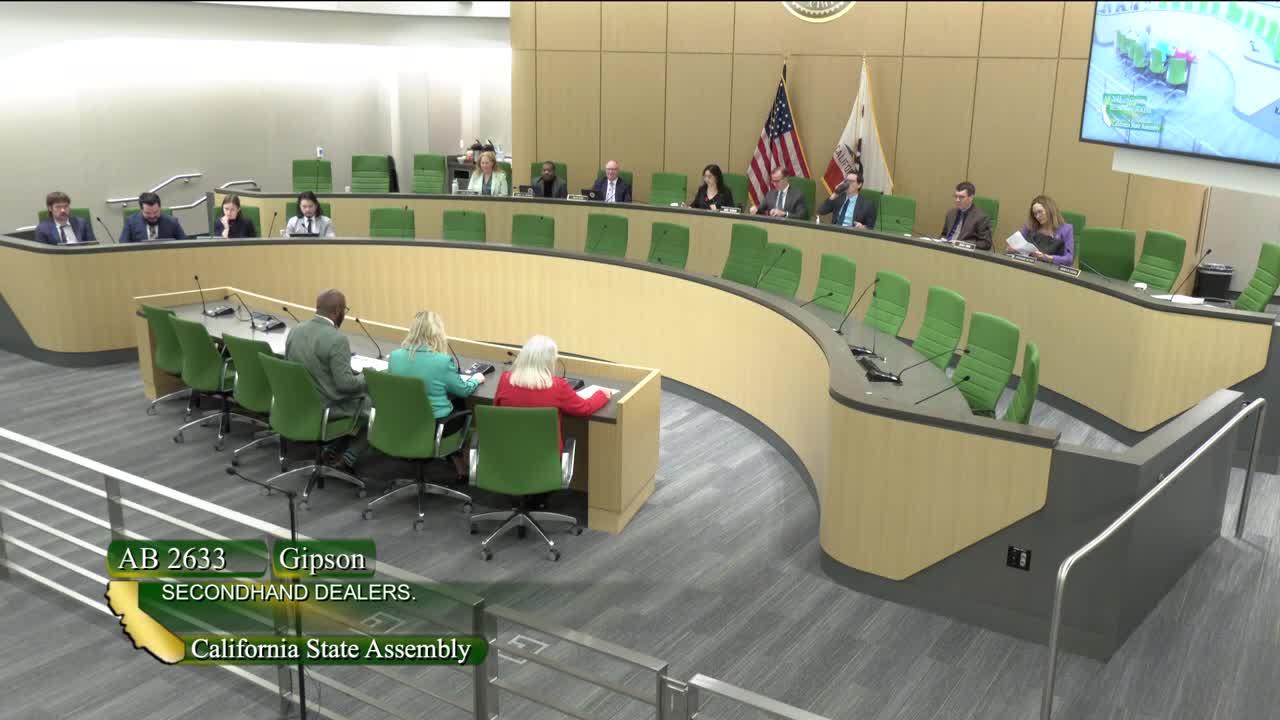 15MIN
Assembly Standing Committee on Business and Professions
Bill Author

Bill Co-Author(s):