AB 2634: Workforce development: High road training partnerships: scoring preference.
- Session Year: 2025-2026
- House: Assembly
- Latest Version Date: 2026-09-27
Current Status:
Passed
(2026-09-27: Chaptered by Secretary of State - Chapter 632, Statutes of 2026.)
Introduced
In Committee
Awaiting First Chamber Vote
Passed First Chamber
In Committee
Awaiting Second Chamber Vote
Passed Second Chamber
Enacted
The California Workforce Innovation and Opportunity Act establishes the California Workforce Development Board to assist the Governor in the development, oversight, and continuous improvement of Californias workforce investment system and the alignment of the education and workforce investment systems to the needs of the 21st century economy and workforce. Existing law requires the board to administer, promote, expand, and provide field assistance for high road training partnerships, defined as an initiative or project that models strategies for developing industry-based, worker-focused training partnerships, including labor-management partnerships. Existing law requires high road training partnerships to demonstrate job quality standards and employment practices that include, among other things, adoption of mechanisms to include worker voice and agency in the workplace.
This bill would require the board, when awarding grants for a high road training partnership program or any successor program, to provide a scoring preference to an applicant that is either a bona fide labor-management cooperation committee, as defined, or is an entity applying on behalf of, or in cooperation with, a bona fide labor-management cooperation committee, as specified. The bill would require the board to determine the amount of the scoring preference provided and to incorporate that preference into program guidelines and grant solicitations.
The California Workforce Innovation and Opportunity Act establishes the California Workforce Development Board to assist the Governor in the development, oversight, and continuous improvement of Californias workforce investment system and the alignment of the education and workforce investment systems to the needs of the 21st century economy and workforce. Existing law requires the board to administer, promote, expand, and provide field assistance for high road training partnerships, defined as an initiative or project that models strategies for developing industry-based, worker-focused training partnerships, including labor-management partnerships. Existing law requires high road training partnerships to demonstrate job quality standards and employment practices that include, among other things, adoption of mechanisms to include worker voice and agency in the workplace.
This bill would require the board, when awarding grants for a high road training partnership program or any successor program, to provide a scoring preference to an applicant that is either a bona fide labor-management cooperation committee, as defined, or is an entity applying on behalf of of, or in cooperation with, a bona fide labor-management cooperation committee, as specified. The bill would require the board to determine the amount of the scoring preference provided and to incorporate that preference into program guidelines and grant solicitations.
The California Workforce Innovation and Opportunity Act establishes the California Workforce Development Board to assist the Governor in the development, oversight, and continuous improvement of Californias workforce investment system and the alignment of the education and workforce investment systems to the needs of the 21st century economy and workforce. Existing law requires the board to administer, promote, expand, and provide field assistance for high road training partnerships, defined as an initiative or project that models strategies for developing industry-based, worker-focused training partnerships, including labor-management partnerships. Existing law requires high road training partnerships to demonstrate job quality standards and employment practices that include, among other things, adoption of mechanisms to include worker voice and agency in the workplace.
This bill would require an applicant to satisfy specified requirements to be eligible to receive funding for a high road training partnership, including having a collective bargaining agreement or labor-management partnership. the board, when awarding grants for a high road training partnership program or any successor program, to provide a scoring preference to an applicant that is either a bona fide labor-management cooperation committee, as defined, or is an entity applying on behalf of a bona fide labor-management cooperation committee, as specified. The bill would require the board to determine the amount of the scoring preference provided and to incorporate that preference into program guidelines and grant solicitations.
The California Workforce Innovation and Opportunity Act establishes the California Workforce Development Board to assist the Governor in the development, oversight, and continuous improvement of Californias workforce investment system and the alignment of the education and workforce investment systems to the needs of the 21st century economy and workforce. Existing law requires the board to administer, promote, expand, and provide field assistance for high road training partnerships, defined as an initiative or project that models strategies for developing industry-based, worker-focused training partnerships, including labor-management partnerships. Existing law requires high road training partnerships to demonstrate job quality standards and employment practices that include, among other things, adoption of mechanisms to include worker voice and agency in the workplace.
This bill would require an applicant to satisfy specified requirements to be eligible to receive funding for a high road training partnership, including having a collective bargaining agreement or labor-management partnership.
The federal Workforce Innovation and Opportunity Act provides for workforce development activities, including activities in which states may participate.Existing state law provides that the California Workforce Development Board is the body responsible for assisting the Governor in the development, oversight, and continuous improvement of Californias workforce investment system and the alignment of the education and workforce investment systems to the needs of the 21st century economy and workforce.This bill would make a nonsubstantive change to that provision.The federal Workforce Innovation and Opportunity Act provides for workforce development activities, including activities in which states may participate.
Existing state law provides that the California Workforce Development Board is the body responsible for assisting the Governor in the development, oversight, and continuous improvement of Californias workforce investment system and the alignment of the education and workforce investment systems to the needs of the 21st century economy and workforce.
This bill would make a nonsubstantive change to that provision.
(a)For purposes of this section, bona fide labor-management cooperation committee means an entity established pursuant to the federal Labor Management Cooperation Act of 1978 (29 U.S.C. Sec. 175a), collective bargaining agreement, or memorandum of understanding that is jointly established and administered by one or more employers and one or more labor organizations for the purpose of improving labor-management relations, workforce training, job security, organizational effectiveness, enhancing economic development, and involving workers in decisions affecting their jobs.
(b)The California Workforce Development Board shall, when awarding grants for a high road training partnership program or any successor program, provide a scoring preference to an applicant that meets either of the following criteria:
(1)The applicant is a bona fide labor-management cooperation committee.
(2)The applicant is an entity applying on behalf of, or in partnership with, a bona fide labor-management cooperation committee and submits written authorization from that committee as part of its application.
(c)The board shall determine the amount of the scoring preference provided pursuant to subdivision (b) and shall incorporate that preference into program guidelines and grant solicitations.
(d)This section does not require the board to award a grant to an applicant solely on the basis of the preference described in subdivision (b).
(a)For purposes of this section, bona fide labor-management cooperation committee means an entity established pursuant to the federal Labor Management Cooperation Act of 1978 (29 U.S.C. Sec. 175a) 175a), collective bargaining agreement, or memorandum of understanding that is jointly established and administered by one or more employers and one or more labor organizations for the purpose of improving labor-management relations, workforce training, job security, organizational effectiveness, enhancing economic development, and involving workers in decisions affecting their jobs.
(b)The California Workforce Development Board shall, when awarding grants for a high road training partnership program or any successor program, provide a scoring preference to an applicant that meets either of the following criteria:
(1)The applicant is a bona fide labor-management cooperation committee.
(2)The applicant is an entity applying on behalf of of, or in partnership with, a bona fide labor-management cooperation committee and submits written authorization from that committee as part of its application.
(c)The board shall determine the amount of the scoring preference provided pursuant to subdivision (b) and shall incorporate that preference into program guidelines and grant solicitations.
(d)This section does not require the board to award a grant to an applicant solely on the basis of the preference described in subdivision (b).
(a)For purposes of this section, bona fide labor-management cooperation committee means an entity established pursuant to the federal Labor Management Cooperation Act of 1978 (29 U.S.C. Sec. 175a) that is jointly established and administered by one or more employers and one or more labor organizations for the purpose of improving labor-management relations, workforce training, job security, organizational effectiveness, enhancing economic development, and involving workers in decisions affecting their jobs.
(b)The California Workforce Development Board shall, when awarding grants for a high road training partnership program or any successor program, provide a scoring preference to an applicant that meets either of the following criteria:
(1)The applicant is a bona fide labor-management cooperation committee.
(2)The applicant is an entity applying on behalf of a bona fide labor-management cooperation committee and submits written authorization from that committee as part of its application.
(c)The board shall determine the amount of the scoring preference provided pursuant to subdivision (b) and shall incorporate that preference into program guidelines and grant solicitations.
(d)This section does not require the board to award a grant to an applicant solely on the basis of the preference described in subdivision (b).
SECTION 1.Section 14013.5 is added to the Unemployment Insurance Code, to read:14013.5.(a)In addition to criteria otherwise specified by law or the board, an applicant shall satisfy all of the following to be eligible to receive funding for a high road training partnership:(1)Have a collective bargaining agreement or labor-management partnership.(2)Prioritize incumbent workers in low- and middle-wage sectors and job seekers entering these industries.(3)Invest in sectors with documented industry demand and established job quality standards.(4)Give priority to and have a targeted focus on low- and middle-wage sectors tackling the most pressing needs, such as readiness for the 2028 Olympic and Paralympic Games.(b)If having a collective bargaining agreement is disallowed from being required in order to allocate funding, grantors of high road training partnership funding shall maintain a preference in scoring mechanism or favorable criteria in the funding process for having a collective bargaining agreement or labor-management partnership.(a)In addition to criteria otherwise specified by law or the board, an applicant shall satisfy all of the following to be eligible to receive funding for a high road training partnership:
(1)Have a collective bargaining agreement or labor-management partnership.
(2)Prioritize incumbent workers in low- and middle-wage sectors and job seekers entering these industries.
(3)Invest in sectors with documented industry demand and established job quality standards.
(4)Give priority to and have a targeted focus on low- and middle-wage sectors tackling the most pressing needs, such as readiness for the 2028 Olympic and Paralympic Games.
(b)If having a collective bargaining agreement is disallowed from being required in order to allocate funding, grantors of high road training partnership funding shall maintain a preference in scoring mechanism or favorable criteria in the funding process for having a collective bargaining agreement or labor-management partnership.
SECTION 1.Section 14010 of the Unemployment Insurance Code is amended to read:14010.The California Workforce Development Board is the body responsible for assisting the Governor in the development, oversight, and continuous improvement of the states workforce investment system and the alignment of the education and workforce investment systems to the needs of the 21st century economy and workforce.The California Workforce Development Board is the body responsible for assisting the Governor in the development, oversight, and continuous improvement of Californias the states workforce investment system and the alignment of the education and workforce investment systems to the needs of the 21st century economy and workforce.
|
Date
|
Status
|
|---|---|
| Sep 27, 2026 | Chaptered by Secretary of State - Chapter 632, Statutes of 2026. |
| Sep 27, 2026 | Approved by the Governor. |
| Aug 27, 2026 | Enrolled and presented to the Governor at 4 p.m. |
| Aug 20, 2026 | Senate amendments concurred in. To Engrossing and Enrolling. (Ayes 66. Noes 7.). |
| Aug 20, 2026 | Senate amendments concurred in. To Engrossing and Enrolling. (Ayes 66. Noes 7. Page 6328.). |
| Aug 20, 2026 | Senate amendments concurred in. To Engrossing and Enrolling. |
| Aug 19, 2026 | In Assembly. Concurrence in Senate amendments pending. |
| Aug 19, 2026 | Read third time. Passed. Ordered to the Assembly. (Ayes 28. Noes 10. Page 5561.). |
| Aug 19, 2026 | Read third time. Passed. Ordered to the Assembly. (Ayes 28. Noes 9.). |
| Aug 17, 2026 | Read second time. Ordered to third reading. |
| Aug 13, 2026 | Read second time and amended. Ordered returned to second reading. |
| Aug 13, 2026 | From committee: Amend, and do pass as amended. (Ayes 5. Noes 2.) (August 13). |
| Aug 3, 2026 | In committee: Referred to APPR. suspense file. |
| Jul 1, 2026 | From committee: Do pass and re-refer to Com. on APPR. (Ayes 4. Noes 1.) (July 1). Re-referred to Com. on APPR. |
| Jun 10, 2026 | Referred to Com. on L., P.E. & R. |
| May 27, 2026 | In Senate. Read first time. To Com. on RLS. for assignment. |
| May 26, 2026 | Read third time. Passed. Ordered to the Senate. (Ayes 67. Noes 8.) |
| May 26, 2026 | Read third time. Passed. Ordered to the Senate. (Ayes 67. Noes 8. Page 5336.) |
| May 26, 2026 | Read third time. Passed. Ordered to the Senate. |
| May 18, 2026 | Read second time. Ordered to third reading. |
| May 14, 2026 | From committee: Do pass. (Ayes 13. Noes 1.) (May 14). |
| May 6, 2026 | In committee: Set, first hearing. Referred to APPR. suspense file. |
| Apr 23, 2026 | From committee: Do pass and re-refer to Com. on APPR. (Ayes 7. Noes 0.) (April 22). Re-referred to Com. on APPR. |
| Apr 15, 2026 | Re-referred to Com. on L. & E. |
| Apr 14, 2026 | From committee chair, with author's amendments: Amend, and re-refer to Com. on L. & E. Read second time and amended. |
| Mar 23, 2026 | Re-referred to Com. on L. & E. |
| Mar 19, 2026 | Referred to Com. on L. & E. |
| Mar 19, 2026 | From committee chair, with author's amendments: Amend, and re-refer to Com. on L. & E. Read second time and amended. |
| Feb 21, 2026 | From printer. May be heard in committee March 23. |
| Feb 20, 2026 | Read first time. To print. |
|
Date
|
Description
|
Location
|
Votes
|
|
|---|---|---|---|---|
| Oct 1, 2026 | Assembly 3rd Reading AB2634 Zbur By Durazo | Senate Floor |
Passed |
|
| Aug 20, 2026 | AB 2634 Zbur Concurrence in Senate Amendments | Assembly Floor |
Passed |
|
| Aug 19, 2026 | Assembly 3rd Reading AB2634 Zbur By Durazo | Senate Floor |
Passed |
|
| Aug 13, 2026 | Do pass as amended | Senate Standing Committee on Appropriations |
Passed |
|
| Aug 3, 2026 | Placed on suspense file | Senate Standing Committee on Appropriations |
Passed |
|
| Jul 1, 2026 | Do pass, but first be re-referred to the Committee on [Appropriations] | Senate Standing Committee on Labor, Public Employment and Retirement |
Passed |
|
| May 26, 2026 | AB 2634 Zbur Assembly Third Reading | Assembly Floor |
Passed |
|
| May 14, 2026 | Do pass. | Assembly Standing Committee on Appropriations |
Passed |
|
| Apr 22, 2026 | Do pass and be re-referred to the Committee on [Appropriations] | Assembly Standing Committee on Labor and Employment |
Passed |
This list shows positions taken on this bill by organizations on the date displayed, which is linked to the original source.
Positions by individuals are not included.
|
Organization
|
Position
|
Date
|
|---|---|---|
| Building Skills Partnership | ** Support | |
| California Community Foundation | ** Support | |
| California Federation of Labor Unions | ** Support | |
| California Immigrant Policy Center | ** Support | |
| California State Council of Service Employees International Union | ** Support | |
| Center for Caregiver Advancement | ** Support | |
| Hospitality Training Academy | ** Support | |
| Miguel Contreras Foundation | ** Support | |
| SEIU California | ** Support | |
| SEIU UHW & Joint Employer Education Fund | ** Support | |
| Working Partnerships USA | ** Support |
CONCURRENCE IN SENATE AMENDMENTS
CSA1 Bill Id:AB 2634
Author:(Zbur)
As Amended Ver:August 13, 2026
Majority vote
SUMMARY
Requires the California Workforce Development Board (CWDB) to, when awarding grants for the high road training partnership (HRTP) program or any successor program, provide a scoring preference to an applicant that meets either of the following criteria: 1) The applicant is a bona fide labor-management cooperation committee (LMCC). 2) The applicant is an entity applying on behalf of or in partnership with a bona fide LMCC and submits written authorization from that committee as part of its application.
Senate Amendments
- Clarify that a "bona fide LMCC" also includes a collective bargaining agreement or a memorandum of understanding that is jointly established and administered by one or more employers and one or more labor organizations, as specified.
- Clarify that the scoring preference may also be provided to an applicant that is an entity applying in partnership with a bona fide labor-management cooperation committee and that submits written authorization from that committee as part of its application.
COMMENTS
Under both the Governor Brown and Newsom Administration, California has prioritized the "high road" model for workforce development. What distinguishes this workforce development model from others is a strong focus on collaboration between labor and industry. As described by the CWDB, HRTPs work with the California Jobs First Initiative[1] "to forge and nurture industry partnerships around regional job sectors to improve equity, climate resilience, and job quality. This proven model increases access to good jobs, creates pathways for job growth, meets workforce needs, and builds worker voice." HRTPs are viewed "as intentional efforts by leaders within a particular industry—including employers and workers—to come together to solve immediate problems and overcome longer term challenges in their industry.[2]" Another crucial element of an HRTP is the prioritization of determining the needs of an industry before developing the applicable training. HRTPs are not formed to build workforce programs, rather they are a "dynamic way to meet what the industry itself determines is needed… Successful HRTPs start with the jobs.[3]"
According to the Author
According to the author, "Quality "High Road" jobs deliver family-sustaining wages, comprehensive benefits (health insurance, pensions), and safe working conditions. "High Road" jobs are the backbone of a strong middle class — creating pathways out of poverty, raising wages, and improving lives for working people. When labor and management co-invest in workforce development, the result is stronger industries, a more resilient workforce, and a more competitive California economy.
At a time of rapid economic transformation driven by automation, climate transition, and shifting labor markets, California's ability to remain competitive depends on how effectively it aligns workforce development with real industry needs.
AB 2634 aligns High Road funding requirements with California's vision for a true "High Road" workforce by strengthening the High Road Training Partnerships (HRTPs) funding requirements to ensure workforce investments lead to good-paying, high-quality jobs."
Arguments in Support
Building Skills Partnership is in support and states, "By protecting proven labor-management partnerships, this measure leverages the power of Collective Bargaining Agreements (CBAs) to tie training investments directly to real wage increases, job ladders, and safety standards. When unions and employers jointly design curriculum, they create a resilient system where worker skills reflect actual industry demand rather than theoretical pipelines; furthermore, as these partnerships raise standards in union settings, they create a "competitive-up" effect that pressures non-union employers to improve conditions, effectively lifting the floor for entire sectors across California.
Today, we are at a critical inflection point. Recent shifts toward "business-first" models with limited connection to job quality weaken one of California's most effective workforce tools. As workforce investments recalibrate toward high-wage sectors, we risk abandoning workers in industries essential to our economy—including janitorial, hospitality, airport services, security, and food service. Without intentional public investment, incumbent workers in these sectors cannot access upskilling because traditional funding formulas (like ETP) skew toward higher-wage occupations."
Arguments in Opposition
None on file.
FISCAL COMMENTS
According to the Senate Appropriations Committee,
- This bill would result in ongoing cost pressures, likely in the tens of millions of dollars annually (General Fund), to appropriate additional funding to CWDB to continue awarding HRTP grants with a scoring preference for LMCCs. The funding appropriated for HRTP grants in the 2024 Budget Act has been fully awarded, and no additional funding is currently available.
- CWDB would incur implementation costs of $78,000 in 2026-27, $156,000 in 2027-28, and $78,000 in 2028-29 (General Fund) to revise HRTP program guidelines, solicitations, and grant agreements if additional funding for HRTP grants is appropriated. CWDB indicates these costs would only be incurred if and when a future appropriation for HRTP grants is provided, and the timing of implementation would depend on when that funding becomes available.
VOTES:
ASM LABOR AND EMPLOYMENT: 7-0-0
YES: Ortega, Alanis, Chen, Elhawary, Kalra, Lee, Ward
ASM APPROPRIATIONS: 13-1-1
YES: Wicks, Hoover, Aguiar-Curry, Calderon, Caloza, Fong, Mark González, Krell, Pacheco, Pellerin, Sharp-Collins, Solache, Ta
NO: Tangipa
ABS, ABST OR NV: Dixon
ASSEMBLY FLOOR: 67-8-5
YES: Addis, Aguiar-Curry, Ahrens, Alanis, Alvarez, Arambula, Ávila Farías, Bains, Bauer-Kahan, Bennett, Berman, Boerner, Bonta, Bryan, Calderon, Caloza, Carrillo, Chen, Connolly, Davies, Elhawary, Flora, Fong, Gabriel, Garcia, Gipson, Jeff Gonzalez, Mark González, Haney, Harabedian, Hart, Hoover, Irwin, Jackson, Kalra, Krell, Lee, Lowenthal, McKinnor, Nguyen, Ortega, Pacheco, Papan, Patel, Patterson, Pellerin, Petrie-Norris, Quirk-Silva, Ramos, Ransom, Michelle Rodriguez, Rogers, Blanca Rubio, Schiavo, Schultz, Sharp-Collins, Solache, Soria, Stefani, Ta, Valencia, Wallis, Ward, Wicks, Wilson, Zbur, Rivas
NO: DeMaio, Ellis, Gallagher, Hadwick, Johnson, Macedo, Sanchez, Tangipa
ABS, ABST OR NV: Castillo, Dixon, Lackey, Muratsuchi, Celeste Rodriguez
SENATE FLOOR: 29-9-2
YES: Allen, Archuleta, Arreguín, Ashby, Becker, Cabaldon, Caballero, Cervantes, Cortese, Durazo, Gonzalez, Grayson, Hurtado, Jones, Laird, McGuire, McNerney, Menjivar, Padilla, Pérez, Reyes, Richardson, Rubio, Smallwood-Cuevas, Stern, Umberg, Wahab, Weber Pierson, Wiener
NO: Alvarado-Gil, Choi, Dahle, Grove, Niello, Ochoa Bogh, Seyarto, Strickland, Valladares
ABS, ABST OR NV: Blakespear, Limón
UPDATED
VERSION: August 13, 2026
CONSULTANT: Megan Lane / L. & E. / (916) 319-2091 FN: 0003841
The California Jobs First Initiative is a 600 million program aimed at creating quality jobs and fostering sustainable economic growth across California's 13 regions. See https://jobsfirst.ca.gov/. ↑
“Taking the High Road: High Road Training Partnerships: A Path to Reimagine and Rebuild Our Economy,” UC Berkeley Labor Center, May 2020, p. 1. ↑
Ibid. at 2. ↑
SENATE RULES COMMITTEE Office of Senate Floor Analyses (916) 651-4171 | AB 2634 |
THIRD READING
Bill No: AB 2634
Author: Zbur (D)
Amended: 8/13/26 in Senate
Vote: 21
SENATE LABOR, PUB. EMP. & RET. COMMITTEE: 4-1, 7/1/26
AYES: Smallwood-Cuevas, Cortese, Durazo, Laird
NOES: Strickland
SENATE APPROPRIATIONS COMMITTEE: 5-2, 8/13/26
AYES: Cervantes, Cabaldon, Grayson, Richardson, Wahab
NOES: Seyarto, Dahle
ASSEMBLY FLOOR: 67-8, 5/26/26 - See last page for vote
SUBJECT: Workforce development: High road training partnerships: scoring preference
SOURCE: Author
DIGEST:
This bill requires the California Workforce Development Board (CWDB) to provide a scoring preference to an applicant that is a bona fide labor-management cooperation committee, as defined, when awarding grants for a high road training partnership (HRTP) program or any successor program, as specified.
ANALYSIS:
Existing federal law:
- Permits, pursuant to the Labor Management Cooperation Act of 1978, the establishment of plant, area, and industrywide labor management committees (JLMCs), which have been organized jointly by employers and labor organizations representing employees in that plant, area, or industry, as specified. (Title 29 United States Code (U.S.C.) §175a)
- Establishes labor management committees for the purpose of improving labor management relationships, job security, organizational effectiveness, enhancing economic development, or involving workers in decisions affecting their jobs including improving communication with respect to subjects of mutual interest and concern. (29 U.S.C. §175a)
- Establishes the Workforce Innovation and Opportunity Act (WIOA) to help job seekers access employment, education, training, and support services to succeed in the labor market and to match employers with the skilled workers they need to compete in the global economy. (29 U.S.C. §3101-3361)
Existing state law:
- Creates the California Workforce Innovation and Opportunity Act to make programs and services available to individuals with employment barriers. (Unemployment Insurance Code §14000 et seq.)
- Establishes the California Workforce Development Board (CWDB), under the purview of the Labor and Workforce Development Agency (LWDA), as the body responsible for assisting the Governor in the development, oversight, and continuous improvement of California’s workforce system, including its alignment to the needs of the economy and the workforce. (Unemployment Insurance Code §14010 et seq.)
- Requires CWDB to assist the Governor with developing and continuously improving the statewide workforce investment system, including the following:
- Developing standards, procedures, and criteria for defining high road employers, high road jobs, high road workforce development, and high road training partnerships in California, in accordance with lessons learned from the board’s ongoing high road workforce development initiatives, as specified.
- The administration, promotion, and expansions of, as well as field assistance for, high road training partnerships, as defined. (Unemployment Insurance Code §14013)
- Requires CWDB to collect and report program and outcome data for its high road workforce programs, as specified. (Unemployment Insurance Code §14014)
- Defines “high road training partnership” as an initiative or project that models strategies for developing industry-based, worker-focused training partnerships, including labor-management partnerships. High road training partnerships operate via regional, industry- or sector-based training partnerships comprised of employers, workers, and their representatives including organized labor, community-based organizations, education, training, and social services providers, and labor market intermediaries. High road training partnerships demonstrate job quality standards and employment practices that include, but are not limited to, the following:
- Provision of comparatively good wages and benefits, relative to the industry, occupation, and labor market in which participating workers are employed.
- Payment of workers at or above local or regional living wage standards as well as payment at or above regional prevailing wage standards where such standards exist for the occupations in question.
- A history of investment in employee training, growth, and development.
- Provision of opportunities for career advancement and wage growth.
- Safe and healthy working conditions.
- Consistent compliance with workplace laws and regulations, including proactive efforts to remedy past problems.
- Adoption of mechanisms to include worker voice and agency in the workplace. (Unemployment Insurance Code §14005(s))
- Requires the establishment of a local workforce development board (LWDB) in each local workforce development area of the state to, among other things, plan and oversee the workforce investment system. (Unemployment Insurance Code §§14200-14211)
This bill:
- Requires the CWDB to, when awarding grants for a high road training partnership (HRTP) program or any successor program, provide a scoring preference to an applicant that meet either of the following criteria:
- The applicant is a bona fide labor-management cooperation committee.
- The applicant is an entity applying on behalf of, or in partnership with, a bona fide labor-management cooperation committee and submits written authorization from that committee as part of its application.
- Requires CWDB to determine the amount of the scoring preference, as specified, and incorporate that preference into program guidelines and grant solicitations.
- Specifies that this does not require CWDB to award a grant to an applicant solely on the basis of the specified preference.
- Defines “bona fide labor-management cooperation committee” as an entity established pursuant to the federal Labor Management Cooperation Act of 1978 (29 U.S.C. Sec. 175a), a collective bargaining agreement, or memorandum of understanding that is jointly established and administered by one or more employers and one or more labor organizations for the purpose of improving labor-management relations, workforce training, job security, organizational effectiveness, enhancing economic development, and involving workers in decisions affecting their jobs.
Background
Workforce development. The CWDB is the state entity tasked with assisting the Governor in the development, oversight, and continuous improvement of California’s workforce investment system. Among other things, the CWDB is tasked with developing, implementing, and modifying California’s Unified Strategic State Plan (State Plan) to serve as the comprehensive framework and coordinated plan for the aligned investment of all federal and state workforce training and employment services funding streams and programs. CWDB works closely with local workforce development boards (LWDBs) to ensure statewide workforce efforts align with regional priorities and community needs.
The State has 45 LWDBs, each with their unique local context. Members of private sector business, organized labor, community-based organizations, local government agencies, and local education agencies comprise a LWDB’s membership. EDD in partnership with LWDBs oversee America’s Job Center of California (AJCC). AJCC is a one-stop shop for no-cost job and training services that helps connect employers with job openings to people who are looking for work. The AJCC is a network of local and state organizations, as well as private and public groups, working together to provide these services at no cost. Adults and displaced workers receive an initial assessment, job search and placement assistance, and career counseling at LWDBs.
High Road Training Partnerships. According to CWDB, a “High Road Training Partnership” (HRTP) refers to an initiative or project that models strategies for developing industry-based, worker-focused training partnerships, including labor-management partnerships. HRTP projects operate via regional, industry, or sector-based training partnerships that include employers, workers, and their representatives including organized labor, community based organizations, education, training, and social services providers, and labor market intermediaries. HRTPs demonstrate job quality standards and employment practices that include, but are not limited to, the following:[1]
- Provision of comparatively good wages and benefits relative to the industry, occupation, and labor market in which participating workers are employed.
- Payment of workers at or above local or regional living wage standards as well as payment at or above regional prevailing wage standards where such standards exist for the target occupations in question.
- A history of investment in employee training, growth, and development.
- Provision of opportunities for career advancement and wage growth.
- Safe and healthy working conditions.
- Consistent compliance with workplace laws and regulations, including proactive efforts to remedy past problems.
- Adoption of mechanisms to include worker voice and agency in the workplace.
In 2017, CWDB launched the High Road Training Partnership (HRTP) initiative, an eighteen-month program designed to establish a workforce development framework in which partnerships of industry leaders—employers, workers, and union and worker organizations representatives—work together to achieve a dual goal: creating opportunities for economic prosperity for high road employers and achieving equity for their workers. [2] Through a $10 million investment from the CWDB, an HRTP was developed in each of eight sectors: healthcare, hospitality, transit, freight, water and wastewater, building operations, public sector, and transportation, distribution and logistics. The grant that each convening organization received was used to form, refine, and expand the partnerships.
HRTP grant program. There have been several HRTP grants awarded to applicants to increase access to existing high road jobs and create pathways for workers seeking job growth with high road employers in various industries over the last few years.[3] The HRTPs 2025 Grant program continues LWDA’s commitment to increase access to existing high road jobs for underserved populations and create pathways for workers seeking job growth with high road employers.[4] In late 2025, CWDB announced seven awardees were granted more than $18 million in funding under the HRTP 2025 grant program.[5] Additionally, 10 awardees were granted more than $24 million in funding under the HRTP 2024-25 Healthcare Grant Program.[6] In Mid-2026, CWDB announced $8 million was awarded to 14 awardees in under the High Road Construction Careers (HRCC) 2026 Grant Program.[7]
Labor management committees. Labor management committees are joint worker-management partnerships, established pursuant to the federal Labor Management Cooperation Act of 1978. Labor management committees aim to improve communication and working relationships between labor and management, provide workers and employers with opportunities to explore joint approaches to problems, and develop ways to increase productivity and promote economic development. They are organized jointly by employers and labor organizations within a particular plant, area, or industry.
Related/Prior Legislation
AB 338 (Solache, Chapter 532, Statutes of 2025) required CWDB to allocate appropriated funds to the Los Angeles County Department of Economic Opportunity for workforce strategies, such as HRTPs, among other things, to ensure a skilled and sufficient workforce for the scale of rebuilding and recovery of areas in the counties of Los Angeles and Ventura impacted by the 2025 wildfires, as specified.
SB 822 (Durazo, 2023) would have required the Department of Industrial Relations and the CWDB, within LWDA, to collectively be responsible for among other duties, creating high road evaluation metrics, consulting with stakeholders, and providing for meaningful public input on the development and evaluation of high road evaluation metrics. The bill would require CWDB to also assist in developing standards, procedures, and criteria for high road contracting and high road procurement, as specified. The bill was vetoed by Governor Newsom.
SB 779 (Becker, Chapter 223, Statutes of 2021) amended the list of “earn and learn” programs by specifying that an “earn and learn” program includes transitional jobs, as described in the federal WIOA, and subsidized employment with an employer of record, which may include, but not be limited to, an employment social enterprise, as defined, or a worker cooperative, as defined, particularly for individuals with barriers to employment.
SB 700 (Durazo, 2021) would have established the High Road Employment Program to assist state agencies in complying with specified High Road Employment Plan requirements and with appropriate planning, inclusive decision making, and fair disbursement of community and worker support resources. It also would have required each bidder for a contract with the state, as a condition of eligibility for such a contract, to submit a High Road Employment Plan to the Department of General Services that includes certification, under penalty of perjury, that all workers are properly classified, as specified, and that includes certain job information. The bill died in the Assembly Appropriations Committee.
FISCAL EFFECT: Appropriation: No Fiscal Com.: Yes Local: No
According to the Senate Appropriations Committee:
- This bill would result in ongoing cost pressures, likely in the tens of millions of dollars annually (General Fund), to appropriate additional funding to CWDB to continue awarding HRTP grants with a scoring preference for LMCCs. The funding appropriated for HRTP grants in the 2024 Budget Act has been fully awarded, and no additional funding is currently available.
- CWDB would incur implementation costs of $78,000 in 2026-27, $156,000 in 2027-28, and $78,000 in 2028-29 (General Fund) to revise HRTP program guidelines, solicitations, and grant agreements if additional funding for HRTP grants is appropriated. CWDB indicates these costs would only be incurred if and when a future appropriation for HRTP grants is provided, and the timing of implementation would depend on when that funding becomes available.
SUPPORT: (Verified 8/13/26)
Building Skills Partnership
California Community Foundation
California Federation of Labor Unions
California Immigrant Policy Center
California State Council of Service Employees International Union
Center for Caregiver Advancement
Hospitality Training Academy
Miguel Contreras Foundation
SEIU California
SEIU UHW & Joint Employer Education Fund
Working Partnerships USA
OPPOSITION: (Verified 8/13/26)
None received
ARGUMENTS IN SUPPORT: According to Building Skills Partnership, “By protecting proven labor-management partnerships, this measure leverages the power of Collective Bargaining Agreements (CBAs) to tie training investments directly to real wage increases, job ladders, and safety standards. When unions and employers jointly design curriculum, they create a resilient system where worker skills reflect actual industry demand rather than theoretical pipelines; furthermore, as these partnerships raise standards in union settings, they create a "competitive-up" effect that pressures non-union employers to improve conditions, effectively lifting the floor for entire sectors across California.
Today, we are at a critical inflection point. Recent shifts toward "business-first" models with limited connection to job quality weaken one of California’s most effective workforce tools. As workforce investments recalibrate toward high-wage sectors, we risk abandoning workers in industries essential to our economy— including janitorial, hospitality, airport services, security, and food service. Without intentional public investment, incumbent workers in these sectors cannot access upskilling because traditional funding formulas (like ETP) skew toward higher-wage occupations.
AB 2634 responds to this challenge by advancing a High Road framework that shifts the focus from individual deficits to system-level solutions—expanding access to good jobs, improving job quality, and investing in employers who treat workers as assets.”
ASSEMBLY FLOOR: 67-8, 5/26/26
AYES: Addis, Aguiar-Curry, Ahrens, Alanis, Alvarez, Arambula, Ávila Farías, Bains, Bauer-Kahan, Bennett, Berman, Boerner, Bonta, Bryan, Calderon, Caloza, Carrillo, Chen, Connolly, Davies, Elhawary, Flora, Fong, Gabriel, Garcia, Gipson, Jeff Gonzalez, Mark González, Haney, Harabedian, Hart, Hoover, Irwin, Jackson, Kalra, Krell, Lee, Lowenthal, McKinnor, Nguyen, Ortega, Pacheco, Papan, Patel, Patterson, Pellerin, Petrie-Norris, Quirk-Silva, Ramos, Ransom, Michelle Rodriguez, Rogers, Blanca Rubio, Schiavo, Schultz, Sharp-Collins, Solache, Soria, Stefani, Ta, Valencia, Wallis, Ward, Wicks, Wilson, Zbur, Rivas
NOES: DeMaio, Ellis, Gallagher, Hadwick, Johnson, Macedo, Sanchez, Tangipa
NO VOTE RECORDED: Castillo, Dixon, Lackey, Muratsuchi, Celeste Rodriguez
Prepared by: Jazmin Marroquin / L., P.E. & R. / (916) 651-1556
8/17/26 9:53:48
**** END ****
“High Road Training Partnerships Grant Solicitation.” CWDB, April 12, 2025, https://cwdb.ca.gov/wp-content/uploads/sites/43/2025/04/HRTP_2025_RFA_4.18.25_FINAL_ACCESSIBLE.pdf. ↑
Ana Luz Gonzalez-Vasquez and Magaly N. Lopez. “The High Road to Economic Prosperity,” UCLA Labor Center, May 2021, https://labor.ucla.edu/wp-content/uploads/2021/05/Eval_FINAL-REPORT-2.pdf. ↑
For a detailed list of all the HRTP grants, please visit CWDB’s grant details page: https://cwdb.ca.gov/cwdb-home/grant-information/grant-details/ ↑
“HRTP 2025 Grant Program.” CWDB, https://cwdb.ca.gov/cwdb-home/grant-information/hrtp-2025-grant-program/ ↑
“High Road Training Partnership HRTP 2025 Award Announcement.” CWDB, Nov. 26, 2025, https://cwdb.ca.gov/wp-content/uploads/sites/43/2025/12/HRTP_2025-Award-Announcement.pdf ↑
“High Road Training Partnerships 2024-25 Healthcare Grant Program
Award Announcement,” CWDB, https://cwdb.ca.gov/wp-content/uploads/sites/43/2025/02/HRTP-HC-Award-Announcement_FINAL.pdf, https://cwdb.ca.gov/cwdb-home/grant-information/hrtp-hc-grant-program/ ↑
“High Road Construction Careers 2026 Round One: Award Announcement” CWDB, May 12, 2026, https://cwdb.ca.gov/wp-content/uploads/sites/43/2026/05/HRCC-2026-_Award-Announcement.pdf ↑
SENATE COMMITTEE ON
Senator Sabrina Cervantes, Chair
2025 - 2026 Regular Session
AB 2634 (Zbur) - Workforce development: High road training partnerships: scoring preference
Version: | Policy Vote: |
Urgency: | Mandate: |
Hearing Date: | Consultant: |
Bill Summary:
AB 2634 would require the California Workforce Development Board (CWDB) to provide a scoring preference to an applicant that is a bona fide labor-management cooperation committee (LMCC), as defined, or an entity applying on their behalf, when awarding grants for a high road training partnership (HRTP) program or any successor program, as specified.
*********** ANALYSIS ADDENDUM – SUSPENSE FILE ***********
The following information is revised to reflect amendments
adopted by the committee on August 13, 2026
Fiscal Impact:
- This bill would result in ongoing cost pressures, likely in the tens of millions of dollars annually (General Fund), to appropriate additional funding to CWDB to continue awarding HRTP grants with a scoring preference for LMCCs. The funding appropriated for HRTP grants in the 2024 Budget Act has been fully awarded, and no additional funding is currently available.
- CWDB would incur implementation costs of $78,000 in 2026-27, $156,000 in 2027-28, and $78,000 in 2028-29 (General Fund) to revise HRTP program guidelines, solicitations, and grant agreements if additional funding for HRTP grants is appropriated. CWDB indicates these costs would only be incurred if and when a future appropriation for HRTP grants is provided, and the timing of implementation would depend on when that funding becomes available.
Author Amendments:
Make technical changes.
-- END --
SENATE COMMITTEE ON
Senator Sabrina Cervantes, Chair
2025 - 2026 Regular Session
AB 2634 (Zbur) - Workforce development: High road training partnerships: scoring preference
Version: | Policy Vote: |
Urgency: | Mandate: |
Hearing Date: | Consultant: |
Bill Summary:
AB 2634 would require the California Workforce Development Board (CWDB) to provide a scoring preference to an applicant that is a bona fide labor-management cooperation committee (LMCC), as defined, or an entity applying on their behalf, when awarding grants for a high road training partnership (HRTP) program or any successor program, as specified.
Fiscal Impact:
- This bill would result in ongoing cost pressures, likely in the tens of millions of dollars annually (General Fund), to appropriate additional funding to CWDB to continue awarding HRTP grants with a scoring preference for LMCCs. The funding appropriated for HRTP grants in the 2024 Budget Act has been fully awarded, and no additional funding is currently available.
- CWDB would incur implementation costs of $78,000 in 2026-27, $156,000 in 2027-28, and $78,000 in 2028-29 (General Fund) to revise HRTP program guidelines, solicitations, and grant agreements if additional funding for HRTP grants is appropriated. CWDB indicates these costs would only be incurred if and when a future appropriation for HRTP grants is provided, and the timing of implementation would depend on when that funding becomes available.
Background:
CWDB oversees California's workforce development system and is responsible for developing and implementing the state's workforce strategy, including the Unified Strategic State Plan. In coordination with 45 local workforce development boards (LWDBs), the Employment Development Department (EDD), employers, labor organizations, educational institutions, and community-based organizations, the CWDB helps align workforce training and employment programs with regional labor market needs. Through the America's Job Center of California network, LWDBs provide job seekers with employment, training, and career services while connecting employers with qualified workers.
Established by the CWDB in 2017, the HRTP initiative supports sector-based partnerships among employers, labor organizations, workforce development entities, educational institutions, and community organizations to expand access to high-quality jobs and meet industry workforce needs. HRTPs emphasize job quality, including competitive wages and benefits, career advancement opportunities, worker training, safe working conditions, compliance with labor laws, and worker participation. Since its inception, the program has supported partnerships across multiple industries—including healthcare, hospitality, transportation, logistics, and public sector employment—and the CWDB has awarded tens of millions of dollars through successive HRTP and related workforce grant programs.
The federal Labor Management Cooperation Act of 1978 authorizes joint labor-management committees to promote collaboration between employers and employee representatives on issues such as workforce development, productivity, and economic competitiveness.
Proposed Law:
This bill would do the following:
- Require CWDB to, when awarding grants for an HRTP program or any successor program, provide a scoring preference to an applicant that meet either of the following criteria: (1) the applicant is a bona fide labor-management cooperation committee (as defined), and (2) the applicant is an entity applying on behalf of a bona fide labor-management cooperation committee and submits written authorization from that committee as part of its application.
- Require CWDB to determine the amount of the scoring preference, as specified, and incorporate that preference into program guidelines and grant solicitations.
- Specify that this does not require CWDB to award a grant to an applicant solely on the basis of the specified preference.
Related Legislation:
- AB 338 (Solache, Chapter 532, Statutes of 2025) required CWDB to allocate appropriated funds to the Los Angeles County Department of Economic Opportunity for workforce strategies, such as HRTPs, among other things, to ensure a skilled and sufficient workforce for the scale of rebuilding and recovery of areas in the counties of Los Angeles and Ventura impacted by the 2025 wildfires, as specified.
- SB 822 (Durazo, 2023) would have required the Department of Industrial Relations and the CWDB, within LWDA, to collectively be responsible for among other duties, creating high road evaluation metrics, consulting with stakeholders, and providing for meaningful public input on the development and evaluation of high road evaluation metrics. The bill would require CWDB to also assist in developing standards, procedures, and criteria for high road contracting and high road procurement, as specified. This bill was vetoed by Governor Newsom.
- SB 779 (Becker, Chapter 223, Statutes of 2021) amended the list of “earn and learn” programs by specifying that an “earn and learn” program includes transitional jobs, as described in the federal WIOA, and subsidized employment with an employer of record, which may include, but not be limited to, an employment social enterprise, as defined, or a worker cooperative, as defined, particularly for individuals with barriers to employment.
- SB 700 (Durazo, 2021) would have established the High Road Employment Program to assist state agencies in complying with specified High Road Employment Plan requirements and with appropriate planning, inclusive decision making, and fair disbursement of community and worker support resources. It also would have required each bidder for a contract with the state, as a condition of eligibility for such a contract, to submit a High Road Employment Plan to the Department of General Services that includes certification, under penalty of perjury, that all workers are properly classified, as specified, and that includes certain job information. This bill was held under submission on the Suspense File of the Assembly Appropriations Committee.
Staff Comments:
As noted previously, this bill would require CWDB to provide a scoring preference, the amount of which would be determined by the board, to applicants that are bona fide labor-management cooperation committees—or entities applying on their behalf—when awarding HRTP grants. The bill would require the preference to be incorporated into grant guidelines and solicitations but specifies that the preference does not require the CWDB to award a grant solely on that basis.
-- END --
SENATE COMMITTEE ON LABOR, PUBLIC EMPLOYMENT AND RETIREMENT
Senator Lola Smallwood-Cuevas, Chair
2025 - 2026 Regular
Bill No: AB 2634 Hearing Date: July 1, 2026
Author: | Zbur | ||
Version: | April 14, 2026 | ||
Urgency: | No | Fiscal: | Yes |
Consultant: | Jazmin Marroquin | ||
SUBJECT: Workforce development: High road training partnerships: scoring preference
KEY ISSUE
This bill requires the California Workforce Development Board (CWDB) to provide a scoring preference to an applicant that is a bona fide labor-management cooperation committee, as defined, or an entity applying on their behalf, when awarding grants for a high road training partnership (HRTP) program or any successor program, as specified.
ANALYSIS
Existing federal law:
- Permits, pursuant to the Labor Management Cooperation Act of 1978, the establishment of plant, area, and industrywide labor management committees (JLMCs), which have been organized jointly by employers and labor organizations representing employees in that plant, area, or industry, as specified. (29 U.S.C. §175a)
- Establishes labor management committees for the purpose of improving labor management relationships, job security, organizational effectiveness, enhancing economic development, or involving workers in decisions affecting their jobs including improving communication with respect to subjects of mutual interest and concern. (29 U.S.C. §175a)
- Establishes the Workforce Innovation and Opportunity Act (WIOA) to help job seekers access employment, education, training, and support services to succeed in the labor market and to match employers with the skilled workers they need to compete in the global economy. (29 USC §3101-3361)
Existing state law:
- Creates the California Workforce Innovation and Opportunity Act to make programs and services available to individuals with employment barriers. (Unemployment Insurance Code §14000 et seq.)
- Establishes the California Workforce Development Board (CWDB), under the purview of the Labor and Workforce Development Agency (LWDA), as the body responsible for assisting the Governor in the development, oversight, and continuous improvement of California’s workforce system, including its alignment to the needs of the economy and the workforce. (Unemployment Insurance Code §14010 et seq.)
- Requires CWDB to assist the Governor with developing and continuously improving the statewide workforce investment system, including the following:
- Developing standards, procedures, and criteria for defining high road employers, high road jobs, high road workforce development, and high road training partnerships in California, in accordance with lessons learned from the board’s ongoing high road workforce development initiatives, as specified.
- The administration, promotion, and expansions of, as well as field assistance for, high road training partnerships, as defined. (Unemployment Insurance Code §14013)
- Requires CWDB to collect and report program and outcome data for its high road workforce programs, as specified. (Unemployment Insurance Code §14014)
- Defines “high road training partnership” as an initiative or project that models strategies for developing industry-based, worker-focused training partnerships, including labor-management partnerships. High road training partnerships operate via regional, industry- or sector-based training partnerships comprised of employers, workers, and their representatives including organized labor, community-based organizations, education, training, and social services providers, and labor market intermediaries. High road training partnerships demonstrate job quality standards and employment practices that include, but are not limited to, the following:
- Provision of comparatively good wages and benefits, relative to the industry, occupation, and labor market in which participating workers are employed.
- Payment of workers at or above local or regional living wage standards as well as payment at or above regional prevailing wage standards where such standards exist for the occupations in question.
- A history of investment in employee training, growth, and development.
- Provision of opportunities for career advancement and wage growth.
- Safe and healthy working conditions.
- Consistent compliance with workplace laws and regulations, including proactive efforts to remedy past problems.
- Adoption of mechanisms to include worker voice and agency in the workplace. (Unemployment Insurance Code §14005(s))
- Requires the establishment of a local workforce development board (LWDB) in each local workforce development area of the state to, among other things, plan and oversee the workforce investment system. (Unemployment Insurance Code §§14200-14211)
This bill:
- Requires the CWDB to, when awarding grants for a high road training partnership (HRTP) program or any successor program, provide a scoring preference to an applicant that meet either of the following criteria:
- The applicant is a bona fide labor-management cooperation committee.
- The applicant is an entity applying on behalf of a bona fide labor-management cooperation committee and submits written authorization from that committee as part of its application.
- Requires CWDB to determine the amount of the scoring preference, as specified, and incorporate that preference into program guidelines and grant solicitations.
- Specifies that this does not require CWDB to award a grant to an applicant solely on the basis of the specified preference.
- Defines “bona fide labor-management cooperation committee” as an entity established pursuant to the federal Labor Management Cooperation Act of 1978 (29 U.S.C. Sec. 175a) that is jointly established and administered by one or more employers and one or more labor organizations for the purpose of improving labor-management relations, workforce training, job security, organizational effectiveness, enhancing economic development, and involving workers in decisions affecting their jobs.
COMMENTS
1. Background:
Workforce development
The California Workforce Development Board (CWDB) is the state entity tasked with assisting the Governor in the development, oversight, and continuous improvement of California’s workforce investment system. Among other things, the CWDB is tasked with developing, implementing, and modifying California’s Unified Strategic State Plan (State Plan) to serve as the comprehensive framework and coordinated plan for the aligned investment of all federal and state workforce training and employment services funding streams and programs. CWDB works closely with local workforce development boards (LWDBs) to ensure statewide workforce efforts align with regional priorities and community needs.
The State has 45 LWDBs, each with their unique local context. Members of private sector business, organized labor, community-based organizations, local government agencies, and local education agencies comprise a LWDB’s membership. EDD in partnership with LWDBs oversee America’s Job Center of California (AJCC). AJCC is a one-stop shop for no-cost job and training services that helps connect employers with job openings to people who are looking for work. The AJCC is a network of local and state organizations, as well as private and public groups, working together to provide these services at no cost. Adults and displaced workers receive an initial assessment, job search and placement assistance, and career counseling at LWDBs.
HRTPs
According to CWDB, a “High Road Training Partnership” (HRTP) refers to an initiative or project that models strategies for developing industry-based, worker-focused training partnerships, including labor-management partnerships. HRTP projects operate via regional, industry, or sector-based training partnerships that include employers, workers, and their representatives including organized labor, community based organizations, education, training, and social services providers, and labor market intermediaries. HRTPs demonstrate job quality standards and employment practices that include, but are not limited to, the following:[1]
- Provision of comparatively good wages and benefits relative to the industry, occupation, and labor market in which participating workers are employed.
- Payment of workers at or above local or regional living wage standards as well as payment at or above regional prevailing wage standards where such standards exist for the target occupations in question.
- A history of investment in employee training, growth, and development.
- Provision of opportunities for career advancement and wage growth.
- Safe and healthy working conditions.
- Consistent compliance with workplace laws and regulations, including proactive efforts to remedy past problems.
- Adoption of mechanisms to include worker voice and agency in the workplace.
There are various successful HRTPs, including the Hospitality Training Academy (HTA), which focuses on addressing the needs of employers and workers in the hospitality, food service, and leisure and tourism industries. According to the UCLA Labor Center and CWDB, “HTA partners with industry leaders who have specialized knowledge, education, training, and workforce development expertise to shape strategies to recruit and upskill workers in the hospitality sector. HTA relies on its deep understanding of the changing nature of hospitality work to provide new and incumbent workers with the skills they need to adapt to those changes. For over 13 years, HTA has been an expert in the Los Angeles hospitality industry. As a non-profit and the training arm for UNITE HERE Local 11, HTA establishes labor-management partnerships that provide job training for workers in the union and for more than 160 affiliated employers. HTA partners with employers, community-based organizations, educational institutions, and other workforce development agencies to launch initiatives focused on serving low-income, underserved, and underrepresented populations in Los Angeles and Orange Counties and the State of Arizona.” [2]
In 2017, CWDB launched the High Road Training Partnership (HRTP) initiative, an eighteen-month program designed to establish a workforce development framework in which partnerships of industry leaders—employers, workers, and union and worker organizations representatives—work together to achieve a dual goal: creating opportunities for economic prosperity for high road employers and achieving equity for their workers. [3] Through a $10 million investment from the CWDB, an HRTP was developed in each of eight sectors: healthcare, hospitality, transit, freight, water and wastewater, building operations, public sector, and transportation, distribution and logistics. The grant that each convening organization received was used to form, refine, and expand the partnerships.
HRTP grant program
There have been several HRTP grants awarded to applicants to increase access to existing high road jobs and create pathways for workers seeking job growth with high road employers in various industries over the last few years.[4] The HRTPs 2025 Grant program continues LWDA’s commitment to increase access to existing high road jobs for underserved populations and create pathways for workers seeking job growth with high road employers.[5] In late 2025, CWDB announced seven awardees were granted more than $18 million in funding under the HRTP 2025 grant program.[6] Additionally, 10 awardees were granted more than $24 million in funding under the HRTP 2024-25 Healthcare Grant Program.[7] In Mid-2026, CWDB announced $8 million was awarded to 14 awardees in under the High Road Construction Careers (HRCC) 2026 Grant Program.[8]
Labor management committees
Labor management committees are joint worker-management partnerships, established pursuant to the federal Labor Management Cooperation Act of 1978. Labor management committees aim to improve communication and working relationships between labor and management, provide workers and employers with opportunities to explore joint approaches to problems, and develop ways to increase productivity and promote economic development. They are organized jointly by employers and labor organizations within a particular plant, area, or industry.
This bill
This bill, AB 2634, requires CWDB to provide a scoring preference to an applicant that is a bona fide labor-management cooperation committee, or is an entity applying on behalf of a bona fide labor-management cooperation committee, when awarding grants for HRTP programs. This bill defines a bona fide labor-management cooperation committee to be an entity established pursuant to the federal Labor Management Cooperation Act of 1978, as described above.
This bill requires that CWDB determines the amount of the scoring preference and incorporates that preference into program guidelines and grant solicitations. It also specifies that this does not require CWDB to award a grant to an applicant solely on the basis of the preference.
2. Need for this bill?
According to the author, “At its inception, HRTP was designed to operate through employers and unions, inverting existing workforce models and upskilling incumbent workers through training and certification aligned with the High Road standards of equity, job quality, and climate resilience. High Road Training Partnerships (HRTPs) bring employers and workers, through their unions, to the same table to jointly solve workforce challenges. This collaboration allows industries to respond in real time to major shifts such as automation, climate transitions, and evolving skill demands. […]
Quality “High Road” jobs deliver family-sustaining wages, comprehensive benefits (health insurance, pensions), and safe working conditions. “High Road” jobs are the backbone of a strong middle class — creating pathways out of poverty, raising wages, and improving lives for working people.
At a time of rapid economic transformation driven by automation, climate transition, and shifting labor markets, California’s ability to remain competitive depends on how effectively it aligns workforce development with real industry needs.
AB 2634 aligns High Road funding requirements with California’s vision for a true “High Road” workforce by strengthening the High Road Training Partnerships (HRTPs) funding requirements to ensure workforce investments lead to good-paying, high-quality jobs. […]
When labor and management co-invest in workforce development, the result is stronger industries, a more resilient workforce, and a more competitive California economy. This proposal protects and scales this approach, ensuring workforce investments lead to stronger industries, better jobs, and a more competitive California economy.”
3. Proponent Arguments:
According to Building Skills Partnership, “By protecting proven labor-management partnerships, this measure leverages the power of Collective Bargaining Agreements (CBAs) to tie training investments directly to real wage increases, job ladders, and safety standards. When unions and employers jointly design curriculum, they create a resilient system where worker skills reflect actual industry demand rather than theoretical pipelines; furthermore,
as these partnerships raise standards in union settings, they create a "competitive-up" effect that pressures non-union employers to improve conditions, effectively lifting the floor for entire sectors across California.
Today, we are at a critical inflection point. Recent shifts toward "business-first" models with limited connection to job quality weaken one of California’s most effective workforce tools. As workforce investments recalibrate toward high-wage sectors, we risk abandoning workers in industries essential to our economy— including janitorial, hospitality, airport services, security, and food service. Without intentional public investment, incumbent workers in these sectors cannot access upskilling because traditional funding formulas (like ETP) skew toward higher-wage occupations.
AB 2634 responds to this challenge by advancing a High Road framework that shifts the focus from individual deficits to system-level solutions—expanding access to good jobs, improving job quality, and investing in employers who treat workers as assets.”
4. Opponent Arguments:
None received.
5. Prior/Related Legislation:
AB 338 (Solache, Chapter 532, Statutes of 2025) required CWDB to allocate appropriated funds to the Los Angeles County Department of Economic Opportunity for workforce strategies, such as HRTPs, among other things, to ensure a skilled and sufficient workforce for the scale of rebuilding and recovery of areas in the counties of Los Angeles and Ventura impacted by the 2025 wildfires, as specified.
SB 822 (Durazo, 2023) would have required the Department of Industrial Relations and the CWDB, within LWDA, to collectively be responsible for among other duties, creating high road evaluation metrics, consulting with stakeholders, and providing for meaningful public input on the development and evaluation of high road evaluation metrics. The bill would require CWDB to also assist in developing standards, procedures, and criteria for high road contracting and high road procurement, as specified. This bill was vetoed by Governor Newsom.
SB 779 (Becker, Chapter 223, Statutes of 2021) amended the list of “earn and learn” programs by specifying that an “earn and learn” program includes transitional jobs, as described in the federal WIOA, and subsidized employment with an employer of record, which may include, but not be limited to, an employment social enterprise, as defined, or a worker cooperative, as defined, particularly for individuals with barriers to employment.
SB 700 (Durazo, 2021) would have established the High Road Employment Program to assist state agencies in complying with specified High Road Employment Plan requirements and with appropriate planning, inclusive decision making, and fair disbursement of community and worker support resources. It also would have required each bidder for a contract with the state, as a condition of eligibility for such a contract, to submit a High Road Employment Plan to the Department of General Services that includes certification, under penalty of perjury, that all workers are properly classified, as specified, and that includes certain job information. This bill died in the Assembly Appropriations Committee.
SUPPORT
Building Skills Partnership
California Community Foundation
California Federation of Labor Unions
California Immigrant Policy Center
California State Council of Service Employees International Union
Center for Caregiver Advancement
Hospitality Training Academy
Miguel Contreras Foundation
SEIU California
SEIU UHW & Joint Employer Education Fund
Working Partnerships USA
OPPOSITION
None received
-- END --
“High Road Training Partnerships Grant Solicitation.” CWDB, April 12, 2025, https://cwdb.ca.gov/wp-content/uploads/sites/43/2025/04/HRTP_2025_RFA_4.18.25_FINAL_ACCESSIBLE.pdf. ↑
Ana Luz Gonzalez-Vasquez, Magaly Lopez, and Saba Waheed. “The High Road to Hospitality.” UCLA Labor Center, June 2019, https://cwdb.ca.gov/wp-content/uploads/sites/43/2019/11/High-Road-to-Hospitality-11-25-2019.pdf. ↑
Ana Luz Gonzalez-Vasquez and Magaly N. Lopez. “The High Road to Economic Prosperity,” UCLA Labor Center, May 2021, https://labor.ucla.edu/wp-content/uploads/2021/05/Eval_FINAL-REPORT-2.pdf. ↑
For a detailed list of all the HRTP grants, please visit CWDB’s grant details page: https://cwdb.ca.gov/cwdb-home/grant-information/grant-details/ ↑
“HRTP 2025 Grant Program.” CWDB, https://cwdb.ca.gov/cwdb-home/grant-information/hrtp-2025-grant-program/ ↑
“High Road Training Partnership HRTP 2025 Award Announcement.” CWDB, Nov. 26, 2025, https://cwdb.ca.gov/wp-content/uploads/sites/43/2025/12/HRTP_2025-Award-Announcement.pdf ↑
“High Road Training Partnerships 2024-25 Healthcare Grant Program
Award Announcement,” CWDB, https://cwdb.ca.gov/wp-content/uploads/sites/43/2025/02/HRTP-HC-Award-Announcement_FINAL.pdf, https://cwdb.ca.gov/cwdb-home/grant-information/hrtp-hc-grant-program/ ↑
“High Road Construction Careers 2026 Round One: Award Announcement” CWDB, May 12, 2026, https://cwdb.ca.gov/wp-content/uploads/sites/43/2026/05/HRCC-2026-_Award-Announcement.pdf ↑
ASSEMBLY THIRD READING
ATR Bill Id:AB 2634
Author:(Zbur)
As Amended Ver:April 14, 2026
Majority vote
SUMMARY
Requires the California Workforce Development Board (CWDB) to, when awarding grants for the high road training partnership (HRTP) program or any successor program, provide a scoring preference to an applicant that meets either of the following criteria: 1) The applicant is a bona fide labor-management cooperation committee (LMCC). 2) The applicant is an entity applying on behalf of a bona fide LMCC and submits written authorization from that committee as part of its application.
Major Provisions
- Defines "bona fide LMCC" to mean an entity established pursuant to the federal Labor-Management Cooperation Act of 1978 (29 U.S.C. Sec. 175a) that is jointly established and administered by one or more employers and one or more labor organizations for the purpose of improving labor-management relations, workforce training, job security, organizational effectiveness, enhancing economic development, and involving workers in decisions affecting their jobs.
- Requires the CWDB to, when awarding grants for the HRTP program or any successor program, provide a scoring preference to an applicant that meets either of the following criteria:
- The applicant is a bona fide LMCC.
- The applicant is an entity applying on behalf of a LMCC and submits written authorization from that committee as part of its application.
- Requires the CWDB to determine the amount of the scoring preference described in 2) above and to incorporate that preference into program guidelines and grant solicitations.
- States that this section does not require the CWDB to award a grant to an applicant solely on the basis of the preference described in 2) above.
COMMENTS
Under both the Governor Brown and Newsom Administration, California has prioritized the "high road" model for workforce development. What distinguishes this workforce development model from others is a strong focus on collaboration between labor and industry. As described by the CWDB, HRTPs work with the California Jobs First Initiative[1] "to forge and nurture industry partnerships around regional job sectors to improve equity, climate resilience, and job quality. This proven model increases access to good jobs, creates pathways for job growth, meets workforce needs, and builds worker voice." HRTPs are viewed "as intentional efforts by leaders within a particular industry—including employers and workers—to come together to solve immediate problems and overcome longer term challenges in their industry.[2]" Another crucial element of an HRTP is the prioritization of determining the needs of an industry before developing the applicable training. HRTPs are not formed to build workforce programs, rather they are a "dynamic way to meet what the industry itself determines is needed… Successful HRTPs start with the jobs.[3]"
According to the Author
According to the author, "Quality "High Road" jobs deliver family-sustaining wages, comprehensive benefits (health insurance, pensions), and safe working conditions. "High Road" jobs are the backbone of a strong middle class — creating pathways out of poverty, raising wages, and improving lives for working people. When labor and management co-invest in workforce development, the result is stronger industries, a more resilient workforce, and a more competitive California economy.
At a time of rapid economic transformation driven by automation, climate transition, and shifting labor markets, California's ability to remain competitive depends on how effectively it aligns workforce development with real industry needs.
AB 2634 aligns High Road funding requirements with California's vision for a true "High Road" workforce by strengthening the High Road Training Partnerships (HRTPs) funding requirements to ensure workforce investments lead to good-paying, high-quality jobs."
Arguments in Support
Building Skills Partnership is in support and states, "By protecting proven labor-management partnerships, this measure leverages the power of Collective Bargaining Agreements (CBAs) to tie training investments directly to real wage increases, job ladders, and safety standards. When unions and employers jointly design curriculum, they create a resilient system where worker skills reflect actual industry demand rather than theoretical pipelines; furthermore, as these partnerships raise standards in union settings, they create a "competitive-up" effect that pressures non-union employers to improve conditions, effectively lifting the floor for entire sectors across California.
Today, we are at a critical inflection point. Recent shifts toward "business-first" models with limited connection to job quality weaken one of California's most effective workforce tools. As workforce investments recalibrate toward high-wage sectors, we risk abandoning workers in industries essential to our economy—including janitorial, hospitality, airport services, security, and food service. Without intentional public investment, incumbent workers in these sectors cannot access upskilling because traditional funding formulas (like ETP) skew toward higher-wage occupations."
Arguments in Opposition
None on file.
FISCAL COMMENTS
According to the Assembly Appropriations Committee,
- Ongoing cost pressures of an unknown amount, likely in the tens of millions of dollars annually, to appropriate funds to CWDB to continue providing HRTP grants with a scoring preference for LMCCs (General Fund (GF)). The most recent allocation of funding for HRTP grants appropriated in the Budget Act of 2024 has been fully awarded by CWDB.
- Costs of approximately $78,000 in fiscal year (FY) 2026-27, $156,000 in FY 2027-28, and $78,000 in FY 2028-29 to CWDB for staff workload to revise HRTP program guidelines, contracts, and solicitations if CWDB receives a new appropriation for additional HRTP grants. CWDB notes that implementation of this bill will ultimately depend upon the timing of when such funds are appropriated.
VOTES
ASM LABOR AND EMPLOYMENT: 7-0-0
YES: Ortega, Alanis, Chen, Elhawary, Kalra, Lee, Ward
ASM APPROPRIATIONS: 13-1-1
YES: Wicks, Hoover, Aguiar-Curry, Calderon, Caloza, Fong, Mark González, Krell, Pacheco, Pellerin, Sharp-Collins, Solache, Ta
NO: Tangipa
ABS, ABST OR NV: Dixon
UPDATED
VERSION: April 14, 2026
CONSULTANT: Megan Lane / L. & E. / (916) 319-2091 FN: 0002853
The California Jobs First Initiative is a 600 million program aimed at creating quality jobs and fostering sustainable economic growth across California's 13 regions. See https://jobsfirst.ca.gov/. ↑
"Taking the High Road: High Road Training Partnerships: A Path to Reimagine and Rebuild Our Economy," UC Berkeley Labor Center, May 2020, p. 1. ↑
Ibid. at 2. ↑
Date of Hearing: May 6, 2026
ASSEMBLY COMMITTEE ON APPROPRIATIONS
Buffy Wicks, Chair
ABPCA Bill Id:AB 2634
Author:(Zbur) – As Amended Ver:April 14, 2026
Policy Committee: | Labor and Employment | Vote: | 7 - 0 |
|
| ||
|
|
Urgency: No State Mandated Local Program: No Reimbursable: No
SUMMARY:
This bill requires the California Workforce Development Board (CWDB) to provide a scoring preference to a bona fide labor-management cooperation committee (LMCC) when awarding grants for a high road training partnership (HRTP) program.
Specifically, this bill:
- Defines an LMCC to mean an entity established pursuant to the federal Labor Management Cooperation Act of 1978 that is jointly established and administered by one or more employers and one or more labor organizations for the purpose of improving labor-management relations, workforce training, job security, organizational effectiveness, enhancing economic development, and involving workers in decisions affecting their jobs.
- Requires CWDB to determine the amount of scoring preference CWDB must provide an HRTP or successor program applicant that is either an LMCC or an entity applying on behalf of an LMCC and incorporate the preference into program guidelines and grant solicitations.
FISCAL EFFECT:
- Ongoing cost pressures of an unknown amount, likely in the tens of millions of dollars annually, to appropriate funds to CWDB to continue providing HRTP grants with a scoring preference for LMCCs (General Fund (GF)). The most recent allocation of funding for HRTP grants appropriated in the Budget Act of 2024 has been fully awarded by CWDB.
- Costs of approximately $78,000 in fiscal year (FY) 2026-27, $156,000 in FY 2027-28, and $78,000 in FY 2028-29 to CWDB for staff workload to revise HRTP program guidelines, contracts, and solicitations if CWDB receives a new appropriation for additional HRTP grants. CWDB notes that implementation of this bill will ultimately depend upon the timing of when such funds are appropriated.
The Legislative Analyst’s Office recently warned of GF structural deficits of around $35 billion per year in the 2027-28 fiscal year and ongoing.
COMMENTS:
- Purpose. According to the author:
At a time of rapid economic transformation driven by automation, climate transition, and shifting labor markets, California’s ability to remain competitive depends on how effectively it aligns workforce development with real industry needs.
AB 2634 aligns High Road funding requirements with California’s vision for a true “High Road” workforce by strengthening the [HRTP] funding requirements to ensure workforce investments lead to good-paying, high-quality jobs.
This bill is supported by LMCCs, labor organizations, and community groups.
- HRTP Program. Governor Newsom’s California Jobs First initiative provides investments in key sectors to drive sustainable economic growth, innovation, and access to good-paying jobs. As part of that initiative, CWDB’s HRTP grant program funds projects that forge and nurture industry partnerships around regional job sectors to improve equity, climate resilience, and job quality. In 2025, CWDB awarded approximately $18.6 million in grants to seven applicants. This bill requires CWDB to provide a scoring preference to LMCCs when awarding HRTP grants.
Analysis Prepared by: Irene Ho / APPR. / (916) 319-2081
Date of Hearing: April 22, 2026
ASSEMBLY COMMITTEE ON LABOR AND EMPLOYMENT
Liz Ortega, Chair
ABPCA Bill Id:AB 2634 (
Author:Zbur) – As Amended Ver:April 14, 2026
SUBJECT: Workforce development: High road training partnerships: scoring preference
SUMMARY: Requires the California Workforce Development Board (CWDB) to, when awarding grants for the high road training partnership (HRTP) program or any successor program, provide a scoring preference to an applicant that meets either of the following criteria: 1) The applicant is a bona fide labor-management cooperation committee (LMCC). 2) The applicant is an entity applying on behalf of a bona fide LMCC and submits written authorization from that committee as part of its application. Specifically, this bill:
- Defines “bona fide LMCC” to mean an entity established pursuant to the federal Labor-Management Cooperation Act of 1978 (29 U.S.C. Sec. 175a) that is jointly established and administered by one or more employers and one or more labor organizations for the purpose of improving labor-management relations, workforce training, job security, organizational effectiveness, enhancing economic development, and involving workers in decisions affecting their jobs.
- Requires the CWDB to, when awarding grants for the HRTP program or any successor program, provide a scoring preference to an applicant that meets either of the following criteria:
- The applicant is a bona fide labor-management cooperation committee.
- The applicant is an entity applying on behalf of a bona fide labor-management cooperation committee and submits written authorization from that committee as part of its application.
- Requires the CWDB to determine the amount of the scoring preference described in 2) above and to incorporate that preference into program guidelines and grant solicitations.
- States that this section does not require the CWDB to award a grant to an applicant solely on the basis of the preference described in 2) above.
EXISTING LAW:
- Establishes the Workforce Innovation and Opportunity Act (WIOA) of 2014 in order to help job seekers access employment, education, training, and support services to succeed in the labor market and to match employers with skilled workers. WIOA coordinates employment and training services for adults, dislocated workers, and youth through grants to states that are implemented at the state and local level. 29 U.S.C. § 3101 et seq.
- Establishes the CWDB as the body responsible for assisting the Governor in the development, oversight, and continuous improvement of California’s workforce investment system and the alignment of the education and workforce investment systems to the needs of the 21st century economy and workforce. Unemp. Ins. Code, § 14010 et seq.
- Defines “high road training partnership” to mean an initiative or project that models strategies for developing industry-based, worker-focused training partnerships, including labor-management partnerships. High Road Training partnerships operate via regional, industry- or sector-based training partnerships comprised of employers, workers, and their representatives including organized labor, community-based organizations, education, training, and social services providers, and labor market intermediaries. High Road Training partnerships demonstrate job quality standards and employment practices that include, but are not limited to, the following:
- Provision of comparatively good wages and benefits, relative to the industry, occupation, and labor market in which participating workers are employed.
- Payment of workers at or above local or regional living wage standards as well as payment at or above regional prevailing wage standards where such standards exist for the occupations in question.
- A history of investment in employee training, growth, and development.
- Provision of opportunities for career advancement and wage growth.
- Safe and healthy working conditions.
- Consistent compliance with workplace laws and regulations, including proactive efforts to remedy past problems.
- Adoption of mechanisms to include worker voice and agency in the workplace. Unemp. Ins. Code §14005(s).
FISCAL EFFECT: Unknown.
COMMENTS: Under both the Governor Brown and Newsom Administration, California has prioritized the “high road” model for workforce development. What distinguishes this workforce development model from others is a strong focus on collaboration between labor and industry. As described by the CWDB, HRTPs work with the California Jobs First Initiative[1] “to forge and nurture industry partnerships around regional job sectors to improve equity, climate resilience, and job quality. This proven model increases access to good jobs, creates pathways for job growth, meets workforce needs, and builds worker voice.” HRTPs are viewed “as intentional efforts by leaders within a particular industry—including employers and workers—to come together to solve immediate problems and overcome longer term challenges in their industry.[2]” Another crucial element of an HRTP is the prioritization of determining the needs of an industry before developing the applicable training. HRTPs are not formed to build workforce programs, rather they are a “dynamic way to meet what the industry itself determines is needed… Successful HRTPs start with the jobs.[3]”
Among a number of successful HRTPs is the Building Skills Partnership representing a joint effort between SEIU-USWW and janitorial companies that focuses on workforce development for immigrant workers. In 2014, the partnership launched a Green Janitor Training Program in which “janitors gain a sense of responsibility for how sustainability practices help mitigate climate change, while employers gain a trained workforce that helps meet local and state climate standards.[4]” The program has seen reduced energy and water consumption by its participating properties and has trained over 1,800 janitorial workers.
According to the author, “Quality “High Road” jobs deliver family-sustaining wages, comprehensive benefits (health insurance, pensions), and safe working conditions. “High Road” jobs are the backbone of a strong middle class — creating pathways out of poverty, raising wages, and improving lives for working people. When labor and management co-invest in workforce development, the result is stronger industries, a more resilient workforce, and a more competitive California economy.
At a time of rapid economic transformation driven by automation, climate transition, and shifting labor markets, California’s ability to remain competitive depends on how effectively it aligns workforce development with real industry needs.
AB 2634 aligns High Road funding requirements with California’s vision for a true “High Road” workforce by strengthening the High Road Training Partnerships (HRTPs) funding requirements to ensure workforce investments lead to good-paying, high-quality jobs.”
The author also believes the bill will maximize benefits for underserved communities because “AB 2364 addresses upstream inequities in the labor market by shifting workforce funding toward programs where workers have a formal role in shaping training and job standards through labor-management cooperation committees (LMCCs), consistent with the goals of HR 39. By prioritizing these worker-employer partnerships, the bill targets structural barriers such as limited access to quality training, low job mobility, and weak worker voice that disproportionately affect immigrant, Latino, and BIPOC (Black, Indigenous and People of Color) workers concentrated in sectors like property services, construction, logistics, healthcare, hospitality, and manufacturing. This “high-road” approach improves job quality and creates clearer pathways to advancement within these industries, expanding equitable access to stable, higher-wage careers.”
Arguments in Support
Building Skills Partnership is in support and states, “By protecting proven labor-management partnerships, this measure leverages the power of Collective Bargaining Agreements (CBAs) to tie training investments directly to real wage increases, job ladders, and safety standards. When unions and employers jointly design curriculum, they create a resilient system where worker skills reflect actual industry demand rather than theoretical pipelines; furthermore, as these partnerships raise standards in union settings, they create a "competitive-up" effect that pressures non-union employers to improve conditions, effectively lifting the floor for entire sectors across California.
Today, we are at a critical inflection point. Recent shifts toward "business-first" models with limited connection to job quality weaken one of California’s most effective workforce tools. As workforce investments recalibrate toward high-wage sectors, we risk abandoning workers in industries essential to our economy—including janitorial, hospitality, airport services, security, and food service. Without intentional public investment, incumbent workers in these sectors cannot access upskilling because traditional funding formulas (like ETP) skew toward higher-wage occupations.”
The Miguel Contreras Foundation is in support and states that to ensure California’s workforce investments prioritize proven, high-road models, “AB 2634 mandates that the California Workforce Development Board (CWDB) provide a formal scoring preference during the grant award process for the High Road Training Partnership (HRTP) Program, or any successor program, to applicants that are either bona fide labor-management cooperation committees or entities applying on their behalf with explicit written authorization.
With more than 6 million adults—nearly one-third of California’s workforce—currently working in low wage jobs, AB 2634 provides a vital opportunity to restore the integrity of the original High Road Training Partnership (HRTP) model and ensure that incumbent workers are not left behind in our state’s workforce strategy.”
Arguments in Opposition
None.
Prior Legislation
SB 822 (Durazo) of 2023 would have required the Department of Industrial Relations and the CWDB, within the Labor and Workforce Development Agency, to collectively be responsible for among other duties, creating high road evaluation metrics, consulting with stakeholders, and providing for meaningful public input on the development and evaluation of high road evaluation metrics. The bill would require the board to also assist in developing standards, procedures, and criteria for high road contracting and high road procurement, as specified. This bill was vetoed by Governor Newsom.
SB 779 (Becker) Chapter 223, Statutes of 2021, amended the list of “earn and learn” programs by specifying that an “earn and learn” program includes transitional jobs, as described in the federal Workforce Innovation and Opportunity Act, and subsidized employment with an employer of record, which may include, but not be limited to, an employment social enterprise, as defined, or a worker cooperative, as defined, particularly for individuals with barriers to employment.
SB 700 (Durazo) of 2021 would have established the High Road Employment Program to assist state agencies in complying with specified High Road Employment Plan requirements and with appropriate planning, inclusive decision making, and fair disbursement of community and worker support resources. It also would have required each bidder for a contract with the state, as a condition of eligibility for such a contract, to submit a High Road Employment Plan to the Department of General Services that includes certification, under penalty of perjury, that all workers are properly classified, as specified, and that includes certain job information. This bill died in the Assembly Appropriations Committee.
REGISTERED SUPPORT / OPPOSITION:
Support
California Immigrant Policy Center
California State Council of Service Employees International Union
Center for Caregiver Advancement
Hospitality Training Academy
Miguel Contreras Foundation
Service Employees International Union United Health Workers & Joint Employer Education Fund
Opposition
None on File
Analysis Prepared by: Megan Lane / L. & E. /
The California Jobs First Initiative is a 600 million program aimed at creating quality jobs and fostering sustainable economic growth across California's 13 regions. See https://jobsfirst.ca.gov/. ↑
“Taking the High Road: High Road Training Partnerships: A Path to Reimagine and Rebuild Our Economy,” UC Berkeley Labor Center, May 2020, p. 1. ↑
Ibid. at 2. ↑
Ibid. at 5. ↑
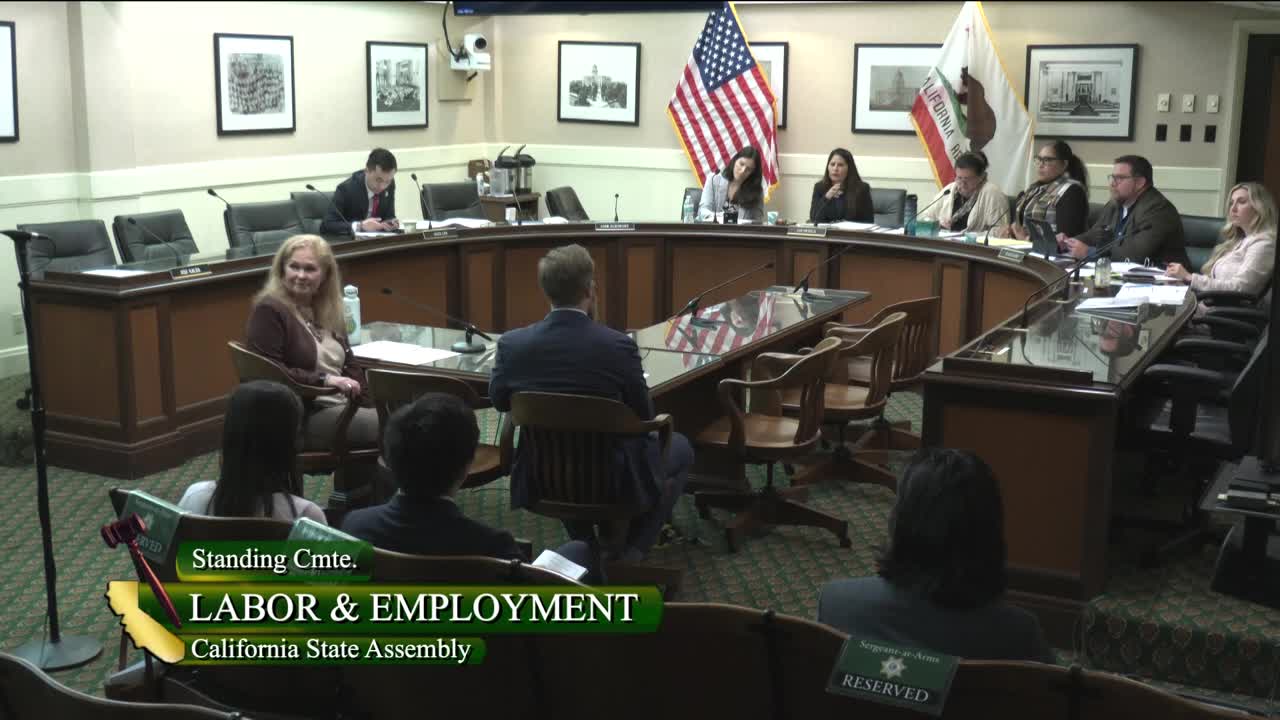
Bill Author

Bill Co-Author(s):