AB 2761: Vehicles: crash data.
- Session Year: 2025-2026
- House: Assembly
- Latest Version Date: 2026-09-30
Current Status:
Passed
(2026-09-30: Chaptered by Secretary of State - Chapter 964, Statutes of 2026.)
Introduced
In Committee
Awaiting First Chamber Vote
Passed First Chamber
In Committee
Awaiting Second Chamber Vote
Passed Second Chamber
Enacted
Under existing law, the Department of the California Highway Patrol is responsible for enforcement of all laws regulating the operation of vehicles and use of the highways, as specified. Existing law gives the Commissioner of the California Highway Patrol full responsibility and primary jurisdiction for the administration and enforcement of the laws, and for the investigation of traffic accidents, on all toll highways and state highways constructed as freeways, except as specified. Existing law requires the department to provide to, among others, police departments, coroners, and sheriffs, forms for accident reports that include sufficient detail regarding the cause of the traffic accident, the conditions at the time of the accident, and the persons and vehicles involved in the accident. Existing law requires the driver of a vehicle, except a driver of a common carrier vehicle, to report an accident resulting in injuries or death to a person to the department or the local police department within 24 hours after the accident. Existing law requires a coroner or medical examiner to report a death of a person that was the result of a traffic accident by the 10th day of the calendar month following the accident. Existing law requires each police department, if they received a report and were responsible for investigating the accident, to forward a copy of the report to the department by the 5th day of the month that follows the month that they received the report.
This bill would repeal the requirement that the department provide the above-described forms and would instead require the department, by January 1, 2030, to develop minimum requirements for electronic submission of crash investigation reports, as specified. The bill would require a coroner or medical examiner to submit the above-described report electronically. The bill would also eliminate the requirement that a law enforcement agency forward reports in compliance with the above-described timeline and would instead require the agency to electronically submit the reports to the department, as specified. The bill would make an electronic copy of a crash investigation report available to the requestor at no cost. By increasing the duties on local law enforcement, the bill would impose a state-mandated local program.
This bill would make other conforming changes.
The California Constitution requires the state to reimburse local agencies and school districts for certain costs mandated by the state. Statutory provisions establish procedures for making that reimbursement.
This bill would provide that, if the Commission on State Mandates determines that the bill contains costs mandated by the state, reimbursement for those costs shall be made pursuant to the statutory provisions noted above.
Existing law generally regulates the sale and transfer of firearms, including, among other requirements and subject to exceptions, that the transfer of a firearm be conducted through a firearms dealer.This bill would make a technical, nonsubstantive change to these provisions.Existing law generally regulates the sale and transfer of firearms, including, among other requirements and subject to exceptions, that the transfer of a firearm be conducted through a firearms dealer.
This bill would make a technical, nonsubstantive change to these provisions.
Crash has the same meaning as accident or collision.
SEC. 2.Section 2407 of the Vehicle Code is repealed.SEC. 3.Section 2407 is added to the Vehicle Code, to read:2407.(a)By January 1, 2030, the department shall prescribe the minimum requirements to document traffic crashes and determine the method and standards for electronically submitting all crash investigation reports by providing a crash investigation report system to police departments, coroners, sheriffs, and other suitable agencies or individuals to be used in the documentation of traffic crashes as required pursuant to this code.
(b)The requirements developed by the department pursuant to this section are exempt from the rulemaking provisions of the Administrative Procedure Act (Chapter 3.5 (commencing with Section 11340) of Part 1 of Division 3 of Title 2 of the Government Code).
SEC. 4.Section 2408 of the Vehicle Code is amended to read:2408.The department shall maintain a database of all crash investigation reports to analyze and publish annually or at more frequent intervals statistical information based thereon as to the number and location of traffic crashes, as well as other information relating to traffic crash prevention. Based upon its findings after such analysis, the department may conduct further necessary detailed research to more fully determine the cause and control of highway crashes. It may further conduct experimental field tests within areas of the State to prove the practicability of various ideas advanced in traffic control and crash prevention.
SEC. 5.Section 20008 of the Vehicle Code is amended to read:20008.(a)The driver of a vehicle, other than a common carrier vehicle, involved in a crash resulting in injuries to or death of a person shall within 24 hours after the crash make or cause to be made a written report of the crash to the Department of the California Highway Patrol or, if the crash occurred within a city, to either the Department of the California Highway Patrol or the police department of the city in which the crash occurred. If the agency that receives the report is not responsible for investigating the crash, it shall immediately forward the report to the law enforcement agency that is responsible for investigating the crash.
(b)A law enforcement agency shall document traffic crashes in accordance with Section 2407, and shall electronically submit the completed crash investigation reports in the timeframe prescribed by the Department of the California Highway Patrol.
(c)The owner or driver of a common carrier vehicle involved in a crash shall make a like report to the Department of California Highway Patrol on or before the 10th day of the month following the crash.
SEC. 6.Section 20011 of the Vehicle Code is amended to read:20011.A coroner or medical examiner shall, on or before the 10th day of each month, report electronically, in accordance with Section 2407, to the Department of the California Highway Patrol the death of any person during the preceding calendar month as the result of a traffic crash involving a motor vehicle, along with the circumstances of the crash. Chemical test results, including blood alcohol content and blood drug concentrations, shall be reported in writing when available.
SEC. 7.Section 20012 of the Vehicle Code is amended to read:20012.(a)All required crash investigation reports, and supplemental reports, shall be without prejudice to the individual so reporting and shall be for the confidential use of the Department of Motor Vehicles and the Department of the California Highway Patrol, except that the Department of the California Highway Patrol or the law enforcement agency to whom the crash was reported shall disclose the entire contents of the reports, including, but not limited to, the names and addresses of persons involved or injured in, or witnesses to, a crash, the registration numbers and descriptions of vehicles involved, the date, time and location of a crash, all diagrams, statements of the drivers involved or occupants injured in the crash and the statements of all witnesses, to any person who may have a proper interest therein, including, but not limited to, the driver or drivers involved, or the guardian or conservator thereof, the parent of a minor driver, the authorized representative of a driver, or to any named person injured therein, the owners of vehicles or property damaged thereby, persons who may incur civil liability, including liability based upon a breach of warranty arising out of the crash, and any attorney who declares under penalty of perjury that they represent any of the persons described in this subdivision.
(b)A request for a printed copy of a crash investigation report shall be accompanied by payment of a fee, provided that fee shall not exceed the actual cost of providing the copy. An electronic copy of a crash investigation report shall be provided at no cost to the requester.
SEC. 8.Section 20013 of the Vehicle Code is amended to read:20013.A crash investigation report shall not be used as evidence in any trial, civil or criminal, arising out of a crash, except that the department shall furnish upon demand of any person who has, or claims to have, made such a report or upon demand of any court, a certificate showing that a specified crash investigation report has or has not been made to the department solely to prove a compliance or failure to comply with the requirement that such a report be made to the department.
SEC. 9.Section 20014 of the Vehicle Code is amended to read:20014.All required crash investigation reports and supplemental reports and all reports made to the Department of the California Highway Patrol by any peace officer, other person assigned by a law enforcement agency to investigate crashes, member of the Department of the California Highway Patrol, or other employee of the Department of Motor Vehicles and the Department of the California Highway Patrol, shall be immediately available for the confidential use of any division in the department needing the same, for confidential use of the Department of Transportation, and, with respect to crashes occurring on highways other than state highways, for the confidential use of the local authority having jurisdiction over the highway.
SEC. 10.Section 22358.7 of the Vehicle Code is amended to read:22358.7.(a)If the Department of Transportation or a local authority, after completing an engineering and traffic survey, finds that the speed limit is still more than is reasonable or safe, the Department of Transportation may or the local authority may, by ordinance, determine and declare a prima facie speed limit that has been reduced an additional five miles per hour for either or both of the following reasons:
(1)The portion of highway has been designated as a safety corridor. The Department of Transportation or a local authority shall not deem more than one-fifth of their streets as safety corridors.
(2)The portion of highway is adjacent to any land or facility that generates high concentrations of bicyclists or pedestrians, especially those from vulnerable groups such as children, seniors, persons with disabilities, and the unhoused.
(b)(1)As used in this section, safety corridor shall be defined by the Department of Transportation in the next revision of the California Manual on Uniform Traffic Control Devices. In making this determination, the Department of Transportation shall consider highways that have the highest number of serious injuries and fatalities based on crash data.
(2)The Department of Transportation shall, in the next revision of the California Manual on Uniform Traffic Control Devices, determine what constitutes land or facilities that generate high concentrations of bicyclists and pedestrians, as used in paragraph (2) of subdivision (a). In making this determination, the Department of Transportation shall consider density, road use type, and bicycle and pedestrian infrastructure present on a section of highway.
(c)A peace officer shall issue only warning citations for violations of exceeding the speed limit by 10 miles per hour or less for the first 30 days that a lower speed limit is in effect as authorized by this section.
SEC. 11.If the Commission on State Mandates determines that this act contains costs mandated by the state, reimbursement to local agencies and school districts for those costs shall be made pursuant to Part 7 (commencing with Section 17500) of Division 4 of Title 2 of the Government Code.
Crash has the same meaning as accident or collision.
SEC. 2.Section 2407 of the Vehicle Code is repealed.2407.The department shall prepare and on request supply to police departments, coroners, sheriffs, and other suitable agencies or individuals, forms for accident reports required under this code, which reports shall call for sufficiently detailed information to disclose with reference to a traffic accident the cause, conditions then existing, and the persons and vehicles involved.SEC. 3.Section 2407 is added to the Vehicle Code, to read:2407.(a)By January 1, 2030, the department shall prescribe the minimum requirements to document traffic crashes and determine the method and standards for electronically submitting all crash investigation reports by providing a crash investigation report system to police departments, coroners, sheriffs, and other suitable agencies or individuals to be used in the documentation of traffic crashes as required pursuant to this code.
(b)The requirements developed by the department pursuant to this section are exempt from the rulemaking provisions of the Administrative Procedure Act (Chapter 3.5 (commencing with Section 11340) of Part 1 of Division 3 of Title 2 of the Government Code).
SEC. 4.Section 2408 of the Vehicle Code is amended to read:2408.The department shall tabulate and may analyze all accident reports maintain a database of all crash investigation reports to analyze and publish annually or at more frequent intervals statistical information based thereon as to the number and location of traffic accidents, crashes, as well as other information relating to traffic accident crash prevention. Based upon its findings after such analysis, the department may conduct further necessary detailed research to more fully determine the cause and control of highway accidents. crashes. It may further conduct experimental field tests within areas of the State to prove the practicability of various ideas advanced in traffic control and accident crash prevention.
SEC. 5.Section 20008 of the Vehicle Code is amended to read:20008.(a)The driver of a vehicle, other than a common carrier vehicle, involved in any accident a crash resulting in injuries to or death of any a person shall within 24 hours after the accident crash make or cause to be made a written report of the accident crash to the Department of the California Highway Patrol or, if the accident crash occurred within a city, to either the Department of the California Highway Patrol or the police department of the city in which the accident crash occurred. If the agency which that receives the report is not responsible for investigating the accident, crash, it shall immediately forward the report to the law enforcement agency which that is responsible for investigating the accident. crash.
On or before the fifth day of each month, every police department which received a report during the previous calendar month of an accident which it is responsible for investigating shall forward the report or a copy thereof to the main office of the Department of the California Highway Patrol at Sacramento.(b)A law enforcement agency shall document traffic crashes in accordance with Section 2407, and shall electronically submit the completed crash investigation reports in the timeframe prescribed by the Department of the California Highway Patrol.
(b)(c)The owner or driver of a common carrier vehicle involved in any such accident a crash shall make a like report to the Department of California Highway Patrol on or before the 10th day of the month following the accident. crash.
SEC. 6.Section 20011 of the Vehicle Code is amended to read:20011.A coroner or medical examiner shall shall, on or before the 10th day of each month month, report in writing electronically, in accordance with Section 2407, to the Department of the California Highway Patrol the death of any person during the preceding calendar month as the result of an accident a traffic crash involving a motor vehicle and vehicle, along with the circumstances of the accident. crash. Chemical test results, including blood alcohol content and blood drug concentrations, shall be reported in writing when available.
SEC. 7.Section 20012 of the Vehicle Code is amended to read:20012.(a)All required accident crash investigation reports, and supplemental reports, shall be without prejudice to the individual so reporting and shall be for the confidential use of the Department of Motor Vehicles and the Department of the California Highway Patrol, except that the Department of the California Highway Patrol or the law enforcement agency to whom the accident crash was reported shall disclose the entire contents of the reports, including, but not limited to, the names and addresses of persons involved or injured in, or witnesses to, an accident, a crash, the registration numbers and descriptions of vehicles involved, the date, time and location of an accident, a crash, all diagrams, statements of the drivers involved or occupants injured in the accident crash and the statements of all witnesses, to any person who may have a proper interest therein, including, but not limited to, the driver or drivers involved, or the guardian or conservator thereof, the parent of a minor driver, the authorized representative of a driver, or to any named person injured therein, the owners of vehicles or property damaged thereby, persons who may incur civil liability, including liability based upon a breach of warranty arising out of the accident, crash, and any attorney who declares under penalty of perjury that he or she represents they represent any of the above persons. persons described in this subdivision.
A(b)A request for a printed copy of an accident a crash investigation report shall be accompanied by payment of a fee, provided such that fee shall not exceed the actual cost of providing the copy. An electronic copy of a crash investigation report shall be provided at no cost to the requester.
SEC. 8.Section 20013 of the Vehicle Code is amended to read:20013.No such accident A crash investigation report shall not be used as evidence in any trial, civil or criminal, arising out of an accident, a crash, except that the department shall furnish upon demand of any person who has, or claims to have, made such a report or upon demand of any court, a certificate showing that a specified accident crash investigation report has or has not been made to the department solely to prove a compliance or failure to comply with the requirement that such a report be made to the department.
SEC. 9.Section 20014 of the Vehicle Code is amended to read:20014.All required accident crash investigation reports and supplemental reports and all reports made to the Department of the California Highway Patrol by any peace officer, other person assigned by a law enforcement agency to investigate crashes, member of the Department of the California Highway Patrol, or other employee of the Department of Motor Vehicles and the Department of the California Highway Patrol, shall be immediately available for the confidential use of any division in the department needing the same, for confidential use of the Department of Transportation, and, with respect to accidents crashes occurring on highways other than state highways, for the confidential use of the local authority having jurisdiction over the highway.
SEC. 10.Section 22358.7 of the Vehicle Code is amended to read:22358.7.(a)If the Department of Transportation or a local authority, after completing an engineering and traffic survey, finds that the speed limit is still more than is reasonable or safe, the Department of Transportation may or the local authority may, by ordinance, determine and declare a prima facie speed limit that has been reduced an additional five miles per hour for either or both of the following reasons:
(1)The portion of highway has been designated as a safety corridor. The Department of Transportation or a local authority shall not deem more than one-fifth of their streets as safety corridors.
(2)The portion of highway is adjacent to any land or facility that generates high concentrations of bicyclists or pedestrians, especially those from vulnerable groups such as children, seniors, persons with disabilities, and the unhoused.
(b)(1)As used in this section, safety corridor shall be defined by the Department of Transportation in the next revision of the California Manual on Uniform Traffic Control Devices. In making this determination, the Department of Transportation shall consider highways that have the highest number of serious injuries and fatalities based on collision data that may be derived from, but not limited to, the Statewide Integrated Traffic Records System. crash data.
(2)The Department of Transportation shall, in the next revision of the California Manual on Uniform Traffic Control Devices, determine what constitutes land or facilities that generate high concentrations of bicyclists and pedestrians, as used in paragraph (2) of subdivision (a). In making this determination, the Department of Transportation shall consider density, road use type, and bicycle and pedestrian infrastructure present on a section of highway.
(c)A peace officer shall issue only warning citations for violations of exceeding the speed limit by 10 miles per hour or less for the first 30 days that a lower speed limit is in effect as authorized by this section.
SEC. 11.If the Commission on State Mandates determines that this act contains costs mandated by the state, reimbursement to local agencies and school districts for those costs shall be made pursuant to Part 7 (commencing with Section 17500) of Division 4 of Title 2 of the Government Code.
SECTION 1.Section 26500 of the Penal Code is amended to read:26500.(a)A person shall not sell, lease, or transfer firearms unless the person has been issued a license pursuant to Article 1 (commencing with Section 26700) and Article 2 (commencing with Section 26800) of Chapter 2.(b)Any person violating this article is guilty of a misdemeanor. REVISIONS: HeadingLine 2.(a)No person shall A person shall not sell, lease, or transfer firearms unless the person has been issued a license pursuant to Article 1 (commencing with Section 26700) and Article 2 (commencing with Section 26800) of Chapter 2.
(b)Any person violating this article is guilty of a misdemeanor.
|
Date
|
Status
|
|---|---|
| Sep 30, 2026 | Chaptered by Secretary of State - Chapter 964, Statutes of 2026. |
| Sep 30, 2026 | Approved by the Governor. |
| Aug 27, 2026 | Enrolled and presented to the Governor at 4 p.m. |
| Aug 20, 2026 | In Assembly. Ordered to Engrossing and Enrolling. |
| Aug 20, 2026 | Read third time. Passed. Ordered to the Assembly. (Ayes 39. Noes 0.). |
| Aug 20, 2026 | Read third time. Passed. Ordered to the Assembly. (Ayes 39. Noes 0. Page 5593.). |
| Aug 18, 2026 | Ordered to special consent calendar. |
| Aug 13, 2026 | Read second time. Ordered to third reading. |
| Aug 13, 2026 | From committee: Do pass. (Ayes 7. Noes 0.) (August 13). |
| Aug 3, 2026 | In committee: Referred to APPR. suspense file. |
| Jul 1, 2026 | From committee: Do pass and re-refer to Com. on APPR. with recommendation: To Consent Calendar. (Ayes 6. Noes 0.) (June 30). Re-referred to Com. on APPR. |
| Jun 24, 2026 | From committee: Do pass and re-refer to Com. on PUB. S. (Ayes 13. Noes 0.) (June 23). Re-referred to Com. on PUB. S. |
| Jun 3, 2026 | Referred to Coms. on TRANS. and PUB. S. |
| May 27, 2026 | In Senate. Read first time. To Com. on RLS. for assignment. |
| May 26, 2026 | Read third time. Passed. Ordered to the Senate. (Ayes 77. Noes 0.) |
| May 26, 2026 | Read third time. Passed. Ordered to the Senate. (Ayes 77. Noes 0. Page 5397.) |
| May 26, 2026 | Read third time. Passed. Ordered to the Senate. |
| May 18, 2026 | Read second time. Ordered to third reading. |
| May 14, 2026 | From committee: Do pass. (Ayes 15. Noes 0.) (May 14). |
| May 6, 2026 | In committee: Set, first hearing. Referred to APPR. suspense file. |
| Apr 14, 2026 | From committee: Do pass and re-refer to Com. on APPR. (Ayes 16. Noes 0.) (April 13). Re-referred to Com. on APPR. |
| Apr 14, 2026 | Coauthors revised. |
| Mar 23, 2026 | Re-referred to Com. on TRANS. |
| Mar 19, 2026 | Referred to Com. on TRANS. |
| Mar 19, 2026 | From committee chair, with author's amendments: Amend, and re-refer to Com. on TRANS. Read second time and amended. |
| Feb 21, 2026 | From printer. May be heard in committee March 23. |
| Feb 20, 2026 | Read first time. To print. |
|
Date
|
Description
|
Location
|
Votes
|
|
|---|---|---|---|---|
| Aug 20, 2026 | Special Consent AB2761 Petrie-Norris et al. | Senate Floor |
Passed |
|
| Aug 13, 2026 | Do pass | Senate Standing Committee on Appropriations |
Passed |
|
| Aug 3, 2026 | Placed on suspense file | Senate Standing Committee on Appropriations |
Passed |
|
| Jun 30, 2026 | Do pass, but first be re-referred to the Committee on [Appropriations] with the recommendation: To Consent Calendar | Senate Standing Committee on Public Safety |
Passed |
|
| Jun 23, 2026 | Do pass, but first be re-referred to the Committee on [Public Safety] | Senate Standing Committee on Transportation |
Passed |
|
| May 26, 2026 | AB 2761 Petrie-Norris Assembly Third Reading | Assembly Floor |
Passed |
|
| May 14, 2026 | Do pass. | Assembly Standing Committee on Appropriations |
Passed |
|
| Apr 13, 2026 | Do pass and be re-referred to the Committee on [Appropriations] | Assembly Standing Committee on Transportation |
Passed |
This list shows positions taken on this bill by organizations on the date displayed, which is linked to the original source.
Positions by individuals are not included.
|
Organization
|
Position
|
Date
|
|---|---|---|
| AAA Northern California, Nevada & Utah | ** Support | |
| Automobile Club of Southern California | ** Support | |
| Bike Walk Alameda | ** Support |
SENATE RULES COMMITTEE Office of Senate Floor Analyses (916) 651-4171 | AB 2761 |
THIRD READING
Bill No: AB 2761
Author: Petrie-Norris (D), et al.
Amended: 3/19/26 in Assembly
Vote: 21
SENATE TRANSPORTATION COMMITTEE: 13-0, 6/23/26
AYES: Cortese, Strickland, Archuleta, Arreguín, Blakespear, Dahle, Gonzalez, Grayson, Menjivar, Richardson, Seyarto, Valladares, Wiener
SENATE PUBLIC SAFETY COMMITTEE: 6-0, 6/30/26
AYES: Arreguín, Seyarto, Caballero, Cortese, Pérez, Wiener
SENATE APPROPRIATIONS COMMITTEE: 7-0, 8/13/26
AYES: Cervantes, Seyarto, Cabaldon, Dahle, Grayson, Richardson, Wahab
ASSEMBLY FLOOR: 77-0, 5/26/26 - See last page for vote
SUBJECT: Vehicles: crash data
SOURCE: Author
DIGEST:
This bill requires the California Highway Patrol (CHP) to develop and make available to all law enforcement agencies an electronic reporting system for reporting vehicle crashes.
ANALYSIS:
Existing law:
- Requires drivers involved in certain accidents that result in severe property damage, bodily injury, or death to report the accident within 10 days. (Vehicle Code Section (VEH) 16000 - 16005)
- Requires CHP to prepare and supply to police departments, coroners, sheriffs, and other suitable agencies or individuals, forms for accident reports. (VEH 2407)
- Requires CHP to tabulate and analyze all accident reports and publish annually or at more frequent intervals statistical information on the number and location of traffic accidents and traffic accident prevention data. (VEH 2408)
- Requires police departments which receive accident reports during the previous month to forward a copy of the report to CHP on or before the fifth day of each month. (VEH 20008)
- Mandates a coroner or medical examiner, on or before the 10th day of each month, to report in writing to CHP the death of any person during the preceding calendar month as the result of a motor vehicle accident, the circumstances of the accident, and when available, blood alcohol content and blood drug concentrations. (VEH 20011)
- Governs the contents of accident reports and makes them available “to any person who may have a proper interest,” including, but not limited to, the driver, injured parties, owner of the vehicle, and representatives of the owner. (VEH 20012)
- Provides that accident reports required to be provided to CHP must be made available for immediate and confidential use by any CHP division, the Department of Transportation (Caltrans) and, with respect to accidents occurring on non-state highways, the local authority with jurisdiction. (VEH 20012)
- Imposes a fee, not to exceed the cost of production, on anyone requesting a copy of an accident report. (VEH 20012)
This bill:
- Repeals the requirement that CHP provide accident reporting forms to police departments, coroners, sheriffs, and other suitable agencies or individuals.
- Requires CHP by January 1, 2030, to prescribe minimum traffic crash reporting requirements, determine the method and standards for electronically submitting all crash investigation reports, and provide a crash investigation report system to law enforcement and individuals.
- Exempts this reporting system and the development of reporting requirements from the Administrative Procedures Act.
- Clarifies that CHP must maintain a database of all crash investigation reports.
- Requires law enforcement agencies to document traffic crashes pursuant to the above requirements and electronically submit crash investigation reports in a timeframe determined by CHP.
- Requires a coroner or medical examiner to submit required reports of motor vehicle crash deaths electronically instead of in writing.
- Waives fees for electronic copies of crash investigation reports.
- Authorizes individuals assigned by law enforcement agencies who are not peace officers to receive crash reports.
- Replaces “accident” and “collision” with “crash” throughout the specified provisions of the Vehicle Code.
Comments
- Purpose of the bill. According to the author, “Current law does not require law enforcement agencies to submit crash reports electronically or to use the most up-to-date reporting format. As a result, California’s crash data is incomplete, delayed, and inconsistent. The delays in data reporting compromise California’s ability to identify trends, evaluate programs, develop enforcement strategies, secure grant funding, and implement safety improvements. AB 2761 amends the California Vehicle Code to modernize data collection from a combination of paper and electronic process to a fully automated electronic process. Electronic crash reports will be easier to share with stakeholders, ensure consistency statewide, and provide timely information to identify trends, evaluate programs, refine enforcement strategies, and target safety improvements.”
- Vehicle crash reporting. California law generally requires drivers involved in a vehicle crash to report the crash to the relevant law enforcement authorities. This is particularly true for cases where there is substantial property damage, injury, or death. Local agencies are then required to submit these reports to CHP, who collects the information in the Statewide Integrated Traffic Records System (SWITRS). This data is then in turn submitted to the National Highway Traffic Safety Administration (NHTSA). Overall, this reporting plays a critical role in law enforcement, insurance adjudication, and traffic safety research, among other things.
Despite this importance however, crash reporting in California is outdated. This is because many agencies across the state still file these reports with pen-and-paper via traditional mail, rather than electronically. According to CHP, this includes roughly 40% of agencies across the state. As a result, data is delayed in getting to CHP, which then delays data reporting to NHTSA. The current average period of delay is roughly two years. This lack of timely data makes it difficult for state and federal regulators to detect safety risks or trends, address urgent safety needs via recalls, assess the efficacy of safety equipment, or monitor new technologies like automated driving systems.
Beyond timeliness, NHTSA has also reported issues in data consistency between jurisdictions across the country. To address this problem, starting in 1998, NHTSA published the Model Minimum Uniform Crash Criteria (MMUCC). This document, which was most recently updated in 2024, lays out a set of voluntary guidelines that describe a standardized set of parameters useful for describing vehicle crashes. The goal of MMUCC is to encourage agencies across the country to adopt these uniform standards and thus create consistency in crash reporting. - CalCrash. To help encourage the adoption of MMUCC standards, in 2022 NHTSA created the State Electronic Data Collection Program. As part of the program, states were awarded grant money to align their crash reporting systems with MMUCC. In 2024, California was awarded roughly $60 million over five years to create a new, centralized, electronic reporting system.
In 2025, the state budget then allocated money to CHP to begin planning the California Crash Data System Modernization (CalCrash) project. CalCrash will serve as the new centralized system, compliant with MMUCC, that will collect crash reports from across the state for storage in SWITRS. Access to CalCrash will be provided to local agencies at no-cost. According to CHP, in addition to improving the collection, timeliness, accuracy, uniformity, integrity, and accessibility of the state’s crash data system, CalCrash will empower all stakeholders to gain a deeper understanding of crash data and allow the state to improve its own understanding and analysis of crashes to enhance safety for all road users.
CHP solicited an initial request for information on designs of the CalCrash system in August 2024, and has since been moving forward with design. CHP has indicated it has solicited and will continue to solicit input from local agencies and will create a working group of enforcement agencies across the state to help inform the development of minimum reporting and other standards to be incorporated into CalCrash. According to CHP, they plan to launch a pilot version of the program in a limited area of the state within the next few years.
This bill supports the development and implementation of the CalCrash system by rewriting the statute on crash reporting to require the use of electronic reporting and record keeping by all law enforcement agencies across the state. Writing in support, AAA Northern California, Nevada, & Utah, and the Automobile Club of Southern California state, “High-quality crash data is essential to reducing fatalities and serious injuries. Today’s largely paper-based system can result in delays, inconsistencies, and incomplete reporting, limiting the ability of state and local agencies to identify safety risks and respond effectively. AB 2761 addresses these gaps by improving data consistency across jurisdictions and accelerating access to critical crash information.” - Additional language changes. Beyond changes to the crash reporting system generally, this bill also makes a number of smaller changes to statute regarding crash reporting. Primarily, this bill replaces the words “accident” and “collision” with the word “crash”. This reflects updated language standards reported in the MMUCC. This bill also authorizes individuals beyond peace officers to collect crash report information. However, these individuals must still be assigned by a law enforcement agency to investigate vehicle crashes. This change allows non-sworn officers, such as community safety officers or certain administrative staff, to collect crash report information.
FISCAL EFFECT: Appropriation: No Fiscal Com.: Yes Local: Yes
According to the Senate Appropriations Committee:
- CHP would incur significant costs, in the tens of millions over multiple fiscal years, to develop and implement an electronic crash reporting system. CHP indicates that the department received a federal grant in 2024 to build a crash reporting system that would allow law enforcement agencies to complete crash reports for data collection by CHP. The requirements of this bill are consistent with the work that is currently underway using federal dollars, and CHP indicates that any costs related to this bill would be covered by the existing grant funds, which are appropriated each year through the budget process.
- Unknown one-time and ongoing local mandated costs, at least partially offset by savings from efficiencies that are likely to be achieved from submitting crash data and other specified reporting information to CHP electronically rather than forwarding reports by current manual means. Local costs, particularly up-front one-time costs, could be reimbursable by the state, subject to a determination by the Commission on State Mandates. (General Fund)
SUPPORT: (Verified 8/13/26)
AAA Northern California, Nevada & Utah
Automobile Club of Southern California
Bike Walk Alameda
OPPOSITION: (Verified 8/13/26)
None received
ASSEMBLY FLOOR: 77-0, 5/26/26
AYES: Addis, Aguiar-Curry, Ahrens, Alanis, Alvarez, Arambula, Ávila Farías, Bains, Bauer-Kahan, Bennett, Berman, Boerner, Bonta, Bryan, Calderon, Caloza, Carrillo, Castillo, Chen, Connolly, Davies, DeMaio, Dixon, Elhawary, Ellis, Flora, Fong, Gabriel, Gallagher, Garcia, Gipson, Jeff Gonzalez, Mark González, Hadwick, Haney, Harabedian, Hart, Hoover, Irwin, Jackson, Johnson, Kalra, Krell, Lackey, Lee, Lowenthal, Macedo, McKinnor, Nguyen, Ortega, Pacheco, Papan, Patel, Patterson, Pellerin, Petrie-Norris, Ramos, Ransom, Michelle Rodriguez, Rogers, Blanca Rubio, Sanchez, Schiavo, Schultz, Sharp-Collins, Solache, Soria, Stefani, Ta, Tangipa, Valencia, Wallis, Ward, Wicks, Wilson, Zbur, Rivas
NO VOTE RECORDED: Muratsuchi, Quirk-Silva, Celeste Rodriguez
Prepared by: Samuel Myers / TRANS. / (916) 651-4121, Isabelle LaSalle / TRANS. / (916) 651-4121
8/14/26 15:31:16
**** END ****
SENATE COMMITTEE ON
Senator Sabrina Cervantes, Chair
2025 - 2026 Regular Session
AB 2761 (Petrie-Norris) - Vehicles: crash data
Version: | Policy Vote: |
Urgency: | Mandate: |
Hearing Date: | Consultant: |
Bill Summary:
AB 2761 would require the California Highway Patrol (CHP) to develop and make available to all law enforcement agencies an electronic crash reporting system by January 1, 2030, and require local law enforcement agencies and coroners to electronically submit specified reports to CHP electronically, as specified.
Fiscal Impact:
- The CHP would incur significant costs, in the tens of millions over multiple fiscal years, to develop and implement an electronic crash reporting system. The CHP indicates that the department received a federal grant in 2024 to build a crash reporting system that would allow law enforcement agencies to complete crash reports for data collection by CHP. The requirements of this bill are consistent with the work that is currently underway using federal dollars, and CHP indicates that any costs related to this bill would be covered by the existing grant funds, which are appropriated each year through the budget process. See Staff Comments. (federal funds)
- Unknown one-time and ongoing local mandated costs, at least partially offset by savings from efficiencies that are likely to be achieved from submitting crash data and other specified reporting information to the CHP electronically rather than forwarding reports by current manual means. Local costs, particularly up-front one-time costs, could be reimbursable by the state, subject to a determination by the Commission on State Mandates. (General Fund)
Background:
Existing law generally requires drivers involved in a vehicle crash to report the crash to the relevant law enforcement authorities, which is especially important in cases where there is substantial property damage, injury, or death. Existing law requires the CHP to prepare and supply police departments, coroners, and sheriffs with forms for accident reports that include sufficient detail regarding the cause of an accident, conditions at the time of the accident, and persons or vehicles involved in the accident. Local law enforcement agencies are then required to submit these reports to CHP, which are then collected and entered into the Statewide Integrated Traffic Records System (SWITRS). Existing law also requires coroners and medical examiners to report the death of any person as a result of a traffic accident, the circumstances of the accident, and any information on blood alcohol content and blood drug concentration. This data is also submitted to the National Highway Traffic Safety Administration (NHTSA) and plays a critical role in traffic enforcement, insurance adjudication, and traffic safety research, among other things.
According to the CHP, approximately 40% of law enforcement agencies across the state file paper reports rather than submitting data electronically. This can result in significant delays in reporting crash data to the department, and subsequent delays in reporting information to NHTSA. This lack of timely data makes it difficult for state and federal regulators to detect safety risks or trends, address urgent safety needs via recalls, assess the efficacy of safety equipment, or monitor new technologies like automated driving systems.
NHTSA has also reported issues in data consistency between jurisdictions across the country. In response, NHTSA began publishing the Model Minimum Uniform Crash Criteria (MMUCC) in 1998. This document, which was most recently updated in 2024, prescribes a set of voluntary guidelines that describe a standardized set of parameters useful for describing vehicle crashes. The goal of MMUCC is to encourage agencies across the country to adopt these uniform standards and create consistency in crash reporting. To help encourage the adoption of MMUCC standards, NHTSA created the State Electronic Data Collection Program in 2022. As part of the program, states can qualify for federal grant money to align their crash reporting systems with MMUCC. In 2024, California was awarded a $60.3 million NHTSA grant over five years to create a new, centralized electronic crash data reporting system.
Proposed Law:
AB 2761 would require the CHP to develop and make available to all law enforcement agencies an electronic crash reporting system by January 1, 2030, and require local law enforcement agencies and coroners to electronically submit specified reports to CHP electronically. Specifically, this bill would:
- Repeal the requirement that CHP provide accident reporting forms to police departments, coroners, sheriffs, and other suitable agencies or individuals.
- Require the CHP to prescribe minimum traffic crash reporting requirements, determine the method and standards for electronically submitting all crash investigation reports, and provide a crash investigation report system to law enforcement and individuals by January 1, 2030.
- Require the CHP to maintain a database of all crash investigation reports.
- Require law enforcement agencies to document traffic crashes and electronically submit crash investigation reports in a timeframe determined by CHP.
- Require a coroner or medical examiner to submit required reports of motor vehicle crash deaths electronically instead of in writing.
- Require the CHP and local law enforcement agencies to provide electronic copies of crash investigation reports at no cost to the requestor.
- Authorize individuals assigned by law enforcement agencies who are not peace officers to receive crash reports.
- Make various clarifying changes by replacing “accident” and “collision” with “crash” throughout the specified provisions of the Vehicle Code.
Staff Comments:
As noted above, the CHP receive a $60.3 million grant from NHTSA to develop a user-friendly crash reporting system within five years. The CalCrash Project will provide CHP with an updated crash management application and California’s “Allied Agencies” (law enforcement and others who currently report data manually) with an application to electronically complete crash reports for data collection. The 2025 Budget Act allocated $3.5 million to CHP from available NHTSA grant funds to begin planning the California Crash Data System Modernization (CalCrash) program. CalCrash will serve as the new centralized system, compliant with MMUCC, that will automatically collect statewide crash data for storage in SWITRS. Access to CalCrash will be provided to local agencies at no-cost. According to CHP, in addition to improving the collection, timeliness, accuracy, uniformity, integrity, and accessibility of the state’s crash data system, CalCrash will empower all stakeholders to gain a deeper understanding of crash data and allow the state to improve its own understanding and analysis of crashes to enhance safety for all road users. The 2026 Budget Act allocated an additional $13.7 million to work with the California Department of Technology to continue the planning phase and transition into the execution phase of the CalCrash Program. Staff notes that the requirements of this bill appear to be consistent with the work that is currently underway, and should not result in any additional CHP costs beyond what is available under the federal grant.
The bill imposes a state-mandated local program on local law enforcement agencies, as well as coroner and medical examiners, by requiring those local entities to document traffic crashes and deaths, and to electronically submit investigation and other reports to the CHP, pursuant to the methods and standards prescribed by the department. While approximately 650 local agencies affected by this bill are likely to benefit from long-term and ongoing savings and efficiencies related to electronic, rather than manual submittal of reports, local agencies would likely incur one-time administrative costs to update policies and procedures and train staff on electronic reporting requirements, as well as potentially procuring or updating IT infrastructure to facilitate electronic reporting, among other things. Any local costs to comply with the bill’s requirements could be reimbursable from the State General Fund to the extent a local agency files a successful claim, and the Commission on State Mandates determines that the bill contains costs mandated by the state.
-- END --
SENATE COMMITTEE ON PUBLIC SAFETY
Senator Jesse Arreguín, Chair
2025 - 2026 Regular
Bill No: AB 2761 Hearing Date: June 30, 2026
Author: | Petrie-Norris | ||
Version: | March 19, 2026 | ||
Urgency: | No | Fiscal: | Yes |
Consultant: | SJ | ||
Subject: Vehicles: crash data
HISTORY
Source: Author
Prior Legislation: SB 925 (Bates), Ch. 223, Stats. of 2022
Support: AAA Northern California, Nevada & Utah; Auto Club of Southern California
Opposition: None known
Assembly Floor Vote: 77 - 0
PURPOSE
The purpose of this bill is to require the California Highway Patrol (CHP) to develop and make available to all law enforcement agencies an electronic reporting system for reporting vehicle crashes.
Existing law requires drivers involved in certain accidents that result in severe property damage, bodily injury, or death to report the accident within 10 days. (Veh. Code, § 16000-16005.)
Existing law requires CHP to prepare and supply to police departments, coroners, sheriffs, and other suitable agencies or individuals, forms for accident reports. (Veh. Code, § 2407.)
Existing law requires CHP to tabulate and analyze all accident reports and publish annually or at more frequent intervals statistical information on the number and location of traffic accidents and traffic accident prevention data. (Veh. Code, § 2408.)
Existing law requires police departments which receive accident reports during the previous month to forward a copy of the report to CHP on or before the fifth day of each month. (Veh. Code, § 20008.)
Existing law requires a coroner or medical examiner, on or before the 10th day of each month, to report in writing to CHP the death of any person during the preceding calendar month as the result of a motor vehicle accident, the circumstances of the accident, and when available, blood alcohol content and blood drug concentrations. (Veh. Code, § 20011.)
Existing law governs the contents of accident reports and makes them available “to any person who may have a proper interest,” including, but not limited to, the driver, injured parties, owner of the vehicle, and representatives of the owner. (Veh. Code, § 20012.)
Existing law provides that accident reports required to be provided to CHP must be made available for immediate and confidential use by any CHP division, the Department of Transportation (Caltrans) and, with respect to accidents occurring on non-state highways, the local authority with jurisdiction. (Veh. Code, § 20012.)
Existing law imposes a fee, not to exceed the cost of production, on anyone requesting a copy of an accident report. (Veh. Code, § 20012.)
Existing law prohibits an accident report from being used as evidence in any trial, civil or criminal, arising out of an accident, except that the CHP must furnish upon demand of any person who has, or claims to have, made such a report or upon demand of any court, a certificate showing that a specified accident report has or has not been made to the department solely to prove a compliance or failure to comply with the requirement that such a report be made to the department. (Veh. Code, § 20013.)
Existing law requires that all required accident reports and supplemental reports and all reports made to the CHP by any peace officer, member of the CHP, or other employee of the Department of Motor Vehicles (DMV) and the CHP, be immediately available for the confidential use of any division in the department needing the same, for confidential use of the Caltrans, and, with respect to accidents occurring on highways other than state highways, for the confidential use of the local authority having jurisdiction over the highway. (Veh. Code, § 20014.)
This bill repeals the requirement that CHP provide accident reporting forms to police departments, coroners, sheriffs, and other suitable agencies or individuals.
This bill requires CHP to prescribe minimum traffic crash reporting requirements, determine the method and standards for electronically submitting all crash investigation reports, and provide a crash investigation report system to law enforcement and individuals by January 1, 2030.
This bill requires CHP to maintain a database of all crash investigation reports.
This bill requires law enforcement agencies to document traffic crashes and electronically submit crash investigation reports in a timeframe determined by CHP.
This bill requires a coroner or medical examiner to submit required reports of motor vehicle crash deaths electronically instead of in writing.
This bill waives fees for electronic copies of crash investigation reports.
This bill authorizes individuals assigned by law enforcement agencies who are not peace officers to receive crash reports.
This bill replaces “accident” and “collision” with “crash” throughout the specified provisions of the Vehicle Code.
COMMENTS
- Need For This Bill
According to the author:
Current law does not require law enforcement agencies to submit crash reports electronically or to use the most up-to-date reporting format. As a result, California’s crash data is incomplete, delayed, and inconsistent. The delays in data reporting compromise California’s ability to identify trends, evaluate programs, develop enforcement strategies, secure grant funding, and implement safety improvements. AB 2761 amends the California Vehicle Code to modernize data collection from a combination of paper and electronic process to a fully automated electronic process. Electronic crash reports will be easier to share with stakeholders, ensure consistency statewide, and provide timely information to identify trends, evaluate programs, refine enforcement strategies, and target safety improvements.
- Vehicle Crash Reporting
Existing law generally requires drivers involved in a vehicle crash to report the crash to the relevant law enforcement authorities. This is particularly true for cases where there is substantial property damage, injury, or death. (Veh. Code, §§ 20001-20004.) Local law enforcement agencies are then required to submit these reports to CHP, which collects the information in the Statewide Integrated Traffic Records System (SWITRS). This data is submitted to the National Highway Traffic Safety Administration (NHTSA). This reporting plays a critical role in traffic enforcement, insurance adjudication, and traffic safety research, among other things.
Crash reporting in California is outdated because many agencies across the state file paper reports rather than electronic reports. According to CHP, this includes roughly 40% of agencies across the state. As a result, data is delayed in getting to CHP, which then delays data reporting to NHTSA. The current average period of delay is roughly two years. This lack of timely data makes it difficult for state and federal regulators to detect safety risks or trends, address urgent safety needs via recalls, assess the efficacy of safety equipment, or monitor new technologies like automated driving systems.
NHTSA has also reported issues in data consistency between jurisdictions across the country. To address this problem, NHTSA published the Model Minimum Uniform Crash Criteria (MMUCC). This document, which was most recently updated in 2024, lays out a set of voluntary guidelines that describe a standardized set of parameters useful for describing vehicle crashes. The goal of MMUCC is to encourage agencies across the country to adopt these uniform standards and create consistency in crash reporting.
To help encourage the adoption of MMUCC standards, NHTSA created the State Electronic Data Collection Program in 2022. As part of the program, states were awarded federal grant money to align their crash reporting systems with MMUCC. In 2024, California was awarded roughly $60 million over five years to create a new, centralized electronic reporting system.
The 2025 Budget Act allocated $3.5 million to CHP to begin planning the California Crash Data System Modernization (CalCrash) program.[1] CalCrash will serve as the new centralized system, compliant with MMUCC, that will automatically collect statewide crash data for storage in SWITRS. Access to CalCrash will be provided to local agencies at no-cost. According to CHP, in addition to improving the collection, timeliness, accuracy, uniformity, integrity, and accessibility of the state’s crash data system, CalCrash will empower all stakeholders to gain a deeper understanding of crash data and allow the state to improve its own understanding and analysis of crashes to enhance safety for all road users.
This bill supports the development and implementation of the CalCrash system by revising the statute on crash reporting to require the use of electronic reporting and record keeping by all law enforcement agencies across the state.
- Argument in Support
The Auto Club of Southern California and AAA Northern California, Nevada & Utah write:
This measure strengthens California’s traffic safety framework by modernizing crash data collection through standardized electronic reporting, resulting in more accurate, timely, and actionable information.
High-quality crash data is essential to reducing fatalities and serious injuries. Today’s largely paper-based system can result in delays, inconsistencies, and incomplete reporting, limiting the ability of state and local agencies to identify safety risks and respond effectively. AB 2761 addresses these gaps by improving data consistency across jurisdictions and accelerating access to critical crash information. More timely and reliable data will enable transportation agencies to better identify high-injury corridors, evaluate safety countermeasures, and prioritize investments that deliver the greatest safety benefit.
For impaired driving, improved data is especially critical. Research from the AAA Foundation for Traffic Safety (AAAFTS) shows that drug-impaired driving is prevalent and difficult to measure, with many users underestimating its effects, no reliable correlation between THC levels and impairment, and frequent polysubstance use. These challenges underscore the need for comprehensive crash data, including timely toxicology information to better understand trends and support effective enforcement and prevention strategies.
AB 2761 will also improve coordination among law enforcement, public health, and transportation agencies by establishing a more integrated and accessible data system. This is critical to implementing a Safe System Approach, which relies on shared data to identify risks and deploy targeted solutions. By replacing outdated reporting practices with a modern, electronic system, the bill enhances both efficiency and long-term cost-effectiveness.
We recognize that transitioning to electronic reporting may raise concerns regarding implementation costs and administrative burden for local agencies. However, these challenges are outweighed by the long-term benefits of improved data quality, reduced duplication, and streamlined reporting processes. Standardization will ultimately reduce inefficiencies and support more effective use of limited safety resources. Ensuring appropriate implementation timelines and technical support will be important to achieving a smooth transition.
AB 2761 represents a practical, data-driven step toward improving roadway safety outcomes across California. By equipping decision-makers with better information, the bill will help prevent crashes, save lives, and support more effective traffic safety strategies.
-- END --
Senate Committee on Budget and Fiscal Review, Final Action Report: A Summary of the 2025 Budget Act (Oct. 21, 2025), p. 5-32, available at <https://sbud.senate.ca.gov/system/files/2025-10/final-action-report-a-summary-of-the-2025-budget-act.pdf>. ↑
SENATE COMMITTEE ON TRANSPORTATION
Senator Dave Cortese, Chair
2025 - 2026 Regular
Bill No: Hearing Date: 6/23/2026
Author: | Petrie-Norris | ||
Version: | 3/19/2026 Amended | ||
Urgency: | No | Fiscal: | Yes |
Consultant: | Samuel Myers | ||
SUBJECT:
DIGEST: This bill requires the California Highway Patrol (CHP) to develop and make available to all law enforcement agencies an electronic reporting system for reporting vehicle crashes.
ANALYSIS:
Existing law:
- Requires drivers involved in certain accidents that result in severe property damage, bodily injury, or death to report the accident within 10 days. (VEH 16000 - 16005)
- Requires CHP to prepare and supply to police departments, coroners, sheriffs, and other suitable agencies or individuals, forms for accident reports. (VEH 2407)
- Requires CHP to tabulate and analyze all accident reports and publish annually or at more frequent intervals statistical information on the number and location of traffic accidents and traffic accident prevention data. (VEH 2408)
- Requires police departments which receive accident reports during the previous month to forward a copy of the report to CHP on or before the fifth day of each month. (VEH 20008)
- Mandates a coroner or medical examiner, on or before the 10th day of each month, to report in writing to CHP the death of any person during the preceding calendar month as the result of a motor vehicle accident, the circumstances of the accident, and when available, blood alcohol content and blood drug concentrations. (VEH 20011)
- Governs the contents of accident reports and makes them available “to any person who may have a proper interest,” including, but not limited to, the driver, injured parties, owner of the vehicle, and representatives of the owner. (VEH 20012)
- Provides that accident reports required to be provided to CHP must be made available for immediate and confidential use by any CHP division, the Department of Transportation (Caltrans) and, with respect to accidents occurring on non-state highways, the local authority with jurisdiction. (VEH 20012)
- Imposes a fee, not to exceed the cost of production, on anyone requesting a copy of an accident report. (VEH 20012)
This bill:
- Repeals the requirement that CHP provide accident reporting forms to police departments, coroners, sheriffs, and other suitable agencies or individuals.
- Requires CHP by January 1, 2030, to prescribe minimum traffic crash reporting requirements, determine the method and standards for electronically submitting all crash investigation reports, and provide a crash investigation report system to law enforcement and individuals.
- Exempts this reporting system and the development of reporting requirements from the Administrative Procedures Act.
- Clarifies that CHP must maintain a database of all crash investigation reports.
- Requires law enforcement agencies to document traffic crashes pursuant to the above requirements and electronically submit crash investigation reports in a timeframe determined by CHP.
- Requires a coroner or medical examiner to submit required reports of motor vehicle crash deaths electronically instead of in writing.
- Waives fees for electronic copies of crash investigation reports.
- Authorizes individuals assigned by law enforcement agencies who are not peace officers to receive crash reports.
- Replaces “accident” and “collision” with “crash” throughout the specified provisions of the Vehicle Code.
COMMENTS:
- Purpose of the bill. According to the author, “Current law does not require law enforcement agencies to submit crash reports electronically or to use the most up-to-date reporting format. As a result, California’s crash data is incomplete, delayed, and inconsistent. The delays in data reporting compromise California’s ability to identify trends, evaluate programs, develop enforcement strategies, secure grant funding, and implement safety improvements. AB 2761 amends the California Vehicle Code to modernize data collection from a combination of paper and electronic process to a fully automated electronic process. Electronic crash reports will be easier to share with stakeholders, ensure consistency statewide, and provide timely information to identify trends, evaluate programs, refine enforcement strategies, and target safety improvements.”
- Vehicle crash reporting. California law generally requires drivers involved in a vehicle crash to report the crash to the relevant law enforcement authorities. This is particularly true for cases where there is substantial property damage, injury, or death. Local agencies are then required to submit these reports to CHP, who collects the information in the Statewide Integrated Traffic Records System (SWITRS). This data is then in turn submitted to the National Highway Traffic Safety Administration (NHTSA). Overall, this reporting plays a critical role in law enforcement, insurance adjudication, and traffic safety research, among other things.
Despite this importance however, crash reporting in California is outdated. This is because many agencies across the state still file these reports with pen-and-paper via traditional mail, rather than electronically. According to CHP, this includes roughly 40% of agencies across the state. As a result, data is delayed in getting to CHP, which then delays data reporting to NHTSA. The current average period of delay is roughly two years. This lack of timely data makes it difficult for state and federal regulators to detect safety risks or trends, address urgent safety needs via recalls, assess the efficacy of safety equipment, or monitor new technologies like automated driving systems.
Beyond timeliness, NHTSA has also reported issues in data consistency between jurisdictions across the country. To address this problem, starting in 1998, NHTSA published the Model Minimum Uniform Crash Criteria (MMUCC). This document, which was most recently updated in 2024, lays out a set of voluntary guidelines that describe a standardized set of parameters useful for describing vehicle crashes. The goal of MMUCC is to encourage agencies across the country to adopt these uniform standards and thus create consistency in crash reporting. - CalCrash. To help encourage the adoption of MMUCC standards, in 2022 NHTSA created the State Electronic Data Collection Program. As part of the program, states were awarded grant money to align their crash reporting systems with MMUCC. In 2024, California was awarded roughly $60 million over five years to create a new, centralized, electronic reporting system.
In 2025, the state budget then allocated money to CHP to begin planning the California Crash Data System Modernization (CalCrash) project. CalCrash will serve as the new centralized system, compliant with MMUCC, that will collect crash reports from across the state for storage in SWITRS. Access to CalCrash will be provided to local agencies at no-cost. According to CHP, in addition to improving the collection, timeliness, accuracy, uniformity, integrity, and accessibility of the state’s crash data system, CalCrash will empower all stakeholders to gain a deeper understanding of crash data and allow the state to improve its own understanding and analysis of crashes to enhance safety for all road users.
CHP solicited an initial request for information on designs of the CalCrash system in August 2024, and has since been moving forward with design. CHP has indicated it has solicited and will continue to solicit input from local agencies and will create a working group of enforcement agencies across the state to help inform the development of minimum reporting and other standards to be incorporated into CalCrash. According to CHP, they plan to launch a pilot version of the program in a limited area of the state within the next few years.
AB 2761 supports the development and implementation of the CalCrash system by rewriting the statute on crash reporting to require the use of electronic reporting and record keeping by all law enforcement agencies across the state. Writing in support, AAA Northern California, Nevada, & Utah, and the Automobile Club of Southern California state, “High-quality crash data is essential to reducing fatalities and serious injuries. Today’s largely paper-based system can result in delays, inconsistencies, and incomplete reporting, limiting the ability of state and local agencies to identify safety risks and respond effectively. AB 2761 addresses these gaps by improving data consistency across jurisdictions and accelerating access to critical crash information.” - Additional language changes. Beyond changes to the crash reporting system generally, AB 2761 also makes a number of smaller changes to statute regarding crash reporting. Primarily, AB 2761 replaces the words “accident” and “collision” with the word “crash”. This reflects updated language standards reported in the MMUCC. AB 2761 also authorizes individuals beyond peace officers to collect crash report information. However, these individuals must still be assigned by a law enforcement agency to investigate vehicle crashes. This change allows non-sworn officers, such as community safety officers or certain administrative staff, to collect crash report information.
- Double referral. This bill has been double referred to the Senate Public Safety Committee.
FISCAL EFFECT: Appropriation: Fiscal Com.: Local:
POSITIONS: (Communicated to the committee before noon on Wednesday,
June 17, 2026.)
SUPPORT:
AAA Northern California, Nevada & Utah
Automobile Club of Southern California
OPPOSITION:
None received
-- END --
ASSEMBLY THIRD READING
ATR Bill Id:AB 2761
Author:(Petrie-Norris)
As Amended Ver:March 19, 2026
Majority vote
SUMMARY
Repeals and recasts the state′s vehicle accident reporting requirements and requires the California Highway Patrol (CHP) to develop and make available to all law enforcement agencies an electronic reporting system for reporting accidents causing serious injury or death.
Major Provisions
- Repeals the requirement that the CHP provide accident reporting forms to police departments, coroners, sheriffs, and other suitable agencies or individuals.
- Requires CHP, by January 1, 2030, to prescribe minimum traffic crash reporting requirements and determine the method and standards for electronically submitting all crash investigation reports by providing a crash investigation report system to police departments, coroners, sheriffs, and other suitable agencies or individuals to be used in the documentation of traffic crashes.
- Exempts this reporting system and development of reporting requirements from the Administrative Procedures Act.
- Requires law enforcement agencies to document traffic crashes pursuant to the above requirements and electronically submit crash investigation reports in a timeframe determined by the CHP.
- Requires a coroner or medical examiner to submit required reports of motor vehicle accident deaths electronically instead of in writing.
- Waives fees for electronic copies of crash investigation reports and maintains fess for a printed copy of a crash investigation.
- Clarifies that CHP must maintain a database of all crash investigation reports.
- Replaces ″accident″ with ″crash″ throughout the bill.
COMMENTS
The state′s vehicle accident or crash investigation reporting system is outdated and as a result crash data that CHP reports to the National Highway Traffic Safety Administration (NHTSA) typically suffers a two-year delay. Despite state law requiring law enforcement to submit crash investigation reports—for accidents involving serious injury or death—to the CHP in a certain form and timeframe (by the fifth of each month), many agencies miss this deadline and submit paper-based reports (via U.S. mail) of varying format and quality. According to the CHP, 40% of law enforcement agencies do not submit crash reports electronically. The lack of timely or standardized data makes it difficult for state and federal regulators to detect safety risks or trends, address urgent safety needs via recalls, assess the efficacies of safety equipment or monitor new technologies like automated driving systems.
These issues are not limited to California. According to NHTSA, crash data often vary from jurisdiction to jurisdiction and from state to state. This makes it especially difficult to compare data across state and local agencies, between states, and between states and the federal government. Determining larger patterns and timely trends in motor vehicle traffic crash data becomes much more challenging under these circumstances.In 2022, NHTSA issued a notice of intent to provide grant funding to States that create centralized crash data systems to facilitate the electronic transfer of uniform crash data to NHTSA. As discussed below, California was among 19 states and territories to be awarded a grant ($60.3 million over five years) in 2024. Grant funding will help modernize the state′s outdated systems and standardize data consistent with the Model Minimum Uniform Crash Criteria (MMUCC), a voluntary guideline developed by NHTSA. NHTSA envisions that all law enforcement agencies of grant recipients will compile crash data electronically in the field using a uniform, efficient approach consistent with the MMUCC and validation rules, which mandate that crash data be validated at the point records are added to the State′s central crash repository.The 2025-26 Budget included $3.5 million in federal funds for the CHP to begin planning the California Crash Data System Modernization (CalCrash) IT Project. According to the Department of Finance′s Budget Change Proposal:
The CalCrash IT Project [Project] will modernize crash data collection from a combination of paper and electronic process to a fully automated electronic process that will be adopted by all law enforcement agencies across the State of California. The CHP received a five-year, $60.3 million grant from [NHTSA] to build a crash reporting system to provide California′s law enforcement agencies an application to electronically complete crash reports for data collection by the CHP. The application will be developed in compliance with the NHTSA′s State Electronic Data Collection program requirements.
[Law enforcement agencies] currently submit crash report data to CHP either via an interface with their existing crash data systems or paper crash reports for manual entry into the CHP′s Statewide Integrated Traffic Records System. The CalCrash system will be offered to agencies at no cost to improve efficiency and streamline the process of communicating data to all stakeholders. The Project will modernize data collection from a combination of paper and electronic process to a fully automated electronic process. Electronic crash reports will be easier to share with stakeholders, and the data transfer to NHTSA will improve.
This bill is consistent with and furthers NHTSA′s grant requirements and the budget appropriation mentioned above. It requires CHP, by January 1, 2030, to develop minimum crash data reporting and electronic submittal standards that all law enforcement agencies would be required to use. CHP has indicated it has solicited and will continue to solicit input from these agencies and will create a working group of enforcement agencies across the state to help inform the development of minimum reporting and other standards to be incorporated into CalCrash.
In addition to improving the collection, timeliness, accuracy, uniformity, integrity, and accessibility of the State′s crash data system, CalCrash will empower all stakeholders to gain a deeper understanding of crash data and allow the state to improve its own understanding and analysis of crashes to enhance safety for all road users.
According to the Author
″Current law does not require law enforcement agencies to submit crash reports electronically or to use the most up-to-date reporting format. As a result, California′s crash data is incomplete, delayed, and inconsistent. The delays in data reporting compromise California′s ability to identify trends, evaluate programs, develop enforcement strategies, secure grant funding, and implement safety improvements. These delays also hinder NHTSA′s ability to identify vehicle defects and issue timely recalls or safety advisories.
AB 2761 amends the California Vehicle Code to modernize data collection from a combination of paper and electronic process to a fully automated electronic process. Electronic crash reports will be easier to share with stakeholders, ensure consistency statewide, and provide timely information to identify trends, evaluate programs, refine enforcement strategies, and target safety improvements″.
Arguments in Support
Automobile Club of Southern California, and AAA Northern California, Nevada & Utah state:
High-quality crash data is essential to reducing fatalities and serious injuries. Today′s largely paper-based system can result in delays, inconsistencies, and incomplete reporting, limiting the ability of state and local agencies to identify safety risks and respond effectively. AB 2761 addresses these gaps by improving data consistency across jurisdictions and accelerating access to critical crash information. More timely and reliable data will enable transportation agencies to better identify high-injury corridors, evaluate safety countermeasures, and prioritize investments that deliver the greatest safety benefit.
Arguments in Opposition
None on file.
FISCAL COMMENTS
This bill creates significant new costs for CHP to prescribe minimum requirements to document traffic crashes and determine the method and standards for electronically submitting all crash investigation reports (special funds or federal funds). CHP reports it is currently building the reporting system as required by this bill and that costs to do so are covered by the NHTSA grant mentioned above.
VOTES
ASM TRANSPORTATION: 16-0-0
YES: Wilson, Davies, Aguiar-Curry, Ahrens, Carrillo, Harabedian, Hart, Hoover, Jackson, Lackey, Macedo, Papan, Ransom, Rogers, Sharp-Collins, Ward
ASM APPROPRIATIONS: 15-0-0
YES: Wicks, Hoover, Aguiar-Curry, Calderon, Caloza, Dixon, Fong, Mark González, Krell, Pacheco, Pellerin, Sharp-Collins, Solache, Ta, Tangipa
UPDATED
VERSION: March 19, 2026
CONSULTANT: Dan Chia / TRANS. / (916) 319-2093 FN: 0002635
Date of Hearing: May 6, 2026
ASSEMBLY COMMITTEE ON APPROPRIATIONS
Buffy Wicks, Chair
ABPCA Bill Id:AB 2761
Author:(Petrie-Norris) – As Amended Ver:March 19, 2026
Policy Committee: | Transportation | Vote: | 16 - 0 |
|
| ||
|
|
Urgency: No State Mandated Local Program: Yes Reimbursable: Yes
SUMMARY:
This bill revises existing law governing reporting of vehicle collisions, which the bill refers to as “crashes.”
Specifically, among other things, this bill:
- Repeals existing law that requires the California Highway Patrol (CHP) provide accident reporting forms to police departments, coroners, sheriffs and other agencies and individuals and requires CHP, by January 1, 2030, exempt from the requirements of the Administrative Procedures Act (APA), to prescribe minimum requirements to document traffic crashes and determine the method and standards for electronically submitting all crash investigation reports by providing a crash investigation report system to police departments, coroners, sheriffs and other suitable agencies or individuals to be used in the documentation of traffic crashes.
- Requires a law enforcement agency to document traffic crashes consistent with the CHP requirements described above and electronically submit completed crash investigation reports to CHP in the timeframe prescribed by CHP.
- Requires a coroner or medical examiner to report any death to the CHP electronically, consistent with the CHP reporting requirements described above, rather than in writing as required by current law.
- Modifies existing law so that CHP is to maintain a database of all crash investigation reports and requires CHP to analyze such reports.
- Provides that an electronic copy of a crash investigation report shall be provided at no cost to the requester.
FISCAL EFFECT:
This bill creates significant new costs for CHP to prescribe minimum requirements to document traffic crashes and determine the method and standards for electronically submitting all crash investigation reports (special funds of federal funds).
COMMENTS:
Existing law requires a police department that received an accident report during a month to forward a copy of the accident report to CHP by the fifth day of the following month. Similarly, existing law requires a coroner or medical examiner to report monthly in writing to the CHP any death that resulted from a motor vehicle accident. Consistent with the law, CHP develops and supplies accident report forms to local law enforcement, medical examiners, coroners and others, and the law requires CHP to tabulate and analyze accident reports and publish annual statistical reports. Much of this reporting is analogue, paper based and slow.
The author intends this bill to modernize the effort. According to the author:
Current law does not require law enforcement agencies to submit crash reports electronically or to use the most up-to-date reporting format. As a result, California’s crash data is incomplete, delayed, and inconsistent...AB 2761 amends the California Vehicle Code to modernize data collection from a combination of paper and electronic process to a fully automated electronic process. Electronic crash reports will be easier to share with stakeholders, ensure consistency statewide, and provide timely information to identify trends, evaluate programs, refine enforcement strategies, and target safety improvements.
According to the CHP, it received a five-year, $60.3 million grant from the federal National Highway Traffic Safety Administration (NHTSA) to build a crash reporting system to provide California’s law enforcement agencies (“Allied Agencies”) an application to electronically complete crash reports for data collection by the CHP. CHP reports it is currently building the reporting system and that the requirements of this bill are consistent with that work, and costs to do so are covered by the NHTSA grant.
The bill is supported by both of the state’s major motorist organizations—AAA Northern California, Nevada and Utah and the Automobile Club of Southern California, which together assert this bill will “enable transportation agencies to better identify high-injury corridors, evaluate safety countermeasures, and prioritize investments that deliver the greatest safety benefit.”
There is no opposition to this bill.
Analysis Prepared by: Jay Dickenson / APPR. / (916) 319-2081
Date of Hearing: April 13, 2026
ASSEMBLY COMMITTEE ON TRANSPORTATION
Lori D. Wilson, Chair
ABPCA Bill Id:AB 2761 (
Author:Petrie-Norris) – As Amended Ver:March 19, 2026
SUBJECT: Vehicles: crash data
SUMMARY: Repeals and recasts the state’s vehicle accident reporting requirements and requires the California Highway Patrol (CHP) to develop and make available to all law enforcement agencies an electronic reporting system for reporting accidents causing serious injury or death. Specifically, this bill:
- Repeals the requirement that the CHP provide accident reporting forms to police departments, coroners, sheriffs, and other suitable agencies or individuals.
- Requires CHP by January 1, 2030, to prescribe minimum traffic crash reporting requirements and determine the method and standards for electronically submitting all crash investigation reports by providing a crash investigation report system to police departments, coroners, sheriffs, and other suitable agencies or individuals to be used in the documentation of traffic crashes.
- Exempts this reporting system and development of reporting requirements from the Administrative Procedures Act.
- Requires law enforcement agencies to document traffic crashes pursuant to the above requirements and electronically submit crash investigation reports in a timeframe determined by the CHP.
- Requires a coroner or medical examiner to submit required reports of motor vehicle accident deaths electronically instead of in writing.
- Waives fees for electronic copies of crash investigation reports and maintains fess for a printed copy of a crash investigation.
- Clarifies that CHP must maintain a database of all crash investigation reports.
- Replaces “accident” with “crash” throughout the bill.
EXISTING LAW:
- Requires CHP to prepare and supply to police departments, coroners, sheriffs, and other suitable agencies or individuals, forms for accident reports, which must include sufficiently detailed information regarding the cause of a traffic accident, existing conditions, and the persons and vehicles involved (Vehicle Code (VEH) §2407).
- Requires CHP to tabulate and analyze all accident reports and publish annually or at more frequent intervals statistical information on the number and location of traffic accidents and traffic accident prevention data. Based on this information, the department may conduct further research to determine the cause and control of highway accidents and may conduct experimental field tests to assess the practicability of traffic control and accident prevention strategies (VEH §2508).
- Requires police departments which receive accident reports during the previous month to forward a copy of the report to the CHP on or before the fifth day of each month (VEH §20008).
- Mandates a coroner or medical examiner, on or before the 10th day of each month, to report in writing to the CHP the death of any person during the preceding calendar month as the result of a motor vehicle accident, the circumstances of the accident, and when available, blood alcohol content and blood drug concentrations (VEH §20011).
- Governs the contents of accident reports and makes them available “to any person who may have a proper interest,” including, but not limited to, the driver, injured parties, owner of the vehicle, representatives of the owner. Anyone requesting a copy of an accident report must pay a fee not to exceed the costs of providing the copy (VEH §20012).
- Provides that accident reports required to be provided to the CHP must be made available for immediate and confidential use by any CHP division, the Department of Transportations (Caltrans) and, with respect to accidents occurring on non-state highways, the local authority with jurisdiction (VEH §20012).
- Imposes a fee, not to exceed the cost of production, on anyone requesting a copy of an accident report (VEH §20012).
FISCAL EFFECT: Unknown
COMMENTS: According to the author’s office. “Current law does not require law enforcement agencies to submit crash reports electronically or to use the most up-to-date reporting format. As a result, California’s crash data is incomplete, delayed, and inconsistent. The delays in data reporting compromise California’s ability to identify trends, evaluate programs, develop enforcement strategies, secure grant funding, and implement safety improvements. These delays also hinder NHTSA’s ability to identify vehicle defects and issue timely recalls or safety advisories.
AB 2761 amends the California Vehicle Code to modernize data collection from a combination of paper and electronic process to a fully automated electronic process. Electronic crash reports will be easier to share with stakeholders, ensure consistency statewide, and provide timely information to identify trends, evaluate programs, refine enforcement strategies, and target safety improvements”.
The state’s vehicle accident or crash investigation reporting system is outdated and as a result crash data that CHP reports to the National Highway Traffic Safety Administration (NHTSA) typically suffers a two-year delay. Despite state law requiring law enforcement to submit crash investigation reports—for accidents involving serious injury or death—to the CHP in a certain form and timeframe (by the fifth of each month), many agencies miss this deadline and submit paper-based reports (via U.S. mail) of varying format and quality. According to the CHP, 40% of law enforcement agencies do not submit crash reports electronically. The lack of timely or standardized data makes it difficult for state and federal regulators to detect safety risks or trends, address urgent safety needs via recalls, assess the efficacies of safety equipment or monitor new technologies like automated driving systems.
These issues are not limited to California. According to NHTSA: Definitions, the number and type of data fields, the number and specificity of selections, and the threshold for data collection often vary from jurisdiction to jurisdiction and from state to state. This makes it especially difficult to compare data across state and local agencies, between states, and between states and the federal government. Determining larger patterns and timely trends in motor vehicle traffic crash data becomes much more challenging under these circumstances.
In 2022, NHTSA issued a notice of intent to provide grant funding to States that create centralized crash data systems to facilitate the electronic transfer of uniform crash data to NHTSA. As discussed below, California was among 19 states and territories to be awarded a grant ($60.3 million over five years) in 2024. Grant funding will help modernize the state’s outdated systems and standardize data consistent with the Model Minimum Uniform Crash Criteria (MMUCC), a voluntary guideline developed by NHTSA. NHTSA envisions that all law enforcement agencies of grant recipients will compile crash data electronically in the field using a uniform, efficient approach consistent with the MMUCC and validation rules, which mandate that crash data be validated at the point records are added to the State’s central crash repository.
The 2025-26 Budget included $3.5 million in federal funds for the CHP to begin planning the California Crash Data System Modernization (CalCrash) IT Project. According to the Department of Finance’s Budget Change Proposal:
The CalCrash IT Project [Project] will modernize crash data collection from a combination of paper and electronic process to a fully automated electronic process that will be adopted by all law enforcement agencies across the State of California. The CHP received a five-year, $60.3 million grant from [NHTSA] to build a crash reporting system to provide California’s law enforcement agencies an application to electronically complete crash reports for data collection by the CHP. The application will be developed in compliance with the NHTSA’s State Electronic Data Collection program requirements.
[Law enforcement agencies] currently submit crash report data to CHP either via an interface with their existing crash data systems or paper crash reports for manual entry into the CHP’s Statewide Integrated Traffic Records System. The CalCrash system will be offered to agencies at no cost to improve efficiency and streamline the process of communicating data to all stakeholders. The Project will modernize data collection from a combination of paper and electronic process to a fully automated electronic process. Electronic crash reports will be easier to share with stakeholders, and the data transfer to NHTSA will improve.
This bill is consistent with NHTSA’s grant requirements and the budget appropriation mentioned above. It requires CHP, by January 1, 2030, to develop minimum crash data reporting and electronic submittal standards that all law enforcement agencies would be required to use. CHP has indicated it has solicited and will continue to solicit input from these agencies and will create a working group of enforcement agencies across the state to help inform the development of minimum reporting and other standards to be incorporated into CalCrash.
In addition to improving the collection, timeliness, accuracy, uniformity, integrity, and accessibility of the State’s crash data system, CalCrash will empower all stakeholders to gain a deeper understanding of crash data and allow the state to improve its own understanding and analysis of crashes to enhance safety for all road users.
Writing in support, the Automobile Club of Southern California, and AAA Northern California, Nevada & Utah state:
High-quality crash data is essential to reducing fatalities and serious injuries. Today’s largely paper-based system can result in delays, inconsistencies, and incomplete reporting, limiting the ability of state and local agencies to identify safety risks and respond effectively. AB 2761 addresses these gaps by improving data consistency across jurisdictions and accelerating access to critical crash information. More timely and reliable data will enable transportation agencies to better identify high-injury corridors, evaluate safety countermeasures, and prioritize investments that deliver the greatest safety benefit.
REGISTERED SUPPORT / OPPOSITION:
Support
AAA Northern California, Nevada & Utah
Automobile Club of Southern California
Opposition
None on file
Analysis Prepared by: Dan Chia / TRANS. / (916) 319-2093
Discussed in Hearing
 1MIN
Senate Standing Committee on Appropriations
 1MIN
Senate Standing Committee on Transportation
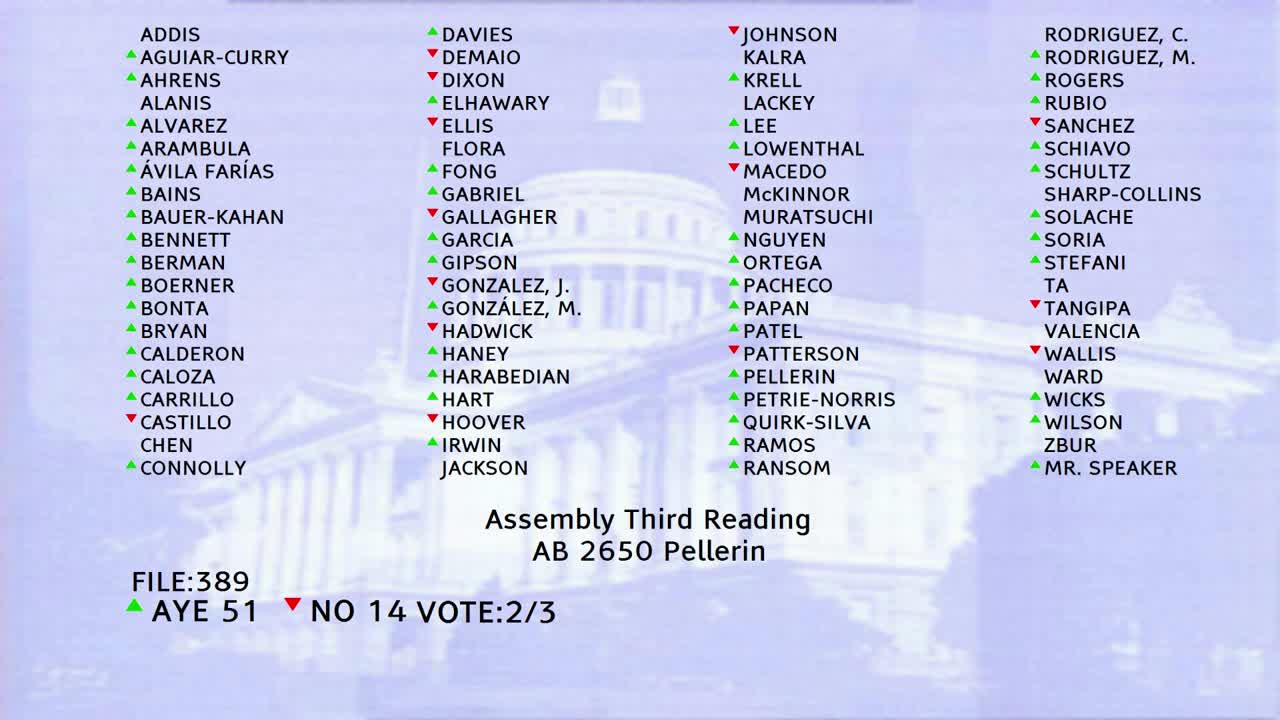 1MIN
Assembly Floor
 5MIN
Assembly Standing Committee on Transportation
Bill Author


